Snapper Lt 200 Series Users Manual TP 100 4422 02 RG N
2015-01-24
: Snapper Snapper-Lt-200-Series-Users-Manual-225913 snapper-lt-200-series-users-manual-225913 snapper pdf
Open the PDF directly: View PDF  .
.
Page Count: 40
OPERATOR’S
MANUAL
18.5HP Hydro Tractors
Mfg. No. Description
2690685 ELT18538, 18.5HP (CE)
2690781 ELT18540, 18.5HP (CE)
20HP Hydro Tractors
Mfg. No. Description
2690689 ELT2044, 20HP (CE)
38” Mower Decks
Mfg. No. Description
1695146 38” Mower Deck (CE)
40” Mower Decks
Mfg. No. Description
1695433 40” Mower Deck (CE)
44” Mower Decks
Mfg. No. Description
1695147 44” Mower Deck (CE)
LT-200 Series
1734103
Revision 02
Rev. Date 02/2008
TP 100-4422-02-RG-N

1
Troubleshooting, Adjustment & Service .........28
Troubleshooting the Tractor..................................28
Troubleshooting the Mower ..................................29
Battery Charging ...................................................30
Seat Adjustment....................................................30
Brake Adjustment..................................................30
PTO Clutch Adjustment ........................................31
Fuse Replacement................................................32
Mower Adjustments ..............................................32
Gauge Wheels ..............................................32
Leveling the Mower.......................................33
Mower Belt Replacement......................................34
Specifications ....................................................35
Parts & Accessories..........................................36
Lawn Care & Mowing Information .............LC—1
NOTE: In this manual, “left” and “right” are referred to as
seen from the operating position.
Safety Rules & Information.................................2
Identification Numbers........................................7
Safety Decals .......................................................8
Safety Icons .........................................................9
Features & Controls ..........................................10
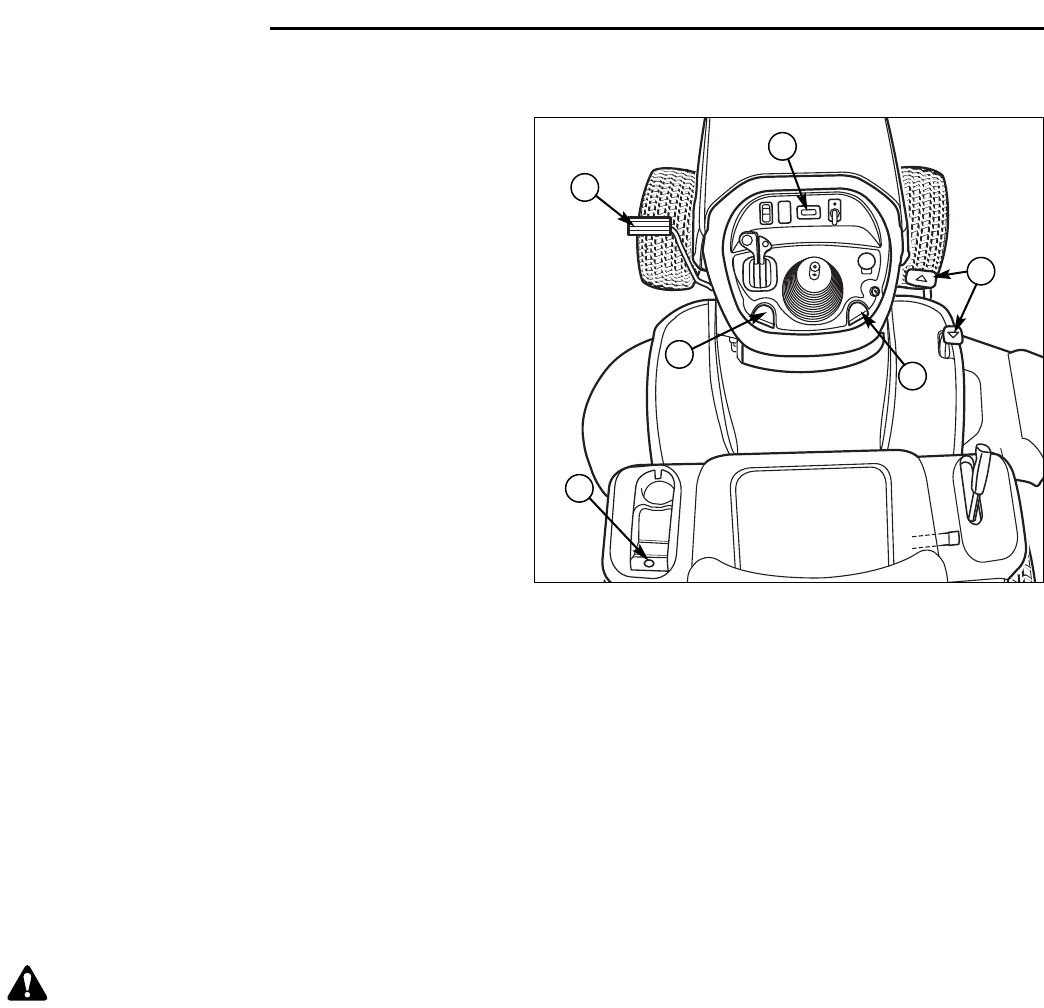
Control Functions..................................................10
Parking Brake Function.........................................12
Cruise Control Operation ......................................12
Hourmeter .............................................................12
12 Volt Power Outlet .............................................12
Operating the Tractor ........................................13
Safety Interlock System ........................................13
General Operating Safety .....................................13
Adding Fuel...........................................................13
Starting the Engine ...............................................13
Stopping the Tractor & Engine..............................14
Driving the Tractor ................................................14
Mowing..................................................................14
Mowing in Reverse ...............................................14
Attachment Operation in Reverse.........................14
Pushing the Tractor by Hand ................................14
Mower Deck Removal & Installation .....................15
Adjusting Mower Cutting Height............................16
Attaching a Trailer.................................................16
Storage .................................................................16
Regular Maintenance ........................................17
Maintenance Schedule .........................................17
Checking Tire Pressures.......................................17
Check / Clean Oil Cooler ......................................18
Safety Interlock System Check .............................18
Blade Brake Check ...............................................18
PTO Clutch Adjustment Check .............................18
Engine Maintenance .............................................18
Battery Maintenance .............................................18
Transmission Identification ...................................19
Transmission Maintenance ...................................19
Hood Removal and Installation .............................19
Lubrication ............................................................20
Lubricate Rear Axes .............................................21
Servicing the Mower Blades .................................22
Check & Fill Engine Oil .........................................23
Oil Drain Valve Operation .....................................24
Change Engine Oil................................................24
Change Engine Oil & Filter ...................................24
Air Filter & Pre-Cleaner Service
(Briggs & Stratton Two Cylinder Models)..............25
Air Filter & Pre-Cleaner Service
(Briggs & Stratton Single Cylinder Models)...........26
Replace Spark Plug ..............................................27
Table of Contents
2
Safety Rules & Information
TP 600-2459-08-UV-SMA
Operating Safety
Congratulations on purchasing a superior-quality piece of lawn and
garden equipment. Our products are designed and manufactured to
meet or exceed all industry standards for safety.
Power equipment is only as safe as the operator. If it is misused, or
not properly maintained, it can be dangerous! Remember, you are
responsible for your safety and that of those around you.
Use common sense, and think through what you are doing. If you
are not sure that the task you are about to perform can be safely
done with the equipment you have chosen, ask a
professional: contact your local authorized dealer.
Read the Manual
The operator’s manual contains important safety information you need to be aware of
BEFORE you operate your unit as well as DURING operation.
Safe operating techniques, an explanation of the product’s features and
controls, and maintenance information is included to help you get the
most out of your equipment investment.
Be sure to completely read the Safety Rules and Information found on
the following pages. Also completely read the Operation section.
Children
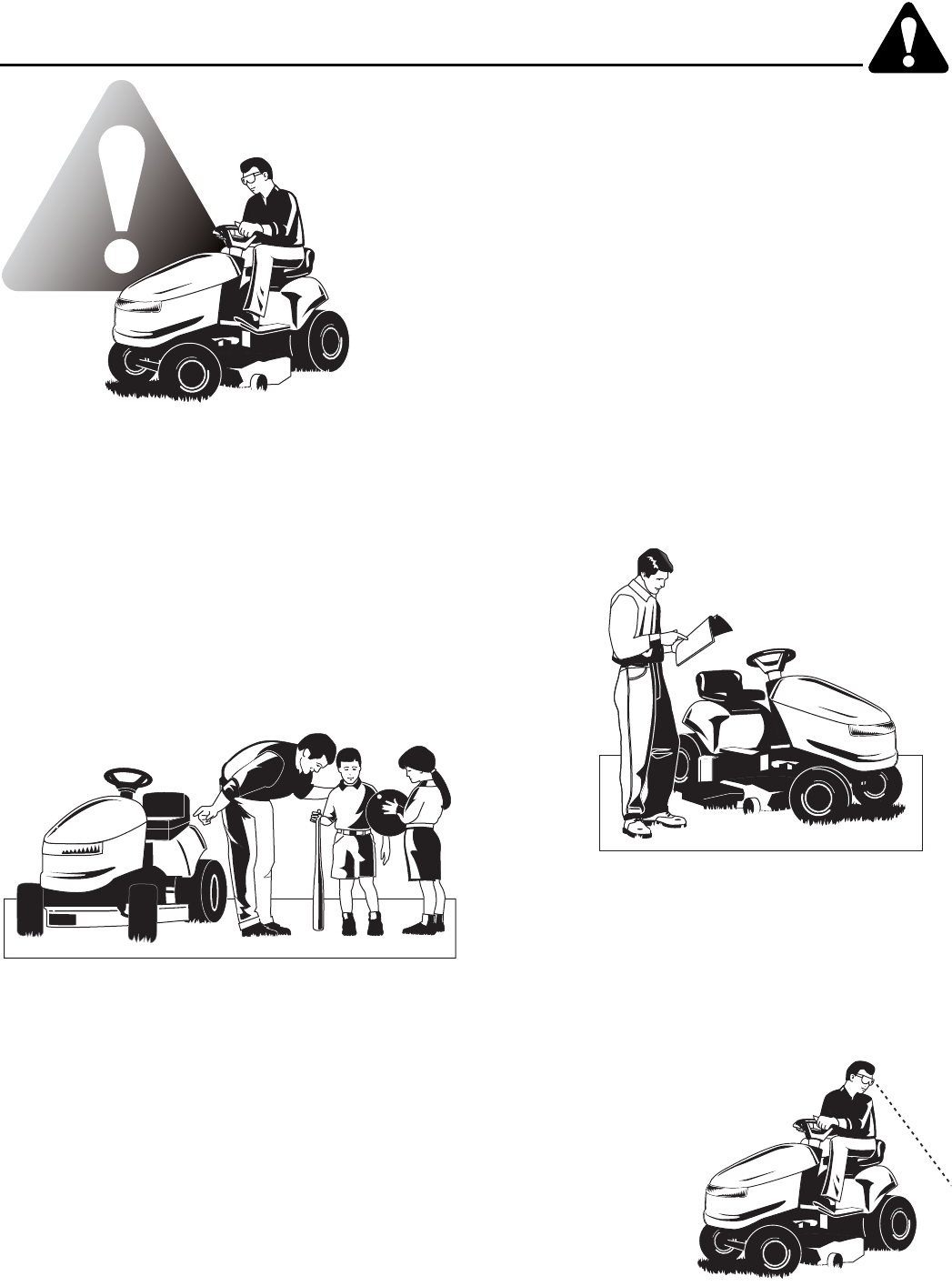
Tragic accidents can occur with children. Do not allow
them anywhere near the area of operation. Children are
often attracted to the unit and mowing activity. Never
assume that children will remain where you last saw them.
If there is a risk that children may enter the area where you
are mowing, have another responsible adult watch them.
DO NOT GIVE CHILDREN RIDES ON THIS UNIT! This
encourages them to come near the unit in the future while it
is running, and they could be seriously hurt. They may then
approach the unit for a ride when you are not expecting it,
and you may run over them.
Reverse
Do not mow in reverse unless
absolutely necessary. Always look
down and behind before and
while traveling in reverse
even with the mower
blades disengaged.
3
Safety Rules and Information
Slope Operation
You could be seriously injured or even killed if you use this unit on too
steep an incline. Using the unit on a slope that is too steep or where
you don’t have adequate traction can cause you to lose control or roll
over.
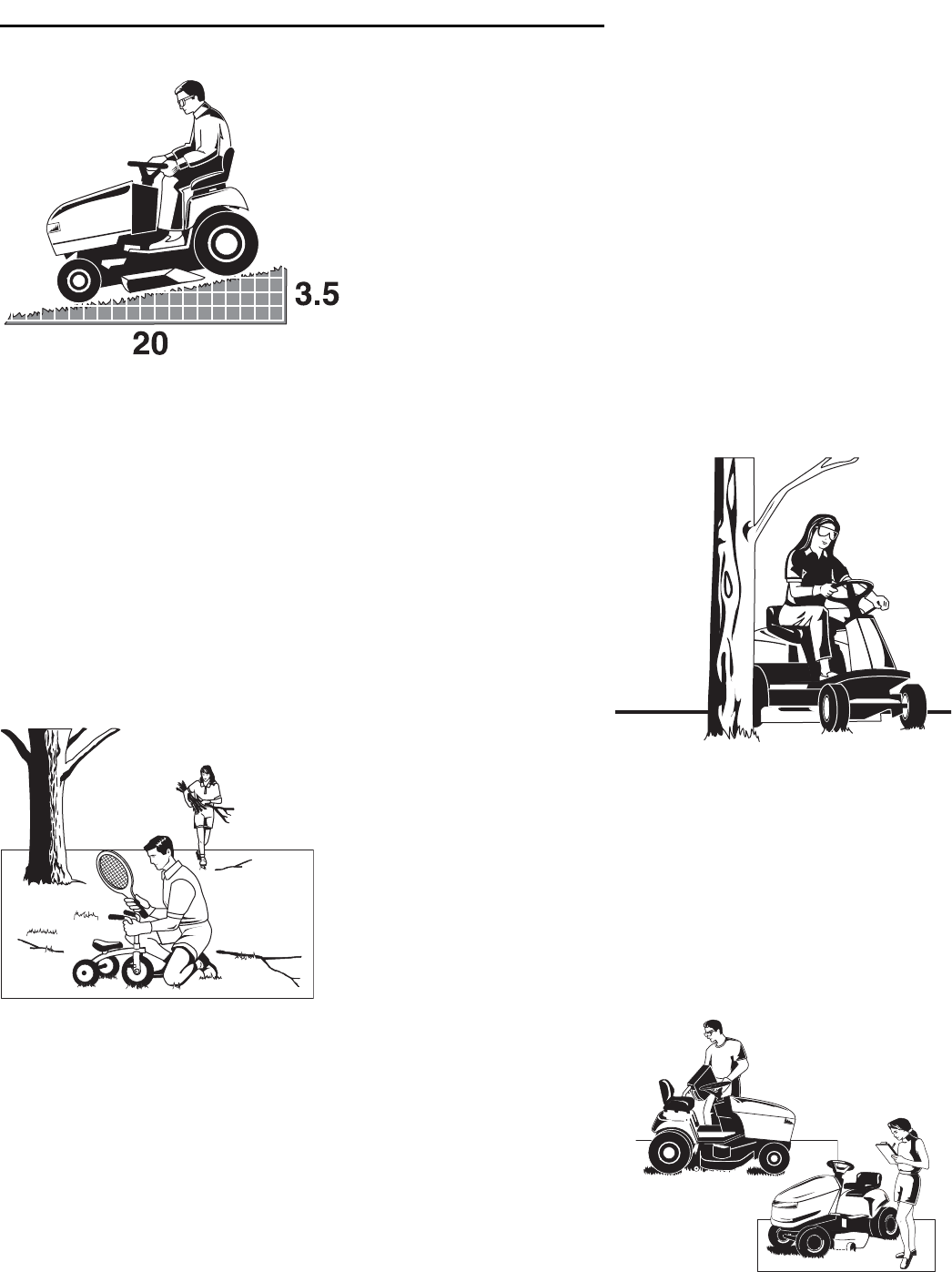
A good rule of thumb is to not operate on any slope you cannot back up
(in 2-wheel drive mode). You should not operate on inclines with a
slope greater than a 3.5 foot rise over a 20 foot length. Always drive up
and down slopes: never cross the face.
Also note that the surface you are driving on can greatly impact stability
and control. Wet grass or icy pavement can seriously affect your ability
to control the unit.
If you feel unsure about operating the unit on an incline, don’t do it. It’s
not worth the risk.
Moving Parts
This equipment has many moving parts that can injure you or someone else.
However, if you are seated in the seat properly, and follow all the rules in this
book, the unit is safe to operate.
The mower deck has spinning mower blades that can amputate hands and feet.
Do not allow anyone near the equipment while it is running!
To help you, the operator, use this equipment safely, it is equipped with an
operator-present safety system. Do NOT attempt to alter or bypass the system.
See your dealer immediately if the system does not pass all the safety interlock
system tests found in this manual.
Thrown Objects
This unit has spinning mower blades. These blades can pick up and throw
debris that could seriously injure a bystander. Be sure to clean up the area to
be mowed BEFORE you start mowing.
Do not operate this unit without the entire grass catcher or discharge guard
(deflector) in place.
Also, do not allow anyone in the area while the unit is running! If someone
does enter the area, shut the unit off immediately until they leave.
Fuel and Maintenance
Gasoline is extremely flammable. Its vapors are also extremely flammable
and can travel to distant ignition sources. Gasoline must only be used as a
fuel, not as a solvent or cleaner. It should never be stored any place where
its vapors can build up or travel to an ignition source like a pilot light. Fuel
belongs in an approved, plastic, sealed gas can, or in the tractor fuel tank
with the cap securely closed. Spilled fuel needs to be cleaned up
immediately.
Proper maintenance is critical to the safety and performance of your unit.
Be sure to perform the maintenance procedures listed in this manual,
especially periodically testing the safety system.
4
Safety Rules & Information
GENERAL OPERATION
1. Read, understand, and follow all instructions in the
manual and on the unit before starting.
2. Do not put hands or feet near rotating parts or under
the machine. Keep clear of the discharge opening at
all times.
3. Only allow responsible adults, who are familiar with
the instructions, to operate the unit (local regulations
can restrict operator age).
4. Clear the area of objects such as rocks, toys, wire,
etc., which could be picked up and thrown by the
blade(s).
5. Be sure the area is clear of other people before
mowing. Stop the unit if anyone enters the area.
6. Never carry passengers.
7. Do not mow in reverse unless absolutely necessary.
Always look down and behind before and while
travelling in reverse.
8. Never direct discharge material toward anyone.
Avoid discharging material against a wall or
obstruction. Material may ricochet back toward the
operator. Stop the blade(s) when crossing gravel
surfaces.
9. Do not operate the machine without the entire grass
catcher, discharge guard (deflector), or other safety
devices in place.
10. Slow down before turning.
11. Never leave a running unit unattended. Always
disengage the PTO, set parking brake, stop engine,
and remove keys before dismounting.
12. Disengage blades (PTO) when not mowing. Shut off
engine and wait for all parts to come to a complete
stop before cleaning the machine, removing the grass
catcher, or unclogging the discharge guard.
13. Operate the machine only in daylight or good artificial
light.
14. Do not operate the unit while under the influence of
alcohol or drugs.
15 Watch for traffic when operating near or crossing
roadways.
16. Use extra care when loading or unloading the unit
into a trailer or truck.
17. Always wear eye protection when operating this unit.
18. Data indicates that operators, age 60 years and
above, are involved in a large percentage of power
equipment-related injuries. These operators should
evaluate their ability to operate the equipment safely
enough to protect themselves and others from injury.
19. Follow the manufacturer’s recommendations for
wheel weights or counterweights.
20. Keep in mind the operator is responsible for accidents
occurring to other people or property.
21. All drivers should seek and obtain professional and
practical instruction.
22. Always wear substantial footwear and trousers.
Never operate when barefoot or wearing sandals.
23. Before using, always visually check that the blades
and blade hardware are present, intact, and secure.
Replace worn or damaged parts.
24. Disengage attachments before: refueling, removing
an attachment, making adjustments (unless the
adjustment can be made from the operator’s
position).
25. When the machine is parked, stored, or left
unattended, lower the cutting means unless a positive
mechanical lock is used.
26. Before leaving the operator’s position for any reason,
engage the parking brake (if equipped), disengage
the PTO, stop the engine, and remove the key.
27. To reduce fire hazard, keep the unit free of grass,
leaves, & excess oil. Do not stop or park over dry
leaves, grass, or combustible materials.
28. It is a violation of California Public Resource Code
Section 4442 to use or operate the engine on or near
any forest-covered, brush-covered, or grass-covered
land unless the exhaust system is equipped with a
spark arrester meeting any applicable local or state
laws. Other states or federal areas may have similar
laws.
Read these safety rules and follow them closely. Failure to obey these rules could result in loss of control
of unit, severe personal injury or death to you, or bystanders, or damage to property or equipment.
This mowing deck is capable of amputating hands and feet and throwing objects.
The triangle in text signifies important cautions or warnings which must be followed.
TRANSPORTING AND STORAGE
1. When transporting the unit on an open trailer, make
sure it is facing forward, in the direction of travel. If
the unit is facing backwards, wind lift could damage
the unit.
2. Always observe safe refueling and fuel handling
practices when refueling the unit after transportation
or storage.
3. Never store the unit (with fuel) in an enclosed poorly
ventilated structure. Fuel vapors can travel to an
ignition source (such as a furnace, water heater, etc.)
and cause an explosion. Fuel vapor is also toxic to
humans and animals.
4. Always follow the engine manual instructions for
storage preparations before storing the unit for both
short and long term periods.
5. Always follow the engine manual instructions for
proper start-up procedures when returning the unit to
service.
6. Never store the unit or fuel container inside where
there is an open flame or pilot light, such as in a
water heater. Allow unit to cool before storing.

5
Safety Rules and Information
CHILDREN
Tragic accidents can occur if the operator is not alert to the
presence of children. Children are often attracted to the
unit and the mowing activity. Never assume that children
will remain where you last saw them.
1. Keep children out of the mowing area and under the
watchful care of another responsible adult.
2. Be alert and turn unit off if children enter the area.
3. Before and during reverse operation, look behind and
down for small children.
4. Never carry children, even with the blade(s) off. They
may fall off and be seriously injured or interfere with
safe unit operation. Children who have been given
rides in the past may suddenly appear in the mowing
area for another ride and be run over or backed over
by the machine.
5. Never allow children to operate the unit.
6. Use extra care when approaching blind corners,
shrubs, trees, or other objects that may obscure
vision.
EMISSIONS
1. Engine exhaust from this product contains chemicals
known, in certain quantities, to cause cancer, birth
defects, or other reproductive harm.
2. Look for the relevant Emissions Durability Period and
Air Index information on the engine emissions label.
IGNITION SYSTEM
1. This spark ignition system complies with Canadian
ICES-002.
SLOPE OPERATION
Slopes are a major factor related to loss-of-control and tip-
over accidents, which can result in severe injury or death.
Operation on all slopes requires extra caution. If you
cannot back up the slope or if you feel uneasy on it, do not
operate on it.
Control of a walk-behind or ride-on machine sliding on a
slope will not be regained by the application of the brake.
The main reasons for loss of control are: insufficient tire
grip on the ground, speed too fast, inadequate braking, the
type of machine is unsuitable for its task, lack of awareness
of the ground conditions, incorrect hitching and load
distribution.
1. Mow up and down slopes, not across.
2. Watch for holes, ruts, or bumps. Uneven terrain could
overturn the unit. Tall grass can hide obstacles.
3. Choose a slow speed so that you will not have to
stop or change speeds while on the slope.
4. Do not mow on wet grass. Tires may loose traction.
5. Always keep unit in gear especially when traveling
down slopes. Do not shift to neutral and coast
downhill.
6. Avoid starting, stopping, or turning on a slope. If tires
lose traction, disengage the blade(s) and proceed
slowly straight down the slope.
7. Keep all movement on slopes slow and gradual. Do
not make sudden changes in speed or direction,
which could cause the machine to rollover.
8. Use extra care while operating machines with grass
catchers or other attachments; they can affect the
stability of the unit. Do not use on steep slopes.
9. Do not try to stabilize the machine by putting your
foot on the ground (ride-on units).
10. Do not mow near drop-offs, ditches, or
embankments. The mower could suddenly turn over
if a wheel is over the edge of a cliff or ditch, or if an
edge caves in.
11. Do not use grass catchers on steep slopes.
12. Do not mow slopes you cannot back up them.
13. See your authorized dealer/retailer for
recommendations of wheel weights or
counterweights to improve stability.
14. Remove obstacles such as rocks, tree limbs, etc.
15. Use slow speed. Tires may lose traction on slopes
even through the brakes are functioning properly.
16. Do not turn on slopes unless necessary, and then,
turn slowly and gradually downhill, if possible.
TOWED EQUIPMENT (RIDE-ON UNITS)
1. Tow only with a machine that has a hitch designed
for towing. Do not attach towed equipment except at
the hitch point.
2. Follow the manufacturer’s recommendations for
weight limit for towed equipment and towing on
slopes.
3. Never allow children or others in or on towed
equipment.
4. On slopes, the weight of the towed equipment may
cause loss of traction and loss of control.
5. Travel slowly and allow extra distance to stop.
6. Do not shift to neutral and coast down hill.
WARNING
Never operate on slopes greater than 17.6 percent
(10°) which is a rise of 3-1/2 feet (106 cm) vertically in
20 feet (607 cm) horizontally.
When operating on slopes use additional wheel
weights or counterweights. See your dealer/retailer
to determine which weights are available and
appropriate for your unit.
Select slow ground speed before driving onto slope.
In addition to front weights, use extra caution when
operating on slopes with rear-mounted grass
catchers.
Mow UP and DOWN the slope, never across the
face, use caution when changing directions and DO
NOT START OR STOP ON SLOPE.

6
Safety Rules & Information
SERVICE AND MAINTENANCE
Safe Handling of Gasoline
1. Extinguish all cigarettes, cigars, pipes, and other
sources of ignition.
2. Use only approved gasoline containers.
3. Never remove the gas cap or add fuel with the engine
running. Allow the engine to cool before refueling.
4. Never fuel the machine indoors.
5. Never store the machine or fuel container where
there is an open flame, spark, or pilot light such as
near a water heater or other appliance.
6. Never fill containers inside a vehicle or on a truck bed
with a plastic bed liner. Always place containers on
the ground away from your vehicle before filling.
7. Remove gas-powered equipment from the truck or
trailer and refuel it on the ground. If this is not
possible, then refuel such equipment on a trailer with
a portable container, rather than from a gasoline
dispenser nozzle.
8. Keep nozzle in contact with the rim of the fuel tank or
container opening at all times until fueling is
complete. Do not use a nozzle lock-open device.
9. If fuel is spilled on clothing, change clothing
immediately.
10. Never over-fill the fuel tank. Replace gas cap and
tighten securely.
11. Use extra care in handling gasoline and other fuels.
They are flammable and vapors are explosive.
12. If fuel is spilled, do not attempt to start the engine but
move the machine away from the area of spillage and
avoid creating any source of ignition until fuel vapors
have dissipated.
13. Replace all fuel tank caps and fuel container caps
securely.
Service & Maintenance
1. Never run the unit in an enclosed area where carbon
monoxide fumes may collect.
2. Keep nuts and bolts, especially blade attachment
bolts, tight and keep equipment in good condition.
3. Never tamper with safety devices. Check their proper
operation regularly and make necessary repairs if
they are not functioning properly.
4. Keep unit free of grass, leaves, or other debris build-
up. Clean up oil or fuel spillage. and remove any fuel-
soaked debris. Allow machine to cool before storage.
5. If you strike an object, stop and inspect the machine.
Repair, if necessary, before restarting.
6. Never make adjustments or repairs with the engine
running.
7. Check grass catcher components and the discharge
guard frequently and replace with manufacturer’s
recommended parts, when necessary.
8. Mower blades are sharp. Wrap the blade or wear
gloves, and use extra caution when servicing them.
9. Check brake operation frequently. Adjust and service
as required.
10. Maintain or replace safety and instructions labels, as
necessary.
11. Do not remove the fuel filter when the engine is hot
as spilled gasoline may ignite. Do not spread fuel line
clamps further than necessary. Ensure clamps grip
hoses firmly over the filter after installation.
12. Do not use gasoline containing METHANOL, gasohol
containing more than 10% ETHANOL, gasoline
additives, or white gas because engine/fuel system
damage could result.
13. If the fuel tank must be drained, it should be drained
outdoors.
14. Replace faulty silencers/mufflers.
15. Use only factory authorized replacement parts when
making repairs.
16. Always comply with factory specifications on all
settings and adjustments.
17. Only authorized service locations should be utilized
for major service and repair requirements.
18. Never attempt to make major repairs on this unit
unless you have been properly trained. Improper
service procedures can result in hazardous operation,
equipment damage and voiding of manufacturer’s
warranty.
19. On multiple blade mowers, take care as rotating one
blade can cause other blades to rotate.
20. Do not change engine governor settings or over-
speed the engine. Operating the engine at excessive
speed can increase the hazard of personal injury.
21. Disengage drive attachments, stop the engine,
remove the key, and disconnect the spark plug
wire(s) before: clearing attachment blockages and
chutes, performing service work, striking an object, or
if the unit vibrates abnormally. After striking an
object, inspect the machine for damage and make
repairs before restarting and operating the
equipment.
22. Never place hands near the moving parts, such as a
hydro pump cooling fan, when the tractor is running.
(Hydro pump cooling fans are typically located on top
of the transaxle).
23. Units with hydraulic pumps, hoses, or motors:
WARNING: Hydraulic fluid escaping under pressure
may have sufficient force to penetrate skin and cause
serious injury. If foreign fluid is injected into the skin it
must be surgically removed within a few hours by a
doctor familiar with this form of injury or gangrene
may result. Keep body and hands away from pin
holes or nozzles that eject hydraulic fluid under high
pressure. Use paper or cardboard, and not hands, to
search for leaks. Make sure all hydraulic fluid
connections are tight and all hydraulic hoses and
lines are in good condition before applying pressure
to the system. If leaks occur, have the unit serviced
immediately by your authorized dealer.
24. WARNING: Stored energy device. Improper release
of springs can result in serious personal injury.
Springs should be removed by an authorized
technician.
25. Models equipped with an engine radiator: WARNING:
Stored energy device. To prevent serious bodily
injury from hot coolant or steam blow-out, never
attempt to remove the radiator cap while the engine is
running. Stop the engine and wait until it is cool.
Even then, use extreme care when removing the cap.
7
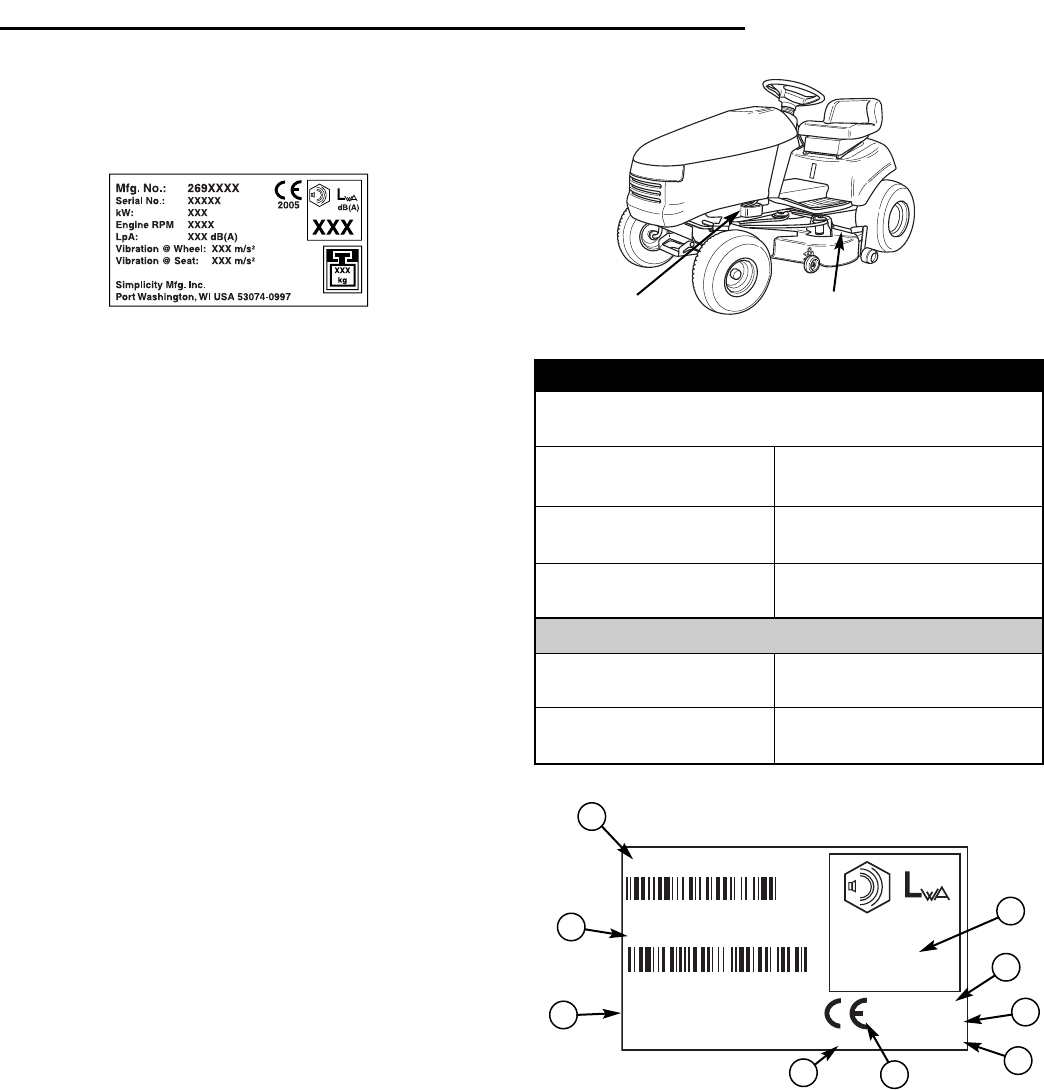
Identification Numbers
Tractor ID Tag Mower ID Tag
When contacting your authorized dealer for
replacement parts, service, or information you MUST
have these numbers.
Record your model name/number, manufacturer’s
identification numbers, and engine serial numbers in the
space provided for easy access. These numbers can be
found in the locations shown.
NOTE: For location of engine identification numbers,
refer to the engine owner’s manual.
CE Models: Place the extra copy of the identification tag
in the manual
SAMPLE
ENGINE REFERENCE DATA
Model Description Name/Number
Unit MFG Number
PRODUCT REFERENCE DATA
Unit SERIAL Number
Dealer Name Date Purchased
Engine Make
Engine Type/Spec
Engine Model
Engine Code/Serial Number
Mower Deck MFG Number Mower Deck SERIAL Number
CE Identification Tag Markings
A. Manufacturer’s Identification Number
B. Manufacturer’s Serial Number
C. Power Rating in Kilowatts
D. Maximum Engine Speed in Rotations per Minute
E. Manufacturer’s Address
F. Year of Manufacture
G. CE Compliance Logo
H. Mass of Unit in Kilograms
I. Sound Power in Decibels ***
J. Sound Pressure at Operator’s Position in Decibels **
K. Vibration at the Steering Wheel *
Identification Numbers
Part No. xxxxxxx
xxxxxxxxxxxxxxx
Serial No. xxxxxxxxxx
20xx
kW: x.xx
xxxx max
xxxxxxxxxxxxxxxxxxxxxxx
xxxxxxxxxxxxxxxxxxxxxxx
xxxxxxxxxxxxxxxxxxxxxxx
xxxxxxxxxxxxxxxxxxxxxxx
xxx dB
kg: xxx
A
B
C
D
E
FG
H
I
8
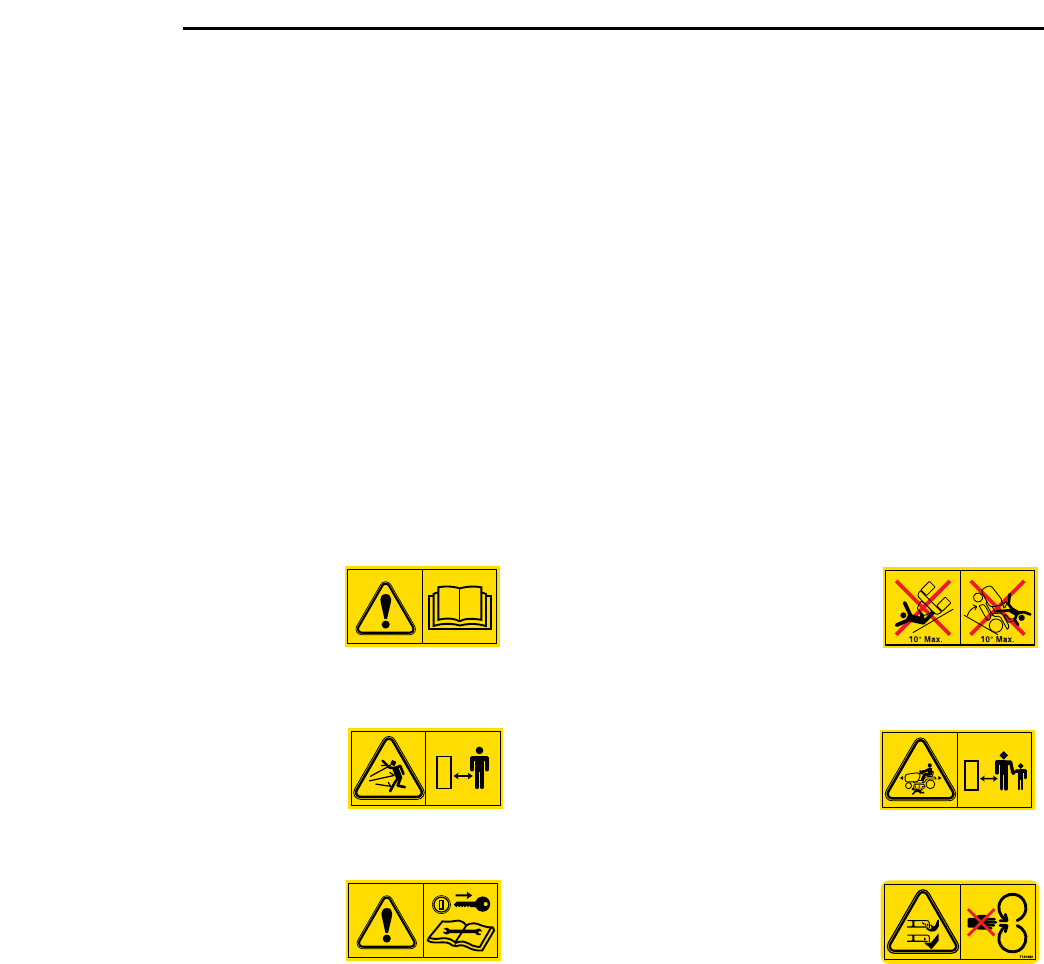
Safety Decals
Warning: Read Operator’s
Manual.
Read and understand the
Operator’s Manual before using
this machine.
Danger: Thrown Objects.
This machine is capable of throwing
objects and debris. Keep
bystanders away.
Warning: Remove Key Before
Servicing.
Remove the key and consult
technical literature before
performing repairs or maintenance.
Danger: Machine Rollover.
Do not use this machine on slopes
greater than 10°.
Danger: Dismemberment.
This machine can amputate limbs.
Keep bystanders and children away
when engine is running.
Danger: Dismemberment.
This mower deck can amputate
limbs. Keep hands and feet away
from blades.
Safety Decals
This unit has been designed and manufactured to
provide you with the safety and reliability you would
expect from an industry leader in outdoor power
equipment manufacturing.
Although reading this manual and the safety instructions
it contains will provide you with the necessary basic
knowledge to operate this equipment safely and
effectively, we have placed several safety labels on the
unit to remind you of this important information while you
are operating your unit.
All DANGER, WARNING, CAUTION and instructional
messages on your rider and mower should be carefully
read and obeyed. Personal bodily injury can result when
these instructions are not followed. The information is for
your safety and it is important! The safety decals below
are on your rider and mower.
If any of these decals are lost or damaged, replace them
at once. See your local dealer for replacements.
These labels are easily applied and will act as a constant
visual reminder to you, and others who may use the
equipment, to follow the safety instructions necessary for
safe, effective operation.
Safety IconsSafety Icons
9
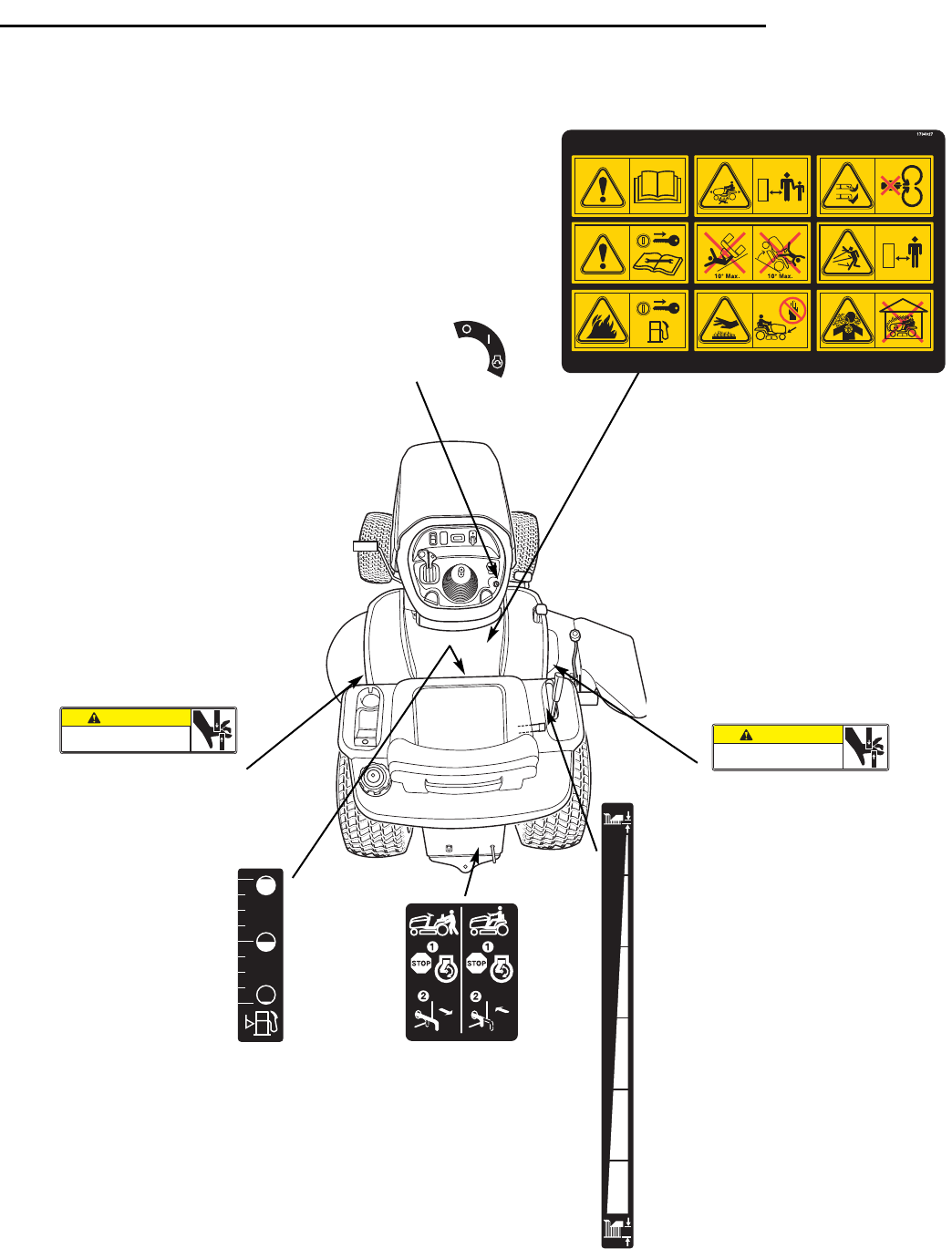
CE Safety Icons
Transmission
Release
Part No. 1730202
173xxxx
Attachment Lift
Part No. 1730264
Fuel Level
Part No. 1730172
1730172
1730264
Ignition Switch
Positions
Part No. 1722806
Decals Locations
Pinch Point
When installing or removing the mower deck, do not
place hands between mower lift linkage and frame rail. 1732070
CAUTION
Caution, Pinch Point
Part No. 1732070
(38”, 40” & 44” Mowers Only)
Caution, Pinch Point
Part No. 1732070
(38”, 40” & 44” Mowers Only)
Pinch Point
When installing or removing the mower deck, do not
place hands between mower lift linkage and frame rail. 1732070
CAUTION
Pinch Point
When installing or removing the mower deck, do not
place hands between mower lift linkage and frame rail. 1732070
CAUTION
Pinch Point
When installing or removing the mower deck, do not
place hands between mower lift linkage and frame rail. 1732070
CAUTION
Operating Instructions,
CE Models, Part No. 1734027
10
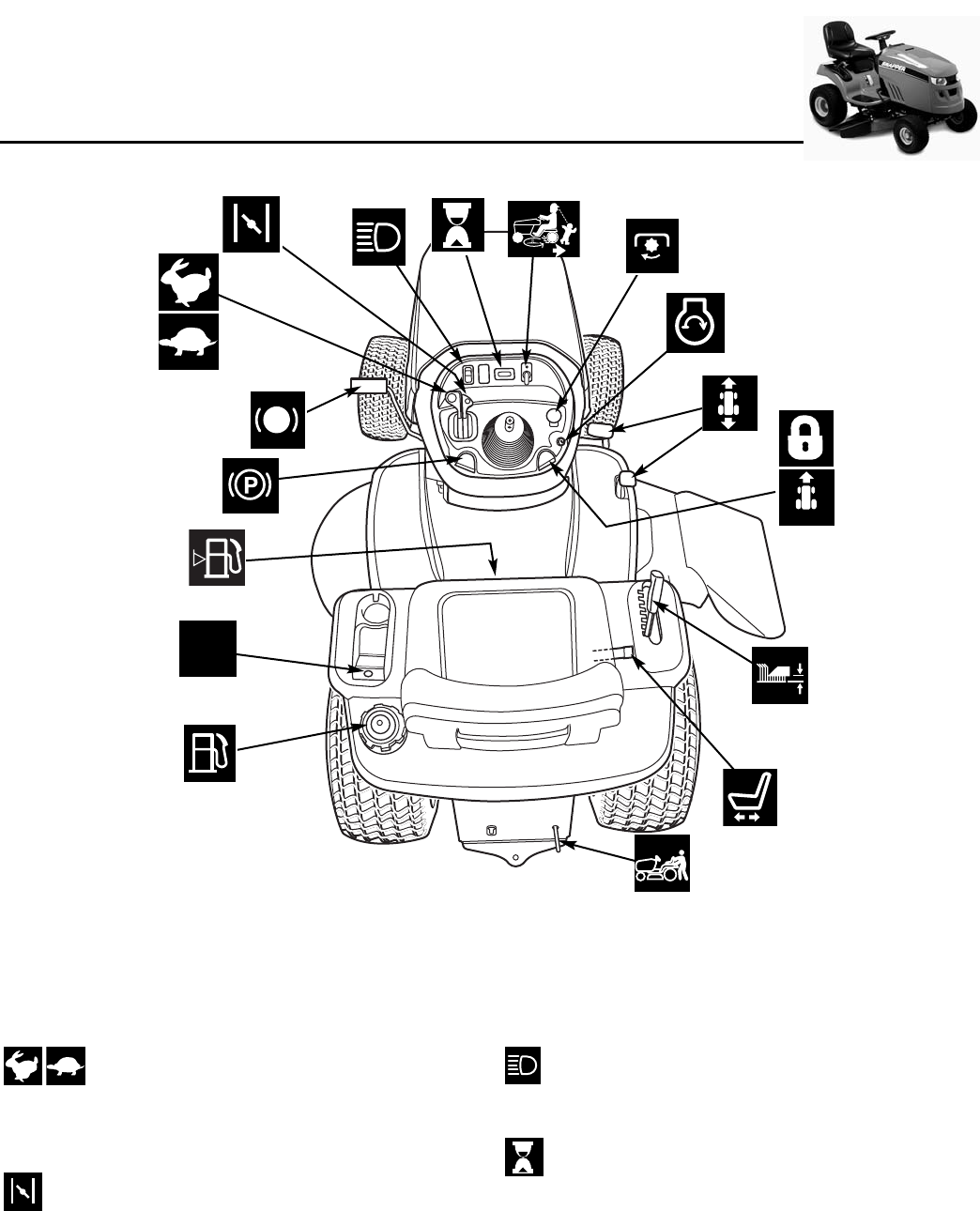
Features & Controls
Throttle Control
The throttle controls engine speed. Move the throttle
forward to increase engine speed and back to decrease
engine speed. Always operate at FULL throttle.
Choke
Close the choke for cold starting. Open the choke once
the engine starts. A warm engine may not require
choking. Move the lever forward to close the choke.
Headlights
The light switch turns the tractor headlights on and off.
Hour Meter (Select Models)
The hour meter measures the number of hours the key
has been in the RUN position.
Control Functions
The information below briefly describes the function of individual controls. Starting, stopping, driving, and mowing
require the combined use of several controls applied in specific sequences. To learn what combination and sequence
of controls to use for various tasks see the OPERATION section.
Figure 1. Controls
12V

Reverse Mowing Option (RMO)
The Reverse Mowing Option allows for mowing (or use
of other PTO driven attachments) while traveling in
reverse. If you choose to mow in reverse, turn the RMO
key after the PTO is engaged. The L.E.D. light will
illuminate, and the operator can then mow in reverse.
Each time the PTO is engaged the RMO needs to be
reactivated if desired.
PTO Switch
The PTO (Power Take-Off) switch engages and
disengages attachments that use the PTO. To engage
the PTO, pull UP on the switch. Push DOWN to
disengage.
Note that the operator must be seated firmly
in the tractor seat for the PTO to function.
Ignition Switch
The ignition switch starts and stops the engine, it has
three positions:
OFF Stops the engine and shuts off the
electrical system.
RUN Allows the engine to run and powers the
electrical system.
START Cranks the engine for starting.
NOTE: Never leave the ignition switch in the RUN
position with the engine stopped–this drains the battery.
Ground Speed Pedals
The tractor’s forward ground speed is controlled by the
forward ground speed control pedal. The tractor’s
reverse ground speed is controlled by the reverse
ground speed control pedal.
Depressing either pedal will increase ground speed.
Note that the further down the pedal is depressed, the
faster the tractor will travel.
Cruise Control
The cruise control is used to lock the ground speed
control in forward. The cruise control has five lock
positions.
11
Features & Controls
Mower Height of Cut Adjustment
The mower cutting height adjustment lever controls the
mower cutting height. The mower cutting height can be
set to one of seven positions between 1-1/4” and 4.”
Seat Adjustment Lever
The seat can be adjusted forward and back. Move the
lever, position the seat as desired, and release the lever
to lock the seat into position.
Transmission Release Valve Lever
The transmission release valve lever deactivates the
transmission so that the tractor can be pushed by hand.
See PUSHING THE TRACTOR BY HAND for
operational information.
Fuel Tank
To remove the cap, turn counterclockwise.
Power Outlet (Select Models)
The power outlet is 12V-DC. Accessory must be rated at
9 amps or less.
Fuel Level Gauge
Displays the fuel level in the tank.
Parking Brake
The parking brake knob is used to lock the parking brake
when the tractor is stopped. Fully depressing the brake
pedal and pulling up on the knob engages the parking
brake. Refer to page 12 for a full explanation of parking
brake functions.
Brake Pedal
Depressing the brake pedal applies the tractor brake.
12V
12
Features & Controls
Figure 2. Engaging the Parking Brake
A. Ground Speed Pedals
B. Brake Pedal
C. Parking Brake Knob
D. Cruise Control Knob
E. Hourmeter
F. 12V Power Adapter
Parking Brake Function
Applying the Parking Brake - See Figure 2. To lock
the parking brake, release the ground speed pedals (A),
fully depress the brake pedal (B), pull UP on the parking
brake knob (C), and then release brake pedal.
Releasing the Parking Brake - See Figure 2. To
release the parking brake, depress the brake pedal (B).
Hourmeter
(Select Models)
The hour meter (E, Figure 2) measures the number of
hours the key has been in the RUN position.
B
12 Volt Power Outlet
(Select Models)
The 12-volt accessory plug is located in the left side pod
(D, Figure 2). It can be used to power small electronic
devices. The accessory must be rated at 9 amps or less.
Note: Operating a 12-volt accessory, especially with the
engine at idle, may cause battery discharge. When not
using the accessory plug it must be covered with the
rubber plug to prevent moisture from causing a short
circuit. Entrance of water into plug can cause a short
circuit.
CAUTION
Avoid Injury. Safe operation requires your full
attention. Do not wear radio or music
headphones while operating machine.
C
A
F
E
D
Cruise Control Operation
TO ENGAGE:
1. Pull up on the cruise control knob (D, Figure 2).
2. Depress the forward ground speed pedal (A).
3. Lift up the Cruise control knob (D) when desired
speed is reached. The Cruise will lock in one of its
five locking positions.
TO DISENGAGE:
1. Depress the brake pedal (B).
OR
2. Depress the forward ground speed pedal (A).
13
Operating the Tractor
General Operating Safety
Be sure to read all information in the Safety and
Operation sections before attempting to operate this unit.
Become familiar with all of the controls and how to stop
the unit.
Adding Fuel
To add fuel:
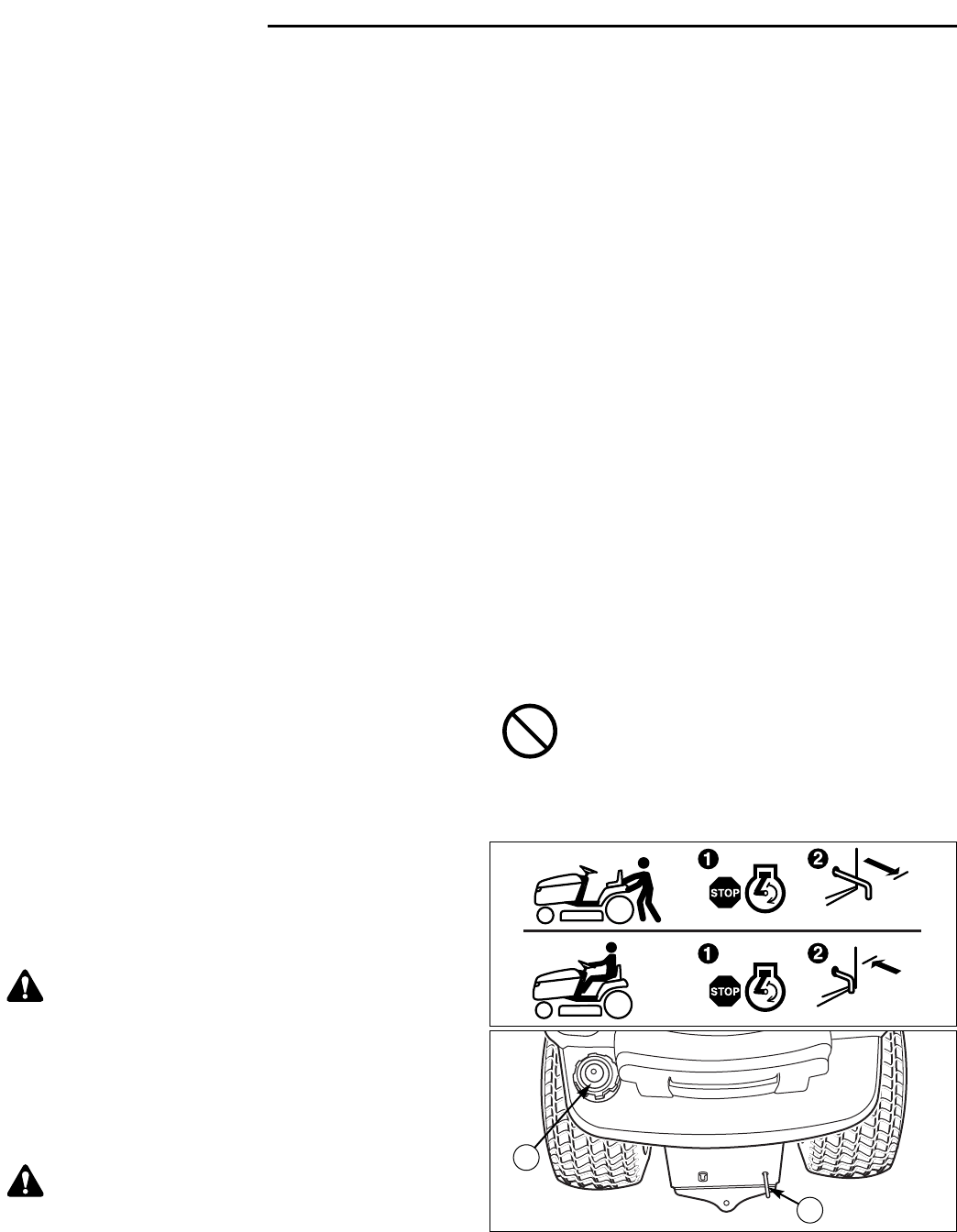
1. Remove the fuel cap (A, Figure 3).
2. Fill the tank. Do not overfill. Leave room in the tank
for fuel expansion. Refer to your engine manual for
specific fuel recommendations.
3. Install and hand tighten the fuel cap.
Starting The Engine
1. While sitting in the operator’s seat, fully depress the
brake pedal or set the parking brake.
2. Make sure that your feet are not depressing the
ground speed control pedals and that the cruise
control lever is in neutral.
3. Disengage the PTO clutch.
4. Set the throttle to FULL.
5. Close the choke.
NOTE: A warm engine may not require choking.
6. Insert the ignition key and turn it to START.
7. After the engine starts, move the engine throttle
control to half speed. Warm up the engine by running
it for at least 30 seconds.
8. Set throttle to FULL.
NOTE: In the event of an emergency the engine can be
stopped by simply turning the ignition switch to STOP.
Use this method only in emergency situations. For
normal engine shut down follow the procedure given in
STOPPING THE TRACTOR.
WARNING
Gasoline is highly flammable and must be
handled with care. Never fill the tank when the
engine is still hot from recent operation. Do not
allow open flame, smoking or matches in the
area. Avoid over-filling and wipe up any spills.
Do not use gasoline containing METHANOL,
gasohol containing more than
10% ETHANOL, gasoline additives, or white
gas because engine/fuel system damage
could result.
SAFETY INTERLOCK
SYSTEM TESTS
This unit is equipped with safety interlock switches and
other safety devices. These safety systems are
present for your safety: do not attempt to bypass safety
switches, and never tamper with safety devices. Check
their operation regularly.
Operational SAFETY Checks
Your unit is equipped with a seat switch safety system.
Check the seat switch operation every fall and spring
with the following tests.
Test 1 — Engine should NOT crank if:
• PTO switch is ON, OR
• Brake pedal is NOT fully depressed (parking brake
OFF), OR
• The cruise control lever is NOT in NEUTRAL.
Test 2 — Engine SHOULD crank and start if:
• Operator is sitting in seat, AND.
• PTO switch is OFF, AND
• Brake pedal is fully depressed (parking brake ON),
AND
• The cruise control lever is in NEUTRAL
Test 3 — Engine should SHUT OFF if:
• Operator rises off seat.
Test 4 — Blade Brake Check
Mower blades and mower drive belt should come to a
complete stop within five seconds after electric PTO
switch is turned OFF (or operator rises off seat). If mower
drive belt does not stop within five seconds, readjust the
PTO clutch as described in the ADJUSTMENTS section
or see your dealer.
Test 5 — Reverse Mow Option (RMO) Check
• Engine should shut off if reverse travel is attempted if the
PTO has been switched on and RMO has not been
activated.
• RMO light should illuminate when RMO has been
activated.
WARNING
If the unit does not pass a safety test, do not
operate it. See your authorized dealer. Under no
circumstance should you attempt to defeat the
purpose of the safety interlock system.
14
Operating the Tractor
Stopping The Tractor & Engine
1. Return the ground speed control(s) to neutral.
2. Disengage the PTO and wait for all moving parts to
stop.
3. Briggs & Stratton Models: Move the throttle control to
SLOW position and turn the ignition key to OFF.
Remove the key.
Kohler Models: Move the throttle control to FAST
position and turn the ignition key to OFF. Remove the
key.
Driving The Tractor
1. Sit in the seat and adjust the seat so that you can
comfortably reach all the controls and see the
dashboard display.
2. Engage the parking brake.
3. Make sure the PTO switch is disengaged.
4. Start the engine (see STARTING THE ENGINE).
5. Disengage the parking brake and release the brake
pedal.
6. Depress the forward ground speed control pedal to
travel forward. Release the pedal to stop. Note that the
further down the pedal is depressed the faster the
tractor will travel.
7. Stop the tractor by releasing the ground speed control
pedals, setting the parking brake, and stopping the
engine (see STOPPING THE TRACTOR AND
ENGINE).
Mowing
1. Set the mower cutting height to the desired level and set
the gauge wheels to the appropriate position (if
equipped).
2. Engage the parking brake. Make sure the PTO switch
is disengaged.
3. Start the engine (see STARTING THE ENGINE).
4. Fully lower the mower using the attachment lift lever and
set cutting height.
5. Set the throttle to FULL.
6. Engage the PTO (Mower Deck).
7. Begin mowing. See Section LC for tips on mowing
patterns, lawn care, and troubleshooting information.
8. When finished, shut off the PTO and raise the mower
using the attachment lift control lever.
9. Stop the engine (see STOPPING THE TRACTOR AND
ENGINE).
DO NOT TOW TRACTOR
Towing the unit will cause transmission
damage. • Do not use another vehicle to
push or pull this unit. • Do not actuate the
transmission release valve lever while the
engine is running.
Figure 3. Transmission Release Lever & Fuel Tank
A. Fuel Tank Cap.
B. Transmission Release Lever
B
A
Mowing in Reverse
If an operator chooses to mow in reverse, the RMO
system can be used. To use the Reverse Mowing
Option (RMO) turn the RMO key after the PTO is
engaged. The L.E.D. light will illuminate, and the
operator can then mow in reverse. Each time the PTO is
engaged the RMO needs to be reactivated if desired.
The key should be removed to restrict access to the
RMO feature.
Attachment Operation in Reverse
If an operator chooses to operate a PTO driven
attachment in reverse, the RMO system can be used.
To use the Reverse Mowing Option (RMO) turn the RMO
key after the PTO is engaged. The L.E.D. light will
illuminate, and the operator can then operate the
attachment in reverse. Each time the PTO is
disengaged the RMO needs to be reactivated if desired.
The key should be removed to restrict access to the
RMO feature.
Pushing the Tractor by Hand
1. Disengage the PTO and turn the engine off.
2. Pull the transmission release (B, Figure 3) back
approximately 2-3/8” (6 cm) to lock into released
position.
3. The tractor can now be pushed by hand.
WARNING
Mowing in reverse can be hazardous to
bystanders. Tragic accidents can occur if the
operator is not alert to the presence of children.
Never activate RMO if children are present.
Children are often attracted to the unit and the
mowing activity.
WARNING
The engine will shut off if the reverse ground
speed pedal is depressed while the PTO is on and
the RMO has not been activated. The operator
should always turn the PTO off prior to driving
across on roads, paths or any area that maybe
used by other vehicles. Sudden loss of drive
could create a hazard.
15
Operating the Tractor
Mower Deck Removal & Installation
Removing the Mower Deck
1. Park tractor on a hard, level surface such as a
concrete floor. Turn off PTO switch and engine,
remove the key and apply parking brake.
2. Place wood blocks under the mower deck. Place the
attachment lift in the lowest position.
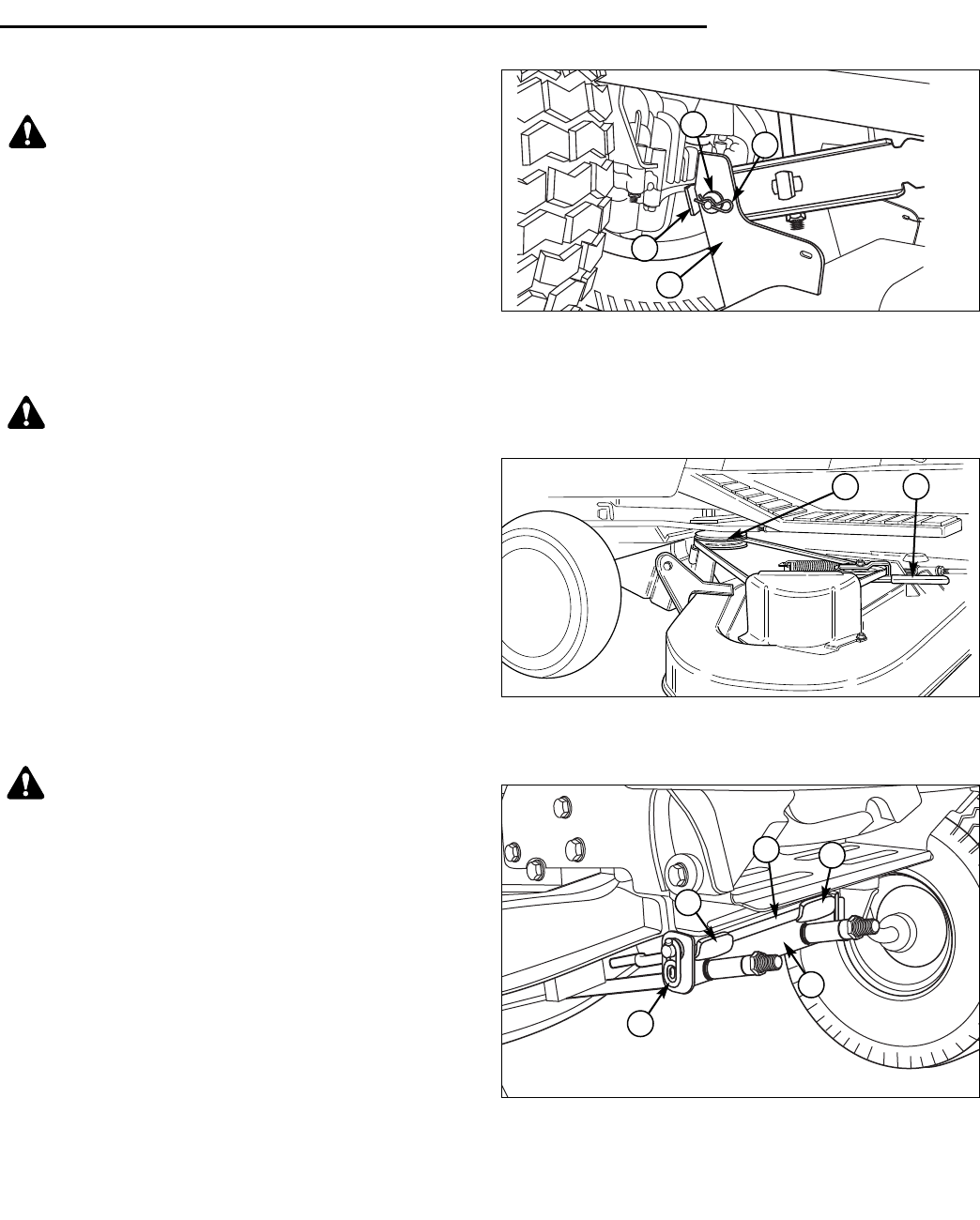
3. Move idler arm (A, Figure 5) to relieve belt tension.
Remove belt from PTO pulley (B).
4. Remove hair pin (D, Figure 4) and washer (C).
Disconnect the mower lift plates (A) from the tractor
lift arms (B). Re-install washers (C) and hair pins (D)
to prevent loss.
5. Return lift lever to highest position.
6. Turn wheels straight ahead. Support the mower
hanger (C). Remove safety clip (A, Figure 6) and rod
(B). Lower the mower hanger (C).
7. Turn wheels fully left, and slide mower deck out right
side of tractor.
Installing the Mower Deck
1. Park tractor, shut off PTO and engine, remove the
key and apply parking brake. Turn the wheels fully to
the left.
2. Place the mower lift lever (A, Figures 7) in the lowest
position. Slide mower deck under right side of tractor
so that mower hitch is aligned with the front tractor
hitch.
3. Turn wheels straight. Lift the mower hanger (C,
Figure 6). Insert rod (B) through mower hanger (C)
and tractor brackets (D). Secure with safety clip (A).
4. Re-install hair pins (D, Figure 4) and washers (C) into
the mower lift plates (A) and the tractor lift arms (B).
WARNING
Engage parking brake, disengage PTO, stop
engine and remove key before attempting to
install or remove the mower.
Figure 4. Lift Arms
(Viewed from underneath right side of tractor)
A. Mower Lift Plate
B. Tractor Lift Arm
C. Washer
D. Hair Pin
Figure 6. Mower Hitch
A. Safety Clip
B. Rod
C. Mower Hanger
D. Tractor Brackets
C
A
B
D
CAUTION
The muffler and surrounding areas may be hot.
Figure 5. Removing & Installing Belt
A. Idler Arm
B. PTO Pulley
BA
C
B
A
D
D
CAUTION
Stored energy device. 44” & 50” mowers have
spring lift assist. Lift lever must be in lowest
cutting position and mower on support blocks to
avoid injury when removing or installing mower
mounting hardware. Return lift lever to highest
position after hardware has been disconnected.
5. Move idler arm (A, Figure 5) to relieve belt tension.
Install belt onto the PTO pulley (B).
16
Operating the Tractor
Attaching a Trailer
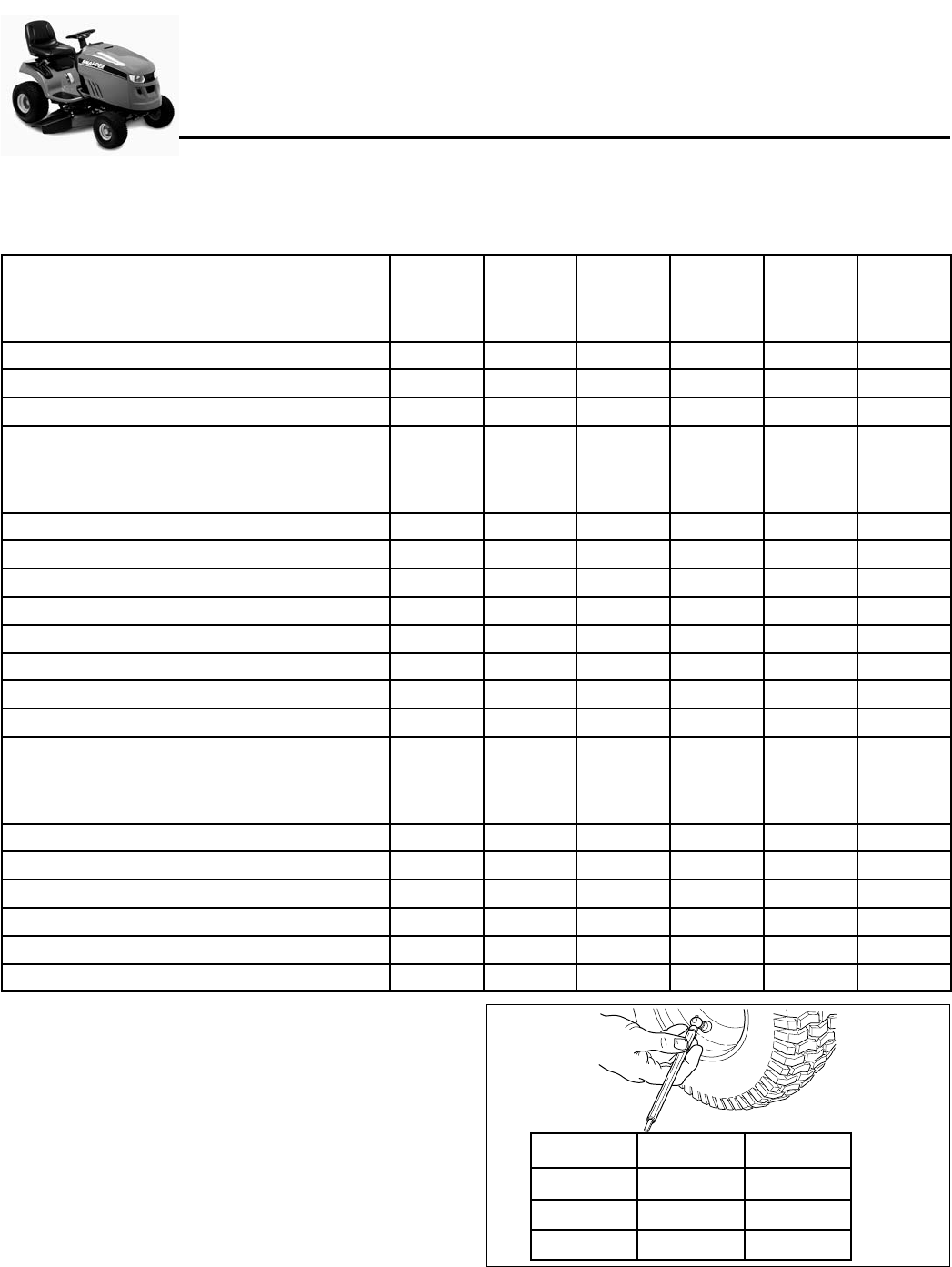
The maximum horizontal drawbar force allowed is 280
Newton. The maximum vertical drawbar force is 160
Newton. This equates to a 250 lbs (113 kg) trailer on a
10 degree hill. Secure the trailer with an appropriately
sized clevis pin (A, Figure 8) and clip (B).
Storage
Before you store your unit for the off-season, read the
Maintenance and Storage instructions in the Safety
Rules section, then perform the following steps:
• Disengage the PTO, set the parking brake, & remove
the key.
• Perform engine maintenance and storage measures
listed in the engine owner’s manual. This includes
draining the fuel system, or adding stabilizer to the
fuel (do not store a fueled unit in an enclosed
structure - see warning).
• Battery life will be increased if it is removed, put in a
cool, dry place and fully charged about once a month.
If the battery is left in the unit, disconnect the
negative cable.
Before starting the unit after it has been stored:
• Check all fluid levels. Check all maintenance items.
• Perform all recommended checks and procedures
found in the engine owner’s manual.
• Allow the engine to warm up for several minutes
before use.
WARNING
Never store the unit (with fuel) in an enclosed,
poorly ventilated structure. Fuel vapors can
travel to an ignition source (such as a furnace,
water heater, etc.) and cause an explosion.
Fuel vapor is also toxic to humans and animals.
Figure 8. Trailer Weight Recommendations
A. Clevis Pin
B. Clip
A
B
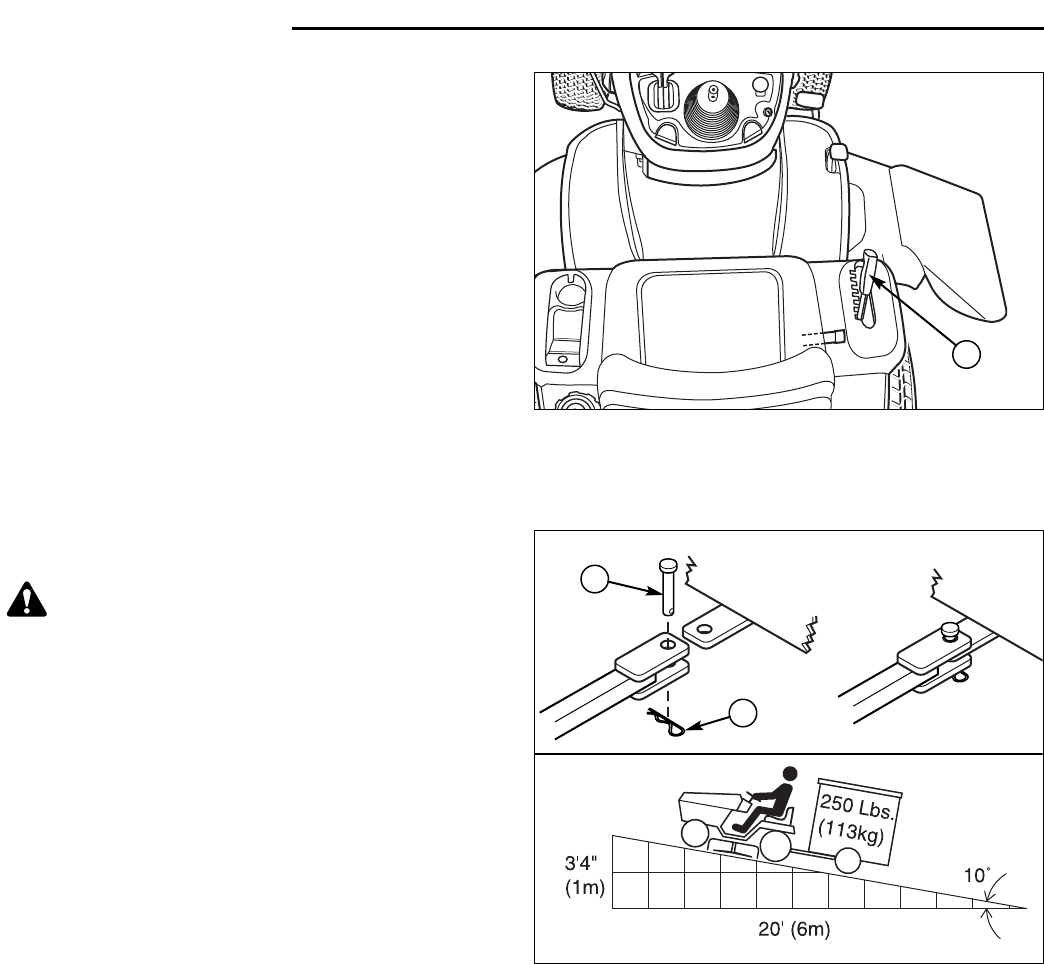
Figure 7. Raising & Lowering Mower
A. Mower Lift Lever
A
Adjusting Mower Cutting Height
The cutting height lift lever (A, Figure 7) controls the
mower cutting height. The cutting height is has seven
positions between approximately 1-1/4” and 4” (3,2-10
cm).
17
Regular
Maintenance
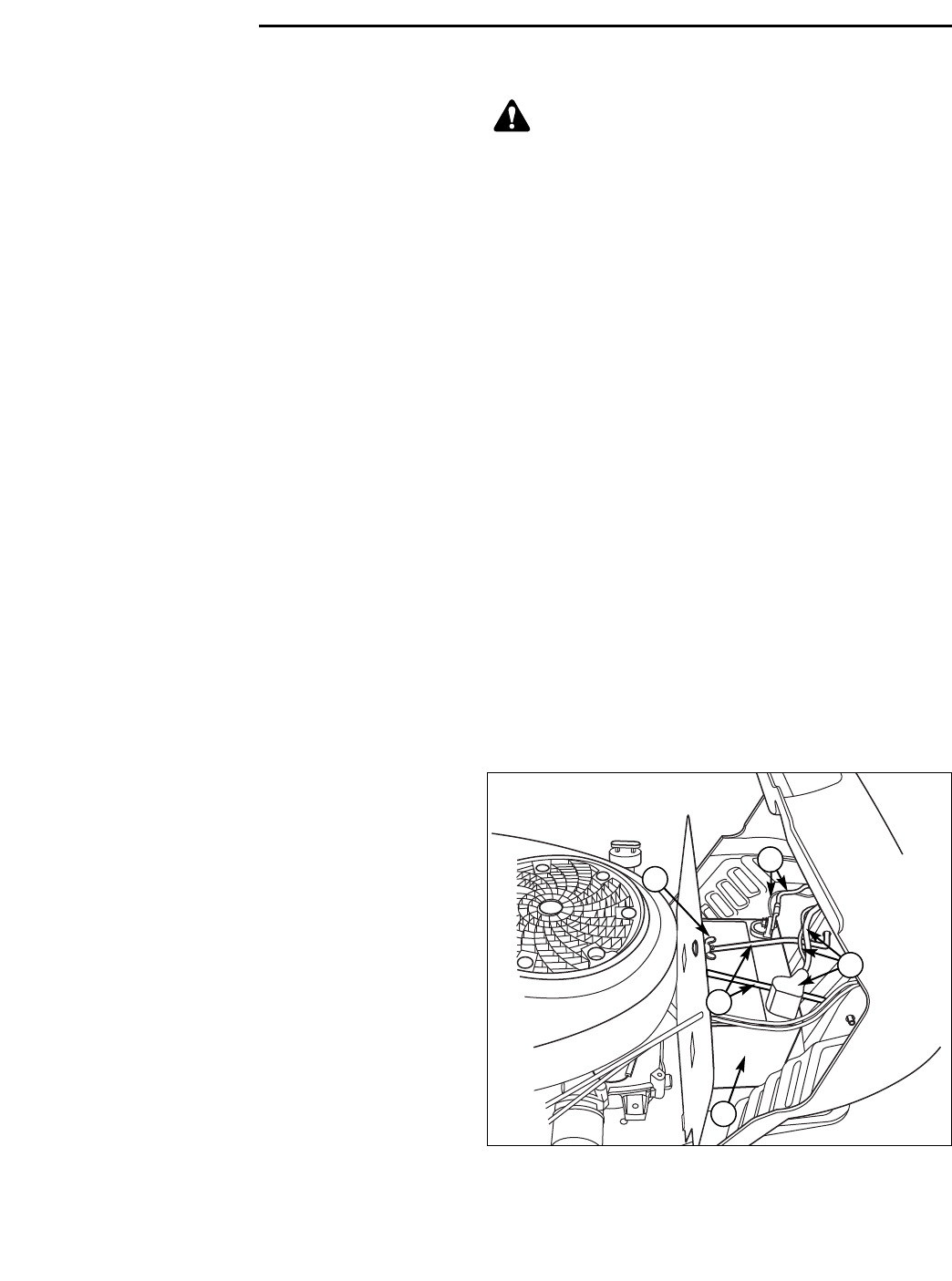
MAINTENANCE SCHEDULE & PROCEDURES
The following schedule should be followed for normal care of your tractor and mower.
•= All Models
* Refer to engine owner’s manual. Change original
engine oil after initial break-in period.
** More often in hot (over 85° F: 30° C) weather or
dusty operating conditions.
Check Tire Pressures
Service Interval: Every 25 Hours
Tire Pressure should be checked periodically, and
maintained at the levels shown in the chart. Note that
these pressures may differ slightly from the “Max
Inflation” stamped on the side-wall of the tires. The
pressures shown provide proper traction, improve cut
quality, and extend tire life.
Figure 9. Tire Pressure
Size PSI bar
22 x 10,0-8 10 0,68
20 x 8,0-8 10 0,68
15 x 6,0-6 12-14 0,82-0,96
SAFETY ITEMS Before
Each
Use
Every 5
Hours
Every
25
Hours
Every
100
Hours
Every
250
Hours
Spring
& Fall
Check Safety Interlock System •
Check Tractor Brakes •
Check Mower Blade Stopping Time • •
TRACTOR MAINTENANCE ITEMS Before
Each
Use
Every 5
Hours
Every
25
Hours
Every
100
Hours
Every
250
Hours
Spring
& Fall
Check Tractor/Mower for loose hardware •
Check / Clean Cooling Fins (If Equipped) •
Check / Adjust PTO Clutch •
Lubricate Tractor & Mower ** •
Lubricate Rear Axle Shafts Yearly
Clean Battery & Cables •
Check Tire Pressure •
Clean Deck & Check/Replace Mower Blades** •
ENGINE MAINTENANCE ITEMS Before
Each
Use
Every 5
Hours
Every
25
Hours
Every
50
Hours
Every
100
Hours
Spring
& Fall
Check Engine Oil Level •
Check / Change Engine Air Filter * •
Change Engine Oil * • • •
Change Engine Oil & Filter * •
Inspect Spark Plug(s) * •
Check / Replace Fuel Filter *
18
Regular Maintenance
Battery Maintenance
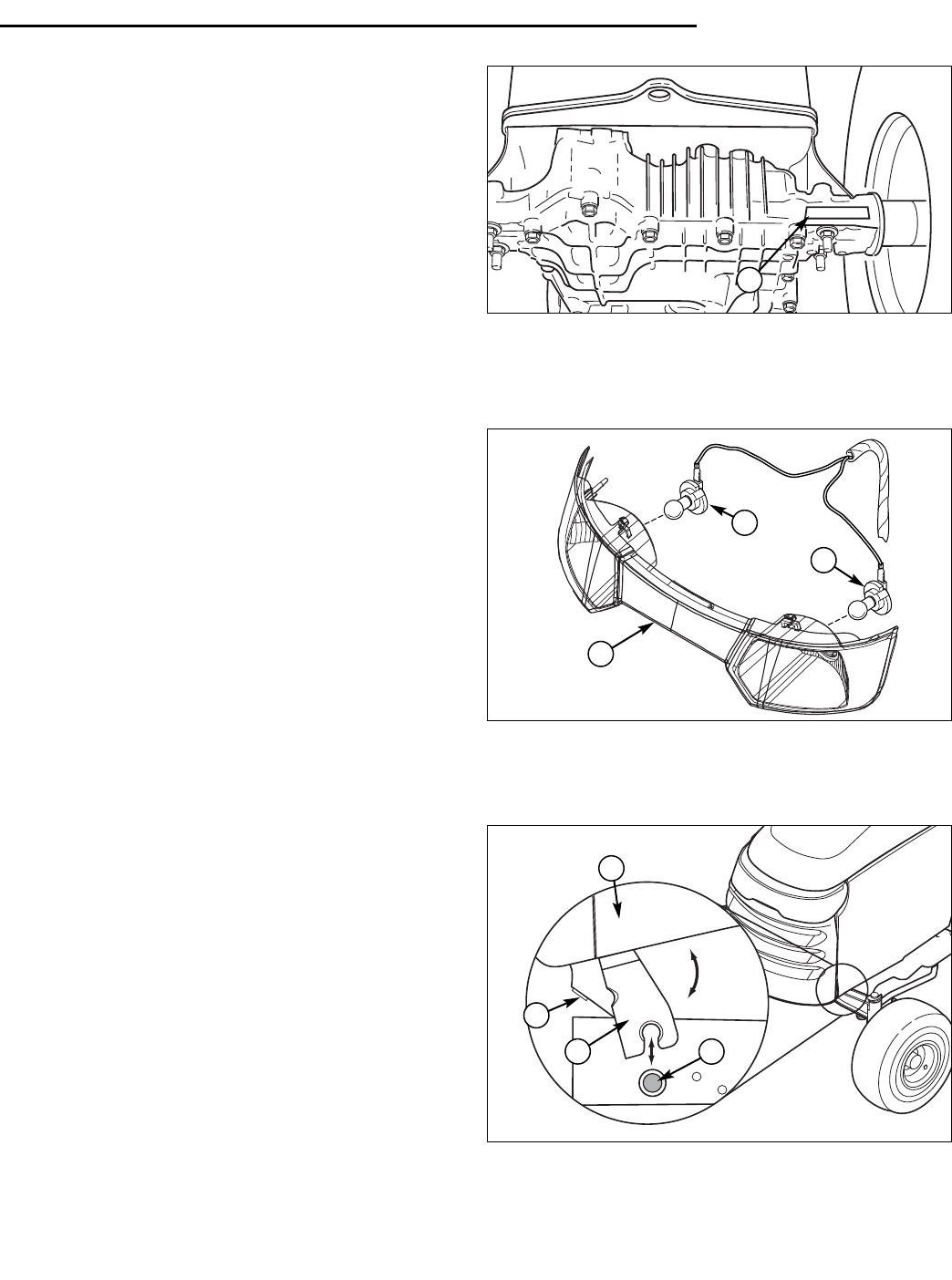
Cleaning the Battery and Cables
Service Interval: Every 100 Hours
1. Disconnect the cables from the battery, negative
cables first (A, Figure 10) then the cover & positive
cables (B).
2. Loosen the wingnut & washer (D).
3. Pivot the hold-down rod (C) up and away from
battery. Secure to steering tower.
4. Remove the battery (E).
5. Clean the battery compartment with a solution of
baking soda and water.
6. Clean the battery terminals and cable ends with a
wire brush and battery terminal cleaner until shiny.
7. Reinstall the battery (E) in the battery compartment.
Secure with the battery hold-down rod (C) and
wingnut & washer (D).
8. Re-attach the battery cables, positive cables and
cover first (B) then the negative cables (A).
9. Coat the cable ends and battery terminals with
petroleum jelly or non-conducting grease.
WARNING
When removing or installing battery cables,
disconnect the negative cable FIRST and reconnect
it LAST. If not done in this order, the positive
terminal can be shorted to the frame by a tool.
Figure 10. Battery Maintenance
A. Negative Cables
B. Positive Cables & Cover
C. Hold-Down Rod
D. Wingnut & Washer
E. Battery
Safety Interlock System Check
Service Interval: Every Fall & Spring
Check the function of the safety interlock system using
the test procedure found on page 13 of this manual. If
the tractor fails any of the tests, see your dealer.
Blade Brake Check
Service Interval: Every 100 Hours or Fall & Spring
Mower blades and mower drive belt should come to a
complete stop within five seconds after the electric PTO
switch is turned off.
1. With tractor in neutral, PTO disengaged and operator
in seat, start the engine.
2. Look over the left-hand footrest at the mower drive
belt. Engage the PTO and wait several seconds.
Disengage the PTO and check the amount of time it
takes for the mower drive belt to stop.
3. If mower drive belt does not stop within five seconds,
re-adjust the clutch or see your dealer.
PTO Clutch Adjustment Check
Service Interval: Every 250 Hrs
Check the PTO clutch adjustment after every 250 hours
of operation–or if the clutch starts slipping or will not
engage. Check and adjust the clutch using the
procedure outlined in the Adjustments section of this
manual.
Engine Maintenance
Refer to the engine owner’s manual for all engine
maintenance procedures and recommendations.
D
C
E
A
B
19
Regular Maintenance
Hood Removal and Installation
HOOD REMOVAL
1. Open the hood.
2. Remove the socket and bulbs (A, Figure 12) by
twisting the socket counterclockwise and pulling it out
of the bezel (B). Repeat on other side.
3. Rock the hood back slightly and lift hood (B, Figure
13) off pivot posts(C). Set hood on a clean and flat
surface.
HOOD INSTALLATION
1. Set hinge posts (A, Figure 13) onto pivot posts (C).
2. Roll the hood forward until it reaches the stops (D).
3. Install the socket and bulb (A) by pushing it into the
bezel (B) twisting the socket and bulb clockwise.
Repeat on other side.
4. Close the hood.
Figure 13. Hood Removal and Installation
A. Hinge Post
B. Hood
C. Pivot Post
D. Stop
AC
B
Figure 12. Head Light
A. Socket and Bulb
B. Bezel
A
B
A
D
Figure 11. Transmission ID Tag Location
A. ID Tag
TUFF TORQ K46Z
1001010101010010101
Transmission Identification
To determine what transmission is in your tractor, check
the identification tag attached to the axle of the
transmission (Figure 11), or check your tractor’s parts
book.
Transmission Maintenance
K46 Maintenance
The K46 is a sealed unit and does not require regular
maintenance. If the transmission lacks drive or is
excessively noisy, it may need to be purged. See your
Dealer.
A
20
Regular Maintenance
Lubrication
Service Interval: Every 25 Hours
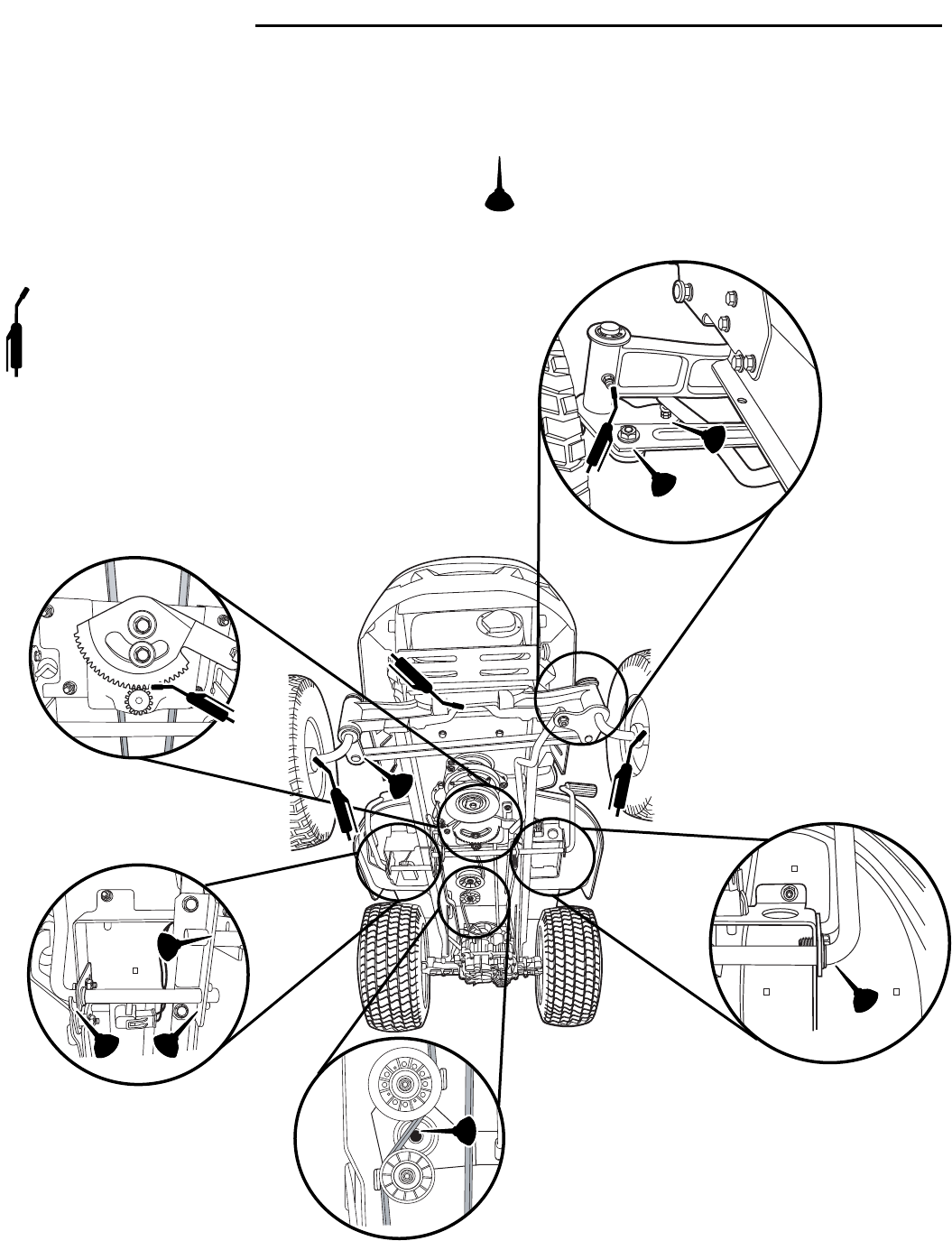
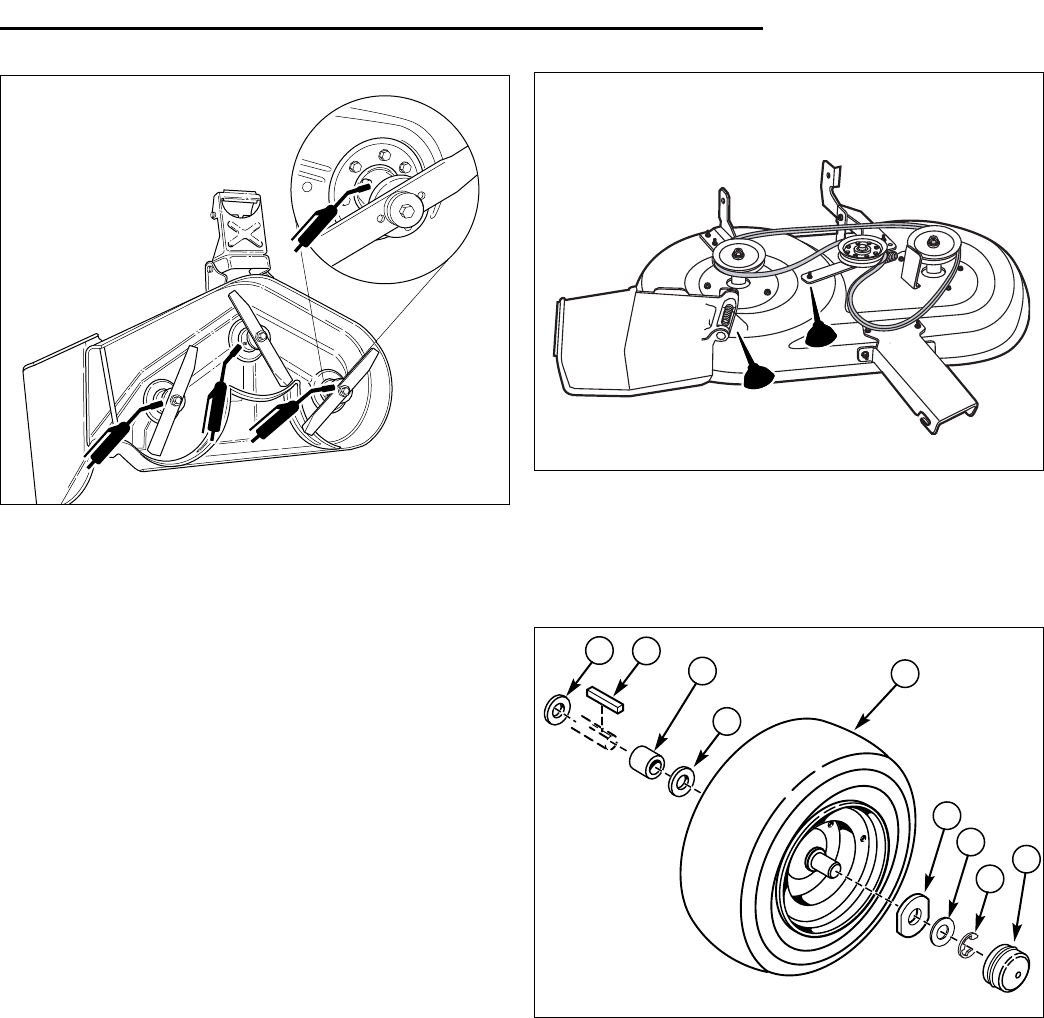
Lubricate the unit at the locations shown in Figures 14-
16 as well as the lubrication points listed. Generally, all
moving metal parts should be oiled where contact is
made with other parts. Keep oil and grease off belts and
pulleys. Wipe surfaces clean before and after
lubrication.
Grease:
• steering linkage
• mower linkage
• rear axle shafts (remove wheel hubs)
• front axle pivot
Use grease fittings when present. Automotive lithium
grease is recommended.
Oil:
• foot pedal rods & brackets
• seat adjustment assembly
• draglink
• mower deck height adjustment linkage
• transmission idler assembly
Figure 14. Lubricate Tractor
21
Regular Maintenance
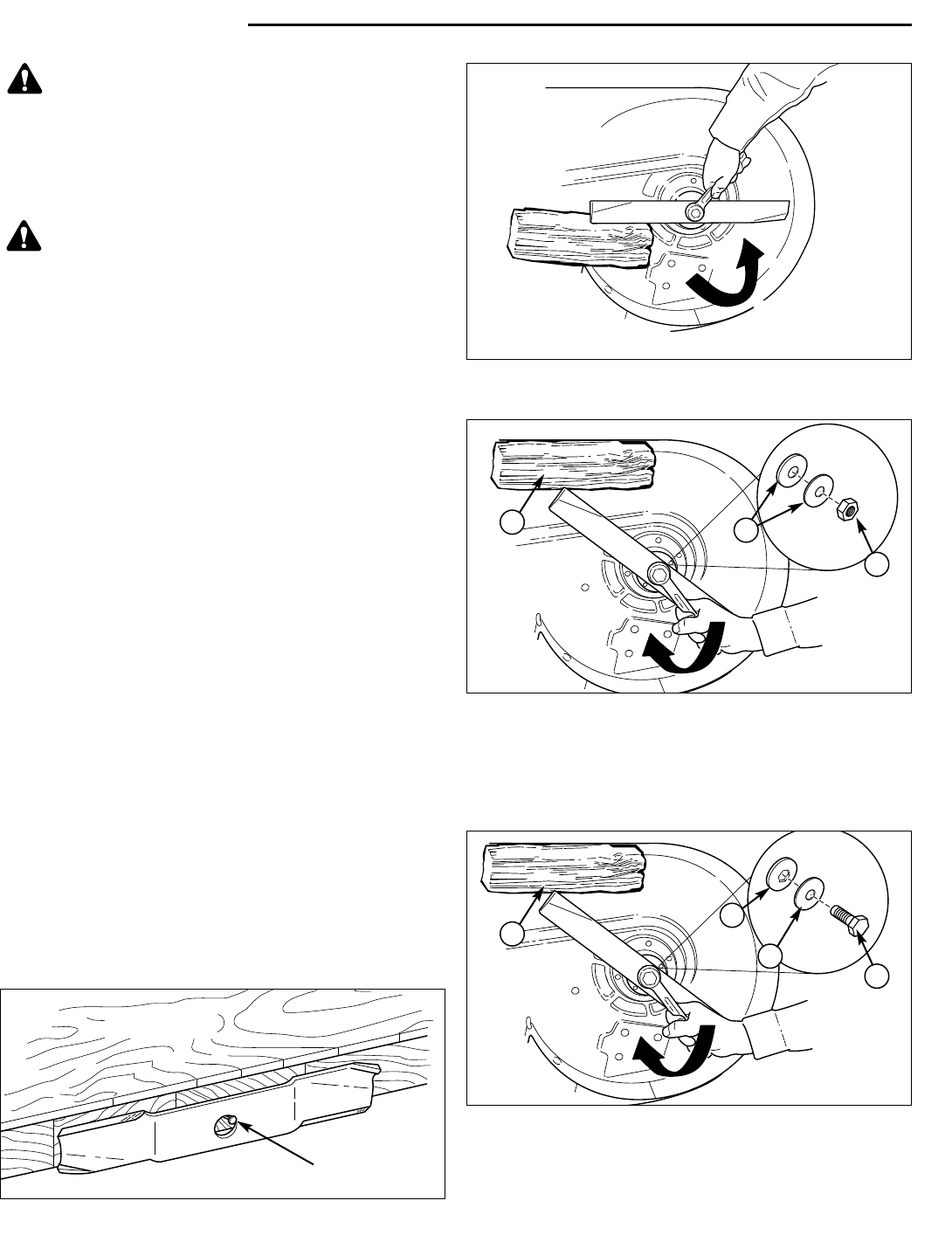
Figure 17. Rear Axle Hardware
A. Key
B. Spacer
C. Wheel & Hub
D. Special Washer
E. Small Washer
F. E-Clip
G. Axle Cap
H. Large Washer
G
B
D
A
E
F
C
Figure 15. Arbor Lubrication Points
Figure 16. Lubricate Deck Linkage (38” shown)
Lubricate Rear Axle Shafts
Service Interval: Yearly
We recommend removing the rear wheel hubs and
lubricating the axle shafts yearly. This prevents the
wheel hubs from seizing onto the axle shaft and makes
future service easier.
1. Turn off the ignition, turn off the PTO, engage the
parking brake, and block the front tires.
2. Using a jack or chain hoist positioned at the center of
the rear frame, carefully jack the unit up until the rear
tires are approximately 1" - 2" (2.5-5cm) off the
ground.
NOTE: For overall unit stability during service, do not
jack rear end higher than required for wheel removal.
3. Support the rear of the unit on jackstands positioned
under the rear frame.
NOTE: Your axle assembly may differ slightly from the
assembly pictured: the quantity of washers is adjusted to
allow a small amount of axle end-play.
4. Remove the hardware retaining the wheel assembly
to the axle and lubricate the axle shaft using anti-
seize compound or lithium grease.
5. Reinstall the components in reverse order of
disassembly and lower the unit. Be sure the key (A,
Figure 17) is in place in the axle keyway.
H
H
22
Regular Maintenance
WARNING
For your personal safety, do not handle the sharp
mower blades with bare hands. Careless or
improper handling of blades may result in serious
injury.
WARNING
For your personal safety, blade mounting
capscrews must each be installed with two spring
washers or a hex washer and spring washer, then
securely tightened. Torque blade mounting nut to
70 - 80 ft. lbs. (95 - 108 Nm). Torque blade
mounting capscrew to 45 - 55 ft. lbs. (61 - 75 Nm).
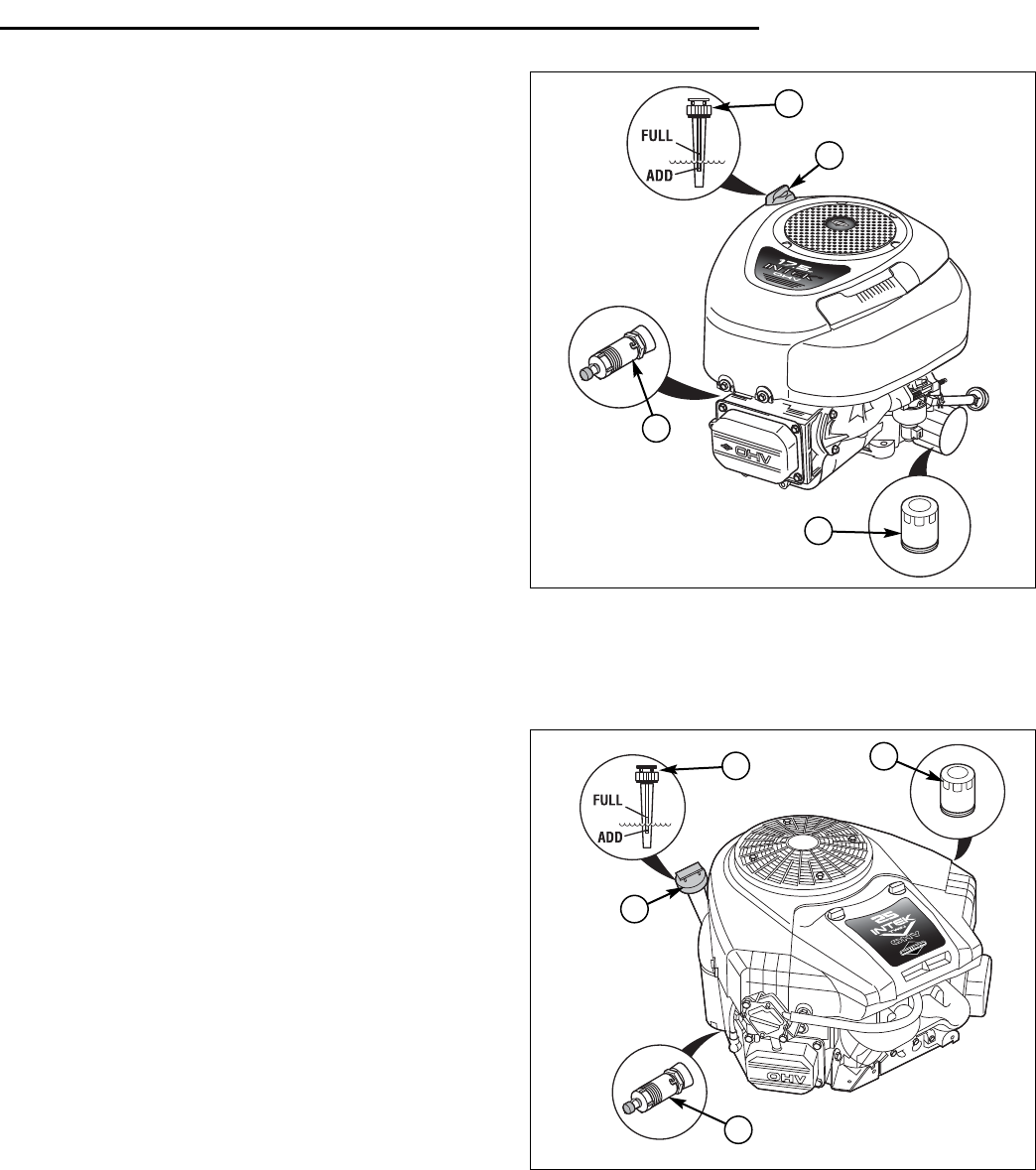
Figure 18. Balancing The Blade
Workbench
Nail
LOOSEN
Figure 19. Blade Removal
Figure 20. Blade Installation Mowers (38“ & 40“ Mowers)
A. 4x4 Wood Block
B. Spring Washers
C. Blade Nut
AB
C
Servicing the Mower Blades
Service Interval: Every 100 Hours or As Required
1. Remove mower deck (see “Mower Deck Removal”).
2. See Figure 19. To remove blade for sharpening, use
a block of wood to prevent blade rotation while
loosening the capscrew.
3. Remove the nut (C, Figure 20), spring washers (B),
and blade. Or remove the capscrew (D, Figure 21),
hex washer (B), spring washer (C), and blade.
4. Use a file to sharpen blade to a fine edge. If blade is
damaged, it must be replaced.
5. Balance the blade as shown in Figure 18. Center the
blade’s hole on a nail lubricated with a drop of oil. A
balanced blade will remain level.
6. Reinstall the blade (Figures 21) with the tabs pointing
up toward the mower deck as shown.
7. Reinstall the spring washers (B, Figure 20) and nut
(C). Use a wooden block (A) to prevent blade rotation
while tightening the nut (C) to 70-80 ft. lbs. (95-108
Nm). Or Reinstall the hex washer (B, Figure 21),
spring washer (C) and capscew (D). Use a wooden
block (A) to prevent blade rotation while tightening
the nut (D) to 45-55 ft. lbs. (61-75 Nm).
Figure 21. Blade Installation Mowers (44“ Mowers)
A. 4x4 Wood Block
B. Hex Washer
C. Spring Washer
D. Blade Capscrew
A
B
C
D
23
Regular Maintenance
Check & Fill Engine Oil
Service Interval: Before each use, and every 8 hours.
1. Turn the engine off, and set the parking brake to
PARK.
2. Clean the area around the dip stick (C, Figure 22 or
23).
3. Remove the dip stick (C) and clean it with a paper
towel.
4. Insert the dip stick (C) back into the engine and
thread the cap back onto the tube.
5. Remove the dip stick and read the oil level. The oil
level should be between the “FULL” and “ADD” marks
(D). If not, add oil according to the oil
recommendations chart (Figure 25).
Figure 23. Briggs & Stratton two cylinder Models
A. Oil Drain Valve
B. Oil Filter
C. Dip Stick
D. Checking Oil Level
A
C
DB
Figure 22. Briggs & Stratton single cylinder Models
A. Oil Drain Valve
B. Oil Filter
C. Dip Stick
D. Checking Oil Level
A
C
D
B
24
Regular Maintenance
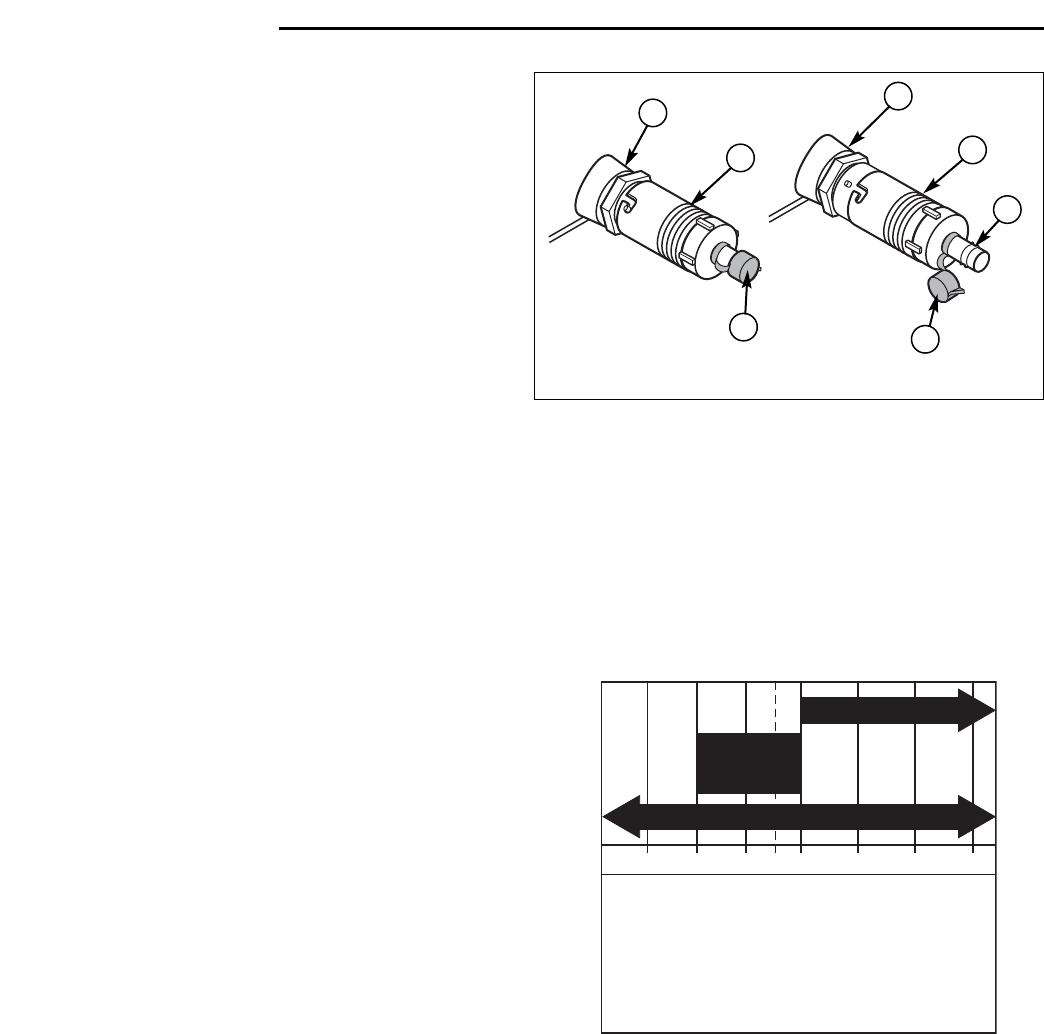
Figure 24. Oil Drain Valve
A. Engine Block / Valve Base
B. Oil Drain Valve
C. Cover
D. Nipple
AA
BB
CC
D
Figure 25. Recommended Engine Oil -
Briggs & Stratton Models
Use oil classified API Service Class SF,
SG, SH, SJ or better with SAE Viscosity:
10080604020 320-20
3827164-7 0-18-30
˚F
˚C
30 Conventional**
Synthetic 5W-30, 10W-30
5W-30
10W-30
Conventional*
*CAUTION: Air cooled engines run hotter than automotive engines.
The use of non-synthetic multi-viscosity oils (5W-30, 10W-30, etc.)
in temperatures above 40º F (4ºC) will result in higher than normal
oil consumption. When using a multi-viscosity oil, check oil level
more frequently.
**CAUTION: SAE 30 oil, if used below 40º F (4ºC), will result in hard
starting and possible engine bore damage due to inadequate
lubrication.
Oil Drain Valve Operation
1. Place a suitable container with a 4 quart capacity
under the oil drain valve (A, Figure 22 or 23).
2. Loosen or remove the dip stick (C, Figure 22 or 23).
3. Wipe oil drain valve (B, Figure 24) and cover (C) with
paper towel or rag.
NOTE: Sliding a hose with a 1/2” (12.5 mm) inside
diameter tube over the valve nipple may aid in guiding
the draining oil.
4. Rotate the drain valve (B) counter clockwise and pull
out 1/4” (6.35 mm) for engine oil to drain. Allow
ample time for complete drainage.
5. After all the oil has drained, close the oil drain valve
(B) by pushing in and rotating clockwise to close.
6. Wipe the nipple (D) with paper towel or rag. Install
the cover (C) over nipple (D).
Change Engine Oil
BRIGGS & STRATTON MODELS
Service Interval: 50 hours or once per season.
Oil Capacity: Approximately1-7/8 quarts (1.8L) without
filter change.
NOTE: Change engine oil while the engine is warm. Run
the engine for a few minutes, then shut the engine off
and allow it to cool from hot to warm.
1. Clean the area around the dip stick (C, Figure 22 or
23) and oil drain valve (A).
2. Drain engine oil. See OIL DRAIN VALVE
OPERATION above.
3. Fill the crankcase with oil. See CHECK ENGINE OIL
LEVEL.
Change Engine Oil & Filter
BRIGGS & STRATTON MODELS
Service Interval: 100 hours or once per season.
Oil Capacity: Approximately 2 quarts (1.9L) with oil filter
change.
NOTE: Change engine oil while the engine is warm. Run
the engine for a few minutes, then shut the engine off
and allow it to cool from hot to warm.
1. Clean the area around the dip stick (C, Figure 22 or
23) and oil drain valve (A).
2. Drain engine oil. See OIL DRAIN VALVE
OPERATION above.
3. Remove the oil filter (B). Discard the filter.
4. Using a drop of oil on your finger tip, wet the rubber
gasket on the bottom of the new filter.
5. Turn the filter clockwise until the rubber gasket meets
the filter base. Then turn 1/2 to 3/4 turn more.
6. Fill the crankcase with oil. See CHECK ENGINE OIL
LEVEL.
7. Test run the engine to check for leaks. Stop the
engine for 1 minute, then recheck the oil level.
Valve
Closed
Valve
Open

25
Regular Maintenance
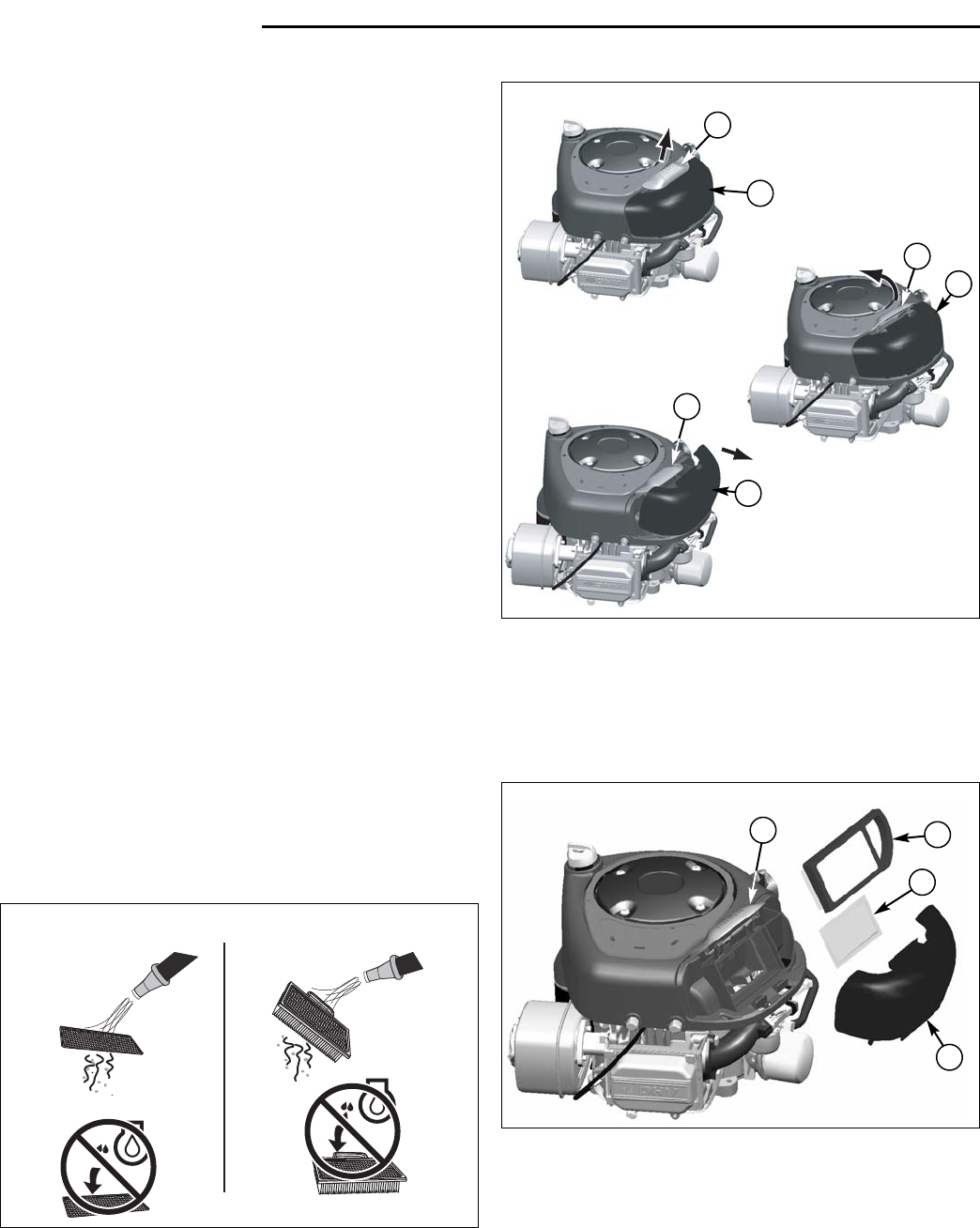
Figure 26. Air Filter Assembly - Briggs & Stratton
Twin Cylinder Models
A. Knobs
B. Air Filter Cover
C. Air Filter
D. Pre-Cleaner
Air Filter & Pre-Cleaner Service
BRIGGS & STRATTON TWO CYLINDER MODELS
Service Interval: Pre-Cleaner: Every 25 hours or as
required. Air Filter: Every 50 hours or as required.
Replacement Interval: Pre-Cleaner: As required. Air
Filter: Every 200 hours or once per season.
Air Filter Removal & Installation
1. Unscrew the four knobs (A, Figure 26) by turning
counter clockwise.
2. Remove the cover (B). Remove the filter (C) and
pre-cleaner (D).
3. Install the pre-cleaner (D) with the mesh side up.
Install the filter (C) as shown.
4. Install the cover (B) making sure the tabs are inserted
into their slots. Secure by turning screws clockwise
until snug.
B
C
D
A
1.
Pre-Cleaner Air Filter
1.
2. 2.
Figure 27. Air Filter Service
Pre-Cleaner Service
NOTE: Replace a worn or damaged pre-cleaner.
1. Figure 27. Wash the pre-cleaner in liquid detergent
and water.
2. Squeeze the pre-cleaner dry and saturate with engine
oil. Remove all excess oil by squeezing the pre-
cleaner in an absorbent cloth.
Air Filter Service
NOTE: Replace a worn or damaged air filter.
1. Figure 27. If stamped “Washable,” the filter can be
washed with warm water and mild soap.
2. Rinse with tap water with the screen side UP allowing
dirt and debris to filter out.
3. Allow the filter to dry overnight before reinstalling.
26
Regular Maintenance
1.
2.
3.
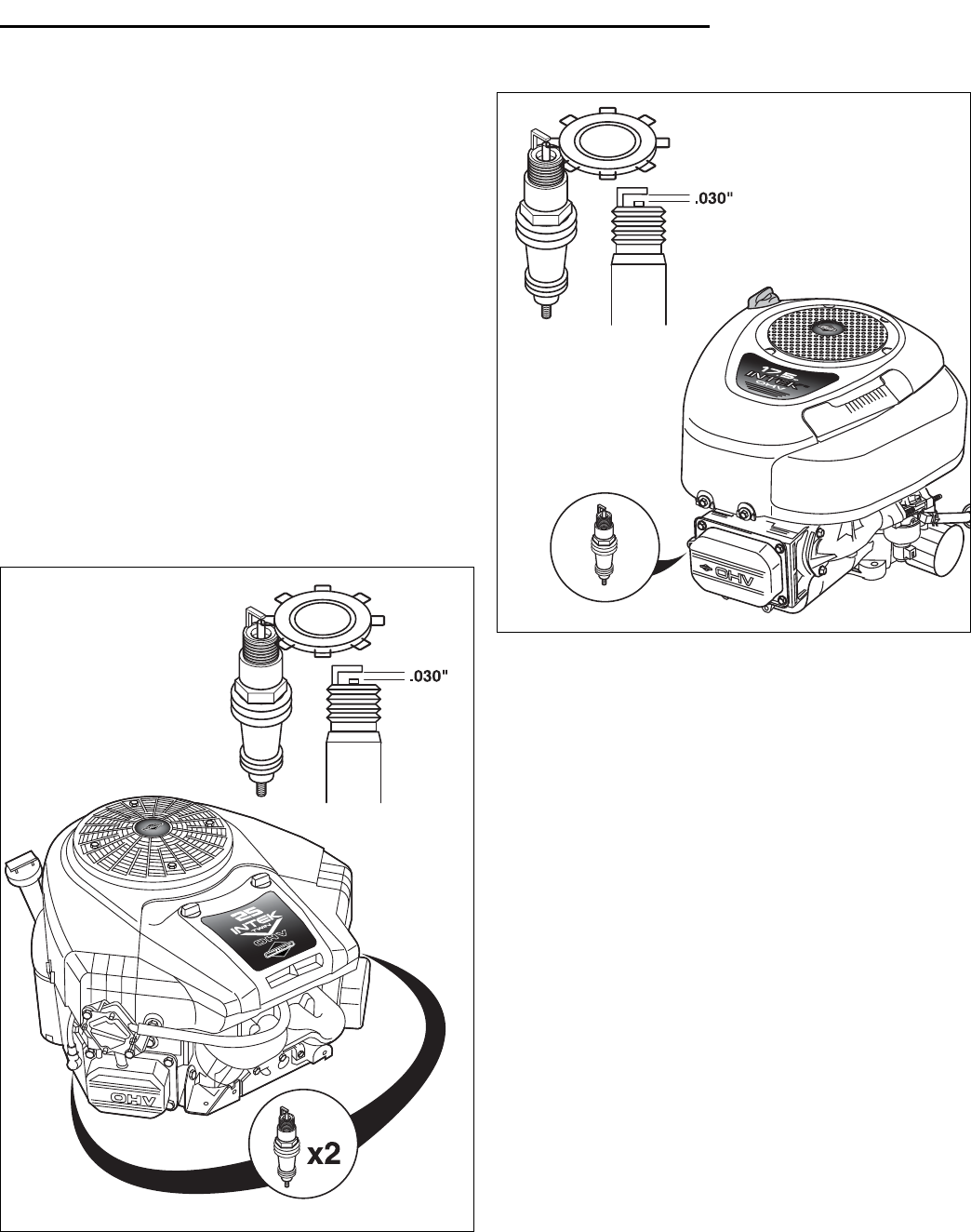
Figure 29. Air Filter Assembly - Briggs & Stratton
Single Cylinder Models
A. Air Filter Latch
B. Air Filter Cover
A
B
Air Filter & Pre-Cleaner Service
BRIGGS & STRATTON SINGLE CYLINDER MODELS
Service Interval: Pre-Cleaner: Every 25 hours or as
required. Air Filter: Every 50 hours or as required.
Replacement Interval: Pre-Cleaner: As required. Air
Filter: Every 200 hours or once per season.
Air Filter Removal & Installation
1. Lift up on the air filter latch (A, Figure 29).
2. Rotate the air filter latch (A) to the inside.
3. Pull air filter cover (B) out and off.
4. Lift air cleaner (C, Figure 30) and pre cleaner (D) if
equipped, from blower housing)
5. Install the pre-cleaner (D) with the mesh side up.
Install the filter (C) as shown.
6. Install the cover (B) making sure the tabs are inserted
into their slots. Secure with the latch (A).
Pre-Cleaner Service
NOTE: Replace a worn or damaged pre-cleaner.
1. Figure 28. Wash the pre-cleaner in liquid detergent
and water.
2. Squeeze the pre-cleaner dry. Do not oil pre-
cleaner.
Air Filter Service
NOTE: Replace a worn or damaged air filter.
1. Figure 28. If stamped “Washable,” the filter can be
washed with warm water and mild soap.
2. Rinse with tap water with the screen side UP allowing
dirt and debris to filter out.
3. Allow the filter to dry overnight before reinstalling.
A
B
A
B
1.
Pre-Cleaner Air Filter
1.
2. 2.
Figure 28. Air Filter Service
Figure 30. Air Filter Service - Briggs & Stratton
Single Cylinder Models
A. Air Filter Latch
B. Air Filter Cover
C. Air Filter
D. Pre-Cleaner
AC
D
B
27
Regular Maintenance
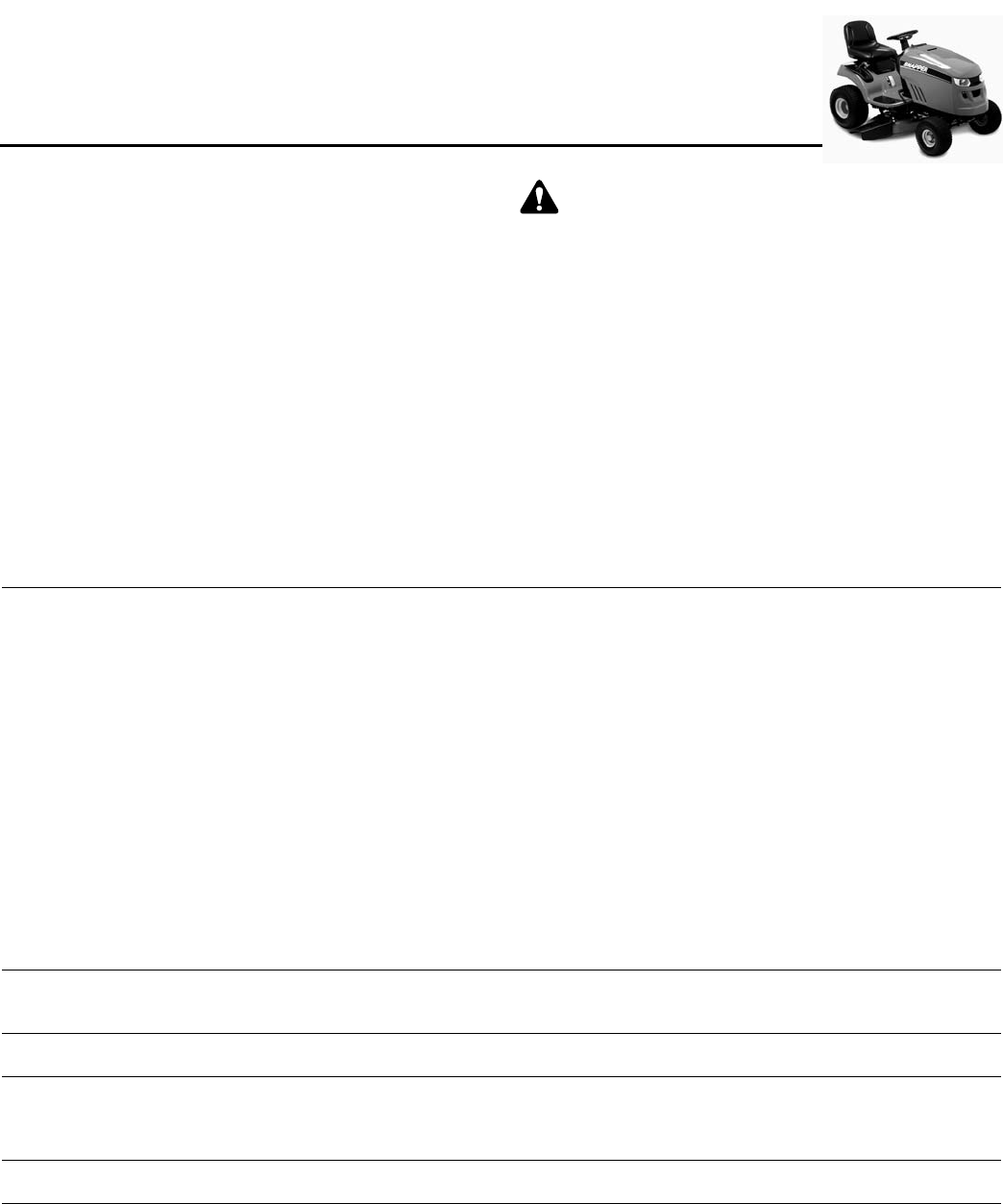
Figure 31. Spark Plug Gapping
Replace Spark Plug
Service Interval: Yearly
Spark Plug Gap: .030” (.76mm)
Replacement Spark Plug
Resistor Spark Plug, Champion RC12YC
1. Stop the engine and allow it to cool.
2. See Figures 31or 32. Clean the area around the
spark plug.
3. Remove the spark plug.
4. Check the spark plug gap. It should be .030” (see
Figure 31or 32).
5. Reinstall the plug into the cylinder head. Torque the
plug to 180 in. lbs (20 N.m.).
Figure 32. Spark Plug Gapping
28
Troubleshooting,
Adjustment, & Service
Troubleshooting
While normal care and regular maintenance will extend
the life of your equipment, prolonged or constant use
may eventually require that service be performed to
allow it to continue operating properly.
The troubleshooting guide below lists the most common
problems, their causes, and remedies.
See the information on the following pages for
instructions on how to perform most of these minor
adjustments and service repairs yourself. If you prefer,
all of these procedures can be performed for you by your
local authorized dealer.
Troubleshooting the Tractor
PROBLEM CAUSE REMEDY
Engine will not turnover or start. 1. Brake pedal not depressed. Fully depress brake pedal.
2. PTO (electric clutch) switch Place in OFF position.
in ON position.
3. Cruise control engaged. Move knob to Neutral/Off position.
4. Out of fuel. If engine is hot, allow it to cool, then refill
the fuel tank.
5. Engine flooded. Disengage choke.
6. Fuse Blown. Replace.
7. Battery terminals require See Battery Maintenance Section.
cleaning.
8. Battery discharged or dead. Recharge or replace.
9. Wiring loose or broken. Visually check wiring & replace broken or
frayed wires. Tighten loose connections.
10. Solenoid or starter motor faulty. See your dealer.
11. Safety interlock switch faulty See your dealer.
12. Spark plug(s) faulty, fouled Clean and gap or replace.
or incorrectly gapped. See engine manual.
13. Water in fuel. Drain fuel & refill with fresh fuel. Replace fuel filter.
14. Gas is old or stale. Drain fuel & refill with fresh fuel. Replace fuel filter.
Engine starts hard or runs poorly. 1. Fuel mixture too rich. Clean air filter. Check choke adjustment
2. Spark plug(s) faulty, fouled, or Clean and gap or replace.
incorrectly gapped. See engine manual.
Engine knocks. 1. Low oil level. Check/add oil as required.
2. Using wrong grade oil. See engine manual.
Excessive oil consumption. 1. Engine running too hot. Clean engine fins, blower screen and
air cleaner. Clean radiator screen.
2. Using wrong weight oil. See engine manual.
3. Too much oil in crankcase. Drain excess oil.
Engine exhaust is black. 1. Dirty air filter. Replace air filter. See engine manual.
2. Choke closed. Open choke.
Engine runs, but tractor will 1. Ground speed control pedals Depress pedals.
not drive. not depressed.
2. Transmission release lever Move into drive position.
in “push” position.
3. Drive belt is broken. See Dealer.
4. Drive belt slips. See cause and remedy below.
5. Parking brake is engaged. Disengage parking brake.
WARNING
To avoid serious injury, perform maintenance on
the tractor or mower only when the engine is
stopped and the parking brake engaged.
Always remove the ignition key, disconnect the
spark plug wire and fasten it away from the plug
before beginning the maintenance, to prevent
accidental starting of the engine.

29
Troubleshooting, Adjustment, & Service
Tractor Troubleshooting Cont.
Tractor drive belt slips. 1. Pulleys or belt greasy or oily. Clean as required.
2. Belt stretched or worn. See Dealer.
3. Idler pulley pivot bracket Remove idler pulley bracket, clean and lubricate.
“frozen” in declutched position.
Brake will not hold. 1. Internal brake worn. See your dealer.
Tractor steers hard or 1. Steering linkage is loose. Check and tighten any loose connections.
handles poorly. See Steering Gear Adjustment.
2. Improper tire inflation. Check and correct.
3. Front wheel spindle Grease spindles. See Lubricating the
bearings dry. Tractor.
Troubleshooting the Mower
PROBLEM CAUSE REMEDY
Mower will not raise. 1. Lift linkage not properly attached Attach or repair.
or damaged.
Mower cut is uneven. 1. Mower not leveled properly. See Mower Adjustment.
2. Tractor tires not inflated See Maintenance Section.
equally or properly.
Mower cut is rough looking. 1. Engine speed too slow. Set to full throttle.
2. Ground speed too fast. Slow down.
3. Blades are dull. Sharpen or replace blades.
See Mower Blade Service.
4. Mower drive belt slipping Clean or replace belt as necessary.
because it is oily or worn.
5. Check PTO (Electric Clutch) See Adjustments Section.
Adjustment.
6. Blades not properly fastened See Servicing the Mower Blades.
to arbors.
Engine stalls easily with 1. Engine speed too slow. Set to full throttle.
mower engaged. 2. Ground speed too fast. Slow down.
3. Dirty or Clogged air filter. See Engine Manual.
4. Cutting height set too low. Cut tall grass at maximum cutting
height during first pass.
5. Discharge chute jamming Cut grass with discharge pointing toward
with cut grass. previously cut area.
6. Engine not up to operating Run engine for several minutes to warm-up.
temperature.
7. Starting mower in tall grass. Start the mower in a cleared area.
Excessive mower vibration. 1. Blade mounting screws Tighten to 45-55 ft.lbs. (61-75 Nm).
are loose.
2. Mower blades, arbors, Check and replace as necessary.
or pulleys are bent.
3. Mower blades are out Remove, sharpen, and balance blades.
of balance. See Servicing the Mower Blades.
4. Belt installed incorrectly. Reinstall Correctly.
Excessive belt wear or breakage. 1. Bent or rough pulleys. Repair or replace.
2. Using incorrect belt. Replace with correct belt.
Mower drive belt slips 1. Idler pulley spring broken or not Repair or replace as needed.
or fails to drive. properly attached.
2. Belt stops out of adjustment. Check belt stops.
3. Mower drive belt broken. Replace drive belt.
4. PTO clutch out of adjustment. Adjust PTO clutch.
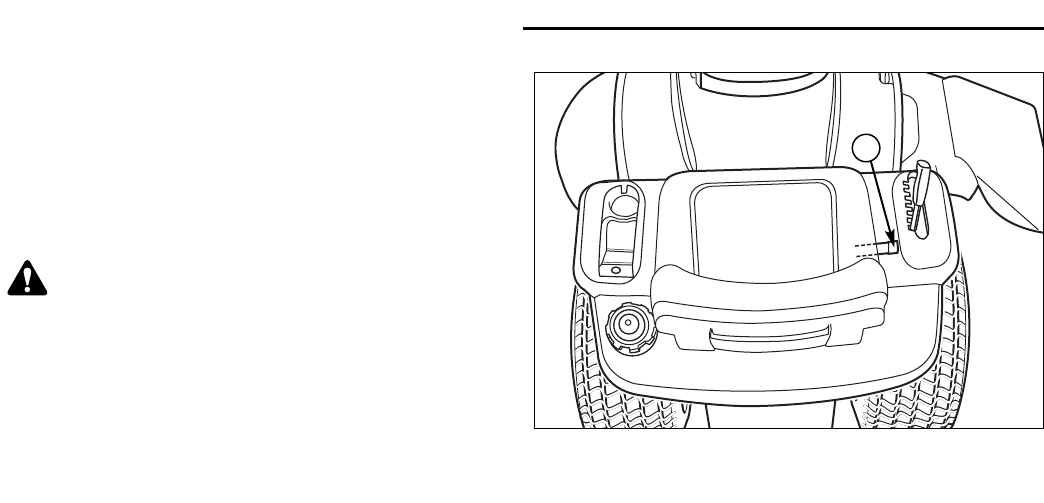
30
Troubleshooting, Adjustment, & Service
Seat Adjustment
The seat can be adjusted forward and back. Move the
lever (A, Figure 33), position the seat as desired, and
release the lever to lock the seat into position.
Battery Charging
A dead battery or one too weak to start the engine may
be the result of a defect in the charging system or other
electrical component. If there is any doubt about the
cause of the problem, see your dealer. If you need to
replace the battery, follow the steps under Cleaning the
Battery & Cables in the Regular Maintenance Section.
To charge the battery, follow the instructions provided by
the battery charger manufacturer as well as all warnings
included in the safety rules sections of this book. Charge
the battery until fully charged. Do not charge at a rate
higher than 10 amps.
Brake Adjustment
This unit does not have a manually adjustable brake. If
brake does not function properly see your dealer
WARNING
Keep open flames and sparks away from the
battery; the gasses coming from it are highly
explosive. Ventilate the battery well during
charging.
Figure 33. Seat Adjustment
A. Seat Adjustment Lever
A
31
Troubleshooting, Adjustment, & Service
PTO clutch adjustment
Check the PTO clutch adjustment after every 250 hours
of operation. Also perform the following procedure if the
clutch is slipping or will not engage, or if a new clutch
has been installed.
1. Remove key from ignition switch and disconnect
spark plug wires to prevent the possibility of
accidental starting while the PTO is being adjusted.
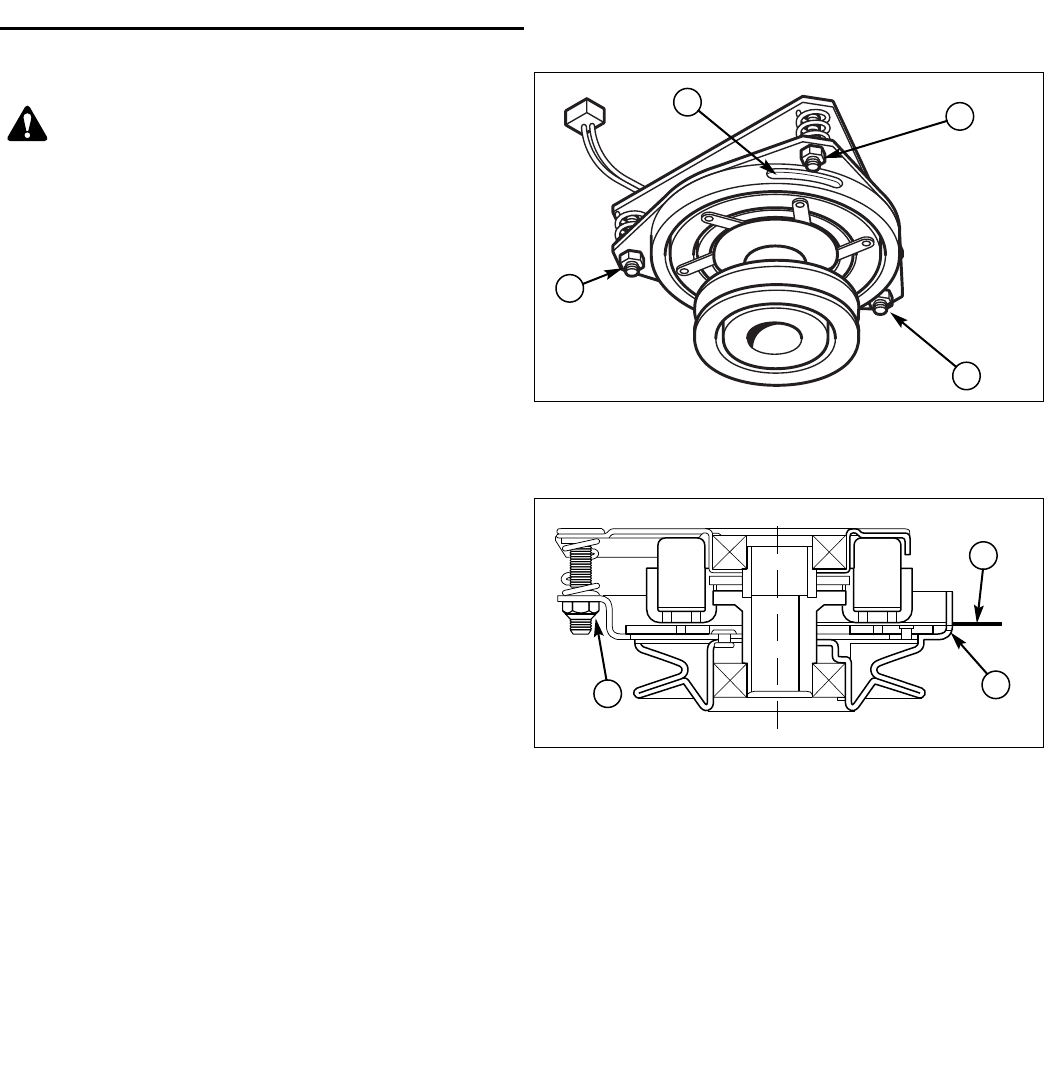
2. See Figure 34. Note the position of the 3 adjustment
windows (A) in the side of the brake plate and the
nylock adjustment nuts (B).
3. Insert a .012”-.015” (2,5-4mm) feeler gauge (C)
through each window, positioning the gauge between
the rotor face and the armature face as shown in
Figure 35.
4. Alternately tighten the adjustment nuts (B, Figure 34)
until the rotor face and armature face just contacts
the gauge.
5. Check the windows for an equal amount of tension
when the gauge is inserted and removed, and make
any necessary adjustments by tightening or
loosening the adjustment nuts.
NOTE: The actual air gap between the rotor and
armature may vary even after performing the adjustment
procedure. This is due to dimensional variations on
component parts, and is an acceptable condition.
6. Check the mower blade stopping time. The mower
blades and mower drive belt should come to a
complete stop within five seconds after the electric
PTO switch is turned off.
7. Perform the BLADE BRAKE CHECK found in the
MAINTENANCE Section. Mower blades and mower
drive belt should come to a complete stop within five
seconds after electric PTO switch is turned off.
Figure 34. PTO Clutch Adjustment
A. Adjustment Window (Qty. 3, one shown)
B. Adjustment Nut
AB
B
B
Figure 35. Adjust PTO Clutch
A. Window
B. Adjustment Nut
C. Feeler Gauge
WARNING
To avoid serious injury, perform adjustments only
with engine stopped, key removed and tractor on
level ground.
A
C
B
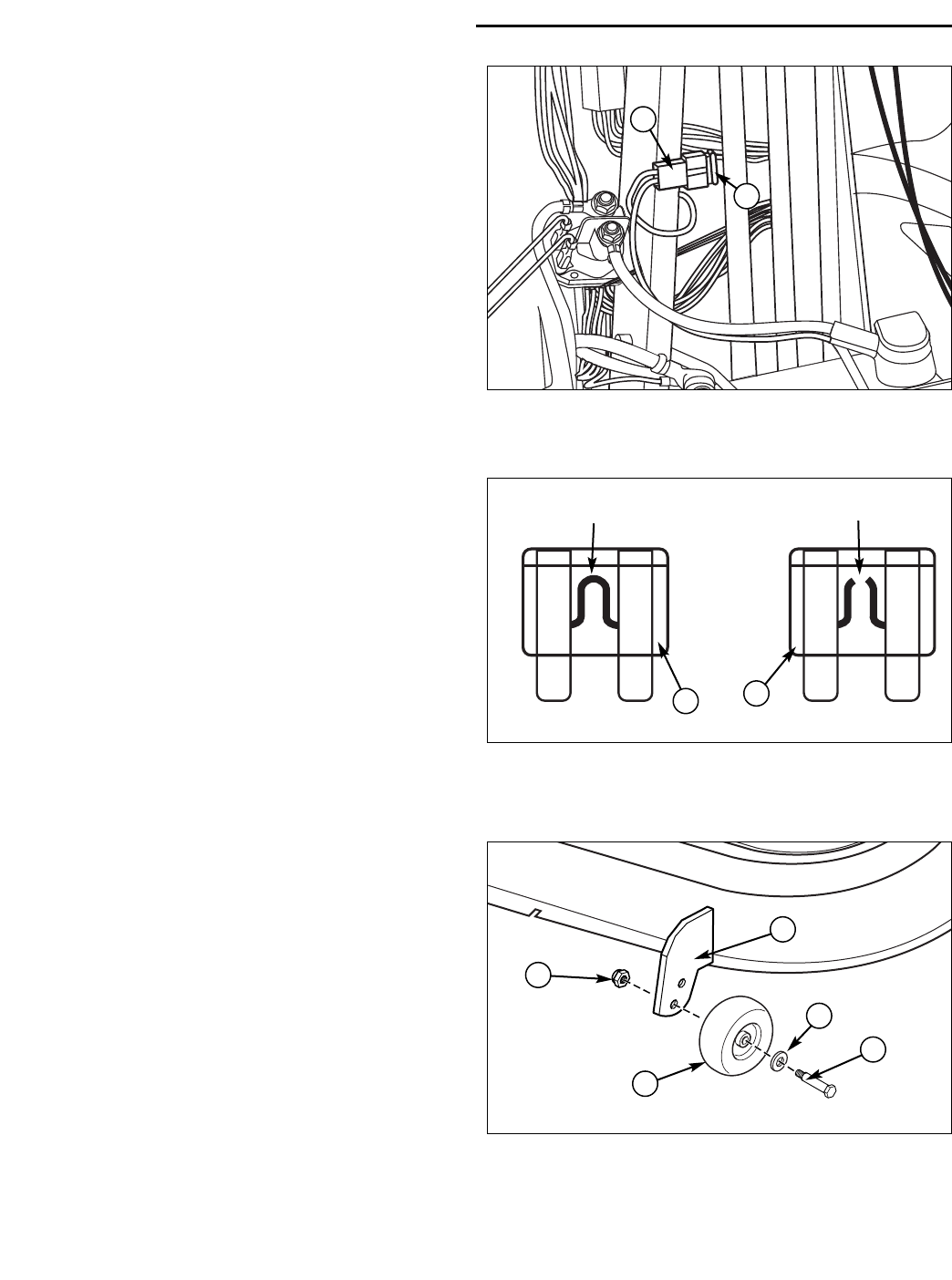
32
Troubleshooting, Adjustment, & Service
Mower Adjustments
Gauge Wheels (Select Models)
The mower gauge wheels can be placed in two positions
depending on the height of cut. When using higher
cutting heights, set the wheels in the lower position.
When using lower cutting heights, set the wheels in the
upper position. Do not allow wheels to remain on the
ground constantly while mowing. To adjust:
1. Remove the locknut (B, Figure 38), gauge wheel (C),
washers (D), and shoulder bolt (E). Change position
of gauge wheel to desired height.
2. Insert shoulder bolt (E) through washers (D) gauge
wheel (C), and gauge wheel bracket (A). Secure with
locknut (B). Repeat steps 1 & 2 for all gauge wheels. Figure 38. Fixed Bracket Gauge Wheel Adjustment
A. Gauge Wheel Bracket
B. Locknut
C. Gauge Wheel
D. Washer
E. Shoulder Bolt
A
B
C
E
D
Fuse Replacement
The fuse is a 20-amp blade type automotive fuse located
behind the battery on the steering tower. Replace only
with the same rated fuse, 20-amp.
To replace the fuse:
1. Open the hood and locate the fuse holder (B, Figure
36) and fuse (A). Attached to the steering tower.
2. Hold the fuse holder (B) and pull out the fuse (A).
3. Inspect the fuse for a broken fusible link. See figure
37. Replace fuse if connection is broken. If you are
not sure if the fusible link is broken replace fuse.
4. Hold the fuse holder (B, Figure 36) and insert new
fuse (A) until it is seated properly.
Figure 36. Fuse
A. Fuse, 20-amp
B. Fuse Holder
B
A
Figure 37. Blade Type Fuse
A. Good Fuse with Solid Fusible link
B. No Good Fuse with Broken Fusible link
Solid Fusible Link Broken Fusible Link
B
A
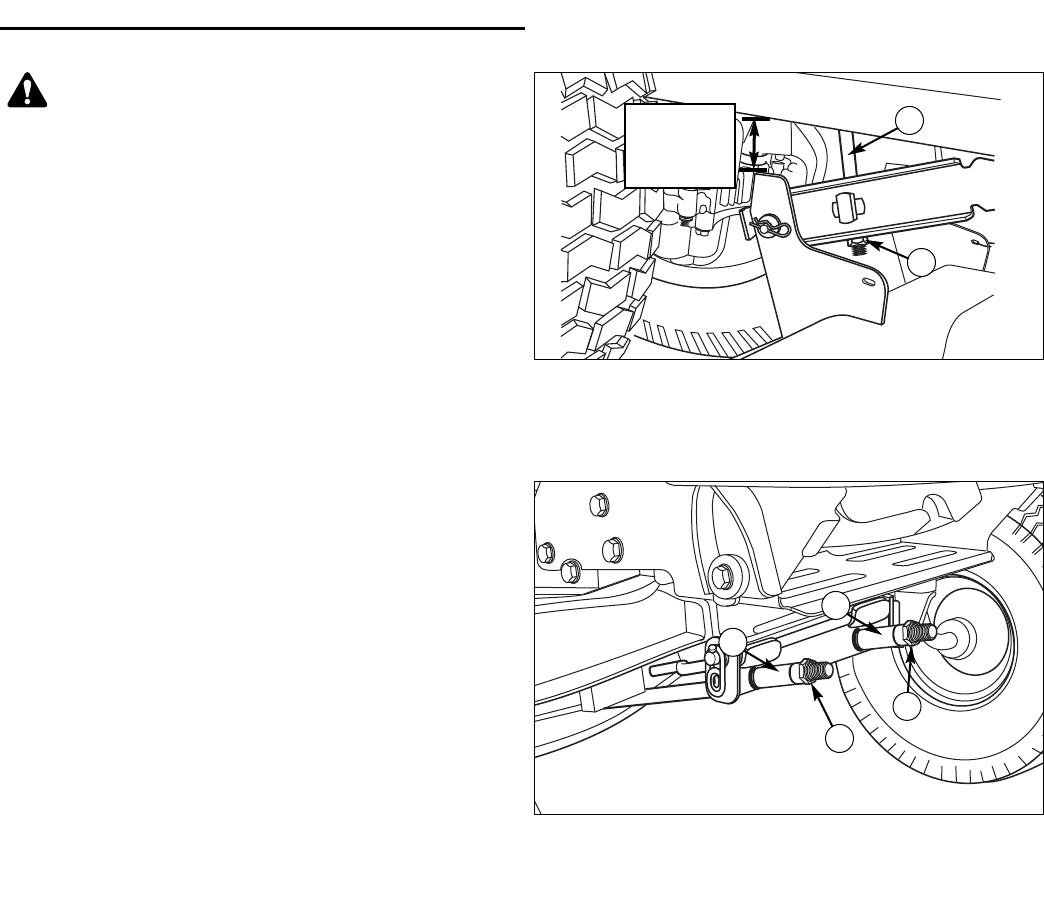
33
Troubleshooting, Adjustment, & Service
WARNING
Before checking mower, shut off PTO and
engine, remove the key, and allow all moving
parts to stop.
Leveling The Mower
If the cut is uneven, the mower may need leveling.
Unequal or improper tire pressure may also cause an
uneven cut. Make sure tire pressure is correct as
specified in Checking Tire Pressure.
SIDE-TO-SIDE LEVELING
1. With the mower installed, place the tractor on a
smooth, level surface such as a concrete floor. Turn
the front wheels straight forward.
2. Check for bent blades and replace if necessary.
3. Place the mower in mid-cut position. Arrange the
outside mower blades so that they are pointing from
side-to-side.
4. Measure the distance between the outside tips of
each blade and the ground. If there is more than 1/8”
(3mm) difference between the measurements on
each side, proceed to step 5. If the difference is 1/8”
(3mm) or less, proceed to step 6.
5. Turn the locknut (B, Figure 39) to raise or lower that
side of the mower.
Note: The maximum the mower can be adjusted in high
cut is 3/8” to 1/2” between the frame and mower up-stop.
See Figure 39.
FRONT-TO-BACK LEVELING
6. Arrange the blades so they face front-to-back.
7. Measure the distance from the ground to the front tip
of the center blade, and from the ground to rear tips
of left-hand and right-hand blades.
44” MOWER DECK -
Front tip of the center blade should be 1/4" (6mm)
higher than rear tips of left-hand and right-hand
blades. If not, proceed with step 8.
38” & 40” MOWER DECKS -
A front to back deck height variance of 1/8” (3mm)
and side to side variance of 1/8” (3mm) is acceptable.
If not, proceed with step 8.
8. To raise front of mower deck, tighten locknuts (A,
Figure 40) and against spacers (B). To lower front of
mower deck, loosen locknuts (A). Locknuts must be
turned evenly on both sides to keep deck level.
9. Re-check the blade measurement then tighten the
front nut (B) against the bracket to secure.
Figure 39. Leveling The Mower Side-to-Side
A. Lift Rod
B. Locknut
A
B
Figure 40. Leveling The Mower Side-to-Side
A. Locknuts
B. Spacers
A
B
A
B
3/8” - 1/2”
max in
high cut
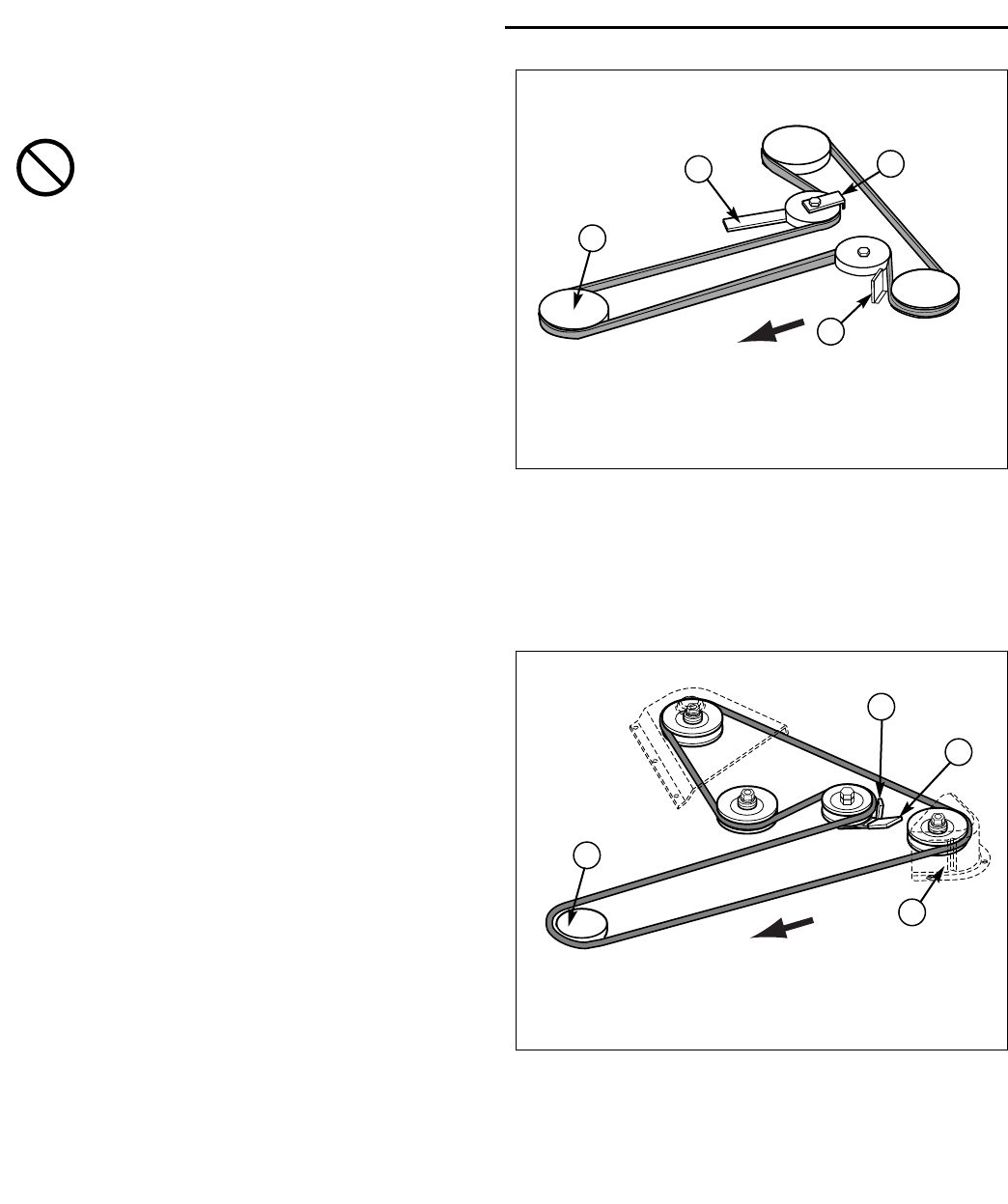
Figure 41. Typical Mower Belt Routing Two Blade
Decks
A. Idler Pulley Arm
B. PTO Pulley (Engine)
C. Mower Upstop
D. Idler Pulley Belt Guide
Left Side of Mower
34
Troubleshooting, Adjustment, & Service
Mower Belt Replacement
Note: It is not necessary to remove the mower to install a
new belt. However, for easier access mower can be
removed. See Mower Removal in the Operation section.
1. Park the tractor on a smooth, level surface such as a
concrete floor. Disengage the PTO, turn off the
engine and lock the parking brake. Remove the key.
2. If mower is not removed, lower the mower lift and
place the mower in the lowest cutting position.
3. Push the idler arm (A, Figure 41 or 42) to relieve belt
tension. Drop the belt from the PTO (electric clutch)
pulley.
IMPORTANT: Note the position of all belt guides relative
to the belt and pulleys before loosening.
4. Some Models. Loosen the belt stop bracket(s) (C).
5. Remove the old belt and replace with a new belt.
Make sure V-side of belt runs in arbor pulley grooves
and the flat backside runs against the idler pulley.
6. Some Models. Position the belt stop bracket(s) (C) in
their original positions. There must be 1/8” clearance
between the belt stop and the pulleys.
7. Position the idler pulley belt guide (D) in its original
position up against arm (A) so that there is a 1/8" gap
between the pulley and belt guide.
8. Install mower on tractor if it was removed. See
Operation section.
9. Run the mower under no-load condition for about 5
minutes
To avoid damaging belts, DO NOT PRY
BELTS OVER PULLEYS.
Figure 42. Typical Mower Belt Routing Three Blade
Decks
A. Idler Pulley Arm
B. PTO Pulley (Engine)
C. Belt Stop Bracket
D. Idler Pulley Belt Guide
Left Side of Mower
C
B
D
A
C
B
D
A
FRONTFRONT
FRONT

35
Specifications
ENGINE:
20 HP* Briggs & Stratton
Make Briggs & Stratton
Model Intek
Horsepower 20 @ 3600 rpm
Displacement 30.5 Cu. in (582cc)
Electrical System 12 Volt, 9 amp. Alternator, Battery: 230 CCA
Oil Capacity 64 Oz. (1.9 L)
18.5 HP* Briggs & Stratton
Make Briggs & Stratton
Model Intek
Horsepower 18.5 @ 3600 rpm
Displacement 38 Cu. in (502 cc)
Electrical System 12 Volt, 9 amp. Alternator, Battery: 230 CCA
Oil Capacity 48 Oz. (1.4 L)
CHASSIS:
LT Series
Fuel Tank Cap. Capacity: 3.5 Gallons (13,2 L)
Rear Wheels Tire Size: 22 x 10 -8
Inflation Pressure: 10 psi (,68 bar)
Rear Wheels Tire Size: 20 x 8.0 -8
Inflation Pressure: 10 psi (,68 bar)
Front Wheels Tire Size: 15 x 6.0-6
Inflation Press.: 12-14 psi (,82-0,96 bar)
TRANSMISSIONS:
K46
Type Hydrostatic Tuff Torq K46
Hydraulic Fluid 10w 30 Premium Engine Oil
Speeds Forward: 0-5.5 MPH (9.0 km/h)
@ 3400 rpm Reverse: 0-3.0 MPH (4.6 km/h)
Continuous Torque 170 ft. lbs.
Output
Drawbar Rating 227 lbs (103 kg)
Maximum Weight 675 lbs (306 kg)
on Axle
DIMENSIONS:
LT Series
Overall Length 72”
Overall Width 37”
Height 45”
Weight
18.5hp Tractor
w/ 38” Mower Deck 480 lbs. (218 kg)
18.5hp Tractor
w/ 40” Mower Deck 500 lbs. (227 kg)
20hp Tractor
w/ 44” Mower Deck 532 lbs. (241 kg)
NOTE: Specifications are correct at time of printing and are subject to change without notice.
*Briggs & Stratton Models: The gross power rating for individual gas engine models is labeled in accordance with
SAE (Society of Automotive Engineers) code J1940 (Small Engine Power & Torque Rating Procedure), and rating
performance has been obtained and corrected in accordance with SAE J1995 (Revision 2002-05). Torque values are
derived at 3060 RPM; horsepower values are derived at 3600 RPM. Actual gross engine power will be lower and is
affected by, among other things, ambient operating conditions and engine-to-engine variability. Given both the wide
array of products on which engines are placed and the variety of environmental issues applicable to operating the
equipment, the gas engine will not develop the rated gross power when used in a given piece of power equipment
(actual "on-site" or net horsepower). This difference is due to a variety of factors including, but not limited to,
accessories (air cleaner, exhaust, charging, cooling, carburetor, fuel pump, etc.), application limitations, ambient
operating conditions (temperature, humidity, altitude), and engine-to-engine variability. Due to manufacturing and
capacity limitations, Briggs & Stratton may substitute an engine of higher rated power for this Series engine.
36
Parts &
Accessories
Replacement Parts
Replacement parts are available from your authorized
dealer. Always use genuine Simplicity Service Parts.
Technical Manuals
Additional copies of this manual are available, as well as
fully illustrated parts lists. These manuals show all of the
product’s components in exploded views (3D illustrations
which show the relationship of parts and how they go
together) as well as part numbers and quantities used.
Important assembly notes and and torque values are
also included.
For applicable manuals currently available for your
model, contact our Customer Publications Department at
866-313-6682 (Snapper). Have the information listed in
the box below available when phoning in your request.
Technical manuals can be downloaded from
www.simplicitymfg.com
www.snapper.com
Engine Oil
Touch-Up Paint
Grease Gun Kit
8 oz. Grease Tube
Tire Sealant
Degrimer/Degreaser
Gas Stabilizer
Maintenance Items
Many convenient and helpful service and maintenance
items are available from you authorized dealer. Some of
these items include:
Model:
Mfg. No.:
Your Name:
Address:
City, State, Zip:
Visa/Mastercard No.:
Card Expiration Date:

Snapper, INC.
535 Macon Street
McDonough, GA 30253
www.snapper.com
Briggs & Stratton Yard Power Products Group
Copyright © 2008 Briggs & Stratton Corporation
Milwaukee, WI USA. All Rights Reserved
