Sony CDP CX235 User Manual CD CHANGER Manuals And Guides L0307316
SONY Compact Disc Manual L0307316 SONY Compact Disc Owner's Manual, SONY Compact Disc installation guides
User Manual: Sony CDP-CX235 CDP-CX235 SONY CD CHANGER - Manuals and Guides View the owners manual for your SONY CD CHANGER #CDPCX235. Home:Electronics Parts:Sony Parts:Sony CD CHANGER Manual
Open the PDF directly: View PDF  .
.
Page Count: 27
Compact Disc
Player
Operating Instructions
DIEITALAUDIO
[ -r_- I
CDP-CX235
© 2000 Sony Corporation
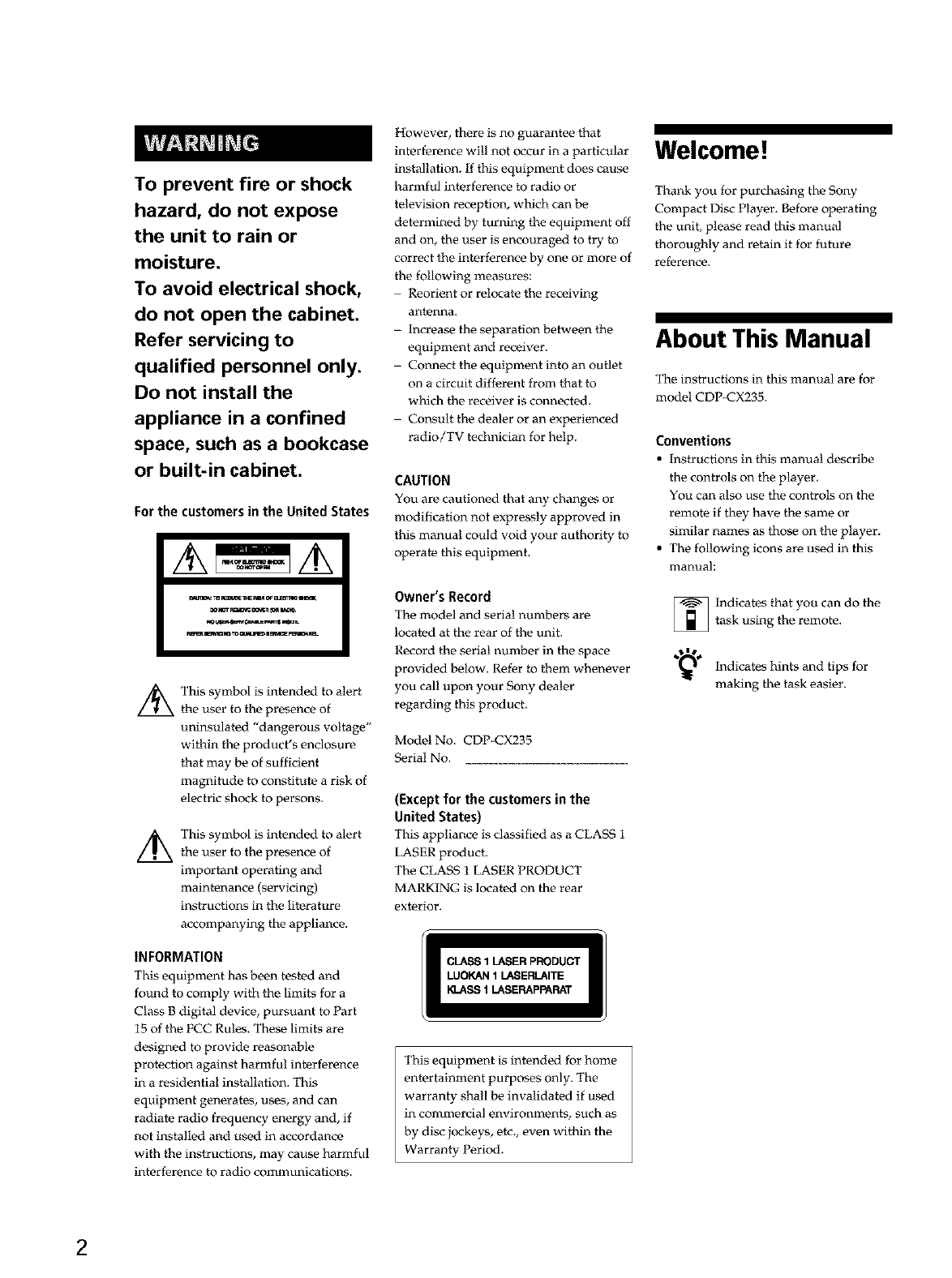
To prevent fire or shock
hazard, do not expose
the unit to rain or
moisture.
To avoid electrical shock,
do not open the cabinet.
Refer servicing to
qualified personnel only.
Do not install the
appliance in a confined
space, such as a bookcase
or built-in cabinet.
Forthe customers in the United States
//_ This symbol is intended to alert
the user to the presence of
uninsulated "dangerous voltage"
within the product's enclosure
that may be of sufficient
magnitude to constitute a risk of
electric shock to persons.
//_ This symbol is intended to alert
the user to the presence of
important operating and
maintenance (servicing)
instructions in the literature
accompanying the appliance.
iNFORMATION
This equipment has been tested and
found to comply with the limits for a
Class B digital device, pursuant to Part
15 of the FCC Rules. These limits are
designed to provide reasonable
protection against harmful interference
in a residential installation. This
equipment generates, uses, and can
radiate radio frequency energy and, if
not installed and used in accordance
with the instructions, may cause harmful
interference to radio communications.
However, there is no guarantee that
interference will not occur in a particular
installation. If this equipment does cause
harmful interference to radio or
television reception, which can be
determined by turning the equipment off
and on, the user is encouraged to try to
correct the interference by one or more of
the following measures:
- Reorient or relocate the receiving
antenna.
- Increase the separation between the
equipment and receiver.
- Connect the equipment into an outlet
on a circuit different from that to
which the receiver is connected.
- Consult the dealer or an experienced
radio/TV technician for help.
CAUTION
You are cautioned that any changes or
modification not expressly approved in
this manual could void your authority to
operatP this equipment.
Owner's Record
The model and serial numbers are
located at the rear of the unit.
RPcord the serial number in the space
provided below. Refer to them whenever
you call upon your Beny dealer
regarding this product.
Model No. CDP*CX235
Serial No.
(Except for the customers in the
United States)
This appliance is classified as a CLASS 1
LASER product.
The CLASS 1 LASER PRODUCT
MARKING is located on the rear
exterior.
This equipment is intended for home
entertainment purpo_s only. The
warranty shall be invalidated if used
in commercial environments, such as
by di_ jockeys, etc., even within the
Warranty Period.
Welcome!
Thank you for purchasing the Sony
Compact Di_ Player. Before operating
the unit, please read this manual
thoroughly and retain it for future
reference.
About This Manual
The instructions in this manual are for
model CDP-CX235.
Conventions
• Instructions in this manual describe
the controls on the player.
You can also use the controls on the
remote if they have the same or
similar names as those on the player.
• The following icons are used in this
manual:
_ Indicates that you can do the
task using the remote.
"_% Indicates hints and tips for
making the task easier.
2
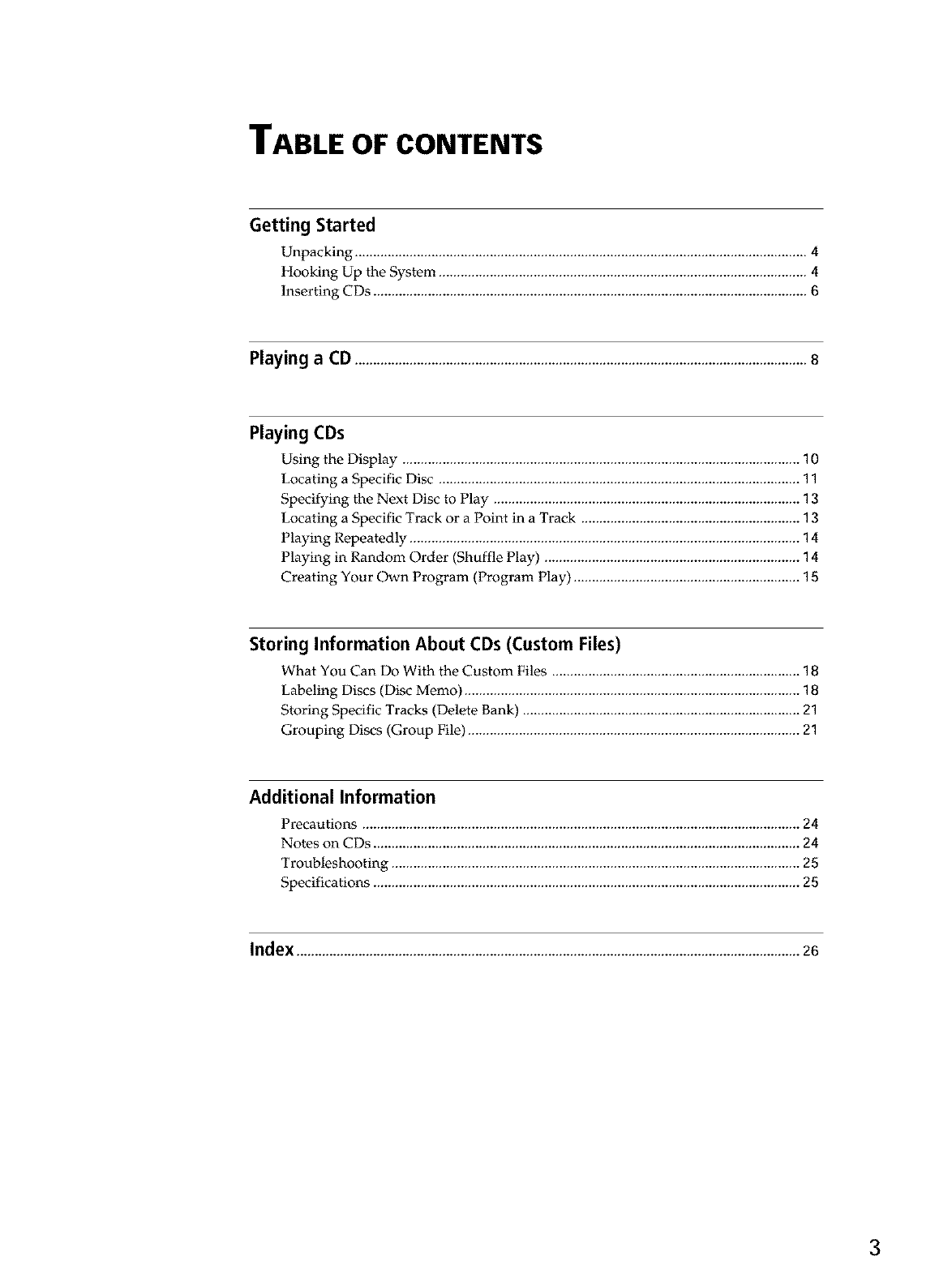
TABLE OF CONTENTS
Getting Started
Unpacking ............................................................................................................................ 4
Hooking Up the System ..................................................................................................... 4
Inserting CDs ....................................................................................................................... 6
Playing a CD............................................................................................................................8
Playing CDs
Using the Display ............................................................................................................. 10
Locating a Specific Disc ................................................................................................... ] ]
Specifying the Next Disc to Play .................................................................................... ] 3
Locating a Specific Track or a Point in a Track ............................................................ ] 3
Playing Repeatedly ........................................................................................................... ] 4
Playing in Random Order (Shuffle Play) ...................................................................... ] 4
Creating Your Own Program (Program Play) .............................................................. ] 5
Storing Information About CDs (Custom Files)
What You Can Do With the Custom Files .................................................................... 18
Labeling Discs (Disc Memo) ............................................................................................ ] 8
Storing Specific Tracks (Delete Bank) ............................................................................ 21
Grouping Discs (Group File) ........................................................................................... 21
Additional Information
Precautions ........................................................................................................................ 24
Notes on CDs ..................................................................................................................... 24
Troubleshoofing ................................................................................................................ 25
Specifications ..................................................................................................................... 25
Index ..........................................................................................................................................26
3
Unpacking
Check that you received the following items:
• Audio cord (1)
• Remote commander (remote) (1)
• Size AA (R6) batteries (2)
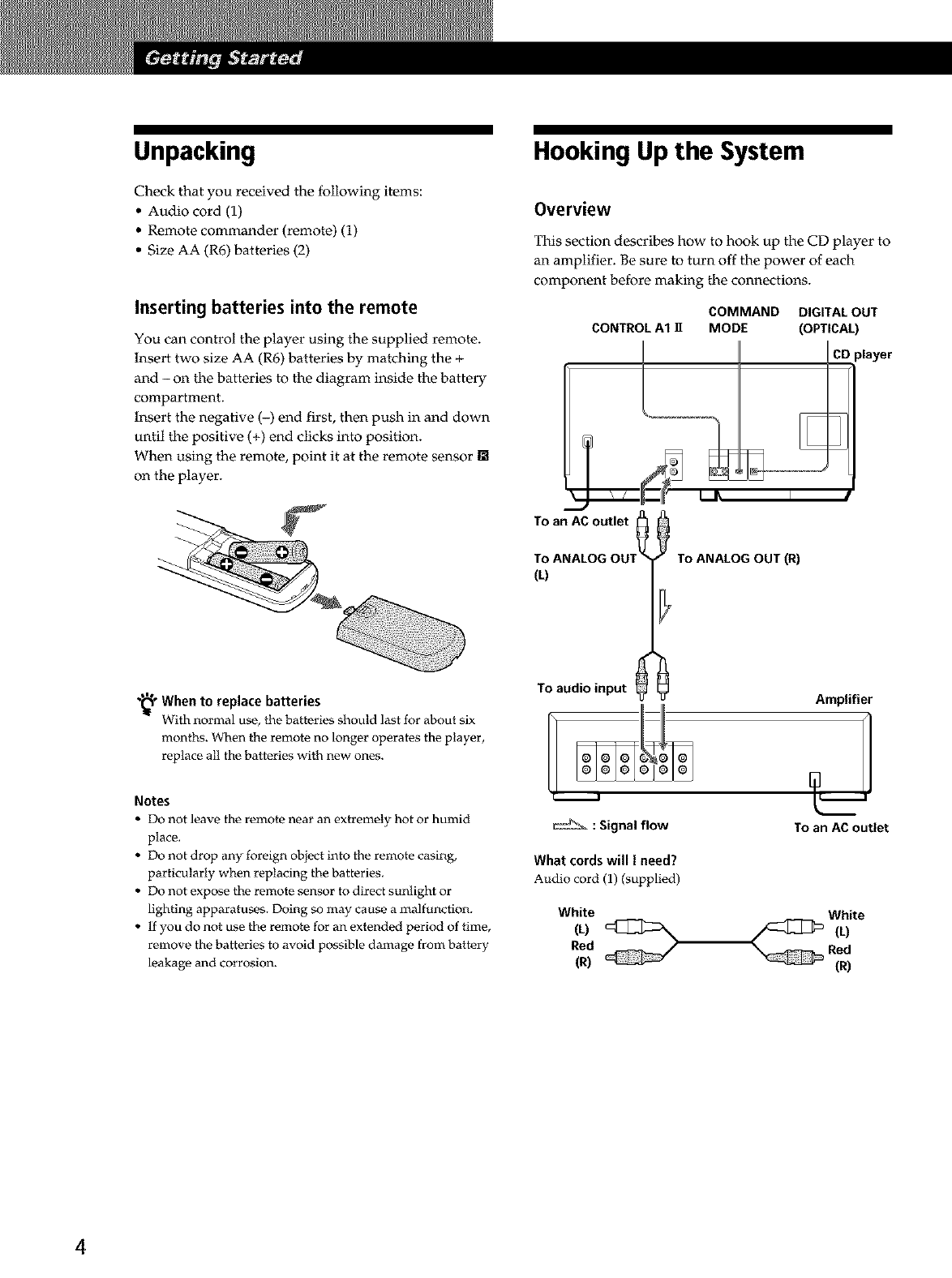
Inserting batteries into the remote
You can control the player using the supplied remote.
Insert two size AA (R6) batteries by matching the +
and - on the batteries to the diagram inside the battery
compartment.
Insert the negative (-) end first, then push in and down
until the positive (+) end clicks into position.
When using the remote, point it at the remote sensor m
on the player.
_When to replace batteries
With normal use, the batteries should last for about six
months. When the remote no longer operates the player,
replace all the batteries with new ones.
Notes
•Do not leave the remote near an extremely hot or humid
place.
• Do not drop any foreign object into the remote casing,
particularly when replacing the batteries.
• Do not expose the remote .sensor to direct sunlight or
lighting apparatuses. Doing so may cause a malfunction.
• If you do not use the remote for an extended period of time,
remove the batteries to avoid possible damage from battery
leakage and corrosion.
Hooking Up the System
Overview
This section describes how to hook up the CD player to
an amplifier. Be sure to turn off the power of each
component before making the connections.
CONTROL At 1I COMMAND DIGITALOUT
MODE (OPTICAL)
IICD player
(L)
TO audio input
r_ : Signal flow
Amplifier
dl
To an AC outlet
What cords will I need?
Audio cord (1) (supplied)
White
(L)
Red
(R)
(WL_ite
Red
(R)
4
Hookups
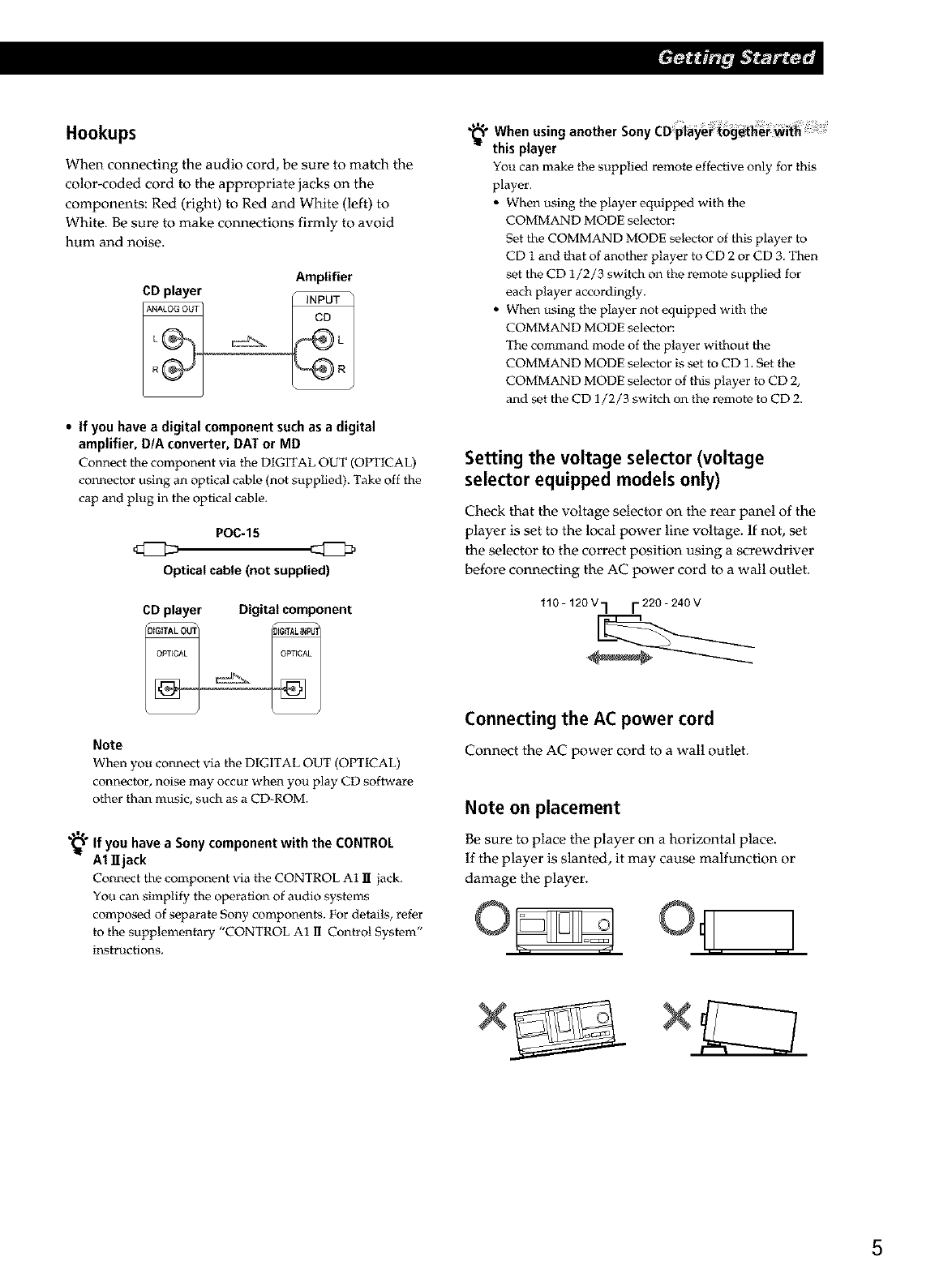
When connecting the audio cord, be sure to match the
color-coded cord to the appropriate jacks on the
components: Red (right) to Red and White (left) to
White. Be sure to make connections finrtly to avoid
hum and noise.
Amplifier
CD player ,_
• if you have a digital component such as a digital
amplifier, D/A converter, DAT or MD
Connect the componont via the DIGITAL OUT (O_ICAL)
connector using an optical cable (not supplied). Tako off the
cap and plug in the optical cable.
POC-15
Optical cable (not supplied)
CD player Digital component
Note
When you coPa_ect via the DIGITAL OUT (O_ICAL)
connector, noise may occur when you play CD software
other than music, such as a CD_ROM.
*(_lf you a Sonycomponent CONTROL
have with the
A1]Ijack
Connect the component via the CONTROL A1 II jack.
You can simplify the operation of audio systems
composed of _parate Sony components. For details, refer
to the supplementary "CONTROL A1 II Control System"
instructions.
*_ When using another Sony CD p;iay_ _et_e_ _i_ ;
this player
You can mako the supplied remote effective only for this
player.
• When using the player equipped with the
COMMAND MODE selector:
Set the COMMAND MODE selector of this player to
CD 1 and that of another player to CD 2 or CD 3. Then
set the CD 1/2/3 switch on the remote supplied for
each player accordingly.
• When using the player not equipped with the
COMMAND MODE selector:
The command mode of the player without the
COMMAND MODE selector is _t to CD 1. Set the
COMMAND MODE selector of this player to CD 2,
and set tho CD 1/2/3 switch on the remote to CD 2.
Setting the voltage selector (voltage
selector equipped models only)
Check that the voltage selector on the rear panel of the
player is set to the local power line voltage. If not, set
the selector to the correct position using a screwdriver
before connecting the AC power cord to a wall outlet.
110- 120V' 1 i- 220- 240 V
Connecting the AC power cord
Connect the AC power cord to a wall outlet.
Note on placement
Be sure to place the player on a horizontal place.
If the player is slanted, it may cause malfunction or
damage the player.
Otl i i i
5
3
Inserting CDs
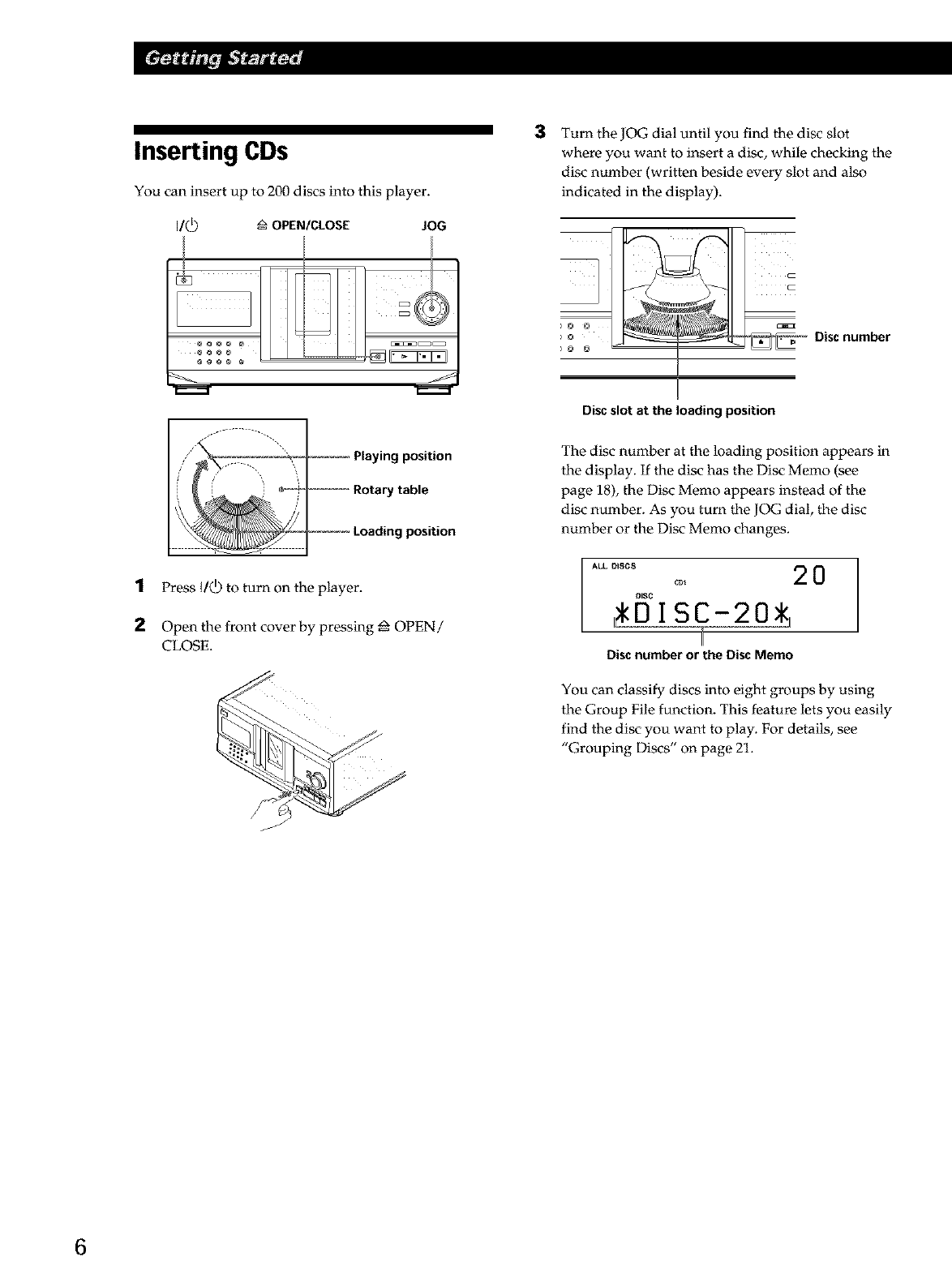
You can insert up to 200 discs into this player.
I/(_ _ OPEN/CLOSE JOG
@_@@ @
@o@@ --2
Y
, table
position
1
2
Press l/_ to turn on the player.
Open the front cover by pressing _ OPEN/
CLOSE. %
Turn the JOG dial until you find the disc slot
where you want to insert a disc, while checking the
disc number (written beside every slot and also
indicated in the display).
Disc number
Disc slot at the loading position
The disc number at the loading position appears in
the display. If the disc has the Disc Memo (see
page 18), the Disc Memo appears instead of the
disc number. As you turn the JOG dial, the disc
number or the Disc Memo changes.
ALL DISCS 20
OlSC
,SOISC-20:K
_e
II
Disc number or the Disc Memo
You can classify discs into eight groups by using
the Group File function. This feature lets you easily
find the disc you want to play. For details, see
"Grouping Discs" on page 21.
6
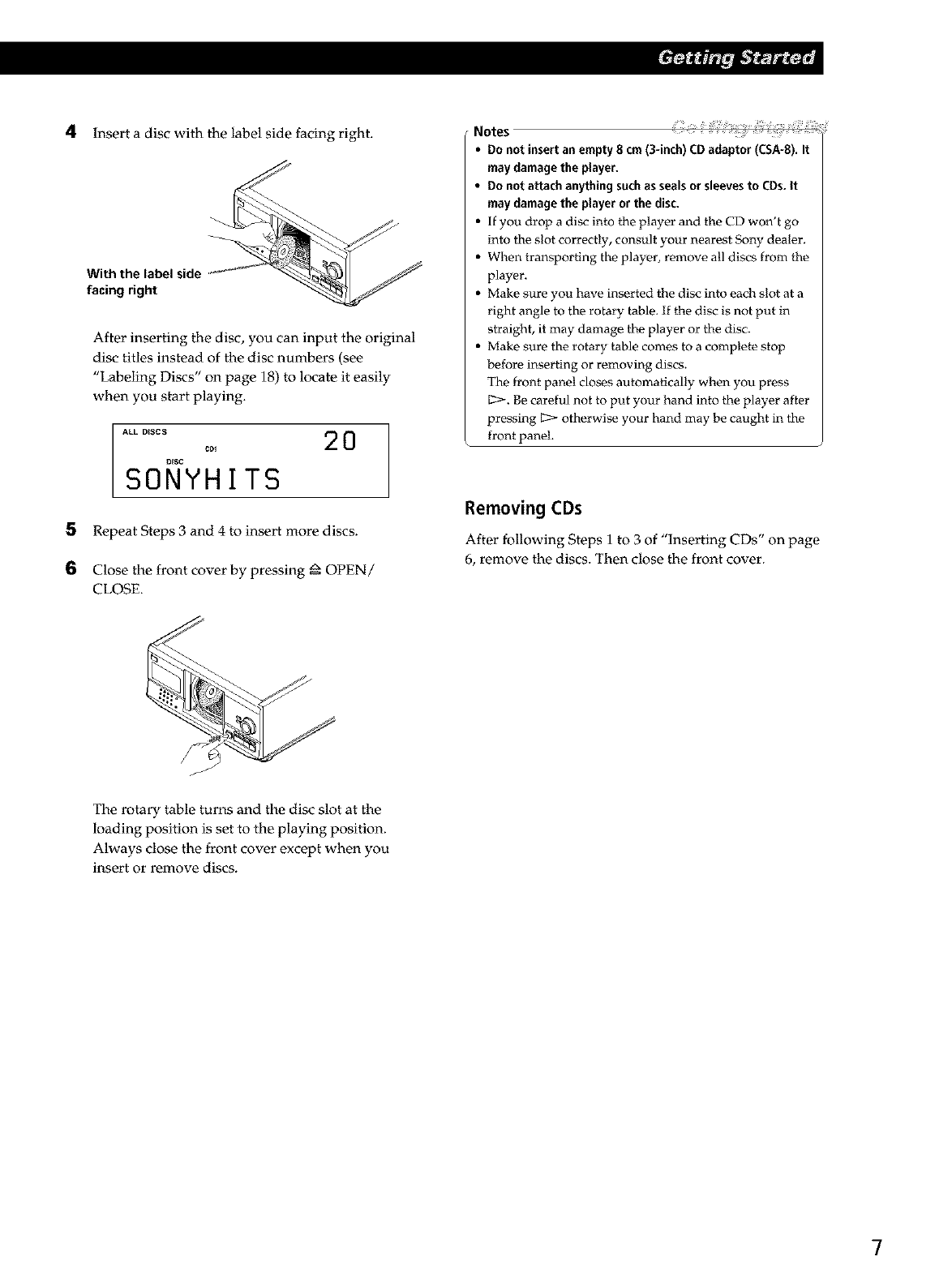
4Insert a disc with the label side facing right.
With the label side
facing right
After inserting the disc, you can input the original
disc titles instead of the disc numbers (see
"Labeling Discs" on page 18) to locate it easily
when you start playing.
ALLD_SCS 20
CDI
D_SC
SONYHITS
5 Repeat Steps 3 and 4 to insert more discs.
6Close the front cover by pressing _ OPEN/
CLOSE.
The rotary table turns and the disc slot at the
loading position is set to the playing position.
Always close the front cover except when you
insert or remove discs.
x i_!;;? ii ii ;¸¸ii::
Notes ............
• Do not insert an empty 8 cm (3-inch) CD adaptor (CSA-8). It
may damage the player.
•Do not attach anything suchas seals or sleeves to CDs. it
may damage the player or the disc.
• If you drop a disc into the player and the CD won't go
into the slot correctly, consult your nearest Sony dealer.
• When transporting the player, remove all discs from the
player.
• Make sure you have inserted the disc into each slot at a
right angle to the rotary table. If the disc is not put in
straight, it may damage the player or the disc.
• Make sure the rotary table comes to a complete stop
before inserting or removing discs.
The front panel clo_s automatically when you press
[2>. Be careful not to put your hand into the player after
pressing [2> otherwise your hand may be caught in the
front panel.
Removing CDs
After following Steps 1 to 3 of "Inserting CDs" on page
6, remove the discs. Then close the front cover.
7
Playing a CD
2 4/5
, ii
61111111111111111111111 iiiiii iiiiiiiii -
' iiiiiiiiiiiii
@ @@@ @
(
• Seepages4- 5 for the hookup
information.
•Make sureyouhaveinsertedthe
discscorrectlyasindicatedon
pages6 - 7.
•Youcanplayall the trackson a
discinthe originalorder
(ContinuousPlay).Youcanalso
playup to 200 discs
consecutively.
*_You can on player
turn the
by pressingI/_ on the
remote
1
3
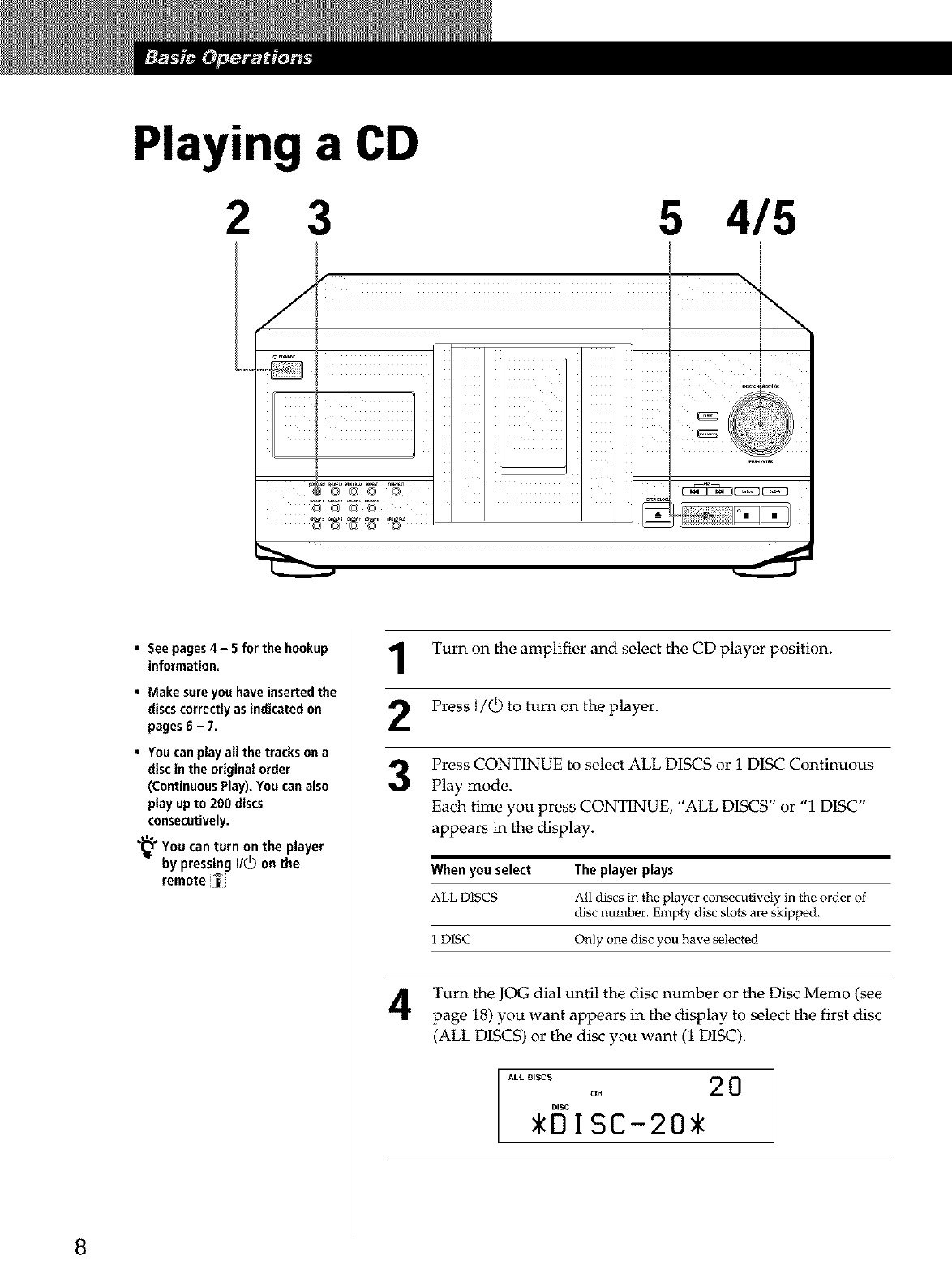
Turn on the amplifier and select the CD player position.
Press I/(_) to turn on the player.
Press CONTINUE to select ALL DISCS or I DISC Continuous
Play mode.
Each time you press CONTINUE, "ALL DISCS" or "1 DISC"
appears in the display.
When you select The player plays
ALL DISCS All discs in the player consecutively in the order of
disc number. Empty disc slots are skipped.
1 DISC Only one disc you have selected
Turn the JOG dial until the disc number or the Disc Memo (see
page 18) you want appears in the display to select the first disc
(ALL DISCS) or the disc you want (1 DISC).
DISC
DISC-20
8
*_* When you turn player
off the
The player remembers the
last playing disc and the
play mode (Continuous,
Shuffle (see page 14) or
Program (see page 15)).
When you turn on the
player again, therefore, the
player plays the same disc in
the same play mode.
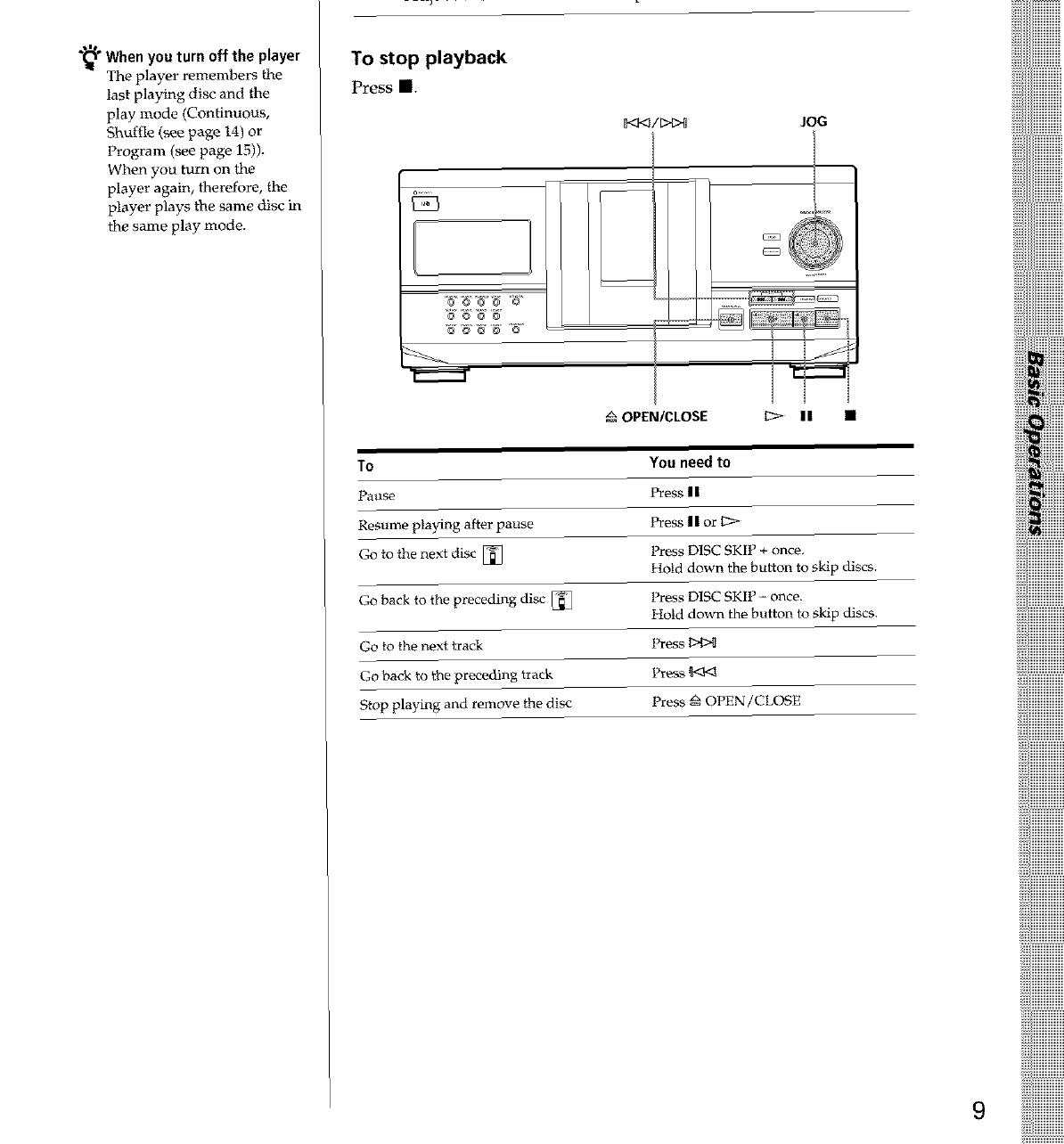
To stop playback
Press II.
JOG
I
I
OPEN/CLOSE I_- II
To You need to
Pause Press I I
Resume playing after pause Pl'ess |l or
Go to the next disc [] Press DISC SKIP + once.
Hold down the button to skip discs.
Go back to the preceding disc _ Press DISC SKIP - once.
Hold down the button to skip discs.
Go to the next track Press
Go back to the preceding track Press
Stop playing and remove the disc Press _ OPEN/CLOSE
Biiiiiiiiiiiiiiiiiiiiiiii
Biiiiiiiiiiiiiiiiiiiiiiii
Biiiiiiiiiiiiiiiiiiiiiiiii
Biiiiiiiiiiiiiiiiiiiiiiii
Biiiiiiiiiiiiiiiiiiiiiiii
Biiiiiiiiiiiiiiiiiiiiiiii
Biiiiiiiiiiiiiiiiiiiiiiiii
Biiiiiiiiiiiiiiiiiiiiiiiii
Biiiiiiiiiiiiiiiiiiiiiiii
Biiiiiiiiiiiiiiiiiiiiiiii
Biiiiiiiiiiiiiiiiiiiiiiiii
Biiiiiiiiiiiiiiiiiiiiiiii
Biiiiiiiiiiiiiiiiiiiiiiii
Biiiiiiiiiiiiiiiiiiiiiiiii
Biiiiiiiiiiiiiiiiiiiiiiii
Biiiiiiiiiiiiiiiiiiiiiiii
Biiiiiiiiiiiiiiiiiiiiiiiii
Biiiiiiiiiiiiiiiiiiiiiiii
Biiiiiiiiiiiiiiiiiiiiiiii
Biiiiiiiiiiiiiiiiiiiiiiiii
Biiiiiiiiiiiiiiiiiiiiiiiii
Biiiiiiiiiiiiiiiiiiiiiiii
_iiiiiiiiiiiiiiiiiiiii
_iiiiiiiiiiiiiiiiiiiii
_iiiiiiiiiiiiiiiiiiii
_iiiiiiiiiiiiiiiiiiiii
_iiiiiiiiiiiiiiiiiiiii
_iiiiiiiiiiiiiiiiiiii
iii}}}Biiiiiiiiiiiiii
9 iiiiiiiiiiiiliiiiiiiiiiiiiiiiiii
Using the Display
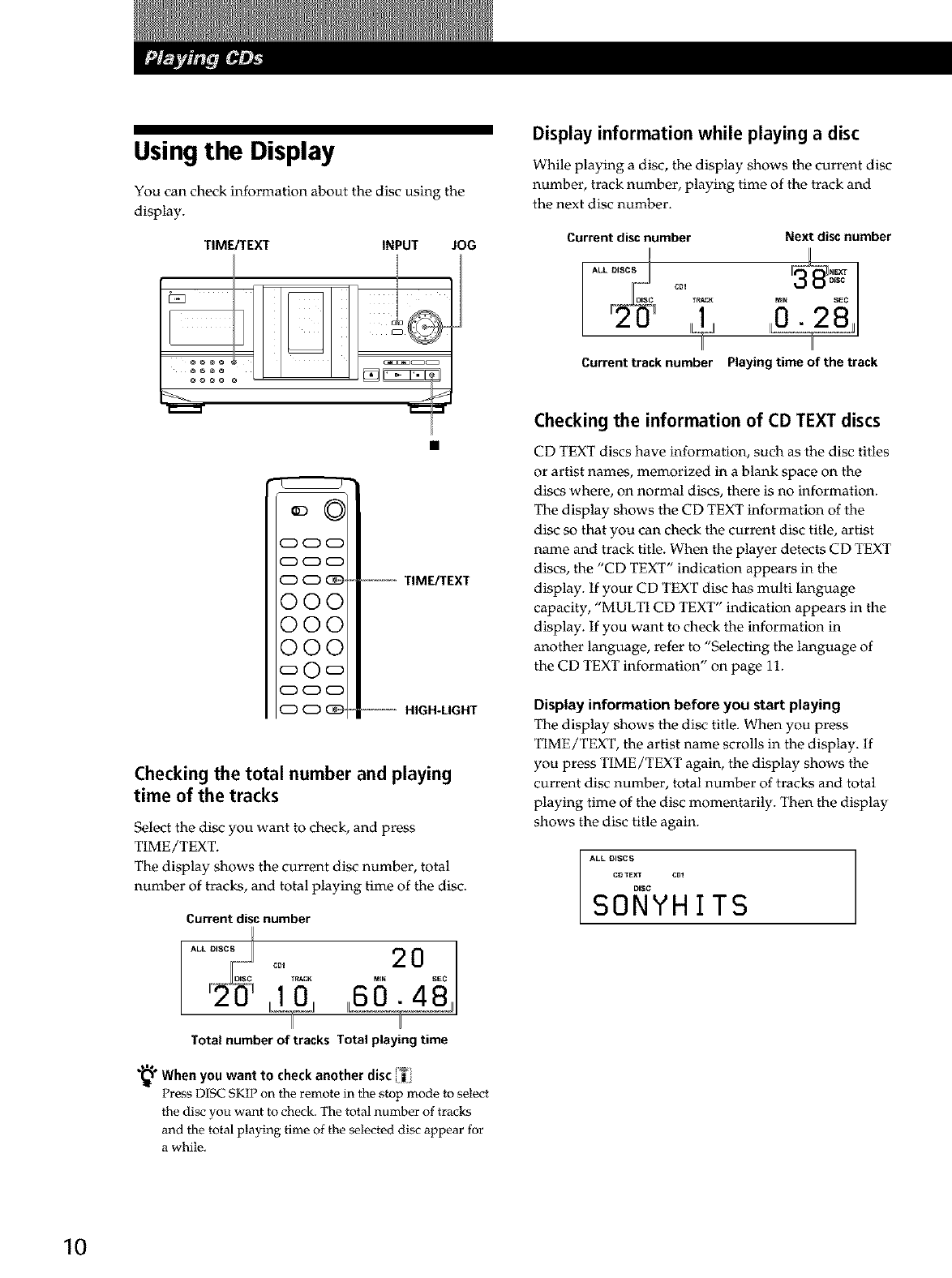
You can check information about the disc using the
display.
TIME/TEXT INPUT JOG
C_ _ ------_ TIME/TEXT
000
ooo
000
c_Oc_
CDOCD
C_ O _ ------_ HIGH-LIGHT
Checking the total number and playing
time of the tracks
Select the disc you want to check, and press
TIME/TEXT.
The display shows the current disc number, total
number of tracks, and total playing time of the disc.
Current disc number
,LLO,SOS00',.OK 20SO0
II
Total number of tracks Total playing time
"1_ When want to checkanother disc
you
Press DISC SKIP on the remote in the stop mode to select
the disc you want to check. The total number of tracks
and the total playing time of tho selected disc appear for
a while.
Display information while playing a disc
While playing a disc, the display shows the current disc
number, track number, playing time of the track and
the next disc number.
Current disc number Next disc number
,LLO,SOS001 I
Tp_CK _ SEC
,&
II II
Current track number Playingtime of the track
Checking the information of CD TEXT discs
CD TEXT discs have information, such as the disc titles
or artist names, memorized in a blank space on the
discs where, on normal discs, there is no information.
The display shows the CD TEXT information of the
disc so that you can check the current disc title, artist
name and track title. When the player detects CD TEXT
discs, the "CD TEXT" indication appears in the
display. If your CD TEXT disc has multi language
capacity, "MULTI CD TEXT" indication appears in the
display. If you want to check the information in
another language, refer to "Selecting the language of
the CD TEXT information" on page 11.
Display information before you start playing
The display shows the disc title. When you press
TIME/TEXT, the artist name scrolls in the display. If
you press TIME/TEXT again, the display shows the
current disc number, total number of tracks and total
playing time of the disc momentarily. Then the display
shows the disc title again.
ALL DISCS
COTE)IT COl
DISC
SONYHITS
10
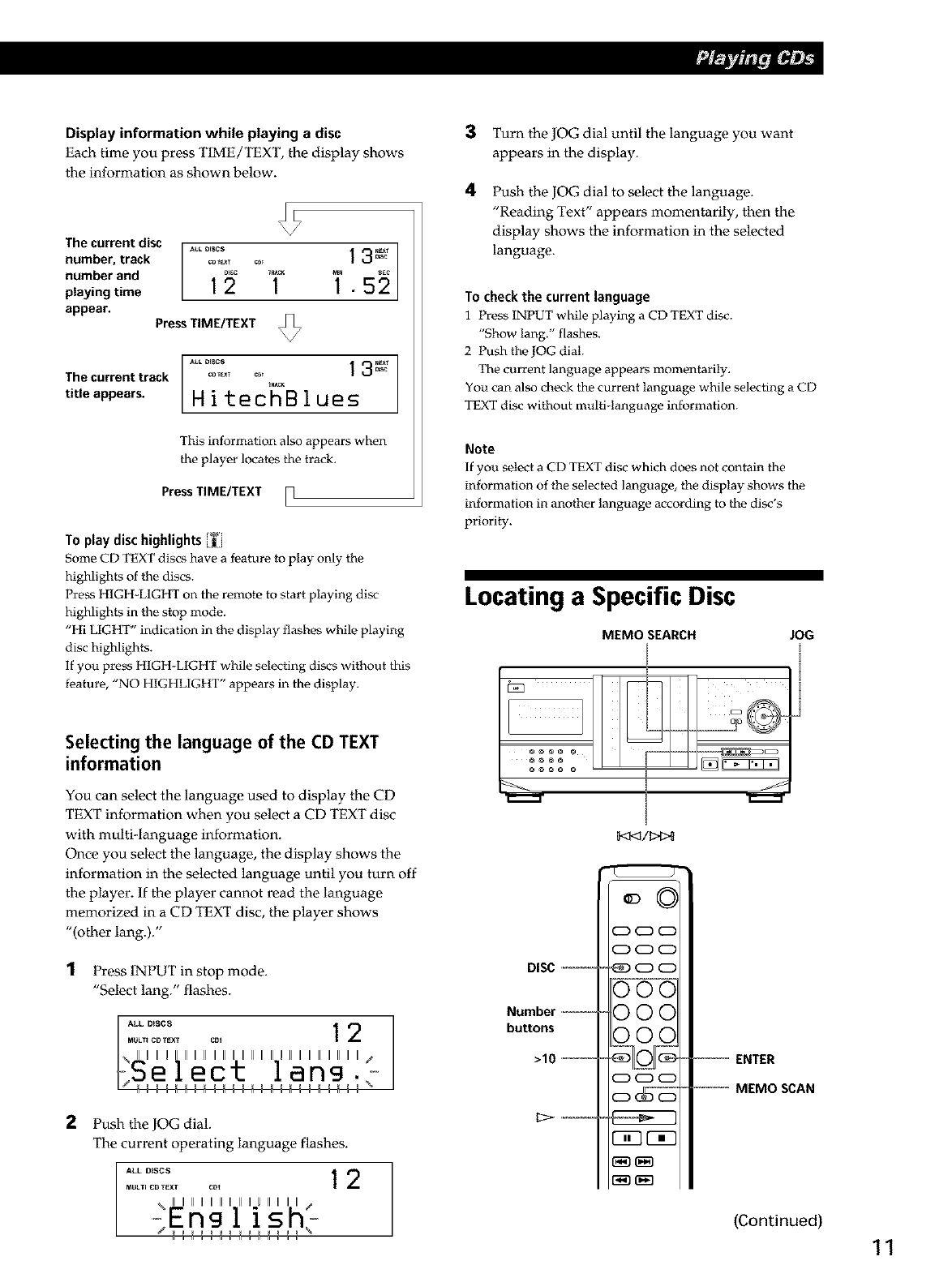
Display information while playing a disc
Each time you press TIME/TEXT, the display shows
the information as shown below.
The current disc _L o,_s
number, track .... 1 3 _'
number arid '_
playing time
appear. Press TIME/TEXT
The current track
title appears.
A_L _ISCS
........ 13 &'
H i t e c'h'B 1ues
This information also appears when
the player locates the track.
PressTIME/TEXT
To play disc highlights _
Some CD TEXT discs have a feature to play only" the
highlights of the discs.
Press HIGH-LIGHT on the remote to start playing disc
highlights in the stop mode.
"Hi LIGHT" indication in the display flashes while playing
disc highlights.
If you press HIGH*LIGHT while selecting discs without this
feature, "NO HIGHLIGHT" appears in the display.
Selecting the language of the CD TEXT
information
You can select the language used to display the CD
TEXT information when you select a CD TEXT disc
with multiqanguage information.
Once you select the language, the display shows the
information in the selected language until you turn off
the player. If the player cannot read the language
memorized in a CD TEXT disc, the player shows
"(other lang.)."
1Press INPUT in stop mode.
"Select lang." flashes.
2Push the JOG dial.
The current operating language flashes.
ALL D'SCS 12
_ %_,,.MULTICD TEXT CO_
%IIIIIIIIIIIIIIIIIIU IIIIIIIIt
3
4
Turn the JOG dial until the language you want
appears in the display.
Push the JOG dial to select the language.
"Reading Text" appears momentarily, then the
display shows the information in the selected
language.
To check the current language
1 Press INPUT while playing a CD TEXT disc.
"Show lang." flashes.
2 Push the JOG dial.
The current language appears momentarily.
You can also check the current language while selecting a CD
TEXT disc without mufliqanguago information.
Note
If you select a CD TEXT disc which does not contain the
information of the selected language, the display shows the
information in another language according to the disc's
priority.
Locating a Specific Disc
MEMO SEARCH JOG
DISC _----_'
Number _-----,
buttons
>10 --
OOO
OOO
OOO
-- ENTER
_ -- MEMO SCAN
Fii-I Fi_
(Continued)
11
Selecting a disc on the player
Turn the JOG dial until the disc number or Disc Memo
(see page 18) you want appears in the display. Push the
JOG dial to start play.
Selectingadisc directly usingthe remote []
1Press DISC.
2Press the number button of the disc.
Example: To enter number 35
Press 3 then 5.
To enter number 100
Press 1, then 10/0 twice.
3 Press ENTER to start play.
Locating a disc by scanning each Disc
Memo (Memo Scan)
You can locate a disc you want to play quickly by
scanning the Disc Memos (see page 18) in the display.
Note that you cannot use this function in the ALL
DISCS Shuffle Play mode.
1Press MEMO SCAN.
"MEMO SCAN" appears in the display, and the
Disc Memos scroll in the display.
2Press 12> when the Disc Memo of the disc you
want to play appears.
The disc is set to the playing position, and the
player starts playing.
In Program Play mode, the disc will be added to
the end of the program if you press ENTER instead
of 12>.
Note
If "NO ENTRY" appears in the display, no disc has been
labeled with the Disc Memo. Try the Memo Scan function
again after labeling tho discs.
Locating a disc by searching a specific Disc
Memo (Memo Search)
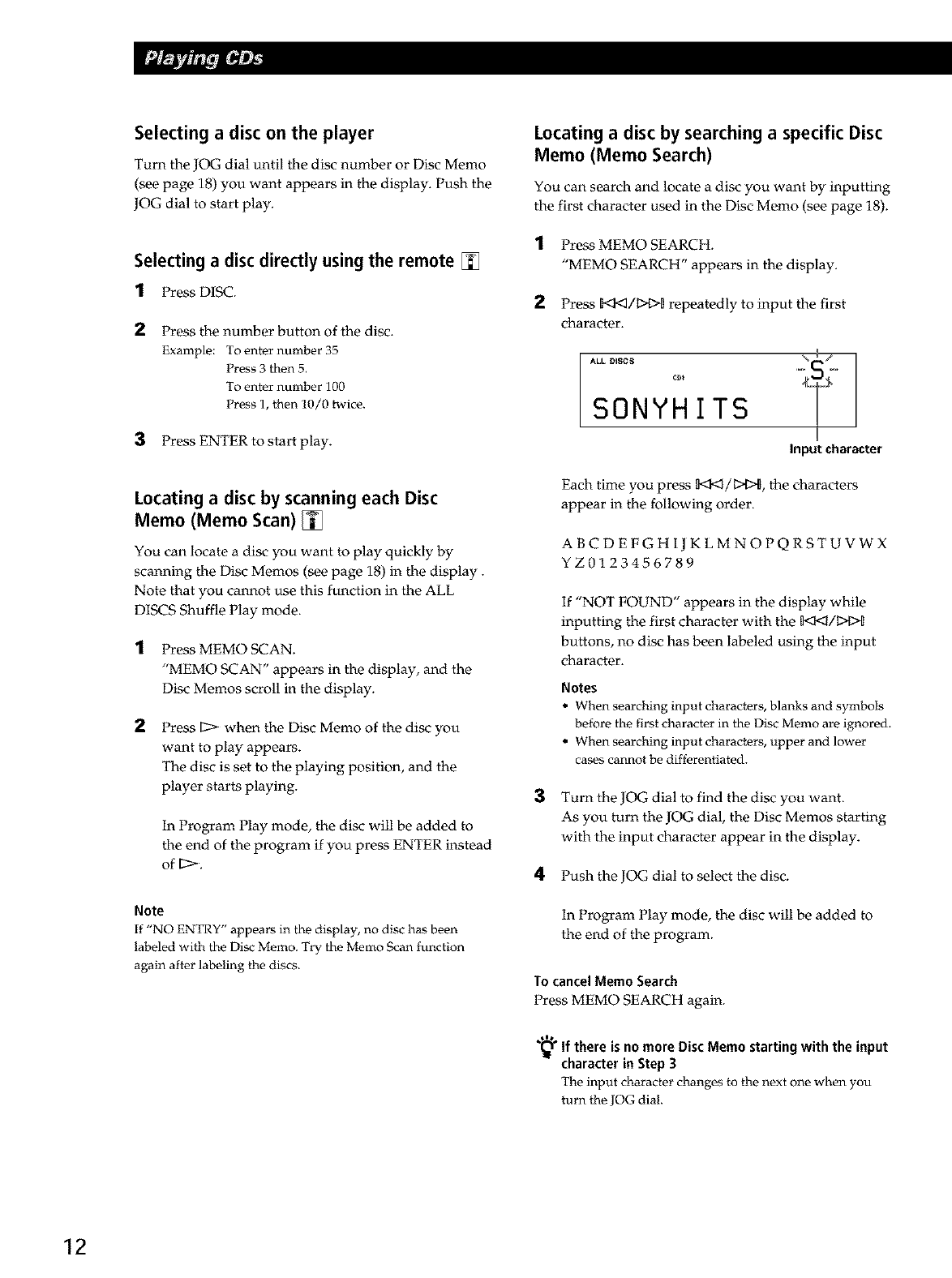
You can search and locate a disc you want by inputting
the first character used in the Disc Memo (see page 18).
1Press MEMO SEARCH.
"MEMO SEARCH" appears in the display.
2 Press N:I<I/[::4_ repeatedly to input the first
character.
ALL DISCS % "
SONYHITS
H
Input character
Each time you press N_<_/[::4_, the characters
appear in the following order.
ABCDEFGHIJKLMNOPQRSTUVWX
YZ0123456789
If "NOT FOUND" appears in the display while
inputting the first character with the _/b_
buttons, no disc has been labeled using the input
character.
Notes
• When searching input characters, blanks and symbols
before the first character in the Disc Memo are ignored.
• When searching input characters, upper and lower
cases cannot be difforentiated.
3Turn the JOG dial to find the disc you want.
As you turn the JOG dial, the Disc Memos starting
with the input character appear in the display.
4Push the JOG dial to select the disc.
In Program Play mode, the disc will be added to
the end of the program.
Tocancel Memo Search
Press MEMO SEARCH again.
_lf =snomore starting input
there DISCMemo with the
character in Step 3
The input character changes to the next one when you
turn the JOG dial.
12
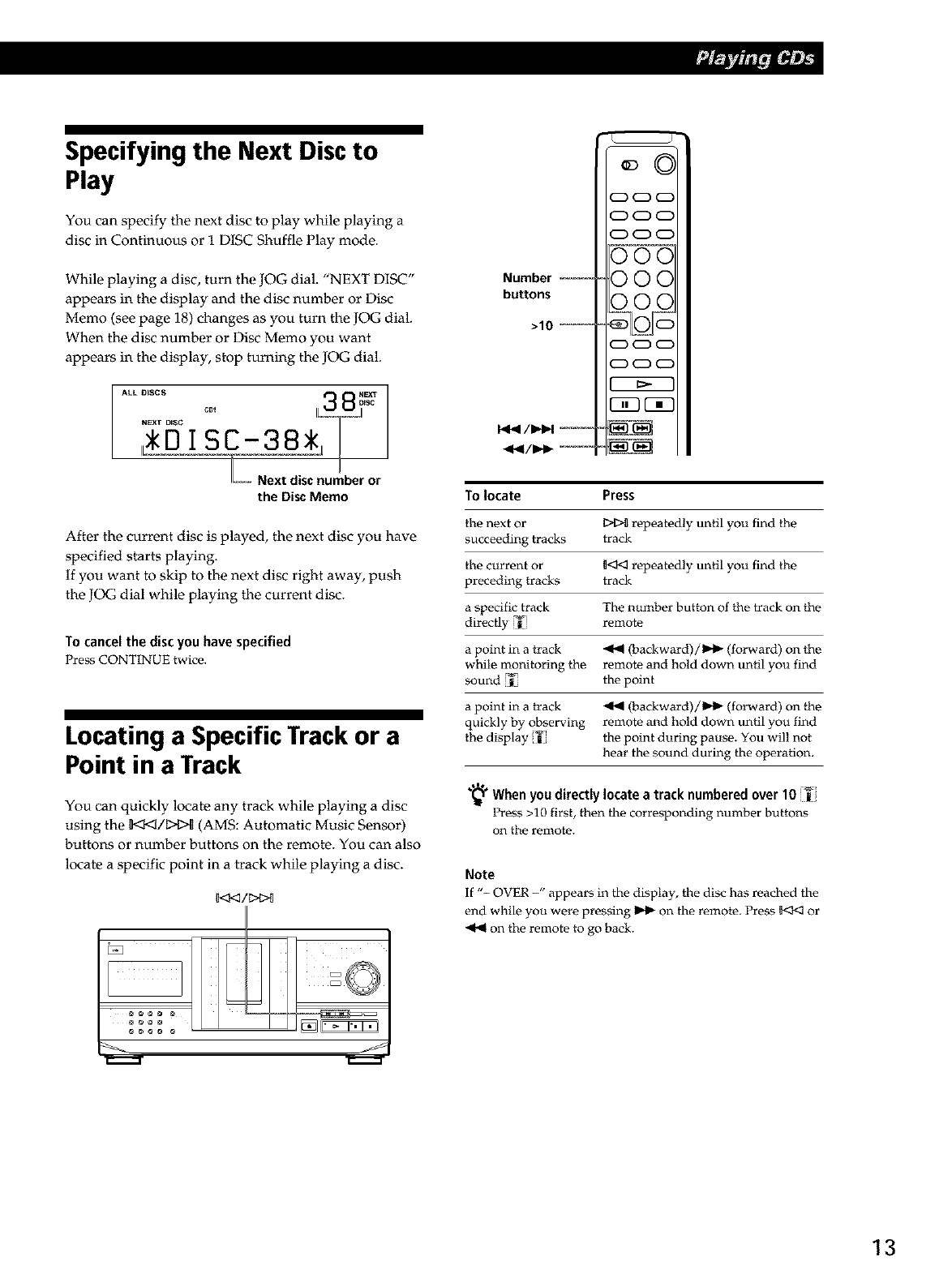
Specifying the Next Disc to
Play
You can specify the next disc to play while playing a
disc in Continuous or I DISC Shuffle Play mode.
While playing a disc, turn the JOG dial. "NEXT DISC"
appears in the display and the disc number or Disc
Memo (see page 18) changes as you turn the JOG dial.
When the disc number or Disc Memo you want
appears in the display, stop turning the JOG dial.
ALL DtSCS _O NF3Cr
..... $C C01 ii _ _ _8c
ISC-38K- -
L_
Next disc number or
the Disc Memo
After the current disc is played, the next disc you have
specified starts playing.
If you want to skip to the next disc right away, push
the JOg; dial while playing the current disc.
Tocancelthe discyou have specified
Press CONTINUE twice.
Locating a Specific Track or a
Point in a Track
You can quickly locate any track while playing a disc
using the D:a<a/Dg>_ (AMS: Automatic Music Sensor)
buttons or number buttons on the remote. You can also
locate a specific point in a track while playing a disc.
_<t<a/c>!>_
_C::::2
[] CEzizi3
"t=:222_ 112222_
CZDCD CZ3
CD CD CD
CD CZ) CD
OOO
Number _------ 0 0 0
buttons 0 0 0
>10 _------
0<::Z_CZ)
i-_1 r_q
To locate Press
the next or Dg>a repeatPdly until you find the
succeeding tracks track
the current or Fvt<_repeatPdly until you find the
preceding tracks track
a specific track The number button of the track on the
directly _ remote
a point in a track _ (backward)/lD_ (forward) on the
while monitoring the remote and hold down until you find
sound _ the point
a point in a track _ (backward)/lD_ (forward) on the
quickly by observing remote and hold down until you find
the display iT the point during pause. You will not
hear the sound during the operation.
When you directly locate atrack numbered over 10 [_;i
Press >10 first, then the corresponding number buttons
on the remote.
Note
If "- OVER -" appears in the display, the di_ has reached the
end while you were pressing _ on the remotP. Press Fvt<_ or
on thP remote to go back.
13
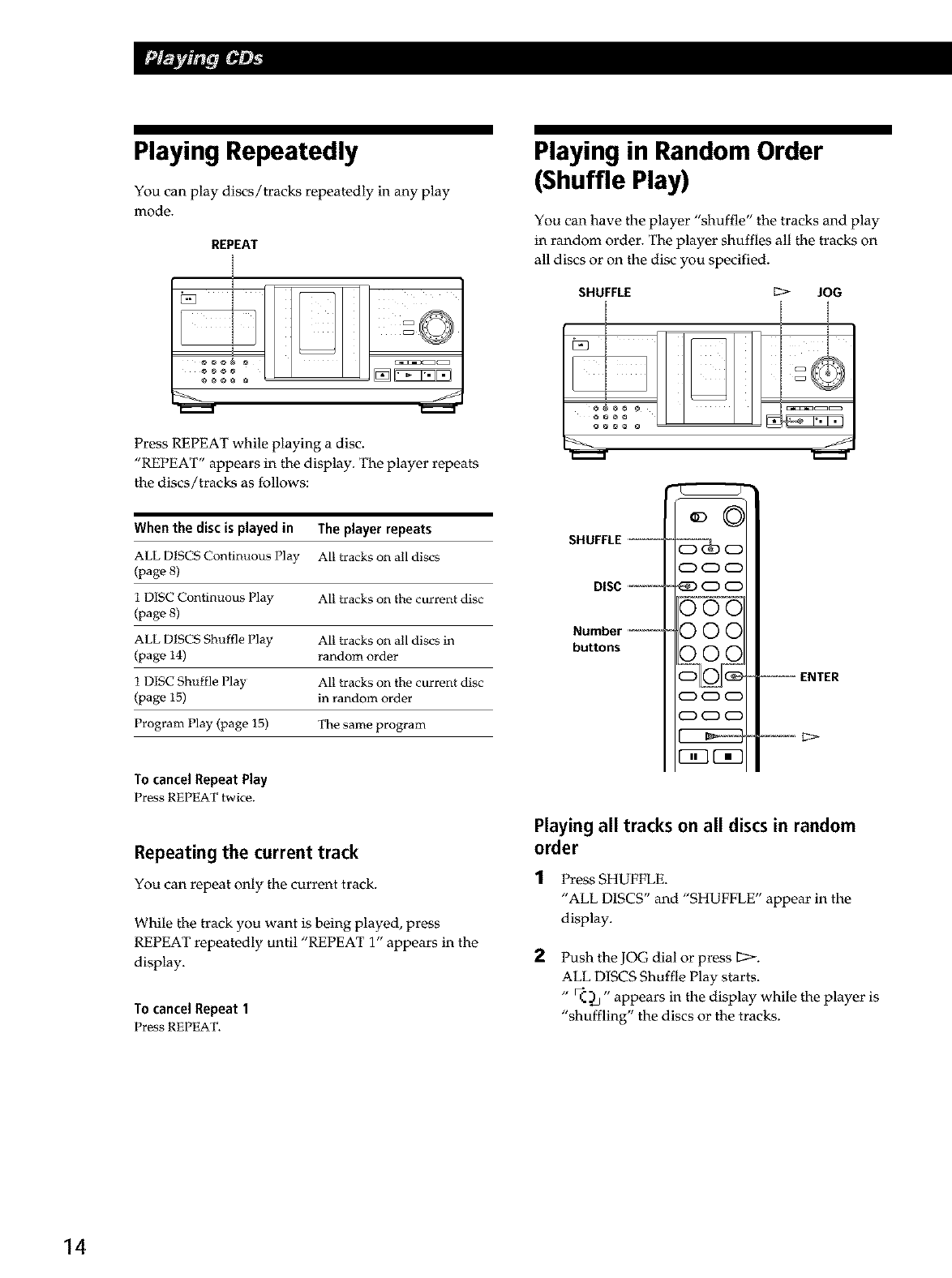
Playing Repeatedly
You can play discs/tracks repeatedly in any play
mode.
REPEAT
Press REPEAT while playing a disc.
"REPEAT" appears in the display. The player repeats
the discs/tracks as follows:
When the disc is played in The player repeats
ALL DISCS Continuous Play All tracks on all discs
(page 8)
1 DISC Continuous Play All tracks on the current disc
(page 8)
ALL DISCS Shuffle Play All tracks on all discs in
(page I4) random order
1 DISC Shuffle Play All tracks on the current disc
(page I5) in random order
Program Play (page I5) Tho same program
To cancelRepeat Play
Press REPEAT twice.
Repeating the current track
You can repeat only the current track.
While the track you want is being played, press
REPEAT repeatedly until "REPEAT 1" appears in the
display.
To cancelRepeat 1
Press REPEAT.
Playing in Random Order
(Shuffle Play)
You can have the player "shuffle" the tracks and play
in random order. The player shuffles all the tracks on
all discs or on the disc you specified.
SHUFFLE
ii xxxI
JOG
SHUFFLE _------
DISC _------
Number _------
buttons
C_Q_
DO0
DO0
DO0
"-_-_-_-ENTER
Playing all tracks on all discs in random
order
1Press SHUFFLE.
"ALL DISCS" and "SHUFFLE" appear in the
display.
2Push the JOG dial or press 12>.
ALL DISCS Shuffle Play starts.
" _)j" appears in the display while the player is
"shuffling" the discs or the tracks.
14
Playing all tracks on a specified disc in
random order
1Press SHUFFLE twice.
"1 DISC" and "SHUFFLE" appear in the display.
2Turn the JOG dial until the disc number you want
appears in the display.
When using the remote, press DISC first and then
press the number button of the disc.
3Push the JOG dial or press I::>.
When using the remote, press ENTER.
1 DISC Shuffle Play starts.
, c_)j ,, appears in the display while the player is
"shuffling" the tracks.
TocancelShuffle Play
Press CONTINUE.
"_You can start Shuffle Play while playing
Press SHUFFLE, and Shuffle Play starts from the current
track.
"_You can directly select adisc for 1 DISC Shuffle Play []
See "Selecting a disc directly using the remote" on page
12.
_You to the nextdisc 1DISCShuffle [_
during Play
cango
Press DISC SKIP +.
_You canspecify next to play during DISC
the disc 1
Shuffle Play
Turn tho JOG dial to specify the next disc. After all the
tracks on the current disc are played in random order,
the next disc starts playing. If you want to skip to the
next disc right away) push the JOG dial while playing the
current disc.
Notes
• You cannot specify the next disc to play during ALL DISCS
Shuffle Play.
• Even if you press • or turn off the player during ALL
DISCS Shuffle Play, the player remembers which discs/
tracks were played and which were not. Therefore, if you
want to start ALL DISCS Shuffle Play again from the
beginning, be sure to repeat the procedure from Step 1.
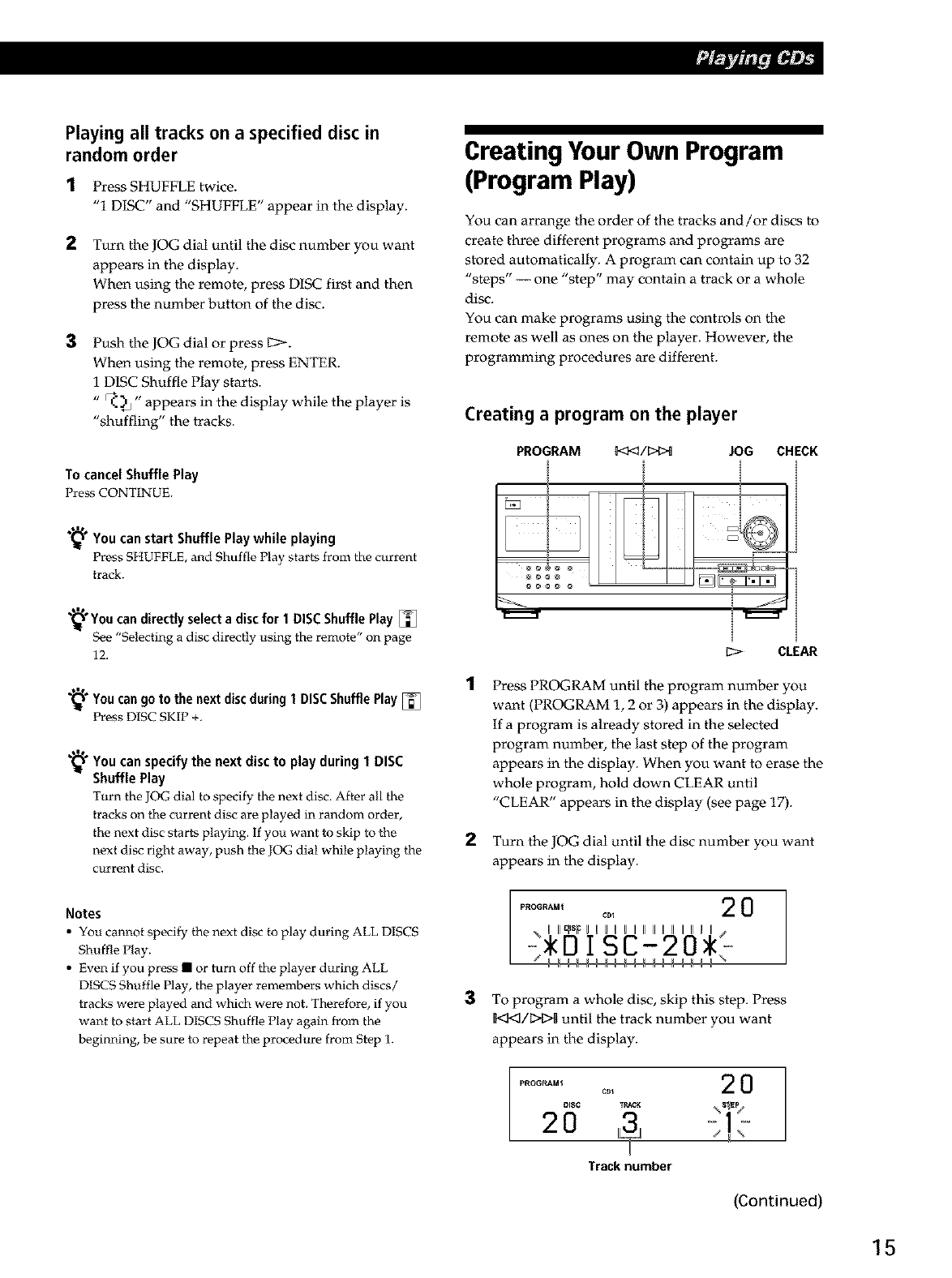
Creating Your Own Program
(Program Play)
You can arrange the order of the tracks and/or discs to
create three different programs and programs are
stored automatically. A program can contain up to 32
"steps" -- one "step" may contain a track or a whole
disc.
You can make programs using the controls on the
remote as well as ones on the player. However, the
programming procedures are different.
Creating a program on the player
PROGRAM K<I/D_
))
.lOG CHECK
o@o_o
)
(
CLEAR
1Press PROGRAM until the program number you
want (PROGRAM 1, 2 or 3) appears in the display.
If a program is already stored in the selected
program number, the last step of the program
appears in the display. When you want to erase the
whole program, hold down CLEAR until
"CLEAR" appears in the display (see page 17).
2 Turn the JOG dial until the disc number you want
appears in the display.
20
3To program a whole disc, skip this step. Press
N:I<I/_:4>D until the track number you want
appears in the display.
(Continued)
15
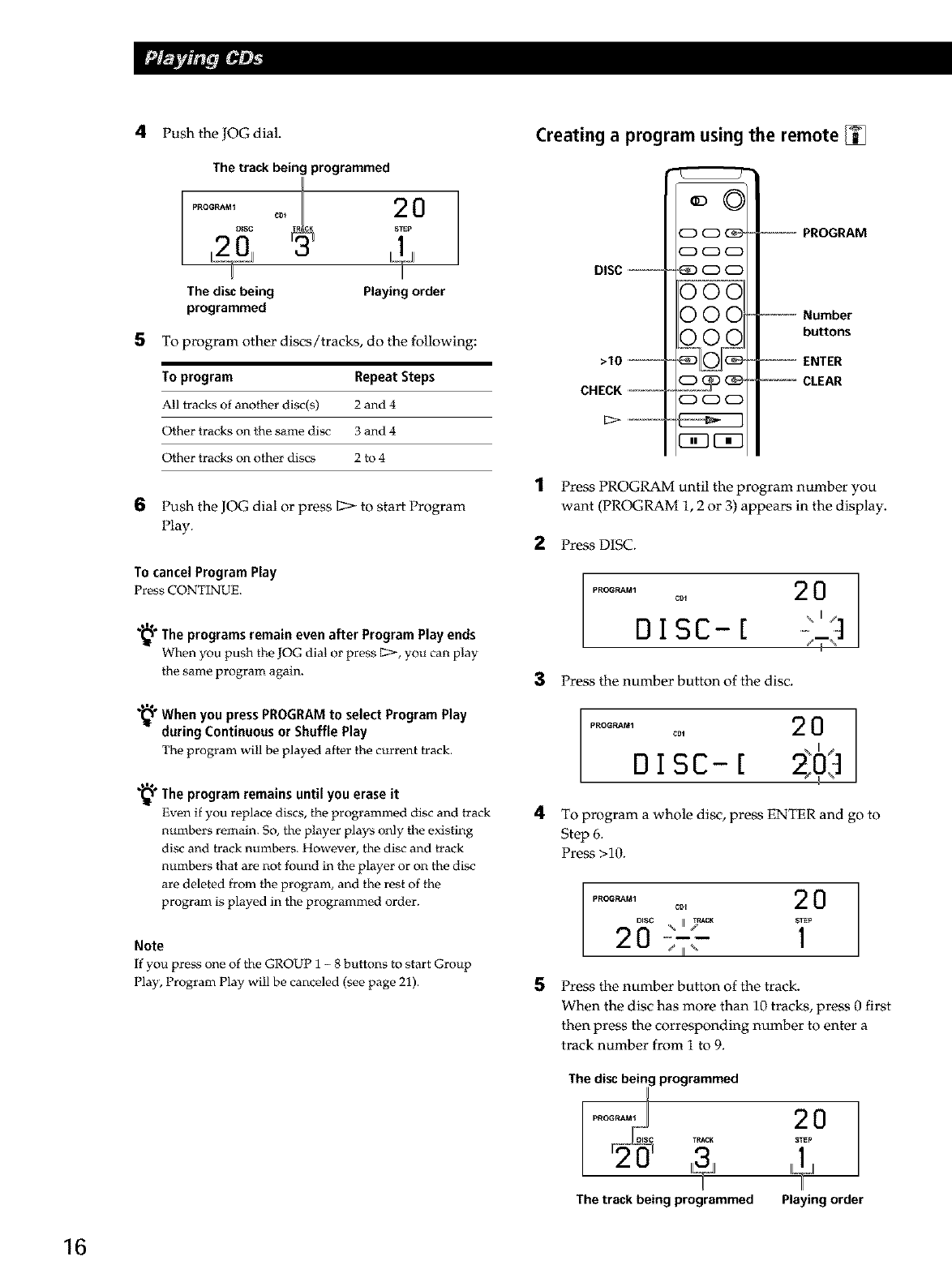
4Push the JOG dial.
The track being programmed
D_SC STE_
H II
The disc being Playing order
programmed
5 To program other discs/tracks, do the following:
To program Repeat Steps
All tracks of another disc(s) 2 and 4
Other tracks on the same disc 3 and 4
Other tracks on other discs 2 to 4
6Push the JOff; dial or press 12:>to start Program
Play.
To cancelProgram Play
Press CONTINUE.
(_The programs remain even after Program Play ends
When you push the JOG dial or press D> you can play
the same program again.
*_" When you press Program Play
PROGRAMto select
during Continuousor Shuffle Play
The program will be played after the current track.
*1_ The program you erase
remains until it
Even if you replace discs, the programmed disc and track
numbers remain. So, the player plays only the existing
disc and track numbers. However, the disc and track
numbers that are not found in the player or on the disc
are deleted from the program, and the rest of the
program is played in the programmed order.
Note
If you press one of the GROUt 1 - 8 buttons to start Group
Play, I rogram Play will be canceled (see page 21).
Creating a program using the remote
DISC _------
>10 _------
CHECK_-_-_o
DO0
DO0
DO0
_------ PROGRAM
_---- Number
buttons
1
Z
Press PROGRAM until the program number you
want (PROGRAM 1, 2 or 3) appears in the display.
Press D1SC.
O IS C- [ -;=.
3Press the number button of the disc.
4
5
..oo.., 00, 20 1
oi sc-[
To program awhole disc, press ENTER and go to
Step 6.
Press >10.
,% II _cK S_P
1
Press the number button of the track.
When the disc has more than 10 tracks, press 0 first
then press the corresponding number to enter a
track number from I to 9.
The disc being programmed
P_OORAM_ 20
TRACK STEP
The track being programmed Playing order
16
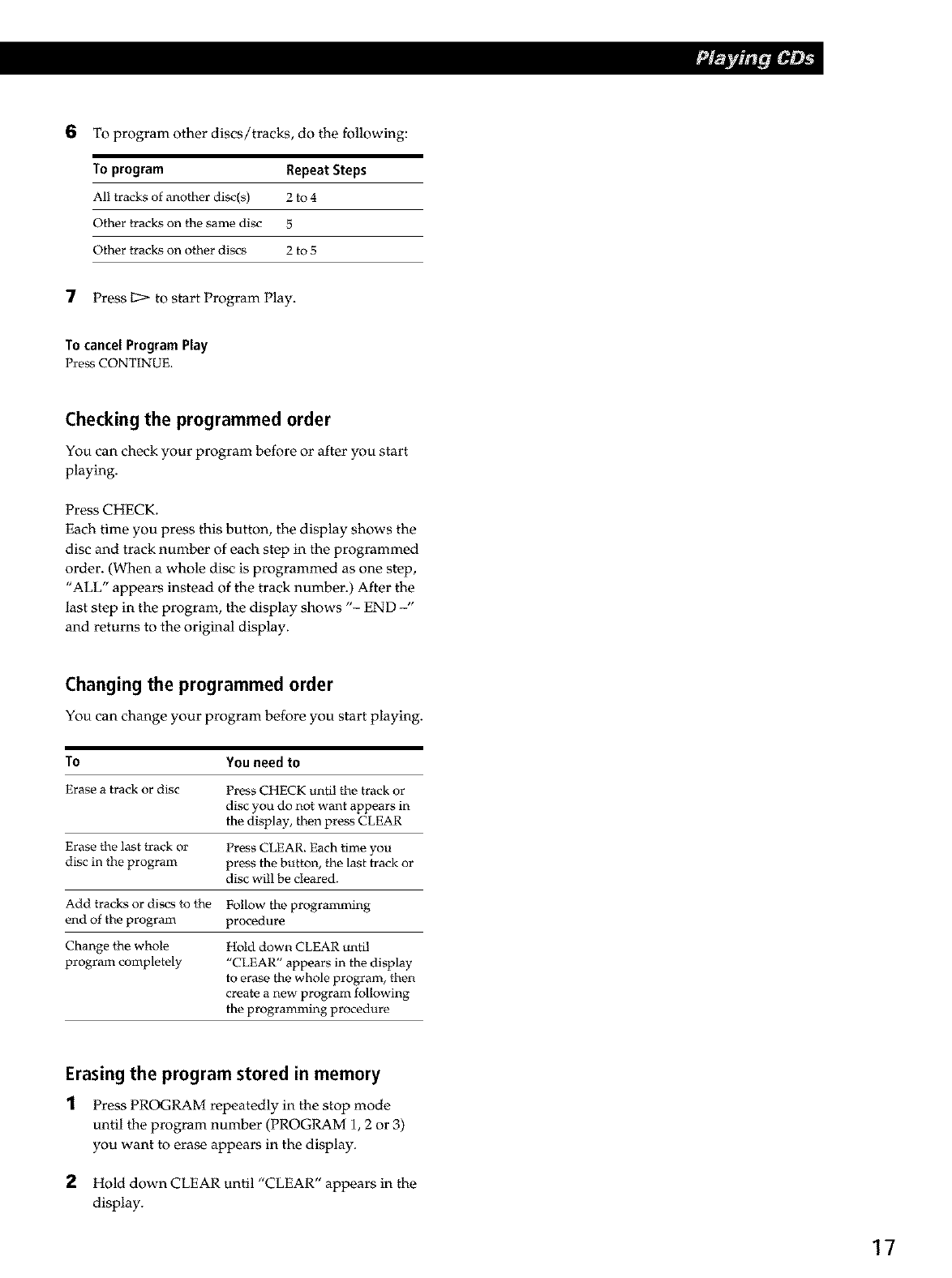
6 To program other discs/tracks, do the following:
To program Repeat Steps
All tracks of anothor disc(s) 2 to 4
Othor tracks on the same disc 5
Othor tracks on other discs 2 to 5
7Press lX>tostart Program Play.
Tocancel ProgramPlay
Press CONTINUE.
Checking the programmed order
You can check your program before or after you start
playing.
Press CHECK.
Each time you press this button, the display shows the
disc and track number of each step in the programmed
order. (When a whole disc is programmed as one step,
"ALL" appears instead of the track number.) After the
last step in the program, the display shows "- END -"
and returns to the original display.
Changing the programmed order
You can change your program before you start playing.
To You need to
Erase a track or disc Press CHECK until the track or
disc you do not want appears in
the display, then pross CLEAR
Erase the last track or Press CLEAR. Each time you
disc in the program press the button, the last track or
disc will be cleared.
Add tracks or discs to the Follow the programming
end of tho program procedure
Change the whole Hold down CLEAR until
program completely "CLEAR" appears in the display
to erase the whole program, then
create a new program following
the programming procedure
Erasing the program stored in memory
1Press PROGRAM repeatedly in the stop mode
until the program number (PROGRAM 1, 2 or 3)
you want to erase appears in the display.
2 Hold down CLEAR until "CLEAR" appears in the
display.
17
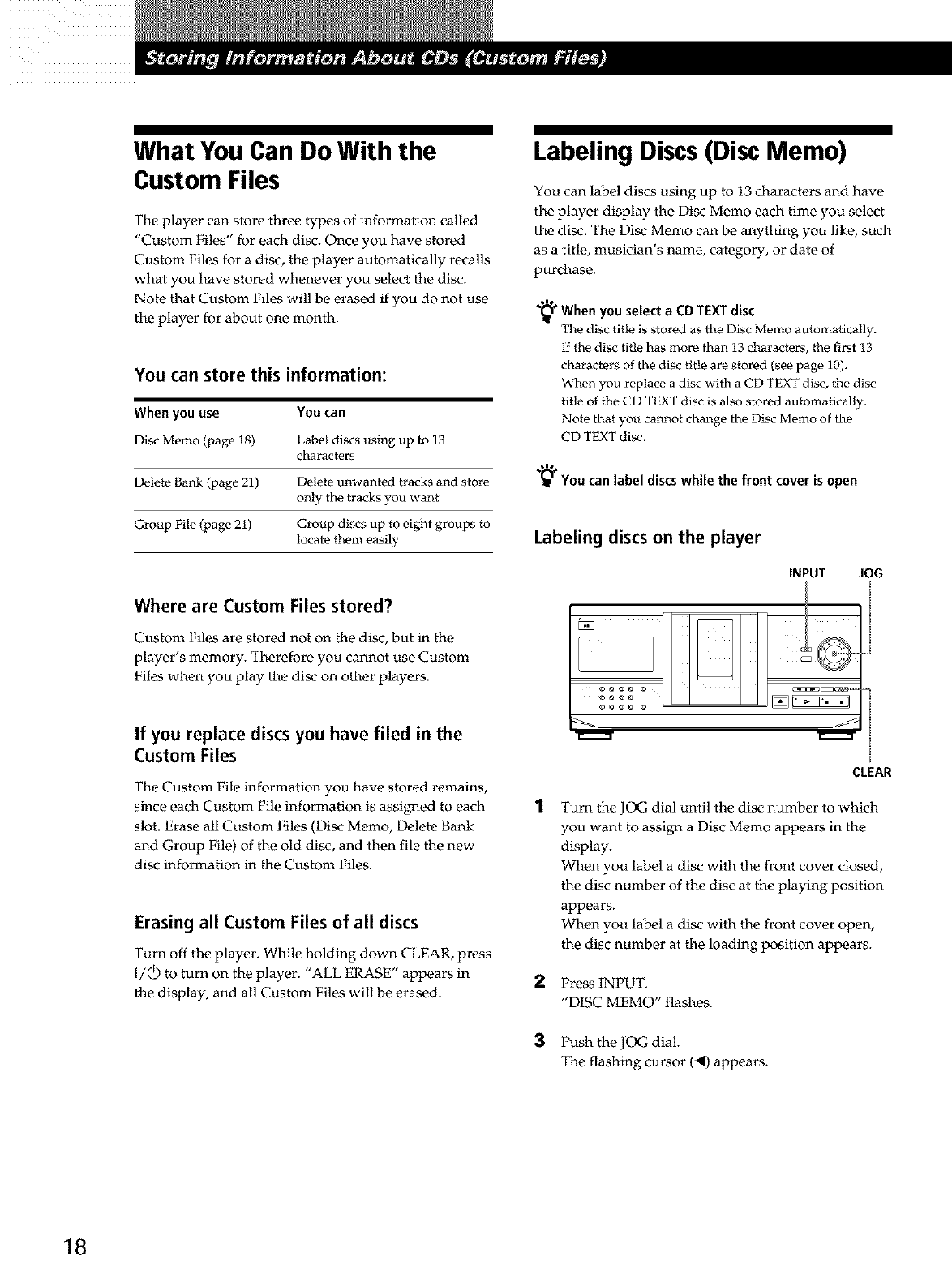
What You Can Do With the
Custom Files
The player can store three types of information called
"Custom Files" for each disc. Once you have stored
Custom Files for a disc, the player automatically recalls
what you have stored whenever you select the disc.
Note that Custom Files will be erased if you do not use
the player for about one month.
You can store this information:
When you use You can
Disc Memo (pago 18) Label discs using up to 13
charactors
Delete Bank (page 21) Delete unwanted tracks and store
only the tracks you want
Group File (page 21) Group dims up to eight groups to
locate them easily
Where are Custom Files stored?
Custom Files are stored not on the disc, but in the
player's memory. Therefore you cannot use Custom
Files when you play the disc on other players.
If you replace discs you have filed in the
Custom Files
The Custom File information you have stored remains,
since each Custom File information is assigned to each
slot. Erase all Custom Files (Disc Memo, Delete Bank
and Group File) of the old disc, and then file the new
disc information in the Custom Files.
Erasing all Custom Files of all discs
Turn off the player. While holding down CLEAR, press
I/(_) to turn on the player. "ALL ERASE" appears in
the display, and all Custom Files will be erased.
Labeling Discs (Disc Memo)
You can label discs using up to 13 characters and have
the player display the Disc Memo each time you select
the disc. The Disc Memo can be anything you like, such
as a title, musician's name, category, or date of
purchase.
_When select a CD TEXTdisc
you
The disc title is stored as the Disc Memo automatically.
If the disc title has more than 13 characters, the first 13
characters of the disc title are stored (_e page 10).
When you replace a disc with a CD TEXT disc, the disc
title of the CD TEXT disc is also stored automatically.
Note that you cannot change the Disc Memo of the
CD TEXT disc.
You canlabel discswhile the front cover is open
Labeling discson the player
INPUT JOG
1
2
3
@_@@ @
CLEAR
Turn the JOG dial until the disc number to which
you want to assign a Disc Memo appears in the
display.
When you label a disc with the front cover closed,
the disc number of the disc at the playing position
appears.
When you label a disc with the front cover open,
the disc number at the loading position appears.
Press INPUT.
"DISC MEMO" flashes.
Push the JOG dial.
The flashing cursor (4) appears.
18
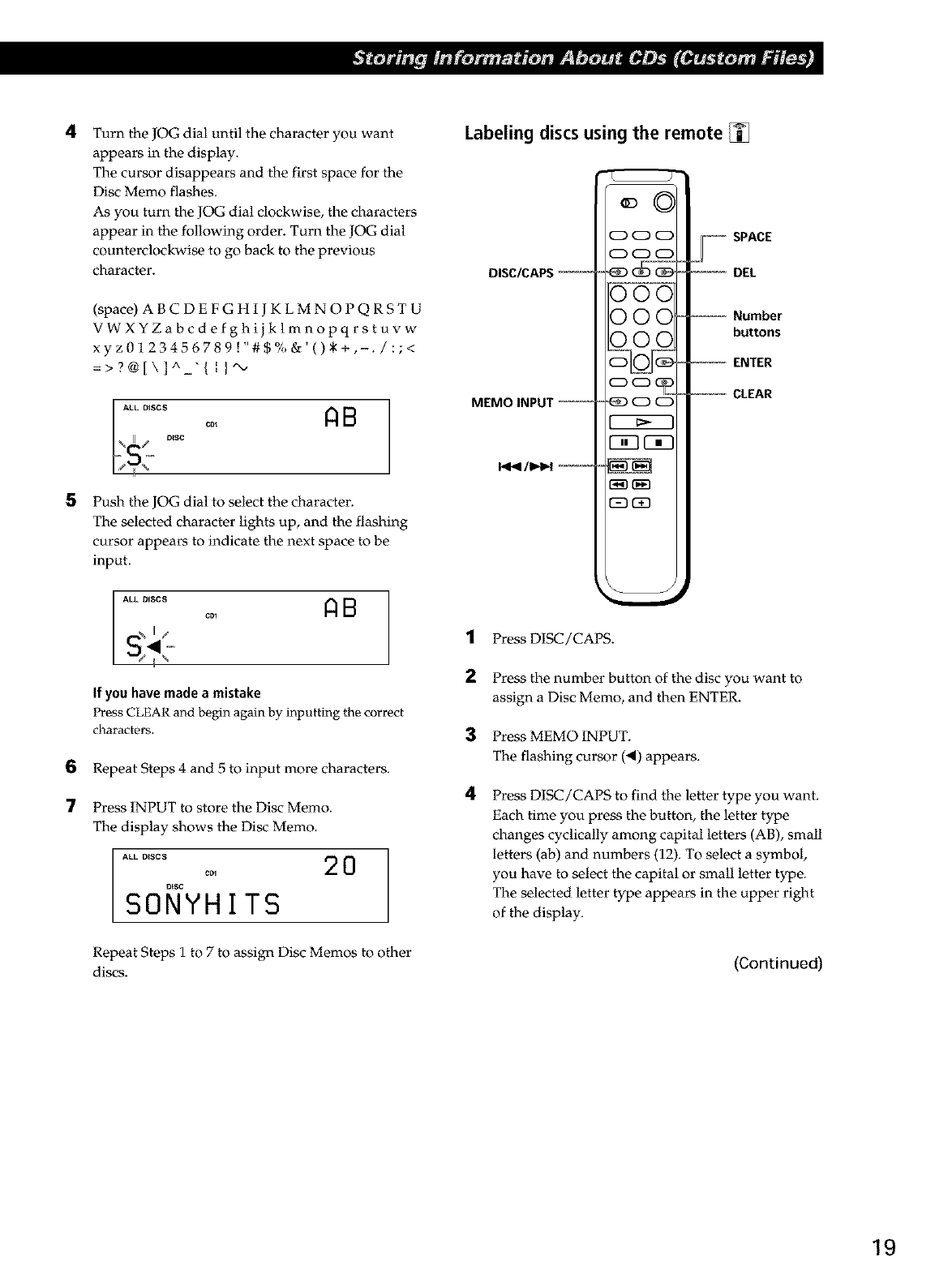
4Turn the JOG dial until the character you want
appears in the display.
The cursor disappears and the first space for the
Disc Memo flashes.
As you turn the JOG dial clockwise, the characters
appear in the following order. Turn the JOG dial
counterclockwise to go back to the previous
character.
(space) A BC DE FG H1J KL MN OPQRST U
VWXYZabcdefghijklmnopqrstuvw
xyz0123456789!"#$%&'()_+,-. /:;<
=>?@1\1^ "{I}'x,
ALL DISCS AB
5 Push the JOG dial to select the character.
The selected character lights up, and the flashing
cursor appears to indicate the next space to be
inpuh
ALL DISCS
AB
If you have made a mistake
Press CLEAR and begin again by inputting the correct
characters.
6Repeat Steps 4 and 5 to input more characters.
7Press INPUT to store the Disc Memo.
The display shows the Disc Memo.
ALLD,SCS 20
c01
DISC
SONYHITS
Repeat Steps 1 to 7 to assign Disc Memos to other
discs.
Labeling discsusing the remote
DISC/CAPS _------
MEMO INPUT _------
I<1<1/I_4H _------
c_c_c
000
000
000
1_7r_7
E]E]
------- Number
buttons
-------_ ENTER
_------CLEAR
1Press DISC/CAPS.
2Press the number button of the disc you want to
assign a Disc Memo, and then ENTER.
3Press MEMO INPUT.
The flashing cursor (4) appears.
4Press DISC/CAPS to find the letter type you want.
Each time you press the button, the letter type
changes cyclically among capital letters (AB), small
letters (ab) and numbers (12). To select a symbol,
you have to select the capital or small letter type.
The selected letter type appears in the upper right
of the display.
(Continued)
19
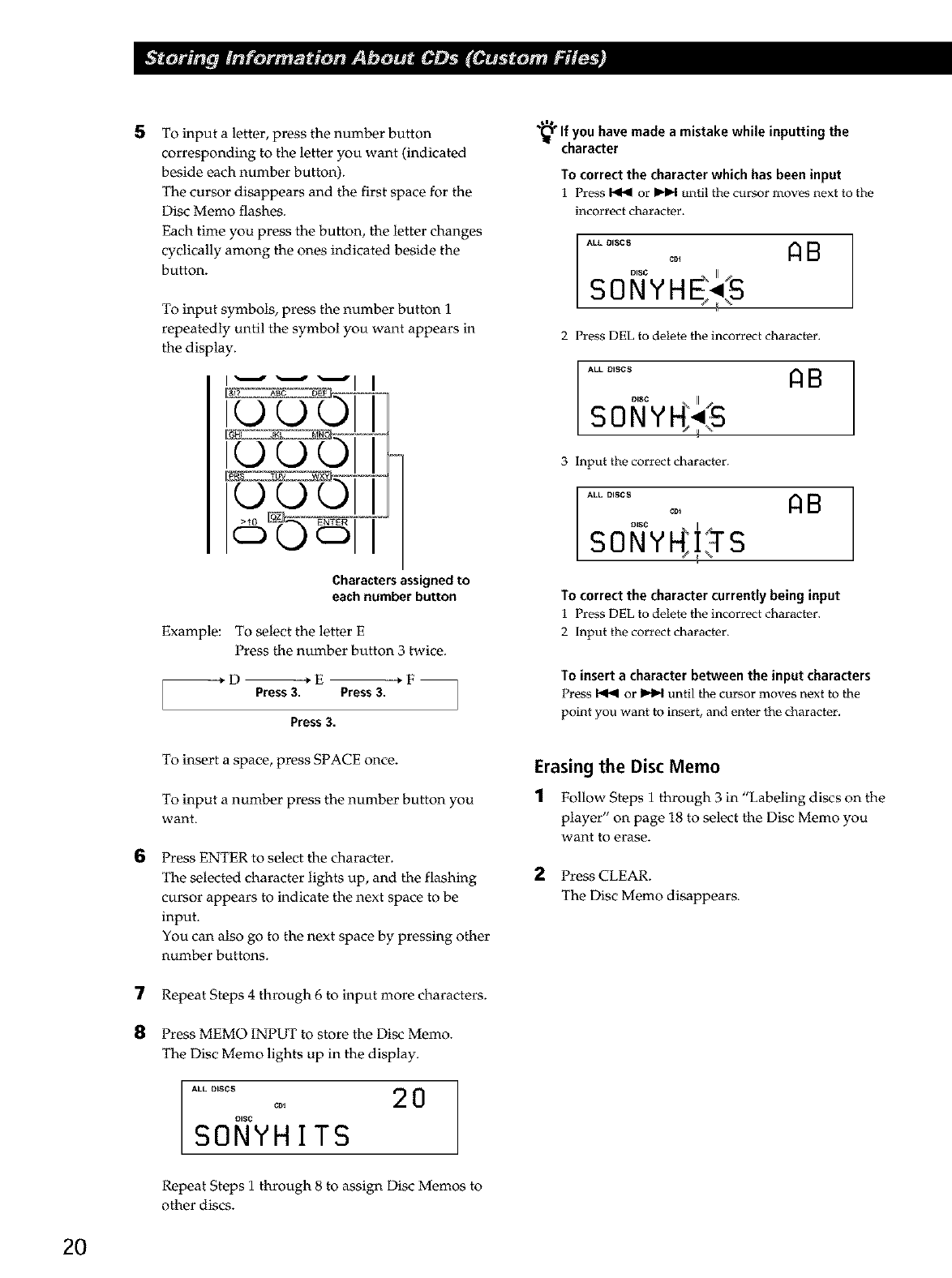
5
6
7
8
To input a letter, press the number button
corresponding to the letter you want (indicated
beside each number button).
The cursor disappears and the first space for the
Disc Memo flashes.
Each time you press the button, the letter changes
cyclically among the ones indicated beside the
button.
To input symbols, press the number button 1
repeatedly until the symbol you want appears in
the display.
Characters assigned to
each number button
Example: To select the letter E
Press the number button 3 twice.
_D_E *F
Press3. Press3. |
/
Press3.
To insert a space, press SPACE once.
To input a number press the number button you
want.
Press ENTER to select the character.
The selected character lights up, and the flashing
cursor appears to indicate the next space to be
input.
You can also go to the next space by pressing other
number buttons.
Repeat Steps 4 through 6 to input more characters.
Press MEMO INPUT to store the Disc Memo.
The Disc Memo lights up in the display.
ALLO_SCS CD* 20
OISC
SONYHITS
Repeat Steps i through 8 to assign Disc Memos to
other discs.
*_¢lf have made mistake while the
inputtingyou a
character
To correct the character which has been input
1 Press _ or _ until the cursor moves next to the
incorrect character.
ALLD_SeS liB
CDI
DISC II d,
SONYHE S
2 Press DEL to delete the incorrect character.
ALL DISCS
o=sc _ II _c
SONYH. S
3 Input the correct character.
ALL DISCS
SONYH,! S
liB
liB
To correct the character currently being input
1 Press DEL to delete the incorrect character.
2 Input the correct character.
To insert a character between the input characters
Press _ or _ until the cursor moves next to the
point you want to insert, and enter the character.
Erasing the Disc Memo
1Follow Steps 1through 3 in "Labeling discs on the
player" on page 18 to select the Disc Memo you
want to erase.
2Press CLEAR.
The Disc Memo disappears.
20
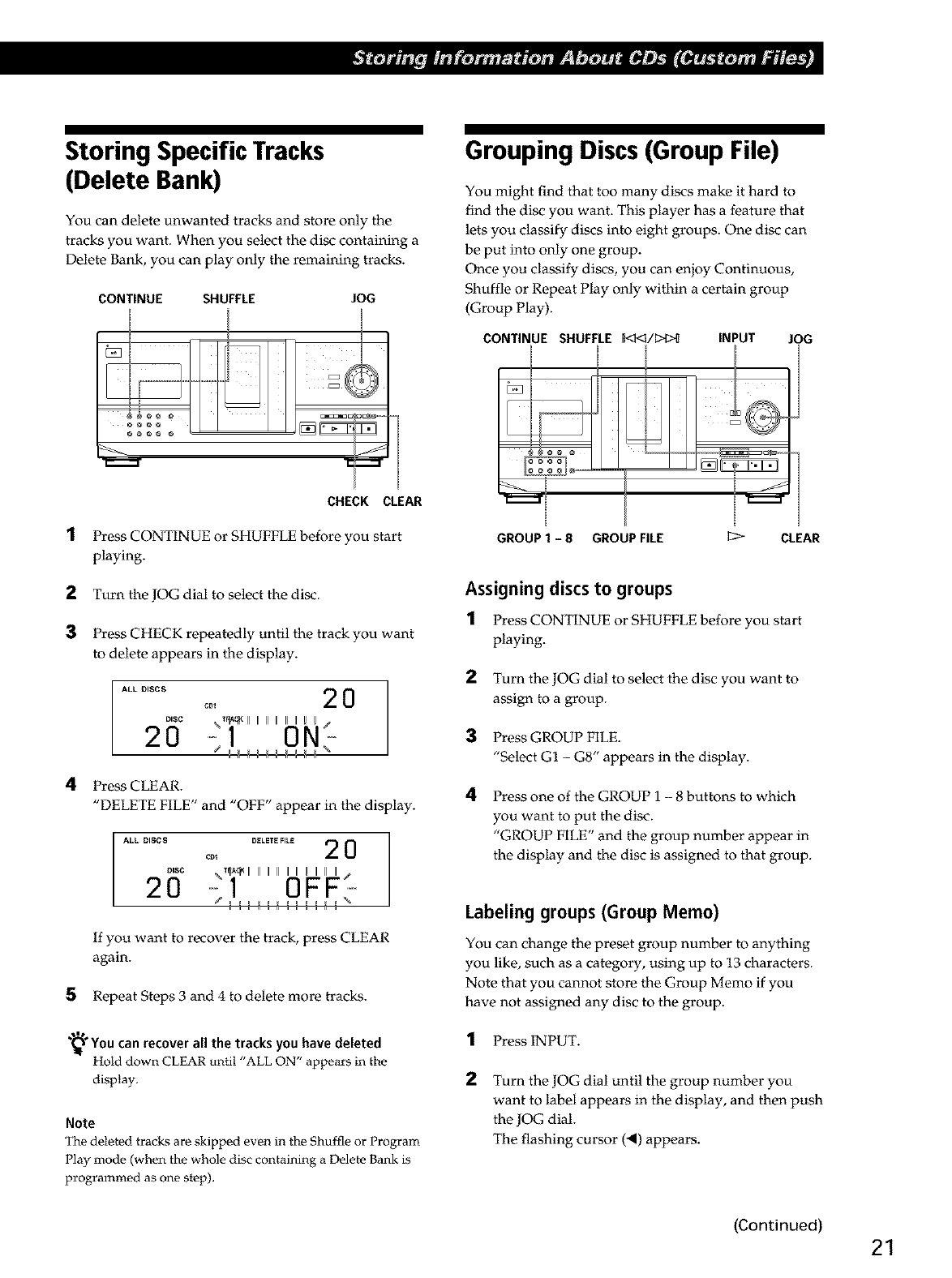
Storing Specific Tracks
(Delete Bank)
You can delete unwanted tracks and store only the
tracks you want. When you select the disc containing a
Delete Bank, you can play only the remaining tracks.
CONTINUE JOG
oo@@
SHUFFLE
j_
CHECK ;LEAR
1Press CONTINUE or SHUFFLE before you start
playing.
2Turn the JOG dial to select the disc.
3Press CHECK repeatedly until the track you want
to delete appears in the display.
4Press CLEAR.
"DELETE FILE" and "OFF" appear in the display.
ALL DISCS DELETE FIL_
OISC
2O
2O
If you want to recover the track, press CLEAR
again.
5 Repeat Steps 3 and 4 to delete more tracks.
*_You all the tracks have deleted
canrecover you
Hold down CLEAR until "ALL ON" appears in the
display.
Note
The deleted tracks are skipped even in the Shuffle or Program
Play mode (when the whole disc containing a Delete Bank is
programmed as one stPp).
Grouping Discs (Group File)
You might find that too many discs make it hard to
find the disc you want. This player has a feature that
lets you classify discs into eight groups. One disc can
be put into only one group.
Once you classify discs, you can enjoy Continuous,
Shuffle or Repeat Play only within a certain group
(Group Play).
CONTINUE SHUFFLEF_/_>_>_
T
GROUP1 - 8 GROUPFILE
INPUT JOG
LEAR
Assigning discsto groups
1Press CONTINUE or SHUFFLE before you start
playing.
2Turn the JOG dial to select the disc you want to
assign to a group.
3Press GROUP FILE.
"Select G1 - G8" appears in the display.
4Press one of the GROUP 1 - 8 buttons to which
you want to put the disc.
"GROUP FILE" and the group number appear in
the display and the disc is assigned to that group.
Labeling groups (Group Memo)
You can change the preset group number to anything
you like, such as a category, using up to 13 characters.
Note that you cannot store the Group Memo if you
have not assigned any disc to the group.
1Press INPUT.
2Turn the JOG dial until the group number you
want to label appears in the display, and then push
the JOG dial.
The flashing cursor (.4) appears.
(Continued) 21
22
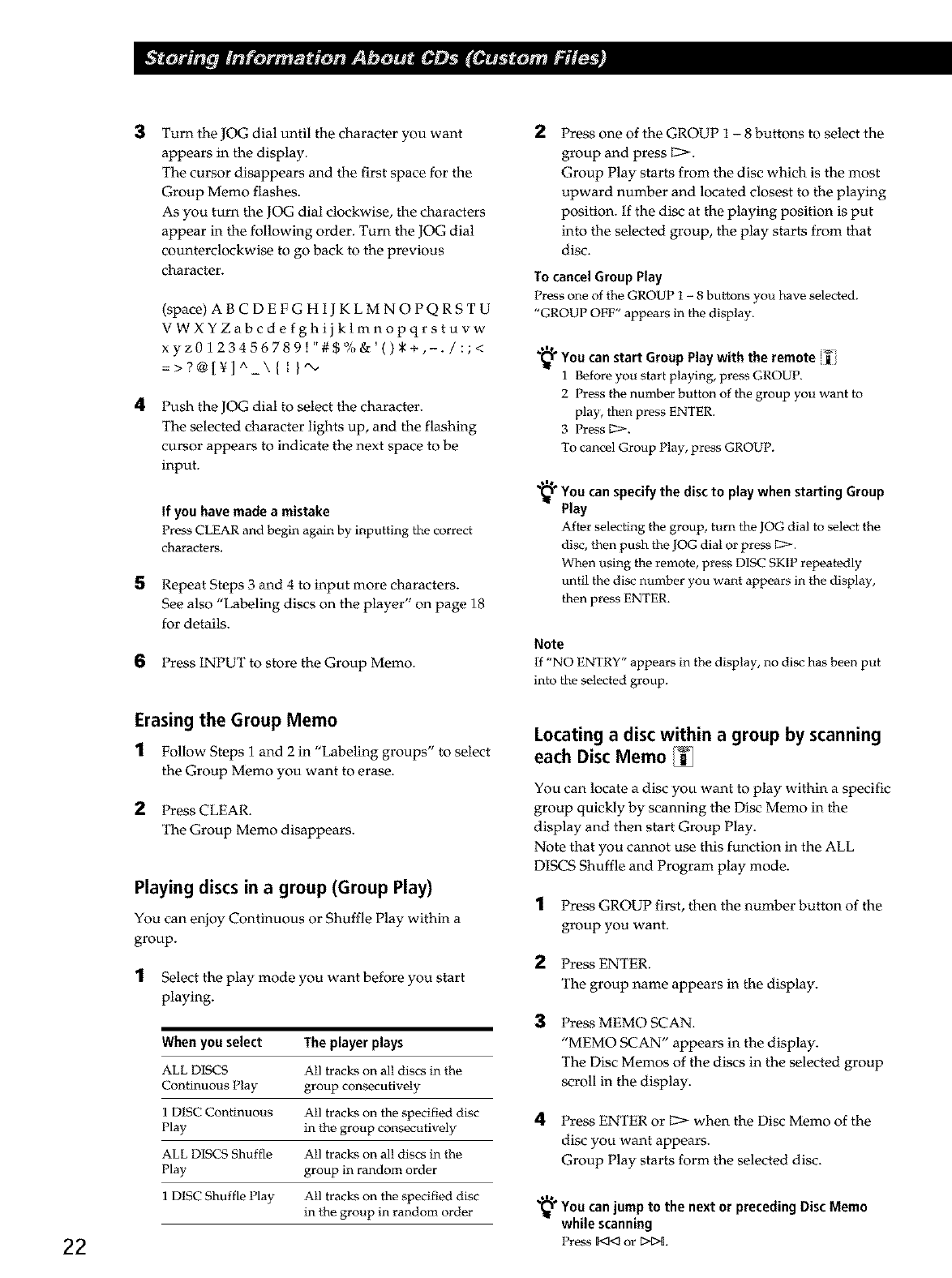
3
4
5
Turn the JOG dial until the character you want
appears in the display.
The cursor disappears and the first space for the
Group Memo flashes.
As you turn the JOG dial clockwise, the characters
appear in the following order. Turn the JOG dial
counterclockwise to go back to the previous
character.
(space) A B C D E FG H IJ KL M NOPQRST U
VWXYZabcde fghijklmnopqrstuvw
xyz0123456789!"#$%&'():_+,-. /:;<
=>?@[¥]A \{ I }_X_
Push the JOG dial to select the character.
The selected character lights up, and the flashing
cursor appears to indicate the next space to be
input.
If you have made amistake
Press CLEAR and begin again by inputting the correct
characters.
Repeat Steps 3 and 4 to input more characters.
See also "Labeling discs on the player" on page 18
for details.
6 Press INPUT to store the Group Memo.
Erasing the Group Memo
1Follow Steps 1 and 2 in "Labeling groups" to select
the Group Memo you want to erase.
2Press CLEAR.
The Group Memo disappears.
Playing discs in a group (Group Play)
You can enjoy Continuous or Shuffle Play within a
group.
1Select the play mode you want before you start
playing.
When you select The player plays
ALL DISCS All tracks on all discs in the
Continuous Play group consecutively
1 DISC Continuous All tracks on the specified disc
Play in the group consecutively
ALL DISCS Shuffle All tracks on all discs in the
Play group in random order
1 DISC Shuffle Play All tracks on the specified disc
in the group in random order
2Press one of the GROUP 1 - 8 buttons to select the
group and press I::>.
Group Play starts from the disc which is the most
upward number and located closest to the playing
position. If the disc at the playing position is put
into the selected group, the play starts from that
disc.
To cancel Group Play
Press one of the GROUP 1 - 8 buttons you have selectod.
"GROUP OFF" appears in the display.
_'_You start Play with the remote
Group
can
1 Before you start playing, press GROUP.
2 Press the number button of the group you want to
play, then press ENTER.
3 Press g:::_.
To cancel Group Play, press GROUP.
_" You canspecify to play starting Group
the disc when
Play
After selecting the group, turn the JOG dial to select the
disc, then push the JOG dial or press g:::_.
When using the remote, press DISC SKIP repeatedly
until the disc number you want appears in the display,
then press ENTER.
Note
If "NO ENTRY" appears in the display, no disc has been put
into the selected group.
Locating a disc within a group by scanning
each Disc Memo
You can locate a disc you want to play within a specific
group quickly by scanning the Disc Memo in the
display and then start Group Play.
Note that you cannot use this function in the ALL
DISCS Shuffle and Program play mode.
1Press GROUP first, then the number button of the
group you want.
2Press ENTER.
The group name appears in the display.
3Press MEMO SCAN.
"MEMO SCAN" appears in the display.
The Disc Memos of the discs in the selected group
scroll in the display.
4Press ENTER or I_ when the Disc Memo of the
disc you want appears.
Group Play starts form the selected disc.
_You canjump to next or preceding
the DiscMemo
while scanning
Press _<I<3or DI>_.
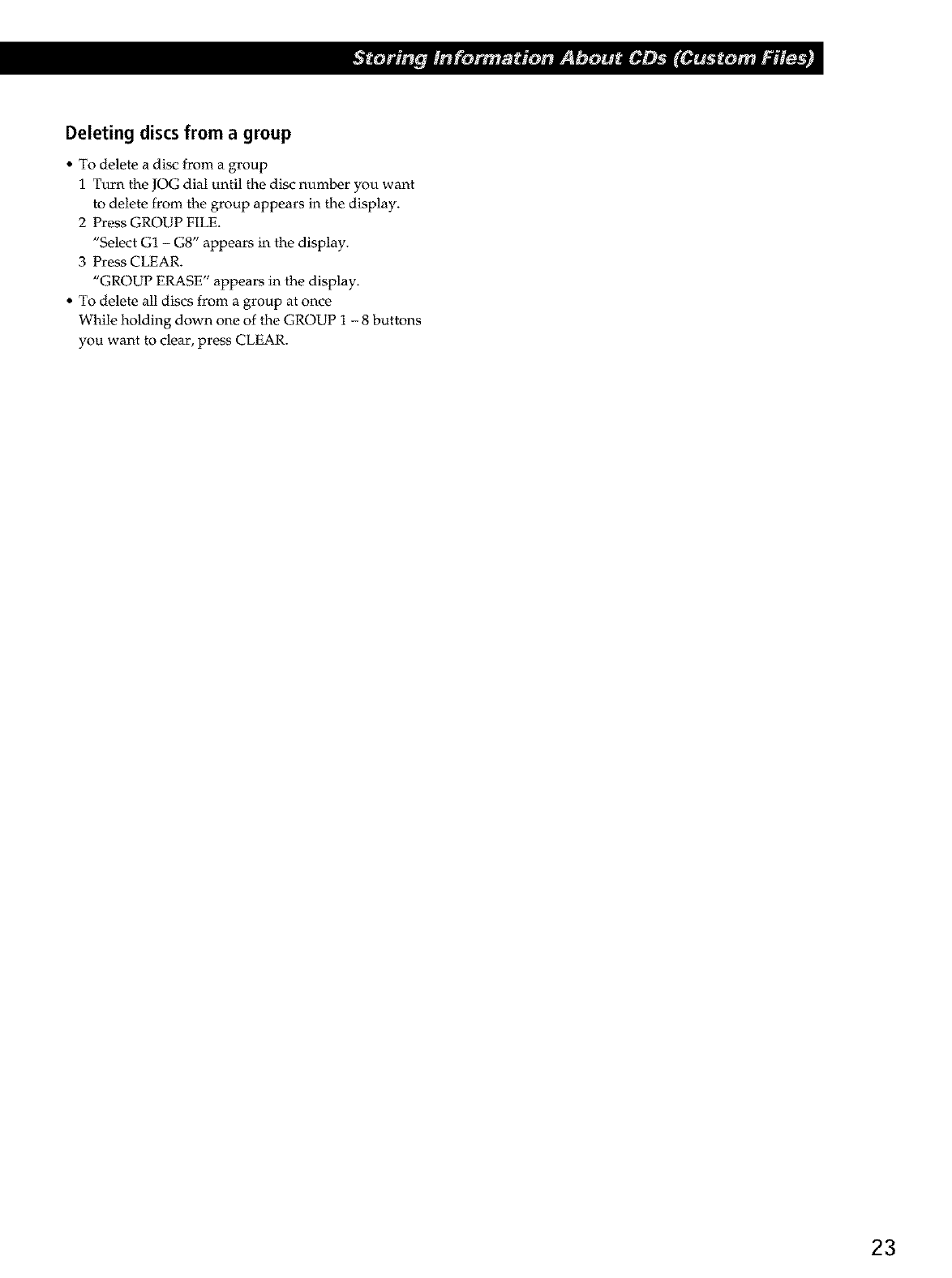
Deleting discsfrom a group
• To delete a disc from a group
1 Turn the JOG dial until the disc number you want
to delete from the group appears in the display.
2 Press GROUP FILE.
"Select G1 - G8" appears in the display.
3 Press CLEAR.
"GROUP ERASE" appears in the display.
• To delete all discs from a group at once
While holding down one of the GROUP 1 - 8 buttons
you want to clear, press CLEAR.
23
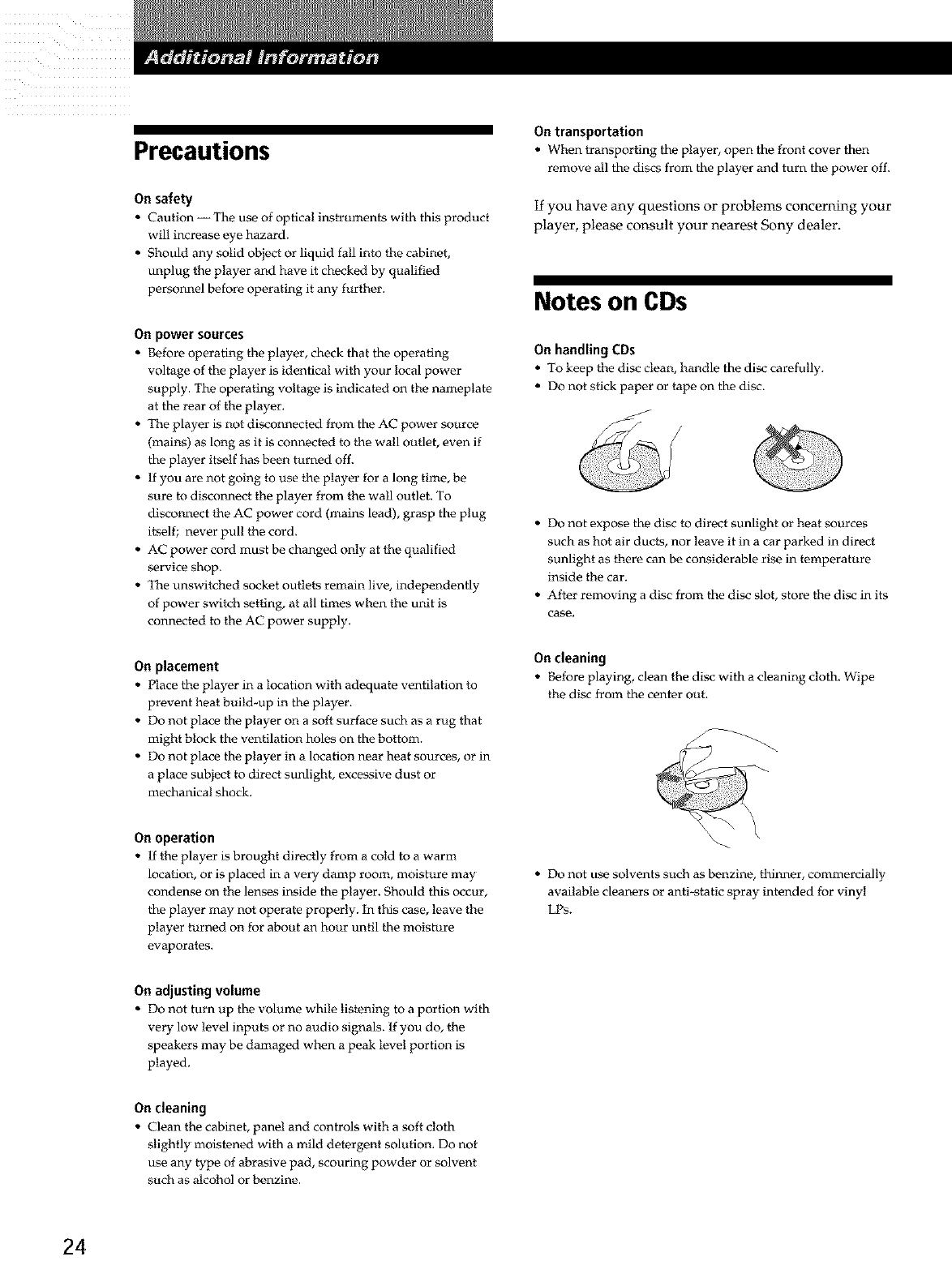
Precautions
On safety
•Caution-- The use of optical instruments with this product
will increase eye hazard.
• Should any _lid object or liquid fall into the cabinet,
unplug the player and have it checked by qualified
personnel before operating it any further.
On power sources
•Before operating the player, check that the operating
voltage of the player is identical with your local power
supply. The operating voltage is indicated on the nameplate
at the rear of the player.
• The player is not disconnected from the AC power source
(mains) as bng as it is connected to the wall outlet, oven ff
the player itself has been turned off.
• if you are not going to use the player for a long time, be
sure to discom_ect the player from the wall outlet. To
disconnect the AC power cord (mains lead), grasp the plug
itself; never pull the cord.
• AC power cord must be changed only at the qualified
service shop.
• The unswitched socket outlets remain live, independently
of power switch setting, at all times when the unit is
connected to the AC power supply.
On placement
•Place the player in a location with adequate ventilation to
prevent heat build-up in the player.
• Do not place the player on a _fft surface such as a rug that
might block the ventilation holes on the bottom.
• Do not place the player in a location near heat sources, or in
a place subject to direct sunlight, excessive dust or
mechanical shock.
On transportation
•When transporting the player, open the front cover then
remove all the discs from the player and turn the power off.
If you have any questions or problems concerning your
player, please consult your nearest Sony dealer.
Notes on CDs
On handling CDs
• To keep the disc clean, handle the disc carefully.
• Do not stick paper or tape on the disc.
• Do not expose the disc to direct sunlight or heat sources
such as hot air ducts, nor leave it in a car parked in direct
sunlight as there can be col_iderable rise in temperature
inside the car.
• After removing a disc from the disc slot, store the disc in its
case.
On cleaning
• Before playing, clean the disc with a cleaning cloth. Wipe
the disc from the center ouL
On operation
• if the player is brought directly from a cold to a warm
location, or is placed in a very clamp room, moisture may
condense on the lends inside the player. Should this occur,
the player may not operate properly. In this case, leave the
player turned on for about an hour until the moisture
evaporates.
On adjusting volume
• Do not turn up the volume while listening to a portion with
very low level inputs or no audio signals. If you do, the
speakers may be damaged when a peak level portion is
played.
On cleaning
• Clean the cabinet, panel and controls with a soft cloth
slightly moistened with a mild detergent solution. Do not
use any type of abrasive pad, scouring powder or solvent
such as alcohol or benzine.
• Do not use solvents such as benzine, thinner, commercially
available cleaners or anti-static spray intended for vinyl
LPs.
24
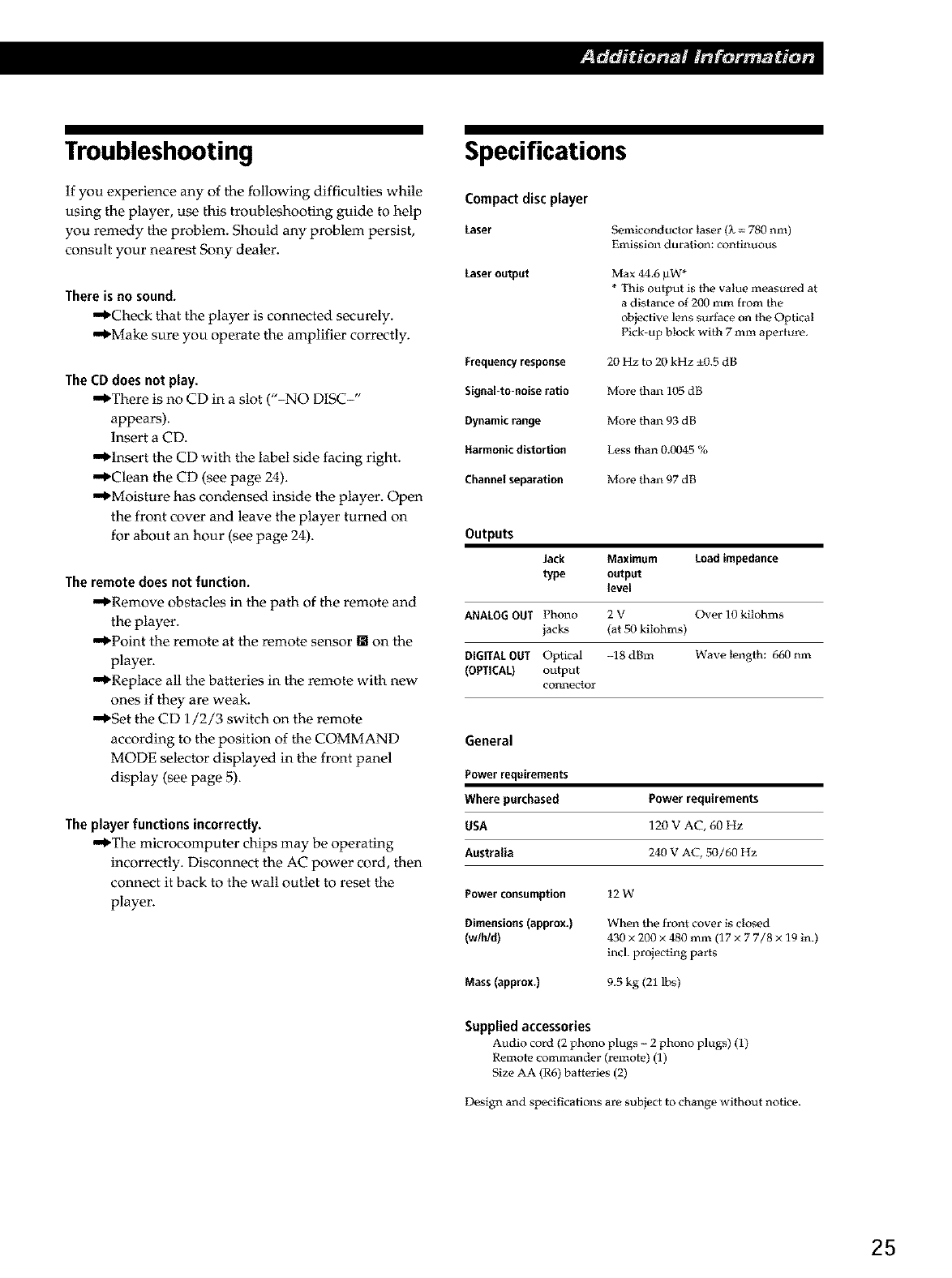
Troubleshooting
If you experience any of the following difficulties while
using the player, use this troubleshooting guide to help
you remedy the problem. Should any problem persist,
consult your nearest Sony dealer.
There is no sound.
,,,_Check that the player is connected securely.
,,,_Make sure you operate the amplifier correctly.
The CD does not play.
,,,_There is no CD in a slot ("-NO DISC-"
appears).
Insert a CD.
,,,_lnsert the CD with the label side facing right.
,,,_Clean the CD (see page 24).
,,,_Moisture has condensed inside the player. Open
the front cover and leave the player turned on
for about an hour (see page 24).
The remote does not function.
,,,_Remove obstacles in the path of the remote and
the player.
,,,_Point the remote at the remote sensor m on the
player.
,,,_Replace all the batteries in the remote with new
ones if they are weak.
"_Set the CD 1/2/3 switch on the remote
according to the position of the COMMAND
MODE selector displayed in the front panel
display (see page 5).
The player functions incorrectly.
,,,_The microcomputer chips may be operating
incorrectly. Disconnect the AC power cord, then
connect it back to the wall outlet to reset the
player.
Specifications
Compact discplayer
Laser Semiconductor laser (_. = 780 nm)
Emission duration: contil_uous
Laseroutput
Frequency response
Signal-to-noise ratio
Dynamic range
Harmonic distortion
Max 44.6 gW*
* This output is the value measured at
a distance of 200 mm from the
objective lens surface on the Optical
Pick-up block with 7 mm aperture.
20 Hz to 20 kHz ±0.5 dB
More than 105 dB
More than 93 dB
L_,ss than 0.0045 %
Channel separation More than 97 dB
Outputs
Jack Maximum
type output
level
Loadimpedance
ANALOG OUT Phono 2 V Over 10 kilohms
jacks (at 50kilohms)
DiGITAl. OUT Optical -18 dBm Wave length: 660 nm
(OPTICAL) output
coDnector
General
Power requirements
Wherepurchased Powerrequirements
USA 12t) V AC, 60 Hz
Australia 240 V AC, 50/60 Hz
Power consumption
Dimensions(approx.)
(wfhfd)
Mass (approx.)
12W
When the front cover is closed
430 x 200 x 480 mm (17 x 7 7/8 x 19 in.)
incl. projecth_g parts
9.5 kg (21 lbs)
Supplied accessories
Audio cord (2 phono plugs -- 2 phono plugs) (1)
Remote commander (remote) (1)
Size AA (R6) batteries (2)
Design and specifications are subject to change without notice.
25
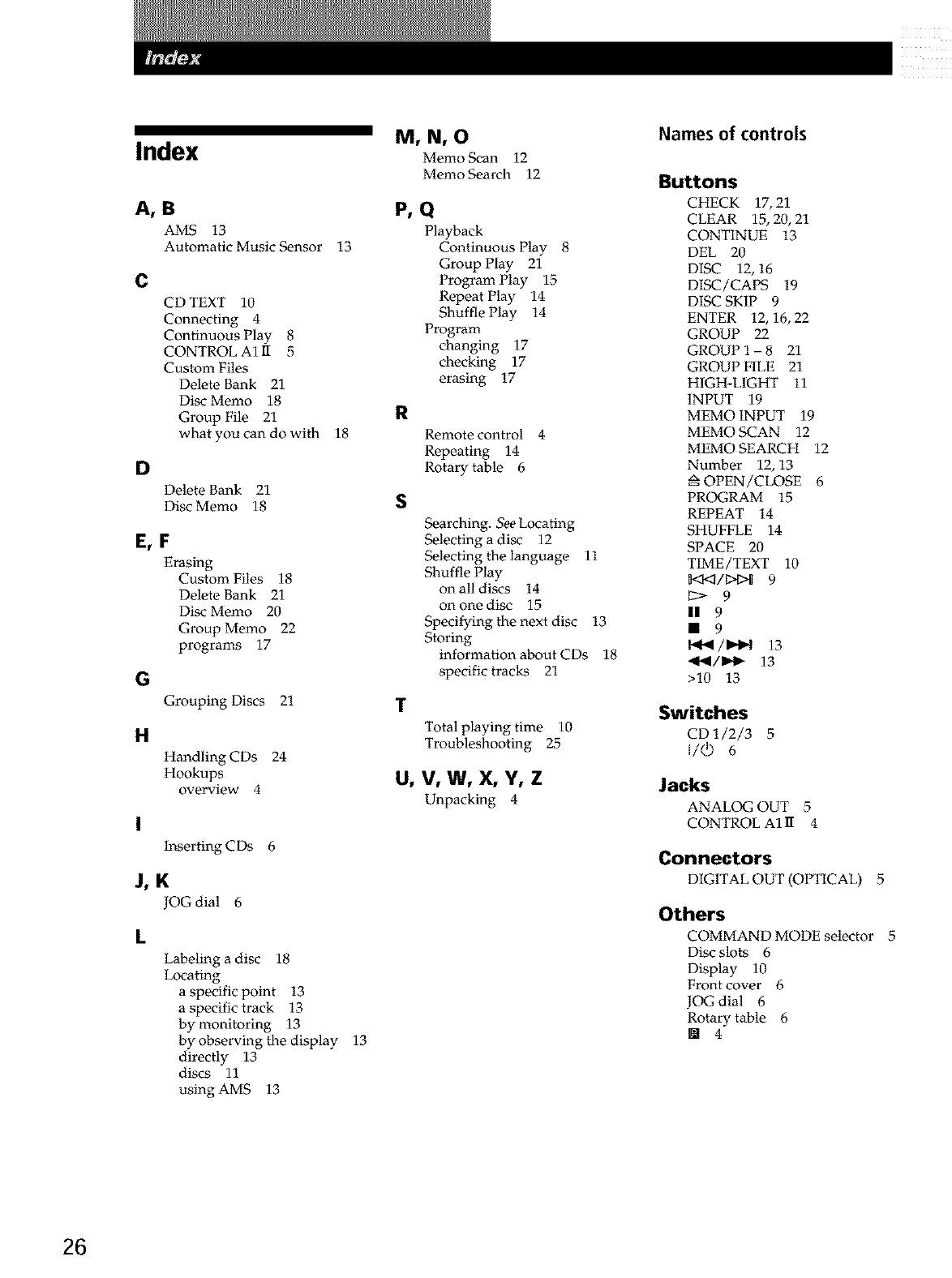
Index
A, B
AMS 13
Automatic Music Sensor 13
c
CD TEXT 10
Connecting 4
Continuous Play 8
CONTROL AllI 5
Custom Files
Delete Bank 21
Disc Memo 18
Group File 21
what you can do with 18
D
Delete Bank 21
Disc Memo 18
E, F
Erasing
Custom Files 18
Delete Bank 21
Disc Memo 20
Group Memo 22
programs 17
G
Grouping Discs 21
H
Handling CDs 24
Hookups
overview 4
I
Inserting CDs 6
J, K
JOG dial 6
L
Labeling a disc 18
Locating
a specific point 13
a specific track 13
by monitoring 13
by observing the display 13
directly 13
discs 11
using AMS 13
M, N, O
Memo Scan 12
Memo Search 12
P,Q
Playback
Continuous Play 8
Group Play 21
Program Play 15
Repeat Play 14
Shuffle Play 14
Program
changing 17
checking 17
erasing 17
R
Remote control 4
Repeating 14
Rotary table 6
s
Searching. See Locating
Selecting a disc 12
Selecting the language 11
Shuffle Play
on all discs 14
on one disc 15
Specifying the next disc 13
Storing
information about CDs 18
specific tracks 21
T
Total playing time 10
Troubleshooting 25
U, V, W, X, Y, Z
Unpacking 4
Names of controls
Buttons
CHECK 17, 21
CLEAR 15, 20, 21
CONTINUE 13
DEL 20
DISC 12, 16
DISC/CAPS 19
DISC SKIP 9
ENTER 12, 16, 22
GROUP 22
GROUP1-8 21
GROUP FILE 21
HIGH-LIGHT 11
INPUT 19
MEMO INPUT 19
MEMO SCAN 12
MEMO SEARCH 12
Number 12, 13
zx OPEN/CLOSE 6
PROGRAM 15
REPEAT 14
SHUFFLE 14
SPACE 20
TIME/TEXT 10
Da<a/Dg>D 9
12>- 9
|1 9
• 9
t,ql_ /I_1 13
_1_/IH_ 13
>10 13
Switches
CD 1/2/3 5
I/(_) 6
Jacks
ANALOG OUT 5
CONTROL AIE 4
Connectors
DIGITAL OUT (OPTICAL) 5
Others
COMMAND MODE selector 5
Disc slots 6
Display 10
Front cover 6
JOG dial 6
Rotary table 6
m 4
26

SonyOline http://www.world.sony.com/
Sony Corporation Printed in Malaysia
