Sony STR DE595 DE595/495 User Manual Operating Instructions STRDE595
User manual STRDE595 Sony STR-DE595 Hifi Receiver User Manuals and Instruction Guides
User Manual: Sony STR-DE595 Operating Instructions
Open the PDF directly: View PDF  .
.
Page Count: 48
STR-DE595/DE495 4-245-327-12(1) GB
FM Stereo
FM-AM Receiver
4-245-327-12(1)
STR-DE595
STR-DE495
Owner’s Record
The model and serial numbers are located at the rear of the unit. Record the serial
number in the space provided below. Refer to them whenever you call upon your Sony
dealer regarding this product.
Model No. Serial No.
© 2003 Sony Corporation
Operating Instructions
01GB01COVU.p65 8/2/03, 9:04 AM1
2GB
STR-DE595/DE495 4-245-327-12(1) GB
– Reorient or relocate the receiving antenna.
– Increase the separation between the equipment and
receiver.
– Connect the equipment into an outlet on a circuit
different from that to which the receiver is
connected.
– Consult the dealer or an experienced radio/TV
technician for help.
CAUTION
You are cautioned that any changes or modification
not expressly approved in this manual could void
your authority to operate this equipment.
Note to CATV system installer:
This reminder is provided to call CATV system
installer’s attention to Article 820-40 of the NEC that
provides guidelines for proper grounding and, in
particular, specifies that the cable ground shall be
connected to the grounding system of the building, as
close to the point of cable entry as practical.
For customers in Canada
CAUTION
TO PREVENT ELECTRIC SHOCK, DO NOT USE
THIS POLARIZED AC PLUG WITH AN
EXTENSION CORD, RECEPTACLE OR OTHER
OUTLET UNLESS THE BLADES CAN BE FULLY
INSERTED TO PREVENT BLADE EXPOSURE.
Except for customers in Europe
ENERGY STAR® is a U.S. registered
mark.
As an
E
NERGY
S
TAR
®
partner, Sony
Corporation has determined that this
product meets the
E
NERGY
S
TAR
®
guidelines for energy efficiency.
This receiver incorporates Dolby* Digital and Pro
Logic Surround and the DTS** Digital Surround
System.
* Manufactured under license from Dolby
Laboratories.
“Dolby”, “Pro Logic” and the double-D symbol are
trademarks of Dolby Laboratories.
** “DTS” and “DTS Digital Surround” are registered
trademarks of Digital Theater Systems, Inc.
WARNING
To prevent fire or shock hazard, do not
expose the unit to rain or moisture.
To prevent fire, do not cover the ventilation of the
apparatus with newspapers, table-cloths, curtains, etc.
And don’t place lighted candles on the apparatus.
To prevent fire or shock hazard, do not place objects
filled with liquids, such as vases, on the apparatus.
Don’t throw away the battery with
general house waste, dispose of it
correctly as chemical waste.
Do not install the appliance in a confined space, such
as a bookcase or built-in cabinet.
For customers in the United States
This symbol is intended to alert the
user to the presence of uninsulated
“dangerous voltage” within the
product’s enclosure that may be of
sufficient magnitude to constitute a
risk of electric shock to persons.
This symbol is intended to alert the
user to the presence of important
operating and maintenance (servicing)
instructions in the literature
accompanying the appliance.
WARNING
This equipment has been tested and found to comply
with the limits for a Class B digital device, pursuant
to Part 15 of the FCC Rules. These limits are
designed to provide reasonable protection against
harmful interference in a residential installation. This
equipment generates, uses, and can radiate radio
frequency energy and, if not installed and used in
accordance with the instructions, may cause harmful
interference to radio communications. However, there
is no guarantee that interference will not occur in a
particular installation. If this equipment does cause
harmful interference to radio or television reception,
which can be determined by turning the equipment
off and on, the user is encouraged to try to correct the
interference by one or more of the following
measures:
01GB02TOCU.p65 12/12/02, 10:32 AM2
3GB
STR-DE595/DE495 4-245-327-12(1) GB
Table of Contents
1) STR-DE595 only.
2) Models of area code CEL, CEK only.
List of Button Locations and
Reference Pages
Main unit ............................................... 5
Hooking Up the Components
Required cords ....................................... 6
Antenna hookups ................................... 7
Audio component hookups .................... 8
Video component hookups .................... 9
Digital component hookups ................. 10
Multi channel input hookups1) ............. 11
Other hookups ..................................... 12
Hooking Up and Setting Up
the Speaker System
Speaker system hookups ..................... 13
Performing initial setup operations ..... 15
Multi channel surround setup .............. 15
Checking the connections .................... 20
Basic Operations
Selecting the component ..................... 21
Changing the display ........................... 22
Enjoying Surround Sound
Using only the front speakers
(2 Channel Stereo) ........................ 23
Enjoying higher fidelity sound ............ 23
Selecting a sound field ........................ 24
Understanding the multi channel
surround displays .......................... 26
Customizing sound fields .................... 27
Receiving Broadcasts
Storing FM stations automatically
(AUTOBETICAL)2) ...................... 29
Direct tuning ........................................ 29
Automatic tuning ................................. 30
Preset tuning ........................................ 30
Using the Radio Data
System (RDS)2) .............................. 32
Other Operations
Naming preset stations and program
sources ........................................... 34
Recording ............................................ 34
Using the Sleep Timer ......................... 35
Adjustments using the
SET UP menu ................................ 35
Changing the command mode of the
receiver .......................................... 36
Operations Using the Remote
RM-U306A
Before you use your remote ................ 37
Remote button description ................... 37
Changing the factory setting of an
input selector button ...................... 40
Additional Information
Precautions .......................................... 41
Troubleshooting ................................... 41
Specifications ...................................... 44
Tables of settings using the
MAIN MENU button .................... 47
Adjustable parameters for each
sound field ......................... back page
01GB02TOCU.p65 12/12/02, 10:32 AM3
4GB
STR-DE595/DE495 4-245-327-12(1) GB
About This Manual
The instructions in this manual are for models
STR-DE595 and STR-DE495. Check your model
number by looking at the lower right corner of the
front panel. In this manual, the STR-DE595 is used
for illustration purposes unless stated otherwise. Any
difference in operation is clearly indicated in the text,
for example, “STR-DE595 only”.
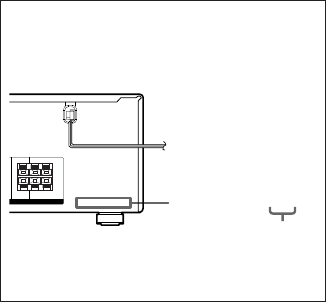
About area codes
The area code of the receiver you purchased is
shown on the lower portion of the rear panel (see
the illustration below).
Any differences in operation, according to the
area code, are clearly indicated in the text, for
example, “Models of area code AA only”.
Tip
The instructions in this manual describe the controls
on the receiver. You can also use the controls on the
supplied remote if they have the same or similar
names as those on the receiver. For details on the use
of your remote, see pages 37–40.
4-XXX-XXX-XX AA
C
E USE 8-16Ω
CENTER SURROUND
R
R
L
L
+
–
+
–
Area code
Note for the supplied remote
For RM-U306A
(STR-DE495 only) The MULTI CH button on
the remote is not available.
01GB02TOCU.p65 12/12/02, 10:32 AM4
List of Button Locations and Reference Pages
5GB
STR-DE595/DE495 4-245-327-12(1) GB
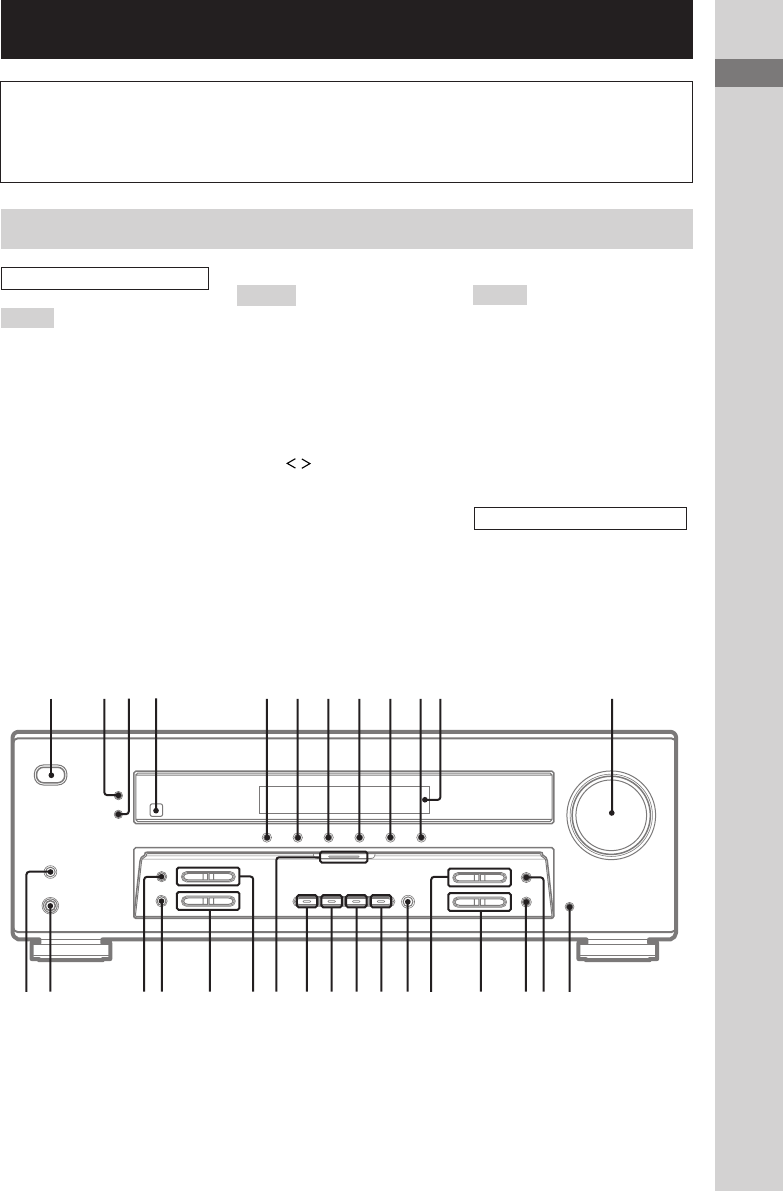
g
?/1
1234 56789q
;
q
a
q
s
qdqfqgqhqjqkqlw;wawswdwfwgwhwjwkwl
List of Button Locations and Reference Pages
Main unit
How to use this page
Use this page to find the location of buttons
that are mentioned in the text.
Illustration number
r
DISPLAY 2 (22, 32, 43)
R R
Name of button/part Reference page
ALPHABETICAL ORDER
A – L
A.F.D. (button/indicator) wa
(23–25)
CD (STR-DE495 only) 9 (21)
CD/SACD (STR-DE595 only) 9
(21)
DIMMER 3 (22)
DISPLAY 2 (22, 32, 43)
Display qa (22)
DVD 7 (21)
ENTER qg (34, 36)
FM MODE wh (30)
INPUT MODE qd (21)
IR (receptor) 4 (37, 43)
M – O
MAIN MENU qf (16, 27, 28, 34,
35, 47)
MASTER VOLUME qs (20, 21,
41)
MD/TAPE 8 (21)
MEMORY wj (29, 31)
MENU +/– qh (16, 27, 28, 34, 35,
47)
MENU / qj (16, 27, 28, 34, 35,
47)
MOVIE (button/indicator) w; (24,
42)
MULTI CHANNEL DECODING
(indicator) (STR-DE595 only) wd
(21)
MULTI CH IN (STR-DE595 only)
qk (21)
MUSIC (button/indicator) ql
(24, 25, 42)
P – Z
PHONES (jack) wk (22, 26, 42)
PRESET TUNING +/– wf (31, 46)
SPEAKERS (OFF/A/B/A+B)
(STR-DE595 only) wl (13, 22,
41)
TUNER FM/AM q; (21, 30, 31,
34)
TUNING +/– wg (30)
VIDEO 1 5 (21)
VIDEO 2 6 (21)
NUMBERS AND SYMBOLS
2CH (button/indicator) ws (23, 25,
28)
?/1 (power) 1 (15, 20, 28, 29, 36,
46)
01GB02TOCU.p65 12/12/02, 10:32 AM5
6GB
STR-DE595/DE495 4-245-327-12(1) GB
Required cords
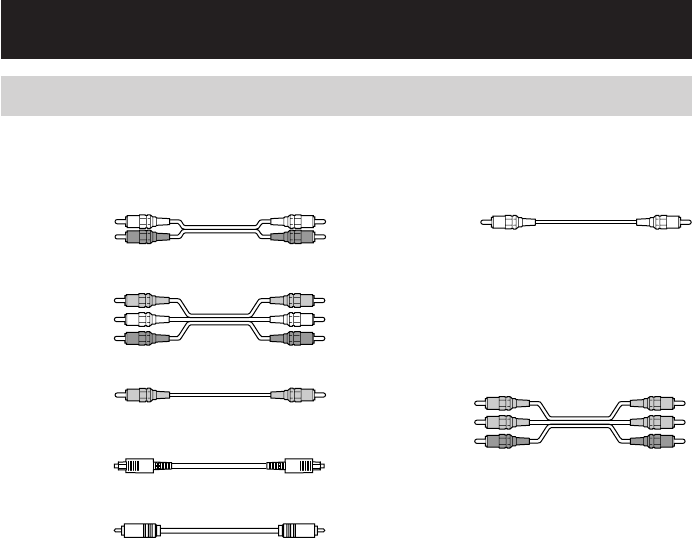
The following optional connection cords A – G are required when you hook up the components
(pages 8–11).
Hooking Up the Components
Before you get started
•Turn off the power to all components before making any connections.
•Do not connect the AC power cord until all of the connections are completed.
•Be sure to make connections firmly to avoid hum and noise.
•When connecting an audio/video cord, be sure to match the color-coded pins to the appropriate jacks on
the components: yellow (video) to yellow; white (left, audio) to white; and red (right, audio) to red.
•When you connect optical digital cords, insert the cord plugs straight in until they click into place.
•Do not bend or tie the optical digital cord.
AAudio cord (not supplied)
White (L)
Red (R)
BAudio/video cord (not supplied)
Yellow (video)
White (L/audio)
Red (R/audio)
CVideo cord (not supplied)
Yellow
DOptical digital cord (not supplied)
ECoaxial digital cord (not supplied)
FMonaural audio cord (not supplied)
Black
Tip
Audio cord A can be torn into two monaural audio
cords F.
GComponent video cord (not supplied)
(STR-DE595 only, except for models of area
code CEL, CEK)
Green
Blue
Red
01GB03HUPU.p65 12/12/02, 10:32 AM6
Hooking Up the Components
7GB
STR-DE595/DE495 4-245-327-12(1) GB
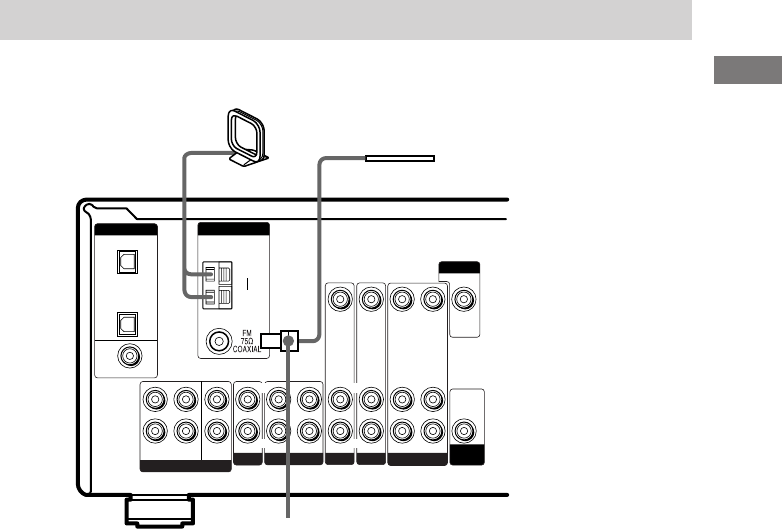
Antenna hookups
FM wire antenna
(supplied)
AM loop antenna
(supplied)
Notes on antenna hookups
•To prevent noise pickup, keep the AM loop
antenna away from the receiver and other
components.
•Be sure to fully extend the FM wire antenna.
•After connecting the FM wire antenna, keep it
as horizontal as possible.
L
R
L
R
L
R
L
R
L
R
y
AM
DIGITAL ANTENNA
MONITOR
SUB
WOOFER
VIDEO 1
VIDEO 2
DVDMD/TAPE
CD
/
SACD
MULTI CH IN
OPTICAL
VIDEO 2
IN
CD/
SACD
IN
DVD IN
COAXIAL
FRONT SURROUND
SUB
WOOFER
CENTER
IN OUT IN
AUDIO IN AUDIO IN
AUDIO OUT
AUDIO IN
VIDEO IN VIDEO IN VIDEO OUT VIDEO IN VIDEO OUT
AUDIO
OUT
* The shape of the connector varies depending on the area code.
*
01GB03HUPU.p65 12/12/02, 10:32 AM7
8GB
STR-DE595/DE495 4-245-327-12(1) GB
LINE
L
R
OUTPUT
A
INOUT
LINE
L
R
LINE
INPUT OUTPUT
ç
ç
AA
L
R
L
R
L
R
L
R
L
R
y
AM
DIGITAL ANTENNA
MONITOR
SUB
WOOFER
VIDEO 1
VIDEO 2
DVDMD/TAPE
CD
/
SACD
MULTI CH IN
OPTICAL
VIDEO 2
IN
CD/
SACD
IN
DVD IN
COAXIAL
FRONT SURROUND
SUB
WOOFER
CENTER
IN OUT IN
AUDIO IN AUDIO IN
AUDIO OUT
AUDIO IN
VIDEO IN VIDEO IN VIDEO OUT VIDEO IN VIDEO OUT
AUDIO
OUT
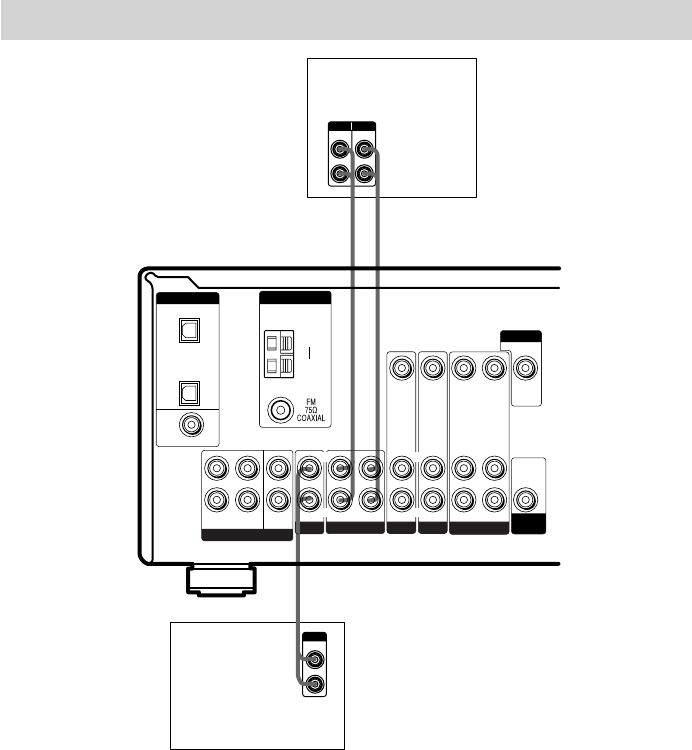
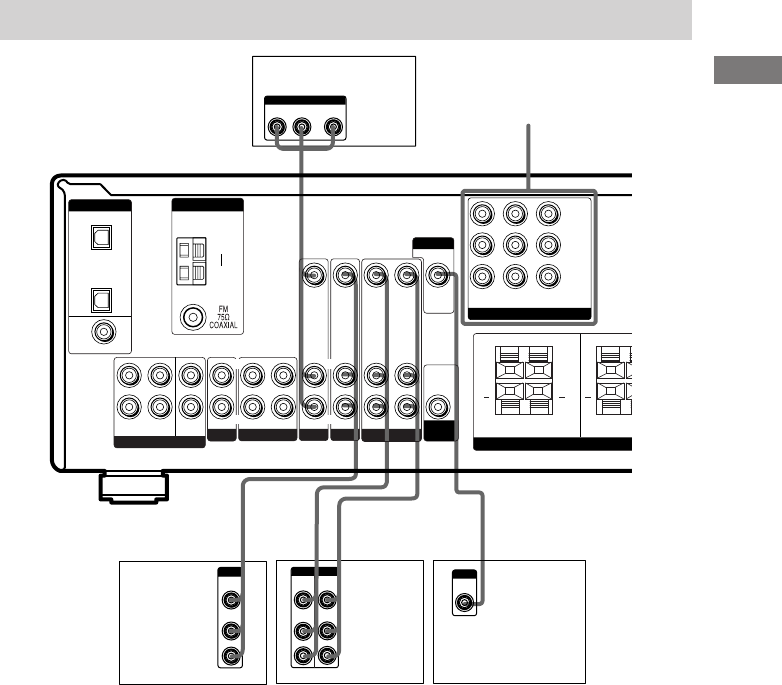
Audio component hookups
MD/Tape deck
CD or Super Audio
CD* player
* STR-DE595 only.
01GB03HUPU.p65 12/12/02, 10:32 AM8
Hooking Up the Components
9GB
STR-DE595/DE495 4-245-327-12(1) GB
VIDEO
IN
INPUT
C
IN
VIDEO
OUT
R
AUDIO
OUT
OUTPUT
L
Ç
B
VIDEO
OUT
R
AUDIO
OUT
VIDEO
IN
AUDIO
IN
OUTPUTINPUT
L
INOUT
Ç
Ç
BB
AUDIO OUT VIDEO
OUT
L
R
OUTPUT
B G
L
R
L
R
L
R
L
R
L
R
Y
P
B
/B—Y
P
R
/R—Y
I
M
y
AM
DIGITAL ANTENNA
MONITOR
COMPONENT VIDEO
SPEAKERS
SUB
WOOFER
VIDEO 1
VIDEO 2
DVDMD/TAPE
CD
/
SACD
MULTI CH IN
OPTICAL
VIDEO 2
IN
CD/
SACD
IN
DVD IN
COAXIAL
FRONT SURROUND
SUB
WOOFER
CENTER
IN OUT IN
AUDIO IN AUDIO IN
AUDIO OUT
AUDIO IN
VIDEO IN VIDEO IN VIDEO OUT VIDEO IN VIDEO OUT
AUDIO
OUT
FRONT B FRON
T
DVD IN VIDEO 2
IN
MONITOR
OUT
R
R
L
L
R
R
+ + +
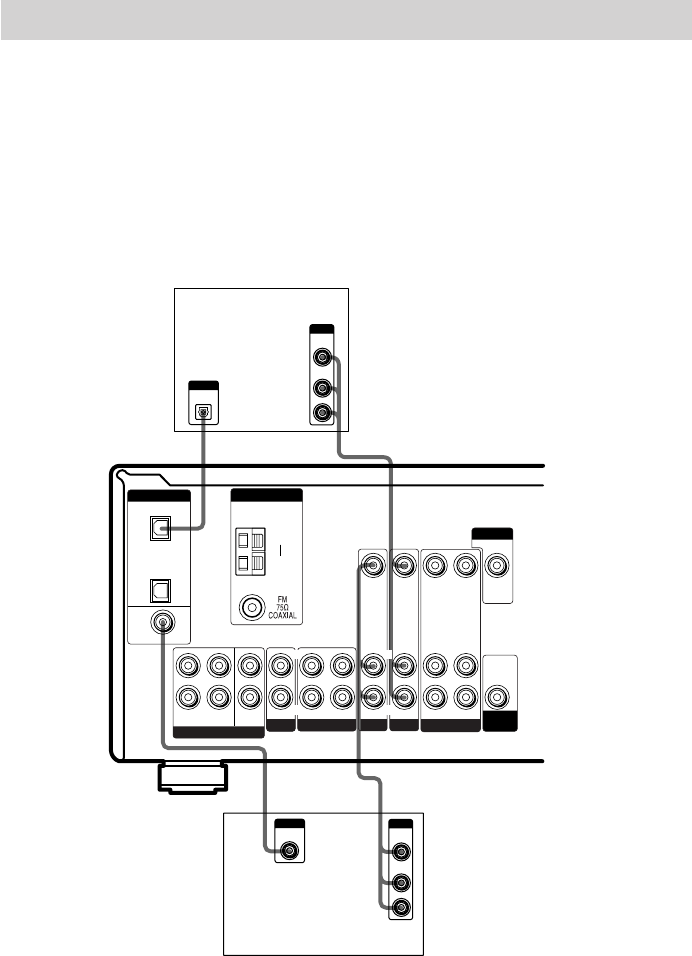
Video component hookups
TV monitor
DVD player
Note on video component
hookups
You can connect your TV’s audio output jacks
to the VIDEO 2 AUDIO IN jacks on the
receiver and apply sound effects to the audio
from the TV. In this case, do not connect the
TV’s video output jack to the VIDEO 2
VIDEO IN jack on the receiver. If you are
connecting a separate satellite tuner, connect
both the audio and video output jacks to the
receiver as shown above.
Satellite
tuner or
VCR VCR
* STR-DE595 only, except for models of area code CEL, CEK.
STR-DE595 only, except for models
of area code CEL, CEK
If you have a DVD player, TV or satellite tuner
with COMPONENT VIDEO (Y, B–Y, R–Y)
output jacks and a monitor with COMPONENT
VIDEO input jacks, use a component video
cord (not supplied) to connect to the receiver.
COMPONENT VIDEO*
01GB03HUPU.p65 12/12/02, 10:32 AM9
10GB
STR-DE595/DE495 4-245-327-12(1) GB
VIDEO
OUT
R
AUDIO
OUT
OUTPUT
L
DIGITAL
OPTICAL
OUTPUT
BD
DIGITAL
COAXIAL
OUTPUT
VIDEO
OUT
R
AUDIO
OUT
OUTPUT
L
EB
L
R
L
R
L
R
L
R
L
R
y
AM
DIGITAL ANTENNA
MONITOR
SUB
WOOFER
VIDEO 1
VIDEO 2
DVDMD/TAPE
CD
/
SACD
MULTI CH IN
OPTICAL
VIDEO 2
IN
CD/
SACD
IN
DVD IN
COAXIAL
FRONT SURROUND
SUB
WOOFER
CENTER
IN OUT IN
AUDIO IN AUDIO IN
AUDIO OUT
AUDIO IN
VIDEO IN VIDEO IN VIDEO OUT VIDEO IN VIDEO OUT
AUDIO
OUT
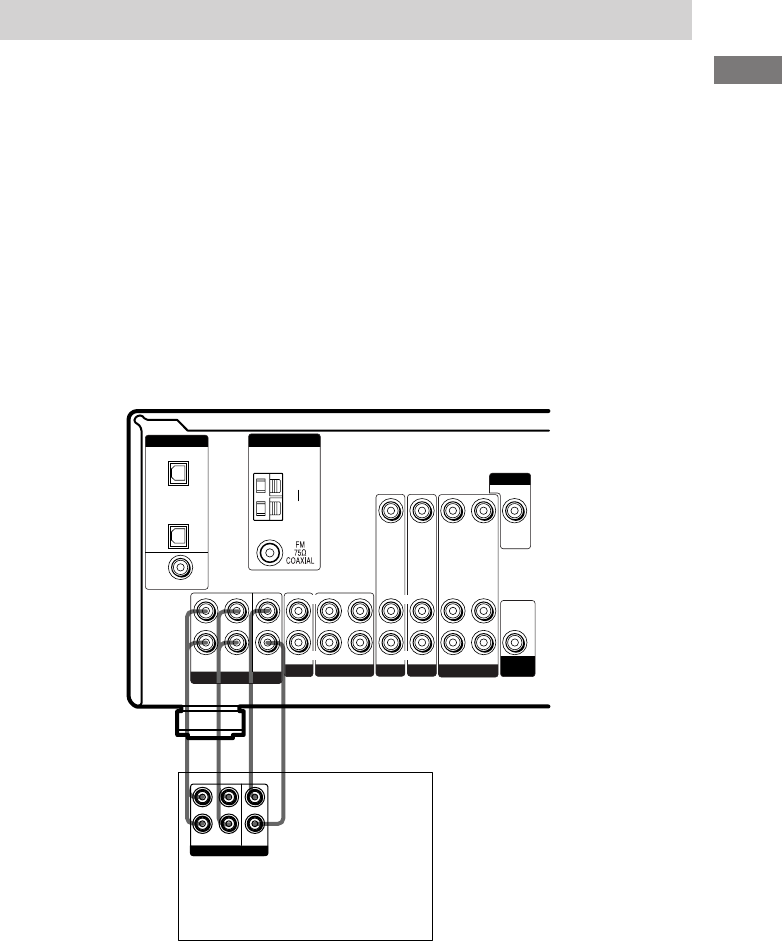
Digital component hookups
DVD player (etc.)*
Connect the digital output jacks of your DVD player and satellite tuner (etc.) to the receiver’s digital
input jacks to bring the multi channel surround sound of a movie theater into your home. To fully
enjoy multi channel surround sound, five speakers (two front speakers, two surround speakers, and a
center speaker) and a sub woofer are required.
Notes
•All the OPTICAL and COAXIAL jacks are compatible with 96 kHz, 48 kHz, 44.1 kHz and 32 kHz sampling
frequencies.
•(STR-DE595 only) The sound is not output when you play a Super Audio CD on the Super Audio CD player
connected to the CD/SACD OPTICAL IN jack on this unit. Connect to the analog input jacks (CD/SACD IN
jacks). Refer to the operating instructions supplied with the Super Audio CD player.
Satellite tuner or
DVD player*
* Make either coaxial or optical connections. We recommend making coaxial connections instead of optical
connections.
01GB04HUPU.p65 12/12/02, 10:32 AM10
Hooking Up the Components
11GB
STR-DE595/DE495 4-245-327-12(1) GB
AFAF
L
R
FRONT
SURROUND
SUB
WOOFER
MULTI CH OUT
CENTER
L
R
L
R
L
R
L
R
L
R
y
AM
DIGITAL ANTENNA
MONITOR
OPTICAL
VIDEO 2
IN
CD/
SACD
IN
DVD IN
COAXIAL
FRONT SURROUND
SUB
WOOFER
CENTER
IN OUT IN
AUDIO IN AUDIO IN
AUDIO OUT
AUDIO IN
VIDEO IN VIDEO IN VIDEO OUT VIDEO IN VIDEO OUT
AUDIO
OUT
SUB
WOOFER
VIDEO 1
VIDEO 2
DVDMD/TAPE
CD
/
SACD
MULTI CH IN
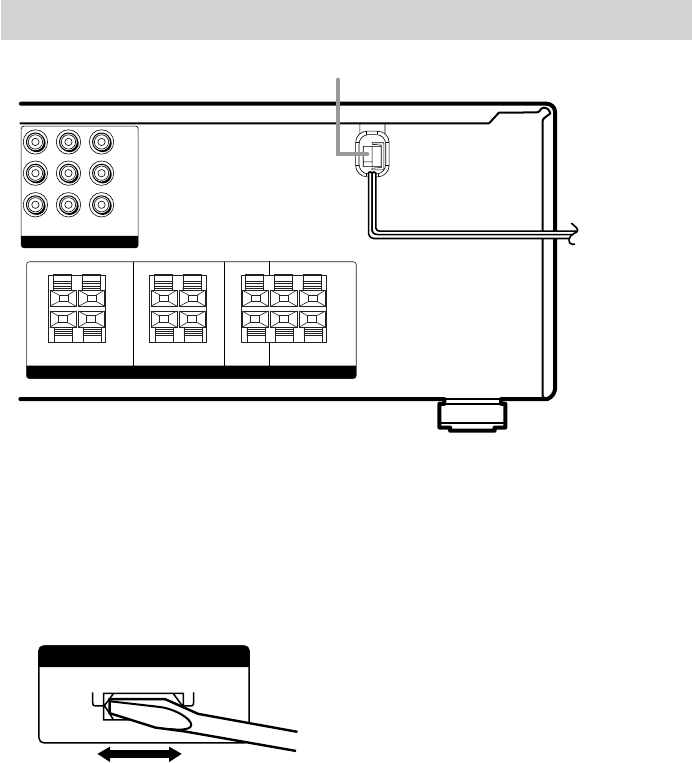
Multi channel input hookups
STR-DE595 only
Although this receiver incorporates a multi channel decoder, it is also equipped with multi channel
input jacks. These connections allow you to enjoy multi channel software encoded in formats other
than Dolby Digital and DTS. If your DVD player is equipped with multi channel output jacks, you
can connect them directly to the receiver to enjoy the sound of the DVD player’s multi channel
decoder. Alternatively, the multi channel input jacks can be used to connect an external multi channel
decoder.
To fully enjoy multi channel surround sound, five speakers (two front speakers, two surround
speakers, and a center speaker) and a sub woofer are required. Refer to the operating instructions
supplied with your DVD player, multi channel decoder, etc., for details on the multi channel
hookups.
Notes
•When using the connections described below, adjust the level of the surround speakers and sub woofer from the
DVD player or multi channel decoder.
•See page 13 for details on speaker system hookup.
DVD player,
Multichannel decoder, etc.
01GB04HUPU.p65 12/12/02, 10:32 AM11
12GB
STR-DE595/DE495 4-245-327-12(1) GB
Connecting the AC power
cord
Before connecting the AC power cord of this
receiver to a wall outlet, connect the speaker
system to the receiver (page 13).
Connect the AC power cord(s) of your audio/
video components to a wall outlet.
Other hookups
Setting the voltage selector
If your receiver has a voltage selector on the
rear panel, check that the voltage selector is set
to the local power supply voltage. If not, use a
screwdriver to set the selector to the correct
position before connecting the AC power cord
to a wall outlet.
120V 220V 240V
VOLTAGE SELECTORVOLTAGE SELECTOR
Y
PB/B–Y
PR/R–Y
IMPEDANCE USE 8-16Ω
COMPONENT VIDEO
SPEAKERS
FRONT B FRONT A CENTER SURROUND
DVD IN VIDEO 2
IN
MONITOR
OUT
R
R
L
L
R
R
L
L
R
R
L
L
+
–
+
–
+
–
+
–
+
–
+
–
b
AC power cord
To a wall outlet
01GB04HUPU.p65 12/12/02, 10:32 AM12
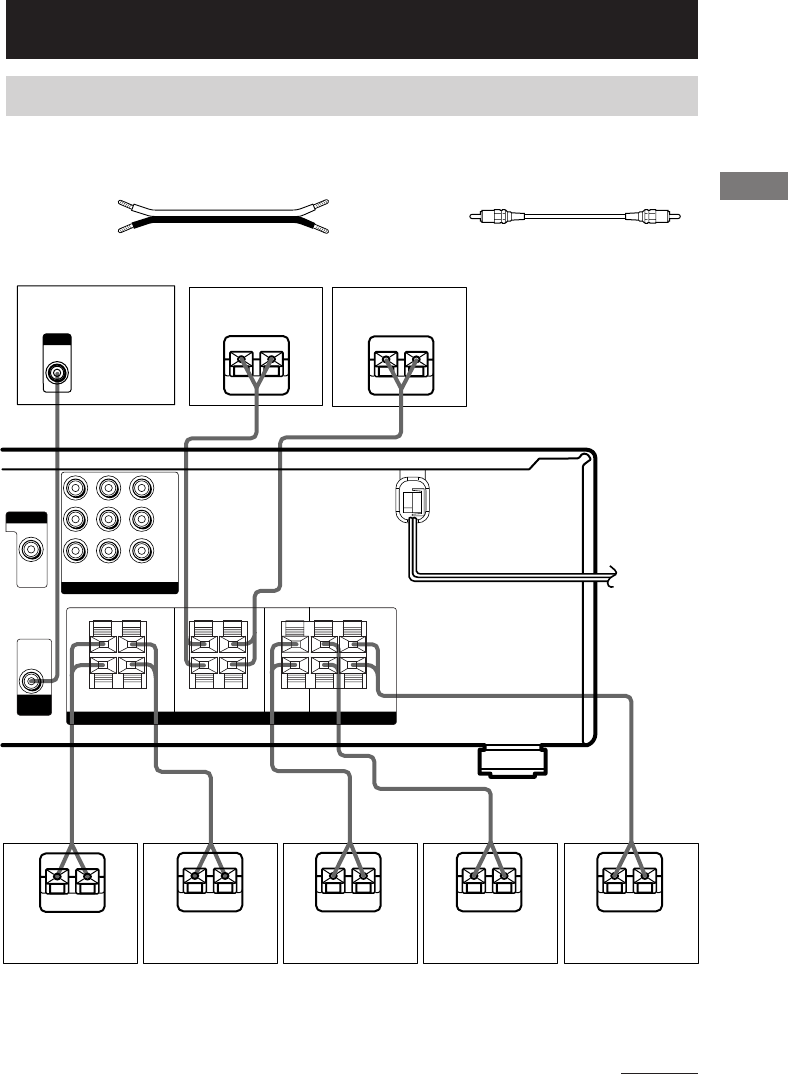
Hooking Up and Setting Up the Speaker System
13GB
STR-DE595/DE495 4-245-327-12(1) GB
BMonaural audio cord (not supplied)
Black
Speaker system hookups
Required cords
ASpeaker cords (not supplied)
(+)
(–)
E
eEe
AA
INPUT
AUDIO
IN
B
E
e
E
e
E
e
AAA
E
e
A
E
e
A
Y
PB/B–Y
PR/R–Y
IMPEDANCE USE 8-16Ω
COMPONENT VIDEO
SPEAKERS
SUB
WOOFER
AUDIO
OUT
FRONT B FRONT A CENTER SURROUND
DVD IN VIDEO 2
IN
MONITOR
VIDEO OUT
MONITOR
OUT
R
R
L
L
R
R
L
L
R
R
L
L
+
–
+
–
+
–
+
–
+
–
+
–
Hooking Up and Setting Up the Speaker System
Front speaker A
(L)
Front speaker A
(R)
Center speaker
Surround speaker
(L)
Surround speaker
(R)
Active sub woofer
continued
Front speaker B*
(L)
Front speaker B*
(R)
* (STR-DE595 only) If you have an additional front speaker system, connect them to the SPEAKERS FRONT B
terminals. You can select the front speakers you want to use with the SPEAKERS (OFF/A/B/A+B) button (page
22).
01GB05HUPU.p65 12/12/02, 10:32 AM13
14GB
STR-DE595/DE495 4-245-327-12(1) GB
Notes
•Twist the stripped ends of the speaker cords about
10 mm (2/3 inch). Be sure to match the speaker
cord to the appropriate terminal on the components:
+ to + and – to –. If the cords are reversed, the
sound will be distorted and will lack bass.
•If you use speakers with low maximum input rating,
adjust the volume carefully to avoid excessive
output on the speakers.
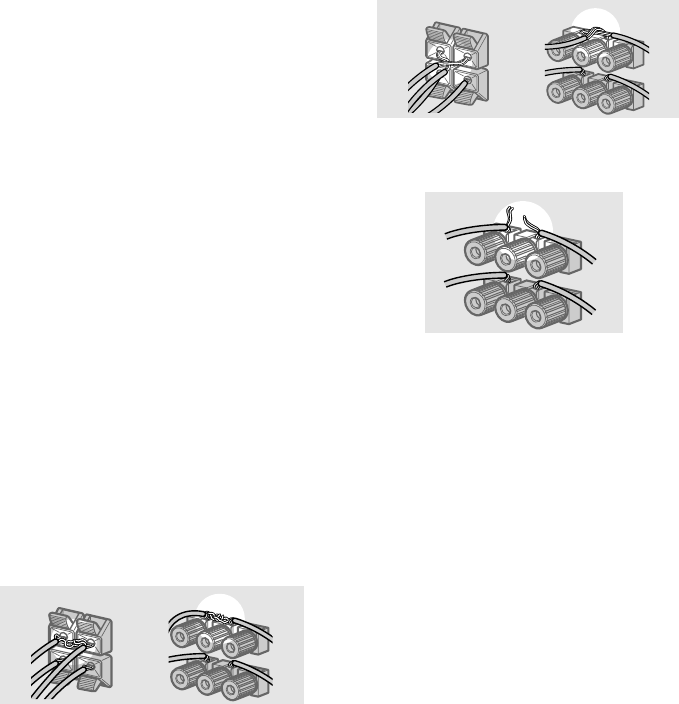
To avoid short-circuiting the
speakers
Short-circuiting of the speakers may damage
the receiver. To prevent this, make sure to take
the following precautions when connecting the
speakers.
Make sure the stripped ends of each
speaker cord does not touch another
speaker terminal, the stripped end of
another speaker cord, or the metal parts of
the receiver.
Examples of poor conditions of the
speaker cord
Stripped speaker cord is touching another
speaker terminal.
Speaker system hookup (continued)
Stripped cords are touching each other
due to excessive removal of insulation.
Stripped cords are not fully attached and
are touching the rear panel of the receiver.
After connecting all the components,
speakers, and AC power cord, output
a test tone to check that all the
speakers are connected correctly.
For details on outputting a test tone,
see page 20.
If no sound is heard from a speaker while
outputting a test tone or a test tone is output
from a speaker other than the one whose name
is currently displayed on the receiver, the
speaker may be short-circuited. If this happens,
check the speaker connection again.
To avoid damaging your
speakers
Make sure that you turn down the volume
before you turn off the receiver. When you turn
on the receiver, the volume remains at the level
you turn off the receiver.
01GB05HUPU.p65 12/12/02, 10:32 AM14
Hooking Up and Setting Up the Speaker System
15GB
STR-DE595/DE495 4-245-327-12(1) GB
45°
90°
20°
A A
B
CC
Performing initial setup
operations
Once you have hooked up the speakers and
turned on the power, clear the receiver’s
memory. Then specify the speaker parameters
(size, position, etc.) and perform any other
initial setup operations necessary for your
system.
Tip
To check the audio output during settings (to set up
while outputting the sound), check the connection
(page 20).
Clearing the receiver’s
memory
Before using your receiver for the first time, or
when you want to clear the receiver’s memory,
do the following.
1Turn off the receiver.
2Hold down ?/1 for 5 seconds.
“INITIAL” appears in the display.
The following are reset to their factory
settings.
•All settings in the SET UP, LEVEL and
TONE menus.
•The sound field memorized for each
function and preset station.
•All sound field parameters.
•All preset stations.
•All index names for input selectors and
preset stations.
•The master volume is set to
“VOL MIN”.
Performing initial setup
operations
Before using your receiver for the first time,
adjust SET UP parameters so that the receiver
correspond to your system. For the adjustable
parameters, see the table on page 47. See pages
15–20 for speaker settings and pages 35–36 for
other settings.
Multi channel surround
setup
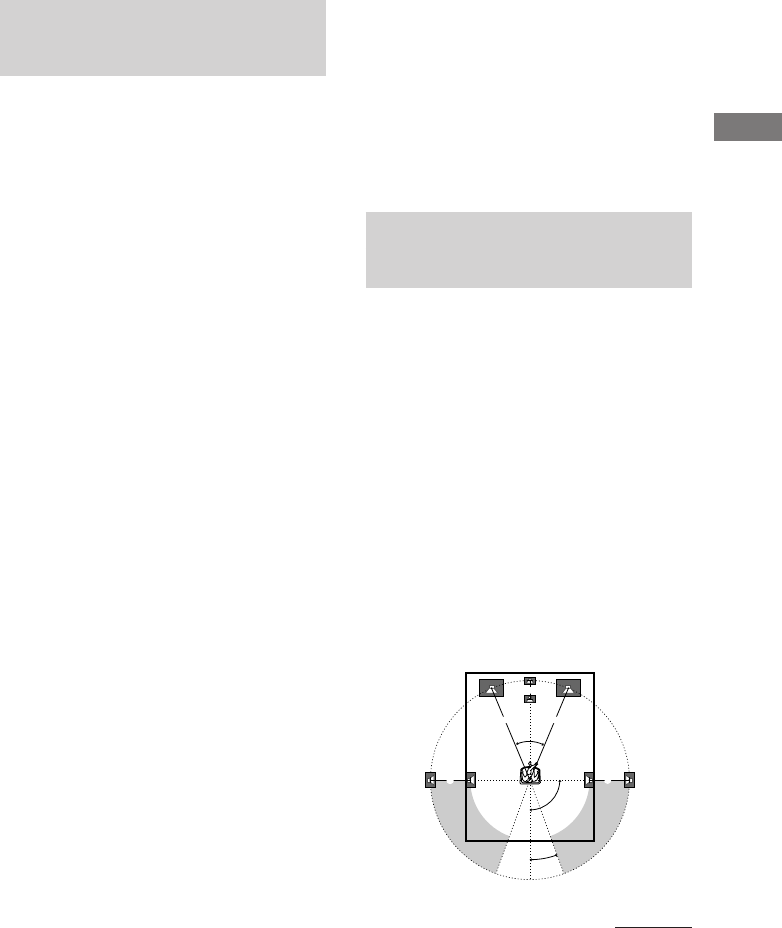
For the best possible surround sound, all
speakers should be the same distance from the
listening position (A).
However, the receiver lets you place the center
speaker up to 1.5 meters (5 feet) closer (B)
and the surround speakers up to 4.5 meters
(15 feet) closer (C) to the listening position.
The front speakers can be placed from 1.0 to
7.0 meters (3 to 23 feet) from the listening
position (A).
You can place the surround speakers either
behind you or to the side, depending on the
shape of your room (etc.). However, we
recommend that you place the surround
speakers behind you.
When placing surround speakers to your side
(long room)
continued
01GB05HUPU.p65 12/12/02, 10:32 AM15
16GB
STR-DE595/DE495 4-245-327-12(1) GB
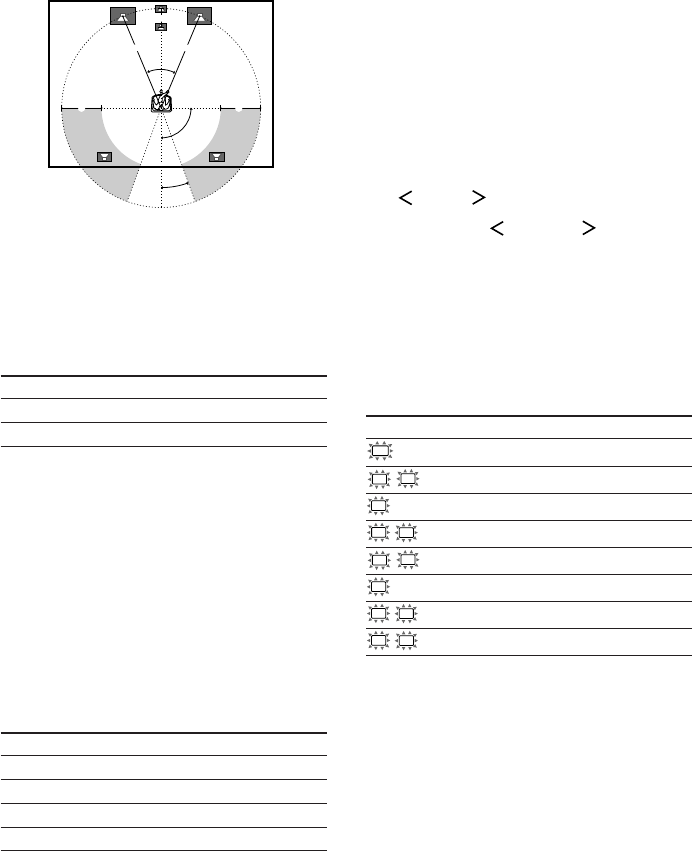
When placing surround speakers behind you
(wide room)
Note
Do not place the center speaker further away from the
listening position than the front speakers.
Normal Speaker and Micro
Satellite Speaker
If you are using Select
Normal Speakers NORM. SP.
Micro Satellite Speakers MICRO SP.
The speaker size and the sub woofer selection
has been preset to “NORM. SP.”. You can
adjust the speaker size and sub woofer
selection when you select “NORM. SP.” (page
17).
To select “MICRO SP.”, turn off the power,
then turn on again while pressing MAIN
MENU. (To reset to “NORM. SP.”, do the
same procedure.)
When you select “MICRO SP.”, the speaker
size and sub woofer selection has been
configurated as follows:
Speaker Settings
FRONT SMALL
CENTER SMALL
SURROUND SMALL
SUB WOOFER YES
You cannot change the configuration if you select
“MICRO SP.”.
Tip
The setting for Micro Satellite Speaker (MICRO SP.)
has been programmed to optimize the sound balance.
If you use Sony’s Micro Satellite Speakers, select
“MICRO SP.”.
Caution
When you use Micro Satellite Speakers and the
speaker size is set to “LARGE”, you may not obtain
the correct soundstage. The speaker may also be
damaged at high volume position.
Specifying the speaker
parameters
1Press MAIN MENU repeatedly to select
“SET UP ”.
2Press MENU or MENU to select
the parameter you want to adjust.
3Press MENU + or MENU – to select the
setting you want.
The setting is entered automatically.
4Repeat steps 2 and 3 until you have set
all of the parameters that follow.
Initial settings
Parameter Initial setting
SW
(SUB WOOFER) S.W. XXX YES*
L
R
(FRONT) XXXXX LARGE*
C
(CENTER) XXXXX LARGE*
SL
SR
(SURROUND) XXXXX LARGE*
L
R
DIST. X.X m (XX ft.)** 3.0 m (10 ft.)**
C
DIST. X.X m (XX ft.)** 3.0 m (10 ft.)**
SL
SR
DIST. X.X m (XX ft.)** 3.0 m (10 ft.)**
SL
SR
PL. XXXX LOW
* You can set this parameter only when you select
“NORM. SP.”.
** The default unit for models of area code U, CA is
“ft.”.
The default unit for models of other area code is
“m”.
Multi channel surround setup
(continued)
45°
90°
20°
A A
B
CC
01GB05HUPU.p65 12/12/02, 10:32 AM16
Hooking Up and Setting Up the Speaker System
17GB
STR-DE595/DE495 4-245-327-12(1) GB
xSub woofer selection (
SW
S.W. XXX)
•If you connect a sub woofer, select “YES”.
•If you do not connect a sub woofer, select
“NO”. This activates the bass redirection
circuitry and outputs the LFE signals from other
speakers.
•In order to take full advantage of the Dolby
Digital bass redirection circuitry, we
recommend that you set the cut off frequency
on the sub woofer as high as possible.
xFront speaker size (
L
R
XXXXX)
•If you connect large speakers that will
effectively reproduce bass frequencies, select
“LARGE”. Normally, select “LARGE”.
•If the sound is distorted, or you feel a lack of
surround effects when using multi channel
surround sound, select “SMALL” to activate
the bass redirection circuitry and output the
front channel bass frequencies from the sub
woofer.
•When the front speakers are set to “SMALL”,
the center and surround speakers are also
automatically set to “SMALL” (unless
previously set to “NO”).
•When the sub woofer is set to “NO”, the front
speakers are automatically set to “LARGE” and
you cannot change this setting.
xCenter speaker size (
C
XXXXX)
•If you connect a large speaker that will
effectively reproduce bass frequencies, select
“LARGE”. Normally, select “LARGE”.
However, if the front speakers are set to
“SMALL”, you cannot set the center speaker to
“LARGE”.
•If the sound is distorted, or you feel a lack of
surround effects when using multi channel
surround sound, select “SMALL” to activate
the bass redirection circuitry and output the
center channel bass frequencies from the front
speakers (if set to “LARGE”) or sub woofer.*1
•If you do not connect a center speaker, select
“NO”. The sound of the center channel will be
output from the front speakers.*2
continued
xSurround speaker size (
SL
SR
XXXXX)
•If you connect large speakers that will
effectively reproduce bass frequencies, select
“LARGE”. Normally, select “LARGE”.
However, if the front speakers are set to
“SMALL”, you cannot set the surround
speakers to “LARGE”.
•If the sound is distorted, or you feel a lack of
surround effects when using multi channel
surround sound, select “SMALL” to activate
the bass redirection circuitry and output the
surround channel bass frequencies from the sub
woofer or other “LARGE” speakers.
•If you do not connect surround speakers, select
“NO”.*3
Tip
*1–*3 correspond to the following Dolby Pro Logic
modes
*1 NORMAL
*2 PHANTOM
*3 3 STEREO
01GB05HUPU.p65 12/12/02, 10:32 AM17
18GB
STR-DE595/DE495 4-245-327-12(1) GB
Tip
The receiver allows you to input the speaker position
in terms of distance. However, it is not possible to set
the center speaker further than the front speakers.
Also, the center speaker cannot be set more than
1.5 meters (5 feet) closer than the front speakers.
Likewise, the surround speakers can not be set further
away from the listening position than the front
speakers. And they can be no more than 4.5 meters
(15 feet) closer.
This is because incorrect speaker placement is not
conducive to enjoy surround sound.
Please note that, setting the speaker distance closer
than the actual location of the speakers will cause a
delay in the output of the sound from that speaker. In
other words, the speaker will sound like it is further
away.
For example, setting the center speaker distance
1~2 m (3~6 feet) closer than the actual speaker
position will create a fairly realistic sensation of being
“inside” the screen. If you cannot obtain a satisfactory
surround effect because the surround speakers are too
close, setting the surround speaker distance closer
(shorter) than the actual distance will create a larger
sound stage.
Adjusting these parameter while listening to the
sound often results in much better surround sound.
Give it a try!
Tip
Internally, the LARGE and SMALL settings for each
speaker determine whether the internal sound
processor will cut the bass signal from that channel.
When the bass is cut from a channel, the bass
redirection circuitry sends the corresponding bass
frequencies to the sub woofer or other “LARGE”
speakers.
However, since bass sounds have a certain amount of
directionality, it is best not to cut them, if possible.
Therefore, even when using small speakers, you can
set them to “LARGE” if you want to output the bass
frequencies from that speaker. On the other hand, if
you are using a large speaker, but prefer not to have
bass frequencies output from that speaker, set it to
“SMALL”.
If the overall sound level is lower than you prefer, set
all speakers to “LARGE”. If there is not enough bass,
you can use the BASS parameter in the TONE menu
to boost the bass levels. To adjust the bass, see page
28.
xFront speaker distance (
L
R
DIST.
X.X m (XX ft.))
Set the distance from your listening position to
the front speakers (A on page 15).
xCenter speaker distance (
C
DIST. X.X
m (XX ft.))
Set the distance from your listening position to
the center speaker. Center speaker distance
should be set from a distance equal to the front
speaker distance (A on page 15) to a distance
1.5 meters (5 feet) closer to your listening
position (B on page 15).
xSurround speaker distance (
SL
SR
DIST. X.X m (XX ft.))
Set the distance from your listening position to
the surround speakers. Surround speaker
distance should be set from a distance equal to
the front speaker distance (A on page 15) to a
distance 4.5 meters (15 feet) closer to your
listening position (C on page 15).
Multi channel surround setup
(continued)
01GB05HUPU.p65 12/12/02, 10:32 AM18
Hooking Up and Setting Up the Speaker System
19GB
STR-DE595/DE495 4-245-327-12(1) GB
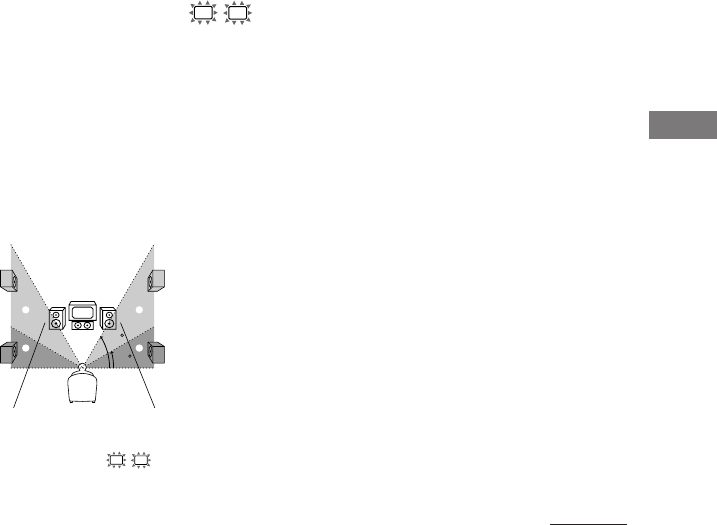
xSurround speaker placement (
SL
SR
PL. XXXX)*
This parameter lets you specify the height of
your surround speakers for proper
implementation of the Digital Cinema Sound
surround modes. Refer to the illustration below.
•Select “PL. LOW” if the location of your
surround speakers corresponds to section A.
•Select “PL. HIGH” if the location of your
surround speakers corresponds to section B.
* These parameters are not available when
“Surround speaker size (
SL
SR
)” is set to “NO”.
60
30
A
B
A
B
Tip
The surround speaker placement parameter is
designed specifically for implementation of the
Digital Cinema Sound modes with virtual elements.
With the Digital Cinema Sound modes, speaker
placement is not as critical as other modes. All modes
with virtual elements were designed under the
premise that the surround speaker would be located
behind the listening position, but presentation remains
fairly consistent even with the surround speakers
positioned at a rather wide angle. However, if the
speakers are pointing towards the listener from the
immediate left and right of the listening position, the
sound fields with virtual elements will not be as
effective.
Nevertheless, each listening environment has many
variables, like wall reflections.
Therefore, we recommend that you playback multi
channel surround encoded software and listen to the
effect each setting has on your listening environment.
Choose the setting that provides a good sense of
spaciousness and that best succeeds in forming a
cohesive space between the surround sound from the
surround speakers and the sound of the front
speakers. If you are not sure which sounds best, select
“PL. LOW” and then use the speaker distance
parameter and speaker level adjustments to obtain
proper balance.
continued
01GB05HUPU.p65 12/12/02, 10:32 AM19

20GB
STR-DE595/DE495 4-245-327-12(1) GB
Adjusting the speaker level
Use the remote while seated in your listening
position to adjust the level of each speaker.
Note
The receiver incorporates a new test tone with a
frequency centered at 800 Hz for easier speaker level
adjustment.
1Press ?/1 on the remote to turn on the
receiver.
2Press TEST TONE on the remote.
“T. TONE” appears in the display and you
will hear the test tone from each speaker in
sequence.
Front (left) t Center t Front (right) t
Surround (right) t Surround (left) t
Sub woofer
3Adjust the speaker level and balance
using the LEVEL menu so that the level
of the test tone sounds the same from
each speaker.
For details on the LEVEL menu, see page
27.
While adjusting, the test tone is output from
the speaker whose adjustment is performed.
4Press TEST TONE again to turn off the
test tone.
Tip
You can adjust the level of all speakers at the same
time. Press MASTER VOL +/– on the remote or turn
MASTER VOLUME on the receiver.
Notes
•(STR-DE595 only) The test tone cannot be output
when the receiver is set to MULTI CH IN.
•The adjusted value are shown in the display during
adjustment.
•Although these adjustments can also be made via
the front panel using the LEVEL menu (when the
test tone is output, the receiver switches to the
LEVEL menu automatically), we recommend you
follow the procedure described above and adjust the
speaker levels from your listening position using the
remote.
Checking the connections
After connecting all of your components to the
receiver, do the following to verify that the
connections were made correctly.
1Press ?/1 to turn on the receiver.
2Turn on the component that you
connected (e.g., CD player or tape
deck).
3Press the input selector button
(e.g., CD/SACD (STR-DE595 only) / CD
(STR-DE495 only) or MD/TAPE) to
select the component (program
source).
4Start playing.
If you do not obtain normal sound output after
performing this procedure, see
“Troubleshooting” on page 41 and take the
appropriate measures to correct the problem.
Multi channel surround setup
(continued)
01GB05HUPU.p65 12/12/02, 10:32 AM20
Basic Operations
21GB
STR-DE595/DE495 4-245-327-12(1) GB
Basic Operations
Selecting the component
Input Selector buttons
Press the input selector button to select the
component you want to use.
To select Press
VCR VIDEO 1 or VIDEO 2
Satellite tuner VIDEO 2
DVD player DVD
MD or Tape deck MD/TAPE
CD player CD (STR-DE495 only)
CD or Super Audio CD/SACD
CD player (STR-DE595 only)
Built in tuner TUNER FM/AM
After turning on the component you selected,
select the component and play the program
source.
•After selecting VCR or DVD player, turn on the
TV and set the TV’s video input to match the
component you selected.
INPUT MODE
Press INPUT MODE to select the input mode
for your digital components.
Each time you press the button, the input mode
of the currently selected component switches.
Select To
AUTO IN Give priority to digital
signals when there are both
digital and analog
connections. If there are no
digital signals, analog is
selected.
COAX IN Specify the digital audio
signals input to the
DIGITAL COAXIAL input
jacks.
Select To
OPT IN Specify the digital audio
signals input to the
DIGITAL OPTICAL input
jacks.
ANALOG Specify the analog audio
signals input to the AUDIO
IN (L/R) jacks.
Note
When the 96 kHz digital signal is input, the tone,
sound field and surround effects do not function.
MULTI CH IN
(STR-DE595 only)
Press MULTI CH IN to enjoy the audio source
connected to the MULTI CH IN jacks. You can
adjust balance and level of all the speakers. When
this function is on, the tone and surround effects
are turned off.
MULTI CHANNEL DECODING
indicator
(STR-DE595 only)
This indicator lights up when the unit is
decoding signals recorded in a multi channel
format.
MUTING
Press MUTING on the remote to mute the
sound. Press again to cancel the muting
function. The muting function is also canceled
when you turn the power on or turn the
MASTER VOLUME to turn the volume up.
continued
01GB06BSCU.p65 12/12/02, 10:33 AM21
22GB
STR-DE595/DE495 4-245-327-12(1) GB
PHONES
Use to connect headphones.
•When the headphones are connected, speaker
output is automatically canceled and “SP”
(STR-DE495 only) or “SP A” and “SP B”
(STR-DE595 only) do not light up in the
display.
SPEAKERS (OFF/A/B/A+B)
(STR-DE595 only)
Press SPEAKERS (OFF/A/B/A+B) to output
the sound from the speakers connected to the
SPEAKERS FRONT terminals.
Each time you press the button, the display will
light up cyclically as follows:
SP A t SP B t SP A and SP B t
No display*
To drive Select
Speaker System A SP A (default setting)
(Connected to the
SPEAKERS FRONT A
terminals)
Speaker System B SP B
(Connected to the
SPEAKERS FRONT B
terminals)
Both Speaker System SP A and SP B
A and B
(Connected to the
SPEAKERS FRONT A
and B terminals)
* If you do not want to drive Speaker System A and
B, press SPEAKERS (OFF/A/B/A+B) until “SP A”
and “SP B” do not light up in the display (no
display).
Changing the display
DIMMER
Press DIMMER repeatedly to adjust the
brightness of the display (3 steps).
However, when you press any button, the
display becomes the brightest setting
temporary.
DISPLAY
Each time you press DISPLAY, the display
changes cyclically as follows:
Index name of the component* t Selected
component t Sound field applied to the
program source
When the tuner is selected
Index name of the preset station* or program
station name** t Frequency t Program type
indication** t Radio text** t Current
time** t Sound field applied to the band or
the preset station
* Index name appears only when you have assigned
one to the component or preset station (page 34).
Index name does not appear when only blank
spaces have been entered, or it is the same as the
input selector.
** During RDS reception only. (Models of area code
CEL, CEK only. See page 32).
Selecting the component
(continued)
01GB06BSCU.p65 12/12/02, 10:33 AM22

Enjoying Surround Sound
23GB
STR-DE595/DE495 4-245-327-12(1) GB
Enjoying Surround Sound
Enjoying higher fidelity
sound
The Auto Format Direct (A.F.D.) mode allows
you to select the decoding mode you want for
your audio sound.
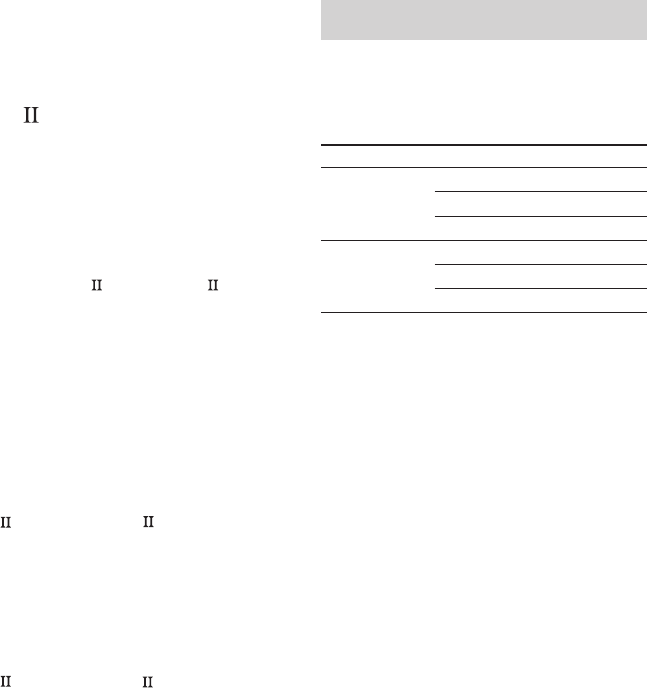
Mode Decoding Mode
A.F.D. AUTO As encoded
DOLBY PL Dolby Pro Logic
PLII MOV Dolby Pro Logic II
PLII MUS
Decoding the input audio
signal automatically
Press A.F.D. repeatedly to select “A.F.D.
AUTO”.
The A.F.D. indicator lights up.
This mode automatically detects the type of
audio signal being input (Dolby Digital, DTS,
or standard 2 channel stereo) and performs the
proper decoding if necessary. This mode
presents the sound as it was recorded/encoded,
without adding any effects (e.g. reverberation).
However, if there are no low frequency signals
(Dolby Digital LFE, etc.) it will generate a low
frequency signal for output to the sub woofer.
You can take advantage of surround sound
simply by selecting one of the receiver’s pre-
programmed sound fields. They bring the
exciting and powerful sound of movie theaters
and concert halls into your home. You can also
customize the sound fields to obtain the sound
you want by changing the surround parameter.
To fully enjoy surround sound, you must
register the number and location of your
speakers. See “Multi channel surround setup”
starting from page 15 to set the speaker
parameters before enjoying surround sound.
Using only the front
speakers (2 Channel Stereo)
Press 2CH.
The 2CH indicator lights up and “2CH ST.”
appears in the display.
This mode outputs the sound from the front left
and right speakers only. Standard 2 channel
(stereo) sources completely bypass the sound
field processing. Multi channel surround
formats are downmixed to 2 channel.
Notes
•No sound is output from the sub woofer when
“2CH ST.” is selected. To listen to 2 channel
(stereo) sources using the front left and right
speakers and a sub woofer, press A.F.D. repeatedly
to select “A.F.D. AUTO”.
•When you select “Micro Satellite Speaker” (page
16), internal sound processor will automatically
redirect bass sound to sub woofer. If you want to
listen to two channel (stereo) sources under this
setting, we recommend that you choose “A.F.D.
AUTO” mode so that you can take advantage of
your sub woofer to obtain the correct bass signal.
continued
01GB07ENJU.p65 12/12/02, 10:33 AM23
24GB
STR-DE595/DE495 4-245-327-12(1) GB
Enjoying stereo sound in
multi channel (Dolby Pro
Logic )
This receiver incorporates with Dolby Pro
Logic II which has movie mode and music
mode, and the receiver can reproduce the 2
channel sound in 5.1 channel through Dolby
Pro Logic II.
Press A.F.D. repeatedly to select
“DOLBY PL”, “PL MOV” or “PL MUS”.
The A.F.D. indicator lights up and the selected
type of decoding is indicated in the display.
xDOLBY PL (Dolby Pro Logic)
Performs the Pro Logic decoding. Software
with multi channel surround audio signals is
played back according to the way it was
recorded. Software with 2 channel audio
signals is decoded with Dolby Pro Logic to
create surround effects (4 channels).
xPL MOV (Pro Logic Movie)
Performs the Pro Logic II movie mode
decoding. This setting is ideal for the movies
encoded in Dolby Surround. Besides, this mode
can reproduce the sound in 5.1 channel when
watching the videos of old movies or in the
dubbed language.
xPL MUS (Pro Logic Music)
Performs the Pro Logic II music mode decoding.
This setting is ideal for the normal stereo
sources, such as CDs.
Note
Dolby Pro Logic and Dolby Pro Logic II decoding
does not function for DTS format signals.
Selecting a sound field
You can enjoy surround sound simply by
selecting one of the pre-programmed sound
fields according to the program you want to
listen to.
Press To select
MOVIE C.ST.EX A DCS *
C.ST.EX B DCS *
C.ST.EX C DCS *
MUSIC HALL
JAZZ
CONCERT
* Sound field with DCS mark use DCS technology.
About DCS (Digital Cinema Sound)
In collaboration with Sony Pictures
Entertainment, Sony measured the sound
environment of their studios and integrated the
data of the measurement and Sony’s own DSP
(Digital Signal Processor) technology to
develop “Digital Cinema Sound”. In a home
theater, “Digital Cinema Sound” simulates an
ideal movie theater sound environment based
on the preference of the movie director.
Enjoying movies with Cinema
Studio EX
Cinema Studio EX is ideal for enjoying the
movie software encoded with multi channel
format, such as the Dolby Digital DVD. This
mode reproduces the sound characteristics of
Sony Pictures Entertainment’s studios.
Press MOVIE repeatedly to select
“C.ST.EX A”, “C.ST.EX B” or “C.ST.EX C”.
The MOVIE indicator lights up and the
selected sound field is indicated in the display.
Enjoying higher fidelity sound
(continued)
01GB07ENJU.p65 12/12/02, 10:33 AM24
Enjoying Surround Sound
25GB
STR-DE595/DE495 4-245-327-12(1) GB
Selecting other sound fields
Press MUSIC repeatedly to select the
sound field you want.
The MUSIC indicator lights up and the current
sound field is indicated in the display.
xHALL
Reproduces the acoustics of a rectangular
concert hall.
xJAZZ (Jazz Club)
Reproduces the acoustics of a jazz club.
xCONCERT (Live Concert)
Reproduces the acoustics of a 300-seat live
concert
To turn the surround effect off
Press A.F.D. repeatedly to select “A.F.D.
AUTO” or press 2CH.
Tips
•The receiver lets you apply the last selected sound
field to a program source whenever it is selected
(Sound Field Link). For example, if you listen to
CD with “JAZZ” as the sound field, change to a
different program source, then return to CD,
“JAZZ” will be applied again.
•You can identify the encoding format of DVD
software, etc. by looking at the logo on the
package.
–: Dolby Digital discs
–: Dolby Surround encoded
programs
–: DTS Digital Surround encoded programs
•When sound signals with a sampling frequency of
96 kHz are input, the sound signals are output in
stereo automatically, and the sound field is turned
off.
xC.ST.EX A (Cinema Studio EX A)
Reproduces the sound characteristics of the
Sony Pictures Entertainment “Cary Grant
Theater” cinema production studio. This is a
standard mode, great for watching most any
type of movie.
xC.ST.EX B (Cinema Studio EX B)
Reproduces the sound characteristics of the
Sony Pictures Entertainment “Kim Novak
Theater” cinema production studio. This mode
is ideal for watching science-fiction or action
movies with lots of sound effects.
xC.ST.EX C (Cinema Studio EX C)
Reproduces the sound characteristics of the
Sony Pictures Entertainment scoring stage.
This mode is ideal for watching musicals or
classic films where music is featured in the
soundtrack.
About Cinema Studio EX
Cinema Studio EX consists of the following
three elements.
•Virtual Multi Dimension
Creates 5 sets of virtual speakers
surrounding the listener from a single pair of
actual surround speakers.
•Screen Depth Matching
In a movie theater, sound seems to come
from inside the image reflected on the movie
screen. This element creates the same
sensation in your listening room by shifting
the sound of the front speakers “into” the
screen.
•Cinema Studio Reverberation
Reproduces the reverberations peculiar to a
movie theater.
Cinema Studio EX is the integrated mode
which operates these elements simultaneously.
Notes
•The effects provided by the virtual speakers may
cause increased noise in the playback signal.
•When listening with sound fields that employ the
virtual speakers, you will not be able to hear any
sound coming directly from the surround speakers.
01GB07ENJU.p65 12/12/02, 10:33 AM25
26GB
STR-DE595/DE495 4-245-327-12(1) GB
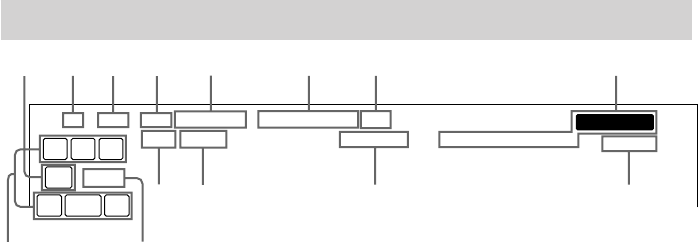
Understanding the multi channel surround displays
STEREOD.RANGECOAXOPT MONO RDS
MEMORY
DIGITALSP BSP ASP PRO LOGIC II
aa
SLEEP
DTS
LCR
SW
SL SR
S
LFE
1234 5 6 7 8
90qaqs
qdqf
1SW: Lights up when sub woofer selection is
set to “YES” (page 17) and the audio signal is
output from the SUB WOOFER jacks.
2SP*: (STR-DE495 only) Lights up when you
turn on the receiver.
3SP A*: (STR-DE595 only) Lights up when
you select to drive Speaker System A.
4SP B*: (STR-DE595 only) Lights up when
you select to drive Speaker System B.
* Does not light up when you connect
headphones to the PHONES jack.
5; DIGITAL: Lights up when the receiver is
decoding signals recorded in the Dolby
Digital format.
6; PRO LOGIC II: “; PRO LOGIC”
lights up when the receiver applies Pro Logic
processing to 2 channel signals in order to
output the center and surround channel
signals. “; PRO LOGIC II” lights up when
Pro Logic II processing (“PLII MOV” or
“PLII MUS”) is applied (page 24). However,
both indicators do not light up if the center
and surround speakers are set to “NO”, and
“A.F.D. AUTO” or “DOLBY PL” is selected.
Note
Dolby Pro Logic and Dolby Pro Logic II
decoding does not function for DTS format
signals.
7DTS: Lights up when DTS signals are input.
Note
When playing a DTS format disc, be sure that
you have made digital connections and that
INPUT MODE is NOT set to “ANALOG”
(page 21).
8Tuner indicators: Lights up when using the
receiver to tune in radio stations, etc. See
pages 29–33 for tuner operations.
Note
“RDS” only appears for models of area code
CEL, CEK only.
9SLEEP: Lights up when sleep timer is
activated.
0D.RANGE: Lights up when dynamic range
compression is activated. See page 27 to
adjust the dynamic range compression.
qa COAX: Lights up when the source signal is a
digital signal being input through the
COAXIAL terminal.
qs OPT: Lights up when the source signal is a
digital signal being input through the
OPTICAL terminal.
01GB07ENJU.p65 12/12/02, 10:33 AM26
Enjoying Surround Sound
27GB
STR-DE595/DE495 4-245-327-12(1) GB
continued
SL SR
LC R
Customizing sound fields
By adjusting the surround parameters and the
tone characteristics of the front speakers, you
can customize the sound fields to suit your
particular listening situation.
Once you customize a sound field, the changes
are stored in the memory indefinitely. You can
change a customized sound field any time by
making new adjustments to the parameters.
See the tables on back page for the parameters
available in each sound field.
qd LFE: Lights up when the disc being played
back contains the LFE (Low Frequency
Effect) channel and when the sound of the
LFE channel signal is actually being
reproduced.
qf Playback channel indicators: The letters
(L, C, R, etc.) indicate the channels being
played back. The boxes around the letters
vary to show how the receiver downmixes the
source sound (based on the speakers settings).
When using sound fields like “C.ST.EX”, the
receiver adds reverberation based on the
source sound.
L (Front Left), R (Front Right), C (Center
(monaural)), SL (Surround Left), SR
(Surround Right), S (Surround (monaural or
the surround components obtained by Pro
Logic processing)).
Example:
Recording format (Front/Surround): 3/2
Output channel: Surround speakers absent
Sound Field: A.F.D. AUTO
To get the most from multi
channel surround sound
Position your speakers and do the procedures
described in “Multi channel surround setup”
starting from page 15 before you customize a
sound field.
Adjusting the level
parameters
The LEVEL menu contains parameters that let
you adjust the balance and volumes of each
speaker. You can also customize various
aspects of the current sound field. The settings
are applied to all sound fields except for EFCT.
parameter. For EFCT. parameter, the settings
are stored individually for each sound field.
1Start playing a program source
encoded with multi channel surround
sound.
2Press MAIN MENU repeatedly to select
“LEVEL ”.
3Press MENU or MENU to select
the parameter you want to adjust.
4Press MENU + or MENU – to select the
setting you want.
The setting is entered automatically.
Initial settings
Parameter Initial setting
L
R
BAL. L/R XX* BALANCE
CTR XXX dB* 0 dB
SUR.L. XXX dB* 0 dB
SUR.R. XXX dB* 0 dB
S.W. XXX dB* 0 dB
D. RANGE COMP. XXX OFF
EFCT. XXX STD
* (STR-DE595 only) The parameters can be adjusted
separately for MULTI CH IN.
01GB07ENJU.p65 12/12/02, 10:33 AM27
28GB
STR-DE595/DE495 4-245-327-12(1) GB
Adjusting the tone
parameters
The TONE menu contains parameters that let
you adjust the tone of the front speakers for
optimum sound. The settings are applied to all
sound fields.
1Start playing a program source
encoded with multi channel surround
sound.
2Press MAIN MENU repeatedly to select
“TONE ”.
3Press MENU or MENU to select
the parameter you want to adjust.
4Press MENU + or MENU – to select the
setting you want.
The setting is stored automatically.
Initial settings
Parameter Initial setting
BASS XX dB 0 dB
TREB. XX dB 0 dB
Bass (BASS XX dB)
Lets you adjust the bass tone.
Treble (TREB. XX dB)
Lets you adjust the treble tone.
Resetting customized sound
fields to the factory settings
1If the power is on, press ?/1 to turn off
the power.
2Hold down 2CH and press ?/1.
“SF. CLR.” appears in the display and all
sound fields are reset at once.
Customizing sound field (continued)
Front balance (
L
R
BAL. L/R XX)
Lets you adjust the balance between front left
and right speakers.
Center level (CTR XXX dB)
Lets you adjust the level of the center speaker.
Surround left level (SUR.L. XXX dB)
Lets you adjust the level of the surround left
speaker.
Surround right level (SUR.R. XXX dB)
Lets you adjust the level of the surround right
speaker.
Sub woofer level (S.W. XXX dB)
Lets you adjust the level of the sub woofer.
Dynamic range compressor ( D. RANGE
COMP. XXX)
Lets you compress the dynamic range of the
sound track. This may be useful when you want
to watch movies at low volumes late at night.
We recommend using the “MAX” setting.
•To reproduce the sound track with no
compression, select “OFF”.
•To reproduce the sound track with the dynamic
range intended by the recording engineer, select
“STD”.
•To reproduce a dramatic compression of the
dynamic range, select “MAX”.
Note
Dynamic range compression is possible with Dolby
Digital sources only.
Effect level (EFCT. XXX)
Lets you adjust the “presence” of the current
surround effect.
01GB07ENJU.p65 12/12/02, 10:33 AM28
Receiving Broadcasts
29GB
STR-DE595/DE495 4-245-327-12(1) GB
Receiving Broadcasts
Before receiving broadcasts, make sure you
have connected FM and AM antennas to the
receiver (page 7).
Storing FM stations
automatically
(AUTOBETICAL)
(Models of area code CEL, CEK only)
This function lets you store up to 30 FM and
FM RDS stations in alphabetical order without
redundancy. Additionally, it only stores the
stations with the clearest signals.
If you want to store FM or AM stations one by
one, see “Presetting radio stations” on page 31.
1Press ?/1 to turn off the receiver.
2Hold down MEMORY and press ?/1 to
turn the receiver back on.
“AUTO-BETICAL SELECT” appears in
the display and the receiver scans and stores
all the FM and FM RDS stations in the
broadcast area.
For RDS stations, the tuner first checks for
stations broadcasting the same program,
then stores only the one with the clearest
signal. The selected RDS stations are sorted
alphabetically by their Program Service
name, then assigned a 2-character preset
code. For more details on RDS, see page 32.
Regular FM stations are assigned
2-character preset codes and stored after the
RDS station.
When done, “FINISH” appears in the
display momentarily and the receiver
returns to the normal operation.
Notes
•Do not press any button on the receiver or supplied
remote during autobetical operation.
•If you move to another area, repeat this procedure
to store stations in your new area.
•For details on tuning the stored stations, see page
31.
•If you move the antenna after storing stations with
this procedure, the stored settings may no longer be
valid. If this happens, repeat this procedure to store
the stations again.
Direct tuning
You can enter a frequency of the station you
want directly by using the numeric buttons on the
supplied remote. For details on the buttons used
in this section, see pages 37–40.
1Press TUNER on the remote repeatedly
to select the FM or AM band.
The last received station is tuned in.
2Press D. TUNING on the remote.
3Press the numeric buttons to enter the
frequency.
Example 1: FM 102.50 MHz
Example 2: AM 1350 kHz
(You don’t have to enter the last “0” when the
tuning scale is set to 10 kHz.)
If you cannot tune in a station and the
entered numbers flash
Make sure you’ve entered the right
frequency. If not, repeat steps 2 and 3.
If the entered numbers still flash, the
frequency is not used in your area.
bbbb
1 0 2 5 0
bbb
1 3 5 0
continued
01GB08RECU.p65 12/12/02, 10:33 AM29

30GB
STR-DE595/DE495 4-245-327-12(1) GB
Direct tuning (continued)
4If you’ve tuned in an AM station, adjust
the direction of the AM loop antenna for
optimum reception.
5Repeat steps 1 to 4 to receive another
station.
Tips
•If you do not remember the precise frequency, press
TUNING + or TUNING – after entering the value
close to the frequency you want. The receiver
automatically tunes in the station you want. If the
frequency seems to be higher than the entered value,
press TUNING +, and if the frequency seems to be
lower than the entered value, press TUNING –.
•If “STEREO” flashes in the display and the FM
stereo reception is poor, press FM MODE to change
to monaural (MONO). You will not be able to enjoy
the stereo effect, but the sound will be less distorted.
To return to stereo mode, press FM MODE again.
The tuning scale differs depending on the area code
as shown in the following table. For details on area
codes, see page 4.
Area code FM AM
U, CA 100 kHz 10 kHz*
CEL, CEK, SP, CN 50 kHz 9 kHz
TW, KR, AU
E2/E3 50 kHz 9 kHz*
AR, MX 50 kHz 10 kHz
* The AM tuning scale can be changed (page 45).
Automatic tuning
If you don’t know the frequency of the station
you want, you can let the receiver scan all
available stations in your area.
1Press TUNER FM/AM repeatedly to
select the FM or AM band.
The last received station is tuned in.
2Press TUNING + or TUNING –.
Press TUNING + to scan from low to high;
press TUNING – to scan from high to low.
The receiver stops scanning whenever a
station is received.
When the receiver reaches either end of
the band
Scanning is repeated in the same direction.
3To continue scanning, press TUNING +
or TUNING – again.
Preset tuning
After you have tuned in stations using Direct
Tuning or Automatic Tuning, you can preset
them to the receiver. Then you can tune in any
of the stations directly by entering its 2-
character preset code using the supplied
remote. Up to 30 FM or AM stations can be
preset. The receiver will also scan all the
stations that you have preset.
Before tuning to preset stations, be sure to
preset them by performing steps on “Presetting
radio stations” (page 31).
01GB08RECU.p65 12/12/02, 10:33 AM30

Receiving Broadcasts
31GB
STR-DE595/DE495 4-245-327-12(1) GB
nA1˜A2˜...˜A0˜B1˜B2˜...˜B0N
nC0˜...C2˜C1N
Tuning to preset stations
You can tune the preset stations by either of the
following two ways.
Scanning the preset stations
1Press TUNER FM/AM.
The last received station is tuned in.
2Press PRESET TUNING + or PRESET
TUNING – repeatedly to select the
preset station you want.
Each time you press the button, the receiver
tunes in one preset station at a time, in the
corresponding order and direction as
follows:
Using the preset codes
Use the supplied remote to perform the
following operations. For details on the buttons
used in this section, see pages 37–40.
1Press TUNER on the remote.
The last received station is tuned in.
2Press SHIFT to select a memory page
(A, B, or C), then press the preset
number of the station you want using
the numeric buttons.
Presetting radio stations
1Press TUNER FM/AM.
The last received station is tuned in.
2Tune in the station that you want to
preset using Direct Tuning (page 29) or
Automatic Tuning (page 30).
3Press MEMORY.
“MEMORY” appears in the display for a few
seconds.
Do steps 4 to 5 before “MEMORY” goes out.
4Press PRESET TUNING + or PRESET
TUNING – repeatedly to select a preset
station number.
Each time you press the button, the preset
station number changes in the
corresponding number and direction as
follows:
If “MEMORY” goes out before you select
the preset station number, start again from
step 3.
5Press MEMORY again to store the
station.
If “MEMORY” goes out before you can
store the station, start again from step 3.
6Repeat steps 2 to 5 to preset another
station.
To change a preset number to
another station
Do steps 1 to 5 to preset a new station to the
number.
Tip
In step 4, you can also use the remote to select a
preset station number. Press SHIFT repeatedly to
select a memory page (A, B or C) and then press the
numeric buttons to select a preset number.
nA1˜A2˜...˜A0˜B1˜B2˜...˜B0N
nC0˜...C2˜C1N
01GB08RECU.p65 12/12/02, 10:33 AM31

32GB
STR-DE595/DE495 4-245-327-12(1) GB
Using the Radio Data
System (RDS)
(Models of area code CEL, CEK only)
This receiver also allows you to use RDS
(Radio Data System), which enables radio
stations to send additional information along
with the regular program signal.
Note that RDS is operable only for FM
stations.*
* Not all FM stations provide RDS service, nor do
they provide the same types of services. If you are
not familiar with the RDS services in your area,
check with your local radio stations for details.
Receiving RDS broadcasts
Simply select a station on the FM band
using direct tuning (page 29), automatic
tuning (page 30), or preset tuning (page 30).
When you tune in a station that provides RDS
services, the RDS indicator lights up and the
program station name normally appears in the
display.
Note
RDS may not work properly if the station you tuned
to is not transmitting the RDS signal properly or if the
signal strength is weak.
Displaying RDS information
While receiving an RDS station, press
DISPLAY.
Each time you press the button, RDS
information on the display changes cyclically
as follows:
Program Station name t Frequency t
Program Type indicationa) t Radio Text
indicationb) t Current Time indication (in 24-
hour system) t Sound field currently applied
a) Type of program being broadcast (page 33).
b) Text messages sent by the RDS station.
Notes
•If there is an emergency announcement by
government authorities, “ALARM” flashes in the
display.
•When the message consists of 9 characters or more,
the message scrolls across the display.
•If a station does not provide a particular RDS
service, “NO XXXX” (such as “NO TEXT”)
appears in the display.
01GB08RECU.p65 12/12/02, 10:33 AM32
Receiving Broadcasts
33GB
STR-DE595/DE495 4-245-327-12(1) GB
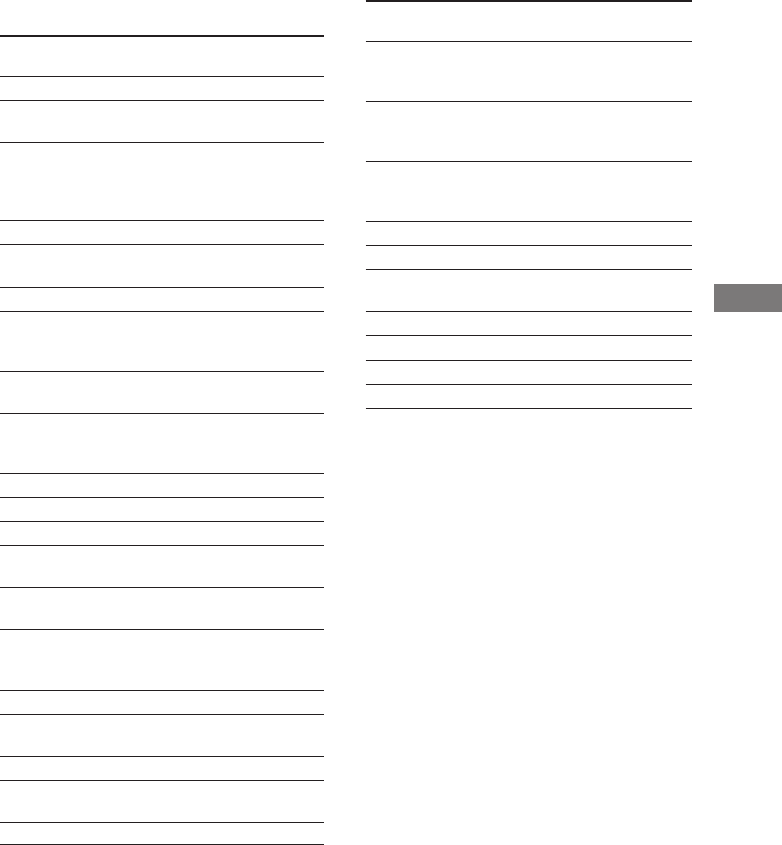
Description of program types
Program type Description
indication
NEWS News programs
AFFAIRS Topical programs that expand
on current news
INFO Programs offering information on
a wide spectrum of subjects,
including consumer affairs and
medical advice
SPORT Sports programs
EDUCATE Educational programs, such as
“how-to” and advice programs
DRAMA Radio plays and serials
CULTURE Programs about national or
regional culture, such as language
and social concerns
SCIENCE Programs about the natural
sciences and technology
VARIED Other types of programs such as
celebrity interviews, panel games,
and comedy
POP M Popular music programs
ROCK M Rock music programs
EASY M Easy Listening
LIGHT M Instrumental, vocal, and choral
music
CLASSICS Performances of major orchestras,
chamber music, opera, etc.
OTHER M Music that does not fit into any
categories above, such as Rhythm
& Blues and Reggae
WEATHER Weather information
FINANCE Stock market reports and trading,
etc.
CHILDREN Programs for children
SOCIAL Programs about people and the
things that affect them
RELIGION Programs of religious content
Program type Description
indication
PHONE IN Programs where members of the
public express their views by
phone or in a public forum
TRAVEL Programs about travel. Not for
announcements that are located by
TP/TA
LEISURE Programs on recreational activities
such as gardening, fishing,
cooking, etc.
JAZZ Jazz programs
COUNTRY Country music programs
NATION M Programs featuring the popular
music of the country or region
OLDIES Programs featuring oldies music
FOLK M Folk music programs
DOCUMENT Investigative features
NONE Any programs not defined above
01GB08RECU.p65 12/12/02, 10:33 AM33

34GB
STR-DE595/DE495 4-245-327-12(1) GB
Other Operations
Naming preset stations
and program sources
You can enter a name (index name) of up to 8
characters for preset stations and program
sources. These names (for example, “VHS”)
appear in the receiver’s display when a station
or program source is selected. Note that no
more than one name can be entered for each
preset station or program source.
This function is useful for distinguishing
components of the same kind. For example,
two VCRs can be specified as “VHS” and
“8MM”, respectively. It is also handy for
identifying components connected to jacks
meant for another type of component, for
example, a second CD player connected to the
MD/TAPE jacks.
1To name a preset station
Press TUNER FM/AM, then tune in the
preset station you want to create an
index name for.
If you are not familiar with how to tune in
preset stations, see “Tuning to preset
stations” on page 31.
To name a program source
Select the program source (component)
to be named.
2Press MAIN MENU repeatedly to select
“NAME ”.
3Create an index name by using MENU +
or MENU – and MENU or MENU :
Press MENU + or MENU – to select a
character, then press MENU to move the
cursor to the next position.
To insert a space
Press MENU + or MENU – until a blank
space appears in the display.
If you’ve made a mistake
Press MENU or MENU repeatedly
until the character to be changed flashes,
then press MENU + or MENU – to select
the character you want.
4Press ENTER.
5Repeat steps 2 to 4 to assign index
name for another station or program
source.
Note
(Models of area code CEL, CEK only)
You cannot change the name of an RDS station.
Recording
Before you begin, make sure you’ve connected
all components properly.
Recording on an audio tape
or MiniDisc
You can record on a cassette tape or MiniDisc
using the receiver. See the operating
instructions of your cassette deck or MD deck
if you need help.
1Select the component to be recorded.
2Prepare the component for playing.
For example, insert a CD into the CD
player.
3Insert a blank tape or MD into the
recording deck and adjust the
recording level, if necessary.
4Start recording on the recording deck,
then start playback on the playback
component.
Notes
•Sound adjustments do not affect the signal output
from the MD/TAPE OUT jacks.
•(STR-DE595 only) When MULTI CH IN is
selected, the analog audio signals of the current
input source is output from the REC OUT jack.
•Some sources contain copy guards to prevent
recording. In this case, you may not be able to
record from the sources.
01GB09OPEU.p65 12/12/02, 10:33 AM34
Other Operations
35GB
STR-DE595/DE495 4-245-327-12(1) GB
Recording on a video tape
You can record from a VCR, a TV or a DVD
player using the receiver. You can also add
audio from a variety of audio sources when
editing a video tape. See the operating
instructions of your VCR or DVD player if you
need help.
1Select the program source to be
recorded.
2Prepare the component for playing.
For example, insert the DVD you want to
record into the DVD player.
3Insert a blank video tape into the VCR
(VIDEO 1) for recording.
4Start recording on the recording VCR,
then start playing the video tape or
DVD you want to record.
Tip
You can record the sound from any audio source onto
a video tape while copying from a video tape or
DVD. Locate the point where you want to start
recording from another audio source, select the
program source, then start playback. The audio from
that source will be recorded onto the audio track of
the video tape instead of the audio from the original
medium. To resume audio recording from the original
medium, select the video source again.
Notes
•Make sure to make both digital and analog
connections to the VIDEO 2 and DVD inputs.
Analog recording is not possible if you make only
digital connections.
•(STR-DE595 only) When MULTI CH IN is
selected, the analog audio signals of the current
input source is output from the REC OUT jacks.
Using the Sleep Timer
You can set the receiver to turn off
automatically at a specified time.
Press SLEEP on the remote while the
power is on.
Each time you press the button, the display
changes cyclically as follows:
2-00-00 t 1-30-00 t 1-00-00 t 0-30-00 t
OFF
Tip
To check the remaining time before the receiver turns
off, press SLEEP. The remaining time appears in the
display.
Adjustments using the
SET UP menu
The SET UP menu allows you to make the
following adjustments.
1Press MAIN MENU repeatedly to select
“SET UP ”.
2Press MENU or MENU to select
the parameter you want to adjust.
3Press MENU + or MENU – to select the
setting you want.
The setting is entered automatically.
Initial settings
Parameter Initial setting
DEC. XXXX PCM (for DVD,
CD/SACD
(STR-DE595
only)), AUTO
(for VIDEO 2)
continued
01GB09OPEU.p65 12/12/02, 10:33 AM35

36GB
STR-DE595/DE495 4-245-327-12(1) GB
xDecode priority (DEC. XXXX)
Sets the appropriate decoding for incoming
digital signals.
•PCM priority mode (DEC. PCM)
Use to enjoy playback from audio CD
(PCM) and DVD. When used with media
other than CD or DVD, you may experience
noise. If this happens, switch to AUTO
mode.
•AUTO mode (DEC. AUTO)
Use to enjoy playback from audio CD
(PCM), DVD, DTS-CD and DTS-LD
sources. However, with audio CDs, you may
not be able to listen the very first moments
of each track.
Normally, use as-is with the initial settings
above.
Changing the command
mode of the receiver
This function is useful when you use 2 Sony
receivers in the same room.
1Turn off the receiver.
2Hold down ENTER and press 1/u to
turn on the receiver.
“C.MODE.AVX” appears in the display.
Each time you repeat the procedure above,
the display changes as follows:
C.MODE.AV1 y C.MODE.AV2
Tip
The initial setting is “C.MODE.AV2”.
Notes
•The command mode of the supplied remote is
“AV2” and you cannot change this setting.
•If the command mode of the receiver and the
remote is different, you cannot use the remote to
operate the receiver.
Adjustments using the SET UP menu
(continued)
01GB09OPEU.p65 12/12/02, 10:33 AM36
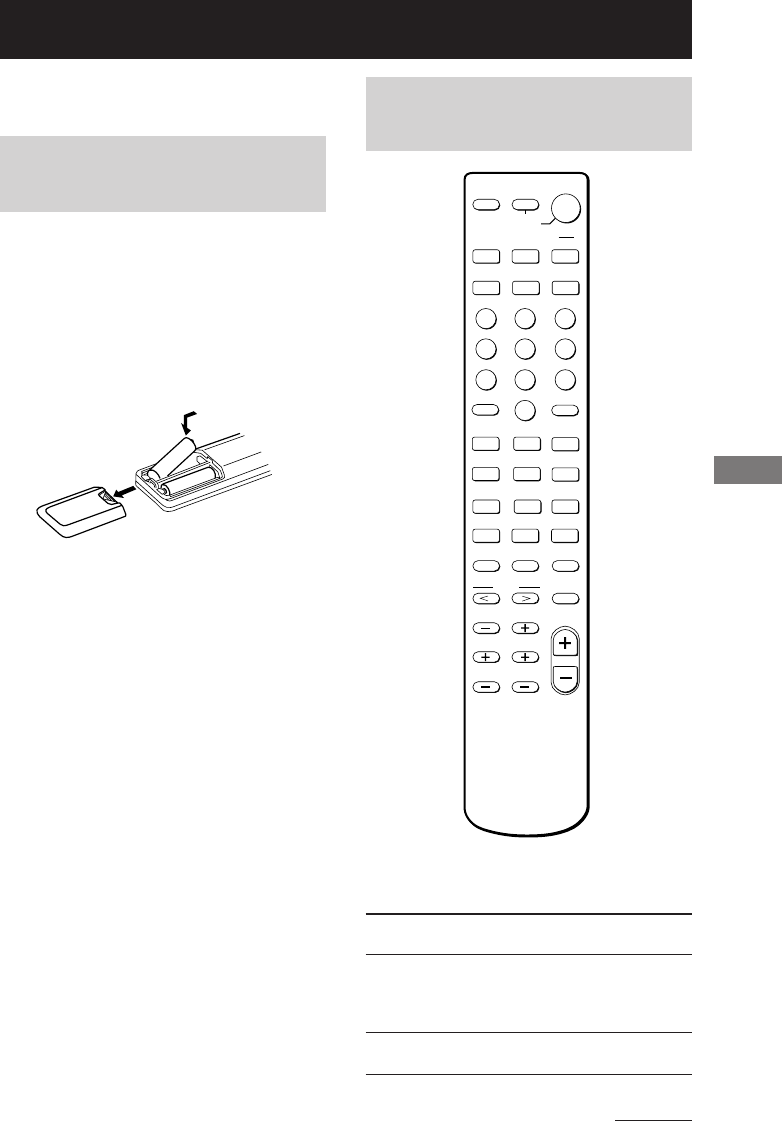
Operations Using the Remote RM-U306A
37GB
STR-DE595/DE495 4-245-327-12(1) GB
You can use the remote RM-U306A to operate
the components in your system.
Before you use your
remote
Inserting batteries into the
remote
Insert R6 (size-AA) batteries with the + and –
properly oriented in the battery compartment.
When using the remote, point it at the remote
sensor g on the receiver.
Tip
Under normal conditions, the batteries should last for
about 6 months. When the remote no longer operates
the receiver, replace all batteries with new ones.
Notes
•Do not leave the remote in an extremely hot or
humid place.
•Do not use a new battery with an old one.
•Do not expose the remote sensor to direct sunlight
or lighting apparatuses. Doing so may cause a
malfunction.
•If you don’t use the remote for an extended period
of time, remove the batteries to avoid possible
damage from battery leakage and corrosion.
Remote button
description
NX
mM
.>
123
456
78
0
9
MD/TAPE CD TUNER
TV/VIDEO
VIDEO 2
VIDEO 1 DVD
SYSTEM
STANDBY
>10
SHIFT
CH/PRESET
-
ANT
TV/VTR
–+
MASTER
VOL
TEST TONE MAIN MENU MULTI CH
2CH A.F.D. MOVIE/
MUSIC
ENTER
D.SKIP
D.TUNING
TOP MENU DVD MENU
ENTER
RETURN
f
F
Gg
SLEEP AV
?/1 ?/1
MENU
TV VOL TV CH
MUTING
O
x
]
]
}}
Operations Using the Remote RM-U306A
The tables below show the settings of each
button.
Remote Operations Function
Button
SLEEP Receiver Activates the sleep
function and the duration
which the receiver turns
off automatically.
?/1 Receiver Turns the receiver on or
off.
continued
01GB10REMU.p65 12/12/02, 10:33 AM37
38GB
STR-DE595/DE495 4-245-327-12(1) GB
Remote button description
(continued)
Remote Operations Function
Button
MASTER Receiver Adjusts the master
VOL +/–volume of the receiver.
AV ?/1 TV/VCR/ Turns the audio and
CD player/ video components on or
VCD player/ off.
LD player/
DVD player/
MD deck/
DAT deck
SYSTEM Receiver/TV/ Turns off the receiver and
STANDBY VCR/Satellite other Sony audio/video
(Press AV tuner/ components.
?/1 and CD player/
?/1 at VCD player/
the same LD player/
time) DVD player/
MD deck/
DAT deck
0-9 Receiver Use with “SHIFT” button
to preset radio station or
tuning to preset stations
and with “D.TUNING”
for direct tuning.
CD player/ Selects track numbers.
VCD player/ 0 selects track 10.
LD player/
MD deck/
DAT deck
TV/VCR/ Selects channel numbers.
Satellite tuner
>10 CD player/ Selects track numbers
VCD player/ over 10.
LD player/
MD deck/
Tape deck
Remote Operations Function
Button
VIDEO 1 Receiver To watch VCR.
(VTR mode 3)
VIDEO 2 Receiver To watch VCR.
(VTR mode 1)
DVD Receiver To watch DVD.
MD/TAPE Receiver To listen to Minidisc or
audio tape.
CD Receiver To listen to compact disc.
TUNER Receiver To listen to radio
programs.
SHIFT Receiver Press repeatedly to select
a memory page for
presetting radio stations
or tuning to preset
stations.
D.TUNING
Receiver Tuner station direct key-
in-mode.
2CH Receiver Selects 2CH mode.
A.F.D. Receiver Selects A.F.D. AUTO,
DOLBY PL, PLII MOV
and PLII MUS.
MOVIE/ Receiver Selects C.ST.EX A,
MUSIC C.ST.EX B, C.ST.EX C,
HALL, JAZZ and
CONCERT.
TEST Receiver Press to output test tone.
TONE
MAIN Receiver Press this button
MENU repeatedly to select one
of the four cursor modes:
SET UP, LEVEL, TONE
and NAME.
MULTI CH
Receiver Selects MULTI CH IN
source.
MENU </> Receiver Selects a menu item.
MENU +/–Receiver Makes adjustment or
change the setting.
MUTING Receiver Mutes the sound from the
receiver.
01GB10REMU.p65 12/12/02, 10:34 AM38
Operations Using the Remote RM-U306A
39GB
STR-DE595/DE495 4-245-327-12(1) GB
Remote Operations Function
Button
XVCR/ Pauses play or record.
CD player/ (Also start recording
VCD player/ with components in
LD player/ record standby.)
DVD player/
MD deck/
DAT deck/
Tape deck
xVCR/ Stops play.
CD player/
VCD player/
LD player/
DVD player/
MD player/
DAT deck/
Tape deck
ANT VCR Selects output signal
TV/VTR from the aerial terminal:
TV signal or VCR
program.
D.SKIP
CD player/ Skips discs (multi-disc
VCD player/ changer only).
DVD player/
MD deck
TOP DVD player Displays DVD title.
MENU
DVD DVD player Displays DVD menu.
MENU
ENTER DVD player Enters the selection.
ODVD player Returns to the previous
menu or exits the menu.
V/v/B/b
DVD player Selects a menu item.
Remote Operations Function
Button
ENTER TV/VCR/ After selecting a channel,
Satellite tuner/ disc or track using the
LD player/ numeric buttons, press to
MD deck/ enter the value.
DAT deck/
Tape deck
RETURN VCD player Go back to previous
menu.
CH/ Receiver Scans and selects preset
PRESET stations.
+/-
TV/VCR/ Selects preset channel.
Satellite tuner
./>VCR/ Skips tracks.
CD player/
VCD player/
LD player/
DVD player/
MD deck/
DAT deck/
Tape deck
m/MCD player/ Searches tracks (forward
VCD player/ or backward).
DVD player
VCR/ Fastforwards or rewinds.
LD player/
MD deck/
DAT deck/
Tape deck
NVCR/ Starts play.
CD player/
VCD player/
LD player/
DVD player/
MD deck/
DAT deck/
Tape deck
continued
01GB10REMU.p65 12/12/02, 10:34 AM39
40GB
STR-DE595/DE495 4-245-327-12(1) GB
1Hold down the input selector button
whose input source you want to change
(for example, MD/TAPE).
2Press the corresponding button of the
component you want to assign to the
input selector button (for example, 4 –
Tape deck).
The following buttons are assigned to select
the input source:
To operate Press
CD player 1
DAT deck 2
MD deck 3
Tape deck A 4
Tape deck B 5
LD player 6
VCR (command mode VTR 1*) 7
VCR (command mode VTR 2*) 8
VCR (command mode VTR 3*) 9
TV 0
DSS (Digital Satellite Receiver) >10
DVD ENTER
VCD player .
* Sony VCRs are operated with a VTR 1, 2 or 3
setting. These correspond to Beta, 8mm and
VHS respectively.
Now you can use the MD/TAPE button to
control the tape deck.
To reset a button to its factory
setting
Repeat the above procedure.
To reset all the input selector
buttons to their factory setting
Press ?/1, AV ?/1 and MASTER VOL – at
the same time.
Remote Operations Function
Button
÷TV Selects the channel entry
mode, either one or two
digit
TV/VIDEO
TV Selects input signal: TV
input or video input.
TV VOL
TV Adjusts the volume of the
+/–TV
TV CH
TV Selects preset TV
+/–channels
Notes
•When you press the input selector buttons (VIDEO
1, VIDEO 2, DVD), the input mode of the TV
might not switch to the corresponding input mode
that you want. In this case, press the TV/VIDEO
button to switch the input mode of the TV.
•Some functions explained in this section may not
work depending on the model of the receiver.
•The above explanation is intended to serve as an
example only.
Therefore, depending on the component the above
operation may not be possible or may operate
differently than described.
•(STR-DE495 only) The MULTI CH function is not
available for set operation.
Changing the factory
setting of an input selector
button
If the factory settings of the input selector
buttons do not match your system components,
you can change them. For example, if you have
a tape deck and you do not have an MD deck,
you can assign the MD/TAPE button to your
tape deck.
Note that the settings of the TUNER button
cannot be changed.
Remote button description
(continued)
01GB10REMU.p65 12/12/02, 10:34 AM40

Additional Information
41GB
STR-DE595/DE495 4-245-327-12(1) GB
Additional Information
Troubleshooting
If you experience any of the following
difficulties while using the receiver, use this
troubleshooting guide to help you remedy the
problem. Also, see “Checking the connections”
on page 20 to verify that the connections are
correct. Should any problem persist, consult
your nearest Sony dealer.
There is no sound or only a very low-level sound
no matter which component is selected.
•Check that the speakers and components are
connected securely and correctly.
•Check that both the receiver and all components
are turned on.
•Check that the MASTER VOLUME control is
not set at “VOL MIN”.
•Press MUTING on the remote to cancel the
muting function.
•(STR-DE595 only) Check that the SPEAKERS
(OFF/A/B/A+B) button is not set to off and is set
accordingly to your SPEAKERS FRONT system
(page 22).
•Check that the headphones are not connected.
•The protective device on the receiver has been
activated because of a short circuit (“PROTECT”
flashes). Turn off the receiver, eliminate the
short-circuit problem and turn on the power
again.
Precautions
On safety
Should any solid object or liquid fall into the cabinet,
unplug the receiver and have it checked by qualified
personnel before operating it any further.
On power sources
•Before operating the unit, check that the operating
voltage is identical with your local power supply.
The operating voltage is indicated on the nameplate
at the rear of the receiver.
•The unit is not disconnected from the AC power
source (mains) as long as it is connected to the wall
outlet, even if the receiver itself has been turned off.
•If you are not going to use the receiver for a long
time, be sure to disconnect the receiver from the
wall outlet. To disconnect the AC power cord,
grasp the plug itself; never pull the cord.
•(Models of area code U, CA only)
One blade of the plug is wider than the other for the
purpose of safety and will fit into the wall outlet
only one way. If you are unable to insert the plug
fully into the outlet, contact your dealer.
•AC power cord must be changed only at the
qualified service shop.
On heat buildup
Although the unit heats up during operation, this is
not a malfunction. If you continuously use this unit at
a large volume, the cabinet temperature of the top,
side and bottom rises considerably. To avoid burning
yourself, do not touch the cabinet.
On placement
•Place the receiver in a location with adequate
ventilation to prevent heat buildup and prolong the
life of the receiver.
•Do not place the receiver near heat sources, or in a
place subject to direct sunlight, excessive dust or
mechanical shock.
•Do not place anything on top of the cabinet that
might block the ventilation holes and cause
malfunctions.
•Use caution when placing the unit on surfaces that
have been specially treated (with wax, oil, polish,
etc.) as staining or discoloration of the surface may
result.
On operation
Before connecting other components, be sure to turn
off and unplug the receiver.
On cleaning
Clean the cabinet, panel and controls with a soft cloth
slightly moistened with a mild detergent solution. Do
not use any type of abrasive pad, scouring powder or
solvent such as alcohol or benzine.
If you have any question or problem concerning your
receiver, please consult your nearest Sony dealer.
continued
01GB11ADDU.p65 12/12/02, 10:34 AM41
42GB
STR-DE595/DE495 4-245-327-12(1) GB
Troubleshooting (continued)
There is no sound from a specific component.
•Check that the component is connected correctly
to the audio input jacks for that component.
•Check that the cord(s) used for the connection is
(are) fully inserted into the jacks on both the
receiver and the component.
•Check that you have selected the correct
component on the receiver.
There is no sound from one of the front
speakers.
Connect a pair of headphones to the PHONES jack
to verify that sound is output from the headphones
(page 22).
If only one channel is output from the headphones,
the component may not be connected to the
receiver correctly. Check that all the cords are fully
inserted into the jacks on both the receiver and the
component.
If both channels are output from the headphones,
the front speaker may not be connected to the
receiver correctly. Check the connection of the
front speaker which is not outputting any sound.
The left and right sounds are unbalanced or
reversed.
•Check that the speakers and components are
connected correctly and securely.
•Adjust balance parameters in the LEVEL menu.
There is severe hum or noise.
•Check that the speakers and components are
connected securely.
•Check that the connecting cords are away from a
transformer or motor, and at least 3 meters away
from a TV set or fluorescent light.
•Move your TV away from the audio components.
•The plugs and jacks are dirty. Wipe them with a
cloth slightly moistened with alcohol.
There is no sound or only a very low level sound
is heard from the center or/and surround
speaker.
•Make sure the sound field function is on (press
MOVIE or MUSIC).
•Select a sound field containing the word
“C.ST.EX” (pages 24).
•Adjust the speaker level (page 20).
•Make sure the center or/and surround speaker
size parameter is set to either “SMALL” or
“LARGE” (page 17).
There is no sound from the active sub woofer.
•Check that the sub woofer is connected correctly
and securely.
•Make sure the sub woofer selection parameter is
set to “YES” (page 17).
•There is no sound output from the SUB
WOOFER terminal depending on the sound field
(back page).
The surround effect cannot be obtained.
Make sure the sound field function is on (press
MOVIE or MUSIC).
Dolby Digital or DTS multi channel sound is not
reproduced.
•Check that the playing DVD, etc. is recorded in
Dolby Digital or DTS format.
•When connecting the DVD player, etc. to the
digital input jacks of this receiver, check the
audio setting (settings for the audio output) of the
connected component.
Recording cannot be done.
•Check that the components are connected
correctly.
•Select the source component with input selector
buttons.
•Make sure that INPUT MODE is set to
“ANALOG” (page 21) before recording from a
digital component connected to the analog
MD/TAPE terminals.
01GB11ADDU.p65 12/12/02, 10:34 AM42
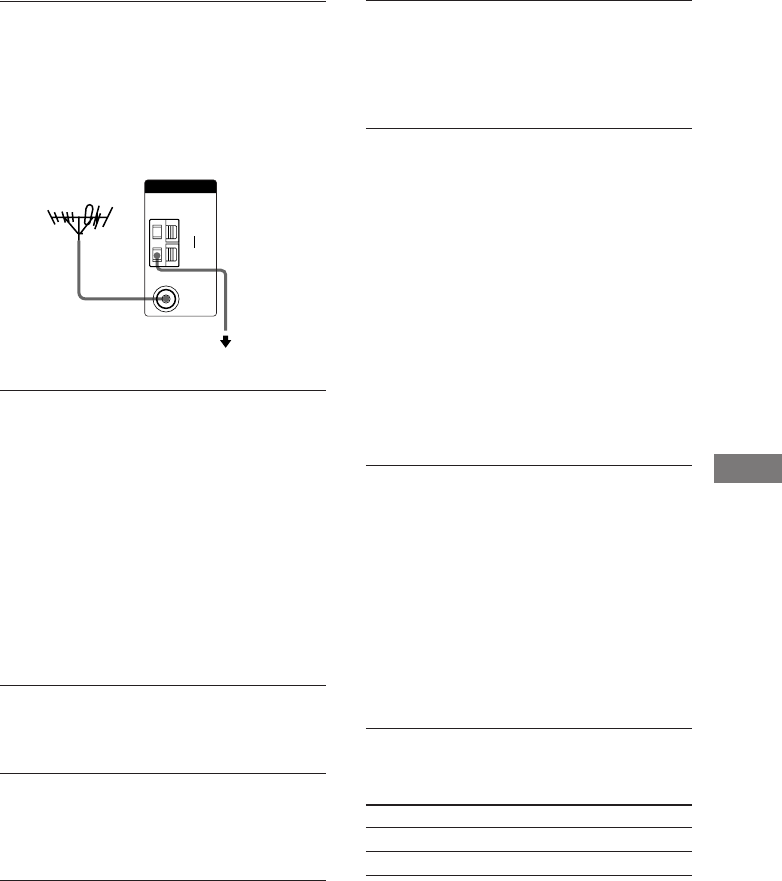
Additional Information
43GB
STR-DE595/DE495 4-245-327-12(1) GB
The FM reception is poor.
Use a 75-ohm coaxial cable (not supplied) to
connect the receiver to an outdoor FM antenna as
shown below. If you connect the receiver to an
outdoor antenna, ground it against lightning. To
prevent a gas explosion, do not connect the ground
wire to a gas pipe.
Radio stations cannot be tuned in.
• Check that the antennas are connected securely.
Adjust the antennas and connect an external
antenna if necessary.
• The signal strength of the stations is too weak
(when tuning in with automatic tuning). Use
direct tuning.
• Make sure you set the tuning interval correctly
(when tuning in AM stations with direct tuning).
• No stations have been preset or the preset
stations have been cleared (when tuning by
scanning preset stations). Preset the stations
(page 31).
• Press DISPLAY so that the frequency appears in
the display.
RDS does not work.*
• Make sure that you’re tuned to an FM RDS
station.
• Select a stronger FM station.
The RDS information that you want does not
appear.*
Contact the radio station and find out whether they
actually provide the service in question. If so, the
service may be temporarily out of order.
Outdoor FM antenna
Receiver
Ground wire
(not supplied)
To ground
y
AM
FM
75Ω
COAXIAL
ANTENNA
There is no picture or an unclear picture appears
on the TV screen or monitor.
• Select the appropriate input selector on the
receiver.
• Set your TV to the appropriate input mode.
• Move your TV away from the audio components.
The remote does not function.
• (STR-DE495 only) The MULTI CH button on
the remote is not available.
• Point the remote at the remote sensor g on the
receiver.
• Make sure you select AV2 as the command
mode of the receiver (page 36).
• Remove any obstacles in the path between the
remote and the receiver.
• Replace both batteries in the remote with new
ones, if they are weak.
• Make sure you select the correct input selector
on the remote.
• If the remote is set to operate the TV only, use
the remote to select a source or component other
than TV before operating the receiver or other
component.
If you are unable to remedy the
problem using the troubleshooting
guide
Clearing the receiver’s memory may remedy
the problem (page 15). However, note that all
memorized settings will be reset to their factory
settings and you will have to readjust all
settings on the receiver.
If the problem persist
Consult your nearest Sony dealer.
* Models of area code CEL, CEK only.
Clearing the receiver’s memory
To clear See
All memorized settings page 15
Customized sound fields page 28
01GB11ADDU.p65 8/2/03, 9:06 AM43

44GB
STR-DE595/DE495 4-245-327-12(1) GB
Specifications
AUDIO POWER SPECIFICATIONS
POWER OUTPUT AND TOTAL
HARMONIC DISTORTION:
With 8 ohm loads, both channels driven, from 40 –
20,000 Hz; rated 90 watts (STR-DE595 only) per
channel minimum RMS power, with no more than
0.09 % total harmonic distortion from 250 milliwatts
to rated output (models of area code U only).
Amplifier section
POWER OUTPUT
Models of area code U, CA
Rated Power Output at Stereo Mode
(8 ohms 40 Hz – 20 kHz, THD 0.09 %)
STR-DE595: 90 W + 90 W
STR-DE495: 70 W + 70 W
Reference Power Output
(8 ohms 40 Hz – 20 kHz, THD 0.09 %)
STR-DE595: FRONT1):90 W/ch
CENTER1): 90 W
SURR1): 90 W/ch
STR-DE495: FRONT1): 70 W/ch
CENTER1): 70 W
SURR1): 70 W/ch
(8 ohms 1 kHz, THD 0.7 %)
STR-DE595: FRONT1):100 W/ch
CENTER1): 100 W
SURR1): 100 W/ch
STR-DE495: FRONT1): 80 W/ch
CENTER1): 80 W
SURR1): 80 W/ch
Models of area code CEL, CEK
Rated Power Output at Stereo Mode
(8 ohms 1 kHz, THD 0.7 %)
STR-DE595: 100 W + 100 W2)
STR-DE495: 80 W + 80 W2)
Reference Power Output2)
(8 ohms 1 kHz, THD 0.7 %)
STR-DE595: FRONT1):100 W/ch
CENTER1): 100 W
SURR1): 100 W/ch
STR-DE495: FRONT1): 80 W/ch
CENTER1): 80 W
SURR1): 80 W/ch
Models of area code SP
Rated Power Output at Stereo Mode
(8 ohms 1 kHz, THD 0.7 %)
STR-DE595: 90 W + 90 W2)
STR-DE495: 70 W + 70 W2)
Reference Power Output2)
(8 ohms 1 kHz, THD 10 %)
STR-DE595: FRONT1): 110 W/ch
CENTER1): 110 W
SURR1): 110 W/ch
STR-DE495: FRONT1): 90 W/ch
CENTER1): 90 W
SURR1): 90 W/ch
Models of area code CN, KR
Rated Power Output at Stereo Mode
(8 ohms 1 kHz, THD 0.7 %)
STR-DE595: 100 W + 100 W2)
90 W + 90 W3)
STR-DE495: 80 W + 80 W2)
70 W + 70 W3)
Reference Power Output2)
(8 ohms 1 kHz, THD 10 %)
STR-DE595: FRONT1): 120 W/ch
CENTER1): 120 W
SURR1): 120 W/ch
STR-DE495: FRONT1): 100 W/ch
CENTER1): 100 W
SURR1): 100 W/ch
Models of other area code
Rated Power Output at Stereo Mode
(8 ohms 1 kHz, THD 0.7 %)
STR-DE595: 100 W + 100 W2)
STR-DE495: 80 W + 80 W2)
Reference Power Output2)
(8 ohms 1 kHz, THD 10 %)
STR-DE595: FRONT1): 120 W/ch
CENTER1): 120 W
SURR1): 120 W/ch
STR-DE495: FRONT1): 100 W/ch
CENTER1): 100 W
SURR1): 100 W/ch
1) Depending on the sound field settings and the
source, there may be no sound output.
2) Measured under the following conditions:
Area code Power requirements
E2/E3 240 V AC, 50 Hz
SP, CEL, CEK, AR, 230 V AC, 50 Hz
CN, KR
TW 110 V AC, 60 Hz
3) Measured under the following conditions:
Area code Power requirements
CN, KR 220 V AC, 50 Hz
01GB11ADDU.p65 12/12/02, 10:34 AM44
Additional Information
45GB
STR-DE595/DE495 4-245-327-12(1) GB
Sensitivity: –
Impedance: 75 ohms
S/N: 100 dB
(A, 20 kHz LPF)
Sensitivity: –
Impedance: –
S/N: 100 dB
(A, 20 kHz LPF)
10 Hz – 50 kHz
+0.5/–2 dB (with sound
field and tone bypassed)
Sensitivity: 500 mV
Impedance: 50 kilohms
S/N4): 96 dB
(A, 500 mV5))
continued
10 Hz – 70 kHz
+0.5/–2 dB (with sound
field and tone bypassed)
Voltage: 500 mV
Impedance: 10 kilohms
Voltage: 2 V
Impedance: 1 kilohms
Frequency response
MULTI CH IN
(STR-DE595 only), CD
(STR-DE495 only),
MD/TAPE, DVD,
VIDEO 1, 2
CD/SACD (STR-DE595
only)
Inputs (Analog)
MULTI CH IN
(STR-DE595 only), CD/
SACD (STR-DE595
only), CD (STR-DE495
only), MD/TAPE, DVD,
VIDEO 1, 2
4) INPUT SHORT (with sound field and tone
bypassed).
5) Weighted network, input level.
Inputs (Digital)
DVD (Coaxial)
CD/SACD (Optical)
(STR-DE595 only),
VIDEO 2 (Optical)
Outputs
MD/TAPE (OUT),
VIDEO 1
(AUDIO OUT)
SUB WOOFER
Tone
Gain levels: ±6 dB, 1 dB step
FM tuner section
Tuning range 87.5 - 108.0 MHz
Antenna terminals 75 ohms, unbalanced
Intermediate Frequency
10.7 MHz
Sensitivity
Mono: 18.3 dBf, 2.2 µV/75 ohms
Stereo:
38.3 dBf, 22.5 µV/75 ohms
Usable sensitivity 11.2 dBf, 1 µV/75 ohms
S/N
Mono: 76 dB
Stereo: 70 dB
Harmonic distortion at 1 kHz
Mono: 0.3%
Stereo: 0.5%
Separation 45 dB at 1 kHz
Frequency response 30 Hz – 15 kHz,
+0.5/–2 dB
Selectivity 60 dB at 400 kHz
AM tuner section
Tuning range
Models of area code U, CA
With 10-kHz tuning scale: 530 – 1710 kHz6)
With 9-kHz tuning scale: 531 – 1710 kHz6)
Models of area code E2/E3
With 10-kHz tuning scale: 530 – 1610 kHz6)
With 9-kHz tuning scale: 531 – 1602 kHz6)
Models of area code CEL, CEK, SP, CN, TW,
KR, AU
With 9-kHz tuning scale: 531 – 1602 kHz
Models of area code AR, MX
With 10-kHz tuning scale: 530 – 1610 kHz
Antenna Loop antenna
Intermediate Frequency
450 kHz
Usable sensitivity 50 dB/m (at 1,000 kHz or
999 kHz)
S/N 54 dB (at 50 mV/m)
Harmonic distortion 0.5 % (50 mV/m, 400 Hz)
Selectivity
At 9 kHz: 35 dB
At 10 kHz: 40 dB
6) You can change the AM tuning scale to 9 kHz or
10 kHz. After tuning in any AM station, turn off
the receiver. Hold down PRESET TUNING + and
press ?/1. All preset stations will be erased when
you change the tuning scale. To reset the scale to
10 kHz (or 9 kHz), repeat the procedure.
01GB11ADDU.p65 12/12/02, 10:34 AM45
46GB
STR-DE595/DE495 4-245-327-12(1) GB
Power consumption
Area code Power consumption
U, MX STR-DE595: 210 W
CA STR-DE595: 310 VA
STR-DE495: 250 VA
CEL, CEK, TW, STR-DE595: 210 W
KR STR-DE495: 180 W
SP STR-DE595: 180 W
STR-DE495: 180 W
CN STR-DE595: 205 W
AU, E2/E3, AR STR-DE595: 210W
Power consumption (during standby mode)
0.3 W
Dimensions 430 × 145 × 298 mm
(16 7/8 × 5 6/8 × 11 6/8 in.)
including projecting parts
and controls
Mass (Approx.)
STR-DE595: 7.5 kg (16 lb 9 oz)
STR-DE495: 7.2 kg (15 lb 14 oz)
Supplied accessories
FM wire antenna (1)
AM loop antenna (1)
Remote commander RM-U306A (1)
R6 (size-AA) batteries (2)
For details on the area code of the component you
are using, see page 4.
Design and specifications are subject to change
without notice.
Specifications (continued)
Video section
Inputs
Video: 1 Vp-p, 75 ohms
Component Video (STR-DE595 only, except for
models of area code CEL, CEK):
Y: 1 Vp-p, 75 ohms
PB/B-Y: 0.7 Vp-p, 75 ohms
PR/R-Y: 0.7 Vp-p, 75 ohms
Outputs
Video: 1 Vp-p, 75 ohms
Component Video (STR-DE595 only, except for
models of area code CEL, CEK):
Y: 1 Vp-p, 75 ohms
PB/B-Y: 0.7 Vp-p, 75 ohms
PR/R-Y: 0.7 Vp-p, 75 ohms
General
Power requirements
Area code Power requirements
U, CA, MX 120 V AC, 60 Hz
CEL, CEK 230 V AC, 50/60 Hz
SP, AR, CN, KR 220 – 230 V AC, 50/60 Hz
E2/E3 120/220/240 V AC, 50/60 Hz
TW 110 V AC, 50/60 Hz
AU 240 V AC, 50Hz
01GB11ADDU.p65 12/12/02, 10:34 AM46
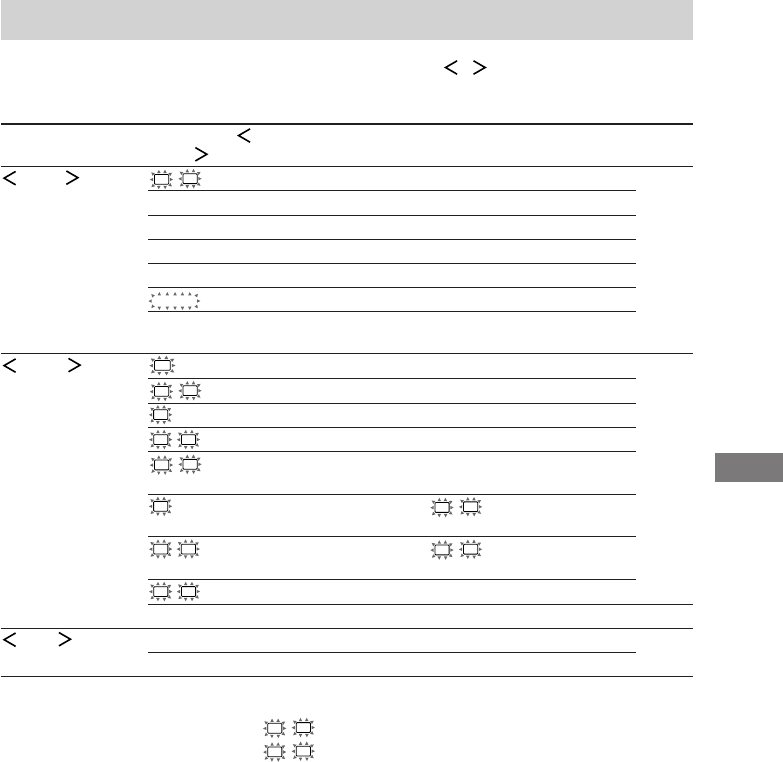
Additional Information
47GB
STR-DE595/DE495 4-245-327-12(1) GB
Tables of settings using the MAIN MENU button
You can make various settings using the MAIN MENU, MENU / and MENU +/– buttons. The
tables below show each of the settings that these buttons can make.
Press MAIN MENU Press MENU or Press MENU + or Page
repeatedly to select MENU to select MENU – to select
LEVEL
L
R
BAL. L/R XX L +8 to R +8 (1 steps) 27
CTR XXX dB –10 dB to +10 dB (1 dB steps)
SUR.L. XXX dB –10 dB to +10 dB (1 dB steps)
SUR.R. XXX dB –10 dB to +10 dB (1 dB steps)
S.W. XXX dB –10 dB to +10 dB (1 dB steps)
D. RANGE COMP. XXX OFF, STD, MAX
EFCT. XXX depends on the sound field
(MIN, STD, MAX)
SET UP
SW
(SUB WOOFER) S.W. XXX YES, NO 16
L
R
(FRONT) XXXXX LARGE, SMALL
C
(CENTER) XXXXX LARGE, SMALL, NO
SL
SR
(SURROUND) XXXXX LARGE, SMALL, NO
L
R
DIST. X.X m (XX ft.) between 1.0 meters and 7.0 meters
(0.1 meters steps)1)
C
DIST. X.X m (XX ft.) between
L
R
DIST. and 1.5 meters
(0.1 meters steps)2)
SL
SR
DIST. X.X m (XX ft.) between
L
R
DIST. and 4.5 meters
(0.1 meters steps)3)
SL
SR
PL. XXXX LOW, HIGH
DEC. XXXX AUTO, PCM 35
TONE BASS XX dB –6 dB to +6 dB (1 dB steps) 28
TREB. XX dB –6 dB to +6 dB (1 dB steps)
1) For models of area code U, CA: 3 feet to 23 feet (1 foot steps)
2) For models of area code U, CA: between
L
R
DIST. and 5 feet (1 foot steps)
3) For models of area code U, CA: between
L
R
DIST. and 15 feet (1 foot steps)
01GB11ADDU.p65 12/12/02, 10:34 AM47
48GB
STR-DE595/DE495 4-245-327-12(1) GB
Sony Corporation Printed in Malaysia
1) STR-DE595 only.
2) These parameters may not operate depending on the source or adjustments. For details, see each item in
“Adjusting the level parameters” (page 27).
3) When these sound fields are selected, there is no sound output from the sub woofer if the front speaker size is
set to “LARGE”. However, sound will be output from the sub woofer if the digital input signal contains LFE
signals.
Adjustable parameters for each sound field
The adjusted BASS and TREB. parameters are applied to all sound fields.
The adjusted LEVEL parameters are applied to all the sound fields except for EFCT. parameter. For
EFCT. parameter, the settings are stored individually for each sound field.
< TONE >
BASS TREB.
2CH ST. zz
A.F.D. AUTO zz
DOLBY PL zz
PLII MOV zz
PLII MUS zz
C.ST.EX A zz
C.ST.EX B zz
C.ST.EX C zz
HALL zz
JAZZ zz
CONCERT zz
MULTI CH IN1)
PCM 96K
< LEVEL >
FRONT CENTER SUR.L. SUR.R. S.W. D.RANGE EFCT.
BAL LEVEL LEVEL LEVEL LEVEL COMP2) LEVEL
2CH ST. zz
A.F.D. AUTO zzzzzz
DOLBY PL zzzzzz
PLII MOV zzzzzz
PLII MUS zzzzzz
C.ST.EX A zzzzzzz
C.ST.EX B zzzzzzz
C.ST.EX C zzzzzzz
HALL zzzz z
3) zz
JAZZ zzzz z
3) zz
CONCERT zzzz z
3) zz
MULTI CH IN1) zzzzz
PCM 96K z
01GB11ADDU.p65 12/12/02, 10:34 AM48
