Sony Dvp Cx777Es Users Manual
DVP-CX777ES to the manual 943202c3-0809-4a32-9975-349696c3b422
2015-01-23
: Sony Sony-Dvp-Cx777Es-Users-Manual-291523 sony-dvp-cx777es-users-manual-291523 sony pdf
Open the PDF directly: View PDF  .
.
Page Count: 108 [warning: Documents this large are best viewed by clicking the View PDF Link!]
- WARNING
- Welcome!
- Precautions
- About This Manual
- This Player Can Play the Following Discs
- Notes About the Discs
- Index to Parts and Controls
- Guide to the Control Menu Display
- Hookups
- Playing Discs
- Inserting Discs
- Playing Discs
- Resuming Playback From the Point Where You Stopped the Disc (Resume Play)
- Using the DVD’s Menu
- Selecting “ORIGINAL” or “PLAY LIST” on a DVD- RW
- Selecting a Playback Area for a Super Audio CD
- Playing VIDEO CDs With PBC Functions (PBC Playback)
- Selecting and Playing an MP3 Audio Track
- Various Play Mode Functions (Program Play, Shuffle Play, Repeat Play, A-B Repeat Play)
- Searching for and Managing Discs (Disc Explorer)
- Searching for a Scene
- Viewing Information About the Disc
- Sound Adjustments
- Enjoying Movies
- Using Various Additional Functions
- Settings and Adjustments
- Additional Information
4-249-720-12(1)
Operating Instructions
For customers in the U.S.A
Owner’s Record
The model and serial numbers are located at the rear of the unit.
Record the serial number in the space provided below. Refer to them
whenever you call upon your Sony dealer regarding this product.
Model No. DVP-CX777ES
Serial No.______________
For Customers in Canada
If this product is not working properly, please call 1-877-602-2008 for
Peace of Mind Warranty Replacement service.
For other product related questions please contact our Customer
Information Service Centre at 1-877-899-7669 or write to us at:
Customer Information Service 115 Gordon Baker Road, Toronto,
Ontario, M2H 3R6
© 2003 Sony Corporation
DVP-CX777ES
CD/DVD
Player
2
WARNING
To prevent fire or shock
hazard, do not expose the
unit to rain or moisture.
To avoid electrical shock, do
not open the cabinet. Refer
servicing to qualified
personnel only.
CAUTION
The use of optical instruments with
this product will increase eye
hazard.
This symbol is
intended to alert the
user to the presence
of uninsulated
“dangerous voltage”
within the product’s enclosure that
may be of sufficient magnitude to
constitute a risk of electric shock to
persons. This symbol is
intended to alert the
user to the presence
of important
operating and
maintenance (servicing)
instructions in the literature
accompanying the appliance.
CAUTION
You are cautioned that any change
or modifications not expressly
approved in this manual could void
your authority to operate this
equipment.
WARNING
This equipment has been tested
and found to comply with the
limits for a Class B digital device,
pursuant to Part 15 of the FCC
Rules. These limits are designed to
provide reasonable protection
against harmful interference in a
residential installation. This
equipment generates, uses, and can
radiate radio frequency energy
and, if not installed and used in
accordance with the instructions,
may cause harmful interference to
radio communications. However,
there is no guarantee that
interference will not occur in a
particular installation. If this
equipment does cause harmful
interference to radio or television
reception, which can be
determined by turning the
equipment off and on, the user is
encouraged to try to correct the
interference by one or more of the
following measures:
– Reorient or relocate the
receiving antenna.
– Increase the separation
between the equipment and
receiver.
– Connect the equipment into an
outlet on a circuit different
from that to which the receiver
is connected.
– Consult the dealer or an
experienced radio/TV
technician for help.
CAUTION
TO PREVENT ELECTRIC
SHOCK, MATCH WIDE BLADE
OF PLUG TO WIDE SLOT,
FULLY INSERT.
Welcome!
Thank you for purchasing this
Sony CD/DVD Player. Before
operating this player, please read
this manual thoroughly and retain
it for future reference.

3
Precautions
On safety
• Caution – The use of optical instruments
with this product will increase eye hazard.
• To prevent fire or shock hazard, do not
place objects filled with liquids, such as
vases, on the apparatus.
• Should any solid object or liquid fall into
the cabinet, unplug the player and have it
checked by qualified personnel before
operating it any further.
On power sources
• The player is not disconnected from the AC
power source as long as it is connected to
the wall outlet, even if the player itself has
been turned off.
• If you are not going to use the player for a
long time, be sure to disconnect the player
from the wall outlet. To disconnect the AC
power cord, grasp the plug itself; never pull
the cord.
• Should the AC power cord need to be
changed, have it done at a qualified service
shop only.
On placement
• Place the player in a location with adequate
ventilation to prevent heat build-up in the
player.
• Do not place the player on a soft surface
such as a rug that might block the
ventilation holes.
• Do not place the player in a location near
heat sources, or in a place subject to direct
sunlight, excessive dust, or mechanical
shock.
• Do not install the player in an inclined
position. It is designed to be operated in a
horizontal position only.
• Keep the player away from equipment with
strong magnets, such as microwave ovens,
or large loudspeakers.
• Do not place heavy objects on the player.
On operation
• If the player is brought directly from a cold
to a warm location, or is placed in a very
damp room, moisture may condense on the
lenses inside the player. Should this occur,
the player may not operate properly. In this
case, remove the disc and leave the player
turned on for about half an hour until the
moisture evaporates.
• When you move the player, take out any
discs. If you don’t, the disc may be
damaged.
On adjusting volume
Do not turn up the volume while listening to
a section with very low level inputs or no
audio signals. If you do, the speakers may be
damaged when a peak level section is played.
On cleaning
Clean the cabinet, panel, and controls with a
soft cloth slightly moistened with a mild
detergent solution. Do not use any type of
abrasive pad, scouring powder or solvent
such as alcohol or benzine.
On cleaning discs
Do not use a commercially available cleaning
disc. It may cause a malfunction.
On transporting the player
Before transporting the player, follow the
procedure below to return the internal
mechanisms to their original positions.
1Remove all the discs from the disc slots.
2Press OPEN/CLOSE to close the front
cover.
Make sure that “NO DISC” appears on
the front panel display.
3Wait for 10 seconds, then press ?/1 to
turn off the player.
The player enters standby mode.
4Disconnect the AC power cord.
If you have any questions or problems
concerning your player, please consult your
nearest Sony dealer.
IMPORTANT NOTICE
Caution: This player is capable of holding a
still video image or on-screen display image
on your television screen indefinitely. If
you leave the still video image or on-screen
display image displayed on your TV for an
extended period of time you risk permanent
damage to your television screen. Plasma
Display Panel televisions and projection
televisions are especially susceptible to this.
4
Table of Contents
WARNING . . . . . . . . . . . . . . . . . . . . . . . . . . . . . . . . . . . . . . . . . . . . . . . . . . . . 2
Welcome!. . . . . . . . . . . . . . . . . . . . . . . . . . . . . . . . . . . . . . . . . . . . . . . . . . . . . 2
Precautions . . . . . . . . . . . . . . . . . . . . . . . . . . . . . . . . . . . . . . . . . . . . . . . . . . . 3
About This Manual. . . . . . . . . . . . . . . . . . . . . . . . . . . . . . . . . . . . . . . . . . . . . . 6
This Player Can Play the Following Discs . . . . . . . . . . . . . . . . . . . . . . . . . . . . 6
Notes About the Discs . . . . . . . . . . . . . . . . . . . . . . . . . . . . . . . . . . . . . . . . . . . 8
Index to Parts and Controls . . . . . . . . . . . . . . . . . . . . . . . . . . . . . . . . . . . . . . 9
Guide to the Control Menu Display . . . . . . . . . . . . . . . . . . . . . . . . . . . . . . . . 14
Hookups . . . . . . . . . . . . . . . . . . . . . . . . . . . . . . . . . . . . . . . . . 17
Hooking Up the Player. . . . . . . . . . . . . . . . . . . . . . . . . . . . . . . . . . . . . . . . . . 17
Step 1: Unpacking . . . . . . . . . . . . . . . . . . . . . . . . . . . . . . . . . . . . . . . . . . . . . 17
Step 2: Preparing the Remote . . . . . . . . . . . . . . . . . . . . . . . . . . . . . . . . . . . . 17
Step 3: Connecting the Video Cords . . . . . . . . . . . . . . . . . . . . . . . . . . . . . . . 19
Step 4: Connecting the Audio Cords . . . . . . . . . . . . . . . . . . . . . . . . . . . . . . . 22
Step 5: Connecting the Power Cord . . . . . . . . . . . . . . . . . . . . . . . . . . . . . . . 29
Step 6: Quick Setup . . . . . . . . . . . . . . . . . . . . . . . . . . . . . . . . . . . . . . . . . . . 29
Playing Discs . . . . . . . . . . . . . . . . . . . . . . . . . . . . . . . . . . . . . . 33
Inserting Discs . . . . . . . . . . . . . . . . . . . . . . . . . . . . . . . . . . . . . . . . . . . . . . . 33
Playing Discs . . . . . . . . . . . . . . . . . . . . . . . . . . . . . . . . . . . . . . . . . . . . . . . . 34
Resuming Playback From the Point Where You Stopped the Disc
(Resume Play) . . . . . . . . . . . . . . . . . . . . . . . . . . . . . . . . . . . . . . . . . . . . 37
Using the DVD’s Menu . . . . . . . . . . . . . . . . . . . . . . . . . . . . . . . . . . . . . . . . . 38
Selecting “ORIGINAL” or “PLAY LIST” on a DVD-RW . . . . . . . . . . . . . . . . . 39
Selecting a Playback Area for a Super Audio CD . . . . . . . . . . . . . . . . . . . . . 40
Playing VIDEO CDs With PBC Functions (PBC Playback) . . . . . . . . . . . . . 41
Selecting and Playing an MP3 Audio Track . . . . . . . . . . . . . . . . . . . . . . . . . 42
Various Play Mode Functions
(Program Play, Shuffle Play, Repeat Play, A-B Repeat Play) . . . . . . . . . 44
Searching for and Managing Discs (Disc Explorer) . . . . . . . . . . . . 50
Displaying the Disc Information . . . . . . . . . . . . . . . . . . . . . . . . . . . . . . . . . . 50
Filing Discs in the Folder (File Mode) . . . . . . . . . . . . . . . . . . . . . . . . . . . . . . 53
Labeling Discs and Folders (Edit Mode) . . . . . . . . . . . . . . . . . . . . . . . . . . . . 55
Sorting Discs (Sort Mode) . . . . . . . . . . . . . . . . . . . . . . . . . . . . . . . . . . . . . . . 58
Searching for a Scene . . . . . . . . . . . . . . . . . . . . . . . . . . . . . . . . 60
Searching for a Particular Point on a Disc
(Search, Scan, Slow-motion Play, Freeze Frame). . . . . . . . . . . . . . . . . . 60
Searching for a Title/Chapter/Track/Scene, etc. . . . . . . . . . . . . . . . . . . . . . . 61
Searching by Scene (PICTURE NAVIGATION) . . . . . . . . . . . . . . . . . . . . . . 63
Viewing Information About the Disc . . . . . . . . . . . . . . . . . . . . . . . 65
Checking the Playing Time and Remaining Time . . . . . . . . . . . . . . . . . . . . . 65
Checking the Play Information. . . . . . . . . . . . . . . . . . . . . . . . . . . . . . . . . . . . 67
5
Sound Adjustments . . . . . . . . . . . . . . . . . . . . . . . . . . . . . . . . . . 69
Changing the Sound . . . . . . . . . . . . . . . . . . . . . . . . . . . . . . . . . . . . . . . . . . . 69
SURROUND Mode Settings . . . . . . . . . . . . . . . . . . . . . . . . . . . . . . . . . . . . . 70
Enjoying Movies . . . . . . . . . . . . . . . . . . . . . . . . . . . . . . . . . . . . 74
Changing the Angles . . . . . . . . . . . . . . . . . . . . . . . . . . . . . . . . . . . . . . . . . . . 74
Displaying the Subtitles . . . . . . . . . . . . . . . . . . . . . . . . . . . . . . . . . . . . . . . . 75
Adjusting the Picture (VIDEO CONTROL) . . . . . . . . . . . . . . . . . . . . . . . . . . 76
Using Various Additional Functions . . . . . . . . . . . . . . . . . . . . . . . 80
Locking Discs (CUSTOM PARENTAL CONTROL,
PARENTAL CONTROL) . . . . . . . . . . . . . . . . . . . . . . . . . . . . . . . . . . . . . 80
Controlling Your TV or AV Amplifier (Receiver) With the
Supplied Remote . . . . . . . . . . . . . . . . . . . . . . . . . . . . . . . . . . . . . . . . . . . 84
Settings and Adjustments . . . . . . . . . . . . . . . . . . . . . . . . . . . . . . 87
Using the Setup Display. . . . . . . . . . . . . . . . . . . . . . . . . . . . . . . . . . . . . . . . . 87
Setting the Display or Sound Track Language (LANGUAGE SETUP) . . . . . 88
Settings for the Display (SCREEN SETUP). . . . . . . . . . . . . . . . . . . . . . . . . . 89
Custom Settings (CUSTOM SETUP). . . . . . . . . . . . . . . . . . . . . . . . . . . . . . . 91
Settings for the Sound (AUDIO SETUP) . . . . . . . . . . . . . . . . . . . . . . . . . . . . 92
Settings for the Speakers (SPEAKER SETUP) . . . . . . . . . . . . . . . . . . . . . . . 94
Additional Information . . . . . . . . . . . . . . . . . . . . . . . . . . . . . . . . 98
Troubleshooting . . . . . . . . . . . . . . . . . . . . . . . . . . . . . . . . . . . . . . . . . . . . . . . 98
Self-diagnosis Function (When letters/numbers appear in the display). . . . 100
Glossary. . . . . . . . . . . . . . . . . . . . . . . . . . . . . . . . . . . . . . . . . . . . . . . . . . . . 101
Specifications . . . . . . . . . . . . . . . . . . . . . . . . . . . . . . . . . . . . . . . . . . . . . . . 104
Language Code List . . . . . . . . . . . . . . . . . . . . . . . . . . . . . . . . . . . . . . . . . . 105
Index . . . . . . . . . . . . . . . . . . . . . . . . . . . . . . . . . . . . . . . . . . . . . . . . . . . . . . 106
6
About This Manual
• Instructions in this manual describe the
controls on the remote. You can also use the
controls on the player if they have the same
or similar names as those on the remote.
• “DVD” may be used as a general term for
DVD VIDEOs, DVD-Rs, DVD-RWs,
DVD+Rs, and DVD+RWs.
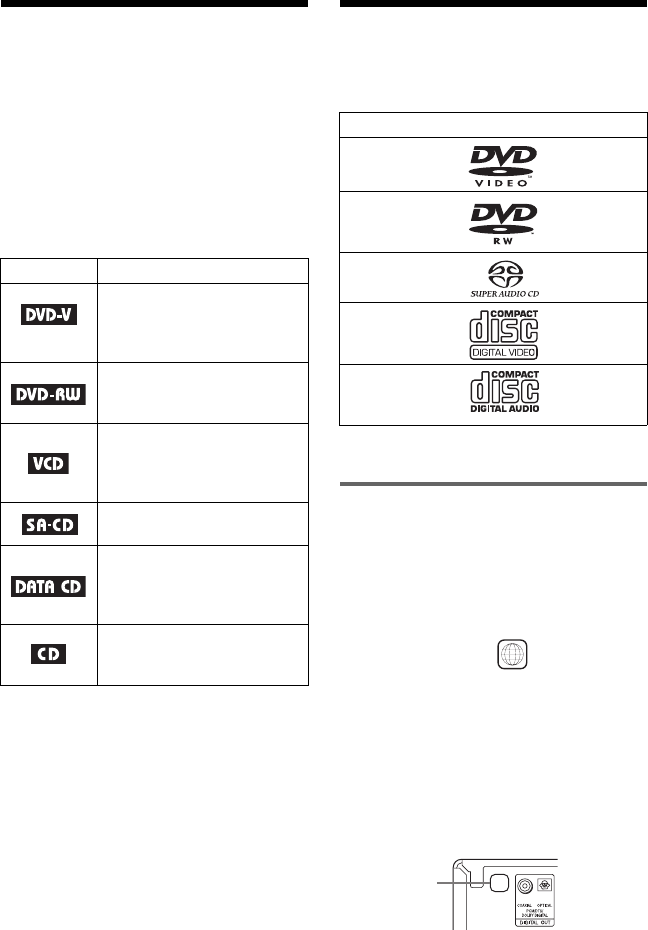
• The meaning of the icons used in this
manual is described below:
* MP3 (MPEG1 Audio Layer 3) is a standard
format defined by ISO (International Standards
Organization)/MPEG which compresses audio
data.
This Player Can Play the
Following Discs
“DVD VIDEO” and “DVD-RW” are
trademarks.
Region code
Your player has a region code printed on the
back of the unit and will only play DVD
VIDEOs (playback only) labeled with
identical region codes. This system is used to
protect copyrights.
DVD VIDEOs labeled will also play on
this player.
If you try to play any other DVD VIDEO, the
message “Playback prohibited by area
limitations.” will appear on the TV screen.
Depending on the DVD VIDEO, no region
code indication may be labeled even though
playing the DVD VIDEO is prohibited by
area restrictions.
Icons Meanings
Functions available for DVD
VIDEOs or DVD-Rs/DVD-
RWs in video mode or
DVD+Rs/DVD+RWs
Functions available for DVD-
RWs in VR (Video Recording)
mode
Functions available for VIDEO
CDs , Super VCDs, or CD-Rs/
CD-RWs in video CD format
or Super VCD format
Functions are available for
Super Audio CDs
Functions available for DATA
CDs (CD-ROMs/CD-Rs/CD-
RWs containing MP3* audio
tracks)
Functions available for music
CDs or CD-Rs/CD-RWs in
music CD format
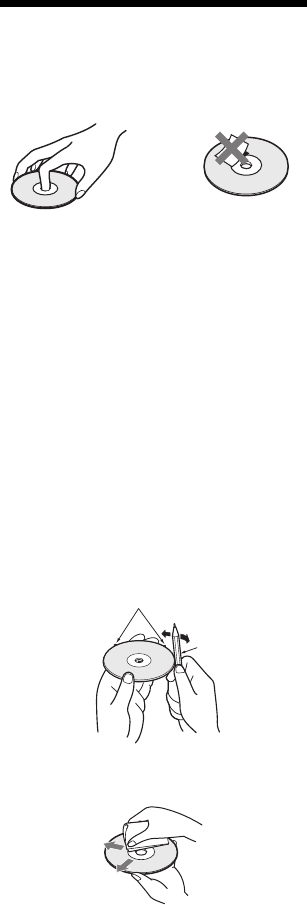
Format of discs
DVD VIDEO
(page 101)
DVD-RW
(page 101)
Super Audio CD
(page 101)
VIDEO CD
Music CD
ALL
X
Region code

7
Example of discs that the player
cannot play
The player cannot play the following discs:
• All CD-ROMs (including PHOTO CDs)/
CD-Rs/CD-RWs other than those recorded
in the following formats:
–music CD format
–video CD format
–MP3 format that conforms to ISO9660*
Level 1/Level 2, or its extended format,
Joliet
• Data part of CD-Extras
• DVD-ROMs
• DVD Audios
* A logical format of files and folders on CD-
ROMs defined by ISO (International Standards
Organization).
Also, the player cannot play the following
discs:
• A DVD VIDEO with a different region
code.
• A disc recorded in a color system other than
NTSC, such as PAL or SECAM (this player
conforms to the NTSC color system).
• A disc that has a non-standard shape (e.g.,
card, heart).
• A disc with paper or stickers on it.
• A disc that has the adhesive of cellophane
tape or a sticker still left on it.
Notes
• Note about DVD-RWs/DVD-Rs, DVD+RWs/
DVD+Rs, or CD-Rs/CD-RWs.
Some DVD-RWs/DVD-Rs, DVD+RWs/
DVD+Rs, or CD-Rs/CD-RWs cannot be played
on this player due to the recording quality or
physical condition of the disc, or the
characteristics of the recording device and
authoring software. Also, images in DVD-RWs
with CPRM* protection may not be played if they
contain a copy protection signal. “Copyright
lock” appears on the screen. For more
information, see the operating instructions for the
recording device.
Note that discs created in the Packet Write format
cannot be played.
* CPRM (Content Protection for Recordable
Media) is a coding technology that protects
copyright for images.
• Music discs encoded with copyright protection
technologies
This product is designed to playback discs that
conform to the Compact Disc (CD) standard.
Recently, various music discs encoded with
copyright protection technologies are marketed
by some record companies. Please be aware that
among those discs, there are some that do not
conform to the CD standard and may not be
playable by this product.
Note on playback operations of
DVDs and VIDEO CDs
Some playback operations of DVDs and
VIDEO CDs may be intentionally set by
software producers. Since this player plays
DVDs and VIDEO CDs according to the disc
contents the software producers designed,
some playback features may not be available.
Also, refer to the instructions supplied with
the DVDs or VIDEO CDs.
Copyrights
This product incorporates copyright
protection technology that is protected by
U.S. patents and other intellectual property
rights. Use of this copyright protection
technology must be authorized by
Macrovision, and is intended for home and
other limited viewing uses only unless
otherwise authorized by Macrovision.
Reverse engineering or disassembly is
prohibited.
8
Notes About the Discs
• To keep the disc clean, handle the disc by its
edge. Do not touch the surface.
• Do not expose the disc to direct sunlight or
heat sources such as hot air ducts, or leave it
in a car parked in direct sunlight as the
temperature may rise considerably inside
the car.
• After playing, store the disc in its case.
To ensure stable operation
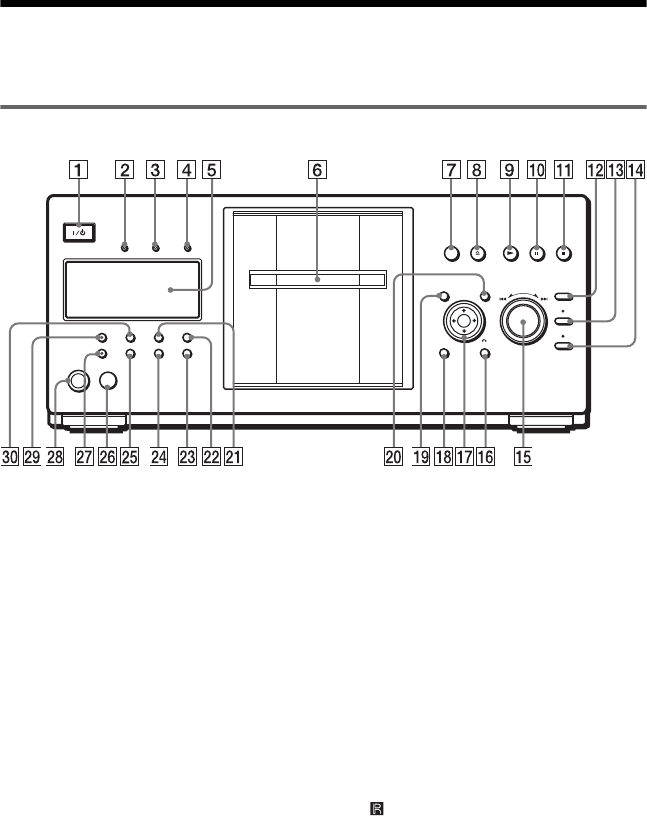
• If the front cover automatically opens and
“C32” appears in the front panel display
(page 100), it may be because burrs remain
on the outer edge of the disc, particularly
CDs. In order to ensure stable operation,
remove the burrs by rubbing the edge of the
disc with the side of a pen or pencil. Check
the discs in the two slots to the left and right
of the center slot, including the center slot.
• Clean the disc with a cleaning cloth.
Wipe the disc from the center out.
• Do not use solvents such as benzine,
thinner, commercially available cleaners, or
anti-static spray intended for vinyl LPs.
Burrs
Pen or pencil
9
Index to Parts and Controls
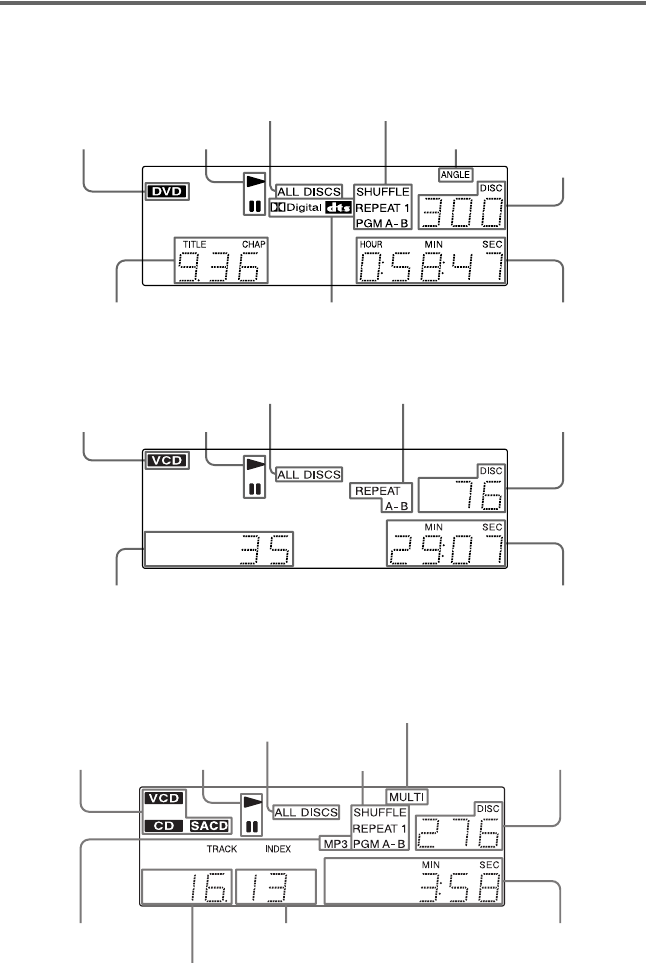
For more information, see the pages in parentheses.
Front panel
A[/1 (on/standby) button (33)
BPROGRESSIVE indicator (90)
— Lights up when the player outputs
progressive signals.
CSACD (Super Audio CD) indicator
Lights up when:
— playing a Super Audio CD.
— no disc is inserted.
DMULTI CHANNEL indicator
Lights up when:
—Playing a track or chapter that
contains three or more audio signal
channels.
—no disc is inserted.
EFront panel display (10)
FFront cover (33)
GOPEN/CLOSE button (33)
HA DISC EJECT button (34)
IN (play) button (34)
JX (pause) button (35)
Kx (stop) button (35)
L+100 button (35)
MDISC CHANGE button/indicator (33)
(34) (35) (51)
NDIRECT SEARCH button/indicator
(35)
O.–/>+/ENTER
(previous/next/enter) dial (35)
PO RETURN button (36)
QC/X/x/c/ENTER buttons (38)
RDISPLAY button (14)
STOP MENU button (38)
TMENU button (38)
UVIDEO CONTROL button (76)
VSURROUND button (70)
WONE/ALL DISCS button (44)
XFOLDER button (50)
YLOAD button (50)
Z (remote sensor) (17)
wj VIDEO OFF indicator (34)
wk KEYBOARD jack (56)
wl FL OFF button/indicator (10)
e; TIME/TEXT button (65)
c continued
10
Front panel display
When playing back a DVD VIDEO/DVD-RW
When playing back a VIDEO CD with Playback Control (PBC) (41)
When playing back a CD, Super audio CD, DATA CD (MP3 audio), or VIDEO CD (without
PBC)
Playing time (66)
Disc type
Current audio signal (69)
Lights up when you can
change the angle (74)
Current play
mode (44)
Playing status
Current title and chapter (66)
Current disc
All discs mode (44)
Playing time (66)
Playing status
Current play mode (44)
All discs mode (44)
Current disc
Current scene (66)
Disc type
Playing time (66)
Current track (CD, Super Audio CD,
VIDEO CD) or album (DATA CD) (66)
Lights up when
playing MP3 audio
tracks (42)
Playing status Current disc
Current play
mode (44)
All discs mode (44)
Current index (CD, Super Audio CD,
VIDEO CD) or track (DATA CD) (66)
Lights up when playing the multi-channel
playback area on Super Audio CDs (40)
Disc type
(“SACD” lights up
during HD playback)
12
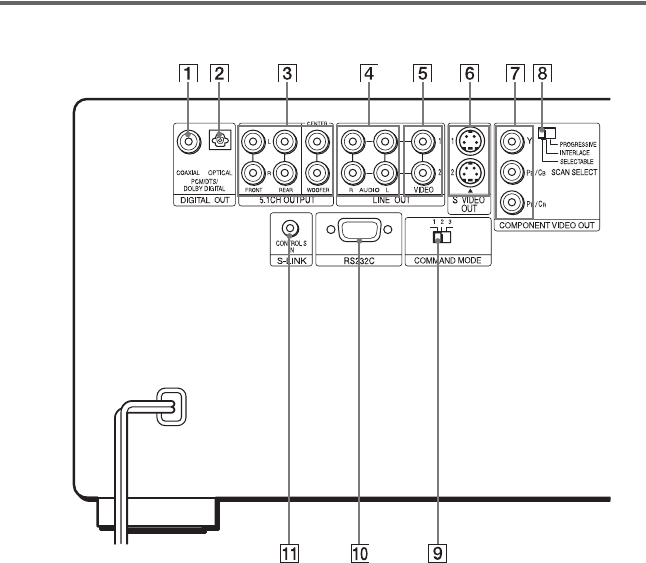
Rear panel
ADIGITAL OUT (COAXIAL) jack
(25) (26) (27)
BDIGITAL OUT (OPTICAL) jack
(25) (26) (27)
C5.1CH OUTPUT jacks (27)
DLINE OUT AUDIO L/R 1/2 jacks
(24) (25) (26)
ELINE OUT VIDEO 1/2 jacks (19)
FS VIDEO OUT 1/2 jacks (19)
GCOMPONENT VIDEO OUT (Y, PB/
CB, PR/CR) jacks (19)
HCOMPONENT VIDEO OUT/SCAN
SELECT switch (90)
ICOMMAND MODE switch (18)
JRS232C jack*
KS-LINK/CONTROL S IN jack (19)
* This port is intended for future applications.
13
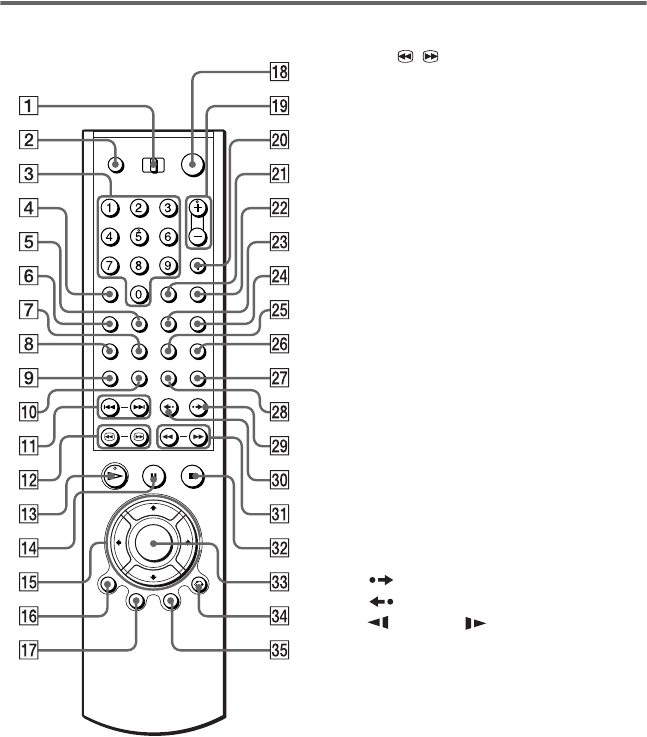
Remote
ATV/DISC EXPLORER/DVD switch
(51)(84)
BOPEN/CLOSE button (35)
CNumber buttons (38)
The number 5 button has a tactile dot.*
DCLEAR button (45)
ESUR (surround) button (70)
FVIDEO CONTROL button (76)
GSUBTITLE button (75)
HAUDIO button (69)
IPICTURE NAVI (picture navigation)
button (63)
JREPEAT button (47)
K./> PREV/NEXT (previous/
next) buttons (35)
Lc/C SEARCH/STEP
buttons (60)
MH PLAY button (34)
The H button has a tactile dot.*
NX PAUSE button (35)
OC/X/x/c buttons (38)
PDISPLAY/FILE button (14)(53)
QTOP MENU/EDIT button (38)(55)
R[/1 (on/standby) button (33)
SVOL (volume) +/– buttons (84)
The + button has a tactile dot.*
TTV/VIDEO/DISC SKIP + button
(35)(84)
UENTER button (84)
VWIDE MODE/DISC SKIP – button
(35)(84)
WFOLDER button (50)
XPICTURE MEMORY button (52)
YANGLE button (74)
ZTIME/TEXT button (65)
wj SACD/CD (Super Audio CD/CD)
button (40)
wk SACD MULTI/2CH (Super Audio CD
multi/2 channel) button (40)
wl INSTANT SEARCH button (35)
e; INSTANT REPLAY button (35)
ea m/M SCAN/SLOW
buttons (60)
es x STOP button (35)
ed ENTER button (38)
ef O RETURN button (36) (41) (51)
eg MENU/SORT button (38) (42) (58)
* Use the tactile dot as a reference when operating
the player.
14
Guide to the Control Menu Display
Use the Control Menu to select a function and to view related information. After sliding the
TV/DISC EXPLORER/DVD switch to DVD, press DISPLAY/FILE repeatedly to turn on or
change the Control Menu display as follows:
Control Menu display 1
m
Control Menu display 2 (DVD/VIDEO CD/Super Audio CD/CD only)
m
ADVANCED display (DVD only, see page 67)
m
Control Menu display off
zHint
You can skip the ADVANCED display by setting “OFF” under “ADVANCED” in the Control Menu (page
67).
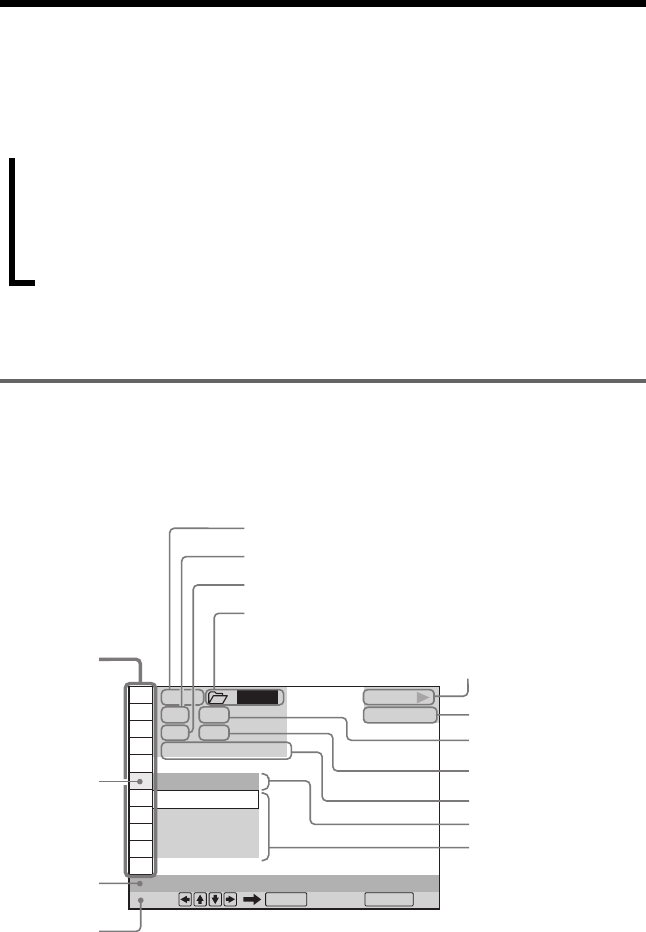
Control Menu
The Control Menu display 1 and 2 will show different items depending on the disc type. For
details, see the pages in parentheses.
Example: Control Menu display 1 when playing a DVD VIDEO
* Displays the scene number for VIDEO CDs (PBC is on), track number for VIDEO CDs/Super Audio
CDs/CDs, album number for DATA CDs.
** Displays the index number for VIDEO CDs/Super Audio CDs/CDs, MP3 audio track number for
DATA CDs.
*** Displays the DISC MEMO or CD Text when the disc contains title information.
,
OFF
1: ENGLISH
2: FRENCH
3: SPANISH
OFF
1 8 ( 3 4 )
1 2 ( 2 7 )
T
1 : 3 2 : 5 5
DVD
PLAY
Select: Cancel:
SUBTITLE ENTER RETURN
1 2 3
ALL
Currently playing chapter number**
Playing time
Total number of chapters
**
Currently playing title number*
Options
Current setting
Total number of titles*
Playback status (N Playback,
X Pause, x Stop, etc.)
Function name of
selected Control
Menu item
Operation
message***
Selected item
Control
Menu items
Type of disc being
played back
Currently playing disc number
Selected folder
15
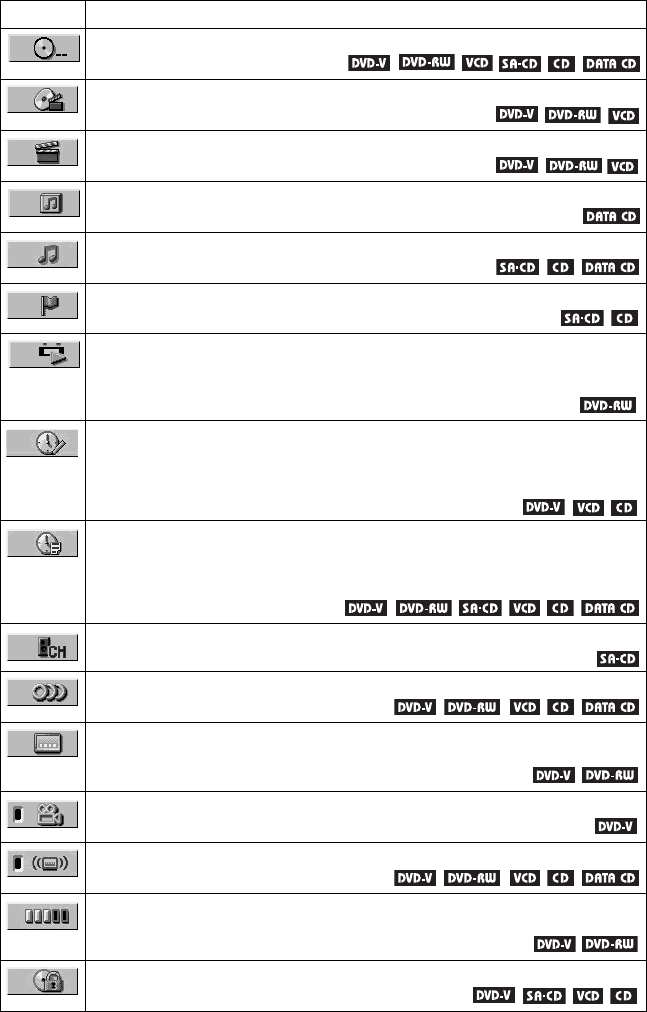
List of Control Menu items
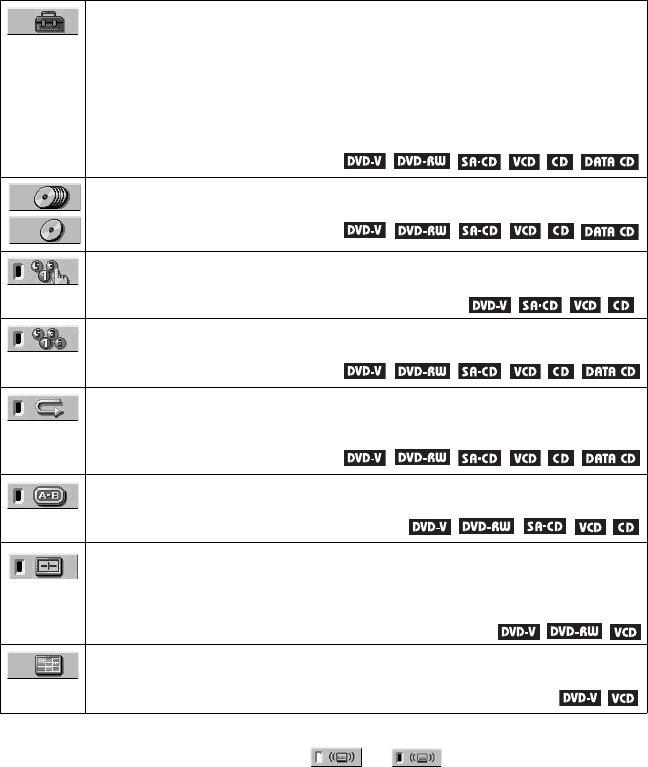
Item Item Name, Function, Relevant Disc Type
DISC (page 61)
Selects the disc to be played.
TITLE (page 61)/SCENE (page 61)/TRACK (page 61)
Selects the title, scene, or track to be played.
CHAPTER (page 61)/INDEX (page 61)
Selects the chapter or index to be played.
ALBUM (page 61)
Selects the album to be played.
TRACK (page 61)
Selects the track to be played.
INDEX (page 61)
Selects the index to be played.
ORIGINAL/PLAY LIST (page 39)
Selects the type of titles (DVD-RW) to be played, the ORIGINAL one, or an edited
PLAY LIST.
TIME/MEMO (page 61)
Checks the elapsed time and the remaining playback time.
Use to input the time code when searching for a scene or music.
Displays the Disc Memo you entered in the edit mode of
the Disc Explorer function (page 65).
TIME/TEXT (page 61)
Checks the elapsed time and the remaining playback time.
Use to input the time code when searching for a scene or music.
Displays the DVD/Super Audio CD/CD text or the DATA CD’s track name (page 65).
MULTI/2CH (page 40)
Selects the playback area on Super Audio CDs when available.
AUDIO (page 69)
Changes the audio setting.
SUBTITLE (page 75)
Displays the subtitles.
Changes the subtitle language.
ANGLE (page 74)
Changes the angle.
SURROUND (page 70)
Selects the surround functions.
ADVANCED (page 67)
Displays the information (bit rate or layer) of the disc currently playing.
PARENTAL CONTROL (page 80)
Set to prohibit playback on this player.
c continued
16
zHint
The Control Menu icon indicator lights up in green when you select any item except
“OFF.” (“SURROUND,” “PROGRAM,” “SHUFFLE,” “REPEAT,” “A-B REPEAT” only). The “ANGLE”
indicator lights up in green only when the angles can be changed. The “VIDEO CONTROL” indicator lights
up in green when any setting other than “STANDARD” is selected.
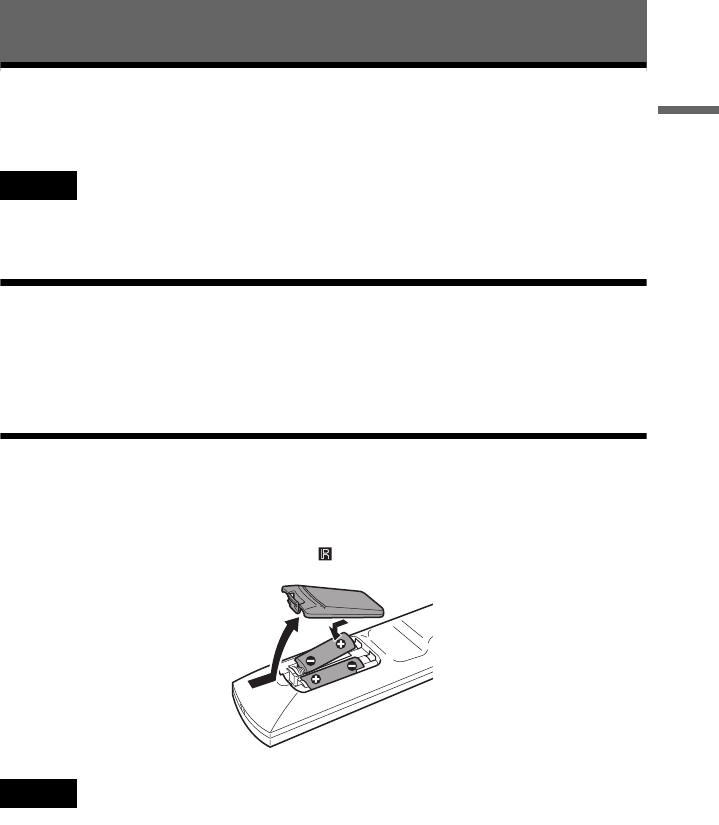
SETUP (page 87)
QUICK Setup
Use Quick Setup to choose the desired language of the on-screen display, the aspect
ratio of the TV, and the audio output signal, and the size of the speakers you are using.
CUSTOM Setup
In addition to the Quick Setup setting, you can adjust various other settings.
RESET
Returns the settings in “SETUP” to the default setting.
ALL DISCS/ONE DISC (page 44)
Selects All Discs or One Disc mode.
PROGRAM (page 45)
Selects the disc, title, chapter, or track to play in the order you want.
SHUFFLE (page 47)
Plays the disc, title, chapter, or track in random order.
REPEAT (page 47)
Plays the entire disc (all titles/all tracks/all albums) repeatedly or one title/chapter/
track/album repeatedly.
A-B REPEAT (page 48)
Specifies the parts you want to play repeatedly.
VIDEO CONTROL (page 76)
Adjusts the video signal from the player in various ways.
Select the setting that suits the program you are watching. Or, make detailed
adjustments to each element of picture quality, such as brightness, color, noise,
sharpness, and many others.
PICTURE NAVIGATION (page 63)
Divides the screen into 9 subscreens to help you find the scene you want quickly.
t
HookupsHookups
17
Hookups
Hooking Up the Player
Follow steps 1 to 6 to hook up and adjust the settings of the player.
Notes
• Plug cords securely to prevent unwanted noise.
• Refer to the instructions supplied with the components to be connected.
• You cannot connect this player to a TV that does not have a video input jack.
• Be sure to disconnect the power of each component before connecting.
Step 1: Unpacking
Check that you have the following items:
• Audio/video cord (pinplug × 3 y pinplug × 3) (1)
• Remote commander (remote) (1)
• Size AA (R6) batteries (2)
Step 2: Preparing the Remote
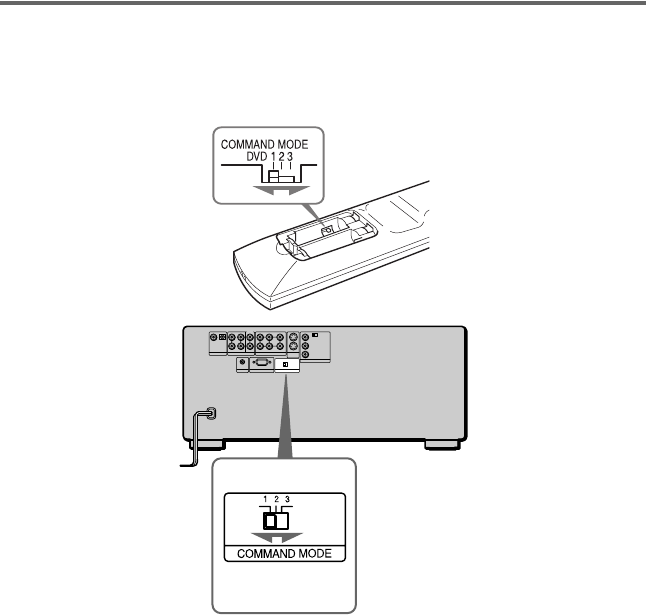
You can control the player using the supplied remote. Insert two Size AA (R6) batteries by
matching the 3 and # ends on the batteries to the markings inside the compartment. When
using the remote, point it at the remote sensor on the player.
Notes
• Do not leave the remote in an extremely hot or humid place.
• Do not drop any foreign object into the remote casing, particularly when replacing the batteries.
• Do not expose the remote sensor to direct sunlight or lighting apparatus. Doing so may cause a malfunction.
• If you do not use the remote for an extended period of time, remove the batteries to avoid possible damage
from battery leakage and corrosion.
c continued
18
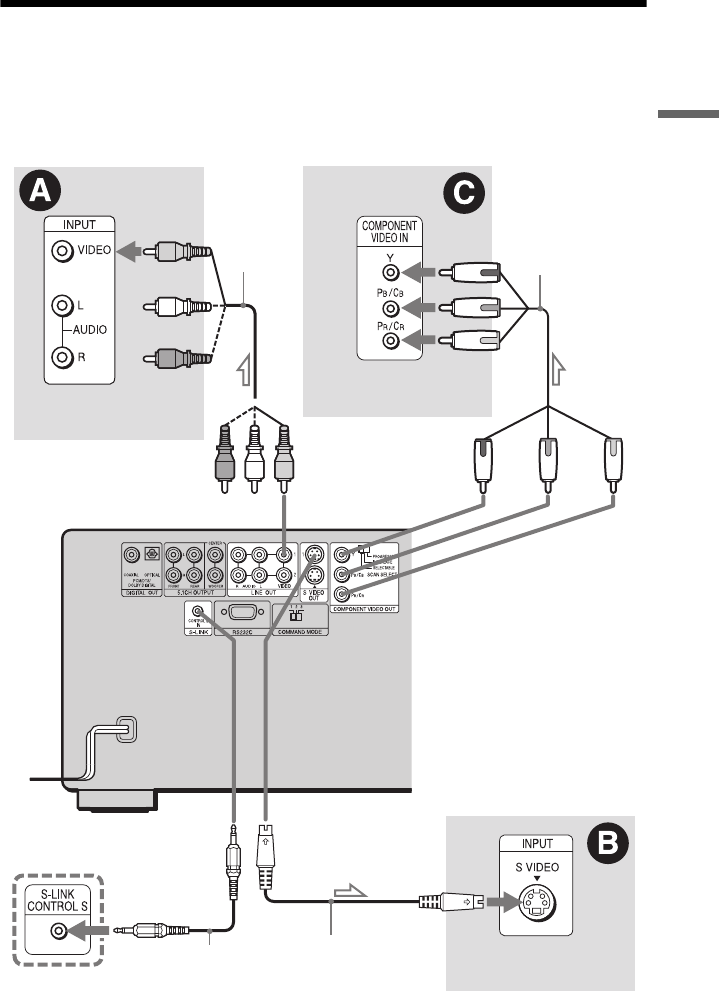
When you have more than one Sony DVD player
If the supplied remote interferes with your other Sony DVD player, set the command mode for
this player and the supplied remote to one that differs from the other Sony DVD player.
The default command mode setting for this player and the supplied remote is DVD1.
1Slide the COMMAND MODE switch on the remote to select the command mode (DVD
1, DVD 2, or DVD 3) so that the setting for the remote differs from the other DVD
players.
For example, if other DVD players respond to the default command mode setting for the
supplied remote (DVD 1), set the remote to DVD 2 or DVD 3.
2Slide the COMMAND MODE switch on the rear of the player so it matches that of the
supplied remote.
19
Hookups
Step 3: Connecting the Video Cords
Connect this player to your TV monitor, projector, or AV amplifier (receiver) using a video cord.
Select one of the patterns A through C, according to the input jack on your TV monitor,
projector, or AV amplifier (receiver). In order to view progressive signal pictures with a
compatible TV, projector, or monitor, you must use pattern C.
l : Signal flow
Component
video cord
(not supplied)
(yellow)
Audio/video
cord (supplied)
TV, projector or AV
amplifier (receiver)
TV, projector or AV
amplifier (receiver)
(green)
S VIDEO cord
(not supplied)
TV, projector or AV
amplifier (receiver)
(red)(blue)
(yellow)
(green)
(blue)
(red)
to LINE OUT VIDEO
1 or 2
to S VIDEO
OUT 1 or 2
to COMPONENT
VIDEO OUT
CD/DVD player
TV or video
component with
S-LINK (CONTROL S)
jack
to S-LINK/
CONTROL S
IN (page 20)
S-link (control S)
cord (not supplied)
c continued
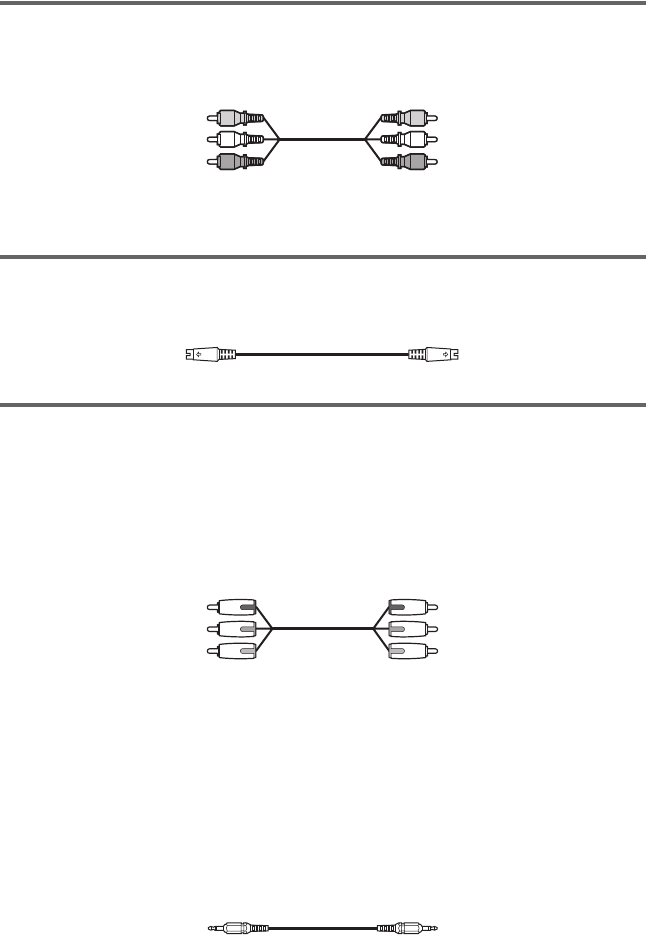
20
A If you are connecting to a video input jack
Connect the yellow plug of the audio/video cord (supplied) to the yellow (video) jacks. You will
enjoy standard quality images.
Use the red and white plugs to connect to the audio input jacks (page 24). (Do this if you are
connecting to a TV only.)
B If you are connecting to an S VIDEO input jack
Connect an S VIDEO cord (not supplied). You will enjoy high quality images.
C If you are connecting to a monitor, projector, or AV amplifier
(receiver) having component video input jacks (Y/PB/PR)
Connect the component via the COMPONENT VIDEO OUT jacks using a component video
cord (not supplied) or three video cords (not supplied) of the same kind and length. You will
enjoy accurate color reproduction and high quality images. If your TV accepts progressive 480p
format signals, you must use this connection and set “COMPONENT OUT” in “SCREEN
SETUP” to “PROGRESSIVE” (page 90).
To change the aspect ratio for the connected TV
Depending on the disc and the TV type (standard 4:3 screen TV or wide screen TV), the image
may not fit the TV screen. If this happens, change the aspect ratio (page 89).
If your TV or video component has an S-LINK (CONTROL S) connector
You can control the player by pointing the remote at the remote sensor on the TV or video
component. This feature is convenient if you place the player and the TV or video component at
a distance from each other.
Connect the TV or video component via the S-LINK/CONTROL S jack using an S-link (control
S) cord (not supplied). Refer to the instructions supplied with the component to be connected.
Yellow (Video)
White (L)
Red (R)
Yellow (Video)
White (L)
Red (R)
Green
Blue
Red
Green
Blue
Red

21
Hookups
Notes
• Connect the player directly to the TV. If you pass the player signals via the VCR, you may not receive a
clear image on the TV screen.
• Consumers should note that not all high definition television sets are fully compatible with this product and
may cause artifacts to be displayed in the picture. In case of 480 progressive scan picture problems, it is
recommended that the user switch the connection to the ‘standard definition’ output. If there are questions
regarding our TV set compatibility with this model 480p DVD player, please contact our customer service
center.
VCR
CD/DVD player TV
Connect
directly
22
Step 4: Connecting the Audio Cords
Refer to the chart below to select the connection that best suits your system. Be sure to also read
the instructions for the components you wish to connect.
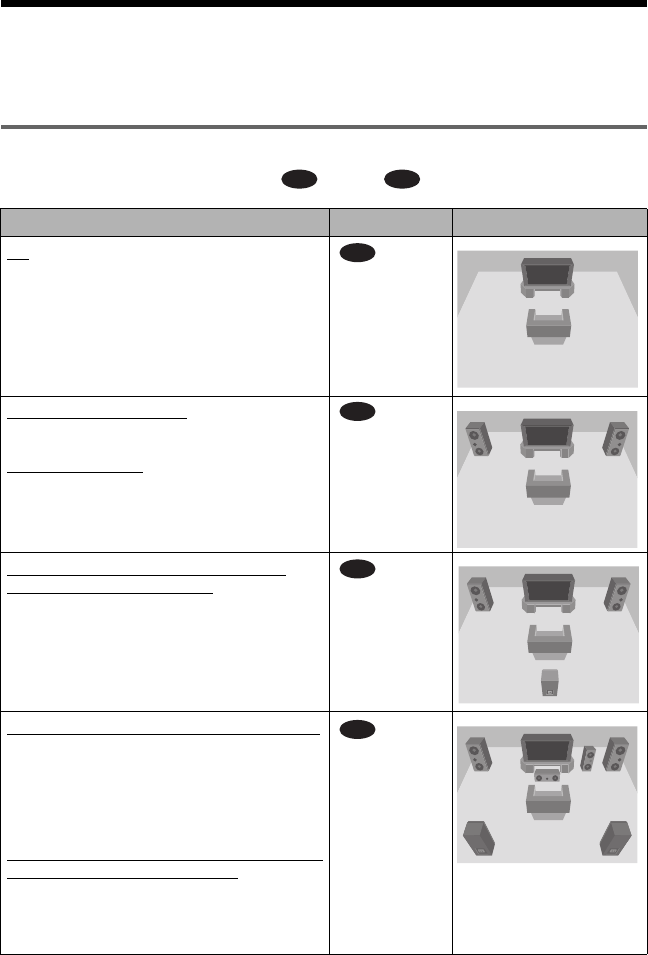
Select a connection
Select one of the following connections, through .
Components to be connected Connection Your setup (example)
TV
• Surround effects: TVS DYNAMIC (page 71),
TVS WIDE (page 71)
(page 24)
Stereo amplifier (receiver) and two speakers
• Surround effects: TVS STANDARD (page 71)
or
MD deck/DAT deck
• Surround effects: None
(page 25)
AV amplifier (receiver) having a Dolby*
Surround (Pro Logic) decoder and 3 to 6
speakers
• Surround effects: Dolby Surround (Pro Logic)
(page 93)
(page 26)
AV amplifier (receiver) with 5.1 ch input jacks
and 4 to 6 speakers
• Surround effects:
– Dolby Digital (5.1 ch) (page 101)
– DTS (5.1 ch) (page 101)
– Super Audio CD Multi channel (page 101)
or
AV amplifier (receiver) with digital input jacks
having a Dolby or DTS** decoder and 6
speakers
• Surround effects:
– Dolby Digital (5.1 ch) (page 101)
– DTS (5.1 ch) (page 101)
(page 27)
A D
A
B
C
D

23
Hookups
zHint
If you have an AV amplifier that conforms to the
96 kHz sampling frequency, use connection .
* Manufactured under license from Dolby
Laboratories. “Dolby,” “Pro Logic,” and the
double-D symbol are trademarks of Dolby
Laboratories.
**“DTS” and “DTS Digital Surround” are
registered trademarks of Digital Theater
Systems, Inc.
D
c continued
24
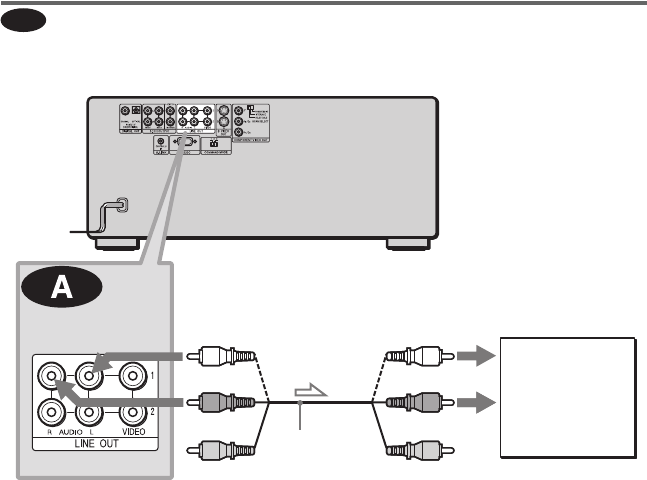
Connecting to your TV
This connection will use your TV’s speakers for sound.
* The yellow plug is used for video signals (page
19).
zHint
When connecting to a monaural TV, use a stereo-
mono conversion cord (not supplied). Connect the
LINE OUT AUDIO L/R 1 or 2 jacks to the TV’s
audio input jack.
A
TV
l : Signal flow
CD/DVD player
(white)
(red)
Audio/video
cord (supplied)
to audio input
(yellow)
(white)
(red)
(yellow)*
to LINE OUT AUDIO
L/R 1 or 2
25
Hookups
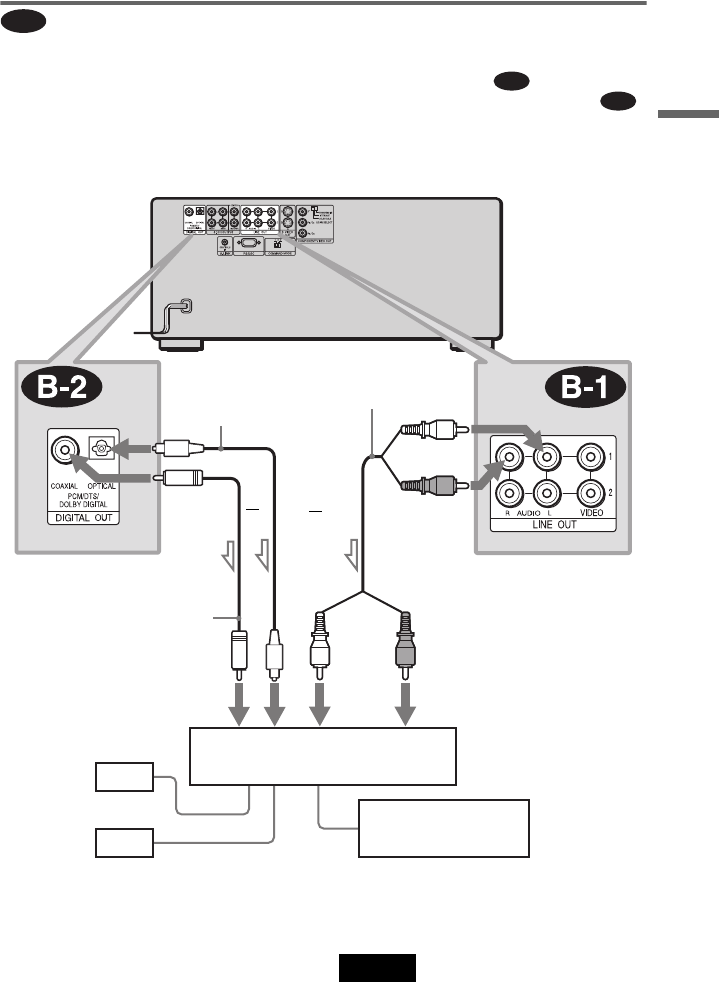
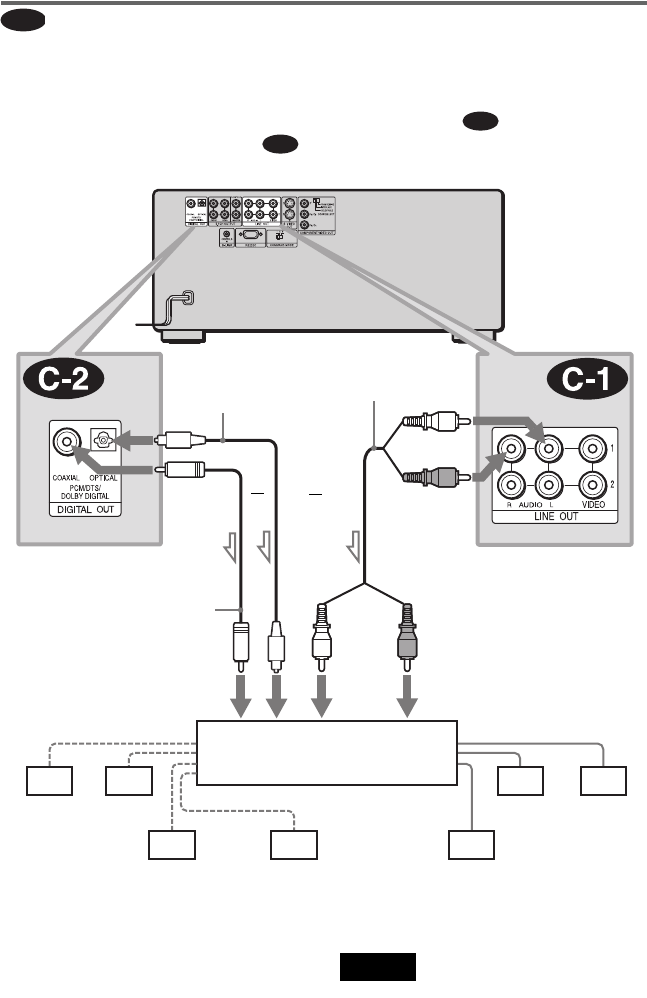
Connecting to a stereo amplifier (receiver) and 2 speakers/Connecting to
an MD deck or DAT deck
If the stereo amplifier (receiver) has audio input jacks L and R only, use . If the amplifier
(receiver) has a digital input jack, or when connecting to an MD deck or DAT deck, use .
In this case, you can also connect the player directly to the MD deck or DAT deck without using
your stereo amplifier (receiver).
zHint
To realize better surround sound effects, make sure
that your listening position is in between your
speakers.
Note
Super Audio CD audio signals are not output from
the digital jack.
B
B-1
B-2
CD/DVD player
or
Stereo amplifier (receiver)
MD deck/DAT deck
Front (L)
Front (R)
[Speakers]
(white)
(red)
(red)
(white)
Coaxial digital cord
(not supplied)
Stereo audio cord
(not supplied)
to audio input
to coaxial or optical
digital input
to LINE OUT AUDIO L/R
1 or 2
to DIGITAL OUT
(COAXIAL or OPTICAL)
l
: Signal flow
Optical digital cord
(not supplied)
Remove jack cap
before connecting
or
c continued
26
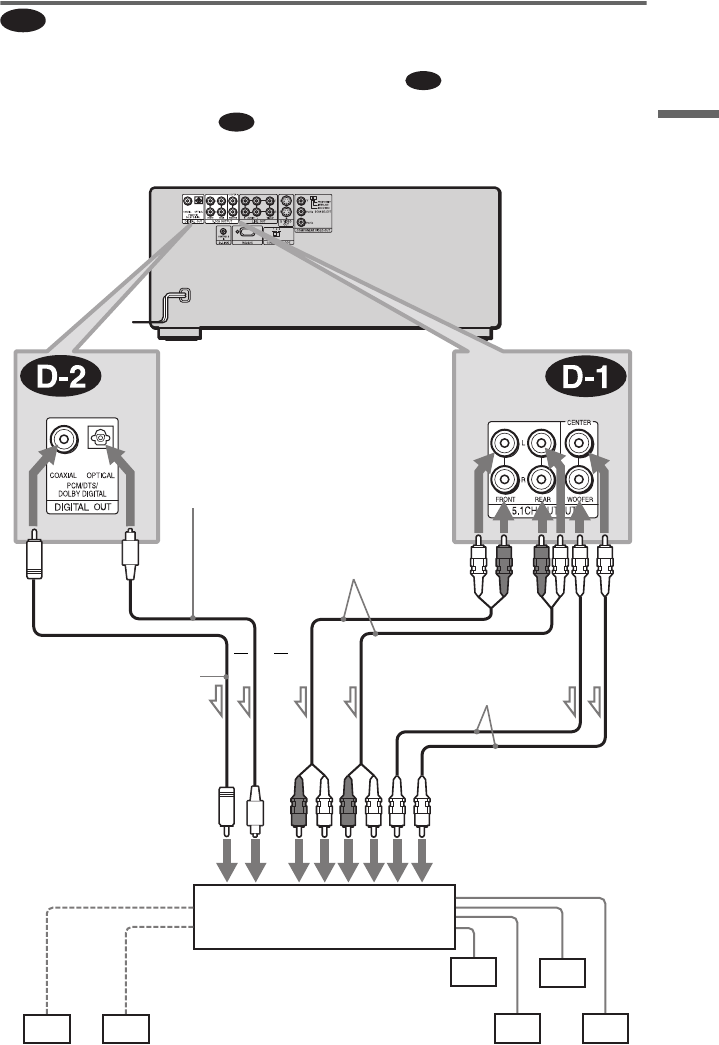
Connecting to an AV amplifier (receiver) having a Dolby Surround (Pro
Logic) decoder and 3 to 6 speakers
You can enjoy the Dolby Surround effects only when playing Dolby Surround audio or multi-
channel audio (Dolby Digital) discs.
If your amplifier (receiver) has L and R audio input jacks only, use . If your amplifier
(receiver) has a digital input jack, use .
zHint
For correct speaker location, refer to the operating
instructions of the amplifier (receiver).
Notes
• When connecting 6 speakers, replace the
monaural rear speaker with a center speaker, 2
rear speakers and a subwoofer.
• Super Audio CD audio signals are not output from
the digital jack.
C
C-1
C-2
CD/DVD player
or
Front (R)
Front (L)
Rear (R)
Subwoofer
l: Signal flow
Rear (L)
Amplifier (receiver) with Dolby
Surround decoder
Center Rear (mono)
Stereo
audio cord (not
supplied)
[Speakers]
Coaxial digital cord
(not supplied) (red)
(white)
to coaxial or optical digital input
[Speakers]
to audio input
(white)
(red)
to LINE OUT AUDIO L/R
1 or 2
to DIGITAL OUT
(COAXIAL or OPTICAL)
Optical digital cord
(not supplied)
Remove jack cap
before connecting
or
27
Hookups
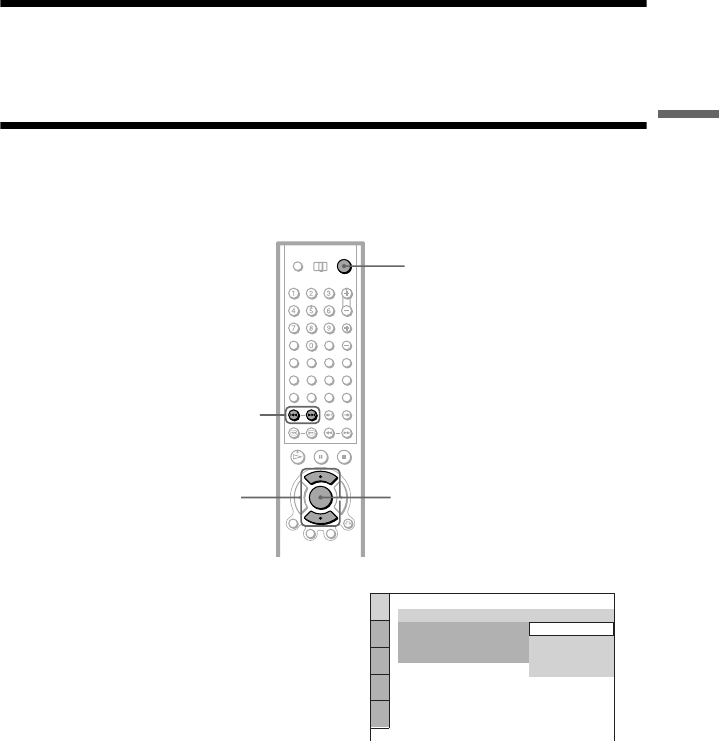
Connecting to an AV amplifier (receiver) with 5.1 ch input jacks and/or a
digital input jack and 4 to 6 speakers
If your AV amplifier (receiver) has 5.1 channel inputs, use .
If you want to use the Dolby Digital, or DTS decoder function on your AV amplifier (receiver),
connect to its digital jack using . With the following connections, you can enjoy a more
realistic audio presence in the comfort of your own home.
D
D-1
D-2
l: Signal flow
Front (R)
Front (L)
Rear (R)
AV amplifier (receiver) having
5.1ch inputs or/and a decoder
Subwoofer
Center
Coaxial digital cord
(not supplied)
Monaural audio cord
(not supplied)
Stereo audio cord
(not supplied)
Optical digital cord
(not supplied)
Remove jack cap
before connecting
[Speakers]
CD/DVD player
[Speakers]
Rear (L)
to audio input
to coaxial or optical
digital input
or
or
to 5.1CH
OUTPUT
to DIGITAL OUT
(COAXIAL or OPTICAL)
c continued

28
: Connecting to the 5.1ch input jacks
You can enjoy 5.1ch surround sound using
the internal Dolby Digital, DTS, or Super
Audio CD Multi decoder of this player.
(when 6 speakers are connected, set
“SURROUND” to “OFF.”)
You can also enjoy Dolby Surround (Pro
Logic) sound, or surround sounds using
various “SURROUND” modes (page 70).
: Connecting to a digital jack
This connection will allow you to use the
Dolby Digital, or DTS decoder function of
your AV amplifier (receiver). You are not
able to enjoy the surround sound effects of
this player.
zHints
• For correct speaker placement, refer to the
instructions of the connected components.
• To enhance the sound performance:
– Use high-performance speakers.
– Use front, rear, and center speakers of the same
size and performance.
– Place the subwoofer between the left and right
front speakers.
• Use connection when connecting to 7 or
more speakers (6.1ch or more).
Notes
For connection
• After you have completed the connection, be sure
to set “DOLBY DIGITAL” to “DOLBY
DIGITAL” and “DTS” to “DTS” in Quick Setup
(page 29).
• When you connect an amplifier (receiver) that
conforms to the 96kHz sampling frequency, set
“48kHz/96kHz PCM” in “AUDIO SETUP” to
“96kHz/24bit” (page 93).
• Super Audio CD audio signals are not output from
the digital jack.
D-1
D-2
D-2
D-2
29
Hookups
Step 5: Connecting the Power Cord
Plug the power cords of the player and TV into an AC outlet.
Step 6: Quick Setup
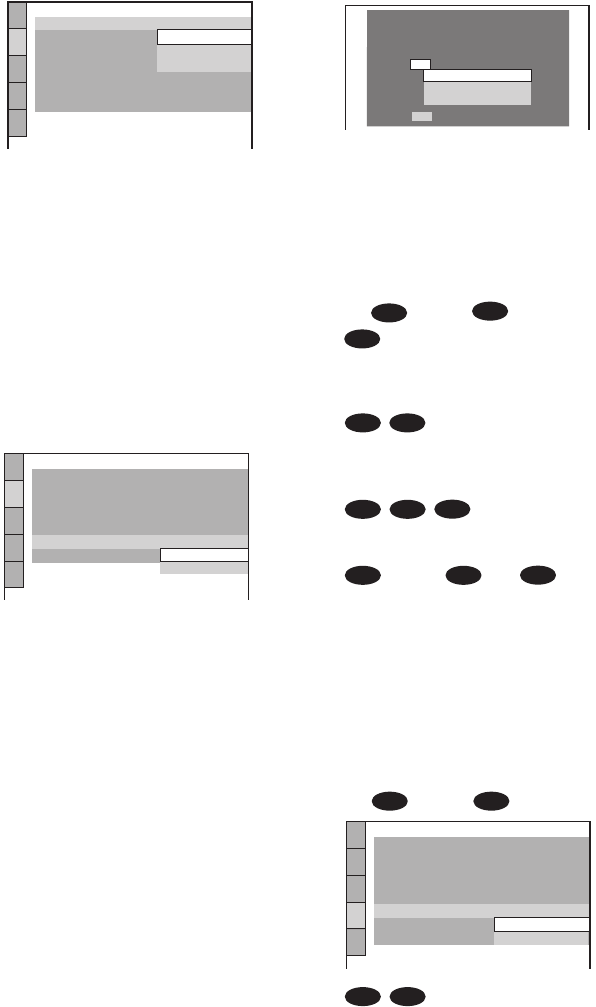
Follow the steps below to make the minimum number of basic adjustments for using the player.
To skip an adjustment, press >. To return to the previous adjustment, press ..
1Turn on the TV.
2Press [/1.
3Switch the input selector on your
TV so that the signal from the
player appears on the TV screen.
“Press [ENTER] to run QUICK SETUP”
appears at the bottom of the screen. If this
message does not appear, select
“QUICK” under “SETUP” in the Control
Menu to run Quick Setup (page 88).
4Press ENTER before inserting a
disc.
The Setup Display for selecting the
language used in the on-screen display
appears.
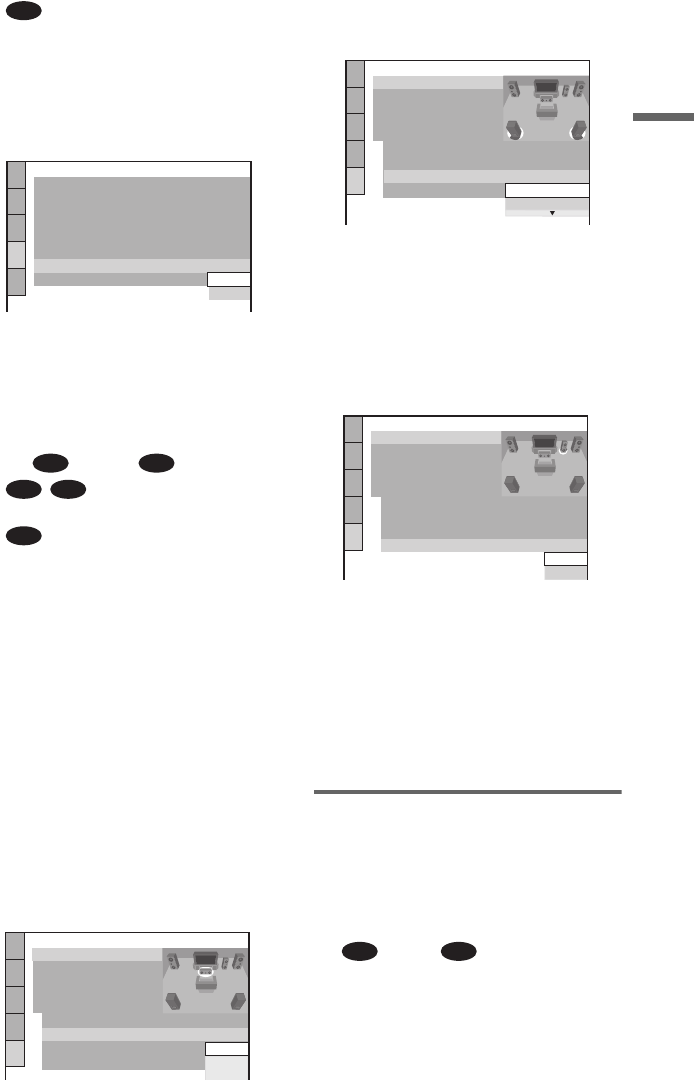
5Press X/x to select a language.
The player uses the language selected
here to display the menu and subtitles as
well.
6Press ENTER.
The Setup Display for selecting the
aspect ratio of the TV to be connected
appears.
[/1
ENTER
X/x
./>
LANGUAGE SETUP
OSD:
MENU:
AUDIO:
SUBTITLE: FRENCH
ENGLISH
ENGLISH
SPANISH
PORTUGUESE
c continued
30
7Press X/x to select the setting that
matches your TV type.
◆If you have a 4:3 standard TV
• 4:3 LETTER BOX or 4:3 PAN SCAN
(page 89)
◆If you have a wide-screen TV or a 4:3
standard TV with a wide-screen mode
• 16:9 (page 89)
8Press ENTER.
The Setup Display for selecting the type
of video signal appears.
9Press X/x to select the type of
signals you wish to output to your
TV.
Select “PROGRESSIVE” only if you
have made video connection C (page 19)
and wish to view progressive video
signals.
◆Interlace format TV (standard TV)
• INTERLACE (page 90)
◆Progressive format TV
•
PROGRESSIVE
(page 90)
10Press ENTER.
The Setup Display for selecting the type
of jack used to connect your amplifier
(receiver) appears.
11Press X/x to select the type of
jack (if any) you are using to
connect to an amplifier (receiver),
then press ENTER.
Choose the item that matches the audio
connection you selected on pages 24 to
27 ( through ).
• If you connect just a TV and nothing
else, select “NO.” Quick Setup is
finished and connections are complete.
• Select “LINE OUTPUT L/R
(AUDIO).” Quick Setup is finished and
connections are complete.
• Select “DIGITAL OUTPUT.” The Setup
Display for “DOLBY DIGITAL” appears.
or both and
• Select “DIGITAL&5.1CH OUTPUT.”
The display for “DOLBY DIGITAL”
appears.
12Press X/x to select the type of
Dolby Digital signal you wish to
send to your amplifier (receiver).
Choose the signal that matches the audio
connection you selected on pages 25 to
27 ( through ).
• D-PCM (page 93)
SCREEN SETUP
TV TYPE:
SCREEN SAVER:
BLACK LEVEL:
BLACK LEVEL
(COMPONENT OUT)
:
BACKGROUND:
4:3 LETTER BOX
4:3 PAN SCAN
4:3 LETTER BOX
COMPONENT OUT:
4:3 OUTPUT: INTERLACE
FULL
ON
16:9
SCREEN SETUP
TV TYPE:
SCREEN SAVER:
BACKGROUND:
4:3 LETTER BOX
ON
BLACK LEVEL:ON
BLACK LEVEL
(COMPONENT OUT)
:ON
JACKET PICTURE
INTERLACE
COMPONENT OUT:
4:3 OUTPUT: PROGRESSIVE
INTERLACE
YES
NO
Is this player connected to an amplifier
(receiver) ? Select the type of jack you
are using.
LINE OUTPUT L/R (AUDIO)
DIGITAL OUTPUT
DIGITAL & 5.1CH OUTPUT
AD
A
B-1 C-1
B-2 C-2 D-2
D-1 D-1 D-2
B D
AUDIO SETUP
AUDIO ATT:
AUDIO DRC:
DIGITAL OUT:
DOLBY DIGITAL:
OFF
STANDARD
AUDIO FILTER: SHARP
ON
DOWNMIX: DOLBY SURROUND
D-PCM
D-PCM
48kHz/96kHz PCM:
DTS: DOLBY DIGITAL
B-2 C-2
31
Hookups
• DOLBY DIGITAL (only if the
amplifier (receiver) has a Dolby Digital
decoder) (page 93)
13Press ENTER.
“DTS” is selected.
14Press X/x to select the type of
DTS signal sent to your amplifier
(receiver).
Choose the item that matches the audio
connection you selected on pages 25 to
27 ( through ).
• D-PCM (page 93)
• DTS (only if the amplifier (receiver)
has a DTS decoder) (page 93)
15Press ENTER.
◆When “DIGITAL OUT” is selected in
step 11
• Quick Setup is finished and
connections are complete.
◆When “DIGITAL & 5.1CH OUTPUT” is
selected in step 11
• The Setup Display for “SPEAKER
SETUP” appears.
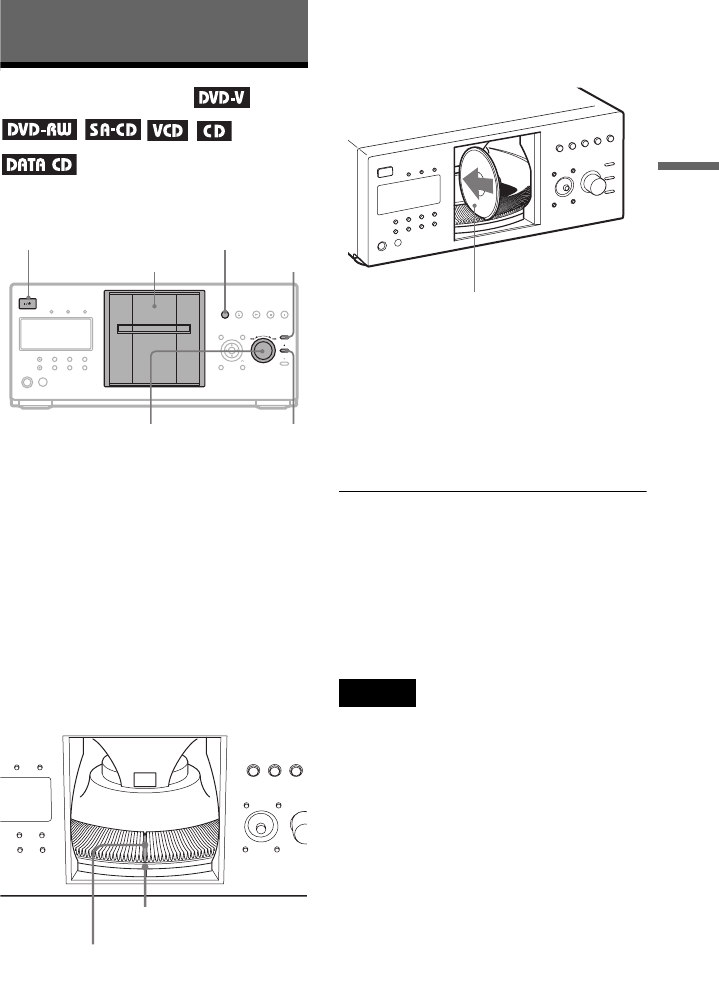
16Press X/x to select the size of the
center speaker.
If no center speaker is connected, select
“NONE” (page 95).
17Press ENTER.
“REAR” is selected.
18Press X/x to select the size of the
rear speakers.
If no rear speaker is connected, select
“NONE.”
19Press ENTER.
“SUBWOOFER” is selected.
20Press X/x to select whether or
not you have connected a
subwoofer.
21Press ENTER.
Quick Setup is finished. All connections
and setup operations are complete.
Enjoying the surround sound
effects
To enjoy the surround sound effects of this
player or your amplifier (receiver), set the
following items as described below for the
audio connection you selected on pages 25 to
27 ( through ). Each of these is the
default setting and does not need to be
adjusted when you first connect the player.
See page 87 for using the Setup Display.
D-2
AUDIO SETUP
AUDIO ATT:
AUDIO DRC:
DIGITAL OUT:
DOLBY DIGITAL:
OFF
STANDARD
AUDIO FILTER: SHARP
ON
DOWNMIX: DOLBY SURROUND
D-PCM
D-PCM
48kHz/96kHz PCM: DTS
DTS: D-PCM
B D
B-2 C-2
D-2
SPEAKER SETUP (DVD)
SIZE:
DISTANCE:
LEVEL(FRONT):
LEVEL(REAR): OFF
TEST TONE:
FRONT:
CENTER:
NONE
SMALL
LARGE
LARGE
REAR:
SUBWOOFER:
To set press then ENTER
LARGE
SPEAKER SETUP (DVD)
SIZE:
DISTANCE:
LEVEL(FRONT):
LEVEL(REAR): OFF
TEST TONE:
FRONT:
CENTER: LARGE
REAR:
SUBWOOFER: LARGE(REAR)
LARGE
LARGE(SIDE)
LARGE(REAR)
SPEAKER SETUP(DVD)
SIZE:
DISTANCE:
LEVEL(FRONT):
LEVEL(REAR): OFF
TEST TONE:
FRONT:
CENTER: LARGE
LARGE
REAR:
SUBWOOFER:
To set, press , then .
To quit, press .
ENTER
ENTER
SETUP
.
DISPLAY
DISPLAY
YES
YES
NONE
LARGE(REAR)
B D
c continued

32
Audio connection (pages 24 to 27)
• No additional settings are needed.
• Set “DOWNMIX” to “DOLBY
SURROUND” (page 93).
• Set “DOWNMIX” to “DOLBY
SURROUND” (page 93).
• Set “DIGITAL OUT” to “ON” (page 93).
• Set “DISTANCE,” “LEVEL (FRONT),”
and “LEVEL (REAR)” according to the
connected speakers (page 94).
zHints
•For connections
If the sound distorts even when the volume is
turned down, set “AUDIO ATT” to “ON” (page
92).
•For connections
Set “48kHz/96kHz PCM” to “96kHZ/24bit” only
if you connect an amplifier (receiver) that
conforms to the 96 kHz sampling frequency (page
93).
• The speaker size settings made in steps 16 to 20
will also apply when a Super Audio CD is played.
To change the settings for Super Audio CDs,
select “SUPER AUDIO CD t” in “SPEAKER
SETUP” and adjust the “SIZE” settings (page 94).
A
B-1 C-1
B-2 C-2 D-2
D-1
B-1 C-1 D-1
B-2 C-2 D-2
33
Playing Discs
Playing Discs
Inserting Discs
You can insert up to 400 discs into this player.
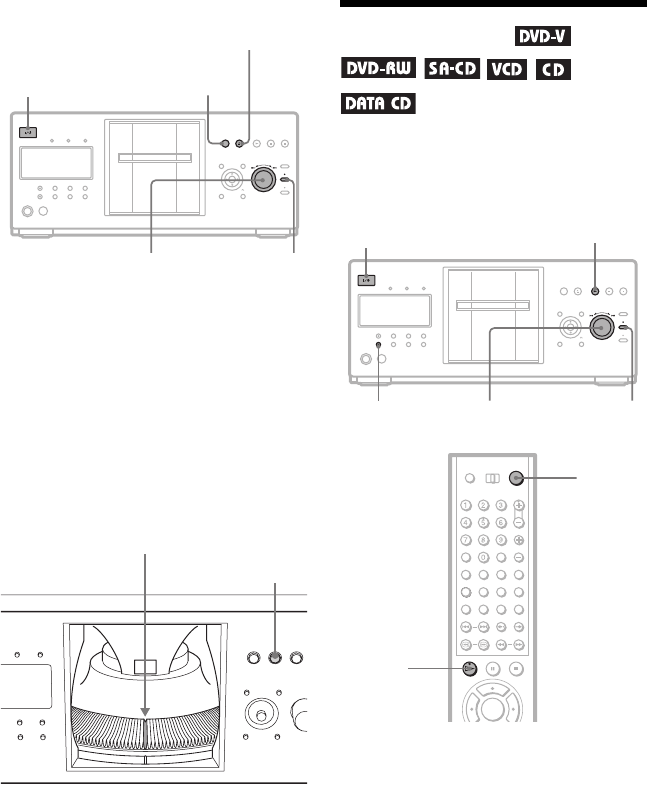
1Press [/1.
The player turns on.
2Press OPEN/CLOSE.
The front cover opens.
3Press DISC CHANGE.
The DISC CHANGE indicator lights up.
4While checking the disc slot number
indicated on the front panel display or
by the slot, turn the .–/>+/
ENTER dial until you find the disc slot
where you want to insert a disc.
5Insert a disc.
Gently place the disc all the way into the
slot and do not release the disc until it is
completely seated. Make sure you have
inserted the disc into each slot at a right
angle to the rotary table. If the disc is not
put in straight, it may damage the player
or the disc.
6Repeat steps 4 and 5 to insert more
discs.
7Press OPEN/CLOSE.
The front cover closes. The rotary table
turns and the disc slot selected in step 4 is
set to the playing position.
zHint
In step 4, you can select a disc slot number by
skipping 10 slots. After sliding the TV/DISC
EXPLORER/DVD switch to DISC EXPLORER or
DVD, press DISC SKIP +/– on the remote. 10 disc
slots before or after the current disc slot number will
be skipped. To skip 100 slots, press +100 on the
player.
Notes
• Do not turn the turntable by hand.
• Do not reach inside of the turntable compartment.
Always follow the correct steps for inserting and
removing discs.
• When transporting the player, remove all discs
from the player. Failure to remove the discs may
cause damage to the player.
• When closing the front cover, be careful not to let
anything get caught between the door and the
player.
.–/>+/ENTER dial
Front cover
[/1 OPEN/CLOSE
DISC CHANGE
+100
Disc slot
at the loading position
Disc slot number
With the playback side
facing left
c continued
34
To remove discs
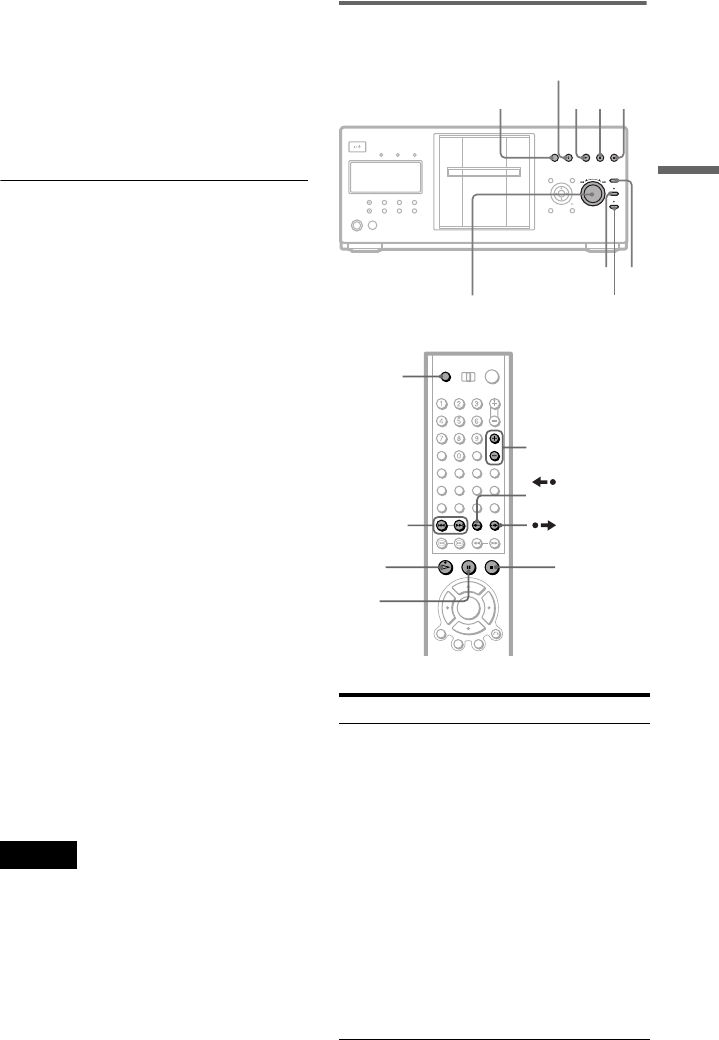
1Press OPEN/CLOSE.
2Press DISC CHANGE.
3While checking the disc slot number
indicated on the front panel display or by
the slot, turn the .–/>+/ENTER
dial until you find the disc you want to
remove.
4Press A DISC EJECT.
The loading guide rises so that you can
remove the disc easily.
5Remove the disc.
6Repeat steps 3 to 5 to remove other discs.
7Press OPEN/CLOSE.
The front cover closes.
zHint
You can remove the current disc by directly
pressing A DISC EJECT on the player.
Playing Discs
Depending on the disc, some operations may
be different or restricted.
Refer to the operating instructions supplied
with your disc.
1Turn on your TV.
2Press [/1.
The player turns on.
3Switch the input selector on your
TV so that the signal from the
player appears on the TV screen.
◆When using an amplifier (receiver)
Turn on the amplifier (receiver) and
select the appropriate channel so that you
can hear sound from the player.
.–/>+/ENTER dial
[/1
OPEN/
CLOSE
DISC CHANGE
A DISC EJECT
A DISC EJECT
Loading guide
.–/>+/
ENTER dial
VIDEO
OFF indicator DISC CHANGE
N
[/1
[/1
H
35
Playing Discs
4Press H.
The player starts playing the selected
disc. Adjust the volume on the TV or the
amplifier (receiver).
Depending on the disc, a menu may
appear on the TV screen. For DVD
VIDEOs, see page 38. For VIDEO CDs,
see page 41.
To change the disc
Press DISC CHANGE to turn the indicator
on. Then turn the .–/>+/ENTER dial
until the desired disc number appears on the
front panel display.
Press the .–/>+/ENTER dial to start
playback.
To enjoy the clarity of Super Audio CDs
and CDs
You can minimize the effect of the video
output by switching it off.
Press VIDEO OFF on the player. Video
signals are cut off, and the VIDEO OFF
indicator lights up on the player.
To turn off the player
Press [/1. The player enters standby mode.
zHints
• You can have the player turn off automatically
whenever you leave it in stop mode for more than
30 minutes. To turn on this function, set “AUTO
POWER OFF” in “CUSTOM SETUP” to “ON”
(page 91).
• For details on the types of MP3 audio tracks that
you can play on this player, or on their playback
order, see “Selecting and Playing an MP3 Audio
Track” on page 42.
• You can select to play a disc from a list of all the
discs inserted in the player. For details, see
“Displaying the Disc Information” (page 50).
Note
Super Audio CD audio signals are not output from
the digital output jack.
Additional operations
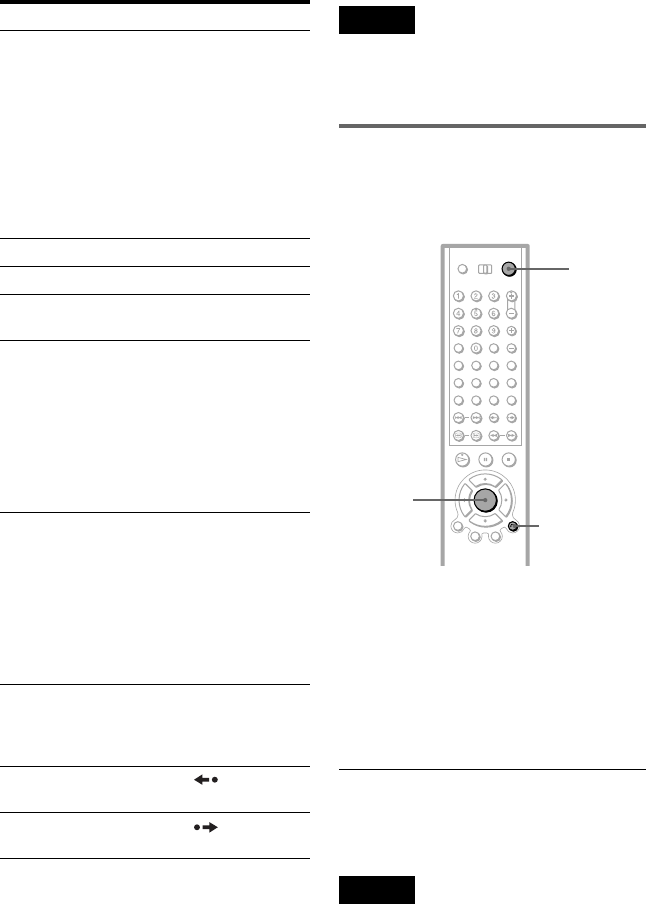
To Operation
Select a disc On the player:
Press DISC CHANGE
to turn the indicator
on. Then turn the
.–/>+/ENTER
dial until the desired
disc number appears
on the front panel
display.
Press the .–/
>+/ENTER dial to
start playback.
On the remote:
Press DISC SKIP+/–
until the desired disc
number appears in the
front panel display.
A DISC EJECT
DISC CHANGE
OPEN/CLOSE
DIRECT SEARCH
Xx
N
+100
.–/>+/
ENTER dial
./>
OPEN/
CLOSE
X
x
H
DISC SKIP
+/–
INSTANT REPLAY
INSTANT SEARCH
c continued
36
* DVD VIDEO/DVD-RW/DVD-R only
** DVD VIDEO/DVD-RW/DVD-R/DVD+RW
only
zHints
• The Instant Replay function is useful when you
want to review a scene or dialog that you missed.
• The Instant Search function is useful when you
want to pass over a scene that you don’t want to
watch.
Notes
• You may not be able to use the Instant Replay or
Instant Search function with some scenes.
• The Instant Replay function does not work with
DVD+RWs.
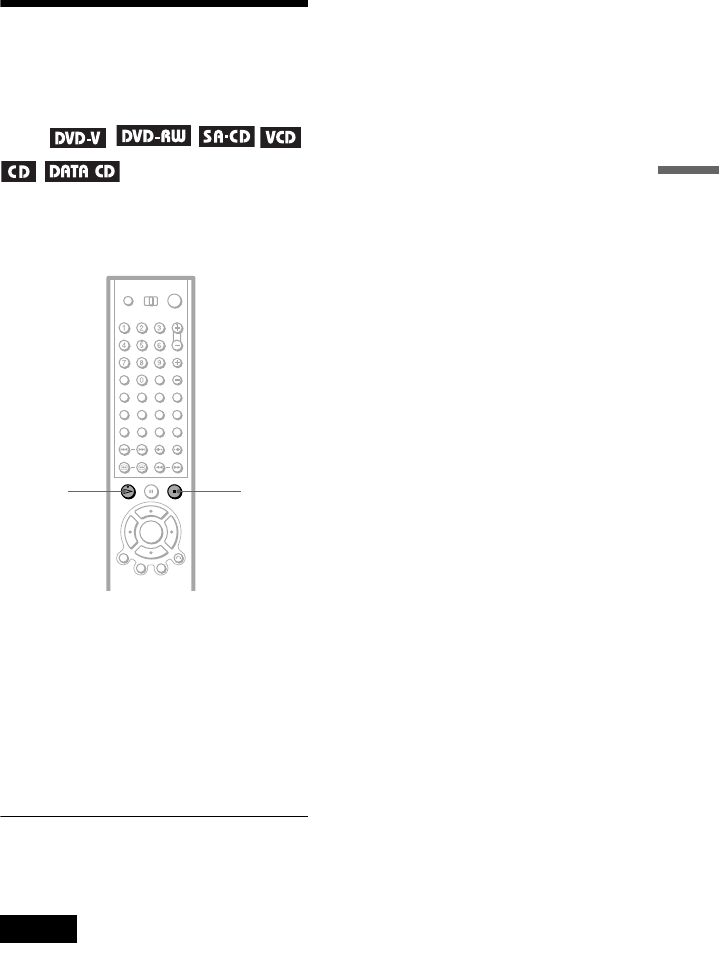
Locking the front cover (Child
Lock)
You can lock the front cover to prevent
children from opening it.
When the player is in standby mode, press
ORETURN, ENTER, and then [/1 on the
remote.
The player turns on and “LOCKED” appears
on the front panel display.
The OPEN/CLOSE button on the player and
the remote do not work while the Child Lock
is set.
To unlock the front cover
When the player is in standby mode, press
ORETURN, ENTER, and then [/1 again.
Note
Even if you select “RESET” under “SETUP” in the
Control Menu (page 88), the front cover remains
locked.
Skip disc slots On the player:
To skip 100 disc slots
ahead, press +100.
Press ENTER to start
playback.
On the remote:
After sliding the TV/
DISC EXPLORER/
DVD switch to DISC
EXPLORER or DVD,
press DISC SKIP +/– .
Stop Press x.
Pause Press X.
Resume play after
pause Press X or H.
Go to the next chapter,
track, or scene in
continuous play mode
On the player:
Press DIRECT
SEARCH to turn the
indicator on. Then
turn the .–/>+/
ENTER dial
clockwise.
On the remote:
Press >.
Go back to the
previous chapter,
track, or scene in
continuous play mode
On the player:
Press DIRECT
SEARCH to turn the
indicator on. Then
turn the .–/>+/
ENTER dial
counterclockwise.
On the remote:
Press . twice.
Stop play and remove
the disc On the player:
Press A DISC EJECT.
On the remote:
Press OPEN/CLOSE.
Replay the previous
scene* Press INSTANT
REPLAY.
Briefly fast forward
the current scene** Press INSTANT
SEARCH.
To Operation
[/1
ORETURN
ENTER
37
Playing Discs
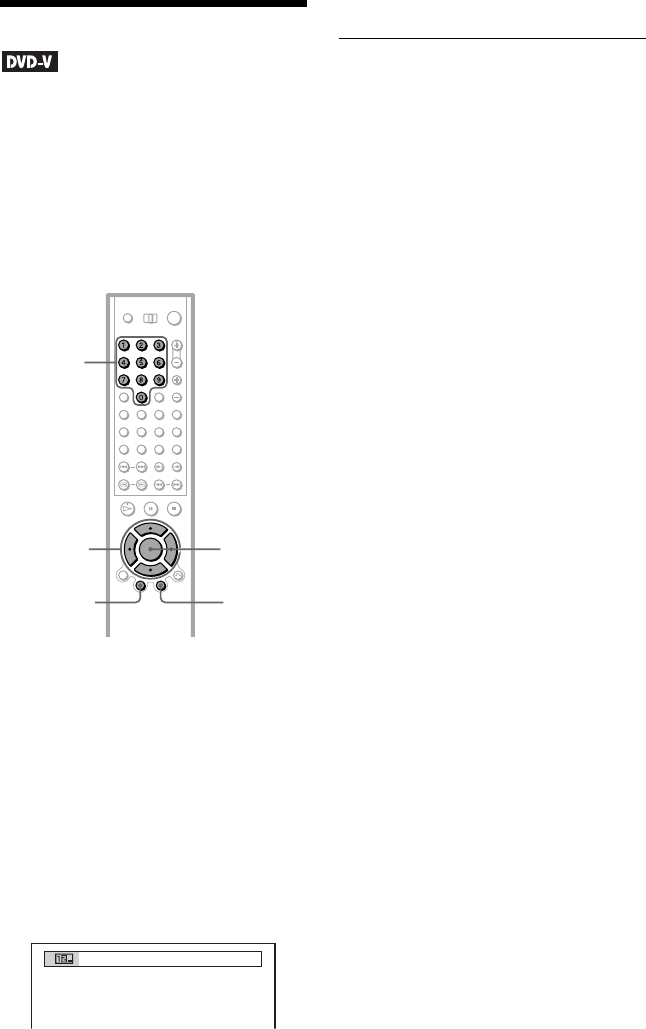
Resuming Playback From
the Point Where You
Stopped the Disc (Resume
Play)
The player remembers the point where you
stopped the disc even if you press [/1 and the
player enters standby mode.
1While playing a disc, press x to
stop playback.
“RESUME” appears on the front panel
display.
2Press H.
The player starts playback from the point
where you stopped the disc in step 1.
zHint
To play from the beginning of the disc, press x
twice, then press H.
Notes
• The point where you stopped playing is cleared
when:
– you change the play mode.
– you open the front cover.
– you change the slot.
– you disconnect the power cord.
• When playing a DATA CD, the point where you
stopped playing is cleared when the player enters
standby mode.
• This function is not available for Program Play or
Shuffle Play.
• This function may not work with some discs.
xH
38
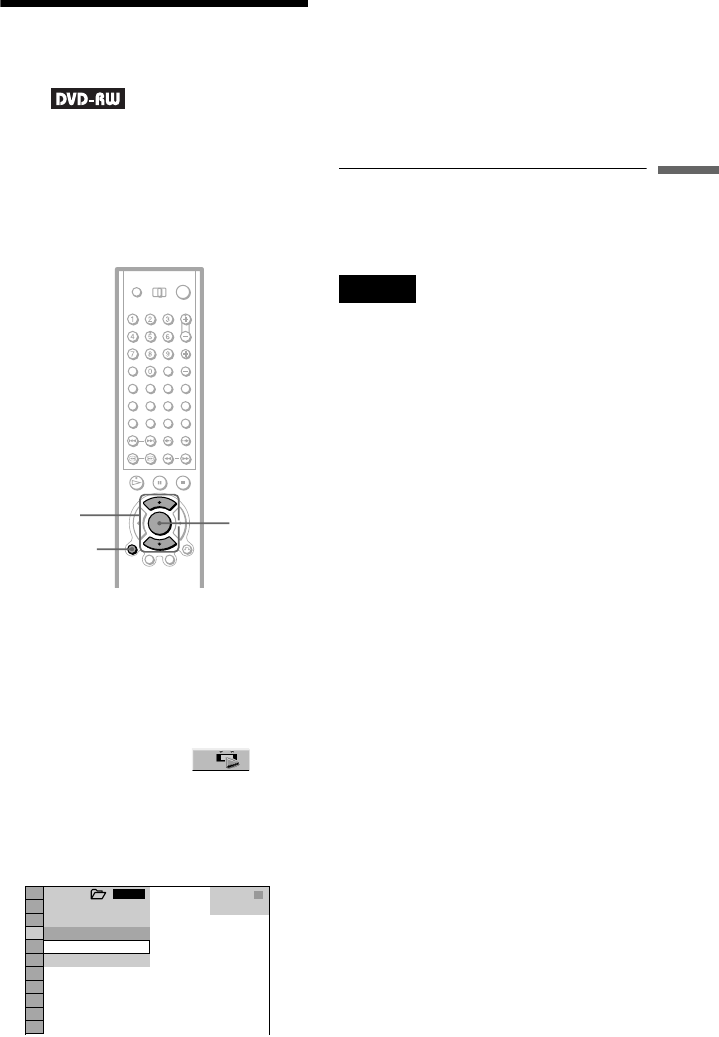
Using the DVD’s Menu
A DVD is divided into long sections of a
picture or a music feature called “titles.”
When you play a DVD which contains
several titles, you can select the title you want
using the TOP MENU/EDIT button.
When you play DVDs that allow you to select
items such as the language for the subtitles
and the language for the sound, select these
items using the MENU/SORT button.
1Select a disc (page 35).
2Press TOP MENU/EDIT or MENU/
SORT.
The disc’s menu appears on the TV
screen. The contents of the menu vary
from disc to disc.
3Press C/X/x/c or the number
buttons to select the item you want
to play or change.
4Press ENTER.
zHint
You can also display the disc’s menu by pressing
TOP MENU or MENU on the player.
Number
buttons
C/X/x/c
TOP MENU/
EDIT MENU/
SORT
ENTER
1
39
Playing Discs
Selecting “ORIGINAL” or
“PLAY LIST” on a DVD-
RW
Some DVD-RWs in VR (Video Recording)
mode have two types of titles for playback:
originally recorded titles (ORIGINAL) and
edited titles created on recordable DVD
players (PLAY LIST). You can select the
type of titles to be played.
1Select a disc (page 35).
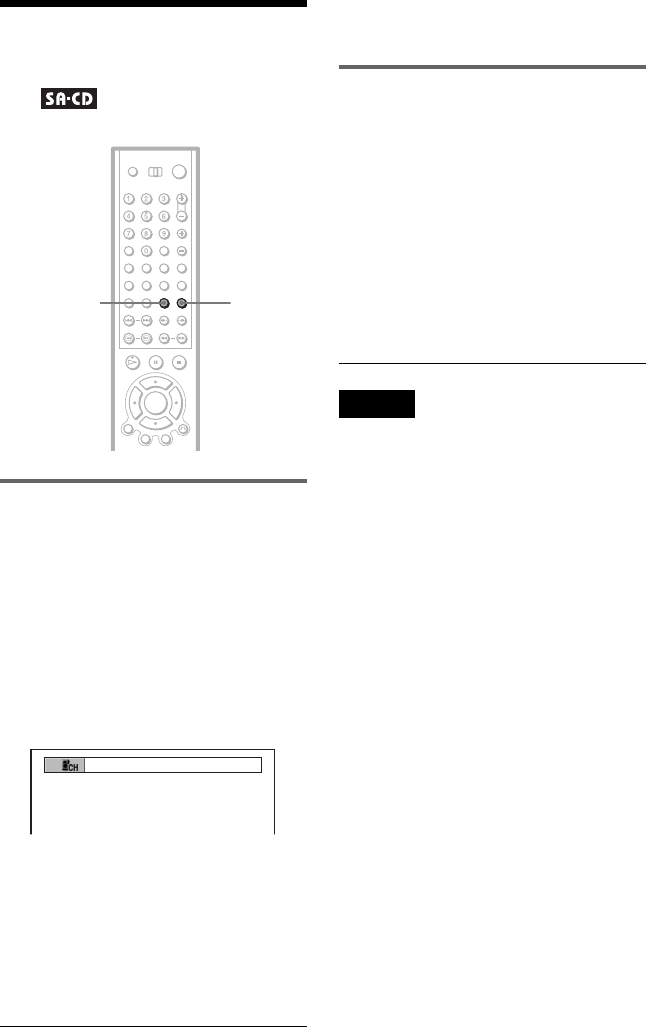
2Press DISPLAY/FILE while the
player is in stop mode.
The Control Menu appears.
3Press X/x to select
(ORIGINAL/PLAY LIST), then press
ENTER.
The options for “ORIGINAL/PLAY
LIST” appear.
4Press X/x to select the setting.
• PLAY LIST: plays the titles created
from “ORIGINAL.”
• ORIGINAL: plays the titles originally
recorded.
5Press ENTER.
To turn off the Control Menu
Press DISPLAY/FILE repeatedly until the
Control Menu is turned off.
Note
Repeat Play and A-B Repeat Play do not work
across “ORIGINAL” and “PLAY LIST” titles.
X/x
DISPLAY/
FILE
ENTER
1 8 ( 3 4 )
1 2 ( 2 7 )
1 2 3
DVD-RW
PLAY LIST
PLAY LIST
ORIGINAL
STOP
ALL
40
Selecting a Playback
Area for a Super Audio
CD
Selecting a playback area on a 2
channel + Multi-channel Super
Audio CD
Some Super Audio CDs consist of a 2 channel
playback area and a multi-channel playback
area. You can select the playback area you
want to listen to.
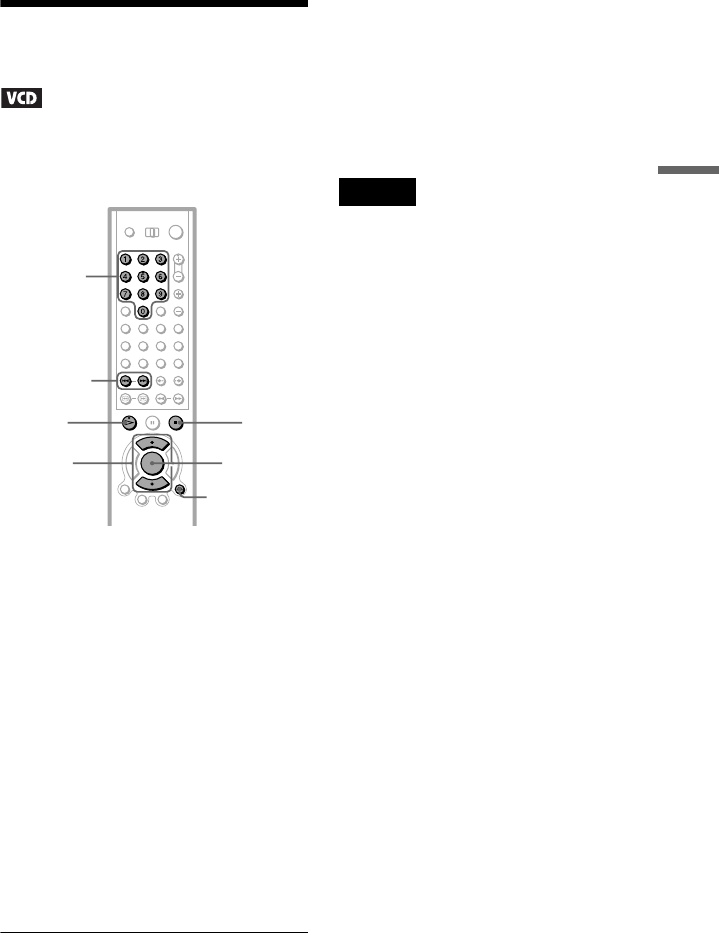
1Press SACD MULTI/2CH while the
player is in stop mode.
The following display appears.
2Press SACD MULTI/2CH repeatedly to
select an item.
• MULTI: Plays a multi-channel
playback area.
• 2CH: Plays a 2 channel playback area.
The “MULTI” indicator in the front panel
display lights up when playing a multi-
channel playback area.
zHint
You can also select “MULTI/2CH” from the
Control Menu (page 15).
Selecting the playback layer of
hybrid Super Audio CDs
Some Super Audio CDs consist of an HD
layer and a CD layer. You can select the
playback layer you want to listen to.
1Press SACD/CD while the player is in
stop mode.
Each time you press the button, an HD
layer or a CD layer is alternately selected.
When playing a CD layer, the “CD”
indicator in the front panel display lights
up.
Notes
• For details about Super Audio CDs, see page 101.
• Each play mode function works only within the
selected layer or playback area (page 44).
SACD MULTI/
2CH
SACD/CD
2CH
41
Playing Discs
Playing VIDEO CDs With
PBC Functions (PBC Playback)
PBC (Playback Control) allows you to play
VIDEO CDs interactively by following the
menu on the TV screen.
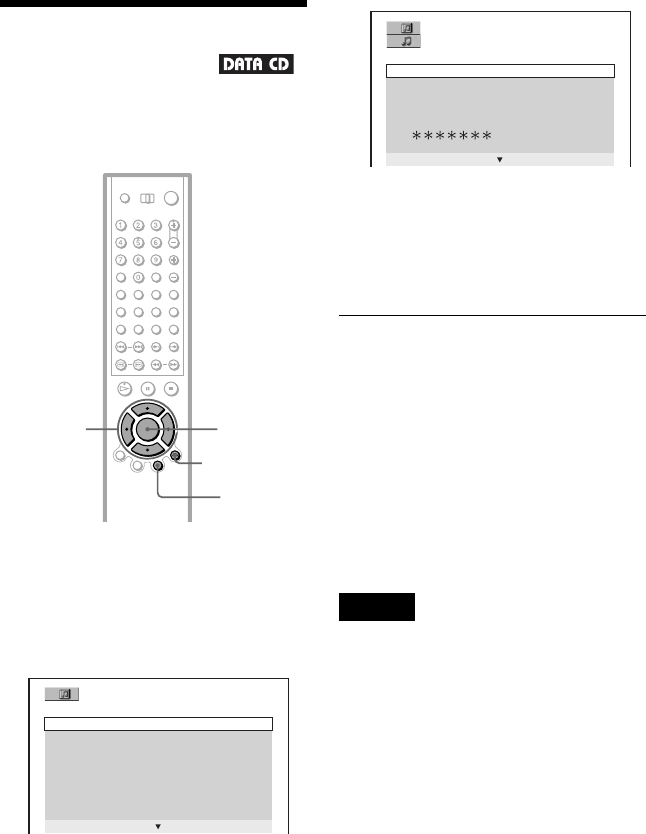
1Start playing a VIDEO CD with PBC
functions.
A menu appears.
2Select the item number and track
you want using X/x or the number
buttons.
3Press ENTER.
4Follow the instructions in the
menu for interactive operations.
Refer to the instructions supplied with the
disc, as the operating procedure may
differ depending on the VIDEO CD.
To return to the menu
Press O RETURN.
zHint
To play without using PBC, press ./> while
the player is stopped to select a track, then press H
or ENTER.
“Play without PBC.” appears on the TV screen and
the player starts continuous play. You cannot play
still pictures such as a menu.
To return to PBC playback, press x twice then
press H.
Note
Depending on the VIDEO CD, “Press ENTER” in
step 3 may appear as “Press SELECT” in the
instructions supplied with the disc. In this case,
press H.
Number
buttons
ORETURN
xH
X/xENTER
./>
42
Selecting and Playing an
MP3 Audio Track
You can play selected tracks on DATA CDs
(CD-ROMs/CD-Rs/CD-RWs) recorded in
MP3 (MPEG1 Audio Layer 3) format.
1Select a disc (page 35).
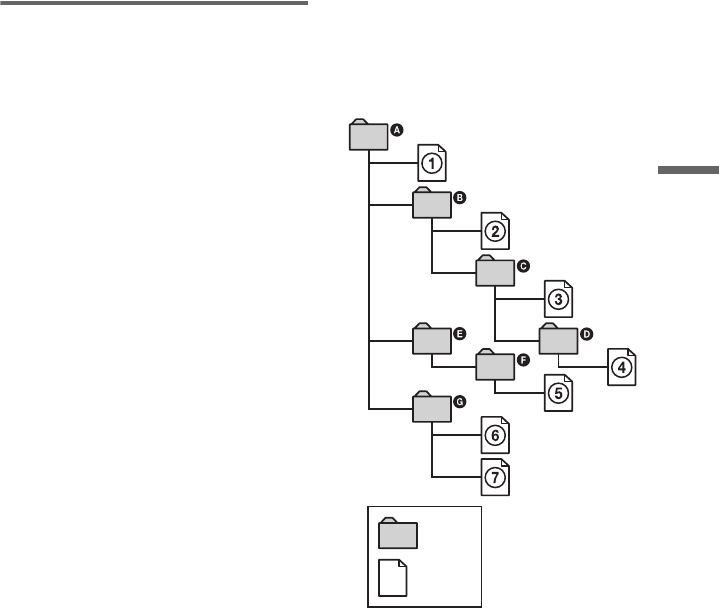
2Press MENU/SORT.
The list of MP3 albums recorded on the
DATA CD appears.
3Press X/x to select an album, then
press ENTER.
The list of tracks contained in the album
appears.
4Press X/x to select a track, then
press ENTER.
The selected track starts playing.
When a track or album is being played, its
title is shaded.
To go to the next or previous page
Press c or C.
To return to the previous display
Press O RETURN.
To turn off the display
Press MENU/SORT.
zHint
You can also display the lists with the MENU
button on the player.
Notes
About playback
• This player can play MP3 audio tracks recorded in
the following sampling frequencies:
32 kHz, 44.1 kHz, 48 kHz.
• The player cannot play audio tracks in MP3PRO
format.
• If you add the extension “.MP3” to data not in
MP3 format, the player cannot recognize the data
properly and will generate a loud noise which
could damage your speaker system.
• The playback order may be different from the
edited order. See “The playback order of MP3
audio tracks” (page 43) for details.
About the list display
• Only the letters in the alphabet and numbers can
be used for album or track names. Anything else
is displayed as “*”.
• ID3 tags cannot be displayed.
C/X/x/c
MENU/
SORT
ENTER
ORETURN
1 ( 3 0 )
ROCK BEST HIT
KARAOKE
JAZZ
R&B
MY FAVORITE SONGS
CLASSICAL
SALSA OF CUBA
BOSSANOVA
J A Z Z
1 ( 9 0 )
01SHE IS SPECIAL
02ALL YOU NEED IS ...
03SPICY LIFE
04HAPPY HOUR
05RIVER SIDE
06
5
07TAKE TIME,TAKE TIME
43
Playing Discs
About MP3 audio tracks
You can play MP3 audio tracks on CD-
ROMs, CD-Rs, or CD-RWs. However, the
discs must be recorded according to ISO9660
level 1, level 2, or Joliet format for the player
to recognize the tracks.
You can also play discs recorded in Multi
Session.
Refer to the instructions of the CD-R/RW
device or recording software (not supplied)
for details on the recording format.
To play a Multi Session CD
This player can play Multi Session CDs when
an MP3 audio track is located in the first
session. Any subsequent MP3 audio tracks,
recorded in the later sessions, can also be
played back.
When audio tracks and images in music CD
format or Video CD format are recorded in
the first session, only the first session will be
played back.
The playback order of MP3 audio tracks
The playback order of albums and tracks
recorded on a DATA CD is as follows.
◆Structure of disc contents
When you play a DATA CD from its
beginning (page 34), the numbered tracks are
played sequentially, from 1 through 7. Any
sub-albums/tracks contained within a
currently selected album take priority over
the next album in the same tree. (Example: C
contains D so 4 is played before 5.)
When you press MENU and the list of MP3
albums appears (page 42), the albums are
arranged in the following order: A t B t
C t D t F t G. Albums that do not
contain tracks (such as album E) do not
appear in the list.
zHints
• If you add numbers (01, 02, 03, etc.) to the front
of the track names, the tracks will be played in
that order.
• Since a disc with many trees takes longer to start
playback, it is recommended that you create
albums of no more than two trees.
ROOT
Tree 1 Tree 2 Tree 3 Tree 4 Tree 5
album
track
c continued
44
Notes
• Depending on the software you use to create the
DATA CD, the playback order may differ from
the illustration above.
• The playback order above may not be applicable
if there are more than a total of 999 albums and
tracks in the DATA CD.
• The player can recognize up to 499 albums (the
player will count just albums, including albums
that do not contain MP3 audio tracks). The player
will not play any albums beyond the first 499
albums. Of the first 499 albums, the player will
play no more than a combined total of 999 albums
and tracks.
Various Play Mode
Functions (Program Play,
Shuffle Play, Repeat Play, A-B Repeat
Play)
You can set the following play modes:
• Program Play (page 45)
• Shuffle Play (page 47)
• Repeat Play (page 47)
• A-B Repeat Play (page 48)
Notes
• The play mode is canceled when:
– you open the front cover.
– you press [/1 and the player enters standby mode.
• Before setting a play mode for Super Audio CDs,
select the playback layer or area you want to listen
to (page 40). Each play mode function works only
within the selected layer or playback area.
Selecting the disc mode (One
Disc or All Discs)
You can play one disc or all of the discs in the
player. Before setting Program Play, Shuffle
Play, or Repeat Play, you must select whether
to apply these play modes to one disc or to all
of the discs.
1Press DISPLAY/FILE twice (once for
DATA CDs) during playback.
The Control Menu appears.
X/xENTER
DISPLAY/
FILE
45
Playing Discs
2Press X/x to select or
(ONE/ALL DISCS) and press
ENTER.
The options for “ONE DISC/ALL
DISCS” appear.
3Press X/x to select an item.
• ALL DISCS: Continuously plays all of
the discs.
• ONE DISC: Plays the selected disc.
4Press ENTER.
zHint
You can also select “ONE DISC/ALL DISCS” by
pressing ONE/ALL DISCS on the player.
Creating your own program
(Program Play)
You can play the contents of a disc in the
order you want by arranging the order of the
titles, chapters, or tracks on the disc to create
your own program.
You can program up to 99 items. By selecting
All Discs mode (page 44), you can create a
program for all of the discs in the player.
1Press DISPLAY/FILE twice.
The Control Menu appears.
2Press X/x to select
(PROGRAM), then press ENTER.
The options for “PROGRAM” appear.
3Press X/x to select “SET t” then
press ENTER.
The display for programming appears.
4Press c.
The player is ready to program the first
disc.
5Select the disc you want to program
using the number buttons or X/x, then
press ENTER.
The cursor moves to the title or track row
“T” (in this case, “01”).
ALL DISCS
ALL DISCS
ONE DISC
1 8 ( 3 4 )
1 2 ( 2 7 )
PLAY
DVD
Number
buttons
X/x/c
H
ENTER
DISPLAY/
FILE
CLEAR
OFF
OFF
SET
ON
1 8 ( 3 4 )
1 2 ( 2 7 )
DVD
PLAY
PROGRAM
– – – : – – – – –
1. – – – –
ALL CLEAR
2. – – – –
3. – – – –
4. – – – –
5. – – – –
6. – – – –
T
ALL
ALL
– – – : – – – – –
PROGRAM
1. – – – –
ALL CLEAR
2. – – – –
3. – – – –
4. – – – –
5. – – – –
6. – – – –
T
ALL
ALL
c continued
46
6Select the title, chapter, or track you
want to program.
◆When playing a DVD VIDEO
For example, select chapter “03” of title
“02.”
Press X/x or the number buttons to select
“02” under “T,” then press ENTER.
Next, press X/x or the number buttons to
select “03” under “C,” then press
ENTER.
◆When playing a VIDEO CD, Super
Audio CD or CD
For example, select track “04.”
Press X/x or the number buttons to select
“04” under “T,” then press ENTER.
7To program other discs, titles,
chapters, or tracks, repeat steps 4 to
6.
The programmed discs, titles, chapters,
and tracks are displayed in the selected
order.
8Press H to start Program Play.
Program Play begins.
When the program ends, you can restart
the same program again by pressing H.
To return to normal playback
Press CLEAR, or select “OFF” in step 3.
To turn off the display
Press DISPLAY/FILE repeatedly until the
display is turned off.
To cancel or change a program
1Follow steps 1 to 3 of “Creating your own
program (Program Play).”
2Select the program number of the disc,
title, chapter, or track you want to cancel
or change using X/x.
3Perform the following.
◆To cancel the program
Press CLEAR.
◆To change the program
Press c and follow step 5 for new
programming.
To cancel all of the discs, titles, chapters,
or tracks in the program
1Follow steps 1 to 3 of “Creating your own
program (Program Play).”
2Press X and select “ALL CLEAR.”
3Press ENTER.
PROGRAM
003
: DVD
1. – – – –
ALL CLEAR
2. – – – –
3. – – – –
4. – – – –
5. – – – –
6. – – – –
T
ALL
C
ALL
01
02
03
04
05
01
02
03
04
05
06 06
ALL
Chapters recorded on a disc
Ti
t
l
es or trac
k
s
recorded on a disc
Disc type
“?” appears when the player has not loaded
the disc information in the memory. If an
empty slot is loaded, the disc type does not
appear.
PROGRAM
003
: DVD
1. – – – –
ALL CLEAR
2. – – – –
3. – – – –
4. – – – –
5. – – – –
6. – – – –
T
ALL
C
ALL
01
02
03
04
05
01
02
03
04
05
06 06
ALL
– – – : – – – – –
PROGRAM
1. 1D –T02 –C03
ALL CLEAR
3. – – – –
4. – – – –
5. – – – –
6. – – – –
T
ALL
ALL
2. – – – –
Selected disc, title and chapter
– – – : – – – – –
PROGRAM
1. 1D –T02 –C03
ALL CLEAR
4. – – – –
5. – – – –
6. – – – –
T
ALL
ALL
1. 10V –T04
3. – – – –
Selected disc and track
47
Playing Discs
zHint
You can set Repeat Play or Shuffle Play for the
programmed titles, chapters, or tracks. During
Program Play, follow the steps of “Repeat Play”
(page 47) or “Shuffle Play” (page 47).
Note
Program Play will not start if you select One Disc
mode and the program does not include anything
from the current disc.
Playing in random order (Shuffle
Play)
You can have the player “shuffle” titles,
chapters, or tracks. Subsequent “shuffling”
may produce a different playing order. By
selecting All Discs mode (page 44), you can
shuffle all of the discs in the player.
1Press DISPLAY/FILE twice during
playback.
The Control Menu appears.
2Press X/x to select
(
SHUFFLE
), then press ENTER.
The options for “SHUFFLE” appear.
3Press X/x to select the item to be
shuffled.
◆When playing a DVD VIDEO
•DISC*
•TITLE
•CHAPTER
◆When playing a Super Audio CD,
VIDEO CD, or CD
•DISC*
•TRACK
◆When playing a DVD-RW, or DATA CD
•DISC*
◆When Program Play is activated
•ON: shuffles titles, chapters, or tracks
selected in Program Play.
4Press ENTER.
* You can select “DISC” in All Discs mode only.
To return to normal play
Press CLEAR, or select “OFF” in step 3.
zHints
• You can set Shuffle Play while the player is
stopped. After selecting the “SHUFFLE” option,
press H. Shuffle Play starts.
• Up to 96 chapters in a disc can be played in
random order when “CHAPTER” is selected.
Playing repeatedly (Repeat Play)
You can play all of the titles, albums or tracks
on a disc or a single title, chapter, album, or
track repeatedly.
You can use a combination of Shuffle or
Program Play modes. By selecting All Discs
mode (page 44), you can repeat all of the
discs in the player.
X/x
H
ENTER
DISPLAY/
FILE
CLEAR
1 8 ( 3 4 )
1 2 ( 2 7 )
OFF
CHAPTER
TITLE
DISC
OFF
DVD
PLAY
c continued
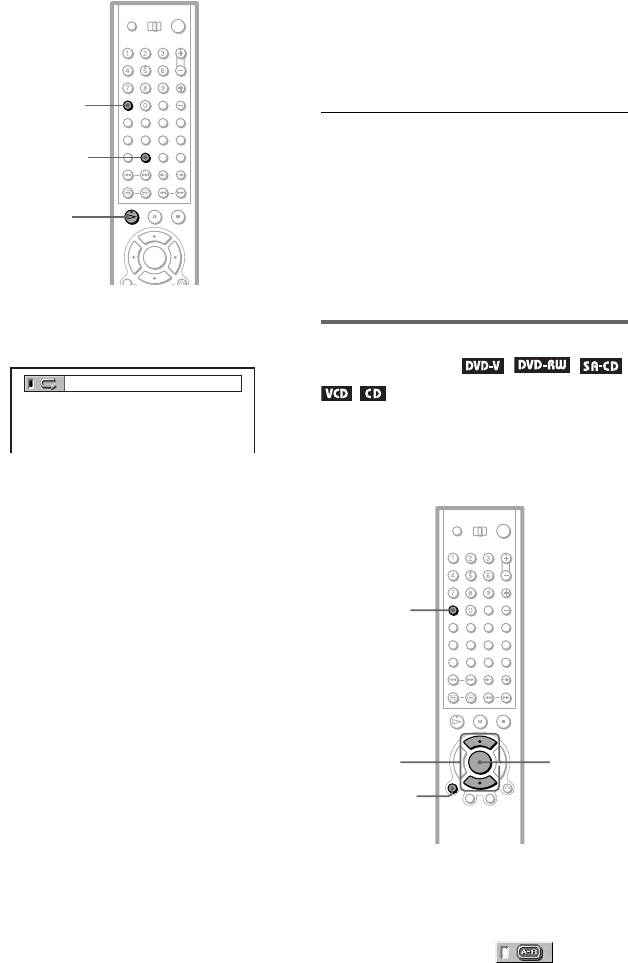
48
1Press REPEAT during playback.
The following display appears.
2Press REPEAT repeatedly to select the
item to be repeated.
◆When playing a DVD VIDEO
•DISC: repeats all of the titles on the
current disc in One Disc mode, or all of
the discs in All Discs mode.
•TITLE: repeats the current title on a
disc.
•CHAPTER: repeats the current
chapter.
◆When playing a DVD-RW
•DISC: repeats all of the titles on the
selected type in One Disc mode, or all
of the discs in All Discs mode.
•TITLE: repeats the current title on a
disc.
•CHAPTER: repeats the current
chapter.
◆When playing a Super Audio CD,
VIDEO CD, or CD
•DISC: repeats all of the tracks on the
current disc in One Disc mode, or all of
the discs in All Discs mode.
•TRACK: repeats the current track.
◆When playing a DATA CD (MP3 audio)
•DISC: repeats all of the albums on the
current disc in One Disc mode, or all of
the discs in All Discs mode.
•ALBUM: repeats the current album.
•TRACK: repeats the current track.
◆When Program Play or Shuffle Play is
activated
•ON: repeats Program Play or Shuffle
Play.
To return to normal play
Press CLEAR, or select “OFF” in step 2.
zHints
• You can set Repeat Play while the player is
stopped. After selecting the “REPEAT” option,
press H. Repeat Play starts.
• You can also select “REPEAT” from the Control
Menu (page 14).
Repeating a specific portion (A-
B Repeat Play)
You can play a specific portion of a title,
chapter or track repeatedly. (This function is
useful when you want to memorize lyrics,
etc.)
1Press DISPLAY/FILE twice during
playback.
The Control Menu appears.
2Press X/x to select (A-B
REPEAT), then press ENTER.
The options for “A-B REPEAT” appear.
H
CLEAR
REPEAT
DISC
X/x
DISPLAY/
FILE
CLEAR
ENTER
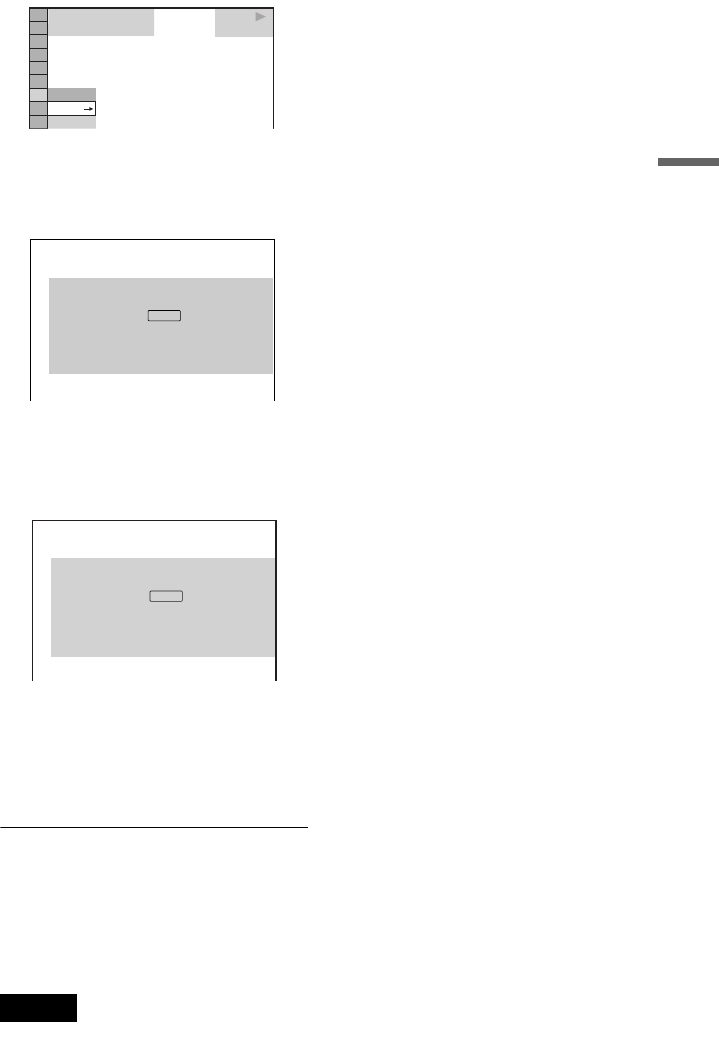
49
Playing Discs
3Press X/x to select “SET t,” then
press ENTER.
The “A-B REPEAT” setting display
appears.
4During playback, when you find the
starting point (point A) of the portion to
be played repeatedly, press ENTER.
The starting point (point A) is set.
5When you reach the ending point
(point B), press ENTER again.
The set points are displayed and the
player starts repeating this specific
portion.
To return to normal play
Press CLEAR, or select “OFF” in step 2.
To turn off the Control Menu
Press DISPLAY/FILE repeatedly until the
Control Menu is turned off.
Notes
• When you set A-B Repeat Play, the settings for
Shuffle Play, Repeat Play, and Program Play are
canceled.
• A-B Repeat Play does not work for titles
containing still pictures on a DVD-RW in VR
mode.
• A-B Repeat Play does not work across multiple
titles (“ORIGINAL” or “PLAY LIST”) on a
DVD-RW in VR mode.
SET
OFF
OFF
1 8 ( 3 4 )
1 2 ( 2 7 )
DVD
PLAY
Set point A with .
A-B REPEAT
ENTER
A: 18 – 1 : 32 : 55
CHAPTER
TIME
Set point B with .
ENTER
A-B REPEAT
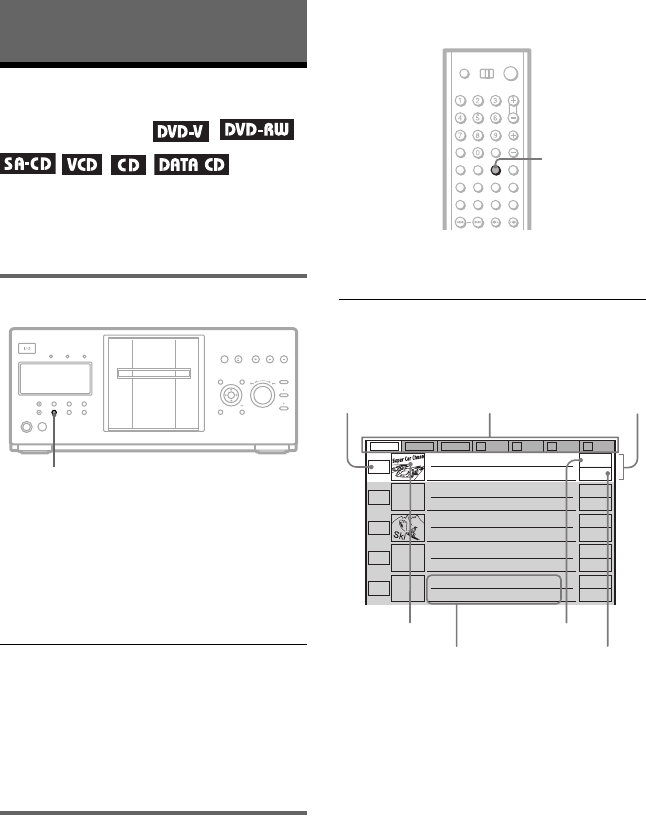
50
Searching for and Managing
Discs (Disc Explorer)
Displaying the Disc
Information
You can search for a disc by checking the
contents of all the discs loaded in the player
on your TV screen.
Loading the disc information
Press LOAD when the player is in stop or
standby mode.
The player reads the disc information of all
the discs and loads it into memory so that the
disc type, titles and other text information can
be displayed.
To cancel loading
Press x.
zHint
The player can load the disc information even when
the power is in standby mode. Press LOAD before
turning on the player.
Viewing information about the
loaded discs
You can view the loaded discs using the Disc
Explorer.
The player has 7 folders (“ALL,” “DVD,”
“CD,” “A” to “D”) and can display the
contents of each folder.
All of the discs in the player are filed in the
“ALL” folder. At the same time, DVDs are
automatically filed in the “DVD” folder, and
Super Audio CDs, CDs, VIDEO CDs, DATA
CDs are filed in the “CD” folder. You can file
your discs as you like in the “A” to “D”
folders (page 53).
Press FOLDER.
The Disc Explorer displays the “ALL” folder.
Disc Explorer display
◆Jacket picture
The jacket picture recorded on the disc
appears automatically. If there is no picture,
you can capture one from the disc (page 52).
If there is no jacket picture and you have not
captured one, the genre picture in the player’s
memory is displayed if you select a genre.
◆Text information (DVD/Super Audio CD/
CD text or Disc Memo)
The text information (DVD/Super Audio CD/
CD text) recorded on the disc appears
automatically. If no text information is
recorded, you can store the text information
(Disc Memo) yourself for DVDs or CDs
(page 55).
LOAD
FOLDER
ALL DVD CD A B C D
1
Super Car Chase
Skiing the World
Music Madness
2
3
4
5
Action
DVD
CD
Action
DVD
CD
VIDEO CD
Disc slot
number
Current
folder is
highlighted
Disc type
Current
disc
Text information (DVD/
Super Audio CD/CD
text, Disc Memo)
Jacket picture Genre
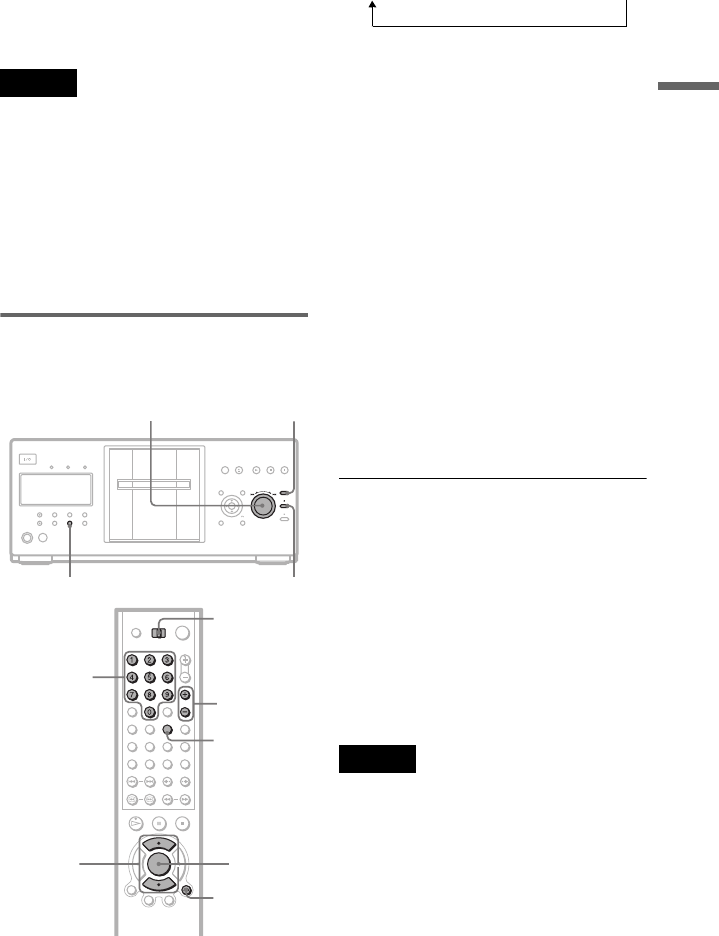
51
Searching for and Managing Discs (Disc Explorer)
◆Genre
You can select the genre of the disc yourself
(page 57).
◆Disc type
The disc type, such as DVD, appears
automatically. If the slot does not contain a
disc, the disc type row is blank.“?” appears
when the player has not loaded the disc
information in its memory.
.
Notes
• Even if you have removed a disc from the player,
the disc’s information remains in the Disc
Explorer until you load new disc information
again by pressing LOAD or place a new disc in
the same slot and play it.
• If you press FOLDER during playback of the CD
layer of a Super Audio CD, the disc type appears
as a CD
• While the VIDEO OFF indicator is lit, the Disc
Explorer does not appear even after FOLDER is
pressed.
Searching for a disc on the Disc
Explorer
1Press FOLDER repeatedly to select the
folder with the disc you want to play.
With each press, the folder indication in
the Disc Explorer display changes as
follows:
2Select the disc by one of the following
operations.
•press X/x
• after sliding the TV/DISC
EXPLORER/DVD switch to DISC
EXPLORER or DVD, press the number
buttons and ENTER
• after sliding the TV/DISC
EXPLORER/DVD switch to DISC
EXPLORER or DVD, press DISC
SKIP +/–. To skip 100 disc slots ahead,
press +100 on the player. Press ENTER
to start playback.
• press DISC CHANGE on the player to
turn the indicator on, followed by
turning the .–/>+/ENTER dial on
the player and then pressing it.
3Press ENTER.
The Disc Explorer disappears and
playback starts.
To turn off the Disc Explorer
Press ORETURN.
zHint
When you select the disc with the number buttons in
step 2, you can use the numbers to jump through the
Disc Explorer display.
For example, you can press number button 6 and
then press ENTER to view the Disc Explorer for
disc slot numbers 6 to 10, then press 11 and ENTER
to view the Disc Explorer for the next five disc slots
(numbers 11 to 15).
.
Notes
• If you press FOLDER during playback, playback
stops and the Disc Explorer appears. In this case,
Resume Play is not available.
• If you load or try to play an empty slot, it appears
as a blank in the Disc Explorer. You cannot select
this slot.
• Even if the disc has a jacket picture recorded on it,
the jacket picture may not appear on the Disc
Explorer.
.–/>+/ENTER dial
Number
buttons
FOLDER DISC CHANGE
TV/DISC
EXPLORER/
DVD switch
DISC SKIP
+/–
ORETURN
X/xENTER
FOLDER
+100
ALL t DVD t CD t A t B t C t D
c continued
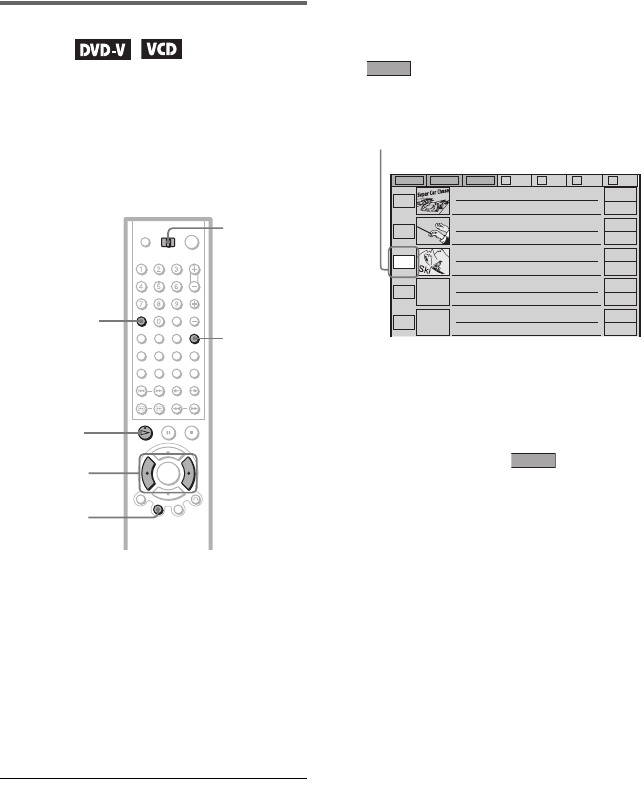
52
Capturing a scene for a jacket
picture
You can capture your favorite scene in a disc
to create a personal jacket picture. A
personalized jacket picture will make
spotting the disc in the Disc Explorer easier.
This function is available only if the disc does
not contain a pre-recorded jacket picture.
1Select a disc and play it (page 34, 35).
2Slide the TV/DISC EXPLORER/DVD
switch to DISC EXPLORER.
3Press PICTURE MEMORY at your
favorite scene.
The scene is captured as a still image, and
is set as the jacket picture for the Disc
Explorer.
To erase a stored jacket picture
1Perform steps 1 and 2 in “Searching for a
disc on the Disc Explorer” and select the
disc you want to edit (page 51).
2After sliding the TV/DISC EXPLORER/
DVD switch to DISC EXPLORER, press
TOP MENU/EDIT.
appears in the bottom right corner.
3Press C/c to highlight the disc number.
4Press CLEAR.
The stored jacket picture is deleted.
To cancel the edit mode
Press ORETURN until disappears
from the Disc Explorer.
If you press ORETURN again, the Disc
Explorer turns off.
H
C/c
CLEAR
TV/DISC
EXPLORER/
DVD switch
TOP MENU/
EDIT
PICTURE
MEMORY
EDIT
ALL DVD CD A B C D
1
Super Car Chase
Skiing the World
Music Madness
2
4
5
Action
Classical
DVD
CD
Action
DVD
CD
VIDEO CD
3
Highlight the disc number.
EDIT
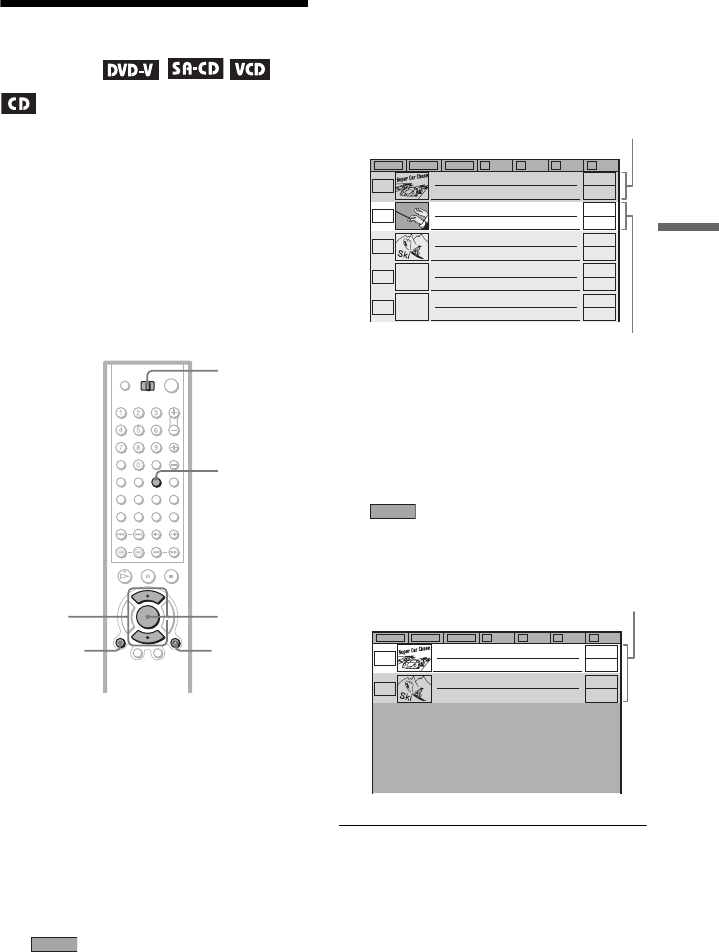
53
Searching for and Managing Discs (Disc Explorer)
Filing Discs in the Folder
(File Mode)
You can file your discs in four individual
folders, “A” to “D.” Even if you file discs
from folders “ALL,” “DVD,” or “CD” to
folders “A” to “D,” those discs are not deleted
from the “ALL,” “DVD,” or “CD” folders.
You can file up to 400 discs in one folder, and
the same disc in different folders.
Note that you can set Program Play, Shuffle
Play and Repeat Play for discs within a single
folder.
For example, to file DVDs in the no.1 and
no.3 slots to the “A” folder:
1Press FOLDER.
The Disc Explorer appears.
2Slide the TV/DISC EXPLORER/DVD
switch to DISC EXPLORER, then press
DISPLAY/FILE.
appears in the bottom right
corner.
3Press X/x to select the disc (in this
case, the disc in slot no.1).
4Press ENTER.
The disc to be filed (in this case, the disc
in slot no.1) is selected.
To file more than one disc, repeat steps 3
and 4.
5Press FOLDER repeatedly to select
the “A” folder.
6Press DISPLAY/FILE.
disappears from the Disc
Explorer. Then the Disc Explorer for the
“A” folder containing the selected discs
appears.
To cancel the file mode
Press ORETURN.
To turn off the Disc Explorer, press
ORETURN again.
zHint
The discs are listed first by slot number in the Disc
Explorer. You can then sort the discs by desired
genre or text information and then store them (page
58).
DISPLAY/
FILE
TV/DISC
EXPLORER/
DVD switch
X/xENTER
ORETURN
FOLDER
FILE
ALL DVD CD A B C D
1
Super Car Chase
Skiing the World
Music Madness
2
3
4
5
Action
Classical
DVD
CD
Action
DVD
CD
VIDEO CD
Selected disc
Cursor moves to
the next disc.
FILE
ALL DVD CD A B C D
1
Super Car Chase
Skiing the World
3
Action
DVD
Action
DVD
Filed disc
c continued
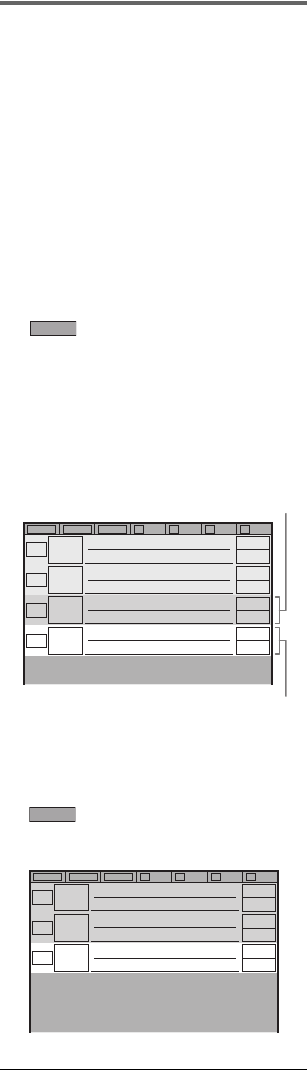
54
Deleting discs from a folder
You can delete unnecessary discs from
folders “A” to “D.” You cannot delete discs
from folders “ALL,” “DVD,” or “CD” unless
you remove the disc from the player.
1Press FOLDER repeatedly to select the
folder containing the disc you want to
delete.
The Disc Explorer for the selected folder
appears.
2Slide the TV/DISC EXPLORER/DVD
switch to DISC EXPLORER, then press
DISPLAY/FILE.
appears in the bottom right
corner.
3Press X/x to select the disc.
4Press ENTER.
The disc to be deleted is selected.
To delete other discs, repeat steps 3 and
4.
5Press CLEAR.
The disc disappears from the folder, and
disappears from the Disc
Explorer.
To cancel the file mode
Press ORETURN.
To turn off the Disc Explorer, press
ORETURN again.
FILE
ALL DVD CD A B C D
2
Music Madness
4
11
23
CD
CD
CD
CD
Selected disc
Cursor moves to
the next disc.
FILE
ALL DVD CD A B C D
2
Music Madness
4
23
CD
CD
CD
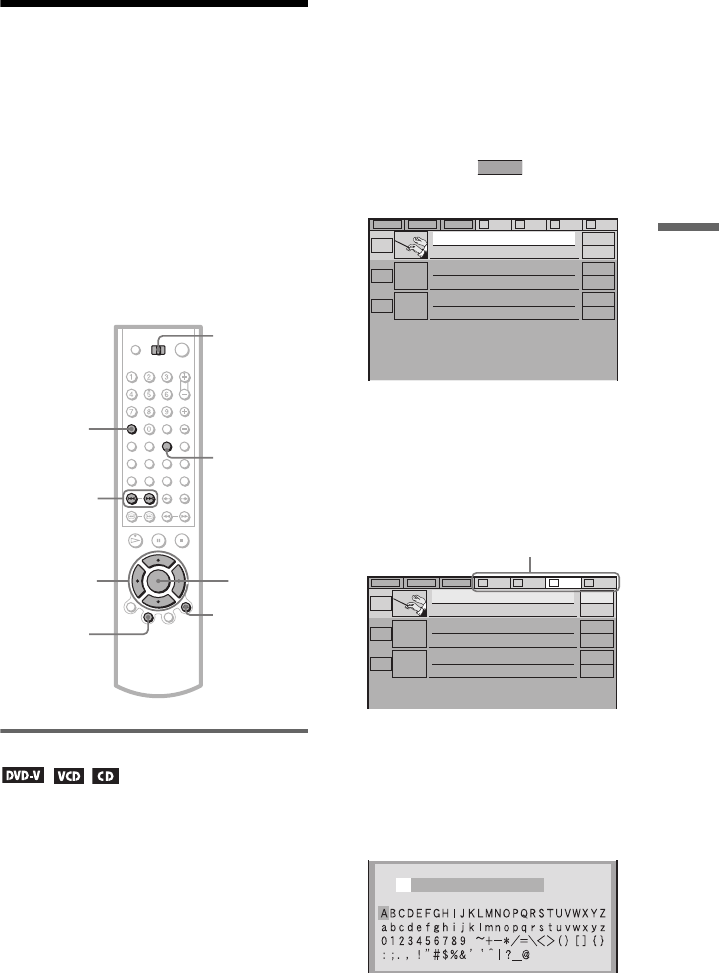
55
Searching for and Managing Discs (Disc Explorer)
Labeling Discs and
Folders (Edit Mode)
You can label the disc with a personal title of
16 characters (Disc Memo) (when DVD/CD
text is not recorded on the disc). You can also
label the folders “A” to “D” with a title of 3
characters.
The Disc Memo can be anything you like,
such as a title, musician’s name, category or
date of purchase.
You can also assign a genre label to the disc.
This will help you keep your discs organized.
Labeling a disc or folder
1Select the disc or folder you want to
label.
◆To label a disc
Select the disc on the Disc Explorer (for
details, see steps 1 and 2 of “Searching
for a disc on the Disc Explorer” on
page 51). After sliding the TV/DISC
EXPLORER/DVD switch to DISC
EXPLORER, press TOP MENU/EDIT.
The selected disc’s text only is
highlighted and appears in the
bottom right corner.
◆To label a folder
Press FOLDER. After sliding the TV/
DISC EXPLORER/DVD switch to DISC
EXPLORER, press TOP MENU/EDIT.
Then, press X. Select the folder you want
to label by pressing C/X/x/c.
2Press ENTER.
The “DISC MEMO INPUT” display
appears when you have selected a disc.
The “FOLDER NAME INPUT” display
appears when you have selected a folder.
3Press C/X/x/c to select a character.
The selected character changes color.
TOP
MENU/EDIT
TV/DISC
EXPLORER/
DVD switch
ENTER
ORETURN
C/X/x/c
./>
CLEAR
FOLDER
EDIT
ALL DVD CD A B C D
2
Music Madness
4
23
CD
CD
CD
Classical
ALL DVD CD A B C D
2
Music Madness
4
23
CD
CD
CD
Classical
Select from here
DISC MEMO INPUT
c continued
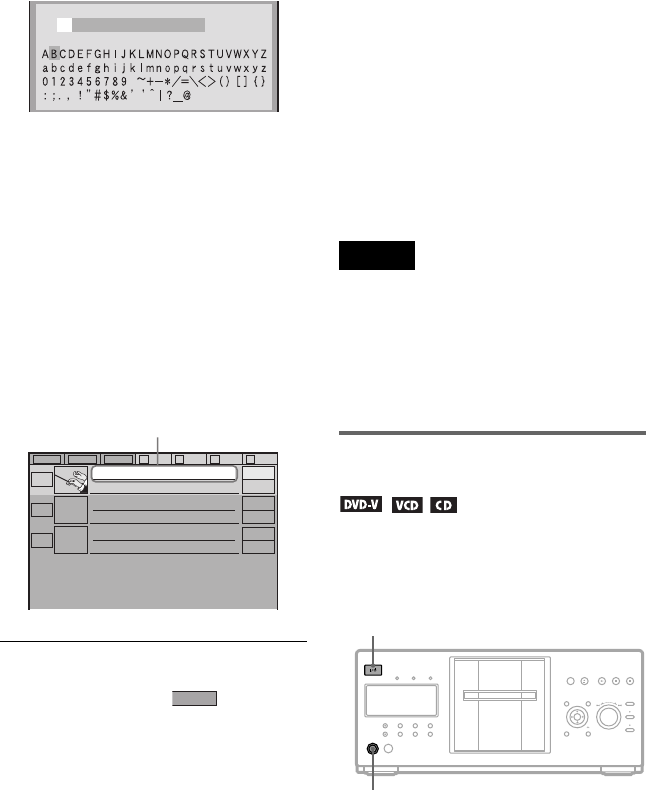
56
4Press ENTER.
The selected character is input.
5Repeat steps 3 and 4 to input other
characters.
6When you have entered all of the
characters for the Disc Memo or folder
name, press TOP MENU/EDIT.
The “DISC MEMO INPUT” display or
the “FOLDER NAME INPUT” display
disappears and the Disc Memo or folder
name is stored.
To cancel the edit mode
Press ORETURN until disappears
from the Disc Explorer.
If you press ORETURN again, the Disc
Explorer turns off.
To erase a character
1In step 3 of “Labeling a disc or folder”
(page 55), press . or > to move
the cursor to the character you want to
erase.
2Press CLEAR.
To insert or overwrite a character
1In step 3 of “Labeling a disc or folder”
(page 55), press . or > to move
the cursor to the insertion point or the
character you want to correct.
2Press C/X/x/c to select the correct
character.
3Perform the following.
◆To insert the character
Press ENTER.
◆To overwrite the character
Press > or . and move the cursor.
zHint
To display disc information on a hybrid Super
Audio CD (page 101), play the disc once and press
FOLDER.
Notes
• You can label up to 400 discs. When you store the
40lst disc in memory, the data for the lst disc is
erased.
• You cannot enter Disc Memo on Super Audio
CDs (including hybrid discs). However, HD
layers on most Super Audio CDs contain text
information that you can display using the Disc
Explorer. See the hint above.
Labeling a disc or folder using a
keyboard
To label the disc or folder, you can use a USA
model IBM compatible PC keyboard* (not
supplied).
* Power consumption must be 120mA or less.
1Connect a keyboard to the KEYBOARD
jack on the front panel when the player
is in standby mode.
2Press [/1 to turn on the player.
3Perform steps 1 and 2 of “Labeling a
disc or folder” (page 55).
4Input the characters on the keyboard.
DISC MEMO INPUT
B
ALL DVD CD A B C D
2
Music Madness
BRAHMS SYMPHONY4
4
23
CD
CD
CD
Classical
The entered Disc Memo
EDIT
KEYBOARD jack
[/1
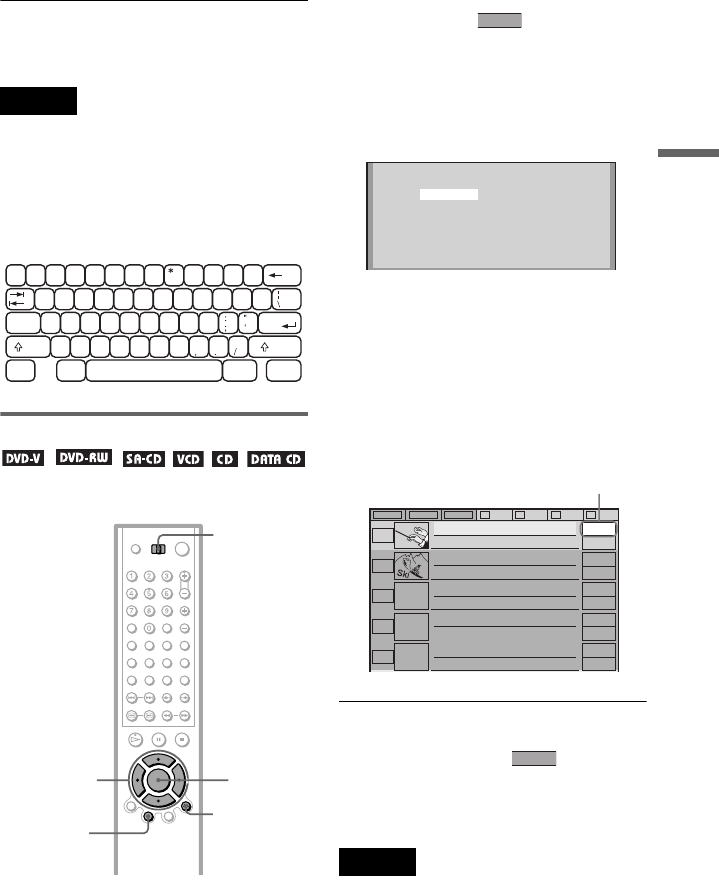
57
Searching for and Managing Discs (Disc Explorer)
5Press ENTER on the keyboard to store
the Disc Memo or folder name.
The Disc Memo or folder name is stored.
To turn off the Disc Explorer
Press ORETURN.
Notes
• If the cursor keys do not work correctly and you
cannot complete the task using the keyboard,
disconnect the keyboard. Then, reconnect it to the
player and try again.
• If the keyboard is not a USA model, the characters
may be input differently from those on the keys.
The USA keyboard layout is shown below.
Selecting a genre
You can assign a genre to your disc.
1Select the disc on the Disc Explorer
(steps 1 and 2 of “Searching for a disc
on the Disc Explorer” (page 51) ).
2Slide the TV/DISC EXPLORER/DVD
switch to DISC EXPLORER, then press
TOP MENU/EDIT.
The selected disc’s text only is
highlighted and appears in the
bottom right corner.
3Press c to highlight the genre row,
then press ENTER.
The “GENRE SELECTION” display
appears.
4Press C/X/x/c to select the genre,
then press ENTER.
The genre for the selected disc is stored in
memory. If no jacket picture is recorded
in the disc, or if you do not have a scene
captured from that disc as a jacket picture
(page 52), the genre picture in the
memory of the player is displayed.
To cancel the edit mode
Press ORETURN until disappears
from the Disc Explorer.
If you press ORETURN again, the Disc
Explorer turns off.
Notes
• The genre setting remains in the player’s memory
even after the disc in the slot is changed. To
reassign a new genre setting, repeat the steps
above.
• The genre setting is cleared when the disc is
removed and the slot becomes empty.
'
~
=
+
1
!
2
@3
#4
$5
%6
^
7
&89
(
0
)
-
-
]
}
WER T Y U I OPQ[
{
SDFGHJKLACaps Lock Enter
XCVBNM<>Z
Shift ?Shift
Ctrl Alt Alt Ctrl
TV/DISC
EXPLORER/
DVD switch
ENTER
ORETURN
C/X/x/c
TOP
MENU/EDIT
EDIT
GENRE SELECTION
Action
Drama
Non Feature
Western
Classical
Pop
Classics
Family
Sci-fi
Country
Rock
Comedy
Horror
Thriller
Jazz/R&B
Others
ALL DVD CD A B C D
Skiing the World
Music Madness
1
2
3
4
CD
Action
DVD
CD
VIDEO CD
5
VIDEO CD
Classical
Selected genre
EDIT
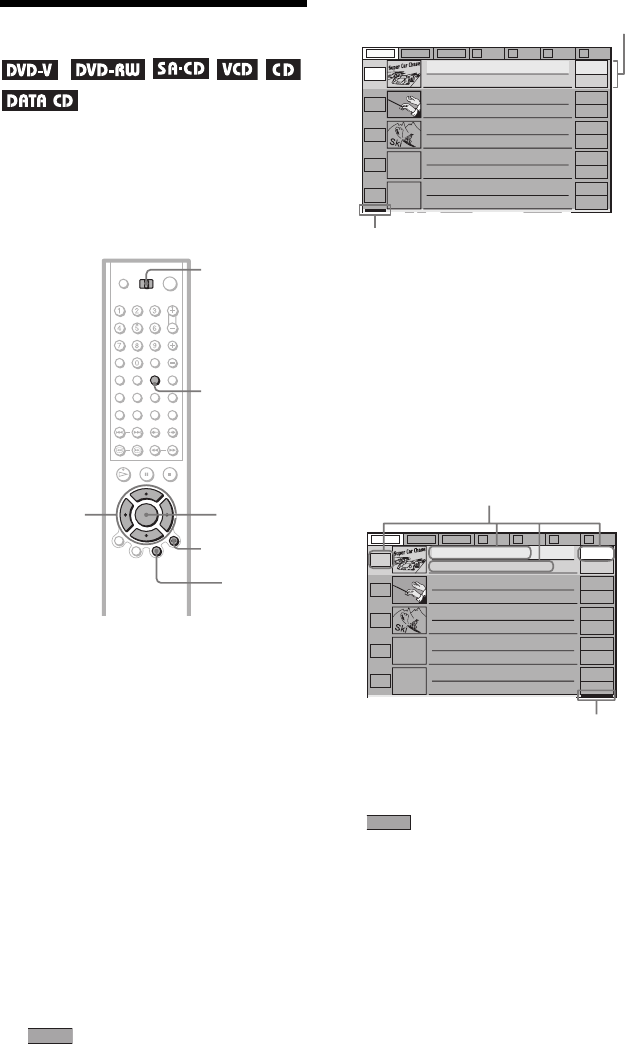
58
Sorting Discs (Sort Mode)
You can sort the discs in the folder by the disc
slot number, text information (DVD/Super
Audio CD/CD TEXT or Disc Memo) or
genre.
The text information is sorted alphabetically.
1Press FOLDER repeatedly to select
the folder you want to sort.
The Disc Explorer for the selected folder
appears.
2If you want to sort by text
information or genre, select the
disc which has the desired text
information or genre by pressing
X/x.
3Slide the TV/DISC EXPLORER/DVD
switch to DISC EXPLORER, then
press MENU/SORT.
The selected disc only is highlighted and
appears in the bottom right corner.
4Press C/X/x/c to select the item
you want to sort.
You can select the disc number, text
information or genre. You can also sort
the text information by the text in the
second line.
5Press ENTER.
disappears from the Disc
Explorer.
Then the discs are sorted and re-
displayed. The sorted order is saved even
if the power of the player is turned off.
TV/DISC
EXPLORER/
DVD switch
ENTER
ORETURN
C/X/x/c
MENU/
SORT
FOLDER
SORT
ALL DVD CD A B C D
1
Super Car Chase
MONACO
Skiing the World
BRAHMS SYMPHONY4
Music Madness
2
3
4
5
Action
Classical
DVD
CD
Action
DVD
CD
VIDEO CD
Selected disc
Sorting item
indicator (green)
ALL DVD CD A B C D
1
Super Car Chase
MONACO
Skiing the World
BRAHMS SYMPHONY4
Music Madness
2
3
4
5
Action
Classical
DVD
CD
Action
DVD
CD
VIDEO CD
Select the sorting item from
among here.
Sorting item indicator position
when you sort by genre
SORT
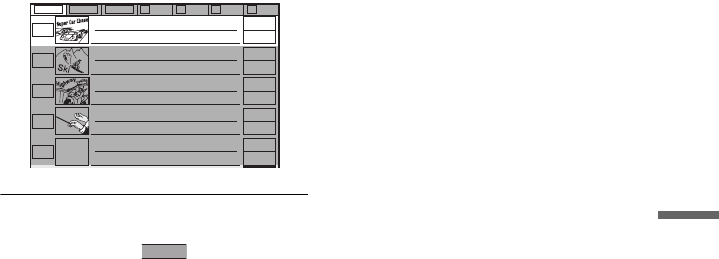
59
Searching for and Managing Discs (Disc Explorer)
To cancel the sort mode
Press ORETURN. disappears from
the Disc Explorer.
If you press ORETURN again, the Disc
Explorer turns off.
zHint
The discs in the same genre are sorted by numerial
order according to the disc slot number.
ALL DVD CD A B C D
1
Super Car Chase
MONACO
Highway Touring
Music Madness
3
198
2
4
Action
DVD
Action
DVD
CD
CD
Skiing the World
Action
DVD
BRAHMS SYMPHONY4
Classical
SORT
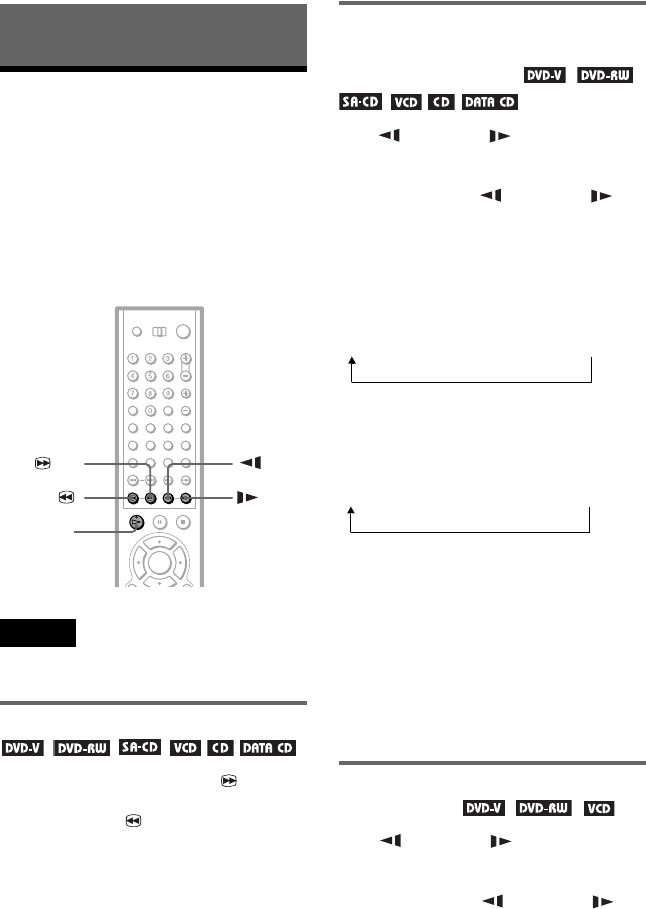
60
Searching for a Scene
Searching for a
Particular Point on a
Disc (Search, Scan, Slow-motion
Play, Freeze Frame)
You can quickly locate a particular point on a
disc by monitoring the picture or playing back
slowly.
Note
Depending on the DVD/VIDEO CD, you may not
be able to do some of the operations described.
Locating a point quickly (Search)
During playback, keep pressing C to
locate a point in the playback direction or
keep pressing c to locate a point in the
opposite direction. When you find the point
you want, release the button to return to
normal playback speed.
Locating a point quickly by
playing a disc in fast forward or
fast reverse (Scan)
Press m or M while playing a
disc. When you find the point you want, press
H to return to normal speed.
Each time you press m or M
during scan, the playback speed changes.
With each press the indication changes as
shown below. Actual speeds may differ with
some discs.
Playback direction
Opposite direction
The “×2B”/“×2b” playback speed is about
twice the normal speed. The “FF3M”/
“FR3m” playback speed is faster than
“FF2M”/“FR2m,” and the “FF2M”/
“FR2m” playback speed is faster than
“FF1M”/“FR1m.”
Watching frame by frame (Slow-
motion play)
Press m or M when the player is
in pause mode. To return to the normal speed,
press H.
Each time you press m or M
during Slow-motion play, the playback speed
changes. Two speeds are available. With each
press the indication changes as follows:
c
Cm
M
H
×2B t FF1M t FF2M t FF3M
FF3M (DVD VIDEO/DVD-RW/VIDEO CD
only)
×2B (DVD VIDEO/Super Audio CD/CD only)
×2b t FR1m t FR2m t FR3m
FR3m (DVD VIDEO/DVD-RW/
VIDEO CD only)
×2b (DVD VIDEO only)
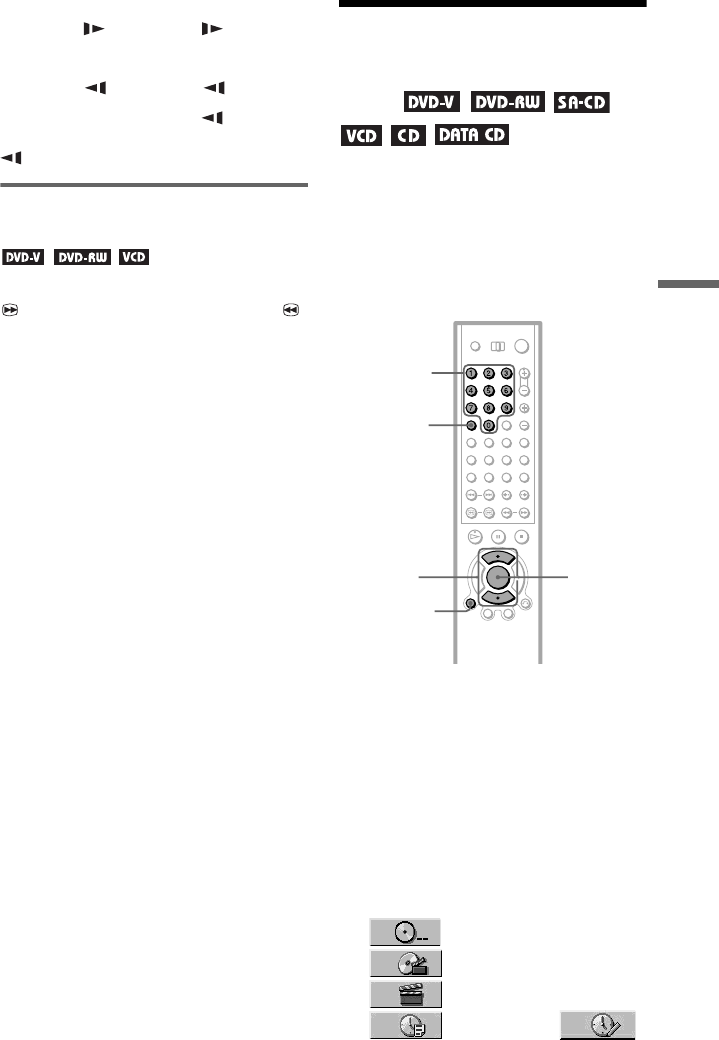
61
Searching for a Scene
Playback direction
SLOW2 y SLOW1
Opposite direction (DVD only)
SLOW2 y SLOW1
The “SLOW2 y”/“SLOW2 ” playback
speed is slower than “SLOW1 y”/“SLOW1
.”
Playing one frame at a time
(Freeze Frame)
When the player is in the pause mode, press
C to go to the next frame. Press c
to go to the preceding frame (DVD only). If
you hold the button down, you can view the
frames in succession. To return to normal
playback, press H.
Searching for a Title/
Chapter/Track/Scene,
etc.
You can search a DVD by title or by chapter,
and you can search a VIDEO CD/Super
Audio CD/CD by track, index, or scene. As
titles and tracks are assigned unique numbers
on the disc, you can select the desired one by
entering its number. Or, you can search for a
scene using the time code.
1Select a disc (page 35).
2Press DISPLAY/FILE during
playback.
The Control Menu appears.
3Press X/x to select the search
method.
◆When playing a DVD VIDEO/DVD-RW
DISC
TITLE
CHAPTER
TIME/TEXT or
TIME/MEMO
Number
buttons
DISPLAY/
FILE
X/xENTER
CLEAR
c continued
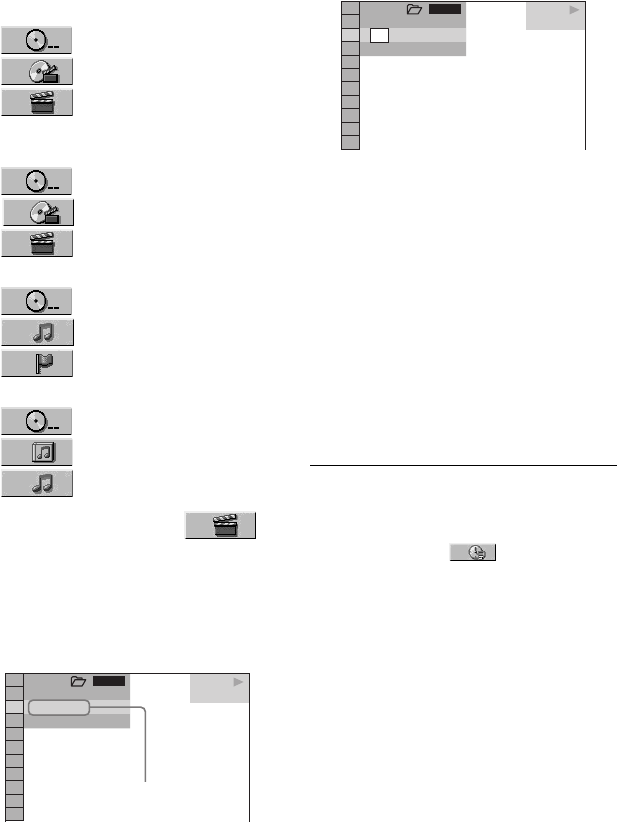
62
Select “TIME/TEXT” to search for a
starting point by inputting the time code.
◆When playing a VIDEO CD without PBC
Playback
DISC
TRACK
INDEX
◆When playing a VIDEO CD with PBC
Playback
DISC
SCENE
INDEX
◆When playing a Super Audio CD/CD
DISC
TRACK
INDEX
◆When playing a DATA CD (MP3 audio)
DISC
ALBUM
TRACK
Example: when you select
(CHAPTER)
“** (**)” is selected (** refers to a
number).
The number in parentheses indicates the
total number of titles, tracks, indexes,
scenes, etc. of the disc.
4Press ENTER.
“** (**)” changes to “-- (**).”
5Press X/x or the number buttons
to select the title, chapter, track,
index, or scene number you want
to search.
If you make a mistake
Cancel the number by pressing CLEAR,
then select another number.
6Press ENTER.
The player starts playback from the
selected number.
To search for a scene using the time code
(DVD VIDEO/DVD-RW only)
1In step 2, select TIME/TEXT.
“T **:**:**” (playing time of the current
title) is selected.
2Press ENTER.
“T **:**:**” changes to “T --:--:--.”
3Input the time code using the number
buttons, then press ENTER.
For example, to find the scene at 2 hours,
10 minutes, and 20 seconds after the
beginning, just enter “2:10:20.”
To turn off the display
Press DISPLAY/FILE repeatedly until the
display is turned off.
zHints
• You can display the first scene of titles, chapters
or tracks recorded on the disc on a screen divided
into 9 sections. You can start playback directly by
selecting one of the scenes. For details, see
“Searching by Scene (PICTURE
NAVIGATION)” (page 63).
1 8 ( 3 4 )
1 2 ( 2 7 )
1 2 3
DVD
T
1 : 3 2 : 5 5
PLAY
ALL
Selected item
1 2 ( 2 7 )
1 2 3
DVD
T
1 : 3 2 : 5 5
PLAY
ALL
- - ( 3 4 )
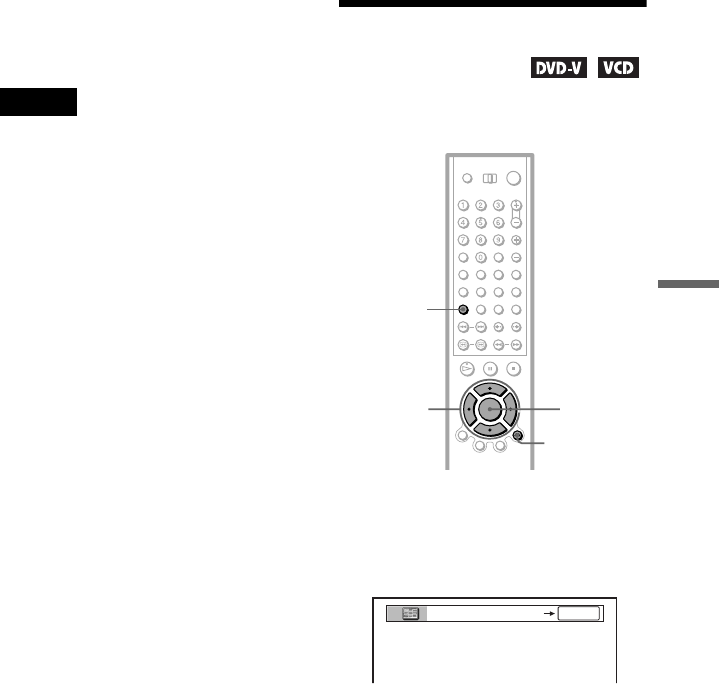
63
Searching for a Scene
• You can search for a chapter (DVD VIDEO/
DVD-RW only) or track (Super Audio CD/CD/
DATA CD only) by pressing the number buttons
and ENTER.
Notes
• You cannot search for a still picture on a DVD-
RW in VR mode.
• You cannot search for a scene on a DVD+RW
using the time code.
• The title, chapter or track number displayed is the
same number recorded on the disc.
Searching by Scene
(PICTURE NAVIGATION)
You can divide the screen into 9 subscreens
and quickly find a desired scene.
1Press PICTURE NAVI during
playback.
The following display appears.
2Press PICTURE NAVI repeatedly to
select an item.
• CHAPTER VIEWER (DVD VIDEO
only)
• TITLE VIEWER (DVD VIDEO only)
• TRACK VIEWER (VIDEO CD only)
ENTER
ORETURN
C/X/x/c
PICTURE
NAVI
CHAPTER VIEWER
ENTER
c continued
64
3Press ENTER.
The following display appears.
4Press C/X/x/c to select a title,
chapter, or track, and press
ENTER.
Playback starts.
To return to normal play
Press O RETURN.
zHints
• If there are more than 9 titles, chapters, or tracks,
V is displayed at the bottom right of the screen.
To display the additional titles, chapters, or
tracks, select the bottom right scene (located at
box 9) and press x. To return to the previous
scene, select the top left scene (located at box 1)
and press X.
• You can also select “PICTURE NAVIGATION”
from the Control Menu (page 14).
Notes
• Depending on the disc, you may not be able to
select some items.
• The sound is muted when using this function.
1
4
7
2
5
8
3
6
9
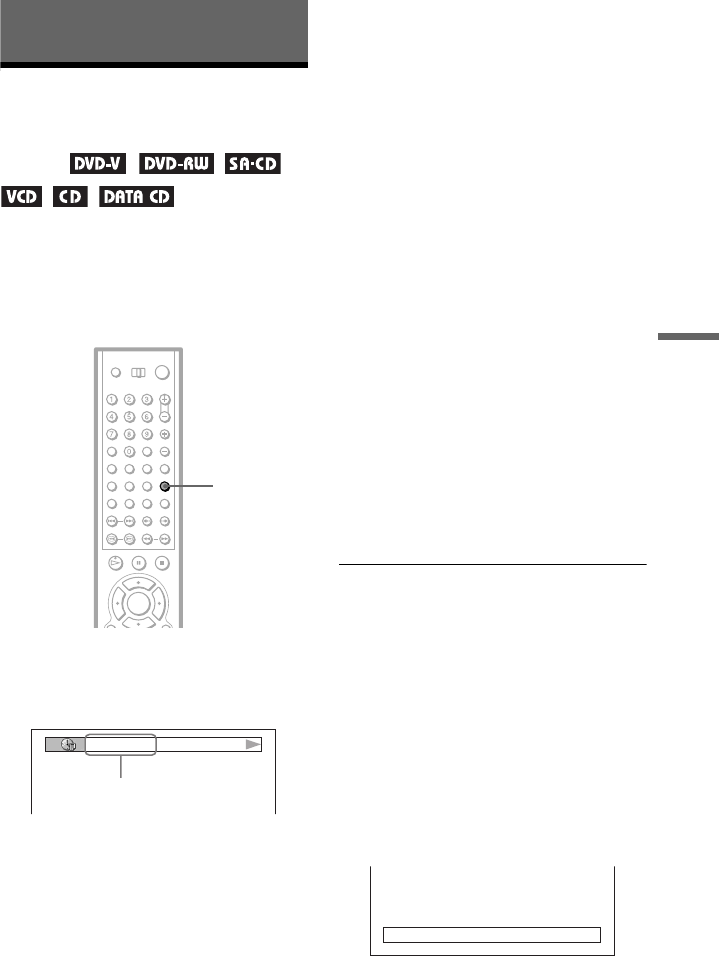
65
Viewing Information About the Disc
Viewing Information About the
Disc
Checking the Playing
Time and Remaining
Time
You can check the playing time and
remaining time of the current title, chapter, or
track. Also, you can check the DVD/Super
Audio CD/CD text or track name (MP3
audio) recorded on the disc.
1Press TIME/TEXT during playback.
The following display appears.
2Press TIME/TEXT repeatedly to
change the time information.
The available time information depends
upon the type of disc you are playing.
◆When playing a DVD VIDEO or DVD-
RW
•T *:*:* (hours: minutes: seconds)
Playing time of the current title
•T–
*:*:*
Remaining time of the current title
•C *:*:*
Playing time of the current chapter
•C–
*:*:*
Remaining time of the current chapter
◆When playing a VIDEO CD (with PBC
functions)
•*:* (minutes: seconds)
Playing time of the current scene
◆When playing a VIDEO CD (without
PBC functions), Super Audio CD, or CD
•T *:* (minutes: seconds)
Playing time of the current track
•T–
*:*
Remaining time of the current track
•D *:*
Playing time of the current disc
•D–
*:*
Remaining time of the current disc
◆When playing a DATA CD (MP3 audio)
•T *:* (minutes: seconds)
Playing time of the current track
To check the DISC MEMO, DVD/Super
Audio CD/CD text, or track/album names
(MP3 audio)
Press TIME/TEXT repeatedly in step 2 to
display the Disc MEMO or text recorded on
the DVD VIDEO/Super Audio CD/CD/
DATA CD.
The DVD/Super Audio CD/CD text appears
only when text is recorded in the disc. You
cannot change the text. If the disc does not
contain text, “NO TEXT” appears. In this
case, you can label the disc if it is a DVD or
CD (page 55).
For DATA CDs, the track and album names
of the MP3 audio track appears (page 68).
TIME/
TEXT
PLAYT 1:01:57
Time
information
BRAHMS SYMPHONY
c continued
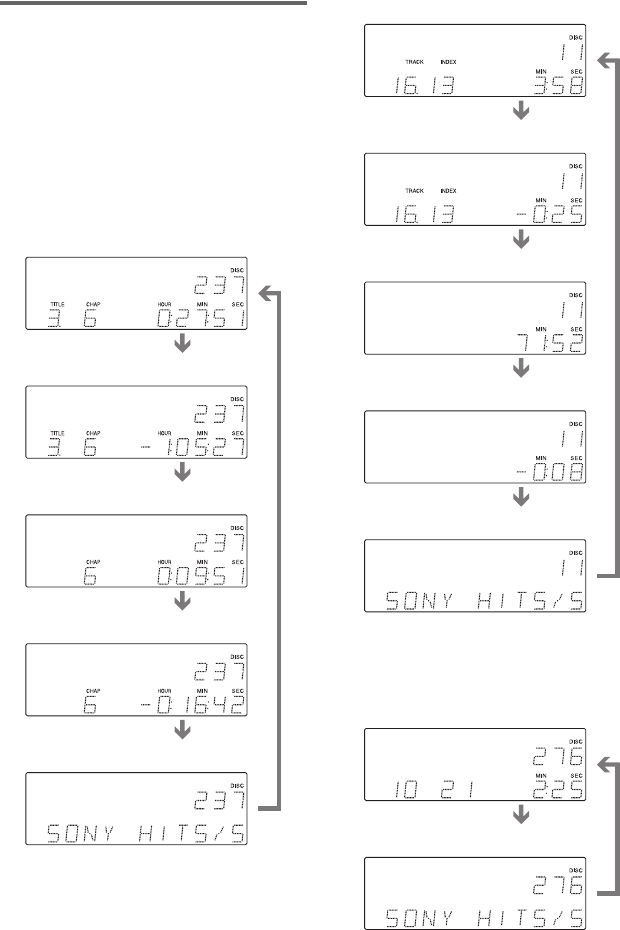
66
zHint
You can also check the DVD/Super Audio CD/CD
text using the Disc Explorer (page 50).
Checking the information on the
front panel display
You can view the time information and text
on the front panel display as well as on the TV
screen. The information on the front panel
display changes as follows when you change
the time information on your TV screen.
When playing a DVD VIDEO or DVD-RW
When playing a VIDEO CD (without PBC
functions), Super Audio CD, or CD
When playing a DATA CD (MP3 audio)
Title playing time and current disc, title
and chapter number
Remaining time of the current title
Playing time and
number of the current chapter
Remaining time of
the current chapter
Text
Track playing time and current
disc, track and index number
Remaining time of
the current track
Remaining time of the disc
Text
Playing time of the disc
Track name
Track playing time and current disc,
album and track number
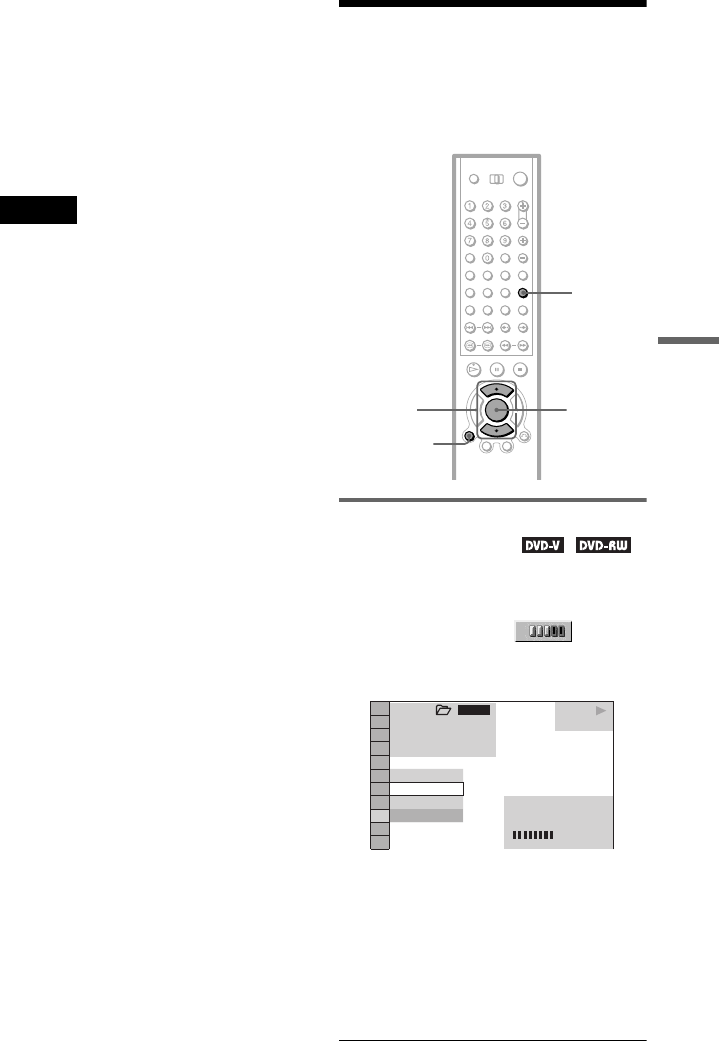
67
Viewing Information About the Disc
zHints
• When playing VIDEO CDs with PBC functions,
the disc number, scene number and the playing
time are displayed.
• Long text that does not fit in a single line will
scroll across the front panel display.
• You can also check the time information and text
by pressing the TIME/TEXT button on the player.
• You can also check the time information and text
using the Control Menu (page 15).
Notes
• Depending on the type of disc being played, the
DVD/Super Audio CD/CD text or track name
may not be displayed.
• The player can only display the first level of the
DVD/Super Audio CD/CD text, such as the disc
name or title.
• Playing time of MP3 audio tracks may not be
displayed correctly.
Checking the Play
Information
You can check information during playback,
such as the correct bit rate or the disc layer.
Checking the play information of
a DVD (ADVANCED)
1Press DISPLAY/FILE during playback.
The Control Menu appears.
2Press X/x to select
(ADVANCED), then press ENTER.
The options for “ADVANCED” appear.
3Press X/x to select an item.
For details on each item, see “Displays of
each item” below.
•BIT RATE: displays the bit rate.
•LAYER: displays the layer and the
pick-up point.
4Press ENTER.
TIME/
TEXT
ENTER
X/x
DISPLAY/
FILE
1 8 ( 3 4 )
1 2 ( 2 7 )
T
1 : 3 2 : 5 5
BIT RATE
DVD
BIT RATE
0510
kbps
Mbps
384
OFF
BIT RATE
LAYER
PLAY
1 2 3
ALL
c continued
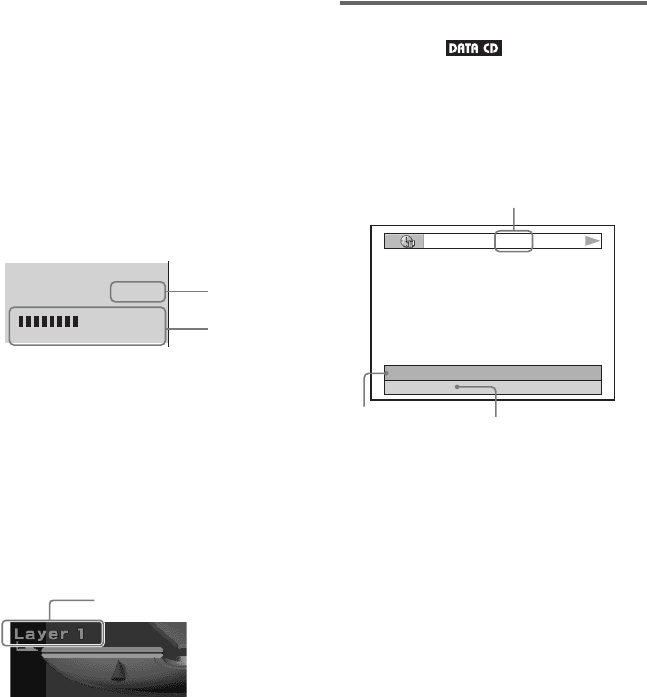
68
To close the ADVANCED display
Select “OFF” in step 3.
To turn off the Control Menu
Press DISPLAY/FILE repeatedly until the
Control Menu is turned off.
Displays of each item
By pressing DISPLAY/FILE repeatedly, you
can display either “BIT RATE” or “LAYER,”
whichever was selected in “ADVANCED.”
◆BIT RATE
Bit rate refers to the amount of video/audio
data per second in a disc. While playing a
disc, an approximate bit rate of the playback
picture is displayed as Mbps (Mega bit per
second) and the audio as kbps (kilo bit per
second). The higher the bit rate, the larger the
amount of data. However, this does not
always mean that you can get higher quality
pictures or sounds.
◆LAYER
Indicates the approximate point where the
disc is playing.
If it is a dual-layer DVD, the player indicates
which layer is being read (“Layer 0” or
“Layer 1”).
For details on the layers, see page 101 (DVD
VIDEO).
Checking the play information of
a DATA CD
By pressing TIME/TEXT while playing an
MP3 audio track on a DATA CD, you can
display the audio bit rate (the amount of data
per second of the current audio) on your TV
screen.
BIT RATE
0510
kbps
Mbps
384
Audio
Video
Appears when the DVD
has dual layers
PLAYT 17:30 128k
JAZZ
RIVER SIDE
Bit rate
Album name Track name
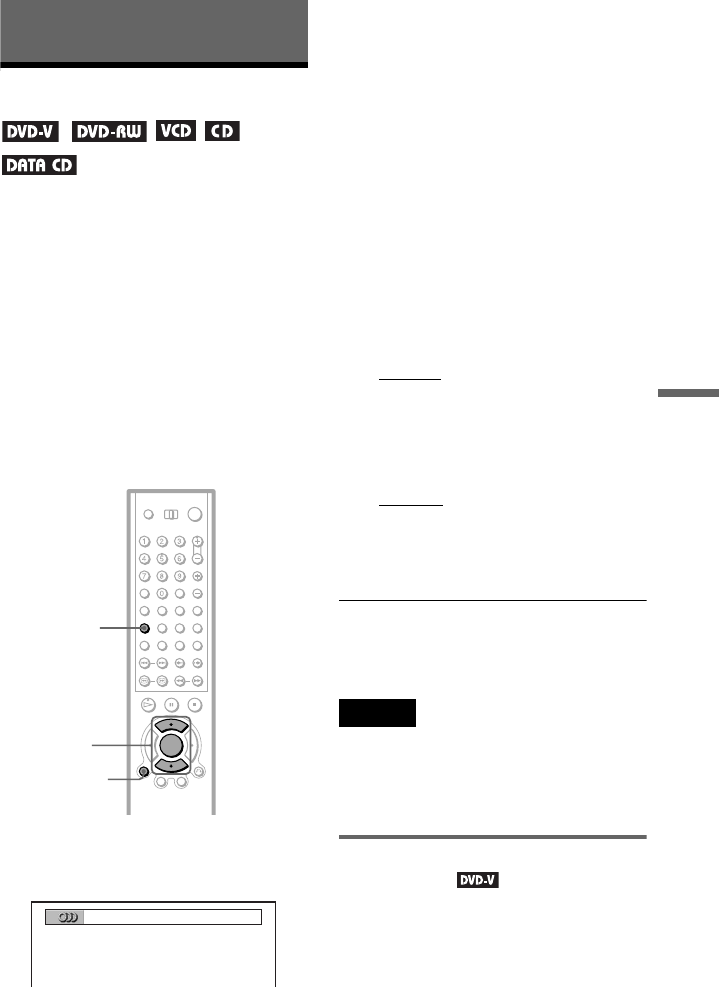
69
Sound Adjustments
Sound Adjustments
Changing the Sound
When playing a DVD recorded in multiple
audio formats (PCM, Dolby Digital, or DTS),
you can change the audio format. If the DVD
is recorded with multilingual tracks, you can
also change the language.
With CDs, DATA CDs, or VIDEO CDs, you
can select the sound from the right or left
channel and listen to the sound of the selected
channel through both the right and left
speakers. For example, when playing a disc
containing a song with the vocals on the right
channel and the instruments on the left
channel, you can hear the instruments from
both speakers by selecting the left channel.
1Press AUDIO during playback.
The following display appears.
2Press AUDIO repeatedly to select
the desired audio signal.
◆When playing a DVD VIDEO
Depending on the DVD VIDEO, the
choice of language varies.
When 4 digits are displayed, they
indicate a language code. See “Language
Code List” for the language the code
represents (page 105). When the same
language is displayed two or more times,
the DVD VIDEO is recorded in multiple
audio formats.
◆When playing a DVD-RW
The types of sound tracks recorded on a
disc are displayed. The default setting is
underlined.
Example:
•1:
MAIN (main sound)
• 1: SUB (sub sound)
• 1: MAIN+SUB (main and sub sound)
◆When playing a VIDEO CD, CD, or
DATA CD (MP3 audio)
The default setting is underlined.
•STEREO: The standard stereo sound
• 1/L: The sound of the left channel
(monaural)
• 2/R: The sound of the right channel
(monaural)
zHints
You can also select “AUDIO” from the Control
Menu (page 15).
Notes
• You cannot change the sound for Super Audio
CDs.
• Some DVDs prohibit changing sounds during
playback. In this case, change the sounds using
the disc’s menu (page 38).
Displaying the disc’s audio
information
Press DISPLAY/FILE during playback to
display the Control Menu. Select “AUDIO”
using X/x. The channels being played are
displayed on the screen.
AUDIO
DISPLAY/
FILE
X/x
1:ENGLISH
c continued
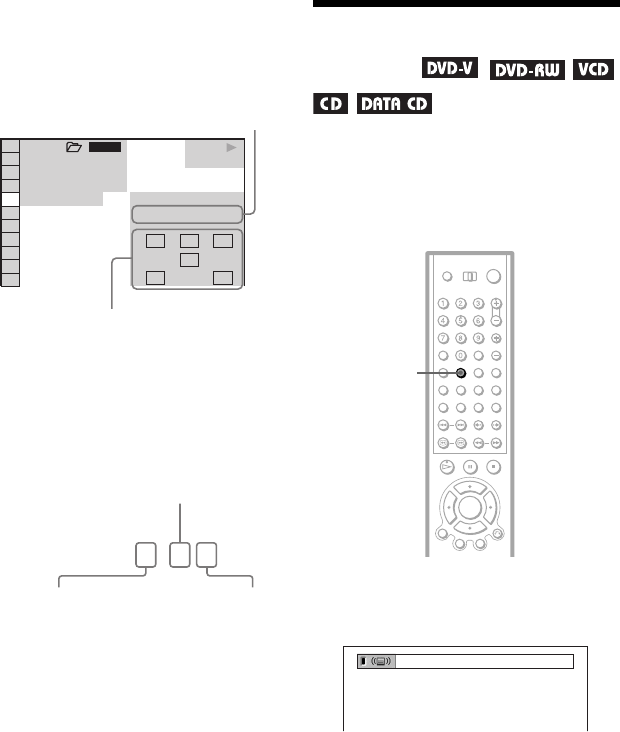
70
For example, in Dolby Digital format,
multiple signals ranging from monaural to 5.1
channel signals can be recorded on a DVD
VIDEO. Depending on the DVD VIDEO, the
number of the recorded channels may differ.
* “PCM,” “DTS,” or “DOLBY DIGITAL” is
displayed.
The channels in the currently selected track
are displayed by numbers as follows:
For Dolby Digital 5.1 ch:
**The letters in the program format display
indicate the following sound components:
L: Front (left)
R: Front (right)
C: Center
LS: Rear (left)
RS: Rear (right)
S: Rear (monaural): The rear
component of the Dolby
Surround processed signal and
the Dolby Digital signal
LFE: Low Frequency Effect signal
zHint
When playing Dolby Digital and DTS sound tracks,
“LFE” is enclosed in a dotted line when the LFE
signal is not being output.
SURROUND Mode
Settings
You can enjoy surround sounds while playing
discs, including Dolby Digital and DTS
DVDs, even if you have only 2 or 4 speakers.
Select the surround mode that best suits your
speaker setup.
1Press SUR during playback.
The following display appears.
2Press SUR repeatedly to select
one of the surround modes.
See the following explanations given for
each item.
◆For 2 speaker setups
• TVS DYNAMIC
• TVS WIDE
• TVS NIGHT
• TVS STANDARD
DVD
1: ENGLISH
1 8 ( 3 4 )
1 2 ( 2 7 )
T
1 : 3 2 : 5 5
LRC
DOLBY DIGITAL 3/2.1
PROGRAM FORMAT
LFE
LS RS
PLAY
1 2 3
ALL
Current audio format*
Currently playing program format**
DOLBY DIGITAL
3 / 2 . 1
LFE (Low
Frequency
Effect)
component 1
Rear component 2
Front component 2 +
Center component 1
SUR
TVS DYNAMIC
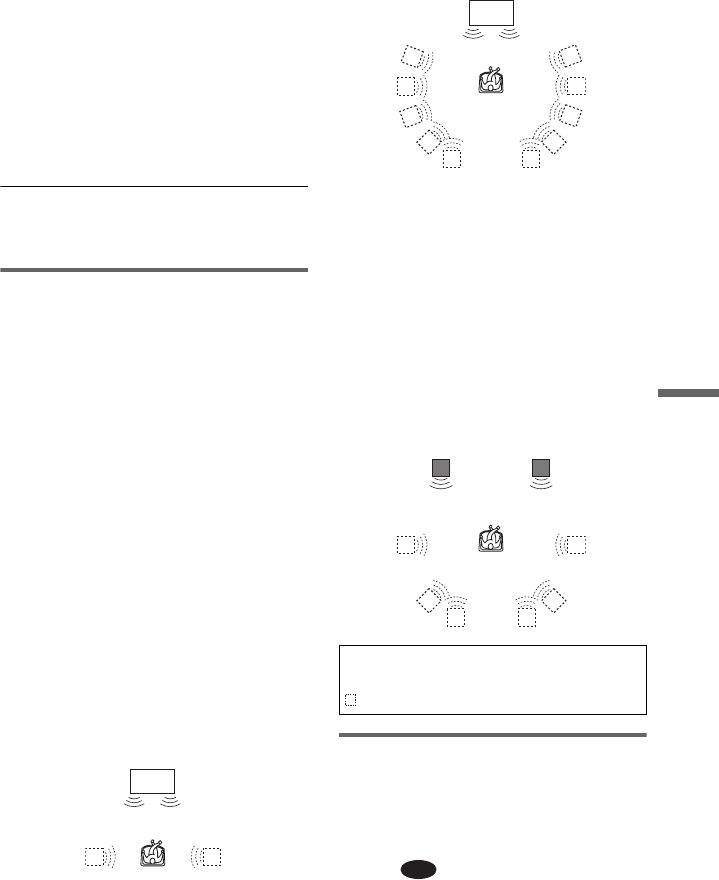
71
Sound Adjustments
◆For 4 to 6 speaker setups
(If you select “NONE” in the setting of
“REAR” in “SPEAKER SETUP” (page
94), you cannot select these modes.)
• NORMAL SURROUND
• ENHANCED SURROUND
•VIRTUAL REAR SHIFT
• VIRTUAL MULTI REAR
• VIRTUAL MULTI DIMENSION
To cancel the setting
Select “OFF” in step 2.
For 2 speaker setups
When you connect a stereo TV or 2 front
speakers, TVS (TV Virtual Surround) lets
you enjoy surround sound effects by using
sound imaging to create virtual rear speakers
from the sound of the front speakers (L: left,
R: right) without using actual rear speakers.
TVS was developed by Sony to produce
surround sound for home use using just a
stereo TV.
If the player is set up to output the signal from
the DIGITAL OUT (OPTICAL or
COAXIAL) jack, the surround effect will be
heard only when “DOLBY DIGITAL” and
“DTS” are set to “D-PCM” in “AUDIO
SETUP” (page 93)
◆TVS DYNAMIC
Creates one set of virtual rear speakers from
the sound of the actual front speakers (L, R)
as shown below.
This mode is effective when the distance
between the front L and R speakers is short,
such as with built-in speakers on a stereo TV.
◆TVS WIDE
Creates five sets of virtual rear speakers from
the sound of the actual front speakers (L, R)
as shown below.
This mode is effective when the distance
between the front L and R speakers is short,
such as with built-in speakers on a stereo TV.
◆TVS NIGHT
Large sounds, such as explosions, are
suppressed, but quieter sounds are
unaffected. This feature is useful when you
want to hear the dialog and enjoy the
surround sound effects of “TVS WIDE” at
low volume.
◆TVS STANDARD
Creates three sets of virtual rear speakers
from the sound of the actual front speakers
(L, R) as shown below. This mode is effective
when you use 2 separate front speakers.
For 4 to 6 speaker setups
You can enjoy the following surround effects
by using the 2 front speakers and 2 rear
speakers.
Connect the player to the amplifier (receiver)
with the connection (page 27).
You can experience Dolby Surround (Pro
Logic) sounds or Digital Cinema Sound
(DCS). DCS uses sound imaging to shift the
sound of the rear speakers away from the
actual speaker position or create entire sets of
virtual rear speakers from one set of actual
rear speakers. “VIRTUAL REAR SHIFT,”
“VIRTUAL MULTI REAR,” and
“VIRTUAL MULTI DIMENSION” make
use of this technology.
TV
L : Front speaker (left)
R : Front speaker (right)
: Virtual speaker
TV
L R
D-1
c continued
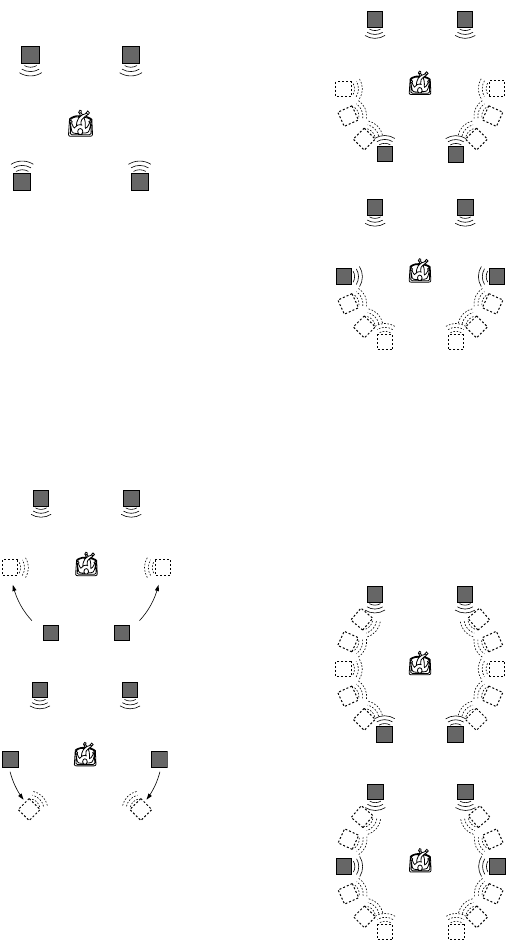
72
◆NORMAL SURROUND
Software with 2 channel audio signals is
decoded with the Dolby Surround (Pro Logic)
decoder to create surround effects. The rear
speakers will emit identical monaural sounds.
If you are using a center speaker, the
appropriate sounds for the center speaker will
be delivered.
◆ENHANCED SURROUND
Provides a greater sense of presence from a
Dolby Surround (Pro Logic) source with a
monaural rear channel signal. Produces a
stereo like effect in the rear channels.
◆VIRTUAL REAR SHIFT
Shifts the sound of the rear speakers away
from the actual speaker position.
The shift position differs according to
“REAR” or “SIDE” setting of the rear
speakers (page 95).
◆VIRTUAL MULTI REAR
Creates an array of virtual rear speakers from
a single set of actual rear speakers.
The position of the virtual rear speakers
differs according to “REAR” or “SIDE”
settng of the rear speakers (page 95).
◆VIRTUAL MULTI DIMENSION
Creates an array of virtual rear speaker
positions higher than the listener from a
single set of actual rear speakers.
This mode creates five sets of virtual speakers
surrounding the listener at approximately 30º
of elevation. The effect differs according to
“REAR” or “SIDE” setting of the rear
speakers (page 95).
L R
RSLS
LS RS
LR
L
LS RS
R
REAR
SIDE
L
LS RS
R
LR
LS RS
REAR
SIDE
LS RS
LR
LR
LS RS
REAR
SIDE

73
Sound Adjustments
zHints
• You can select “SURROUND” by pressing the
SURROUND button on the player.
• You can also select “SURROUND” from the
Control Menu (page 15).
Notes
• To enjoy the multichannel audio through the
5.1CH OUTPUT jacks, correctly set each speaker
position and distance (page 94).
• When the playing signal does not contain a signal
for the rear speakers, it may be difficult to hear the
surround effect.
• When you select one of the TVS modes, the
player does not output the sound of center
speaker.
• When you select one of the surround modes, turn
off the surround setting of the connected TV or
amplifier (receiver)
• Make sure that your listening position is between
and at an equal distance from your speakers, and
that the speakers are located in similar
surroundings.
• Not all discs will respond to the “TVS NIGHT”
function in the same way.
• If you use the DIGITAL OUT (OPTICAL or
COAXIAL) jack and set “DOLBY DIGITAL” to
“DOLBY DIGITAL” and “DTS” to “DTS” in
“AUDIO SETUP,” sound will come from your
speakers but it will not have the SURROUND
effect.
• If the player is set up to output the signal from the
DIGITAL OUT (OPTICAL or COAXIAL) jack,
the TVS effect will not be heard when you play a
CD.
• “TVS NIGHT” can only be used for Dolby digital
discs.
L : Front speaker (left)
R : Front speaker (right)
LS: Rear speaker (left)
RS:Rear speaker (right)
: Virtual speaker
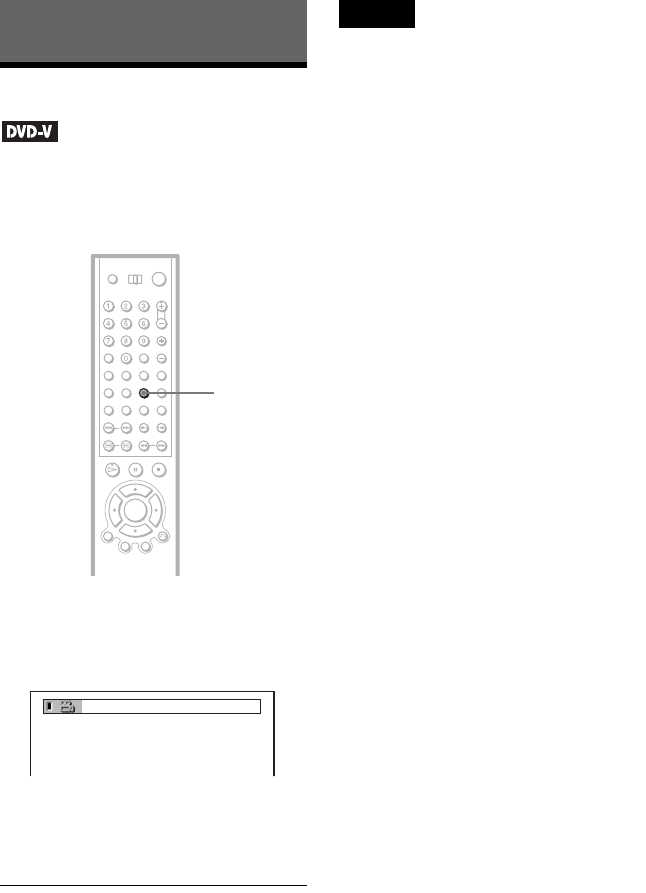
74
Enjoying Movies
Changing the Angles
If various angles (multi-angles) for a scene
are recorded on the DVD VIDEO, “ANGLE”
appears in the front panel display. This means
that you can change the viewing angle.
1Press ANGLE during playback.
The number of the angle appears on the
display.
2Press ANGLE repeatedly to select
the angle number.
The scene changes to the selected angle.
zHint
You can also select “ANGLE” from the Control
Menu (page 15).
Note
Depending on the DVD VIDEO, you may not be
able to change the angles even if multi-angles are
recorded on the disc.
ANGLE
2
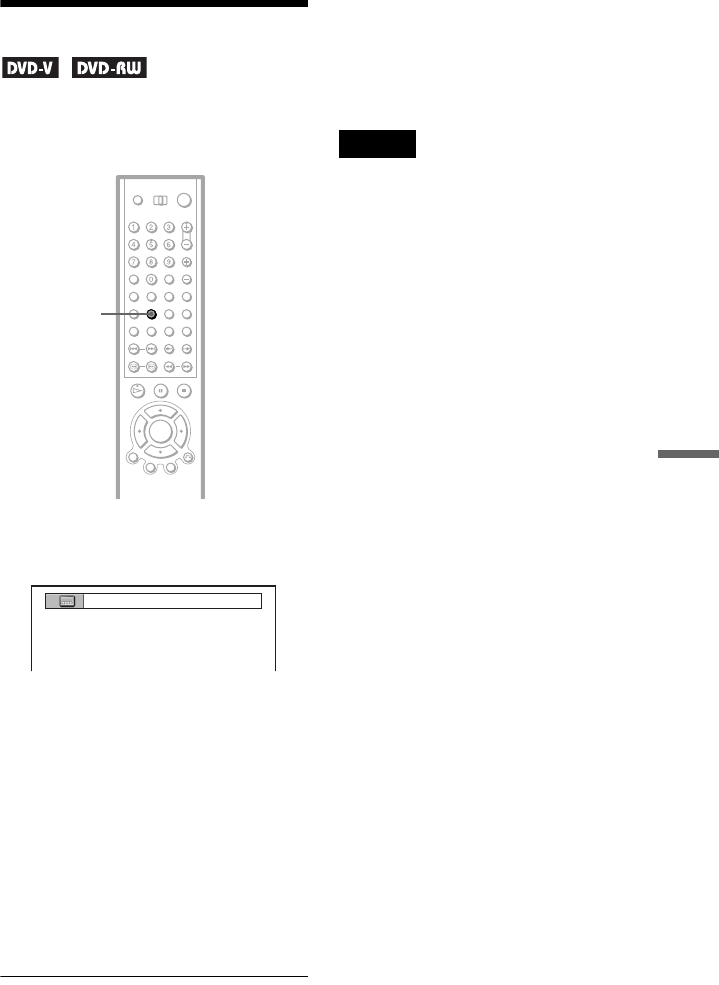
75
Enjoying Movies
Displaying the Subtitles
If subtitles are recorded on the discs, you can
change the subtitles or turn them on and off
whenever you want while playing a DVD.
1Press SUBTITLE during playback.
The following display appears.
2Press SUBTITLE repeatedly to
select the language.
◆When playing a DVD VIDEO
Select the language.
Depending on the DVD VIDEO, the
choice of language varies.
When 4 digits are displayed, they
indicate a language code. See “Language
Code List” for the language the code
represents (page 105).
◆When playing a DVD-RW
Select “ON.”
To turn off the subtitles
Select “OFF” in step 2.
zHint
You can also select “SUBTITLE” from the Control
Menu (page 15).
Note
Depending on the DVD VIDEO, you may not be
able to change the subtitles even if multilingual
subtitles are recorded on it. You also may not be
able to turn them off.
SUBTITLE
1:ENGLISH
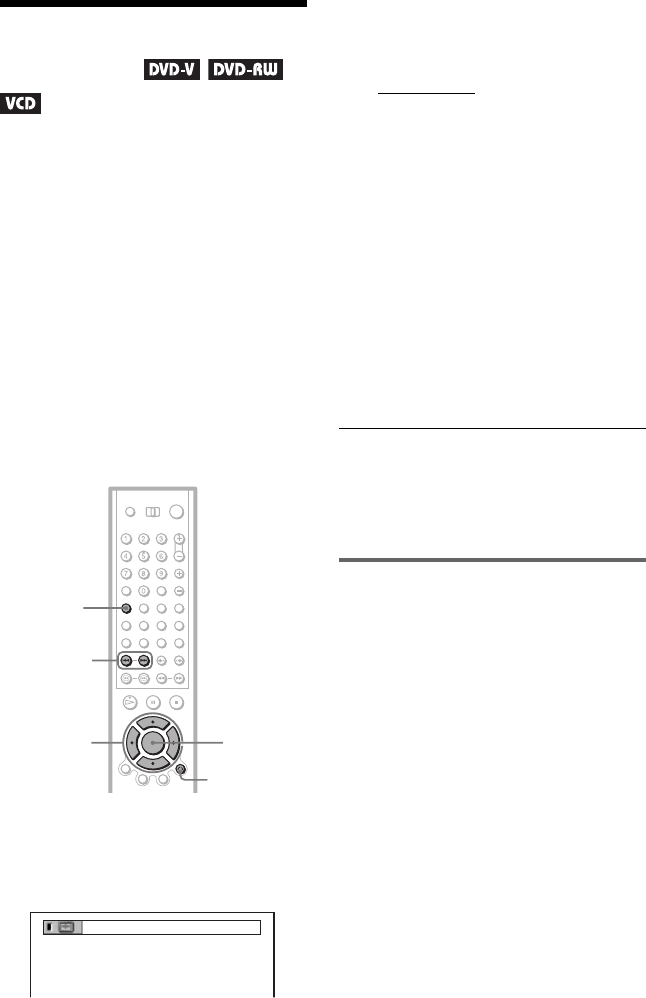
76
Adjusting the Picture
(VIDEO CONTROL)
You can adjust the video signal of a DVD or
VIDEO CD from the player to obtain the
picture quality you want.
Choose the preset Video Control setting that
best suits the program you are watching, or
select “MEMORY” to adjust individual
picture items, such as color, brightness, etc.
This creates a fixed set of picture item
adjustments for the disc.
As long as “PLAYBACK MEMORY” in
“CUSTOM SETUP” is set to “ON” (default),
the Video Control settings for up to 400 discs
remain in the player’s memory, and will be
automatically applied whenever you play the
same disc. When you store a Video Control
setting for the 401st disc, the setting for the
1st disc is canceled.
1Press VIDEO CONTROL during
playback.
The following display appears.
2Press VIDEO CONTROL repeatedly
to select the setting you want.
The default setting is underlined.
• STANDARD: Displays a standard
picture.
• DYNAMIC 1: Produces a bold
dynamic picture by increasing the
picture contrast and the color intensity.
• DYNAMIC 2: Produces a more
dynamic picture than DYNAMIC 1 by
further increasing the picture contrast
and the color intensity.
• CINEMA 1: Enhances details in dark
areas by increasing the black level.
• CINEMA 2: White colors become
brighter and black colors become
richer, and the color contrast is
increased.
• MEMORY: Adjusts the picture in
greater detail.
zHints
• When you watch a movie, “CINEMA 1” or
“CINEMA 2” is recommended.
• You can also select “VIDEO CONTROL” from
the Control Menu (page 15).
Adjusting the picture items in
“MEMORY”
You can adjust each element of the picture
qualities individually.
• DVE (digital video enhancer):
Sharpens or softens the outlines of the
images. “SOFT” is available only for
DVDs.
• BNR (block noise reduction):
Reduces “block noise” or mosaic-like
patterns in the picture.
• Y NR (luminance noise reduction):
Reduces noise contained in the luminance
element of the video signal.
• C NR (chroma noise reduction):
Reduces noise contained in the color
element of the video signal.
• CHROMA DELAY:
Adjusts colors that appear to have shifted
horizontally.
• AV ALIGNMENT:
Adjusts delay between the picture and
sound.
ENTER
O RETURN
C/X/x/c
VIDEO
CONTROL
./>
DYNAMIC 1
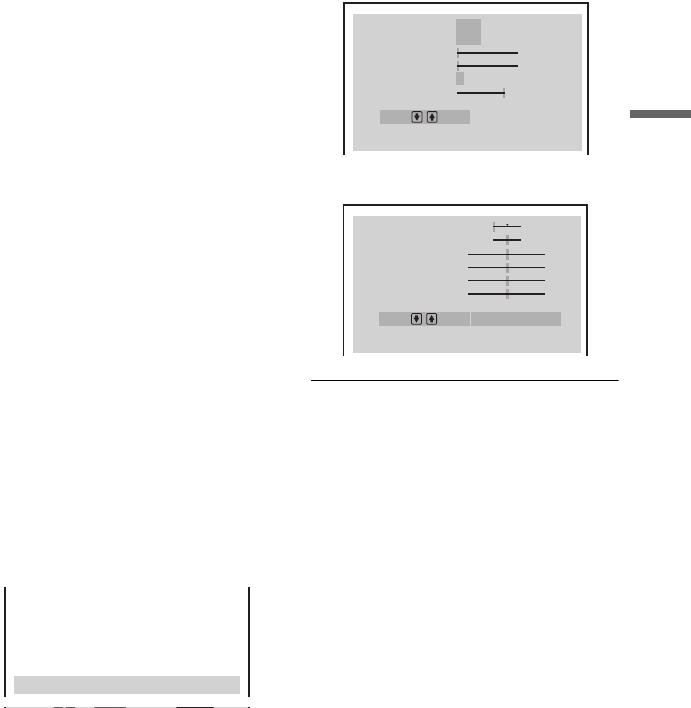
77
Enjoying Movies
• PROGRESSIVE 1:
Sets a threshold at which the player
determines the progressive conversion
method.
When “COMPONENT OUT” in “SCREEN
SETUP” is set to “PROGRESSIVE,” the
player automatically detects whether the
software is video based or film based, and
converts the video signals according to the
corresponding progressive conversion
method. When the set point is closer to
“VIDEO,” the video based software
conversion method is more likely to be
selected; when closer to “FILM,” the film
based conversion method is the likely
choice. When set specifically to “VIDEO,”
the video based software conversion
method will be always applied regardless of
the software type.
See “Glossary” for details about the video
based software and film based software
(page 101).
• PROGRESSIVE 2:
Adjusts the progressive video signals
processed according to the video based
software conversion method. Set closer to
“STILL” for software containing static
pictures such as scenery. Or, set closer to
“MOVE” for software containing dynamic
moving pictures such as a car chase.
•PICTURE:
Changes the contrast.
• BRIGHTNESS:
Changes the overall brightness.
• COLOR:
Makes the colors deeper or lighter.
• HUE:
Changes the color balance.
• GAMMA:
Adjusts the brightness of selected areas. See
“Adjusting the brightness of selected areas
(Gamma Correction)” for details (page 78).
1Press VIDEO CONTROL repeatedly to
select “MEMORY,” then press ENTER.
The “DVE” adjustment bar appears.
2Press C/c to adjust the outline, then
press ENTER.
The adjustment is saved, and the “BNR”
adjustment bar appears.
3Repeat step 2 to adjust “BNR” and
other items such as “Y NR,” and “C
NR.”
4When you reach the “GAMMA”
adjustment bar, press x.
Video Control display 1 appears. To go to
Video Control display 2, press x again.
You can check all adjustments other than
“GAMMA.”
Video Control display 1
Video Control display 2
To turn off the display
Press O RETURN.
zHints
• To reset the picture items to the default values,
press c after step 4 to select “RESET” in Video
Control display 2 and press ENTER.
• You can skip the adjustment without saving by
pressing X/x in step 2.
• Video based software, such as TV dramas,
animation, and live music software are more
adequately processed under the video based
conversion method. Film based software such as
movies are better processed under the film based
conversion method.
C
0
1
:
3
2
:
5
5
DVE OFF 1 2 3 SOFT
CHROMA DELAY
C NR
Y NR
BNR
DVE
AV ALIGNMENT
OFF
OFF
120ms
OFF 1 2 3 SOFT
OFF 1 2 3
0 1 2
COLOR
BRIGHTNESS
PICTURE
PROGRESSIVE2
PROGRESSIVE1
HUE
0
-
4
0
0
0
0
FILM VIDEO
STILL MOVE
RESET
c continued
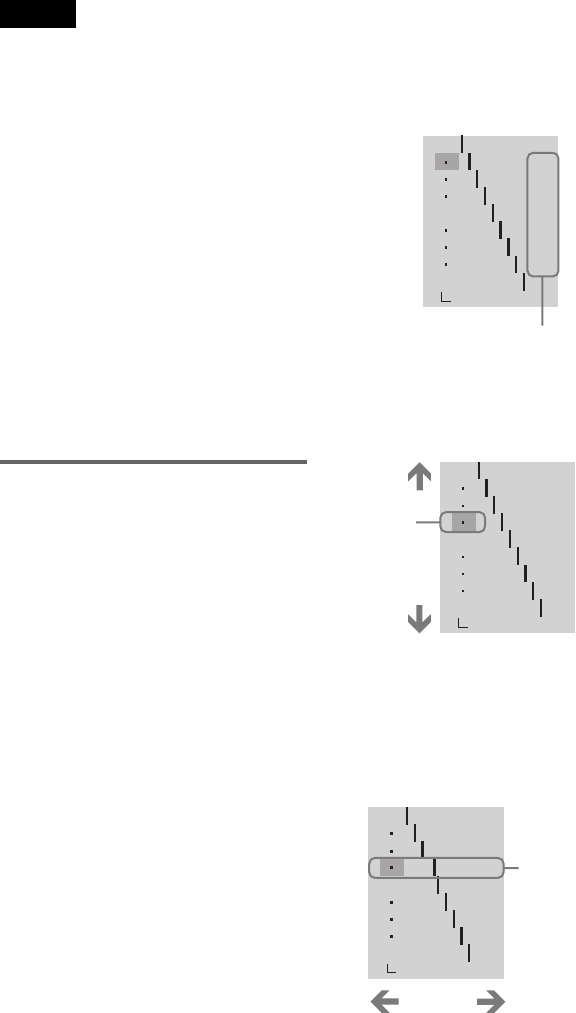
78
Notes
• If the outlines of images on your screen become
blurred, set “BNR” to “OFF.”
• Depending on the disc or the scene being played,
the “BNR,” “Y NR,” or “C NR” effect may be
hard to discern.
• Depending on the disc or the scene being played,
noise found in the disc may become more
apparent. If this happens, it is recommended that
you use the BNR function with the DVE function.
If the condition still does not improve, reduce the
DVE level, or select “SOFT” (DVD only).
• Some DVDs contain both video based and film
based sections. For example, a DVD may contain
a movie taken on film, and a “Making of”
sequence taken on video.
• If the progressive format image becomes unclear
or unnatural when “MEMORY” is set to
“PROGRESSIVE 1” or “PROGRESSIVE 2,” try
viewing with “PROGRESSIVE 1” set to
“VIDEO.” If this does not improve the picture,
view the images in Interlace format through the
COMPONENT VIDEO OUT jacks (page 90), or
switch to another jack.
Adjusting the brightness of
selected areas (Gamma
Correction)
Depending on your TV or viewing
environment, images on the screen may lose
definition when a certain area of the image is
so light that it appears washed out, or so dark
that it blends into the surrounding dark areas.
By correcting the Gamma value, you can
adjust the brightness of selected areas to get a
clearer image. While the “BRIGHTNESS”
adjustment controls the brightness of the
entire image, the “GAMMA” adjustment is
useful when only some portions of the image
need adjusting.
Example: You are watching a movie that is
rich in shadows and you want to see the
hidden details of the scenery.
If you use the “BRIGHTNESS” adjustment,
the entire image will become brighter, losing
definition in the areas that were initially
bright. The “GAMMA” adjustment enables
you to select the dark part and gradually
increase its brightness without sacrificing the
overall definition.
1After step 3 of “Adjusting the picture
items in MEMORY,” press X/x to
display the “GAMMA” adjustment bar,
and press ENTER or c.
The “GAMMA” adjustment display
appears.
2Press X/x to select areas of an image.
The upper region adjusts the dark areas
and the lower region adjusts the light
areas.
3Press C/c to adjust the brightness
level of the area that you selected.
C decreases the level (darkens the area),
and c increases the level (lightens the
area). The level can be adjusted between
16 and 235. The level for the dark areas
can never be greater than the light areas.
OFF
1: ENGLISH
2: FRENCH
3: SPANISH
1: ENGLISH
32
64
96
128
160
192
224
RESET
0%
50
100
Current Gamma setup value
OFF
1: ENGLISH
2: FRENCH
3: SPANISH
1: ENGLISH
RESET
0%
50
100
32
64
96
128
160
192
224
Selected
areas of an
image
Light
areas
Dark
areas
OFF
1: ENGLISH
2: FRENCH
3: SPANISH
1: ENGLISH
32
64
120
128
160
192
224
RESET
0%
50
100
Gamma value and
the position of the
bar change in
accordance with
your adjustment
LightenDarken
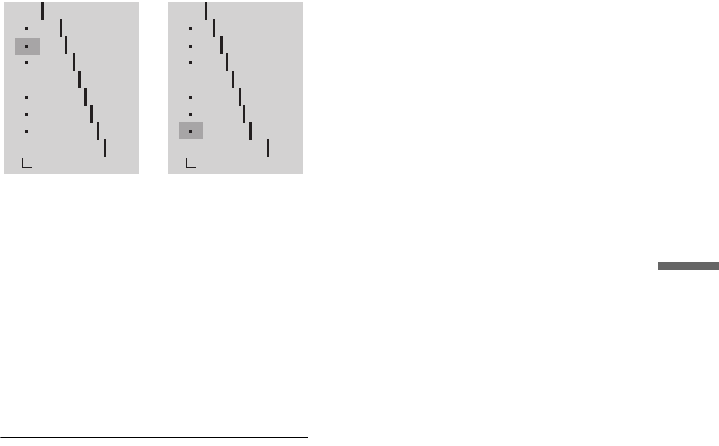
79
Enjoying Movies
4Repeat steps 2 and 3 to adjust the
brightness level of other areas that
you select.
Try to keep the line that connects the
brightness level of each area as smooth
and straight as possible, as shown below.
To prevent the image from appearing
overly altered, do not give the line any
sharp changes. Gradually make the
adjustments while viewing the image on
your TV screen.
Press O RETURN to stop making
adjustments to the image.
5Press ENTER.
The “GAMMA” adjustment bar appears
and the adjusted gamma values are stored
in memory.
To reset only the gamma value to the
default setting
Select “RESET” in the “GAMMA”
adjustment display by pressing X/x, and
press ENTER twice.
zHint
You can move the gamma adjustment display
horizontally by pressing ./>.
OFF
1: ENGLISH
2: FRENCH
3: SPANISH
1: ENGLISH
RESET
0%
50
100
OFF
1: ENGLISH
2: FRENCH
3: SPANISH
1: ENGLISH
RESET
0%
50
100
58
89
94
128
160
192
224
35
64
105
128
150
159
174
How to lighten the
dark areas of an
image
How to darken the
light areas of an
image
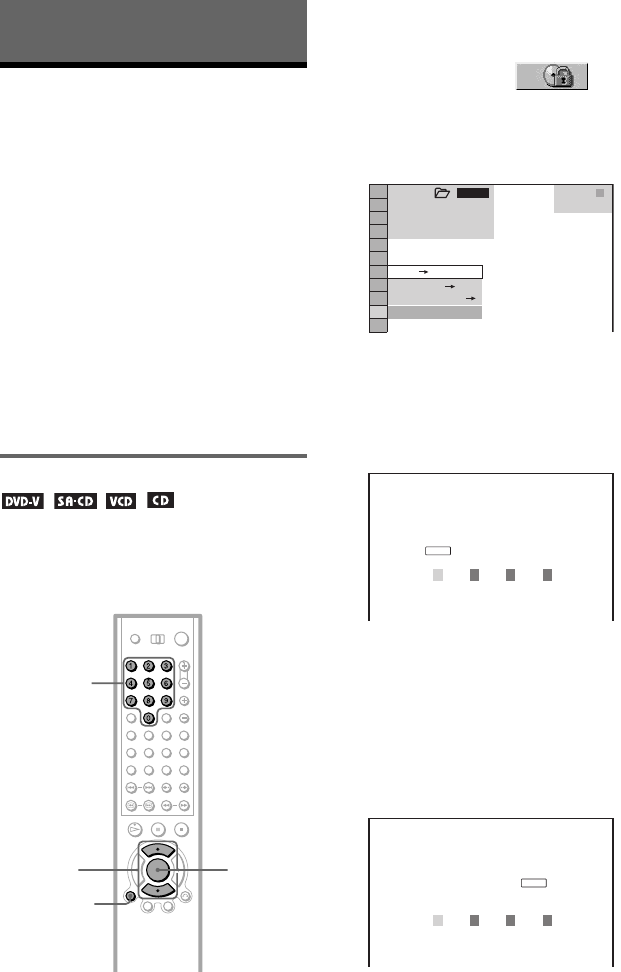
80
m
Using Various Additional
Functions
Locking Discs (CUSTOM
PARENTAL CONTROL, PARENTAL
CONTROL)
You can set two kinds of playback restrictions
for the desired disc.
• Custom Parental Control
You can set playback restrictions so that the
player will not play inappropriate discs.
• Parental Control
Playback of some DVD VIDEOs can be
limited according to a predetermined level
such as the age of the users. Scenes may be
blocked or replaced with different scenes.
The same password is used for both Parental
Control and Custom Parental Control.
Custom Parental Control
You can set the same Custom Parental
Control password for up to 400 discs. When
you set the 401st disc, the first disc is
canceled.
1Select a disc you want to lock (page
35).
If the disc is playing, press x to stop
playback.
2Press DISPLAY/FILE while the player
is in stop mode.
The Control Menu appears.
3Press X/x to select
(PARENTAL CONTROL), then press
ENTER.
The options for “PARENTAL
CONTROL” appear.
4Press X/x to select “ON t,” then
press ENTER.
◆If you have not entered a password
The display for registering a new
password appears.
Enter a 4-digit password using the
number buttons, then press ENTER.
The display for confirming the password
appears.
◆When you have already registered a
password
The display for entering the password
appears.
Number
buttons
DISPLAY/
FILE
ENTER
X/x
OFF
PASSWORD
PLAYER
ON
DVD
1 8 ( 3 4 )
1 2 ( 2 7 )
T
1 : 3 2 : 5 5
STOP
1 2 3
ALL
PARENTAL CONTROL
Enter a new 4-digit password, then
press .
ENTER
PARENTAL CONTROL
Enter password, then press .
ENTER
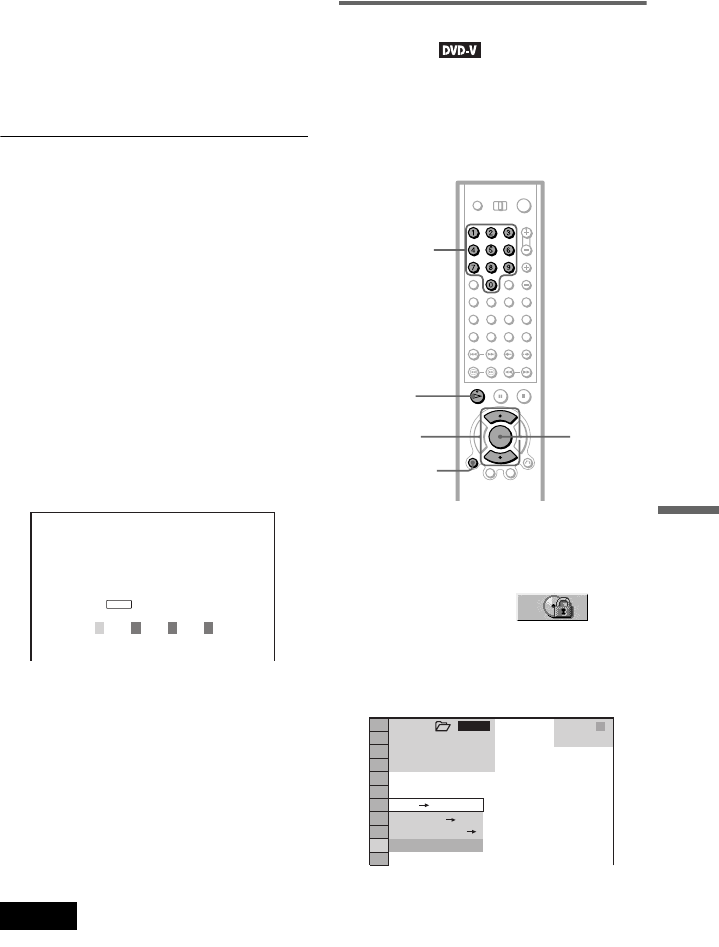
81
Using Various Additional Functions
5Enter or re-enter your 4-digit password
using the number buttons, then press
ENTER.
“Custom parental control is set.” appears
and the screen returns to the Control
Menu.
To turn off the Custom Parental Control
function
1Follow steps 1 to 3 of “Custom Parental
Control.”
2Press X/x to select “OFF t,” then press
ENTER.
3Enter your 4-digit password using the
number buttons, then press ENTER.
To play a disc for which Custom Parental
Control is set
1Select the disc for which Custom Parental
Control is set.
The “CUSTOM PARENTAL
CONTROL” display appears.
2Enter your 4-digit password using the
number buttons, then press ENTER.
The player is ready for playback.
zHint
If you forget your password, enter the 6-digit
number “199703” using the number buttons when
the “CUSTOM PARENTAL CONTROL” display
asks you for your password, then press ENTER.
The display will ask you to enter a new 4-digit
password.
Note
Once you set Custom Parental Control with a
recorded disc such as a DVD-RW, the display for
entering the passward may appear again when you
insert a different recorded disc.
Parental Control (limited
playback)
Playback of some DVD VIDEOs can be
limited according to a predetermined level
such as the age of the users. The
“PARENTAL CONTROL” function allows
you to set a playback limitation level.
1Press DISPLAY/FILE while the player
is in stop mode.
The Control Menu appears.
2Press X/x to select
(PARENTAL CONTROL), then press
ENTER.
The options for “PARENTAL
CONTROL” appear.
CUSTOM PARENTAL CONTROL
Custom parental control is already
set. To play, enter your password
and press .
ENTER
Number
buttons
DISPLAY/
FILE
ENTER
X/x
H
OFF
PASSWORD
PLAYER
ON
DVD
STOP
1 8 ( 3 4 )
1 2 ( 2 7 )
T
1 : 3 2 : 5 5
1 2 3
ALL
c continued
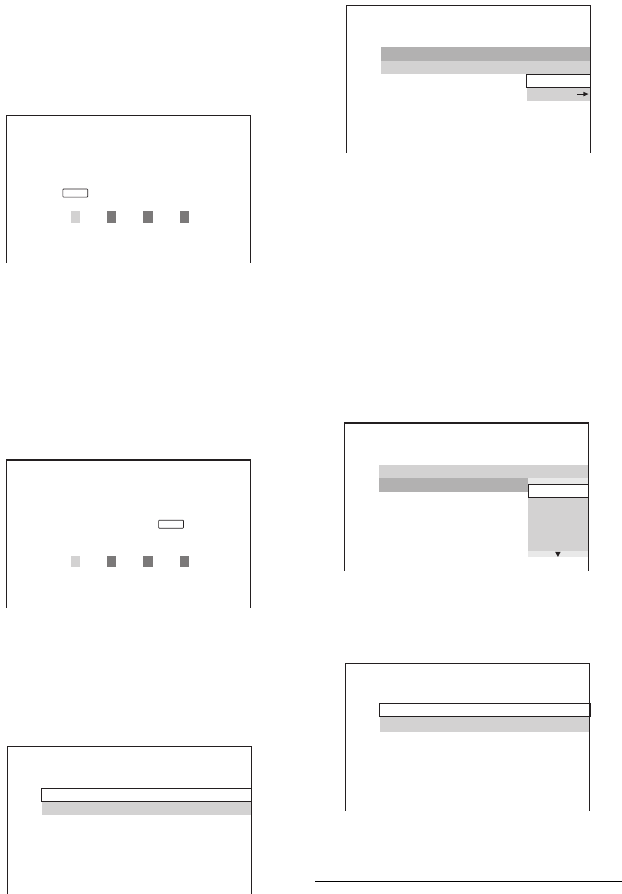
82
3Press X/x to select “PLAYER t,”
then press ENTER.
◆If you have not entered a password
The display for registering a new
password appears.
Enter a 4-digit password using the
number buttons, then press ENTER.
The display for confirming the password
appears.
◆When you have already registered a
password
The display for entering the password
appears.
4Enter or re-enter your 4-digit password
using the number buttons, then press
ENTER.
The display for setting the playback
limitation level appears.
5Press X/x to select “STANDARD,”
then press ENTER.
The selection items for “STANDARD”
are displayed.
6Press X/x to select a geographic area
as the playback limitation level, then
press ENTER.
The area is selected.
When you select “OTHERS t,” select
and enter a standard code in the table on
page 83.
7Press X/x to select “LEVEL,” then
press ENTER.
The selection items for “LEVEL” are
displayed.
8Select the level you want using X/x,
then press ENTER.
Parental Control setting is complete.
The lower the value, the stricter the
limitation.
To turn off the Parental Control function
Set “LEVEL” to “OFF” in step 8.
PARENTAL CONTROL
Enter a new 4-digit password, then
press .
ENTER
PARENTAL CONTROL
Enter password, then press .
ENTER
PARENTAL CONTROL
LEVEL: OFF
USA
STANDARD:
PARENTAL CONTROL
LEVEL: OFF
USA
STANDARD: USA
OTHERS
PARENTAL CONTROL
LEVEL: OFF
OFF
STANDARD:
8:
7:
6:
5:
NC17
R
PARENTAL CONTROL
LEVEL:
STANDARD: USA
4: PG13
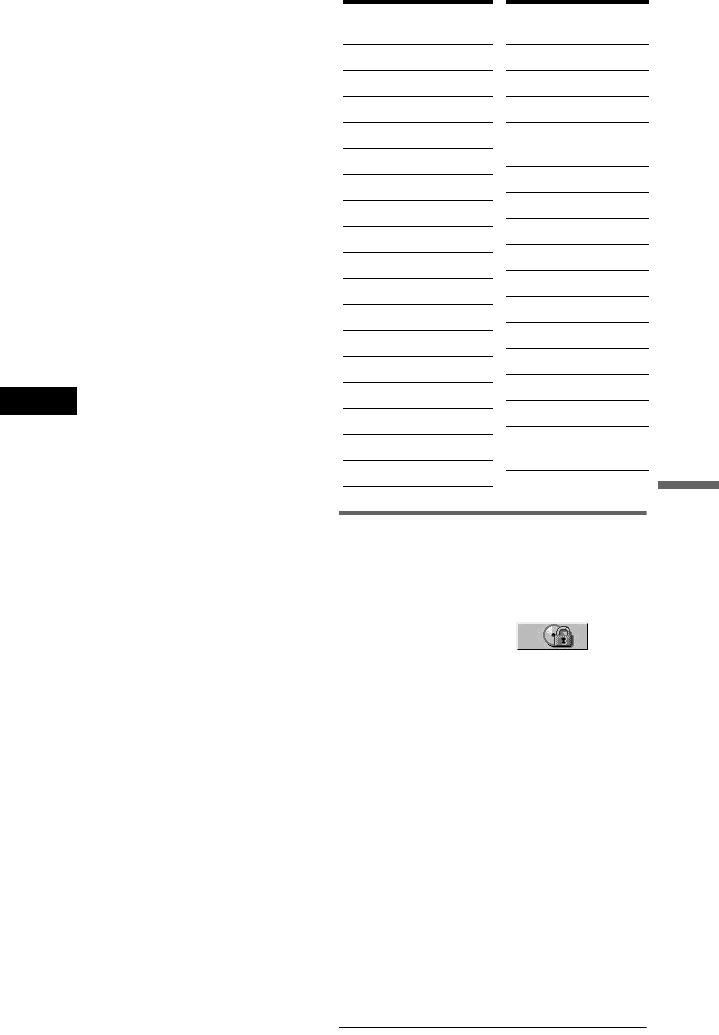
83
Using Various Additional Functions
To play a disc for which Parental Control is
set
1Select the disc and press H.
The display for entering your password
appears.
2Enter your 4-digit password using the
number buttons, then press ENTER.
The player starts playback.
zHint
If you forget your password, press OPEN/CLOSE
to open the front cover and repeat steps 1 to 3 of
“Parental Control (limited playback).” When you
are asked to enter your password, enter “199703”
using the number buttons, then press ENTER. The
display will ask you to enter a new 4-digit
password. After you enter a new 4-digit password,
press OPEN/CLOSE to close the front cover and
press H. When the display for entering your
password appears, enter your new password.
Notes
• When you play discs which do not have the
Parental Control function, playback cannot be
limited on this player.
• Depending on the disc, you may be asked to
change the parental control level while playing
the disc. In this case, enter your password, then
change the level. If the Resume Play mode is
canceled, the level returns to the previous level.
Area Code
Changing the password
1Press DISPLAY/FILE while the player
is in stop mode.
The Control Menu appears.
2Press X/x to select
(PARENTAL CONTROL), then press
ENTER.
The options for “PARENTAL
CONTROL” appear.
3Press X/x to select “PASSWORD
t,” then press ENTER.
The display for entering the password
appears.
4Enter your 4-digit password using the
number buttons, then press ENTER.
5Enter a new 4-digit password using the
number buttons, then press ENTER.
6To confirm your password, re-enter it
using the number buttons, then press
ENTER.
Standard Code
number
Argentina 2044
Australia 2047
Austria 2046
Belgium 2057
Brazil 2070
Canada 2079
Chile 2090
China 2092
Denmark 2115
Finland 2165
France 2174
Germany 2109
India 2248
Indonesia 2238
Italy 2254
Japan 2276
Korea 2304
Malaysia 2363
Mexico 2362
Netherlands 2376
New
Zealand
2390
Norway 2379
Pakistan 2427
Philippines 2424
Portugal 2436
Russia 2489
Singapore 2501
Spain 2149
Sweden 2499
Switzerland 2086
Thailand 2528
United
Kingdom
2184
Standard Code
number
c continued
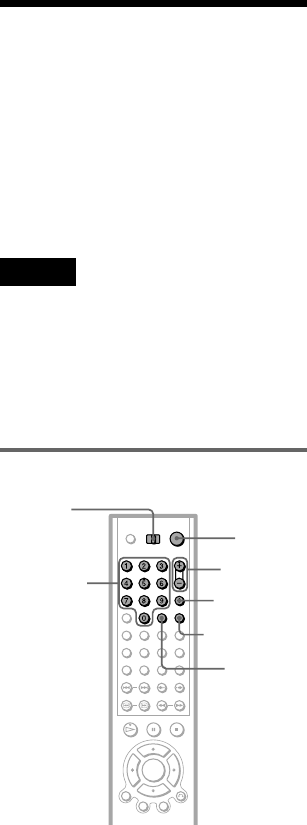
84
If you make a mistake entering your
password
Press C before you press ENTER and input
the correct number.
If you make a mistake
Press O RETURN.
To turn off the display
Press DISPLAY/FILE repeatedly until the
display is turned off.
Controlling Your TV or AV
Amplifier (Receiver) With
the Supplied Remote
By adjusting the remote signal, you can
control your TV with the supplied remote.
If you connect the player to an AV amplifier
(receiver), you can control the volume with
the supplied remote.
Notes
• Depending on the unit being connected, you may
not be able to control your TV using some of the
buttons below.
• If you enter a new code number, the code number
previously entered will be erased.
• When you replace the remote’s batteries, the code
number you have set may be reset to the default
setting. Set the appropriate code number again.
Controlling TVs with the remote
1Slide the TV/DISC EXPLORER/DVD
switch to TV.
2Hold down [/1, and enter the
manufacturer’s code for your TV using
the number buttons (see “Code
numbers of controllable TVs” below).
3Release [/1.
When the TV/DISC EXPLORER/DVD
switch is set to TV, the remote performs the
following:
Number
buttons
[/1
VOL +/–
TV/VIDEO
WIDE MODE
ENTER
TV/DISC
EXPLORER/
DVD switch
85
Using Various Additional Functions
Code numbers of controllable TVs
If more than one code number is listed, try
entering them one at a time until you find the
one that works with your TV.
Controlling the volume of your
AV amplifier (receiver) with the
remote
1Slide the TV/DISC EXPLORER/DVD
switch to DVD.
[/1Turns the TV on or off
VOL +/– Adjusts the volume of the TV
Number buttons
and ENTER
Selects the channel of the TV
WIDE MODE Switches to or from the wide
mode of a Sony wide TV
TV/VIDEO Switches the TV’s input
source between the TV and
other input sources
The button works even if the
TV/DISC EXPLORER/DVD
switch is set to DVD
Manufacturer Code number
Sony 01 (default)
Akai 04
AOC 04
Centurion 12
Coronado 03
Curtis-Mathes 12
Daytron 12
Emerson 03,04,14
Fisher 11
General Electric 06,10
Gold Star 03,04,17
Hitachi 02,03
J.C.Penney 04,12
JVC 09
KMC 03
Magnavox 03,08,12
Marantz 04,13
MGA/Mitsubishi 04,12,13,17
NEC 04,12
Panasonic 06,19
Philco 03,04
Philips 08,21
Pioneer 16
Portland 03
Proscan 10
Quasar 06,18
Radio Shack 05,14
RCA 04,10
Sampo 12
Samsung 03,12,20
Sanyo 11,14
Scott 12
Sears 07,10,11
Sharp 03,05,18
Sylvania 08,12
Teknika 03,08,14
Toshiba 07
Wards 03,04,12
Yorx 12
Zenith 15
Manufacturer Code number
Number
buttons
TV/DISC
EXPLORER/
DVD switch [/1
VOL +/–
c continued
86
2Hold down [/1, and enter the
manufacturer’s code for your AV
amplifier (receiver) using the number
buttons (see “Code numbers of
controllable AV amplifiers
(receivers)” below).
3Release [/1.
The VOL +/– buttons control the AV
amplifier’s volume.
◆If you want to control the TV volume
Slide the TV/DISC EXPLORER/DVD
switch to TV.
Code numbers of controllable AV
amplifiers (receivers)
If more than one code number is listed, try
entering them one at a time until you find the
one that works with your AV amplifier
(receiver).
* If you cannot control the volume of your Sony AV
amplifier (receiver) with the remote, try entering
the code number 91, and change the command
mode of your amplifier (receiver) to
“COMMAND MODE [AV1]” (not all amplifiers
have this option).
Refer to the instructions supplied with your
amplifier (receiver) to change the command
mode.
zHint
If you want to control the TV’s volume even when
the TV/DISC EXPLORER/DVD switch is set to
DVD, repeat steps 1 and 2 and enter the code
number 90 (default).
Manufacturer Code number
Sony* 80, 88, 89, 91
Denon 84, 85, 86
Kenwood 92, 93
Onkyo 81, 82, 83
Pioneer 99
Sansui 87
Technics 97, 98
Yamaha 94, 95, 96
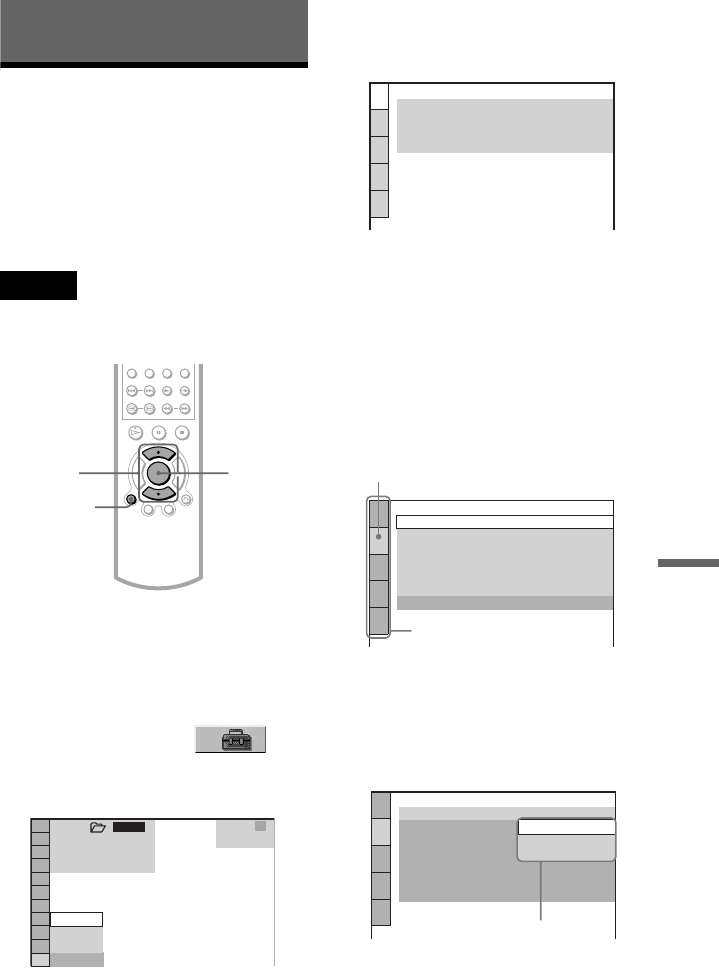
87
Settings and Adjustments
Settings and Adjustments
Using the Setup Display
By using the Setup Display, you can make
various adjustments to items such as picture
and sound. You can also set a language for the
subtitles and the Setup Display, among other
things. For details on each Setup Display
item, see pages 88 to 97.
Note
Playback settings stored in the disc take priority
over the Setup Display settings and not all of the
functions described may work.
1Press DISPLAY/FILE when the
player is in stop mode.
The Control Menu appears.
2Press X/x to select
(SETUP), then press ENTER.
The options for “SETUP” appear.
3Press X/x to select “CUSTOM,”
then press ENTER.
The Setup Display appears.
4Press X/x to select the setup item
from the displayed list:
“LANGUAGE SETUP,” “SCREEN
SETUP,” “CUSTOM SETUP,”
“AUDIO SETUP’” or “SPEAKER
SETUP.” Then press ENTER.
The Setup item is selected.
Example: “SCREEN SETUP”
5Press X/x to select an item, then
press ENTER.
The options for the selected item appear.
Example: “TV TYPE”
ENTER
X/x
DISPLAY/
FILE
: :
QUICK
CUSTOM
RESET
DVD
STOP
QUICK
( 4 7 )
3 5
ALL
LANGUAGE SETUP
OSD:
MENU:
AUDIO:
SUBTITLE:
ENGLISH
ENGLISH
ORIGINAL
ENGLISH
SCREEN SETUP
TV TYPE:
SCREEN SAVER:
BACKGROUND:
4:3 LETTER BOX
ON
BLACK LEVEL:ON
BLACK LEVEL
(COMPONENT OUT)
:ON
JACKET PICTURE
COMPONENT OUT:
4:3 OUTPUT: FULL
INTERLACE
Selected item
Setup items
SCREEN SETUP
TV TYPE:
SCREEN SAVER:
BLACK LEVEL:
BLACK LEVEL
(COMPONENT OUT)
:
BACKGROUND:
4:3 LETTER BOX
4:3 PAN SCAN
COMPONENT OUT:
16:9
4:3 OUTPUT: FULL
INTERLACE
ON
4:3 LETTER BOX
Options
c continued
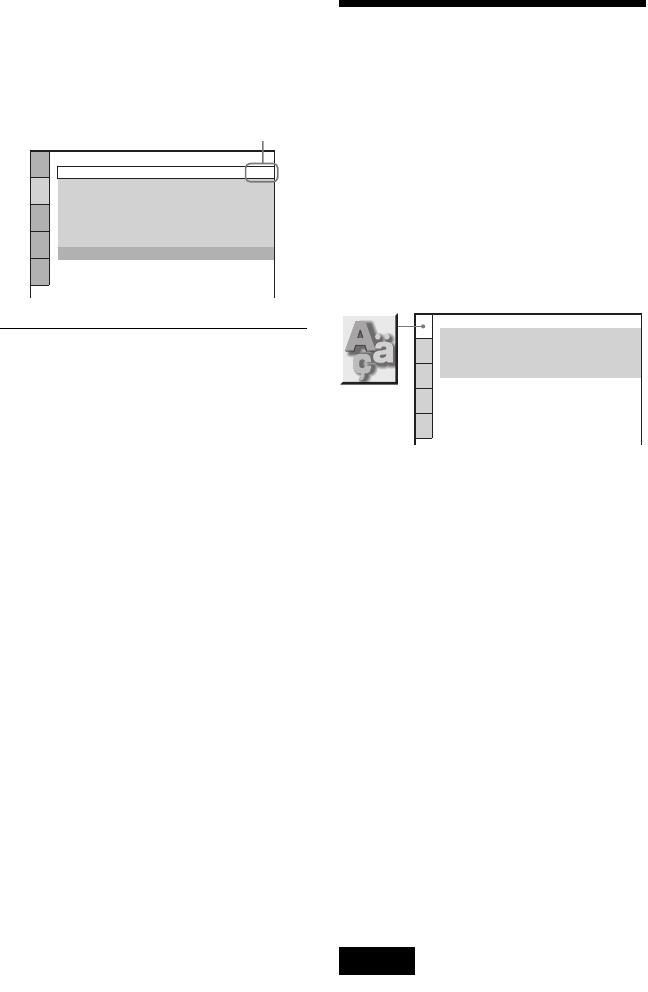
88
6Press X/x to select a setting, then
press ENTER.
The setting is selected and setup is
complete.
Example: “16:9”
To turn off the display
Press DISPLAY repeatedly until the display
is turned off.
To enter the Quick Setup mode
Select “QUICK” in step 3. Follow from step
5 of the Quick Setup explanation to make
basic adjustments (page 29).
To reset all of the “SETUP” settings
1Select “RESET” in step 3 and press
ENTER
2Select “YES” using X/x.
3Press ENTER.
All of the settings explained on pages 88
to 97 return to the default settings. Do not
press [/1 while resetting the player as it
takes a few seconds to complete.
Setting the Display or
Sound Track Language
(LANGUAGE SETUP)
“LANGUAGE SETUP” allows you to set
various languages for the on-screen display or
sound track.
Select “LANGUAGE SETUP” in the Setup
Display. To use the display, see “Using the
Setup Display” (page 87).
◆OSD (On-Screen Display)
Switches the display language on the screen.
◆MENU (DVD VIDEO only)
You can select the desired language for the
disc’s menu.
◆AUDIO (DVD VIDEO only)
Switches the language of the sound track.
When you select “ORIGINAL,” the language
given priority in the disc is selected.
◆SUBTITLE (DVD VIDEO only)
Switches the language of the subtitle recorded
on the DVD VIDEO.
When you select “AUDIO FOLLOW,” the
language for the subtitles changes according
to the language you selected for the sound
track.
zHint
If you select “OTHERS t” in “MENU,”
“SUBTITLE,” and “AUDIO,” select and enter a
language code from “Language Code List” on
page 105 using the number buttons.
Note
When you select a language in “MENU,”
“SUBTITLE,” or “AUDIO” that is not recorded on
the DVD VIDEO, one of the recorded languages
will be automatically selected.
SCREEN SETUP
TV TYPE:
SCREEN SAVER:
BACKGROUND:
16:9
ON
BLACK LEVEL:ON
BLACK LEVEL
(COMPONENT OUT)
:ON
JACKET PICTURE
COMPONENT OUT:
4:3 OUTPUT:FULL
INTERLACE
Selected setting
LANGUAGE SETUP
OSD:
MENU:
AUDIO:
SUBTITLE:
ENGLISH
ENGLISH
ORIGINAL
ENGLISH
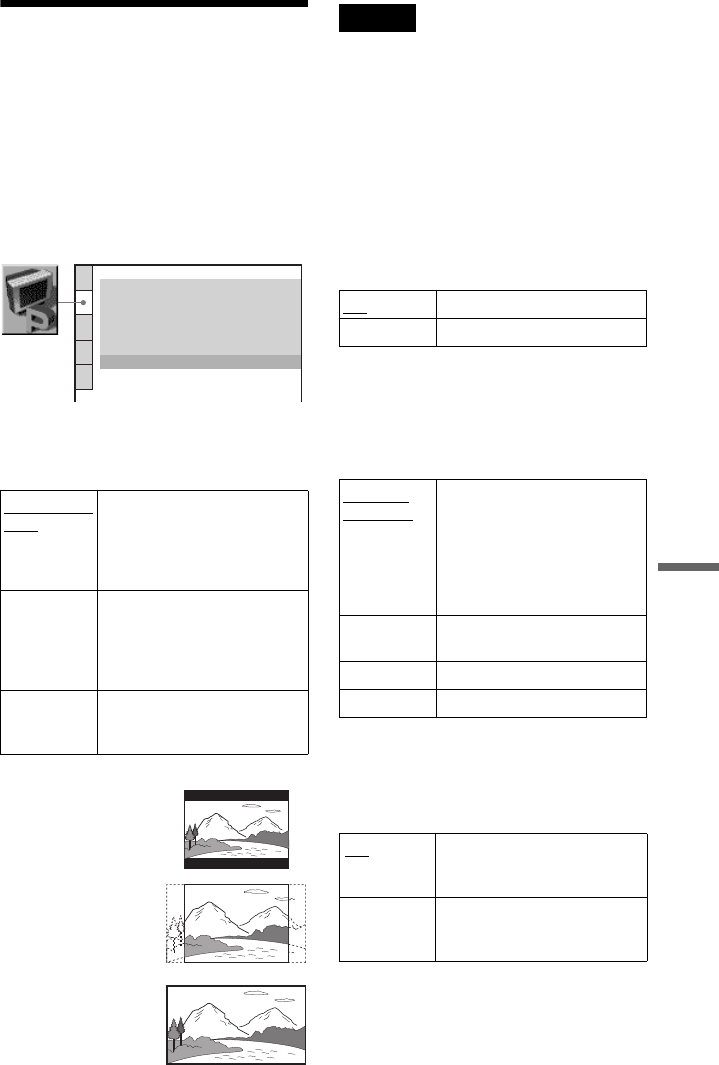
89
Settings and Adjustments
Settings for the Display
(SCREEN SETUP)
Choose settings according to the TV to be
connected.
Select “SCREEN SETUP” in the Setup
Display. To use the display, see “Using the
Setup Display” on page 87.
The default settings are underlined.
◆TV TYPE
Selects the aspect ratio of the connected TV
(4:3 standard or wide).
Note
Depending on the DVD, “4:3 LETTER BOX” may
be selected automatically instead of “4:3 PAN
SCAN” or vice versa.
◆SCREEN SAVER
The screen saver image appears when you
leave the player in pause or stop mode for 15
minutes, or when you play a Super Audio CD,
CD, or DATA CD (MP3 audio) for more than
15 minutes. The screen saver will help
prevent your display device from becoming
damaged (ghosting). Press H to turn off the
screen saver.
◆BACKGROUND
Selects the background color or picture on the
TV screen in stop mode or while playing a
Super Audio CD, CD, or DATA CD (MP3
audio).
◆BLACK LEVEL
Selects the black level (setup level) for the
video (NTSC) signals output from the jacks
other than COMPONENT VIDEO OUT.
4:3 LETTER
BOX Select this when you connect a
4:3 screen TV. Displays a wide
picture with bands on the upper
and lower portions of the
screen.
4:3 PAN
SCAN Select this when you connect a
4:3 screen TV. Automatically
displays the wide picture on the
entire screen and cuts off the
portions that do not fit.
16:9 Select this when you connect a
wide-screen TV or a TV with a
wide mode function.
SCREEN SETUP
TV TYPE:
SCREEN SAVER:
BACKGROUND:
4:3 LETTER BOX
ON
BLACK LEVEL:ON
BLACK LEVEL
(COMPONENT OUT)
:ON
JACKET PICTURE
COMPONENT OUT: INTERLACE
4:3 OUTPUT: FULL
4:3 PAN SCAN
4:3 LETTER BOX
16:9
ON Turns on the screen saver.
OFF Turns off the screen saver.
JACKET
PICTURE The jacket picture (still picture)
appears, but only when the
jacket picture is already
recorded on the disc (CD-
EXTRA, etc.). If the disc does
not contain a jacket picture, the
“GRAPHICS” picture appears.
GRAPHICS
A preset picture stored in the
player appears.
BLUE The background color is blue.
BLACK The background color is black.
ON Sets the black level of the
output signal to the standard
level.
OFF Lowers the standard black
level. Use this when the picture
becomes too white.
c continued
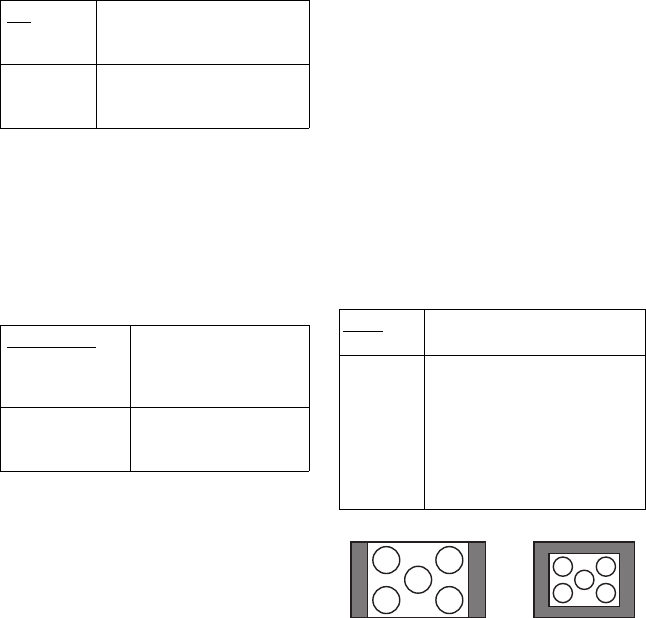
90
◆BLACK LEVEL (COMPONENT OUT)
Selects the black level (setup level) for the
video (NTSC) signals output from the
COMPONENT VIDEO OUT jacks. You
cannot select this when “PROGRESSIVE” is
selected in “COMPONENT OUT” (see
below).
◆COMPONENT OUT
Selects the type of signal output from the
COMPONENT VIDEO OUT jacks when the
COMPONENT VIDEO OUT/SCAN
SELECT switch on the rear panel of the
player is set to SELECTABLE. See page 101
for more information about the two different
signal types.
About the COMPONENT VIDEO OUT/SCAN
SELECT switch
The COMPONENT VIDEO OUT/SCAN
SELECT switch on the rear panel of the
player selects the signal output from the
COMPONENT VIDEO OUT jacks:
interlace, progressive, or selectable. The
switch takes priority over the setting made in
“COMPONENT OUT.”
To switch the video signal format
If you have selected “PROGRESSIVE” for a
TV that does not accept signals in progressive
format 480p, or if the software’s video signals
are not suited for progressive video signal
conversion, view the image in Interlace
format.
1Set the COMPONENT VIDEO OUT/
SCAN SELECT switch on the rear panel
of the player to INTERLACE.
“COMPONENT OUT” in “SCREEN
SETUP” is automatically set to
“INTERLACE.”
2Reset the COMPONENT VIDEO OUT/
SCAN SELECT switch to
SELECTABLE.
Normally leave the switch in this position
when using the COMPONENT VIDEO
OUT jacks.
When “PROGRESSIVE” is selected in
“COMPONENT OUT”
• 4:3 OUTPUT
Adjust this when you watch progressive
signals on a standard 4:3 aspect ratio
television. If you can change the aspect ratio
on your progressive format (480p)
compatible TV, change the setting on your
TV, not the player.
ON Sets the black level of the
output signal to the standard
level.
OFF Lowers the standard black
level. Use this when the picture
becomes too white.
INTERLACE Select this when the
player is connected to a
standard (interlace
format) TV.
PROGRESSIVE Select this when you have
a TV that can accept
progressive signals.
FULL Select this when you can change
the aspect ratio on your TV.
NORMAL Select this when you cannot
change the aspect ratio on your
TV. Shows a 16:9 aspect ratio
signal with black bands on left
and right sides of the image, and
a 4:3 aspect ratio signal with
black bands on all sides of the
image.
16:9 aspect ratio TV 4:3 aspect ratio TV
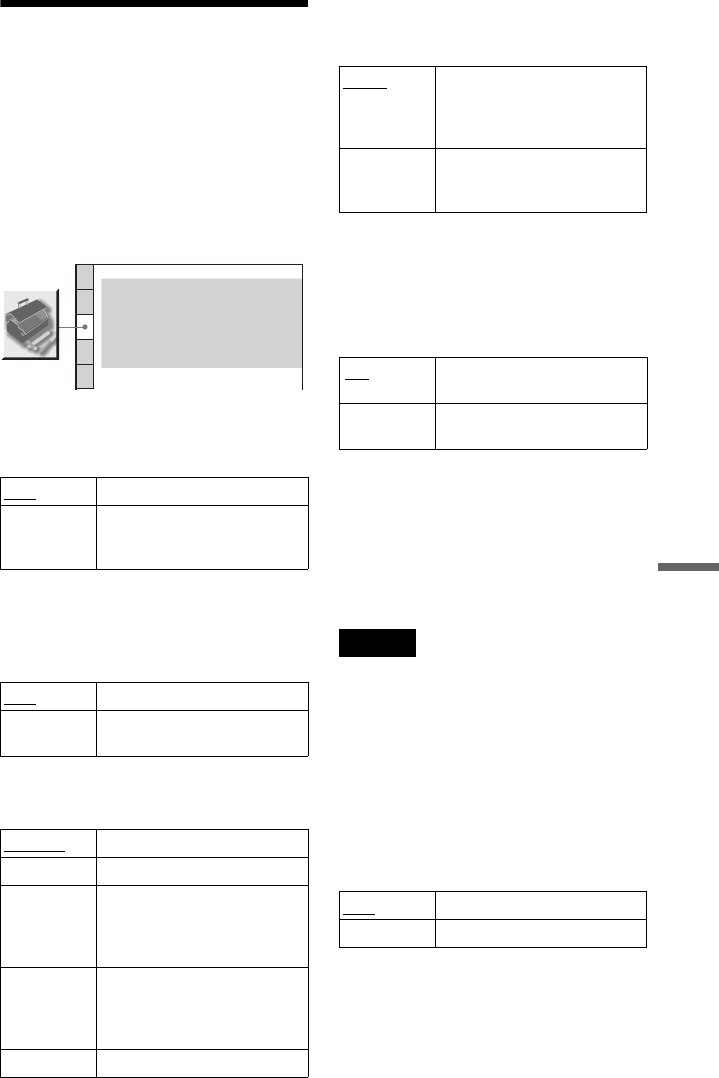
91
Settings and Adjustments
Custom Settings (CUSTOM
SETUP)
Use this to make playback related
adjustments and other settings.
Select “CUSTOM SETUP” in the Setup
Display. To use the display, see “Using the
Setup Display” (page 87).
The default settings are underlined.
◆AUTO POWER OFF
Switches the Auto Power Off setting on or
off.
◆AUTO PLAY
Switches the Auto Play setting on or off. This
function is useful when the player is
connected to a timer (not supplied).
◆DIMMER
Adjusts the lighting of the front panel display.
◆PAUSE MODE (DVD VIDEO/DVD-RW
only)
Selects the picture in pause mode.
◆PLAYBACK MEMORY
The player can store “SUBTITLE” and other
settings of each disc for up to 400 discs
(Playback Memory).
Set this function “ON” or “OFF.”
The following settings are stored in memory.
– ANGLE (page 74)*
– AUDIO (page 69)*
– VIDEO CONTROL (page 76)**
– SUBTITLE (page 75)*
* DVD VIDEO only
**DVD VIDEO/VIDEO CD only
Notes
• The player can store the settings of up to 400
discs. When you store the setting of disc number
401, the first disc setting is canceled.
• The Playback Memory function cannot be used
for DVD-RWs in VR mode.
◆TRACK SELECTION (DVD VIDEO only)
Gives priority to the sound track which
contains the highest number of channels
when you play a DVD VIDEO on which
multiple audio formats (PCM, DTS, or Dolby
Digital format) are recorded.
OFF Switches this function off.
ON The player enters standby mode
when left in stop mode for more
than 30 minutes.
OFF Switches this function off.
ON Automatically starts playback
when the player is turned on.
BRIGHT Makes the lighting bright.
DARK Makes the lighting dark.
AUTO
DARK Makes the front panel display
dark if you do not operate the
player or remote for a short
while.
AUTO OFF Turns off the lighting of the
front panel display if you do not
operate the player or remote for
a short while.
OFF Turns off the lighting.
CUSTOM SETUP
AUTO POWER OFF:
AUTO PLAY:
DIMMER:
OFF
OFF
BRIGHT
AUTO
PAUSE MODE:
OFF
TRACK SELECTION: ON
PLAYBACK MEMORY:
OFF
CD DIRECT:
AUTO The picture, including subjects
that move dynamically, is
output with no jitter. Normally
select this position.
FRAME The picture, including subjects
that do not move dynamically,
is output in high resolution.
ON Stores the settings in memory
when you eject the disc.
OFF Does not store the settings in
memory.
OFF No priority given.
AUTO Priority given.
c continued
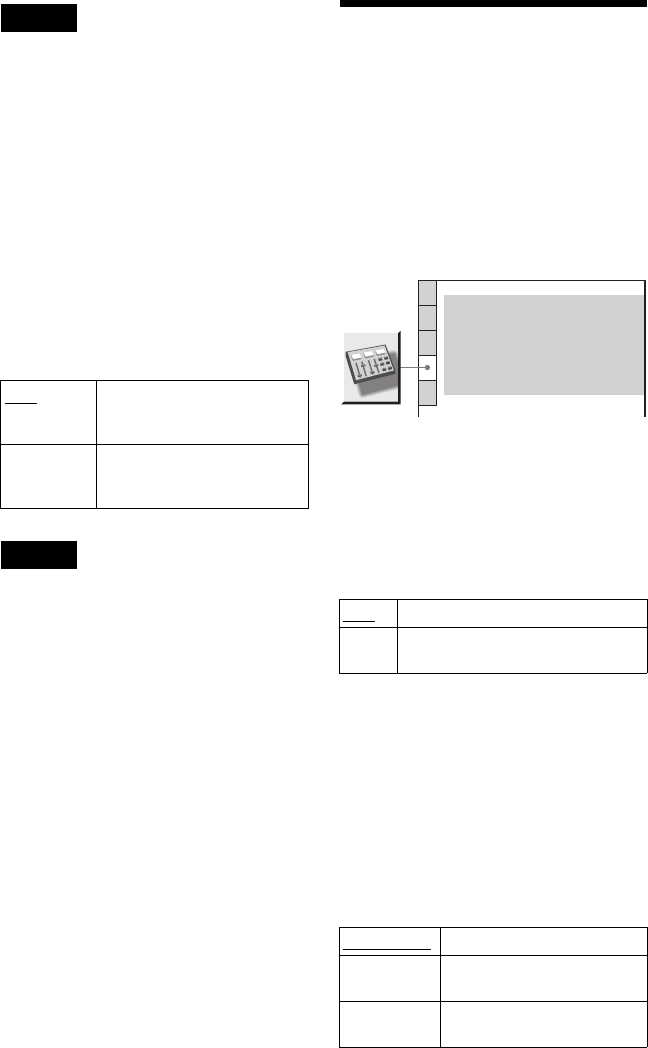
92
Notes
• When you set the item to “AUTO,” the language
may change. The “TRACK SELECTION” setting
has higher priority than the “AUDIO” settings in
“LANGUAGE SETUP” (page 88).
• If PCM, DTS, and Dolby Digital sound tracks
have the same number of channels, the player
selects PCM, DTS, and Dolby Digital sound
tracks in this order.
◆CD DIRECT
Eliminates the use of unnecessary circuits
when playing CDs. This setting will be
activated when you open or close the front
cover.
This function affects the output from the
following jacks:
– LINE OUT AUDIO L/R 1/2 jacks
– 5.1CH OUTPUT jacks
Note
If you select “ON” when playing CDs with DTS
tracks, the sound will become noisy.
Settings for the Sound
(AUDIO SETUP)
“AUDIO SETUP” allows you to set the sound
according to the playback and connection
conditions.
Select “AUDIO SETUP” in the Setup
Display. To use the display, see “Using the
Setup Display” (page 87).
The default settings are underlined.
◆AUDIO ATT (attenuation)
If the playback sound is distorted, set this
item to “ON.” The player reduces the audio
output level.
This function affects the output of the
following jacks:
– LINE OUT AUDIO L/R 1/2 jacks
– 5.1CH OUTPUT jacks
◆AUDIO DRC (Dynamic Range Control)
(DVD VIDEO/DVD-RW only)
Makes the sound clear when the volume is
turned down when playing a DVD that
conforms to “AUDIO DRC.” This affects the
output from the following jacks:
– LINE OUT AUDIO L/R 1/2 jacks
– 5.1CH OUTPUT jacks
– DIGITAL OUT (COAXIAL or OPTICAL)
jack only when “DOLBY DIGITAL” is set
to “D-PCM” (page 93).
OFF Select this when playing CD
discs, including CDs with DTS
tracks.
ON Eliminates the use of
unnecessary circuits when
playing CDs.
OFF Normally, select this position.
ON Select this when the playback sound
from the speakers is distorted.
STANDARD Normally select this position.
TV MODE Makes low sounds clear even if
you turn the volume down.
WIDE
RANGE Gives you the feeling of being
at a live performance.
AUDIO SETUP
AUDIO ATT:
AUDIO DRC:
DIGITAL OUT:
OFF
STANDARD
AUDIO FILTER: SHARP
ON
DOWNMIX: DOLBY SURROUND
DOLBY DIGITAL: D-PCM
DTS: D-PCM
48kHz/96kHz PCM: 48kHz/16bit
93
Settings and Adjustments
◆AUDIO FILTER (except Super Audio CD)
Selects a digital filter to reduce noise above
22.05 kHz (Sampling frequency (Fs) of the
audio source is 44.1 kHz), 24 kHz (Fs is 48
kHz), or 48 kHz (Fs is above 96 kHz).
Note
There may be little effect by changing the digital
filter depending on the disc or playback
environment.
◆DOWNMIX (DVD VIDEO/DVD-RW only)
Switches the method for mixing down to 2
channels when you play a DVD which has
rear sound elements (channels) or is recorded
in Dolby Digital format. For details on the
rear signal components, see “Displaying the
disc’s audio information” (page 69). This
function affects the output of the following
jacks:
– LINE OUT AUDIO L/R 1/2 jacks
– DIGITAL OUT (COAXIAL or OPTICAL)
jack when “DOLBY DIGITAL” is set to
“D-PCM” (page 93).
◆DIGITAL OUT (except Super Audio CD)
Selects if audio signals are output via the
DIGITAL OUT (COAXIAL or OPTICAL)
jack.
Note
Super Audio CD audio signals are not output from
the digital jack.
To set the digital output signal
The following switches the method of
outputting audio signals when you connect a
component such as an amplifier (receiver) or
MD deck with a digital input jack.
For connection details, see page 22.
Select “DOLBY DIGITAL,” “DTS,” and
“48kHz/96kHz PCM” after setting
“DIGITAL OUT” to “ON.”
If you connect a component that does not
conform to the selected audio signal, a loud
noise (or no sound) will come out from the
speakers, damaging your ears or speakers.
• DOLBY DIGITAL (DVD VIDEO/DVD-
RW only)
Selects the type of Dolby Digital signal.
• DTS (DVD VIDEO only)
Selects the type of DTS signal.
SHARP Provides a wide frequency
range and spatial feeling.
SLOW Provides smooth and warm
sound.
DOLBY
SUR-
ROUND
Normally select this position.
Multi-channel audio signals are
output to two channels for
enjoying surround sounds.
NORMAL Multi-channel audio signals are
downmixed to two channels for
use with your stereo.
ON Normally select this position. When
you select “ON,” see “To set the digital
output signal” for further settings.
OFF The influence of the digital circuit
upon the analog circuit is minimal.
D-PCM Select this when the player is
connected to an audio
component lacking a built-in
Dolby Digital decoder. You can
select whether the signals
conform to Dolby Surround
(Pro Logic) or not by making
adjustments to the
“DOWNMIX” item in
“AUDIO SETUP” (page 93).
DOLBY
DIGITAL Select this when the player is
connected to an audio
component with a built-in
Dolby Digital decoder.
D-PCM Select this when the player is
connected to an audio
component without a built-in
DTS decoder.
DTS Select this when the player is
connected to an audio
component with a built-in DTS
decoder.
AUDIO SETUP
AUDIO ATT:
AUDIO DRC:
DIGITAL OUT:
DOLBY DIGITAL:
OFF
STANDARD
AUDIO FILTER: SHARP
ON
DOWNMIX: DOLBY SURROUND
D-PCM
48kHz/96kHz PCM: 48kHz/16bit
DTS: D-PCM
c continued
94
• 48kHz/96kHz PCM (DVD VIDEO only)
Selects the sampling frequency of the audio
signal.
Notes
• Even if you set “48kHz/96kHz PCM” to “96kHz/
24bit,” the sampling frequency is converted to
48kHz/16bit when a “SURROUND” mode (page
70) is selected.
• The analog audio signals from the LINE OUT
AUDIO L/R jacks and 5.1CH OUTPUT jacks are
not affected by this setting and keep their original
sampling frequency level.
Settings for the Speakers
(SPEAKER SETUP)
To obtain the best possible surround sound,
input the size of the speakers you have
connected and their distance from your
listening position. Then use the test tone to
adjust the volume and balance of the speakers
to the same level.
This setting is effective when connecting a
speaker with 5.1 CH OUTPUT jacks (page
27).
You can create two different Speaker Setup
settings, one for Super Audio CDs and one for
all other types of discs.
1Follow steps 1 through 4 of “Using
the setup display” (page 87) to
select “SPEAKER SETUP” in the
Setup display.
2Select “DVD” or “SUPER AUDIO
CD” using X/x, then press ENTER.
Example: when “DVD” is selected.
48kHz/16bit The audio signals of DVD
VIDEOs are always converted
to 48kHz/16bit.
96kHz/24bit All types of signals including
96kHz/24bit are output in their
original format. However, if the
signal is encrypted for
copyright protection purposes,
the signal is only output as
48kHz/16bit.
SPEAKER SETUP
SUPER AUDIO CD:
DVD:
SPEAKER SETUP (DVD)
DISTANCE:
LEVEL(FRONT):
LEVEL(REAR): OFF
TEST TONE:
FRONT:
CENTER:
YES
LARGE(REAR)
LARGE
LARGE
REAR:
SUBWOOFER:
SIZE:
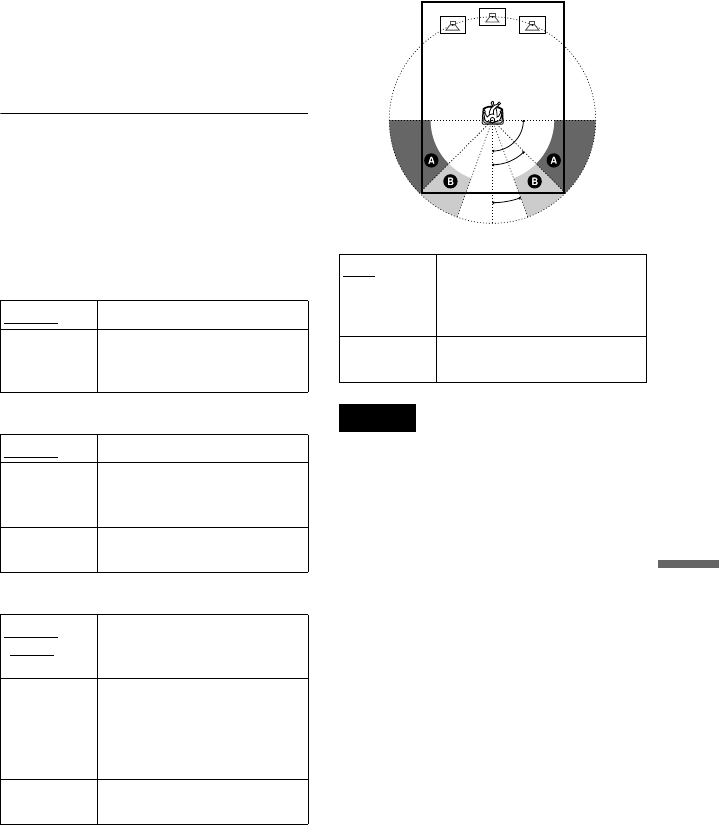
95
Settings and Adjustments
3Set the following items in the
order that they are explained
below.
The default settings are underlined.
To return to the default setting
Select the item, then press CLEAR. Note that
only the “SIZE” setting does not return to the
default setting.
◆SIZE
Selects the size of the speakers.
• FRONT
• CENTER
•REAR
* Rear speaker position
Correctly specify the location of the rear speakers to
enjoy the surround effect.
• Set to “SIDE,” if the location of the rear speakers
corresponds to section A below.
• Set to “REAR,” if the location of the rear speakers
corresponds to section B below.
This setting affects only “VIRTUAL REAR
SHIFT,” “VIRTUAL MULTI REAR,” and
“VIRTUAL MULTI DIMENSION” mode
(page 72).
• SUBWOOFER
Notes
• The cut off frequency for the subwoofer is fixed at
120 Hz.
• If your speakers are too small to reproduce low
bass frequencies, utilize a subwoofer for low
frequency sound. When you set the speaker
settings to “SMALL,” the bass redirection
circuitry will be activated and the bass
frequencies for the speakers are output from the
subwoofer.
• Even if there are fewer than 6 speakers connected,
the player distributes the audio signal components
to the front speakers.
◆DISTANCE
Sets the distance from your listening position
to the speakers.
Set the distance to your front speakers in
“FRONT” first (A). Then adjust the values in
“CENTER” (center speaker B), “REAR”
(rear speaker C), and “SUBWOOFER” (D)
to reflect the actual distance to your center
speaker, rear speakers, and subwoofer.
LARGE Normally select this position.
SMALL Select this when the speaker
cannot reproduce adequate bass
frequencies.
LARGE Normally select this position.
SMALL Select this when the speaker
cannot reproduce adequate bass
frequencies.
NONE Select this if you do not connect
a center speaker.
LARGE
(REAR/
SIDE)
Normally select this position.
Select according to the rear
speakers position*.
SMALL
(REAR/
SIDE)
Select this when the sound
distorts or the surround effects
are difficult to hear.
Select according to the rear
speaker position*.
NONE Select this if you do not connect
rear speakers.
YES Select this if you connect a
subwoofer to output the LFE
(low frequency effect) signals
from the subwoofer.
NONE Select this if you do not connect
a subwoofer.
90
20
45
c continued
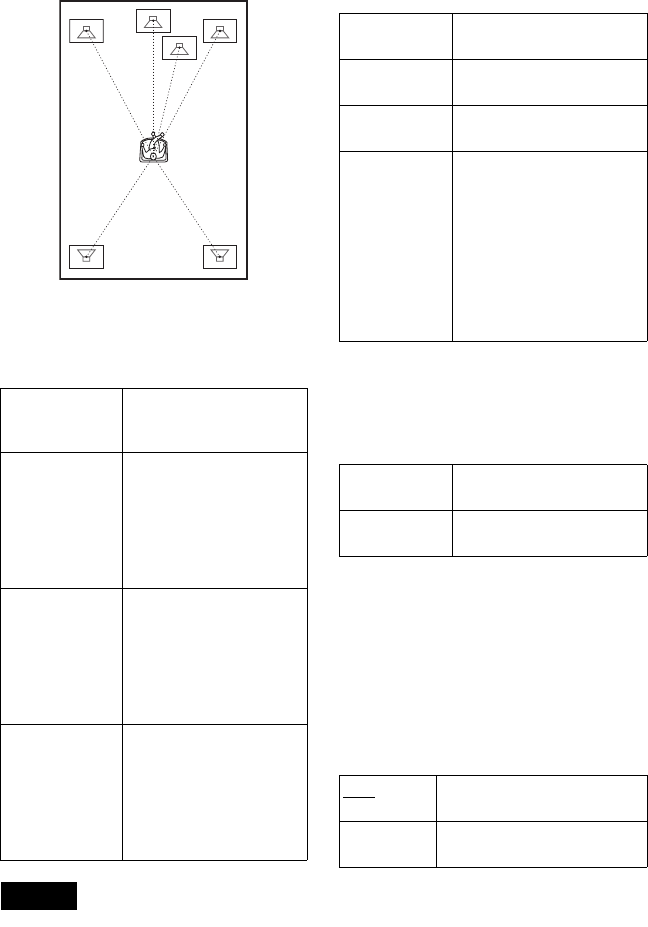
96
Be sure to change the value in the Setup
Display each time you move the speakers.
Start from the front speaker. The default
adjustments are in parentheses.
Note
If each of the front or rear speakers are not placed at
an equal distance from your listening position, set
the distance according to the closest speaker.
◆LEVEL (FRONT)
Varies the level of the front speakers. Be sure
to set “TEST TONE” to “ON” for easy
adjustment.
The default adjustments are in parentheses.
◆LEVEL (REAR)
Varies the level of the rear speakers. Be sure
to set “TEST TONE” to “ON” for easy
adjustment.
The default adjustments are in parentheses.
To adjust the volume of all the speakers at
one time
Use the amplifier’s (receiver’s) volume
control.
◆TEST TONE
The speakers will emit a test tone. Use this
when you use the 5.1CH OUTPUT jacks and
adjust “LEVEL (FRONT)” and “LEVEL
(REAR).”
FRONT
(10 ft) Set this between 4 and 50
feet in 0.25 foot
increments.
CENTER (10 ft) Set this within ±6 feet of
the “FRONT” setting in
0.25 foot increments. For
example, if “FRONT” is set
to 6 feet, “CENTER” can
be set between 0 and 12
feet.
REAR (10 ft) Set this within –18 feet and
+6 feet of the “FRONT”
setting in 0.25 foot
increments. For example, if
“FRONT” is set to 18 feet,
“REAR” can be set
between 0 and 24 feet.
SUBWOOFER
(10 ft) Set this within –18 and +6
feet of the “FRONT”
setting in 0.25 foot
increments. For example, if
“FRONT” is set to 18 feet,
“REAR” can be set
between 0 and 24 feet.
B
D
AA
CC
(4~50 ft) (4~50 ft)
L (0 dB) Set this between –6 dB and 0
dB in 0.5 dB increments.
R (0 dB) Set this between –6 dB and 0
dB in 0.5 dB increments.
CENTER
(0 dB) Set this between –12 dB and
0 dB in 0.5 dB increments.
SUBWOOFER
(DVD: –5 dB/
SUPER
AUDIO CD:
0 dB)
(When “SIZE” is set to the
default settings):
Set this between –10 dB
and +10 dB in 0.5 dB
increments.
(When “SIZE” is not set to
the default settings):
Set this between –15 dB
and +5 dB in 0.5 dB
increments.
L (0 dB) Set this between –12 dB and
0 dB in 0.5 dB increments.
R (0 dB) Set this between –12 dB and
0 dB in 0.5 dB increments.
OFF The test tone is not emitted
from the speakers.
ON The test tone is emitted from
each speaker in sequence.
97
Settings and Adjustments
Adjusting the speaker volume
and level
1Select “SPEAKER SETUP” in the Setup
Display.
2Select “TEST TONE” and set to “ON.”
You will hear the test tone from each
speaker in sequence.
3From your listening position, select
“LEVEL (FRONT)” or “LEVEL (REAR)”
and adjust the value using X/x.
The test tone is emitted from both left and
right speakers simultaneously.
4Select “TEST TONE” and set to “OFF”
to turn off the test tone.
Note
The test tone signals are not output from the digital
jack.
98
Additional Information
Troubleshooting
If you experience any of the following
difficulties while using the player, use this
troubleshooting guide to help remedy the
problem before requesting repairs. Should
any problem persist, consult your nearest
Sony dealer.
Power
The power is not turned on.
,Check that the AC power cord is connected
securely.
Picture
There is no picture/picture noise appears.
,Re-connect the connecting cord securely.
,The connecting cord is damaged.
,Check the connection to your TV (page 19)
and switch the input selector on your TV so
that the signal from the player appears on
the TV screen.
,The disc is dirty or flawed.
,If the picture output from your player goes
through your VCR to get to your TV or if
you are connected to a combination TV/
VIDEO player, the copy-protection signal
applied to some DVD programs could affect
picture quality. If you still experience
problems even when you connect your
player directly to your TV, try connecting
your player to your TV’s S VIDEO input
(page 19).
,You have set “COMPONENT OUT” in
“SCREEN SETUP” to “PROGRESSIVE”
even though your TV cannot accept the
signal in progressive format. In this case, set
the COMPONENT VIDEO OUT/SCAN
SELECT switch on the rear panel of the
player to INTERLACE. “COMPONENT
OUT” in “SCREEN SETUP” is
automatically set to “INTERLACE,” and
reset the COMPONENT VIDEO OUT/
SCAN SELECT switch to SELECTABLE.
Normally leave the switch in this position
when using the COMPONENT VIDEO
OUT jacks.
,Even if your TV is compatible with
progressive format 480p signals, the image
may be affected when you set
“COMPONENT OUT” to
“PROGRESSIVE.” In this case, set
“COMPONENT OUT” to “INTERLACE.”
,You have selected VIDEO OFF (page 35).
The picture does not fill the screen, even
though the aspect ratio is set in “TV TYPE”
under “SCREEN SET UP.”
,The aspect ratio of the disc is fixed on your
DVD.
Sound
There is no sound.
,Re-connect the connecting cord securely.
,The connecting cord is damaged.
,The player is connected to the wrong input
jack on the amplifier (receiver) (page 25,
26, 27).
,The amplifier (receiver) input is not
correctly set.
,The player is in pause mode or in Slow-
motion Play mode.
,The player is in fast forward or fast reverse
mode.
,If the audio signal does not come through
the DIGITAL OUT (COAXIAL or
OPTICAL) jack, check the audio settings
(page 93).
,Super Audio CD audio signals are not
output from the digital jack.
Sound distortion occurs.
,Set “AUDIO ATT” in “AUDIO SETUP” to
“ON” (page 92).
The volume is low.
,The volume is low on some DVDs.
The volume may improve if you set
“AUDIO DRC” to “TV MODE” (page 92).
,Set “AUDIO ATT” in “AUDIO SETUP” to
“OFF” (page 92).
The surround effect is difficult to hear
when playing a Dolby Digital, or DTS
sound track.
,Check the speaker connections and settings
(page 27, 29, 93).
,5.1 channel sound is not recorded on the
disc being played.
99
Additional Information
The sound only comes from the center
speaker.
,Depending on the disc, the sound may come
from the center speaker only.
Operation
The remote does not function.
,The batteries in the remote are weak.
,There are obstacles between the remote and
the player.
,The distance between the remote and the
player is too far.
,The remote is not pointed at the remote
sensor on the player.
,The COMMAND MODE switch setting on
the remote does not match the setting on the
player (page 18).
The disc does not play.
,The disc is skewed.
,The player cannot play certain discs (page
6).
,The region code on the DVD does not match
the player.
,Moisture has condensed inside the player
(page 3).
,The player cannot play a recorded disc that
is not correctly finalized (page 7).
The MP3 audio track cannot be played
(page 42).
,The DATA CD is not recorded in an MP3
format that conforms to ISO9660 Level 1/
Level 2 or Joliet.
,The MP3 audio track does not have the
extension “.MP3.”
,The data is not formatted in MP3 even
though it has the extension “.MP3.”
,The data is not MPEG1 Audio Layer 3 data.
,The player cannot play audio tracks in
MP3PRO format.
“Copyright lock” appears and the screen
turns blue when playing a DVD-RW.
,Images taken from digital broadcasts, etc.,
may contain copy protection signals, such
as complete copy protection signals, single
copy signals, and restriction-free signals.
When images that contain copy protection
signals are played, a blue screen may appear
instead of the images. It may take awhile for
the player to look for playable images.
The title of the MP3 audio album or track
is not correctly displayed.
,The player can only display numbers and
alphabet. Other characters are displayed as
“*.”
The disc does not start playing from the
beginning.
,Program Play, Shuffle Play, Repeat Play, or
A-B Repeat Play has been selected (page
44).
,Resume play has taken effect (page 37).
The player starts playing the disc
automatically.
,The disc features an auto playback function.
,“AUTO PLAY” in “CUSTOM SETUP” is
set to “ON” (page 91).
Playback stops automatically.
,While playing discs with an auto pause
signal, the player stops playback at the auto
pause signal.
Some functions such as Stop, Search,
Slow-motion Play, Repeat Play, Shuffle
Play, or Program Play cannot be
performed.
,Depending on the disc, you may not be able
to do some of the operations above. Refer to
the operating manual that comes with the
disc.
The language for the sound track cannot
be changed.
,Try using the DVD’s menu instead of the
direct selection button on the remote (page
38).
,Multilingual tracks are not recorded on the
DVD being played.
,The DVD prohibits the changing of the
language for the sound track.
The subtitle language cannot be changed
or turned off.
,Try using the DVD’s menu instead of the
direct selection button on the remote (page
38).
,Multilingual subtitles are not recorded on
the DVD being played.
,The DVD prohibits the changing of
subtitles.
c continued
100
The angles cannot be changed.
,Try using the DVD’s menu instead of the
direct selection button on the remote (page
38).
,Multi-angles are not recorded on the DVD
being played.
,The angle can only be changed when the
“ANGLE” indicator lights up on the front
panel display (page 10).
,The DVD prohibits changing of the angles.
The player does not operate properly.
,When static electricity, etc., causes the
player to operate abnormally, unplug the
player.
Nothing is displayed on the front panel
display.
,“DIMMER” in “CUSTOM SETUP” is set
to “OFF” or “AUTO OFF.” Set
“DIMMER” to any setting other than
“OFF” or “AUTO OFF” (page 91).
5 numbers or letters are displayed on the
screen and on the front panel display.
,The self-diagnosis function was activated.
(See the table on page 100.)
The front cover does not open and
“LOCKED” appears on the front panel
display.
,Child Lock is set (page 36).
The front cover does not open and “TRAY
LOCKED” appears on the front panel
display.
,Contact your Sony dealer or local
authorized Sony service facility.
“Data error” appears on the TV screen
when playing a DATA CD.
,The MP3 audio track you want to play is
broken.
,The data is not MPEG1 Audio Layer 3 data.
Self-diagnosis Function
(When letters/numbers appear in the
display)
When the self-diagnosis function is activated
to prevent the player from malfunctioning, a
five-character service number (e.g., C 13 50)
with a combination of a letter and four digits
appears on the screen and the front panel
display. In this case, check the following
table.
First three
characters of
the service
number
Cause and/or corrective
action
C 13 The disc is dirty.
,Clean the disc with a soft
cloth (page 8).
C 31 The disc is not inserted
correctly.
,Re-insert the disc
correctly.
C 32 The front cover
automatically opens and the
player enters standby mode.
,Check that there is
nothing wrong inside the
rotary table, such as a
fallen disc. After you
have checked the inside
of the rotary table and
resolved any possible
problems, press H.
E XX
(xx is a number) To prevent a malfunction, the
player has performed the
self-diagnosis function.
,Contact your nearest
Sony dealer or local
authorized Sony service
facility and give the 5-
character service number.
Example: E 61 10
C:13:50
101
Additional Information
Glossary
Chapter (page 10, 15, 61)
Sections of a picture or a music feature that
are smaller than titles. A title is composed of
several chapters. Depending on the disc, no
chapters may be recorded.
Dolby Digital (page 27, 93)
Digital audio compression technology
developed by Dolby Laboratories. This
technology conforms to multi-channel
surround sound. The rear channel is stereo
and there is a discrete subwoofer channel in
this format. Dolby Digital provides the same
discrete channels of high quality digital audio
found in “Dolby Digital” theater surround
sound systems. Good channel separation is
realized because all of the channel data are
recorded discretely and little deterioration is
realized because all channel data processing
is digital.
Dolby Surround (Pro Logic) (page 26, 93)
Audio signal processing technology that
Dolby Laboratories developed for surround
sound. When the input signal contains a
surround component, the Pro Logic process
outputs the front, center and rear signals. The
rear channel is monaural.
DTS (page 27, 69, 93)
Digital audio compression technology that
Digital Theater Systems, Inc. developed. This
technology conforms to multi-channel
surround sound. The rear channel is stereo
and there is a discrete subwoofer channel in
this format. DTS provides discrete channels
of high quality digital audio.
Good channel separation is realized because
all of the channel data is recorded discretely
and little deterioration is realized because all
channel data processing is digital.
DVD VIDEO (page 6)
A disc that contains up to 8 hours of moving
pictures even though its diameter is the same
as a CD.
The data capacity of a single-layer and single-
sided DVD is 4.7 GB (Giga Byte), which is 7
times that of a CD. The data capacity of a
double-layer and single-sided DVD is 8.5
GB, a single-layer and double-sided DVD is
9.4 GB, and double-layer and double-sided
DVD is 17 GB.
The picture data uses the MPEG 2 format, one
of the worldwide standards of digital
compression technology. The picture data is
compressed to about 1/40 (average) of its
original size. The DVD also uses a variable
rate coding technology that changes the data
to be allocated according to the status of the
picture. Audio information is recorded in a
multi-channel format, such as Dolby Digital,
allowing you to enjoy a more real audio
presence.
Furthermore, various advanced functions
such as the multi-angle, multilingual, and
Parental Control functions are provided with
the DVD.
DVD-RW (page 6, 39)
A DVD-RW is a recordable and rewritable
disc that is the same size as the DVD VIDEO.
The DVD-RW has two different modes: VR
mode and Video mode.
DVD-RWs created in Video mode have the
same format as a DVD VIDEO, while discs
created in VR (Video Recording) mode allow
the contents to be programmed or edited.
DVD+RW (page 6)
A DVD+RW (plus RW) is a recordable and
rewritable disc. DVD+RWs use a recording
format that is comparable to the DVD VIDEO
format.
Film based software, Video based
software (page 76)
DVDs can be classified as Film based or
Video based software. Film based DVDs
contain the same images (24 frames per
second) that are shown at movie theaters.
Video based DVDs, such as television
dramas or sit-coms, displays images at 30
frames (or 60 fields) per second.
Index (CD)/Video Index (VIDEO CD) (page
10, 15, 61)
A number that divides a track into sections to
easily locate the point you want on a CD or
VIDEO CD. Depending on the disc, no index
may be recorded.
c continued
102
Interlace format (page 90)
Interlace format shows every other line of an
image as a single “field” and is the standard
method for displaying images on television.
The even number field shows the even
numbered lines of an image, and the odd
numbered field shows the odd numbered lines
of an image.
Progressive conversion method (page 76)
• Video based software conversion
Video shows an image by alternately
displaying every other line of an image (field)
at 30 frames (60 fields) per second (Interlace
format).
The Interlace format displays 30 frames (60
fields) per second by displaying every other
line of the image, causing scanning lines to
appear across the image. Since only half of
the image is shown at once, the amount of
information contained in an image is limited.
The Progressive format displays 60 entire
frames per seconds. The player accomplishes
this by converting each field into a frame by
using either a field-based conversion method
or a frame-based conversion method. The
appropriate method is automatically selected
by the player according to the movement of
the images on the screen. If the movement on
the screen is slow, the frame-based
conversion method borrows adjacent frame
information to fill in the missing information.
If the movement on the screen is rapid, the
field-based conversion method creates the
missing information by predicting the
movement of the images on the screen from
field to field. The end result is an image that
is higher in quality when compared to the
Interlace format.
• Film based software conversion
Film shows an image by displaying an entire
image at 24 frames per second. When you
watch a film on television, the television
displays every other line of the frame as a
field, thus reducing information level and the
clarity of the film image.
This player solves this problem by increasing
the speed at which the frames are displayed,
consecutively showing 3 identical frames
followed by 2 identical frames in the time that
it normally takes to show 2 consecutive
frames. The end result is that the 24 frames
per second are increased to 60 frames per
second, which is the speed at which
Progressive video signals are shown.
This not only allows film to be shown in a
frame based format, it also increases the
clarity and sharpness which is unique to
Progressive format images.
Interlace pictures
Converted progressive pictures
Interlace pictures
Converted progressive pictures
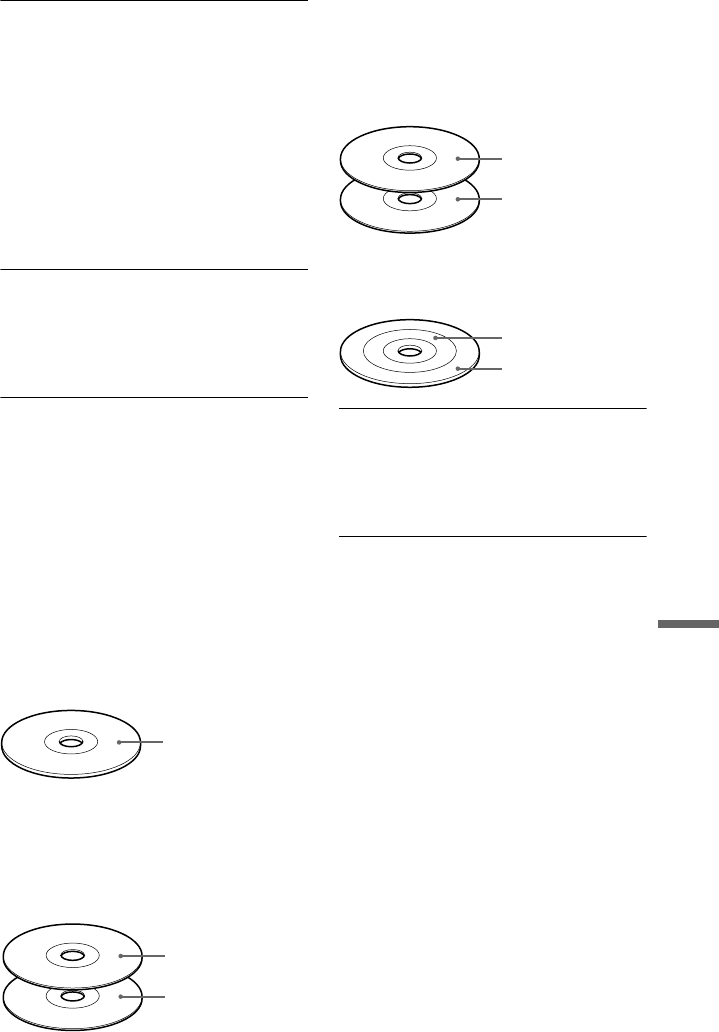
103
Additional Information
Progressive format (page 90)
Compared to the Interlace format that
alternately shows every other line of an image
(field) to create one frame, the Progressive
format shows the entire image at once as a
single frame. This means that while the
Interlace format can show 30 frames (60
fields) in one second, the Progressive format
can show 60 frames in one second. The
overall picture quality increases and still
images, text, and horizontal lines appear
sharper.
Scene (page 10)
On a VIDEO CD with PBC (playback
control) functions, the menu screens, moving
pictures and still pictures are divided into
sections called “scenes.”
Super Audio CD (page 6)
A Super Audio CD disc can reproduce sounds
that are extremely faithful to the original
sound by use of DSD (Direct Stream Digital)
technology. This technology utilizes a
sampling frequency of 2.8224 MHz, which is
64 times that of a conventional CD, and 1-bit
quantization that enables the disc to hold 4
times the amount of information that a
standard PCM format CD can hold. Super
Audio CDs are divided into the following
types.
• Super Audio CD (single layer disc)
This disc consists of a single HD layer*.
*High density signal layer for the Super Audio CD
• Super Audio CD (dual layer disc)
This disc consists of dual HD layers and is
capable of extended play over long periods.
Also, as the dual layer disc consists of dual
HD layers on one side only, you do not have
to turn the disc over during playback.
• Super Audio CD + CD (Hybrid disc)
This disc consists of an HD layer and a CD
layer. Also, as the dual layers are on one
side only, you do not have to turn the disc
over during playback. You can play the CD
layer using a conventional CD player.
• 2 channel + Multi-channel Super Audio CD
This disc consists of the 2 channel playback
area and the multi-channel playback area.
Title (page 10, 15, 61)
The longest section of a picture or music
feature on a DVD, movie, etc., in video
software, or the entire album in audio
software.
Track (page 10, 15, 61)
Sections of a picture or a music feature on a
CD or VIDEO CD (the length of a song).
HD (high density)
layer
HD layer
HD layer
CD layer
HD layer
Multi-channel
playback area
2 channel playback
area

104
Specifications
System
Laser: Semiconductor laser
λ = 780 nm for CD
λ = 650 nm for SA-CD and DVD
Emission duration: continuous
Signal format system: NTSC
Audio characteristics
Frequency response: DVD VIDEO (PCM
96 kHz): 2 Hz to 44 kHz (44 kHz: –2 dB
±1 dB), Super Audio CD: 2 Hz to
100kHz (50kHz: –3dB ±1dB), CD:
2 Hz to 20 kHz (±0.5 dB)
Signal-to-noise ratio (S/N ratio): 115 dB
(LINE OUT AUDIO L/R 1/2 jacks only)
Harmonic distortion: 0.003 %
Dynamic range: DVD VIDEO/Super Audio
CD: 103 dB, CD: 99 dB
Wow and flutter: Less than detected value
(±0.001% W PEAK)
Outputs
(Jack name: Jack type/Output level/Load
impedance)
LINE OUT AUDIO L/R 1/2: Phono jack/
2 Vrms/10 kilohms
DIGITAL OUT (OPTICAL): Optical
output jack/–18 dBm (wave length:
660 nm)
DIGITAL OUT (COAXIAL): Phono jack/
0.5 Vp-p/75 ohms
5.1CH OUTPUT: Phono jack/2 Vrms/
10 kilohms
COMPONENT VIDEO OUT (Y, PB/CB,
PR/CR): Phono jack/Y: 1.0 Vp-p/PB/CB,
PR/CR: interlace*=0.648 Vp-p,
progressive or interlace**=0.7 Vp-p/
75 ohms
* BLACK LEVEL is ON
** BLACK LEVEL is OFF
LINE OUT VIDEO 1/2: Phono jack/
1.0 Vp-p/75 ohms
S VIDEO OUPUT 1/2: 4-pin mini DIN/
Y: 1.0 Vp-p/C: 0.286 Vp-p /75 ohms
S-LINK (CONTROL S IN): Mini jack
General
Power requirements:
120 V AC, 60 Hz
Power consumption: 24 W
Dimensions (approx.): 430 × 189 × 545 mm
(17 × 7
1
/
2
× 21
1
/
2
in.) (width/height/
depth) incl. projecting parts
Mass (approx.): 10 kg (22 lb 1 oz)
Operating temperature: 5°C to 35 °C
(41 °F to 95 °F)
Operating humidity: 25 % to 80 %
Supplied accessories
See page 17.
Specifications and design are subject to
change without notice.
ENERGY STARR is a U.S. registered mark.
As an ENERGY STARR Partner, Sony
Corporation has determined that this product
meets the ENERGY STARR guidelines for
energy efficiency.
105
Additional Information
Language Code List
For details, see pages 69, 75, 88.
The language spellings conform to the ISO 639: 1988 (E/F) standard.
Code Language Code Language Code Language Code Language
1027 Afar
1028 Abkhazian
1032 Afrikaans
1039 Amharic
1044 Arabic
1045 Assamese
1051 Aymara
1052 Azerbaijani
1053 Bashkir
1057 Byelorussian
1059 Bulgarian
1060 Bihari
1061 Bislama
1066 Bengali;
Bangla
1067 Tibetan
1070 Breton
1079 Catalan
1093 Corsican
1097 Czech
1103 Welsh
1105 Danish
1109 German
1130 Bhutani
1142 Greek
1144 English
1145 Esperanto
1149 Spanish
1150 Estonian
1151 Basque
1157 Persian
1165 Finnish
1166 Fiji
1171 Faroese
1174 French
1181 Frisian
1183 Irish
1186 Scots Gaelic
1194 Galician
1196 Guarani
1203 Gujarati
1209 Hausa
1217 Hindi
1226 Croatian
1229 Hungarian
1233 Armenian
1235 Interlingua
1239 Interlingue
1245 Inupiak
1248 Indonesian
1253 Icelandic
1254 Italian
1257 Hebrew
1261 Japanese
1269 Yiddish
1283 Javanese
1287 Georgian
1297 Kazakh
1298 Greenlandic
1299 Cambodian
1300 Kannada
1301 Korean
1305 Kashmiri
1307 Kurdish
1311 Kirghiz
1313 Latin
1326 Lingala
1327 Laothian
1332 Lithuanian
1334 Latvian;
Lettish
1345 Malagasy
1347 Maori
1349 Macedonian
1350 Malayalam
1352 Mongolian
1353 Moldavian
1356 Marathi
1357 Malay
1358 Maltese
1363 Burmese
1365 Nauru
1369 Nepali
1376 Dutch
1379 Norwegian
1393 Occitan
1403 (Afan)Oromo
1408 Oriya
1417 Punjabi
1428 Polish
1435 Pashto;
Pushto
1436 Portuguese
1463 Quechua
1481 Rhaeto-
Romance
1482 Kirundi
1483 Romanian
1489 Russian
1491 Kinyarwanda
1495 Sanskrit
1498 Sindhi
1501 Sangho
1502 Serbo-
Croatian
1503 Singhalese
1505 Slovak
1506 Slovenian
1507 Samoan
1508 Shona
1509 Somali
1511 Albanian
1512 Serbian
1513 Siswati
1514 Sesotho
1515 Sundanese
1516 Swedish
1517 Swahili
1521 Tamil
1525 Telugu
1527 Tajik
1528 Thai
1529 Tigrinya
1531 Turkmen
1532 Tagalog
1534 Setswana
1535 Tonga
1538 Turkish
1539 Tsonga
1540 Tatar
1543 Twi
1557 Ukrainian
1564 Urdu
1572 Uzbek
1581 Vietnamese
1587 Volapük
1613 Wolof
1632 Xhosa
1665 Yoruba
1684 Chinese
1697 Zulu
1703 Not specified

106
Index
Numerics
16:9 89
4:3 LETTER BOX 89
4:3 OUTPUT 90
4:3 PAN SCAN 89
48kHz/96kHz PCM 94
5.1 Channel Surround 22, 27
A
A-B REPEAT 48
ADVANCED 67
ALBUM 62
Album 42
ANGLE 74
AUDIO 69, 88
AUDIO ATT 92
AUDIO DRC 92
AUDIO FILTER 93
AUDIO SETUP 92
AUTO PLAY 91
AUTO POWER OFF 91
B
BACKGROUND 89
Batteries 17
BLACK LEVEL 89
C
CD 34
CD DIRECT 92
CHAPTER 15, 61
Chapter 10, 101
CHAPTER VIEWER 63
Child Lock 36
COMMAND MODE 18
COMPONENT OUT 90
Connecting 19
Continuous play
DATA CD 42
DVD 34
Super Audio CD/CD/
VIDEO CD 34
Control Menu 14
CONTROL S 19
CUSTOM 87
CUSTOM PARENTAL
CONTROL 80
CUSTOM SETUP 91
D
DATA CD 6, 42
DIGITAL OUT 93
Digital output 93
DIMMER 91
DISC 61
Disc Explorer 50
Disc Memo 55
DISC MEMO INPUT 55
Display
Control Menu Display 14
Disc Explorer display 50
Front panel display 10, 66
Setup Display 87
DISTANCE 95
DOLBY DIGITAL 26, 27,
69, 93, 101
DOWNMIX 93
DTS 27, 69, 93, 101
DVD VIDEO 6, 34, 101
DVD+RW 101
DVD/Super Audio CD/CD
text 65
DVD-RW 6, 39, 101
E
EDIT 55
F
Fast forward 60
Fast reverse 60
FILE 53
Folder 53
FOLDER NAME INPUT 55
Front panel display 10, 66
G
Genre 57
GRAPHICS 89
H
Handling discs 8
HD/CD layer 40
Hooking up 17
I
INDEX 15, 61
Index 101
INSTANT REPLAY 36
INSTANT SEARCH 36
INTERLACE 90, 102
J
JACKET PICTURE 52, 89
K
Keyboard 56
L
LANGUAGE SETUP 88
LEVEL 96
Loading Discs 50
Locating
a point on a disc 60
M
MENU 88
Menu
DVD’s menu 38
Top menu 38
MP3 6, 42
Multi/2CH 40
O
ONE/ALL DISCS 44
On-screen display
Control Menu Display 14
Disc Explorer display 50
Setup Display 87
ORIGINAL 39
ORIGINAL/PLAY LIST 39
OSD 88
P
PARENTAL CONTROL 80
PAUSE MODE 91
PBC Playback 41
PICTURE NAVIGATION 63
PLAY LIST 39
PLAYBACK MEMORY 91
PRO LOGIC 26, 101
PROGRAM 45
Program Play 45
PROGRESSIVE 90, 103
Q
QUICK 88
Quick Setup 29, 88
R
Remote 17, 84
REPEAT 47
Repeat Play 47
RESET 88
Resume Play 37
107
S
S VIDEO output 19
SCENE 15, 61, 62
Scene 10, 103
SCREEN SAVER 89
SCREEN SETUP 89
Searching 60
Selecting a disc 35, 51
SETUP 87, 88
Setup Display 87
SHUFFLE 47
Shuffle Play 47
SIZE 95
Skipping discs 33
S-LINK 20
Slow-motion Play 60
SORT 58
SPEAKER SETUP 94
Speakers
Hooking up 22
SUBTITLE 75, 88
Super Audio CD 40, 103
SURROUND 70
T
TEST TONE 96
TIME/MEMO 15, 61
TIME/TEXT 15, 61, 65
TITLE 15, 61
Title 10, 103
TITLE VIEWER 63
TOP MENU 38
TRACK 15, 61
Track 10, 42, 103
TRACK SELECTION 91
TRACK VIEWER 63
Troubleshooting 98
TV TYPE 89
TVS (TV Virtual Surround)
70
U
Usable discs 6
V
VIDEO CD 6, 34
VIDEO CONTROL 76
VIDEO OFF 35

Sony Corporation Printed in Malaysia
