Sony Hvr Z5N Users Manual Z5U/Z5N
Digital HD Video Camera Recorder HVR-Z5U hvrz5u
HVR-Z5N to the manual 17e03099-d069-488d-a31a-51beaf301fc8
2015-01-23
: Sony Sony-Hvr-Z5N-Users-Manual-286815 sony-hvr-z5n-users-manual-286815 sony pdf
Open the PDF directly: View PDF  .
.
Page Count: 147 [warning: Documents this large are best viewed by clicking the View PDF Link!]
- Read this first
- Getting Started
- Step 1: Checking supplied items
- Step 2: Attaching the supplied microphone and the lens hood with lens cover
- Step 3: Charging the battery pack
- Step 4: Turning the power on and holding your camcorder properly
- Step 5: Adjusting the LCD panel and viewfinder
- Step 6: Setting the date and time
- Step 7: Inserting a tape or a “Memory Stick Duo”
- Recording/Playback
- Using the Menu
- Dubbing/Editing
- Troubleshooting
- Additional Information
- Quick Reference

4-114-857-11(1)
© 2008 Sony Corporation
http://www.sony.net/
Printed on 70% or more recycled paper
using VOC (Volatile Organic Compound)
-free vegetable oil based ink.
Printed in Japan
USDigital HD Video Camera Recorder
Digital HD Video
Camera Recorder
Operating Guide
Before operating the unit, please read this manual thoroughly,
and retain it for future reference
HVR-Z5U/Z5N
2
Read this first
Before operating this unit, please read this
manual thoroughly, and retain it for future
reference.
Types of cassette you can use in your
camcorder
Your camcorder is capable of recording in
HDV, DVCAM and DV formats.
When recording in HDV/DV format, Sony
recommends that you use mini DV
cassettes.
When recording in DVCAM format, Sony
recommends that you use mini DVCAM
cassettes. Your camcorder does not support
the Cassette Memory function (p. 119).
The HDV format
• Digital high-definition (HD) video signals
are recorded and played back on a DV
format cassette.
• HDV signals are compressed in MPEG2
format, which is adopted in BS (broadcast
satellite) digital and terrestrial digital
HDTV broadcastings and in Blu-ray disc
recorders.
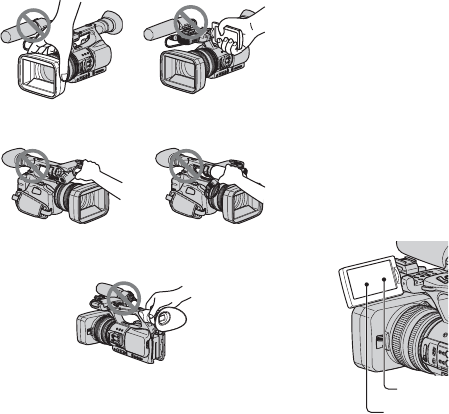
Types of “Memory Stick” you can use
in your camcorder
You can use any “Memory Stick” that has
the following markings.
“Memory Stick Duo”
(This size can be used with your
camcorder.)
“Memory Stick”
(You cannot use it in your camcorder.)
bNotes
• You cannot use any type of memory card
except “Memory Stick Duo.”
• “Memory Stick PRO Duo” can be used
only with “Memory Stick PRO”
compatible equipment.
• Do not attach a label or the like on a
“Memory Stick Duo” or a “Memory Stick
Duo” Adaptor.
• When using a “Memory Stick Duo” with
“Memory Stick” compatible equipment,
insert the “Memory Stick Duo” into the
“Memory Stick Duo” Adaptor.
Notes on use
3
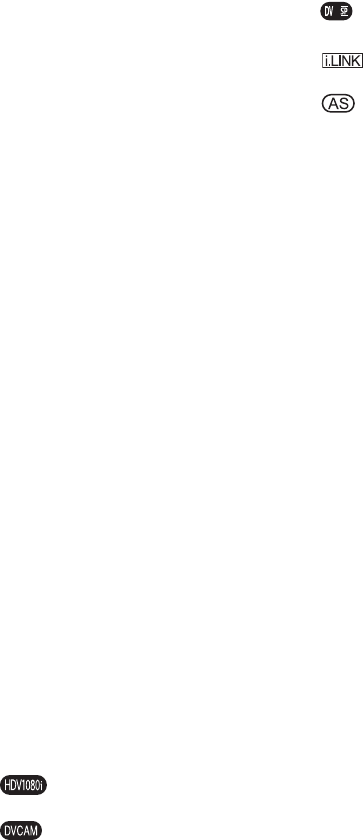
Using the camcorder
• Do not hold the camcorder by the
following part.
bNotes
• The camcorder is not dustproof, dripproof
or waterproof.
See “About handling of your camcorder”
(p. 125).
• Do not connect cables to your camcorder
with their terminals placed the wrong
way. Squeezing the terminals into your
camcorder's jacks may damage them or
results in a malfunction of your
camcorder.
About menu items, LCD panel,
viewfinder, and lens
• A menu item that is grayed out is not
available under the current recording or
playback conditions.
• The LCD screen and the viewfinder are
manufactured using extremely high-
precision technology, so over 99.99% of
the pixels are operational for effective
use. However, there may be some tiny
black points and/or bright points (white,
red, blue, or green in color) that appear
constantly on the LCD screen and the
viewfinder. These points are normal
results of the manufacturing process and
do not affect the recording in any way.
Do not expose your camcorder’s
viewfinder, lens, or LCD screen to the
sun or strong light source for extended
periods.
• Intense light sources, especially the sun
will converge on the viewfinder or lens
and damage the internal parts of your
camcorder. Avoid sunlight or other strong
light sources when storing your
camcorder. Protect this device by always
closing the lens cover or by placing it in
its bag when not in use.
About temperature of your camcorder
and battery pack
• Your camcorder has a protective function
that disables recording or playback if the
temperature of your camcorder or battery
LCD panel
Viewfinder
Lens hood
Internal microphone Microphone or
Microphone holder
Black point
White, red, blue or green point
Continued ,
4
pack is beyond the safely operable range.
In this case, a message appears on the
screen or in the viewfinder (p. 116).
On recording
• Before starting to record, test the
recording function to make sure the
picture and sound are recorded without
any problems.
• Compensation for the contents of
recordings cannot be provided, even if
recording or playback is not possible due
to a malfunction of the camcorder, storage
media, etc.
• TV color systems differ depending on the
countries/regions. To view your
recordings on a TV, you need an NTSC
system-based TV.
• Television programs, films, video tapes,
and other materials may be copyrighted.
Unauthorized recording of such materials
may be contrary to the copyright laws.
• Because of the way that the image device
(CMOS sensor) reads out image signals,
the subjects passing by the frame rapidly
might appear crooked depending on the
recording conditions. This phenomenon
may be notable in displays having high
motion resolution.
On playing back HDV tapes on other
devices
A tape recorded in the HDV format cannot
be played back on a device that is not
compatible with the HDV format.
Check the contents of tapes by playing
them back on this camcorder prior to
playing them back on other devices.
Notes on the icons used in this
manual
Features available for the HDV
format only.
Features available for the DVCAM
format only.
Features available for the DV SP
format only.
The function that can be used when
i.LINK cable is connected.
The function that can be assigned to
an ASSIGN button.
About this manual
• The images of the LCD screen and the
viewfinder used in this manual for
illustration purposes are captured using a
digital still camera, and therefore may
appear different.
• The on-screen displays in each local
language are used for illustrating the
operating procedures. Change the screen
language before using your camcorder if
necessary (p. 21).
• Design and specifications of recording
media and other accessories are subject to
change without notice.
• Illustrations of battery packs in this
manual show the NP-F770 unless
otherwise specified.
Read this first (Continued)

5
Table of Contents
Read this first ...........................................................................................2
Step 1: Checking supplied items ..............................................................8
Step 2: Attaching the supplied microphone and the lens hood with lens
cover ...........................................................................................10
Step 3: Charging the battery pack ..........................................................13
Step 4: Turning the power on and holding your camcorder properly .....17
Step 5: Adjusting the LCD panel and viewfinder ....................................18
Step 6: Setting the date and time ...........................................................20
Changing the language setting .......................................................... 21
Step 7: Inserting a tape or a “Memory Stick Duo” ..................................22
Recording ...............................................................................................24
Changing the settings of your camcorder recordings .............................28
Adjusting the zoom ............................................................................. 28
Adjusting the focus manually.............................................................. 29
Adjusting the image brightness .......................................................... 30
Adjusting to natural color (White balance).......................................... 33
Customizing the picture quality (Picture profile)................................. 35
Adjusting the volume .......................................................................... 44
Attaching a Memory Recording Unit................................................... 44
Assigning the functions to the ASSIGN buttons .....................................46
Recording an index signal .................................................................. 47
Playing back the most recently recorded movies
(Last scene review)............................................................................. 48
Reviewing the most recently recorded scenes (Rec review).............. 48
Searching for the last scene of the most recent recording
(End search) ....................................................................................... 48
Using the Shot transition ..................................................................... 48
Playback .................................................................................................51
Changing/checking the settings in your camcorder ................................54
Changing the screen .......................................................................... 54
Displaying recording data (Data code) .............................................. 54
Displaying the settings in your camcorder (Status check) ................. 55
Checking the remaining battery (Battery Info) .................................... 55
Getting Started
Recording/Playback
Continued ,
6
Locating a scene on a tape ....................................................................56
Searching for a scene by date of recording (Date search) ................ 56
Searching for a recording start point (Index search) .......................... 56
Playing the picture on a TV .................................................................... 58
Using the menu items ...........................................................64
Menu items ............................................................................................ 66
(CAMERA SET) menu .................................................................... 69
Settings to adjust your camcorder to the recording conditions (GAIN SETUP/
BACK LIGHT/STEADYSHOT, etc.)
(AUDIO SET) menu .......................................................................77
Settings for the audio recording (DV AU.MODE (DV Audio mode)/XLR SET,
etc.)
(DISPLAY SET) menu ..................................................................... 80
Display settings of the display and the viewfinder (MARKER/VF B.LIGHT/DISP
OUTPUT, etc.)
(IN/OUT REC) menu ....................................................................... 85
Recording settings, input and output settings (REC FORMAT/HDV PROGRE./
VIDEO OUT/EXT REC CTRL, etc.)
(TC/UB SET) menu ......................................................................... 89
(TC PRESET/UB PRESET/TC LINK, etc.)
(MEMORY SET) menu ....................................................................91
Settings for the “Memory Stick Duo” (ALL ERASE/FORMAT, etc.)
(OTHERS) menu .............................................................................92
Settings while recording on a tape or other basic settings (QUICK REC/BEEP,
etc.)
Dubbing to VCR, DVD/HDD device, etc. ............................................... 96
Recording pictures from a VCR .......................................................... 100
Copying movies on a tape to a computer ............................................ 102
Copying still images to a computer ...................................................... 105
Troubleshooting ................................................................................... 106
Warning indicators and messages ....................................................... 116
Using the Menu
Dubbing/Editing
Troubleshooting
Table of Contents (Continued)

7
Using your camcorder abroad ..............................................................118
Maintenance and precautions ..............................................................119
HDV format and recording/playback ................................................ 119
Compatibility of the DVCAM/DV formats........................................... 120
About the “Memory Stick” ................................................................. 122
About the “InfoLITHIUM” battery pack ............................................. 123
About i.LINK...................................................................................... 124
About x.v.Color ................................................................................. 125
About handling of your camcorder ................................................... 125
Specifications .......................................................................................129
Identifying parts and controls ...............................................................134
Indicators for the LCD screen and viewfinder ......................................140
Index .....................................................................................................143
Additional Information
Quick Reference
8
Getting Started
Step 1: Checking supplied items
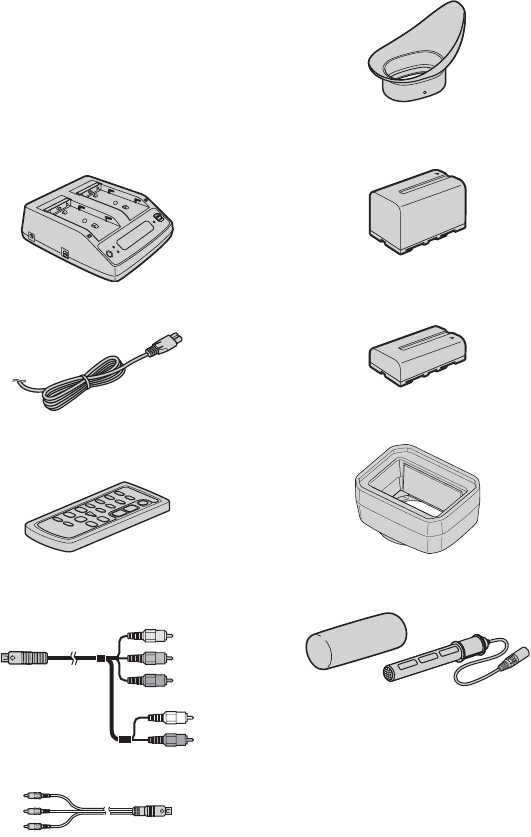
Make sure that you have following items
supplied with your camcorder.
The number in the parentheses indicates the
number of that item supplied.
• The cassette tape and “Memory Stick Duo” are
not included. See pages 2, 119 and 122 for types
of cassette tapes and “Memory Stick Duo” that
you can use on your camcorder.
AC Adaptor/Charger (AC-VQ1050) (1)
(p. 13)
Power cord (mains lead) (1) (p. 13)
Wireless Remote Commander (RMT-831)
(1) (p. 139)
A button-type lithium battery is already installed.
Component A/V cable (1) (p. 58)
A/V connecting cable (1) (p. 58, 96)
Large eyecup (1) (p. 19)
Rechargeable battery pack (NP-F770) (1)
(p. 13, 123)
(Only for models HVR-Z5U)
Rechargeable battery pack (NP-F570) (1)
(p. 13, 123)
(Only for models HVR-Z5N)
Lens hood with lens cover (1) (p. 12)
This lens hood is pre-mounted.
Wind Screen (1), Microphone (ECM-XM1)
(1) (p. 10)

10
Step 2: Attaching the supplied microphone and
the lens hood with lens cover
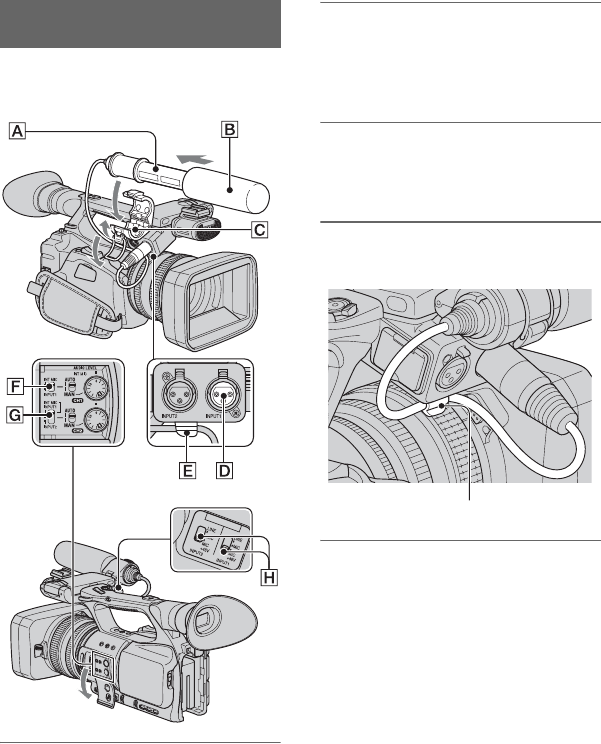
When you use the supplied microphone
(ECM-XM1) for recording sound, do the
following steps.
1Attach the wind screen B to the
supplied microphone A.
2Place the microphone A in the
microphone holder C with the
model name facing upward, close
the cover, and shut the clamp.
3Connect the plug of the
microphone to the INPUT1 jack
D.
4Put the microphone cable into the
cable holder E.
5Select channels with the CH1 (INT
MIC/INPUT1) switch F and the
CH2 (INT MIC/INPUT1/INPUT2)
switch G.
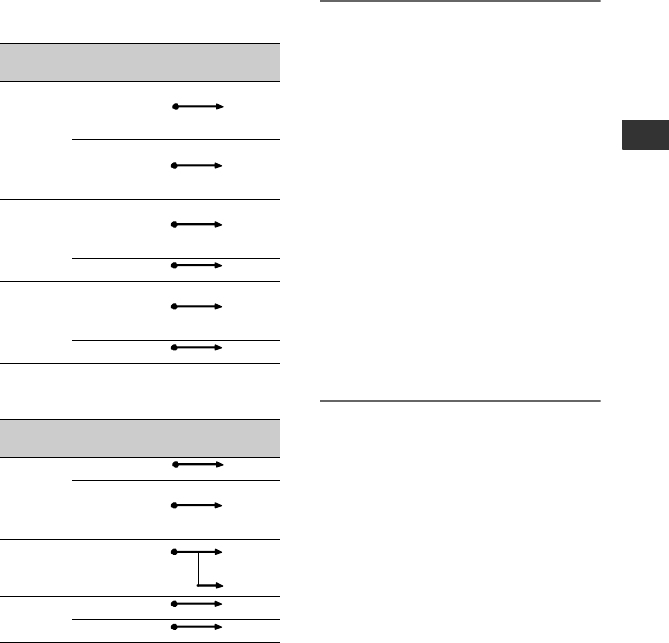
See the table below for the recording
channels.
Attaching the supplied
microphone
Put the cable in the outer cable holder.
11
Getting Started
When the CH1 switch is set to
INT MIC
When the CH1 is set to INPUT1
6Set the INPUT1 switch H to an
appropriate position for the
microphone connected to the
INPUT1 jack D.
LINE: For inputting sound from an
audio device
MIC: For inputting sound from an
external microphone that does
not support the +48V power
source.
MIC+48V: For inputting sound from a
device that supports the
+48V power source
including the supplied
microphone.
When you connect a microphone to the
INPUT2 jack, set the INPUT2 switch to
an appropriate position for that
microphone.
bNotes
• When you connect a device that supports the
+48V power source to the INPUT1 or INPUT2
jack, set the INPUT1/INPUT2 switch to MIC
prior to connecting the device. When you
disconnect the device, set the INPUT1/INPUT2
switch to MIC first, then disconnect it.
• When you connect a microphone that does not
support the +48V power source to the INPUT1
or INPUT2 jack, set the INPUT1/INPUT2
switch to MIC. If you use it with the INPUT1/
INPUT2 switch set to MIC+48V, it may be
damaged or the recorded sound may be
distorted.
zTips
• See page 44 for adjusting the volume.
CH2 switch
position Input channel and source
INT MIC Internal
microphone
(L)
CH1
Internal
microphone
(R)
CH2*
INPUT1 Internal
microphone
(mono)
CH1
XLR INPUT1 CH2**
INPUT2 Internal
microphone
(mono)
CH1
XLR INPUT2 CH2**
CH2 switch
position Input channel and source
INT MIC XLR INPUT1 CH1
Internal
microphone
(mono)
CH2**
INPUT1 XLR INPUT1 CH1
CH2**
INPUT2 XLR INPUT1 CH1
XLR INPUT2 CH2**
*The recording level of channel 2 is
synchronized with that of channel 1 when only
the internal microphone is used. The recording
level of channel 2 is controlled with the CH1
(AUDIO LEVEL) dial and the CH1 (AUTO/
MAN) switch.
** You can adjust the recording levels of channel 1
and channel 2 separately.
Continued ,
12
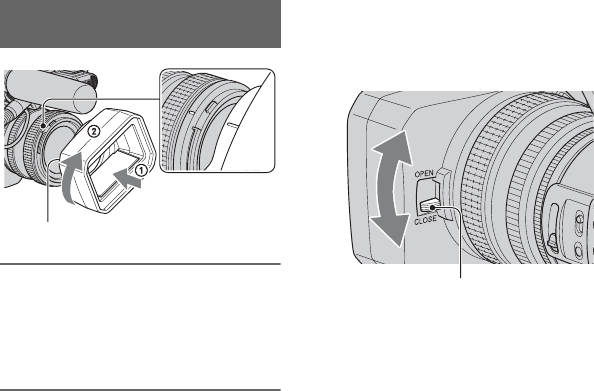
Align the marks on the lens hood to
those on the camcorder, and turn the
lens hood in the direction of the
arrow 2.
To remove the lens hood with lens
cover
Turn the lens hood in the opposite direction
to the arrow 2 in the illustration while
pressing the PUSH (lens hood release)
button.
zTips
• If you attach or remove a 72mm (2 7/8 in.) PL
filter or MC protector, remove the lens hood
with lens cover.
To open or close the shutter of the
lens hood with lens cover
Move the lens cover lever up or down to
open or close the lens cover.
Attaching the lens hood with lens
cover
PUSH (lens hood release) button
Move the lens cover lever to OPEN to
open the lens cover, and move the lever
to CLOSE to close the lens cover.
Step 2: Attaching the supplied microphone and the lens hood with lens
cover (Continued)
13
Getting Started
Step 3: Charging the battery pack
You can charge the “InfoLITHIUM”
battery pack (L series) with the
supplied AC Adaptor/Charger.
bNotes
• You cannot use batteries other than the
“InfoLITHIUM” battery pack (L series)
(p. 123).
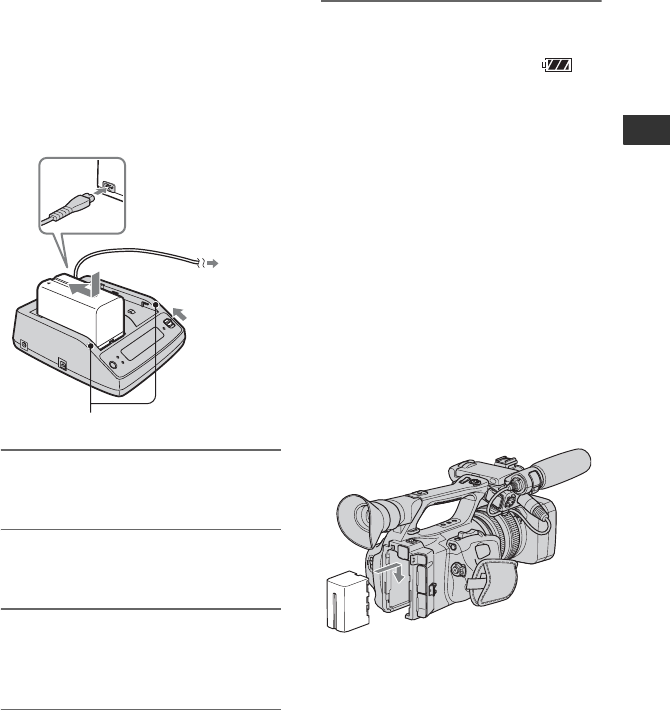
1Set the mode change switch to
CHARGE.
2Connect the power cord (mains
lead) to the AC Adaptor/Charger.
3Connect the power cord (mains
lead) to the wall outlet (wall
socket).
4Place the battery pack in the slot
of the AC Adaptor/Charger, press
it down, and slide it in the
direction of the arrow as
illustrated.
The charge lamp turns on and charging
starts.
After charging the battery
All segments of the battery mark ( )
appear in the display window when the
normal charge of the battery is completed.
You can fully charge the battery pack if you
continue charging the battery pack after the
charge lamp turns off until the battery mark
with “FULL” appears (full charge). The
battery life of the fully charged battery is
slightly longer than that of the normally
charged battery.
Remove the battery pack from the AC
Adaptor/Charger when the charge is
completed.
zTips
• You can check the remaining battery life with
the battery info function (p. 55).
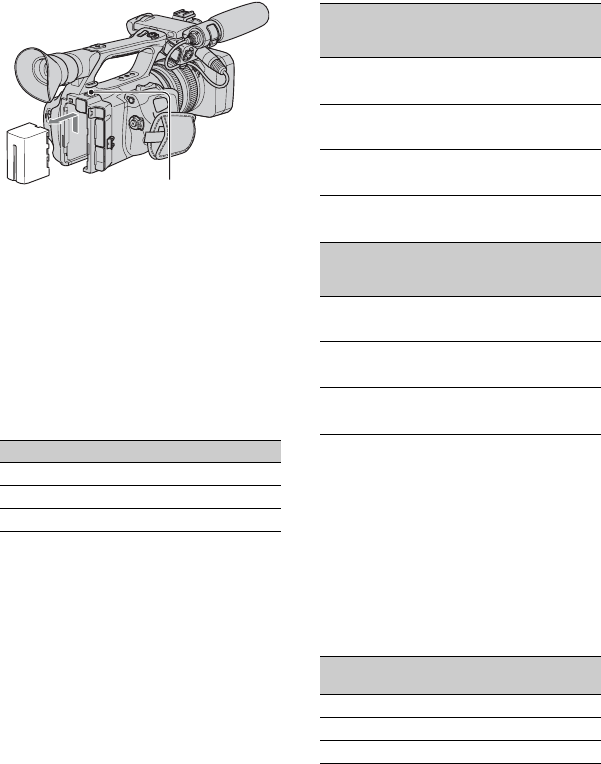
To attach the battery pack
Press the battery pack against the back of
your camcorder and slide it down.
2
4
4
1
3
Charge lamp
Continued ,
14
To remove the battery pack
Slide the POWER switch to OFF. Push the
BATT RELEASE (battery release) button
and remove the battery pack.
To store the battery pack
If the battery pack will not be used for a
while, run down the battery and store it. See
page 124 for details on storage of the
battery pack.
Charging time
Approximate time (min.) required when
you fully charge a fully discharged battery
pack.
bNotes
• For HVR-Z5N*:
– The supplied battery pack is NP-F570.
– You cannot use the NP-F330 battery pack
with your camcorder.
• For HVR-Z5U*:
– The supplied battery pack is NP-F770.
– You cannot use the NP-F330/F570 battery
pack with your camcorder.
*You can find the model name at the bottom of
your camcorder.
Recording time
Approximate time (min.) available when
you use a fully charged battery pack.
Recording in the HDV format
Recording in the DVCAM (DV) format
Top: When the LCD backlight turns on.
Bottom: When recording with the viewfinder
while the LCD panel is closed.
*Typical recording time shows the time when
you repeat recording start/stop, turning the
power on/off and zooming.
Playing time
Approximate time (min.) available when
you use a fully charged battery pack.
HDV format pictures
Battery pack Charging time
NP-F570 145
NP-F770 230
NP-F970 310
BATT RELEASE
(battery release) button
Battery pack
Continuous
recording
time
Typical
recording
time*
NP-F570 125 60
130 65
NP-F770 260 130
265 130
NP-F970 390 195
395 195
Battery pack
Continuous
recording
time
Typical
recording
time*
NP-F570 130 65
135 65
NP-F770 270 135
280 140
NP-F970 400 200
415 205
Battery pack LCD panel
opened*
LCD panel
closed
NP-F570 170 180
NP-F770 355 370
NP-F970 530 555
Step 3: Charging the battery pack (Continued)
15
Getting Started
DVCAM (DV) format pictures
*When the LCD backlight turns on.
On the battery pack
• Before changing the battery pack, slide the
POWER switch to OFF.
• The Battery Info (p. 55) will not be correctly
displayed under the following conditions.
– The battery pack is not attached correctly.
– The battery pack is damaged.
– The battery pack is worn-out.
• Sony recommends that you use an NP-F970
battery pack when you use your camcorder with
the Memory Recording Unit (optional).
On the charging/recording/playback time
• Times measured with the camcorder at 25 °C
(77 °F). 10 to 30 °C (50 °F to 86 °F) is
recommended.
• The recording and playback time will be shorter
when you use your camcorder in low
temperatures.
• The recording and playback time will be shorter
depending on the conditions under which you
use your camcorder.
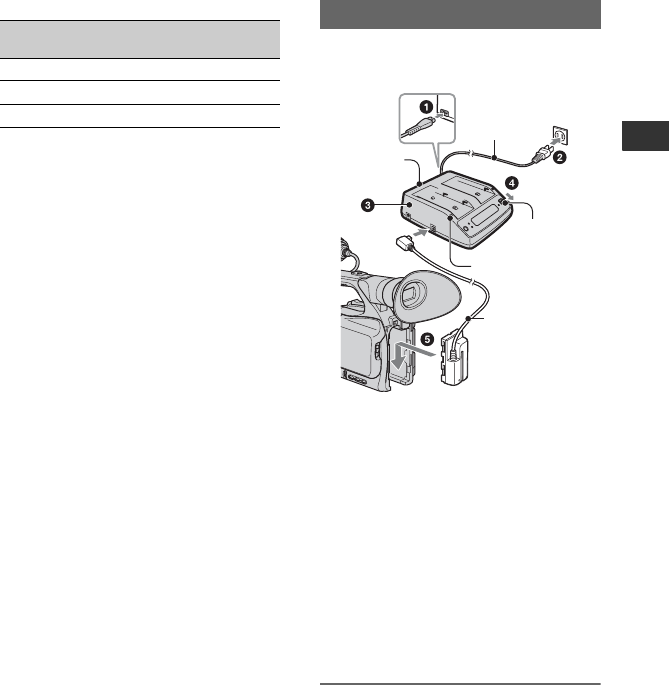
You can use the AC Adaptor/Charger to
obtain AC power.
1Connect the power cord (mains lead) to
the AC Adaptor/Charger.
2Connect the power cord (mains lead) to
the wall outlet (wall socket).
3Connect the connecting cable (DK-415)
to the AC Adaptor/Charger.
4Set the mode change switch of the AC
Adaptor/Charger to VCR/CAMERA.
5Press the connecting part of the
connecting cable (DK-415) against the
back of your camcorder in the battery
slot and slide it down.
On the AC Adaptor/Charger
• Use the nearby wall outlet when using the AC
Adaptor/Charger. Disconnect the AC Adaptor/
Charger from the wall outlet (wall socket)
immediately if any malfunction occurs while
using your camcorder.
• Do not use the AC Adaptor/Charger placed in a
narrow space, such as between a wall and
furniture.
Battery pack LCD panel
opened*
LCD panel
closed
NP-F570 180 190
NP-F770 375 390
NP-F970 570 595
Using an outside power source
AC Adaptor/
Charger
Power cord
To the wall outlet
(wall socket)
Mode change
switch
Connecting cord
DK-415
Charge lamp
Continued ,
16
• Do not short-circuit the DC plug of the AC
Adaptor/Charger or battery terminal with any
metallic objects. This may cause a malfunction.
• Even if your camcorder is turned off, AC power
(house current) is still supplied to it while
connected to the wall outlet (wall socket) via the
AC Adaptor/Charger.
Step 3: Charging the battery pack (Continued)
17
Getting Started
Step 4: Turning the power on and holding your
camcorder properly
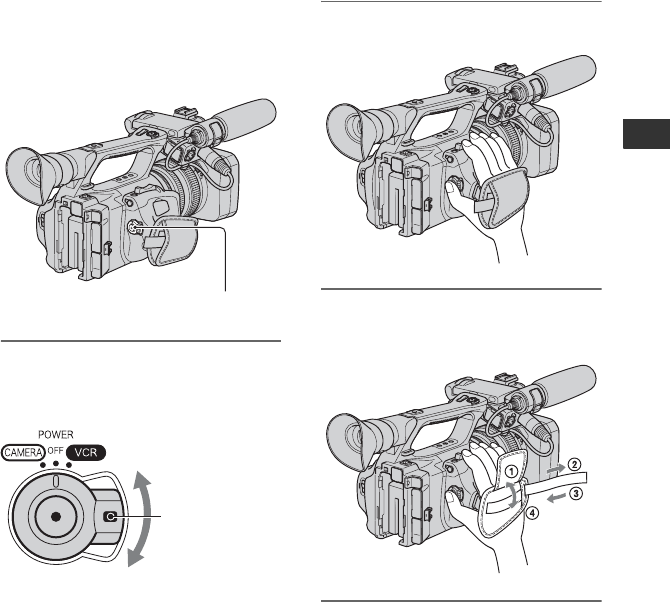
To record or play back, set the POWER
switch to the respective positions.
When you use your camcorder for the first
time, the [CLOCK SET] screen appears
(p. 20).
1Slide the POWER switch to
CAMERA or VCR while you press
the green button.
CAMERA: To record pictures.
VCR: To play or edit pictures.
bNotes
• The current date and time appear on the LCD
screen for a few seconds when you turn on your
camcorder once you set the date and time
([CLOCK SET], p. 20).
2Hold the camcorder properly.
3Ensure a good grip, then fasten
the grip belt.
To turn off the power
Slide the POWER switch to OFF while
pressing the green button.
bNotes
• If warning messages appear on the screen,
follow the instructions.
POWER switch
Slide the POWER
switch while
pressing the green
button.
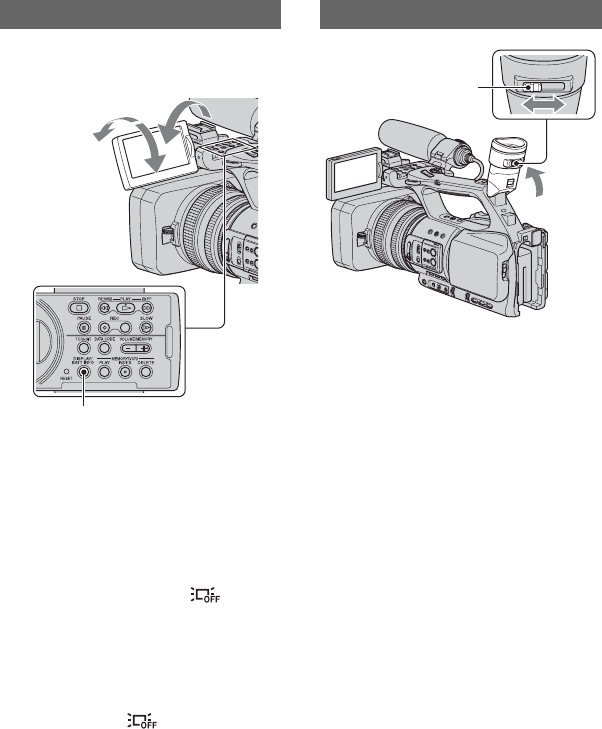
18
Step 5: Adjusting the LCD panel and viewfinder
Open the LCD panel 180 degrees (1), then
rotate it to the best angle to record or play
back (2).
zTips
• You can see your mirror image on the LCD
screen by setting the LCD panel facing you. The
image will be recorded in a normal image.
To turn off the LCD backlight to make
the battery last longer
Press and hold the DISPLAY/BATT INFO
button for a few seconds until appears.
This setting is practical when you use your
camcorder in bright conditions or when you
want to save battery power. The recorded
picture will not be affected by the setting.
To turn on the LCD backlight, press and
hold the DISPLAY/BATT INFO button for
a few seconds until disappears.
zTips
• You can adjust the brightness of the LCD screen
from [LCD BRIGHT] (p. 83).
bNotes
• You may see primary colors shimmering in the
viewfinder when you move your eye line. This
is not a malfunction. The shimmering colors
will not be recorded on the recording media.
zTips
• You can adjust the brightness of the viewfinder
backlight from [VF B.LIGHT] (p. 83).
• To display images both on the LCD display and
in the viewfinder, set [VF POWERMODE] to
[ON](p. 84).
• To display images in black and white in the
viewfinder, set [VF COLOR] to [OFF] (p. 84).
The LCD panel
DISPLAY/BATT INFO button
1Open 180 degrees.
2180 degrees
(max.)
290 degrees
(max.)
The viewfinder
Viewfinder lens
adjustment lever
Move it until the picture
becomes clear.
19
Getting Started
When the picture in the viewfinder is
hard to see
If you cannot see the picture in the
viewfinder clearly under bright
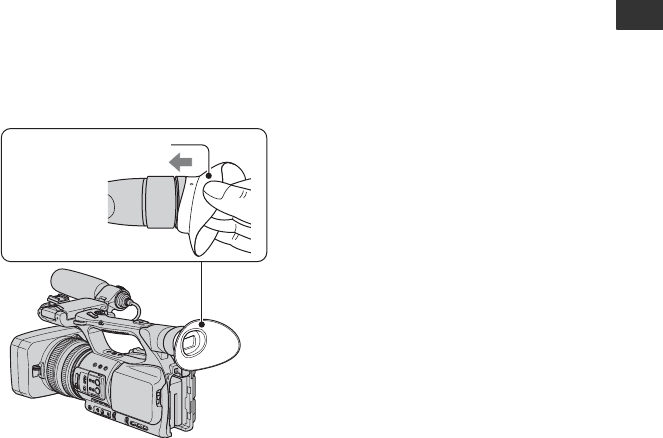
circumstances, use the supplied large
eyecup. To attach the large eyecup, stretch
it slightly and align it with the eyecup
groove in the viewfinder. You can attach
the large eyecup facing either the right or
left side.
bNotes
• Do not remove the pre-attached eyecup.
Large eyecup (supplied)
Attach with the
protruding part
at the top.
20
Step 6: Setting the date and time
Set the date and time when using your
camcorder for the first time. If you do not
set the date and time, [CLOCK SET] screen
appears every time you turn on your
camcorder or change the POWER switch
positions.
zTips
• If you do not use your camcorder for about 3
months, the built-in rechargeable battery gets
discharged and the date and time settings may
be cleared from the memory. In that case,
charge the rechargeable battery and then set the
date and time again (p. 128).
Skip to step 4 when you set the clock for
the first time.
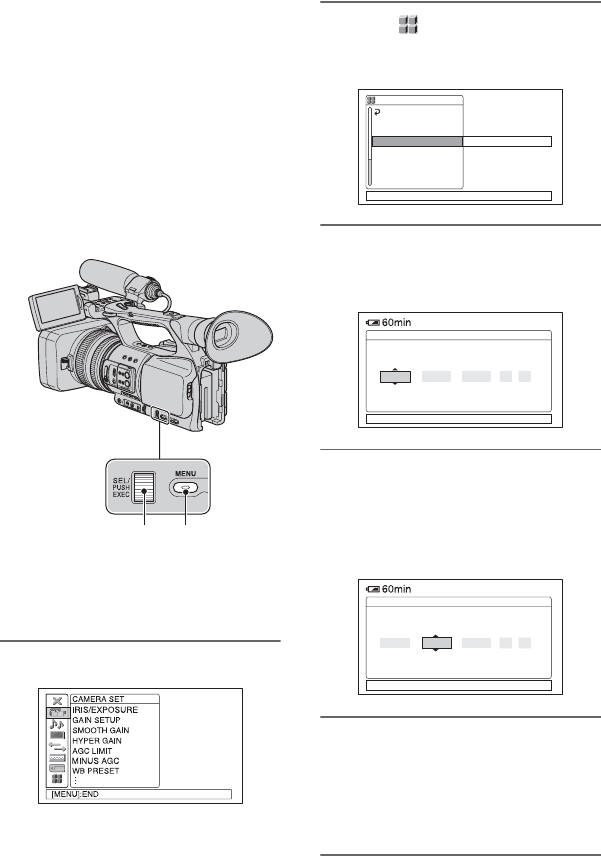
1Press the MENU button.
2Select (OTHERS) by turning
the SEL/PUSH EXEC dial, then
press the dial.
3Select [CLOCK SET] by turning
the SEL/PUSH EXEC dial, then
press the dial.
4Set [Y] (year) by turning the SEL/
PUSH EXEC dial, then press the
dial.
You can set any year up to the year
2079.
5Set [M] (month), [D] (day), hour
and minute, then press the dial.
The clock starts.
For midnight, set it to 12:00 AM.
For midday, set it to 12:00 PM.
SEL/PUSH
EXEC dial
MENU
button
OTHERS
RETURN
CAMERA PROF.
ASSIGN BTN
CLOCK SET
--
:
--
:
--
WORLD TIME
LANGUAGE
QUICK REC
DATE REC
[MENU ]: END
CLOCK SET
[MENU ]: CANCEL
MDY
12 : 00
AM
1JAN
--
2008
--:--:--:--
CLOCK SET
[MENU ]: CANCEL
MDY
12 : 00
AM
1JAN
--
2008
--:--:--:--

21
Getting Started
zTips
• The date and time are automatically recorded on
the tape, and can be displayed during playback
(DATA CODE button, p. 54).
.
You can change the on-screen displays to
show messages in a specified language.
Press the MENU button and select the
(OTHERS) with the SEL/PUSH
EXEC dial. Select the screen language in
[LANGUAGE] (p. 93).
Changing the language setting
22
Step 7: Inserting a tape or a “Memory Stick Duo”
See page 119 for details on tapes including
which tapes can be used and how to protect
from overwriting tapes.
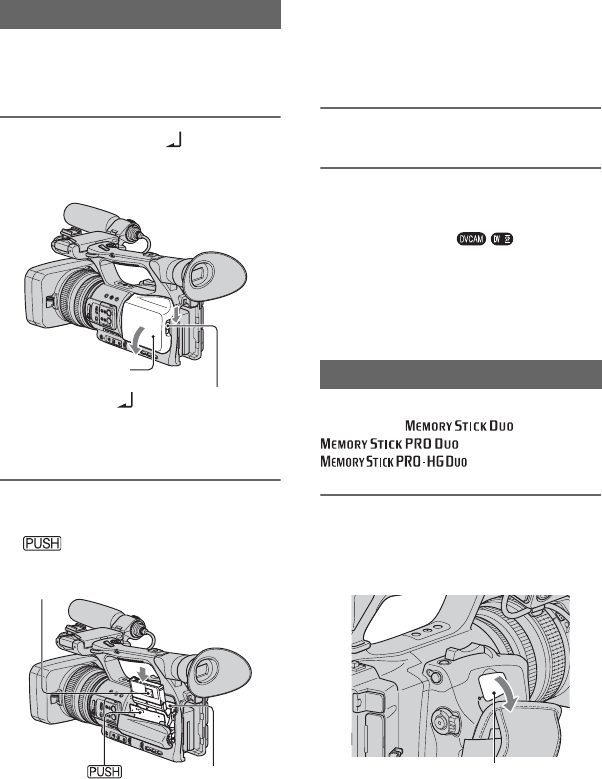
1Slide and hold the OPEN/
EJECT lever in the direction of the
arrow and open the lid.
The cassette compartment automatically
comes out.
2Insert a cassette with its window
facing outwards, then press
.
The cassette compartment automatically
slides back in.
bNotes
• Do not push the portion marked
while the cassette
compartment is sliding in. Doing so may
cause a malfunction.
3Close the lid.
zTips
• The recordable time varies depending on [DV
REC MODE] (p. 86).
To eject the cassette
Open the lid following the same procedure
as described in step 1 and remove the
cassette.
You can use only a “Memory Stick Duo”
marked with ,
or
(p. 122).
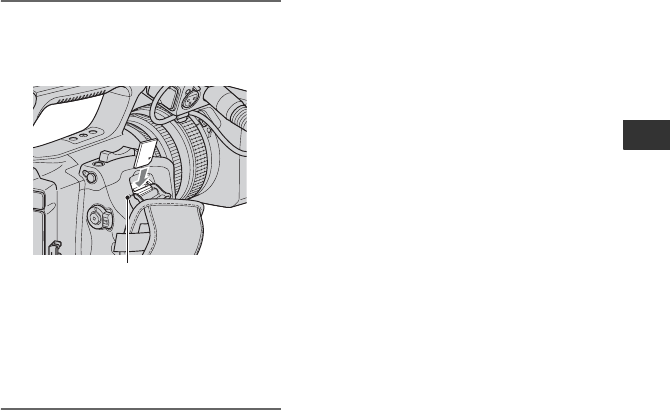
1Open the “Memory Stick Duo”
slot cover in the direction of the
arrow.
Cassette tape
OPEN/EJECT lever
Lid
Push the center of the back of
the cassette lightly.
Cassette
compartment
Window
“Memory Stick Duo”
{DO NOT PUSH}
“Memory Stick Duo” slot cover
23
Getting Started
2Insert the “Memory Stick Duo”
into the “Memory Stick Duo” slot
in the right direction until it clicks.
bNotes
• If you insert the “Memory Stick Duo” into
the slot in the wrong direction, the “Memory
Stick Duo,” the “Memory Stick Duo” slot,
or image data may be damaged.
To eject a “Memory Stick Duo”
Lightly push the “Memory Stick Duo”
once.
bNotes
• When the access lamp is lit or flashing, your
camcorder is reading/writing data. Do not shake
or knock your camcorder, turn the power off,
eject the “Memory Stick Duo,” or remove the
battery pack. Otherwise, image data may be
damaged.
• When inserting or ejecting the “Memory Stick
Duo,” be careful with the “Memory Stick Duo”
from popping out and dropping.
Access lamp
24
Recording/Playback
Recording
Your camcorder records movies on tape and still images on “Memory Stick Duo.” Do the
following steps to record movies.
• This camcorder can record movies in HDV or DVCAM (DV) format. The factory setting is HDV format
([REC FORMAT], p. 85).
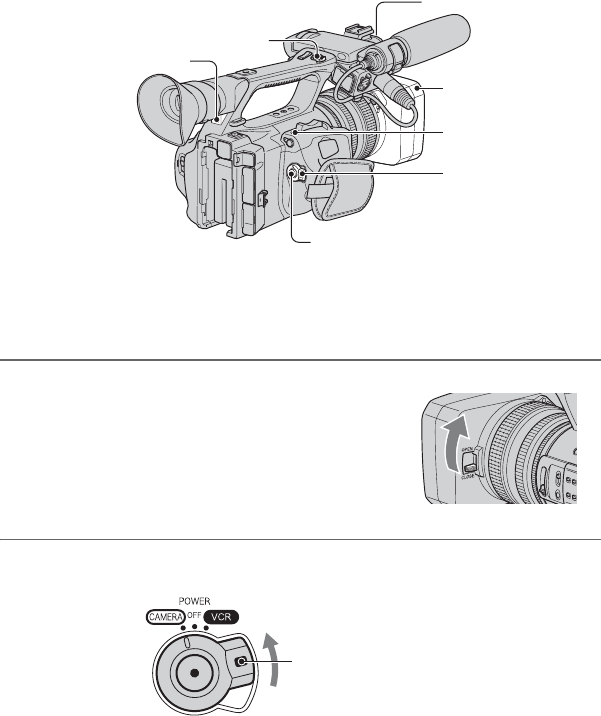
1Open the shutter of the lens hood.
2Slide the POWER switch to CAMERA while pressing the green button.
Lens hood
REC START/
STOP button B
POWER switch
REC START/STOP button A
Recording lamp
Recording lamp
ASSIGN 7/
PHOTO button
Press and hold the green
button when you slide the
POWER switch from OFF.

25
Recording/Playback
3Press the REC START/STOP button A (or B).
The recording lamp lights up during recording.
To stop the movie recording, press the REC START/STOP button again.
zTips
• When recording in HDV format, the aspect ratio is fixed to 16:9. When recording in DVCAM (DV)
format, you can switch the aspect ratio to 4:3 ([DV WIDE REC], p. 86).
• You can change the screen display during recording (p. 54).
• Indicators displayed on the screen during recording are shown on page 140.
• The recording lamp can be set to stay off ([REC LAMP[F]], [REC LAMP[R]], p. 94).
• You cannot record movies on a “Memory Stick Duo.”
• For low angle recording, the REC START/STOP button on the handle is convenient. Release the
HOLD lever to enable the REC START/STOP button. It might be helpful if you set the LCD panel
face up or close it after turning it face down, or lift the viewfinder up during the low angle recording.
60min
REC
00:04:50:04
[STBY] t [REC]
Continued ,
26
To capture still images
1Assign [PHOTO] to the ASSIGN 7/
PHOTO button (p. 46).
2Press the ASSIGN 7/PHOTO button or
the PHOTO button on the Remote
Commander.
A still image will be recorded on the
“Memory Stick Duo.” disappears
when the recording is completed.
You can capture still images during
movie recording.
zTips
• See page 142 for indicators that appear on the
screen during recording.
• You can assign [PHOTO] to another ASSIGN
button from (OTHERS) t [ASSIGN
BTN] and use that ASSIGN button as a PHOTO
button.
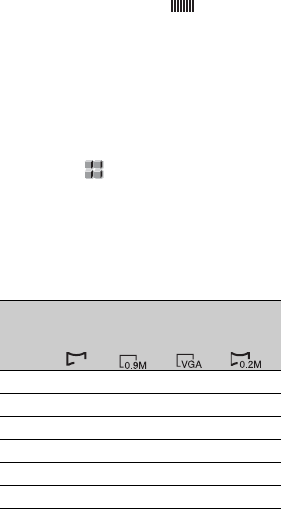
Capacity of the “Memory Stick Duo”
(MB) and the number of recordable
pictures
bNotes
• Specifications are for Sony “Memory Stick
Duo.” The actual number of recordable pictures
can vary depending on the recording
environment and the type of “Memory Stick
Duo.”
• You cannot store a still image under the
following conditions:
– When [SCAN TYPE] is set to [24] or [24A]
and the shutter speed is slower than 1/48
(p. 85, 86)
– When [SCAN TYPE] is set to [60] or [30] and
the shutter speed is slower than 1/60
(p. 85, 86)
– While using the fader
– While using [SMTH SLW REC]
– While using shot transition
• The unique pixel array of Sony's ClearVid
CMOS sensor and image processing system
(Enhanced Imaging Processor) allows for still
image resolution equivalent to the sizes
described.
zTips
• Image sizes of still images are as follows:
– Recording in HDV format/DVCAM (DV)
format (16:9): 1.2M
– Recording in DVCAM (DV) format (4:3):
0.9M
– Playing back in HDV format: 1.2M
– Playing back in DVCAM (DV) format (16:9):
0.2M
– Playing back in DVCAM (DV) format (4:3):
VGA
To store still images captured from
movies on a tape on “Memory Stick
Duo”
You can capture an image in a movie and
record it on a “Memory Stick Duo” as a still
image. Be sure to insert a recorded tape and
a “Memory Stick Duo” in your camcorder.
1Assign [PHOTO] to the ASSIGN 7/
PHOTO button (p. 46).
2Set the POWER switch to VCR.
3Press the N (play) button to search for
the scene you want to save as a still
image. Press the ASSIGN 7/PHOTO
button or the PHOTO button on your
Remote Commander at the scene.
bNotes
• The recorded date and time on the tape and the
stored date and time on the “Memory Stick
Duo” are both saved on the “Memory Stick
Duo.” When you view the still images, only the
recorded date and time on the tape will be
displayed on the screen (Data code, p. 54).
1.2M
1440
×
810
0.9M
1080 ×
810
VGA
640 ×
480
0.2M
640 ×
360
512MB 770 1000 2900 3650
1GB 1550 2100 6000 7500
2GB 3150 4300 12000 15000
4GB 6300 8500 23500 29500
8GB 12500 17000 48000 60000
16GB 25500 34500 97500 122000
1.2M
Recording (Continued)

28
Changing the settings of your camcorder
recordings
.
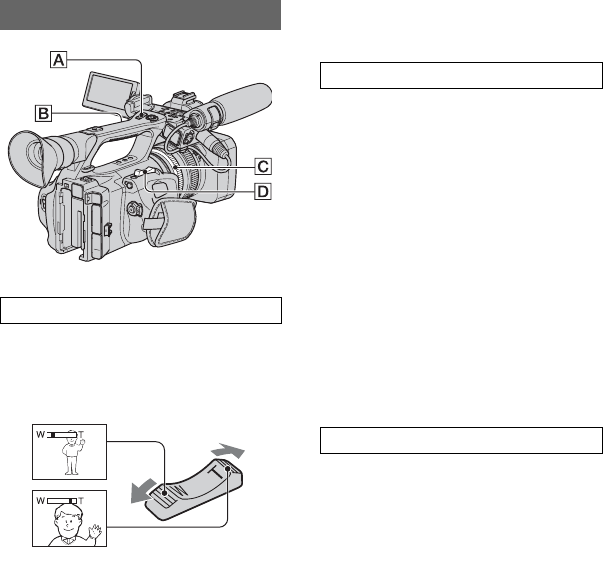
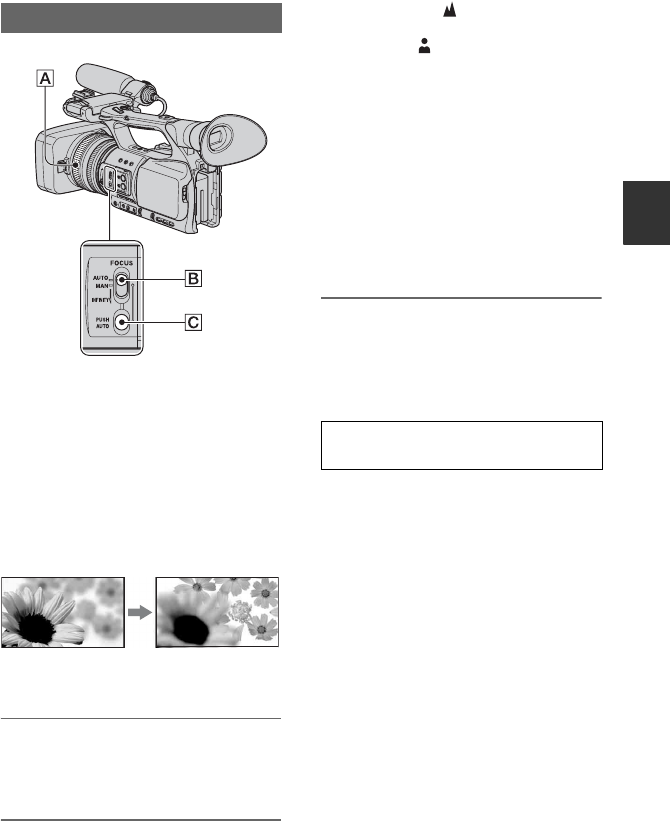
Move the power zoom lever D slightly for
a slower zoom. Move it further for a faster
zoom.
zTips
• The minimum distance required between your
camcorder and the subject for focus is about 1
cm (about 13/32 in.) for wide angle and about
80 cm (about 2 5/8 feet) for telephoto.
• The focus may not be adjusted at certain zoom
positions if the subject is within 80 cm (about 2
5/8 feet) from your camcorder.
• When you set [FOCUS MACRO] to [OFF], you
cannot focus on a subject within 80 cm (about 2
5/8 feet) regardless of the zoom position (p. 73).
• Be sure to keep your finger on the power zoom
lever D. If you move your finger off the power
zoom lever D, the operation sound of the
power zoom lever D may also be recorded.
• You can increase the zoom speed of the zoom
lever D or the handle zoom A ([SPEED
ZOOM], p. 73).
1Set the handle zoom switch B to VAR
or FIX.
zTips
• When you set the handle zoom switch B to
VAR, you can zoom in or out at variable
speed.
• When you set the handle zoom switch B to
FIX, you can zoom in or out at fixed speed
set in [HANDLE ZOOM] (p. 73).
2Press the handle zoom lever A to zoom
in or out.
bNotes
• You cannot use the handle zoom lever A when
the handle zoom switch B is set to OFF.
• You cannot change the zoom speed of the zoom
lever D with the handle zoom switch B.
You can zoom at the desired speed by
turning the zoom ring C. Fine adjustment
is also possible.
bNotes
• Turn the zoom ring C at a moderate speed. If
you turn it too fast, the zoom speed may lag
behind the zoom ring rotation speed, or the
operation sound of the zoom may also be
recorded.
Adjusting the zoom
Using the zoom lever
Close view: (Telephoto)
Wide view: (Wide angle)
Using the handle zoom
Using the zoom ring
29
Recording/Playback
You can adjust the focus manually for
different recording conditions.
Use this function in the following cases.
– To record a subject behind a window covered
with raindrops.
– To record horizontal stripes.
– To record a subject with little contrast between
the subject and its background.
– When you want to focus on a subject in the
background.
– To record a stationary subject using a tripod.
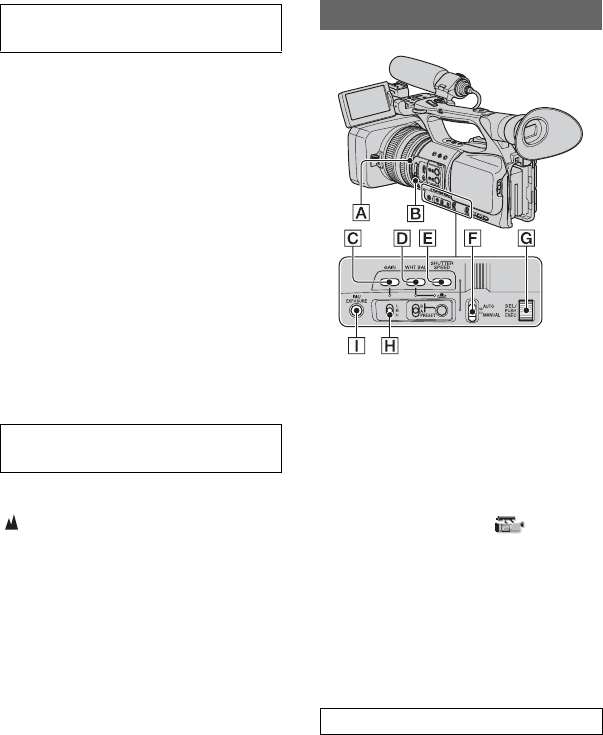
1During recording or standby, set
the FOCUS switch B to MAN.
9 appears.
2Rotate the focus ring A and
adjust the focus.
9 changes to when the focus
cannot be adjusted any farther. 9
changes to when the focus cannot be
adjusted any closer.
zTips
For focusing manually
• It is easier to focus on the subject when you use
the zoom function. Move the power zoom lever
towards T (telephoto) to adjust the focus, and
then, towards W (wide angle) to adjust the zoom
for recording.
• When you want to record a close-up image of a
subject, move the power zoom lever towards W
(wide angle) to fully magnify the image, then
adjust the focus.
To restore automatic adjustment
Set the FOCUS switch B to AUTO.
9 disappears and the automatic focus
adjustment is restored.
Record the subject while pressing and
holding the PUSH AUTO button C.
If you release the button, the setting returns
to manual focusing.
Use this function to shift the focus on one
subject to another. The scenes will shift
smoothly.
zTips
• The focal distance information (for when it is
dark and hard to adjust the focus) appears for
about 3 seconds in the following cases. (It will
not be displayed correctly if you are using a
conversion lens (optional)).
– When you set the FOCUS switch to MAN
and 9 appears on the screen
– When you rotate the focus ring while 9 is
displayed on the screen.
Adjusting the focus manually
Using automatic focus temporarily
(Push auto focus)
Continued ,
30
Assign [EXP.FOCUS] to any one of the
ASSIGN buttons beforehand (p. 46).
During standby, press the ASSIGN button
to which [EXP.FOCUS] is assigned.
[EXPANDED FOCUS] appears and the
center of the screen is magnified by about
2.0 times. It will be easier to confirm the
focus setting during manual focusing. The
screen returns to the original size when you
press the button again.
bNotes
• The screen returns to the original size when you
start recording during the expanded focus
display.
zTips
• You can select a type of an expanded image
displayed during the expanded focus
([EXP.FOCUS TYPE], p. 82).
Slide the FOCUS switch B to INFINITY
and hold it there.
appears on the screen.
To return to manual focus mode, release the
FOCUS switch B. This function enables
you to set focus on a distant subject even
when the focus is automatically set on a
close subject.
bNotes
• This function is only available during the
manual focus. It is not available during the
automatic focus.
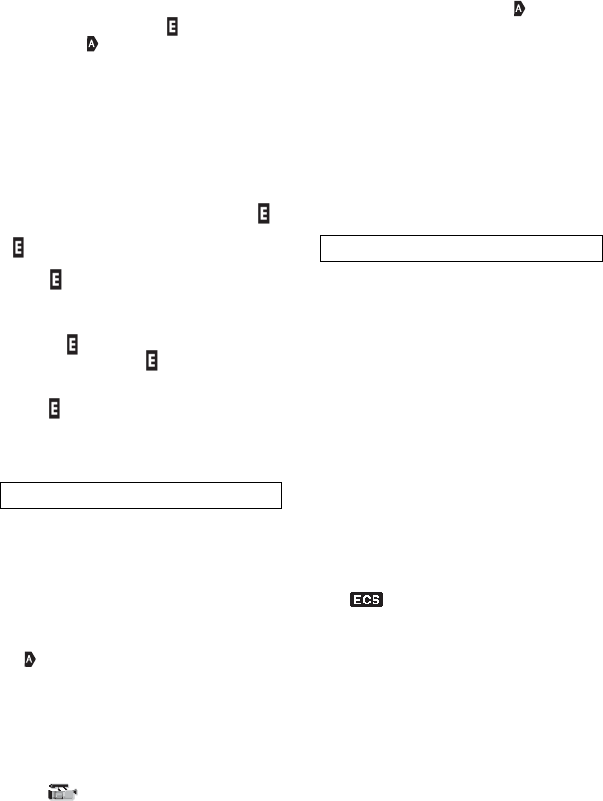
You can adjust the image brightness by
adjusting the iris, gain or shutter speed, or
by reducing the light volume with the ND
filter B. Also, when [EXPOSURE] is
assigned to the iris ring A, you can adjust
the iris, gain and shutter speed with the iris
ring A. You can assign [IRIS] or
[EXPOSURE] to the iris ring A from
[IRIS/EXPOSURE] of the
(CAMERA SET) menu (p. 69). The default
setting is [IRIS].
bNotes
• You cannot use the back light function and the
spotlight function if at least two of iris, gain and
shutter speed are adjusted manually.
• [AE SHIFT] is not effective while you adjust
the iris, gain and shutter speed all manually.
You can manually adjust the iris to control
the volume of the light entering the lens. By
adjusting the iris, you can change or close
the aperture of the lens, which is expressed
as an F value between F1.6 and F11. The
volume of the light increases the more that
you open the aperture (decreasing F value).
Using the expanded focus (Expanded
focus)
Focusing on a distant subject (Focus
infinity)
Adjusting the image brightness
Adjusting the iris
Changing the settings of your camcorder recordings (Continued)

31
Recording/Playback
The volume of the light decreases the more
that you close the aperture (increasing F
value). The current F value appears on the
screen.
1Select (CAMERA SET) menu t
[IRIS/EXPOSURE] t [RING
ASSIGN] t [IRIS] (p. 69).
2During recording or standby, set the
AUTO/MANUAL switch F to
MANUAL.
3When the iris is automatically adjusted,
press the IRIS/EXPOSURE button I.
next to the iris value disappears
(p. 82), or the iris value appears on the
screen.
4Adjust the iris with the iris ring A.
When you assign [PUSH AT IRIS] to
one of the ASSIGN buttons, you can
automatically adjust the iris while
pressing and holding that ASSIGN
button. See page 46 for details on the
ASSIGN button.
zTips
• The F value becomes close to F3.4 as the zoom
position changes from W to T even when you
open the aperture by setting the F value lower
than F3.4, such as F1.6.
• The range of focus, an important effect of the
aperture, is called the depth of field. The depth
of field gets shallower as the aperture is opened,
and deeper as the aperture is closed. Use the
aperture creatively to obtain the desired effect in
your photography.
• This is handy for making the background
blurred or sharp.
To adjust the iris automatically
Press the IRIS/EXPOSURE button I, or
set the AUTO/MANUAL switch F to
AUTO.
The iris value disappears, or appears
next to the iris value.
bNotes
• When you set the AUTO/MANUAL switch F
to AUTO, other manually adjusted items (gain,
shutter speed, white balance) also become
automatic.
When [IRIS/EXPOSURE] is set to
[EXPOSURE], you can adjust the image
brightness by adjusting the iris, gain and
shutter speed with the iris ring.
You can also manually preset one or two of
these parameters and adjust the remaining
parameter(s) with the iris ring.
1Select (CAMERA SET) menu t
[IRIS/EXPOSURE] t [RING
ASSIGN] t [EXPOSURE] (p. 69)
2During recording or standby, set the
AUTO/MANUAL switch F to
MANUAL.
3When [EXPOSURE] is automatically
adjusted, press the IRIS/EXPOSURE
button I.
The iris, gain and shutter speed values
and appear on the screen. You can
adjust the iris, gain and shutter speed
with the iris ring A.
When is not displayed, do the
following operation. appears next to
the items, indicating that you can adjust
them with the iris ring A.
–Gain
Press the GAIN button C.
– Shutter speed
Press the SHUTTER SPEED button E
twice. When the shutter speed is not locked,
press the button once.
4Adjust the image brightness by turning
the iris ring A.
When you assign [PUSH AT IRIS] to
one of the ASSIGN buttons, you can
automatically adjust the exposure while
pressing and holding that ASSIGN
button. See page 46 for details on the
ASSIGN button.
Adjusting the exposure
Continued ,
32
To restore automatic adjustment
Press the IRIS/EXPOSURE button I, or
set the AUTO/MANUAL switch F to
AUTO.
The values next to which is displayed
disappear, or appears next to those
values.
bNotes
• When you set the AUTO/MANUAL switch F
to AUTO, other manually adjusted items (gain,
shutter speed, white balance) also become
automatic.
zTips
• When you press the GAIN button C while
is displayed on the screen next to the gain value,
disappears and you can adjust the gain
manually. When you press the GAIN button C
again, appears and you can adjust the gain
with the iris ring A. See step 2 in “Adjusting
the gain” for details on how to adjust the gain.
• When you press the SHUTTER SPEED button
E while is displayed on the screen next to
the shutter speed value, disappears and you
can adjust the shutter speed manually. When
you press the SHUTTER SPEED button E
again, appears and you can adjust the shutter
speed with the iris ring A. See steps 3 and 4
in “Adjusting the shutter speed” on page 32 for
details on how to adjust the shutter speed.
You can adjust the gain manually when you
do not want to use the AGC (automatic gain
control).
1Set the AUTO/MANUAL switch F to
MANUAL during recording or standby.
2When the gain is automatically
adjusted, press the GAIN button C.
next to the gain value disappears, or
the gain value appears on the screen.
3Set the gain switch H to H, M or L.
The gain value set for the selected gain
switch position appears on the screen.
You can set the gain value for each gain
switch position from [GAIN SETUP] of
the (CAMERA SET) menu
(p. 69).
To adjust the gain automatically
Press the GAIN button C, or set the
AUTO/MANUAL switch F to AUTO.
The gain value disappears, or appears
next to the gain value.
bNotes
• When you set AUTO/MANUAL switch F to
AUTO, other manually adjusted items (iris,
shutter speed, white balance) also become
automatic.
zTips
• When you record a movie with the gain set to
[-6dB] and play it back with the data code, the
gain value is displayed as [---].
You can manually adjust and fix the shutter
speed. You can make a moving subject look
still or emphasize the movement of a
moving subject by adjusting the shutter
speed.
1During recording or standby, set
AUTO/MANUAL switch F to
MANUAL.
2Press the SHUTTER SPEED button E
until the shutter speed value is
highlighted.
3Change the shutter speed displayed on
the screen by turning the SEL/PUSH
EXEC dial G.
You can adjust the shutter speed in a
range of 1/4 second through 1/10000
second or the extended clear scan
().
The denominator of the set shutter speed
appears on the screen. For example,
[100] appears on the screen when you
set the shutter speed to 1/100 second.
The larger the value on the screen, the
faster the shutter speed.
4Press the SEL/PUSH EXEC dial G to
lock the shutter speed.
To readjust the shutter speed, do steps
2 to 4.
Adjusting the gain
Adjusting the shutter speed
Changing the settings of your camcorder recordings (Continued)
33
Recording/Playback
zTips
• You can set the shutter speed between 1/3
second and 1/10000 second in the following
settings:
– [HDV PROGRE.]t[SCAN TYPE]t[24] or
[24A]
– [DV PROGRE.]t[SCAN TYPE]t[24]
• It is difficult to focus automatically at a lower
shutter speed. Manual focusing with your
camcorder attached to a tripod is recommended.
• The picture may flicker or change colors under
fluorescent lamps, sodium lamps, or mercury
lamps. You can reduce flickering by setting the
shutter speed to an appropriate frequency in the
extended clear scan ( ) range
([ECS FREQ.], p. 71).
• When recording a subject such as a monitor
screen, set the shutter speed in the extended
clear scan ( ) range in order to obtain
images with no horizontal bands of noise. You
can set the shutter speed for the extended clear
scan from [ECS FREQ.] in the
(CAMERA SET) menu (p. 71).
To adjust the shutter speed
automatically
Press the SHUTTER SPEED button E
twice, or set the AUTO/MANUAL switch
F to AUTO.
The shutter speed value disappears, or
appears next to the shutter speed value.
bNotes
• When you set the AUTO/MANUAL switch F
to AUTO, other manually adjusted items (iris,
gain, white balance) also become automatic.
.
You can record the subject clearly by using
the ND filter B when the recording
environment is too bright.
The ND filters 1, 2 and 3 reduce the volume
of light to about 1/4, 1/16 and 1/64,
respectively.
If flashes during the iris automatic
adjustment, set the ND filter to 1. If
flashes during the iris automatic
adjustment, set the ND filter to 2. If
flashes during the iris automatic
adjustment, set the ND filter to 3.
The ND filter indicator will stop flashing
and remain on the screen.
If flashes, set the ND filter to OFF.
will disappear from the screen.
bNotes
• If you change the ND filters B during
recording, the movie and sound may be
distorted.
• When adjusting the iris manually, the icon
does not flash even if the light volume should be
adjusted with the ND filter.
zTips
• While recording a bright subject, diffraction
may occur if you close the aperture further
down, resulting in a fuzzy focus (this is a
common phenomenon with video cameras). The
ND filter B suppresses this phenomenon and
gives better recording results.
You can adjust and fix the white balance
according to the lighting conditions of
recording environment.
You can store white balance values in
memory A ( A) and memory B ( B),
Adjusting the volume of light
(ND filter)
Adjusting to natural color (White
balance)
Continued ,
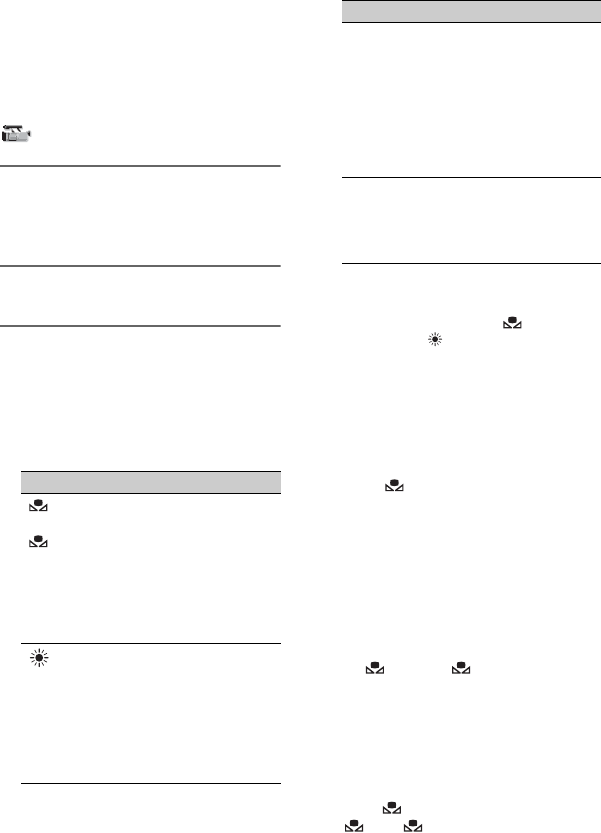
34
respectively. Unless a white balance is
readjusted, values will remain even after the
power has been turned off.
When you select PRESET, [OUTDOOR],
[INDOOR] or [MANU WB TEMP] is
selected, according to which one you
previously set with [WB PRESET] in the
(CAMERA SET) menu.
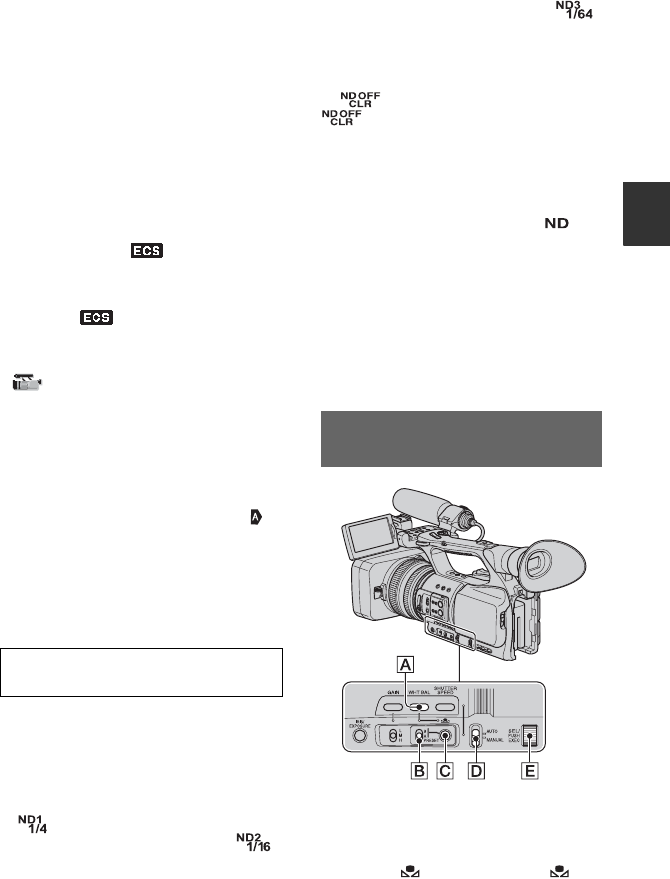
1During recording or standby, set
the AUTO/MANUAL switch D to
MANUAL.
2Press the WHT BAL button A.
3Set the white balance memory
switch B to any one of
PRESET/A/B.
Select A or B for recording with the
white balance setting stored in memory
A or B.
zTips
• You can change the outdoor white balance
setting by setting offset. Press (one push)
button C while (outdoor) is selected and
turn the SEL/PUSH EXEC dial E to select an
offset value from -7 (bluish) to 0 (normal, the
default setting) to +7 (reddish). You can also set
the white balance offset value from the menu
([WB OUTDR LVL], p. 70).
• You can change the color temperature. Set [WB
PRESET] to [MANU WB TEMP] and the white
balance memory switch B to PRESET, then
press the (one push) button C. Turn the
SEL/PUSH EXEC dial E until the desired
temperature appears on the screen, then press
the dial to set the temperature. You can also set
the color temperature from the menu ([WB
TEMP SET], p. 70).
To save the adjusted white balance
value in memory A or B
1Set the white balance memory switch to
A ( A) or B ( B) in step 3 of
“Adjusting to natural color (White
balance).”
2Capture a white subject, such as white
paper, full-screen in the same lighting
condition as the one in which the subject
is.
3Press (one push) button C.
A or B starts flashing rapidly. It
will stay on when the white balance
adjustment is completed and the
Indicator Shooting conditions
A
(Memory A)
B
(Memory B)
• White balance values
adjusted for light
sources can be stored
in memory A and
memory B. Follow the
steps in “To save the
adjusted white balance
value in memory A or
B” (p. 34).
Outdoor
([OUTDOOR])
• Recording neon signs
or fireworks
• Recording sunset/
sunrise, just after
sunset or just before
sunrise
• Under daylight color
fluorescent lamps
n
Indoor
([INDOOR])
• Under the lighting
conditions that change
in many ways, such as
a party hall
• Under strong light
such as in a
photography studio
• Under sodium lamps
or mercury lamps
Color
temperature
([MANU WB
TEMP])
• Color temperature can
be set between 2300K
and 15000K (the
default setting is
6500K).
Indicator Shooting conditions
Changing the settings of your camcorder recordings (Continued)
35
Recording/Playback
adjusted value is stored in A or
B.
To adjust the white balance
automatically
Press the WHT BAL button A or set the
AUTO/MANUAL switch D to AUTO.
bNotes
• When you set the AUTO/MANUAL switch D
to AUTO, other manual adjustments (iris, gain,
and shutter speed) also become automatic.
You can customize the picture quality by
adjusting picture profile items such as
[GAMMA] and [DETAIL].
Connect your camcorder to a TV or
monitor, and adjust the picture quality
while observing the picture on the TV or
monitor screen.
Picture quality settings for different
recording conditions are stored in [PP1]
through [PP6] as default settings.
bNotes
• When you set [x.v.Color] of the
(CAMERA SET) menu to [ON], the picture
profile will be disabled.
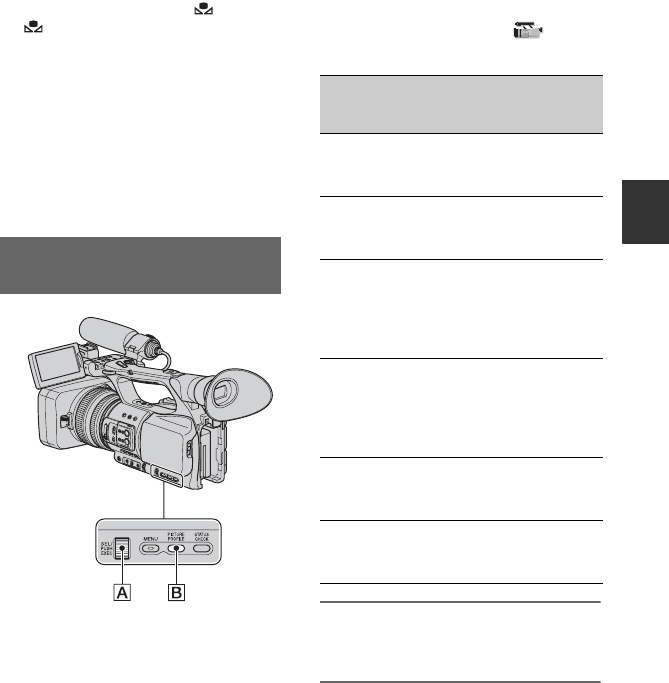
1During standby, press the
PICTURE PROFILE button B.
2Select a picture profile number
with the SEL/PUSH EXEC dial A.
You can record with the settings of the
selected picture profile.
Customizing the picture quality
(Picture profile)
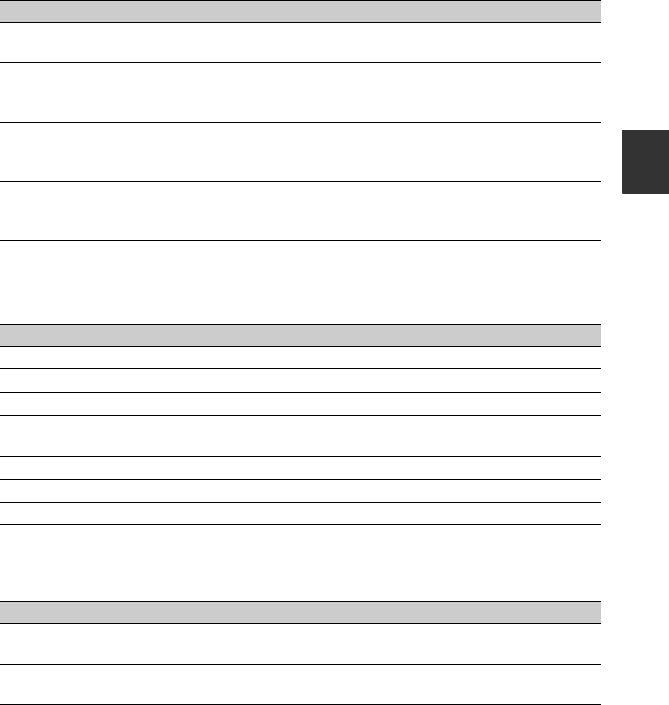
Picture profile
number (setting
name)
Recording condition
PP1
:USER
Default settings the same
as when Picture Profile is
[OFF]
PP2
:USER
Default settings the same
as when Picture Profile is
[OFF]
PP3
:PRO COLOR
Example settings of
pictures recorded by a
professional shoulder
camcorder with ITU709
gamma
PP4
:PD COLOR
Example settings of
pictures recorded by a
professional handy
camcorder with PD
gamma
PP5
:FILM LOOK1
Example settings of
pictures recorded on
cinema color negative film
PP6
:FILM LOOK2
Example settings of
pictures screened with
cinema color print film
Continued ,

36
3Select [OK] with the SEL/PUSH
EXEC dial A.
To cancel the picture profile recording
Select [OFF] in step 2 with the SEL/PUSH
EXEC dial A.
To change the picture profile
You can change the settings stored in [PP1]
through [PP6].
1Press the PICTURE PROFILE button
B.
2Select the PICTURE PROFILE number
with the SEL/PUSH EXEC dial A.
3Select [SETTING] with the SEL/PUSH
EXEC dial A.
4Select an item to be adjusted with the
SEL/PUSH EXEC dial A.
5Adjust the picture quality with the SEL/
PUSH EXEC dial A.
6Repeat steps 4 and 5 to adjust other
items.
7Select [ RETURN] with the SEL/
PUSH EXEC dial A.
8Select [OK] with the SEL/PUSH EXEC
dial A.
A picture profile indicator appears.
zTips
• You can assign picture profiles to the ASSIGN
buttons and use them to turn the picture profiles
on and off (p. 46).
Changing the settings of your camcorder recordings (Continued)
37
Recording/Playback
BLACK LEVEL
To set the black level.
GAMMA
To select a gamma curve.
BLACK GAMMA
To correct gamma in low intensity area.
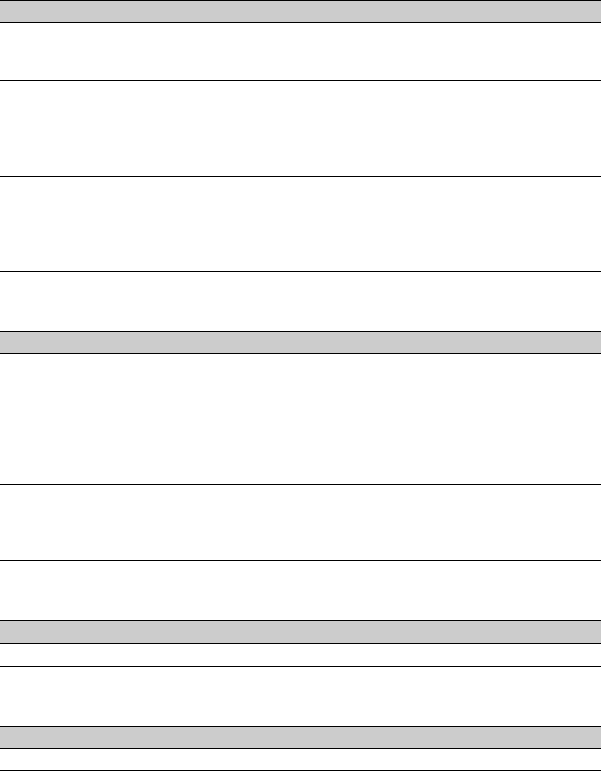
Item Description and settings
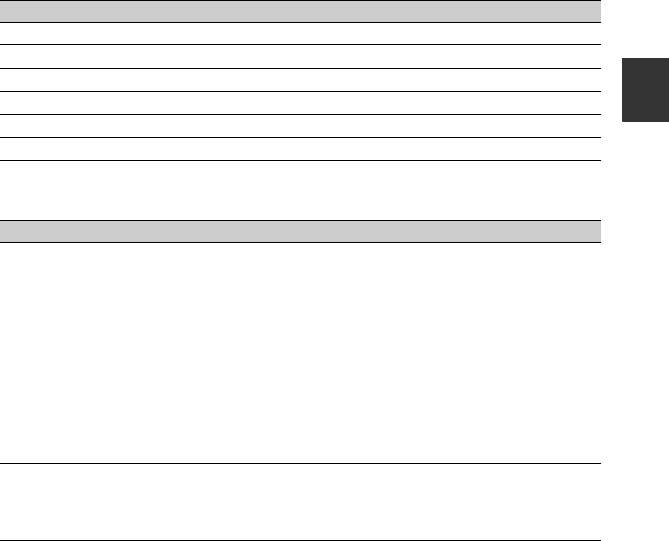
[MASTER BLACK] Sets the master black level.
-15 to +15
[BLACK R] Sets the black level of Rch.
[MASTER BLACK] + [BLACK R] is the black level of Rch.
-15 to +15
[BLACK G] Sets the black level of Gch.
[MASTER BLACK] + [BLACK G] is the black level of Gch.
-15 to +15
[BLACK B] Sets the black level of Bch.
[MASTER BLACK] + [BLACK B] is the black level of Bch.
-15 to +15
Item Description and settings
[STANDARD] Standard gamma curve
[CINEMATONE1] Gamma curve 1 for producing tone of film camera images
[CINEMATONE2] Gamma curve 2 for producing tone of film camera images
[ITU709] Gamma curve that corresponds to ITU-709. Gain in low intensity area:
4.5
[G5.0] Gamma curve with 5.0 of a low intensity area gain
[PD] Gamma curve for producing tone similar to DCR-PD series
[x.v.] Gamma curve similar to x.v.Color
Item Description and settings
[RANGE] Selects a correcting range.
HIGH / MIDDLE / LOW
[LEVEL] Sets the correcting level.
-7 (maximum black compression) to +7 (maximum black stretch)
Continued ,
38
KNEE
To set knee point and slope for video signal compression to reduce over-highlighting by
limiting signals in high contrast area of the subject to the dynamic range of your camcorder.
COLOR MODE
To set type and level of colors.
COLOR LEVEL
To set the color level.
COLOR PHASE
To set the color phase.
Item Description and settings
[MODE] Selects a mode either automatic or manual.
[AUTO] : to set the knee point and slope automatically.
[MANUAL] : to set the knee point and slope manually.
[AUTO SET] Sets the maximum point and sensitivity in the automatic mode.
[MAX POINT] : Sets the maximum point.
90% to 100%
[SENSITIVITY] : Sets the sensitivity.
HIGH/MIDDLE/LOW
[MANUAL SET] Sets the knee point and slope manually.
[POINT] : Sets the knee point.
75% to 105%
[SLOPE] : Sets the knee slope.
-5(gentle) to +5(steep)
Item Description and settings
[TYPE] Selects a type of colors.
[STANDARD] : Standard colors
[CINEMATONE1] : Film camera image-like colors good with
[GAMMA] set to [CINEMATONE1]
[CINEMATONE2] : Film camera image-like colors good with
[GAMMA] set to [CINEMATONE2]
[ITU709 MTX] : Colors corresponding to ITU-709
[LEVEL] Sets a color level when you set [TYPE] to the settings other than
[STANDARD].
1 (close to color settings of [STANDARD]) to 8 (color settings of the
selected type)
Item Description and settings
-7 (light) to +7 (dark), -8: black and white
Item Description and settings
-7 (greenish) to +7 (reddish)
Changing the settings of your camcorder recordings (Continued)
39
Recording/Playback
COLOR DEPTH
To set the color depth for each color phase.
This function is more effective for chromatic colors and less effective for achromatic colors.
The color looks deeper as you increase the setting value to more positive side, and lighter as
you decrease the value to more negative side. This function is effective even if you set
[COLOR LEVEL] to [-8] (monotone).
COLOR CORRCT
To set items for the color correction.
Item Description and settings
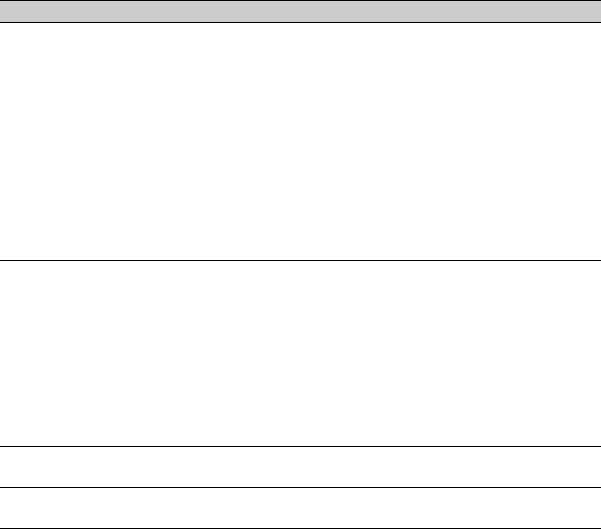
[R] -7 (light red) to +7 (deep red)
[G] -7 (light green) to +7 (deep green)
[B] -7 (light blue) to +7 (deep blue)
[C] -7 (light cyan) to +7 (deep cyan)
[M] -7 (light magenta) to +7 (deep magenta)
[Y] -7 (light yellow) to +7 (deep yellow)
Item Description and settings
[TYPE] Selects color correction type.
[OFF] : Not correct colors.
[COLOR REVISN] : Corrects colors stored in memory. Colors not
stored in memory (displayed in black and
white when [COLOR EXTRCT] is set) will
not be corrected.
[COLOR EXTRCT] : Displays areas in colors that are stored in the
memory.
The other areas are displayed in black and
white. You can use this function to add effects
on your movies or to confirm the colors to be
stored in the memory.
[MEMORY SEL] Selects a memory to be effective.
[1]: Sets Memory 1 to be effective.
[2]: Sets Memory 2 to be effective.
[1&2]: Sets both Memory 1 and 2 to be effective.
Continued ,
40
COLOR CORRCT (Continued)
zTips
• Setting both memories to the same setting doubles the color correction effect.
• The settings of [COLOR CORRCT] will be retained even if the power is turned off. However, if you want
to correct colors that may change according to time of the day, weather, location, etc., it is recommended
that you set [COLOR CORRCT] again prior to recording.
• If you change the white balance value or the settings of [WB SHIFT], [COLOR LEVEL] or [COLOR
PHASE] of the picture profile, the settings of [RANGE] and [PHASE] of the selected memory will
change. When you change the white balance value or the settings of the above picture profile items after
you have set [RANGE] and [PHASE], check the settings of [COLOR CORRCT] prior to recording.
• During the automatic white balance adjustment, the white balance value automatically varies according to
the lighting conditions of your recording environment. The manual white balance adjustment is
recommended when you use [COLOR CORRCT].
Item Description and settings
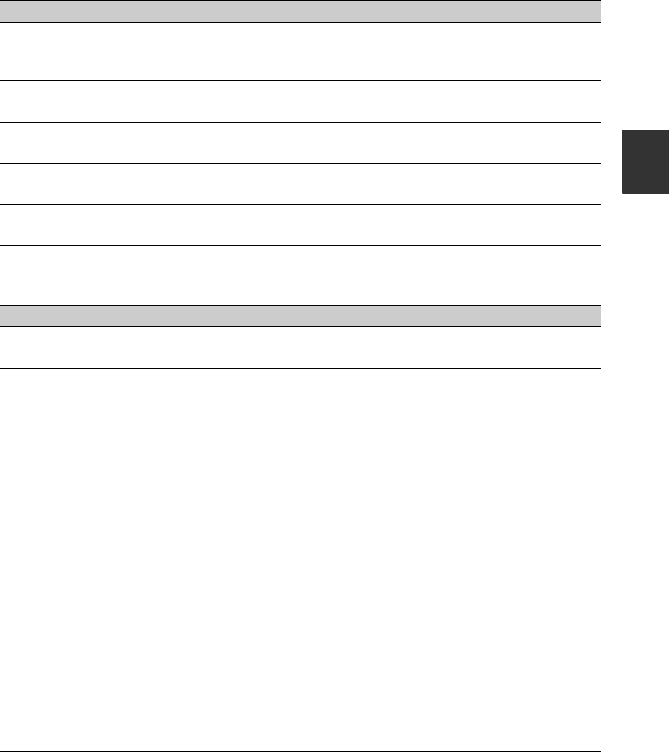
[MEM1 COLOR] Sets colors stored in Memory 1.
[PHASE] : Sets color phase.
0 (purple) t 8 (red) t 16 (yellow) t
24 (green) t 31 (blue)
[RANGE] : Sets color phase range.
0 (no color selection), 1 (narrow: to select only a
single color) to 31 (wide: to select multiple colors
in similar color phase)
[SATURATION] : Sets saturation.
0 (to select from light colors to dark colors) to 31
(to select dark color)
[ONE PUSH SET]: Automatically sets [PHASE] for a subject at the
center of the marker. [SATURATION] is set to 0.
[MEM1 REVISN] Corrects colors in Memory 1.
[R GAIN] : Corrects the redness of the color in Memory 1.
Tone of cyan becomes higher as the redness decreases.
-15 (less reddish) to +15 (more reddish)
0 for no correction
[B GAIN] : Corrects the blueness of the color in Memory 1.
Tone of yellow becomes higher as the blueness
decreases.
-15 (less bluish) to +15 (more bluish)
0 for no correction
[MEM2 COLOR] Sets colors stored in Memory 2.
See [MEM1 COLOR] for description and settings.
[MEM2 REVISN] Corrects colors in Memory 2.
See [MEM1 REVISN] for description and settings.
Changing the settings of your camcorder recordings (Continued)
41
Recording/Playback
WB SHIFT
To set items for the white balance shift.
DETAIL
To set items for the detail.
Item Description and settings
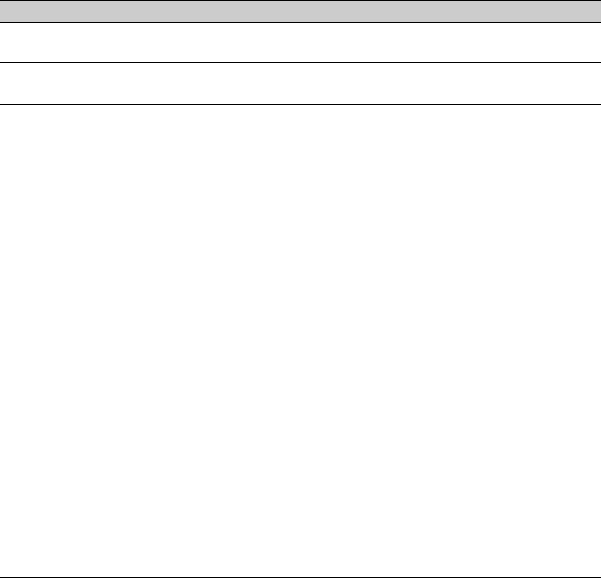
[FILTER TYPE] Selects a color filter type for the white balance shift.
[LB-CC] : Film type (color conversion and correction)
[R-B] : Video type (correction of R and B levels)
[LB[COL TEMP]] Sets a color temperature offset value.
-9 (bluish) to +9 (reddish)
[CC[MG/GR]] Sets a color correct offset value.
-9 (greenish) to +9 (magentish)
[R GAIN] Sets an R level.
-9 (low R level) to +9 (high R level)
[B GAIN] Sets a B level.
-9 (low B level) to +9 (high B level)
Item Description and settings
[LEVEL] Sets the detail level.
-7 to +7
[MANUAL SET] [ON/OFF] : Turns on and off the manual detail adjustment.
[ON] : Enables the manual detail adjustment (automatic
optimization will not be performed).
[OFF] : Disables the manual detail adjustment.
[V/H BALANCE] : Sets the horizontal (H) and vertical (V) balance of
detail.
[B/W BALANCE]: Selects the balance of the upper DETAIL (P) and
the lower DETAIL (N).
TYPE 1 (off to the lower DETAIL (N) side) to
TYPE 5 (off to the upper DETAIL (P) side)
[BLACK LIMIT] : Sets the limit level of the lower DETAIL (N).
0 (Low limit level: likely to be limited) to 7 (High
limit level: not likely to be limited)
[WHITE LIMIT] : Sets the limit level of the upper DETAIL (P).
0 (Low limit level: likely to be limited) to 7 (High
limit level: not likely to be limited)
[CRISPENING] : Sets the crispening level.
0 (shallow crispening level) to 7 (deep crispening
level)
[HI-LIGHT DTL] : Sets the DETAIL level in the high intensity areas.
-2 to +2
Continued ,
42
SKINTONE DTL
To adjust the detail of skintone areas to reduce wrinkles.
PROFILE NAME
To name the picture profiles set in [PP1] through [PP6] (p. 43).
COPY
To copy the settings of the picture profile to another picture profile number.
RESET
To reset the picture profile to the default setting.
Item Description and settings
[ON/OFF] Suppresses details in skin-tone areas to reduce wrinkles. Select [ON]
when you want to use this function. You can also select other areas.
[LEVEL] Sets the adjustment level.
1 (less adjust the detail) to 8 (more adjust the detail)
[COLOR SEL] Sets color items for the detail adjustment.
[PHASE] : Sets the color phase.
0 (purple) t 32 (red) t 64 (yellow) t
96 (green) t 127 (blue)
[RANGE] : Sets the color range.
0 (selects no color), 1 (narrow: selects a single
color) to 31 (wide: selects multiple colors in
similar color phases and saturation)
The detail will not be adjusted when you set
[RANGE] to 0.
[SATURATION] : Sets the color saturation.
0 (selects a light color) to 31 (selects a deep color)
[REVERSE] : Reverses the selected color range.
If you execute this function when a color has been
selected, colors that were not selected will be
selected instead.
[Y LEVEL] : Sets the color brightness.
0 (selects a dark color) to 31 (selects a bright
color)
[Y RANGE] : Sets the color brightness range.
1 (narrows the brightness range) to 32 (expands
the brightness range)
[ONE PUSH SET]: Automatically adjusts [PHASE],
[SATURATION] and [Y LEVEL] for a subject at
the center of the marker. [RANGE] and
[Y RANGE] will not be changed.
Changing the settings of your camcorder recordings (Continued)
43
Recording/Playback
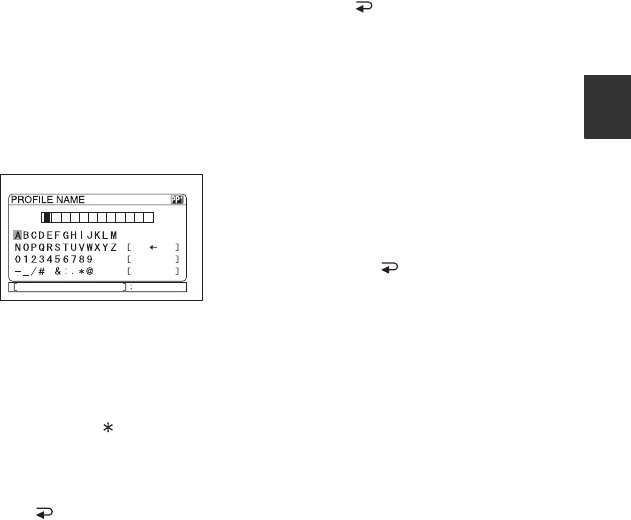
To name the picture profile settings
You can name picture profile1 through 6.
1Press the PICTURE PROFILE button
B.
2Select the picture profile that you want
to name with the SEL/PUSH EXEC dial
A.
3Select [SETTING] t [PROFILE
NAME] with the SEL/PUSH EXEC dial
A.
4Select a letter with the SEL/PUSH
EXEC dial A. Repeat this operation
until a complete name is entered.
zTips
• Each name can be up to 12 characters long.
Characters that can be used in profile
names:
•A to Z
•0 to 9
• - _ / # & : . @
5Select [OK] with the SEL/PUSH EXEC
dial A.
The profile name is changed.
6Select [ RETURN] t [OK] with
the SEL/PUSH EXEC dial A.
To copy the picture profile setting to
other picture profiles
1Press the PICTURE PROFILE button
B.
2Select the picture profile that you want
to copy from with the SEL/PUSH
EXEC dial A.
3Select [SETTING] t [COPY] with
SEL/PUSH EXEC dial A.
4Select the number of the picture profile
that you want to copy to with the SEL/
PUSH EXEC dial A.
5Select [YES] with the SEL/PUSH
EXEC dial A.
6Select [ RETURN] t [OK] with the
SEL/PUSH EXEC dial A.
To reset the picture profile settings
You can reset the picture profile settings by
each picture profile number. You cannot
reset all picture profile settings at once.
1Press the PICTURE PROFILE button
B.
2Select the number of the picture profile
that you want to reset with the SEL/
PUSH EXEC dial A.
3Select [SETTING] t [RESET] t
[YES] t [ RETURN] t [OK]
with the SEL/PUSH EXEC dial A.
CANCEL
OK
P I CTURE PROF I LE END
PICT. PROFILE
Continued ,
44
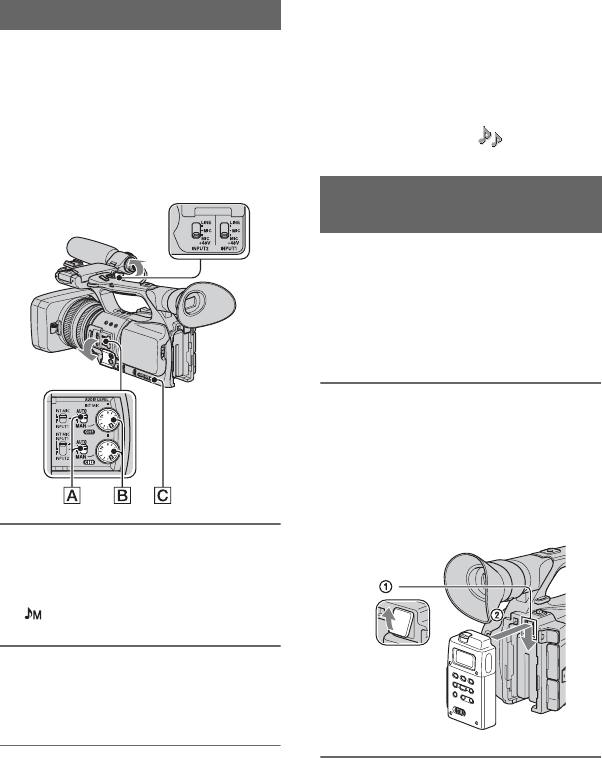
You can adjust the volume of an internal
microphone or a microphone connected to
the INPUT1/INPUT2 jack.
zTips
• See page 10 for details on attaching the supplied
microphone, and on the CH1 (INT MIC/
INPUT1) and the CH2 (INT MIC/INPUT1/
INPUT2) switches.
1Set the AUTO/MAN (CH1/CH2)
switch A of the channel to be
adjusted to MAN.
appears on the screen.
2Turn the AUDIO LEVEL dial B to
adjust the volume during
recording or standby.
To restore automatic adjustment
Set the AUTO/MAN (CH1/CH2) switch A of
the manually adjusted channel to AUTO.
zTips
• To check other audio settings, press the
STATUS CHECK button C.
• For other settings, see the (AUDIO SET)
menu (p. 77).
You can attach an optional Memory
Recording Unit HVR-MRC1 to your
camcorder for recording. To attach it to
your camcorder, do the following.
Refer to the Memory Recording Unit
operating instructions for details on its
operation.
Remove the Memory Recording Unit
jack cover (1). Insert the terminal of
the Memory Recording Unit in the
Memory Recording Unit jack and
slide the unit down (2).
Adjusting the volume
Attaching a Memory Recording
Unit
Changing the settings of your camcorder recordings (Continued)

45
Recording/Playback
To remove the Memory Recording
Unit
Slide the Memory Recording Unit upward while
pushing its RELEASE lever downward.
bNotes
• You cannot use the HDV/DV jack when the
Memory Recording Unit is attached to your
camcorder.
• When you use the Memory Recording Unit, set
appropriate items in [EXT REC CTRL] of the
(IN/OUT REC) menu (p. 88).
46
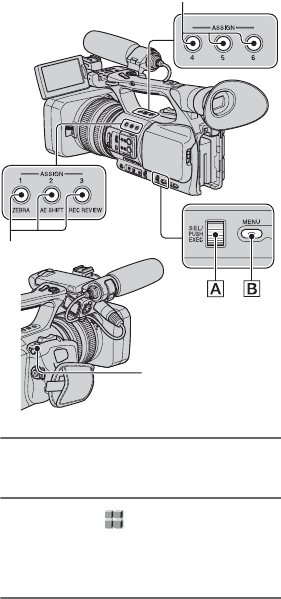
Assigning the functions to the ASSIGN buttons
Some functions need to be assigned to the
ASSIGN buttons for use. You can assign a
single function to any one of the ASSIGN 1
to 7 buttons.
Functions you can assign to the
ASSIGN buttons
The buttons in parentheses indicate that the
functions are assigned to the buttons by
default.
• EXP.FOCUS (p. 30)
• FOCUS MACRO (p. 73)
• D.EXTENDER (p. 73)
• RING ROTATE (p. 69)
• HYPER GAIN (p. 70)
• AE SHIFT (p. 71) (ASSIGN 2 button)
• PUSH AT IRIS (p. 30)
• INDEX MARK (p. 47)
• STEADYSHOT (p. 72)
• BACK LIGHT (p. 72)
• SPOTLIGHT (p. 72)
• FADER (p. 73)
• SMTH SLW REC (p. 73)
• COLOR BAR (p. 76)
• LAST SCN RVW (p. 48)
• REC REVIEW (p. 48) (ASSIGN 3 button)
• END SEARCH (p. 48)
• ZEBRA (p. 80) (ASSIGN 1 button)
• MARKER (p. 81)
• PEAKING (p. 81)
• TC RESET (p. 89)
• TC COUNTUP (p. 89)
• PHOTO (p. 26) (ASSIGN 7 button)
• PICTURE PROFILE (p. 35)
• SHOT TRANSITION (p. 48)
1Press the MENU button B.
2Select the (OTHERS) t
[ASSIGN BTN] with the SEL/PUSH
EXEC dial A.
3Select the ASSIGN button to
which you want to assign a
function with the SEL/PUSH
EXEC dial A.
• [------] appears if no function is assigned to
the ASSIGN button.
• Select [YES] when you select [SHOT
TRANSITION], then do step 5.
ASSIGN 1-3 buttons
ASSIGN 4-6 buttons
ASSIGN 7/PHOTO
button
47
Recording/Playback
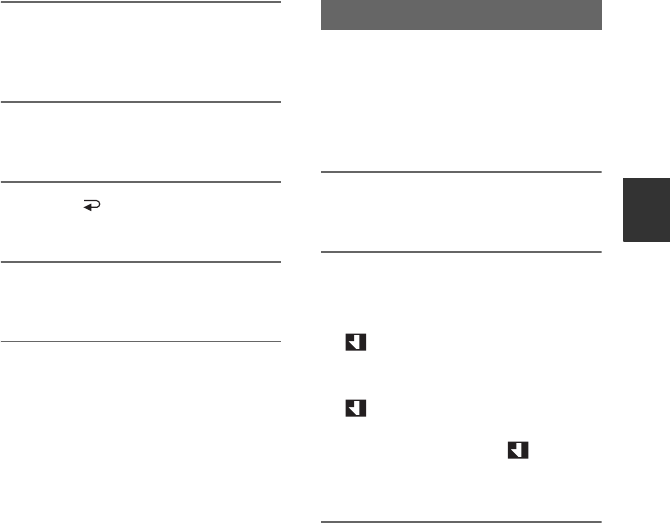
4Select the function that you want
to assign with the SEL/PUSH
EXEC dial A.
5Select [OK] with the SEL/PUSH
EXEC dial A.
6Select [ RETURN] with the SEL/
PUSH EXEC dial A.
7Press the MENU button B to hide
the menu screen.
zTips
• Shot transition is assigned to the ASSIGN
4, 5 and 6 buttons (p. 48). Cancel the shot
transition assignment to return to the pre-
setting assignment.
• To cancel the shot transition, select
[SHOT TRANSITION] t [YES] in step
3.
If you record a scene with an index signal,
you can easily find that scene during
playback (p. 56).
The index function will make it easier to
check the transition of recording or edit
your pictures using index signals.
1Assign [INDEX MARK] to one of
the ASSIGN buttons (p. 46).
2Press the ASSIGN button to
which [INDEX MARK] is assigned.
During recording
appears for about 7 seconds and an
index signal is recorded.
During standby
flashes.
After you press the REC START/STOP
button to start recording, appears
for about 7 seconds and an index signal
is recorded.
To cancel the operation
Press the ASSIGN button to which [INDEX
MARK] is assigned again before you start
recording.
bNotes
• You cannot record an index signal on a recorded
tape afterward.
Recording an index signal
Continued ,

48
You can set your camcorder to
automatically rewind the tape to the
beginning of the most recently recorded
scene, play back to the end of the scene,
then stop the tape.
1Assign [LAST SCN RVW] to an
ASSIGN button (p. 46).
2During standby, press the
ASSIGN button to which [LAST
SCN RVW] is assigned.
The last scene review starts.
bNotes
• If the recording time of the movie is short,
[LAST SCN RVW] may not work correctly.
• [LAST SCN RVW] does not work once you
take out a tape.
zTips
• If you press the ASSIGN button again during
the last scene review, your camcorder plays
back the last 5 seconds of the most recently
recorded movie, then goes standby at the end of
the recording.
You can view about 2 seconds of the scene
recorded just before you stopped the tape.
This is convenient during playback of the
latest scene check.
Press the REC REVIEW button or the
ASSIGN button to which [REC
REVIEW] is assigned during
standby.
The last 2 seconds (approx.) of the most
recently recorded scenes will be played
back, then your camcorder returns to
standby.
1Assign [END SEARCH] to one of
the ASSIGN buttons (p. 46).
2 Press the ASSIGN button to
which [END SEARCH] is
assigned.
The last scene of the most recent
recording will be played back for about
5 seconds, and the camcorder goes
standby at the point where the last
recording has finished.
bNotes
• End search will not work once you eject the
tape.
• End search will not work correctly if a blank
section exists between recorded sections on the
tape.
You can store settings of focus, zoom, iris,
gain, shutter speed and white balance, and
smoothly shift from the current settings to
the stored settings (shot transition).
For example, you can shift the focus from
closer objects to farther objects, or change
the depth of field by adjusting the iris. You
can also develop scenes under different
Playing back the most recently
recorded movies (Last scene
review)
Reviewing the most recently
recorded scenes (Rec review)
Searching for the last scene of
the most recent recording
(End search)
Using the Shot transition
Assigning the functions to the ASSIGN buttons (Continued)
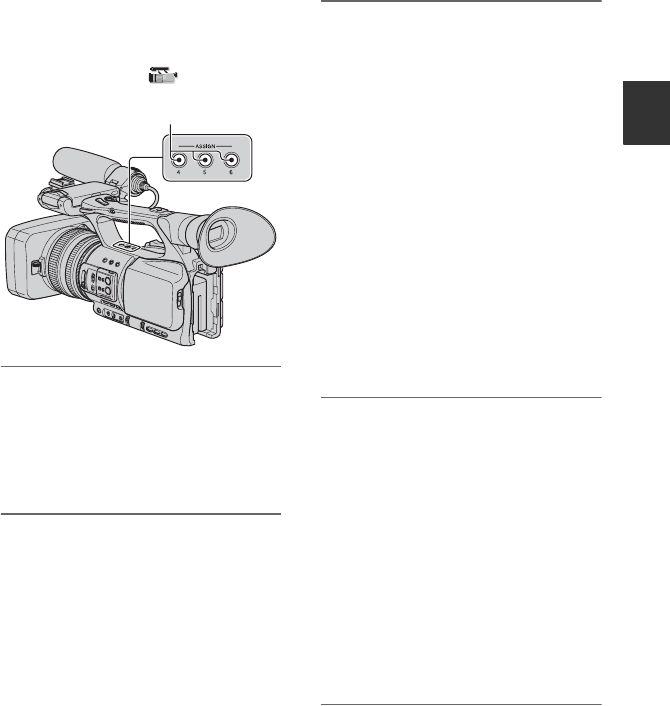
49
Recording/Playback
conditions smoothly. If you store manually
adjusted settings of white balance, you can
smoothly shift from one scene to another
under different conditions, such as from
indoor to outdoor.
Sony recommends that you use a tripod to
avoid image blurring.
You can set the items, such as transition
curve and transition time, in [SHOT
TRANSITION] of the (CAMERA
SET) menu (p. 75).
1Assign [SHOT TRANSITION] to
the ASSIGN buttons (p. 46).
zTips
• Shot transition is assigned to ASSIGN 4, 5
and 6 buttons.
2Store the settings (shot).
1Press the ASSIGN 4 button repeatedly
to bring up the SHOT TRANSITION
STORE screen.
2Manually adjust the settings.
See pages 28 to 43 for details on how to
adjust the settings manually.
3Press the ASSIGN 5 button for storing
the settings in SHOT-A, or the
ASSIGN 6 button for storing the
settings in SHOT-B.
bNotes
• The settings stored in SHOT-A or
SHOT-B will be erased when you set
the POWER switch to OFF.
3Check the stored settings.
1Press the ASSIGN 4 button repeatedly
to bring up the SHOT TRANSITION
CHECK screen.
2Press the ASSIGN 5 button to check
the SHOT-A. Press the ASSIGN 6
button to check the SHOT-B.
The image will be displayed with the
settings stored in the selected SHOT.
The focus, zoom, iris, gain, shutter
speed and white balance are
automatically adjusted to the stored
settings.
bNotes
• On the shot transition check screen,
the settings do not shift to the stored
settings of the transition time and
curve set in [TRANS TIME] and
[TRANS CURVE] (p. 75)
4Execute the shot transition.
1Press the ASSIGN 4 button repeatedly
to bring up the SHOT TRANSITION
EXEC screen.
2Press the REC START/STOP button.
3Press the ASSIGN 5 button for
recording with SHOT-A, or the
ASSIGN 6 button for recording with
SHOT-B.
The settings shift from the current ones
to the stored ones.
zTips
• Press the ASSIGN 4 button repeatedly to
cancel the shot transition.
ASSIGN 4 - 6 buttons
Continued ,
50
bNotes
• When you change [SHOT TRANSITION]
(p. 48), press the ASSIGN 4 button repeatedly
to exit the shot transition screen.
• You cannot return from the stored SHOT-A or
SHOT-B settings to previous settings after you
execute the shot transition during recording.
• If you press the following buttons during the
shot transition operation, the operation will be
canceled:
– PICTURE PROFILE button
– MENU button
– ASSIGN button to which [EXP.FOCUS] is
assigned
– STATUS CHECK button
– ASSIGN button to which [SMTH SLW REC]
is assigned
• You can also make a transition from the SHOT-
A to the SHOT-B or from the SHOT-B to the
SHOT-A. For example, to make a transition
from the SHOT-A to the SHOT-B, display the
shot transition check screen, press the ASSIGN
5 button to bring up the SHOT-A and press the
REC START/STOP button. Then, display the
shot transition execution screen and press the
ASSIGN 6 button.
• You can rehearse the shot transition by pressing
the respective buttons (ASSIGN 5 or ASSIGN
6) to which your customized settings are
assigned before pressing the REC START/
STOP button in step 4.
To cancel the operation
Press the ASSIGN 4 button repeatedly to
exit the shot transition screen.
Assigning the functions to the ASSIGN buttons (Continued)
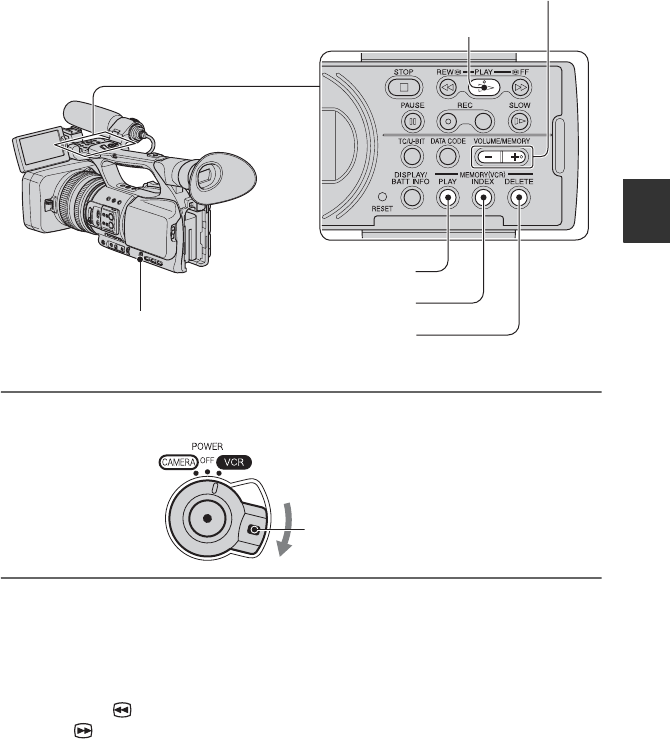
51
Recording/Playback
Playback
You can play back movies as follows:
1Slide the POWER switch to VCR while pressing the green button.
2Start playing back.
Press m (rewind) to go to the point you want to view, then press N (play) to start
playback.
•x : STOP
•X : PAUSE (Press N or X again to restart the playback)
•m : REW (Rewind, review)
•M : FF (Cue, fast forward)
•y : SLOW
bNotes
• Your camcorder automatically goes into a stopped state when it is in pause for more than 3 minutes.
• The screen may temporarily go blank losing images and sound when signals switch between HDV
and DVCAM (DV) during playback of a tape in which HDV format and DVCAM (DV) format are
mixed.
PLAY button
MEMORY/INDEX button
SEL/PUSH EXEC dial MEMORY/DELETE button
MEMORY/PLAY button
VOLUME/MEMORY button
Slide the POWER
switch while pressing
the green button.
Continued ,
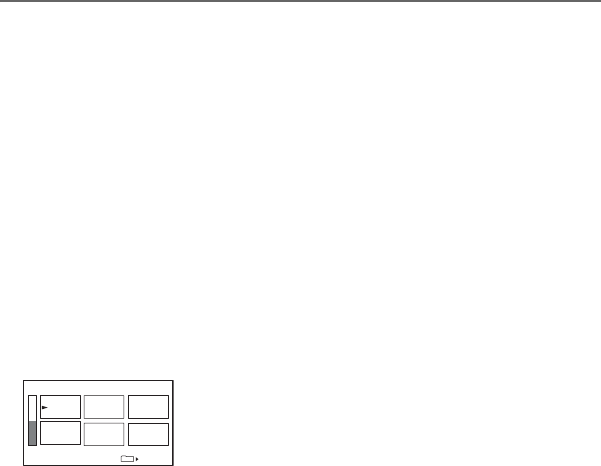
52
• You cannot play back movies recorded in HDV format on DVCAM (DV) format video cameras or
mini DV players.
• You can play back a DV format tape on your camcorder only when its contents are recorded in the SP
mode. You cannot play back movies recorded on the DV format tape in the LP mode.
• Time code and user bits will not be displayed correctly when you play back a tape with no time code
or user bit data, or a tape with time code that your camcorder does not support.
zTips
• See page 142 for indicators displayed on the screen during playback.
• See page 55 for how to switch displays during playback.
To search for a scene while viewing a movie
Press and hold m/M during playback (Picture Search). To view during fast forward, press
and hold M. To view during rewind, press and hold m (Skip Scan).
To adjust the volume
Adjust the volume with the VOLUME/MEMORY button.
To view still images
1Set the POWER switch to VCR.
2Press the MEMORY/PLAY button.
3Select still image that you want to view using the VOLUME/MEMORY button.
To stop viewing still images, press the MEMORY/PLAY button again.
To display the list of still images (index screen)
1Set the POWER switch to VCR.
2Press the MEMORY/INDEX button.
3Select a still image using the VOLUME/MEMORY button.
To display a single image, move B to that image and press the MEMORY/PLAY button.
To stop displaying the list of still images, press the MEMORY/INDEX button again.
1/19
101–0050
101
Playback (Continued)

53
Recording/Playback
To delete still images from the “Memory Stick Duo”
1Do the steps of “To view still images” to display still images that you want to delete.
2Press the MEMORY/DELETE button.
3Select [YES] with the SEL/PUSH EXEC dial.
The still image will be deleted.
bNotes
• Still images cannot be restored once you delete them.
• You cannot delete still images when the “Memory Stick Duo” is write-protected (p. 122) or the still image
is protected (p. 107).
zTips
• To delete a still image in the index, move B to the still image using the VOLUME/MEMORY button,
then do steps 2 and 3.
• To delete all still images, do [ ALL ERASE] of the (MEMORY SET) menu (p. 91).
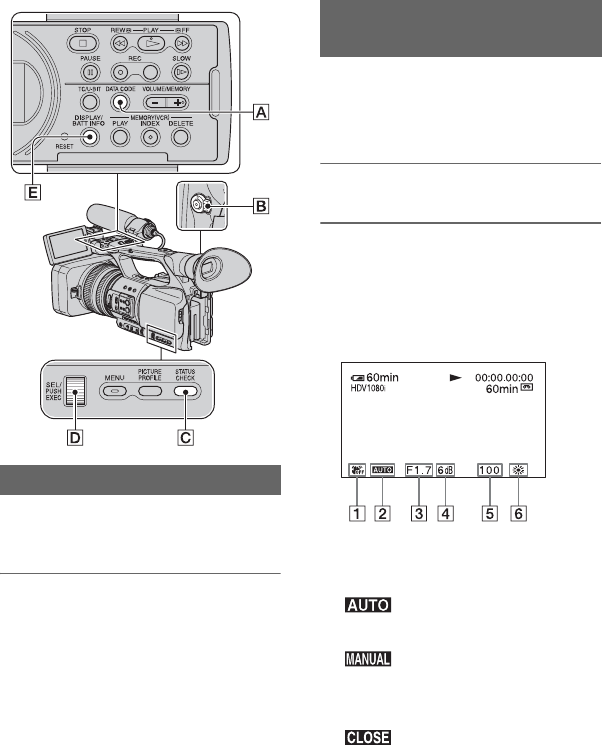
54
Changing/checking the settings in your
camcorder
You can turn on and off the display of the
time code, tape counter, and other
information on the screen.
Press the DISPLAY/BATT INFO
button E.
The screen indicators turn on (displayed)
and off (not displayed) as you press the
button.
When the POWER switch is set to
CAMERA, the screen changes (detailed
display t simple display t no display) as
you press the button.
zTips
• You can display the screen indicators during
playback on a TV. Select [V-OUT/PANEL] or
[ALL OUTPUT] of [DISP OUTPUT] (p. 84).
You can display information, including
date, time and camera data, automatically
stored during recording on the screen
during playback.
1Set the POWER switch B to VCR.
2Press the DATA CODE button A
during playback or pause.
The screen changes (date and time
display t camera data display t no
display) as you press the button.
ASteadyShot off
BExposure
appears during playback of the
movie recorded with the iris, gain and
shutter speed automatically adjusted.
appears during playback of the
movie recorded with the iris, gain and
shutter speed manually adjusted.
CIris
appears in the iris value display
area during playback of the movie
recorded with the iris manually adjusted
to its maximum value.
DGain
Changing the screen
Displaying recording data (Data
code)
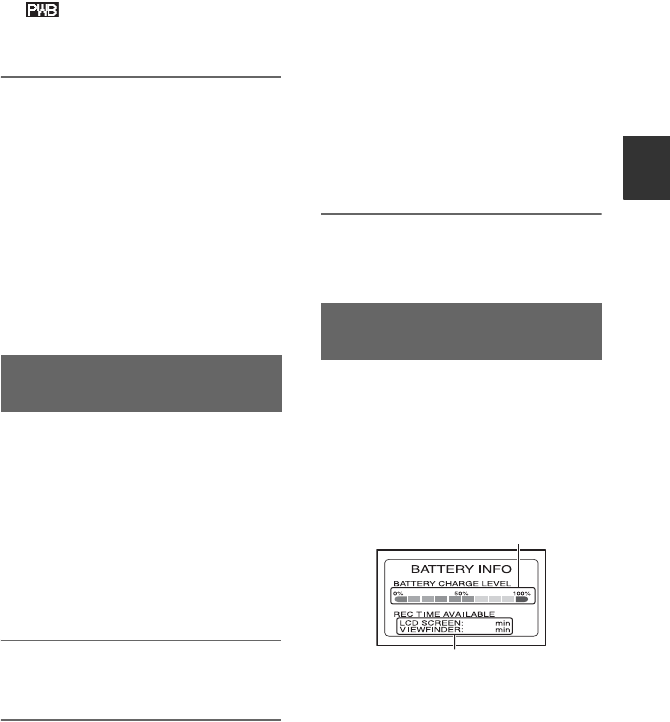
55
Recording/Playback
EShutter speed
FWhite balance
appears during playback of the
movie recorded with the shot transition
or [MANU WB TEMP].
bNotes
• The exposure correction value (0EV), shutter
speed and iris will be displayed during viewing
of still images on “Memory Stick Duo.”
• Date and time will be displayed in the same area
when you select the date and time display. If
you record without setting date and time, [--- --
----] and [--:--:--] will be displayed.
• An accurate shutter speed may not be displayed
when you play back a tape recorded with your
camcorder on another device. Check the data
code that is displayed on the screen when you
play back the tape on your camcorder for the
accurate shutter speed.
You can check the settings of the following
items.
• Audio setup such as microphone volume level
(p. 44, 77)
• Output signal setup ([VCR HDV/DV], etc.)
(p. 85)
• Functions assigned to the ASSIGN buttons
(p. 46)
• Camera setup (p. 69)
• Optional external recording unit HVR-MRC1 or
HVR-DR60
1Press the STATUS CHECK button
C.
2Turn the SEL/PUSH EXEC dial D
until a desired display shows up
on the screen.
When the POWER switch B is set to
CAMERA, the display changes in the
following sequence:
AUDIO t OUTPUT t ASSIGN t
CAMERA t EXT DEVICE (when an
external device is connected)
When the POWER switch B is set to
VCR, the display changes in the
following sequence:
AUDIO t OUTPUT t ASSIGN t
EXT DEVICE (when an external device
is connected)
To hide the display
Press the STATUS CHECK button C.
Set the POWER switch B to OFF, then
press the DISPLAY/BATT INFO button
E. The approximate recordable time in the
selected format and battery information
appear for about 7 seconds. You can view
the battery information for up to 20 seconds
by pressing the button again while the
information is displayed.
Displaying the settings in your
camcorder (Status check)
Checking the remaining battery
(Battery Info)
65
60
Remaining battery (approx.)
Recording capacity (approx.)
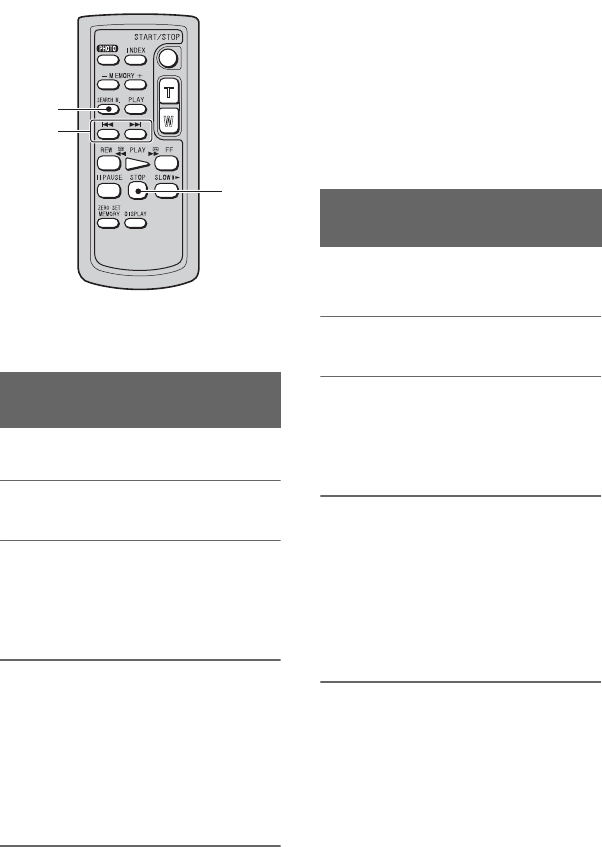
56
Locating a scene on a tape
bNotes
• See page 139 for details on how to use the
Remote Commander.
You can search scenes by recording dates.
1Set the POWER switch to VCR.
2Press the SEARCH M. button A
on the Remote Commander
repeatedly to select [DATE
SEARCH].
3Press the . (previous)/>
(next) button B on the Remote
Commander to select a recording
date.
You can select a date previous or next to
the date of the current tape position.
Playback automatically starts from the
scene recorded on the selected date.
To cancel the operation
Press the STOP button C on the Remote
Commander.
bNotes
• Each day of recording must be longer than 2
minutes. Your camcorder may not detect the
date if the recording of that date is short.
• The date search may not work properly if a
blank section exists on the tape.
You can search scenes by indexes recorded
at the start of recording (p. 47).
1Set the POWER switch to VCR.
2Press the SEARCH M. button A
on the Remote Commander
repeatedly to select [INDEX
SEARCH].
3Press the . (previous)/>
(next) button B on the Remote
Commander to select an index
point.
You can select an index previous or next
to the index of the current tape position.
Playback automatically starts from the
scene marked by the index.
Searching for a scene by date of
recording (Date search)
C
A
B
Searching for a recording start
point (Index search)

57
Recording/Playback
To cancel the operation
Press the STOP button C on the Remote
Commander.
bNotes
• Recording between indexes must be longer than
2 minutes. Your camcorder may not detect the
date if the recording between the indexes is
short.
• The index search may not work properly if a
blank section exists on the tape.
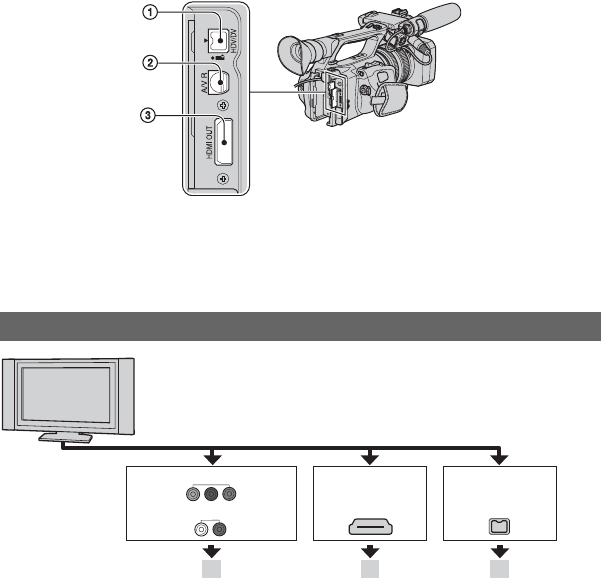
58
Playing the picture on a TV
Connection methods and image quality differ depending on what type of TV is connected and
connectors used.
Use the supplied AC Adaptor/Charger to obtain AC power (p. 13).
Refer also to the instruction manuals supplied with the device to be connected.
Jacks on your camcorder
Open the jack cover and connect the cable.
bNotes
• Set all the necessary menu items before you connect your camcorder to a TV. If you change the settings of
[VCR HDV/DV] or [i.LINK SET] after connecting your camcorder to the TV with an i.LINK cable, the
TV may not recognize video signals properly.
Connecting to a high definition TV
B CA
HDMI i.LINK
COMPONENT IN
AUDIO
A movie recorded in HD quality is played back in HD quality.
A movie recorded in SD quality is played back in SD quality.
HDMI i.LINK
(for HDV1080i)
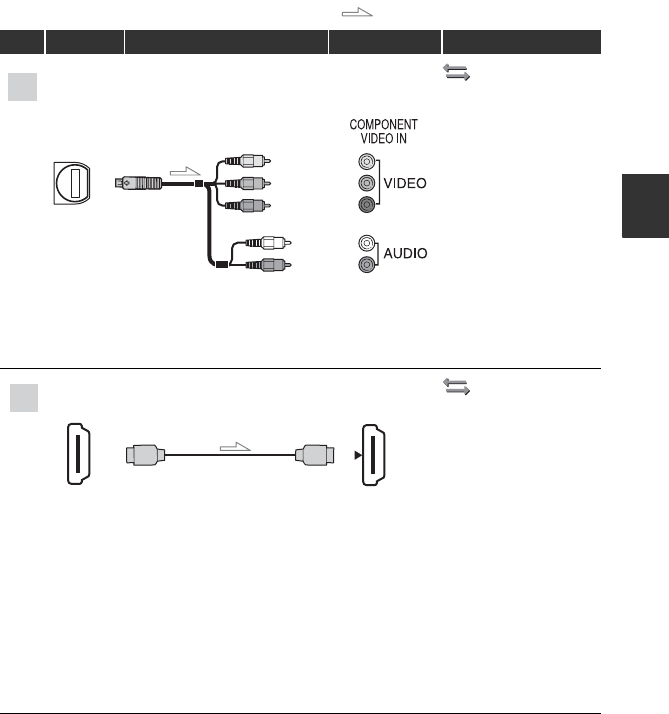
59
Recording/Playback
: Signal flow, ( ): Reference pages
Type Camcorder Cable TV Menu Setting
(IN/OUT REC)
[VCR HDV/DV] t
[AUTO] (85)
[VIDEO OUT] t
[COMPONENT] t
[1080i/480i] (87)
bNotes
• If you connect only component video plugs, audio signals are not output. Connect the white and red plugs
to output audio signals.
(IN/OUT REC)
[VCR HDV/DV] t
[AUTO] (85)
bNotes
• Use an HDMI cable with the HDMI logo.
• Pictures in the DVCAM (DV) format are not output from the HDMI OUT jack, if copyright protection
signals are recorded in the pictures.
• DVCAM (DV) format pictures input to the camcorder via i.LINK cable (p. 100) cannot be output.
• Your TVs may not function correctly (for example, no sound or image). Do not connect the HDMI OUT
jack of your camcorder and HDMI OUT jack of the external device with the HDMI cable. This may cause
a malfunction.
zTips
• HDMI (High-Definition Multimedia Interface) is an interface to send both video and audio signals.
Connecting HDMI OUT jack to an external device supplies high quality images and digital audio to you.
A
2
Component A/V cable
(supplied)
(Green) Y
(Blue) P
B
/C
B
(Red) P
R
/C
R
(Red)
(White)
HDMI
IN
B
3
HDMI cable (optional)
HDMI
IN
Continued ,
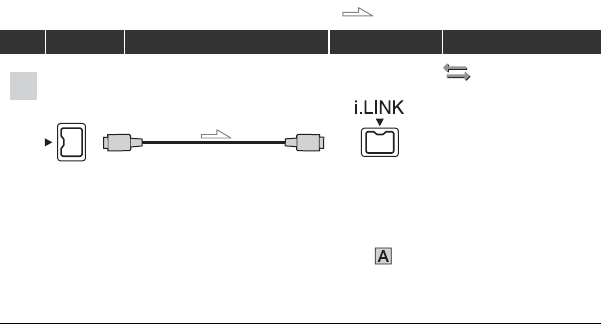
60
(IN/OUT REC)
[VCR HDV/DV] t
[AUTO] (85)
[i.LINK SET] t [HDV
t DV CONV] t [OFF]
(87)
bNotes
• Your TV needs to have an i.LINK jack compatible with HDV1080i. For details, confirm the
specifications of your TV.
• If your TV is not compatible with HDV1080i, connect your camcorder and TV with the supplied
component A/V cable and A/V connecting cable as illustrated in .
• The TV needs to be set so that it recognizes that the camcorder is connected. Refer to the instruction
manuals supplied with your TV.
• This camcorder has a 4-pin i.LINK terminal. Select a cable that fits the terminal on the TV to be attached.
: Signal flow, ( ): Reference pages
Type Camcorder Cable TV Menu Setting
C1
i.LINK cable (optional)
Playing the picture on a TV (Continued)
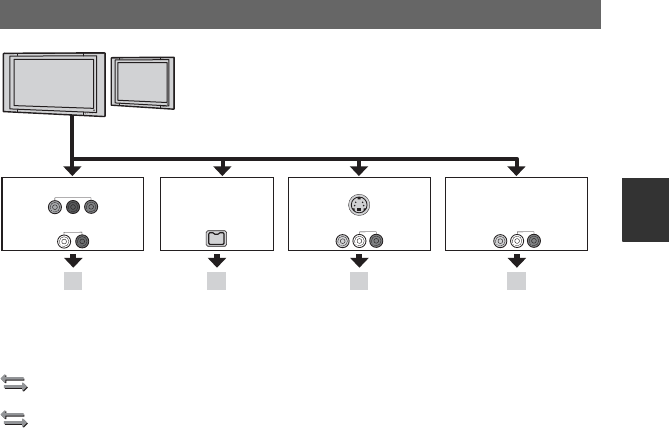
61
Recording/Playback
To set the aspect ratio according to the connected TV (16:9/4:3)
Set the down-convert setting as follows:
For HDV format signals:
(IN/OUT REC) menu t [VIDEO OUT] t [DOWN CONVERT]
For DV format signals:
(IN/OUT REC) menu t [VIDEO OUT] t [DV WIDE CONV]
zTips
• When your TV is monaural (When your TV has only one audio input jack), connect the yellow plug of the
A/V connecting cable to the video input jack and connect the white (left channel) or the red (right
channel) plug to the audio input jack of your TV or VCR. When you want to play back the sound in
monaural mode, use a connecting cable for that purpose.
Connecting to a 16:9 (wide) or 4:3 TV
E F G
S VIDEO VIDEO/AUDIO
VIDEO/AUDIO
i.LINK
D
COMPONENT IN
AUDIO
A movie recorded in HD quality is converted and played
back in SD quality. A movie recorded in SD quality is played
back in SD quality.
S VIDEOi.LINK
Continued ,
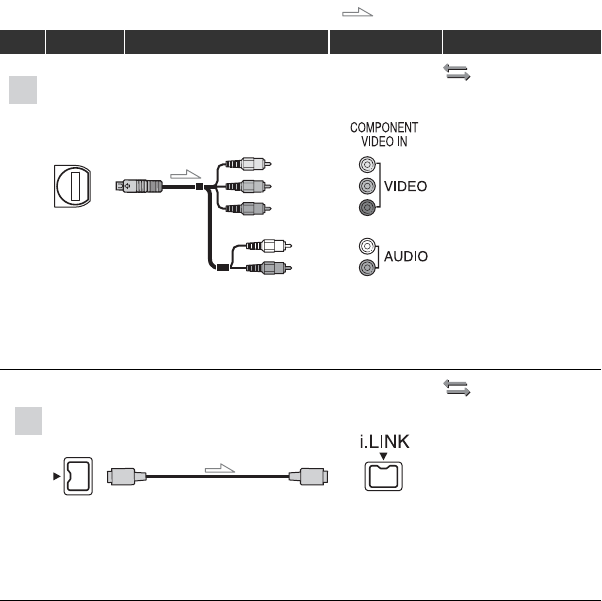
62
: Signal flow, ( ): Reference pages
Type Camcorder Cable TV Menu Setting
(IN/OUT REC)
[VCR HDV/DV]
t[AUTO] (85)
[VIDEO OUT]
t[COMPONENT]
t[1080i/480i] (87)
[VIDEO OUT]
t[DOWN CONVERT]/
[DV WIDE CONV]
t[SQUEEZE]/
[LETTER BOX]/[EDGE
CROP]* (87)
bNotes
• If you connect only component video plugs, audio signals are not output. Connect the white and red plugs
to output audio signals.
(IN/OUT REC)
[VCR HDV/DV] t
[AUTO] (85)
[i.LINK SET] t [HDV
t DV CONV] t [ON]
(87)
bNotes
• The TV needs to be set so that it recognizes that the camcorder is connected. Refer to the instruction
manuals supplied with your TV.
• This camcorder has a 4-pin i.LINK terminal. Select a cable that fits the terminal on the TV to be attached.
*Change the settings according to the TV connected.
D
2
Component A/V cable
(supplied)
(Green) Y
(Blue) P
B
/C
B
(Red) P
R
/C
R
(Red)
(White)
1
E
i.LINK cable (optional)
Playing the picture on a TV (Continued)
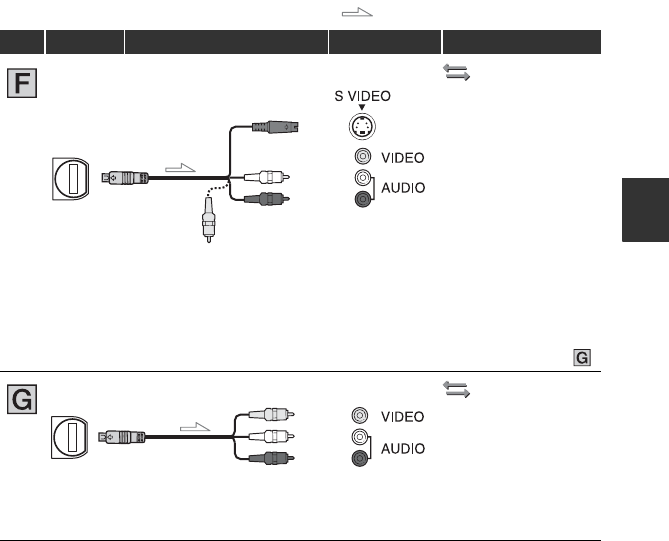
63
Recording/Playback
zTips
• If you connect your camcorder to the TV using more than one type of cable to output images, the order of
priority of the TV input jacks is as follows:
HDMI t component video t SVIDEO t video.
• See page 124 for the details of i.LINK.
When connecting to your TV via a VCR
Select the connecting method on page 96 depending on the input jack of the VCR. Connect
your camcorder to the LINE IN input on the VCR using the A/V connecting cable. Set the
input selector on the VCR to LINE (VIDEO 1, VIDEO 2, etc.).
(IN/OUT REC)
[VCR HDV/DV] t
[AUTO] (85)
[VIDEO OUT] t
[DOWN CONVERT]/
[DV WIDE CONV] t
[SQUEEZE]/[LETTER
BOX]/[EDGE CROP]*
(87)
bNotes
• When connecting only an S VIDEO plug (S VIDEO channel), audio signals are not output. To output
audio signals, connect the white and red plugs of the A/V connecting cable with S VIDEO to the audio
input jack of your TV.
• This connection produces higher resolution pictures compared with the A/V connecting cable (Type ).
(IN/OUT REC)
[VCR HDV/DV] t
[AUTO] (85)
[VIDEO OUT] t
[DOWN CONVERT]/
[DV WIDE CONV] t
[SQUEEZE]/[LETTER
BOX]/[EDGE CROP]*
(87)
: Signal flow, ( ): Reference pages
Type Camcorder Cable TV Menu Setting
*Change the settings according to the TV connected.
2
A/V connecting cable with
S VIDEO (optional)
(Red)
(White)
(Yellow)
2A/V connecting cable
(supplied)
(Red)
(White)
(Yellow)
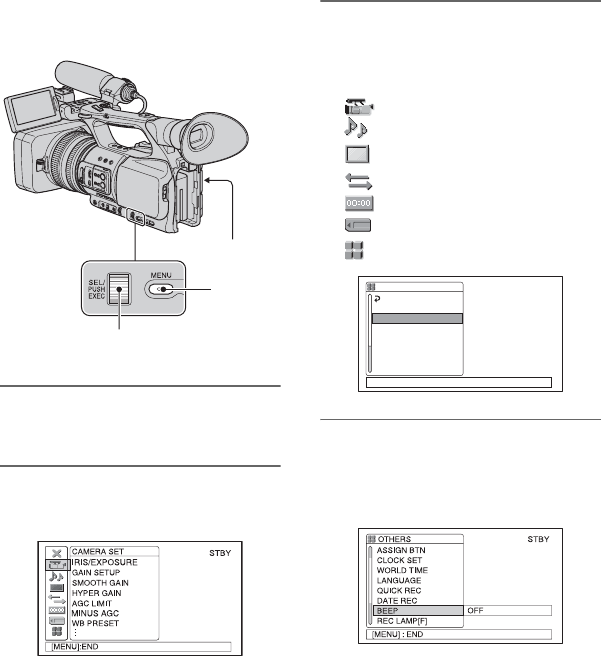
64
Using the Menu
Using the menu items
You can change various settings or make
detailed adjustments using the menu items
displayed on the screen.
1Set the POWER switch to
CAMERA or VCR.
2Press the MENU button.
The menu index screen appears.
3Turn the SEL/PUSH EXEC dial
until the icon of the desired menu
is highlighted, then press the dial
to select the menu.
CAMERA SET (p. 69)
AUDIO SET (p. 77)
DISPLAY SET (p. 80)
IN/OUT REC (p. 85)
TC/UB SET (p. 89)
MEMORY SET (p. 91)
OTHERS (p. 92)
4Turn the SEL/PUSH EXEC dial
until the desired menu item is
highlighted, then press the dial to
select the item.
The available menu items vary
depending on the position of the power
switch of your camcorder. Unavailable
items will be grayed out.
SEL/PUSH EXEC dial
MENU
button
POWER switch
OTHERS STBY
RETURN
CAMERA PROF.
ASSIGN BTN
CLOCK SET
WORLD TIME
LANGUAGE
QUICK REC
DATE REC
[MENU ]: END
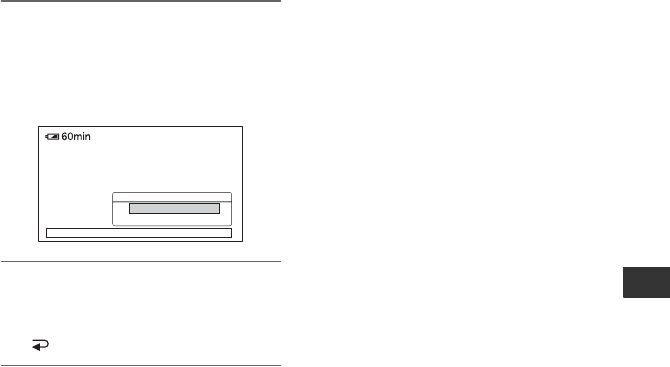
65
Using the Menu
5Turn the SEL/PUSH EXEC dial
until the desired setting is
highlighted or to bring up the
desired setting, then press the
dial to confirm the setting.
6Press the MENU button to hide
the menu screen.
To return to the previous screen, select
[ RETURN].
BEEP
[MENU ]: END
STBY 00:00:28:10
ON
OFF
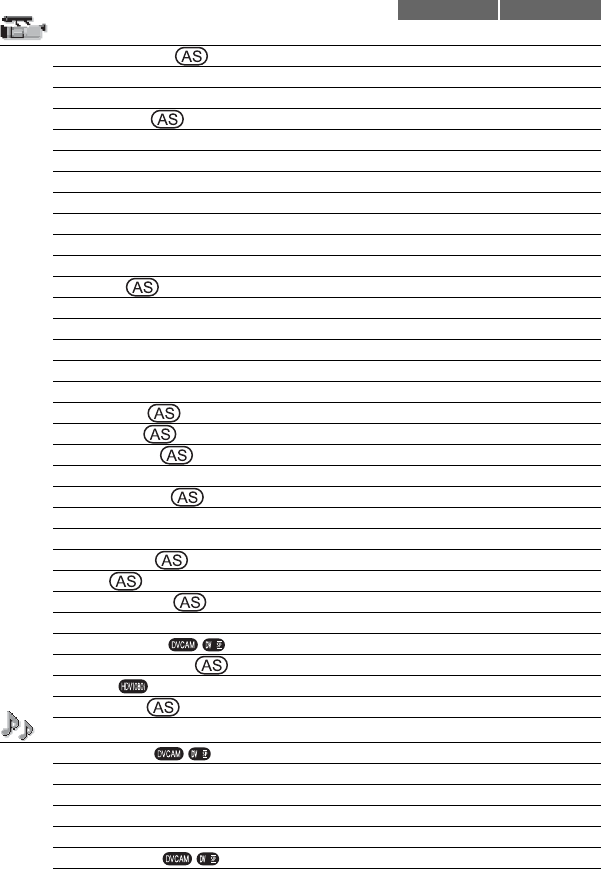
66
.
Menu items Available menu items (z) vary depending on the POWER switch
position.
Position of POWER switch: CAMERA VCR
(CAMERA SET) menu (p. 69)
IRIS/EXPOSURE z–
GAIN SETUP z–
SMOOTH GAIN z–
HYPER GAIN z–
AGC LIMIT z–
MINUS AGC z–
WB PRESET z–
WB OUTDR LVL z–
WB TEMP SET z–
ATW SENS z–
SMOOTH WB z–
AE SHIFT z–
AE RESPONSE z–
AT IRIS LMT z–
ECS FREQ. z–
FLCKR REDUCE z–
CNTRST ENHCR z–
BACK LIGHT z–
SPOTLIGHT z–
STEADYSHOT z–
AF ASSIST z–
FOCUS MACRO z–
HANDLE ZOOM z–
SPEED ZOOM z–
D.EXTENDER z–
FADER z–
SMTH SLW REC z–
INTERVAL REC z–
DV FRAME REC z–
SHOT TRANSITION z–
x.v.Color z–
COLOR BAR z–
(AUDIO SET) menu (p. 77)
DV AU.MODE z–
AUDIO LIMIT z–
INT MIC SET z–
XLR SET z–
AUDIO CH SEL – z
DV AUDIO MIX – z
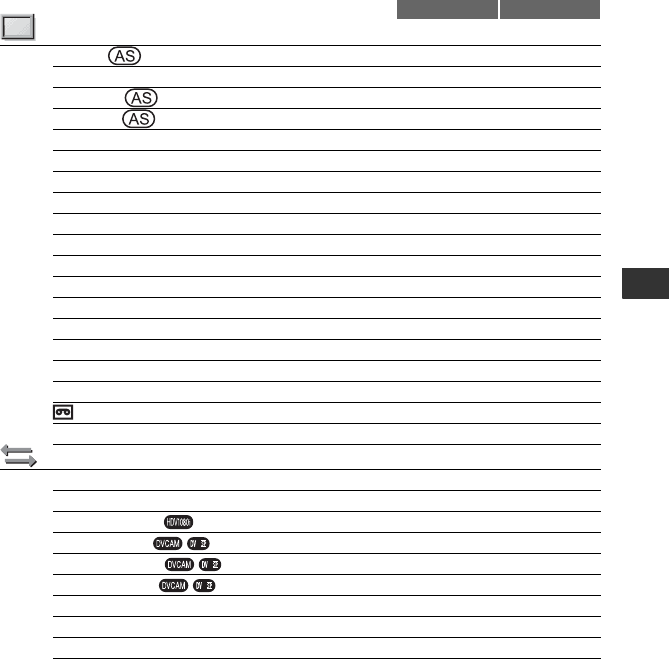
67
Using the Menu
(DISPLAY SET) menu (p. 80)
ZEBRA z–
HISTOGRAM z–
PEAKING z–
MARKER z–
EXP.FOCUS TYPE z–
CAM DATA DSP z–
AU.LVL DISP z–
ZOOM DISPLAY z–
FOCUS DISP z–
SHUTTER DISP z–
LCD BRIGHT zz
LCD COLOR zz
LCD BL LEVEL zz
VF B.LIGHT zz
VF COLOR zz
VF POWERMODE zz
LETTER SIZE zz
REMAINING zz
DISP OUTPUT zz
(IN/OUT REC) menu (p. 85)
REC FORMAT z–
VCR HDV/DV – z
HDV PROGRE. z–
DV PROGRE. z–
DV REC MODE zz
DV WIDE REC z–
VIDEO OUT zz
i.LINK SET zz
EXT REC CTRL z–
Position of POWER switch: CAMERA VCR
Continued ,
68
(TC/UB SET) menu (p. 89)
TC PRESET zz
TC COUNTUP zz
UB PRESET zz
TC FORMAT zz
TC RUN zz
TC MAKE zz
TC LINK z–
UB TIME REC zz
UB-DATE/TC-TIME zz
(MEMORY SET) menu (p. 91)
ALL ERASE – z
FORMAT zz
FILE NO. zz
NEW FOLDER zz
REC FOLDER zz
PB FOLDER – z
(OTHERS) menu (p. 92)
CAMERA PROF. zz
ASSIGN BTN zz
CLOCK SET zz
WORLD TIME zz
LANGUAGE zz
PB ZOOM – z
QUICK REC z–
DATE REC z–
BEEP zz
REC LAMP[F] z–
REC LAMP[R] z–
REMOTE CTRL zz
HOURS METER zz
Position of POWER switch: CAMERA VCR
Menu items (Continued)
69
Using the Menu
(CAMERA SET)
menu
Settings to adjust your camcorder to the
recording conditions (GAIN SETUP/BACK
LIGHT/STEADYSHOT, etc.)
The default settings are marked with B.
The indicators in parentheses appear when
the items are selected.
See page 64 for details on selecting
menu items.
xRING ASSIGN
You can select either [IRIS] (default
setting) or [EXPOSURE] as the function
assigned to the iris ring (p. 30).
xRING ROTATE
You can select the rotation direction of the
iris ring.
BNORMAL
Makes images dark with clockwise
rotation of the iris ring.
OPPOSITE
Makes images dark with counter-
clockwise rotation of the iris ring.
bNotes
• You cannot assign [RING ASSIGN] to an
ASSIGN button.
• When the AUTO/MANUAL switch is set to
AUTO, the IRIS/EXPOSURE button is not
available.
zTips
• The iris, gain and shutter speed values are
adjusted as follows when you change the
[RING ASSIGN] setting with the AUTO/
MANUAL switch set to MANUAL.
– When you change [RING ASSIGN] from
[IRIS] to [EXPOSURE]
The adjustment remains in the same mode
that it was in prior to changing [RING
ASSIGN]. If it is in automatic adjustment, it
Press the MENU button t select the
(CAMERA SET) with the SEL/PUSH
EXEC dial.
IRIS/EXPOSURE
remains in automatic adjustment after
changing [IRIS] to [EXPOSURE]. If it is in
manual adjustment, it remains in manual
adjustment after changing [IRIS] to
[EXPOSURE].
You can adjust the iris, gain and shutter speed
with the iris ring when is displayed next to
the values on the screen.
Adjustment for the gain and shutter speed can
be switched between [EXPOSURE] and
manual.
– When you change [RING ASSIGN] from
[EXPOSURE] to [IRIS]
The adjustment remains in the same mode
that it was in prior to changing [RING
ASSIGN]. If it is in automatic adjustment, it
remains in automatic adjustment after
changing [EXPOSURE] to [IRIS]. If it is in
manual adjustment, it remains in manual
adjustment after changing [EXPOSURE] to
[IRIS].
Adjustments for the gain and shutter speed
can be switched between automatic and
manual.
• You can assign [RING ROTATE] to one of the
ASSIGN buttons (p. 46).
You can set gain values for H, M and L
positions of the gain switch. The default
settings of [H], [M] and [L] are 18dB, 9dB
and 0dB, respectively.
1Select [H], [M] or [L] with the SEL/
PUSH EXEC dial.
2Set the gain value with the SEL/PUSH
EXEC dial, and press the dial.
You can select the value between -6dB
and 21dB by 3dB. The larger the value,
the higher the gain.
3Select [OK] with the SEL/PUSH EXEC
dial.
4Press the MENU button to hide the
menu screen.
GAIN SETUP
Continued ,
70
You can set the transition speed at which
the gain setting shifts from one value to
another, set for the gain switch positions,
when you switch the gain switch from a
position to another. You can select the
transition speed from [FAST], [MIDDLE]
and [SLOW] or set to [OFF]. The default
setting is [OFF].
When you set this function to [ON]
( ), you can increase the gain to its
limit. The default setting is [OFF].
bNotes
• During the hyper gain, the picture quality will
be reduced due to noise.
• [HYPER GAIN] is automatically set to [OFF] if
you turn the power off and back on.
• When you record a movie with [HYPER GAIN]
set to [ON] or the gain set to [-6dB] and play it
back with the data code, the gain value is
displayed as [---].
zTips
• You are recommended to use this function with
manual focus.
You can select the upper limit for the Auto
Gain Control (AGC) from [OFF] (21dB, the
default setting), [18dB], [15dB], [12dB],
[9dB], [6dB], [3dB] and [0dB].
bNotes
If you adjust the gain manually, you cannot obtain
the effect of [AGC LIMIT].
When you set this function to [ON], the
automatic gain control range can be
expanded to the negative range. Especially
in a bright environment, minus gain control
allows more suitable gain setting and
enables low noise recording. The dynamic
range of your camcorder is not reduced
when you set [MINUS AGC] to [ON].
BON
Enables minus gain control during
automatic gain control, as required.
OFF
Disables minus gain control during
automatic gain control.
You can use the preset white balance. For
more details, see page 33.
You can set an offset value to adjust the
outdoor white balance when you set [WB
PRESET] to [OUTDOOR]. You can select
the offset value from [-7] (bluish) - [0]
(normal) - [+7] (reddish). The default
setting is [0] .
You can set the color temperature between
2300K and 15000K in 100K steps when
you set [WB PRESET] to [MANU WB
TEMP].
You can set the auto white balance
operation under a reddish light source such
as an incandescent lamp or candle, or under
a bluish light source such as in outdoor
shade.
BINTELLIGENT
Automatically adjusts the white balance so
that scenes look natural for the light
source.
HIGH
Automatically adjusts the white balance
while reducing redness or blueness.
SMOOTH GAIN
HYPER GAIN
AGC LIMIT
MINUS AGC
WB PRESET
WB OUTDR LVL
WB TEMP SET
ATW SENS
Press the MENU button t select the (CAMERA SET) with the SEL/PUSH EXEC dial.
71
Using the Menu
MIDDLE
LOW
Automatically adjusts the white balance
while increasing redness or blueness.
bNotes
• This is only effective when white balance is
adjusted automatically.
• [ATW SENS] is not effective under a clear sky
or the sun.
You can set the transition speed at which
the color temperature values shifts from one
value to another, set for the white balance
memory switch positions, when you switch
the white balance memory switch from a
position to another. You can select the
transition speed from [FAST], [MIDDLE]
and [SLOW] or set to [OFF]. The default
setting is [OFF].
You can set an offset value to adjust the
automatic exposure adjustment value
between [-7] (dark) and [+7] (bright) with
the SEL/PUSH EXEC dial. The default
setting is [0] . and selected value
appears on the screen when you change the
value from the default setting.
bNotes
• This function is not effective while you adjust
the iris, shutter speed and gain all manually.
• [AE SHIFT] is canceled when [EXPOSURE] is
manually adjusted.
• This function is not effective when [HYPER
GAIN] is set to [ON].
You can select the speed at which the
automatic exposure adjustment function
follows changes in the brightness of the
subject. You can select the speed from
[FAST], [MIDDLE] and [SLOW]. The
default setting is [FAST].
You can select the highest iris value for the
automatic adjustment from [F11], [F9.6],
[F8], [F6.8], [F5.6], [F4.8] and [F4]. The
default setting is [F11].
bNotes
• This function is not effective during the manual
iris adjustment.
You can set the shutter speed so that
horizontal strips do not appear on a monitor
screen, which is likely to occur when you
record a monitor screen. Change the setting
with the SEL/PUSH EXEC dial, then press
the dial to confirm the setting. The default
setting is [59.94Hz].
You must set the shutter speed to the ECS
( ) prior to setting this function (p. 32).
You can set the shutter speed in the
following frequency ranges depending on
the setting of [SCAN TYPE]. How to select
[SCAN TYPE] depends on the setting of
[REC FORMAT] of (IN/OUT REC)
menu.
[HDV1080i]: [HDV PROGRE.] t [REC
TYPE] t [SCAN TYPE]
[DV]: [DV PROGRE.] t [SCAN TYPE]
*Adjustable when [HDV PROGRE.] t [REC
TYPE] t [INTERLACE].
SMOOTH WB
AE SHIFT
AE RESPONSE
AT IRIS LMT
ECS FREQ.
SCAN TYPE Frequency range
60 59.94 Hz to 199.8 Hz
30 29.97 Hz to 199.8 Hz
24, 24A*23.98 Hz to 199.8 Hz
Continued ,
72
bNotes
• When you record a movie with the shutter speed
set in [ECS FREQ.] and play it back with the
data code, the shutter speed value is displayed as
[---].
BON
Reduces flickering. Flickering of the
screen under a light source such as
fluorescent lamps will be reduced.
OFF
Not reduce flickering.
bNotes
• Flickering may not be reduced for certain light
sources.
.
When you set this function to [ON], your
camcorder detects high contrast images,
such as backlit scenes, and automatically
improves the unexposed images. The
default setting is [OFF].
bNotes
• When you set [BACK LIGHT] to [ON],
[CNTRST ENHCR] is temporarily disabled.
When you set this function to [ON] (.),
you can correct backlighting. The default
setting is [OFF].
bNotes
• [BACK LIGHT] is set to [OFF] when you set
[SPOTLIGHT] to [ON].
• [BACK LIGHT] is set to [OFF] when
[EXPOSURE] is manually adjusted.
• [BACK LIGHT] is set to [OFF] if at least two of
iris, gain, and shutter speed are adjusted
manually.
• [BACK LIGHT] is set to [OFF] when [HYPER
GAIN] is set to [ON].
When you set this function to [ON] ( ),
you can prevent overexposure of light
during recording of a subject under strong
light, such as a stage. For example, you can
prevent people's faces from over-
highlighting. The default setting is [OFF].
bNotes
• [SPOTLIGHT] is set to [OFF] when you set
[BACK LIGHT] to [ON].
• [SPOTLIGHT] is set to [OFF] when
[EXPOSURE] is manually adjusted.
• You cannot use the spotlight function if at least
two of iris, gain, and shutter speed are adjusted
manually.
• [SPOTLIGHT] is set to [OFF] when [HYPER
GAIN] is set to [ON].
xON/OFF
When you select [ON], you can reduce
camera shakes. Select [OFF] ( ) when
you use a tripod (optional) to make images
look natural. The default setting is [ON].
xTYPE
You can select a type of camera-shake
reduction for different recording situations.
HARD
Reduces camera shakes at a high level.
This setting is not suitable for panorama
tilt recordings.
BSTANDARD
Reduces camera shakes at a standard level.
SOFT
Reduces camera shakes at a low level.
Slight unsteadiness remains in movies,
which make the movies look as they are.
WIDE CONV.
This item is provided for a wide
conversion lens (optional), and especially
effective for Sony VCL-HG0872A wide
conversion lens.
FLCKR REDUCE
CNTRST ENHCR
BACK LIGHT
SPOTLIGHT
STEADYSHOT
Press the MENU button t select the (CAMERA SET) with the SEL/PUSH EXEC dial.
73
Using the Menu
When you set this function to [ON], you
can temporarily focus manually using the
focus ring during the auto focus adjustment.
The default setting is [OFF].
bNotes
• This function is effective only when the FOCUS
switch is set to AUTO (p. 29).
When you set this function to [ON], you
can focus on a subject within 80 cm (about
2 5/8 feet). The default setting is [ON].
When you set this function to [OFF] ( ),
you can set fine focus on a subject further
than 80 cm regardless of the zoom position
although you will lose focus on a subject
within 80 cm.
You can select the zoom speed for the FIX
position of the handle zoom switch from [1]
(slow) through [8] (fast). The default setting
is [3].
When you set this function to [ON], you
can increase the zoom speed of the zoom
lever and the handle zoom. The default
setting is [OFF].
bNotes
• When you set this function to [ON], the
operation sound of the zoom may also be
recorded.
When you set this function to [ON] ( ),
the displayed image becomes 1.5 times
larger. The image quality decreases because
the image is digitally processed. This
function helps you to focus on far-away
subjects such as a wild bird away at a
distance. The default setting is [OFF].
bNotes
• This function is automatically set to [OFF]
when you turn the power off and back on.
You can add visual effects to transition
between scenes.
1Select [WHITE FADER] or [BLACK
FADER] during standby to fade in with the
selected effect or recording to fade out with
the selected effect.
2Press the REC START/STOP button.
The fader indicator stops flashing and
disappears when the fading is complete.
To cancel before starting the operation,
select [OFF] in step 1.
The setting will be cleared every time you
press the REC START/STOP button.
WHITE FADER
BLACK FADER
bNotes
• This function is automatically set to [OFF]
when you turn the power off and back on.
Fast moving subjects and actions, which
cannot be captured under the general
recording conditions, can be recorded in
smooth moving slow-motion.
This is useful for recording fast actions
such as a golf or tennis swing.
AF ASSIST
FOCUS MACRO
HANDLE ZOOM
SPEED ZOOM
D.EXTENDER
FADER
SMTH SLW REC
STBY REC
Fading out Fading in
Continued ,
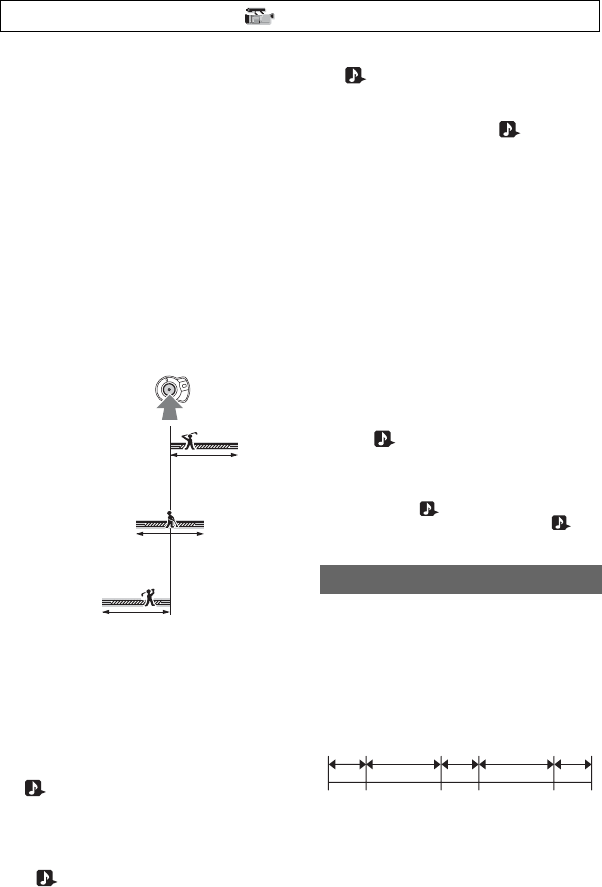
74
Select [EXECUTE], and press the REC
START/STOP button on the [SMTH SLW
REC] screen.
A recording of the length set in [REC
TIME] is stretched by 4 times and recorded
as a slow-motion movie.
Recording ends when [Recording...]
disappears from the screen.
To cancel [SMTH SLW REC], press the
MENU button.
You can select the [SMTH SLW REC]
settings suitable for your recording.
xREC TIMING
You can use this to select when recording
starts in relation to when the REC START/
STOP button is pressed.
*The default setting is [START TRIG].
xREC TIME
You can select the recording time from
[3sec], [6sec] and [12sec]. The default
setting is [3sec].
The picture quality deteriorates as the
recording time increases.
xTRIG
When you set this function to [ON],
recording automatically starts in response
to a preset sound level instead of the REC
START/STOP button being pressed.
The [ TRIG] setting is canceled when
you turn the power off and back on.
xTRIG LEVEL
You can select the sound level at which
recording is triggered from [HIGH],
[MIDDLE] and [LOW] in [ TRIG
LEVEL]. The default setting is [HIGH].
bNotes
• Sounds cannot be recorded.
• The shutter speed is automatically set to 1/250
second when you start [SMTH SLW REC].
• The recording time may be shorter than the set
time, depending on recording conditions.
• The image quality is lower than with the regular
recording.
zTips
• After executing [SMTH SLW REC] with an
ASSIGN button, you can also cancel [SMTH
SLW REC] by pressing the ASSIGN button
again. See page 46 for details on how to use the
ASSIGN buttons.
• When [ TRIG] is set to [ON], you can also
start recording by pressing the REC START/
STOP button.
• When you manually set the microphone volume
to a low level, [ TRIG] may not work
properly. We recommend that you set [
TRIG LEVEL] to [MIDDLE] or [LOW].
You can record a series of movies on a tape
at regular intervals. This function is useful
to observe things like cloud movements or
daylight changes. The scenes run smoothly
into each other when you play back the
tape. Use the AC Adapter/Charger to obtain
AC power for long recording.
1Select [ON/OFF] t [ON] with the SEL/
PUSH EXEC dial.
2Perform the following step if you are
changing the recording time from the
default setting of [0.5sec]. If you are
keeping the default recording time, go
straight to step 3.
[START TRIG]*
[CENTER TRIG]
[END TRIG]
INTERVAL REC
interval
Recording
interval
Recording Recording
Press the MENU button t select the (CAMERA SET) with the SEL/PUSH EXEC dial.

75
Using the Menu
Select [REC TIME] t [0.5sec], [1sec],
[1.5sec] or [2sec] with the SEL/PUSH
EXEC dial.
3Perform the following step if you are
changing the interval time from the default
setting of [30sec]. If you are keeping the
default interval time, go straight to step 4.
Select [INTERVAL] t [30sec], [1min],
[5min] or [10min].
4Select [OK] with the SEL/PUSH EXEC
dial.
5Press the MENU button to hide the menu
screen.
6Press the REC START/STOP button.
The [INTERVAL REC] recording starts.
To cancel [INTERVAL REC], press the
REC START/STOP button.
The operation of your camcorder differs
depending on when you press the REC
START/STOP button.
If you press the button during [INTERVAL
REC] recording, the recording temporarily
stops. If you press it again, the
[INTERVAL REC] recording restarts,
If you press the button during [INTERVAL
REC] interval, the [INTERVAL REC]
recording stops and regular recording starts.
If you press it again, regular recording
stops. If you press the button once again,
the [INTERVAL REC] recording restarts.
To cancel the [INTERVAL REC]
recording, select [ON/OFF] t [OFF] with
the SEL/PUSH EXEC dial.
bNotes
• The recording time and interval time may differ
slightly from the settings.
• If you focus manually, you can get sharp images
even if the lighting changes.
You can record stop motion (or frame-by-
frame) animation movies. That type of
animation uses a technique of changing the
subject, such as a doll or a toy's positions
and recording it at each different position
while your camcorder sits still. Use the
Remote Commander to reduce camera
shakes.
BOFF
Not use this function.
ON ( )
Records a movie by stop motion (or frame-
by-frame) technique.
1Select [ON] with the SEL/PUSH
EXEC dial.
2Press the MENU button to hide the
menu screen.
3Press the REC START/STOP button.
Your camcorder records a movie for
about 6 frames and returns to standby.
4Move the subject and repeat step 3.
bNotes
• When you use frame recording continuously,
the remaining tape time will not be indicated
correctly.
• The last scene will be longer than other scenes.
• You cannot record index signals during frame
recording.
• This function is automatically set to [OFF]
when you turn the power off and back on.
You can set [TRANS TIME], [TRANS
CURVE], [START TIMER] and [REC
LINK].
See page 48 for details on the shot
transition function.
xTRANS TIME
You can set the transition time between
[3.5sec] and [90.0sec]. The default setting
is [4.0sec].
DV FRAME REC
SHOT TRANSITION
Continued ,
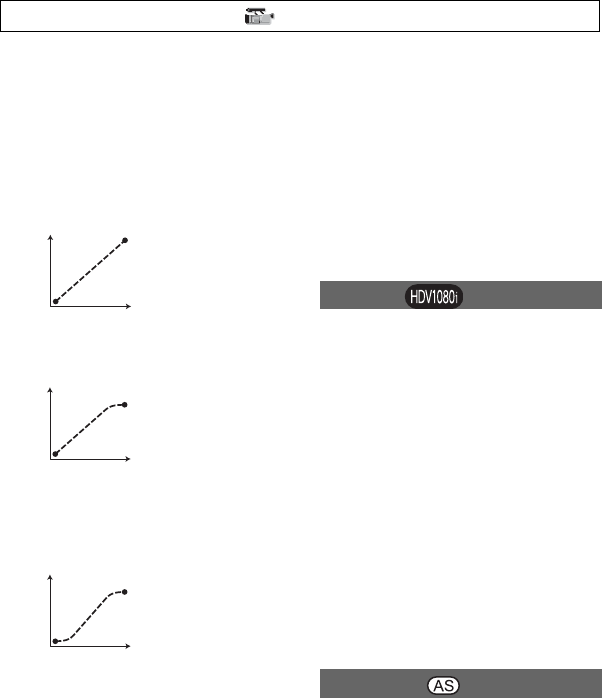
76
xTRANS CURVE
You can select the transition curve.
Characteristics of the transition curves are
illustrated in the following graphs.
*1: parameter level
*2: time
LINEAR
Makes the transition linearly.
BSOFT STOP
Makes the transition slowly at the end.
SOFT TRANS
Makes the transition slowly at the
beginning and end, and linearly in
between.
bNotes
• You cannot change [TRANS TIME] and
[TRANS CURVE] settings during store, check,
or execution of [SHOT TRANSITION]. Cancel
[SHOT TRANSITION] setting by pressing the
ASSIGN 4 button several times before changing
[TRANS TIME] or [TRANS CURVE] setting.
xSTART TIMER
You can set the timer for starting the shot
transition. You can select the time from
[5sec], [10sec] and [20sec]. The default
setting is [OFF].
xREC LINK
BOFF
Not use this function
SHOT-A
Starts transition to SHOT-A when
recording is started.
SHOT-B
Starts transition to SHOT-B when
recording is started.
When you set this function to [ON], you
can record with the wider color range. Your
camcorder can reproduce brilliant and vivid
colors for flowers and the beautiful blue-
green of tropical oceans that cannot be
matched by conventional technologies.
The default setting is [OFF].
bNotes
• The colors may not be well reproduced when
you play back a movie recorded with this
function set to [ON] on a TV that does not
support x.v.Color.
• You cannot set [x.v.Color] in the following
cases:
– When recording in SD (standard) format
– When recording movies
• When you set [x.v.Color] to [ON], the picture
profile will be disabled.
xON/OFF
When you select [ON], you can display
color bars on the screen or record them on a
tape. This function helps you to adjust
colors when you view movies recorded
with your camcorder on a TV or a monitor.
The default setting is [OFF].
bNotes
• This function is automatically set to [OFF]
when you turn the power off and back on.
*1
*2
*1
*2
*1
*2
x.v.Color
COLOR BAR
Press the MENU button t select the (CAMERA SET) with the SEL/PUSH EXEC dial.
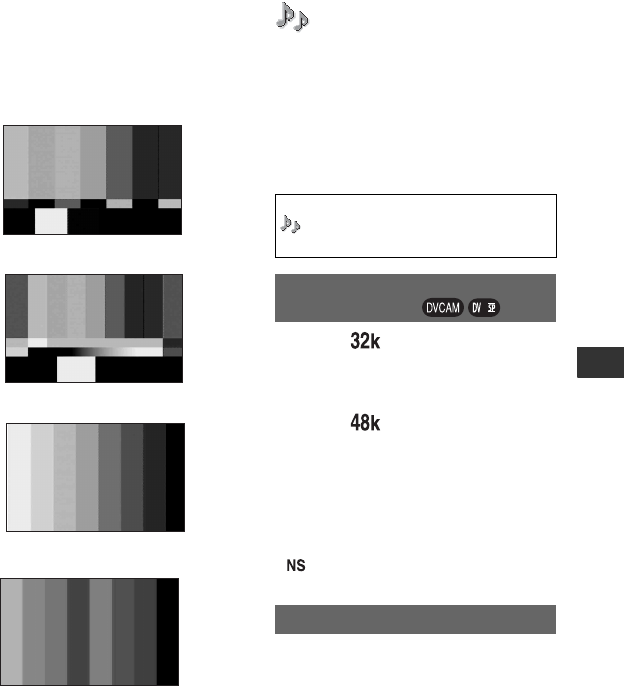
77
Using the Menu
xTYPE
Selects a type of the color bars.
xTONE
Outputs audio tone signals (1 kHz: full bit
-20 dB) when you set [TONE] to [ON]. The
default setting is [OFF].
TYPE 1
TYPE 2
TYPE 3
TYPE 4 (75% brightness of TYPE 3)
(AUDIO SET) menu
Settings for the audio recording (DV
AU.MODE/XLR SET, etc.)
The default settings are marked with B.
The indicators in parentheses appear when
the items are selected.
See page 64 for details on selecting
menu items.
FS32K ( )
Records in the 12-bit mode (2 stereo
sounds). Select this setting for the
DVCAM/DV SP recording.
BFS48K ( )
Records in the 16-bit mode (1 stereo sound
with high quality). Select this setting for
the DVCAM/DV SP recording.
bNotes
• When recording in the HDV format, sound is
automatically recorded in the [FS48K] mode.
• appears when the DVCAM standard is not
met (p. 120).
You can set the clipping-noise reduction
function for CH1/CH2.
BOFF
Disables the function.
ON
Enables the function.
bNotes
• This function is available only when you set the
AUTO/MAN switch to MAN.
Press the MENU buttont select the
(AUDIO SET) with the SEL/PUSH
EXEC dial.
DV AU.MODE
(DV Audio mode)
AUDIO LIMIT
Continued ,
78
xINT MIC NR
You can reduce noise from the internal
microphone.
BON
Reduces noise from the internal
microphone.
appears on the status check screen.
OFF
Does not reduce noise from the internal
microphone.
xINT MIC SENS
You can set recording sensitivity of the
internal microphone.
BNORMAL
Sensitivity that is normally used in
professional recordings.
HIGH
Sensitivity that is normally used in
consumer recordings.
appears on the status check
screen.
xINT MIC WIND
BOFF
Disables wind noise reduction.
ON
Enables wind noise reduction.
appears on the status check screen.
xXLR AGC LINK
You can select either linked or separate
AGC (Auto Gain Control) of CH1 and CH2
when using an external microphone.
BSEPARATE
Separately applies the AGC for CH1/CH2.
Sound inputs from CH1/CH2 will be
recorded as separate sound.
LINKED
Applies the AGC of CH1 linked with that
of CH2. Sound inputs from CH1/CH2 will
be recorded as a set of sound such as stereo
sound. appears on the status check
screen.
bNotes
• This function is available when the CH1 and
CH2 switches are set to AUTO and the INPUT1
and INPUT2 switches are both set to MIC or
both set to LINE (p. 44).
xAU.MAN GAIN
You can select either linked or separate
audio level control of CH1and CH2 when
using an external microphone.
BSEPARATE
Separately controls the audio levels of
CH1 and CH2. Sound inputs from CH1
and CH2 will be recorded as separate
sound.
LINKED ( )
Controls the audio level of CH1 linked
with that of CH2. Sound inputs from CH1
and CH2 will be recorded as a set of sound
such as stereo sound. appears on the
status check screen.
bNotes
• This function is available when the CH1 and
CH2 switches are set to MAN and the INPUT1
and INPUT2 switches are both set to MIC or
both set to LINE (p. 44).
• When you select [LINKED], you can adjust the
volume with the AUDIO LEVEL dial of CH1
(p. 44).
xINPUT1 MIC NR
You can reduce noise from the
microphone.
BON
Reduces noise from the microphone.
appears on the status check screen.
OFF
Does not reduce noise from the
microphone.
INT MIC SET
XLR SET
A
M
Press the MENU button t select the (AUDIO SET) with the SEL/PUSH EXEC dial.

79
Using the Menu
bNotes
• The setting is not effective when you set the
INPUT1 switch to LINE.
xINPUT1 TRIM
You can adjust the input signal level from
INPUT1.
You can select from [-18dB], [-12dB],
[-6dB], [0dB], [+6dB] and [+12dB]. The
default setting is [0dB].
bNotes
• The setting is not effective when you set the
INPUT1 switch to LINE.
xINPUT1 WIND
BOFF
Disables wind noise reduction.
ON
Enables wind noise reduction.
appears on the status check screen.
bNotes
• The setting is not effective when you set the
INPUT1 switch to LINE.
xINPUT2 MIC NR
xINPUT2 TRIM
xINPUT2 WIND
You can set INPUT2 in the same way as
INPUT1.
zTips
• -48dBu is set as 0dB in your camcorder.
• Set [INPUT TRIM] to [0dB] for the supplied
microphone (ECM-XM1).
• Set [INPUT TRIM] to [+12dB] for a
microphone with an average sensitivity,
including the optional microphone (Sony ECM-
NV1).
• The INPUT TRIM function adjusts the input
level from an external microphone. When using
a highly sensitive microphone or recording loud
sound, set this to the minus side. When using a
less sensitive microphone or recording quiet
sound, set it to the plus side.
• When recording loud sound, the sound may be
distorted at either the input point or the
recording point. If it is distorted at the input
point, adjust the sound using the INPUT TRIM
function. If it is distorted at the recording point,
lower the total volume level manually.
• If you set INPUT TRIM too far to the minus
side, the microphone volume becomes too low,
resulting in a poor signal to noise ratio.
• Test the effect of the INPUT TRIM function
according to the microphone used or the sound
field of the recording site before actual
recording.
BCH1,CH2
Reproduces sound of CH1 and CH2 in
respective channels.
CH1
Reproduces sound of CH1 in channels 1
and 2.
CH2
Reproduces sound of CH2 in channels 1
and 2.
CH1+CH2
Reproduces mixed sound of CH1 and CH2
in channels 1 and 2.
zTips
• When you select [CH1,CH2] and play back a
tape on your camcorder, sound of CH1 + CH2
comes out of the speakers.
• When you select [CH1+CH2], the same sound is
outputted from right and left speakers of a
device to be connected.
You can monitor the sound dubbed from
another device or recorded through 4-
channel microphone during playback. You
can set how to output the sound.
BCH1,CH2
Outputs only the sound recorded in CH1
and CH2 during recording.
MIX
Outputs mixed sound of the sound
recorded in CH1 and CH2 during
AUDIO CH SEL
DV AUDIO MIX
Continued ,
80
recording and the sound dubbed in CH3
and CH4.
CH3,CH4
Outputs only the sound dubbed in CH3 and
CH4.
(DISPLAY SET)
menu
Display settings of the display and the
viewfinder (MARKER/VF B.LIGHT/DISP
OUTPUT, etc.)
The default settings are marked with B.
The indicators in parentheses appear when
the items are selected.
See page 64 for details on selecting
menu items.
You can display a zebra pattern as a guide
for adjusting brightness.
xON/OFF
When you select [ON], and the
brightness level appear on the screen. The
zebra pattern will not be recorded on a tape
or a “Memory Stick Duo.” The default
setting is [OFF].
xLEVEL
You can select the brightness level between
70 and 100 or 100+. The default setting is
[70].
zTips
• The zebra pattern is a strip pattern displayed
over a part of an image on the screen when the
part is higher than a preset brightness level.
You can adjust the iris while referring to a
histogram. A histogram is a graph that
shows the distribution of the image
brightness. You can use the histogram as a
guide for adjusting the iris. The histogram
will not be recorded on a tape or a
“Memory Stick Duo.”
Press the MENU button t select the
(DISPLAY SET) with the SEL/PUSH
EXEC dial.
ZEBRA
HISTOGRAM
Press the MENU button t select the
(AUDIO SET) with the SEL/PUSH
EXEC dial.
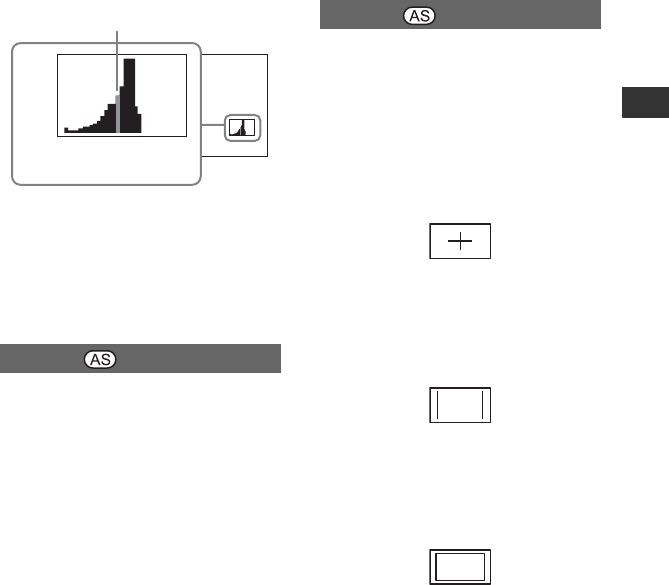
81
Using the Menu
BOFF
Does not display a histogram.
NORMAL
Displays a histogram.
ADVANCE
Displays a histogram, and a bar that
indicates an average of the brightness
levels around the center of an image
(within the marker) on the histogram.
zTips
• The left area on the graph shows the darker
areas of the image while the right area shows the
brighter areas.
• A vertical line that indicates the brightness level
of [ZEBRA] will be displayed on the histogram
when you set [ZEBRA] to [ON].
xON/OFF
When you select [ON], you can display an
image on the screen with its details
enhanced. This function helps you to adjust
the focus. The default setting is [OFF].
xCOLOR
You can select peaking color from
[WHITE], [RED] and [YELLOW]. The
default setting is [WHITE].
xLEVEL
You can select a peaking sensitivity from
[HIGH], [MIDDLE] and [LOW]. The
default setting is [MIDDLE].
bNotes
• You cannot record an image with
enhanced details on a tape or a “Memory
Stick Duo.”
zTips
• You can focus more easily using this
function in combination with the
expanded focus function (p. 30).
xON/OFF
When you select [ON], you can display
markers. The default setting is [OFF].
Markers will not be recorded on a tape or
“Memory Stick Duo.”
xCENTER
When you select [ON], you can display a
marker at the center of the screen. The
default setting is [ON].
xASPECT
When you select [ON], you can display
markers at boundaries of display area
defined by the aspect ratio, which you can
select from [4:3], [13:9] and [14:9]. The
default setting is [OFF].
xSAFETY ZONE
When you select [ON], then [80%] or
[90%], you can display markers at
boundaries of display area that regular
home TVs can display. The default setting
is [OFF].
PEAKING
BrighterDarker
Brightness
Pixels
Average MARKER
Continued ,Continued ,
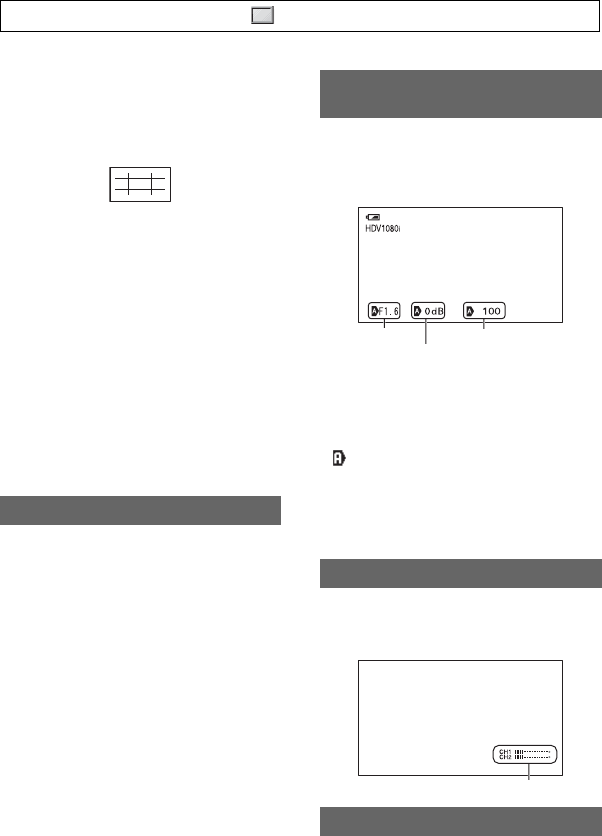
82
xGUIDEFRAME
When you select [ON], you can display
frame markers that help you to check
horizontal and vertical positions of a
subject. The default setting is [OFF].
bNotes
• You cannot output display information , such as
the time code, to an external device via external
output jacks when [MARKER] is set to [ON].
• You cannot display markers when you set
[DATE REC] to [ON].
zTips
• You can display all types of markers at the same
time.
• You can obtain a balanced composition by
positioning the subject at the cross points of the
guideframe marker.
• You can display markers only on the LCD panel
and viewfinder. You cannot display them on an
external device.
You can set a type of the expanded focus
display.
BTYPE 1
Simply enlarges images.
TYPE 2
Enlarges and shows images in white and
black.
When you set this function to [ON], you
can constantly display the iris, shutter speed
and gain settings on the screen. The default
setting is [OFF].
zTips
• The settings appear on the screen during
the manual adjustment regardless of the
settings of this function.
• indicates that the settings are
automatically adjusted values.
• The displayed settings are different from
the settings that will be displayed when
you press the DATA CODE button (p. 54).
When you set this function to [ON], you
can display the audio level meter on the
screen. The default setting is [ON].
BBAR
Displays a bar that indicates the zoom position.
NUMBER
Displays a number (0 through 99) that
indicates the zoom position.
EXP.FOCUS TYPE
CAM DATA DSP (Camera data
display)
AU.LVL DISP (Audio level display)
ZOOM DISPLAY
60
min
00:04:50:04
Iris value
Gain value
Shutter speed value
Audio level meter
Press the MENU button t select the (DISPLAY SET) with the SEL/PUSH EXEC dial.

83
Using the Menu
You can select how to display the focal
distance during manual focus.
BMETER
Displays the focal distance in meters.
FEET
Displays the focal distance in feet.
You can select how to display the shutter
speed.
BSECOND
Displays the shutter speed in seconds.
DEGREE
Displays the shutter speed in degrees.
The shutter speed equal to the period that
your camcorder reads image data from the
image sensor is defined as 360 degrees.
The degree is calculated based on this
definition and displayed.
– When [SCAN TYPE] is set to [60], 1/60
second is defined as 360 degrees.
– When [SCAN TYPE] is set to [24] or [24A],
1/24 second is defined as 360 degrees.
– When [SCAN TYPE] is set to [30], 1/30
second is defined as 360 degrees.
For details on [SCAN TYPE], see [HDV
PROGRE.] (p. 85) or [DV PROGRE.]
(p. 86).
bNotes
• When you press the DATA CODE button, the
shutter speed will be displayed in seconds
regardless of the setting of this function.
zTips
• Shutter speed slower than 360° are displayed in
multiples of 360°, such as 360° × 2.
You can adjust the brightness of the LCD
screen. Changes in the LCD brightness will
not affect the brightness of recording
images.
zTips
• You can also turn off the LCD backlight (p. 18).
You can adjust the color level of the LCD
panel. Changes in the LCD color level will
not affect the color level of recording
images.
You can adjust the backlight level of the
LCD screen.
BNORMAL
Standard brightness.
BRIGHT
Brightens the LCD screen.
bNotes
• When you connect your camcorder to outside
power sources, [LCD BL LEVEL] is
automatically set to [BRIGHT].
• When you select [BRIGHT], the recordable
time with the battery is slightly reduced.
You can adjust the brightness of the
viewfinder.
BNORMAL
Standard brightness.
BRIGHT
Brightens the viewfinder screen.
bNotes
• When you connect your camcorder to outside
power sources, [BRIGHT] is automatically
selected for the setting.
FOCUS DISP
SHUTTER DISP
LCD BRIGHT
LCD COLOR
LCD BL LEVEL
VF B.LIGHT
Continued ,

84
• When you select [BRIGHT], the recordable
time with the battery is slightly reduced.
BON
Displays images in the viewfinder in color.
OFF
Displays images in the viewfinder in black
and white.
BAUTO
Turns on the viewfinder while you close
the LCD panel or record in mirror mode.
ON
Always turns on the viewfinder.
BNORMAL
Displays the menu in regular letter size.
2x
Displays the selected menu items in letter
size, the height of which is doubled.
BAUTO
Displays the remaining time of a tape for
about 8 seconds in the following situation:
• When you set the POWER switch to VCR
or CAMERA with a cassette inserted.
• When you press N (Play) or the
DISPLAY/BATT INFO button.
ON
Always displays the remaining time of a
tape. The remaining time is not displayed
when you insert a new tape or a tape that is
rewound to the beginning. It is displayed
when you start playback or recording.
You can select outputs to which display
information, such as time code, is
outputted.
BLCD PANEL
Outputs the information to the LCD screen
and viewfinder.
V-OUT/PANEL
Outputs the information to the LCD
screen, viewfinder and composite output.
ALL OUTPUT
Outputs the information to the LCD
screen, viewfinder, HDMI output,
component output and composite output.
bNotes
• You cannot output display information, such as
the time code, to an external device when
[MARKER] is set to [ON].
VF COLOR
VF POWERMODE
LETTER SIZE
REMAINING
DISP OUTPUT
Press the MENU button t select the (DISPLAY SET) with the SEL/PUSH EXEC dial.
85
Using the Menu
(IN/OUT REC)
menu
Recording settings, input and output
settings (REC FORMAT/HDV PROGRE./
VIDEO OUT/EXT REC CTRL, etc.)
The default settings are marked with B.
The indicators in parentheses appear when
the items are selected.
See page 64 for details on selecting
menu items.
You can select a recording format.
BHDV1080i ( )
Records in the HDV1080i format.
DV ( )
Records in the DVCAM (DV) format.
Set also [DV REC MODE] when you
record in this format (p. 86).
bNotes
• Set also [i.LINK SET] as necessary when you
output a movie to an external device through an
i.LINK cable (p. 87).
You can select a type of output signal to an
external device for playing back a movie on
the device. Select [AUTO] in most cases.
When you connect your camcorder to an
external device with an i.LINK cable, select
a type of input and output signals to and
from the external device via the HDV/DV
jack. You can record or play back a movie
reproduced by the selected type of signals.
BAUTO
Automatically switches between HDV
signals and DV signals during playback.
During the i.LINK connection, recognizes
HDV signals and DVCAM (DV) signals,
and automatically inputs or outputs the
Press the MENU buttont select the
(IN/OUT REC) with the SEL/PUSH
EXEC dial.
REC FORMAT
VCR HDV/DV
signals to or from the external device via
the HDV/DV (i.LINK) jack for
recording or playback.
HDV ( )
Plays back only HDV format sections of a
tape.
During the i.LINK connection, inputs or
outputs only HDV signals to or from an
external device via the HDV/DV
(i.LINK) jack for recording or playback.
Select this setting when you connect your
camcorder to your computer.
DV ( )
Plays back only DVCAM (DV) format
sections of a tape.
During the i.LINK connection, inputs or
outputs only DVCAM (DV) signals to or
from an external device via the HDV/
DV (i.LINK) jack for recording or
playback. Select this setting when you
connect your camcorder to your computer.
bNotes
• Make sure to disconnect the i.LINK cable prior
to changing the setting. Otherwise, a video
device may not recognize video signals.
• When you select [AUTO], images and sounds
may be cut off on switching between HDV
signals and DVCAM (DV) signals.
• When you set [i.LINK SET] t [HDV t DV
CONV] to [ON], the following signals will be
outputted:
– [AUTO]: HDV signals are converted to
DVCAM (DV) signals and outputted.
DVCAM (DV) signals are outputted without
any conversion.
– [HDV]: HDV signals are converted to
DVCAM (DV) signals and outputted.
DVCAM (DV) signals will not be outputted.
– [DV]: DVCAM (DV) signals are outputted
without any conversion. HDV signals will not
be outputted.
xREC TYPE
You can select an HDV recording format
from [INTERLACE] and
HDV PROGRE.
Continued ,
86
[PROGRESSIVE]. The default setting is
[INTERLACE].
xSCAN TYPE
You can select a scan type for recording in
HDV format.
B60
Captures 60 fields per second in an
interlace scan.
24
Captures 24 frames per second.
24A
Captures 24 frames per second.
The phase of the 60i conversion is reset
each time recording starts.
30
Captures 30 frames per second.
bNotes
• Selectable [SCAN TYPE] settings differ
depending on the setting of [REC TYPE].
– [INTERLACE]: [60], [24], [24A], [30]
– [PROGRESSIVE]: [24], [30]
• You can only play back a tape recorded with the
[REC TYPE] set to [PROGRESSIVE] on a
device that supports playback of a tape recoded
by progressive scanning.
• When recording in HDV format in [24A] mode,
the time code does not progress correctly from
scene to scene.
When playing back those movies, a momentary
pause will occur between scenes. In this case,
you can copy the movies without the pause from
your camcorder to a computer via an i.LINK
cable and use them on the computer as normal
movies.
• When [REC TYPE] is set to [PROGRESSIVE]
and [SCAN TYPE] to [24], movies and time
codes are recorded at 24 frames per second and
indicators are displayed at 30 frames per second.
When using the HDV/DV jack, the recorded
signal is outputted at the following frame rate
depending on the setting of (IN/OUT
REC) menu t [i.LINK SET] t [HDV t DV
CONV]:
[OFF]: 24 frames per second
[ON]: 30 frames per second
When using other jacks, the recorded signal is
outputted at 30 frames per second.
xSCAN TYPE
You can select a scan type for recording in
DVCAM/DV format.
B60
Captures 60 fields per second in an
interlace scan.
24
Captures 24 frames per second.
30
Captures 30 frames per second.
This function is available only when you set
[REC FORMAT] to [DV].
BDVCAM ( )
Records in the DVCAM format.
DV SP ( )
Records in the SP (Standard Play) mode of
the DV format to record for a longer time
than in the DVCAM format.
bNotes
• Mosaic-like disturbance or audio interruption
may occur when you play back a movie
recorded in the DV SP mode by another device.
• Image may be distorted or time code may not be
properly connected between the scenes recorded
in the DVCAM mode and DV SP mode.
You can record a movie in an aspect ratio
that matches that of a TV that you want to
connect. Refer also to the instruction
manuals that come with the TV.
BON
Records a movie in an aspect ratio that
matches the full screen of a 16:9 (wide)
TV.
DV PROGRE.
DV REC MODE (DV Recording
mode)
DV WIDE REC
Press the MENU button t select the (IN/OUT REC) with the SEL/PUSH EXEC dial.
87
Using the Menu
OFF ( )
Records a movie in an aspect ratio that
matches the full screen of a 4:3 TV.
bNotes
• Set [DV WIDE CONV] correctly to suite a TV
that you want to connect for playback (p. 86).
• The aspect ratio will be fixed to 16:9 and you
cannot set it to 4:3 when you record in HDV
format.
xCOMPONENT
You can select [480i] or [1080i/480i]
depending on your TV when you connect
your camcorder to a TV via a component
cable.
480i
Supports connection between your
camcorder and a TV with a component
input jack that supports the 480i format.
B1080i/480i
Supports connection between your
camcorder and a TV with a component
input jack that supports the 1080i format.
xDOWN CONVERT
You can select a down convert type when
you down-covert HDV signal to DV signal.
Use this function for signals outputting
from the following output jacks:
– Component (480i)
– S Video
– Audio/Video
BSQUEEZE
Outputs a horizontally compressed image
while maintaining its original height.
LETTER BOX
Outputs an image with black bars added to
the top and bottom of the original image,
while maintaining the original aspect ratio.
EDGE CROP
Outputs the central portion of the original
image by cropping its right and left edges.
bNotes
• When you view a movie recorded in the
DVCAM (DV) format with [DV WIDE REC]
set to [ON] on a standard 4:3 TV, images of the
movie may appear vertically compressed. In
such a case, set [DV WIDE CONV] to
[LETTER BOX] or [EDGE CROP].
xDV WIDE CONV
You can select a down convert type when
you down-covert DV widescreen signal to
DV signal.
Use this function for signals outputting
from the following output jacks:
– Component (480i)
– S Video
– Audio/Video
BSQUEEZE
Outputs a horizontally compressed image
while maintaining its original height.
LETTER BOX
Outputs an image with black bars added to
the top and bottom of the original image,
while maintaining the original aspect ratio.
EDGE CROP
Outputs the central portion of the original
image by cropping its right and left edges.
xHDV t DV CONV
When you set this function to [ON], you can
convert HDV format signals to DV format
signals and output the DV format signals to an
external device via the HDV/DV (i.LINK)
jack. You can output DV format signals
without any format conversion. The default
setting is [OFF].
xDOWN CONVERT
You can set a down convert type when you
set [HDV t DV CONV] to [ON] to
convert HDV format signals to DV format
signals.
BSQUEEZE
Outputs a horizontally compressed image
while maintaining its original height.
VIDEO OUT
i.LINK SET
Continued ,
88
EDGE CROP
Outputs the central portion of the original
image by cropping its right and left edges.
bNotes
• For i.LINK connection, see [VCR HDV/DV]
(p. 85).
• Disconnect the i.LINK cable before setting
[i.LINK SET]. Otherwise, the connected video
device may not be able to recognize the video
signal from your camcorder.
You can connect your camcorder to an
HDV/DVCAM/DV compatible device
(digital HD video camera recorder, digital
video camera recorder, hard disc recorder,
etc.) with an i.LINK cable, and record
movies on your camcorder and the
connected device simultaneously, or
continue recording from your camcorder to
the connected device.
Refer also to the instruction manuals
supplied with the connecting devices.
xREC CTL MODE
BOFF
Does not record on a connected device.
SYNCHRONOUS ( )
Records movies, sound and time code on a
connected device in synchronization with
your camcorder.
RELAY ( )
Records movies, sound and time code on a
connected device when a tape on your
camcorder reaches close to the end during
recording.
EXT ONLY ( )
You can operate an external recording
unit* with the REC START/STOP button
of your camcorder.
*HVR-MRC1(optional) or HVR-DR60
(optional)
bNotes
• When this function is set to [EXT ONLY],
does not flash even when there is no tape
inserted.
• You can use the REC START/STOP button of
your camcorder as a recording start/stop button
for the external recording unit when you set this
function to [EXT ONLY]. Use the REC button
of the video control buttons (p. 138) to start
recording on a tape or the STOP button to stop
recording.
• (EXT ONLY) flashes when you
connect an external recording unit that is not
supported by [EXT ONLY].
xSTBY COMMAND
BREC PAUSE
Stops recording operation of a connected
device by putting it in pause when you stop
recording operation of your camcorder.
STOP
Stops recording operation of a connected
device when you stop recording operation
of your camcorder.
EXT REC CTRL
Press the MENU button t select the (IN/OUT REC) with the SEL/PUSH EXEC dial.
89
Using the Menu
(TC/UB SET) menu
(TC PRESET/UB PRESET/TC LINK, etc.)
The default settings are marked with B.
The indicators in parentheses appear when
the items are selected.
See page 64 for details on selecting
menu items.
xPRESET
You can preset the time code.
1Select [TC PRESET] with the SEL/PUSH
EXEC dial.
2Select [PRESET] with the SEL/PUSH
EXEC dial.
3Select the first 2 digits with the SEL/PUSH
EXEC dial.
You can set the time code between
00:00:00:00 and 23:59:59:29.
4Set other digits by repeating step 3.
5Select [OK] with the SEL/PUSH EXEC
dial.
xRESET
You can reset the time code (00:00:00:00).
Select [RESET] in step 1 of the
[PRESET].
You can increment the hour of time code by
1 and reset the minute, second and frame of
time code when you execute this function.
bNotes
• This function is available only when you set
[TC MAKE] to [PRESET].
xPRESET
You can preset the user bit.
1Select [UB PRESET] with the SEL/PUSH
EXEC dial.
Press the MENU button t select the
(TC/UB SET) with the SEL/PUSH EXEC
dial.
TC PRESET
TC COUNTUP
UB PRESET
2Select [PRESET] with the SEL/PUSH
EXEC dial.
3Select the first 2 digits with the SEL/PUSH
EXEC dial.
4Set other digits by repeating step 3.
5Select [OK] with the SEL/PUSH EXEC
dial.
xRESET
You can reset the user bit (00 00 00 00).
Select [RESET] in step 1 of the
[PRESET].
You can select the frame mode.
BAUTO
Sets the frame mode automatically in
accordance with the inserted cassette.
DF
Sets the frame mode to the drop frame
mode.
NDF
Sets the frame mode to the non-drop frame
mode.
zTips
What is drop frame?
Although 30 frames are considered as 1
second in time code processing, the actual
frame frequency of an NTSC image signal
is 29.97 frames/sec. As a result, the time
code gradually lags behind real time as the
recording gets longer. The drop frame
function adjusts the time code to real time.
In the drop frame process, the first 2 frames
of each second are not recorded except in
every tenth minute. Recording without the
drop frame process is called non-drop
frame recording.
TC FORMAT
Continued ,

90
You can select how the time code advances.
BREC RUN
Advances the time code only during
recording.
Select this setting to record the time code
continuous from the last time code of the
previous recording.
FREE RUN
Advances the time code regardless of
operation of your camcorder.
Select this setting to save the actual time in
the time code.
BREGENERATE
Reads the last time code of the previous
recording from the tape and records the
new time code consecutively from the last
time code during the backspace editing.
The time code runs in [REC RUN] mode
regardless of the setting of [TC RUN].
PRESET
Records the newly set time code on the
tape.
You can synchronize the time codes of
multiple camcorders.
This function is useful for editing movies
recorded by multiple camcorders.
1Insert a tape to the main camcorder from
which you want to generate the time code.
2Set the POWER switches of the main and
sub camcorders to CAMERA.
3Connect the sub camcorder to the main
camcorder with an i.LINK cable.
4Set the main and sub camcorder as follows:
• Set [TC RUN] to [FREE RUN] (p. 90).
• Set [TC MAKE] to [PRESET] (p. 90).
• Set [TC FORMAT] of the main and sub
camcorders to the same settings (p. 89).
Set the sub camcorders as follows:
5Select [TC/UB SET] t [TC LINK] with
the SEL/PUSH EXEC dial.
The message [Synchronize TC with
connected device?] appears.
6Select [YES] to synchronize the time code
of the sub camcorder with that of the main
camcorder. Disconnect the i.LINK cable
from your camcorders when
synchronization is completed. You can
record with the synchronized time codes
using those camcorders.
bNotes
• If you want to execute [TC LINK] for more than
two camcorders, repeat the steps for multiple
sub camcorders with one main camcorder.
• Some frame shifting may occur over time after
time code synchronization.
• Some frame shifting may occur if you turn the
power off and back on. In such a case, set [TC
LINK] again.
BOFF
Does not save the actual time in the user
bit code.
ON
Saves the actual time in the user bit code.
You can save the date and time set in your
camcorder in the user bit and time code,
respectively, when you do this function.
bNotes
• This function is available in the following cases:
– [TC MAKE] : [PRESET]
– [TC RUN] : [FREE RUN]
– [UB TIME REC] : [OFF]
• The time lag may occur between the set time
code and the actual time as time goes on. Do
[UB-DATE/TC-TIME] again prior to recording.
• The date saved in the user bit will not be
automatically updated even when the actual date
has been changed.
TC RUN
TC MAKE
TC LINK
UB TIME REC
UB-DATE/TC-TIME
Press the MENU button t select the (TC/UB SET) with the SEL/PUSH EXEC dial.
91
Using the Menu
(MEMORY SET)
menu
Settings for the “Memory Stick Duo” (ALL
ERASE/FORMAT, etc.)
The default settings are marked with B.
The indicators in parentheses appear when
the items are selected.
See page 64 for details on selecting
menu items.
You can delete all the still images without
image protection on a “Memory Stick Duo”
or in the selected folder.
1Select [ALL FILES] or [CURRENT
FLDR].
[ALL FILES]: Deletes all the images on
the “Memory Stick Duo.”
[CURRENT FLDR]: Deletes all the
images in the currently selected folder.
2Select [YES] t [YES] with the SEL/
PUSH EXEC dial.
[ Erasing all data...] appears.
[Completed.] appears when all unprotected
images are deleted.
bNotes
• Release the write protect tab on the “Memory
Stick Duo” beforehand for the “Memory Stick
Duo” with the write-protect tab (p. 122).
• The folder will not be deleted even when you
delete all the images in the folder.
• Do not do any of the following while [
Erasing all data...] is displayed:
– Operate the POWER switch/buttons.
– Eject the “Memory Stick Duo.”
You do not need to format the “Memory
Stick Duo” since it is already formatted at
the factory. If you want to format the
“Memory Stick Duo,” select
[YES]t[YES].
Press the MENU button t select the
(MEMORY SET) with the SEL/PUSH
EXEC dial.
ALL ERASE
FORMAT
bNotes
• Do not do any of the following while [
Formatting…] is displayed:
– Operate the POWER switch/buttons.
– Eject the “Memory Stick Duo.”
• Formatting erases everything on the “Memory
Stick Duo” including protected image data and
newly created folders.
BSERIES
Assigns file numbers in sequence even if
the “Memory Stick Duo” is replaced with
another one. The file number is reset when
a new folder is created or the recording
folder is replaced with another.
RESET
Resets the file number to 0001 each time
the “Memory Stick Duo” is changed.
When you select [YES], you can create a
new folder (102MSDCF to 999MSDCF) on
a “Memory Stick Duo.” When a folder is
full (a maximum of 9,999 images are
stored), a new folder is automatically
created.
bNotes
• You cannot delete the new folder once you have
created it on your camcorder. Format the
“Memory Stick Duo” (p. 91) or delete it on your
computer.
• The number of recordable pictures on a
“Memory Stick Duo” may decrease as the
number of folders increases.
You can select a folder in which you want
to store still images.
Select the folder with the SEL/PUSH
EXEC dial.
zTips
• The still images will be stored in the
101MSDCF folder by default.
FILE NO.
NEW FOLDER
REC FOLDER (Recording folder)
Continued ,
92
• Once you store the still images in the current
folder, the folder is selected as a playback
folder.
You can select a folder in which still
images you want to view are stored.
Select the folder with the SEL/PUSH
EXEC dial.
PB FOLDER (Playback folder)
(OTHERS) menu
Settings while recording on a tape or other
basic settings (QUICK REC/BEEP, etc.)
The default settings are marked with B.
The indicators in parentheses appear when
the items are selected.
See page 64 for details on selecting
menu items.
You can save up to 99 camera setting
profiles on a “Memory Stick Duo” and two
profiles in your camcorder. Using these
saved profiles let you quickly obtain
suitable camera settings later. When using
multiple camcorders of this model, you can
save the setting on a “Memory Stick Duo”
and load them into the other camcorders.
zTips
• You can save menu settings, picture profiles and
button settings as a camera profile.
xTo load a camera profile
You can load a camera profile and use it on
your camcorder.
1Select [LOAD] with SEL/PUSH EXEC
dial.
2Select the camera profile that you want to
load with the SEL/PUSH EXEC dial.
3Select [YES] in the check screen.
Your camcorder is restarted and the
selected camera profile becomes effective.
bNotes
• You cannot load camera profile that has been
saved by a different model of camcorder or
edited on a computer.
xTo save a camera profile
1Select [SAVE] with the SEL/PUSH EXEC
dial.
2Select [MEMORY STICK] with the SEL/
PUSH EXEC dial to save the camera
profile on the “Memory Stick Duo” or
[CAMERA] to save it in your camcorder.
Press the MENU button t select the
(OTHERS) with the SEL/PUSH EXEC
dial.
CAMERA PROF. (Camera profile)
Press the MENU button t select the
(MEMORY SET) with the SEL/
PUSH EXEC dial.

93
Using the Menu
3Select [NEW FILE] or an existing profile
name with the SEL/PUSH EXEC dial.
4Select [YES] in the check screen with the
SEL/PUSH EXEC dial.
The camera profile is saved.
zTips
• When you select [NEW FILE] in [MEMORY
STICK], a camera profile is saved as [MS01]
the fist time you save a camera profile.
• When you select [NEW FILE] in [CAMERA], a
camera profile is saved as [CAM1] or [CAM2].
• When you select an existing camera profile, the
new camera profile is overwritten.
• You cannot view nor edit a camera profile saved
on a “Memory Stick Duo” on your computer.
• You can save a camera profile on a “Memory
Stick Duo” that has still image data.
xTo change the camera profile name
You can change the camera profile name.
1Select [PROFILE NAME] with the SEL/
PUSH EXEC dial.
2Select the camera profile of which you
want to change the name with the SEL/
PUSH EXEC dial.
[PROFILE NAME] screen appears.
3Change the profile name with the SEL/
PUSH EXEC dial.
zTips
• You can enter the name in the same way as
the picture profile (p. 43).
4Select [OK] with the SEL/PUSH EXEC
dial.
Profile name is changed.
xTo delete camera profile settings
1Select [DELETE] with the SEL/PUSH
EXEC dial.
2Select the camera profile you want to delete
with the SEL/PUSH EXEC dial.
3Select [YES] on the check screen.
xTo copy a camera profile
You can copy camera profile saved on your
camcorder to a “Memory Stick Duo.”
1Select [COPY] with the SEL/PUSH
EXEC dial.
2Select the camera profile that you want
to copy with the SEL/PUSH EXEC dial.
3Select [MEMORY STICK] or
[CAMERA] for a “Memory Stick Duo”
or your camcorder as a copy destination
of the camera profile.
4Select [NEW FILE] or an existing
profile name with the SEL/PUSH
EXEC dial.
5Select [YES] on the check screen.
zTips
• You can copy a camera profile saved on a
“Memory Stick Duo” to your camcorder.
See page 46.
See page 20.
When you use your camcorder abroad, you
can adjust the clock to the local time by
setting the time difference with the SEL/
PUSH EXEC dial.
When you set the time difference to 0, the
clock returns to the original setting.
You can select the language to be used on
the LCD screen.
zTips
• Your camcorder offers [ENG[SIMP]]
(simplified English) in case that you cannot find
your native tongue among the options.
When you set this function to [ON], you
can enlarge movie images about 1.1 to 5
times (still images about 1.5 to 5 times)
ASSIGN BTN
CLOCK SET
WORLD TIME
LANGUAGE
PB ZOOM (Playback zoom)
Continued ,

94
with the handle zoom lever. The default
setting is [OFF]. To end the zoom, press
and hold the W side of the handle zoom
lever until it stops.
zTips
• To move the zoom horizontally, press the SEL/
PUSH EXEC dial, then turn the dial. To move
the zoom vertically, press the SEL/PUSH EXEC
dial one more time, then turn the dial.
You can slightly reduce the recording start
point time when resuming recording by
changing the POWER switch from OFF to
CAMERA.
BOFF
It takes some time to restart recording from
the state that the drum has stopped
rotating, but the transition from the last
recorded scene is smooth.
ON ( )
The time shortens slightly until recording
restarts from the state that the drum has
stopped rotating, but the transition from
the last recorded scene may not be smooth.
Select this when you do not want to miss a
recording chance.
zTips
• When this function is set to [ON], the interval
between scenes freezes for a moment (editing on
your computer is recommended).
• When the camcorder is left in standby for more
than about 3 minutes, your camcorder exits from
standby (the drum stops rotating) to prevent tape
wear and battery loss. Since the power does not
turn off, you can restart recording by pressing
the REC START/STOP button again.
BOFF
Does not superimpose the date and time on
images.
ON
Superimposes the date and time on images.
zTips
• When [DV WIDE REC] is set to [OFF], the date
and time are displayed outside the 4:3 area but
properly recorded on images.
• When you record in the HDV format, the date
and time are displayed at different positions
during recording and playback.
BOFF
Cancels the melody.
ON
Activates a melody when you start/stop
recording.
When you set this function to [OFF], you
can turn off the front camera recording
lamp during recording. The default setting
is [ON].
When you set this function to [OFF], you
can turn off the rear camera recording lamp
during recording. The default setting is
[ON].
When you set this function to [ON], you
can use the supplied Remote Commander
(p. 139). The default setting is [ON].
zTips
• Set to [OFF] to prevent your camcorder from
responding to a command sent by another VCR
remote control unit.
You can display the cumulative operation
time of your camcorder with the total hours
of operation, drum rotation, tape running, or
QUICK REC
DATE REC
BEEP
REC LAMP[F] (Recording lamp
[front])
REC LAMP[R] (Recording lamp
[rear])
REMOTE CTRL (Remote control)
HOURS METER
Press the MENU button t select the (OTHERS) with the SEL/PUSH EXEC dial.

95
Using the Menu
the total number of tape unthreading
operations.
OPERATION
Displays the total hours of operation in 10-
hour increments.
DRUM RUN
Displays the total hours of drum rotation in
10-hour increments.
TAPE RUN
Displays the total hours of tape running in
10-hour increments.
THREADING
Displays the total number of tape
unthreading operation in 10-operation
increments.
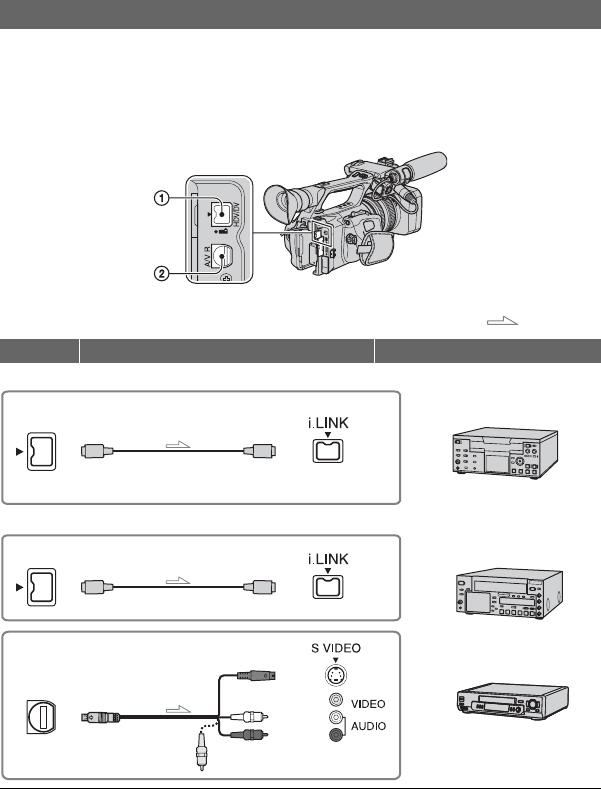
96
Dubbing/Editing
Dubbing to VCR, DVD/HDD device, etc.
Connect your camcorder to the wall outlet (wall socket) using the supplied AC Adaptor/
Charger for this operation (p. 13). Refer also to the instruction manuals supplied with the
devices to be connected.
The connection method and the image quality will differ depending on the VCR, DVD/HDD
device and the connectors used.
Jacks on your camcorder
Open the jack cover and connect the cable.
Connecting to external devices
: Signal flow
Camcorder Cable External device
1
1
2
i.LINK cable (optional)
HDV1080i compatible device
t HD quality*
• i.LINK jack which is compatible with HDV1080i specification is required on the external device.
i.LINK cable (optional)
A/V connecting cable with
S VIDEO (optional)
(Red)
(White)
(Yellow)
AV device with i.LINK jack
t SD quality*
AV device with S VIDEO ja
c
t SD quality*
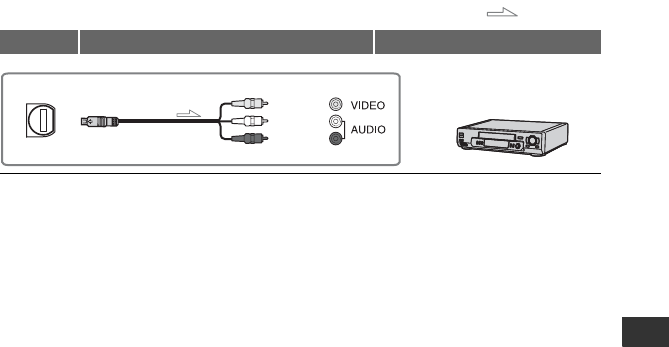
97
Dubbing/Editing
bNotes
• You cannot dub pictures using the HDMI cable.
Using an i.LINK cable (optional)
The dubbed format (HDV/DV) differs depending on the recording format or the format
supported by the VCR/DVD device. See the table below for selecting the appropriate settings,
and perform necessary menu setting.
bNotes
• Disconnect the i.LINK cable before changing these menu settings, otherwise the VCR/DVD device may
not correctly identify the video signal.
zTips
• This camcorder has a 4-pin i.LINK terminal. Select a cable that fits the terminal on the device to be
connected.
*Pictures recorded in the DVCAM (DV) format are dubbed in the SD (standard definition) quality,
regardless of the connection.
** When connecting your camcorder to a monaural device, connect the yellow plug of the A/V connecting
cable to the video jack on the device, and connect the white (left channel) or red (right channel) plug to
the audio jack on the device.
: Signal flow
Camcorder Cable External device
2A/V connecting cable
(supplied)
(Red)
(White)
(Yellow)
AV device with audio/video
jacks**
t SD quality*
Continued ,
98
bNotes
• When [VCR HDV/DV] is set to [AUTO], and the signal switches between HDV and DVCAM (DV)
formats, the picture and sound are interrupted temporarily.
• When the recorder is HVR-Z5U/Z5N, set [VCR HDV/DV] to [AUTO] (p. 85).
• When the player and the recorder are both HDV1080i compatible devices such as HVR-Z5U/Z5N and
connected with the i.LINK cable, after pausing or stopping and then resuming the recording, the images
will be a bit choppy or rough at that point.
• Set [DISP OUTPUT] to [LCD PANEL] (the default setting) when connecting with an A/V connecting
cable (p. 84).
When connecting with the A/V connecting cable with S VIDEO (optional)
Connect with S VIDEO jack instead of the video plug (yellow). This connection produces
pictures more faithfully. This connection produces higher quality DVCAM (DV) format
pictures. The audio will not be output when you connect with the S VIDEO cable alone.
Copy format
Camcorder
recording
format
Format supported by the
VCR/DVD device Menu setting
HDV
format*1
DVCAM
(DV)
format
[VCR HDV/DV]
(p. 85)
[i.LINK SET]
(p. 87)
Copy HDV recording as
HDV HDV HDV –*3
[AUTO]
[OFF]
Convert HDV recording to
DVCAM (DV) HDV DVCAM
(DV)
DVCAM
(DV) [ON]
Copy DVCAM (DV)
recording as DVCAM
(DV)
DVCAM
(DV)
DVCAM
(DV)
DVCAM
(DV) [OFF]
When tape is recorded in both HDV and DVCAM (DV) format
Convert both HDV and
DVCAM (DV) format to
DVCAM (DV)
HDV/
DVCAM
(DV)
DVCAM
(DV)
DVCAM
(DV) [AUTO] [ON]
Copy only portions
recorded in HDV format
HDV HDV –*3
[HDV] [OFF]
DVCAM
(DV) –*2–*3
Copy only portions
recorded in DVCAM (DV)
format
HDV –*2–*2
[DV] [OFF]
DVCAM
(DV)
DVCAM
(DV)
DVCAM
(DV)
*1Recording device compliant with the HDV1080i specification.
*2The tape advances, but no video or sound is recorded (blank).
*3Picture is not recognized (no recording is made).
Dubbing to VCR, DVD/HDD device, etc. (Continued)
99
Dubbing/Editing
1Prepare your camcorder for
playback.
Insert the recorded cassette.
Slide the POWER switch to VCR.
Set [DOWN CONVERT]/[DV WIDE
CONV] according to the playback
device (TV, etc.) (p. 87).
2Prepare your VCR/DVD device for
recording.
When dubbing to the VCR, insert a
cassette for recording.
When dubbing to the DVD recorder,
insert a DVD for recording.
If your recording device has an input
selector, set it to the appropriate input
(such as video input1 and video input2).
3Connect your VCR/DVD device to
your camcorder as a recording
device.
See page 96 for connection details.
4Start playback on the camcorder,
and recording on the VCR/DVD
device.
Refer to the operating instructions
supplied with your recording device for
details.
5When dubbing is complete, stop
your camcorder and the VCR/DVD
device.
bNotes
• The following cannot be output via the HDV/
DV interface (i.LINK):
– Indicators
– Titles that are recorded on other camcorders
• Pictures recorded in the HDV format are not
output from the HDV/DV interface (i.LINK)
jack during playback pause or in any playback
mode other than normal playback.
• Note the following when connecting with an
i.LINK cable:
– The recorded picture becomes rough when a
picture is paused on your camcorder while
recording to a VCR/DVD device.
– Data codes (date/time/camera settings data)
may not be displayed or recorded depending
on the device or application.
– You cannot record the picture and sound
separately.
• When dubbing to a DVD recorder from your
camcorder through an i.LINK cable, you may
not operate your camcorder on your DVD
recorder even if its instruction manual says you
can. If you can set the input mode to HDV or
DV on your DVD recorder and can input/output
pictures, follow the steps in “Using an i.LINK
cable (optional).”
zTips
• To record the date/time and camera settings data
when connected by the A/V connecting cable,
display them on the screen.
• When you use an i.LINK cable, the video and
sound signals are transmitted digitally,
producing high quality pictures.
• When an i.LINK cable is connected, the format
of the output signal ( or
) will be indicated on the LCD screen of
your camcorder.
Dubbing to another device
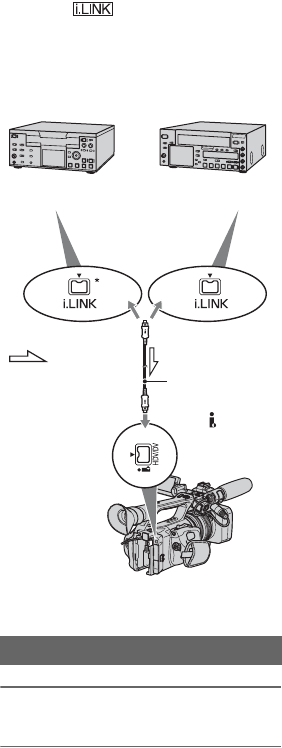
100
Recording pictures from a VCR
You can record pictures from a VCR on a
tape. You can record a scene as a still image
on a “Memory Stick Duo.” You can record
pictures in the HDV format by connecting
an HDV1080i specification compatible
device. Be sure to insert a cassette or a
“Memory Stick Duo” for recording in your
camcorder beforehand.
You can connect your camcorder to a VCR
device using an i.LINK cable.
Connect your camcorder to the wall outlet
(wall socket) using the supplied AC
Adaptor/Charger for this operation (p. 13).
Refer also to the instruction manuals
supplied with the devices to be connected.
bNotes
• You need an i.LINK cable for this operation.
• You cannot perform this operation with the A/V
connecting cable.
• Your camcorder has a 4-pin i.LINK terminal.
Select a cable that fits the terminal on the device
to be attached.
• Your camcorder can only record from an NTSC
source. For example, French video or TV
programs (SECAM) cannot be recorded
correctly. See page 118 for details on TV color
systems.
*An i.LINK jack which is compatible with
HDV1080i specification is required.
1Set the POWER switch to VCR.
2Set the input signal of your
camcorder.
Set [VCR HDV/DV] to [AUTO] when
recording from an HDV format
compatible device.
Set [VCR HDV/DV] to [DV] or
[AUTO] when recording from a
DVCAM (DV) format compatible
device (p. 85).
Recording movies
HDV1080i
compatible device
AV device with
i.LINK jack
t HD quality t SD quality
To i.LINK connector
i.LINK cable
(optional)
To HDV/DV
interface
(i.LINK)
: Signal
flow
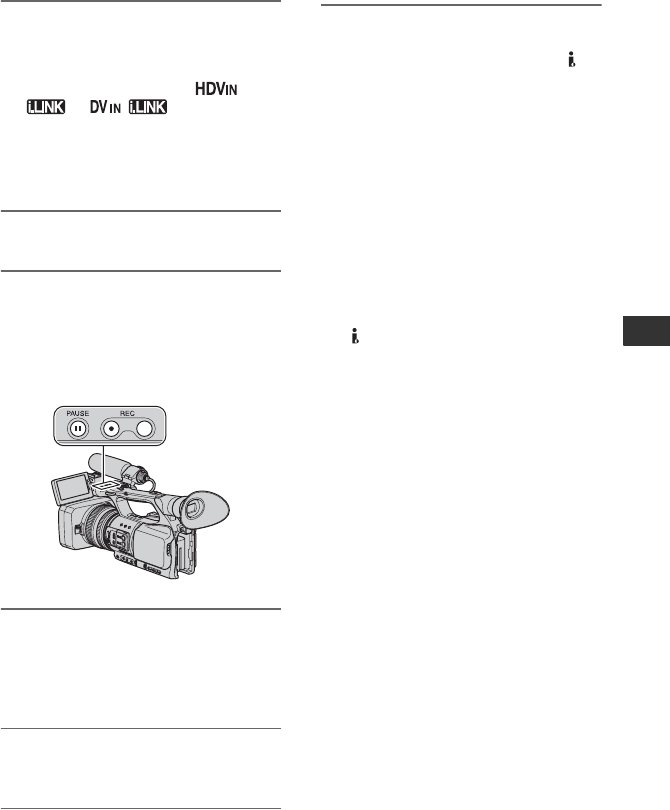
101
Dubbing/Editing
3Connect your VCR as a player to
your camcorder.
When an i.LINK cable is connected, the
format of the input signal (
or ) will be
indicated on the LCD screen of your
camcorder (This indicator may appear
on the screen of the playback device but
it will not be recorded).
4Insert a cassette into the VCR.
5Set your camcorder to recording
pause.
While pressing X (PAUSE), press both
z REC (record) buttons
simultaneously.
6Start playing the cassette on your
VCR.
The picture played on the VCR appears
on the LCD screen of your camcorder.
7Press X (PAUSE) again at the
point you want to start recording.
8Press x (STOP) to stop
recording.
bNotes
• You cannot record TV programs from the
HDV/DV interface (i.LINK).
• User bits are not recorded when dubbing from a
DVCAM (DV) device via an i.LINK cable.
• You can record pictures from DV devices only
in the DVCAM (DV) format.
• Note the following when connecting with an
i.LINK cable:
– The recorded picture becomes rough when a
picture is paused on your camcorder while
recording to a VCR.
– You cannot record the picture and sound
separately.
– If you pause or stop the recording and restart
it, the picture may not be recorded smoothly.
• If video signals inputted to your camcorder via
the HDV/DV jack experience the
phenomenon of jittering (variation in
frequency), that jittering is transmitted to the
video signals outputted from the A/V remote
connector. When you monitor a movie on a TV
connected to your camcorder via the A/V
remote connector, images may be distorted or
not be displayed. Jittering will not affect
recording of the movie on a tape with your
camcorder but may affect recording of the
movie with another VCR connected to your
camcorder via the A/V remote connector.
zTips
• When a 4:3 video signal is input, it appears with
black bands on the right and left sides on the
screen of your camcorder.
Continued ,
102
Be sure to insert a “Memory Stick Duo” for
recording in your camcorder and assign
[PHOTO] to the ASSIGN 7/PHOTO button
(p. 46) beforehand.
1Perform steps 1 to 4 in
“Recording movies.”
2Start playing the cassette.
The pictures on the VCR appear on the
screen of your camcorder.
3Press the ASSIGN 7/PHOTO
button on your camcorder or the
PHOTO button on the Remote
Commander at the scene you
want to record.
bNotes
• The image size is 1.2M when capturing a still
image from a movie recorded and played back
in the HDV format. The image size is 0.2M
when capturing a still image from a movie
recorded and played back in the DVCAM (DV)
and widescreen (16:9) formats, or VGA (0.3M)
when the movie is recorded and played back in
the DVCAM (DV) and 4:3 formats.
Recording still images
Copying movies on a
tape to a computer
Connect your camcorder to the computer
with an i.LINK cable.
The computer needs to have an i.LINK
connector and be installed with editing
software that can copy video signals.
The software required depends on the
format of the recorded pictures and the
format for copying to the computer (HDV
or DVCAM (DV)) as shown in the table
below.
bNotes
• The HDV/DV jack of your camcorder does
not have a power-supply function.
• When you connect your camcorder to a
computer via an i.LINK cable, make sure that
the terminals of the i.LINK cable are placed the
right way. Squeezing the terminals into jacks
may damage the terminals and jacks, or result in
a malfunction of your camcorder.
• You cannot copy image data stored on a
“Memory Stick Duo” onto your computer via an
i.LINK cable.
• Refer to the operating instructions of the
software for the details on image copying.
• Refer to the operating instructions of the editing
software for the recommended connection.
• Some editing software on the computer may not
work correctly.
• You cannot change format DVCAM (DV) to
HDV.
The required menu settings vary depending
on the recorded images and the format
Recorded
format
Format for
copying to
the computer
Required software
HDV HDV
Editing software
capable of
copying HDV
signal
HDV DVCAM
(DV)
Editing software
capable of
copying DVCAM
(DV) signal
DVCAM
(DV)
DVCAM
(DV)
Editing software
capable of
copying DVCAM
(DV) signal
Recording pictures from a VCR
(Continued)
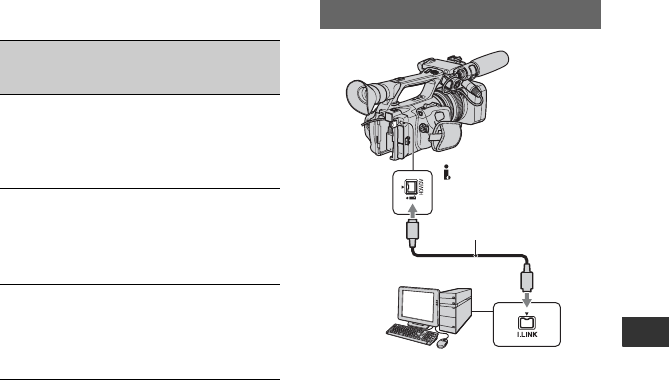
103
Dubbing/Editing
(HDV or DVCAM (DV)) to be copied to
the computer.
*See page 64 for menu settings.
zTips
• To copy HDV format images as they are
without changing their format, an HDV
compatible environment is required.
For details, refer to your software instruction
manual or contact the software manufacturer.
• To play movies by a regular DVD player, you
need to create DVD video in the SD format. The
DVD video is not in the HDV format.
Notes on connecting to the computer
• Connect the i.LINK cable to the computer first,
then to your camcorder. Connecting in the
opposite order may cause static electricity to
build up, resulting in a malfunction of your
camcorder.
• The computer may freeze or may not recognize
the signal from your camcorder in the following
situations.
– Connecting your camcorder to a computer
that does not support the video signal formats
appearing on the LCD screen of your
camcorder display (HDV or DVCAM (DV)).
– Changing [VCR HDV/DV] (p. 85) and
[i.LINK SET] (p. 87) settings while
connected with an i.LINK cable.
– Changing [REC FORMAT] setting while
connected with an i.LINK cable with the
POWER switch set to CAMERA (p. 85).
– Changing the POWER switch position while
connected with an i.LINK cable.
• The format (HDV or DVCAM (DV)) of input/
output signal appears on the LCD screen of your
camcorder while connected with an i.LINK
cable.
Recorded
format
Format for
copying to
the computer
Menu setting*
HDV HDV
[VCR HDV/DV]
t [HDV]
[i.LINK SET] t
[HDV t DV
CONV] t [OFF]
HDV DVCAM
(DV)
[VCR HDV/DV]
t [HDV]
[i.LINK SET] t
[HDV t DV
CONV] t [ON]
DVCAM
(DV)
DVCAM
(DV)
[VCR HDV/DV]
t [DV]
[i.LINK SET] t
[HDV t DV
CONV] t [OFF]
Step:1 Connect an i.LINK cable
i.LINK cable (optional)
HDV/DV interface
(i.LINK)
Continued ,

104
Use the supplied AC Adaptor/Charger to
obtain AC power (p. 13).
1Prepare editing software (not provided).
2Turn on your computer.
3Insert a tape into your camcorder and set
the POWER switch to VCR.
4Set the menu of your camcorder.
The menu settings vary depending on
the copying image.
5Copy images to the computer with your
software.
bNotes
• If images are copied in HDV format but are not
recognized, your editing software may not
support HDV format. Convert the images to
DVCAM (DV) format according to step 4 and
copy again.
• A tape recorded in DVCAM (DV) format
cannot be copied to a computer in HDV format.
zTips
• When images recorded in HDV format are
copied to a computer, the file size is about 2GB
(almost the same as a DV file) for a 10-minute
movie if the video compression format is
MPEG2.
When copying the movie in the HDV
format from the computer to your
camcorder
Set [VCR HDV/DV] to [HDV] and [HDV
t DV CONV] of [i.LINK SET] to [OFF]
(p. 85, 87).
bNotes
• To copy an HDV format movie edited on a
computer back onto a tape in HDV format is
possible so long as your editing software
supports copying HDV movies onto tape. For
details, contact the software manufacturer.
When copying the movie in the
DVCAM (DV) format from the
computer to your camcorder
Set [VCR HDV/DV] to [DV] (p. 85).
Step:2 Copying the movies
Copying movies on a tape to a computer (Continued)
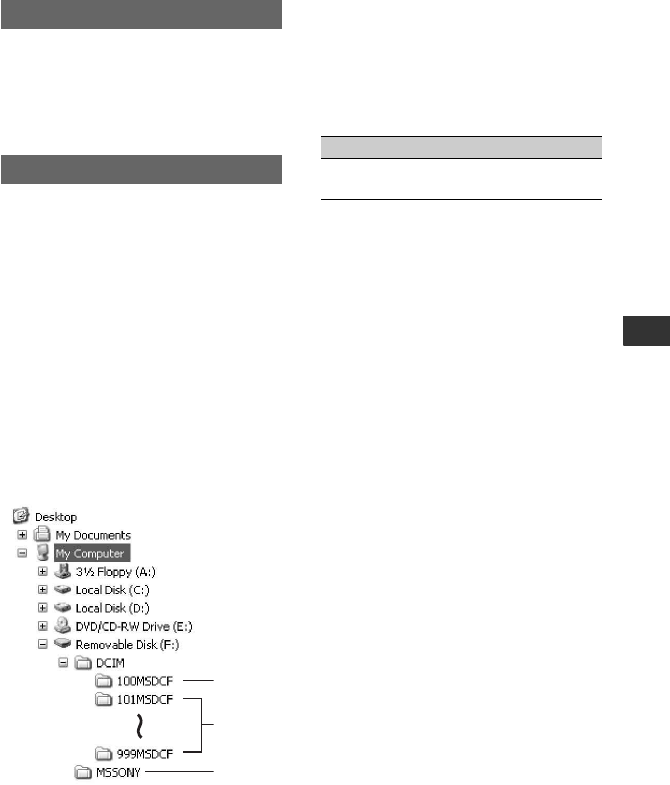
105
Dubbing/Editing
Copying still images to a computer
• For details on precautions and compatible
application software, refer also to the operating
instructions of the device to be connected.
• Required hardware: “Memory Stick Duo” slot,
Memory Stick Reader/Writer compatible with
“Memory Stick Duo.”
For Windows users
You can copy still images stored on a
“Memory Stick Duo” to your computer via
the “Memory Stick Duo” slot of your
computer.
1Turn on your computer.
2Insert the “Memory Stick Duo” into the
“Memory Stick Duo” slot of your
computer.
3Double-click the [Removable Disk]
icon displayed in [My Computer]. Then,
drag and drop a still image from the
folder onto the hard disk drive of your
computer.
AFolder containing image files recorded
by other camcorders without the folder
creation function (for playback only).
BFolder containing image files recorded
by your camcorder when no new folders
have been created, only [101MSDCF] is
displayed.
CFolder containing movie data recorded
by other camcorders without the folder
creation function (for playback only)
ssss are numbers between 0001 and
9999.
For Macintosh users
Double-click the drive icon, then drag and
drop the desired picture file onto the hard
disk of your computer.
System requirements
Copying the pictures
1
2
3
Folder File Meaning
101MSDCF (up
to 999MSDCF)
DSC0ss
ss.JPG
Still image
file
106
Troubleshooting
Troubleshooting
If you run into any problems using your camcorder, use the following table to troubleshoot the
problem. If the problem persists, disconnect the power source and contact your Sony dealer.
• Power sources/LCD screen/Remote Commander···p. 106
• Cassette tapes/“Memory Stick Duo”···p. 107
• Recording···p. 108
• Playback···p. 111
• Connecting to TV···p. 113
• Dubbing/Editing/Connecting to other devices···p. 114
• Connecting to a computer···p. 115
The power does not turn on or abruptly turns off.
• Attach a charged battery pack to the camcorder (p. 13).
• Use the AC Adaptor/Charger to connect to a wall outlet (wall socket) (p. 13).
The camcorder does not operate even when the power is set to on.
• Disconnect the AC Adaptor/Charger from the wall outlet (wall socket) or remove the battery
pack, then reconnect it after about 1 minute.
• Press the RESET button (p. 138) using a sharp-pointed object.
The camcorder gets warm.
• The camcorder may get warmer while you use it. This is not a malfunction.
The remaining battery time indicator does not indicate the correct time.
• Ambient temperature is too high or too low, or the battery pack has not been charged enough.
This is not a malfunction.
• Fully charge the battery again. If the problem persists, the battery may be worn-out. Replace
it with a new one (p. 13, 123).
• The indicated time may not be correct in certain circumstances. For example, when you open
or close the LCD panel, it takes about 1 minute to display the correct remaining battery time.
The battery pack discharges too quickly.
• Ambient temperature is too high or low, or the battery pack has not been charged enough.
This is not a malfunction.
• Fully charge the battery again. If the problem persists, the battery may be worn-out. Replace
it with a new one (p. 13, 123).
The picture remains on the LCD screen.
• This occurs if you disconnect the DK-415 cable or remove the battery pack without turning
off the power first. This is not a malfunction.
Power sources/LCD screen/Remote Commander
107
Troubleshooting
The picture in the viewfinder is not clear.
• Move the viewfinder lens adjustment lever until the picture appears clearly (p. 18).
The picture in the viewfinder has disappeared.
• If you change [VF POWERMODE] to [AUTO], the finder light remains off while the LCD
panel is open (p. 83).
The supplied Remote Commander does not function.
• Set [REMOTE CTRL] to [ON] (p. 94).
• Remove any obstructions between the Remote Commander and the remote sensor.
• Keep strong light sources, such as sunlight or overhead lighting, away from the remote
sensor, otherwise the Remote Commander may not function properly.
• Insert a fresh battery in the compartment with its +/– terminals matching those of the
compartment (p. 139).
Another VCR malfunctions when you use the supplied Remote Commander.
• Select a commander mode other than VTR 2 for your VCR.
• Cover the sensor of your VCR with black paper.
The cassette cannot be ejected from the compartment.
• Make sure the power source (battery pack or AC Adaptor/Charger) is connected correctly
(p. 13).
• Moisture condensation has occurred inside the camcorder (p. 126).
The Cassette Memory indicator or title display does not appear while using a
cassette with the Cassette Memory function.
• This camcorder does not support the Cassette Memory function, so the indicator does not
appear.
The remaining tape indicator is not displayed.
• Set [ REMAINING] to [ON] to always display the remaining tape indicator (p. 84).
The cassette is noisier during rewinding or fast-forwarding.
• When using the DK-415 cable rewind/fast forward speed increases (compared with battery
operation) and therefore increases noise. This is not a malfunction.
You cannot delete pictures on a “Memory Stick Duo.”
• The pictures are protected. Release the protect function on your computer, etc.
Cassette tapes/“Memory Stick Duo”
Continued ,
108
Troubleshooting (Continued)
The recording does not start when you press the REC START/STOP button.
• Slide the POWER switch to CAMERA (p. 24).
• The tape has reached the end. Rewind it, or insert a new cassette.
• Set the write-protect tab of the cassette to REC or insert a new cassette (p. 119).
• The tape is stuck to the drum due to moisture condensation. Remove the cassette and leave
your camcorder for at least 1 hour, then re-insert the cassette (p. 126).
• Set [REC CTL MODE] of [EXT REC CTRL] to other than [EXT ONLY] (p. 88).
The handle zoom does not work.
• Set the handle zoom speed switch to FIX or VAR (p. 28).
You cannot record on the “Memory Stick Duo.”
• The “Memory Stick Duo” is full. Delete unnecessary pictures recorded on the “Memory Stick
Duo” (p. 122).
• Format the “Memory Stick Duo” on your camcorder (p. 91) or insert another “Memory Stick
Duo” (p. 22).
• You cannot record still images on the “Memory Stick Duo” in the following cases.
– While executing [FADER]
– While executing [SMTH SLW REC]
– When [SCAN TYPE] is set to [24] or [24A] and the shutter speed is slower than 1/48 (p. 85,
86)
– When [SCAN TYPE] is set to [60] or [30] and the shutter speed is slower than 1/60 (p. 85,
86)
– While using shot transition
• Assign [PHOTO] to the ASSIGN 7/PHOTO button or any one of the ASSIGN buttons.
You cannot record a smooth transition on a tape from the last recorded scene
to the next.
• Do not record progressive pictures in different [REC TYPE] settings on the same tape.
• Perform End search (p. 48).
• Do not remove the cassette (the picture will be recorded continuously without a break even
when you turn the power off).
• Do not record pictures in the HDV and DVCAM (DV) formats on the same tape.
• Do not record pictures in DVCAM mode and DV SP mode on the same tape.
• When [QUICK REC] is set to [ON], you cannot record a smooth transition (p. 94).
• When [SCAN TYPE] is set to [24A], you cannot record a smooth transition (p. 85).
The shutter sound is not heard when you record a still image.
• Set [BEEP] to [ON] (p. 94).
• No shutter sound will be outputted during movie recording or while an external device is
connected.
Recording

109
Troubleshooting
End search or last scene review does not work.
• Do not eject the cassette after recording (p. 48).
• There is nothing recorded on the cassette.
• There is a blank section between recorded sections of the tape. This is not a malfunction.
Automatic focus does not function.
• Set the FOCUS switch to AUTO to enable the automatic focus function (p. 29).
• Adjust the focus manually if the automatic focus does not work properly (p. 30).
Menu items are grayed out or do not work.
• You cannot select grayed out display items in the current recording/playback situation.
• There are some functions you cannot activate simultaneously. The following list shows
examples of unworkable combinations of functions and menu items.
Cannot use Situation
[BACK LIGHT],
[SPOTLIGHT]
Two or more of iris, gain, and shutter speed are set manually.
[IRIS/EXPOSURE] is set to [EXPOSURE] and image
brightness is adjusted with the iris ring
[HYPER GAIN] is set to [ON].
[CNTRST ENHCR] [BACK LIGHT] is set to [ON].
[FADER] No tape is inserted.
Moisture condensation has occurred inside the camcorder.
The write-protect tab on the cassette is set to SAVE.
[ZEBRA], [PEAKING],
[CAM DATA DSP],
[HISTOGRAM]
[COLOR BAR] is set to [ON].
[SMTH SLW REC] [REC TYPE] of [HDV PROGRE.] is set to [PROGRESSIVE].
[REC TYPE] of [HDV PROGRE.] is set to [INTERLACE] and
[SCAN TYPE] is set to [24], [24A] or [30].
[SCAN TYPE] of [DV PROGRE.] is set to [24] or [30].
[REC CTL MODE] of [EXT REC CTRL] is set to [EXT
ONLY].
[COLOR BAR] is set to [ON].
[MARKER] [DATE REC] is set to [ON].
[LCD BL LEVEL],
[VF B.LIGHT]
AC power source is being used.
[TC LINK] Your camcorder is not connected to an external device via an
i.LINK cable.
[TC COUNTUP] [TC MAKE] is set to [REGENERATE].
[UB-DATE/TC-TIME] [TC MAKE] is set to [REGENERATE].
[TC RUN] is set to [REC RUN].
[UB TIME REC] is set to [ON].
Date and time are not set.
Continued ,
110
Troubleshooting (Continued)
Shutter speed, gain, white balance or iris cannot be adjusted manually.
• Set the AUTO/MANUAL switch to MANUAL.
Tiny spots in white, red, blue, or green appear on the screen.
• This phenomenon appears when using a slow shutter speed (p. 32). This is not a malfunction.
The subjects passing by the frame very fast appear crooked.
• This is called the focal plane phenomenon. This is not a malfunction. Because of the way that
the image device (CMOS sensor) reads out image signals, the subjects passing by the frame
rapidly might appear crooked depending on the recording conditions.
The screen picture is bright, and the subject does not appear on the screen.
• Set [BACK LIGHT] to [OFF].
• Set [HYPER GAIN] to [OFF].
The screen picture is dark, and the subject does not appear on the screen.
• Press and hold the DISPLAY/BATT INFO button for a few seconds to turn on the backlight
(p. 18).
Horizontal stripes appear on the image.
• This occurs when recording pictures under a fluorescent lamp, sodium lamp, or mercury
lamp. This is not a malfunction. This can be improved by changing the shutter speed (p. 32).
[WORLD TIME],
[DATE REC]
Date and time are not set.
[x.v.Color] [REC FORMAT] is set to [DV].
[ECS FREQ.] The shutter speed is not set to the .
[INTERVAL REC] [REC CTL MODE] of [EXT REC CTRL] is set to [EXT
ONLY].
[REC TYPE] of [HDV PROGRE.] is set to [PROGRESSIVE].
[REC TYPE] of [HDV PROGRE.] is set to [INTERLACE] and
[SCAN TYPE] is set to [24], [24A] or [30].
[SCAN TYPE] of [DV PROGRE.] is set to [24] or [30].
[DV FRAME REC] [REC CTL MODE] of [EXT REC CTRL] is set to [EXT
ONLY].
When [REC FORMAT] is set to [HDV1080i]
[EXT REC CTRL] [INTERVAL REC] is set to [ON].
[DV FRAME REC] is set to [ON].
Cannot use Situation
111
Troubleshooting
Black bands appear when you record a TV screen or computer screen.
• This can be improved by adjusting the shutter speed in the extended clear scan ( ) range
(p. 32).
Fine patterns flicker, diagonal lines look jagged.
• Adjust [DETAIL] to the negative side (p. 41).
If you are playing back pictures stored on a “Memory Stick Duo,” refer also to the Cassette
tapes/“Memory Stick Duo” section (p. 107).
You cannot play back tape.
• Slide the POWER switch to VCR.
• Rewind the tape (p. 51).
Image data stored on a “Memory Stick Duo” cannot be played back correctly.
• Image data cannot be played back if you have modified file names or folders, or have edited
the data on a computer (In this case, the file name flashes). This is not a malfunction (p. 123).
• Pictures recorded on other devices may not be played back correctly. This is not a
malfunction.
The data file name is displayed incorrectly, or flashing.
• The file is damaged.
• The file format is not supported on your camcorder (p. 119).
• Only the file name is displayed if the folder structure does not conform to the universal
standard.
Horizontal lines appear on the picture. The displayed pictures are not clear or
do not appear.
• Video head is dirty. Clean the head using the cleaning cassette (optional) (p. 127).
You cannot hear the sound recorded with 4CH microphone recording on
another camcorder.
• Set [DV AUDIO MIX] for the DVCAM (DV) format 4-ch recording (p. 79).
• You cannot reproduce the sound recorded in CH3 and CH4 on your camcorder for the HDV
format 4-ch recording.
No sound or only a low sound is heard.
• Turn up the volume (p. 52).
• Set [DV AUDIO MIX] (p. 79).
• Pictures recorded using [SMTH SLW REC] do not have sounds.
Playback
Continued ,
112
Troubleshooting (Continued)
The picture or sound breaks off.
• The tape was recorded in both of the HDV and DVCAM (DV) formats. This is not a
malfunction.
The movies freeze for a while, or the sound breaks off.
• This occurs if the tape or video head is dirty (p. 127).
• Use the Sony mini DV cassette tape.
“---” is displayed on the screen.
• The tape you are playing back was recorded without setting the date and time.
• A blank section on the tape is being played back.
• The data code on a tape with a scratch or noise cannot be read.
• A movie recorded in the extended clear scan ( ) range is being played back.
• The tape you are playing was recorded with the gain set to -6dB.
• The tape you are playing was recorded with [HYPER GAIN] set to [ON].
Noises appear and or is displayed on the screen.
• The tape was recorded in a TV color system other than that of your camcorder (NTSC). This
is not a malfunction.
Date Search does not work correctly.
• Be sure to record more than 2 minutes after the date changed. If one day’s recording is too
short, your camcorder may not accurately find the point where the recording date changes.
• There is a blank section between recorded sections of the tape. This is not a malfunction.
No picture appears during End search, Rec review or Last scene review.
• The tape was recorded in both HDV and DVCAM (DV) formats. This is not a malfunction.
New sound added to a recorded tape on another camcorder is not heard.
• Set [DV AUDIO MIX] from [CH1,CH2] (original sound) to [MIX] or [CH3,CH4] (p. 79).
appears on the LCD screen.
• This appears when you play back a tape recorded on other recording devices using a 4ch
microphone. This camcorder does not comply with the 4ch microphone recording standard.

113
Troubleshooting
You cannot view the picture on the TV connected with the i.LINK cable.
• You cannot view the picture in the HD (high definition) quality on the TV if an i.LINK jack
of the TV is not compatible with the HDV1080i specification (p. 58). Refer to the instruction
manuals supplied with your TV.
• Down convert the pictures recorded in HDV format and play back in DVCAM (DV) format
(SD image quality) (p. 87).
• Connect the TV with another connecting cable, and play back pictures (p. 58).
You cannot hear the sound on the TV connected with the S VIDEO plug
(S VIDEO channel) or component video plugs.
• If you are using an S VIDEO plug or component video plugs, make sure the red and white
plugs are also connected (p. 58).
You cannot view the picture or hear the sound on the TV connected with the
component A/V cable.
• Set [COMPONENT] according to the requirements of the connected device (p. 87).
• When you are using the component A/V cable, make sure the red and white plugs are
connected (p. 58).
You cannot view the picture or hear the sound on the TV connected with the
HDMI cable.
• Pictures in the HDV format are not output from the HDMI OUT jack, if copyright protection
signals are recorded in the pictures.
• DVCAM (DV) format pictures input to the camcorder via i.LINK cable (p. 100) cannot be
output.
• This occurs if you record on a tape in both HDV and DVCAM (DV) formats. Disconnect and
connect the HDMI cable, or slide the POWER switch to turn on your camcorder again.
The picture appears distorted on the 4:3 TV.
• This happens when viewing a picture recorded in 16:9 (wide) mode on a 4:3 TV. Select the
down conversion type from one of the following menus, depending on the recording format.
– If the recording format is HDV, select from [DOWN CONVERT] in [VIDEO OUT]
(p. 87).
– If the recording format is DVCAM (DV), select from [DV WIDE CONV] in [VIDEO
OUT] (p. 87)
Black zone appears at top and bottom of a 4:3 TV screen.
• This happens when viewing a picture recorded in the 16:9 (wide) mode on a 4:3 TV.
This is not a malfunction.
Connecting to TV
Continued ,
114
Troubleshooting (Continued)
Pictures from connected devices cannot be zoomed.
• You cannot zoom pictures from connected devices on your camcorder.
Time code and other information appear on the display of the connected
device.
• Set [DISP OUTPUT] to [LCD PANEL] while connected with an A/V connecting cable
(p. 84).
You cannot dub correctly using the A/V connecting cable.
• The A/V connecting cable is not connected properly.
Make sure that the A/V connecting cable is connected to the input jack of the other device for
dubbing a picture from your camcorder.
When connected using an i.LINK cable, no picture appears on the monitor
screen during dubbing.
• Set [VCR HDV/DV] according to the requirements of the connected device (p. 85).
You cannot add sound to the recorded tape.
• You cannot add sound to the recorded tape on this unit.
You cannot dub correctly using the HDMI cable.
• You cannot dub pictures using the HDMI cable.
When you copy a movie shot in wide (16:9) format using an i.LINK cable, the
screen stretches vertically.
• You cannot output the aspect ratio setting using an i.LINK cable. Set the aspect ratio of the
TV instead.
• Connect using an A/V connecting cable instead.
Dubbing/Editing/Connecting to other devices

115
Troubleshooting
The computer does not recognize your camcorder.
• Disconnect the cable from the computer, then connect it again securely.
• Disconnect the cable from the computer, restart the computer, then connect the computer to
your camcorder correctly.
You cannot view or copy a movie recorded on a tape to a computer.
• Disconnect the cable from the computer, then connect it again.
• You need the editing software (optional) to copy a movie recorded on a tape to your computer
(p. 102).
Your computer freezes.
• Set [VCR HDV/DV] correctly according to the connected device (p. 85).
• Disconnect the cable from your computer and camcorder. Reboot your computer, and
connect your computer and camcorder following the steps in the correct order (p. 103).
Connecting to a computer
116
Warning indicators and messages
When an error occurs, a warning indicator
appears on the LCD screen or in the
viewfinder.
You can fix some problems associated with
the symptoms yourself. If the problem
persists even after you have tried a couple
of times, contact your Sony dealer or local
authorized Sony service facility.
C:(or E:) ss:ss (Self-diagnosis
display)
C:04:ss
• The battery pack is not an
“InfoLITHIUM” battery pack. Use an
“InfoLITHIUM” battery pack (p. 123).
C:06:ss
• The battery pack is too hot. Replace the
battery pack, or remove it and put it in a
cool place.
C:21:ss
• Moisture condensation has occurred.
Remove the cassette and leave your
camcorder for at least 1 hour, then re-
insert the cassette (p. 126).
C:22:ss
• Clean the head using a cleaning
cassette (optional) (p. 127).
C:31:ss / C:32:ss
• Symptoms that are not described above
have occurred. Remove and insert the
cassette, then operate your camcorder
again. Do not perform this procedure if
moisture condensation has occurred
(p. 126).
• Remove the power source. Reconnect it
and operate your camcorder again.
• Change the cassette. Press the RESET
button (p. 138), and operate your
camcorder again.
E:61:ss / E:62:ss
• Contact your Sony dealer or local
authorized Sony service facility. Inform
them of the 5-digit code, which starts
from “E.”
101-1001(Warning indicator
pertaining to files)
• The file is damaged.
• The file is unreadable (p. 123).
E (Battery level warning)
• The battery pack is nearly used up.
• Depending on the operating,
environment, or battery conditions, E
may flash, even if there are
approximately 5 to 10 minutes
remaining.
(Warning indicator pertaining
to battery pack temperature)
• The battery pack is too hot. Replace the
battery pack, or remove it and put it in a
cool place.
% (Moisture condensation warning)*
• Eject the cassette, remove the power
source, and then leave it for about 1
hour with the cassette lid open (p. 126).
Q (Warning indicators pertaining to
the tape)
Slow flashing:
• There is less than 5 minutes remaining
on the tape.
• No cassette is inserted.*
• The write-protect tab on the cassette is
set to lock (p. 119).*
Fast flashing:
• The tape has run out.*
Self-diagnosis display/Warning
indicators

117
Troubleshooting
Z (Eject cassette warning)*
Slow flashing:
• The write-protect tab on the cassette is
set to lock (p. 119).
Fast flashing:
• Moisture condensation has occurred
(p. 126).
• The self-diagnosis display code is
displayed (p. 116).
*When [BEEP] is set to [ON] (p. 94), you hear a
melody when the warning indicators appear on
the screen.
If messages appear on the screen, follow the
instructions.
Warning messages
118
Additional Information
Using your camcorder abroad
Power supply
You can use your camcorder in any
country/region using the AC Adaptor/
Charger supplied with your camcorder
within the AC 100 V to 240 V, 50/60 Hz
range.
On TV color systems
Your camcorder is NTSC system, so its
picture can only be viewed on an NTSC
system TV with an AUDIO/VIDEO input
jack.
Viewing HDV format pictures recorded
in HDV format
You need an HDV1080i compatible TV (or
monitor) with a component jack and
AUDIO/VIDEO input jack or an HDMI
jack. You also need a component A/V cable
(supplied) or an HDMI cable (optional).
Viewing DVCAM (DV) format pictures
recorded in DVCAM (DV) format
You need a TV with the AUDIO/VIDEO
input jack. A connecting cable is also
needed.
Simple setting of the clock by time
difference
When you are abroad, you can easily adjust
the clock to the local time by setting the
time difference. Select [WORLD TIME],
then set the time difference (p. 93).
System Used in
NTSC Bahama Islands, Bolivia,
Canada, Central America, Chile,
Colombia, Ecuador, Guyana,
Jamaica, Japan, Korea, Mexico,
Peru, Surinam, Taiwan,
the Philippines, the U.S.A.,
Venezuela, etc.
PAL Australia, Austria, Belgium,
China, Czech Republic,
Denmark, Finland, Germany,
Holland, Hong Kong, Hungary,
Italy, Kuwait, Malaysia,
New Zealand, Norway, Poland,
Portugal, Singapore,
Slovak Republic, Spain,
Sweden, Switzerland, Thailand,
United Kingdom, etc.
PAL - M Brazil
PAL - N Argentina, Paraguay, Uruguay.
SECAM Bulgaria, France, Guiana, Iran,
Iraq, Monaco, Russia, Ukraine,
etc.

119
Additional Information
Maintenance and precautions
Your camcorder is capable of recording in
HDV/DVCAM/DV formats.
It is recommended to use a cassette with the
mark to record in the HDV/
DVCAM/DV format.
It is recommended to use a cassette with the
mark to record in the DVCAM
format.
Your camcorder is not compatible with the
Cassette Memory function.
What is the HDV format?
The HDV format is a video format
developed to record and play back digital
high definition (HD) video signals on a DV
cassette.
Your camcorder adopts the Interlace mode
with 1,080 effective scan lines of screen
ruling (1080i, number of pixels 1,440 ×
1,080 dots).
The video bit rate for recording is about 25
Mbps.
i.LINK is adopted for the digital interface,
enabling a digital connection with an HDV
compatible TV or computer.
• HDV signals are compressed in MPEG2 format,
which is adopted in BS (broadcast satellite)
digital, terrestrial digital HDTV broadcastings,
in Blu-ray Disc recorders, etc.
Playback
• Your camcorder can play back pictures in both
the DVCAM (DV) format and HDV1080i
specification.
• Your camcorder can play back pictures recorded
in the HDV 720/30p format, but cannot output it
from the HDV/DV interface (i.LINK).
To prevent a blank section from being
created on the tape
Go to the end of the recorded section using
[END SEARCH] (p. 48) before you begin
the next recording when you have played
back the tape.
Copyright signal
xWhen you play back
If the cassette you play back on your
camcorder contains copyright signals, you
cannot copy it to a tape in another video
camera connected to your camcorder.
xWhen you record
You cannot record software on your
camcorder that contains copyright control
signals for copyright protection of software.
[Cannot record due to copyright
protection.] appears on the LCD screen, or
on the viewfinder if you try to record such
software. Your camcorder does not record
copyright control signals on the tape when
it records.
Audio mode
The DVCAM format has 2 audio modes.
You cannot dub sound onto a recorded tape
with your camcorder.
xFS32K (12-bit) mode
The original sound is recorded in channels
1 and 2, and the new sound in channels 3
and 4. The balance between channels 1/2
and channels 3/4 can be adjusted by
selecting [DV AUDIO MIX] in the menu
settings during playback. If you select
[MIX], the sounds of channel 1/2 and
channel 3/ 4 are synthesized to be output.
xFS48K (16-bit) mode
The original sound can be recorded in high
quality using 2 channels. The audio mode
can be indicated on the LCD screen or in
the viewfinder.
Notes on use
xWhen not using your camcorder for a
long time
Remove the cassette and store it.
HDV format and recording/
playback
Continued ,
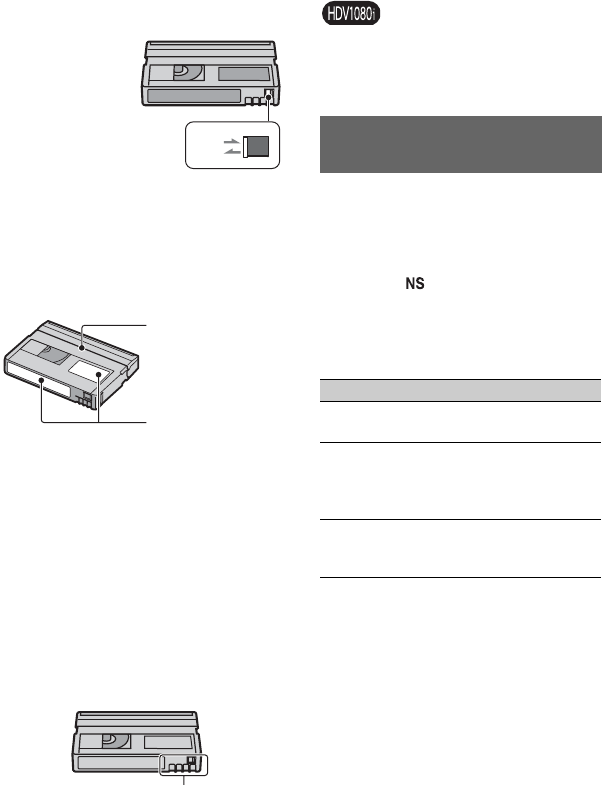
120
xTo prevent accidental erasure
Slide the write-protect tab on the cassette to
set it to SAVE.
xWhen labeling the cassette
Be sure to place the label only on the
locations shown in the following
illustration so as not to cause a malfunction
of your camcorder.
xAfter using the cassette
Rewind the tape to the beginning to avoid
distortion of the picture or the sound. The
cassette should then be put in its case, and
stored in an upright position.
xWhen cleaning the gold-plated
connector
Generally, clean the gold-plated connector
on a cassette with a cotton-wool swab after
every 10 times it has been ejected.
If the gold-plated connector on the cassette
is dirty or dusty, the remaining tape
indicator may not show correctly.
On Sony HDV1080i compliant TVs
An HDV format compatible TV with the
component input jack is required to view
playback pictures recorded in the HDV
format.
The DVCAM format was developed as a
more reliable and higher-end format than
the consumer DV format. Explained here
are the differences, compatibility, and
limitations on editing for the DVCAM and
DV formats. appears when the DVCAM
standard is not met.
Differences between the DVCAM and
DV formats
*There are 2 modes for audio recording, lock
mode and unlock mode. In lock mode, the
sampling frequencies of audio and video are
synchronized. Therefore, lock mode is more
effective than unlock mode in digital
processing and smooth transition during audio
editing.
REC
SAVE
REC: The cassette can be
recorded.
SAVE: The cassette cannot be
recorded (write-protected).
Do not put a label
along this border.
Labeling position
Gold-plated connector
Compatibility of the DVCAM/DV
formats
Specification DVCAM DV
TRACK
Pitch
15 µm 10 µm
Audio
sampling
frequency
12 bit:32
kHz
16 bit:48
kHz
12 bit:32 kHz
16 bit:48 kHz
44.1 kHz
48 kHz
Audio
recording
mode*
Lock mode Lock/Unlock
mode
Maintenance and precautions (Continued)

121
Additional Information
Mini DVCAM and mini DV cassettes
The recording format of the picture is
defined according to the recorder’s format
as described below.
bNotes
• This camcorder complies with the DVCAM
format.Though mini DV cassettes can be used
for recording, we recommend you use mini
DVCAM cassettes to get the most out of the
high reliability of the DVCAM format.
• The recording time of mini DV cassettes is 1/3
shorter than that indicated on mini DV cassettes
when recorded in the DVCAM format.
Compatibility on playback
Compatibility on editing using DV
jacks
When this camcorder is connected to other
digital video equipment using an i.LINK
cable, the recording format of edited tapes
is defined according to the source tape and
the recorder’s format as described below.
Playback or editing using the edited tape
may be limited depending on dubbing
operation. Start dubbing after reading
“Limitations on editing” (p. 122).
1) When using mini DVCAM video equipment to
perform DV dubbing of a tape recorded in DV
format, the tape produced will be in the
DVCAM format which the time code format
will be partly misadjusted. (there will be no
effect on the recorded picture except in certain
cases.)
2) If the tape that is to be dubbed is in the DVCAM
format as in 1), the tape produced will be in the
DVCAM format and the time code format will
be partly misadjusted.
3) Some mini DV video equipment may be able to
play back a DVCAM-formatted tape. Even if
the tape is played back, quality of the playback
cannot be guaranteed. The time code format will
be partly misadjusted.
Recorder’s
format
Cassette’s
format
Recording
format
DVCAM DVCAM
DV
DVCAM
DV DVCAM
DV
DV
Tape On DV video
equipment
On DVCAM
video
equipment
DV
formatted
Can be
playback
Can be
played back
only when
recorded in
SP mode
DVCAM
formatted
Can be
played back
on some
equipment
Can be
playback
Source
tape
Player’s
format
Recorder’s
format
Recording
format
DV
formatted
(SP mode
only)
DVCAM DVCAM DVCAM 1)
DV DV
DV
formatted
DV DVCAM DVCAM
DV DV
DVCAM
formatted
2)
DVCAM DVCAM DVCAM
DV DV
DVCAM
formatted
2)
DV 3) DVCAM DVCAM
(Compatib
ility
depends
on
models.)
DV DV
Continued ,

122
bNotes
• If you use tapes as in 1) to 3) above for editing,
the functions may be limited regardless of the
format of players and recorders.
Limitations on editing
You may find the following limitations
when editing a tape produced by dubbing or
editing using the HDV/DV Interface
(i.LINK) jack:
• Due to the difference in track pitch, you cannot
record or edit on DV-formatted tapes using mini
DVCAM video equipment.
• Depending on the DVCAM video equipment
used, you may not be able to edit DVCAM
formatted tapes if the audio recording mode is
unlock mode. In this case, dub using audio/
video jacks.
A “Memory Stick” is a compact, portable
IC recording medium with a large data
capacity.
You can use the following types of
“Memory Stick” listed below on the
camcorder. However, we do not guarantee
the operation of all types of “Memory
Stick” on your camcorder. (See the list
below for more details.)
• This product does not support high speed data
transfer via a parallel interface.
• This product cannot record or play data that uses
“MagicGate” technology. “MagicGate” is a
copyright protection technology that records and
transfers the contents in an encrypted format.
• This product is compatible with “Memory Stick
Micro” (“M2”). “M2” is the abbreviation for the
“Memory Stick Micro.”
• Still image format: Your camcorder compresses
and records image data in the JPEG (Joint
Photographic Experts Group) format. The file
extension is “.JPG.”
• A “Memory Stick Duo” formatted by a
computer (Windows OS/Mac OS) does not have
guaranteed compatibility with your camcorder.
• Data read/write speed may vary depending on
the combination of the “Memory Stick Duo”
and “Memory Stick Duo” compliant product
you use.
• You can prevent accidental erasure of images
when you slide the write-protect tab on the
“Memory Stick Duo” with a small tapered
object, to the write-protect position.
• Damaged or lost image data will not be
compensated for, and may occur in the
following cases:
– If you eject the “Memory Stick Duo,” turn the
power off on your camcorder, or remove the
battery pack for replacement while your
camcorder is reading or writing image files on
the “Memory Stick Duo” (while the access
lamp is lit or flashing).
– If you use the “Memory Stick Duo” near
magnets or magnetic fields.
• It is recommended to make a back-up of
important data on the hard disk of a computer.
• Be careful not to apply excessive force when
writing on a memo area on a “Memory Stick
Duo.”
• Do not attach a label or the like on a “Memory
Stick Duo” or a “Memory Stick Duo” adaptor.
• When you carry or store a “Memory Stick Duo,”
put it in its case.
• Do not touch, or allow metallic objects to come
into contact with the terminals.
• Do not bend, drop or apply strong force to the
“Memory Stick Duo.”
• Do not disassemble or modify the “Memory
Stick Duo.”
• Do not let the “Memory Stick Duo” get wet.
• Be careful to keep “Memory Stick Duo” media
out of the reach of small children. There is
danger that a child might swallow it.
• Do not insert anything other than a “Memory
Stick Duo” into the “Memory Stick Duo” slot.
Doing so may cause a malfunction.
• Do not use or keep the “Memory Stick Duo” in
the following locations:
– Places subject to extremely high temperature,
such as a car parked outside in the summer.
– Places under direct sunlight.
About the “Memory Stick”
Types of “Memory Stick” Recording
/Playback
“Memory Stick Duo”
(with MagicGate)
a
“Memory Stick PRO Duo” a
“Memory Stick PRO-HG Duo” a
Maintenance and precautions (Continued)

123
Additional Information
– Places with extremely high humidity or
subject to corrosive gases.
xOn the “Memory Stick Duo” adaptor
• When using a “Memory Stick Duo” with a
“Memory Stick” compliant device, make sure to
insert the “Memory Stick Duo” into a “Memory
Stick Duo” adaptor.
• When inserting a “Memory Stick Duo” into a
“Memory Stick Duo” adaptor, make sure the
“Memory Stick Duo” is inserted facing in the
correct direction, then insert it all the way in.
Note that improper use may cause a
malfunction. Also, if you force the “Memory
Stick Duo” into the “Memory Stick Duo”
adaptor in the wrong direction, it may be
damaged.
• Do not insert a “Memory Stick Duo” adaptor
without a “Memory Stick Duo” attached. Doing
so may result in malfunctions of the unit.
xOn a “Memory Stick PRO Duo”
• The maximum memory capacity of a “Memory
Stick PRO Duo” that can be used on your
camcorder is 16 GB.
• This unit does not support high speed data
transfer.
Notes on using “Memory Stick Micro”
• To use a “Memory Stick Micro” with the
camcorder, you need a Duo-sized M2 Adaptor.
Insert the “Memory Stick Micro” into the Duo-
sized M2 Adaptor, then insert the adaptor into
the “Memory Stick Duo” slot. If you insert a
“Memory Stick Micro” into the camcorder
without using a Duo-sized M2 Adaptor, you
might not be able to remove it from the
camcorder.
• Do not leave the “Memory Stick Micro” within
the reach of small children. They might
accidentally swallow it.
On image data compatibility
• Image data files recorded on a “Memory Stick
Duo” by your camcorder conform to the
“Design rule for Camera File system” universal
standard established by the JEITA (Japan
Electronics and Information Technology
Industries Association).
• On your camcorder, you cannot play back still
images recorded on other devices (DCR-
TRV900 or DSC-D700/D770) that do not
conform to the universal standard. (These
models are not sold in some regions.)
• If you cannot use a “Memory Stick Duo” that
has been used with another device, format it
with your camcorder (p. 91). Note that
formatting erases all information on the
“Memory Stick Duo.”
• You may not be able to play back images with
your camcorder:
– When playing back image data modified on
your computer.
– When playing back image data recorded with
other devices.
This unit is compatible with an
“InfoLITHIUM” battery pack (L series).
Your camcorder operates only with an
“InfoLITHIUM” battery pack.
“InfoLITHIUM” L series battery packs
have the mark.
What is an “InfoLITHIUM” battery
pack?
An “InfoLITHIUM” battery pack is a
lithium-ion battery pack that has functions
for communicating information related to
operating conditions between your
camcorder and a supplied AC Adaptor/
Charger.
The “InfoLITHIUM” battery pack
calculates the power consumption
according to the operating conditions of
your camcorder, and displays the remaining
battery time in minutes.
With an AC Adaptor/Charger, the
remaining battery time and charging time
appear.
To charge the battery pack
• Be sure to charge the battery pack before you
start using your camcorder.
• We recommend charging the battery pack in an
ambient temperature of between 10 °C to 30 °C
(50 °F to 86 °F) until the charge lamp of the AC
Adaptor/Charger turns off. If you charge the
About the “InfoLITHIUM”
battery pack
Continued ,

124
battery pack outside of this temperature range,
you may not be able to charge it efficiently.
To use the battery pack effectively
• Battery pack performance decreases when the
surrounding temperature is 10 °C (50 °F) or
below, and the length of time you can use the
battery pack becomes shorter. In that case, do
one of the following to use the battery pack for a
longer time.
– Put the battery pack in a pocket to warm it up,
and insert it in your camcorder right before
you start taking shots.
– Use a large capacity battery pack: NP-F770/
F970 (optional).
• Frequent use of the LCD screen or a frequent
playback, fast forward or rewind operation
wears out the battery pack faster.
We recommend using a large capacity battery
pack: NP-F770/F970.
• Be sure to set the POWER switch to OFF when
not recording or playing back on your
camcorder. The battery pack is also consumed
when your camcorder is in recording standby or
playback pause.
• Have spare battery packs ready for two or three
times the expected recording time, and make
trial recordings before making the actual
recording.
• Do not expose the battery pack to water. The
battery pack is not water resistant.
About the remaining battery time
indicator
• When the power goes off even though the
remaining battery time indicator indicates that
the battery pack has enough power to operate,
charge the battery pack fully again. Remaining
battery time will be indicated correctly. Note,
however, that the battery indication will not be
restored if it is used in high temperatures for a
long time, or if left in a fully charged state, or
when the battery pack is frequently used. Use
the remaining battery time indication as a rough
guide only.
• The E mark that indicates low battery flashes
even if there are still 5 to 10 minutes of battery
time remaining, depending on the operating
conditions or ambient temperature.
About storage of the battery pack
• If the battery pack is not used for a long time,
fully charge the battery pack and use it up on
your camcorder once a year to maintain proper
function. To store the battery pack, remove it
from your camcorder and put it in a dry, cool
place.
• To discharge the battery pack on your
camcorder completely, leave your camcorder in
tape recording standby until the power goes off
(p. 17).
About battery life
• Battery capacity decreases over time and
through repeated use. If decreased usage time
between charges becomes significant, it is
probably time to replace it with a new one.
• Each battery’s life is governed by storage,
operating and environmental conditions.
The HDV/DV (i.LINK) jack on your
camcorder is an i.LINK-compliant 4-pin
jack. This section describes the i.LINK
standard and its features.
What is i.LINK?
i.LINK is a digital serial interface for
transferring digital video, digital audio, and
other data to other i.LINK-compatible
devices. You can also control other devices
using the i.LINK.
i.LINK-compatible devices can be
connected using an i.LINK cable. Possible
applications are operations and data
transactions with various digital AV
devices.
When two or more i.LINK-compatible
devices are daisy-chained with the unit,
operation becomes possible from any
device in the chain. Note that operation
method may vary, or data transactions may
not be possible, depending on specifications
and characteristics of the connected
devices.
About i.LINK
Maintenance and precautions (Continued)

125
Additional Information
bNotes
• Normally, only one device can be connected to
this unit with an i.LINK cable. When
connecting this unit to an HDV/DV compatible
device having two or more HDV/DV
interfaces, refer to the operating instructions of
the device to be connected.
• i.LINK is a more familiar term for the IEEE
1394 data transport bus proposed by Sony, and
is a trademark approved by many corporations.
• IEEE 1394 is an international standard
standardized by the Institute of Electrical and
Electronics Engineers.
About the i.LINK Baud rate
i.LINK’s maximum baud rate varies
according to the device. There are 3 types.
S100 (approx. 100Mbps*)
S200 (approx. 200Mbps)
S400 (approx. 400Mbps)
The baud rate is listed under
“Specifications” in the operating
instructions of each piece of equipment. It
is also indicated near the i.LINK interface
on some devices.
The baud rate may differ from the indicated
value when the unit is connected to a device
with a different maximum baud rate.
Mbps stands for “megabits per second,” or
the amount of data that can be sent or
received in one second. For example, a
baud rate of 100 Mbps means that 100
megabits of data can be sent in one second.
To use i.LINK functions on this unit
For details on how to dub when this unit is
connected to other video devices having an
i.LINK interface, see page 99.
This unit can also be connected to other
i.LINK-compatible devices made by Sony
(for example, a VAIO series personal
computer) as well as to video devices.
Some i.LINK compatible video devices,
such as Digital Televisions, DVD,
MICROMV or HDV recorders/players are
not compatible with this unit. Before
connecting to other devices, be sure to
confirm whether the device is compatible
with an HDV/DV device or not. For details
on precautions and compatible application
software, refer also to the operating
instructions for the device to be connected.
bNotes
• When connecting a device with an i.LINK
terminal to your camcorder via an i.LINK cable,
switch off the device and unplug it from the
power socket before plugging in or unplugging
the i.LINK cable.
• x.v.Color is a more familiar term for the
xvYCC standard proposed by Sony, and is
a trademark of Sony.
• xvYCC is an international standard for
color space in video. This standard can
express a wider color range than the
currently used broadcast standard.
On use and care
• Do not use or store the camcorder and
accessories in the following locations.
– Anywhere extremely hot or cold. Never leave
them exposed to temperatures above 60 °C
(140 °F), such as under direct sunlight, near
heaters or in a car parked in the sun. They
may malfunction or become deformed.
– Near strong magnetic fields or mechanical
vibration. The camcorder may malfunction.
– Near strong radio waves or radiation. The
camcorder may not be able to record properly.
– Near AM receivers and video equipment.
Noise may occur.
– On a sandy beach or anywhere dusty. If sand
or dust gets in your camcorder, it may
malfunction. Sometimes this malfunction
cannot be repaired.
– Near windows or outdoors, where the LCD
screen, the viewfinder, or the lens may be
* What is Mbps?
About x.v.Color
About handling of your
camcorder
Continued ,
126
exposed to direct sunlight. This damages the
inside of the viewfinder or the LCD screen.
– Anywhere very humid.
• Operate your camcorder on DC 7.2 V (battery
pack) or DC 8.4 V (AC Adaptor).
• For DC or AC operation, use the accessories
recommended in these operating instructions.
• Do not let your camcorder get wet, for example,
from rain or sea water. If your camcorder gets
wet, it may malfunction. Sometimes this
malfunction cannot be repaired.
• If any solid object or liquid gets inside the
casing, unplug your camcorder and have it
checked by a Sony dealer before operating it
any further.
• Avoid rough handling, disassembling,
modifying, physical shock, or impact such as
hammering, dropping or stepping on the
product. Be particularly careful of the lens.
• Do not use a deformed or damaged battery pack.
• Keep the POWER switch setting to OFF when
you are not using your camcorder.
• Do not wrap your camcorder with a towel, for
example, and operate it. Doing so might cause
heat to build up inside.
• When disconnecting the power cord (mains
lead), pull it by the plug and not the lead.
• Do not damage the power cord (mains lead)
such as by placing anything heavy on it.
• Keep metal contacts clean.
• Keep the Remote Commander and button-type
battery out of children’s reach. If the battery is
accidentally swallowed, consult a doctor
immediately.
• If the battery electrolytic liquid has leaked,
– consult your local authorized Sony service
facility.
– wash off any liquid that may have contacted
your skin.
– if any liquid gets in your eyes, wash with
plenty of water and consult a doctor.
xWhen not using your camcorder for a
long time
• Periodically turn on the camcorder and play a
cassette for about 3 minutes.
• Use up the battery pack completely before
storing it.
Moisture condensation
If your camcorder is brought directly from a
cold place to a warm place, moisture may
condense inside your camcorder, on the
surface of the tape, or on the lens. In this
state, the tape may stick to the head drum
and be damaged or your camcorder may not
operate correctly. If there is moisture inside
your camcorder, [Moisture condensation.
Eject the cassette] or [Moisture
condensation. Turn off for 1H.] appears.
The indicator will not appear when the
moisture condenses on the lens.
xIf moisture condensation has occurred
None of the functions except cassette
ejection will work. Eject the cassette, turn
off your camcorder, and leave it for about
one hour with the cassette lid open. Your
camcorder can be used again when both of
the following conditions are met:
• The warning message does not appear when the
power is turned on.
• Neither % nor Z flashes when a cassette is
inserted and the video operation buttons are
pressed.
If moisture starts to condense, your
camcorder sometimes cannot detect
condensation. If this happens, the cassette is
sometimes not ejected for 10 seconds after
the cassette lid is opened. This is not a
malfunction. Do not close the cassette lid
until the cassette is ejected.
xNote on moisture condensation
Moisture may condense when you bring
your camcorder from a cold place into a
warm place (or vice versa) or when you use
your camcorder in a humid place as shown
below.
• When you bring your camcorder from a ski
slope into a place warmed up by a heating
device.
• When you bring your camcorder from an air
conditioned car or room into a hot place outside.
• When you use your camcorder after a squall or a
shower.
• When you use your camcorder in a hot and
humid place.
Maintenance and precautions (Continued)
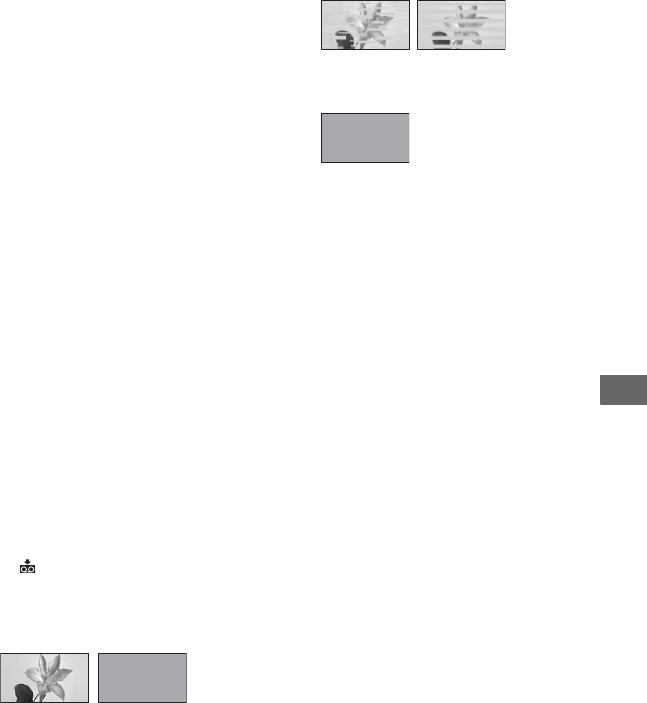
127
Additional Information
xHow to avoid moisture condensation
When you bring your camcorder from a
cold place into a warm place, put your
camcorder in a plastic bag and seal it
tightly. Remove the bag when the air
temperature inside the plastic bag has
reached the surrounding temperature (after
about one hour).
Video head
If you play back a tape recorded in HDV
format, the image and sound may freeze for
a while (about 0.5 seconds).
This occurs if the HDV signals cannot be
recorded or played back correctly because
of dirt on the tape or video head. Depending
on the cassette, this fairly infrequently
occurs even if the cassette is brand new or
is not used a lot.
If this freezing point is created while
playing back, you can solve this problem
and see the pictures by rewinding after
slightly forwarding. Such a freezing point
cannot be recovered if it was created while
recording.
To prevent such a problem, use the Sony
mini DV cassette.
• If the following problem occurs, clean the video
heads for 10 seconds with the Sony cleaning
cassette (optional).
– Playback pictures do not move.
– Playback pictures do not appear.
– The sound breaks off.
–[x Dirty video head. Use a cleaning
cassette.] appears on the screen during
recording.
– The following phenomenon occurs in HDV
format.
– The following phenomenon occurs in
DVCAM (DV) format.
• The video heads will be worn after long use. If
you cannot obtain a clear image even after using
a cleaning cassette (optional), the video heads
may be worn out. Please contact your Sony
dealer or local authorized Sony service facility
to have the video heads replaced.
LCD screen
• Do not exert excessive pressure on the LCD
screen, as it may cause damage.
• If your camcorder is used in a cold place, a
residual image may appear on the LCD screen.
This is not a malfunction.
• While using your camcorder, the back of the
LCD screen may heat up. This is not a
malfunction.
xTo clean the LCD screen
If fingerprints or dust make the LCD screen
dirty, it is recommended you use a soft
cloth to clean it. When you use the LCD
Cleaning Kit (optional), do not apply the
cleaning liquid directly to the LCD screen.
Use cleaning paper moistened with the
liquid.
On handling the casing
• If the casing is soiled, clean the camcorder body
with a soft cloth lightly moistened with water,
and then wipe the casing with a dry soft cloth.
• Avoid the following to avoid damage to the
finish.
– Using chemicals such as thinner, benzine,
alcohol, chemical cloths, repellent, insecticide
and sunscreen.
The playback
screen pauses.
The playback screen
goes blank.
(Solid blue screen)
Block-noise
appears.
The playback screen goes blank.
(Solid blue screen)
Continued ,
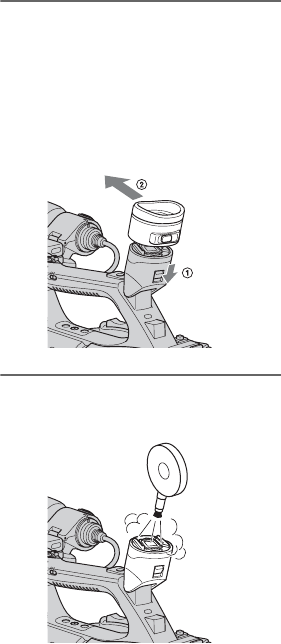
128
– Handling with above substances on your
hands.
– Leaving the casing in contact with rubber or
vinyl objects for a long period of time.
About care and storage of the lens
• Wipe the surface of the lens clean with a soft
cloth in the following instances:
– When there are fingerprints on the lens
surface.
– In hot or humid locations
– When the lens is exposed to salty air such as
at the seaside.
• Store in a well-ventilated location subject to
little dirt or dust.
• To prevent mold, periodically clean the lens as
described above. It is recommended that you
operate your camcorder about once a month to
keep it in optimum state for a long time.
On charging the pre-installed
rechargeable battery
Your camcorder has a pre-installed
rechargeable battery to retain the date, time,
and other settings even when the POWER
switch is set to OFF. The pre-installed
rechargeable battery is always charged
while your camcorder is connected to the
wall outlet (wall socket) via the AC
Adaptor/Charger or while the battery pack
is inserted. The rechargeable battery will be
fully discharged in about 3 months if you
do not use your camcorder at all without the
AC Adaptor/Charger connected or the
battery pack attached. Use your camcorder
after charging the pre-installed
rechargeable battery.
However, even if the pre-installed
rechargeable battery is not charged, the
camcorder operation will not be affected as
long as you are not recording the date.
xProcedures
Connect your camcorder to a wall outlet
(wall socket) using the supplied AC
Adaptor/Charger, and leave it with the
POWER switch set to OFF for more than
24 hours.
Removing dust from inside the
viewfinder
1Remove the eye piece of the
viewfinder.
Slide down the viewfinder release lever
and hold it at the position (1), then lift
the eye piece of the viewfinder as
indicated with the arrow in the
illustration (2).
2Remove dust inside the eye piece
and viewfinder with a blower.
Maintenance and precautions (Continued)

129
Additional Information
Specifications
System
Video recording system (HDV)
2 rotary heads, Helical scanning system
Video recording system (DVCAM (DV))
2 rotary heads, Helical scanning system
Still image recording system
Exif Ver. 2.2*
Audio recording system (HDV)
Rotary heads, MPEG-1 Audio Layer-2,
Quantization: 16 bits
Fs48kHz (stereo)
transfer rate: 384 kbps
Audio recording system (DVCAM (DV))
Rotary heads, PCM system
Quantization: 12 bits
Fs32kHz (channel 1/2 stereo),
Quantization: 16 bits
Fs48kHz (channel 1/2 stereo)
Video signal
NTSC color, EIA standards
1080/60i specification
Usable cassette
Mini DV cassette with the mark
printed or Mini DVCAM cassette with
the mark printed
Tape speed (HDV)
Approx. 18.812 mm/s
Tape speed (DVCAM)
Approx. 28.193 mm/s
Tape speed (DV SP)
Approx. 18.812 mm/s
Recording/playback time (HDV)
63 min (using a PHDVM-63DM
cassette)
Recording/playback time (DVCAM)
41 min (using a PHDVM-63DM
cassette)
Recording/playback time (DV SP)
63 min (using a PHDVM-63DM
cassette)
Fast forward/rewind time
Approx. 2 min 40 s (using a PHDVM-
63DM cassette and rechargeable
battery pack)
Approx. 1 min 45 s (using a PHDVM-
63DM cassette and AC Adaptor/
Charger)
Viewfinder
Electric viewfinder (color, black and
white)
Picture
1.1 cm (0.45 type, aspect
ratio 16:9)
Total dot number
1 226 880 (approx. 852 × 3[RGB] ×
480)
Image device
6.0 mm (1/3 type) 3CMOS sensor
Recording Pixels (HDV/DV16:9 still
recording):
Max. 1.20 Mega (1 440 ×810) pixels**
Gross: Approx. 1 120 000 pixels
Effective (movie, 16:9):
Approx. 1 037 000 pixels
Effective (movie, 4:3):
Approx. 778 000 pixels
Effective (still, 16:9):
Approx. 1 037 000 pixels
Effective (still, 4:3):
Approx. 778 000 pixels
Lens
G Lens
20 ×(Optical), Approx. 30 ×(Digital,
when [D.EXTENDER] is set to [ON])
Focal length
f=4.1 - 82.0 mm (3/16 - 3 1/4 in.)
When converted to a 35 mm still
camera
29.5 - 590 mm (1 3/16 - 23 1/4 in.)
(16:9),
36.1 - 722 mm (1 7/16 - 28 1/2 in.)
(4:3)
F1.6 - 3.4
Filter diameter: 72 mm (2 7/8 in.)
Continued ,

130
Color temperature
[AUTO]
(one push) A/B
[INDOOR] (3 200K)
[OUTDOOR] (5 800K±7 offset levels)
[MANU WB TEMP] (2 300K -
15 000K in 100K steps)
Minimum illumination
1.5 lx (lux) (Fixed Shutter Speed 1/30,
auto gain, auto iris) (F 1.6)
*“Exif” is a file format for still images,
established by the JEITA (Japan
Electronics and Information Technology
Industries Association). Files in this
format can have additional information
such as your camcorder’s setting
information at the time of recording.
**The unique pixel array of Sony's
ClearVid CMOS sensor and image
processing system (Enhanced Imaging
Processor) allows for still image
resolution equivalent to the sizes
described.
Output connectors
A/V Remote Connector
10-pin connector
When A/V connecting cable is
connected
Video signal: 1 Vp-p, 75 Ω (ohms)
Luminance signal: 1 Vp-p, 75 Ω (ohms)
Chrominance signal: 0.286 Vp-p (burst
signal), 75 Ω (ohms)
When component A/V cable is
connected
Y: 1 Vp-p, 75 Ω (ohms), PB/PR, CB/CR:
+/- 350 mV, 75 Ω (ohms)
Audio signal: -10 dBu (at load
impedance 47 kΩ (kilohms)), Output
impedance with less than 2.2 kΩ
(kilohms)
(0 dBu=0.775 Vrms)
HDMI OUT jack
TypeA (19-pin)
i (headphones) jack
Stereo-minijack (Ø 3.5 mm)
Input/Output connectors
LANC jack
Stereo mini-minijack (Ø 2.5 mm)
INPUT1/INPUT2 jack
XLR 3-pin, female,
-48 dBu: 3kΩ (kilohms)
+4 dBu: 10kΩ (kilohms)
(0 dBu=0.775 Vrms)
HDV/DV jack
i.LINK interface (IEEE 1394, 4-pin
connector S100)
LCD screen
Picture
8.0 cm (3.2 type, aspect ratio 16:9)
Total dot number
921 600 (1 920 × 480)
General
Power requirements
DC 7.2 V (battery pack)
DC 8.4 V (AC Adaptor/Charger)
Average power consumption*
During camera recording using the
microphone ECM-XM1 and viewfinder
with normal brightness:
HDV recording 7.1 W
DVCAM (DV) recording 6.8 W
During camera recording using the
microphone ECM-XM1 and LCD with
normal brightness:
HDV recording 7.3 W
DVCAM (DV) recording 7.0 W
Operating temperature
0 °C to 40 °C (32 °F to 104 °F)
Storage temperature
-20 °C to +60 °C (-4 °F to +140 °F)
Specifications (Continued)

131
Additional Information
Dimensions (approx.)
HVR-Z5U:
169 × 188 × 451 mm
(6 3/4 × 7 1/2 × 17 7/8 in.)
(w/h/d)
including the projecting parts
169 × 188 × 451 mm
(6 3/4 × 7 1/2 × 17 7/8 in.)
(w/h/d)
including the projecting parts with the
battery pack (NP-F770)
HVR-Z5N:
169 × 188 × 451 mm
(6 3/4 × 7 1/2 × 17 7/8 in.)
(w/h/d)
including the projecting parts
169 × 188 × 451 mm
(6 3/4 × 7 1/2 × 17 7/8 in.)
(w/h/d)
including the projecting parts with the
battery pack (NP-F570)
Mass (approx.)
HVR-Z5U:
2.2 kg (5 lb 1 oz) including the lens
hood with lens cover
2.6 kg (5 lb 10 oz) including the battery
pack (NP-F770), cassette (PHDVM-
63DM), lens hood with lens cover and
microphone (ECM-XM1)
HVR-Z5N:
2.2 kg (5 lb 1 oz) including the lens
hood with lens cover
2.5 kg (5 lb 6 oz) including the battery
pack (NP-F570), cassette (PHDVM-
63DM), lens hood with lens cover and
microphone (ECM-XM1)
*When the HVR-MRC1 is used, the average
power consumption increases about 2.5 W.
AC Adaptor/Charger AC-VQ1050
Power requirements
AC 100 V - 240 V, 50 Hz/60 Hz
Power consumption
22 W
Output voltage
DC 8.4 V*
Operating temperature
0 °C to 40 °C (32 °F to 104 °F)
Storage temperature
-20 °C to +60 °C (-4 °F to +140 °F)
Dimensions (approx.)
123 × 53 × 135 mm
(4 7/8 × 2 1/8 × 5 3/8 in.) (w/h/d)
excluding the projecting parts
Mass (approx.)
390 g (13.8 oz) excluding the power
cord (mains lead)
*See the label on the AC Adaptor/Charger for
other specifications.
Rechargeable battery pack NP-F770
(supplied with HVR-Z5U)
Maximum output voltage
DC 8.4 V
Output voltage
DC 7.2 V
Maximum charge voltage
DC 8.4 V
Maximum charge current
3.0 A
Capacity
31.7 Wh (4 400 mAh)
Type
Li-ion
132
Rechargeable battery pack NP-F570
(supplied with HVR-Z5N)
Maximum output voltage
DC 8.4 V
Output voltage
DC 7.2 V
Maximum charge voltage
DC 8.4 V
Maximum charge current
3.0 A
Capacity
15.8 Wh (2 200 mAh)
Type
Li-ion
Design and specifications are subject to change
without notice.

133
Additional Information
On trademarks
• “Memory Stick,” “ ,” “Memory Stick
Duo,” “ ,” “Memory Stick
PRO Duo,” “ ,”
“Memory Stick PRO-HG Duo,”
“ ,” “Memory Stick
Micro,” “MagicGate,” “ ,”
“MagicGate Memory Stick” and “MagicGate
Memory Stick Duo” are trademarks of Sony
Corporation.
• “InfoLITHIUM” is a trademark of Sony
Corporation.
• is a trademark of Sony Corporation.
• “x.v.Color” is a trademark of Sony Corporation.
• i.LINK and are trademarks of Sony
Corporation.
• is a trademark.
• is a trademark.
• Microsoft, Windows, Windows Vista, and
Windows Media are trademarks or registered
trademarks of U.S. Microsoft Corporation in the
U.S. and other countries.
• Macintosh and Mac OS are registered
trademarks of Apple Inc. in the U.S. and other
countries.
• HDV and the HDV logo are trademarks of Sony
Corporation and Victor Company of Japan, Ltd.
• HDMI, HDMI logo, and High-Definition
Multimedia Interface are trademarks or
registered trademarks of HDMI Licensing LLC.
• Pentium is a trademark or registered trademark
of Intel Corporation.
• Adobe, and Adobe Reader are trademarks of
Adobe Systems Incorporated.
All other product names mentioned herein may be
the trademarks or registered trademarks of their
respective companies. Furthermore, ™ and “®”
are not mentioned in each case in this manual.
Notes on the License
ANY USE OF THIS PRODUCT OTHER THAN
CONSUMER PERSONAL USE IN ANY
MANNER THAT COMPLIES WITH THE
MPEG-2 STANDARD FOR ENCODING
VIDEO INFORMATION FOR PACKAGED
MEDIA IS EXPRESSLY PROHIBITED
WITHOUT A LICENSE UNDER APPLICABLE
PATENTS IN THE MPEG-2 PATENT
PORTFOLIO, WHICH LICENSE IS
AVAILABLE FROM MPEG LA, L.L.C., 250
STEELE STREET, SUITE 300, DENVER,
COLORADO 80206.
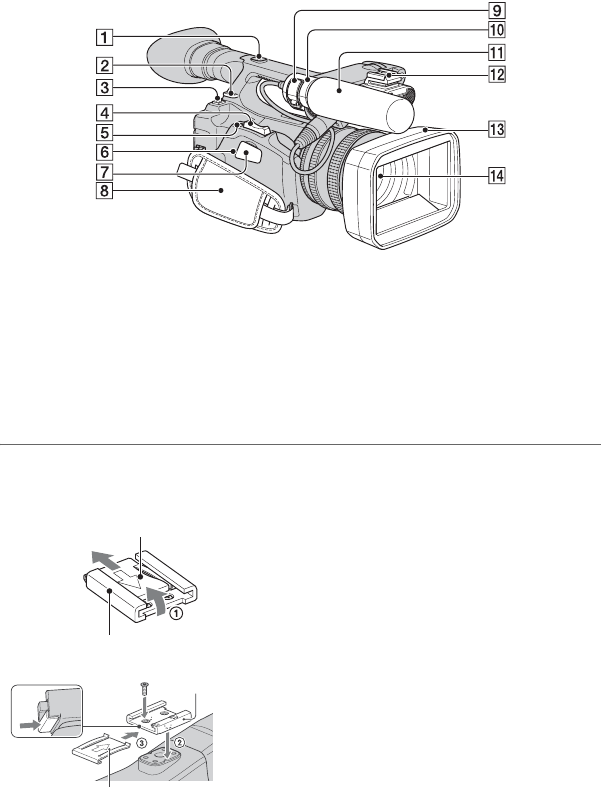
134
Quick Reference
Identifying parts and controls
The numbers in ( ) are reference pages.
AAccessory shoe mount (134)
BHook for shoulder strap (137)
CBATT RELEASE button (14)
DZoom lever (28)
EASSIGN 7/PHOTO button (26)
FAccess lamp (23)
G“Memory Stick Duo” slot (22)
HGrip belt (17)
IMicrophone fixing clamper (10)
JMicrophone holder (10)
KMicrophone (10)
LAccessory shoe (134)
MLens hood with lens cover (12)
NLens (12)
To mount the accessory shoe
Mount the accessory shoe on the accessory
shoe mount as illustrated.
1Lift the edge of the accessory shoe plate
and pull it in the direction opposite to
that of the arrow on the accessory shoe
plate and remove it from the accessory
shoe.
2Place the accessory shoe as its
protrusions matches recesses of the
accessory shoe mount, then fix it to the
mount with four screws.
3Insert the accessory shoe plate in the
direction of the arrow on the plate
surface until the end of the plate
engages the end of the shoe.
To remove the accessory shoe
Remove the shoe plate in the same way as
step 1 of “To mount the accessory shoe.”
Loosen the 4 screws and remove the
accessory shoe from the accessory shoe
mount.
Accessory shoe
Accessory shoe plate
Accessory shoe
Accessory shoe plate
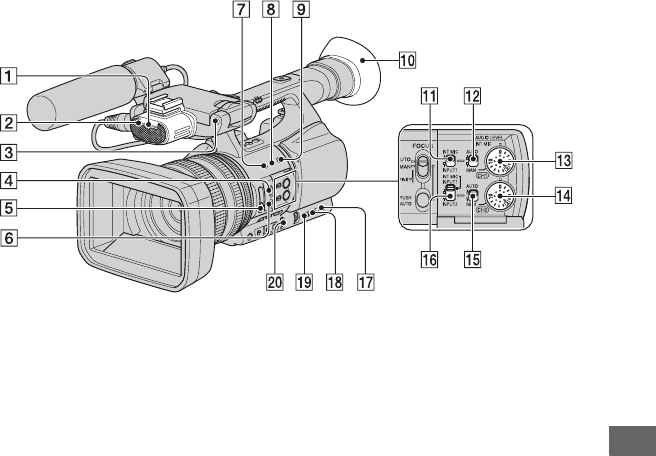
135
Quick Reference
AFront recording lamp (94)
The recording lamp flashes if the
remaining tape or battery is low.
BInternal microphone (10)
CFront remote sensor (94)
DFOCUS switch (29)
END filter (33)
FPUSH AUTO button (29)
GASSIGN 1 button/ZEBRA button (46)
HASSIGN 2 button/AE SHIFT button*
(46)
IASSIGN 3 button/REC REVIEW
button (46)
JLarge eyecup (19)
KCH1 (INT MIC/INPUT1) switch (44)
LAUTO/MAN (CH1) switch (44)
MAUDIO LEVEL(CH1) dial (44)
NAUDIO LEVEL(CH2) dial (44)
OAUTO/MAN (CH2) switch (44)
PCH2 (INT MIC/INPUT1/INPUT2)
switch (44)
QSTATUS CHECK button (55)
RPICTURE PROFILE button (35)
SMENU button (20)
TAUTO/MANUAL switch (30)
*The ASSIGN 2 button /AE SHIFT button has a
raised tactile dot for your convenience in
locating the button.
Continued ,
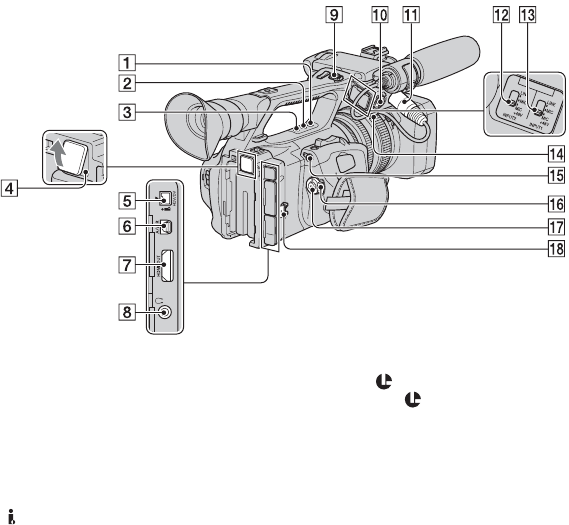
136
AASSIGN 4 button (46)
BASSIGN 5 button* (46)
CASSIGN 6 button (46)
DMemory Recording Unit jack (44)
For an optional memory recording unit
(HVR-DR60 or HVR-MRC1)
E HDV/DV jack (58)
FA/V Remote Connector (58)
GHDMI OUT jack (58)
Hi (headphones) jack
For stereo mini-jack headphones
IREC START/STOP button (24)
JINPUT2 jack (10)
KINPUT1 jack (10)
LINPUT2 switch (44)
MINPUT1 switch (44)
NCable holder (10)
Inner cable holder and outer cable
holder are provided for securing an
i.LINK cable and a microphone cable,
respectively.
OLANC jack
The LANC control jack is used for
controlling the tape transport of video
device and peripherals connected to it.
PPOWER switch (17)
QREC START/STOP button (24)
RCable holder (10)
For securing the i.LINK cable or other
cables
*The ASSIGN 5 button has a raised tactile dot for
your convenience in locating the button.
Identifying parts and controls (Continued)
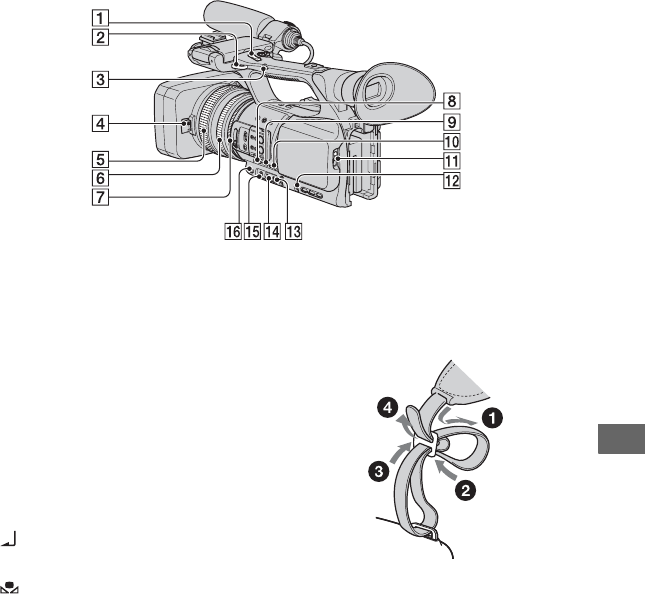
137
Quick Reference
AHandle zoom lever (28)
BHook for shoulder strap (137)
CHandle zoom switch (28)
DLens cover lever (12)
EFocus ring (29)
FZoom ring (28)
GIris ring (30)
HGAIN button (32)
IWHT BAL button* (33)
JSHUTTER SPEED button (30)
K OPEN/EJECT lever (22)
LSEL/PUSH EXEC dial (20)
M (One push) button (34)
NWhite balance memory switch (33)
OGain switch (32)
PIRIS/EXPOSURE button (30)
*WHT BAL button has a raised tactile dot for
your convenience in locating the button.
To attach the shoulder strap
Attach the shoulder strap (optional) to the
hooks for the shoulder strap.
Continued ,
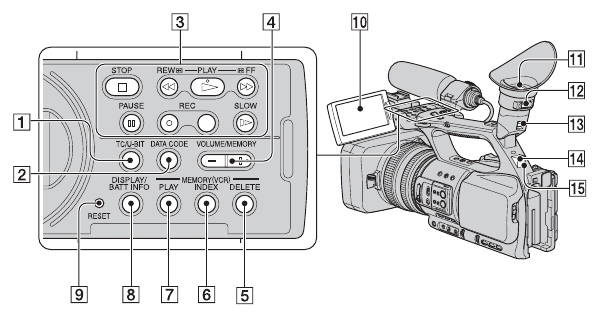
138
ATC/U-BIT button
Switches between time code and user bit
to display on the LCD screen.
BDATA CODE button (54)
CVideo control buttons (STOP/REW/
PLAY*/FF/PAUSE/REC/SLOW) (51)
DVOLUME/MEMORY button* (51)
EMEMORY/DELETE button (51)
FMEMORY/INDEX button* (51)
GMEMORY/PLAY button (51)
HDISPLAY/BATT INFO button (54)
IRESET button
If you press the RESET button, all
settings including the clock setting
(except the Picture profile and Camera
profile settings) return to the default.
JLCD screen (18)
KViewfinder (18)
LViewfinder lens adjustment lever (18)
MViewfinder release lever (128)
NRear remote sensor (94)
ORear recording lamp (94)
The recording lamp flashes if the
remaining tape or battery is low.
*PLAY button, VOLUME/MEMORY button,
and MEMORY/INDEX button have raised
tactile dots for your convenience in locating the
buttons.
Identifying parts and controls (Continued)
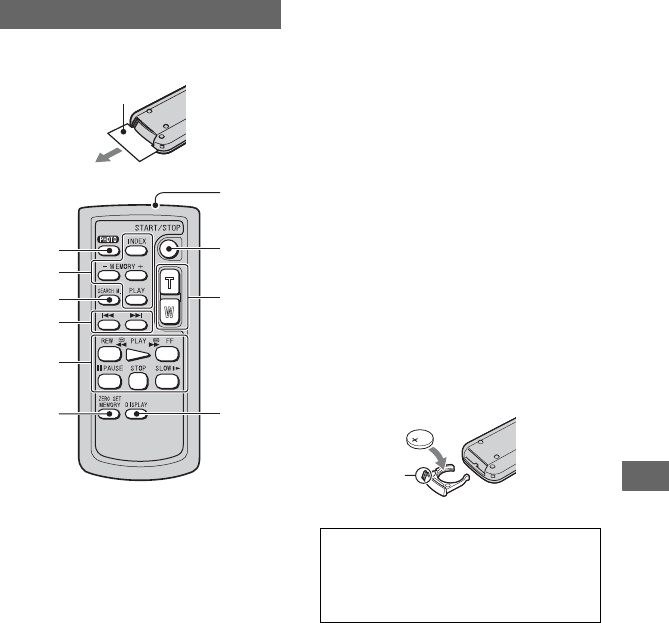
139
Quick Reference
Remove the insulation sheet before using
the Remote Commander.
APHOTO (26)
The on-screen image when you press this
button will be recorded onto the “Memory
Stick Duo” as a still image.
BMemory control buttons (Index, –/+,
Memory/playback) (52)
CSEARCH M. (56)
D. >
EVideo control buttons (Rewind,
Playback, Fast-forward, Pause, Stop,
Slow) (51)
FZERO SET MEMORY
This button is invalid with your
camcorder.
GTransmitter
HSTART/STOP (24)
IPower zoom (28)
JDISPLAY (54)
bNotes
• Aim the Remote Commander towards the
remote sensor to operate your camcorder.
• Point the remote sensor away from strong light
sources such as direct sunlight or overhead
lighting. Otherwise, the Remote Commander
may not function properly.
• When you are operating with the Remote
Commander supplied with your camcorder,
your VCR may also operate. In that case, select
a commander mode other than VTR 2 for your
VCR, or cover the sensor of your VCR with
black paper.
To change the battery of the Remote
Commander
1While pressing on the tab, inset your
fingernail into the slit to pull out the battery
case.
2Place a new battery with the + side facing
up.
3Insert the battery case back into the Remote
Commander until it clicks.
• When the lithium battery becomes weak, the
operating distance of the Remote Commander
may shorten, or the Remote Commander may
not function properly. In this case, replace the
battery with a Sony CR2025 lithium battery.
Use of another battery may present a risk of fire
or explosion.
Remote Commander
7
1
2
3
4
5
6
8
9
0
Insulation sheet
WARNING
Battery may explode if mistreated. Do not
recharge, disassemble or dispose of in
fire.
Tab
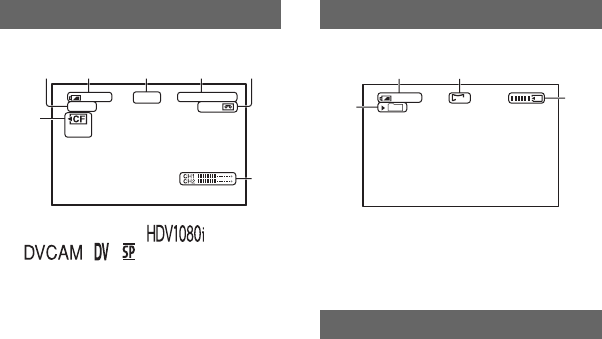
140
Indicators for the LCD screen and viewfinder
The numbers in ( ) are reference pages.
The indicators will not be recorded on the tape during recording.
ARecording format ( or
, ) (85)
BRemaining battery (approx.)
CRecording status ([STBY] (standby) or
[REC] (recording))
DDuring recording:
Tape counter (hour: minute: second:
frame)
During playback:
Time code (hour: minute: second:
frame)
ERecording capacity of the tape (approx.)
FAudio level display (82)
GRemaining recording time of an external
Memory Recording Unit (optional)
HRecording folder (91)
IImage size (26)
JRecording indicator (26)
The date/time during recording and the
camera setting data will be recorded
automatically. They do not appear on the
screen during recording, but you can check
them on the screen by pressing the DATA
CODE button during playback (p. 54).
Recording movies
60
min
REC
HDV1080i
12
min
12
min
00:04:50:04
213 5
6
4
7
Recording still images
Data code during recording
60
101
1.2M
min
29
8q;
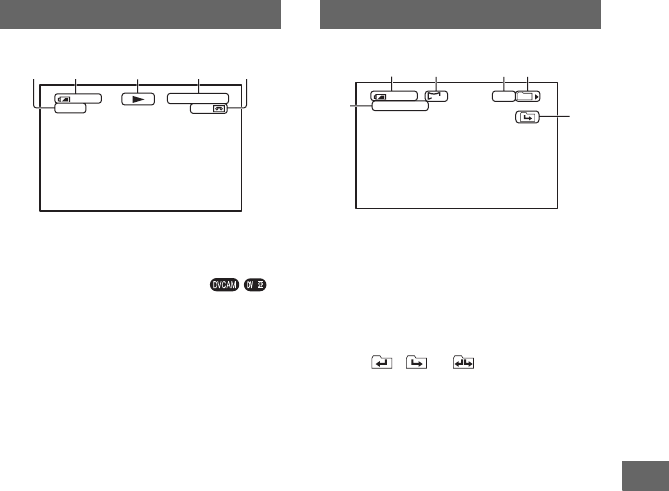
141
Quick Reference
KTape transport indicator
Recording mode (DVCAM or DV SP)
appears when a tape recorded in the DVCAM
or DV SP format is played back.
LData file name
MPicture number/Total number of
recorded pictures in the current
playback folder
NPlayback folder (92)
OPrevious/Next folder icon
The , or appears when the
first or last picture of the current folder is
displayed and when there are multiple folders
on the same “Memory Stick Duo.” You can
move to Previous/Next folder with the
VOLUME/MEMORY button.
Viewing movies
60
HDV1080i
12
00:04.50:04
qa
2154
min
min
Viewing still images
60
min
101-0011
1.2M
9/9
101
MEMORY PLAY
9
qs
qd qf
qg
2
Continued ,
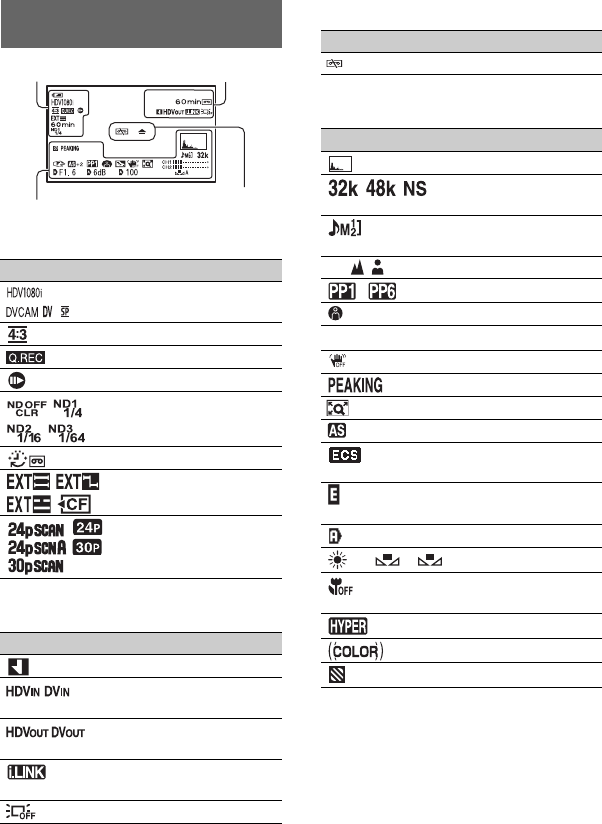
142
Upper left
Upper right
Center
Bottom
zTips
• Indicators may look different or appear at
different positions.
Indicators when you made
changes
Indicator Meaning
Recording format (85)
DV WIDE REC (86)*
QUICK REC (94)**
DV FRAME REC (75)*
ND filter (33)
INTERVAL REC (74)
EXT REC CTRL (88)
REC TYPE
SCAN TYPE (85)
Indicator Meaning
INDEX MARK (47)
HDV input/
DV input (100)
HDV output/
DV output (99)
i.LINK connection
(58, 96)
LCD backlight off (18)
00:00:00:00
60
min
Upper left Upper right
Bottom Center
Indicator Meaning
Z Warning (116)
Indicator Meaning
HISTOGRAM (80)
DV AU.MODE (DV
Audio mode) (77)*
Manual volume
control(44, 78)
9 Manual focus (29)
~ Picture profile (35)
SPOTLIGHT (72)
.BACK LIGHT (72)
SteadyShot off (72)
PEAKING (81)
D.EXTENDER (73)
AE SHIFT (71)
Extended clear scan
(32, 71)
EXPOSURE control
(31)
Auto setting (82)
n A B White balance (33)
FOCUS MACRO
(73)
HYPER GAIN (70)
x.v.Color (76)**
ZEBRA (80)
*The settings can be made only for the pictures
in the DVCAM (DV) format.
** The setting can be made only for the pictures in
the HDV format.
Indicators for the LCD screen and viewfinder (Continued)

143
Continued ,
Quick Reference
Index
A
Access lamp..........................23
Accessory shoe ...................134
Accessory shoe kit ..................9
Accessory shoe mount ........134
Accessory shoe plate...........134
ADVANCE...........................81
AE RESPONSE....................71
AE SHIFT.............................71
AE SHIFT button..................46
AF ASSIST...........................73
AGC LIMIT..........................70
ALL ERASE.........................91
ALL FILES...........................91
ALL OUTPUT......................84
ASPECT ...............................81
ASSIGN 7/PHOTO button
........................................26, 46
ASSIGN BTN.......................93
ASSIGN buttons ...................46
AT IRIS LMT .......................71
ATW SENS ....................70, 71
AUDIO CH SEL...................79
AUDIO LEVEL (CH1)
dial ........................................44
AUDIO LEVEL (CH1/CH2)
dial ........................................44
AUDIO LEVEL (CH2)
dial ........................................44
AUDIO LIMIT .....................77
AUDIO SET menu ...............77
AUTO/MAN (CH1/CH2)
switch....................................44
AUTO/MANUAL switch .....30
AU. MAN GAIN ..................78
AU.LVL DISP
(Audio level display) ............82
A/V connecting cable .....63, 97
A/V connecting cable with
S VIDEO.........................63, 96
A/V Remote Connector ........58
B
BACK LIGHT..............72, 109
BAR ..................................... 82
BATT RELEASE (battery
release) button ......................14
Battery .................................. 13
Battery Info ..........................55
BEEP .................................... 94
BLACK FADER ..................73
BLACK GAMMA ............... 37
BLACK LEVEL .................. 37
Button-type lithium battery
............................................ 139
C
Cable holder ......................... 10
CAM DATA DSP (Camera
data display) ................. 82, 109
CAMERA PROF.
(Camera profile)................... 92
CAMERA SET menu...........69
Cassette
Insert/Eject.................... 22
Tape ............................ 119
Cassette compartment .......... 22
CENTER TRIG....................73
CH1 (INT MIC/INPUT1)
switch ................................... 10
CH2 (INT MIC/INPUT1/
INPUT2) switch ...................10
Charge lamp .........................13
Charging time....................... 14
CLOCK SET ..................20, 93
CNTRST ENHCR........ 72, 109
COLOR BAR.......................76
COLOR CORRCT (Color
Correct) ................................ 39
COLOR DEPTH ..................39
COLOR LEVEL ..................38
COLOR MODE ...................38
COLOR PHASE .................. 38
Component A/V cable..........59
Computer ............................105
Connect
TV .................................58
VCR...............................96
Connecting cord....................15
COPY ...................................42
CURRENT FLDR ................91
D
DATA CODE button ............54
Date and time................21, 140
DATE REC...................94, 110
Date search ...........................56
DEGREE ..............................83
Deleting camera profile settings
..............................................93
Deleting still images .............53
DETAIL................................41
DF .........................................89
DISP OUTPUT.....................84
DISPLAY SET menu ...........80
DISPLAY/BATT INFO
button........................18, 54, 55
DOWN CONVERT..............87
DRUM RUN.........................95
Dubbing ................................96
DV ........................................85
DV AUDIO MIX..................79
DV AU. MODE
(DV Audio mode).................77
DV format.............................85
DV FRAME REC.........75, 110
DV PROGRE........................86
DV REC MODE
(Recording mode).................86
DV SP...................................86
DV WIDE CONV.................87
DV WIDE REC ....................86
DVCAM ...............................86
D.EXTENDER
(Digital Extender).........73, 109
144
Index (Continued)
E
ECS FREQ. ..................71, 110
ECS (Extended clear scan) ...32
END SEARCH.....................48
End search ............................48
END TRIG ...........................73
Expanded focus ....................30
EXPOSURE .........................69
EXP.FOCUS...................30, 46
EXP.FOCUS TYPE..............82
EXT ONLY ..........................88
EXT REC CTRL ..........88, 110
Extended clear scan (ECS)...32
F
FADER.........................73, 109
FILE NO. (File number).......91
FLCKR REDUCE ................72
Focus ....................................29
FOCUS DISP .......................83
FOCUS MACRO .................73
Focus ring.............................29
FOCUS switch......................29
Folder
NEW FOLDER .............91
PB FOLDER (Playback
folder)............................92
REC FOLDER (Recording
folder)............................91
FORMAT .............................91
FREE RUN...........................90
FS32K...................................77
FS48K...................................77
G
Gain ......................................32
GAIN button.........................32
GAIN SETUP.......................69
Gain switch...........................32
GAMMA ..............................37
Grip belt................................17
GUIDEFRAME ................... 81
H
HANDLE ZOOM ................ 73
Handle zoom........................ 28
Handle zoom lever............... 28
Handle zoom switch............. 28
HDMI cable ......................... 59
HDMI OUT jack.................. 59
HDV..................................... 85
HDV format ....................... 118
HDV PROGRE.................... 85
HDV1080i............................ 85
HDV/DV format .................. 85
HDV/DV jack ...................... 60
Headphones jack ................ 136
High definition TV............... 58
HISTOGRAM.............. 80, 109
Hook for shoulder strap ..... 137
HOURS METER ................. 94
HYPER GAIN ..................... 70
I
INDEX MARK.................... 47
Index screen ......................... 52
Index search ......................... 56
Index signal.......................... 47
Indicators ........................... 142
INDOOR.............................. 34
Indoor................................... 34
INPUT1.......................... 10, 44
INPUT1 jack.................. 10, 44
INPUT1 MIC NR................. 78
INPUT1 switch .................... 44
INPUT1 TRIM..................... 79
INPUT1 WIND.................... 79
INPUT2.......................... 10, 44
INPUT2 jack........................ 44
INPUT2 MIC NR................. 79
INPUT2 switch .................... 44
INPUT2 TRIM..................... 79
INPUT2 WIND ....................79
Insulation sheet...................139
INTELLIGENT..............70, 71
INTERLACE........................85
Internal microphone .............10
INTERVAL..........................74
INTERVAL REC .........74, 110
IN/OUT REC menu..............85
IRIS ................................30, 69
Iris ring .................................30
IRIS/EXPOSURE.................69
IRIS/EXPOSURE button .....30
i.LINK ................................124
i.LINK cable......... 60, 100, 102
i.LINK SET ..........................87
J
JPEG...................................122
K
KNEE ...................................38
L
LANC jack .................134, 136
LANGUAGE........................93
Large eyecup ........................19
Last scene review .................48
LAST SCN RVW.................48
LCD......................................18
LCD backlight ......................18
LCD BL LEVEL ..........83, 109
LCD BRIGHT......................83
LCD COLOR .......................83
LCD PANEL........................84
Lens ....................................128
Lens cover lever ...................12
Lens hood with lens cover....12
LETTER SIZE......................84
LINKED...............................78

145
Quick Reference
M
Macintosh ...........................105
MANU WB TEMP.........34, 70
MARKER .....................81, 109
Memory A.............................34
Memory B.............................34
Memory Recording Unit jack
..............................................44
MEMORY SET menu ..........91
“Memory Stick”..............2, 122
“Memory Stick Duo”....22, 122
Insert/Eject.....................22
Number of recordable
pictures ..........................26
Write-protect tab..........122
“Memory Stick Duo” slot cover
..............................................22
MEMORY/DELETE button
..............................................53
MEMORY/INDEX button ...51
MEMORY/PLAY button .....51
Menu
AUDIO SET menu ........77
CAMERA SET menu ....69
DISPLAY SET menu ....80
IN/OUT REC menu.......85
MEMORY SET menu
.......................................91
OTHERS menu..............92
TC/UB SET menu .........89
Using the menu..............64
MENU button .......................20
Menu items ...........................66
Microphone...........................10
Microphone fixing clamper
..............................................10
Microphone holder................10
MIC+48V..............................44
MINUS AGC........................70
MIX ......................................79
Moisture condensation........126
MPEG2 ...............................104
N
ND filter ...............................33
NDF...................................... 89
NEW FOLDER.................... 91
NORMAL ............................ 81
NTSC ......................... 112, 118
NUMBER............................. 82
O
One push button ...................34
OPEN/EJECT lever.............. 22
OPERATION ....................... 95
OTHERS menu ....................92
OUTDOOR .......................... 34
Outdoor ................................ 34
Outside power source........... 15
P
PAL .................................... 118
PB FOLDER
(Playback folder)................. 92
PB ZOOM (Playback zoom)
.............................................. 93
PEAKING .................... 81, 109
PHOTO ................................ 46
PHOTO button .....................26
Picture profile.......................35
PICTURE PROFILE button
.............................................. 35
Picture Search ......................52
PLAY button........................51
Playing time .........................14
POWER switch ....................17
Pre-installed rechargeable
battery................................. 128
PRESET ............................... 89
PROFILE NAME.................42
PROGRESSIVE................... 85
PUSH AT IRIS.....................46
PUSH AUTO button ............ 30
PUSH (lens hood release)
button ................................... 12
Q
QUICK REC.........................94
R
REC CH SELECT switch
..............................................10
REC CTL MODE .................88
REC FOLDER (Recording
folder) ...................................91
REC FORMAT.....................85
REC LAMP[F] .....................94
REC LAMP[R].....................94
REC LINK............................76
REC PAUSE.........................88
REC REVIEW......................48
Rec review............................48
REC REVIEW button...........48
REC RUN.............................90
REC START/STOP button
..............................................24
REC TIME......................73, 74
REC TIMING.......................73
REC TYPE ...........................85
Recording .............................24
Recording lamp ....................24
Recording time .....................14
REGENERATE....................90
RELAY.................................88
REMAINING .......................84
Remaining battery ................55
Remote Commander...........139
REMOTE CTRL (Remote
control) .................................94
Remote sensor ......................94
RESET............................42, 89
RESET button.....................138
RING ASSIGN.....................69
RING ROTATE....................69
S
S VIDEO jack...........61, 63, 96
Continued ,
146
Index (Continued)
SAFETY ZONE ...................81
SCAN TYPE ........................86
SEARCH M..........................56
Self-diagnosis display.........116
SEL/PUSH EXEC dial.........20
SEPARATE..........................78
SHOT TRANSITION...........75
Shot transition.......................48
Shoulder strap.....................137
SHUTTER DISP ..................83
Shutter speed ........................32
SHUTTER SPEED button
..............................................32
SKINTONE DTL (Skintone
detail)....................................42
Skip Scan..............................52
Slot........................................23
SMOOTH GAIN ..................70
SMOOTH WB......................71
SMTH SLW REC
(Smooth slow recording)
......................................73, 109
Specifications .....................129
SPEED ZOOM.....................73
SPOTLIGHT ................72, 109
START TIMER....................76
START TRIG.......................73
Status check..........................55
STATUS CHECK button .....55
STBY COMMAND .............88
STEADYSHOT....................72
STOP ....................................88
Supplied items ........................8
SYNCHRONOUS................88
T
Tape counter .......................140
TAPE RUN...........................95
Tape......................See Cassette
TC COUNTUP .............89, 109
TC FORMAT .......................89
TC LINK ......................90, 109
TC MAKE............................ 90
TC PRESET......................... 89
TC RUN............................... 90
TC/UB SET menu................ 89
TC/U-BIT button ............... 138
Telephoto ............................. 28
THREADING ...................... 95
Time code .......................... 140
TONE................................... 77
Trademark.......................... 133
TRANS TIME...................... 75
Transmitter......................... 139
TRIG .................................... 73
TRIG LEVEL ...................... 73
Troubleshooting ................. 106
TV ........................................ 58
TV color systems ............... 118
U
UB PRESET ........................ 89
UB TIME REC .................... 90
UB-DATE/TC-TIME... 90, 109
Using the menu items .......... 64
Using your camcorder abroad
........................................... 118
V
VCR HDV/DV..................... 85
VF B.LIGHT................ 83, 109
VF COLOR.......................... 84
VF POWERMODE.............. 84
Video control buttons......... 139
Video head ......................... 127
VIDEO OUT........................ 87
Viewfinder ........................... 18
Viewfinder lens adjustment
lever ..................................... 18
Viewfinder release lever .... 128
Volume........................... 44, 52
VOLUME/MEMORY button
............................................. 51
V-OUT/PANEL ...................84
W
Warning indicators .............116
Warning messages..............117
WB OUTDR LVL................70
WB PRESET........................70
WB SHIFT ...........................41
WB TEMP SET....................70
White balance.......................33
White balance memory switch
..............................................34
WHITE FADER...................73
WHT BAL button.................33
Wide angle............................28
Wind screen..........................10
Windows.............................105
WORLD TIME ............93, 110
Write-protect tab ........120, 122
X
XLR SET........................78, 79
x.v.Color.......................76, 110
Z
ZEBRA.........................80, 109
ZEBRA button......................46
Zoom ....................................28
ZOOM DISPLAY ................82
Zoom lever ...........................28
Zoom ring.............................28
“Memory Stick Duo” ...........22
