Sony Mavica Mvc Cd1000 Users Manual
MVC-CD1000 to the manual a8cf45af-8003-44c7-8418-699c3824ab4e
2015-01-23
: Sony Sony-Mavica-Mvc-Cd1000-Users-Manual-291140 sony-mavica-mvc-cd1000-users-manual-291140 sony pdf
Open the PDF directly: View PDF  .
.
Page Count: 80
- GB
- Identifying the parts
- Preparing the power supply
- Setting the date and time
- Inserting a disc
- Initializing a disc (INITIALIZE)
- Recording still images
- Recording moving images
- Playing backs still images
- Playing back moving images
- Viewing images using a personal computer
- Image file storage destinations and image file names
- How to use the PLAY/STILL/MOVIE selector
- How to use the control button
- How to change the menu settings
- Setting the image size (IMAGE SIZE)
- Recording still images for e-mail (E- MAIL)
- Adding audio files to still images (VOICE)
- Recording text documents (TEXT)
- Recording uncompressed images (TIFF)
- Recording images in macro
- Focusing manually
- Using the PROGRAM AE function
- Using the Spot light– metering function
- Adjusting the exposure (EXPOSURE)
- Adjusting the white balance (WHITE BALANCE)
- Recording the date and time on the still image (DATE/TIME)
- Enjoying picture effects (PICTURE EFFECT)
- Playing back six images at once (INDEX)
- Enlarging a part of the still image (Zoom and trimming)
- Rotating a still image (ROTATE)
- Playing back the still images in order (SLIDE SHOW)
- Viewing images on a TV screen
- Preventing accidental erasure (PROTECT)
- Deleting images (DELETE)
- Changing the recorded still image size (RESIZE)
- Selecting still images to print (PRINT MARK)
- Precautions
- On discs
- Using your camera abroad
- Troubleshooting
- Warning and notice messages
- Self-diagnosis display
- Specifications
- LCD screen/viewfinder indicators
- Index
model name1[MVC-CD1000]
[3-062-473-11(1)]
masterpage:Right
filename[D:\Mavica1000\3062473111\3062473111MVCCD1000UC\01COV-
MVCCD1000UC\010cov.fm]
3-062-473-11(1)
Digital Still Camera
Operating Instructions
Before operating the unit, please read this manual thoroughly, and retain it
for future reference.
Owner’s Record
The model and serial numbers are located on the bottom. Record the serial
number in the space provided below. Refer to these numbers whenever you
call upon your Sony dealer regarding this product.
Model No. MVC-CD1000
Serial No. ________________________
©2000 Sony Corporation
MVC-CD1000
010cov.fm Page 1 Tuesday, May 23, 2000 4:18 PM
2
masterpage:Left
filename[D:\Mavica1000\3062473111\3062473111MVCCD1000UC\02GB-
MVCCD1000UC\02war.fm]
model name1[MVC-CD1000]
[3-062-473-11(1)]
.
To prevent fire or shock hazard, do
not expose the unit to rain or
moisture.
CAUTION
The use of optical instruments with this
product will increase eye hazard. As the
laser beam used in this camera is harmful to
eyes, do not attempt to disassemble the
cabinet.
Refer servicing to qualified personnel only.
If you have any questions about this
product, you may call: Sony Customer
Information Services Center 1-800-
222-SONY (7669) or write to: Sony
Customer Information Services Center
12451 Gateway Boulevard Ft. Myers,
Florida 33913
CAUTION
You are cautioned that any changes or
modifications not expressly approved
in this manual could void your
authority to operate this equipment.
Note:
This equipment has been tested and found to
comply with the limits for a Class B digital
device, pursuant to Part 15 of the FCC
Rules. These limits are designed to provide
reasonable protection against harmful
interference in a residential installation. This
equipment generates, uses, and can radiate
radio frequency energy and, if not installed
and used in accordance with the
instructions, may cause harmful interference
to radio communications. However, there is
no guarantee that interference will not occur
in a particular installation. If this equipment
does cause harmful interference to radio or
television reception, which can be
determined by turning the equipment off and
on, the user is encouraged to try to correct
the interference by one or more of the
following measures:
WARNING
For the Customers in the
U.S.A.
This symbol is intended to
alert the user to the presence
of uninsulated “dangerous
voltage” within the
product’s enclosure that
may be of sufficient
magnitude to constitute a
risk of electric shock to
persons.
This symbol is intended to
alert the user to the presence
of important operating and
maintenance (servicing)
instructions in the literature
accompanying the
appliance.
Declaration of Conformity
Trade name: SONY
Model No.: MVC-CD1000
Responsible Party:Sony Electronics Inc.
Address: 1 Sony Drive, Park
Ridge, NJ 07656 USA
Telephone No.: 201-930-6972
This device complies with Part 15 of the
FCC Rules. Operation is subject to the
following two conditions: (1) This device
may not cause harmful interference, and
(2) this device must accept any
interference received, including
interference that may cause undesired
operation.
01cov.book Page 2 Tuesday, May 23, 2000 4:20 PM

masterpage:Right
filename[D:\Mavica1000\3062473111\3062473111MVCCD1000UC\02GB-
MVCCD1000UC\02war.fm]
3
model name1[MVC-CD1000]
[3-062-473-11(1)]
— Reorient or relocate the receiving antenna.
—Increase the separation between the
equipment and receiver.
—Connect the equipment into an outlet on
a circuit different from that to which the
receiver is connected.
—Consult the dealer or an experienced
radio/TV technician for help.
The shielded interface cable recommended
in this manual must be used with this
equipment in order to comply with the limits
for a digital device pursuant to Subpart B of
Part 15 of FCC Rules.
DISPOSAL OF LITHIUM ION
BATTERY.
LITHIUM ION BATTERY.
DISPOSE OF PROPERLY.
You can return your unwanted lithium ion
batteries to your nearest Sony Service
Center or Factory Service Center.
Note:
In some areas the disposal of lithium ion
batteries in household or business trash may
be prohibited.
For the Sony Service Center nearest you call
1-800-222-SONY (United States only)
For the Sony Factory Service Center nearest
you call 416-499-SONY (Canada only)
Caution:
Do not handle damaged or leaking lithium
ion battery.
CAUTION
TO PREVENT ELECTRIC SHOCK, DO
NOT USE THIS POLARIZED AC PLUG
WITH AN EXTENSION CORD,
RECEPTACLE OR OTHER OUTLET
UNLESS THE BLADES CAN BE FULLY
INSERTED TO PREVENT BLADE
EXPOSURE.
A moulded plug complying with BS 1363 is
fitted to this equipment for your safety and
convenience.
Should the fuse in the plug supplied need to
be replaced, a 5 AMP fuse approved by
ASTA or BSI to BS 1362, (i.e. marked with
or mark) must be used.
If the plug supplied with this equipment has
a detachable fuse cover, be sure to attach the
fuse cover after you change the fuse. Never
use the plug without the fuse cover. If you
should lose the fuse cover, please contact
your nearest Sony service station.
Directive:EMC Directive 89/336/EEC.92/
31/EEC
This equipment complies with the EMC
regulations when used under the following
circumstances:
•Residential area
•Business district
•Light-industry district
(This equipment complies with the EMC
standard regulations EN55022 Class B.)
Attention
The electromagnetic fields at the specific
frequencies may influence the picture and
sound of this camera.
For the Customers in the
U.S.A. and Canada
For the Customers in Canada
For the Customers in the
United Kingdom
For the Customers in
Germany
For the Customers in Europe
01cov.book Page 3 Tuesday, May 23, 2000 4:20 PM

4
masterpage:Left
filename[D:\Mavica1000\3062473111\3062473111MVCCD1000UC\02GB-
MVCCD1000UC\02war.fm]
model name1[MVC-CD1000]
[3-062-473-11(1)]
Operating instructions
Before operating the unit, please read this
manual thoroughly, and retain it for future
reference.
Before you start reading this manual and
operating the unit, check the model number.
As you read through this manual, buttons
and settings on the camera are shown in
capital letters.
e.g. Press DISPLAY.
This digital still camera uses 8 cm CD-Rs as
recording media. “CD-R” mentioned above
is indicated as “disc” in this manual.
Trial recording
Before you record one-time events, you may
want to make a trial recording to make sure
that the camera is working correctly.
Note on image data compatibility
This camera conforms with the Design
Rules for Camera File Systems universal
standard established by the JEIDA (Japan
Electronic Industries Development
Association).
No compensation for contents of
the recording
Contents of the recording cannot be
compensated for if recording or playback is
not possible due to a malfunction of your
camera, etc.
Precaution on copyright
Television programs, films, video tapes, and
other materials may be copyrighted.
Unauthorized recording of such materials
may be contrary to the provision of the
copyright laws.
Do not shake or strike the camera
In addition to malfunctions and inability to
record images, this may render the discs
unusable or image data breakdown, damage
or loss may occur.
LCD screen, viewfinder, and lens
•The LCD screen and viewfinder are
manufactured using high-precision
technology. However, there may be some
tiny black points and/or bright points (red,
blue or green in color) that constantly
appear on the LCD screen or on the
viewfinder. These points are normal in the
manufacturing process and do not affect
the recording in any way. Over 99.99% of
the pixels are operational for effective use.
•Be careful when placing the camera near a
window or outdoors. Exposing the LCD
screen, viewfinder, or lens to direct
sunlight for long periods may cause
malfunctions.
Do not get the camera wet
When taking pictures outdoors in the rain or
under similar conditions, be careful not to
get the camera wet. If moisture
condensation occurs, refer to page 64 and
follow the instructions on how to remove it
before using the camera.
Back up recommendation
To avoid the potential risk of data loss,
always copy (back up) data to a disc.
Be sure to read the following
before using your camera
• We recommend that you
use this camera with
Mavica discs.
• While the image is being
recorded on the disc, the
ACCESS lamp lights up
(red). When this lamp is
lit, do not shake or strike
the camera.
01cov.book Page 4 Tuesday, May 23, 2000 4:20 PM

masterpage:Right
filename[D:\Mavica1000\3062473111\3062473111MVCCD1000UC\02GB-
MVCCD1000UC\01covTOC.fm]
5
model name1[MVC-CD1000]
[3-062-473-11(1)]
Table of contents
Identifying the parts .........................6
Preparing the power supply .............8
Setting the date and time ...............12
Inserting a disc ...............................14
B Recording
Initializing a disc (INITIALIZE) ...16
Recording still images ...................18
Recording moving images .............24
B Playback
Playing back still images ...............25
Playing back moving images .........26
Viewing images using a personal
computer .................................28
Image file storage destinations and
image file names .....................39
How to use the PLAY/STILL/
MOVIE selector ......................40
How to use the control button .......40
How to change the menu settings ..42
B Various recording
Setting the image size (IMAGE SIZE)
..................................................47
Recording still images for e-mail
(E-MAIL) ................................48
Adding audio files to still images
(VOICE) .................................48
Recording text documents (TEXT) 49
Recording uncompressed images
(TIFF) ......................................49
Recording images in macro ...........50
Focusing manually ........................50
Using the PROGRAM AE function
..................................................51
Using the Spot light–metering
function ...................................52
Adjusting the exposure
(EXPOSURE) .........................53
Adjusting the white balance
(WHITE BALANCE) .............53
Recording the date and time on the
still image (DATE/TIME) .......54
Enjoying picture effects
(PICTURE EFFECT) .............55
B Various playback
Playing back six images at once
(INDEX) ..................................56
Enlarging a part of the still image
(Zoom and trimming) .............57
Rotating a still image (ROTATE) .58
Playing back the still images in order
(SLIDE SHOW) ......................58
Viewing images on a TV screen ....59
B Editing
Preventing accidental erasure
(PROTECT) ............................60
Deleting images (DELETE) ..........61
Changing the recorded still image size
(RESIZE) ...............................62
Selecting still images to print
(PRINT MARK) .....................62
Precautions ....................................64
On discs .........................................66
Using your camera abroad .............67
Troubleshooting .............................68
Warning and notice messages .......72
Self-diagnosis display ....................73
Specifications ................................74
LCD screen/viewfinder indicators .75
Index ..............................................77
Getting started
Basic operations
Advanced operations
Before performing
advanced operations
Additional information
01cov.book Page 5 Tuesday, May 23, 2000 4:20 PM
filename[D:\Mavica1000\3062473111\3062473111MVCCD1000UC\02GB-
MVCCD1000UC\03pre.fm]
masterpage:Left
6
Getting started
Identifying the parts
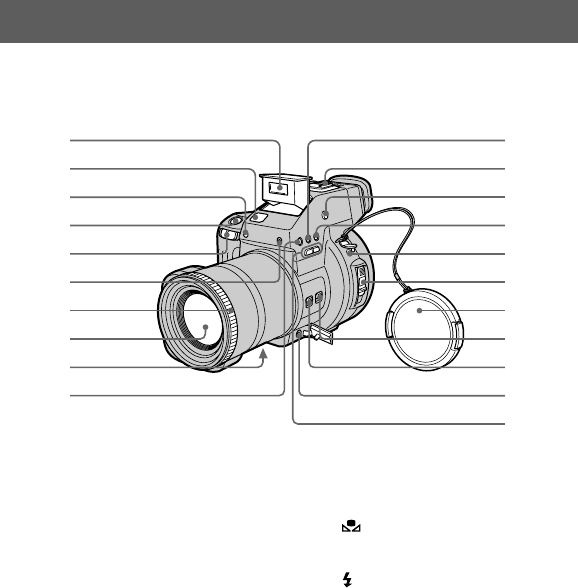
See the pages in parentheses for details of operation.
AFlash (22)
BBuilt-in microphone
Do not touch while recording.
CSelf-timer lamp/Recording
lamp (22, 24)
DShutter button (18, 24)
EZoom lever (20)
FPhotocell window for flash
Do not block while recording.
GFocus ring (50)
HLens
IDIGITAL I/O jack (34)
JPROGRAM AE button (51)
KWHITE BALANCE button (53)
LAccessory shoe
MOPEN (FLASH) button (22)
N (One-push white balance)
button (53)
O (External flash) jack
PDisc cover OPEN lever (15)
QLens cap (supplied)
RSTEADY SHOT ON/OFF switch
(21)
SFOCUS AUTO/MANUAL switch
(50)
TA/V OUT (MONO) jack (59)
Audio output is monaural.
UPROGRAM AE +/– buttons (51)
7
4
2
1
3
5
8
9
0
6
ql
w;
qg
qk
qd
qh
qj
qf
qs
q
a
wa
01cov.book Page 6 Tuesday, May 23, 2000 4:20 PM
filename[D:\Mavica1000\3062473111\3062473111MVCCD1000UC\02GB-
MVCCD1000UC\03pre.fm]
Getting started
7
model name1[MVC-CD1000]
[3-062-473-11(1)]
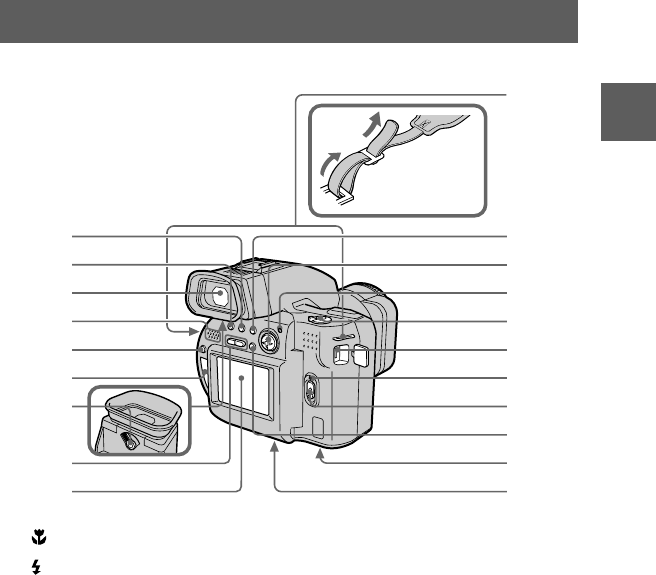
A (Macro) button (50)
B (Flash) button (22)
CViewfinder (19)
DSpeaker
EDISPLAY button (21)
FDisc window
GViewfinder adjustment lever
(19)
HVOLUME+/– buttons (27)
ILCD screen
JHooks for strap
KSPOT METER button (52)
LControl button (40)
MACCESS lamp (18)
Do not shake or strike the camera
while the ACCESS lamp is lit.
NPLAY/STILL/MOVIE selector
(40)
ODC IN jack (9, 11)
PPOWER ON/OFF (CHG) lamp
(9)
QPOWER switch (12)
RLCD (ON/OFF) button (19)
SBattery cover/PUSH button
(bottom surface) (8)
TTripod receptacle (bottom
surface)
Use a tripod with a screw length of
less than 7/32 inch (6.5 mm). You
will be unable to firmly secure the
camera to tripods having longer
screws, and may damage the
camera.
2
3
1
5
6
7
4
8
9
q;
qd
qa
qs
qg
qh
qj
qk
qf
ql
w;
Attaching the
shoulder strap
01cov.book Page 7 Tuesday, May 23, 2000 4:20 PM
masterpage:Left
filename[D:\Mavica1000\3062473111\3062473111MVCCD1000UC\02GB-
MVCCD1000UC\03pre.fm]
8
model name1[MVC-CD1000]
[3-062-473-11(1)]
Preparing the power supply
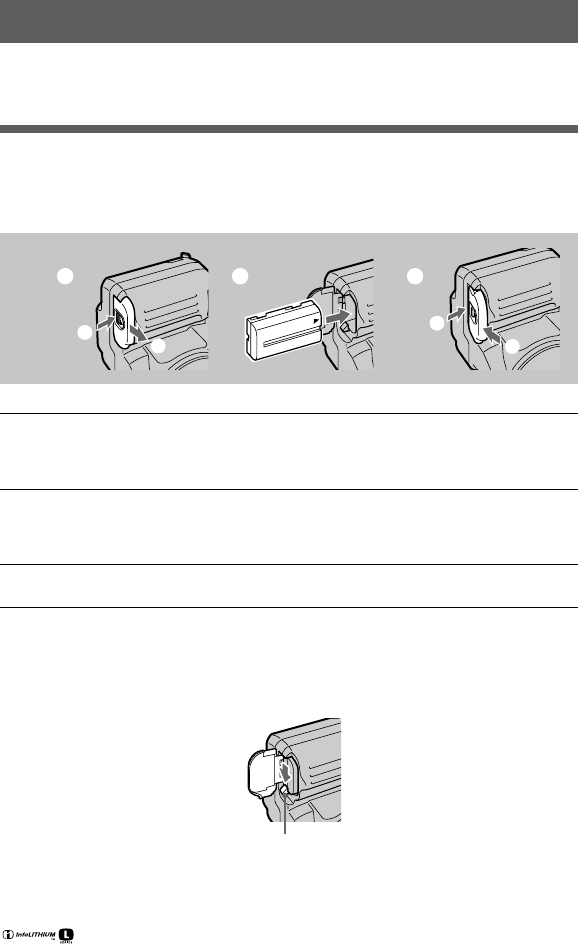
Installing the battery pack
Your camera operates only with the NP-F550 (supplied) “InfoLITHIUM” battery
pack* (L series).
To remove the battery pack
Open the battery cover. Slide the battery eject lever rightward, and remove
the battery pack.
Be careful not to drop the battery pack when removing it.
* What is “InfoLITHIUM”?
“InfoLITHIUM” is a lithium ion battery pack which can exchange information such as battery
consumption with compatible video equipment. “InfoLITHIUM” L series battery packs have the
mark. “InfoLITHIUM” is a trademark of Sony Corporation.
1Open the battery cover.
Slide the battery cover in the direction of the arrow while pressing the PUSH
button.
2Install the battery pack.
Insert the battery pack with the v mark facing toward the battery compartment
as illustrated.
3Close the battery cover.
123
12
1
2
Battery eject lever
01cov.book Page 8 Tuesday, May 23, 2000 4:20 PM
masterpage:Right
filename[D:\Mavica1000\3062473111\3062473111MVCCD1000UC\02GB-
MVCCD1000UC\03pre.fm]
Getting started
9
model name1[MVC-CD1000]
[3-062-473-11(1)]
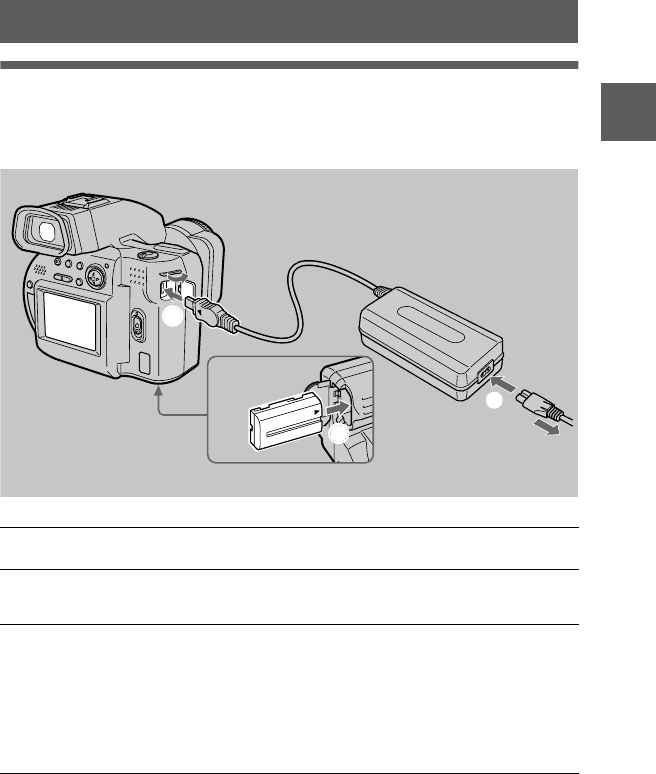
Charging the battery pack
When the camera is turned on, you cannot charge the battery pack. Be sure to turn off
the power of the camera.
Battery remaining indicator
The LCD screen or viewfinder on the camera shows the remaining time for which
you can still record or play back images.
This indication may not be entirely accurate depending on the conditions of use and
the operating environment.
1Insert the battery pack into your camera.
2Open the DC IN cover and connect the DC connecting plug to the
DC IN jack of your camera with the v mark facing up.
3Connect the power cord (mains lead) to the AC power adaptor and
then to a wall outlet (mains).
The POWER ON/OFF (CHG) lamp (amber) above the control button lights up
when charging begins. When the POWER ON/OFF (CHG) lamp goes off,
normal charge is completed. For full charge, which allows you to use the
battery longer than usual, leave the battery pack inserted for about one hour
after normal charge is completed.
1
2
3
AC-L10A/L10B/L10C
AC power adaptor
Power cord
(mains lead)
Battery pack
to a wall outlet
(mains)
01cov.book Page 9 Tuesday, May 23, 2000 4:20 PM
masterpage:Left
filename[D:\Mavica1000\3062473111\3062473111MVCCD1000UC\02GB-
MVCCD1000UC\03pre.fm]
10
model name1[MVC-CD1000]
[3-062-473-11(1)]
Auto power-off function
If you do not operate the camera for about three minutes during recording, the camera
turns off automatically to prevent wearing down the battery pack. To use the camera
again, slide the POWER switch downward to turn on the camera again.
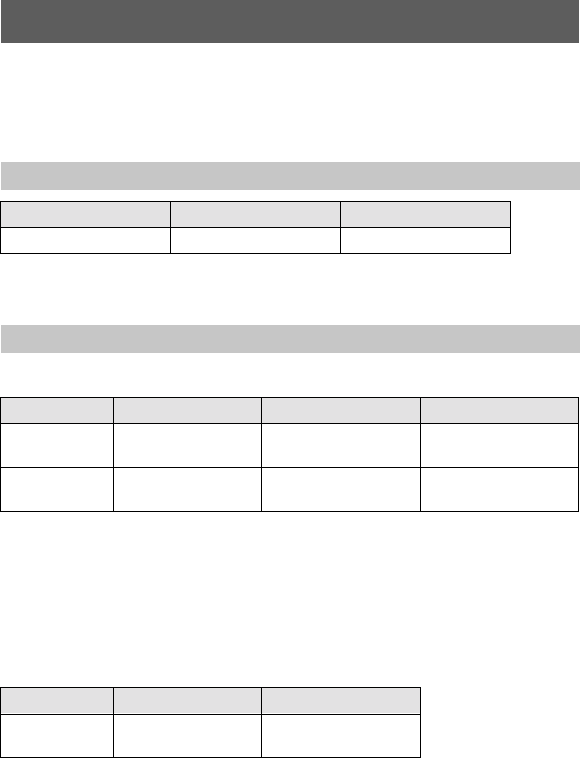
Approximate time to charge a completely discharged battery pack using the AC-L10A/
L10B/L10C AC power adaptor. (Lower temperatures require a longer charging time.)
STILL mode recording/playback
Approximate battery life and number of images that can be recorded/played back
with a fully charged battery pack at a temperature of 77 °F (25 °C), 640×480 image
size and in NORMAL recording mode. Numbers in parentheses indicate the time
when you use a normally charged battery pack.
∗Recording at about 5-second intervals
∗∗Playing back single images continuously at about 7-second intervals
MOVIE mode recording
Approximate time that can be recorded with a fully charged battery pack at a
temperature of 77 °F (25 °C) and 160×112 image size. Numbers in parentheses
indicate the time when you use a normally charged battery pack.
Notes
•The battery life and number of images will be decreased when using at low temperature, using
the flash, turning the power on/off frequently, or using the zoom.
•The number of images shown on tables above is as a guide. The number may be smaller
depending on conditions.
•If sufficient battery remaining time is indicated but the battery power runs out, fully charge the
battery using the full charge procedure.
Charging time
Battery pack Full charge (min.) Normal charge (min.)
NP-F550 (supplied) Approx. 210 Approx. 150
Battery life and number of images that can be recorded/played back
Battery pack Battery life (min.) Number of images
Continuous
recording* NP-F550 (supplied) Approx. 100
(90) Approx. 1100
(1000)
Continuous
playback** NP-F550 (supplied) Approx. 120
(110) Approx. 1000
(900)
Battery pack Battery life (min.)
Continuous
recording NP-F550 (supplied) Approx. 120 (110)
01cov.book Page 10 Tuesday, May 23, 2000 4:20 PM
masterpage:Right
filename[D:\Mavica1000\3062473111\3062473111MVCCD1000UC\02GB-
MVCCD1000UC\03pre.fm]
Getting started
11
model name1[MVC-CD1000]
[3-062-473-11(1)]
•Do not short the DC plug of the AC power adaptor with a metallic object, as this may cause
malfunction.
•Do not expose the battery pack to water.
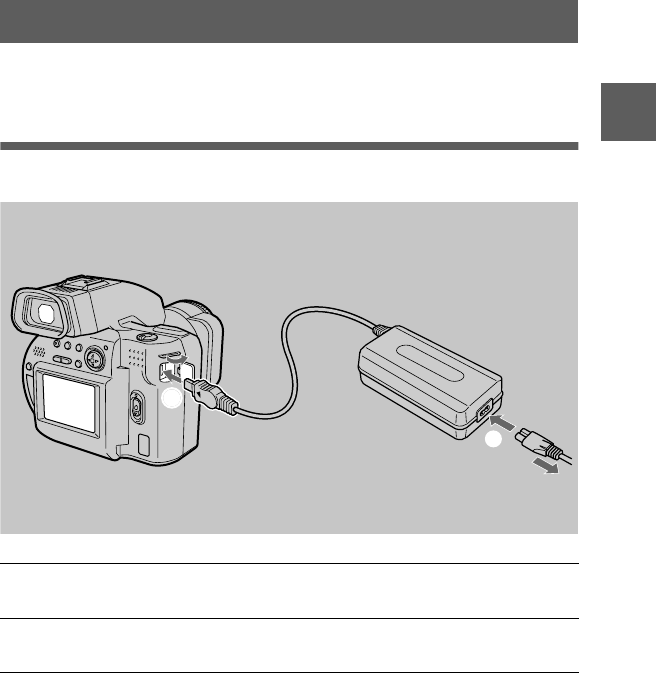
Using the AC power adaptor
Using a car battery
Use Sony DC adaptor/charger.
1Open the DC IN cover and connect the DC connecting plug to the
DC IN jack of your camera with the v mark facing up.
2Connect the power cord (mains lead) to the AC power adaptor and
then to a wall outlet (mains).
2
1
AC-L10A/L10B/L10C
AC power adaptor
Power cord
(mains lead)
to a wall outlet
(mains)
01cov.book Page 11 Tuesday, May 23, 2000 4:20 PM
masterpage:Left
filename[D:\Mavica1000\3062473111\3062473111MVCCD1000UC\02GB-
MVCCD1000UC\03pre.fm]
12
model name1[MVC-CD1000]
[3-062-473-11(1)]
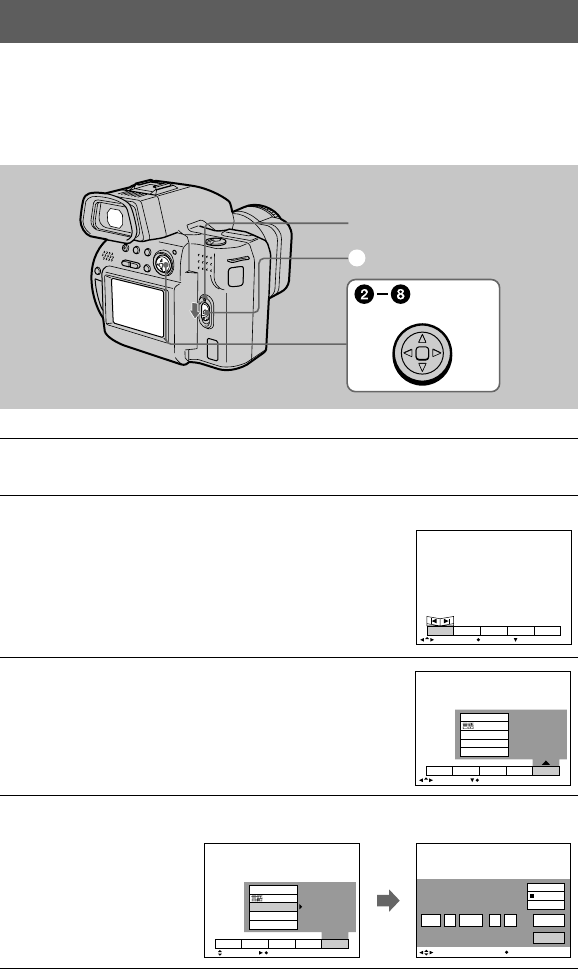
Setting the date and time
When you first use your camera, set the date and time. If these are not set, the
CLOCK SET screen appears whenever you turn on your camera for recording.
1Slide the POWER switch downward to turn on the power.
The POWER ON/OFF (CHG) (green) lamp lights up.
2Press v on the control button.
The menu bar appears on the LCD screen or on the
viewfinder.
3Select [SETUP] with B
BB
B on the control button,
then press the center x.
4Select [CLOCK SET] with v/V on the control button, then press the
center x.
1
Control button
POWER ON/OFF (CHG) lamp
SELECT OK MENU BAR OFF
DELETE
INDEX FILE SETUPTOOL
LCD BRIGHT
BEEP
CLOCK SET
VIDEO OUT
/LANGUAGE
SELECT CLOSE
DELETE
INDEX FILE SETUPTOOL
D/M/Y
ENTER
CANCEL
M/D/Y
Y/M/D
CLOCK SET
2000JAN / / : 1 12 00 AM
LCD BRIGHT
BEEP
CLOCK SET
VIDEO OUT
/LANGUAGE
SELECT OK
DELETE
INDEX FILE SETUPTOOL
12:00:00A
M
JA
N
1 2000
SELECT/ADJUST OK
01cov.book Page 12 Tuesday, May 23, 2000 4:20 PM
masterpage:Right
filename[D:\Mavica1000\3062473111\3062473111MVCCD1000UC\02GB-
MVCCD1000UC\03pre.fm]
Getting started
13
model name1[MVC-CD1000]
[3-062-473-11(1)]
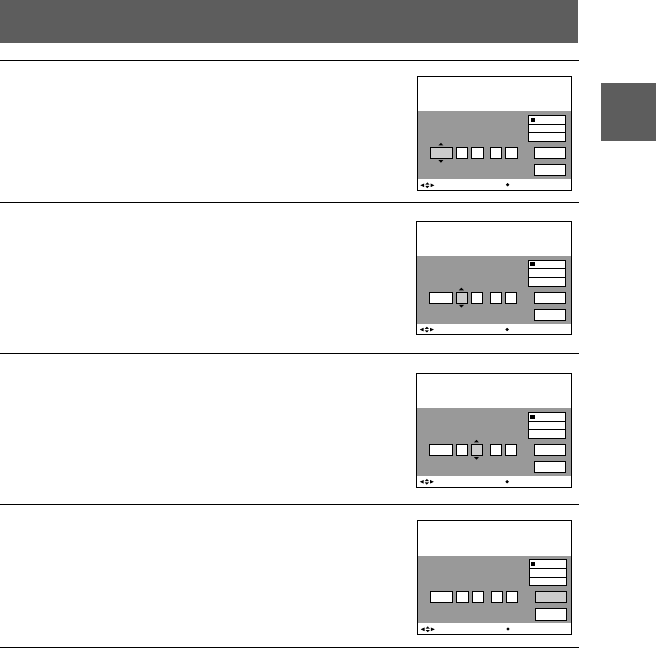
To cancel the date and time setting
Select [CANCEL] with v/V/b/B on the control button, then press the center x.
5Select the desired date display format with
v/V on the control button, then press the
center x.
Select from [Y/M/D] (year/month/day), [M/D/Y]
(month/day/year), or [D/M/Y] (day/month/year).
6Select the year, month, day, hour or minute
item you want to set with b/B on the control
button.
The item to be set is indicated with v/V
.
7Set the numeric value with v/V on the
control button, then press the center x to
enter it.
After entering the number, v/V moves to the next
item. If you selected [D/M/Y] in step 5, set the
time on a 24-hour cycle.
8Select [ENTER] with B on the control button,
then press the center x at the desired
moment to begin clock movement.
The date and time are entered.
2000 : 1 1 12 00 AM//
D/M/Y
ENTER
CANCEL
M/D/Y
Y/M/D
CLOCK SET
SELECT/ADJUST OK
2000 :/ / 1 1 12 00 AM
D/M/Y
ENTER
CANCEL
M/D/Y
Y/M/D
CLOCK SET
SELECT/ADJUST OK
2000 / :/ 1 7 12 00 AM
D/M/Y
ENTER
CANCEL
M/D/Y
Y/M/D
CLOCK SET
SELECT/ADJUST OK
2000 / :/ 4 7 10 30 PM
D/M/Y
ENTER
CANCEL
M/D/Y
Y/M/D
CLOCK SET
SELECT OK
01cov.book Page 13 Tuesday, May 23, 2000 4:20 PM
masterpage:Left
filename[D:\Mavica1000\3062473111\3062473111MVCCD1000UC\02GB-
MVCCD1000UC\03pre.fm]
14
model name1[MVC-CD1000]
[3-062-473-11(1)]
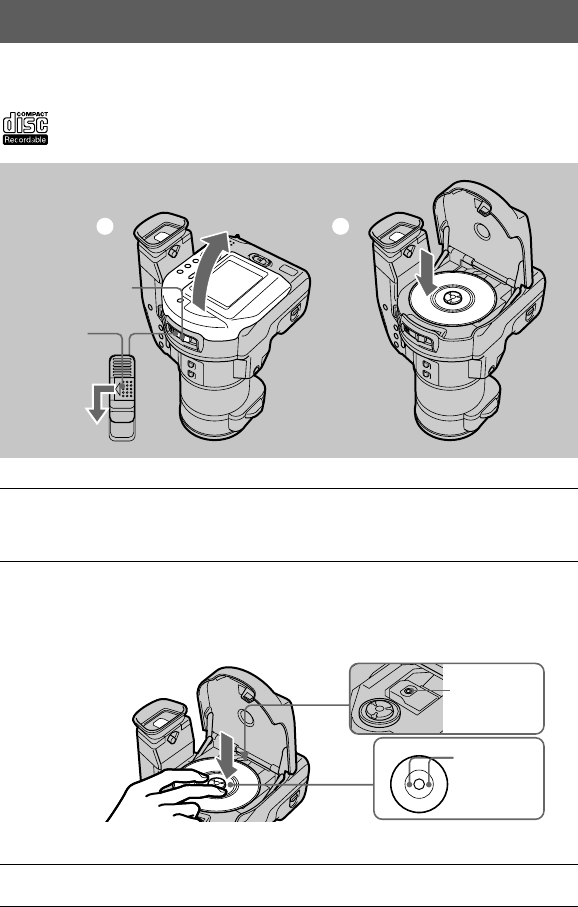
Inserting a disc
You can use only the 8 cm CD-Rs that have this mark.
.
1While sliding the lock tab to the left, slide down the disc cover
OPEN lever.
Open the disc cover by your hand after the cover is unlocked.
2Place a disc with the blue side down.
Push down the center of the disc until it clicks. When installing, do not push
with too much force and do not touch the pickup lens.
3Close the disc cover.
1 2
Disc cover OPEN
lever
Lock tab
Push here
Disc
Pickup lens
01cov.book Page 14 Tuesday, May 23, 2000 4:20 PM
masterpage:Right
filename[D:\Mavica1000\3062473111\3062473111MVCCD1000UC\02GB-
MVCCD1000UC\03pre.fm]
Getting started
15
model name1[MVC-CD1000]
[3-062-473-11(1)]
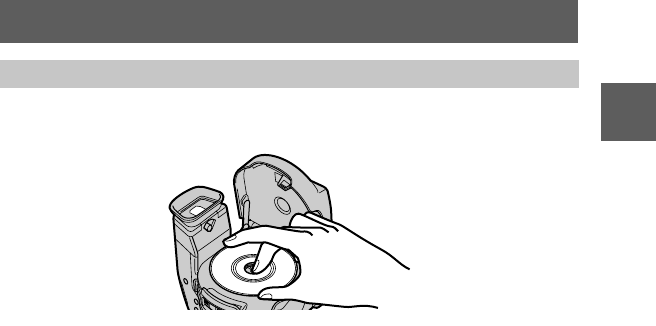
While sliding the lock tab to the left, slide down the disc cover OPEN lever, and open
the disc cover after the cover is unlocked. Then, remove the disc as illustrated below.
Notes
•Before removing the disc, be sure to check that the disc is not rotating.
•Do not open the disc cover while the ACCESS lamp is lit. Otherwise, the recorded image may
be damaged or the disc may become unusable.
Removing the disc
01cov.book Page 15 Tuesday, May 23, 2000 4:20 PM
filename[D:\Mavica1000\3062473111\3062473111MVCCD1000UC\02GB-
MVCCD1000UC\04bas.fm]
masterpage:Left
16
model name1[MVC-CD1000]
[3-062-473-11(1)]
Basic operations B Recording
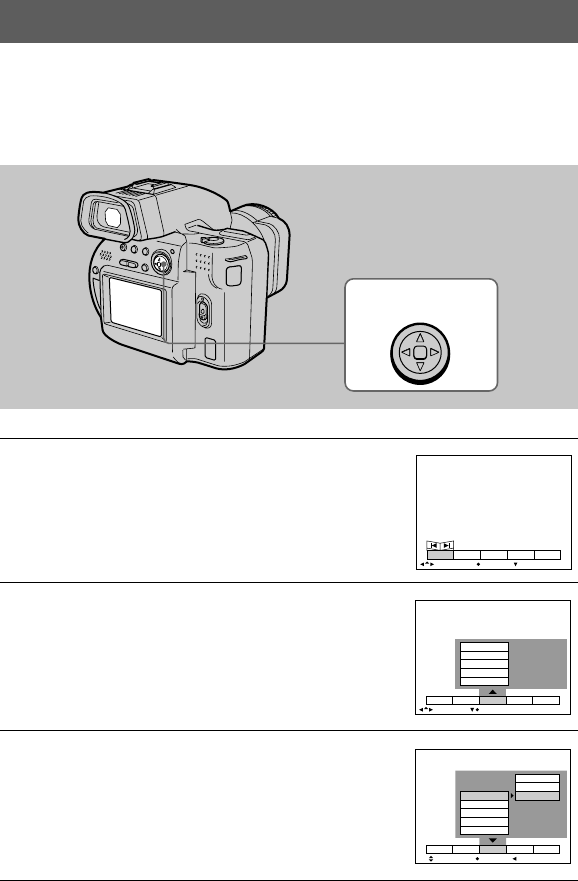
Initializing a disc (INITIALIZE)
When you use a new disc, you have to initialize the disc. Slide the POWER switch
downward to turn on the power before initializing a disc.
1Press v on the control button.
The menu bar appears on the LCD screen or on the
viewfinder.
2Select [FILE] with B on the control button,
then press the center x.
3Select [DISC TOOL] with v on the control
button, then press the center x.
1–6
Control button
SELECT OK MENU BAR OFF
DELETE
INDEX FILE SETUPTOOL
PROTECT
SLIDE SHOW
PRINT MARK
ROTAT E
DISC TOOL
SELECT CLOSE
DELETE
INDEX FILE SETUPTOOL
PROTECT
SLIDE SHOW
PRINT MARK
ROTAT E
DISC TOOL CANCEL
FINALIZE
INITIALIZE
DELETE
INDEX FILE SETUPTOOL
SELECT OK CANCEL
01cov.book Page 16 Tuesday, May 23, 2000 4:20 PM
masterpage:Right
filename[D:\Mavica1000\3062473111\3062473111MVCCD1000UC\02GB-
MVCCD1000UC\04bas.fm]
B
BB
B Recording
17
model name1[MVC-CD1000]
[3-062-473-11(1)]
To cancel the initialization
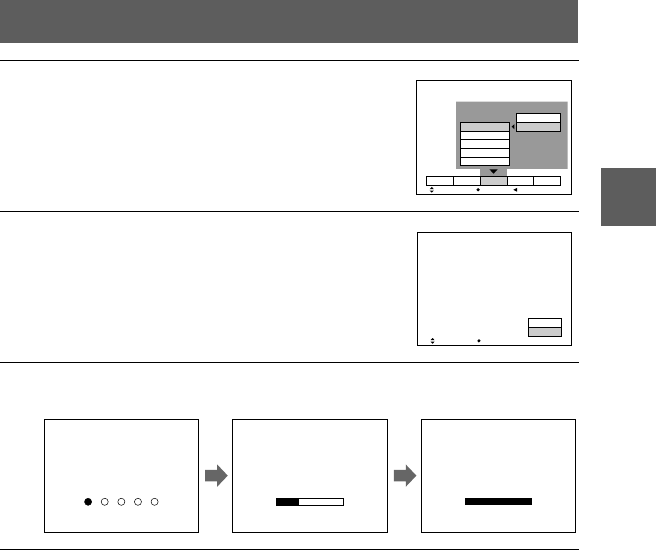
Select [CANCEL] with V on the control button, then press the center x.
What is initialization?
The initialization is required to record images on a disc.
In case that you have executed the finalization (page 29) to view images on a CD-
ROM drive, you can record images on the disc if you execute the initialization again.
Images previously recorded will remain on the disc.
4Select [INITIALIZE] with v on the control
button, then press the center x.
5Select [OK] with v on the control button,
then press the center x.
“PLACE ON LEVEL SURFACE” appears on the
LCD screen or on the viewfinder. Be sure to avoid
any vibration during the initialization in step 6.
6Select [OK] with v on the control button, then press the center x.
Initialization starts.
PROTECT
SLIDE SHOW
PRINT MARK
ROTAT E
DISC TOOL CANCEL
INITIALIZE?
OK
DELETE
INDEX FILE SETUPTOOL
SELECT OK CANCEL
SELECT OK
OK
READY?
INITIALIZE
PLACE ON LEVEL SURFACE
CANCEL
INITIALIZEINITIALIZE
AVOID ANY VIBRATION
INITIALIZE IN PROGRESSREADY TO INITIALIZE
INITIALIZE
INITIALIZE COMPLETE
01cov.book Page 17 Tuesday, May 23, 2000 4:20 PM
masterpage:Left
filename[D:\Mavica1000\3062473111\3062473111MVCCD1000UC\02GB-
MVCCD1000UC\04bas.fm]
18
model name1[MVC-CD1000]
[3-062-473-11(1)]
Recording still images
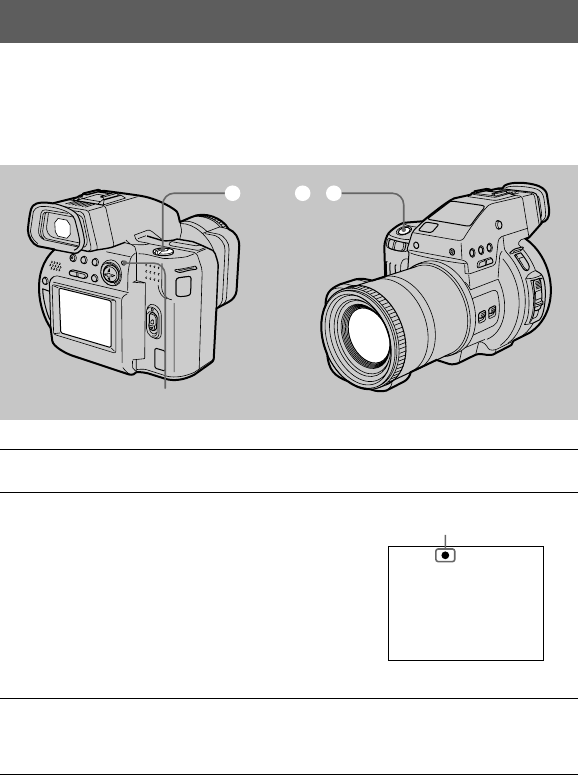
To record still images, slide the POWER switch downward to turn on the power and
insert a disc.
∗The exposure and focus are automatically adjusted. The focus is not automatically adjusted
when the camera is in manual focus mode.
For the number of images you can record on a disc
See page 47.
1Set the PLAY/STILL/MOVIE selector to STILL.
2Press and hold the shutter button
halfway down and check the image.
While the AE lock indicator z (green) is
flashing, the image is frozen, however, the
image is not yet recorded. When the camera
finishes the automatic adjustments*, the AE
lock indicator z lights up and the camera is
ready for recording.
To cancel the recording, release the shutter
button.
3Press the shutter button fully down.
The shutter clicks and the image is recorded on the disc. After “RECORDING”
goes off, you can do another recording.
12, 3
ACCESS lamp
AE lock indicator
01cov.book Page 18 Tuesday, May 23, 2000 4:20 PM
masterpage:Right
filename[D:\Mavica1000\3062473111\3062473111MVCCD1000UC\02GB-
MVCCD1000UC\04bas.fm]
B
BB
B Recording
19
model name1[MVC-CD1000]
[3-062-473-11(1)]
Notes
•You can delete images recorded on a disc, however, even if you delete images, the disc
remaining space does not increase.
•When recording bright subjects, the color of the LCD screen or the viewfinder may change
after the AE is locked, however, this will not affect the recorded image.
•After you change the disc, it may take about ten seconds to get ready for recording.
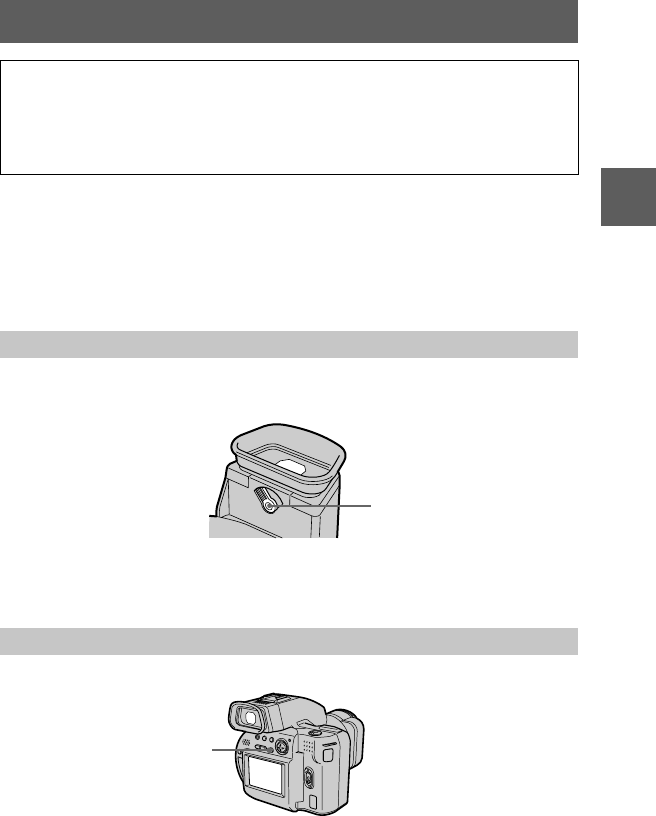
Adjust the viewfinder adjustment lever until the image appears clearly within the
viewfinder, then record the image.
Note
The viewfinder display is automatically turned off when your face is not near the viewfinder.
Press LCD (ON/OFF) to turn off the LCD screen. The battery life will be longer.
Notes
•You cannot turn off the LCD screen when the demonstration is being executed (page 46).
•When both the LCD screen and viewfinder displays are turned off, only the following will
operate: LCD (ON/OFF) button, POWER switch, the PLAY/STILL/MOVIE selector, FOCUS
AUTO/MANUAL switch, STEADY SHOT ON/OFF switch, focus ring, and shutter button.
While the image is being recorded on a disc, the ACCESS
lamp lights. When this lamp is lit, do not shake or strike
the camera. Also, do not turn the power off, or not remove
the battery pack/disc. Otherwise, an image data
breakdown may occur or the disc may become unusable.
Recording images with the viewfinder
To turn off the LCD screen
Viewfinder adjustment
lever
LCD (ON/OFF)
01cov.book Page 19 Tuesday, May 23, 2000 4:20 PM
masterpage:Left
filename[D:\Mavica1000\3062473111\3062473111MVCCD1000UC\02GB-
MVCCD1000UC\04bas.fm]
20
model name1[MVC-CD1000]
[3-062-473-11(1)]
Adjust the brightness with the [LCD BRIGHT] item in the menu settings (page 46).
This adjustment does not affect the brightness of the images recorded on the disc.
Clear the menu bar (page 41), and press b on the control button. To return to the
normal recording mode, press lightly on the shutter button or select [RETURN] with
b/B on the control button and then press the center x. To delete the image, select
[DELETE] on the review screen with b/B on the control button, then press the center
x. And select [OK] with v on the control button, then press the center x. However,
even if you delete images, the disc remaining space does not increase.
If you cannot get a sharp focus on a close subject
Slide the zoom lever to the W side and move closer to the subject until the focus is
sharp.
Minimum focal distance to the subject
W side: About 9 7/8 inches (25 cm) or more
T side: About 31 1/2 inches (80 cm) or more
To record even closer subjects, see page 50.
Digital zoom function
This camera has a digital zoom function.
Digital zoom enlarges the image by digital processing, and it starts to function when
the zoom exceeds 10×.
Adjusting the brightness of the LCD screen
Checking the last recorded image (Review)
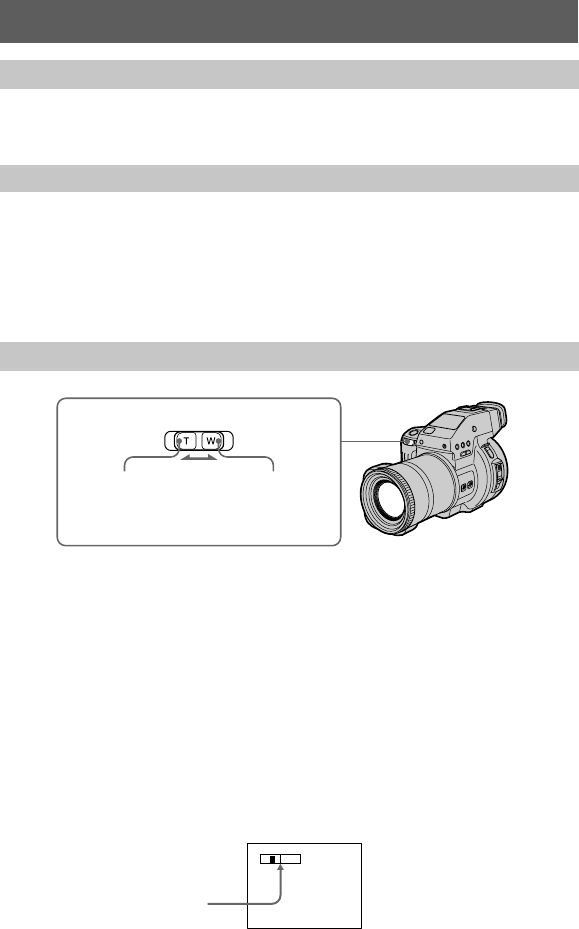
Using the zoom feature
W side: for wide-
angle (subject
appears farther
away)
T side: for
telephoto (subject
appears closer)
Zoom lever
T
W
The T-side of the bar shows the
digital zooming zone.
01cov.book Page 20 Tuesday, May 23, 2000 4:20 PM
masterpage:Right
filename[D:\Mavica1000\3062473111\3062473111MVCCD1000UC\02GB-
MVCCD1000UC\04bas.fm]
B
BB
B Recording
21
model name1[MVC-CD1000]
[3-062-473-11(1)]
Using digital zoom
•The maximum zoom magnification is 20×.
•Digital zooming may deteriorate the picture quality. When digital zoom is not
necessary, set [DIGITAL ZOOM] to [OFF] in the menu settings (page 45).
Note
Digital zoom does not work for moving images.
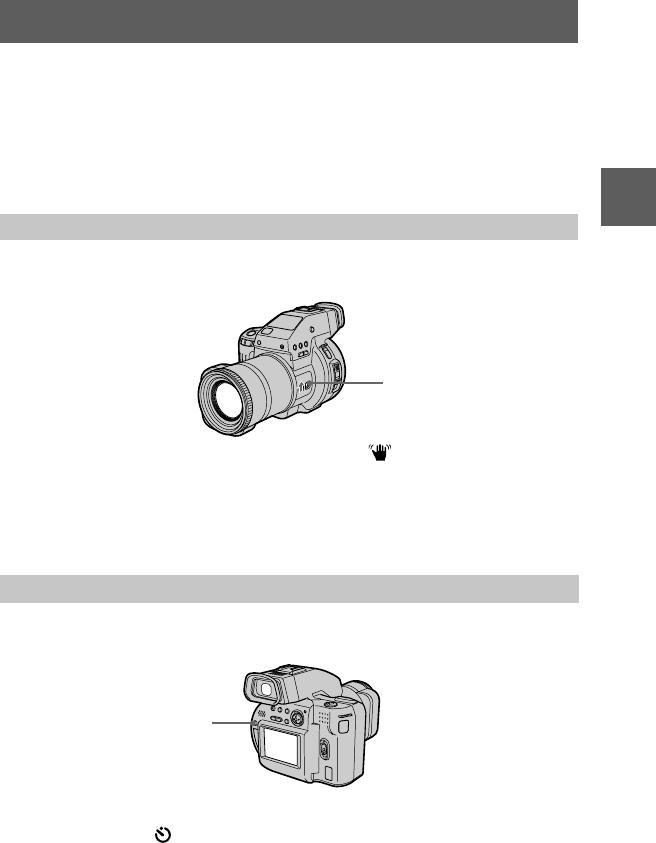
When the SteadyShot function is working, the camera compensates for camera-
shake.
Set the STEADY SHOT ON/OFF switch to ON. The (SteadyShot) indicator
appears on the LCD screen or on the viewfinder.
Notes
•The SteadyShot function will not correct excessive camera-shake.
•If you use a wide conversion lens (optional), this lens may influence the SteadyShot function.
Press DISPLAY to turn on/off the indicators on the LCD screen or on the viewfinder.
See page 75 for a detailed description of the indicators.
Notes
•You cannot turn off the
(self-timer) indicator and some of the indicators used in advanced
operations.
•The indicators on the LCD screen or on the viewfinder are not recorded.
Activating the SteadyShot function
LCD screen or viewfinder indicators during recording
STEADY SHOT ON/
OFF switch
DISPLAY
01cov.book Page 21 Tuesday, May 23, 2000 4:20 PM
masterpage:Left
filename[D:\Mavica1000\3062473111\3062473111MVCCD1000UC\02GB-
MVCCD1000UC\04bas.fm]
22
model name1[MVC-CD1000]
[3-062-473-11(1)]
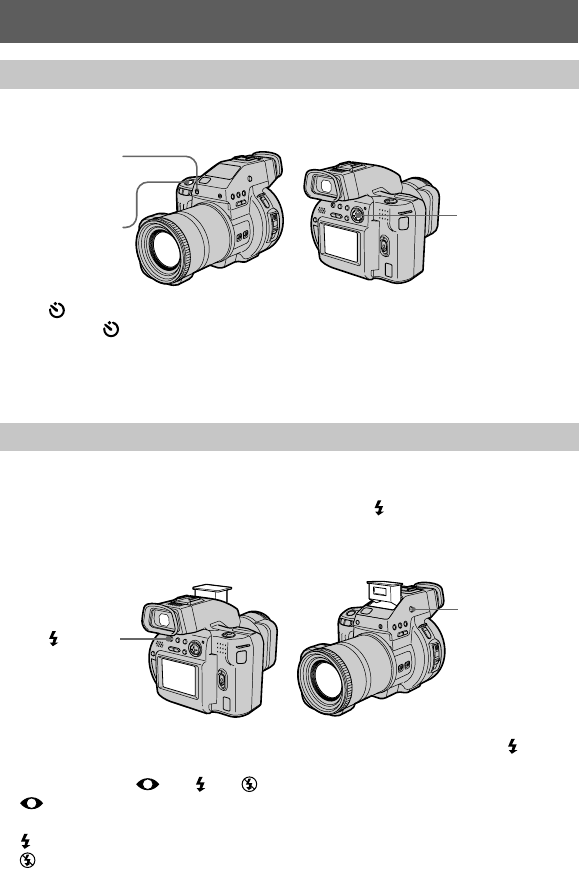
When you use the self-timer function, the subject is recorded 10 seconds after you
press the shutter button.
Select on the LCD screen with v/V/b/B on the control button, then press the
center x. The (self-timer) indicator appears on the LCD screen or on the
viewfinder, and the subject is recorded 10 seconds after you press the shutter button.
The self-timer lamp flashes after you press the shutter button until the image is
recorded.
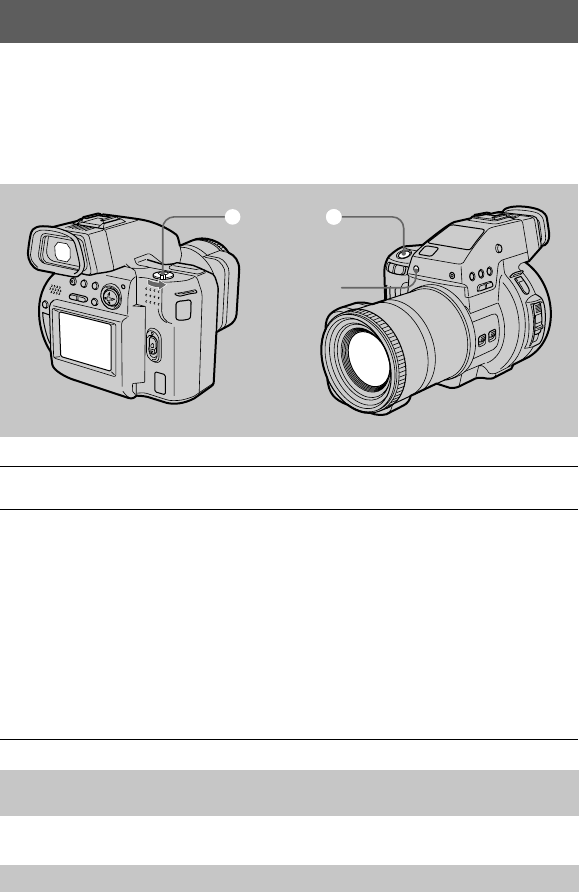
Press OPEN (FLASH) to pop up the flash. The initial setting is AUTO (no
indication). In this mode, the flash automatically strobes when the surroundings
become dark. When you change the flash mode, press (Flash) repeatedly so that
the flash mode indicator appears on the LCD screen or on the viewfinder. This setting
can be set only when the flash is popped up.
Set the PLAY/STILL/MOVIE selector to STILL. Each time you press the button,
the indicator changes as follows.
(No indication) t
t
t
t (No indication)
Auto red-eye reduction : The flash preparatively strobes before recording to
reduce the red-eye phenomenon.
Forced flash : The flash strobes regardless of the surrounding brightness.
No flash : The flash does not strobe.
You can change the amount of the flash light with [FLASH LEVEL] in the menu
settings (page 45).
Using the self-timer
Recording images with the flash
Control button
Self-timer lamp
Shutter button
(Flash)
OPEN (FLASH)
01cov.book Page 22 Tuesday, May 23, 2000 4:20 PM

masterpage:Right
filename[D:\Mavica1000\3062473111\3062473111MVCCD1000UC\02GB-
MVCCD1000UC\04bas.fm]
B
BB
B Recording
23
model name1[MVC-CD1000]
[3-062-473-11(1)]
Notes
•The recommended shooting distance is 23 5/8 inches to 8 1/3 feet (0.6 to 2.5 m).
•Attaching a conversion lens (optional) may block the light from the flash and the recorded
image may be eclipsed.
•You cannot use the built-in flash and an external strobe at the same time.
•The indicator appears when the flash is not popped up under situations that you should use
the flash.
•Auto red-eye reduction may not produce the desired red-eye reduction effects depending on
individual differences, the distance to the subject, if the subject does not see the pre-strobe, or
other conditions. In addition, red-eye reduction effects are also difficult to obtain if you select a
slow shutter speed in shutter priority mode of the PROGRAM AE function.
•The flash effect is not obtained easily when you use forced flash in a bright location.
01cov.book Page 23 Tuesday, May 23, 2000 4:20 PM
masterpage:Left
filename[D:\Mavica1000\3062473111\3062473111MVCCD1000UC\02GB-
MVCCD1000UC\04bas.fm]
24
model name1[MVC-CD1000]
[3-062-473-11(1)]
Recording moving images
Moving images with audio are recorded in MPEG format.
To record moving images, slide the POWER switch downward to turn on the power
and insert a disc.
See page 20 to 22.
Press DISPLAY to turn on/off the indicators on the LCD screen or on the viewfinder.
These indicators are not recorded. See page 75 for a detailed description of the
indicators.
1Set the PLAY/STILL/MOVIE selector to MOVIE.
2Press the shutter button fully down.
“REC” appears on the LCD screen or on the viewfinder, and the image and
sound are recorded on the disc. The recording lamp lights up during recording.
If you press the shutter button momentarily
The image and sound are recorded for 5 seconds. The recording time can be set
to 10 or 15 seconds with [REC TIME SET] in the menu settings (page 44).
If you hold the shutter button down
The image and sound are recorded while the shutter button is held down for up
to 60 seconds. However, when [IMAGE SIZE] in the menu settings is set to [320
(HQ)] or [320×240], the maximum recording time is 15 seconds (page 47).
Adjusting the brightness of the LCD screen, zooming or using the self-
timer
LCD screen or viewfinder indicators during recording
1 2
Recording
lamp
01cov.book Page 24 Tuesday, May 23, 2000 4:20 PM
masterpage:Right
filename[D:\Mavica1000\3062473111\3062473111MVCCD1000UC\02GB-
MVCCD1000UC\05bas.fm]
B
BB
B Playback
25
model name1[MVC-CD1000]
[3-062-473-11(1)]
B Playback
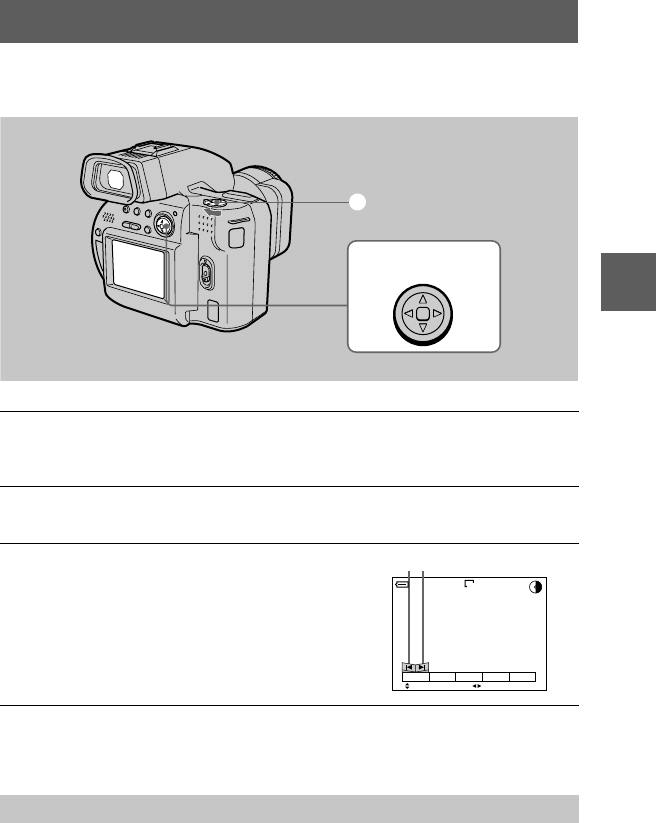
Playing backs still images
When the menu bar is not displayed
You can directly select and play back the image with b/B on the control button.
Press DISPLAY to turn on/off the indicators on the LCD screen or on the viewfinder.
See page 76 for a detailed description of the indicators.
1Set the PLAY/STILL/MOVIE selector to PLAY.
The last recorded image (still or moving) appears on the LCD screen or on the
viewfinder.
2Press v on the control button to display the menu bar on the LCD
screen or on the viewfinder.
3Select the desired still image with the
control button.
Press v/V/b/B on the control button to
select \b/B\ on the LCD screen or on the
viewfinder, then press b/B.
\b: To display the preceding image.
B\: To display the next image.
LCD screen or viewfinder indicators during still image playback
2, 3
1
Control button
SELECT FILE BACK/NEXT
DELETE
INDEX FILE SETUPTOOL
120min 6/8
640
"b/B"
01cov.book Page 25 Tuesday, May 23, 2000 4:20 PM
masterpage:Left
filename[D:\Mavica1000\3062473111\3062473111MVCCD1000UC\02GB-
MVCCD1000UC\05bas.fm]
26
model name1[MVC-CD1000]
[3-062-473-11(1)]
Playing back moving images
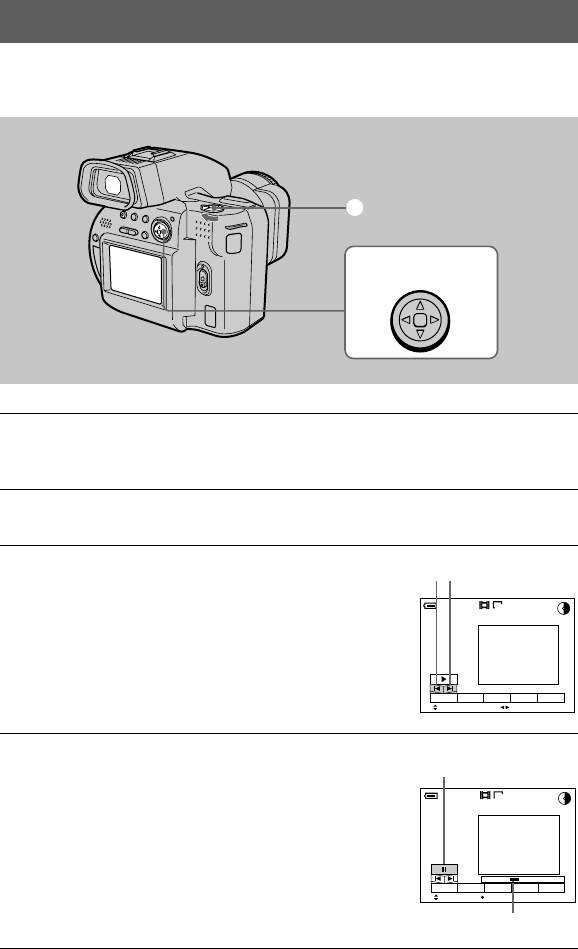
1Set the PLAY/STILL/MOVIE selector to PLAY.
The last recorded image (still or moving) appears on the LCD screen or on the
viewfinder.
2Press v on the control button to display the menu bar on the LCD
screen or on the viewfinder.
3Select the desired moving image with the
control button.
Moving images are displayed one size smaller than
still images.
Press v/V/b/B on the control button to select \b/B\
on the LCD screen or on the viewfinder, then press
b/B.
\b: To display the preceding image.
B\: To display the next image.
4Select the B (playback) button on the LCD
screen or on the viewfinder with v on the
control button, then press the center x.
The moving image and sound are played back.
During playback, B (playback) changes to X
(pause).
2–4
1
Control button
160
120min 6/8
SELECT
DELETE
INDEX FILE SETUPTOOL
FILE BACK/NEXT
\b/B\
160
120min 6/8
0:05
SELECT OK
DELETE
INDEX FILE SETUPTOOL
B (playback)/
X (pause) button
Playback bar
01cov.book Page 26 Tuesday, May 23, 2000 4:20 PM
masterpage:Right
filename[D:\Mavica1000\3062473111\3062473111MVCCD1000UC\02GB-
MVCCD1000UC\05bas.fm]
B
BB
B Playback
27
model name1[MVC-CD1000]
[3-062-473-11(1)]
To pause playback
Select X (pause) on the LCD screen or on the viewfinder with v/V/b/B on the
control button, then press the center x.
When the menu bar is not displayed
You can directly select the image with b/B on the control button, and play back the
image and sound by pressing the center x. When you press the center x during
playback, playback is paused.
Moving images recorded with the image of [320 (HQ)]
The images are displayed over the entire screen in steps 3 and 4.
Press VOLUME+/– to adjust the volume.
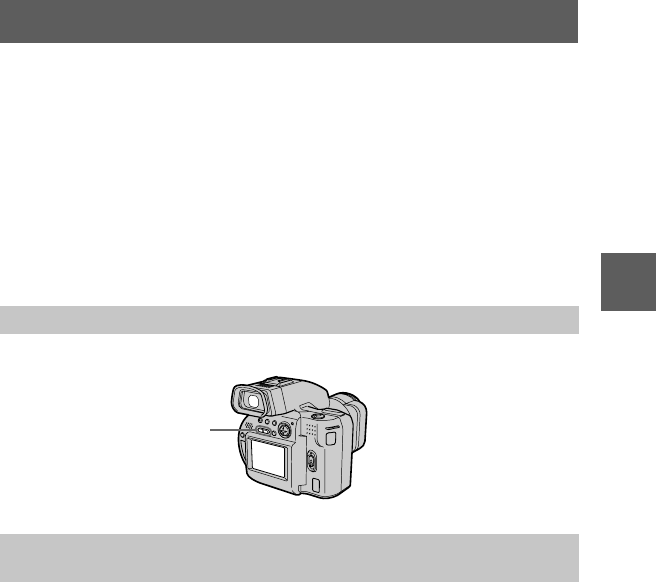
Press DISPLAY to turn on/off the indicators on the LCD screen or on the viewfinder.
See page 76 for a detailed description of the indicators.
Adjusting the volume of the built-in speaker
LCD screen or viewfinder indicators during moving image
playback
VOLUME+/–
01cov.book Page 27 Tuesday, May 23, 2000 4:20 PM

masterpage:Left
filename[D:\Mavica1000\3062473111\3062473111MVCCD1000UC\02GB-
MVCCD1000UC\05bas.fm]
28
model name1[MVC-CD1000]
[3-062-473-11(1)]
Viewing images using a personal
computer
You can view data with your camera on a personal computer and attach it to e-mail.
This section describes the general method for viewing images on a personal
computer. Be sure to also see the operation manuals for your personal computer and
application software.
For Windows users
AViewing images with a CD-ROM drive (page 33)
Finalize the disc beforehand (page 29).
BViewing images with a personal computer connected with
the USB cable (page 33)
You do not need to finalize the disc. You have to install the USB driver and the
software, DirectCD included in the supplied CD-ROM. For details on DirectCD,
refer to the software operating instructions of DirectCD.
CViewing images using a CD-R/CD-RW drive (page 37)
You do not need to finalize the disc. You have to install the software, DirectCD
included in the supplied CD-ROM.
For Macintosh users
Viewing images with a CD-ROM drive (page 37)
Finalize the disc beforehand (page 29).You have to install the driver, Adaptec UDF
Volume Access included in the supplied CD-ROM.
Notes on using your personal computer
Software
•Data recorded with your camera is stored in the following formats. Make sure that
applications that support these file formats are installed on your personal computer.
— Still image (except TEXT mode and uncompressed mode): JPEG format
— Moving image/Voice memo: MPEG format
— Uncompressed mode still image: TIFF mode
— Still image in TEXT mode: GIF format.
•Depending on your application software, the file size may increase when you open
a still image file.
•When you load an image modified using the supplied retouch software from your
personal computer to the camera, the image format will differ so the “FILE
ERROR” message may appear and you may be unable to open the file.
01cov.book Page 28 Tuesday, May 23, 2000 4:20 PM
masterpage:Right
filename[D:\Mavica1000\3062473111\3062473111MVCCD1000UC\02GB-
MVCCD1000UC\05bas.fm]
B
BB
B Playback
29
model name1[MVC-CD1000]
[3-062-473-11(1)]
Communications with your personal computer
Communications between your camera and your personal computer may not recover
after recovering from Suspend, or Sleep.
•Windows and Windows NT, ActiveMovie, DirectShow are either registered trademarks or
trademarks of Microsoft Corporation in the United States and /or other countries.
•Macintosh and Mac OS, QuickTime are trademarks of Apple Computer, Inc.
•DirectCD is a trademark of Adaptec, Inc.
•All other product names mentioned herein may be the trademarks or registered trademarks of
their respective companies. Furthermore, “™” and “®” are not mentioned in each case in this
manual.
You can play back the disc recorded with this camera on CD-ROM drives. You have
to execute the finalization before viewing images on a CD-ROM drive. A disc that
has not been executed the finalization cannot be read with CD-ROM drives.
What is finalization?
•The finalization is required to view images on a CD-ROM drive.
•You can record new images on the finalized disc if you execute the initialization on
it again. You have to execute the finalization to view new images on a CD-ROM
drive. Each time you execute the finalization, approximate 13.5 MB of the disc will
decrease. We recommend that you execute the finalization onto compiled data at a
time.
•You can execute the finalization onto the disc later, even if you remove it from the
camera.
Executing the finalization
Preparing for viewing images on CD-ROM drives (FINALIZE)
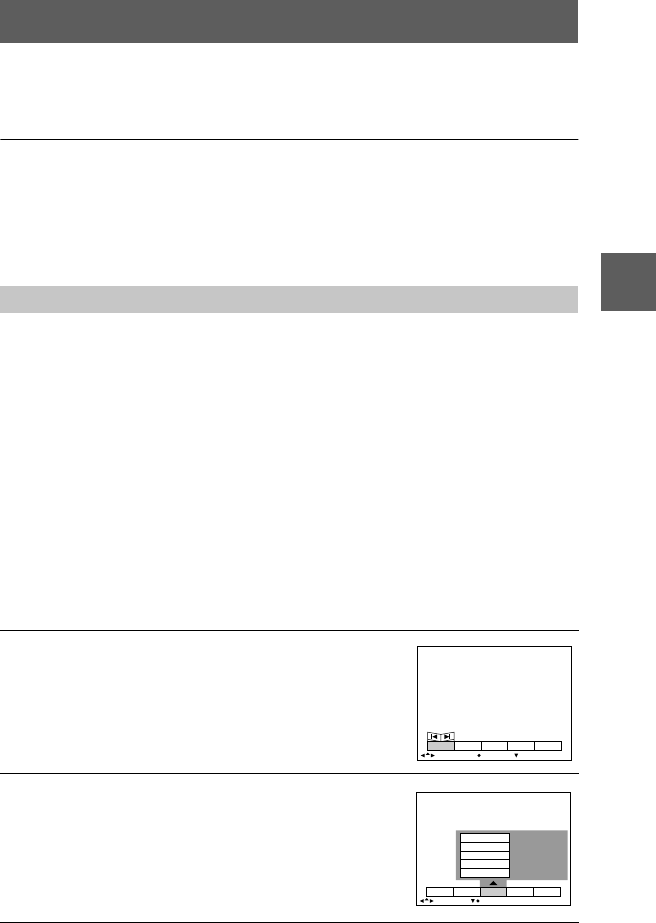
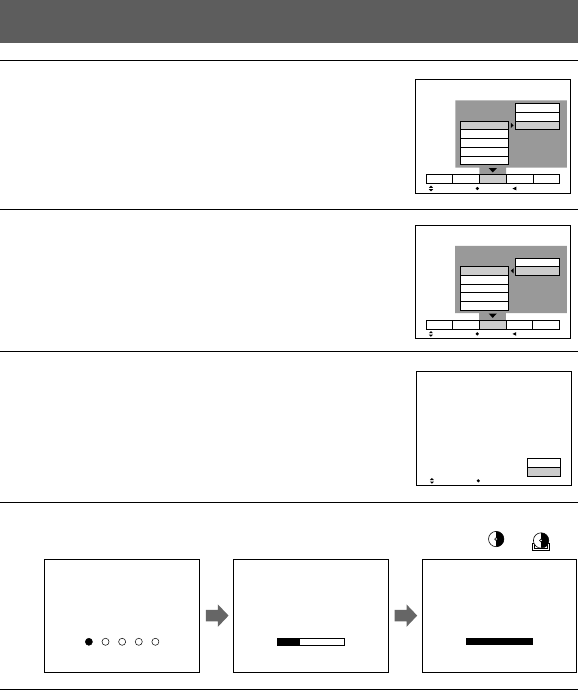
1Press v on the control button.
The menu bar appears on the LCD screen or on the
viewfinder.
2Select [FILE] with B on the control button,
then press the center x.
SELECT OK MENU BAR OFF
DELETE
INDEX FILE SETUPTOOL
PROTECT
SLIDE SHOW
PRINT MARK
ROTAT E
DISC TOOL
SELECT CLOSE
DELETE
INDEX FILE SETUPTOOL
01cov.book Page 29 Tuesday, May 23, 2000 4:20 PM
masterpage:Left
filename[D:\Mavica1000\3062473111\3062473111MVCCD1000UC\02GB-
MVCCD1000UC\05bas.fm]
30
model name1[MVC-CD1000]
[3-062-473-11(1)]
To cancel the finalization
Select [CANCEL] with V on the control button, then press the center x. Once the
finalization starts, you cannot cancel it.
Notes
•It takes for about one minute to execute the finalization. Do not shake or jar the camera during
this operation. Place the camera on a stable surface during the finalization.
•When you execute the finalization, we recommend that you use the an external power source
(page 11).
3Select [DISC TOOL] with v on the control
button, then press the center x.
4Select [FINALIZE] with v on the control
button, then press the center x.
5Select [OK] with v on the control button,
then press the center x.
“PLACE ON LEVEL SURFACE” appears on the
LCD screen or on the viewfinder. Be sure to avoid
any vibration during the finalization.
6Select [OK] with v on the control button, then press the center x.
Finalization starts and the disc remaining indicator changes from to .
PROTECT
SLIDE SHOW
PRINT MARK
ROTAT E
DISC TOOL CANCEL
FINALIZE
INITIALIZE
DELETE
INDEX FILE SETUPTOOL
SELECT OK CANCEL
PROTECT
SLIDE SHOW
PRINT MARK
ROTAT E
DISC TOOL CANCEL
FINALIZE?
OK
DELETE
INDEX FILE SETUPTOOL
SELECT OK CANCEL
SELECT OK
OK
READY?
FINALIZE
PLACE ON LEVEL SURFACE
CANCEL
FINALIZEFINALIZE
AVOID ANY VIBRATION
FINALIZE IN PROGRESSREADY TO FINALIZE
FINALIZE
FINALIZE COMPLETE
01cov.book Page 30 Tuesday, May 23, 2000 4:20 PM
masterpage:Right
filename[D:\Mavica1000\3062473111\3062473111MVCCD1000UC\02GB-
MVCCD1000UC\05bas.fm]
B
BB
B Playback
31
model name1[MVC-CD1000]
[3-062-473-11(1)]
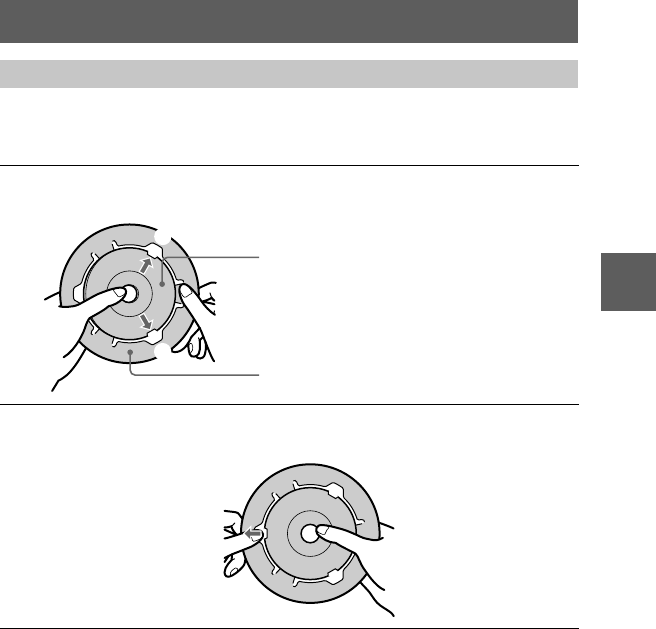
When your disc drive does not conform to 8 cm CD or is an upright type, use the
supplied 8 cm CD adaptor.
Using the supplied 8 cm CD adaptor
1Slide the disc into the inner groove and under two of the tabs on
the inner circle of adaptor in the numbered order.
2Pull the third tab out away from the disc and the disc will slip into
place. Release the third tab and the disc will be held firmly in place.
1
2
Printed side of the disc (The other blue side
is recordable side.)
Printed side of the adaptor (SONY is printed
on this side and the other side is the luster
side.)
01cov.book Page 31 Tuesday, May 23, 2000 4:20 PM
masterpage:Left
filename[D:\Mavica1000\3062473111\3062473111MVCCD1000UC\02GB-
MVCCD1000UC\05bas.fm]
32
model name1[MVC-CD1000]
[3-062-473-11(1)]
Notes
•The supplied adaptor may not be used with your disc drive. For details, refer to the operating
instructions of the disc drive.
•Use the adaptor at a low-speed (8-speed or lower).
•Do not place the adaptor under direct sunlight or near the heat.
•The adaptor is only used with Mavica discs. This cannot be used with other 8 cm CD-Rs.
Recommended Windows environment
OS: Microsoft Windows 98, Windows 98SE
Standard installation is required.
Operation is not assured in an environment upgraded from:
Windows 3.1, Windows 95 to Windows 98 or
Windows 98 to Windows 98SE
CPU: MMX Pentium 200 MHz or faster
The USB connector must be provided as standard.
ActiveMovie (DirectShow) must be installed (to play back moving pictures)
Notes
•Operations are not guaranteed if you connect two or more USB equipment to a single personal
computer at the same time (except for the USB keyboard and mouse which are provided as
standard), or when using a hub.
•Depending on the type of USB equipment that is used simultaneously, some equipment may
not operate.
•Operations are not guaranteed for all the recommended computer environments mentioned
above.
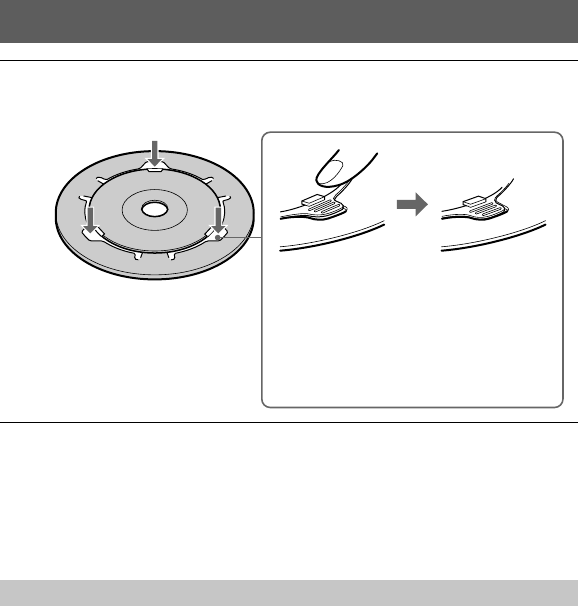
3Check that the disc is set correctly in the grooves of the adaptor,
that all the tabs are even with the surface of the adaptor, and that
the disc is not protrude from the adaptor.
Viewing images on a Windows computer
If the tabs protrude, press them back
down into place. Otherwise, it may cause
malfunction of your disc drive.
01cov.book Page 32 Tuesday, May 23, 2000 4:20 PM
masterpage:Right
filename[D:\Mavica1000\3062473111\3062473111MVCCD1000UC\02GB-
MVCCD1000UC\05bas.fm]
B
BB
B Playback
33
model name1[MVC-CD1000]
[3-062-473-11(1)]
AViewing images with a CD-ROM drive
Finalize the disc beforehand (page 29).
For Windows 98 users
BViewing images with a personal computer connected with
the USB cable
Once you install DirectCD included in the supplied CD-ROM, you do not need to
finalize the disc to view images on the disc.
You can exchange data between the camera and a computer using the supplied USB
cable and CD-ROMs.
Installing the USB driver
Before connecting your camera to your personal computer, install the USB driver to
the computer. The USB driver is contained in the supplied CD-ROM (SPVD-001).
For Windows 98 users
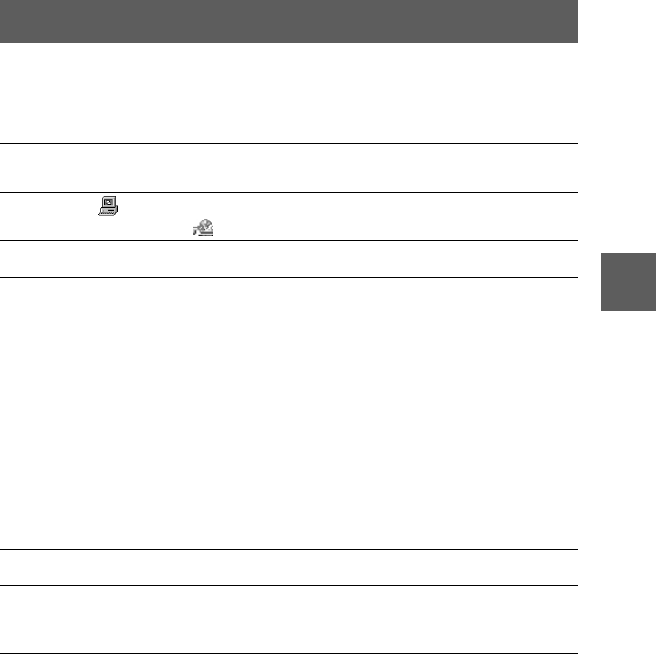
1Start up your personal computer and insert the disc into the CD-
ROM drive of your personal computer.
2Open [ My Computer] and double click the drive recognizing the
camera (Example:[ CD-ROM (D:)]).
3Double-click the desired data file.
1Turn on your personal computer and allow Windows 98 to load.
2Insert the supplied CD-ROM (SPVD-001) in the CD-ROM drive of
your personal computer
If the setup screen of DirectCD appears, click [Finish] on the screen.
01cov.book Page 33 Tuesday, May 23, 2000 4:20 PM
masterpage:Left
filename[D:\Mavica1000\3062473111\3062473111MVCCD1000UC\02GB-
MVCCD1000UC\05bas.fm]
34
model name1[MVC-CD1000]
[3-062-473-11(1)]
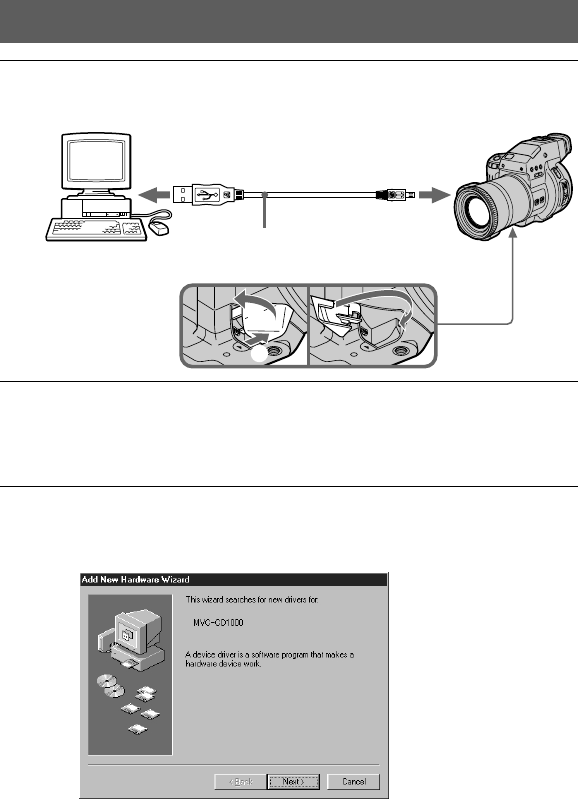
3Connect the DIGITAL I/O jack on your camera with the USB
connector on your personal computer using the supplied USB
cable.
4Insert a disc into your camera, connect the AC power adaptor and
turn on your camera.
“PC MODE” appears on the LCD screen or on the viewfinder of your camera
and the camera is set to communication standby mode. Your personal computer
recognizes the camera, and the Windows 98 Add Hardware Wizard starts.
5Follow the on-screen messages to specify the CD-ROM drive and
install the USB driver.
1Check that the Add Hardware Wizard is displayed, then click [Next].
1
2
to the USB connector
Personal computer USB
cable
to the DIGITAL I/O jack
Push in until the
plug clicks into
place
01cov.book Page 34 Tuesday, May 23, 2000 4:20 PM
masterpage:Right
filename[D:\Mavica1000\3062473111\3062473111MVCCD1000UC\02GB-
MVCCD1000UC\05bas.fm]
B
BB
B Playback
35
model name1[MVC-CD1000]
[3-062-473-11(1)]
Viewing images
When you view images on the disc which has not been finalized, you have to install
DirectCD included in the supplied CD-ROM. For details on DirectCD, refer to the
software operating instructions of DirectCD.
For Windows 98 users
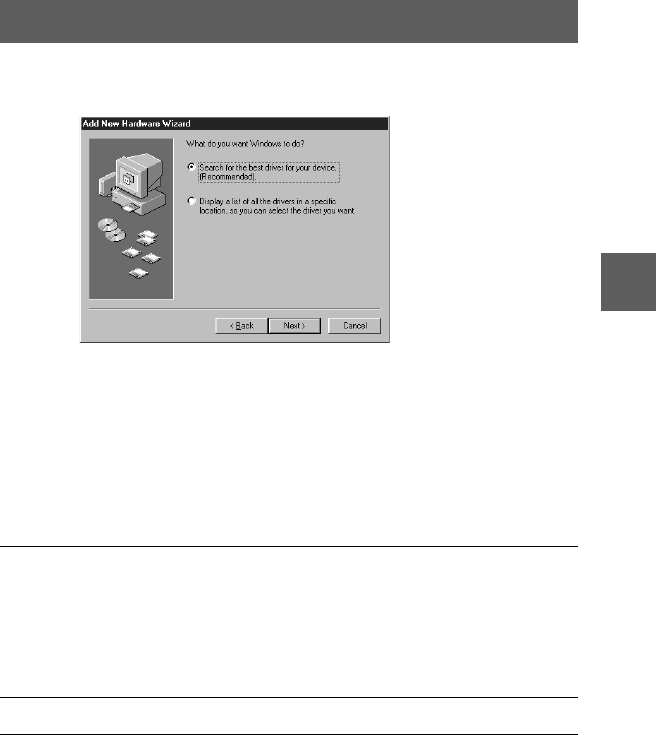
2Select the option [Search for the best driver for your device.
[Recommended].] in the window, then click [Next].
3Check that the option [CD-ROM] is selected, then click [Next].
4After the location of the driver is searched, click [Next].
File copy starts.
5After [Windows has finished installing the software that your new
hardware device requires.] is displayed, click [Finish].
The Add Hardware Wizard starts twice because two different USB
drivers are installed. Repeat steps 1 to 5 again.
1Turn on your personal computer and allow Windows 98 to load.
01cov.book Page 35 Tuesday, May 23, 2000 4:20 PM
masterpage:Left
filename[D:\Mavica1000\3062473111\3062473111MVCCD1000UC\02GB-
MVCCD1000UC\05bas.fm]
36
model name1[MVC-CD1000]
[3-062-473-11(1)]
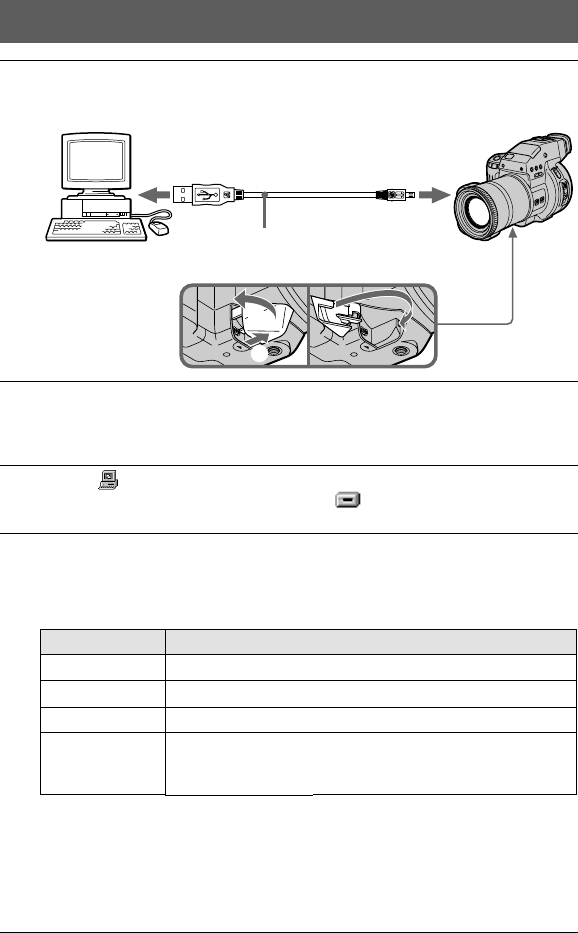
2Connect the DIGITAL I/O jack on your camera with the USB
connector on your personal computer using the supplied USB
cable.
3Insert a disc into your camera, connect the AC power adaptor to
your camera and then to a wall outlet (mains), and turn on the
power of your camera.
“PC MODE” appears on the LCD screen or on the viewfinder of the camera.
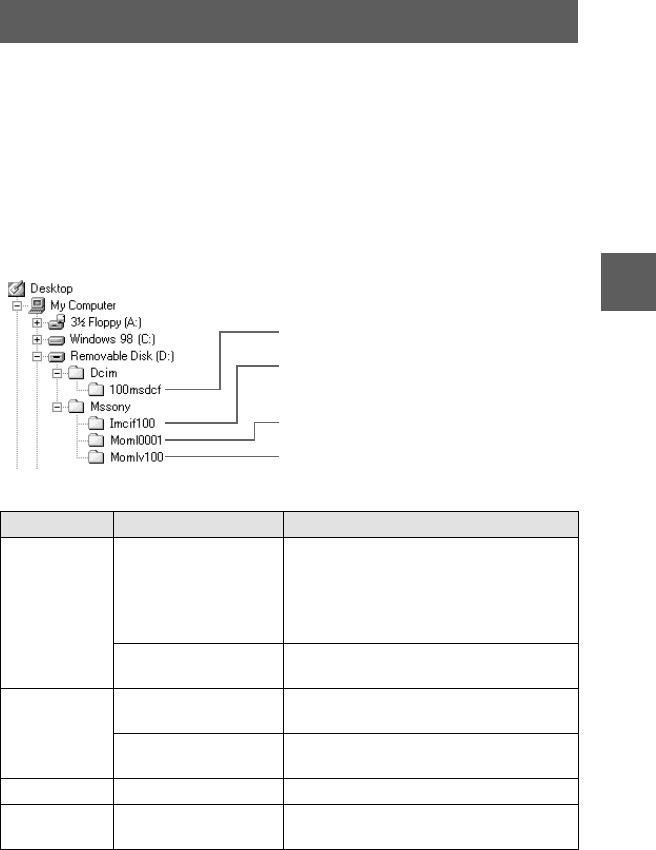
4Open [ My Computer] on Windows 98 and double click the
newly recognized drive. (Example: [ Removable Disk (D:)])
The folders inside the disc are displayed.
5Select and double-click the desired image/sound file from the
folder.
For the detailed folder and file name, see “Image file storage destinations and
image file names” (page 39).
∗Copying a file to the hard disk of your personal computer before viewing is
recommended. If you play back the file directly from the “disc,” the image and sound
may break off.
∗∗When these file names are described in capital letters to distinguish the small letter “l”
and the number “1,” these are shown as follows: 100MSDCF, MOML0001,
MOMLV100, IMCIF100.
1
2
to the USB connector
Personal computer USB
cable
to the DIGITAL I/O jack
Push in until the
plug clicks into
place
Desired file type Double-click in this folder
Still image “Dcim” folder t“100msdcf” folder** t
Image file
Moving image*
“Mssony” folder
t
“Moml0001” folder**
t
Image file
Audio*
“Mssony” folder
t
“Momlv100” folder**
t
Audio file
E-mail image
Tiff image
(uncompressed)
“Mssony” folder
t
“Imcif100” folder**
t
Image file
01cov.book Page 36 Tuesday, May 23, 2000 4:20 PM

masterpage:Right
filename[D:\Mavica1000\3062473111\3062473111MVCCD1000UC\02GB-
MVCCD1000UC\05bas.fm]
B
BB
B Playback
37
model name1[MVC-CD1000]
[3-062-473-11(1)]
Copying a file in the disc to a personal computer
Select the desired file, and drag it to the desired drive or folder.
Copying a file in a personal computer to a disc
Once you install DirectCD included in the supplied CD-ROM, you can select the
desired file, and drag it to the disc. To view a image with this camera, the file name
format must be as follows, “DSC0ssss.JPG”.
For details, see “Image file storage destinations and image file names” (page 39).
CViewing images using a CD-R/CD-RW drive
You do not need to finalize the disc. You have to install DirectCD included in the
supplied CD-ROM. For details on DirectCD, refer to the software operating
instructions of DirectCD.
Recommended Macintosh environment
Macintosh computer with the Mac OS 8.5.1/8.6/9.0 standard installation
However, note that the update to Mac OS 9.0 should be used for the following
models.
•iMac with the Mac OS 8.6 standard installation and a slot loading type CD-ROM
drive
•iBook or G4 with the Mac OS 8.6 standard installation
QuickTime 3.2 or newer must be installed (to play back moving pictures).
Note
Operations are not guaranteed for all the recommended computer environments mentioned
above.
Viewing images with a CD-ROM drive
Finalize the disc beforehand (page 29). You have to install the driver, Adaptec UDF
Volume Access included in the supplied CD-ROM (SPVD-001).
For Macintosh users
Viewing images on a Macintosh computer
1Start up your personal computer and allow the Mac OS to load.
2Insert the supplied CD-ROM (SPVD-001) in the CD-ROM drive of
your personal computer.
3Double-click the CD-ROM drive icon to open the window.
4Double-click the icon of the hard disk containing the OS to open
the window.
01cov.book Page 37 Tuesday, May 23, 2000 4:20 PM

masterpage:Left
filename[D:\Mavica1000\3062473111\3062473111MVCCD1000UC\02GB-
MVCCD1000UC\05bas.fm]
38
model name1[MVC-CD1000]
[3-062-473-11(1)]
Viewing images
5Move the driver, “Adaptec UDF Volume Access” from the window
opened in step 3 to “System Folder” folder in the window opened
in step 4 (drag and drop).
6When “Put these items into the Extensions folder?” appears, click
“OK.”
7Restart your personal computer.
1Start up your personal computer and insert the disc into the CD-
ROM drive of your personal computer.
2Double click the disc folder.
3Double-click the desired data file.
01cov.book Page 38 Tuesday, May 23, 2000 4:20 PM
masterpage:Right
filename[D:\Mavica1000\3062473111\3062473111MVCCD1000UC\02GB-
MVCCD1000UC\05bas.fm]
B
BB
B Playback
39
model name1[MVC-CD1000]
[3-062-473-11(1)]
Image file storage destinations
and image file names
Image files recorded with your camera are grouped in folders by recording mode.
Images in a disc have different file names. The meanings of the file names are as
follows. ssss stands for any number within the range from 0001 to 9999.
For Windows 98 users (The drive recognizing the camera is
[D].)
The numerical portion of the following files are the same.
—An image file recorded in E-MAIL mode and its corresponding small-size image file
—An uncompressed image file recorded in TIFF mode and its corresponding image file
—An image file recorded in VOICE mode and its corresponding audio file
Folder File Meaning
100msdcf DSC0ssss.JPG •Still image file recorded normally
•Still image file recorded in E-MAIL
mode (page 48)
•Still image file recorded in VOICE
mode (page 48)
TXT0ssss.GIF •Still image file recorded in TEXT mode
(page 49)
Imcif100 DSC0ssss.JPG •Small-size image file recorded in E-
MAIL mode (page 48)
DSC0ssss.TIF •Uncompressed image file recorded in
TIFF mode (page 49)
Moml0001 MOV0ssss.MPG •Moving image file
Momlv100 DSC0ssss.MPG •Audio file recorded in VOICE mode
(page 48)
Folder containing still image data
Folder containing E-mail mode and TIFF
image data
Folder containing moving image data
Folder containing voice memo audio data
01cov.book Page 39 Tuesday, May 23, 2000 4:20 PM
filename[D:\Mavica1000\3062473111\3062473111MVCCD1000UC\02GB-
MVCCD1000UC\06bef.fm]
40
model name1[MVC-CD1000]
[3-062-473-11(1)]
Advanced operations
Before performing advanced
operations
This section describes the basic control methods that are frequently used for
“Advanced operations.”
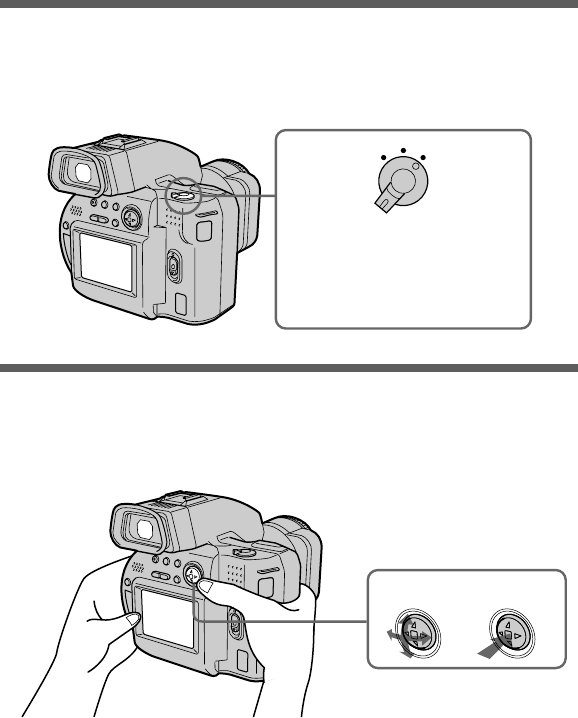
How to use the PLAY/STILL/MOVIE selector
The PLAY/STILL/MOVIE selector selects whether you can use your camera to
record or to play back and edit images. Set the selector as follows before starting to
operate your camera.
How to use the control button
The control button is used to select the buttons, images and menus displayed on the
LCD screen or on the viewfinder of your camera and modify the settings. The operation
methods that are frequently used for “Advanced operations” are described below.
PLAY
STILL
MOVIE
PLAY: To play back or edit
images
STILL: To record still images
and voice memos
MOVIE: To record moving
images
Select Set (enter)
01cov.book Page 40 Tuesday, May 23, 2000 4:20 PM
filename[D:\Mavica1000\3062473111\3062473111MVCCD1000UC\02GB-
MVCCD1000UC\06bef.fm]
Before performing advanced operations
41
model name1[MVC-CD1000]
[3-062-473-11(1)]
Note
You cannot clear the menu bar on the INDEX screen (page 56).
The “Advanced operations” section of this manual refers to selecting and
entering items by the above procedure as “Select [item name].”
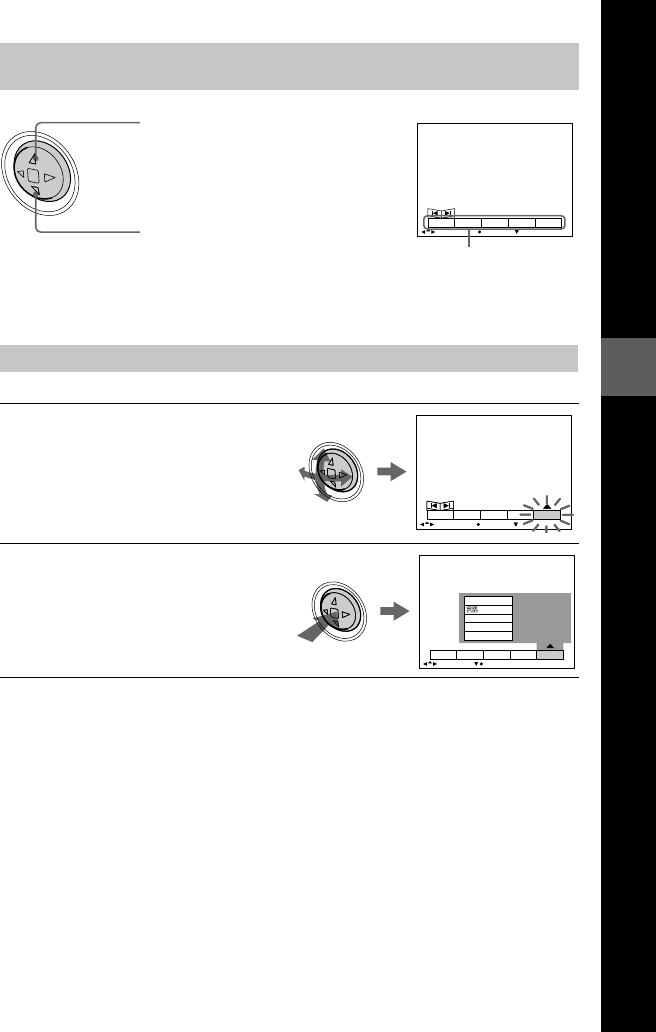
Turning on/off the operation buttons (menu bar) on the LCD screen or
on the viewfinder
Selecting items or images on the LCD screen or on the viewfinder
1Press v/V/b/B on the control
button to select the item you
want to set or the image you
want to display.
The color of the selected item or the
frame of the selected image
changes from blue to yellow.
2Press the center x to enter
the item.
Repeat steps 1 and 2 to execute
each function.
SELECT OK MENU BAR OFF
DELETE
INDEX FILE SETUPTOOL
Press v to display the menu bar
on the LCD screen or on the
viewfinder.
Press V
VV
V to clear the menu bar from
the LCD screen or on the viewfinder. Menu bar
SELECT OK
DELETE
INDEX FILE SETUPTOOL
MENU BAR OFF
LCD BRIGHT
BEEP
CLOCK SET
VIDEO OUT
/LANGUAGE
SELECT CLOSE
DELETE
INDEX FILE SETUPTOOL
01cov.book Page 41 Tuesday, May 23, 2000 4:20 PM
filename[D:\Mavica1000\3062473111\3062473111MVCCD1000UC\02GB-
MVCCD1000UC\06bef.fm]
42
model name1[MVC-CD1000]
[3-062-473-11(1)]
How to change the menu settings
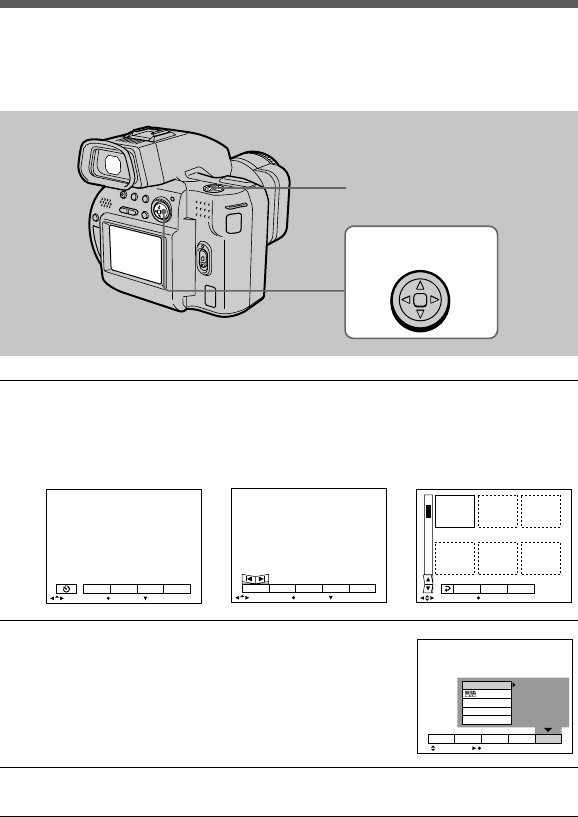
Some of the advanced operations for your camera are executed by selecting menu
items displayed on the LCD screen or on the viewfinder with the control button.
To cancel the setup
Press V on the control button repeatedly until the LCD screen or on the viewfinder
returns to the menu bar display in step 1. To clear the menu bar, press V again.
1Press v on the control button to display the menu bar.
The menu bar appears as follows according to the position of the PLAY/STILL/
MOVIE selector.
2Select the desired item with v/V/b/B on the
control button, then press the center x.
The color of the selected item changes from blue to
yellow, and when you press the center x, the settings
that can be set for its item are displayed.
3Select the desired setting with v/V/b/B on the control button, then
press the center x.
1–3
PLAY/STILL/MOVIE selector
Control button
EFFECT FILE SETUP
CAMERA
SELECT OK MENU BAR OFF SELECT OK MENU BAR OFF
DELETE
INDEX FILE SETUPTOOL
2000 7 4 10:30PM100-0001
SELECT SINGLE DISPLAY
DELETE
FILE SETUP
MOVIE/STILL PLAY (single mode) PLAY (INDEX mode)
LCD BRIGHT
BEEP
CLOCK SET
VIDEO OUT
/LANGUAGE
SELECT OK
DELETE
INDEX FILE SETUPTOOL
NTSC
01cov.book Page 42 Tuesday, May 23, 2000 4:20 PM
filename[D:\Mavica1000\3062473111\3062473111MVCCD1000UC\02GB-
MVCCD1000UC\06bef.fm]
Before performing advanced operations
43
model name1[MVC-CD1000]
[3-062-473-11(1)]
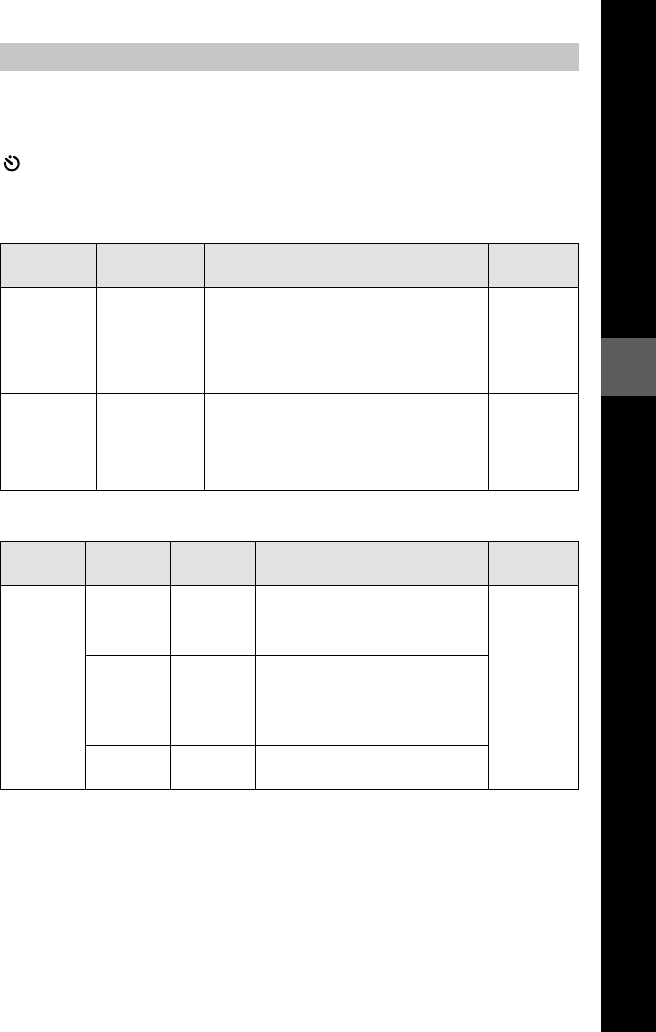
Menu items that can be modified differ depending on the position of the PLAY/
STILL/MOVIE selector. The LCD screen or viewfinder shows only the items you can
operate at the moment. Initial settings are indicated with x.
(self-timer)
Records with the self-timer (page 22).
EFFECT
FILE
Menu settings
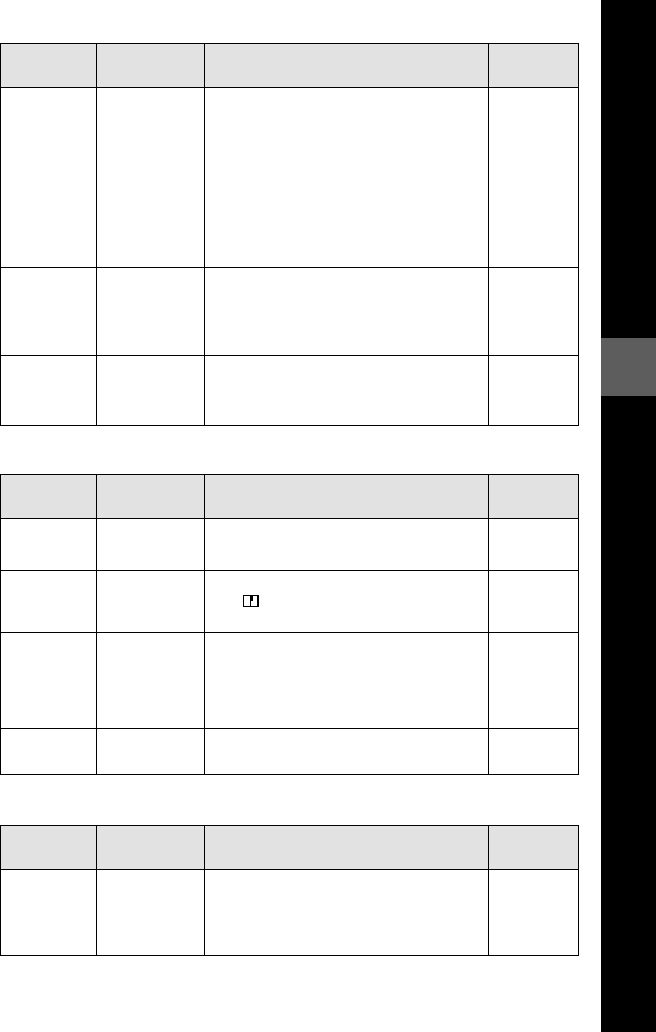
Item Setting Description
PLAY/STILL/
MOVIE selector
P. EFFECT SOLARIZE
B&W
SEPIA
NEG.ART
xOFF
Sets the image special effects (page 55). MOVIE
STILL
DATE/
TIME DAY &
TIME Sets whether to insert the date and time
into the image (page 54). STILL
DATE
xOFF
Item-1 Item-2 Setting Description
PLAY/STILL/
MOVIE selector
DISC
TOOL
INITIALIZE
OK Initializes a disc (page 14). MOVIE
STILL
PLAY
CANCEL Cancels the initialization of a
disc.
FINALIZE OK Allows you to view images
recorded with this camera on a
CD-ROM drive (page 29).
CANCEL Cancels the finalization.
CANCEL — Goes back to the [DISC TOOL]
item.
01cov.book Page 43 Tuesday, May 23, 2000 4:20 PM

filename[D:\Mavica1000\3062473111\3062473111MVCCD1000UC\02GB-
MVCCD1000UC\06bef.fm]
44
model name1[MVC-CD1000]
[3-062-473-11(1)]
Item Setting Description
PLAY/STILL/
MOVIE selector
POS.
SENSOR ON Plays back images recorded with the
camera on its side (vertical images) as
vertical images. This function does not
work for images recorded in TEXT
mode.
STILL
xOFF When you point the camera upward or
downward for shooting, set this to OFF
to prevent improper horizontal/vertical
judgement.
FILE
NUMBER SERIES Assigns numbers to files in sequence
even if the disc is changed. MOVIE
STILL
xNORMAL Resets the file number that starts from
0001 each time the disc is changed.
IMAGE
SIZE
x1600×1200
1600 (3:2)
1024×768
640×480
Selects the image size when recording
still images. STILL
320 (HQ)
320×240
x160×112
Selects the MPEG image size or quality
when recording moving images. MOVIE
REC MODE TIFF Records a TIFF (uncompressed) file in
addition to the JPEG format. STILL
TEXT Records a GIF file in black-and-white.
VOICE Records an audio file (with a still image)
in addition to the JPEG file.
E-MAIL Records a small-size (320×240) JPEG
file in addition to the selected image
size.
xNORMAL Records a JPEG file in the selected
image size.
REC TIME
SET 15 sec
10 sec
x5 sec
Selects the recording time for moving
images. MOVIE
ROTATE (in
single mode
only)
— Rotates the still image. PLAY
01cov.book Page 44 Tuesday, May 23, 2000 4:20 PM
filename[D:\Mavica1000\3062473111\3062473111MVCCD1000UC\02GB-
MVCCD1000UC\06bef.fm]
Before performing advanced operations
45
model name1[MVC-CD1000]
[3-062-473-11(1)]
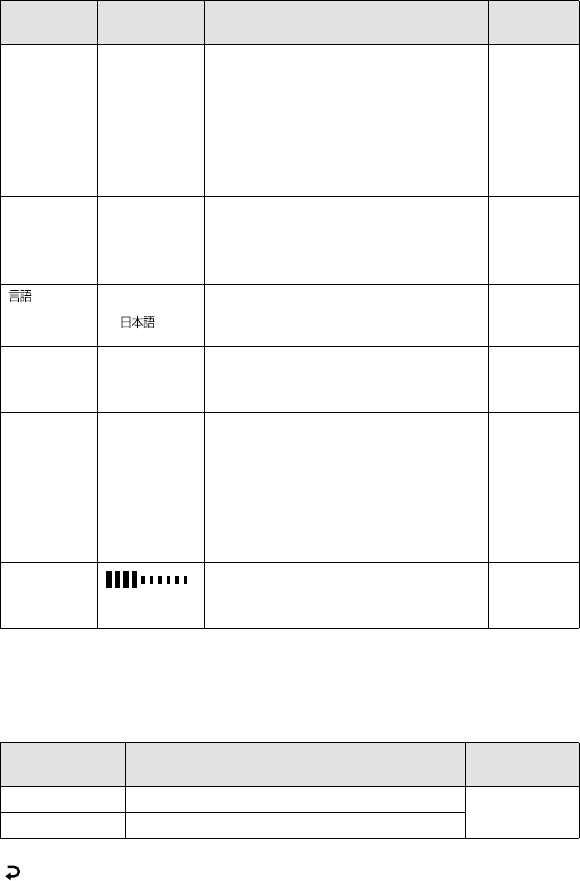
CAMERA
TOOL (Only in PLAY (single) mode)
SLIDE
SHOW
(Only in
PLAY
(single)
mode)
INTERVAL
Sets the slide show interval.
x5 sec/10 sec/30 sec/1 min PLAY
REPEAT A slide show can be repeated for up to
approx. 20 minutes.
xON/OFF
START Starts the slide show.
CANCEL Cancels the slide show settings or
execution.
PRINT
MARK ON Marks the still images to be printed
(page 62). PLAY
xOFF Removes the print mark of the still
images.
PROTECT ON Protects images against accidental
erasure (page 60). PLAY
xOFF Releases protection of images.
Item Setting Description
PLAY/STILL/
MOVIE selector
DIGITAL
ZOOM
xON Uses digital zoom. STILL
OFF Does not use digital zoom.
SHARPNESS
+2 to –2 Adjusts the sharpness of the image.
The indicator appears (except when
the setting is 0).
STILL
FLASH
LEVEL HIGH Makes the flash level higher than
normal. STILL
xNORMAL Normal setting.
LOW Makes the flash level lower than normal.
EXPOSURE +2.0EV to
–2.0EV Adjusts the exposure. MOVIE
STILL
Item Setting Description
PLAY/STILL/
MOVIE selector
RESIZE 1600×1200
1024×768
640×480
CANCEL
Changes the recorded image size
(page 62). PLAY
Item Setting Description
PLAY/STILL/
MOVIE selector
01cov.book Page 45 Tuesday, May 23, 2000 4:20 PM
filename[D:\Mavica1000\3062473111\3062473111MVCCD1000UC\02GB-
MVCCD1000UC\06bef.fm]
46
model name1[MVC-CD1000]
[3-062-473-11(1)]
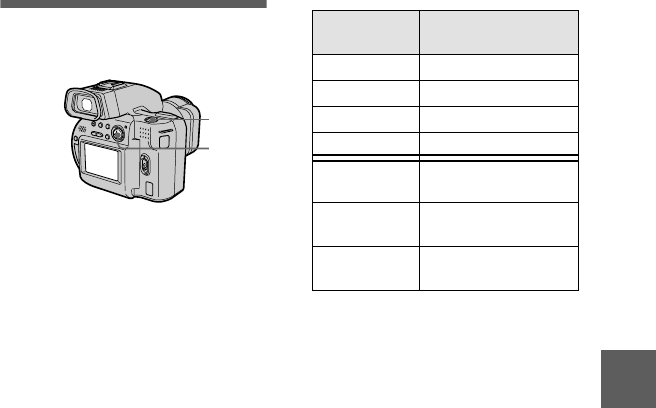
SETUP
INDEX (Only in PLAY (single) mode)
Displays six images at a time (PLAY (INDEX) mode) (page 56).
DELETE
(Return) (Only in PLAY (INDEX) mode)
Returns to PLAY (single) mode.
Item Setting Description
PLAY/STILL/
MOVIE selector
DEMO xSTBY/ON
OFF Displayed only when you use the AC
power adaptor in MOVIE or STILL
mode. When [ON] is selected, a
demonstration will start if you do not
operate your camera for about 10
minutes. To stop the demonstration, turn
off your camera. Select [ON] to make
the demonstration appear again.
MOVIE
STILL
VIDEO
OUT NTSC Sets the video output signal to NTSC
mode (e.g., Japan, the USA). MOVIE
STILL
PLAY
PAL Sets the video output signal to PAL
mode (e.g., Europe).
/
LANGUAGE
xENGLISH Displays the menu items in English. MOVIE
STILL
PLAY
/JPN Displays the menu items in Japanese.
CLOCK
SET — Sets the date and time (page 12). MOVIE
STILL
PLAY
BEEP SHUTTER Turns off the beep only. (The shutter
sound is heard when you press the
shutter button.)
MOVIE
STILL
PLAY
xON Turns on the beep/shutter sound (when
you press the control button/shutter
button).
OFF Turns off the beep/shutter sound.
LCD
BRIGHT Adjusts the LCD screen brightness
using +/- on the LCD screen. MOVIE
STILL
PLAY
Setting Description
PLAY/STILL/MOVIE
selector
OK Deletes the displayed image. PLAY
CANCEL Cancels deleting of the image.
01cov.book Page 46 Tuesday, May 23, 2000 4:20 PM
masterpage:Right
filename[D:\Mavica1000\3062473111\3062473111MVCCD1000UC\02GB-
MVCCD1000UC\07adv.fm]
B
BB
B Various recording
47
model name1[MVC-CD1000]
[3-062-473-11(1)]
B
Various recording
Setting the image size
(IMAGE SIZE)
The number of images or the time
that you can record on a disc
∗When [REC MODE] is set to
[NORMAL].
∗∗Numbers in parentheses indicate the
maximum time in a continuous
recording.
Notes
•You can delete images recorded on a disc,
however, even if you delete images, the
disc remaining space does not increase.
•The number of images recordable on a disc
may decrease depending on conditions.
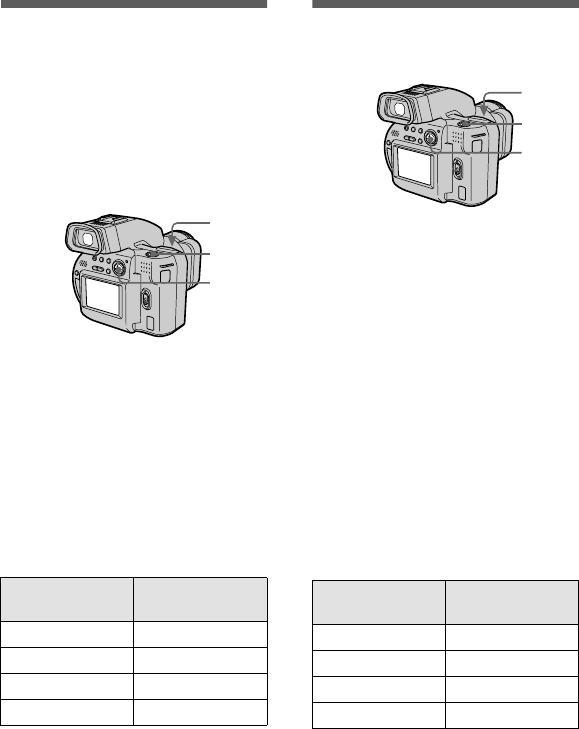
1Set the PLAY/STILL/MOVIE
selector to MOVIE or STILL.
2Select [FILE] and then
[IMAGE SIZE] from the menu.
3Select the desired image
size.
Still image sizes:
1600×1200, 1600 (3:2)*,
1024×768, 640×480
∗The image is recorded in the ratio of
three to two to fit the printing paper
size.
Moving image sizes:
320 (HQ)*, 320×240, 160×112
∗High Quality mode
2, 3
1
Image size Number of images or
time*
1600×1200
Approx. 160
1600 (3:2) Approx. 170
1024×768 Approx. 350
640×480 Approx. 1080
320 (HQ) Approx. 370 (15)**
sec
320×240 Approx. 1400 (15)**
sec
160×112 Approx. 5100 (60)**
sec
01cov.book Page 47 Tuesday, May 23, 2000 4:20 PM
masterpage:Left
filename[D:\Mavica1000\3062473111\3062473111MVCCD1000UC\02GB-
MVCCD1000UC\07adv.fm]
48
model name1[MVC-CD1000]
[3-062-473-11(1)]
Recording still
images for e-mail (E-
MAIL)
The E-MAIL mode records a small-
size (320×240) image at the same time
as a still image. Small-size images are
convenient for e-mail transmission,
etc.
The number of images that you can
record on a disc in E-MAIL mode
To return to normal
recording mode
Select [NORMAL] in step 2.
Adding audio files to
still images (VOICE)
The number of images that you can
record on a disc in VOICE mode
To return to normal
recording mode
Select [NORMAL] in step 2.
1Set the PLAY/STILL/MOVIE
selector to STILL.
2Select [FILE], [REC MODE],
and then [E-MAIL] from the
menu.
3Record the image.
Image size Number of
images
1600×1200
Approx. 140
1600 (3:2) Approx. 150
1024×768 Approx. 300
640×480 Approx. 730
2
1
31Set the PLAY/STILL/MOVIE
selector to STILL.
2Select [FILE], [REC MODE],
and then [VOICE] from the
menu.
3Record the image.
If you press and release the
shutter button, sound is
recorded for five seconds.
If you hold down the shutter
button, sound is recorded until
you release the shutter button for
up to 40 seconds.
Image size Number of
images
1600×1200
Approx. 130
1600 (3:2) Approx. 150
1024×768 Approx. 270
640×480 Approx. 620
2
1
3
01cov.book Page 48 Tuesday, May 23, 2000 4:20 PM
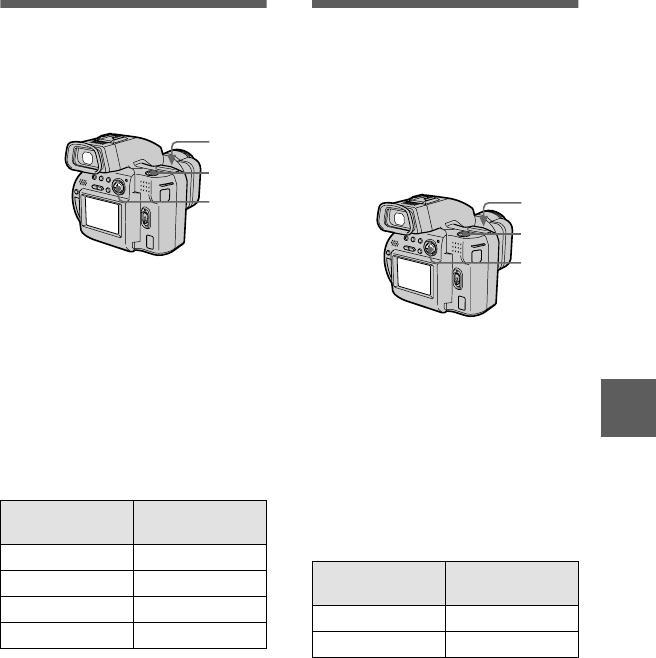
masterpage:Right
filename[D:\Mavica1000\3062473111\3062473111MVCCD1000UC\02GB-
MVCCD1000UC\07adv.fm]
B
BB
B Various recording
49
model name1[MVC-CD1000]
[3-062-473-11(1)]
Recording text
documents (TEXT)
Text is recorded in black and white
GIF format to provide a clearer image.
The number of images that you can
record on a disc in TEXT mode
To return to normal
recording mode
Select [NORMAL] in step 2.
Notes
•If the subject is not evenly illuminated, you
may be unable to record a clear image.
•Writing and reading data take more time
than normal recording.
•The image will be displayed in
monochrome in TEXT mode.
Recording
uncompressed
images (TIFF)
This mode simultaneously records still
images in both TIFF format
(uncompressed) and JPEG format
(compressed).
The number of images that you can
record on a disc in TIFF mode
To return to normal
recording mode
Select [NORMAL] in step 2.
Notes
•JPEG images are recorded in the image
size selected by the [IMAGE SIZE] menu.
TIFF images are recorded in [
1600×1200
]
size other than when [1600 (3:2)] is
selected.
•Writing data takes more time than in
normal recording. It will take for about 40
seconds.
1Set the PLAY/STILL/MOVIE
selector to STILL.
2Select [FILE], [REC MODE],
and then [TEXT] from the
menu.
3Record the image.
Image size Number of
images
1600×1200
Approx. 1370
1600 (3:2) Approx. 1450
1024×768 Approx. 1510
640×480 Approx. 1570
2
1
3
1Set the PLAY/STILL/MOVIE
selector to STILL.
2Select [FILE], [REC MODE],
and then [TIFF] from the
menu.
3Record the image.
Image size Number of
images
1600×1200
Approx. 20
1600 (3:2) Approx. 22
2
1
3
01cov.book Page 49 Tuesday, May 23, 2000 4:20 PM
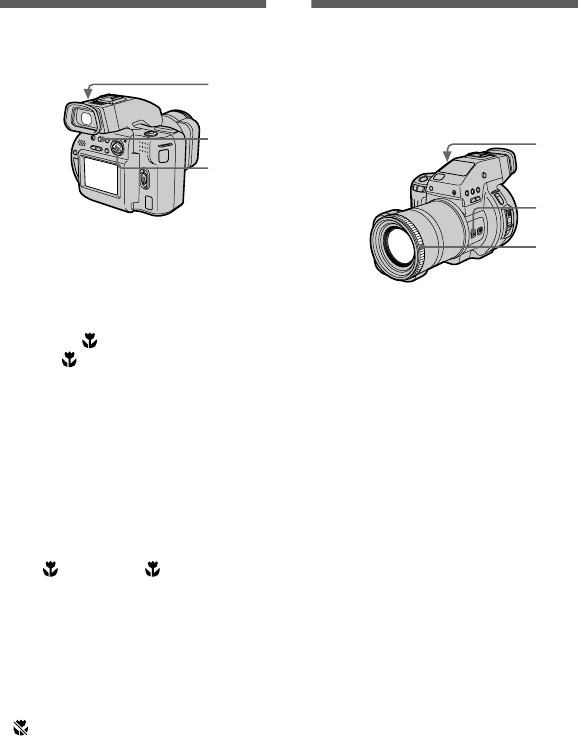
masterpage:Left
filename[D:\Mavica1000\3062473111\3062473111MVCCD1000UC\02GB-
MVCCD1000UC\07adv.fm]
50
model name1[MVC-CD1000]
[3-062-473-11(1)]
Recording images in
macro
To return to normal
recording mode
Press again. The indicator
disappears.
Notes
•You cannot record images in macro with
the following PROGRAM AE modes:
—Landscape mode
—Panfocus mode
•You cannot record images in macro if the
indicator appears.
Focusing manually
Normally the focus is automatically
adjusted. The manual focus function is
convenient to focus the subject such as
under dark situations.
To reactivate auto focusing
Set the FOCUS AUTO/MANUAL
switch to AUTO.
1Set the PLAY/STILL/MOVIE
selector to MOVIE or STILL.
2Set the FOCUS AUTO/
MANUAL switch to AUTO.
3Press (macro).
The (macro) indicator appears
on the LCD screen or on the
viewfinder.
With the zoom lever set to the W
side, you can shoot a subject that is
about 13/16 inch (2 cm) away from
the lens surface in macro mode.
2
1
3
1Set the PLAY/STILL/MOVIE
selector to MOVIE or STILL.
2Set the FOCUS AUTO/
MANUAL switch to MANUAL.
The 9 (manual focus) indicator
appears on the LCD screen or on
the viewfinder.
3Turn the focus ring to achieve
a sharp focus.
When you shoot still images, the
image on the LCD screen or on the
viewfinder is enlarged (double*)
and the focal point information
appears while the focus is being
adjusted. After adjusting, the
image returns to normal size. The
range is from
13/16 inch (2 cm) to ∞ (infinity).
∗When using the digital zoom
function, the enlarged image will be
less than double size.
3
2
1
01cov.book Page 50 Tuesday, May 23, 2000 4:20 PM
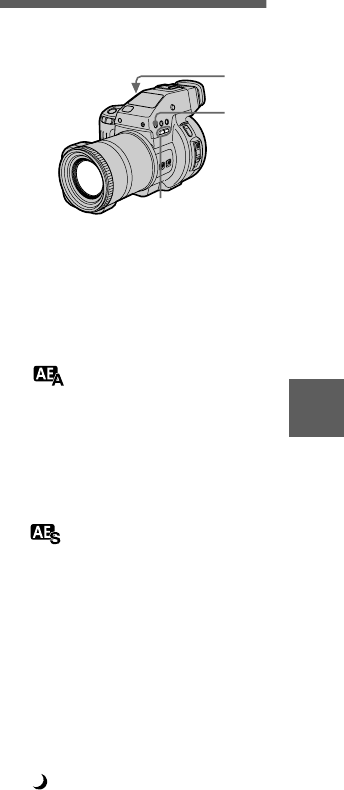
masterpage:Right
filename[D:\Mavica1000\3062473111\3062473111MVCCD1000UC\02GB-
MVCCD1000UC\07adv.fm]
B
BB
B Various recording
51
model name1[MVC-CD1000]
[3-062-473-11(1)]
Notes
•Focal point information may not
completely show the correct distance. Use
the information as a guide.
•Focal point information does not show the
correct distance when attaching the
conversion lens.
•If you shoot a subject within 31 1/2 inches
(0.8 m) while the zoom lever is set to T
side, you cannot get a clear focus. In such
cases, the focal point information flashes.
Move the zoom lever to the W side until
the indicator stops flashing.
•You cannot adjust the focus manually if
you have selected the Panfocus mode in
the PROGRAM AE function.
Using the PROGRAM
AE function
1Set the PLAY/STILL/MOVIE
selector to MOVIE or STILL.
2Press PROGRAM AE
repeatedly to select the
desired PROGRAM AE mode.
Aperture priority mode
For making the subject stand out
against an unclear background or
providing a larger in-focus range.
Press PROGRAM AE +/–
repeatedly to select an aperture
value in 9 steps from F2.8 to F11.
Shutter speed priority
mode
For recording a sharp picture of a
fast-moving subject or recording
the flow of motion of a moving
subject.
Press PROGRAM AE +/–
repeatedly to select a shutter speed
in 17 steps from 8'' to 1/500 when
recording a still image, or in 11
steps from 1/8 to 1/500 when
recording a moving image.
Twilight mode
Suppresses the blurring of colors
of a bright subject in a dark place
so that you can record the subject
without losing the dark atmosphere
of the surroundings.
2
1
PROGRAM AE +/–
01cov.book Page 51 Tuesday, May 23, 2000 4:20 PM
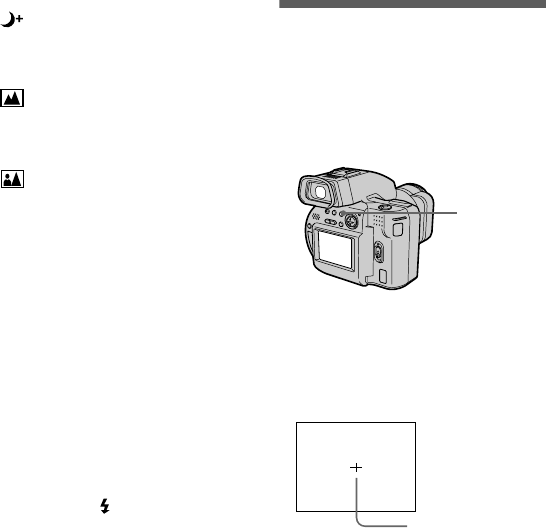
masterpage:Left
filename[D:\Mavica1000\3062473111\3062473111MVCCD1000UC\02GB-
MVCCD1000UC\07adv.fm]
52
model name1[MVC-CD1000]
[3-062-473-11(1)]
To cancel PROGRAM AE
Press PROGRAM AE repeatedly until
the indicator on the LCD screen or on
the viewfinder goes out.
Notes
•You can focus only on distant subjects in
Landscape mode.
•In Panfocus mode, the zoom position is set
to the W side and focus is fixed.
•When you record in Twilight plus mode,
we recommend that you use a tripod to
prevent shaking.
•Set the forced flash when you use the
flash in the following modes:
– Twilight mode
– Twilight plus mode
– Landscape mode
•You cannot use the PROGRAM AE
function when [REC MODE] is set to
[TEXT].
•If the setting is not appropriate in Aperture
priority mode and Shutter speed priority
mode, the setting value indicator on the
LCD screen or on the viewfinder flashes
when you press the shutter button. In this
case, reset the value.
•If you select a slow shutter speed in
Twilight plus mode or select Shutter speed
priority mode, the image may not be clear.
Using the Spot light–
metering function
Select this mode when there is
backlight or when there is strong
contrast between the subject and the
background, etc.
Press SPOT METER to activate the
spot light-metering function. Position
the point you want to record at the spot
light-metering cross hair.
Twilight plus mode
Increases the effectiveness of the
twilight mode function.
Landscape mode
Focuses only on a distant subject to
record landscapes, etc.
Panfocus mode
Changes the focus quickly and
simply from a close subject to a
distant subject.
SPOT
METER
LCD screen/viewfinder
Spot light-metering
cross hair
01cov.book Page 52 Tuesday, May 23, 2000 4:20 PM
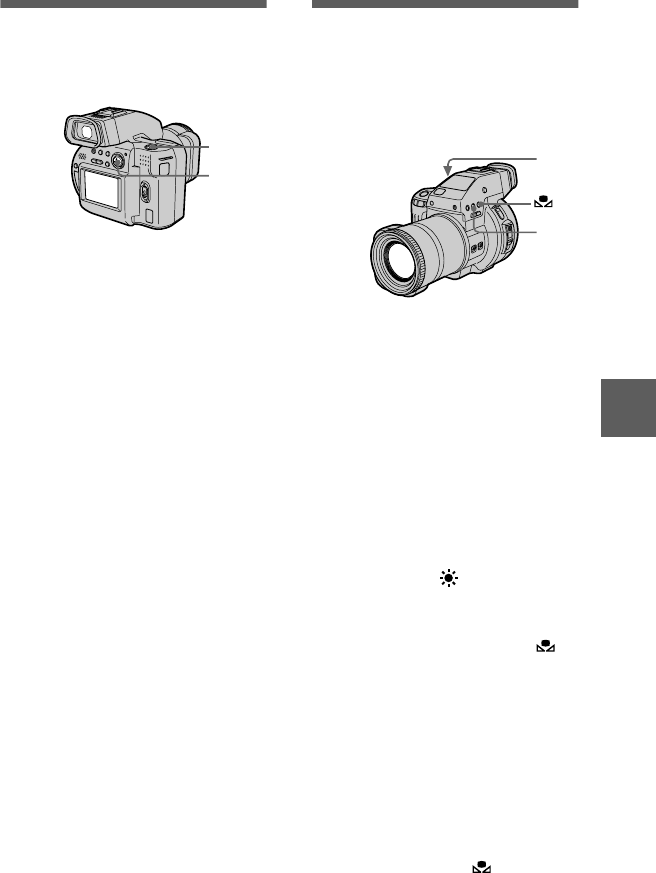
masterpage:Right
filename[D:\Mavica1000\3062473111\3062473111MVCCD1000UC\02GB-
MVCCD1000UC\07adv.fm]
B
BB
B Various recording
53
model name1[MVC-CD1000]
[3-062-473-11(1)]
Adjusting the
exposure
(EXPOSURE)
Note
If a subject is under extremely bright or dark
situations, or the flash is used, the exposure
adjustment may not be effective.
Adjusting the white
balance (WHITE
BALANCE)
Normally the white balance is
automatically adjusted.
To shoot in one-push white
balance mode
1Press WHITE BALANCE
repeatedly until the indicator
appears.
1Set the PLAY/STILL/MOVIE
selector to MOVIE or STILL.
2Select [CAMERA] and then
[EXPOSURE] from the menu.
3Select the desired exposure
value.
Adjust the exposure value while
checking the brightness of the
background. You can select values
ranging from +2.0 EV to -2.0 EV
in steps of 1/3 EV.
2, 3
1
1Set the PLAY/STILL/MOVIE
selector to MOVIE or STILL.
2Press WHITE BALANCE
repeatedly to select the
desired white balance
setting.
IN DOOR (n)
•Places where the lighting
condition changes quickly
•Under bright lighting such as
photography studios
•Under sodium or mercury lamps
OUT DOOR ( )
Recording a sunrise/sunset, night
scene, neon signs, or fireworks
One-push white balance ( )
Adjusting the white balance
depending on the light source
AUTO (No indicator)
Adjusts the white balance
automatically
2
1
01cov.book Page 53 Tuesday, May 23, 2000 4:20 PM
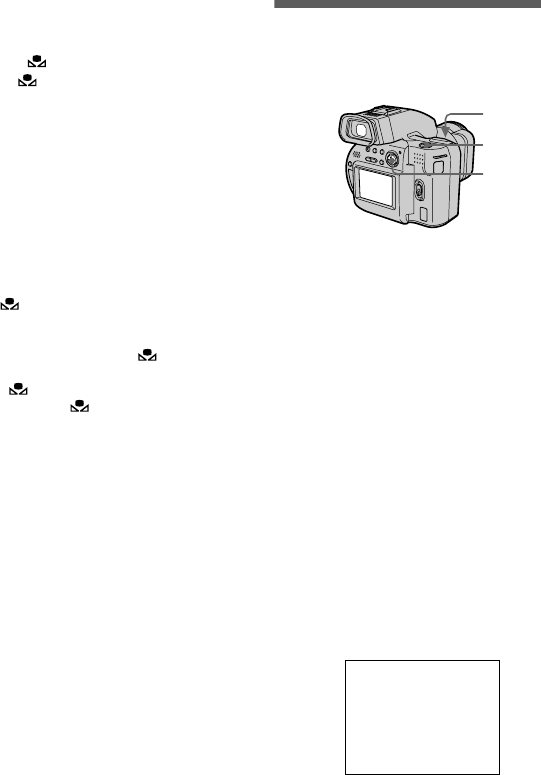
masterpage:Left
filename[D:\Mavica1000\3062473111\3062473111MVCCD1000UC\02GB-
MVCCD1000UC\07adv.fm]
54
model name1[MVC-CD1000]
[3-062-473-11(1)]
2Shoot a white object such as paper
full under the same situation you
will shoot.
3Press .
The indicator flashes quickly.
When the white balance has been
adjusted and stored in the memory,
the indicator stops flashing.
To reactivate auto
adjustment
Select [AUTO] in step 2.
Notes
•Select [AUTO] when shooting with
fluorescent lighting.
•The indicator means:
Slow flashing: white balance is not set.
Quick flashing: white balance is being
adjusted (after you pressed ).
Lit steady: white balance has been set.
•If the indicator keeps flashing even
when you press , record in automatic
white balance mode.
Recording the date
and time on the still
image (DATE/TIME)
1Set the PLAY/STILL/MOVIE
selector to STILL.
2Select [EFFECT] and then
[DATE/TIME] from the menu.
3Select the date and time.
DAY & TIME
Imposes the date, hour, and
minute.
DATE
Imposes the year, month, and day.
OFF
Does not impose the date and time.
4Record the image.
The date and time do not appear on
the LCD screen or on the
viewfinder during shooting, these
appear during playback only.
2, 3
1
4
2000 7 4
01cov.book Page 54 Tuesday, May 23, 2000 4:20 PM

masterpage:Right
filename[D:\Mavica1000\3062473111\3062473111MVCCD1000UC\02GB-
MVCCD1000UC\07adv.fm]
B
BB
B Various recording
55
model name1[MVC-CD1000]
[3-062-473-11(1)]
Enjoying picture
effects (PICTURE
EFFECT)
To cancel picture effect
Select [OFF] in step 2.
1Set the PLAY/STILL/MOVIE
selector to MOVIE or STILL.
2Select [EFFECT] and then
[P. EFFECT] from the menu.
Select the desired mode.
SOLARIZE
The light contrast is clearer and the
picture looks like an illustration.
B&W
The picture is monochrome (black
and white).
SEPIA
The picture is sepia-toned like an
old photograph.
NEG.ART
The color and brightness of the
picture are reversed as in a
negative.
OFF
Does not use the picture effect
function.
2
1
01cov.book Page 55 Tuesday, May 23, 2000 4:20 PM
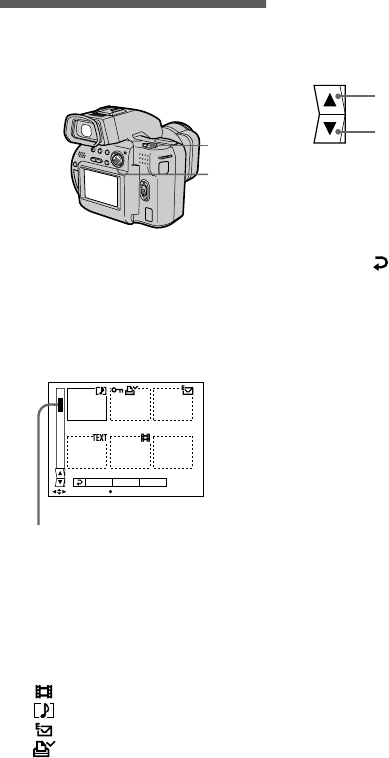
masterpage:Left
filename[D:\Mavica1000\3062473111\3062473111MVCCD1000UC\02GB-
MVCCD1000UC\08adv.fm]
56
model name1[MVC-CD1000]
[3-062-473-11(1)]
B
Various playback
Playing back six
images at once
(INDEX)
To display the next
(previous) index screen
Select v/V at the lower-left on the
LCD screen or on the viewfinder.
To return to normal playback
(single image)
•Select the desired image with the
control button.
•Select (Return).
Note
Images shot in TEXT mode cannot be
displayed on the INDEX screen.
1Set the PLAY/STILL/MOVIE
selector to PLAY.
2Select [INDEX] on the LCD
screen or on the viewfinder.
Six images are displayed at once
(index screen).
The following marks are displayed
on each image according to the
image type and settings.
: Moving image file
: Voice memo file
: E-mail file
: Print mark
-: Protect mark
TEXT: TEXT file
TIFF: TIFF mark
(No mark): Normal recording (no
settings)
2
1
2000 7 4 12:30PM100-0001
SELECT SINGLE DISPLAY
DELETE
FILE SETUP
TEXT
This shows the position of
the currently displayed
images relative to all the
recorded images.
Displays the previous index
screen.
Displays the next index screen
.
01cov.book Page 56 Tuesday, May 23, 2000 4:20 PM
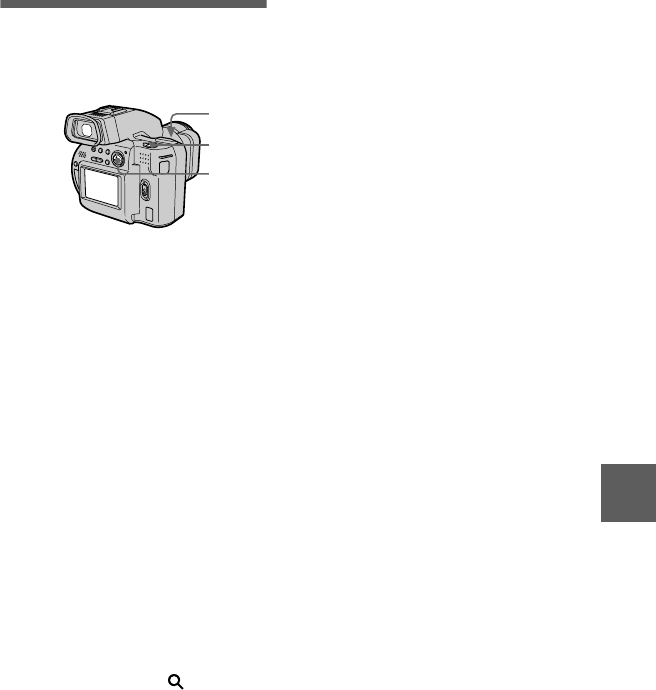
masterpage:Right
filename[D:\Mavica1000\3062473111\3062473111MVCCD1000UC\02GB-
MVCCD1000UC\08adv.fm]
B
BB
B Various playback
57
model name1[MVC-CD1000]
[3-062-473-11(1)]
Enlarging a part of the
still image (Zoom and
trimming)
To return to the normal size
Zoom out with the zoom lever until the
zoom scaling indicator ( ×1.1)
disappears from the screen, or simply
press the center x.
To record an enlarged image
(trimming)
1Enlarge the image.
2Press the shutter button. The image
is recorded at 640×480 size and the
image on the LCD screen or on the
viewfinder returns to the normal
size after recording.
Notes
•You cannot use this function on moving
images, TEXT mode images, or
uncompressed images.
•Zoom scaling is up to 5× regardless of the
original image size.
•The quality of enlarged images may be
deteriorated.
•The original data is left even if you enlarge
the image.
•The enlarged image is recorded as the
newest file.
•If you trim an image, the disc space will be
decrease.
•If the disc space is not sufficient, you may
not be able to trim an image.
1Set the PLAY/STILL/MOVIE
selector to PLAY.
2Display the image to be
enlarged.
3Zoom in/out the image with
the zoom lever.
The zoom scaling indicator
appears on the LCD screen or on
the viewfinder.
4Press the control button
repeatedly to trim the image.
v: The image moves downward
V: The image moves upward
b: The image moves rightward
B: The image moves leftward
2, 4
1
3
01cov.book Page 57 Tuesday, May 23, 2000 4:20 PM
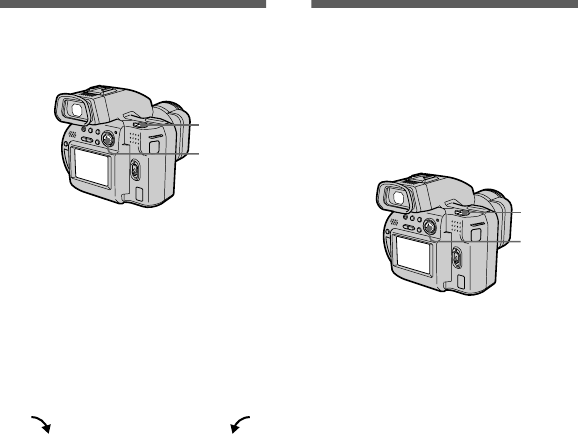
masterpage:Left
filename[D:\Mavica1000\3062473111\3062473111MVCCD1000UC\02GB-
MVCCD1000UC\08adv.fm]
58
model name1[MVC-CD1000]
[3-062-473-11(1)]
Rotating a still image
(ROTATE)
Notes
•You may not be able to rotate protected
images or images recorded with other
equipment.
•Also, when viewing images on a personal
computer, the image rotation information
may not be reflected depending on the
application software.
•You cannot rotate protected or
uncompressed images, or images recorded
in TEXT mode.
•If you rotate an image, the disc space will
decrease.
•If the disc space is not sufficient, you may
not be able to rotate an image.
Playing back the still
images in order
(SLIDE SHOW)
This function is useful for checking the
recorded images or for presentations,
etc.
To cancel the slide show
Select [CANCEL] in step 2 or 3.
1Set the PLAY/STILL/MOVIE
selector to PLAY.
2Display the image to rotate.
3Select [FILE] and then
[ROTATE] from the menu.
4Rotate the image clockwise
or counterclockwise ,
then select [RETURN].
2, 3, 4
1
1Set the PLAY/STILL/MOVIE
selector to PLAY.
2Select [FILE] and then [SLIDE
SHOW] from the menu.
Set the following items.
INTERVAL
You can select from 1 min (one
minute), 30 sec (30 seconds),
10 sec (10 seconds), or 5 sec
(5 seconds).
REPEAT
ON: Plays back images in a
continuous loop (approximately 20
minutes) until [RETURN] is
selected.
OFF: After all images have been
played back, the slide show ends.
3Select [START] with the
control button.
The slide show begins.
2, 3
1
01cov.book Page 58 Tuesday, May 23, 2000 4:20 PM
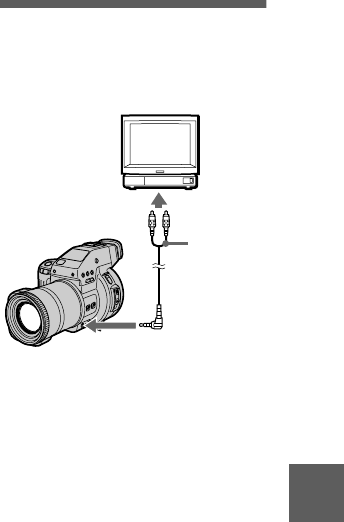
masterpage:Right
filename[D:\Mavica1000\3062473111\3062473111MVCCD1000UC\02GB-
MVCCD1000UC\08adv.fm]
B
BB
B Various playback
59
model name1[MVC-CD1000]
[3-062-473-11(1)]
To skip to the next/previous
image during the slide show
Select \b/B\ at the lower-left on the
screen.
Notes
•The interval setting time may vary
depending on the image size.
•When [REPEAT] is set to [ON], the slide
show does not end until all the images
played back, even if it takes more than 20
minutes.
Viewing images on a
TV screen
You can view images recorded onto a
disc on a TV.
Note
You cannot use a TV that has an antenna
(aerial) connector only.
1Connect the A/V connecting
cable to the A/V OUT (MONO)
jack of your camera and to
the audio/video input jacks of
the TV.
If your TV has stereo type input
jacks, connect the audio plug of the
A/V connecting cable to the Lch
jack.
2Turn on the TV and start
playback on your camera.
The playback image appears on the
TV screen.
to A/V OUT (MONO)
jack
Set the TV/
VIDEO switch
to “VIDEO.”
A/V
connecting
cable
01cov.book Page 59 Tuesday, May 23, 2000 4:20 PM
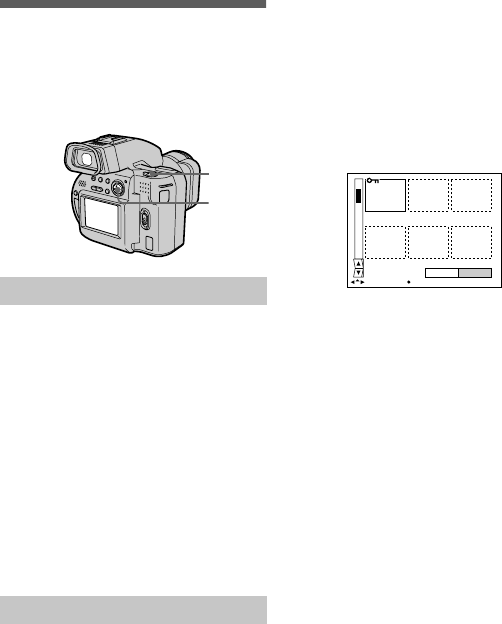
masterpage:Left
filename[D:\Mavica1000\3062473111\3062473111MVCCD1000UC\02GB-
MVCCD1000UC\09adv.fm]
60
model name1[MVC-CD1000]
[3-062-473-11(1)]
B
Editing
Preventing accidental
erasure (PROTECT)
The - (protect) indicator appears on
protected images.
To release protection
Select [OFF] in step 2.
To release protection
If you selected [ALL] in step 2, select
[OFF]. If you selected [SELECT] in
step 2, select the images to be
unprotected with the control button,
then select [ENTER].
Notes
•If you protect an image, the disc space will
decrease.
•If the disc space is not sufficient, you may
not be able to protect an image.
In single mode
1Set the PLAY/STILL/MOVIE
selector to PLAY, then
display the image to be
protected.
2Select [FILE], [PROTECT],
and then [ON] from the menu.
The displayed image is protected
and the - indicator appears.
In INDEX mode
1Set the PLAY/STILL/MOVIE
selector to PLAY, then
display the INDEX screen.
2Select [FILE], [PROTECT],
and then [ALL] or [SELECT]
from the menu.
2, 3
1
3When you select [ALL]
Select [ON].
All the images in the disc are
protected.
When you select [SELECT]
Select all the images to be
protected with the control button,
then select [ENTER]. The selected
images are protected.
ENTERPROTECT CANCEL
0001-0006/0040
SELECT OK
01cov.book Page 60 Tuesday, May 23, 2000 4:20 PM
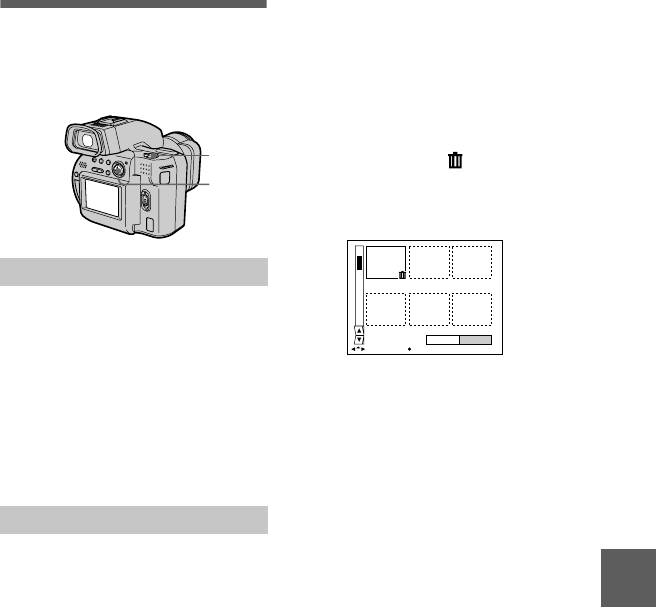
masterpage:Right
filename[D:\Mavica1000\3062473111\3062473111MVCCD1000UC\02GB-
MVCCD1000UC\09adv.fm]
B
BB
B Editing
61
model name1[MVC-CD1000]
[3-062-473-11(1)]
Deleting images
(DELETE)
Protected images cannot be deleted.
To cancel deleting
Select [CANCEL] in step 2 or 3.
Notes
•You can delete images recorded on a disc,
however, even if you delete images, the
disc remaining space does not increase.
•If you delete an image, the disc space will
decrease.
•If the disc space is not sufficient, you may
not be able to delete an image.
•If the lower four-digit file number of an
image is the same as the number of the
selected image, that image also will be
deleted.
In single mode
1Set the PLAY/STILL/MOVIE
selector to PLAY, then
display the image to be
deleted.
2Select [DELETE] and then
[OK] from the menu.
The image is deleted.
In INDEX mode
1Set the PLAY/STILL/MOVIE
selector to PLAY, then
display the INDEX screen.
2Select [DELETE] and then
[ALL] or [SELECT] from the
menu.
2, 3
1
3When you select [ALL]
Select [ENTER].
All the unprotected images are
deleted.
When you select [SELECT]
Select all the images to be deleted
with the control button, then select
[ENTER]. The (delete)
indicator appears on the selected
images and these images are
deleted.
0001-0006/0040
ENTERDELETE CANCEL
SELECT OK
01cov.book Page 61 Tuesday, May 23, 2000 4:20 PM
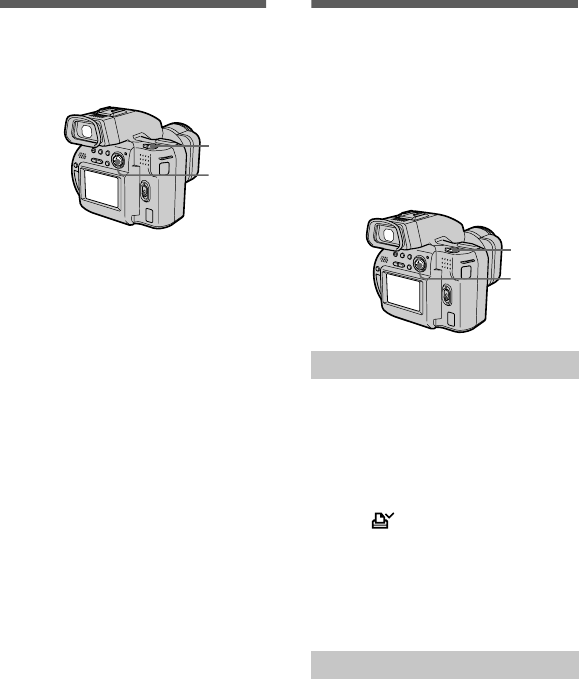
masterpage:Left
filename[D:\Mavica1000\3062473111\3062473111MVCCD1000UC\02GB-
MVCCD1000UC\09adv.fm]
62
model name1[MVC-CD1000]
[3-062-473-11(1)]
Changing the
recorded still image
size (RESIZE)
To cancel changing the size
Select [CANCEL] in step 3.
Notes
•When you change from a small size to a
large size, the picture quality deteriorates.
•The original image is retained even after
resizing.
•You cannot change the size of images
recorded in TEXT mode, uncompressed
image, or moving pictures.
•If you resize an image, the disc space will
decrease.
•If the disc space is not sufficient, you may
not be able to resize an image.
•The resized image is recorded as the
newest file.
Selecting still images
to print (PRINT MARK)
You can mark a print mark on still
images recorded with your camera.
This mark is convenient when you
have images printed at a shop that
conforms with the DPOF (Digital Print
Order Format) standard.
To remove the print mark
Select [OFF] in step 2.
1Set the PLAY/STILL/MOVIE
selector to PLAY, then
display the image of which
you want to change the size.
2Select [TOOL] and then
[RESIZE] from the menu.
3Select the desired size.
1600×1200, 1024×768, 640×480.
The resized image is recorded and
the image on the LCD screen or on
the viewfinder returns to the
previous size after recording.
2, 3
1
In single mode
1Set the PLAY/STILL/MOVIE
selector to PLAY and display
the image you want to print.
2Select [FILE], [PRINT MARK],
and then [ON] from the menu.
The (print) mark is marked on
the displayed image.
In INDEX mode
1Set the PLAY/STILL/MOVIE
selector to PLAY, then
display the INDEX screen.
2Select [FILE], [PRINT MARK],
and then [SELECT] from the
menu.
3Select the images to be
marked with the control
button.
2, 3, 4
1
01cov.book Page 62 Tuesday, May 23, 2000 4:20 PM
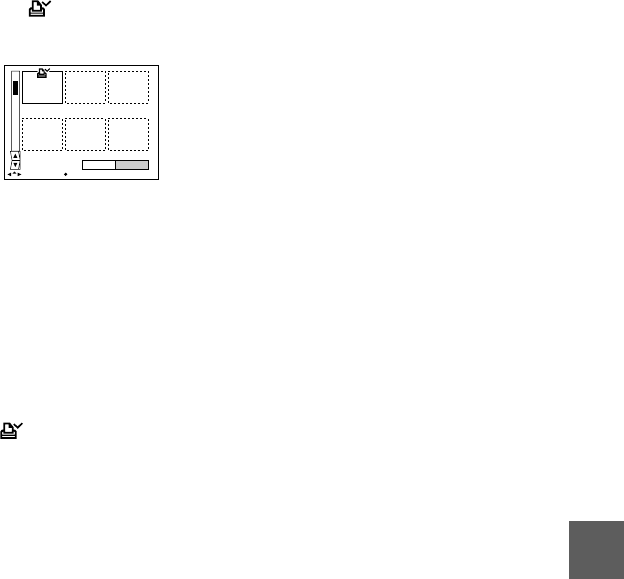
masterpage:Right
filename[D:\Mavica1000\3062473111\3062473111MVCCD1000UC\02GB-
MVCCD1000UC\09adv.fm]
B
BB
B Editing
63
model name1[MVC-CD1000]
[3-062-473-11(1)]
To remove selected print
marks
Select the images to be removed in step
3 with the control button, then select
[ENTER].
To remove all the print
marks
Select [FILE], [PRINT MARK],
[ALL], and then [OFF] from the menu.
The marks on all images are
removed.
Notes
•You cannot mark a print mark on moving
images or TEXT mode images.
•If you mark an image recorded in TIFF
mode with a print mark, only the
uncompressed image is printed, and the
JPEG image recorded at the same time is
not printed.
•If you mark an image with a print mark,
the disc space will decrease.
•If the disc space is not sufficient, you may
not mark an image with a print mark.
4Select [ENTER].
The marks on the selected
images change from green to
white.
0001-0006/0100
ENTERPRINT MARK CANCEL
SELECT OK
01cov.book Page 63 Tuesday, May 23, 2000 4:20 PM
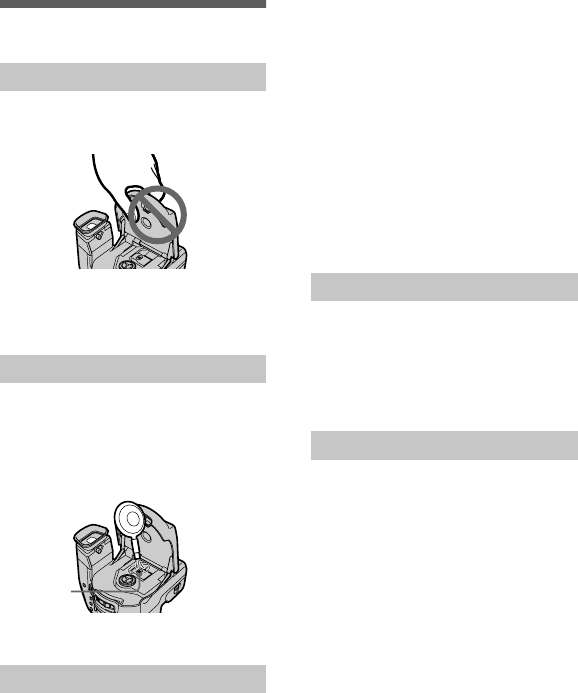
masterpage:Left
filename[D:\Mavica1000\3062473111\3062473111MVCCD1000UC\02GB-
MVCCD1000UC\10add.fm]
64
model name1[MVC-CD1000]
[3-062-473-11(1)]
Additional information
Precautions
Do not carry the camera by holding
the disc cover
Do not touch the rotating disc
This may cause serious injuries.
When the pickup lens is dirty and the
camera cannot read any image, clean
the pickup lens using a commercially
available blower.
Cleaning the LCD screen or
viewfinder
Wipe the screen surface with a
cleaning cloth (not supplied) or an
LCD cleaning kit (not supplied) to
remove fingerprints, dust, etc.
Cleaning the camera surface
Clean the camera surface with a soft
cloth slightly moistened with water,
then wipe the surface dry. Do not use
any type of solvent such as thinner,
alcohol or benzene as this may damage
the finish or the casing.
After using your camera at the
seashore or other dusty locations
Clean your camera carefully.
Otherwise, the salty air may corrode
the metal fittings or dust may enter the
inside of your camera, causing a
malfunction.
Your camera is designed for use
between the temperatures of 32 °F to
104 °F (0 °C to 40 °C). Recording in
extremely cold or hot places that
exceed this range is not recommended.
If the camera is brought directly from a
cold to a warm location, or is placed in
a very damp room, moisture may
condense inside or outside the camera.
Should this occur, “DISC ERROR”
appears and the camera will not
operate properly.
Moisture condensation occurs
easily when:
•The camera is brought from a cold
location such as a ski slope into a
warmly heated room.
•The camera is taken from an air-
conditioned room or car interior to
the hot outdoors, etc.
On handling the camera
On pickup lens cleaning
On cleaning
Pickup
lens
On operating temperature
On moisture condensation
01cov.book Page 64 Tuesday, May 23, 2000 4:20 PM

masterpage:Right
filename[D:\Mavica1000\3062473111\3062473111MVCCD1000UC\02GB-
MVCCD1000UC\10add.fm]
Additional information
65
model name1[MVC-CD1000]
[3-062-473-11(1)]
How to prevent moisture
condensation
When bringing the camera from a cold
place to a warm place, seal the camera
in a plastic bag and allow it to adapt to
conditions at the new location over a
period of time (about an hour).
If moisture condensation occurs
Turn off the camera and wait about an
hour for the moisture to evaporate.
Note that if you attempt to record with
moisture remaining inside the camera
lens, you will be unable to record clear
images.
Do not touch the pickup lens inside the
disc cover. And do not open the disc
cover except when inserting or
removing a disc to keep dust out.
•Unplug the unit from the wall outlet
(mains) when you are not using the
unit for a long time. To disconnect
the power cord (mains lead), pull it
out by the plug. Never pull the power
cord (mains lead) itself.
•Do not operate the unit with a
damaged cord (mains lead) or if the
unit has been dropped or damaged.
•Do not bend the power cord (mains
lead) forcibly, or place a heavy object
on it. This will damage the cord
(mains lead) and may cause fire or
electrical shock.
•Prevent metallic objects from coming
into contact with the metal parts of
the connecting section. If this
happens, a short may occur and the
unit may be damaged.
•Always keep metal contacts clean.
•Do not disassemble the unit.
•Do not apply mechanical shock or
drop the unit.
•While the unit is in use, particularly
during charging, keep it away from
AM receivers and video equipment.
AM receivers and video equipment
disturb AM reception and video
operation.
•The unit becomes warm during use.
This is not a malfunction.
•Do no place the unit in locations that
are:
— Extremely hot or cold
— Dusty or dirty
— Very humid
— Vibrating
•Use only the specified charger with
the charging function.
•To prevent accident from a short
circuit, do not allow metal objects to
come into contact with the battery
terminals.
•Keep the battery pack away from fire.
•Never expose the battery pack to
temperatures above 140 °F (60 °C),
such as in a car parked in the sun or
under direct sunlight.
•Keep the battery pack dry.
•Do not expose the battery pack to any
mechanical shock.
•Do not disassemble nor modify the
battery pack.
•Attach the battery pack to the camera
securely.
•Charging while some capacity
remains does not affect the original
battery capacity.
On pickup lens
On AC power adaptor
On battery pack
01cov.book Page 65 Tuesday, May 23, 2000 4:20 PM
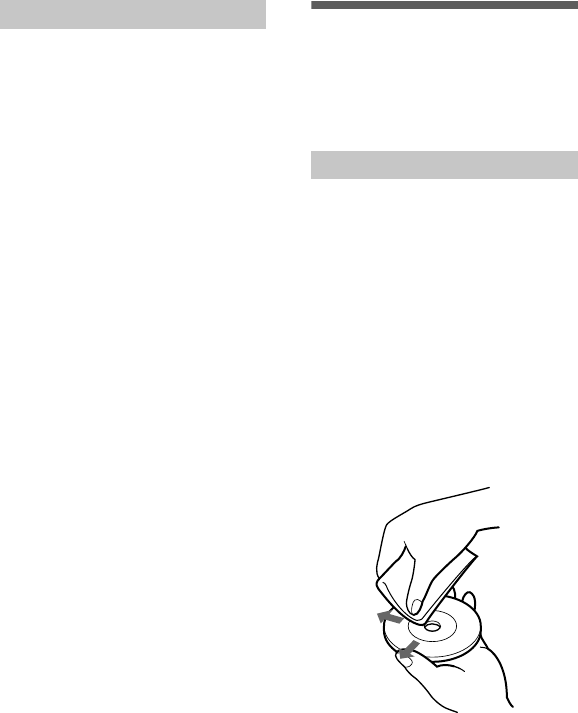
masterpage:Left
filename[D:\Mavica1000\3062473111\3062473111MVCCD1000UC\02GB-
MVCCD1000UC\10add.fm]
66
model name1[MVC-CD1000]
[3-062-473-11(1)]
Your camera is supplied with a
vanadium-lithium battery installed so
as to retain the date and time, etc.,
regardless of the setting of the POWER
switch. The vanadium-lithium battery
is always charged as long as you are
using your camera. The battery,
however, will get discharged gradually
if you do not use your camera. It will
be completely discharged in about six
months if you do not use your camera
at all. Even if the vanadium-lithium
battery is not charged, it will not affect
the camera operation. To retain the
date and time, etc., charge the battery if
the battery is discharged.
Charging the vanadium-lithium
battery:
•Connect your camera to house
current (mains) using the AC power
adaptor supplied with your camera,
and leave your camera with the
power turned off for more than 24
hours.
•Or install the fully charged battery
pack in your camera, and leave your
camera with the power turned off for
more than 24 hours.
If any problem occurs, unplug your
camera and contact your nearest Sony
dealer.
On discs
Be sure to use only 8 cm CD-Rs. You
cannot read or write data on other type
discs that does not correspond to this
camera.
•Do not clean a disc using a cleaner
before recording. Use a
commercially available blower to
remove dust.
•If fingerprints, dust, drop of water, or
oil makes the blue side of a disc dirty,
the camera may not properly record
an image on the disc. You should
handle a disc with a lot of care.
•If a disc does become dirty, wipe it in
a straight line from center to edge
with a soft dry cloth or a soft cloth
lightly moistened with a mild
detergent solution. You can use a
commercially available CD cleaner.
•Do not use any solvent (benzine,
thinner, static protection product,
record cleaner, etc.) to clean a disc.
On vanadium-lithium battery
On cleaning
01cov.book Page 66 Tuesday, May 23, 2000 4:20 PM
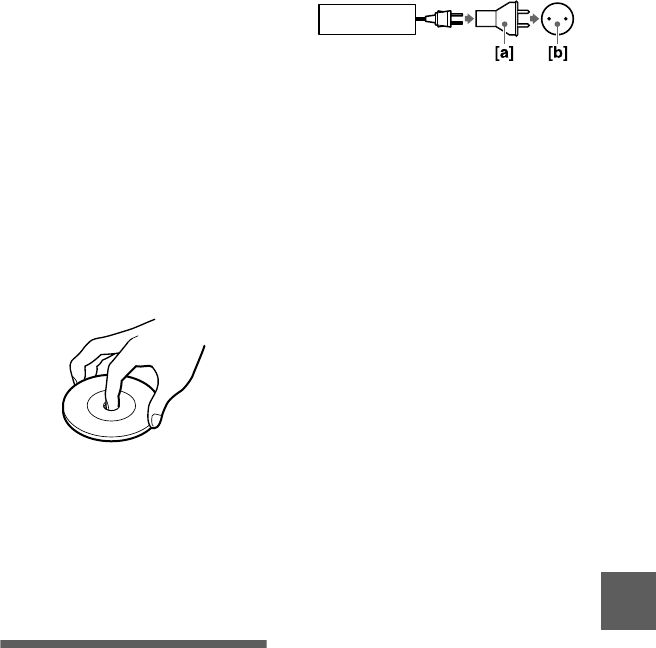
masterpage:Right
filename[D:\Mavica1000\3062473111\3062473111MVCCD1000UC\02GB-
MVCCD1000UC\10add.fm]
Additional information
67
model name1[MVC-CD1000]
[3-062-473-11(1)]
Notes
•Do not remove the disc while reading or
writing data.
•Data may be damaged if:
—You remove the disc or turn off the
power while reading or writing data.
—You use the camera in a location subject
to the effects of static electricity or
noise.
•Do not attach any material on the surface
of a disc. This causes a nonuniform
rotating speed and this may cause a
malfunction of the camera.
•You can write only on the label surface of a
disc. When you write, use only a felt-tip
marker and do not touch it until it is in dry
state, and do not heat it. Do not use a
sharp-pointed tool, such as a ballpoint pen.
•Hold a disc at the edges while pressing the
center hole lightly. Do not touch the blue
side of a disc.
•When you carry or store a disc, put it in its
case.
•Do not strike, bend or drop a disc.
•Do not rub the edge of a disc.
•If you play back the disc on which any
image has not been recorded using a CD-
ROM drive, the CD-ROM drive may
malfunction or the disc may be scratched.
Using your camera
abroad
Power sources
You can use your camera in any
country or area with the supplied
battery charger within 100 V to 240 V
AC, 50/60 Hz. Use a commercially
available AC plug adaptor [a], if
necessary, depending on the design of
the wall outlet (mains) [b].
Watching the playback picture on
TV
If you want to view the playback
picture on a TV, you need a TV having
a video input jack and a video
connecting cable.
The color system of the TV must be
the same as that of your digital still
camera. TV color systems differ from
country to country. Check the
following list:
NTSC system countries
Bahama Islands, Bolivia, Canada,
Central America, Chile, Columbia,
Ecuador, Jamaica, Japan, Korea,
Mexico, Peru, Surinam, Taiwan, the
Philippines, the U.S.A., Venezuela, etc.
PAL system countries
Australia, Austria, Belgium, China,
Denmark, Finland, Germany, Great
Britain, Holland, Hong Kong, Italy,
Kuwait, Malaysia, New Zealand,
Norway, Portugal, Singapore, Spain,
Sweden, Switzerland, Thailand, etc.
PAL-M system country
Brazil
PAL-N system countries
Argentina, Paraguay, Uruguay
SECAM system countries
Bulgaria, Czech Republic, France,
Guiana, Hungary, Iran, Iraq, Monaco,
Poland, Russia, Slovak Republic,
Ukraine, etc.
AC-L10A/L10B/L10C
01cov.book Page 67 Tuesday, May 23, 2000 4:20 PM

masterpage:Left
filename[D:\Mavica1000\3062473111\3062473111MVCCD1000UC\02GB-
MVCCD1000UC\10add.fm]
68
model name1[MVC-CD1000]
[3-062-473-11(1)]
Troubleshooting
If you experience trouble with your camera, first check the following items. Should
your camera still not operate properly after you have made these checks, consult your
Sony dealer or local authorized Sony service facility. If code displays (C:ss:ss)
appear on the LCD screen or on the viewfinder, the self-diagnosis display function is
working (page 73).
Symptom Cause and/or Solution
Your camera does not
work. •You are not using an “InfoLITHIUM” battery pack.
tUse an “InfoLITHIUM” battery pack (page 8).
•The disc is not inserted properly.
tRemove the disc, and insert it again (page 14).
•The battery level is too low. (The indicator
appears.)
tCharge the battery pack (page 9).
•The AC power adaptor is not connected securely.
tConnect it securely to the DC IN jack and a wall
outlet (mains) (page 9, 11).
•The malfunction occurs inside the camera.
tTurn off the power, and turn on after one
minute, then check that the camera works
properly.
Your camera cannot
record images. •The PLAY/STILL/MOVIE selector is set to PLAY.
tSet it to MOVIE or STILL (page 18, 24).
•No disc has been inserted into your camera.
tInsert a disc (page 14).
•The disc has not been initialized.
tInitialize the disc (page 14).
The picture is noisy. •Your camera is placed near a TV or other
equipment that uses strong magnets.
tMove your camera away from the TV, etc.
The picture is too dark. •You are shooting a subject with a light source
behind the subject.
tAdjust the exposure (page 53).
•The brightness of the LCD screen is too low.
tAdjust the brightness of the LCD screen
(page 20).
01cov.book Page 68 Tuesday, May 23, 2000 4:20 PM

masterpage:Right
filename[D:\Mavica1000\3062473111\3062473111MVCCD1000UC\02GB-
MVCCD1000UC\10add.fm]
Additional information
69
model name1[MVC-CD1000]
[3-062-473-11(1)]
The flash does not work. •The flash is set to .
tSet the flash to (no indication), , or
(page 22).
•The camera is in one of the following PROGRAM
AE modes: Twilight, Twilight plus, or Landscape.
tCancel the PROGRAM AE function or set the
flash to (page 22, 51).
•The PLAY/STILL/MOVIE selector is set to
MOVIE.
tSet it to STILL.
•The flash is not popped up.
tPop up the flash (page 22).
The date and time are
recorded incorrectly. •The date and time are not set correctly.
tSet the correct date and time (page 12).
Vertical streaks appear
when you are shooting a
very bright subject.
•This is called the smear phenomenon.
tThis is not a malfunction.
The battery life is short. •You are recording/playing back images under
extremely cold temperatures.
•The battery pack is not charged enough.
tCharge the battery pack fully.
•The battery pack is dead.
tReplace the battery pack with a new one.
The indication of the
battery remaining time is
not proper.
•You are using the camera for many hours under
extremely hot or cold temperatures.
•The battery pack is dead.
tReplace the battery pack with a new one
(page 8).
•The battery level is too low.
tInstall the charged battery pack (page 8, 9).
The power is immediately
turned off even if the
battery remaining
indicator indicates that the
battery level is sufficient.
•—
tCharge the battery pack about one hour after the
normal charge is complete (page 9).
The zoom does not work. •PROGRAM AE is set to the Panfocus mode.
tCancel the Panfocus mode (page 51).
Digital zoom does not
function. •You cannot use digital zoom to record moving
pictures.
Symptom Cause and/or Solution
01cov.book Page 69 Tuesday, May 23, 2000 4:20 PM

masterpage:Left
filename[D:\Mavica1000\3062473111\3062473111MVCCD1000UC\02GB-
MVCCD1000UC\10add.fm]
70
model name1[MVC-CD1000]
[3-062-473-11(1)]
The image is in
monochrome. •You shot the image in TEXT mode.
tCancel the TEXT mode (page 49).
•The picture effect is set to the B&W mode.
tCancel the B&W mode (page 55).
The image cannot be
played back on the CD-
ROM drive of your
personal computer.
•The disc has not been finalized.
tFinalize the disc (page 14).
•An error occurs during recording by vibration.
tPossibly, you may be able to play back images if
you connect the camera to your personal
computer with the USB cable.
•The CD-ROM drive does not correspond to the
packet-write system.
tConsult the personal computer or the CD-ROM
drive manufacturer.
•—
tConsult the personal computer or software
manufacturer.
Your camera cannot delete
an image. •The disc has not been initialized.
tInitialize the disc (page 14).
•The disc remaining capacity is not sufficient.
tThis is not a malfunction.
•The image is protected.
tCancel the protection (page 60).
The power turns off
suddenly. •With the PLAY/STILL/MOVIE selector set to
STILL or MOVIE, if you do not operate the camera
for about three minutes while the power is on, the
camera turns off automatically to prevent wearing
down the battery pack.
tTurn on the camera.
•The battery pack is discharged.
tReplace it with a charged battery pack.
The image does not
appear on the TV screen. •The VIDEO OUT setting of your camera is
incorrect.
tChange the setting (page 46).
The slide show function
stops automatically. •The slide show function stops after about
20 minutes.
tTo continue the slide show, select [START]
again (page 58).
You cannot use the
PROGRAM AE function. •The camera is set to TEXT mode.
tCancel the TEXT mode (page 49).
Symptom Cause and/or Solution
01cov.book Page 70 Tuesday, May 23, 2000 4:20 PM

masterpage:Right
filename[D:\Mavica1000\3062473111\3062473111MVCCD1000UC\02GB-
MVCCD1000UC\10add.fm]
Additional information
71
model name1[MVC-CD1000]
[3-062-473-11(1)]
The button does not
work. •The camera is in manual focus mode.
tSet it to auto focus mode (page 50).
•PROGRAM AE is set to the Panfocus mode.
tCancel the Panfocus mode (page 51).
You cannot resize the
image. •This function does not work on a moving image nor
on a TEXT image.
You cannot mark an image
with the print mark. •The print mark cannot be marked on a moving
image nor on a TEXT image.
Your personal computer
does not recognize your
camera.
•The camera is turned off.
tTurn on the camera.
•The battery level is low.
tUse the AC power adaptor (page 11).
•The USB cable is not connected firmly.
tDisconnect the USB cable, and connect it again
firmly. Make sure that “PC MODE” is displayed
on the LCD screen or on the viewfinder
(page 34).
•The USB connectors on your personal computer are
connected to other equipment besides the keyboard,
the mouse, and your camera.
tDisconnect the USB cables except for the ones
connected to the keyboard, the mouse, and your
camera (page 34).
The shutter cannot be
released when using an
external flash (not
supplied).
•The battery of the external flash is dead.
tReplace the battery with a new one or remove
the external flash from the camera.
Symptom Cause and/or Solution
01cov.book Page 71 Tuesday, May 23, 2000 4:20 PM

masterpage:Left
filename[D:\Mavica1000\3062473111\3062473111MVCCD1000UC\02GB-
MVCCD1000UC\10add.fm]
72
model name1[MVC-CD1000]
[3-062-473-11(1)]
Warning and notice messages
Various messages appear on the LCD screen or on the viewfinder. Check the
corresponding descriptions in the following list.
Message Meaning
COVER OPEN The disc cover is opened.
NO DISC No disc has been inserted.
DRIVE ERROR There is trouble with the disc drive or
disc.
DISC ERROR An unusable disc is inserted.
There is trouble with the disc.
A moisture condensation has occurred
inside the camera.
DISC PROTECT The disc was protected with a computer.
DIRECTORY ERROR The same directory exists.
NOT ENOUGH DISC SPACE The remaining capacity of the disc is not
enough to operate other than executing
the finalization.
NOT INITIALIZED Since the disc has not been initialized,
the camera cannot record any image on
the disc.
ALREADY INITIALIZED It is not necessary to execute the
initialization, the disc was initialized.
ALREADY FINALIZED It is not necessary to execute the
finalization, the disc was finalized.
NO FILE No image has been recorded on the disc.
FILE ERROR Trouble has occurred during playback.
IMAGE SIZE OVER You tried to play back images with an
image size larger than the maximum
playback size of this camera.
INVALID OPERATION You try to play back the image recorded
with other equipment.
FILE PROTECT The image is protected.
for "InfoLITHIUM" battery only
The battery is not the “InfoLITHIUM” type.
NOT ENOUGH BATTERY The battery level is too low to execute the
initialization or finalization.
The battery level is too low.
01cov.book Page 72 Tuesday, May 23, 2000 4:20 PM
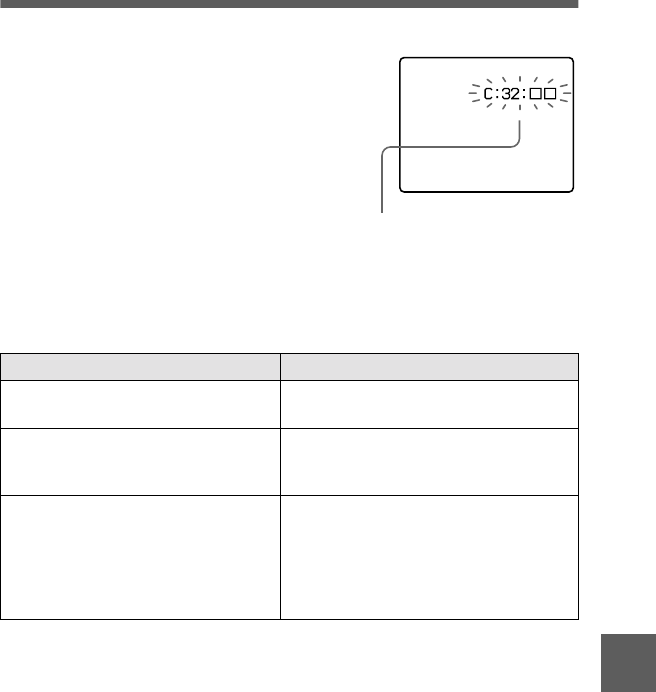
masterpage:Right
filename[D:\Mavica1000\3062473111\3062473111MVCCD1000UC\02GB-
MVCCD1000UC\10add.fm]
Additional information
73
model name1[MVC-CD1000]
[3-062-473-11(1)]
Self-diagnosis display
Your camera has a self-diagnosis display. This
function displays the camera condition on the
LCD screen or on the viewfinder with a
combination of a letter and four digits of numbers.
If this appears, check the following code chart.
The code informs you of the camera’s current
condition. The last two digits (indicated by ss)
will differ depending on the state of the camera.
If you are unable to rectify the problem even if you try corrective actions a
few times, contact your Sony dealer or local authorized Sony service facility.
Code Cause and/or Corrective Action
C:32:ss •There is trouble with the disc drive.
tTurn the power off and on again.
C:13:ss •A disc not compatible with this camera
is inserted.
tChange the disc (page 14).
E:61:ss
E:91:ss
•A camera malfunction that you cannot
repair has occurred.
tContact your Sony dealer or local
authorized Sony service facility and
inform them of the 5-digit service
code (example: E:61:10).
Self-diagnosis display
•C: ss: ss
You can repair the camera
yourself.
•E: ss: ss
Contact your Sony dealer or local
authorized Sony service facility.
01cov.book Page 73 Tuesday, May 23, 2000 4:20 PM

masterpage:Left
filename[D:\Mavica1000\3062473111\3062473111MVCCD1000UC\02GB-
MVCCD1000UC\10add.fm]
74
model name1[MVC-CD1000]
[3-062-473-11(1)]
Specifications
System
Image device
1/2.7 type color CCD
Lens
10× zoom lens
f = 1/4 – 2 3/8 in (6.0 –
60.0 mm) (1 9/16 – 15 3/8 in
(39 – 390 mm) when
converted into a 35 mm still
camera)
F = 2.8
Exposure control
Automatic exposure
White balance
Automatic, Indoor, Outdoor,
One-push
Data compression
system
Movie: MPEG1
Still:
JPEG, TIFF, GIF (in TEXT
mode)
Audio (with still image):
MPEG AUDIO (Monaural)
Recording medium
8 cm CD-R
Flash
Recommended recording
distance:
23 5/8 in to 8 1/3 feet (0.6 m
to 2.5 m)
Drive
Read: Maximum ×8
Write: ×4
Readout
Noncontact optical readout
(using semiconductor laser)
Laser
Wavelength: 777 to 787 nm
NA: 0.5
Maximum output: 23 mW
Emission duration: 600 ns
Input and Output
connector
A/V OUT (MONO) jack
(Monaural)
Minijack Video:
1 Vp-p, 75 Ω, unbalanced,
sync negative
Audio: 327 mV (at a 47 kΩ
load)
Output impedance: 2.2 kΩ
DIGITAL I/O jack
4-pin connector
External flash jack
Minijack
LCD screen
LCD panel
TFT (Thin Film Transistor
active matrix) drive
LCD size
2.5 type
Total number of dots
123 200 (560×220) dots
Viewfinder
LCD panel
TFT (Thin Film Transistor
active matrix) drive
Total number of dots
180 000 (800×225) dots
General
Application
Sony battery pack NP-F550
Power requirements
8.4 V
Power consumption
(During shooting)
4.9 W (When using the LCD
screen)
4.5 W (When using the
viewfinder)
Operation temperature
32 °F to 104 °F (0 °C to
40 °C)
Storage temperature
–4 °F to +140 °F (–20 °C to
+60 °C)
Maximum dimensions
5 1/2×5 1/4×8 3/8 in
(137×131×212 mm) (w/h/d)
Mass
Approx. 35 oz (990 g)
(including battery, disc and
lens cap, etc.)
Built-in microphone
Electret condenser
microphone
Built-in speaker
Dynamic speaker
AC-L10A/L10B/L10C
AC power adaptor
Power requirements
100 V to 240 V AC,
50/60 Hz
Rated output voltage
DC 8.4 V, 1.5 A in operating
mode
Operation temperature
32 °F to 104 °F (0 °C to
40°C)
Storage temperature
–4 °F to +140 °F (–20 °C to
+60 °C)
Maximum dimensions
5×1 9/16×2 1/2 in
(125×39×62 mm) (w/h/d)
Mass
Approx. 10 oz (280 g)
NP-F550 battery pack
Used battery
Lithium ion battery
Maximum voltage
DC 8.4 V
Nominal voltage
DC 7.2 V
Capacity
10.8 Wh (1 500 mAh)
Accessories
AC-L10A/L10B/L10C
AC power adaptor (1)
Power cord (mains lead) (1)
NP-F550 battery pack (1)
A/V connecting cable (1)
USB cable (1)
8 cm CD adaptor (1)
Mavica disc (5)
Shoulder strap (1)
Lens cap (1)
Lens cap strap (1)
CD-ROM (3)
Operating instructions (3)
Design and specifications
are subject to change
without notice.
01cov.book Page 74 Tuesday, May 23, 2000 4:20 PM
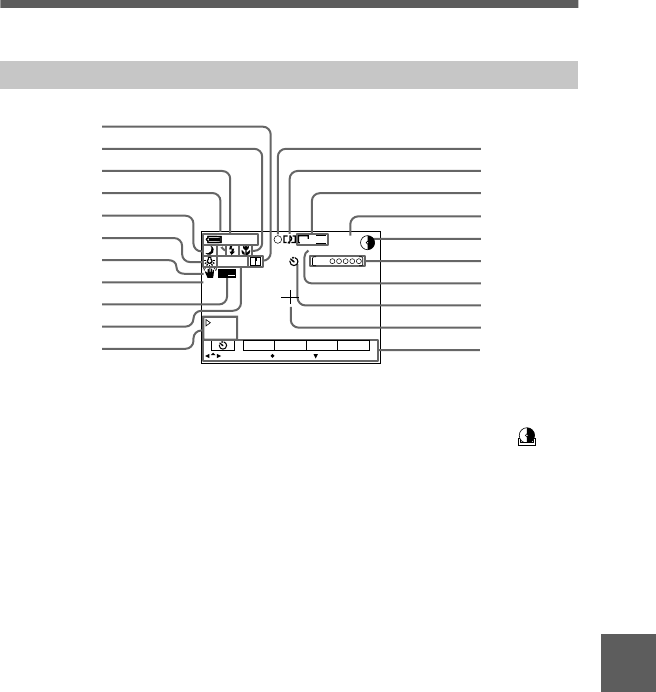
masterpage:Right
filename[D:\Mavica1000\3062473111\3062473111MVCCD1000UC\02GB-
MVCCD1000UC\10add.fm]
Additional information
75
model name1[MVC-CD1000]
[3-062-473-11(1)]
LCD screen/viewfinder indicators
ASharpness indicator
BFocus mode indicator/Macro
indicator
CBattery remaining indicator
DFlash level indicator/Flash
mode indicator
EPROGRAM AE indicator/Zoom
indicator
FWhite balance indicator
GSteadyShot indicator
HPicture effect indicator
IDate and time indicator
JEV level indicator
KIris/Shutter speed indicator
LAE lock indicator/Focus lock
indicator
MRecording mode indicator
NImage size indicator
ONumber of recorded images
PRemaining disc capacity
indicator
This indicator changes to after
executing the finalization.
QRecording time indicator
RSelf-diagnosis function
indicator/Recording time
indicator
SSelf-timer indicator
TSpot light-metering indicator
UMenu bar and guide menu
They appear by pressing v on the
control button and disappear by
pressing V
.
The indicators during recording
+1.0EV
REC 0:03
10
1600
15s
EFFECT FILE SETUP
CAMERA
SELECT MENU BAR OFF
OK
120min
SOLARIZESOLARIZE
6
5
4
2
1
3
7
8
9
0
qa
qh
qg
qf
qd
qs
qj
qk
ql
w;
wa
F2.8
500
DATE
3:2
01cov.book Page 75 Tuesday, May 23, 2000 4:20 PM
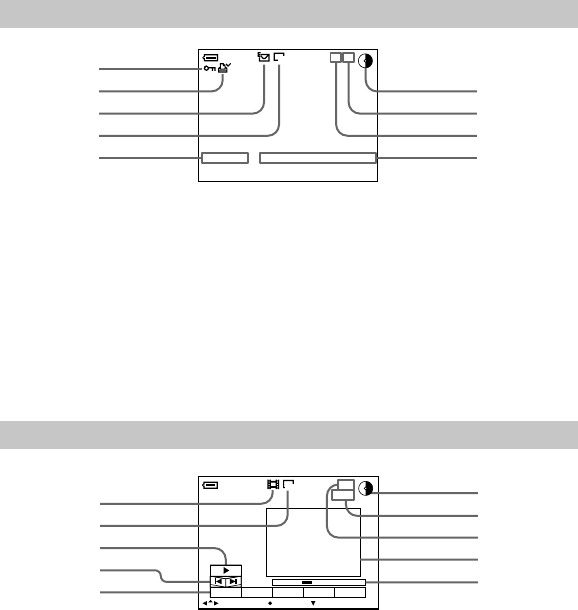
masterpage:Left
filename[D:\Mavica1000\3062473111\3062473111MVCCD1000UC\02GB-
MVCCD1000UC\10add.fm]
76
model name1[MVC-CD1000]
[3-062-473-11(1)]
1Protect indicator/Zoom scaling
indicator
BPrint mark of the playback
image
CRecording mode of the
playback image
DImage size indicator
EFile name*
FRemaining disc capacity
indicator
GNumber of stored images on a
disc
HImage number
IRecording date of the playback
image*
∗When the menu bar is displayed, this
indicator disappears from the screen.
AMoving image file indicator
BImage size indicator
CPlayback button
B is displayed during stop, and X
during playback.
DImage searching buttons
EMenu bar and guide menu
FRemaining disc capacity
indicator
GCounter
HImage number/number of
stored images on a disc
IPlayback image
JPlayback bar
The indicators during still image playback
100-0001
120min 1280
12:00AM2000 7 4
11/12
6
5
4
1
3
2
7
8
9
The indicators during moving image playback
0:10
160
120min 6/8
SELECT OK MENU BAR OFF
DELETE
INDEX FILE SETUPTOOL
6
7
8
9
0
5
4
2
1
3
01cov.book Page 76 Tuesday, May 23, 2000 4:20 PM

masterpage:Left
filename[D:\Mavica1000\3062473111\3062473111MVCCD1000UC\02GB-
MVCCD1000UC\01covIX.fm]
77
Additional information
Index
A
AC power adaptor............11
Adjusting brightness
Image...........................53
LCD screen..................20
AE (auto exposure)..........18
Auto power-off function.... 9
B
Battery pack
Charging........................9
Installing........................8
Remaining time.............9
Usable time..................10
BEEP................................46
C
Charging ............................9
Cleaning...........................64
CLOCK SET....................12
Control button..................40
D
DELETE ..........................61
DEMO..............................46
DIGITAL ZOOM ............45
Disc
Finalize........................29
Initialize.......................16
Inserting.......................14
Number of recordable
images
..............47, 48, 49
Usable type..................14
DPOF...............................62
E
Editing
DELETE......................61
PROTECT...................60
E-MAIL ...........................48
F
FILE NUMBER...............44
FINALIZE .......................29
FLASH LEVEL...............45
Full charge .........................9
I
Image
Deleting.......................61
File name.....................39
Print mark....................62
Protect .........................60
Size..............................47
INDEX screen..................56
Indicators on the LCD screen
or on the viewfinder .... 75
“InfoLITHIUM” battery
pack ...............................8
INITIALIZE ....................16
J
JPEG ................................28
M
Macro recording...............50
Manual focusing ..............50
Menu................................42
Moisture condensation.....64
Moving image
Playback ......................26
Recording ....................24
MPEG .......................24, 28
N
Normal charge ...................9
Number of recordable
images
Battery pack ................10
E-mail mode ................48
Image size....................47
TEXT mode.................49
TIFF mode...................49
Voice mode .................48
P
PICTURE EFFECT .........55
PLAY/STILL/MOVIE
selector ........................40
Playing back
INDEX screen .............56
Moving images............26
Slide show ...................58
Still images..................25
Viewing images on a TV
............................59
Viewing images using a
personal computer
............................28
Power source
AC power adaptor .......11
Battery pack ..................8
PRINT MARK.................62
PROGRAM AE ...............51
PROTECT........................60
R
REC MODE.....................44
Recording
E-mail mode ................48
In macro ......................50
Moving image .............24
TEXT mode.................49
TIFF mode...................49
Voice memo ................48
With flash ....................22
RESIZE............................62
S
Self timer .........................22
Self-diagnosis display......73
Setting the date and time
.....................................12
Single display...................56
SLIDE SHOW .................58
SteadyShot .......................21
Still image
Playback ......................25
Recording ....................18
T
TEXT mode .....................49
U
Using flash.......................22
Using your camera
abroad..........................67
V
Viewfinder .......................19
Viewing images using a
personal computer .......28
VOICE .............................48
W
Warning messages ...........72
White balance ..................53
Z
Zoom................................20
01cov.book Page 77 Tuesday, May 23, 2000 4:20 PM
01cov.book Page 78 Tuesday, May 23, 2000 4:20 PM
01cov.book Page 79 Tuesday, May 23, 2000 4:20 PM

masterpage:Left
filename[D:\Mavica1000\3062473111\3062473111MVCCD1000UC\03BCO-
MVCFD1000UC\01covIX.fm]
Sony Corporation Printed in Japan
01covIX.fm Page 80 Tuesday, May 23, 2000 4:22 PM
