Stihl Br 380 Manual
2014-07-06
: Stihl Br-380-Manual br-380-manual stihl pdf
Open the PDF directly: View PDF  .
.
Page Count: 74
- BA_SE_171_005_01_02.pdf
- Contents
- Guide to Using this Manual
- Safety Precautions
- Assembling the Blower
- Fuel
- Fueling
- Information Before You Start
- Starting / Stopping the Engine
- Cleaning the Air Filter
- Motor Management
- Adjusting the Carburetor
- Catalytic Converter*
- Checking the Spark Plug
- Spark Arresting Screen in Muffler
- Replacing Starter Rope and Rewind Spring
- Storing the Machine
- Maintenance Chart
- Parts and Controls
- Specifications
- Special Accessories
- Maintenance and Repairs
- STIHL Incorporated California Exhaust and Evaporative Emissions Control Warranty Statement
- STIHL Incorporated Federal Emission Control Warranty Statement
- Trademarks
- BA_SE_171_005_31_02.pdf
- Contenido
- Guía para el uso de este manual
- Precauciones de seguridad
- Armado del soplador
- Combustible
- Llenado de combustible
- Información previa al arranque
- Arranque / parada del motor
- Limpieza del filtro de aire
- Manejo del motor
- Ajuste del carburador
- Convertidor catalítico*
- Revisión de la bujía
- Chispero en el silenciador
- Sustitución de la cuerda de arranque y resorte de rebobinado
- Almacenamiento de la máquina
- Tabla de mantenimiento
- Piezas y controles
- Especificaciones
- Accesorios especiales
- Mantenimiento y reparaciones
- Declaración de garantía de STIHL Incorporated sobre el control de emisiones de gases de escape y ...
- Declaración de garantía de STIHL Incorporated sobre sistemas de control de emisiones según normas...
- Marcas comerciales
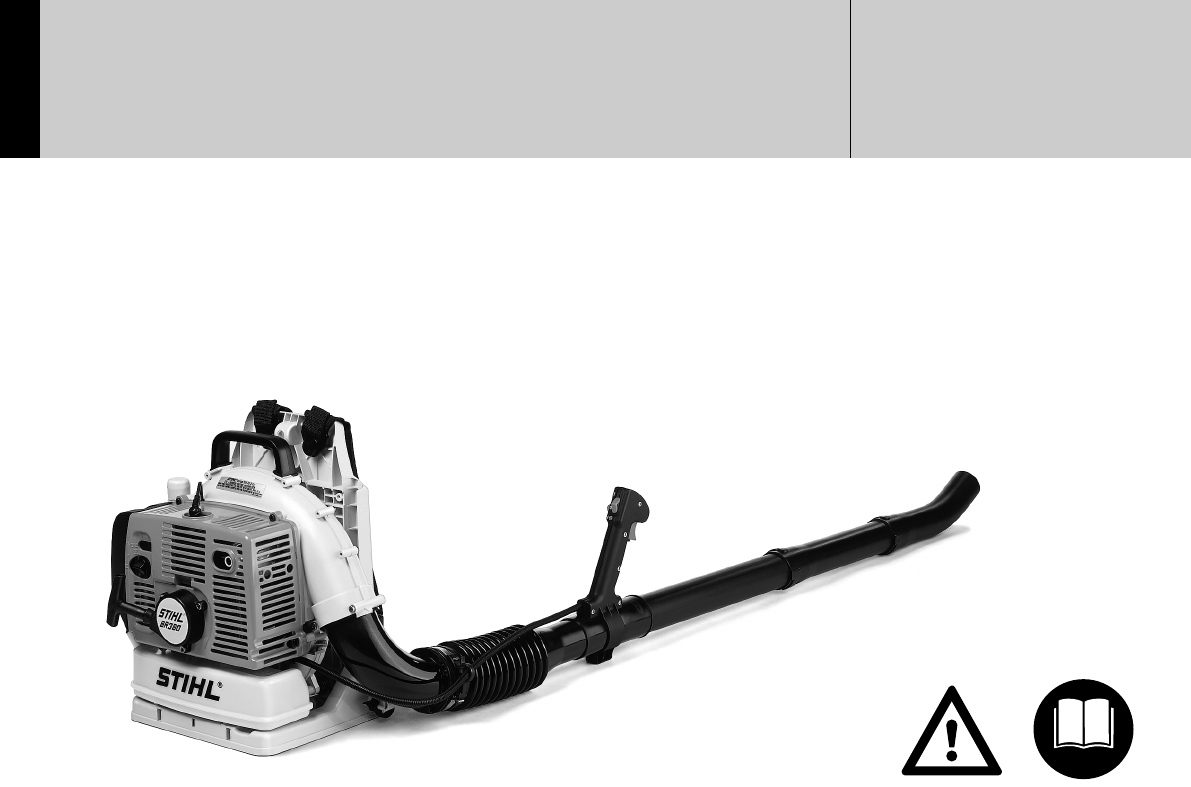
Instruction Manual
Manual de instrucciones
STIH)
STIHL BR 380
BA_BR340380_86_U_G5.book Seite 0 Montag, 4. Juli 2005 8:10 08
Warning!
Read and follow all safety precautions in
Instruction Manual – improper use can cause
serious or fatal injury.
Advertencia!
Lea y siga todas las precauciones de
seguridad dadas en el manual de
instrucciones – el uso incorrecto puede
causar lesiones graves o mortales.
1BR 380
English / USA
BA_SE_171_005_01_02.fmPrinted on chlorine-free paper.
Printing inks contain vegetable oils; paper can be recycled.
© ANDREAS STIHL AG & Co. KG, 2008
0458 453 8621 A. M6. M8. MET. Printed in Brazil
STIHl
Contents
Guide to Using this Manual .............. 2
Safety Precautions ........................... 3
Assembling the Blower ................... 12
Fuel ................................................ 13
Fueling ............................................ 14
Information Before You Start .......... 15
Starting / Stopping the Engine ........ 15
Cleaning the Air Filter ..................... 18
Motor Management ........................ 19
Adjusting the Carburetor ................ 19
Catalytic Converter ......................... 21
Checking the Spark Plug ................ 21
Spark Arresting Screen
in Muffler ......................................... 22
Replacing Starter Rope and
Rewind Spring ................................ 22
Storing the Machine ........................ 25
Maintenance Chart ......................... 26
Parts and Controls .......................... 27
Specifications ................................. 29
Special Accessories ....................... 30
Maintenance and Repairs ............... 30
STIHL Incorporated California
Exhaust and Evaporative
Emissions Control
Warranty Statement ........................ 31
STIHL Incorporated Federal
Emission Control
Warranty Statement ........................ 34
Trademarks .................................... 36
Allow only persons who understand this
Manual to operate your blower.
To receive maximum performance and
satisfaction from your STIHL blower, it is
important that you read and understand
the maintenance and safety precautions,
starting on page 3, before using your
blower.
Contact your STIHL dealer or the STIHL
distributor for your area if you do not
understand any of the instructions in this
Manual.
!Warning!
Because a blower is a high-speed tool,
some special safety precautions must
be observed as with any other power
tool to reduce the risk of personal injury.
Careless or improper use may cause
serious or even fatal injury.
STIHL's philosophy is to continually
improve all of its products. As a result,
engineering changes and improvements
are made from time-to-time. If the
operating characteristics or the
appearance of your blower differs from
those described in this Manual, please
contact your STIHL dealer for
information and assistance.

2
English / USA
BR 380
Pictograms
All the pictograms attached to the
machine are shown and explained in
this manual.
The operating and handling instructions
are supported by illustrations.
Symbols in text
The individual steps or procedures
described in the manual may be marked
in different ways:
:A bullet marks a step or procedure
without direct reference to an
illustration.
A description of a step or procedure that
refers directly to an illustration may
contain item numbers that appear in the
illustration.
Example:
Loosen the screw (1)
Lever (2) ...
In addition to the operating instructions,
this manual may contain paragraphs
that require your special attention. Such
paragraphs are marked with the
symbols described below:
Warning where there is a risk of an
accident or personal injury or
serious damage to property.
Caution where there is a risk of
damaging the machine or its
individual components.
Note or hint which is not essential
for using the machine, but may
improve the operator’s under-
standing of the situation and result
in better use of the machine.
Note or hint on correct procedure in
order to avoid damage to the
environment.
Equipment and features
This instruction manual may refer to
several models with different
features. Components that are not
installed on all models and related
applications are marked with an
asterisk (*). Such components may
be available as special accessories
from your STIHL dealer.
Engineering improvements
STIHL’s philosophy is to continually
improve all of its products. As a result,
engineering changes and improvements
are made from time to time. If the
operating characteristics or the
appearance of your machine differ from
those described in this manual, please
contact your STIHL dealer for
assistance.
Therefore some changes, modifications
and improvements may not be covered
in this manual.
Guide to Using this Manual

3BR 380
English / USA
Warning!
The use of any blower
may be dangerous. It is
important that you read,
fully understand and
observe the following safety
precautions.
!Warning!
Reread the owner`s
manual and the safety
instructions peri-
odically.
Do not lend or rent your machine without
the owner`s manual.
Be sure that anyone using your unit
understands the information contained
in this manual.
!Warning!
Careless or improper use of the machine
may cause serious injury. Have your
STIHL Dealer show you how to operate
your blower. Observe all applicable
local safety regulations, standards and
ordinances.
!Warning!
Minors should never be allowed to use a
blower. Bystanders, especially children,
and animals should not be allowed in the
area where a machine is in use.
Never let the unit run unattended.
Most of these safety precautions and
warnings apply to the use of all STIHL
blowers. Different models may have
different parts and controls.
See the appropriate section of your
owner`s manual for a description of the
controls and function of the parts of your
machine.
Safe use of a blower involves
1. the operator
2. the blower
3. the use of the blower.
THE OPERATOR
Physical Condition
You must be in good physical condition
and mental health and not under the
influence of any substance (drugs,
alcohol, etc.) which might impair vision,
dexterity or judgment. Do not operate a
blower when you are fatigued.
Be alert - if you get tired while operating
your machine, take a break. Tiredness
may result in loss of control. Working
with any blower can be strenuous. If you
have any condition that might be
aggra
vated by strenuous work, check
with
your doctor before operating the
machine.
Your STIHL blower is equipped with an
antivibration system (AV). The AV
system is designed to reduce the
transmission of engine vibrations to the
operator's body. An AV system is
recommended for those operators who
use blowers on a regular or sustained
basis.
Keep the AV system well maintained. A
blower with loose components or with
damaged or worn AV buffers will tend to
have higher vibration levels.
!Warning!
The ignition system of your unit
produces an electromagnetic field of a
very low intensity. This field may
interfere with some pacemakers. To
reduce the risk of serious or fatal injury,
persons with pacemaker should consult
their physician and the pacemaker
manufacturer before operating this tool.
Safety Precautions

4
English / USA
BR 380
Proper Clothing
!Warning!
To reduce the risk of injury, the operator
should wear proper protective apparel.
Clothing must be sturdy and snug-fitting,
but allow complete freedom of move-
ment.
!Warning!
Avoid loose-fitting jackets,
flared or cuffed pants,
scarfs, unconfined long
hair or anything that could
be drawn into the air
intake.
Use of gloves when
working with the blower is
recommended.
Good footing is most
important. Wear sturdy
shoes with nonslip soles.
!Warning!
To reduce the risk of injury associated
with the inhalation of dust, use an
appropriate dust respirator for the
material being blown.
!Warning!
Use of this product can generate dust,
mists, and fumes containing chemicals
known to cause respiratory disease,
cancer, birth defects, or other reproduc-
tive harm. If you are unfamiliar with the
risks associated with the particular dust,
mists or fumes at issue, consult your
employer, governmental agencies such
as OSHA and NIOSH and other sources
on hazardous materials. If the substance
being blown or vacuumed is a commer-
cial substance, review the material
safety data sheet for that substance and
/ or consult the material manufacturer /
supplier. The state of California and
some other authorities, for instance,
have published lists of substances
known to cause cancer, reproductive
toxicity, etc.
Control dust, mist and fumes at the
source where possible. In this regard
use good work practices and follow the
recommendations of OSHA / NIOSH
and occupational and trade associa-
tions. When the inhalation of toxic dust,
mists and fumes cannot be eliminated,
the operator and any bystanders should
always wear a respirator approved by
NIOSH / MSHA for the substance at
issue.
!Warning!
Dust with silica in its composition may
contain crystalline silica. Silica is a basic
component of sand, quartz, brick, clay,
granite and numerous other minerals
and rocks, including masonry and con-
crete products.
Repeated and / or sub-stantial inhalation
of airborne crystalline silica can cause
serious or fatal respira-tory disease,
including silicosis. In addi-tion, the state
of California and some other authorities
have listed respirable crystalline silica as
a substance known to cause cancer.
When encountering such materials,
always follow the re-spiratory
precautions mentioned above.
!Warning!
Breathing asbestos dust is dangerous
and can cause severe or fatal injury, re-
spiratory illness or cancer. The use and
disposal of asbestos containing
products
have been strictly regulated by OSHA
and the Environmental Protection
Agency. Do not blow or disturb asbestos
or asbestos containing products, such
as asbestos insulation. If you have any
reason to believe that you might be
disturbing asbestos, immediately
contact
your employer or a local OSHA
representative.

5BR 380
English / USA
!Warning!
Proper eye protection is a must. Even
though the discharge is directed away
from the operator, ricochets and bounce
backs can occur during blower
operations.
Never operate a blower
unless wearing goggles
or properly fitted safety
glasses with adequate
top and side protection
which comply with
ANSI Z 87.1 (or your applicable national
standard).
Fellow workers must also wear personal
protective equipment.
!Warning!
Blower noise may damage your hearing.
Wear sound barriers (ear plugs or ear
mufflers) to help protect your hearing.
Continual and regular users should have
their hearing checked regulary.
THE BLOWER
For illustrations and definitions of the
blower parts see the chapter on "Parts
and Controls"!
!Warning!
Never modify a blower in any way. Only
attachments supplied by STIHL or
expressly approved by STIHL for use
with the specific STIHL blower models
are authorized. Although certain
unauthorized attachment are useable for
the STIHL blower, their use may be
extremely dangerous.
THE USE OF THE BLOWER
Transport
Always turn off the engine before taking
the machine off your back and putting it
down. When transporting your unit in a
vehicle, properly secure it to prevent
turnover, fuel spillage and damage to the
machine.
Adjust carrying harness to suit your size
before starting work.
!Warning!
Before starting work, always inspect the
rubber buffers which connect the engine
to the pack frame. If the buffers are torn
or damaged, they should be replaced by
your STIHL dealer. Failure of one or
more buffers may cause the engine or
fuel tank to hit or rub against other parts,
and may lead to serious injury from
increased vibrations or from fire as the
result of fuel leakage.
Fuel
This STIHL unit uses an oil-gasoline
mixture for fuel (see the chapter on
"Fuel" of your owner`s manual).

6
English / USA
BR 380
!Warning!
Gasoline is an extremely
flammable fuel. If spilled
or ignited by a spark or
other ignition source, it
can cause fire and serious
burn injury or property
damage.
!Warning!
To reduce the risk of serious injury from
burns, never attempt to refuel the unit
until it has been completely removed
from the operator.
Use extreme caution when handling
gasoline or fuel mix.
Do not smoke or bring any fire or flame
near the fuel.
Fueling instructions
Fuel your machine in well-ventilated
areas, outdoors only. Always shut off the
engine and allow it to cool before
refueling. Relieve fuel tank pressure by
loosening fuel cap slowly. Never remove
fuel filler cap while engine is running.
Select bare ground for fueling and move
at least 10 feet (3 m) from the fueling
spot before starting the engine. Always
tighten fuel filler cap securely after
fueling. Wipe off any spilled fuel before
starting your blower and check for
leakage.
!Warning!
Check for fuel leakage while refueling
and during operation. If fuel or oil
leakage is found, do not start or run the
engine until leak is fixed and spilled fuel
has been wiped away. Take care not to
get fuel on your clothing. If this happens,
change your clothing immediately.
Always store gasoline in approved
container.
!Warning!
In order to reduce the risk of fuel spillage
and fire from an improperly tightened
fuel cap, correctly position and tighten
the fuel cap in the fuel tank opening.
!Warning!
Unit vibrations can cause
an improperly tightened
fuel filler cap to loosen or
come off and spill
quantities of fuel. In order
to reduce the risk of fuel
spillage and fire, tighten the fuel filler cap
by hand as securely as possible.
7BR 380
English / USA
Before Starting
!Warning!
Never operate your machine if it is
damaged, improperly adjusted or not
completely and securely assembled.
You should always inspect your unit
before starting it. Make sure the controls
and safety devices are working properly.
!Warning!
To reduce the risk of injury from thrown
parts, check your fanwheel and fan
housing for damage (cracks, nicks,
chipping). If any damage is found, stop
using the unit and contact your STIHL
dealer for repair.
:Throttle trigger must move freely
and spring back to idle position
when released.
:Stop switch must move easily to $
:Tightness of spark plug boot - if boot
is loose, sparks may occur and
ignite fuel vapor!
:Condition of fanwheel and fan
housing.
Starting
!Warning!
Your blower is a one-person machine.
To reduce the risk of eye or other injury
from thrown objects, insure that by-
standers are at least 50 feet (15m) away
during use.
Stop the operation immediately if you
are approached.
For specific starting instructions, see the
appropriate section of your owner`s
manual. Place the machine on firm
ground or other solid surface in an open
area. Maintain good balance and secure
footing.
!Warning!
When you pull the starter grip, don`t
wrap the starter rope around your hand.
Do not allow the grip to snap back, but
guide the starter rope slowly back to
permit the rope to rewind properly.
Failure to follow this procedure may
result in injury to hand or fingers and
may damage the starter mechanism.
The assistance of another person may
be needed in placing the unit on your
back after starting. In order to reduce the
risk of injury to the assistant from thrown
objects or from contact with fumes, the
engine should be kept at idle speed
during this brief period, and your
assistant should not stand in the area of
the outlet nozzle or exhaust. Otherwise,
the unit should be started and operated
without assistance.

8
English / USA
BR 380
Muffler and Catalytic Converter
!Warning!
The muffler and other parts of the engine
(e.g. fins of the cylinder, spark plug)
become hot during operation and remain
hot for a while after stopping the engine.
To reduce risk of burns do not touch the
muffler and other parts while they are
hot.
!Warning!
To reduce the risk of fire or burn injury,
let the unit cool down before refueling
your power tool after use.
!Warning!
Never disassemble or modify your
muffler. The muffler could be damaged
and cause an increase in heat radiation
or sparks, thereby increasing the risk
of fire or burn injury. You may also
permanently damage the engine. Have
your muffler serviced and repaired by
your STIHL servicing dealer only.
!Warning!
To reduce the risk of fire or burn injury,
keep the area around the muffler clean.
Remove all debris such as pine needles,
branches or leaves.
!Warning!
Some STIHL blower
models are equipped with
a catalytic converter,
which is designed to
reduce the exhaust
emissions of the engine
by a chemical process in the muffler.
Due to this process, the muffler does not
cool down as rapidly as conventional
mufflers when the engine returns to idle
or is shut off. To reduce the risk of fire
and burn injuries, the following specific
safety precautions must be observed.
!Warning!
Since a muffler with a catalytic converter
cools down less rapidly than
conventional mufflers, always set your
backpack blower down in the upright
position and never locate it where the
muffler is near dry brush, grass, wood
chips or other combustible materials
while it is still hot.
Let the engine cool down sitting on
concrete, metal, bare ground or solid
wood (e.g. the trunk of a felled tree)
away from any combustible substances.
!Warning!
An improperly mounted or damaged
cylinder housing or a damaged/
deformed muffler shell may interfere
with the cooling effect of the catalytic
converter. To reduce the risk of fire or
burn injury, do not continue work with a
damaged or improperly mounted
cylinder housing or a damaged/
deformed muffler shell. Your muffler is
furnished with a screen designed to
reduce the risk of fire from the emission
of hot particles. Due to the heat from the
catalytic reaction, this screen on a
catalytic converter will normally stay
clean and need no service or
maintenance. If you experience loss of
performance and you suspect a clogged
screen, have your muffler maintained by
a STIHL servicing dealer.
9BR 380
English / USA
Working instructions
Work carefully.
When working with the blower, always
wear it on your back using the carrying
harness. Wrap your fingers tightly
around the handle, keeping the control
handle cradled between your thumb and
forefinger. Keep your hand in this
position to have your machine under
control at all times.
Make sure your control handle (and grip
for vacuum attachment) are in good
condition and free of moisture, pitch, oil
or grease.
Operate the blower under good visibility
and daylight conditions only.
!Warning!
Your blower produces
poisonous exhaust fumes
as soon as the combus-
tible engine is running.
These gases (e.g. carbon
monoxide) may be color-
less and odorless. To reduce the risk of
serious or fatal injury from breathing
toxic fumes, never start or run the blower
indoors or in poorly ventilated locations.
Ensure proper ventilation when working
in trenches or other confined areas.
Keep the space behind and beside the
engine clear at all times to allow for the
escape of hot and toxic exhaust fumes.
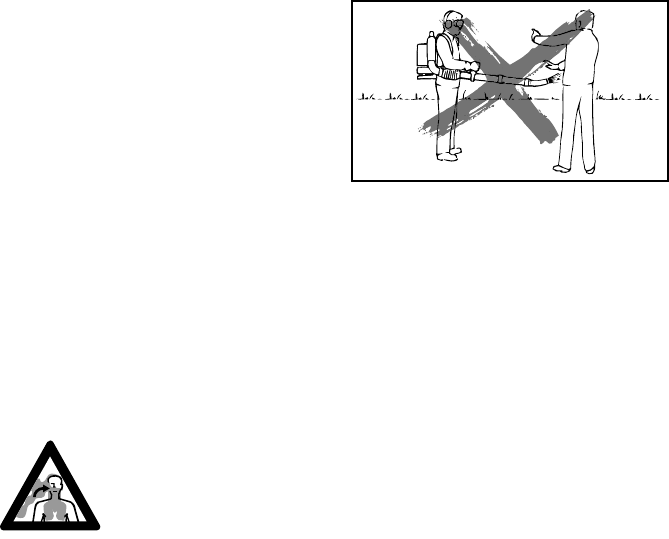
!Warning!
To reduce the risk of personal injury, do
not direct air blast towards bystanders,
since the high pressure of the air flow
could injure eyes and could blow small
objects at great speed.
!Warning!
Always shut off the engine before
cleaning or servicing the unit or
replacing parts.
!Warning!
The blower fan between the air intake
and output openings rotates whenever
the engine is running.
Never insert any foreign object into the
air intake of the machine or into the
nozzle of the blower. It will damage the
fan wheel and may cause serious injury
to the operator or bystanders as a result
of the object or broken parts being
thrown out at high speed.
Do not place the blower on the ground
when operating at high speed, because
small objects such as sand, grass, dust,
etc. may be pulled into the air intake and
damage the fan wheel.
To reduce the risk of stumbling and loss
of control,do not walk backward while
operating the machine.
In an emergency, you may slip out of the
harness and throw off the machine
quickly. Try slipping out of the harness a
number of times before using the
machine in order to become
accustomed with it.
Do not throw off the machine while
practising as it could damage the
machine.
Pay attention to the direction of the wind,
i.e., do not work against the wind.
353BA039 KN
10
English / USA
BR 380
Using the Blower
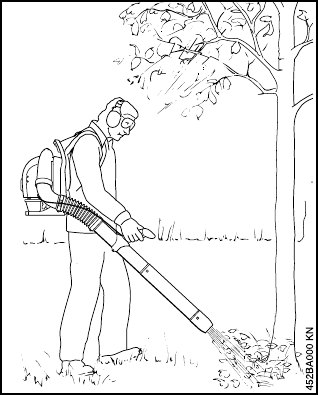
The blower is designed for single-
handed operation. It is carried as a
backpack and operated with the right
hand on the control handle.
The powerful ground-level airstream can
be aimed highly accurately and
effectively. It enables the operator to
quickly blow-sweep large areas.
The blower may be used only for the
operations described in your manual.
The blower can be used for clearing
leaves, grass, paper, dust and light snow
in yards, gardens, sports stadiums,
parks, driveways and parking lots. It is
also suitable for clearing forest paths.
Other applications are blowing out
pipes, drains, gutters and your carport.
Working techniques
To minimize blowing time, use rakes and
brooms to loosen debris before blowing.
Recommended working techniques to
minimize airborne debris and pollution:
:In dusty conditions, slightly dampen
surfaces.
:Use the full blower nozzle extension
so the air stream can work close to
the ground.
:Do not direct debris at people,
children, pets, at open windows or
freshly-washed cars. Blow debris
safely away.
:After using blowers, CLEAN UP.
Dispose of debris in trash
receptacles. Do not blow debris
onto neighboring properties.
Recommended working techniques to
minimize noise:
:Operate power equipment only at
reasonable hours - not early in the
morning, late at night or during the
noon-break when people might be
disturbed. Comply with times listed
in local ordinances. Usual
recommendations are 9:00 a.m. to
12:00 a.m. and 03:00 p.m. to 5:00
p.m. on workdays for professionals.
Special considerations should be
given to neighbors on weekends.
:Fewer engines mean less noise;
therefore use only one piece of
power equipment at a time, when
possible.
:Operate power blowers at the
lowest possible throttle speed to do
the job.
:Check your equipment before
operation, especially the muffler, air
intakes and air filters.
Conserve water by using power blowers
instead of hoses for those lawn and
garden applications where a blower can
be properly used, such as cleaning
patios or porches.

11BR 380
English / USA
Using the Vacuum Attachment
(special accessory)
The vacuum is designed to pick up dry
material such as leaves, grass, small
twigs and bits of paper.
!Warning!
To reduce the risk of
personal injury from fire
and explosion, never
attempt to pick up hot or
burning substances (e.g.
smoldering ashes,
glowing cigarettes)
or combustible fluids (e.g.
gasoline, paint thinners).
MAINTENANCE, REPAIR AND
STORING
Maintenance, replacement, or repair
of the emission control devices and
systems may be performed by any
nonroad engine repair establishment
or individual. However if you claim
warranty for a component which has
not been serviced or maintained pro-
perly or if nonapproved replacement
parts were used, STIHL may deny
warranty.
Use only identical STIHL replacement
parts for maintenance and repair. Use of
parts manufactured by others may
cause serious or fatal injury.
Follow the maintenance and repair
instructions in the appropriate section of
your owner's manual. Refer to the
maintenance chart at the last pages of
this manual.
!Warning!
Always stop the engine and make sure
that the fan is stopped before doing any
maintenance or repair work or cleaning
the blower. Do not attempt any mainten-
ance or repair work not described in your
owner's manual. Have such work
performed at your STIHL servicing
dealer only.
Check fuel filler cap for leaks at regular
intervals. Use the specified spark plug
and make sure it and the ignition lead
are always in good condition.
Tighten all nuts, bolts and screws except
the carburetor adjustment screws after
each use.
!Warning!
A worn or damaged muffler is a fire
hazard and may cause loss of hearing.
Check to see that the muffler is in good
condition. The blower must not be
opera-
ted if the muffler is not functioning pro-
perly or has been removed.
Remember that the risk of forest fires is
greater in hot weather. Use the spark
arresting muffler supplied with the unit.
Never touch a hot muffler or burn will
result.
!Warning!
In order to reduce the risk of fire, do not
modify or remove any part of the muffler
or spark arrestor.
Keep spark plug and wire connection
tight and clean. The spark plug electrode
gap should be checked with a feeler
gauge at least every 50 operating hours
and reset if necessary. Fit a new spark
plug if the electrodes are badly pitted.
For any maintenance please refer to the
maintenance chart and to the warranty
statement near the end of this manual.
Store blower in a dry, high or locked
location and out of reach of children.
Before storing for longer than a few
days, always empty the fuel tank.
12
English / USA
BR 380
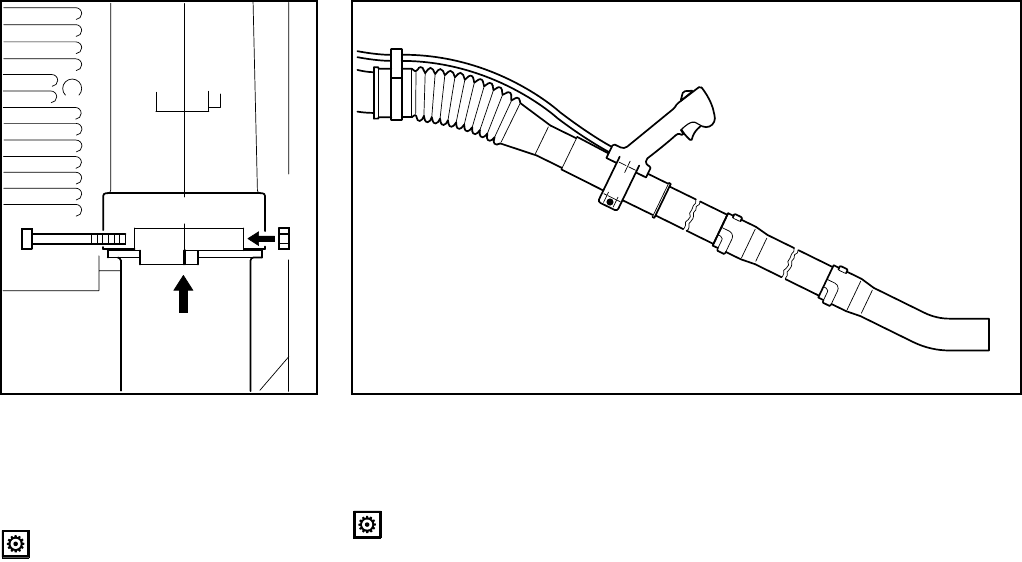
Mounting the Elbow
A combination wrench and carburetor
screwdriver are stowed on the underside
of the blower.
The throttle cable is already
connected. Make sure it is not
kinked during assembly.
:Push the elbow (1) into the stub (2)
as far as it will go – the stops on the
elbow and stub must line up.
:Fit the nut (3) in the hexagon recess
in the stub.
:Insert the screw in the nut from the
other side and tighten moderately –
the elbow must still turn freely.
:Secure the throttle cable (4) in
position with the retainer (5).
Mounting the Blower Tubes
Operate the machine only with
both blower tubes properly
mounted.
:Push the blower tube (6) into the
pleated hose (7).
:Push blower tube (8) onto the end of
blower tube (6) and rotate it
clockwise until the bayonet coupling
locks.
:Push the nozzle (9) onto the blower
tube (8) and rotate it clockwise until
the bayonet coupling locks.
:Rotate the pleated hose (7)
counterclockwise as far as stop and
leave it in that position.
:Turn the control handle (10)
counterclockwise to the horizontal
position.
:Rotate the complete blower tube
assembly until the nozzle discharge
opening points in the same direction
as the control handle.
:Tighten down the clamp screw (11).
Assembling the Blower
353BA002 KN
23
1
373BA001 KN
8
7
4
9
10
6
11
5
13BR 380
English / USA
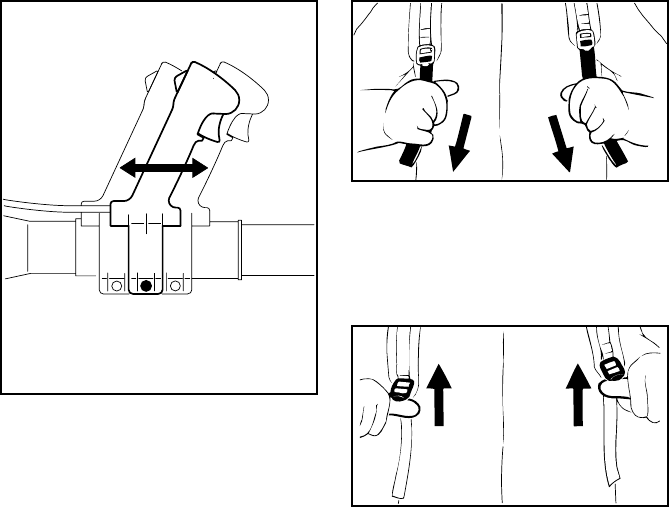
Adjusting the Control Handle
:Put the unit on your back.
:Loosen the clamp screw (11).
:Slide the control handle (10) along
the pleated hose to the most
comfortable position.
:Tighten down the clamp screw (11).
Adjusting the Harness Straps
:Pull the ends of the straps
downward to tighten the harness.
Loosening the Harness Straps
:Lift the tabs of the two sliding
adjusters.
:Adjust the straps so that the
backplate is held firmly and
comfortably against your back.
This engine is certified to operate on
unleaded gasoline and the STIHL two-
stroke engine oil at a mix ratio of 50:1.
Your engine requires a mixture of high-
quality gasoline and quality two-stroke
air cooled engine oil.
Use mid-grade unleaded gasoline with a
minimum octane rating of 89 (R+M/2). If
the octane rating of the mid-grade
gasoline in your area is lower, use
premium unleaded fuel.
Fuel with a lower octane rating may
increase engine temperatures. This, in
turn, increases the risk of piston seizure
and damage to the engine.
The chemical composition of the fuel is
also important. Some fuel additives not
only detrimentally affect elastomers
(carburetor diaphragms, oil seals, fuel
lines, etc.), but magnesium castings and
catalytic converters as well. This could
cause running problems or even
damage the engine. For this reason
STIHL recommends that you use only
nationally recognized high-quality
unleaded gasoline!
11
10
373BA002 KN
373BA003 KN
373BA004 KN
Fuel

14
English / USA
BR 380
Use only STIHL two-stroke engine oil or
equivalent high-quality two-stroke
engine oils that are designed for use
only in air cooled two-cycle engines.
We recommend STIHL 50:1 two-stroke
engine oil since it is specially formulated
for use in STlHL engines.
Do not use BIA or TCW rated (two-
stroke water cooled) mix oils or other
mix oils that state they are for use in both
water cooled and air cooled engines
(e.g., outboard motors, snowmobiles,
chainsaws, mopeds, etc.).
Take care when handling gasoline.
Avoid direct contact with the skin and
avoid inhaling fuel vapor. When filling at
the pump, first remove the canister from
your vehicle and place the canister on
the ground before filling. Do not fill fuel
canisters that are sitting in or on a
vehicle.
The canister should be kept tightly
closed in order to avoid any moisture
getting into the mixture.
The machine‘s fuel tank and the canister
in which fuel mix is stored should be
cleaned as necessary.
Fuel mix ages
Only mix sufficient fuel for a few days
work, not to exceed 3 months of storage.
Store in approved fuel-canisters only.
When mixing, pour oil into the canister
first, and then add gasoline. Close the
canister and shake it vigorously by hand
to ensure proper mixing of the oil with
the fuel.
Dispose of empty mixing-oil canisters
only at authorized disposal locations.
Before fueling, clean the filler cap and
the area around it to ensure that no dirt
falls into the tank.
Always thoroughly shake the mixture in
the canister before fueling your
machine.
In order to reduce the risk of burns
or other personal injury from
escaping gas vapor and fumes,
remove the fuel filler cap carefully
so as to allow any pressure build-up
in the tank to release slowly.
After fueling, tighten fuel cap
as securely as possible by hand.
Gaso-
line
Oil (STIHL 50:1 or
equivalent high-quality oils)
US gal. US fl.oz
12.6
2 1/2 6.4
5 12.8
Fueling
373BA030 KN
15BR 380
English / USA
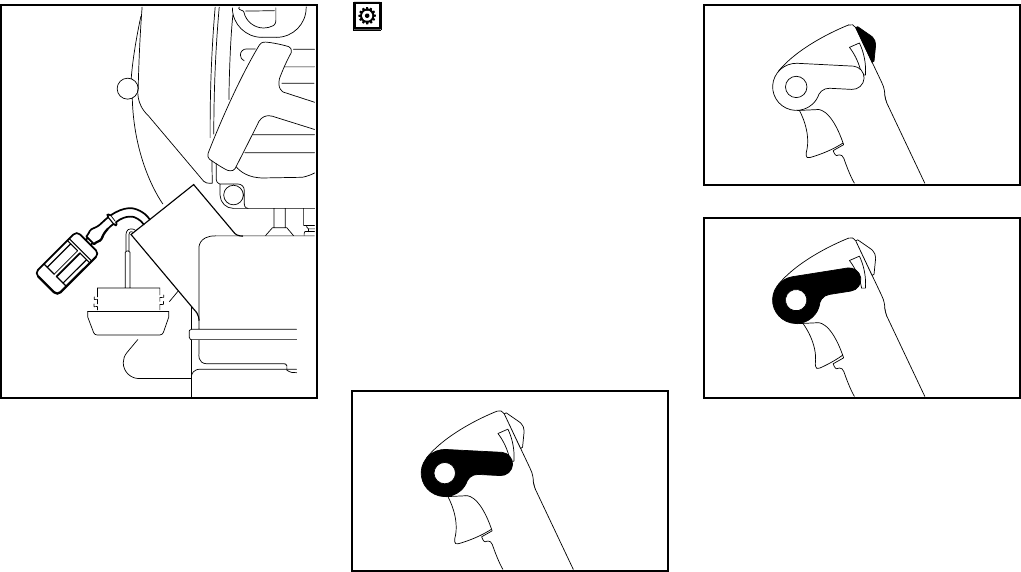
Change the fuel pick up body
every year.
Before storing your machine for a long
period, drain and clean the fuel tank and
run engine until carburetor is dry.
With the engine stopped and before
starting, check the air intakes
between the backplate and
powerhead for blockages and clean
if necessary.
A protective screen is available as a
special accessory to keep the air
intakes clear.
Always move the setting lever to the idle
position before shutting off the engine
because the throttle cable will otherwise
disconnect itself from the throttle trigger.
The throttle cable reconnects itself
automatically when the setting lever is
moved to the idle position.
Setting lever in idle position.
:Observe safety precautions – see
chapter “Safety Precautions and
Working Techniques”.
:Slide the stop switch (1) to #
:Move the setting lever (2) to the
center position – this is the
starting throttle position
Note:
The setting lever can be used to select
any throttle opening between idle speed
(lower stop) and full throttle (upper stop).
Set the lever to idle position before
switching off the engine.
373BA007 KN
Information
Before You Start
373BA037 KN
Starting / Stopping
the Engine
373BA008 KN
1
373BA009 KN
2
16
English / USA
BR 380
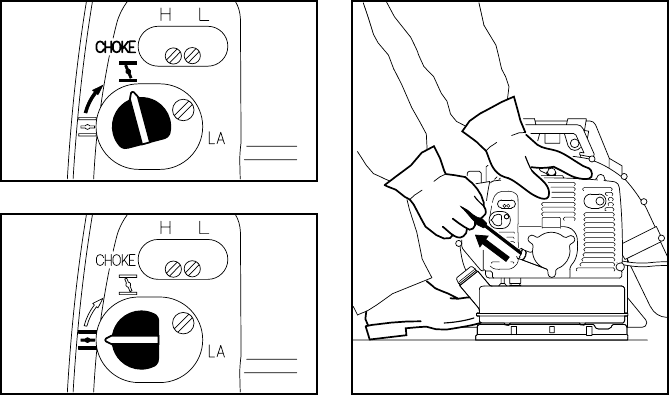
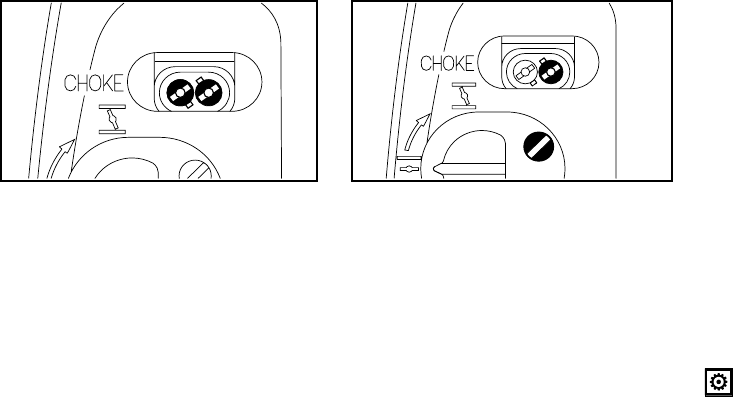
:If the engine is cold, turn the choke
knob to g
:If the engine is warm, turn the
choke lever to e
Also use this position if the engine
has been running but is still cold.
:Put the unit on the ground. Check
that bystanders are well clear of the
general work area and the nozzle.
:Make sure you have a firm footing:
Hold the unit with your left hand on
the housing and put one foot against
the base plate to prevent it slipping.
:Pull the starter grip slowly with your
right hand until you feel it engage
and give it a brisk strong pull. Do not
pull the starter rope out all the way
as it might otherwise break.
:Do not let the starter grip snap back.
:Guide it slowly back into the housing
so that the starter rope can rewind
properly.
373BA010 KN373BA011 KN
373BA012 KN

17BR 380
English / USA
When engine begins to fire:
:If engine is cold:
Turn choke knob to e and continue
cranking until engine runs.
:If engine is warm:
Continue cranking until engine runs.
As soon as engine runs:
:Move the setting lever (2) to the
lower stop so that the engine settles
down to idle speed.
To shut down the engine:
:Slide the stop switch (1) to $
At very low outside temperatures:
Allow engine to warm up
As soon as engine runs:
:Move the setting lever to the lower
stop – the engine settles down to
idle speed.
:Open throttle slightly – warm up
engine for a short period.
If the engine does not start:
If you did not turn the choke knob to e
quickly enough after the engine began to
fire, the combustion chamber is flooded.
:Pull off the spark plug boot.
:Unscrew and dry off the spark plug.
:Set the stop switch to 0
:Open the throttle fully.
:Pull the starter rope several times to
clear the combustion chamber.
373BA013 KN
373BA014 KN
2
1
373BA015 KN
373BA016 KN
18
English / USA
BR 380
:Fit the spark plug and reconnect the
spark plug boot.
:Move the stop switch to #
:Turn the choke knob to e
even if the engine is cold.
:Now start the engine.
Fuel tank run until dry and then
refueled
:Pull the starter rope several times to
prime the fuel line.
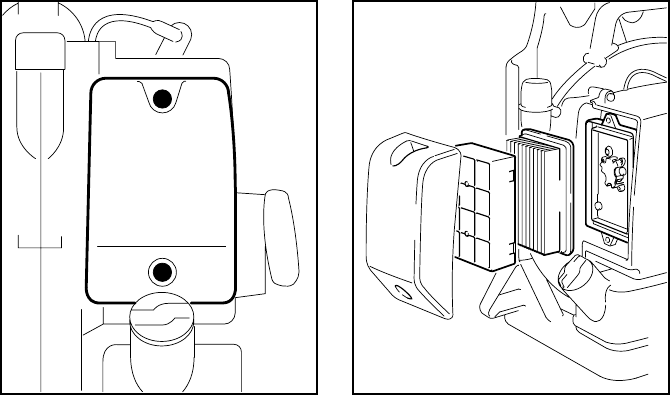
Dirty air filters reduce engine power
increase fuel consumption and make
starting more difficult.
If there is a noticeable loss of engine
power
:Turn choke knob to g
:Release the screws (1) and pull
off the filter cover (2).
:Remove the main filter (3) from the
cover and inspect it –
if it is dirty or damaged, fit a new
one.
:Always install a new prefilter when
you change the main filter.
:Take the prefilter (4) out of the filter
cover.
:If the prefilter is wet, dry it – then
knock it out on the palm of your
hand or blow out with compressed
air.
:Always replace a damaged prefilter.
Cleaning the Air Filter
1
373BA017 KN
2
1
373BA018 KN
3
45
19BR 380
English / USA
:Clean loose dirt from the filter cover
and filter chamber.
:Install the main filter and prefilter
elements in the filter cover.
:Fit the cover on the filter base (5)
and tighten it down firmly.
Exhaust emissions are controlled by the
design of the fundamental engine
parameters and components (e.g.
carburation, ignition, timing and valve or
port timing) without the addition of any
major hardware.
The carburetor comes from the factory
with a standard setting.
This setting provides an optimum
fuel-air mixture under most operating
conditions.
With this carburetor it is only possible to
correct the adjustment of the high speed
and low speed screws within fine limits.
Motor Management Adjusting the Carburetor
20
English / USA
BR 380
Standard Setting
:Shut off the engine.
:Check the air filter and clean or
replace if necessary.
:Check the spark arresting screen (if
fitted) in the muffler and clean or
replace if necessary.
:Carefuly turn both adjusting screws
counterclockwise as far as stop:
High speed screw (H) is now open
1/4 turn
Low speed screw (L) is now open
1/4 turn
:Start and warm up the engine.
Adjusting Idle Speed
Engine stops while idling
:Turn the idle speed screw (LA)
clockwise until the engine runs
smoothly.
Erratic idling behavior, engine stalls
even after re-adjusting LA screw,
poor acceleration
Idle setting is too lean:
:Turn low speed screw (L)
counterclockwise – no further than
stop – until the engine runs and
accelerates smoothly.
Erratic idling behavior
Idle setting is too rich:
:Turn low speed screw (L) clockwise
– no further than stop – until the
engine runs and still accelerates
smoothly.
It is usually necessary to change the
setting of the idle speed screw (LA)
after every correction to the low speed
screw (L).
Fine tuning for operation at high
altitude
A slight correction of the setting may be
necessary if engine power is not
satisfactory:
:Check standard setting.
:Warm up the engine.
:Turn the high speed screw (H)
clockwise (leaner) – no further than
stop.
If the setting is too lean, there is a
risk of engine damage due to
insufficient lubrication and
overheating.
HL
373BA043 KN
LA
L
373BA044 KN
21BR 380
English / USA
Units with a catalytic converter* may
only be operated with unleaded
gasoline and STIHL two cycle engine
oil or equivalent quality two cycle engine
oils in a mix ratio of 50:1 (see chapter
“Fuel”).
The catalylic converter in the muffler
reduces noxious emissions in the
exhaust gas.
Correct adjustment of the carburetor (if
adjustable) and observance of the
specified mix ratio of gasoline and two
cycle engine oil are essential to
minimize harmful exhaust emissions
and ensure a long catalyst service life.
* see “Guide to Using this Manual”
Wrong fuel mix (too much engine oil in
the gasoline), a dirty air filter and
unfavorable running conditions (mostly
at part throttle etc.) affect the condition of
the spark plug. These factors cause
deposits to form on the insulator nose
which may result in trouble in operation.
If engine is down on power, difficult to
start or runs poorly at idling speed, first
check the spark plug.
:Remove spark plug – see "Starting /
Stopping the Engine".
:Clean dirty spark plug.
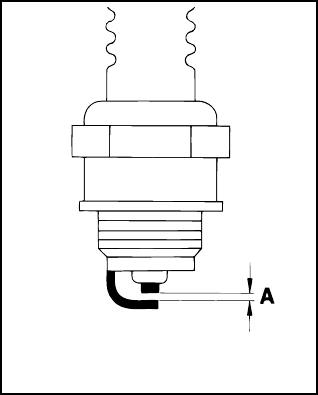
:Check electrode gap (A) and
readjust if necessary – see
"Specifications".
:Use only resistor type spark plugs
of the approved range.
Rectify problems which have caused
fouling of spark plug:
:Too much oil in fuel mix.
:Dirty air filter.
:Unfavorable running conditions,
e.g. operating at part load.
Fit a new spark plug after approx.
100 operating hours
or earlier if the electrodes are badly
eroded.
Catalytic Converter* Checking the Spark Plug
000BA002 KN
22
English / USA
BR 380
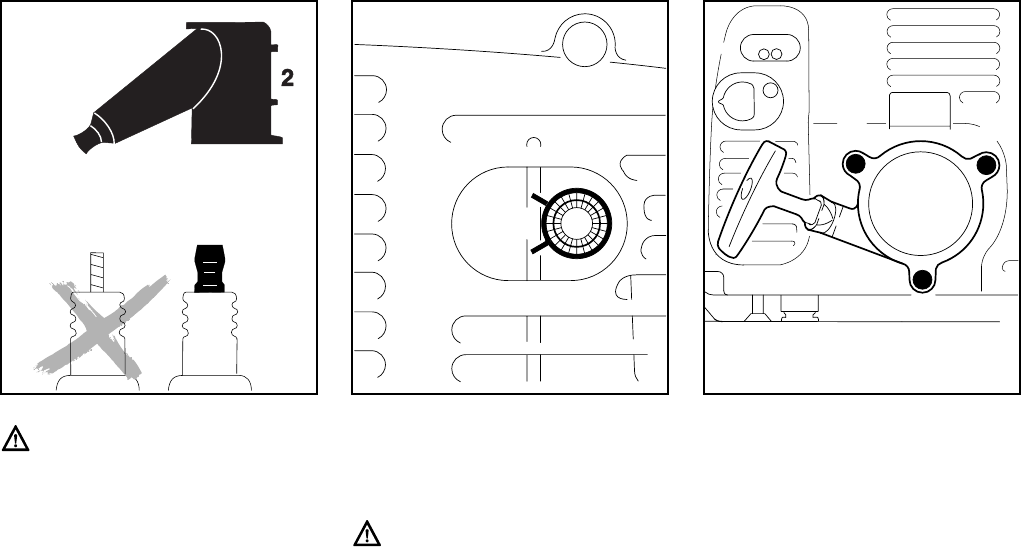
To reduce the risk of fire and burn
injury, use only spark plugs
authorized by STIHL. Always press
spark plug boot (2) snugly onto
spark plug terminal (1) of the proper
size. (Note: If terminal has
detachable SAE adapter nut, it must
be attached.)
A loose connection between spark
plug boot and ignition wire
connector in the boot may create
arcing that could ignite combustible
fumes and cause a fire.
If the engine is down on power or does
not run smoothly at maximum RPM,
check the spark arresting screen (if
fitted) in the muffler.
Wait until engine has cooled down
completely before performing the
following operations.
:Use suitable tool to squeeze ends of
clip (1) together and then lift the clip
away.
:Pull the spark arresting screen (2)
out of the muffler.
:Clean the spark arresting screen.
:If the screen is damaged or heavily
carbonized, fit a new one.
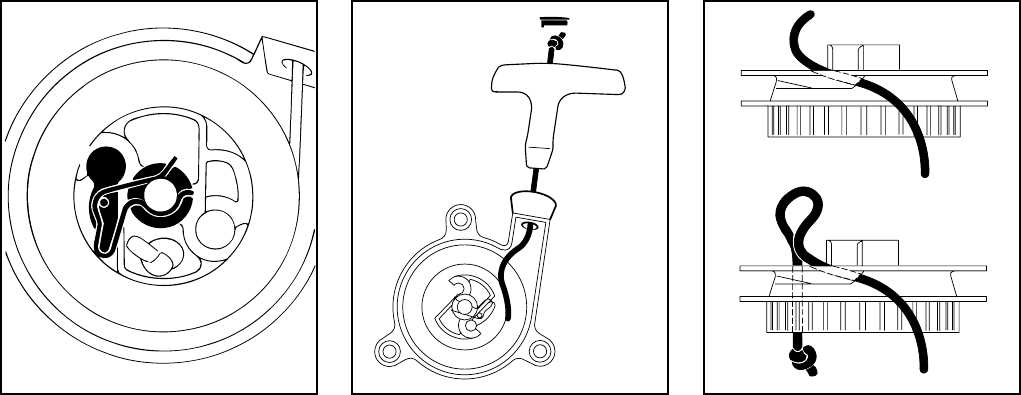
Replacing the starter rope
:Remove the screws (1).
:Take the starter cover (2) off the
engine.
0
00BA036 TR
1
Spark Arresting Screen
in Muffler
373BA031 KN
12
Replacing Starter Rope and
Rewind Spring
11
1
373BA025 KN
2
1
23BR 380
English / USA
:Remove the spring clip (3).
:Remove the rope rotor with washer
(4) and pawl (5).
:Ease the cap (6) out of the starter
grip.
:Remove remaining rope from the
rotor and grip.
:Tie a simple overhand knot in the
end of the new starter rope and then
thread the rope through the top of
the grip and the rope bushing (7).
:Refit the cap in the grip.
:Thread the rope through the rotor
and secure it in the rotor with a
simple overhand knot.
353BA034 KN
3
54
353BA041 KN
7
6
373BA026 KN
24
English / USA
BR 380
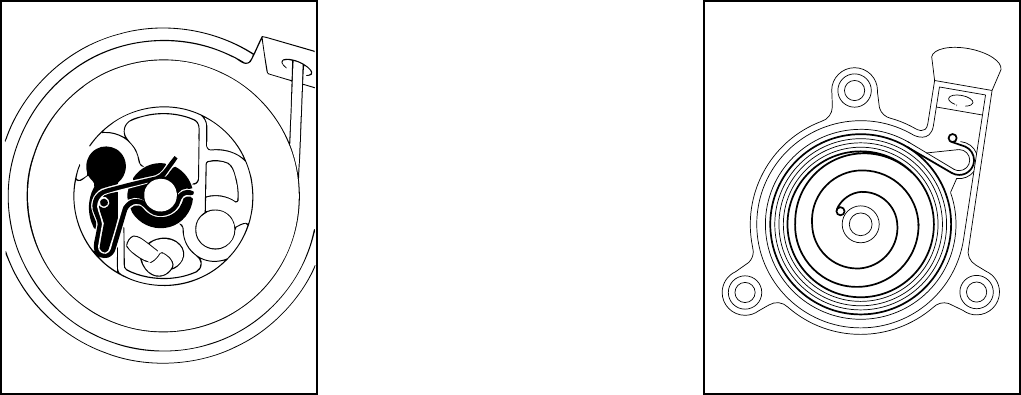
:Fit the pawl (5) in the rotor and slip
the washer (4) over the starter post.
:Use a screwdriver or suitable pliers
to install the spring clip (3) on starter
post and over the peg on the pawl –
the spring clip must point clockwise
– see illustration.
Go to “Tensioning rewind spring”.
Replacing a broken rewind spring
:Lubricate the new spring with a few
drops of non-resinous oil.
:Remove the rope rotor as described
in “Replacing the starter rope”.
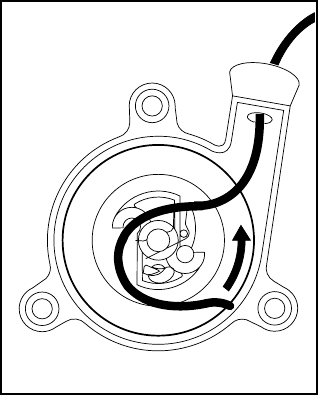
:Remove parts of old spring.
:Fit new spring housing – bottom
plate must face downward. Engage
outer spring loop over the lug.
:Refit the rope rotor.
Go to “Tensioning rewind spring”.
If the spring pops out and uncoils
during installation: Refit it in the
spring housing in the counter-
clockwise direction – start outside
and work inward.
353BA034 KN
3
54
353BA029 KN
25BR 380
English / USA
Tensioning rewind spring
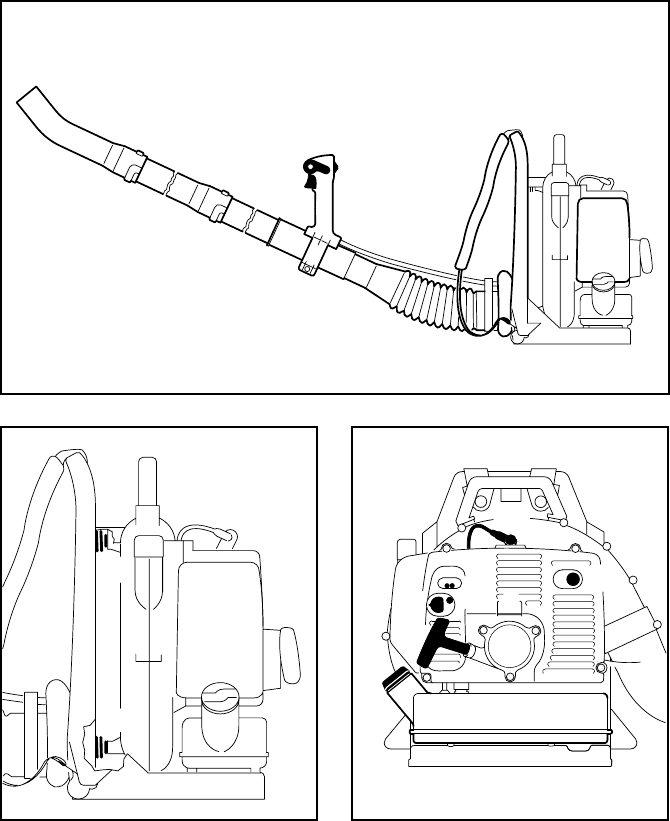
:Make a loop in the unwound starter
rope and use it to turn the rope rotor
six full revolutions in the direction of
the arrow (see illustration).
:Hold the rotor steady – straighten
the twisted rope.
:Release the rotor and let go of rope
slowly so that it winds onto the rotor.
The starter grip must sit firmly in the
rope guide bushing. If the grip
droops to one side: Increase spring
tension by one additional turn.
When the starter rope is fully
extended it must be possible to
rotate the rotor at least another half
turn. If this is not possible, the spring
is overtensioned and could break.
Take one turn of the rope off the
rotor.
:Fit the starter cover on the engine.
:Tighten down the screws firmly.
For periods of about 3 months or longer:
:Drain and clean the fuel tank in a
well ventilated area.
:Dispose of remaining fuel and
cleaning solution properly in
accordance with local
environmental requirements.
:Run engine until carburetor is dry –
this helps prevent carburetor
diaphragms sticking together.
:Thoroughly clean the machine – pay
special attention to the cylinder fins
and air filter.
:Store the machine in a dry, high or
locked location – out of the reach of
children and other unauthorized
persons.
353BA030 KN
Storing the Machine

26
English / USA
BR 380
1) STIHL recommends that this work
be done by a STIHL servicing dealer
Maintenance Chart
The following maintenance intervals apply to normal operating conditions only.
If your daily working time is longer than normal or operating conditions are
difficult (very dusty work area etc.), shorten the specified intervals accordingly.
before
starting work
after finishing
work or daily
after each
refueling stop
weekly
monthly
every 12 months
if problem
if damaged
if required
Complete machine Visual inspection (conditon, leaks) xx
Clean x
Control handle Check operation xx
Air filter Clean x
Replace x
Pick up body in fuel tank Check x
Replace xx
Fuel tank Clean x
Carburetor Check idle setting xx
Readjust idle x
Spark plug
Readjust electrode gap x
Replace after about
100 operating hours
Cooling air intakes Clean x
Spark arresting screen in muffler Check x
Clean or replace x
All accessible screws and nuts (not
adjusting screws) Tighten x
Anti-vibration elements
Check x
Have replaced by servicing
dealer1) xx
Blower air intake screen Check xx
Clean x
Safety label Replace x
27BR 380
English / USA
1 Nozzle
2 Blower tube
3 Control Handle
4 Throttle trigger
5 Setting lever
6 Stop switch
7 Pleated hose
8 Harness
9 Back plate
10 Back padding
11 Air filter housing
12 Antivibration elements
13 Spark plug boot
14 Muffler
(with spark arresting screen)*
15 Carburetor adjusting screws
16 Choke knob
17 Starter grip
18 Fuel filler cap
19 Fuel tank
# Serial number
* see “Guide to Using this Manual”
Parts and Controls
9
10
8
3
4
5
1
2
7
6
11
373BA027 KN
12
12
373BA028 KN
#
18 17
16 15 14
13
373BA029 KN
19
28
English / USA
BR 380
Definitions
1. Nozzle.
Aims and widens the spray or
airstream.
2. Blower Tube.
Directs spray or airstream.
3. Control Handle.
Handle on the flexible hose to hold
and direct the tube in the required
direction.
4. Throttle Trigger.
Controls the speed of the engine.
5. Setting Lever.
Sets the throttle to various positions.
6. Stop Switch.
Stops engine
7. Pleated Hose.
For spraying, dusting or spreading
in the desired direction.
8. Harness.
For carrying the unit.
9. Backplate.
Helps protect the back of the user.
10. Back Padding.
Increases carrying comfort.
11. Air Filter Housing.
Covers the air filter element.
12. Antivibration Elements.
Elements designed to reduce the
transmission of vibrations created
by the engine to the operators back.
13. Spark Plug Boot.
Connects the spark plug to the
ignition wire.
14. Muffler
(with spark arresting screen).
Attenuates exhaust noises and
diverts exhaust gases away from
operator. The spark arresting
screen is designed to reduce the
risk of fire.
15. Carburetor Adjusting Screws.
For tuning carburetor.
16. Choke Knob.
Eases engine starting by enriching
mixture.
17. Starter Grip.
The grip of the pull starter, which is
the device to start the engine.
18. Fuel Filler Cap.
For closing the fuel tank.
19. Fuel Tank.
For fuel and oil mixture.
29BR 380
English / USA
EPA:
The Emission Compliance Period
referred to on the Emissions
Compliance Label indicates the number
of operating hours for which the engine
has been shown to meet Federal
emission requirements.
Category
A = 300 hours,
B = 125 hours,
C = 50 hours
CARB:
The Emission Compliance Period used
on the CARB-Air Index Label indicates
the terms:
Extended = 300 hours,
Intermediate = 125 hours,
Moderate = 50 hours
Engine BR 380,
BR 380 Catalytic Converter
Ignition System
Fuel System
Rewind Starter
Air flow rate with nozzle
CFM (m3/h)
Air velocity with nozzle
MPH (m/s)
Weight lbs (kg)
Specifications
Single cylinder two-stroke engine
Displacement: 3.45 ci
(56.5 cm3)
Bore: 1.81 in (46 mm)
Stroke: 1.34 in (34 mm)
Idle speed: 3,100 rpm
Type: Electronic
magneto ignition
Spark plug
(suppressed):
Bosch WSR 6 F
or
NGK BPMR 7 A;
Electrode gap:
0.02 in (0,5 mm)
Carburetor: All position diaphragm
carburetor with integral fuel pump
Fuel tank capacity: 50 fl.oz. (1.5 l)
Fuel mix: see chapter
“Fuel”
Starter rope: 0.14 in dia. x 37.8
in
(3,5 mm dia. x
960 mm)
BR 380 471 (800)
BR 380
Catalytic Converter 465 (790)
BR 380 183 (82)
BR 380
Catalytic Converter 181 (81)
BR 380 20.1 (9.1)
BR 380
Catalytic Converter 20.5 (9.3)
30
English / USA
BR 380
Contact your STIHL dealer for
information regarding special
accessories that may be available for
your product.
Users of this unit should carry out only
the maintenance operations described
in this manual. Other repair work may be
performed only by authorized STIHL
service shops.
Warranty claims following repairs can be
accepted only if the repair has been
performed by an authorized STIHL
servicing dealer using original STIHL
replacement parts.
Original STlHL parts can be identified by
the STlHL part number, the
STIHl
logo and, in some cases, by the STlHL
parts symbol (. This symbol may
appear alone on small parts.
Special Accessories Maintenance and Repairs
31BR 380
English / USA
Your Warranty Rights and
Obligations
The California Air Resources Board
(CARB) and STIHL Incorporated are
pleased to explain the emissions control
system's warranty on your 2007 and
later small off-road equipment engine.
In California, new equipment that use
small off-engines must be designed,
built, and equipped to meet the State's
stringent anti-smog standards. STIHL
Incorporated must warrant the
emissions control system on your small
off-road engine for the period listed
below provided there has been no
abuse, neglect or improper maintenance
of your small off-road engine.
Your emissions control system may
include parts such as:
Air filter, Carburetor, Purger, Choke
(Cold start enrichment system), Control
Linkages, Intake Manifold, Magneto or
electronic ignition system (Ignition
module), Spark plug, Catalytic converter
(if applicable), Fuel Tank, Fuel Cap, Fuel
Line, Fuel Line Fittings, Clamps,
Fasteners.
Where a warrantable condition exists,
STIHL Incorporated will repair your
small off-road equipment engine at no
cost to you including diagnosis, parts
and labor.
Manufacturer’s Warranty
Coverage
This emissions control system is
warranted for two years in California. If
any emissions-related part on your
equipment is defective, the part will be
repaired or replaced by STIHL
Incorporated free of charge.
Owner’s Warranty
Responsabilities
As the small off-road equipment engine
owner, you are responsible for
performance of the required
maintenance listed in your Instruction
manual. STIHL Incorporated
recommends that you retain all receipts
covering maintenance on your small off-
road equipment engine, but STIHL
Incorporated cannot deny warranty
solely for the lack of receipts or your
failure to ensure the performance of all
scheduled maintenance.
As the small off-road equipment engine
owner, you should however be aware
that STIHL Incorporated may deny you
warranty coverage if your small off-road
equipment engine or a part has failed
due to abuse, neglect, or improper
maintenance or unapproved
modifications.
You are responsible for presenting your
small off-road equipment engine to a
STIHL Service center as soon as the
problem exists. The warranty repairs
should be completed in a reasonable
amount of time, not to exceed 30 days. If
you have any questions regarding your
warranty rights and responsibilities,
please contact a STIHL customer
service representative at 1-800-467-
8445 or you can write to
STIHL Inc., 536 Viking Drive,
P.O. Box 2015,
Virginia Beach, VA 23450-2015.
Coverage by STIHL Incorporated
STIHL Incorporated warrants to the
ultimate purchaser and each
subsequent purchaser that your small
off-road equipment engine is designed,
built and equipped, at the time of sale, to
meet all applicable regulations.
STIHL Incorporated also warrants to the
initial purchaser and each subsequent
purchaser that your engine is free from
defects in materials and workmanship
which cause the engine to fail to conform
to applicable regulations adopted by the
Air Resources Board; and for a period of
two years.
For California only:
STIHL Incorporated California Exhaust and Evaporative Emissions Control Warranty
Statement
32
English / USA
BR 380
Defects Warranty Period
The warranty periods will begin on the
date the utility equipment engine is
purchased by the initial purchaser. If any
emission related part on your engine is
defective, the part will be replaced by
STIHL Incorporated at no cost to the
owner.
Add on or modified parts that are not
exempted by the Air Resources Board
may not be used. The use of any non
exempted add on or modified parts will
be grounds for disallowing a warranty
claim. STIHL Incorporated will not be
liable to warrant failures of warranted
parts caused by the use of a non
exempted add on or modified part.
The warranty on emissions-related parts
will be interpreted as follows:
1. Any warranted part that is not
scheduled for replacement as required
maintenance in the written instructions
required in the Emission Warranty Parts
List (see below) must be warranted for
the warranty period defined in
Subsection DEFECTS WARRANTY
PERIOD, see above. If any such part
fails during the period of warranty
coverage, it must be repaired or
replaced by the manufacturer according
to Subsection (4) below. Any such part
repaired or replaced under the warranty
must be warranted for the remaining
warranty period.
2. Any warranted part that is
scheduled only for regular inspection in
the written instructions required by the
Emission Warranty Parts List. (see
below) must be warranted for the
warranty period defined in Subsection
DEFECTS WARRANTY PERIOD, see
above. A statement in such written
instructions to the effect of "repair or
replace as necessary" will not reduce
the period of warranty coverage. Any
such part repaired or replaced under
warranty must be warranted for the
remaining warranty period.
3. Any warranted part that is
scheduled for replacement as required
maintenance in the written instructions
required by the Emission Warranty Parts
List (see below) must be warranted for
the period of time prior to the first
scheduled replacement point for that
part. If the part fails prior to the first
scheduled replacement, the part must
be repaired or replaced by the engine
manufacturer according to Subsection
(4) below. Any such part repaired or
replaced under warranty must be
warranted for the remainder of the
period prior to the first scheduled
replacement point for the part.
4. Repair or replacement of any
warranted part under the warranty must
be performed at a warranty station at no
charge to the owner.
5. Notwithstanding the provisions of
Subsection (4) above, warranty services
or repairs will be provided at all
manufacturer distribution centers that
are franchised to service the subject
engines.
6. The owner must not be charged for
diagnostic labor that leads to the
determination that a warranted part is in
fact defective, provided that such
diagnostic work is performed at a
warranty station.
Warranty Work
STIHL Incorporated shall remedy
warranty defects at any authorized
STIHL servicing dealer or warranty
station. Any such work shall be free of
charge to the owner if it is determined
that a warranted part is defective. Any
manufacturer approved or equivalent
replacement part may be used for any
warranty maintenance or repairs on
emission related parts and must be
provided without charge to the owner.
STIHL Incorporated is liable for
damages to other engine components
caused by the failure of a warranted part
still under warranty.
33BR 380
English / USA
Emission Warranty Parts List
Air filter, Carburetor, Purger
Choke (Cold start enrichment system)
Control Linkages, Intake Manifold
Magneto or electronic ignition system
(Ignition module), Spark plug
Catalytic converter (if applicable)
Fuel Tank, Fuel Cap, Fuel Line, Fuel
Line Fittings, Clamps, Fasteners
Where to make a claim for
Warranty Service
Bring the STIHL product to any
authorized STIHL servicing dealer and
present the signed STIHL warranty card.
Limitations
The repair or replacement of any
warranted part otherwise eligible for
warranty coverage may be excluded
from such warranty coverage if STIHL
Incorporated demonstrates that the
STIHL product has been abused,
neglected, or improperly maintained,
and that such abuse, neglect, or
improper maintenance was the direct
cause of the need for repair or
replacement of the part. That
notwithstanding, any adjustment of a
component that has a factory installed,
and properly operating, adjustment
limiting device is still eligible for warranty
coverage.
34
English / USA
BR 380
Your Warranty Rights and
Obligations
The U.S. Environmental Protection
Agency (EPA) and STIHL Incorporated
are pleased to explain the Emission
Control System Warranty on your equip-
ment type engine. In the U.S. new 1997
and later model year small off-road
equipment engines must be designed,
built and equipped, at the time of sale, to
meet the U.S. EPA regulations for small
non road engines. The equipment
engine must be free from defects in
materials and workmanship which
cause it to fail to conform with U.S. EPA
standards for the first two years of
engine use from the date of sale to the
ultimate purchaser.
STIHL Incorporated must warrant the
emission control system on your small
off-road engine for the period of time
listed below provided there has been no
abuse, neglect or improper maintenance
of your small off-road equipment engine.
Your emission control system includes
parts such as the carburetor and the
ignition system. Also included may be
hoses, and connectors and other
emission related assemblies.
Where a warrantable condition exists,
STIHL Incorporated will repair your
small off-road equipment engine at no
cost to you, including diagnosis (if the
diagnostic work is performed at an
authorized dealer), parts, and labor.
Manufacturer's Warranty
Coverage:
In the U.S., 1997 and later model year
small off-road equipment engines are
warranted for two years. If any emission-
related part on your engine is defective,
the part will be repaired or replaced by
STIHL Incorporated free of charge.
Owner's Warranty
Responsibilities:
As the small off-road equipment engine
owner, you are responsible for the
performance of the required mainte-
nance listed in your owner's manual.
STIHL Incorporated recommends that
you retain all receipts covering
maintenance on your small off-road
equipment engine, but STIHL
Incorporated cannot deny warranty
solely for the lack of receipts or for your
failure to ensure the performance of all
scheduled maintenance.
Any replacement part or service that is
equivalent in performance and durability
may be used in non-warranty
maintenance or repairs, and shall not
reduce the warranty obligations of the
engine manufacturer.
As the small off-road equipment engine
owner, you should be aware, however,
that STIHL Incorporated may deny you
warranty coverage if your small off-road
equipment engine or a part has failed
due to abuse, neglect, improper mainte-
nance or unapproved modifications.
You are responsible for presenting your
small off-road equipment engine to a
STIHL service center as soon as a
problem exists. The warranty repairs will
be completed in a reasonable amount of
time, not to exceed 30 days.
If you have any questions regarding your
warranty rights and responsibilities,
please contact a STIHL customer
service representative at 1-800-467-
8445 or you can write to
STIHL Inc.,
536 Viking Drive, P.O. Box 2015,
Virginia Beach, VA 23450-2015.
Coverage by STIHL Incorporated
STIHL Incorporated warrants to the
ultimate purchaser and each subse-
quent purchaser that your small off-road
equipment engine will be designed, built
and equipped, at the time of sale, to
meet all applicable regulations. STIHL
Incorporated also warrants to the initial
purchaser and each subsequent
purchaser that your engine is free from
defects in materials and workmanship
which cause the engine to fail to conform
with applicable regulations for a period
of two years.
Warranty Period
The warranty period will begin on the
date the utility equipment engine is
purchased by the initial purchaser and
you have signed and sent back the
warranty card to STIHL.
Not for California:
STIHL Incorporated Federal Emission Control Warranty
Statement
35BR 380
English / USA
If any emission related part on your
engine is defective, the part will be
replaced by STIHL Incorporated at no
cost to the owner. Any warranted part
which is not scheduled for replacement
as required maintenance, or which is
scheduled only for regular inspection to
the effect of "repair or replace as
necessary" will be warranted for the
warranty period. Any warranted part
which is scheduled for replacement as
required maintenance will be warranted
for the period of time up to the first
scheduled replacement point for that
part.
Diagnosis
You, as the owner, shall not be charged
for diagnostic labor which leads to the
determination that a warranted part is
defective. However, if you claim
warranty for a component and the
machine is tested as non-defective,
STIHL Incorporated will charge you for
the cost of the emission test. Mechanical
diagnostic work will be performed at an
authorized STIHL servicing dealer.
Emission test may be performed either
at STIHL Incorporated or at any
independent test laboratory.
Warranty Work
STIHL Incorporated shall remedy
warranty defects at any authorized
STIHL servicing dealer or warranty
station. Any such work shall be free of
charge to the owner if it is determined
that a warranted part is defective.
Any manufacturer-approved or
equivalent replacement part may be
used for any warranty maintenance or
repairs on emission-related parts and
must be provided without charge to the
owner. STIHL Incorporated is liable for
damages to other engine components
caused by the failure of a warranted part
still under warranty.
The following list specifically defines the
emission-related warranted parts:
Carburetor
Choke (Cold start enrichment system)
Intake manifold
Air filter
Spark plug
Magneto or electronic ignition system
(ignition module)
Catalytic converter (if applicable)
Fasteners
Where to make a claim for
Warranty Service
Bring the product to any authorized
STIHL servicing dealer and present the
signed warranty card.
Maintenance Requirements
The maintenance instructions in this
manual are based on the application of
the recommended 2-stroke fuel-oil
mixture (see also instruction "Fuel").
Deviations from this recommendation
regarding quality and mixing ratio of fuel
and oil may require shorter maintenance
intervals.
Limitations
This Emission Control Systems
Warranty shall not cover any of the
following:
:repair or replacement required
because of misuse, neglect or lack
of required maintenance,
:repairs improperly performed or
replacements not conforming to
STIHL Incorporated specifications
that adversely affect performance
and/or durability, and alterations or
modifications not recommended or
approved in writing by STIHL
Incorporated,
and
:replacement of parts and other
services and adjustments
necessary for required maintenance
at and after the first scheduled
replacement point.
36
English / USA
BR 380
STIHL Registered Trademarks
STIHL®
q
(
The color combination orange-grey
(U.S. Registration #2,821,860)
4-MIX®
AUTOCUT®
EASYSTART®
OILOMATIC®
STIHL Cutquik®
STIHL DUROMATIC®
STIHL Farm Boss®
STIHL Quickstop®
STIHL ROLLOMATIC®
STIHL WOOD BOSS®
TIMBERSPORTS®
YARD BOSS®
Some of STIHL’s Common Law
Trademarks
BioPlus™
Easy2Start™
EasySpool™
ElastoStart™
Ematic /Stihl-E-Matic™
FixCut™
HT Plus™
IntelliCarb™
Master Control Lever™
Micro™
Pro Mark™
Quad Power™
Quiet Line™
STIHL Arctic™
STIHL Compact™
STIHL HomeScaper Series™
STIHL Interchangeable Attachment
Series™
STIHL Magnum /Stihl-Magnum™
STIHL MiniBoss™
STIHL MotoPlus 4™
STIHL Multi-Cut HomeScaper Series™
Stihl Outfitters™
STIHL PICCO™
STIHL PolyCut™
STIHL PowerSweep™
STIHL Precision Series™
STIHL Protech™
STIHL RAPID™
STIHL SuperCut™
STIHL Territory™
TapAction™
TrimCut™
This listing of trademarks is subject to
change.
Any unauthorized use of these
trademarks without the express written
consent of
ANDREAS STIHL AG & Co. KG,
Waiblingen is strictly prohibited.
Trademarks
37BR 380
español / EE.UU
BA_SE_171_005_31_02.fmImpreso en papel sin cloro.
Las tintas contienen aceites vegetales,el papel es reciclable.
© ANDREAS STIHL AG & Co. KG, 2008
0458 453 8621 A. M6. M8. MET. Printed in Brazil
STIHl
Contenido
Guía para el uso
de este manual ............................... 38
Precauciones de seguridad ............ 39
Armado del soplador ...................... 48
Combustible ................................... 49
Llenado de
combustible .................................... 50
Información
previa al arranque .......................... 51
Arranque / parada del motor ........... 51
Limpieza del filtro de aire ............... 54
Manejo del motor ............................ 55
Ajuste del carburador ..................... 55
Convertidor catalítico ...................... 57
Revisión de la bujía ........................ 57
Chispero en el silenciador .............. 58
Sustitución de la cuerda
de arranque y resorte
de rebobinado ................................ 58
Almacenamiento
de la máquina ................................. 61
Tabla de mantenimiento ................. 62
Piezas y controles .......................... 63
Especificaciones ............................. 65
Accesorios especiales .................... 66
Mantenimiento y
reparaciones ................................... 66
Declaración de garantía de
STIHL Incorporated sobre
el control de emisiones de gases
de escape y emisiones por
evaporación para el Estado
de California ................................... 67
Declaración de garantía de
STIHL Incorporated sobre
sistemas de control de emisiones
según normas Federales ................ 70
Marcas comerciales ........................ 72
Permita que solamente las personas
que comprenden la materia tratada en
este manual manejen su soplador.
Para obtener el rendimiento y satisfac-
ción máximos del soplador STIHL, es
importante leer y comprender las ins-
trucciones de mantenimiento y las pre-
cauciones de seguridad antes de usarlo.
Comuníquese con el concesionario o
distribuidor de STIHL si no se entiende
alguna de las instrucciones dadas en el
presente manual.
!Advertencia
Dado que el soplador es una herra-
mienta de corte motorizada de gran
velocidad, es necesario tomar medidas
especiales de seguridad para reducir el
riesgo de lesiones.
El uso descuidado o inadecuado de
cualquier máquina puede causar lesio-
nes graves.
La filosofía de STIHL es mejorar conti-
nuamente todos su productos. Como
resultado de ello, periódicamente se
introducen cambios de diseño y mejo-
ras. Si las características de funciona-
miento o la apariencia de su soplador
difieren de las descritas en este manual,
comuníquese con el concesionario
STIHL para obtener la información y
ayuda que requiera.

38
español / EE.UU
BR 380
Pictogramas
Todos los pictogramas que se
encuentran en la máquina se muestran
y explican en este manual.
Las instrucciones de uso y manipulación
vienen acompañadas de ilustraciones.
Símbolos en el texto
Los pasos individuales o procedimientos
descritos en el manual pueden estar
señalados en diferentes maneras:
:Un punto identifica un paso o
procedimiento sin referencia directa
a una ilustración.
Una descripción de un paso o
procedimiento que se refiere
directamente a una ilustración puede
tener números de referencia que
aparecen en la ilustración.
Ejemplo:
Suelte el tornillo (1)
Palanca (2) ...
Además de las instrucciones de uso, en
este manual pueden encontrarse
párrafos a los que usted debe prestar
atención especial. Tales párrafos están
marcados con los símbolos que se
describen a continuación.
Advertencia donde existe el riesgo
de un accidente o lesiones
personales o daños graves a la
propiedad.
Precaución donde existe el riesgo
de dañar la máquina o los
componentes individuales.
Nota o sugerencia que no es
esencial para el uso de la máquina,
pero puede ayudar al operador a
comprender mejor la situación y
mejorar su manera de manejar la
máquina.
Nota o sugerencia sobre el
procedimiento correcto con el fin de
evitar dañar el medio ambiente.
Equipo y características
Este manual de instrucciones
puede describir varios modelos con
diferentes características. Los
componentes que no se encuentran
instalados en todos los modelos y
las aplicaciones correspondientes
están marcados con un asterisco
(*). Esos componentes pueden ser
ofrecidos como accesorios
especiales por el concesionario
STIHL.
Mejoramientos técnicos
La filosofía de STIHL es mejorar
continuamente todos su productos.
Como resultado de ello, periódicamente
se introducen cambios de diseño y
mejoras. Si las características de
funcionamiento o la apariencia de su
máquina difieren de las descritas en
este manual, comuníquese con el
concesionario STIHL para obtener la
ayuda que requiera.
Por lo tanto, es posible que algunos
cambios, modificaciones y
mejoramientos no hayan sido descritos
en este manual.
Guía para el uso de este
manual

39BR 380
español / EE.UU
Advertencia !
El uso de cualquier
soplador puede ser peli-
groso. Es importante
que usted lea, com-
prenda bien y respete las siguientes
medidas de seguridad.
!Advertencia !
Vuelva a leer el manual
del usuario y las ins-
trucciones de seguridad
periódicamente.
No preste ni alquile nunca la máquina
sin entregar el manual del usuario.
Asegúrese que todas las personas que
utilicen la máquina lean y comprendan
la información contenida en este
manual.
!Advertencia !
El uso descuidado o inadecuado de
cualquier máquina puede causar lesio-
nes graves. Pida a su concesionario
STIHL que le enseñe el manejo del
soplador. Respete todas las disposicio-
nes, reglamentos y normas de seguri-
dad locales del caso.
!Advertencia !
Nunca permita a los niños que usen un
soplador. No se debe permitir la proximi-
dad de otros, especialmente niños y ani-
males, donde se esté utilizando la
maquina.
La mayoría de las medidas de seguridad
y avisos contenidos en este manual se
refieren al uso de todos los sopladores
de STIHL. Los distintos modelos pueden
contar con piezas y controles diferentes.
Vea la sección correspondiente de su
manual del usuario para tener una des-
cripción de los controles y la función de
cada componente de su modelo de
máquina.
El uso seguro de un soplador atañe a
1. el operador
2. el soplador
3. el uso del soplador.
EL OPERADOR
Condición física
Usted debe estar en buenas condicio-
nes físicas y psíquicas y no encontrarse
bajo la influencia de ninguna sustancia
(drogas, alcohol, etc.) que le pueda res-
tar visibilidad, destreza o juicio. No
maneje el soplador cuando está fati-
gado.
Esté alerta. Si se cansa durante el
manejo de la máquina, tómese un des-
canso. El cansancio puede provocar
una pérdida del control. El uso de cual-
quier soplador es fatigoso. Si usted
padece de alguna dolencia que pueda
ser
agravada por la fatiga,
consulte a su
médico antes de utilizar la máquina.
El soplador STIHL viene equipado con
un sistema antivibración (AV). El sis-
tema AV ha sido diseñado para reducir
la transmisión de las vibraciones produ-
cidas por el motor al cuerpo del opera-
dor. Se recomienda el uso del sistema
AV a aquellas personas que utilizan
sopladores en forma constante y regu-
lar.
Mantenga el sistema AV en buen
estado. Un soplador con componentes
flojos o con amortiguadores AV dañados
o desgastados también tendrá tenden-
cia a tener niveles más altos de vibra-
ción.
!Advertencia !
El sistema de encendido de la máquina
produce un campo electromagnético de
intensidad muy baja. El mismo puede
interferir con algunos tipos de marcapa-
sos. Para reducir el riesgo de lesiones
graves o mortales, las personas porta-
doras de marcapasos deben consultar a
sus médicos y al fabricante del marca-
pasos antes de usar esta máquina.
Precauciones de seguridad

40
español / EE.UU
BR 380
Vestimenta adecuada
!Advertencia !
Para reducir el riesgo de lesiones el
operador debe usar el equipo protector
adecuado.
La ropa debe ser de confección fuerte y
ajustada, pero no tanto que impida la
completa libertad de movimiento.
!Advertencia !
Evite el uso de chaquetas
sueltas, pantalones
anchos o con vuelta,
pañoletas, cabello largo
sin recoger o cualquier
cosa que pudiera ser
aspirada por el conducto
de admisión.
Se recomienda usar
guantes cuando se tra-
baja con el soplador.
Es sumamente impor-
tante tener una buena
superficie de apoyo para
los pies. Póngase zapa-
tos resistentes con suela
antideslizante.
!Advertencia !
Para reducir los riesgos de lesiones
relacionadas con la inhalación de polvo,
colóquese un respirador apropiado para
el material soplado.
!Advertencia !
El uso de este producto puede generar
polvo y vapores que contienen produc-
tos químicos considerados como cau-
santes de enfermedades respiratorias,
cáncer, defectos de nacimiento u otra
toxicidad reproductora. Si usted desco-
noce los riesgos asociados con el polvo
o vapor en cuestión, consulte con su
empleador, autoridades gubernamenta-
les tales como OSHA y NIOSH y otras
fuentes de información sobre materiales
peligrosos. Si la sustancia que se está
soplando o aspirando es un producto
comercial, examine la hoja de datos de
seguridad de materiales de la sustancia
y/o consultar al fabricante/proveedor del
producto. El estado de California y algu-
nas otras autoridades han publicado
varias listas de sustancias carcinóge-
nas, de toxicidad reproductora, etc.
Siempre que sea posible, controle el
polvo, la niebla y los vapores en su
punto de origen. Al respecto, emplee
buenas prácticas de trabajo y siga las
recomendaciones de OSHA/NIOSH y
asociaciones laborales y comerciales.
En los casos en que no se puede evitar
la inhalación del polvo, la niebla y los
vapores, el operador y cualquier per-
sona que se encuentre cerca siempre
deben usar un respirador aprobado por
NIOSH/MSHA para el material en uso.
!Advertencia !
El polvo que contenga sílice puede con-
tener sílice cristalina. La sílice es un
componente básico de la arena, cuarzo,
ladrillos, arcilla, granito y numerosos
minerales y rocas, incluyendo productos
de mampostería y de hormigón.
La inhalación repetida y/o sustancial de
la sílice cristalina en suspensión en el
aire puede causar una enfermedad res-
piratoria grave o mortal, incluida la sili-
cosis. Además, el estado de California y
algunas otras autoridades han colocado
a la sílice cristalina en la lista de sustan-
cias carcinógenas. Cuando trabaje con
tales materiales, siempre tome las medi-
das de precaución respiratorias antes
mencionadas.
!Advertencia !
La aspiración de polvo de asbesto es
peligrosa y puede causar lesiones gra-
ves o mortales, enfermedades de las
vías respiratorias o cáncer. El uso y la
eliminación de los productos que contie-
nen asbesto
están estrictamente regla-
mentados por OSHA y el Organismo
para la Protección del Medio Ambiente
(EPA) de los EE.UU. No sople ni per-
turbe asbesto o productos que conten-
gan asbesto, tales como aislamientos
de asbesto. Si por cualquier motivo cree
que está
perturbando asbesto, pongáse
en contacto inmediatamente
con su
empleador o un representante de OSHA
local.

41BR 380
español / EE.UU
!Advertencia !
La protección adecuada de los ojos es
indispensable. Aunque la descarga se
dirija en sentido alejado del operador,
las partículas pueden rebotar al usar el
soplador.
Nunca use un soplador a
menos que se usen gafas
de seguridad bien coloca-
das con protección supe-
rior y lateral adecuada,
que satisfagan la norma
ANSI Z 87.1 (o la norma nacional
correspondiente).
Los compañeros de trabajo también
deberán llevar equipo de protección per-
sonal.
!Advertencia !
El ruido del soplador puede dañar los
oídos. Siempre use amortiguadores del
ruido (tapones u orejeras) para prote-
gerse los oídos. Los usuarios constan-
tes y regulares deben someterse con
frecuencia a un examen o control audi-
tivo.
EL SOPLADOR
Para las ilustraciones y definiciones de
los componentes del soplador, vea el
capítulo "Piezas y controles".
!Advertencia !
Nunca modifique, de ninguna manera,
un soplador. Utilice únicamente los
accesorios suministrados por STIHL o
expresamente autorizados por STIHL
para usarse con los modelos específi-
cos de sopladores de STIHL. Si bien es
posible conectar al soplador STIHL cier-
tos accesorios no autorizados, su uso
puede ser, en la práctica, extremada-
mente peligroso.
USO DEL SOPLADOR
Transporte
Siempre apague el motor antes de qui-
tarse la máquina de la espalda y de
ponerla en el suelo. Cuando transporte
la máquina en un vehículo, sujétela fir-
memente para impedir su vuelco, el
derrame de combustible y el daño a la
máquina.
Ajuste el arnés de transporte de modo
correspondiente a su estatura antes de
empezar a trabajar.
!Advertencia !
Antes de empezar a trabajar, inspec-
cione los amortiguadores de caucho que
conectan el motor al bastidor. Si los
amortiguadores están rotos o dañados,
solicite al concesionario STIHL que los
reemplace. La falla de uno o más amor-
tiguadores puede permitir que el motor o
que el tanque de combustible choque o
frote contra otras piezas, lo cual puede
causar lesiones graves debido al
aumento de las vibraciones o de los
incendios que resulten de las fugas del
combustible.
Combustible
Esta máquina STIHL utiliza una mezcla
de aceite-gasolina como combustible
(vea el capítulo "Combustible" en el
manual del usuario).

42
español / EE.UU
BR 380
!Advertencia !
La gasolina es un com-
bustible muy inflamable.
Si se derrama y arde a
causa de una chispa u
otra fuente de ignición,
puede provocar un incen-
dio y quemaduras graves
o daños a la propiedad.
!Advertencia !
Para reducir el riesgo de lesiones gra-
ves causadas por quemaduras, nunca
intente abastecer la máquina con com-
bustible sin que el operador se haya
despojado de la misma.
Tenga sumo cuidado cuando manipule
gasolina o la mezcla de combustible.
No fume cerca del combustible, ni acer-
que ningún fuego o llama al mismo.
Instrucciones para el llenado de com-
bustible
Llene la máquina de combustible en
lugares al aire libre bien ventilados sola-
mente. Siempre apague el motor y deje
que se enfríe antes de llenar de com-
bustible. Alivie la presión en el tanque
de combustible soltando la tapa de com-
bustible lentamente. Nunca quite la tapa
de llenado de combustible mientras el
motor está funcionando.
Elija una superficie despejada para lle-
nar el tanque y aléjese 3 m (10 pies) por
lo menos del lugar en que lo haya lle-
nado antes de arrancar el motor. Siem-
pre apriete la tapa de combustible firme-
mente después de haber llenado la
máquina. Limpie los derrames de com-
bustible antes de arrancar el soplador y
compruebe que no existen fugas.
!Advertencia !
Compruebe que no existen fugas de
combustible mientras llena el tanque y
durante el funcionamiento de la
máquina. Si detecta alguna fuga de
combustible o aceite, no arranque el
motor ni lo haga funcionar sin antes
reparar la fuga y limpiar el combustible
derramado. Tenga cuidado de no man-
charse la ropa con combustible. Si la
mancha, cámbiesela inmediatamente.
Siempre guarde la gasolina en un
envase aprobado para ello.
!Advertencia !
Para reducir el riesgo de derramar com-
bustible y provocar un incendio debido a
una tapa de combustible mal apretada,
coloque la tapa en la posición correcta y
apriétela en la boca de llenado del tan-
que.
!Advertencia !
Las vibraciones de la
máquina pueden aflojar
una tapa de combustible
que ha quedado mal
apretada, o simplemente
soltarla y derramar com-
bustible. Para reducir el riesgo de derra-
mes e incendio, apriete la tapa de lle-
nado de combustible a mano tan
firmemente como sea posible.
43BR 380
español / EE.UU
Antes de arrancar
!Advertencia !
No maneje nunca una máquina que está
dañada, mal ajustada o que no fue
armada debidamente.
La máquina siempre debe inspeccio-
narse antes de arrancarla. Compruebe
que los controles y dispositivos de segu-
ridad funcionen correctamente.
!Advertencia !
Para reducir el riesgo de lesiones cau-
sadas por las piezas lanzadas, revise el
rotor y la caja del ventilador en busca de
daños (roturas, melladuras, picaduras).
Si se descubren daños, deje de usar la
máquina y comuníquese con el repre-
sentante STIHL para las reparaciones
del caso.
:El gatillo de aceleración debe
moverse libremente y regresar a la
posición de ralentí por la acción de
resorte al soltarlo.
:El interruptor de parada debe
moverse fácilmente a la posición de
$
:Apriete del casquillo de la bujía - Si
el casquillo está suelto, se pueden
producir chispas que enciendan los
vapores de combustible.
:Condición del rotor y la caja del ven-
tilador.
Arranque
!Advertencia !
Su soplador es una máquina que debe
ser manejada por solamente una per-
sona. Para reducir el riesgo de ocasio-
nar lesiones a los ojos u otras partes del
cuerpo, asegúrese que las personas
estén a por lo menos 15 m (50 pies) de
distancia de la máquina.
Interrumpa el funcionamiento inmediata-
mente si se le aproxima alguna persona.
Para las instrucciones específicas de
arranque, vea la sección correspon-
diente en el manual del usuario. Colo-
que la máquina sobre suelo firme u otra
superficie sólida en un lugar abierto.
Mantenga el equilibrio y elija un buen
punto de apoyo para los pies.
!Advertencia !
Cuando tire del mango de arranque, no
enrolle la cuerda de arranque alrededor
de la mano. No deje que el mango
vuelva por sí solo a su posición original,
sino guíe lentamente la cuerda con la
mano para que se enrolle correcta-
mente.
Si no ejecuta este procedimiento puede
lastimarse la mano o los dedos y tam-
bién dañar el mecanismo de arranque.
Se puede necesitar la ayuda de otra per-
sona para colocarse la máquina en la
espalda después de haberla arrancado.
Para reducir el riesgo de que el ayu-
dante sufra lesiones causadas por los
objetos lanzados o por el contacto con
los vapores, mantenga el motor funcio-
nando a ralentí durante este período
breve. Además, el ayudante no debe
pararse cerca de la boquilla de salida ni
del tubo de escape. Además de esto, la
máquina debe arrancarse y usarse sin
usar ayuda de otra persona.

44
español / EE.UU
BR 380
Silenciador y convertidor catalítico
!Advertencia !
El silenciador y otros componentes del
motor (por ej., aletas del cilindro, bujía)
se calientan durante el funcionamiento y
permanecen calientes por un buen rato
después de apagar el motor. Para redu-
cir el riesgo de quemaduras, no toque el
silenciador y otros componentes mien-
tras están calientes.
!Advertencia !
Para reducir el riesgo de incendio o
lesiones por quemadura, deje que la
máquina se enfríe antes de reabastecer
de combustible la herramienta motori-
zada después de haberla usado.
!Advertencia !
Nunca desarme ni modifique el silencia-
dor. El silenciador podría dañarse y cau-
sar el aumento de la radiación de calor o
chispas, aumentando así el riesgo de
incendio o lesiones por quemadura.
Además, se podría dañar permanente-
mente el motor. Haga reparar el silencia-
dor únicamente por el concesionario de
servicio STIHL.
!Advertencia !
Para reducir el riesgo de incendio o
lesiones por quemadura, mantenga lim-
pia la zona alrededor del silenciador.
Quite toda la basura tal como las agujas
de pinos, ramas u hojas.
!Advertencia !
Algunos modelos de
sopladores STIHL están
equipados con un conver-
tidor catalítico, el que está
diseñado para reducir las
emisiones de escape del
motor mediante un proceso químico en
el silenciador. Debido a este proceso, el
silenciador no se enfría tan rápidamente
como los del tipo convencional cuando
el motor regresa a ralentí o es apagado.
Para reducir el riesgo de incendio y de
lesiones por quemadura, es necesario
respetar las siguientes medidas de
seguridad específicas.
!Advertencia !
Como un silenciador con convertidor
catalítico se enfría más lentamente que
los silenciadores convencionales, apoye
siempre su soplador en posición vertical
y no lo coloque nunca donde el silencia-
dor quede cerca de material seco como
por ejemplo matorrales, pasto o virutas
de madera, o sobre otros materiales
combustibles mientras todavía está
caliente.
Deje que el motor se enfríe apoyado
sobre una superficie de hormigón,
metal, suelo raso o madera maciza (por
ej., el tronco de un árbol caído) lejos de
cualquier sustancia combustible.
!Advertencia !
Una caja de cilindro dañada o mal insta-
lada, o una envuelta del silenciador
dañada o deformada, puede perjudicar
el efecto de enfriamiento del convertidor
catalítico. Para reducir el riesgo de
incendio o lesiones por quemadura, no
continúe trabajando con una caja de
cilindro dañada o mal instalada, o una
envuelta del silenciador dañada o defor-
mada. El silenciador tiene una malla
diseñada para reducir el riesgo de
incendio debido a la emisión de partícu-
las calientes. Debido al calor de la reac-
ción catalítica, esta malla en un conver-
tidor catalítico normalmente permanece
limpia y no necesita servicio o manteni-
miento. Si el rendimiento de su máquina
comienza a disminuir y sospecha que
las rejillas están obstruidas, haga repa-
rar el silenciador por un concesionario
de servicio STIHL.

45BR 380
español / EE.UU
Instrucciones de trabajo
Trabaje con mucho cuidado.
Cuando se trabaja con el soplador,
siempre llévelo en su espalda, utilizando
el arnés de transporte. Cierre firme-
mente los dedos alrededor del mango,
manteniéndolo bien apoyado entre el
pulgar y dedo índice. Mantenga la mano
en esta posición, para que siempre
tenga la máquina bien controlada.
Asegúrese que el mango de control (y el
mango del accesorio de aspiradora)
están en buenas condiciones y sin
humedad, resina, aceite o grasa.
Maneje el soplador solamente cuando
tenga buena visibilidad y a la luz del día.
!Advertencia !
Su soplador emite gases
de escape tóxicos apenas
el motor de combustión
empieza a funcionar.
Estos gases (por ej.,
monóxido de carbono)
pueden ser incoloros e inodoros. Para
reducir el riesgo de sufrir lesiones gra-
ves o mortales por respirar gases tóxi-
cos, nunca arranque ni haga funcionar
el soplador puertas adentro o en lugares
mal ventilados. Asegúrese de tener ven-
tilación adecuada cuando trabaje en
zanjas u otros lugares confinados.
Mantenga despejados los espacios
detrás del motor y a sus costados en
todo momento para permitir el escape
de los vapores calientes y tóxicos.
!Advertencia !
Para reducir el riesgo de sufrir lesiones
personales, nunca dirija el chorro de aire
hacia otras personas, puesto que la pre-
sión elevada del chorro puede lesionar
los ojos y lanzar objetos pequeños a
velocidad alta.
!Advertencia !
Siempre apague el motor antes de lim-
piar la máquina, de darle mantenimiento
o de reemplazarle piezas.
!Advertencia !
El ventilador ubicado entre el conducto
de admisión y las aberturas de salida
gira siempre que el motor esté en mar-
cha.
Nunca inserte objetos extraños en la
toma de aire de la máquina ni en la
boquilla del soplador. Esto puede dañar
el rotor del ventilador y puede causar
lesiones graves al operador o a las
demás personas, como resultado de los
objetos o partículas lanzados a veloci-
dad alta.
No coloque el soplador en el suelo mien-
tras funciona a velocidad alta, puesto
que objetos pequeños tales como
arena, pasto, polvo, etc. pueden aspi-
rarse por la toma de aire y dañar el rotor
del ventilador.
Para reducir el riesgo de tropezarse y de
perder el control, no camine hacia atrás
al usar la máquina.
En caso de emergencia, es posible des-
pojarse del arnés y quitarse la máquina
con rapidez. Intente salir del arnés
varias veces antes de usar la máquina
para acostumbrarse a el mismo.
Para evitar daños, nunca tire la máquina
durante estos intentos.
Preste atención a la dirección del viento,
es decir, nunca trabaje contra el viento.
353BA039 KN
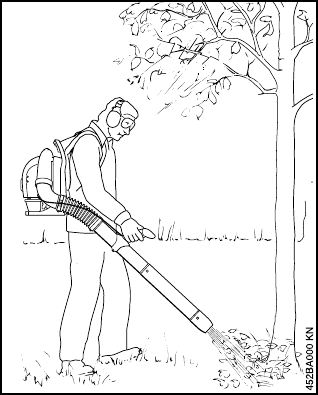
46
español / EE.UU
BR 380
Uso del soplador
El soplador ha sido diseñado para
usarse con una sola mano. Se lleva
como una mochila y se usa colocando la
mano derecha sobre el mango de con-
trol.
El chorro de aire potente a nivel del
suelo puede dirigirse con mucha preci-
sión y eficacia. Permite al operador lim-
piar zonas grandes con rapidez.
El soplador puede usarse solamente
para las operaciones descritas en su
manual.
El soplador puede usarse para despejar
hojas, pasto, papel, polvo y capas livia-
nas de nieve de los prados, jardines,
complejos deportivos, parques, entra-
das de vehículos y estacionamientos.
También es adecuado para despejar
caminos en bosques.
Otros usos incluyen el despejar tubos,
desagües y cocheras.
Técnicas de trabajo
Para reducir al mínimo el tiempo de
soplado, use rastrillos y escobas para
aflojar la basura antes de usar el sopla-
dor.
Técnicas recomendadas de trabajo para
reducir al mínimo la cantidad de basura
llevada por el aire y la contaminación:
:En condiciones muy polvorientas,
humedezca las superficies ligera-
mente.
:Utilice la extensión total de la boqui-
lla del soplador, de modo que el
chorro de aire se aplique cerca del
suelo.
:No dirija la basura hacia las perso-
nas, los niños o los animales
domésticos, ni hacia lugares tales
como ventanas abiertas o automó-
viles recién lavados. Dirija la basura
hacia un lugar seguro.
:Después de usar los sopladores,
EFECTUE LOS TRABAJOS DE
LIMPIEZA CORRESPONDIEN-
TES.
Bote la basura en recipientes apro-
piados. No envíe la basura hacia
propiedades vecinas.
Técnicas recomendadas de trabajo para
reducir los ruidos al mínimo:
:Utilice las herramientas motoriza-
das en horas razonables - no muy
temprano de mañana, ni muy tarde
por la noche, ni durante el descanso
del mediodía, cuando se podría per-
turbar a otras personas. Aténgase a
las horas indicadas por los regla-
mentos de la localidad. Usualmente
se recomienda un horario de 9:00
a.m. a 12:00 m. y de 3:00 p.m. a
5:00 p.m. en días hábiles para pro-
fesionales. Tenga consideración
especial por los vecinos durante los
fines de semana.
:Menos motores significa menos
ruido; por lo tanto, utilice una herra-
mienta motorizada a la vez, siempre
que sea posible.
:Maneje los sopladores a la veloci-
dad más baja posible que permita
cumplir con la tarea.
:Revise el equipo antes de usarlo,
especialmente el silenciador, las
tomas de aire y los filtros de aire.
Conserve el agua usando sopladores
motorizados en lugar de mangueras
para aquellas tareas de jardinería que
permitan su uso, por ejemplo, al limpiar
patios o portales.

47BR 380
español / EE.UU
Uso del accesorio de aspiradora
(accesorio especial)
El accesorio de aspiradora ha sido dise-
ñado para recoger materiales secos
tales como hojas, pasto, ramas peque-
ñas y trozos de papel.
!Advertencia !
Para reducir el riesgo de
sufrir lesiones personales
causadas por los incen-
dios y explosiones, nunca
intente recoger sustan-
cias calientes o encendi-
das (por ejemplo, cenizas
encendidas, cigarrillos sin extinguir)
ni líquidos combustibles
(por ejemplo, gasolina,
adelgazadores).
MANTENIMIENTO, REPARACION
Y ALMACENAMIENTO
Los trabajos de mantenimiento,
reemplazo o reparación de los dispo-
sitivos y sistemas de control de emi-
siones de escape pueden ser realiza-
dos por cualquier taller o técnico de
motores no diseñados para vehícu-
los. Sin embargo, si usted está recla-
mando servicio de garantía para
algún componente que no ha sido
reparado o mantenido debidamente,
o cuando se utilizan repuestos no
autorizados, STIHL puede denegar la
garantía.
Utilice solamente piezas de repuesto de
STIHL para el mantenimiento y repara-
ción. La utilización de piezas fabricadas
por otras empresas puede causar lesio-
nes graves o mortales.
Siga las instrucciones de mantenimiento
y reparación dadas en la sección corres-
pondiente del manual del usuario. Con-
sulte la tabla de mantenimiento en las
últimas páginas de este manual.
!Advertencia !
Siempre apague el motor y asegúrese
que el ventilador está detenido antes de
hacer cualquier trabajo de manteni-
miento, reparación o limpieza del sopla-
dor. No intente hacer ningún trabajo de
mantenimiento o reparación que no esté
descrito en su manual del usuario. Este
tipo de trabajo debe realizarse única-
mente en el taller de servicio de STIHL.
Revise si la tapa de llenado tiene fugas
periódicamente. Use la bujía especifi-
cada y asegúrese de que ella y el cable
de encendido están en buen estado.
Apriete todas las tuercas, pernos y torni-
llos, excepto los tornillos de ajuste del
carburador, después de cada uso.
!Advertencia !
Un silenciador desgastado o dañado
constituye un riesgo de incendios y
puede causar la pérdida del oído. Com-
pruebe que el silenciador se encuentra
en
buenas condiciones. No use el sopla-
dor si el
silenciador no funciona correc-
tamente o si ha sido retirado.
Recuerde que el riesgo de incendios
forestales es mayor durante las estacio-
nes calurosas. Utilice el silenciador con
chispero provisto con la máquina. No
toque nunca un silenciador caliente,
puede quemarse.
!Advertencia !
Para reducir el riesgo de incendios, no
modifique ni retire parte alguna del silen-
ciador ni del chispero.
Mantenga apretadas y limpias tanto la
bujía como la conexión de su alambre.
Revise la separación entre electrodos
de la bujía con un calibrador de espeso-
res por lo menos cada 50 horas de fun-
cionamiento y ajústela de ser necesario.
Instale una bujía nueva si sus electrodos
están muy picados.
Para todo trabajo de mantenimiento, sír-
vase consultar la tabla de manteni-
miento y la declaración de garantía
que se encuentra al final de este
manual.
Guarde el soplador en un lugar seco,
elevado o con llave lejos del alcance de
los niños.
Antes de guardar la máquina durante un
período de más de algunos días, siem-
pre vacíe el tanque de combustible.
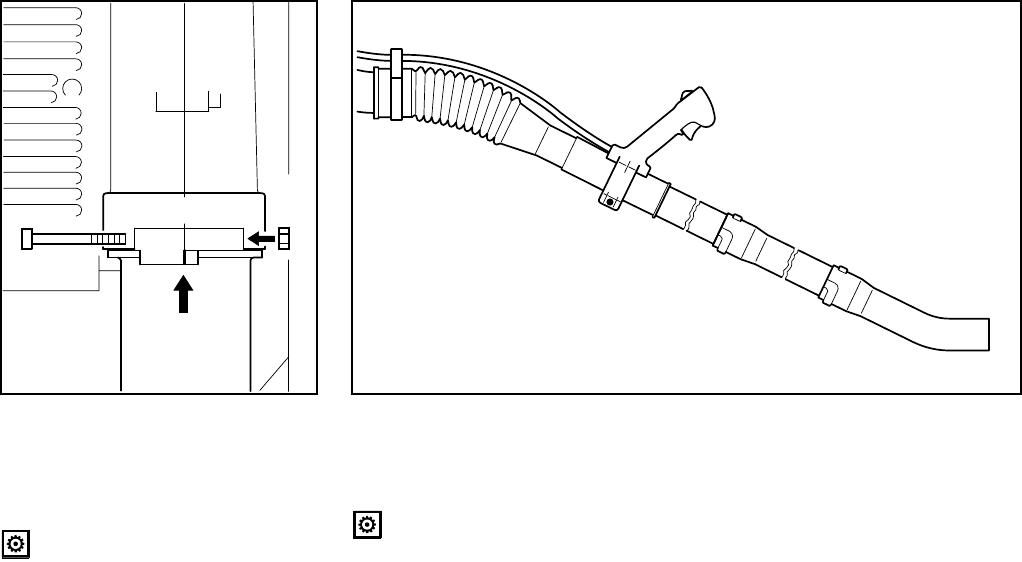
48
español / EE.UU
BR 380
Montaje del codo
Una llave de combinación y un destorni-
llador para el carburador se guardan en
el lado inferior del soplador.
El cable del acelerador ya está
conectado. Asegúrese de evitar tor-
cerlo durante el armado.
:Empuje el codo (1) en el tubo corto
(2) hasta donde llegue – los topes
del codo y del eje corto deben que-
dar alineados entre sí.
:Coloque la tuerca (3) en el rebajo
hexagonal del tubo corto.
:Inserte el tornillo en la tuerca del
otro lado y apriételo con modera-
ción – el codo todavía debe
moverse libremente.
:Fije el cable del acelerador (4) en su
lugar usando el retenedor (5).
Montaje de los tubos del soplador
Haga funcionar la máquina exclusi-
vamente con los tubos del soplador
correctamente instalados.
:Empuje el tubo (6) del soplador den-
tro de la manguera con pliegues (7).
:Coloque el tubo del soplador (8) en
el extremo del tubo (6) y gírelo en
sentido horario hasta que se engan-
che el acoplamiento tipo bayoneta.
:Coloque la boquilla (9) en el
extremo del tubo soplador (8) y
gírela en sentido horario hasta que
se enganche el acoplamiento tipo
bayoneta.
:Gire la manguera con pliegues (7)
en sentido contrahorario hasta que
tope y déjela en esa posición.
:Gire el mango de control (10) en
sentido contrahorario hasta la posi-
ción horizontal.
:Gire el conjunto completo del tubo
soplador hasta que la boquilla de
descarga apunte en el mismo sen-
tido que el mango de control.
:Apriete el tornillo de fijación (11) fir-
memente.
Armado del soplador
353BA002 KN
23
1
373BA001 KN
8
7
4
9
10
6
11
5
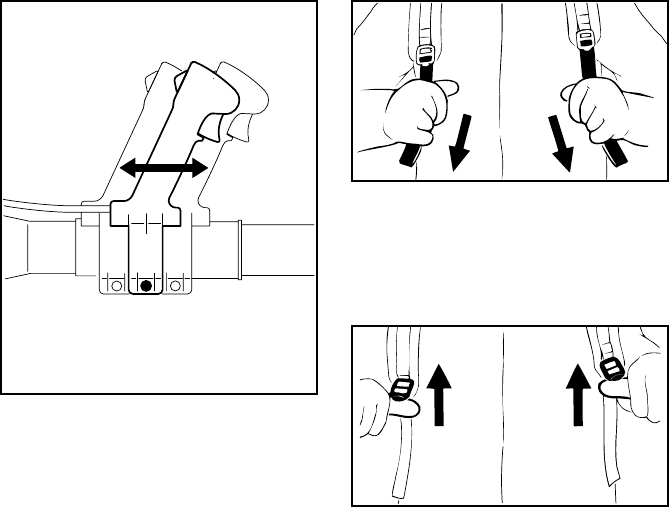
49BR 380
español / EE.UU
Ajuste del mango de control
:Colóquese la máquina sobre la
espalda.
:Suelte el tornillo de fijación (11).
:Deslice el mango de control (10) a
lo largo de la manguera con plie-
gues para ponerlo en la posición
más cómoda.
:Apriete el tornillo de fijación (11) fir-
memente.
Ajuste de las correas del arnés
:Tire de los extremos de las correas
hacia abajo para apretar el arnés.
Soltado de las correas del arnés
:Levante las pestañas de las dos
hebillas deslizantes de ajuste.
:Ajuste las correas de modo que la
placa quede firme y cómoda contra
su espalda.
Este motor está certificado para funcio-
nar con una mezcla de 50 a 1 de gaso-
lina sin plomo y aceite STIHL para moto-
res de dos tiempos.
Su motor requiere una mezcla de gaso-
lina de calidad y aceite de calidad para
motores de dos tiempos enfriados por
aire.
Use gasolina sin plomo regular con un
octanaje mínimo de 89 (R+M/2). Si el
octanaje de la gasolina regular en su
zona es más bajo, use combustible sin
plomo superior.
El combustible de octanaje bajo puede
aumentar la temperatura de funciona-
miento del motor. Esto, a su vez,
aumenta el riesgo de que se agarrote el
pistón y se dañe el motor.
La composición química del combusti-
ble también es importante. Algunos adi-
tivos de combustible no solamente tie-
nen efectos perjudiciales en los
elastómeros (diafragmas de carburador,
sellos de aceite, tuberías de combusti-
ble, etc.), sino también en las piezas
fundidas de magnesio y en los converti-
dores catalíticos. Esto podría causar
problemas de funcionamiento e incluso
daño del motor. Por esta razón, STIHL
recomienda el uso exclusivo de gasolina
sin plomo de buena calidad.
11
10
373BA002 KN
373BA003 KN
373BA004 KN
Combustible
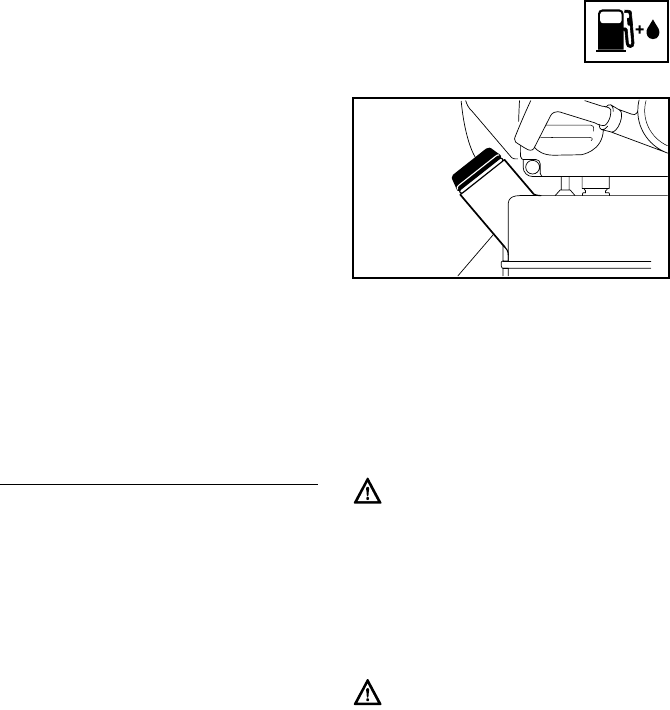
50
español / EE.UU
BR 380
Use solamente el aceite STIHL para
motores de dos tiempos o un aceite de
marca equivalente para motores de dos
tiempos diseñado para usar exclusiva-
mente con los motores de dos tiempos
enfriados por aire.
Recomendamos el aceite STIHL para
motores de dos tiempos 50:1 pues está
especialmente formulado para usarse
en motores STIHL.
No use aceites para mezclar con desig-
naciones BIA o TCW (para motores de
dos tiempos enfriados por agua) ni otros
aceites para mezclar diseñados para
usar en motores enfriados por agua o
por aire (por ejemplo, para motores
marinos fuera de borda, motonieves,
sierras de cadenas, bicimotos, etc.).
Manipule la gasolina con sumo cuidado.
Evite el contacto directo con la piel y
evite inhalar los vapores de combusti-
ble. Cuando se reabastece de combus-
tible, quite primero el envase del vehí-
culo y colóquelo en el suelo antes de
llenarlo. No llene un envase que está en
un vehículo o apoyado sobre el mismo.
Mantenga el envase bien cerrado para
evitar la entrada de humedad a la mez-
cla.
Según sea necesario, limpie el tanque
de combustible de la máquina y el
envase en que se guarda la mezcla de
combustible.
Duración de la mezcla de combusti-
ble
Mezcle una cantidad suficiente de com-
bustible para trabajar unos pocos días,
no lo guarde por más de 3 meses. Guár-
delo únicamente en envases aprobados
para combustible. Para el proceso de
mezclado, vierta el aceite en el envase
primero y luego agregue la gasolina.
Cierre el envase y agítelo vigorosa-
mente a mano para asegurar que se
mezclen bien el aceite y la gasolina.
Deseche los envases vacíos usados
para mezclar el aceite únicamente en
vertederos autorizados para ello.
Antes de llenar la máquina con combus-
tible, limpie a fondo la tapa de llenado y
la zona alrededor del mismo para evitar
la entrada de tierra al tanque.
Siempre agite la mezcla vigorosamente
en el recipiente antes de llenar la
máquina con combustible.
Para reducir el riesgo de quemadu-
ras, así como otras lesiones corpo-
rales ocasionadas por los escapes
de vapor de gasolina y otras ema-
naciones, quite la tapa de llenado
de combustible cuidadosamente de
modo que la presión que se pueda
haber acumulado en el tanque se
disipe lentamente.
Después de haber llenado la
máquina con combustible, apriete la
tapa del tanque tan firmemente
como sea posible con la mano.
Gaso-
lina
Aceite (STIHL 50:1 ó aceite
de calidad equivalente)
gal
EE.UU.
oz fl
EE.UU.
12.6
2 1/2 6.4
5 12.8
Llenado de
combustible
373BA030 KN
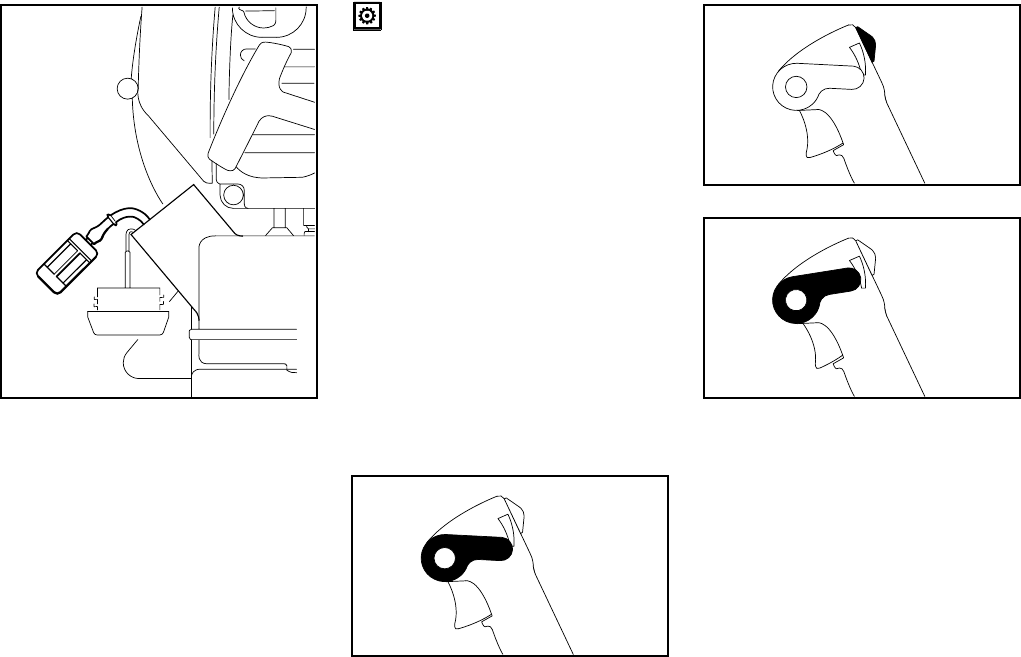
51BR 380
español / EE.UU
Cambie el recogedor de combus-
tible una vez al año.
Antes de almacenar la máquina por un
período prolongado, vacíe y limpie el
tanque de combustible y ponga el motor
en marcha hasta que se seque el com-
bustible del carburador.
Con el motor parado y antes de
arrancar el mismo, revise las tomas
de aire entre la placa para la
espalda y la unidad motriz en busca
de obturaciones y límpielas según
se requiera.
Hay disponible como accesorio
especial una malla protectora para
mantener abiertas las tomas de
aire.
Siempre mueva la palanca de ajuste a la
posición de ralentí antes de apagar el
motor, porque de lo contrario el cable del
acelerador se desconectará del gatillo
de aceleración.
El cable del acelerador se vuelve a
conectar automáticamente cuando se
mueve la palanca de ajuste a la posición
de ralentí.
Palanca de ajuste en la posición de
ralentí.
:Respete las medidas de seguridad
– vea el capítulo “Medidas de segu-
ridad y técnicas de manejo”.
:Mueva el interruptor de parada (1)
a #
:Mueva la palanca de ajuste (2) a la
posición central – ésta es la posi-
ción de arranque del acelerador
Nota:
La palanca de ajuste puede usarse para
regular el acelerador a cualquier veloci-
dad entre la de ralentí (tope inferior) y
aceleración máxima (tope superior).
Coloque la palanca en posición de
ralentí antes de apagar el motor.
373BA007 KN
Información
previa al arranque
373BA037 KN
Arranque / parada del moto
r
373BA008 KN
1
373BA009 KN
2
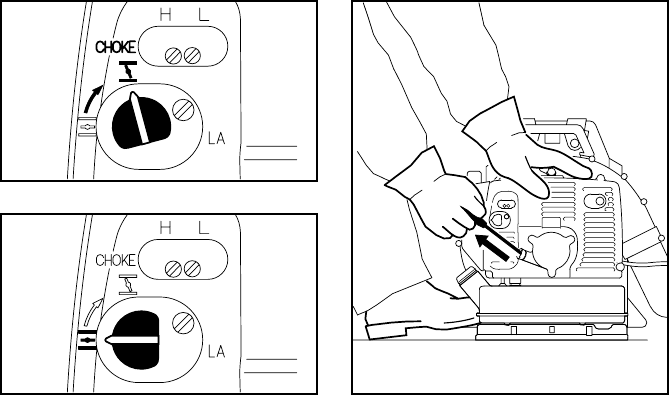
52
español / EE.UU
BR 380
:Si el motor está frío, ponga la perilla
del estrangulador en g
:Si el motor está caliente, ponga la
perilla del estrangulador en e
También utilice esta posición si el
motor ha estado en marcha, pero
todavía se encuentra frío.
:Apoye la máquina en el suelo. Veri-
fique que las demás personas estén
a una distancia prudente de la zona
de trabajo y de la boquilla.
:Asegúrese de tener los pies bien
apoyados: Sostenga la máquina
colocando la mano izquierda sobre
la caja y ponga un pie contra la
placa de su base para impedir que
se desplace.
:Con la mano derecha tire lenta-
mente del mango de arranque hasta
que sienta una resistencia definitiva
y en seguida dele un tirón fuerte y
rápido. No tire de la cuerda de
arranque totalmente hasta fuera, se
podría cortar.
:No deje que el mango de arranque
salte bruscamente hacia atrás.
:Guíelo lentamente hacia el interior
de la caja para que la cuerda de
arranque se enrolle correctamente.
373BA010 KN373BA011 KN
373BA012 KN
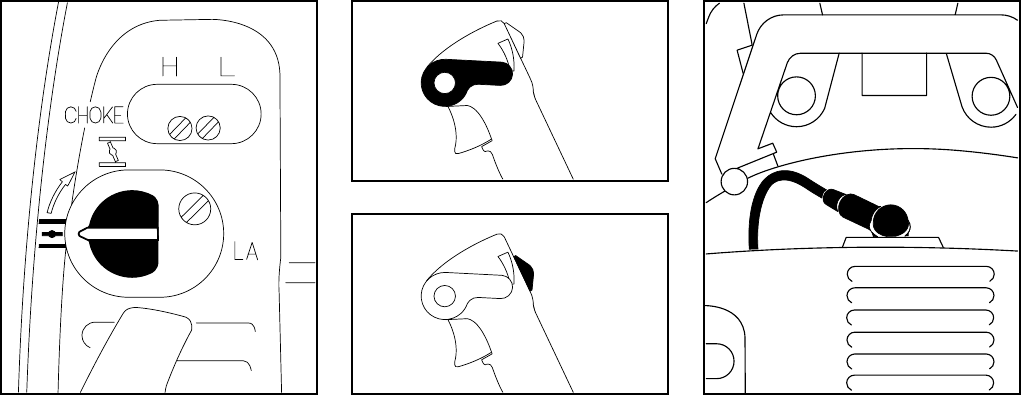
53BR 380
español / EE.UU
Cuando el motor empieza a encen-
derse:
:Si el motor está frío:
Gire la perilla del estrangulador a
e y continúe girando el motor
hasta que arranque.
:Si el motor está caliente:
Continúe haciendo girar el motor
hasta que arranque.
Tan pronto arranca:
:Mueva la palanca de ajuste (2)
hasta su tope inferior para acelerar
el motor a ralentí.
Para apagar el motor:
:Mueva el interruptor de parada (1)
a $
A temperaturas ambiente muy bajas:
Permita que el motor se caliente
Tan pronto arranca:
:Mueva la palanca de ajuste hasta
su tope inferior – el motor se acelera
a ralentí.
:Abra el acelerador levemente –
caliente el motor por un período
breve.
Si el motor no arranca:
Si no se movió la perilla del estrangula-
dor a e en un tiempo suficientemente
corto después que el motor empezó a
encenderse, la cámara de combustión
se encuentra "ahogada".
:Saque el casquillo de la bujía.
:Destornille y seque la bujía.
:Mueva el interruptor de parada a 0
:Abra el acelerador completamente.
:Tire de la cuerda de arranque varias
veces para despejar la cámara de
combustión.
373BA013 KN
373BA014 KN
2
1
373BA015 KN
373BA016 KN
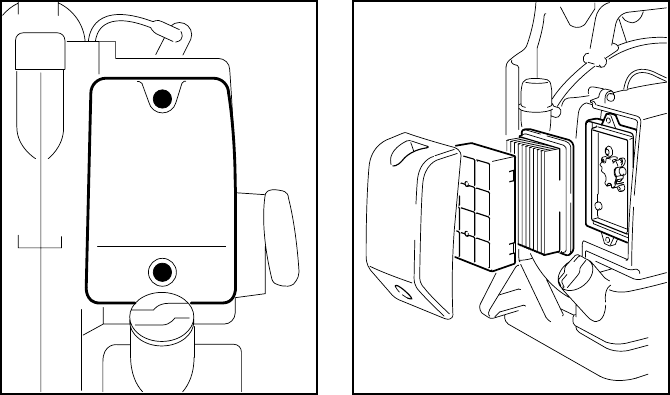
54
español / EE.UU
BR 380
:Instale la bujía y vuélvale a conectar
su casquillo.
:Mueva el interruptor de parada a #
:Ponga la perilla del estrangulador
en e – aun si el motor está frío.
:Ahora arranque el motor.
Se ha dejado que se agote el combus-
tible y se ha vuelto a llenar
:Tire de la cuerda de arranque varias
veces para cebar la línea de com-
bustible.
Los filtros de aire sucios reducen la
potencia del motor, aumentan el con-
sumo de combustible y dificultan el
arranque del motor.
Si se nota una pérdida considerable
de la potencia del motor
:Gire la perilla del estrangulador a
g
:Suelte los tornillos (1 y saque la
cubierta del filtro (2).
:Quite el filtro principal (3) de la
cubierta e inspecciónelo – si está
sucio o dañado, instale uno nuevo.
:Siempre instale un prefiltro nuevo
cuando se cambie el filtro principal.
:Quite el prefiltro (4) de la cubierta
del filtro.
:Si el prefiltro está mojado, séquelo -
y luego golpéelo contra la palma de
la mano o use un chorro de aire
comprimido.
:Un prefiltro dañado siempre debe
sustituirse.
Limpieza del filtro de aire
1
373BA017 KN
2
1
373BA018 KN
3
45
55BR 380
español / EE.UU
:Limpie la tierra suelta de la cubierta
del filtro y de la cámara del filtro.
:Instale los elementos del filtro prin-
cipal y del prefiltro en la cubierta.
:Coloque la cubierta en la base (5)
del filtro y apriétela bien firme.
Las emisiones de gases de escape son
controladas por el diseño de parámetros
y componentes fundamentales del
motor (por ej. carburación, encendido,
regulación y regulación de la válvula o
lumbrera) sin la adición de ningún
equipo importante.
El carburador se ajusta en la fábrica al
ajuste estándar.
Este ajuste provee una mezcla óptima
de combustible y aire bajo la mayoría de
las condiciones de funcionamiento.
Con este carburador solamente es posi-
ble corregir el ajuste de los tornillos de
velocidad rápida y lenta dentro de una
gama limitada.
Manejo del motor Ajuste del carburador
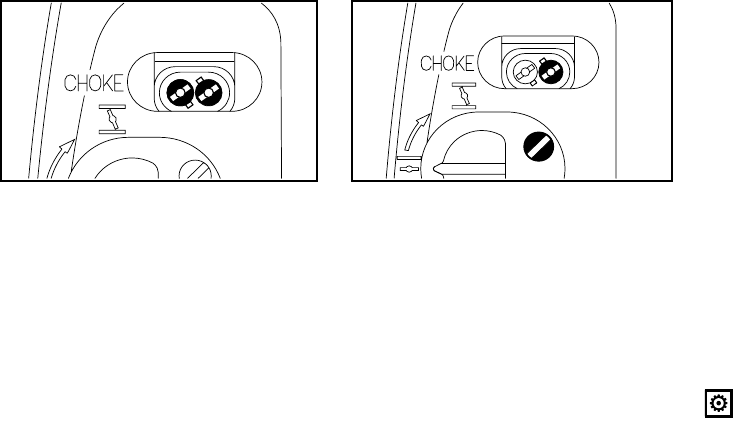
56
español / EE.UU
BR 380
Ajuste estándar
:Apague el motor.
:Revise el filtro de aire y límpielo o
sustitúyalo de ser necesario.
:Revise el chispero del silenciador
(si lo tiene) y límpielo o sustitúyalo
de ser necesario.
:Gire los dos tornillos de ajuste cui-
dadosamente en sentido contraho-
rario hasta que topen:
El tornillo de velocidad alta (H)
ahora está 1/4 de vuelta abierto.
El tornillo de velocidad baja (L)
ahora está 1/4 de vuelta abierto.
:Arranque el motor y caliente.
Ajuste de ralentí
El motor se para durante el funciona-
miento a ralentí
:Gire el tornillo de ajuste de ralentí
(LA) en sentido horario hasta que el
motor funcione de modo suave.
Funcionamiento irregular a ralentí, el
motor se para aunque se ha ajustado
el tornillo LA, aceleración inade-
cuada
Ajuste de ralentí con mezcla muy
pobre:
:Gire el tornillo de ajuste de veloci-
dad baja (L) en sentido contrahora-
rio (sin pasar más allá del tope)
hasta que el motor funcione y se
acelere de modo uniforme.
Funcionamiento irregular a ralentí
Ajuste de ralentí con mezcla muy
rica:
:Gire el tornillo de ajuste de veloci-
dad baja (L) en sentido horario (sin
pasar más allá del tope) hasta que
el motor funcione y todavía se ace-
lere de modo uniforme.
Normalmente es necesario cambiar el
ajuste del tornillo de ajuste de ralentí
(LA) después de cada ajuste del tornillo
de baja velocidad (L).
Ajuste fino para funcionamiento a
alturas grandes
Una corrección muy leve puede ser
necesaria si el motor no tiene suficiente
potencia:
:Revise el ajuste estándar.
:Caliente el motor.
:Gire el tornillo de ajuste de veloci-
dad alta (H) en sentido horario
(mezcla más pobre), pero no más
allá del tope.
Si el ajuste es demasiado pobre
existe riesgo de dañar el motor
debido a una lubricación insufi-
ciente y sobrecalentamiento.
HL
373BA043 KN
LA
L
373BA044 KN
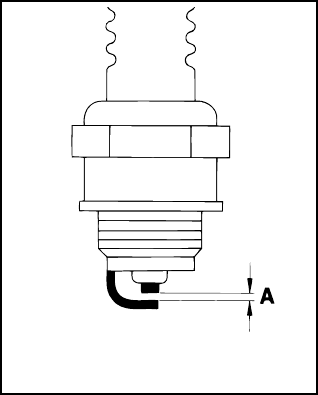
57BR 380
español / EE.UU
En las unidades equipadas con un con-
vertidor catalítico* hay que usar exclusi-
vamente la gasolina sin plomo y el
aceite STIHL para motores de dos
tiempos o un aceite equivalente en una
mezcla de 50:1 (vea el capitulo "Com-
bustible").
El convertidor catalítico instalado en el
silenciador reduce las emisiones noci-
vas presentes en el gas de escape.
El ajuste correcto del carburados (si es
ajustable) y el uso de la mezcla especi-
ficada de gasolina y aceite para motores
de dos tiempos son esenciales para
reducir al mínimo las emisiones nocivas
de gases de escapes y asegurar una
larga vida útil del convertidor catalítico.
* vea “Guía para el uso de este
manual”
La mezcla de combustible incorrecta
(demasiado aceite de motor en la gaso-
lina), el filtro de aire sucio y condiciones
de funcionamiento desfavorables (gene-
ralmente a media aceleración, etc.)
afectan la condición de la bujía. Estos
factores causan la formación de depósi-
tos en la punta del aislador lo que puede
dificultar el funcionamiento.
Si el motor tiene poca potencia, le
cuesta arrancar o funciona deficiente-
mente a velocidad de ralentí, primero
revise la bujía.
:Saque la bujía – vea „Arranque /
parada del motor“.
:Limpie la bujía sucia.
:Mida la separación entre electrodos
de la bujía (A). Vuelva a ajustar si es
necesario. Vea “Especificaciones”.
:Use únicamente bujías de tipo
resistencia de capacidad aprobada.
Corrija la causa de la suciedad de la
bujía:
:Demasiado aceite en la mezcla de
combustible.
:Filtro de aire sucio.
:Condiciones de funcionamiento
desfavorables, por ej., funciona-
miento a media aceleración.
Coloque una bujía nueva después de
100 horas de funcionamiento, aproxi-
madamente, o más temprano si nota
que los electrodos están muy desgasta-
dos.
Convertidor catalítico* Revisión de la bujía
000BA002 KN
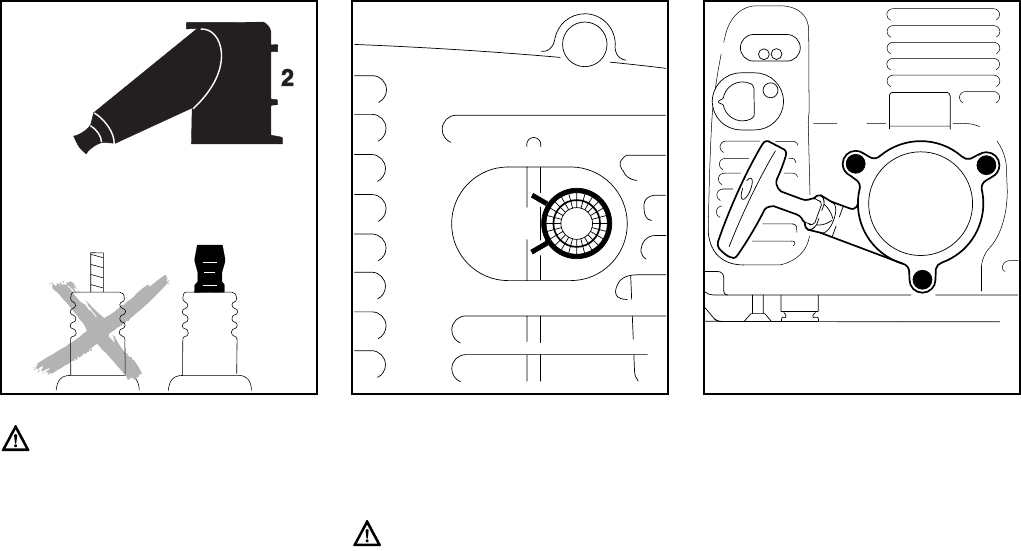
58
español / EE.UU
BR 380
Para reducir el riesgo de incendios y
lesiones por quemadura, use sola-
mente bujías autorizadas por
STIHL. Siempre encaje un casquillo
(2) del tamaño correcto bien ajus-
tado en el borne (1) de la bujía.
(Nota: Si el borne tiene una tuerca
adaptadora SAE desprendible,
colóquela.) Una conexión suelta
entre el casquillo de la bujía y el
conector del alambre de encendido
puede formar un arco eléctrico,
inflamar los vapores combustibles y
finalmente causar un incendio.
Si el motor pierde potencia o no fun-
ciona suavemente a máxima acelera-
ción, revise el chispero del silenciador
(si lo tiene).
Espere a que el motor se enfríe por
completo antes de efectuar las ope-
raciones siguientes.
:Use una herramienta adecuada
para comprimir los extremos de la
pinza (1) y levante la pinza para qui-
tarla.
:Quite el chispero (2) del silenciador.
:Limpie el chispero.
:Si el chispero está dañado o con
depósitos gruesos de carbón, ins-
tale uno nuevo.
Sustitución de la cuerda de arranque
:Saque los tornillos (1).
:Quite la tapa (2) del arrancador del
motor.
0
00BA036 TR
1
Chispero
en el silenciador
373BA031 KN
12
Sustitución de la cuerda de
arranque y resorte de rebo-
binado
11
1
373BA025 KN
2
1
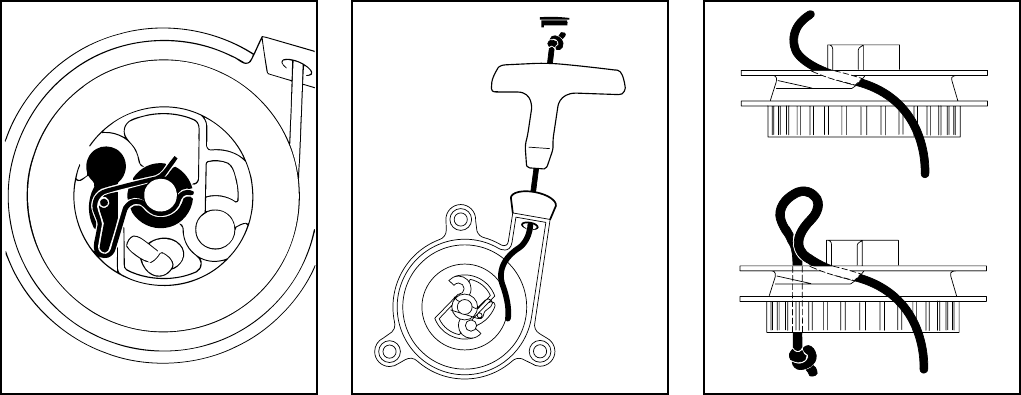
59BR 380
español / EE.UU
:Quite la pinza con resorte (3).
:Quite el rotor de la cuerda con la
arandela (4) y el trinquete (5).
:Saque cuidadosamente la tapa (6)
del mango de arranque.
:Quite el resto de la cuerda del rotor
y del mango.
:Haga un nudo de rizo sencillo en el
extremo de la cuerda de arranque
nueva y después pase la cuerda por
la parte superior del mango y por el
buje de la cuerda (7).
:Vuelva a instalar la tapa en el
mango.
:Pase la cuerda a través del rotor y
fíjela en éste con un nudo de rizo
simple.
353BA034 KN
3
54
353BA041 KN
7
6
373BA026 KN
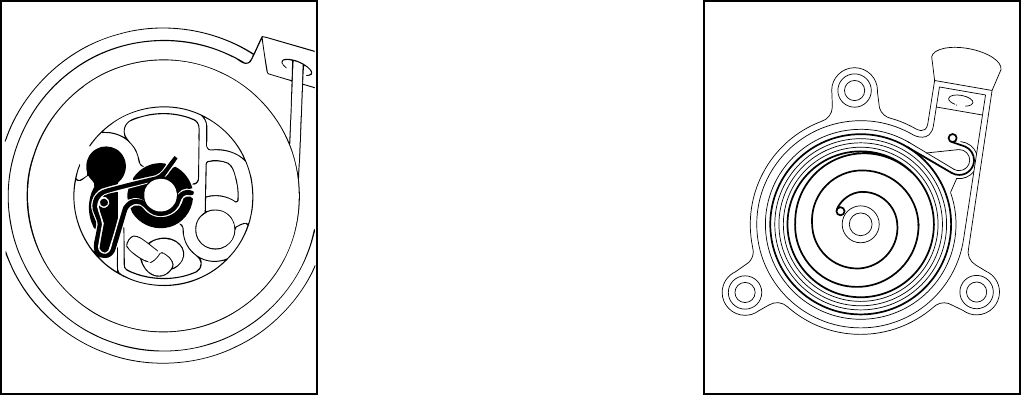
60
español / EE.UU
BR 380
:Instale el trinquete (5) en el rotor y
deslice la arandela (4) sobre el
poste del arrancador.
:Usar un destornillador o alicates
adecuados para instalar la pinza
con resorte (3) en el poste del arran-
cador y sobre el vástago del trin-
quete – la pinza con resorte debe
apuntar en sentido horario – vea la
ilustración.
Pase a "Tensado del resorte de
rebobinado".
Sustitución de resorte de rebobinado
roto
:Lubrique el resorte nuevo con unas
cuantas gotas de aceite sin resina.
:Quite el rotor de la cuerda de la
forma descrita en "Sustitución de la
cuerda de arranque".
:Quite las piezas del resorte viejo.
:Instale una caja de resorte nueva –
la placa inferior debe quedar orien-
tada hacia abajo. Enganche el lazo
exterior del resorte en la orejeta.
:Vuelva a instalar el rotor de la
cuerda.
Pase a "Tensado del resorte de
rebobinado".
Si el resorte se sale y se desenrolla
durante la instalación: Vuélvalo a
instalar en la caja de resorte en sen-
tido contrahorario – empiece desde
el exterior y trabaje hacia el interior.
353BA034 KN
3
54
353BA029 KN

61BR 380
español / EE.UU
Tensado del resorte de rebobinado
:Forme un bucle con la cuerda de
arranque sin envolver y utilícelo
para girar el rotor seis revoluciones
completas en el sentido de la flecha
(vea la ilustración).
:Sujete el rotor inmóvil – enderece la
cuerda si se retuerce.
:Suelte el rotor y la cuerda lenta-
mente de modo que ésta se enrolle
en el rotor.
El mango de arranque debe quedar
firmemente en el buje guía de la
cuerda. Si el mango cae hacia un
lado: Aumente la tensión del resorte
una vuelta adicional.
Cuando la cuerda de arranque se
extiende completamente, debe ser
posible girar el rotor por lo menos
media vuelta adicional. En caso
contrario, el resorte está sobreten-
sado y podría romperse. Quítele
una vuelta de la cuerda al rotor.
:Instale la cubierta del arrancador en
el motor.
:Apriete los tornillos firmemente.
Para intervalos de 3 meses o más:
:Vacíe y limpie el tanque de combus-
tible en una zona bien ventilada.
:Deseche los residuos de combusti-
ble y solución de limpieza de
acuerdo con los requerimientos
locales de protección del medio
ambiente.
:Haga funcionar el motor hasta que
el carburador se seque – esto
ayuda a evitar que los diafragmas
del carburador se peguen.
:Limpie la máquina a fondo - preste
atención especial a las aletas del
cilindro y al filtro de aire.
:Guarde la máquina en un lugar seco
y elevado, o bajo llave – fuera del
alcance de los niños y de otras per-
sonas no autorizadas.
353BA030 KN
Almacenamiento de la
máquina

62
español / EE.UU
BR 380
1) STIHL recomienda que un concesionario de
servicio STIHL efectúe este trabajo
Tabla de mantenimiento
Los intervalos de mantenimiento dados a continuación corresponden única-
mente a condiciones normales de trabajo.
Si el tiempo de trabajo por jornada es más largo que lo normal, o si las condicio-
nes de trabajo son extremas (zonas polvorientas, etc.), acorte los intervalos indi-
cados de modo correspondiente.
antes de comenzar el trabajo
después de terminar
el trabajo o diariamente
después de cada parada
para cargar combustible
semanalmente
mensualmente
cada 12 meses
si hay problema
si tiene daños
si se requiere
Máquina completa
Inspección visual
(condición general, fugas) xx
Limpiar x
Mango de control Comprobar funcionamiento xx
Filtro de aire Limpiar x
Reemplazar x
Cuerpo aspirador en el
tanque de combustible
Revisar x
Reemplazar xx
Tanque de combustible Limpiar x
Carburador Revisar velocidad de ralentí xx
Ajustar el ralentí x
Bujía
Ajustar la distancia entre electrodos x
Cambiar después de aprox.
100 horas de funcionamiento
Conductos de admisión de aire de
enfriamiento Limpiar x
Chispero en silenciador Revisar x
Limpiar o reemplazar x
Todos los tornillos y tuercas accesi-
bles (salvo los tornillos de ajuste) Apriete x
Elementos antivibración
Revisar x
Solicitar al concesionario de servicio
su sustitución 1) xx
Rejilla de la toma de
aire del soplador
Revisar xx
Limpiar x
Etiquetas de seguridad Reemplazar x

63BR 380
español / EE.UU
1 Boquilla
2 Tubo de soplador
3 Mango de control
4 Gatillo de aceleración
5 Palanca de ajuste
6 Interruptor de parada
7 Manguera con pliegues
8Arnés
9 Placa para espalda
10 Almohadilla para soporte de
espalda
11 Caja del filtro de aire
12 Elementos antivibración
13 Casquillo de bujía
14 Silenciador
(con chispero)*
15 Tornillos de ajuste del carburador
16 Perilla de estrangulador
17 Mango de arranque
18 Tapa de llenado de combustible
19 Tanque de combustible
# Número de serie
* vea “Guía para el uso de este
manual”
Piezas y controles
9
10
8
3
4
5
1
2
7
6
11
373BA027 KN
12
12
373BA028 KN
#
18 17
16 15 14
13
373BA029 KN
19
64
español / EE.UU
BR 380
Definiciones
1. Boquilla.
Dirige y amplía el chorro de aire o
de líquido.
2. Tubo de soplador.
Dirige el chorro de aire o de líquido.
3. Mango de control.
El mango de la manguera flexible
sirve para sostener y dirigir el tubo
en la dirección deseada.
4. Gatillo de aceleración.
Regula la velocidad del motor.
5. Palanca de ajuste.
Ajusta el acelerador a varias posi-
ciones.
6. Interruptor de parada.
Apaga el motor.
7. Manguera con pliegues.
Para pulverizar, aplicar o esparcir
materiales en la dirección deseada.
8. Arnés.
Para portar la unidad.
9. Placa para la espalda.
Ayuda a proteger la espalda del
usuario.
10. Almohadilla para soporte de
espalda.
Permite portar la máquina con más
comodidad.
11. Caja del filtro de aire.
Cubre el elemento del filtro de aire.
12. Elementos antivibración.
Elementos diseñados para reducir
la transmisión de las vibraciones
creadas por el motor hacia la
espalda del operador.
13. Casquillo de la bujía.
Conecta la bujía al alambre de
encendido.
14. Silenciador
(con chispero).
Atenúa los ruidos del tubo de
escape y desvía los gases de
escape lejos del operador. El chis-
pero reduce el riesgo de incendios.
15. Tornillos de ajuste del carbura-
dor.
Para afinar el carburador.
16. Perilla del estrangulador.
Facilita el arranque del motor al
enriquecer la mezcla.
17. Mango de arranque.
El mango de la cuerda de arranque,
el cual es el dispositivo usado para
arrancar el motor.
18. Tapa de llenado de combustible.
Para tapar el tanque de combusti-
ble.
19. Tanque de combustible.
Contiene la mezcla de combustible
y aceite.
65BR 380
español / EE.UU
EPA:
El período de cumplimiento de emisio-
nes indicado en la etiqueta de cumpli-
miento de emisiones es la cantidad de
horas de funcionamiento para la cual la
máquina ha demostrado la conformidad
con los requerimientos de emisiones del
Gobierno federal de los EE.UU.
Categoría
A = 300 horas,
B = 125 horas,
C = 50 horas
CARB:
El período de cumplimiento de emisio-
nes empleado en la etiqueta del índice
de aire CARB tiene las siguientes defini-
ciones:
Extended (extendido) = 300 horas,
Intermediate (intermedio) = 125 horas,
Moderate (moderado) = 50 horas
Motor BR 380,
Convertidor catalítico BR 380
Sistema de encendido
Sistema de combustible
Arrancador de cuerda
Caudal de aire con boquilla
pies3/min (m3/h)
Velocidad de aire con boquilla
mph (m/s)
Peso lb (kg)
Especificaciones
Motor de un cilindro, dos tiempos
Cilindrada: 56,5 cm3
(3,45 pulg3)
Diámetro: 46 mm
(1,81 pulg)
Carrera: 34 mm
(1,34 pulg)
Ralentí: 3100 rpm
Tipo: Encendido por
magneto electró-
nico
Bujía
(con supresión):
Bosch WSR 6 F
o
NGK BPMR 7 A;
Distancia entre
electrodos: 0,5 mm (0,02 pulg)
Carburador: Carburador de diafragma
de todas posiciones con bomba de
combustible integral
Capacidad del tan-
que de combustible:
1,5 l
(50 onzas fl.)
Mezcla de combus-
tible:
Vea el capítulo
“Combustible”
Cuerda
de arranque:
0,14 pulg de diá-
metro x 37,8 pulg
(3,5 mm de diá-
metro x 960 mm)
BR 380 471 (800)
BR 380
Convertidor
catalítico 465 (790)
BR 380 183 (82)
BR 380
Convertidor
catalítico 181 (81)
BR 380 20,1 (9,1)
BR 380
Convertidor
catalítico 20,5 (9,3)
66
español / EE.UU
BR 380
Comuníquese con su concesionario
STIHL para información acerca de los
accesorios especiales que pueden estar
disponibles para su producto.
Los usuarios de esta máquina deben
efectuar únicamente los trabajos de
mantenimiento descritos en este
manual. Solamente los talleres autoriza-
dos por STIHL deben llevar a cabo los
demás trabajos de reparación.
Los reclamos de garantía presentados
después de realizadas las reparaciones
serán aceptados únicamente si las mis-
mas fueron ejecutadas por un concesio-
nario de servicio autorizado STIHL utili-
zando piezas de repuesto originales de
STIHL.
Es posible identificar las piezas origina-
les de STIHL por el número de pieza
STIHl
, el logotipo de STIHL y, en
algunos casos, el símbolo ( de piezas
STIHL. En las piezas pequeñas el sím-
bolo puede aparecer solo.
Accesorios especiales Mantenimiento y
reparaciones
67BR 380
español / EE.UU
Sus derechos y obligaciones de
garantía
El Consejo de Recursos del Aire del
Estado de California (CARB) y STIHL
Incorporated se complacen en expli-
carle la garantía del sistema de control
de emisiones instalado en el motor de
su equipo de uso fuera de carretera para
el año 2007 y posteriores.
En California, el equipo nuevo que tiene
motores pequeños para uso fuera de
carretera debe estar diseñado, cons-
truido y equipado de conformidad con
las rigurosas normas de contaminación
del aire del estado. STIHL Incorporated
debe garantizar el sistema de control de
emisiones en el motor pequeño para
uso fuera de carretera por el intervalo
mencionado más arriba, siempre que
dicho motor pequeño para uso fuera de
carretera no haya estado sujeto a mal-
trato, negligencia o cuidado inapro-
piado.
El sistema de control de emisiones
puede contar con los siguientes compo-
nentes:
Filtro de aire, carburador, purgador,
estrangulador (sistema de enriqueci-
miento para arranque en frío), varillaje
de control, colector de admisión, mag-
neto o sistema de encendido electrónico
(módulo de encendido), bujía, converti-
dor catalítico (si lo tiene), tanque de
combustible, tapa de tanque de com-
bustible, línea de combustible, adapta-
dores de líneas de combustible, abraza-
deras y sujetadores.
En los casos de existir una condición
amparada bajo garantía, STIHL Incorpo-
rated reparará el motor pequeño para
equipo de uso fuera de carretera sin
costo alguno, incluido el diagnóstico, las
piezas y la mano de obra.
Cobertura de garantía del fabri-
cante
El sistema de control de emisiones tiene
una garantía de dos años en California.
En el caso de encontrarse defectos en
cualquiera de los componentes del
motor relacionados con el sistema de
control de emisiones, el mismo será
reparado o sustituido por STIHL Incor-
porated sin costo alguno.
Responsabilidades del usuario
relativas a la garantía
Como propietario de motor pequeño
para equipo de uso fuera de carretera,
usted tiene la responsabilidad de reali-
zar el mantenimiento requerido descrito
en su manual de instrucciones. STIHL
Incorporated le recomienda guardar
todos los recibos comprobantes de los
trabajos de mantenimiento hechos a su
motor pequeño para equipo de uso
fuera de carretera, pero STIHL Incorpo-
rated no puede negar garantía basado
en el solo hecho de faltar los recibos o
de su incumplimiento de realizar todos
los trabajos de mantenimiento progra-
mados.
Sin embargo, como propietario del
motor pequeño para equipo de uso
fuera de carretera usted debe
ser consciente de que STIHL Incorpora-
ted puede negarle cobertura de garantía
si dicho motor o un componente del
mismo ha fallado debido a maltrato, des-
cuido, mantenimiento inadecuado o
modificaciones no autorizadas.
Usted es responsable de llevar el motor
pequeño para equipo de uso fuera de
carretera a un centro de servicio STIHL
tan pronto surja el problema. Las repa-
raciones bajo garantía deben realizarse
en un tiempo razonable, sin exceder de
30 días. Ante cualquier duda respecto a
sus derechos y responsabilidades bajo
esta garantía, sírvase contactar al repre-
sentante de atención al cliente STIHL
llamando al 1-800-467-8445, o si lo pre-
fiere puede escribir a
STIHL Inc., 536 Viking Drive,
P.O. Box 2015,
Virginia Beach, VA 23450-2015 EE.UU.
Cobertura por STIHL Incorpora-
ted
STIHL Incorporated garantiza al último
comprador y a cada comprador subsi-
guiente que el motor pequeño para
equipo de uso fuera de carretera está
diseñado, construido y equipado, al
tiempo de la venta, de conformidad con
todos los reglamentos aplicables.
Además, STIHL Incorporated garantiza
al comprador inicial y a cada comprador
subsiguiente que el motor está libre de
defectos en el material y fabricación que
puedan causar el incumplimiento de los
reglamentos aplicables adoptados por el
Consejo de Recursos del Aire durante
un período de dos años.
Solamente para California:
Declaración de garantía de STIHL Incorporated sobre el control de emisiones de gases de
escape y emisiones por evaporación para el Estado de California
68
español / EE.UU
BR 380
Período de garantía contra defec-
tos
Los períodos de garantía comenzarán el
día en que el motor de equipo utilitario
es comprado por el comprador inicial. Si
cualquier componente relacionado con
el sistema de control de emisiones está
defectuoso, el mismo será sustituido por
STIHL Incorporated sin costo alguno
para el propietario.
No se permite usar componentes adicio-
nales o modificados que no hayan sido
eximidos por el Consejo de Recursos
del Aire. El uso de cualquier compo-
nente adicional o modificado no eximido
será motivo para la denegación del
reclamo bajo garantía. STIHL Incorpora-
ted no es responsable por las fallas de
los componentes garantizados causa-
das por el uso de un componente adicio-
nal o modificado no eximido.
La garantía de los componentes relacio-
nados con el control de emisiones se
interpretará de la manera siguiente:
1. Cualquier componente garantizado
cuyo reemplazo no está programado
como mantenimiento requerido en las
instrucciones escritas requeridas en la
lista de piezas bajo la garantía de con-
trol de emisiones (vea más abajo) debe
garantizarse por el período de garantía
definido en la subsección PERIODO DE
GARANTIA CONTRA DEFECTOS, vea
más arriba. Si uno de estos componen-
tes falla durante el período de garantía,
el fabricante debe reparar o sustituir el
mismo de acuerdo con la subsección (4)
más abajo. Un componente reparado o
sustituido bajo la garantía debe garanti-
zarse durante el resto del período de
garantía.
2. Cualquier componente garantizado
que solamente debe inspeccionarse
periódicamente de acuerdo con las ins-
trucciones escritas requeridas en la lista
de piezas bajo la garantía de control de
emisiones (vea más abajo) debe garan-
tizarse por el período de garantía defi-
nido en la subsección PERIODO DE
GARANTIA CONTRA DEFECTOS, vea
más arriba. Una declaración en las ins-
trucciones escritas tal como "reparar o
sustituir según sea necesario" no acor-
tará el período de cobertura de garantía.
Un componente de este tipo reparado o
sustituido bajo la garantía debe garanti-
zarse durante el resto del período de
garantía.
3. Cualquier componente garantizado
que debe sustituirse como un elemento
de mantenimiento requerido en las ins-
trucciones escritas requeridas por la
lista de piezas bajo la garantía de con-
trol de emisiones (vea más abajo) debe
garantizarse por el intervalo antes del
primer punto de sustitución programado
para este componente. Si el compo-
nente falla antes del primer punto de
sustitución programado, el fabricante
del motor debe reparar o sustituir el
mismo de acuerdo con la subsección (4)
más abajo. Un componente de este tipo
reparado o sustituido bajo la garantía
debe garantizarse durante el resto del
período de garantía antes del primer
punto de sustitución programado para el
componente.
4. La reparación o sustitución de cual-
quier componente garantizado debe lle-
varse a cabo en una estación de repara-
ciones bajo garantía sin costo alguno
para el propietario.
5. No obstante lo expuesto en la sub-
sección (4) de arriba, los servicios o las
reparaciones bajo garantía pueden
obtenerse en todos los centros de distri-
bución del fabricante autorizados para
dar servicio a los motores en cuestión.
6. Al propietario no se le debe cobrar
el trabajo del diagnóstico que establece
que el componente garantizado es de
hecho defectuoso, a condición de que
tal trabajo de diagnóstico se realice en
una estación de reparaciones bajo
garantía.
Trabajo bajo garantía
STIHL Incorporated reparará los defec-
tos amparados por la garantía en cual-
quier estación de garantía o centro de
servicio autorizado por STIHL. Todo tra-
bajo de este tipo se hará gratis para el
propietario siempre que se determine
que la pieza cubierta por la garantía está
defectuosa. Se puede usar cualquier
pieza de repuesto aprobada por el fabri-
cante o equivalente para el manteni-
miento o la reparación de los compo-
nentes relacionados con el sistema de
control de emisiones, y la misma debe
ser suministrada gratis al propietario.
STIHL Incorporated es responsable por
daños a otros componentes del motor
causados por la falla de una pieza
garantizada que todavía está bajo
garantía.
69BR 380
español / EE.UU
Lista de piezas bajo la garantía de
emisiones
Filtro de aire, carburador, purgador
Estrangulador (sistema de refuerzo para
arranque en frío)
Varillaje de control, colector de admisión
Magneto o sistema de encendido elec-
trónico (módulo de encendido), bujía
Convertidor catalítico (si lo tiene)
Tanque de combustible, tapa de tanque
de combustible, línea de combustible,
adaptadores de líneas de combustible,
abrazaderas, sujetadores
Dónde presentar el reclamo para
servicio bajo garantía
Lleve el producto de STIHL a cualquier
concesionario de servicio autorizado por
STIHL y presente la tarjeta de garantía
STIHL firmada.
Limitaciones
La reparación o la sustitución de cual-
quier componente garantizado y nor-
malmente abarcado por la garantía se
puede excluir de la garantía si STIHL
Incorporated demuestra el maltrato,
negligencia o mantenimiento incorrecto
del producto de STIHL, y que tal mal-
trato, negligencia, o mantenimiento
incorrecto era la causa directa de la
necesidad de reparación o sustitución
del componente. A pesar de lo anterior,
el ajuste de un componente que tiene un
dispositivo limitador instalado en fábrica
y funcionando correctamente no perjudi-
cará la cobertura bajo garantía.
70
español / EE.UU
BR 380
Sus derechos y obligaciones de
garantía
La Agencia de Protección del Medio
Ambiente (EPA) de los EE.UU. y STIHL
Incorporated se complacen en expli-
carle la garantía del sistema de control
de emisiones instalado en el motor de
su equipo. En los EE.UU., los nuevos
motores pequeños para equipos de uso
fuera de carretera modelos 1997 y pos-
teriores deben estar diseñados, cons-
truidos y equipados, al tiempo de la
venta, de conformidad con los regla-
mentos de la EPA de los EE.UU. para
los motores pequeños de uso fuera de
carretera. El motor del equipo debe
carecer de defectos en el material y la
fabricación que puedan causar el incum-
plimiento de las normas de la EPA de los
EE.UU. durante los primeros dos años
de uso del motor a partir de la fecha de
compra por el último comprador.
STIHL Incorporated debe garantizar el
sistema de control de emisiones en el
motor pequeño para uso fuera de carre-
tera por el intervalo mencionado más
arriba, siempre que dicho motor no haya
estado sujeto a maltrato, negligencia o
cuidado inapropiado.
El sistema de control de emisiones de su
máquina incluye piezas tales como el car-
burador y el sistema de encendido. Ade-
más puede incluir mangueras, conectores
y otros conjuntos relativos a emisiones.
En los casos de existir una condición
amparada bajo garantía, STIHL Incorpo-
rated reparará el motor pequeño para
equipo de uso fuera de carretera sin
costo alguno, incluido el diagnóstico (si
el trabajo de diagnóstico fue realizado
por un concesionario autorizado), las
piezas y la mano de obra.
Cobertura de garantía del fabri-
cante:
En los EE.UU., los motores pequeños
para equipos de uso fuera de carretera
modelos 1997 y posteriores también
están garantizados por dos años. En el
caso de encontrarse defectos en cual-
quiera de las piezas del motor relaciona-
das con el sistema de control de emisio-
nes, la pieza será reparada o sustituida
por STIHL Incorporated sin costo
alguno.
Responsabilidades del usuario
relativas a la garantía:
Como propietario de motor pequeño
para equipo de uso fuera de carretera,
usted tiene la responsabilidad de reali-
zar el mantenimiento requerido descrito
en su manual del usuario. STIHL Incor-
porated le recomienda guardar todos los
recibos comprobantes de los trabajos de
mantenimiento hechos a su motor
pequeño para equipo de uso fuera de
carretera, pero STIHL Incorporated no
puede negar garantía basado en el solo
hecho de faltar los recibos o del incum-
plimiento del propietario de realizar
todos los trabajos de mantenimiento
programados.
El uso de cualquier pieza de repuesto o
servicio cuyo comportamiento y durabili-
dad sean equivalentes está permitido en
trabajos de mantenimiento o reparación
no contemplados en la garantía, y no
reducirá las obligaciones de la garantía
del fabricante del motor.
Sin embargo, como propietario del
motor pequeño para equipo de uso
fuera de carretera usted debe estar
consciente de que STIHL Incorporated
puede negarle cobertura de garantía si
dicho motor o una pieza del mismo ha
fallado debido a maltrato, descuido,
mantenimiento inadecuado o modifica-
ciones no autorizadas.
Usted es responsable de llevar el motor
pequeño para equipo de uso fuera de
carretera a un centro de servicio STIHL
tan pronto surja el problema. Las repa-
raciones bajo garantía serán realizadas
en un tiempo razonable, sin exceder de
30 días.
Ante cualquier duda respecto a sus
derechos y responsabilidades bajo esta
garantía, sírvase contactar al represen-
tante de atención al cliente STIHL lla-
mando al 1-800-467-8445, o si lo pre-
fiere puede escribir a
STIHL Inc.,
536 Viking Drive, P.O. Box 2015,
Virginia Beach, VA 23450-2015 EE.UU.
Cobertura por
STIHL Incorporated
STIHL Incorporated garantiza al último
comprador y a cada comprador subsi-
guiente que el motor pequeño para
equipo de uso fuera de carretera está
diseñado, construido y equipado, al
tiempo de la venta, de conformidad con
todos los reglamentos aplicables. Ade-
más, STIHL Incorporated garantiza al
comprador inicial y a cada comprador
No para California:
Declaración de garantía de STIHL Incorporated sobre
sistemas de control de emisiones según normas Federales
71BR 380
español / EE.UU
subsiguiente que el motor está libre de
defectos en el material y fabricación que
puedan causar el incumplimiento de los
reglamentos aplicables durante un
período de dos años.
Período de garantía
El período de garantía comienza en la
fecha en que el motor del equipo utilita-
rio es entregado a usted y usted firma y
remite la tarjeta de garantía a STIHL.
Si cualquier pieza relacionada con el
sistema de control de emisiones está
defectuosa, la pieza será sustituida por
STIHL Incorporated sin costo alguno
para el propietario. Cualquier pieza
garantizada cuyo reemplazo no está
programado como mantenimiento
requerido, o que debe recibir única-
mente inspección regular en el sentido
de "reparar o sustituir según sea nece-
sario", estará garantizada por el período
de garantía. Cualquier pieza cuyo reem-
plazo está programado como manteni-
miento requerido estará garantizada por
el intervalo hasta el primer punto de
reemplazo programado para esa pieza.
Diagnóstico
Como propietario, a usted no se le debe
cobrar la mano de obra por los diagnós-
ticos que determinen que una pieza
garantizada está defectuosa. No obs-
tante, si usted reclama garantía para un
componente y se comprueba que la
máquina no está defectuosa, STIHL
Incorporated le cobrará el costo de
la prueba del sistema de control de
emisiones.
El trabajo de diagnóstico mecánico se
realiza en un centro de servicio autori-
zado por STIHL. La prueba del sistema
de control de emisiones se realiza ya
sea en la fábrica de STIHL Incorporated
o en un laboratorio de ensayos indepen-
diente.
Trabajo bajo garantía
STIHL Incorporated reparará los defec-
tos amparados por la garantía en cual-
quier estación de garantía o centro de
servicio autorizado por STIHL. Todo tra-
bajo de este tipo se hará gratis para el
propietario siempre que se determine
que la pieza cubierta por la garantía está
defectuosa. Se puede usar cualquier
pieza de repuesto aprobada por el fabri-
cante o equivalente en las piezas rela-
cionadas con el sistema de control de
emisiones, y debe ser suministrada gra-
tis al propietario. STIHL Incorporated es
responsable por daños a otros compo-
nentes del motor causados por la falla
de una pieza garantizada que todavía
está bajo garantía.
La lista siguiente define específica-
mente las piezas garantizadas y relacio-
nadas con las emisiones:
Carburador
Estrangulador (sistema de refuerzo para
arranque en frío)
Múltiple de admisión
Filtro de aire
Bujía
Magneto o sistema de encendido elec-
trónico (módulo de encendido)
Convertidor catalítico (si lo tiene)
Sujetadores/pernos
Dónde presentar el reclamo para
servicio bajo garantía
Lleve el producto a cualquier centro de
servicio autorizado por STIHL y pre-
sente la tarjeta de garantía firmada.
Requerimientos de manteni-
miento
Las instrucciones presentadas en este
manual se basan en la aplicación de la
mezcla recomendada para motores de 2
tiempos (vea también la instrucción
"Combustible"). Las discrepancias de
estas recomendaciones con respecto a
la calidad y la proporción de la mezcla
de combustible y aceite pueden exigir
intervalos de mantenimiento más cortos.
Limitaciones
Esta garantía de los sistemas de control
de emisiones no cubrirá ninguno de los
puntos siguientes:
:reparación o sustitución requerida
debido a maltrato, negligencia o
falta del mantenimiento requerido,
:reparaciones mal hechas o sustitu-
ciones contrarias a las especifica-
ciones de STIHL Incorporated que
afecten desfavorablemente el fun-
cionamiento y/o la durabilidad, y las
alteraciones o modificaciones no
recomendadas o aprobadas por
escrito por STIHL Incorporated,
y
:la sustitución de piezas y otros ser-
vicios y ajustes necesarios para el
mantenimiento requerido en y des-
pués del primer punto de reemplazo
programado.
72
español / EE.UU
BR 380
Marcas registradas de STIHL
STIHL®
q
(
La combinación de colores anaranjado-
gris (N° de registro EE.UU. 2,821,860)
4-MIX®
AUTOCUT®
EASYSTART®
OILOMATIC®
STIHL Cutquik®
STIHL DUROMATIC®
STIHL Farm Boss®
STIHL Quickstop®
STIHL ROLLOMATIC®
STIHL WOOD BOSS®
TIMBERSPORTS®
YARD BOSS®
Marcas comerciales de STIHL por
ley común
BioPlus™
Easy2Start™
EasySpool™
ElastoStart™
Ematic /Stihl-E-Matic™
FixCut™
HT Plus™
IntelliCarb™
Master Control Lever™
Micro™
Pro Mark™
Quad Power™
Quiet Line™
STIHL Arctic™
STIHL Compact™
STIHL HomeScaper Series™
STIHL Interchangeable Attachment
Series™
STIHL Magnum /Stihl-Magnum™
STIHL MiniBoss™
STIHL MotoPlus 4™
STIHL Multi-Cut HomeScaper Series™
Stihl Outfitters™
STIHL PICCO™
STIHL PolyCut™
STIHL PowerSweep™
STIHL Precision Series™
STIHL Protech™
STIHL RAPID™
STIHL SuperCut™
STIHL Territory™
TapAction™
TrimCut™
Esta lista de marcas comerciales está
sujeta a cambios.
Queda terminantemente prohibido todo
uso de estas marcas comerciales sin el
consentimiento expreso por escrito de
ANDREAS STIHL AG & Co. KG,
Waiblingen.
Marcas comerciales

! WARNING!
The engine exhaust from this product
contains chemicals known to the State
of California to cause cancer, birth
defects or other reproductive harm.
! WARNING!
The engine exhaust from this product
contains chemicals known to the State
of California to cause cancer, birth
defects or other reproductive harm.
! ADVERTENCIA!
El gas de escape del motor de esta máquina
contiene productos químicos que en el estado de
California son considerados como causantes de
cáncer, defectos de nacimiento u otros efectos
nocivos para los órganos de la reproducción.
0458 453 8621 A
englisch / English USA / spanisch / español EE.UU / CARB / EPA
BA_BR340380_86_U_G5.book Seite 1 Montag, 4. Juli 2005 8:10 08
