Stihl Hl75 75K Manual HL 75, 75 K
2014-07-06
: Stihl Hl75-75K-Manual hl75-75k-manual stihl pdf
Open the PDF directly: View PDF  .
.
Page Count: 74
- Contents
- Guide to Using this Manual
- Safety Precautions
- Assembling the Unit
- Using the Hedge Cutter
- Fuel
- Fueling
- Adjusting Cutter Bar Angle
- Fitting the Harness
- Starting / Stopping the Engine
- Cleaning the Air Filter
- Motor Management
- Adjusting the Carburetor
- Spark Arresting Screen* in Muffler
- Checking the Spark Plug
- Lubricating the Gearbox
- Replacing the Starter Rope and Rewind Spring
- Sharpening Instructions
- Operating Instructions
- Storing the Machine
- Maintenance Chart
- Parts and Controls
- Definitions
- Specifications
- Maintenance and Repairs
- STIHL Incorporated Federal and California Emission Control Warranty Statement
- BA_SE_075_004_31_04.pdf
- Contenido
- Guía para el uso de este manual
- Medidas de seguridad
- Armado de la máquina
- Uso del cortasetos
- Combustible
- Llenado de combustible
- Ajuste del ángulo de la barra de corte
- Colocación del arnés
- Arranque / parada del motor
- Limpieza del filtro de aire
- Manejo del motor
- Ajuste del carburador
- Chispero* en silenciador
- Revisión de la bujía
- Lubricación de la caja de engranajes
- Sustitución de la cuerda de arranque y resorte de rebobinado
- Instrucciones de afilado
- Instrucciones de manejo
- Almacenamiento de la máquina
- Tabla de mantenimiento
- Piezas y controles
- Definiciones
- Especificaciones
- Mantenimiento y reparación
- Declaración de garantía de STIHL Incorporated sobre sistemas de control de emisiones según normas...
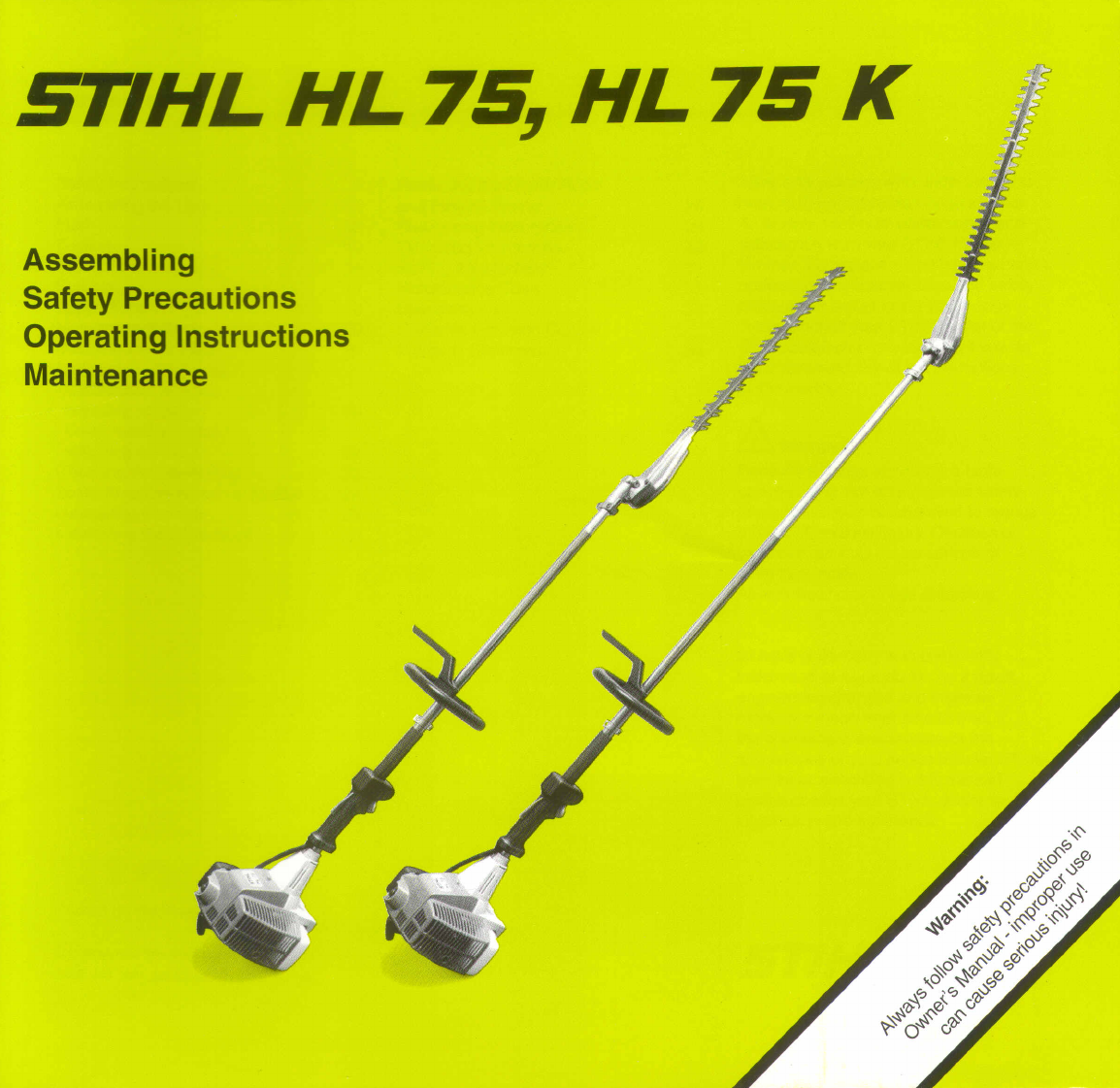
STIHL HL 7~ HL 75 KI
...:J
.
.:..
!J
"
Assembling
Safety Precautions Ii
Operating Instructions
!/Ii
Maintenance
.~
0~
'0<::' 0
.~ vCj
.
<z>."V
i-.
.~o; 0v Q0 ~~.
~~,,~o .~""\
~\t§ ~.,('.~ .~
~... ~0 ~'0
0'b' ~' . OV
~,:jv e}~
~o <z>.<;:'
Cj
,0 ~. 00
_,0 ~0 <z>.V
0--'" 0 v
~~~<;:' <z>.~
~ 0 v
1HL 75, HL 75 K
English / USA
Printing inks contain vegetable oils;
paper can be recycled.
Printed on chlorine-free paper.© ANDREAS STIHL AG & Co. KG, 2003
0458 389 3021. M1.4. C3. PM. Printed in Germany
STIHl
Contents
Guide to Using this Manual .............. 2
Safety Precautions ........................... 3
Assembling the Unit ....................... 12
Using the Hedge Cutter .................. 13
Fuel ................................................ 15
Fueling ............................................ 16
Adjusting Cutter Bar Angle ............. 17
Fitting the Harness ......................... 18
Starting / Stopping the Engine ........ 18
Cleaning the Air Filter ..................... 21
Motor Management ........................ 22
Adjusting the Carburetor ................ 22
Spark Arresting Screen* in Muffler . 24
Checking the Spark Plug ................ 24
Lubricating the Gearbox ................. 25
Replacing the Starter Rope
and Rewind Spring ......................... 26
Sharpening Instructions .................. 29
Operating Instructions .................... 29
Storing the Machine ........................ 29
Maintenance Chart ......................... 30
Parts and Controls .......................... 31
Definitions ....................................... 32
Specifications ................................. 33
Maintenance and Repairs ............... 34
STIHL Incorporated Federal
and California Emission Control
Warranty Statement ........................ 35
* see “Guide to Using this Manual”
Allow only persons who understand this
manual to operate your hedge cutter.
To receive maximum performance and
satisfaction from your STIHL hedge
cutter, it is important that you read and
understand the maintenance and safety
precautions, starting on page 3, before
using your hedge cutter.
Contact your STIHL dealer or the STIHL
distributor for your area if you do not
understand any of the instructions in this
manual.
!Warning!
Because a hedge cutter is a high-speed
cutting tool some special safety
precautions must be observed to reduce
the risk of personal injury.
Careless or improper use may cause
serious or even fatal injury.
STIHL's philosophy is to continually
improve all of its products. As a result,
engineering changes and improve-
ments are made from time to time. If the
operating characteristics or the
appearance of your hedge cutter differs
from those described in this manual,
please contact your STIHL dealer for
information and assistance.
2
English / USA
HL 75, HL 75 K
Pictograms
All the pictograms attached to the
machine are shown and explained in
this manual.
The operating and handling instructions
are supported by illustrations.
Symbols in text
The individual steps or procedures
described in the manual may be marked
in different ways:
:Step or procedure without direct
reference to an illustration.
Description of step or procedure that
refers directly to the illustration and
contains item numbers that appear in
the illustration.
Example:
Loosen the screw (1)
Lever (2) ...
In addition to the operating instructions,
this manual may contain paragraphs
that require your special attention. Such
paragraphs are marked with the
symbols described below:
Warning where there is a risk of an
accident or personal injury or
serious damage to property.
Warning where there is a risk of
damaging the machine or individual
components.
Note or hint which is not essential
for using the machine, but may
improve the operator’s under-
standing of the situation and result
in better use of the machine.
Note or hint on correct procedure in
order to avoid damage to the
environment.
Equipment and features
This instruction manual refers to
several models with different
features. Components that are not
installed in all models and related
applications are marked thus *.
Such components are available as
special accessories from your
STIHL dealer.
Engineering improvements
STIHL’s philosophy is to continually
improve all of its products. As a result,
engineering changes and improvements
are made from time to time. If the
operating characteristics or the
appearance of your machine differ from
those described in this manual, please
contact your STIHL dealer for
assistance.
Therefore, we cannot be responsible for
changes, modifications or
improvements not covered in this
manual.
Guide to Using this Manual

3HL 75, HL 75 K
English / USA
Warning!
Because a hedge cutter is
a high-speed, fast-cutting
power tool, special safety
precautions must be
observed to reduce the risk of personal
injury.
It is important that you
read, fully understand and
observe the following
safety precautions and
warnings. Read the
owner's manual and the
safety instructions periodically. Careless
or improper use of any hedgecutter may
cause serious or fatal injury.
Have your STIHL dealer show you how
to operate your hedge cutter. Observe
all applicable local safety regulations,
standards and ordinances.
!Warning!
The use of any hedge cutter may be
hazardous. If the cutting tool comes in
contact with your body, it will cut you.
Striking solid foreign objects such as
stones, fence wire or metal could
damage the cutting attachment and may
cause blades to crack, chip or break.
STIHL does not recommend the use of
hedge cutters when cutting in areas
where the blades could contact such
objects.
!Warning!
Minors should never be allowed to use a
hedge cutter. Bystanders, especially
children, and animals should not be
allowed in the area where a hedge cutter
is in use.
The operator is responsible for avoiding
injury of third parties and damage to
their property.
Never let the hedge cutter run
unattended.
!Warning!
Do not lend or rent your hedge cutter
without the owner's manual. Be sure that
anyone using your hedge cutter
understands the information contained
in this manual.
Safe use of a hedge cutter involves
1. the operator
2. the hedge cutter
3. the use of the hedge cutter.
THE OPERATOR!
Physical Condition
You must be in good physical condition
and mental health and not under the
influence of any substance (drugs,
alcohol, etc.) which might impair vision,
dexterity or judgment. Do not operate a
hedge cutter when you are fatigued.
Be alert - if you get tired while operating
your hedge cutter, take a break.
Tiredness may result in loss of control.
Working with any hedge cutter can be
strenuous. If you have any condition that
might be aggravated by strenuous work,
check with your doctor before operating
a hedge cutter. Prolonged use of a
hedge cutter (or other machines)
exposing the operator to vibrations may
produce whitefinger disease (Raynaud's
phenomenon) or carpal tunnel
syndrome. These conditions reduce the
hand's ability to feel and regulate
temperature, produce numbness and
burning sensations and may cause
nerve and circulation damage and tissue
necrosis.
Safety Precautions

4
English / USA
HL 75, HL 75 K
!Warning!
Antivibration systems do not guarantee
that you will not sustain whitefinger
disease or carpal tunnel syndrome.
Therefore, continual and regular users
should monitor closely the condition of
their hands and fingers. If any of the
above symptoms appear, seek medical
advice immediately.
!Warning!
The ignition system of the STIHL unit
produces an electromagnetic field of a
very low intensity. This field may
interfere with some pacemakers. To
reduce the risk of serious or fatal injury,
persons with pacemaker should consult
their physician and the pacemaker
manufacturer before operating this tool.
Proper Clothing
!Warning!
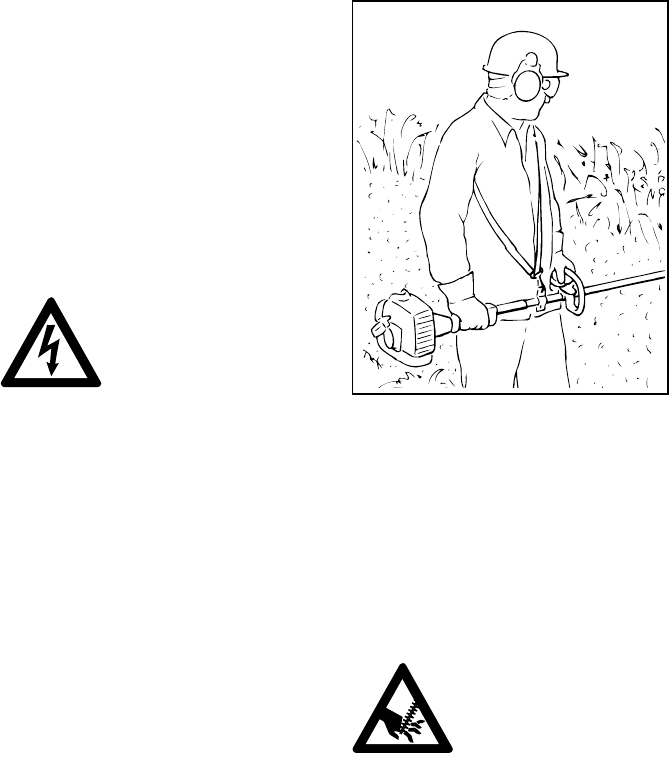
Hedge cutter operation
can cause serious injury
to eyes, ears and person.
Therefore, to reduce the
risk of injury to your eyes
never operate a hedge
cutter unless wearing goggles or
properly fitted safety glasses with
adequate top and side protection
complying with ANSI Z 87.1 (or your
applicable national standard).To reduce
the risk of injury to your face STIHL
recommends that you also wear a face
shield or face screen over your goggles
or safety glasses.
!Warning!
Hedge cutter noise may
damage your hearing.
Wear sound barriers (ear
plugs or ear mufflers) to
protect your hearing.
Continual and regular
users should have their hearing checked
regularly.
Wear an approved safety hard hat to
reduce the risk of injury to your head
when there is a danger of head injuries.
Wear proper protective clothing.
Protect your hands with
gloves when handling the
hedge cutter and the
cutting tool. Heavy-duty,
nonslip gloves improve
your grip and help to
protect your hands.
Clothing must be sturdy
and snug-fitting, but allow
complete freedom of
movement. Avoid loose-
fitting jackets, scarfs,
neckties, jewelry, flared or
cuffed pants, unconfined long hair or
anything that could become caught on
branches, brush or moving parts of the
unit. Wear long pants made of heavy
material to protect your legs.
Do not wear shorts.
Good footing is most
important in hedge cutter
work. Wear sturdy boots
with nonslip soles. Steel-
toed safety boots are
recommended.
THE HEDGE CUTTER
For illustrations and definitions of the
hedge cutter parts, see the chapter on
"Parts and Controls"!
5HL 75, HL 75 K
English / USA
!Warning!
Never modify a hedge cutter in any way.
Only attachments supplied by STIHL or
expressly approved by STIHL for use
with the specific STIHL hedge cutter
models are authorized. Although certain
unauthorized attachments may be
useable for the STIHL hedge cutter, their
use may, in fact, be extremely
dangerous. Never remove or disable
any safety devices.
USE OF THE HEDGE CUTTER
Transporting the hedge cutter
!Warning!
To reduce the risk of injury from blade
contact, never carry or transport the
hedge cutter with the cutter blades
running. The correct engine idle speed is
important in this respect. If the
carburetor setting is correct, the cutter
blades will be stationary at idle speed.
!Warning!
Always turn off the engine and make
sure the cutting attachment has stopped
before putting the unit down or carrying
it between work stations.
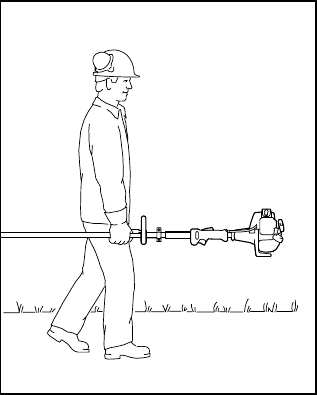
The hedge cutter may be carried only in
a horizontal position. Grip the shaft in a
manner that the machine is balanced
horizontally. Keep the hot muffler away
from your body and the cutting
attachment behind you.
Always switch off the engine and fit the
scabbard over the cutter blades before
transporting the hedge cutter over long
distances. When transporting your
hedge cutter in a vehicle, properly
secure it to prevent turnover, fuel
spillage and damage to the hedge cutter.
Preparation for the use of the hedge
cutter
!Warning!
Never use a hedge cutter that is
damaged or not properly maintained.
Always check your hedge cutter for
proper condition and operation before
starting, particularly the throttle trigger,
throttle trigger interlock, stop switch and
cutting tool. The throttle trigger must
move freely and always spring back in
the idle position.
The cutting tool must be properly
tightened and in safe operating
condition. Inspect for loose part (nuts,
screws, etc.) and for cracked, bent,
warped or damaged blades. Regularly
check the condition and tightness of the
cutter blades - with the engine stopped!
389BA019 KN

6
English / USA
HL 75, HL 75 K
Service damaged cutter blades before
using the hedge cutter. Always keep
blades sharp. Keep the handles clean
and dry at all times; it is particularly
important to keep them free of oil and
resin to ensure that you can always
maintain a firm grip and safely control
your machine. Stihl recommends that
you always spray the cutter blades with
STIHL resin solvent before starting work
- with engine stopped! You can obtain
this protective spray from your dealer.
Apply generously.
Fueling
Your STIHL hedge cutter uses an oil-
gasoline mixture for fuel (see the
chapter on "Fuel" of your owner's
manual).
!Warning!
Gasoline is an extremely
flammable fuel. If spilled
or ignited by a spark or
other ignition source, it
can cause fire and serious
burn injury or property
damage. Use extreme caution when
handling gasoline or fuel mix.
Do not smoke or bring any fire or flame
near the fuel.
Fueling Instructions
Fuel your hedge cutter in well ventilated
areas, outdoors.
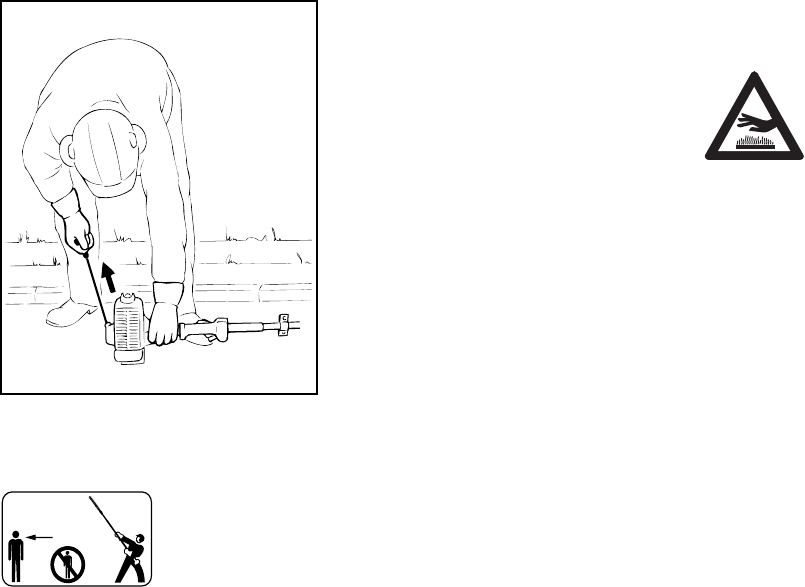
!Warning!
Gasoline vapor pressure may build up
inside the gas tank of a two cycle engine
depending on the fuel used, the weather
conditions, and the venting system of
the tank. In order to reduce the risk of
burns or other personal injury from
escaping gas vapor and fumes, remove
the fuel filler cap on your hedge cutter
carefully so as to allow any pressure
build-up in the tank to release slowly.
Never remove fuel filler cap while engine
is running. Select bare ground for fueling
and move at least 10 feet (3 m) from the
fueling spot before starting the engine.
Wipe off any spilled fuel before starting
your hedge cutter and check for
leakage.
Check for fuel leakage while refueling
and during operation. If fuel leakage is
found, do not start or run the engine until
leak is fixed and spilled fuel has been
wiped away. Take care not to get fuel on
your clothing. If this happens, change
your clothing immediately. Never
attempt to fuel a running or hot engine.
!Warning!
Unit vibrations can cause
an improperly tightened
fuel cap to loosen or come
off and spill quantities of
fuel.
In order to reduce risk of fuel spillage
and fire, tighten fuel cap by hand with as
much force as possible.
7HL 75, HL 75 K
English / USA
Starting
!Warning!
Your hedge cutter
is a one-person
machine. Start and
operate your
hedge cutter
without
assistance. To reduce the risk of injury,
keep bystanders at least 15 m (50 ft)
away.
For specific starting instructions, see the
appropriate section of your owner's-
manual. Place the hedge cutter on firm
ground or other solid surface in an open
area. Maintain good balance and secure
footing.
!Warning!
When the engine starts at starting-
throttle, engine speed will be fast
enough for the clutch to engage and
move the cutting tool.
!Warning!
When you pull the starter grip, don't
wrap the starter rope around your hand.
Do not allow the grip to snap back, but
guide the starter rope to rewind properly.
Failure to follow this procedure may
result in injury to hand or fingers and
may damage the starter mechanism.
Catalytic converter
!Warning!
Some STIHL hedge cutter
models are equipped with
a catalytic converter,
which is designed to
reduce the exhaust
emissions of the engine
by a chemical process in the muffler.
Due to this process, the muffler does not
cool down as rapidly as conventional
mufflers when the engine returns to idle
or is shut off. To reduce the risk of fire
and burn injuries, the following specific
safety precautions must be observed.
!Warning!
Since a muffler with a catalytic converter
cools down less rapidly than conven-
tional mufflers, always set your hedge
cutter down in the upright position and
never locate it where the muffler is near
dry brush, grass, wood chips or other
combustible materials while it is still hot.
389BA023 KN
15m (50ft)

8
English / USA
HL 75, HL 75 K
Let the engine cool down sitting on
concrete, metal, bare ground or solid
wood (e.g. the trunk of a felled tree)
away from any combustible substances.
!Warning!
To reduce the risk of fire or burn injury,
let the unit cool down before refueling
your hedge cutter after use.
!Warning!
Never disassemble or modify your
muffler. The muffler could be damaged
and cause an increase in heat radiation
or sparks, thereby increasing the risk of
fire or burn injury. You may also
permanently damage the engine. Have
your muffler serviced and repaired by
your STIHL Servicing Dealer only.
!Warning!
To reduce the risk of fire or burn injury,
keep the area around the muffler clean.
Remove all debris such as pine needles,
branches or leaves.
!Warning!
An improperly mounted or damaged
cylinder housing or a damaged/
deformed muffler shell may interfere
with the cooling effect of the catalytic
converter. To reduce the risk of fire or
burn injury, do not continue work with a
damaged or improperly mounted
cylinder housing or a damaged/
deformed muffler shell. Your catalytic
converter is furnished with screens
designed to reduce the risk of fire from
the emission of hot particles. Due to the
heat from the catalytic reaction, these
screens will normally stay clean and
need no service or maintenance. If you
experience loss of performance and you
suspect a clogged screen, have your
muffler maintained by a STIHL Servicing
Dealer.
Working Conditions
Do not operate using the starting throttle
lock as you do not have control of the
engine speed. See section of your
owner's manual on the proper use of the
slide control.
!Warning!
Your hedge cutter pro-
duces poisonous exhaust
fumes as soon as the
combustible engine is
running.
These gases (e.g. carbon monoxide)
may be colorless and odorless.
To reduce the risk of injury from
inhalation of poisonous fumes, start and
operate your hedge cutter only outdoors
in a well ventilated area. Hold your
hedge cutter in such a way that you do
not breath in the exaust fumes.
Operate the hedge cutter under good
visibility and daylight conditions only.
!Warning!
Make sure you always have good
footing. Take particular care in slippery
conditions and on slopes. Be careful on
un-even ground. Watch out for stumps,
roots, ditches or holes which could
cause you to trip or stumble.
9HL 75, HL 75 K
English / USA
Before you start work, examine the
hedge area for stones, fence wire, metal
or other solid objects which could
damage the cutter blades.
When working close the ground, make
sure that no sand, grit or stones get
between the cutter blades.
!Warning!
When cutting the top of a taller hedge,
when visibility is obstructed check back-
side of the hedge frequently for
bystanders, animals and obstructions.
Danger!
The hedge cutter is not
insulated against electric
shock. To reduce the risk
of electrocution, never
operate the hedge cutter in the vicinity of
any wires or cables (power, etc.) which
may be carrying electric current.
Operating instructions
Do not cut any material other than
hedges and shrubs. The cutting tools
may be used only for the operations
described in your manual.
!Warning!
To reduce the risk of injury from loss of
control, always hold your hedge cutter
firmly with both hands while you are
working. Your right hand should grip the
rear handle. This also applies to left-
handers. Wrap your fingers tightly
around the front and rear handles.
!Warning!
Never attempt to operate
any hedge cutter with one
hand. Loss of control of
the hedge cutter can
result in serious or fatal
injury. To avoid the risk of
serious injury, never teach the moving
cutter blades.
Always work calmly and carefully, stay
alert so as not to endanger others. If the
cutter blades become jammed by thick
branches or any other obstruction,
switch off the engine immediately before
attempting to free the blades.
!Warning!
On units with an adjustable cutter bar:
Always shut off the engine before
making any adjustments. To reduce the
risk of injury, never touch the blades
while making adjustments (fit the
scabbard over the blades).
!Warning!
The gearbox becomes hot in operation.
To reduce the risk of burn injury, do not
touch the gearbox housing.
!Warning!
To reduce the risk of injury from loss of
control, never work on a ladder, in a tree
or any other insecure support.
!Warning!
The cutter blades tend to run on for a
short period after the throttle trigger is
released (flywheel effect).
389BA024 KN
10
English / USA
HL 75, HL 75 K
Important adjustments
!Warning!
To reduce the risk of personal injury from
loss of control or contact with the
running cutting blades, do not use a
hedge cutter with incorrect idle
adjustment. At correct idle speed, the
cutting blades should not move. For
directions to adjust idle speed, see the
appropriate section of your owner's
manual. If you cannot set the correct idle
speed, have your STIHL dealer check
your hedge cutter and make proper
adjustments or repairs.
MAINTENANCE, REPAIR AND
STORING
Maintenance, replacement, or repair
of the emission control devices and
systems may be performed by any
nonroad engine repair establishment
or individual. However if you claim
warranty for a component which has
not been serviced or maintained
properly or if nonapproved
replacement parts were used, STIHL
may deny warranty.
Use only STIHL replacement parts for
maintenance and repair. Use of parts
manufactured by others may cause
serious or fatal injury.
Follow the maintenance and repair
instructions in the appropriate section of
your owner's manual. Refer to the
maintenance chart at the last pages of
this manual.
!Warning!
Always stop the engine and make sure
that the cutting tool is stopped before
doing any maintenance or repair work or
cleaning the hedge cutter. Do not
attempt any maintenance or repair work
not described in your owner's manual.
Have such work performed at your
STIHL service shop only.
!Warning!
Check condition of cutting tool at regular
short intervals. If behavior of tool
changes, check it immediately for
tightness or any signs of cracks in
particular. Replace damaged or dull
cutting tools immediately, even if they
have only superficial cracks.
Never repair damaged cutting
attachments by welding, straightening or
modifying the shape. This may cause
parts of the cutting tool to come off and
result in serious or fatal injuries.
11HL 75, HL 75 K
English / USA
!Warning!
To reduce the risk of fire, check fuel filler
cap for leaks at regular intervals. Use
the specified spark plug and make sure
it and the ignition lead are always in
good condition.
Keep spark plug and wire connection
tight and clean. The spark plug electrode
gap should be checked with a feeler
gauge at least every 50 operating hours
and reset if necessary. Fit a new spark
plug if the electrodes are badly pitted.
Keep cutting tool sharp. Tighten all nuts,
bolts and screws except the carburetor
adjustment screws after each use.
Always clean dust and dirt off the
machine after finishing work.
Do not use a grease solvent for
cleaning! In some countries an aerosol
can of resin solvent (protective spray),
Part No. 0782 420 1002, is available for
spraying the cutter blades.
This resin solvent protects the cutter
blades and has anticorrosive properties.
Spray the cutter blades before and after
work. Then start and run the hedge
cutter briefly so that the resin solvent is
evenly distributed over the blades. If the
hedge itself is very dusty and dirty, spray
the cutter blades more frequently. This
greatly reduces blade friction and the
damaging effects of sap and dust
particles.
!Warning!
Do not operate your hedge cutter if the
muffler is damaged, missing or modified.
An improperly maintained muffler will
increase the risk of fire and hearing loss.
Never touch a hot muffler or burn will
result. If your muffler was equipped with
a spark-arresting screen to reduce the
risk of fire (e.g. in the USA, Canada and
Australia), never operate your hedge
cutter if the screen is missing or
damaged. Remember that the risk of
forest fires is greater in hot or dry
weather.
Keep the engine and muffler free from
cuttings, chips, leaves, fibers and
excess lubricant.
For any maintenance please refer to the
maintenance chart and to the warranty
statement near the end of this manual.
Store hedge cutter in a dry and high or
locked location out of reach of children.
Before storing for longer than a few
days, always empty the fuel tank.
12
English / USA
HL 75, HL 75 K
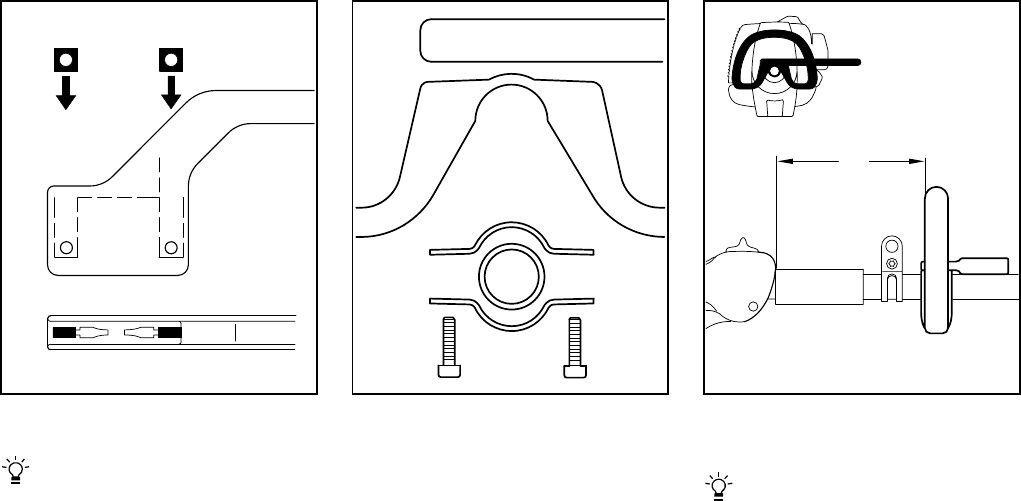
Mounting the Loop Handle
Not necessary on 0° fixed angle
version with handle hose on the
drive tube.
:Fit the square nuts (1) in the barrier
bar (2) – the holes must line up.
:Fit the clamp (3) in the loop
handle (4) and place them both
on the drive tube (5).
:Place clamp (6) in position and fit
the barrier bar (2) so that the holes
line up.
:Insert screws (7) and tighten them
down moderately against the barrier
bar.
:Align the loop handle (4) and move
it to the most comfortable position.
On HL 75 K, distance A must not be
more than 30 cm (12”) – about
25 cm (10”) is recommended.
On HL 75, distance A must not be
more than 55 cm (22”) – about
35 cm (14”) is recommended
:Tighten down the screws (7)
securely.
Assembling the Unit
1
1
2
2
11
389BA001 KN
7
7
6
53
4
2
389BA002 KN
389BA042 KN
4
A
13HL 75, HL 75 K
English / USA
Mounting the Gearbox
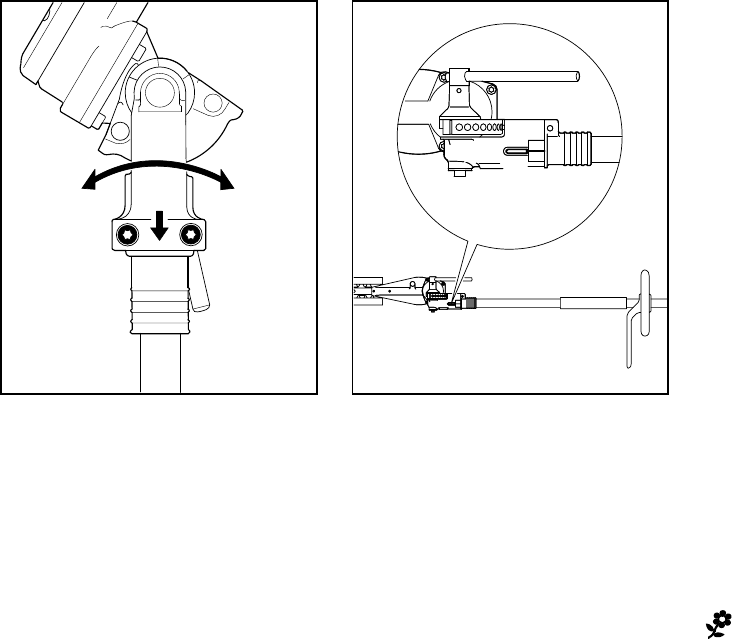
:Loosen the clamp screws (9).
:Push the drive tube (5) into the
gearbox (10) – turn the gearbox
back and forth as necessary.
:Once the end of the drive tube is
inserted beyond the slot in the
clamp (11), push it fully home as far
as stop.
:Fit the clamp screws and tighten
down moderately.
:Line up the gearbox (10).
:Tighten down the clamp screws
firmly..
Do not use your hedge cutter during
rest periods customary in the
neigborhood.
Preparations
Use lopping shears to cut out thick
branches first.
Always wear a harness..
Cutting sequence
If a radical cut is necessary, cut a little at
a time in several stages.
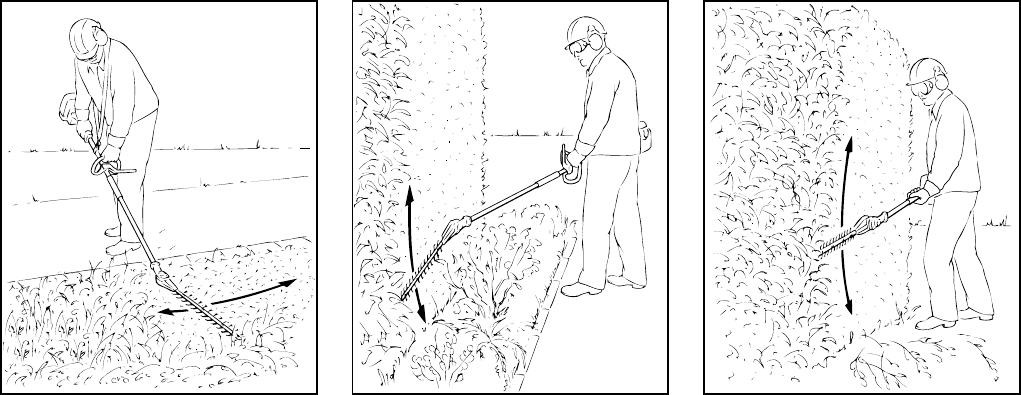
Cutting techniques
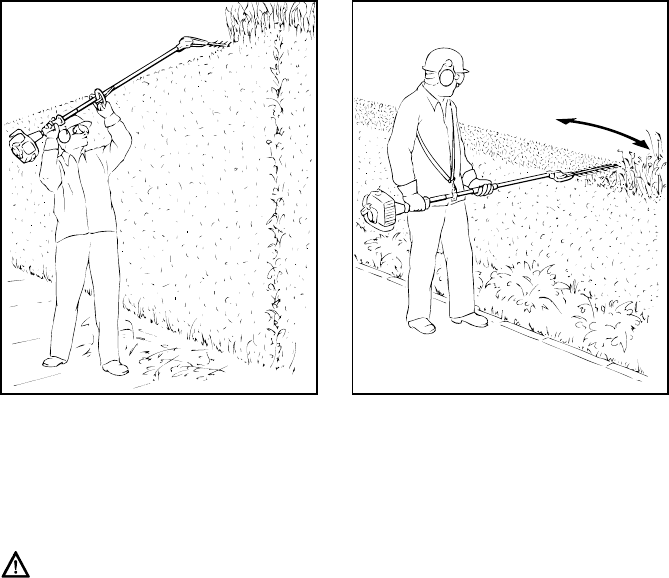
Vertical cut:
Swing the cutter bar up and down in an
arc as you move along the hedge – use
both sides of the cutting blades.
Horizontal cut:
Hold the cutter bar at an angle of 0° to
10° as you swing the hedge cutter
horizontally.
Swing the cutter bar in an arc towards
the outside of the hedge so that the
cuttings are swept on to the ground.
Do not throw cuttings in the rubbish
bin (garbage can) – they can be
composted!
225BA001 KN
5
9
10
9
10
11
389BA043 KN
Using the Hedge Cutter
14
English / USA
HL 75, HL 75 K
Horizontal cut
(with angled cutter bar)
Cutting close to the ground from a
standing position, e.g. low shrubs (not
with HL 75 K).
Vertical cut
(with angled cutter bar)
Cutting without standing directly next to
hedge, e.g. flowerbed between operator
and hedge.
Vertical cut
(with straight cutter bar)
Large working radius even without
additional aids.
389BA044 KN
389BA049 KN
389BA050 KN
15HL 75, HL 75 K
English / USA
Overhead cut
(with angled cutter bar)
Hold the hedge cutter above your head
and swing it in an arc to make maximum
use of its reach.
Any working position above head
height is tiring. To minimize the risk
of accidents, work in such positions
for short periods only. Set angle of
adjustable cutter bar to maximum so
that the unit can be held in a lower,
less tiring position (with harness)
while still providing adequate
vertical reach.
Horizontal cut
(with straight cutter bar)
Cutting without standing directly in front
of the hedge, e.g. reaching over a
flowerbed.
This engine is certified to operate on
unleaded gasoline and with the mix
ratio 50:1.
Your two-stroke engine requires a
mixture of brand-name gasoline and
quality two-stroke engine oil with the
classification TC.
Use regular branded unleaded gasoline
with a minimum octane rating of 89
RON. If the octane rating of the regular
grade gasoline in your area is lower use
premium unleaded fuel.
Note: Units with a catalytic converter
require unleaded gasoline. The
efficiency of the catalytic converter can
drop more than 50 % if several tankfuls
of leaded gasoline are used.
Fuel with a lower octane rating may
result in preignition (causing "pinging")
which is accompanied by an increase in
engine temperature. This, in turn,
increases the risk of the piston seizure
and damage to the engine.
The chemical composition of the fuel is
also important. Some fuel additives not
only detrimentally affect elastomers
(carburetor diaphragms, oil seals, fuel
lines etc.), but magnesium castings as
well. This could cause running problems
or even damage the engine. For this
reason it is essential that you use only
name branded fuels!
389BA009 KN
389BA047 KN
Fuel

16
English / USA
HL 75, HL 75 K
Use only STIHL two-stroke engine oil or
equivalent branded two-stroke air-
cooled engine oils with the classification
TC for mixing.
We recommend STIHL 50:1 two-stroke
engine oil since it is specially formulated
for use in STlHL engines.
Do not use BIA or TCW (two-stroke
water cooled) mix oils.
Use only STIHL 50:1 heavy-duty
engine oil or equivalent quality two
stroke engine oils for the fuel mix in
models with a catalytic converter.
Take care when handling gasoline.
Avoid direct contact with the skin and
avoid inhaling fuel vapour.
The canister should be kept tightly
closed in order to avoid any moisture
getting into the mixture.
The fuel tank and the canister in which
fuel mix is stored should be cleaned
from time to time.
Fuel mix ages
Only mix sufficient fuel for a few days
work, not to exceed 3 months of storage.
Store in approved safety fuel-canisters
only. When mixing, pour oil into the
canister first, and then add gasoline.
Dispose empty mixing-oil canisters only
at authorized disposal locations.
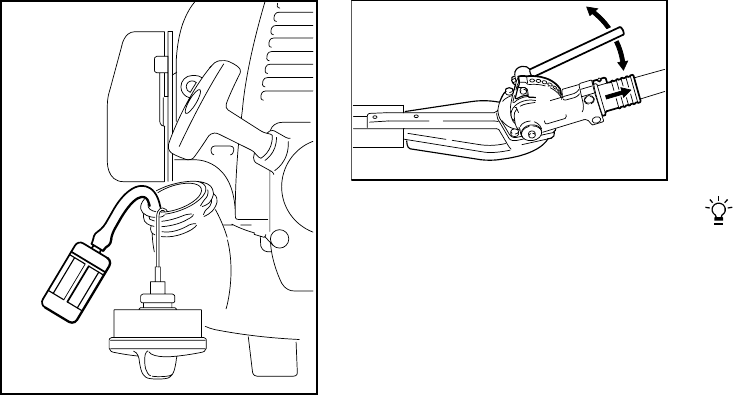
Before fueling, clean the filler cap and
the area around it to ensure that no dirt
falls into the tank.
Always thoroughly shake the mixture in
the canister before fueling your
machine.
In order to reduce the risk of burns
or other personal injury from
escaping gas vapor and fumes,
remove the fuel filler cap carefully
so as to allow any pressure build-up
in the tank to release slowly.
After fueling, tighten fuel cap as
securely as possible by hand.
Gaso-
line
Oil (STIHL 50:1 or
equivalent branded TC oils)
US gal. US fl.oz
12.6
2 1/2 6.4
5 12.8
Fueling
389BA031 KN
17HL 75, HL 75 K
English / USA
Change the fuel pick up body every
year.
Before storing your machine for a long
period, drain and clean the fuel tank and
run engine until carburetor is dry.
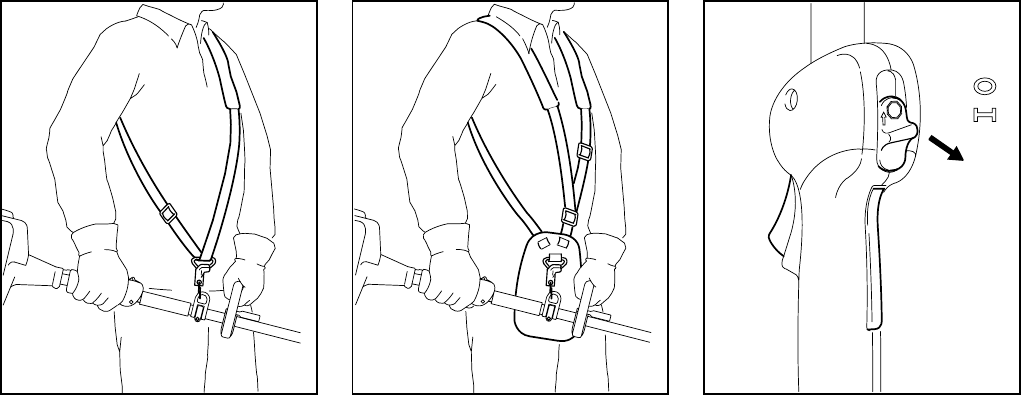
The angle of the cutter bar can be
adjusted to 8 positions between 0°
(straight) and 90° (right angle).
This choice of angles helps enhance the
versatility of the unit.
To adjust cutter blade angle
:Shut off the engine.
:Pull back the sliding sleeve (1) and
use lever (2) to adjust joint by one or
several holes.
:Release the sliding sleeve and
allow pin to engage the quadrant
(3).
Sliding sleeve butts against the
housing when the pin is properly
engaged (after making adjustment).
389BA032 KN
Adjusting Cutter Bar Angle
(adjustable version only)
2
388BA012 KN
1
3
18
English / USA
HL 75, HL 75 K
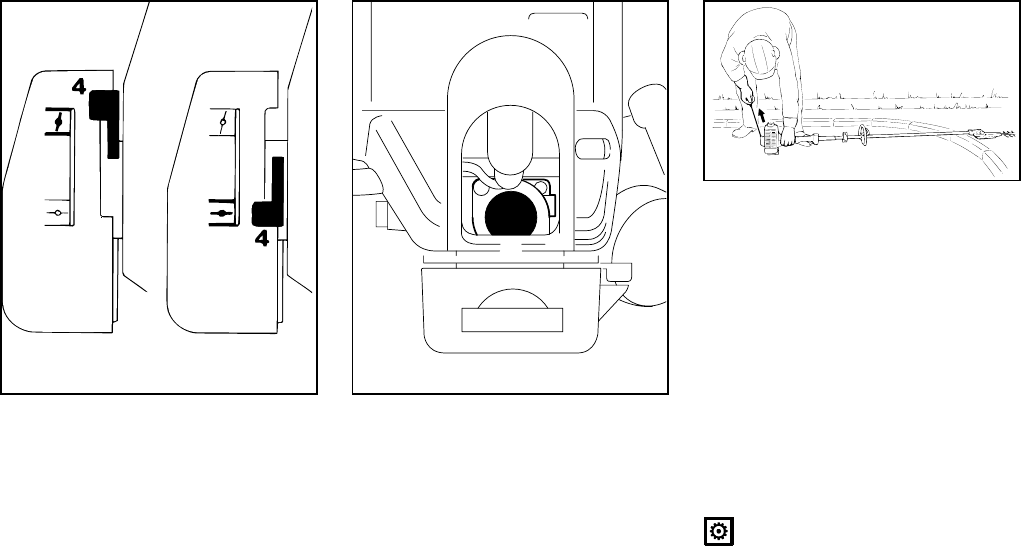
Shoulder strap
:Put on the shoulder strap (1).
:Adjust length until the spring hook
(3) rests against your right hip.
Full harness*
:Put on the full harness (2).
:Adjust length until the spring hook
(3) rests against your right hip.
* see chapter
“Symbols Used in this Manual“
Starting
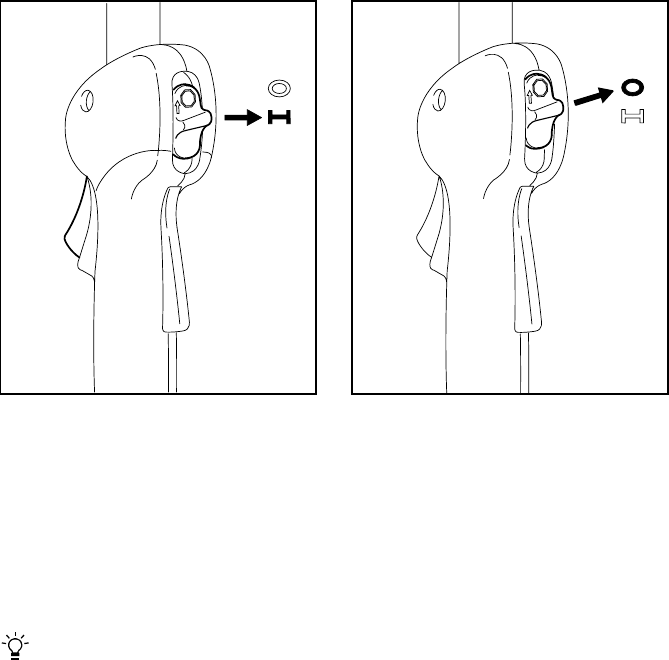
:Hold down the trigger interlock (1)
and squeeze the throttle trigger (2).
:Move the slide control (3) to the
START position.
:Now release the throttle trigger,
slide control and trigger interlock
in that order. This is the starting
throttle position.
Fitting the Harness
3
1
389BA040 KN
3
2
389BA041 KN
Starting / Stopping
the Engine
3
2
225BA003 KN
START
1
STOP
19HL 75, HL 75 K
English / USA
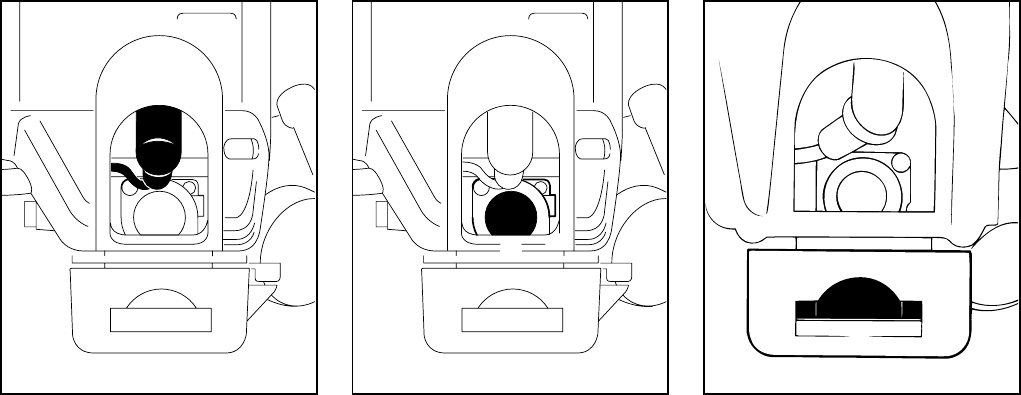
:Set the choke lever (4):
For cold start to g
For warm start to e
(also use this setting if the engine
has been running but is still cold)
:Press the fuel pump bulb (5) at least
five times even if bulb is already
filled with fuel.
:Place the unit on the ground: It must
rest securely on the engine support
and the gearbox.
:Remove the blade scabbard.
:Check that the cutting tool is not
touching the ground or any other
obstacles. lf necessary, rest the
gearbox on a raised support (e.g.
mound, brick or something similar).
:Make sure you have a firm footing.
:Hold the unit with your left hand and
press it down firmly – your thumb
should be under the fan housing.
Do not stand or kneel on the drive
tube since it will otherwise be
permanently bent and damaged.
3
55BA008
5
392BA002 KN
389BA013 KN
20
English / USA
HL 75, HL 75 K
:Pull the starter grip slowly with your
right hand until you feel it engage
and then give it a brisk strong pull.
Do not pull out the starter rope all
the way – it might otherwise break.
:Do not let the starter grip snap back.
Guide it slowly back into the housing
so that the starter rope can rewind
properly.
When engine begins to fire:
:Move the choke lever to e and
continue cranking.
As soon as engine runs:
:Blip the throttle trigger (2) – the slide
control (3) moves to the run position
# – and the engine settles down to
idle speed.
Make sure the carburetor is
correctly adjusted – cutting blades
must not run when the engine is
idling.
Your hedge cutter is now ready for
operation.
To shut down the engine:
:Move the slide control (3) to $
(STOP).
At very low outside temperatures
As soon as the engine runs:
:Blip the throttle trigger to disengage
the starting throttle position –
the slide control moves to the run
position # and the engine settles
down to idle speed.
:Open the throttle slightly and allow
engine to warm up for a brief period.
3
2
225BA005 KN
START
STOP
3
225BA006 KN
START
STOP
21HL 75, HL 75 K
English / USA
If the engine does not start
If you did not move the choke lever to
e quickly enough after the engine
began to fire, the combustion chamber is
flooded.
:Move slide control to $ (STOP).
:Pull off the spark plug boot (6).
:Unscrew and dry off the spark plug.
:Squeeze throttle trigger all the way
to open the throttle wide.
:Crank the engine several times with
the starter to clear the combustion
chamber.
:Refit the spark plug.
:Connect the spark plug boot (press
it down firmly).
:Move slide control to START.
:Set choke lever to e, even if engine
is cold.
:Now start the engine.
Fuel tank run until dry
:After refueling, press the fuel pump
bulb (5) at least five times – even if
bulb is filled with fuel.
:Now start the engine.
Dirty air filters reduce engine power
increase fuel consumption and make
starting more difficult.
If there is a noticeable loss of engine
power
:Move choke lever to g.
:Press in the tab (1).
:Ease the filter cover (2) over the tab
and take it away.
:Clean away loose dirt from around
the filter.
:Remove the foam and felt filter
elements.
6
392BA005 KN
5
392BA002 KN
Cleaning the Air Filter
355BA014 KN
2
1
22
English / USA
HL 75, HL 75 K
:Wash the foam element in a clean,
non-flammable cleaning solution
(e.g. warm soapy water) and then
dry.
:Fit new felt element.
As a temporary measure you can
knock it out on the palm of your
hand or blow it out with compressed
air. Do not wash.
Replace damaged parts!
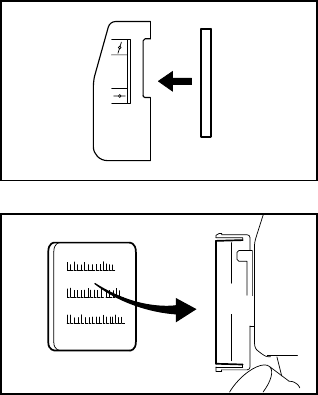
:Install the foam element (3) in the
filter cover (2).
:Place felt element (4) (lettering
facing inward) in filter housing (5).
:Fit filter cover so that it snaps into
position.
Exhaust emissions are controlled by the
design of the fundamental engine
parameters and components (e.g.
carburation, ignition, timing and valve or
port timing) without the addition of any
major hardware.
General Information
The carburetor comes from the factory
with a standard setting.
This setting provides an optimum fuel-air
mixture under most operating
conditions.
With this carburetor it is only possible to
adjust the high speed screw within fine
limits.
23
355BA031 KN
45
355BA032 KN
Motor Management Adjusting the Carburetor
23HL 75, HL 75 K
English / USA
Standard Setting
:Shut off the engine.
:Inspect the cutting blades and clean
if necessary (they must be clean,
move freely and not be warped).
:Check the air filter and install a new
one if necessary.
:Check spark arresting screen* and
clean or replace as necessary.
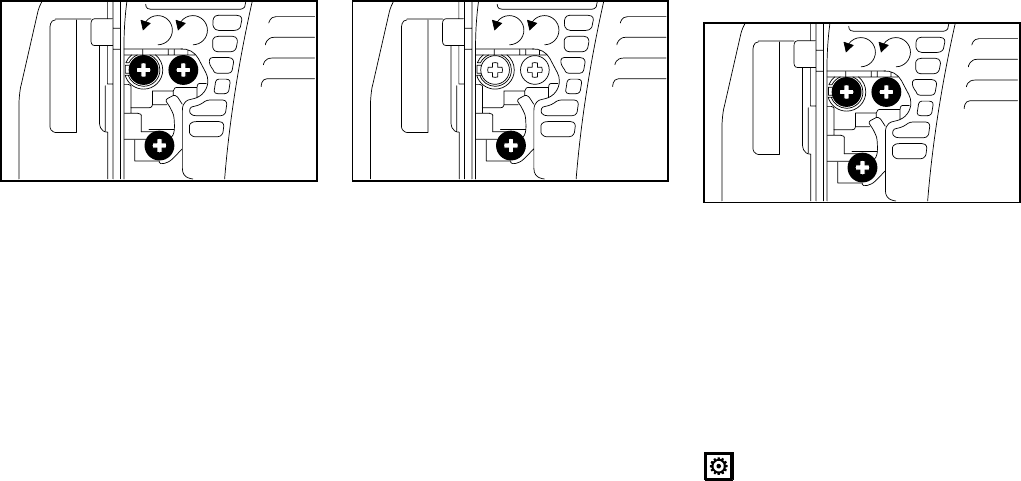
:Turn high speed screw (H)
counterclockwise (max. 3/4 turn) as
far as stop.
:Carefully screw the low speed
screw (L) clockwise down onto its
seat. Then open it one full turn
counterclockwise.
:Start and warm up the engine.
:Adjust idle speed with the idle speed
screw (LA) so that the cutting
blades do not run.
* see "Guide to Using this Manual"
Adjusting Idle Speed
Engine stops while idling
:Turn idle speed screw (LA) slowly
clockwise until the engine runs
smoothly – the cutting blades must
not run.
Cutting blades run when engine is
idling
:Turn idle speed screw (LA) slowly
counterclockwise until cutting
blades stop running and then turn
the screw about another 1/2 to 1
turn in the same direction.
Erratic idling behavior, poor
acceleration
Idle setting too lean:
:Turn low speed screw (L)
counterclockwise (about 1/4 turn)
until the engine runs and
accelerates smoothly.
It is usually necessary to change the
setting of the idle speed screw (LA)
after every correction to the low speed
screw (L).
Fine Tuning for Operation at
High Altitude
A slight correction of the setting of the
high speed screw (H) may be necessary
if engine power is not satisfactory when
operating at high altitude:
:Check standard setting.
:Allow the engine to warm up.
:Turn high speed screw (H) and low
speed screw (L) clockwise (leaner).
To avoid the risk of engine damage,
do not make the mixture too lean as
this will otherwise cause the engine
to over-rev.
It is usually necessary to change the
setting of the idle speed screw (LA)
after every correction to the low speed
screw (L).
LA
HL
1
3 / 4
389BA051 KN
LA
HL
1
3 / 4
389BA052 KN
LA
HL
1
3 / 4
389BA051 KN
24
English / USA
HL 75, HL 75 K
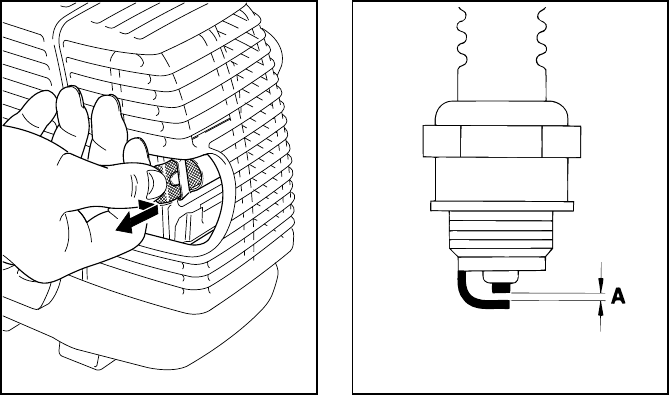
If the engine is low on power, check the
spark arresting screen in the muffler.
:Lift spark arresting screen and pull it
out sideways.
:Clean spark arresting screen if
necessary.
:If screen is damaged or coked up, fit
a new one.
:Refit the spark arresting screen.
* see “Guide to Using this Manual”
Wrong fuel mix (too much engine oil in
the gasoline), a dirty air filter and
unfavorable running conditions (mostly
at part throttle etc.) affect the condition of
the spark plug. These factors cause
deposits to form on the insulator nose
which may result in trouble in operation.
If engine is down on power, difficult to
start or runs poorly at idling speed, first
check the spark plug.
:Remove spark plug - see “Starting /
Stopping the Engine“.
:Clean dirty spark plug.
:Check electrode gap (A) and
readjust if necessary – see
"Specifications".
:Use only resistor type spark plugs
of the approved range.
Rectify problems which have caused
fouling of spark plug:
:Too much oil in fuel mix.
:Dirty air filter.
:Unfavorable running conditions,
e.g. operating at part load.
Fit a new spark plug after approx. 100
operating hours
or earlier if the electrodes are badly
eroded.
Spark Arresting Screen* in
Muffler
392BA035 KN
Checking the Spark Plug
000BA002 KN
25HL 75, HL 75 K
English / USA
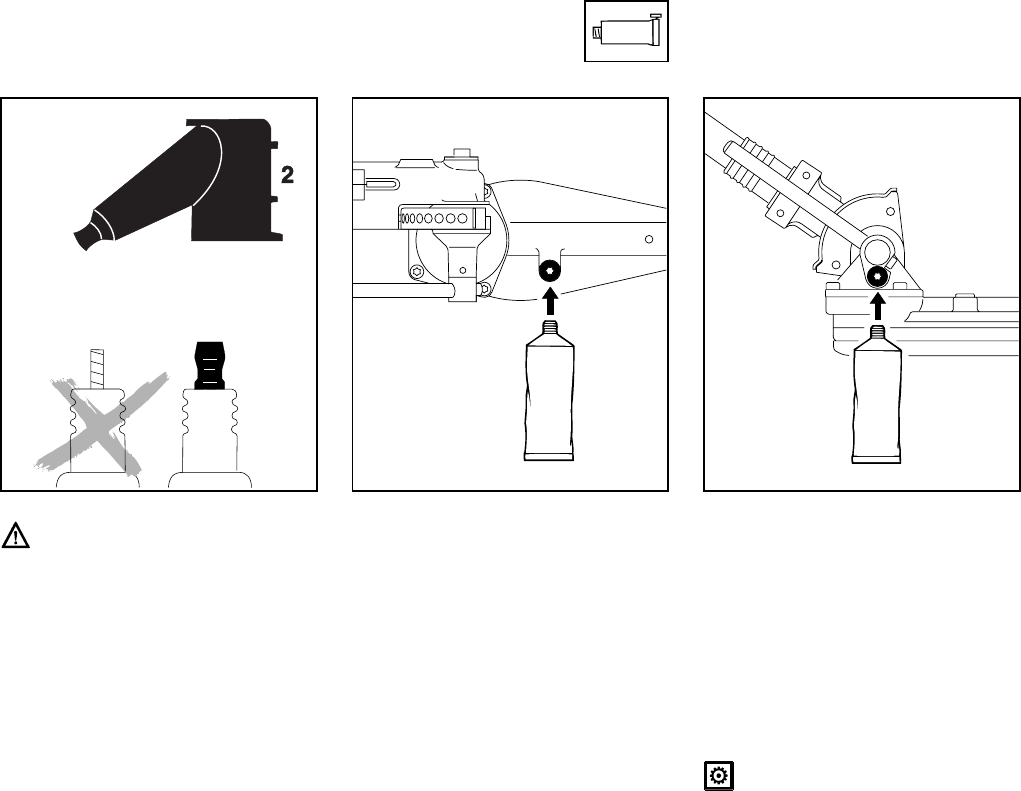
To reduce the risk of fire and burn
injury, use only spark plugs
authorized by STIHL. Always press
spark plug boot (2) snugly onto
spark plug terminal (1) of the proper
size. (Note: If boot has detachable
SAE adapter nut, it must be
attached.)
A loose connection between spark
plug boot and ignition wire
connector in the boot may create
arcing that could ignite combustible
fumes and cause a fire.
Use STIHL gear lubricant for hedge
trimmers** to lubricate the blade drive
gear after about every 25 hours of
operation.
:Unscrew the filler plug (1).
:Screw the tube of grease (2) into the
filler hole.
:Sqeeze about 20g (3/4 oz) grease
into the gearbox.
:Refit the filler plug and tighten it
down firmly.
** see "Specifications"
Use STIHL gear lubricant for
brushcutters** to lubricate the angle
drive after about every 25 hours of
operation.
:Unscrew the filler plug (3).
:If no grease can be seen on the
inside of the filler plug, screw the
tube of grease (4) into the filler hole.
:Squeeze 5 - 10g (about 1/4 oz)
grease into the gearbox.
Do not not completely fill the
gearbox with grease.
:Refit the filler plug and tighten it
down firmly.
** see "Specifications"
000BA036 TR
1
Lubricating the
Gearbox
1
225BA008 KN
2
1
225BA009 KN
2
26
English / USA
HL 75, HL 75 K
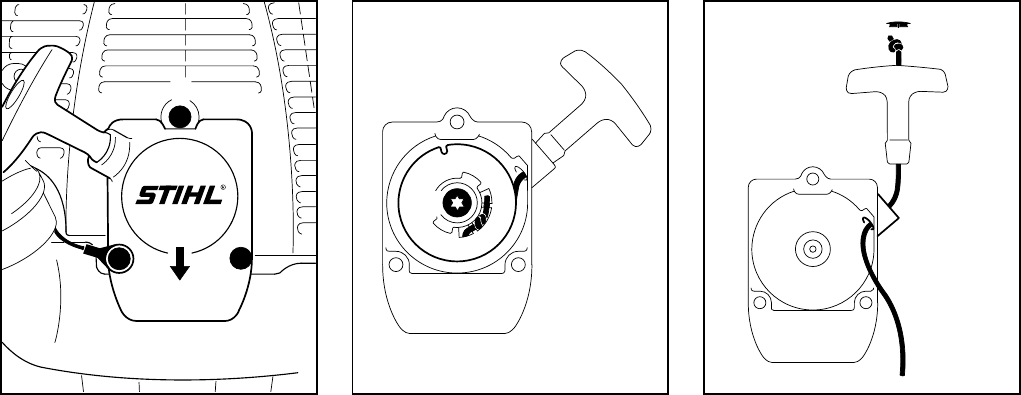
:Take out the screws (1).
:Remove the cable lug (if fitted).
:Lift the starter cover (2) away from
the tank (3) and pull it out from
under the shroud (4).
:Take out the screw (5).
:Remove the rope rotor very
carefully – the rewind spring is
seated in the rope rotor and may
pop out and uncoil if care is not
taken.
:Use a screwdriver to ease the cap
(6) out of the starter grip.
:Remove remaining rope from the
rotor and grip, making sure the
ElastoStart sleeve is not pushed out
of the grip.
:Tie a simple overhand knot in the
end of the new starter rope – see
"Specifications" – and then thread
the rope through the top of the grip
and the rope bush (7).
:Refit the cap in the grip.
Replacing the Starter Rope
and Rewind Spring
386BA004 KN
1
11
2
3
4
5
392BA014 KN
6
7
392BA015 KN
27HL 75, HL 75 K
English / USA
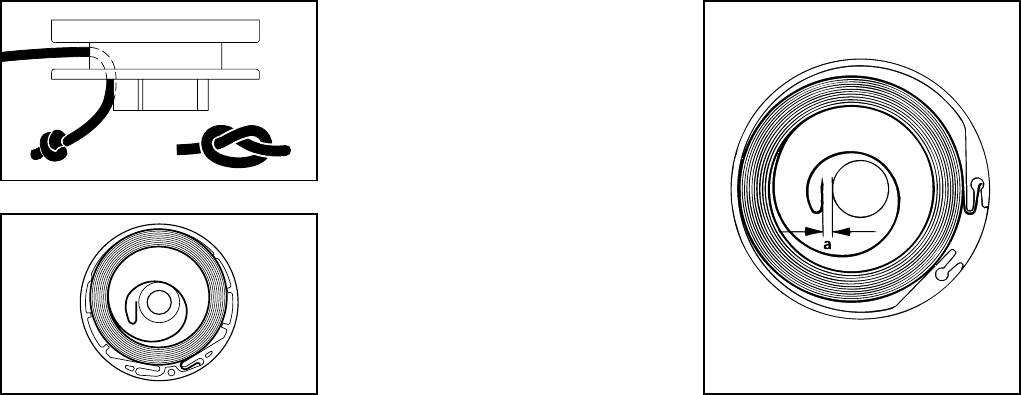
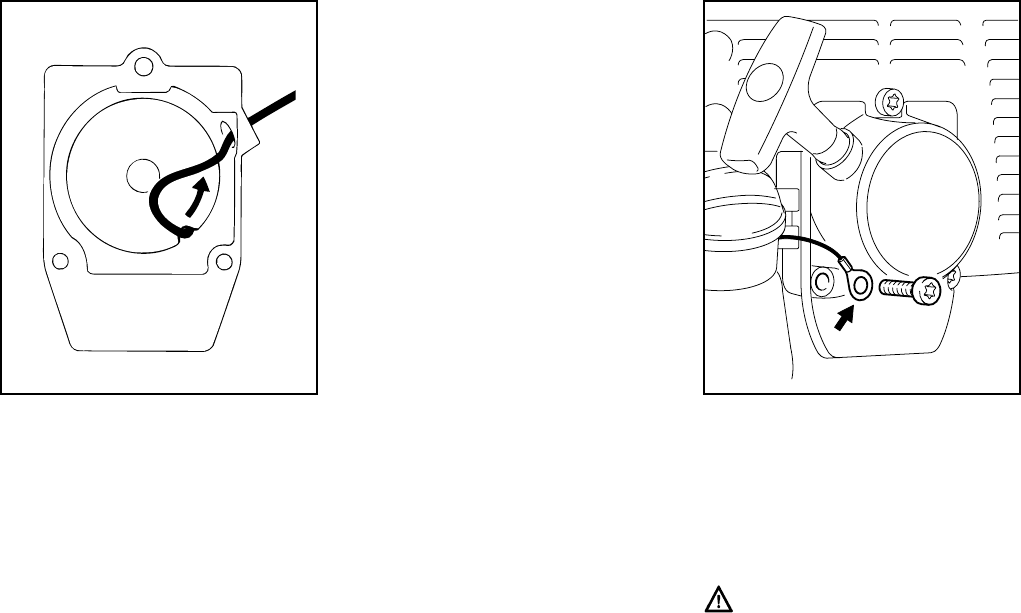
:Pull the rope through the rotor and
secure it with a simple overhand
knot.
:Coat rope rotor bearing bore with
non-resinous oil – see “Special
Accessories“.
:Slide rotor onto starter post –
turn it back and forth until the rewind
spring anchor loop (8) engages.
:Insert screw and tighten down
securely.
:Go to "Tensioning the rewind
spring".
Replacing a broken rewind spring
:Lubricate the new spring with a few
drops of non-resinous oil – see
“Special Accessories“–, do not open
the wire retainer
:Remove the rope rotor.
:Remove parts of old spring.
:Fit the new spring –
position outer spring loop in the
recess – the wire retainer slips off in
this process.
If the spring has popped out:
Refit it in the counterclockwise
direction –
starting outside and working inward.
:Install the rope rotor.
:Check dimension "a" on inner
spring loop and bend it to size if
necessary.
:Go to "Tensioning the rewind
spring".
392BA024 KN
8
392BA025 KN
355BA022 KN
a = 2mm
(0.08in)
28
English / USA
HL 75, HL 75 K
Tensioning the rewind spring
:Make a loop in the unwound
starter rope and use it to turn
the rope rotor six full revolutions
counterclockwise.
Hold the rotor steady –
straighten the twisted rope –
release the rotor –
let go of rope slowly so that it winds
onto the rotor.
The starter grip must be firmly seated in
the rope guide bush.
If grip droops to one side:
Add one more turn on rope rotor to
increase spring tension.
:When the starter rope is fully
extended it must be possible to
rotate the rotor another half turn.
If this is not the case, the spring is
overtensioned and could break.
Take one turn of rope off the rotor.
:Fit the starter cover.
To do this, push the upper mounting
boss under the shroud –
line up the tank and push lower part
of cover onto the tank.
:Insert and tighten down the housing
screws.
Secure cable lug in position (if
fitted).
355BA021 KN
386BA005 KN

29HL 75, HL 75 K
English / USA
The blades must be resharpened if
cutting performance and behavior begin
to deteriorate (i.e. if blades frequently
snag on branches).
It is best to have the cutting blades
resharpened by your STIHL dealer on a
workshop sharpener.
It is also possible to use a flat crosscut
sharpening file. See “Specifications” for
prescribed sharpening or filing angle.
:Always file towards the cutting
edge.
:The file only sharpens on the
forward stroke - lift it off the blade on
the backstroke.
:Use a whetstone to remove burr
from cutting edge.
:Remove as little material as
possible.
:After sharpening, clean filing or
grinding dust off the cutting blades
and lubricate with grease.
Do not operate your machine with
dull or damaged cutting blades.
This may cause overload and will
give unsatisfactory cutting results.
During break-in period
A factory new machine should not be run
at high revs (full throttle off load) for the
first three tank fillings. This avoids
unnecessary high loads during the
break-in period. As all moving parts
have to bed in during the break-in
period, the frictional resistances in the
engine are greater during this period.
The engine develops its maximum
power after about 5 to 15 tank fillings.
During operation
After a long period of full-throttle
operation, allow engine to run for a while
at idle speed so that the heat in the
engine can be dissipated by flow of
cooling air. This protects engine-
mounted components (ignition,
carburetor) from thermal overload.
After finishing work
Storing for short period:
Wait for engine to cool down. To avoid
condensation, fill the fuel tank and keep
the unit in a dry place until you need it
again. Storing for a long period:
see chapter "Storing the Machine".
For periods of about 3 months or longer
:Drain and clean the fuel tank in a
well ventilated area.
:Run engine until carburetor is dry -
this helps prevent carburetor
diaphragms sticking together.
:Clean the cutting blades, check
condition and spray with STIHL
resin solvent.
:Thoroughly clean the machine - pay
special attention to the cylinder fins
and air filter.
:Store the machine in a dry, high or
locked location - out of the reach of
children and other unauthorized
persons.
Sharpening Instructions Operating Instructions Storing the Machine

30
English / USA
HL 75, HL 75 K
* see “Guide to Using this Manual”
Maintenance Chart
Please note that the following maintenance intervals apply for normal operating
conditions only. If your daily working time is longer than normal or operating
conditions are difficult (very dusty work area, resinous growth etc.), shorten the
specified intervals accordingly.
before
starting work
after finishing
work or daily
after each
refueling stop
weekly
monthly
every 12 months
if problem
if damaged
as required
Complete machine Visual inspection (condition, leaks) XX
Clean X
Throttle trigger, slide control Check operation XX
Air filter Clean XX
Replace X
Filter in fuel tank Check X
Replace XXX
Fuel tank Clean X
Carburetor Check idle setting XX
Readjust idle X
Spark plug Readjust electrode gap X
Cylinder fins Clean X
Spark arresting* screen in muffler Inspect X
Clean or replace X
All accessible screws and nuts
(not adjusting screws) Retighten X
Cutter blade Visual inspection XX
Sharpen X
Gearbox lubrication Check X
Top up X
Drive shaft Check lubrication X
Lubricate X
31HL 75, HL 75 K
English / USA
1Loop handle*
2Barrier bar*
3Carrying ring (for harness)
4Slide control
5Throttle trigger interlock
6Throttle trigger
7Spark plug boot
8Air filter cover
9Machine support
10 Cutting blade
11 Cutter blade guard
12 Blade drive gear
13 Angle drive
14 Drive tube
15 Sliding sleeve*
16 Adjusting lever*
17 Quadrant*
18 Fuel tank
19 Fuel filler cap
20 Starter grip
21 Fuel pump
22 Choke lever
23 Carburetor adjusting screw
24 Muffler
* see “Guide to Using this Manual”
Parts and Controls
3
14
13
389BA048 KN
17
15
16
18
19
20
21
22
23 24
10
11 12
4
2
6
7
1
58
9
32
English / USA
HL 75, HL 75 K
1. Loop Handle*
To hold the hedge cutter with both
hands.
2. Barrier Bar*
Helps keep unit at a safe distance
from operator's feet and legs.
3. Carrying Ring
The device to connect the hedge
cutter to the harness.
4. Slide Control
Starting throttle lock and stop
switch. Keeps the throttle partially
open during starting and switches
the engine's ignition off and stops
the engine.
5. Throttle Trigger Interlock
Must be depressed before the
throttle trigger can be activated.
6. Throttle Trigger
Controls the speed of the engine.
7. Spark Plug Boot
Connects the spark plug to the
ignition wire.
8. Air Filter Cover
Covers the air filter element.
9. Machine Support
For resting machine on the ground.
10. Cutting Blades
Steel blades for cutting hedges and
shrubs.
11. Cutting Blade Guard
Covers cutting blade when hedge
cutter is not in use.
12. Blade Drive Gear
Converts rotary motion of angle
drive into reciprocating movement
of cutting blades.
13. Angle Drive
Transmits rotary motion of drive
shaft to the blade drive gear.
14. Drive Tube
Device to connect the engine with
the gearbox.
15. Sliding Sleeve*
Sleeve for locking and unlocking the
adjusting mechanism.
16. Adjusting Lever*
Lever for swiveling cutter bar to
required angle.
17. Quadrant*
Locks the cutter bar in the required
position.
18. Fuel Tank
For fuel and oil mixture.
19. Fuel Filler Cap
For closing the fuel tank.
20. Starter Grip
The grip of the pull starter, which is
the device to start the engine.
21. Fuel Pump
Provides additional fuel feed for a
cold start.
22. Choke Lever
Eases engine starting by enriching
mixture.
23. Carburetor Adjusting Screw
For tuning carburetor.
24. Muffler
(with spark arresting screen*)
Attenuates exhaust noises and
diverts exhaust gases away from
operator.
* see “Guide to Using this Manual”
Definitions
33HL 75, HL 75 K
English / USA
Engine
EPA:
The Emission Compliance Period
referred to on the Emissions
Compliance Label indicates the number
of operating hours for which the engine
has been shown to meet Federal
emission requirements.
Category A = 300 hours,
B = 125 hours,
C = 50 hours
CARB:
The Emission Compliance Period used
on the CARB Air Index Label indicates
the terms:
Extended = 300 hours
Intermediate = 125 hours
Moderate = 50 hours
Single cylinder two-stroke engine
Ignition System
Electronic magneto ignition
Spark Plug (resistor-type)
Bosch WSR 6 F or NGK BPMR 7 A or
Champion RCJ 6Y
Electrode Gap
0.02 in (0.5 mm)
Carburetor
All position diaphragm carburetor with
integral fuel pump
Rewind Starter
Starter rope, 0.12 in dia (3.0 mm)
0000 195 8203 (33.5 in, 850 mm lang)
Fuel Tank Capacity
0.93 US.pt (0.44 L)
Fuel Mix
See chapter "Fuel"
Cutting Blades
Double-edged for bidirectional cutting
Blade length 20 in (500 mm)
Sharpening Angle
45° to horizontal
Weight
Special Accessories
Shoulder strap
Full harness
Safety glasses
STIHL gear lubricant for hedge
trimmers
2.8 oz (80 g) tube: 0781 120 1109
8 oz (225 g) tube: 0781 120 1110
STIHL gear lubricant for brushcutters
2.8 oz (80 g) tube: 0781 120 1117
8 oz (225 g) tube: 0781 120 1118
STIHL special oil
Resin-free lubricating oil
3.4 fl.oz (100 ml) bottle: 0781 417 1315
Displacement 1.55 cu.in
(25.4cm3)
Bore 1.34 in (34 mm)
Stroke 1.10 in (28 mm)
Engine power
to ISO 8893 1.3 HP
(0.95 kW)
Specifications
Engine with drive tube
(without cutting
attachment)
HL 75:
HL 75 K:
9.7 lb
(4,2 kg)
9 lb
(4.1 kg)
Cutting attachment,
complete
with 0° and 30° cutter bar:
with adjustable cutter bar:
4.4 lb
(2.0 kg)
5.1 lb
(2.3 kg)
34
English / USA
HL 75, HL 75 K
The user of this unit should carry out
only the maintenance operations
described in this manual. Other repair
work may be performed only by an
authorized STIHL dealer.
Warranty claims following repairs can be
accepted only if the repair has been
performed by an authorized STIHL
dealer using original STIHL replacement
parts.
Original STlHL parts can be identified by
the STIHL part number, the
STIHl
logo and the STlHL parts symbol (.
The symbol may appear alone on small
parts.
Maintenance and Repairs
35HL 75, HL 75 K
English / USA
Your Warranty Rights
and Obligations
The U.S. Environmental Protection
Agency (EPA), the California Air
Resources Board (CARB) and STIHL
Incorporated are pleased to explain the
Emission Control System Warranty on
your model year 2000 and later
equipment type engine. In California,
new small off-road engines must be
designed, built and equipped to meet the
State's stringent anti-smog standards. In
other states, new 1997 and later model
year small off-road equipment engines
must be designed, built and equipped, at
the time of sale, to meet the U.S. EPA
regulations for small non road engines.
The equipment engine must be free from
defects in materials and workmanship
which cause it to fail to conform with
U.S. EPA standards for the first two
years of engine use from the date of sale
to the ultimate purchaser.
STIHL Incorporated must warrant the
emission control system on your small
off-road engine for the period of time
listed below provided there has been no
abuse, neglect or improper maintenance
of your small off-road equipment engine.
Your emission control system includes
parts such as the carburetor and the
ignition system. Also included may be
hoses, and connectors and other
emission related assemblies.
Where a warrantable condition exists,
STIHL Incorporated will repair your
small off-road equipment engine at no
cost to you, including diagnosis (if the
diagnostic work is performed at an
authorized dealer), parts, and labor.
Manufacturer's Warranty
Coverage:
The small off-road equipment engines
are warranted for two years in California.
In other states, 1997 and later model
year small off-road equipment engines
are also warranted for two years. If any
emission-related part on your engine is
defective, the part will be repaired or
replaced by STIHL Incorporated free of
charge.
Owner's Warranty
Responsibilities:
As the small off-road equipment engine
owner, you are responsible for the per-
formance of the required maintenance
listed in your owner's manual. STIHL
Incorporated recommends that you
retain all receipts covering maintenance
on your small off-road equipment
engine, but STIHL Incorporated cannot
deny warranty solely for the lack of
receipts or for your failure to ensure the
performance of all scheduled
maintenance.
Any replacement part or service that is
equivalent in performance and durability
may be used in non-warranty mainten-
ance or repairs, and shall not reduce the
warranty obligations of the engine
manufacturer.
As the small off-road equipment engine
owner, you should be aware, however,
that STIHL Incorporated may deny you
warranty coverage if your small off-road
equipment engine or a part has failed
due to abuse, neglect, improper
maintenance or unapproved
modifications.
You are responsible for presenting your
small off-road equipment engine to a
STIHL service center as soon as a
problem exists. The warranty repairs will
be completed in a reasonable amount of
time, not to exceed 30 days.
If you have any questions regarding your
warranty rights and responsibilities,
please contact a STIHL customer
service representative at
1-800-467-8445 or you can write to
STIHL Inc., 536 Viking Drive,
P.O . B o x 2 0 1 5 ,
Virginia Beach, VA 23450-2015.
Coverage by STIHL Incorporated
STIHL Incorporated warrants to the
ultimate purchaser and each
subsequent purchaser that your small
off-road equipment engine will be
designed, built and equipped, at the time
of sale, to meet all applicable
regulations. STIHL Incorporated also
warrants to the initial purchaser and
each subsequent purchaser that your
engine is free from defects in materials
and workmanship which cause the
engine to fail to conform with applicable
regulations for a period of two years.
STIHL Incorporated Federal and California
Emission Control Warranty Statement
36
English / USA
HL 75, HL 75 K
Warranty Period
The warranty periods will begin on the
date the utility equipment engine is
purchased by the initial purchaser and
you have signed and sent back the
warranty card to STIHL. If any emission
related part on your engine is defective,
the part will be replaced by STIHL
Incorporated at no cost to the owner.
Any warranted part which is not
scheduled for replacement as required
maintenance, or which is scheduled only
for regular inspection to the effect of
"repair or replace as necessary" will be
warranted for the warranty period.
Any warranted part which is scheduled
for replacement as required mainten-
ance will be warranted for the period of
time up to the first scheduled replace-
ment point for that part.
Diagnosis
You, as the owner, shall not be charged
for diagnostic labor which leads to the
determination that a warranted part is
defective. However, if you claim
warranty for a component and the
machine is tested as non-defective,
STIHL Incorporated will charge you for
the cost of the emission test.
Mechanical diagnostic work will be
performed at an authorized STIHL
servicing dealer. Emission test may be
performed either at STIHL Incorporated
or at any independent test laboratory.
Warranty Work
STIHL Incorporated shall remedy war-
ranty defects at any authorized STIHL
servicing dealer or warranty station. Any
such work shall be free of charge to the
owner if it is determined that a warranted
part is defective. Any manufacturer-
approved or equivalent replacement part
may be used for any warranty
maintenance or repairs on emission-
related parts and must be provided
without charge to the owner. STIHL
Incorporated is liable for damages to
other engine components caused by the
failure of a warranted part still under
warranty.
The California Air Resources Board's
Emission Warranty Parts List specifically
defines the emission-related warranted
parts. These warranted parts are:
Carburetor
Choke (Cold start enrichment system)
Intake manifold
Air filter
Spark plug
Magneto or electronic ignition system
(ignition module)
Catalytic converter (if applicable)
Fasteners
Where to make a claim for
Warranty Service
Bring the product to any authorized
STIHL servicing dealer and present the
signed warranty card.
Maintenance Requirements
The maintenance instructions in this
manual are based on the application of
the recommended 2-stroke fuel-oil
mixture (see also instruction "Fuel").
Deviations from this recommendation
regarding quality and mixing ratio of fuel
and oil may require shorter maintenance
intervals.
Limitations
This Emission Control Systems War-
ranty shall not cover any of the following:
:repair or replacement required
because of misuse, neglect or lack
of required maintenance,
:repairs improperly performed or
replacements not conforming to
STIHL Incorporated specifications
that adversely affect performance
and/or durability, and alterations or
modifications not recommended or
approved in writing by STIHL
Incorporated,
and
:replacement of parts and other
services and adjustments
necessary for required maintenance
at and after the first scheduled
replacement point.
37HL 75, HL 75 K
español / EE.UU
Las tintas contienen aceites vegetales,
el papel es reciclable
Impreso en papel sin cloro© ANDREAS STIHL AG & Co. KG, 2003
0458 389 3021. M1.4. C3. PM. Printed in USA
STIHl
Contenido
Guía para el uso de este manual ... 38
Medidas de seguridad .................... 39
Armado de la máquina ................... 48
Uso del cortasetos .......................... 49
Combustible ................................... 51
Llenado de combustible ................. 52
Ajuste del ángulo de la barra
de corte .......................................... 53
Colocación del arnés ...................... 54
Arranque / parada del motor ........... 54
Limpieza del filtro de aire ............... 57
Manejo del motor ............................ 58
Ajuste del carburador ..................... 58
Chispero* en silenciador ................ 60
Revisión de la bujía ........................ 60
Lubricación de la caja
de engranajes ................................. 61
Sustitución de la cuerda
de arranque y resorte
de rebobinado ................................ 62
Instrucciones de afilado .................. 65
Instrucciones de manejo ................ 65
Almacenamiento de la máquina ..... 65
Tabla de mantenimiento ................. 66
Piezas y controles .......................... 67
Definiciones .................................... 68
Especificaciones ............................. 69
Mantenimiento y reparación ........... 70
Declaración de garantía
de STIHL Incorporated sobre
sistemas de control de emisiones
según normas Federales y
del Estado de California ................. 71
* vea "Guía para el uso de este
manual"
Permita que solamente las personas
que comprenden la materia tratada en
este manual manejen su cortasetos.
Para obtener el rendimiento y satisfac-
ción máximos del cortasetos STIHL, es
importante leer y comprender las ins-
trucciones de mantenimiento y las pre-
cauciones de seguridad antes de usarlo.
Comuníquese con el concesionario o
distribuidor de STIHL si no se entiende
alguna de las instrucciones dadas en el
presente manual.
!Advertencia
Dado que el cortasetos es una herra-
mienta de corte de gran velocidad, es
necesario tomar medidas especiales de
seguridad para reducir el riesgo de
lesiones.
El uso descuidado o inadecuado puede
causar lesiones graves e incluso morta-
les.
La filosofía de STIHL es mejorar conti-
nuamente todos su productos. Como
resultado de ello, periódicamente se
introducen cambios de diseño y mejo-
ras. Si las características de funciona-
miento o la apariencia de su cortasetos
difieren de las descritas en este manual,
comuníquese con el concesionario
STIHL para obtener la información y
ayuda que requiera.
38
español / EE.UU
HL 75, HL 75 K
Pictogramas
Todos los pictogramas que se encuen-
tran en la máquina se muestran y expli-
can en este manual.
Las instrucciones de uso y manipulación
vienen acompañadas de ilustraciones.
Símbolos en el texto
Los pasos individuales o procedimientos
descritos en el manual pueden estar
señalados en diferentes maneras:
:Paso o procedimiento sin referencia
directa a una ilustración.
Descripción del paso o procedimiento
que se refiere directamente a la ilustra-
ción y contiene los números de referen-
cia que aparecen en la ilustración.
Ejemplo:
Suelte el tornillo (1)
Palanca (2) ...
Además de las instrucciones de uso,
en este manual pueden encontrarse
párrafos a los que usted debe prestar
atención especial. Tales párrafos están
marcados con los símbolos que se
describen a continuación:
Advertencia donde existe el
riesgo de un accidente o lesiones
personales o daños graves a la
propiedad.
Advertencia donde existe el
riesgo de dañar la máquina o
los componentes individuales.
Nota o sugerencia que no es
esencial para el uso de la máquina,
pero puede ayudar al operador a
comprender mejor la situación y
mejorar su manera de manejar la
máquina.
Nota o sugerencia sobre el procedi-
miento correcto con el fin de evitar
dañar el medio ambiente.
Equipo y características
Este manual de instrucciones
abarca varios modelos con diferen-
tes características. Los componen-
tes que no se encuentran instalados
en todos los modelos y las aplica-
ciones correspondientes están mar-
cados con un *. Esos componentes
son ofrecidos como accesorios
especiales por el concesionario
STIHL.
Mejoramientos técnicos
La filosofía de STIHL es mejorar conti-
nuamente todos su productos. Como
resultado de ello, periódicamente se
introducen cambios de diseño y mejo-
ras. Si las características de funciona-
miento o la apariencia de su máquina
difieren de las descritas en este manual,
comuníquese con el concesionario
STIHL para obtener la ayuda que
requiera.
Por lo tanto, no podemos responsabili-
zarnos por los cambios, modificaciones
o mejoramientos que no hayan sido
cubiertos en este manual.
Guía para el uso de este
manual

39HL 75, HL 75 K
español / EE.UU
Advertencia
Dado que el cortasetos es
una herramienta de corte
motorizada que funciona
a gran velocidad, es
necesario tomar medidas especiales de
seguridad para reducir el riesgo de
lesiones.
Es importante que usted
lea, comprenda bien y
respete las siguientes
advertencias y medidas
de seguridad. Lea el
manual del usuario y las
instrucciones de seguridad periódica-
mente. El uso descuidado o inadecuado
de cualquier cortasetos puede causar
lesiones graves e incluso mortales.
Pida a su concesionario STIHL que le
enseñe el manejo del cortasetos. Res-
pete todas las disposiciones, reglamen-
tos y normas de seguridad locales del
caso.
!Advertencia
El uso de cualquier cortasetos puede
ser peligroso. Si la herramienta de corte
llega a tener contacto con parte alguna
de su cuerpo, le causará cortaduras.
El choque con objetos extraños tales
como piedras, alambres o piezas metá-
licas puede dañar el accesorio de corte
y puede hacer que las cuchillas se agrie-
ten, se piquen o se rompan.
STIHL no recomienda usar los cortase-
tos en zonas en las cuales la cuchilla
pudiera entrar en contacto con tales
objetos.
!Advertencia
Nunca permita que los niños usen un
cortasetos. No se debe permitir la proxi-
midad de otros, especialmente niños y
animales, donde se esté utilizando el
cortasetos.
El operador es responsable de evitar las
lesiones a terceros y los daños a la pro-
piedad.
Nunca deje el cortasetos funcionando
sin vigilancia.
!Advertencia
No preste ni alquile nunca el cortasetos
sin el manual del usuario. Asegúrese
que todas las personas que utilicen el
cortasetos lean y comprendan la infor-
mación contenida en este manual.
El uso seguro de un cortasetos atañe a
1. el operador
2. el cortasetos
3. el uso del cortasetos.
EL OPERADOR
Condición física
Usted debe estar en buenas condicio-
nes físicas y psíquicas y no encontrarse
bajo la influencia de ninguna sustancia
(drogas, alcohol, etc.) que le pueda res-
tar visibilidad, destreza o juicio. No
maneje el cortasetos cuando está fati-
gado.
Esté alerta. Si se cansa durante el
manejo del cortasetos, tómese un des-
canso. El cansancio puede provocar
una pérdida del control. El uso de cual-
quier cortasetos es fatigoso. Si usted
padece de alguna dolencia que pueda
ser agravada por la fatiga, consulte a su
médico antes de utilizar el cortasetos. El
uso prolongado de un cortasetos (u
otras máquinas) expone al operador a
vibraciones que pueden provocar el
fenómeno de Raynaud (dedos blancos)
o el síndrome del túnel del carpio. Estas
condiciones reducen la capacidad
manual de sentir y regular la tempera-
tura, producen entumecimiento y ardor y
pueden provocar trastornos nerviosos y
circulatorios, así como necrosis de los
tejidos.
Medidas de seguridad

40
español / EE.UU
HL 75, HL 75 K
!Advertencia
Los sistemas antivibración no le garanti-
zan que va a estar totalmente protegido
contra la enfermedad de Raynaud o el
síndrome del túnel del carpio. Por lo
tanto, los operadores constantes y regu-
lares deben controlar con frecuencia el
estado de sus manos y dedos. Si apa-
rece alguno de los síntomas arriba men-
cionados, consulte inmediatamente al
médico.
!Advertencia
El sistema de encendido de la máquina
STIHL produce un campo electromag-
nético de intensidad muy baja. El mismo
puede interferir con algunos tipos de
marcapasos. Para reducir el riesgo de
lesiones graves o mortales, las perso-
nas portadoras de marcapasos deben
consultar a sus médicos y al fabricante
del marcapasos antes de usar esta
máquina.
Vestimenta adecuada
!Advertencia
El uso del cortasetos
puede causar lesiones
graves a los ojos, oídos y
el cuerpo de una persona.
Por ello, para reducir el
riesgo de daños en los
ojos, nunca maneje el cortasetos si no
lleva gafas protectoras o anteojos de
seguridad bien puestos con protección
adecuada en las partes superior y late-
rales, de acuerdo con la norma ANSI Z
87.1 (o la regulación nacional aplicable).
Para protegerse la cara, STIHL reco-
mienda el uso de una máscara o masca-
rilla por encima de las gafas o anteojos
de seguridad.
!Advertencia
El ruido del cortasetos
puede dañar sus oídos.
Siempre use amortigua-
dores del ruido (tapones u
orejeras) para protegerse
los oídos. Los usuarios
constantes y regulares deben some-
terse con frecuencia a un examen o con-
trol auditivo.
Utilice un casco de seguridad aprobado
para reducir el riesgo de lesionarse la
cabeza en caso de existir tal tipo de peli-
gro.
Use vestimenta protectora adecuada.
Protéjase las manos con
guantes al manejar el cor-
tasetos y la herramienta
de corte. Los guantes
gruesos y antideslizantes
mejoran el manejo y ayu-
dan a proteger las manos.
La ropa debe ser de con-
fección fuerte y ajustada,
pero no tanto que impida
la completa libertad de
movimiento. Evite el uso
de chaquetas sueltas,
bufandas, corbatas, joyas, pantalones
acampanados o con vueltas, pelo largo
suelto o cualquier cosa que pueda
engancharse en las ramas, matorrales o
piezas en movimiento de la máquina.
Use pantalones largos hechos de un
material grueso para protegerse las
piernas.
No vista pantalones cortos.
Una buena base de
apoyo es indispensable
cuando se maneja el cor-
tasetos. Póngase botas
gruesas con suela anti-
deslizante. Recomenda-
mos las botas de seguridad con puntera
de acero.
EL CORTASETOS
Para las ilustraciones y definiciones de
las piezas del cortasetos, vea el capítulo
"Piezas y controles".
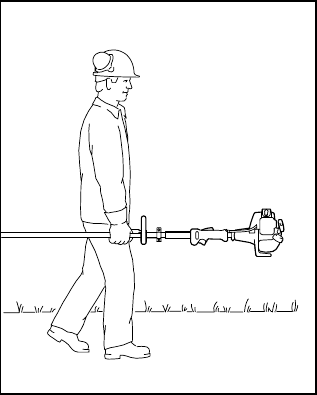
41HL 75, HL 75 K
español / EE.UU
!Advertencia
Nunca modifique, de ninguna manera,
un cortasetos. Utilice únicamente los
accesorios suministrados por STIHL o
expresamente autorizados por STIHL
para usarse con los modelos específi-
cos de cortasetos STIHL. Si bien es
posible conectar al cortasetos de STIHL
ciertos accesorios no autorizados, su
uso puede ser, en la práctica, extrema-
damente peligroso. Nunca quite ni des-
active ningún dispositivo de seguridad.
USO DEL CORTASETOS
Transporte del cortasetos
!Advertencia
Para reducir el riesgo de sufrir lesiones
debido al contacto con las cuchillas,
nunca transporte el cortasetos con las
cuchillas en marcha. El ajuste correcto
de la velocidad de ralentí del motor es
importante en cuanto a esto se refiere.
Si el carburador está debidamente ajus-
tado, las cuchillas estarán detenidas con
el motor a ralentí.
!Advertencia
Apague el motor y asegúrese que el
accesorio de corte esté detenido antes
de colocar la máquina en el suelo o tras-
ladarla de un puesto de trabajo a otro.
El cortasetos puede acarrearse sola-
mente en posición horizontal. Agarre el
eje de una manera que mantenga la
máquina equilibrada horizontalmente.
Mantenga el silenciador caliente lejos de
su cuerpo y el accesorio de corte detrás
de usted.
Siempre apague el motor y coloque el
protector sobre las cuchillas antes de
transportar el cortasetos sobre una dis-
tancia considerable. Cuando se trans-
porte el cortasetos en un vehículo, fíjelo
de modo seguro para evitar que la
máquina se voltee, que se derrame el
combustible o que se dañe el cortase-
tos.
Preparación para el uso del cortase-
tos.
!Advertencia
Nunca use un cortasetos que esté
dañado o mal cuidado. Siempre revise
el cortasetos para comprobar que está
en buenas condiciones y que funciona
correctamente antes de arrancarlo, en
particular el gatillo de aceleración y su
bloqueo, el interruptor de parada y la
herramienta de corte. El gatillo de acele-
ración debe moverse libremente y siem-
pre debe retornar a la posición de ralentí
por la acción de resorte.
La herramienta de corte debe estar
correctamente apretada y en buenas
condiciones de trabajo. Busque piezas
sueltas (tuercas, tornillos, etc.) y cuchi-
llas agrietadas, dobladas, deformadas o
dañadas. Revise periódicamente la con-
dición y el apriete de las cuchillas - ¡con
el motor apagado!
389BA019 KN
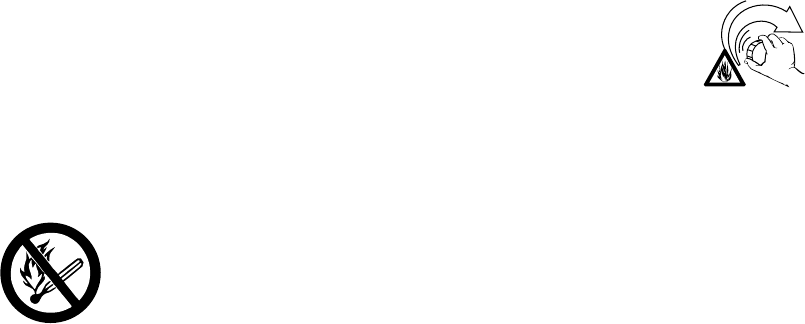
42
español / EE.UU
HL 75, HL 75 K
Repare las cuchillas dañadas antes de
usar el cortasetos. Mantenga las cuchi-
llas siempre afiladas. Mantenga los
mangos limpios y secos en todo
momento; es particularmente impor-
tante mantenerlos libres de aceite y resi-
nas para garantizar que la máquina
pueda empuñarse firmemente para
mantenerla bajo control seguro. Stihl
recomienda que siempre rocíe las cuchi-
llas con el disolvente de resina STIHL
antes de empezar a trabajar - ¡con el
motor apagado! Este producto protector
puede obtenerse a través del concesio-
nario. Aplique cantidades abundantes.
Llenado de combustible
El cortasetos STIHL utiliza una mezcla
de aceite-gasolina como combustible
(vea el capítulo "Combustible" en el
manual del usuario).
!Advertencia
La gasolina es un com-
bustible muy inflamable.
Si se derrama y arde a
causa de una chispa u
otra fuente de ignición,
puede provocar un incen-
dio y quemaduras graves o daños a la
propiedad. Tenga sumo cuidado cuando
manipule gasolina o la mezcla de com-
bustible.
No fume cerca del combustible, ni acer-
que ningún fuego o llama al mismo.
Instrucciones para el llenado de com-
bustible
Llene el cortasetos con combustible en
lugares al aire libre bien ventilados.
!Advertencia
Dependiendo del combustible utilizado,
de las condiciones climáticas y del sis-
tema de ventilación del tanque, es posi-
ble que se forme vapor de gasolina a
presión dentro del tanque de gasolina
de los motores de dos tiempos. Para
reducir el riesgo de quemaduras, así
como otras lesiones corporales ocasio-
nadas por los escapes de vapor de
gasolina y otras emanaciones, quite la
tapa de llenado de combustible del cor-
tasetos cuidadosamente de modo que la
presión que se pueda haber acumulado
en el tanque se disipe lentamente.
Nunca quite la tapa de llenado de com-
bustible mientras el motor está funcio-
nando. Elija una superficie despejada
para llenar el tanque y aléjese 3 m (10
pies) por lo menos del lugar en que lo
haya llenado antes de arrancar el motor.
Limpie los derrames de combustible
antes de arrancar el cortasetos y com-
pruebe que no existen fugas.
Compruebe que no existen fugas de
combustible mientras llena el tanque y
durante el funcionamiento de la
máquina. Si detecta alguna fuga de
combustible, no arranque el motor ni lo
haga funcionar sin antes reparar la fuga
y limpiar el combustible derramado.
Tenga cuidado de no mancharse la ropa
con combustible. Si la mancha, cámbie-
sela inmediatamente. Nunca intente lle-
nar con combustible una máquina cuyo
motor esté en marcha o caliente.
!Advertencia
Las vibraciones de la
máquina pueden aflojar
una tapa de combustible
que ha quedado mal
apretada, o simplemente
soltarla y derramar com-
bustible.
Para reducir el riesgo de derrames e
incendio, apriete la tapa de combustible
a mano con la mayor fuerza posible.
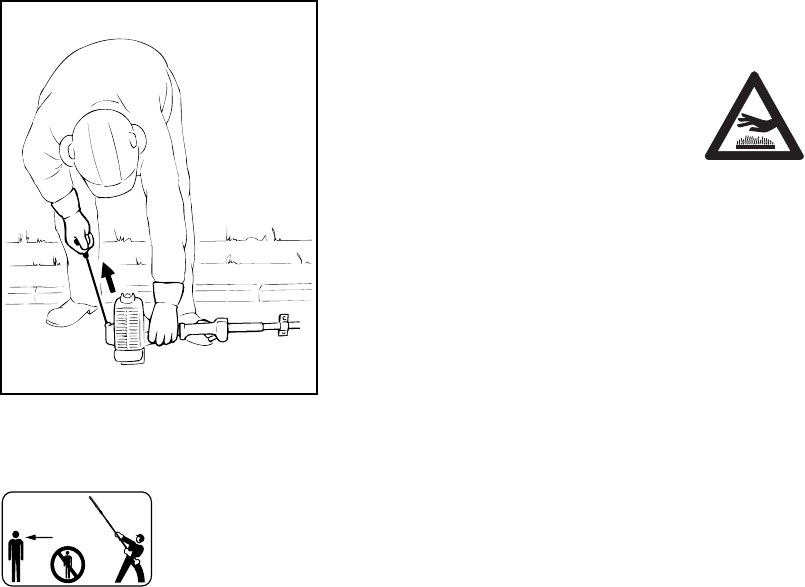
43HL 75, HL 75 K
español / EE.UU
Arranque
!Advertencia
Su cortasetos es
una máquina que
debe ser mane-
jada por sola-
mente una per-
sona. Ponga en
marcha y maneje el cortasetos sin
ayuda de nadie. Para reducir el riesgo
de lesiones, no permita que nadie se
acerque a menos de 15 m (50 pies) de
distancia.
Para las instrucciones específicas de
arranque, vea la sección correspon-
diente en el manual del usuario. Colo-
que el cortasetos sobre suelo firme u
otra superficie dura en una zona despe-
jada. Mantenga el equilibrio y elija un
buen punto de apoyo para los pies.
!Advertencia
Al arrancar el motor con el acelerador en
posición de arranque, su velocidad será
suficiente para conectar el embrague y
mover la herramienta de corte.
!Advertencia
Cuando tire del mango de arranque, no
enrolle la cuerda de arranque alrededor
de la mano. No deje que el mango
vuelva por sí solo a su posición original,
sino guíe lentamente la cuerda para que
se enrolle correctamente. Si no ejecuta
este procedimiento puede lastimarse la
mano o los dedos y también dañar el
mecanismo de arranque.
Convertidor catalítico
!Advertencia
Algunos modelos de
sopladores STIHL están
equipados con un conver-
tidor catalítico, el que está
diseñado para reducir las
emisiones de escape del
motor mediante un proceso químico en
el silenciador. Debido a este proceso, el
silenciador no se enfría tan rápidamente
como los del tipo convencional cuando
el motor regresa a ralentí o es apagado.
Para reducir el riesgo de incendio y de
lesiones por quemadura, es necesario
respetar las siguientes medidas de
seguridad específicas.
!Advertencia
Como un silenciador con convertidor
catalítico se enfría más lentamente que
los silenciadores convencionales, apoye
siempre su soplador en posición vertical
y no lo coloque nunca donde el silencia-
dor quede cerca de material seco como
por ejemplo matorrales, pasto o virutas
de madera, o sobre otros materiales
combustibles mientras todavía está
caliente.
389BA023 KN
15m (50ft)

44
español / EE.UU
HL 75, HL 75 K
Deje que el motor se enfríe apoyado
sobre una superficie de hormigón,
metal, suelo raso o madera maciza (por
ej., el tronco de un árbol caído) lejos de
cualquier sustancia combustible.
!Advertencia
Para reducir el riesgo de incendio o
lesiones por quemadura, deje que la
máquina se enfríe antes de reabastecer
de combustible el cortasetos después
de usarlo.
!Advertencia
Nunca desarme ni modifique el silencia-
dor. El silenciador podría dañarse y cau-
sar el aumento de la radiación de calor o
chispas, aumentando así el riesgo de
incendio o lesiones por quemadura.
Además, se podría dañar permanente-
mente el motor. Haga reparar el silencia-
dor únicamente por el concesionario de
servicio STIHL.
!Advertencia
Para reducir el riesgo de incendio o
lesiones por quemadura, mantenga lim-
pia la zona alrededor del silenciador.
Quite toda la basura tal como las agujas
de pinos, ramas u hojas.
!Advertencia
Una caja de cilindro dañada o mal insta-
lada, o una envuelta del silenciador
dañada o deformada, puede perjudicar
el efecto de enfriamiento del convertidor
catalítico. Para reducir el riesgo de
incendio o lesiones por quemadura, no
continúe trabajando con una caja de
cilindro dañada o mal instalada, o una
envuelta del silenciador dañada o defor-
mada. El convertidor catalítico está
dotado de rejillas diseñadas para reducir
el riesgo de incendio debido a la emisión
de partículas calientes. Debido al calor
de la reacción catalítica, estas rejillas
normalmente permanecen limpias y no
necesitan servicio o mantenimiento. Si
el rendimiento de su máquina comienza
a disminuir y sospecha que las rejillas
están obstruidas, haga reparar el silen-
ciador por un concesionario de servicio
STIHL.
Condiciones de trabajo
No la maneje usando el bloqueo de ace-
lerador de arranque, pues no tendrá
control de la velocidad del motor. Vea la
sección en su manual del usuario sobre
el uso correcto del control deslizante.
!Advertencia
Su cortasetos emite
gases de escape tóxicos
apenas el motor de com-
bustión empieza a funcio-
nar.
Estos gases (por ej., monóxido de car-
bono) pueden ser incoloros e inodoros.
Para reducir el riesgo de lesiones cau-
sadas por la inhalación de vapores tóxi-
cos, arranque y use el cortasetos única-
mente en lugares abiertos y bien
ventilados. Sujete el cortasetos en una
posición tal que no se respiren los vapo-
res de escape.
Maneje el cortasetos solamente en con-
diciones de buena visibilidad y a la luz
del día.
!Advertencia
Verifique que sus pies estén debida-
mente apoyados en la superficie. Tenga
cuidado especial sobre superficies res-
baladizas y sobre pendientes. Tenga
cuidado sobre suelo irregular. Esté
atento a la presencia de tocones, raíces,
zanjas u agujeros que pudieran hacerle
tropezar y caer.
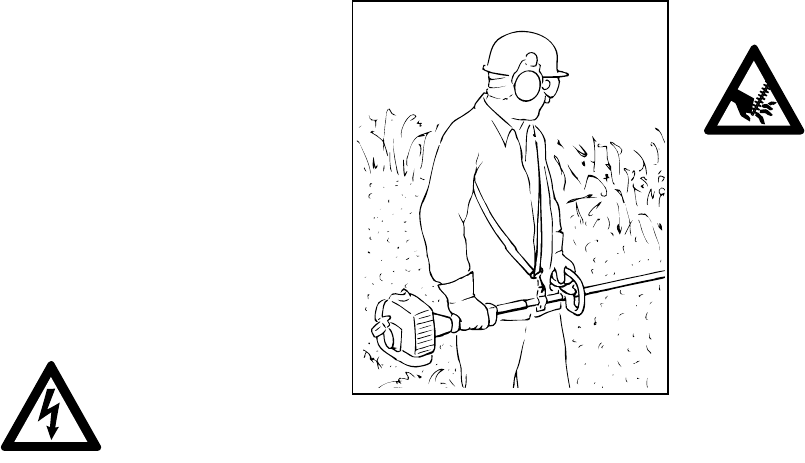
45HL 75, HL 75 K
español / EE.UU
Antes de empezar a trabajar, examine la
zona alrededor del seto en busca de pie-
dras, alambres, piezas metálicas u otros
objetos macizos que pudieran dañar las
cuchillas.
Cuando se trabaje cerca del suelo, com-
pruebe que no entre arena, grava o pie-
dras entre las cuchillas de corte.
!Advertencia
Cuando pode la parte superior de un
seto más alto y la visibilidad esté obs-
truida, inspeccione frecuentemente el
otro lado del seto para cerciorarse que
no haya personas, animales y obstruc-
ciones.
Peligro
Este cortasetos no está
aislado contra las sacudi-
das eléctricas. Para redu-
cir el riesgo de electrocu-
ción, nunca utilice el cortasetos cerca de
alambres o cables (de alimentación,
etc.) que puedan tener corriente eléc-
trica.
Instrucciones de manejo
No corte ningún tipo de material que no
sea setos y arbustos. Las herramientas
de corte pueden usarse solamente para
las operaciones descritas en su manual.
!Advertencia
Para reducir el riesgo de sufrir lesiones
debido a la pérdida del control del corta-
setos, siempre trabaje sujetándolo fir-
memente con las dos manos. La mano
derecha debe sujetar el mango trasero.
Esto también corresponde a personas
zurdas. Cierre firmemente los dedos
sobre los mangos delantero y trasero.
!Advertencia
Nunca intente manejar el
cortasetos con una sola
mano. La pérdida de con-
trol del cortasetos puede
ocasionar lesiones graves
o mortales. Para evitar el
riesgo de lesionarse gravemente, nunca
toque las cuchillas en movimiento.
Trabaje siempre con calma y cuidadosa-
mente; esté atento para no poner en
peligro a terceros. Si las cuchillas de
corte se atascan al cortar ramas grue-
sas u otros objetos, apague el motor de
inmediato antes de intentar liberarlas.
!Advertencia
Para reducir el riesgo de lesiones cau-
sadas por la pérdida del control, nunca
trabaje sobre una escalera, un árbol o
cualquier otra superficie de soporte
poco seguro.
!Advertencia
Las cuchillas tienden a seguir en mar-
cha por un período breve después de
haber soltado el gatillo de aceleración
(efecto de volante).
389BA024 KN
46
español / EE.UU
HL 75, HL 75 K
Ajustes importantes
!Advertencia
Para reducir el riesgo de lesiones perso-
nales debido a la pérdida de control o al
contacto con las cuchillas en movi-
miento, no use un cortasetos cuya velo-
cidad de ralentí está mal regulada.
Cuando el ralentí está correctamente
regulado, las cuchillas no deben
moverse. Para instrucciones cómo ajus-
tar el ralentí, vea la sección correspon-
diente en el manual del usuario. Si no
puede regular correctamente el ralentí,
pida a su concesionario STIHL que
revise el cortasetos y haga los ajustes o
reparaciones correspondientes.
MANTENIMIENTO, REPARACION
Y ALMACENAMIENTO
Los trabajos de mantenimiento,
reemplazo o reparación de los dispo-
sitivos y sistemas de control de emi-
siones de escape pueden ser realiza-
dos por cualquier taller o técnico de
motores no diseñados para vehícu-
los. Sin embargo, si usted está recla-
mando servicio de garantía para
algún componente que no ha sido
reparado o mantenido debidamente,
o cuando se utilizan repuestos no
autorizados, STIHL puede denegar la
garantía.
Utilice solamente piezas de repuesto de
STIHL para el mantenimiento y repara-
ción.
La utilización de piezas fabricadas por
otras empresas puede causar lesiones
graves o mortales.
Siga las instrucciones de mantenimiento
y reparación dadas en la sección corres-
pondiente del manual del usuario. Con-
sulte la tabla de mantenimiento en las
últimas páginas de este manual.
!Advertencia
Siempre apague el motor y asegúrese
que la herramienta de corte esté dete-
nida antes de efectuar algún trabajo de
mantenimiento, reparación o limpieza
en el cortasetos. No intente hacer nin-
gún trabajo de mantenimiento o repara-
ción que no esté descrito en su manual
del usuario. Este tipo de trabajo debe
realizarse únicamente en el taller de ser-
vicio de STIHL.
!Advertencia
Revise la condición de la herramienta de
corte en intervalos cortos regulares. Si
nota algún cambio en el comporta-
miento de la herramienta, revise inme-
diatamente el apriete y busque señales
de agrietamiento. Sustituya las herra-
mientas de corte dañadas o desafiladas
inmediatamente, incluso si tienen sólo
alguna grieta superficial.
Nunca repare los accesorios de corte
dañados aplicándoles soldadura, ende-
rezándolos o modificándoles su forma.
Esto puede causar el desprendimiento
de alguna pieza de la herramienta de
corte y producir lesiones graves o mor-
tales.
47HL 75, HL 75 K
español / EE.UU
!Advertencia
Para reducir el riesgo de incendio,
revise si hay fugas en la tapa de llenado
de combustible en intervalos regulares.
Use la bujía especificada y asegúrese
de que ella y el cable de encendido
están en buen estado.
Mantenga apretadas y limpias tanto la
bujía como la conexión de su alambre.
Revise la separación entre electrodos
de la bujía con un calibrador de espeso-
res por lo menos cada 50 horas de fun-
cionamiento y ajústela de ser necesario.
Instale una bujía nueva si sus electrodos
están muy picados.
Mantenga la herramienta de corte bien
afilada. Apriete todas las tuercas, per-
nos y tornillos, excepto los tornillos de
ajuste del carburador, después de cada
uso.
Siempre limpie el polvo y la tierra de la
máquina después de haber terminado
los trabajos.
¡No use disolvente de grasas para lim-
piar! En algunos países se encuentra
disponible una lata de aerosol de disol-
vente de resina (aerosol protector), N°
de pieza 0782 420 1002, para rociar las
cuchillas.
El disolvente de resina protege las
cuchillas y tiene propiedades anticorro-
sivas. Rocíe las cuchillas antes y des-
pués del trabajo. Después ponga en
marcha el cortasetos y déjelo funcionar
brevemente para que el disolvente se
distribuya uniformemente por las cuchi-
llas. Si el seto está muy polvoriento y
sucio, rocíe las cuchillas más frecuente-
mente. Esto reduce enormemente la
fricción de las cuchillas y los efectos
dañinos de savia y partículas de polvo.
!Advertencia
No maneje nunca el cortasetos si el
silenciador está dañado, se ha perdido o
si fue modificado. Un silenciador mal
cuidado aumenta el riesgo de incendio y
puede causar pérdida del oído. No
toque nunca un silenciador caliente,
puede quemarse. Si el silenciador está
equipado con un chispero para reducir
el riesgo de incendio (por ejemplo, en
EE.UU., Canadá y Australia), no maneje
nunca el cortasetos si le falta el chispero
o si el mismo está dañado. Recuerde
que el riesgo de incendios forestales es
mayor durante las estaciones calurosas
y secas.
Mantenga el motor y el silenciador libre
de recortes, virutas, hojas, fibras y lubri-
cante sobrante.
Para todo trabajo de mantenimiento, sír-
vase consultar la tabla de manteni-
miento y la declaración de garantía
que se encuentra al final de este
manual.
Guarde el cortasetos en un lugar seco,
elevado o con llave lejos del alcance de
los niños. Antes de guardar la máquina
durante un período de más de algunos
días, siempre vacíe el tanque de com-
bustible.
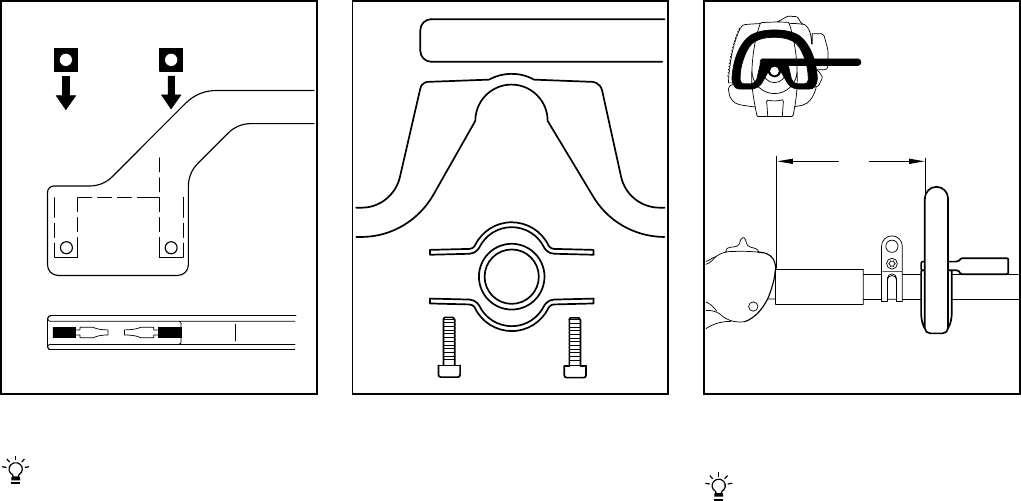
48
español / EE.UU
HL 75, HL 75 K
Montaje del mango tórico
No es necesario en el modelo con
ángulo fijo de 0° con manguera de
mango en el tubo de mando.
:Coloque las tuercas cuadradas (1)
en la barra de defensa (2) – los agu-
jeros deberán quedar alineados.
:Coloque la abrazadera (3) en el
mango tórico (4) y ponga los dos en
el tubo de mando (5).
:Coloque la abrazadera (6) en su
posición y coloque la barra de
defensa (2) de modo que los aguje-
ros queden alineados.
:Inserte los tornillos (7) y apriételos
con fuerza moderada contra la
barra de defensa.
:Alinee el mango tórico (4) y coló-
quelo en la posición más cómoda.
En el modelo HL 75 K, la distancia
A no deberá medir más de 30 cm
(12 pulg) – se recomienda que mida
aprox. 25 cm (10 pulg).
En el modelo HL 75, la distancia A
no deberá medir más de 55 cm (22
pulg) – se recomienda que mida
aprox. 35 cm (14 pulg).
:Apriete los tornillos (7) bien firmes.
Armado de la máquina
1
1
2
2
11
389BA001 KN
7
7
6
53
4
2
389BA002 KN
389BA042 KN
4
A
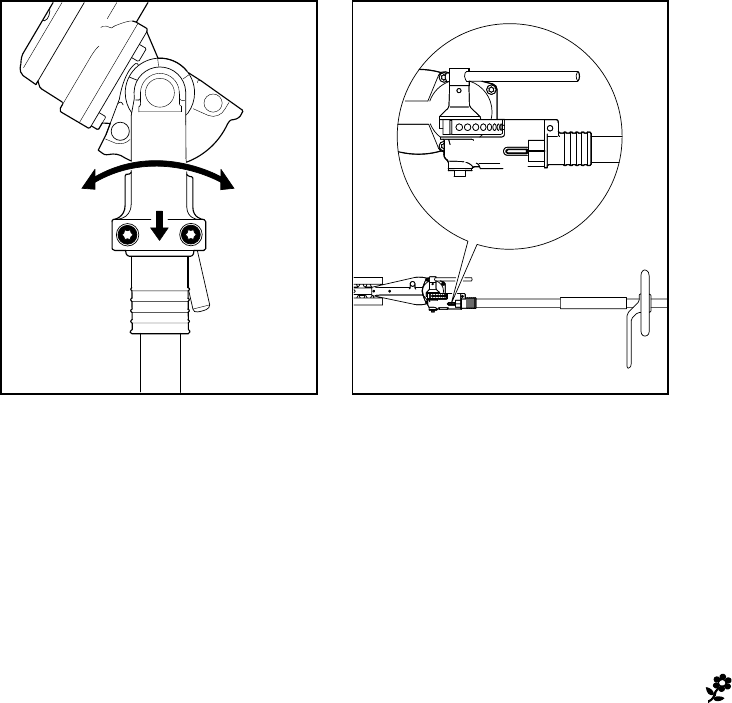
49HL 75, HL 75 K
español / EE.UU
Montaje de la caja de engranajes
:Suelte los tornillos de fijación (9).
:Empuje el tubo de mando (5) en la
caja de engranajes (10) – gire la
caja de engranajes en uno y otro
sentido según sea necesario.
:Una vez que el extremo del tubo de
mando está insertado más allá de la
ranura en la abrazadera (11),
empújelo totalmente hasta donde
tope.
:Coloque los tornillos de fijación y
apriételos moderadamente.
:Alinee la caja de engranajes (10).
:Apriete los tornillos de fijación de la
abrazadera firmemente.
No utilice el cortasetos durante los
períodos acostumbrados de descanso
en el vecindario.
Preparaciones
Utilice tijeras para cortar las ramas grue-
sas primero.
Siempre use un arnés.
Secuencia de corte
Si es necesario hacer un corte radical,
corte poco a poco haciendo varias pasa-
das.
Técnicas de corte
Corte vertical:
Gire la barra de corte hacia arriba y
hacia abajo describiendo un arco al cor-
tar el seto – utilice ambos lados de la
cuchilla de corte.
Corte horizontal:
Sujete la barra de corte a un ángulo de
0° a 10° al desplazar el cortasetos en
sentido horizontal.
Desplace la barra de corte describiendo
un arco hacia el exterior del seto, de
modo que los trozos cortados caigan al
suelo.
No tire los recortes al basurero –
pueden usarse para abono.
225BA001 KN
5
9
10
9
10
11
389BA043 KN
Uso del cortasetos
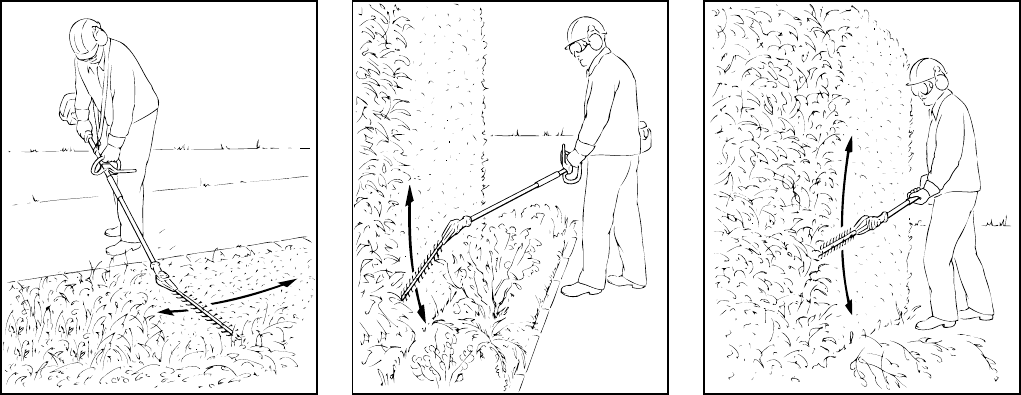
50
español / EE.UU
HL 75, HL 75 K
Corte horizontal
(con barra de corte angulada)
Corte cerca del suelo, estando de pie,
por ejemplo, arbustos de poca altura (no
con el modelo HL 75 K).
Corte vertical
(con barra de corte angulada)
Corte sin pararse directamente junto al
seto, por ejemplo, si hay flores entre el
operador y el seto.
Corte vertical
(con barra de corte recta)
Radio amplio de trabajo sin necesidad
de herramientas auxiliares.
389BA044 KN
389BA049 KN
389BA050 KN
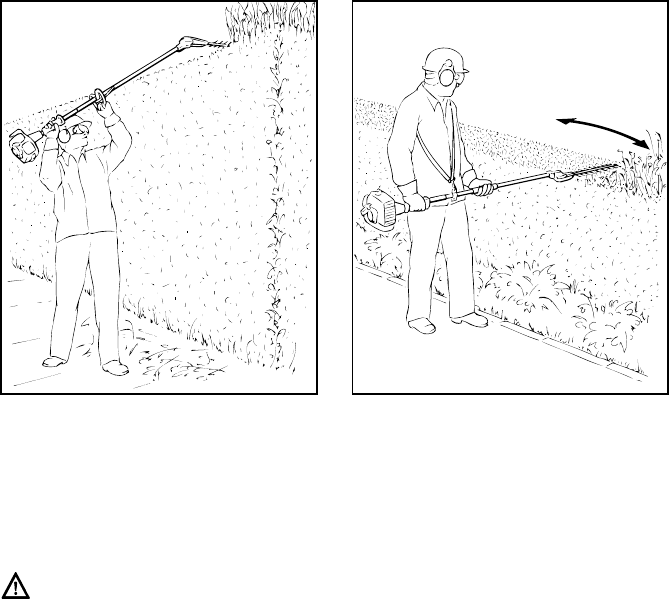
51HL 75, HL 75 K
español / EE.UU
Corte sobrecabeza
(con barra de corte angulada)
Sostenga el cortasetos sobre la cabeza
y muévalo describiendo un arco para
obtener el aprovechamiento máximo de
su alcance.
Toda posición de trabajo elevada
sobre el nivel de la cabeza produce
cansancio. Para reducir el riesgo de
accidentes, trabaje en estas posi-
ciones sólo por períodos breves.
Ajuste el ángulo de la barra de corte
ajustable al máximo, de modo que
se pueda sostener la máquina en
una posición más baja para producir
menos cansancio (con el arnés),
pero que provea un alcance vertical
adecuado.
Corte horizontal
(con barra de corte recta)
Corte sin pararse directamente delante
de un seto, por ejemplo, al recortar alre-
dedor de flores.
Este motor está homologado para fun-
cionar con gasolina sin plomo y una pro-
porción de mezcla de 50:1.
El motor de dos tiempos necesita una
mezcla de gasolina de buena marca y
aceite para motor de dos tiempos de
buena calidad clasificado TC.
Use gasolina regular sin plomo con un
octanaje mínimo de 89 RON. Si el octa-
naje de la gasolina regular en su zona
es más bajo, use gasolina superior sin
plomo ("premium").
Nota: Las máquinas con convertidor
catalítico requieren gasolina sin
plomo. La eficiencia del convertidor
catalítico puede reducirse por más del
50% si se llena el tanque de combustible
varias veces con gasolina con plomo.
El combustible de octanaje menor
puede producir preencendido (cau-
sando detonación) acompañado de un
aumento de la temperatura del motor.
Esto, a su vez, aumenta el riesgo de
agarrotamiento del pistón y daño al
motor.
La composición química del combusti-
ble también es importante. Algunos adi-
tivos de combustible no solamente son
perjudiciales para los elastómeros (dia-
fragmas del carburador, sellos de aceite,
mangueras de combustible, etc.), sino
también para las piezas fundidas de
magnesio. Esto podría causar proble-
mas de funcionamiento o incluso dañar
el motor. Por este motivo es esencial
usar únicamente combustibles de
buena marca comercial.
389BA009 KN
389BA047 KN
Combustible
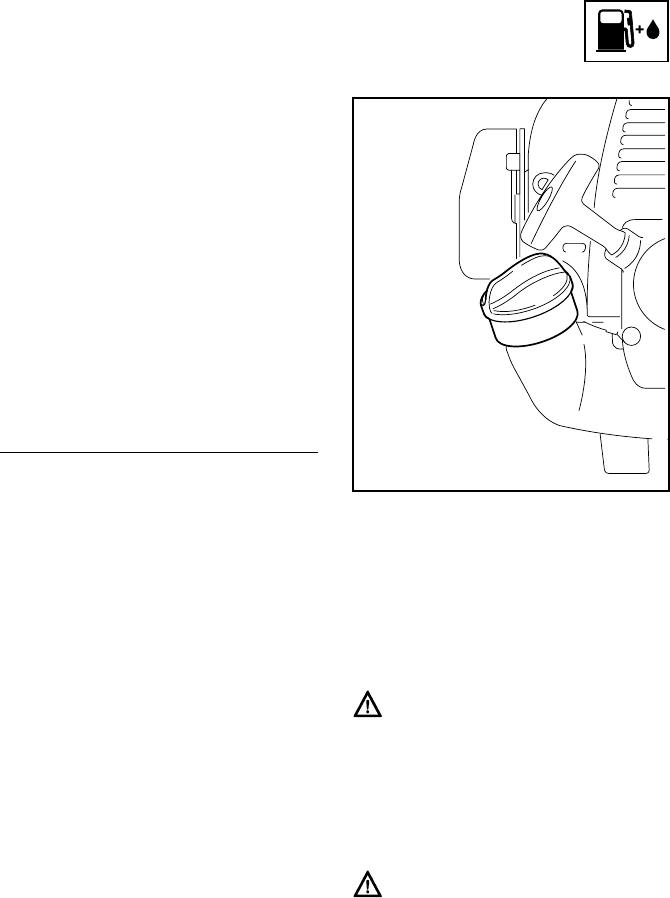
52
español / EE.UU
HL 75, HL 75 K
En la mezcla, use únicamente aceite de
STIHL para motor de dos tiempos o
aceites para motor de dos tiempos
enfriado por aire con la clasificación TC.
Nosotros recomendamos el aceite 50:1
de STIHL para motor de dos tiempos
porque está especialmente formulado
para usarse en motores de STIHL.
No use aceites para mezcla BIA o TCW
(dos tiempos enfriado por agua).
En los modelos con convertidor
catalítico mezcle exclusivamente con la
gasolina el aceite de motor STIHL 50:1
para servicio severo o un aceite de
calidad equivalente para motores de dos
tiempos.
Sea precavido cuando trabaje con gaso-
lina. Evite el contacto directo con la piel
y evite inhalar el vapor de combustible.
Mantenga el recipiente herméticamente
cerrado para evitar la entrada de hume-
dad a la mezcla.
Limpie periódicamente el tanque de
combustible y el recipiente en que
guarda la mezcla de combustible.
Envejecimiento de la mezcla
de combustible
Mezcle únicamente el combustible
suficiente para unos pocos días de
trabajo, no lo guarde por más de 3
meses. Guárdelo solamente en reci-
pientes especialmente aprobados para
combustible. Cuando prepare la mezcla,
primero vierta el aceite en el recipiente y
después incorpore la gasolina.
Deseche los recipientes vacíos de
aceite únicamente en vertederos
autorizados.
Antes de llenar la máquina con combus-
tible, limpie a fondo la tapa de llenado y
la zona alrededor del mismo para evitar
la entrada de tierra al tanque.
Siempre agite la mezcla vigorosamente
en el recipiente antes de llenar la
máquina con combustible.
Para reducir el riesgo de quemaduras,
así como otras lesiones corporales
ocasionadas por los escapes de vapor
de gasolina y otras emanaciones,
quite la tapa de llenado de combustible
cuidadosamente de modo que la pre-
sión que se pueda haber acumulado
en el tanque se disipe lentamente.
Después de haber llenado la
máquina con combustible, apriete la
tapa del tanque tan firmemente
como sea posible con la mano.
Gasolina Aceite (STIHL 50:1 ó
aceites TC de marca
comercial equivalentes)
litros
(gal. EE.UU.)
ml
(oz. fl. EE.UU.)
3,8 (1) 6,9 (2,6)
9,5 (2,5) 189,3 (6,4)
18,9 (5) 378,5 (12,8)
Llenado de com-
bustible
389BA031 KN
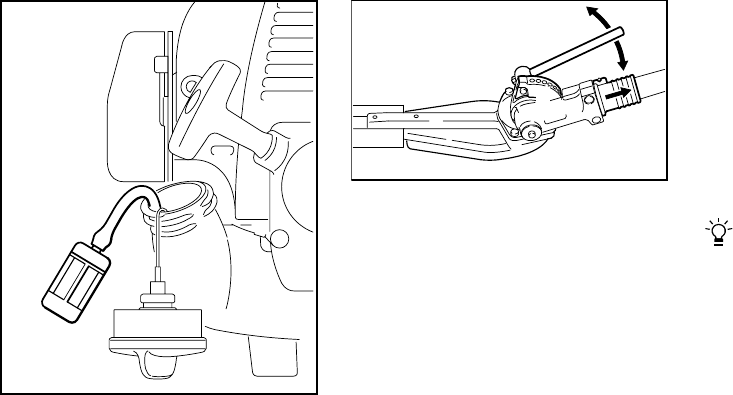
53HL 75, HL 75 K
español / EE.UU
Cambie el recogedor de combus-
tible una vez al año.
Antes de almacenar la máquina por un
período prolongado, vacíe y limpie el
tanque de combustible y ponga el motor
en marcha hasta que se seque el com-
bustible del carburador.
El ángulo de la barra de corte puede
ajustarse a 8 posiciones distintas entre
0° (recta) y 90° (ángulo recto).
Esta selección de ángulos mejora la ver-
satilidad de la máquina.
Ajuste del ángulo de la cuchilla
:Apague el motor.
:Tire hacia atrás del manguito desli-
zante (1) y use la palanca (2) para
ajustar la unión en uno o varios agu-
jeros.
:Suelte el manguito deslizante y deje
que el pasador se enganche en el
cuadrante (3).
El manguito deslizante queda a
tope contra la caja cuando el pasa-
dor está correctamente engan-
chado (después de hacer el ajuste).
389BA032 KN
Ajuste del ángulo de la
barra de corte
(versión ajustable solamente)
2
388BA012 KN
1
3
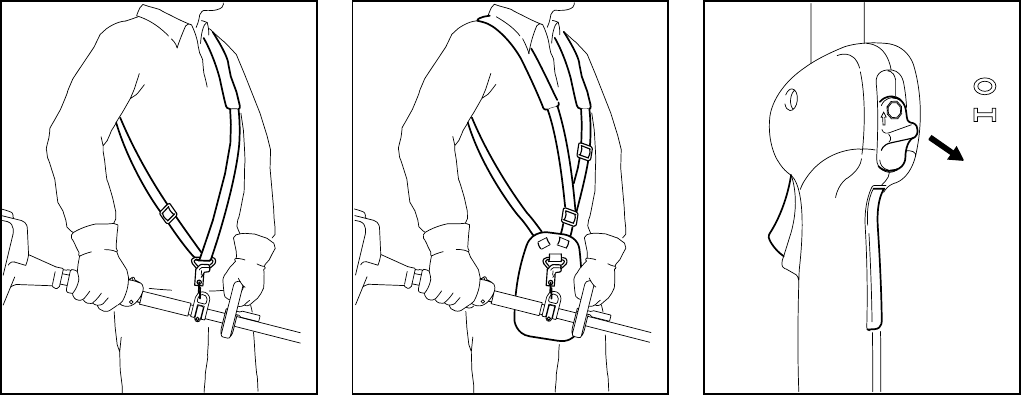
54
español / EE.UU
HL 75, HL 75 K
Correa para hombro
:Colóquese la correa (1) sobre el
hombro.
:Ajuste el largo hasta que el gancho
de resorte (3) esté apoyado en su
cadera derecha.
Arnés completo*
:Colóquese el arnés completo (2).
:Ajuste el largo hasta que el gancho
de resorte (3) esté apoyado en su
cadera derecha.
* vea el capítulo "Símbolos utilizados
en este manual"
Arranque
:Mantenga oprimido el bloqueo del
gatillo (1) y oprima el gatillo de ace-
leración (2).
:Mueva el control deslizante (3) a la
posición START (arranque).
:Ahora suelte el gatillo de acelera-
ción, el control deslizante y el blo-
queo del gatillo, en el orden indi-
cado. Esta es la posición de
arranque del acelerador.
Colocación del arnés
3
1
389BA040 KN
3
2
389BA041 KN
Arranque / parada del moto
r
3
2
225BA003 KN
START
1
STOP
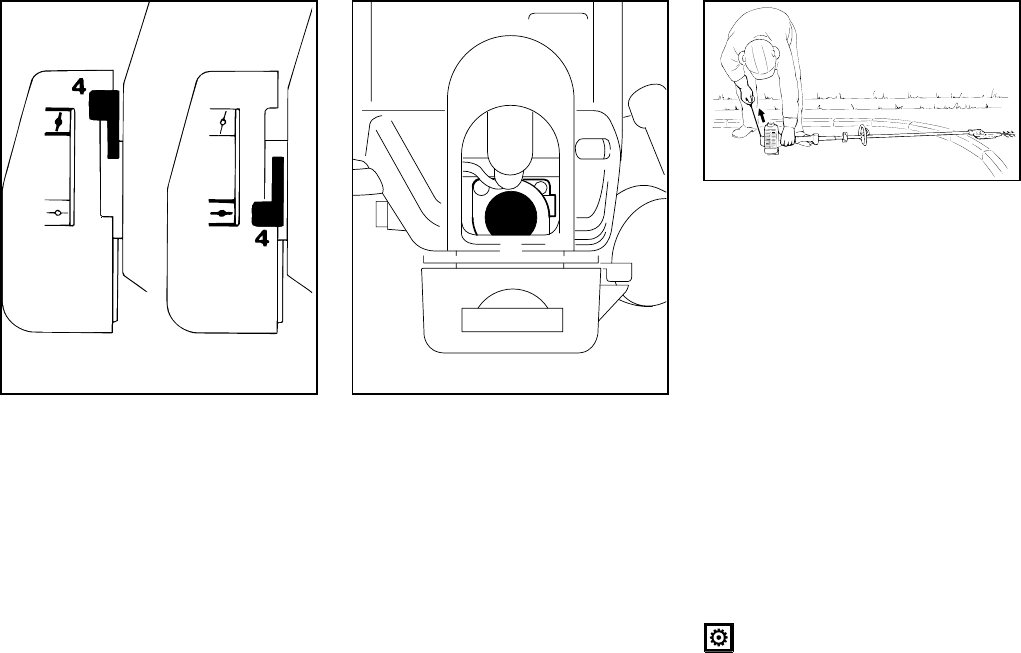
55HL 75, HL 75 K
español / EE.UU
:Coloque la palanca del estrangula-
dor (4):
Para arranque en frío en g
Para arranque en caliente en e
(también utilice esta posición si el
motor ha estado en marcha, pero
todavía se encuentra frío)
:Oprima el bulbo (5) de la bomba de
combustible por lo menos cinco
veces, aunque el bulbo esté lleno
de combustible.
:Coloque la máquina sobre el suelo.
Apóyela de modo firme sobre el
soporte del motor y la caja de
engranajes.
:Saque la funda de la cuchilla.
:Verifique que la herramienta de
corte no esté tocando el suelo ni
ningún otro obstáculo. De ser nece-
sario, apoye la caja de engranajes
sobre un soporte elevado (por
ejemplo, un montículo, ladrillo u
objeto similar).
:Asegúrese de tener los pies bien
apoyados.
:Sujete la máquina con la mano
izquierda y empuje hacia abajo fir-
memente - el pulgar debe estar
debajo de la caja del ventilador.
No apoye el pie ni la rodilla contra el
tubo de mando, ya que esto lo
deformaría y dañaría de modo per-
manente.
3
55BA008
5
392BA002 KN
389BA013 KN
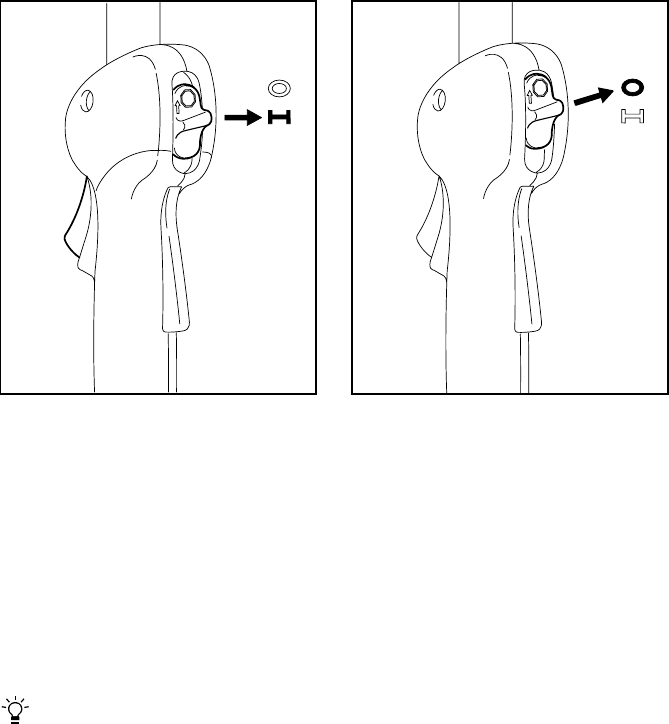
56
español / EE.UU
HL 75, HL 75 K
:Con la mano derecha tire lenta-
mente del mango de arranque hasta
que sienta una resistencia definitiva
y en seguida dele un tirón fuerte y
rápido. No tire de la cuerda de
arranque totalmente hasta fuera, se
podría cortar.
:No deje que el mango de arranque
salte bruscamente hacia atrás.
Guíelo lentamente hacia el interior
de la caja para que la cuerda de
arranque se enrolle correctamente.
Cuando el motor empieza a encen-
derse:
:Mueva la palanca del estrangulador
a e y continúe intentando el arran-
que del motor.
Tan pronto arranque:
:Oprima el gatillo de aceleración
momentáneamente (2) – el control
deslizante (3) se desplaza a la posi-
ción de marcha #, y el motor pasa a
aceleración de ralentí.
Compruebe que el carburador se
encuentre debidamente ajustado –
las cuchillas de corte no deben
moverse cuando el motor está a
ralentí.
Su cortasetos está listo para trabajar.
Para apagar el motor:
:Mueva el control deslizante (3) a $
(parada).
A temperaturas ambiente muy bajas
Tan pronto arranca:
:Oprima el gatillo de aceleración
momentáneamente para desengra-
nar la posición de arranque del ace-
lerador – el control deslizante se
desplaza a la posición de marcha #,
y el motor retorna a aceleración de
ralentí.
:Abra ligeramente el acelerador y
deje que el motor se caliente por
unos segundos.
3
2
225BA005 KN
START
STOP
3
225BA006 KN
START
STOP
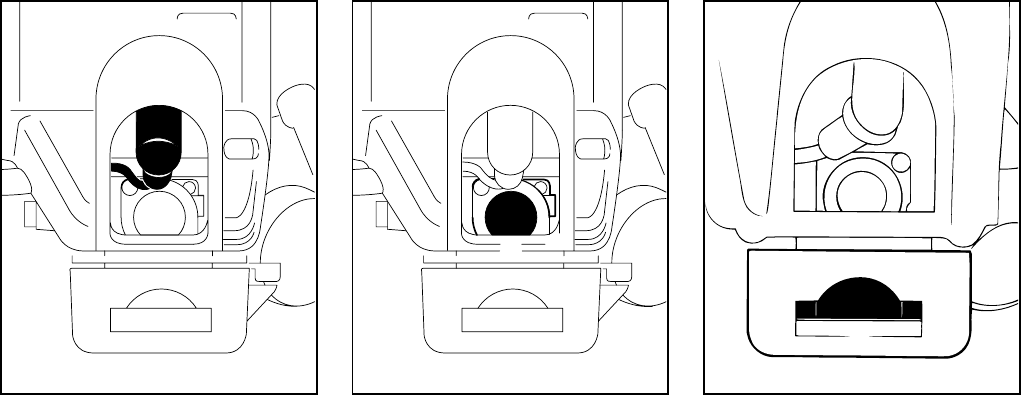
57HL 75, HL 75 K
español / EE.UU
Si el motor no arranca
Si no se mueve la palanca del estrangu-
lador a e en un tiempo suficientemente
corto después que el motor ha empe-
zado a encenderse, la cámara de com-
bustión se encuentra "ahogada".
:Mueva el control deslizante a la
posición $ (parada).
:Quite el casquillo de la bujía (6).
:Destornille y seque la bujía.
:Oprima el gatillo de aceleración
completamente para abrir el acele-
rador al máximo.
:Haga girar el motor varias veces
con el arrancador para despejar la
cámara de combustión.
:Vuelva a instalar la bujía.
:Conecte el casquillo de la bujía
(empújelo firmemente).
:Mueva el control deslizante a la
posición START.
:Ponga la palanca del estrangulador
en e aunque el motor esté frío.
:Ahora arranque el motor.
Se agotó el combustible en el tanque
:Después de llenar el tanque, oprima
el bulbo (5) de la bomba de com-
bustible por lo menos cinco veces,
aunque el bulbo esté lleno de com-
bustible.
:Ahora arranque el motor.
La suciedad en el filtro de aire reduce la
potencia del motor, aumenta el consumo
de combustible y dificulta el arranque
del motor.
Si se nota una pérdida considerable
de la potencia del motor
:Ponga la palanca del estrangulador
en g
:Oprima la lengüeta (1).
:Levante cuidadosamente la
cubierta (2) del filtro encima de la
lengüeta y quítela.
:Limpie toda la suciedad de alrede-
dor del filtro.
:Retire los elementos de espuma y
de fieltro del filtro.
6
392BA005 KN
5
392BA002 KN
Limpieza del filtro de aire
355BA014 KN
2
1
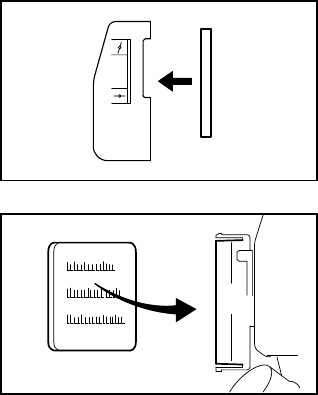
58
español / EE.UU
HL 75, HL 75 K
:Lave el elemento de espuma en una
solución limpiadora limpia y no infla-
mable (por ejemplo, agua jabonosa
tibia) y séquelo.
:Coloque un elemento de fieltro
nuevo. Como una medida proviso-
ria, es posible limpiarlo golpeándolo
en la palma de la mano o soplán-
dolo con aire comprimido. No lo
lave.
Siempre sustituya las piezas daña-
das.
:Coloque el elemento de espuma (3)
en la cubierta (2) del filtro.
:Coloque el elemento de fieltro (4)
(las marcas orientadas hacia aden-
tro) en la caja del filtro (5).
:Coloque la tapa del filtro de modo
que se trabe en su lugar.
Las emisiones de gases de escape son
controladas por el diseño de parámetros
y componentes fundamentales del
motor (por ej. carburación, encendido,
regulación y regulación de la válvula o
lumbrera) sin la adición de ningún
equipo importante.
Información general
El carburador se ajusta en la fábrica al
ajuste estándar.
Este ajuste provee una mezcla óptima
de combustible y aire bajo la mayoría de
las condiciones de funcionamiento.
Con este carburador es posible ajustar
el tornillo de velocidad rápida dentro de
una gama pequeña.
23
355BA031 KN
45
355BA032 KN
Manejo del motor Ajuste del carburador
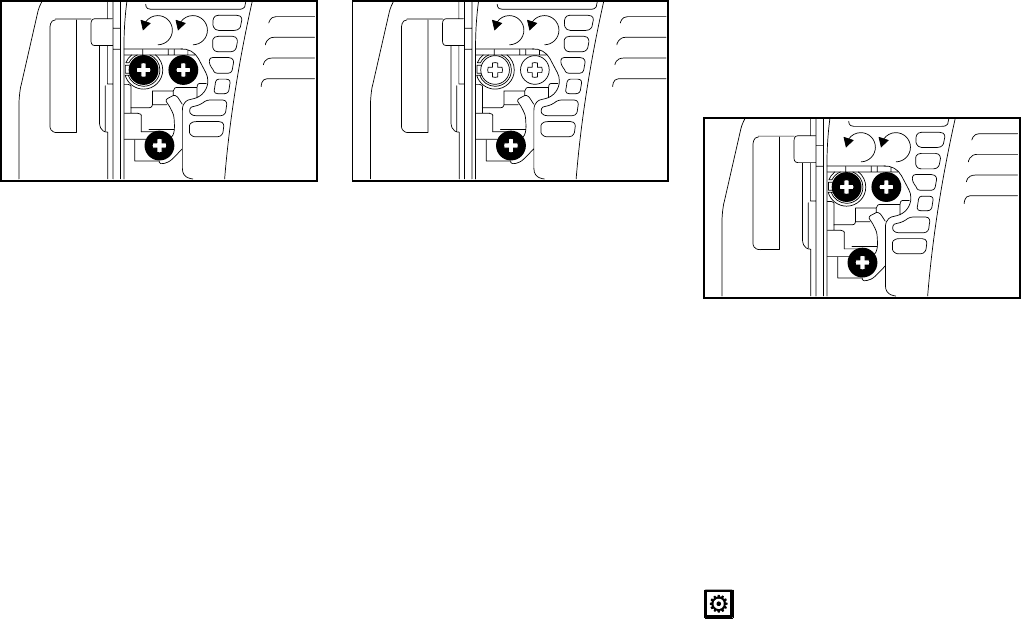
59HL 75, HL 75 K
español / EE.UU
Ajuste estándar
:Apague el motor.
:Inspeccione las cuchillas de corte y
límpielas de ser necesario (deben
estar limpias, moverse libremente y
no estar deformadas).
:Revise el filtro de aire e instale uno
nuevo de ser necesario.
:Revise el chispero* y límpielo o ins-
tale uno nuevo de ser necesario.
:Gire el tornillo de ajuste de veloci-
dad alta (H) en sentido contrahora-
rio hasta su tope (no más de 3/4 de
vuelta).
:Atornille el tornillo de velocidad baja
(L) en sentido horario hasta que
tope en su asiento. Después ábralo
una vuelta completa en sentido
contrahorario.
:Arranque el motor y caliéntelo.
:Ajuste la velocidad de ralentí con el
tornillo (LA) hasta que las cuchillas
dejen de girar.
* vea "Guía para el uso de este
manual"
Ajuste de ralentí
El motor se para durante el funciona-
miento a ralentí
:Gire lentamente el tornillo de ajuste
de ralentí (LA) en sentido horario
hasta que el motor funcione de
modo suave – las cuchillas no
deben girar.
Las cuchillas de corte funcionan con
el motor a ralentí
:Gire el tornillo de ralentí (LA) lenta-
mente en sentido contrahorario
hasta que las cuchillas se detengan
y luego gire el tornillo aproximada-
mente otra 1/2 a vuelta completa
en el mismo sentido.
Funcionamiento irregular a ralentí,
aceleración deficiente
Ajuste de ralentí con mezcla muy
pobre:
:Gire el tornillo de velocidad baja (L)
en sentido contrahorario (aprox. 1/4
de vuelta) hasta que el motor fun-
cione y se acelere de modo uni-
forme.
Generalmente es necesario cambiar el
ajuste del tornillo de ralentí (LA) des-
pués de cada corrección hecha al torni-
llo de velocidad baja (L).
Ajuste fino para funcionamiento a
alturas grandes
Puede ser necesario efectuar un ajuste
ligero del tornillo de velocidad alta (H) si
la potencia del motor no es adecuada
para trabajar en grandes altitudes.
:Revise el ajuste estándar.
:Permita que el motor se caliente.
:Gire el tornillo de ajuste de veloci-
dad alta (H) y el de ajuste de veloci-
dad baja (L) en sentido horario
(mezcla más pobre).
Para evitar el riesgo de dañar el
motor, no ajuste la mezcla dema-
siado pobre ya que esto puede
hacer que el motor se acelere exce-
sivamente.
Generalmente es necesario cambiar el
ajuste del tornillo de ralentí (LA) des-
pués de cada corrección hecha al torni-
llo de velocidad baja (L).
LA
HL
1
3 / 4
389BA051 KN
LA
HL
1
3 / 4
389BA052 KN
LA
HL
1
3 / 4
389BA051 KN
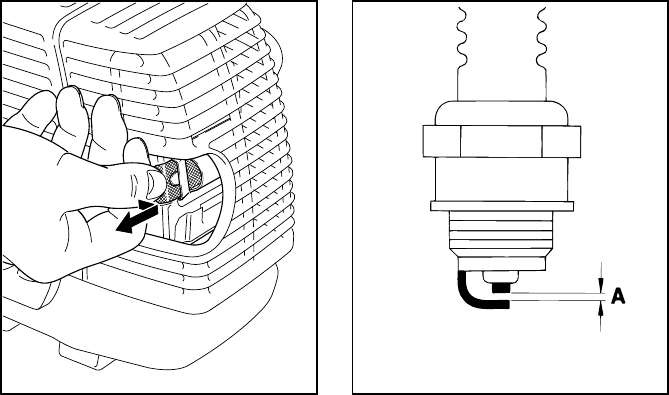
60
español / EE.UU
HL 75, HL 75 K
Si el motor pierde potencia, revise el
chispero del silenciador.
:Levante el chispero y sáquelo de
lado.
:Limpie el chispero, de ser necesa-
rio.
:Si el chispero está dañado u obs-
truido, instale uno nuevo.
:Vuelva a instalar el chispero.
* vea "Guía para el uso de este
manual"
La mezcla de combustible incorrecta
(demasiado aceite de motor en la gaso-
lina), el filtro de aire sucio y condiciones
de funcionamiento desfavorables (gene-
ralmente a media aceleración, etc.)
afectan la condición de la bujía. Estos
factores causan la formación de depósi-
tos en la punta del aislador lo que puede
dificultar el funcionamiento.
Si el motor tiene poca potencia, le
cuesta arrancar o funciona deficien-
temente a velocidad de ralentí, pri-
mero revise la bujía.
:Saque la bujía - vea „Arranque /
parada del motor“.
:Limpie la bujía sucia.
:Mida la separación entre electrodos
de la bujía (A). Vuelva a ajustar si es
necesario. Vea “Especificaciones”.
:Use únicamente bujías de tipo
resistencia de capacidad aprobada.
Corrija la causa de la suciedad de la
bujía:
:Demasiado aceite en la mezcla de
combustible.
:Filtro de aire sucio.
:Condiciones de funcionamiento
desfavorables, por ej., funciona-
miento a media aceleración.
Coloque una bujía nueva después de
100 horas de funcionamiento, aproxi-
madamente, o más temprano si nota
que los electrodos están muy desgasta-
dos.
Chispero* en silenciador
392BA035 KN
Revisión de la bujía
000BA002 KN
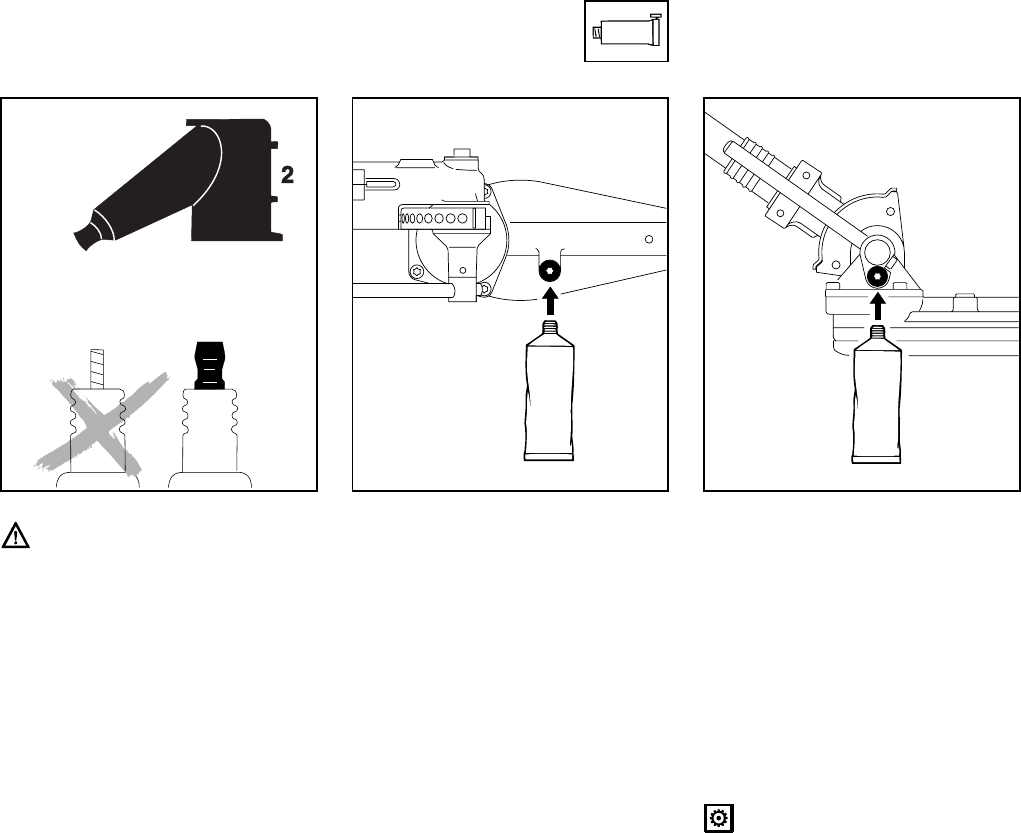
61HL 75, HL 75 K
español / EE.UU
Para reducir el riesgo de incendios y
lesiones por quemadura, use sola-
mente bujías autorizadas por
STIHL. Siempre encaje un casquillo
(2) del tamaño correcto bien ajus-
tado en el borne (1) de la bujía.
(Nota: Si el casquillo tiene una
tuerca adaptadora SAE desprendi-
ble, colóquela.) Una conexión
suelta entre el casquillo de la bujía y
el conector del alambre de encen-
dido puede formar un arco eléctrico,
inflamar los vapores combustibles y
finalmente causar un incendio.
Para lubricar el engranaje impulsor de
la cuchilla use lubricante para engrana-
jes STIHL especial para cortasetos**,
aproximadamente cada 25 horas de fun-
cionamiento.
:Destornille el tapón de llenado (1).
:Atornille el tubo de grasa (2) en el
agujero de llenado.
:Aplique alrededor de 20 g (3/4 oz)
de grasa al interior de la caja de
engranajes.
:Vuelva a colocar el tapón de llenado
y apriételo firmemente.
** vea "Especificaciones"
Para lubricar la transmisión angular,
use lubricante para engranajes STIHL
especial para cortadoras de matorra-
les**, aproximadamente cada 25 horas
de funcionamiento.
:Destornille el tapón de llenado (3).
:Si no se ve grasa en el interior del
tapón, atornille el tubo de grasa (4)
en el agujero de llenado.
:Aplique alrededor de 5-10 g (1/4 oz)
de grasa al interior de la caja de
engranajes.
No llene completamente con grasa
la caja de engranajes.
:Vuelva a colocar el tapón de llenado
y apriételo firmemente.
** vea "Especificaciones"
000BA036 TR
1
Lubricación de la
caja de engranajes
1
225BA008 KN
2
1
225BA009 KN
2
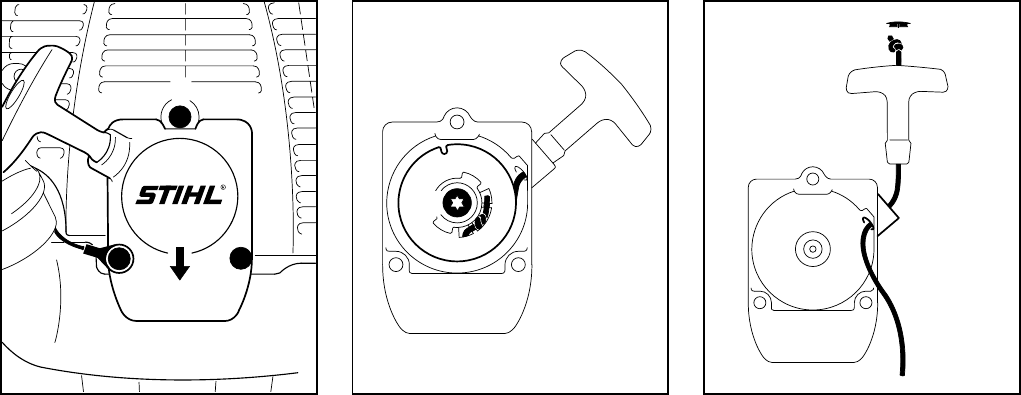
62
español / EE.UU
HL 75, HL 75 K
:Saque los tornillos (1).
:Quite el borne de cable.
:Levante la tapa (2) de encima del
tanque (3) y extráigala de debajo de
la cubierta protectora (4).
:Saque el tornillo (5).
:Retire el rotor de la cuerda con
mucho cuidado. El resorte de rebo-
binado está alojado en el rotor y
puede saltar y desenrollarse si no
se procede con cuidado.
:Utilice un destornillador para quitar
la tapa (6) del mango de la cuerda
de arranque.
:Retire la cuerda restante del rotor y
del mango, asegurándose de evitar
que el manguito ElastoStart se
salga del mango.
:Haga un nudo de rizo sencillo en el
extremo de la cuerda de arranque
nueva y después pase la cuerda por
la parte superior del mango y por el
buje de la cuerda (7).
:Vuelva a instalar la tapa en el
mango.
Sustitución de la cuerda de
arranque y resorte de rebo-
binado
386BA004 KN
1
11
2
3
4
5
392BA014 KN
6
7
392BA015 KN
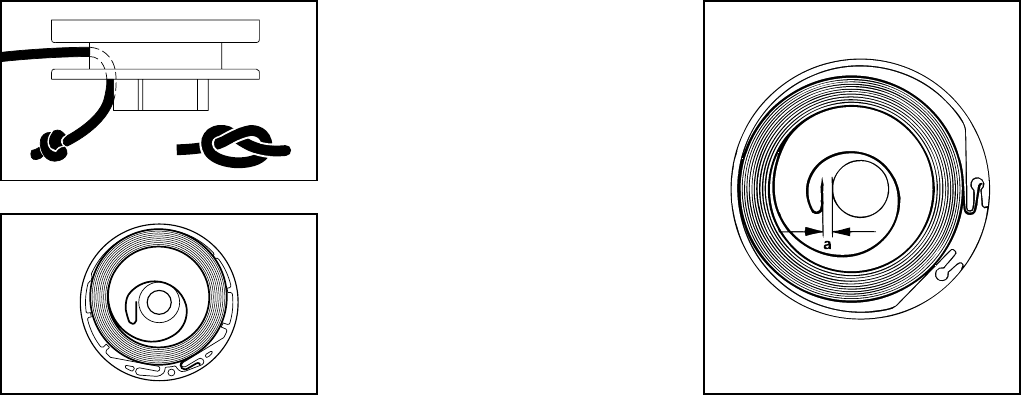
63HL 75, HL 75 K
español / EE.UU
:Tire de la cuerda a través del rotor y
fíjela con un nudo de rizo simple.
:Cubra la cavidad del cojinete del
rotor de la cuerda con aceite sin
resina**.
:Deslice el rotor en el poste del
arrancador. Gírelo hacia uno y otro
lado hasta que la espiral (8) del
resorte de rebobinado se engan-
che.
:Inserte el tornillo y apriételo bien
firme. Pase a "Tensado del resorte
de rebobinado".
** vea "Accesorios especiales"
Sustitución de resorte de rebobi-
nado roto
:Lubrique el resorte nuevo con unas
pocas gotas de aceite sin resina**.
No abra el retenedor de alambre.
:Quite el rotor de la cuerda.
:Quite las piezas del resorte viejo.
:Instale el resorte nuevo – coloque la
espiral exterior del resorte en la
hendidura – el alambre retenedor
se suelta durante este proceso.
** vea "Accesorios especiales"
Si el resorte se sale: Colóquelo nue-
vamente en sentido contrahorario,
empezando desde el exterior y
avanzando hacia adentro.
:Instale el rotor de la cuerda.
:Compruebe la dimensión ”a” en la
espiral interior del resorte y dóblela
para ajustarla al tamaño correcto,
de ser necesario.
:Pase a "Tensado del resorte de
rebobinado".
392BA024 KN
8
392BA025 KN
355BA022 KN
a = 2mm
(0.08in)
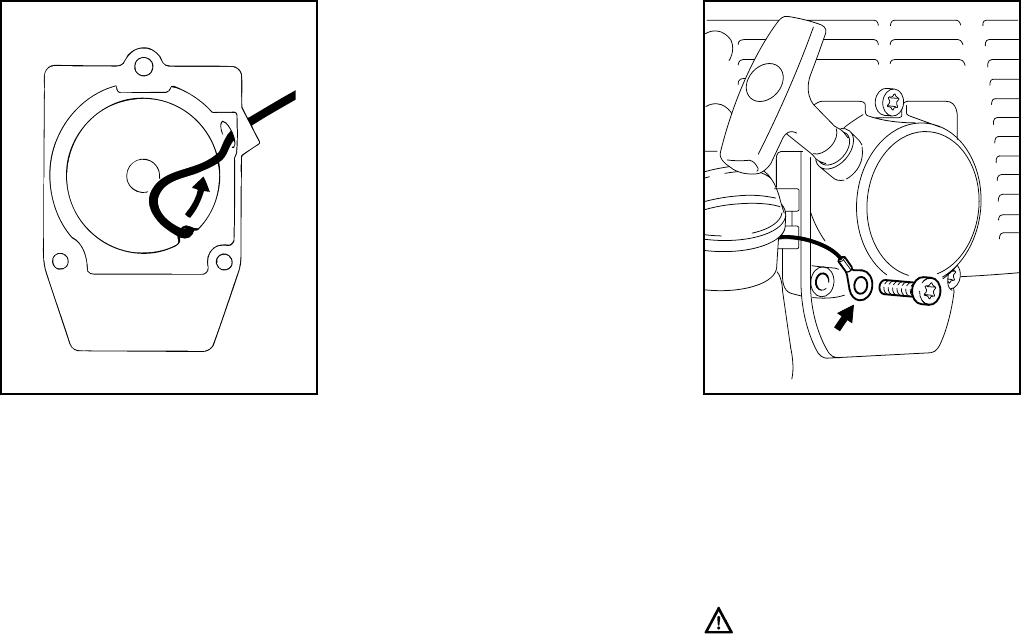
64
español / EE.UU
HL 75, HL 75 K
Tensado del resorte de rebobi-
nado
:Forme un bucle con la cuerda de
arranque sin envolver y utilícelo
para girar el rotor seis revoluciones
completas en sentido contrahorario.
Sostenga el rotor inmóvil – ende-
rece la cuerda – suelte el rotor –
suelte la cuerda lentamente de
modo que se enrolle en el rotor.
El mango de arranque debe quedar fir-
memente sentado en el buje guía de la
cuerda. Si el mango cae hacia un lado:
Dele una vuelta adicional al rotor de la
cuerda para aumentar la tensión del
resorte.
:Cuando la cuerda de arranque se
extiende completamente, debe ser
posible girar el rotor media vuelta
adicional. En caso contrario, el
resorte está sobretensado y podría
romperse. Quítele una vuelta de la
cuerda al rotor.
:Instale la tapa del arrancador. Para
hacer esto, coloque el reborde de
montaje superior debajo de la
envuelta – alinee el tanque y
empuje la parte inferior de la tapa
sobre el tanque.
:Inserte y apriete los tornillos de la
caja.
Fije el borne del cable en posición.
355BA021 KN
386BA005 KN

65HL 75, HL 75 K
español / EE.UU
Las cuchillas se deben volver a afilar si
el rendimiento del corte y el comporta-
miento comienzan a deteriorar (por
ejemplo, si las cuchillas se enganchan
frecuentemente en las ramas).
Es mejor que las cuchillas las afile el
concesionario STIHL en un afilador de
taller.
También es posible usar una lima plana
de corte diagonal para afilar. Sostenga
la lima al ángulo indicado (vea las
"Especificaciones").
:Siempre desplace la lima hacia el
filo.
:La lima afila únicamente en la
pasada de ida – quite la lima de la
cuchilla para la pasada de retorno.
:Utilice una piedra de amolar para
quitar las rebabas del filo.
:Quite la menor cantidad posible de
material.
:Después del afilado, limpie las par-
tículas y polvo de las cuchillas de
corte y lubríquelas con grasa.
No utilice la máquina con cuchillas
romas o dañadas.
Esto puede causar sobrecargas y
produce cortes insatisfactorios.
Durante el período de rodaje
Una máquina nueva no debe hacerse
funcionar a velocidad alta (aceleración
máxima sin carga) por el lapso que tome
llenar el tanque tres veces. Esto evita la
imposición de cargas innecesariamente
altas durante el período de rodaje.
Puesto que todas las piezas móviles
necesitan un período de rodaje, las
resistencias causadas por la fricción en
el motor son mayores durante este
período.
El motor desarrolla su potencia máxima
después de haber llenado el tanque de
5 a 15 veces.
Durante el funcionamiento
Después de un período largo de funcio-
namiento con el acelerador a fondo,
deje funcionar el motor por un rato en
ralentí de modo que el calor en el motor
sea disipado por la corriente de aire de
enfriamiento. Esto ayuda a evitar que
los componentes montados en el motor
(encendido, carburador) sufran sobre-
cargas térmicas.
Después de terminar el trabajo
Almacenamiento por corto tiempo:
Espere que el motor se enfríe. Para evi-
tar la condensación, llene el tanque de
combustible y guarde la máquina en un
lugar seco hasta que la vuelva a utilizar.
Almacenamiento por largo tiempo:
consulte el capítulo "Almacenamiento
de la máquina".
Para intervalos de 3 meses o más
:Vacíe y limpie el tanque de combus-
tible en una zona bien ventilada.
:Haga funcionar el motor hasta que
el carburador se seque - esto ayuda
a evitar que los diafragmas del car-
burador se peguen.
:Limpie las cuchillas, revise la condi-
ción de las mismas y rocíelas con el
disolvente de resina STIHL.
:Limpie la máquina a fondo - preste
atención especial a las aletas del
cilindro y al filtro de aire.
Guarde la máquina en un lugar seco y
elevado, o bajo llave - fuera del alcance
de los niños y de otras personas no
autorizadas.
Instrucciones de afilado Instrucciones de manejo Almacenamiento de la
máquina

66
español / EE.UU
HL 75, HL 75 K
* vea "Guía para el uso de este
manual"
Tabla de mantenimiento
Por favor observe que los intervalos de mantenimiento dados a continuación
corresponden únicamente a condiciones normales de trabajo. Si el tiempo de
trabajo por jornada es más largo que lo normal, o si las condiciones de trabajo
son extremas (zonas polvorientas, presencia de resinas, etc.), acorte los inter-
valos indicados de modo correspondiente.
antes de comenzar
el trabajo
después de terminar
el trabajo o diariamente
después de cada parada
para cargar combustible
semanalmente
mensualmente
cada 12 meses
si hay problema
si tiene daños
según se requiera
Máquina completa
Inspección visual (condición general,
fugas) XX
Limpiar X
Gatillo de aceleración, control desli-
zante Comprobar funcionamiento XX
Filtro de aire Limpiar XX
Reemplazar X
Filtro en tanque de combustible Revisar X
Reemplazar XXX
Tanque de combustible Limpiar X
Carburador Revisar velocidad de ralentí XX
Ajustar el ralentí X
Bujía Ajustar la distancia entre electrodos X
Aletas del cilindro Limpiar X
Chispero* en silenciador Inspeccionar X
Limpiar o reemplazar X
Todos los tornillos y tuercas accesibles
(no los tornillos de ajuste) Volver a apretar X
Cuchilla Inspección visual XX
Afilar X
Lubricación de caja de engranajes Revisar X
Llenar X
Eje impulsor Revisar la lubricación X
Lubricar X

67HL 75, HL 75 K
español / EE.UU
1= Mango tórico*
2= Barra de defensa*
3= Argolla de transporte (para arnés)
4= Control deslizante
5= Bloqueo del gatillo de aceleración
6= Gatillo de aceleración
7= Casquillo de bujía
8= Cubierta del filtro de aire
9= Apoyo de la máquina
10= Cuchilla
11= Protector de cuchillas
12= Engranaje impulsor de cuchillas
13= Transmisión angular
14= Tubo de mando
15= Manguito deslizante*
16= Palanca de ajuste*
17= Cuadrante*
18= Tanque de combustible
19= Tapa de llenado de combustible
20= Mango de arranque
21= Bomba de combustible
22= Palanca del estrangulador
23= Tornillo de ajuste del carburador
24= Silenciador
* vea "Guía para el uso de este
manual"
Piezas y controles
3
14
13
389BA048 KN
17
15
16
18
19
20
21
22
23 24
10
11 12
4
2
6
7
1
58
9
68
español / EE.UU
HL 75, HL 75 K
1. Mango tórico*
Para sujetar el cortasetos con las
dos manos.
2. Barra de defensa*
Ayuda a mantener la máquina ale-
jada de los pies y piernas del opera-
dor.
3. Argolla de transporte
Un dispositivo para conectar el cor-
tasetos al arnés.
4. Control deslizante
Interruptor de bloqueo de acelera-
ción de arranque y de parada. Man-
tiene el acelerador parcialmente
abierto durante el arranque y apaga
el encendido del motor y detiene su
marcha.
5. Bloqueo del gatillo de acelera-
ción
Debe ser oprimido antes de poder
activar el gatillo de aceleración.
6. Gatillo de aceleración
Regula la velocidad del motor.
7. Casquillo de la bujía
Conecta la bujía al alambre de
encendido.
8. Cubierta del filtro de aire
Cubre el elemento del filtro de aire.
9. Apoyo de la máquina
Para apoyar la máquina en el suelo.
10. Cuchillas
Cuchillas de acero para cortar setos
y arbustos.
11. Protector de la cuchilla de corte
Cubre la cuchilla cuando el cortase-
tos no está en uso.
12. Engranaje impulsor de cuchillas
Convierte el movimiento giratorio de
la transmisión angular en movi-
miento de vaivén de las cuchillas.
13. Transmisión angular
Transmite el movimiento giratorio
del eje impulsor al engranaje impul-
sor de cuchillas.
14. Tubo de mando
Dispositivo que conecta el motor
con la caja de engranajes.
15. Manguito deslizante*
Manguito para bloquear y desblo-
quear el mecanismo de ajuste.
16. Palanca de ajuste*
Palanca diseñada para orientar la
barra de corte al ángulo requerido.
17. Cuadrante*
Fija la barra de corte en la posición
requerida.
18. Tanque de combustible
Contiene la mezcla de combustible
y aceite.
19. Tapa de llenado de combustible
Para tapar el tanque de combusti-
ble.
20. Mango de arranque
El mango de la cuerda de arranque,
el cual es el dispositivo usado para
arrancar el motor.
21. Bomba de combustible
Suministra alimentación adicional
de combustible para el arranque en
frío.
22. Palanca del estrangulador
Facilita el arranque del motor al
enriquecer la mezcla.
23. Tornillo de ajuste del carburador
Para afinar el carburador.
24. Silenciador (con chispero*)
Atenúa los ruidos del tubo de
escape y desvía los gases de
escape lejos del operador.
* vea "Guía para el uso de este
manual"
Definiciones
69HL 75, HL 75 K
español / EE.UU
Motor
EPA:
El período de cumplimiento de emisio-
nes indicado en la etiqueta de cumpli-
miento de emisiones es la cantidad de
horas de funcionamiento para la cual la
máquina ha demostrado la conformidad
con los requerimientos de emisiones del
Gobierno federal de los EE.UU.
Categoría A = 300 horas,
B = 125 horas,
C = 50 horas
CARB:
El período de cumplimiento de emisio-
nes empleado en la etiqueta del índice
de aire CARB tiene las siguientes defini-
ciones:
Extended (extendido) = 300 horas
Intermediate (intermedio) = 125 horas
Moderate (moderado) = 50 horas
Motor de un cilindro, dos tiempos
Sistema de encendido
Encendido por magneto electrónico
Bujía (tipo resistencia)
Bosch WSR 6 F, NGK BPMR 7 A o
Champion RCJ 6Y
Distancia entre electrodos
0,5 mm (0,02 pulg)
Carburador
Carburador de diafragma de todas posi-
ciones con bomba de combustible inte-
gral
Arrancador de cuerda
Cuerda de arranque, 3,0 mm (0,12 pulg)
de diám.
0000 195 8203 (850 mm, 33,5 pulg de
largo)
Capacidad del tanque de combusti-
ble
0,44 l (0,93 pt EE.UU.)
Mezcla de combustible
Vea el capítulo "Combustible"
Cuchillas de corte
Con doble filo para cortes bidirecciona-
les
Longitud de cuchilla: 500 mm (20 pulg)
Angulo de afilado
45° con respecto a horizontal
Peso
Accesorios especiales
Correa para hombro
Arnés completo
Anteojos de seguridad
Lubricante para engranajes STIHL para
cortasetos
Tubo de 80 g (2,8 oz): 0781 120 1109
Tubo de 225 g (8 oz): 0781 120 1110
Lubricante para engranajes STIHL para
cortadoras de matorrales
Tubo de 80 g (2,8 oz): 0781 120 1117
Tubo de 225 g (8 oz): 0781 120 1118
Aceite especial STIHL
Aceite lubricante libre de resina
Frasco de 100 ml (3,4 oz. fl.):
0781 417 1315
Cilindrada 25,4 cm3
(1,55 pulg3)
Diámetro 34 mm (1,34
pulg)
Carrera 28 mm (1,10
pulg)
Potencia del motor
según ISO 8893 (0,95 kW)
1,3 hp
Especificaciones
Motor con tubo de mando
(sin accesorio de corte)
HL 75:
HL 75 K:
4,2 kg
(9,7 lb)
4,1 kg
(9 lb)
Accesorio de corte com-
pleto
con barra de corte de 0° y
30°:
con barra de corte ajusta-
ble:
2,0 kg
(4,4 lb)
2,3 kg
(5,1 lb)
70
español / EE.UU
HL 75, HL 75 K
El usuario de esta máquina deberá rea-
lizar solamente los trabajos de manteni-
miento descritos en este manual. Otros
trabajos de reparación debe hacerlos
solamente un técnico de servicio autori-
zado por STIHL.
Los reclamos de garantía serán acepta-
dos únicamente si la reparación fue
hecha por un concesionario de servicio
autorizado por STIHL usando repuestos
originales de STIHL.
Los repuestos originales de STIHL se
pueden identificar por el número de
pieza de STIHL, el logotipo
STIHl
y el símbolo de piezas de STIHL(
En las piezas pequeñas, el símbolo
puede aparecer solo.
Mantenimiento y reparación
71HL 75, HL 75 K
español / EE.UU
Sus derechos y obligaciones de
garantía
La Agencia de Protección del Medio
Ambiente (EPA) de los EE.UU., el Con-
sejo de Recursos del Aire del Estado de
California (CARB) y STIHL Incorporated
se complacen en explicarle la garantía
del sistema de control de emisiones ins-
talado en el motor de su equipo de
modelos año 2000 y siguientes. En Cali-
fornia, los nuevos motores pequeños
para uso fuera de carretera deben estar
diseñados, construidos y equipados de
conformidad con las rigurosas normas
de contaminación del aire del estado. En
otros estados, los modelos 1997 y pos-
teriores de tales motores deben estar
diseñados, construidos y equipados, al
tiempo de la venta, de conformidad con
los reglamentos correspondientes de la
EPA. El motor debe carecer de defectos
en el material y la fabricación que pue-
dan causar el incumplimiento de las nor-
mas de la EPA durante los primeros dos
años de uso del motor a partir de la
fecha de compra por el último compra-
dor. STIHL Incorporated debe garantizar
el sistema de control de emisiones en el
motor pequeño para uso fuera de carre-
tera por el intervalo mencionado más
arriba, siempre que dicho motor no haya
estado sujeto a maltrato, negligencia o
cuidado inapropiado.
El sistema de control de emisiones de
su máquina incluye piezas tales como el
carburador y el sistema de encendido.
Además puede incluir mangueras,
conectores y otros conjuntos relativos a
emisiones.
Si existe una condición amparada bajo
garantía, STIHL Incorporated reparará
el motor sin costo alguno, incluido el
diagnóstico (si el trabajo de diagnóstico
fue realizado por un concesionario auto-
rizado), las piezas y la mano de obra.
Cobertura de garantía del fabri-
cante:
Los motores pequeños para equipos de
uso fuera de carretera están garantiza-
dos por dos años en el Estado de Cali-
fornia. En otros estados, los modeles de
1997 y posteriores de tales motores
también están garantizados por dos
años. En el caso de encontrarse defec-
tos en cualquiera de las piezas del
motor relacionadas con el sistema de
control de emisiones, la pieza será repa-
rada o sustituida por STIHL Incorpora-
ted sin costo alguno.
Responsabilidades del usuario
relativas a la garantía:
Como propietario de tal motor, usted
tiene la responsabilidad de realizar el
mantenimiento requerido descrito en su
manual del usuario. STIHL Incorporated
le recomienda guardar todos los recibos
comprobantes de los trabajos de mante-
nimiento hechos a su motor, pero STIHL
Incorporated no puede negar garantía
basado en el solo hecho de faltar los
recibos o del incumplimiento del propie-
tario de realizar todos los trabajos de
mantenimiento programados.
El uso de cualquier pieza de repuesto o
servicio cuyo comportamiento y durabili-
dad sean equivalentes está permitido en
trabajos de mantenimiento o reparación
no contemplados en la garantía, y no
reducirá las obligaciones de la garantía
del fabricante del motor.
Sin embargo, como propietario del
motor pequeño para equipo de uso
fuera de carretera usted debe ser cons-
ciente de que STIHL Incorporated
puede negarle cobertura de garantía si
dicho motor o una pieza del mismo ha
fallado debido a maltrato, descuido,
mantenimiento inadecuado o modifica-
ciones no autorizadas.
Usted es responsable de llevar el motor
a un centro de servicio STIHL tan pronto
surja el problema. Las reparaciones
bajo garantía serán realizadas en un
tiempo razonable, sin exceder de 30
días. Ante cualquier duda respecto a
sus derechos y responsabilidades
según lo estipulado en esta garantía,
comuníquese con el representante de
STIHL al 1-800-467-8445 ó escriba a
STIHL Inc., 536 Viking Drive, P.O. Box
2015, Virginia Beach, VA 23450-2015.
Cobertura por STIHL Incorporated
STIHL Incorporated garantiza al último
comprador y a cada comprador subsi-
guiente que el motor pequeño para
equipo de uso fuera de carretera está
diseñado, construido y equipado, al
tiempo de la venta, de conformidad con
todos los reglamentos aplicables. Ade-
más, STIHL Incorporated garantiza al
comprador inicial y a cada comprador
subsiguiente que el motor está libre de
defectos en el material y fabricación que
puedan causar el incumplimiento de los
reglamentos aplicables durante un
período de dos años.
Declaración de garantía de STIHL Incorporated sobre siste-
mas de control de emisiones según normas Federales y del
Estado de California
72
español / EE.UU
HL 75, HL 75 K
Período de garantía
El período de garantía comienza en la
fecha en que el motor del equipo utilita-
rio es entregado a usted y usted firma y
remite la tarjeta de garantía a STIHL.
Si cualquier pieza relacionada con el
sistema de control de emisiones está
defectuosa, la pieza será sustituida por
STIHL Incorporated sin costo alguno
para el propietario. Cualquier pieza
garantizada cuyo reemplazo no está
programado como mantenimiento
requerido, o que debe recibir única-
mente inspección regular en el sentido
de "reparar o sustituir según sea nece-
sario", estará garantizada por el período
de garantía. Cualquier pieza cuyo reem-
plazo está programado como manteni-
miento requerido estará garantizada por
el intervalo hasta el primer punto de
reemplazo programado para esa pieza.
Diagnóstico
Como propietario, a usted no se le debe
cobrar la mano de obra por los diagnós-
ticos que determinen que una pieza
garantizada está defectuosa. No obs-
tante, si usted reclama garantía para un
componente y se comprueba que la
máquina no está defectuosa, STIHL
Incorporated le cobrará el costo de la
prueba del sistema de control de emisio-
nes.
El trabajo de diagnóstico mecánico se
realiza en un centro de servicio autori-
zado por STIHL. La prueba del sistema
de control de emisiones se realiza ya
sea en la fábrica de STIHL Incorporated
o en un laboratorio de ensayos indepen-
diente.
Trabajo bajo garantía
STIHL Incorporated reparará los defec-
tos amparados por la garantía en cual-
quier estación de garantía o centro de
servicio autorizado por STIHL. Todo tra-
bajo de este tipo se hará gratis para el
propietario siempre que se determine
que la pieza cubierta por la garantía está
defectuosa. Se puede usar cualquier
pieza de repuesto aprobada por el fabri-
cante o equivalente en las piezas rela-
cionadas con el sistema de control de
emisiones, y debe ser suministrada gra-
tis al propietario. STIHL Incorporated es
responsable por daños a otros compo-
nentes del motor causados por la falla
de una pieza garantizada que todavía
está bajo garantía.
La lista de piezas del sistema de control
de emisiones garantizadas del Consejo
de Recursos del Aire del Estado de Cali-
fornia define específicamente las piezas
garantizadas que están relacionadas
con las emisiones. Estas piezas garanti-
zadas son:
Carburador
Estrangulador (sistema de refuerzo para
arranque en frío)
Múltiple de admisión
Filtro de aire
Bujía
Magneto o sistema de encendido elec-
trónico (módulo de encendido)
Convertidor catalítico (si lo tiene)
Sujetadores/pernos
Dónde presentar el reclamo para
servicio bajo garantía
Lleve el producto a cualquier centro de
servicio autorizado por STIHL y pre-
sente la tarjeta de garantía firmada.
Requerimientos de mantenimiento
Las instrucciones presentadas en este
manual se basan en la aplicación de la
mezcla recomendada para motores de
2 tiempos (vea también la instrucción
"Combustible"). Las discrepancias de
estas recomendaciones con respecto a
la calidad y la proporción de la mezcla
de combustible y aceite pueden exigir
intervalos de mantenimiento más cor-
tos.
Limitaciones
Esta garantía de los sistemas de control
de emisiones no cubrirá ninguno de los
puntos siguientes:
:reparación o sustitución requerida
debido a maltrato, negligencia o
falta del mantenimiento requerido,
:reparaciones mal hechas o sustitu-
ciones contrarias a las especifica-
ciones de STIHL Incorporated que
afecten desfavorablemente el fun-
cionamiento y/o la durabilidad, y las
alteraciones o modificaciones no
recomendadas o aprobadas por
escrito por STIHL Incorporated,
y
:la sustitución de piezas y otros ser-
vicios y ajustes necesarios para el
mantenimiento requerido en y des-
pués del primer punto de reemplazo
programado.

6WARNING!
The engine exhaust from this product
contains chemicals known to the State
of California to cause cancer, birth
defects or other reproductive harm.
englisch/english U.S.A.
