Sunbeam Em3600 Users Manual EM3600_IB
EM3800 to the manual 5061515b-85a1-4eb5-9d77-0755f56b1149
2015-01-23
: Sunbeam Sunbeam-Em3600-Users-Manual-299636 sunbeam-em3600-users-manual-299636 sunbeam pdf
Open the PDF directly: View PDF  .
.
Page Count: 32
Waiting on Front
Cover from Energi
Please read these instructions carefully
and retain for future reference.
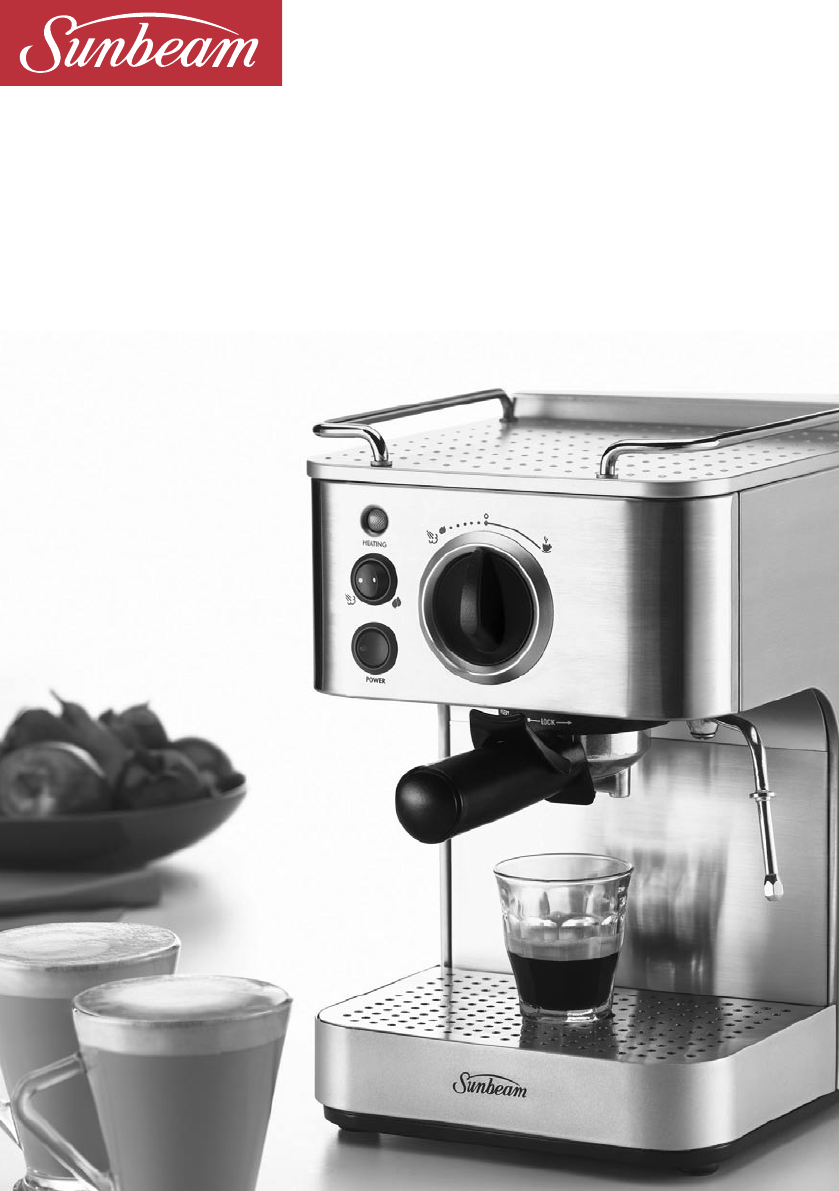
Café Espresso™
Instruction/Recipe Booklet
This book covers the use and care of the following Sunbeam Pump Espresso Machines:
EM3600 Café Espresso™ – 15 BAR pump espresso machine
EM3800 Café Espresso™ Stainless – 15 BAR pump espresso machine
Important instructions – retain for
future use.
Sunbeam’s Safety Precautions 2
About espresso coffee 3
Features of your Sunbeam Café Espresso
™
4
Using the control panel 7
Reference guide to using your espresso
machine 9
Preparing your espresso machine before use 14
Guide to the perfect espresso 15
Guide to milk texturing 16
Using the hot water function 17
Espresso Recipes 18
Care and Cleaning 20
Descaling 22
Trouble Shooting guide 24
Contents

2
If you have any concerns regarding the performance and use of your appliance,
please visit www.sunbeam.com.au or contact the Sunbeam Consumer Service Line.
Ensure the above safety precautions are understood.
Sunbeam’s Safety Precautions
SAFETY PRECAUTIONS FOR YOUR SUNBEAM
ESPRESSO MACHINE.
• Always place the unit on a flat, level surface.
• Do not operate without water in reservoir.
Fill reservoir with only clean and cold water.
Observe maximum filling volume is 1.6 litres.
• Do not remove the filter handle during the
espresso pour or water flow as the unit is
under pressure. Removing the filter handle
during either of these operations can lead to a
scalding or injury.
• The steam wand becomes very hot during
texturing milk and water flow. This may cause
burns in case of contact, therefore avoid any
direct contact with the steam wand.
• Always disconnect the plug from the power
outlet prior to cleaning the espresso machine
or if there is any problem during the coffee
making process.
• Do not allow the power cord to come into
contact with the hot parts of the espresso
machine, including the cup warming plate and
steam wand.
• Do not place hands directly under the steam,
hot water or coffee pour as this can lead to a
scalding or injury.
Sunbeam are very safety conscious when
designing and manufacturing consumer products,
but it is essential that the product user also
exercise care when using an electrical appliance.
Listed below are precautions which are essential
for the safe use of an electrical appliance:
• Read carefully and save all the instructions
provided with an appliance.
• Always turn the power off at the power outlet
before you insert or remove a plug. Remove
by grasping the plug - do not pull on the cord.
• Turn the power off and remove the plug
when the appliance is not in use and
before cleaning.
• Do not use your appliance with an extension
cord unless this cord has been checked
and tested by a qualified technician or
service person.
• Always use your appliance from a power
outlet of the voltage (A.C. only) marked
on the appliance.
• This appliance is not intended for use by young
children or infirm persons unless they have
been adequately supervised by a responsible
adult to ensure that they can use the appliance
safely.
• Never leave an appliance unattended while
in use.
• Young children should be supervised to ensure
that they do not play with the appliance.
• Do not use an appliance for any purpose
other than its intended use.
• Do not place an appliance on or near a hot gas
flame, electric element or on a heated oven.
Do not place on top of any other appliance.
• Do not let the power cord of an appliance hang
over the edge of a table or bench top or touch
any hot surface.
• For safety reasons and to avoid maintenance
by unskilled persons, some appliances are
‘sealed’ using tamperproof screws. Such
appliances should always be returned to the
nearest Sunbeam Appointed Service Centre
for adjustment or repair if required.
• Do not operate any electrical appliance with a
damaged cord or after the appliance has been
dropped or damaged in any manner. If damage
is suspected, return the appliance to the
nearest Sunbeam Appointed Service Centre
for examination, repair or adjustment.
• For additional protection, Sunbeam
recommend the use of a residual current
device (RCD) with a tripping current not
exceeding 30mA in the electrical circuit
supplying power to your appliances.
• Do not immerse the appliance in water
or any other liquid unless recommended.

About espresso coffee
Congratulations on the purchase of your
Sunbeam Café Espresso
™
espresso machine.
Sunbeam's experience in designing
appliances for the home has produced a
range of pump espresso machines that are as
beautiful as they are functional.
Drinking authentic café quality coffee at
home is guaranteed with the Sunbeam Café
Espresso
™
.
The Café Espresso
™
is designed with quality
metal components and includes many
features that make producing delicious coffee
at home even easier.
We hope you enjoy your new espresso
machine and should you need any further
assistance, please don’t hesitate to contact
the Sunbeam Coffee Hotline on free call
1800 025 059.
33
4
4
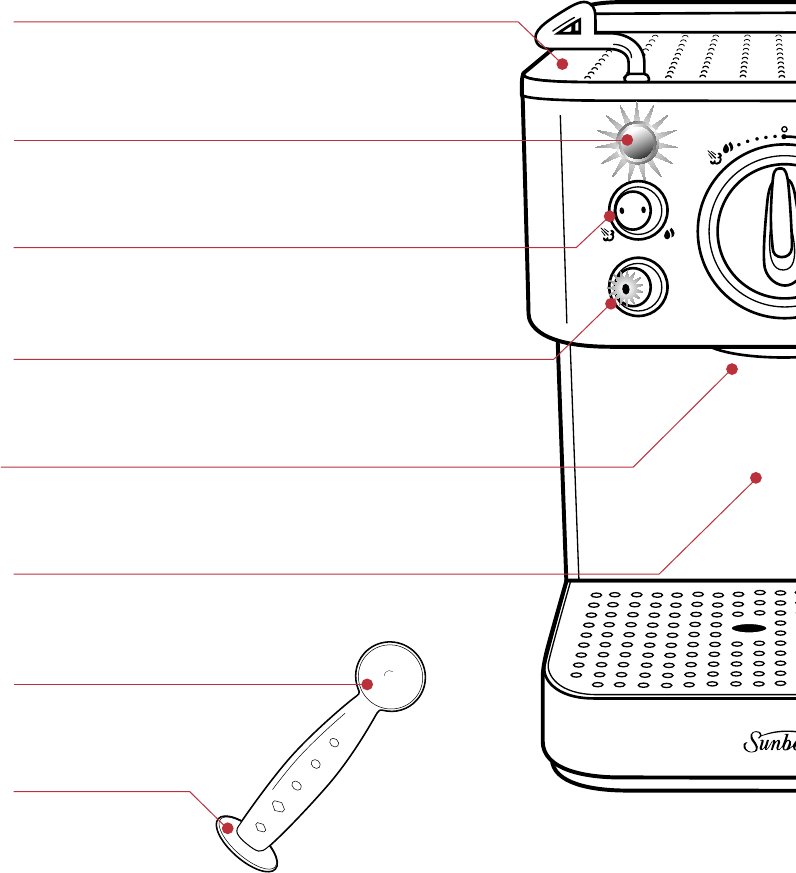
Warming plate
Effectively pre-warms up to 9 espresso
cups.
Heating light
Steam/hot water selector
Power switch with light
Group head
Filter handle
Measuring spoon
Tamp
Features of your Sunbeam
Café Espresso™
EM3800 Café Espresso
™
Stainless pictured.
5
5
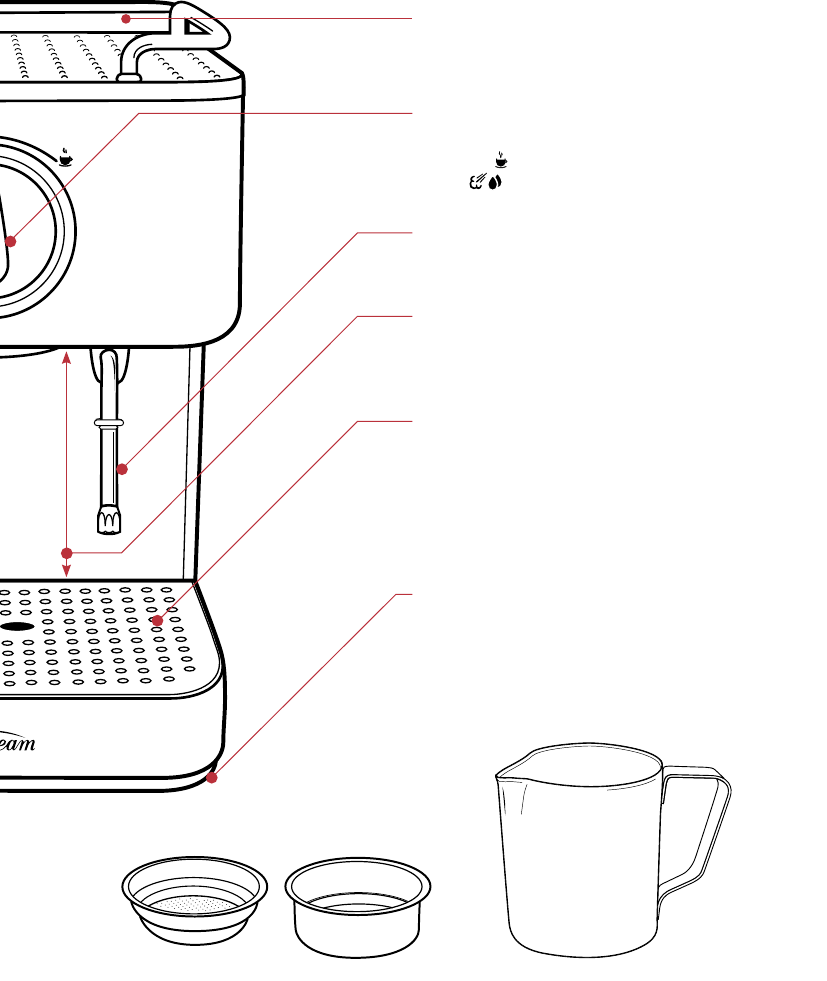
1.6L water reservoir
Removable water reservoir for easy filling,
simply lift in any direction.
Operating dial
Easy to operate – turn to the right for
espresso or to the left for steam or hot
water .
Steam wand
Extra cup height clearance
Additional clearance between the filter handle
and the drip tray is designed to suit taller cups.
Removable drip tray and grill
Designed with no dirt traps for small coffee
granules, milk or any other spills. You can
simply wipe clean all surfaces. The drip tray
and grill can be completely removed for easy
cleaning.
Non-slip rubber feet
Makes the unit sturdy, preventing it from
slipping or scratching the benchtop.
1 cup filter 2 cup filter
500ml jug
6
Features of your Sunbeam
Café Espresso™
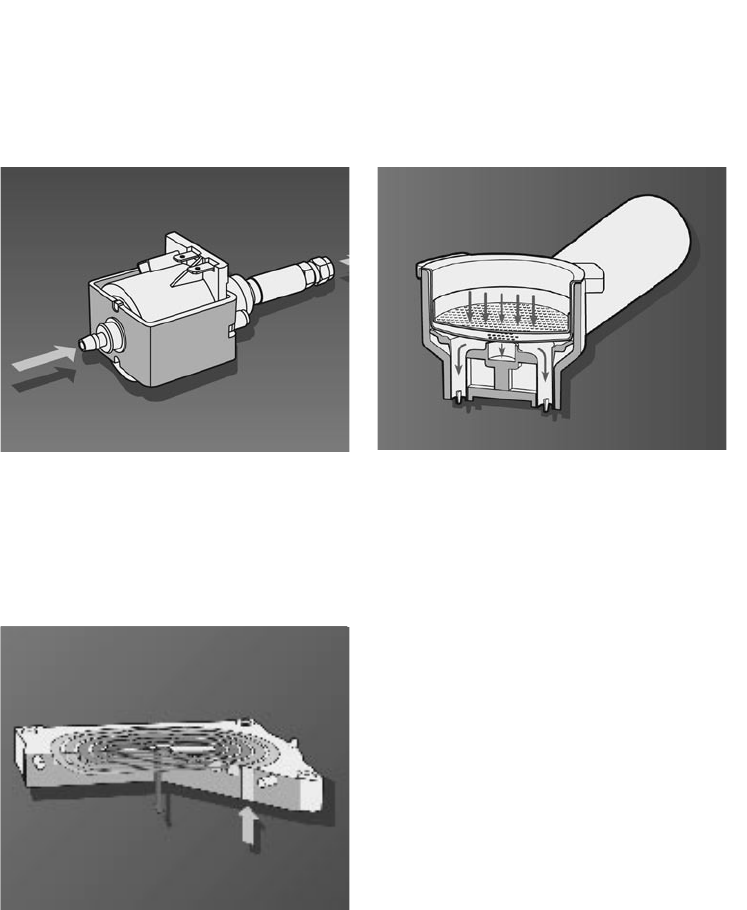
15 Bar Pump
Italian designed and manufactured, the
machine is fitted with a 15 BAR pump
delivering the pressure required for a
complete extraction of oils, coffee solids and
aroma.
Thermoblock Heating System
The thermoblock heating system heats the
water ensuring the precise temperature is
achieved for each function. Additionally, the
thermoblock is coated with non-stick material
to slow scale build up and reduce the
frequency of cleaning required.
Crema System
Italian designed the cream system consists
of a dual-floor filter creating additional back
pressure and stabilising baffle that helps
retain temperature and produces a steady
pour of espresso.
Using the control panel
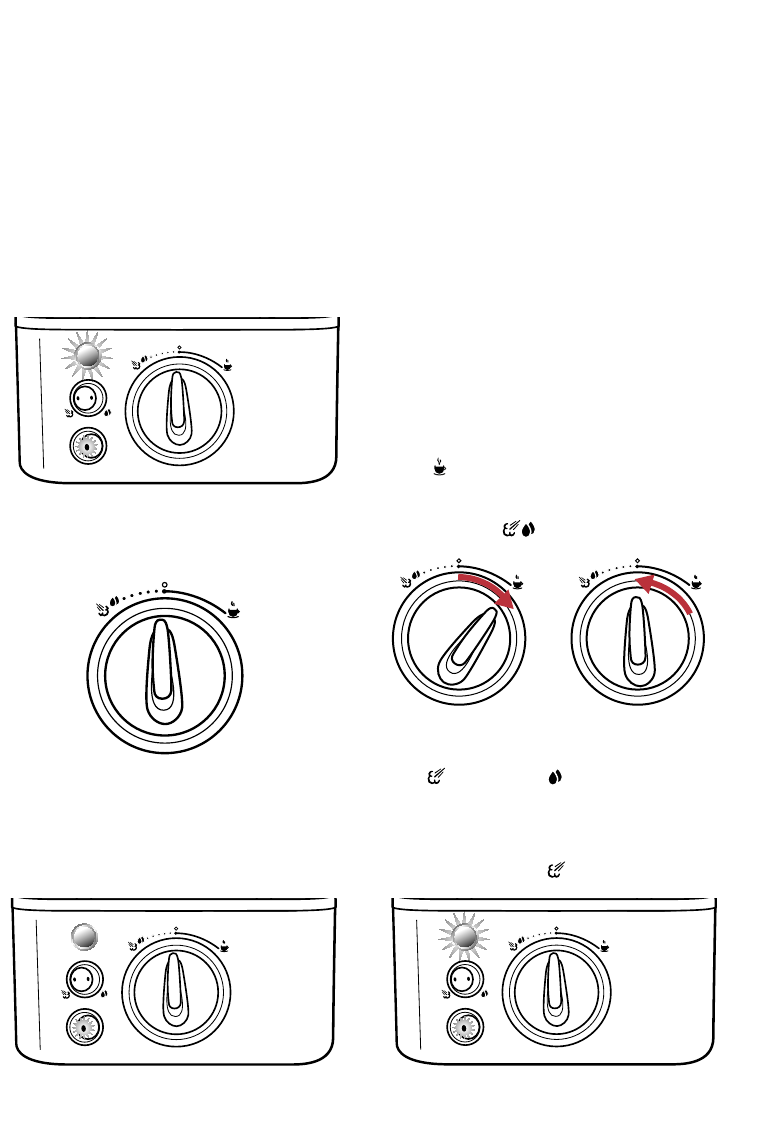
Power
Press the ‘POWER’ switch to turn the
espresso machine on. The light located on
the power switch will illuminate red and the
'HEATING' light will illuminate amber; this is
to indicate that your espresso machine is on
and is heating up.
Note: Before turning on the espresso machine
ensure that the operating dial is in the off
position.
The Café Espresso
™
will automatically heat
to the espresso temperature, 92°C – 94°C.
When the espresso machine is heated and
ready to use the amber 'HEATING' light will
go out.
Note: Remember that if the amber 'HEATING'
light is on the espresso machine is adjusting
the temperature of the heating system.
To turn the espresso machine off, simply
press the power switch.
Espresso
When the espresso machine is switched on
and is heated to the correct temperature,
so the amber 'HEATING' light is off, the
coffee maker is then able to use the espresso
machine.
The coffee maker simply needs to turn the
operating dial clockwise to the espresso
setting to start the pour and turn it back to
the off position to stop.
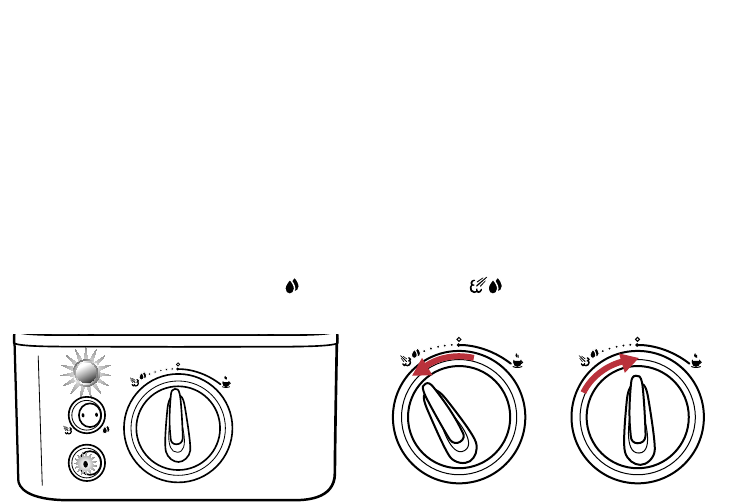
Steam/Hot Water
When the espresso machine is switched on
and the coffee maker wants to use either the
steam or hot water function they must
first select the appropriate setting.
A. Should the coffee maker want to texture
milk, they must first press the 'steam/hot
water' switch to the setting.
7
8
Using the control panel (continued)
The amber 'HEATING' light will illuminate,
indicating that the espresso machine is
adjusting the temperature of the heating
system.
B.Should the coffee maker want to use the
hot water function, they must first press
the 'steam/hot water' switch to the
setting.
Once the espresso machine is heated to
the correct temperature, the ‘HEATING’
light will go out and the coffee maker is
able to use the espresso machine.
The coffee maker simply needs to turn the
operating dial anticlockwise to the steam/
hot water setting to start and turn it
back to the off position to stop.
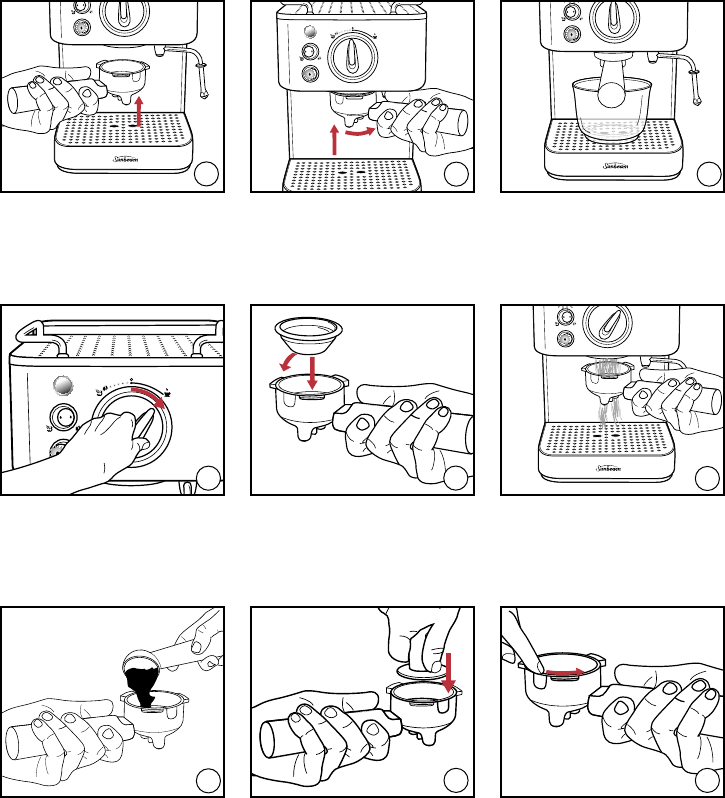
Reference guide to using your
espresso machine
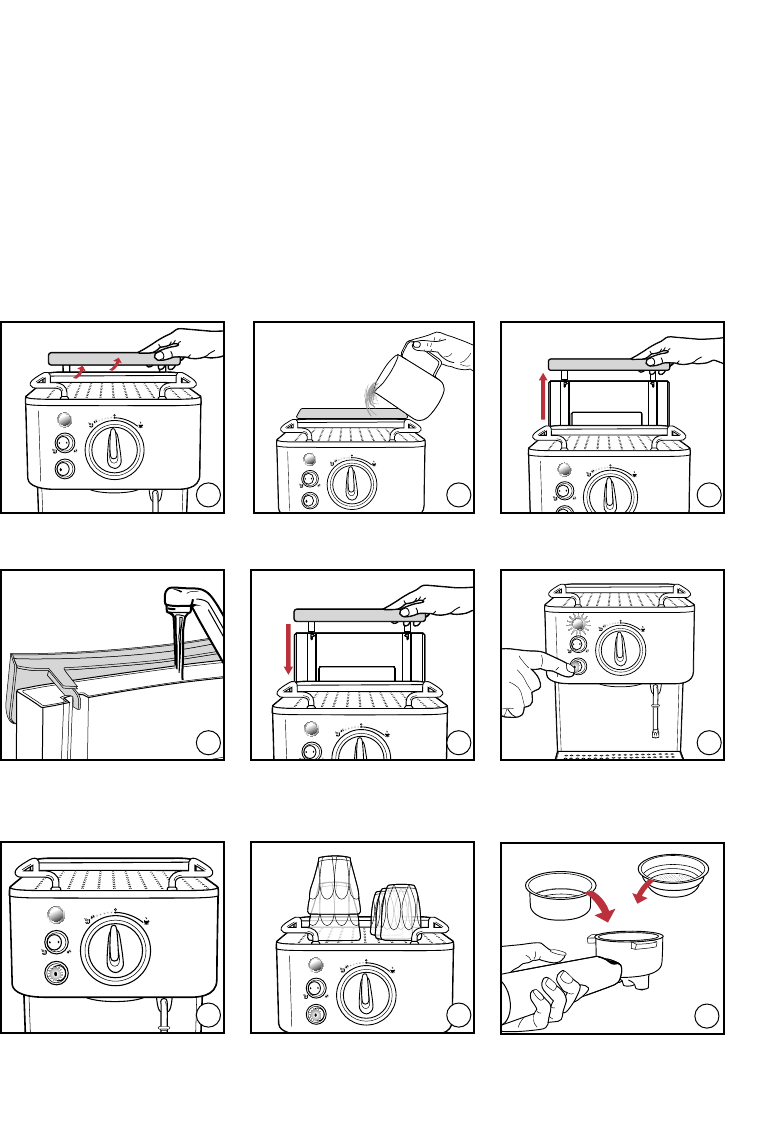
The diagrams below and on the following pages are to assist you in operating your Café
Espresso
™
espresso machine. Each of the diagrams is numbered. Throughout this instruction
booklet reference will be made to these diagrams so each of them has been numbered for
convenience and ease of use.
For example: Fill the water reservoir (1) (2) (3) (4) (5) with cold tap water...
Each time you see these numbers please refer back to the diagrams.
1 2 3
8
Preparing the espresso machine.
4 5 6
2 cup filter
1 cup filter
9
The espresso machine is
ready to use.
Warming the espresso cups. Select appropriate filter and
place into handle.
7
Fill at sink with cold water. Replace the water reservoir. Press 'POWER' switch to turn
machine on.
Open lid of water reservoir. Fill in place with cold water.
OR
Remove water reservoir.
9
10
Reference guide to using your espresso machine (continued)
17
13
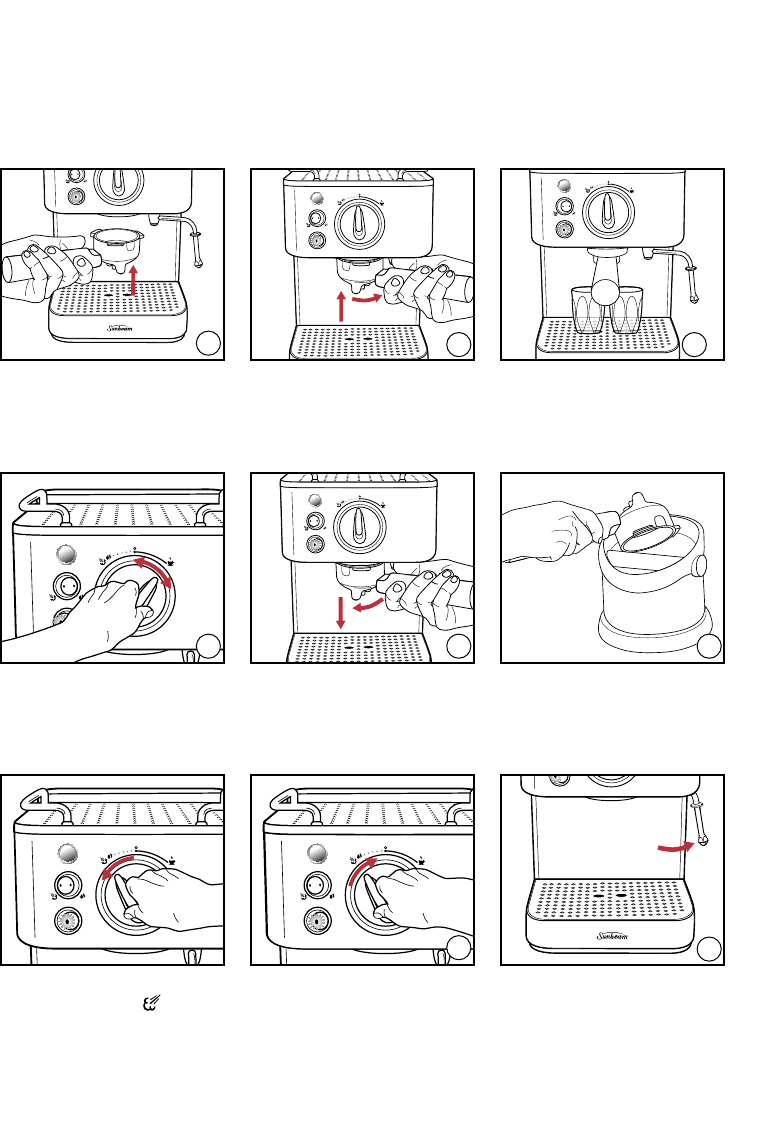
Making the espresso
16
10
11
12
14
Place filter handle onto
group head.
Turn filter handle to the
right, as far as it will go.
Place large container under
both pouring spouts.
Turn the operating dial to the
espresso setting and allow
water to run through.
Select appropriate filter and
place into handle.
Hold filter handle and purge
with water to preheat.
15
Place finely ground coffee
into filter.
Tamp the coffee grinds. Wipe the edge of filter to
remove any coffee grinds.
18
11
Reference guide to using your espresso machine (continued)
20 21
27
25
19
22 23 24
26
Turn the operating dial to
start and stop the espresso
pour.
Remove filter handle by
turning to the left.
Discard the used coffee
grinds.
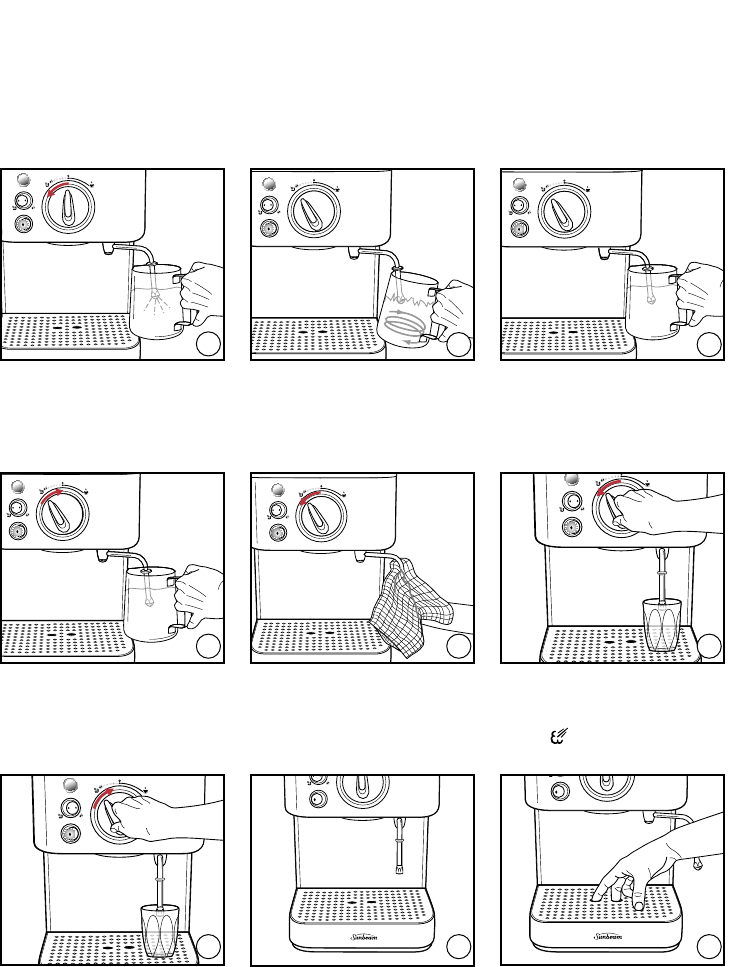
Purge the steam wand by
turning dial to the steam
setting.
Turn off steam by turning
dial to the off position.
Swing steam wand to the
side of espresso machine.
Place filter handle onto
group head.
Turn filter handle to the
right, as far as it will go.
Place glasses/cups below
pouring spouts.
Texturing milk
Reference guide to using your espresso machine (continued)
28
31
29 30
32 33
34 35 36
Close the hot water by
turning dial to the off
position.
Swing the steam/hot water
wand over the drip tray.
Remove the drip tray grill.
Close the steam by turning
dial to the off position.
Wipe steam nozzle and wand
with damp cloth and purge a
small amount of steam.
Place cup under steam
nozzle and activate the hot
water function by turning dial
to the steam setting.
Place steam wand into milk,
approx. 1cm below surface
and activate the steam
function.
Angle jug to rest steam wand
on spout and place nozzle
just below surface of the
milk.
Raise the jug until nozzle is
in the centre of milk.
Hot water
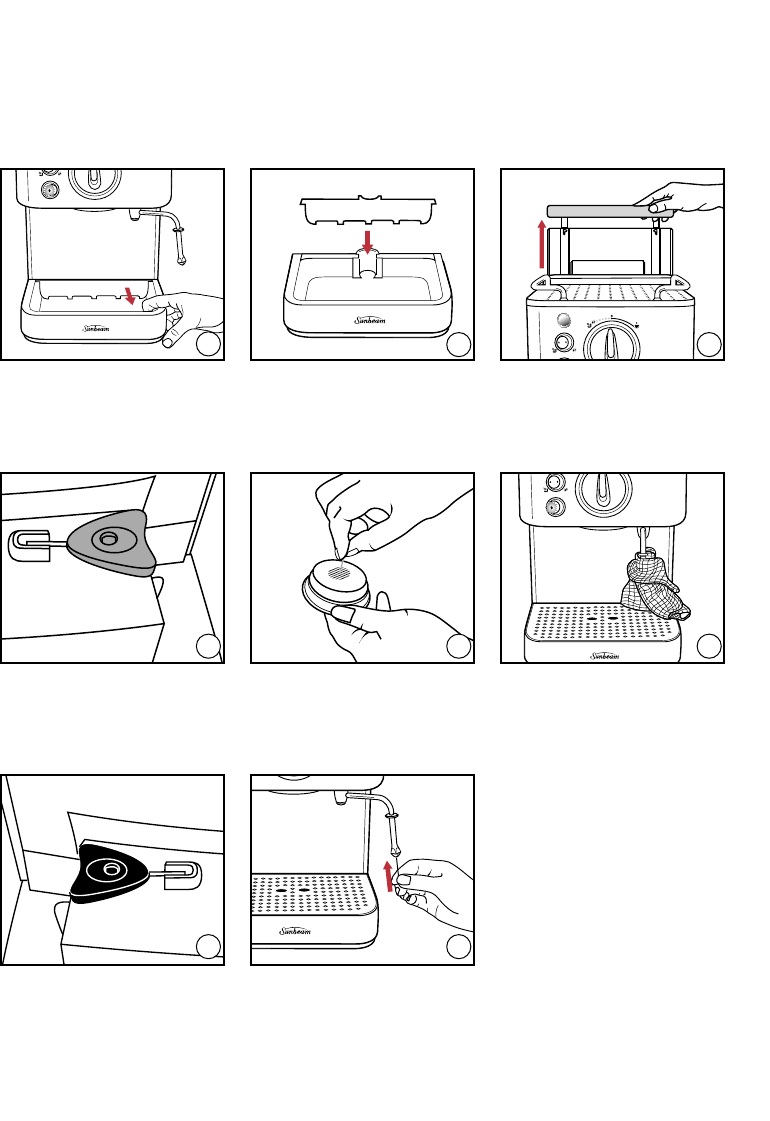
Cleaning
12
13
37 38 39
40 41 42
43 44
Remove the BLACK steam
nozzle cleaning pin from the
base of the espresso machine,
where the water reservoir sits.
Insert cleaning pin into the
hole in the base of the steam
wand.
Remove the GREY cleaning
pin from the base of the
espresso machine where
the water reservoir sits.
Insert the cleaning pin into
the single hole in the base of
the filter.
Wrap steam wand with damp
cloth and turn steam on for
10 seconds.
Remove drip tray. Ensure plastic lining is
clipped back into position in
the drip tray.
Remove water reservoir.
Reference guide to using your espresso machine (continued)

14
HeadingPreparing your espresso machine
before use
1. Place the espresso machine onto a dry,
stable benchtop.
2. Ensure the drip tray and grill are in place.
3. Fill the espresso machine with water. There
are a couple of ways in which the water
reservoir can be filled;
a) Simply lift the lid of the water reservoir
at the top of the espresso machine (1)
and using a jug, fill with fresh cold
water or filtered water (2).
b) Alternatively the water reservoir can
be removed and filled with fresh cold
water. To do so, lift the lid and using
it as a handle simply slide out the
water reservoir (3). Then fill with fresh
cold water or filtered water (4). Replace
the water reservoir firmly and close the
lid (5).
4. Insert the power cord into a 230-240V
AC power outlet and switch the power on.
Press the power switch to turn the espresso
machine on (6). The light located on the
power button will illuminate red and the
'HEATING' light will illuminate amber, this
is to indicate that your espresso machine is
on and is heating up.
When the 'HEATING' light switches off,
this indicates that the espresso machine is
heated and ready to use (7).
Note: Before turning on the espresso machine
ensure that the operating dial is in the off
position.
5. Place glasses and cups on the warming
plate (8).
Important: For first time use or if the machine
has not been used for some time, it is
important that the machine is rinsed as
follows:
6. Fit the filter handle with either the one or
two cup filter basket (9). Secure the filter
handle to the group head (10) (11).
7. Place a sufficiently large container under
both pouring spouts (12).
8. Turn the operating dial clockwise to the
espresso setting (13) and allow the water
to run through until the water reservoir is
empty.

Heading
15
Before starting to prepare for making
espresso, ensure the espresso machine is
switched on, to allow the espresso machine
to heat up.
Preheat Glasses
1. Preheat the glasses/cups by filling them
with hot water as this will assist to preserve
the crema of the espresso. Set the glasses/
cups aside.
Preheat Filter Handle and Filter Basket
2. Select the appropriate filter basket and
place it into filter handle (14).
Tip: Use the one cup filter basket for a single
serve of espresso and the two cup filter
basket for a double serve of espresso.
3. Take the filter handle, hold it under the
group head and purge water. With the filter
basket positioned under the group head
turn the operating dial clockwise to the
espresso setting to start the water flow
and turn it back to the off position to stop
(15).
4. Dry the filter basket.
Dosing and Tamping
5. Using the measuring spoon supplied, place
finely ground coffee into the filter basket
(16).
6. Rest the filter handle with the filter basket
in position onto the benchtop. Take the
coffee tamp, apply firm level packing
pressure (17), twisting 90 degrees to
polish the grounds. This seals the surface
of the coffee cake.
7. Brush any excess coffee grounds from
around the edge of the filter basket (18).
Important: Be sure not to over dose the filter
basket with coffee.
Tip: The coffee dosage and the degree of
tamping should remain the same every time
you make a coffee the only thing that should
vary is the coarseness of the coffee grounds
and this will vary depending on the bean. For
example to achieve a slower espresso pour
rate use a finer grind and a coarser grind for
a faster espresso pour rate.
Tip: Ensure the coffee tamp is dry because if
it is wet the coffee grinds will stick to it.
The Espresso Pour
8. Lock the filter handle onto the group head
(19)(20).
9. Empty the glasses/cups and place below
the pouring spouts (21).
Note: Check to see that the espresso machine
is ready for use, remember that if the
'HEATING' light is on the espresso machine
is adjusting the temperature of the heating
system.
10. Turn the operating dial clockwise to the
espresso setting to start the pour and
turn it back to the off position to stop
(22).
11. Check the espresso pour. The ideal
pour is dark and caramel with reddish
reflections.
12. Serve espresso immediately.
Caring for your Espresso Machine
13. Remove the filter handle from the group
head (23).
14. Discard the used coffee grinds from the
filter basket (24).
Tip: After each use of the espresso machine
we recommend that a small amount of water
is cycled through the group head as this will
wash out any old or used coffee grinds stuck
to the underside of the group head. Simply
turn the operating dial to the espresso
setting and allow some water to run through.
Guide to the perfect espresso
16
Milk texturing is the steaming of milk. The
steam does two things, firstly it heats the
milk and secondly the steam mixes air
with the milk to form an ‘emulsion’ of tiny
bubbles that gives a silky velvet texture.
Similar to making an espresso, perfecting the
art of milk texturing takes time and practice.
Tip: Remember espresso is the foundation
for all café style drinks and the milk is the
variable.
Before starting to prepare for milk texturing,
ensure the 'steam/hot water' switch in the
steam setting.
1. Determine how much milk is needed
based on the number of cups being made
or the size of the texturing jug.
Tip: Keep in mind that the volume of milk
will increase or ’stretch’ during the texturing.
2. Pour cold refrigerated milk into a
stainless steel jug, between ½ to ²/³ full.
Tip: Store the stainless steel jug in the fridge
so that it is well chilled. Also be sure not to
rinse the jug with warm water before use.
3. Purge the steam wand of any water.
With the steam wand positioned over the
drip tray activate the steam function by
turning the operating dial to the
steam setting (25). Once any water has
been purged close the steam by turning
the operating dial to the off position (26).
4. Swing the steam wand to the side of the
espresso machine (27).
5. Place the steam wand into the milk so
that the nozzle is about a centimetre
below the surface and activate the steam
function by turning the operating dial to
the steam setting (28).
6. Angle the jug so that the steam wand is
resting on the spout of the jug and lower
the jug until the tip of the steam nozzle
is just below the surface of the milk. This
will start to create a whirlpool action in
the milk (29).
Note: Do not allow the steam to spurt
unevenly or it will create aerated froth/large
bubbles. If this is happening raise the jug so
that the steam nozzle is lowered deeper into
the milk. Remember the ideal consistency is
a silky velvet texture.
7. As the steam heats and textures the milk,
the level of the milk in the jug will begin
to rise. As this happens follow the level
of the milk by lowering the jug, always
keeping the tip of the steam nozzle just
below the surface.
8. Once the foam is created raise the jug
until the steam nozzle is in the centre of
the milk (30).
Tip: The amount of foam required will vary
depending on the drinks being made, for
example a cappuccino requires more foam
than a flat white.
9. Close the steam immediately when the
milk is heated to between 60-65°C by
turning the operating dial to the off
position (31).
Tip: If you don’t have a thermometer a good
indication that the correct temperature has
been reached is when you are unable to leave
the palm of your hand against the side of the
jug for more than 3 seconds.
Important: Do not boil the milk.
10. Remove the jug, immediately wipe the
steam nozzle and wand with a clean damp
cloth (32) and purge a small amount of
steam.
Guide to milk texturing
17
11. With the jug in hand tap the jug on
the bench top to release the trapped
air bubbles and then swirl the jug in a
circular motion until the milk becomes
shiny and no bubbles remain, this helps
the milk and froth combine for an even
consistency. By swirling the milk you can
see the foam in the jug swirling with your
movement this will enable you to judge
the thickness of your foam.
Guide to milk texturing (continued)
Using the hot water function
When using the hot water function ensure the
'steam/hot water' switch is in the hot water
setting.
The hot water function is ideal for preparing
long blacks, hot chocolate and filling coffee
plungers and tea pots.
1. Place the cup or container under the
steam/hot water nozzle and activate the hot
water function by turning the operating dial
to the hot water setting (33).
2. Once you have dispensed the required
amount of hot water into the cup or
container, close the hot water by turning
the operating dial to the off position (34).
3. Remove the cup or container and swing the
steam/hot water wand over the drip tray to
catch any drips of water (35).
18
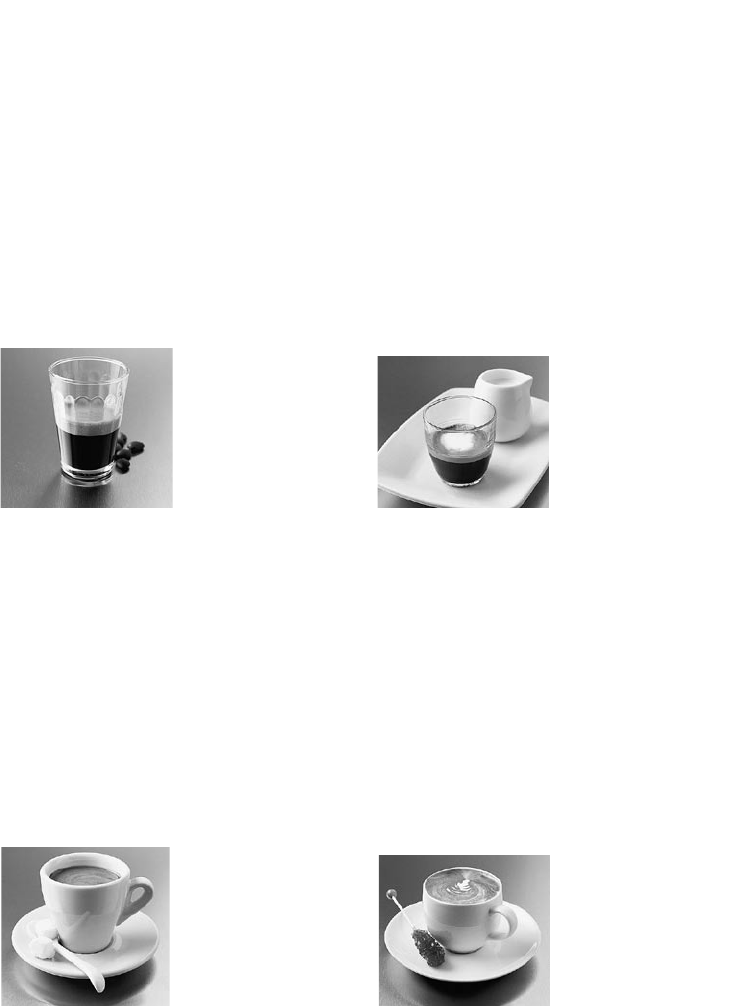
ESPRESSO (SHORT BLACK)
Espresso is a concentrated, full bodied coffee
with a stable layer of cream on top – known
as ‘crema’. An espresso is the foundation of
all café coffee. Variations are achieved by
adding different amounts of milk and froth.
• 90mL espresso glass or demitasse cup
• single espresso (30-35mL)
LONG BLACK
A standard espresso with hot water, served in
a regular coffee cup or mug. The hot water is
added first so that the ‘crema’ is maintained.
• 190mL cup
• hot water (to taste)
• single or double espresso
MACCHIATO
Macchiato, Italian for ‘to stain or mark’.
Traditionally served as a standard espresso
with a dash of milk and a small dollop of
froth into the middle of the ‘crema’.
• 90mL espresso glass or demitasse cup
• single or double espresso
• marked with steamed milk froth
FLAT WHITE
Another old favourite, the Flat White is
an espresso with steamed milk, served in
a regular coffee cup or mug. The layer of
frothed milk on top should be 2mm to seal
the coffee.
• 190mL cup
• single or double espresso
• steamed milk
Espresso Recipes
19
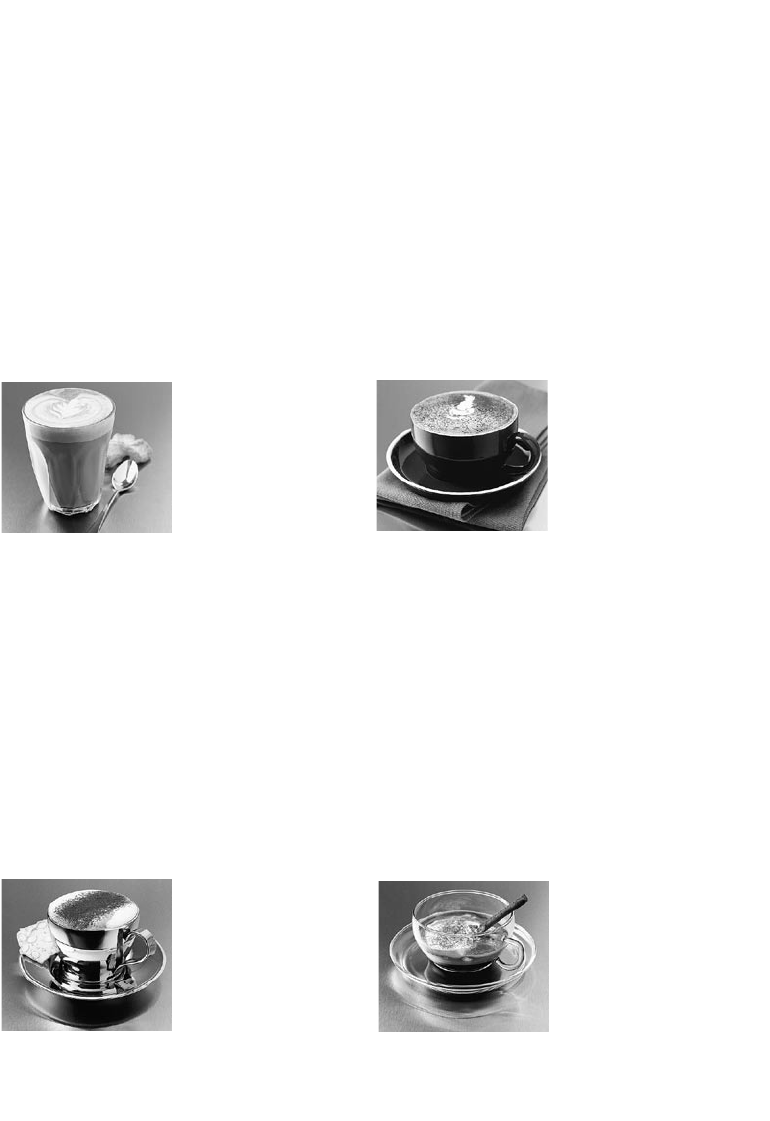
CAFFE LATTE
An espresso with steamed milk, typically
served in a glass. The layer of frothed milk on
top should be 10mm to seal the coffee.
• 220mL glass or cup
• single or double espresso
• steamed milk
CAPPUCCINO
This delicious drink is an espresso with
steamed milk, topped with creamy froth and
a dusting of chocolate. The resulting drink is
approximately two-thirds milky coffee, one-
third froth.
• 190-240mL cup
• single or double espresso
• two-thirds milky coffee, one-third froth
• dusted with chocolate
CAFFE MOCHA
Made in a similar way to a cappuccino but
with the addition of drinking chocolate.
Simply stir the chocolate into the espresso
prior to adding the steamed milk and froth.
• 190-240mL cup or tall glass
• single or double espresso
• two teaspoons of drinking chocolate
• two-thirds milky coffee, one-third froth
CON PANNA
A variation on the original Vienna coffee, this
delicious drink is made up of an espresso
topped with lightly whipped cream. It can
also be dusted with cinnamon or drinking
chocolate.
• 190mL cup
• single or double espresso
• lightly whipped cream
• dusted with cinnamon or chocolate
Espresso Recipes (continued)

20
Care and Cleaning
The coffee making process involves extracting
oils out of coffee grinds to make espresso
coffee. Deposits of these oils build up over
time and affect the taste of the coffee and
operation of the espresso machine.
Regular cleaning to remove these oils is
essential and will maintain the quality of the
coffee the espresso machine produces and
result in less maintenance being required.
This is easy to do by following a few quick
and easy cleaning steps after each coffee
making session;
Cycle water through the group head,
Purge steam through the steam wand,
Wipe the steam wand clean with a damp
cloth immediately after use,
Remove the filter basket from the filter
handle and clean away any old coffee oils,
and
Empty the drip tray and rinse.
Important: Never wash any of the espresso
machine parts or accessories in the
dishwasher.
Drip tray and grill
Remove the grill and drip tray at regular
intervals to empty (36) (37). Clean with
water and a little non-abrasive washing up
liquid, rinse and dry.
Over time it is normal for the inside of the
drip tray to be stained by the oils in the
coffee.
Note: Ensure that when you are replacing the
drip tray and grill that the plastic lining is in
position (38).
Group head, filter handle & filter baskets
The filter baskets and filter handle should be
rinsed with warm water after each use and
then dried thoroughly.
To clean the group head of any old coffee
grinds cycle water through and wipe the
group head and around the inside rim with a
damp cloth.
Should the holes in the filter baskets become
clogged with coffee granules use a fine
bristled brush to remove them.
Important: Should the filter remain blocked
after normal cleaning, supplied with your
espresso machine is a cleaning pin. The
cleaning pin for the filter is the GREY pin
located under the base of the water reservoir
(39)(40). With the cleaning pin insert it into
the single hole in the base of the filter (41).
Group head rubber seal
The group head seal is located on the
underside of the group head and creates
a seal against the filter handle during the
espresso pour.
Note: During long periods of non-use we
recommend that the filter handle not be
left attached to the group head as this will
reduce the life of the seal.
Over time the seal will lose its elasticity
and require replacement, depending on use
usually every 12 months. Signs that the seal
is deteriorating are when the filter handle
cannot create the necessary seal and steam
escapes from around the group head during
the espresso pour.
Note: Contact Sunbeam on 1800 025 059
should you think that the group head seal
needs replacing.
Cup warming plate and exterior
Wipe over the unit with a damp cloth and
wipe dry. Do not use abrasives or metal
scourers as these will scratch the exterior
surface.

21
Steam wand
Keeping the steam arm clean is essential
to ensure maximum efficiency of the steam
function. A build up of caramelised/dried
milk on the steam wand will impair the
steaming and texturing ability of the espresso
machine.
Important: Wipe the steam wand clean with a
damp cloth immediately after each use and
purge a small amount of steam.
Should the milk dry/caramelise on the
steam wand, simply wrap the wand with
a clean damp cloth, turn the steam wand
over the drip tray and turn the steam on for
approximately 10 seconds (42). With the
cloth still on the steam wand leave to soak
for about 5 minutes and you will find that
after this time the dry/caramelised milk will
easily wipe away. Repeat process if still dirty.
Important: Never clean the steam wand with
an abrasive pad as this will damage the
steam wand.
Should the steam wand become blocked,
supplied with the espresso machine is a
cleaning pin. The cleaning pin for the steam
wand is the BLACK pin located under the
base of the water reservoir (39)(43).
With the cleaning pin insert it into the hole
in the base of the steam nozzle (44). Should
the steam wand remain blocked unscrew the
steam nozzle from the steam wand. Clean
the steam nozzle by once again using the
cleaning pin then flush under running water.
Care and Cleaning (continued)

22
Scale is a surface build up of minerals that
naturally occur over time in all appliances
that are involved with the heating of water.
Therefore the espresso machine will require
occasional descaling. It is recommended
that the espresso machine is descaled every
4-6 months, this will vary depending on the
frequency of use.
Descaling solution
Use any of the following when descaling the
espresso machine:
Sunbeam Espresso Machine Descaling
Tablets
Sunbeam Liquid Descaler, or
Vinegar Solution.
Descaling the espresso machine
Note: Ensure the espresso machine is turned
off and the power cord is unplugged.
1. Remove the water reservoir and rinse clean.
Depending on the descaling solution being
used use one of the following:
A. Sunbeam Espresso Machine Descaling
Tablets
Fill the water reservoir with 1 litre of warm
water and place a descaling tablet into the
reservoir. Once the tablet has dissolved
replace the reservoir, this takes about 5-7
minutes.
B. Sunbeam Liquid Descaler
Fill the water reservoir with approximately
1.5 litres of water, add 1 capful of
Sunbeam Liquid Descaler and replace the
reservoir.
C. Vinegar solution
Fill the water reservoir with approximately
1.5 litres of warm water, add 3 tablespoons
of vinegar and replace the reservoir.
2. Should the filter handle be attached to
the group head remove it, rinse thoroughly
under running water and set aside.
3. Using a screwdriver unscrew the brewing
filter/shower screen from the underside of
the group head.
4. Remove and set aside the filter/screen,
washer and screw in a safe place.
Important: Be careful not to lose the filter/
screen, washer and screw once you have
disassembled the group head.
5. Using a small brush scrub in and around
the area at the brewing head, removing all
coffee granules.
6. Place a sufficiently large container under
the group head.
7. Insert the power cord into a 230-240V AC
power outlet and switch the power ‘ON’.
Press the power switch to turn the espresso
machine on.
Note: Remember if the 'HEATING' light is
on the espresso machine is adjusting the
temperature of the heating system.
Once the espresso machine is heated to the
correct temperature, 'HEATING' light will go
off, this indicates that the espresso machine
is heated and ready to use.
8. Turn the operating dial clockwise to the
espresso setting and allow half the
solution to cycle through the group head.
Important: Do not run descaling solution
through the steam wand.
Note: Depending on the size of the container
under the group head on occasion this may
need to be emptied throughout this process.
9. After half the solution has cycled through
turn the operating dial to the off position
to stop the flow and then press the power
switch to turn the machine off.
Descaling

23
10. Leave the machine off for 10-15 minutes
to allow the descaler solution to take
affect.
11. Press the power switch to turn the
espresso machine on.
12. Turn the operating dial to the espresso
setting and allow the remaining solution
to cycle through the group head.
13. Remove the water reservoir from the
machine and rinse thoroughly under
running water, ensuring that all traces
of the descaling solution is removed.
Fill with clean water and replace the
reservoir.
14. Turn the operating dial to the espresso
setting and allow the entire water
reservoir to cycle through the group head.
Note: Depending on the size of the container
under the group head on occasion this may
need to be emptied throughout this process.
15. When this is finished remove the
container under the group head and give
the machine a good wipe over.
16. Carefully replace the rubber seal, brewing
filter/shower screen and washer to the
group head. Tighten well.
17. Fill the water reservoir with fresh water
and position it on to the machine.
Descaling (continued)
24
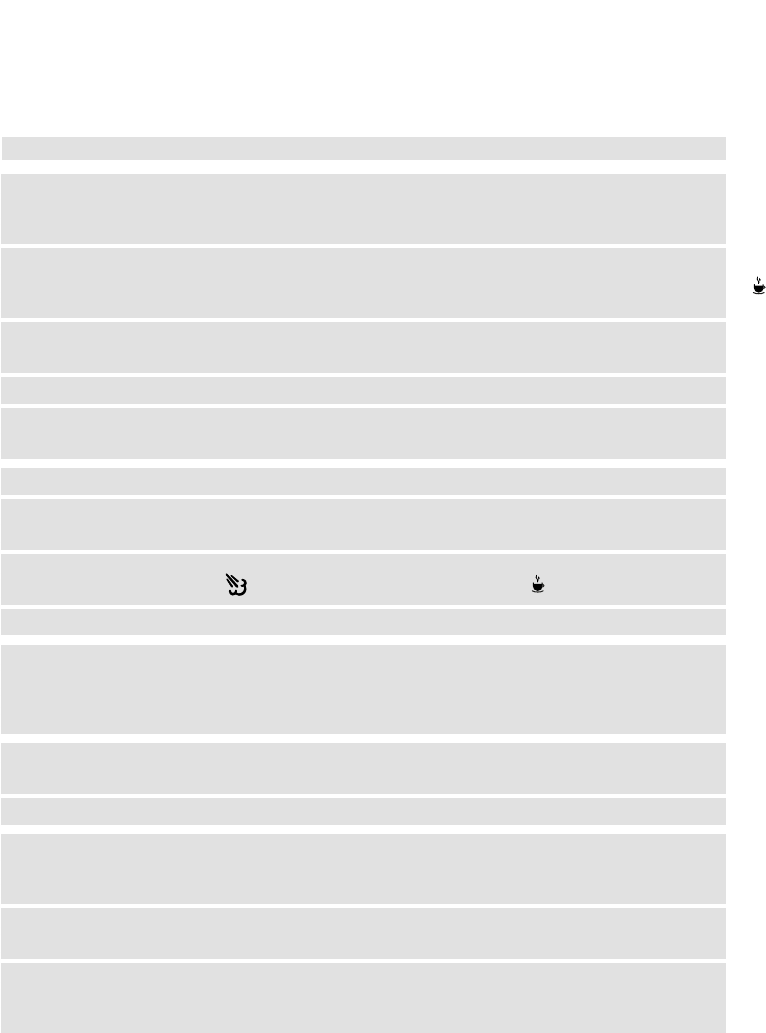
Trouble Shooting guide
PROBLEM POSSIBLE CAUSE WHAT TO DO
Coffee runs down the side of Filter handle is not attached correctly, Ensure the handle is firmly positioned
the filter handle. or has not been tigtened sufficiently. onto the group head. See “Guide to
the perfect espresso” pg 15.
Edge of filter insert is not free Clean around the top edge of the
of coffee granules. filter and wipe the group head clean
of coffee.
The group head is dirty. Wipe group head with a
damp cloth.
The group head is defective. Contact a Sunbeam Service Centre.
Group head rubber seal is damaged, Contact a Sunbeam Service Centre.
or warn.
No coffee runs through. No water in the water reservoir. Fill reservoir with water.
Water reservoir not correctly Press firmly down on the water reservoir
assembled. to ensure it is correctly positioned.
Operating dial set to Ensure the operating dial is in the
setting. espresso position.
Group filter may be blocked. See “Descaling” pg 22.
The filter is blocked, the coffee Empty out the filter and rinse under
grounds are too fine or tamped water to clean. Wipe the group head
down too hard. with a cloth and use a coarser coffee
grind.
Coffee pours out in drops. Coffee grind is too fine or are Use a coarser grind and ensure the
too compacted. filter basket is not over filled.
Machine blocked by scale build up. See “Descaling” pg 22.
Espresso does not have any Coffee is stale. Use fresh coffee and once you open the
Crema. coffee be sure to store it in an airtight
container.
Coffee not compacted firmly enough. Compact coffee grounds more
firmly.
Coffee too coarse. Grind the coffee to a finer texture or
change brands of espresso coffee to a
finer grind.

25
Trouble Shooting guide (continued)
Espresso does not have any Not enough coffee in filter. See "Guide to the perfect espresso"
Crema. pg 15.
Handle comes off during group. Coffee tamped too hard. Tamp the coffee grounds lighter.
Coffee grind is too fine. Change to a coarser grind of coffee.
Filter handle is not attached correctly, Ensure the handle is firmly positioned
or has not been tightened sufficiently. onto the group head.
See "Guide to the perfect espresso"
pg 15.
Top edge of filter is not free of coffee Clean around the edge of the filter and
granules. wipe the group head clean of coffee.
The group head is dirty. Wipe group head with a damp cloth.
The group head is defective. Contact a Sunbeam Service Centre.
Group head rubber seal is warn or Contact a Sunbeam Service Centre.
damaged.
Coffee is too cold. Cups, filter and filter hand are cold. Pre-heat cups, filters, handle and
filter. See "Guide to the perfect
espresso" pg 15.
If making a cappuccino or latte Ensure that milk is heated properly
the milk may not be heated enough. during texturing, but be sure not to boil
the milk. See "Guide to milk texturing"
pg 16.
No steam from the steam nozzle. Steam nozzle is blocked. See "Care & Cleaning" pg 20.
Not enough froth when frothing Milk is not fresh. Ensure the milk is fresh.
Milk temperature is too warm. Ensure that the milk is well refrigerated
before use.
Jug. For best texturing results use a stainless
steel jug and if possible refrigerate or
run the jug under cold water before use.
Steam nozzle is blocked. See "Care & Cleaning" pg 20.
Milk has been boiled. Start again with fresh, chilled milk.
Uneven cup filling. Uneven tamping or obsruction in the Ensure coffee is tamped evenly
pouring spouts. and check that there is nothing
obstructing the pouring spouts.
26
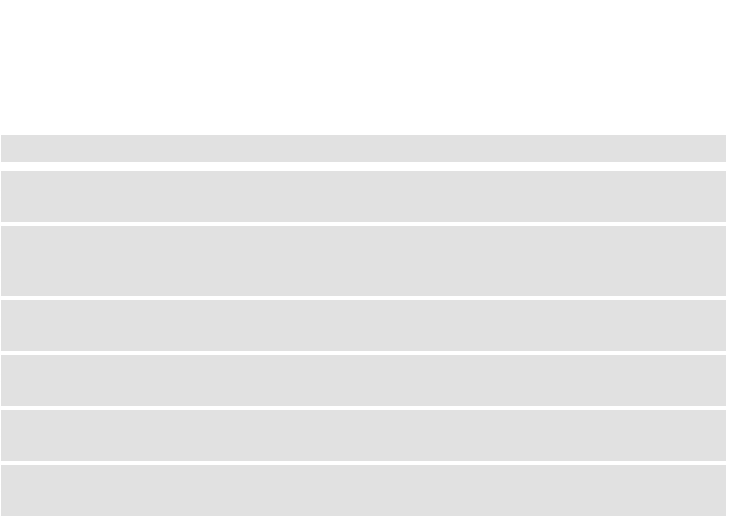
Uneven cup filling. Defective baffle in filter handle. Contact a Sunbeam Service Centre.
Espresso tastes burnt. Type of coffee being used. Experiment with different brands of
coffee.
Appliance has not been rinsed Run a reservoir full of water properly
after descaling. through the machine before making
another coffee.
Pump makes an unusually No water in reservoir. Fill the water reservoir.
load noise.
Water reservoir not correctly Replace the water reservoir
positioned. firmly into the unit.
Machine does not operate. Group head filter may be blocked. Remove filter holder and clean group
head. See "Care & Cleaning" pg 20.
Machine blocked by scale See “Descaling ” pg 22.
build up.
Please contact Sunbeam directly on Freecall 1800 025 059, if this guide does not solve your
query. We have experienced staff on hand to assist, Monday to Friday.
Trouble Shooting guide (continued)

Notes

HeadingNotes
‘Sunbeam’, is a registered trademark of Sunbeam Corporation.
Café Espresso is a trademark of Sunbeam Corporation.
Made in China. Due to minor changes in design or otherwise,
the product may differ from the one shown in this leaflet.
Backed by Sunbeam’s 12 Month Replacement Guarantee and
National Service Network.
© Copyright. SUNBEAM CORPORATION LIMITED 2005.
(INCORPORATED IN N.S.W.) A.C.N. 000 006 771
Sunbeam Corporation is a division of GUD Holdings Ltd.
For more information or advice on this or any other
Sunbeam appliance, visit www.sunbeam.com.au or
contact the Sunbeam Consumer Service Line.
Australia 1800 025 059
New Zealand 0800 786 232.
09/05

Consumer Hotline
Australia
1800 025 059
New Zealand
0800 786 232
www.sunbeam.com.au
is a registered Trademark of Sunbeam
Corporation Limited. ACN 000 006 771.
© Sunbeam Corporation Limited 2005.
