Super Micro Computer Superserver 6012P 6 Users Manual 6_1.0b_pref_PMD
SUPERSERVER 6012P-6 MNL-0657
6012P-6 to the manual e61459f6-98c9-d2d4-a14f-95ca73874fb4
2015-02-02
: Super-Micro-Computer Super-Micro-Computer-Superserver-6012P-6-Users-Manual-448794 super-micro-computer-superserver-6012p-6-users-manual-448794 super-micro-computer pdf
Open the PDF directly: View PDF  .
.
Page Count: 110 [warning: Documents this large are best viewed by clicking the View PDF Link!]
®
SUPERSERVER 6012P-6
USER’S MANUAL
1.0b
SUPER

The information in this User’s Manual has been carefully reviewed and is believed to be
accurate. The vendor assumes no responsibility for any inaccuracies that may be
contained in this document, makes no commitment to update or to keep current the
information in this manual, or to notify any person or organization of the updates. Please
Note: For the most up-to-date version of this manual, please see our
web site at www.supermicro.com.
SUPERMICRO COMPUTER reserves the right to make changes to the product described in
this manual at any time and without notice. This product, including software, if any, and
documentation may not, in whole or in part, be copied, photocopied, reproduced, translated
or reduced to any medium or machine without prior written consent.
IN NO EVENT WILL SUPERMICRO COMPUTER BE LIABLE FOR DIRECT, INDIRECT,
SPECIAL, INCIDENTAL, SPECULATIVE OR CONSEQUENTIAL DAMAGES ARISING FROM
THE USE OR INABILITY TO USE THIS PRODUCT OR DOCUMENTATION, EVEN IF
ADVISED OF THE POSSIBILITY OF SUCH DAMAGES. IN PARTICULAR, THE VENDOR
SHALL NOT HAVE LIABILITY FOR ANY HARDWARE, SOFTWARE, OR DATA STORED
OR USED WITH THE PRODUCT, INCLUDING THE COSTS OF REPAIRING, REPLACING,
INTEGRATING, INSTALLING OR RECOVERING SUCH HARDWARE, SOFTWARE, OR
DATA.
Any disputes arising between manufacturer and customer shall be governed by the laws of
Santa Clara County in the State of California, USA. The State of California, County of
Santa Clara shall be the exclusive venue for the resolution of any such disputes.
Supermicro's total liability for all claims will not exceed the price paid for the hardware
product.
Unless you request and receive written permission from SUPER MICRO COMPUTER,
you may not copy any part of this document.
Information in this document is subject to change without notice. Other products and
companies referred to herein are trademarks or registered trademarks of their respective
companies or mark holders.
Copyright © 2003 by SUPER MICRO COMPUTER INC.
All rights reserved.
Printed in the United States of America

Preface
About This Manual
This manual is written for professional system integrators and PC technicians.
It provides information for the installation and use of the SuperServer 6012P-6.
Installation and maintainance should be performed by experienced technicians
only.
The SuperServer 6012P-6 is a high-end, dual Xeon processor 1U rackmount
server based on the SC812S 1U rackmount server chassis and the P4DPR-6GM+
motherboard, which supports single or dual Xeon 512K L2 cache proces-
sors of up to 3 GHz at a Front Side (system) Bus speed of 400 MHz and up to
12 GB of DDR-200 (PC1600) SDRAM memory.
Manual Organization
Chapter 1: Introduction
The first chapter provides a checklist of the main components included with the
server system and describes the main features of the SUPER P4DPR-6GM+
mainboard and the SC812S chassis, which make up the SuperServer 6012P-6.
Chapter 2: Server Installation
This chapter describes the steps necessary to install the SuperServer 6012P-6
into a rack and check out the server configuration prior to powering up the
system. If your server was ordered without processor and memory components,
this chapter will refer you to the appropriate sections of the manual for their
installation.
Chapter 3: System Interface
Refer here for details on the system interface, which includes the functions
and information provided by the control panel on the chassis as well as
other LEDs located throughout the system.
iii
Preface

SUPERSERVER 6012P-6 Manual
iv
Chapter 4: System Safety
You should thoroughly familiarize yourself with this chapter for a general overview
of safety precautions that should be followed when installing and servicing the
SuperServer 6012P-6.
Chapter 5: Advanced Motherboard Setup
Chapter 5 provides detailed information on the P4DPR-6GM+ motherboard, in-
cluding the locations and functions of connectors, headers and jumpers. Refer
to this chapter when adding or removing processors or main memory and
when reconfiguring the motherboard.
Chapter 6: Advanced Chassis Setup
Refer to Chapter 6 for detailed information on the 1U SC812S rackmount
server chassis. You should follow the procedures given in this chapter
when installing, removing or reconfiguring SCSI or peripheral drives and
when replacing the system power supply unit and cooling fans.
Chapter 7: BIOS
The BIOS chapter includes an introduction to BIOS and provides detailed
information on running the CMOS Setup Utility.
Appendix A: BIOS POST Messages
Appendix B: BIOS POST Codes
Appendix C: Supero Doctor III
Appendix D: System Specifications

v
Preface
Notes

SUPERSERVER 6012P-6 Manual
vi
Table of Contents
Preface
About This Manual ....................................................................................................... iii
Manual Organization .................................................................................................... iii
Chapter 1: Introduction to the SuperServer 6012P-6
1-1 Overview ............................................................................................................ 1-1
1-2 Mainboard Chassis Features ......................................................................... 1-2
1-3 Server Chassis Features ................................................................................ 1-5
1-4 Contacting Supermicro ................................................................................... 1-7
Chapter 2: Server Installation
2-1 Overview ............................................................................................................ 2-1
2-2 Unpacking the SuperServer 6012P-6............................................................. 2-1
2-3 Preparing for Setup ......................................................................................... 2-1
Choosing a Setup Location...................................................................... 2-2
Rack Precautions...................................................................................... 2-2
Server Precautions .................................................................................... 2-2
2-4 Installing the SuperServer 6012P-6 into a Rack .......................................... 2-3
Identifying the Sections of the Rack Rails ............................................ 2-3
Installing the Chassis Rails ....................................................................... 2-4
Installing the Rack Rails ............................................................................2-4
Installing the Server into the Rack ........................................................... 2-5
Installing the Server into a Telco Rack .................................................... 2-6
2-5 Checking the Motherboard Setup .................................................................. 2-7
2-6 Checking the Drive Bay Setup....................................................................... 2-9
Chapter 3: System Interface
3-1 Overview ............................................................................................................ 3-1
3-2 Control Panel Buttons..................................................................................... 3-1
Reset .......................................................................................................... 3-1
NMI ............................................................................................................. 3-1
Power ......................................................................................................... 3-2
3-3 Control Panel LEDs......................................................................................... 3-2
Overheat ..................................................................................................... 3-2
NIC2 ............................................................................................................ 3-2
NIC1 ............................................................................................................ 3-3

HDD ............................................................................................................ 3-3
Power ......................................................................................................... 3-3
3-4 SCSI Drive Carrier LEDs................................................................................. 3-3
3-5 Motherboard LEDs ........................................................................................... 3-4
Chapter 4: System Safety
4-1 Electrical Safety Precautions........................................................................... 4-1
4-2 General Safety Precautions .............................................................................4-2
4-3 ESD Precautions ...............................................................................................4-3
4-4 Operating Precatutions .....................................................................................4-4
Chapter 5: Advanced Motherboard Setup
5-1 Handling the P4DPR-6GM+ Motherboard .......................................................5-1
5-2 PGA Processor and Heatsink Installation ...................................................... 5-2
5-3 Connecting Cables ............................................................................................ 5-5
Connecting Data Cables ............................................................................5-5
Connecting Power Cables ..........................................................................5-5
Connecting the Control Panel ...................................................................5-6
5-4 I/O Ports .............................................................................................................5-7
5-5 Installing Memory .............................................................................................. 5-7
5-6 Adding PCI Cards ..............................................................................................5-9
5-7 Motherboard Layout......................................................................................... 5-10
P4DPR-6GM+ Quick Reference ............................................................ 5-11
5-8 Connector Definitions ...................................................................................... 5-12
ATX Power Connection ........................................................................... 5-12
PWR_SEC Connection ........................................................................... 5-12
NMI Button............................................................................................... 5-12
Power LED ................................................................................................. 5-12
HDD LED ................................................................................................... 5-12
NIC1 LED ................................................................................................. 5-13
NIC2 LED ................................................................................................. 5-13
Overheat LED ............................................................................................5-13
Power Fail LED .........................................................................................5-13
Reset Button ............................................................................................. 5-13
Power Button ............................................................................................. 5-14
Universal Serial Bus ................................................................................. 5-14
Extra USB Headers .................................................................................. 5-14
Serial Ports ...............................................................................................5-15
ATX PS/2 Keyboard & Mouse Ports....................................................... 5-15
Fan Headers .............................................................................................. 5-15
vii
Table of Contents

SUPERSERVER 6012P-6 Manual
viii
LAN 1/2 (Ethernet Ports) ......................................................................... 5-15
Wake-On-LAN ............................................................................................5-16
Wake-On-Ring ........................................................................................... 5-16
Keylock ...................................................................................................... 5-16
5-9 Jumper Settings ............................................................................................... 5-17
Explanation of Jumpers ............................................................................ 5-17
CMOS Clear .............................................................................................. 5-17
LAN 1 Enable/Disable .............................................................................. 5-18
LAN 2 Enable/Disable .............................................................................. 5-18
VGA Enable/Disable ................................................................................. 5-18
Chassis/Overheat Fan Select .................................................................. 5-18
SCSI Enable/Disable ................................................................................ 5-19
SCSI Termination Enable/Disable ........................................................... 5-19
Watchdog Enable/Disable ........................................................................ 5-19
Thermal Fan Enable/Disable .................................................................... 5-20
PCI-X Bus Speed Settings....................................................................... 5-20
Speaker Enable/Disable ........................................................................... 5-20
5-10 Onboard Indicators .......................................................................................... 5-20
LAN1/LAN2 LEDs ................................................................................... 5-20
5-11 Floppy/Hard Drive and SCSI Connections .................................................... 5-21
Floppy Connector .................................................................................... 5-21
IDE Connectors ....................................................................................... 5-22
Ultra160 SCSI Connectors ....................................................................... 5-22
5-12 Installing Software Dirvers .............................................................................. 5-23
Chapter 6: Advanced Chassis Setup
6-1 Static-Sensitive Devices ................................................................................ 6-1
6-2 Control Panel .................................................................................................... 6-2
6-3 System Fans .................................................................................................... 6-3
System Fan Failure.................................................................................. 6-3
Replacing System Cooling Fans ............................................................ 6-3
6-4 Drive Bay Installation/Removal ...................................................................... 6-4
Accessing the Drive Bays ..................................................................... 6-4
SCSI Drive Installation ............................................................................. 6-5
CD-ROM and Floppy Drive Installation ................................................. 6-7
6-5 Power Supply .................................................................................................. 6-8
Power Supply Failure ............................................................................. 6-8
Removing/Replacing the Power Supply ............................................... 6-8

Table of Contents
ix
Chapter 7: BIOS
7-1 Introduction ....................................................................................................... 7-1
7-2 Running Setup.................................................................................................. 7-2
7-3 Main BIOS Setup.............................................................................................. 7-2
The Main BIOS Setup Menu......................................................................7-3
7-4 Advanced BIOS Setup ......................................................................................7-4
7-5 Security ............................................................................................................ 7-13
7-6 Power ................................................................................................................ 7-15
7-7 Boot................................................................................................................... 7-17
7-8 PIR ....................................................................................................................7-19
7-9 Exit....................................................................................................................7-21
Appendices:
Appendix A: PhoenixBIOS POST Messages ....................................................... A-1
Appendix B: PhoenixBIOS Post Codes.................................................................. B-1
Appendix C: Supero Doctor III .................................................................................. C-1
Appendix D: System Specifications ........................................................................ D-1

SUPERSERVER 6012P-6 User's Manual
x
Notes

Chapter 1
Introduction to the SuperServer 6012P-6
1-1 Overview
The Supermicro SuperServer 6012P-6 is a high-end dual processor, 1U
rackmount server that features some of the most advanced technology
currently available. The SuperServer 6012P-6 is comprised of two main
subsystems: the SC812S 1U rackmount chassis and the P4DPR-6GM+ dual
Xeon processor mainboard. Please refer to our web site for information on
operating systems that have been certified for use with the SuperServer 6012P-
6. (www.supermicro.com)
In addition to the mainboard and chassis, various hardware components
may have been included with your SuperServer 6012P-6, as listed below:
!Up to two (2) 603-pin Intel Xeon 512K L2 cache processors of up to
3 GHz (optional)
!Two (2) CPU passive heatsinks (SNK-0039)
!Up to 12 GB ECC registered DDR-200 SDRAM main memory (optional)
!One (1) 3.5" slim floppy drive
!One (1) slim CD-ROM drive
!One "butterfly" riser card (CSE-RR1U-XLP)
!One (1) SCA SAF-TE compliant SCSI backplane
!Three (3) SCA 1-inch high SCSI drive carriers
!SCSI Accessories
One (1) internal 68-pin Ultra160 SCSI cable for SCA SCSI backplane
One (1) set of SCSI driver diskettes
One (1) SCSI manual
Chapter 1: Introduction
1-1

SUPERSERVER 6012P-6 Manual
1-2
!Rackmount hardware (with screws):
Two (2) rack rail assemblies
Six (6) brackets for mounting the rack rails to a rack/telco rack
!One (1) CD-ROM containing drivers and utilities:
Intel LANDesk Client Manager
ATI Rage XL 8MB PCI graphics controller driver
LAN driver
SCSI driver
!SuperServer 6012P-6 User's Manual
1-2 Mainboard Features
At the heart of the SuperServer 6012P-6 lies the P4DPR-6GM+, a dual Intel Xeon
processor motherboard designed to provide maximum performance. Below
are the main features of the P4DPR-6GM+.
Chipset
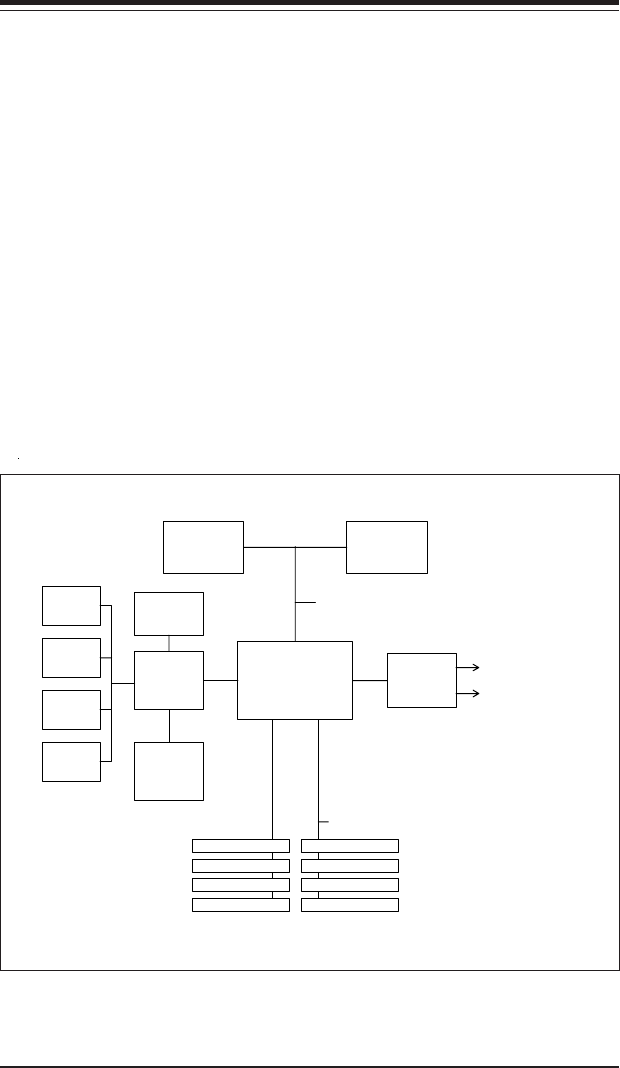
The P4DPR-6GM+ is based on Intel's E7500 chipset, which is a high-perfor-
mance core logic chipset designed for dual-processor servers (See Figure 1-1).
The E7500 chipset consists of four major components: the Memory Controller
Hub (MCH), the I/O Controller Hub 3 (ICH3), the PCI-X 64-bit Hub 2.0 (P64H2) and
the 82808AA Host Channel Adapter (VxB).
The MCH has four hub interfaces, one to communicate with the ICH3 and three
for high-speed I/O communications. The MCH employs a 144-bit wide memory
bus for a PC1600 (DDR-200) memory interface, which provides a total bandwidth
of 3.2 GB/s. The ICH3 interface is a 266 MB/sec point-to-point connection using
an 8-bit wide, 66 MHz base clock at a 4x data transfer rate. The P64H2 interface
is a 1 GB/s point-to-point connection using a 16-bit wide, 66 MHz base clock at
a 8x data transfer rate.
The ICH3 I/O Controller Hub provides various integrated functions, including a
two-channel UDMA100 bus master IDE controller, USB host controllers, an in-
tegrated LAN controller, a System Management Bus controller and an
AC'97 compliant interface.
The P64H2 PCI-X Hub provides a 16-bit connection to the MCH for high-
performance IO capability and the 64-bit PCI-X interface.

1-3
Chapter 1: Introduction
Processors
The P4DPR-6GM+ supports single or dual Intel Xeon 512K L2 cache processors
of up to 3 GHz at a 400 MHz FSB. Please refer to the support section of our
web site for a complete listing of supported processors (http://
www.supermicro.com/TechSupport.htm).
Memory
The P4DPR-6GM+ has 4 184-pin, 25 degree DIMM slots that can support up to
8 GB of registered ECC DDR-200 DDR SDRAM. Module sizes of 128 MB, 256
MB, 512 MB, 1 GB and 2 GB may be used to populate the DIMM slots. (DDR-
266 is also supported, but only at a speed of 200 MHz.)
Onboard SCSI
Onboard SCSI is provided with an Adaptec AIC-7899W SCSI controller chip,
which supports dual channel, Ultra160 SCSI at a burst throughput rate of
160 MB/sec. The P4DPR-6GM+ provides two SCSI ports. A QLogic GEM318
controller is used for the SAF-TE compliant SCSI backpanel.
PCI Expansion Slots
The P4DPR-6GM+ has one 64-bit, 133 MHz PCI-X slot and one 64-bit, 66 MHz
PCI slot. A "butterfly" riser card is included with the server. This riser card fits
into the 133 MHz PCI-X slot and was designed specially for the SC812S
chassis to support the use of one standard PCI card and one low profile
(half-height, half-length) PCI card. Several jumpers on the motherboard are
used to change the speeds of these slots if needed (see Chapter 5).
ATI Graphics Controller
The P4DPR-6GM+ features an integrated ATI video controller based on the Rage
XL graphics chip. Rage XL fully supports sideband addressing and AGP
texturing. This onboard graphics package can provide a bandwidth of up to
512 MB/sec over a 32-bit graphics memory bus.
SUPERSERVER 6012P-6 Manual
1-4
Onboard Controllers/Ports
The P4DPR-6GM+ includes one floppy drive controller and two onboard IDE
controllers, which support up to four hard drives or ATAPI devices. Backpanel
I/O ports include one COM port, two USB ports, PS/2 mouse and keyboard ports,
a video (monitor) port, an external SCSI port, one Intel 82550 Fast Ethernet (NIC)
controller and one Intel Gigabit Ethernet controller for two LAN ports.
Other Features
Other onboard features are included to promote system health. These in-
clude various voltage monitors, two CPU temperature sensors, four fan
speed sensors, a chassis intrusion header, auto-switching voltage regula-
tors, chassis and CPU overheat sensors, virus protection and BIOS rescue.
MCH
400 MHz System Bus
200 MHz Memory Bus
ATA 100
Ports
P64H2
Processor 1 Processor 0
2-Channel
DDR SDRAM
SCSI
ICH3-S
USB Ports
SMBus
Super IO 10/100 LAN
Controller
ATI Graphics
SXB Slot, Gb LAN
Figure 1-1. E7500 Chipset: System Block Diagram

1-5
Chapter 1: Introduction
1-3 Server Chassis Features
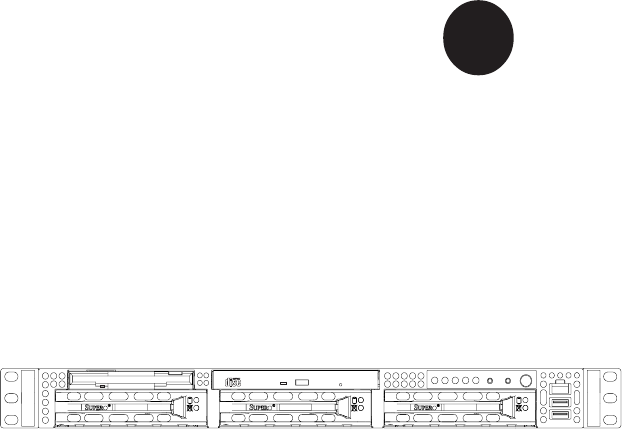
The SC812S is Supermicro's second-generation 1U chassis and features three
hard drive bays, two front side USB ports and a revolutionary cooling design that
can keep today's most powerful processors running well below their temperature
thresholds. The following is a general outline of the main features of the SC812S
chassis.
System Power
When configured as a SuperServer 6012P-6, the SC812S chassis includes a
400W cold-swap power supply.
SCSI Subsystem
The SCSI subsystem supports three 80-pin SCA Ultra160 SCSI hard drives. (Any
standard 1" drives are supported. SCA = Single Connection Attachment.) The
SCSI drives are connected to an SCA backplane that provides power, bus termi-
nation and configuration settings. The SCSI drives are also hot-swap units.
Control Panel
The SC812S control panel provides important system monitoring and control
information. LEDs indicate power on, network activity, hard disk drive ac-
tivity and system overheat conditions. Also present are a main power button, a
system reset button and an NMI (non-maskable interrupt) button.
I/O Backplane
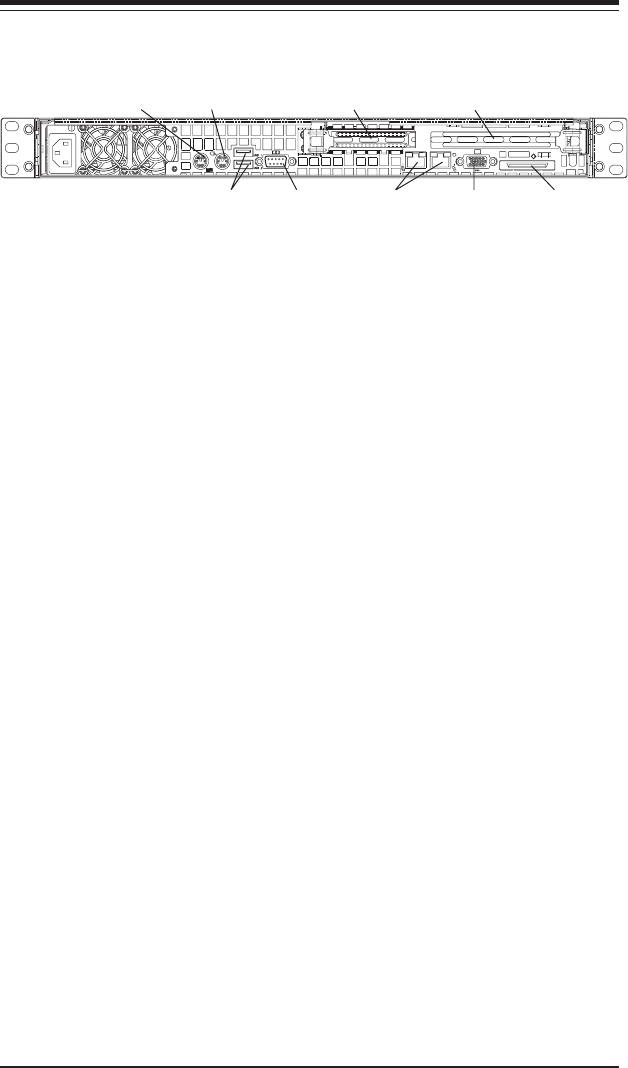
The SC812S is a 1U rackmount chassis. Its I/O backplane provides one full-
height full-length and one half-height half-length PCI slots, one COM port (the
other is internal), one VGA port, two USB ports, PS/2 mouse and keyboard ports
and two Ethernet (LAN) ports and an external SCSI port. (See Figure 1-2.)
SUPERSERVER 6012P-6 Manual
1-6
Cooling System
The SC812S chassis' revolutionary cooling design has been optimized to provide
sufficient cooling for dual Xeon configurations. The SC812S includes two heavy
duty 10-cm blower fans located in the middle of the chassis. These fans operate
continuously at full rpm. If they break down, the ambient air temperature inside
the chassis will rise and activate an overheat LED.
Figure 1-2. I/O Backplane
Ethernet PortsUSB Ports
Mouse PortKeyboard Port
COM1 Port
Low Profile PCI Slot Standard PCI Slot
VGA Port Ext. SCSI Port

1-7
Chapter 1: Introduction
1-4 Contacting Supermicro
Headquarters
Address: SuperMicro Computer, Inc.
980 Rock Ave.
San Jose, CA 95131 U.S.A.
Tel: +1 (408) 503-8000
Fax: +1 (408) 503-8008
E-mail: marketing@supermicro.com (General Information)
support@supermicro.com (Technical Support)
Web site: www.supermicro.com
European Office
Address: SuperMicro Computer B.V.
Het Sterrenbeeld 28, 5215 ML,
's-Hertogenbosch, The Netherlands
Tel: +31 (0) 73-6400390
Fax: +31 (0) 73-6416525
E-mail: sales@supermicro.nl (General Information)
support@supermicro.nl (Technical Support)
rma@supermicro.nl (Customer Support)
Asia-Pacific
Address: SuperMicro Computer Taiwan
3F, #753 Chung-Cheng Road
Chung-Ho City, Taipei Hsien, Taiwan, R.O.C.
Tel: +886-(2) 8228-1366
Fax: +886-(2) 8221-2790
www : www.supermicro.com.tw
Technical Support:
Email: support@supermicro.com.tw
Tel : 886-2-8228-1366, ext.132 or 139

SUPERSERVER 6012P-6 Manual
1-8
Notes

Chapter 2: Server Installation
2-1
Chapter 2
Server Installation
2-1 Overview
This chapter provides a quick setup checklist to get your SuperServer
6012P-6 up and running. Following these steps in the order given should
enable you to have the system operational within a minimum amount of time.
This quick setup assumes that your SuperServer 6012P-6 system has come
to you with the processors and memory preinstalled. If your system is not
already fully integrated with a motherboard, processors, system memory
etc., please turn to the chapter or section noted in each step for details on
installing specific components.
2-2 Unpacking the SuperServer 6012P-6
You should inspect the box the SuperServer 6012P-6 was shipped in and
note if it was damaged in any way. If the server itself shows damage you
should file a damage claim with the carrier who delivered it.
Decide on a suitable location for the rack unit that will hold the SuperServer
6012P-6. It should be situated in a clean, dust-free area that is well venti-
lated. Avoid areas where heat, electrical noise and electromagnetic fields
are generated. You will also need it placed near a grounded power outlet.
Read the Rack and Server Precautions in the next section.
2-3 Preparing for Setup
The box the SuperServer 6012P-6 was shipped in should include two sets
of rail assemblies, two rail mounting brackets and the mounting screws you
will need to install the system into the rack. Follow the steps in the order
given to complete the installation process in a minimum amount of time.
Please read this section in its entirety before you begin the installation
procedure outlined in the sections that follow.
2-2
SUPERSERVER 6012P-6 Manual
Choosing a Setup Location:
- Leave enough clearance in front of the rack to enable you to open
the front door completely (~25 inches).
- Leave approximately 30 inches of clearance in the back of the rack
to allow for sufficient airflow and ease in servicing.
Rack Precautions:
- Ensure that the leveling jacks on the bottom of the rack are fully
extended to the floor with the full weight of the rack resting on them.
- In single rack installation, stabilizers should be attached to the rack.
- In multiple rack installations, the racks should be coupled together.
- Always make sure the rack is stable before extending a component
from the rack.
- You should extend only one component at a time - extending two or
more simultaneously may cause the rack to become unstable.
Server Precautions:
- Review the electrical and general safety precautions in Chapter 4.
- Determine the placement of each component in the rack before you
install the rails.
- Install the heaviest server components on the bottom of the rack
first, and then work up.
- Use a regulating uninterruptible power supply (UPS) to protect the
server from power surges, voltage spikes and to keep your
system operating in case of a power failure.
- Allow the hot plug SCSI drives and power supply units to cool before
touching them.
- Always keep the rack's front door and all panels and components on
the servers closed when not servicing to maintain proper cooling.
!
!
Warnings and Precautions!
Chapter 2: Server Installation
2-3
2-4 Installing the SuperServer 6012P-6 into a Rack
This section provides information on installing the SuperServer 6012P-6 into
a rack unit. If the 6012P-6 has already been mounted into a rack, you can
skip ahead to Sections 2-5 and 2-6. There are a variety of rack units on
the market, which may mean the assembly procedure will differ slightly.
The following is a guideline for installing the 6012P-6 into a rack with the
rack rails provided. You should also refer to the installation instructions
that came with the rack unit you are using.
Identifying the Sections of the Rack Rails:
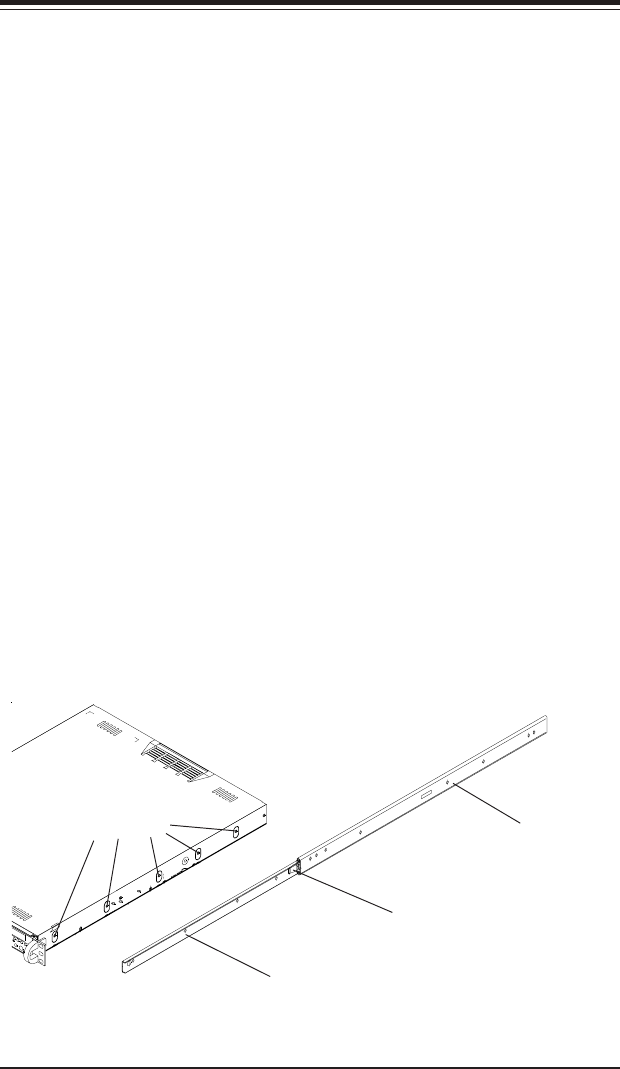
You should have received two rack rail assemblies with the SuperServer
6012P-6. Each of these assemblies consist of three sections: an inner
fixed chassis rail that secures to the 6012P-6 (A) and an outer fixed rack
rail that secures directly to the rack itself (B). A sliding rail guide sand-
wiched between the two should remain attached to the fixed rack rail.
(See Figure 2-1.) The A and B rails must be detached from each other to
install.
To remove the fixed chassis rail (A), pull it out as far as possible - you
should hear a "click" sound as a locking tab emerges from inside the rail
assembly and locks the inner rail. Then depress the locking tab to pull
the inner rail completely out. Do this for both the left and right side rack
rail assemblies.
Figure 2-1. Identifying the Sections of the Rack Rails
A
B
Locking Tab
Mounting Holes
2-4
SUPERSERVER 6012P-6 Manual
Installing the Chassis Rails:
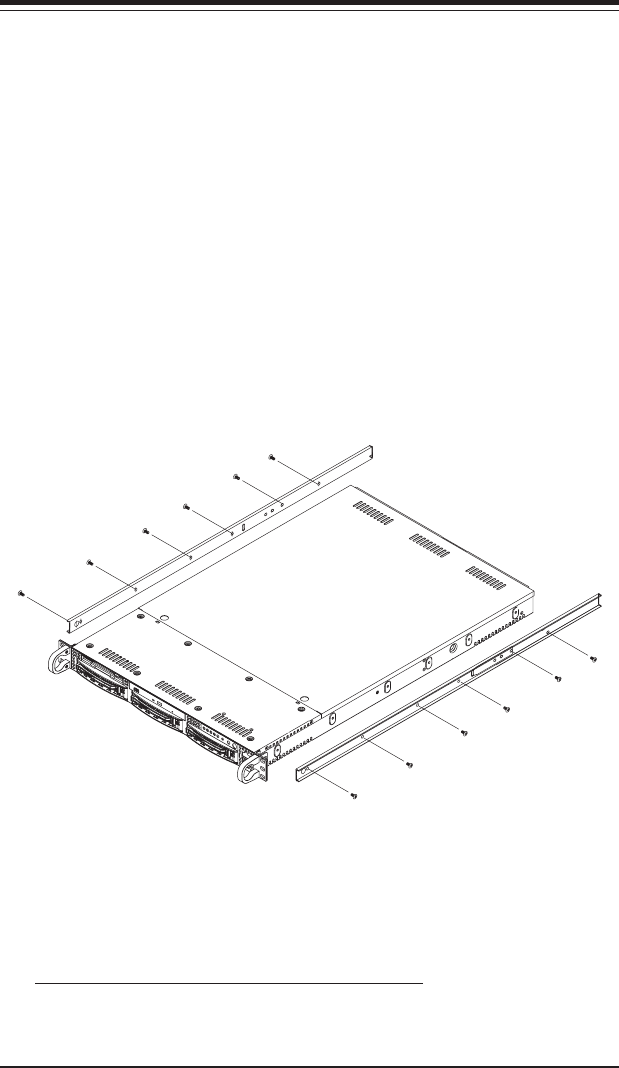
Position the fixed chassis rail sections you just removed along the side of
the 6012P-6 making sure the screw holes line up. Note that these two rails
are left/right specific. Screw the rail securely to the side of the chassis
(see Figure 2-2). Repeat this procedure for the other rail on the other side
of the chassis. You will also need to attach the rail brackets when installng
into a telco rack.
Locking Tabs: As you have seen, both chassis rails have a locking tab,
which serves two functions. The first is to lock the server into place
when installed and pushed fully into the rack, which is its normal position.
Secondly, these tabs also lock the server in place when fully extended
from the rack. This prevents the server from coming completely out of
the rack when you pull it out for servicing.
Figure 2-2. Installing Chassis Rails
Installing the Rack Rails:
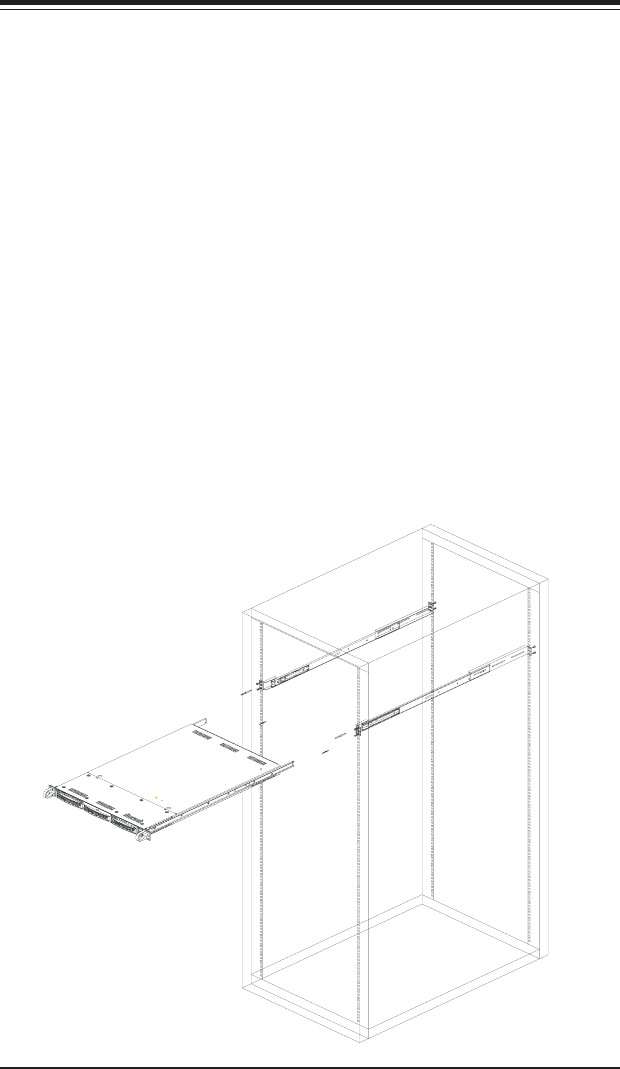
Determine where you want to place the SuperServer 6012P-6 in the rack.
(See Rack and Server Precautions in Section 2-3.) Position the fixed rack
rail/sliding rail guide assemblies at the desired location in the rack, keeping
the sliding rail guide facing the inside of the rack. Screw the assembly
securely to the rack using the brackets provided. Attach the other assem-
Chapter 2: Server Installation
2-5
Figure 2-3. Installing the Server into a Rack
Installing the Server into the Rack:
You should now have rails attached to both the chassis and the rack
unit. The next step is to install the server into the rack. Do this by
lining up the rear of the chassis rails with the front of the rack rails.
Slide the chassis rails into the rack rails, keeping the pressure even on
both sides (you may have to depress the locking tabs when inserting).
See Figure 2-3.
When the server has been pushed completely into the rack, you should
hear the locking tabs "click". Finish by inserting and tightening the
thumbscrews that hold the front of the server to the rack.
bly to the other side of the rack, making sure both are at the exact same height
and with the rail guides facing inward.
2-6
SUPERSERVER 6012P-6 Manual
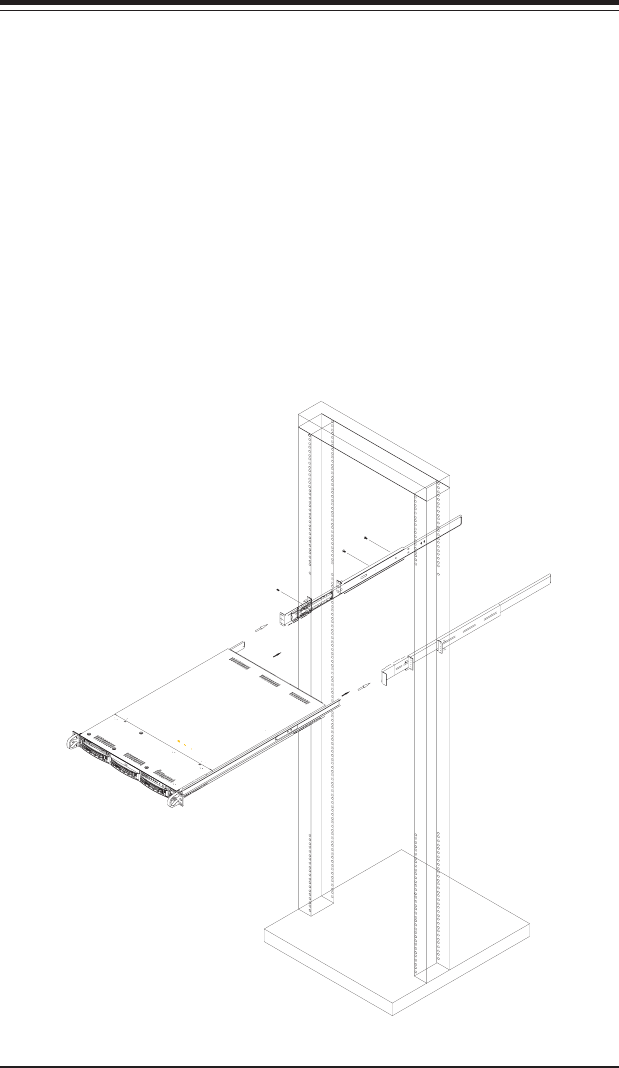
Figure 2-4. Installing the Server into a Telco Rack
Installing the Server into a Telco Rack:
If you are installing the SuperServer 6012P-6 into a Telco type rack, follow
the directions given on the previous pages for rack installation. The only
difference in the installation procedure will be the positioning of the rack
brackets to the rack. They should be spaced apart just enough to
accommodate the width of the telco rack.

Chapter 2: Server Installation
2-7
2-5 Checking the Motherboard Setup
After you install the 6012P-6 in the rack, you will need to open the unit to
make sure the motherboard is properly installed and all the connections
have been made.
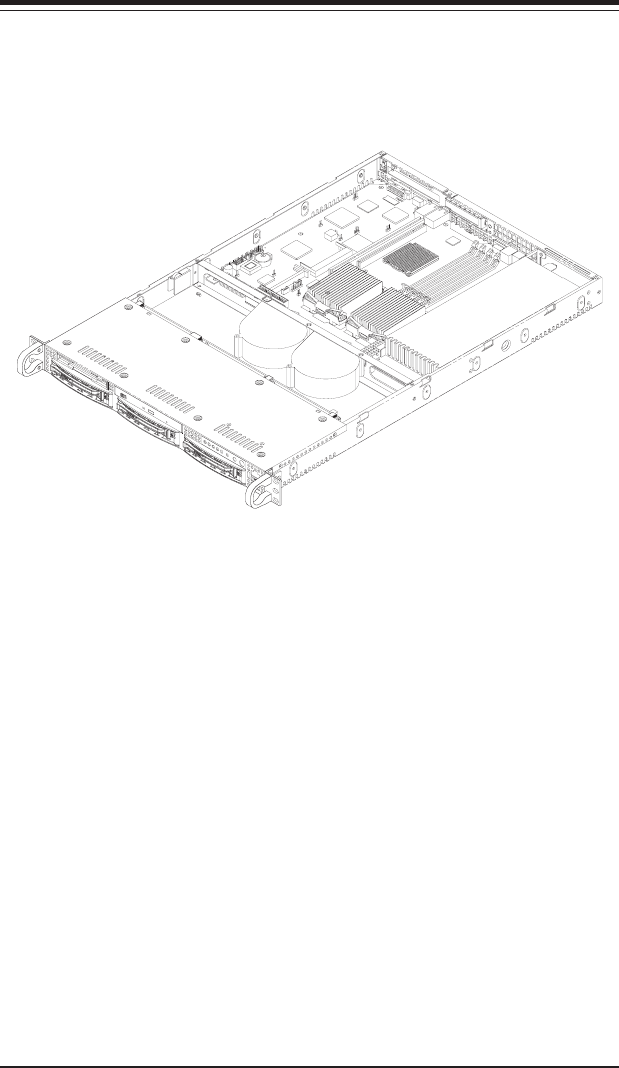
1. Accessing the inside of the 6012P-6 (see Figure 2-5):
First, release the retention screws that secure the unit to the rack.
Grasp the two handles on either side and pull the unit straight out until it
locks (you will hear a "click"). Next, depress the two buttons on the top
of the chassis to release the top cover. There is a large rectangular
recess in the middle front of the top cover to help you push the cover
away from you until it stops. You can then lift the top cover from the
chassis to gain full access to the inside of the server.
2. Check the CPUs (processors):
You should have one or two processors already installed into the
system board. Each processor needs its own heatsink. See Chapter
5 for instructions on processor and heatsink installation.
3. Verify the proper CPU clock ratio setting:
If the CPU speed is not automatically detected you will need to set the
correct speed with the BIOS Setup utility. See the CPU Speed and Fre-
quency Ratio settings in BIOS (Chapter 7) for setting the proper CPU
speed.
4. Check the system memory:
Your 6012P-6 server system may have come with system memory al-
ready installed. Make sure all DIMMs are fully seated in their slots. For
details on adding system memory, refer to Chapter 5.
5. Installing add-on cards:
If desired, you can install add-on cards to the system. See Chapter 5 for
details on installing PCI add-on cards.
2-8
SUPERSERVER 6012P-6 Manual
Figure 2-5. Accessing the Inside of the SuperServer 6012P-6
6. Check all cable connections and airflow:
Make sure all power and data cables are properly connected and not
blocking the chassis airflow. See Chapter 5 for details on cable connec-
tions. Also, check the air seals for damage. The air seals are located
under the blower fan and beneath the frame cross section that sepa-
rates the drive bay area from the motherboard area of the chassis.

Chapter 2: Server Installation
2-9
2-6 Checking the Drive Bay Setup
Next, you should check to make sure the peripheral drives and the SCSI
drives and SCA backplane have been properly installed and all connections
have been made.
1. Accessing the drive bays:
All drives are accessable from the front of the server. For servicing the
CD-ROM and floppy drives, you will need to remove the top chassis
cover. The SCSI disk drives can be installed and removed from the front
of the chassis without removing the top chassis cover.
2. CD-ROM and floppy disk drives:
A slim CD-ROM and a floppy drive should be preinstalled in your server.
Refer to Chapter 6 if you need to reinstall a CD-ROM and/or floppy disk
drive to the system.
3. Check the SCSI disk drives:
Depending upon your system's configuration, your system may have one
or more drives already installed. If you need to install SCSI drives, please
refer to Chapter 6.
4. Check the airflow:
Airflow is provided by two heavy duty 10-cm blower fans. The system
component layout was carefully designed to direct sufficient cooling air-
flow to the components that generate the most heat. Note that all power
and data cables have been routed in such a way that they do not block
the airflow generated by the fans.
5. Supplying power to the system:
The last thing you must do is to provide input power to the system. Plug
the power cord from the power supply unit into a high-quality power
strip that offers protection from electrical noise and power surges. It is
recommended that you use an uninterruptible power supply (UPS).

2-10
SUPERSERVER 6012P-6 Manual
Notes
Chapter 3: System Interface
3-1
Chapter 3
System Interface
3-1 Overview
There are several LEDs on the control panel as well as others on the SCSI
drive carriers to keep you constantly informed of the overall status of the
system as well as the activity and health of specific components. There
are also two buttons on the chassis control panel and an on/off switch on
the power supply.
3-2 Control Panel Buttons
There are three push-button buttons located on the front of the chassis.
These are (in order from left to right) a reset button, an MNI (non-maskable
interface) button and a power on/off button.
!RESET: Use the reset button to reboot the system.
!NMI: NMI stands for "non-maskable interrupt". Pressing this button
issues a non-maskable interrupt to force the server into a halt state. This is
used for diagnostic purposes, and allows you to perform a memory down-
load to determine the cause of a problem.
SUPERSERVER 6012P-6 User's Manual
3-2
!POWER: This is the main power button, which is used to apply or turn
off the main system power. Turning off system power with this button
removes the main power but keeps standby power supplied to the system.
3-3 Control Panel LEDs
The control panel located on the front of the SC812-SP chassis has five
LEDs. These LEDs provide you with critical information related to different
parts of the system. This section explains what each LED indicates when
illuminated and any corrective action you may need to take.
!Overheat: Indicates an overheat condition in the chassis. This may
be caused by cables obstructing the airflow in the system or the ambient
room temperature being too warm. You should also check to make sure
that the chassis cover is installed and that all fans are present and operat-
ing normally. Verify that the heatsinks are installed properly (see Chapter
5). Finally, check the air seals for damage. The air seals are vertical
pieces located to the left and right of the fans and against the front side of
the chassis frame cross section that separates the drive bay area from the
motherboard area of the chassis. There is also a small air seal positioned
between the two fans.
!NIC2: Indicates network activity on LAN2 when flashing.
NIC2
Chapter 3: System Interface
3-3
!NIC1: Indicates network activity on LAN1 when flashing.
!HDD: Indicates IDE channel activity. On the SuperServer 6012P-6,
this LED indicates CD-ROM drive activity when flashing.
!Power: Indicates power is being supplied to the system's power
supply units. This LED should normally be illuminated when the system is
operating.
3-4 SCSI Drive Carrier LEDs
Each SCSI drive carrier has two LEDs.
!Green: When illuminated, the green LED on the front of a SCSI drive
carrier indicates drive activity. A connection to the SCSI SCA backplane
enables this LED to blink on and off when that particular drive is being
accessed.
!Red: A SAF-TE compliant backplane (standard on the 6012P-6) acti-
vates the red LED, which indicates a drive failure. If one of the SCSI drives
fail, you should be notified by your system management software. Please
refer to Chapter 6 for instructions on replacing failed SCSI drives.
NIC1

SUPERSERVER 6012P-6 User's Manual
3-4
3-5 Motherboard LEDs
There are several LEDs on the motherboard. LE1, located near the CPU1
chassis fan connector, indicates that system power is present on the
motherboard when illuminated. DA3 and DA4 are located near the AIC-7899
SCSI controller chip. These LEDs indicate activity on each of the SCSI
channels when flashing. DL2 is located near the JD4 jumper and indicates
connectivity to the LAN when illluminated.

Chapter 4: System Safety
4-1
Chapter 4
System Safety
4-1 Electrical Safety Precautions
!
Basic electrical safety precautions should be followed to protect
yourself from harm and the SuperServer 6012P-6 from damage:
! Be aware of the locations of the power on/off switch on the chassis as
well as the room's emergency power-off switch, disconnection switch or
electrical outlet. If an electrical accident occurs, you can then quickly
remove power from the system.
! Do not work alone when working with high voltage components.
! Power should always be disconnected from the system when removing or
installing main system components, such as the motherboard, memory
modules and the CD-ROM and floppy drives. When disconnecting
power, you should first power down the system with the operating
system and then unplug the power cords of all the power supply units
in the system.
! When working around exposed electrical circuits, another person who is
familiar with the power-off controls should be nearby to switch off the
power if necessary.
! Use only one hand when working with powered-on electrical equipment.
This is to avoid making a complete circuit, which will cause electrical
shock. Use extreme caution when using metal tools, which can easily
damage any electrical components or circuit boards they come into
contact with.
! Do not use mats designed to decrease electrostatic discharge as
protection from electrical shock. Instead, use rubber mats that have
been specifically designed as electrical insulators.
SUPERSERVER 6012P-6 Manual
4-2
4-2 General Safety Precautions
Follow these rules to ensure general safety:
! Keep the area around the SuperServer 6012P-6 clean and free of clutter.
! The SuperServer 6012P-6 weighs approximately 30 lbs (13.6 kg) when
fully loaded. When lifting the system, two people at either end should
lift slowly with their feet spread out to distribute the weight. Always
keep your back straight and lift with your legs.
! Place the chassis top cover and any system components that have been
removed away from the system or on a table so that they won't
accidentally be stepped on.
! While working on the system, do not wear loose clothing such as
neckties and unbuttoned shirt sleeves, which can come into contact
with electrical circuits or be pulled into a cooling fan.
! Remove any jewelry or metal objects from your body, which are excellent
metal conductors that can create short circuits and harm you if they
come into contact with printed circuit boards or areas where power is
present.
!
! The power supply power cord must include a grounding plug and must be
plugged into grounded electrical outlets.
! Motherboard Battery: CAUTION - There is a danger of explosion if the
onboard battery is installed upside down, which will reverse its
polarities. On the P4DPR-6GM+, the positive side should be facing up.
This battery must be replaced only with the same or an equivalent type
recommended by the manufacturer. Dispose of used batteries
according to the manufacturer's instructions.
! CD-ROM Laser: CAUTION - this server may have come equipped with a
CD-ROM drive. To prevent direct exposure to the laser beam and
hazardous radiation exposure, do not open the enclosure or use the
unit in any unconventional way.
Chapter 4: System Safety
4-3
4-3 ESD Precautions
Electrostatic discharge (ESD) is generated by two objects with different
electrical charges coming into contact with each other. An electrical
discharge is created to neutralize this difference, which can damage
electronic components and printed circuit boards. The following measures
are generally sufficient to neutralize this difference before contact is made
to protect your equipment from ESD:
! Use a grounded wrist strap designed to prevent static discharge.
! Keep all components and printed circuit boards (PCBs) in their
antistatic bags until ready for use.
! Touch a grounded metal object before removing the board from the
antistatic bag.
! Do not let components or PCBs come into contact with your clothing,
which may retain a charge even if you are wearing a wrist strap.
! Handle a board by its edges only; do not touch its components,
peripheral chips, memory modules or contacts.
! When handling chips or modules, avoid touching their pins.
! Put the motherboard and peripherals back into their antistatic bags
when not in use.
! For grounding purposes, make sure your computer chassis provides
excellent conductivity between the power supply, the case, the mounting
fasteners and the motherboard.
!
! After accessing the inside of the system, close the system back up and
secure it to the rack unit with the retention screws after ensuring that
all connections have been made.
SUPERSERVER 6012P-6 Manual
4-4
4-4 Operating Precautions
Care must be taken to assure that the chassis cover is in place when the
6012P-6 is operating to assure proper cooling. Out of warranty damage to
the 6012P-6 system can occur if this practice is not strictly followed.
!

Chapter 5: Advanced Motherboard Setup
5-1
Chapter 5
Advanced Motherboard Setup
This chapter covers the steps required to install processors and heatsinks to the
P4DPR-6GM+ motherboard, connect the data and power cables and install add-
on cards. All motherboard jumpers and connections are also described. A
layout and quick reference chart are also included in this chapter. Remember
to close the chassis completely when you have finished working on the
motherboard to protect and cool the system sufficiently.
5-1 Handling the P4DPR-6GM+ Motherboard
Static electrical discharge can damage electronic components. To prevent
damage to printed circuit boards, it is important to handle them very care-
fully (see Chapter 4). Also note that the size and weight of the mother-
board can cause it to bend if handled improperly, which may result in dam-
age. To prevent the motherboard from bending, keep one hand under the
center of the board to support it when handling. The following measures
are generally sufficient to protect your equipment from static discharge.
Precautions
• Use a grounded wrist strap designed to prevent static discharge.
• Touch a grounded metal object before removing any board from its anti-
static bag.
• Handle a board by its edges only; do not touch its components, periph-
eral chips, memory modules or gold contacts.
• When handling chips or modules, avoid touching their pins.
• Put the motherboard, add-on cards and peripherals back into their anti-
static bags when not in use.
Unpacking
The motherboard is shipped in antistatic packaging to avoid static damage.
When unpacking the board, make sure the person handling it is static pro-
tected.
5-2
SUPERSERVER 6012P-6 User’s Manual
IMPORTANT: Always connect the power cord last and always remove it before
adding, removing or changing any hardware components. Make sure that you
install the processor into the CPU socket before you install the heatsink. The
P4DPR-6GM+ can support either one or two Xeon 512K L2 cache processors of
up to 3 GHz. If installing one processor only, install it into CPU socket #1.
!
5-2 PGA Processor and Heatsink Installation
When handling the processor package, avoid placing direct
pressure on the label area of the fan. Also, do not place the
motherboard on a conductive surface, which can damage the
BIOS battery and prevent the system from booting up.
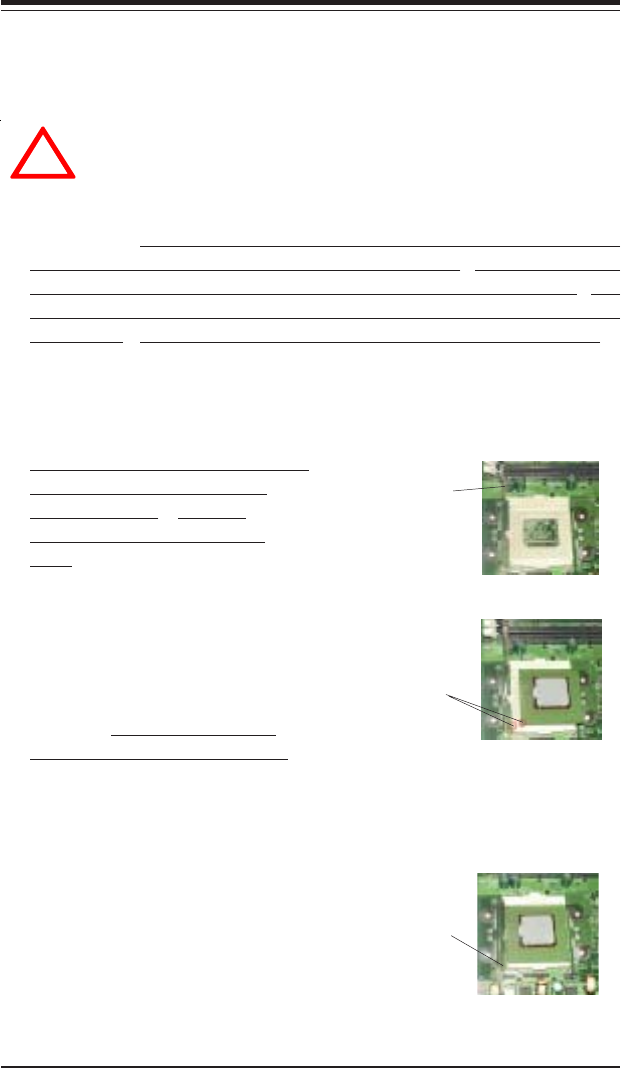
1. Lift the lever on the CPU socket.
Lift the lever completely or you will
damage the CPU socket when
power is applied. (Install a
processor into CPU #1 socket
first.)
Socket lever
2. Install the CPU in the socket.
Make sure that pin 1 of the CPU is
seated on pin 1 of the socket (both
corners are marked with a
triangle). When using only one
CPU, install it into CPU socket #1
(CPU socket #2 is automatically
disabled if only one CPU is used).
Pin 1
3. Press the lever down until you
hear it *click* into the locked
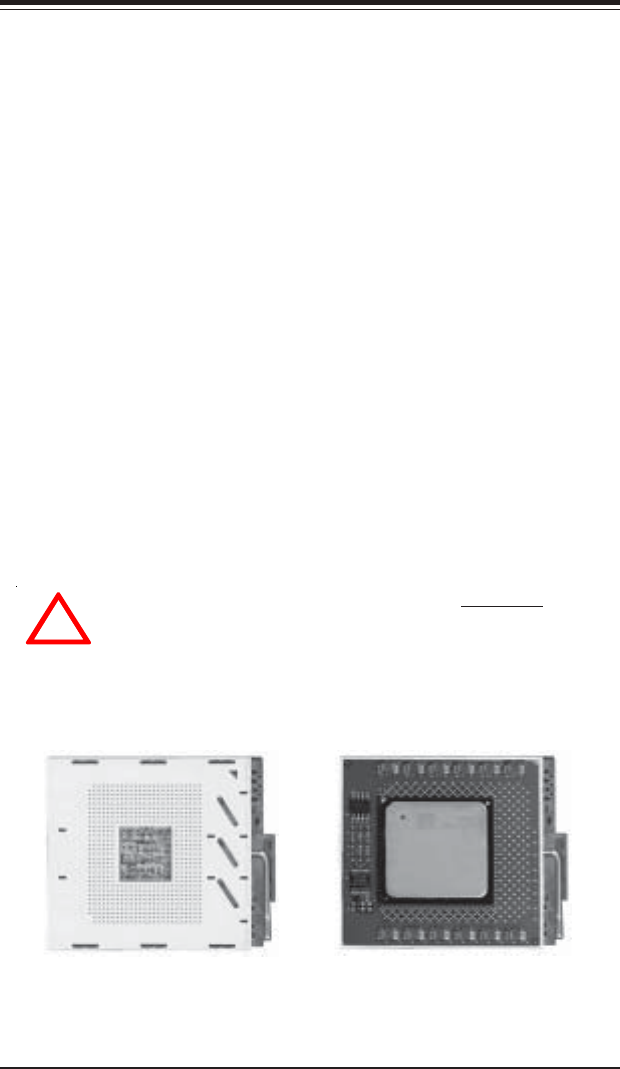
position. See Figure 5-1 for
pictures of the 603-pin CPU socket
before and after the processor is
installed.
Socket lever in
locked position
Chapter 5: Advanced Motherboard Setup
5-3
4. Apply the proper amount of thermal compound to the CPU die and place
the heatsink on top of the CPU. Make sure the heatsink sits completely
flat on the CPU. If it's not completely flat, the space between the two will
degrade the heat dissipation function of the heatsink, which may cause
the processor to overheat.
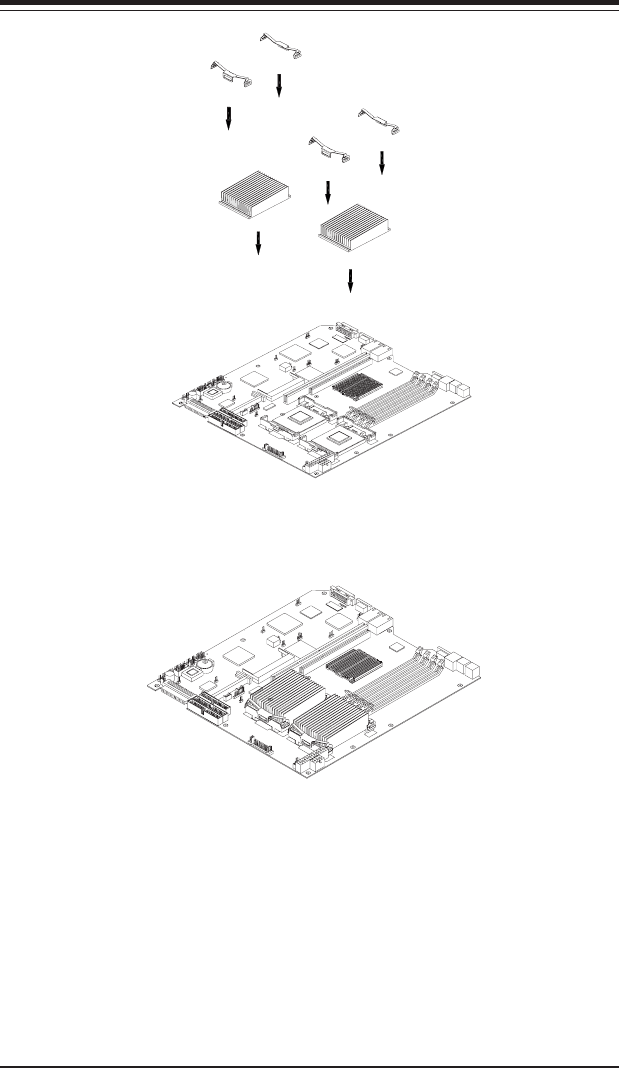
5. Secure the heatsink by locking the retention clips into their proper
position. When correctly installed, the retention clips should *click* into
place and the three black tabs on the CPU retention pieces should
protrude fully through the corresponding holes on the retention clips. See
Figure 5-2 for a diagram of the heatsink installation procedure.
6. If installing two processors, repeat these steps to install the second
processor in the CPU #2 slot.
Figure 5-1. PGA Socket: Empty and with Processor Installed
Warning! Make sure you lift the lever completely when
installing the CPU. If the lever is only partly raised, damage
to the socket or CPU may result.
!
5-4
SUPERSERVER 6012P-6 User’s Manual
Figure 5-2. Heatsink Installation

Chapter 5: Advanced Motherboard Setup
5-5
5-3 Connecting Cables
Now that the processors are installed, the next step is to connect the
cables to the board. These include the data (ribbon) cables for the periph-
erals and control panel and the power cables.
Connecting Data Cables
The ribbon cables used to transfer data from the peripheral devices have
been carefully routed in preconfigured systems to prevent them from block-
ing the flow of cooling air that moves through the system from front to back.
If you need to disconnect any of these cables, you should take care to keep
them routed as they were originally after reconnecting them (make sure the
red wires connect to the pin 1 locations). If you are configuring the sys-
tem, keep the airflow in mind when routing the cables. The following data
cables (with their motherboard connector locations noted) should be con-
nected. See the motherboard layout figure in this chapter for connector
locations.
! IDE Device Cables (J2A and J3A)
! Floppy Drive Cable (JP7)
! Ultra 160 LVD SCSI Cables (JA1 and JA2)
! Control Panel Cable (JF2, see next page)
Connecting Power Cables
The P4DPR-6GM+ has a 20-pin primary power supply connector designated
"ATX Power" for connection to the ATX power supply. Connect the
appropriate connector from the power supply to the "ATX Power"
connector to supply power to the motherboard. See the Connector
Definitions section in this chapter for power connector pin definitions.
5-6
SUPERSERVER 6012P-6 User’s Manual
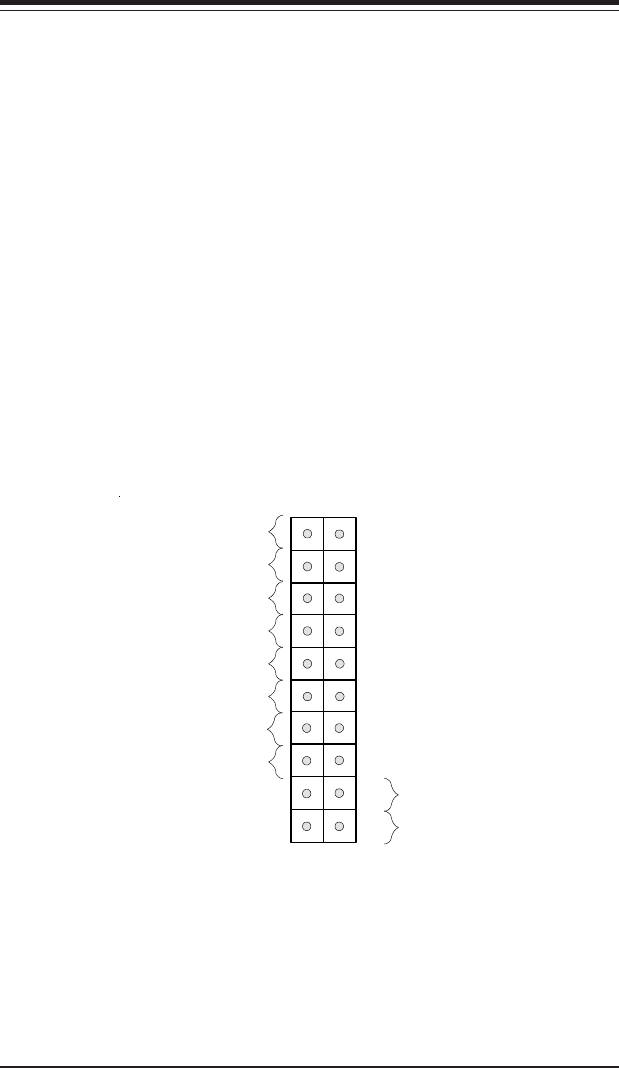
Figure 5-3. P4DPR-6GM+ Front Control Panel Header Pins
Power Button
Overheat LED
1
NIC1 LED
Reset Button
2
Power Fail Button
NIC2 LED
HDD LED
Power LED
Reset
Pwr
Vcc
Vcc
Vcc
Vcc
Vcc
Ground
Ground
1920
Vcc
X
NMI Ground
X
Connecting the Control Panel
JF2 contains header pins for various front control panel connectors. See
Figure 5-3 for the pin locations of the various front control panel buttons
and LED indicators. Please note that even and odd numbered pins are on
opposite sides of each header.
All JF2 wires have been bundled into single ribbon cable to simplify their
connection. Make sure the red wire plugs into pin 1 as marked on the
board. The other end connects to the Control Panel printed circuit board,
located just behind the system status LEDs in the chassis.
See the Connector Definitions section in this chapter for details and pin
descriptions of JF2.
Chapter 5: Advanced Motherboard Setup
5-7
5-4 I/O Ports
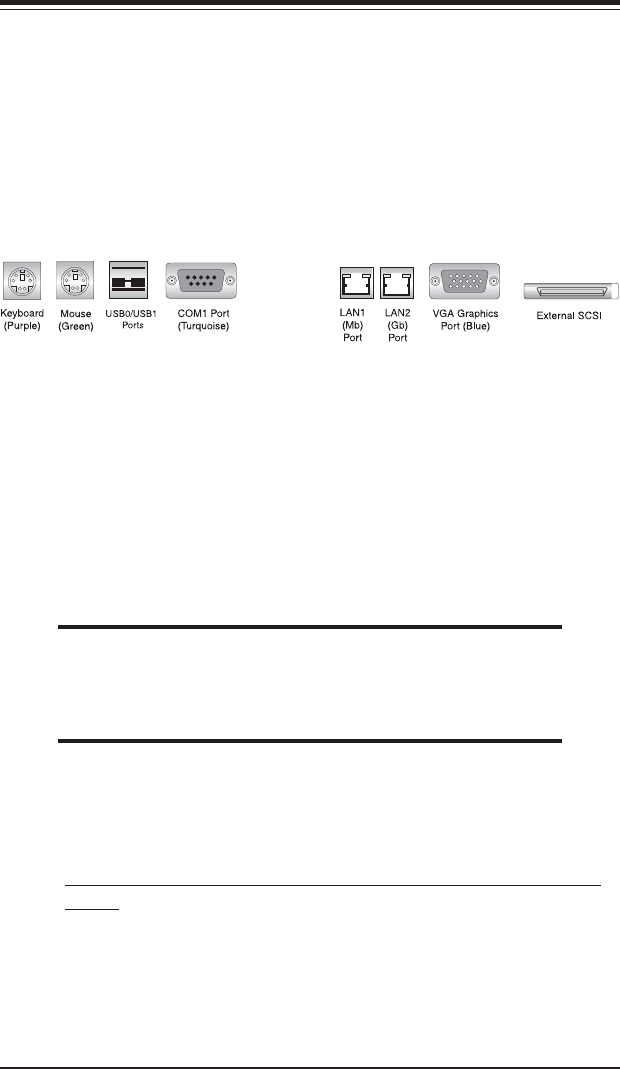
The I/O ports are color coded in conformance with the PC 99 specification.
See Figure 5-4 below for the colors and locations of the various I/O ports.
Figure 5-4. P4DPR-6GM+ Rear Panel I/O Ports
5-5 Installing Memory
Note: Check the Supermicro web site for recommended memory modules:
http://www.supermicro.com/TECHSUPPORT/FAQs/Memory_vendors.htm
CAUTION
Exercise extreme care when installing or removing DIMM
modules to prevent any possible damage. Also note that the
memory is interleaved to improve performance (see step 1).
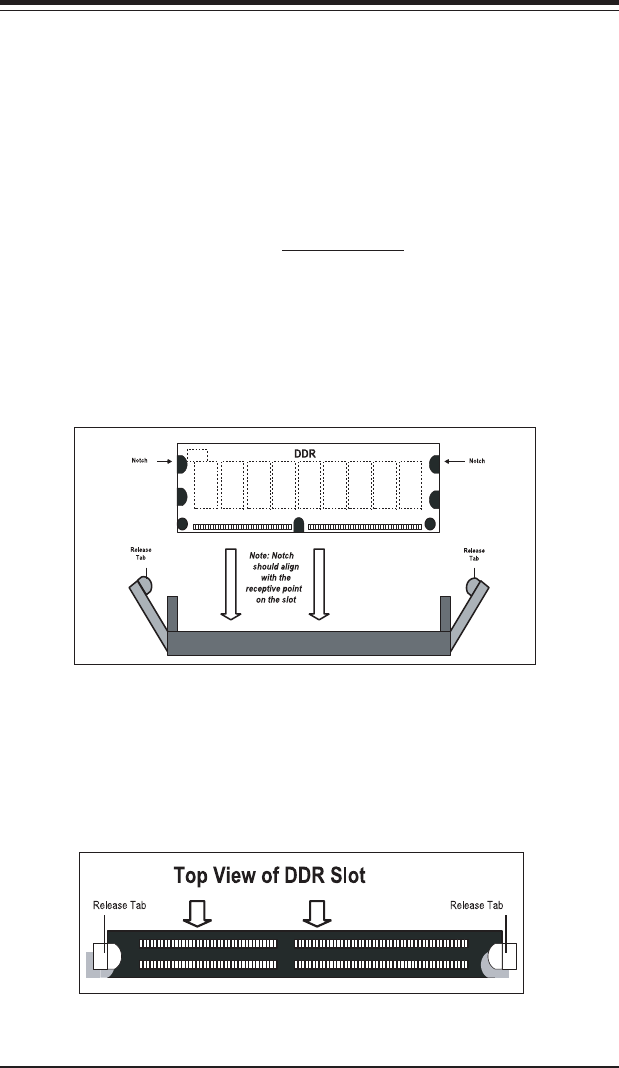
DIMM Installation (See Figure 5-5)
1. Insert the desired number of DIMMs into the memory slots, starting with
Bank 1 (DIMM#1A, DIMM#1B). The memory scheme is interleaved so
you must install two modules at a time, beginning with Bank 1, then
Bank 2.
2. Insert each DIMM module into its slot. Pay attention to the notch along
the bottom of the module to prevent inserting the DIMM module incor-
rectly.
3. Gently press down on the DIMM module until it snaps into place in the
slot. Repeat for all modules (see step 1 above).
5-8
SUPERSERVER 6012P-6 User’s Manual
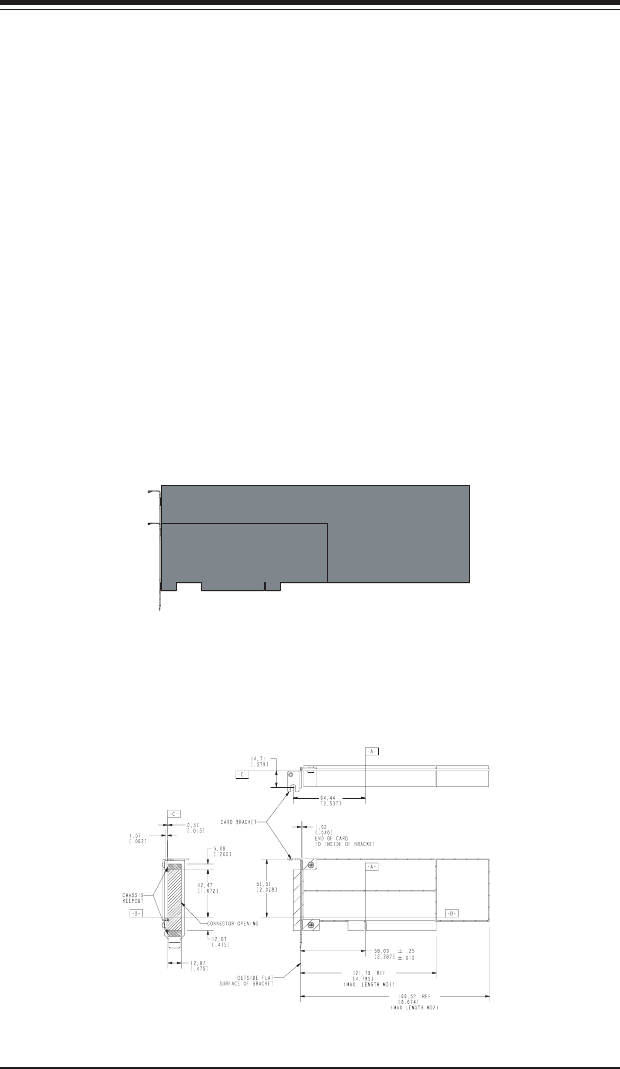
Figure 5-5b. Top View of DIMM Slot
Figure 5-5a. Side View of DIMM Installation into Slot
To Install: Insert module vertically and press down until it snaps into
place. Pay attention to the bottom notch.
To Remove: Use your thumbs to gently push each release tab outward
to free the DIMM from the slot.
4. When installing modules into the two Bank 2 slots, you will need to
remove the power supply due to space constraints. Memory slots are
positioned at a 25 degree angle to fit full-sized memory modules into a
1U chassis.
Memory Support
The P4DPR-6GM+ only supports ECC registered DDR-200 (PC1600) SDRAM
memory. DDR-266 (PC2100) SDRAM is supported but only at 200 MHz (DDR-
200 speed). PC100/133 SDRAM is not supported. You should not mix DIMMs
of different sizes and speeds.
See Figures 5-5a and 5-5b for installing and removing memory modules.
Chapter 5: Advanced Motherboard Setup
5-9
5-6 Adding PCI Cards
1. PCI slots:
The P4DPR-6GM+ has one 64-bit 133 MHz PCI-X slot for a full-length
(standard) PCI card and one slim 64-bit 66 MHz PCI slot. The 64-bit 133
MHz PCI-X slot should have a butterfly riser card installed, which can accept
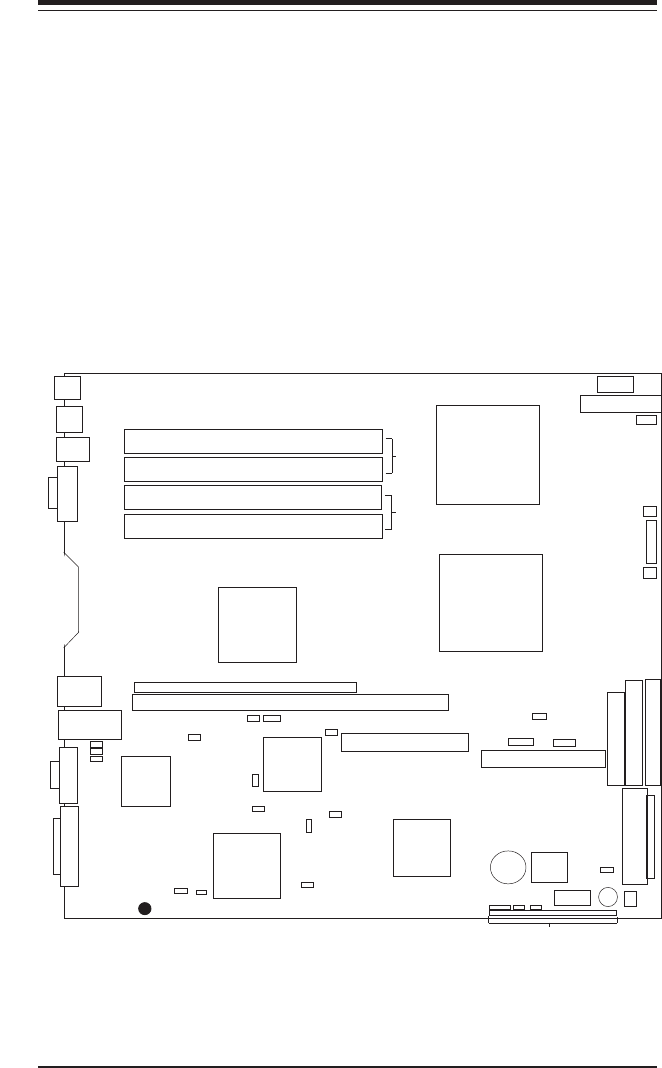
one standard sized PCI card and one low profile PCI card (see Figures 5-6a
and 5-6b).
2. PCI card installation:
Before installing a PCI add-on card, see step 1, above. Begin by swing-
ing the release tab on the I/O backpanel shield out to the left for the PCI
slot. Insert the PCI card into the correct slot on the butterfly riser card
(depending on whether it is a standard or low-profile card), pushing
down with your thumbs evenly on both sides of the card. Finish by
pushing the release tab back to its original (locked) position. Follow this
procedure when adding a card to either slot.
Standard PCI and Low Profile PCI Expansion Card Comparison
Low Profile PCI
Expansion Card
Standard PCI
Expansion Card
Figure 5-6a Low Profile vs. Standard PCI Card Form Factor
Figure 5-6b Low Profile PCI Card Dimensions
5-10
SUPERSERVER 6012P-6 User’s Manual
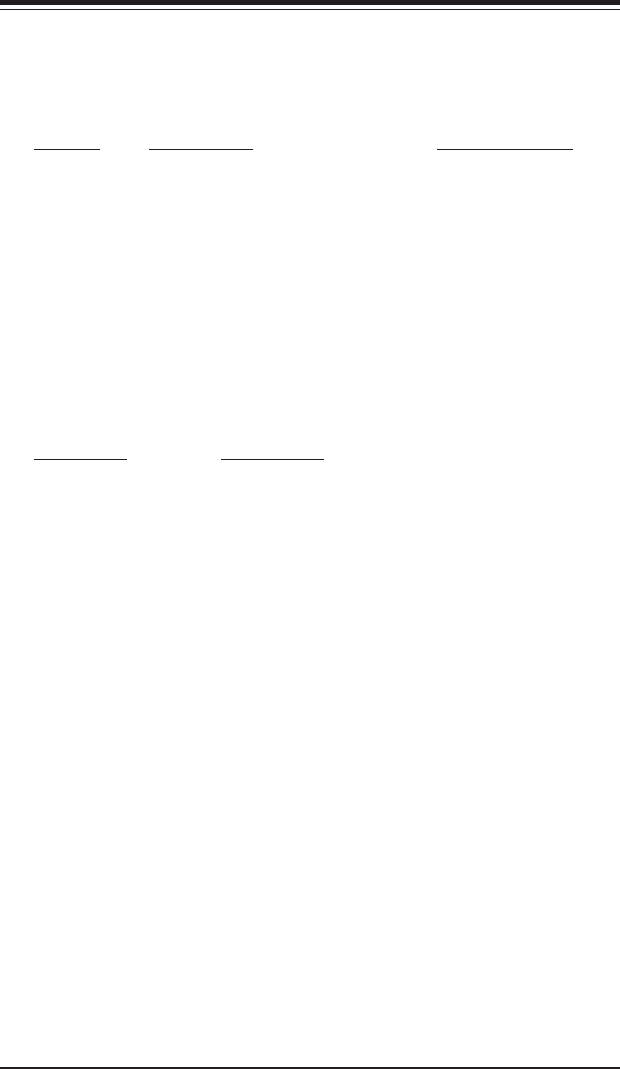
Figure 5-7. SUPER P4DPR-6GM+ Layout
(not drawn to scale)
ATX POWER
CPU1
CPU2
J15
DIMM #1A
JP8
JF2
CPU1 Chassis FAN
DIMM #1B
DIMM #2B
DIMM #2A
BANK 1
BANK 2
Mouse
J28 Keyboard
J29
USB0/1
COM1
LAN2
VGA
LAN1
MCH
Rage XL
ICH3
Ultra III LVD/SE ChB
AIC-7899
CHS
FAN3
P64H2
BATTERY
COM2
BIOS
Speaker
SCSI RAID
IPMI
IDE #1
IDE #2
FLOPPY
SMB
Ultra III LVD/SE ChA
IPMB
WOL
JP22
FPUSB0,1/SLP/JBT1/WD/IR/CIR/USB2/PWRLED/Speaker/JL1
JD4
JP11
JP15
JPA1
JPA2
JP10
JP12
JP14
PCIX #1 VXB
PCIX #2
JP13
JD3
JP3
JP4
JP27
JP7
J2A J3A
JA1
JA2
CPU2 Chassis FAN
SUPER P4DPR-6GM+
®
5-7 Motherboard Layout
OHLED
JD1
WOR
JP35
Chapter 5: Advanced Motherboard Setup
5-11
P4DPR-6GM+ Quick Reference
Jumper Description Default Setting
JBT1 CMOS Clear Pins 1-2 (Normal)
JD1 Speaker Enable (Pins 6-7) Closed (Enabled)
JPA1/JPA2 SCSI Channel A/B Termination Open (Terminated)
JP3/JD4 LAN1/LAN2 Enable/Disable Pins 1-2 (Enabled)
JP4 VGA Enable/Disable Pins 1-2 (Enabled)
JP10-JP15 PCI-X Bus Speed Setting See Section 5-9
JP22 SCSI Enable/Disable Pins 1-2 (Enabled)
JP37/WD Watchdog Enable/Disable Open (Disabled)
JP38 Thermal Fan Enable/Disable Open (Disabled)
JP48 Chassis/Overheat Fan Select Closed (Chassis)
Connector Description
ATX POWER Primary ATX Power Connector
COM1/COM2 COM1/COM2 Serial Port Connector
CPU1/CPU2 CPU 1 and CPU2 Sockets
CPU CHS FAN CPU 1 & 2 Chassis Fan Headers
DIMM#1A-DIMM#2B Memory (RAM) Slots
JA1 Ultra160 LVD SCSI CH A Connector
JA2 Ultra160 LVD SCSI CH B Connector
JD1 JBT1/WD/IR/CIR/USB2/PWRLED/SPKR
JF2 Front Control Panel Connector
JP7 Floppy Disk Drive Connector
JP8 Third Power Supply Fail Header
JP35 Keylock Header
J2A/J3A IDE#1/#2 Hard Disk Drive Connectors
J15 Secondary ATX Power Connector
J28 Keyboard Port
J29 Mouse Port
LAN1/2 Ethernet Ports
OHLED Overheat LED Header
USB0/1 Universal Serial Bus Ports
VGA VGA Display (Monitor) Port
WOL Wake-on-LAN Header
WOR Wake-on-Ring Header

5-12
SUPERSERVER 6012P-6 User’s Manual
5-8 Connector Definitions
Power LED
The Power LED connection is lo-
cated on pins 15 and 16 of JF2.
Refer to the table on the right for
pin definitions.
Pin
Number
15
16
Definition
Vcc
Control
PWR_LED Pin Definitions
(JF2)
HDD LED
The HDD (IDE Hard Disk Drive) LED
connection is located on pins 13
and 14 of JF2. Attach the IDE hard
drive LED cable to display disk ac-
tivity. Refer to the table on the
right for pin definitions.
HDD LED Pin
Definitions
(JF2)
Pin
Number
13
14
Definition
Vcc
HD Active
ATX Power Connection
The power supply connector
meets the SSI (Superset ATX) 20-
pin specification. Make sure that
the orientation of the connector is
correct. See the table on the right
for pin definitions.
Pins
1 thru 4
5 thru 8
Definition
Ground
+12v
8-Pin +12v Power Supply
Connector (J15)
ATX Power Supply 20-pin Connector
Pin Number Definition
11 +3.3V
12 -12V
13 COM
14 PS_ON
15 COM
16 COM
17 COM
18 -5V
19 +5V
20 +5V
Pin Number Definition
1 +3.3V
2 +3.3V
3 COM
4 +5V
5 COM
6 +5V
7 COM
8 PW -OK
9 5VSB
10 +12V
NMI Button
The non-maskable interrupt button
header is located on pins 19 and
20 of JF2. Refer to the table on
the right for pin definitions.
Pin
Number
19
20
Definition
Ground
Control
NMI Button Pin
Definitions (JF2)
PWR_SEC Connection
In addition to the Primary ATX power
connector (above), the Secondary
12v 8-pin J15 connector must also
be connected to your power supply.
See the table on the right for pin defi-
nitions.
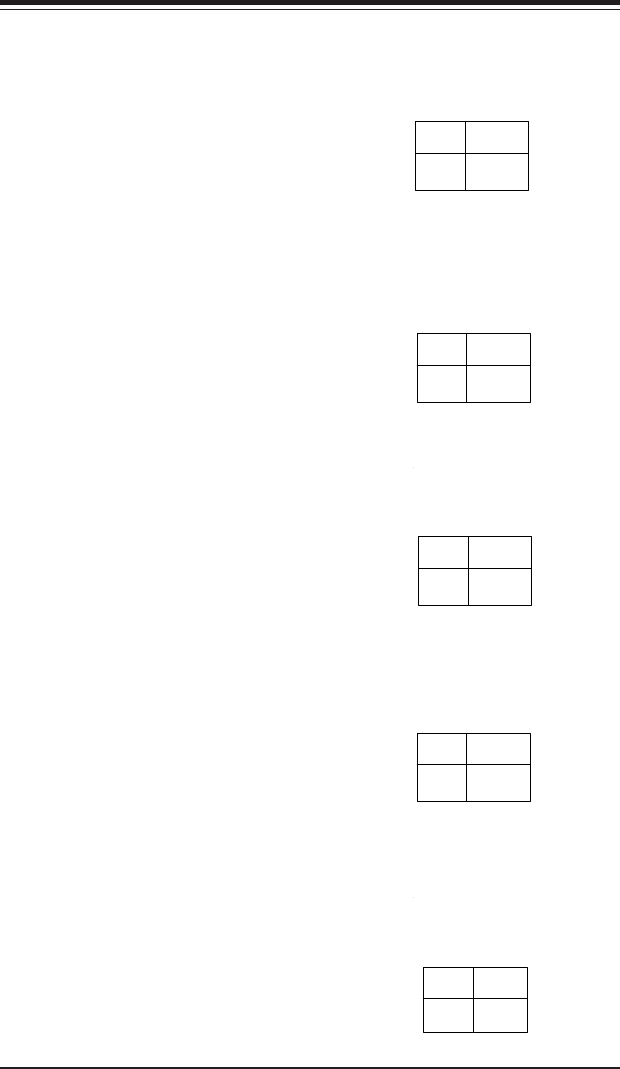
Chapter 5: Advanced Motherboard Setup
5-13
Overheat LED (OH)
Connect an LED to the OH connec-
tion on pins 7 and 8 of JF2 to pro-
vide advanced warning of chassis
overheating. Refer to the table on
the right for pin definitions.
Reset Button
The Reset Button connection is lo-
cated on pins 3 and 4 of JF2. At-
tach it to the hardware reset
switch on the computer case.
Refer to the table on the right for
pin definitions.
Pin
Number
3
4
Definition
Reset
Ground
Reset Pin
Definitions
(JF2)
NIC1 LED
The NIC1 (Network Interface Con-
troller) LED connection is located
on pins 11 and 12 of JF2. Attach
the NIC1 LED cable to display net-
work activity. Refer to the table
on the right for pin definitions.
NIC1 LED Pin
Definitions
(JF2)
Pin
Number
11
12
Definition
Vcc
GND
Overheat (OH) LED
Pin Definitions
(JF2)
Pin
Number
7
8
Definition
Vcc
GND
Power Fail LED
The Power Fail LED connection is
located on pins 5 and 6 of JF2.
Refer to the table on the right for
pin definitions. This only applies
to redundant power supplies and
so does not apply to the 6012P-6.
Power Fail Button
Pin Definitions
(JF2)
Pin
Number
5
6
Definition
Vcc
GND
NIC2 LED
The NIC2 (Network Interface Con-
troller) LED connection is located
on pins 9 and 10 of JF2. Attach
the NIC2 LED cable to display net-
work activity. Refer to the table
on the right for pin definitions.
NIC2 LED Pin
Definitions
(JF2)
Pin
Number
9
10
Definition
Vcc
GND
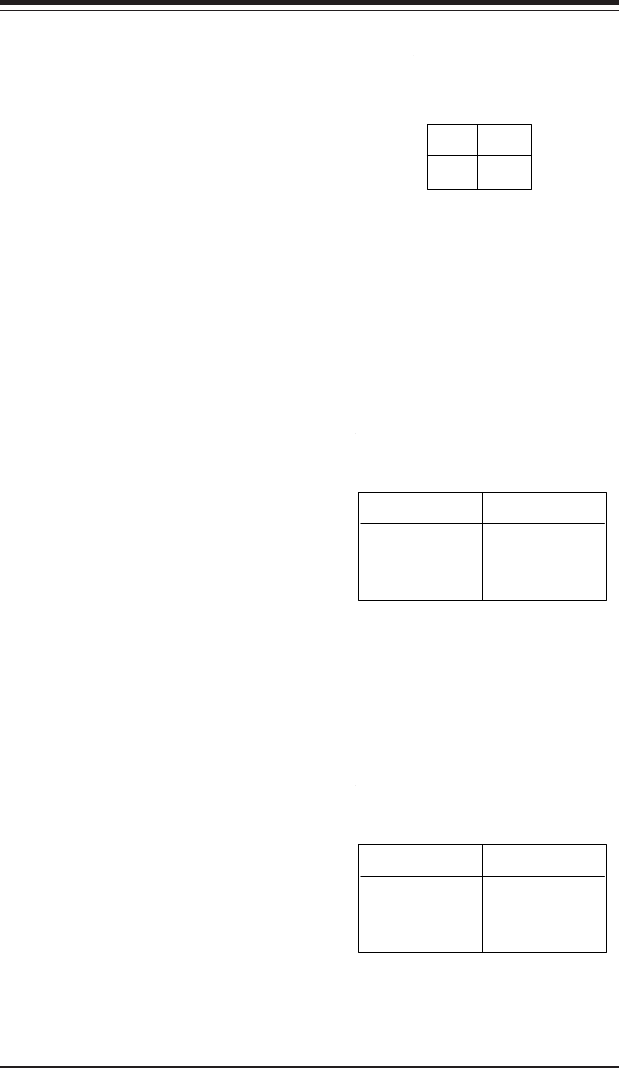
5-14
SUPERSERVER 6012P-6 User’s Manual
Extra Universal Serial Bus
Headers (FPUSB0/1)
The Front Panel USB0/USB1 head-
ers are located at JD2. These are
separate from the ports on the I/O
panel. You will need a USB cable
(not included) to use either con-
nection. Refer to the table on the
right for pin definitions.
Power Button
The Power Button connection is
located on pins 1 and 2 of JF2.
Momentarily contacting both pins
will power on/off the system. This
button can also be configured to
function as a suspend button (see
the Power Button Mode setting in
BIOS). To turn off the power
when set to suspend mode, de-
press the button for at least 4
seconds. Refer to the table on the
right for pin definitions.
Pin
Number
1
2
Definition
PW_ON
Ground
Power Button
Connector
Pin Definitions
(JF2)
Universal Serial Bus
(USB0/1)
Two Universal Serial Bus ports
are located beside the PS/2 key-
board/mouse ports. USB0 is the
bottom connector and USB1 is the
top connector. See the table on
the right for pin definitions.
Universal Serial Bus Pin Definitions
Pin
Number Definition
1+5V
2P0-
3P0+
4 Ground
5 N/A
Pin
Number Definition
1+5V
2P0-
3P0+
4 Ground
5Key
USB0 USB1
Front Panel Universal Serial Bus Pin
Definitions
Pin
Number Definition
1+5V
2P0-
3P0+
4 Ground
5 N/A
Pin
Number Definition
1+5V
2P0-
3P0+
4 Ground
5Key
FPUSB0 FPUSB1
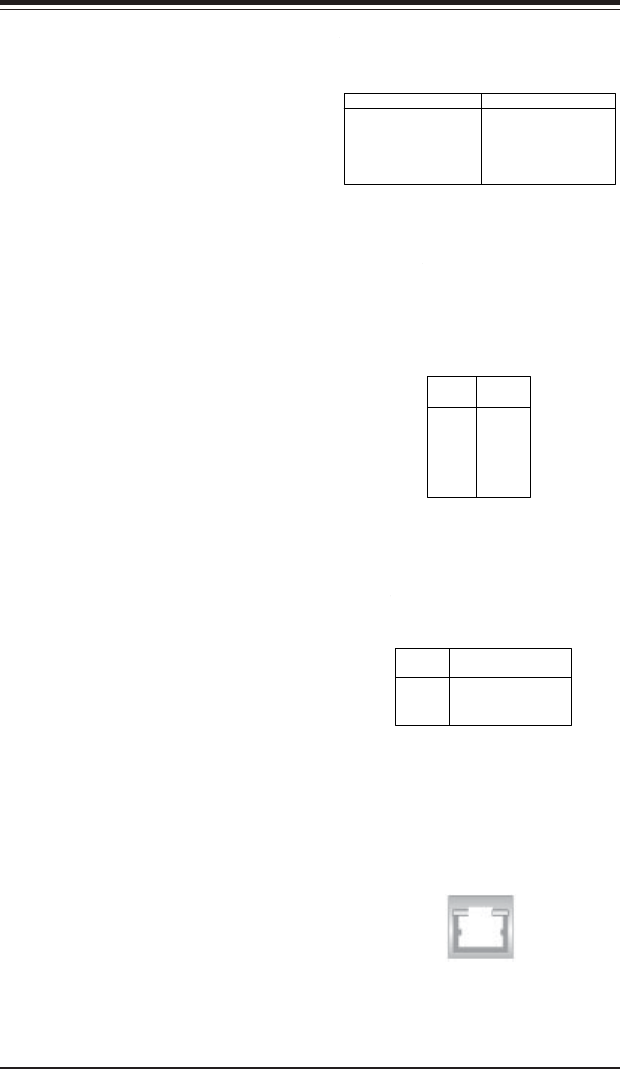
Chapter 5: Advanced Motherboard Setup
5-15
ATX PS/2 Keyboard and
PS/2 Mouse Ports
The ATX PS/2 keyboard and the
PS/2 mouse are located on J29.
See the table on the right for pin
definitions. (The mouse port is
above the keyboard port. See Fig-
ure 2-3.)
PS/2 Keyboard
and Mouse Port
Pin Definitions
(J29)
Pin
Number
1
2
3
4
5
6
Definition
Data
NC
Ground
VCC
Clock
NC
Fan Header Pin Definitions
Pin
Number
1
2
3
Definition
Ground (black)
+12V (red)
Tachometer
Caution: These fan headers
are DC power.
Fan Headers
The motherboard has three fan
headers. These are designated
CPU 1 Chassis Fan, CPU 2 Chas-
sis Fan and Chassis Fan 3. See
the table on the right for pin defini-
tions.
Serial Ports
The COM1 serial port is located
under the parallel port. See the
table on the right for pin defini-
tions. The COM2 connector is a
header located near the BIOS chip
on the motherboard.
LAN1/2 (Ethernet Ports)
Two Ethernet ports (designated
LAN1 and LAN2) are located be-
side the VGA port on the IO
backplane. These ports accept
RJ45 type cables.
Serial Port Pin Definitions
(COM1, COM2)
Pin Number Definition
1 CD
2 RD
3 TD
4 DTR
5 Ground
Pin Number Definition
6 DSR
7 RTS
8 CTS
9 RI
10 NC
Note: Pin 10 is included on the header but
not on the port.
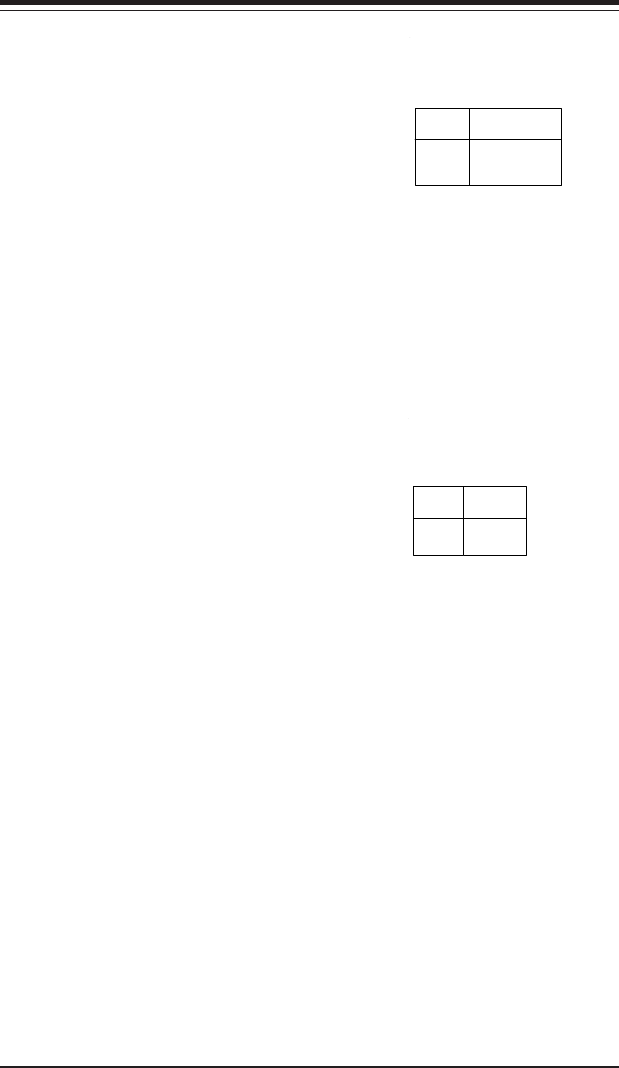
5-16
SUPERSERVER 6012P-6 User’s Manual
Pin
Number
1
2
3
Definition
+5V Standby
Ground
Wake-up
Wake-On-LAN Pin
Definitions (WOL)
Wake-On-LAN
The Wake-On-LAN header is des-
ignated as WOL. See the table on
the right for pin definitions. You
must enable the LAN Wake-Up set-
ting in BIOS to use this feature.
You must also have a LAN card
with a Wake-on-LAN connector
and cable.
Wake-On-Ring
The Wake-On-Ring header is des-
ignated WOR. This function al-
lows your computer to receive
and "wake-up" by an incoming call
to the modem when in sustpend
state. See the table on the right
for pin definitions. You must have
a WOR card and cable to use this
feature.
Wake-on-Ring
Pin Definitions
(WOR)
Pin
Number
1
2
Definition
Ground
Wake-up
Keylock
The keyboard lock connection is lo-
cated on JP35. Utilizing this header
allows you to inhibit any actions
made on the keyboard, effectively
"locking" it.
Chapter 5: Advanced Motherboard Setup
5-17
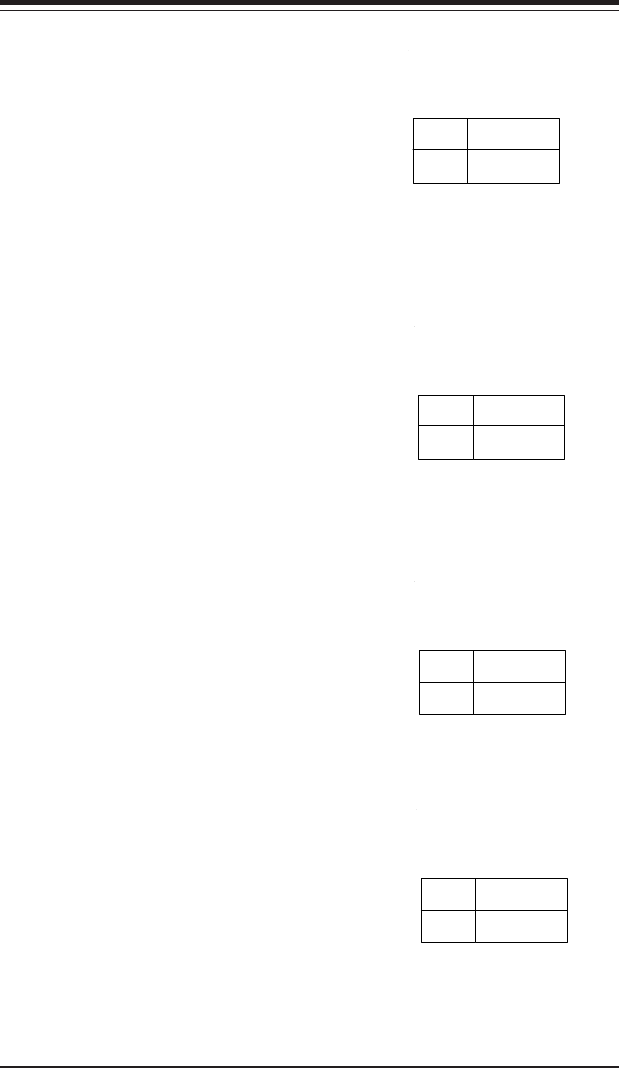
CMOS Clear
Refer to the table on the right for
the JBT1 jumper settings to clear
CMOS. Always remove the AC
power cord from the system be-
fore clearing CMOS.
Note: For an ATX power supply,
you must completely shut down
the system, remove the AC power
cord and then use JBT1 to clear
CMOS. Replace JBT1 back to the
pin 1-2 position before powering
up the system again. Do not use
the PW_ON connector to clear
CMOS.
CMOS Clear Jumper Settings
(JBT1)
Jumper
Position
1-2
2-3
Definition
Normal
CMOS Clear
Position
1-2 Position
2-3
Normal
CMOS Clear
5-9 Jumper Settings
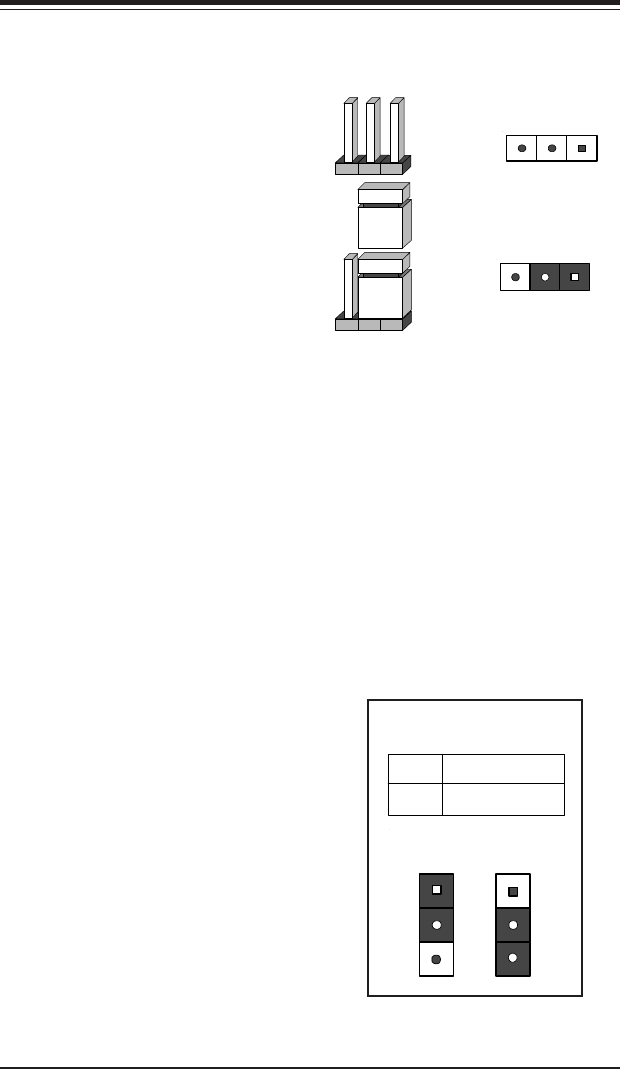
Explanation of
Jumpers
To modify the operation of the
motherboard, jumpers can be
used to choose between
optional settings. Jumpers
create shorts between two pins
to change the function of the
connector. Pin 1 is identified
with a square solder pad on
the printed circuit board. See
the motherboard layout page
for jumper locations.
Note: On two pin jumpers,
"Closed" means the jumper is
on and "Open" means the
jumper is off the pins.
Connector
Pins
Jumper
Cap
Setting
Pin 1-2 short
3 2 1
3 2 1
5-18
SUPERSERVER 6012P-6 User’s Manual
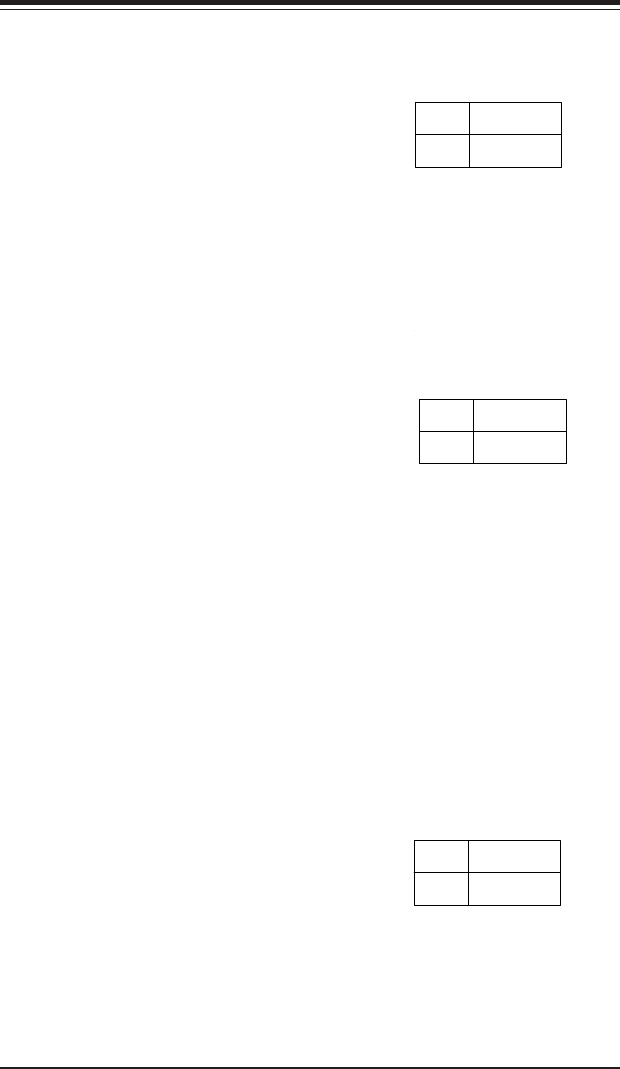
Chassis/Overheat Fan
Select
JP33 allows you to select to use ei-
ther the CPU fan or the Chassis
fan. The default position is open to
select the CPU fan. The CPU Chas-
sis fan is intended for use with
Supermicro chassis. See the table
on the right for jumper settings.
Jumper
Position
Open
Closed
Definition
CPU
CPU Chassis
CPU Chassis/CPU Fan
Select Jumper Settings
(JP33)
LAN1 Enable/Disable
Change the setting of jumper JP3
to enable or disable the onboard
LAN1 or NIC (Network Interface
Card) on the motherboard. See
the table on the right for jumper
settings. The default setting is
enabled
Jumper
Position
Pins 1-2
Pins 2-3
Definition
Enabled
Disabled
LAN1 (NIC)
Enable/Disable
Jumper Settings
(JP3)
LAN2 Enable/Disable
Change the setting of jumper JP27
to enable or disable the onboard
LAN2 or NIC (Network Interface
Card) on the motherboard. See
the table on the right for jumper
settings. The default setting is
enabled.
Jumper
Position
Pins 1-2
Pins 2-3
Definition
Enabled
Disabled
LAN2 (NIC)
Enable/Disable
Jumper Settings
(JP27)
VGA Enable/Disable
JP4 allows you to enable or disable
the VGA port. The default position
is on pins 1 and 2 to enable VGA.
See the table on the right for
jumper settings.
Jumper
Position
1-2
2-3
Definition
Enabled
Disabled
VGA Enable/Disable
Jumper Settings
(JP4)
Chapter 5: Advanced Motherboard Setup
5-19
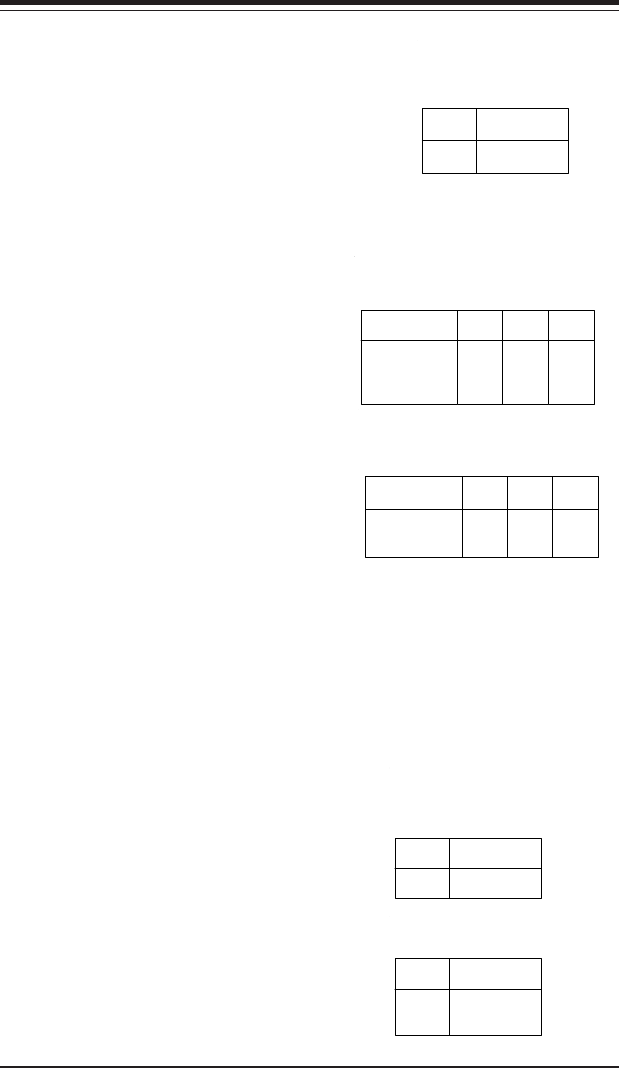
SCSI Enable/Disable
The SCSI Termination jumper at
JP22 allows you to enable or dis-
able the onboard SCSI controller.
The normal (default) position is on
pins 1-2 to enable SCSI termina-
tion. See the table on the right for
jumper settings.
Jumper
Position
Pins 1-2
Pins 2-3
Definition
Enabled
Disabled
SCSI Enable/Disable
Jumper Settings
(JP22)
SCSI Termination Enable/
Disable
Jumpers JPA1 and JPA2 allow you
to enable or disable termination for
the individual SCSI channels.
Jumper JPA1 controls SCSI channel
A and JPA2 controls SCSI channel
B. The normal (default) setting is
open to enable (teminate) both SCSI
channels. If you wish to connect
external SCSI devices, you should
disable termination for the
channnel(s) you will be connecting
them to. See the table on the right
for jumper settings.
Jumper
Position
Open
Closed
Definition
Enabled
Disabled
SCSI Channel Termination
Enable/Disable
Jumper Settings
(JPA1, JPA2)
Watchdog Enable/Disable
The WD jumper (located on JD1) al-
lows you to enableor disable the
Watchdog feature. The default po-
sition is open to disable the Watch-
dog timer. When enabled, Watch-
dog can reboot your PC if an appli-
cation is "hung up" or the system
goes down. See the table on the
right for jumper settings.
Jumper
Position
Open
Closed
Definition
Disabled
Enabled
Watchdog Timer Enable/
Disable Jumper Settings
(WD on JD1)
5-20
SUPERSERVER 6012P-6 User’s Manual
PCI-X Bus Speed Settings
Jumpers JP10 through JP15 are
used to set the speed for the PCI-X
buses. See the tables on the right
for the jumper settings to select the
speed for each slot.
Thermal Fan Enable/Disable
JP38 allows you to enable or disable
the thermal fan. When enabled, the
fan will operate continuously. When
disabled, it will operate only when a
predefined temperature threshold
has been exceeded. See the table
on the right for jumper settings.
Jumper
Position
Open
Closed
Definition
Disabled
Enabled
Thermal Fan
Enable/Disable
Jumper Settings (JP38)
LED
Color
Green
Yellow
Definition
Connected
Active
100 Mb LAN LED
Indicators (LAN1)
5-10 Onboard Indicators
LAN1/LAN2 LEDs
The Ethernet ports (located beside
the VGA port) have two LEDs.
See the tables below for the func-
tions associated with these LEDs.
On the Gb LAN port, the yellow
LED indicates activity while the
other LED may be green, orange
or off to indicate the speed of the
connection. See the tables below
for descriptions.
LED
Color
Off
Green
Orange
Definition
No Connection
100 MHz
1 GHz
1 Gb LAN Right LED
Indicator (LAN2)*
PC Slot 1 Bus Speed Settings
(JP13, JP14, JP15)
Mode
PCI-X 133 MHz
PCI-X 100 MHz
PCI-X 66 MHz
PCI 66 MHz
JP14
Off
Off
Off
Off
JP15
Off
On
On
On
JP13
Off
Off
Pins 1-2
Pins 2-3
Mode
PCI-X 66 MHz
PCI 66 MHz
JP10
Off
Off
JP11
On
On
JP12
Pins 1-2
Pins 2-3
PCI Slot 2 Bus Speed Settings
(JP10, JP11, JP12)
Speaker Enable/Disable
On the JD1 header, add a jumper
to pins 6-7 to enable the onboard
speaker. If you wish to use an
external speaker, remove it to dis-
able the onboard speaker.

Chapter 5: Advanced Motherboard Setup
5-21
5-11 Floppy/Hard Disk Drive and SCSI Connections
Note the following when connecting the floppy and hard disk drive cables:
• The floppy disk drive cable has seven twisted wires.
• A red mark on a wire typically designates the location of pin 1.
• A single floppy disk drive ribbon cable has 34 wires and two connectors
to provide for two floppy disk drives. The connector with twisted wires
always connects to drive A, and the connector that does not have
twisted wires always connects to drive B.
Pin Number Function
1 GND
3 GND
5 Key
7 GND
9 GND
11 GND
13 GND
15 GND
17 GND
19 GND
21 GND
23 GND
25 GND
27 GND
29 GND
31 GND
33 GND
Pin Number Function
2 FDHDIN
4 Reserved
6 FDEDIN
8 Index-
10 Motor Enable
12 Drive Select B-
14 Drive Select A-
16 Motor Enable
18 DIR-
20 STEP-
22 Write Data-
24 W rite Gate-
26 Track 00-
28 Write Protect-
30 Read Data-
32 Side 1 Select-
34 Diskette
Floppy Connector Pin Definitions (JP7)
Floppy Connector
The floppy connector is located
on JP7. See the table below for
pin definitions.
5-22
SUPERSERVER 6012P-6 User’s Manual
Signal Names
+DB(12)
+DB(13)
+DB(14)
+DB(15)
+DB(P1)
+DB(0)
+DB(1)
+DB(2)
+DB(3)
+DB(4)
+DB(5)
+DB(6)
+DB(7)
+DB(P)
GROUND
DIFFSENS
TERMPWR
TERMPWR
RESERVED
GROUND
+ATN
GROUND
+BSY
+ACK
+RST
+MSG
+SEL
+C/D
+REQ
+I/O
+DB(8)
+DB(9)
+DB(10)
+DB(11)
Connector
Contact
Number
1
2
3
4
5
6
7
8
9
10
11
12
13
14
15
16
17
18
19
20
21
22
23
24
25
26
27
28
29
30
31
32
33
34
Signal Names
-DB(12)
-DB(13)
-DB(14)
-DB(15)
-DB(P1)
-DB(0)
-DB(1)
-DB(2)
-DB(3)
-DB(4)
-DB(5)
-DB(6)
-DB(7)
-DB(P)
GROUND
GROUND
TERMPWR
TERMPWR
RESERVED
GROUND
-ATN
GROUND
-BSY
-ACK
-RST
-MSG
-SEL
-C/D
-REQ
-I/O
-DB(8)
-DB(9)
-DB(10)
-DB(11)
Connector
Contact
Number
35
36
37
38
39
40
41
42
43
44
45
46
47
48
49
50
51
52
53
54
55
56
57
58
59
60
61
62
63
64
65
66
67
68
68-pin Ultra160 SCSI Connectors (JA1, JA2, JA4)
Ultra160 SCSI
Connectors
Refer to the table on
the right for the pin defi-
nitions of the Ultra160
SCSI connectors lo-
cated at JA1 and JA2.
IDE Connectors
There are no jumpers to
configure the onboard IDE#1
and #2 connectors (J2A and
J3A, respectively). See the
table on the right for pin
definitions.
Pin Number Function
1 Reset IDE
3 Host Data 7
5 Host Data 6
7 Host Data 5
9 Host Data 4
11 Host Data 3
13 Host Data 2
15 Host Data 1
17 Host Data 0
19 GND
21 DRQ3
23 I/O Write-
25 I/O Read-
27 IOCHRDY
29 DACK3-
31 IRQ14
33 Addr 1
35 Addr 0
37 Chip Select 0
39 Activity
Pin Number Function
2 GND
4 Host Data 8
6 Host Data 9
8 Host Data 10
10 Host Data 11
12 Host Data 12
14 Host Data 13
16 Host Data 14
18 Host Data 15
20 Key
22 GND
24 GND
26 GND
28 BALE
30 GND
32 IOCS16-
34 GND
36 Addr 2
38 Chip Select 1-
40 GND
IDE Connector Pin Definitions
(J2A, J3A)
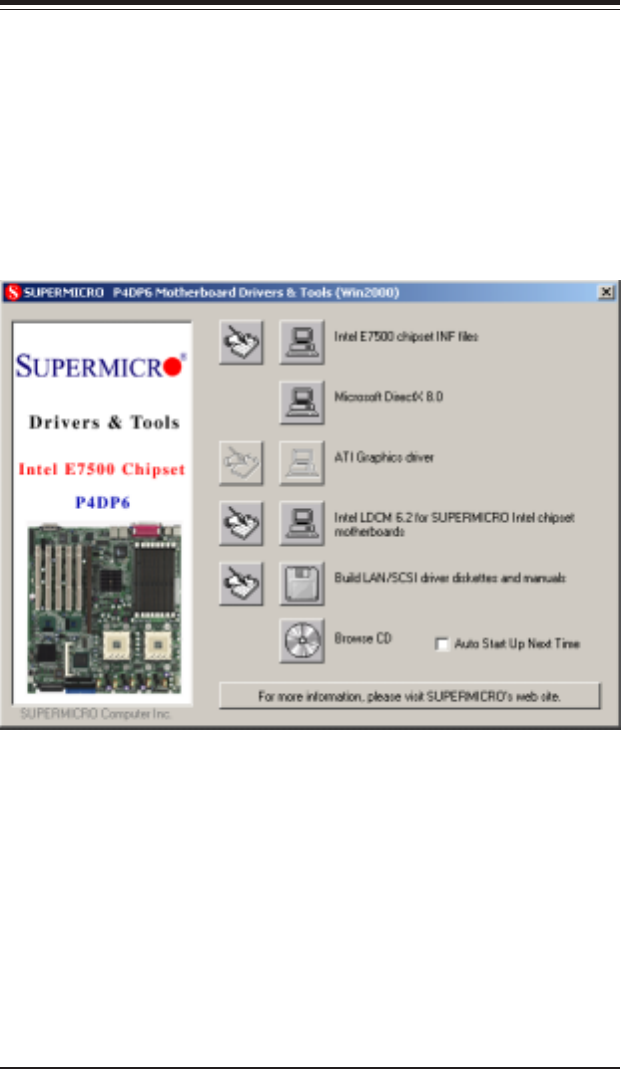
Chapter 5: Advanced Motherboard Setup
5-23
5-12 Installing Software Drivers
After all the hardware has been installed you must install the software
drivers. The necessary drivers are all included on the Supermicro CD that
came packaged with your motherboard. After inserting this CD into your
CD-ROM drive, the display shown in Figure 5-8 should appear. (If this
display does not appear, double click on the "My Computer" icon and then
on the icon representing your CD-ROM drive. Finally, double click on the S
"Setup" icon.)
Figure 5-8 Driver/Tool Installation Display Screen
Click the icons showing a hand writing on paper to view the readme files
for each item. The bottom icon with a CD on it allows you to view the
entire contents of the CD.

5-24
SUPERSERVER 6012P-6 User’s Manual
Notes

Chapter 6: Advanced Chassis Setup
6-1
Chapter 6
Advanced Chassis Setup
This chapter covers the steps required to install components and perform
maintenance on the SC812S chassis. For component installation, follow the
steps in the order given to eliminate the most common problems encoun-
tered. If some steps are unnecessary, skip ahead to the next step.
Tools Required
The only tool you will need to install components and perform maintenance
is a Philips screwdriver.
6-1 Static-Sensitive Devices
Electricstatic discharge (ESD) can damage electronic components. To pre-
vent damage to any printed circuit boards (PCBs), it is important to handle
them very carefully. The following measures are generally sufficient to
protect your equipment from ESD damage.
Precautions
!Use a grounded wrist strap designed to prevent static discharge.
!Touch a grounded metal object before removing any board from its anti-
static bag.
!Handle a board by its edges only; do not touch its components, periph-
eral chips, memory modules or gold contacts.
!When handling chips or modules, avoid touching their pins.
!Put the motherboard, add-on cards and peripherals back into their anti-
static bags when not in use.
!For grounding purposes, make sure your computer chassis provides ex-
cellent conductivity between the power supply, the case, the mounting
fasteners and the motherboard.
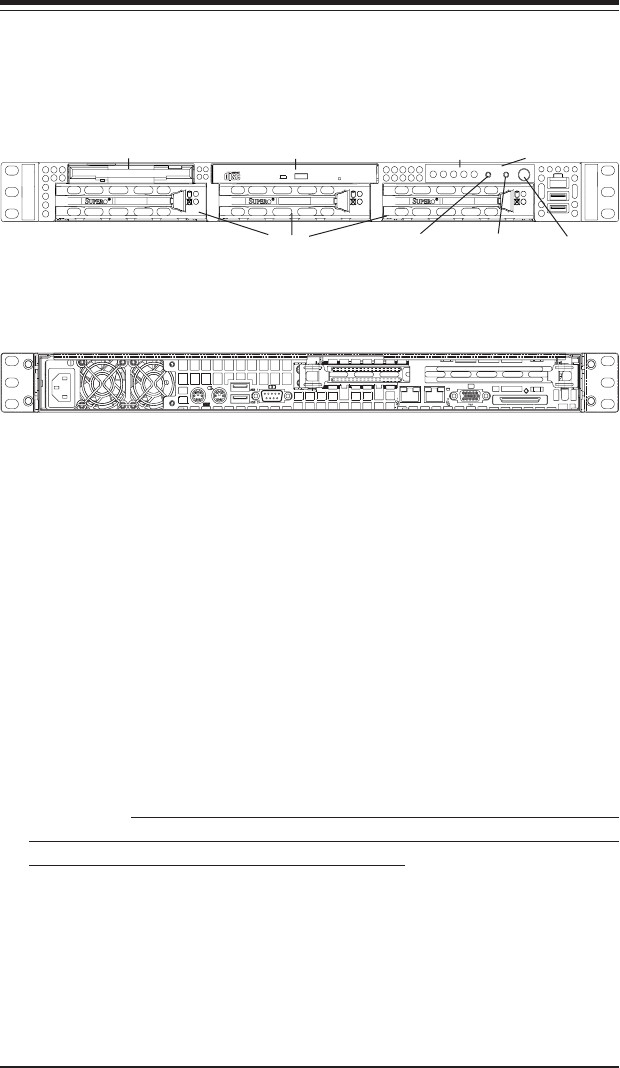
6-2
SUPERSERVER 6012P-6 Manual
Figure 6-1. Chassis: Front and Rear Views
System Reset
6-2 Control Panel
The control panel (located on the front of the chassis) must be connected
to the JF2 connector on the motherboard to provide you with system status
indications. A ribbon cable has bundled these wires together to simplify the
connection. Connect the cable from JF2 on the motherboard to the appro-
priate header on the Control Panel PCB (printed circuit board). Make sure
the red wire plugs into pin 1 on both connectors. Pull all excess cabling out
of the airflow path.
The control panel LEDs inform you of system status. See "Chapter 3:
System Interface" for details on the LEDs and the control panel buttons.
Details on JF2 can be found in "Chapter 5: Advanced Motherboard Installa-
tion."
Control Panel
System LEDs
Main Power
Slim-Line CD-ROM DriveFloppy Drive
SCSI Drives NMI

Chapter 6: Advanced Chassis Setup
6-3
6-3 System Fans
Two 10-cm blower fans provide all the cooling needed for the SuperServer
6012P-6. It is very important that the chassis top cover is properly installed
and making a good seal in order for the cooling air to circulate properly
through the chassis and cool the components. See Figure 6-2.
System Fan Failure
The fans run at 3200 rpm. If a fan fails, the ambient air temperature in the
chassis will rise and activate the overheat LED on the control panel. Re-
place any failed fan immediately with the same type and model. You must
power down the system before replacing a cooling fan (removing the power
cord is also recommended as a safety precaution).
Replacing System Cooling Fans
1. Removing a fan:
Remove the chassis cover. Detach the fan wires from their connection
to the motherboard. Remove the screws that secure the fan to the
chassis and lift the blower fan out.
2. Installing a new fan:
Replace the failed fan with an identical 10-cm, 12 volt fan (available from
Supermicro: p/n FAN-038). Install the new fan in its proper place in the
chassis by positioning it on the two mounting posts. Secure the fan to
the chassis with the screws you removed previously, then attach the fan
wires to the connector on the motherboard. Finish by replacing the
chassis cover and power cord and restoring power to the system.
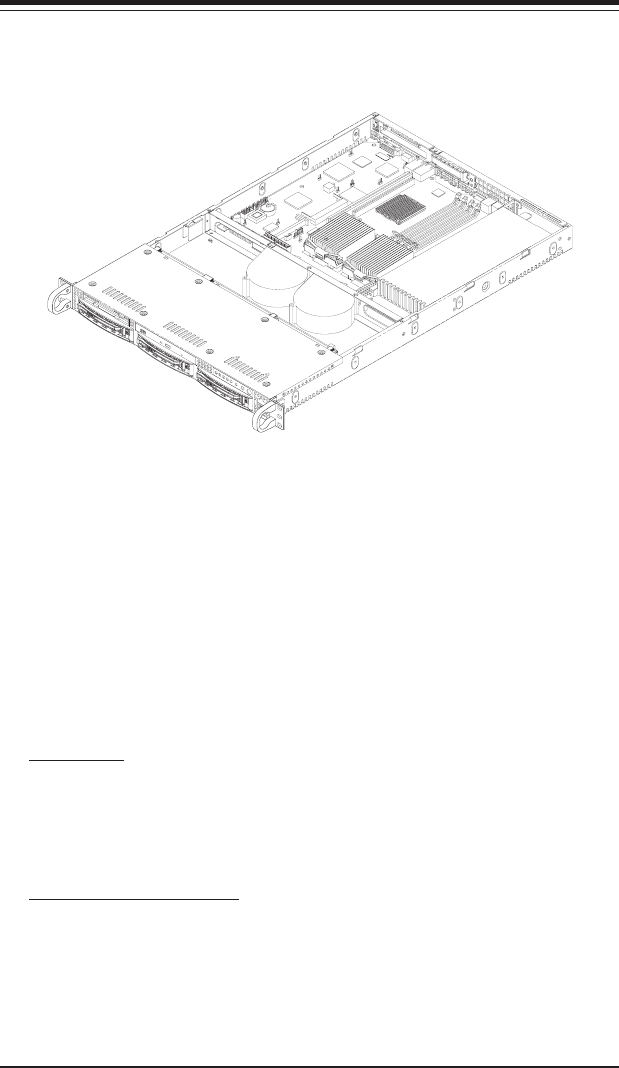
6-4
SUPERSERVER 6012P-6 Manual
Figure 6-2. System Cooling Fans
6-4 Drive Bay Installation/Removal
Accessing the Drive Bays
SCSI Drives: You do not need to access the inside of the chassis to
replace or swap SCSI drives. Proceed to the next step for instructions.
Note: You must use standard 1" high, 80-pin SCA SCSI drives in
the SuperServer 6012P-6.
CD-ROM/Floppy Disk Drive: For installing/removing the CD-ROM or floppy
disk drive, you will need to gain access to the inside of the 6012P-6 by
removing the top cover of the chassis. Proceed to the "CD-ROM and
Floppy Drive Installation" section later in this chapter for instructions.
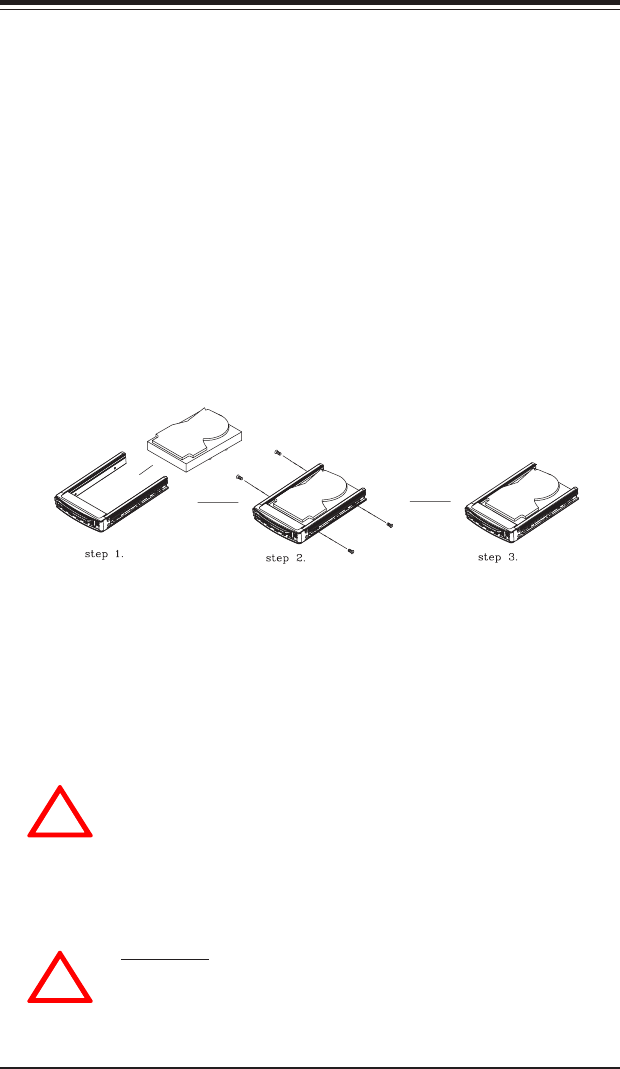
Chapter 6: Advanced Chassis Setup
6-5
SCSI Drive Installation
1. Mounting a SCSI drive in a drive carrier:
The SCSI drives are mounted in drive carriers to simplify their installation
and removal from the chassis. These carriers also help promote proper
airflow for the SCSI drive bays. For this reason, even empty carriers
without SCSI drives installed must remain in the chassis. To add a new
SCSI drive, install a drive into the carrier with the printed circuit board
side toward the carrier so that the mounting holes align with those in the
carrier. Secure the drive to the carrier with four screws, as shown in
Figure 6-3.
Figure 6-3. Mounting a SCSI Drive in a Carrier
!
Important: Regardless of how many SCSI hard drives
are installed, all SCSI drive carriers must remain in the
drive bays for proper airflow.
Use caution when working around the SCSI backplane.
Do not touch the backplane with any metal objects
and make sure no ribbon cables touch the backplane
or obstruct the holes, which aid in proper airflow.
!
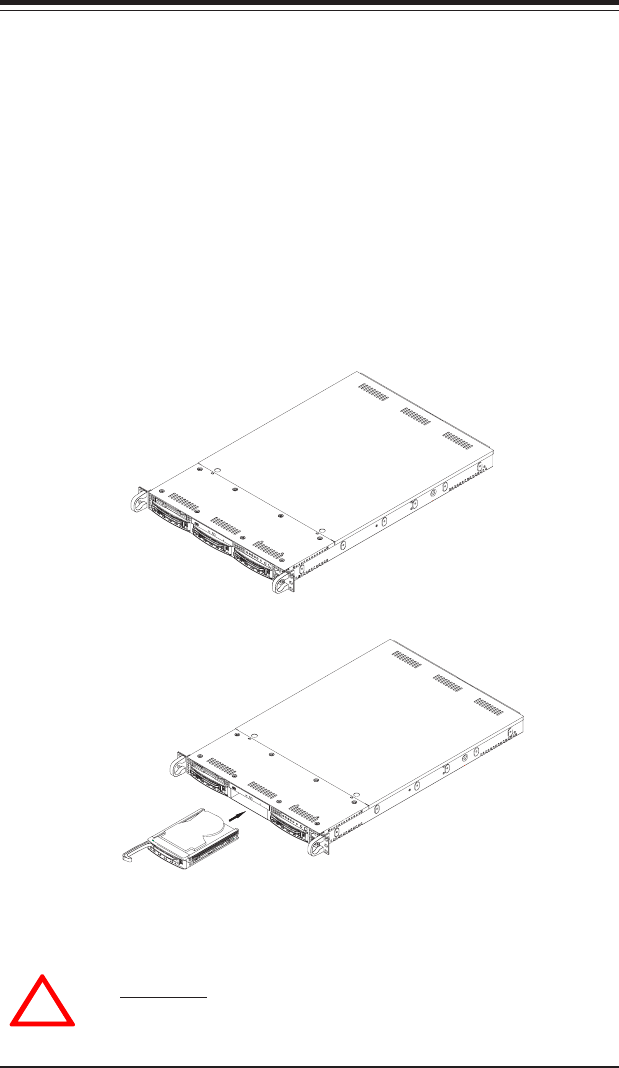
6-6
SUPERSERVER 6012P-6 Manual
Figure 6-4. Removing SCSI Drives
2. Installing/removing hot-swap SCSI drives:
The SCSI drive bays are located in the front of the chassis, making them
easily accessible for installation and removal. The SCSI drives are hot-
swap units, meaning that they can be installed and removed while the
system is running. To remove a SCSI drive, first push the colored
release button located beside the drive's LEDs, then swing the handle
fully out and use it to pull the SCSI drive carrier straight out (see Figure
6-4).
!
Important: All of the SCSI drive carriers must remain
in the drive bay to maintain proper cooling airflow.

Chapter 6: Advanced Chassis Setup
6-7
SCA Backplane
The SCSI drives plug into a SAF-TE compliant SCA backplane that provides
power, SCSI ID and bus termination. A RAID controller can be used with
the SCA backplane to provide data security. The operating system you use
must have RAID support to enable the hot-swap capability of the SCSI
drive. The SCA SCSI backplane is already preconfigured; there are no
jumpers or switches.
CD-ROM and Floppy Drive Installation
The top cover of the chassis must be opened to gain full access to the CD-
ROM and floppy drive bays. The 6012P-6 accomodates only slim-line CD-
ROM drives. Side mounting brakets are needed to mount a slim-line CD-ROM
drive in the 6012P-6 server.
You must power down the system before installing or removing a floppy
or CD-ROM drive. First, release the retention screws that secure the
server unit to the rack. Grasp the two handles on either side and pull
the unit straight out until it locks (you will hear a "click"). Next, depress
the two buttons on the top of the chassis to release the top cover and at
the same time, push the cover away from you until it stops. You can
then lift the top cover from the chassis to gain full access to the inside of
the server.
With the chassis cover removed, unplug the power and data cables from
the drive you want to remove. Then locate the locking tab at the rear of
the drive. It will be on the left side of the drive when viewed from the
front of the chassis. Pull the tab away from the drive and push the drive
unit out the front of the chassis. Add a new drive by following this
procedure in reverse order. You may hear a faint *click* of the locking
tab when the drive is fully inserted. Remember to reconnect the data and
power cables to the drive before replacing the chassis cover and
restoring power to the system. Please be aware of the following:
• The floppy disk drive cable has seven twisted wires.
• A color mark on a cable typically designates the location of pin 1.
• A single floppy disk drive ribbon cable has 34 wires and two connectors
to provide for two floppy disk drives. The connector with twisted wires
always connects to drive A, and the connector that does not have
twisted wires always connects to drive B. (You can only install one
internal floppy drive into the 6012P-6.)

6-8
SUPERSERVER 6012P-6 Manual
6-5 Power Supply
The SuperServer 6012P-6 has a single 400 watt power supply, which is
auto-switching capable. This enables it to automatically sense and
operate anywhere within the range of 100 to 260 input volts. An amber
light will be illuminated on the power supply when the power is off. An
illuminated green light indicates that the power supply is operating.
Power Supply Failure
If the power supply unit fails, the system will shut down and you will
need to replace the power supply unit. Replacement units can be
ordered directly from Supermicro (see contact information in the Preface).
As there is only one power supply unit in the 6012P-6, the server must
be powered down before removing and replacing the power supply unit
for whatever reason.
Removing/Replacing the Power Supply
1. Removing the power supply:
First turn the power switch on the control panel off, then unplug the
power cord from the system. Remove the chassis cover by pressing the
two release buttons on the top of the chassis (near the front) and push
the chassis top rearward about one inch. To remove the failed power
unit, push the beige colored release tab to the right and then carefully lift
the unit up about 1/2 inch only. If you lift too high, you may damage the
power distribution board that the other end of the unit is connected to.
Then, pull the power unit straight back to unplug it from the power
distribution board. See Figure 6-5.
2. Installing a new power supply:
Replace the failed unit with another unit of the same input voltage, output
voltage and wattage. It is highly recommended to replace it with exactly
the same model power supply. Carefully insert the new unit into position
to plug it into the power distribution board, making sure you are not
holding it at too great an angle, which may damage the power distribution
board. Push it completely into the power distribution board and seat it in
the chassis. When correctly installed it should be laying flat - make sure
the end of the power supply is not sitting on the stop in the chassis.
Reconnect the power cord, replace the chassis top cover and reposition
the unit back into the rack. Finish by depressing the power button on the
chassis front control panel.
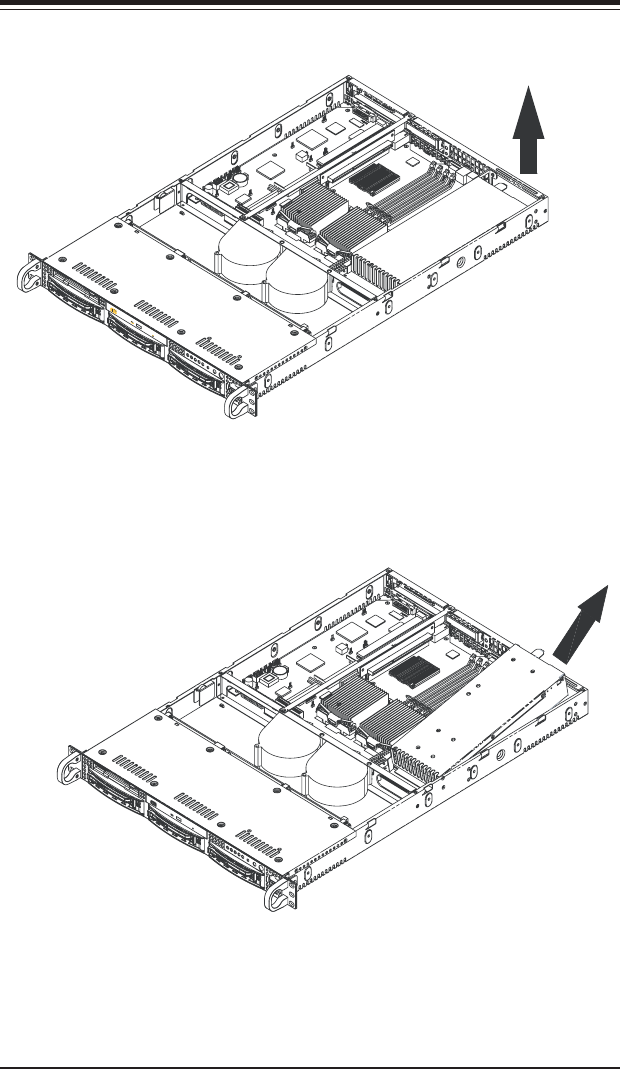
Chapter 6: Advanced Chassis Setup
6-9
Figure 6-5. Removing/Replacing the Power Supply

6-10
SUPERSERVER 6012P-6 Manual
Notes

Chapter 7: BIOS
7-1
Chapter 7
BIOS
7-1 Introduction
This chapter describes the PhoenixBIOS™ Setup utility for the P4DPR-6GM+.
The Phoenix ROM BIOS is stored in a flash chip and can be easily upgraded
using a floppy disk-based program.
Note: Due to periodic changes to the BIOS, some settings may have been
added or deleted and might not yet be recorded in this manual. Please refer
to the Manual Download area of the Supermicro web site
<http://www.supermicro.com> for any changes to BIOS that may not be
reflected in this manual.
System BIOS
The BIOS is the Basic Input Output System used in all IBM® PC, XT™, AT®,
and PS/2® compatible computers. The PhoenixBIOS flash chip stores the
system parameters, such type of disk drives, video displays, etc. in the
CMOS. The CMOS memory requires very little electrical power. When the
computer is turned off, a back-up battery provides power to the BIOS flash
chip, enabling it to retain system parameters. Each time the computer is
powered-on the computer is configured with the values stored in the BIOS
ROM by the system BIOS, which gains control at boot-up.
How To Change the Configuration Data
The CMOS information that determines the system parameters may be
changed by entering the BIOS Setup utility. This Setup utility can be ac-
cessed by pressing the <Delete> key at the appropriate time during system
boot, see below.
Starting the Setup Utility
Normally, the only visible POST (Power On Self Test) routine is the memory
test. As the memory is being tested, press the <Delete> key to enter the
main menu of the BIOS Setup utility. From the main menu, you can access
the other setup screens, such as the Security and Power menus. Begin-
ning with Section 4-3, detailed descriptions are given for each parameter
setting in the Setup utility.

7-2
SUPERSERVER 6012P-6 Manual
7-2 Running Setup
*Default settings are in bold text unless otherwise noted.
The BIOS setup options described in this section are selected by choos-
ing the appropriate text from the main BIOS Setup screen. All displayed
text is described in this section, although the screen display is often all
you need to understand how to set the options (see on next page).
When you first power on the computer, the PhoenixBIOS™ is immediately
activated.
While the BIOS is in control, the Setup program can be activated in one of two
ways:
1. By pressing <Delete> immediately after turning the system on, or
2. When the message shown below appears briefly at the bottom of the
screen during the POST (Power On Self-Test), press the <Delete> key to
activate the main Setup menu:
Press the <Delete> key to enter Setup
7-3 Main BIOS Setup
All main Setup options are described in this section. The main BIOS Setup screen
is displayed below.
Use the Up/Down arrow keys to move among the different settings in each menu.
Use the Left/Right arrow keys to change the options for each setting.
Press the <Esc> key to exit the CMOS Setup Menu. The next section describes
in detail how to navigate through the menus.
Items that use submenus are indicated with the ! icon. With the item highlighted,
press the <Enter> key to access the submenu.
Chapter 7: BIOS
7-3
Main BIOS Setup Menu
Main Setup Features
System Time
To set the system date and time, key in the correct information in the
appropriate fields. Then press the <Enter> key to save the data.
System Date
Using the arrow keys, highlight the month, day and year fields and enter
the correct data. Press the <Enter> key to save the data.
Phoenix BIOS Setup Utility
Main Advanced Security Power Boot Exit
System Time [16:19:20]
System Date [02/02/02]
Legacy Diskette A: [1.44/1.25 MB]
Legacy Diskette B: [Not Installed]
! Primary Master [120 GB]
! Primary Slave [None]
! Secondary Master [CD-ROM]
! Secondary Slave [None]
System Memory 256 MB
Extended Memory 3967 KB
Item Specific Help
F1 Help ↑↓ Select Item -/+ Change Values F9 Setup Defaults
Esc Exit ↔ Select Menu Enter Select!Sub-Menu F10 Save and Exit
7-4
SUPERSERVER 6012P-6 Manual
Legacy Diskette A
This setting allows the user to set the type of floppy disk drive installed as
diskette A. The options are Disabled, 360Kb 5.25 in, 1.2MB 5.25 in, 720Kb
3.5 in, 1.44/1.25MB, 3.5 in and 2.88MB 3.5 in.
Legacy Diskette B
This setting allows the user to set the type of floppy disk drive installed as
diskette B. The options are Disabled, 360Kb 5.25 in, 1.2MB 5.25 in, 720Kb
3.5 in, 1.44/1.25MB, 3.5 in and 2.88MB 3.5 in.
!!
!!
!Primary Master/Primary Slave/Secondary Master/Secondary
Slave
These settings allow the user to set the parameters of the IDE Primary
Master/Slave and IDE Secondary Master/Slave slots. Hit <Enter> to activate
the following sub-menu screen for detailed options of these items. Set the
correct configurations accordingly. The items included in the sub-menu are:
Phoenix BIOS Setup Utility
Main Advanced Security Power Boot Exit
Type: [Auto]
Multi Sector Transfer; [16 Sectors]
LBA Mode Control: [Enabled]
32-bit I/O: [Enabled]
Transfer Mode: [Fast PIO 4]
Ultra DMA Mode [Disabled]
Item Specific Help
Select the drive
type of the fixed
disk installed in
your system. If type
User is selected,
Cylinders, Heads,
and Sectors can be
edited directly.
Auto attempts to
automatically detect
the drive type for
drives that comply
with ANSI
specifications.
F1 Help ↑↓ Select Item -/+ Change Values F9 Setup Defaults
Esc Exit ↔ Select Menu Enter Select!Sub-Menu F10 Save and Exit

Chapter 7: BIOS
7-5
Type
Selects the type of IDE hard drive. The options are Auto (allows BIOS
to automatically determine the hard drive's capacity, number of heads,
etc.), a number from 1-39 to select a predetermined type of hard drive,
CD-ROM and ATAPI Removable.
Multi-Sector Transfers
Select the number of transfer sectors. Options are 2, 4, 6, 8 and 16
Sectors.
LBA Mode Control
This item determines whether Phoenix BIOS will access the IDE Primary
Master Device via LBA mode. The options are Enabled and Disabled.
32-bit I/O
Selects 32-bit I/O operation. Options are Enabled and Disabled.
Transfer Mode
Selects the transfer mode. Options are Standard, Fast PIO1, Fast PIO2,
Fast PIO3, Fast PIO4, FPIO3/DMA1 and FPIO4/DMA2.
Ultra DMA Mode
Selects Ultra DMA Mode. Options are Disabled, Mode 0, Mode 1, Mode
2, Mode 3, Mode 4 and Mode 5.
System Memory
This display informs you how much system memory is recognized as being
present in the system.
Extended Memory
7-6
SUPERSERVER 6012P-6 Manual
7-4 Advanced Setup
Choose Advanced from the Phoenix BIOS Setup Utility main menu with the arrow
keys. You should see the following display. The items with a triangle beside
them have sub menus that can be accessed by highlighting the item and pressing
<Enter>. Options for PIR settings are displayed by highlighting the setting option
using the arrow keys and pressing <Enter>. All Advanced BIOS Setup options
are described in this section.
Installed OS
This setting allows you to choose which operating system you are using to
run the system. Options are Other, Win95, Win98, WinMe and Win2000.
Quick Boot Mode
If enabled, this feature will speed up the POST (Power On Self Test) routine
after the computer is turned on. The settings are Enabled and Disabled. If
Disabled, the POST routine will run at normal speed.
Phoenix BIOS Setup Utility
Main Advanced Security Power Boot Exit
Installed OS [Win95]
Quick Boot Mode [Enabled]
Quiet Boot [Disabled]
Legacy USB Support [Enabled]
Reset Configuration Data [No]
! Cache Memory
! I/O Device Configuration
Large Disk Access Mode [DOS]
Local Bus IDE Adapter [Both]
! Advanced Chipset Control
! Advanced Processor Options
! DMI Event Logging
! Console Redirection
Item Specific Help
F1 Help ↑↓ Select Item -/+ Change Values F9 Setup Defaults
Esc Exit ↔ Select Menu Enter Select!Sub-Menu F10 Save and Exit

Chapter 7: BIOS
7-7
Legacy USB Support
This setting allows you to enable support for Legacy USB devices. The
settings are Enabled and Disabled.
Reset Configuration Data
Options are Yes and No. Choosing Yes will clear the Extended System
Configuration Data (ECSD).
!!
!!
!Cache Memory
Access the submenu for this item to specify one of the following actions
for various sections of cache memory: Uncache, Write Protect, Write Back,
Write Through or Disable. See the "Item Specific Help" window for details.
!!
!!
!I/O Device Configuration
Access the submenu to make changes to the following settings.
Power Loss Control
This setting allows you to choose how the system will react when power
returns after an unexpected loss of power. Options are Stay Off, Power
On and Last State.
Serial Port A
This setting allows you to assign control of serial port A. The options
are Enabled (user defined), Disabled, Auto (BIOS controlled) and OS
Controlled.
Base I/O Address
Select the base I/O address for serial port A. The options are 3F8,
2F8, 3E8 and 2E8.
Quiet Boot
This setting allows you to Enable or Disable the diagnostic screen during
boot-up.

7-8
SUPERSERVER 6012P-6 Manual
Interrupt
Select the IRQ (interrupt request) for serial port A. Options are IRQ3
and IRQ4.
Serial Port B
This setting allows you to assign control of serial port B. The options
are Enabled (user defined), Disabled, Auto (BIOS controlled) and OS
Controlled.
Mode
Specify the type of device that will be connected to serial port B.
Options are Normal and IR (for an infrared device).
Base I/O Address
Select the base I/O address for serial port B. The options are 3F8,
2F8, 3E8 and 2E8.
Interrupt
Select the IRQ (interrupt request) for serial port B. Options are IRQ3
and IRQ4.
Parallel Port
This setting allows you to assign control of the parallel port. The options
are Enabled (user defined), Disabled and Auto (BIOS controlled).
Base I/O Address
Select the base I/O address for the parallel port. The options are 378,
278 and 3BC.
Interrupt
Select the IRQ (interrupt request) for the parallel port. Options are
IRQ5 and IRQ7.

Chapter 7: BIOS
7-9
Mode
Specify the parallel port mode. Options are Output Only, Bi-directional,
EPP and ECP.
DMA Channel
Specify the DMA channel. Options are DMA1 and DMA3.
Floppy Disk Controller
This setting allows you to assign control of the floppy disk controller.
The options are Enabled (user defined), Disabled and Auto (BIOS
controlled).
Base I/O Address
Select the base I/O address for the parallel port. The options are
Primary and Secondary.
Large Disk Access Mode
This setting determines how large hard drives are to be accessed. The
options are DOS or Other (for Unix, Novellle NetWare and other operating
systems).
Local Bus IDE Adapter
Use this setting to enable the integrated local bus IDE adapter. Options are
Disable, Primary, Secondary and Both.
!!
!!
!Advanced Chipset Control
Access the submenu to make changes to the following settings.
Enable Memory Gap
This setting allows you to turn off system RAM to free up address space.
The options for this setting are Disabled and Extended.

7-10
SUPERSERVER 6012P-6 Manual
ECC Configuration
This setting lets you enable or disable ECC (Error Correction and
Checking). The options are ECC and Disabled.
ECC Error Type
This setting lets you select which type of interrupt will be activated as a
result of an ECC error. The options are None, NMI (Non-Maskable
Interrupt), SMI (System Management Interrupt) and SCI (System Control
Interrupt.
SERR Signal Condition
This setting specifies the conditions required to qualify as an ECC error.
Options are None, Single Bit, Multiple Bit and Both.
!!
!!
!Advanced Processor Options
Access the submenu to make changes to the following settings.
CPU Speed
This is a display that indicates the speed of the installed processor.
Frequency Ratio
This setting allows you to specify the value of tthe internal frequency
multiplier of the processor, which is used to determine the processor
speed. Options are x8, x16, x17, x18, x19 and x20.
Fast String Operations
This setting allows you to Enable or Disable fast string operations.
Compatible FPU Code
This setting allows you to Enable or Disable the compatible FPU code.

Chapter 7: BIOS
7-11
Split Lock Operations
This setting allows you to Enable or Disable split lock operations.
Hyper-threading
This setting allows you to Enable or Disable hyper-threading. Enabling
hyper-threading results in increased CPU performance.
L3 Cache
This setting allows you to Enable or Disable the L3 cache.
!!
!!
!DMI Event Logging
Access the submenu to make changes to the following settings.
Event Log Validity
This is a display, not a setting, informing you of the event log validity.
Event Log Capacity
This is a display, not a setting, informing you of the event log capacity.
View DMI Event Log
Highlight this item and press <Enter> to view the contents of the event
log.
Event Logging
This setting allows you to Enable or Disable event logging.
Event Logging
This setting allows you to Enable or Disable ECC event logging.
Mark DMI Events as Read
Highlight this item and press <Enter> to mark the DMI events as read.

7-12
SUPERSERVER 6012P-6 Manual
Clear All DMI Event Logs
Highlight this item and press <Enter> to clear all DMI event logs.
!!
!!
!Console Redirection
Access the submenu to make changes to the following settings.
COM Port Address
Specifies to redirect the console to On-board COMA or On-board COMB.
This setting can also be Disabled.
BAUD Rate
Select the BAUD rate for console redirection.
Console Type
Choose from the available options to select the console type for console
redirection.
Flow Control
Choose from the available options to select the flow control for console
redirection.
Console Connection
Select the console connection: either Direct or Via Modem.
Continue CR after POST
Choose whether to continue with console redirection after the POST
routine. Options are On and Off.
# of Video Pages to Support
Choose the number of video pages to allocate for redirection when video
hardware is not available. Options are 1, 2, 3, 4, 5, 6, 7 and 8.
Chapter 7: BIOS
7-13
7-5 Security
Choose Security from the Phoenix BIOS Setup Utility main menu with the arrow
keys. You should see the following display. Security setting options are
displayed by highlighting the setting using the arrow keys and pressing <Enter>.
All Security BIOS settings are described in this section.
Supervisor Password Is:
This displays whether a supervisor password has been entered for the
system. Clear means such a password has not been used and Set means
a supervisor password has been entered for the system.
User Password Is:
This displays whether a user password has been entered for the system.
Clear means such a password has not been used and Set means a user
password has been entered for the system.
Phoenix BIOS Setup Utility
Main Advanced Security Power Boot Exit
Supervisor Password Is: [Clear]
User Password Is: [Clear]
Quiet Boot [Disabled]
Set Supervisor Password [Enter]
Set User Password [Enter]
Password on Boot [Disabled]
Fixed Disk Boot Sector [Normal]
Item Specific Help
F1 Help ↑↓ Select Item -/+ Change Values F9 Setup Defaults
Esc Exit ↔ Select Menu Enter Select!Sub-Menu F10 Save and Exit

7-14
SUPERSERVER 6012P-6 Manual
Set Supervisor Password
When the item "Set Supervisor Password" is highlighted, hit the <Enter> key.
When prompted, type the Supervisor's password in the dialogue box to set
or to change supervisor's password, which allows access to BIOS.
Set User Password
When the item "Set User Password" is highlighted, hit the <Enter> key.
When prompted, type the user's password in the dialogue box to set or to
change the user's password, which allows access to the system at boot-
up.
Password on Boot
This setting allows you to require a password to be entered when the
system boots up. Options are Enabled (password required) and Disabled
(password not required).
Fixed Disk Boot Sector
This setting may offer some protection against viruses when set to Write
Protect, which protects the boot sector on the hard drive from having a
virus written to it. The other option is Normal.
Chapter 7: BIOS
7-15
7-6 Power
Choose Power from the Phoenix BIOS Setup Utility main menu with the arrow
keys. You should see the following display. Power setting options are displayed
by highlighting the setting using the arrow keys and pressing <Enter>. All Power
BIOS settings are described in this section.
ACPI Mode
Use the setting to determine if you want to employ ACPI (Advanced
Configuration and Power Interface) power management on your system.
Power Savings
This setting sets the degree of power saving for the system. The options
are Disabled, Customized, Maximum Power Savings and Maximum
Performance. Customized allows you to alter the other two modes.
Phoenix BIOS Setup Utility
Main Advanced Security Power Boot Exit
ACPI Mode: [Enabled]
Power Savings: [Customized]
Standby Timeout: [Off]
Auto Suspend Timeout: [Off]
Resume On Time: [Off]
Resume Time: [00:00:00]
Resume on Modem Ring: [Off]
Item Specific Help
F1 Help ↑↓ Select Item -/+ Change Values F9 Setup Defaults
Esc Exit ↔ Select Menu Enter Select!Sub-Menu F10 Save and Exit

7-16
SUPERSERVER 6012P-6 Manual
Auto Suspend Timeout
Use this setting to specify the period of system inactivity to transpire before
entering the suspend state. Options are Off, 5 min, 10 min, 15 min, 20 min,
30 min, 40 min and 60 min.
Resume on Time
Select either Off or On, which will wake the system up at the time specified
in the next setting.
Resume Time
Use this setting to specify the time you want the system to wake up (the
above setting must be set to On). Enter the time with the number keys.
Resume on Modem Ring
Use this setting to enable or disable the WOR (Wake-on Ring) feature.
Options are On and Off.
Standby Timeout
Use this setting to specify the period of system inactivity to transpire before
entering the standby state. Options are Off, 16 sec, 32 sec, 48 sec, 1 min,
2 min, 4 min and 8 min.
Chapter 7: BIOS
7-17
7-7 Boot
Choose Boot from the Phoenix BIOS Setup Utility main menu with the arrow keys.
You should see the following display. Highlighting a setting with a + or - will
expand or collapse that entry. See details on how to change the order and specs
of boot devices in the Item Specific Help window. All Boot BIOS settings are
described in this section.
+Removable Devices
Highlight and press <Enter> to expand the field. See details on how to
change the order and specs of removable devices in the Item Specific Help
window.
CD-ROM Drive
See details on how to change the order and specs of removable devices in
the Item Specific Help window.
Phoenix BIOS Setup Utility
Main Advanced Security Power Boot Exit
+Removable Devices
CD-ROM Drive
+Hard Drive
Network Boot
Intel UNDI, PXE-2.0
Intel UNDI, PXE-2.0
Item Specific Help
F1 Help ↑↓ Select Item -/+ Change Values F9 Setup Defaults
Esc Exit ↔ Select Menu Enter Select!Sub-Menu F10 Save and Exit

7-18
SUPERSERVER 6012P-6 Manual
+Hard Drive
Highlight and press <Enter> to expand the field. See details on how to
change the order and specs of hard drives in the Item Specific Help
window.
Network Boot
See details on how to change the order and specs of network boot devices
in the Item Specific Help window.
Intel UNDI, PXE-2.0
See details on how to change the order and specs of Intel UNDI devices in
the Item Specific Help window.
Chapter 7: BIOS
7-19
7-8 PIR
Choose PIR from the Phoenix BIOS Setup Utility main menu with the arrow keys.
You should see the following display. The items with a triangle beside them have
sub menus that can be accessed by highlighting the item and pressing <Enter>.
PIR stands for "Processor Info ROM", which allows BIOS to read certain
information from the processors. Options for PIR settings are displayed by
highlighting the setting option using the arrow keys and pressing <Enter>. All
PIR BIOS Setup options are described in this section.
Select the Processor's PIR
Selects the processor PIR. Options are A0h/A1h, A2h/A3h, A4h/A5h, A6h/
A7h, A8h/A8h, AAh/ABh, ACh/ADh and AEh/AFh.
Select the Thermal Unit
Selects the thermal unit. Options are 30h/31h, 32h/33h, 34h/35h, 52h/53h,
54h/55h, 56h/57h, 98h/99h, 9Ah/9Bh and 9Ch/9Dh.
Phoenix BIOS Setup Utility
Main Advanced Security Power Boot PIR Exit
Select the Processor’s PIR
Select the Thermal Unit
# Processor Info ROM Data
# Hardware Monitor Logic
Item Specific Help
F1 Help ↑↓ Select Item -/+ Change Values F9 Setup Defaults
Esc Exit ↔ Select Menu Enter Select!Sub-Menu F10 Save and Exit

7-20
SUPERSERVER 6012P-6 Manual
Header Info
Processor Data
Processor Core Data
L3 Cache Data
Package Data
Part Number Data
Thermal Reference Data
Feature Data
Other Data
OEM Data
!!
!!
!Hardware Monitor Logic
Highlight this and hit <Enter> to see monitor data for the following items:
CPU1 Temperature
CPU2 Temperature
System Temperature
CPU Fan1/CPU1 Chassis Fan
CPU Fan2/CPU2 Chassis Fan
Chassis Fan 1
!!
!!
!Processor Info ROM Data
Highlight this and hit <Enter> to see PIR data on the following items:
Chapter 7: BIOS
7-21
Chassis Fan 2
Processor Vcore
3.3V Standby
3.3V Vcc
5V Vcc
12V Vcc
1.8V Vcc
-12V Vcc
7-9 Exit
Choose Exit from the Phoenix BIOS Setup Utility main menu with the arrow keys.
You should see the following display. All Exit BIOS settings are described in this
section.
Phoenix BIOS Setup Utility
Main Advanced Security Power Boot PIR Exit
Exit Saving Changes
Exit Discarding Changes
Load Setup Defaults
Discard Changes
Save Changes
Item Specific Help
F1 Help ↑↓ Select Item -/+ Change Values F9 Setup Defaults
Esc Exit ↔ Select Menu Enter Select!Sub-Menu F10 Save and Exit

7-22
SUPERSERVER 6012P-6 Manual
Exit Saving Changes
Highlight this item and hit <Enter> to save any changes you made and to
exit the BIOS Setup utility.
Exit Discarding Changes
Highlight this item and hit <Enter> to exit the BIOS Setup utility without saving
any changes you may have made.
Load Setup Defaults
Highlight this item and hit <Enter> to load the default settings for all items in
the BIOS Setup. These are the safest settings to use.
Discard Changes
Highlight this item and hit <Enter> to discard (cancel) any changes you
made. You will remain in the Setup utility.
Save Changes
Highlight this item and hit <Enter> to save any changes you made. You will
remain in the Setup utility.

A-1
Appendix A: PhoenixBIOS POST Messages
Appendix A
PhoenixBIOS POST Messages
During the Power-On Self-Test (POST), the BIOS will check for problems. If a problem
is found, the BIOS will activate an alarm or display a message. The following is a list
of such BIOS messages.
Failure Fixed Disk
Fixed disk is not working or not configured properly. Check to see if fixed disk is
attached properly. Run Setup. Find out if the fixed-disk type is correctly identified.
Stuck key
Stuck key on keyboard.
Keyboard error
Keyboard not working.
Keyboard Controller Failed
Keyboard controller failed test. May require replacing keyboard controller.
Keyboard locked - Unlock key switch
Unlock the system to proceed.
Monitor type does not match CMOS - Run SETUP
Monitor type not correctly identified in Setup
Shadow Ram Failed at offset: nnnn
Shadow RAM failed at offset nnnn of the 64k block at which the error
was detected.
System RAM Failed at offset: nnnn
System RAM failed at offset nnnn of in the 64k block at which the error
was detected.
Extended RAM Failed at offset: nnnn Extended memory not
working or not configured properly at offset nnnn.
System battery is dead - Replace and run SETUP
The CMOS clock battery indicator shows the battery is dead. Replace the
battery and run Setup to reconfigure the system.

A-2
SUPERSERVER 6012P-6 Manual
System CMOS checksum bad - Default configuration used
System CMOS has been corrupted or modified incorrectly, perhaps by an
application program that changes data stored in CMOS. The BIOS installed Default
Setup Values. If you do not want these values, enter Setup and enter your own
values. If the error persists, check the system battery or contact your dealer.
System timer error
The timer test failed. Requires repair of system board.
Real time clock error
Real-Time Clock fails BIOS hardware test. May require board repair.
Check date and time settings
BIOS found date or time out of range and reset the Real-Time Clock. May require
setting legal date (1991-2099).
Previous boot incomplete - Default configuration used
Previous POST did not complete successfully. POST loads default values and
offers to run Setup. If the failure was caused by incorrect values and they are
not corrected, the next boot will likely fail. On systems with control of wait
states, improper Setup settings can also terminate POST and cause this error on
the next boot. Run Setup and verify that the waitstate configuration is correct.
This error is cleared the next time the system is booted.
Memory Size found by POST differed from CMOS
Memory size found by POST differed from CMOS.
Diskette drive A error
Diskette drive B error
Drive A: or B: is present but fails the BIOS POST diskette tests. Check to see that
the drive is defined with the proper diskette type in Setup and that the diskette
drive is attached correctly.
Incorrect Drive A type - run SETUP
Type of floppy drive A: not correctly identified in Setup.
Incorrect Drive B type - run SETUP
Type of floppy drive B: not correctly identified in Setup.

A-3
Appendix A: PhoenixBIOS POST Messages
System cache error - Cache disabled
RAM cache failed and BIOS disabled the cache. On older boards, check the
cache jumpers. You may have to replace the cache. See your dealer. A disabled
cache slows system performance considerably.
CPU ID:
CPU socket number for Multi-Processor error.
EISA CMOS not writeable
ServerBIOS2 test error: Cannot write to EISA CMOS.
DMA Test Failed
ServerBIOS2 test error: Cannot write to extended DMA (Direct Memory
Access) registers.
Software NMI Failed
ServerBIOS2 test error: Cannot generate software NMI (Non-Maskable
Interrupt).
Fail-Safe Timer NMI Failed
ServerBIOS2 test error: Fail-Safe Timer takes too long.
device Address Conflict
Address conflict for specified device.
Allocation Error for: device
Run ISA or EISA Configuration Utility to resolve resource conflict for the
specified device.
CD ROM Drive
CD ROM Drive identified.
Entering SETUP ...
Starting Setup program
Failing Bits: nnnn
The hex number nnnn is a map of the bits at the RAM address which failed
the memory test. Each 1 (one) in the map indicates a failed bit. See errors
230, 231, or 232 above for offset address of the failure in System,
Extended, or Shadow memory.

A-4
SUPERSERVER 6012P-6 Manual
Fixed Disk n
Fixed disk n (0-3) identified.
Invalid System Configuration Data
Problem with NVRAM (CMOS) data.
I/O device IRQ conflict
I/O device IRQ conflict error.
PS/2 Mouse Boot Summary Screen:
PS/2 Mouse installed.
nnnn kB Extended RAM Passed
Where nnnn is the amount of RAM in kilobytes successfully tested.
nnnn Cache SRAM Passed
Where nnnn is the amount of system cache in kilobytes successfully tested.
nnnn kB Shadow RAM Passed
Where nnnn is the amount of shadow RAM in kilobytes successfully
tested.
nnnn kB System RAM Passed
Where nnnn is the amount of system RAM in kilobytes successfully tested.
One or more I2O Block Storage Devices were excluded from the Setup
Boot Menu
There was not enough room in the IPL table to display all installed I2O block-
storage devices.
Operating system not found
Operating system cannot be located on either drive A: or drive C:. Enter Setup
and see if fixed disk and drive A: are properly identified.
Parity Check 1 nnnn
Parity error found in the system bus. BIOS attempts to locate the address and
display it on the screen. If it cannot locate the address, it displays ????. Parity is
a method for checking errors in binary data. A parity error indicates that some
data has been corrupted.

A-5
Appendix A: PhoenixBIOS POST Messages
Parity Check 2 nnnn
Parity error found in the I/O bus. BIOS attempts to locate the address and display
it on the screen. If it cannot locate the address, it displays ????.
Press <F1> to resume, <F2> to Setup, <F3> for previous
Displayed after any recoverable error message. Press <F1> to start the boot
process or <F2> to enter Setup and change the settings. Press <F3> to display
the previous screen (usually an initialization error of an Option ROM, i.e., an
add-on card). Write down and follow the information shown on the screen.
Press <F2> to enter Setup
Optional message displayed during POST. Can be turned off in Setup.
PS/2 Mouse:
PS/2 mouse identified.
Run the I2O Configuration Utility
One or more unclaimed block storage devices have the Configuration Request bit
set in the LCT. Run an I2O Configuration Utility (e.g. the SAC utility).
System BIOS shadowed
System BIOS copied to shadow RAM.
UMB upper limit segment address: nnnn
Displays the address nnnn of the upper limit of Upper Memory Blocks,
indicating released segments of the BIOS which can be reclaimed by a virtual
memory manager.
Video BIOS shadowed
Video BIOS successfully copied to shadow RAM.

A-6
SUPERSERVER 6012P-6 Manual
Notes

Appendix B: PhoenixBIOS POST Codes
B-1
This section lists the POST (Power On Self Test) codes for the PhoenixBIOS. POST
codes are divided into two categories: recoverable and terminal.
Recoverable POST Errors
When a recoverable type of error occurs during POST, the BIOS will display
an POST code that describes the problem. BIOS may also issue one of the
following beep codes:
1 long and two short beeps - video configuration error
1 continuous long beep - no memory detected
Terminal POST Errors
If a terminal type of error occurs, BIOS will shut down the system. Before
doing so, BIOS will write the error to port 80h, attempt to initialize video and
write the error in the top left corner of the screen.
The following is a list of codes that may be written to port 80h.
Appendix B
PhoenixBIOS POST Codes
POST Code Description
02h Verify Real Mode
03h Disable Non-Maskable Interrupt (NMI)
04h Get CPU type
06h Initialize system hardware
07h Disable shadow and execute code from the ROM.
08h Initialize chipset with initial POST values
09h Set IN POST flag
0Ah Initialize CPU registers
0Bh Enable CPU cache
0Ch Initialize caches to initial POST values
0Eh Initialize I/O component
0Fh Initialize the local bus IDE
10h Initialize Power Management
11h Load alternate registers with initial POST values
12h Restore CPU control word during warm boot
13h Initialize PCI Bus Mastering devices
14h Initialize keyboard controller
16h 1-2-2-3 BIOS ROM checksum

B-2
SUPERSERVER 6012P-6 Manual
POST Code Description
17h Initialize cache before memory Auto size
18h 8254 timer initialization
1Ah 8237 DMA controller initialization
1Ch Reset Programmable Interrupt Controller
20h 1-3-1-1 Test DRAM refresh
22h 1-3-1-3 Test 8742 Keyboard Controller
24h Set ES segment register to 4 GB
28h Auto size DRAM
29h Initialize POST Memory Manager
2Ah Clear 512 kB base RAM
2Ch 1-3-4-1 RAM failure on address line xxxx*
2Eh 1-3-4-3 RAM failure on data bits xxxx* of low byte of
memory bus
2Fh Enable cache before system BIOS shadow
32h Test CPU bus-clock frequency
33h Initialize Phoenix Dispatch Manager
36h Warm start shut down
38h Shadow system BIOS ROM
3Ah Auto size cache
3Ch Advanced configuration of chipset registers
3Dh Load alternate registers with CMOS values
41h Initialize extended memory for RomPilot
42h Initialize interrupt vectors
45h POST device initialization
46h 2-1-2-3 Check ROM copyright notice
47h Initialize I20 support
48h Check video configuration against CMOS
49h Initialize PCI bus and devices
4Ah Initialize all video adapters in system
4Bh QuietBoot start (optional)
4Ch Shadow video BIOS ROM
4Eh Display BIOS copyright notice
4Fh Initialize MultiBoot
50h Display CPU type and speed
51h Initialize EISA board
52h Test keyboard
54h Set key click if enabled
55h Enable USB devices
58h 2-2-3-1 Test for unexpected interrupts
59h Initialize POST display service
5Ah Display prompt “Press F2 to enter SETUP”
5Bh Disable CPU cache

Appendix B: PhoenixBIOS POST Codes
B-3
POST Code Description
5Ch Test RAM between 512 and 640 kB
60h Test extended memory
62h Test extended memory address lines
64h Jump to UserPatch1
66h Configure advanced cache registers
67h Initialize Multi Processor APIC
68h Enable external and CPU caches
69h Setup System Management Mode (SMM) area
6Ah Display external L2 cache size
6Bh Load custom defaults (optional)
6Ch Display shadow-area message
6Eh Display possible high address for UMB recovery
70h Display error messages
72h Check for configuration errors
76h Check for keyboard errors
7Ch Set up hardware interrupt vectors
7Dh Initialize Intelligent System Monitoring
7Eh Initialize coprocessor if present
80h Disable onboard Super I/O ports and IRQs
81h Late POST device initialization
82h Detect and install external RS232 ports
83h Configure non-MCD IDE controllers
84h Detect and install external parallel ports
85h Initialize PC-compatible PnP ISA devices
86h Re-initialize onboard I/O ports.
87h Configure Motherboard Configurable Devices
(optional)
88h Initialize BIOS Data Area
89h Enable Non-Maskable Interrupts (NMIs)
8Ah Initialize Extended BIOS Data Area
8Bh Test and initialize PS/2 mouse
8Ch Initialize floppy controller
8Fh Determine number of ATA drives (optional)
90h Initialize hard-disk controllers
91h Initialize local-bus hard-disk controllers
92h Jump to UserPatch2
93h Build MPTABLE for multi-processor boards
95h Install CD ROM for boot
96h Clear huge ES segment register
97h Fix up Multi Processor table
98h 1-2 Search for option ROMs. One long, two short
beeps on checksum failure

B-4
SUPERSERVER 6012P-6 Manual
POST Code Description
99h Check for SMART Drive (optional)
9Ah Shadow option ROMs
9Ch Set up Power Management
9Dh Initialize security engine (optional)
9Eh Enable hardware interrupts
9Fh Determine number of ATA and SCSI drives
A0h Set time of day
A2h Check key lock
A4h Initialize typematic rate
A8h Erase F2 prompt
AAh Scan for F2 key stroke
ACh Enter SETUP
AEh Clear Boot flag
B0h Check for errors
B1h Inform RomPilot about the end of POST.
B2h POST done - prepare to boot operating system
B4h 1 One short beep before boot
B5h Terminate QuietBoot (optional)
B6h Check password (optional)
B7h Initialize ACPI BIOS
B9h Prepare Boot
BAh Initialize SMBIOS
BBh Initialize PnP Option ROMs
BCh Clear parity checkers
BDh Display MultiBoot menu
BEh Clear screen (optional)
BFh Check virus and backup reminders
C0h Try to boot with INT 19
C1h Initialize POST Error Manager (PEM)
C2h Initialize error logging
C3h Initialize error display function
C4h Initialize system error handler
C5h PnPnd dual CMOS (optional)
C6h Initialize note dock (optional)
C7h Initialize note dock late
C8h Force check (optional)
C9h Extended checksum (optional)
CAh Redirect Int 15h to enable remote keyboard
CBh Redirect Int 13h to Memory Technologies
Devices such as ROM, RAM, PCMCIA, and serial disk
CCh Redirect Int 10h to enable remote serial video

Appendix B: PhoenixBIOS POST Codes
B-5
POST Code Description
CDh Re-map I/O and memory for PCMCIA
CEh Initialize digitizer and display message
D2h Unknown interrupt
The following are for boot block in Flash ROM
POST Code Description
E0h Initialize the chipset
E1h Initialize the bridge
E2h Initialize the CPU
E3h Initialize system timer
E4h Initialize system I/O
E5h Check force recovery boot
E6h Checksum BIOS ROM
E7h Go to BIOS
E8h Set Huge Segment
E9h Initialize Multi Processor
EAh Initialize OEM special code
EBh Initialize PIC and DMA
ECh Initialize Memory type
EDh Initialize Memory size
EEh Shadow Boot Block
EFh System memory test
F0h Initialize interrupt vectors
F1h Initialize Run Time Clock
F2h Initialize video
F3h Initialize System Management Manager
F4h Output one beep
F5h Clear Huge Segment
F6h Boot to Mini DOS
F7h Boot to Full DOS
* If the BIOS detects error 2C, 2E, or 30 (base 512K RAM error), it displays an additional
word-bitmap (xxxx) indicating the address line or bits that failed. For example, “2C 0002”
means address line 1 (bit one set) has failed. “2E 1020" means data bits 12 and 5 (bits
12 and 5 set) have failed in the lower 16 bits. The BIOS also sends the bitmap to the port-
80 LED display. It first displays the checkpoint code, followed by a delay, the high-order
byte, another delay, and then the loworder byte of the error. It repeats this sequence
continuously.

B-6
SUPERSERVER 6012P-6 Manual
Notes

Appendix C: Supero Doctor III
C-1
Appendix C
Supero Doctor III
C-1 Overview
The Supero Doctor III program is a Web-based management tool that supports
remote management capability and includes both Remote and Local Manage-
ment tools. The local management is called the SD III Client. The Supero Doctor
III program included on the CD-ROM that came with your motherboard allows you
to monitor the environment and operations of your system. Supero Doctor III
displays crucial system information such as CPU temperature, system voltages
and fan status.
Key Features
For Windows XP, NT4, 2000 and 2003 Operating Systems
Super Doctor III supports the following features:
!Web-based remote management
!Graphical Mode Console Redirection
!System Information (WMI)
!Performance Monitoring
!Remote Control
Graceful power shutdown and reboot
Hard power shutdown and reset without notice
!System Management
Allows you to easily manage your entire network
!Reports
System Information
Health Log
Administration
System Management
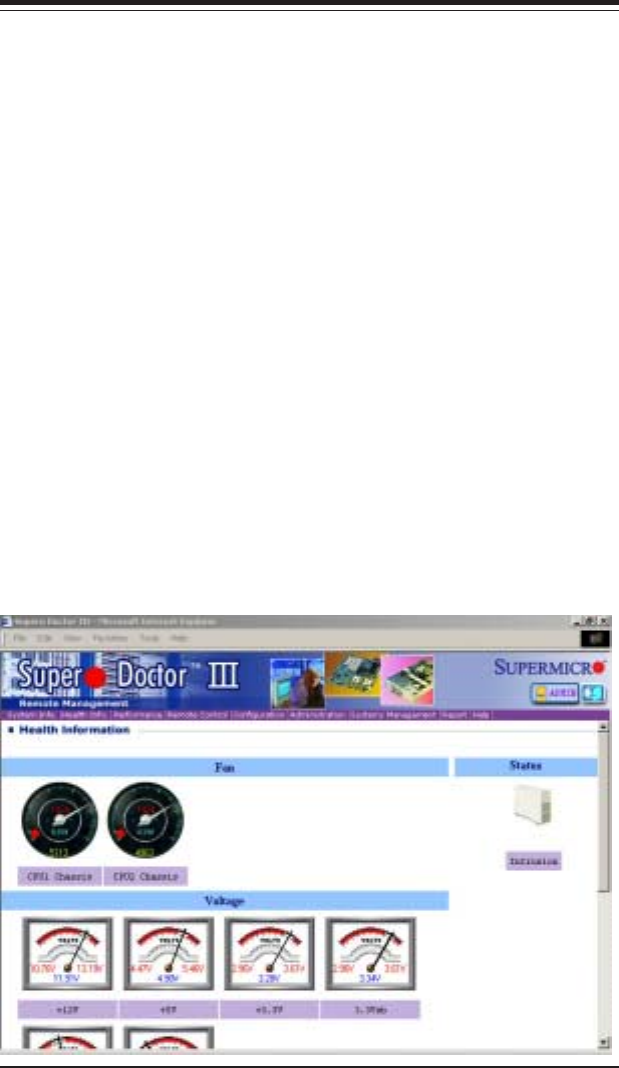
C-2
SUPERSERVER 6012P-6 Manual
Figure C-1. Supero Doctor III Health Information Screen
Linux Support
The SD III Client and Supero Doctor II for Linux support the following features:*
!Applications for local management
!Pager and E-mail alerts
!SNMP support
!Health Monitoring
CPU and system temperatures
System voltages
CPU and chassis fans
Chassis intrusion
Redundant power failure (hardware dependant)
Note: For Linux operating systems, please refer to the Supero Doctor II informa-
tion posted on our website at ftp://ftp.supermicro.com/utility/Supero_Doctor_II/
Linux/ .
The figures below display two of the key features of SDIII.
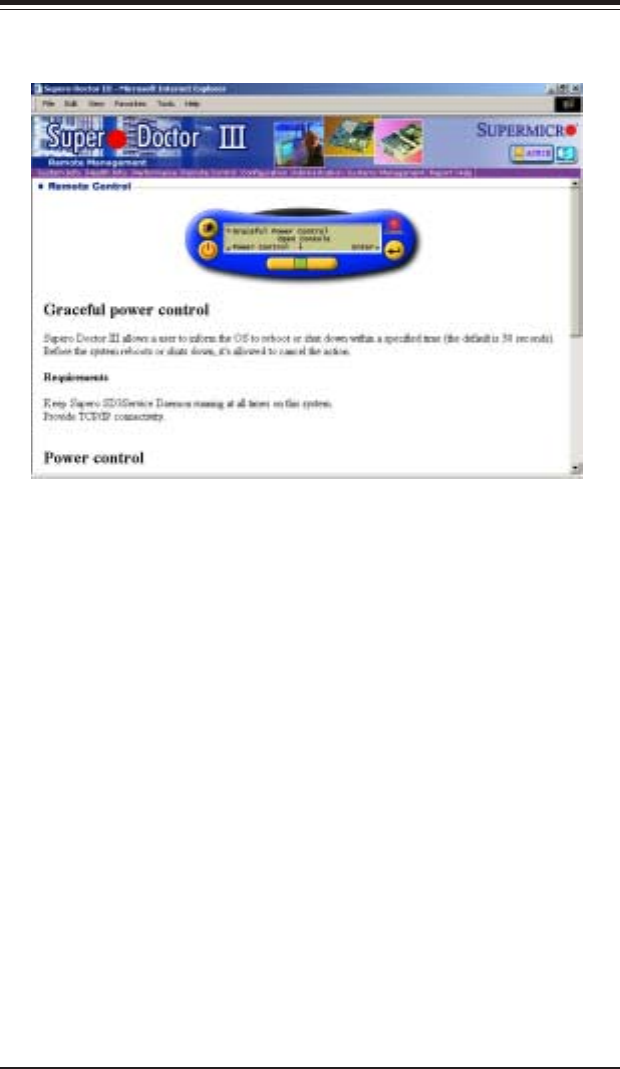
Appendix C: Supero Doctor III
C-3
Figure C-2. Supero Doctor III Remote Power/Reset Control Screen
Note: SD III software can be downloaded from our website at ftp://
ftp.supermicro.com/utility/Supero_Doctor_III/. You can also download the SDIII
User's Guide at http://www.supermicro.com/PRODUCT/Manuals/SDIII/
UserGuide.pdf. For Linux, we recommend the use of Supero Doctor II. Please
refer to our Supero Doctor II information posted at ftp://ftp.supermicro.com/utility/
Supero_Doctor_II/Linux/.

C-4
SUPERSERVER 6012P-6 Manual
Notes

D-1
Appendix D: System Specifications
Appendix D
System Specifications
Processors
Single or dual Intel® XeonTM 512K L2 cache processors of up to 3 GHz
and faster at a front side (system) bus speed of 400 MHz
Note: Please refer to the support section of our web site for a complete listing of
supported processors. (http://www.supermicro.com/TechSupport.htm)
Chipset
Intel E7500 (Plumas) chipset
BIOS
4 Mb Phoenix® Flash ROM
Memory Capacity
Four 184-pin, 25 degree DIMM sockets supporting up to 8 GB of
registered ECC DDR-200 (PC1600) DDR SDRAM
Note: Interleaved memory - requires memory to be installed two at a time. DDR-266
memory modules are supported but only at 200 MHz. See the memory section in
Chapter 5 for details.
SCSI Controller
Adaptec AIC-7899 for dual channnel, Ultra160 onboard SCSI
SCSI SCA Backplane Controller
QLogic GEM318 controller for SAF-TE compliance
SCSI Drive Bays
Three (3) drive bays to house three (3) standard 1" 80-pin SCA SCSI
drives
Peripheral Drive Bays
One (1) 3.5" slim drive
One (1) slim CD-ROM drive
Three (3) 3.5 x 1" drive bays (for SCSI drives)

SUPERSERVER 6012P-6 User's Manual
D-2
Expansion Slots (provided with butterfly riser card)
One (1) 64-bit 133 MHz standard PCI slot and one (1) 64-bit 66 MHz
low profile PCI slot
Power Supply
Type: 1 x 400W with +3.3V, +5V, +12V, -5V and -12V main DC
outputs and a 5V standby output
Input Voltage: 100-240VAC (w/ ± 10% tolerance - units are auto-
switching capable)
Fans: Two 10-cm blower fans
Operating Environment
Operating Temperature Range: 0 to 35 degrees C
Humidity Range: 5-90%, non-condensing
Form Factor
P4DPR-6GM+ motherboard: Extended ATX (12 x 13.05"/304.8 x 332 mm)
SC822-SP chassis: 1U rackmount
Operating Systems Supported
Windows NT, Windows 2000, Solaris, Netware, SCO UNIX and Linux
Dimensions
16.8 x 1.7 x 25.6 in.; 427 x 43 x 651 mm (W x H x D)
Weight
Net (Bare Bone): ~30 lbs. (13.6 kg.)
Gross (Bare Bone): ~40 lbs. (18.2 kg.)
Regulatory Compliance
Electromagnetic Emissions:
FCC Class B, EN 55022 Class B, EN 61000-3-2 & EN 61000-3-3,
CISPR 22 Class B
Electromagnetic Immunity:
EN 55024/CISPR 24, (EN 61000-4-2, EN 61000-4-3, EN 61000-4-4,
EN 61000-4-5, EN 61000-4-6, EN 61000-4-8, EN 61000-4-11)
Safety:
EN 60950/IEC 60950-Compliant, UL Listed (USA), CU
