Suzhou Sate Auto Electronic TSB44 Tire Pressure Monitoring System User Manual

Suzhou Sate Auto Electronic Co., Ltd Tire Pressure Monitoring System Users Manual

User Manual

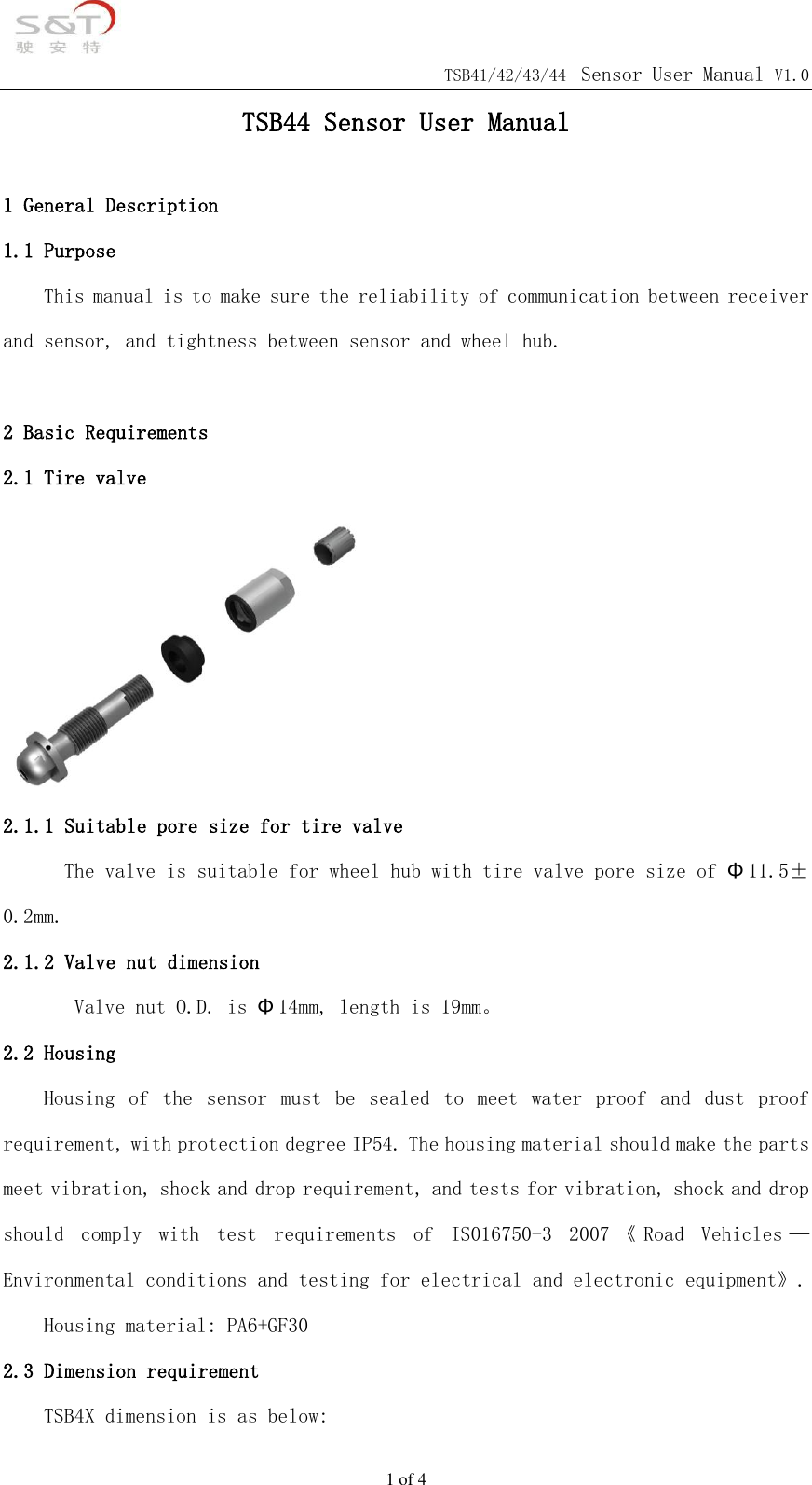
                                           TSB41/42/43/44 Sensor User Manual V1.0 1 of 4 TSB44 Sensor User Manual  1 General Description 1.1 Purpose This manual is to make sure the reliability of communication between receiver and sensor, and tightness between sensor and wheel hub.   2 Basic Requirements 2.1 Tire valve  2.1.1 Suitable pore size for tire valve The valve is suitable for wheel hub with tire valve pore size of Φ11.5±0.2mm. 2.1.2 Valve nut dimension         Valve nut O.D. is Φ14mm, length is 19mm。 2.2 Housing Housing  of  the  sensor  must  be  sealed  to  meet  water  proof  and  dust  proof requirement, with protection degree IP54. The housing material should make the parts meet vibration, shock and drop requirement, and tests for vibration, shock and drop should  comply  with  test  requirements  of  IS016750-3  2007 《Road  Vehicles ─Environmental conditions and testing for electrical and electronic equipment》.    Housing material: PA6+GF30 2.3 Dimension requirement TSB4X dimension is as below:
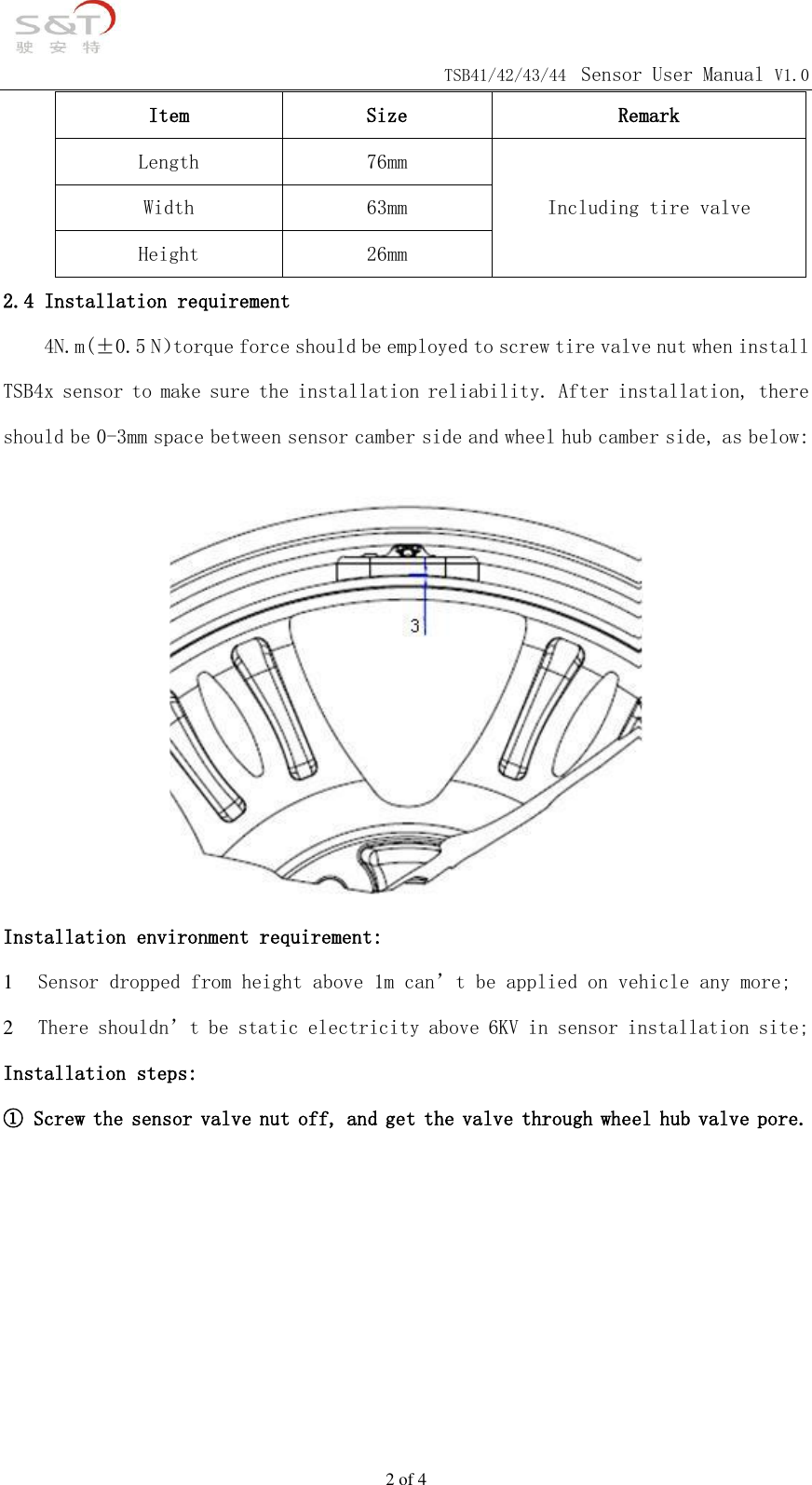
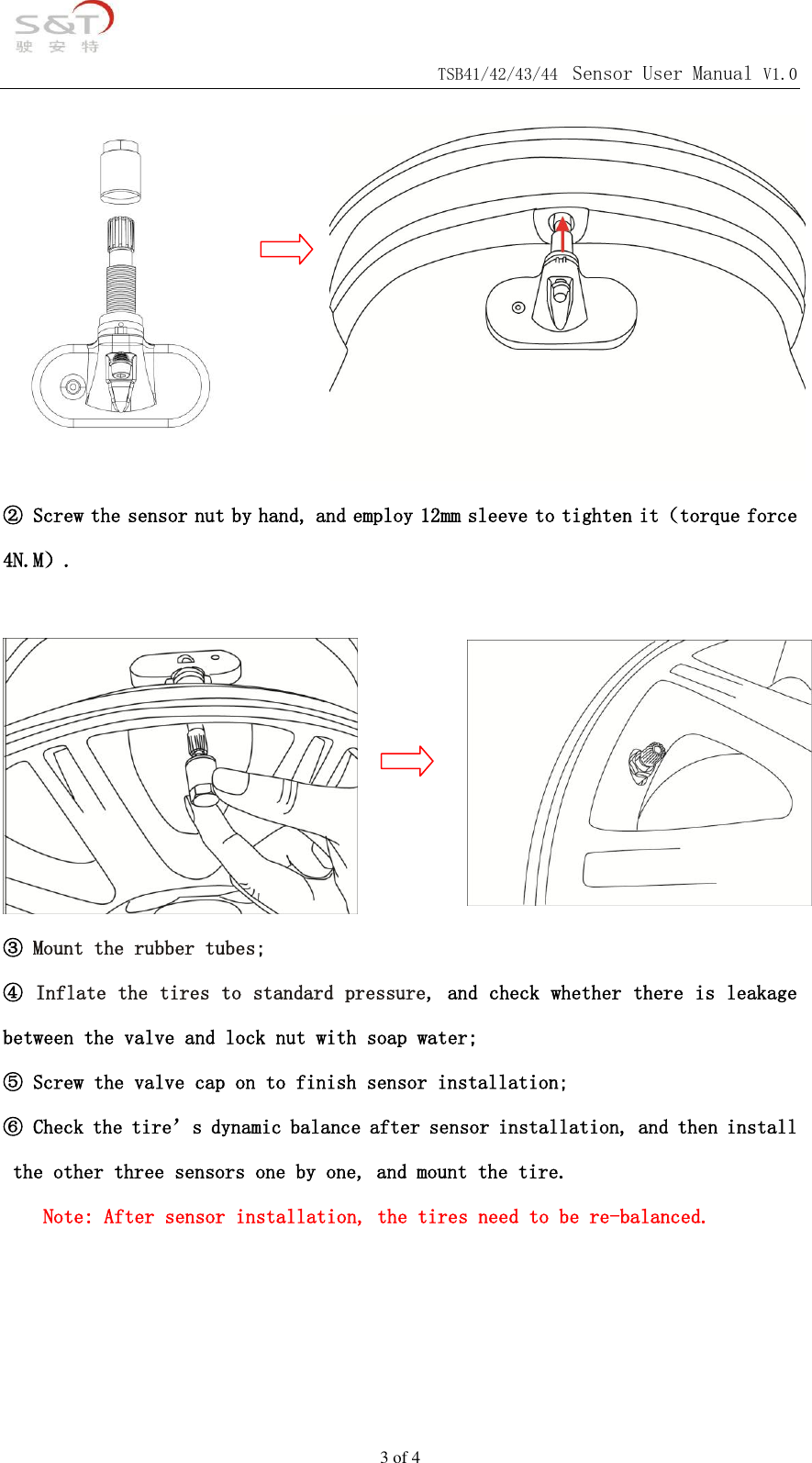
                                           TSB41/42/43/44 Sensor User Manual V1.0 2 of 4 Item Size Remark Length 76mm Including tire valve Width 63mm Height 26mm 2.4 Installation requirement     4N.m(±0.5 N)torque force should be employed to screw tire valve nut when install TSB4x sensor to make sure the installation reliability. After installation, there should be 0-3mm space between sensor camber side and wheel hub camber side, as below:  Installation environment requirement: 1 Sensor dropped from height above 1m can’t be applied on vehicle any more; 2 There shouldn’t be static electricity above 6KV in sensor installation site; Installation steps: ① Screw the sensor valve nut off, and get the valve through wheel hub valve pore.
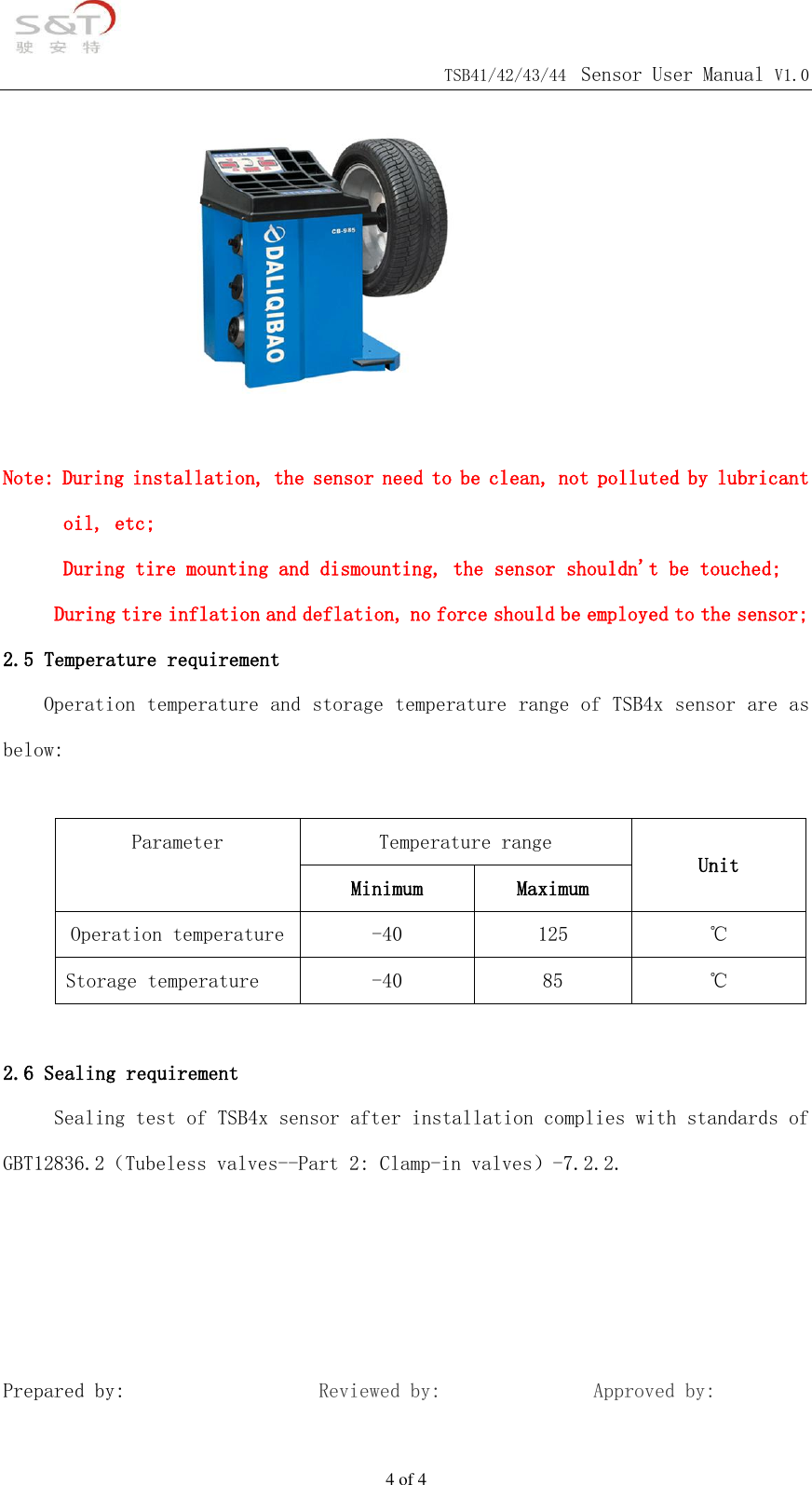
                                           TSB41/42/43/44 Sensor User Manual V1.0 3 of 4          ② Screw the sensor nut by hand, and employ 12mm sleeve to tighten it(torque force 4N.M).   ③ Mount the rubber tubes; ④ Inflate the tires to standard pressure, and check whether there is leakage between the valve and lock nut with soap water; ⑤ Screw the valve cap on to finish sensor installation; ⑥ Check the tire’s dynamic balance after sensor installation, and then install the other three sensors one by one, and mount the tire. Note: After sensor installation, the tires need to be re-balanced.
                                           TSB41/42/43/44 Sensor User Manual V1.0 4 of 4         Note: During installation, the sensor need to be clean, not polluted by lubricant oil, etc; During tire mounting and dismounting, the sensor shouldn't be touched;      During tire inflation and deflation, no force should be employed to the sensor; 2.5 Temperature requirement Operation temperature and storage temperature range of TSB4x sensor are as below:  Parameter  Temperature range Unit Minimum Maximum Operation temperature -40 125 ℃ Storage temperature -40 85 ℃  2.6 Sealing requirement      Sealing test of TSB4x sensor after installation complies with standards of GBT12836.2(Tubeless valves--Part 2: Clamp-in valves)-7.2.2.     Prepared by:                   Reviewed by:               Approved by:
Federal Communications Commission (FCC) Interference Statement This equipment has been tested and found to comply with the limits for a Class B digital device, pursuant to Part 15 of the FCC Rules.  These limits are designed to provide reasonable protection against harmful interference in a residential installation. This equipment generate, uses and can radiate radio frequency energy and, if not installed and used in accordance with the instructions, may cause harmful interference to radio communications.  However, there is no guarantee that interference will not occur in a particular installation. If this equipment does cause harmful interference to radio or television reception, which can be determined by turning the equipment off and on, the user is encouraged to try to correct the interference by one of the following measures:    Reorient or relocate the receiving antenna.   Increase the separation between the equipment and receiver.   Connect the equipment into an outlet on a circuit different from that to which the receiver is connected.   Consult the dealer or an experienced radio/TV technician for help.  This device complies with Part 15 of the FCC Rules. Operation is subject to the following two conditions: (1)This device may not cause harmful interference, and (2) this device must accept any interference received, including interference that may cause undesired operation.  FCC Caution: Any changes or modifications not expressly approved by the party responsible for compliance could void the user’s authority to operate this equipment.  RF exposure warning This equipment complies with FCC radiation exposure limits set forth for an uncontrolled environment. The equipment must not be co-located or operating in conjunction with any other antenna or transmitter.

Navigation menu