Synapse Electronique SE159 Wireless communication module User Manual Technolink Systems inc
Synapse Electronique Wireless communication module Technolink Systems inc
User manual

Information in this document is subject to change without prior notice. Page 1 sur 8
SE159:Wireless communication module
Product Specifications
Model : SE159
Version : 1.0
2012-07-30

Information in this document is subject to change without prior notice. Page 2 sur 8
1 Introduction
SE159 is a Wireless communication module, intended to be used as a general purpose radio
transceiver compliant to IEEE 802.15.4. On each side of the PCB there contact to connect I/O,
alimentation and programming pin related to the microcontroller. The modules provide up to 16
channels of operation in the ISM 2.4GHz frequency band.
1.1 Scope
SE159 Wireless communication module is designed to operate in 2.4 GHz ISM frequency band.
The circuit mainly consists of a single-chip microcontroller with build-in radio transceiver.
1.2 Features
Wireless communication module used as stand-alone module or as a peripheral via serial
communication
Design based on the single-chip microcontroller to support IEEE®802.15.4
Powered by a single supply voltage in the range of 1.8V to 3.6V
Modulation O-QPSK
Operating frequency 2405 – 2480 MHz (16 Channels)
Information in this document is subject to change without prior notice. Page 3 sur 8
2 Product information
2.1 Specification Overview
Standards
IEEE 802.15.4
Operating frequency
2405 – 2480 MHz (16 Channels)
Modulation
O-QPSK
Maximum peak power
9.12 dBm
Receiver sensitivity
-100 dBm
Operating voltage
1.8 - 3.6 V
2.2 Hardware information
SE159 is a low power consumption and low cost wireless module to be used as stand-alone or as
a communication peripheral.
2.2.1 Block Diagram
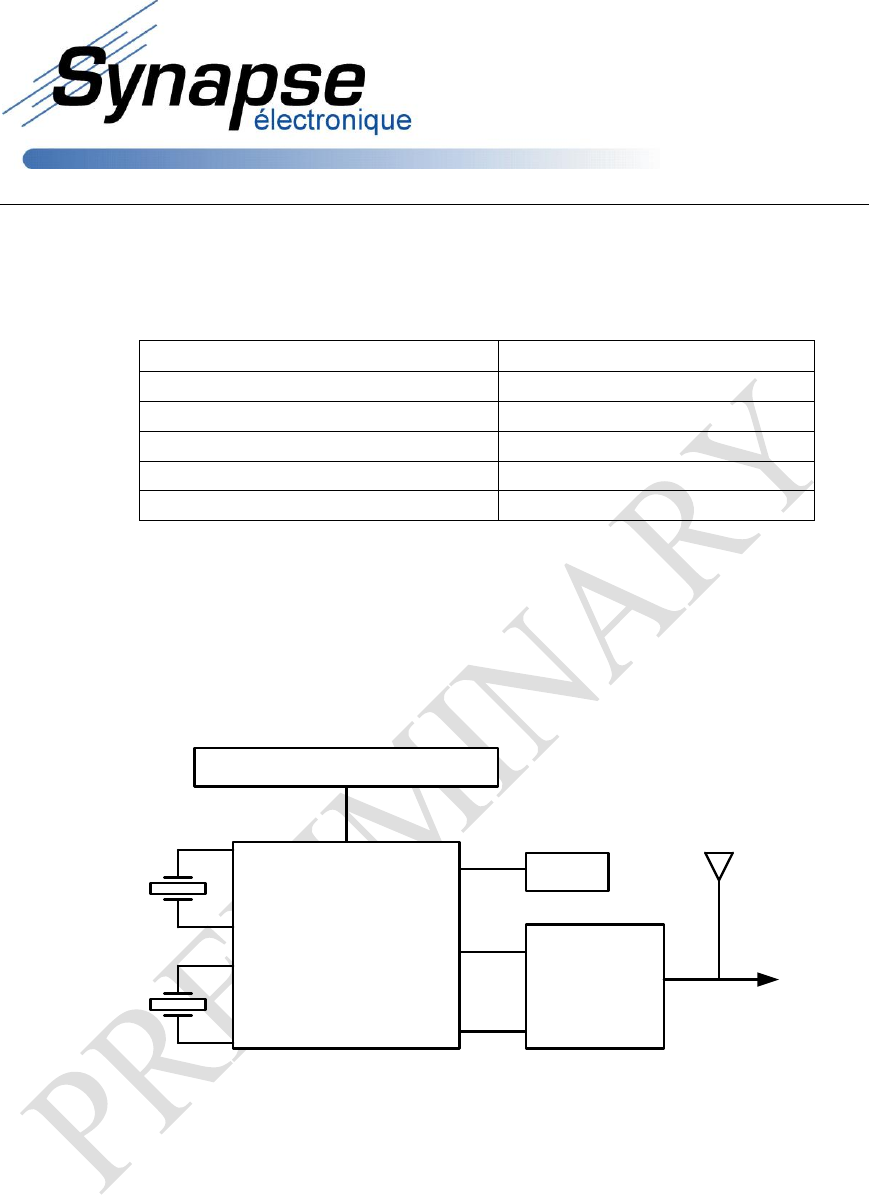
µC with build-in
radio tranceiver
32.768 KHz
16 MHz
Filter-Balun
GPIO Pins
LED
U. FL
Figure 1: SE159 - Block diagram
Information in this document is subject to change without prior notice. Page 4 sur 8
2.3 Mechanical Information
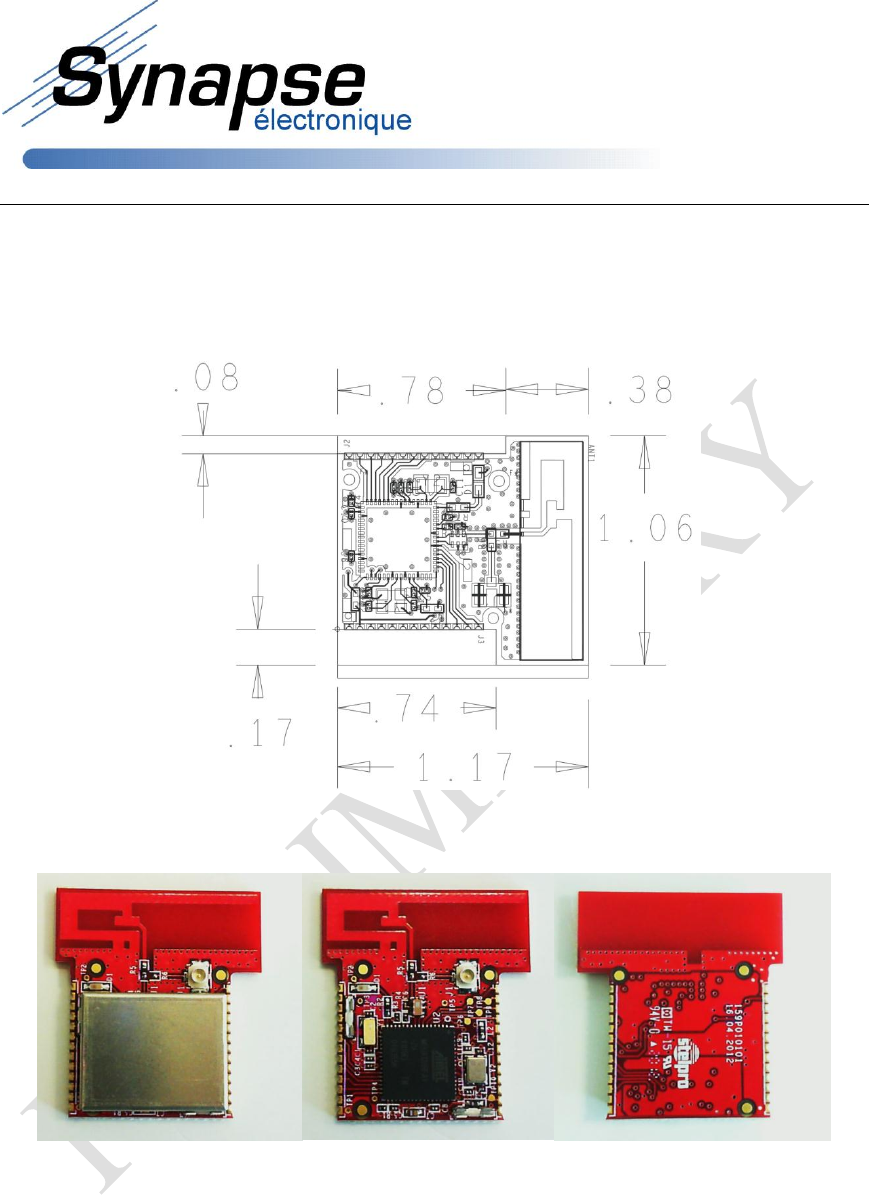
Figure 2: SE159 - Mechanical dimension in inch
Figure 3: SE159 PCB Photo.

Information in this document is subject to change without prior notice. Page 5 sur 8
2.4 FCC Approved
This device complies with part 15 of the FCC Rules. Operation is subject to the following two
conditions:
(1) This device may not cause harmful interference, and
(2) This device must accept any interference received, including interference that may cause undesired
operation.
Changes or modifications not expressly approved by the party responsible for compliance could void
the user's authority to operate the equipment.
NOTE: This equipment has been tested and found to comply with the limits for a Class B digital
device, pursuant to Part 15 of the FCC Rules. These limits are designed to provide reasonable
protection against harmful interference in a residential installation. This equipment generates uses and
can radiate radio frequency energy and, if not installed and used in accordance with the instructions,
may cause harmful interference to radio communications. However, there is no guarantee that
interference will not occur in a particular installation. If this equipment does cause harmful
interference to radio or television reception, which can be determined by turning the equipment off
and on, the user is encouraged to try to correct the interference by one or more of the following
measures:
Reorient or relocate the receiving antenna.
Increase the separation between the equipment and receiver.
Connect the equipment into an outlet on a circuit different from that to which the receiver is
connected.
Consult the dealer or an experienced radio/TV technician for help.
This transmitter complies with FCC RF radiation exposure limits set forth for an uncontrolled
environment.
This transmitter must not be co-located or operating in conjunction with any other antenna or
transmitter.

Information in this document is subject to change without prior notice. Page 6 sur 8
2.5 Canada (IC)
This device complies with Industry Canada license-exempt RSS standard(s). Operation is subject
to the following two conditions: (1) this device may not cause interference, and (2) this device
must accept any interference, including interference that may cause undesired operation of the
device.
Le présent appareil est conforme aux CNR d'Industrie Canada applicables aux appareils radio
exempts de licence. L'exploitation est autorisée aux deux conditions suivantes : (1) l'appareil ne
doit pas produire de brouillage, et (2) l'utilisateur de l'appareil doit accepter tout brouillage
radioélectrique subi, même si le brouillage est susceptible d'en compromettre le fonctionnement.
Under Industry Canada regulations, this radio transmitter may only operate using an antenna of a
type and maximum (or lesser) gain approved for the transmitter by Industry Canada. To reduce
potential radio interference to other users, the antenna type and its gain should be so chosen that
the equivalent isotropically radiated power (e.i.r.p.) is not more than that necessary for successful
communication.
Conformément à la réglementation d'Industrie Canada, le présent émetteur radio peut fonctionner
avec une antenne d'un type et d'un gain maximal (ou inférieur) approuvé pour l'émetteur par
Industrie Canada. Dans le but de réduire les risques de brouillage radioélectrique à l'intention des
autres utilisateurs, il faut choisir le type d'antenne et son gain de sorte que la puissance isotrope
rayonnée équivalente (p.i.r.e.) ne dépasse pas l'intensité nécessaire à l'établissement d'une
communication satisfaisante.
Information in this document is subject to change without prior notice. Page 7 sur 8
3 OEM Labeling Requirements
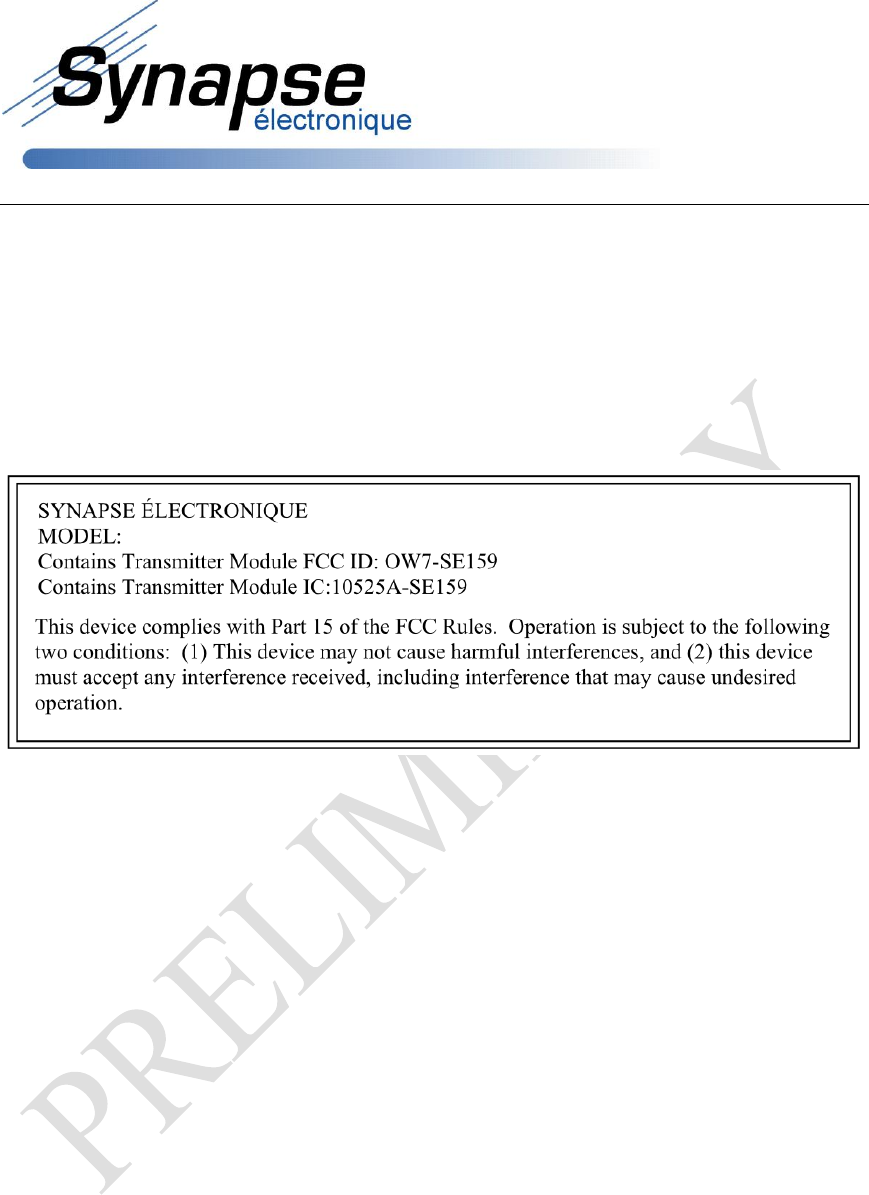
NOTICE: The OEM must make sure that FCC and Industry Canada labeling requirements are
met. This includes a clearly visible exterior label on the outside of the final product housing that
displays the contents shown in Figure 4.
Figure 4: OEM Labeling Requirements

Information in this document is subject to change without prior notice. Page 8 sur 8
4 Reference
[1] ATmega128RFA1; 8-bit AVR Microcontroller with Low Power 2.4GHz Transceiver for
ZigBee, IEEE 802.15.4, 6LoWPAN, RF4CE, SP100, Wireless HART and ISM
Applications; Preliminary Datasheet; Rev. 8266D-MCU Wireless-06/12; Atmel Corporation.