Tactical Electronics T400B UHF TRANSCEIVER User Manual T400
Tactical Electronics Corporation UHF TRANSCEIVER T400
USERS MANUAL
T400 TRANSCEIVER
OPERATING INSTRUCTIONS
1892 1144
These operating instructions are intended to provide the user with sufficient information
to install and operate the unit correctly.
The Tactical Electronics T400 synthesized UHF transceiver is intended to fulfil the
numerous OEM applications by virtue of its reliable design, miniature
size and quality manufacture.
INSTALLATION
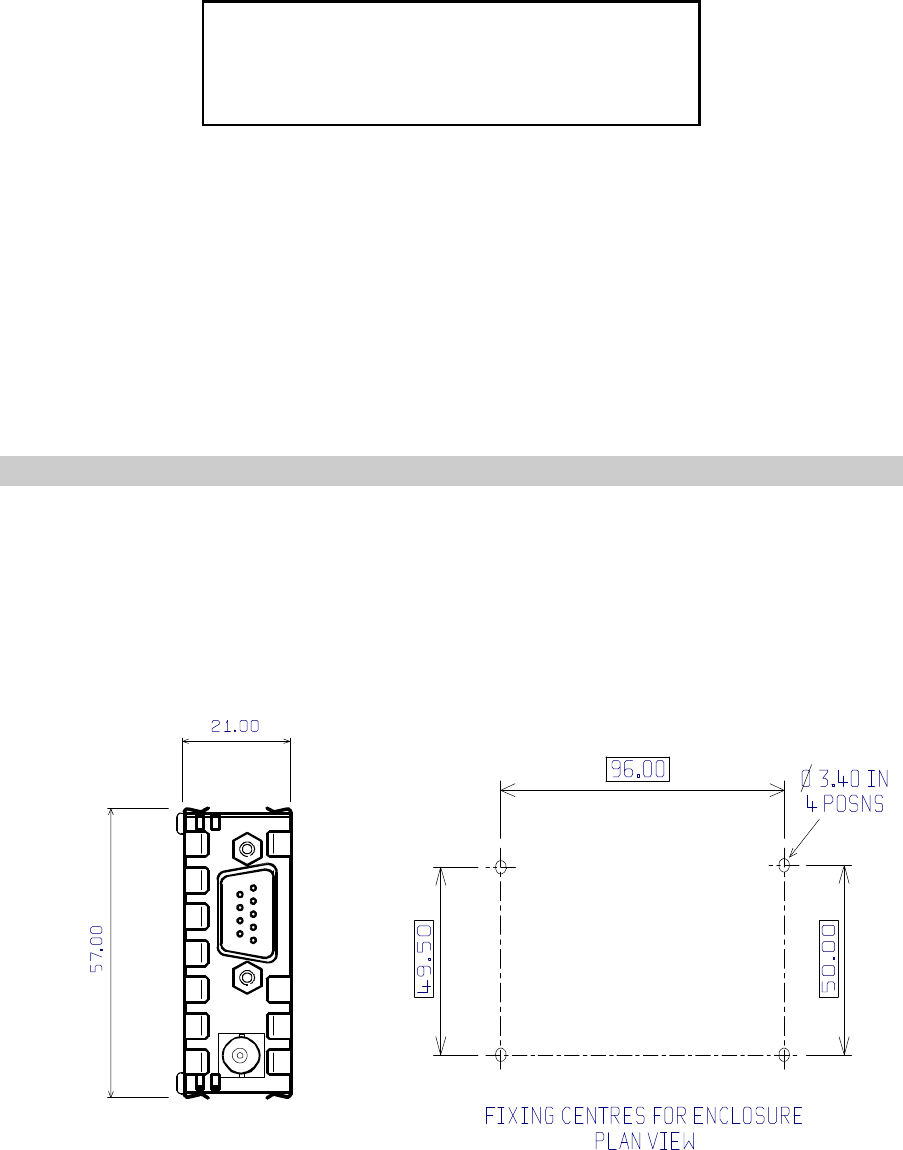
The T400 is intended to fit easily and with minimum space requirements into the user's
own equipment housing. The complete module is housed in a tin-plated enclosure and
is secured by means of four 10mm sheet metal screws which locate in the four corners
through the lower screening cover. DO NOT overtighten these screws during
installation.

INTERFACE
The radio antenna connects by means of a BNC miniature coaxial connector. All other
connections to the T400 transceiver are made using a standard 9-way D type connector
as detailed in the table below.
PIN NAME FUNCTION REMARKS
1MOD I/P Modulation input To transmitter;
Analog (750mV p-p for nominal
deviation) or
TTL/CMOS compatible (factory set)
2RX O/P Receiver Output Analog (350mV p-p) or
5V CMOS levels, high ( +5V) when no
signal present (factory set)
3bTbXbEtransmit enable HIGH >2.5V = receive
LOW <0.8V = transmitter enabled
40V 0 volts common DC and signal ground
5+ Vin positive supply +10 to +14 V DC
6SQF Squelch flag output HIGH (+5V, 10kS pull-up) = Signal
present
LOW (<0.8V) = Signal not present
7CS channel select Serial channel select input (RS232
compatible)
8RSSI Received Signal
Strength Indicator +1 to +3V DC nominal, 50dB range
90V 0 volts common DC and signal ground
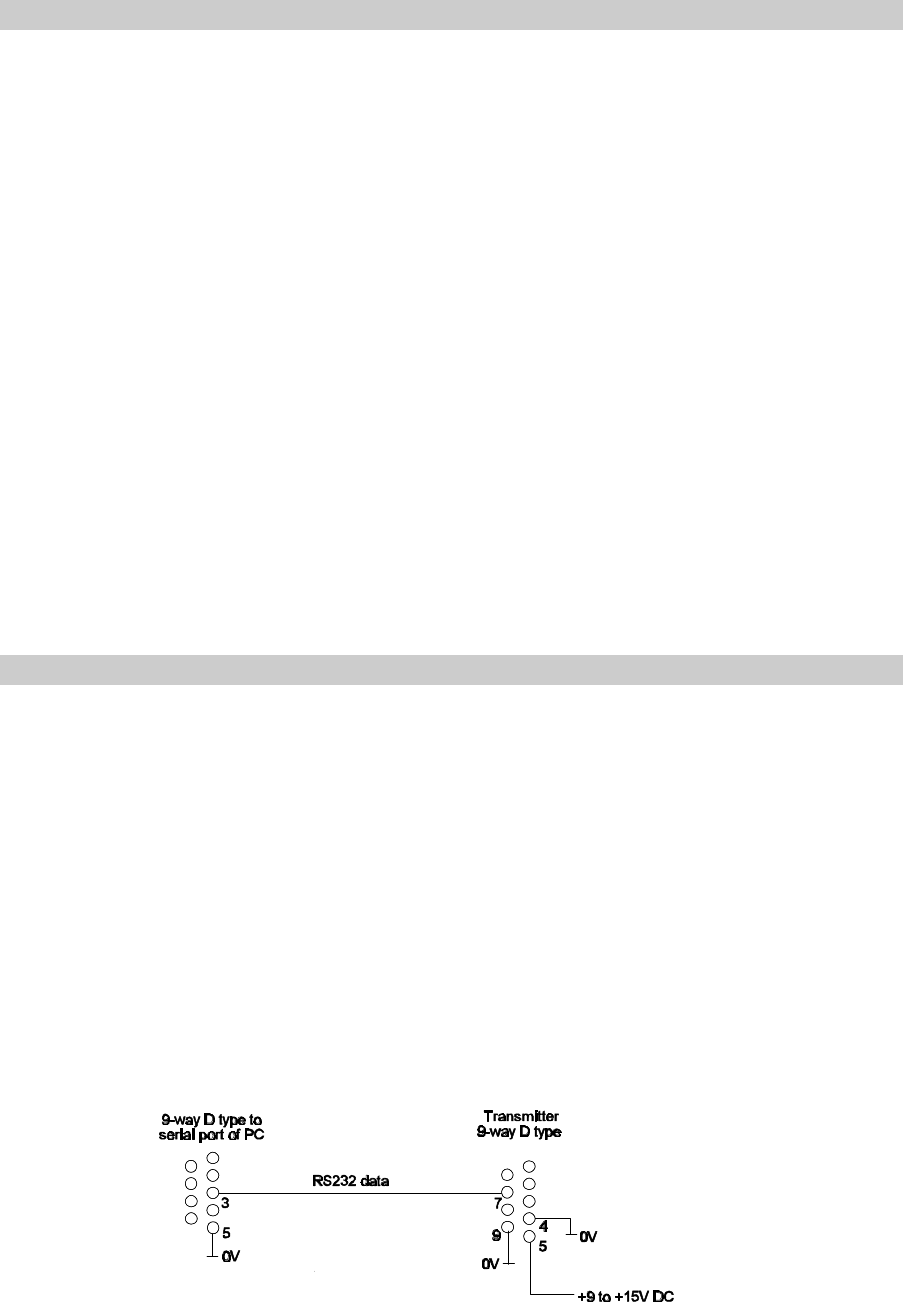
Figure 1 Programming adaptor
OPTIONS
Channel spacing
The T400 is available in the channel spacings as detailed in the table. The code
designations form part of the product variant type. This is shown on the label fixed to
the top screening cover of the module.
The T400 is FCC approved for 25Khz. The T400B is FCC approved for 12.5Khz.
FREQUENCY RANGE
(MHZ) CHANNEL SPACING
12.5kHz 25kHz
430 - 450 31 33
450 - 470 51 53
RF connection
As well as the standard BNC coaxial connector, the T400 is also available with a SMB
or flying lead RF connection. Contact Tactical Electronics for details.
CHANNEL SELECTION
The software supplied with the T400 transmitter is the TPRG.exe program. The
software can be run on a PC with the serial port connected to pin 7 of the transmitter
via a suitable adaptor as shown in Figure 1. The unit may be programmed in-situ
provided that pin 7 is available. There is no feed-back facility with this circuit, and for
this reason, the TPRG software repeats the programming three times to eliminate error.
This version of software is programmed by a series of 8 byte data packets at 1200
baud. Each packet includes a 16 bit sync code and an 11 bit checksum to eliminate the
possibility of spurious programming.

RUNNING THE SOFTWARE
Please note that mouse operation is not supported with this program
1. Connect the TX00 transceiver to a suitable supply and to the PC using the
programming adaptor.
2. Insert the TPRG disk into drive A and type:
A:TPRG <return>
3. The user is then prompted to enter the serial port number of his PC which is
used to communicate with the TX00 transmitter. Enter 1 or 2.
After the software has successfully loaded the screen displays the following prompts:
Enter frequency in MHz?
The user can then enter the required operating frequency and then ‘0' to quit.
RANGE INFORMATION
The following table gives an indication of the typical ranges to be expected between a
transmitter and receiver that have simple end-fed dipole antennas.
The following assumptions have been made in the calculations:
line-of-sight between antennas
0dB gain for the transmitter and receiver antennas
0dB loss for connectors and cables between the antenna and the radio
connector
20dB fade and environmental margin
-100dBm received signal strength, allowing for digital and analog signals
Range versus TX power
Frequency (MHz) Power (mW) Power (dBm) Range (km)
458.5 1mW 00.5
458.5 10mW 10 1.7
458.5 100mW 20 5.3
458.5 500mW 27 11.9

TECHNICAL SPECIFICATION
Frequency of operation :450 to 470MHz (other frequency bands available)
Channel spacing :25kHz (12.5kHz available as an option)
Number of RF channels :One, set by PIC micro controller
RF output power :2W nominal at 12V DC
Frequency stability :±2.5ppm over temperature range
Supply voltage :+12V DC nominal (+10 to +14 volts possible)
Supply current
Transmit :600mA typical at 2W
400mA typical at 1W
Receive :32mA typical
Size :119 x 57 x 21mm (l x w x h) including connectors
Weight :120 gms
Temperature (operating) :-30 to +55 EC standard
Temperature (storage) :-30 to +70 EC