Technovare Systems OPSDRD Embedded Computer User Manual

Technovare Systems, Inc. Embedded Computer

User manual

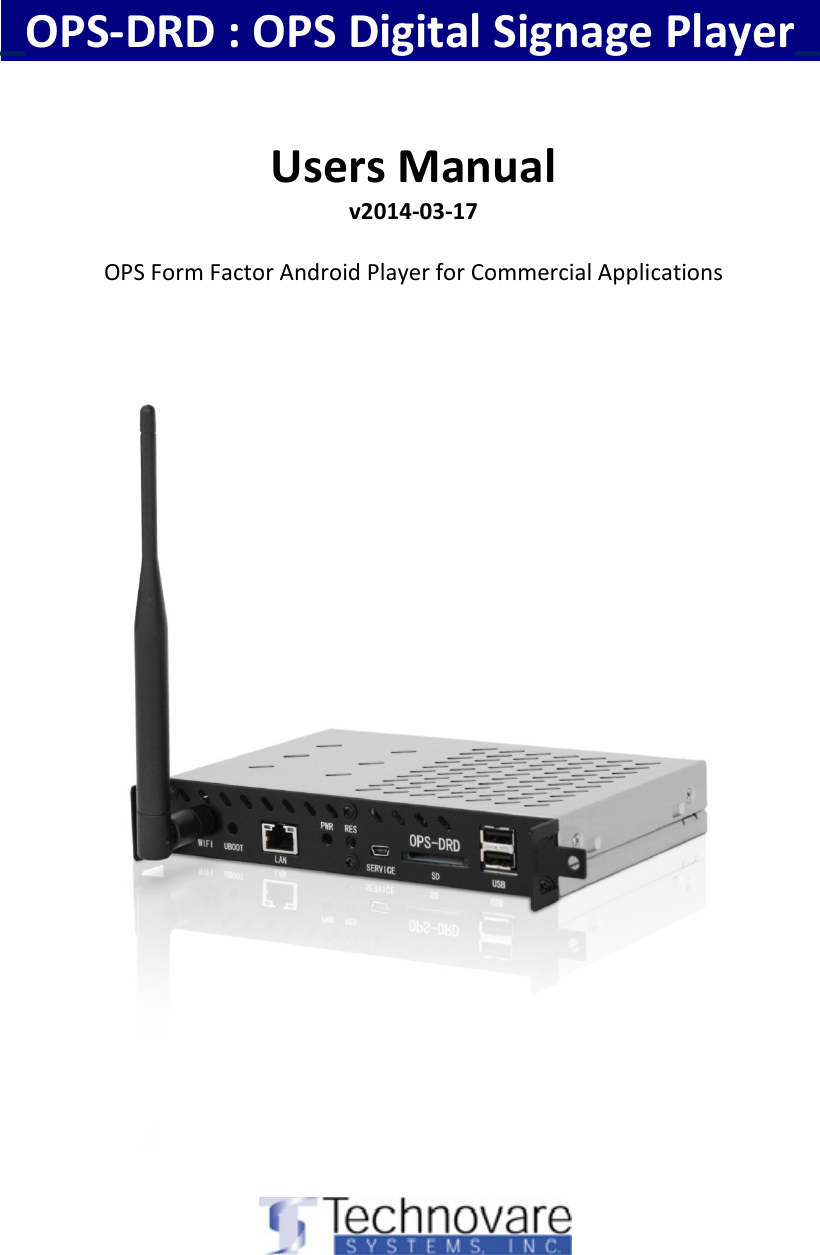
 _OPS-DRD : OPS Digital Signage Player_   Users Manual v2014-03-17  OPS Form Factor Android Player for Commercial Applications
Copyright  The  documentation  and  the  software  included  with  this  product  are  copyrighted  2014  by Technovare Systems Inc. All rights are reserved. Technovare Systems Inc. reserves the right to make improvements  in the  products  described in  this  manual  at any  time without notice.  No part of this manual may be reproduced, copied, translated or transmitted in any form or by any means without the prior written permission of Technovare Systems Inc. Information provided in this manual is intended to be accurate and reliable. However, Technovare Systems Inc. assumes no responsibility for its use, nor for any infringements of the rights of third parties, which may result from its use.  Acknowledgements Android and Chrome are trademarks of Google Corporation. Technovare is a trademark of Technovare Systems Inc. All other product names or trademarks are properties of their respective owners.
Product Warranty (36 Months) Technovare warrants to you, the original purchaser, that each of its products will be free from defects in materials and workmanship for 36 Months from the date of purchase. This warranty does  not  apply  to  any  products  which  have  been  repaired  or  altered  by  persons  other  than repair  personnel  authorized  by  Technovare,  or  which  have  been  subject  to  misuse,  abuse, accident  or  improper  installation.  Technovare  assumes  no  liability  under  the  terms  of  this warranty  as  a  consequence  of  such  events.  Because  of  Technovare’s  high  quality-control standards and rigorous testing, most of our customers never need to use our repair service. If a Technovare  product  is  defective,  it  will  be  repaired  or  replaced  at  no  charge  during  the warranty  period.  For  out  of  warranty  repairs,  you  will  be  billed  according  to  the  cost  of replacement materials, service time and freight. Please consult your dealer for more details.  Technical Support and Assistance Visit the NEC Display Solutions Support website at: http://nec-display-solutions.com/p/hq/en/home.xhtml  Contact  your distributor,  sales  representative,  or  NEC’s  customer  service center  for  technical support if you need additional assistance. Please have the following information ready before you call: • Product name and serial number • Description of installed peripheral attachments • Description of installed software  o (operating system, version, application software, etc.) • A complete description of the problem • The exact wording of any error messages  If you think you have a defective product, follow these steps:  1.  Call  your  dealer  and  describe  the  problem.  Please  have  your  manual,  product,  and  any helpful information readily available.  2. If your product is diagnosed as defective, obtain an RMA (return merchandise authorization) number from your dealer. This allows us to process your return more quickly.
 3. Carefully pack the defective product, a fully-completed Repair and Replacement Order Card and a photocopy proof of purchase date (such as your sales receipt) in a shippable container. A product  returned  without  proof  of  the  purchase  date  is  not  eligible  for  warranty  service. Technovare shall not be responsible for lost, stolen  or misdirected mail or  for damage to  the product incurred during shipping.  4.  Write  the  RMA  number  visibly  on  the  outside  of  the  package  and  ship  it  prepaid  to  your dealer.   Packing List Before installation, please ensure the following items have been shipped with the unit:  • 1 x OPS-DRD Unit • 1 x WiFi Antenna • Users Manual (installed on the OPS-DRD unit)
Declaration of Conformity CE  This product has passed the CE test for environmental specifications. Test conditions for passing included the equipment being operated within an industrial enclosure. In order to protect the product  from  being  damaged  by  ESD  (Electrostatic  Discharge)  and  EMI  leakage,  we  strongly recommend the use of CE-compliant industrial enclosure products.  FCC Warning Statement  Changes or modifications not expressly approved by the party responsible for compliance could void the user's authority to operate the equipment.   This equipment has been tested and found to comply with the limits for a Class B digital device, pursuant  to  Part  15  of  the  FCC  Rules.  These  limits  are  designed  to  provide  reasonable protection against harmful interference in a residential installation. This equipment generates uses and can radiate radio frequency energy and, if not installed and used in accordance with the  instructions,  may cause  harmful  interference  to  radio communications. However,  there  is no guarantee that interference will not occur in a particular installation. If this equipment does cause  harmful  interference  to  radio  or  television  reception,  which  can  be  determined  by turning the equipment off and on, the user is encouraged to try to correct the interference by one or more of the following measures:  -- Reorient or relocate the receiving antenna. -- Increase the separation between the equipment and receiver. -- Connect the equipment into an outlet on a circuit different from that to which the receiver is connected. -- Consult the dealer or an experienced radio/TV technician for help   FCC Radiation Exposure Statement  The antennas used for this transmitter must be installed to provide a separation distance of at least 20 cm from all persons and must not be co-located or operating in conjunction with any other antenna or transmitter.
Warnings, Cautions and Notes Warning!  Warnings indicate conditions, which if not observed, can cause personal injury!  Caution!  Cautions are included to help you avoid damaging hardware or losing data. e.g. There  is  a  danger  of  a  new  battery  exploding  if  it  is  incorrectly  installed.  Do  not  attempt  to recharge, force open, or heat the battery. Replace the battery only with the same or equivalent type  recommended  by  the  manufacturer.  Discard  used  batteries  according  to  the manufacturer's instructions.  Note!  Notes provide optional additional information.
Safety Instructions CARE  SHALL  BE  TAKEN  TO  STORE  AND  OPERATE  THIS  EQUIPMENT  ACCORDING  TO  ITS SPECIFICATIONS.  DO NOT LEAVE THIS EQUIPMENT IN AN  ENVIRONMENT WHERE  THE STORAGE TEMPERATURE MAY GO BELOW -20° C (-4° F) OR ABOVE 60° C (140° F). THIS COULD DAMAGE THE EQUIPMENT. THE EQUIPMENT SHOULD BE IN A CONTROLLED ENVIRONMENT.   • Place this equipment on a reliable surface during installation. Dropping it or letting it fall may cause damage. • The  openings  on  the  enclosure  are  for  air  convection.  Protect  the  equipment  from overheating. DO NOT COVER THE OPENINGS. • All cautions and warnings on the equipment should be noted. • Never pour any liquid into an opening. This may cause fire or electrical shock. • Never open the equipment. For safety reasons, the equipment should be opened only by qualified service personnel. • If  one  of  the  following  situations  arises,  get  the  equipment  checked  by  service personnel: o Liquid has penetrated into the equipment. o The equipment has been exposed to moisture. o The equipment does not work well, or you cannot get it to work according to the user's manual. o The equipment has been dropped and damaged. o The equipment has obvious signs of breakage.   Caution!  DISCARD USED BATTERIES ACCORDING TO THE MANUFACTURER'S INSTRUCTIONS.
OPS-DRD USERS MANUAL v2014-03-17 9 | P a g e   Table of Contents  Product Specifications....................................................................................... 10 General ................................................................................................................................................ 10 Power .................................................................................................................................................. 11 Mechanical .......................................................................................................................................... 11 Environmental ..................................................................................................................................... 11 External Connections ........................................................................................ 12 Bottom of Card (BOC) .......................................................................................................................... 12 Top of Card (TOC) ................................................................................................................................ 12 Installation ....................................................................................................... 15 Operating Instructions ...................................................................................... 17 Power ON ............................................................................................................................................ 17 Power OFF ........................................................................................................................................... 18 Sleep / Wake ....................................................................................................................................... 18 Unit Reset ............................................................................................................................................ 18 Restore Factory Defaults ..................................................................................................................... 18 Applications ...................................................................................................... 20 Out-of-the-Box Applications ................................................................................................................ 20 Installing New Applications ................................................................................................................. 33 Uninstalling Applications .................................................................................................................... 34 Adding/Removing Installed Applications from Desktop ..................................................................... 35 System Configuration ........................................................................................ 37 WLAN Configuration ........................................................................................................................... 37 LAN Configuration ............................................................................................................................... 39 System Software Updates ................................................................................. 43
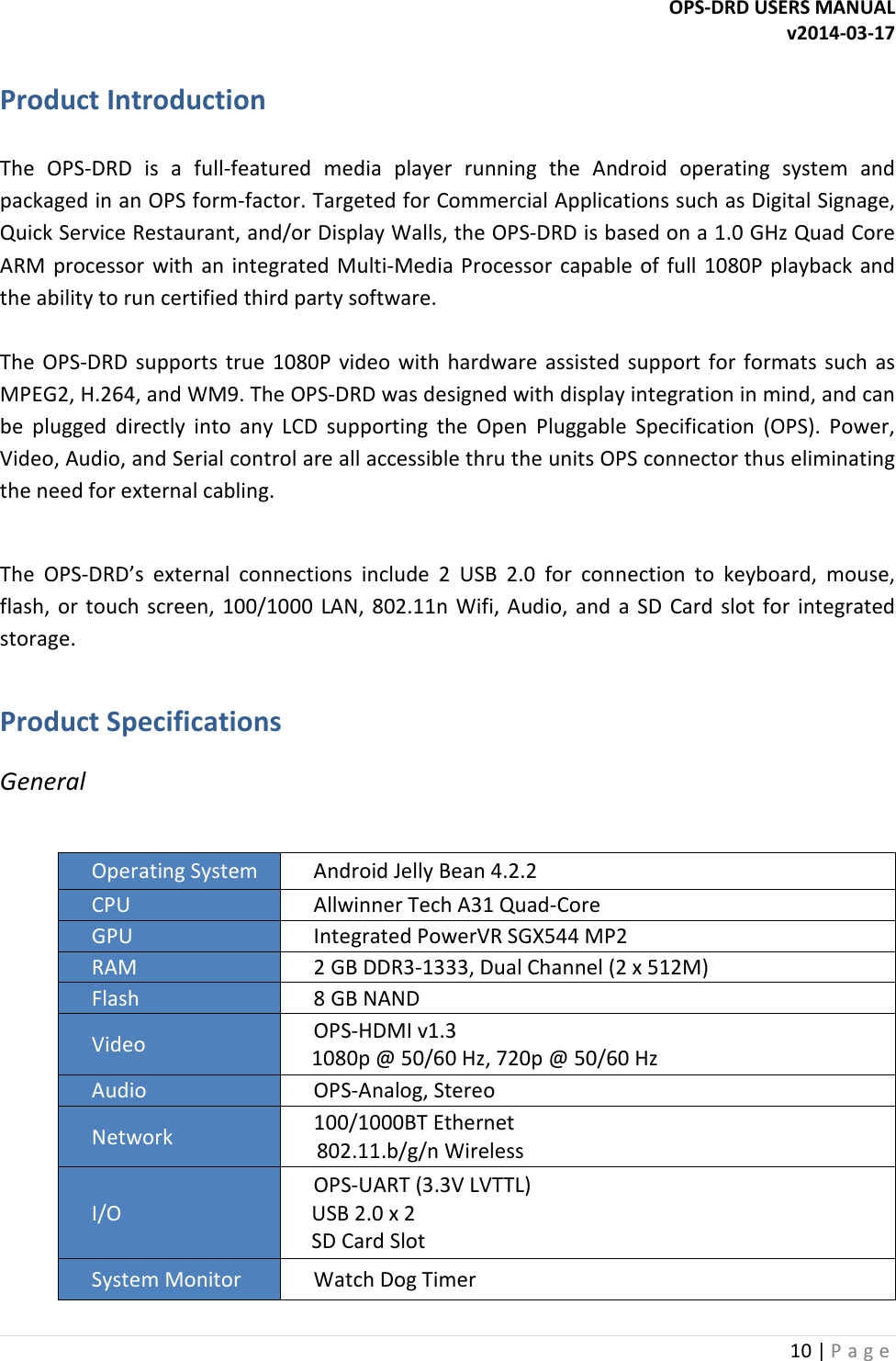
OPS-DRD USERS MANUAL v2014-03-17 10 | P a g e   Product Introduction   The  OPS-DRD  is  a  full-featured  media  player  running  the  Android  operating  system  and packaged in an OPS form-factor. Targeted for Commercial Applications such as Digital Signage, Quick Service Restaurant, and/or Display Walls, the OPS-DRD is based on a 1.0 GHz Quad Core ARM  processor  with  an  integrated Multi-Media Processor  capable  of  full  1080P  playback  and the ability to run certified third party software.   The  OPS-DRD  supports  true  1080P  video  with  hardware  assisted  support  for  formats  such  as MPEG2, H.264, and WM9. The OPS-DRD was designed with display integration in mind, and can be  plugged  directly  into  any  LCD  supporting  the  Open  Pluggable  Specification  (OPS).  Power, Video, Audio, and Serial control are all accessible thru the units OPS connector thus eliminating the need for external cabling.   The  OPS-DRD’s  external  connections  include  2  USB  2.0  for  connection  to  keyboard,  mouse, flash,  or  touch screen,  100/1000  LAN,  802.11n  Wifi,  Audio,  and  a  SD  Card  slot for  integrated storage.  Product Specifications General  Operating System  Android Jelly Bean 4.2.2 CPU  Allwinner Tech A31 Quad-Core GPU  Integrated PowerVR SGX544 MP2 RAM  2 GB DDR3-1333, Dual Channel (2 x 512M) Flash  8 GB NAND Video  OPS-HDMI v1.3     1080p @ 50/60 Hz, 720p @ 50/60 Hz Audio  OPS-Analog, Stereo Network  100/1000BT Ethernet      802.11.b/g/n Wireless I/O OPS-UART (3.3V LVTTL)     USB 2.0 x 2     SD Card Slot System Monitor  Watch Dog Timer
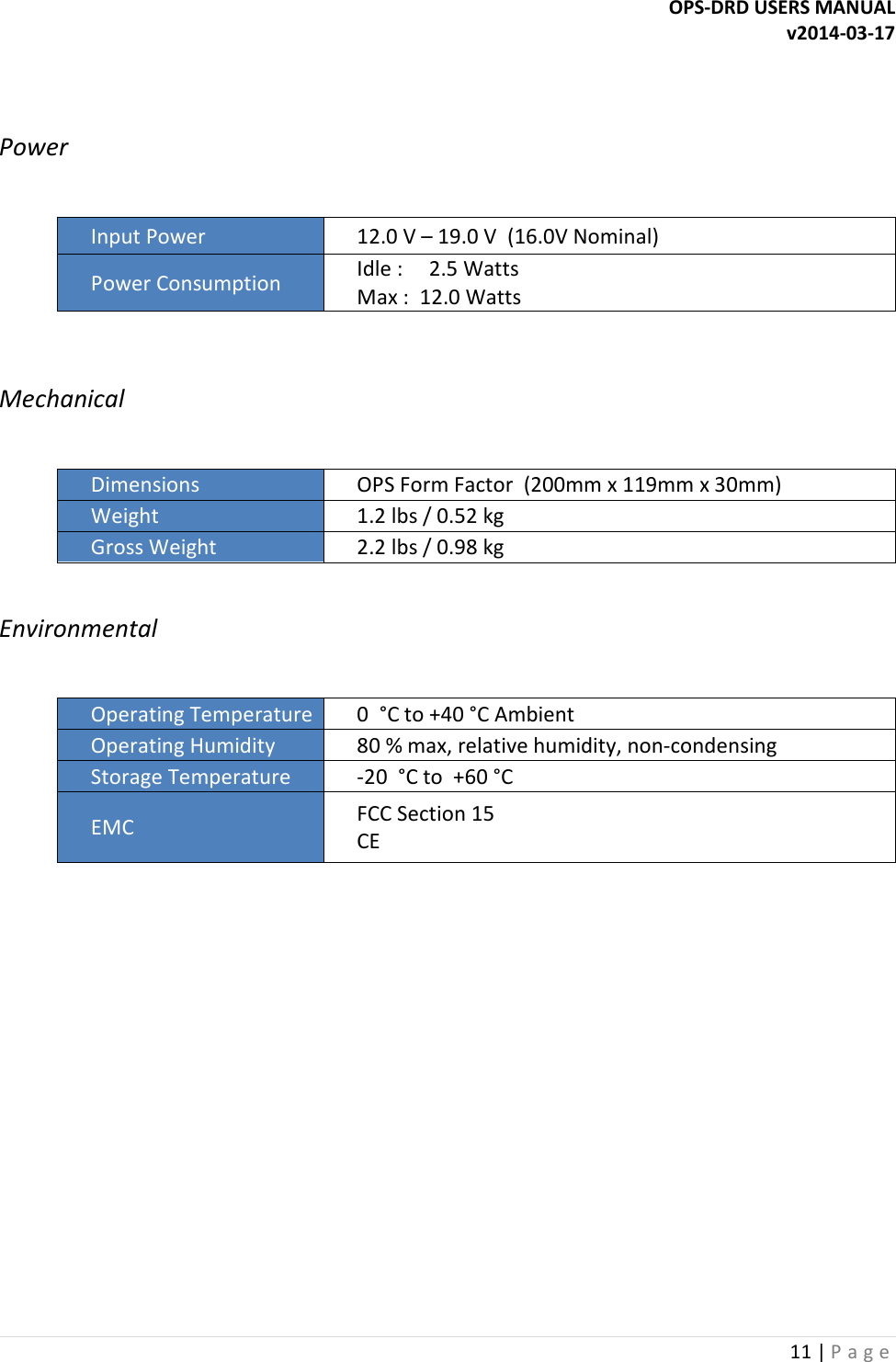
OPS-DRD USERS MANUAL v2014-03-17 11 | P a g e    Power   Input Power  12.0 V – 19.0 V  (16.0V Nominal) Power Consumption  Idle :     2.5 Watts Max :  12.0 Watts  Mechanical  Dimensions  OPS Form Factor  (200mm x 119mm x 30mm) Weight  1.2 lbs / 0.52 kg Gross Weight  2.2 lbs / 0.98 kg  Environmental  Operating Temperature 0  °C to +40 °C Ambient Operating Humidity  80 % max, relative humidity, non-condensing Storage Temperature  -20  °C to  +60 °C EMC  FCC Section 15 CE
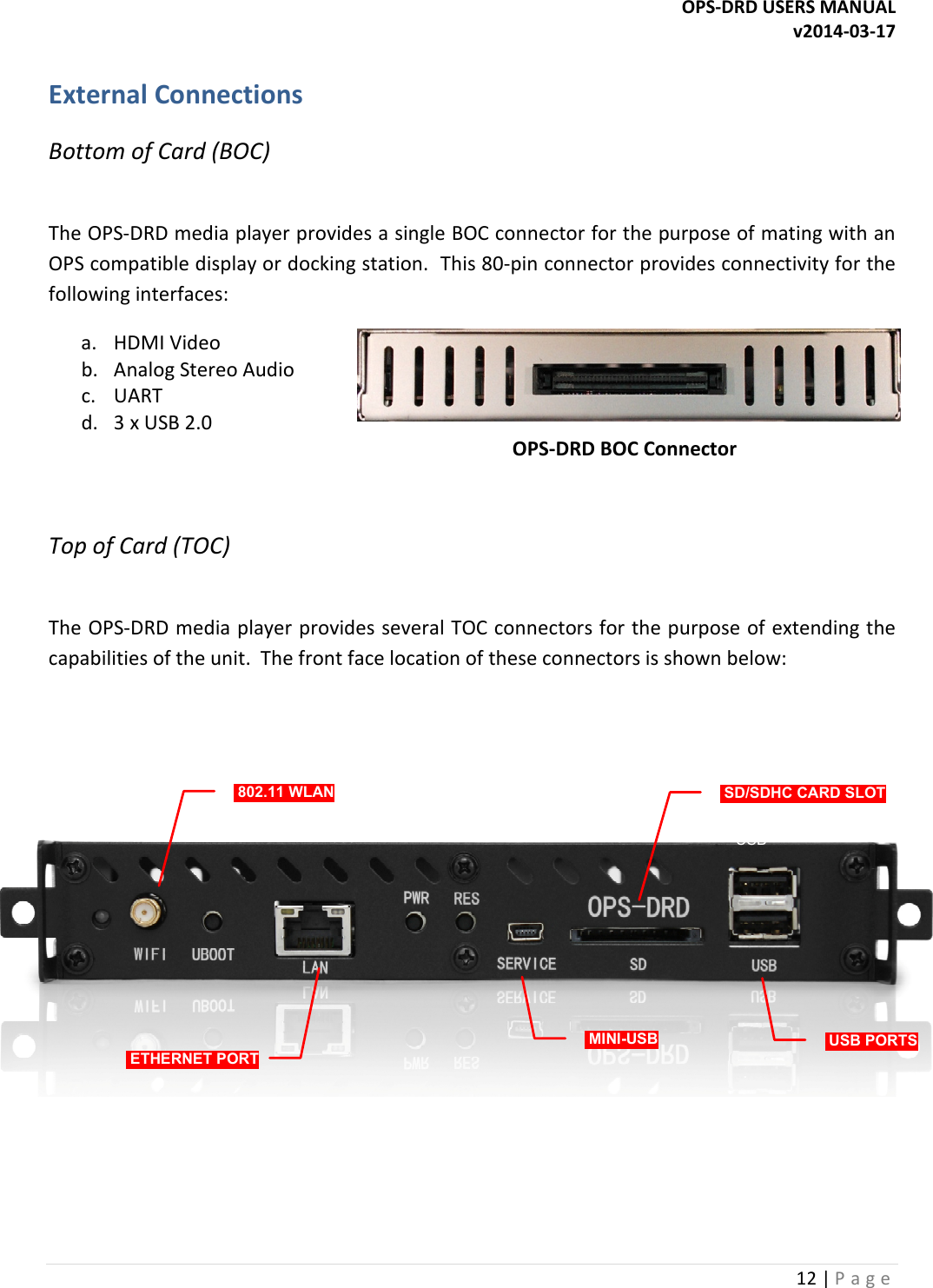
OPS-DRD USERS MANUAL v2014-03-17 12 | P a g e   External Connections Bottom of Card (BOC)  The OPS-DRD media player provides a single BOC connector for the purpose of mating with an OPS compatible display or docking station.  This 80-pin connector provides connectivity for the following interfaces: a. HDMI Video b. Analog Stereo Audio c. UART d. 3 x USB 2.0                                                                                                          OPS-DRD BOC Connector  Top of Card (TOC)  The OPS-DRD media player provides several TOC connectors for the purpose of extending the capabilities of the unit.  The front face location of these connectors is shown below: WiFi 1000BT SD USBRESETSERVICE802.11 WLAN ETHERNET PORTMINI-USB USB PORTSSD/SDHC CARD SLOT
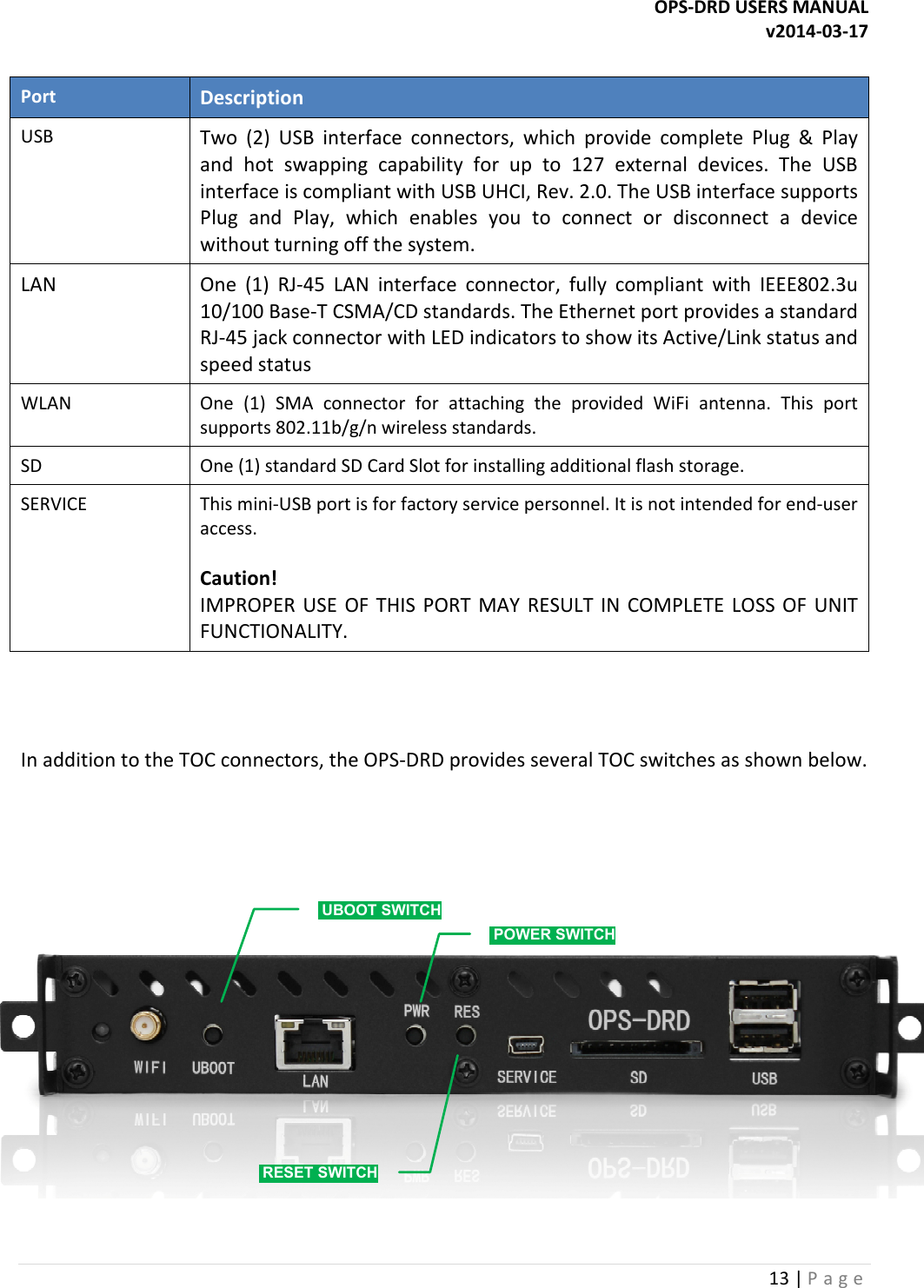
OPS-DRD USERS MANUAL v2014-03-17 13 | P a g e   Port Description USB Two  (2)  USB  interface  connectors,  which  provide  complete  Plug  &  Play and  hot  swapping  capability  for  up  to  127  external  devices.  The  USB interface is compliant with USB UHCI, Rev. 2.0. The USB interface supports Plug  and  Play,  which  enables  you  to  connect  or  disconnect  a  device without turning off the system. LAN One  (1)  RJ-45  LAN  interface  connector,  fully  compliant  with  IEEE802.3u 10/100 Base-T CSMA/CD standards. The Ethernet port provides a standard RJ-45 jack connector with LED indicators to show its Active/Link status and speed status WLAN One  (1)  SMA  connector  for  attaching  the  provided  WiFi  antenna. This  port supports 802.11b/g/n wireless standards. SD One (1) standard SD Card Slot for installing additional flash storage. SERVICE This mini-USB port is for factory service personnel. It is not intended for end-user access.  Caution!  IMPROPER  USE  OF  THIS  PORT  MAY  RESULT IN  COMPLETE  LOSS  OF  UNIT FUNCTIONALITY.   In addition to the TOC connectors, the OPS-DRD provides several TOC switches as shown below. WiFi 1000BT SD USBRESETSERVICEUBOOT SWITCH RESET SWITCHPOWER SWITCH
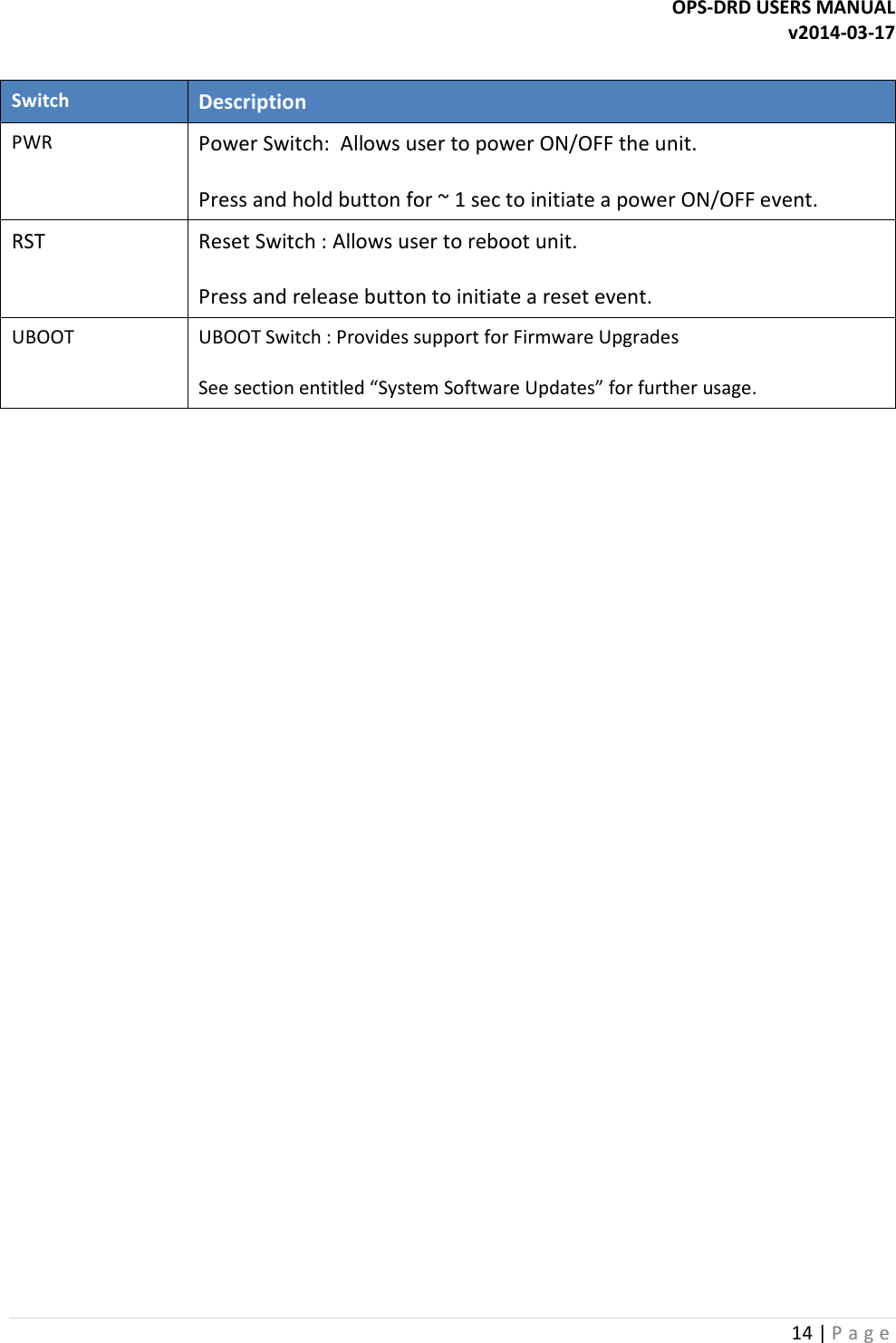
OPS-DRD USERS MANUAL v2014-03-17 14 | P a g e   Switch Description PWR Power Switch:  Allows user to power ON/OFF the unit.   Press and hold button for ~ 1 sec to initiate a power ON/OFF event. RST Reset Switch : Allows user to reboot unit.  Press and release button to initiate a reset event. UBOOT UBOOT Switch : Provides support for Firmware Upgrades  See section entitled “System Software Updates” for further usage.
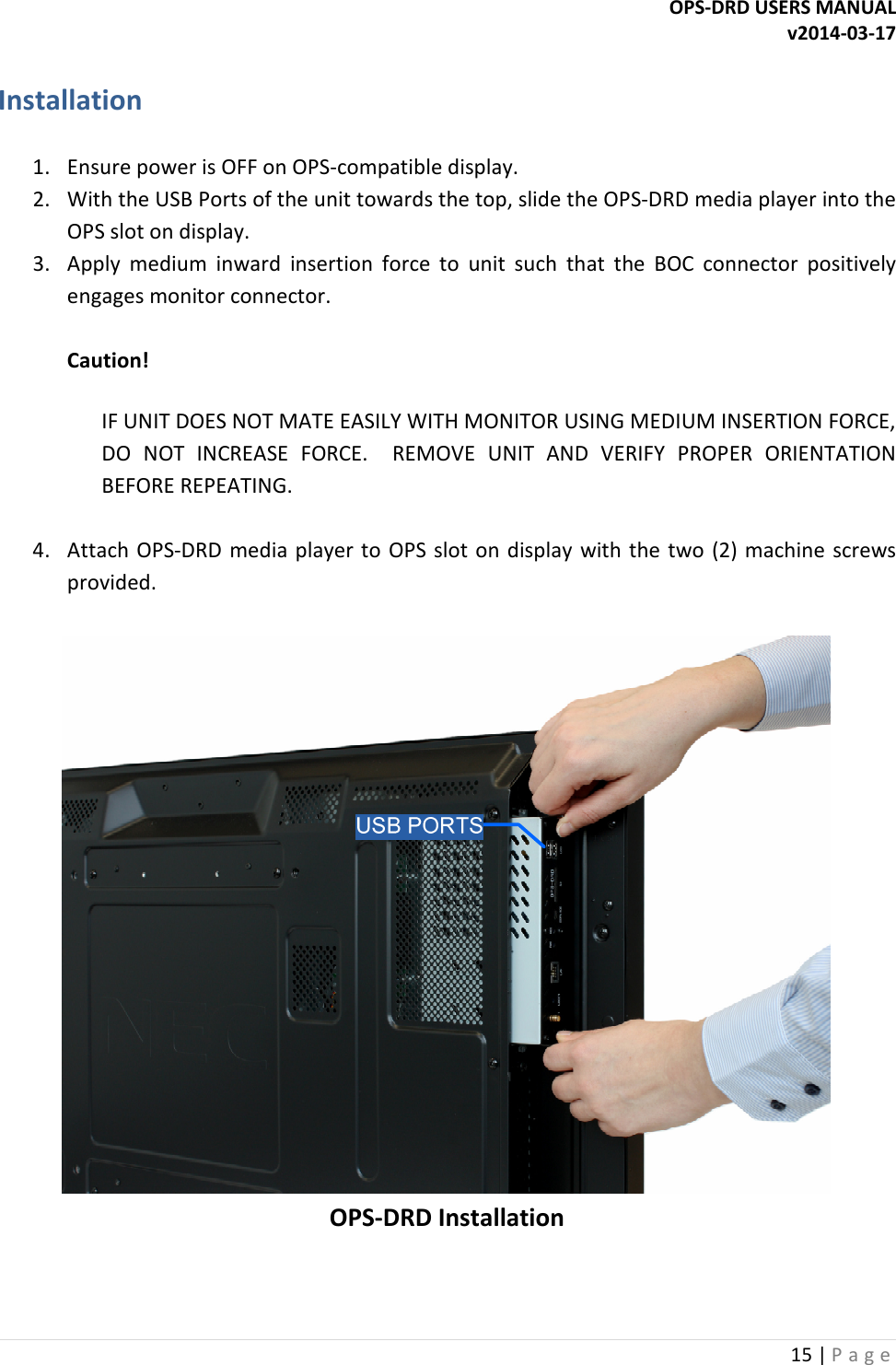
OPS-DRD USERS MANUAL v2014-03-17 15 | P a g e   Installation  1. Ensure power is OFF on OPS-compatible display. 2. With the USB Ports of the unit towards the top, slide the OPS-DRD media player into the OPS slot on display. 3. Apply  medium  inward  insertion  force  to  unit  such  that  the  BOC  connector  positively engages monitor connector.  Caution!   IF UNIT DOES NOT MATE EASILY WITH MONITOR USING MEDIUM INSERTION FORCE, DO  NOT  INCREASE  FORCE.    REMOVE  UNIT  AND  VERIFY  PROPER  ORIENTATION BEFORE REPEATING.  4. Attach  OPS-DRD  media player to  OPS slot  on display  with the  two (2) machine  screws provided.   OPS-DRD Installation
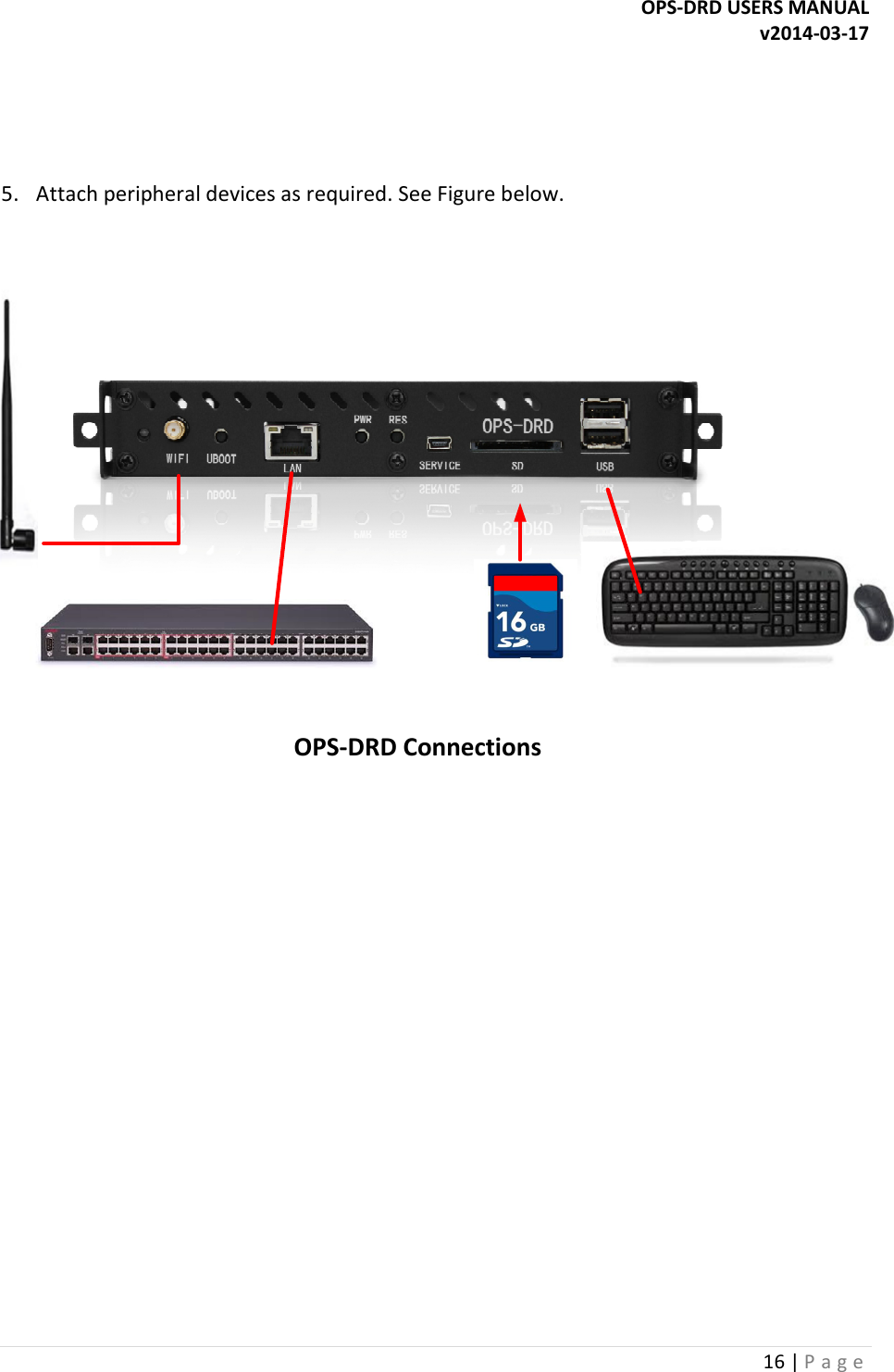
OPS-DRD USERS MANUAL v2014-03-17 16 | P a g e     5. Attach peripheral devices as required. See Figure below.    OPS-DRD Connections
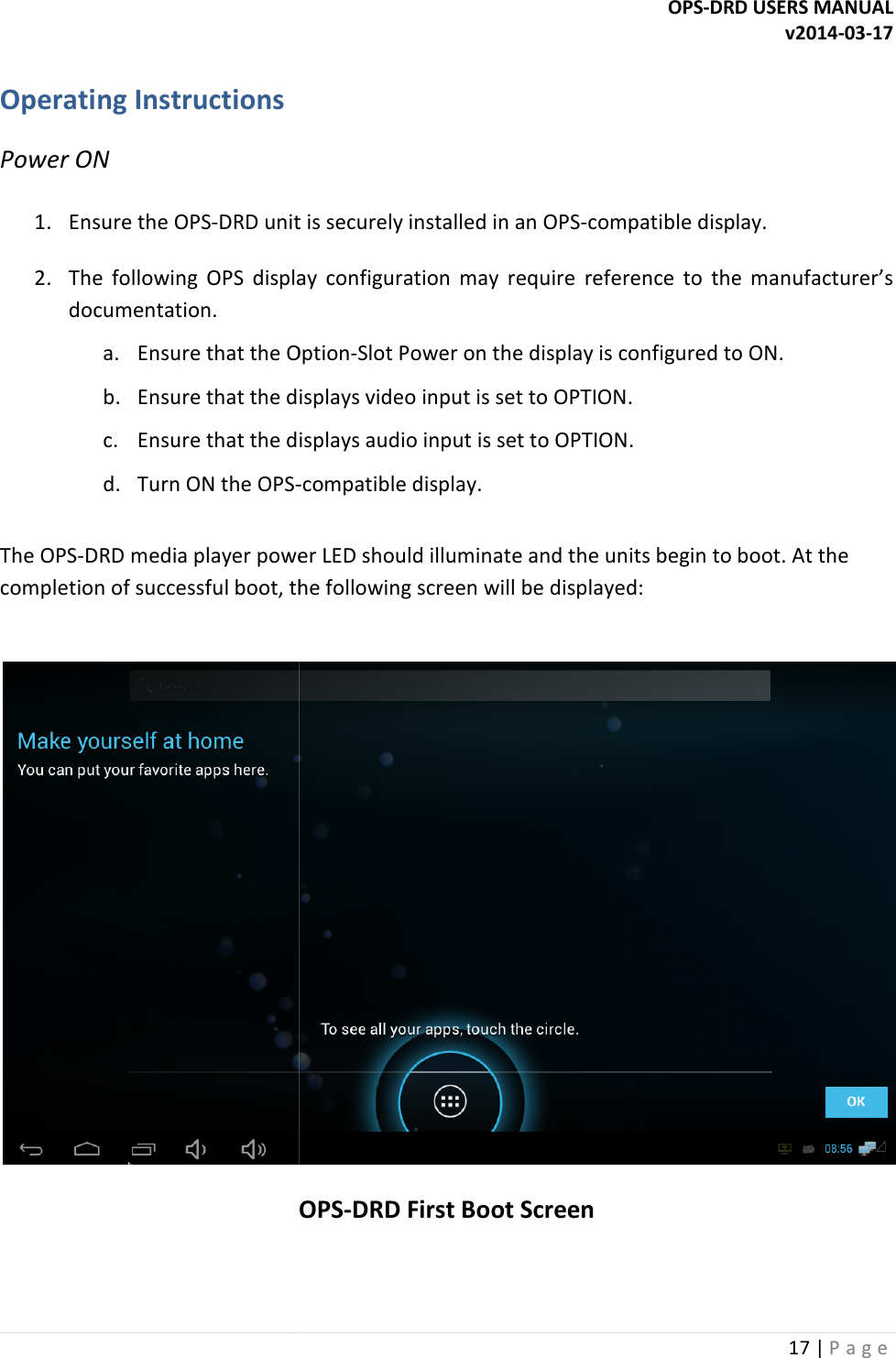
 Operating Instructions Power ON  1. Ensure the OPS-DRD unit is securely installed in an OPS2. The  following  OPS  display  configuration  maydocumentation. a. Ensure that the Optionb. Ensure that the displays video input is set to OPTION.c. Ensure that the displays audio input is set to OPTION.d. Turn ON the OPS- The OPS-DRD media player power LED should illuminate and the units begin to boot. At the completion of successful boot, the following screen will be displayed:   OPS  OPS-DRD USERS MANUAL DRD unit is securely installed in an OPS-compatible display.The  following  OPS  display  configuration  may require  reference  to  the  manufacturer’s Ensure that the Option-Slot Power on the display is configured to ON.Ensure that the displays video input is set to OPTION. Ensure that the displays audio input is set to OPTION. -compatible display.  media player power LED should illuminate and the units begin to boot. At the completion of successful boot, the following screen will be displayed: OPS-DRD First Boot Screen DRD USERS MANUAL v2014-03-17 17 | P a g e  compatible display. require  reference  to  the  manufacturer’s Slot Power on the display is configured to ON. media player power LED should illuminate and the units begin to boot. At the
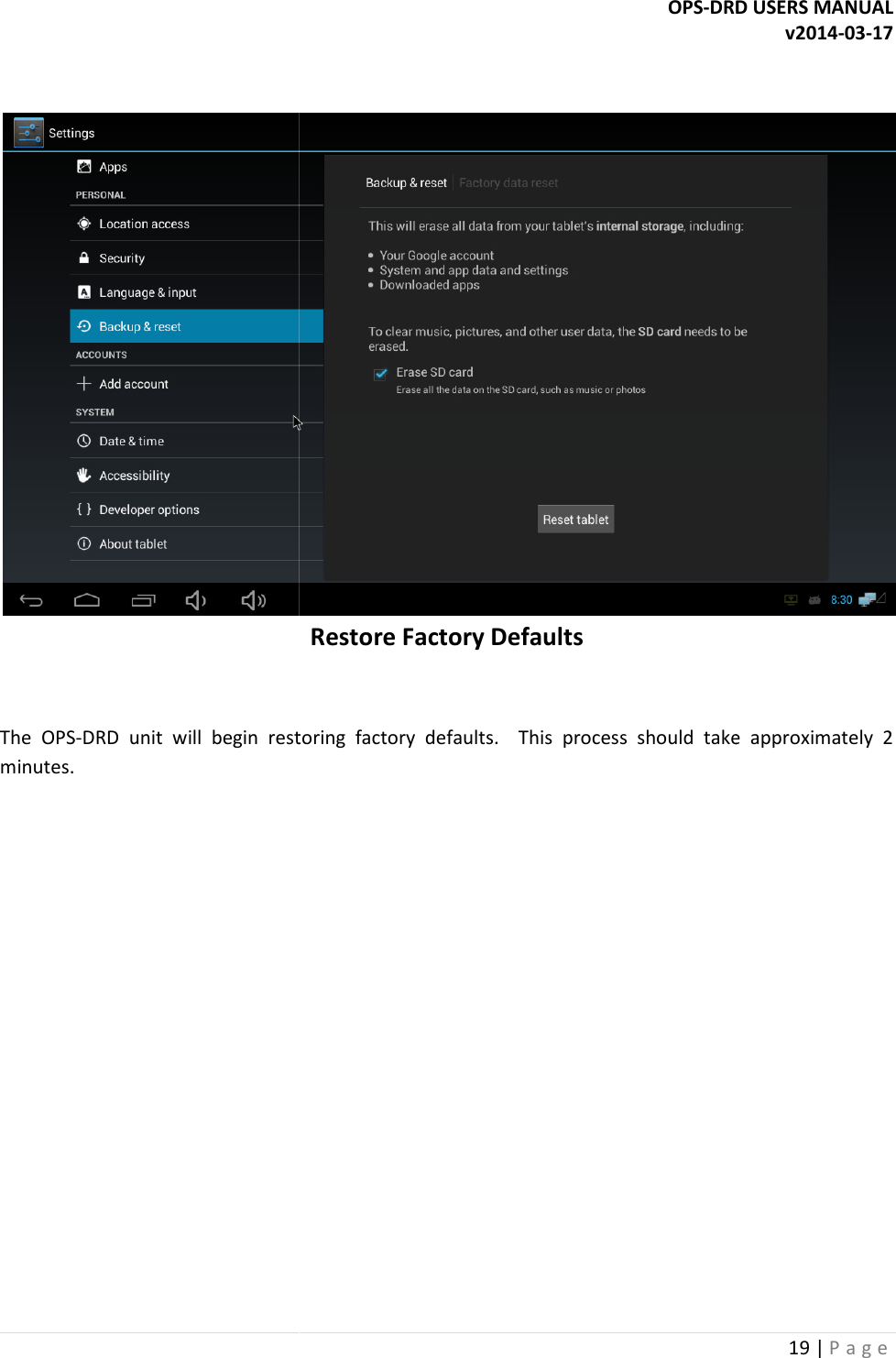
OPS-DRD USERS MANUAL v2014-03-17 18 | P a g e     To power ON the unit when it is already installed in a powered display: 1. Press and hold the POWER button until the POWER LED becomes illuminated.  Power OFF  1. The  OPS-DRD  unit  can  be  powered  OFF  by  pressing  and  holding  the  POWER  BUTTON until a message indicating device shutdown appears on the display.  Sleep / Wake  1. The OPS-DRD unit can be put to SLEEP from a powered ON state by quickly pressing and releasing the POWER button.  The display will immediately go black and the POWER LED will turn OFF after a short period. 2. The OPS-DRD unit can be commanded to WAKE from a SLEEP state by quickly pressing and releasing the POWER button.  The display will immediately return to displaying what was displayed when  the unit was placed into the SLEEP state.  In addition, the POWER LED will turn ON.  Unit Reset  1. The  OPS-DRD  unit  can  be  reset  by  pressing  and  holding  the  RESET  BUTTON  until  the display goes dark.  The unit will begin booting upon release of the RESET BUTTON.  Restore Factory Defaults  Caution! RESTORING  FACTORY  DEFAULTS  WILL  CAUSE  ALL  INSTALLED  APPLICATIONS,  DATA  AND SETTINGS TO BE LOST. BACKUP ALL IMPORTANT DATA BEFORE CONTINUING.  1. Open the Settings application and click on the “Backup & reset” menu item. 2. Select “Factory data reset” and the pop-up below will be displayed. 3. Check the “Erase SD card” box. 4. Click “Reset tablet” button
   The  OPS-DRD  unit will  begin  restoring  factory  defaults.    This  process  should  take  approximately  2 minutes.    OPS-DRD USERS MANUALRestore Factory Defaults will  begin  restoring  factory  defaults.    This  process  should  take  approximately  2 DRD USERS MANUAL v2014-03-17 19 | P a g e   will  begin  restoring  factory  defaults.    This  process  should  take  approximately  2
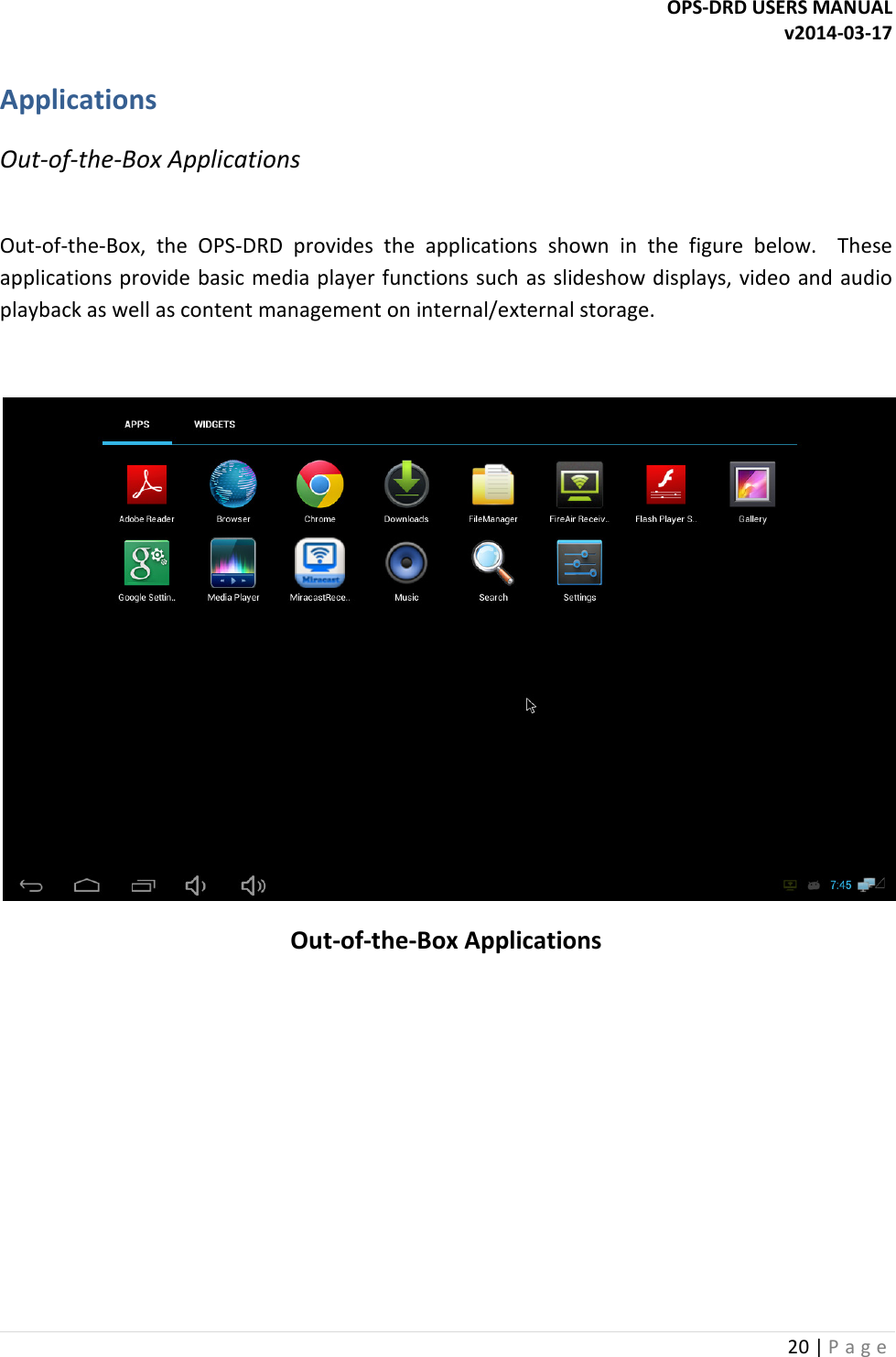
OPS-DRD USERS MANUAL v2014-03-17 20 | P a g e   Applications Out-of-the-Box Applications  Out-of-the-Box,  the  OPS-DRD  provides  the  applications  shown  in  the  figure  below.    These applications provide basic media player functions such as slideshow displays, video and audio playback as well as content management on internal/external storage.     Out-of-the-Box Applications
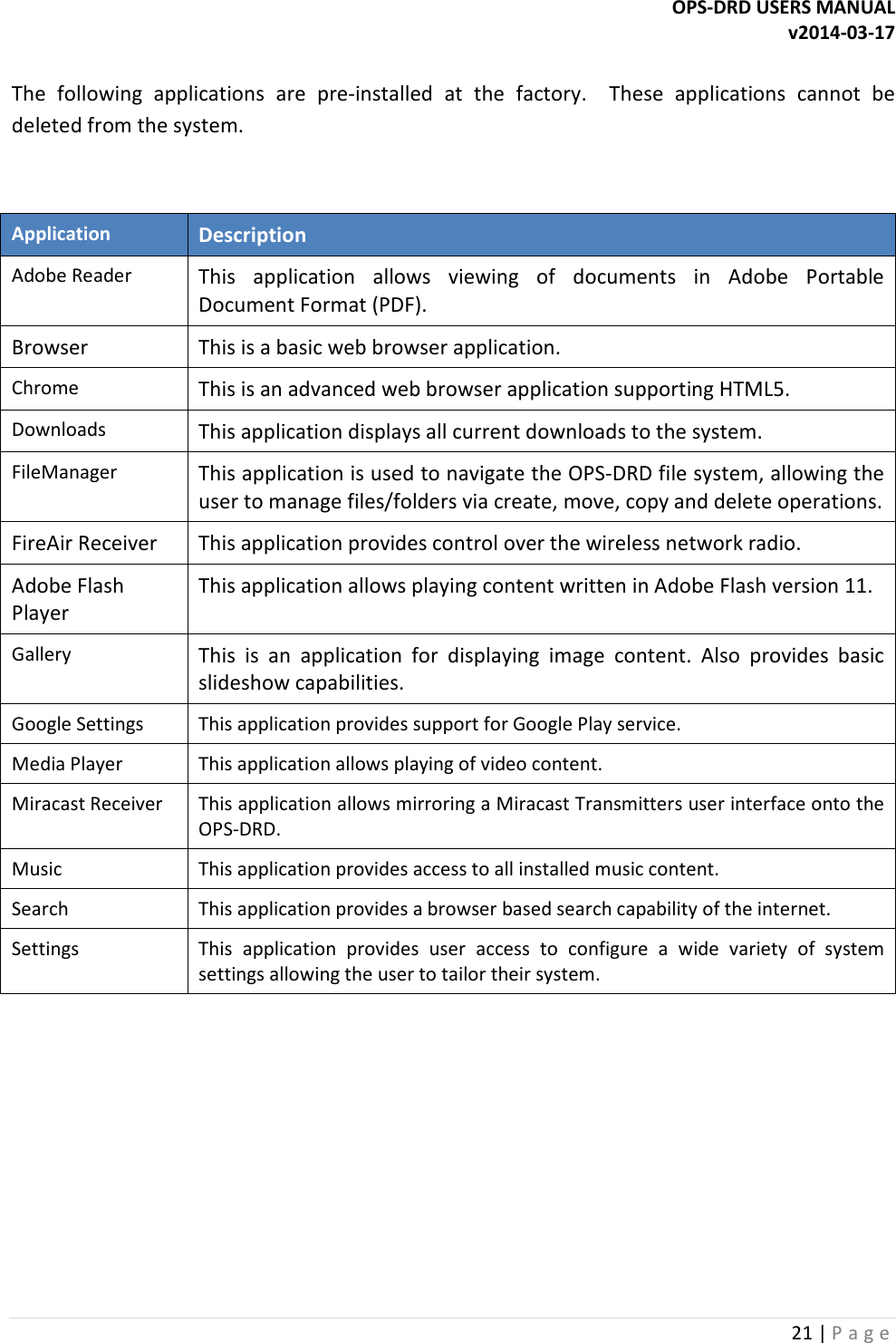
OPS-DRD USERS MANUAL v2014-03-17 21 | P a g e   The  following  applications  are  pre-installed  at  the  factory.    These  applications  cannot  be deleted from the system.  Application Description Adobe Reader This  application  allows  viewing  of  documents  in  Adobe  Portable Document Format (PDF). Browser This is a basic web browser application. Chrome This is an advanced web browser application supporting HTML5. Downloads This application displays all current downloads to the system. FileManager This application is used to navigate the OPS-DRD file system, allowing the user to manage files/folders via create, move, copy and delete operations. FireAir Receiver This application provides control over the wireless network radio. Adobe Flash Player This application allows playing content written in Adobe Flash version 11. Gallery This  is  an  application  for  displaying  image  content.  Also  provides  basic slideshow capabilities. Google Settings This application provides support for Google Play service. Media Player This application allows playing of video content. Miracast Receiver This application allows mirroring a Miracast Transmitters user interface onto the OPS-DRD.  Music This application provides access to all installed music content. Search This application provides a browser based search capability of the internet. Settings This  application  provides  user  access  to  configure  a  wide  variety  of  system settings allowing the user to tailor their system.
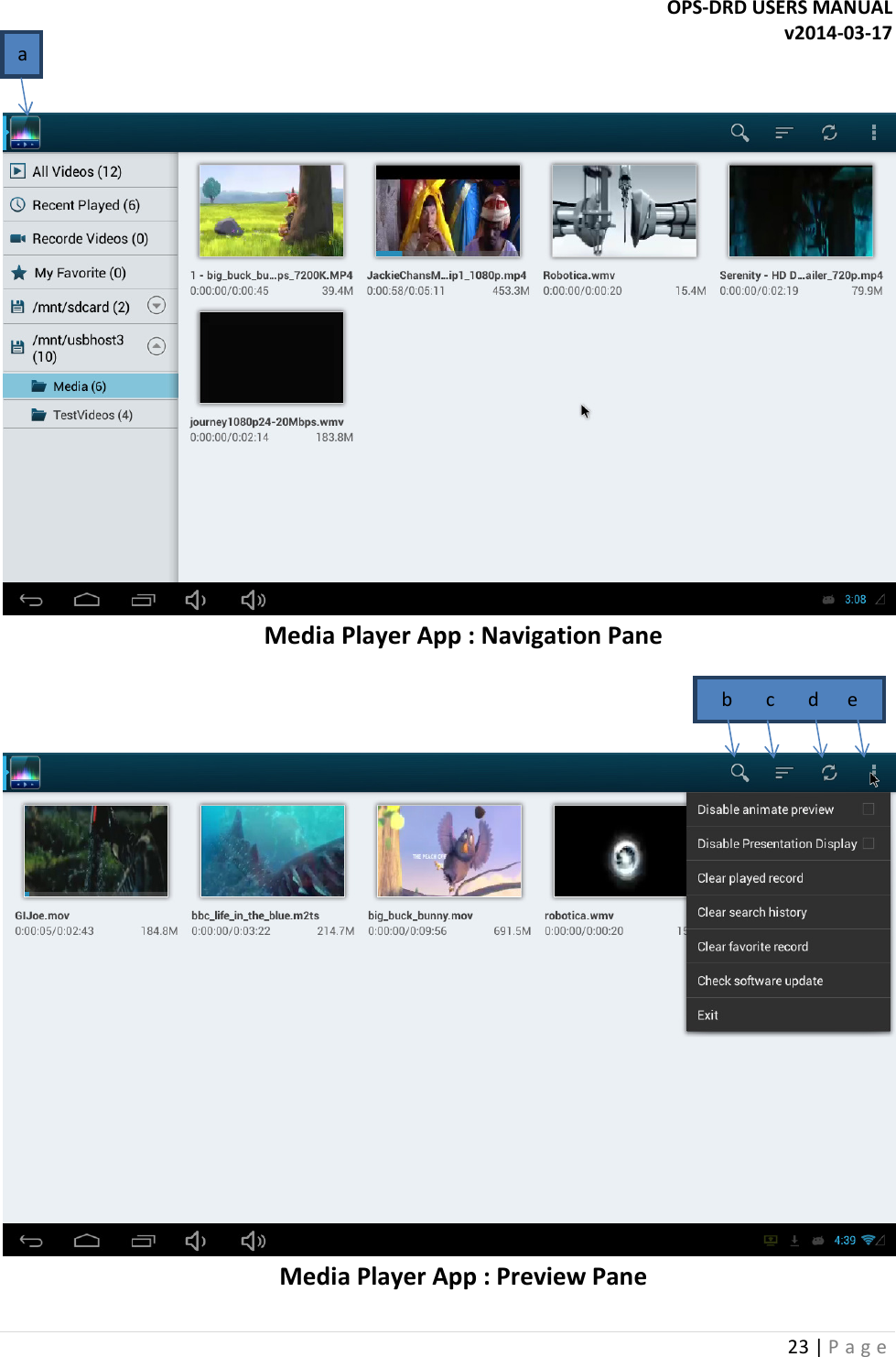
OPS-DRD USERS MANUAL v2014-03-17 22 | P a g e   Media Player Application The Media Player application is represented by the icon shown on the right.  It provides facilities for the playback/management of video content.   Preview Pane 1. Open the media player by single clicking the Media Player icon in the APPS section. 2. You  are  now  at  the  “Preview  Pane”.    Here,  your  media  is  automatically  found  and displayed, whether on SD card, or USB drive. 3. In the preview pane, on the top right corner are a set of option icons.  From left to right, here are their functions: a. Media Player icon expands/hides a navigation pane on the left side of the screen.  This  allows  quick  access  to  Recently  Played  and  Favorite  videos  along  with content mounted on internal/external media. b. Magnifying Glass icon allows you to search for media files. c. The next icon allows you to sort the media in the preview pane alphabetically, or by size. d. The next icon will scan for new media and refresh the preview pane. e. The last icon gives you a drop  down menu of available options for the preview pane, and the App itself.  From here, you can disable the animation of the media in the preview pane, disable the Presentation Display, clear the Recently Played media, clear the Search History, clear the Favorites, check for software updates and exit the App. 4. For media playback, simply click the media file you wish to play.  The preview panel will disappear and begin playing your media file.  During playback, there are more options available to you.
OPS-DRD USERS MANUAL v2014-03-17 23 | P a g e     Media Player App : Navigation Pane     Media Player App : Preview Pane b       c       d      e a
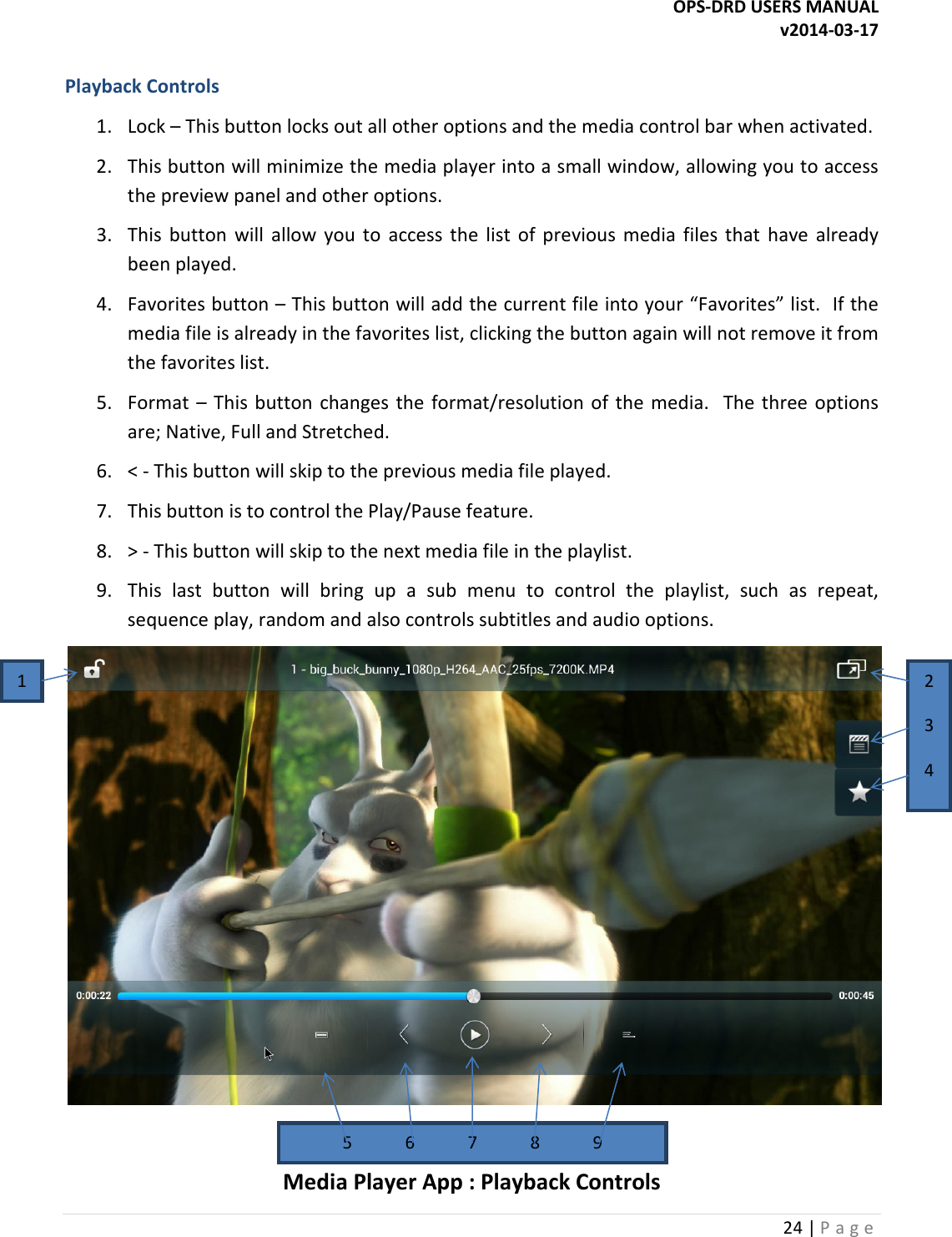
OPS-DRD USERS MANUAL v2014-03-17 24 | P a g e   Playback Controls 1. Lock – This button locks out all other options and the media control bar when activated.   2. This button will minimize the media player into a small window, allowing you to access the preview panel and other options. 3. This  button  will  allow  you  to  access  the  list  of  previous  media  files  that  have  already been played. 4. Favorites button – This button will add the current file into your “Favorites” list.  If the media file is already in the favorites list, clicking the button again will not remove it from the favorites list. 5. Format  – This button  changes  the  format/resolution  of  the  media.    The three  options are; Native, Full and Stretched.   6. < - This button will skip to the previous media file played. 7. This button is to control the Play/Pause feature. 8. > - This button will skip to the next media file in the playlist. 9. This  last  button  will  bring  up  a  sub  menu  to  control  the  playlist,  such  as  repeat, sequence play, random and also controls subtitles and audio options.    Media Player App : Playback Controls 5 6 7 8 9 2 3 4 1
OPS-DRD USERS MANUAL v2014-03-17 25 | P a g e    To access the preview pane from the media player window, simply right click the mouse once, anywhere on  the screen.  From the preview pane, you can exit the App by clicking  the Menu button on the top right of the preview pane, and select exit.
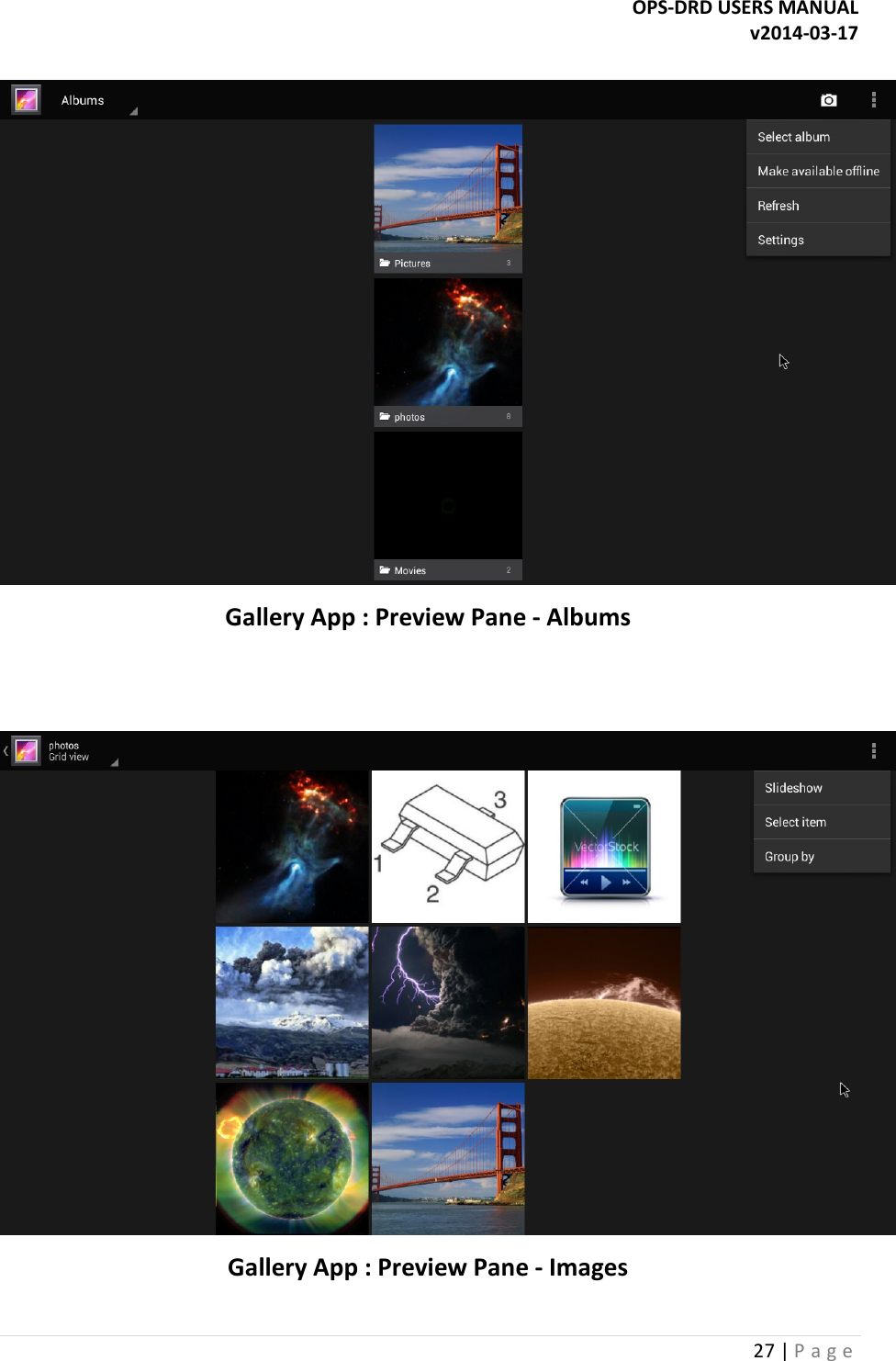
 Gallery Application The  Gallery application  is  represented  by  the  icon  shown  on  the  right.    It provides facilities for the display of static Preview Pane 1. Open the Gallery by single clicking Gallery icon in the APPS section.2. You  are  now  at  the “Preview  Pane”.    Here,  your  images  are  automatically  found  and displayed, whether on SD card, or USB drive.3. In the preview pane, on the top left corner is a drop down menu for sorting images in the following ways: a. Albums – Sorts the images by specified albb. Locations – Sorts images based on their location, (USB, SD, Internal).c. Times – Sorts images by order of date the photo or file was created.d. People – Sorts images based on people “tagged” in the image.e. Tags – Sorts images by user defined tags. 4. In  the preview  pane,  on  the  top  right  corner  is  a  drop  down  menu  for  viewing  the images.    From  here,  you  can  tag,  group  by,  select  an  image  for  viewing,  or  add  the current image to a slideshow. *The  camera  function  on  the  top  toolbar,  in  the  preview  pane,  will installed.  If no camera is installed, the Gallery will stop responding and close. OPS-DRD USERS MANUALapplication  is  represented  by  the  icon  shown  on  the  right.    It display of static image content.  Open the Gallery by single clicking Gallery icon in the APPS section. “Preview  Pane”.    Here,  your  images  are  automatically  found  and displayed, whether on SD card, or USB drive. In the preview pane, on the top left corner is a drop down menu for sorting images in Sorts the images by specified albums. Sorts images based on their location, (USB, SD, Internal).Sorts images by order of date the photo or file was created.Sorts images based on people “tagged” in the image. Sorts images by user defined tags.  preview  pane,  on  the  top  right  corner  is  a  drop  down  menu  for  viewing  the images.    From  here,  you  can  tag,  group  by,  select  an  image  for  viewing,  or  add  the current image to a slideshow. *The  camera  function  on  the  top  toolbar,  in  the  preview  pane,  will activate  a  camera  if  one  is installed.  If no camera is installed, the Gallery will stop responding and close. DRD USERS MANUAL v2014-03-17 26 | P a g e   “Preview  Pane”.    Here,  your  images  are  automatically  found  and In the preview pane, on the top left corner is a drop down menu for sorting images in Sorts images based on their location, (USB, SD, Internal). Sorts images by order of date the photo or file was created. preview  pane,  on  the  top  right  corner  is  a  drop  down  menu  for  viewing  the images.    From  here,  you  can  tag,  group  by,  select  an  image  for  viewing,  or  add  the activate  a  camera  if  one  is
OPS-DRD USERS MANUAL v2014-03-17 27 | P a g e    Gallery App : Preview Pane - Albums    Gallery App : Preview Pane - Images
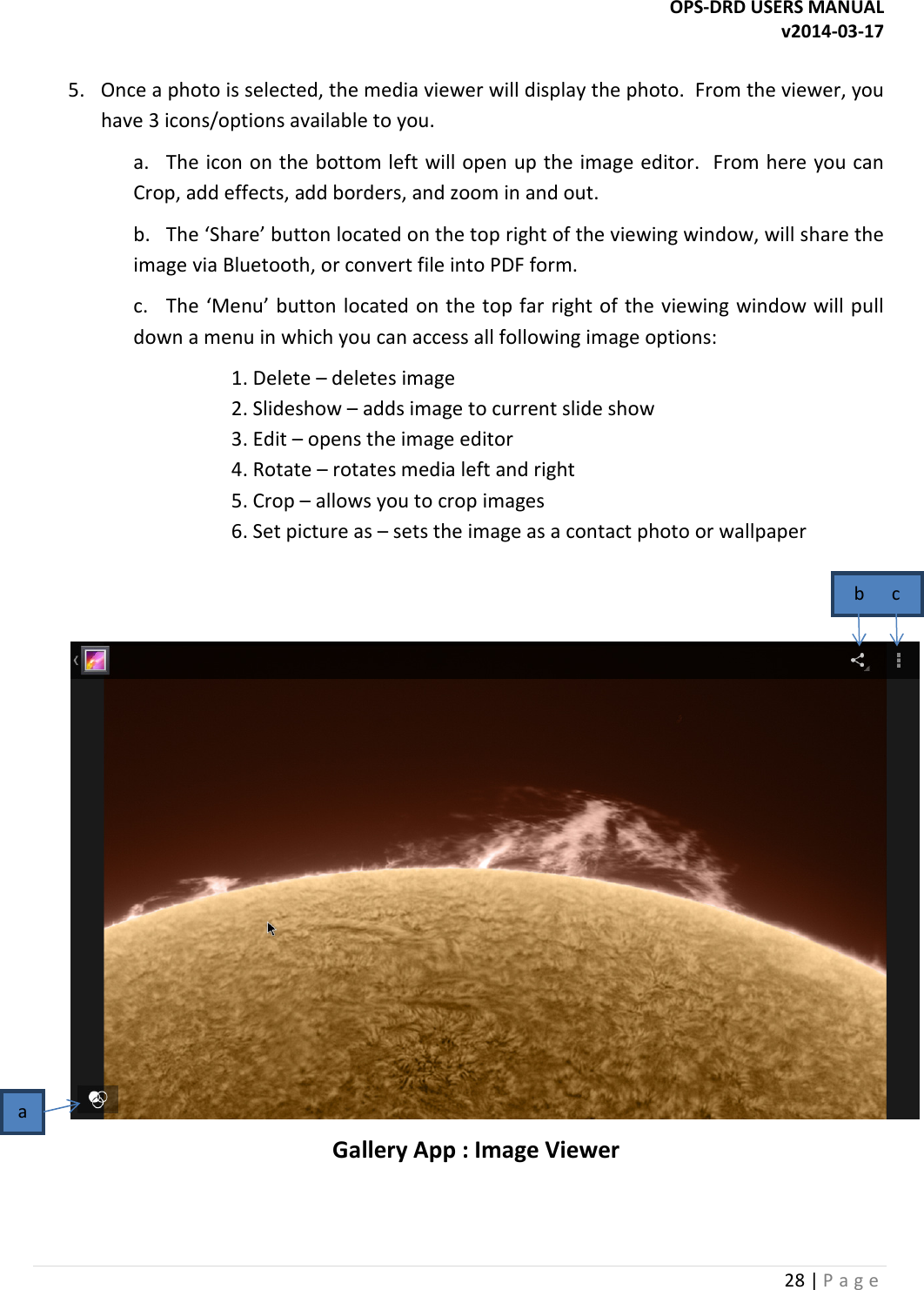
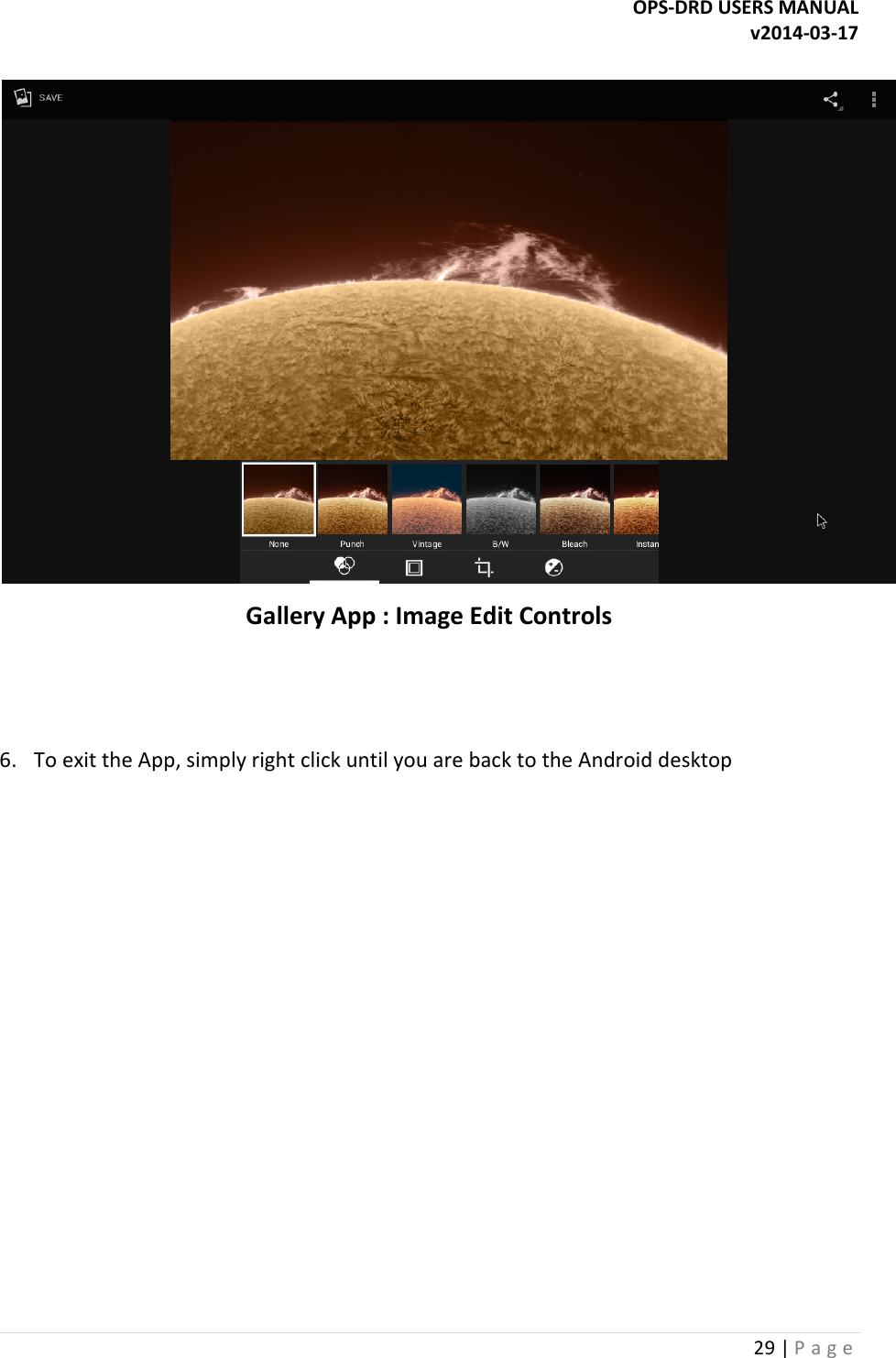
OPS-DRD USERS MANUAL v2014-03-17 28 | P a g e   5.  Once a photo is selected, the media viewer will display the photo.  From the viewer, you have 3 icons/options available to you. a.  The icon on the bottom left will open up the image editor.  From here you can Crop, add effects, add borders, and zoom in and out. b.  The ‘Share’ button located on the top right of the viewing window, will share the image via Bluetooth, or convert file into PDF form. c.  The ‘Menu’ button located on the top far right of the viewing window will pull down a menu in which you can access all following image options:     1. Delete – deletes image     2. Slideshow – adds image to current slide show     3. Edit – opens the image editor     4. Rotate – rotates media left and right     5. Crop – allows you to crop images     6. Set picture as – sets the image as a contact photo or wallpaper    Gallery App : Image Viewer a b      c
OPS-DRD USERS MANUAL v2014-03-17 29 | P a g e    Gallery App : Image Edit Controls   6.  To exit the App, simply right click until you are back to the Android desktop
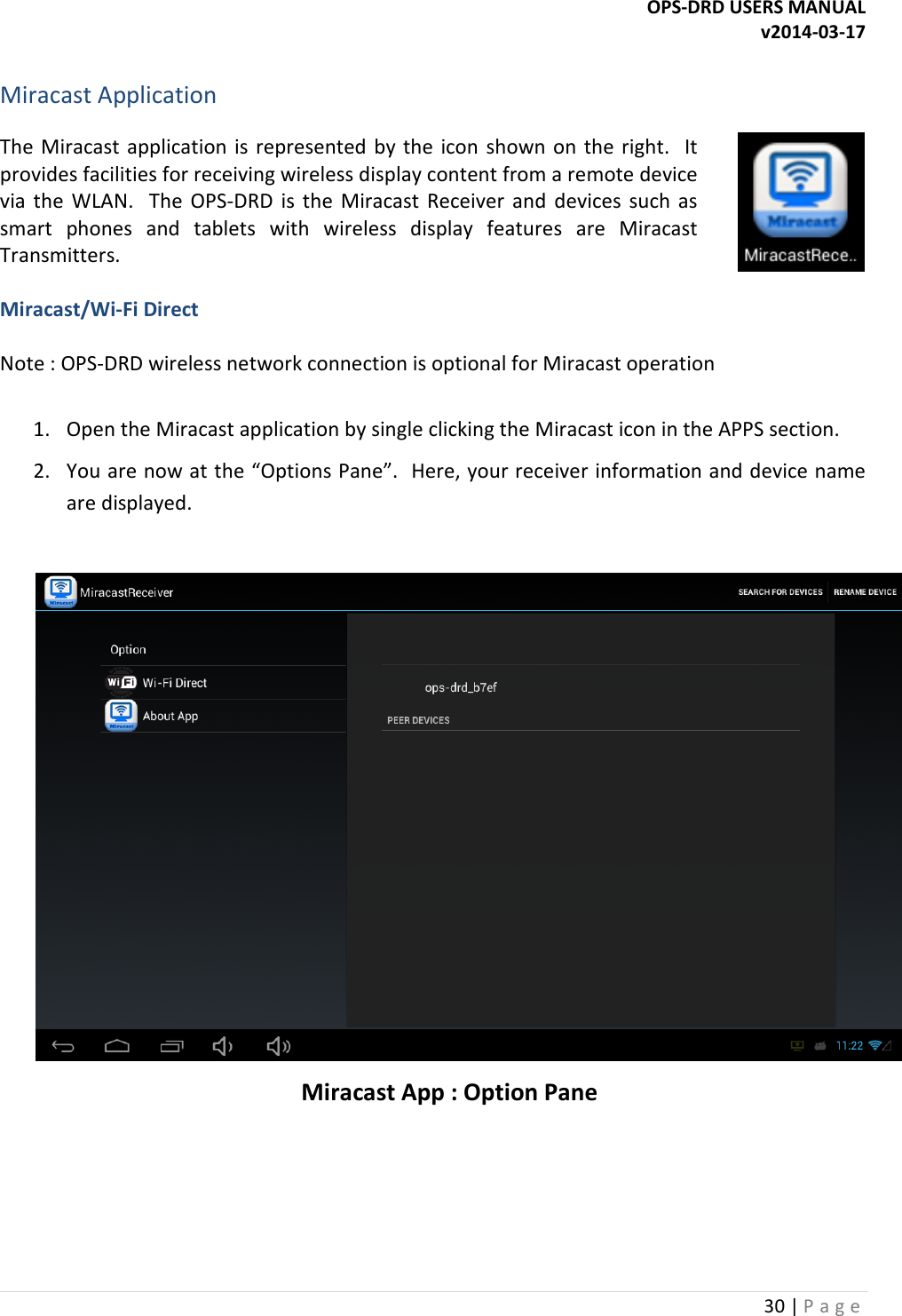
OPS-DRD USERS MANUAL v2014-03-17 30 | P a g e   Miracast Application The  Miracast  application is  represented  by the  icon  shown  on  the  right.    It provides facilities for receiving wireless display content from a remote device via  the  WLAN.    The  OPS-DRD  is  the  Miracast  Receiver  and  devices  such  as smart  phones  and  tablets  with  wireless  display  features  are  Miracast Transmitters.   Miracast/Wi-Fi Direct  Note : OPS-DRD wireless network connection is optional for Miracast operation   1. Open the Miracast application by single clicking the Miracast icon in the APPS section. 2. You are now at the “Options Pane”.  Here, your receiver information and device name are displayed.   Miracast App : Option Pane
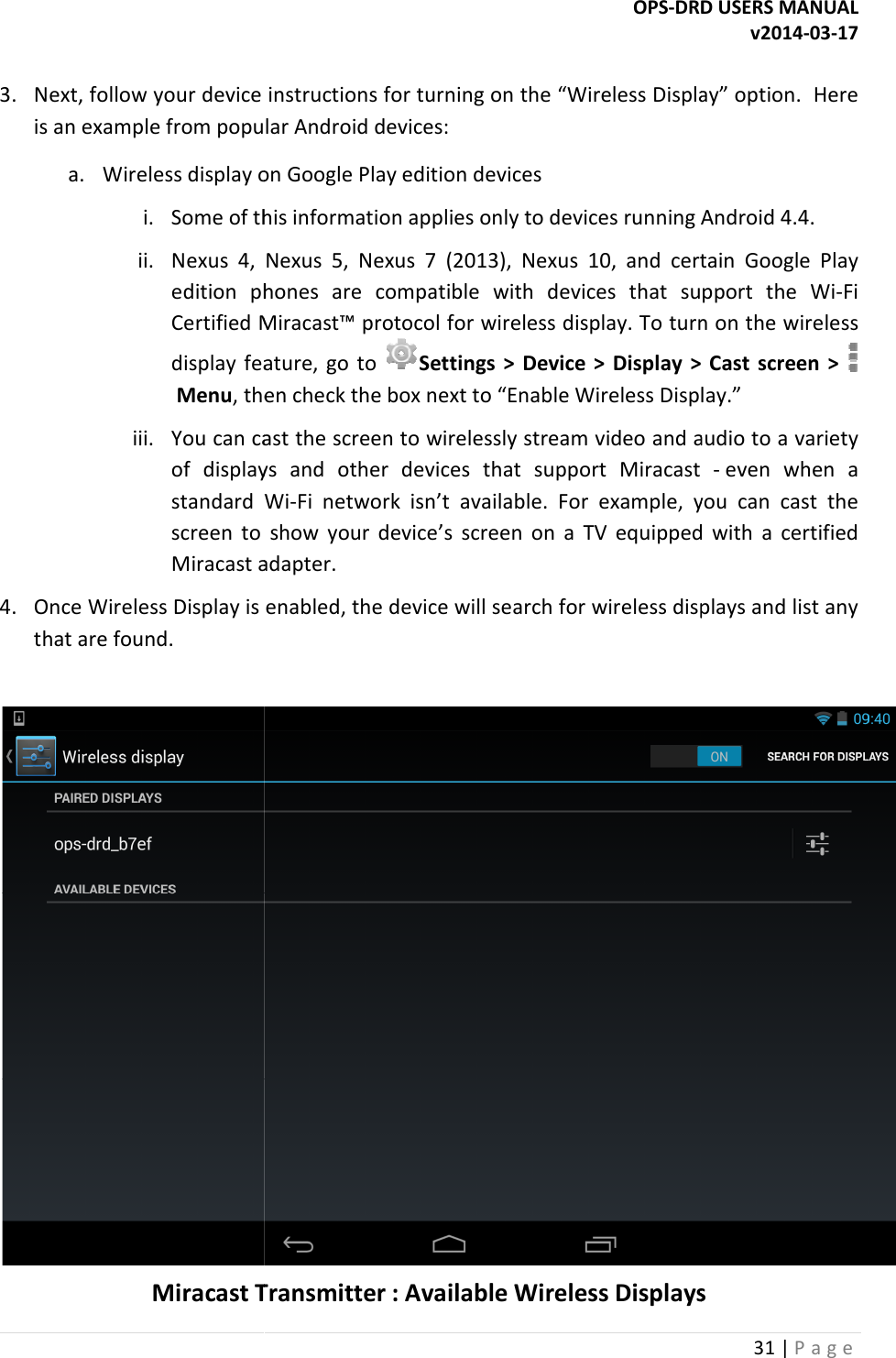
 3. Next, follow your device instructions for turning on the “Wireless Display” option.  Here is an example from popular Android devices:a. Wireless display on Google Play edition devicesi. Some of this information applies only to devices running Android 4.4.ii. Nexus  4,  Nexus  5,  Nexus  7  (2013),  Nexus  10,  and  certain  Google  Play edition  phones  are  compatible  with  devices  that  support  the  WiCertified Miracast™ protocol for wireless display. To turn on the wireless display  feature,  go  to  Menu, then check the box next to “Enable Wireless Display.”iii. You can cast the screen to wirelessly stream video and audio to a variety of  displays  and  other  devices  that  support  Miracast standard  Wiscreen  to  show  your  device’s  screen  on  a  TV  eqMiracast adapter.4. Once Wireless Display is enabled, the device will search for wireless displays and list any that are found.  Miracast TransmitterOPS-DRD USERS MANUALNext, follow your device instructions for turning on the “Wireless Display” option.  Here is an example from popular Android devices: display on Google Play edition devices Some of this information applies only to devices running Android 4.4.Nexus  4,  Nexus  5,  Nexus  7  (2013),  Nexus  10,  and  certain  Google  Play edition  phones  are  compatible  with  devices  that  support  the  WiMiracast™ protocol for wireless display. To turn on the wireless display  feature,  go  to Settings  >  Device  >  Display  >  Cast  screen  > , then check the box next to “Enable Wireless Display.”You can cast the screen to wirelessly stream video and audio to a variety of  displays  and  other  devices  that  support  Miracast standard  Wi-Fi  network  isn’t  available.  For  example,  you  can  cast  the screen  to  show  your  device’s  screen  on  a  TV  equipped  with  a  certified Miracast adapter. Once Wireless Display is enabled, the device will search for wireless displays and list any Transmitter : Available Wireless DisplaysDRD USERS MANUAL v2014-03-17 31 | P a g e  Next, follow your device instructions for turning on the “Wireless Display” option.  Here Some of this information applies only to devices running Android 4.4. Nexus  4,  Nexus  5,  Nexus  7  (2013),  Nexus  10,  and  certain  Google  Play edition  phones  are  compatible  with  devices  that  support  the  Wi-Fi Miracast™ protocol for wireless display. To turn on the wireless Settings  >  Device  >  Display  >  Cast  screen  > , then check the box next to “Enable Wireless Display.” You can cast the screen to wirelessly stream video and audio to a variety of  displays  and  other  devices  that  support  Miracast - even  when  a Fi  network  isn’t  available.  For  example,  you  can  cast  the uipped  with  a  certified Once Wireless Display is enabled, the device will search for wireless displays and list any  Wireless Displays
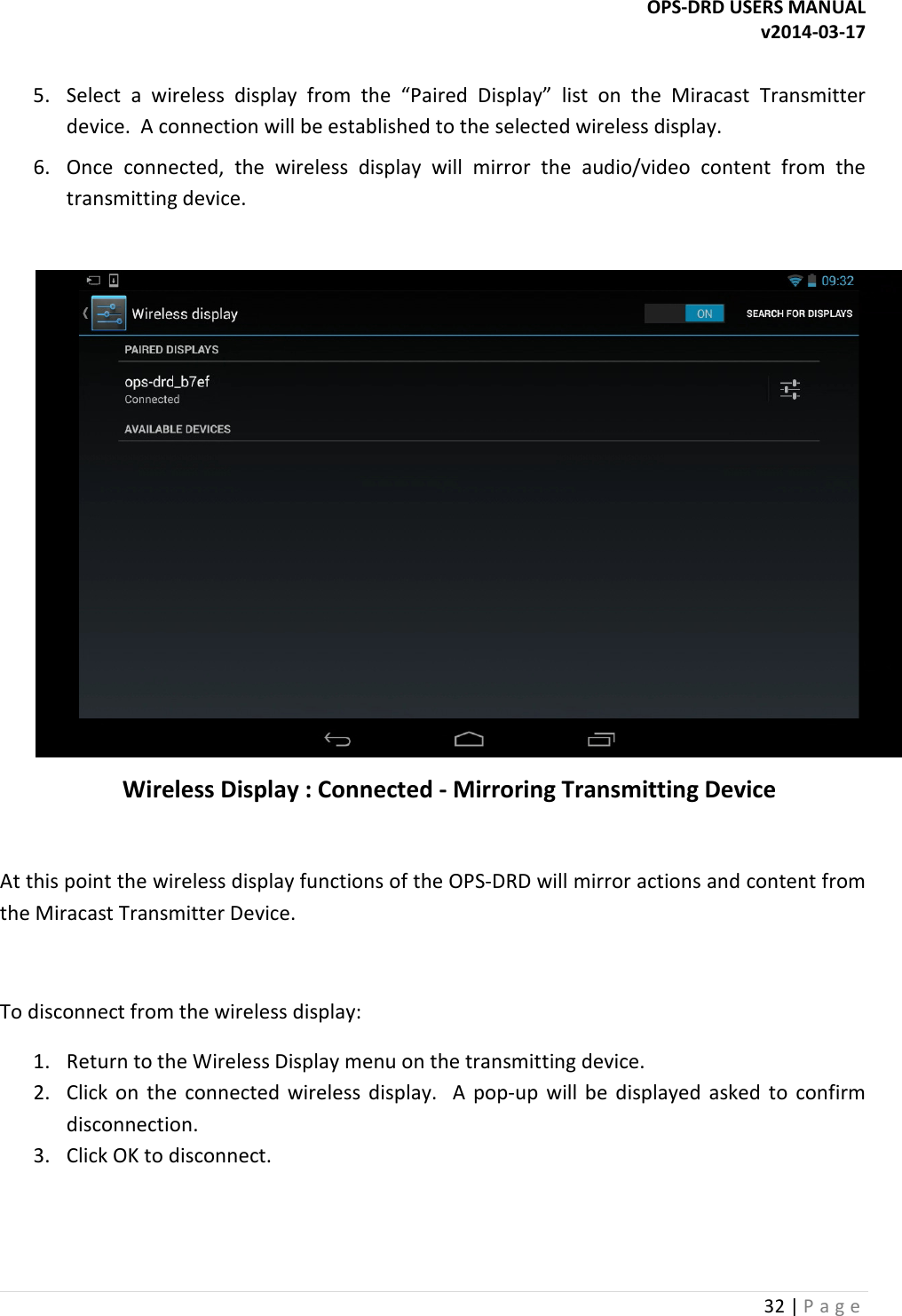
OPS-DRD USERS MANUAL v2014-03-17 32 | P a g e   5. Select  a  wireless  display  from  the  “Paired  Display”  list  on  the  Miracast  Transmitter device.  A connection will be established to the selected wireless display. 6. Once  connected,  the  wireless  display  will  mirror  the  audio/video  content  from  the transmitting device.     Wireless Display : Connected - Mirroring Transmitting Device  At this point the wireless display functions of the OPS-DRD will mirror actions and content from the Miracast Transmitter Device.   To disconnect from the wireless display: 1. Return to the Wireless Display menu on the transmitting device. 2. Click  on  the  connected  wireless  display.    A  pop-up  will  be  displayed  asked  to  confirm disconnection. 3. Click OK to disconnect.
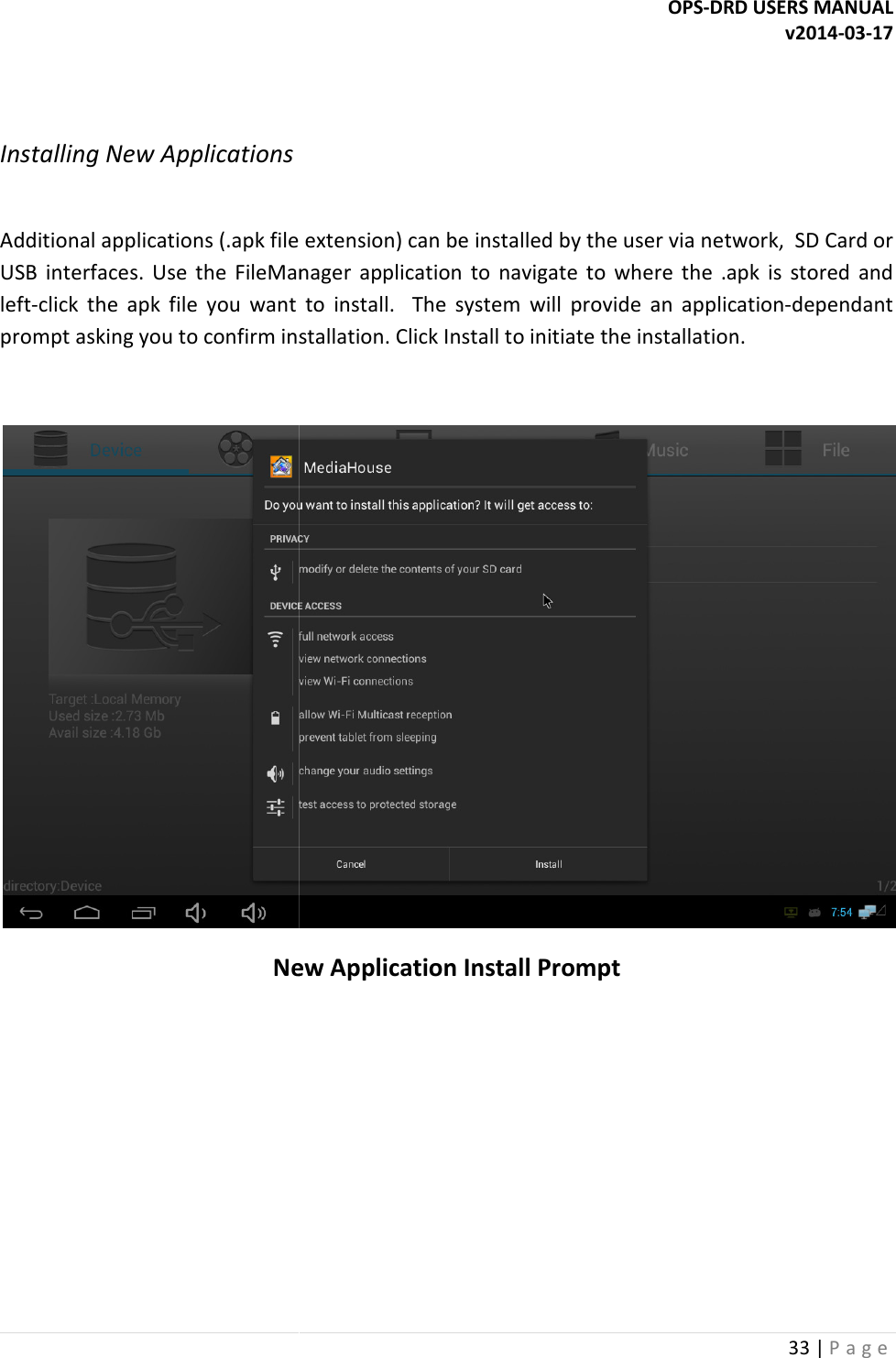
 Installing New Applications  Additional applications (.apk file extension) can be installed by the user viaUSB  interfaces. Use  the  FileManager  application  to  navigate  to  where  the  .apk  is  stored  and left-click  the  apk  file you  want  to  install.    The  system  will  provide  an  applicationprompt asking you to confirm installation. Click  New Application Install Prompt   OPS-DRD USERS MANUAL  Additional applications (.apk file extension) can be installed by the user via network,  SD Card or Use  the  FileManager  application  to  navigate  to  where  the  .apk  is  stored  and you  want  to  install.    The  system  will  provide  an  applicationprompt asking you to confirm installation. Click Install to initiate the installation. New Application Install Prompt DRD USERS MANUAL v2014-03-17 33 | P a g e  network,  SD Card or Use  the  FileManager  application  to  navigate  to  where  the  .apk  is  stored  and you  want  to  install.    The  system  will  provide  an  application-dependant to initiate the installation.
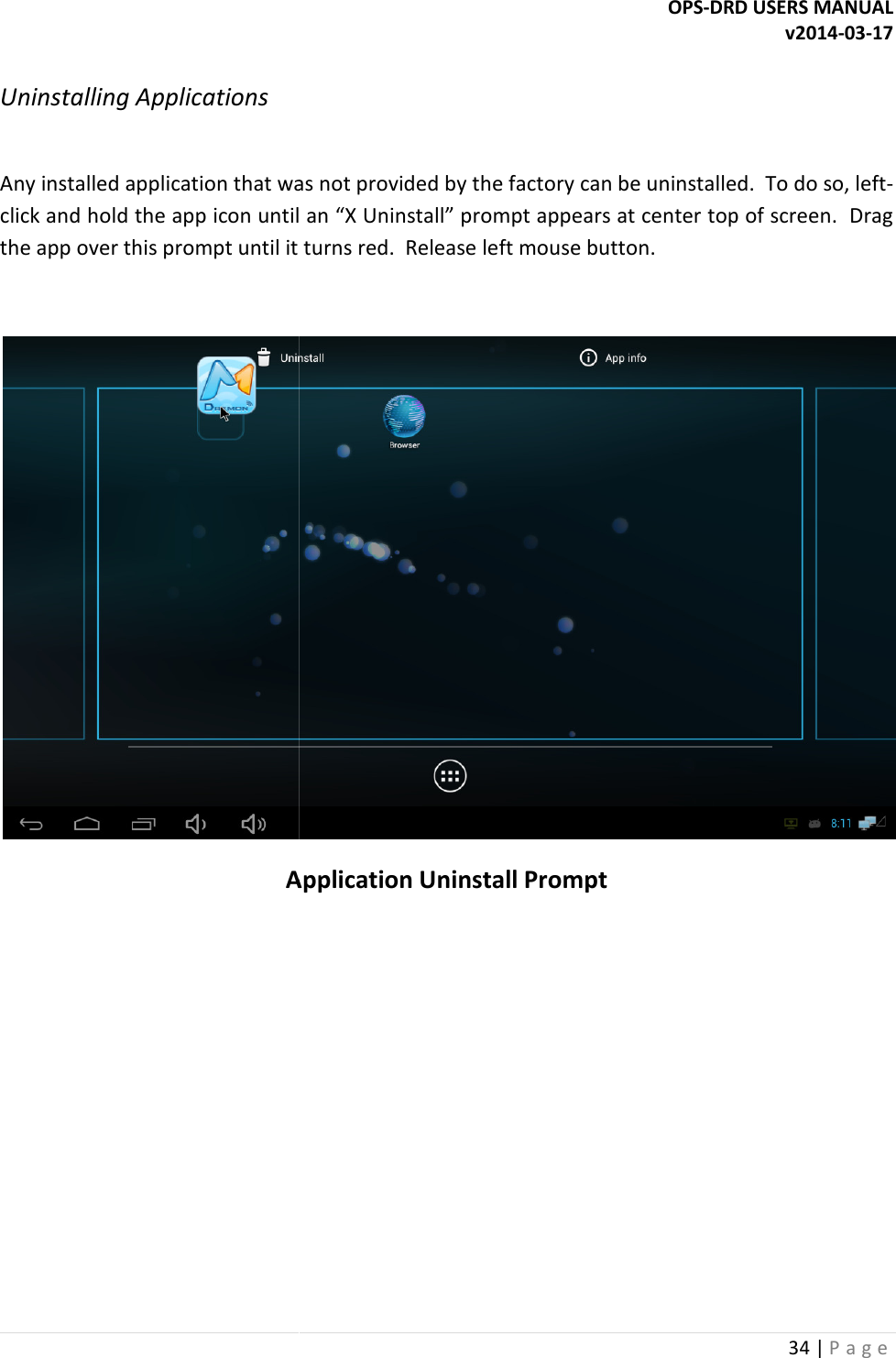
 Uninstalling Applications  Any installed application that was not provided by the factory can be click and hold the app icon until an “X Uninstall” prompt appears at center top of screen.  Drag the app over this prompt until it turns red.  Release left m Application    OPS-DRD USERS MANUALAny installed application that was not provided by the factory can be uninstalledclick and hold the app icon until an “X Uninstall” prompt appears at center top of screen.  Drag the app over this prompt until it turns red.  Release left mouse button.   Application Uninstall Prompt DRD USERS MANUAL v2014-03-17 34 | P a g e  uninstalled.  To do so, left-click and hold the app icon until an “X Uninstall” prompt appears at center top of screen.  Drag
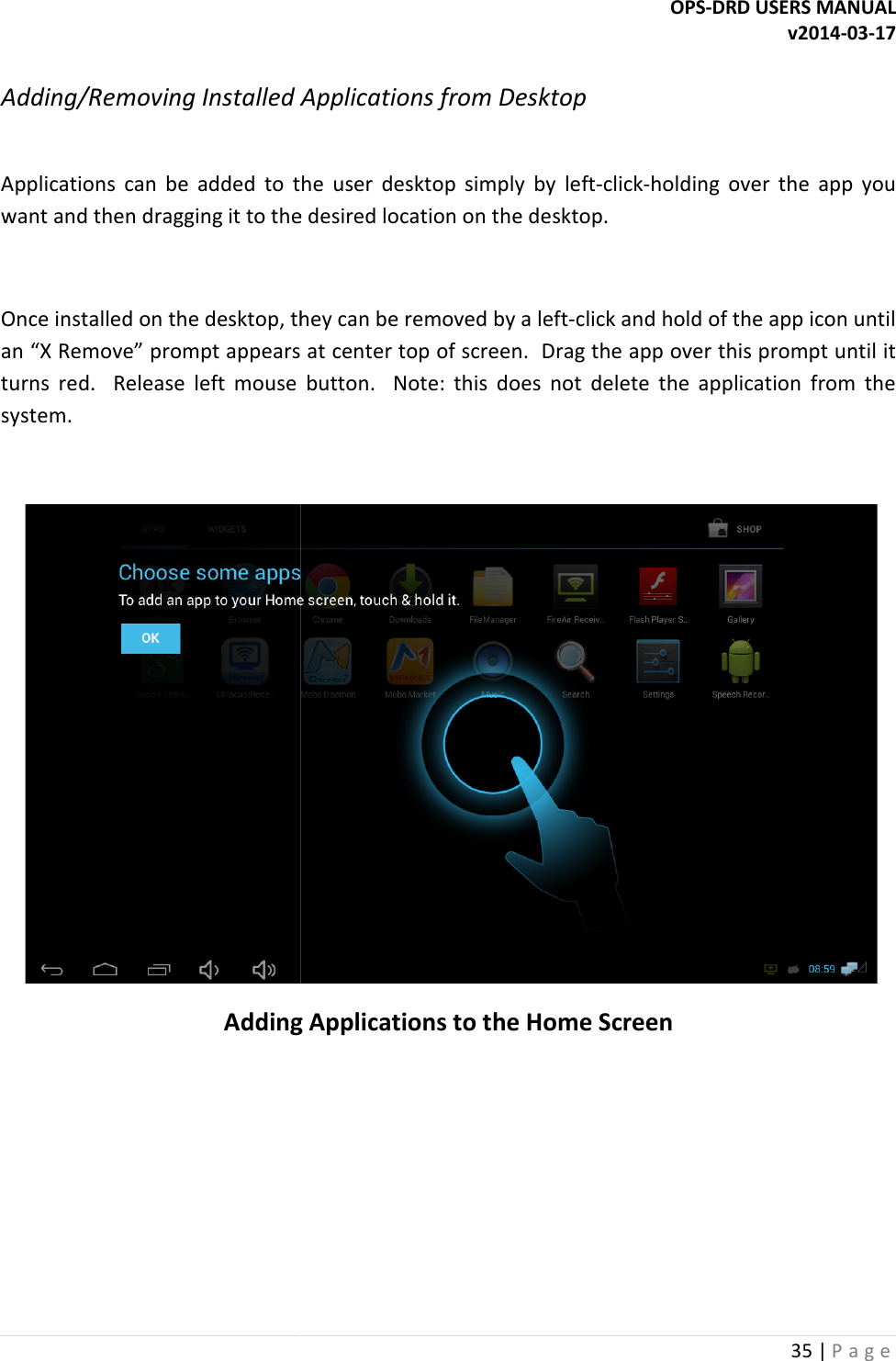
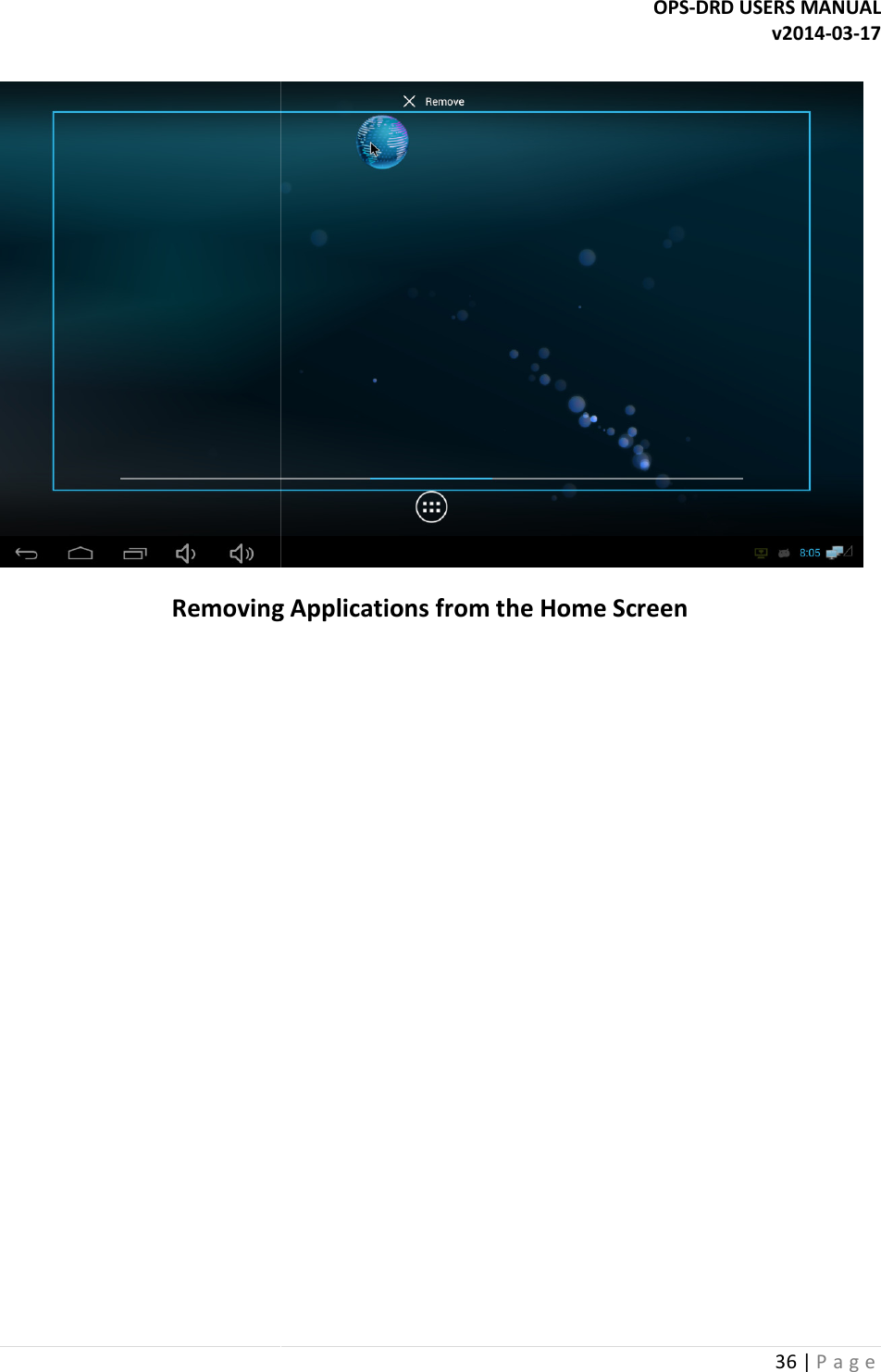
 Adding/Removing Installed Applications from Desktop Applications  can  be  added  to  the  user  desktop  simply  by  leftwant and then dragging it to the desired location on the  Once installed on the desktop, they can be removed by a leftan “X Remove” prompt appears at center top of screen.  Drag the app over this prompt until it turns  red.    Release  left  mouse  button.    Note:  this  doesystem.  Adding Applications to OPS-DRD USERS MANUALInstalled Applications from Desktop Applications  can  be  added  to  the  user  desktop  simply  by  left-click-holding  over  the  app  you want and then dragging it to the desired location on the desktop. Once installed on the desktop, they can be removed by a left-click and hold of the app icon until an “X Remove” prompt appears at center top of screen.  Drag the app over this prompt until it turns  red.    Release  left  mouse  button.    Note:  this  does  not  delete  the  application  from  the Adding Applications to the Home Screen DRD USERS MANUAL v2014-03-17 35 | P a g e  holding  over  the  app  you click and hold of the app icon until an “X Remove” prompt appears at center top of screen.  Drag the app over this prompt until it s  not  delete  the  application  from  the
 Removing Applications from  OPS-DRD USERS MANUALRemoving Applications from the Home Screen  DRD USERS MANUAL v2014-03-17 36 | P a g e
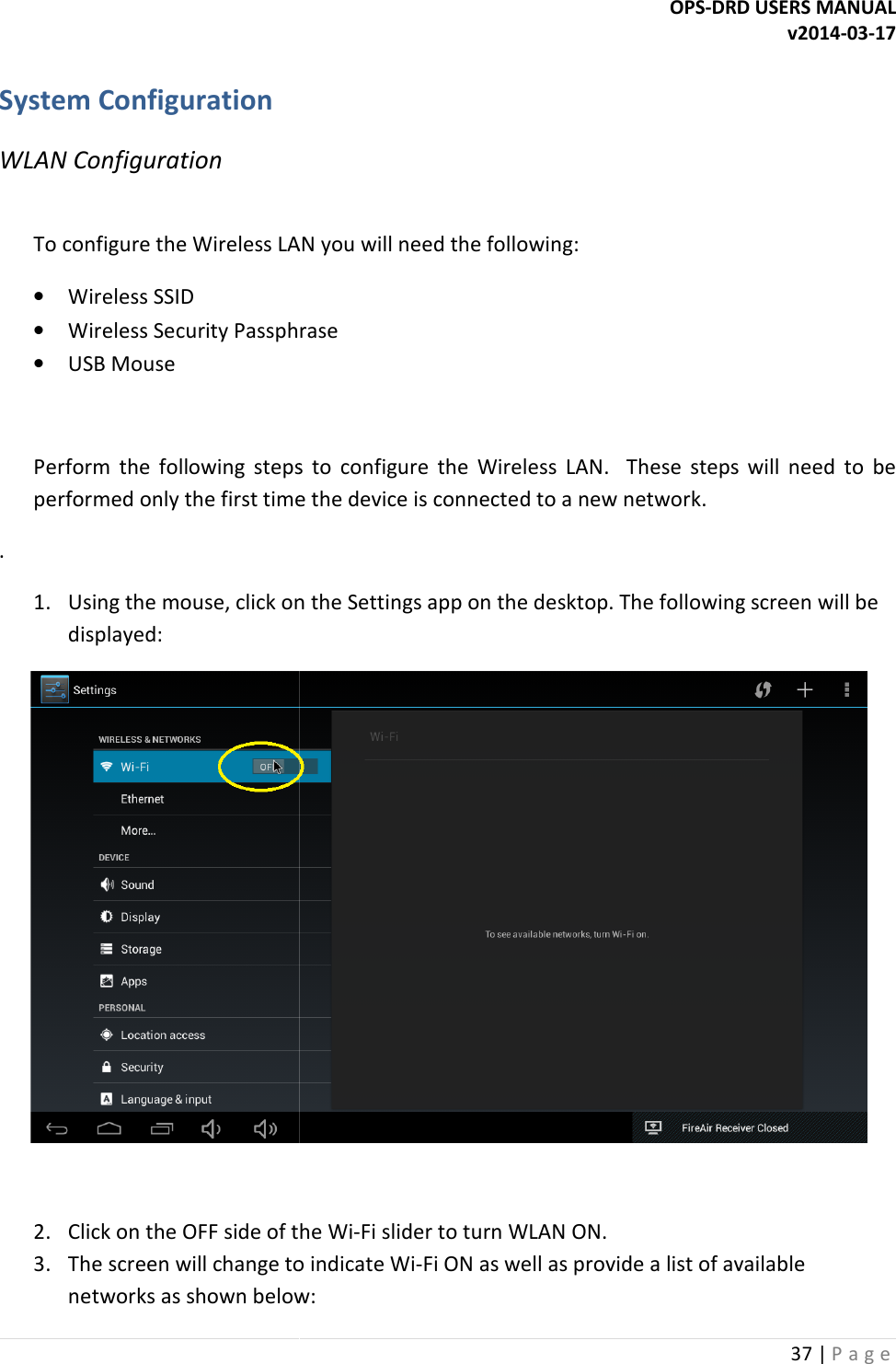
 System Configuration WLAN Configuration  To configure the Wireless LAN you will need the following:• Wireless SSID • Wireless Security Passphrase• USB Mouse  Perform  the  following  steps  to  configure  the  Wireless  LAN.    These  steps  will  need  to  be performed only the first time the device is connected to a new network.. 1. Using the mouse, click on the Settings app on the displayed:  2. Click on the OFF side of the Wi3. The screen will change to indicate Winetworks as shown below:OPS-DRD USERS MANUALTo configure the Wireless LAN you will need the following: Wireless Security Passphrase Perform  the  following  steps  to  configure  the  Wireless  LAN.    These  steps  will  need  to  be performed only the first time the device is connected to a new network. Using the mouse, click on the Settings app on the desktop. The following screen will be Click on the OFF side of the Wi-Fi slider to turn WLAN ON. The screen will change to indicate Wi-Fi ON as well as provide a list of available networks as shown below: DRD USERS MANUAL v2014-03-17 37 | P a g e  Perform  the  following  steps  to  configure  the  Wireless  LAN.    These  steps  will  need  to  be desktop. The following screen will be  Fi ON as well as provide a list of available
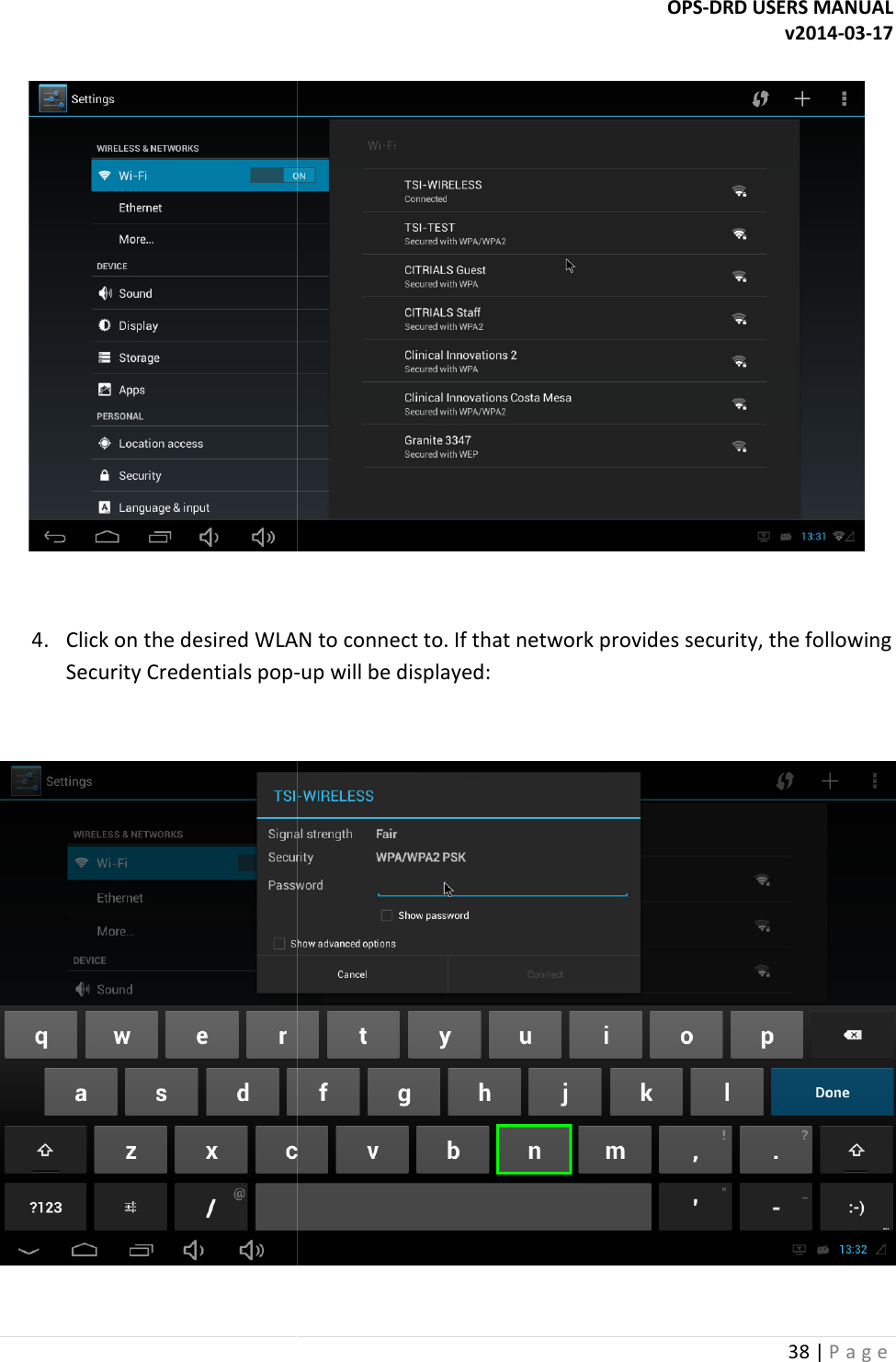
  4. Click on the desired WLAN to conneSecurity Credentials pop-  OPS-DRD USERS MANUALClick on the desired WLAN to connect to. If that network provides security, the following -up will be displayed: DRD USERS MANUAL v2014-03-17 38 | P a g e   ct to. If that network provides security, the following
 5. Use the on-screen keyboard to enter your networks security passphrase.6. Click [DONE] when complete.7. After successfully connecting the WLAN, the Settinstatus as shown below:  LAN Configuration  To configure the LAN you will need the following:• Ethernet Cable • USB Mouse  Perform the following steps to configure the LAN.  These steps will need to be performed only the first time the device is connected to a new network. 1. Using the mouse, click on the Settings app on the desktop. The following screen will be displayed: OPS-DRD USERS MANUALscreen keyboard to enter your networks security passphrase.Click [DONE] when complete. After successfully connecting the WLAN, the Setting screen will show a “Connected” To configure the LAN you will need the following: Perform the following steps to configure the LAN.  These steps will need to be performed only first time the device is connected to a new network. Using the mouse, click on the Settings app on the desktop. The following screen will be DRD USERS MANUAL v2014-03-17 39 | P a g e  screen keyboard to enter your networks security passphrase. g screen will show a “Connected”  Perform the following steps to configure the LAN.  These steps will need to be performed only Using the mouse, click on the Settings app on the desktop. The following screen will be
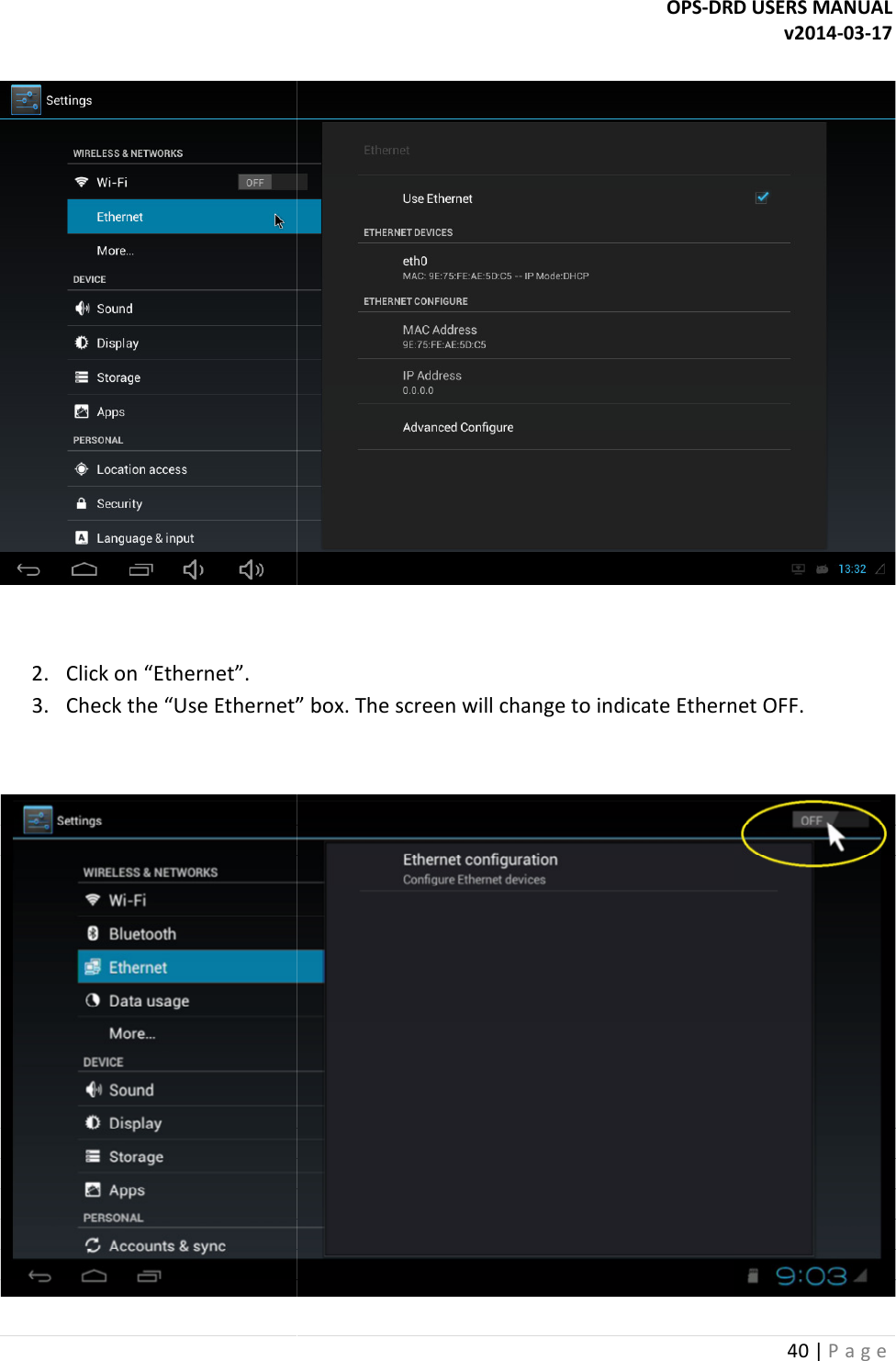
  2. Click on “Ethernet”.  3. Check the “Use Ethernet” box OPS-DRD USERS MANUALCheck the “Use Ethernet” box. The screen will change to indicate Ethernet OFF.DRD USERS MANUAL v2014-03-17 40 | P a g e   The screen will change to indicate Ethernet OFF.
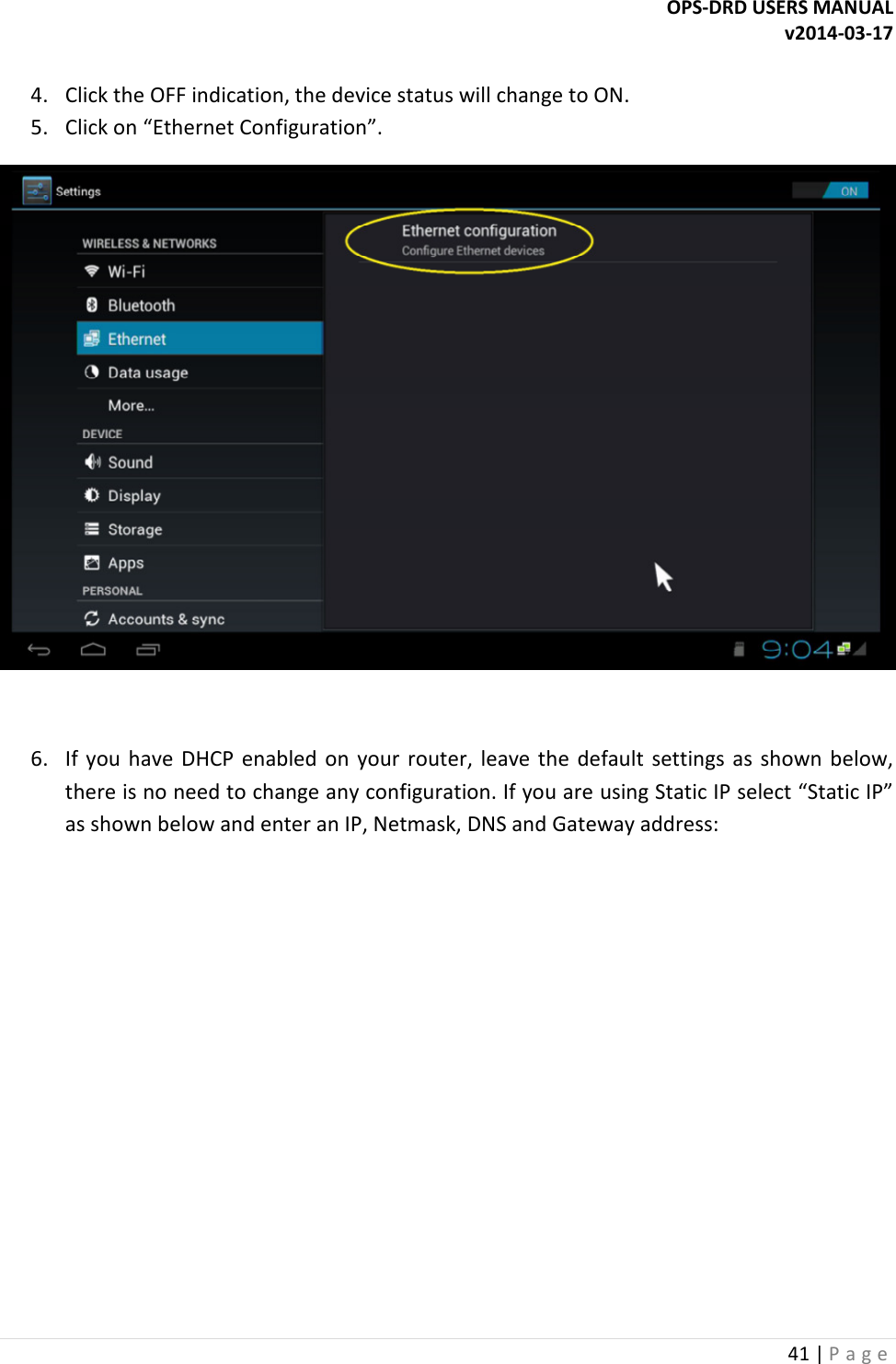
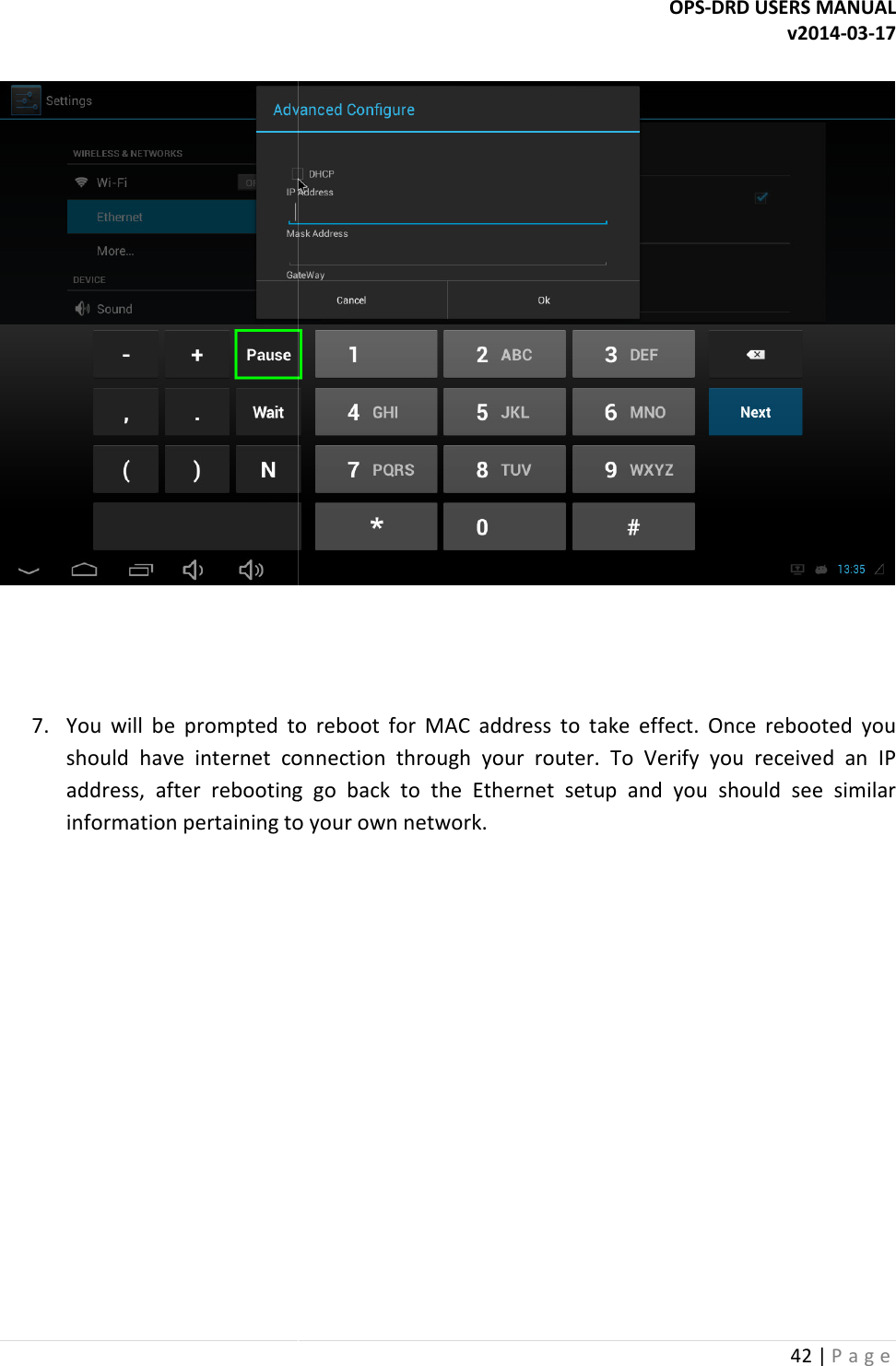
OPS-DRD USERS MANUAL v2014-03-17 41 | P a g e   4. Click the OFF indication, the device status will change to ON. 5. Click on “Ethernet Configuration”.   6. If  you  have  DHCP  enabled  on  your  router,  leave the  default  settings as  shown  below, there is no need to change any configuration. If you are using Static IP select “Static IP” as shown below and enter an IP, Netmask, DNS and Gateway address:
   7. You  will  be  prompted  to  reboot  for  MAC  address  to  take  effect.  Once  rebooted  you should  have  internet  connection  through  your  router.  To  Verify  you  received  an address,  after  rebooting  go  back  to  the  Ethernet  setup  and  you  should  see  similar information pertaining to your own network     OPS-DRD USERS MANUALYou  will  be  prompted  to  reboot  for  MAC  address  to  take  effect.  Once  rebooted  you should  have  internet  connection  through  your  router.  To  Verify  you  received  an address,  after  rebooting  go  back  to  the  Ethernet  setup  and  you  should  see  similar information pertaining to your own network.  DRD USERS MANUAL v2014-03-17 42 | P a g e   You  will  be  prompted  to  reboot  for  MAC  address  to  take  effect.  Once  rebooted  you should  have  internet  connection  through  your  router.  To  Verify  you  received  an IP address,  after  rebooting  go  back  to  the  Ethernet  setup  and  you  should  see  similar
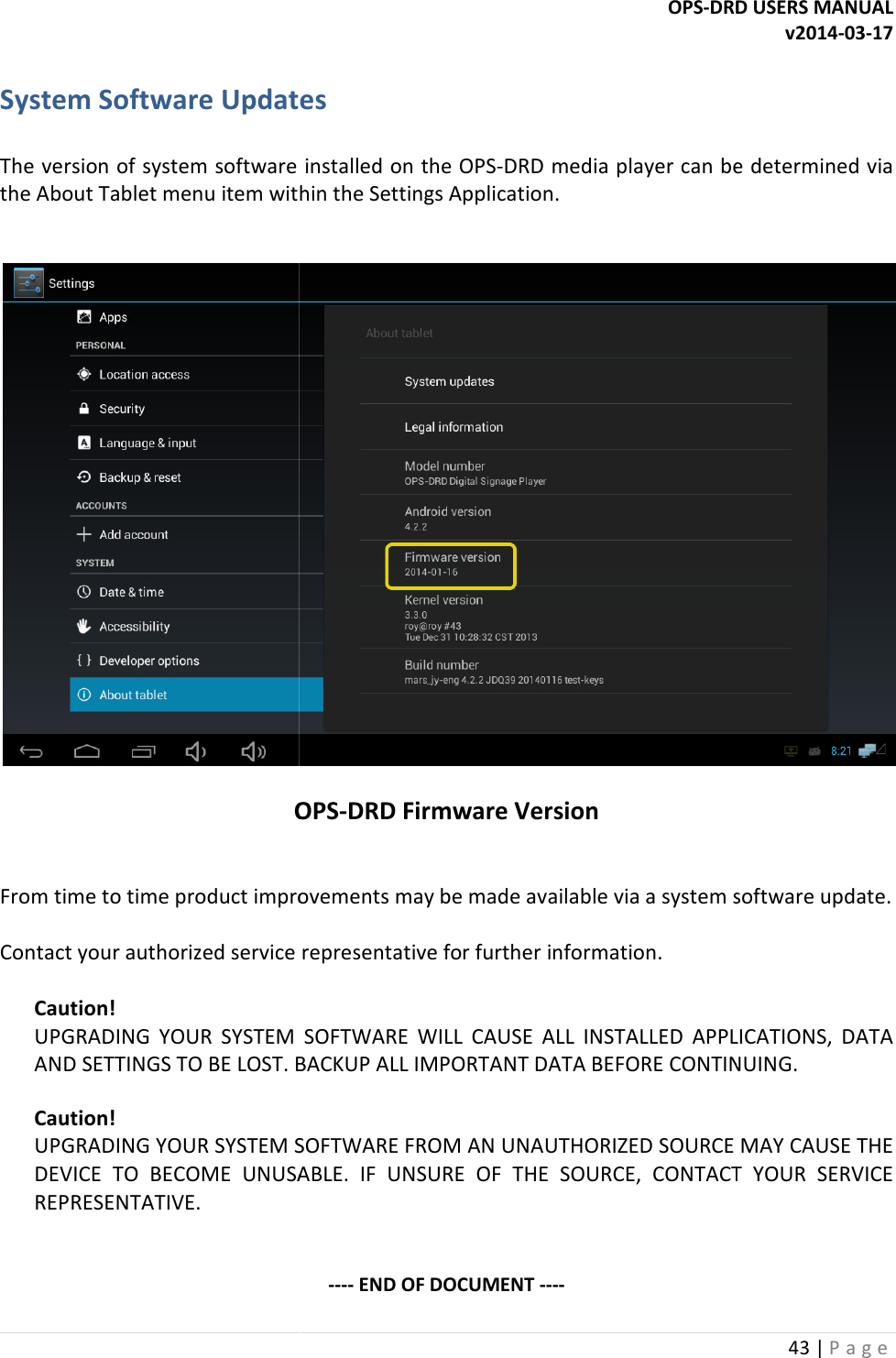
 System Software Updates  The version of system software installed on the OPSthe About Tablet menu item within   OPS  From time to time product improvements may be made available via a system software update.   Contact your authorized service representative for further information. Caution! UPGRADING  YOUR  SYSTEM  SOFTWARE  WILL  CAUSE  ALL  INSTALLED  APPLICATIONS,  DATA AND SETTINGS TO BE LOST. BACKUP ALL IMPORTANT DATA BEFORE CONTINUING. Caution! UPGRADING YOUR SYSTEM SOFTWARE FROM AN UNAUTHORIZED SOURCE MAY CAUSE THE DEVICE  TO  BECOME  UNUSABLE.  IF  UNSURE  OF  THE  SOURCE,  CONTACT  YOUR  SERVICE REPRESENTATIVE.   OPS-DRD USERS MANUALSystem Software Updates The version of system software installed on the OPS-DRD media player can be determined via About Tablet menu item within the Settings Application.  OPS-DRD Firmware Version From time to time product improvements may be made available via a system software update.  Contact your authorized service representative for further information. UPGRADING  YOUR  SYSTEM  SOFTWARE  WILL  CAUSE  ALL  INSTALLED  APPLICATIONS,  DATA AND SETTINGS TO BE LOST. BACKUP ALL IMPORTANT DATA BEFORE CONTINUING.UPGRADING YOUR SYSTEM SOFTWARE FROM AN UNAUTHORIZED SOURCE MAY CAUSE THE USABLE.  IF  UNSURE  OF  THE  SOURCE,  CONTACT  YOUR  SERVICE ---- END OF DOCUMENT ---- DRD USERS MANUAL v2014-03-17 43 | P a g e  can be determined via  From time to time product improvements may be made available via a system software update.   UPGRADING  YOUR  SYSTEM  SOFTWARE  WILL  CAUSE  ALL  INSTALLED  APPLICATIONS,  DATA AND SETTINGS TO BE LOST. BACKUP ALL IMPORTANT DATA BEFORE CONTINUING. UPGRADING YOUR SYSTEM SOFTWARE FROM AN UNAUTHORIZED SOURCE MAY CAUSE THE USABLE.  IF  UNSURE  OF  THE  SOURCE,  CONTACT  YOUR  SERVICE

Navigation menu