Testo SE and KGaA 0572202X WLAN data logger User Manual 0970 1600 de en zh 01

Testo SE & Co. KGaA WLAN data logger 0970 1600 de en zh 01

user manual

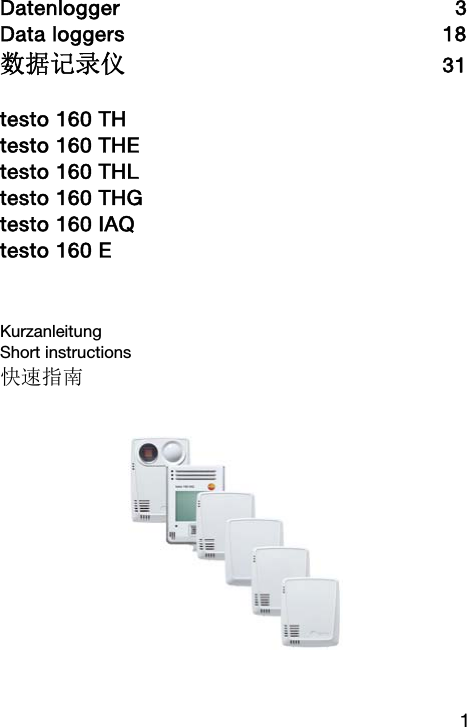
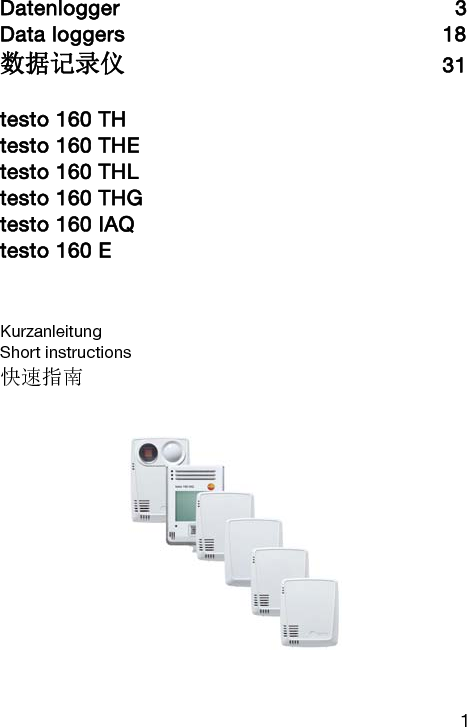
1  Datenlogger        3 Data loggers     18 数据记录仪      31  testo 160 TH testo 160 THE testo 160 THL testo 160 THG testo 160 IAQ testo 160 E  Kurzanleitung Short instructions 快速指南
2
3 Lesen Sie diese Bedienungsanleitung aufmerksam durch und machen Sie sich mit dem Produkt vertraut, bevor Sie es einsetzen. Eine detaillierte Anleitung finden Sie im Login-Bereich der jeweiligen Testo Lösung auf: www.testo.com/login. 1 Sicherheit und Entsorgung 1.1 Zu diesem Dokument Verwendung  Die Bedienungsanleitung ist Bestandteil des Geräts.   Beachten Sie besonders die Sicherheits- und Warnhinweise, um Verletzungen und Produktschäden vorzubeugen.  Bewahren Sie diese Dokumentation griffbereit auf, um bei Bedarf nachschlagen zu können.  Verwenden Sie stets das vollständige Original dieser Bedienungsanleitung.   Geben Sie diese Dokumentation an spätere Nutzer des Produktes weiter.  Um bestimmte Funktionen dieses Gerätes (vor allem das Messdaten-Management) nutzen zu können, müssen Sie den testo Cloud-Nutzungsbedingungen zustimmen, die Sie unter dem Login der jeweiligen testo Anwendung auf www.testo.com/login finden.  1.2 Sicherheit Allgemeine Sicherheitshinweise  Verwenden Sie das Produkt nur sach- und bestimmungsgemäß und innerhalb der in den technischen Daten vorgegebenen Parameter. Wenden Sie keine Gewalt an.  Nehmen Sie das Gerät nicht in Betrieb, wenn es Beschädigungen am Gehäuse aufweist.  Auch von den zu messenden Anlagen bzw. dem Messumfeld können Gefahren ausgehen: Beachten Sie bei der Durchführung von Messungen die vor Ort gültigen Sicherheitsbestimmungen.
4  Temperaturangaben auf Sonden/Fühlern beziehen sich nur auf den Messbereich der Sensorik. Setzen Sie Handgriffe und Zuleitungen keinen Temperaturen über 70 °C (158 °F) aus, wenn diese nicht ausdrücklich für höhere Temperaturen zugelassen sind.  Führen Sie keine Kontakt-Messungen an nicht isolierten, spannungsführenden Teilen durch.  Lagern Sie das Produkt nicht zusammen mit Lösungsmitteln. Verwenden Sie keine Trockenmittel.  Führen Sie nur Wartungs- und Instandhaltungsarbeiten an diesem Gerät durch, die in der Dokumentation beschrieben sind. Halten Sie sich dabei an die vorgegebenen Handlungsschritte. Verwenden Sie nur Original-Ersatzteile von Testo. Batterien  Die unsachgemäße Verwendung von Batterien kann zur Zerstörung der Batterien, Verletzungen durch Stromstöße, Feuer oder zum Auslaufen von chemischen Flüssigkeiten führen.   Setzen Sie die mitgelieferten Batterien nur entsprechend den Anweisungen in der Bedienungsanleitung ein.   Schließen Sie die Batterien nicht kurz.   Nehmen Sie die Batterien nicht auseinander und modifizieren Sie sie nicht.   Setzen Sie die Batterien nicht starken Stößen, Wasser, Feuer oder Temperaturen über 60 °C aus.   Lagern Sie die Batterien nicht in der Nähe von metallischen Gegenständen.   Bei Kontakt mit Batterieflüssigkeit: Waschen Sie die betroffenen Regionen gründlich mit Wasser aus und konsultieren Sie gegebenenfalls einen Arzt.   Verwenden Sie keine undichten oder beschädigten Batterien.  1.3 Warnhinweise Beachten Sie stets Informationen, die durch folgende Warnhinweise mit Warnpiktogrammen gekennzeichnet sind. Treffen Sie die angegebenen Vorsichtsmaßnahmen!
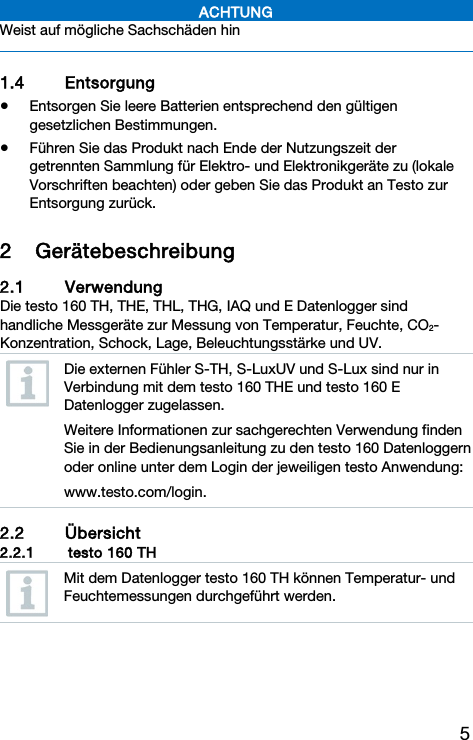
5 ACHTUNG Weist auf mögliche Sachschäden hin   1.4 Entsorgung  Entsorgen Sie leere Batterien entsprechend den gültigen gesetzlichen Bestimmungen.  Führen Sie das Produkt nach Ende der Nutzungszeit der getrennten Sammlung für Elektro- und Elektronikgeräte zu (lokale Vorschriften beachten) oder geben Sie das Produkt an Testo zur Entsorgung zurück.  2 Gerätebeschreibung 2.1 Verwendung Die testo 160 TH, THE, THL, THG, IAQ und E Datenlogger sind handliche Messgeräte zur Messung von Temperatur, Feuchte, CO2-Konzentration, Schock, Lage, Beleuchtungsstärke und UV.  Die externen Fühler S-TH, S-LuxUV und S-Lux sind nur in Verbindung mit dem testo 160 THE und testo 160 E Datenlogger zugelassen. Weitere Informationen zur sachgerechten Verwendung finden Sie in der Bedienungsanleitung zu den testo 160 Datenloggern oder online unter dem Login der jeweiligen testo Anwendung: www.testo.com/login.  2.2 Übersicht 2.2.1   testo 160 TH  Mit dem Datenlogger testo 160 TH können Temperatur- und Feuchtemessungen durchgeführt werden.
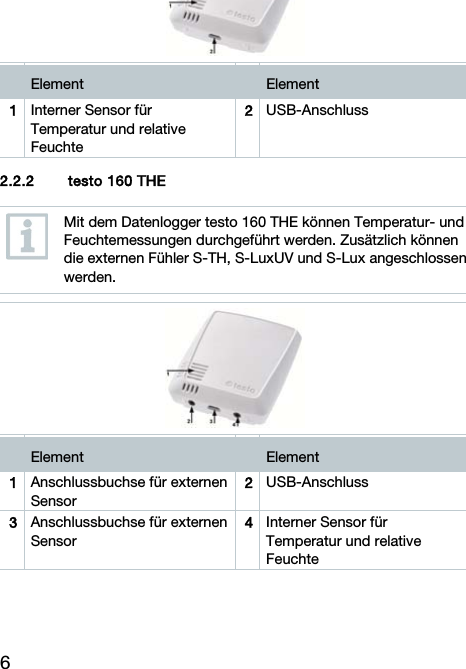
6    Element   Element 1  Interner Sensor für Temperatur und relative Feuchte 2USB-Anschluss  2.2.2   testo 160 THE    Mit dem Datenlogger testo 160 THE können Temperatur- und Feuchtemessungen durchgeführt werden. Zusätzlich können die externen Fühler S-TH, S-LuxUV und S-Lux angeschlossen werden.     Element   Element 1  Anschlussbuchse für externen Sensor 2USB-Anschluss 3  Anschlussbuchse für externen Sensor 4Interner Sensor für Temperatur und relative Feuchte
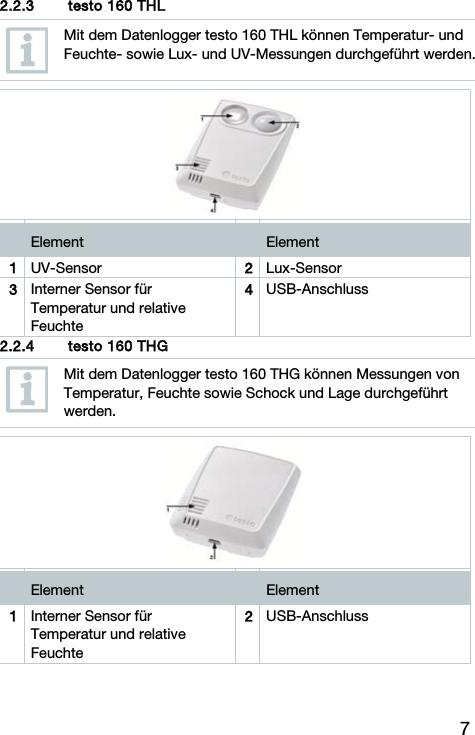
7  2.2.3   testo 160 THL     Mit dem Datenlogger testo 160 THL können Temperatur- und Feuchte- sowie Lux- und UV-Messungen durchgeführt werden.   Element   Element 1  UV-Sensor  2Lux-Sensor 3  Interner Sensor für Temperatur und relative Feuchte 4USB-Anschluss 2.2.4   testo 160 THG    Mit dem Datenlogger testo 160 THG können Messungen von Temperatur, Feuchte sowie Schock und Lage durchgeführt werden.    Element   Element 1  Interner Sensor für Temperatur und relative Feuchte 2USB-Anschluss
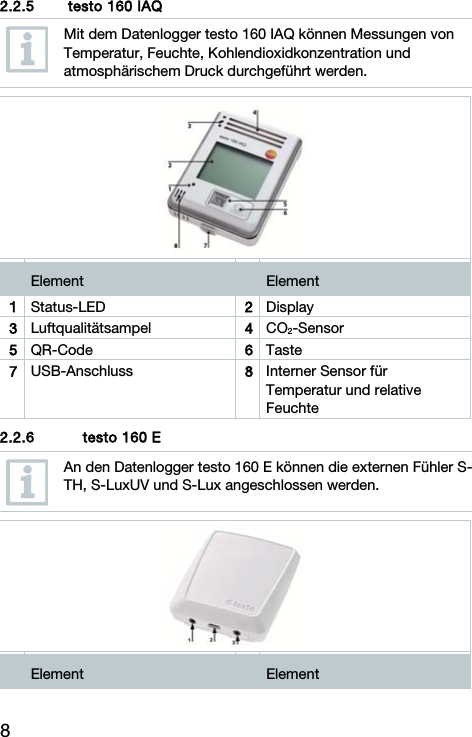
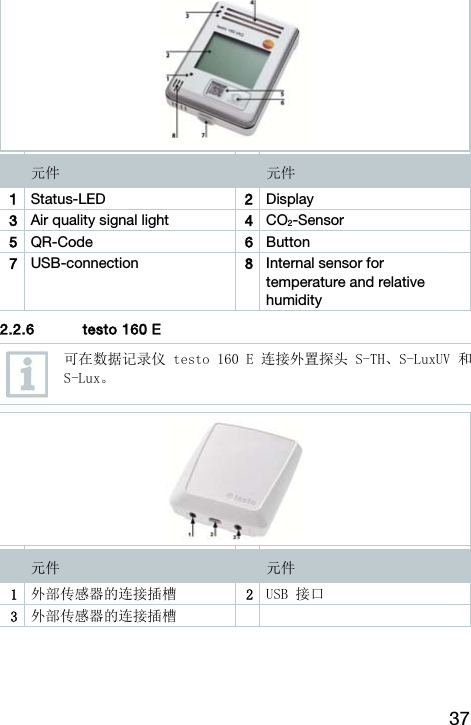
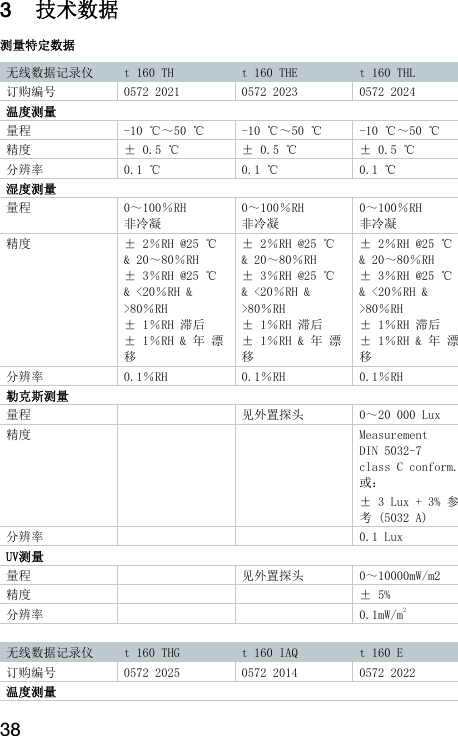
8 2.2.5   testo 160 IAQ    Mit dem Datenlogger testo 160 IAQ können Messungen von Temperatur, Feuchte, Kohlendioxidkonzentration und atmosphärischem Druck durchgeführt werden.     Element   Element 1  Status-LED  2Display 3  Luftqualitätsampel  4CO2-Sensor 5  QR-Code  6Taste 7  USB-Anschluss  8Interner Sensor für Temperatur und relative Feuchte   2.2.6 testo 160 E     An den Datenlogger testo 160 E können die externen Fühler S-TH, S-LuxUV und S-Lux angeschlossen werden.     Element   Element
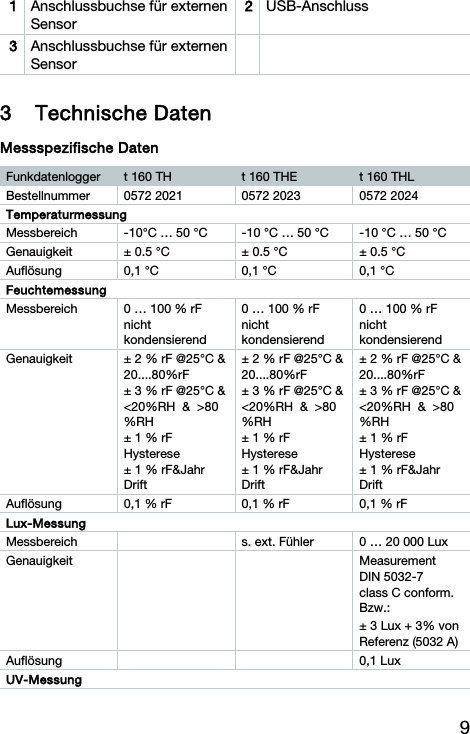
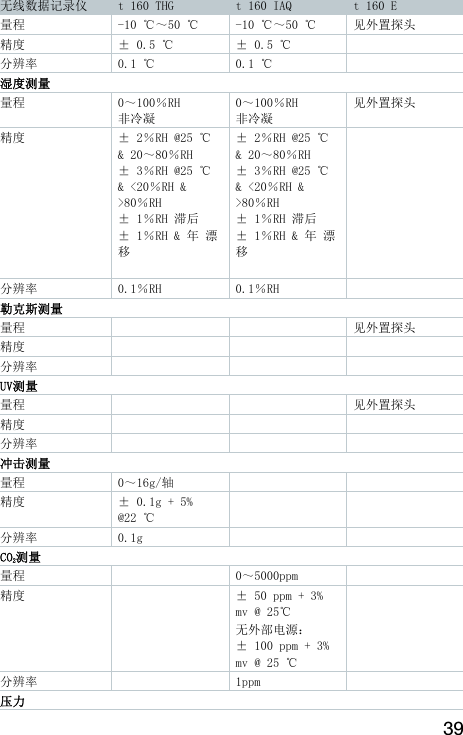
9 1  Anschlussbuchse für externen Sensor 2USB-Anschluss 3  Anschlussbuchse für externen Sensor  3 Technische Daten Messspezifische Daten Funkdatenlogger  t 160 TH  t 160 THE  t 160 THL Bestellnummer  0572 2021  0572 2023  0572 2024 Temperaturmessung Messbereich  -10°C … 50 °C  -10 °C … 50 °C  -10 °C … 50 °C Genauigkeit  ± 0.5 °C  ± 0.5 °C  ± 0.5 °C Auflösung  0,1 °C  0,1 °C  0,1 °C Feuchtemessung Messbereich  0 … 100 % rF nicht kondensierend 0 … 100 % rF nicht kondensierend 0 … 100 % rF nicht kondensierend Genauigkeit  ± 2 % rF @25°C & 20....80%rF ± 3 % rF @25°C & <20%RH  &  >80%RH ± 1 % rF Hysterese ± 1 % rF&Jahr Drift ± 2 % rF @25°C & 20....80%rF ± 3 % rF @25°C & <20%RH  &  >80%RH ± 1 % rF Hysterese ± 1 % rF&Jahr Drift ± 2 % rF @25°C & 20....80%rF ± 3 % rF @25°C & <20%RH  &  >80%RH ± 1 % rF Hysterese ± 1 % rF&Jahr Drift Auflösung  0,1 % rF  0,1 % rF  0,1 % rF Lux-Messung Messbereich    s. ext. Fühler  0 … 20 000 Lux Genauigkeit   Measurement  DIN 5032-7  class C conform. Bzw.: ± 3 Lux + 3% von Referenz (5032 A) Auflösung   0,1 Lux UV-Messung
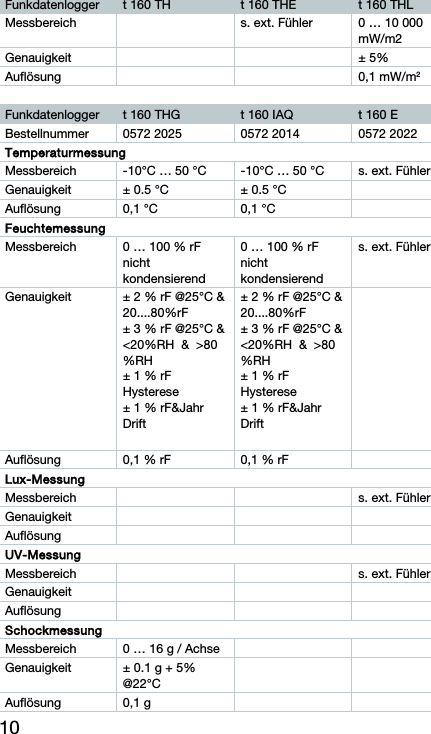
10 Funkdatenlogger  t 160 TH  t 160 THE  t 160 THL Messbereich    s. ext. Fühler  0 … 10 000 mW/m2 Genauigkeit   ± 5% Auflösung   0,1 mW/m2  Funkdatenlogger  t 160 THG  t 160 IAQ  t 160 E Bestellnummer  0572 2025  0572 2014  0572 2022 Temperaturmessung Messbereich  -10°C … 50 °C  -10°C … 50 °C  s. ext. Fühler Genauigkeit  ± 0.5 °C  ± 0.5 °C   Auflösung  0,1 °C  0,1 °C   Feuchtemessung Messbereich  0 … 100 % rF nicht kondensierend 0 … 100 % rF nicht kondensierend s. ext. Fühler Genauigkeit  ± 2 % rF @25°C & 20....80%rF ± 3 % rF @25°C & <20%RH  &  >80%RH ± 1 % rF Hysterese ± 1 % rF&Jahr Drift  ± 2 % rF @25°C & 20....80%rF ± 3 % rF @25°C & <20%RH  &  >80%RH ± 1 % rF Hysterese ± 1 % rF&Jahr Drift   Auflösung  0,1 % rF  0,1 % rF   Lux-Messung Messbereich   s. ext. Fühler Genauigkeit    Auflösung    UV-Messung Messbereich   s. ext. Fühler Genauigkeit    Auflösung    Schockmessung Messbereich  0 … 16 g / Achse     Genauigkeit  ± 0.1 g + 5% @22°C   Auflösung 0,1 g
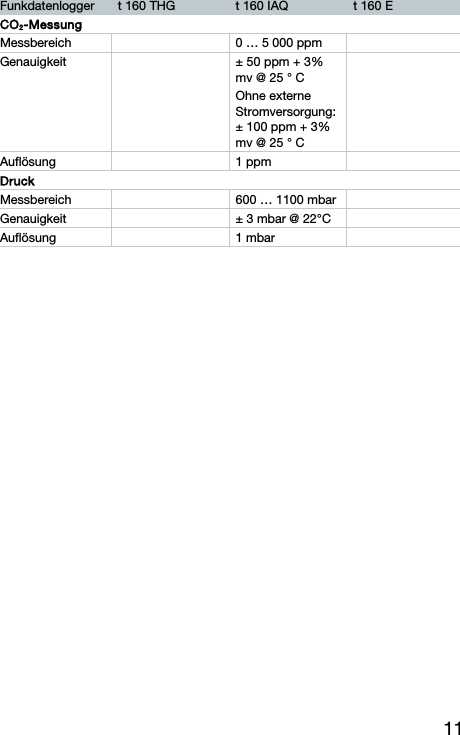
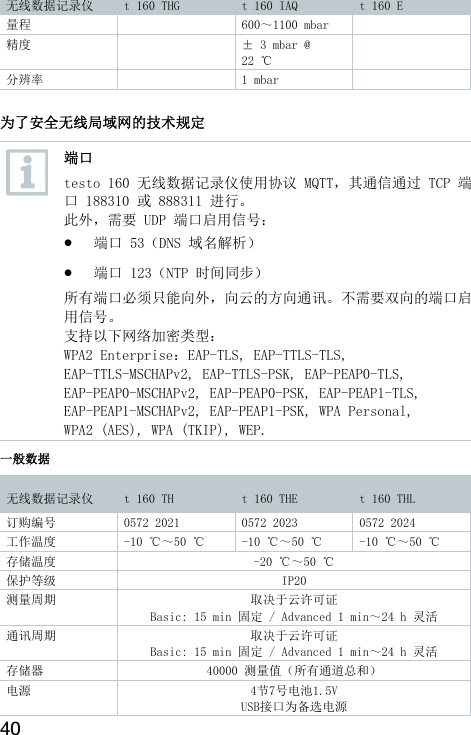
11 Funkdatenlogger  t 160 THG  t 160 IAQ  t 160 E CO2-Messung Messbereich    0 … 5 000 ppm    Genauigkeit    ± 50 ppm + 3% mv @ 25 ° C Ohne externe Stromversorgung: ± 100 ppm + 3% mv @ 25 ° C  Auflösung   1 ppm   Druck Messbereich    600 … 1100 mbar   Genauigkeit    ± 3 mbar @ 22°C   Auflösung   1 mbar
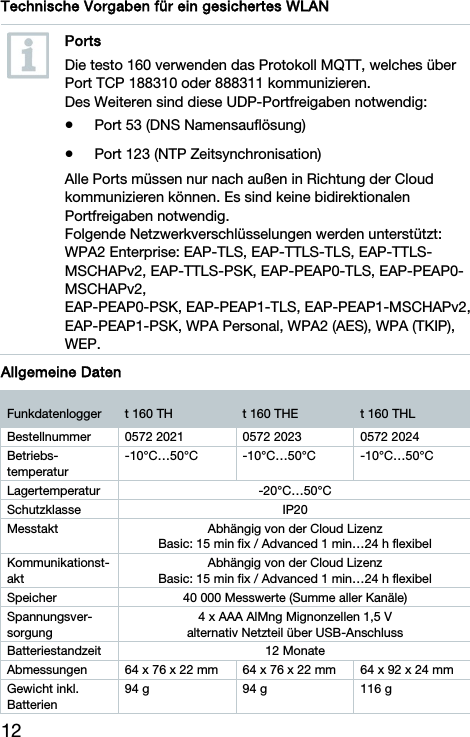
12 Technische Vorgaben für ein gesichertes WLAN  Ports Die testo 160 verwenden das Protokoll MQTT, welches über Port TCP 188310 oder 888311 kommunizieren. Des Weiteren sind diese UDP-Portfreigaben notwendig:  Port 53 (DNS Namensauflösung)  Port 123 (NTP Zeitsynchronisation) Alle Ports müssen nur nach außen in Richtung der Cloud kommunizieren können. Es sind keine bidirektionalen Portfreigaben notwendig. Folgende Netzwerkverschlüsselungen werden unterstützt:  WPA2 Enterprise: EAP-TLS, EAP-TTLS-TLS, EAP-TTLS-MSCHAPv2, EAP-TTLS-PSK, EAP-PEAP0-TLS, EAP-PEAP0-MSCHAPv2,  EAP-PEAP0-PSK, EAP-PEAP1-TLS, EAP-PEAP1-MSCHAPv2, EAP-PEAP1-PSK, WPA Personal, WPA2 (AES), WPA (TKIP), WEP.  Allgemeine Daten Funkdatenlogger  t 160 TH  t 160 THE  t 160 THL Bestellnummer  0572 2021  0572 2023  0572 2024 Betriebs-temperatur -10°C…50°C -10°C…50°C -10°C…50°C Lagertemperatur -20°C…50°C Schutzklasse IP20 Messtakt  Abhängig von der Cloud Lizenz Basic: 15 min fix / Advanced 1 min…24 h flexibel Kommunikationst-akt Abhängig von der Cloud Lizenz Basic: 15 min fix / Advanced 1 min…24 h flexibel Speicher  40 000 Messwerte (Summe aller Kanäle) Spannungsver-sorgung 4 x AAA AlMng Mignonzellen 1,5 V alternativ Netzteil über USB-Anschluss Batteriestandzeit 12 Monate Abmessungen  64 x 76 x 22 mm  64 x 76 x 22 mm  64 x 92 x 24 mm Gewicht inkl. Batterien 94 g  94 g  116 g
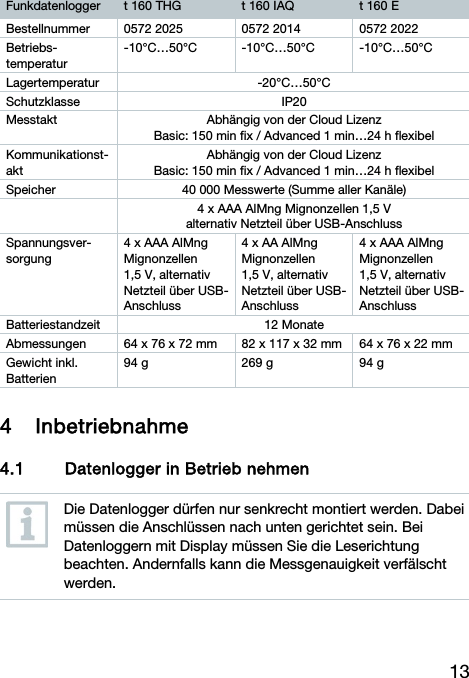
13   Funkdatenlogger  t 160 THG  t 160 IAQ  t 160 E Bestellnummer  0572 2025  0572 2014  0572 2022 Betriebs-temperatur -10°C…50°C -10°C…50°C -10°C…50°C Lagertemperatur -20°C…50°C Schutzklasse IP20 Messtakt  Abhängig von der Cloud Lizenz Basic: 150 min fix / Advanced 1 min…24 h flexibel Kommunikationst-akt Abhängig von der Cloud Lizenz Basic: 150 min fix / Advanced 1 min…24 h flexibel Speicher  40 000 Messwerte (Summe aller Kanäle)   4 x AAA AlMng Mignonzellen 1,5 V alternativ Netzteil über USB-Anschluss Spannungsver-sorgung 4 x AAA AlMng Mignonzellen  1,5 V, alternativ Netzteil über USB-Anschluss 4 x AA AlMng Mignonzellen  1,5 V, alternativ Netzteil über USB-Anschluss 4 x AAA AlMng Mignonzellen  1,5 V, alternativ Netzteil über USB-Anschluss Batteriestandzeit 12 Monate Abmessungen  64 x 76 x 72 mm  82 x 117 x 32 mm  64 x 76 x 22 mm Gewicht inkl. Batterien 94 g  269 g  94 g 4 Inbetriebnahme 4.1 Datenlogger in Betrieb nehmen   Die Datenlogger dürfen nur senkrecht montiert werden. Dabei müssen die Anschlüssen nach unten gerichtet sein. Bei Datenloggern mit Display müssen Sie die Leserichtung beachten. Andernfalls kann die Messgenauigkeit verfälscht werden.
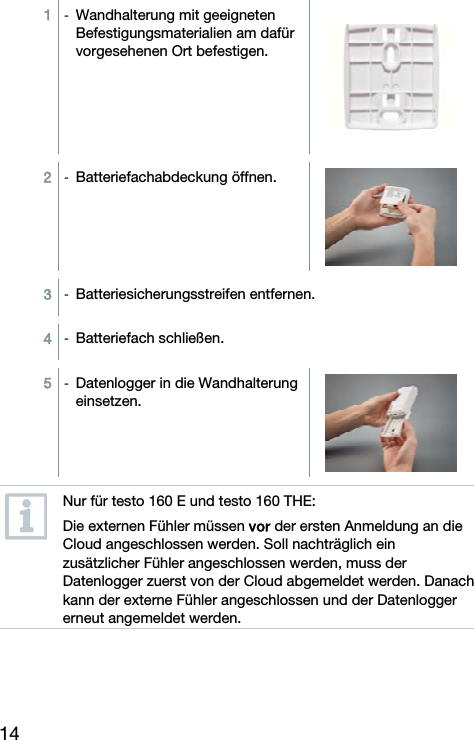
14 1  -  Wandhalterung mit geeigneten Befestigungsmaterialien am dafür vorgesehenen Ort befestigen.  2  -  Batteriefachabdeckung öffnen. 3  -  Batteriesicherungsstreifen entfernen. 4  -  Batteriefach schließen. 5  -  Datenlogger in die Wandhalterung einsetzen.   Nur für testo 160 E und testo 160 THE: Die externen Fühler müssen vor der ersten Anmeldung an die Cloud angeschlossen werden. Soll nachträglich ein zusätzlicher Fühler angeschlossen werden, muss der Datenlogger zuerst von der Cloud abgemeldet werden. Danach kann der externe Fühler angeschlossen und der Datenlogger erneut angemeldet werden.
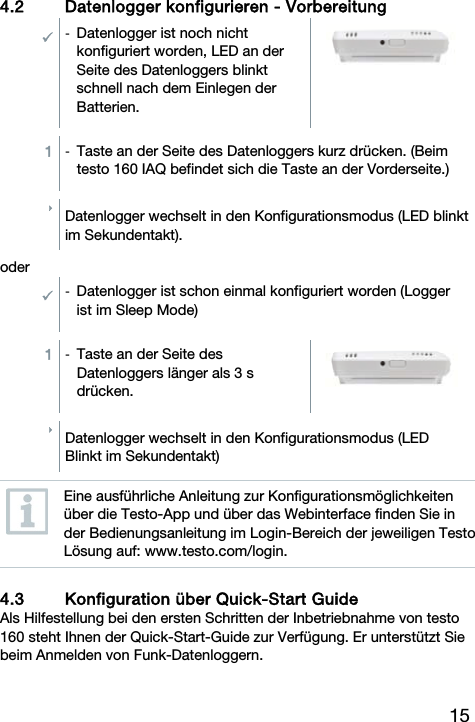
15  4.2 Datenlogger konfigurieren - Vorbereitung  -  Datenlogger ist noch nicht konfiguriert worden, LED an der Seite des Datenloggers blinkt schnell nach dem Einlegen der Batterien.   1  -  Taste an der Seite des Datenloggers kurz drücken. (Beim testo 160 IAQ befindet sich die Taste an der Vorderseite.)  Datenlogger wechselt in den Konfigurationsmodus (LED blinkt im Sekundentakt).  oder -  Datenlogger ist schon einmal konfiguriert worden (Logger ist im Sleep Mode)  1  -  Taste an der Seite des Datenloggers länger als 3 s drücken.    Datenlogger wechselt in den Konfigurationsmodus (LED Blinkt im Sekundentakt)   Eine ausführliche Anleitung zur Konfigurationsmöglichkeiten über die Testo-App und über das Webinterface finden Sie in der Bedienungsanleitung im Login-Bereich der jeweiligen Testo Lösung auf: www.testo.com/login.  4.3 Konfiguration über Quick-Start Guide Als Hilfestellung bei den ersten Schritten der Inbetriebnahme von testo 160 steht Ihnen der Quick-Start-Guide zur Verfügung. Er unterstützt Sie beim Anmelden von Funk-Datenloggern.
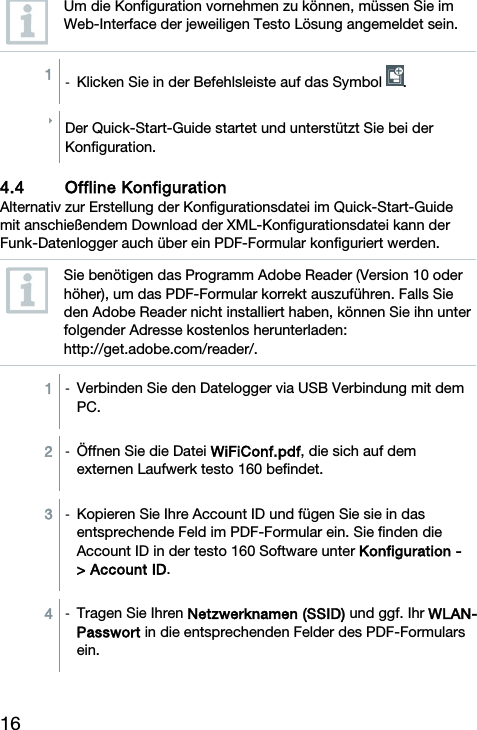
16  Um die Konfiguration vornehmen zu können, müssen Sie im Web-Interface der jeweiligen Testo Lösung angemeldet sein.  1  -  Klicken Sie in der Befehlsleiste auf das Symbol  .  Der Quick-Start-Guide startet und unterstützt Sie bei der Konfiguration.  4.4 Offline Konfiguration Alternativ zur Erstellung der Konfigurationsdatei im Quick-Start-Guide mit anschießendem Download der XML-Konfigurationsdatei kann der Funk-Datenlogger auch über ein PDF-Formular konfiguriert werden.  Sie benötigen das Programm Adobe Reader (Version 10 oder höher), um das PDF-Formular korrekt auszuführen. Falls Sie den Adobe Reader nicht installiert haben, können Sie ihn unter folgender Adresse kostenlos herunterladen: http://get.adobe.com/reader/.  1  - Verbinden Sie den Datelogger via USB Verbindung mit dem PC.  2  -  Öffnen Sie die Datei WiFiConf.pdf, die sich auf dem externen Laufwerk testo 160 befindet.  3  -  Kopieren Sie Ihre Account ID und fügen Sie sie in das entsprechende Feld im PDF-Formular ein. Sie finden die Account ID in der testo 160 Software unter Konfiguration -> Account ID.  4  -  Tragen Sie Ihren Netzwerknamen (SSID) und ggf. Ihr WLAN-Passwort in die entsprechenden Felder des PDF-Formulars ein.
17 5  -  Klicken Sie auf die Schaltfläche Save configuration.  Ein Dialog zum Exportieren der Formulardaten wird geöffnet.  6  -  Wählen Sie als Speicherort das externe Laufwerk testo 160 aus und speichern Sie die Formulardaten (Konfigurationsdatei WiFiConf_Daten.xml) darauf ab.  7  -  Trennen Sie die USB Verbindung zum PC um die Konfiguration des Datenloggers abzuschließen.   Sie können die Konfigurationsdatei auch lokal auf Ihrem Computer speichern. Weitere Funk-Datenlogger können durch einfaches Kopieren der XML-Konfigurationsdatei auf das externe Laufwerk testo 160 noch schneller konfiguriert werden. 4.5 Einsetzen und entnehmen in / aus der Wandhalterung  1  -  Führen Sie das Entriegelungswerkzeug in die Entriegelungsöffnung ein.  2  -  Drücken Sie mit dem Entriegelungswerkzeug den Sicherungsstift zurück.  3  -  Ziehen Sie den Datenlogger aus der Wandhalterung nach oben heraus.
18 4.6 Batterien wechseln  ACHTUNG Falsch eingelegte Batterien! Beschädigung des Gerätes! -  Beim Einlegen der Batterien die Polung beachten.   1  -  Batteriefachabdeckung öffnen. 2  -  Batterien wechseln. Polung beachten.  3  -  Batteriefach schließen.4.7 Kalibrierung Die Funkdatenlogger werden standardmäßig mit einem Werks-Kalibrierzertifikat ausgeliefert. In vielen Applikationen empfiehlt sich eine Re-Kalibrierung der Logger im Intervall von 12 Monaten. Diese können durch Testo Industrial Services (TIS) oder andere zertifizierte Dienstleister mit Hilfe einer leicht verwendbaren Service Software durchgeführt werden.  Bitte kontaktieren Sie Testo für weiterführende Informationen.
19 Please read this instruction manual through carefully and familiarize yourself with the product before putting it to use. You will find detailed instructions in the login area of the respective Testo solution at: www.testo.com/login. 1 Safety and waste disposal 1.1 About this document Use  The instruction manual is an integral part of the instrument.  Pay particular attention to the safety instructions and warning advice in order to prevent injuries or damage to the product.  Keep this document to hand so that you can refer to it when necessary.  Always use the complete original instruction manual.  Hand this documentation on to any subsequent users of the product.  In order to be able to use certain functions of this instrument (in particular the measurement data management), you need to accept the testo Cloud terms and conditions of use, which you will find below the login of the respective testo application at www.testo.com/login. 1.2 Safety  General safety instructions  Only operate the product properly, for its intended purpose and within the parameters specified in the technical data. Do not apply any force.  Do not commission the instrument if there are signs of damage on the housing.  Dangers may also arise from the systems being measured or the measuring environment: Always comply with the locally valid safety regulations when carrying out measurements.  Temperatures given on probes/sensors relate only to the measuring range of the sensors. Do not expose handles and feed lines to
20 temperatures in excess of 70°C (158°F), unless they are expressly authorized for use at higher temperatures.  Do not carry out any contact measurements on uninsulated, live parts.  Do not store the product together with solvents. Do not use any desiccants.  Only perform maintenance and repair work on this instrument that is described in the documentation. Follow the prescribed steps exactly. Use only original spare parts from Testo.  Batteries  Improper use of batteries may cause destruction of the batteries, injuries due to current surges, fire or the escape of chemicals.  Only use the batteries supplied in accordance with the instructions in the instruction manual.  Do not short-circuit the batteries.  Do not take the batteries apart and do not modify them.  Do not expose the batteries to heavy impacts, water, fire or temperatures in excess of 60 °C.  Do not store the batteries near any metal objects.  In the event of contact with battery acid: rinse affected areas thoroughly with water, and if necessary consult a doctor.  Do not use any leaky or damaged batteries. 1.3 Warnings Always pay attention to any information marked with the following warning notices along with warning pictograms. Implement the specified precautionary measures! CAUTION Indicates possible damage to equipment  1.4 Waste disposal  Dispose of spent batteries in accordance with the relevant legal specifications.
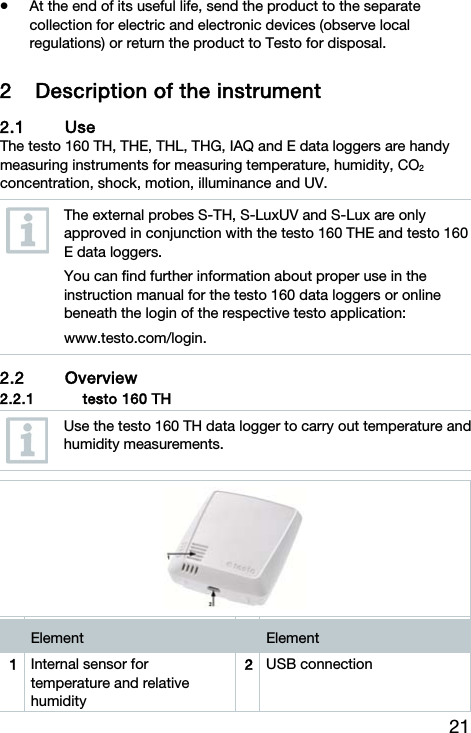
21  At the end of its useful life, send the product to the separate collection for electric and electronic devices (observe local regulations) or return the product to Testo for disposal. 2 Description of the instrument 2.1 Use The testo 160 TH, THE, THL, THG, IAQ and E data loggers are handy measuring instruments for measuring temperature, humidity, CO2 concentration, shock, motion, illuminance and UV.  The external probes S-TH, S-LuxUV and S-Lux are only approved in conjunction with the testo 160 THE and testo 160 E data loggers. You can find further information about proper use in the instruction manual for the testo 160 data loggers or online beneath the login of the respective testo application: www.testo.com/login. 2.2 Overview  2.2.1 testo 160 TH   Use the testo 160 TH data logger to carry out temperature and humidity measurements.     Element   Element 1  Internal sensor for temperature and relative humidity 2USB connection
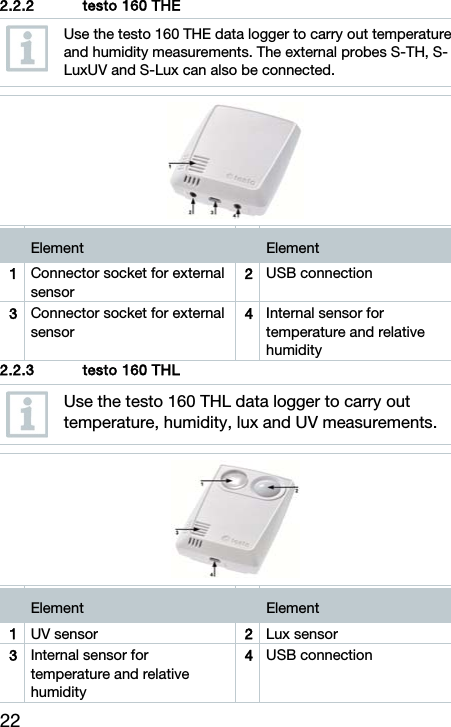
22   2.2.2 testo 160 THE    Use the testo 160 THE data logger to carry out temperature and humidity measurements. The external probes S-TH, S-LuxUV and S-Lux can also be connected.    Element   Element 1  Connector socket for external sensor 2USB connection 3  Connector socket for external sensor 4Internal sensor for temperature and relative humidity 2.2.3 testo 160 THL     Use the testo 160 THL data logger to carry out temperature, humidity, lux and UV measurements.    Element   Element 1  UV sensor  2Lux sensor 3  Internal sensor for temperature and relative humidity 4USB connection
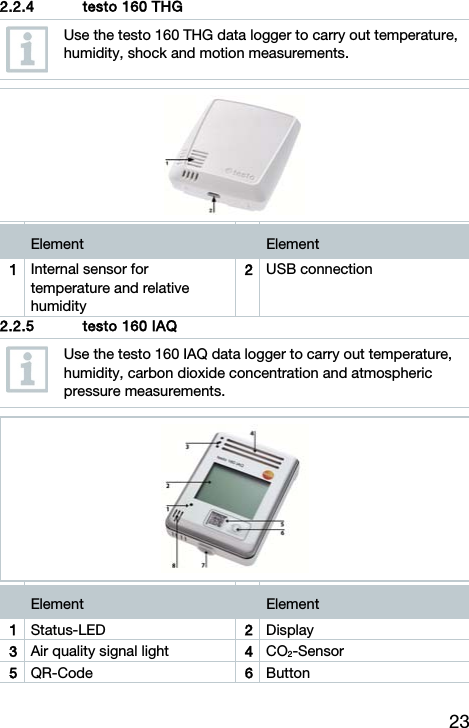
23   2.2.4 testo 160 THG    Use the testo 160 THG data logger to carry out temperature, humidity, shock and motion measurements.    Element   Element 1  Internal sensor for temperature and relative humidity 2USB connection 2.2.5 testo 160 IAQ    Use the testo 160 IAQ data logger to carry out temperature, humidity, carbon dioxide concentration and atmospheric pressure measurements.    Element   Element 1  Status-LED  2Display 3  Air quality signal light  4CO2-Sensor 5  QR-Code  6Button
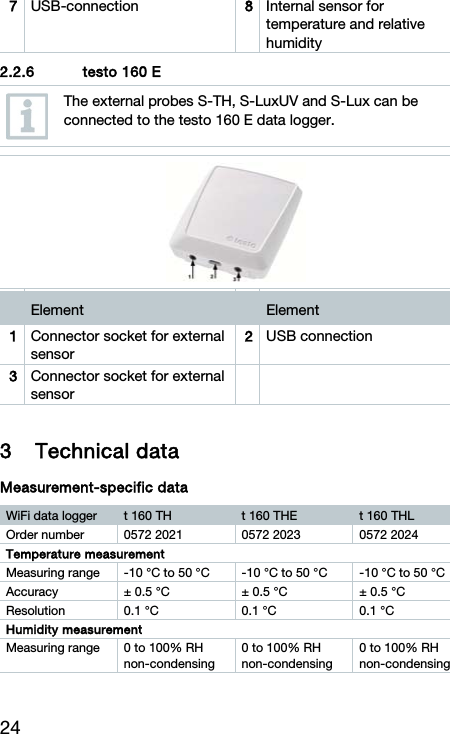
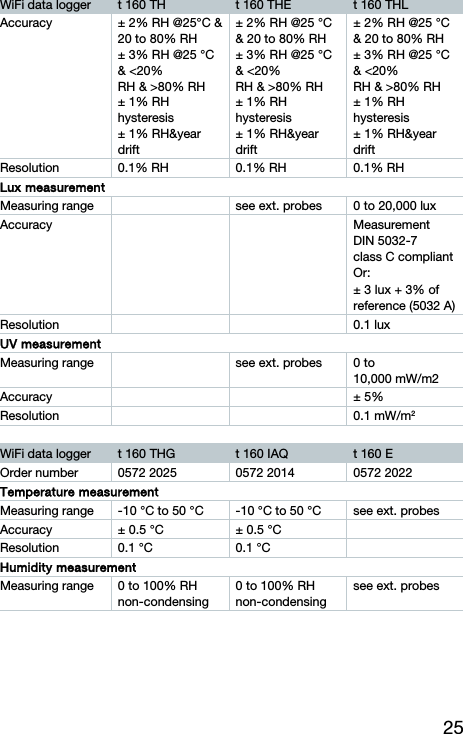
24 7  USB-connection  8Internal sensor for temperature and relative humidity   2.2.6 testo 160 E     The external probes S-TH, S-LuxUV and S-Lux can be connected to the testo 160 E data logger.    Element   Element 1  Connector socket for external sensor 2USB connection 3  Connector socket for external sensor   3 Technical data  Measurement-specific data WiFi data logger  t 160 TH  t 160 THE  t 160 THL Order number  0572 2021  0572 2023  0572 2024 Temperature measurement Measuring range  -10 °C to 50 °C  -10 °C to 50 °C  -10 °C to 50 °C Accuracy  ± 0.5 °C  ± 0.5 °C  ± 0.5 °C Resolution  0.1 °C  0.1 °C  0.1 °C Humidity measurement Measuring range  0 to 100% RH non-condensing 0 to 100% RH non-condensing 0 to 100% RH non-condensing
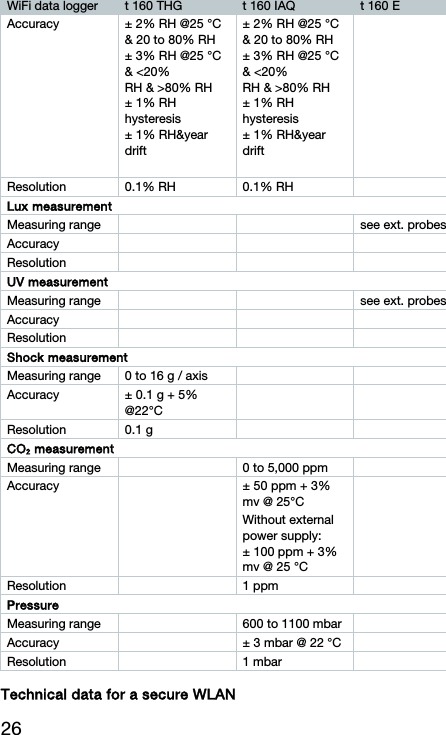
25 WiFi data logger  t 160 TH  t 160 THE  t 160 THL Accuracy  ± 2% RH @25°C & 20 to 80% RH ± 3% RH @25 °C & <20% RH & >80% RH ± 1% RH hysteresis ± 1% RH&year drift ± 2% RH @25 °C & 20 to 80% RH ± 3% RH @25 °C & <20% RH & >80% RH ± 1% RH hysteresis ± 1% RH&year drift ± 2% RH @25 °C & 20 to 80% RH ± 3% RH @25 °C & <20% RH & >80% RH ± 1% RH hysteresis ± 1% RH&year drift Resolution  0.1% RH  0.1% RH  0.1% RH Lux measurement Measuring range    see ext. probes  0 to 20,000 lux Accuracy   Measurement  DIN 5032-7  class C compliant Or: ± 3 lux + 3% of reference (5032 A) Resolution   0.1 lux UV measurement Measuring range    see ext. probes  0 to 10,000 mW/m2 Accuracy   ± 5% Resolution   0.1 mW/m2  WiFi data logger  t 160 THG  t 160 IAQ  t 160 E Order number  0572 2025  0572 2014  0572 2022 Temperature measurement Measuring range  -10 °C to 50 °C  -10 °C to 50 °C  see ext. probes Accuracy  ± 0.5 °C  ± 0.5 °C   Resolution  0.1 °C  0.1 °C   Humidity measurement Measuring range  0 to 100% RH non-condensing 0 to 100% RH non-condensing see ext. probes
26 WiFi data logger  t 160 THG  t 160 IAQ  t 160 E Accuracy  ± 2% RH @25 °C & 20 to 80% RH ± 3% RH @25 °C & <20% RH & >80% RH ± 1% RH hysteresis ± 1% RH&year drift  ± 2% RH @25 °C & 20 to 80% RH ± 3% RH @25 °C & <20% RH & >80% RH ± 1% RH hysteresis ± 1% RH&year drift   Resolution  0.1% RH  0.1% RH   Lux measurement Measuring range      see ext. probes Accuracy    Resolution    UV measurement Measuring range      see ext. probes Accuracy    Resolution    Shock measurement Measuring range  0 to 16 g / axis     Accuracy  ± 0.1 g + 5% @22°C   Resolution 0.1 g     CO2 measurement Measuring range    0 to 5,000 ppm    Accuracy    ± 50 ppm + 3% mv @ 25°C Without external power supply: ± 100 ppm + 3% mv @ 25 °C  Resolution   1 ppm   Pressure Measuring range    600 to 1100 mbar   Accuracy    ± 3 mbar @ 22 °C   Resolution   1 mbar    Technical data for a secure WLAN
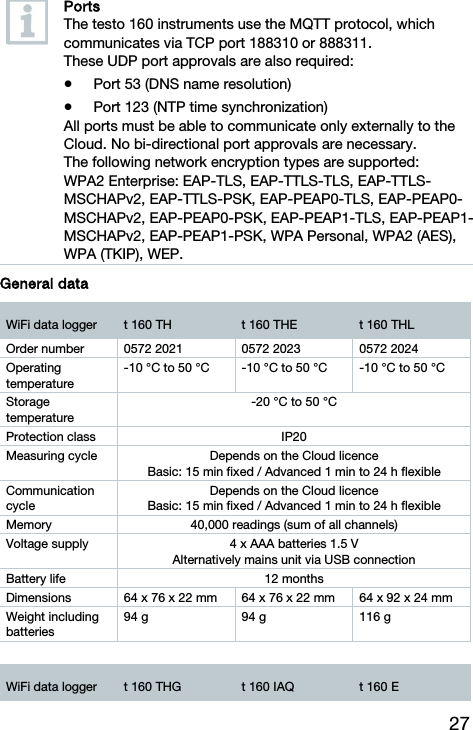
27  Ports The testo 160 instruments use the MQTT protocol, which communicates via TCP port 188310 or 888311. These UDP port approvals are also required:  Port 53 (DNS name resolution)  Port 123 (NTP time synchronization) All ports must be able to communicate only externally to the Cloud. No bi-directional port approvals are necessary. The following network encryption types are supported: WPA2 Enterprise: EAP-TLS, EAP-TTLS-TLS, EAP-TTLS-MSCHAPv2, EAP-TTLS-PSK, EAP-PEAP0-TLS, EAP-PEAP0-MSCHAPv2, EAP-PEAP0-PSK, EAP-PEAP1-TLS, EAP-PEAP1-MSCHAPv2, EAP-PEAP1-PSK, WPA Personal, WPA2 (AES), WPA (TKIP), WEP.   General data WiFi data logger  t 160 TH  t 160 THE  t 160 THL Order number  0572 2021  0572 2023  0572 2024 Operating temperature -10 °C to 50 °C  -10 °C to 50 °C  -10 °C to 50 °C Storage temperature -20 °C to 50 °C Protection class  IP20 Measuring cycle  Depends on the Cloud licence Basic: 15 min fixed / Advanced 1 min to 24 h flexible Communication cycle Depends on the Cloud licence Basic: 15 min fixed / Advanced 1 min to 24 h flexible Memory  40,000 readings (sum of all channels) Voltage supply  4 x AAA batteries 1.5 V Alternatively mains unit via USB connection Battery life  12 months Dimensions  64 x 76 x 22 mm  64 x 76 x 22 mm  64 x 92 x 24 mm Weight including batteries 94 g  94 g  116 g  WiFi data logger  t 160 THG  t 160 IAQ  t 160 E
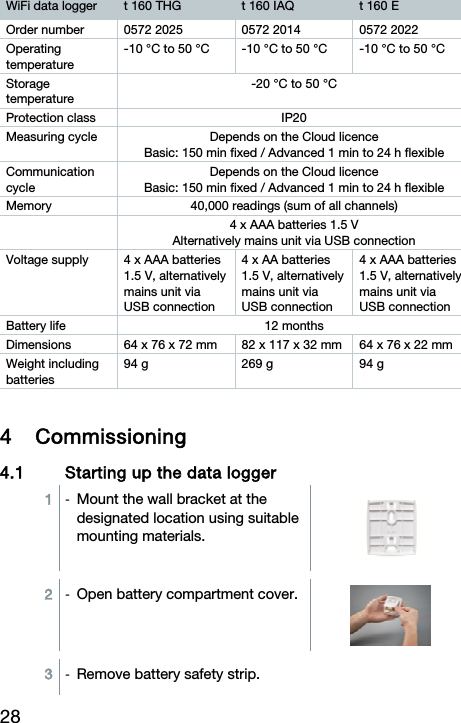
28 WiFi data logger  t 160 THG  t 160 IAQ  t 160 E Order number  0572 2025  0572 2014  0572 2022 Operating temperature -10 °C to 50 °C  -10 °C to 50 °C  -10 °C to 50 °C Storage temperature -20 °C to 50 °C Protection class  IP20 Measuring cycle  Depends on the Cloud licence Basic: 150 min fixed / Advanced 1 min to 24 h flexible Communication cycle Depends on the Cloud licence Basic: 150 min fixed / Advanced 1 min to 24 h flexible Memory  40,000 readings (sum of all channels)   4 x AAA batteries 1.5 V Alternatively mains unit via USB connection Voltage supply  4 x AAA batteries 1.5 V, alternatively mains unit via USB connection 4 x AA batteries  1.5 V, alternatively mains unit via USB connection 4 x AAA batteries 1.5 V, alternatively mains unit via USB connection Battery life  12 months Dimensions  64 x 76 x 72 mm  82 x 117 x 32 mm  64 x 76 x 22 mm Weight including batteries 94 g  269 g  94 g   4 Commissioning 4.1 Starting up the data logger  1  -  Mount the wall bracket at the designated location using suitable mounting materials.   2  -  Open battery compartment cover.  3  -  Remove battery safety strip.
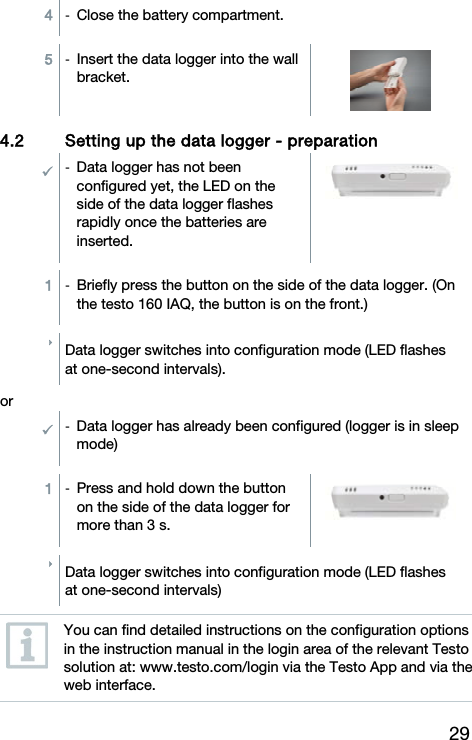
29 4  -  Close the battery compartment. 5  -  Insert the data logger into the wall bracket.   4.2 Setting up the data logger - preparation  -  Data logger has not been configured yet, the LED on the side of the data logger flashes rapidly once the batteries are inserted.   1  -  Briefly press the button on the side of the data logger. (On the testo 160 IAQ, the button is on the front.)  Data logger switches into configuration mode (LED flashes at one-second intervals).  or -  Data logger has already been configured (logger is in sleep mode)  1  -  Press and hold down the button on the side of the data logger for more than 3 s.    Data logger switches into configuration mode (LED flashes at one-second intervals)   You can find detailed instructions on the configuration options in the instruction manual in the login area of the relevant Testo solution at: www.testo.com/login via the Testo App and via the web interface.
30  4.3 Configuration via Quick Start Guide The Quick Start Guide is provided to assist you when you take your first steps with commissioning the testo 160. It can help you with logging in WiFi data loggers.  To be able to carry out the configuration, you need to be logged into the web interface of the respective Testo solution.  1  -  Click on the   symbol in the command bar.  The Quick Start Guide starts and assists you with the configuration.  4.4 Offline configuration  As an alternative to creating the configuration file in the Quick Start Guide with subsequent download of the XML configuration file, the WiFi data logger can also be configured via a PDF form.  You need the Adobe Reader program (version 10 or later) to use the PDF form correctly. If you have not installed Adobe Reader, you can go to the following address to download it free of charge: http://get.adobe.com/reader/.  1  -  Connect the data logger to the PC via USB connection. 2  -  Open the file WiFiConf.pdf on the external drive testo 160. 3  -  Copy your Account ID and paste it into the relevant field on the PDF form. You will find the Account ID in the testo 160 software under Configuration -> Account ID.  4  -  Enter the Network name (SSID) and, if necessary, your WLAN password in the relevant fields on the PDF form.
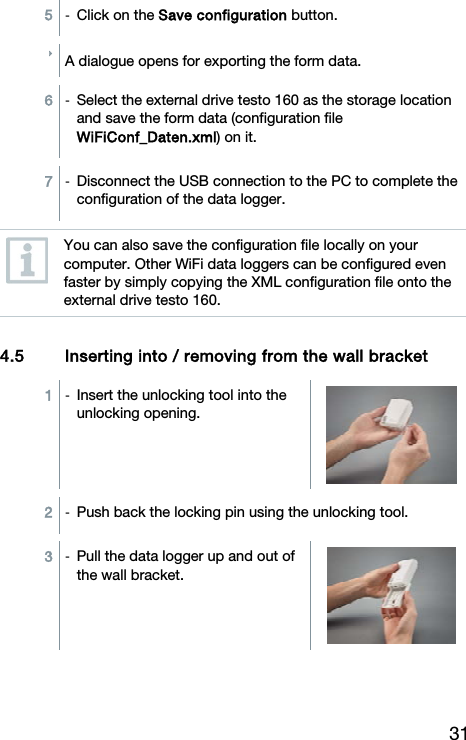
31 5  -  Click on the Save configuration button. A dialogue opens for exporting the form data.  6  -  Select the external drive testo 160 as the storage location and save the form data (configuration file WiFiConf_Daten.xml) on it.  7  -  Disconnect the USB connection to the PC to complete the configuration of the data logger.   You can also save the configuration file locally on your computer. Other WiFi data loggers can be configured even faster by simply copying the XML configuration file onto the external drive testo 160.   4.5 Inserting into / removing from the wall bracket  1  -  Insert the unlocking tool into the unlocking opening.  2  -  Push back the locking pin using the unlocking tool.  3  -  Pull the data logger up and out of the wall bracket.
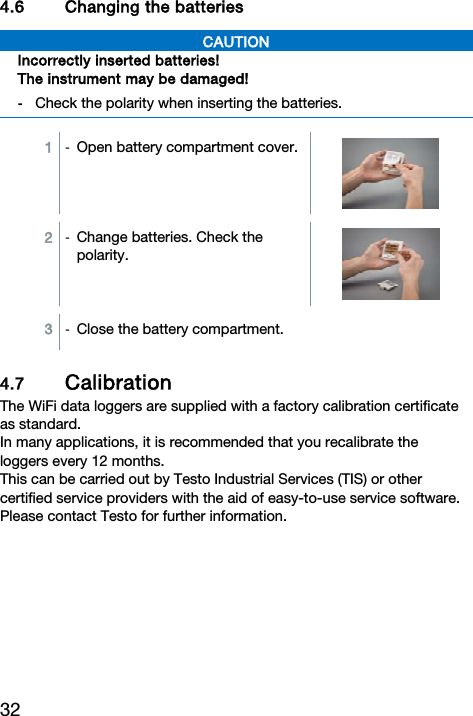
32  4.6 Changing the batteries CAUTION Incorrectly inserted batteries! The instrument may be damaged! -  Check the polarity when inserting the batteries.   1  -  Open battery compartment cover. 2  -  Change batteries. Check the polarity.  3  -  Close the battery compartment.4.7 Calibration  The WiFi data loggers are supplied with a factory calibration certificate as standard. In many applications, it is recommended that you recalibrate the loggers every 12 months. This can be carried out by Testo Industrial Services (TIS) or other certified service providers with the aid of easy-to-use service software.  Please contact Testo for further information.
33 请仔细通读本操作手册,在使用之前熟悉本产品。 详细说明可在Testo相应解决方案的登录区下载: www.testo.com/login. 1 安全和处理 1.1 关于此文档  应用  操作手册是设备的一个组成部分。  要特别注意安全须知及警告,以避免人员受伤和产品损坏。  把文档带在身边,需要时及时查阅。  总是使用完整的原始操作手册。  把文档交付于产品的后继用户。  为了能够使用本设备的 某些功能(尤其是测量数据管理),您必须同意可在 www.testo.com/login 相应德图应用程序的登录区找到的德图云使用条款。   1.2 安全  一般安全须知  请正确操作本产品,本产品只能用于指定用途,并且在设定技术数据的参数范围内使用。请勿使用武力。  如果机壳、电源或电缆有损坏,不能开启设备。  此外,从测量设备和测量环境也可能产生危险:执行测量时要遵守当地的安全法规。  探针/传感器上的温度数据仅涉及传感设备的测量范围。如果未明确规定允许用于高温环境,请勿将手柄和电缆置于温度超过70 ℃(158 °F)的环境。  切勿在没有绝缘及带电部件进行接触式测量。  不得将本产品与溶剂存放在一起。请勿使用任何干燥剂。  在本仪器只执行该文档中描述的维护和修理工作。应当严格地遵照规定步聚。只能使用Testo原装备件。
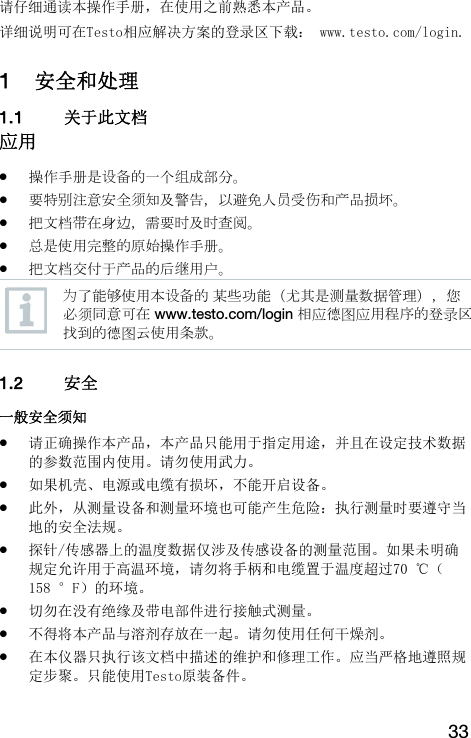
34 电池  使用电池不当可能损坏电池,导致电击受伤、火灾或化学液体泄漏。  按照手册中的说明插入提供的电池。  切勿让电池短路。  切勿拆卸电池,不要对其进行改变。  切勿将电池置于强震荡、水、火或温度超过 60 ℃ 的环境中。  不能将电池存放在金属物体附近。  如果接触了电池酸液:用清水彻底清洗接触区,如有必要请咨询医生。  请勿使用泄漏或损坏的电池。  1.3 警告  总是注意以下带警告图标的警告信息。实施指定的预防措施! 注意 指出可能造成的财产损失  1.4 处理   按有效法律规定处理废弃电池。  使用寿命结束时,请把本产品送至电子电气装置分类收集处(请遵循当地法律法规),或退回 Testo 进行处理。 2 设备说明  2.1 应用  testo 160 TH、THE、THL、THG、IAQ 和 E 数据记录仪是方便的测量仪器,用来测量温度、湿度、CO2浓度、冲击、位置、照度和紫外线。  外置探头 S-TH, S-LuxUV 和 S-Lux 只可以用在testo 160 THE 和 testo 160 E 数据记录仪。 有关正确使用的更多信息请参阅 testo 160 数据记录仪使用说明书,或访问相应testo应用程序的登录区: www.testo.com/login.
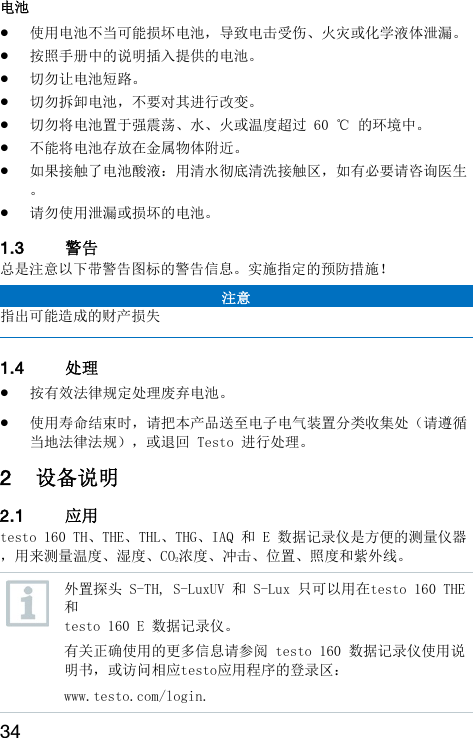
35  2.2 概览图  2.2.1 testo 160 TH   使用数据记录仪 testo 160 TH 可以执行温度和湿度测量。     元件    元件 1  温度和相对湿度的内部传感器 2USB 接口   2.2.2 testo 160 THE    使用数据记录仪 testo 160 THE 可以执行温度和湿度测量。此外,可以连接外置探头 S-TH、S-LuxUV 和 S-Lux。     元件    元件 1  外部传感器的连接插槽  2USB 接口 3  外部传感器的连接插槽  4温度和相对湿度的内部传感器
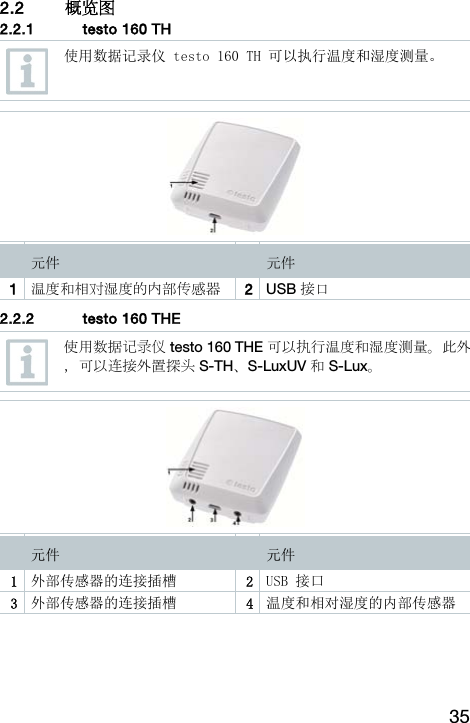
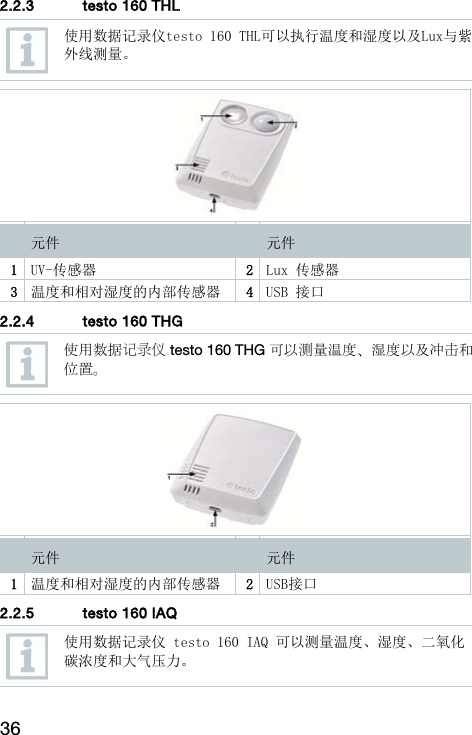
36  2.2.3 testo 160 THL     使用数据记录仪testo 160 THL可以执行温度和湿度以及Lux与紫外线测量。     元件    元件 1  UV-传感器  2Lux 传感器 3  温度和相对湿度的内部传感器 4USB 接口   2.2.4 testo 160 THG    使用数据记录仪 testo 160 THG 可以测量温度、湿度以及冲击和位置。     元件    元件 1  温度和相对湿度的内部传感器 2USB接口   2.2.5 testo 160 IAQ    使用数据记录仪 testo 160 IAQ 可以测量温度、湿度、二氧化碳浓度和大气压力。
37   元件    元件 1  Status-LED  2Display 3  Air quality signal light  4CO2-Sensor 5  QR-Code  6Button 7  USB-connection  8Internal sensor for temperature and relative humidity   2.2.6 testo 160 E     可在数据记录仪 testo 160 E 连接外置探头 S-TH、S-LuxUV 和S-Lux。     元件    元件 1  外部传感器的连接插槽  2USB 接口 3  外部传感器的连接插槽
38 3 技术数据  测量特定数据 无线数据记录仪  t 160 TH  t 160 THE  t 160 THL 订购编号  0572 2021  0572 2023  0572 2024 温度测量 量程  -10 ℃~50 ℃  -10 ℃~50 ℃  -10 ℃~50 ℃ 精度  ± 0.5 ℃  ± 0.5 ℃  ± 0.5 ℃ 分辨率  0.1 ℃  0.1 ℃  0.1 ℃ 湿度测量 量程  0~100%RH 非冷凝 0~100%RH 非冷凝 0~100%RH 非冷凝 精度  ± 2%RH @25 ℃ & 20~80%RH ± 3%RH @25 ℃ & <20%RH & >80%RH ± 1%RH 滞后 ± 1%RH & 年 漂移 ± 2%RH @25 ℃ & 20~80%RH ± 3%RH @25 ℃ & <20%RH & >80%RH ± 1%RH 滞后 ± 1%RH & 年 漂移 ± 2%RH @25 ℃ & 20~80%RH ± 3%RH @25 ℃ & <20%RH & >80%RH ± 1%RH 滞后 ± 1%RH & 年 漂移 分辨率  0.1%RH  0.1%RH  0.1%RH 勒克斯测量 量程    见外置探头  0~20 000 Lux 精度      Measurement  DIN 5032-7  class C conform.或: ± 3 Lux + 3% 参考 (5032 A) 分辨率      0.1 Lux UV测量 量程    见外置探头  0~10000mW/m2 精度      ± 5% 分辨率      0.1mW/m2  无线数据记录仪  t 160 THG  t 160 IAQ  t 160 E 订购编号  0572 2025  0572 2014  0572 2022 温度测量
39 无线数据记录仪  t 160 THG  t 160 IAQ  t 160 E 量程  -10 ℃~50 ℃  -10 ℃~50 ℃  见外置探头 精度  ± 0.5 ℃  ± 0.5 ℃   分辨率  0.1 ℃  0.1 ℃   湿度测量 量程  0~100%RH 非冷凝 0~100%RH 非冷凝 见外置探头 精度  ± 2%RH @25 ℃ & 20~80%RH ± 3%RH @25 ℃ & <20%RH & >80%RH ± 1%RH 滞后 ± 1%RH & 年 漂移  ± 2%RH @25 ℃ & 20~80%RH ± 3%RH @25 ℃ & <20%RH & >80%RH ± 1%RH 滞后 ± 1%RH & 年 漂移   分辨率  0.1%RH  0.1%RH   勒克斯测量 量程      见外置探头 精度       分辨率       UV测量 量程      见外置探头 精度       分辨率       冲击测量 量程  0~16g/轴     精度  ± 0.1g + 5% @22 ℃   分辨率  0.1g     CO2测量 量程    0~5000ppm    精度    ± 50 ppm + 3% mv @ 25℃ 无外部电源: ± 100 ppm + 3% mv @ 25 ℃  分辨率    1ppm   压力
40 无线数据记录仪  t 160 THG  t 160 IAQ  t 160 E 量程    600~1100 mbar   精度    ± 3 mbar @ 22 ℃  分辨率    1 mbar     为了安全无线局域网的技术规定  端口 testo 160 无线数据记录仪使用协议 MQTT,其通信通过 TCP 端口 188310 或 888311 进行。 此外,需要 UDP 端口启用信号:  端口 53(DNS 域名解析)  端口 123(NTP 时间同步) 所有端口必须只能向外,向云的方向通讯。不需要双向的端口启用信号。 支持以下网络加密类型:  WPA2 Enterprise:EAP-TLS, EAP-TTLS-TLS, EAP-TTLS-MSCHAPv2, EAP-TTLS-PSK, EAP-PEAP0-TLS, EAP-PEAP0-MSCHAPv2, EAP-PEAP0-PSK, EAP-PEAP1-TLS, EAP-PEAP1-MSCHAPv2, EAP-PEAP1-PSK, WPA Personal, WPA2 (AES), WPA (TKIP), WEP.   一般数据 无线数据记录仪  t 160 TH  t 160 THE  t 160 THL 订购编号  0572 2021  0572 2023  0572 2024 工作温度  -10 ℃~50 ℃  -10 ℃~50 ℃  -10 ℃~50 ℃ 存储温度  -20 ℃~50 ℃ 保护等级  IP20 测量周期  取决于云许可证 Basic: 15 min 固定 / Advanced 1 min~24 h 灵活 通讯周期  取决于云许可证 Basic: 15 min 固定 / Advanced 1 min~24 h 灵活 存储器  40000 测量值(所有通道总和) 电源  4节7号电池1.5V USB接口为备选电源
41 无线数据记录仪  t 160 TH  t 160 THE  t 160 THL 电池寿命  12 个月 外形尺寸  64 x 76 x 22 mm  64 x 76 x 22 mm  64 x 92 x 24 mm 重量(含电池)  94 g  94 g  116 g   无线数据记录仪  t 160 THG  t 160 IAQ  t 160 E 订购编号  0572 2025  0572 2014  0572 2022 工作温度  -10 ℃~50 ℃  -10 ℃~50 ℃  -10 ℃~50 ℃ 存储温度  -20 ℃~50 ℃ 保护等级  IP20 测量周期  取决于云许可证 Basic: 150 min 固定 / Advanced 1 min~24 h 灵活 通讯周期  取决于云许可证 Basic: 150 min 固定 / Advanced 1 min~24 h 灵活 储器  40000 测量值(所有通道总和)   4节7号电池1.5V USB接口为备选电源 电源  4节7号电池  1.5V USB接口为备选电源 4节5号电池  1.5V USB接口为备选电源 4节7号电池  1.5V USB接口为备选电源 电池寿命  12 个月 外形尺寸  64 x 76 x 72 mm  82 x 117 x 32 mm 64 x 76 x 22 mm 重量(含电池)  94 g  269 g  94 g 4 开机 4.1 数据记录仪投入使用  1  -  使用合适的固定材料将壁架紧固在指定的地方。
42 2  -  打开电池盒。  3  -  取下电池隔片。  4  -  关闭电池盒。  5  -  将数据记录仪放入壁架。  4.2 配置数据记录仪 - 准备  -  数据记录仪尚未被配置,插入电池后记录仪侧面的 LED 快速闪烁。  1  -  按下数据记录仪侧面的按钮(testo 160 IAQ 的按钮在正面)。   数据记录仪切换到配置模式(LED 每秒闪一次)。  或 -  数据记录仪已被配置过一次(记录仪处于睡眠模式)  1  -  按住数据记录仪侧面的按钮3秒以上。  数据记录仪切换到配置模式(LED 每秒闪一次)   有关Testo-App和Web界面配置选项的详细说明,请见在相应德图解决方案登录区的使用手册:www.testo.com/login.
43  4.3 通过快速启动指南配置  作为调试 testo 160 第一步的帮助,为您提供了快速启动指南。该指南有助于您登录无线数据记录仪。  为了执行配置,您必须在相应德图解决方案的 Web 界面登录。 1  -  在命令栏中单击图标  。  快速启动指南开始,并帮助您执行配置。 4.4 离线配置  作为在快速启动指南中创建配置文件,然后下载XML配置文件的替代方法,也可以通过PDF表单配置无线数据记录仪。  为了正确运行PDF表单,您需要Adobe Reader(版本10或更高版本)。如果您还没有安装Adobe Reader,您可以通过下面的地址免费下载:http://get.adobe.com/reader/.  1  -  通过USB连接将数据记录仪与PC连接。  2  -  打开在外部驱动器testo 160上的文件 WiFiConf.pdf。  3  -  复制您的帐户ID 并将它填入到PDF表单中的相应字段。帐户ID在testo 160 软件配置 -> 帐户 ID中。  4  -  在PDF表单相应字段中输入您的网络名称(SSID)和您的无线网密码。  5  - 单击此按钮Save configuration。  打开一个表单数据导出对话框。
44 6  -  选择外部驱动器 testo 160作为存储位置,将表格数据(配置文件WiFiConf_Daten.xml)保存在那里。  7  -  断开到PC的USB连接,以完成数据记录仪的配置。   您也可以将配置文件保存在您本地计算机上。其他的无线数据记录仪可以通过将XML配置文件简单地复制到外部驱动器 testo 160 上,从而更快的进行配置。 4.5 入壁架或从壁架取出  1  -  将解锁工具插入解锁孔。  2  -  使用解锁工具将锁紧销推回。  3  -  然后将数据记录仪向上从墙支架拉出。 4.6 更换蓄电池 注意 电池插入错误! 仪器的损坏! -  插入电池时请注意极性。   1  -  打开电池盒。
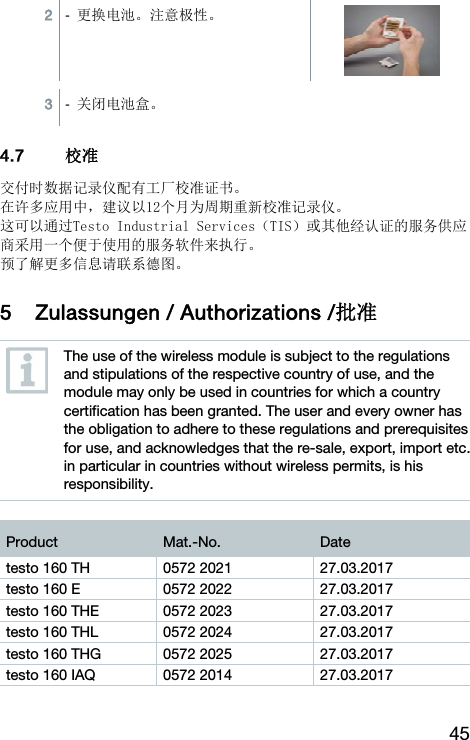
45 2  -  更换电池。注意极性。  3  -  关闭电池盒。 4.7 校准 交付时数据记录仪配有工厂校准证书。 在许多应用中,建议以12个月为周期重新校准记录仪。 这可以通过Testo Industrial Services(TIS)或其他经认证的服务供应商采用一个便于使用的服务软件来执行。  预了解更多信息请联系德图。 5 Zulassungen / Authorizations /批准   The use of the wireless module is subject to the regulations and stipulations of the respective country of use, and the module may only be used in countries for which a country certification has been granted. The user and every owner has the obligation to adhere to these regulations and prerequisites for use, and acknowledges that the re-sale, export, import etc. in particular in countries without wireless permits, is his responsibility.  Product  Mat.-No.  Date testo 160 TH  0572 2021  27.03.2017 testo 160 E  0572 2022  27.03.2017 testo 160 THE  0572 2023  27.03.2017 testo 160 THL  0572 2024  27.03.2017 testo 160 THG  0572 2025  27.03.2017 testo 160 IAQ  0572 2014  27.03.2017
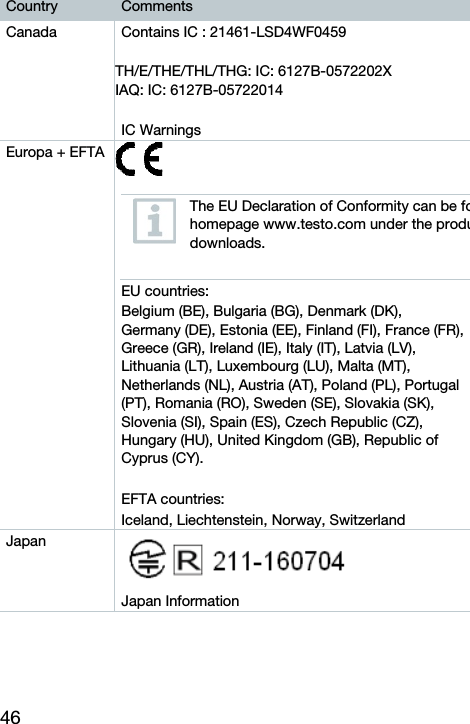
46 Country  Comments Canada  Contains IC : 21461-LSD4WF0459  TH/E/THE/THL/THG: IC: 6127B-0572202X IAQ: IC: 6127B-05722014  IC Warnings Europa + EFTA    The EU Declaration of Conformity can be fohomepage www.testo.com under the produdownloads. EU countries:  Belgium (BE), Bulgaria (BG), Denmark (DK), Germany (DE), Estonia (EE), Finland (FI), France (FR), Greece (GR), Ireland (IE), Italy (IT), Latvia (LV), Lithuania (LT), Luxembourg (LU), Malta (MT), Netherlands (NL), Austria (AT), Poland (PL), Portugal (PT), Romania (RO), Sweden (SE), Slovakia (SK), Slovenia (SI), Spain (ES), Czech Republic (CZ), Hungary (HU), United Kingdom (GB), Republic of Cyprus (CY).   EFTA countries:  Iceland, Liechtenstein, Norway, Switzerland Japan  Japan Information
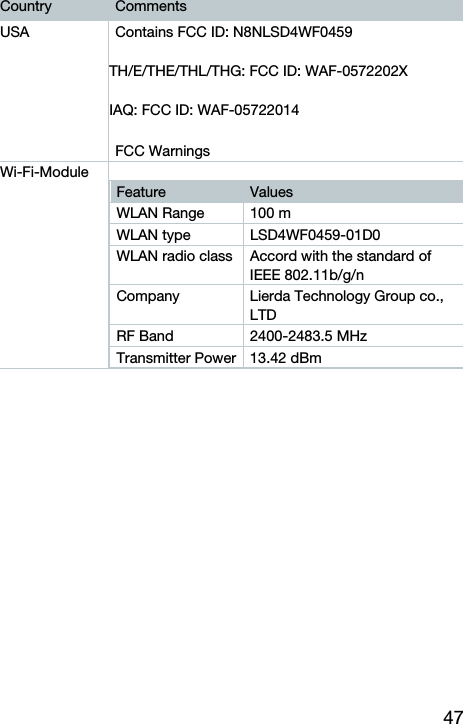
47 Country  Comments USA  Contains FCC ID: N8NLSD4WF0459  TH/E/THE/THL/THG: FCC ID: WAF-0572202X  IAQ: FCC ID: WAF-05722014  FCC Warnings Wi-Fi-Module Feature  Values WLAN Range  100 m WLAN type  LSD4WF0459-01D0 WLAN radio class  Accord with the standard of IEEE 802.11b/g/n Company  Lierda Technology Group co., LTD RF Band  2400-2483.5 MHz Transmitter Power 13.42 dBm   IC Warnings: This instrument complies with Part 15C of the FCC Rules and Industry Canada RSS-210 (revision 8). Commissioning is subject to the following two conditions: (1) This instrument must not cause any harmful interference and (2) this instrument must be able to cope with interference, even if this has undesirable effects on operation.  Cet appareil satisfait à la partie 15C des directives FCC et au standard Industrie Canada RSS-210 (révision 8). Sa mise en service est soumise aux deux conditions suivantes :  (1) cet appareil ne doit causer aucune interférence dangereuse et  (2) cet appareil doit supporter toute interférence, y compris des interférences qui provoquerait des opérations indésirables.
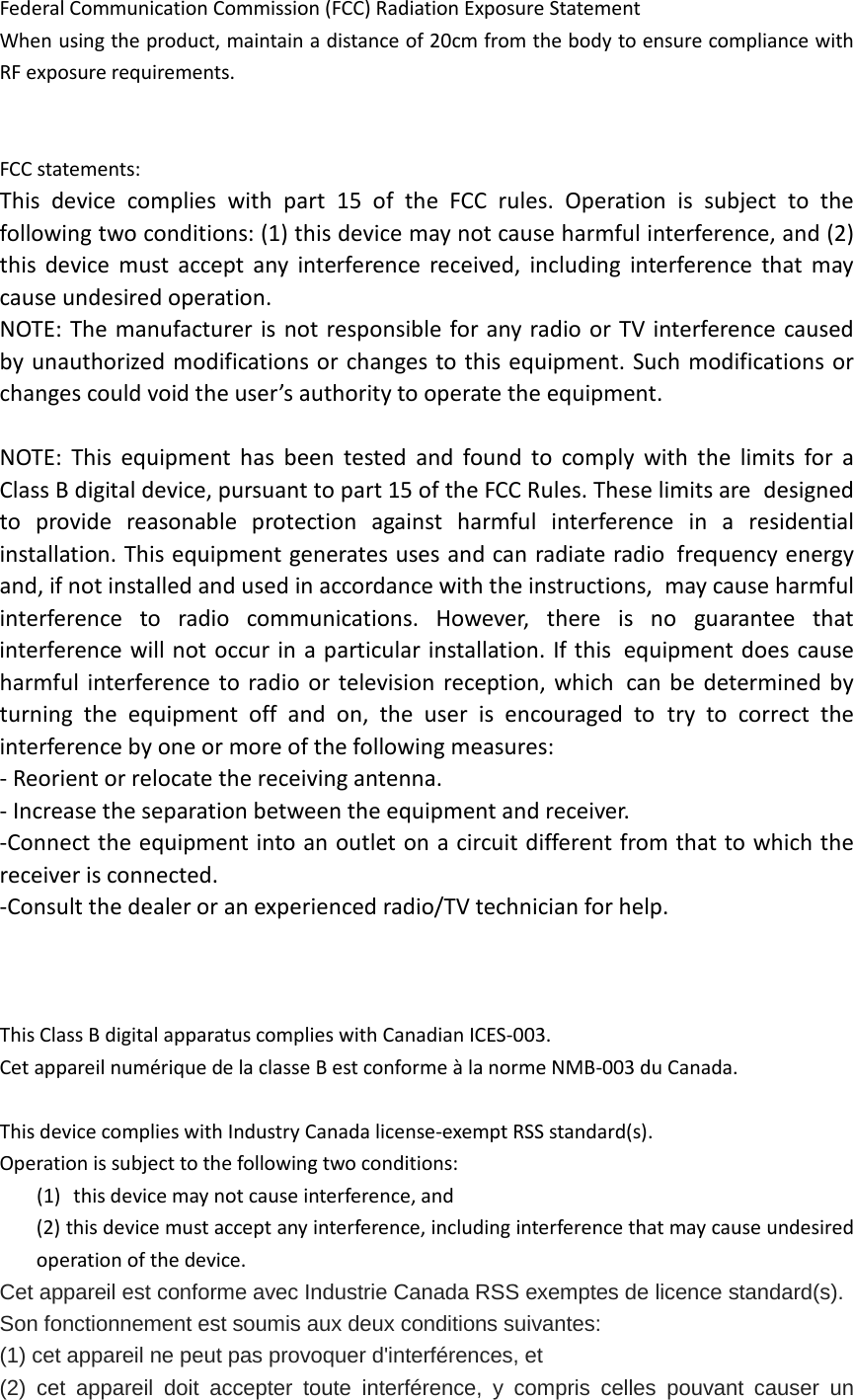
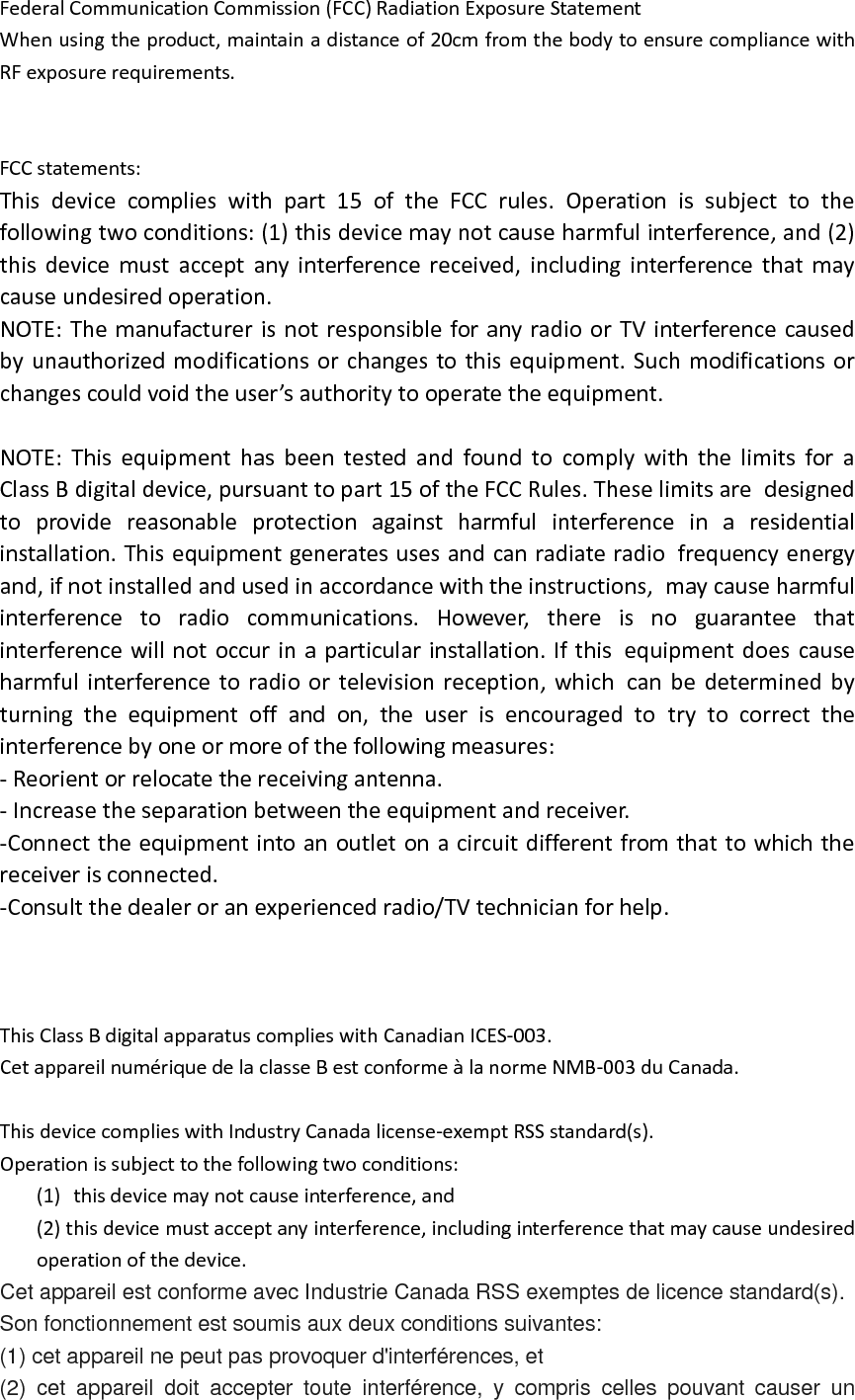
Federal Communication Commission (FCC) Radiation Exposure Statement When using the product, maintain a distance of 20cm from the body to ensure compliance with RF exposure requirements.   FCC statements: This device complies with part 15 of the FCC rules. Operation is subject to the following two conditions: (1) this device may not cause harmful interference, and (2) this device must accept any interference received, including interference that may cause undesired operation.  NOTE: The manufacturer is not responsible for any radio or TV interference caused by unauthorized modifications or changes to this equipment. Such modifications or changes could void the user’s authority to operate the equipment.  NOTE: This equipment has been tested and found to comply with the limits for a Class B digital device, pursuant to part 15 of the FCC Rules. These limits are designed to provide reasonable protection against harmful interference in a residential installation. This equipment generates uses and can radiate radio frequency energy and, if not installed and used in accordance with the instructions, may cause harmful interference to radio communications. However, there is no guarantee that interference will not occur in a particular installation. If this equipment does cause harmful interference to radio or television reception, which can be determined by turning the equipment off and on, the user is encouraged to try to correct the interference by one or more of the following measures: ‐ Reorient or relocate the receiving antenna. ‐ Increase the separation between the equipment and receiver. ‐Connect the equipment into an outlet on a circuit different from that to which the receiver is connected. ‐Consult the dealer or an experienced radio/TV technician for help.    This Class B digital apparatus complies with Canadian ICES‐003.   Cet appareil numérique de la classe B est conforme à la norme NMB‐003 du Canada.  This device complies with Industry Canada license‐exempt RSS standard(s). Operation is subject to the following two conditions: (1) this device may not cause interference, and (2) this device must accept any interference, including interference that may cause undesired operation of the device. Cet appareil est conforme avec Industrie Canada RSS exemptes de licence standard(s).   Son fonctionnement est soumis aux deux conditions suivantes:   (1) cet appareil ne peut pas provoquer d'interférences, et   (2) cet appareil doit accepter toute interférence,  y  compris celles pouvant causer un
mauvais fonctionnement de l'appareil.

Navigation menu