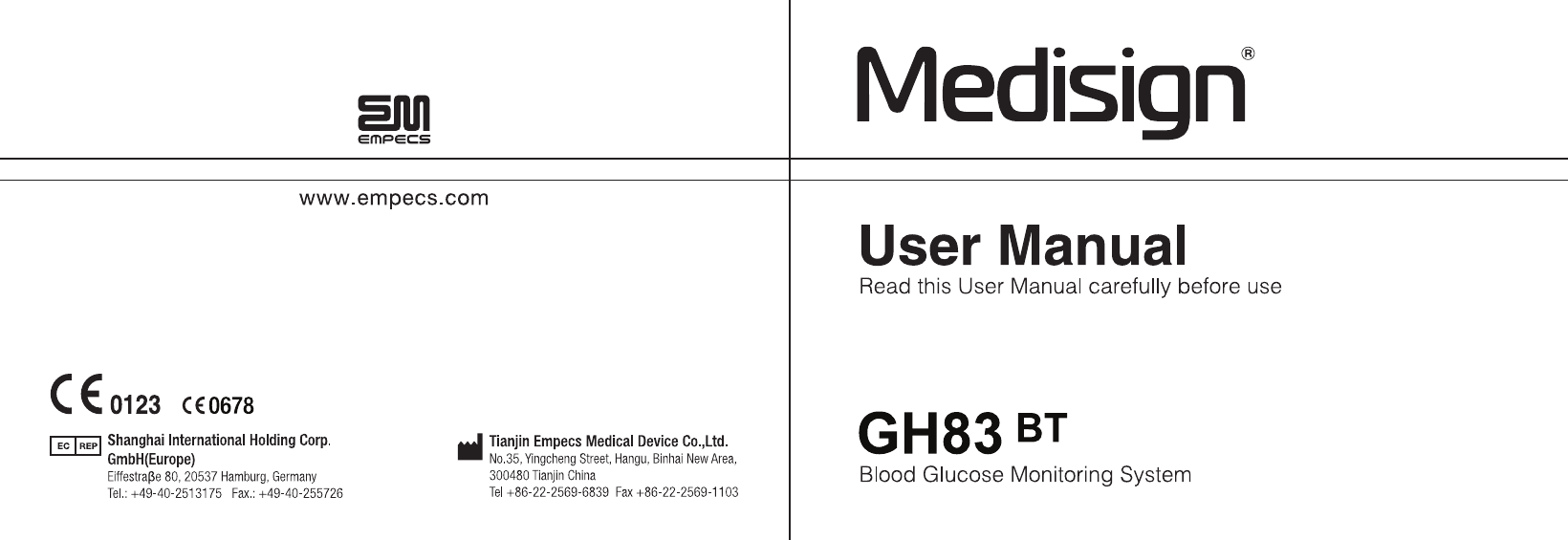
Tianjin Empecs Medical Device GH8123BT Blood Glucose Monitoring System User Manual

Tianjin Empecs Medical Device Co., Ltd. Blood Glucose Monitoring System

User Manual

      Medisign®  GH83 BT Blood Glucose Monitoring System User Manual     Read this first: Please keep this instruction for future reference, as it contains important information. Before using this product, read all instructions and practice the test. Do all quality control checks as directed and consult with a diabetes healthcare professional. Please confirm the measuring unit on the display. The measuring unit will appear on the display also, appear under every test result.     Medisign Software Version 81-S1.0
 Medisign GH83 BT User Manual  Blood Glucose Monitoring system  CONTENTS  About Your New System Welcome Intended Use Application Test Principle Special Features Usage and storage Important Test Strip Information Safety Information Healthcare Professional Information System Components  Testing Your Blood Glucose Disinfection Before test Performing a Blood Glucose Test Flagging Test Results Handling the Used Test Strip Alternative Site Testing (AST)  Meter Setup, Memory and Downloading Using Set-Up Mode Deleting Test Results Reviewing Test Results Downloading Test Results to a PC Before Pairing Your Meter How to Pair Your Meter  Control Test Performing Control Solution Test Understanding Control Solution Test Results Performing Check Strip Test  Maintenance and Troubleshooting Cleaning your meter Replacing Battery Screen Message Troubleshooting  Technical Information and Warranty Specifications Warranty Symbols EMC Test results About Bluetooth Additional Supplies
 About Your New System  Welcome Thank you for selecting the Medisign GH83 BT BGMS (Blood Glucose Monitoring System). Follow steps for using the system in this manual. Before using your monitoring system for the first time, please read this manual carefully.  Intended Use The  Medisign  GH83  BT  Blood  Glucose  Monitoring  System  is  intended  to  be  used  for  the  quantitative measurement of glucose in fresh capillary whole blood samples from the fingertips, palm and forearm. Venous whole blood testing is limited to healthcare professionals use only. This system is intended for self-testing outside of the body (in vitro diagnostic use) by people with diabetes at home and healthcare professionals in a clinical setting as an aid to monitor the diabetes control. This system is not for use in diagnosis or screening of diabetes mellitus, nor for testing neonate or arterial blood samples. The alternative site testing (palm, forearm) should be used only during steady- state conditions.  Application Using fresh capillary whole blood and venous whole blood, Medisign GH83 Test Strips are for in vitro diagnostic use only. Use the Medisign GH83 BT Meter in conjunction with your healthcare program.  Test Principle Glucose in the blood sample reacts with FAD glucose dehydrogenase (FAD-GDH) on the test strip and a harmless DC electrical current is produced. This current is measured by the Medisign Meter and displayed as your blood glucose  result.  The  strength  of  these currents  changes  with  the amount  of  glucose  in the blood  sample. The Medisign Meter automatically  interprets this reaction. Blood glucose results  from test  strips that are plasma-equivalent are approximately 11% higher than those obtained with whole-blood equivalent test strips.  CAUTION: Medisign GH83 BT Meter is for use only with Medisign GH83 Blood Glucose Test Strips.  Special Features • Accurate result in 6 seconds with using only 0.5㎕  blood sample. • The Medisign GH83 BT system provides the auto coding feature. • Store up to 300 test results. • Your meter was set at the factory to the unit used in your country. • Providing a Test Strip Ejecting Button.  Usage and Storage •  Before  using  your  monitoring  system,  please  place  it  in  the  environment  of  system's  normal  operating temperature ranging 10~40℃ (50~104℉) for about 20 minutes. • Store the system indoors between 4~30℃ (39.2~86℉). • Recommended transport condition is 17~20℃ (62.6~68℉). • The test should be performed in the indoors to obtain accurate results. • Don't allow dust and foreign bodies into test strip slot in order to avoid affecting the system's accuracy. • Don't decompose, demolish, repair or transform the system at any time. If the equipment is used in a manner not specified by the manufacturer, the protection provided by the equipment may be impaired. • Don't put the system near any electromagnetic field. (e.g. TV, microwave oven, mobile phone) • Don't allow the monitoring system to collide with others during usage. • Keep away from direct sunlight and humid environment for long time. • Please use a soft cotton cloth to wipe the system. • Don't use a corrosive product (e.g. Benzene, Acetone) to wipe the monitoring system. • Applicable pollution degree of intended environment for this system is Pollution degree 2.  Important Test Strip Information • Make sure to use your test strip immediately after retrieving it from the vial, be sure to keep the test strip vial cap closed tightly at all times.
• For the most accurate results, make sure your hands are clean and dry before removing the test strips from their vial. • Do not use test strip that have expired, using expired test strips may cause inaccurate test results. • For accurate results, fresh capillary whole blood and venous whole blood should be used. Arterial blood, plasma, serum are not suitable for the test. • Never reuse a test strip that is either blood or control solution applied. The Medisign Test Strip is for single use only. • This product is not recommended for pregnant women, newborns or if you are severe dehydration. • Before the test you must make sure that the code number displayed on the meter matches the code number on the test strip vial. • Be sure to check the glucose measurement unit on the meter before the test. • Make sure the cap of the test strip vial is closed tightly and store between 4~30℃ (39.2~86℉). • Keep away from direct sunlight and heat. Do not freeze. • Store test strips in their original vial only. If the cap is not closed, do not use the test strips for testing.   Safety Information • Before using the system, please read this manual carefully. • The meter and test strips should be handled at same temperature. • For accurate results, keep the Medisign GH83 BT Blood Glucose Monitoring System operating temperature at a range between 10~40℃ (50~104℉) for more than twenty (20) minutes before testing. • Keep your meter, lancing device, lancets and control solution out of children. • The test strips are external use. Do not swallow. • Be sure to clean and disinfect your Blood Glucose Meter regularly. • Do not reuse the test strips. • Handle and dispose of the used test strip and lancet carefully. • The Medisign GH83 BT Blood Glucose Monitoring System is for testing outside of the body (in vitro diagnostic use). • Close supervision in necessary when equipment is used by handicapped persons or invalids. • In accurate results may occur for individuals or patient in shock. • In accurate results may occur for individuals experiencing a hyperglycemic-hypersmolar state with or without ketosis. Critically ill patients should not be tested with a blood glucose meter. • This system may be used at altitudes up to 11,480 feet.  Healthcare Professional Information Healthcare professionals performing blood glucose tests with this system on multiple patients must always wear gloves and should follow the infection control policies and procedures approved by their facility  • When using the Medisign GH83 BT meter always follow the recognized procedures for handling objects that are potentially contaminated with human material. Practice the health and safety policy of your laboratory or institution. • A drop of blood is required to perform a blood glucose test. Only capillary whole blood and venous whole blood can be used. • Avoid air bubbles when using pipettes. • Refrigerated samples should be brought to room temperature slowly prior to testing.
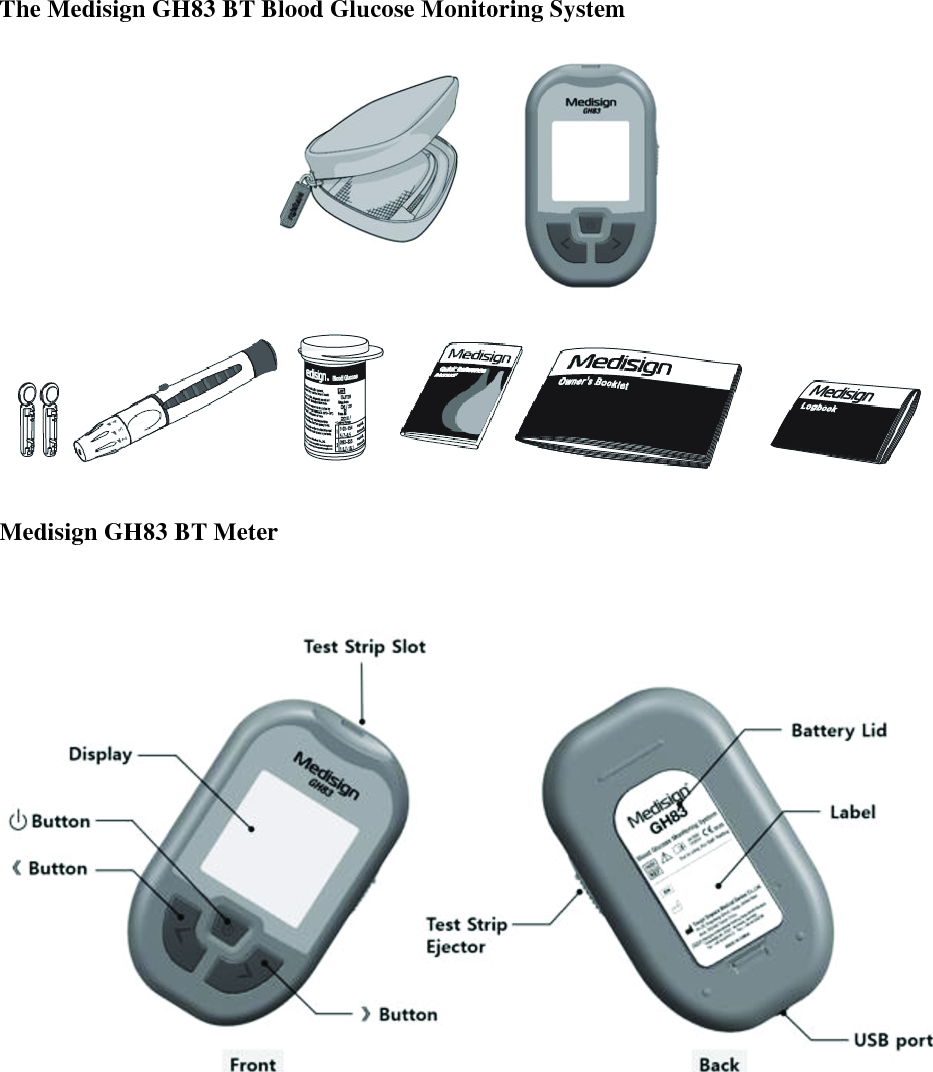
 The Medisign GH83 BT Blood Glucose Monitoring System        Medisign GH83 BT Meter
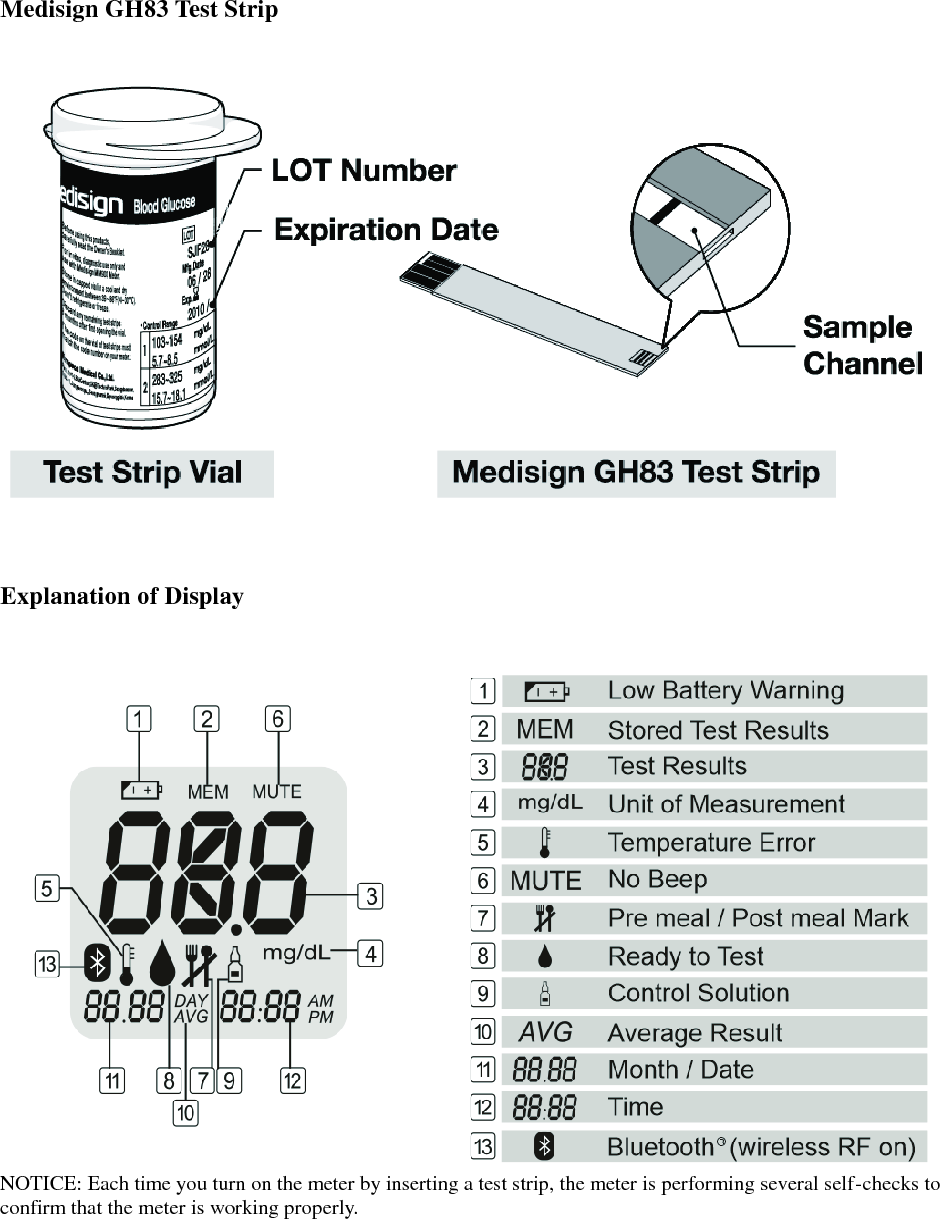
 Medisign GH83 Test Strip        Explanation of Display   NOTICE: Each time you turn on the meter by inserting a test strip, the meter is performing several self-checks to confirm that the meter is working properly.
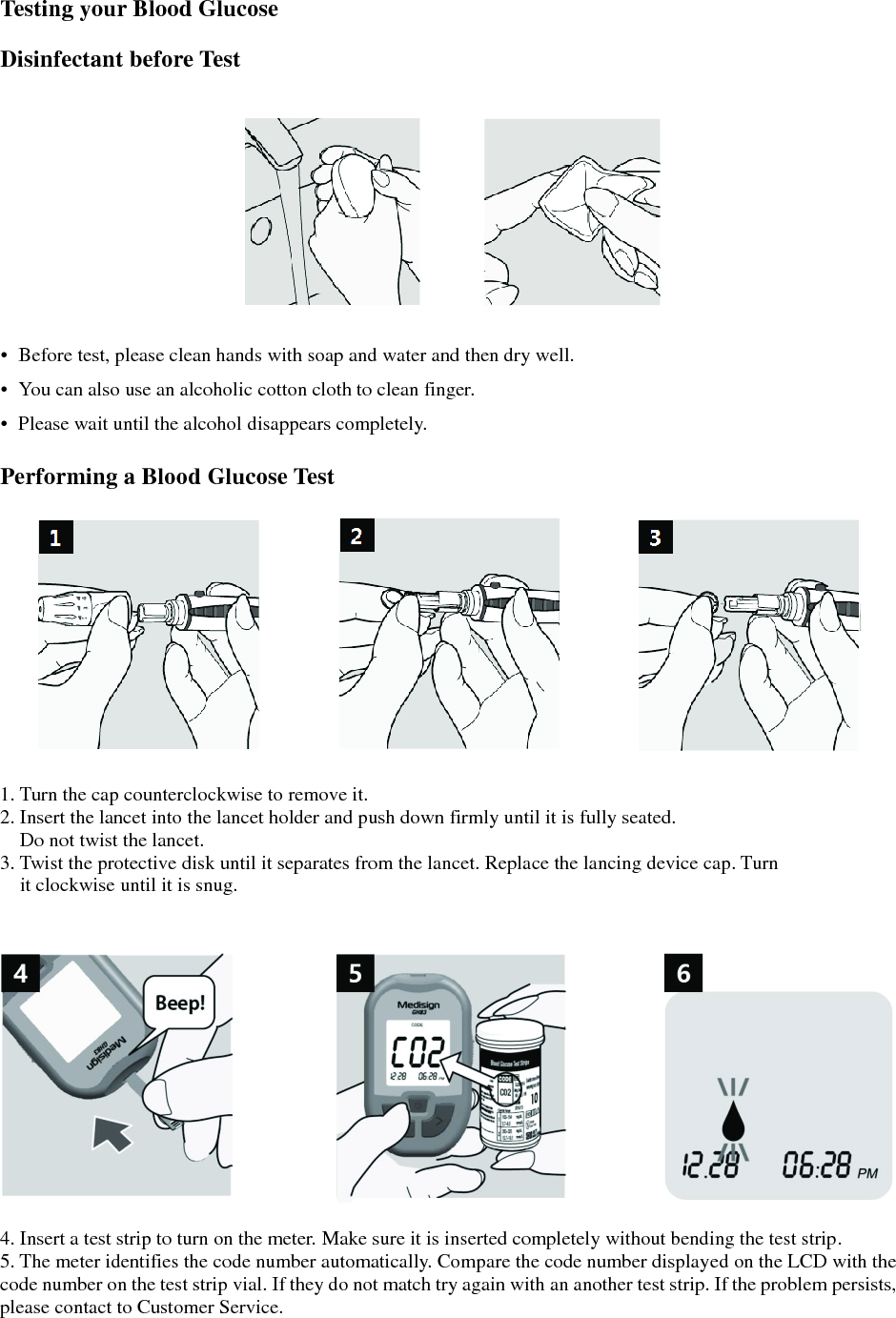
 Testing your Blood Glucose  Disinfectant before Test   •  Before test, please clean hands with soap and water and then dry well. •  You can also use an alcoholic cotton cloth to clean finger. •  Please wait until the alcohol disappears completely.  Performing a Blood Glucose Test    1. Turn the cap counterclockwise to remove it. 2. Insert the lancet into the lancet holder and push down firmly until it is fully seated. Do not twist the lancet. 3. Twist the protective disk until it separates from the lancet. Replace the lancing device cap. Turn it clockwise until it is snug.     4. Insert a test strip to turn on the meter. Make sure it is inserted completely without bending the test strip. 5. The meter identifies the code number automatically. Compare the code number displayed on the LCD with the code number on the test strip vial. If they do not match try again with an another test strip. If the problem persists, please contact to Customer Service.
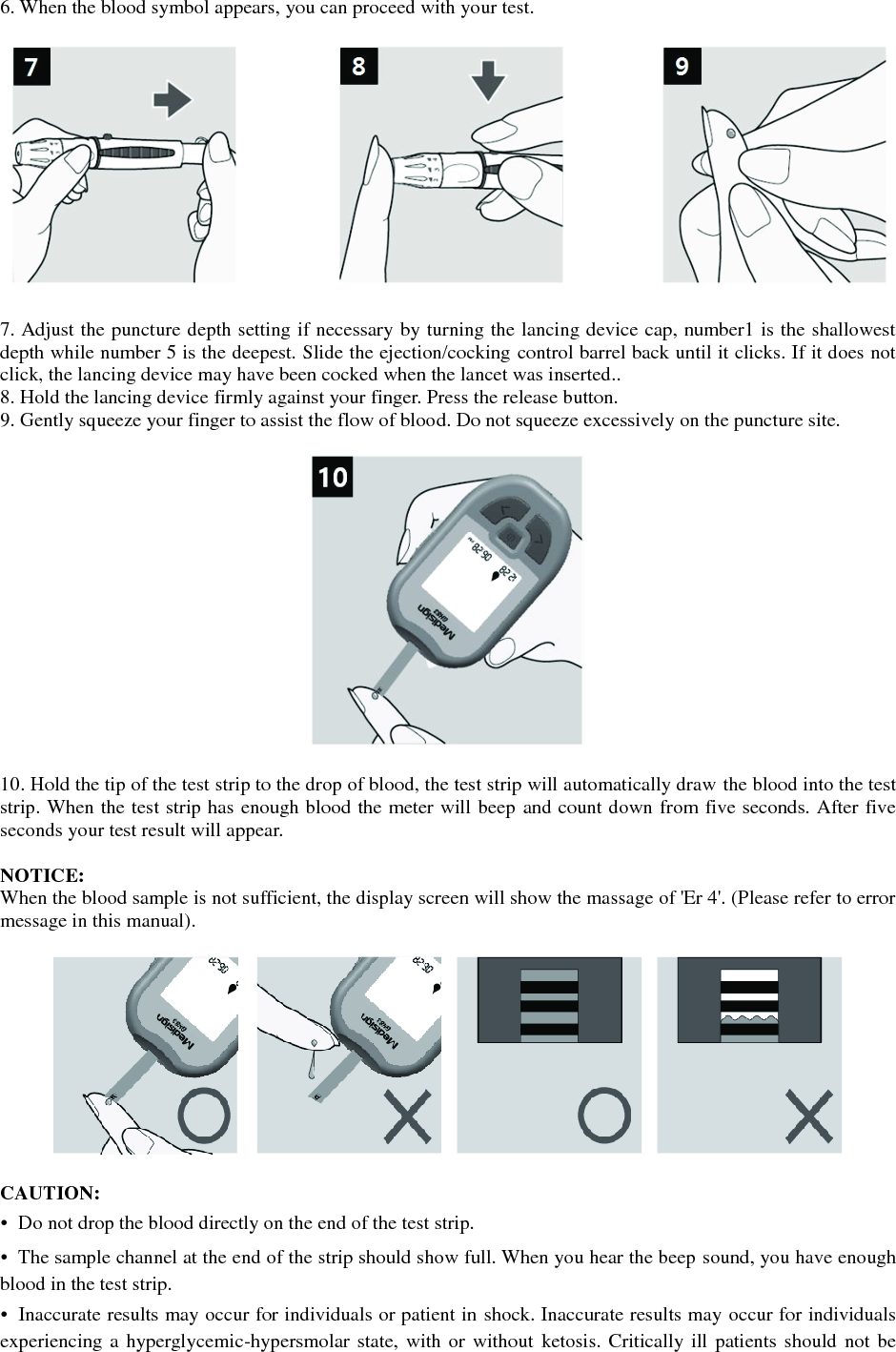
6. When the blood symbol appears, you can proceed with your test.    7. Adjust the puncture depth setting if necessary by turning the lancing device cap, number1 is the shallowest depth while number 5 is the deepest. Slide the ejection/cocking control barrel back until it clicks. If it does not click, the lancing device may have been cocked when the lancet was inserted.. 8. Hold the lancing device firmly against your finger. Press the release button. 9. Gently squeeze your finger to assist the flow of blood. Do not squeeze excessively on the puncture site.    10. Hold the tip of the test strip to the drop of blood, the test strip will automatically draw the blood into the test strip. When the test strip has enough blood the meter will beep and count down from five seconds. After five seconds your test result will appear.    NOTICE: When the blood sample is not sufficient, the display screen will show the massage of 'Er 4'. (Please refer to error message in this manual).    CAUTION: •  Do not drop the blood directly on the end of the test strip. •  The sample channel at the end of the strip should show full. When you hear the beep sound, you have enough blood in the test strip. •  Inaccurate results may occur for individuals or patient in shock. Inaccurate results may occur for individuals experiencing a hyperglycemic-hypersmolar state, with or  without ketosis. Critically ill patients should not be
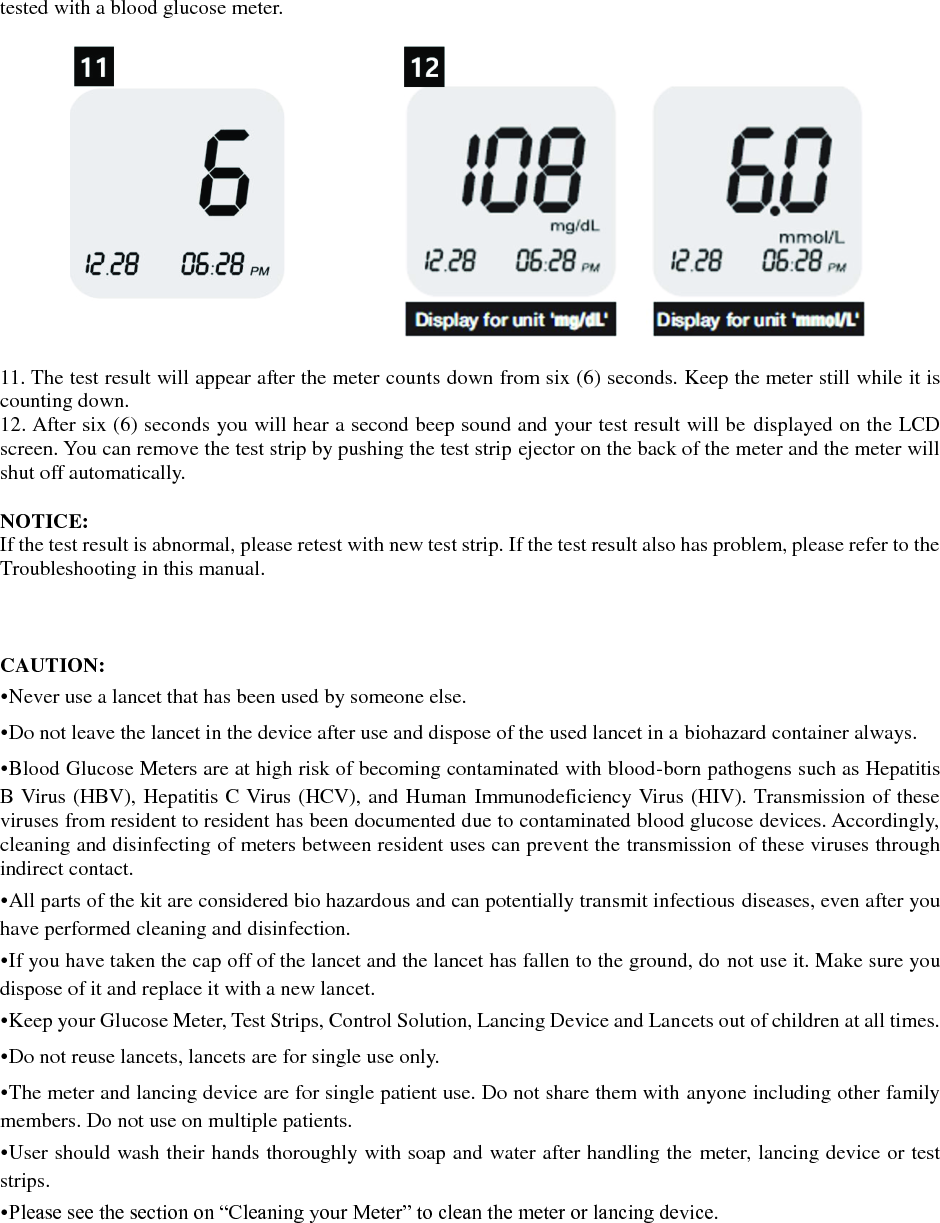
tested with a blood glucose meter.    11. The test result will appear after the meter counts down from six (6) seconds. Keep the meter still while it is counting down. 12. After six (6) seconds you will hear a second beep sound and your test result will be displayed on the LCD screen. You can remove the test strip by pushing the test strip ejector on the back of the meter and the meter will shut off automatically.  NOTICE: If the test result is abnormal, please retest with new test strip. If the test result also has problem, please refer to the Troubleshooting in this manual.    CAUTION: •Never use a lancet that has been used by someone else. •Do not leave the lancet in the device after use and dispose of the used lancet in a biohazard container always. •Blood Glucose Meters are at high risk of becoming contaminated with blood-born pathogens such as Hepatitis B Virus (HBV), Hepatitis C Virus (HCV), and Human Immunodeficiency Virus (HIV). Transmission of these viruses from resident to resident has been documented due to contaminated blood glucose devices. Accordingly, cleaning and disinfecting of meters between resident uses can prevent the transmission of these viruses through indirect contact. •All parts of the kit are considered bio hazardous and can potentially transmit infectious diseases, even after you have performed cleaning and disinfection. •If you have taken the cap off of the lancet and the lancet has fallen to the ground, do not use it. Make sure you dispose of it and replace it with a new lancet. •Keep your Glucose Meter, Test Strips, Control Solution, Lancing Device and Lancets out of children at all times. •Do not reuse lancets, lancets are for single use only. •The meter and lancing device are for single patient use. Do not share them with anyone including other family members. Do not use on multiple patients. •User should wash their hands thoroughly with soap and water after handling the meter, lancing device or test strips. •Please see the section on “Cleaning your Meter” to clean the meter or lancing device.
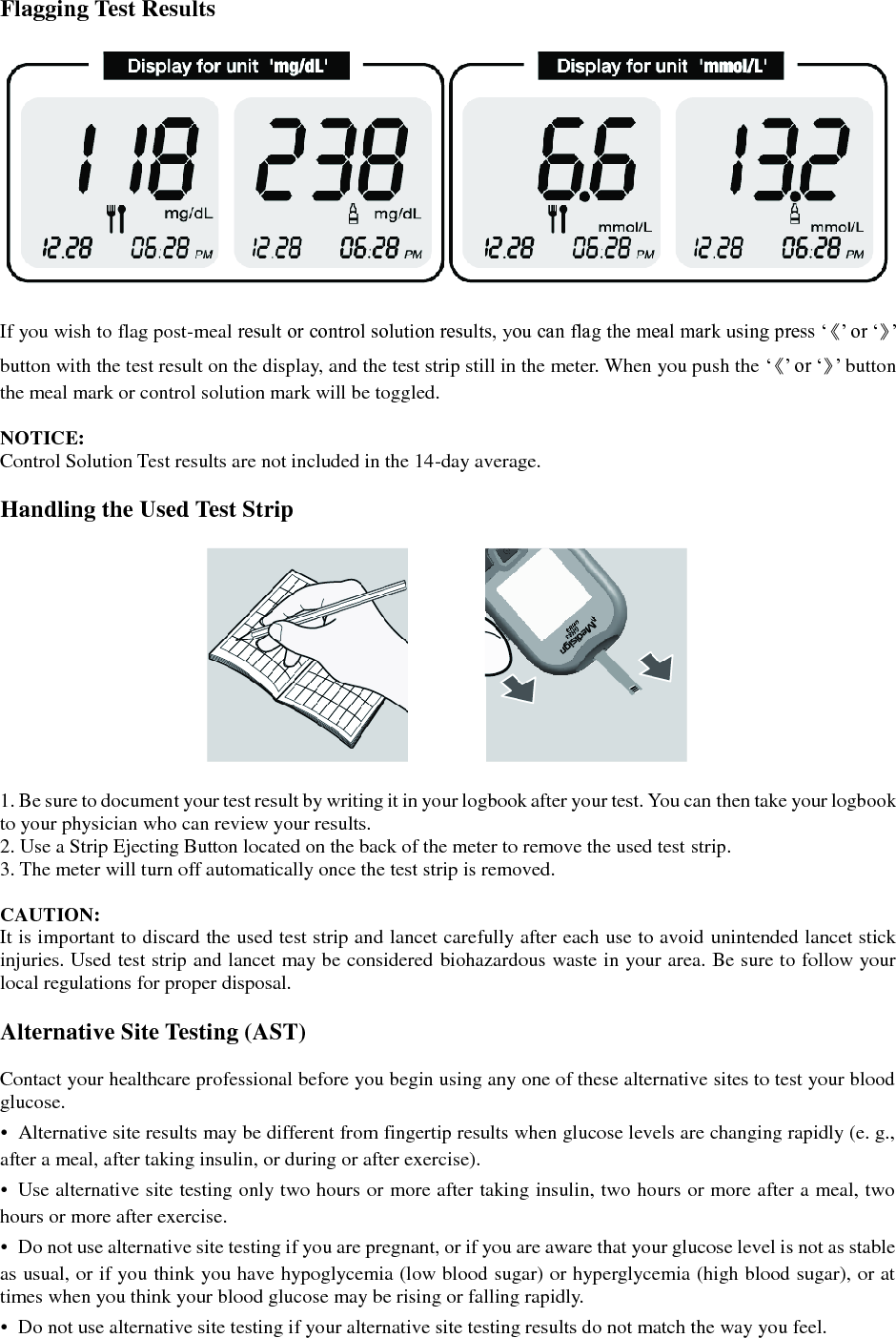
Flagging Test Results    If you wish to flag post-meal result or control solution results, you can flag the meal mark using press ‘《’ or ‘》’ button with the test result on the display, and the test strip still in the meter. When you push the ‘《’ or ‘》’ button the meal mark or control solution mark will be toggled.  NOTICE: Control Solution Test results are not included in the 14-day average.  Handling the Used Test Strip    1. Be sure to document your test result by writing it in your logbook after your test. You can then take your logbook to your physician who can review your results. 2. Use a Strip Ejecting Button located on the back of the meter to remove the used test strip. 3. The meter will turn off automatically once the test strip is removed.  CAUTION: It is important to discard the used test strip and lancet carefully after each use to avoid unintended lancet stick injuries. Used test strip and lancet may be considered biohazardous waste in your area. Be sure to follow your local regulations for proper disposal.  Alternative Site Testing (AST)  Contact your healthcare professional before you begin using any one of these alternative sites to test your blood glucose. •  Alternative site results may be different from fingertip results when glucose levels are changing rapidly (e. g., after a meal, after taking insulin, or during or after exercise). •  Use alternative site testing only two hours or more after taking insulin, two hours or more after a meal, two hours or more after exercise. •  Do not use alternative site testing if you are pregnant, or if you are aware that your glucose level is not as stable as usual, or if you think you have hypoglycemia (low blood sugar) or hyperglycemia (high blood sugar), or at times when you think your blood glucose may be rising or falling rapidly. •  Do not use alternative site testing if your alternative site testing results do not match the way you feel.
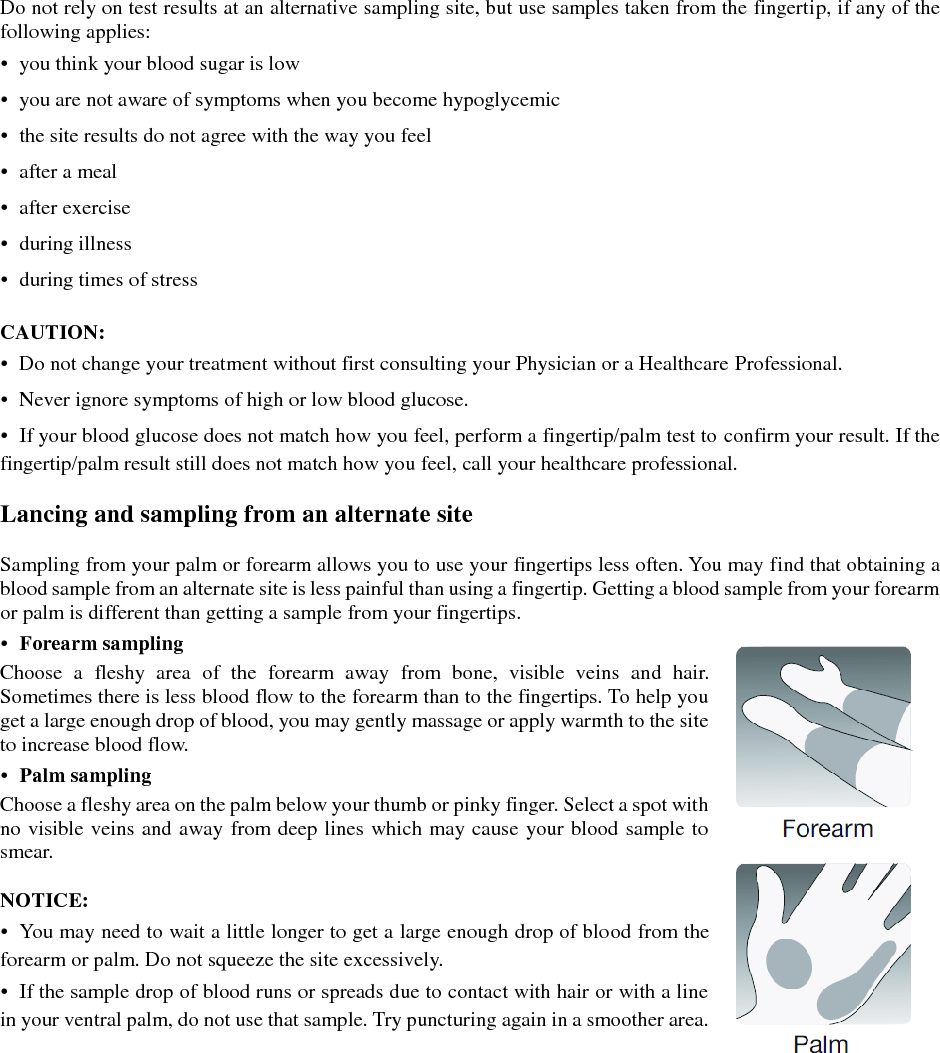
Do not rely on test results at an alternative sampling site, but use samples taken from the fingertip, if any of the following applies: •  you think your blood sugar is low •  you are not aware of symptoms when you become hypoglycemic •  the site results do not agree with the way you feel •  after a meal •  after exercise •  during illness •  during times of stress  CAUTION: •  Do not change your treatment without first consulting your Physician or a Healthcare Professional. •  Never ignore symptoms of high or low blood glucose. •  If your blood glucose does not match how you feel, perform a fingertip/palm test to confirm your result. If the fingertip/palm result still does not match how you feel, call your healthcare professional.  Lancing and sampling from an alternate site  Sampling from your palm or forearm allows you to use your fingertips less often. You may find that obtaining a blood sample from an alternate site is less painful than using a fingertip. Getting a blood sample from your forearm or palm is different than getting a sample from your fingertips. •  Forearm sampling Choose  a  fleshy  area  of  the  forearm  away  from  bone,  visible  veins  and  hair. Sometimes there is less blood flow to the forearm than to the fingertips. To help you get a large enough drop of blood, you may gently massage or apply warmth to the site to increase blood flow. •  Palm sampling Choose a fleshy area on the palm below your thumb or pinky finger. Select a spot with no visible veins and away from deep lines which may cause your blood sample to smear.  NOTICE: •  You may need to wait a little longer to get a large enough drop of blood from the forearm or palm. Do not squeeze the site excessively. •  If the sample drop of blood runs or spreads due to contact with hair or with a line in your ventral palm, do not use that sample. Try puncturing again in a smoother area.
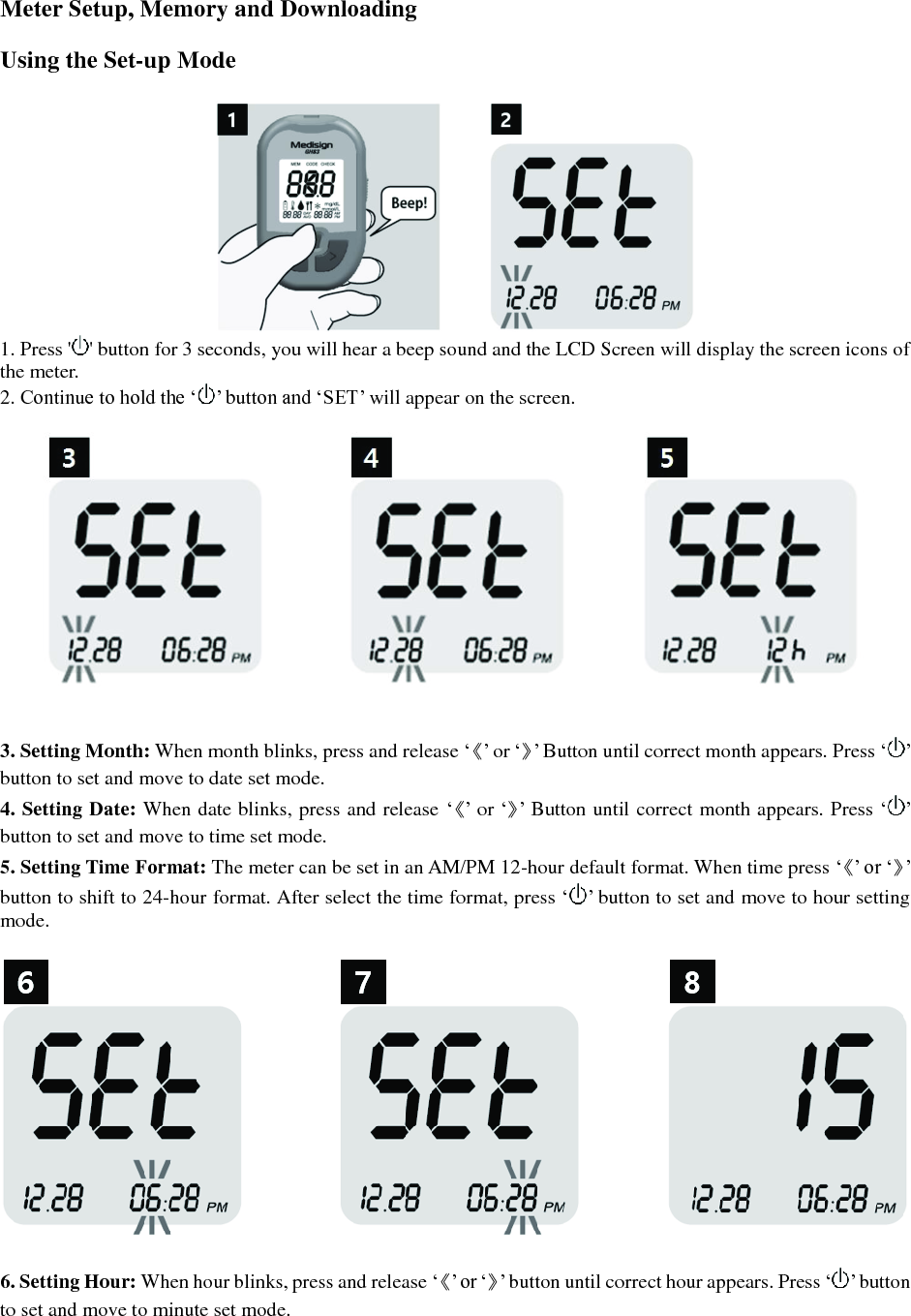
 Meter Setup, Memory and Downloading  Using the Set-up Mode   1. Press ' ' button for 3 seconds, you will hear a beep sound and the LCD Screen will display the screen icons of the meter. 2. Continue to hold the ‘ ’ button and ‘SET’ will appear on the screen.    3. Setting Month: When month blinks, press and release ‘《’ or ‘》’ Button until correct month appears. Press ‘’   button to set and move to date set mode. 4. Setting Date: When date blinks, press and release ‘《’ or ‘》’ Button until correct month appears. Press ‘’   button to set and move to time set mode. 5. Setting Time Format: The meter can be set in an AM/PM 12-hour default format. When time press ‘《’ or ‘》’ button to shift to 24-hour format. After select the time format, press ‘ ’ button to set and move to hour setting mode.    6. Setting Hour: When hour blinks, press and release ‘《’ or ‘》’ button until correct hour appears. Press ‘ ’ button to set and move to minute set mode.
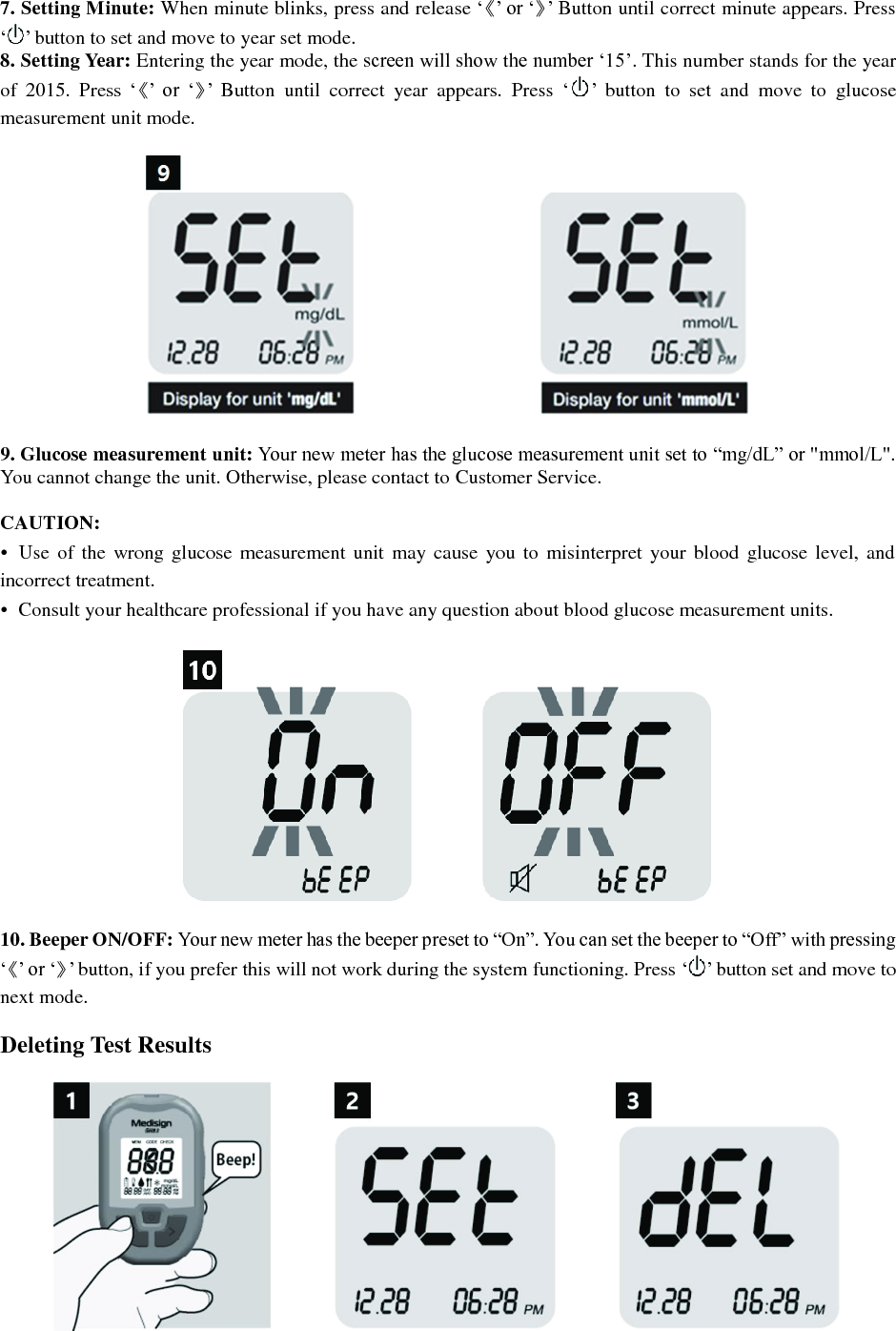
7. Setting Minute: When minute blinks, press and release ‘《’ or ‘》’ Button until correct minute appears. Press ‘ ’ button to set and move to year set mode. 8. Setting Year: Entering the year mode, the screen will show the number ‘15’. This number stands for the year of  2015.  Press  ‘《’ or  ‘》’  Button  until  correct  year  appears.  Press  ‘ ’  button  to  set  and  move  to  glucose measurement unit mode.    9. Glucose measurement unit: Your new meter has the glucose measurement unit set to “mg/dL” or "mmol/L". You cannot change the unit. Otherwise, please contact to Customer Service.  CAUTION: •  Use  of  the  wrong glucose  measurement unit  may  cause  you to  misinterpret  your blood  glucose level,  and incorrect treatment. •  Consult your healthcare professional if you have any question about blood glucose measurement units.    10. Beeper ON/OFF: Your new meter has the beeper preset to “On”. You can set the beeper to “Off” with pressing ‘《’ or ‘》’ button, if you prefer this will not work during the system functioning. Press ‘ ’ button set and move to next mode.  Deleting Test Results
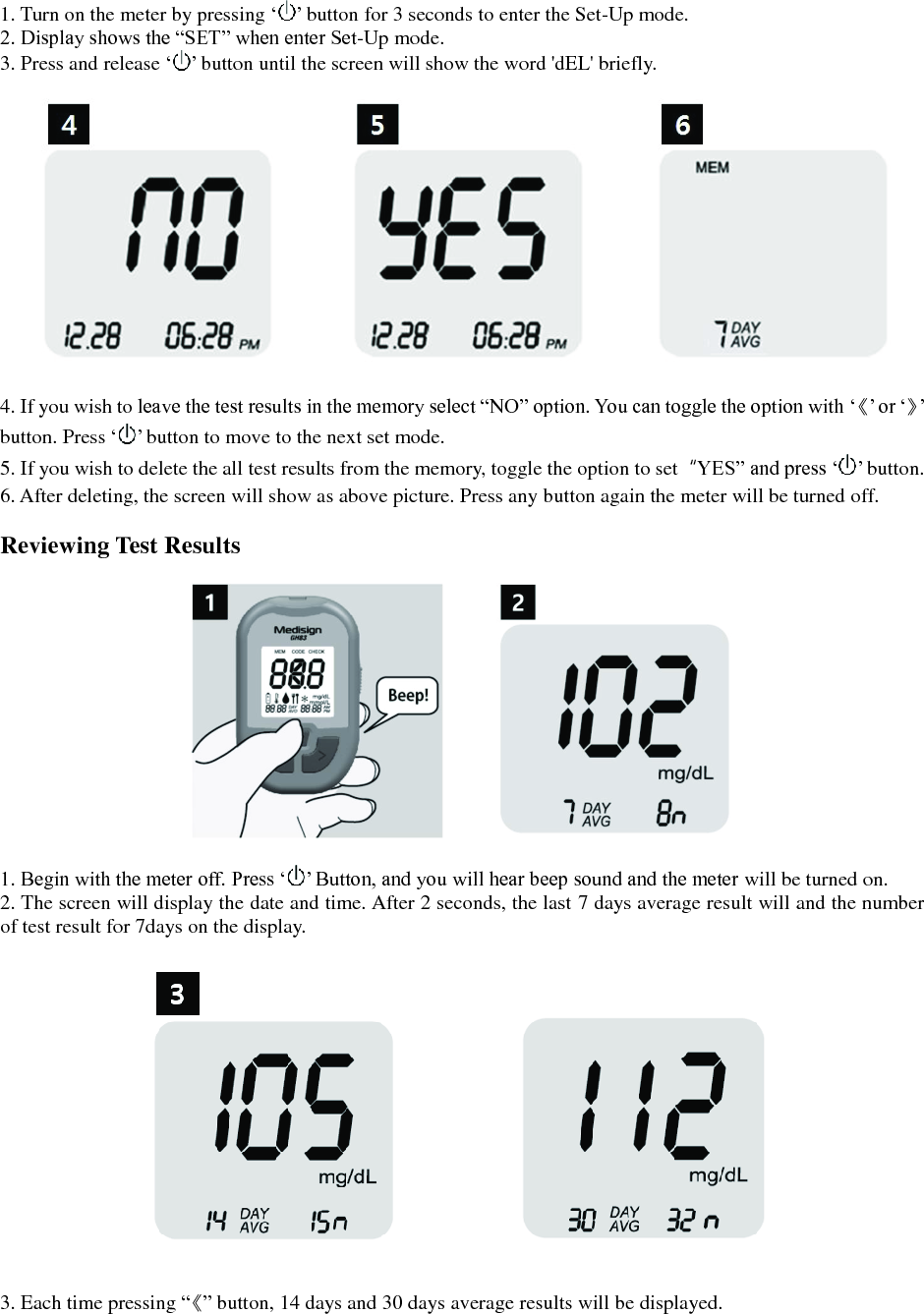
 1. Turn on the meter by pressing ‘ ’ button for 3 seconds to enter the Set-Up mode. 2. Display shows the “SET” when enter Set-Up mode. 3. Press and release ‘ ’ button until the screen will show the word 'dEL' briefly.    4. If you wish to leave the test results in the memory select “NO” option. You can toggle the option with ‘《’ or ‘》’ button. Press ‘ ’ button to move to the next set mode. 5. If you wish to delete the all test results from the memory, toggle the option to set  “YES” and press ‘ ’ button. 6. After deleting, the screen will show as above picture. Press any button again the meter will be turned off.  Reviewing Test Results    1. Begin with the meter off. Press ‘ ’ Button, and you will hear beep sound and the meter will be turned on. 2. The screen will display the date and time. After 2 seconds, the last 7 days average result will and the number of test result for 7days on the display.    3. Each time pressing “《” button, 14 days and 30 days average results will be displayed.
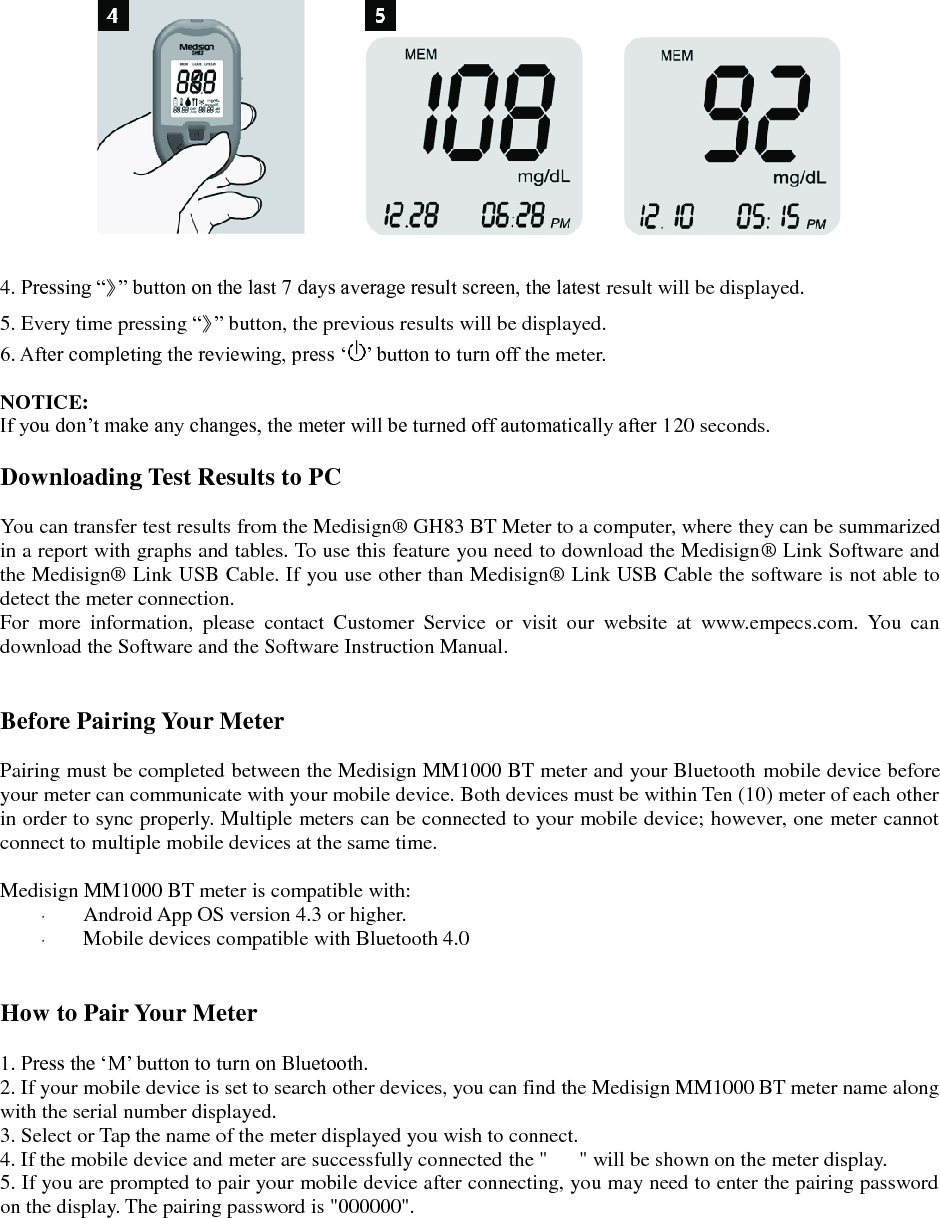
  4. Pressing “》” button on the last 7 days average result screen, the latest result will be displayed. 5. Every time pressing “》” button, the previous results will be displayed. 6. After completing the reviewing, press ‘ ’ button to turn off the meter.  NOTICE: If you don’t make any changes, the meter will be turned off automatically after 120 seconds.  Downloading Test Results to PC  You can transfer test results from the Medisign®  GH83 BT Meter to a computer, where they can be summarized in a report with graphs and tables. To use this feature you need to download the Medisign®  Link Software and the Medisign®  Link USB Cable. If you use other than Medisign®  Link USB Cable the software is not able to detect the meter connection. For  more  information,  please  contact  Customer  Service  or  visit  our  website  at  www.empecs.com.  You  can download the Software and the Software Instruction Manual.   Before Pairing Your Meter  Pairing must be completed between the Medisign MM1000 BT meter and your Bluetooth mobile device before your meter can communicate with your mobile device. Both devices must be within Ten (10) meter of each other in order to sync properly. Multiple meters can be connected to your mobile device; however, one meter cannot connect to multiple mobile devices at the same time.  Medisign MM1000 BT meter is compatible with:    Android App OS version 4.3 or higher.  Mobile devices compatible with Bluetooth 4.0   How to Pair Your Meter  1. Press the ‘M’ button to turn on Bluetooth. 2. If your mobile device is set to search other devices, you can find the Medisign MM1000 BT meter name along with the serial number displayed. 3. Select or Tap the name of the meter displayed you wish to connect. 4. If the mobile device and meter are successfully connected the "      " will be shown on the meter display. 5. If you are prompted to pair your mobile device after connecting, you may need to enter the pairing password on the display. The pairing password is "000000".
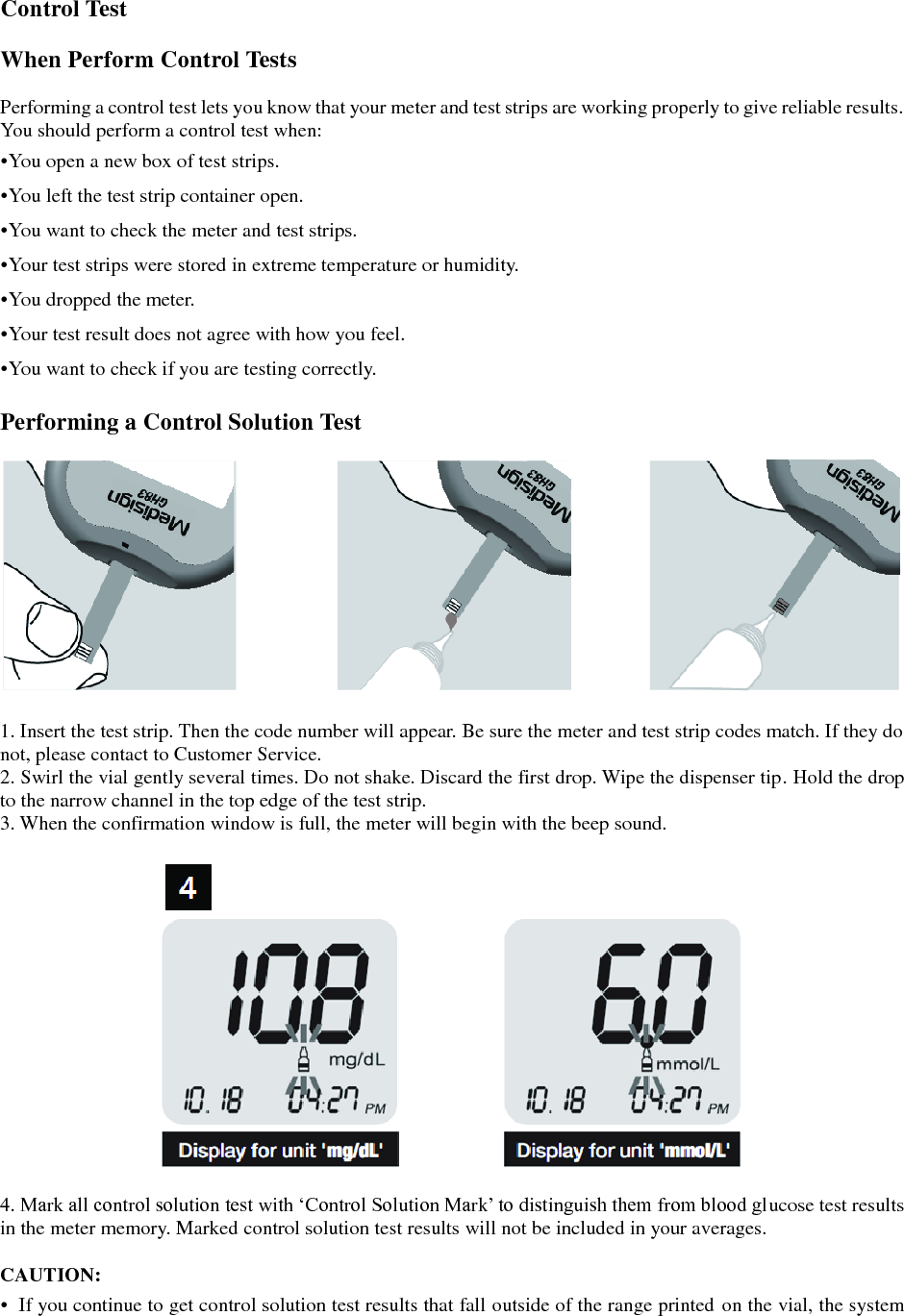
 Control Test  When Perform Control Tests  Performing a control test lets you know that your meter and test strips are working properly to give reliable results. You should perform a control test when: •You open a new box of test strips. •You left the test strip container open. •You want to check the meter and test strips. •Your test strips were stored in extreme temperature or humidity. •You dropped the meter. •Your test result does not agree with how you feel. •You want to check if you are testing correctly.  Performing a Control Solution Test    1. Insert the test strip. Then the code number will appear. Be sure the meter and test strip codes match. If they do not, please contact to Customer Service. 2. Swirl the vial gently several times. Do not shake. Discard the first drop. Wipe the dispenser tip. Hold the drop to the narrow channel in the top edge of the test strip. 3. When the confirmation window is full, the meter will begin with the beep sound.    4. Mark all control solution test with ‘Control Solution Mark’ to distinguish them from blood glucose test results in the meter memory. Marked control solution test results will not be included in your averages.  CAUTION: •  If you continue to get control solution test results that fall outside of the range printed on the vial, the system
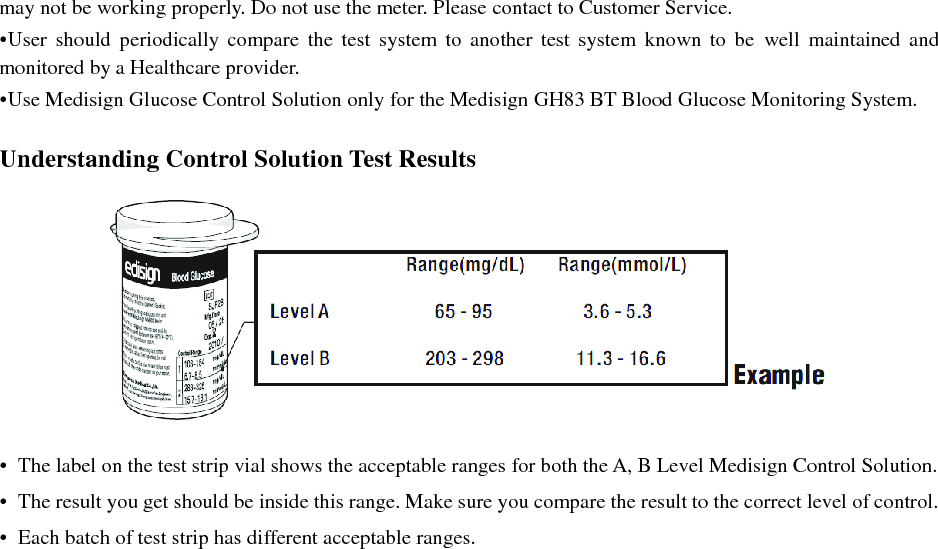
may not be working properly. Do not use the meter. Please contact to Customer Service. •User  should  periodically compare  the  test  system  to  another  test  system  known  to  be  well  maintained  and monitored by a Healthcare provider. •Use Medisign Glucose Control Solution only for the Medisign GH83 BT Blood Glucose Monitoring System.  Understanding Control Solution Test Results    •  The label on the test strip vial shows the acceptable ranges for both the A, B Level Medisign Control Solution. •  The result you get should be inside this range. Make sure you compare the result to the correct level of control. •  Each batch of test strip has different acceptable ranges.
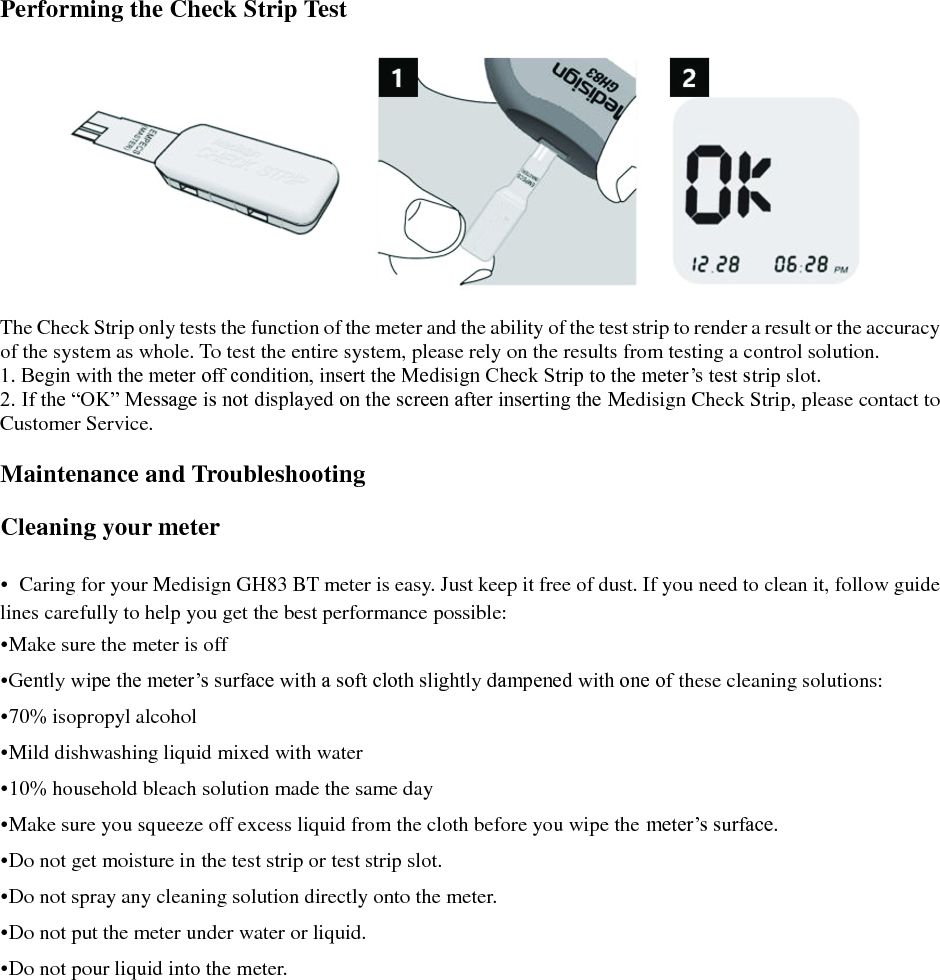
 Performing the Check Strip Test    The Check Strip only tests the function of the meter and the ability of the test strip to render a result or the accuracy of the system as whole. To test the entire system, please rely on the results from testing a control solution. 1. Begin with the meter off condition, insert the Medisign Check Strip to the meter’s test strip slot. 2. If the “OK” Message is not displayed on the screen after inserting the Medisign Check Strip, please contact to Customer Service.  Maintenance and Troubleshooting  Cleaning your meter  •  Caring for your Medisign GH83 BT meter is easy. Just keep it free of dust. If you need to clean it, follow guide lines carefully to help you get the best performance possible: •Make sure the meter is off •Gently wipe the meter’s surface with a soft cloth slightly dampened with one of these cleaning solutions: •70% isopropyl alcohol •Mild dishwashing liquid mixed with water •10% household bleach solution made the same day •Make sure you squeeze off excess liquid from the cloth before you wipe the meter’s surface. •Do not get moisture in the test strip or test strip slot. •Do not spray any cleaning solution directly onto the meter. •Do not put the meter under water or liquid. •Do not pour liquid into the meter.
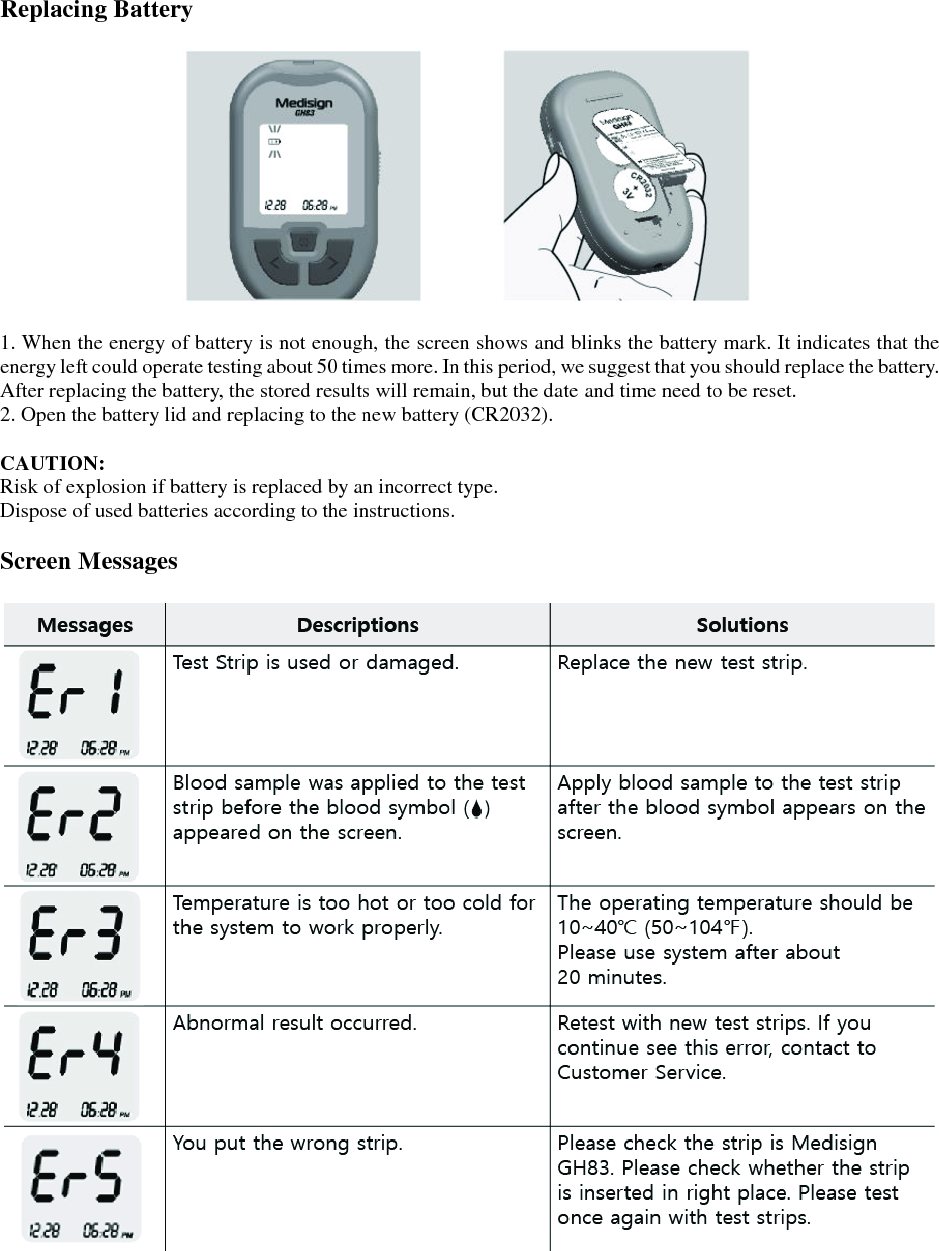
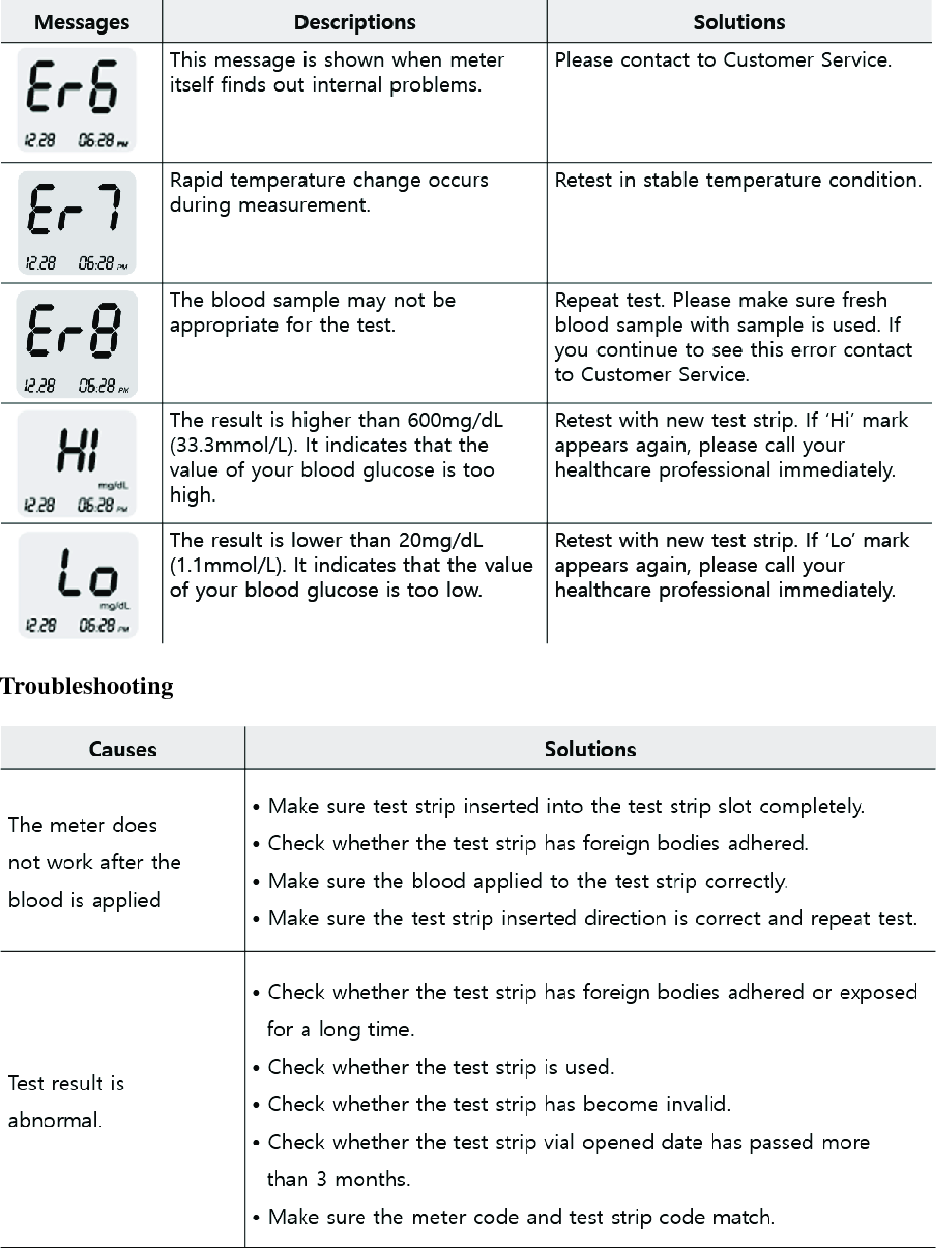
 Replacing Battery    1. When the energy of battery is not enough, the screen shows and blinks the battery mark. It indicates that the energy left could operate testing about 50 times more. In this period, we suggest that you should replace the battery. After replacing the battery, the stored results will remain, but the date and time need to be reset. 2. Open the battery lid and replacing to the new battery (CR2032).  CAUTION: Risk of explosion if battery is replaced by an incorrect type. Dispose of used batteries according to the instructions.  Screen Messages
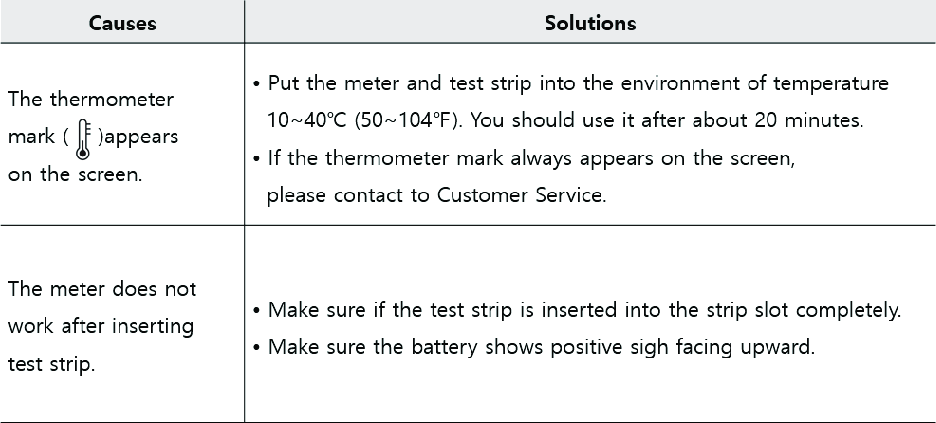
  Troubleshooting
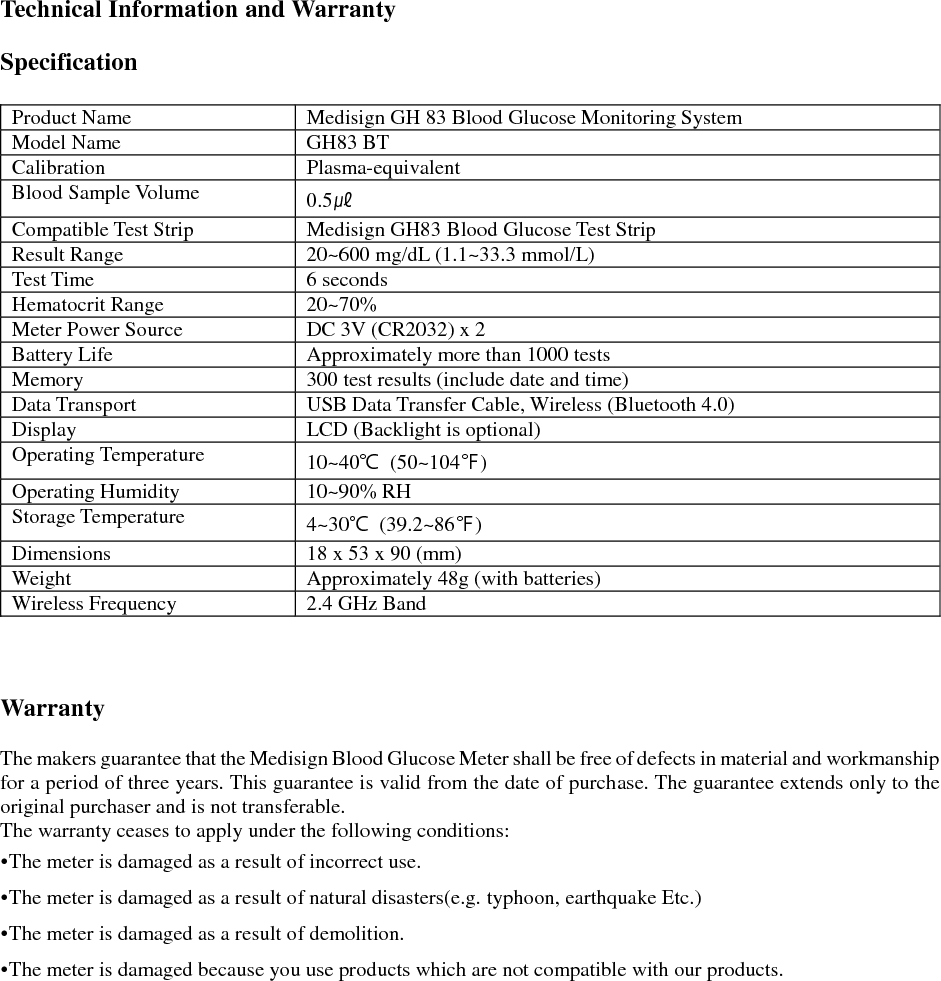
 Technical Information and Warranty  Specification  Product Name Medisign GH 83 Blood Glucose Monitoring System Model Name GH83 BT Calibration Plasma-equivalent Blood Sample Volume 0.5㎕ Compatible Test Strip Medisign GH83 Blood Glucose Test Strip Result Range 20~600 mg/dL (1.1~33.3 mmol/L) Test Time 6 seconds Hematocrit Range 20~70% Meter Power Source DC 3V (CR2032) x 2 Battery Life Approximately more than 1000 tests Memory 300 test results (include date and time) Data Transport USB Data Transfer Cable, Wireless (Bluetooth 4.0) Display LCD (Backlight is optional) Operating Temperature 10~40℃  (50~104℉) Operating Humidity 10~90% RH Storage Temperature 4~30℃  (39.2~86℉) Dimensions 18 x 53 x 90 (mm) Weight Approximately 48g (with batteries) Wireless Frequency 2.4 GHz Band    Warranty  The makers guarantee that the Medisign Blood Glucose Meter shall be free of defects in material and workmanship for a period of three years. This guarantee is valid from the date of purchase. The guarantee extends only to the original purchaser and is not transferable. The warranty ceases to apply under the following conditions: •The meter is damaged as a result of incorrect use. •The meter is damaged as a result of natural disasters(e.g. typhoon, earthquake Etc.) •The meter is damaged as a result of demolition. •The meter is damaged because you use products which are not compatible with our products.
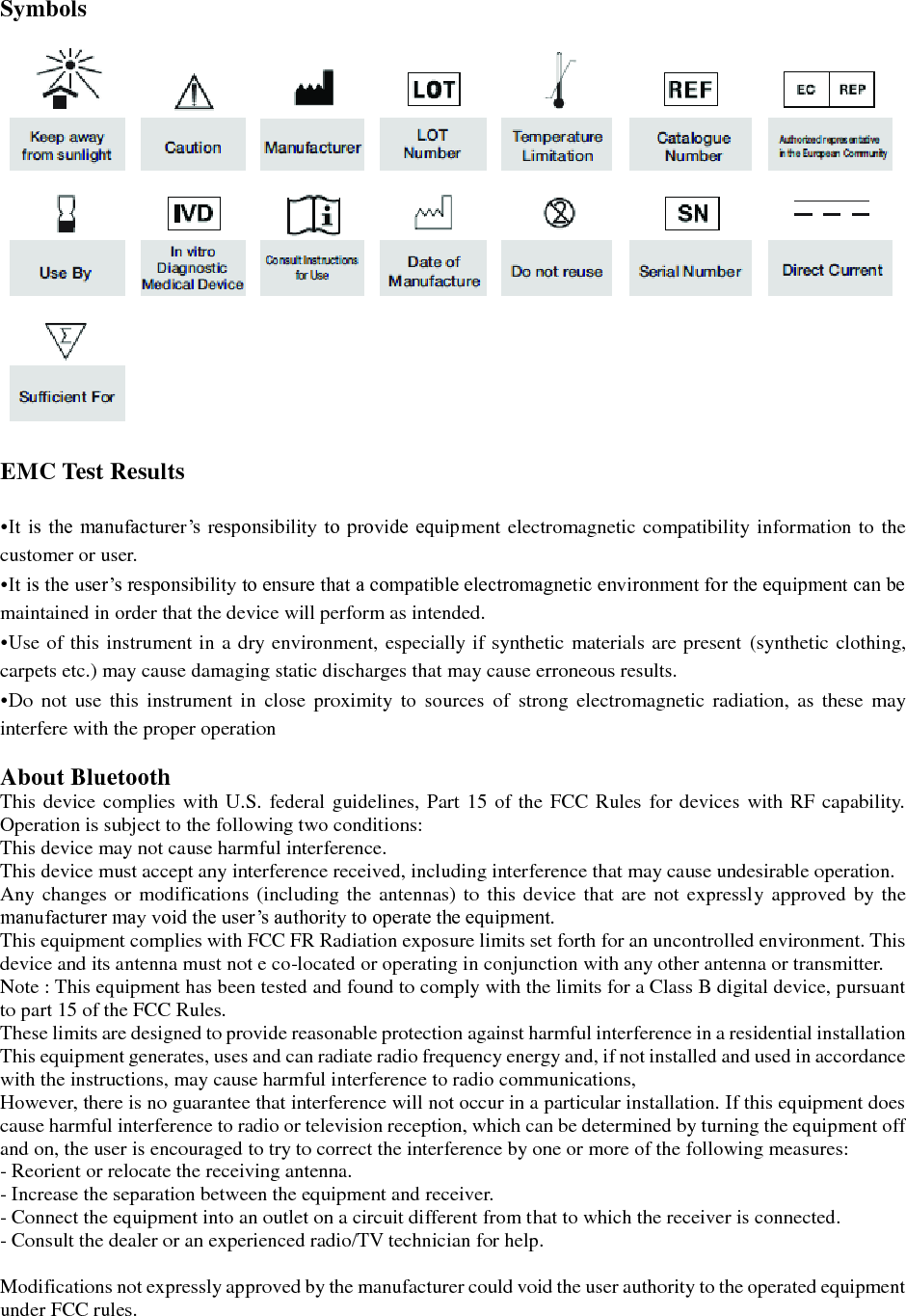
 Symbols    EMC Test Results  •It is the  manufacturer’s  responsibility to provide equipment electromagnetic compatibility information to the customer or user. •It is the user’s responsibility to ensure that a compatible electromagnetic environment for the equipment can be maintained in order that the device will perform as intended. •Use of this instrument in a dry environment, especially if synthetic materials are present (synthetic clothing, carpets etc.) may cause damaging static discharges that may cause erroneous results. •Do  not  use  this  instrument  in close  proximity to  sources  of  strong  electromagnetic  radiation,  as  these  may interfere with the proper operation  About Bluetooth This device complies with U.S. federal guidelines, Part 15 of the FCC Rules for devices with RF capability. Operation is subject to the following two conditions: This device may not cause harmful interference. This device must accept any interference received, including interference that may cause undesirable operation. Any changes or  modifications (including the antennas) to this device that are  not expressly approved  by the manufacturer may void the user’s authority to operate the equipment. This equipment complies with FCC FR Radiation exposure limits set forth for an uncontrolled environment. This device and its antenna must not e co-located or operating in conjunction with any other antenna or transmitter. Note : This equipment has been tested and found to comply with the limits for a Class B digital device, pursuant to part 15 of the FCC Rules. These limits are designed to provide reasonable protection against harmful interference in a residential installation This equipment generates, uses and can radiate radio frequency energy and, if not installed and used in accordance with the instructions, may cause harmful interference to radio communications, However, there is no guarantee that interference will not occur in a particular installation. If this equipment does cause harmful interference to radio or television reception, which can be determined by turning the equipment off and on, the user is encouraged to try to correct the interference by one or more of the following measures: - Reorient or relocate the receiving antenna. - Increase the separation between the equipment and receiver. - Connect the equipment into an outlet on a circuit different from that to which the receiver is connected. - Consult the dealer or an experienced radio/TV technician for help.    Modifications not expressly approved by the manufacturer could void the user authority to the operated equipment under FCC rules.
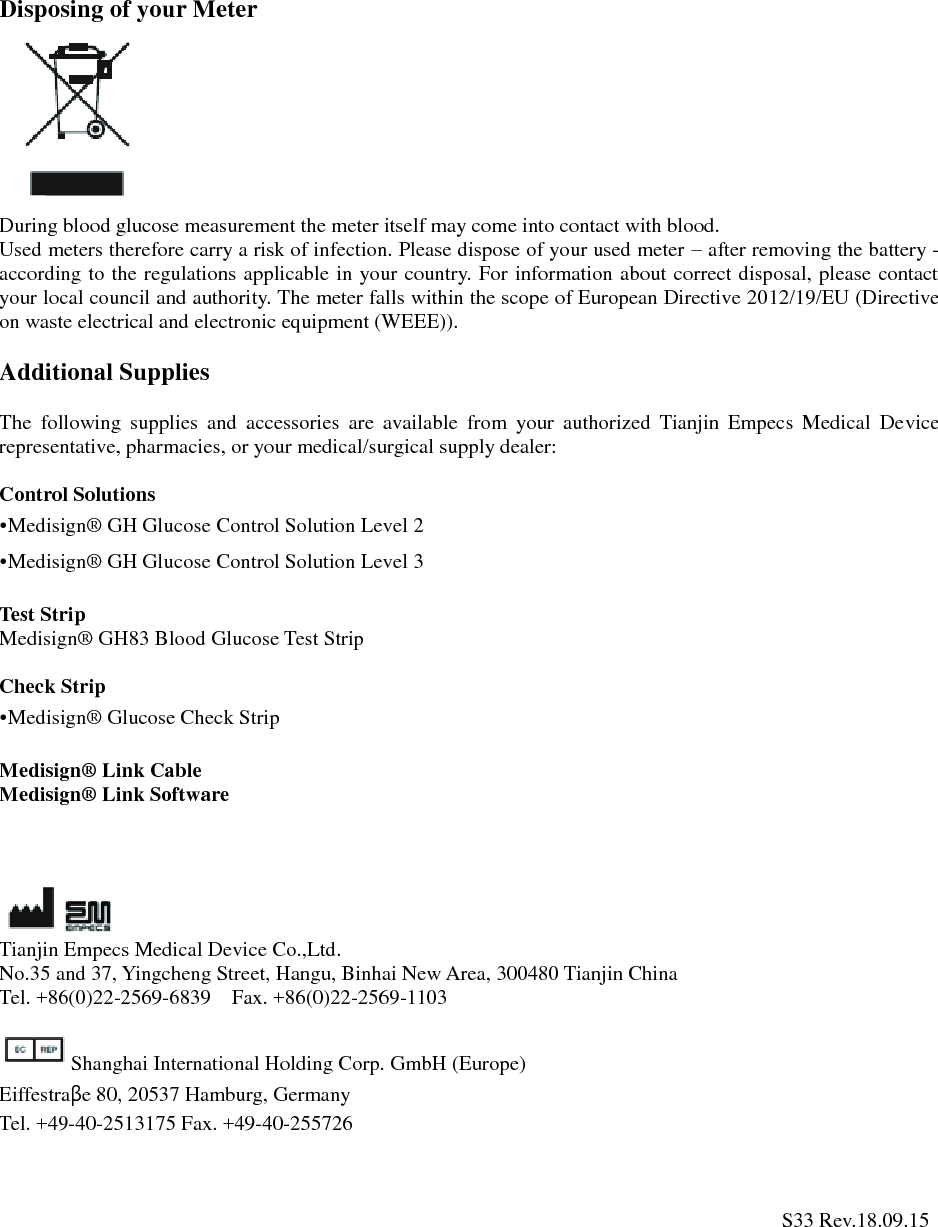
Disposing of your Meter During blood glucose measurement the meter itself may come into contact with blood. Used meters therefore carry a risk of infection. Please dispose of your used meter – after removing the battery - according to the regulations applicable in your country. For information about correct disposal, please contact your local council and authority. The meter falls within the scope of European Directive 2012/19/EU (Directive on waste electrical and electronic equipment (WEEE)). Additional Supplies The  following  supplies  and  accessories  are  available  from  your  authorized  Tianjin  Empecs  Medical  Device representative, pharmacies, or your medical/surgical supply dealer: Control Solutions •Medisign®  GH Glucose Control Solution Level 2•Medisign®  GH Glucose Control Solution Level 3Test Strip Medisign®  GH83 Blood Glucose Test Strip Check Strip •Medisign®  Glucose Check StripMedisign®  Link Cable Medisign®  Link Software Tianjin Empecs Medical Device Co.,Ltd. No.35 and 37, Yingcheng Street, Hangu, Binhai New Area, 300480 Tianjin China Tel. +86(0)22-2569-6839  Fax. +86(0)22-2569-1103 Shanghai International Holding Corp. GmbH (Europe) Eiffestraβe 80, 20537 Hamburg, Germany Tel. +49-40-2513175 Fax. +49-40-255726    S33 Rev.18.09.15
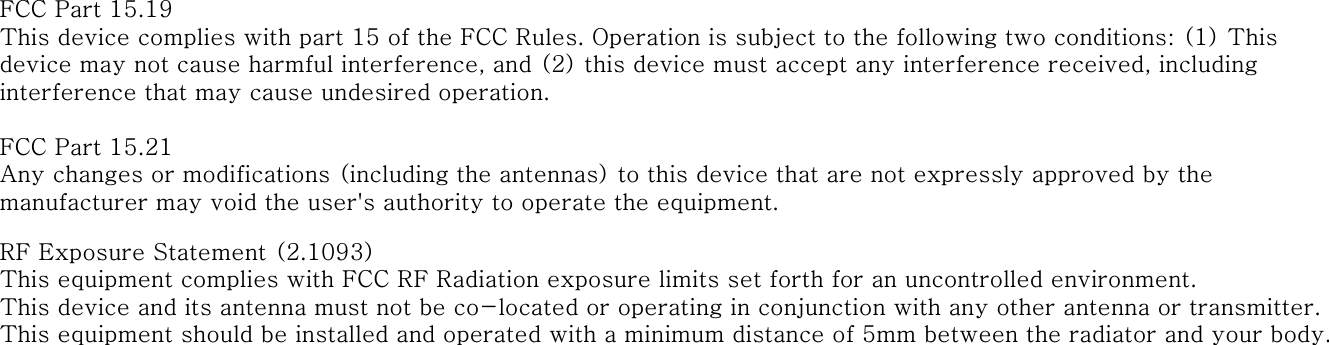
FCC Part 15.19This device complies with part 15 of the FCC Rules. Operation is subject to the following two conditions: (1) This device may not cause harmful interference, and (2) this device must accept any interference received, including interference that may cause undesired operation.FCC Part 15.21Any changes or modifications (including the antennas) to this device that are not expressly approved by the manufacturer may void the user's authority to operate the equipment.RF Exposure Statement (2.1093)This equipment complies with FCC RF Radiation exposure limits set forth for an uncontrolled environment. This device and its antenna must not be co-located or operating in conjunction with any other antenna or transmitter.This equipment should be installed and operated with a minimum distance of 5mm between the radiator and your body.
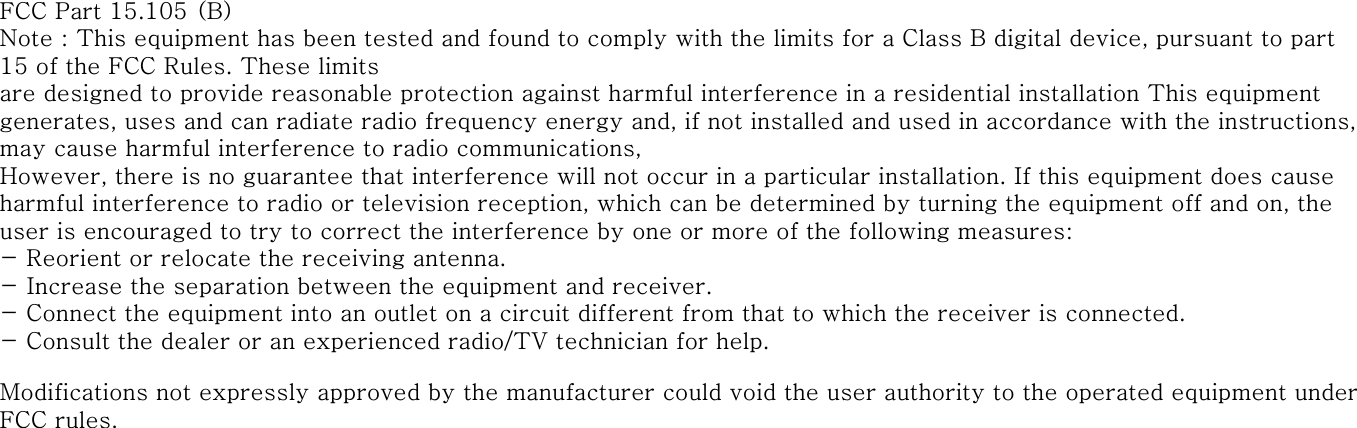
FCC Part 15.105 (B)Note : This equipment has been tested and found to comply with the limits for a Class B digital device, pursuant to part 15 of the FCC Rules. These limitsare designed to provide reasonable protection against harmful interference in a residential installation This equipment generates, uses and can radiate radio frequency energy and, if not installed and used in accordance with the instructions, may cause harmful interference to radio communications,However, there is no guarantee that interference will not occur in a particular installation. If this equipment does cause harmful interference to radio or television reception, which can be determined by turning the equipment off and on, the user is encouraged to try to correct the interference by one or more of the following measures:- Reorient or relocate the receiving antenna.- Increase the separation between the equipment and receiver.- Connect the equipment into an outlet on a circuit different from that to which the receiver is connected. - Consult the dealer or an experienced radio/TV technician for help.Modifications not expressly approved by the manufacturer could void the user authority to the operated equipment under FCC rules.

Navigation menu