Trek Ssdvpf Cne Users Manual 700031M SSDV ST PF (II)
SSDVPF-CNE to the manual 45e4070d-6739-42d7-a54e-c66d6e150efb
2015-02-03
: Trek Trek-Ssdvpf-Cne-Users-Manual-459282 trek-ssdvpf-cne-users-manual-459282 trek pdf
Open the PDF directly: View PDF  .
.
Page Count: 36
INSTALLATION
INSTRUCTIONS
OTL Report No. 116-F-32-5
Millivolt Models Electronic Models
MODELS
P/N 700,031M REV. C 11/2006
DIRECT VENT GAS FIREPLACE HEATERS
A French manual is available upon request. Order P/N 700,031CF
Ce manuel d’installation est disponible en francais, simplement en
faire la demande. Numéro de la pièce 700,031CF.
SSDVST-CNM SSDVST-CNE
SSDVPF-CNM SSDVPF-CNE
DIRECT VENT
MULTI-OPEN SERIES
RETAIN THESE INSTRUCTIONS
FOR FUTURE REFERENCE
This appliance may be installed in an aftermarket
permanently located, manufactured home (USA
only) or mobile home, where not prohibited by
local codes. This appliance is only for use with
the type of gas indicated on the rating plate. This
appliance is not convertible for use with other
gases, unless a certifi ed kit is used.
In the Commonwealth of Massachusetts:
• Installation must be performed by a licensed plumber or
gas fi tter;
• See Table of Contents for location of additional Com-
monwealth of Massachusetts requirements.
FOR YOUR SAFETY: Do not store or use gasoline
or other fl ammables or liquids in the vicinity of
this or any other appliance.
FOR YOUR SAFETY: What to do if you smell gas:
• DO NOT light any appliance.
• DO NOT touch any electrical switches.
• Do not use any phone in your building.
• Immediately call your gas supplier from a
neighbor’s phone. Follow your gas suppliers
instructions.
• If your gas supplier cannot be reached, call
the fi re department.
Installation and service must be performed by
a qualifi ed installer, service agency or the gas
supplier.
WARNING: IF THE INFORMATION IN THIS
MANUAL IS NOT FOLLOWED EXACTLY, A FIRE
OR EXPLOSION MAY RESULT CAUSING PROP-
ERTY DAMAGE, PERSONAL INJURY OR LOSS
OF LIFE.
POUR VOTRE SÉCURITÉ: Ne pas entreposer ni
utiliser d'essence ni d'autre vapeurs ou liquides
infl ammables dans le voisinage de cet appareil ou
de tout autre appareil.
POUR VOTRE SÉCURITÉ: Que faire si vous sentez
une odeur de gaz:
• Ne pas tenter d'allumer d'appareil.
• Ne touchez à aucun interrupteur. Ne pas vous
servir des téléphones se trouvant dans le bati-
ment où vous vous trouvez.
• Evacuez la piéce, le bâtiment ou la zone.
• Appelez immédiatement votre fournisseur de
gaz depuis un voisin. Suivez les instructions
du fournisseur.
• Si vous ne pouvez rejoindre le fournisseur de
gaz, appelez le service dos incendies.
L'installation et service doit être exécuté par un
qualifi é installeur, agence de service ou le fournis-
seur de gaz.
AVERTISSEMENT: ASSUREZ-VOUS DE BIEN
SUIVRE LES INSTRUCTIONS DONNÉ DANS CETTE
NOTICE POUR RÉDUIRE AU MINIMUM LE RISQUE
D'INCENDIE OU POUR ÉVITER TOUT DOMMAGE
MATÉRIEL, TOUTE BLESSURE OU LA MORT.
NOTE: DIAGRAMS & ILLUSTRATIONS ARE NOT TO SCALE.
2
TABLE OF CONTENTS
Packaging .........................................Page 2
Introduction ......................................Page 2
General Information ..........................Page 2
New York City Approval .....................Page 3
Requirements for the
Commonwealth of Massachusetts .Page 4
Safety & Warning Information ..........Page 5
Cold Climate Insulation .....................Page 5
Location ............................................Page 6
Manufactured Home Requirements ..Page 6
Vent Termination Clearances ............Page 7
Appliance and Vent Clearances .........Page 9
Detailed Installation Steps .................Page 10
Typical Installation Sequence ...........Page 10
Step 1. Framing .................................Page 10
Step 2. Routing Gas Line ..................Page 10
Fireplace Specifi cations .....................Page 11
Step 3. Install the Vent System .........Page 13
Vent Restrictor Installation ................Page 13
Vertical Termination Systems ............Page 14
Vent Section Length Chart ................Page 14
Vertical Vent Figures and Tables ........Page 17
Horizontal Termination System .........Page 19
Horizontal Vent Figures and Tables ...Page 21
Venting Using Flexible Vent Pipe .......Page 24
Step 4. Field Wiring .........................Page 25
Step 5. Optional Blower Kit Wiring ..Page 26
Step 6. Connecting Gas Line ...........Page 27
Step 7. Checking Operation .............Page 28
Step 8. Install logs, Volcanic Stone
& Embers ...........................Page 28
Step 9. Installing Glass
Enclosure Panels ............................Page 29
Step 10. Burner Adjustments ............Page 29
Step 11. Hood Installation .................Page 30
Finishing Requirements ....................Page 30
Installation Accessories ....................Page 31
Gas Conversion Kits .................. Page 33
This installation manual will help you obtain a
safe, effi cient, dependable installation for the
appliance and vent system.
Please read and understand these
instructions before beginning your
installation.
The Millivolt appliances have a millivolt gas
control valve with piezo ignition system which
provides safe, effi cient operation. If any optional
accessories that will require electrical power are to
be installed, the electrical power must be provided
at the time of appliance installation.
The Electronic appliances have an electronic
intermittent pilot ignition system which provides
safe, effi cient operation. External electrical power
is required to operate these appliances.
PACKAGING
The assembled vented gas fi replace heater is
packaged with:
1 - One log set located in fi rebox area.
2 - One plastic bag of glowing embers and a
plastic bag of volcanic stone located in the
control compartment.
3 - One envelope containing the literature pack-
age, located in the fi rebox which consists
of the homeowner's manual, installation
instructions, warranty, nailing fl anges (8
for SSDVST models and 4 for SSDVPF
models).
4 - One vent restrictor (to be applied as shown
on Page 13; restrictor is taped to the enve-
lope).
5 - Hoods (2 for SSDVST models and 3 for
SSDVPF models), taped to the top of the
fi replace.
6 - Carton Support (must be removed from the
control compartment prior to fi rst burn-
ing).
INTRODUCTION
These vented gas fi replace heaters are sealed
combustion, air circulating gas fi replaces de-
signed for residential applications.
Approved Vent Components - These fi replaces
are designed, tested and listed for operation
and installation with, the following vent com-
ponents only:
• Secure Vent™ Direct Vent System Compo-
nents,
• Secure Flex™ Flexible Vent Components
manufactured by Security Chimneys Inter-
national and
• Z-FLEX™ Model GA Venting Systems listed
to UL1777 and ULCS635 manufactured by
Flexmaster Canada Limited.
These approved vent system components are
labeled for identifi cation. DO NOT use any other
manufacturer’s vent components with these
appliances. Use only the correct size venting
(4-1/2" inner & 7-1/2" outer).
These appliances comply with National Safety
Standards and are tested and listed by OMNI-
Test Laboratories, Inc. (Report No. 116-F-32-5)
to ANSI Z21.88b-2003 (in Canada, CSA-2.33b-
2003), and CAN/CGA-2.17-M91 in both USA and
Canada, as vented gas fi replace heaters.
Both millivolt and electronic versions of
these appliances are listed by OMNI-Test
Laboratories for installation in bedrooms
and Manufactured Homes.
Manufactured Homes -
See Manufactured Home Requirements on
Page 6 for additional information.
WARNING
Improper installation, adjust-
ment, alteration, service or
maintenance can cause injury
or property damage. Refer to
this manual. For assistance or
additional information consult
a qualified installer, service
agency or the gas supplier.
This appliance is only for use with the type
of gas indicated on the rating plate. This ap-
pliance is not convertible for use with other
gases, unless a certifi ed kit is used.
Cet appareil doit être utilisé uniquement
avec les types de gaz indiqués sur la plaque
signalétique. Ne pas l'utiliser avec d'autres
gaz sauf si un kit de conversion certifi é est
installé.
Misc. Codes / Standards -
The Installation must conform to local codes or,
in the absence of local codes, with the National
Fuel Gas Code, ANSI Z223.1 / NFPA 54 - latest
edition, or the Natural Gas and Propane Instal-
lation Code, CSA B149.1 - latest edition.
The appliance, when installed, must be elec-
trically grounded & wired in accordance with
local codes or, in the absence of local codes,
with the National Electrical Code, ANSI / NFPA
70-latest edition, or the Canadian Electrical
Code, CSA C22.1 - latest edition.
GENERAL INFORMATION
Note: Installation and repair should be per-
formed by a qualifi ed service person. The
appliance should be inspected annually by
a qualifi ed professional service technician.
More frequent inspections and cleanings may
be required due to excessive lint from carpet-
ing, bedding material, etc. It is imperative
that the control compartment, burners and
circulating air passage ways of the appliance
be kept clean.
S'assurer que le brùleur et le compartiment des
commandes sont propres. Voir les instructions
d'installation et d'utilisation qui accompagnent
l'appareil.
Provide adequate clearances around air open-
ings and adequate accessibility clearance for
service and proper operation. Never obstruct
the front or back viewing surfaces of the ap-
pliance.
These millivolt and electronic fi replaces are
designed to operate on natural gas or propane
gas only. The use of other fuels or combination
of fuels will degrade the performance of this
system and may be dangerous.
NOTE: DIAGRAMS & ILLUSTRATIONS ARE NOT TO SCALE. 3
New York City, New York (MEA)
Installation of these fi replaces are approved
for installation in New York City in the US state
of New York.
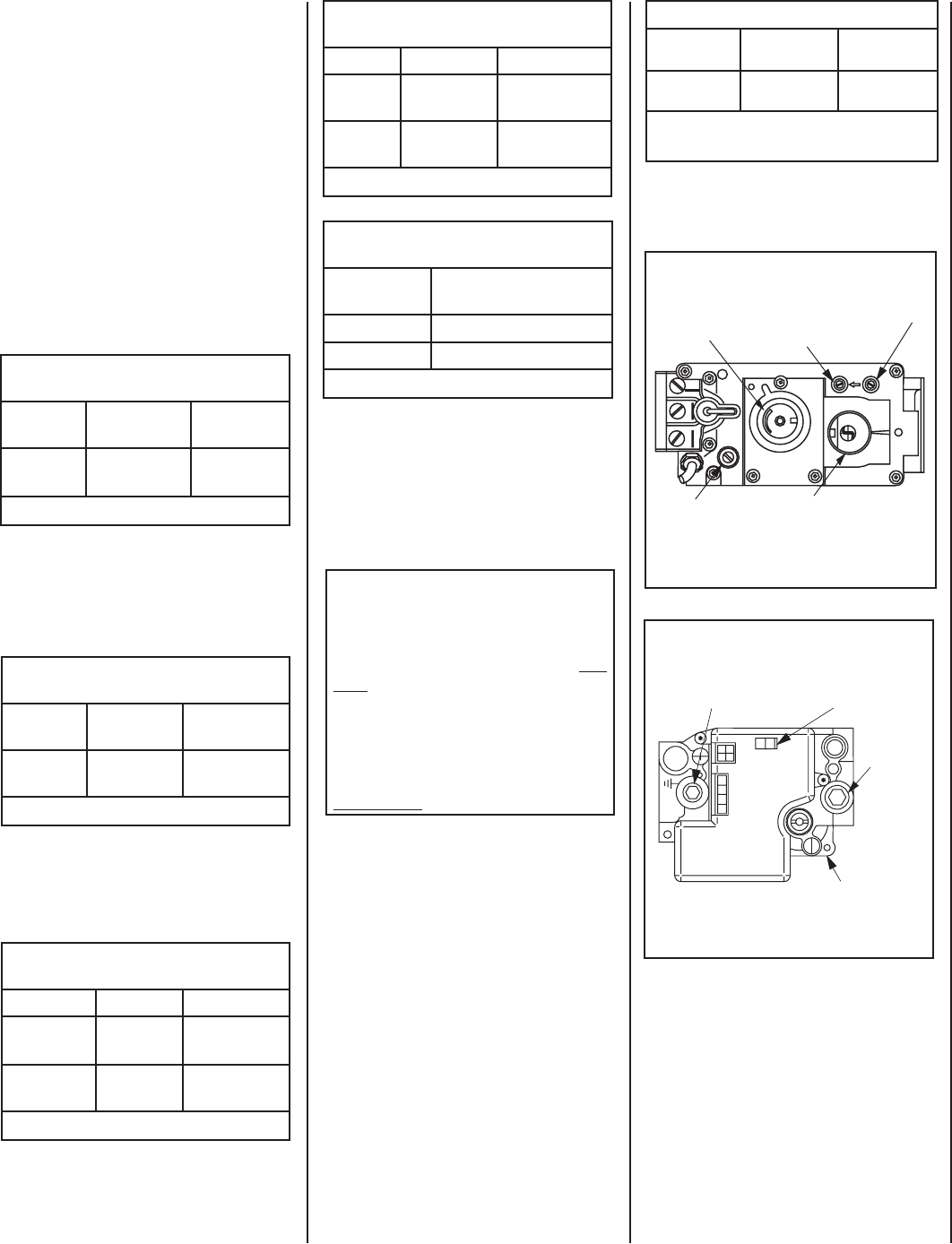
Input (BTU) Manually-Modulated Gas
Valves (millivolt models)
Models Fuel Type Input Rate
(BTU / HR)
SSDVST
SSDVPF
Natural or
Propane Gas
37,500 high
30,000 low
Table 1
Electronic Models - Electronic models have
a fi xed rate gas valve. The BTU input for the
electronic models is shown in Table 2.
BTU Input - Electronic Models
Gas Pressure - All Models
Tables 3, 4 and 5 show the appliances' gas
pressure requirements:
Inlet Gas Supply Pressure
(all models)
Fuel # Minimum Maximum
Natural Gas 5.0" WC
(1.24 kPa)
10.5" WC
(2.61 kPa)
Propane 11.0" WC
(2.74 kPa)
13.0" WC
(3.23 kPa)
Table 3
Manifold Gas Supply Pressure
(millivolt models)
Fuel # Low High
Natural
Gas
(Lo) 2.2" WC
(.55 kPa)
(Hi) 3.5" WC
(.87 kPa)
Propane (Lo) 6.3" WC
(1.57 kPa)
(Hi) 10.0" WC
(2.49 kPa)
Table 4
Test gauge connections are provided on the
front of the millivolt gas control valve, identi-
fi ed IN for the inlet and OUT for the manifold
side. A 1/8" NPT Test gauge connection
is provided at the inlet and outlet side of
the electronic gas control valve.
Manifold Gas Supply Pressure
(electronic models)
Fuel # Maximum Manifold Pres-
sure
Natural Gas (Hi) 3.5" WC (.87 kPa)
Propane (Hi) 10.0" WC (2.49 kPa)
Table 5
Input (BTU) - Fixed Rate
(electronic models)
Models Fuel Type Input Rate
(BTU / HR)
SSDVST
SSDVPF
Natural or
Propane Gas 37,500
Table 2
• • Burner Orifi ce Sizes (all models)
Elevation
Feet (meters) Natural Gas
drill size (inches) Propane Gas
drill size (inches)
0-4500
(0-1372) #44 (.086") *
60J8001 •
#55 (.052")*
19L5201 •
Table 6
* Standard size installed at factory
• Part /Cat. Number
• • Each model has two burners & 2 Orifi ces
Gas Valve Diagrams - See Figure 1 for Millivolt
models and Figure 2 For Electronic Models.
H
I
LO
W
H
TPT
HT
P
T
P
I
L
O
T
P
I
L
O
T
O
N
it
O
F
F
IN OUT
Manifold Pressure Tap
Inlet Pressure Tap
SIT Millivolt Gas Valve
Pilot Adjustment
Screw
HI/LO Variable
Flame Height
Adjustment
Main Gas Control Knob
OFF/PILOT/ON
Figure 1
Orifi ce Sizes - Sea Level to High Altitude
(All Models)
These appliances are tested and approved for
installation at elevations of 0-4500 feet (0-1372
meters) above sea level using the standard burner
orifice sizes (marked with an "*" in Table 6). For
elevations above 4500 feet, contact your gas
supplier or qualifi ed service technician . Install
the appliance according to the regulations of
the local authorities having jurisdiction and, in
the USA, the National Fuel Gas Code NFPA 54
/ ANSI Z223.1 - latest edition or, in Canada, the
CAN1-B149.1 and .2 codes - latest edition.
Figure 2
Honeywell Electronic Gas Valve
FFO
NI
PSI
NO
L
O
R
T
N
O
C
G
INT
IER
Manifold Pressure
Port ON / OFF Switch
Inlet
Pressure
Port
Electronic Gas
Control Valve
These appliances must be isolated from the
gas supply piping system (by closing their
individual manual shut-off valve) during any
pressure testing of the gas supply piping
system at test pressures equal to or less
than 1/2 psig (3.5 kPa).
These appliances and their individual shut-
off valves must be disconnected from the
gas supply piping system during any pres-
sure testing of that system at pressures
greater than 1/2 psig (3.5 kPa).
These fi replaces are designed as supplemen-
tal heaters. Therefore, it is advisable to have
an alternate heat source when installed in a
dwelling.
Millivolt Models - The millivolt appliances are
manually controlled and feature a spark igniter
(piezo) that allows the appliance's pilot gas to
be lit without the use of matches or batteries.
This system provides continued service in the
event of a power outage.
Millivolt models come standard with a manu-
ally-modulated gas valve; fl ame appearance and
heat output can be controlled at the gas valve.
The BTU Input for these appliances is shown
in Table 1.

NOTE: DIAGRAMS & ILLUSTRATIONS ARE NOT TO SCALE.
Note: The following requirements reference various Massachusetts
and national codes not contained in this document.
Requirements for the Commonwealth of Massachusetts
For all side wall horizontally vented gas fueled equipment installed in every
dwelling, building or structure used in whole or in part for residential
purposes, including those owned or operated by the Commonwealth and
where the side wall exhaust vent termination is less than seven (7) feet
above fi nished grade in the area of the venting, including but not limited
to decks and porches, the following requirements shall be satisfi ed:
Installation Of Carbon Monoxide Detectors
At the time of installation of the side wall horizontal vented gas fueled
equipment, the installing plumber or gasfi tter shall observe that a hard
wired carbon monoxide detector with an alarm and battery back-up is
installed on the fl oor level where the gas equipment is to be installed.
In addition, the installing plumber or gasfi tter shall observe that a bat-
tery operated or hard wired carbon monoxide detector with an alarm is
installed on each additional level of the dwelling, building or structure
served by the side wall horizontal vented gas fueled equipment. It shall
be the responsibility of the property owner to secure the services of
qualifi ed licensed professionals for the installation of hard wired carbon
monoxide detectors.
In the event that the side wall horizontally vented gas fueled equipment
is installed in a crawl space or an attic, the hard wired carbon monoxide
detector with alarm and battery back-up may be installed on the next
adjacent fl oor level.
In the event that the requirements of this subdivision can not be met at
the time of completion of installation, the owner shall have a period of
thirty (30) days to comply with the above requirements; provided, how-
ever, that during said thirty (30) day period, a battery operated carbon
monoxide detector with an alarm shall be installed.
Approved Carbon Monoxide Detectors
Each carbon monoxide detector as required in accordance with the
above provisions shall comply with NFPA 720 and be ANSI/UL 2034
listed and IAS certifi ed.
Signage
A metal or plastic identifi cation plate shall be permanently mounted to
the exterior of the building at a minimum height of eight (8) feet above
grade directly in line with the exhaust vent terminal for the horizontally
vented gas fueled heating appliance or equipment. The sign shall read, in
print size no less than one-half (1/2) inch in size, “GAS VENT DIRECTLY
BELOW. KEEP CLEAR OF ALL OBSTRUCTIONS.”
Inspection
The state or local gas inspector of the side wall horizontally vented gas
fueled equipment shall not approve the installation unless, upon inspection,
the inspector observes carbon monoxide detectors and signage installed
in accordance with the provisions of 248 CMR 5.08(2)(a)1 through 4.
Exemptions
The following equipment is exempt from 248 CMR 5.08(2)(a)1 through 4:
• The equipment listed in Chapter 10 entitled “Equipment Not Required
To Be Vented” in the most current edition of NFPA 54 as adopted by
the Board; and
• Product Approved side wall horizontally vented gas fueled equipment
installed in a room or structure separate from the dwelling, building
or structure used in whole or in part for residential purposes.
MANUFACTURER REQUIREMENTS
Gas Equipment Venting System Provided
When the manufacturer of Product Approved side wall horizontally
vented gas equipment provides a venting system design or venting sys-
tem components with the equipment, the instructions provided by the
manufacturer for installation of the equipment and the venting system
shall include:
• Detailed instructions for the installation of the venting system design
or the venting system components; and
• A complete parts list for the venting system design or venting sys-
tem.
Gas Equipment Venting System NOT Provided
When the manufacturer of a Product Approved side wall horizontally
vented gas fueled equipment does not provide the parts for venting the
fl ue gases, but identifi es “special venting systems”, the following require-
ments shall be satisfi ed by the manufacturer:
• The referenced “special venting system” instructions shall be included
with the appliance or equipment installation instructions; and
• The “special venting systems” shall be Product Approved by the
Board, and the instructions for that system shall include a parts list
and detailed installation instructions.
A copy of all installation instructions for all Product Approved side wall
horizontally vented gas fueled equipment, all venting instructions, all
parts lists for venting instructions, and/or all venting design instructions
shall remain with the appliance or equipment at the completion of the
installation.
• Installation and repair must be done by a plumber or gas fi tter licensed
in the Commonwealth of Massachusetts.
• The fl exible gas line connector used shall not exceed 36 inches (92
centimeters) in length.
• The individual manual shut-off must be a T-handle type valve.
4
5
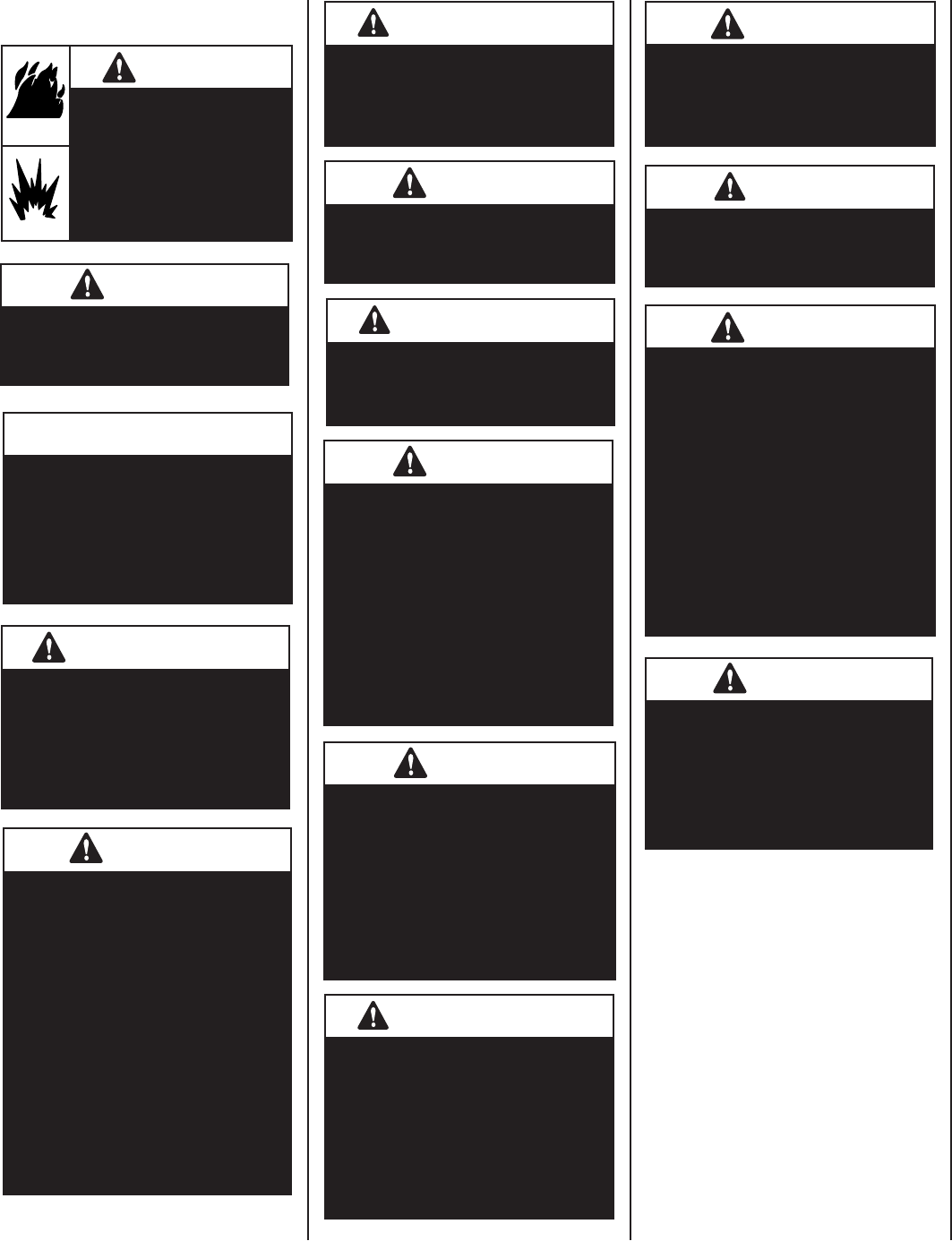
WARNING
Do not attempt to alter or modify
the construction of the appli-
ance or its components. Any
modifi cation or alteration may
void the warranty, certifi cation
and listings of this unit.
WARNING
Do not use these appliances if
any part has been under water.
Immediately call a qualifi ed,
professional service technician
to inspect the appliances and to
replace any parts of the control
system and any gas controls
which have been under water.
WARNING
Children and adults should be
alerted to the hazards of high
surface temperatures. Use
caution around the appliance
to avoid burns or clothing igni-
tion. Young children should be
carefully supervised when they
are in the same room as the
appliance.
Note: An Optional Screen Door or
Screen Panel for the glass is avail-
able (see Homeowners Manual for
ordering information).
WARNING
Carbon monoxide poisoning:
early signs of carbon monoxide
poisoning are similar to the fl u
with headaches, dizziness and/or
nausea. If you have these signs,
obtain fresh air immediately. Turn
off the gas supply to the appliance
and have it serviced by a quali-
fi ed professional, as it may not
be operating correctly.
WARNING
Do not place clothing or other
fl ammable materials on or near
this appliance.
AVERTISSEMENT
Ne pas se servir de cet appar-
eil s'il a été plongé dans l'eau,
complètement ou en partie.
Appeler un technicien qualifi é
pour inspecter l'appareil et rem-
placer toute partie du système de
contrôle et toute commande qui
ont été plongés dans l'lau.
WARNING
Failure to comply with the instal-
lation and operating instructions
provided in this document will
result in an improperly installed
and operating appliance, voiding
its warranty. Any change to this
appliance and/or its operating
controls is dangerous. Improper
installation or use of this appli-
ance can cause serious injury or
death from fi re, burns, explosion
or carbon monoxide poisoning.
IMPORTANT
These appliances must not be
connected to a chimney or fl ue
serving a separate solid fuel
burning appliance.
AVERTISSEMENT
Cet appareil doit être utilisé
uniquement avec les types de
gaz indiqués sur la plaque sig-
nalétique. Ne pas l'utiliser avec
d'autres gaz sauf si un kit de con-
version certifi é est installé.
AVERTISSEMENT
Surveiller les enfants. Garder les
vêtements, les meubles, l'essence
ou autres liquides à vapeur infl am-
mables lin de l'appareil.
AVERTISSEMENT
Pour utilisation uniquement avec
les portes en verre certifi êes
avec l'appareil.
WARNING
This appliance may only be fi tted
with doors certifi ed for use with
the appliance.
COLD CLIMATE INSULATION
For cold climate installations, seal all cracks
around the appliance with noncombustible
material and wherever cold air could enter
the room. It is especially important to insulate
outside chase cavity between studs and under
fl oor on which the appliance rests, if fl oor is
above ground level. Gas line holes and other
openings should be caulked or stuffed with
unfaced fi berglass insulation. If the fi replace
is being installed on a cement slab, in cold
climates, a sheet of plywood or other raised
platform can be placed underneath to prevent
conducting cold up into the room. It also helps to
sheetrock inside surfaces and tape for maximum
air tightness and caulk fi restops.
WARNING
This appliance is only for use
with the type of gas indicated on
the rating plate. This appliance
is not convertible for use with
other gases, unless a certifi ed
kit is used.
WARNING
If the information in this
manual is not followed
exactly, a fi re or explosion
may result causing prop-
erty damage, personal
injury or loss of life.
SAFETY & WARNIING INFORMATION
WARNING
These fi replaces are vented heat-
ers. Do not burn wood or other
material in these appliances.
NOTE: DIAGRAMS & ILLUSTRATIONS ARE NOT TO SCALE.
6
Figure 3
LOCATION
In selecting the location, the aesthetic and functional use of the appliance are primary concerns.
However, vent system routing to the outside atmosphere and access to the fuel supply are also im-
portant. Consideration should be given to traffi c ways, furniture, draperies, etc., due to high surface
temperatures (see illustrations). The location should also be free of electrical, plumbing or other
heating / air conditioning ducting.
These direct vent appliances are uniquely suited for installations requiring a utility shelf positioned
directly above the fi replace. Utility shelves like these are commonly used for locating television sets
and decorative plants. Be aware that this is a heat producing appliance. Objects placed above
the unit are exposed to elevated temperatures.
If a shelf is to be installed above appliance, see Shelf Height Minimum Clearances (Figure 8 on
Page 9).
The appliance should be mounted on a fully supported base extending the full width and depth of the
appliance. The appliance may be located on or near conventional construction materials. However, if
installed on combustible materials, such as carpeting, vinyl tile, etc., a metal or wood barrier covering
the entire bottom surface of the appliance must be used.
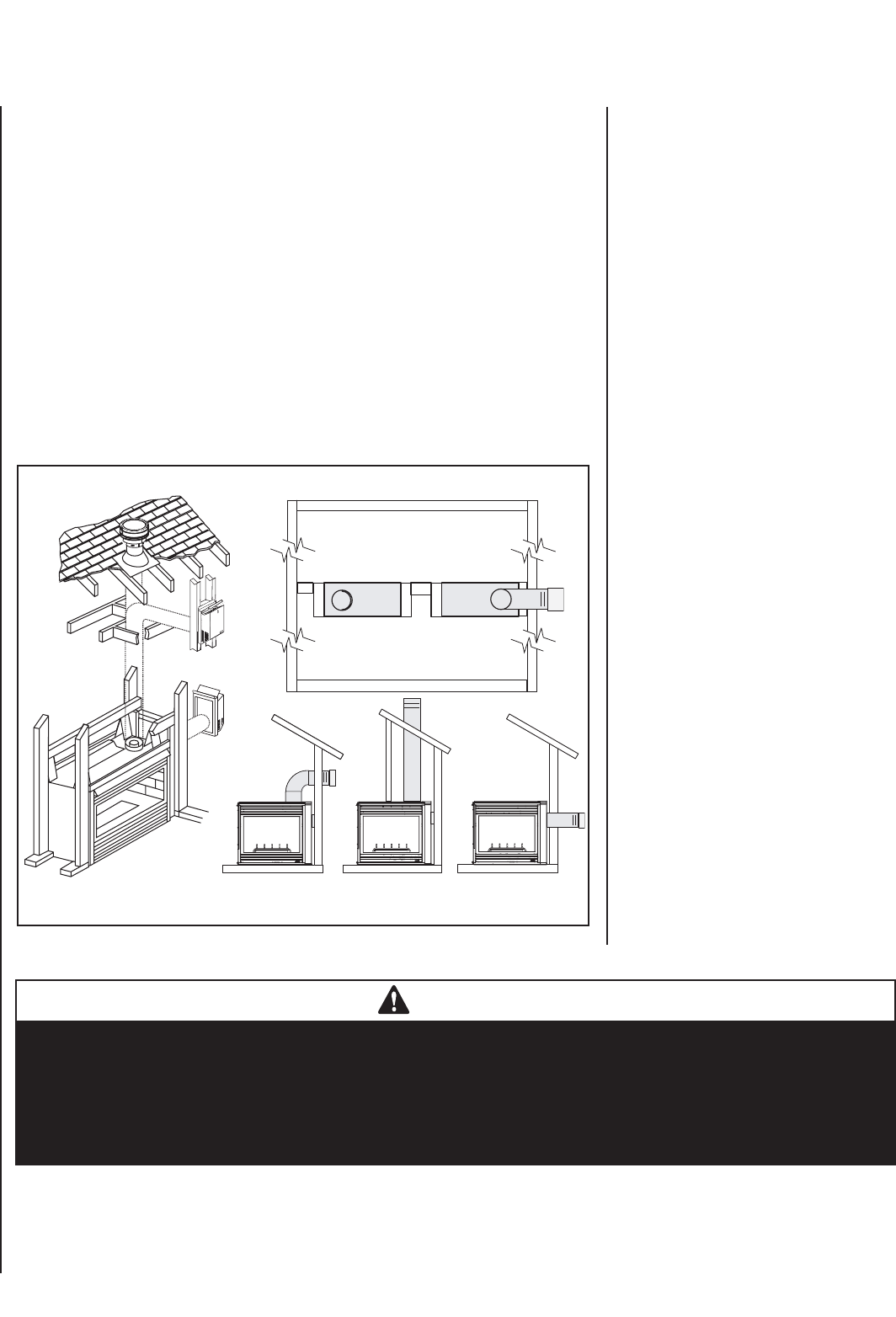
Vertical
Venting
Offset Venting
(one end fl ush
with wall)
Vertical
Vent Horizontal Vent
(side vent)
Horizontal Vent
(top vent)
MANUFACTURED HOME
REQUIREMENTS
This appliance may be installed in an after-
market permanently located, manufactured
home (USA only) or mobile home, where not
prohibited by local codes.
This appliance may be installed as an OEM
installation in a manufactured home (USA
only) or mobile home and must be installed
in accordance with the manufacturer's
instructions and the Manufactured Home
Construction and Safety Standard, Title 24
CPF, Part 3280 or Standard for Installa-
tion in Mobile Homes, CAN/CSA Z240 MH.
Cet appareil peut être installé comme du
matériel d'origine dans une maison préfabri-
quée (É.-U. seulement) ou mobile et doit être
installé selon les instructions du fabricant
et conformément à la norme Manufactured
Home Construction and Safety Standard, Title
24 CPF, Part 3280 ou à la norme CAN/CSA
Z240 Série MM, Maisons Mobiles.
Cet appareil peut être installé dans un maison
préfabriquée (É.-U. seulement) ou mobile déjà
installée à demeure si les réglements locaux
le permettent.
Manufactured Home installations must be
installed in accordance with these instructions
and the following standards / codes:
• Manufactured Home Construction and
Safety Standard Title 24 CFR, Part 3280, or
the current Standard for Fire Safety Criteria
for Manufactured Home Installations, Sites
and Communities ANSI / NFPA 501A in the
USA, and CAN / CSA Z240 MH Mobile Home
Standard in Canada
• (when applicable) The American National
Standard for Manufactured Homes (NCS-
BCS / ANSI A225.1 - latest edition).
CAUTIONS
Manufactured Home Installations: Ensure that the cross members are not cut or weakened during installation.
The structural integrity of the manufactured home fl oor, wall, and ceiling / roof must be maintained.
This appliance must be grounded to the chassis of the manufactured home in accordance with local codes
or in the absence of local codes, with the National Electrical Code ANSI / NFPA 70 - latest edition or the
Canadian Electrical Code CSA C22.1 - latest edition.

NOTE: DIAGRAMS & ILLUSTRATIONS ARE NOT TO SCALE. 7
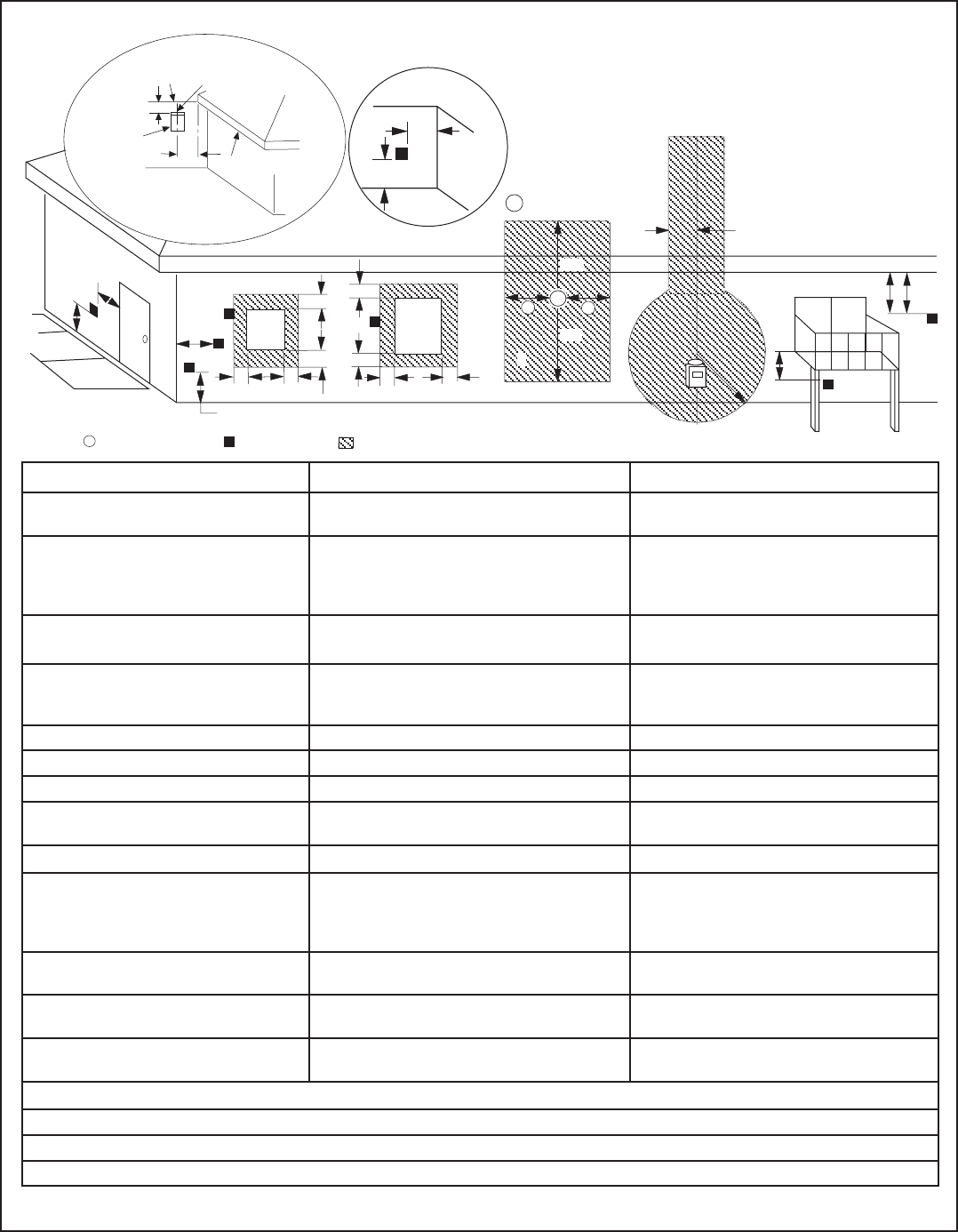
Termination Heights For Vents
Above Flat Or Sloped Roofs
Ref. NFPA 54 / ANSI Z223.1, 7.6
Roof Pitch * Feet * Meters
Flat to 6/12 1.0 0.3
6/12 to 7/12 1.25 0.38
7/12 to 8/12 1.5 0.46
8/12 to 9/12 2.0 0.61
9/12 to 10/12 2.5 0.76
10/12 to 11/12 3.25 0.99
11/12 to 12/12 4.0 1.22
12/12 to 14/12 5.0 1.52
14/12 to 16/12 6.0 1.83
16/12 to 18/12 7.0 2.13
18/12 to 20/12 7.5 2.29
20/12 to 21/12 8.0 2.44
The vent / air intake termination clearances above the high
side of an angled roof is as shown in the following chart:
12
X
Roof Pitch is X/12
2 FT
MIN.
2 FT MIN.
Lowest
Discharge
Opening
H*
*H = MINIMUM HEIGHT FROM ROOF TO
LOWEST DISCHARGE OPENING OF VENT
TERMINATION HEIGHTS FOR VENTS ABOVE
FLAT OR SLOPED ROOFS
Horizontal Overhang
Vertical
Wall
Vent
Termination
Storm Collar
Concentric
Vent Pipe
Flashing
1 inch (25.4 mm) Minimum
Clearance to Combustibles
Vertical Vent Termination Clearances
VENT TERMINATION CLEARANCES
These instructions should be used as a guideline and do not supersede local codes in any
way. Install vent according to local codes, these instructions, the current National Fuel Gas
Code (ANSI-Z223.1) in the USA or the current standards of CAN/CGA-B149.1 and -B149.2 in
Canada.
Terminate multiple vent terminations according to the installation codes listed above.
Terminate single vent caps relative to building components according to Figure 4.
Horizontal Vent Termination Clearances
The horizontal vent termination must have
a minimum of 3" (76 mm) clearance to any
overhead combustible projection of 2 1/2" (64
mm) or less. See Figure 5. For projections
exceeding 2 1/2" (64 mm), see Figure 5. For
additional vent location restrictions refer to
Figure 6 on Page 8.
Figure 5 Side Elevation View
Note - See Figure 34 on
Page 20 for the exterior
wall recess allowances
of the square horizontal
termination.
3"
(76 mm)
12"
(305 mm)
Combustible Projection greater
Horizontal Vent Termination Clearances
Combustible Projection
2-1/2 inches or less in length
18"
(457 mm)
Ventilated
Soffit Unventilated
Soffit
than 2-1/2 inches in length
Termination Kit
Figure 4 - Gas Vent Rule
8
VENT TERMINATION CLEARANCES
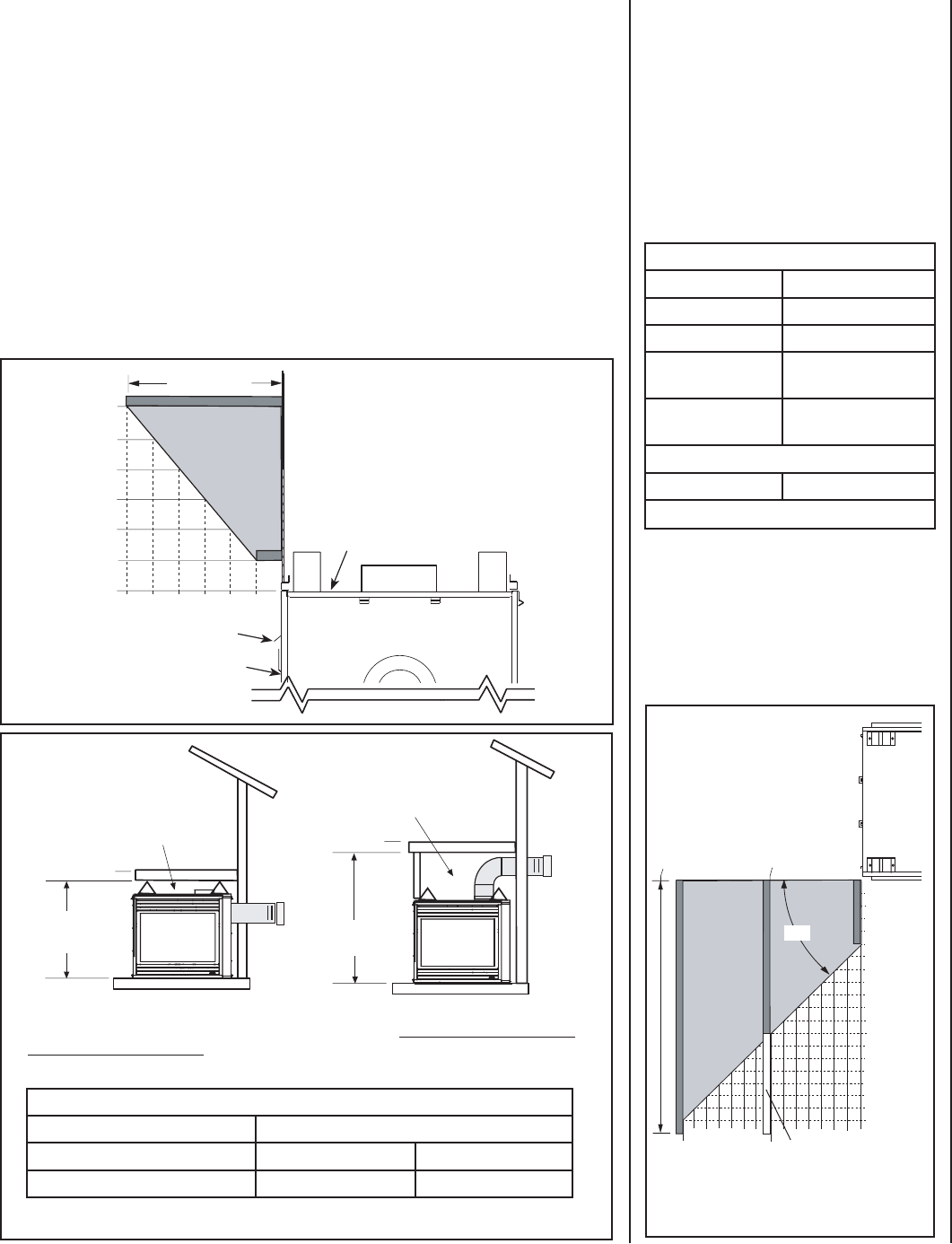
EXTERIOR HORIZONTAL VENT TERMINATION CLEARANCE REQUIREMENTS
V
VV
V
V
F
C
B
B
A
B
H
M
I
XV
D
V
AA
A
V
L
B
J
XE
V
A
G
*18”
18”
B
C
C
C
See Item D in the Text Below.
Center Line
of Termination
Exterior Wall
Horizontal
Termination
Ventilated Soffi t
Inside Corner
DETAIL D
Minimum Clearances Canadian Installation * US Installation **
A = Clearance above grade, veranda, porch, deck
or balcony.
12 inches (30 cm) * 12 inches (30 cm) **
B = Clearance to window or door that may be
opened.
6 in. (15.2 cm) for appliances < 10,000 BTU/hr (3kW),
12 in. (30 cm) for appliances > 10,000 BTU/hr (3kW) and <
100,000 BTU/hr (30kW), 36 inches (91 cm) for appliances
> 100,000 BTU/hr (30kW)*
6 in. (15.2 cm) for appliances < 10,000 BTU/hr (3kW),
9 in. (23 cm) for appliances > 10,000 BTU/hr (3kW) and <
50,000 BTU/hr (15kW), 12 inches (30 cm) for appliances
> 50,000 BTU/hr (15kW)*
C = Clearance to permanently closed window 12 inches (305 mm) recommended to prevent window
condensation
9 inches (229 mm) recommended to prevent window
condensation
D = Vertical clearance to ventilated soffi t located
above the terminal within a horizontal distance of 18
in. (458 mm) from the center line of the terminal
18 inches (458 mm) 18 inches (458 mm)
E = Clearance to unventilated soffi t 12 inches (30 cm) 12 inches (30 cm)
F = Clearance to outside corner 5 inches (12.7 cm) 5 inches (12.7 cm)
G = Clearance to inside corner 6 in. (15 cm) 6 in. (15 cm)
H = Clearance to each inside of center line extended
above meter / regulator assembly
3 feet (91 cm) within a height of 15 feet above the meter /
regulator assembly *
3 feet (91 cm) within a height of 15 feet above the meter
/ regulator assembly **
I = Clearance to service regulator vent outlet 3 feet (91 cm) * 3 feet (91 cm) **
J = Clearance to non-mechanical air supply inlet
to building or the combustion air inlet to any other
appliance
6 in. (15.2 cm) for appliances < 10,000 BTU/hr (3kW), 12
in. (30 cm) for appliances > 10,000 BTU/hr (3kW) and <
100,000 BTU/hr (30kW), 36 inches (91 cm) for appliances
> 100,000 BTU/hr (30kW)*
6 in. (15.2 cm) for appliances < 10,000 BTU/hr (3kW), 9
in. (23 cm) for appliances > 10,000 BTU/hr (3kW) and <
50,000 BTU/hr (15kW), 12 inches (30 cm) for appliances
> 50,000 BTU/hr (15kW)*
K = Clearance to mechanical air supply inlet 6 feet (1.8 meters) * 3 feet (91 cm) above, if within 10 feet (3 m) horizon-
tally**
L = Clearance above paved sidewalk or paved
driveway located on public property
7 feet (2.13 m) ‡ 7 feet (2.13 m) ‡
M = Clearance under veranda, porch, deck or
balcony
12 in. (30 cm) * ‡ 12 in. (30 cm) ** ‡
* In accordance with the current CSA-B149.1 National Gas and B149.2 Propane Installation Code - Latest Editions.
** In accordance with the current ANSI Z223.1 / NFPA 54 National Fuel Codes - Latest Edition.
‡ A vent shall not terminate directly above a sidewalk or paved driveway which is located between two single family dwellings and serves both dwellings.
*‡ Only permitted if veranda, porch, deck or balcony is fully open on a minimum 2 sides beneath the fl oor.
Inside
Corner Detail
Operable
Window
Fixed
Closed
Window
= 9" in U.S.
= 12" in Canada
3 ft.
3 ft.
= Air Supply Inlet = Vent Terminal = Area where Terminal is NOT permitted
Figure 6
NOTE: DIAGRAMS & ILLUSTRATIONS NOT TO SCALE
9
5 (127)
8-1/4
(209)
14
(356)
12
(305)
19
(483)
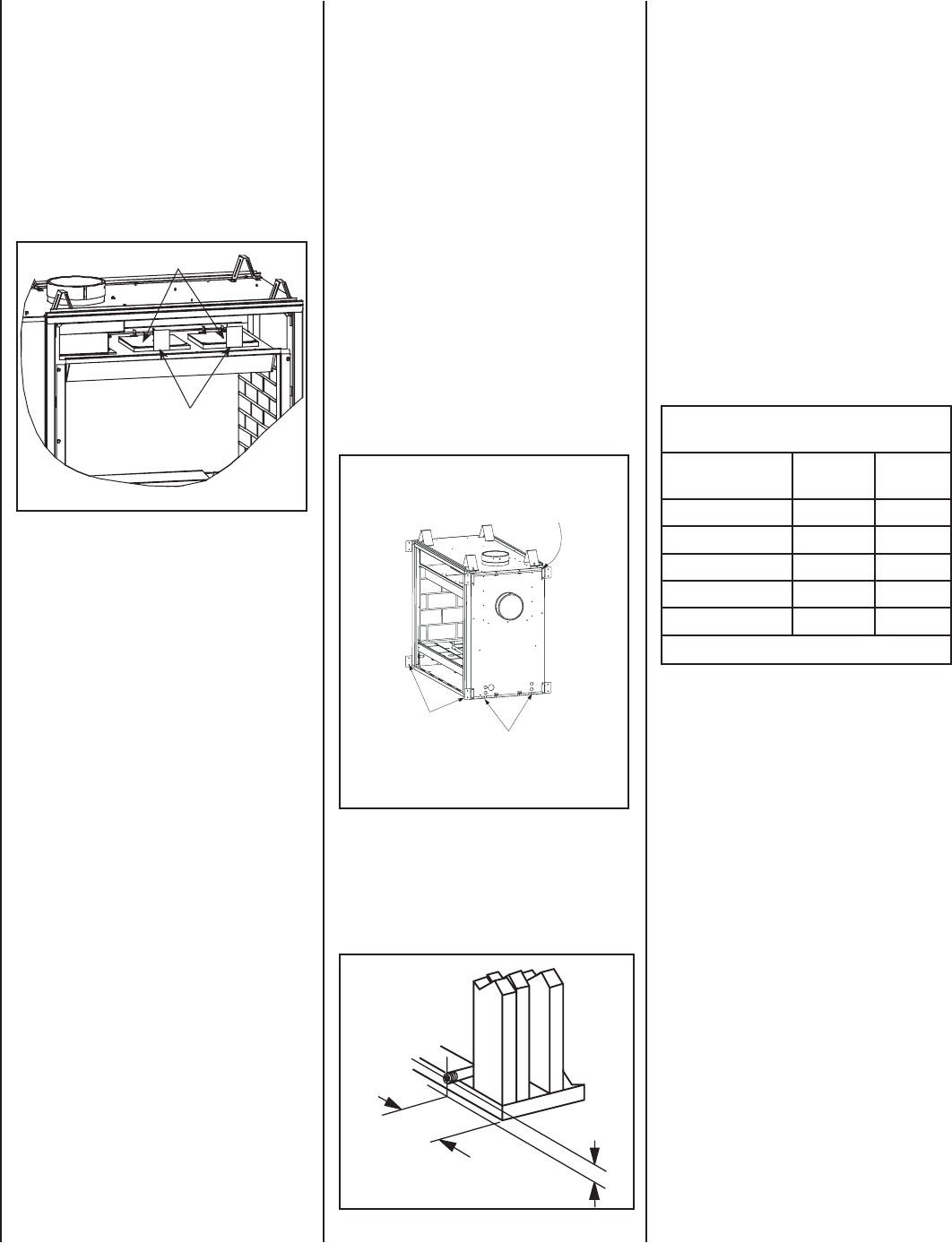
MINIMUM CLEARANCES TO COMBUSTIBLES
Maintain clearances from appliance to
combustible materials as detailed in Table 7,
with the following exception: When the appliance
is installed with one side fl ush with a wall, the
wall on the other side of the appliance must not
extend beyond the front edge of the appliance.
In addition, when the appliance is installed in
the middle of a room, the side walls surrounding
the appliance must not extend beyond the front
edge of the appliance. See Figure 3.
*Note: 3 in. (75 mm) above any horizontal /
inclined vent component.
MINIMUM CLEARANCES Inches (millimeters)
Sides 1/2 (13)
Top Spacers 0 (0)
Floor 0 (0)
Bottom of Appliance
To Ceiling 64 (1626)
Vent 3 (76) Top *
1 (25.4) Sides & Bottom
SERVICE CLEARANCES Feet (meters)
Front & Back Faces 3 ft. (0.9 m)
Table 7
Appliance and Vent Clearances
Side Clearances
Combustible materials may project beyond the
sides of the fi replace opening as long as they
are kept within the shaded areas illustrated in
Figure 9.
Hearth Extension - A hearth extension is not required with this appliance. If a hearth extension is used,
do not block the lower control compartment access door. Any hearth extension used is for appearance
only and does not have to conform to standard hearth extension installation requirements.
Wall Finishes / Surrounds / Mantels
Note: Combustible wall fi nish materials and/or surround materials must not be allowed to encroach
the area defi ned by the appliance front and back faces (black sheet metal). Never allow combustible
materials to be positioned in front of or overlapping the appliance front and back faces. See Figure
57 on Page 30.
Non-combustible materials, such as surrounds and other appliance trim, may be installed on the
appliance front and back faces with the following exception: If the optional radiant panels are
installed, the non-combustible material may cover any portion of the top radiant panel or the air
gaps surrounding the top radiant panel down to the top edge of eyebrow hood.
The material must
NOT cover any portion of the glass door or louvered panels.
Vertical installation clearances to combustible mantels vary according to the depth of the mantel. See
Figure 7. Mantels constructed of non-combustible materials may be installed at any height above the
appliance opening; however, do not allow anything to hang below the hood.
Figure 8 -
Shelf Height Minimum Clearances
Shelf Height
(see table)
Shelf Above Fireplace With Side Venting
Do not insulate this space
above the appliance.
Shelf Height
(see table)
Shelf Above Fireplace With Top Venting
To achieve the lowest possible shelf height, use the side vent outlet. Do not insulate space between
appliance and the area above it. Maintain the minimum height from appliance base to the underside
of combustible materials (used to construct a utility shelf) as shown here.
Do not insulate this space
above the appliance.
Minimum Distance to
Unprotected Side Wall
Top View
Fireplace
Combustible Materials Allowed In
Shaded Area “Safe Zone.” Com-
bustible Walls shown in dark gray.
45o
Protected wall
shown in white
Inches (millimeters)
At 14" mini-
mum side wall
clearance, a
combustible wall
can project to any
length.
At 8-1/4" side
wall clearance,
a combustible
wall can project
12"
4 (102)
2
(51)
4
(102)
6
(152)
8
(203)
10
(254)
12
(305)
6 (152)
10 (254)
14 (356)
12 (305)
8 (203)
Front or Rear Face
of Appliance
Top of
Appliance
inches (millimeters)
Mantel Depth
Figure 7
Minimum Mantel Clearances
Hood
SSDVST & SSDVPF Shelf Height - Inches (millimeter)
Side Vent - Straight Out Back Top Vent - with One 90 Degree Elbow
Secure Vent & Secure Flex Secure Vent Secure Flex
41-1/8 (1045) 53-7/8 (1366) 55-5/8 (1410)
Figure 9
NOTE: DIAGRAMS & ILLUSTRATIONS ARE NOT TO SCALE.
10
DETAILED INSTALLATION STEPS
TYPICAL INSTALLATION SEQUENCE
The typical sequence of installation follows,
however, each installation is unique resulting
in variations to those described.
See the Page numbers references in the follow-
ing steps for detailed procedures.
Step 1. (Page 10) Construct the appliance fram-
ing. Position the appliance within the framing and
secure with nailing fl anges.
Step 2. (Page 10) Route gas supply line to appli-
ance location.
Step 3. (Page 13) Install the vent system and
exterior termination.
Step 4.(Page 25) Field Wiring
a. Millivolt Appliances – Install the OFF/ON
burner control switch.
b. Electronic Appliances – Connect 120 VAC
electrical power to the appliance receptacle.
Step 5. (Page 26) Install blower kit (optional
equipment).
Step 6. ( Page 27) Make connection to gas
supply.
Step 7. (Page 28) Checkout appliance operation.
Step 8. (Page 28) Install embers, volcanic stone
and embers.
Step 9. (Page 29) Install glass enclosure pan-
els.
Step 10.(Page 29) Adjust burner primary air shutter
to achieve proper fl ame appearance.
Step 11 (Page 30) Install the decorative trim and
hoods.
Step 1. FRAMING
Frame these appliances as illustrated in Figures
13 & 14. All framing details must allow for a
minimum clearance to combustible framing
members as shown in Table 7 on Page 9.
1. Remove the shipping carton.
2. Remove the top louvered panel and locate the
pressure relief plates.
3. Lift the pressure relief plates and remove
the cardboard from beneath each plate (be
careful not to damage the white gasket). See
Figure 10.
* NOTE: INSTALLATION DIAGRAMS AND
INSTRUCTIONS SHOW THE FRONT OF
THE APPLIANCE AS THE SIDE WHICH HAS
VALVE ACCESS, EXCEPT WHERE NOTED.
Also see
Figures 13 & 14
5-5/8"
(143 mm)
3-1/8"
(79 mm)
Figure 12 - ROUTE GAS LINE
Proper Sizing of Gas Line
Properly size and route the gas supply line
from the supply regulator to the area where the
appliance is to be installed per requirements
outlined in the National Fuel Gas Code, NFPA
54 - latest edition (USA) or B149 - latest edition
(Canada). Never use galvanized or plastic pipe.
Refer to Table 8 for proper sizing of the gas
supply line, if black iron pipe is being used. Gas
lines must be routed, constructed and made
of materials that are in strict accordance with
local codes and regulations. We recommend
that a qualifi ed individual such as a plumber
or gas fi tter be hired to correctly size and route
the gas supply line to the appliance. Installing
a gas supply line from the fuel supply to the
appliance involves numerous considerations of
materials, protection, sizing, locations, controls,
pressure, sediment, and more. Certainly no one
unfamiliar and unqualifi ed should attempt sizing
or installing gas piping.
Schedule 40 / Black Iron Pipe
Inside Diameter (Inches)
Schedule 40 Pipe
Length (feet)
Natural
Gas
Propane
Gas
0-10 1/2 3/8
10-40 1/2 1/2
40-100 1/2 1/2
100-150 3/4 1/2
150-200 3/4 1/2
Table 8
Notes:
• All appliances are factory-equipped with a
fl exible gas line connector and 1/2 inch shutoff
valve (see Figure 47 on Page 27).
• See Massachusetts Requirements on Page
3 for additional requirements for installations
in the state of Massachusetts in the USA.
• The gas supply line should Not be connected
to the appliance until Step 6 (Page 27).
• A pipe joint compound rated for gas should be
used on the threaded joints. Ensure propane
resistant compounds are used in propane
applications. Be very careful that the pipe
compound does not get inside the pipe.
• It is recommended to install a sediment trap
in the supply line as close as possible to the
appliance (see Figure 47). Appliances using
Propane should have a sediment trap at the
base of the tank.
• Check with local building offi cial for local code
requirements (i.e. are below grade penetrations
of the gas line allowed?, etc).
IMPORTANT: If propane is used, be aware that
if tank size is too small (i.e. under 100-lbs, if
this is the only gas appliance in the dwelling.
Ref. NPFA 58), there may be loss of pressure,
resulting in insuffi cient fuel delivery (which
can result in sooting, severe delayed ignition
or other malfunctions). Any damage resulting
from an improper installation, such as this, is
not covered under the limited warranty.
Step 2. ROUTING GAS LINE
Route a gas line along the inside of the right side
framing as shown in Figure 12. Gas lines must
be routed, constructed and made of materials
that are in strict accordance with local codes
and regulations.
If the appliance is to be elevated above fl oor
level, a solid continuous platform must be
constructed. Headers may be in direct contact
with the appliance top spacers but must not be
supported by them or notched to fi t around them.
All construction above the appliance must be
self supporting, DO NOT USE THE APPLIANCE
FOR STRUCTURAL SUPPORT.
Side Nailing Flanges
The fi replace should be secured to the fram-
ing at the side(s) of the appliance using the
factory-provided nailing fl anges. Install the 8
nailing fl anges as shown in Figure 11 using the
existing screws. Position the fi replace within
the framing. When required, the tabs may be
bent 90 degrees by hand or with the assistance
of a hammer. Use wood screws to secure the
nailing fl anges to the framing. See Table 7 on
Page 9 for clearances of framing members
to cabinet parts. The nailing fl ange itself can
directly contact framing.
Floor Nailing Tabs - Secure the fi replace to the
fl oor as shown in Figure 11.
Figure 11 - Nailing Flanges
Remove these screws and use them
when installing nailing fl anges.
Nailing Flanges
Turn nailing tabs down and secure to fl oor with 8d
nails or other appropriate fasteners on both sides of
appliance which do not have viewing glass panels.
SSDVST Shown (SSDVPF - No nailing
fl anges on end with glass panel)
Figure 10
REMOVE
CARDBOARD
BEFORE USING
REMOVE
CARDBOARD
BEFORE USING
Pressure Relief Plates
Remove Cardboard Before
Using Appliance
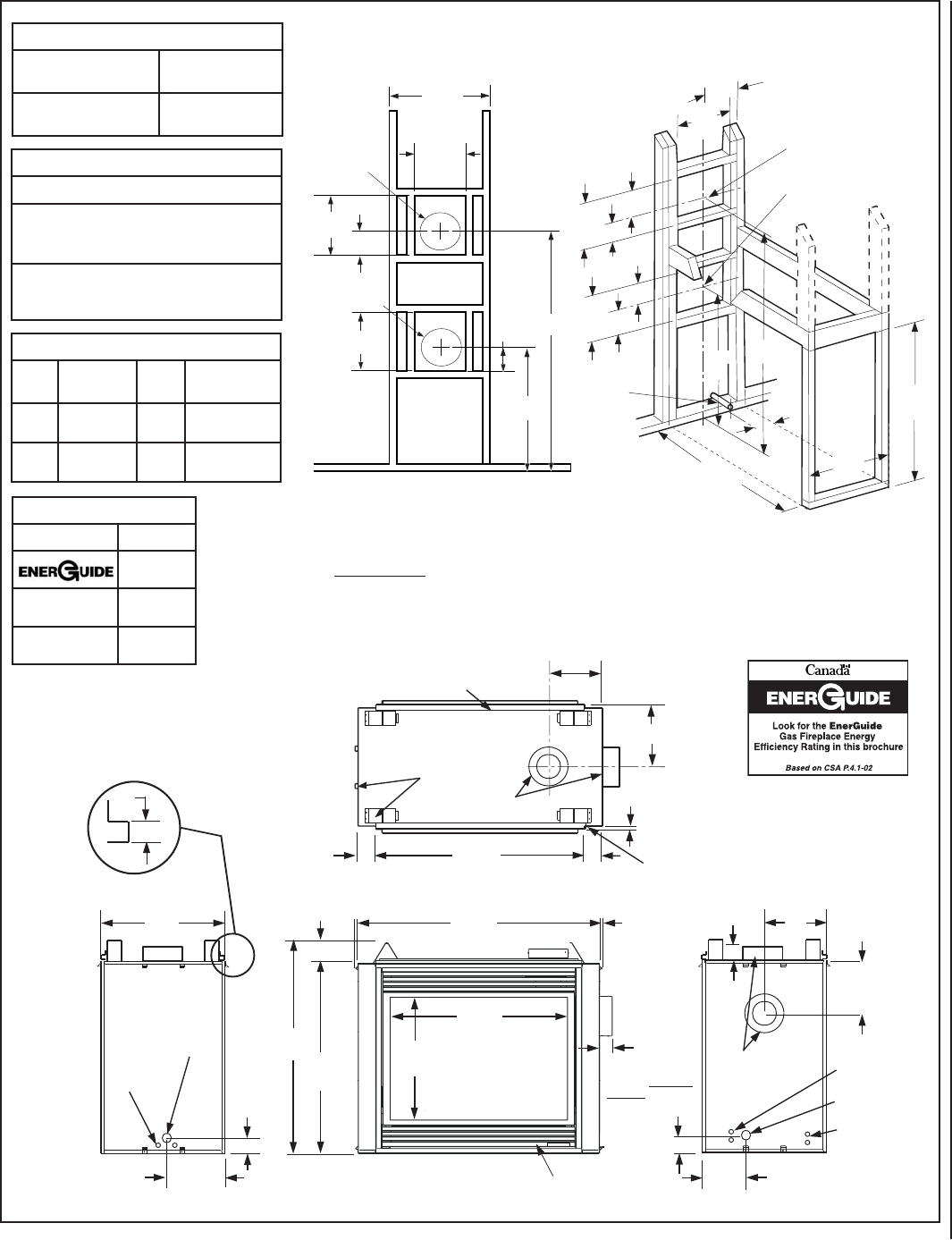
NOTE: DIAGRAMS & ILLUSTRATIONS ARE NOT TO SCALE. 11
PRODUCT REFERENCE INFORMATION
Cat.
No.
Model Ship
Wt.
Ship.
Volumn
H3333 SSDVST-CNM 282 lbs 52W x 27D x 44-
1/2H (36.2 cu.ft).
H3334 SSDVST-CNE 282 lbs 52W x 27D x 44-
1/2H (36.2 cu.ft).
Figure 13
SPECIFICATIONS
Natural & Propane
Gas BTU Input
37,500
(MV Low 30,000)
Co-axial DV Vent Size 4-1/2" Inner
7-1/2" Outer
FIREPLACE SPECIFICATIONS - SSDVST (SEE-THROUGH)
NOTES
• Annual Fuel Utilization Effi ciency
Due to Lennox' ongoing commitment to quality,
all specifi cations, ratings and dimensions are
subject to change without notice.
Appliance has a factory-installed vent seal cap
(see Figures 15 & 16 on Page 13) in each fl ue
outlet.
EFFICIENCIES
SSDVST
61% (NG)
62 % (LP)
Steady State 72 % (NG)
73 % (LP)
• AFUE 68 % (NG)
68 % (LP)
6-7/8
(175)
10-1/4
10-1/2
(260)
12
(305)
12 (305)
10
(254)
(63.5)
3 (76)
FLUE
(Top or Side)
(267)
FLUE
(Top or Side)
GAS INLET
ELECTRICAL
INLETS
GAS INLET
40-1/8
(1019)
(16)
(89)
3
(76)
ELECTRICAL
INLETS
FRAMING SPACERS
(Top and Both Sides)
24
(610)
FINISH WALL BRACKET
(Front and back edge of unit top)
1/2
(13)
3-1/2
3-1/2
(89)
ELECTRICAL
INLETS
(940)
37
41
(1041)
4 (102)
(13)
(1197)
47-1/8
(873)
34-3/8
(610)
24 (63.5)
Detail fo Finish
Wall Bracket
2-1/2
2-1/2
1/2
(13)
1/2
5/8
*41-1/2
(1054)
48-1/2
(1108)
(679)
11-3/8
(267)
(289)
7
(178)
5-1/8
(130)
12-1/8
(308)
10-1/2
22-3/4
(578)
6-1/4
(159)
A
7
(178)
5-1/8
(130)
12-1/8
(308)
26-3/4
Provide additional
space for Side Vent
Seal Cap if installing
against a solid wall.
Louvered Control
Compartment Door
Left Side View
Front View
Right Side View
Top View Stepped to Accept Drywall(all 4 corners)
**25-1/4
(641)
10-1/2
(267)
12-1/8
(308) 5-1/8
(130)
12-1/8
(308)
26-3/4
(648)
5-1/8
(130)
Vent Center - Top
Vent with one 90
degree elbow
* This dimension can be reduced to 41 inches (1041 mm). This results in 0 in. (0 mm) clearance between framing and unit framing
spacers. (The 41-1/2 in. dimension permits easier fi replace installation, if unit is installed after framing is erected).
** This dimension based on 5/8" drywall. For 1/2" drywall use 25-1/2" (648 mm). The fi nished dimension should be 26-1/2" (673 mm).
See also, Side Vent Seal Cap note below.
• Inches (millimeters)
•
Minimum Framing Stud Size is 2 x 4
• See
side views of fi replace below
for
gas line inlet location options.
Vent Framing
- Top Vent With
One 90º Elbow
Vent Framing - Rear
Vent With No Elbows
Gas Line Center of gas line is 3 in. (76 mm) up from fl oor.
Gas
Line
A
Vertical Venting Through the Ceiling:
Frame ceiling opening - Use a plumb line from the ceiling above the appliance to locate center of the vertical run. Cut and/or frame an opening,
10-1/2" x 10-1/2" (267 mm x 267 mm) inside dimensions, about this center mark (see Figure 19).
Vent Center- Side
Vent (no elbows)
Dimension A
Secure Vent 47-1/8 (1194)
Secure Flex 47-7/8 (1216)
NOTE: DIAGRAMS & ILLUSTRATIONS ARE NOT TO SCALE.
12
Figure 14
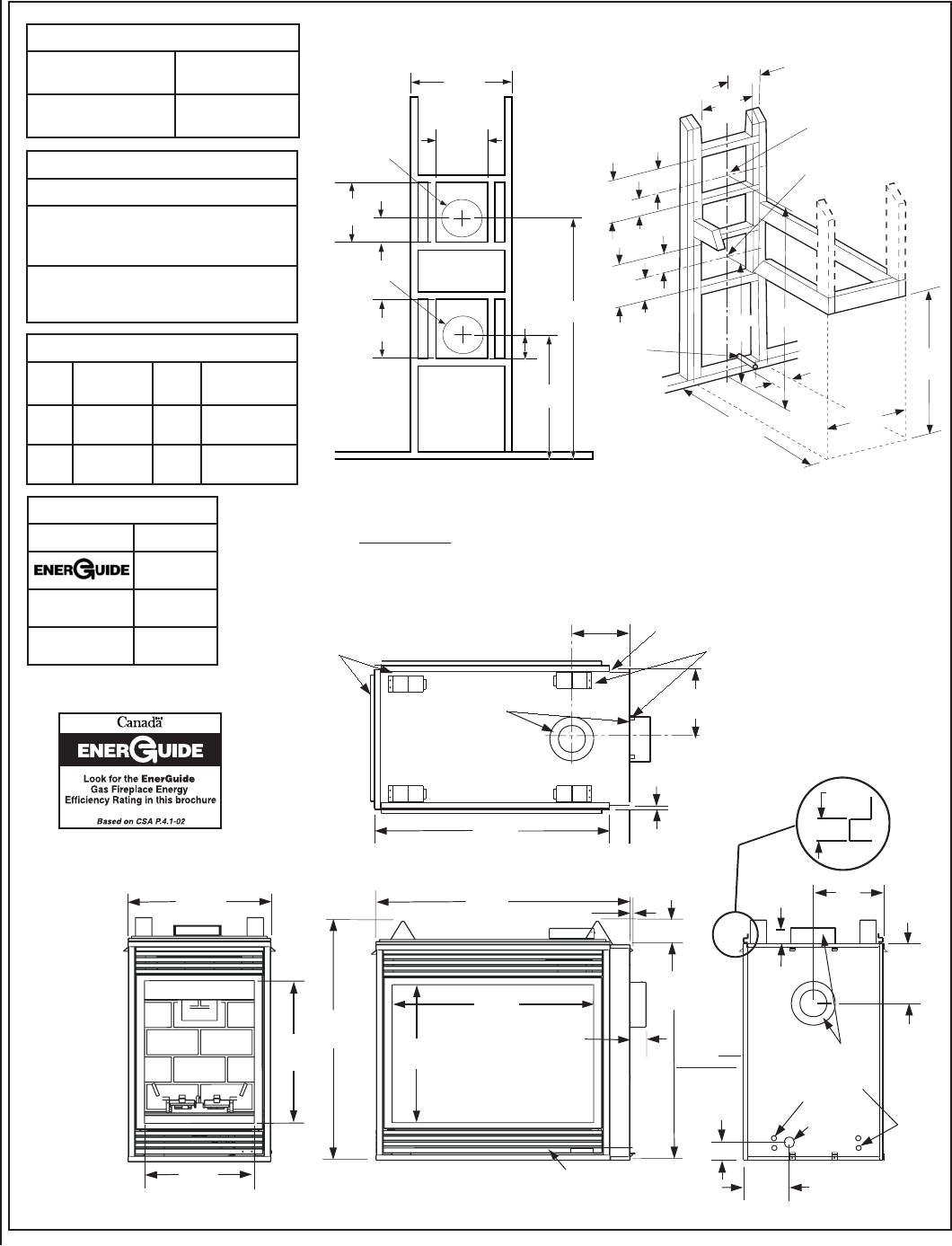
FIREPLACE SPECIFICATIONS - SSDVPF (PENINSULA VIEW)
Fireplace Framing Specifi cations
12 (305)
10
(254)
40-1/8
(1019) 3-1/2(89)
(16)
FRAMING SPACERS
(Top and Side)
FINISH WALL BRACKET
(Front, back, and left edge of unit top)
6-7/8
(175)
10-1/4
(260)
12
(305)
(63.5)
3 (76)
(13)
1/2
1/2
5/8
DETAIL OF
FINISH WALL BRACKET
FLUE
(Top or Side)
2-1/2
24
(610)
41
(1041)
37
(940)
43-5/8
(1108) (13)
4 (102)
GAS INLET
ELECTRICAL
INLETS
2-1/2
(63.5)
FLUE
(Top or Side)
(873)
34-3/8
(610)
24
(610)
24
(464)
18-1/4
*41-1/2
(1054)
43-5/8
(1108)
(679)
11-3/8
(267)
7
(178)
5-1/8
(130)
12-1/8
(308)
10-1/2
22-3/4
(578)
inches (millimeters)
Gas Line
Center of gas line
is 3 in. (76 mm)
up from floor.
6-1/4
(159)
A
Minimum Framing
Stud Size is 2 x 4
7
(178)
12-1/8
(308)
5-1/8
(130)
Dimension A
Secure Vent - 46-1/2 (1181)
Secure Flex - 48-1/4 (1226)
26-3/4
PRODUCT REFERENCE INFORMATION
Cat.
No.
Model Ship
Wt.
Ship.
Volumn
H3335 SSDVPF-CNM 270 lbs 52W x 27D x 44-
1/2H (36.2 cu.ft).
H3336 SSDVPF-CNE 270 lbs 52W x 27D x 44-
1/2H (36.2 cu.ft).
SPECIFICATIONS
Natural & Propane
Gas BTU Input
37,500
(MV Low 30,000)
Co-axial DV Vent Size 4-1/2" Inner
7-1/2" Outer
NOTES
• Annual Fuel Utilization Effi ciency
Due to Lennox' ongoing commitment to quality,
all specifi cations, ratings and dimensions are
subject to change without notice.
Appliance has a factory-installed vent seal cap
(see Figures 15 & 16 on Page 13) in each fl ue
outlet.
EFFICIENCIES
SSDVPF
58 % (NG)
61 % (LP)
Steady State 72 % (NG)
73 % (LP)
• AFUE 68 % (NG)
68 % (LP)
Louvered Control
Compartment Door
Left Side View
Top View
* This dimension can be reduced to 41 inches (1041 mm). This results in 0 in. (0 mm) clearance between framing and unit framing
spacers. (The 41-1/2 in. dimension permits easier fi replace installation, if unit is installed after framing is erected).
** This dimension based on 5/8" drywall. For 1/2" drywall use 25-1/2" (648 mm). The fi nished dimension should be 26-1/2" (673 mm).
See also, Side Vent Seal Cap note below.
• Inches (millimeters)
•
Minimum Framing Stud Size is 2 x 4
• See right
side viewsof fi replace below
for gas line inlet location options.
Gas Line Center of gas line is 3 in. (76 mm) up from fl oor.
Vertical Venting Through the Ceiling:
Frame ceiling opening - Use a plumb line from the ceiling above the appliance to locate center of the vertical run. Cut and/or frame an opening,
10-1/2" x 10-1/2" (267 mm x 267 mm) inside dimensions, about this center mark (see Figure 19).
Right Side View
Front View
Stepped to Accept Drywall on 2 Corners
Vent Framing - Top Vent
With One 90º Elbow
Vent Framing - Rear Vent
With No Elbows
Provide
additional
space for Side
Vent Seal Cap
if installing
against a solid
wall.
**25-1/4
(641)
10-1/2
(267)
12-1/8
(308) 5-1/8
(130)
12-1/8
(308)
26-3/4
(648)
5-1/8
(130)
Vent Center - Top
Vent with one 90
degree elbow
Vent Center- Side
Vent (no elbows)
A
Dimension A
Secure Vent 47-1/8 (1194)
Secure Flex 47-7/8 (1216)
NOTE: DIAGRAMS & ILLUSTRATIONS ARE NOT TO SCALE. 13
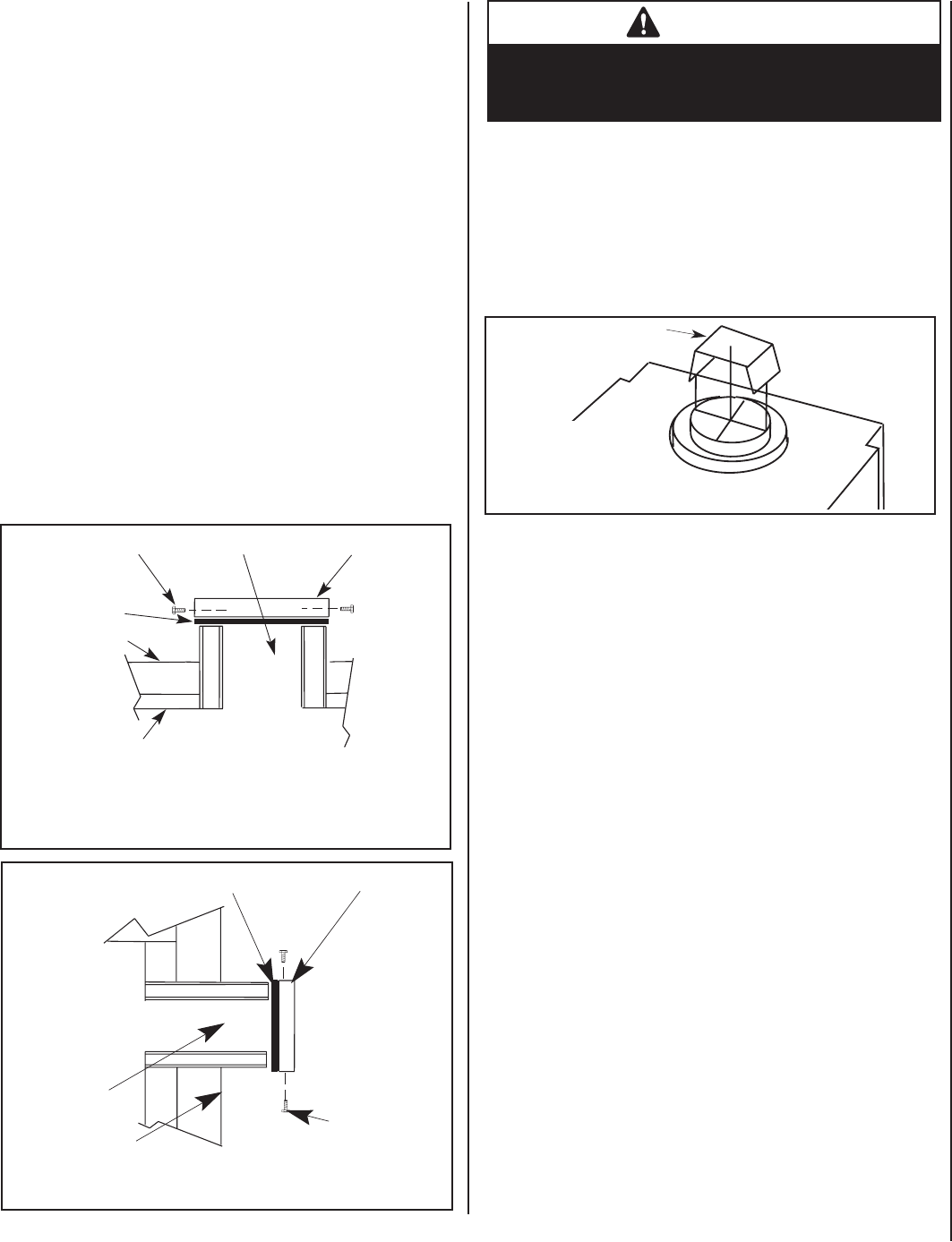
Securing Screws
(OUTSIDE of
Appli
ance)
Insulation
Top Vent Vent Seal Cap
Firebox Top
Cabinet Top
CROSS SECTION
SIDE VENT SEAL CAP REMOVAL
(SIDE VENT INSTALLATIONS ONLY)
Insulation Vent Seal Cap
Securing Screws
Side Vent
Cabinet Back
CROSS SECTION
(INSIDE of Appli
ance)
(OUTSIDE of
Appli
ance)
(INSIDE of
Appli
ance)
WARNING
The VENT SEAL CAP must remain securely installed
on unused vent collar. Failure to do so could result in
leakage of fl ue products into living space.
Figure 17
Figure 15 -
Figure 16 -
INSTALLING VENT RESTRICTOR
(Top Vent Installations with Vertical Terminations Only)
A vent restrictor (provided) may be needed with this appliance. If needed,
install the vent restrictor (provided) in the appliance top fl ue outlet as
shown in Figure 17 when vertically terminating the vent system above
the roof. It may be installed either from inside or outside the appliance,
in the inner fi replace collar. It is press-fi tted in place.
Restrictor
Appliance Top
Vent Outlet
TOP VENT SEAL CAP REMOVAL
(TOP VENT INSTALLATIONS ONLY)
Vent Restrictor
Vent Restrictor
Installation
Installation
(Top Vent)
(Top Vent)
Step 3. INSTALL THE VENT SYSTEM
These instructions should be used as a guideline and do not supersede
local codes in any way. Install vent according to local codes, these instruc-
tions, the current National Fuel Gas Code (ANSI-Z223.1) in the USA or the
current standards of CAN/CGA-B149.1 and -B149.2 in Canada.
• Use only approved venting components. See Approved Vent Compo-
nents, Page 2.
• These fi replaces must be vented directly to the outside.
The vent system must NOT service multiple appliances, and must never
be connected to a fl ue serving a solid fuel burning appliance. The vent
pipe is tested to be run inside an enclosure (such as a chase). There is
no requirement for inspection openings in the enclosure at any of the
joints in the vent pipe.
REMOVE VENT SEAL CAP
(From the vent that will be used only)
Top Vent - See Figure 15 and Side Vent - See Figure 16
Preparing the Appliance Vent Collar
Each of the appliances' two vent collars are sealed with a seal cap which
must be removed from the vent collar being used. Refer to Figure 15
for top vent installations and Figure 16 for side vent installations and
the following steps to prepare the appropriate collar for use.
From the vent collar being used, remove the two screws securing the
vent seal cap. Twist the cap counterclockwise. Pull it away from the
appliance and discard, along with the piece of insulation.
VENTING SYSTEM - HORIZONTAL OR VERTICAL
With the appliance secured in framing, determine vent routing and identify
the exterior termination location. The following sections describe vertical
(roof) and horizontal (exterior wall) vent applications. Refer to the section
relating to your installation. A list of approved venting components is
shown on Pages 31 and 32.
NOTE: DIAGRAMS & ILLUSTRATIONS ARE NOT TO SCALE.
14
Figure 18
SV4.5CGV-1
Termination SV4.5FA or SV4.5FB
Flashing and SV4.5SC
Storm Collar
1” (25.4 mm)
Minimum
Clearance to
Combustibles
-1 ptSV4.5VF
Firestop / spacer
SV4.5L6 / 12 / 24 / 36 / 48
Vent Sections
When using Secure
Flex use Firestop / spacer
SF4.5VF
40 ft. Max.
(12.2 M)
44121100034
0515.21010034
5.451578.21110035
5.061573.31020035
5.271573.41000505
77157.41100506
38152.51010506
6815.51000044
5.091578.51100045
5.691573.61010045
5.502521.71011507
70252.71000606
5.112526.71100607
5.712521.81010607
5.922521.91001607
5.232573.91000055
73257.91100056
5.142521.02000707
6425.02100708
25212010708
46222001708
67232000808
97252.32000066
5.082573.32100809
5.382526.32100067
5.982521.42010067
5.103521.52001067
5.013578.52000909
5135.621009001
5.523521.72000077
0335.72100078
63382010078
54357.8200001001
5.943521.9210001011
27313000088
5.673573.13100089
5.973526.1300011011
5.814578.43000099
32452.531000901
56457.8300000101
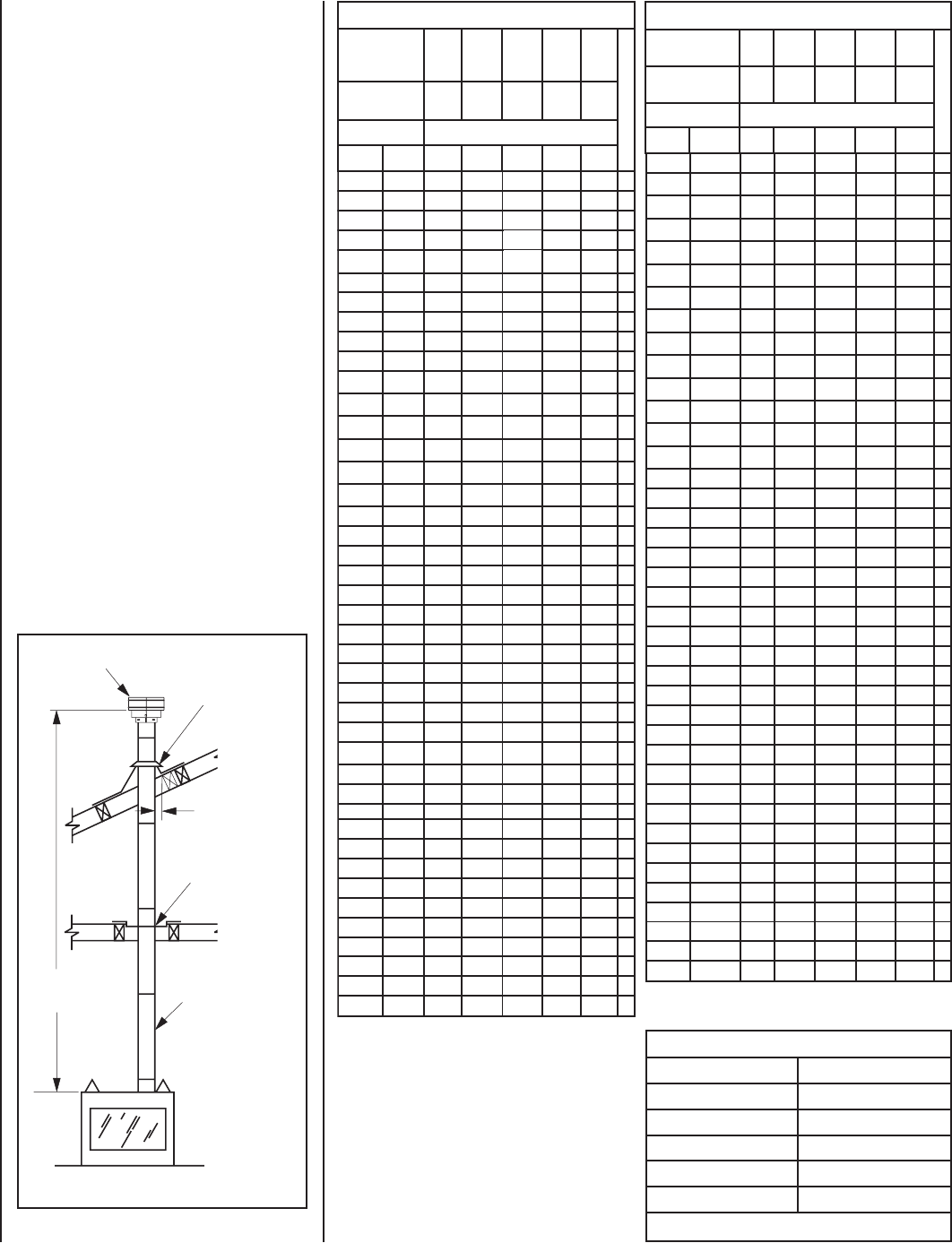
VENT SECTION LENGTH CHART
Nominal Section
Length (inches) 612243648
Net Section
Length (inches) 4 ½ 10 ½ 22 ½ 34 ½ 46 ½
Height of Vent Number of Vent Sections
*inches feet
T
O
T
A
L
Q
T
Y
5.4573.0100001
957.0200002
5.01578.0010001
5152.1110002
5.91526.12100
03
1257.1020002
5.22578.1001001
5.52521.2120003
5.13526.2030003
5.43578.2000101
5.73521.3111003
5.34526.3021003
5457.3002002
5.64578.3000011
5.94521.4102003
1552.4100012
5.55526.4012003
7557.4001102
6652.5022004
5.76526.5003003
9657.5000202
27 6103004
5.37521.6100203
5.97526.6010203
1857.6000112
095.7021014
5.19526.7002013
3957.7000022
69 8101204
5.79521.8100023
2015.8200024
5.301526.8000303
801 9100304
4115.9020024
71157.9105006
5.811578.9110305
6215.01001304
5.031578.01101305
53152.11006006
8315.11000404
5.931526.11000033
5.241578.11100405
VENT SECTION LENGTH CHART
Nominal
Section Length
(inches)
612243648
Net Section
Length (inches) 4 ½ 10 ½ 22 ½ 34 ½ 46
½
Height of Vent Number of Vent Sections
*inches feet
T
O
T
A
L
Q
T
Y
Table 9a
Table 9b
See Figure 21
for "support strap"
requirements
* Convert inches into metric equiva-
lent measure, as follows:
Millimeters (mm) = Inches x 25.4
Centimeters (cm) = Inches x 2.54
Meters (M) = Inches x .0254
Effective Vent Length
Model Effective Length
SV4.5L6 4-1/2"
SV4.5L12 10-1/2"
SV4.5L24 22-1/2"
SV4.5L36 34-1/2"
SV4.5L48 46-1/2"
Table 10
VERTICAL TERMINATION SYSTEMS (ROOF)
See Figure 18 and Figures 27 to 31 and their
associated Vertical Vent Tables illustrate the
vertical venting confi gurations that are allowed
to be used with these appliances. Secure Vent
pipe applications are shown in these fi gures;
Secure Flex pipe may also be used. See Page
24. A Vertical Vent Table summarizes each
system’s minimum and maximum vertical and
horizontal length values that can be used to
design and install the vent components in a
variety of applications.
Both these vertical vent systems terminate
through the roof. In the USA, the minimum
vent height above the roof and/or adjacent walls
is specifi ed in ANSI Z223.1 (latest edition); in
Canada, by the current CAN-1 B149 installation
code. It is also specifi ed in major building codes.
Always consult your local codes for specifi c
requirements. A general guide to follow is the
Gas Vent Rule (refer to Figure 4 on Page 7).
Vertical (Straight) Installation
Determine the number of straight vent sec-
tions required. 4-1/2" (114 mm), 10-1/2" (267
mm), 22-1/2" (572 mm), 34-1/2" (876 mm)
and 46-1/2" (1181 mm) net section lengths
are available (see Table 10 and Page 31 - Item
3). Plan the vent lengths so that a section joint
does not occur within the space defi ned by
ceiling joists or roof rafters. Refer to the Vent
Section Length Chart.

NOTE: DIAGRAMS & ILLUSTRATIONS ARE NOT TO SCALE. 15
Blocking
Support Straps
(Plumber's tape)
8 feet (2.4 m)
Maximum
1 inch (25.4
mm) minimum
clearance to
combustibles
Figure 19
Figure 21
Another method, where the vent is not adjacent
to a wall, is illustrated in Figure 22. Here,
support straps (96K93) and support plates
(96K92) can be used to support the weight
of the vent.
D. Install fi restop / spacer at ceiling - When
using Secure Vent, use SV4.5VF fi restop / spacer
at ceiling joists; when using Secure Flex, use
SF4.5VF fi restop / spacer. If there is living space
above the ceiling level, the fi restop / spacer must
be installed on the bottom side of the ceiling.
If attic space is above the ceiling, the fi restop /
spacer must be installed on the top side of the
joist. Route the vent sections through the framed
opening and secure the fi restop / spacer with
8d nails or other appropriate fasteners at each
corner. Remember to maintain 1" (25 mm)
clearance to combustibles, framing members,
and attic or ceiling insulation when running ver-
tical chimney sections. Attic insulation shield
(96K94) may be used to obtain the required
clearances indicated here. See installation
accessories o n Pages 31 and 32.
E. Support the vertical vent run sections -
Note - Proper venting support is very important.
The weight of the vent must not be supported
by the fi replace in any degree.
Support the vertical portion of the venting
system every 8 feet (2.4 m) above the fi replace
vent outlet. One method of support is by utiliz-
ing fi eld provided support straps (conventional
plumber's tape). Secure the plumber's tape to
the framing members with nails or screws.
Loop the tape around the vent, securing the
ends of the tape to the framing. If desired,
sheet metal screws #6 x 1/2" length may be
used to secure the support straps to the vent
pipe. See Figure 21.
10-1/2" Min.
(267 mm)
10-1/2" Min.
(267 mm)
Figure 20
Align the dimple (four places) of the
upper vent section with the opening
of the locking incline channel on the
lower vent section or appliance col-
lar. Twist vent component clockwise
to engage and seal until arrow and
dimple align.
Dimple
Locking Incline
Channel
Connected Vent
Sections Arrow
Arrow
Appliance Collar or
Vent Section
Vertical (offset) Installation
Analyze the vent routing and determine the
number of vent sections and elbows required.
Refer to Vertical Vent Figures and Tables on
Pages 17 and 18 to select the type of vertical
installation desired. Refer to the Vent Section
Length Charts on Page 14 for an aid in se-
lecting vent length combinations. Elbows are
available in 45° and 90° confi gurations. Refer
to Figure 23 for the SV4.5E45 and SV4.5E90
elbow dimensional specifi cations.
Where required, a Telescopic Vent Section
(SV4.5LA) may be used to provide the installer
with an option in installing in tight and confi ned
spaces or where the vent run made up of fi xed
length pieces develops a joint in a undesirable
location, or will not build up to the required
length. The SV4.5LA Telescopic Vent Section
has an effective length of from 1- 1/2" (38
mm) to 7-1/2" (191 mm). The SV4.5LA is fi tted
with a locking inclined channel end (identical to
a normal vent section component) and a plain
end with 3 pilot holes. Slip the plain end over the
locking channel end of a standard SV4.5 vent
component the required distance and secure
with three screws.
Maintain a minimum 1" (25 mm) clearance
to combustible materials for all vertical
elements. Clearances for all horizontal ele-
ments are 3" (76 mm) on top, 1" (25 mm)
on sides and 1" (25 mm) on the bottom.
A. Frame ceiling opening - Use a plumb line
from the ceiling above the appliance to locate
center of the vertical run. Cut and/or frame an
opening, 10-1/2" x 10-1/2" (267 mm x 267
mm) inside dimensions, about this center mark
(Figure 19).
To attach a vent component to the appliance
collar, align the dimpled end over the collar,
adjusting the radial alignment until the four
locking dimples are aligned with the inlet of
the four inclined channels on the collar (refer
to Figure 20). Push the vent component
against the collar until it fully engages, then
twist the component clockwise, running the
dimples down and along the incline channels
until they seat at the end of the channels. The
unitized design of the Secure Vent components
will engage and seal both the inner and outer
pipe without the need for sealant or screws.
If desired a #6 x 1/2" screw may be used at the
joint, but it not required as the pipe will securely
lock when twisted.
Note: An elbow may also be attached to the
appliance collar. Attach in the same manner
as you would a vent section.
C. Attach vent components to each other
- Other vent sections may be added to the
previously installed section in accordance with
the requirements of the vertical vent Figures
and Tables. To add another vent component
to a length of vent run, align the dimpled end
over the inclined channel end of the previously
installed section, adjusting the radial alignment
until the four locking dimples are aligned with the
inlets of the four incline channels of the previous
section. Push the vent component against the
previous section until it fully engages, then twist
the component clockwise running the dimples
down and along the incline channels until they
seat at the end of the channels. This seating
position is indicated by the alignment of the
arrow and dimple as shown in Figure 20.
B. Attach vent components to appliance
- Secure Vent SV4.5 direct vent system compo-
nents are unitized concentric pipe components
featuring positive twist lock connections (see
Figure 20). All of the appliances covered in this
document are fi tted with collars having locking
inclined channels. The dimpled end of the vent
components fi t over the appliance collar to cre-
ate the positive twist lock connection.
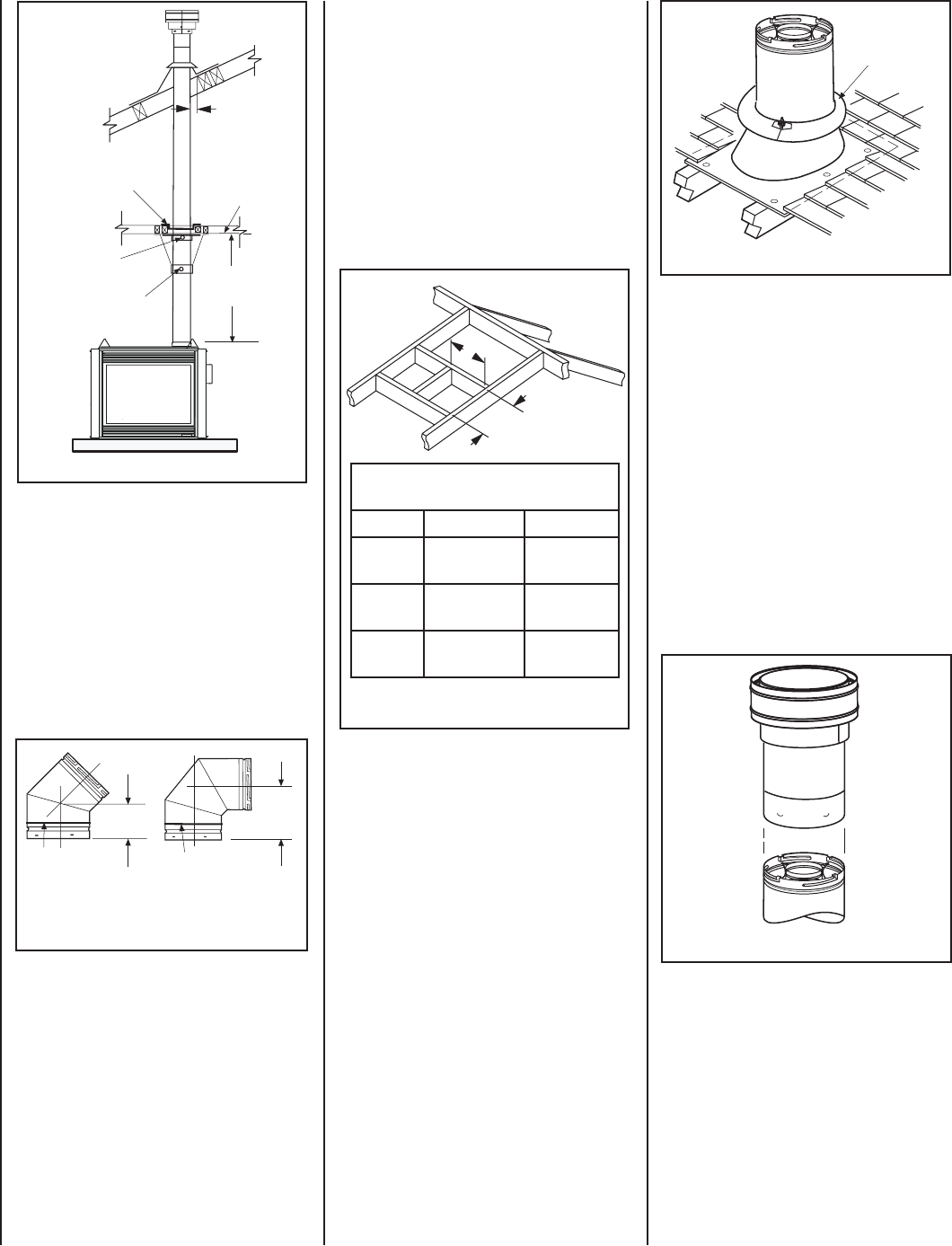
NOTE: DIAGRAMS & ILLUSTRATIONS ARE NOT TO SCALE.
16
SV4.5VF
Firestop / spacer
SV4.5SU
Support Strap
8 ft. (2.4 M)
Maximum
SV4.5SP
Support Plate
Ceiling Framing
Secured
to Vent with
Appropriate
Fasteners
1” (25.4 mm)
Minimum
Clearance to
Combustibles
When using
secure Flex, use
Firestop/Spacer
SF4.5VF
Framing Dimensions for Roof
Inches (millimeters)
Pitch C D
0/12 10-1/2 in.
(267 mm)
10-1/2 in.
(267 mm)
6/12 10-1/2 in.
(267 mm)
12 in.
(305 mm)
12/12 10-1/2 in.
(267 mm)
17-3/4 in.
(451 mm)
Figure 24 - Roof Framing
C
D
Figure 25
Storm
Collar
Figure 26
Flashing
7-5/8”
(194 mm)
4-13/16
(122 mm)
(206 mm)
If the vent system extends more than 5 feet
(1.5 m) above the roof fl ashing, stabilizers may
be necessary. Additional screws may be used
at section joints for added stability. Guide wires
may be attached to the joint for additional sup-
port on multiple joint confi gurations.
G. Continue installation of horizontal / inclined
sections - Continue with the installation of the
straight vent sections in horizontal / inclined run
as described in Step C. Install support straps
every 5 feet (1.52 m) along horizontal / inclined
vent runs using conventional plumber’s tape.
See Page 19, Figure 32. It is very important
that the horizontal / inclined run be maintained
in a straight (no dips) and recommended to
be in a slightly elevated plane, in a direction
away from the fi replace of 1/4" rise per foot (20
mm per meter) which is ideal, though rise per
foot run ratios that are smaller are acceptable
all the way down to at or near level.
F. Change vent direction to horizontal / inclined
run - At transition from or to a horizontal / in-
clined run, install the SV4.5E45 and SV4.5E90
elbows in the same manner as the straight vent
sections. The elbows feature a twist section to
allow them to be routed about the center axis
of their initial collar section to align with the
required direction of the next vent run element.
Twist elbow sections in a clockwise direction
only so as to avoid the possibility of unlocking
any of the previously connected vent sections.
See Figure 23.
Use a carpenter’s level to measure from a
constant surface and adjust the support straps
as necessary.
It is important to maintain the required clear-
ances to combustibles: 1" (25 mm) at all sides
for all vertical runs; and 3" (76 mm) at the top,
1" (25 mm) at sides, and 1" (25 mm) at the
bottom for all horizontal / inclined runs.
H. Frame roof opening - Identify location for
vent at the roof. Cut and/or frame opening per
Roof Framing Chart and Figure 24.
Figure 23
Swivel Joint
(360° swivel)
SV4.5E45
45° Elbow)
Swivel Joint
(360° swivel)
SV4.5E90
90° Elbow)
SV4.5FA or
SV4.5FB Flashing
and SV4.5SC
Storm Collar
SV4.5CGV-1
Termination
8-1/8"
K. Install the vertical termination - The fi nal
Step involves installation of the SV4.5CGV-1
Vertical Termination. Extend the vent sections
to the height as shown in the "Vertical vent
termination section" (Page 7, Figure 4). The
SV4.5CGV-1 Vertical Termination (Figure 26)
can be installed in the exact same fashion as any
other Secure Vent section. Align the termination
over the end of the previously installed section,
adjusting the radial alignment until the four
locking dimples of the termination are aligned
with the inlets of the four incline channels of the
last vent section. Push the termination down
until it fully engages, then twist the termination
clockwise running the dimples down and along
the incline channels until they are seated at the
end of the channels.
I. Install the roof fl ashing - Extend the vent
sections through the roof structure. Install the
roof fl ashing over the vent section and position
such that the vent column rises vertically (use
carpenters level - see Figure 25). Nail along
perimeter to secure fl ashing or adjust roofi ng
to overlap the fl ashing edges at top and sides
only and trim where necessary. Seal the top
and both sides of the fl ashing with waterproof
caulking.
J. Install the storm collar - Install the storm
collar, supplied with the fl ashing, over the vent /
fl ashing joint. See Figure 25. Loosen the storm
collar screw. Slide collar down until it meets
the top of the fl ashing. Tighten the adjusting
screw. Apply non-combustible caulking or
mastic around the circumference of the joint
to provide a water tight seal.
Figure 22
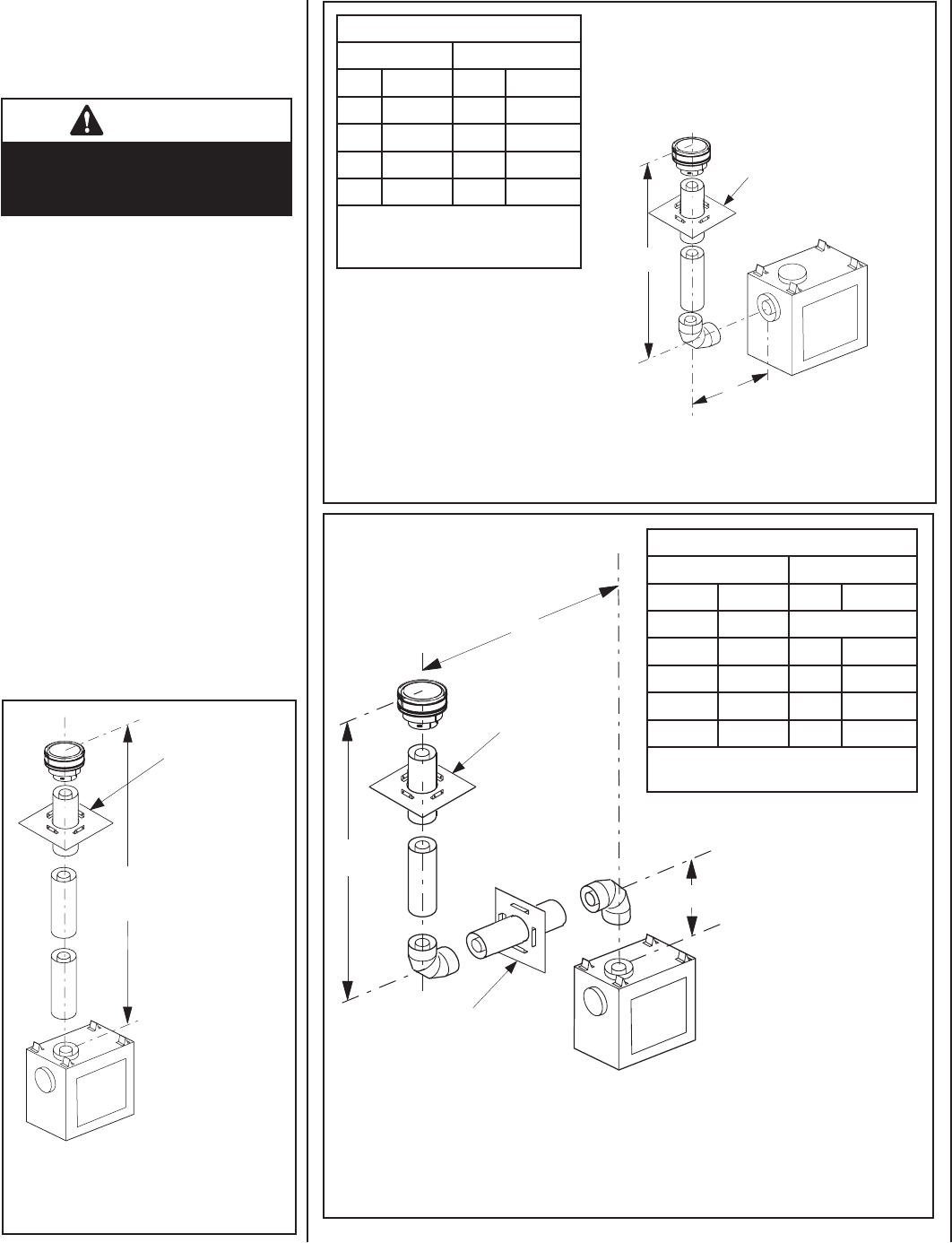
NOTE: DIAGRAMS & ILLUSTRATIONS ARE NOT TO SCALE. 17
H
V
V1
V
H
Table A
H Maximum V Minimum
feet (meter) feet (meter)
2 (0.610) 1 (0.305)
4 (1.219) 2 (0.610)
6 (1.829) 3 (0.914)
8 (2.438) 4 (1.219)
V + H = 40 feet (12.2 meters) Max.
H = 8 feet (2.4 meters) Max.
Ratio V to H ratio is 1:2
Table B
H Maximum V Minimum
feet (meter) feet (meter)
5 (1.524) Elbow Only
5 (1.524) 1 (0.305)
10 (3.048) 2 (0.610)
15 (4.572) 3 (0.914)
20 (6.096) 4 (1.219)
V + V1 + H = 40 feet (12.2 m) Max.
H = 20 feet (6.096 meters) Max.
Figure 28- Side Vent - ONE 90 DEGREE ELBOW
Figure 27 - Top Vent - STRAIGHT Figure 29 - Top Vent - TWO 90 DEGREE ELBOWS
Ceiling Firestop / Spacer (SV4.5VF)
Ceiling Firestop
/ Spacer (SV4.5VF)
Wall Firestop/
Spacer (SV4.5HF)
A Vent Restrictor, as
shown in Figure 17,
Page 13, must be used
in this application
Ceiling Firestop /
Spacer (SV4.5VF)
When using Secure Flex, use Firestop / Spacer
SF4.5VF
40 feet
(12.2 meters)
Maximum
When using Secure Flex, use Firestop
/ Spacer SF4.5VF
Example: If 8 feet of (H) horizontal vent run
is needed, then 4 feet minimum (V) vertical
vent will be required.
This table shows a 1(V) to 2(H) ratio. For
every 1 foot of (V) vertical, you are allowed 2
feet of (H) horizontal run, up to a maximum
horizontal run of 8 feet.
When using Secure Flex, use
Firestop / Spacer SF4.5VF.
When using Secure Flex, use
Firestop / Spacer SF4.5HF.
Example: If 20 feet of (H) hori-
zontal vent run is needed, then 4
feet minimum of (V) vertical vent
will be required.
This table shows a 1(V) to 5(H)
ratio. For every 1 foot of (V) verti-
cal, you are allowed 5 feet of (H)
horizontal run, up to a maximum
horizontal run of 20 feet.
An elbow is acceptable as 1 foot
of vertical rise except where
an elbow is the only vertical
component in the system. See
Figure 36.
VERTICAL VENT FIGURES/TABLES
Note: Secure Vent (rigid vent pipe) is shown
in the Figures; Secure Flex (fl exible vent pipe)
may also be used.
WARNING
Under No Circumstances, May Sepa-
rate Sections of Concentric Flexible
Vent Pipe Be Joined Together.
Notes:
• It is very important that the horizontal/in-
clined run be maintained in a straight (no
dips) and recommended to be in a slightly
elevated plane, in a direction away from the
fi replace of 1/4" rise per foot (20 mm per
meter) which is ideal, though rise per foot
run ratios that are smaller are acceptable all
the way down to at or near level.
• SV4.5VF (Secure Vent), SF4.5VF (Secure
Flex) fi restop/spacer must be used anytime
vent pipe passes through a combustible
fl oor or ceiling. SV4.5HF (Secure Vent),
SF4.5HF (Secure Flex)fi restop/spacer must
be used anytime vent pipe passes through
a combustible wall.
• Two 45 degree elbows may be used in place
of one 90 degree elbow. The same rise to
run ratios, as shown in the venting Figures
for 90 elbows, must be followed if 45 degree
elbows are used.
• AN ELBOW IS ACCEPTABLE AS 1 FOOT OF
VERTICAL RISE EXCEPT WHERE AN ELBOW
IS THE ONLY VERTICAL COMPONENT IN
THE SYSTEM (See Figure 36).
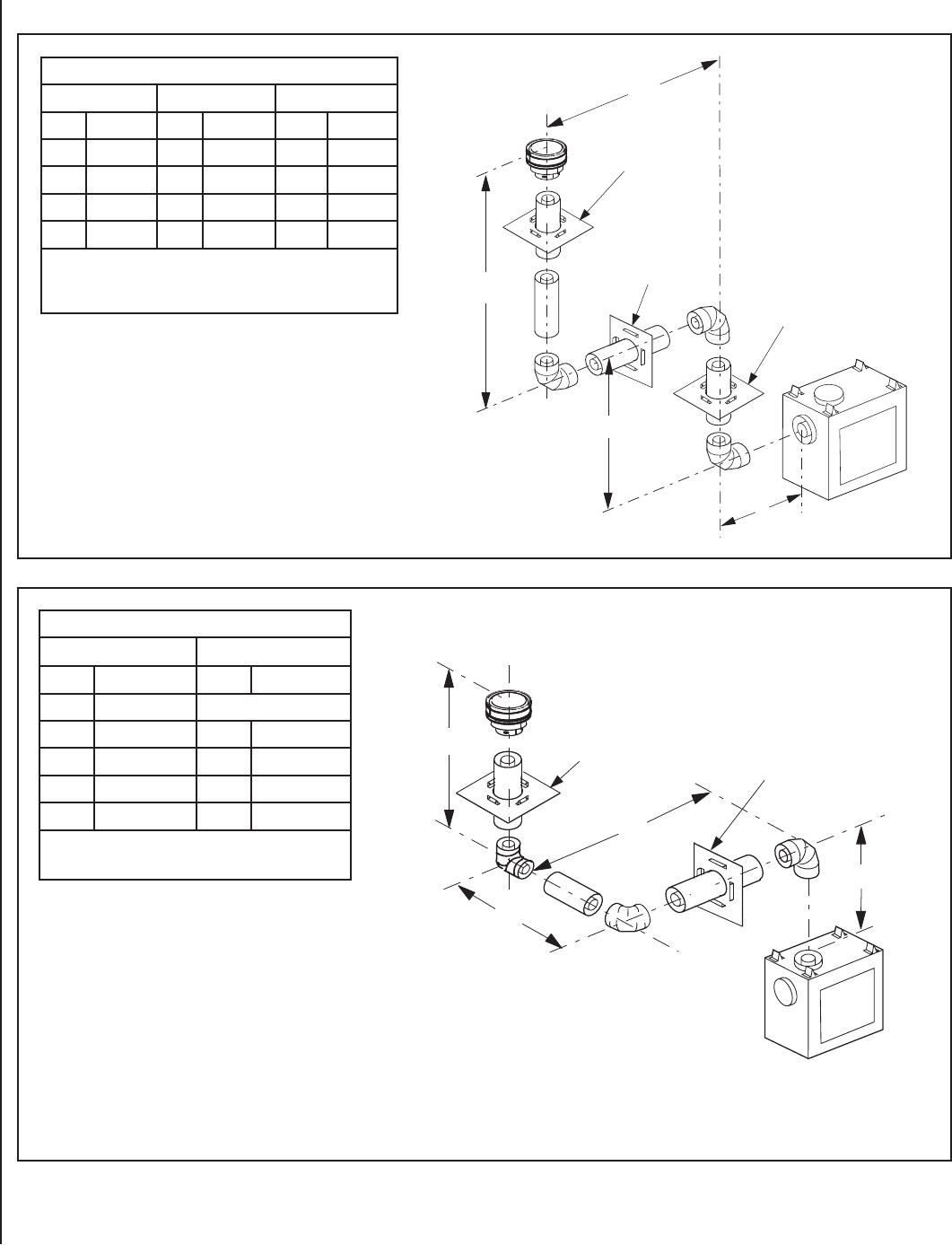
NOTE: DIAGRAMS & ILLUSTRATIONS ARE NOT TO SCALE.
18
Table D
H + H1 Maximum V Minimum
feet (meter) feet (meter)
5 (1.524) Elbow Only
5 (1.524) 1 (0.305)
10 (3.048) 2 (0.610)
15 (4.572) 3 (0.914)
20 (6.096) 4 (1.219)
H + H1 = 20 feet (6.096 m) Max.
V + V1 + H + H1 = 40 ft. (12.192 m) Max.
Example: If 20 feet total (H+H1) horizontal vent run is needed, then
4 feet minimum of (V) vertical vent will be required.
This table shows a 1(V) to 5(H) ratio. For every 1 foot of (V) vertical,
you are allowed 5 feet of (H+H1) horizontal run up to a maximum total
horizontal run of 20 feet.
An elbow is acceptable as 1 foot of vertical rise except where an elbow
is the only vertical component in the system. See Figure 36.
Table C
H+H1 Maximum H Maximum V Minimum
feet (meter) feet (meter) feet (meter)
5 (1.524) 2 (0.610) 1 (0.305)
10 (3.048) 4 (1.219) 2 (0.610)
15 (4.572) 6 (1.829) 3 (0.914)
20 (6.096) 8 (2.438) 4 (1.219)
V + V1 + H + H1 = 40 feet (12.2 m) Max
H = 8 feet (2.438 meters) Max.
H + H1 = 20 feet (6.096 meters) Max.
Example: If 20 feet total (H+H1) horizontal vent run is needed,
then 4 feet minimum of (V) vertical vent will be required.
This table shows a 1(V) to 5(H) ratio. For every 1 foot of (V)
vertical, you are allowed 5 feet of (H+H1) horizontal run up to a
maximum total horizontal run of 20 feet.
When using Secure Flex, use Firestop / Spacer SF4.5VF
When using Secure Flex, use Firestop / Spacer SF4.5HF
H1
V
V1
H
V
H1
H
V1
Figure 30 - Side Vent - THREE ELBOWS
Figure 31 - Top Vent - THREE ELBOWS
Ceiling
Firestop / Spacer
(SV4.5VF)
Wall Firestop/
Spacer (SV4.5HF)
Ceiling Firestop /
Spacer (SV4.5VF)
When using Secure Flex, use Firestop / Spacer SF4.5VF
When using Secure Flex, use Firestop / Spacer SF4.5HF
Ceiling
Firestop / Spacer
(SV4.5VF)
Wall Firestop/
Spacer (SV4.5HF)
VERTICAL VENT FIGURES / TABLES (CONTINUED)
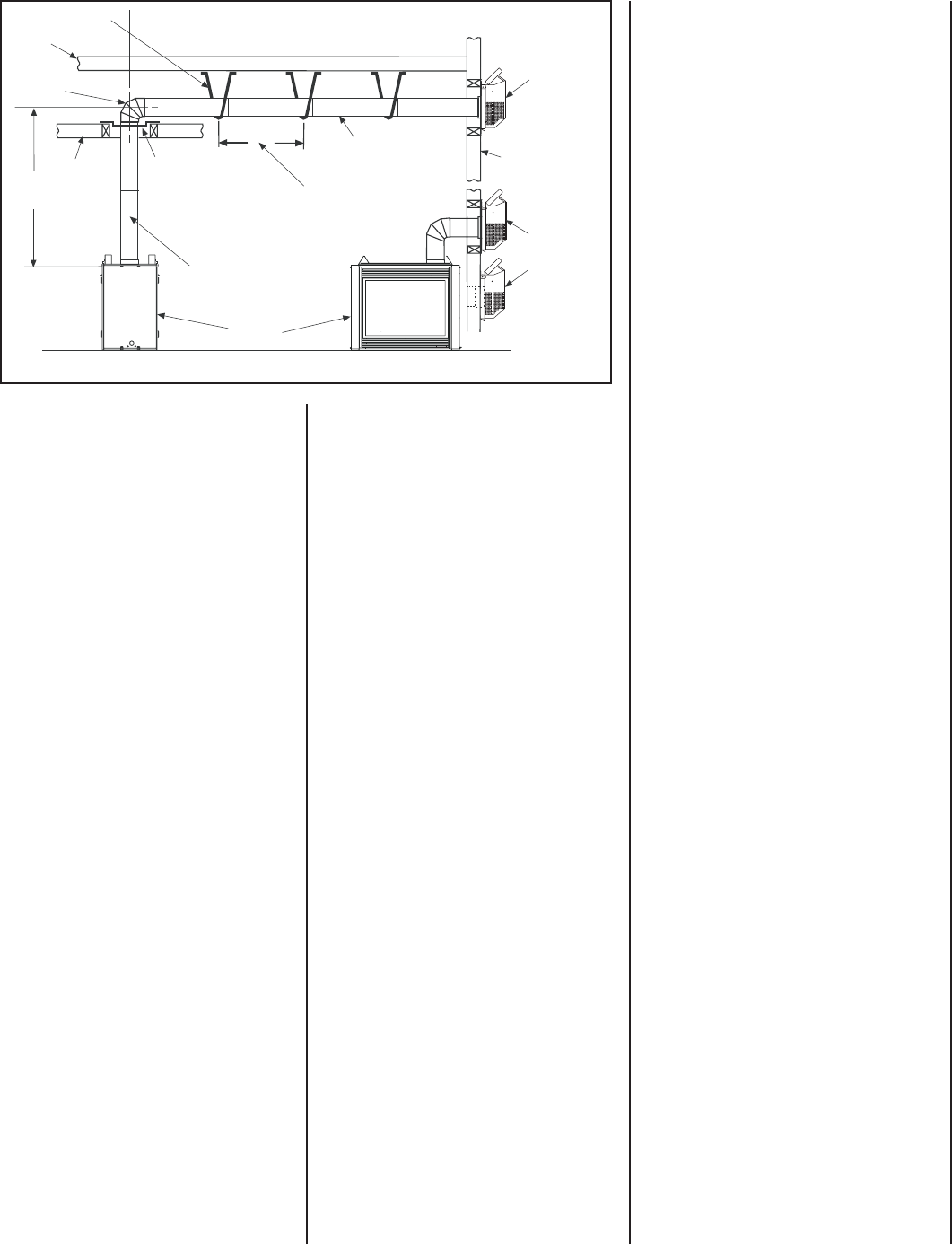
NOTE: DIAGRAMS & ILLUSTRATIONS ARE NOT TO SCALE. 19
HORIZONTAL (OUTSIDE WALL)
TERMINATION SYSTEM
See Figure 32, and Figures 35 to 40 and
their associated Horizontal Vent Table which
illustrates the horizontal venting confi gura-
tions that are allowed to be used with these
appliances. Secure Vent pipe applications are
shown in these fi gures; Secure Flex pipe may
also be used (see Page 24). A Horizontal Vent
Table summarizes each system’s minimum and
maximum vertical and horizontal length values
that can be used to design and install the vent
components in a variety of applications.
Both of these horizontal vent systems terminate
through an outside wall. Building Codes limit or
prohibit terminating in specifi c areas. Refer to
Figure 6 on Page 8 for location guidelines.
Secure Vent SV4.5 direct vent system compo-
nents are unitized concentric pipe components
featuring positive twist lock connection, (refer
to Figure 20 on Page 15). All of the appli-
ances covered in this document are fi tted with
collars having locking inclined channels. The
dimpled end of the vent components fi t over
the appliance collar to create the positive twist
lock connection.
A. Plan the vent run -
Analyze the vent routing and determine the
types and quantities of sections required
4-1/2" (114 mm), 10-1/2" (267 mm), 22-1/2"
(572 mm), 34-1/2" (876 mm) and 46-1/2" (1181
mm) net section lengths are available. Plan the
vent lengths so that a section joint does not occur
within the space defi ned by ceiling joists, roof
rafters or wall studs. Make allowances for elbows
as indicated in Figure 23 on Page 16.
Figure 32 -TYPICAL HORIZONTAL VENT INSTALLATION
See Figures 21 & 22 for verti-
cal vent section support.
Horizontal / Inclined Run
Support
Brackets
Building
Support
Framing
SV4.5E90
Elbow
Ceiling Firestop / Spacer
SV4.5VF
When Using Secure Flex,
Use Firestop / Spacer SF4.5VF
Fireplace
SV4.5L6/12/24/36/48
Vent Sections
Vertical
Rise Support Bracket Spacing
Every 5 ft (1.52 m)
Exterior
Wall
To add another vent component to a length
of vent run, align the dimpled end of the
component over the inclined channel end of
the previously installed section, adjusting the
radial alignment until the four locking dimples
are aligned with the inlets of the four incline
channels of the previous section. Push the vent
component against the previous section until it
fully engages, then twist the component clock-
wise running the dimples down and along the
incline channels until they seat at the end of the
channels. This seating position is indicated
by the alignment of the arrow and dimple as
shown in Figure 20 on Page 15.
F. Install fi restop / spacer at ceiling -
When using Secure Vent, use SV4.5VF fi restop
/ spacer at ceiling joists; when using Secure
Flex, use SF4.5VF fi restop / spacer. If there is
living space above the ceiling level, the fi restop/
spacer must be installed on the bottom side of
the ceiling. If attic space is above the ceiling,
the fi restop/ spacer must be installed on the
top side of the joist. Route the vent sections
through the framed opening and secure the
fi restop / spacer with 8d nails or other ap-
propriate fasteners at each corner.
Remember to maintain 1" (25 mm) clearance
to combustibles, framing members, and attic
or ceiling insulation when running vertical
chimney sections. Attic insulation shield
(96K94) may be used to obtain the required
clearances indicated here. See installation
accessories Tables on Pages 31 and 32.
G. Support the vertical run sections -
See Step E on Page 15.
H. Change vent direction - At transition from
or to a horizontal / inclined run, install the
SV4.5E45 and SV4.5E90 elbows in the same
manner as the straight vent sections. The
elbows feature a twist section to allow them to
be routed about the center axis of their initial
collar section to align with the required direc-
tion of the next vent run element. Twist elbow
sections in a clockwise direction only so as
to avoid the possibility of unlocking any of
the previously connected vent sections. See
Figure 20 on Page 15.
I. Continue installation of horizontal / inclined
sections - Continue with the installation of the
straight vent sections in horizontal / inclined run
as described in Step E. Install support straps
every 5 ft. (1.52 m) along horizontal / inclined
vent runs using conventional plumber’s tape.
See Figure 32. It is very important that the
horizontal / inclined run be maintained in a
straight (no dips) and recommended to be in
a slightly elevated plane, in a direction away
from the fi replace of 1/4" rise per foot (20 mm
per meter) which is ideal, though rise per foot
run ratios that are smaller are acceptable all the
way down to at or near level. Use a carpenter’s
level to measure from a constant surface and
adjust the support straps as necessary.
Maintain a minimum 1" (25 mm) clearance to
combustibles on the vertical sections. Clear-
ances for the horizontal runs are; 3" (76 mm)
on top, 1" (25 mm) on sides, and 1" (25 mm)
at the bottom.
B. Frame exterior wall opening -
Locate the center of the vent outlet on the exte-
rior wall according to the dimensions shown in
Figures 13 & 14 on Pages 11 & 12.
Cut and/or frame an opening, 10-1/2" x 12 1/8"
(267 mm x 308 mm) inside dimensions, about
this center.
C. Frame ceiling opening - If the vertical route
is to penetrate a ceiling, use plumb line to locate
the center above the appliance. Cut and/or frame
an opening, 10-1/2" x 10-1/2" (267 mm x 267
mm) inside dimensions, about this center (refer
to Figure 19 on Page 15).
D. Attach vent components to appliance - To
attach a vent component to the appliance collar,
align the dimpled end over the collar, adjust-
ing the radial alignment until the four locking
dimples are aligned with the inlets of the four
incline channels on the collar (refer to Figure
20 on Page 15).
Push the vent component against the collar
until it fully engages, then twist the component
clockwise, running the dimples down and along
the incline channels until they seat at the end of
the channels. The unitized design of the Secure
Vent components will engage and seal both the
inner and outer pipe elements with the same
procedure. Sealant and securing screws are
not required.
E. Attach vent components to each other
- Other vent sections may be added to the
previously installed section in accordance with
the requirements of the vent tables.
SV4.5HT-2
Termination
Shown
SV4.5HT-2
Termination
Shown

NOTE: DIAGRAMS & ILLUSTRATIONS ARE NOT TO SCALE.
20
IMPORTANT
The vent termination is hot while
in operation and for a period of
time following the use of the fi re-
place. To prevent contact with hot
surfaces, we recommend the use
of a Termination Guard. See Items
12 and 13 on Page 31. This can be
purchased at your local dealer.
It is important to maintain the required clear-
ances to combustibles: 1" (25 mm) at all sides
for all vertical runs; and 3" (76 mm) at the top,
1" (25 mm) at sides, and 1" (25 mm) at the
bottom for all horizontal / inclined runs.
J. Assemble vent run to exterior wall - If not
previously measured, locate the center of the
vent at the exterior wall. Prepare an opening as
described in Step B. Assemble the vent system
to point where the end of the last section is
within 5 in. (127 mm) to 9-1/4 in. (235 mm)
inboard of the exterior surface to which the
SV4.5HT-2 termination is to be attached, see
Figure 34. If the end of the last section is not
within this distance, use the telescopic vent sec-
tion SV4.5LA, as the last vent section. For wall
thicknesses greater than that shown in Figure
34, refer to Table 11 on Page 21. This Table
lists the additional venting components needed
(in addition to the termination and adapter) for
a particular range of wall thicknesses.
K. Attach termination adapter - Attach the
adapter (SV4.5RCH - provided with the termi-
nation) to the vent section or telescoping vent
section), elbow or appliance collar as shown
in Figures 33 & 34 in the same manner as any
SV4.5 vent component (refer to Step E).
L. Install Firestop / Spacer at exterior wall
- When using the square termination, install
SV4.5HF (Secure Vent), SF4.5HF (Secure Flex)
Firestop / Spacer over the opening at the exterior
side of the framing, long side up, with the 3 inch
spacer clearance at the top as shown in Figure
33, and nail into place. The Firestop / Spacer
may also be installed over the opening at the
interior side of the framing.
M. Install the Square Termination (SV4.5HT-2)
Install the square termination - For the last
step , from outside the exterior wall, slide the
collars of the termination onto the adapter until
the termination seats against the exterior wall
surface to which it will be attached. Orient
the housing of the termination with the arrow
pointed upwards. Secure the termination to
the exterior wall. The horizontal termination
must not be recessed into the exterior wall
or siding by more than the 1-1/4" (32 mm) as
shown in Figure 34.
SV4.5 HT-2
Termination
SV4.5 HT-2
Termination
SV4.5 HT-2
Termination
Horizontal terminations have been designed to perform in a wide range of weather condi-
tions. Our terminations meet or exceed industry standards.
When selecting the locations of your horizontal terminations, do not place the termina-
tion where water from eaves and adjoining roofl ines may create a heavy fl ow of cascad-
ing water onto the termination cap. If the cap must be placed where the possibility of
cascading water exists, it is the responsibility of the builder to direct the water away
from the termination cap by using gutters or other means.
Take care to carefully follow the installation instructions for the termination, including
the use of silicone caulking where required.
Figure 34
Figure 33 - INSTALLING SQUARE HORIZONTAL TERMINATION (SV4.5HT-2)
Siding
Stucco
1-1/4” Maximum Recess of
Square Termination
into Exterior Finishing Material
Exterior Surface of
Framing
Exterior Surface of Siding
Maximum Extent of
Vent Run Sections
Relative to Exterior
Surface of Framing
Interior Surface of
Finished Wall
Last Vent Section.
Use Telescopic Vent
Section (SV4.5LA), If
Necessary
Adapter
SV4.5RCH
Use silicone caulking to seal
the top and sides of the
termination, up to the
underlayment, stucco, or
masonry wall surface.
Caulk
Caulk
Maximum Wall Thickness
10 in. (254 mm)
6 in. to 9-1/4 in.
(152 to 235 mm)
10¹⁄₂"
(267mm)
7"
(178)
5¹⁄₈"
(130 mm)
12¹⁄₈"
(308 mm)
Note: Centerline of Vent Piping is
NOT the Same as the Centerline of
the Framed Opening.
6 to 48 inch Vent Section,
Telescopic vent section,
Elbow or Appliance Collar Base of Appliance
3"
(76 mm)
1"
(25.4 mm)
Adapter
SV4.5RCH
To help minimize water infiltration it is
recommended that the Firestop/Spacer
(SV4.5HF) be installed on the exterior
side of the wall.
Venting Connection and Exterior Wall Recessing of the Horizontal Square
Termination (SV4.5HT-2).
See Figures 13 & 14 for Min.
Distance to Base of Appliance.
For thicknesses greater than
10", see Table 11

NOTE: DIAGRAMS & ILLUSTRATIONS ARE NOT TO SCALE. 21
Square termination
(SV4.5HT-2) shown.
Wall Firestop / Spacer
(SV4.5HF)
WARNING
Under no circumstances, may separate sections of
concentric fl exible vent pipe be joined together.
See Table 11 as an aid in venting component selection for a particular
range of exterior wall thicknesses.
Square termination
(SV4.5HT-2) shown.
H
V
H = 28 in. (711 mm)
Maximum
7 in. (711 mm)
21 in. (533 mm)
Maximum
Wall Firestop/
Spacer (SV4.5HF)
When using Secure Flex, use Firestop / Spacer SF4.5VF
When using Secure Flex, use Firestop / Spacer SF4.5HF
Table E
H Maximum V Minimum
feet (meter) feet (meter)
3 (0.914) Elbow Only
5 (1.524) 1 (0.305)
10 (3.048) 2 (0.610)
15 (4.572) 3 (0.914)
20 (6.096) 4 (1.219)
V + H = 40 feet (12.2 m) Max.
H = 20 ft. (6.096 m) Max.
Example: If 20 feet of (H)
horizontal vent run is needed,
then 4 feet minimum of (V)
vertical vent will be required.
This table shows a 1(V) to
5(H) ratio. For every 1 foot
of vertical, you are allowed 5
feet of (H) horizontal run up
to a maximum (H) horizontal
run of 20 feet.
Figure 35 - Side Vent, NO ELBOWS
Figure 36 - Top Vent, ONE 90 DEGREE ELBOW
When using Secure Flex, use Firestop / Spacer SF4.5HF
Square termination (SV4.5HT-2) shown
Venting Components Required for Various Exterior Wall Thick-
nesses, when using Square Termination Kit (SV4.5HT-2)
Vent Components Required Exterior Wall Thickness - inches (mm)
Termination Kit Only 6 to 9-1/4 (152 to 235)
Termination Kit and 6 In. Vent
Section (SV4.5L6) 10-3/4 to 14 (273 to 356)
Termination Kit and 12 in.
Vent Section (SV4.5L12) 16-3/4 to 20 (426 to 508)
Termination Kit and Tele-
scopic Section (SV4.5L12) 11-3/4 to 20 (299 to 508)
Table 11 Note: See Figure 34 showing wall thickness range
when using SV4.5HT-2 termination kit only.
Notes:
• Secure Vent components (rigid vent pipe and terminal) are shown in
the Figures; Secure Flex components (fl exible vent pipe and terminal)
may also be used.
• Two 45 degree elbows may be used in place of one 90 degree elbow.
The same rise to run ratios, as shown in the venting Figures for 90
elbows,must be followed if 45 degree elbows are used.
• SV4.5VF (Secure Vent), SF4.5VF (Secure Flex) fi restop/spacer must
be used anytime vent pipe passes through a combustible fl oor or ceil-
ing. SV4.5HF (Secure Vent), SF4.5HF (Secure Flex) fi restop/spacer
must be used anytime vent pipe passes through a combustible wall.
• It is very important that the horizontal/inclined run be maintained
in a straight (no dips) and recommended to be in a slightly elevated
plane, in a direction away from the fi replace of 1/4" rise per foot (20
mm per meter) which is ideal, though rise per foot run ratios that are
smaller are acceptable all the way down to at or near level.
• The tables show a 1(V) to 5(H) ratio up to a maximum horizontal run
of 20 feet except for installations where an elbow is the only vertical
vent section in the system (see Figure 36).
• AN ELBOW IS ACCEPTABLE AS 1 FOOT OF VERTICAL RISE EXCEPT
WHERE AN ELBOW IS THE ONLY VERTICAL COMPONENT IN THE
SYSTEM. See Figure 36.
HORIZONTAL VENT FIGURES/TABLES
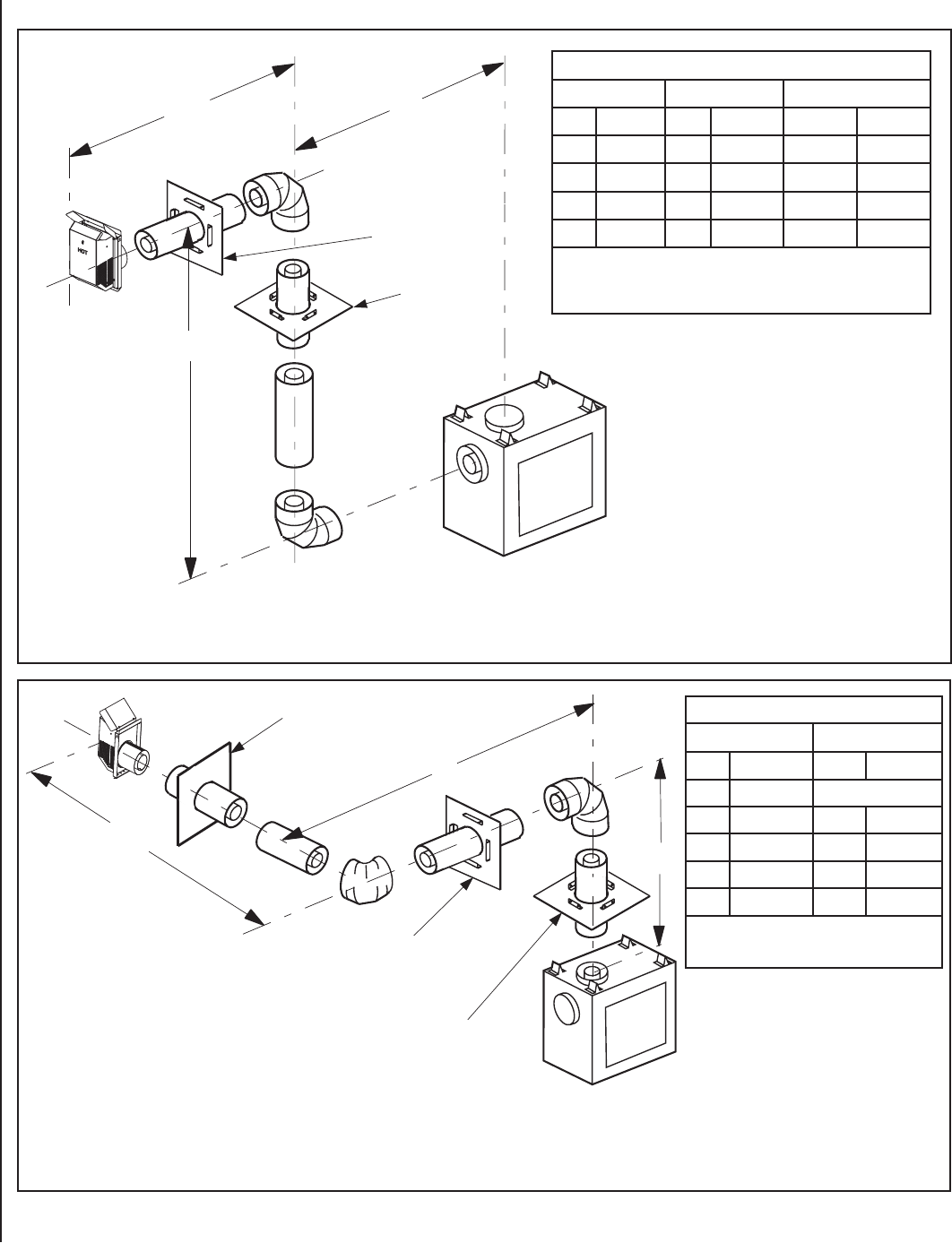
NOTE: DIAGRAMS & ILLUSTRATIONS ARE NOT TO SCALE.
22
H1
V
H
V
H
H1
Table F
H
+H1
Maximum H
Maximum
V Minimum
feet (meter) feet (meter) feet (meter)
5 (1.524) 2 (0.610) 1 (0.305)
10 (3.048) 4 (1.219) 2 (0.610)
15 (4.572) 6 (1.829) 3 (0.914)
20 (6.096) 8 (2.438) 4 (1.219)
V + H + H1 = 40 feet (12.2 m) Max
H = 8 feet (2.438 meters) Max.
H + H1 = 20 feet (6.096 meters) Max.
Table G
H + H1 Maximum V Minimum
feet (meter) feet (meter)
3 (0.914) Elbow Only
5 (1.524) 1 (0.305)
10 (3.048) 2 (0.610)
15 (4.572) 3 (0.914)
20 (6.096) 4 (1.219)
V + H + H1 = 40 feet (12.2 m) Max.
H + H1 = 20 ft. (6.096 m) Max.
Wall Firestop/
Spacer (SV4.5HF)
Ceiling
Firestop / Spacer
(SV4.5VF)
Wall Firestop/
Spacer (SV4.5HF)
When using Secure Flex, use Firestop
/ Spacer SF4.5VF
When using Secure Flex, use Firestop
/ Spacer SF4.5HF
Note: See Table 11 as an aid in venting
component selection for a particular range
of exterior wall thicknesses.
Ceiling Firestop /
Spacer (SV4.5VF)
Wall Firestop/
Spacer (SV4.5HF)
Wall Firestop/
Spacer (SV4.5HF)
When using Secure Flex, use Firestop /
Spacer SF4.5VF
When using Secure Flex, use Firestop /
Spacer SF4.5HF
Note: See Table 11 as an aid in venting
component selection for a particular range
of exterior wall thicknesses.
Example: If 20 feet of (H + H1) horizontal
vent run is needed, then 4 feet minimum of
(V) vertical vent will be required.
This table shows a 1(V) to 5(H) ratio. For every
1 foot of (V) vertical, you are allowed 5 feet
of (H+ H1) horizontal run, up to a maximum
horizontal run of 20 feet.
Example: If 20 feet of (H + H1) horizontal
vent run is needed, then 4 feet minimum of
(V) vertical vent will be required.
This table shows a 1(V) to 5(H) ratio. For every
1 foot of (V) vertical, you are allowed 5 feet
of (H+ H1) horizontal run, up to a maximum
horizontal run of 20 feet.
An elbow is acceptable as 1 foot of vertical
rise except where an elbow is the only vertical
component in the system. See Figure 36.
Figure 37 - Side Vent, TWO 90 DEGREE ELBOWS
Figure 38 - Top Vent, TWO 90 DEGREE ELBOWS
HORIZONTAL VENT FIGURES / TABLES (CONTINUED)
Square termination (SV4.5HT-2) shown
Square termination (SV4.5HT-2) shown

NOTE: DIAGRAMS & ILLUSTRATIONS ARE NOT TO SCALE. 23
V
H2
H1
H
V
H
H1
V1
Wall Firestop / Spacer
(SV4.5HF)
Ceiling Firestop /
Spacer (SV4.5VF)
Ceiling Firestop /
Spacer (SV4.5VF)
Wall Firestop /
Spacer (SV4.5VF)
Wall Firestop
/ Spacer (SV4.5HF)
When using Secure Flex,
use Firestop / Spacer
SF4.5VF
When using Secure Flex,
use Firestop / Spacer
SF4.5HF
Note: See Table 11 as an aid
in venting component selec-
tion for a particular range of
exterior wall thicknesses.
Wall Firestop / Spacer
(SV4.5HF)
When using Secure Flex, use
Firestop / Spacer SF4.5VF
When using Secure Flex, use
Firestop / Spacer SF4.5HF
Note: See Table 11 as an aid in
venting component selection for
a particular range of exterior wall
thicknesses.
Table H
H + H1 + H2 Maximum H Maximum V Minimum
feet (meter) feet (meter) feet (meter)
5 (1.524) 2 (0.610) 1 (0.305)
10 (3.048) 4 (1.219) 2 (0.610)
15 (4.572) 6 (1.829) 3 (0.914)
20 (6.096) 8 (2.438) 4 (1.219)
V + H + H1 + H2 = 40 feet (12.2 m) Max
H = 8 feet (2.438 meters) Max.
H + H1+ H2 = 20 feet (6.096 meters) Max.
Example: If 20 feet total (H+H1+H2) horizontal vent run is needed, then 4 feet minimum
of (V) vertical vent will be required.
This table shows a 1(V) to 5(H) ratio. For every 1 foot of (V) vertical, you are allowed 5
feet of horizontal run up to a maximum total (H+H1+H2) horizontal run of 20 feet.
Example: If 20 feet total (H+H1) horizontal
vent run is needed, then 4 feet minimum
of (V) vertical vent will be required.
This table shows a 1(V) to 5(H) ratio. For
every 1 foot of (V) vertical, you are allowed
5 feet of (H+ H1) horizontal run, up to a
maximum horizontal run of 20 feet.
An elbow is acceptable as 1 foot of vertical
rise except where an elbow is the only
vertical component in the system. See
Figure 36.
Table I
H + H1 Maximum V Minimum
feet (meter) feet (meter)
5 (1.524)
Elbow Only
5 (1.524) 1 (0.305)
10 (3.048) 2 (0.610)
15 (4.572) 3 (0.914)
20 (6.096) 4 (1.219)
H + H1 = 20 feet (6.096 m) Max.
V + V1+ H + H1 = 40 ft. (12.192 m) Max.
Figure 40- Top Vent, THREE 90 DEGREE ELBOWS
Figure 39 - Side Vent, THREE 90 DEGREE ELBOWS
HORIZONTAL VENT FIGURES / TABLES (CONTINUED)
Square termination (SV4.5HT-2) shown
Square termination (SV4.5HT-2) shown
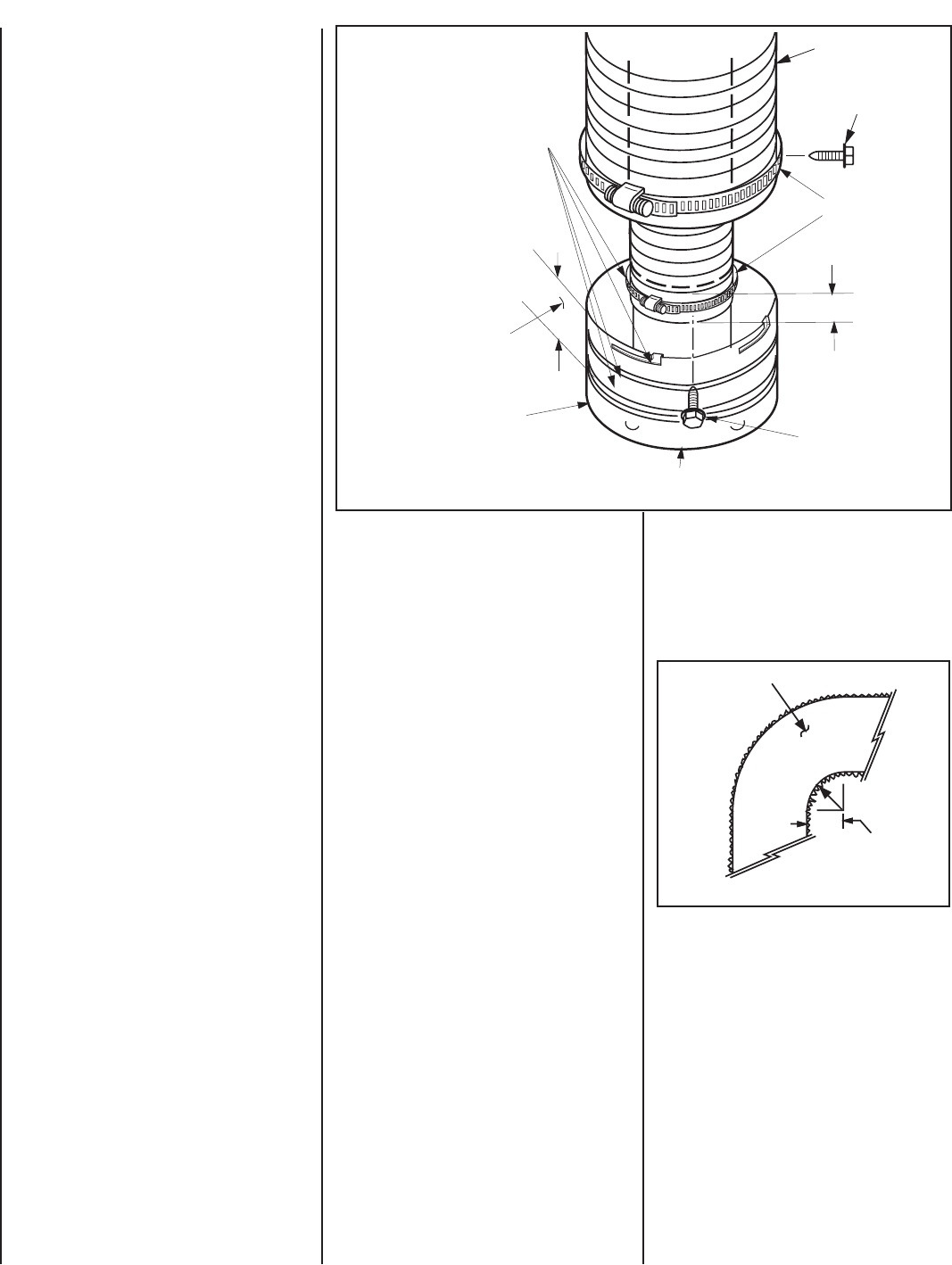
NOTE: DIAGRAMS & ILLUSTRATIONS ARE NOT TO SCALE.
24
D. Install Firestop / Spacers at ceilings and walls
- When Secure Flex penetrates a wall or ceiling,
a fi restop / spacer is required: use the SF4.5 VF
fi restop / spacer for ceilings and the SF4.5 HF
fi restop / spacer for walls. See the appropriate
sections and Figures shown throughout the vent-
ing section for their installation requirements.
Note: Outer Pipe Is Pulled Away To Show
The Detail of The Inner Pipe
APPLY ONLY MIL-PAC BLACK
HIGH TEMPERATURE SEALANT
(Cat. No. 10K81) to the outside
surface of both collars of the
adapter (be especially careful to
fi ll the grooves of the outer collar
to be covered by the fl exible pipe)
and slide fl exible pipe over inner
and outer adapter collars.
1-3/4 inch (44 mm) Flexible
Pipe and Adapter Outer Collar
Overlap
Adapter (SV4.5RF)
Attach Adapter to Appliance
Collar, or Secure Vent Sections
Flex Vent
Gear Clamps
Securing Screw
- 3 Places, 120° apart
(equally spaced) Just
Below Gear Clamp
1-3/4 in. (44 mm) Flexible
Pipe and Adapter Inner Collar
Overlap
Securing Screw - 3 Places
Equidistant (equally spaced)
Just Below Gear Clamp)
Figure 41
VERTICAL OR HORIZONTAL VENTING USING
SECURE FLEX KITS AND COMPONENTS
Secure Flex venting kits and components
may be used in any venting application in
place of rigid Secure Vent (SV4.5) direct vent
components. All restrictions, clearances and
allowances that pertain to the rigid piping apply
to the fl exible venting. Secure Flex kits may
not be modifi ed; also, under no circumstances
may separate sections of fl ex pipe be joined
together.
Using adapter (SV4.5RF), Secure Flex kits
may be added to the end of a vent run made
up of rigid Secure Vent (SV4.5) vent sections
provided that doing so does not violate any of
the venting length, height, routing, horizontal
to vertical ratio requirements or clearance
considerations detailed in this manual.
Secure Flex kits come with an adapter that
can be fi tted to the inclined channel end of the
last Secure Vent (SV4.5) vent section in a rigid
system in the exact same fashion as any other
Secure Vent section.
Align the dimpled end of the adapter over
the previously installed section or appliance
collar, adjusting the radial alignment until the
four locking dimples of the adapter are aligned
with the inlets of the four incline channels of
the last vent section or collar. Push on the
adapter until it fully engages, then twist the
adapter clockwise running the dimples down
and along the incline channels until they seat
at the end of the channels.
Attach the fl exible vent to the adapter as fol-
lows (see also Figure 41):
A. Install the Inner Flex Pipe -
1. Install the small gear clamp loosely around
the inner fl exible vent pipe, push it back out
of the way.
2. Apply a bead of Mill-Pac Black (700° F) high
temperature sealant - Catalog No. 10K81
to the inner adapter collar, approximately
1/2 inch from the end.
3. Pull and extend the inner fl exible vent pipe.
4. Slide the inner fl ex pipe over the adapter col-
lar. Ensure the fl exible vent pipe completely
engages the adapter collar to a distance of 1
3/4 inches from the end, and that it is free
from damage or tears.
5. Slide the gear clamp down and tighten it
fully to secure the fl exible vent to the adapter
inner collar approximately 3/4 inch from the
end of the fl ex.
6. Install three screws 120 degrees apart through
the fl exible vent pipe and into the adapter collar
just below the gear clamp to provide additional
security to the connection.
B. Install the Outer Flex Pipe -
1. Install the large gear clamp loosely around
the outer fl exible vent pipe, push it back out
of the way.
2. Apply a bead of Mill-Pac Black (700° F) high
temperature sealant - Catalog No. 10K81)
to the outer adapter collar; to the grooves
of the collar which extend approximately 1
inch from the end and to the fl at surface,
approximately 1-3/8 inches from the end.
3. Pull and extend outer fl exible vent pipe.
4. Slide the outer fl ex pipe over the adapter col-
lar. Ensure the fl exible vent pipe completely
engages the adapter collar to a distance of
1-3/4 inches from the end, and that it is free
from damage or tears.
5. Slide the gear clamp down and tighten it
fully to secure the fl exible vent to the adapter
outer collar approximately 3/4 inch from the
end of the fl ex.
6. Install three screws 120 degrees apart
through the fl exible vent pipe and into the
adapter collar just below the gear clamp to
provide additional security to the connec-
tion.
C. Route Flex Vent -
Ensure that the fl ex vent is properly routed to
provide the required clearance. Do not allow the
fl exible vent to bend in a radius tighter than 5"
(127 mm). Refer to Figure 42. Space out the
internal fl ex vent spacers evenly - approximately
every 6 inches - and avoid kinking of inner pipe.
Support horizontal sections of fl ex with metal
straps at 2 foot (0.61 m) intervals.
E. Attach Flex Vent to Termination -
Secure Flex components can be purchased
separately and attached to bulk lengths of Se-
cure Flex fl exible tubing cut to size at the job
site. Secure the fl exible vent to the Secure Flex
terminations in the same manner (see Figure
41) as it was attached to the adapter.
Note: Secure Flex vent must be attached to Secure
Flex terminations only. DO NOT substitute Secure
Vent terminations or the Secure Vent adapter for
Secure Flex components. The collars of Secure
Flex terminations and adapters have a different
diameter than that used with the Secure Vent
pipe. Additionally, Secure Flex components have
an extended length center tube for use in attaching
the fl exible vent.
Flexible Vent
Section
5” (127 mm)
Radius
Minimum
Figure 42
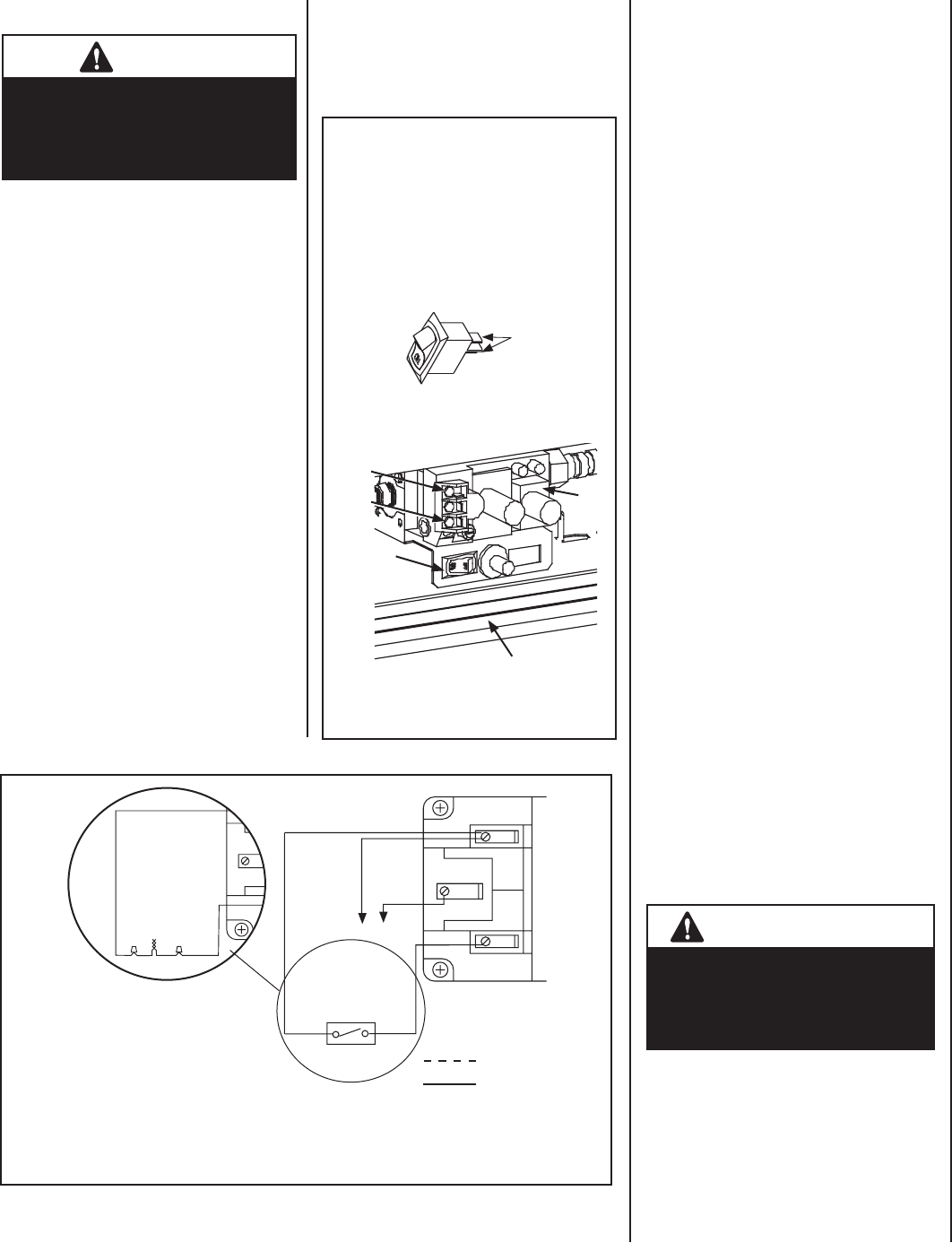
NOTE: DIAGRAMS & ILLUSTRATIONS ARE NOT TO SCALE. 25
Figure 43 - Millivolt Wiring Diagram
Field Wired
Factory
Wired
TH
TP TH
TP
* Optional
Control Switch
Thermopile
Schematic
Representation
Only
• If any of the original wire as supplied must
be replaced, it must be replaced with Type AWM
105 C - 18 gage wire.
* Optional Kits Installed - ON/OFF wall switch, unit mounted burner ON/OFF switch, wall thermostat or
remote control.receiver.
PT
*
* Twist wires together to operate unit
solely by manipulating the gas valve
control knob; or connect wires to
optional control switch (wall switch,
remote control or wall thermostat to
operate unit.
Step 4. FIELD WIRING
Refer to Section A for millivolt appliances and
Section B for electronic appliances.
A. Millivolt Wiring (See Figure 43):
1. Install and wire in the burner control switch.
Install either "a" or "b" below, NOT BOTH
(installing both may result in improper burner
operation).
a. Optional OFF/ON Switch - Install the
OFF/ON burner control switch (rocker
switch) as shown in Figures 43 &
44.
b. Optional Wall Switch, Wall Thermostat
Or Remote Control Receiver - Install
snap bushing (provided in Electrical
Outlet Kit) into control switch knock-
out in side panel (see Figures 13,14 &
45). Wire the optional control switch
within the millivolt control circuit (as
shown in Figure 43) using the 15 feet
of 2 conductor wire supplied (route
wires through the snap bushing to
the optional control switch). Mount
the optional control switch or wall
thermostat in a convenient location
on a wall near the fi replace.
CAUTION: DO NOT CONNECT OPTIONAL
CONTROL SWITCH TO 120VAC POWER
SUPPLY.
2. Install the junction box and receptacle outlet
to the left of the valve in the front (for optional
blower kit). See junction box and receptacle
outlet as explained in steps 1-11 for (B)
Electronic Wiring (on this page).
CAUTION
Label all wires prior to disconnec-
tion when servicing controls. Wiring
errors can cause improper and dan-
gerous appliance operation.
Gas
Valve
Control Compartment
Access panel
OFF/ON
Switch
TP TH
TH
Install OFF/ON Switch
(millivolt models)
1. Connect the 2 wires (provided in Electrical
Outlet Kit) to the TP/TH and TH terminals
on valve.
2. Pass the 2 wires through the opening where
OFF/ON switch will be installed (left of piezo,
below valve).
3. Connect the two wires to the OFF/ON
Switch.
OFF/ON
Switch
Connect
wires to
terminals
4. Press the OFF/ON switch into bracket as
shown below (it will snap into place).
Figure 44
B. Electronic Wiring (See Figures 45 & 46)
Notes:
• The electronic appliance must be connected
to the main 120 VAC power supply.
• The junction box can be installed in any of the
4 outside corners of the control compartment (it
can be found factory installed in the right front
corner viewed from the valve access side (where
it should be reinstalled if an optional blower kit
is installed).
1. Route a 3-wire, 120 VAC, 60 Hz, 1 ph power
supply to the location on appliance where
junction box is to be installed.
2. Open the control compartment access panel
(see Control Compartment Access Instruc-
tions on Page 27).
3. Remove the junction box/outlet receptacle
assembly by removing the securing screw at
the front right corner of the unit. See Figure
45.
4. Remove the outlet receptacle from the
junction box by removing the two securing
screws.
5. Install a fi eld-provided strain relief in the
cabinet knockout opening for the protection
of the power supply wires.
6. Connect the power supply wires to the
receptacle as shown in Figure 46 on Page
26.
7. Connect the ground supply wire to the green
wire attached to the outlet receptacle’s
green ground screw.
8. Wire and install the outlet receptacle to
junction box. Next, install into the chosen
corner of the control compartment as shown
in Figure 45.
9. After the receptacle/junction box wiring is
complete, install the fi eld-provided metal
junction box cover plate (see Figure 45).
Note: The supplied 15 feet of 2 conductor
wire has one end of each conductor con-
nected to the gas valve circuit and the other
end of each conductor placed loose on top
of the appliance.
IMPORTANT NOTE
The gas valve OFF/ON switch is
shown in Figure 46 on Page 26. It
is integral with the gas valve and
should be set to the ON position.

26 NOTE: DIAGRAMS & ILLUSTRATIONS ARE NOT TO SCALE.
CAUTION
Ensure that wires are positioned
away from hot surfaces and sharp
edges.
CAUTION
Do not connect the optional wall
switch to a 120 Volt AC power
supply.
CAUTION
Ground supply lead must be con-
nected to the wire attached to the
green ground screw located on the
outlet box. See Figure 46. Failure to
do so will result in a potential safety
hazard. The appliance must be
electrically grounded in accordance
with local codes or, in the absence of
local codes, the National Electrical
Code, ANSI/NFPA 70-latest edition.
(In Canada, the current CSA C22-1
Canadian Electrical Code).
Step 5. WIRING - OPTIONAL FORCED AIR
BLOWER KIT
FBK-100, FBK-200 and FBK-250 Kits
(See Figure 46 for wiring) -
An electrical receptacle is provided for the
installation of the FBK-100, FBK-200 and FBK-
250 forced air blower kits. Electrical power
must be connected to this receptacle in order
to operate these blowers. Install the blower
kits according to the installation instructions
provided with the kits.
Figure 45
Outlet Receptacle
Junction Box
Field-provided Metal Junction Box
Cover Plate With Screw
View Of Right
Bottom Corner Of Unit
Receptacle, Junction Box
and Cover Plate Installation
Fireplace
Side
Junction Box
knock-out (2
places each side)
Valve Access Side
Press snap
bushing into the
knock-out for
control switch
wires.
CAUTION
Remove the carton support from
the control compartment before
operating the appliance.
Electronic Wiring Diagram (Honeywell) Showing Blower Wiring for Optional FBK-100, FBK-200 & FBK-250 Kits
Schematic Representation Only
Relay Module C/W FBK-250 only. Plug blower
into J-Box receptacle for FBK-100 or FBK-200
application. See View A for J-Box wiring.
Optional Blower
*OFF/ON Switch
(Integral with
Gas Valve)
Honeywell
Electronic
Gas
Valve
120 VAC
Primary
Secondary
Optional Control Switch
Junction Box
Pilot Burner
Assembly
BL
BL
Field Wired
Factory
Wired
BK = BLACK BL = BLUE
R = RED W = WHITE
G = GREEN
BK
W
BK
BK BL
R
GROUND
24 V
Transformer
View A
J-Box Wiring when
using unit mounted
relay module.
BK
W
G
CAV 021
Igniter
Connector
* Leave the OFF/ON switch, which is
integral with the gas valve, in the ON
position.
** Optional Control Switches: Wall
Switch, Wall Thermostat or Remote
Control Receiver.
Notes:
1. If any of the original wire as supplied
must be replaced, use Type AWM 105°C
- 18 gage wire ONLY.
2. 120 VAC, 60 Hz - Less than 3 Amps.
Caution: label all wires prior to
disconnection when servicing controls.
Wiring errors can cause improper and
dangerous operation.
Junction Box
Tab Intact
Tab
Broken
Plug blower
into this
receptacle n
e
e
r
G
-
dn
u
o
r
G
* Wall-mounted
ON/ OFF Blower
Switch or Variable
Speed Control Switch.
Blower
Ground
e
ti
h
W
-
lar
t
u
e
N
120 VAC - Black
Green
Ground
Screw
White
Green
Neutral
Side of
Receptacle
Hot
Side of
Receptacle
Red
Black
J-BOX WIRING FOR
WALL SWITCH
BLOWER CONTROL
Figure 46
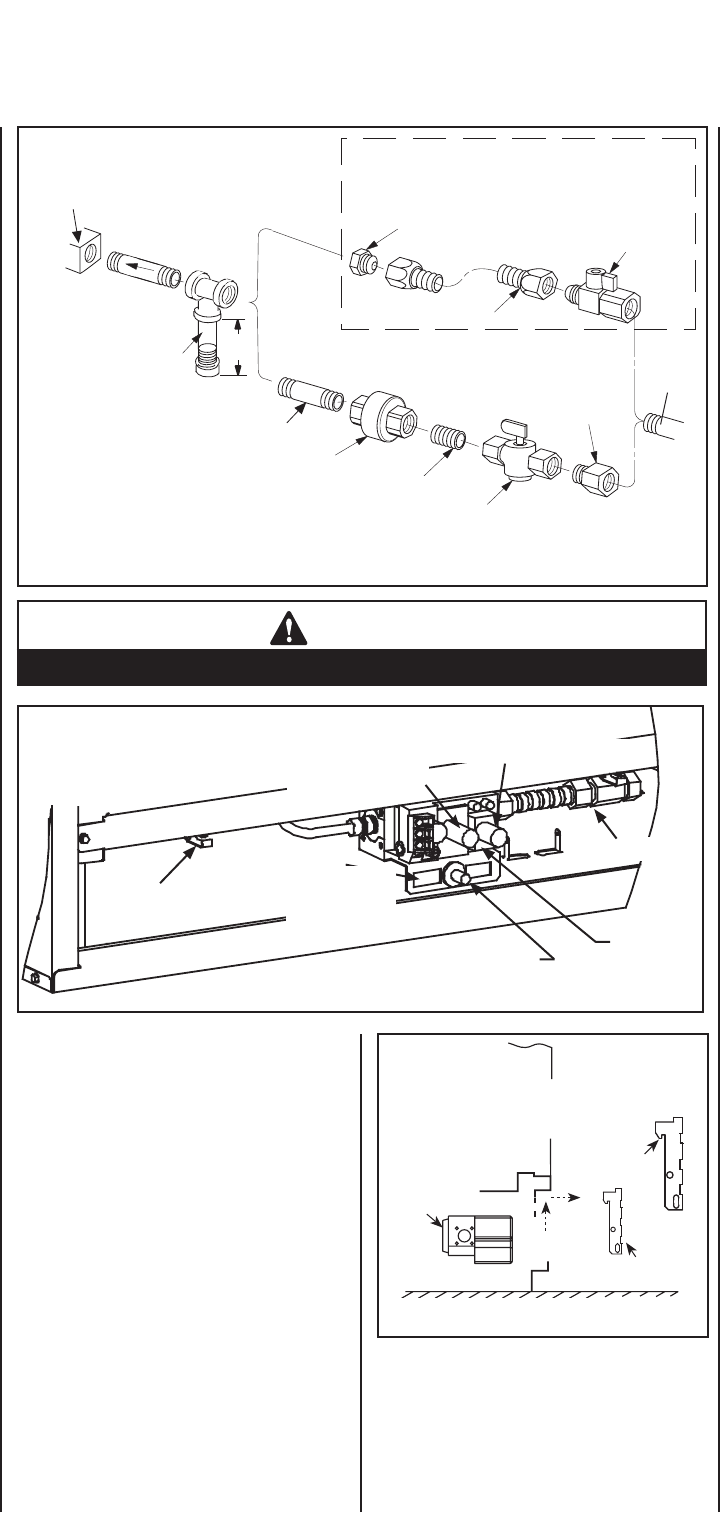
NOTE: DIAGRAMS & ILLUSTRATIONS ARE NOT TO SCALE. 27
Figure 48
TEST ALL CONNECTIONS FOR GAS LEAKS
(FACTORY AND FIELD):
Turn on gas supply and test for gas leaks using a
gas leak test solution (also referred to as bubble
leak solution). Note: Using a soapy water solution
(50% dish soap, 50% water) is an effective leak
test solution but it is not recommended, because
the soap residue that is left on the pipes/fi ttings
can result in corrosion over time.
WARNING
Never use an open fl ame to check for leaks.
Turn on gas supply and test for gas leaks using
a gas leak test solution.
A. Light the appliance (refer to the lighting
instructions label in control compartment
or homeowner's manual).
B. Brush all joints and connections with the gas
leak test solution to check for leaks. If bubbles
are formed, or gas odor is detected, turn the
gas control knob (off/pilot/on) to the “OFF”
position. Either tighten or refasten the leaking
connection, then retest as described above.
C. When the gas lines are tested and leak free be
sure to rinse off the leak testing solution,
D. Turn on burner then observe the individual
tongues of fl ame on the burner. Make sure
all ports are open and producing fl ame evenly
across the burner. If any ports are blocked, or
partially blocked, clean out the ports.
Note:The gas supply line must be installed in
accordance with building codes by a qualifi ed
installer approved and/or licensed as requed by
the locality. In the Commonwealth of Massachu-
setts, installation must be performed by a licensed
plumber or gas fi tter.
Step 6. CONNECTING GAS LINE
Make gas line connections. All codes require a
shut-off valve mounted in the supply line. Figure
47 illustrates two methods for connecting the
as supply. The fl ex-line method is acceptable
in the U.S., however, Canadian requirements
vary depending on locality. Installation must
be in compliance with local codes.
These appliances are equipped with a gas fl ex
line for use (where permitted) in connecting
the appliance to the gas line. A gas fl ex line
is provided to aid in attaching the direct vent
appliance to the gas supply. The gas fl ex line
can only be used where local codes permit.
See Figure 47 for fl ex line description. The fl ex
line is rated for both natural gas and propane
gas. A manual shut off valve is also provided
with the fl ex line.
The incoming gas line should be piped into
the valve compartment and connected (see
Figures 47 & 48). The millivolt control
valve has a 3/8" (10 mm) NPT thread
inlet port. The electronic control valve
has a 1/2" (13 mm) NPT thread inlet port
and is fi tted with a 1/2" x 3/8" (13 mm x
10 mm) NPT fi tting.
Secure all joints tightly using appropriate
tools and sealing compounds (ensure propane
resistant compounds are used in propane
applications).
Optional: Seal around the gas line to prevent
cold air leakage.
Figure 47
Gas
Valve 3/8" NPT x
Flare Fitting
3/8" Flex Tubing
3/8" Nipple
3/8" Union
3/8" Close Nipple
3/8" Shut-off Valve
1/2" x 3/8"
Reducer
Gas
Stub
1/2" x 3/8" Flare
Shut-off Valve
Gas Flex Line Connector
*Sediment Trap
*A Sediment Trap is recom-
mended to prevent moisture
and debris in gas line from
damaging the valve.
3"
Min
.
Gas Valve
Piezo Igniter
Latch for
Glass Door
HI/LO (fl ame height
control knob)
OFF/PILOT/ON (gas control knob)
Gas Flex Line
Optional OFF/ON
Switch Can be
Installed Here
Glass Door is Above
Control Compartment
CONTROL COMPARTMENT ACCESS/LOUVER
PANEL INSTRUCTIONS (Ref. Figure 49)
NOTE: The top louvered panel and the bottom
louvered control panel door remove and install
the same way as follows:
The gas controls can be found behind the control
compartment access door.
Removing Control Compartment Door:
Open the door by gently lifting it upward until the
hook catches on boths sides clear the locating
slots. Then pull door out to remove.
On millivolt systems, the piezo igniter, HI/LO
fl ame adjustment knob, and pilot and main
gas OFF/ON control knob are located below
the glass panel enclosure. The gas valve for
electronic systems is also located below the
glass enclosure panel. See Figure 48.
Figure 49
OPENING CONTROL
COMPARTMENT DOOR
Control Valve
Lower Control
Compartment Door
Lift the Lower Control
Compartment Door
up and pull out to
remove.
Up
Out
Hook Catch
Reinstalling Control Compartment Door:
To reinstall, insert the hook catches on each
side of the door into the corresponding slots
in the control compartment opening, then
gently push forward and slide down until it
locks in place.
GAS CONNECTION
Control Compartment Access
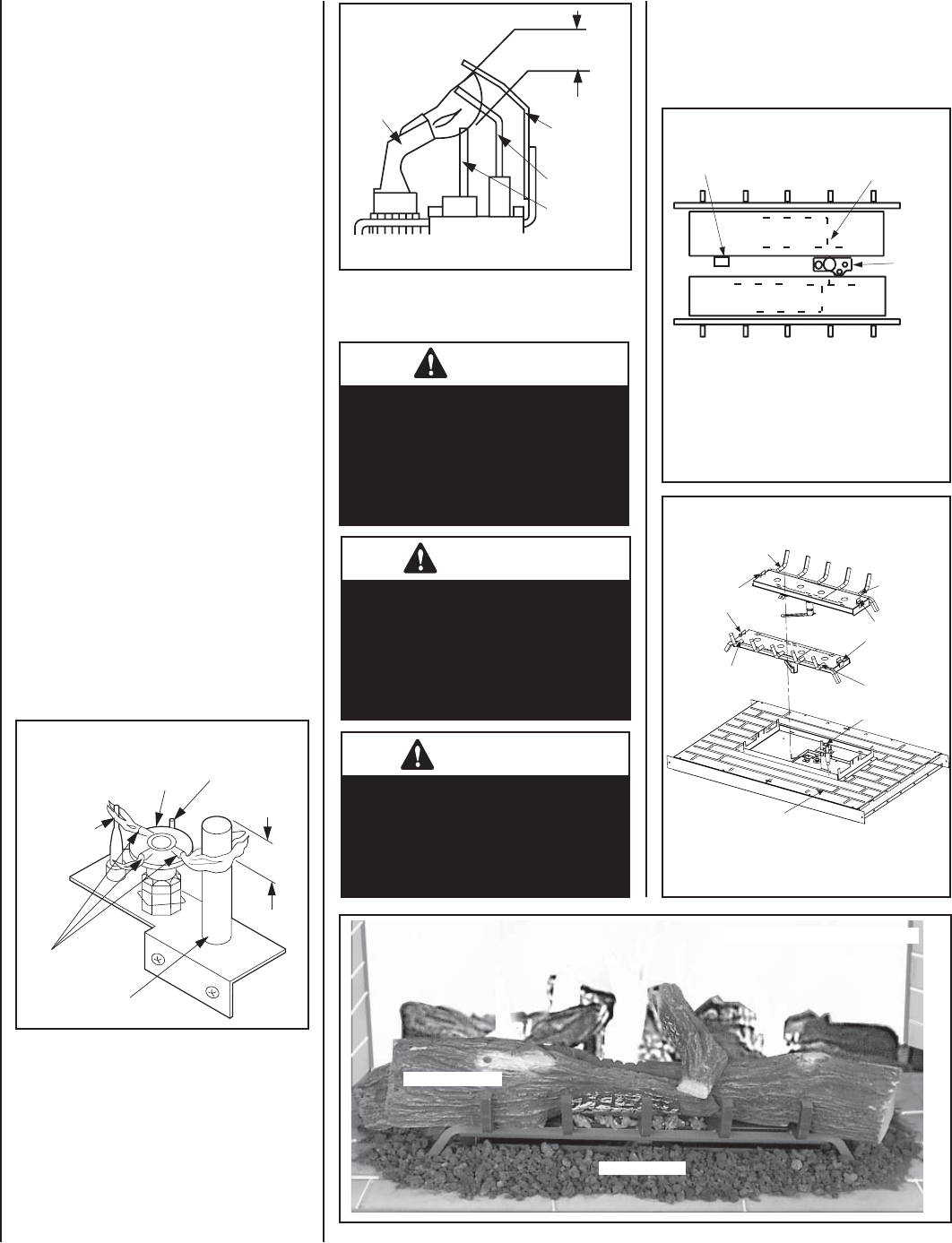
NOTE: DIAGRAMS & ILLUSTRATIONS ARE NOT TO SCALE.
28
Step 8. INSTALLING LOG SET, VOLCANIC
STONE AND GLOWING EMBERS
WARNING
Logs get very hot and will remain
hot up to one hour after gas supply
is turned off. Handle only when
logs are cool. Turn off all elec-
tricity to the appliance before you
install grate and logs.
WARNING
This appliance is not designed to
burn wood. Any attempt to do so
could cause irreparable damage
to the appliance and prove haz-
ardous to your safety.
WARNING
DO NOT attempt to install logs
until the appliance installation
has been completed, the gas line
connected and tested for leaks
and the initial burner operation
has been checked out.
Figure 50
Electronic Appliance Checkout
To light the burner, turn ‘ON’ the OFF/ON switch
(located in the control compartment). Ensure the
igniter lights the pilot. The pilot fl ame should
engulf the fl ame rod as shown in Figure 51.
Observe the individual tongues of fl ame on
the burner. Make sure all ports are open and
producing fl ame evenly across the burner. If
any ports are blocked, or partially blocked,
clean out the ports.
Step 7. CHECK APPLIANCE OPERATION
With the gas line installed, run initial system
checkout before closing up the front of the
appliance. Follow the pilot lighting instructions
provided in the Homeowner's Care and Opera-
tion Instructions. For piezo igniter location see
Figure 48 (millivolt appliances only).
Note: The (pull-out) Lighting instructions label
can be found in the control compartment
(see Figure 48).
When fi rst lighting the appliance, it will take
a few minutes for the line to purge itself of
air. Once purging is complete, the pilot and
burner will light and operate as indicated in
the instruction manual. Subsequent lightings
of the appliance will not require such purging.
Inspect the pilot fl ame.
Millivolt Appliance Checkout
The pilot fl ame should be steady, not lifting
or fl oating. Flame should be blue in color with
traces of orange at the outer edge.
The top 3/8" (10 mm) at the pilot generator
(thermopile) and the top 1/8" min (tip) of the
quick drop out thermocouple should be engulfed
in the pilot fl ame. The fl ame should project 1"
(25 mm) beyond the hood at all three ports
(Figure 50).
To light the burner; rotate the gas valve control knob
counterclockwise to the “ON” position then turn
“ON” the OFF/ON switch (installed at Step 4).
Observe the individual tongues of fl ame on
the burner. Make sure all ports are open and
producing fl ame evenly across the burner. If
any ports are blocked, or partially blocked,
clean out the ports.
Figure 51
3/8" to 1/2"
(9 -13 mm)
Ground
Electrode
Flame Rod
Hot Surface
Igniter
Proper Flame
Adjustment
Pilot
Nozzels
ELECTRONIC
Figure 52
FRONT OF FIREPLACE
REAR BURNER
FRONT BURNER
Outer Log
Notch Location
FIREBOX SUBFLOOR
Outer Log
Notch Location
Outer Log
Notch Location Outer Log
Notch Location
Riser - Inner Log
Notch Location
LOG NOTCH LOCATION RELATIVE TO BURNER
Pilot Assembly
Riser - Inner Log
Notch Location
NOTE: INSTALL REAR BURNER FIRST,
THEN FRONT BURNER.
Figure 54
REAR BURNER
FRONT BURNER
PILOT
BURNER
Note: The burners are not identical. Position them so
that the circular burner ports run as shown. Note
especially the vertical run of ports relative to the pilot
burner. Bracket A on the rear burner will interfere
with the pilot burner if an attempt is made to install
the rear burner in the front burner’s position.
BRACKET A BURNER
PORTS
NOTE: INSTALL REAR BURNER FIRST,
THEN FRONT BURNER.
Burner / Grate Location Reference
(see Figures 53 & 54)
Figure 53
Volcanic Stone
Unitized Log Set
Note: If the burners have been removed for
any reason, rear burner must be installed
before front burner. See Figures 53 and 54.
Proper Burner Flame Appearance
Thermocouple
Thermopile
Pilot
Nozzels
SIT MILLIVOLT PILOT ASSEMBLY
Igniter Rod
Hood
Proper Pilot Flame Appearance
3/8" Min.
(9 mm)
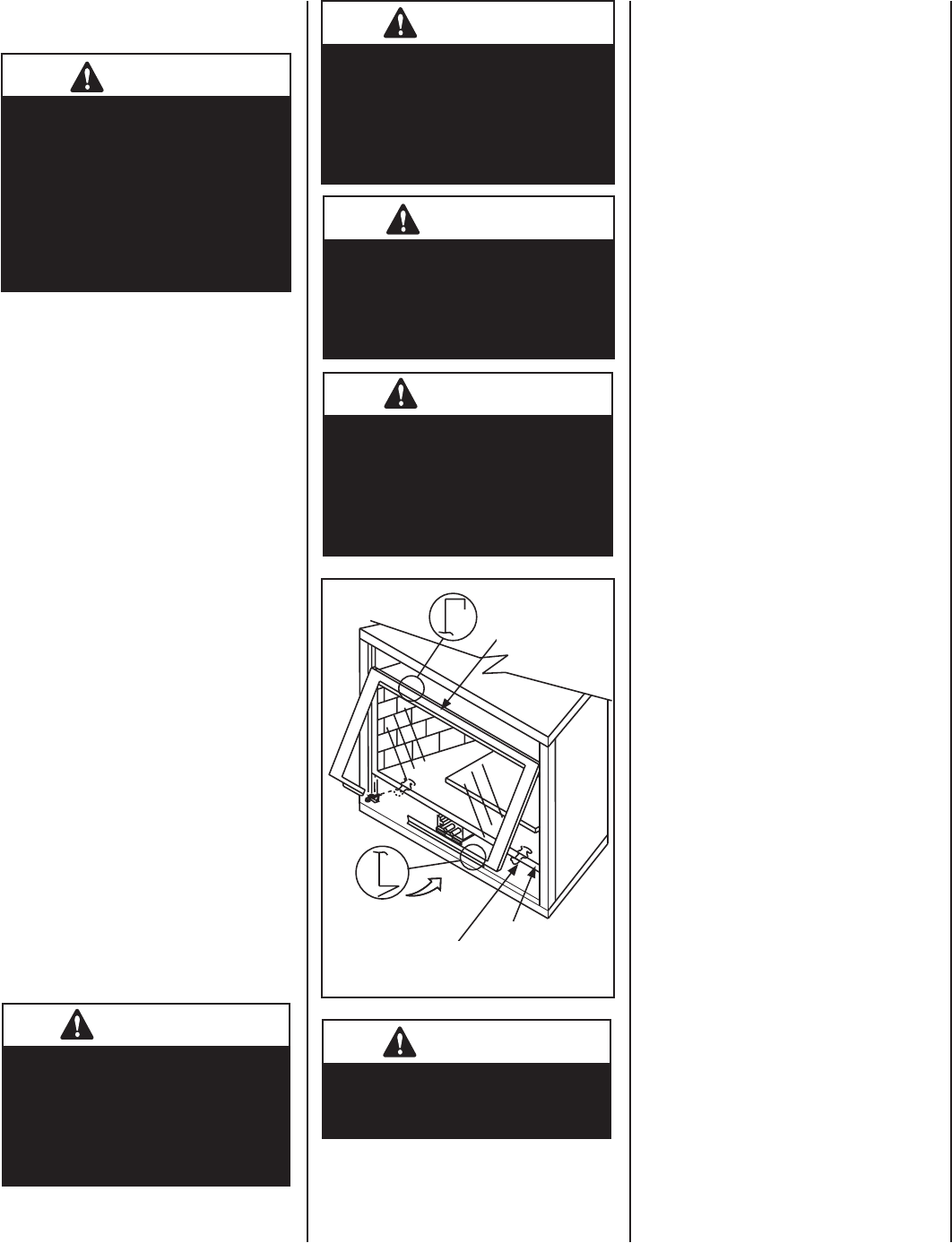
NOTE: DIAGRAMS & ILLUSTRATIONS ARE NOT TO SCALE. 29
The log set foam package is located in the fi rebox
and the bags of decorative volcanic stone and
the glowing embers (rockwool) are located in
the control compartment. Refer to the following
information and Figures 52 and 54 for detailed
placement instructions.
Install the decorative volcanic stone and
glowing embers (rockwool):
Spread the decorative volcanic stone on the
simulated brick fl oor of the fi rebox around
the burners to simulate ashes. Maintain a 1/2
inch (13 mm) gap between the bottom of the
horizontal grate section and the top of the pile
of decorative volcanic stone. Place a few dime-
sized pieces of the glowing ember material
on the pan burner in front of the burned out
area on both sides of the log set. The glowing
embers may touch one another, but should not
overlap each other.
Install the unitized log set:
a. The bottom of the log set is notched to ac-
commodate the pilot.
b. Place the log set so that the four inner notches
on the underside of the log set fi t over the
four risers located on the burner ends. See
Figure 52. This procedure is accomplished
primarily by feel, as the log set masks the
burner risers as it is being installed.
c. As a fi nal check for correct log set placement,
check that the four outer notches on the
underside of the log set fi t over the burner
tines as indicated in Figure 52.
WARNING
If logs are not installed according
to the log installation instruc-
tions, fl ame impingement and
improper combustion could
occur and result in soot and/or
excessive production of carbon
monoxide (CO), a colorless,
odorless, toxic gas.
LOG & VOLCANIC STONE INSTALLATION
PROCEDURE:
Step 9. INSTALLING THE GLASS DOOR
WARNING
Handle this glass with extreme
care! Tempered glass is suscep-
tible to damage – do not scratch
or handle roughly while reinstall-
ing the glass door frame.
WARNING
Do not operate appliance with
the glass front removed, cracked
or broken. Replacement of
the glass should be done by a
licensed or qualifi ed service
technician.
WARNING
Do not attempt to substitute the
materials used on this door, or
replace cracked or broken glass
with any materials other than
those provided by the appliance
manufacturer.
WARNING
The glass door of this appli-
ance must only be replaced as a
complete unit as provided by the
manufacturer. Do not attempt to
replace broken, cracked or chipped
glass separately.
WARNING
Do not attempt to touch the front
enclosure glass with your hands
while the fi replace is in use.
Removing Glass Enclosure Panels
(see Figure 55)
1. Remove the top louver assembly by lifting it
up and pulling it out.
2. Remove the control compartment access
door (see removal instructions on Page 27
- Removing Control Compartment Door).
3. Locate the two (2) latches at the top of the
control compartment. To disengage the two
latches from the bottom vee-fl ange of the
glass enclosure panel, reach for the handles
located towards the back of the latches and
pull the handles down toward the front of
the appliance.
4. Swing the bottom of the door out and raise
it slightly to lift the top fl ange of the door
frame away from the appliance.
Installing Glass Enclosure Panels
(see Figure 55)
1. Visually inspect the gasket on the backside of the
glass panel. The gasket surface must be clean,
free of irregularities and seated fi rmly.
2. Position the glass enclosure panel in front of
the fi rebox opening at a 45 degree angle and
engage the top fl ange over the lip at the top
of the fi rebox opening. See Figure 55.
3. Swing the glass enclosure panel down and
back. Ensure the gasket seats evenly as the
panel draws shut. Engage the Vee-fl ange at
the bottom of the panel with the latches and
close the latches to secure the panel.
4. Reinstall top louver assembly and control
compartment door see installation instructions
on Page 27, Reinstalling Control Compart-
ment Door).
Step 10. BURNER ADJUSTMENTS
Flame Appearance and sooting
Proper fl ame appearance is a fl ame which is
blue at the base and becomes yellowish-orange
in the body of the fl ame. When the appliance
is fi rst lit, the entire fl ame may be blue and will
gradually turn yellowish-orange during the fi rst
15 minutes of operation. If after a short period
the fl ame stays lowered blue, or if the fl ame is
orange with evidence of sooting (black tip), the
air shutter opening may need to be adjusted.
If the air shutter openings closed too far, sooting
may develop. Sooting is indicated by black puffs
developing at the tips of very long orange fl ames.
Sooting results in black deposits forming on the
logs, appliance inside surfaces and on exterior
surfaces adjacent to the vent termination. Soot-
ing is caused by incomplete combustion in the
fl ames and lack of combustion air entering the
air shutter opening. To achieve a warm yellow-
ish-orange fl ame with an orange body that does
not soot, the shutter opening must be adjusted
between these two extremes.
Air Shutter Adjustment Guidelines
• If there is smoke or soot present, fi rst check
the log set positioning to ensure that the
fl ames are not impinging on any of the logs.
If the log set is properly positioned and a
sooting condition still exists, then the air
shutter opening should be increased.
Figure 55 - INSTALLING GLASS DOOR
Top Flange on
Glass Door
Bottom Vee-fl ange
Glass Door
Glass Door Latch
Glass Door
Firebox Floor
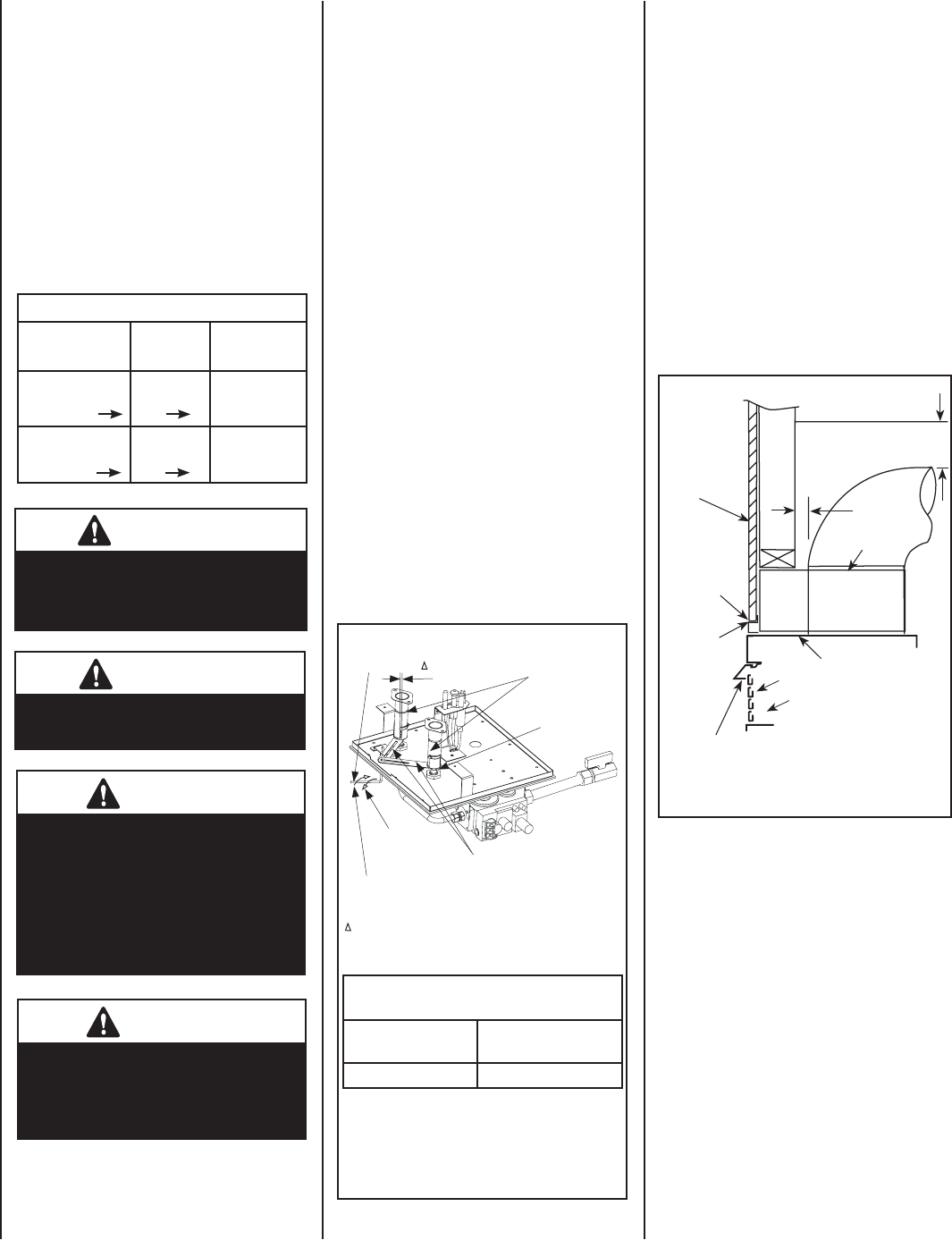
NOTE: DIAGRAMS & ILLUSTRATIONS ARE NOT TO SCALE.
30
Ref. Air shutter Patent:
U.S. Pat. 5,553,603
WARNING
Air shutter adjustment should only
be performed by a qualifi ed profes-
sional service technician.
WARNING
Ensure glass panels are in place
and sealed during adjustment.
CAUTION
Carbon/soot will be produced
if the air shutter is closed too
much. Any damage due to
carbon/sooting resulting from
improperly setting the air shut-
ter is not covered under the
warranty.
CAUTION
The air shutter door and nearby
appliance surfaces are hot. Exer-
cise caution to avoid injury while
adjusting fl ame appearance.
Air Shutter Adjustment Guidelines:
Amount of
Primary Air
Flame
Color
Air Shutter
Adjustment
If air shutter is
closed too far Flame will
be orange Air shutter
gap should be
increased
If air shutter is
open too far Flame will
be blue Air shutter
gap should be
decreased
• The more offsets in the vent system, the larger
the air shutter opening will need to be.
• An appliance operated with the air shutter
opened too far, may have fl ames that appear
blue and transparent. These weak, blue and
transparent fl ames are termed anemic.
• Propane models may exhibit fl ames which
candle or appear stringy. If this is present and
persists, adjust the air shutter to a more closed
position, then operate the appliance for a few
more minutes to ensure that the fl ame normal-
izes and the fl ames do not appear sooty.
The following chart is provided to aid you in
achieving the correct air shutter adjustment
for your installation.
Burner Air Shutter Adjustment Procedure
1. Locate adjustment rod and adjust air shutter
to the standard setting as shown in Figure
56 (adjustment rod is located in the lower
control area).
Note: Rotating the adjustment rod coun-
terclockwise decreases air and clockwise
increases air.
2. Light appliance (follow lighting procedure
on lighting label in control compartment or
see homeowners manual).
3. Allow the burner to operate for at least 15
minutes while observing the fl ame continu-
ously to ensure that the proper fl ame appear-
ance has been achieved (see Figure 52). If
the following conditions are present, adjust
accordingly.
• If flame appears weak or sooty, adjust
the air shutter, incrementally, to a more
open position until the proper fl ame
appearance is achieved.
• If fl ame stays lowered blue, adjust the
air shutter, incrementally, to a more
closed position until the proper fl ame
appearance is achieved.
4. Leave the control knob (off/pilot/on) in the
ON position and the burner OFF/ON switch
OFF (& remote switches, if applicable).
5. When satisfi ed that the burner fl ame ap-
pearance is normal, close the lower control
compartment door then proceed to fi nish
the installation.
Combustible
Finished
Wall Materials
Top of Appliance
Combustible
material may
touch
appliance
top
Louvers
Top of Door Frame
Hood must be installed as shown.
3"
(76 mm)
This Area Must
Remain Clear of
Combustible
Materials
1 in. Min.
(25 mm)
Drywall
Bracket/Spacer
Top Spacers
Figure 57 - Combustible Wall Framing
Figure 56
***Main Burner Factory Air Shutter
Opening Setting - All Models
Natural Gas
inches (millimeters)
Propane Gas
inches (millimeters)
* TWO 1/8 (3) Slots ** TWO 11/16 (17) Slots
Adjustment Rod Positions, viewed from above:
* Natural Gas - fully clockwise
** Propane- fully counter clockwise
***Settings are shown for each burner.
Air Shutter
Adjusting
Rod
Air Shutter
Adjusting
Arms
Orifice
Increase Shutter
Opening In This
Direction
Decrease Shutter
Opening In This
Direction
Air Shutter
Opening
Burner
Venturi
Tube
Note - Both air shutters open and close simultaneously
when the air shutter adjusting rod is moved.
Note - Burners are omitted in this view for clarity.
Step 11. HOOD INSTALLATION
All of these appliances must have hoods
installed prior to operating (see Figure 57).
Slide the hood into the slots on the lower edge
of the cabinet top (see Figure 57).
FINISHING REQUIREMENTS
Wall Details
Complete fi nished interior wall. To install the
appliance facing fl ush with the fi nished wall,
position framework to accommodate the thick-
ness of the fi nished wall (Figure 57).
See Page 5 for Cold Climate Insula-
tion and Page 9 for Clearances.
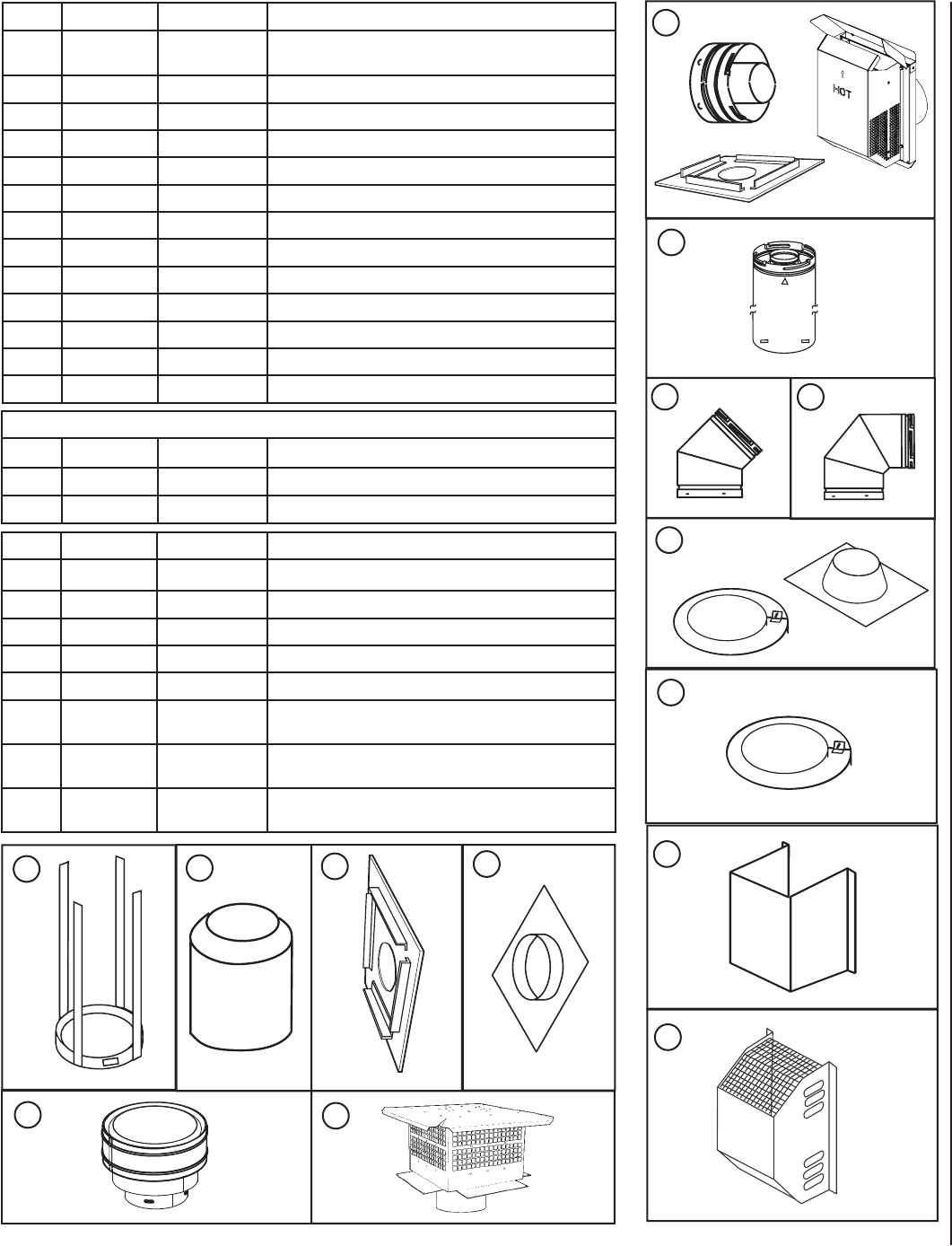
NOTE: DIAGRAMS & ILLUSTRATIONS ARE NOT TO SCALE. 31
Item Cat. No. Model Description
1 H1968 SV4.5HT-2 Horizontal Square Termination With Firestop / spacer
(H2246) & Adapter (74L61)
2a H2152 SV4.5CGV-1 Vertical Termination Cap
2b H4687 SV4.5CTS Chase Top Termination Square
2b H4716 SV4.5CTS-B Chase Top Termination Square, Black
2b H4717 SV4.5CTS-TC Chase Top Termination Square, Terra Cotta
3 77L70 SV4.5L6 6 Inch (152 mm) Vent Section
3 77L71 SV4.5L12 12 Inch (305 mm) Vent Section
3 77L72 SV4.5L24 24 Inch (610 mm) Vent Section
3 77L73 SV4.5L36 36 Inch (914 mm) Vent Section
3 77L74 SV4.5L48 48 Inch (1219 mm) Vent Section
3 77L75 SV4.5LA Telescopic Section (1-1/2" to 7-1/2" effective length)
4 77L76 SV4.5E45 45 Degree Elbow
5 77L77 SV4.5E90 90 Degree Elbow
3
45
6
7
10
1
8
911
INSTALLATION ACCESSORIES
The following fl ashings come packaged with a storm collar:
6 77L78 SV4.5F Flat Roof Flashing
6 77L79 SV4.5FA 1/2 to 7/12 Adjustable Flashing
6 77L80 SV4.5FB 7/2 to 12/12 Adjustable Flashing
7 77L81 SV4.5SC6 Storm Collar (6 per box)
8 H2246 SV4.5HF Firestop / Spacer-Horizontal (3-1-1 spacing), 10 Pack
8 H2247 SV4.5VF Firestop / Spacer-Vertical (1-1-1 spacing), 10 Pack
9 96K93 SV4.5SU Support Strap
10 96K94 SV4.5RSA Attic Insulation Shield
11 96K92 SV4.5SP Support Plate
12 17M52 SV4.5HGS-1 Termination Guard, Square (1 pack)
(for square termination)
12 17M53 SV4.5HGS-12 Termination Guard, Square (12 pack)
(for square termination)
13 87L02 SV4.5HGS Termination Guard for Square Termination (Deluxe)
(1 pack) (for square termination)
12
13
2a 2b
Ref. 750,109M
Ref. 750,055M
Ref. 750,207M
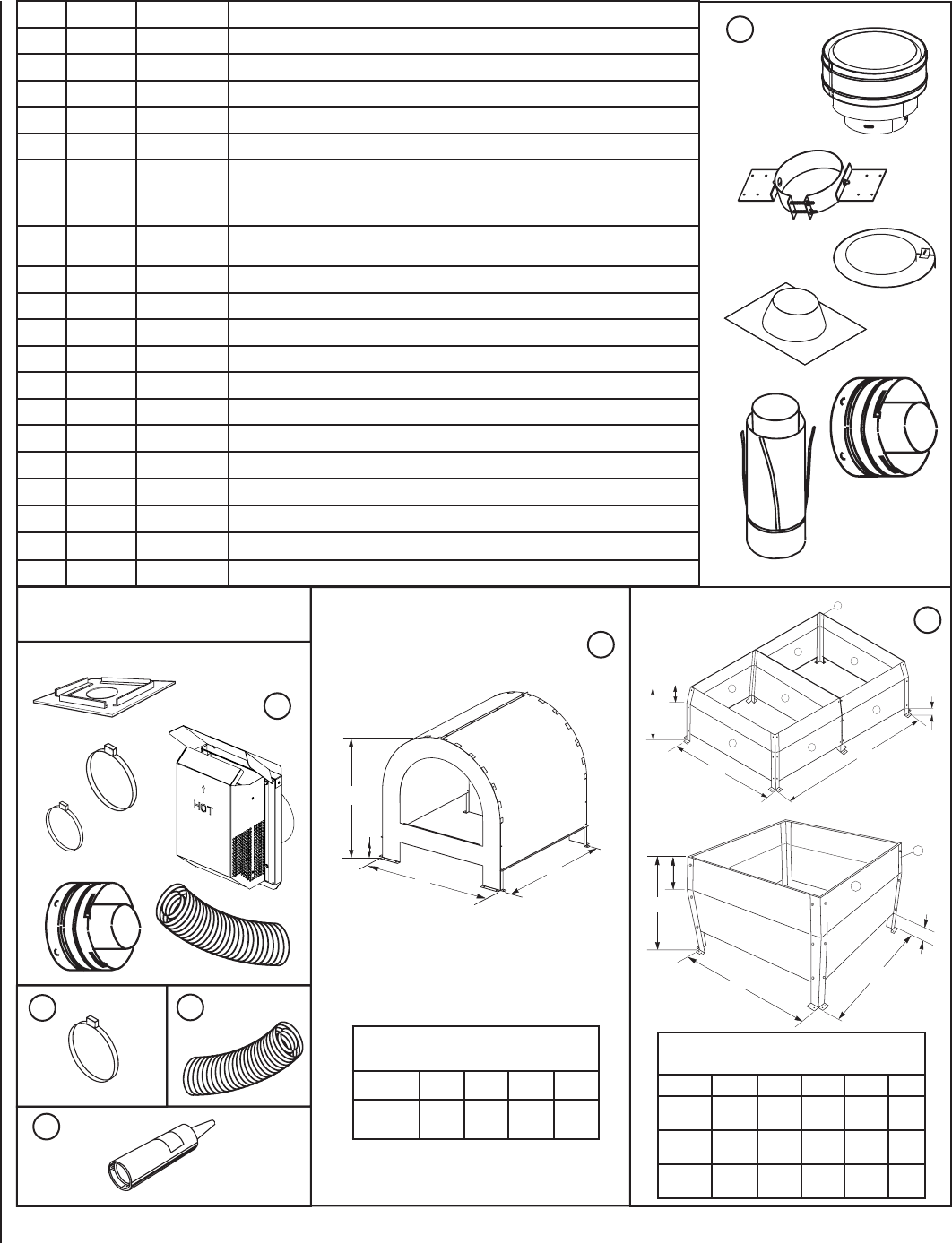
32 NOTE: DIAGRAMS & ILLUSTRATIONS ARE NOT TO SCALE.
Item Cat. No. Model Description
18 H1969 SF4.5HT-2 Horizontal Square Termination (without fl ex)
18 77L87 SFKIT12S Flex Square Term. (with 12 inch [305 mm] * compressed flex)
18 77L88 SFKIT18S Flex Square Term. (with 18 inch [457 mm] * compressed flex)
18 77L89 SFKIT24S Flex Square Term. (with 24 inch [610 mm] * compressed flex)
18 77L90 SFKIT36S Flex Square Term. (with 36 inch [914 mm] * compressed flex)
18 77L91 SFKIT48S Flex Square Term. (with 48 inch [1219 mm] * compressed flex)
19 56L74 SFVT30 Vertical Termination for fl ex (fl at to 6/12) with fl ex adapter, section of rigid vent,
roof support collar assembly, roof fl ashing and storm collar.
19 56L75 SFVT45 Vertical Termination for fl ex (6/12 to 12/12) with fl ex adapter, section of rigid
vent, roof support collar assembly, roof fl ashing and storm collar.
*20 60L10 SF-18 18 ft. (5.49 m) * compressed fl ex
*20 98K03 SF-12 12 ft. (3.66 m) * compressed fl ex
22 10K81 SFMP Mill-Pac, Black, High Temperature Sealant
22 89L40 SFMP-12 Mill-Pac, Black, High Temperature Sealant - Bulk 12 pack
23 91L66 SF-GC4-6 Gear Clamp 4.5 in. (114 mm) for fl ex (6 pieces)
23 91L67 SF-GC7-6 Gear Clamp 7.5 in. (190.5 mm) for fl ex (6 pieces)
25
H1988 CTSA-33
Chase Top Shroud Kit, Arch Top 3 X 3
26
H1985 CTSO-33
Chase Top Shroud Kit, Open Top 3 X 3
26
H1987 CTSO-44
Chase Top Shroud Kit, Open Top 4 X 4
26
H1986 CTSO-46
Chase Top Shroud Kit, Open Top 4 X 6
8 H2248 SF4.5HF Firestop / Spacer - Horizontal (fl ex) (3-1-1 spacing)
, 10 Pack
8 H2249 SF4.5VF Firestop / Spacer - Vertical (1-1-1 spacing)
, 10 Pack
22
23
19
Se
a
l
a
nt
20
18
Open Top Shroud Kits
Inches (millimeters)
Model A B C D *E
CTSO-33 37-5/8
(955) 37-5/8
(955) 7-1/2
(191) 24-1/2
(622) 3
(76)
CTSO-44 48-5/8
(1235) 48-5/8
(1235) 7-1/2
(191) 24-1/2
(622) 3
(76)
CTSO-46 48-5/8
(1235) 73 1/4
(1860) 7-1/2
(191) 24-1/2
(622) 3
(76)
E
C
E
CTSO-33/44 Shrouds
for Single terminations
CTSO-46 Shroud
for double
terminations
1
2
typ.
typ.
1 typ.
2a
2a
2a
2a
2b
2b
2b
C
D
A
B
Closed Top Shroud Termination Kits
Inches (millimeters)
Model A B C D
CTSA-33 34"
(864) 5"
(127) 34"
(864) 34"
(864)
B
A
D
C
B
A
D
Ref. Form #750,193M
Ref. Form #750,194M
*
All compressed fl ex vents can be
expanded up to two times.
26
25
33
NOTE: DIAGRAMS & ILLUSTRATIONS ARE NOT TO SCALE.
GAS CONVERSION KITS
IMPORTANT
CANADA ONLY
The conversion shall be carried
out in accordance with the require-
ments of the provincial authorities
having jurisdiction and in accor-
dance with the requirements of
the CAN1-B149.1 And B149.2
Installation code.
Natural Gas to Propane Gas
Conversion Kits
Fireplace
Type
Cat. No.
(model)
Millivolt
85L65
FGCK-DMOMNP
Electronic
85L79
FGCK-DMOENP
Table 12
Propane Gas to Natural Gas
Conversion Kits
Fireplace
Type
Cat. No.
(model)
Millivolt
85L72
FGCK-DMOMPN
Electronic
85L86
FGCK-DMOEPN
Table 13
Gas conversion kits are available to adapt the
appliance from the use of one type of gas to
the use of another. These kits contain all the
necessary components needed to complete the
task including labeling that must be affi xed to
ensure safe operation.
Kit part numbers are listed here and the following
steps detail the conversion procedure.
Step 1. Turn off the gas supply to the appliance.
Remove the front glass door/frame from the ap-
pliance (see Removing Glass Enclosure Panels
on Page 29). Remove the control compartment
door (see Control Compartment Door Removal
on Page 27).
Step 2. Carefully remove the logs. Exercise
care so as not to break the logs.
Step 3. Referring to Figure 58, remove the
front burner and then the rear burner.
WARNING
This conversion kit shall be
installed by a qualifi ed service
agency in accordance with the
manufacturer's instructions and
all applicable codes and require-
ments of the authorized having
jurisdiction. If the information in
these instructions is not followed
exactly, a fi re, explosion or pro-
duction of carbon monoxide may
result causing property damage,
personal injury or loss of life.
The installation is not proper and
complete until the operation of the
converted appliance is checked as
specifi ed in the owner instructions
supplied with the kit. The qualifi ed
service agency performing this
installation assumes responsibil-
ity for this conversion.
FRONT OF FIREPLACE
REAR BURNER
FRONT BURNER
VENTURI
TUBE ARM
VENTURI
TUBE ARM AIR SHUTTER
ADJUSTMENT LEVER
FIREBOX SUBFLOOR
NOTE: REMOVE FRONT BURNER FIRST,
THEN REAR BURNER.
Figure 58
Step 4. Millivolt Appliances - SIT Systems
a. See Figure 59 and the instructions
provided with the kit. Using a Torx T20,
tool or or standard fl at screwdriverremove
and discard the three pressure regulator
mounting screws. Remove the pressure
regulator, spring, poppet, diaphragm and
bushing. Discard all removed components.
Ensure the rubber gasket installed on the
back of the replacement pressure regulator
is properly positioned and install the new
pressure regulator using the new screws
supplied with the kit. Tighten screws to 25
In. lb. torque.
AVERTISSEMENT
Cet Équipement de conversion
sera installÉ par une agence
qualifi Ée de service conformÉ-
ment aux instructions du fabri-
cant et toutes exigences et codes
applicables de l’autorisÉs avoir
la juridiction. Si l’information
dans cette Instruction n’est pas
suivie exactement, un feu, explo-
sion ou production de protoxyde
de carbone peut rÉsulter le
dommages causer de propriÉtÉ,
perte ou blessure personnelle
de vie. L’agence qualifiÉe
de service est esponsable de
l’installation propre de cet
Équipment. L’installation n’est
pas propre et complÉte jusqu’à
l’opÉration de l’appareil converti
est chÉque suivant les critères
Établis dans les instructions de
propriÉtaire provisionnÉes avec
l’Équipement.
ATTENTION
LE CANADA SEULEMENT
La conversion devra être effec-
tuée conformément aux recom-
mandations des autorités pro-
vinciales ayant juridiction et
conformément aux exigences du
code d'installation CAN1-B149.1
Et.2.
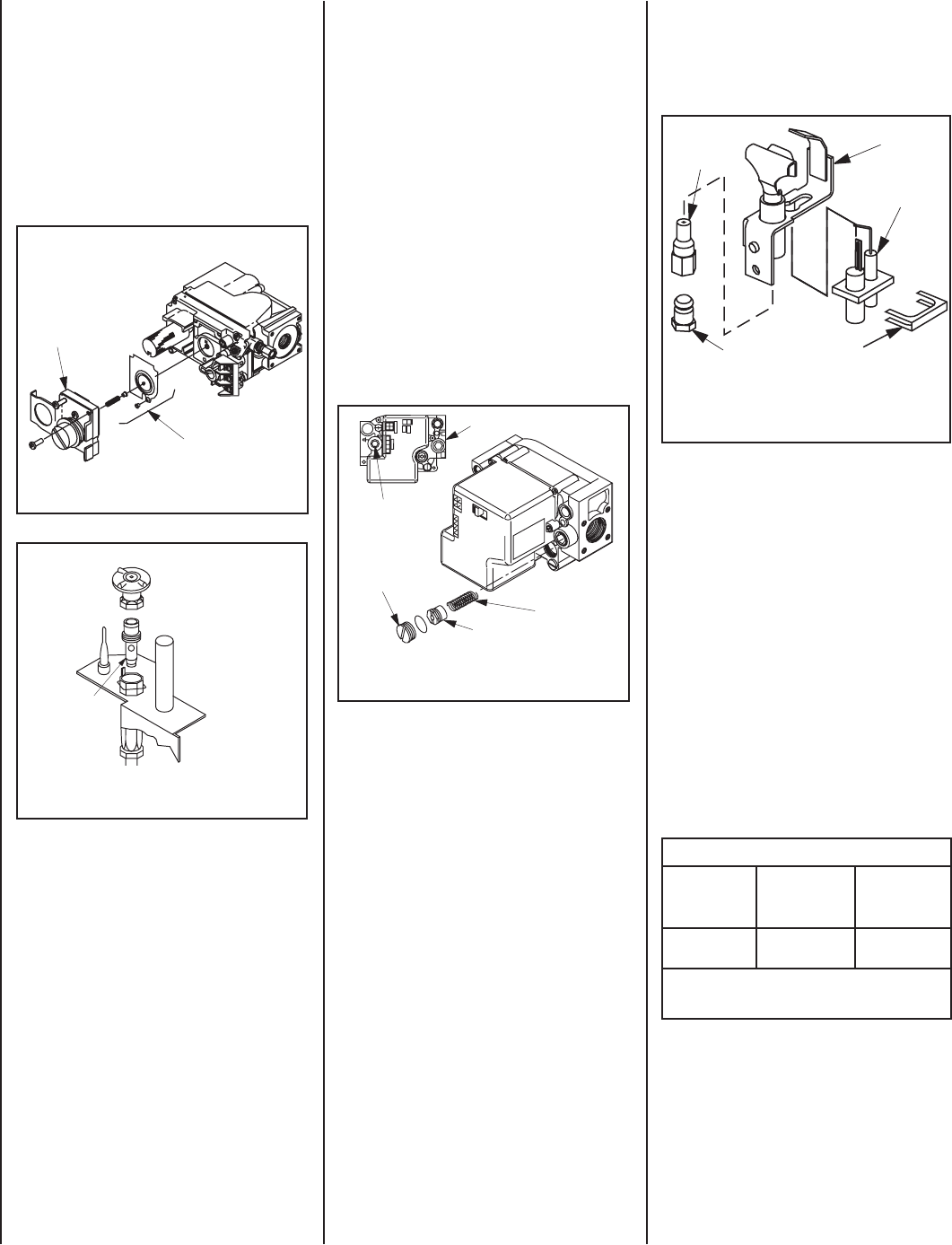
34 NOTE: DIAGRAMS & ILLUSTRATIONS ARE NOT TO SCALE.
SIT Millivolt Gas Valve
Pilot for SIT Millivolt
Gas Valve
Figure 60
b. Attach manometer to the manifold side
pressure test fi tting and verify manifold pres-
sure reads 3.5 inches water column (0.87
kPa) for natural gas, and 10.0 inches water
column (2.49 kPa) for propane gas.
c. Refer to Figure 60 and remove the pilot hood
assembly to access the hexed pilot orifi ce.
Remove and replace the orifi ce with the one
provided with the kit.
Pressure
Regulator
Remove
These
Components
Figure 59
Pilot
Orifi ce
PSI
OF
OF
F
I
ON
ON
CONTROL
CONTROL
IGNITE
Gas Valve
Assembly
Manifold
Pressure
Test Port
Slotted
Cap
Spring
Adjusting
Screw
Figure 62
Figure 61
All Models
Step 8. (Refer to Figure 58 on Page 33)
A. Remove the two orifi ces from the manifold
and replace them with the ones provided in the
kit. Table 14 shows the orifi ce sizes for natural
and propane models. Figure 63 illustrates the
orifi ce.
B. Install rear burner fi rst, followed by front
burner, as shown in Figure 64. Ensure that the
arm of the venturi of each burner is hooked onto
the air shutter adjustment lever (refer to Figure
58 on Page 33). The primary air opening can
be adjusted by rotating the adjustment lever
from beneath the fi rebox fl oor. Refer to Figure
56 on Page 30 for the recommended minimum
primary air opening setting.
Pilot
Orifi ce
Pilot
Assembly
Igniter
Assembly
Retaining
Clip
Flare Nut
When reinstalling the igniter assembly, use
extreme care to prevent damage and break-
age. Do not apply any leverage to the igniter
assembly while restoring the retainer clip to
its original position.
Note: If the igniter is damaged, a replacement kit
is available, order Catalog No. 87L54.
Electronic Appliances
Step 7. Honeywell Electronic Valves - See
Figure 61 and the instructions provided with
the kit. Remove the slotted cap screw, o-ring,
pressure-regulating adjusting screw and spring.
Retain all parts for possible later use. Install
new components from the kit. Black cap and
red spring for propane gas appliances. Silver
cap and stainless steel spring for natural gas
appliances. Before installing the cap, attach
manometer to the manifold side pressure test
fi tting and adjust screw until pressure reads
3.5 inches water column (0.87 kPa) for natural
gas, and 10.0 inches water column (2.49 kPa)
for propane gas.
See Figure 62 and replace the pilot orifi ce as fol-
lows: Remove the igniter assembly retainer clip,
and carefully remove the igniter assembly.
Exercise extreme care to prevent damage to
or breakage of the igniter assembly.
Remove the screw securing the pilot assembly
to its mounting bracket. Back off the fl are nut
at the end of the pilot gas line to free the pilot
assembly from the gas line. Remove the pilot
orifi ce and replace it with the one provided with
the conversion kit. Reinstall the pilot assembly
by reversing the steps detailed here.
• • Burner Orifi ce Sizes (all models)
Elevation
Feet (meters) Natural Gas
drill size (inches) Propane
Gas
drill size (inches)
0-4500
(0-1372) #44 (.086") *
60J8001 •
#55 (.052")*
19L5201 •
Table 14
* Standard size installed at factory
• Part /Cat. Number
• • Each model has two burners & 2 Orifi ces
Step 5. Attach manometer to the manifold side
pressure test fi tting and verify manifold pres-
sure reads 3.5 inches water column (0.87 kPa)
for natural gas, and 10.0 inches water column
(2.49 kPa) for propane gas.
Step 6. Refer to Figure 60 and remove the
pilot hood assembly to access the hexed pilot
orifi ce. Remove and replace the orifi ce with
the one provided with the kit.
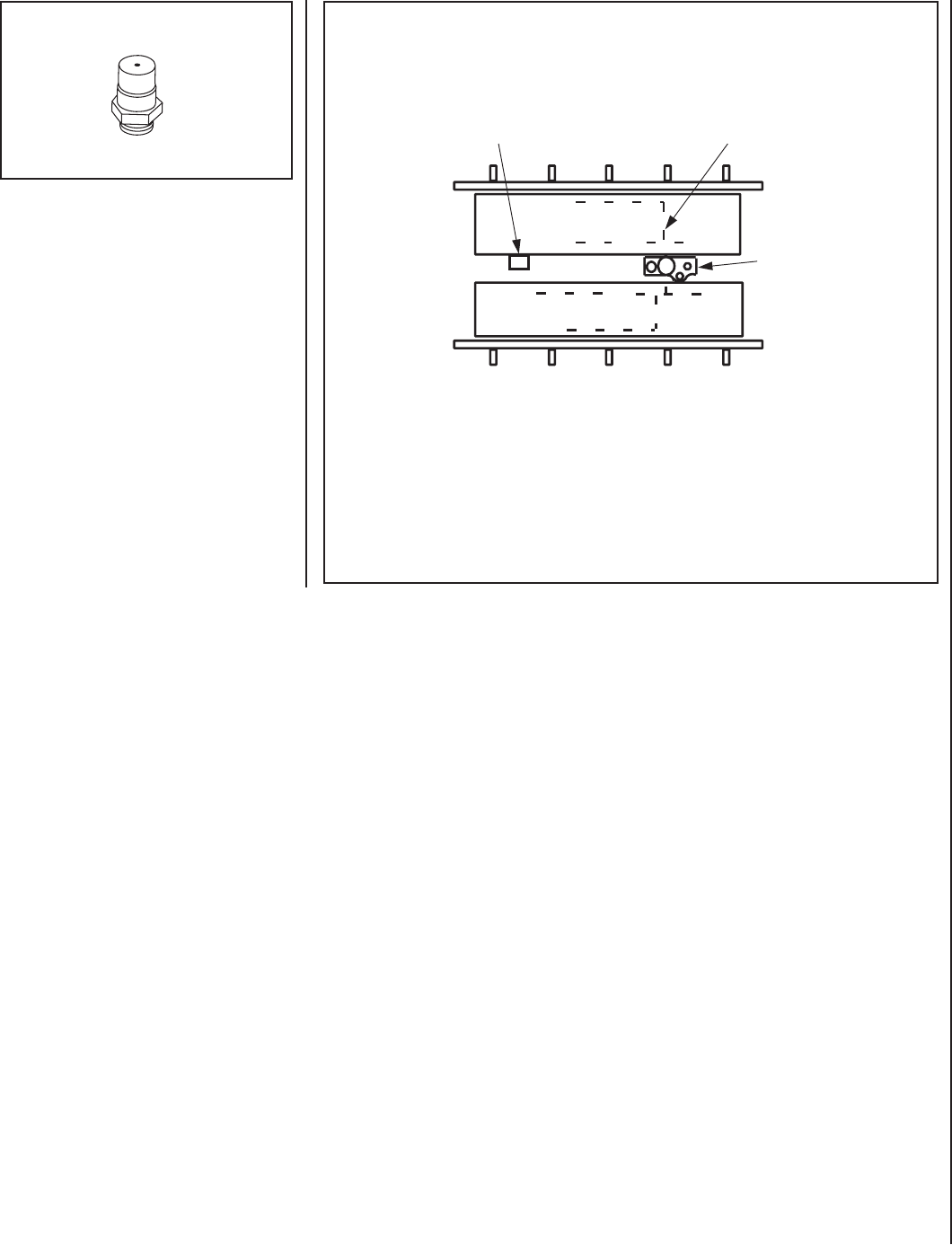
NOTE: DIAGRAMS & ILLUSTRATIONS ARE NOT TO SCALE. 35
Figure 63
Figure 64
BURNER POSITIONING
REAR BURNER
FRONT BURNER
PILOT
BURNER
Note: The burners are not identical. Position them so
that the circular burner ports run as shown. Note
especially the vertical run of ports relative to the pilot
burner. Bracket A on the rear burner will interfere with
the pilot burner if an attempt is made to install the
rear burner in the front burner’s position.
BRACKET A BURNER
PORTS
NOTE: INSTALL REAR BURNER FIRST,
THEN FRONT BURNER.
BURNER ORIFICE
Step 9. Reassemble the remaining components
by reversing the procedures outlined in the
preceding steps. Use pipe joint compound or
Tefl on tape on all pipe fi ttings before installing
(ensure propane resistant compounds are used
in propane applications, do not use pipe joint
compounds on fl are fi ttings).
Step 10. Attach the conversion label provided
in the conversion kit to the rating plate on the
appliance.
Step 11. Turn on gas supply and test for gas
leaks.

Printed in U.S.A. © 2005 by LHP
P/N 700,031M REV. C 11/2006
LHP reserves the right to make changes at any time, without notice, in design, materials, specifi cations, prices and also to discontinue colors, styles and products. Consult your local distributor
for fi replace code information.
LHP
1110 West Taft Avenue • Orange, CA 92865
NOTE: DIAGRAMS & ILLUSTRATIONS NOT TO SCALE.
