Trinus Systems CCR24PNAR Wireless Transmitter System User Manual

Trinus Systems Inc. Wireless Transmitter System Users Manual

Users Manual

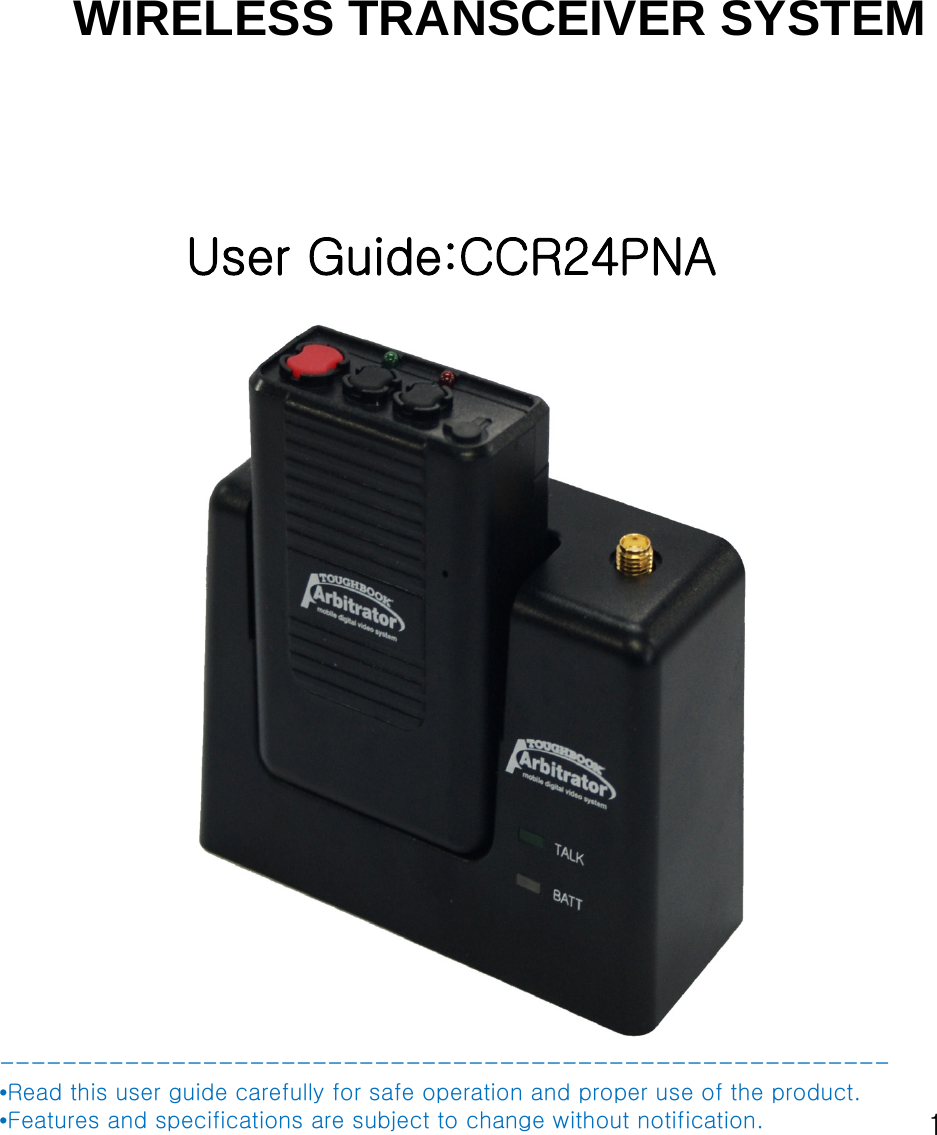
1WIRELESS TRANSCEIVER SYSTEMUser Guide :: CCR24PNA  User Guide:CCR24PNA---------------------------------------------------------•Read this user guide carefully for safe operation and proper use of the product.•Features and specifications are subject to change without notification.
14FCC ID: ROYCCR24PNAR ROYCCR24PNATThis device complies with Part 15 of the FCC Rules.Operation is subject to the following two conditions :(1) This device may not cause harmful interference, and(2) This device must accept any interference received, including interference that may cause undesired operation.CAUTION : Changes or modifications not expressly approved by the party responsible for compliance could void the user s authority to operate this device.This equipment has been tested and found to comply with the limits for a Class B digital device, pursuant to part 15 of the FCC Rules. These limits are designed to provide reasonable protection against harmful interference in a residential installation. This equipment generates, uses and can radiate radio frequency energy, and, if not installed and used in accordance with the instructions, may cause harmful interference to radio communications. However, there is no guarantee that interference will not occur in a particular installation. If this equipment does cause harmful interference to radio or television reception, which can be determined by turning the equipment off and on, theuser is encouraged to try to correct the interference by one or more of the following measures:- Reorient or relocate the receiving antenna.- Increase the separation between the equipment and receiver.- Connect the equipment into an outlet on a circuit different from that to which the receiver is connected.- Consult the dealer or an experienced radio/TV technician for help.FCC RF Radiation Exposure StatementThis equipment complies with FCC RF radiation exposure limits set forth for an uncontrolled environment. This equipment should be installed and operated with a minimum distance of 20 centimeters between the radiator and your body. This transmitter must not be co-located or operated in conjunction with any other antenna or transmitter.Safety Approval
15Industry CanadaIC ID: 5479A-CCR24PNAR5479A-CCR24PNATOperation is subject to the following two conditions: (1) This device may not cause interference and (2) This device must accept any interference, including interference that may cause undesired operation of the device.The term “IC:” before the certification/registration number only signifies that registration was performed based on a Declaration of Conformity indicating that Industry Canadatechnical specifications were met. It does not imply that Industry Canada approved the equipment.Safety Approval
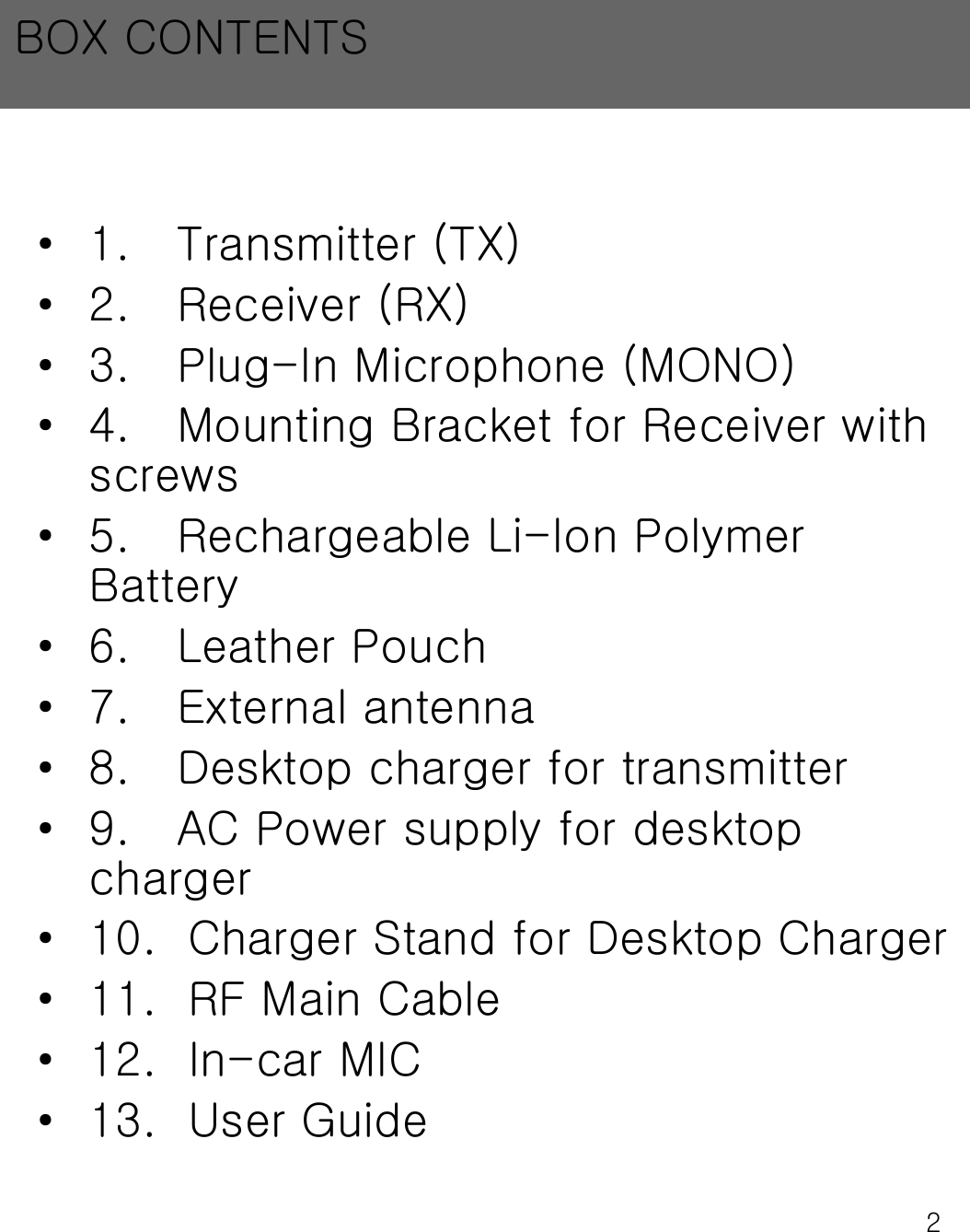
2• 1.   Transmitter (TX)• 2.   Receiver (RX)• 3.   Plug-In Microphone (MONO)• 4.   Mounting Bracket for Receiver with    screws• 5.   Rechargeable Li-Ion Polymer   Battery• 6.   Leather Pouch• 7.   External antenna• 8.   Desktop charger for transmitter• 9.   AC Power supply for desktop charger• 10.  Charger Stand for Desktop Charger• 11.  RF Main Cable• 12.  In-car MIC• 13.  User GuideBOX CONTENTS
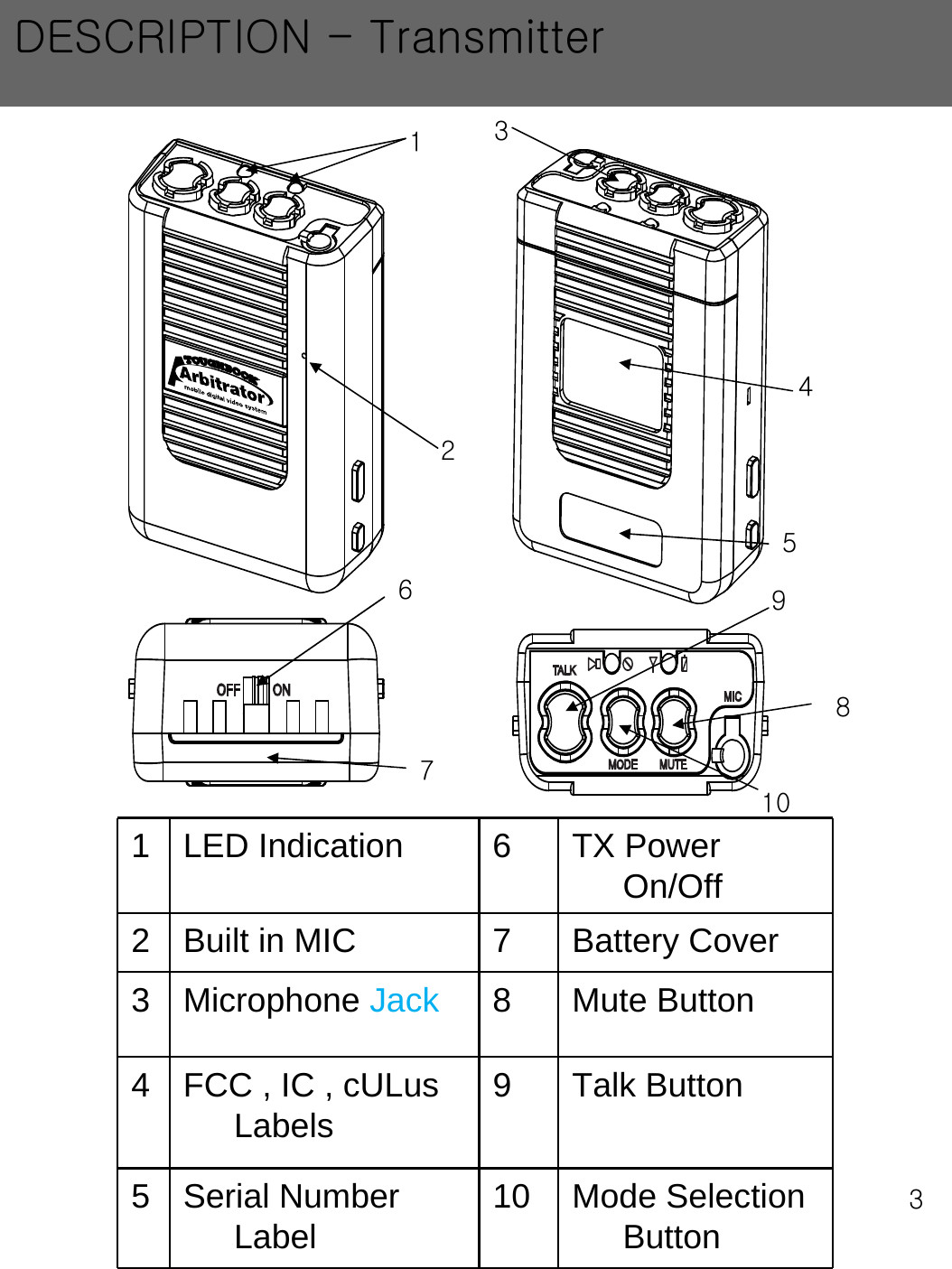
31 LED Indication 6 TX Power On/Off2 Built in MIC 7 Battery Cover3 Microphone Jack 8 Mute Button4 FCC , IC , cULusLabels 9 Talk Button5 Serial Number Label 10 Mode Selection ButtonDESCRIPTION - Transmitter23456798101
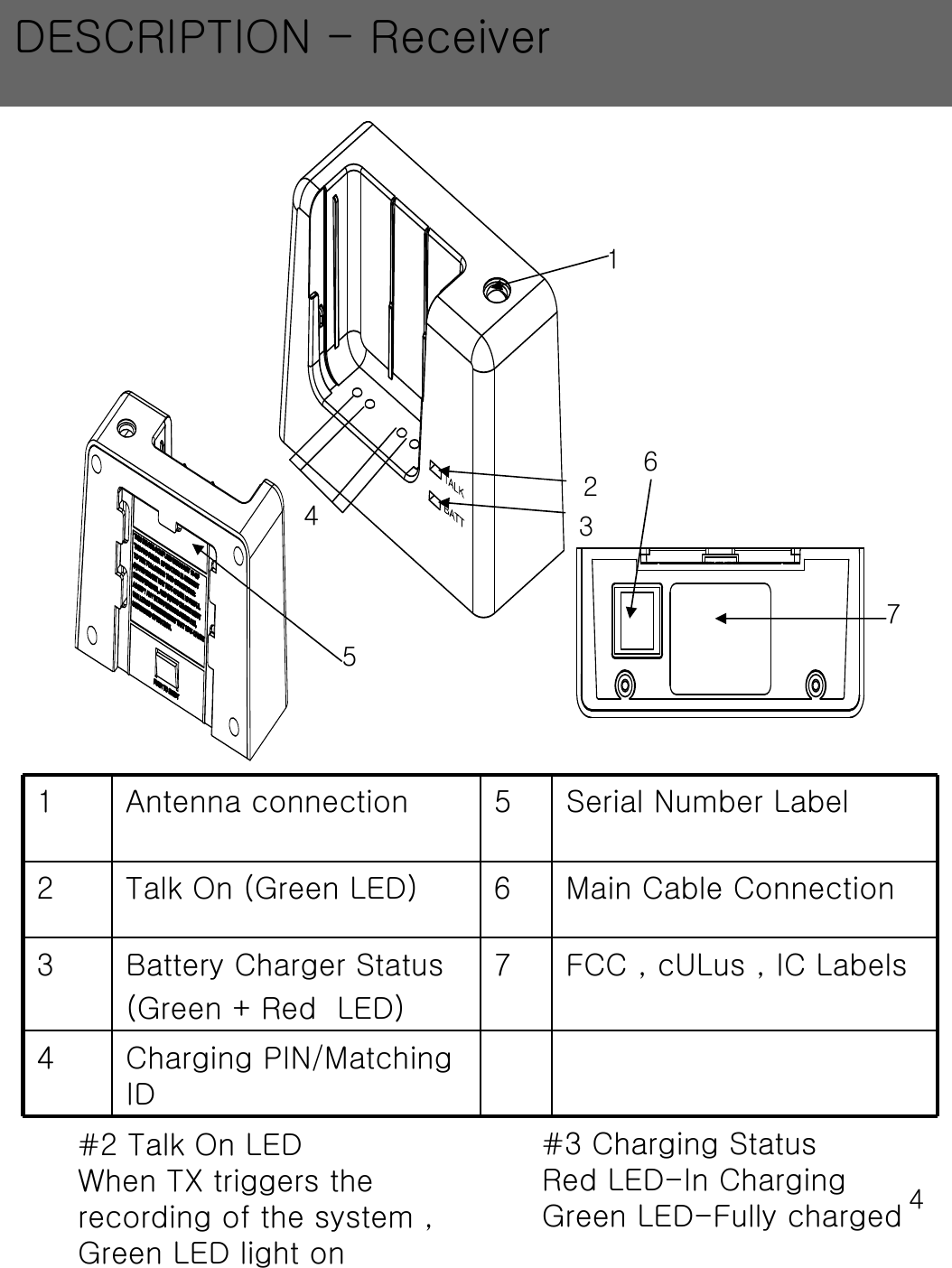
41 Antenna connection 5 Serial Number Label2 Talk On (Green LED) 6 Main Cable Connection3 Battery Charger Status(Green + Red  LED)7 FCC , cULus , IC Labels4 Charging PIN/Matching IDDESCRIPTION - Receiver#2 Talk On LEDWhen TX triggers the recording of the system , Green LED light on#3 Charging StatusRed LED-In Charging Green LED-Fully charged1234576
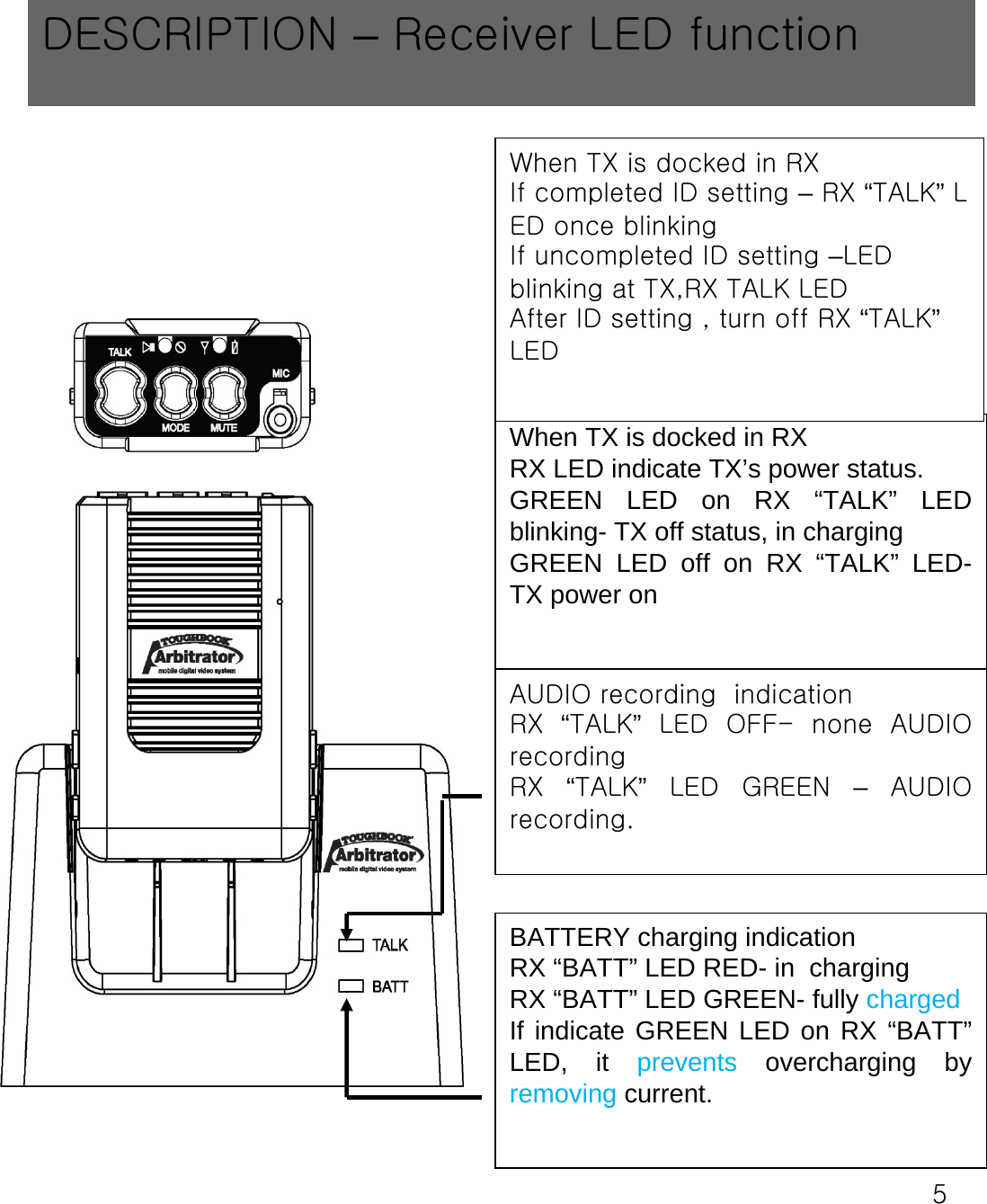
5DESCRIPTION –Receiver LED functionWhen TX is docked in RXRX LED indicate TX’s power status.GREEN LED on RX “TALK” LED blinking- TX off status, in chargingGREEN LED off on RX “TALK” LED-TX power onAUDIO recording  indicationRX  “TALK”LED  OFF- none  AUDIO recordingRX  “TALK”LED  GREEN  –AUDIO recording.BATTERY charging indicationRX “BATT” LED RED- in  chargingRX “BATT” LED GREEN- fully chargedIf indicate GREEN LED on RX “BATT”LED, it prevents overcharging by removing current.When TX is docked in RXIf completed ID setting –RX “TALK”LED once blinkingIf uncompleted ID setting –LED blinking at TX,RX TALK LEDAfter ID setting , turn off RX “TALK”LED
6[TALK]   Green LED ON/OFF:  REC ON/OFFGreen LED Blinking:  ID Matching (Synch) ON[BATT]Red:  In ChargingGreen:  Fully chargedTALK ButtonPress for REC Mute ButtonMODE Selection ButtonLapel MicInputInternal MicTransmitter (TX) with Receiver (RX) Top of Transmitter(TX)“REC”, “Mute”Indication GreenLED“Low Battery”, “Out of Range”,“Mute” indication RedLEDPower ON/OFFButtonBottom of Transmitter(TX)DESCRIPTION –Control Reference Guide
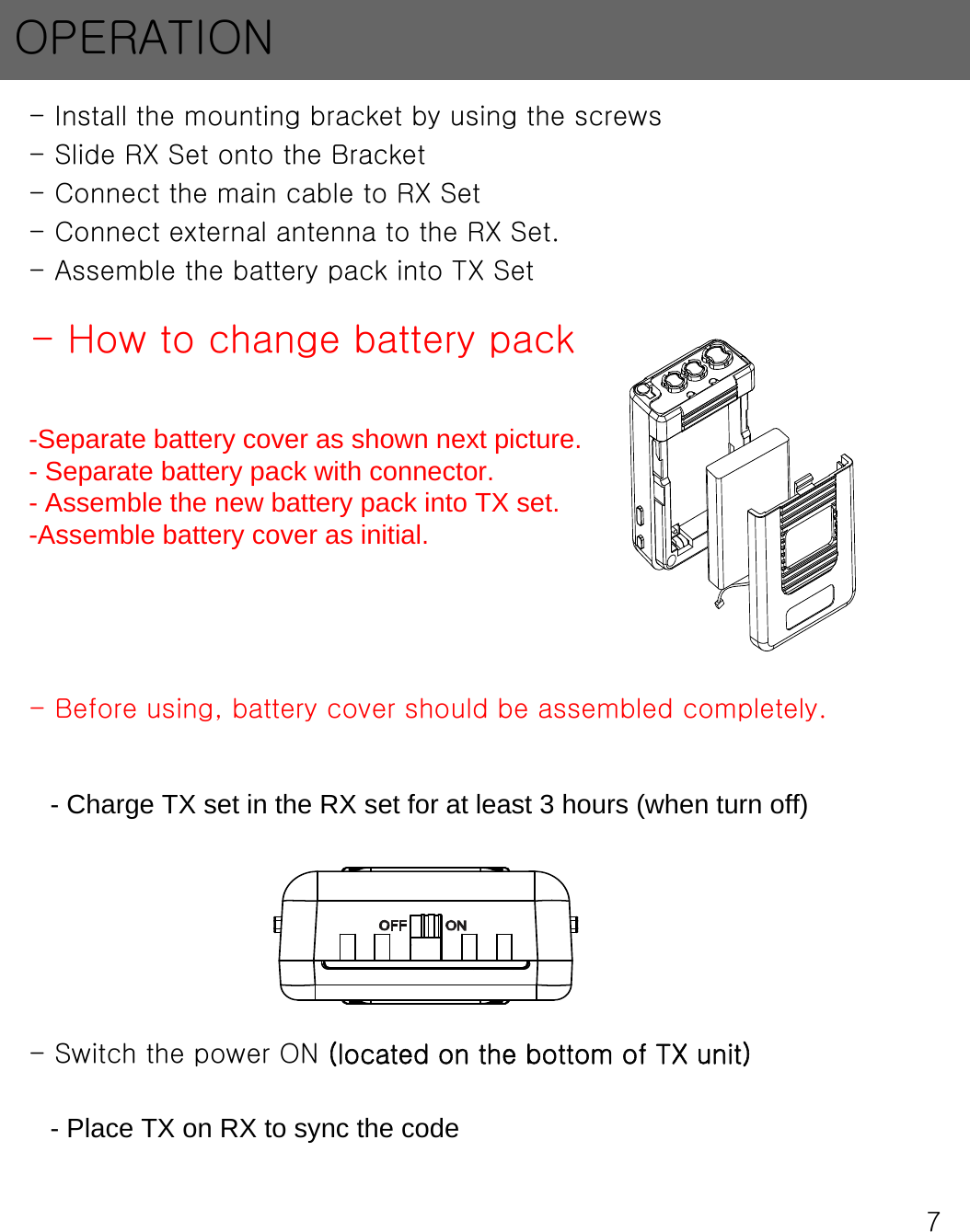
7- Install the mounting bracket by using the screws- Slide RX Set onto the Bracket- Connect the main cable to RX Set- Connect external antenna to the RX Set.- Assemble the battery pack into TX Set- Switch the power ON (located on the bottom of TX unit)- Charge TX set in the RX set for at least 3 hours (when turn off)- Place TX on RX to sync the codeOPERATION- How to change battery pack-Separate battery cover as shown next picture.- Separate battery pack with connector.- Assemble the new battery pack into TX set.-Assemble battery cover as initial.- Before using, battery cover should be assembled completely.
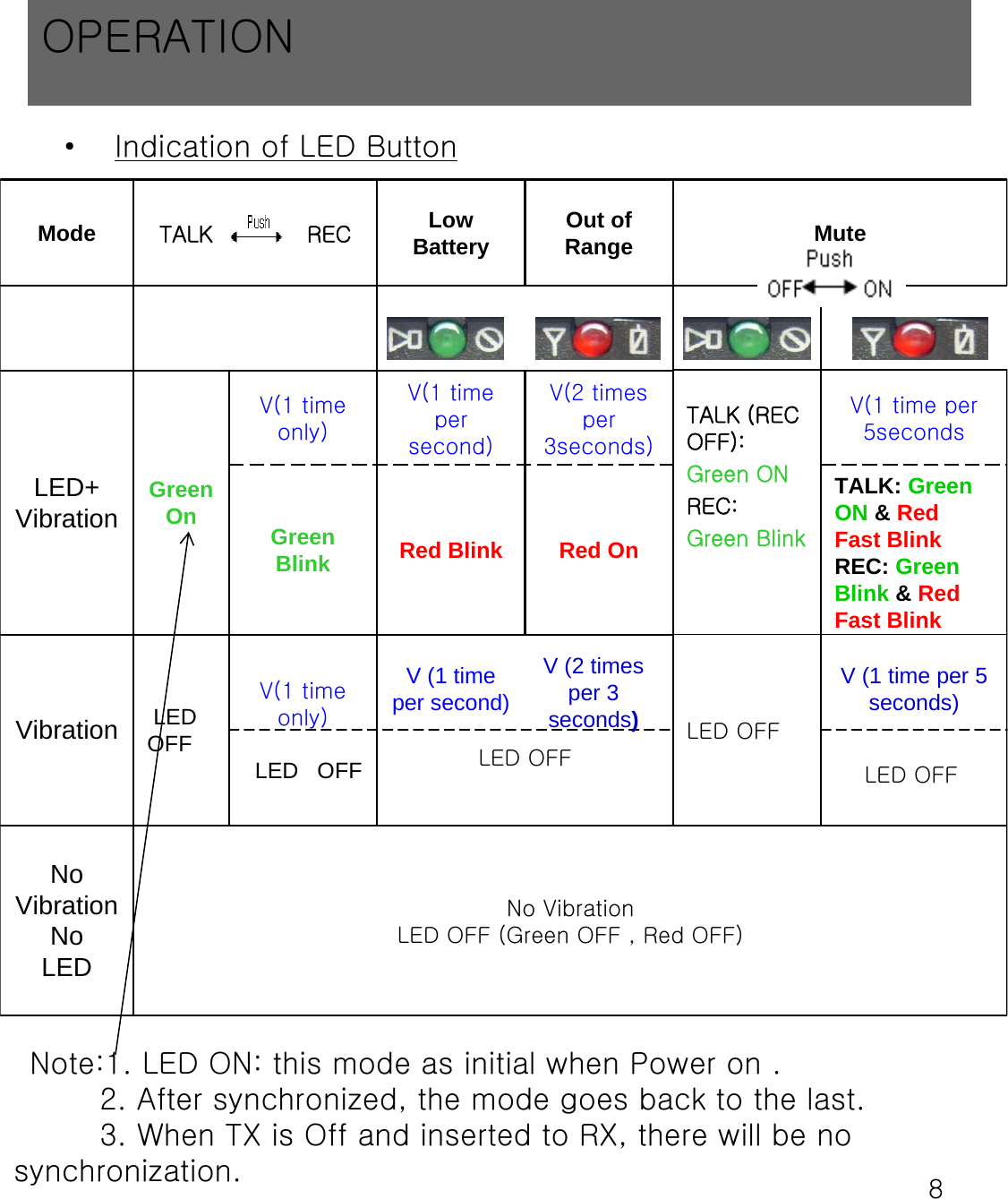
8• Indication of LED ButtonMode TALK            REC Low Battery Out of Range MuteTALK (REC OFF):Green ONREC:Green BlinkLED OFFLED+ Vibration Green On V(1 time only)V(1 time per second)V(2 times per 3seconds)V(1 time per 5secondsGreen Blink Red Blink Red OnLED OFFVibration LEDOFFV(1 time only)LED   OFF LED OFFNo VibrationNoLEDNo VibrationLED OFF (Green OFF , Red OFF)Note:1. LED ON: this mode as initial when Power on . 2. After synchronized, the mode goes back to the last.3. When TX is Off and inserted to RX, there will be no synchronization.OPERATIONV (1 time per second)V (2 times per 3 seconds)TALK: Green ON & Red Fast BlinkREC: Green Blink & Red Fast BlinkV (1 time per 5 seconds)
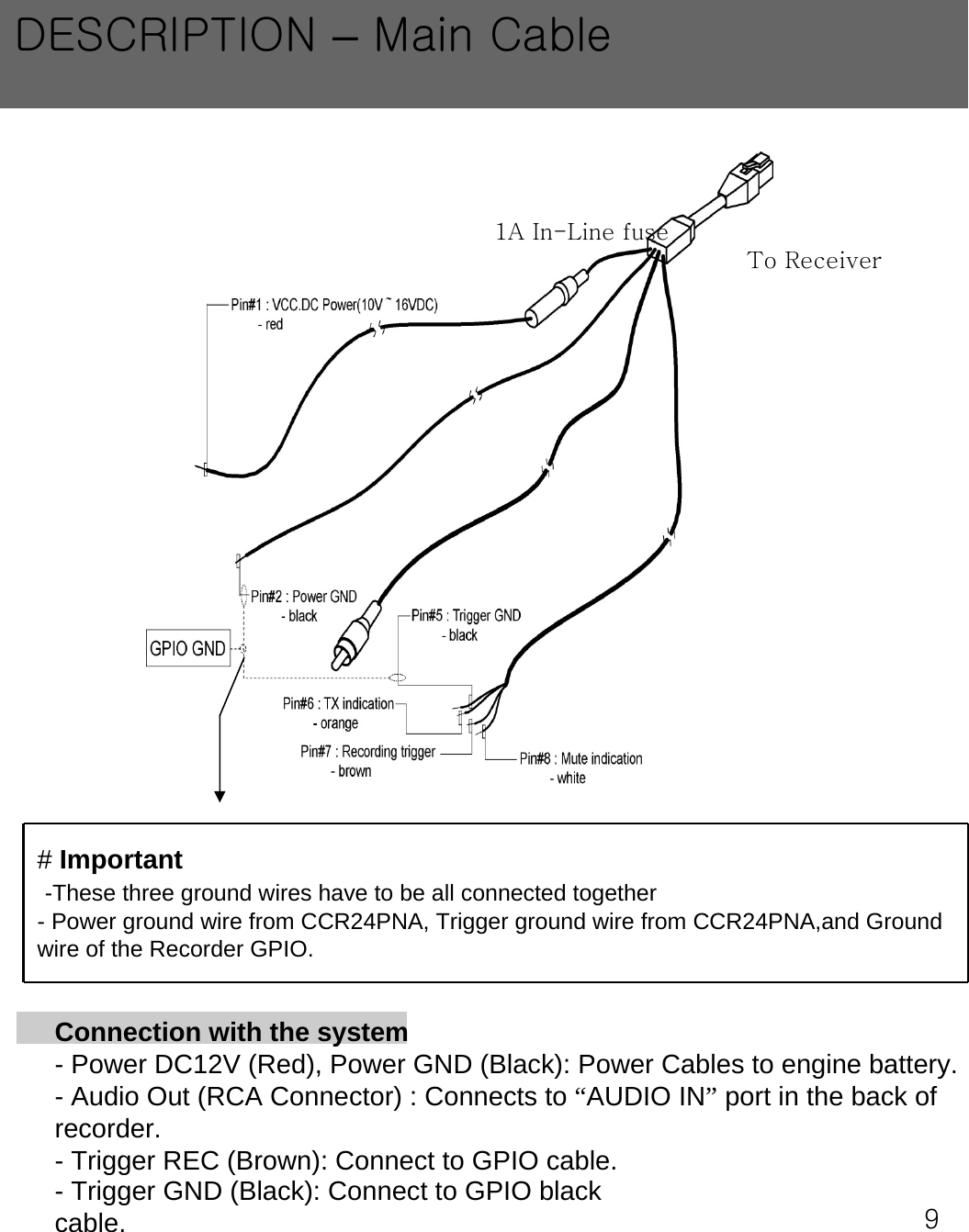
91A In-Line fuseTo ReceiverDESCRIPTION –Main Cable#Important  -These three ground wires have to be all connected together- Power ground wire from CCR24PNA, Trigger ground wire from CCR24PNA,and Ground wire of the Recorder GPIO.Connection with the system- Power DC12V (Red), Power GND (Black): Power Cables to engine battery.- Audio Out (RCA Connector) : Connects to “AUDIO IN”port in the back of recorder.- Trigger REC (Brown): Connect to GPIO cable.- Trigger GND (Black): Connect to GPIO black cable.
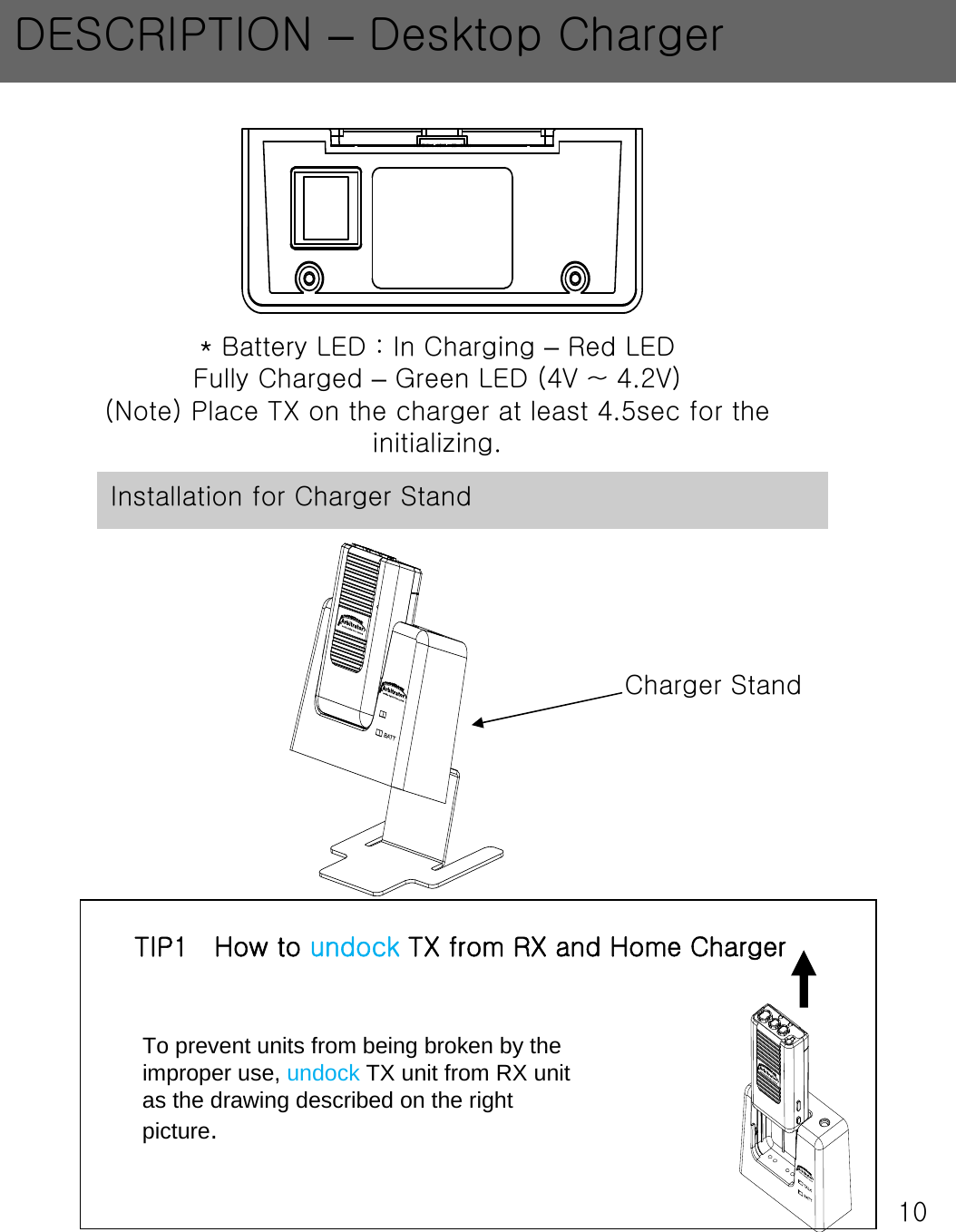
10* Battery LED : In Charging –Red LEDFully Charged –Green LED (4V ~ 4.2V)(Note) Place TX on the charger at least 4.5sec for the initializing.Installation for Charger StandCharger StandTo prevent units from being broken by the improper use, undock TX unit from RX unit as the drawing described on the right picture.DESCRIPTION –Desktop ChargerTIP1   How to undock TX from RX and Home Charger
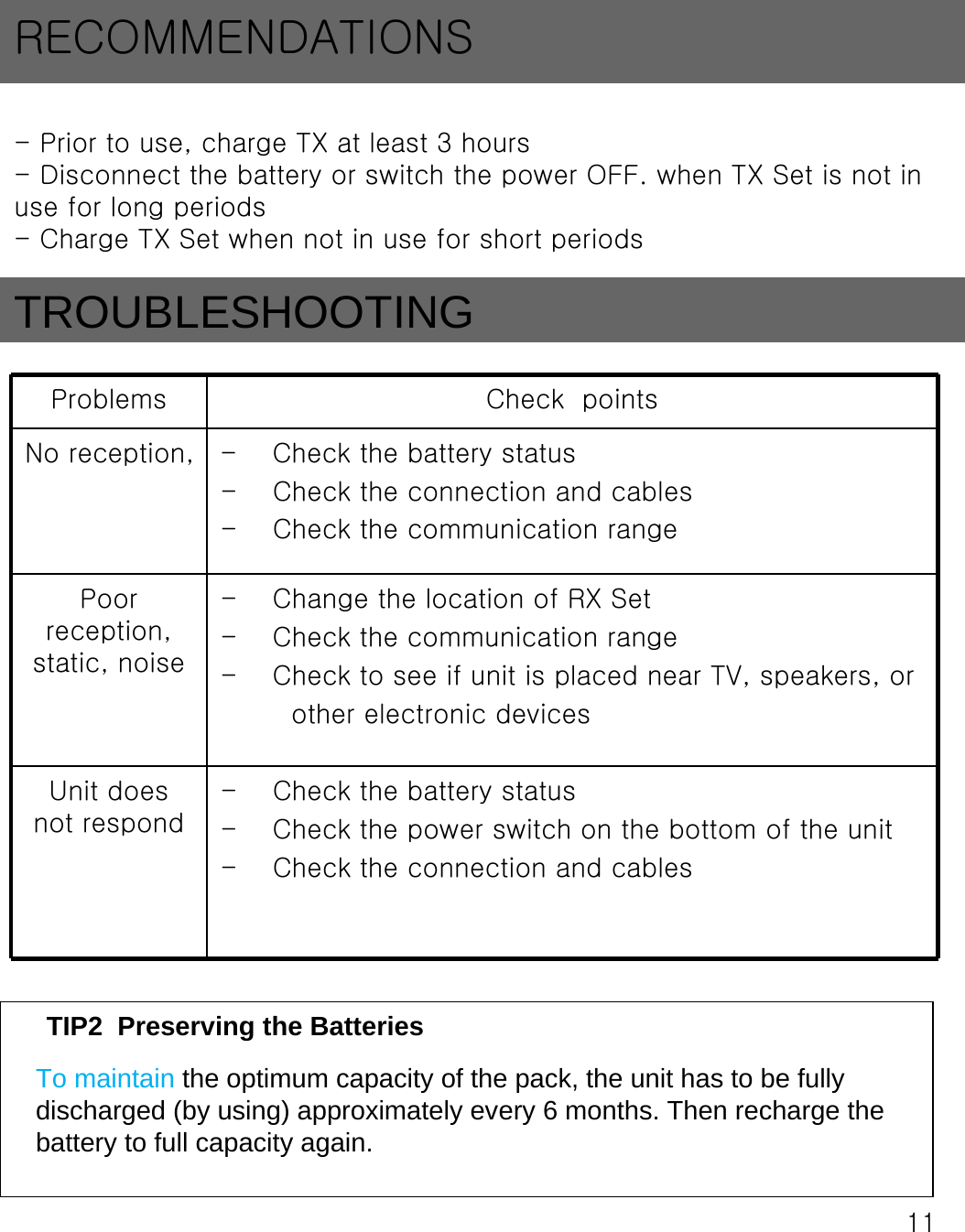
11- Prior to use, charge TX at least 3 hours- Disconnect the battery or switch the power OFF. when TX Set is not in use for long periods- Charge TX Set when not in use for short periodsRECOMMENDATIONSProblems Check  pointsNo reception,  - Check the battery status - Check the connection and cables- Check the communication rangePoor reception, static, noise- Change the location of RX Set- Check the communication range- Check to see if unit is placed near TV, speakers, orother electronic devicesUnit does not respond- Check the battery status- Check the power switch on the bottom of the unit- Check the connection and cablesTIP2  Preserving the BatteriesTo maintain the optimum capacity of the pack, the unit has to be fully discharged (by using) approximately every 6 months. Then recharge the battery to full capacity again.TROUBLESHOOTING
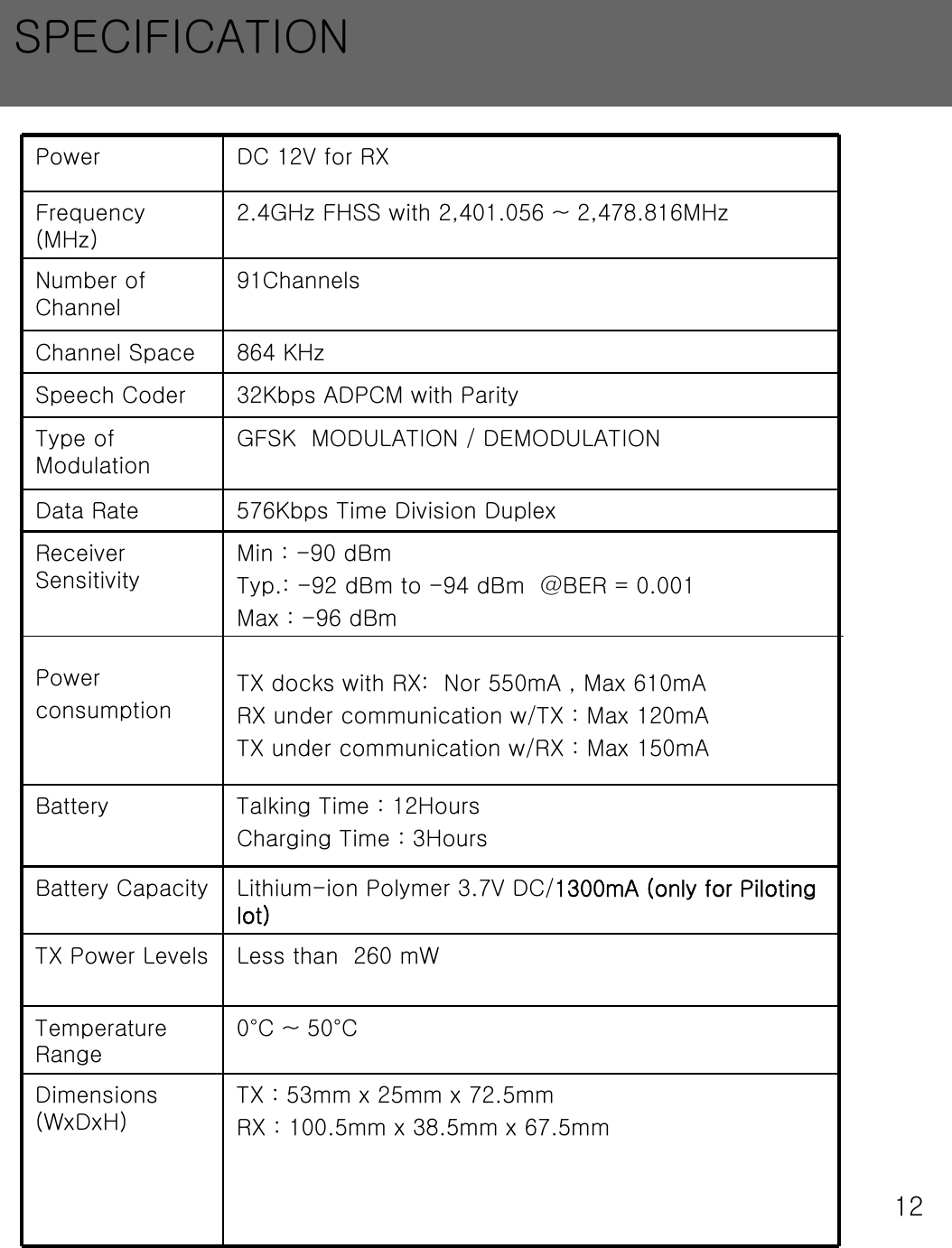
12SPECIFICATIONPower DC 12V for RXFrequency (MHz)2.4GHz FHSS with 2,401.056 ~ 2,478.816MHzNumber of Channel91ChannelsChannel Space 864 KHzSpeech Coder 32Kbps ADPCM with ParityType of ModulationGFSK  MODULATION / DEMODULATIONData Rate 576Kbps Time Division DuplexReceiver  SensitivityPower consumptionMin : -90 dBmTyp.: -92 dBm to -94 dBm @BER = 0.001Max : -96 dBmTX docks with RX:  Nor 550mA , Max 610mARX under communication w/TX : Max 120mATX under communication w/RX : Max 150mABattery Talking Time : 12HoursCharging Time : 3HoursBattery Capacity Lithium-ion Polymer 3.7V DC/1300mA (only for Piloting lot)TX Power Levels Less than  260 mWTemperature Range0°C ~ 50°CDimensions (WxDxH)TX : 53mm x 25mm x 72.5mmRX : 100.5mm x 38.5mm x 67.5mm
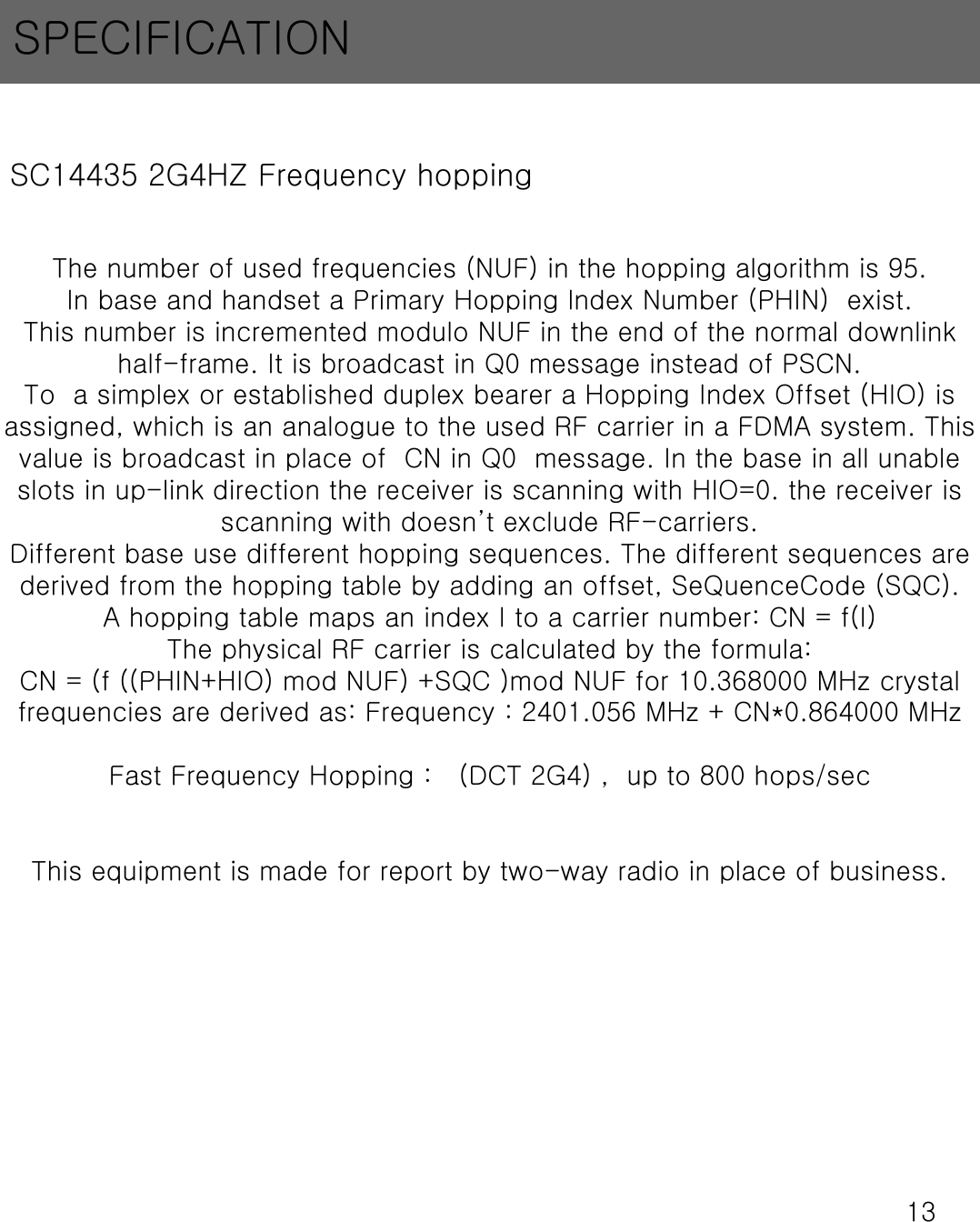
13SPECIFICATIONSC14435 2G4HZ Frequency hopping The number of used frequencies (NUF) in the hopping algorithm is 95.In base and handset a Primary Hopping lndex Number (PHIN)  exist.This number is incremented modulo NUF in the end of the normal downlink half-frame. It is broadcast in Q0 message instead of PSCN.To  a simplex or established duplex bearer a Hopping Index Offset (HIO) is assigned, which is an analogue to the used RF carrier in a FDMA system. This value is broadcast in place of  CN in Q0  message. In the base in all unable slots in up-link direction the receiver is scanning with HIO=0. the receiver is scanning with doesn’t exclude RF-carriers.Different base use different hopping sequences. The different sequences are derived from the hopping table by adding an offset, SeQuenceCode(SQC).A hopping table maps an index I to a carrier number: CN = f(I)The physical RF carrier is calculated by the formula: CN = (f ((PHIN+HIO) mod NUF) +SQC )mod NUF for 10.368000 MHz crystal frequencies are derived as: Frequency : 2401.056 MHz + CN*0.864000 MHzFast Frequency Hopping :   (DCT 2G4) ,  up to 800 hops/secThis equipment is made for report by two-way radio in place of business.
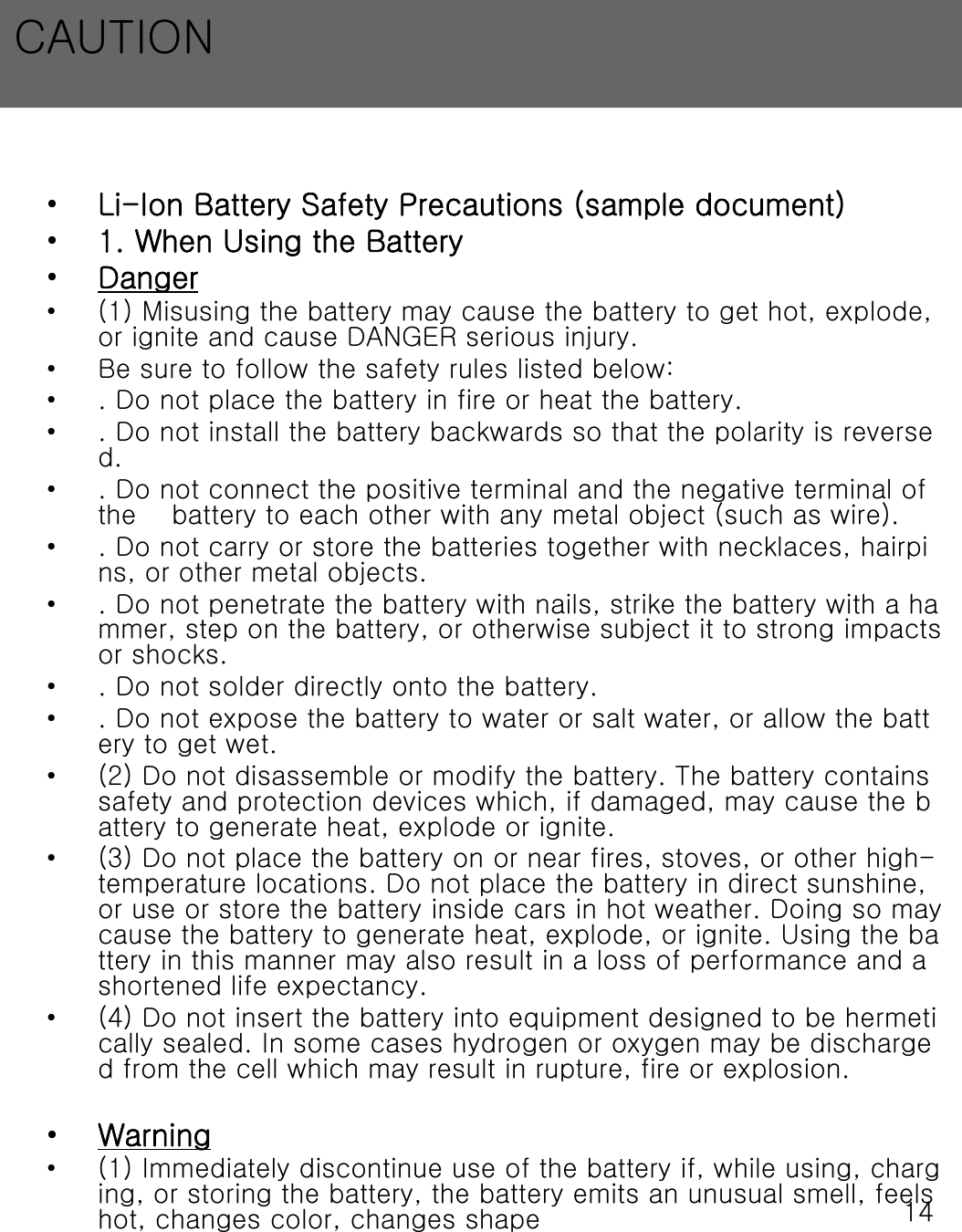
14•Li-Ion Battery Safety Precautions (sample document)•1. When Using the Battery•Danger• (1) Misusing the battery may cause the battery to get hot, explode, or ignite and cause DANGER serious injury. • Be sure to follow the safety rules listed below:• . Do not place the battery in fire or heat the battery.• . Do not install the battery backwards so that the polarity is reversed.• . Do not connect the positive terminal and the negative terminal of the    battery to each other with any metal object (such as wire).• . Do not carry or store the batteries together with necklaces, hairpins, or other metal objects.• . Do not penetrate the battery with nails, strike the battery with a hammer, step on the battery, or otherwise subject it to strong impacts or shocks.• . Do not solder directly onto the battery.• . Do not expose the battery to water or salt water, or allow the battery to get wet.• (2) Do not disassemble or modify the battery. The battery contains safety and protection devices which, if damaged, may cause the battery to generate heat, explode or ignite.• (3) Do not place the battery on or near fires, stoves, or other high-temperature locations. Do not place the battery in direct sunshine,or use or store the battery inside cars in hot weather. Doing somay cause the battery to generate heat, explode, or ignite. Using the battery in this manner may also result in a loss of performance and a shortened life expectancy.• (4) Do not insert the battery into equipment designed to be hermetically sealed. In some cases hydrogen or oxygen may be discharged from the cell which may result in rupture, fire or explosion.•Warning• (1) Immediately discontinue use of the battery if, while using, charging, or storing the battery, the battery emits an unusual smell,feels hot, changes color, changes shapeCAUTION
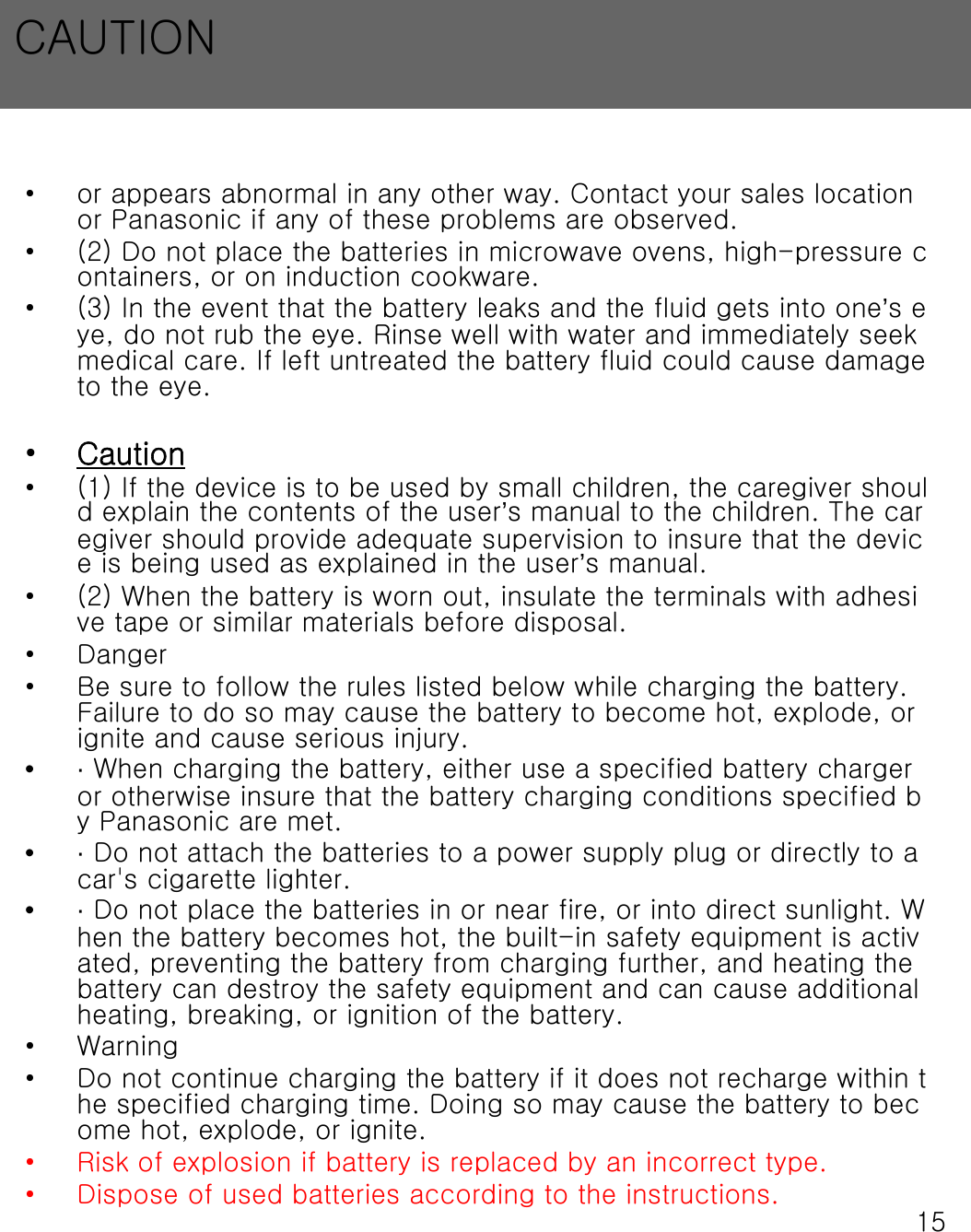
15• or appears abnormal in any other way. Contact your sales location or Panasonic if any of these problems are observed.• (2) Do not place the batteries in microwave ovens, high-pressure containers, or on induction cookware.• (3) In the event that the battery leaks and the fluid gets into one’s eye, do not rub the eye. Rinse well with water and immediately seek medical care. If left untreated the battery fluid could cause damage to the eye.•Caution• (1) If the device is to be used by small children, the caregiver should explain the contents of the user’s manual to the children. The caregiver should provide adequate supervision to insure that the device is being used as explained in the user’s manual.• (2) When the battery is worn out, insulate the terminals with adhesive tape or similar materials before disposal.•Danger• Be sure to follow the rules listed below while charging the battery. Failure to do so may cause the battery to become hot, explode, or ignite and cause serious injury.•·When charging the battery, either use a specified battery charger or otherwise insure that the battery charging conditions specified by Panasonic are met.•·Do not attach the batteries to a power supply plug or directly to a car's cigarette lighter.•·Do not place the batteries in or near fire, or into direct sunlight. When the battery becomes hot, the built-in safety equipment is activated, preventing the battery from charging further, and heating the battery can destroy the safety equipment and can cause additional heating, breaking, or ignition of the battery.• Warning• Do not continue charging the battery if it does not recharge within the specified charging time. Doing so may cause the battery to become hot, explode, or ignite.• Risk of explosion if battery is replaced by an incorrect type.• Dispose of used batteries according to the instructions.CAUTION
16•2. While Charging•Caution• The temperature range over which the battery can be charged is 10°C to 45°C. Charging the battery at temperatures outside of this range may cause the battery to become hot or to break. Charging thebattery outside of this temperature range may also harm the performance of the battery or reduce the battery’s expectancy.•3. When Discharging the Battery•Danger• Do not discharge the battery using any device except for the specified device. When the battery is used in devices aside from the specified device it may damage the performance of the battery or reduce its life expectancy, and if the device causes an abnormal current to flow, it may cause the battery to become hot, explode, or ignite and cause serious injury.•Caution• The temperature range over which the battery can be discharged is -10°C to 60°C. Use of the battery outside of this temperature range may damage the performance of the battery or may reduce its lifeexpectancy.CAUTION

Navigation menu