TruePath Wireless TPW2458-B-4AM TPW-2458-B-4A/M "Long Reach" Access Point User Manual V1 5 TPW 2458 B 4A M SUG

TruePath Wireless LLC TPW-2458-B-4A/M "Long Reach" Access Point V1 5 TPW 2458 B 4A M SUG

Users Manual

        BTS TPW2458-B-4A/M System User Guide Customer Document  Version 1.5  Last Update: 22 June 2011        Confidential Notice: This document contains confidential information of TruePath Wireless, LLC. The disclosure and use of the contents of this document are governed by the terms of the Nondisclosure Agreement (NDA) signed and agreed to by employees, contractors, consultants, and others working with TruePath Wireless, LLC.  Please review the terms of the NDA before distributing the contents of this document. The contents of this document shall not be copied, reproduced, transferred to other documents, disclosed to others, or used for any other purpose(s) except as provided for in the NDA or with prior written permission of TruePath Wireless, LLC.
  CONFIDENTIAL  2 (19)  BTS TPW2458-B-4A/M Version 1.5   SYSTEM USER GUIDE Date 22 June 2011    2  Copyright © 2011 TruePath Wireless, LLC. All rights reserved. Reproduction in whole or in part without permission is prohibited. Information contained herein is subject to change without notice. The specifications and information regarding the products in this document are subject to change without notice. All statements, information, and recommendations in this document are believed to be accurate, but are presented without warranty of any kind, express, or implied. Users must take full responsibility for their application of any products. Trademarks, brand names and products mentioned in this document are the property of their respective owners. All such references are used strictly in an editorial fashion with no intent to convey any affiliation with the name or the product's rightful owner.    Revision History  Status Document Version Date Description (author or approver) Document Started 1.0 05/24/2011 Document created (Eric Garcia) Release 1.1 05/25/2011 Reference corrections (Eric Garcia) Release 1.2 05/31/2011 Replaced BTS part number (Eric Garcia) Release 1.3 06/01/2011 Updated GUI caption (Eric Garcia) Release 1.4 06/02/2011 Replaced BTS part number (Eric Garcia) Release 1.5 06/22/2011 Update FCC Radiation Exposure Limits
  CONFIDENTIAL  3 (19)  BTS TPW2458-B-4A/M Version 1.5   SYSTEM USER GUIDE Date 22 June 2011    3  Copyright © 2011 TruePath Wireless, LLC. All rights reserved. Reproduction in whole or in part without permission is prohibited. Information contained herein is subject to change without notice. The specifications and information regarding the products in this document are subject to change without notice. All statements, information, and recommendations in this document are believed to be accurate, but are presented without warranty of any kind, express, or implied. Users must take full responsibility for their application of any products. Trademarks, brand names and products mentioned in this document are the property of their respective owners. All such references are used strictly in an editorial fashion with no intent to convey any affiliation with the name or the product's rightful owner.     Table of Contents Table of Figures .......................................................................................... 4!Table of Tables ........................................................................................... 4!1.!Product Overview .................................................................................. 5!1.1!Package Contents ................................................................................................ 5!1.1.1!Embedded Device (Base Station or Client Station) ........................................ 5!1.2!System Requirements .......................................................................................... 6!1.3!Hardware .............................................................................................................. 6!1.3.1!Base Station ................................................................................................... 6!2.!Installation ............................................................................................. 7!2.1!Hardware Installation ............................................................................................ 7!2.1.1!Mounting a Base Station ................................................................................ 8!2.1.2!Connecting a Base Station ............................................................................. 9!2.1.3!Dual-Band Configuration (2.4 and 5.8GHz) .................................................. 10!3.!Command Line Interface (CLI) ........................................................... 10!3.1!Connecting/First-Time Login .............................................................................. 10!3.1.1!Network Role ................................................................................................ 11!3.1.2!Bridge Role ................................................................................................... 11!3.1.2.1!Common Network Settings ..................................................................... 12!3.1.3!Router Role .................................................................................................. 12!3.1.4!Static Routes ................................................................................................ 13!3.1.5!Embedded CLI .............................................................................................. 13!3.1.5.1!Set .......................................................................................................... 14!3.1.5.2!Show ....................................................................................................... 14!3.2!TruePath Wireless GUI ....................................................................................... 15!APPENDIX A: Specifications ................................................................... 17!Base Station (BTS TPW2458-B-4A/M) ....................................................................... 17!APPENDIX B: FCC Interference Statement ............................................ 18!Federal Communication Commission Interface Statement ......................................... 18!IMPORTANT NOTE: FCC Radiation Exposure Statement ......................................... 18!APPENDIX C: Support/Contact Information .......................................... 19!
  CONFIDENTIAL  4 (19)  BTS TPW2458-B-4A/M Version 1.5   SYSTEM USER GUIDE Date 22 June 2011    4  Copyright © 2011 TruePath Wireless, LLC. All rights reserved. Reproduction in whole or in part without permission is prohibited. Information contained herein is subject to change without notice. The specifications and information regarding the products in this document are subject to change without notice. All statements, information, and recommendations in this document are believed to be accurate, but are presented without warranty of any kind, express, or implied. Users must take full responsibility for their application of any products. Trademarks, brand names and products mentioned in this document are the property of their respective owners. All such references are used strictly in an editorial fashion with no intent to convey any affiliation with the name or the product's rightful owner.    Table of Figures Figure 1 - Base Station .................................................................................................... 5!Figure 2 - Base Station Hardware .................................................................................... 6!Figure 3 - Mounting a Base Station .................................................................................. 8!Figure 4 - Connecting a Base Station .............................................................................. 9!Figure 5 - Dual Band BTS (Rear View) .......................................................................... 10!Figure 6 - Dual Band BTS (Front View) ......................................................................... 10!Figure 7 - Embedded CLI ............................................................................................... 13!Figure 8 - Embedded CLI Set Command Options ......................................................... 14!Figure 9 - Embedded CLI Show Command Options ...................................................... 15!Figure 10 - GUI Display .................................................................................................. 16!  Table of Tables Table 1 - Base Station External Connectors / Features ................................................... 7!Table 2 - Network Modes ............................................................................................... 11!Table 3 - Network Settings (Static) ................................................................................ 12!Table 4 - Network Settings (Common) ........................................................................... 12!Table 5 - WLAN Network Settings ................................................................................. 12!
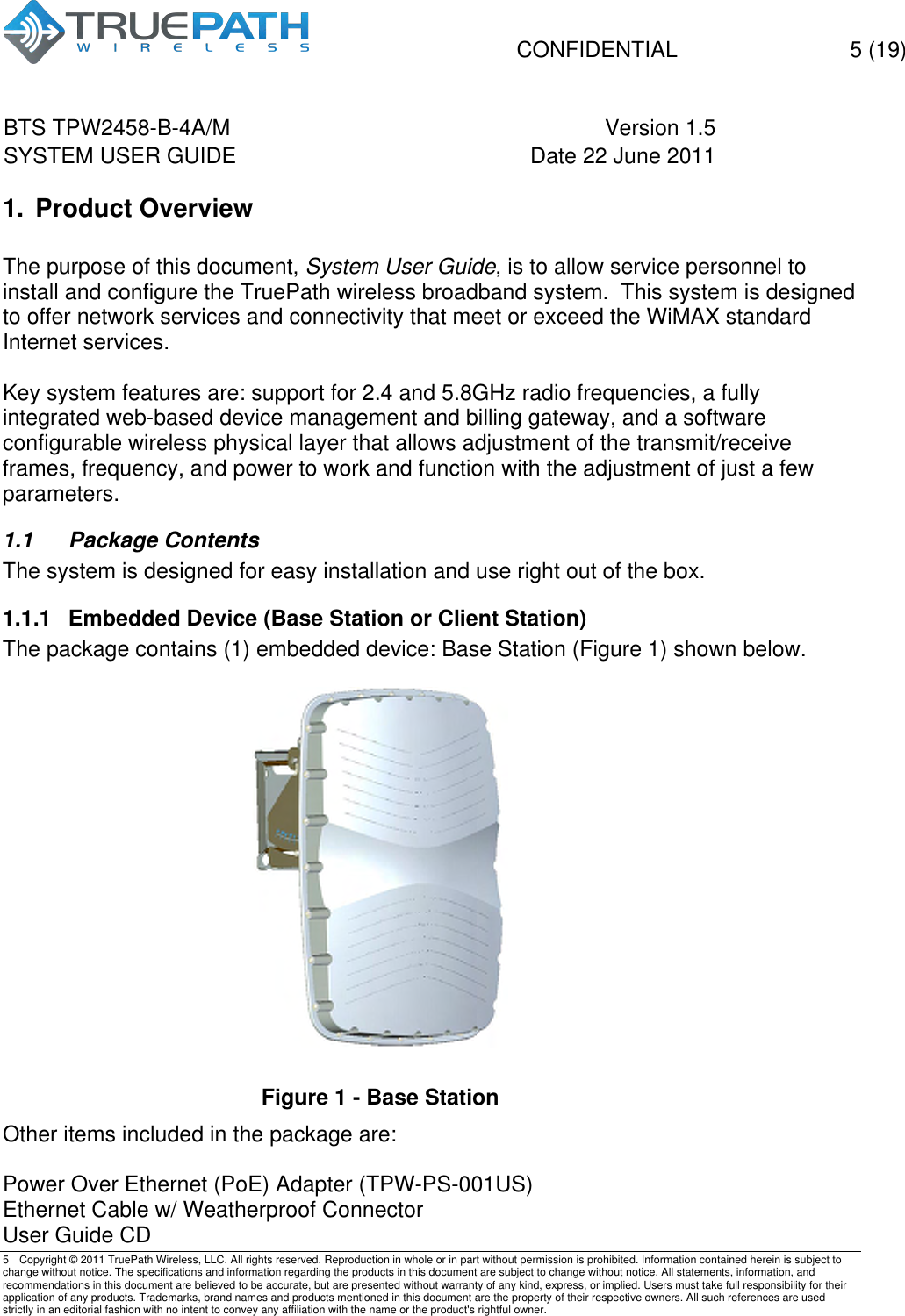
  CONFIDENTIAL  5 (19)  BTS TPW2458-B-4A/M Version 1.5   SYSTEM USER GUIDE Date 22 June 2011    5  Copyright © 2011 TruePath Wireless, LLC. All rights reserved. Reproduction in whole or in part without permission is prohibited. Information contained herein is subject to change without notice. The specifications and information regarding the products in this document are subject to change without notice. All statements, information, and recommendations in this document are believed to be accurate, but are presented without warranty of any kind, express, or implied. Users must take full responsibility for their application of any products. Trademarks, brand names and products mentioned in this document are the property of their respective owners. All such references are used strictly in an editorial fashion with no intent to convey any affiliation with the name or the product's rightful owner.    1. Product Overview  The purpose of this document, System User Guide, is to allow service personnel to install and configure the TruePath wireless broadband system.  This system is designed to offer network services and connectivity that meet or exceed the WiMAX standard Internet services.   Key system features are: support for 2.4 and 5.8GHz radio frequencies, a fully integrated web-based device management and billing gateway, and a software configurable wireless physical layer that allows adjustment of the transmit/receive frames, frequency, and power to work and function with the adjustment of just a few parameters.   1.1  Package Contents The system is designed for easy installation and use right out of the box. 1.1.1  Embedded Device (Base Station or Client Station) The package contains (1) embedded device: Base Station (Figure 1) shown below.   Figure 1 - Base Station Other items included in the package are:  Power Over Ethernet (PoE) Adapter (TPW-PS-001US) Ethernet Cable w/ Weatherproof Connector User Guide CD
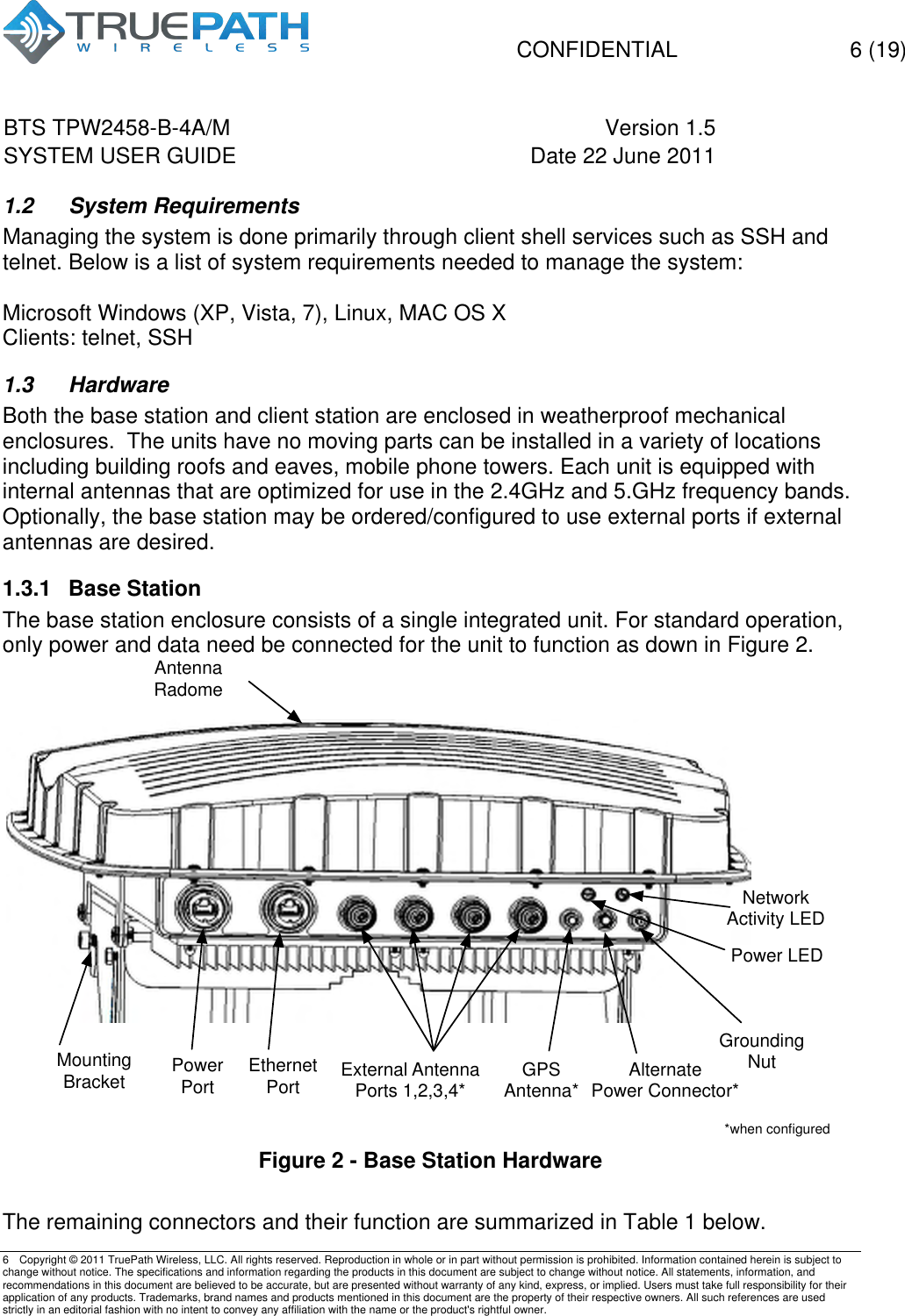
  CONFIDENTIAL  6 (19)  BTS TPW2458-B-4A/M Version 1.5   SYSTEM USER GUIDE Date 22 June 2011    6  Copyright © 2011 TruePath Wireless, LLC. All rights reserved. Reproduction in whole or in part without permission is prohibited. Information contained herein is subject to change without notice. The specifications and information regarding the products in this document are subject to change without notice. All statements, information, and recommendations in this document are believed to be accurate, but are presented without warranty of any kind, express, or implied. Users must take full responsibility for their application of any products. Trademarks, brand names and products mentioned in this document are the property of their respective owners. All such references are used strictly in an editorial fashion with no intent to convey any affiliation with the name or the product's rightful owner.    1.2  System Requirements Managing the system is done primarily through client shell services such as SSH and telnet. Below is a list of system requirements needed to manage the system:  Microsoft Windows (XP, Vista, 7), Linux, MAC OS X Clients: telnet, SSH  1.3 Hardware Both the base station and client station are enclosed in weatherproof mechanical enclosures.  The units have no moving parts can be installed in a variety of locations including building roofs and eaves, mobile phone towers. Each unit is equipped with internal antennas that are optimized for use in the 2.4GHz and 5.GHz frequency bands.  Optionally, the base station may be ordered/configured to use external ports if external antennas are desired. 1.3.1  Base Station The base station enclosure consists of a single integrated unit. For standard operation, only power and data need be connected for the unit to function as down in Figure 2.  Figure 2 - Base Station Hardware  The remaining connectors and their function are summarized in Table 1 below. Ethernet Port External Antenna Ports 1,2,3,4* GPS Antenna* AlternatePower Connector*GroundingNutNetwork Activity LEDPower LEDAntennaRadomeMounting Bracket Power Port*when configured
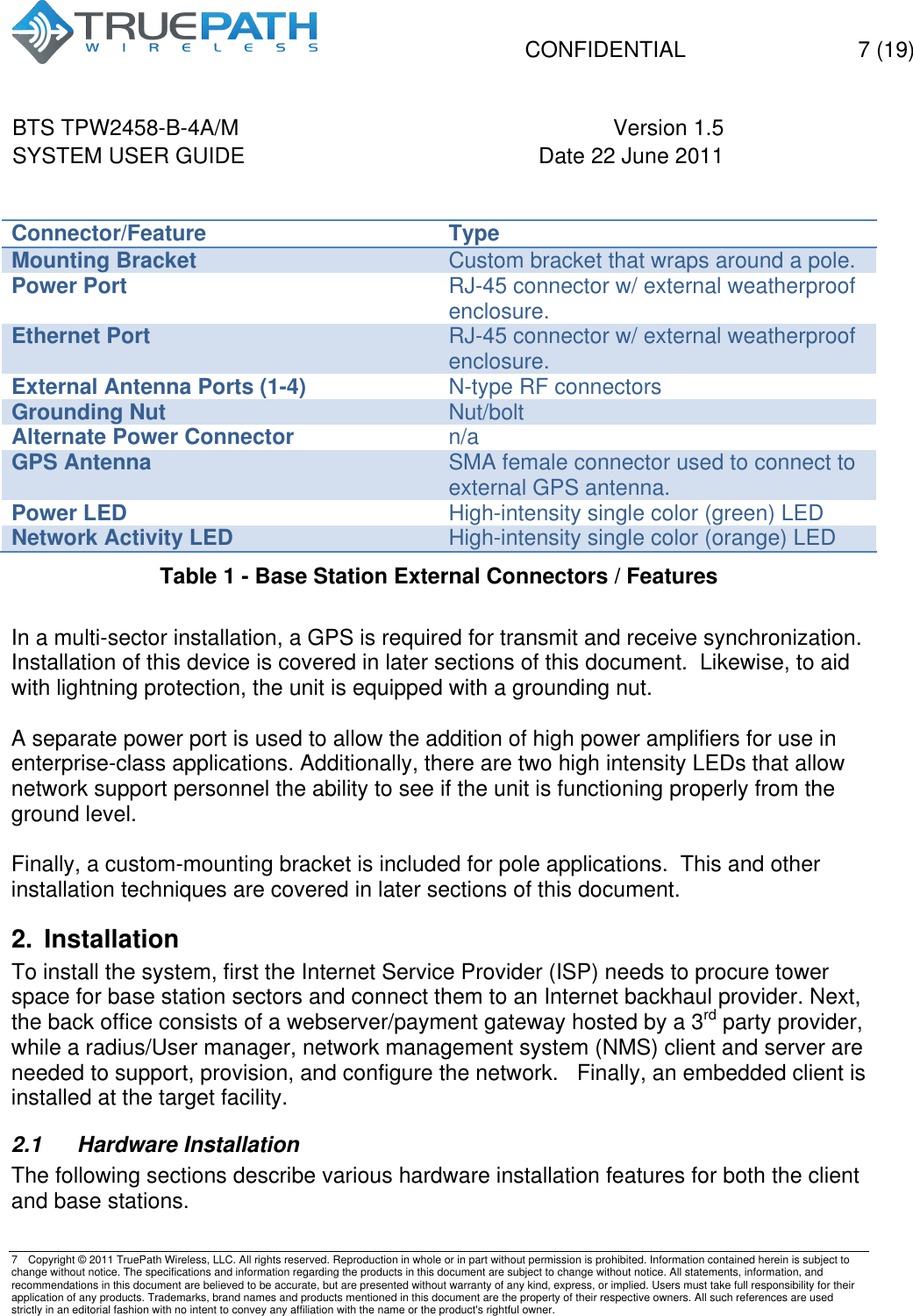
  CONFIDENTIAL  7 (19)  BTS TPW2458-B-4A/M Version 1.5   SYSTEM USER GUIDE Date 22 June 2011    7  Copyright © 2011 TruePath Wireless, LLC. All rights reserved. Reproduction in whole or in part without permission is prohibited. Information contained herein is subject to change without notice. The specifications and information regarding the products in this document are subject to change without notice. All statements, information, and recommendations in this document are believed to be accurate, but are presented without warranty of any kind, express, or implied. Users must take full responsibility for their application of any products. Trademarks, brand names and products mentioned in this document are the property of their respective owners. All such references are used strictly in an editorial fashion with no intent to convey any affiliation with the name or the product's rightful owner.     Connector/Feature Type Mounting Bracket Custom bracket that wraps around a pole. Power Port RJ-45 connector w/ external weatherproof enclosure. Ethernet Port RJ-45 connector w/ external weatherproof enclosure. External Antenna Ports (1-4) N-type RF connectors Grounding Nut Nut/bolt Alternate Power Connector n/a GPS Antenna SMA female connector used to connect to external GPS antenna. Power LED High-intensity single color (green) LED Network Activity LED High-intensity single color (orange) LED Table 1 - Base Station External Connectors / Features  In a multi-sector installation, a GPS is required for transmit and receive synchronization.  Installation of this device is covered in later sections of this document.  Likewise, to aid with lightning protection, the unit is equipped with a grounding nut.   A separate power port is used to allow the addition of high power amplifiers for use in enterprise-class applications. Additionally, there are two high intensity LEDs that allow network support personnel the ability to see if the unit is functioning properly from the ground level.  Finally, a custom-mounting bracket is included for pole applications.  This and other installation techniques are covered in later sections of this document. 2. Installation To install the system, first the Internet Service Provider (ISP) needs to procure tower space for base station sectors and connect them to an Internet backhaul provider. Next, the back office consists of a webserver/payment gateway hosted by a 3rd party provider, while a radius/User manager, network management system (NMS) client and server are needed to support, provision, and configure the network.   Finally, an embedded client is installed at the target facility. 2.1  Hardware Installation The following sections describe various hardware installation features for both the client and base stations.
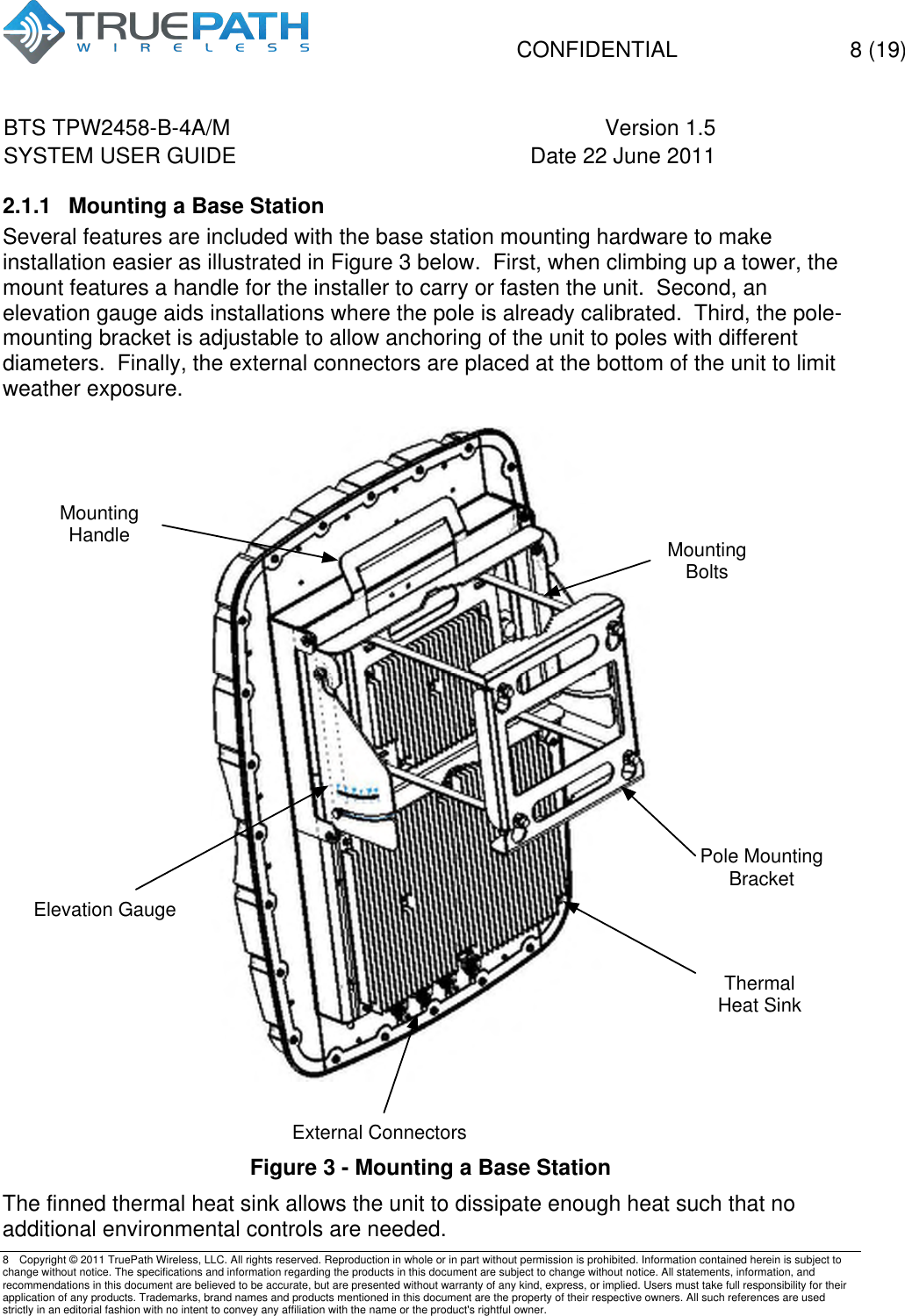
  CONFIDENTIAL  8 (19)  BTS TPW2458-B-4A/M Version 1.5   SYSTEM USER GUIDE Date 22 June 2011    8  Copyright © 2011 TruePath Wireless, LLC. All rights reserved. Reproduction in whole or in part without permission is prohibited. Information contained herein is subject to change without notice. The specifications and information regarding the products in this document are subject to change without notice. All statements, information, and recommendations in this document are believed to be accurate, but are presented without warranty of any kind, express, or implied. Users must take full responsibility for their application of any products. Trademarks, brand names and products mentioned in this document are the property of their respective owners. All such references are used strictly in an editorial fashion with no intent to convey any affiliation with the name or the product's rightful owner.    2.1.1  Mounting a Base Station Several features are included with the base station mounting hardware to make installation easier as illustrated in Figure 3 below.  First, when climbing up a tower, the mount features a handle for the installer to carry or fasten the unit.  Second, an elevation gauge aids installations where the pole is already calibrated.  Third, the pole-mounting bracket is adjustable to allow anchoring of the unit to poles with different diameters.  Finally, the external connectors are placed at the bottom of the unit to limit weather exposure.     Figure 3 - Mounting a Base Station The finned thermal heat sink allows the unit to dissipate enough heat such that no additional environmental controls are needed. Pole Mounting BracketMounting BoltsThermal Heat SinkMounting HandleElevation Gauge External Connectors
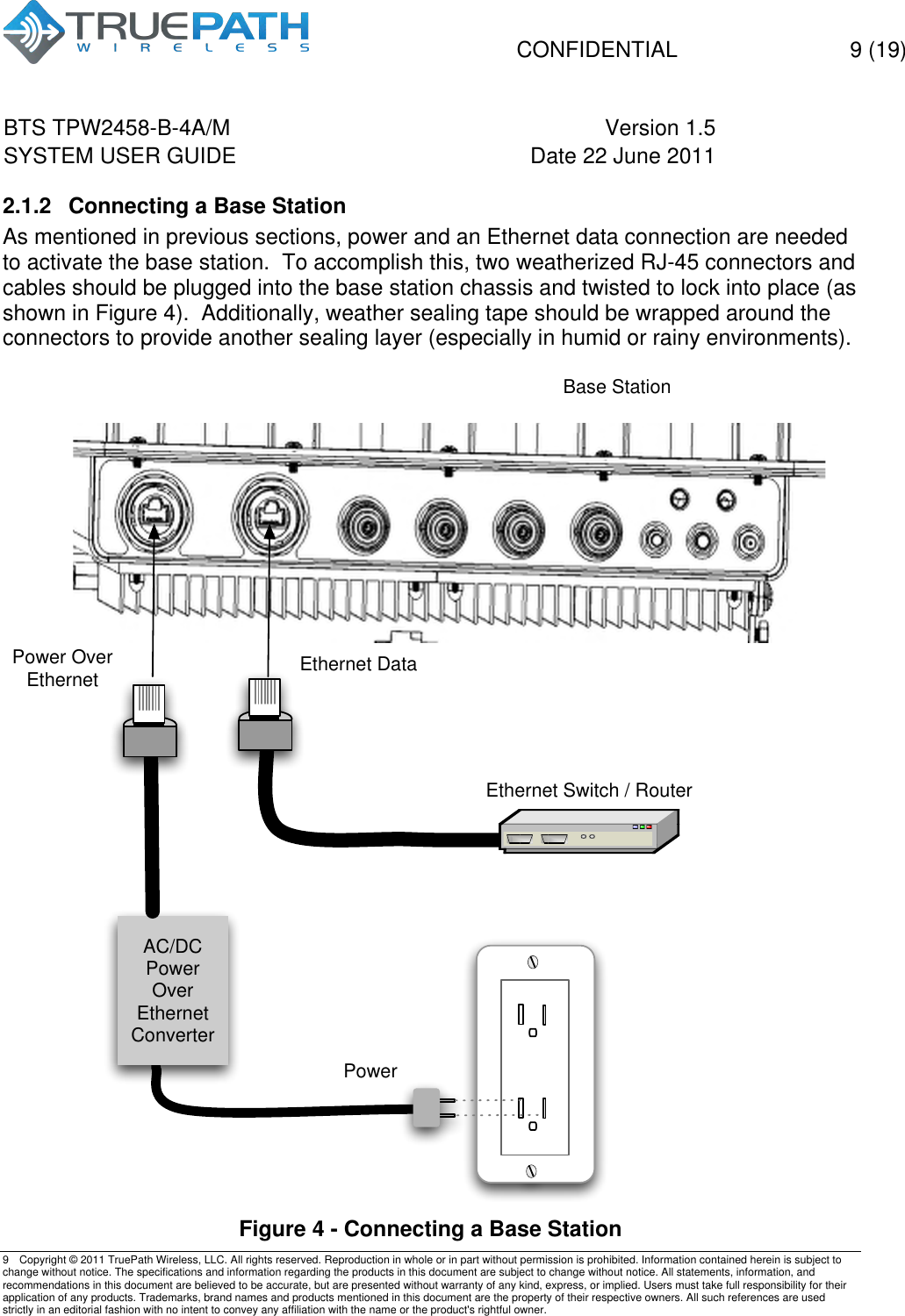
  CONFIDENTIAL  9 (19)  BTS TPW2458-B-4A/M Version 1.5   SYSTEM USER GUIDE Date 22 June 2011    9  Copyright © 2011 TruePath Wireless, LLC. All rights reserved. Reproduction in whole or in part without permission is prohibited. Information contained herein is subject to change without notice. The specifications and information regarding the products in this document are subject to change without notice. All statements, information, and recommendations in this document are believed to be accurate, but are presented without warranty of any kind, express, or implied. Users must take full responsibility for their application of any products. Trademarks, brand names and products mentioned in this document are the property of their respective owners. All such references are used strictly in an editorial fashion with no intent to convey any affiliation with the name or the product's rightful owner.    2.1.2  Connecting a Base Station As mentioned in previous sections, power and an Ethernet data connection are needed to activate the base station.  To accomplish this, two weatherized RJ-45 connectors and cables should be plugged into the base station chassis and twisted to lock into place (as shown in Figure 4).  Additionally, weather sealing tape should be wrapped around the connectors to provide another sealing layer (especially in humid or rainy environments).   Figure 4 - Connecting a Base Station Power Over EthernetAC/DCPower Over EthernetConverterPowerBase StationEthernet Switch / RouterEthernet Data
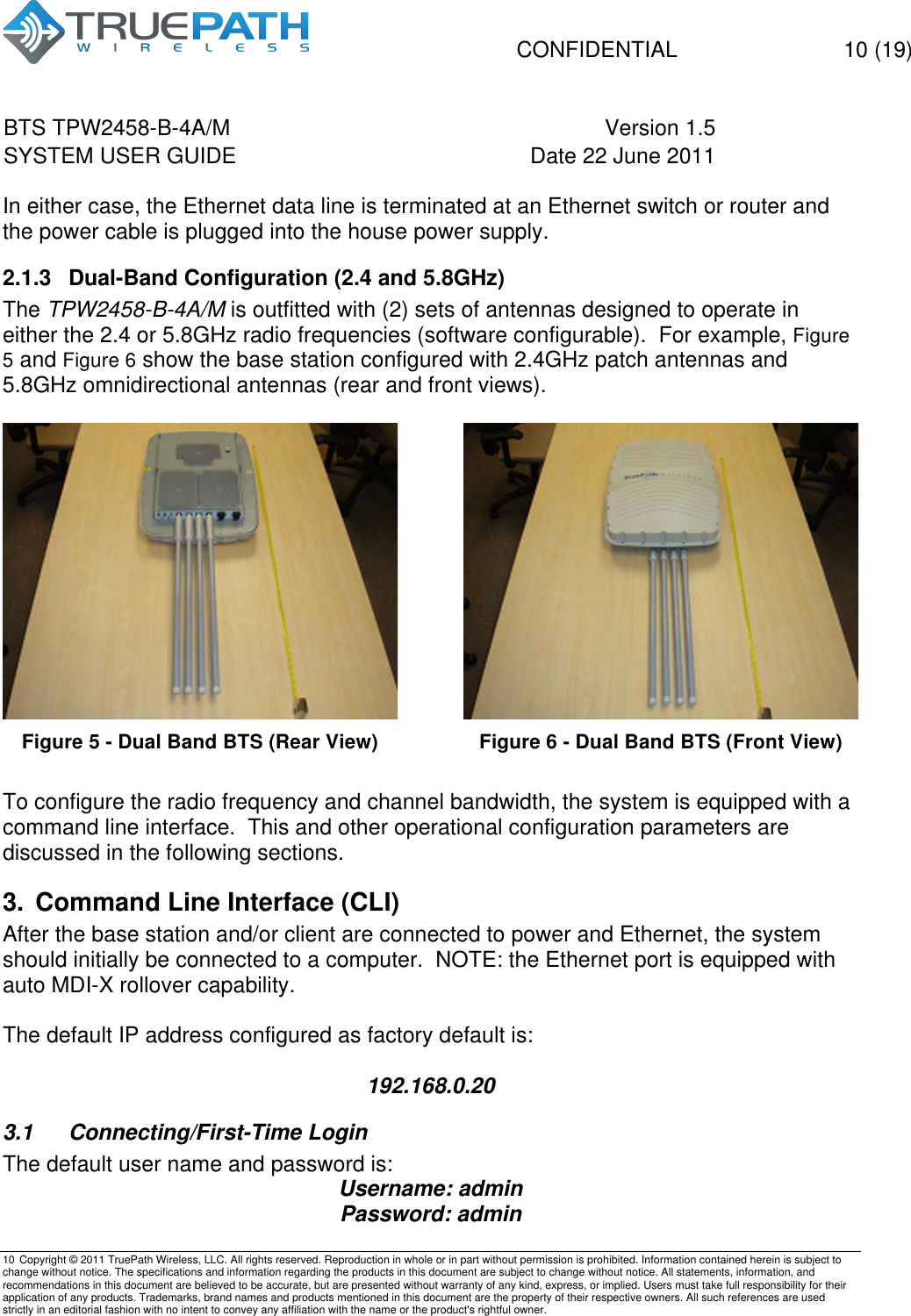
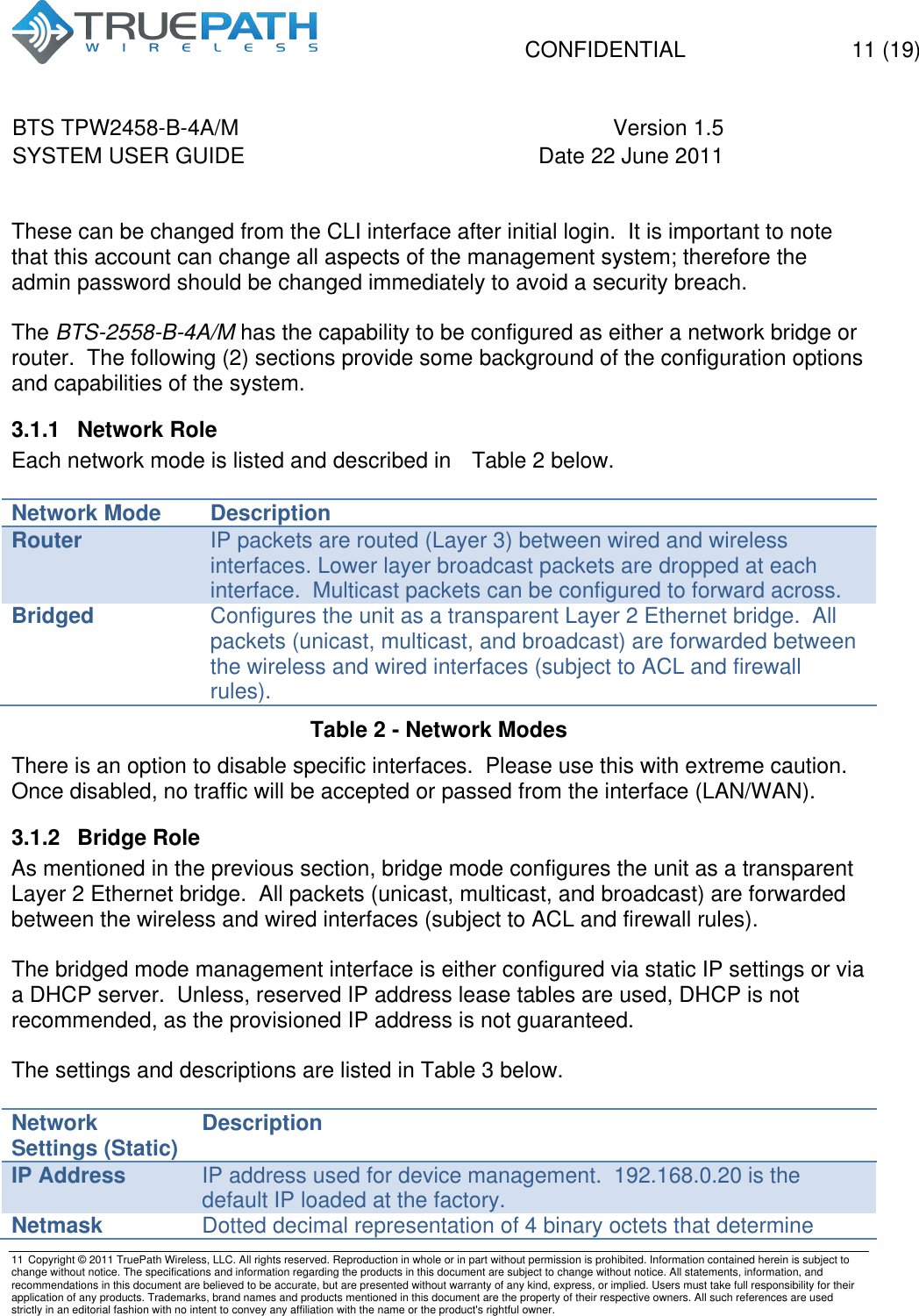
  CONFIDENTIAL  10 (19) BTS TPW2458-B-4A/M Version 1.5   SYSTEM USER GUIDE Date 22 June 2011    10 Copyright © 2011 TruePath Wireless, LLC. All rights reserved. Reproduction in whole or in part without permission is prohibited. Information contained herein is subject to change without notice. The specifications and information regarding the products in this document are subject to change without notice. All statements, information, and recommendations in this document are believed to be accurate, but are presented without warranty of any kind, express, or implied. Users must take full responsibility for their application of any products. Trademarks, brand names and products mentioned in this document are the property of their respective owners. All such references are used strictly in an editorial fashion with no intent to convey any affiliation with the name or the product's rightful owner.    In either case, the Ethernet data line is terminated at an Ethernet switch or router and the power cable is plugged into the house power supply. 2.1.3 Dual-Band Configuration (2.4 and 5.8GHz) The TPW2458-B-4A/M is outfitted with (2) sets of antennas designed to operate in either the 2.4 or 5.8GHz radio frequencies (software configurable).  For example, Figure 5 and Figure 6 show the base station configured with 2.4GHz patch antennas and 5.8GHz omnidirectional antennas (rear and front views).   Figure 5 - Dual Band BTS (Rear View)  Figure 6 - Dual Band BTS (Front View) To configure the radio frequency and channel bandwidth, the system is equipped with a command line interface.  This and other operational configuration parameters are discussed in the following sections. 3. Command Line Interface (CLI) After the base station and/or client are connected to power and Ethernet, the system should initially be connected to a computer.  NOTE: the Ethernet port is equipped with auto MDI-X rollover capability.  The default IP address configured as factory default is:  192.168.0.20 3.1  Connecting/First-Time Login The default user name and password is: Username: admin Password: admin
  CONFIDENTIAL  11 (19) BTS TPW2458-B-4A/M Version 1.5   SYSTEM USER GUIDE Date 22 June 2011    11 Copyright © 2011 TruePath Wireless, LLC. All rights reserved. Reproduction in whole or in part without permission is prohibited. Information contained herein is subject to change without notice. The specifications and information regarding the products in this document are subject to change without notice. All statements, information, and recommendations in this document are believed to be accurate, but are presented without warranty of any kind, express, or implied. Users must take full responsibility for their application of any products. Trademarks, brand names and products mentioned in this document are the property of their respective owners. All such references are used strictly in an editorial fashion with no intent to convey any affiliation with the name or the product's rightful owner.     These can be changed from the CLI interface after initial login.  It is important to note that this account can change all aspects of the management system; therefore the admin password should be changed immediately to avoid a security breach.  The BTS-2558-B-4A/M has the capability to be configured as either a network bridge or router.  The following (2) sections provide some background of the configuration options and capabilities of the system. 3.1.1  Network Role Each network mode is listed and described in   Table 2 below.   Network Mode Description Router IP packets are routed (Layer 3) between wired and wireless interfaces. Lower layer broadcast packets are dropped at each interface.  Multicast packets can be configured to forward across. Bridged Configures the unit as a transparent Layer 2 Ethernet bridge.  All packets (unicast, multicast, and broadcast) are forwarded between the wireless and wired interfaces (subject to ACL and firewall rules).  Table 2 - Network Modes   There is an option to disable specific interfaces.  Please use this with extreme caution.  Once disabled, no traffic will be accepted or passed from the interface (LAN/WAN). 3.1.2 Bridge Role As mentioned in the previous section, bridge mode configures the unit as a transparent Layer 2 Ethernet bridge.  All packets (unicast, multicast, and broadcast) are forwarded between the wireless and wired interfaces (subject to ACL and firewall rules).  The bridged mode management interface is either configured via static IP settings or via a DHCP server.  Unless, reserved IP address lease tables are used, DHCP is not recommended, as the provisioned IP address is not guaranteed.  The settings and descriptions are listed in Table 3 below.  Network Settings (Static) Description IP Address IP address used for device management.  192.168.0.20 is the default IP loaded at the factory. Netmask Dotted decimal representation of 4 binary octets that determine
  CONFIDENTIAL  12 (19) BTS TPW2458-B-4A/M Version 1.5   SYSTEM USER GUIDE Date 22 June 2011    12 Copyright © 2011 TruePath Wireless, LLC. All rights reserved. Reproduction in whole or in part without permission is prohibited. Information contained herein is subject to change without notice. The specifications and information regarding the products in this document are subject to change without notice. All statements, information, and recommendations in this document are believed to be accurate, but are presented without warranty of any kind, express, or implied. Users must take full responsibility for their application of any products. Trademarks, brand names and products mentioned in this document are the property of their respective owners. All such references are used strictly in an editorial fashion with no intent to convey any affiliation with the name or the product's rightful owner.    which part of address is the network and that of the host (the mask).    For example, 255.255.255.0 is the most common mask used. Gateway IP Represents the address to send non-local data to.  The local network means any network that is configured on the device (i.e. bridge IP network). In bridge mode, this IP address must be in the same space as the bridge IP network. Table 3 - Network Settings (Static) In bridge network role, the gateway IP address also shows up in the static route table (covered in a later section). 3.1.2.1  Common Network Settings In addition to addressing, there are several network settings that are commonly configured in bridge network role.  These include spanning tree protocol and IP aliasing.  A list and description of each is in Table 4.  Network Settings (Common) Description Spanning Tree Protocol (STP) IEEE 802.1d protocol that works on bridged interfaces to find the shortest path between to stations.  Also, detects and blocks loops by preventing the same hardware/MAC address from being accepted from a port that it has transmitted the same address from. Table 4 - Network Settings (Common) 3.1.3  Router Role IP packets are routed (Layer 3) between wired and wireless interfaces. Lower layer broadcast packets are dropped at each interface.  Below (Table 5) is a list of settings and descriptions that are specific to the wireless LAN (WLAN) interface when the device is configured in a router role.  Network Settings Description IP Address IP address used for device management.  It is accessible from the wireless LAN (WLAN) interface. Netmask Dotted decimal representation of 4 binary octets that determine which part of address is the network and that of the host (the mask).    For example, 255.255.255.0 is the most common mask used. Table 5 - WLAN Network Settings
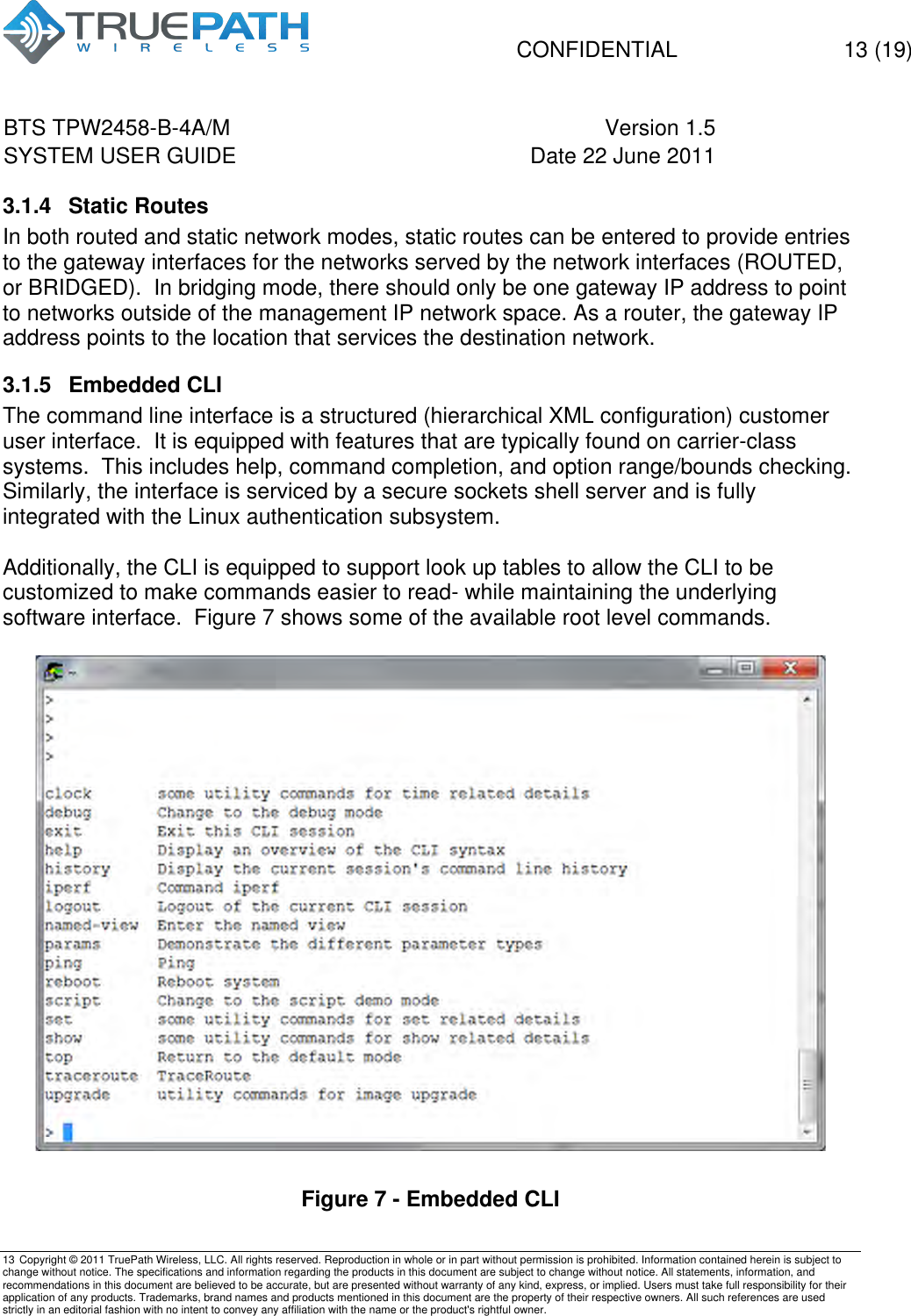
  CONFIDENTIAL  13 (19) BTS TPW2458-B-4A/M Version 1.5   SYSTEM USER GUIDE Date 22 June 2011    13 Copyright © 2011 TruePath Wireless, LLC. All rights reserved. Reproduction in whole or in part without permission is prohibited. Information contained herein is subject to change without notice. The specifications and information regarding the products in this document are subject to change without notice. All statements, information, and recommendations in this document are believed to be accurate, but are presented without warranty of any kind, express, or implied. Users must take full responsibility for their application of any products. Trademarks, brand names and products mentioned in this document are the property of their respective owners. All such references are used strictly in an editorial fashion with no intent to convey any affiliation with the name or the product's rightful owner.    3.1.4  Static Routes  In both routed and static network modes, static routes can be entered to provide entries to the gateway interfaces for the networks served by the network interfaces (ROUTED, or BRIDGED).  In bridging mode, there should only be one gateway IP address to point to networks outside of the management IP network space. As a router, the gateway IP address points to the location that services the destination network. 3.1.5  Embedded CLI  The command line interface is a structured (hierarchical XML configuration) customer user interface.  It is equipped with features that are typically found on carrier-class systems.  This includes help, command completion, and option range/bounds checking.  Similarly, the interface is serviced by a secure sockets shell server and is fully integrated with the Linux authentication subsystem.  Additionally, the CLI is equipped to support look up tables to allow the CLI to be customized to make commands easier to read- while maintaining the underlying software interface.  Figure 7 shows some of the available root level commands.   Figure 7 - Embedded CLI
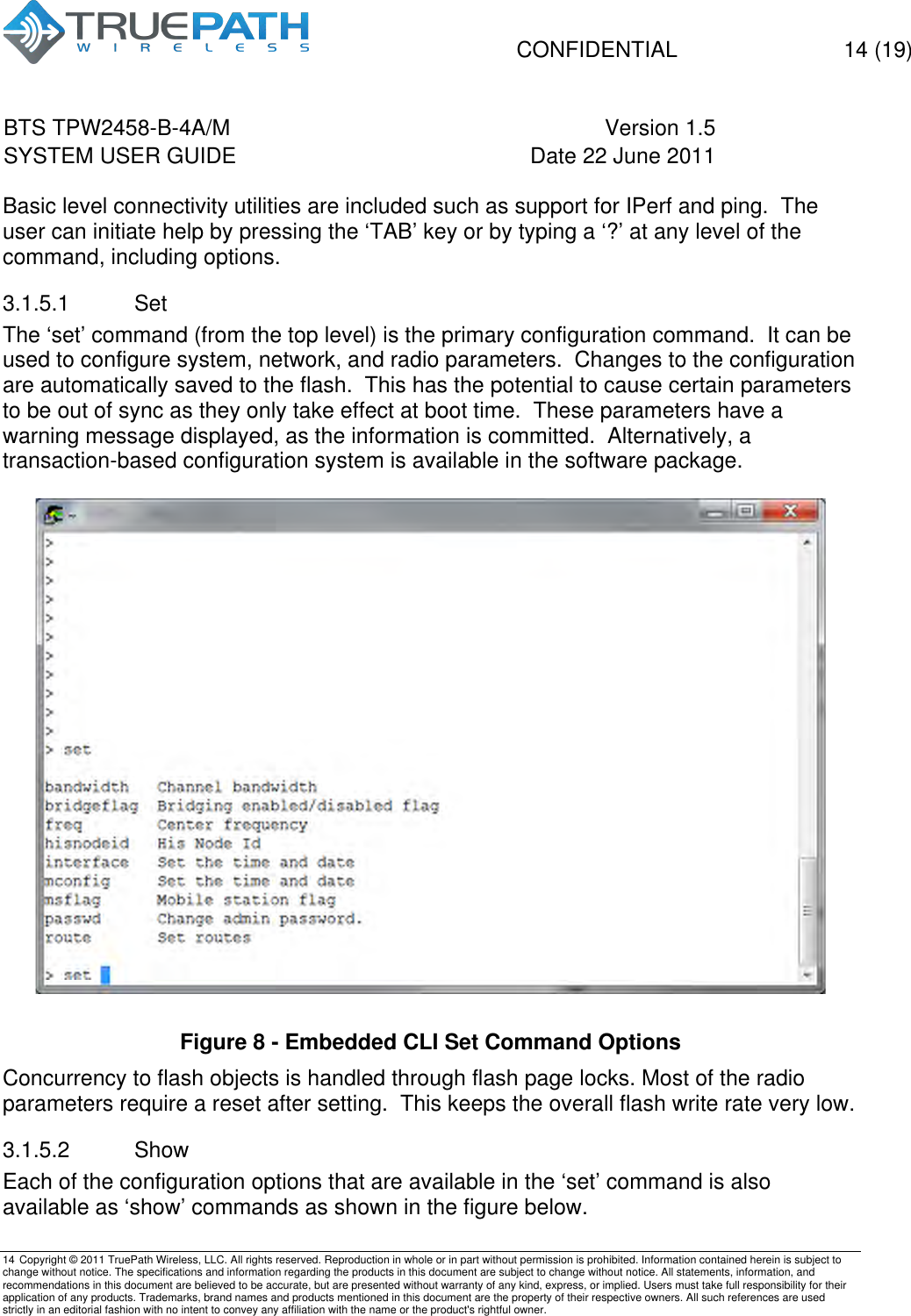
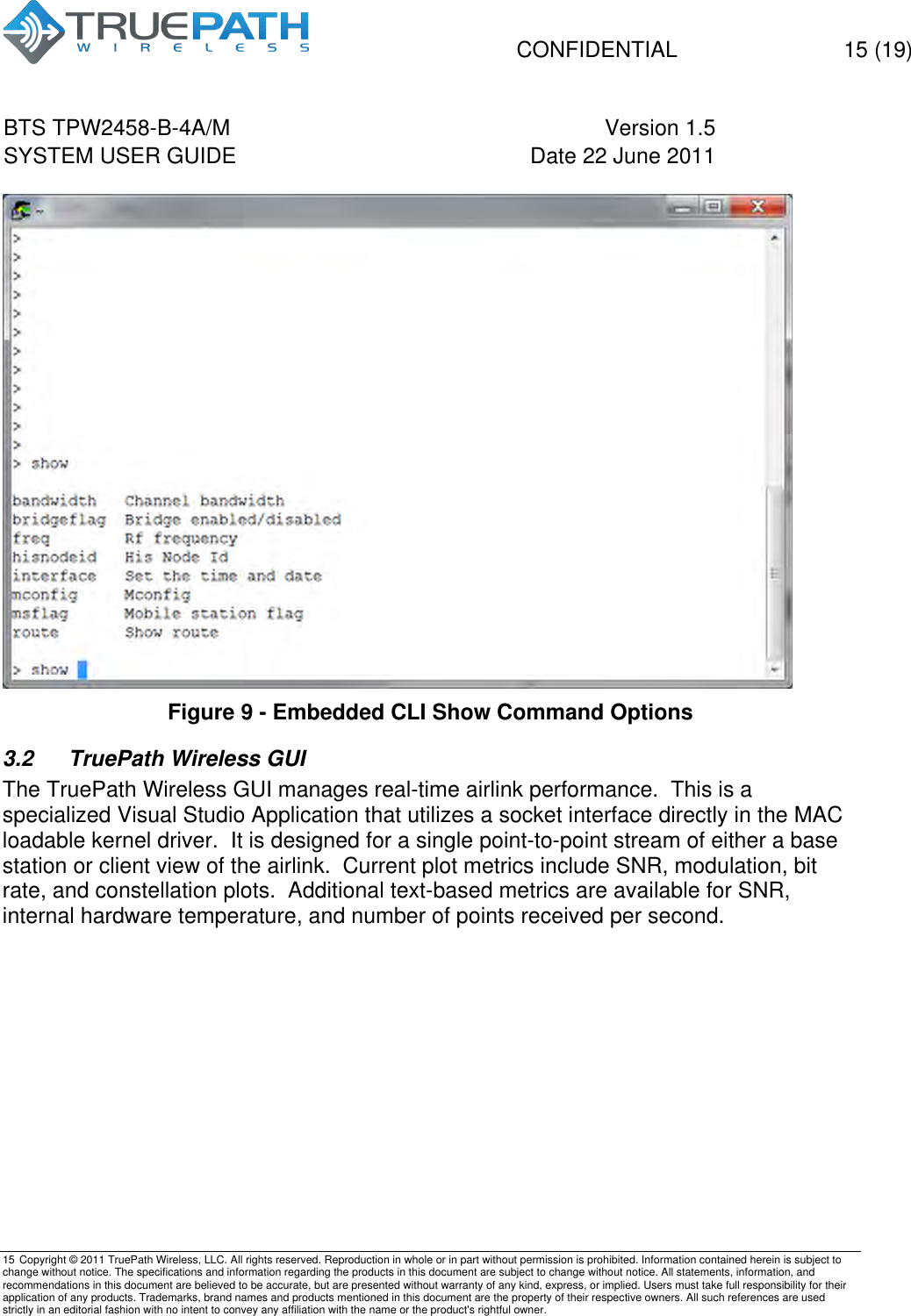
  CONFIDENTIAL  14 (19) BTS TPW2458-B-4A/M Version 1.5   SYSTEM USER GUIDE Date 22 June 2011    14 Copyright © 2011 TruePath Wireless, LLC. All rights reserved. Reproduction in whole or in part without permission is prohibited. Information contained herein is subject to change without notice. The specifications and information regarding the products in this document are subject to change without notice. All statements, information, and recommendations in this document are believed to be accurate, but are presented without warranty of any kind, express, or implied. Users must take full responsibility for their application of any products. Trademarks, brand names and products mentioned in this document are the property of their respective owners. All such references are used strictly in an editorial fashion with no intent to convey any affiliation with the name or the product's rightful owner.    Basic level connectivity utilities are included such as support for IPerf and ping.  The user can initiate help by pressing the ‘TAB’ key or by typing a ‘?’ at any level of the command, including options. 3.1.5.1  Set The ‘set’ command (from the top level) is the primary configuration command.  It can be used to configure system, network, and radio parameters.  Changes to the configuration are automatically saved to the flash.  This has the potential to cause certain parameters to be out of sync as they only take effect at boot time.  These parameters have a warning message displayed, as the information is committed.  Alternatively, a transaction-based configuration system is available in the software package.   Figure 8 - Embedded CLI Set Command Options Concurrency to flash objects is handled through flash page locks. Most of the radio parameters require a reset after setting.  This keeps the overall flash write rate very low. 3.1.5.2  Show Each of the configuration options that are available in the ‘set’ command is also available as ‘show’ commands as shown in the figure below.
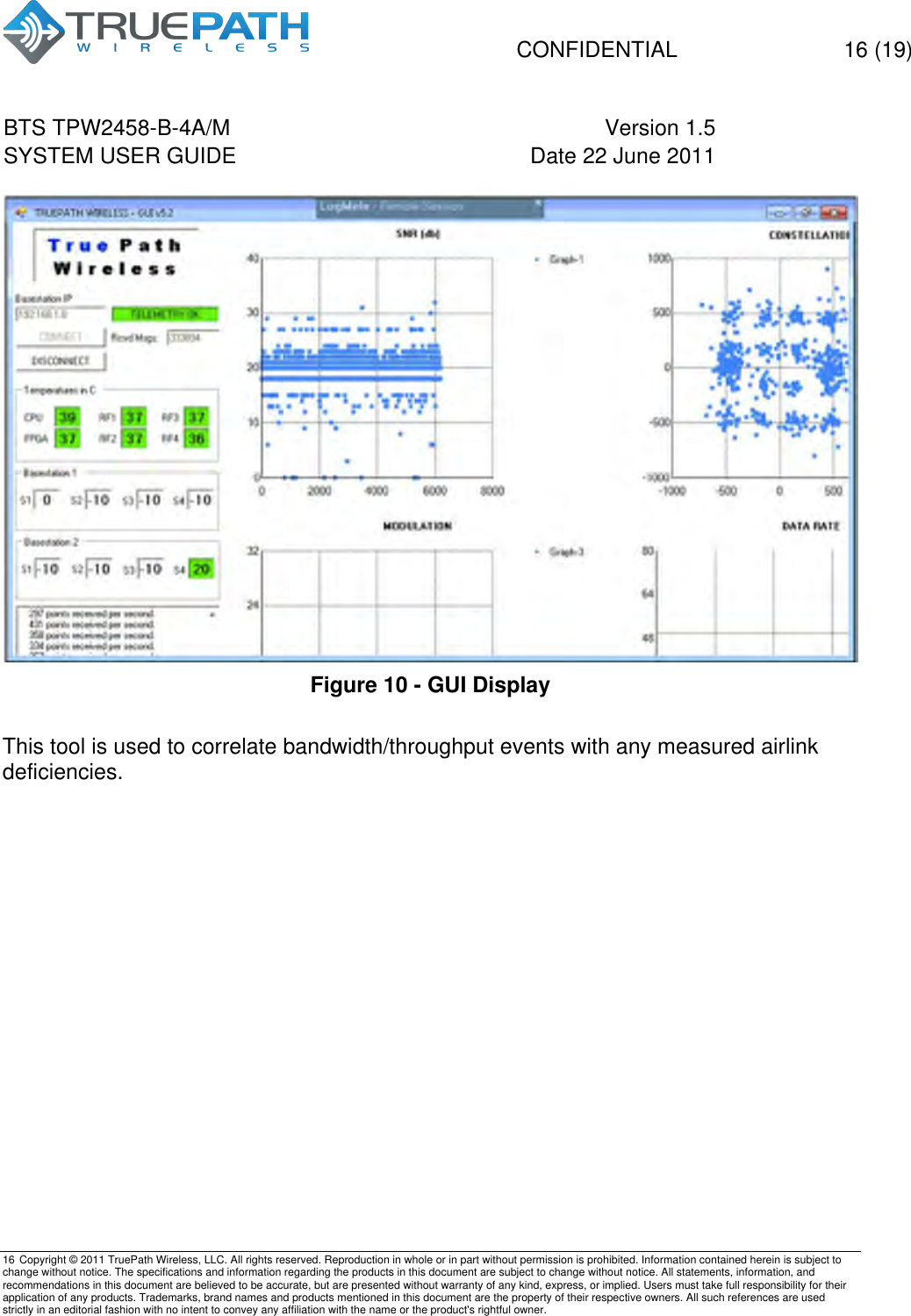
  CONFIDENTIAL  15 (19) BTS TPW2458-B-4A/M Version 1.5   SYSTEM USER GUIDE Date 22 June 2011    15 Copyright © 2011 TruePath Wireless, LLC. All rights reserved. Reproduction in whole or in part without permission is prohibited. Information contained herein is subject to change without notice. The specifications and information regarding the products in this document are subject to change without notice. All statements, information, and recommendations in this document are believed to be accurate, but are presented without warranty of any kind, express, or implied. Users must take full responsibility for their application of any products. Trademarks, brand names and products mentioned in this document are the property of their respective owners. All such references are used strictly in an editorial fashion with no intent to convey any affiliation with the name or the product's rightful owner.     Figure 9 - Embedded CLI Show Command Options 3.2  TruePath Wireless GUI The TruePath Wireless GUI manages real-time airlink performance.  This is a specialized Visual Studio Application that utilizes a socket interface directly in the MAC loadable kernel driver.  It is designed for a single point-to-point stream of either a base station or client view of the airlink.  Current plot metrics include SNR, modulation, bit rate, and constellation plots.  Additional text-based metrics are available for SNR, internal hardware temperature, and number of points received per second.
  CONFIDENTIAL  16 (19) BTS TPW2458-B-4A/M Version 1.5   SYSTEM USER GUIDE Date 22 June 2011    16 Copyright © 2011 TruePath Wireless, LLC. All rights reserved. Reproduction in whole or in part without permission is prohibited. Information contained herein is subject to change without notice. The specifications and information regarding the products in this document are subject to change without notice. All statements, information, and recommendations in this document are believed to be accurate, but are presented without warranty of any kind, express, or implied. Users must take full responsibility for their application of any products. Trademarks, brand names and products mentioned in this document are the property of their respective owners. All such references are used strictly in an editorial fashion with no intent to convey any affiliation with the name or the product's rightful owner.     Figure 10 - GUI Display  This tool is used to correlate bandwidth/throughput events with any measured airlink deficiencies.
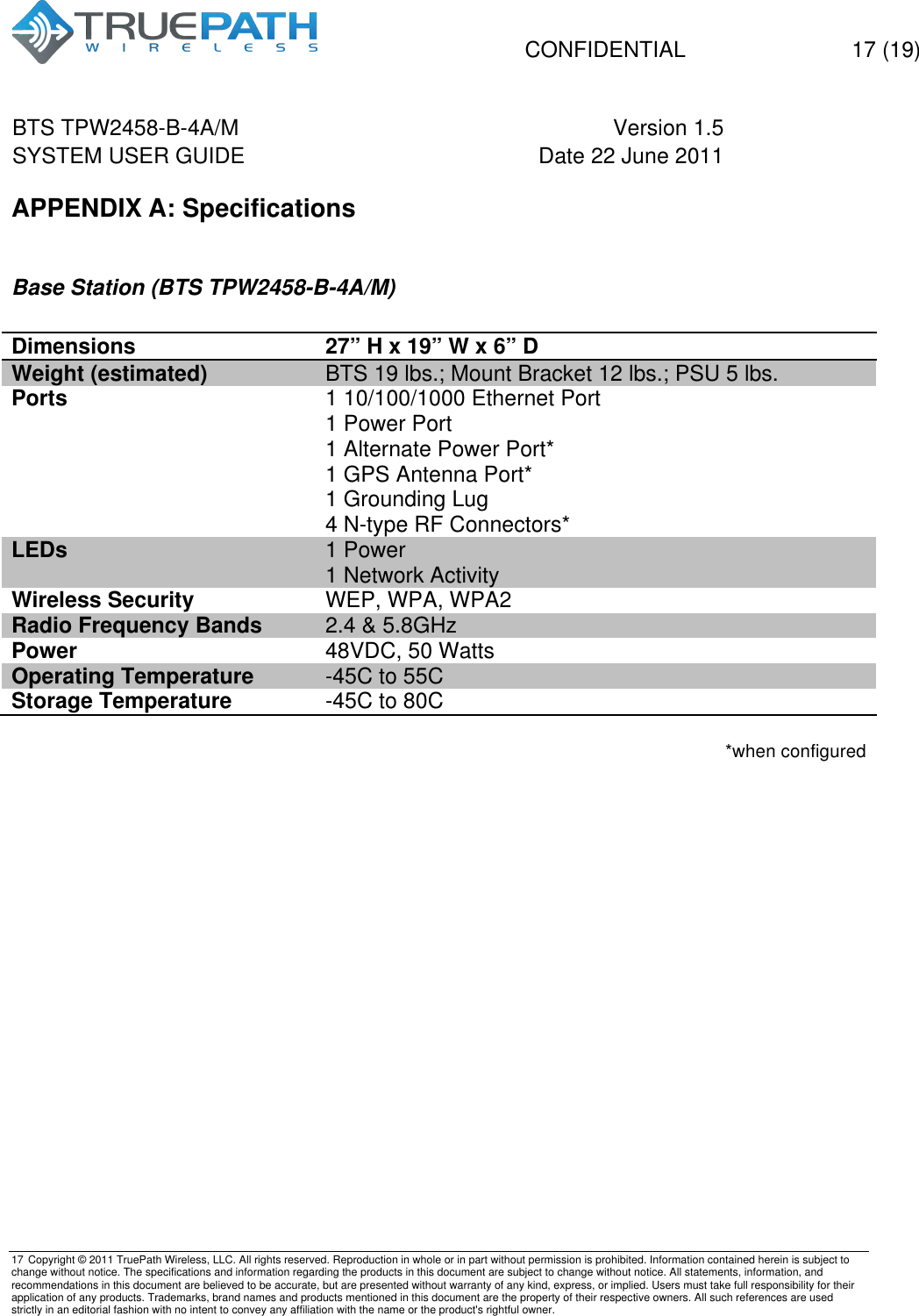
  CONFIDENTIAL  17 (19) BTS TPW2458-B-4A/M Version 1.5   SYSTEM USER GUIDE Date 22 June 2011    17 Copyright © 2011 TruePath Wireless, LLC. All rights reserved. Reproduction in whole or in part without permission is prohibited. Information contained herein is subject to change without notice. The specifications and information regarding the products in this document are subject to change without notice. All statements, information, and recommendations in this document are believed to be accurate, but are presented without warranty of any kind, express, or implied. Users must take full responsibility for their application of any products. Trademarks, brand names and products mentioned in this document are the property of their respective owners. All such references are used strictly in an editorial fashion with no intent to convey any affiliation with the name or the product's rightful owner.    APPENDIX A: Specifications  Base Station (BTS TPW2458-B-4A/M)  Dimensions 27” H x 19” W x 6” D Weight (estimated) BTS 19 lbs.; Mount Bracket 12 lbs.; PSU 5 lbs. Ports 1 10/100/1000 Ethernet Port 1 Power Port 1 Alternate Power Port* 1 GPS Antenna Port* 1 Grounding Lug 4 N-type RF Connectors* LEDs 1 Power 1 Network Activity Wireless Security WEP, WPA, WPA2 Radio Frequency Bands   2.4 & 5.8GHz Power 48VDC, 50 Watts Operating Temperature -45C to 55C Storage Temperature -45C to 80C  *when configured
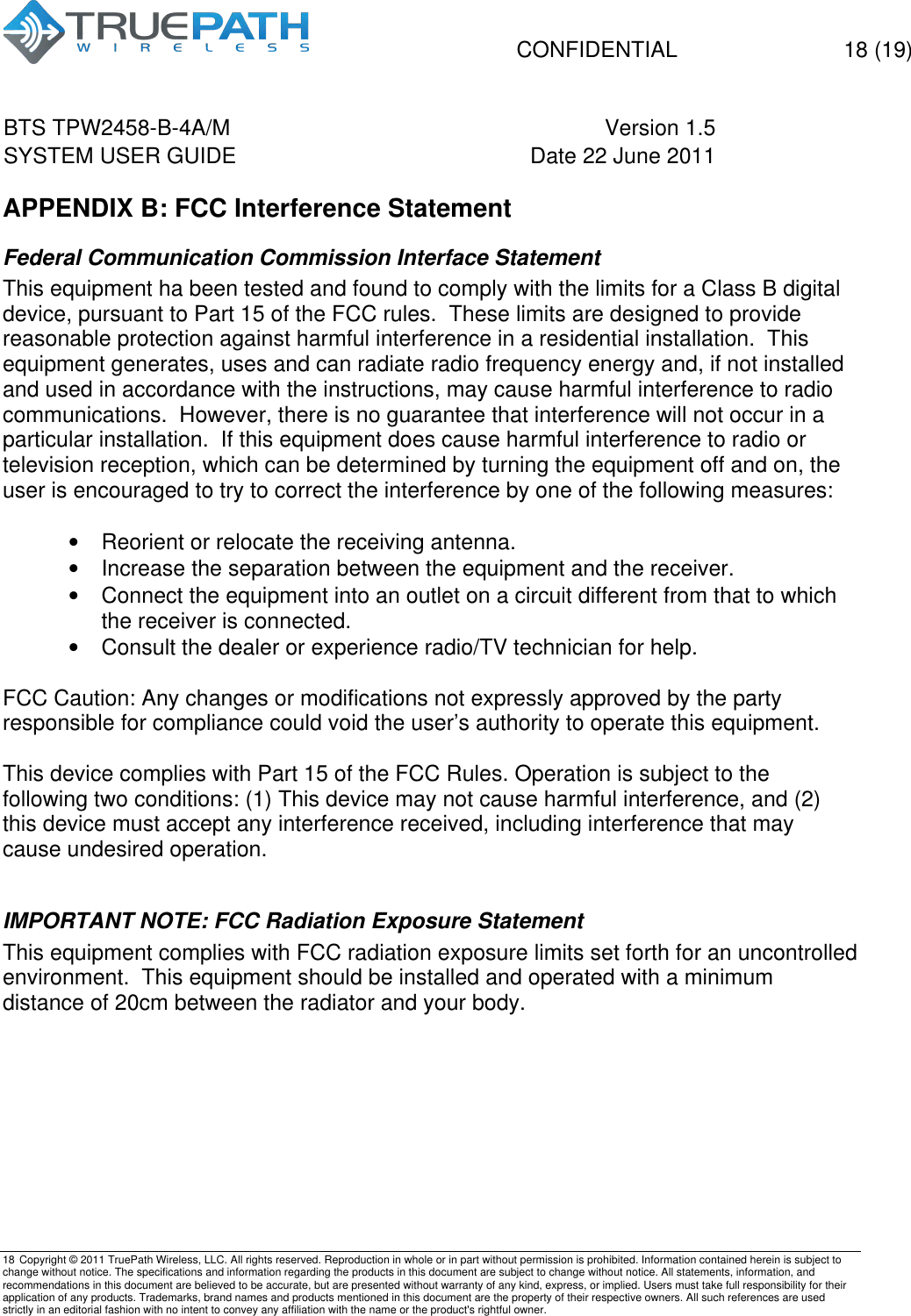
  CONFIDENTIAL  18 (19) BTS TPW2458-B-4A/M Version 1.5   SYSTEM USER GUIDE Date 22 June 2011    18 Copyright © 2011 TruePath Wireless, LLC. All rights reserved. Reproduction in whole or in part without permission is prohibited. Information contained herein is subject to change without notice. The specifications and information regarding the products in this document are subject to change without notice. All statements, information, and recommendations in this document are believed to be accurate, but are presented without warranty of any kind, express, or implied. Users must take full responsibility for their application of any products. Trademarks, brand names and products mentioned in this document are the property of their respective owners. All such references are used strictly in an editorial fashion with no intent to convey any affiliation with the name or the product's rightful owner.    APPENDIX B: FCC Interference Statement Federal Communication Commission Interface Statement This equipment ha been tested and found to comply with the limits for a Class B digital device, pursuant to Part 15 of the FCC rules.  These limits are designed to provide reasonable protection against harmful interference in a residential installation.  This equipment generates, uses and can radiate radio frequency energy and, if not installed and used in accordance with the instructions, may cause harmful interference to radio communications.  However, there is no guarantee that interference will not occur in a particular installation.  If this equipment does cause harmful interference to radio or television reception, which can be determined by turning the equipment off and on, the user is encouraged to try to correct the interference by one of the following measures:  •  Reorient or relocate the receiving antenna. •  Increase the separation between the equipment and the receiver. •  Connect the equipment into an outlet on a circuit different from that to which the receiver is connected. •  Consult the dealer or experience radio/TV technician for help.  FCC Caution: Any changes or modifications not expressly approved by the party responsible for compliance could void the user’s authority to operate this equipment.  This device complies with Part 15 of the FCC Rules. Operation is subject to the following two conditions: (1) This device may not cause harmful interference, and (2) this device must accept any interference received, including interference that may cause undesired operation.  IMPORTANT NOTE: FCC Radiation Exposure Statement This equipment complies with FCC radiation exposure limits set forth for an uncontrolled environment.  This equipment should be installed and operated with a minimum distance of 20cm between the radiator and your body.
  CONFIDENTIAL  19 (19) BTS TPW2458-B-4A/M Version 1.5   SYSTEM USER GUIDE Date 22 June 2011    19 Copyright © 2011 TruePath Wireless, LLC. All rights reserved. Reproduction in whole or in part without permission is prohibited. Information contained herein is subject to change without notice. The specifications and information regarding the products in this document are subject to change without notice. All statements, information, and recommendations in this document are believed to be accurate, but are presented without warranty of any kind, express, or implied. Users must take full responsibility for their application of any products. Trademarks, brand names and products mentioned in this document are the property of their respective owners. All such references are used strictly in an editorial fashion with no intent to convey any affiliation with the name or the product's rightful owner.    APPENDIX C: Support/Contact Information  TruePath Wireless Support TruePath Wireless Support Engineers are located in the U.S. and are dedicated to helping customers resolve issues as quickly as possible.   Please email all issues and requests to:  Email: support@truepathwireless.com       2620 Augustine Drive, Suite 260 Santa Clara, CA 95054-2920 USA © 2011 TruePath Wireless, LLC

Navigation menu