Tsann Kuen Enterprise TSK840XA Microwave Oven User Manual
Tsann Kuen Enterprise Co., Ltd. Microwave Oven
User Manual

MICROWAVE OVEN 1
MICROWAVE OVEN
OWNER’S MANUAL&COOLING GUIDE
PLEASE READ THIS OWENER’S MANUAL THOROUGHLY BEFORE OPERATNG.
PRECAUTIONS TO AVOID POSSIBLE EXPOSURE TO EXCESSIVE
MICROWAVE ENERGRY
(a) Do not attempt to operate this oven with the door open since open-door operation can
result in harmful exposure to microwave energy. It is important not to defeat or tamper
with the safety interlocks.
(b) Do not place any object between the oven front face and the door or allow soil or
cleaner residue to accumulate on sealing surface.
(c) Do not operate the oven if it is damaged. It is particularly important that the oven door
close properly and that there is no damage to the:
(1) Door (bent);
(2) Hinges and lathes (broken or loosened);
(3) Door seals and sealing surfaces.
(d) The oven should not be adjusted or repaired by anyone except properly qualified
service personnel.
CONTENTS
TECHNICAL SPECIFICATIONS
IMPORTANT SAFETY INSTRUCTIONS
INSTALLTION
OTHER HELPFUL INFORMATION
PRECAUTIONS
GETTING THE BEST RESULT FROM YOUR MOCROWAVE OVEN
SPECIAL TECHNIQUES IN MICROWAVE COOKING
HOW FOOD CHARACTERISTICS AFFECT MICROWAVE COOKING
MICROWAVE OVEN 2
COOKING UTENSILS
FEATURE DIAGRAM
CONTROL PANEL
OPERATION CHECK
OPERATING INSTRUCTIONS
HEATING OR REHEATING GUIDE
FREASH VEGETABLE CHART
CLEANING
BEFORE CALLING FOR SERVICE
WARRANTY
TECHNICAL SPECIFICATIONS
Power Supply 120 V AC, 60 Hz
Rated Power Consumption 1150W
Microwave Output 700W
Frequency 2450 MHz
Rated Current 8.5A
Overall Dimensions 181/2ϣѼ121/4 ϣѼ111/32ϣ
Oven Cavity Dimensions 123/16ϣѼ731/32ϣѼ115/8ϣ
Effective Capacity of Oven Cavity 0.6 Cu.Ft
IMPORTANNT SAFETY INSTRUCTIONS
WARNING – To reduce the risk of burns, electric shock, fire, injury to persons, or
exposure to excessive microwave energy:
1. Read all instructions before using the appliance.
2. Read and follow the specific PRECAUTIONS TO AVOID POSSIBLE
EXPOSURE TO EXCESSIVE MICROWAVE ENERGRY found on
page 2 this manual.
3. This appliance must be grounded. Connect only to properly grounded outlet.
See GROUNDING INSTRUCTIONS found on page 5 of this manual.
4. Install or locate this appliance only in accordance with the provided instructions.
5. Some products, such as whole eggs and sealed containers – for example, closed
glass jars – may explode and should not be heated in this oven.
6. Use this appliance only for its intended use as described in the manual. Do not use

MICROWAVE OVEN 3
corrosive chemicals or vapors in this appliance. This type of oven is specifically
designed to heat, cook, or dry food. It is not designed for industrial or laboratory use.
7. As with any appliance, close supervision necessary when used by children.
8. Do not operate this appliance if it has a damaged cord or plug, if it is not working
properly, or if it has been damaged or dropped.
9. This appliance should be serviced only by qualified service personnel. Contact the
nearest authorized service facility for examination, repair, or adjustment.
10. Do not cover or block any openings on the appliance.
11. Do not store this appliance outdoors. Do not use this product neat water – for example,
neat a kitchen sink, in a wet basement, or meat a swimming pool, and the like.
12. Do not immerse cord or plug in water.
13. Keep cord away from heated surface.
14. Do not let cord hang over the edge of table or counter.
15. When cleaning surfaces of door and oven that comes together on closing the door,
use only mind, nonabrasive soaps or detergents applied with a sponge or soft cloth.
16. To reduce the risk of fire in the oven cavity:
a. Do not overcook food. Carefully attend appliance if paper, plastic, or other
combustible materials are placed inside the oven to facilitate cooking.
b. Remove wire twist-ties from paper or plastic bags before placing bag in oven.
c. If materials inside the oven should ignite, KEEP OVEN DOOR CLOSED, turn
oven off, and disconnect the power cord or shut off power at the fuse or circuit
breaker panel.
d. Do not use the cavity for storage purposes. Do not leave paper products, cooking
utensils, or food in the cavity when not in use.
17. Do not heat any type of baby bottles or baby food. Uneven heating may occur and
could cause personal injury.
18. Avoid heating small-necked containers such as syrup bottles.
19. Avoid using corrosive and vapors, such as sulfide and chloride.
20. Liquids heated in certain shaped containers (especially cylindrical-shaped containers)
may become overheated. The liquid may splash out with a loud noise during or after
heating or when adding ingredients (instant coffee, etc.) , result in harm to oven and
possible injury. In all containers, for best results, stir the liquid several times before
heating. Always stir liquid several times between reheatings.
SAVE THESE INSTRUCTIONS
MICROWAVE OVEN 4
INSTALLATION
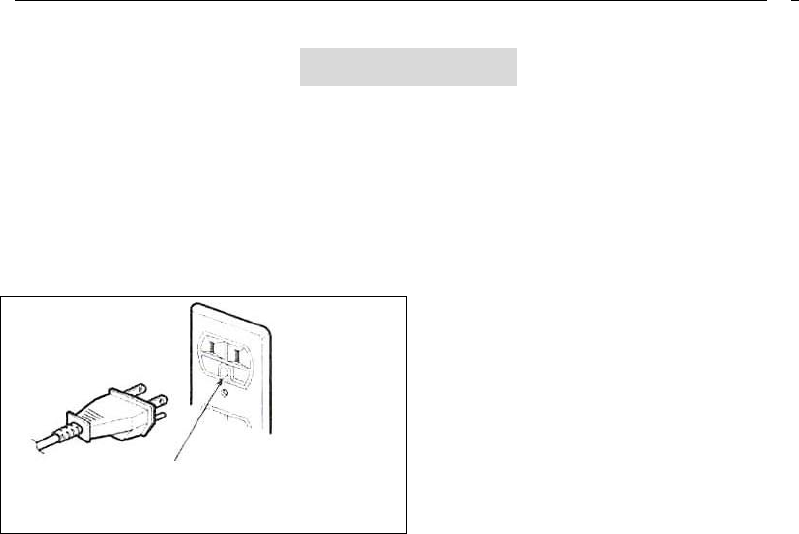
A. GROUDING INSTRUCTION
This appliance must be grounded. In the event of an electrical short circuit, grounding
reduces the risk if electric shock by providing an escape wire for the electric current. This
appliance is equipped with a grounding plug. The plug must be plugged into an outlet that
is properly installed and grounded.
Ensure proper ground exists before
use
B. CIRCUITS
For safety purposes this oven must be plugged into a 15 Amp circuit. No other electrical
appliances or lighting circuits should be on this line. If in doubt, consult a licensed
electrician.
C. VOLTAGE WARNING
The voltage used at the wall receptacle must be the same as specified on the oven name
plate located in the back or on the side of the control panel of the oven. Use of a higher
voltage is dangerous and may result in a fire or other type of cause slow cooking. In case
your microwave oven does not perform normally in spite of proper voltage, remove and
reinsert the plug.
D. PLACEMENT OF THE OVEN
Your microwave oven can be placed easily in your kitchen, family room, or anywhere else
in your home. Place the oven in a flat surface such as a kitchen countertop or a specially
designed microwave oven cart. Do not place oven above a gas or electric range. Free air
flow around the oven is important.
E. DO NOT BLOCK AIR VENTS
All air vents should be kept clear during cooking. If air vents are covered during oven
operation the oven may overheat. In this case, a sensitive thermal safety device
automatically turns the oven off. The oven will be inoperable until it has cooled sufficiently.
F. RADIO INTERFERENCE
1. Microwave oven operation may interfere with TV or radio reception.
2. When there is interference, it may be reduced or eliminated by taking the follow
measure:
a. Clean the door and the sealing surfaces of the oven.

MICROWAVE OVEN 5
b. Reorient the receiving antenna of radio or television.
c. Relocate the microwave oven on relation to TV or radio.
d. Move the microwave oven away from the receiver.
e. Plug the microwave oven into a different outlet so that microwave oven and
receiver are on different branch circuits.
WARNING
Improper grounding can result in a risk of electric shock. Consult a qualified electrician if
the grounding instructions are not completely understood, or if doubt exists as to whether
the appliance is properly grounded, and either:
1. If it is necessary to use an extension cord, use only a 3-wire extension cord that has a
3-blade grounding plug, and a 3-slot receptacle that will accept the plug on the
appliance. The marked rating of the extension cord shall be equal to or greater than
the electrical rating of the appliances, or…
2. Do not use an extension cord. If the power supply cord is too short, have a qualified
electrician or serviceman install an outlet near the appliance.
NOTE:
1. A short power-supply cord is provided to reduce the risks resulting form becoming
entangled in or tripping oven a longer cord.
2. Longer cord sets or extension cords are available and may be used of care is
exercised in their use.
3. If a long cord or extension cord is used, (1) the marked electrical rating of the cord set
or extension cord should be at least as great as the electrical rating of appliance, (2)
the extension cord must be a grounding-type 3-wire cord, and (3) the longer cord
should be arranged so that it will not drape over the countertop or tabletop where it
can be pulled on by children or tripped over accidentally.
OTHER HELPFUL INFORMATION
PRECAUTIONS
* Be certain to place the front surface of the door three inches away or more from the
countertop edge to avoid accidental tipping of the appliance in normal usage.
* Be careful when taking the cooking utensils out of the oven. Some dishes absorb heat
from the cooked food and may be hot.
* Do not rinse cooking utensils by immediately placing them into water just after cooking.
This may cause breakage. Allow the turntable to cool.
* Use only specific glass utensils. See cooking utensils section in this manual.

MICROWAVE OVEN 6
* Do not operate the oven empty. Either food or water should always be in the oven during
operation to absorb microwave energy.
* Do not use your microwave oven to dry newspapers or clothes. They can catch fire.
* Use only thermometers approved for microwave oven cooking.
* Be certain the turntable is in place when you operate the oven.
* Pierce the skin of potatoes, whole squash, apples, or any fruit or vegetable, which has a
skin covering before cooking.
* Never use your microwave oven to cook eggs in the shell. Pressure can build up inside
the shell causing it to burst.
* Do not pop popcorn, except in a microwave-safe container or commercial package
designed especially for microwave ovens. Never try to pop popcorn on a paper bag not
designed for microwave oven use. Overcooking may result in smoke and fire. Do not
repop unpopped kernels. Do not reuse popcorn bags.
GETTING THE BEST RESULTS FROM YOUR MICROWAVE
OVEN
Keep an eye on things. The instructions in this book have been formulated with
great care, but your success in preparing them depends, of course, on how much
attention you pay to the food as it cooks. Always watch your food while it cooks. Your
microwave oven is equipped with a light that turns on automatically when the oven is in
operation so that you can see inside and check the progress of your recipe. Directions
given on recipes to elevate, stir, and the like should be thought of as the minimum steps
recommended. If the food seems to be cooking unevenly, simply make the necessary
adjustments you think appropriate to correct the problem.
Factors affecting cooking times. Many factors affect cooking times. The temperature of
ingredients used in a recipe makes a big difference in cooking times. For example, a dish
made with ice-cold butter, milk, and eggs will take considerably longer to bake than one
made with ingredients that are at room temperature. All of the recipes in this book give a
range of food remain under-cooked at the lower end of cooking times. In general, you will
find that the food remains under-cooked at the lower end of the time range, and you may
sometimes want to cook your food beyond the maximum time given, according to
personal preference. The governing philosophy of this book is that it is best for a recipe to
be conservative in giving cooking times. While undercooked food may always be cooked
a bit more, overcooked food is ruined for good. Some of the recipes, particularly those for
casseroles and custard, recommend that food be removed from the oven when they are
slightly undercooked. This is not mistake. When allowed to stand, usually covered, these
foods will continue to cook outside of the oven as the heat trapped within the outer
portions of the foods gradually travels inward. If the foods are left in the oven until they are

MICROWAVE OVEN 7
cooked all the way through, the outer portions will become overcooked or even burnt.
As you gain experience in using your microwave oven, you will become increasingly
skillful in estimating both cooking and standing times for various foods.
SPECIAL THECHIQUES IN MICROWAVE COOKING
Covering: A cover traps heat and steam and causes food to cook more quickly. You may
either use a lid or microwave cling-film with a corner folded back to prevent splitting.
Covering with waxed paper: Waxed paper effectively prevents spattering and helps food
retain some heat. Since it makes a looser cover than a lid or cling-film, it allows the food to
dry out slightly.
Wrapping in waxed paper or paper towel: Sandwiches and many other foods
containing prebaked bread should be wrapped prior to microwaving to prevent drying out.
Arranging and spacing: Individual foods such as baked potatoes, small cakes, and hors
d’oeuvres will heat more evenly if placed in a circular pattern. Never stack foods on top of
one another.
Stirring: Stirring is one of the most important of all microwaving techniques. In
conventional cooking, foods are stirred for the purpose of blending. Microwaved foods,
however, are stirred in order to spread and redistribute heat. Always stir from the outside
towards the center as the outside food heats first.
Turning oven: Large, tall foods such as roasts and whole chickens should be turned so
that the top and bottom will cook evenly. It is also a good idea to turn cut-up chicken and
chops.
Placing thicker portions near the edge: Since microwaves are attracted to the outside
portion of foods, it makes sense to place thicker portions of meat, poultry and fish to the
outer edge of the baking dish. This way, thicker portions will receive the most microwave
energy and foods will cook evenly.
Elevating: Thick or dense foods are often elevated so that microwaves can be absorbed
by the underside and center of foods.
Piercing: Foods enclosed in a shell, skin, or membrane are likely to burst in the oven
unless they are pierced prior to cooking. Such foods include both yolks and whites of eggs,
clams and oysters, and many whole vegetables and fruits.
Testing if cooked: Because foods cook so quickly in a microwave oven, it is necessary to
test food frequently. Some foods are left in the microwave until completely cooked, but
most foods, including meats and poultry, are removed from the oven while still slightly
undercooked and allowed to finish cooking during standing time. The internal temperature
of foods will rise between 5? (3?) and 15? (8?) during standing time.
Standing time: Foods are often allowed to stand for 3 to 10 minutes after being removed
from the microwave oven. Usually the foods are covered during standing time to retain
MICROWAVE OVEN 8
heat unless they are supposed to be dry in texture (some caked and biscuits, for example).
Standing allows foods to finish cooking and also helps flavors to blend and develop.
HOW FOOD CHARACTERISTICS AFFECT MICROWAVE
COOKING
Density of food: Light, porous food like cakes and breads cook more quickly than heavy,
dense foods such as roasts and casserole. You must take care when microwaving porous
foods that the outer edges do not become fry and brittle.
Height of foods: The upper portion of tall foods, particularly roasts, will cook more quickly
than the lower portion. Therefore, it is wise to turn tall foods during cooking, sometimes
several times.
Moisture content of foods: Since the heat generated from microwave tends to
evaporate moisture, relatively dry foods such as roasts and some vegetables should
either be sprinkled with water prior to cooking or covered to retain moisture.
Bone and fat content of foods: Bones conduct heat and fat cooks more quickly than
meat. Therefore care must be taken when cooking bony or fatty cuts of meat that the
meats do not cook unevenly and do not become overcooked.
Shape of foods: Microwaves penetrate only about 1 inch (2.5mm) into foods; the interior
portion of thick foods id cooked as the heat generated on the outer edge of any foods is
actually cooked by microwave energy; the rest is cooked by convection. It follows then
that the worst possible shape for a food that is to be microwave is a thick cube. The
corners will burn ling before the center is even warm. Round thin and ring and ring shaped
foods cook most successfully in the microwave.
Quantity of foods: The number of microwaves in your oven remains constant regardless
of how must food is being cooked. Therefore, the more food you place in the oven, the
longer the cooking time. Remember to decrease cooking times by at least one-third when
halving a recipe.
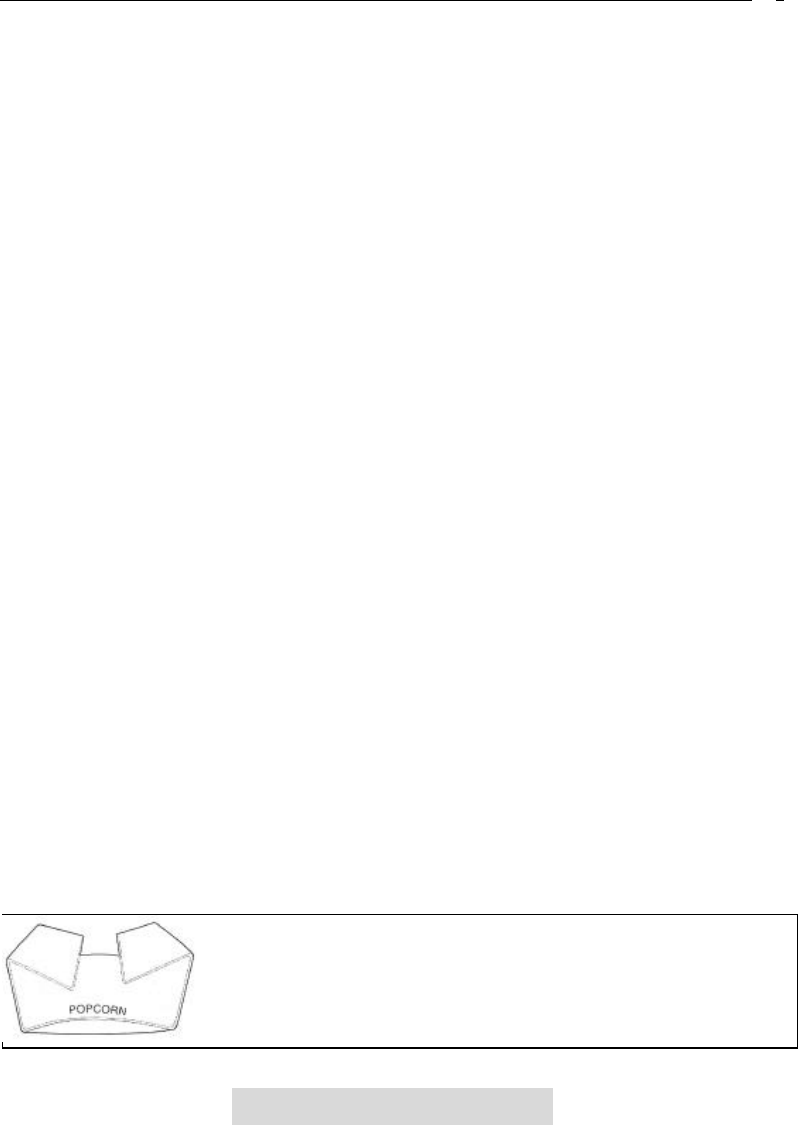
When popping a popcorn;
Place carefully so the bag does not touch the oven walls. Fold
each end of the bag in half toward the center top of the bag.
COOKING UTENSILES
MICROWAVE-SAFE UTENSILS
Never use metal or metal-trimmed utensils in your microwave oven: Microwaves
cannot penetrate metal. They will bounce off any metal abject in the oven and cause
arcing, an alarming phenomenon that resembles lightening. Most heat-resistant
non-metallic cooking utensils are safe for use in your microwave oven. However, some

MICROWAVE OVEN 9
may contain materials that render them unsuitable as microwave cookware. If you have
any doubts about a particular utensil, there’s a simple way to find out if it can be used in
your microwave oven.
Testing utensils for microwave use: Place the utensil in question next to a glass bowl
filled with water in the microwave-safe. However, if the water does not change
temperature but the utensils become warm, microwaves are being absorbed by the utensil
and it is not safe for uses in the microwave oven. You probably have many items on hand
in your kitchen that can be used as cooking equipment in your microwave oven. Just read
through the following checklist.
1. Dinner plates: Many kinds of dinnerware are microwave-safe. If in doubt consult the
manufacture’s literature or perform the microwave test, above.
2. Glassware: Glassware that is heat-resistant is microwave-safe. This includes all
brands of oven-tempered glass cookware. However, do not use delicate glassware,
such as tumbler or wine glasses, as these might shutter as the food warm.
3. Paper: Paper plates and containers are convenient and safe to use in your
microwave oven, provided the cooking time is short and foods to be cooked are
low in fat and moisture. Paper towels are also very useful for wrapping foods and for
lining baking trays in which greasy foods, such as bacon, are cooked. In general,
avoid colored paper products as the color may run.
4. Plastic storage containers: These can be used to hold foods that area to be quickly
reheated. However, they should not be used to gold foods that will need considerable
time in the oven as hot foods will eventually warp or melt plastic containers.
5. Plastic cooking bags: These are microwave-safe provided they are specially made
for cooking. However, be sure to make a slit in the bag so that steam can escape.
Never use ordinary plastic bags for cooking in your microwave oven, as they will melt
and rupture.
6. Plastic microwave cookware: A variety of shaped and sized of microwave cookware
is available. For the most part, you can probably cook with items you already have on
hand rather than investing in new kitchen equipment.
7. Pottery, stoneware, and ceramic: Containers made of these materials are usually
game for use in your microwave oven, but they should be tested to be sure.
CAUTION: SOME ITEMS ARE NOT INTENDED FOR COOKING,
INCLUDING SOME STONEWARE AND ITEMS WITH HIGH IRON OR LEAD
CONTENTS.
MICROWAVE OVEN 10
FEATURE DIAGRAM
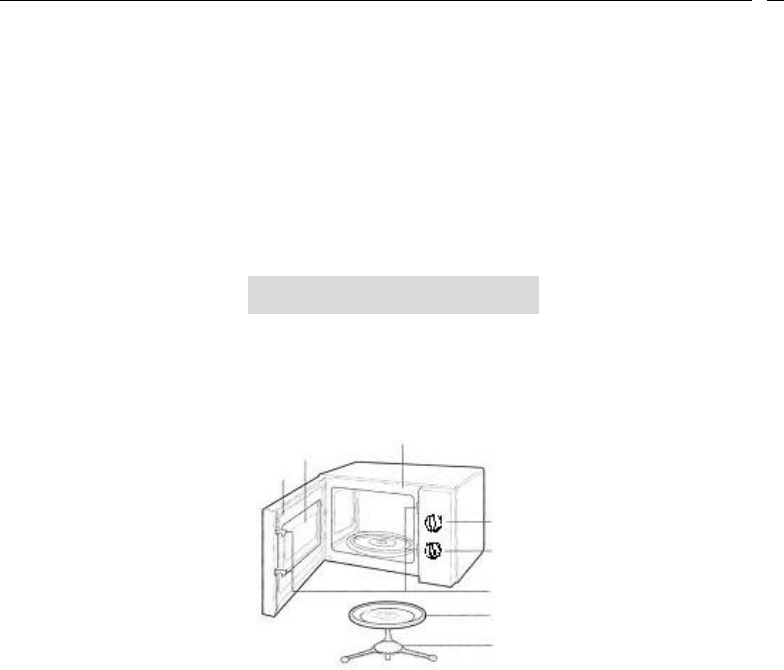
Oven Front Plate
Window Door Screen
Door seal
Power Knob
Timer Knob
Safety Door Lock System
Turntable
Rotating Ring
Your oven will be packed with the following materials:
Glass Turntable……………………………………………………1 each
Owner’s Manual &Cooking Guide………………………………..1 each
Rotating Ring………………………………………………………1 each
This microwave oven is designed for household use only. It is not recommended for
commercial purposes.
MICROWAVE OVEN 11
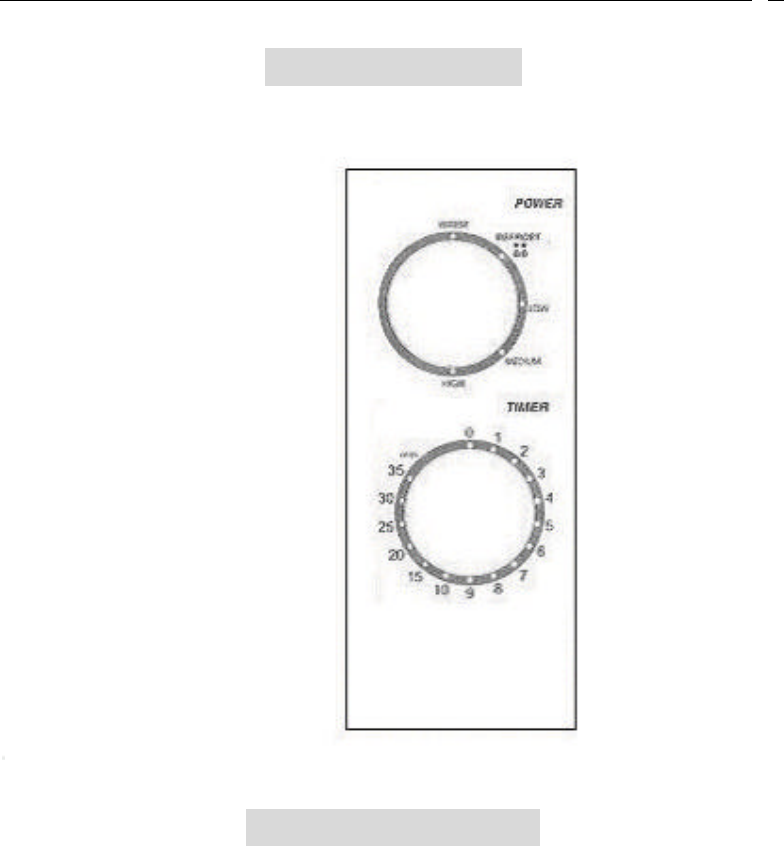
CONTROL PANEL
OPERATION CHECK
After unpacking this appliance, examine the now oven for evidence of shipping damage.
This is most important since a damaged oven may allow the escape of microwave energy.
Make sure you remove all packing from the microwave cavity. Check the oven operation
when unpacking the unit and any time the oven is not working properly.
1. Plug the power cord into an earthed electrical socket.
2. Place the glass tray inside the oven cavity.
3. Place a cup of water (at room temperature) inside the oven, on the glass tray.
4. Close the door securely.
5. Set the TIMER for 3 to 4 minutes (note: microwave activity starts).
6. When the cooking time has elapsed, the signal will sound (note: all microwave activity
stops).
7. If the oven is operating normally, the water will be hot.
MICROWAVE OVEN 12
OPERATING INSTRYCTIONS
The microwave oven is designed to be simple and easy to operate. Please follow these
instructions carefully.
1. Place the food in a suitable cooking utensil. Open the microwave oven door and place
the utensil in the center of the oven on the glass tray.
2. Close the oven door.
3. Turn the TIMER KNOB clockwise to set the cooking time.
NOTE:
The oven starts as soon as the KNOB is turned. We recommend turning the KNOB
past the time you want and then turn back to the desired setting.
4. When the TIMER reaches zero (0), the signal sounds and the oven will automatically
shut off.
5. Open the door and remove the food from the oven.
6. To stop cooking before the TIMER reaches zero (0), either open the door or simply
turn the TIMER to zero (0).
NOTE:
The door can be open during the cooking process by pushing the Door Open Button. The
TIMER will stop and the microwave activity will cease. When the door is closed, cooking
will resume until the full cooking time has elapsed. After cooking is finished, the TIMER will
be at zero (0).
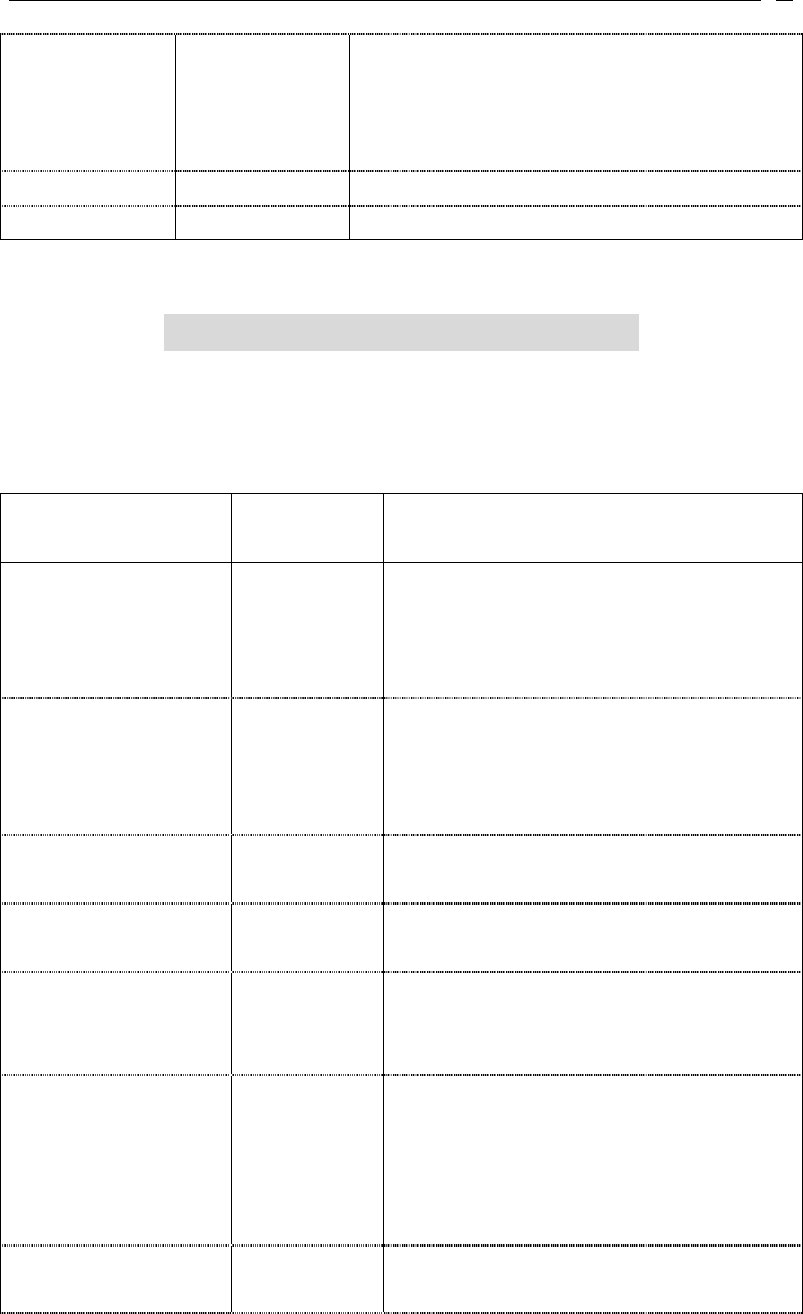
MICROWAVE POWER LEVELS
Your microwave oven is equipped with five power levers (5 steps) to five you flexibility and
control over cooking. The table below will five you some idea of which foods are prepared
at each of the various power.
MICROWAVE POWER LEVEL CHART
Power Level Output (of
watts)
Use
High 100% Boil water.
Brown ground beef.
Cook fresh fruit & vegetable.
Make candy.
Cook fish, meat & poultry.
Preheat browning dish.
Medium 70% All reheating
Low 55% Bake cakes, muffins.
MICROWAVE OVEN 13
Prepare eggs.
Cook meat, poultry.
Cook custard.
Prepare rice, soup.
Defrost 33% All defrosting
Warm 17% Soften butter & cheese.
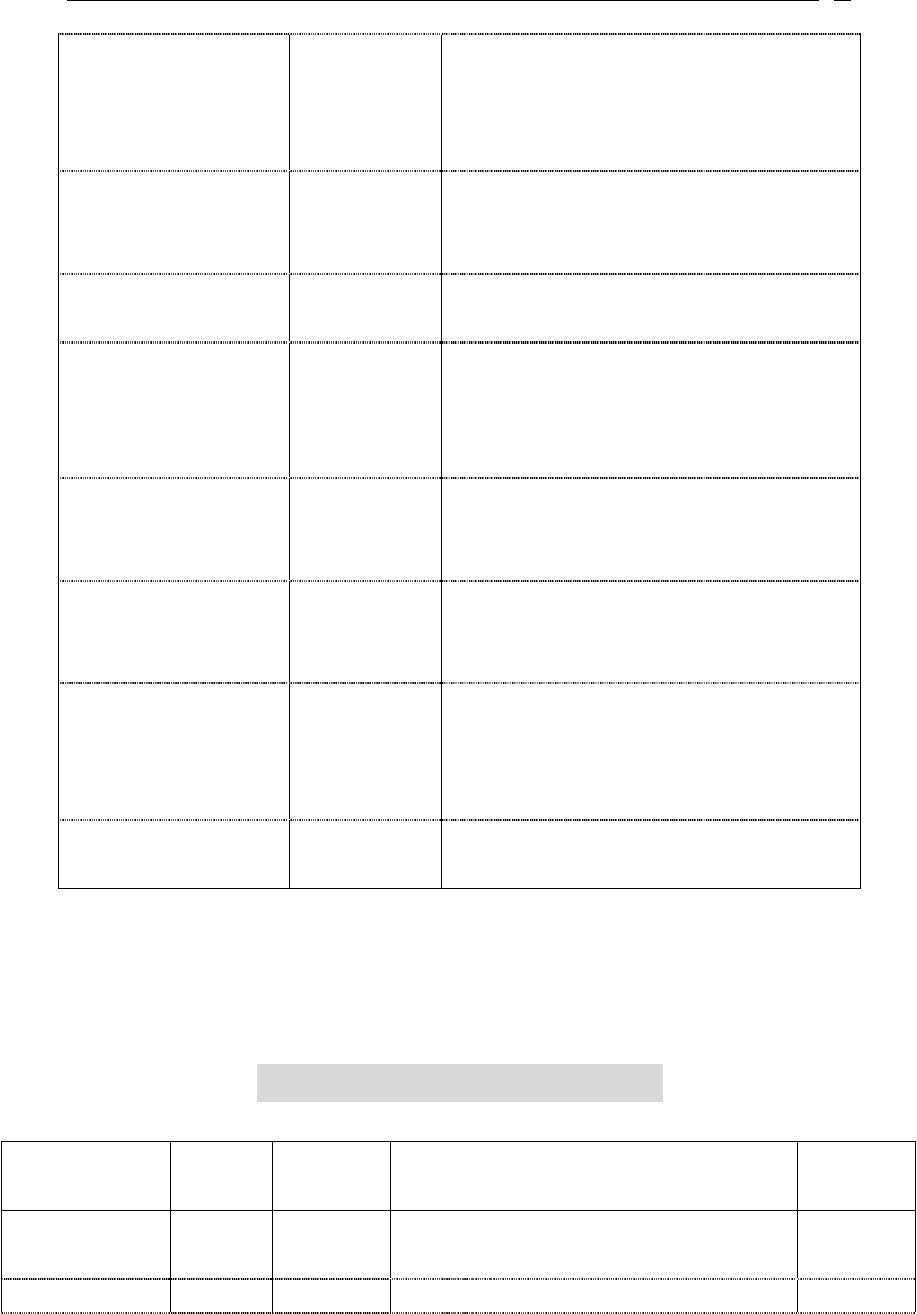
HEATING OR REHEATING GUIDE
To heat or reheat successfully in the microwave, it is important to follow several guidelines.
Measure the amount of food in order to determine the time needed to reheat. Arrange the
food in a circular pattern for best results.
Items Cook time
(at HIGH)
Special Instructions
Sliced meat
3 slices (1/4inch thick) 11/2~2 minutes
Place sliced meat on microwavable plate.
Cover with plastic wrap and vent.
* Note: Gray or sauce helps to keep meat
juicy.
Chicken piece
1 breast
1 leg and thing
1 lb.
2~3 minutes
11/2~2 minutes
10~12 minutes
Place chicken pieces on microwavable plate.
Cover with plastic wrap and vent.
Fish fillet
(6~8 OZ.) 11/2~2 minutes
Place fish on microwavable plate.
Cover with plastic wrap and vent.
Lasagna
1 serving (10-1/2 OZ.) 5~7 minutes
Place lasagna on microwavable plate.
Cover with plastic wrap and vent.
Casserole
1 cup
4 cups
11/2~3 minutes
5~7 minutes
COOK covered in microwavable casserole.
Stir once halfway through cooking.
Casserole
Cream or cheese
1 cup
4 cups
11/2~21/2
minutes
4~6 minutes
COOK covered in microwavable casserole.
Stir once halfway through cooking.
Sloppy Joe or
Barbecued beef Reheat filling and bun separately.
MICROWAVE OVEN 14
1 sandwich
(1/2 cup meat filling)
without bun
1~21/2 minute Cook filling covered in microwavable
casserole.
Stir once. Heat bun as directed in chart below.
Mashed potatoes
1 cup
4 cup
2~3 minutes
6~8 minutes
COOK covered in microwavable casserole.
Stir once halfway through cooking.
Backed beans
1 cup 2~3 minutes
COOK covered in microwavable casserole.
Stir once halfway through cooking.
Ravioli or pasta in
sauce
1 cup
4 cup
3~4 minutes
8~11 minutes
COOK covered in microwavable casserole.
Stir once halfway through cooking.
Rice
1 cup
4 cup
11/2~2 minutes
4~6 minutes
COOK covered in microwavable casserole.
Stir once halfway through cooking.
Sandwich roll or bun
1 roll 25~30
seconds
Vegetables
1 cup
4 cup
11/2~31/3
minutes
4~6 minutes
COOK covered in microwavable casserole.
Stir once halfway through cooking.
Soup
1 serving (8 OZ.) 2~3 minutes
COOK covered in microwavable casserole.
Stir once halfway through cooking.
FRESH VEGETABLE CHART
Vegetable Amount Cook time
at HIGH Instructions Standing
Time
Artichokes
(80oz. Each)
2medium
4medium
8~9
13~15
Trim. Add 2 tsp water and 2 tsp juice. Cover. 2-3
minutes
Asparagus, 1 lb. 9~10 Add 1/2 cup water. Cover. 2-3
MICROWAVE OVEN 15
Fresh, spears minutes
Beans, green &
wax
1 lb. 10~12 Add 1/2 cup water in 1-1/2 qt. casserole. Stir
halfway through cooking.
2-3
minutes
Beets, Fresh 1 lb. 15~18 Add 1/2 cup water in 1-1/2 qt. covered
casserole. Rearrange halfway through
cooking.
2-3
minutes
Broccoli, Fresh,
spears
1 lb. 8~10 Place broccoli in baking dish. Add 1/2 cup
water.
2-3
minutes
Cabbage, Fresh,
chopped
1 lb. 7~9 Add 1/2 cup water in 1-1/2 qt. covered
casserole. Stir halfway through cooking.
2-3
minutes
Carrots, Fresh,
sliced
2 cups 6~8 Add 1/4 cup water in 1 qt. covered
casserole. Stir halfway through cooking.
2-3
minutes
Cauliflower,
Fresh, whole
1 lb. 8~10 Trim. Add 1/4 cup water in 1 qt. covered
casserole. Stir halfway through cooking.
2-3
minutes
Fresh,
flowerettes
Celery, Fresh,
sliced
2 cups
4 cups
6~8
8~9
Slice. Add 1/2 cup water in 1-1/2 qt. covered
casserole. Stir halfway through cooking.
2-3
minutes
Corn, Fresh 2 ears 9~11 Husk. Add 1/2 cup water in q qt. baking dish.
Cover.
2-3
minutes
Mushrooms,
Fresh, sliced
1/2 lb. 4~5 Place mushrooms in 1-1/2 qt. covered
casserole. Stir halfway through cooking.
2-3
minutes
Parsnips, Fresh,
sliced
1 lb. 8~10 Add 1/2 cup water in 1-1/2 qt. covered
casserole. Stir halfway through cooking.
2-3
minutes
Peas, Green,
Fresh
4 cups 8~10 Add 1/2 cup water in 1-1/2 qt. covered
casserole. Stir halfway through cooking.
2-3
minutes
Sweet Potatoes
Whole Baking
(6-8 oz. Each)
2medium
4medium
9~12
13~16
Pierce potatoes several times with fork.
Place on 2 paper towels. Turn over halfway
through cooking.
2-3
minutes
2-3
minutes
White Potatoes
Whole Baking
(6-8 oz. Each)
2
potatoes
4
potatoes
10~12
14~16
Pierce potatoes several times with fork.
Place on 2 paper towels. Turn over halfway
through cooking.
2-3
minutes
2-3
minutes
Spinach, Fresh,
leaf
1 lb. 7~8 Add 1/2 cup water in 2 qt. covered
casserole.
2-3
minutes
Squash, Acorn
or butternut,
1
medium
8~9 Cut squash in half. Remove seeds. Place 8
×8 inch baking dish. Cover.
2-3
minutes
MICROWAVE OVEN 16
Fresh
Zucchini, Fresh,
sliced
1 lb. 6~8 Add 1/2 cup water in 1-1/2 qt. covered
casserole. Stir halfway through cooking.
2-3
minutes
Zucchini, Fresh,
whole
1 lb. 7~9 Pierce. Place on 2 paper towels. Turn
zucchini over and over and rearrange
halfway through cooking
2-3
minutes
CLEANING
Before cleaning the oven, unplug the power supply cord of the oven. If impossible,
open the oven door of the door to prevent an accidental oven start.
INSIDE OF THE OVEN
Use a damp cloth to wipe out crumbs and spillovers. It is important to keep the area
between door and cavity front clean to assure a tight seal. Remove greasy spatters with a
sudsy cloth, then rinse and dry.
Do not use harsh detergent or abrasive cleaners.
GLASS TRAY
The glass tray can be washed by hand or in dishwasher.
CONTROL PANEL
Wipe with a damp cloth followed immediately by a dry cloth.
DOOR
If steam accumulates inside or around the outside of the oven door, wipe the panel with a
soft cloth. This may occur when the microwave oven is operated under high humidity
conditions and in no way indicates a malfunction of the unit.
OUTSIDE OVEN SURFACE
Clean with damp cloth. To prevent damage to the operating parts inside the oven, the
eater should not be allowed to seep into the ventilation opening.
After cleaning the oven, be sure that the rotating ring and the glass tray are in the
right position. And turn the TIMER to zero (0).
BEFORE CALLING FOR SERVICE
Please check your problem by using the guide below and try solutions for each problem.
If the microwave oven still does not work properly, contact the nearest authorized service

MICROWAVE OVEN 17
center.
OVEN WILL NOT START AR ALL
* Electrical cord for oven is not plugged in.
- Plug into the outlet.
* Door is open.
- Close the door open and try again.
* Wrong operation is set.
- Check operation instruction.
ARCING OR SPARKING
* Materials to be avoided in microwave oven are used.
- Use microwave-safe cookware only.
* The oven is operated when empty.
- Do not operate with oven empty.
* Food refuse remains in the cavity or inside the cavity is uncleaned.
- Clean cavity with wet towel.
UNEVEN COOKING OR POOR DEFROSTING
* Materials to be avoided in microwave oven are used.
- Use microwave-safe cookware only.
* Cooking time/Cooking power level is not suitable.
- Use correct time/Cooking power level.
* Food is not turned or stirred.
- Turn or stir food.
OVERCOOKED FOODS
* Cooking time/Cooking power level is not suitable.
- Use correct time/Cooking power level.
UNDERCOOKED FOODS
* Materials to be avoided in microwave oven are used.
- Use microwave-safe cookware only.
* Food is not defrosted completely.
- Completely defrost food.
* Oven ventilation ports are restricted.
- Check to see that oven ventilation ports are not restricted.
* Cooking time/Cooking power level is not suitable.
- Use correct time/Cooking power level.
MICROWAVE OVEN 18
ALL THESE THINGS ARE NORMAL
* Dull thumping sound during oven operation.
* Steam or vapor escaping from around the door.
* Light reflection around door or outer wrapper.
* Dimming oven light and change in blower sound during oven operation at power
levels other than high.
* Some radio and TV interference might occur during operations. It is similar to the
interference caused by other small appliances such as mixer, blow dryer, etc.