Ubee Ddw365 Users Manual ManualsLib Makes It Easy To Find Manuals Online!
2015-11-13
: Ubee Ubee-Ddw365-Users-Manual-820166 ubee-ddw365-users-manual-820166 ubee pdf
Open the PDF directly: View PDF  .
.
Page Count: 106 [warning: Documents this large are best viewed by clicking the View PDF Link!]
www.ubeeinteractive.com
8085 S. Chester Street, Suite 200
Englewood, CO 80112
1.888.390.8233
Sales (email): amsales@ubeeinteractive.com
Support (email): amsupport@ubeeinteractive.com
February 2014
Ubee DDW365
Advanced Wireless Gateway
Firmware Version: 8.17.xxxx
Subscriber User Guide
Cox Communications
Notices and Copyrights
Copyright 2014 Ubee Interactive. All rights reserved. This document contains proprietary information of Ubee Interactive (Ubee) and is not to be
disclosed or used except in accordance with applicable agreements. This material is protected by the copyright laws of the United States and other
countries. It may not be reproduced, distributed, or altered in any fashion by any entity (either internal or external to Ubee), except in accordance
with applicable agreements, contracts, or licensing, without the express written consent of Ubee and the business management owner of the
material.
Ubee Interactive continuously improves its products and reserves the right to make changes to the product described in this document without
notice. Ubee Interactive does not assume any liability that may occur due to the use of the product described in this document.
All trademarks mentioned in this document are the property of their respective owners.
This device is Wifi Alliance Certified:

Contents
1 Introduction . . . . . . . . . . . . . . . . . . . . . . . . . . . . . . . . . . . . . . . . . . . . . . . . . . . . . . . . . . . . . 1
1.1 Understanding Safety and Regulatory Information . . . . . . . . . . . . . . . . . . . . . . . . . . . . . . . . . . . . . . . . . 1
1.2 Understanding Connections and Applications . . . . . . . . . . . . . . . . . . . . . . . . . . . . . . . . . . . . . . . . . . . . . 3
1.3 Requesting Support . . . . . . . . . . . . . . . . . . . . . . . . . . . . . . . . . . . . . . . . . . . . . . . . . . . . . . . . . . . . . . . . . 3
1.4 Checking Device Package Components . . . . . . . . . . . . . . . . . . . . . . . . . . . . . . . . . . . . . . . . . . . . . . . . . 3
1.5 Understanding the Device Panels, Connections and LEDs . . . . . . . . . . . . . . . . . . . . . . . . . . . . . . . . . . . 5
1.6 Understanding Specifications, Standards, and Firmware . . . . . . . . . . . . . . . . . . . . . . . . . . . . . . . . . . . .7
1.7 Understanding Default Values and Logins . . . . . . . . . . . . . . . . . . . . . . . . . . . . . . . . . . . . . . . . . . . . . . . . 9
1.8 Understanding the Device Label . . . . . . . . . . . . . . . . . . . . . . . . . . . . . . . . . . . . . . . . . . . . . . . . . . . . . . 10
2 Installing the DDW365 . . . . . . . . . . . . . . . . . . . . . . . . . . . . . . . . . . . . . . . . . . . . . . . . . . . . 12
2.1 Setting Up and Connecting the DDW365 . . . . . . . . . . . . . . . . . . . . . . . . . . . . . . . . . . . . . . . . . . . . . . . . 12
2.2 Connecting Devices to the Network . . . . . . . . . . . . . . . . . . . . . . . . . . . . . . . . . . . . . . . . . . . . . . . . . . . 13
2.3 Troubleshooting the Installation . . . . . . . . . . . . . . . . . . . . . . . . . . . . . . . . . . . . . . . . . . . . . . . . . . . . . . . 15
3 Using the Web User Interface . . . . . . . . . . . . . . . . . . . . . . . . . . . . . . . . . . . . . . . . . . . . . . 17
3.1 Accessing the Web User Interface Locally . . . . . . . . . . . . . . . . . . . . . . . . . . . . . . . . . . . . . . . . . . . . . . . 17
4 Understanding the Status Menu . . . . . . . . . . . . . . . . . . . . . . . . . . . . . . . . . . . . . . . . . . . . 20
4.1 Using the Software Option . . . . . . . . . . . . . . . . . . . . . . . . . . . . . . . . . . . . . . . . . . . . . . . . . . . . . . . . . . . 20
4.2 Using the Connection Option . . . . . . . . . . . . . . . . . . . . . . . . . . . . . . . . . . . . . . . . . . . . . . . . . . . . . . . . . 21
4.3 Using the Account Option . . . . . . . . . . . . . . . . . . . . . . . . . . . . . . . . . . . . . . . . . . . . . . . . . . . . . . . . . . . 24
4.4 Using the Diagnostics Option . . . . . . . . . . . . . . . . . . . . . . . . . . . . . . . . . . . . . . . . . . . . . . . . . . . . . . . . . 24
4.5 Using the User Default Option . . . . . . . . . . . . . . . . . . . . . . . . . . . . . . . . . . . . . . . . . . . . . . . . . . . . . . . . 27
5 Understanding the Basic Menu . . . . . . . . . . . . . . . . . . . . . . . . . . . . . . . . . . . . . . . . . . . . . 29
5.1 Using the Setup Option . . . . . . . . . . . . . . . . . . . . . . . . . . . . . . . . . . . . . . . . . . . . . . . . . . . . . . . . . . . . . 29
5.2 Using the DHCP Option . . . . . . . . . . . . . . . . . . . . . . . . . . . . . . . . . . . . . . . . . . . . . . . . . . . . . . . . . . . . . 31
5.3 Using the DDNS Option . . . . . . . . . . . . . . . . . . . . . . . . . . . . . . . . . . . . . . . . . . . . . . . . . . . . . . . . . . . . . 33
5.4 Using the Backup Option . . . . . . . . . . . . . . . . . . . . . . . . . . . . . . . . . . . . . . . . . . . . . . . . . . . . . . . . . . . . 34
6 Understanding the Advanced Menu . . . . . . . . . . . . . . . . . . . . . . . . . . . . . . . . . . . . . . . . . 38
6.1 Using the Options Option . . . . . . . . . . . . . . . . . . . . . . . . . . . . . . . . . . . . . . . . . . . . . . . . . . . . . . . . . . . . 38
6.2 Using the IP Filtering Option . . . . . . . . . . . . . . . . . . . . . . . . . . . . . . . . . . . . . . . . . . . . . . . . . . . . . . . . . 41
6.3 Using the MAC Filtering Option . . . . . . . . . . . . . . . . . . . . . . . . . . . . . . . . . . . . . . . . . . . . . . . . . . . . . . . 42
6.4 Using the Port Filtering Option . . . . . . . . . . . . . . . . . . . . . . . . . . . . . . . . . . . . . . . . . . . . . . . . . . . . . . . . 43
6.5 Using the Forwarding Option . . . . . . . . . . . . . . . . . . . . . . . . . . . . . . . . . . . . . . . . . . . . . . . . . . . . . . . . . 45
6.6 Using the Port Triggers Option . . . . . . . . . . . . . . . . . . . . . . . . . . . . . . . . . . . . . . . . . . . . . . . . . . . . . . . . 49
6.7 Using the Pass Through Option . . . . . . . . . . . . . . . . . . . . . . . . . . . . . . . . . . . . . . . . . . . . . . . . . . . . . . . 53
6.8 Using the DMZ Host Option . . . . . . . . . . . . . . . . . . . . . . . . . . . . . . . . . . . . . . . . . . . . . . . . . . . . . . . . . . 53
7 Understanding the Firewall Menu . . . . . . . . . . . . . . . . . . . . . . . . . . . . . . . . . . . . . . . . . . . 55
7.1 Using the Basic Option . . . . . . . . . . . . . . . . . . . . . . . . . . . . . . . . . . . . . . . . . . . . . . . . . . . . . . . . . . . . . . 55
7.2 Using the Local Log Option . . . . . . . . . . . . . . . . . . . . . . . . . . . . . . . . . . . . . . . . . . . . . . . . . . . . . . . . . . 56

7.3 Using the Remote Log Option . . . . . . . . . . . . . . . . . . . . . . . . . . . . . . . . . . . . . . . . . . . . . . . . . . . . . . . . 57
8 Understanding the Access Control Menu . . . . . . . . . . . . . . . . . . . . . . . . . . . . . . . . . . . . 59
8.1 Using the User Setup Option . . . . . . . . . . . . . . . . . . . . . . . . . . . . . . . . . . . . . . . . . . . . . . . . . . . . . . . . . 59
8.2 Using the Basic Option . . . . . . . . . . . . . . . . . . . . . . . . . . . . . . . . . . . . . . . . . . . . . . . . . . . . . . . . . . . . . . 61
8.3 Using the ToD Filter Option . . . . . . . . . . . . . . . . . . . . . . . . . . . . . . . . . . . . . . . . . . . . . . . . . . . . . . . . . . 63
8.4 Using the Local Log Option . . . . . . . . . . . . . . . . . . . . . . . . . . . . . . . . . . . . . . . . . . . . . . . . . . . . . . . . . . 65
9 Understanding the Wireless Menu . . . . . . . . . . . . . . . . . . . . . . . . . . . . . . . . . . . . . . . . . . 66
9.1 Using the Wireless Radio Option . . . . . . . . . . . . . . . . . . . . . . . . . . . . . . . . . . . . . . . . . . . . . . . . . . . . . . 66
9.2 Using the Primary Network Option . . . . . . . . . . . . . . . . . . . . . . . . . . . . . . . . . . . . . . . . . . . . . . . . . . . . . 69
9.3 Using the Advanced Option . . . . . . . . . . . . . . . . . . . . . . . . . . . . . . . . . . . . . . . . . . . . . . . . . . . . . . . . . . 73
9.4 Using the Access Control Option . . . . . . . . . . . . . . . . . . . . . . . . . . . . . . . . . . . . . . . . . . . . . . . . . . . . . . 75
9.5 Using the Wi-Fi Multimedia Option . . . . . . . . . . . . . . . . . . . . . . . . . . . . . . . . . . . . . . . . . . . . . . . . . . . . . 77
9.6 Using the Bridging Option . . . . . . . . . . . . . . . . . . . . . . . . . . . . . . . . . . . . . . . . . . . . . . . . . . . . . . . . . . . 80
9.7 Deploying and Troubleshooting the Wireless Network . . . . . . . . . . . . . . . . . . . . . . . . . . . . . . . . . . . . .81
10 Understanding the USB Menu . . . . . . . . . . . . . . . . . . . . . . . . . . . . . . . . . . . . . . . . . . . . . . 86
10.1 Using the USB Basic Option . . . . . . . . . . . . . . . . . . . . . . . . . . . . . . . . . . . . . . . . . . . . . . . . . . . . . . . . . 86
10.2 Using the Approved Devices Option . . . . . . . . . . . . . . . . . . . . . . . . . . . . . . . . . . . . . . . . . . . . . . . . . . . 87
10.3 Using the Storage Basic Option . . . . . . . . . . . . . . . . . . . . . . . . . . . . . . . . . . . . . . . . . . . . . . . . . . . . . . . 89
10.4 Using the Storage Advanced Option . . . . . . . . . . . . . . . . . . . . . . . . . . . . . . . . . . . . . . . . . . . . . . . . . . . 90
10.5 Using the Media Server Option . . . . . . . . . . . . . . . . . . . . . . . . . . . . . . . . . . . . . . . . . . . . . . . . . . . . . . . 93
11 Glossary . . . . . . . . . . . . . . . . . . . . . . . . . . . . . . . . . . . . . . . . . . . . . . . . . . . . . . . . . . . . . . . 96

Ubee DDW365 Advanced Wireless Gateway Subscriber User Guide • February 2014 1
1 Introduction
Welcome to the Ubee family of data networking products. This guide is specific to the
DDW365 Advanced Wireless Gateway for subscribers of Cox Communications cable
services. This document serves the following purposes:
Provides instructions on how to install, connect and operate the DDW365.
Provides directions for accessing the Web user interface (UI) for configuration and
management of the device.
Defines all relevant device compliance standards and physical specifications.
Provides a glossary to define technical terms and acronyms. Refer to the Glossary on
page 96.
Topics
See the following topics:
Understanding Safety and Regulatory Information on page 1
Understanding Connections and Applications on page 3
Requesting Support on page 3
Checking Device Package Components on page 3
Understanding the Device Panels, Connections and LEDs on page 5
Understanding Specifications, Standards, and Firmware on page 7
Understanding Default Values and Logins on page 9
Understanding the Device Label on page 10
1.1 Understanding Safety and Regulatory Information
Use the following information to better understand safety and regulatory standards to
install, maintain, and use the DDW365 Advanced Wireless Gateway.
1.1.1 Understanding Safety
WARNING: The following information provides safety guidelines for anyone
installing and maintaining the DDW365. Read all safety instructions in this
guide before attempting to unpack, install, operate, or connect power to this
product. Follow all instruction labels on the device itself. Comply with the
following safety guidelines for proper operation of the device.

Ubee Interactive Understanding Safety and Regulatory Information
Ubee DDW365 Advanced Wireless Gateway Subscriber User Guide • February 2014 2
Follow basic safety precautions to reduce the risk of fire, electrical shock, and
injury. To prevent fire or shock hazard, do not expose the unit to rain and
moisture or install this product near water. Never spill any form of liquid on or
into this product. Do not use liquid cleaners or aerosol cleaners on or close to
this product. Clean with a soft dry cloth.
Do not insert sharp objects into the product’s module openings or empty slots.
Doing so can accidentally damage its parts and/or cause electric shock.
Electrostatic discharge (ESD) can permanently damage semiconductor
devices. Always follow ESD-prevention guidelines for equipment handling and
storage.
Use only the power cable supplied with the device. Do not attach the power
supply cable to building surfaces or floorings.
Rest the power cable freely without any obstacles. Do not place heavy items on top of
the power cable. Do not abuse, step, or walk on the cable.
Do not place heavy objects on top of the device. Do not place the device on an
unstable stand or table; the device can fall and become damaged.
To prevent overheating the device, do not block the slots and openings in the module
housing that provide ventilation. Do not expose this device to direct sunlight. Do not
place hot devices close to this device; it may degrade it or cause damage.
1.1.2 Understanding Eco-Environmental Statements
The following eco-environmental statements apply to the DDW365.
Packaging Collection and Recovery Requirements:
Countries, states, localities, or other jurisdictions may require that systems be established
for the return and/or collection of packaging waste from the consumer, or other end user,
or from the waste stream. Additionally, reuse, recovery, and/or recycling targets for the
return and/or collection of the packaging waste can be established. For more information
regarding collection and recovery of packaging and packaging waste within specific
jurisdictions, contact Ubee Interactive at www.ubeeinteractive.com.
1.1.3 Understanding Regulatory Statements
The following regulatory statements apply to the DDW365.
Industry North America Statement:
This device complies with RSS-210 of the Industry North America Rules. Operation is
subject to the following two conditions:
(1) This device may not cause harmful interference.
(2) This device must accept any interference received, including interference that may
cause undesired operation.
Ubee Interactive Understanding Connections and Applications
Ubee DDW365 Advanced Wireless Gateway Subscriber User Guide • February 2014 3
Radiation Exposure Statement:
This equipment complies with FCC radiation exposure limits set forth for an uncontrolled
environment. This equipment should be installed and operated with a minimum distance
of 20cm between the radiator & your body. This device has been designed to operate with
an antenna having a maximum gain of 2 dBi. This device must not be co-located with or
operating in conjunction with any other antenna or transmitter.
1.2 Understanding Connections and Applications
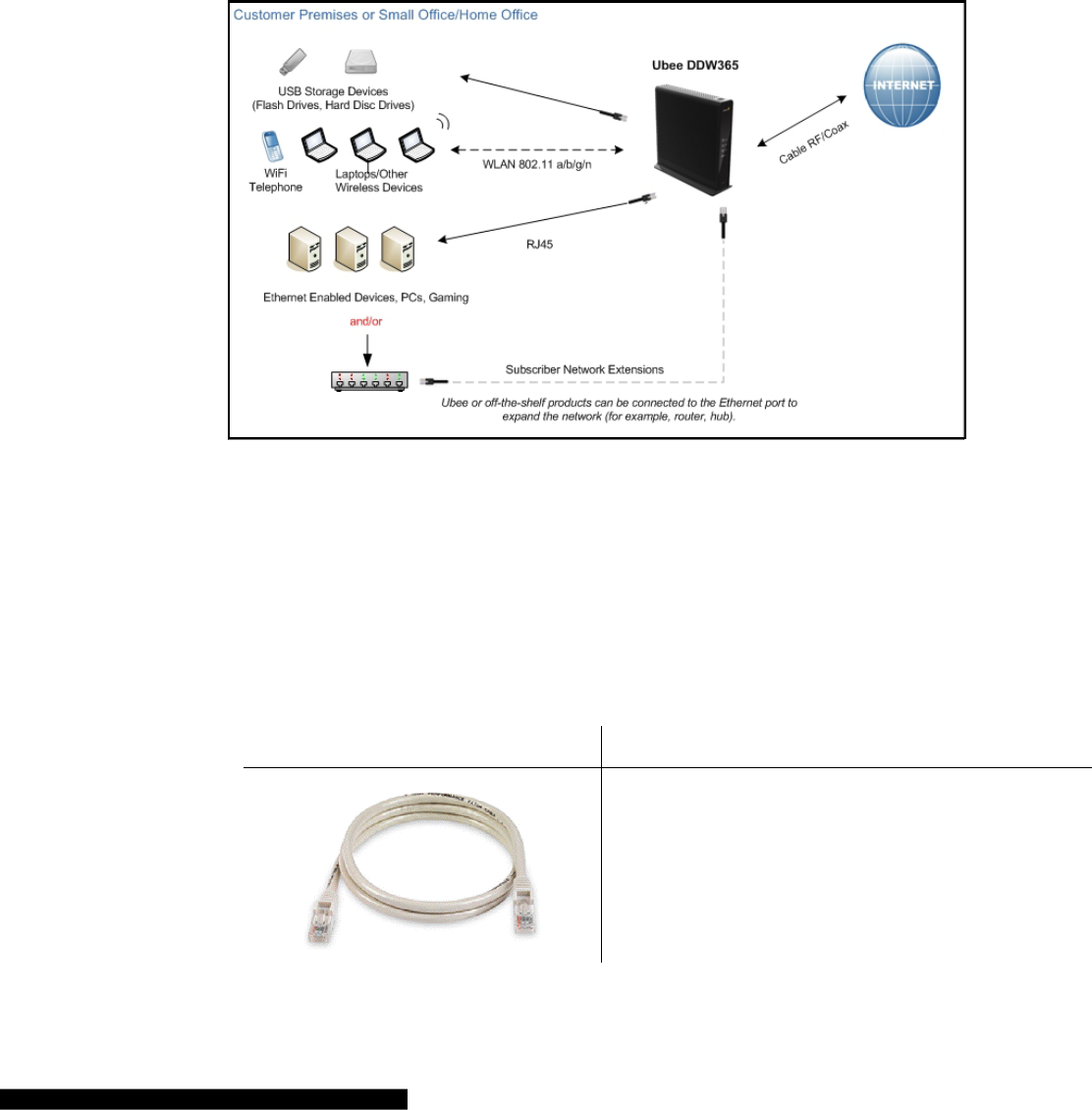
The following diagram illustrates the general connection topology and applications of the
DDW365.
1.3 Requesting Support
Subscribers must contact their service provider (Cox Communications) for direct support.
Device documentation support may be available at:
http://www.ubeeinteractive.com
1.4 Checking Device Package Components
The package for the DDW365 contains the following items:
Item Description
1 - RJ45 Cable (Ethernet)
Length ~ 6.0 ft RoHS & UL compliant
Sample image, actual appearance subject to change.

Ubee Interactive Checking Device Package Components
Ubee DDW365 Advanced Wireless Gateway Subscriber User Guide • February 2014 4
1 - Power Cable
Input: 90-120VAC, 50-60Hz, 0.9A Max.
CE and UL Certified
Sample image, actual appearance subject to change.
Item Description
Ubee Interactive Understanding the Device Panels, Connections and LEDs
Ubee DDW365 Advanced Wireless Gateway Subscriber User Guide • February 2014 5
1.5 Understanding the Device Panels, Connections and LEDs
1.5.1 Understanding the Device Front and Rear Panels
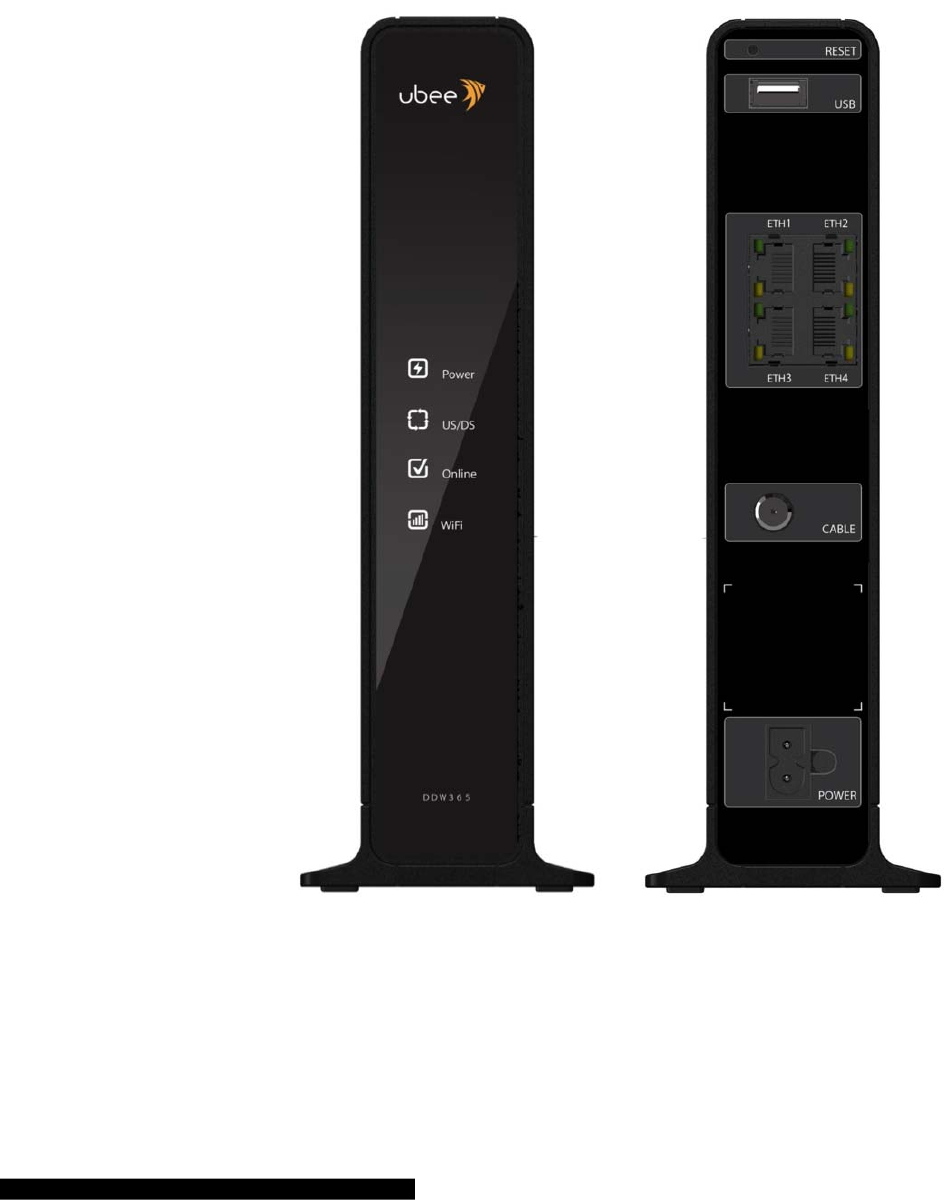
The following images represent the device front and rear panels. Connection descriptions
are provided in section 1.5.2., and LED descriptions are provided in section 1.5.3.
Front Panel Rear Panel

Ubee Interactive Understanding the Device Panels, Connections and LEDs
Ubee DDW365 Advanced Wireless Gateway Subscriber User Guide • February 2014 6
1.5.2 Understanding the Device Connections
The following table describes the connections on the device.
1.5.3 Understanding LED Behavior
The following tables summarize the behavior of the LEDs on both the front and rear
panels of the DDW365.
Item Description
USB Connects to USB devices such as flash drives, hard disk drives,
and printers.
ETH1
ETH2
ETH3
ETH4
Connects to Ethernet devices such as computers, gaming consoles,
and/or routers/hubs using an RJ45 cable. Each ETH port on the
back panel of the device has an LED to indicate its status when an
Ethernet device is connected.
RESET Restores the settings of the device including wireless and custom
gateway settings. Use a pointed object to push down the reset
button for less than 5 seconds to just reset the device. To factory
reset the device, push down the reset button for more than 5
seconds.
CABLE Connects to the cable outlet (with the cable provided by your
service provider), or a cable splitter connected to the cable outlet.
POWER Connects the cable to the device. Use only the power cable
provided with the DDW365.
WPS Located on top of the cable modem, this button is used for the WiFi
Protected Setup (WPS) method to connect a PIN-protected WiFi
device to the cable modem. Refer to Understanding the Wireless
Menu on page 74 for more information.
FRONT PANEL
LED Color Description
POWER White On – Internal power-on completed successfully.
Flashes – Power-on failed. Note that the LED blinks briefly immediately after powering on the
device.
US/DS
(upstream/
downstream)
White Flashes – Once every second while scanning DS. Once locked on DS, flashes twice every
second while registering the US.
On – Locked to US and DS channels and registered OK.
Flashes – When a firmware upgrade is in progress, and POWER LED and ONLINE LEDs are
ON solid.
Ubee Interactive Understanding Specifications, Standards, and Firmware
Ubee DDW365 Advanced Wireless Gateway Subscriber User Guide • February 2014 7
1.6 Understanding Specifications, Standards, and Firmware
The following list provides the features and specifications of the DDW365.
Interfaces and Standards
Cable: F-Connector, female
LAN: 4 10/100/1000 Mbps RJ45 ports
USB: 1 USB 2.0 host port
DOCSIS 3.0 certified
DOCSIS 1.0/1.1/2.0 certified
ONLINE White Flashes – Obtaining an IP address and configuration file.
On – Configuration completed successfully.
WiFi White On – WiFi is enabled.
Off – WiFi is disabled.
WPS
BUTTON
(top of
device)
White If not used, the LED is off. When a user pushes the WPS button or triggers WPS via the
device’s Web UI, an LED on the top-front of the device blinks for 4 minutes until a PIN is
entered from the wireless client that wishes to connect (for example, a laptop computer). After
a WiFi client attaches successfully, the LED remains On for 5 minutes, then turns Off.
REAR PANEL
LED Color Description
ETH1
ETH2
ETH3
ETH4
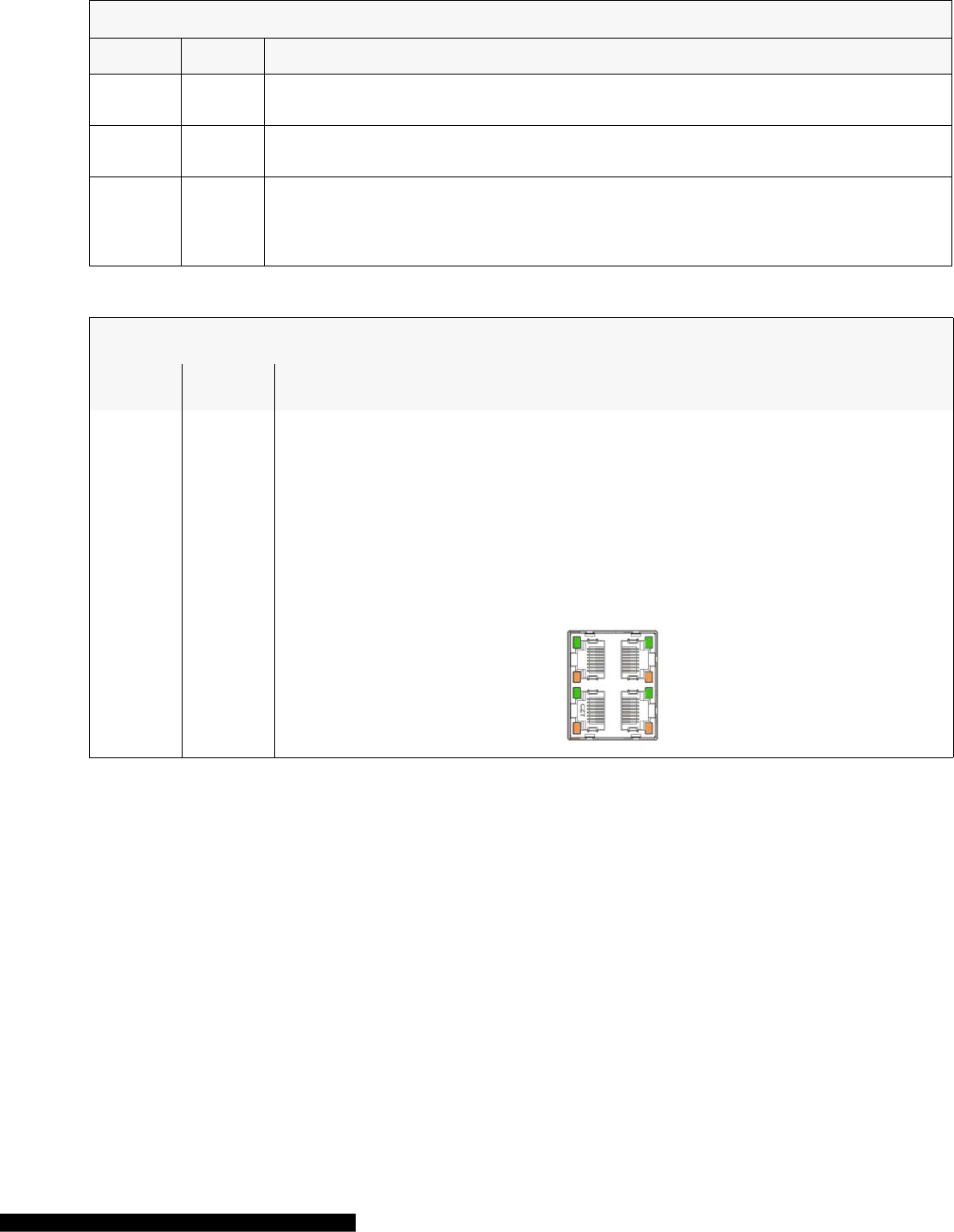
Green/
Orange On Green – An Ethernet device is connected to the device at 1000 Mbps speeds (Gigabit
Ethernet).
On Orange – An Ethernet device is connected to the device at 10/100 Mbps speeds.
Flashes (in Green or Orange) – When data is being passed between the cable modem and
the connected device.
The Ethernet ports are used to connect Ethernet devices such as computers, gaming
consoles, and/or routers/hubs to the DDW365 using RJ-45 cables. Each Ethernet port on the
back panel of the device has an LED to indicate its status when an Ethernet device is
connected.
FRONT PANEL
LED Color Description

Ubee Interactive Understanding Specifications, Standards, and Firmware
Ubee DDW365 Advanced Wireless Gateway Subscriber User Guide • February 2014 8
CE/FCC Class B, ENERGY STAR® certified, WiFi Alliance certified
Downstream*
Frequency Range: 88MHz ~ 1002MHz
Modulation: 64 / 256 QAM
Channel Bandwidth: 6 MHz
Maximum Data Rate per Channel (up to 8 channels): DOCSIS = 30 Mbps (64
QAM), 42 Mbps (256 QAM),
Total Max Bandwidth (8 Channels): DOCSIS = 343 (304) Mbps
Symbol Rate: 6952 Ksps
RF (cable) Input Power: -15 to +15dBmV (64 QAM), -15 to +15dBmV (256 QAM)
Input Impedance: 75 Ω
Upstream*
Frequency Range: 5MHz ~ 42MHz
Modulation A-TDMA: QPSK, 8, 16, 32, 64QAM, S-CMDA: QPSK, 8, 16, 32, 64,
128QAM
Max Bandwidth of 4 Channels = 122.88 (108) Mbps, bandwidth per channel (up to
4 channels) = [QPSK 0.32 ~ 10.24 Mbps, 8 QAM 0.48 ~ 15.36 Mbps, 16 QAM 0.64
~ 20.48 Mbps, 32 QAM 0.80 ~ 25.60 Mbps, 64 QAM 0.96 ~ 30.72 Mbps, 128
QAM/TCM 30.72 Mbps]
Symbol Rate: 160, 320, 640, 1280, 2560, 5120 Ksps
RF (cable) Output Power: TDMA/ATDMA: +8dBmV to +54dBmV (32/64 QAM).
ATDMA Only: +8dBmV to +55dBmV (8/16 QAM), +8dBmV to +58dBmV (QPSK).
S-CDMA: +8dBmV to +53dBmV (all modulations)
*Actual speeds vary based on factors including network configuration and speed.
Security and Network
Supports 8 SSIDs, 802.11b/g/n compliant with link speeds up to 450 Mbps, 3 Tx
and 3 Rx antennas with single band (2.4 GHz) radio.
DHCP Client/Server, Static IP network assignment, RIPv1/ v2, Ethernet
10/100/1000 BaseT, full-duplex auto-negotiate functionality, IPv4 and IPv6 support
NAT Firewall, MAC/IP/port filtering, parental control, stateful packet inspection
(SPI), DoS attack protection, WPS/ WPA/ WPA2/ WPA-PSK & 64/128-bit WEP
encryption
VPN pass-through and end-point support (IPSec/PPTP), TACACS or RADIUS
authentication
Device Management
Supports IEEE 802.11e Wi-Fi Multimedia (WMM) and UAPSD (power savings)
DOCSIS, Web-Based, and XML Configuration
Telnet/SSH remote management
Firmware upgrade via TFTP
Configuration backup and restore
SNMP support

Ubee Interactive Understanding Default Values and Logins
Ubee DDW365 Advanced Wireless Gateway Subscriber User Guide • February 2014 9
TR-069 capable
Physical and Environmental
Dimensions: 220mm, 8.625” (W) x 220mm, 8.625” (H) x 42mm, 1.625” (D)
Weight: 825g (1.8 lbs.) (Contains internal PSU)
Input: 90-120VAC, 50-60Hz
Output: 12V 2.17A
Operating Temperature: 0°C ~ 40°C (32°F ~ 104°F)
Humidity: 5~90% (non-condensing)
1.7 Understanding Default Values and Logins
The DDW365 is pre-configured with the default parameters for Cox Communications.
Some regions may change default values.
Local Port Address: 192.168.100.1
Web Interface: http://192.168.100.1
Operation Mode: NAT Mode
Subnet Mask: 255.255.255.0
Wireless Defaults:
Primary SSID (subscriber-managed) = “DDW365” plus a period, plus the last 6
characters of the Wi-Fi MAC address plus “-2.4G.”
Example for modem with WiFi MAC address 08:3e:8e:44:28:13
SSID: DDW365.442813-2.4G
If the subscriber changes the SSID, the device does not revert to this default
SSID when the device is reset, except when a factory reset is performed
through the Web UI.
The Wi-Fi MAC address can be found at the top of the Wireless Primary
Network screen. Refer to Using the Primary Network Option on page 69.
Encryption Method = WPA2-PSK with TKIP+AES encryption
WPA Pre-shared Key = Unique key for each device. Also called the network key.
The WPA pre-shared key for the DDW365 is the 13 characters of the modem’s
serial number and can be found on the Wireless Primary Network screen. Refer to
Using the Primary Network Option on page 77. The serial number can also be
found on the device label. Refer to Understanding the Device Label on page 10.
Example: B7Y3R11000049
WPS PIN = The WPS PIN is a randomly-generated number found on the Wireless
Primary Network screen. Refer to Using the Primary Network Option on page 77.
The WPS PIN can also be found on the device label. Refer to Understanding the
Device Label on page 10.
Device Name: UbeeAP
Ubee Interactive Understanding the Device Label
Ubee DDW365 Advanced Wireless Gateway Subscriber User Guide • February 2014 10
Login Default Values
Standard User Web Interface Login
Username: user
Password: user
Note: After initially logging in to the DDW365, you will be asked to change your
password for security reasons. Refer to Changing the User Password on page 18
for more information.
1.8 Understanding the Device Label
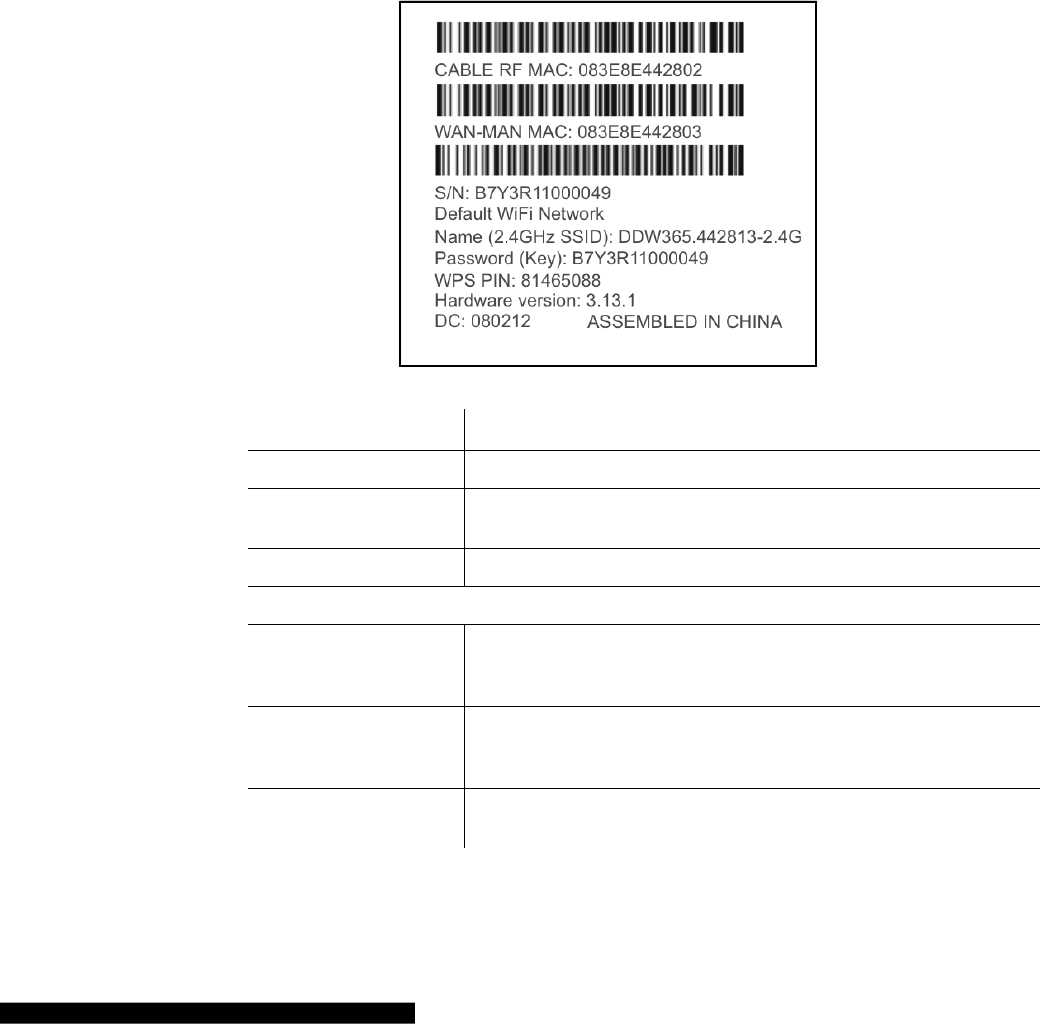
The following is an example of the housing label for the DDW365. Descriptions are
provided in the table below.
Item Description
CABLE RF MAC Defines the MAC address of the cable RF interface of the DDW365.
WAN-MAN MAC Defines the unique address for the cable home interface of the
DDW365.
S/N Defines the serial number of the device.
Default WiFi Network
Name (2.4GHZ
SSID) Defines the SSID (service set identifier) for the 2.4GHz band.
“DDW365” plus a period, plus the last 6 characters of the Wi-Fi
MAC address plus “-2.4G”.
Password (Key) Defines the unique WPA pre-shared key for the device. It is also
called the network key. The WPA pre-shared key for the DDW365 is
the 13 characters of the modem’s serial number.
WPS PIN A randomly generated 8-digit number in accordance with the WPS
specification.

Ubee Interactive Understanding the Device Label
Ubee DDW365 Advanced Wireless Gateway Subscriber User Guide • February 2014 11
Hardware Version Defines the internal version number that identifies the hardware
design.
DC DC (Date Code) indicates the date of manufacture in MMDDYY
format.
Assembled In Defines the country the where the device was manufactured.
Item Description

Ubee DDW365 Advanced Wireless Gateway Subscriber User Guide • February 2014 12
2 Installing the DDW365
Use the information in this chapter to set up and connect the DDW365, connect additional
devices, and troubleshoot the installation.
Topics
See the following topics:
Setting Up and Connecting the DDW365 on page 12
Connecting Devices to the Network on page 13
Troubleshooting the Installation on page 15
2.1 Setting Up and Connecting the DDW365
Use the following instructions to set up and connect the DDW365. When the device is set
up and connected, refer to Accessing the Web User Interface Locally on page 16 to
configure the device.
Important: Subscribers must contact their service provider (Cox Communications) to
enable Internet access and wireless networking.
Typically, the service provider initially configures and connects the device. The installation
steps are provided below if you wish to confirm the setup, or add devices to your network.
Refer to Connecting Devices to the Network on page 13.
Steps
To set up the device:
1. Remove the contents from the device packaging.
2. Place the DDW365 in a central location, convenient for connecting to other devices,
such as PCs or gaming consoles. Do not situate the wireless gateway on the floor.
Ensure the DDW365 is installed upright in a standing position (as indicated on the
label on the back panel of the device). Positioning your gateway horizontally or on
its side affects the wireless performance dramatically, as the internal antennas
won’t be able to propagate the wireless signal as designed. If not wall-mounting
the device, ensure the base stand at the bottom of the device is rotated to facilitate
balance.
Place the DDW365 and wireless clients in open areas far away from metal objects,
transformers, heavy-duty motors, microwave ovens, refrigerators, fluorescent
lights, and other manufacturing equipment. These items can impact wireless
signals. A wireless signal can become weaker after it has passed through metal,
concrete, brick, walls, or floors.
Place the device in a location that has an operating temperature of 0˚ C to
40˚ C (32˚ F to 104˚ F). Refer to Understanding Safety and Regulatory Information
on page 1 for more safety information.

Ubee Interactive Connecting Devices to the Network
Ubee DDW365 Advanced Wireless Gateway Subscriber User Guide • February 2014 13
3. Power on your PC. The PC must have an Ethernet network adapter or Ethernet port
and an Internet browser installed, such as Internet Explorer. The following browsers
are supported:
For Windows 2000, XP, Vista, Windows 8, Windows 7, Google Chrome, Firefox
1.07 and higher, Internet Explorer v7 and above.
For MAC OS X, 10.2, and higher, Firefox 1.07 and higher, Safari 1.x and higher.
4. Connect the power cable included in the product package to the back of the DDW365
and plug the other end into a power outlet.
5. Connect the network cable included in the product package to your computer’s
Ethernet port. Connect the other end to the ETH1, ETH2, ETH3, or ETH4 port on the
DDW365.
6. Connect a coaxial cable from the CABLE connector on the back of the device to the
cable wall outlet, or to a cable splitter connected to the wall outlet.
7. Validate the network connection using the device LEDs to confirm operations.
The WiFi LED must be flashing or solidly lit.
The PWR, DS/US, and ONLINE LEDs are solidly lit.
Refer to Understanding LED Behavior on page 5 for more information.
2.2 Connecting Devices to the Network
Use the instructions below to connect network devices and validate device functionality.
Topics
See the following topics:
Connecting an Ethernet Device on page 13
Connecting a Wireless Device on page 14
2.2.1 Connecting an Ethernet Device
You can connect up to three additional Ethernet devices to the DDW365.
Steps
To connect another Ethernet device to the network:
1. Connect the Ethernet cable from the Ethernet device (for example, a PC or gaming
console) to an open Ethernet port on the back of the DDW365.
2. Use the device LEDs to confirm operations. Refer to Understanding LED Behavior on
page 5 for more information.
3. Open a Web browser and go to any Web site to validate network/Internet connectivity
(for example, http://www.wikipedia.org).
Ubee Interactive Connecting Devices to the Network
Ubee DDW365 Advanced Wireless Gateway Subscriber User Guide • February 2014 14
4. If the connected device is a gaming console, perform any online task supported by the
console (for example, log into the gaming server, play an online game, download
content).
Note
Refer to Troubleshooting the Installation on page 15 for troubleshooting information.
2.2.2 Connecting a Wireless Device
Use the following steps to connect a wireless device to the cable modem (for example, a
laptop computer).
Default values are shown in the steps below.
Steps
To connect a wireless device to the DDW365:
1. Access the wireless networking feature on your wireless device.
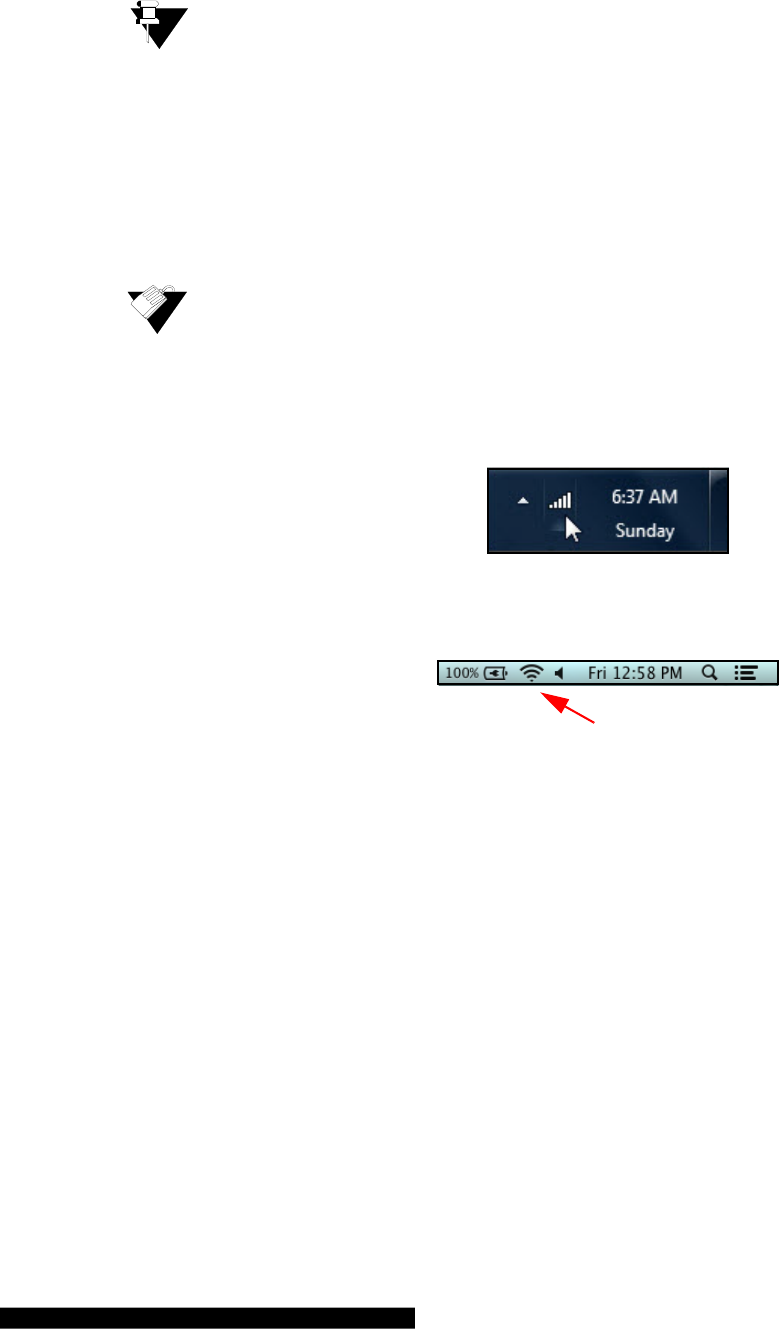
Windows Users: Double-click the Wireless Network Connection icon in the system
tray (lower-right side of the Windows desktop). Click View Wireless Networks.
Mac Users: Click on the wireless icon (Airport) on the right side of the top menu
bar. All available wireless networks will appear in the drop-down menu.
2. The DDW365 is shipped with a default SSID. The SSID is the name of the wireless
network broadcast from the device so that wireless clients can connect to it.
Double-click your SSID in the wireless networks window. The default SSID is
“DDW365” plus a period, plus the last 6 characters of the Wi-Fi MAC address plus
“-2.4G.”
Example for modem with WiFi MAC address 08:3e:8e:44:28:13
SSID: DDW365.442813-2.4G
Notes: If the subscriber changes the SSID, the device does not revert to this
default SSID when the device is reset, except when a factory reset is performed
through the Web UI. The Wi-Fi MAC address can be found at the top of the
Wireless Primary Network screen. Refer to Using the Primary Network Option on
page 69.
When prompted, enter the network key, also called the WPA pre-shared key. This
is a unique key for each device. The pre-shared key for the DDW365 is the 13
characters of the modem’s serial number and can be found on the Wireless

Ubee Interactive Troubleshooting the Installation
Ubee DDW365 Advanced Wireless Gateway Subscriber User Guide • February 2014 15
Primary Network screen. Refer to Using the Primary Network Option on page 77.
The serial number can also be found on the device label. Refer to Understanding
the Device Label on page 10.
Example pre-shared key: B7Y3R11000049
If using WPS, enter the WPS personal identification number (PIN). The WPS PIN
is a randomly-generated number found on the Wireless Primary Network screen.
Refer to Using the Primary Network Option on page 77. The WPS PIN can also be
found on the device label. Refer to Understanding the Device Label on page 10.
WPA-WPA2 TKIP+AES is the default encryption method.
3. Confirm connectivity by opening a Web browser and going to any Web site
(for example, http://www.wikipedia.org) or access the Web interface for the DDW365.
Note
The Web interface allows you to customize the configurations and capabilities for the
device. For a full explanation of all Web interface functions, refer to Using the Web
User Interface on page 16.
If you have wireless issues or questions, refer to Deploying and Troubleshooting the
Wireless Network on page 93.
2.3 Troubleshooting the Installation
Use the following tips to troubleshoot the installation.
None of the LEDs are on when I power on the DDW365.
Check the connection between the power outlet and the power cord. Verify the
power outlet is energized and the power cord is connected to the power outlet.
Check the connection between the power cord and the cable modem. Power off
the cable modem and wait for 5 seconds and power on the modem again. If the
problem still exists, there may be a hardware problem.
The ETH1, ETH2, ETH3, or ETH4 LEDs on the back of the modem are not lit
where Ethernet cables are connected.
Restart the computer so that it can re-establish a connection with the cable
modem.
Check for a resource conflict (Windows users only):
1. Right-click My Computer on your desktop and choose Properties.
2. Choose the Device Manager tab and look for a yellow exclamation point or red X over the
network interface card (NIC) in the Network Adapters field. If you see either one, you may
have an interrupt request (IRQ) conflict. Refer to the manufacturer’s documentation or ask
your service provider for further assistance.
Verify that TCP/IP is the default protocol for your network interface card.
Power cycle the cable modem by removing the power cord from the electrical
outlet and plugging it back in. Wait for the cable modem to re-establish
communications with your cable service provider.
Check General Connectivity Issues:

Ubee Interactive Troubleshooting the Installation
Ubee DDW365 Advanced Wireless Gateway Subscriber User Guide • February 2014 16
If your PC is connected to a hub or gateway, connect the PC directly into an
Ethernet port on the cable modem.
If you are using a cable splitter, remove the splitter and connect the cable modem
directly to the cable wall outlet. Wait for the cable modem to re-establish
communications with the cable service provider.
Try a different cable. The Ethernet cable may be damaged.
If none of these suggestions work, contact your service provider’s tier II support for
further assistance.
Ubee DDW365 Advanced Wireless Gateway Subscriber User Guide • February 2014 17
3 Using the Web User Interface
The Web user interface (UI) for the DDW365 is easy to use and allows you to view and
configure settings for your wireless gateway device. You can validate the installation by
accessing the Web user interface on the device.
Topics
See the following topics:
Accessing the Web User Interface Locally on page 17
3.1 Accessing the Web User Interface Locally
Access the Web user interface for the DDW365 from a Web browser, such as Internet
Explorer on a Windows computer.
Default values are shown in the steps below.
Steps
To access the Web user interface:
1. Launch an Internet browser, such as Internet Explorer, from your computer.
2. Enter the following IP address in the address bar of the browser window and press the
Enter key.
http://192.168.100.1
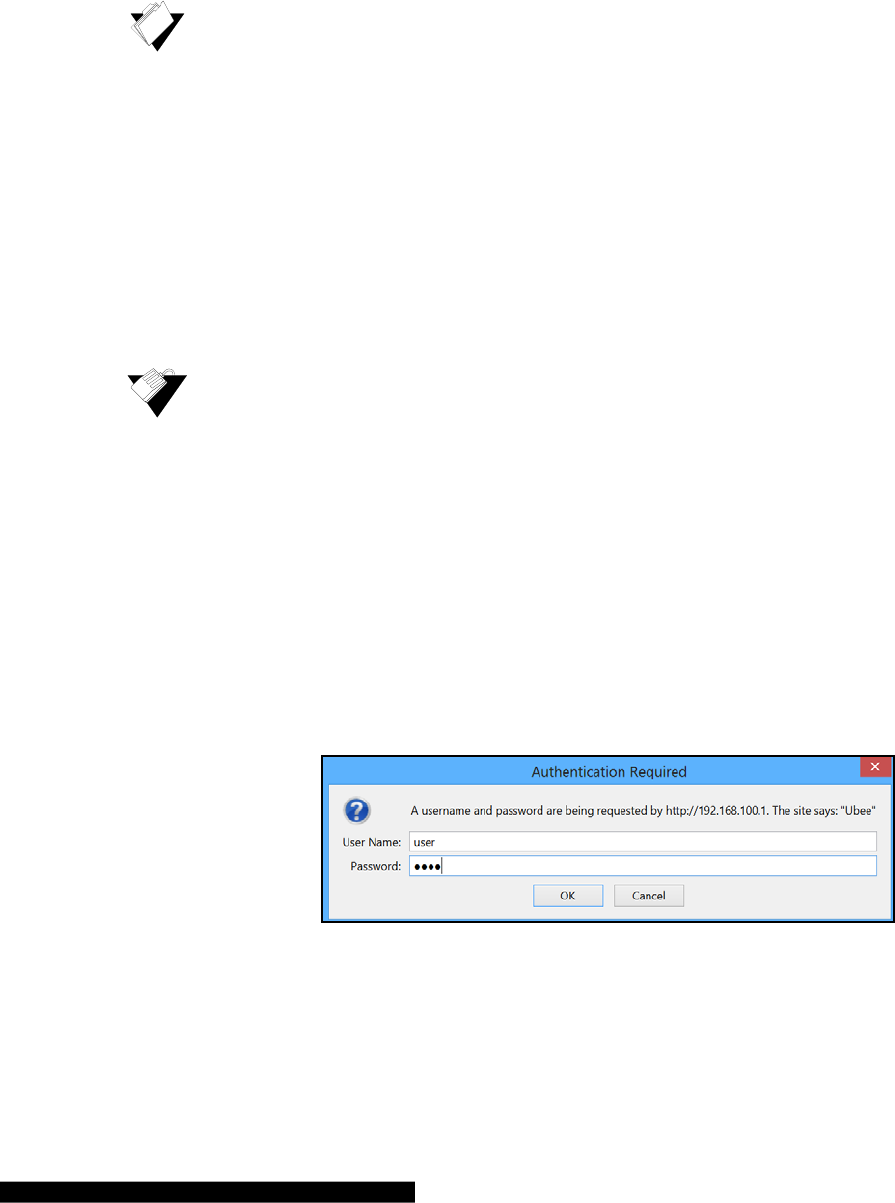
3. Enter the username and password in the authentication dialog box.
Standard User Web Interface Login:
Username: user
Password: user
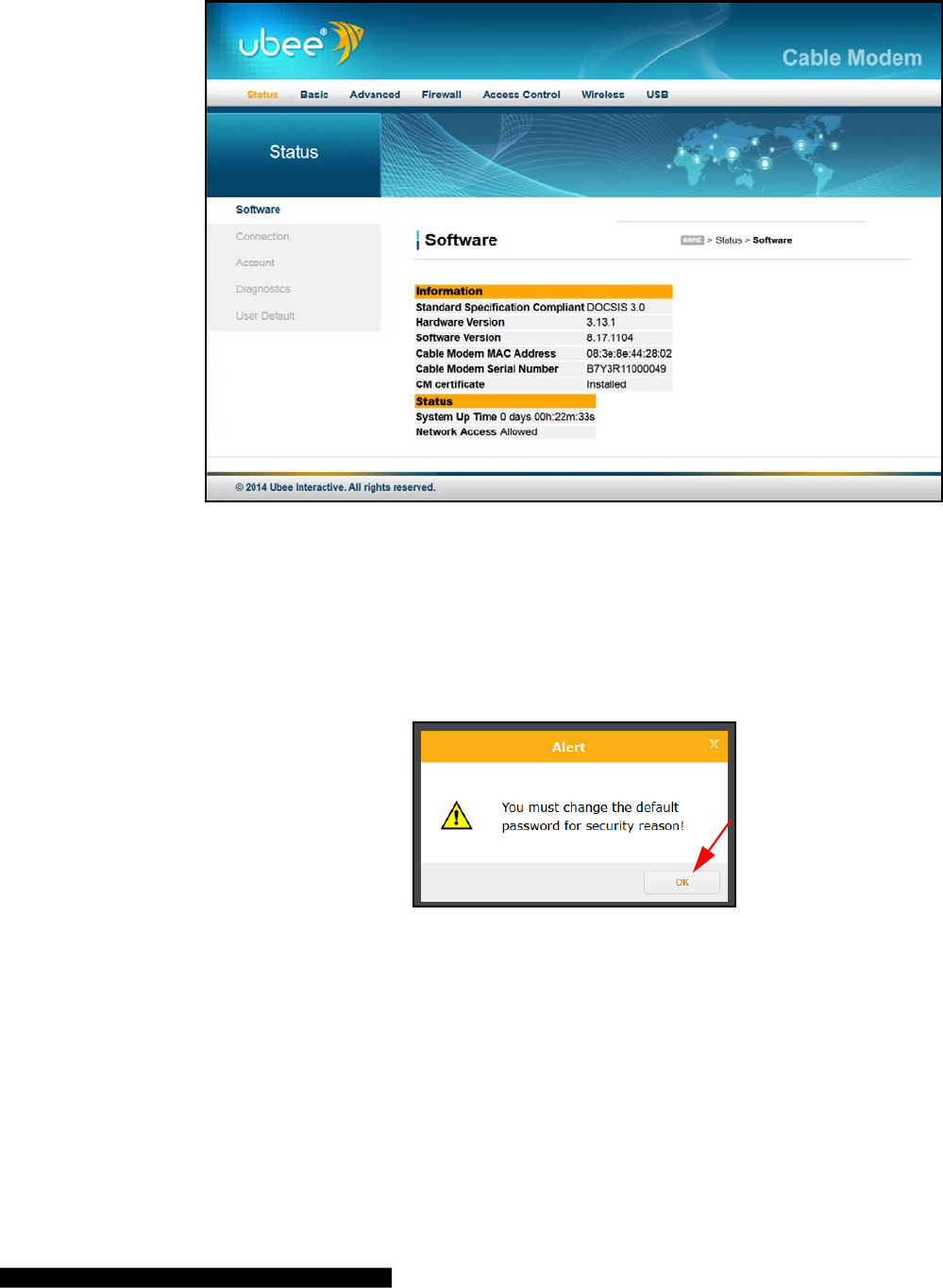
4. Click OK. The Status>Software screen (shown below) displays software information
about the DDW365. After initially logging in to the device, you will be prompted to
change your password for security reasons. Refer to Changing the User Password on
Ubee Interactive Accessing the Web User Interface Locally
Ubee DDW365 Advanced Wireless Gateway Subscriber User Guide • February 2014 18
page 18 for detailed instructions on changing your password.
Note: Refer to Using the Software Option on page 20 for detailed field descriptions of
the Status>Software screen.
3.1.1 Changing the User Password
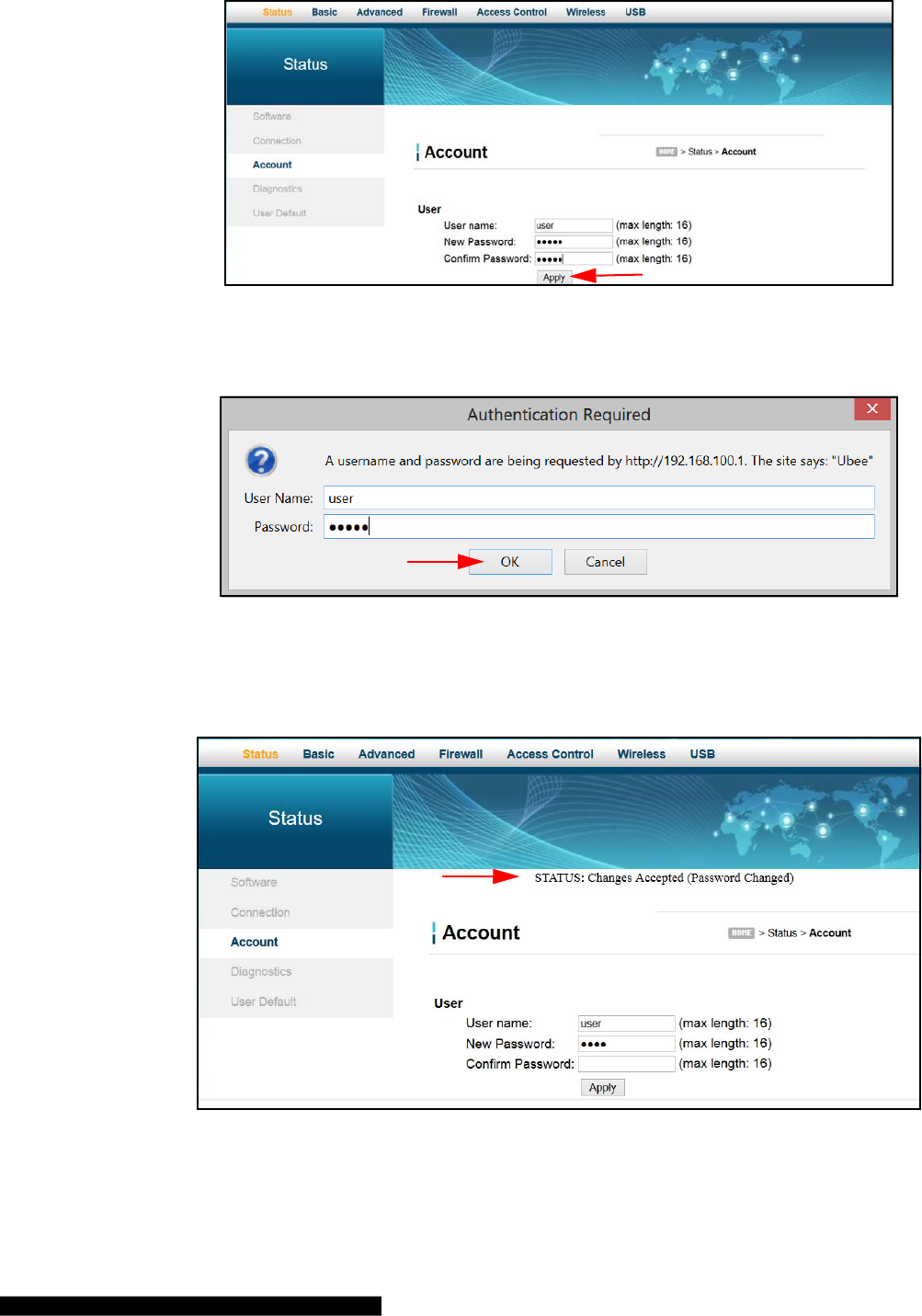
After successfully logging in to the DDW365 for the first time, the following pop-up window
will appear, prompting you to change your password for security purposes. Click OK.
The Status>Account screen will appear and allow you to enter a new password and then
confirm the new password. Click Apply.
Ubee Interactive Accessing the Web User Interface Locally
Ubee DDW365 Advanced Wireless Gateway Subscriber User Guide • February 2014 19
You will be returned to the login screen again. Enter the username (user) and the new
password. Click OK.
The Status>Account screen will appear again and will indicate that the password change
has been accepted.

Ubee DDW365 Advanced Wireless Gateway Subscriber User Guide • February 2014 20
4 Understanding the Status Menu
The Status menu of the Web user interface allows you to access information about the
DDW365, such as software version, and connection (downstream and upstream) status. It
also allows you to change the username and password, perform diagnostic tests, and
reset user defaults.
Topics
See the following topics:
Using the Software Option on page 20
Using the Connection Option on page 21
Using the Account Option on page 24
Using the Diagnostics Option on page 24
Using the User Default Option on page 27
Steps
To access status options:
1. Access the Web user interface. Refer to Accessing the Web User Interface Locally on
page 16.
2. Click Status from the main menu.
4.1 Using the Software Option
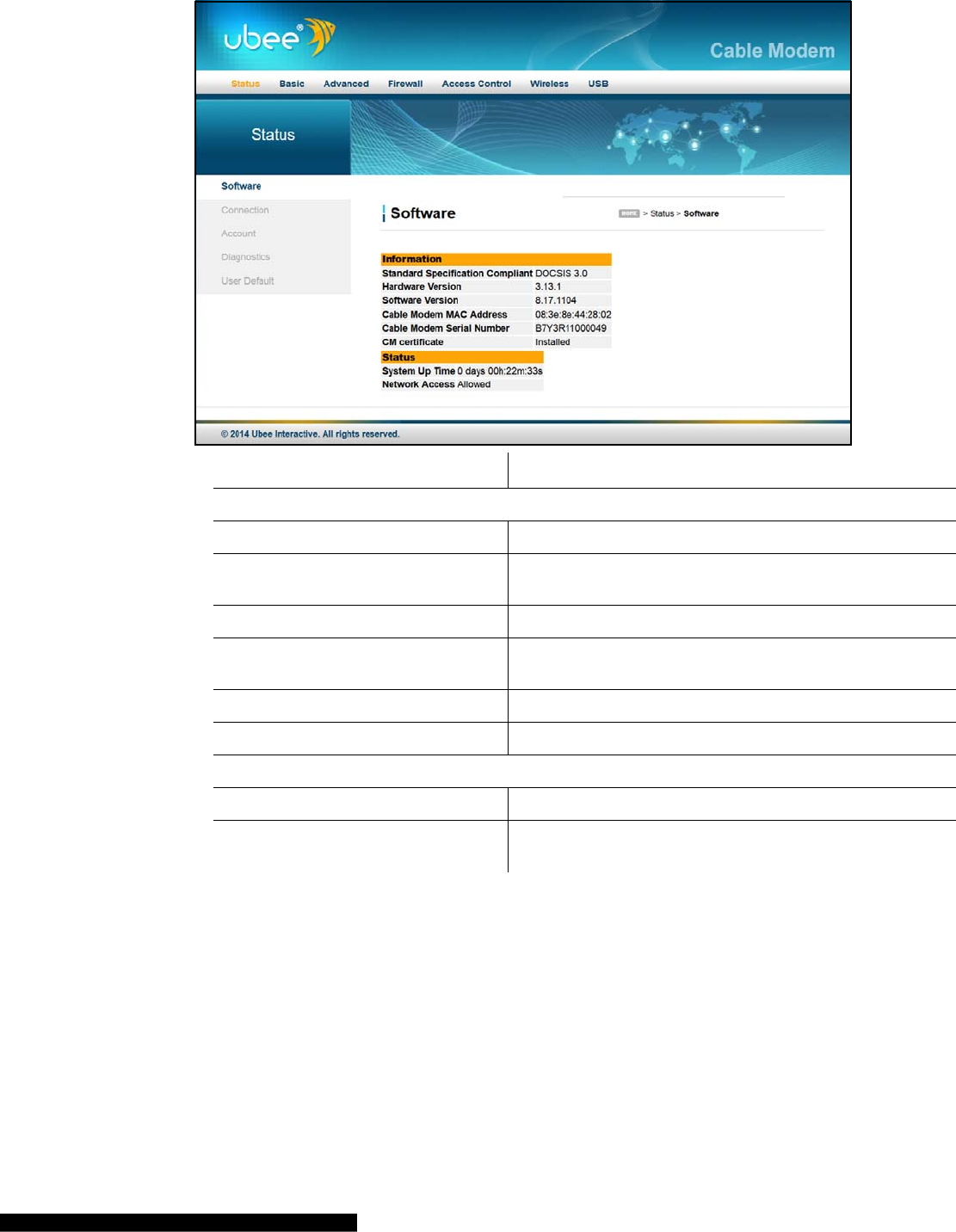
The Software option displays the device’s internal software and hardware configuration.
Steps
To view software information:
1. Click Status from the main menu.
2. The Software screen is displayed. Field descriptions are listed below the screen
example.
Ubee Interactive Using the Connection Option
Ubee DDW365 Advanced Wireless Gateway Subscriber User Guide • February 2014 21
4.2 Using the Connection Option
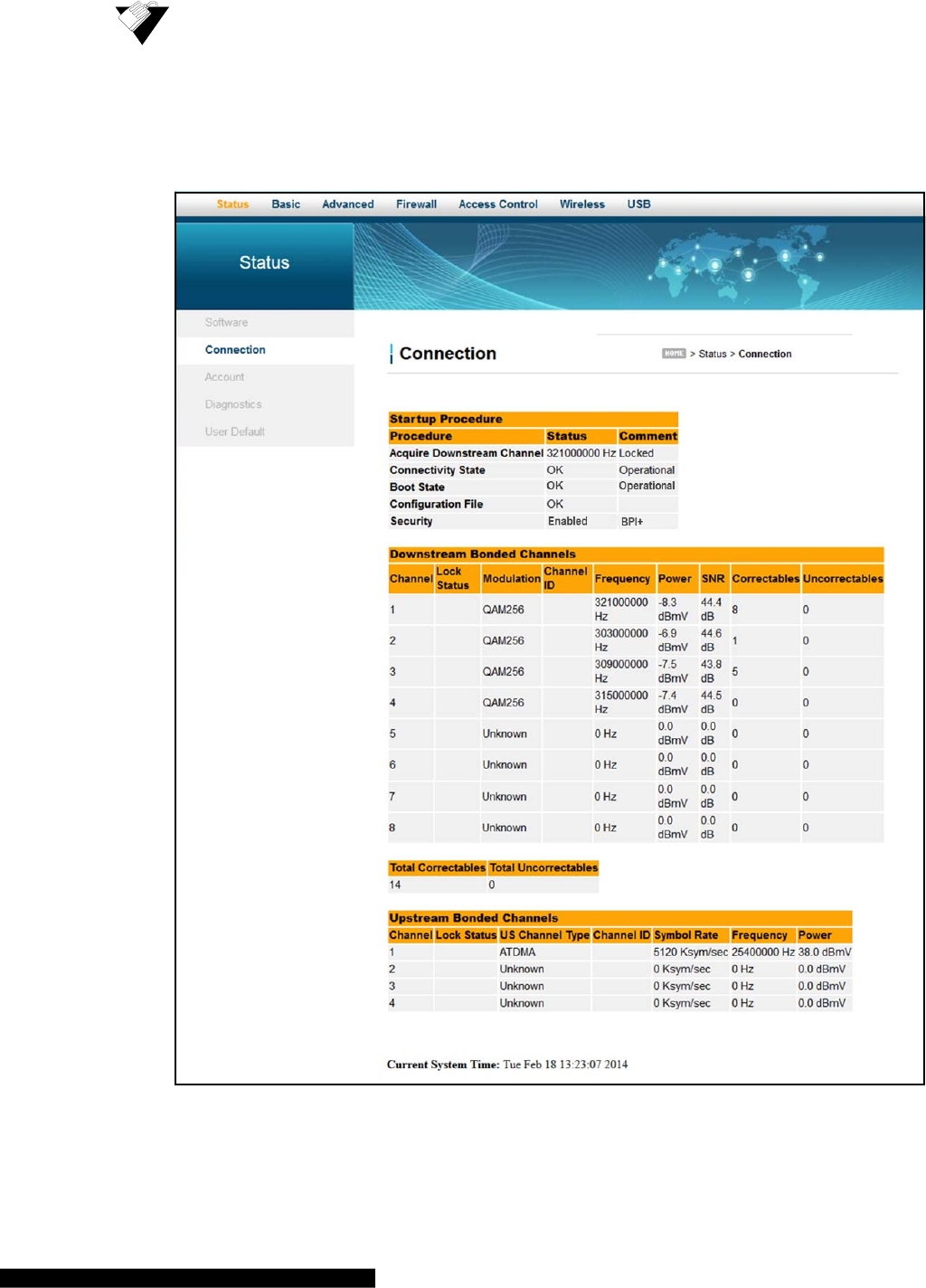
The Connection screen displays information about the device’s connection status and
downstream and upstream channel bonding statistics.
Downstream displays detailed information on the network traffic from the service
provider to the local computer (downstream channels).
Upstream displays detailed information on the network traffic from the local
computer to the remote destination (upstream channels).
Label Description
Information
Standard Specification Compliant Defines the current DOCSIS standard of the device.
Hardware Version Defines the internal version number that identifies the
hardware design.
Software Version Defines the general software version of the device.
Cable Modem MAC Address Defines the unique media access control (MAC) hardware
address of the DDW365.
Cable Modem Serial Number Defines the unique manufacturer serial number of the device.
CM certificate Indicates if the cable modem certificate is installed.
Status
System Up Time Displays how long the device has been connected.
Network Access Defines if network access is enabled. When enabled, the
user is allowed to access the network.
Ubee Interactive Using the Connection Option
Ubee DDW365 Advanced Wireless Gateway Subscriber User Guide • February 2014 22
Steps
To view connection information:
1. Click Status from the main menu.
2. Click Connection from the left side menu. Field descriptions are listed below the
screen example.

Ubee Interactive Using the Connection Option
Ubee DDW365 Advanced Wireless Gateway Subscriber User Guide • February 2014 23
Label Description
Startup Procedure (Procedure, Status, Comment)
Acquire Downstream Channel Displays the Downstream channel status and if the device has
locked to a channel.
Connectivity State Displays connection status and if the DDW365 is operational.
Boot State Displays the status on boot up and if the device is operational.
Configuration File Provides the status and file name of the configuration file
currently used by the DDW365.
Security Displays the status of the security settings: enabled/disabled.
Downstream Bonded Channels
Channel Numbers the downstream channels.
Lock Status Displays if the device has locked successfully to a
downstream channel.
Modulation Displays the modulation method required for the downstream
channel to lock on to by the device. This method is
determined by the service provider.
Channel ID Displays the downstream channel ID.
Frequency Displays the downstream channel frequency on which the
device is locked.
Power Displays the receiver power level in decibel millivolts (dBmV)
after ranging process.
SNR Displays the signal-to-noise ratio (SNR) in decibels (dB), the
desired signal level to the background noise level.
Correctables Displays the quantity of codewords which are correctable.
Uncorrectables Displays the quantity of codewords which are not correctable.
Upstream Bonded Channels
Channel Numbers the upstream channels.
Lock Status Displays if the DDW365 succeeded in locking to an upstream
channel.
US Channel Type Displays the channel type.
Channel ID Displays the current upstream channel ID.
Symbol Rate Displays the symbol rate in 1000 symbols per second.
Frequency Displays the current cable modem upstream frequency in
hertz.
Power Displays the current cable modem upstream transmit power in
decibel millivolts (dBmV).
Ubee Interactive Using the Account Option
Ubee DDW365 Advanced Wireless Gateway Subscriber User Guide • February 2014 24
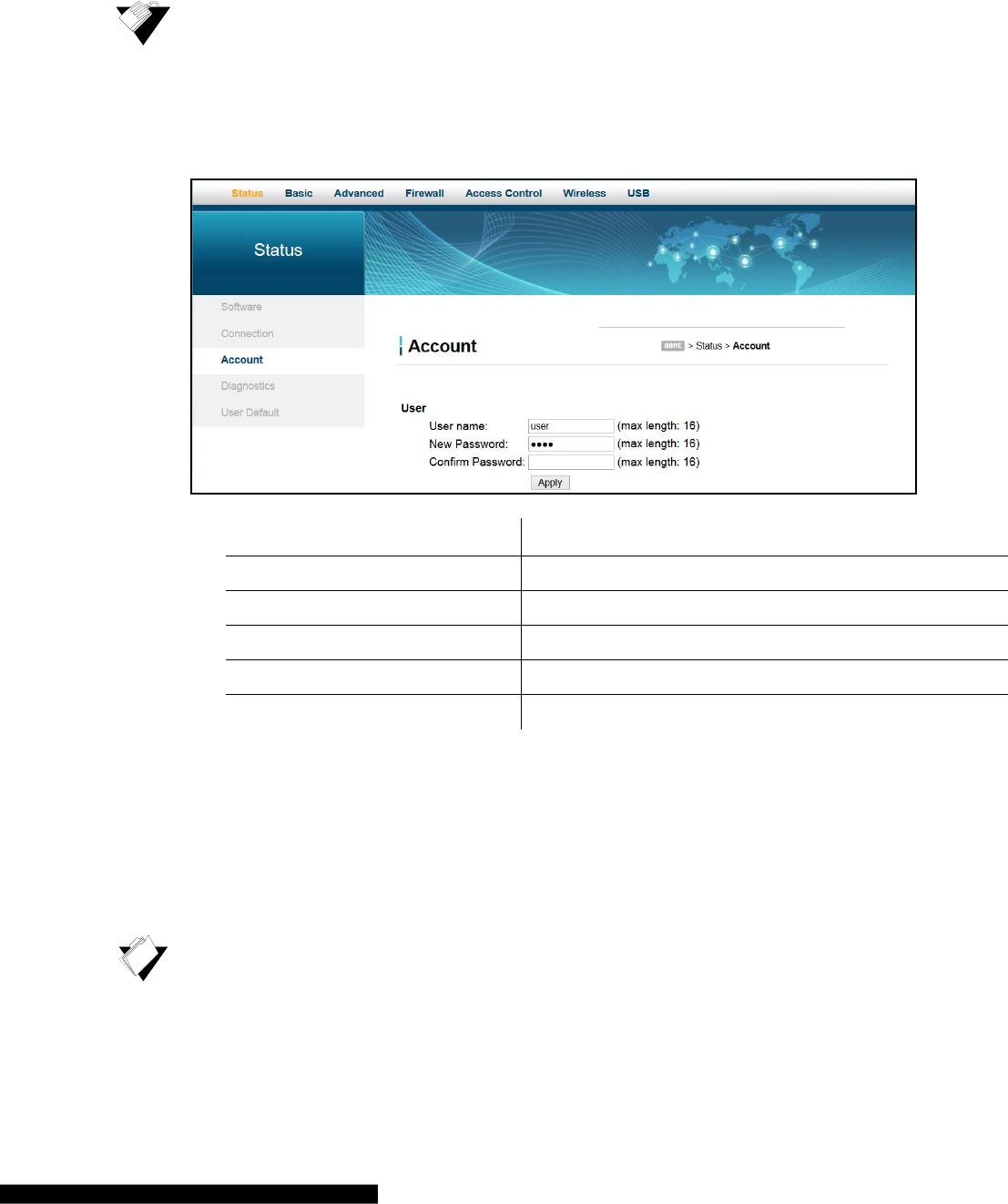
4.3 Using the Account Option
Use the Account option to change the User username and password.
Steps
To reset the modem’s username and password:
1. Click Status from the main menu.
2. Click Account from the left side menu. Field descriptions are listed below the screen
example.
Note: After changing the user password, you may be instructed to log into the
device again using the new password.
4.4 Using the Diagnostics Option
Use the Diagnostics option to test network connectivity. Two utilities are available: Ping
and Traceroute.
Topics
See the following topics:
Using the Ping Option on page 25
Using the Traceroute Option on page 26
Label Description
User
User name Enter the new username.
New Password Enter the new password.
Confirm Password Confirm the new password by re-entering it.
Apply Saves the changes.
Ubee Interactive Using the Diagnostics Option
Ubee DDW365 Advanced Wireless Gateway Subscriber User Guide • February 2014 25
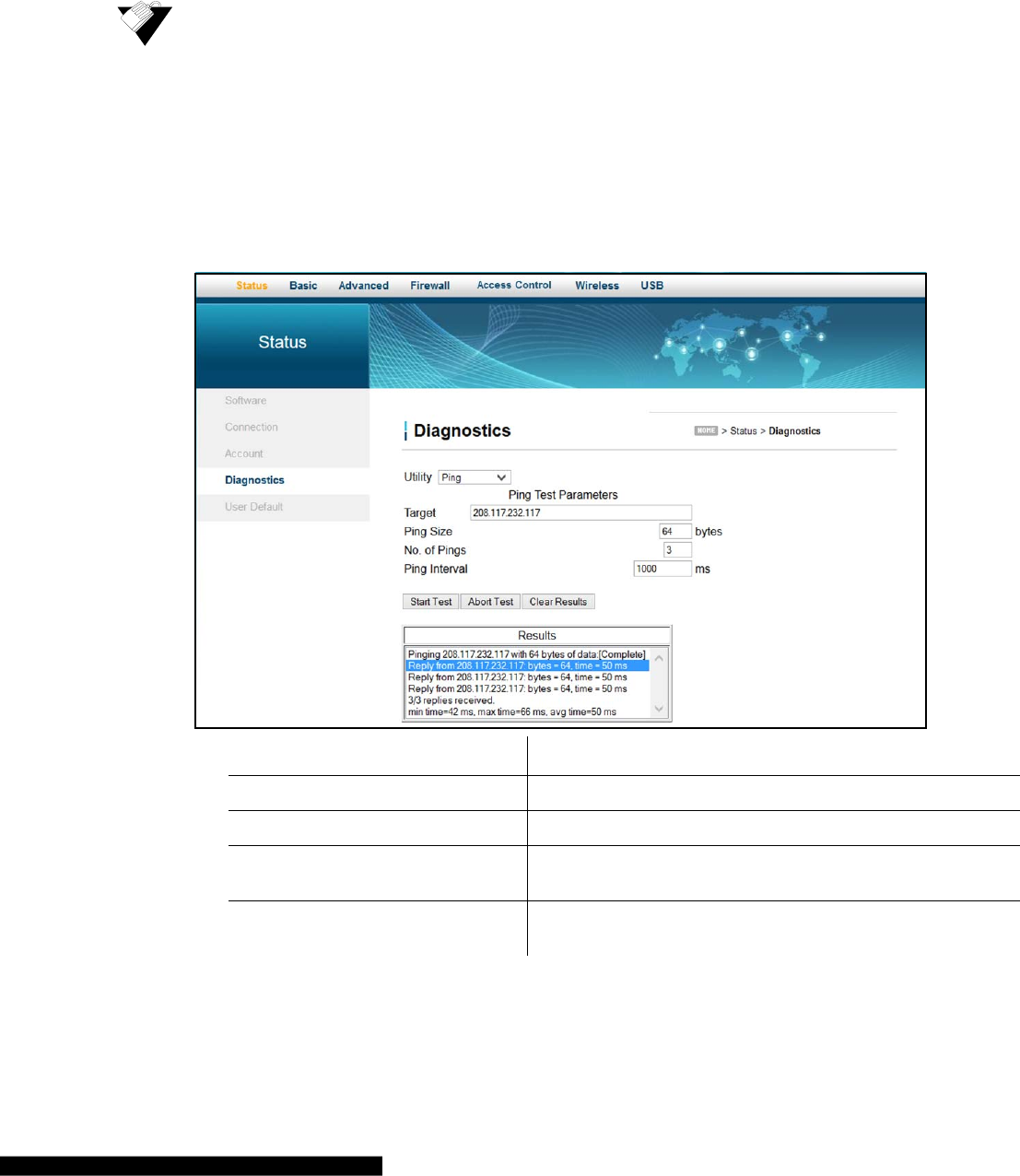
4.4.1 Using the Ping Option
Use the Ping utility to test network connectivity between devices by sending a test
message to a specific device. You can also confirm that the size of data sent is the same
as the size of data received.
Steps
To test connectivity between devices:
1. Click Status from main menu.
1. Click Diagnostics from the left side menu.
2. Choose Ping from the Utility drop-down menu.
3. Enter new parameter values or accept the default values.
4. Click Start Test. Field descriptions are listed below the screen example.
Label Description
Utility Provides a drop-down menu to choose Ping or Traceroute.
Target Defines the IP address to which you want to send a ping.
Ping Size Defines the packet size (bytes of data) to send for the ping
operation. Default is 64.
No. of Pings Defines the number of ping commands to send to the ping
target. Default is 3 pings.

Ubee Interactive Using the Diagnostics Option
Ubee DDW365 Advanced Wireless Gateway Subscriber User Guide • February 2014 26
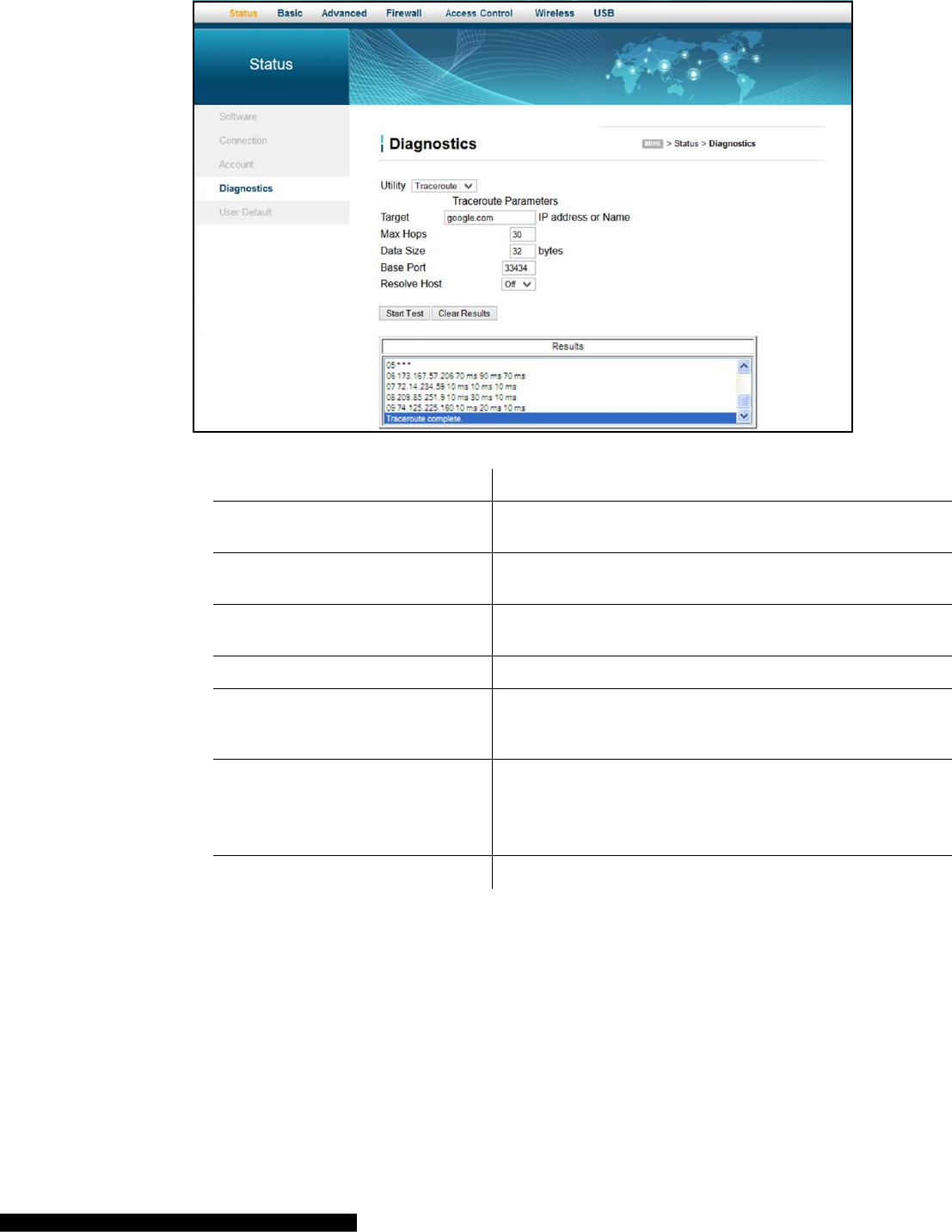
4.4.2 Using the Traceroute Option
The Traceroute utility determines the IP addresses of hosts in the network path. By
checking the Resolve Host names box, Traceroute tries to find which name matches the
address. Some hosts have no names, and might still be shown as IP addresses, even if
this option is active.
Steps
To trace host IP addresses along a route:
1. Click Status from main menu.
2. Click Diagnostics from the left side menu.
3. Choose Traceroute from the Utility drop-down menu.
4. Enter new parameter values or accept the default values.
5. Click Start Test. Field descriptions are listed below the screen example.
Ping Interval Defines the interval between ping operations in milliseconds.
Start Test
Abort Test
Clear Results
Defines what action to take.
Start Test begins the ping.
Abort Test stops the ping.
Clear Results deletes previous test results in the Results
table.
Results Displays the results of the ping test.
Label Description
Ubee Interactive Using the User Default Option
Ubee DDW365 Advanced Wireless Gateway Subscriber User Guide • February 2014 27
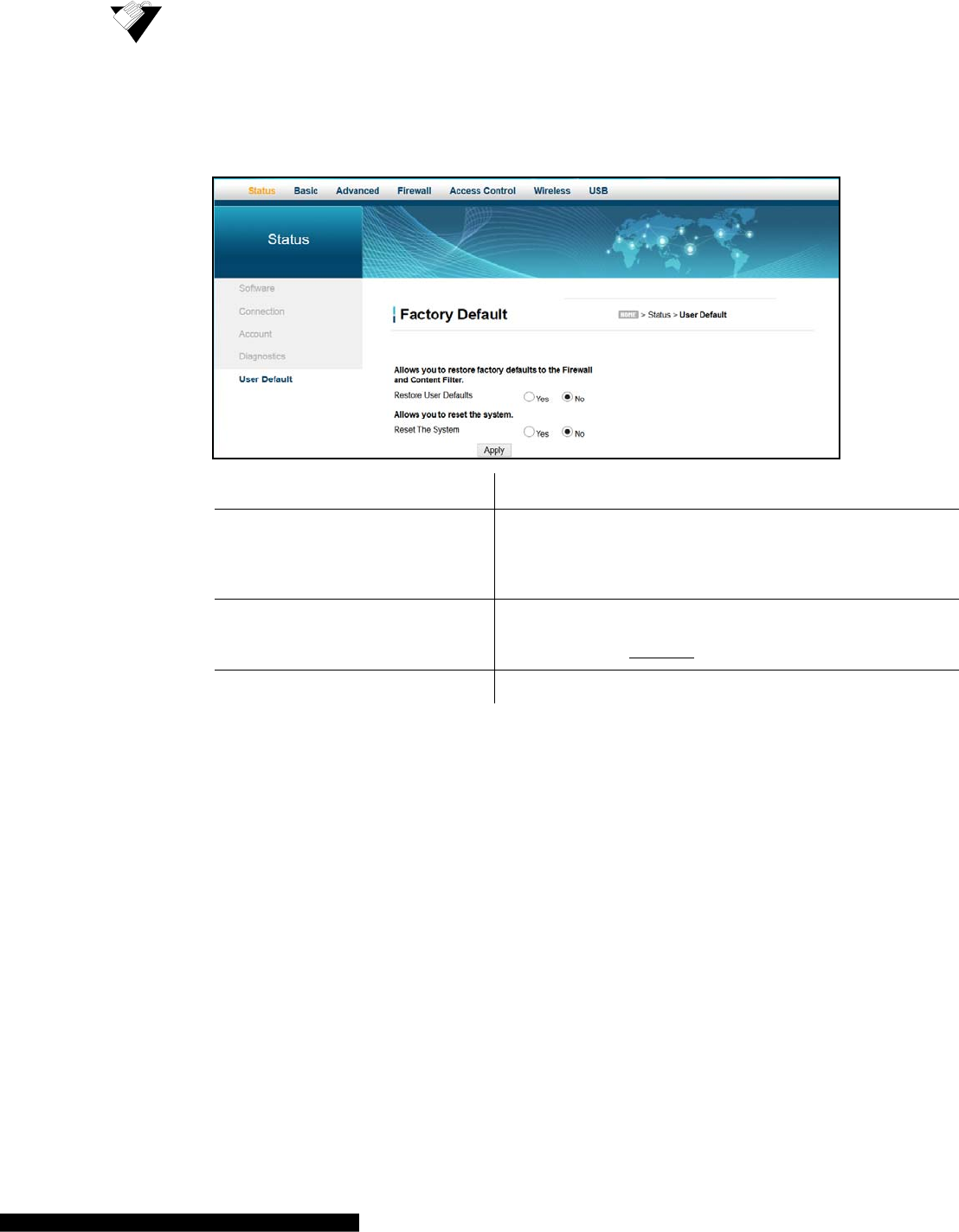
4.5 Using the User Default Option
The User Default option allows you to restore factory defaults to the Firewall and
Parental Control settings. All other networking settings are not cleared and reset (for
example, wireless settings).
Utility Provides a drop-down menu to choose Ping or Traceroute.
Target Defines the specific IP address or domain (for example,
ubeeinteractive.com) to which you want to trace a route.
Max Hops Defines the maximum number of hops. Hops are the number
of routers the traceroute traverses. Default is 30.
Data Size Defines the data size to send for the traceroute operation.
Default is 64.
Base Port Defines the destination port number. Default is 33434.
Resolve Host Enable (on) or disables (off) this option. When checked,
traceroute tries to find the name that matches the IP address.
Default is Off.
Start Test/Clear Results Defines what you want to do.
Start Test begins the traceroute.
Clear Results deletes previous test results in the Results
table.
Results Displays the results of the trace.
Ubee Interactive Using the User Default Option
Ubee DDW365 Advanced Wireless Gateway Subscriber User Guide • February 2014 28
Steps
To restore user defaults:
1. Click Status from the main menu.
2. Click User Default from the left side menu. Field descriptions are listed below the
screen example.
Label Description
Restore User Defaults Restores settings to factory defaults. Select Yes, then Apply, to
have the device to the default Firewall and Parental Control
Content Filter settings. This operation does not require a reset
(power cycle) of the system.
Reset The System Resets the system. Select Yes to power cycle the device.
When you select Apply, you will be notified that the device has
been reset. Click RELOAD. The Login screen will then appear.
Apply Applies the options selected on the screen.

Ubee DDW365 Advanced Wireless Gateway Subscriber User Guide • February 2014 29
5 Understanding the Basic Menu
Basic gateway options provide the majority of configuration for the device including WAN
IP addresses, LAN IP addresses, and DHCP. Advanced gateway options provide settings
like MAC filtering and port forwarding.
Topics
See the following topics:
Using the Setup Option on page 29
Using the DHCP Option on page 31
Using the DDNS Option on page 33
Using the Backup Option on page 34
Steps
To access the basic menu:
1. Access the Web user interface. Refer to Accessing the Web User Interface Locally on
page 16.
2. Click Basic from the main menu.
5.1 Using the Setup Option
Use the Setup option to configure common gateway parameters.
Steps
To configure setup options:
1. Click Basic from the main menu.
2. The Setup screen is displayed. Field descriptions are listed below the screen
example.
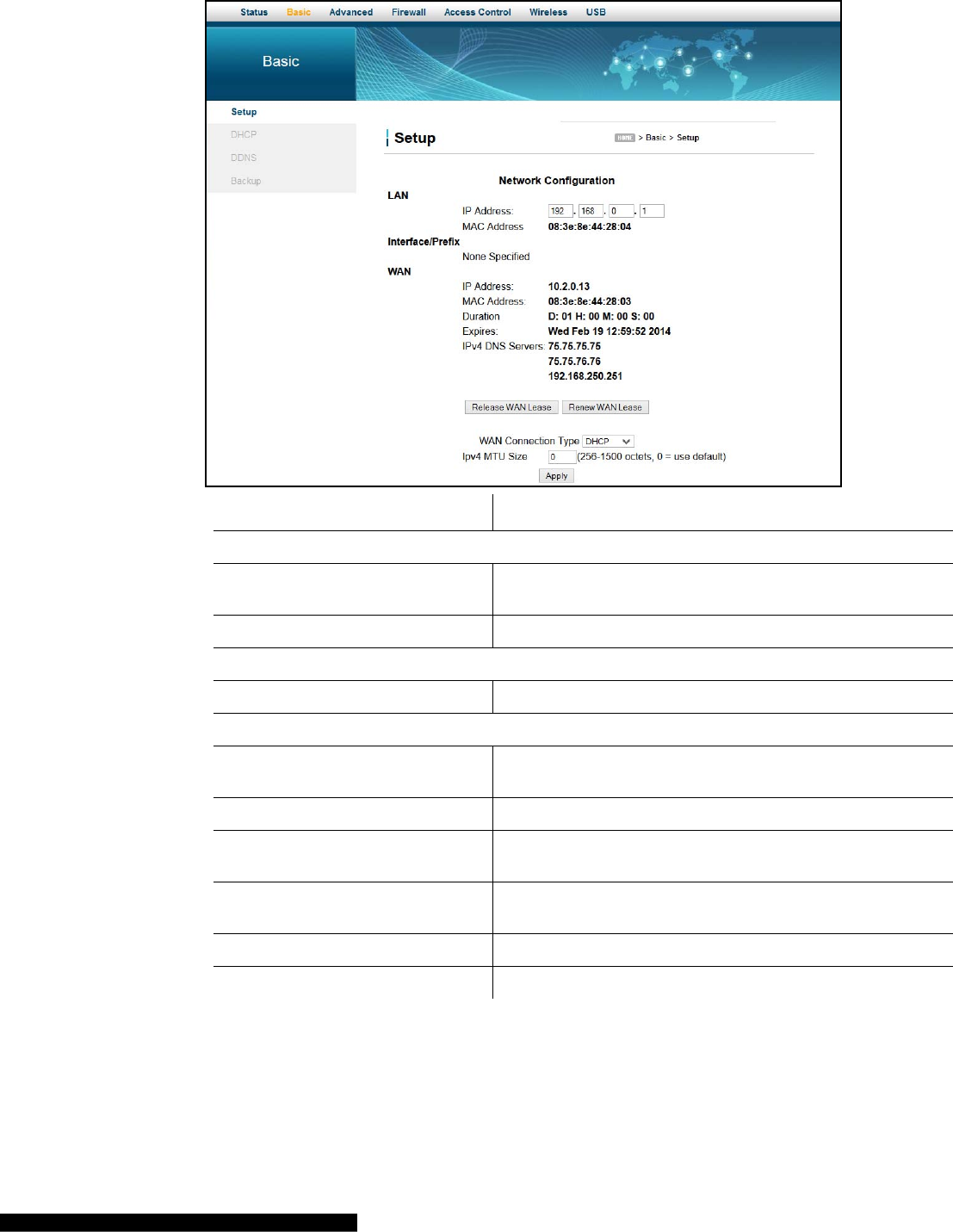
Ubee Interactive Using the Setup Option
Ubee DDW365 Advanced Wireless Gateway Subscriber User Guide • February 2014 30
Label Description
LAN
IP Address Defines the local IP address, which is the default gateway
address for all wired LAN hosts that connect to the DDW365.
MAC Address Displays the LAN interface’s hardware address.
Interface/Prefix
None Specified Indicates no interface or prefix has been specified.
WAN
IP Address Displays the current WAN public IP address obtained from the
service provider.
MAC Address Displays the WAN interface’s hardware address.
Duration Displays the accumulated time since successfully acquiring a
WAN public IP address.
Expires Displays the remaining time before the WAN IP address
expires, if applicable.
Release WAN Lease Releases the WAN public IP address when clicked.
Renew WAN Lease Renews the WAN IP address when clicked.

Ubee Interactive Using the DHCP Option
Ubee DDW365 Advanced Wireless Gateway Subscriber User Guide • February 2014 31
5.2 Using the DHCP Option
Use the DHCP option to configure dynamic host configuration protocol-specific behavior
on the device.
Steps
To configure DHCP settings:
1. Click Basic from the main menu.
2. Click DHCP from the left side menu. Field descriptions are listed below the screen
example.
WAN Connection Type Selects the WAN connection type. For each type, different data
entry is required, as explained below:
DHCP: The WAN interface is set to a DHCP client, and
the IP address is assigned by the service provider’s DHCP
server.
Static IP: For Static IP, you must manually enter the IP
address for the WAN interface.
PPTP (dhcp): For Point to Point Tunneling Protocol
(PPTP), you must enter a username, password, and the
PPTP server’s IP address.
PPTP (static):
L2TP (dhcp):
L2TP (static):
IPv4 MTU Size Defines the maximum transmission unit (MTU) size. MTU
defines the largest size of the packet or frame that the device
can transfer (256-1500). If this is not given by your service
provider, use 0 for the default.
Apply Saves changes.
Label Description
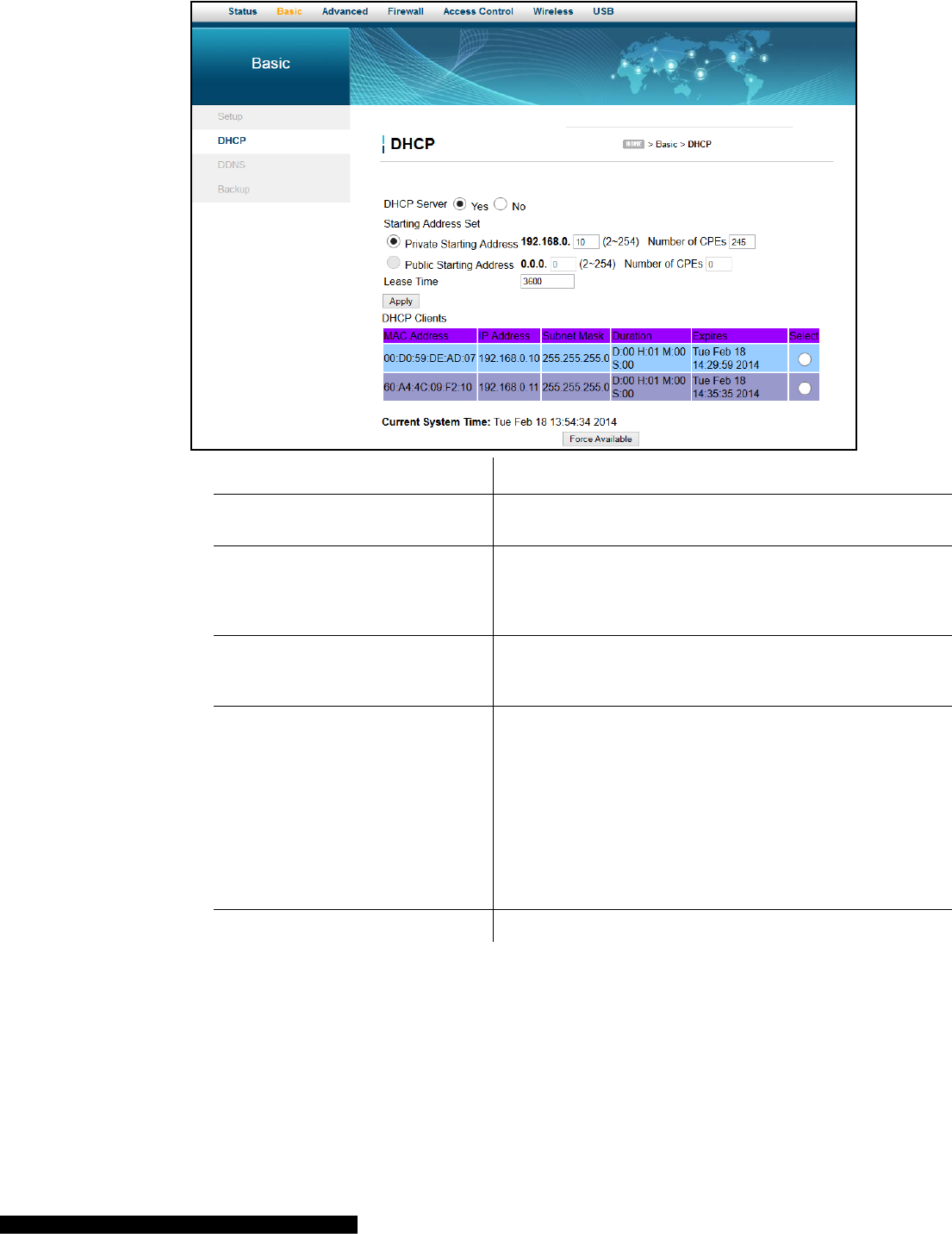
Ubee Interactive Using the DHCP Option
Ubee DDW365 Advanced Wireless Gateway Subscriber User Guide • February 2014 32
Label Description
DHCP Server Enables (Yes) or disables (No) DHCP on the device. If No is
selected, all the static DHCP rules in this screen are ignored.
Starting Local Address Defines the starting private IP address for the pool of IP
addresses that can be used by connecting clients. Private
addresses are translated to public IPs to be used on the
network.
Number of CPEs Defines the maximum number of customer premises
equipment devices (CPE) that can connect to the network
through the DDW365.
Lease Time Defines the DHCP lease time duration in minutes between 1
and 71582788. A DHCP user's PC gets an IP address with a
lease time. When the lease time expires, the PC must connect
to the DHCP server and be issued a new unused IP address.
Note: The default DHCP lease time is 3600 seconds and
should be changed to 86400 seconds (24 hours). This helps
resolve connectivity issues with some iMAC and Windows 7
devices that turn off the network interface when they go into
standby mode. This results in slow Web browsing until the
device gets a new IP address via DHCP.
Apply Saves changes.
Ubee Interactive Using the DDNS Option
Ubee DDW365 Advanced Wireless Gateway Subscriber User Guide • February 2014 33
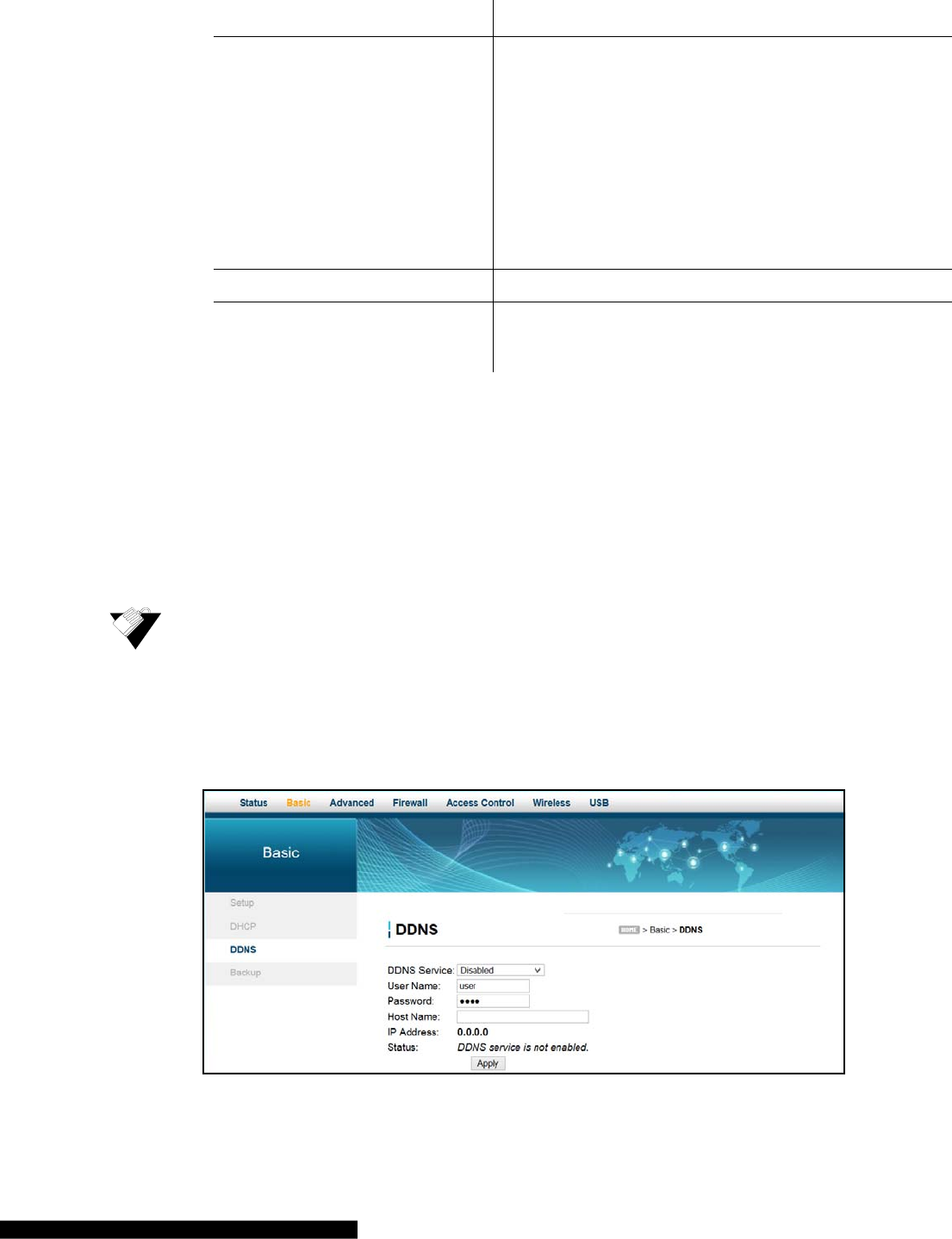
5.3 Using the DDNS Option
Use the dynamic domain name system (DDNS) to assign a changing IP address to a
constant pre-defined host name. The host can then be contacted by other hosts on the
Internet, even if its IP address changes.
The DDNS service for the DDW365 is provided through a third-party and can be
purchased from Dynamic Network Services Inc. at www.dynDNS.com.
Steps
To use the DDNS option:
1. Click Basic from the main menu.
2. Click DDNS from the left side menu. Field descriptions are listed below the screen
example.
DHCP Clients Lists all DHCP clients currently connected to the device, either
via an Ethernet link, or via a wireless connection. Each client
is listed with the following information:
MAC Address / IP Address / Subnet Mask
Duration / Expires: Duration displays the accumulated
time since the client acquired the IP address. Expires is
the time until the IP expires and must be recycled. If the
IP address is reserved to a certain host, it shows STATIC
IP ADDRESS.
Select: Reserves the current private IP address to be
assigned to this host statically when selected.
Current System Time Displays the current system time.
Force Available Activates a selected rule in the DHCP Clients list and assigns
IP addresses. Note: The Select button must be activated in the
DHCP list.
Label Description
Ubee Interactive Using the Backup Option
Ubee DDW365 Advanced Wireless Gateway Subscriber User Guide • February 2014 34
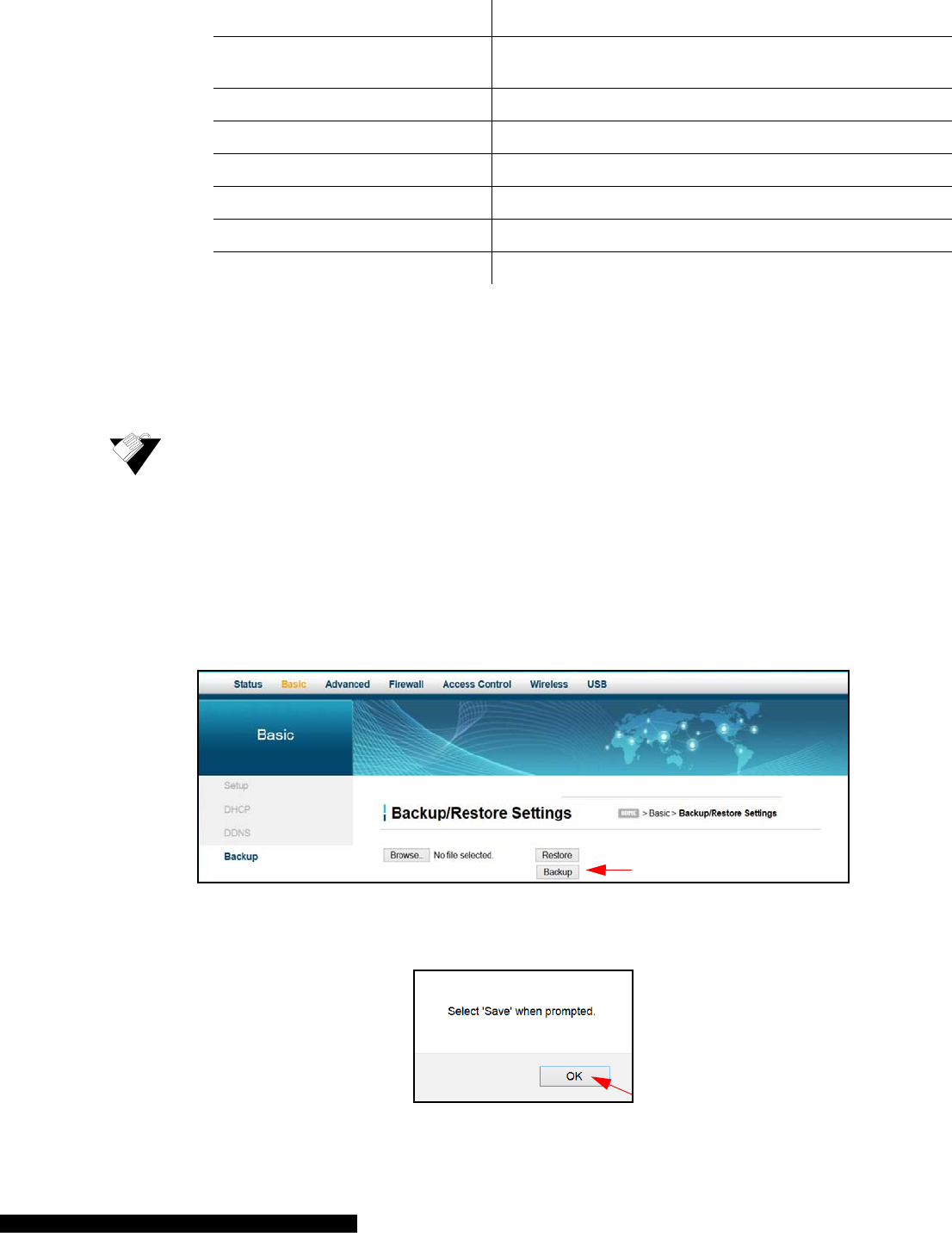
5.4 Using the Backup Option
The Backup option lets you backup your gateway configuration or restore the DDW365 to
a previously saved configuration.
Steps
To use the backup option:
1. Click Basic from the main menu.
2. Click Backup from the left side menu.
5.4.1 Backing Up the Current Modem Configuration
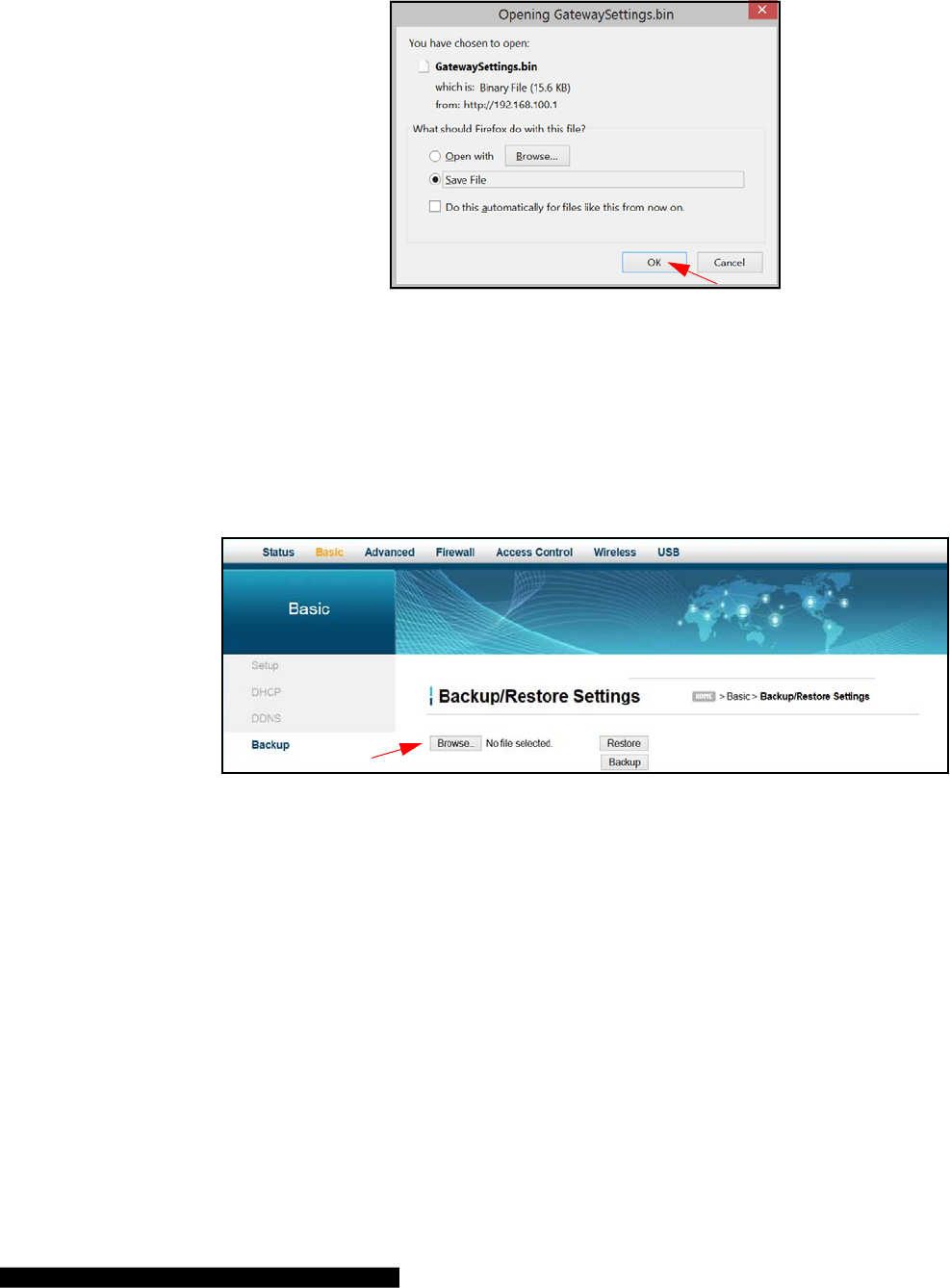
To backup and save the current modem configuration, click the Backup button.
A pop-up window appears instructing you to select ‘Save’ when prompted. Click ‘OK’.
Label Description
DDNS Service Enables or disables the DDNS service. When enabled, this
service is available from www.dynDNS.org.
User Name Defines the user name for the DDNS account.
Password Defines the password for the DDNS account.
Host Name Defines the host name for the DDNS account.
IP Address Displays the IP address for the DDNS account.
Status Displays if the DDNS service is enabled or disabled.
Apply Saves changes.
Ubee Interactive Using the Backup Option
Ubee DDW365 Advanced Wireless Gateway Subscriber User Guide • February 2014 35
The following window appears, giving you the option to save the file. Click the ‘Save File’
option and click ‘OK’.
The file will be saved to your Downloads folder as a binary file (.bin) titled
‘GatewaySettings.bin.’
5.4.2 Restoring the DDW365 to a Previously Saved Configuration
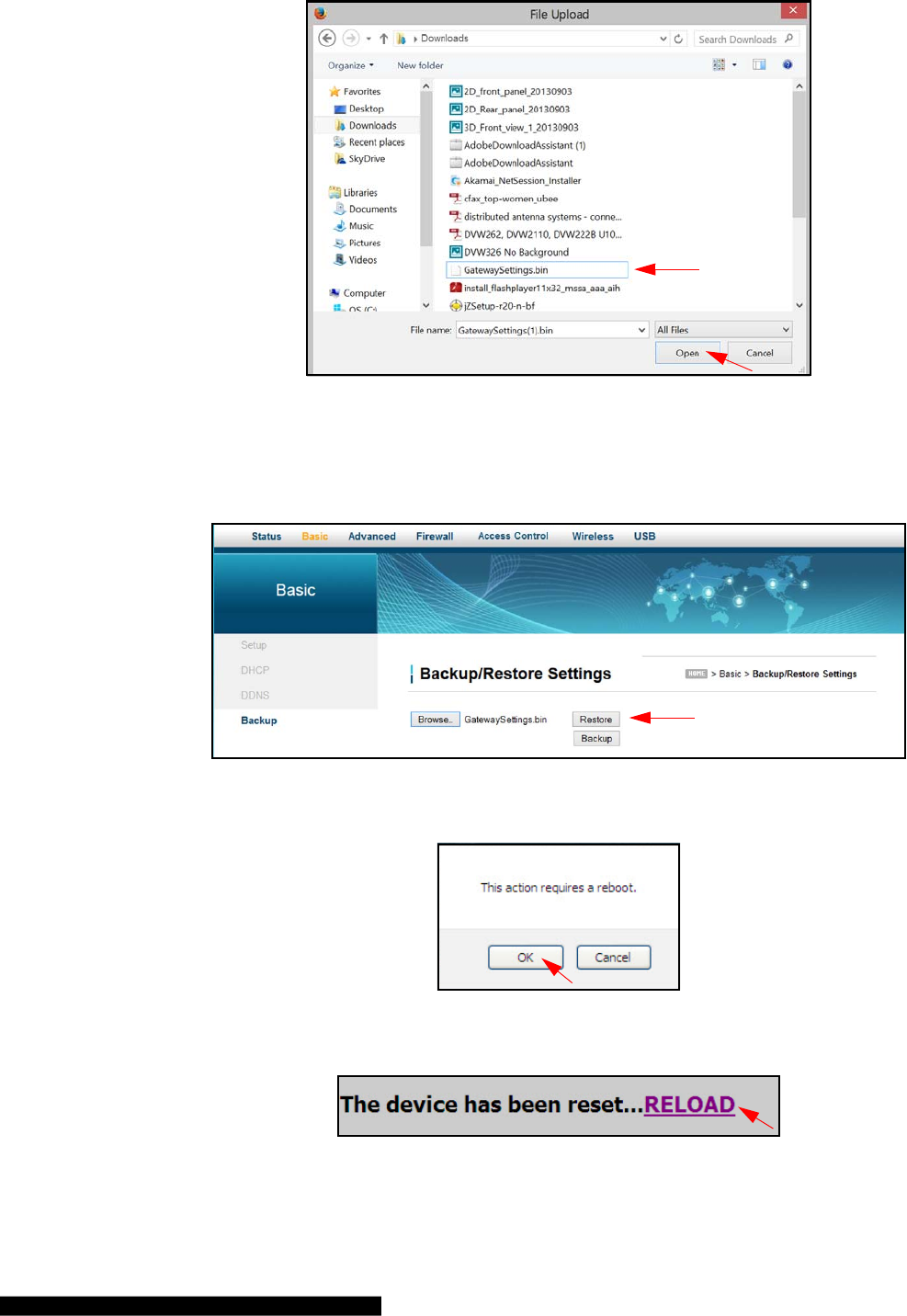
To restore the device to a previously saved configuration, click the Browse button.
The File Upload dialog box appears and allows you to select the previously saved backup
file. Highlight the file and click ‘Open’.
Ubee Interactive Using the Backup Option
Ubee DDW365 Advanced Wireless Gateway Subscriber User Guide • February 2014 36
The location for the backed up file appears in the box to the left of the Browse button.
Click the Restore button.
You are advised that you will be required to reboot the modem. Click ‘OK’.
You are then notified that the device has been reset. Click ‘RELOAD’.
Ubee Interactive Using the Backup Option
Ubee DDW365 Advanced Wireless Gateway Subscriber User Guide • February 2014 37
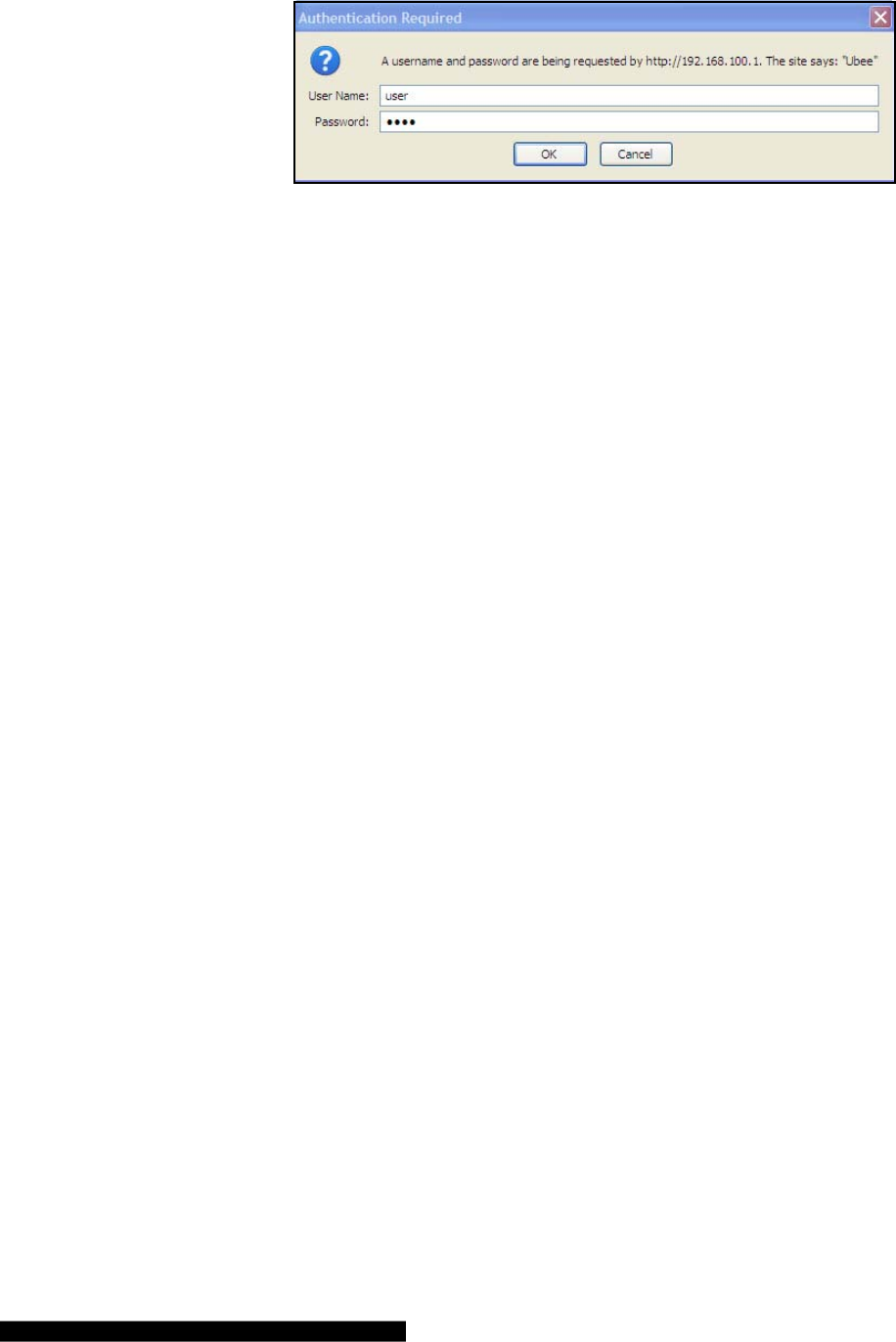
You are then presented with the login screen for the modem. Enter the Username and
Password to return to the modem User Interface.

Ubee DDW365 Advanced Wireless Gateway Subscriber User Guide • February 2014 38
6 Understanding the Advanced Menu
Advanced options provide settings to configure your DDW365, such as MAC filtering and
port forwarding.
Topics
See the following topics:
Using the Options Option on page 38
Using the IP Filtering Option on page 41
Using the MAC Filtering Option on page 42
Using the Port Filtering Option on page 43
Using the Forwarding Option on page 45
Using the Port Triggers Option on page 49
Using the Pass Through Option on page 53
Using the DMZ Host Option on page 53
Steps
To access the Advanced menu:
1. Access the Web user interface. Refer to Accessing the Web User Interface Locally on
page 16.
2. Click Advanced from the main menu.
6.1 Using the Options Option
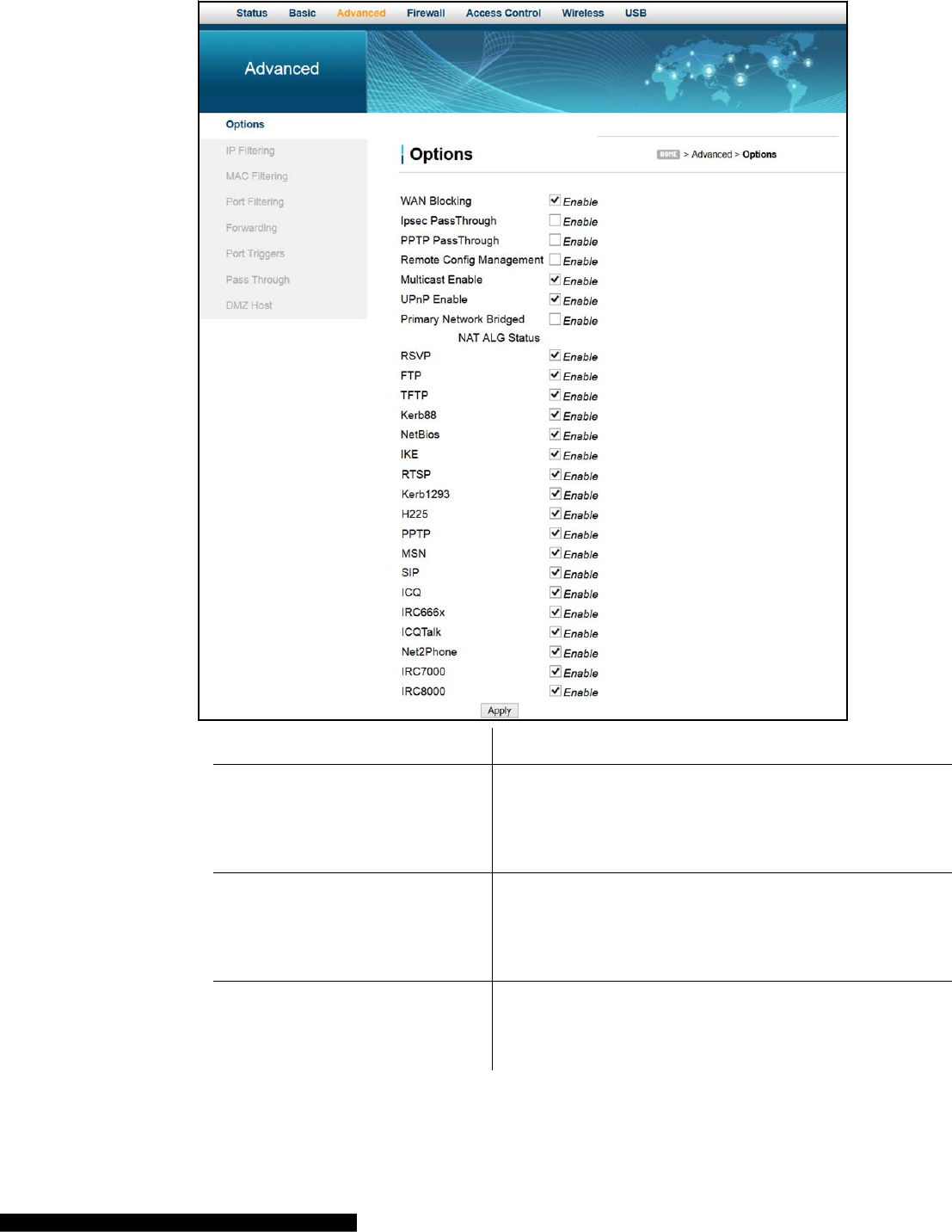
Use the Options option to define which networking protocols are enabled or disabled on
the device. The network address translation application-level gateway (NAT ALG) settings
provide additional security beyond the firewall.
Steps
To enable or disable network protocols:
1. Click Advanced from the main menu.
2. The Options screen is displayed. Field descriptions are listed below the screen
example.
Ubee Interactive Using the Options Option
Ubee DDW365 Advanced Wireless Gateway Subscriber User Guide • February 2014 39
Label Description
WAN Blocking When enabled, WAN Blocking blocks PING access to the
WAN Public Gateway IP address that is exposed to the
Internet. When disabled, PING access is allowed to occur,
which is necessary for the remote configuration of some VoIP
phones (e.g., Cisco, Polycom).
Ipsec PassThrough When enabled, allows encrypted IPsec VPN traffic to pass
through the router between the IPsec VPN Client application
on the PC/Mac and the IPsec VPN Concentrator (e.g.,
Barracuda, Cisco, Juniper, etc) for access to the “company
VPN.”
PPTP PassThrough When enabled, allows encrypted PPTP VPN traffic to pass
through the router between the PPTP VPN Client application
on the PC/Mac and the PPTP VPN Server (e.g., Windows
Server, 2013) for access to the “company VPN.”

Ubee Interactive Using the Options Option
Ubee DDW365 Advanced Wireless Gateway Subscriber User Guide • February 2014 40
Remote Config Management Enables or disables access to the device from a remote
system in order to configure settings. Remote management
can be achieved by using SNMP, web/HTTP or telnet.
Multicast Enable Optimizes the bandwidth utilization compared with unicast
(especially video streaming applications).
UPnP Enable Activates Universal Plug and Play (UPnP) when enabled. A
UPnP device can dynamically join a network, obtain an IP
address, convey its capabilities, and learn about other devices
on the network. In turn, a device can leave a network smoothly
and automatically when it is no longer in use. Gaming
consoles and Web cameras are examples of devices that can
use UPnP.
Primary Network Bridged When enabled, all wireless traffic sourced from the primary
SSID will be bridged.
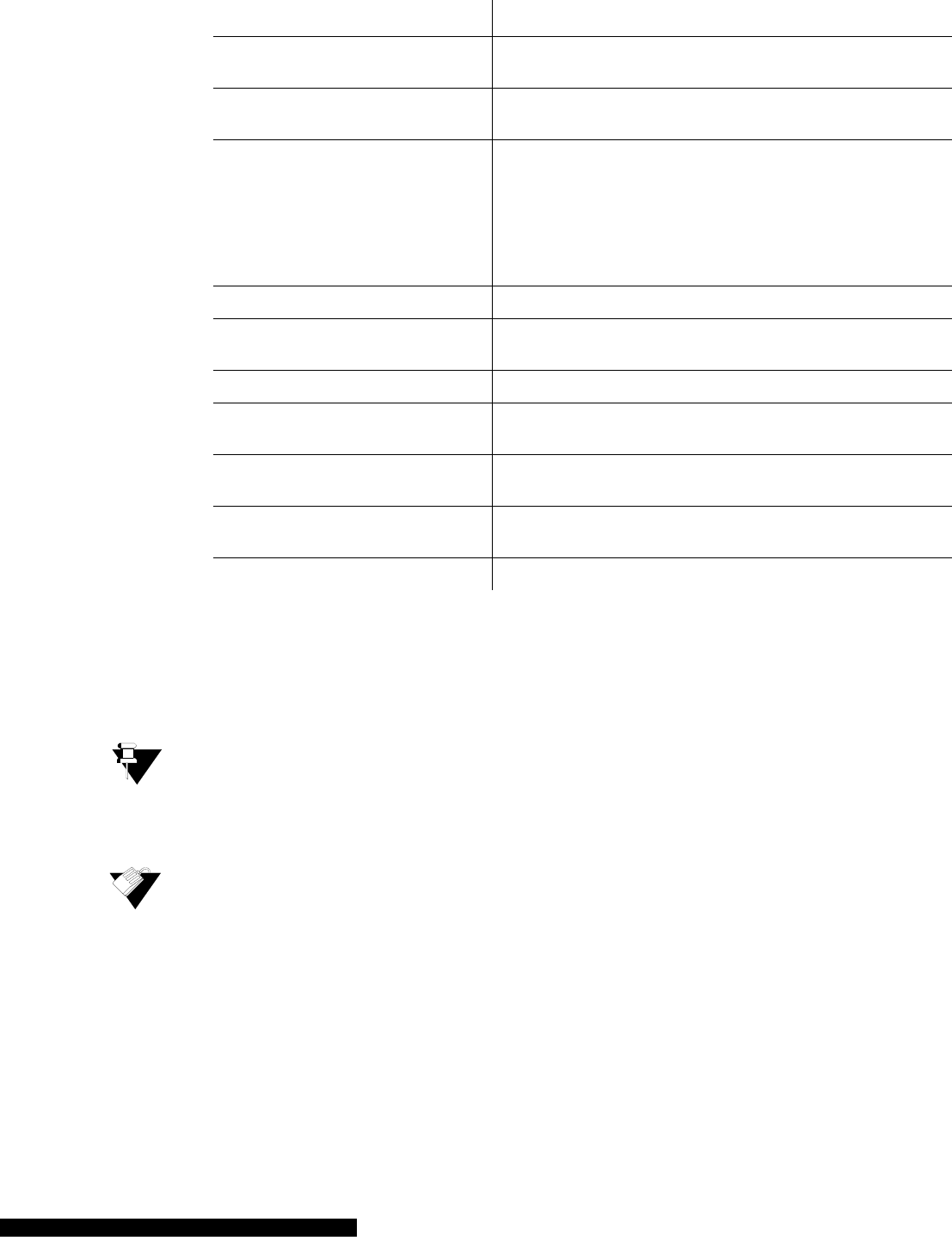
NAT ALG Status – Filters to allow (enable) or disallow (disable) protocols to pass through the
DDW365 to connected devices (computers, game consoles, and so on).
RSVP Enables or disables resource reservation protocol (RSVP).
RSVP defines how applications reserve resources and how
they free the reserved resources once they are no longer
needed.
FTP Enables or disables the file transfer protocol (FTP) used to
transfer files from one host to another.
TFTP Enables or disables the trivial file transfer protocol (TFTP) – a
simpler protocol generally used for automated file transfers.
Kerb88 Enables or disables the Kerberos network authentication
protocol which allow nodes to communicate over a non-secure
network using “tickets” on port 88 to prove their identity to one
another.
NetBios Enables or disables the network basic input/output system
(NetBIOS) services related to the OSI session layer. NetBIOS
allows applications on separate computers to communicate
over a LAN.
IKE Enables or disables the network key exchange (IKE) protocol
used to set up a security association (SA) in the IPsec protocol
suite.
RTSP Enables or disables the real time streaming protocol (RTSP)
network control protocol used to establish and control media
sessions between end points.
Kerb1293 Enables or disables the Kerberos network authentication
protocol which allows nodes to communicate over a non-
secure network using “tickets” on port 1293.
H225 Enables or disables the H.225 protocol used to define
messages and procedures for call signaling, media
packetization, and registration, admission, and status (RAS)
functions.
Label Description
Ubee Interactive Using the IP Filtering Option
Ubee DDW365 Advanced Wireless Gateway Subscriber User Guide • February 2014 41
6.2 Using the IP Filtering Option
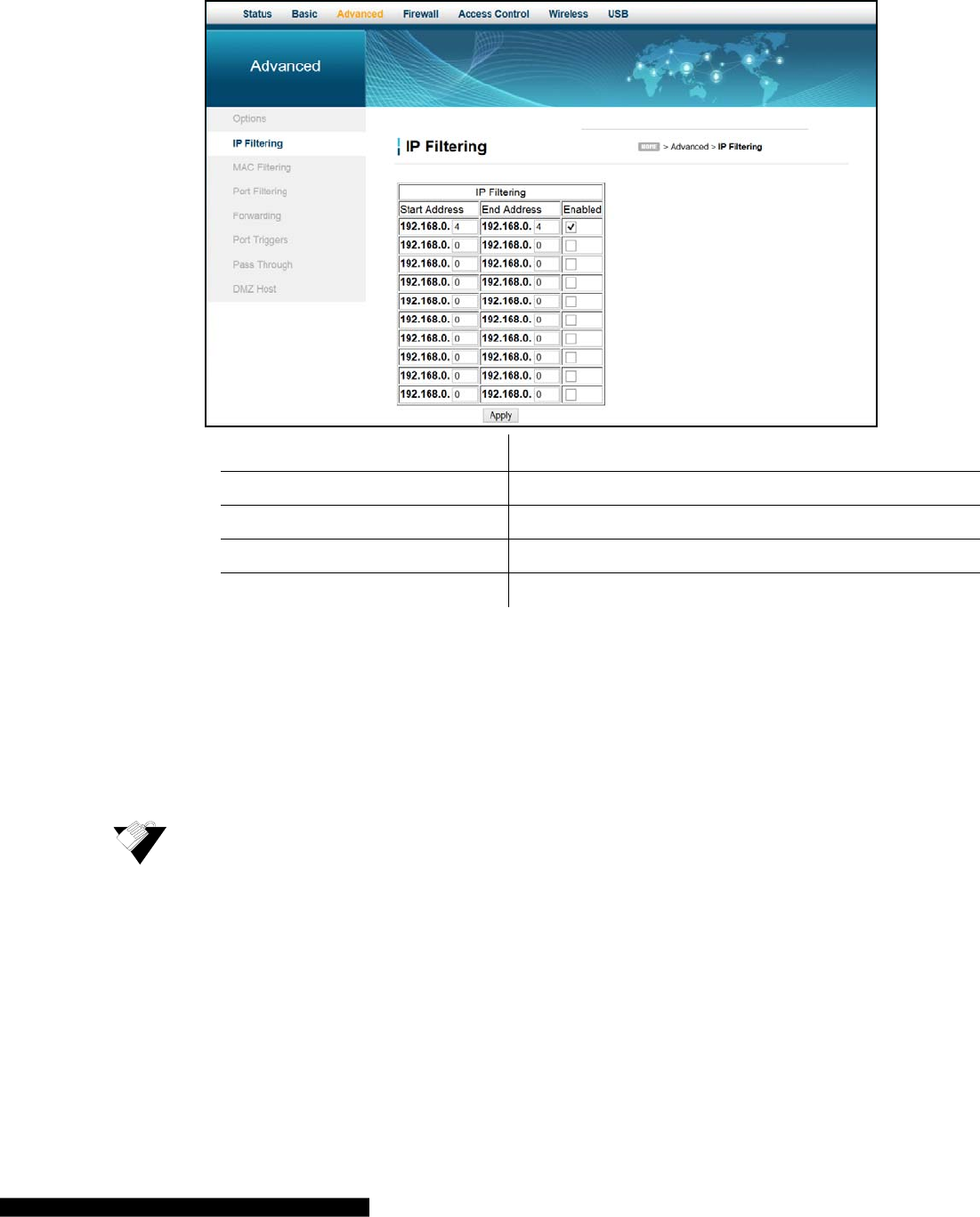
Use the IP Filtering option to filter IP addresses to block Internet traffic to specific
network devices on the LAN. Any host on this list is not accessible to Internet traffic.
Note
You may also filter by the MAC address which does not require setting a static lease.
Refer to Using the MAC Filtering Option on page 42.
Steps
To filter IP addresses:
1. Make sure a PC is connected to the cable modem and both devices are powered on
and functioning.
2. Log in to the cable modem’s Web user interface. Refer to Accessing the Web User
Interface Locally on page 16.
3. Click Advanced from the main menu.
PPTP Enables or disables the point-to-point tunneling protocol
(PPTP) used to implement a virtual private network.
MSN Enables or disables the Microsoft network protocol used for
instant messaging.
SIP Enables or disables the session initiation protocol application
layer gateway (SIP ALG). SIP ALG inspects protocol
packets and formats SIP message headers and SDP
body to ensure proper signaling. Note: Some hosted VoIP
services prefer this function to be performed by their own
session border controller (SBC) and require the SIP ALG to be
disabled. Some IP-PBXs may require SIP ALG enabled.
ICQ Enables or disables the ICQ instant messaging program.
IRC666x Enables or disables the Internet relay chat (IRC) protocol used
for text messaging.
ICQTalk Enables or disables the ICQTalk instant messaging program.
Net2Phone Enables or disables Net2Phone SIP- and PacketCable-based
VoIP.
IRC7000 Enables or disables the Internet relay chat protocol on TCP
port TCP 7000 used for text messaging and group forums.
IRC8000 Enables or disables the Internet relay chat protocol on UDP
port 8000 used for text messaging and group forums.
Apply Saves changes.
Label Description
Ubee Interactive Using the MAC Filtering Option
Ubee DDW365 Advanced Wireless Gateway Subscriber User Guide • February 2014 42
4. Click IP Filtering from the left side menu. Field descriptions are listed below the
screen example.
6.3 Using the MAC Filtering Option
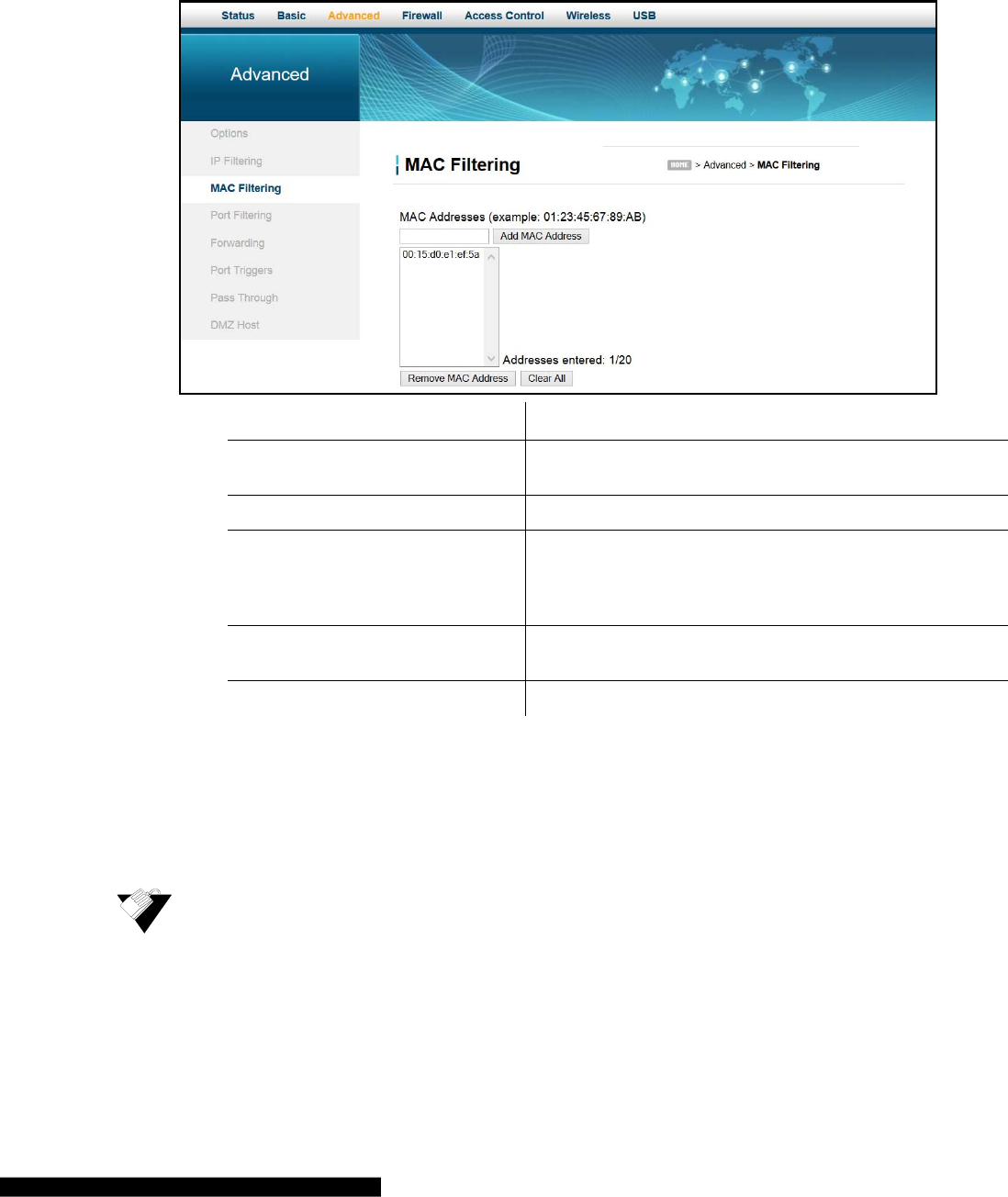
The MAC Filtering option allows you to filter MAC addresses to block Internet traffic from
specific network devices on the LAN. MAC filtering establishes a list and any host on this
list is not able to access the network through the DDW365.
Steps
To filter MAC addresses:
1. Note the MAC address of the devices that you want to deny Internet access.
Be sure all devices to which you potentially deny Internet access are connected to the
DDW365 network.
2. Click Advanced from the main menu.
3. Click MAC Filtering from the left side menu.
Label Description
Start Address Defines the starting IP address to block.
End Address Defines the ending IP address to block.
Enabled Activates the rule when Enabled is checked.
Apply Saves changes.
Ubee Interactive Using the Port Filtering Option
Ubee DDW365 Advanced Wireless Gateway Subscriber User Guide • February 2014 43
4. Enter the MAC address to block in the text box to the left of the Add MAC Address
button.
5. Click the Add MAC Address button. The MAC address is displayed in the filtered
MAC address list. Field descriptions are listed below the screen example.
6.4 Using the Port Filtering Option
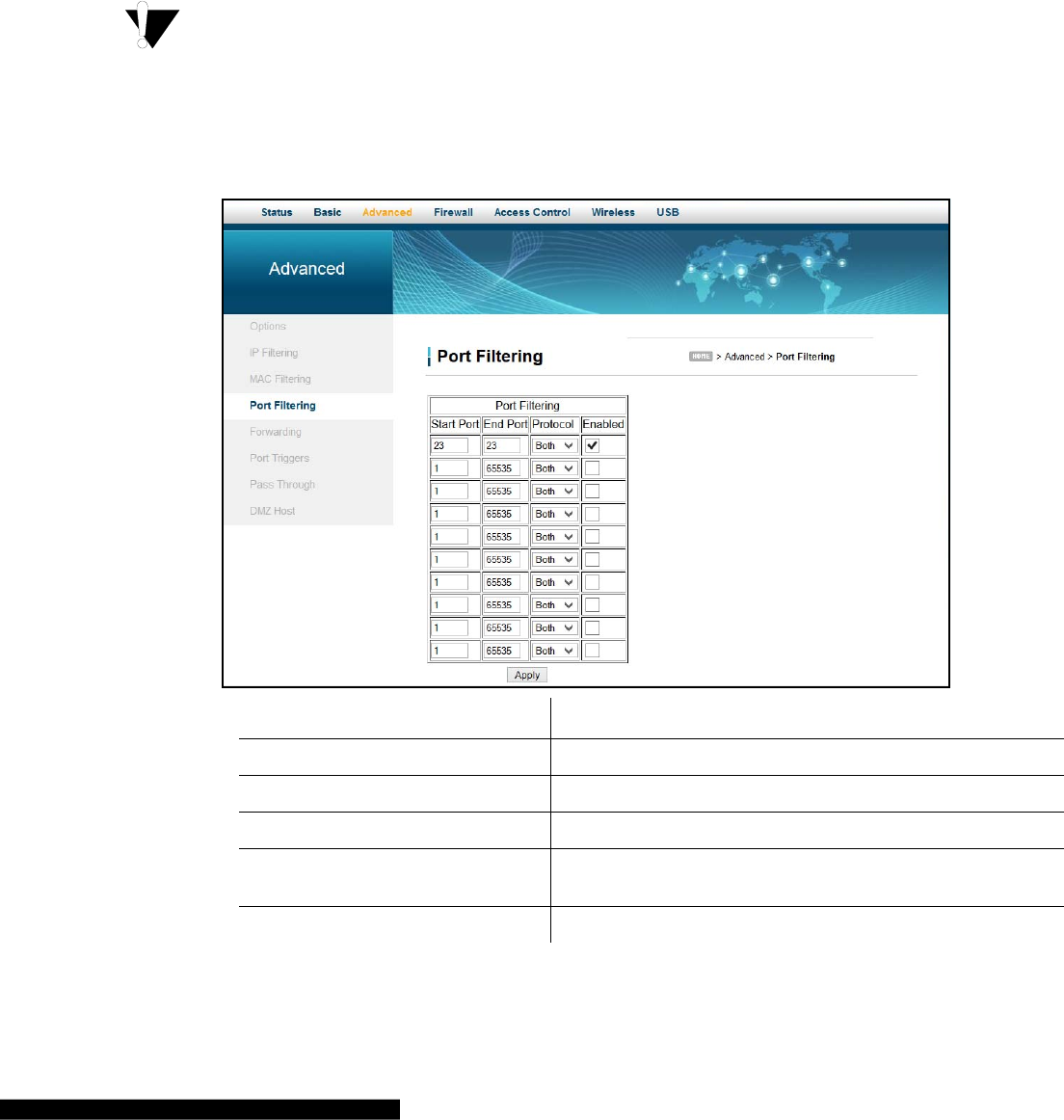
Use the Port Filtering option to configure port filters to block to all devices on the LAN
Internet services that use the ports specified.
Steps
To configure port filters:
1. Click Advanced from the main menu.
2. Click Port Filtering from the left side menu. Field descriptions are listed below the
screen example.
Label Description
MAC Addresses Defines the MAC address to block. Enter the MAC address in
the field.
Add MAC Address Adds the MAC address to the list of addresses to block.
Addresses entered: n/20 Displays the MAC addresses to be blocked. The number of
MAC addresses entered is shown as 1/20 where 1 is the
number of addresses in the list. You can filter up to twenty
MAC addresses at one time.
Remove MAC Address Deletes the selected MAC address from the list of addresses
to be blocked.
Clear All Removes all MAC addresses from the list.
Ubee Interactive Using the Port Filtering Option
Ubee DDW365 Advanced Wireless Gateway Subscriber User Guide • February 2014 44
For example:
To prevent all Telnet access into and across your LAN:
1. Enter the Start and End ports to be 23.
2. Select Both for Protocol to include TCP and UDP.
3. Check Enabled.
4. Click Apply. Field descriptions are listed below the screen example.
Caution
Use caution when assigning port filtering by port range. You may accidentally prevent
traffic that should pass through your network, such as http or email. Pre-assigned
application ports are displayed on the Forwarding screen. Refer to Using the Forwarding
Option on page 45.
Label Description
Start Port Defines the starting port number
End Port Defines the ending port number.
Protocol Selects the protocol type. Options are UDP, TCP, or Both.
Enabled Activates the rule and filters out all traffic on the specified
ports.
Apply Saves changes.
Ubee Interactive Using the Forwarding Option
Ubee DDW365 Advanced Wireless Gateway Subscriber User Guide • February 2014 45
6.5 Using the Forwarding Option
Forwarding tells the DDW365 to which computer on the local area network to send data.
If your host systems or applications have communications issues with the Internet, you
can use forwarding to resolve the following issues:
Data is sent from a local host to the Internet, but the return path of expected data is
not received by your local host.
An application or service running on your local network (on local host) cannot be
accessed from the Internet directly (for example, a request to a local audio server).
Examples are:
Xbox/PlayStation – Games/applications
Home Security Systems – Security systems that use the Internet
Audio Servers/VoIP – Audio and VoIP applications and services
Topics
See the following topics:
Before Setting Up Forwarding on page 45
Setting Up Forwarding on page 46
Setting Up Forwarding for an Xbox Example on page 48
6.5.1 Before Setting Up Forwarding
Try the following options before you assign forwarding rules:
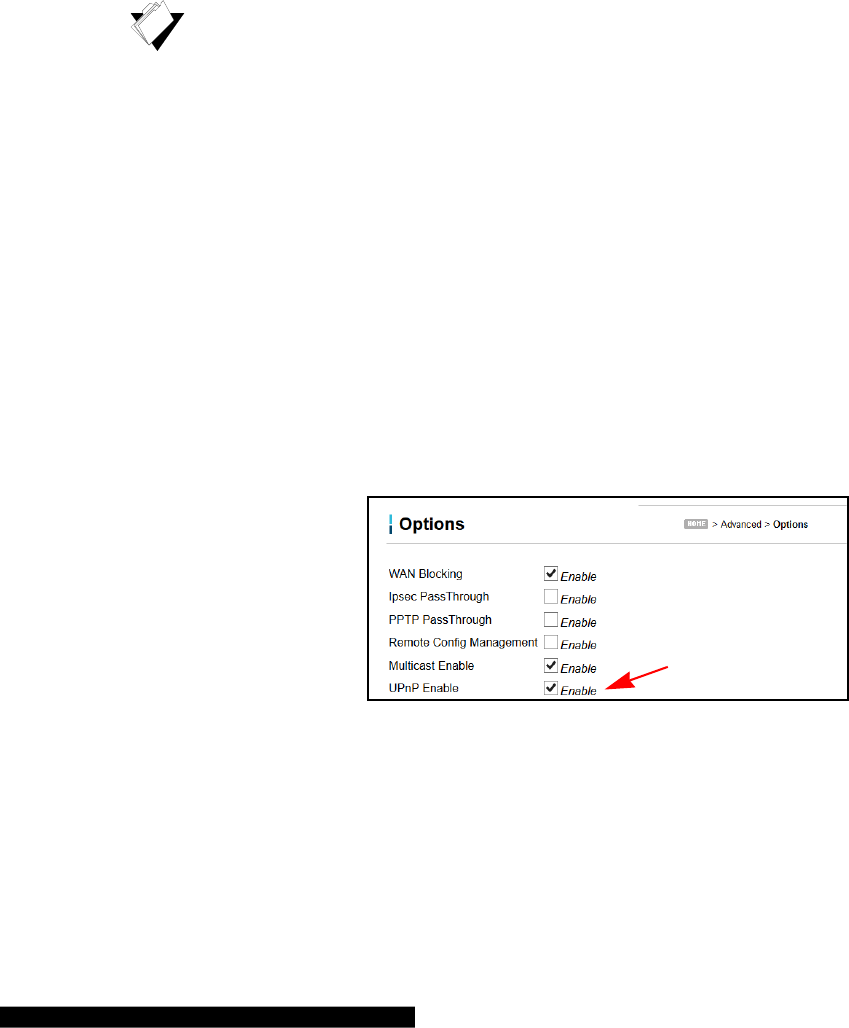
1. Enable Universal Plug and Play (UPnP). This may resolve the issue you have without
setting up forwarding rules.
a. Access the Web interface of the DDW365, see Accessing the Web User Interface
Locally on page 16.
b. Click Advanced from the main menu.
c. The Options screen is displayed. Check the Enable UPnP box.
.
d. Click Apply.
e. Test your local host or application such as your Xbox to see if it is functioning
properly. Continue with port forwarding if the host or application is not
communicating correctly.
2. Assign a Static IP lease to the client/host to which you are setting up forwarding. This
Ubee Interactive Using the Forwarding Option
Ubee DDW365 Advanced Wireless Gateway Subscriber User Guide • February 2014 46
way, the IP does not change and disrupt your forwarding rules. For example, if you are
hosting a Web server in your internal network, and you wish to setup a forwarding rule
for it, assign a static IP lease to that system to keep the IP from renewing and
disrupting the forwarding rule.
6.5.2 Setting Up Forwarding
If the suggestions in Before Setting Up Forwarding on page 45 did not correct your
communication problem, use port forwarding.
You need the following information to set up port forwarding:
IP address of each local host system (for example, Xbox) for which you need to setup
a port forwarding rule.
Port numbers the local host’s application listens to for incoming requests/data (for
example, a game or other service). These port numbers should be available in the
documentation associated with the application.
Note
For detailed information on port forwarding, including how to set it up for specific
applications using specific network devices (for example, cable modems), refer to:
http://portforward.com or consult your host device or application user manual.
Steps
To set up forwarding:
1. Access the Web interface of the cable modem, see Accessing the Web User Interface
Locally on page 16.
2. Click Advanced from the main menu.
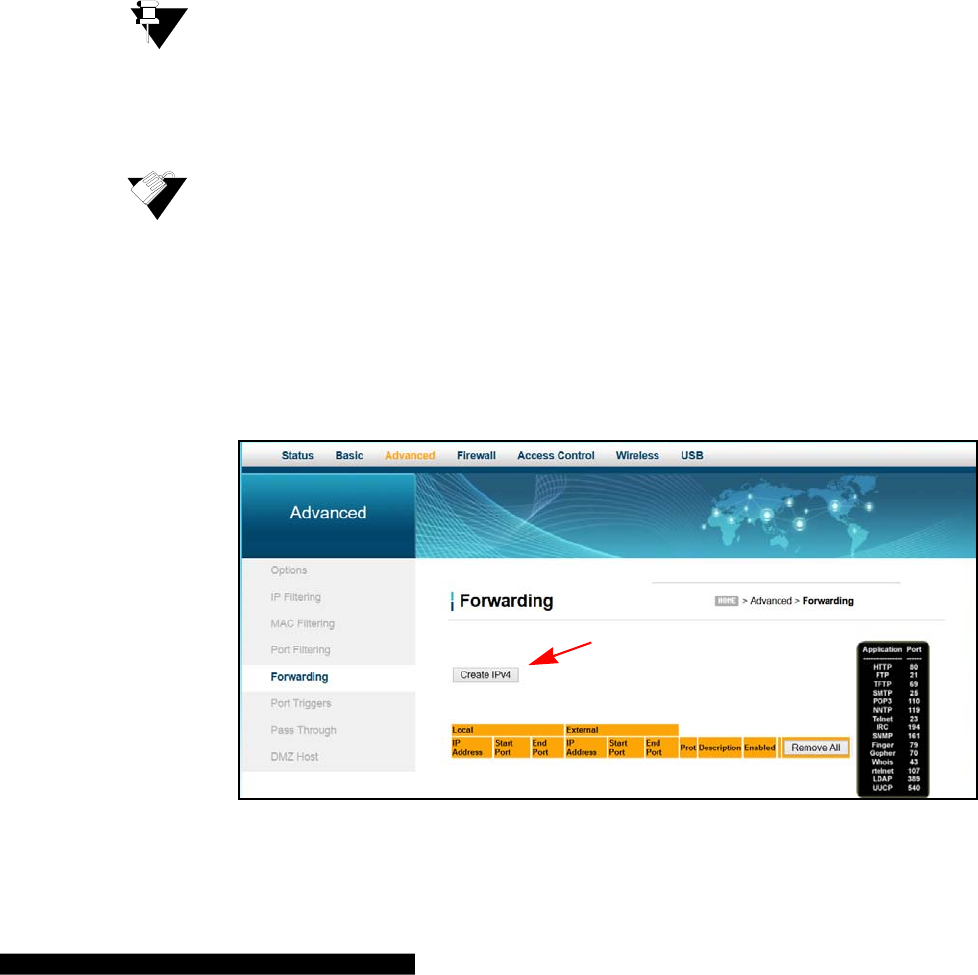
3. Click Forwarding from the left menu.
4. Click Create IPv4
Ubee Interactive Using the Forwarding Option
Ubee DDW365 Advanced Wireless Gateway Subscriber User Guide • February 2014 47
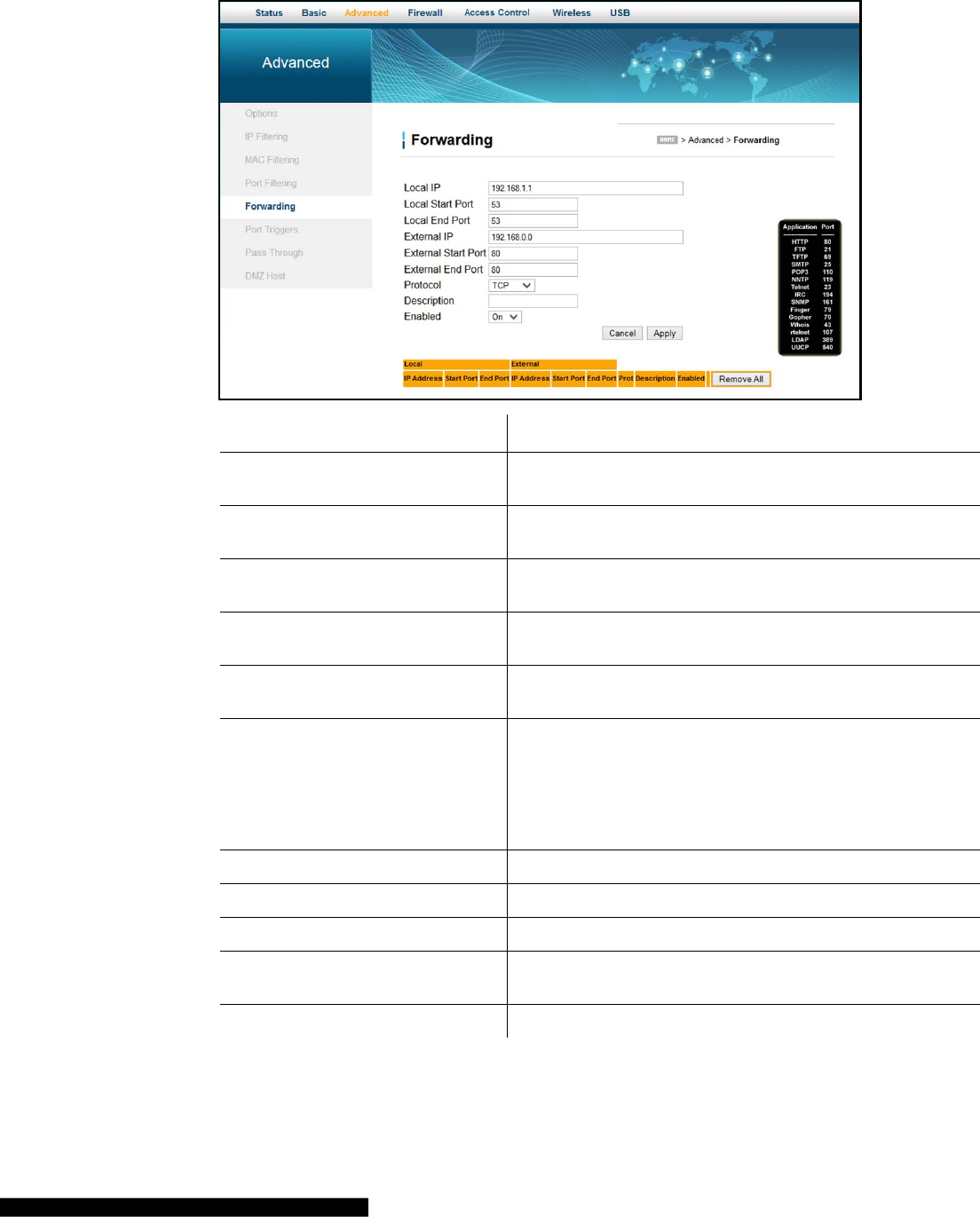
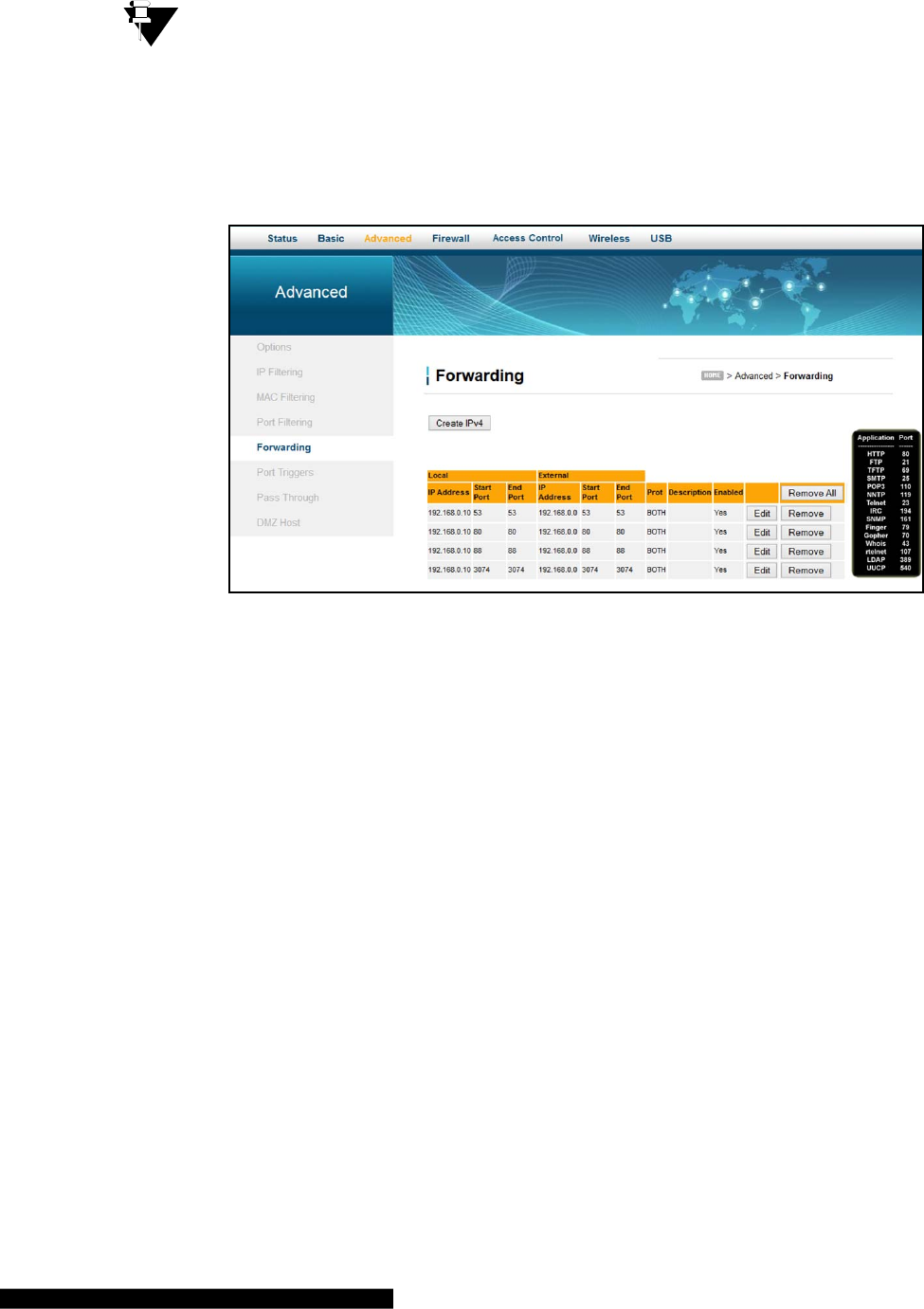
5. Enter information in the forwarding fields as shown in the screen shot below. Field
descriptions follow.
Label Description
Local IP Address Defines the IP address of the local LAN device to which the
forwarding rule applies. For example, an Xbox or PC.
Local Start Port Defines the starting port number listened to by the server host
located in your LAN.
Local End Port Defines the ending port number listened to by the server host
located in your LAN.
External IP Address Designates another router on the network through which to
forward data.
External Start Port Defines the port number to start the range of ports to publish
to the Internet.
External End Port Defines the port number to end the range of ports published to
Internet.
Note: Be very careful with ranges. Ports within a range are not
usable by other applications that may require them. It is
common and safer to enter the same port number as the start
and end of the range.
Protocol Selects the protocol type. Options are UDP, TCP, or BOTH.
Description Names the forwarding rule.
Enabled Disables (Off) or enables (On) the forwarding rule.
Cancel Stops creating the forwarding rule and returns you to the
previous Forwarding screen.
Apply Saves changes.
Ubee Interactive Using the Forwarding Option
Ubee DDW365 Advanced Wireless Gateway Subscriber User Guide • February 2014 48
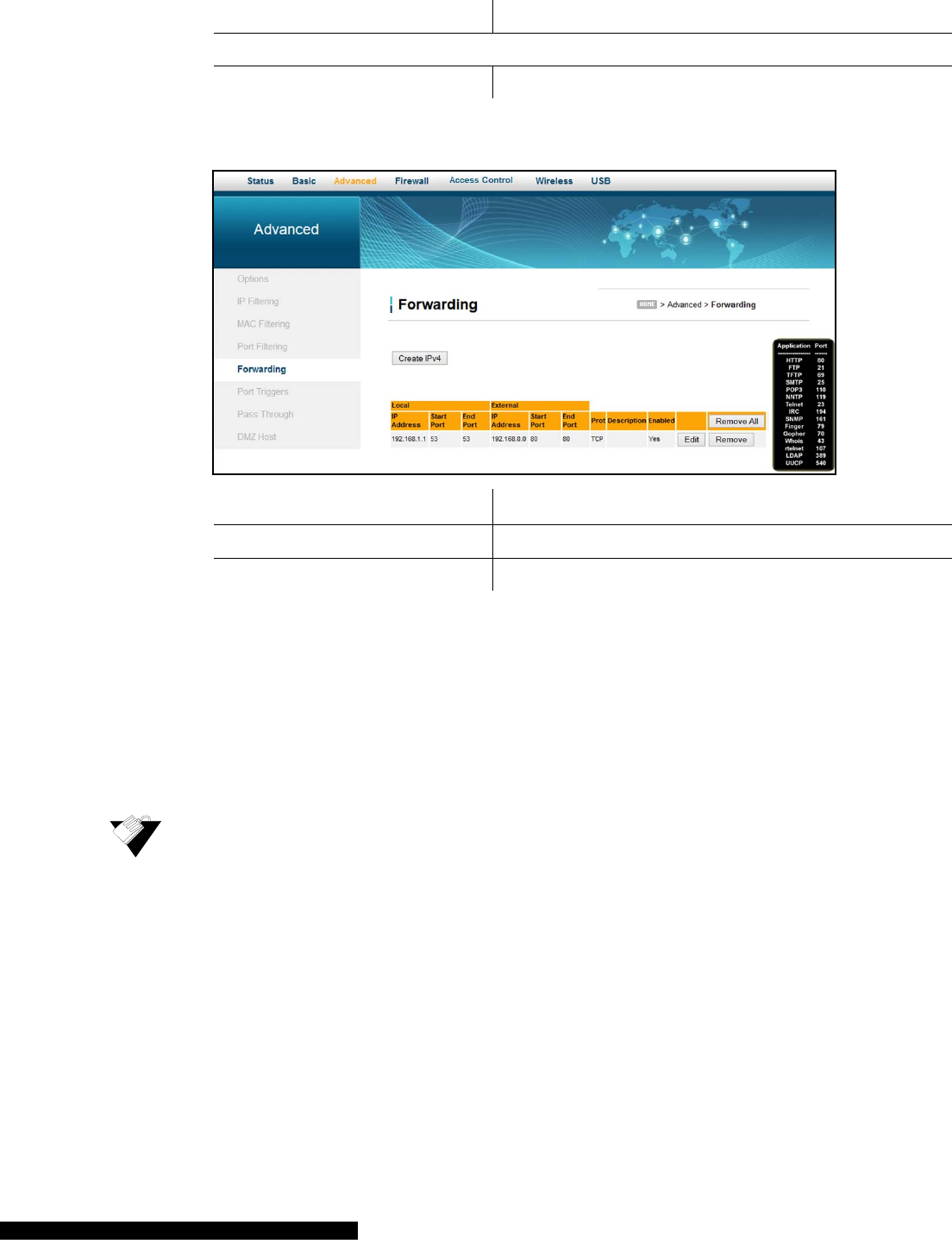
6. Click Apply. The forwarding rule is created and displayed in the table as shown
below. Additional field descriptions follow.
6.5.3 Setting Up Forwarding for an Xbox Example
Following is an example of how you would set up a single Xbox running Modern
Warfare 2. Since multiple ports are used for the Xbox and the Modern Warfare 2 game, a
separate forwarding rule is set for each port. Multiple ports and forwarding rules may not
be required for other applications.
Steps
To set up port forwarding for an Xbox:
1. Click Advanced from the main menu.
2. Click Forwarding from the left side menu.
3. Enter the Xbox IP address in the Local IP field.
4. Define ports used by the Xbox in the Local Start Port and Local End Port fields.
Define the same ports used by the Xbox in the External Start Port and External End
Port fields.
5. Create Port Forwarding rules per port. A rule set up for port 53 works for port 53. A
Port Map Shows a list of common applications and their ports.
Forwarding Table – Lists existing forwarding rules.
Remove All Deletes all entries in the forwarding table.
Label Description
Edit Displays fields for the rule selected in order to change values.
Remove Deletes the rule selected.
Ubee Interactive Using the Port Triggers Option
Ubee DDW365 Advanced Wireless Gateway Subscriber User Guide • February 2014 49
port can be used only by one program at a time.
Note
You can set up applications/services to listen on one internal port. External Internet
users who want to access that application, address it using an external port, such as
an Audio server. Internal Ports are the ports to which local servers listen. External
Ports are the ports that the DDW365 listens to from the WAN.
The following screen shot shows Forwarding set up for an Xbox.
6.6 Using the Port Triggers Option
Port Triggers define dynamic triggers to specific devices on the LAN. This allows special
applications that require specific port numbers with bi-directional traffic to function
properly. Applications such as video conferencing, voice, gaming, and some messaging
program features may require these special settings.
Some services use a dedicated range of ports on the client side and a dedicated range of
ports on the server side. The difference between port forwarding and triggering is:
Port forwarding sets a rule to send a service to a single LAN IP address.
Port triggering defines two kinds of ports: trigger port and target port. The trigger
port sends a service request from a LAN host to a specific destination port number.
The port the LAN host is required to listen to by the application is called the target
port. The server returns responses to these ports.
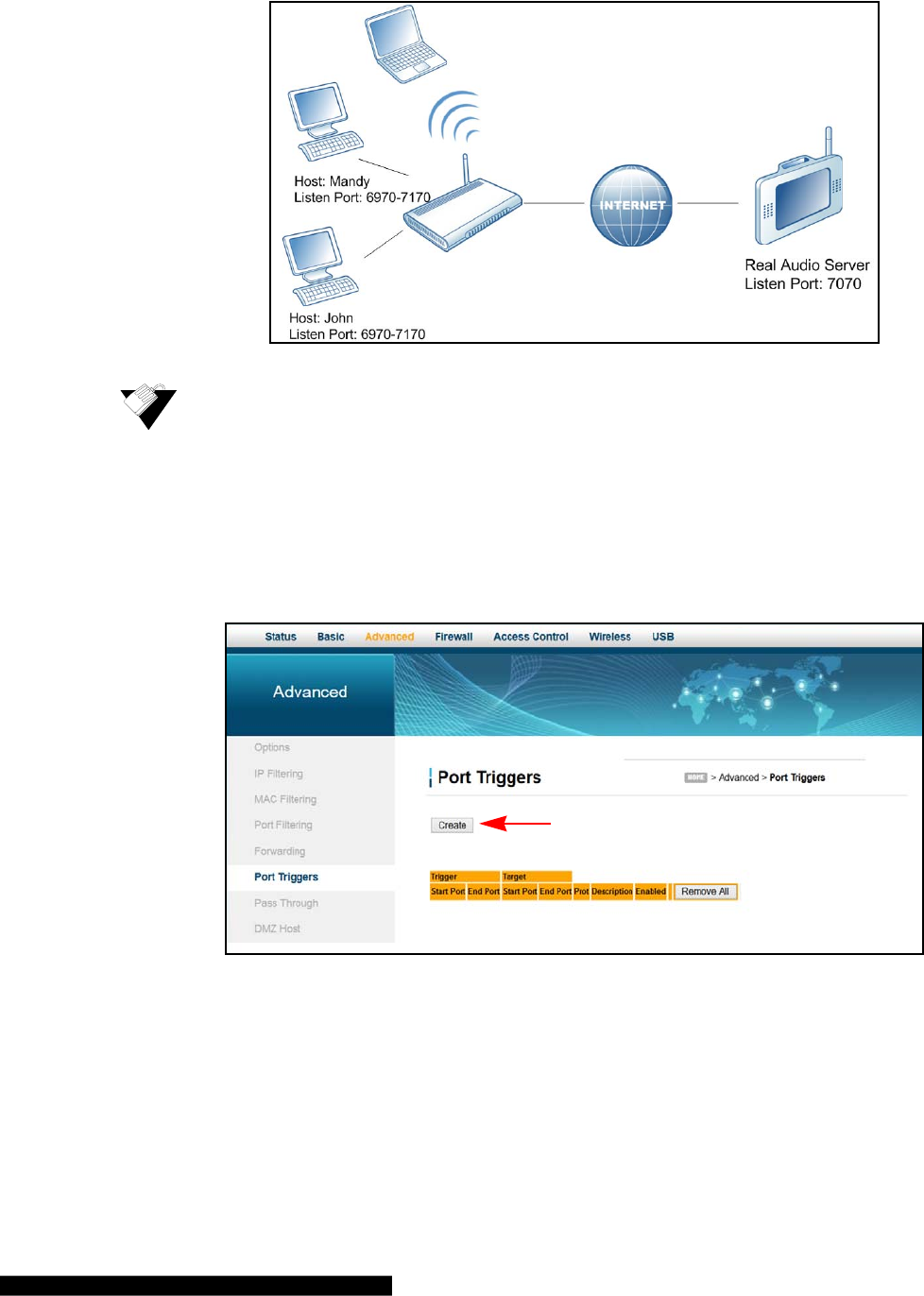
For example:
1. John requests a file from the Real Audio server (port 7070). Port 7070 is a “trigger”
port and causes the device to record John’s computer IP address. The DDW365
associates John's computer IP address with the “target” port range of 6970-7170.
2. The Real Audio server responds to a port number ranging between 6970-7170.
3. The DDW365 forwards the traffic to John’s computer IP address.
Ubee Interactive Using the Port Triggers Option
Ubee DDW365 Advanced Wireless Gateway Subscriber User Guide • February 2014 50
4. Only John can connect to the Real Audio server until the connection is closed or
expires.
Steps
To set up port triggering:
1. Click Advanced from the main menu.
2. Click Port Triggers from the left side menu.
3. Click Create.
4. Enter information in the Port Trigger fields as shown below. Field descriptions follow
the screen shot.
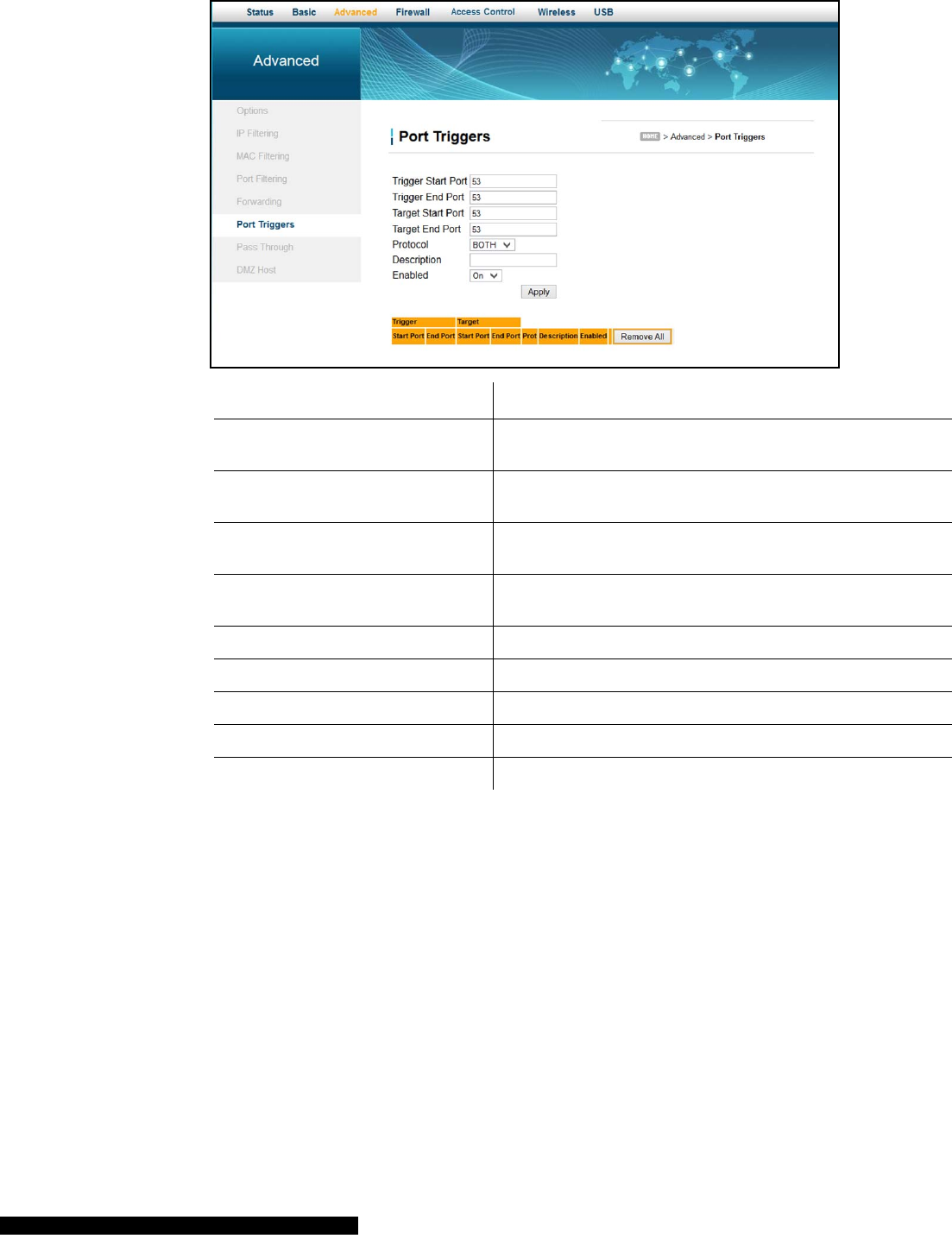
Ubee Interactive Using the Port Triggers Option
Ubee DDW365 Advanced Wireless Gateway Subscriber User Guide • February 2014 51
5. Click Apply. The port trigger rule is created and displayed in the table. Additional field
descriptions are listed below the screen example.
Label Description
Trigger Start Port Defines a port number or the starting port number in a range
of trigger port numbers.
Trigger End Port Defines a port number or the ending port number in a range of
trigger port numbers.
Target Start Port Defines a port number or the starting port number in a range
of target port numbers.
Target End Port Defines a port number or the ending port number in a range of
target port numbers.
Protocol Defines the protocol type for this rule, UDP, TCP, or Both.
Description Names the triggering rule.
Enabled Enables (on) or disables (off) the triggering rule.
Apply Saves changes.
Clear All Removes all of the input host’s MAC addresses.
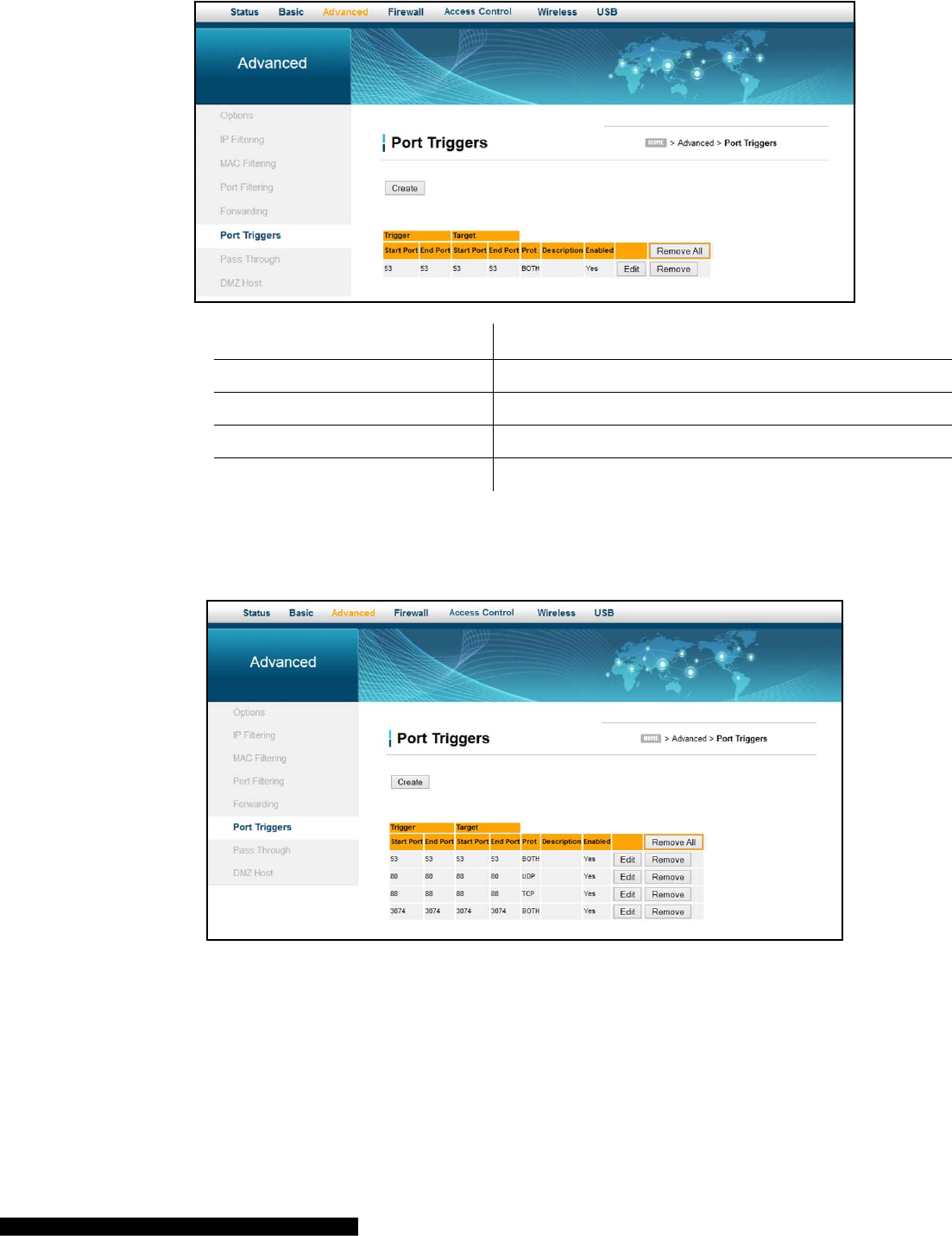
Ubee Interactive Using the Port Triggers Option
Ubee DDW365 Advanced Wireless Gateway Subscriber User Guide • February 2014 52
The following example shows the Port Triggering option set up for a dual Xbox
configuration.
Label Description
Remove All Deletes all the port trigger rules.
Edit Allows you to edit the properties of the selected rule.
Remove Deletes the selected rule.
Clear All Removes all of the input host’s MAC addresses.
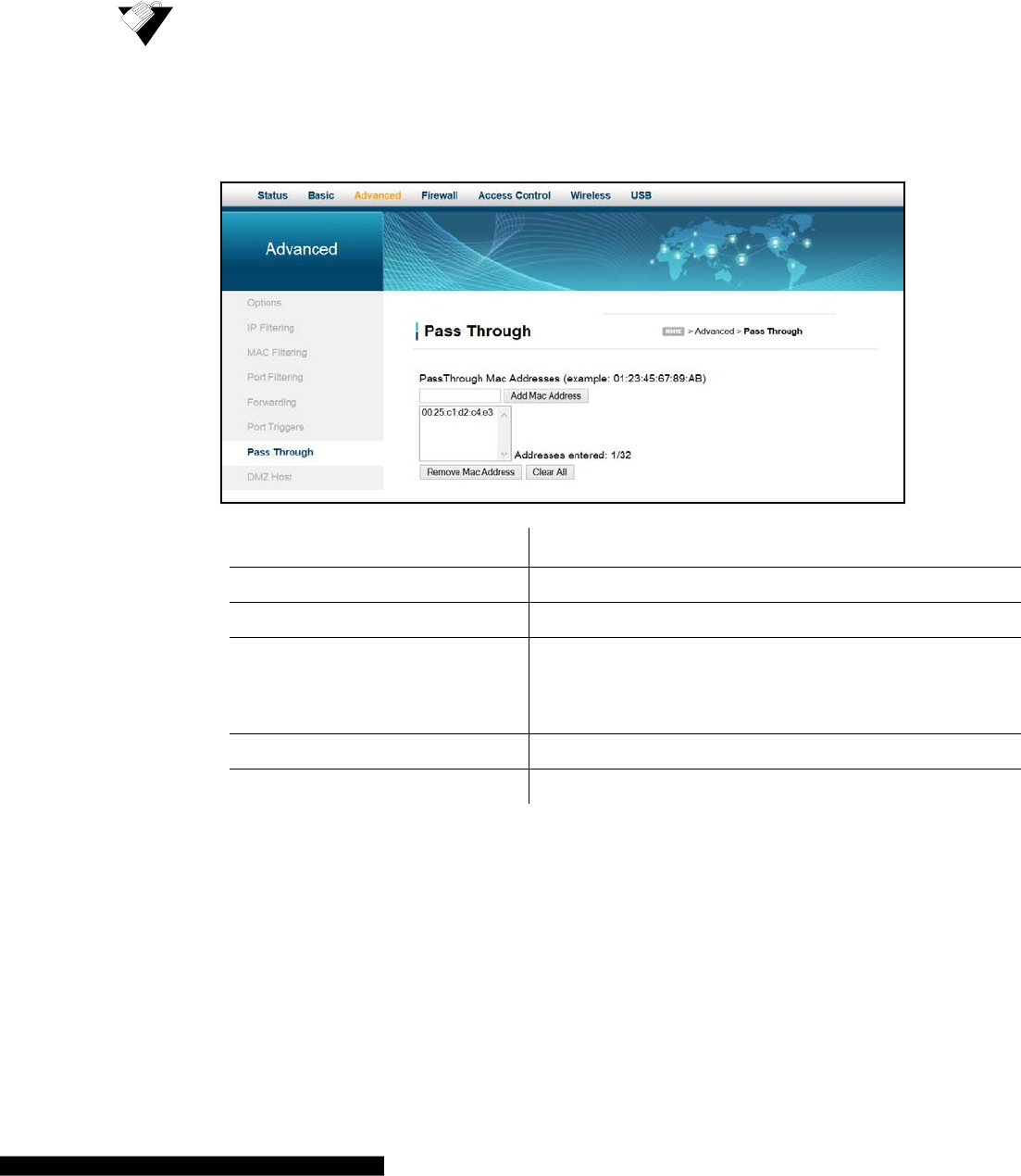
Ubee Interactive Using the Pass Through Option
Ubee DDW365 Advanced Wireless Gateway Subscriber User Guide • February 2014 53
6.7 Using the Pass Through Option
Use the Pass Through option to configure a pass through table. Devices in the pass
through table are treated as bridge devices, storing and forwarding data between LAN
interconnections.
Steps
To configure a pass through table:
1. Click Advanced from the main menu.
2. Click Pass Through from the left side menu. The pass through fields are explained
following this screen example.
6.8 Using the DMZ Host Option
Use the DMZ (Demilitarized Zone) Host option to expose a host IP address to the WAN
(public Internet). You can use this option when applications do not work with port triggers
or other networking strategies.
Label Description
Pass Through MAC Addresses Defines the input host’s MAC address.
Add MAC Address Adds the input host’s MAC address.
Addresses entered: n/32 Displays the MAC addresses to be blocked. The number of
MAC addresses is shown as 0/32 where 0 is the number of
addresses in the list. You can add up to 32 MAC addresses at
one time.
Remove MAC Address Removes the input host’s MAC address.
Clear All Removes all of the input host’s MAC addresses.
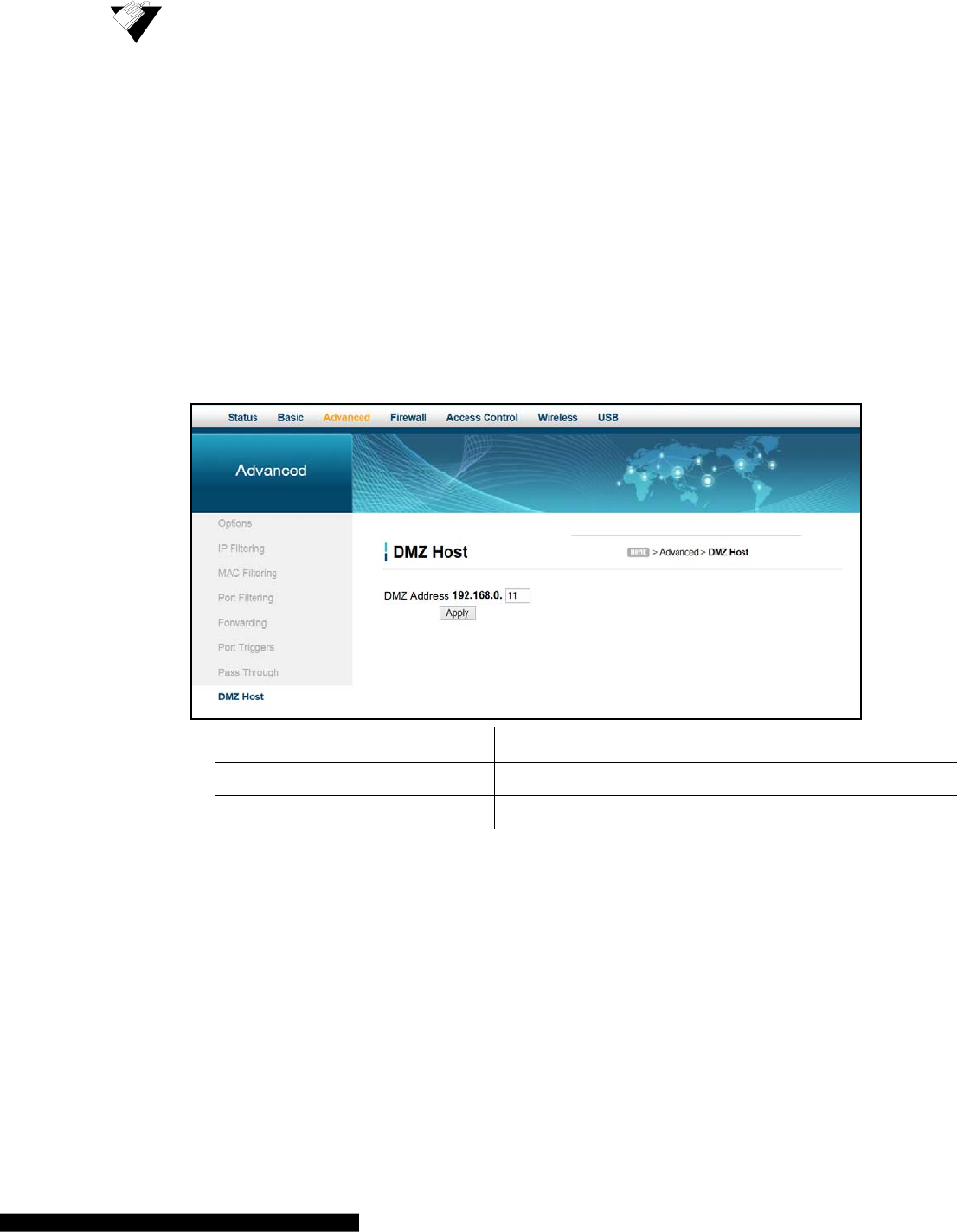
Ubee Interactive Using the DMZ Host Option
Ubee DDW365 Advanced Wireless Gateway Subscriber User Guide • February 2014 54
Steps
To set up a DMZ host:
1. Connect a PC to an Ethernet port on the DDW365. Make sure both devices are
powered on and functioning.
2. Connect a Home Gateway (or other device you wish to be in the DMZ) to an Ethernet
port on the DDW365.
3. Log in to the DDW365 Web user interface.
4. Click Advanced from the main menu.
5. Click DMZ Host from the left side menu.
6. Enter the IP address of the Home Gateway (host device) to be exposed to the WAN.
7. Test the device to ensure Internet access is available and the device is functional. For
example, connect to the Internet from a PC connected to the Home Gateway.
Label Description
DMZ Address Defines the IP address of the host to be exposed.
Apply Saves changes.

Ubee DDW365 Advanced Wireless Gateway Subscriber User Guide • February 2014 55
7 Understanding the Firewall Menu
Use these instructions to configure the DDW365 firewall settings to control what types of
traffic are allowed on your network. The firewall can block certain Web-oriented cookies,
Java scripts, and pop-up windows. It is highly recommended the Firewall is left enabled at
all times to protect against denial of service (DoS) attacks. Refer to Using the Basic Option
on page 55 to block Internet access to specific sites.
Note: Firewall menu options are not available when the DDW365 is in Bridge mode. Refer
to Using the Bridging Option on page 80 for more information.
Topics
See the following topics:
Using the Basic Option on page 55
Using the Local Log Option on page 56
Using the Remote Log Option on page 57
Steps
To access the firewall menu:
1. Access the Web user interface. Refer to Accessing the Web User Interface Locally on
page 16.
2. Click Firewall from the main menu.
7.1 Using the Basic Option
Use the Basic option to filter Web content to block certain Web-oriented cookies, Java
scripts, and pop-up windows.
Steps
To filter Web content:
1. Click Firewall from the main menu.
2. The Basic screen is displayed. Field descriptions are listed below the screen
example.
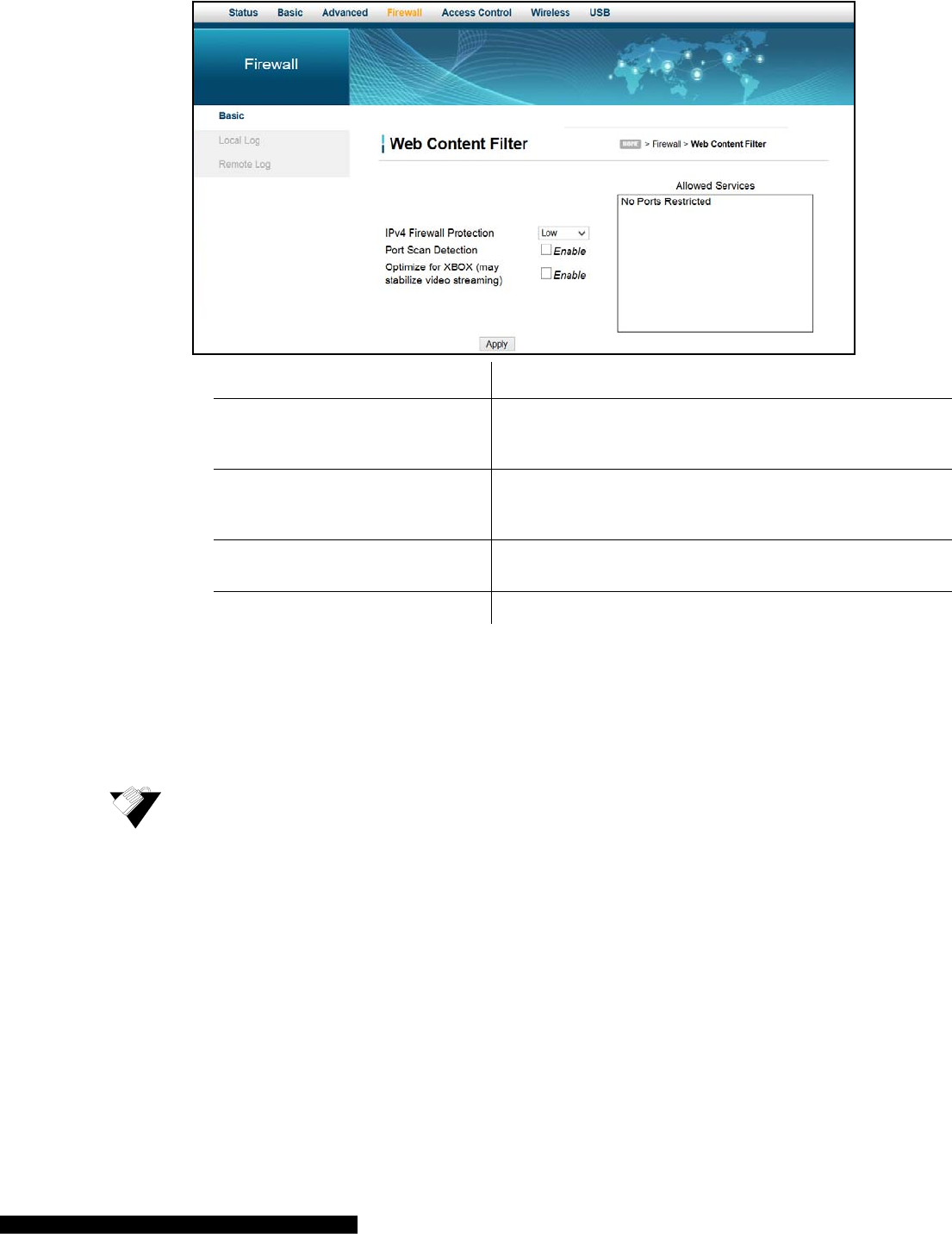
Ubee Interactive Using the Local Log Option
Ubee DDW365 Advanced Wireless Gateway Subscriber User Guide • February 2014 56
7.2 Using the Local Log Option
Use the Local Log to define firewall event log reporting through email alerts and report on
possible attacks on the system.
Steps
To define local log reporting:
1. Click Firewall from the main menu.
2. Click Local Log from the left side menu. Field descriptions are listed below the screen
example.
Label Description
IPv4 Firewall Protection Defines the level of protection. Choices are Off, Low, Medium,
and High. Services are based on the protection level and
displayed in the Allowed Services window.
Port Scan Detection When enabled, detects port scans that probe for available
ports and potentially use these ports to detect weakness in the
network.
Optimize for XBOX When enabled, this feature stabilizes and improves video
streaming.
Apply Saves changes.
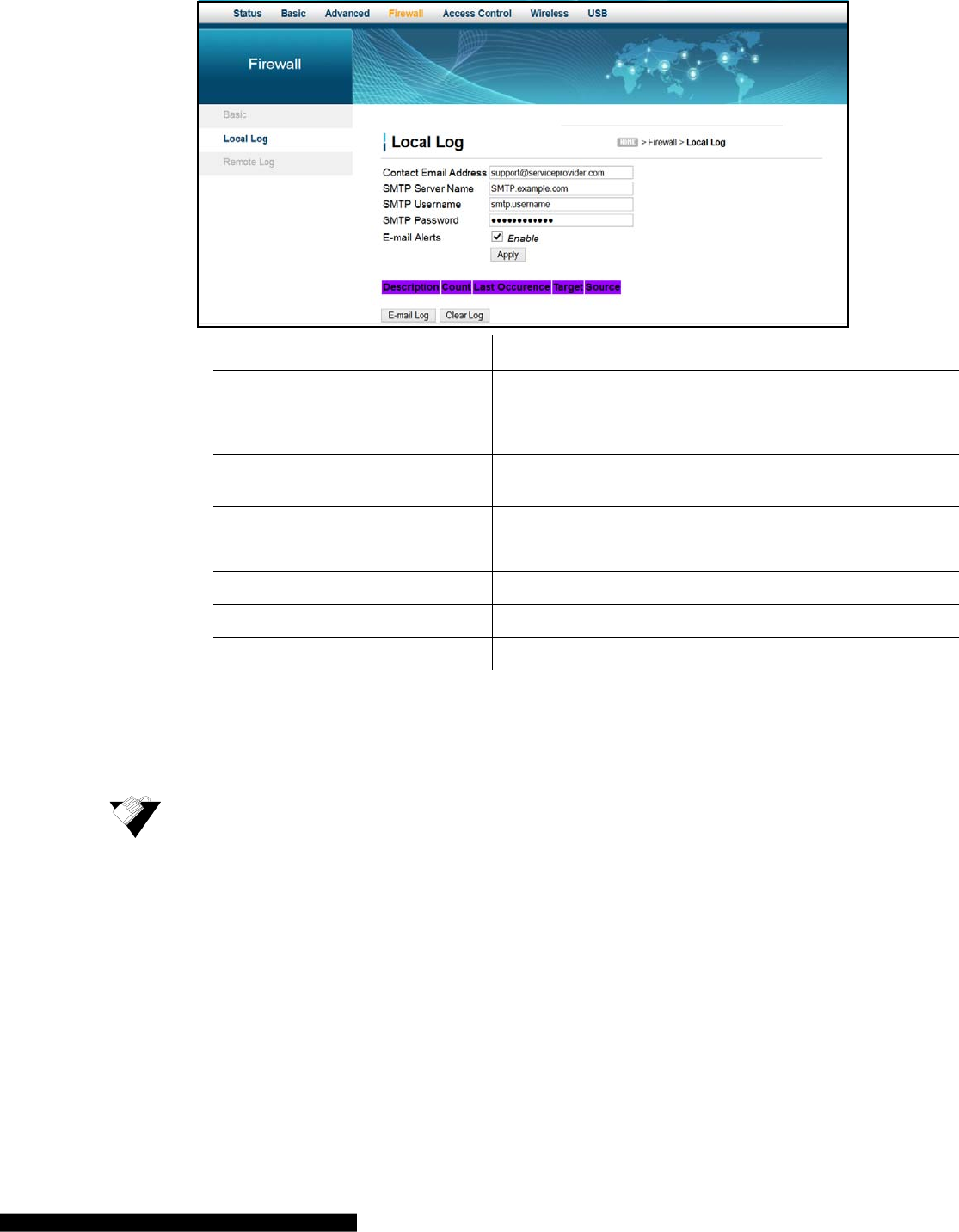
Ubee Interactive Using the Remote Log Option
Ubee DDW365 Advanced Wireless Gateway Subscriber User Guide • February 2014 57
7.3 Using the Remote Log Option
Use the Remote Log option to define events and send the log to a local SysLog server.
Steps
To configure the firewall remote log:
1. Click Firewall the main menu.
2. Click Remote Log from the left side menu. The Remote Log fields are explained
following this screen example.
Label Description
Contact Email Address Defines the email address where you want to send the log.
SMTP Server Name Defines the name of the SMTP server, such as
smtp.example.com.
SMTP Username Defines the username for the email address, such as
contact@company.com.
SMTP Password Defines the password for the email address.
E-mail Alerts Enables or disables log reporting.
Apply Saves the settings and completes the setup.
E-mail Log Sends the log to the specified email address.
Clear Log Deletes the log.
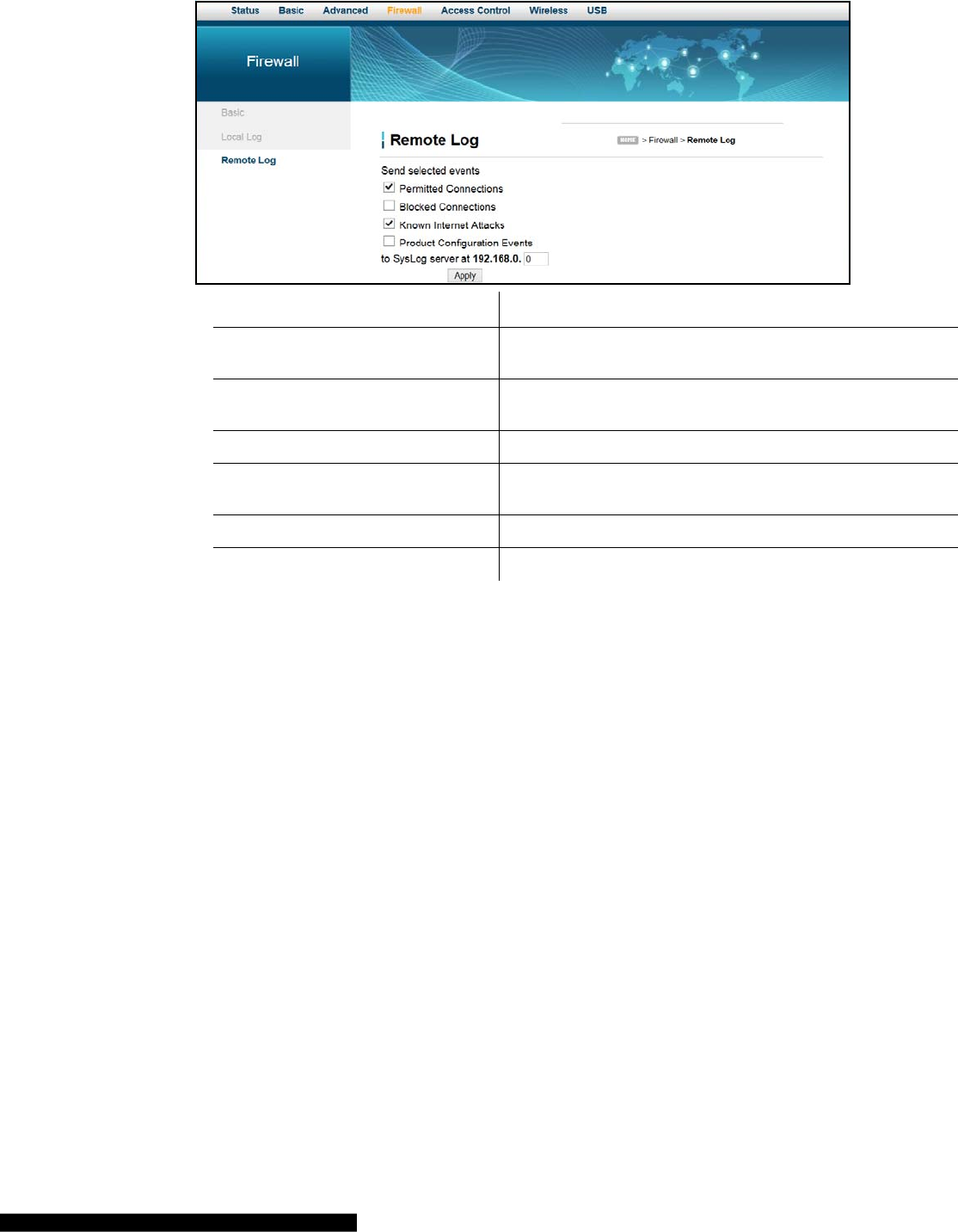
Ubee Interactive Using the Remote Log Option
Ubee DDW365 Advanced Wireless Gateway Subscriber User Guide • February 2014 58
Label Description
Permitted Connections Logs all access attempts that are allowed by the firewall when
checked.
Blocked Connections Logs all access attempts that are blocked by the firewall when
checked.
Known Internet Attacks Logs all known attacks from the Internet when checked.
Product Configuration Events When checked, logs when the DDW365 is configured/modified
by a user or administrator.
to SysLog server at 192.168.0. Defines the IP address of the Syslog server.
Apply Saves changes.

Ubee DDW365 Advanced Wireless Gateway Subscriber User Guide • February 2014 59
8 Understanding the Access Control Menu
The Access Control menu allow you to control Internet access for users on the DDW365
network. It provides the following features:
Define user/password access.
Block specific Web sites and Web sites based on keywords.
Define the times users are allowed to access the Internet.
View a local log to view Internet activity.
Topics
See the following topics:
Using the User Setup Option on page 59
Using the Basic Option on page 61
Using the ToD Filter Option on page 63
Using the Local Log Option on page 65
Steps
To access the Access Control menu:
1. Access the Web interface. Refer to Accessing the Web User Interface Locally on page
16.
2. Click the Access Control link from the top of the screen.
8.1 Using the User Setup Option
The User Setup option allows you to configure which user accounts can or cannot
connect to your wireless or wired network, and the parameters of each connection.
Steps
To configure user accounts:
1. Click the Access Control link from the top of the screen.
2. The User Setup screen is displayed. Field descriptions follow the screen shot below.
Note: To enable Access Control, refer to Using the Basic Option on page 61.
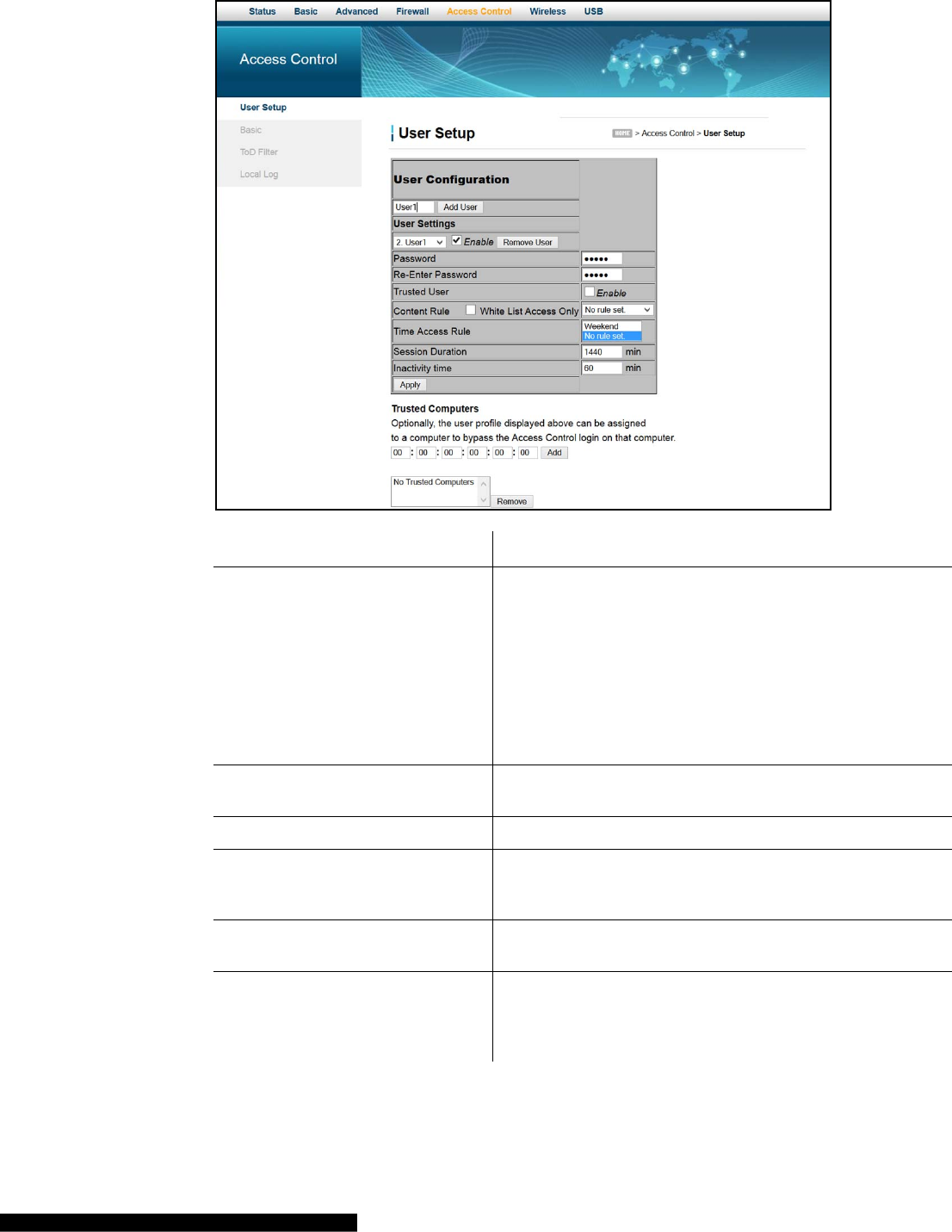
Ubee Interactive
Ubee DDW365 Advanced Wireless Gateway Subscriber User Guide • February 2014 60
Label Description
Add User
Remove User
Enable
Defines user accounts.
To add a new user, add the user name and click Add
User. The user becomes selectable in the User Settings
drop down menu.
To select an existing user, choose the user from the User
Settings drop down menu.
To activate the user, check Enable.
To remove a user, select the user from the User Settings
drop down menu and click Remove User.
Password Defines the password for this user. It is required when this
user tries to access the Internet via the device.
Re-Enter Password Confirms the password with the re-entered password.
Trusted User Defines the selected user as a trusted user when enabled is
checked. The user is limited to timing and content when
visiting the Internet, as defined in the following fields.
Content Rule Selects from the pop-up menu an existing content rule that
defines what kind of Websites the user can visit or not.
White List Access Only Selects the White List Access option. If you have created a
content rule that defines a black list and white list, select the
White List Access Only checkbox to force the wireless modem
to execute the policy for the selected user.

Ubee Interactive
Ubee DDW365 Advanced Wireless Gateway Subscriber User Guide • February 2014 61
8.2 Using the Basic Option
The Basic option allows you to select rules to block certain Internet content and Web
sites. After you change your Access Control settings, click the appropriate Apply, Add, or
Remove button for your new settings to take effect. Refresh your browser’s display to see
the currently active settings.
Steps
To filter Internet content and Web sites:
1. Click the Access Control link from the top of the screen.
2. Click Basic from the left side of the screen. The Basic fields are explained following
this screen example.
Time Access Rule Selects a defined time access rule to apply to the selected
user.
Session Duration Allows you to enter a time in minutes for the user’s session to
expire. When the session expires, the user can log in again for
the same session duration.
Inactivity Time Allows you to enter the time out value when a user has no
activity on the Internet. When the time expires, the user
interface to the Internet is canceled.
Apply Saves all changes when clicked.
Trusted Computers Defines the trusted hosts that can bypass the Access Control
Process.
Add Adds the trusted host’s MAC address entered in the given
area and Add is clicked.
Remove Removes a trusted computer from the list when it is
highlighted and Remove is clicked.
Label Description
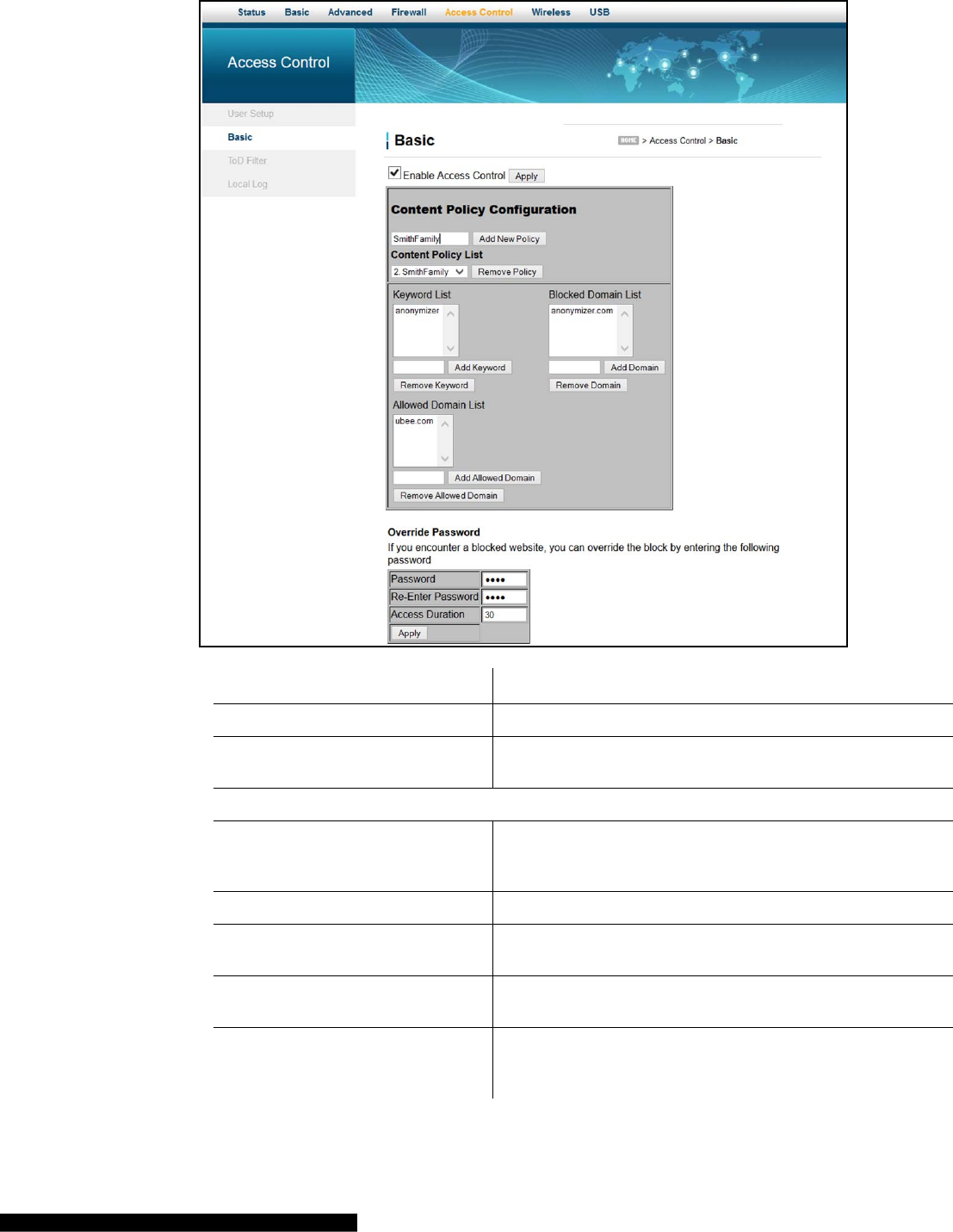
Ubee Interactive
Ubee DDW365 Advanced Wireless Gateway Subscriber User Guide • February 2014 62
Label Description
Enable Access Control Activates the Access Control feature when checked.
Apply Saves all changes in the screen and activates Access Control,
if enabled.
Content Policy Configuration
Add New Policy Adds a policy to the Policy List. Enter the policy name and
click Add New Policy. The policy then becomes selectable in
the Content Policy List drop down menu.
Content Policy List Lists existing policies you can choose to use.
Remove Policy Deletes a policy from the list. Select the policy from the
Content Policy List drop down menu and click Remove Policy.
Keyword List Displays keywords you can use to block Web site addresses
(URLs) containing those words.
Add Keyword Adds a keyword to the keyword list. Enter the word in the field
next to the Add Keyword button and click Add Keyword. The
keyword is added to the Keyword List.

Ubee Interactive
Ubee DDW365 Advanced Wireless Gateway Subscriber User Guide • February 2014 63
8.3 Using the ToD Filter Option
The ToD (Time of Day) Filter option allows the configuration of time-based access
policies to block all Internet traffic at specified times.
Steps
To configure ToD filters:
1. Click the Access Control link from the top of the screen.
2. Click ToD Filter from the left side of the screen. The ToD Filter fields are explained
following this screen example.
Remove Keyword Removes a keyword from the keyword list. Select the keyword
from the Keyword List, and click Remove Keyword.
Blocked Domain List Displays Web domains (for example, unwanted.com) you can
use to block access to those domains.
Add Domain Adds a domain to the Blocked Domain List. Enter a domain in
the field next to the Add Domain button, and click Add Domain.
Remove Domain Removes a domain from the Blocked Domain List. Select the
domain from the Blocked Domain List, and click Remove
Domain.
Allowed Domain List Displays domains you want to allow access to.
Add Allowed Domain Adds allowed domains to the list. Enter the name in the field
next to Add Allowed Domain and click Add Allowed Domain.
Remove Allowed Domain Removes domain names from the Allowed Domain List.
Highlight the domain from the list and click Remove Allowed
Domain.
Override Password If you encounter a blocked website, you can override the block
by entering a password.
Password Enter a password for overriding blocked websites.
Re-Enter Password Re-enter the password.
Access Duration Set a time duration (in minutes) for access to the blocked site
when the block has been overridden by entering the password.
Apply Saves the password and access duration time.
Label Description
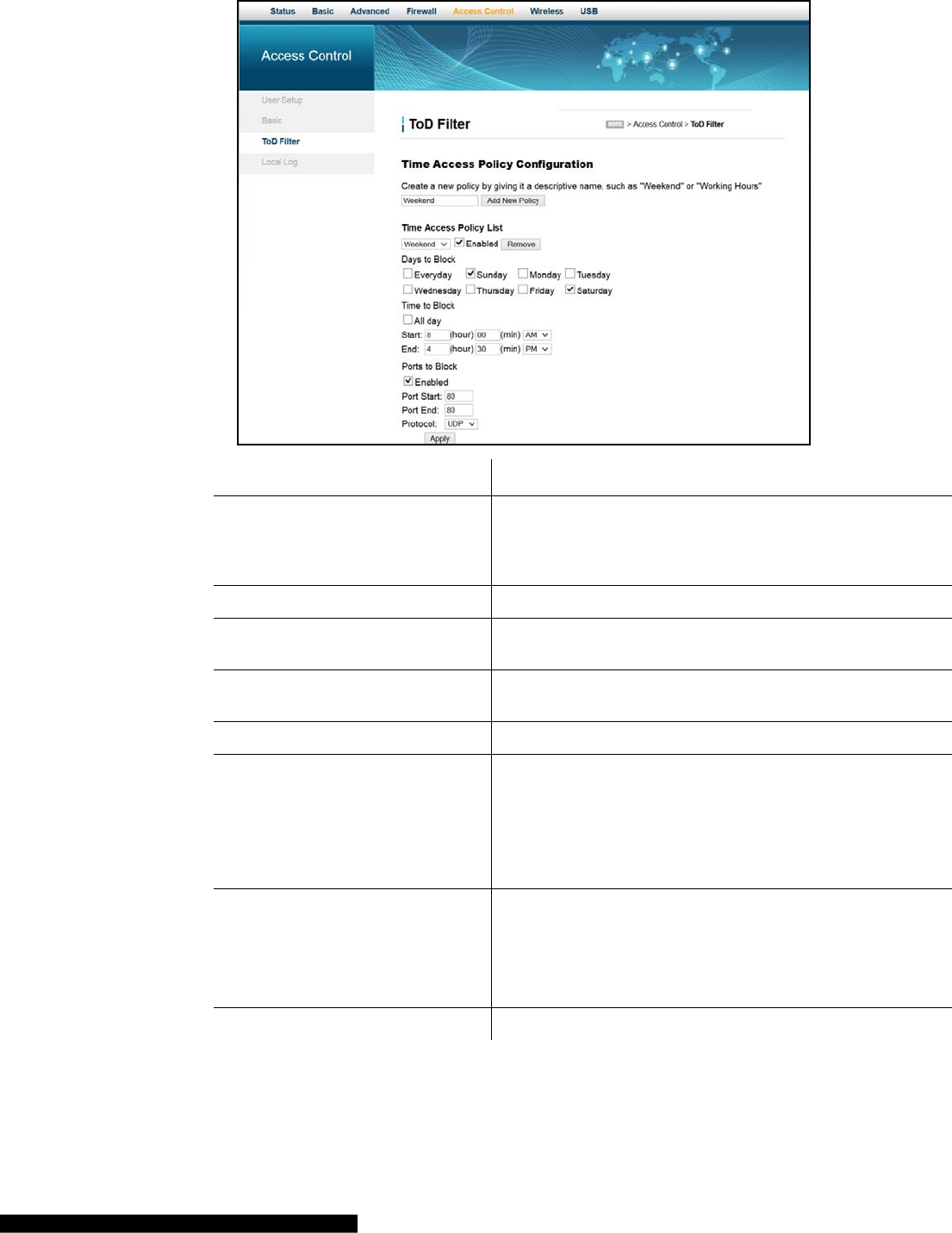
Ubee Interactive
Ubee DDW365 Advanced Wireless Gateway Subscriber User Guide • February 2014 64
Label Description
Add New Policy Adds a new policy. Enter a policy name in the field next to Add
New Policy, and click the Add New Policy button. The policy
then becomes selectable in the Time Access Policy List drop
down menu.
Time Access Policy List Lists the existing policies in a drop-down menu.
Enabled Activates a policy. Select the policy from the Time Access
Policy List drop-down menu and check Enabled.
Remove Deletes a policy. Select the policy from the Time Access Policy
List drop-down menu and click Remove.
Days to Block Allows you to select the days to block Internet access.
Time to Block:
All Day or a specific time frame Allows you to define the times of day to block.
To block all day, check All Day to eliminate all access
during the days selected.
To define a specific time frame to block Internet access for
the days selected, enter the Start time and the End time.
Select AM or PM for each.
Ports to Block Defines a port range to block if the Enabled box is checked.
Port Start: Enter the starting port number to be blocked.
Port End: Enter ending port number to be blocked.
Protocol: Select the protocol type. Options are UDP, TCP,
or Both.
Apply Saves all changes when clicked.
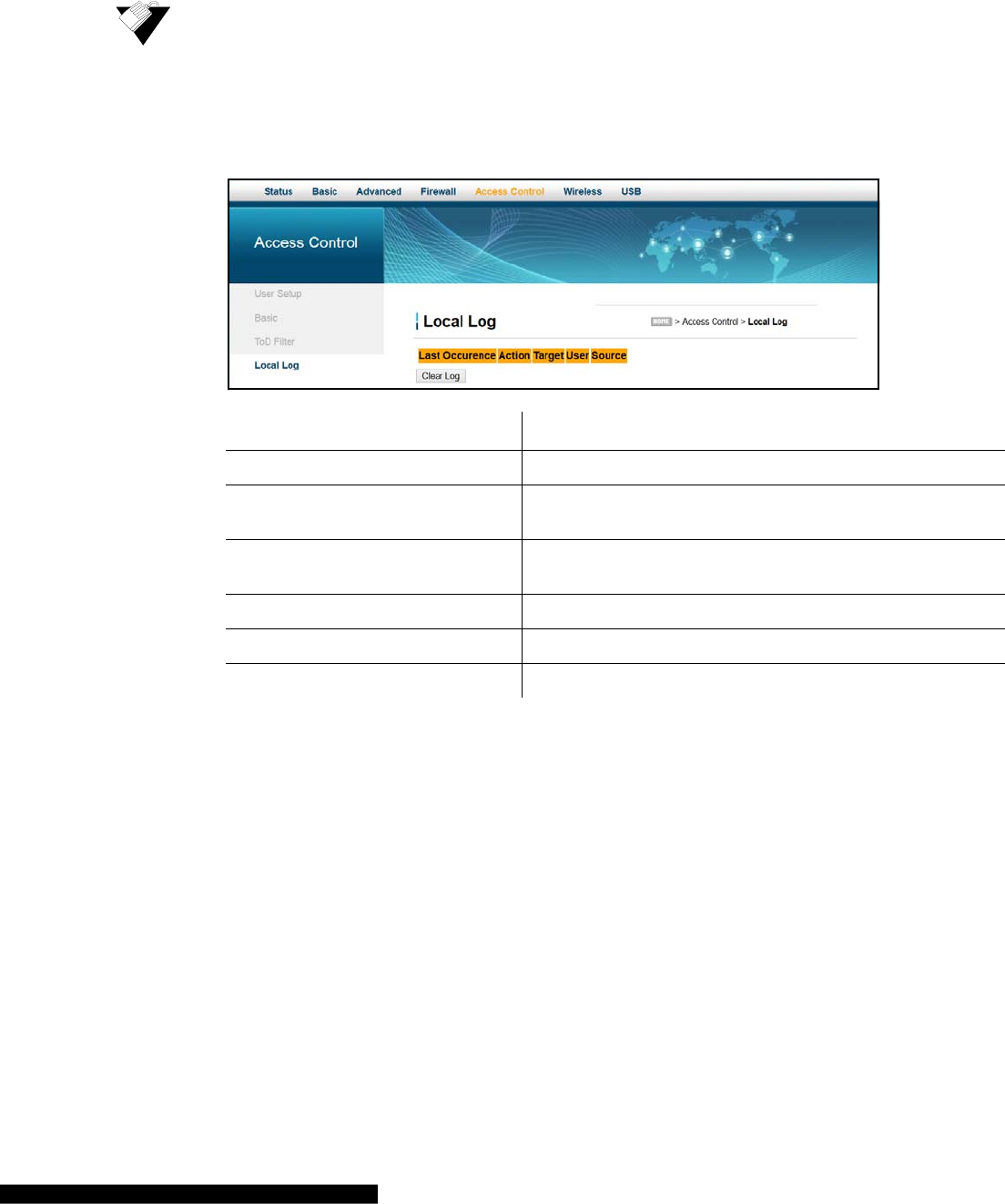
Ubee Interactive
Ubee DDW365 Advanced Wireless Gateway Subscriber User Guide • February 2014 65
8.4 Using the Local Log Option
The Local Log option displays Access Control event log reporting.
Steps
To view the access control local log:
1. Click the Access Control link from the top of the screen.
2. Click Local Log from the left side of the screen. The Local Log fields are explained
following this screen example.
Label Description
Last Occurrence Displays the time when the last event occurred.
Action Displays what is done by access control, including dropping or
permitting access requests.
Target Displays the destination IP address of a certain access
request.
User Displays the user who triggered this event log.
Source Displays the source IP address of this event.
Clear Log To empty the displayed log entries, click Clear Log.

Ubee DDW365 Advanced Wireless Gateway Subscriber User Guide • February 2014 66
9 Understanding the Wireless Menu
Use the Wireless menu to configure wireless network settings.
Topics
See the following topics:
Using the Wireless Radio Option on page 66
Using the Primary Network Option on page 69
Using the Advanced Option on page 73
Using the Access Control Option on page 75
Using the Wi-Fi Multimedia Option on page 77
Using the Bridging Option on page 80
Deploying and Troubleshooting the Wireless Network on page 81
Steps
To access the Wireless menu:
1. Access the Web interface. Refer to Accessing the Web User Interface Locally on page
16.
2. Click Wireless from the main menu.
9.1 Using the Wireless Radio Option
The Radio option is used to configure the wireless radio, including channel number, and
bandwidth control.
Steps
To configure wireless operations:
1. Click Wireless from the main menu.
2. The Radio screen is displayed. Field descriptions are listed below the screen
example.
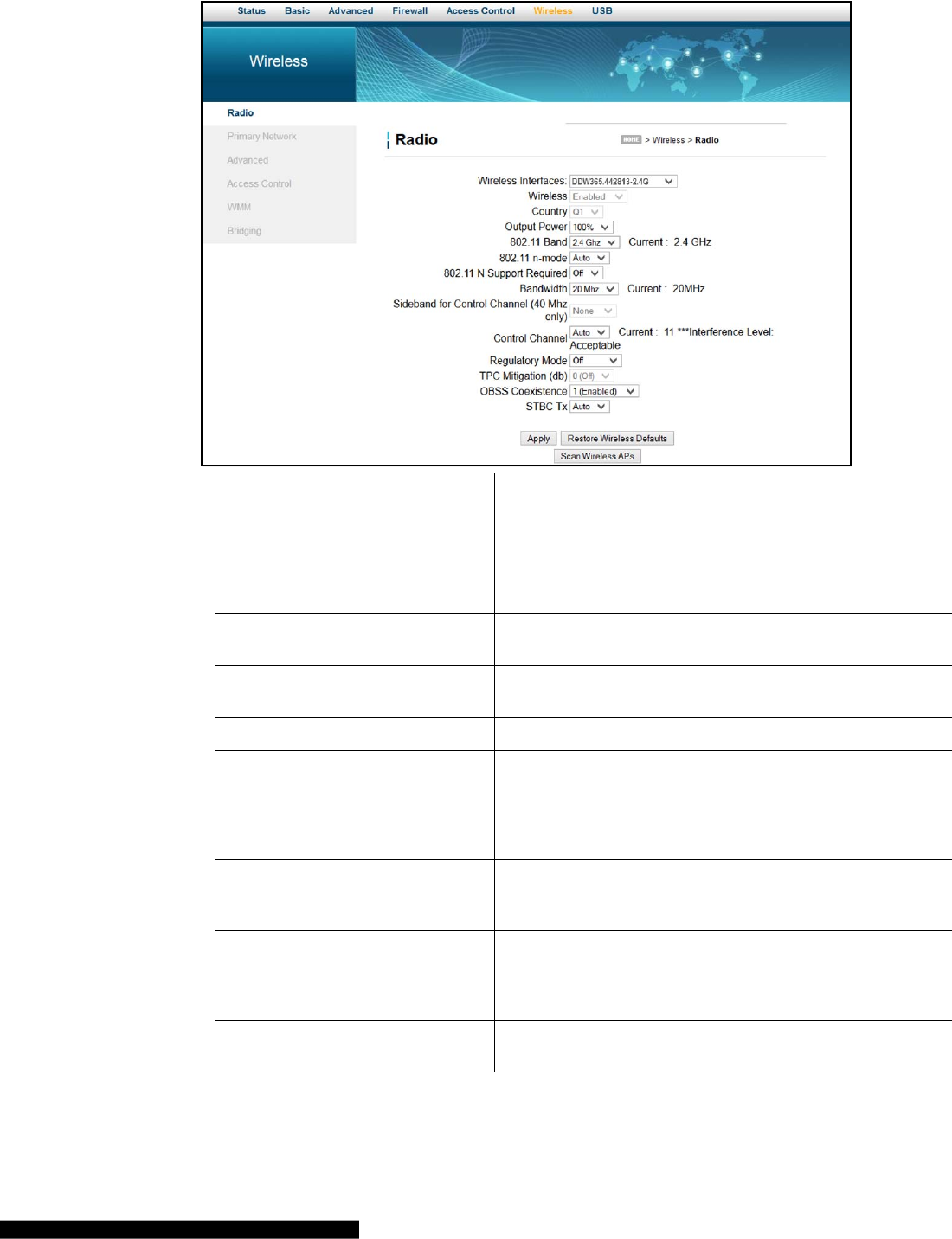
Ubee Interactive Using the Wireless Radio Option
Ubee DDW365 Advanced Wireless Gateway Subscriber User Guide • February 2014 67
Label Description
Wireless Interfaces Displays the unique SSID for the DDW365 or uses the
default. Refer to Understanding Default Values and Logins on
page 8 for more information on the SSID.
Wireless Displays the wireless radio’s status, Enabled or Disabled.
Country Defines the country where this device is used. The default
value is Q2.
Output Power Output power setup can be one of the following 4 options:
25%, 50%, 75%, or 100%.
802.11 Band Displays the 802.11 band (2.4GHz).
802.11 n-mode Sets the wireless networking standard. Select Auto to use
802.11 n mode when possible. This mode has a significant
increase in the maximum raw OSI physical layer data rate
from 54 Mbit/s to a maximum of 600 Mbit/s with the use of
four spatial streams when at a channel width of 40 MHz.
802.11 N Support Required Defines whether 802.11n support is required (on) or not (off).
On forces the gateway to 802.11n mode and clients must
support 802.11n.
Bandwidth Sets the bandwidth to 20MHz or 40MHz. For 40 MHz, set the
sideband to lower or upper 20MHz. 40 MHz channels double
the channel width. This allows doubling the PHY data rate
over a single 20 MHz channel.
Sideband for Control Channel Only when using 40MHz Bandwidth should you choose the
Lower or Upper 20MHz.
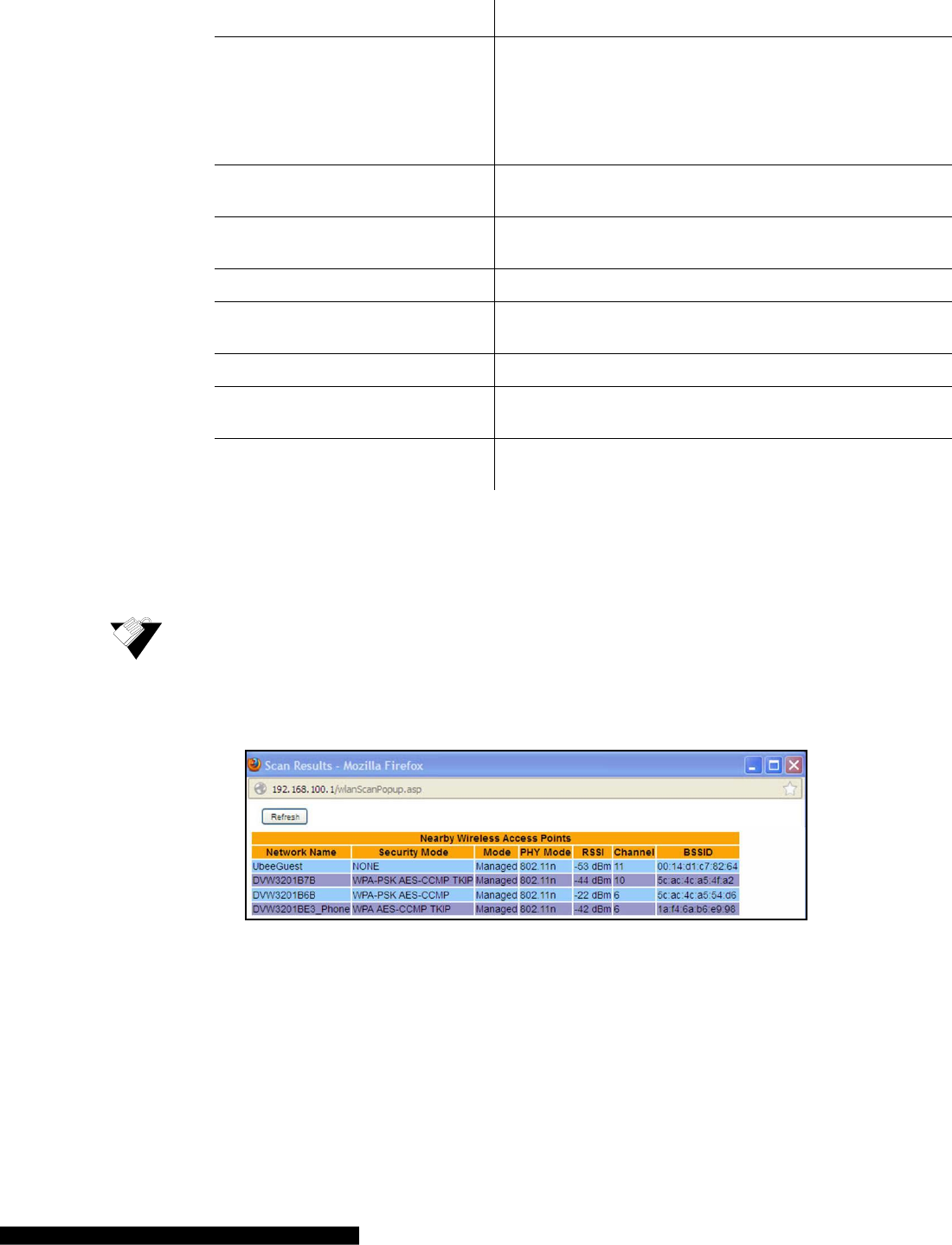
Ubee Interactive Using the Wireless Radio Option
Ubee DDW365 Advanced Wireless Gateway Subscriber User Guide • February 2014 68
9.1.1 Scanning for Wireless Access Points (APs)
You can search for wireless access points and display the results in a new window.
Steps
To search for wireless access points:
1. Click Scan Wireless APs at the bottom of the Wireless Radio screen. Results are
displayed in a new window.
2. Click Refresh to update the results.
Control Channel Selects a specific channel to deploy the wireless network.
This allows you to set the operating frequency/channel
depending on your particular region. Channel selection can
have an impact on wireless networking performance. Control
Channel is set to Auto by default. For more information, refer
to Selecting a Wireless Channel on page 85
Regulatory Mode Defines whether Regulatory Mode is set to off, 802.11d, or
802.11h.
TPC Mitigation (dB) Defines the transmitter power control (TPC) mitigation setting
as 0 (off), 2, 3, or 4.
OBSS Coexistence Enables or disables overlapping BSS coexistence.
STBC Tx Sets the space-time block codes (STBCs) for the transmitting
antenna.
Apply Saves all screen changes when clicked.
Restore Wireless Defaults Restores the factory default settings for wireless
configurations when clicked.
Scan Wireless APs Scans for other wireless access points and displays channel,
encryption, SSID, RSSI levels, and other information.
Label Description

Ubee Interactive Using the Primary Network Option
Ubee DDW365 Advanced Wireless Gateway Subscriber User Guide • February 2014 69
9.2 Using the Primary Network Option
Use the Primary Network option to configure a variety of wireless security settings.
Steps
To configure wireless security options:
1. Click Wireless from the main menu.
2. Click Primary Network from the left side menu. Field descriptions are listed below the
screen example.
Wireless default values are discussed in Understanding Default Values and Logins on
page 8.
Label Description
Network Name Displays the name of the wireless network (SSID) broadcast
by the access point.
Security Mode Displays the encryption method used.
Mode Displays the mode of the wireless access point: Possible
modes are:
Master – Communicates with associated wireless cards
that are in managed mode. Appears as a normal access
point with an SSID and channel. Network
communications, such as authentication, conflict, and
duplicate packets are managed by the wireless card.
Managed – Communicates with an associated master,
not directly with another managed AP. Wireless cards
connect to the master network and change their channel
to match. The master must accept the credentials of the
managed network for it to be associated.
Ad-hoc – Communicates directly with another wireless
network. Network cards must be in range and use the
same name and channel.
Monitor – Communicates in observation mode and does
not transmit. Can be used for troubleshooting wireless
links or checking bandwidth usage in the area.
PHY Mode Displays the physical transceivers (PHY) layer method used.
RSSI Displays the received signal strength (RSSI) of the wireless
access points in range of the device. Lower negative numbers
(for example, -1 to -65) indicate the access point is closer.
Greater negative numbers (for example, -66 to -95) indicate
the access point is farther away.
Channel Displays the channel on which the wireless cable modem is
operating.
BSSID Displays the MAC address for the nearby wireless access
points.
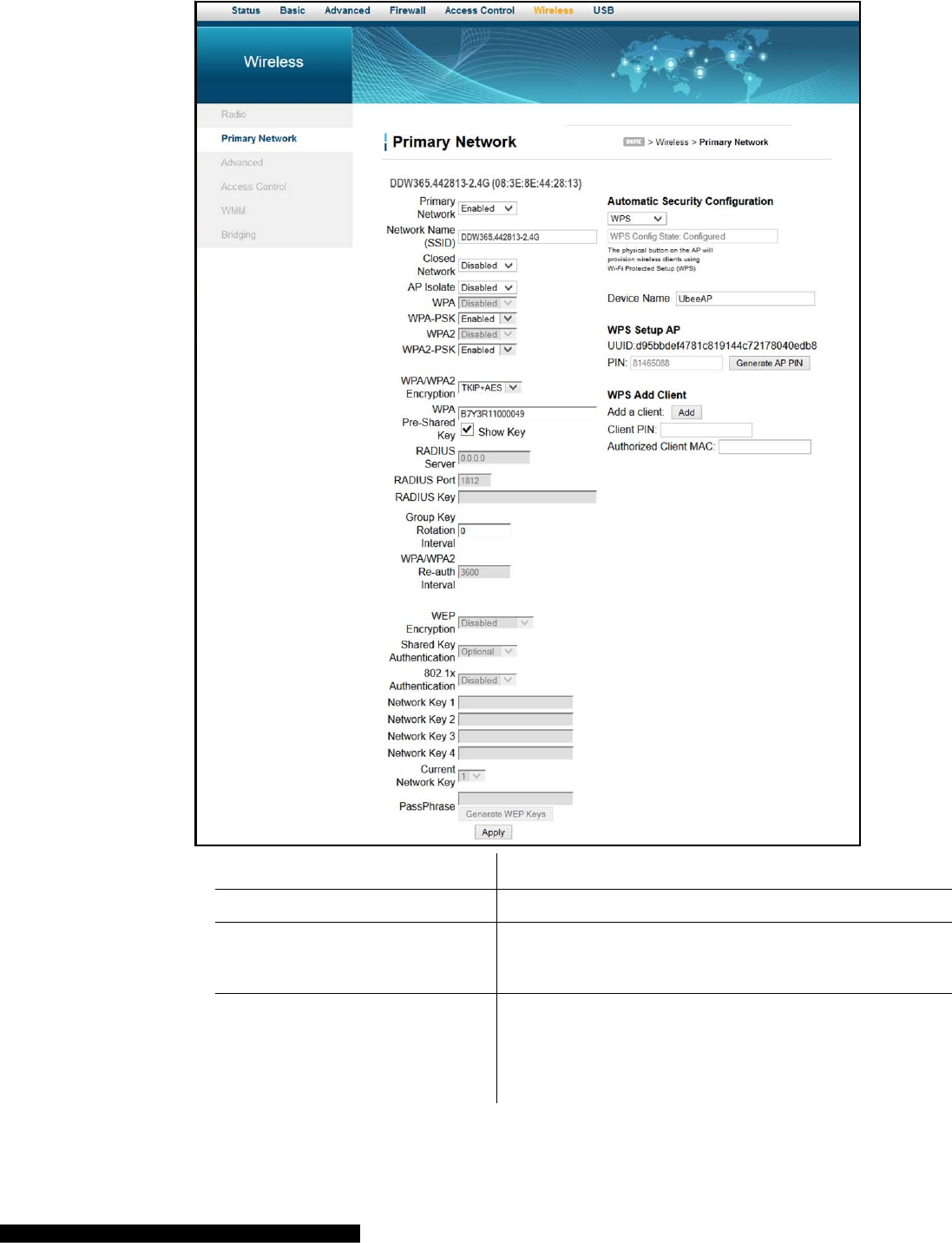
Ubee Interactive Using the Primary Network Option
Ubee DDW365 Advanced Wireless Gateway Subscriber User Guide • February 2014 70
Label Description
Primary Network Enables or disables the primary network.
Network Name (SSID) Defines a unique SSID for the DDW365 or uses the default.
Refer to Understanding Default Values and Logins on page 8
for more information on the SSID.
Closed Network Hides the selected SSID when enabled so it is not visible to
wireless clients unless manually set up on the client. If
disabled, the SSID is visible. Refer to Enabling a Closed
Network on the Primary Network on page 73 to set up a
closed network.

Ubee Interactive Using the Primary Network Option
Ubee DDW365 Advanced Wireless Gateway Subscriber User Guide • February 2014 71
AP Isolate Prevents wireless client stations from communicating with
each other when enabled.
WPA Enables or disables the Wi-Fi Protected Access (WPA)
security protocol. WPA is a subset of the IEEE 802.11i
standard. Key differences between WPA and WEP are user
authentication and improved data encryption. Setting WPA
alone with a pre-shared key requires a RADIUS or TACACS
server for authentication. This method is mostly used in large
enterprise implementations.
WPA-PSK Enables or disables WPA Pre-Shared Key (WPA-PSK). If you
do not have an external RADIUS server, use WPA-PSK,
which requires a single (identical) password entered into
wireless gateway and wireless client. As long as the
passwords match, a client is granted access to the wireless
LAN. This is the default residential subscriber setting and
uses TKIP encryption.
WPA2 Enables or disables WPA2. This advanced protocol is
certified through Wi-Fi Alliance's WPA2 program and
implements the mandatory elements of 802.11i. In particular,
it has an AES-based algorithm (CCMP) that is considered
fully secure. Setting WPA2 alone with a pre-shared key
requires a RADIUS or TACACS server for authentication.
This method is mostly used in large enterprise
implementations.
WPA2-PSK Enables or disables WPA2-PSK. If you do not have an
external RADIUS server, use WPA2-PSK, which requires a
single (identical) password entered into wireless gateway and
wireless client. As long as the passwords match, a client is
granted access to the wireless LAN. This is the
recommended residential subscriber option. It is more secure
than WPA-PSK and uses AES encryption.
WPA/WPA2 Encryption Sets WPA/WPA2 encryption to AES or TKIP+AES. The
default is AES.
WPA Pre-Shared Key Displays (checked) or hides (unchecked) the WPA key. The
encryption mechanisms for WPA and WPA-PSK are the
same, except that WPA-PSK uses a simple common
password instead of user-specific credentials.
Show Key Displays the pre-shared key when checked. The pre-shared
key for the DDW365 is the 13 characters of the modem’s
serial number.
RADIUS Server Defines the IP address of the RADIUS server, if used.
RADIUS Port Defines a RADIUS port number when WPA or 802.1x network
authentication is selected.
RADIUS Key Defines the RADIUS Key when WPA or 802.1x network
authentication is selected.
Group Key Rotation Interval Allows the device to generate the best possible random
group key and update all the key-management capable
stations periodically.
Label Description

Ubee Interactive Using the Primary Network Option
Ubee DDW365 Advanced Wireless Gateway Subscriber User Guide • February 2014 72
WPA/WPA2 Re-auth Interval Sends a new group key to all clients at the specified interval
for a wireless router (if using WPA-PSK key management) or
RADIUS server (if using WPA key management). The re-
keying process is the WPA equivalent of automatically
changing the WEP key for a wireless access point and all
stations in the WLAN on a periodic basis. Setting the WPA
Group Key Update Timer is also supported in WPA-PSK
mode.
WEP Encryption Enables or disables WEP encryption. If you do not have
wireless clients that can use WPA or WPA2, you can use WEP
key encrypting. A higher bit key offers better security. WEP
encryption scrambles the data transmitted between the wireless
stations and the DDW365 to keep network communications
private. It encrypts unicast and multicast communications in a
network. Both the wireless stations and the DDW365 must use
the same WEP key. Data Encryption can be set to WEP 128-
bit, 64-bit, or Disable.
Shared Key Authentication Defines Shared Key Authentication as optional or required.
Shared Key is an authentication method used by wireless
LANs, which follow the IEEE 802.11 standard. Wireless
devices authenticate each other by using a secret key that is
kept by both devices.
802.1x Authentication Enables or disables 802.1x to authenticate wireless clients.
Network Key 1-4 Pre-defines up to 4 keys for 64-bit or 128-bit (64-bit keys
require 10 hexadecimal digits) (128-bit key require 26
hexadecimal digits).
Current Network Key Selects one of the four pre-defined keys as the current
network key.
Passphrase Sets the WEP encryption key by entering a word or group of
printable characters in the Passphrase box and clicking
Generate WEP keys. These characters are case sensitive.
Generate WEP Keys Forces the device to generate 4 WEP keys automatically.
Apply Saves changes.
Automatic Security Configuration — Sets up WPS (Wi-Fi Protected Setup) for devices connecting
to the wireless network.
WPS/Disabled Enables or disables WPS option. When enabled, the
following fields are available:
WPS Config State Defines if the WPS has been configured or not.
Device Name Defines a name for this wireless cable modem for WPS.
WPS Setup AP
UUID Defines the universal unique identifier (UUID) for this access
point.
PIN Defines the Personal Identification Number for this access
point.
Label Description
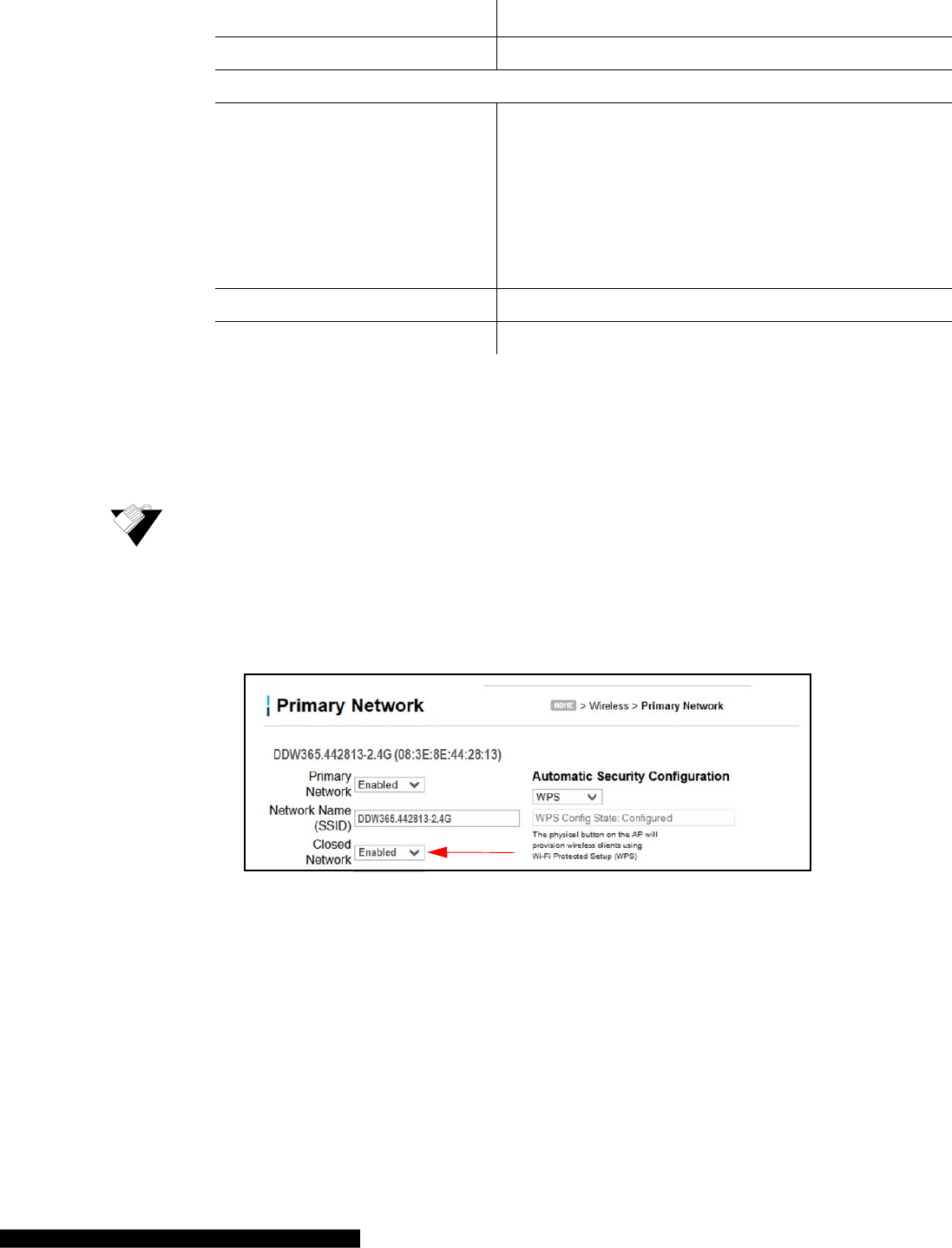
Ubee Interactive Using the Advanced Option
Ubee DDW365 Advanced Wireless Gateway Subscriber User Guide • February 2014 73
9.2.1 Enabling a Closed Network on the Primary Network
You can enable the Closed Network option so the SSID cannot be broadcast or seen by
others.
Steps
To enable a closed network:
1. Access the pull down menu for the Closed Network.
2. Choose Enabled to enable a closed network. Automatic Security Configuration is
disabled.
9.3 Using the Advanced Option
Use the Advanced option to configure data rates and Wi-Fi thresholds.
1. Click Wireless from the main menu.
2. Click Advanced from the left side menu. Field descriptions are listed below the screen
example.
Generate AP PIN Creates a new PIN for this access point.
WPS Add Client
Add a client Activates wireless protected setup (WPS) security on the
device.
To add a client:
1. Click Add a client. The WPS Add Client screen is
displayed.
2. Click PUSH on the WPS Add Client screen.The WPS
button is activated on the device, indicated by a flashing
white light on top of the unit.
3. Press the WPS button on the device.
Client PIN Defines a PIN number for client access.
Authorized Client MAC Defines the MAC address of the authorized client.
Label Description
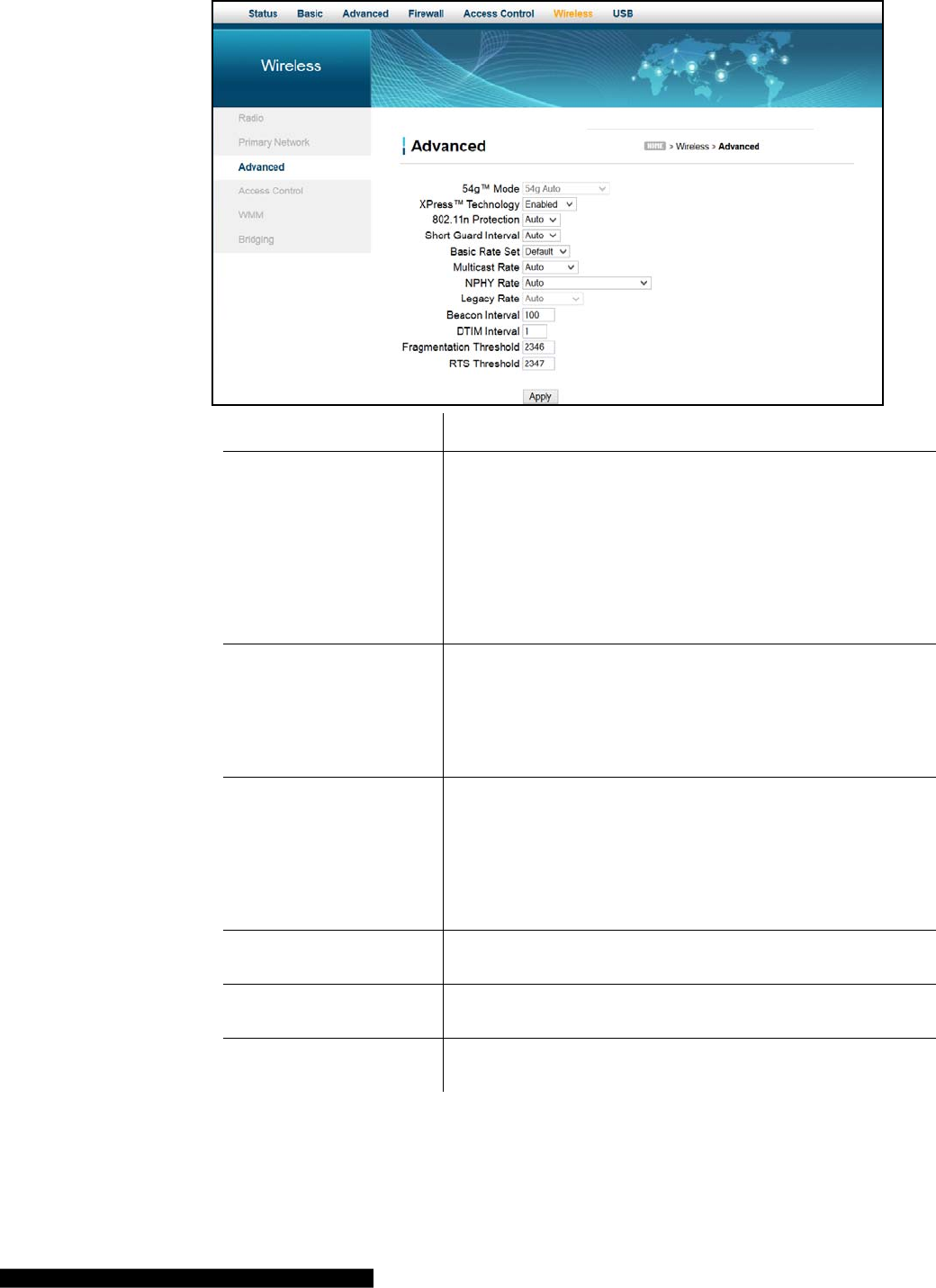
Ubee Interactive Using the Advanced Option
Ubee DDW365 Advanced Wireless Gateway Subscriber User Guide • February 2014 74
Label Description
54g™ Mode Selects the network mode in which to run the DDW365. The
options are:
54g auto – self adaptive connection
54g performance – highest speed
54g LRS – limited speed
802.11b – connections to 11b clients only.
This field can be set only if 802.11-n Mode is set to Off in the
Radio screen as discussed on Using the Wireless Radio Option
on page 66.
XPress™ Technology Enables or disables the XPress feature. XPress™ is a
standards-based frame-bursting approach to improve 802.11g
wireless LAN performance developed by Broadcom. When
Xpress enabled, aggregate throughput can improve up to 27%
in 802.11g-only networks, and up to 75% in mixed networks
comprised of 802.11g and 802.11b standard equipment.
802.11n Protection Defines the 802.11n Protection setting.
Auto - the DDW365 uses Request to Send/Clear to Send
(RTS/CTS) to improve the performance in 802.11 mixed
environments.
Off - the 802.11 performance is maximized under most
conditions, while the other 802.11 modes (802.11b, etc.) are
secondary.
Short Guard Interval Defines a transmission interval so data transmissions do not
interfere with each another.
Basic Rate Set Selects the rate that all wireless clients must support to connect
to the DDW365. The options are All and Default.
Multicast Rate Specifies the rate at which multicast packets are transmitted and
received on your wireless network.

Ubee Interactive Using the Access Control Option
Ubee DDW365 Advanced Wireless Gateway Subscriber User Guide • February 2014 75
9.4 Using the Access Control Option
Use the Access Control option to configure which clients can access your wireless
network.
Steps
To configure client access:
1. Click Wireless from the main menu.
2. Click Access Control from the left side menu. Field descriptions are listed below the
screen example.
NPHY Rate Sets the Physical Layer (NPHY) rate. Choose Legacy Rate to
use 802.11a or 802.11g modes, and then choose the rate in the
Legacy Rate field.
Legacy Rate Sets the wireless rate to the chosen 802.11a or 802.11g legacy
rate.
Beacon Interval Specifies the Beacon Interval from 100 to 65535ms. This value
indicates the frequency interval of the beacon. A beacon is a
packet broadcast by the DDW365 to keep the network
synchronized. A beacon includes information regarding the
wireless networks service area, the access point address, the
broadcast destination addresses, a time stamp, delivery traffic
indicator maps, and the Traffic Indicator Message (TIM).
DTIM Interval Specifies the DTIM interval from 3 to 255ms. This value
indicates how often the DDW365 sends out a Delivery Traffic
Indication Message (DTIM). Lower settings result in more
efficient networking, while preventing your wireless clients from
dropping into power-saving sleep mode. Higher settings allow
your wireless clients to enter sleep mode, thus saving power,
but interferes with wireless transmissions.
Fragmentation
Threshold Specifies the fragmentation threshold packet size between 256-
2346 bytes. Fragmentation takes place when a packet’s size
exceeds the fragmentation threshold.
RTS Threshold Specifies the RTS (request to send) threshold from 0 to 2347ms.
This setting determines how large a packet can be before the
DDW365 coordinates transmission and reception to ensure
efficient communication. This value should remain at its default
setting of 2347 bytes. If you encounter inconsistent data flow,
minor modification to this setting is recommended.
Apply Saves changes.
Label Description
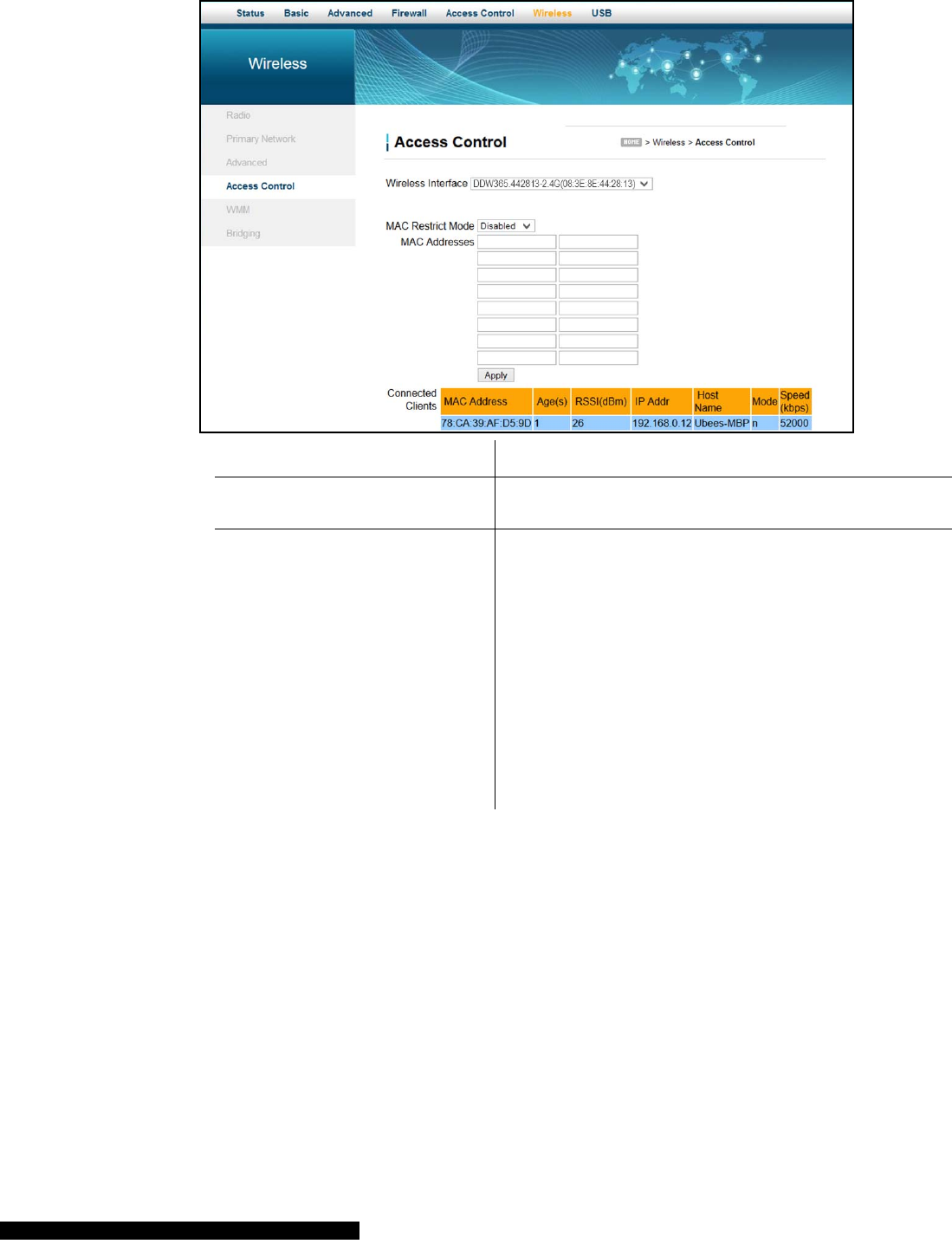
Ubee Interactive Using the Access Control Option
Ubee DDW365 Advanced Wireless Gateway Subscriber User Guide • February 2014 76
Label Description
Wireless Interface Defines the network name (SSID) and MAC address for which
you are setting access control parameters.
MAC Restrict Mode Controls wireless access to your network by MAC address.
Disabled turns off MAC restrictions and allows any
wireless client to connect to this device. However, if you
use other security mechanisms for access to the wireless
network, clients must still adhere to those restrictions.
Allow creates a list of wireless clients that can connect to
the wireless network. Enter the MAC addresses of these
clients in the MAC Addresses fields. MAC addresses not
on the list, are not allowed access to your wireless
network.
Deny creates a list of wireless clients that you do not
want to have access to your wireless network. Enter the
MAC addresses of these clients in the MAC Addresses
fields.

Ubee Interactive Using the Wi-Fi Multimedia Option
Ubee DDW365 Advanced Wireless Gateway Subscriber User Guide • February 2014 77
9.5 Using the Wi-Fi Multimedia Option
Use the Wi-Fi Multimedia option to configure the quality of service (QoS) to ensure the
best service in your wireless networks.
Controls WLAN transmission priority on packets transmitted over the wireless network.
Wi-Fi Multi-Media Quality of Service (WMM QoS) is a part of the IEEE 802.11e QoS
enhancement to certified Wi-Fi wireless networks.
WMM QoS prioritizes wireless traffic according to the delivery requirements of the
individual user and applications. On wireless access points without WMM QoS, all
traffic streams are given the same access priority to the wireless network. If a new
traffic stream creates a data transmission demand that exceeds the current network
capacity, the new traffic stream reduces the throughput of the other traffic streams.
MAC Addresses Defines the MAC addresses. Note: You may cut and paste
MAC addresses from the connected clients list at the bottom
of the screen.
Apply Saves changes when clicked.
Connected Clients Lists wireless clients currently connected listed by MAC
address.
MAC Address – Displays the MAC addresses entered in
the MAC Addresses field (see above).
Age(s) – Displays the duration since the wireless client’s
polled values were sent to the device. The values include
all information shown on this screen. The lower the
number, the more current its data.
RSSI(dBm) – Displays the received signal strength from
the device to the wireless cable modem. This value is
commonly used to assist in troubleshooting wireless
performance issues. A signal strength between 0dBm
and -65dBm is considered optimal. Levels of -66dBm and
lower (for example, -70, -80, etc.) have a downward
impact on wireless data throughput. Refer to
Understanding Received Signal Strength on page 82 for
more information.
IP Address – Displays the IP address assigned to this
wireless client.
Host Name – Displays the host name of the wireless
client.
Mode – Indicates the applicable 802.11a/b/g/n standard
used by the connected client device.
Speed (kbps) – Displays the maximum theoretical link
speed negotiated between the wireless gateway and the
client, not including the overhead associated with
encryption, and so on. For example, actual speeds with
WEP encryption enabled are typically less than half of the
negotiated link speed. TKIP encryption can also affect
performance. AES is the most efficient and secure with
the highest throughput possible. You can disable WMM if
throughput on some client adapters is adversely affected.
Label Description

Ubee Interactive Using the Wi-Fi Multimedia Option
Ubee DDW365 Advanced Wireless Gateway Subscriber User Guide • February 2014 78
WMM QoS capability allows you to assign access categories (ACs) to various packet
streams. The assigned AC of a packet stream depends on the packet’s priority, such
as a priority assigned by an application (also referred to as a user priority (UP). An AC
may include a common set of enhanced distributed channel access (EDCA)
parameters used by QoS to contend for a channel to transmit packets with certain
priorities.
Different ACs can be associated with different power saving parameters. For example,
one power saving parameter might be the delivery mechanism used by an access
point (AP) to deliver packets to a station (STA) that is operating in a reduced power
mode.
WMM transmit opportunity (TXOP) is assigned to each access point. The bounded
time interval during which a station can send as many frames as possible as long as
the transmission time does not extend past the maximum duration of the TXOP. If a
frame is too large to be transmitted in a single TXOP, it should be fragmented into
smaller frames. Using TXOP reduces the problem of low rate stations gaining too
much channel time in the legacy 802.11 DCF MAC. A TXOP time interval of 0 means
it is limited to a single MAC service data unit (MSDU) or MAC management protocol
data unit (MMPDU).
Note
WMM may need to be disabled to avoid throughput impacts to other wireless devices.
Steps
To configure the multimedia wireless option:
1. Click Wireless from the main menu.
2. Click WMM (Wi-Fi Multimedia) from the left side menu. Field descriptions are listed
below the screen example.
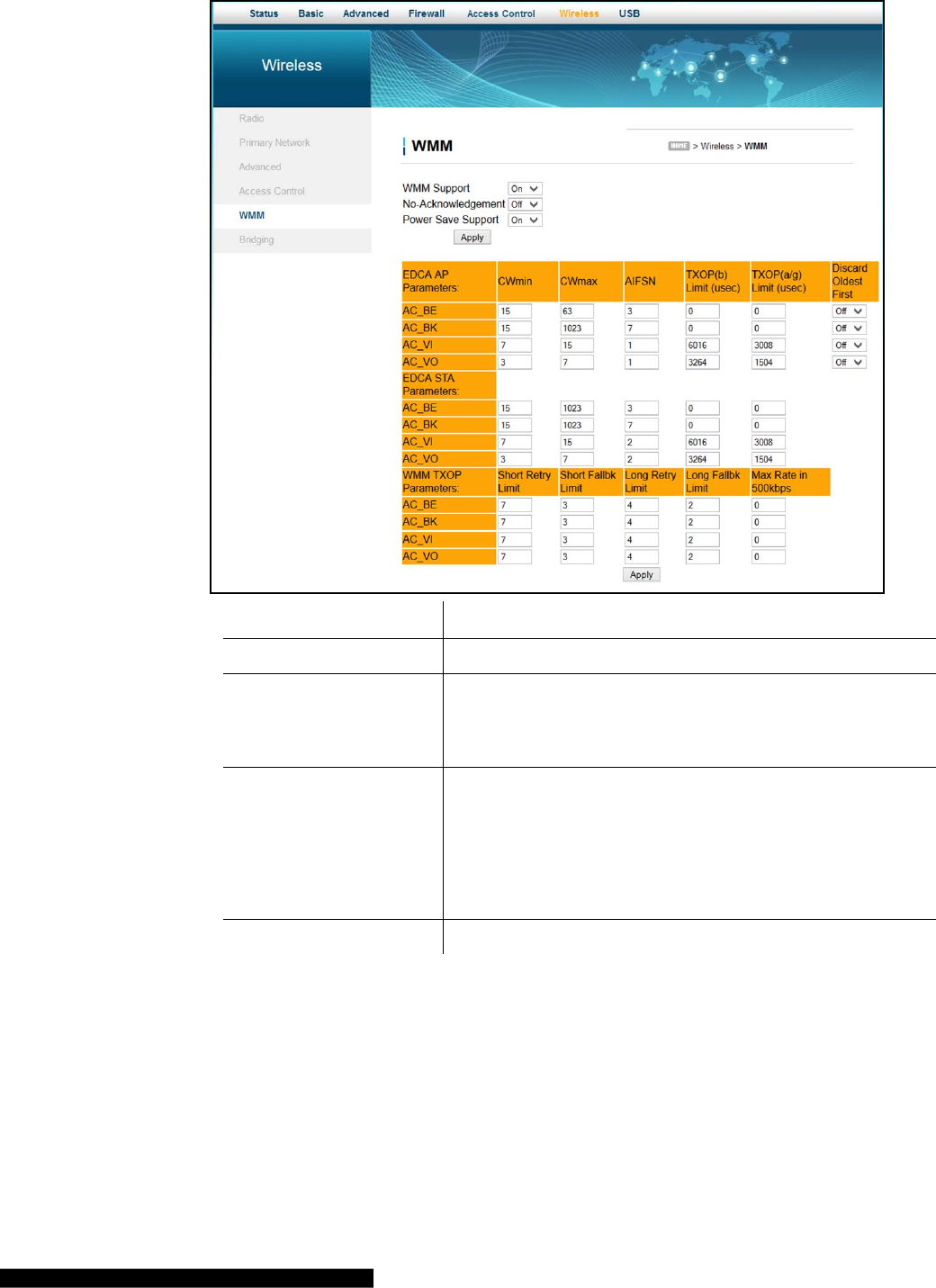
Ubee Interactive Using the Wi-Fi Multimedia Option
Ubee DDW365 Advanced Wireless Gateway Subscriber User Guide • February 2014 79
Label Description
WMM Support Enables (On) or disables (Off) WMM support.
No-Acknowledgement Enables (On) or disables (Off) acknowledging data frames. In
QoS mode, frames to send can have two values: QosAck and
QosNoAck. Frames with QosNoAck are not acknowledged,
avoiding the retransmission of highly time-critical data.
Power Save Support Enables (On) or disables (Off) power savings. WMM Power
Save increases the efficiency and flexibility of data transmission.
The wireless client device can “doze” between packets to save
power, while the wireless access point buffers downlink frames.
The application chooses the time to wake up and receive data
packets to maximize power conservation without sacrificing
quality of service.
Apply Saves changes to the WMM settings above.

Ubee Interactive Using the Bridging Option
Ubee DDW365 Advanced Wireless Gateway Subscriber User Guide • February 2014 80
9.6 Using the Bridging Option
Use the Bridging option to configure the DDW365 to act as a wireless network bridge
and establish wireless links with other wireless access points. To establish a bridge, you
need to know the MAC address of the peer device, that must be in wireless bridging mode
as well. The DDW365 can establish up to four wireless links with other wireless access
points. When wireless devices are in wireless bridging mode, they form a wireless
distribution system that allows computers in one LAN to connect to the computers in the
other LAN.
EDCA AP Parameters Allows you to prioritize wireless network traffic. Enhanced
Distributed Channel Access – Access Point (EDCA-AP)
provides four access categories (ACs):
AC_BE – Best Effort, medium throughput and delay. Most
traditional IP data is sent to this queue.
AC_BK – Background, high throughput. Bulk data that
requires maximum throughput and is not time-sensitive is
sent to this queue (for example, FTP data).
AC_VI – Video
AC_VO – Voice
CWmin
CWmax
AIFSN
TXOP (b) Limit (usec)
TXOP (a/g) Limit (usec)
Discard Oldest First
Sets the time for the following fields:
CWmin – Contention window minimum
CWmax – Contention window maximum
AIFS – Arbitration inter-frame space
TXOP – Transmit opportunity
Discard Oldest First – Removes oldest frame when set to
On.
EDCA STA Parameters Allows you to prioritize wireless network traffic for receiving
terminals. Access categories are:
AC_BE – Best Effort, medium throughput and delay. Most
traditional IP data is sent to this queue.
AC_BK – Background, high throughput. Bulk data that
requires maximum throughput and is not time-sensitive is
sent to this queue (for example, FTP data).
AC_VI – Video
AC_VO – Voice
WMM TXOP Parameters Allows you to prioritize wireless network traffic for wireless
multimedia transmit opportunities. Access categories are:
AC_BE – Best Effort, medium throughput and delay. Most
traditional IP data is sent to this queue.
AC_BK – Background, high throughput. Bulk data that
requires maximum throughput and is not time-sensitive is
sent to this queue (for example, FTP data).
AC_VI – Video
AC_VO – Voice
Short Retry Limit
Short Fallbk Limit
Long Retry Limit
Long Fallbk Limit
Max Rate in 500kbps
Defines how many times the MAC retries to send different types
of packets. If the number of retries reach their limit, the frame is
discarded.
Apply Saves all changes.
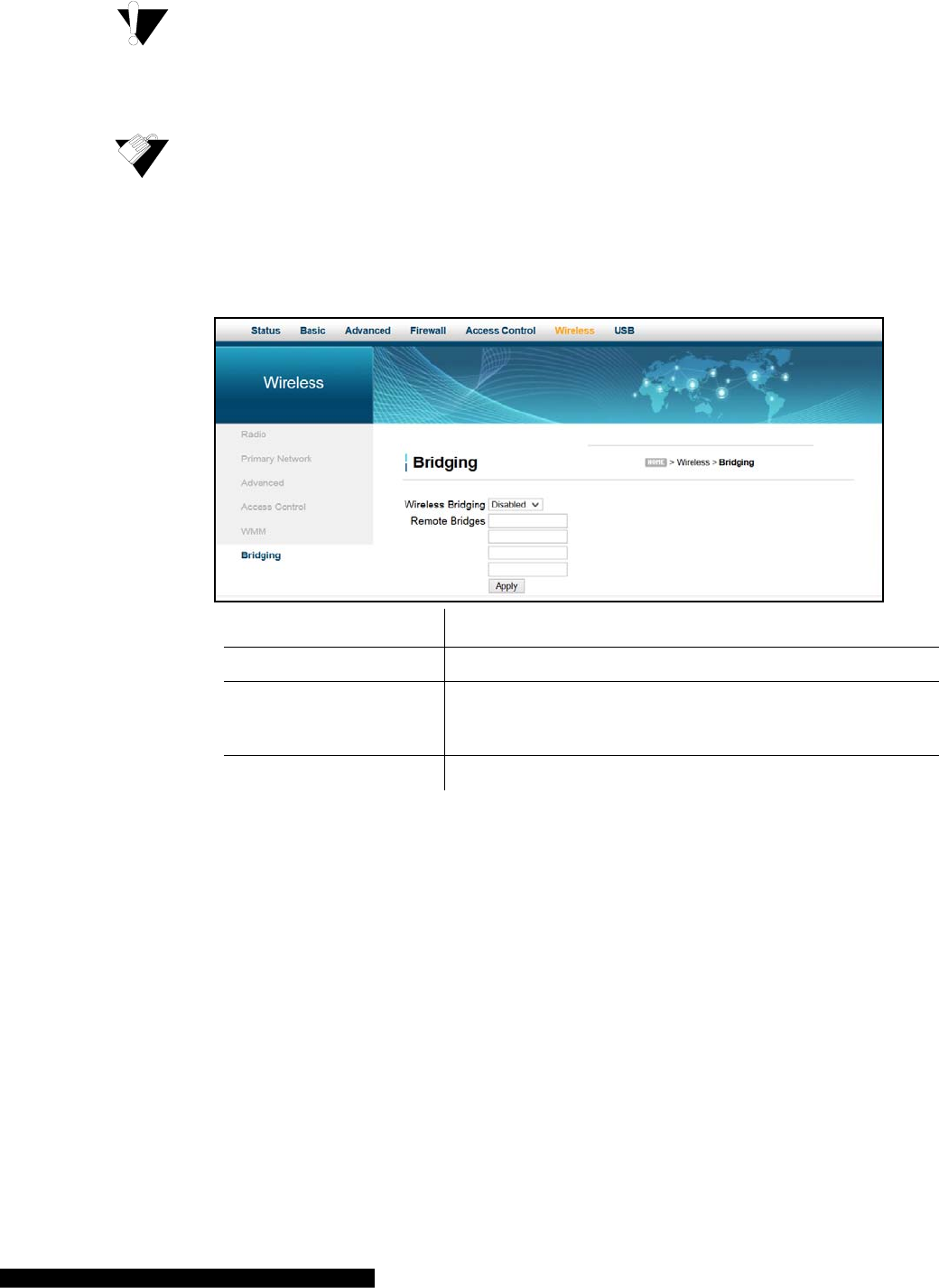
Ubee Interactive Deploying and Troubleshooting the Wireless Network
Ubee DDW365 Advanced Wireless Gateway Subscriber User Guide • February 2014 81
Caution
Avoid bridge loops when you enable bridging devices. Bridge loops cause broadcast traffic to
circle the network endlessly. This can degrade throughput and disrupt communications.
Steps
To configure the modem as a bridge:
1. Click Wireless from the main menu.
2. Click Bridging from the left side menu. Field descriptions are listed below the screen
example.
9.7 Deploying and Troubleshooting the Wireless Network
Use the information in this section to help you understand, deploy, and troubleshoot your
wireless environments:
Understanding Received Signal Strength on page 82
Estimating Wireless Cable Modem to Wireless Client Distances on page 82
Understanding the 2.4GHz Band on page 84
Selecting a Wireless Channel on page 85
Label Description
Wireless Bridging Enables or disables bridging.
Remote Bridges Defines the MAC addresses of other wireless access points that
you want to establish a bridge to and from. These access points
must also have bridging enabled.
Apply Saves all changes.

Ubee Interactive Deploying and Troubleshooting the Wireless Network
Ubee DDW365 Advanced Wireless Gateway Subscriber User Guide • February 2014 82
9.7.1 Understanding Received Signal Strength
Received signal strength (RSSI) is measured from connected wireless client devices to
the wireless cable modem. This value can significantly impact wireless
speeds/performance. It is determined by:
Materials (for example, open air, concrete, trees)
Distance between wireless clients and the wireless cable modem
Wireless capabilities of the client devices
To determine the received signal strength, refer to Using the Access Control Option on
page 75 and review the RSSI value. A receive signal strength indicator between 0 to -64
dBm is considered optimal. Levels of -67dBm and lower (for example, -70, -80, etc.) have
a downward impact on wireless data throughput.
9.7.2 Estimating Wireless Cable Modem to Wireless Client Distances
The information in this section helps you to determine how far a wireless access point (the
DDW365) can be placed from wireless client devices. Environmental variances include
the capabilities of wireless clients and the types of material through which the wireless
signal must pass. When the DDW365 and wireless clients reach the distance threshold
between each other, network performance degrades.
Steps
To determine wireless cable modem placement:
1. Connect a wireless client to the DDW365. Refer to Connecting Devices to the Network
on page 13 if needed.
2. Place the wireless client at around one meter (three feet) away from the DDW365.
3. Obtain the RSSI value for the connected client. Refer to Using the Access Control
Option on page 75. This value is used in the formula further below.
4. Use the following table to determine what materials the wireless signal must travel
through to reach the desired wireless coverage distance.
Attenuation Considerations
Material Attenuation
(2.4GHz)
Free Space 0.24dB / foot
Interior Drywall 3dB to 4dB
Cubicle Wall 2dB to 5dB
Wood Door (Hollow/Solid) 3dB to 4dB
Brick, Concrete Wall (Note 1) 6dB to 18dB

Ubee Interactive Deploying and Troubleshooting the Wireless Network
Ubee DDW365 Advanced Wireless Gateway Subscriber User Guide • February 2014 83
5. Use the attenuation value from the materials table above in the following formula:
Formula:
(Transmit Power, use -30dBm) – (Receiver Sensitivity, use RSSI value) =
Allowable Free Space Loss
Allowable Free Space Loss ÷ Materials Attenuation Value =
Optimal Distance in Feet Between the DDW365 and a Wireless Client
Example:
(-30dBm) - (-67dBm) = 37dBm (allowable free space loss for a 54Mbps connection)
37dBm ÷.24db/foot (for open space) = 154.16 feet
6. Once you know the optimal feet distance between individual wireless clients and the
DDW365, you may resolve and prevent some performance issues.
7. Check the wireless signal strength and speed of the computer connected wirelessly to
the DDW365. Instructions for checking speeds are provided for both a Windows and a
Mac computer in the table below. If the wireless computer is not connected, refer to
Connecting a Wireless Device on page 13.
Glass Window (not tinted) 2dB to 3dB
Double Pane Coated Glass 13dB
Bullet Proof Glass 10dB
Steel / Fire Exit Door 13dB to 19dB
Human Body 3dB
Trees (Note 2) 0.15dB / foot
Note 1: Different types of concrete materials are used in different parts
of the world and the thickness and coating differ depending on
whether it is used in floors, interior walls, or exterior walls.
Note 2: The attenuation caused by trees varies significantly depending
upon the shape and thickness of the foliage.
Attenuation Considerations
Material Attenuation
(2.4GHz)
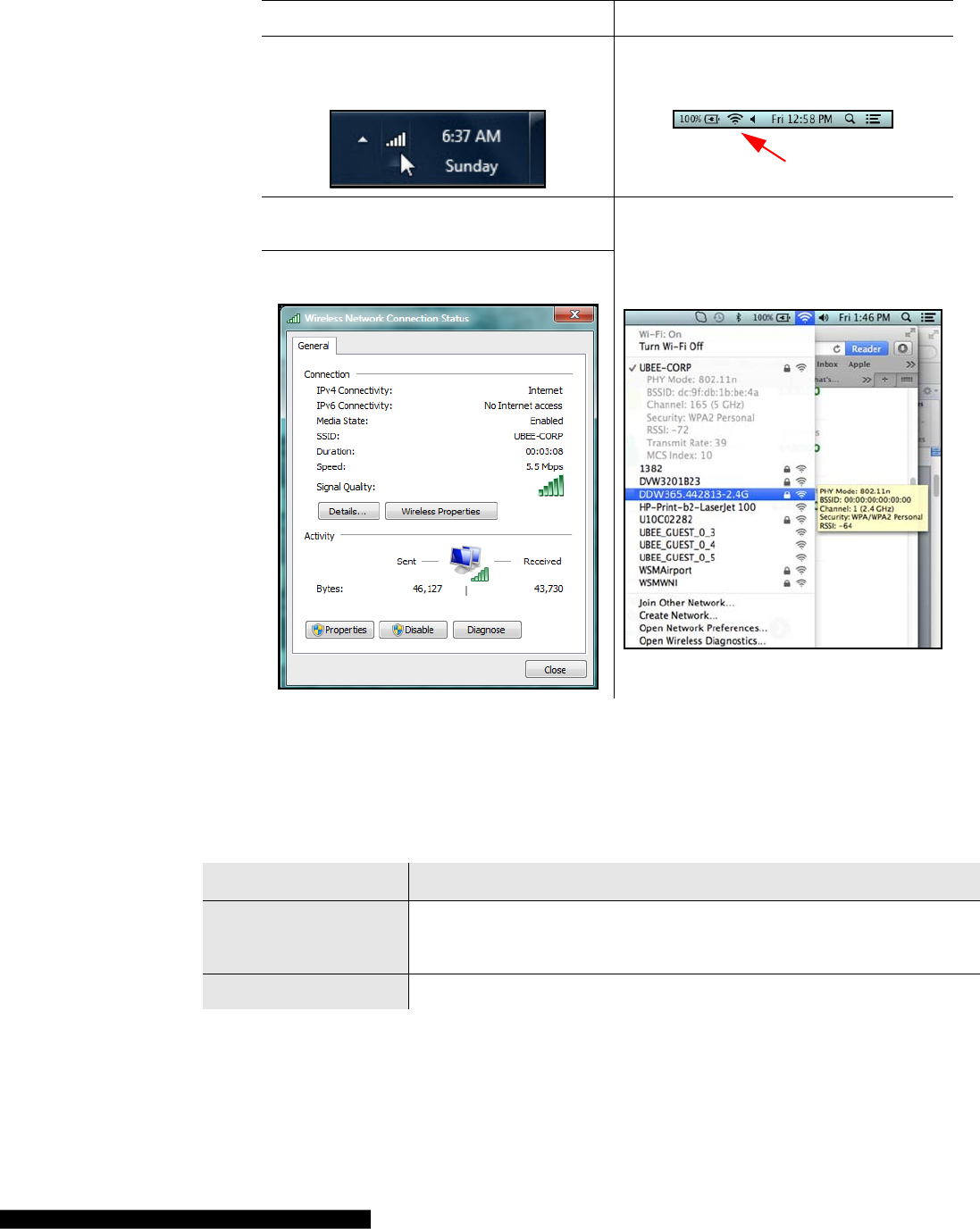
Ubee Interactive Deploying and Troubleshooting the Wireless Network
Ubee DDW365 Advanced Wireless Gateway Subscriber User Guide • February 2014 84
9.7.3 Understanding the 2.4GHz Band
The DDW365 operates in the 2.4GHZ frequency band. The table below provides a
information about the 2.4GHz band.
Checking Wireless Signal Strength and Speed
Windows PC Apple Mac
1. Click the Wireless networking icon in the
system tray to display a list of available
wireless networks.
1. Hold down the Option key and click on
the wireless icon (Airport) on the right
side of the top menu bar.
2. Click “Open Network and Sharing Center,”
then click “Wireless Network Connection.”
2. Information about the current wireless
connection appears below the SSID. If
you continue to hold the Option key and
hover over any network, information
about the connection is visible.
3. Review the speed and signal strength in
the Status window.
Band 2.4GHz
Channels In the USA, channels 1-11 are used. There are 3 non-overlapping channels
(1, 6, and 11). Auto channel should be selected to ensure that the channel
with the least interference is used.
Standards 802.11b,g,n
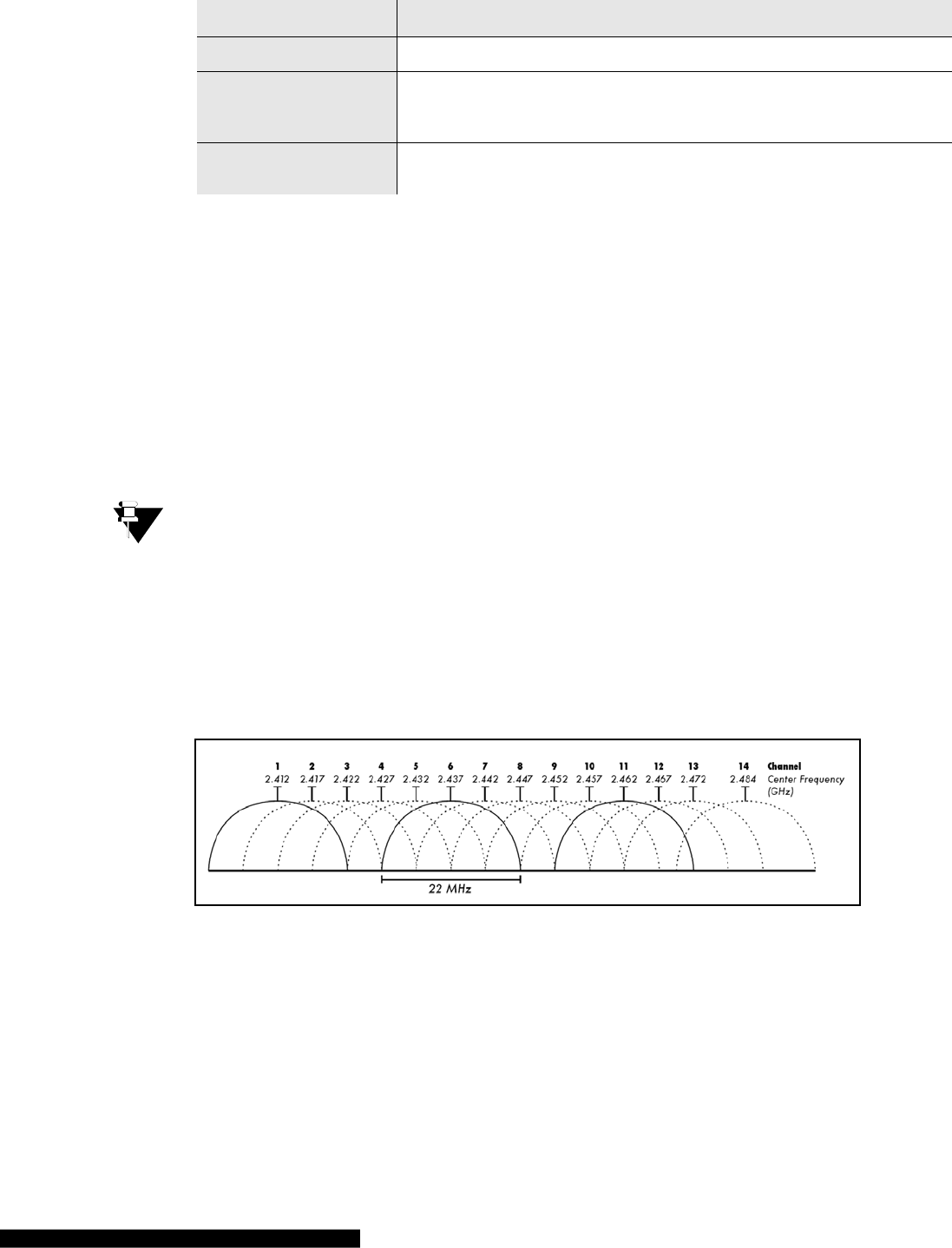
Ubee Interactive Deploying and Troubleshooting the Wireless Network
Ubee DDW365 Advanced Wireless Gateway Subscriber User Guide • February 2014 85
9.7.4 Selecting a Wireless Channel
You may need to change the wireless channel on which the DDW365 operates when you
are in computing, test, and other environments where several wireless access points may
be operating in the 2.4GHz range.
In some cases, you may want to segment your wireless traffic where a group of devices
operates on one channel and another group operates on another channel, and so on. This
is done by configuring the channel on each wireless access point individually (if you have
multiples). If you have control over only one wireless device in an environment where
there may be several, you can change the wireless channel on your device to one that is
not heavily used.
Note
To change the wireless broadcast channel, refer to Using the Wireless Radio Option on
page 66.
2.4GHz Channels
The following diagram displays the 2.4GHz channels available in the Americas. Each
available channel is 22MHz wide. Since channels overlap, it is best to choose channels
that have the least overlap (typically 1, 6, and 11 in the Americas, and 1, 5, 9, and 13 in
Europe). Overlapping channels can cause wireless network performance issues.
Source: Wikipedia.org, and IEEE article IEEE 802.11n-2009
Network Range Wider range than the 5GHz band
Interference Higher interference levels compared to the 5GHz band, as many wireless
devices such as cordless phones, microwave ovens, and computers use the
2.4GHz frequency.
Application Recommended for simple Internet browsing and email, as these applications
don’t take too much bandwidth and work fine at a greater distance.
Band 2.4GHz

Ubee DDW365 Advanced Wireless Gateway Subscriber User Guide • February 2014 86
10 Understanding the USB Menu
The USB menu of the Web user interface allows you to configure USB storage devices
and media file scanning.
Topics
See the following topics:
Using the USB Basic Option on page 86
Using the Approved Devices Option on page 87
Using the Storage Basic Option on page 89
Using the Storage Advanced Option on page 90
Using the Media Server Option on page 93
Steps
To access USB options:
1. Access the Web user interface. Refer to Accessing the Web User Interface Locally on
page 16.
2. Click USB from the main menu.
10.1 Using the USB Basic Option
The USB Basic option allows you to configure Linux based servers. The buttons on the
right side of the page are short cuts to the options on the left side of the page.
Steps
To view USB basic information:
1. The USB Basic screen is displayed. Field descriptions are listed below the screen
example.
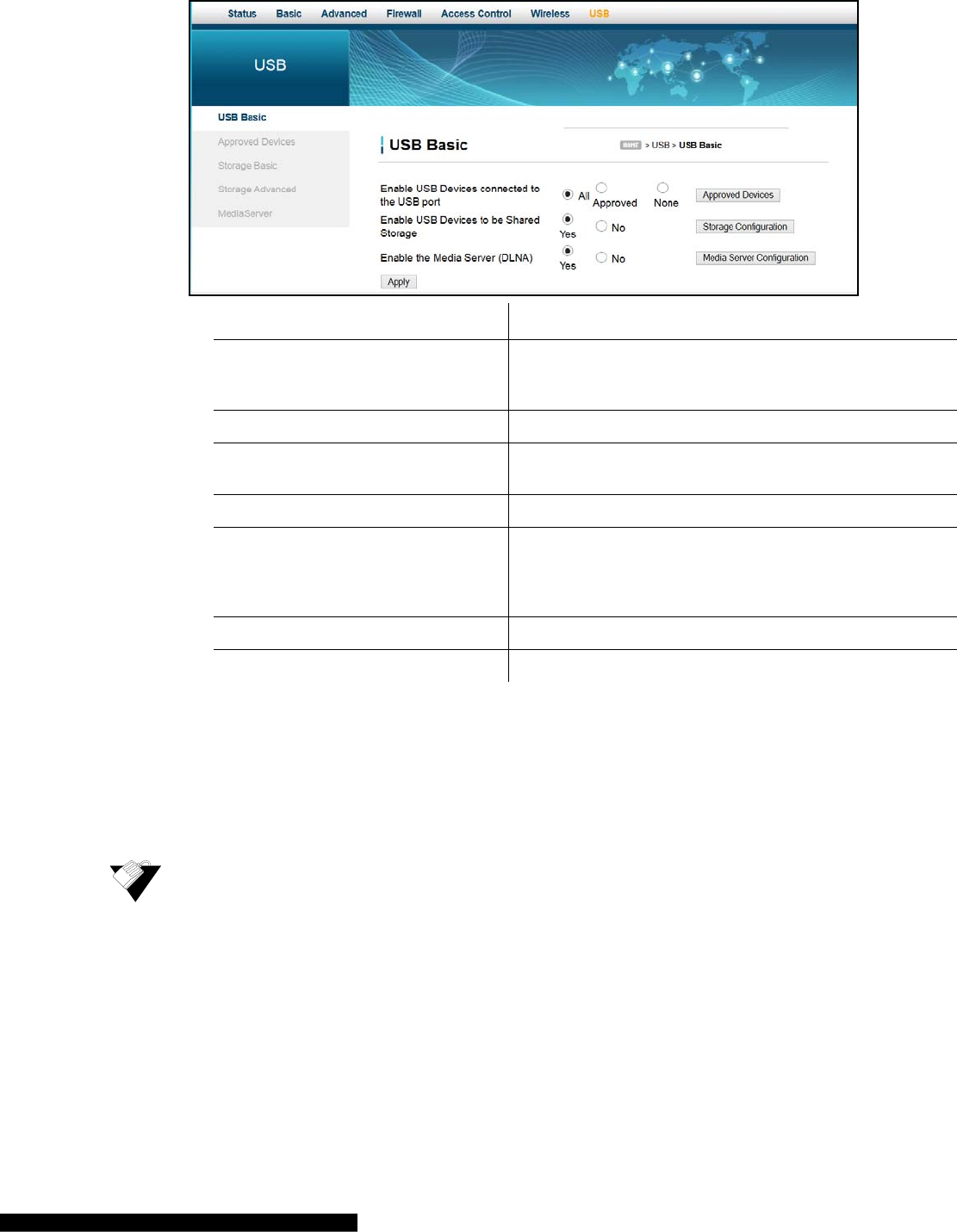
Ubee Interactive Using the Approved Devices Option
Ubee DDW365 Advanced Wireless Gateway Subscriber User Guide • February 2014 87
10.2 Using the Approved Devices Option
The Approved Devices option allows you to choose if any storage device plugged into
the modem can be used or only approved devices. If “Approved” is selected, each device
must be manually approved on this page.
Steps
To view approved devices information:
1. Click Approved Devices from the left side menu. Field descriptions are listed below
the screen example.
Label Description
Enable USB Devices connected to
the USB port Allows you to enable USB devices that are plugged in to the
USB port. Options are All, Approved, or None. The default
setting is All.
Approved Devices Takes you to the Approved Devices page.
Enable USB Devices to be Shared
Storage Allows you to designate USB devices to be shared storage.
Storage Configuration Takes you to the Storage Basic page.
Enable the Media Server (DLNA) Allows you to enable the media server. The media server
must be DLNA-certified. The DLNA (Digital Living Network
Alliance) defines standards that enable devices to share
information such as photos, videos, and music.
Media Server Configuration Takes you to the Media Server page.
Apply Saves changes.
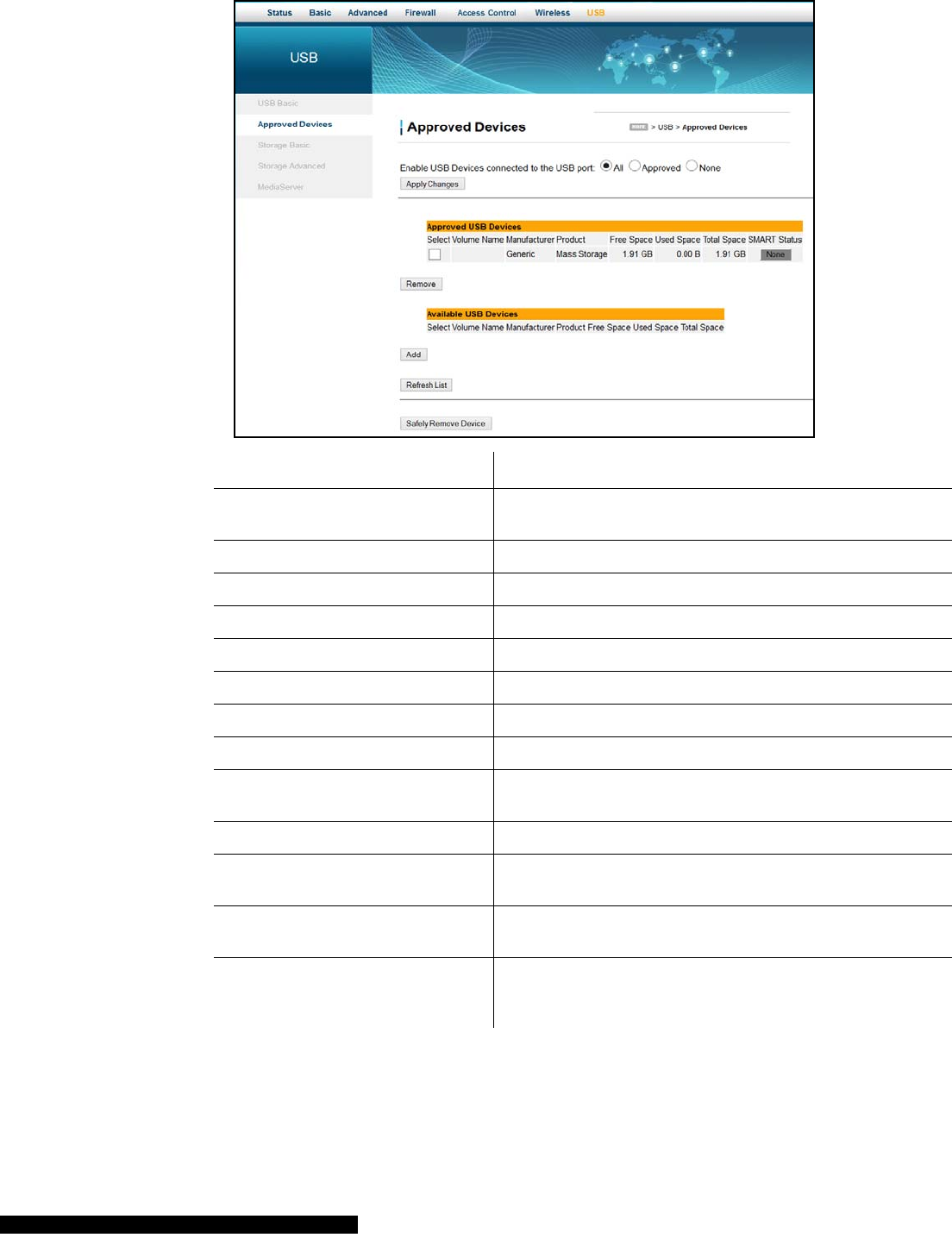
Ubee Interactive Using the Approved Devices Option
Ubee DDW365 Advanced Wireless Gateway Subscriber User Guide • February 2014 88
Label Description
Enable USB devices connected
to the USB port Allows you to enable USB devices that are connected to the
USB port. Options are All, Approved, or None.
Apply Changes Saves changes.
Approved USB Devices Displays information about currently approved USB devices.
Select Allows you to select the device by checking the box.
Volume Name Displays the name of the USB device.
Manufacturer Displays the manufacturer of the USB device.
Product Indicates the type of the USB device.
Free Space Displays the free space available on the USB storage device.
Used Space Displays the space that has been used on the USB storage
device.
Total Space Displays the total space on the USB storage device.
SMART Status Displays the SMART (Self-Monitoring, Analysis, and Reporting
Technology) status of the USB drive.
Remove To remove a device from the list of approved USB devices,
select the device and click Remove.
Available USB Devices Displays USB devices that are available to be added to the
approved USB devices list. The individual field listings are the
same as those under the Approved Devices heading.
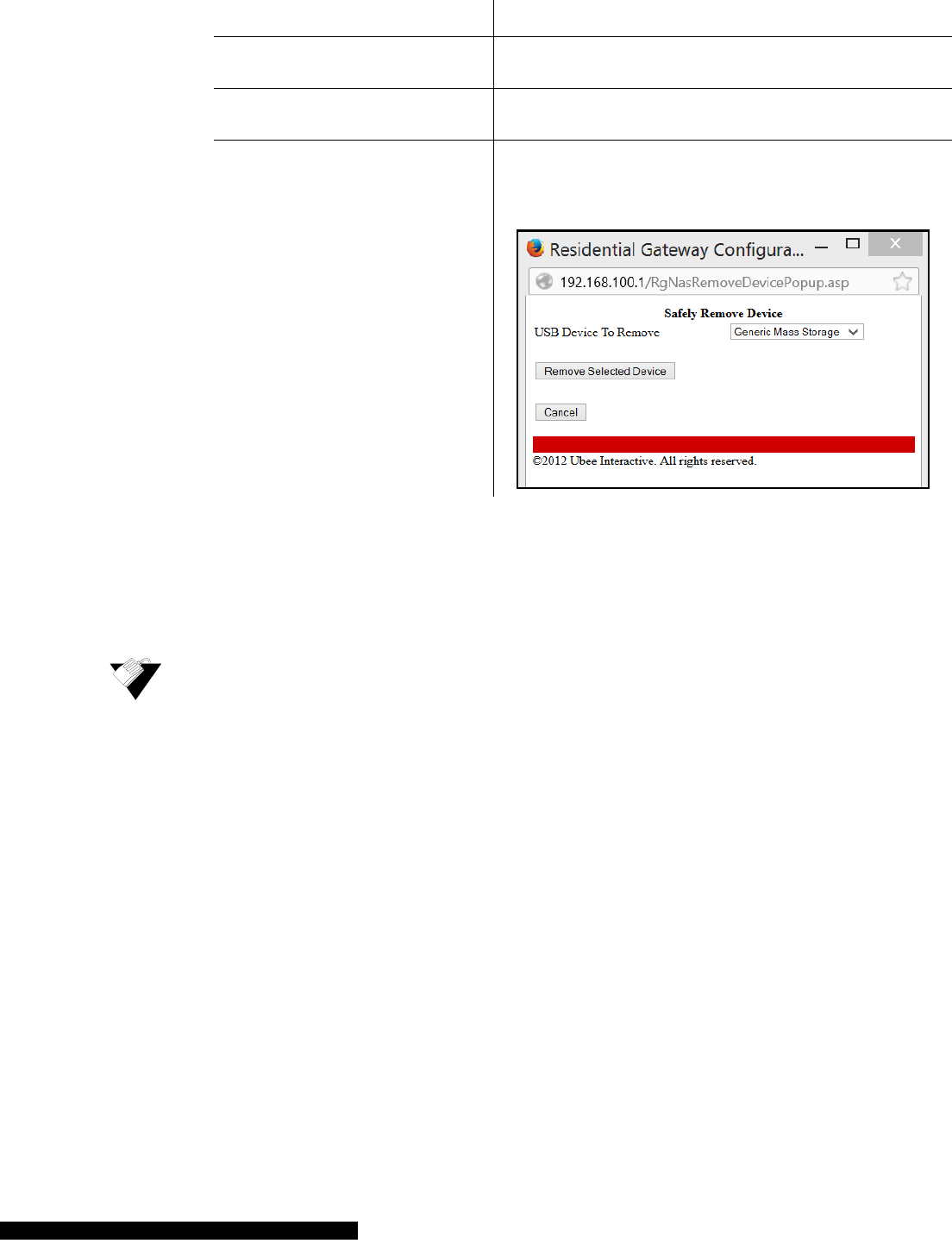
Ubee Interactive Using the Storage Basic Option
Ubee DDW365 Advanced Wireless Gateway Subscriber User Guide • February 2014 89
10.3 Using the Storage Basic Option
The Storage Basic page allows you to configure the device name and designate what
folders should be shared.
Steps
To view basic storage information:
1. Click Storage Basic from the left side menu. Field descriptions are listed below the
screen example.
Add To add an available USB device to the Approved USB Devices
list, select the device and click Add.
Refresh List Allows you to refresh the lists of approved and available USB
devices.
Safely Remove Device Allows you to safely remove a USB device. Click Safely
Remove Device. The following window pops up. Select the
device you want to remove from the drop down menu, and
click “Remove Selected Device.”
Label Description
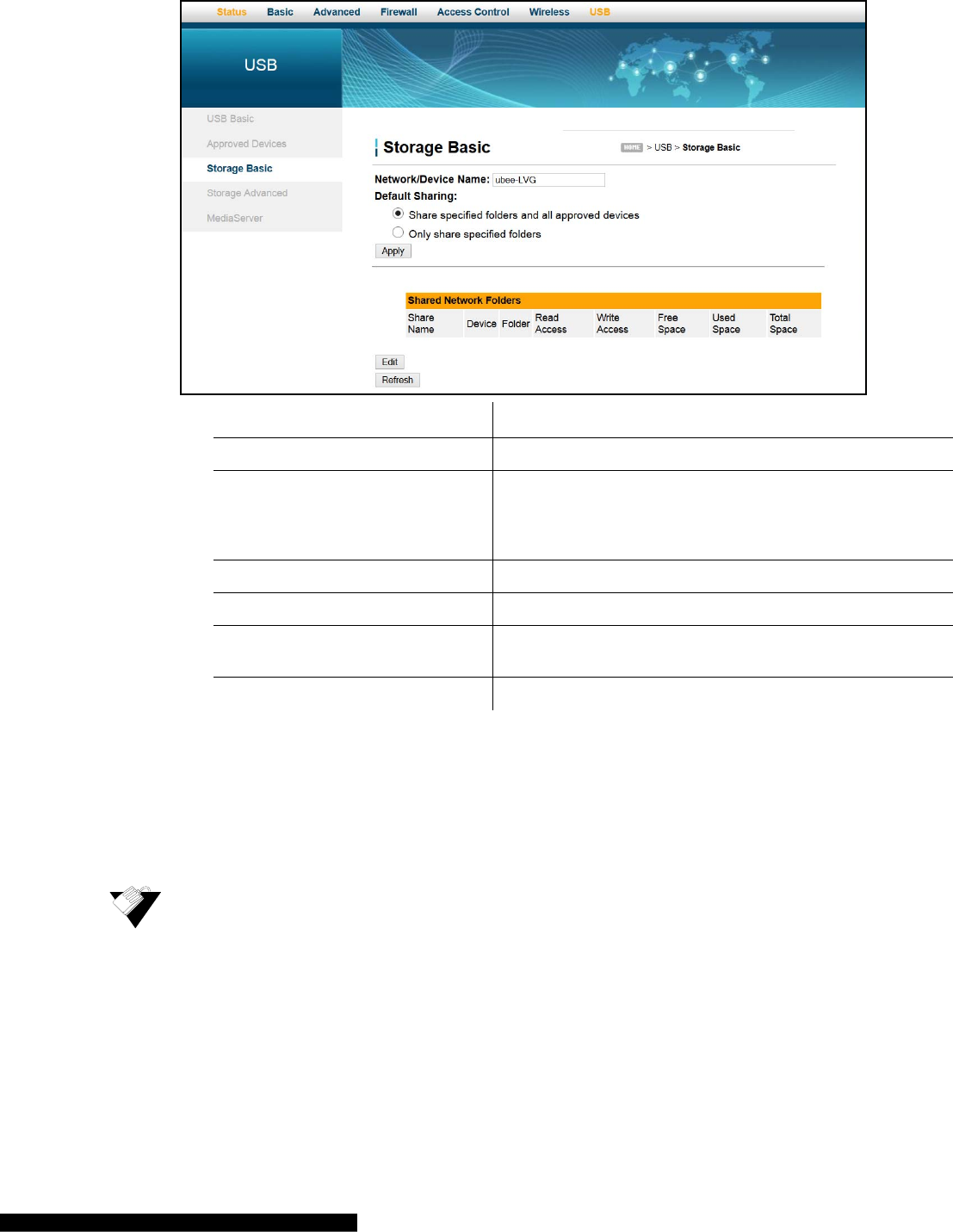
Ubee Interactive Using the Storage Advanced Option
Ubee DDW365 Advanced Wireless Gateway Subscriber User Guide • February 2014 90
10.4 Using the Storage Advanced Option
The Storage Advanced page allows you to configure the device name and the workgroup
name, as well as enable or disable Windows Network and FTP support.
Steps
To view advanced storage information:
1. Click Storage Advanced from the left side menu. Field descriptions are listed below
the screen example.
Label Description
Network/Device Name Allows you to define the network and device name.
Default Sharing Allows you to set the default sharing option for the device.
Options are:
1. Share specified folders and all approved devices
2. Only share specified folders
Apply Saves changes to default sharing settings.
Shared Network Folders Shows information about shared network folders.
Edit Select Edit to open the Storage Advanced screen which
allows you to edit shared network folders.
Refresh Allows you to refresh the lists of shared network folders.
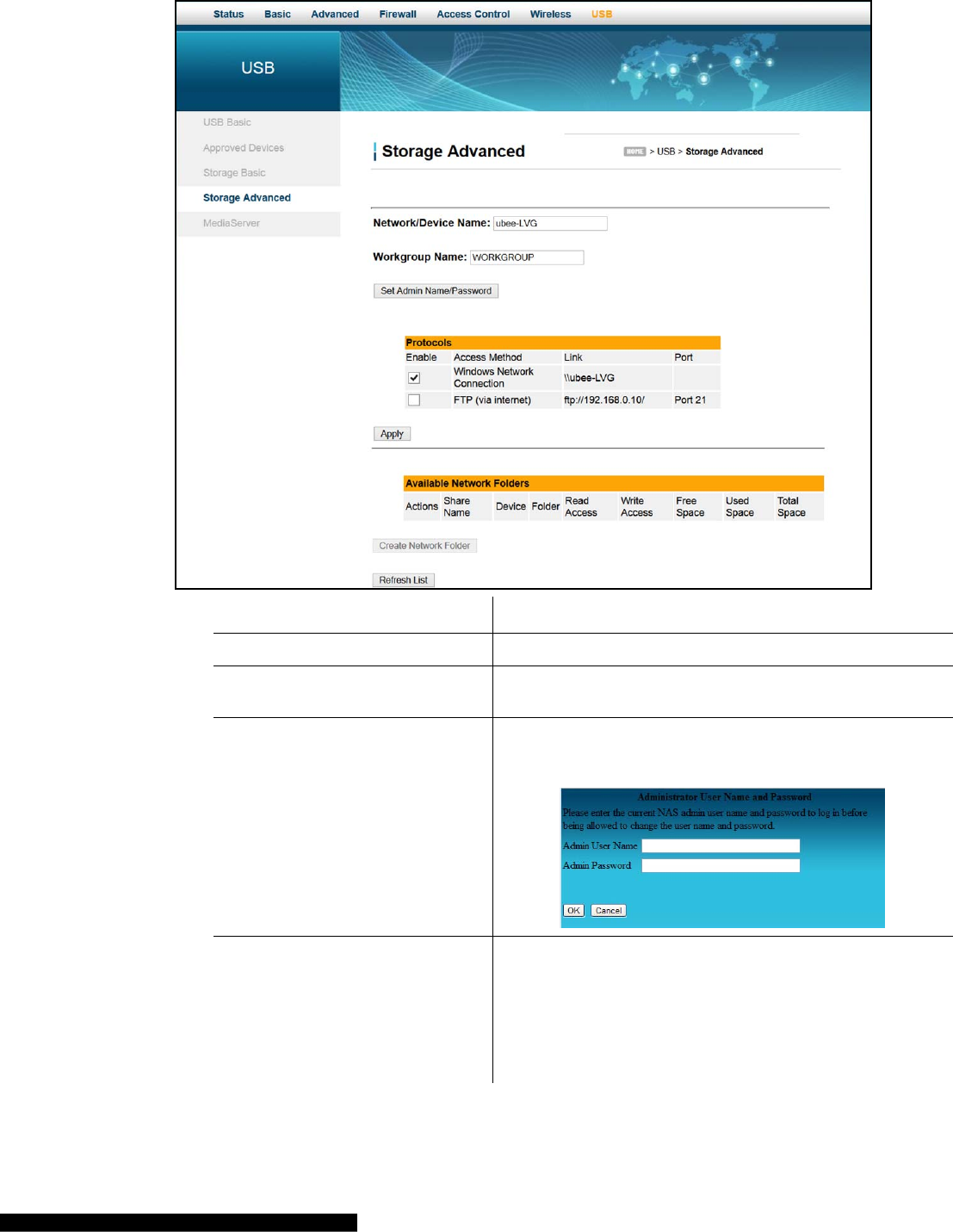
Ubee Interactive Using the Storage Advanced Option
Ubee DDW365 Advanced Wireless Gateway Subscriber User Guide • February 2014 91
Label Description
Network/Device Name Allows you to define the network and device name.
Workgroup Name If you are using a Windows workgroup rather than a domain,
the workgroup name is displayed here.
Set Admin Name/Password Enter the NAS (network attached storage) administrator name
and password, then you will be allowed to change the user
name and password.
Protocols Allows you to enable or disable access methods. The
Windows Network Connection access method is enabled by
default. The FTP access method is disabled by default. If you
enable this setting, remote users can access the USB drive
through FTP over the Internet. The IP address displayed in the
link field is the Linux IP stack address that should be used for
the FTP server address in the FTP clients.
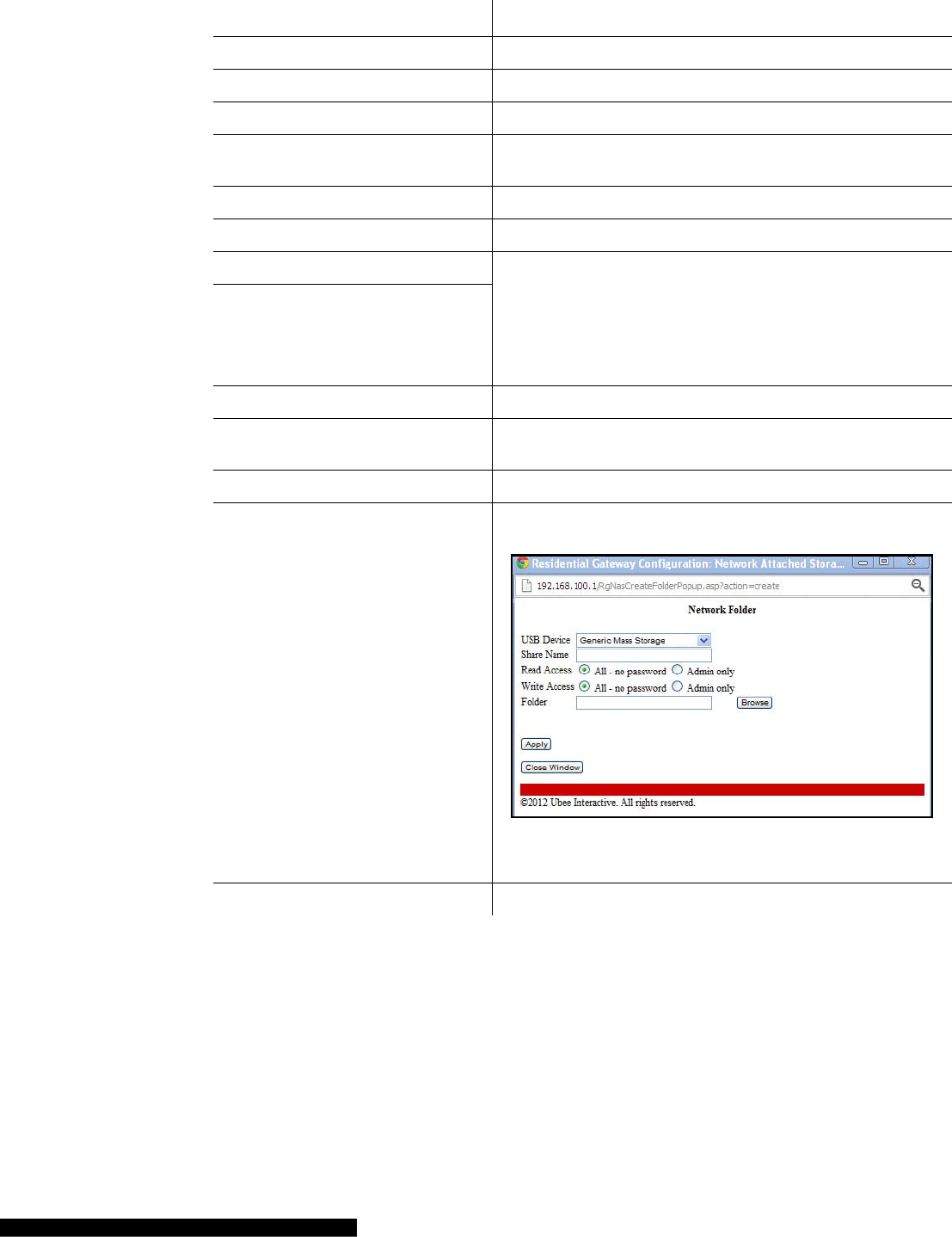
Ubee Interactive Using the Storage Advanced Option
Ubee DDW365 Advanced Wireless Gateway Subscriber User Guide • February 2014 92
Apply Saves changes.
Available Network Folders Displays information about available network folders.
Actions Displays Edit and Remove buttons for the folder.
Share Name Displays the shared name the folder was given during “Create
New Folder.”
Device Displays the device type and name.
Folder Displays the full path of the folder.
Read Access Shows the permissions and access controls assigned to the
folder.
“All - no password” is displayed if all users are allows to
access the folder.
“Admin only” is displayed if a password is required to
access the folder.
Write Access
Free Space Displays the free space available on the USB storage device.
Used Space Displays the space that has been used on the USB storage
device.
Total Space Displays the total space on the USB storage device.
Create Network Folder Allows you to create a network folder. Enter the appropriate
information in the following pop up window.
After clicking Apply, the information entered here will be
displayed in the Available Network Folders table.
Refresh List Allows you to refresh the list of shared network folders.
Label Description

Ubee Interactive Using the Media Server Option
Ubee DDW365 Advanced Wireless Gateway Subscriber User Guide • February 2014 93
10.5 Using the Media Server Option
The Media Server page allows you to configure the DLNA media server. The media
server must be DLNA-certified. The DLNA (Digital Living Network Alliance) defines
standards that enable devices to share information such as photos, videos, and music.
The media server name and the file names that will be scanned on the USB storage
devices are configured using this option.
Steps
To view media server information:
1. Click Media Server from the left side menu. Field descriptions are listed below the
screen example.
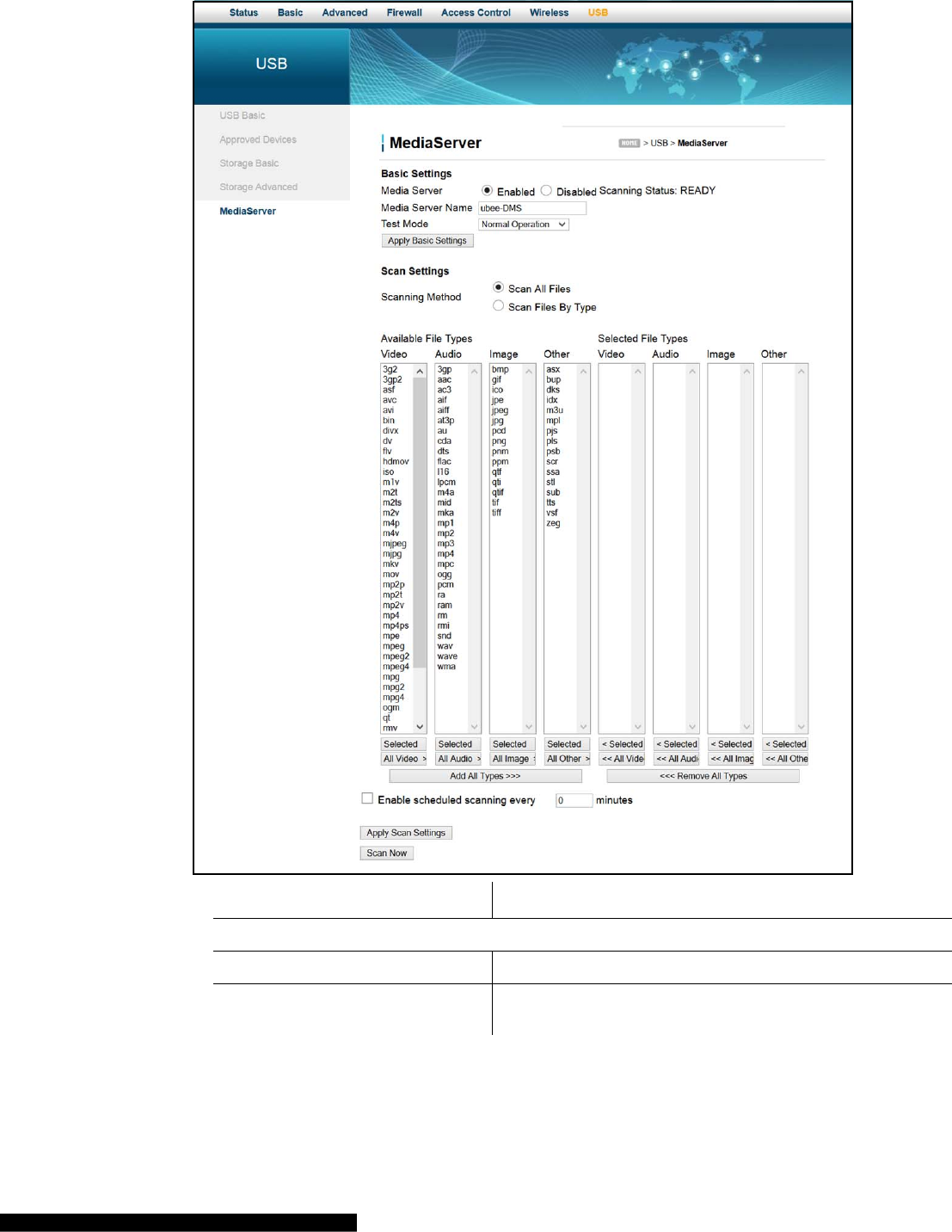
Ubee Interactive Using the Media Server Option
Ubee DDW365 Advanced Wireless Gateway Subscriber User Guide • February 2014 94
Label Description
Basic Settings
Media Server Displays whether the media server is enabled or disabled.
Media Server Name The media server name, the name that will show up on media
players.

Ubee Interactive Using the Media Server Option
Ubee DDW365 Advanced Wireless Gateway Subscriber User Guide • February 2014 95
Test Mode Allows you to select the test mode. Options are:
1. Normal Operation
2. UPnP Certification
3. DLNA Certification
Apply Basic Settings Applies the basic settings that have been selected.
Scan Settings
Scanning Method Allows you to select the preferred scanning method, either
Scan All Files or Scan Files By Type.
Available File Types Lists all of the available file types on the media server.
Available file categories include Video, Audio, Image, and
Other.
Beneath each file category, you can select specific file types to
scan for, or scan all the file types in that category. Once
selected, theses files types will appear in the Selected File
Types section.
Selected File Types Displays the file types that were selected in the Available File
Types section.
Enable scheduled scanning
every X minutes Click the box to enable regularly-scheduled scans. Enter the
scan interval in minutes.
Apply Scan Settings Applies the scan settings that have been set.
Scan Now Click this button to begin a scan of the media server.
Label Description

Ubee DDW365 Advanced Wireless Gateway Subscriber User Guide • February 2014 96
11 Glossary
This chapter defines terms used in this guide and in the industry.
54GTM
The internal wireless adapter from Broadcom.
ALG (Application-Level Gateway)
A type of security device that acts on behalf of the application servers on a network,
hiding the servers themselves from traffic that might be malicious.
AP (Access Point)
A device that allows wireless devices to connect to a wired network using WiFi, or related
standards.
Broadcast
A packet sent to all devices on a network.
BSS (Basic Service Sets)
A basic service set is the fundamental building block of an 802.11 wireless local area
network. The overlapping BSS problem refers to a situation where two or more systems,
unrelated to each other are in close enough proximity to hear each other physically.
Overlapping BSS may degrade the network performance severely.
BSSID (Basic Service Set Identifier)
The BSSID uniquely identifies a specific access point and is in the same format as a MAC
address.
Channel Bonding
A computer networking configuration where two or more network interfaces are combined
on a host computer for redundancy or increased throughput. Data is transmitted over
these channels as if they are one channel.
CMTS (Cable Modem Termination System)
Typically located in the cable company’s headend, the CMTS is equipment that provides
high-speed data services to subscribers, such as cable Internet and Voice over IP (VoIP).
CPE (Customer Premises Equipment)
Equipment such as telephones, routers, and modems located at a user’s location to
enable access to communication services.
Default Gateway
The routing device used to forward all traffic that is not addressed to a computer on the
local subnet.

Ubee Interactive Glossary
Ubee DDW365 Advanced Wireless Gateway Subscriber User Guide • February 2014 97
DHCP (Dynamic Host Configuration Protocol)
A protocol that centrally automates the assignment of IP addresses in a network. Using
the Internet’s set of protocols (TCP/IP), each machine that can connect to the Internet
needs a unique IP address. For example, when the service provider sets up computer
users with a connection to the Internet, an IP address is assigned to each machine.
DHCP lets the service provider distribute IP addresses and automatically sends a new IP
address when a computer is plugged in to the high-speed Internet network. DHCP uses
the concept of a “lease” or amount of time an IP address is valid for a computer. Lease
times can vary.
DMZ (Demilitarized Zone)
Allows one IP address (or computer) to be placed in between the firewall and the Internet
(usually for gaming and video conferencing). This allows risky, open access to the
Internet.
DOCSIS (Data Over Cable Service Interface Specification)
An International telecommunications standard that permits the addition of high-speed data
transfer over an existing cable TV system.
Domain
A subnetwork comprised of a group of clients and servers under the control of one
security database.
Domain Name
A descriptive name for an address or group of addresses on the Internet. Domain names
are in the form of a registered entity name plus one of a number of predefined top-level
suffixes, such as .com, .edu, .org.
DoS (Denial of Service) Attack
An attempt to make a machine or network resources unavailable to its intended users.
DNS (Domain Name System)
An Internet service that locates and translates domain names into IP addresses. Because
domain names are alphabetic, they are easier to remember. However, the Internet is
based on IP addresses. Every time you use a domain name, a DNS service translates the
name into the corresponding IP address. The DNS system is actually its own network. If
one DNS server does not know how to translate a particular domain name, it asks another
one, and so on, until the correct IP address is returned.
Downstream
A term to describe the direction of data from the network service provider to the customer.
DTIM (Delivery Traffic Indication Message)
Informs clients about the presence of buffered broadcast data on the access point.
Ethernet
A standard network protocol that specifies how data is placed on and retrieved from a
common transmission medium. It forms the underlying transport vehicle used by several
upper-level protocols, including TCP/IP, HTTP, and FTP.

Ubee Interactive Glossary
Ubee DDW365 Advanced Wireless Gateway Subscriber User Guide • February 2014 98
Firewall
A highly effective method to block unsolicited traffic from outside the connected
computers in your gateway and local network.
FTP (File Transfer Protocol)
A network protocol used to transfer files from one host to another over a TCP-based
network.
Gateway
A local device, usually a router, that connects hosts on a local network to other networks
– sometimes with different incompatible communication protocols. The DDW365 is an
example of a gateway.
Headend
A main facility to process and distribute Internet communication signals. Headend may
also refer to cable television signals and power line communication facilities.
ICQ
A free instant-messaging utility introduced by Mirabilis in 1996.
IKE (Internet Key Exchange)
A protocol used to ensure security for VPN negotiation and remote host or network
access.
IP (Internet Protocol)
The method or protocol by which data is sent from one computer to another on the
Internet. It is a standard set of rules, procedures, or conventions relating to the format and
timing of data transmission between two computers that they must accept and use to
understand each other. Used in conjunction with the Transfer Control Protocol (TCP) to
form TCP/IP.
IP Address
In the most widely installed level of the IP today, an IP address is a 32-bit binary digit
number that identifies each sender or receiver of information that is sent in packet form
across the Internet. When you request a Web page or send an e-mail, the IP part of
TCP/IP includes your IP address. IP sends your IP address to the IP address obtained by
looking up the domain name in the URL you requested or in the e-mail address to which
you are sending a note. A dynamic IP address is an IP address that is automatically
assigned to a client station in a TCP/IP network, typically by a DHCP server.
IPsec (Internet Protocol Security)
A protocol suite for securing Internet Protocol (IP) communications by authenticating and
encrypting each IP packet of a communication session.
IRC (Internet Relay Chat)
A system that facilitates the transfer of messages in the form of text.
ISP (Internet Service Provider)
A company that provides individuals and companies access to the Internet and other
related services.

Ubee Interactive Glossary
Ubee DDW365 Advanced Wireless Gateway Subscriber User Guide • February 2014 99
IUC (Interval Usage Code)
Interval usage codes define different profiles for upstream burst profiles to use for the
data. IUCs are sent to the cable modem from the CMTS to tell the device important
characteristics to use for the burst, such as modulation type, preamble length, and so on.
Kerberos
A network authentication protocol which works on the basis of “tickets” to allow nodes
communicating over a non-secure network to prove their identity to one another in a
secure manner.
LAN (Local Area Network)
A group of computers and associated devices such as printers and servers that share a
common communication line and other resources within a small geographic area.
MAC (Media Access Control Address)
A unique number assigned by the manufacturer to any Ethernet networking device, such
as a network adapter, that allows the network to identify it at the hardware level. Usually
written in the form 01:23:45:67:89:ab.
Mbps (Megabits per Second)
A unit of measurement for data transmission that represents one million bits per second.
MTU (Maximum Transmission Unit)
The size in bytes of the largest packet that can be sent or received.
NAT (Network Address Translation)
A technique by which several hosts or computers share a single IP address for access to
the Internet. NAT enables a LAN to use one set of IP addresses for internal traffic and a
second set of addresses for external traffic, and provides a type of firewall by hiding
internal IP addresses.
NetBios (Network Basic Input/Output System)
A program that allows applications on different computers to communicate within a local
area network.
Net2Phone
A software/services company whose principal line of business is SIP-based and
PacketCable-based voice over IP.
Packet
A block of information sent over a network. A packet typically contains a source and
destination network address, some protocol and length information, a block of data, and a
checksum.
PPTP (Point-to-Point Tunneling Protocol)
A method for ensuring secure communication between virtual private networks.

Ubee Interactive Glossary
Ubee DDW365 Advanced Wireless Gateway Subscriber User Guide • February 2014 100
Ranging
A process in which a cable modem sends a range request at a power of 8 dBmV (very low
power). If it does not receive a range response from the CMTS, the cable modem re-
transmits the range request at a 3 dB higher power level and continues the process until
a range response is received.
Router
A device that forwards data between networks. An IP router forwards data based on IP
source and destination addresses.
RIP (Routing Information Protocol)
A protocol in which routers periodically exchange information with one another to
determine minimum-distance paths between sources and destinations.
RSSI (Received Signal Strength Indicator)
A measurement of the power present in a received radio signal. Lower negative numbers
(for example, -1 to -65) indicate the access point is closer. Greater negative numbers (for
example, -66 to -95) indicate the access point is farther away. RSSI is optimal between
0dBm and -64dBm.
RSVP (Resource Reservation Protocol)
A set of communication rules that allows channels or paths on the Internet to be reserved
for the multicast transmission of video and other high-bandwidth messages.
RTSP (Real Time Streaming Protocol)
A protocol used in the transfer of real-time streaming media such as audio and video.
Service Set Identifier (SSID)
A sequence of characters that uniquely names a wireless local area network (WLAN). The
SSID allows stations to connect to the desired network when multiple independent
networks are operating in the same physical area.
SIP (Session Initiation Protocol)
A signaling communications protocol that is widely used for controlling multimedia
communications sessions such as voice and video over Internet Protocol networks.
SNR (Signal-to-Noise Ratio)
A measure that compares the level of a desired signal to the level of background noise.
SNTP (Simple Network Time Protocol)
A protocol for synthesizing the clocks of computing devices over networks.
STBC (Space-Time Block Code))
A technique used in wireless communications to transmit multiple copies os a data stream
across a number of antennas.

Ubee Interactive Glossary
Ubee DDW365 Advanced Wireless Gateway Subscriber User Guide • February 2014 101
Subnet
A portion of a network that shares a common address component. On TCP/IP networks,
subnets are defined as all devices whose IP addresses have the same prefix. For
example, all devices with IP addresses that start with 10.1.10 would be part of the same
subnet. IP networks are divided using a subnet mask.
Subnet Mask
Combined with the IP address, the IP subnet mask allows a device to know which other
addresses are local to it, and which must be reached through a gateway or router. A
number that explains which part of an IP address comprises the network address and
which part is the host address on that network.
Telnet
A network protocol used on the Internet or a local area network. Provides bi-directional
interactive text-oriented communications using a virtual terminal connection.
TACACS (Terminal Access Controller Access-Control System)
A remote authentication protocol used to communicate with an authentication server to
determine if the user is allowed to access the network.
TCP (Transmission Control Protocol)
A method (protocol) used with the IP to send data in the form of message units
(datagrams) between network devices over a LAN or WAN. While IP handles the actual
delivery of the data (routing), TCP keeps track of the individual units of data (packets) that
a message is divided into for efficient delivery over the network. TCP requires the receiver
of a packet to return an acknowledgment of receipt to the sender of the packet.
TCP/IP (Transmission Control Protocol/Internet Protocol)
The basic communication language or set of protocols to communicate over a network
(developed specifically for the Internet). TCP/IP defines a suite or group of protocols.
TDMA (Time Division Multiple Access)
A method in which cable modems must time-share the upstream channel because there
are many cable modems and only one upstream channel frequency.
TFTP (Trivial File Transfer Protocol)
A file transfer protocol used to transfer automatically configuration or boot files.
TPC (Transmit Power Control)
Sometimes called Dynamic Power Control (DPC), TPC is a mechanism used in radio
communications to reduce the power of a radio transmitter to the minimum necessary to
maintain the link with a certain quality. It is used to avoid interference with other devices
and/or to extend battery life.
UDP (User Datagram Protocol)
A communications protocol that offers a limited amount of service when messages are
exchanged between computers in a network that uses the Internet Protocol.

Ubee Interactive Glossary
Ubee DDW365 Advanced Wireless Gateway Subscriber User Guide • February 2014 102
UPNP (Universal Plug and Play)
A set of networking protocols that permits networked devices to seamlessly discover each
other’s presence on the network to enable data sharing, communications, and
entertainment.
Upstream
A term to describe the direction of data from the customer to the network service provider.
URI (Uniform Resource Identifier)
A string of characters used to identify a name or a resource on the Internet.
URL (Uniform Resource Locator)
A uniform resource identifier (URI) that specifies where a known resource is available and
how to retrieve it.
WAN (Wide Area Network)
A long-distance link or computer network that spans a relatively large geographical area
that connects remotely located LANs. Typically, a WAN consists of two or more LANs.
The Internet is a large WAN.
WEP (Wired Equivalent Privacy)
An encryption method used to protect your wireless data communications. WEP uses 64-
bit or 128-bit keys to provide access control to your network and security for everyday
transmissions. To decode data transmissions, all devices on the network must use an
identical key.
WLAN (Wireless Local Area Network)
A communications network that uses high frequency radio signals to allow wireless
devices to communicate with each other within a limited geographic area.
WPA (Wi-Fi Protected Access)
A security protocol for wireless networks offering improvements over the WEP protocol in
the way it handles security keys and the way users are authorized.
WPS (Wi-Fi Protected Setup)
A security protocol for wireless home networks. Created by the Wi-Fi Alliance, this
protocol allows home users to easily set up wireless security and add new devices without
needing to enter long passwords.
XML (Extensible Markup Language)
A markup language that defines a set of rules for encoding documents in a format that is
both human-readable and machine readable.
XPress™
XPress™ is a standards-based frame-bursting approach to improve 802.11g wireless LAN
performance developed by Broadcom.
