Unit Connection Technology WS014T Outdoor Transmitter User Manual
Unit Connection Technology Co., Ltd Outdoor Transmitter
User Manual

FT014T Outdoor Thermometer
User Manual
1. Introduction
Thank you for your purchase of the FT014T wireless outdoor Thermometer. The following user
guide provides step by step instructions for installation, operation and troubleshooting.
2. Getting Started
The FT014T wireless indoor / outdoor thermo-hygrometer consists of a display console (receiver),
and a wireless thermo-hygrometer (remote transmitter).
2.1 Parts List
QTY
Item
1
Thermo-Hygrometer transmitter
Dimensions (LxWxH):6.8 x5.0 x 2.0cm
1
User Manual
2.2 Remote Thermo-Hygrometer Sensor Set Up
Note: To avoid permanent damage, please take note of the battery polarity before inserting the
batteries.
Pull down on the battery door to open the battery compartment, as shown in Figure 1.2. Insert two
fresh AAA batteries (with the negative terminal of the battery in contact with each spring). Lithium
batteries are recommended for cold weather environments. Slide the top lip of the battery door into the
battery compartment guide and snap the bottom battery door bracket into place. The LED shown in
Figure 1.1 will light up (visible through the plastic).
Figure 1
2.4 Sensor Operation Verification
Verify the humidity sensors match closely with the console and the sensors are in the same location
(about 1-3 meters apart). The sensors should agree within 10% (the accuracy is ± 5%). Allow about
30 minutes for all sensors to stabilize. The humidity can be adjusted or calibrated later to match each
other a known source.
Verify the temperature sensors match closely with the console and sensor array in the same location
(about 1-3 meters apart). The sensors should be within 2°C (the accuracy is ± 1°C). Allow about 30
minutes for all sensors to stabilize. The temperature can be adjusted or calibrated later to match each
other or a known source.
3. Remote Sensor Installation
It is recommended you mount the remote sensor on a north facing wall, in a shaded area. Direct
sunlight and radiant heat sources will result in inaccurate temperature readings. Although the sensor is
water resistant, it is best to mount in a well protected area, such as an eve.
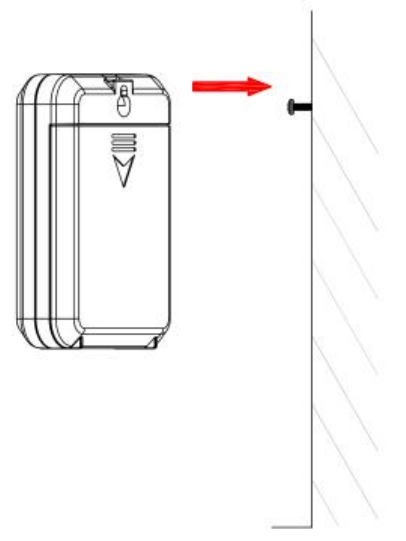
Use a screw or nail (not included) to affix the remote sensor to the wall, as shown in Figure 6.
Figure 6
4. Best Practices for Wireless Communication
Wireless communication is susceptible to interference, distance, walls and metal barriers. We
recommend the following best practices for trouble free wireless communication.
1. Electro-Magnetic Interference (EMI). Keep the console several feet away from computer
monitors and TVs.
2. Radio Frequency Interference (RFI). If you have other 433.92MHz devices and
communication is intermittent, try turning off these other devices for troubleshooting
purposes. You may need to relocate the transmitters or receivers to avoid intermittent
communication.
3. Line of Sight Rating. This device is rated at 100m line of sight (no interference, barriers or
walls) but typically you will get 30m maximum under most real-world installations, which
include passing through barriers or walls.
4. Metal Barriers. Radio frequency will not pass through metal barriers such as aluminum
siding. If you have metal siding, align the remote and console through a window to get a clear
line of sight.

5. Glossary of Terms
Term
Definition
Accuracy
Accuracy is defined as the ability of a measurement to match the actual
value of the quantity being measured.
Hygrometer
A hygrometer is a device that measures relative humidity. Relative
humidity is a term used to describe the amount or percentage of water
vapor that exists in air.
Range
Range is defined as the amount or extent a value can be measured.
6. Specifications
6.1 Wireless Specifications
Line of sight wireless transmission (in open air): 100 meters, 30meters under most conditions
Frequency: 433 MHz
Update Rate: 60 seconds
6.2 Measurement Specifications
The following table provides specifications for the measured parameters.
Measurement
Range
Accuracy
Resolution
Outdoor Temperature
-40 to 60 °C
± 1 °C
0.1 °C
6.3 Power Consumption
Remote sensor : 2 x AAA 1.5V Alkaline or Lithium batteries
Battery life:
Minimum 24 months for remote thermometer sensor (use lithium batteries in cold weather
climates less than -20 °C)

FCC Caution.
§ 15.19 Labelling requirements.
This device complies with part 15 of the FCC Rules. Operation is subject to the following
two conditions: (1) This device may not cause harmful interference, and (2) this device
must accept any interference received, including interference that may cause undesired
operation.
§ 15.21 Information to user.
Any Changes or modifications not expressly approved by the party responsible for
compliance could void the user's authority to operate the equipment.
§ 15.105 Information to the user.
Note: This equipment has been tested and found to comply with the limits for a Class B
digital device, pursuant to part 15 of the FCC Rules. These limits are designed to provide
reasonable protection against harmful interference in a residential installation. This
equipment generates uses and can radiate radio frequency energy and, if not installed and
used in accordance with the instructions, may cause harmful interference to radio
communications. However, there is no guarantee that interference will not occur in a
particular installation. If this equipment does cause harmful interference to radio or
television reception, which can be determined by turning the equipment off and on, the
user is encouraged to try to correct the interference by one or more of the following
measures:
-Reorient or relocate the receiving antenna.
-Increase the separation between the equipment and receiver.
-Connect the equipment into an outlet on a circuit different from that to which the
receiver is connected.
-Consult the dealer or an experienced radio/TV technician for help.