Volvo Readiness. 2005 OBD II Emission Inspection Check
User Manual: Volvo 2005 Volvo OBD II Emission Inspection Check 2005 Volvo S60 Owners Manual Pdf | Owner's Manual Pdf
Open the PDF directly: View PDF  .
.
Page Count: 2

OBDII EMISSION INSPECTION
& "READINESS" CHECK
WWW.VOLVOCARS.US
Retailer:
©2004 Volvo Cars of North America, LLC
Volvo Cars of North America, LLC
What Should I Do if My Car Fails Inspection?
Ask the emission inspector to provide specific documentation
and information regarding the failure.
Depending on your state, the extent of repair requirements
will vary. Ask your inspector what your repair obligations are.
Finally, your Volvo Retailer is provided with the latest
service information, factory training and diagnostic equipment
so that your car can be repaired to pass inspection. Whether
those repairs will be covered under Volvo warranty policies
will be determined by the age and mileage of the vehicle.
SP0380 25.000.09.04 Printed in U.S.A. on recycled paper.
Reorder brochure SP0380 at www.volvotechinfo.com
What are OBDII Emission Checks?
If your Volvo is model year 1996 or newer, various states are
now requiring a test of the vehicle’s "Onboard Diagnostic
System” (sometimes called OBDII) as part of their motor
vehicle inspection program. This test checks to see if there are
Diagnostic Trouble Codes (or DTCs) stored within the electronic
emission control system. States are doing this now in order to
meet Federal Clean Air Standards.
OBDII is a comprehensive part of your vehicle’s Engine
Management System. The monitors within OBDII indicate when
the emission system is functioning properly. It also provides a
fault code to help identify a malfunctioning system or
component. This eliminates the traditional tail pipe exhaust gas
test and speeds up the inspection process.
What Should I Do Before Inspection?
We all share in the responsibility of ensuring that we breathe
clean air. Here are some tips for maintaining your vehicle prior
to an emission inspection:
• Service your car according to the instructions in your owner's
manual. These instructions can also be obtained through your
local Volvo Retailer or by contacting Volvo directly.
• If the Check Engine Light (or MIL light) is illuminated on
the instrument panel have the car serviced BEFORE
inspection. A car that has a Check Engine Light already lit
will not pass inspection.
What are Readiness Codes?
As required by Federal and State laws, there are various anti-
tampering devices installed within the OBDII system. These
devices will indicate if someone has attempted to alter the
emission control system or has tried to erase any stored
malfunction information.
Can I Reset the Readiness Codes Myself?
In some cases, YES. How easily the car will reset may be
determined by the model and the age of the vehicle. Older
model years, and cars with high mileage (100,000 miles or
greater) tend be more sensitive to this situation.
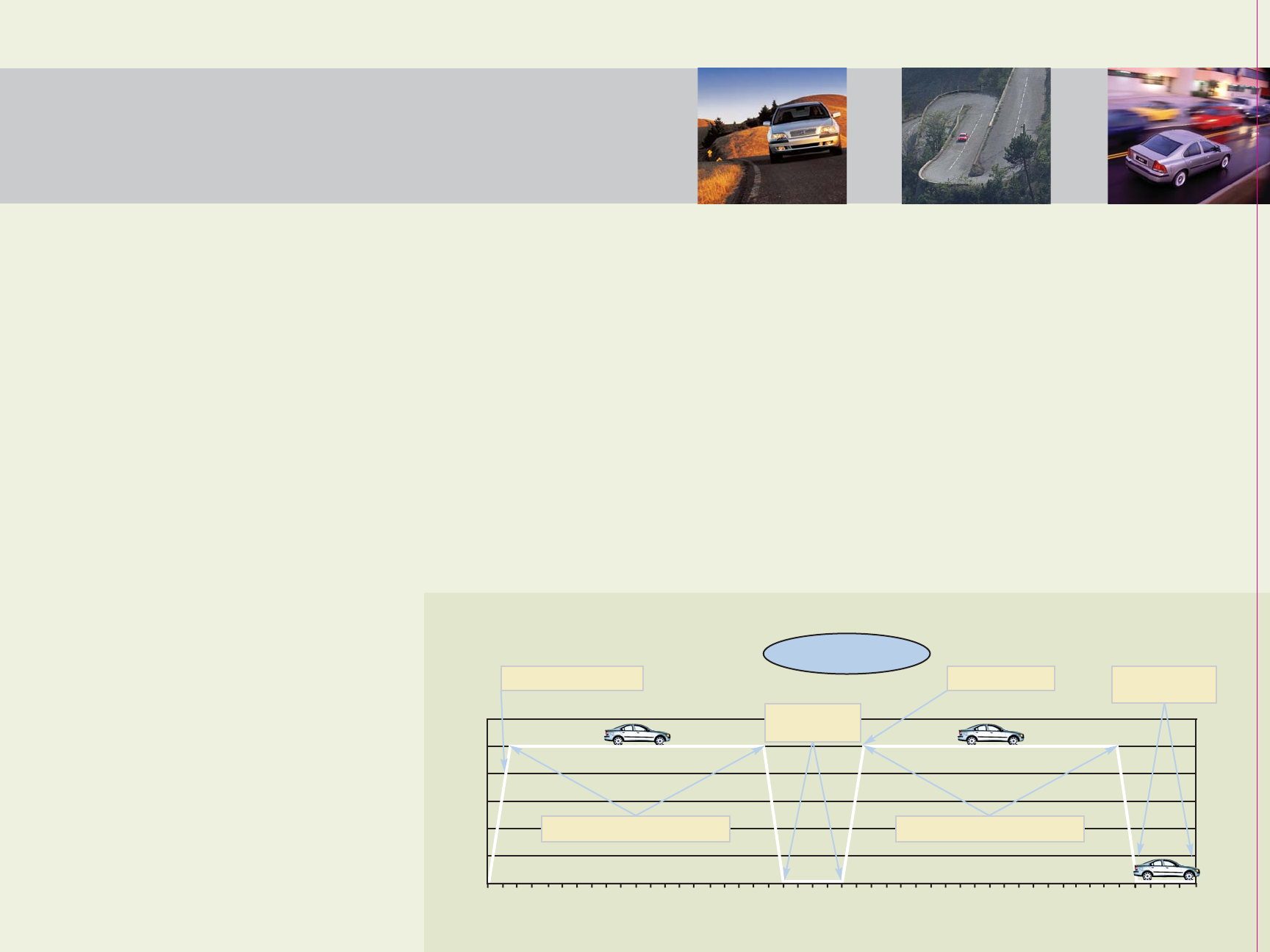
However, there is a generic driving cycle that has been very
helpful in resetting the Readiness Codes. It is a driving cycle
that can be driven over local roads and highways safely. Driving
this cycle does not guarantee that the Readiness Codes will be
reset but it has been very helpful in most cases.
Part of all new car certification requires that the Readiness
Code monitors run to completion after following a standard
specified driving cycle. The drive cycle represented below, is
similar to this standard. You may find it necessary to drive
this complete cycle twice. An adequate cool down period
between the two separate driving cycles – generally 30
minutes – will assure that the various readiness monitors are
reset for the second driving cycle.
Part of the anti-tampering system is a "Readiness" check.
The "Readiness" check assures that all of the monitors and
sensors have completed a number of driving cycles without a
problem. The systems are checked and return a signal to the
inspector that the OBDII system is Readiness – OK. In other
words, it's OK to continue with the inspection.
Under some unique circumstances, the Readiness Code
may not read OK, even though the emission control system
has not been tampered with and is not malfunctioning. These
circumstances may include the following:
• A service where the battery was disconnected and the
vehicle has not been driven enough to allow the system to
cycle through all of the readiness checks.
• Vehicle is typically driven for only very short cycles, less than
20 minutes.
• Vehicle is typically driven for only uninterrupted highway
cycles where there’s no period of prolonged engine idle, such
as standing at a stop light.
OBDII EMISSION INSPECTION & "READINESS" CHECK
WHAT IT MEANS TO YOU.
ONE READINESS RESET DRIVING CYCLE
Note! Drive safely, do not
exceed Speed Limits.
Time
0
10
20
30
40
50
60
Speed (MPH)
Access to highway or steep hills will help the car reach operating temperature more quickly.
Drive with steady throttle between 45-50 MPH
for about 20 minutes. Do not use cruise control.
Quickly, 30 seconds or less.
Accelerate from 0-50 MPH in safe
and legal area.
Stop car in safe area:
-Place car in park.
-Turn off air conditioner.
-Idle for 5 minutes.
Return to safe driving area.
Accelerate 0-50 MPH.
Quickly, 30 seconds or less.
Drive with steady throttle between 45-50 MPH
for about 20 minutes. Do not use cruise control.
Shut off car. Allow to cool
down at least 30 minutes
before repeating cycle.
