Wayne Dalton Torsion Spring 9100 Users Manual
9400 to the manual ab0b3990-f3fb-4cc8-afb3-5d5a3efd46ac
2015-01-05
: Wayne-Dalton Wayne-Dalton-Torsion-Spring-9100-Users-Manual-204223 wayne-dalton-torsion-spring-9100-users-manual-204223 wayne-dalton pdf
Open the PDF directly: View PDF  .
.
Page Count: 36
9100, 9400, 9600
IMPORTANT NOTICE!
Read these instructions carefully before
attempting installation. If in question about
any of the procedures, do not perform the
work. Instead, have a qualified door agency
do the installation or repairs.
© Copyright 2009 Wayne-Dalton Corp. Part No. 290771 REV4 08/03/2009
Torsion Spring
Installation Instructions and Owner’s Manual
Portland Source Plant
Wayne-Dalton Corp.
P.O. Box 67
Mt. Hope, OH 44660
www.wayne-dalton.com

2
Please Do Not Return This Product To The Store. Contact your local Wayne-Dalton dealer. To find your local Wayne-Dalton dealer, refer to your
local yellow pages/business listings or go to the Find a Dealer section online at www.wayne-dalton.com
READ THESE INSTRUCTIONS
CAREFULLY BEFORE ATTEMPTING
INSTALLATION. IF IN QUESTION
ABOUT ANY OF THE PROCEDURES, DO
NOT PERFORM THE WORK. INSTEAD,
HAVE A QUALIFIED DOOR AGENCY DO
THE INSTALLATION OR REPAIRS.
1. READ AND FOLLOW ALL INSTALLATION INSTRUCTIONS.
2. Wear protective gloves during installation to avoid possible
cuts from sharp metal edges.
3. It is always recommended to wear eye protection when using
tools, otherwise eye injury could result.
4. Avoid installing your new door on windy days. Door could
fall during the installation causing severe or fatal injury.
5. Doors 12’- 0” wide and wider should be installed by two
persons, to avoid possible injury.
6. Operate door ONLY when it is properly adjusted and free from
obstructions.
7. If a door becomes hard to operate, inoperative or is damaged,
immediately have necessary adjustments and/or repairs
made by a trained door system technician using proper tools
and instructions.
8. DO NOT stand or walk under a moving door, or permit
anybody to stand or walk under an electrically operated door.
9. DO NOT place fingers or hands into open section joints when
closing a door. Use lift handles/gripping points when operating
door manually.
10. DO NOT permit children to operate garage door or door
controls. Severe or fatal injury could result, should the child
become entrapped between the door and the floor.
11. Due to constant extreme spring tension, DO NOT attempt any
adjustment, repair or alteration to any part of the door,
especially to springs, spring brackets, bottom corner brackets,
red colored fasteners, cables or supports. To avoid possible
severe or fatal injury, have any such work performed
by a trained door systems technician using proper tools and
instructions.
12. On electrically operated doors, pull down ropes must be
removed and locks must be removed or made inoperative in
the open (unlocked) position.
13. Top section of door may need to be reinforced when attaching
an electric opener. Check door and/or opener manufacturer’s
instructions.
14. VISUALLY inspect door and hardware monthly for worn and or
broken parts. Check to ensure door operates freely.
15. Test electric opener’s safety features monthly, following
opener manufacturer’s instructions.
16. NEVER hang tools, bicycles, hoses, clothing or anything else
from horizontal tracks. Track systems are not intended or
designed to support extra weight.
After installation is complete, fasten this manual
near garage door.
Table of Contents
Important Safety Instructions ............................................ 2
Package Contents ..........................................................3-4
Door Section Identification ................................................ 4
Tools Required .................................................................. 5
Pre-Installation ............................................................5-10
Removing The Old Door .................................5-9
Preparing The Opening ................................... 10
Installation ................................................................11-27
Optional Installations .................................................28-32
Side Lock ....................................................... 28
Pull Rope ........................................................ 28
Step Plate ....................................................... 29
Trolley Installation for Standard Lift ................. 30
Trolley Installation for Low Headroom ............. 31
Trolley Operator .............................................. 32
Maintenance ..............................................................33-34
Cleaning ......................................................... 33
Painting Instructions ..................................33-34
Warranty ......................................................................... 35
Dealer Locator Information.............................................. 36
Definition of key words used in this manual:
INDICATES A POTENTIALLY HAZARDOUS
SITUATION WHICH, IF NOT AVOIDED, COULD
RESULT IN SEVERE OR FATAL INJURY.
CAUTION: PROPERTY DAMAGE OR INJURY CAN RESULT
FROM FAILURE TO FOLLOW INSTRUCTIONS.
IMPORTANT: REQUIRED STEP FOR SAFE AND PROPER
DOOR OPERATION.
NOTE: Information assuring proper installation of the door.
WARNING
WARNING
3
Please Do Not Return This Product To The Store. Contact your local Wayne-Dalton dealer. To find your local Wayne-Dalton dealer, refer to your
local yellow pages/business listings or go to the Find a Dealer section online at www.wayne-dalton.com
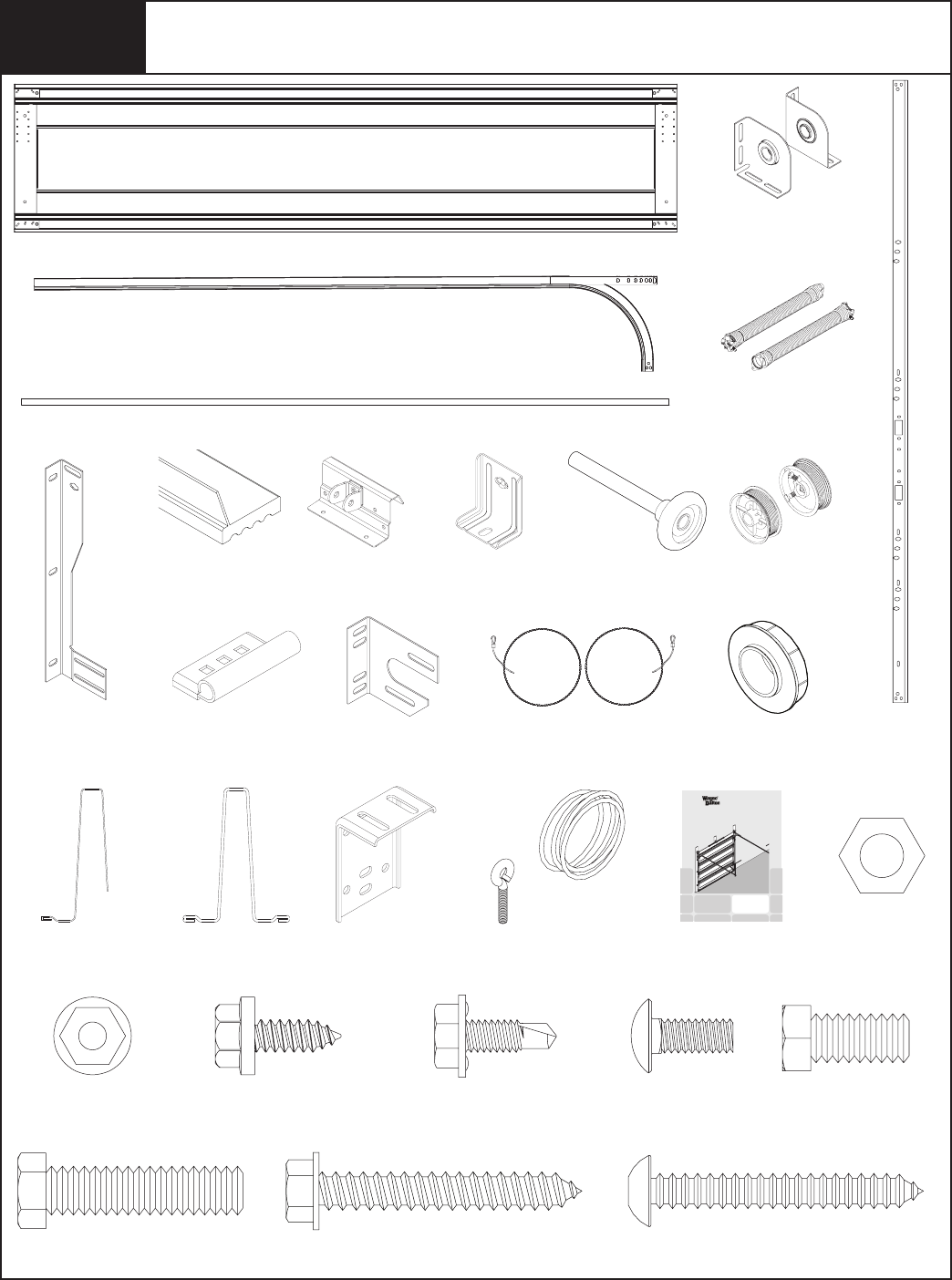
(2) HORIZONTAL TRACKS WITH ATTACHED HORIZONTAL ANGLE RH/LH
Package Contents NOTE: DEPENDING ON THE DOOR MODEL, SOME PARTS
LISTED WILL NOT BE SUPPLIED IF NOT NECESSARY. REAR
SUPPORTS MAY OR MAY NOT BE INCLUDED WITH YOUR DOOR.
(2) SPRINGS WITH
CONES RH/LH
(2) END BEARING
BRACKETS RH/LH
TORSION TUBE
DOOR SECTIONS (AS REQUIRED)
(2) VERTICAL
RH/LH TRACKS
(2) FULLY ADJUSTABLE
RH/LH FLAGANGLES
ROLLERS
(AS REQUIRED)
WEATHER SEAL &
NAILS (IF INCLUDED)
(1) OPERATOR
BRACKET
Q.I. JAMB BRACKETS
(AS REQUIRED)
(2) CABLE DRUMS
RH/LH
CENTER BEARING
BRACKET
(2) TOP BRACKET
SLIDES
(1) NYLON CENTER
BUSHING
1/4”- 20 FLANGED HEX
NUT (AS REQUIRED)
(4) 1/4”-20 X 5/8”
CARRIAGE BOLT
1/4”-14 X 5/8” SELF TAPPING
SCREW (AS REQUIRED)
1/4”-20 X 11/16” SELF DRILLING
SCREW (AS REQUIRED)
3/8”-16 X 3/4”
HEX HEAD BOLT
(2) COUNTERBALANCE CABLES
5/16” X 2” TAMPER PROOF HEX HEAD LAG
SCREW (AS REQUIRED)
5/16” X 2” HEX HEAD LAG SCREW
(AS REQUIRED)
3/8”-16 X 1-1/2” HEX HEAD BOLT
(2) TOP BRACKET
BASE
U-BAR
(IF INCLUDED)
ASYMMETRICAL U-BAR
(IF INCLUDED)
(2) 3/8”- 16
HEX NUT
MANUAL
9100, 9600 Series
IMPORTANT NOTICE!
Read these instructions carefully before
attempting installation. If in question about
any of the procedures, do not perform the
work. Instead, have a qualified door agency
do the installation or repairs.
© Copyright 2002-2006 Wayne-Dalton Corp. Part No. 290771 Rev2 06/06/2005
Torsion Spring
Installation Instructions and Owner’s Manual
Portland Source Plant
#6 SCREW EYE AND PULL
ROPE (IF INCLUDED)
4
Please Do Not Return This Product To The Store. Contact your local Wayne-Dalton dealer. To find your local Wayne-Dalton dealer, refer to your
local yellow pages/business listings or go to the Find a Dealer section online at www.wayne-dalton.com
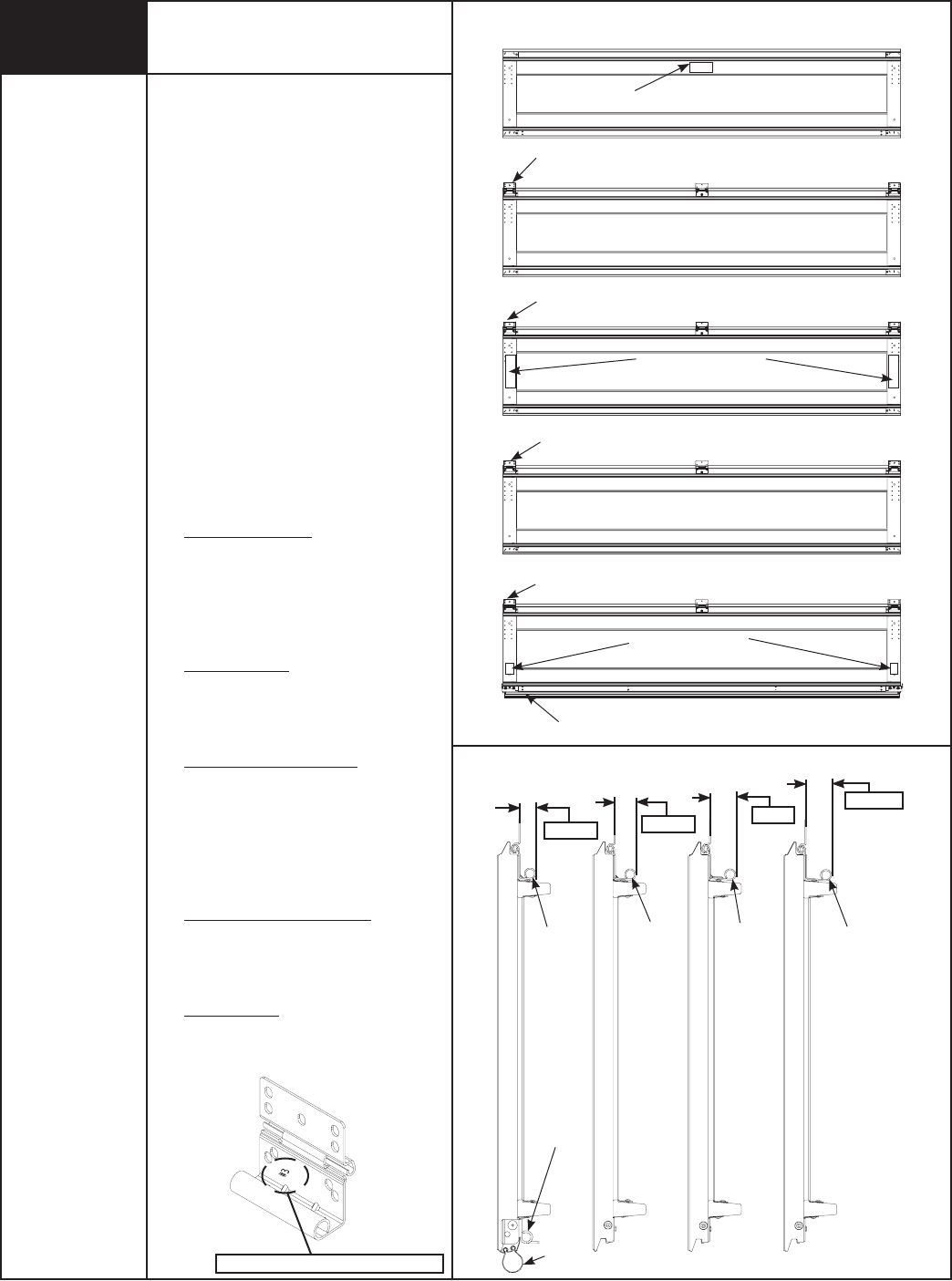
Tools Needed: NOTE: This provides an alternative method
for identifying your door sections/stack
position.
Hinges are always pre-attached at the top
of each section (except top section) and
the hinges are stamped for identification,
#1, #2, #3, and #4 (#4 only on five
section doors). See view below. The
stamp identifies the stacking sequence
of the section. The sequence is always
determined by #1 being the bottom section
to #3 or #4 being the highest intermediate
section. See views to the right. If the
stamp on the end hinge is illegible, refer
to the section side view illustration to the
right.
The section side view illustration shows
the end hinge profile of all the sections,
and can also be used in conjunction with
identifying each sections.
The BOTTOM SECTION can be identified
by a #1 end hinge, the factory attached
astragal, or by the bottom bracket warning
labels on each end stile. This section is
always the 1st section from the bottom of
the door on four and five section doors.
The LOCK SECTION can be identified by a
#2 end hinge. This section is always the
2nd section from the bottom of the door on
four and five section doors.
The INTERMEDIATE SECTION can be
identified by a #3 end hinge. Sections will
have a warning label attached to either the
left or the right end stile of the section.
This section is always the 3rd section from
the bottom of the door on four and five
section doors.
The INTERMEDIATE II SECTION can be
identified by a #4 end hinge. This section if
always the 4th section from the bottom of
the door on only five section doors.
The TOP SECTION can be identified with
no pre-installed end or center hinges on
the section and the warning label attached
in the upper middle of the section.
#1 END
HINGE
#2 END
HINGE
#3 END
HINGE
#4 END
HINGE
ASTRAGAL
BOTTOM
BRACKET
BOT. LOCK
1 3/8”
1 19/32”
INT. INT.
(USED ONLY
ON FIVE
SECTIONS)
1 1/8”
7/8”
SECTION SIDE VIEW
TYPICAL HINGE STAMPING LOCATION
Door Section Identification
TOP SECTION
INTERMEDIATE SECTION
LOCK SECTION
BOTTOM SECTION
BOTTOM BRACKET
WARNING LABELS
ASTRAGAL
#4
#2
#1
WARNING LABEL
WARNING LABEL
#3 INTERMEDIATE II SECTION
5
Please Do Not Return This Product To The Store. Contact your local Wayne-Dalton dealer. To find your local Wayne-Dalton dealer, refer to your
local yellow pages/business listings or go to the Find a Dealer section online at www.wayne-dalton.com
PRE-INSTALLATIONPRE-INSTALLATION
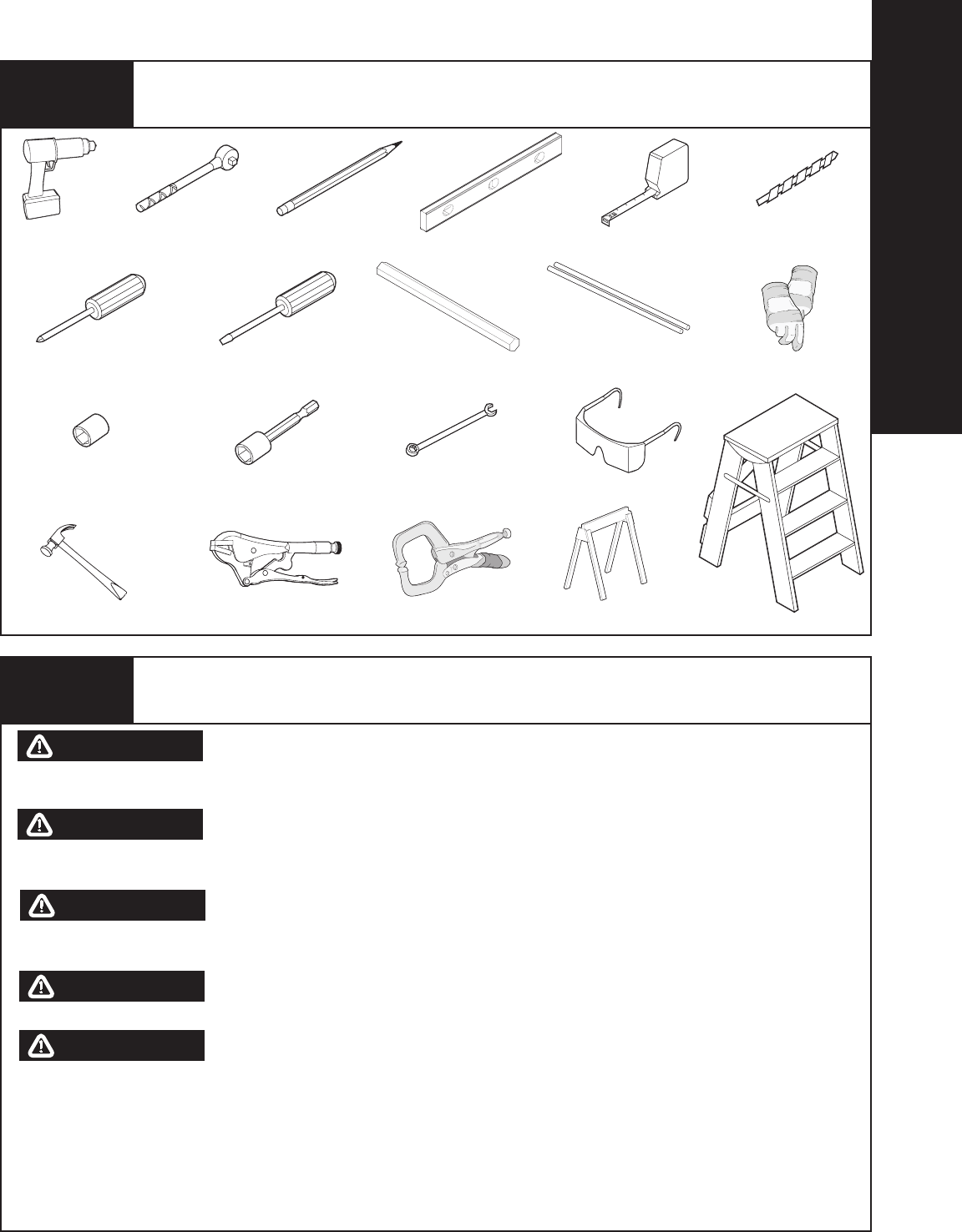
Tools Required
Removing An Old Door
IF YOUR COUNTERBALANCE SYSTEM IS OTHER THAN THOSE MENTIONED, DO NOT ATTEMPT TO WORK ON IT, BUT
HAVE A QUALIFIED DOOR AGENCY PERFORM THE WORK. OTHERWISE, SEVERE OR FATAL INJURY COULD RESULT.
DISCONNECT AND REMOVE ANY ELECTRIC OPENER PRIOR TO REMOVAL OF COUNTERBALANCE SYSTEMS TO
PREVENT UNINTENDED DOOR OPERATION. OTHERWISE, SEVERE OR FATAL INJURY COULD RESULT.
COUNTERBALANCE SPRING TENSION MUST BE RELIEVED BEFORE REMOVING ANY HARDWARE. A POWERFUL
SPRING RELEASING IT’S ENERGY SUDDENLY CAN CAUSE SEVERE OR FATAL INJURY.
IF YOU HAVE BACK PROBLEMS DO NOT ATTEMPT THIS, OR SEVERE INJURY COULD RESULT
REMOVING AN EXISTING DOOR CAN BE DANGEROUS. FOLLOW INSTRUCTIONS ON PAGES 6-10 “REMOVING AN
OLD DOOR/PREPARING THE OPENING” CAREFULLY, OTHERWISE, SEVERE OR FATAL INJURY COULD RESULT.
If you have an existing door, follow the instructions to identify which counterbalance removal is necessary. The process of removing
an existing door begins by identifying it’s counterbalance system. If you are not removing an existing door, proceed to PREPARING THE
OPENING on page 10. Generally, you will find three (3) types of counterbalance systems: Extension Spring, Wayne-Dalton® exclusive
TorqueMaster® and Torsion counterbalance system, see pages 6-9.
For more technical information regarding the opening preparation, installation and use of your garage door and opener, you can go to
www.dasma.com and click on Publications and then Technical Data Sheet.
WARNING
WARNING
WARNING
WARNING
WARNING
POWER DRILL RATCHET WRENCH
PHILLIPS HEAD SCREWDRIVER
PENCIL 1/8”, 7/16”, 3/16”
DRILL BITS
FLAT TIP SCREWDRIVER
7/16” SOCKET DRIVER
TAPE MEASURE
STEP LADDER
7/16”, 1/2”, 9/16”
SOCKETS
7/16”, 1/2”, 3/8”, 9/16”
WRENCHES
SAFETY GLASSES
VICE GRIPS VICE CLAMPS
HAMMER SAW HORSES (PAIR)
GLOVES
APPROVED WINDING
BARS
LEVEL
1/4” TORX BIT
6
Please Do Not Return This Product To The Store. Contact your local Wayne-Dalton dealer. To find your local Wayne-Dalton dealer, refer to your
local yellow pages/business listings or go to the Find a Dealer section online at www.wayne-dalton.com
Tools Needed:
FAILURE TO USE APPROVED
WINDING BARS CAN CAUSE SPRING
ENERGY TO BE RELEASED
SUDDENLY, RESULTING IN SEVERE
OR FATAL INJURY.
COUNTERBALANCE SPRING
TENSION MUST BE RELIEVED
BEFORE REMOVING ANY
HARDWARE. A POWERFUL SPRING
RELEASING IT’S ENERGY SUDDENLY
CAN CAUSE SEVERE OR FATAL
INJURY.
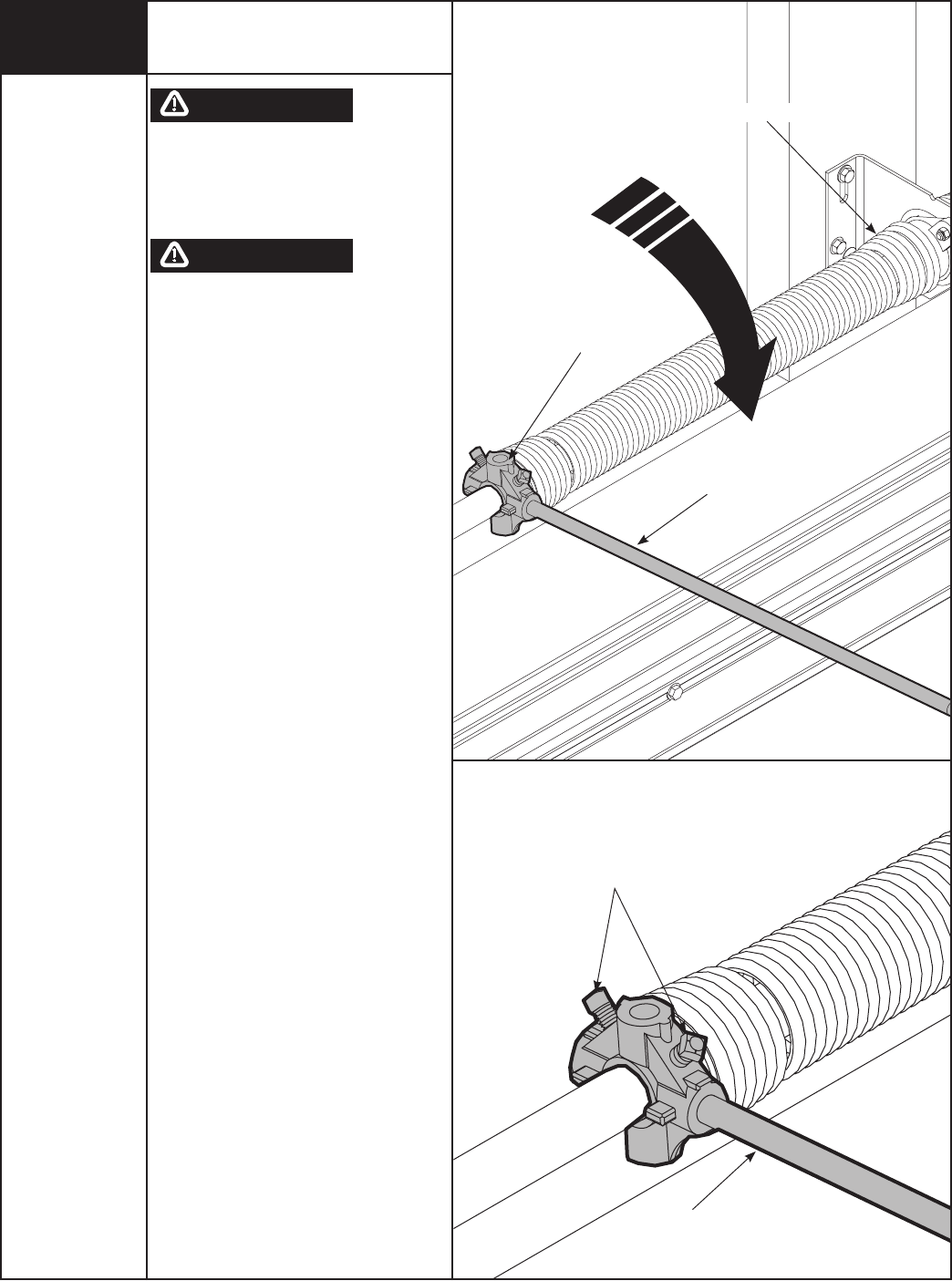
Do not release the torsion spring
tension unless you are a qualified and
experienced door technician. Instead have
a professional door agency release the
tension.
Step 1: Close the door and place vice
clamps on the back legs of both vertical
tracks, above the third roller to prevent the
door from lifting as you unwind the springs.
Use only approved winding bars available
from your dealer. Do not use undersized
steel rods, screw drivers or anything else
to unwind the springs. Position the ladder
just off to the side of the winding cone.
The winding cone should be easy to reach
without putting your body directly in front
of it.
Step 2: Insert a winding bar into one of the
holes in the winding cone. Exert upward
pressure. Using caution, loosen the two
(2) set screws in the winding cone. Be
prepared to support the full torsional force
of the spring when the set screws are
loosened.
Step 3: Once set screws are loose, slowly
and carefully lower the winding rod until
it rests against the door. Insert other
winding bar into the upper hole. Push up
and remove lower bar. Carefully lower
upper winding bar, 1/4 turns at a time until
it rests against the door. Repeat process
until all tension is relieved. If your door
is equipped with two (2) torsion springs,
follow the same procedure to relieve
tension on the second spring.
Step 4: Remove vice clamps from tracks,
unbolt torsion shaft assembly and remove
from work area.
NOTE: Continue with “P4” on page 9 after
completing this step.
WARNING
WARNING
APPROVED WINDING BAR
TORSION SPRING ASSEMBLY
WINDING CONE
SET SCREWS
FIRMLY HOLD WINDING BARS AND
CAUTIOUSLY LOOSEN SET SCREWS
P1
Recommended
tools from
page 5
Torsion Spring Removal
For Standard Lift
7
Please Do Not Return This Product To The Store. Contact your local Wayne-Dalton dealer. To find your local Wayne-Dalton dealer, refer to your
local yellow pages/business listings or go to the Find a Dealer section online at www.wayne-dalton.com
PRE-INSTALLATION
Tools Needed:
Fig. 2
Fig. 1
Fig. 3
Fig. 4
RIGHT HAND
CABLE DRUM
TORQUEMASTER®
SPRING TUBE
CHECK CABLE
TENSION
COUNTER
GEAR/ COVER
RIGHT HAND
END BRACKET
PLACE MARK ON END BRACKET
AND DRIVE GEAR TOOTH
BEFORE UNWINDING SPRINGS
END BRACKET
RIGHT HAND
WINDING BOLT HEAD
ELECTRIC DRILL
WITH 7/16” HEX
DRIVER (DO NOT
USE IMPACT
GUN)
PRY COUNTER GEAR
AND COUNTER COVER
FROM END BRACKET
USING FLAT TIP
SCREWDRIVER
COUNTER
GEAR
COUNTER
COVER
TorqueMaster® Spring Removal
P2
Recommended
tools from
page 5
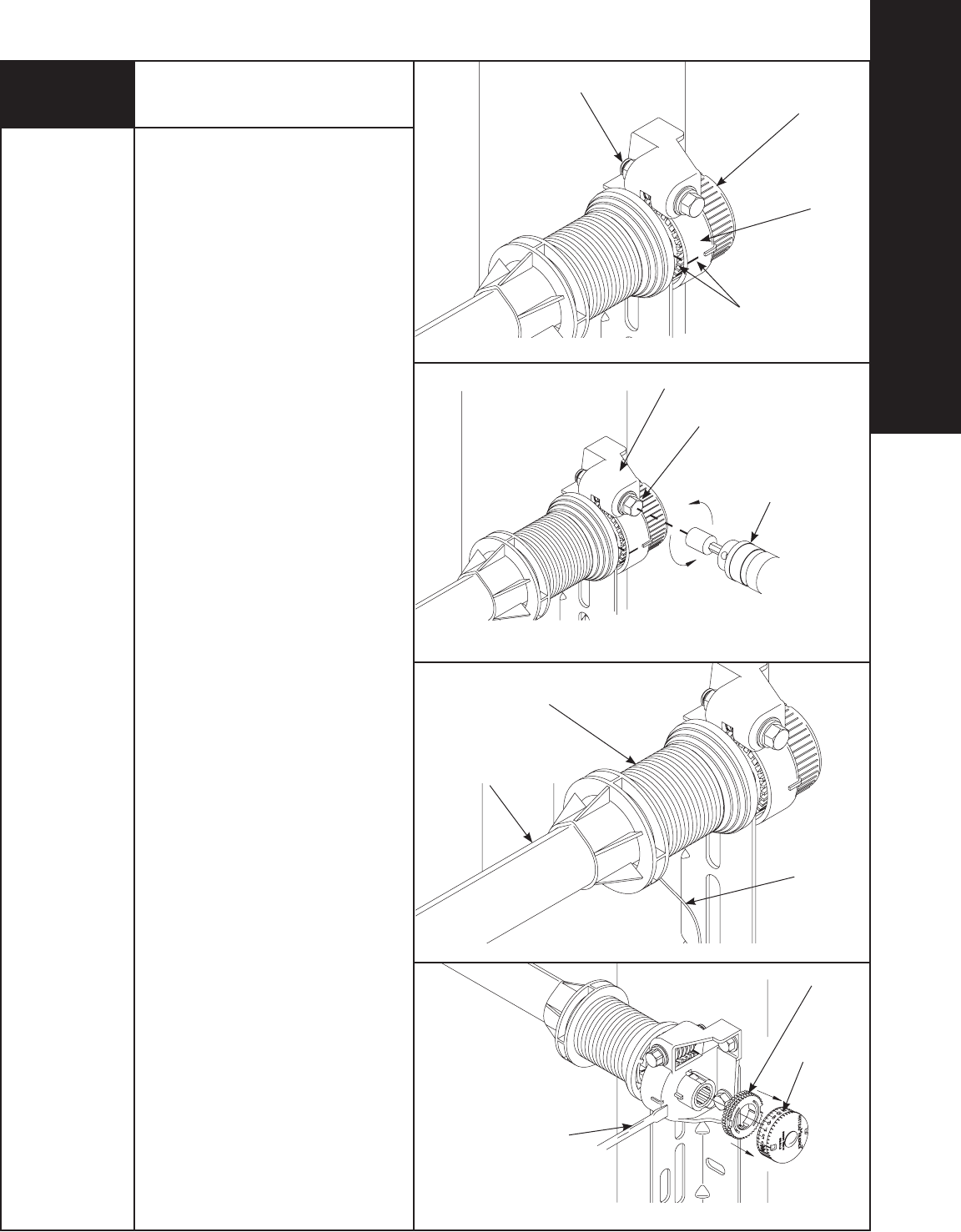
A TorqueMaster® spring system can be
identified by the end brackets. For single
spring applications, the right hand end
bracket will always have a drive gear,
counter gear, counter cover, and a winding
bolt head. The left hand end bracket will
have no gears, counter cover, or winding
bolt head. The hole for the winding bolt
head will be plugged.
For double springs, both the right hand
and left hand end brackets will always
have a drive gear, counter gear, counter
cover and a winding bolt head.
IMPORTANT: RIGHT AND LEFT HAND IS
ALWAYS DETERMINED FROM INSIDE THE
BUILDING LOOKING OUT.
Step 1: If you have a black counter cover:
Place a mark on the drive gear tooth and an
adjacent mark on the right hand end bracket
(Fig. 1). Loosen the lock nut using a 7/16”
wrench and continue with step 2.
If you have a gray counter cover: Loosen
the lock nut using a 7/16” wrench and
continue with step 2.
Step 2: Using an electric drill (High
torque / gear reduced to 1300 rpm
preferred) with a 7/16” hex head driver,
unwind the right hand winding bolt head
counterclockwise (Fig. 2) and count the
number of turns the mark on the drive
gear passes the adjacent mark on the end
bracket. Referencing the chart below, by
door height, stop unwinding the spring
once the counted turns have reached the
listed number of turns.
6’- 0” Door Height = 14 turns
6’- 3” Door Height = 14 1/2 turns
6’- 5” Door Height = 15 turns
6’- 6” Door Height = 15 turns
6’- 8” Door Height = 15 1/2 turns
6’- 9” Door Height = 15 1/2 turns
7’- 0” Door Height = 16 turns
7’- 3” Door Height = 16 1/2 turns
7’- 6” Door Height = 17 turns
7’- 9” Door Height = 17 1/2 turns
8’- 0” Door Height = 18 turns
CAUTION:
DO NOT USE IMPACT GUN TO
UNWIND SPRINGS.
IMPORTANT: DO NOT REFERENCE THE
COUNTER COVER WHEN COUNTING THE
NUMBER OF TURNS BEING UNWOUND
ON THE SPRING, BUT FOLLOW THE
INSTRUCTIONS ABOVE.
Step 3: Verify that spring tension has been
released by pulling the counterbalance
cable on the right hand cable drum away
from the header (Fig. 3). If spring tension
has been released, the cable will be loose.
In addition, the TorqueMaster® Spring
Tube should be free to rotate in either
direction.
LOOSEN LOCK
NUT
8
Please Do Not Return This Product To The Store. Contact your local Wayne-Dalton dealer. To find your local Wayne-Dalton dealer, refer to your
local yellow pages/business listings or go to the Find a Dealer section online at www.wayne-dalton.com
Tools Needed:
Fig. 5
Fig. 9
REMOVE TOP
LAG SCREW
REMOVE CABLE DRUM AND
WINDING SHAFT
DRAPE CABLE ACROSS
TOP OF FLAGANGLE
LIFT
TORQUEMASTER®
SPRING TUBE
OFF FLAGANGLE
TorqueMaster® Spring
Removal continued...
Recommended
tools from
page 5
Fig. 8
CENTER
BRACKET
ASSEMBLY
(2) 5/16” X 1-5/8”
HEX HEAD LAG
SCREWS
Fig. 7
PRY END BRACKET FROM WINDING
SHAFT USING A FLAT TIP SCREW
DRIVER AND LOCKING PLIERS
HOLD THE
END BRACKET
STEADY WITH
LOCKING PLIERS
Fig. 6
REMOVE
BOTTOM LAG
SCREW
USE LOCKING PLIERS
TO HOLD END BRACKET
REMOVE #10
PHILLIPS HEAD
SCREW
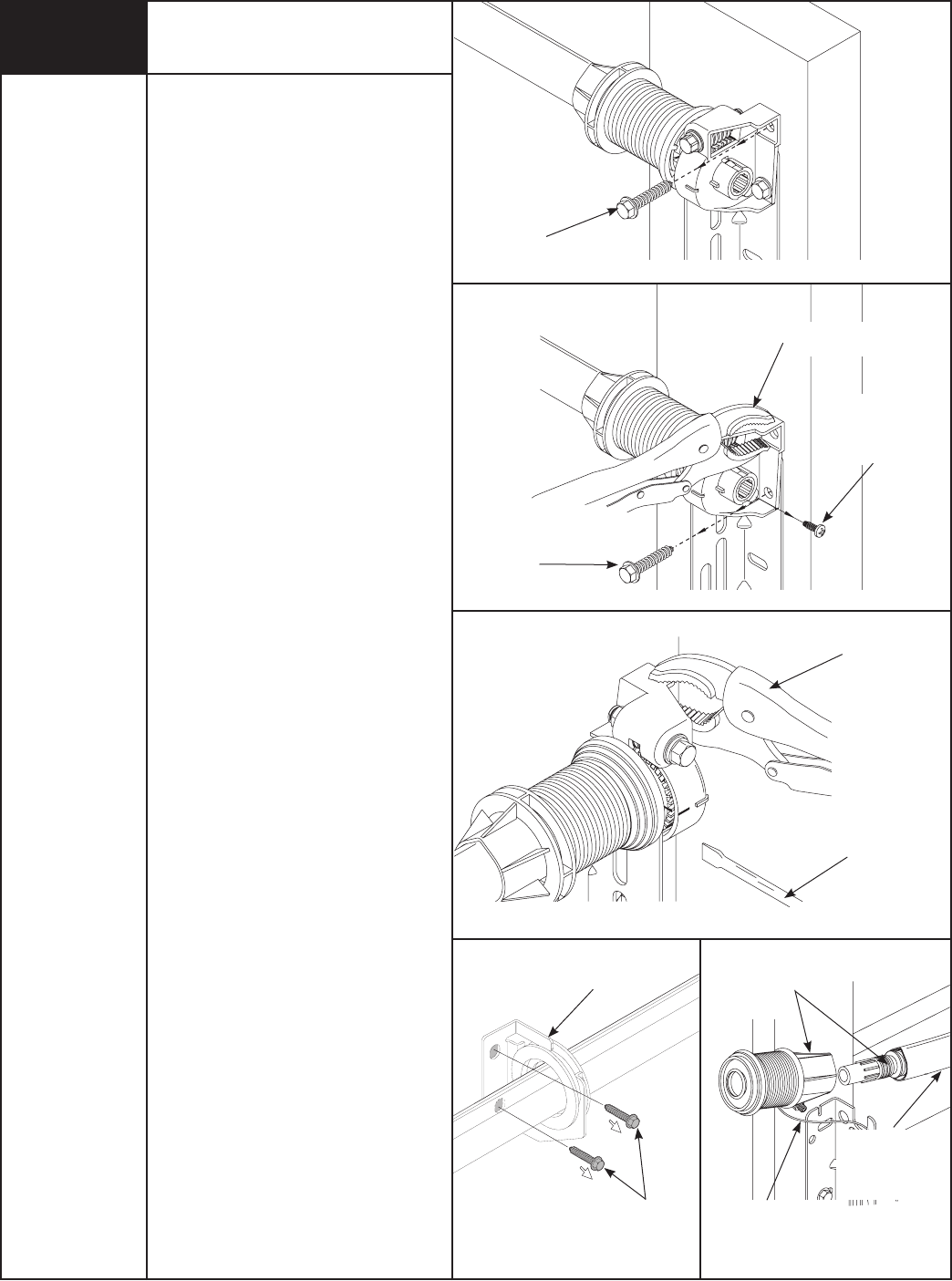
If the counterbalance cable is still taut and
the TorqueMaster® Spring Tube is difficult
to rotate, that is an indication that spring
tension still exists on the left hand spring.
Repeat Steps 1 and 2 for releasing spring
tension on the left hand side.
Step 4: Using a flat tip screwdriver, pry
the counter gear and counter cover
from the right hand end bracket (Fig. 4
on previous page). Discard the counter
gear and counter cover. On double spring
applications, repeat for left hand side.
Step 5: Remove the upper 5/16” x
1-5/8” lag screw from the right hand end
bracket (Fig. 5). Attach locking pliers to
the upper portion of the end bracket and
hold the housing steady while removing
the lower 5/16” x 1-5/8” lag screw and
#10 x 1/2” phillips head screw from the
end bracket (Fig. 6).
Step 6: Holding the right hand end
bracket steady with locking pliers,
carefully pry the end bracket and drive
gear off the winding shaft using a flat tip
screwdriver (Fig. 7).
CAUTION: THE WINDING SHAFT MAY
ROTATE WHEN REMOVING THE END
BRACKET AND DRIVE GEAR.
Step 7: Repeat Step 4 for the left hand
side. Holding the left hand end bracket
steady with locking pliers, carefully pry
the end bracket off the winding shaft
using a flat tip screwdriver (Fig. 7).
Step 8: Remove the two (2) lag bolts
attaching the center bracket assembly to
the header board (Fig. 8).
Step 9: Lift the right hand side of the
TorqueMaster® Spring Tube and slide the
cable drum off. Realign the groove in the
winding shaft with the round notch in the
flagangle and drape the counterbalance
cable with drum over the flagangle. Lift
the left hand side of the TorqueMaster®
Spring Tube and slide the cable drum
and winding shaft off (Fig. 9). Drape the
counterbalance cable with drum over the
flagangle. Lift the TorqueMaster® spring
assembly off the flagangles and out of
the doorway. Unhook the counterbalance
cables from the bottom brackets and
remove all parts from the work area.
NOTE: The cable drums may be difficult to
remove. If so, twist the cable drum to aid
in removal.
NOTE: Continue with “P4” on page 9 after
completing this step.
9
Please Do Not Return This Product To The Store. Contact your local Wayne-Dalton dealer. To find your local Wayne-Dalton dealer, refer to your
local yellow pages/business listings or go to the Find a Dealer section online at www.wayne-dalton.com
Tools Needed:
Tools Needed:
PRE-INSTALLATION
Step 1: Raise the door to the fully open
position and place vice clamps to the back
legs of both vertical tracks, below the
bottom rollers to prevent the door from
falling. By opening the door you release
most of the spring tension. Carefully
unfasten the S-hook from the horizontal
angle. Remove cable, sheave and extension
spring. Repeat for the other side. If safety
cables are running through the extension
springs, remove them also. Remove parts
from work area.
Step 2: Holding door in the open position,
remove the vice clamps, be prepared
to support the entire weight of the door.
Garage doors can weigh 200-400 pounds.
With assistance, carefully lower the door, by
grasping the door firmly by it’s lift handles.
Do not place fingers or hands near joints,
between sections, or between bottom of
door and floor. Otherwise, severe injury
could result.
NOTE: Continue with “P4” on page 9 after
completing this step.
Extension Spring Removal
BOTTOM SECTION
(DOOR OPEN)
CAREFULLY REMOVE “S”
HOOK AND COUNTERBALANCE
CABLE (REPEAT FOR THE
OPPOSITE SIDE)
HORIZONTAL ANGLE
REMOVE LAG SCREW
FROM SAFETY CABLE (IF
INSTALLED). REPEAT FOR
OPPOSITE SIDE.
P3
Recommended
tools from
page 5
Removing the Old Door
TOP BRACKET
HINGES
HORIZONTAL TRACK
P4
Recommended
tools from
page 5
Having removed the counterbalance
system, the door can now be
disassembled.
Start by first removing the top row of
hinges.
With assistance, hold the top section to
keep it from falling and remove the
top brackets. With assistance, lift the top
section out of the opening and remove
it from the work area. Repeat for all
remaining sections.
After door is disassembled, unbolt both
track assemblies from the jambs and
remove all material from the work area.
You can neatly dispose of the old door by
placing it in the carton of your new door.
Clean up area and complete “Preparing
the Opening” “P5” on page 10 before
installing the new door.

10
Please Do Not Return This Product To The Store. Contact your local Wayne-Dalton dealer. To find your local Wayne-Dalton dealer, refer to your
local yellow pages/business listings or go to the Find a Dealer section online at www.wayne-dalton.com
Tools Needed:
HEADROOM REQUIREMENT
DOOR HEIGHT TRACK MANUAL
LIFT
MOTOR
OPERATED
6’5”, 6’6”, 7’0” 12”, 15” Radius 98” 120”
7’6”, 8’0” 12”, 15” Radius 110” 132”
BACKROOM REQUIREMENT
TRACK TYPE TorqueMaster®
15” Radius Track 11-3/4”
12” Radius Track 10-1/2”
6” LHR Kit 6”
P5
Recommended
tools from
page 5
Preparing the Opening
WEATHER SEAL
HEADROOM
BACKROOM
DOOR
WIDTH
DOOR HEIGHT
LEVEL HEADER
PLUMB JAMBS
HEADER BOARD
2” X 6” LUMBER
RECOMMENDED
SUITABLE MOUNTING
SURFACE 2” X 6”
LUMBER MINIMUM
HEADER
JAMB
JAMB
JAMB 1/8” TO 1/4”
WEATHER
SEAL
FAILURE TO
SECURELY ATTACH A
SUITABLE MOUNTING PAD TO STRUCTURALLY
SOUND FRAMING COULD CAUSE SPRINGS TO
VIOLENTLY PULL MOUNTING PAD FROM WALL,
RESULTING IN SEVERE OR FATAL INJURY.
If you just removed your existing door or you are installing a new door,
complete all steps in PREPARING THE OPENING.
To ensure secure mounting of track brackets, side and center bearing
brackets, or steel angles to new or retro-fit construction, it is recommended
to follow the procedures outlined in DASMA Technical Data Sheets #156,
#161 and #164 at www.dasma.com.
The inside perimeter of your garage door opening should be framed with
wood jamb and header material. The jambs and header must be securely
fastened to sound framing members. It is recommended that 2” x 6” lumber
be used. The jambs must be plumb and the header level. The jambs should
extend a minimum of 14” (356 mm) above the top of the opening for Torsion
spring applications. For low headroom applications, the jambs should extend
to the ceiling height. Minimum side clearance required, from the opening to
the wall, is 3-1/2” (89 mm).
IMPORTANT: Closely inspect existing jambs, header and mounting surface.
Any wood found not to be sound, must be replaced.
For Torsion spring applications, a suitable mounting surface must be firmly
attached to the wall, above the header at the center of the opening. The
mounting surface must be 2” x 6” lumber minimum (Select southern yellow
pine lumber. Do not use lumber marked as spruce-pine-fur or SPF). The
mounting surface must be securely attached to the wall with four (4) 3/8”
anchors for masonry constructions or four (4) 5/16” x 4” lag screws for wood
construction.
NOTE: Drill a 3/16” pilot hole in the mounting surface to avoid splitting the
lumber. Do not attach the mounting surface with nails.
Weather Seal (May Not Be Included):
Cut or trim the weather seal (if necessary) to the header and jambs.
For quick install track: Align the header seal with the inside edge of the
header and temporarily secure it to the header with equally spaced nails.
Next, fit the jamb seals up tight against the header seal and flush with the
inside edge of the jamb. Temporarily secure the jamb seals with equally
spaced nails. This will keep the bottom section from falling out of the opening
during installation. Space nails approximately 12” apart.
For fully adjustable track: Align the header seal 1/8” to 1/4” inside the
header and temporarily secure it to the header with equally spaced nails.
Next, fit the jamb seals up tight against the header seal and 1/8” to 1/4”
inside the jamb. Temporarily secure the jamb seals with equally spaced
nails. This will keep the bottom section from falling out of the opening during
installation. Space nails approximately 12” apart.
NOTE: Do not permanently attach weather seal to the jamb at this time.
HEADROOM REQUIREMENT: Headroom is defined as the space needed
above the top of the door for tracks, springs, etc. to allow the door to open
properly. If the door is to be motor operated, 2-1/2” (64 mm) of additional
headroom is required.
NOTE: 6” LHR Conversion Kit is available for 12” Radius only. Contact your
local Wayne-Dalton dealer.
BACKROOM REQUIREMENT: Backroom is defined as the distance needed
from the opening back into the garage to allow the door to open fully.
WARNING
11
Please Do Not Return This Product To The Store. Contact your local Wayne-Dalton dealer. To find your local Wayne-Dalton dealer, refer to your
local yellow pages/business listings or go to the Find a Dealer section online at www.wayne-dalton.com
Tools Needed:
INSTALLATION
Installation
1
IMPORTANT: READ INSTRUCTIONS TITLED “P4” “REMOVING THE OLD DOOR” ON PAGE 9 AND “P5” “PREPARING THE OPENING” ON
PAGE 10 BEFORE ATTEMPTING DOOR INSTALLATION.
IMPORTANT: STAINLESS STEEL OR PT 2000 COATED LAG SCREWS MUST BE USED WHEN INSTALLING CENTER BEARING BRACKETS,
END BRACKETS, JAMB BRACKETS, OPERATOR MOUNTING/SUPPORT BRACKETS AND DISCONNECT BRACKETS ON TREATED LUMBER
(PRESERVATIVE-TREATED). STAINLESS STEEL LAG SCREWS ARE NOT NECESSARY WHEN INSTALLING PRODUCTS ON UNTREATED
LUMBER.
NOTE: It is recommended that 5/16” x 2” lag screws be pilot drilled using a 3/16” drill bit, and 1/4” x 2” lag screws and 1/4” x 1-1/2”
lag screws be pilot drilled using a 1/8” drill bit, prior to fastening.
NOTE: If you have riveted track, skip these steps, 1 through 2 and proceed to step3.
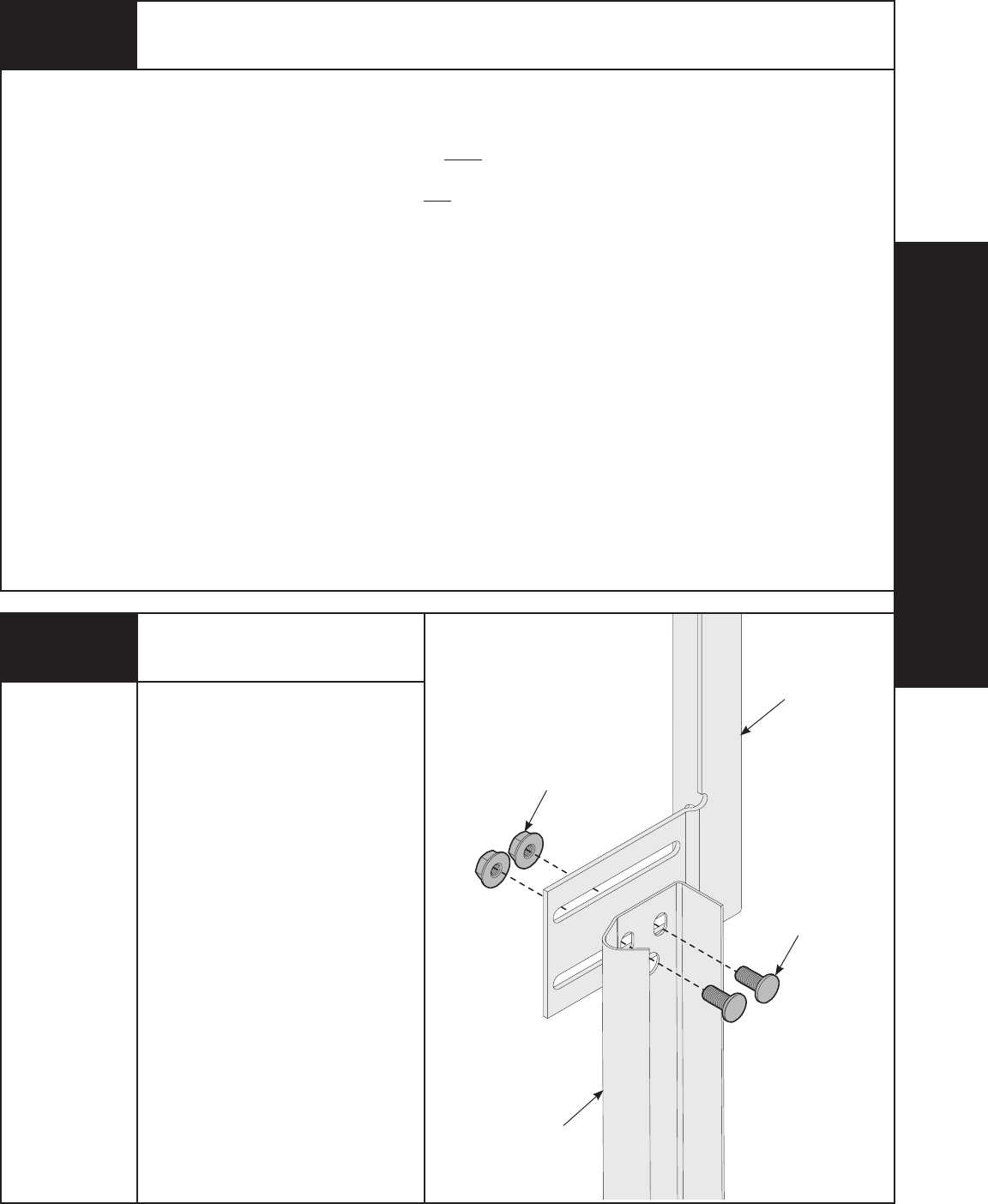
Attaching Fully Adjustable
Flagangle to Vertical Track
None
Hand tighten the flagangle to the
vertical track using (2) 1/4”- 20 x 5/8”
carriage bolts and (2) 1/4”- 20 flange
hex nuts. Secure the flange nuts after
flagangle spacing is complete (Step 11).
(2) 1/4”- 20 X 5/8”
CARRIAGE BOLTS
(2) 1/4”- 20
FLANGE HEX NUTS
FULLY
ADJUSTABLE
FLAGANGLE
VERTICAL
TRACK

12
Please Do Not Return This Product To The Store. Contact your local Wayne-Dalton dealer. To find your local Wayne-Dalton dealer, refer to your
local yellow pages/business listings or go to the Find a Dealer section online at www.wayne-dalton.com
Tools Needed:
2
None
QI JAMB BRACKET
Measure the length of the vertical
tracks. Using the jamb bracket schedule,
determine the placement of the jamb
brackets for your door height and track
type.
To install the jamb brackets, align the
twistlock tab on the quick install jamb
bracket with the quick install feature
in the track and turn the bracket
perpendicular to the track so the
mounting flange is toward the back (flat)
leg of the track.
Installing Q.I. Jamb Brackets
TOP
HOLE
BOTTOM
HOLE
MIDDLE
HOLE
3RD SET HOLES
2ND SET HOLES
1ST SET HOLES
QUICK INSTALL FEATURE
TWISTLOCK TAB
LEFT SIDE SHOWN
RIGHT SIDE SHOWN
JAMB BRACKET SCHEDULE
DOOR
HEIGHT
1ST SET 2ND SET 3RD SET
JAMB
BKT POSITION JAMB
BKT POSITION JAMB
BKT POSITION
6’0” QIJB-3 MIDDLE QIJB-6 TOP NOT APPLICABLE
6’5” QIJB-3 MIDDLE QIJB-5 BOTTOM NOT APPLICABLE
6’8” QIJB-3 MIDDLE QIJB-5 BOTTOM NOT APPLICABLE
7’0” QIJB-3 MIDDLE QIJB-5 BOTTOM NOT APPLICABLE
7’3” QIJB-3 MIDDLE QIJB-5 MIDDLE QIJB-6 MIDDLE
7’6” QIJB-3 MIDDLE QIJB-5 MIDDLE QIJB-6 MIDDLE
7’9” QIJB-3 MIDDLE QIJB-5 MIDDLE QIJB-6 MIDDLE
8’0”
(4 SECTION) QIJB-3 MIDDLE QIJB-5 MIDDLE QIJB-6 MIDDLE
8’0”
(5 SECTION) QIJB-3 BOTTOM QIJB-5 BOTTOM QIJB-6 BOTTOM
13
Please Do Not Return This Product To The Store. Contact your local Wayne-Dalton dealer. To find your local Wayne-Dalton dealer, refer to your
local yellow pages/business listings or go to the Find a Dealer section online at www.wayne-dalton.com
Tools Needed:
Tools Needed:
INSTALLATION
Drums
IMPORTANT: RIGHT AND LEFT HAND
IS ALWAYS DETERMINED FROM INSIDE
THE BUILDING LOOKING OUT.
NOTE: For door section identification
see page 4.
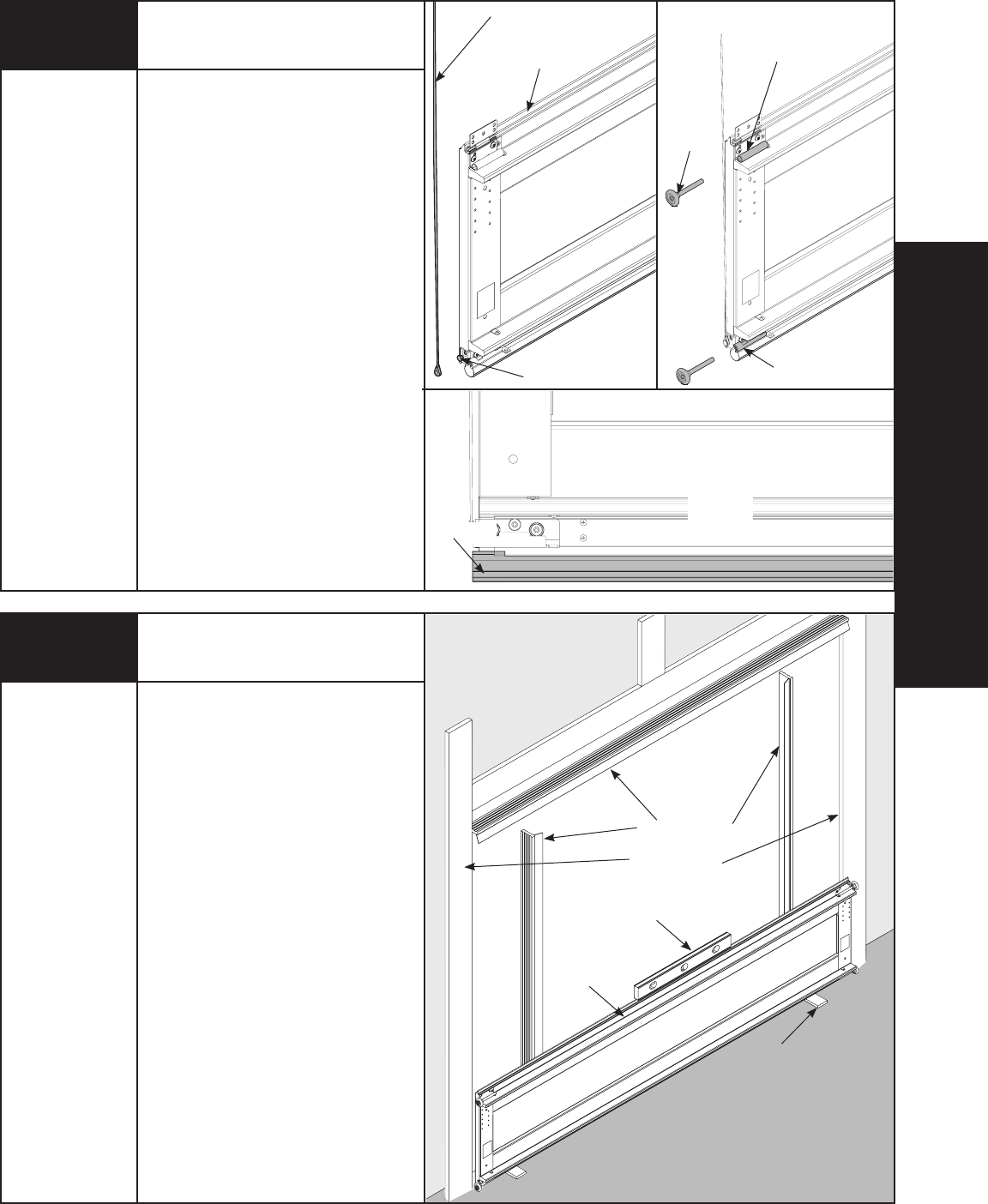
Uncoil the counterbalance cables and
make sure you place the right hand
cable loop on the right hand milford pin
and place the left hand cable loop on
the left hand milford pin.
Insert a roller into bottom bracket of the
bottom section and insert another roller
at #1 end hinge at the top of the bottom
section. Repeat for other side.
NOTE: Verify astragal (bottom seal)
is aligned with door section. If there
is more than 1/2” excess astragal on
either side, trim astragal even with door
section.
None
ROLLERS
HINGE TUBE
BOTTOM BRACKET
BOTTOM
SECTION
ASTRAGAL
3
Bottom Section
Before installing the bottom section,
the weather seal (may not be included)
must be installed (see PREPARING THE
OPENING on page 10)
Center the bottom section in the door
opening. Level section using wooden
shims under the bottom astragal if
necessary.
Level
4
BOTTOM
SECTION
DOOR OPENING
WEATHER SEAL
WOODEN SHIMS
(IF NECESSARY)
LEVEL
BOTTOM SECTION
MILFORD PIN
COUNTERBALANCE CABLE
14
Please Do Not Return This Product To The Store. Contact your local Wayne-Dalton dealer. To find your local Wayne-Dalton dealer, refer to your
local yellow pages/business listings or go to the Find a Dealer section online at www.wayne-dalton.com
Tools Needed:
5Vertical Track
IMPORTANT: THE TOPS OF THE
VERTICAL TRACKS MUST BE LEVEL
FROM SIDE TO SIDE. IF THE BOTTOM
SECTION WAS SHIMMED TO LEVEL IT.
THE VERTICAL TRACK ON THE SHIMMED
SIDE, MUST BE RAISED THE HEIGHT OF
THE SHIM.
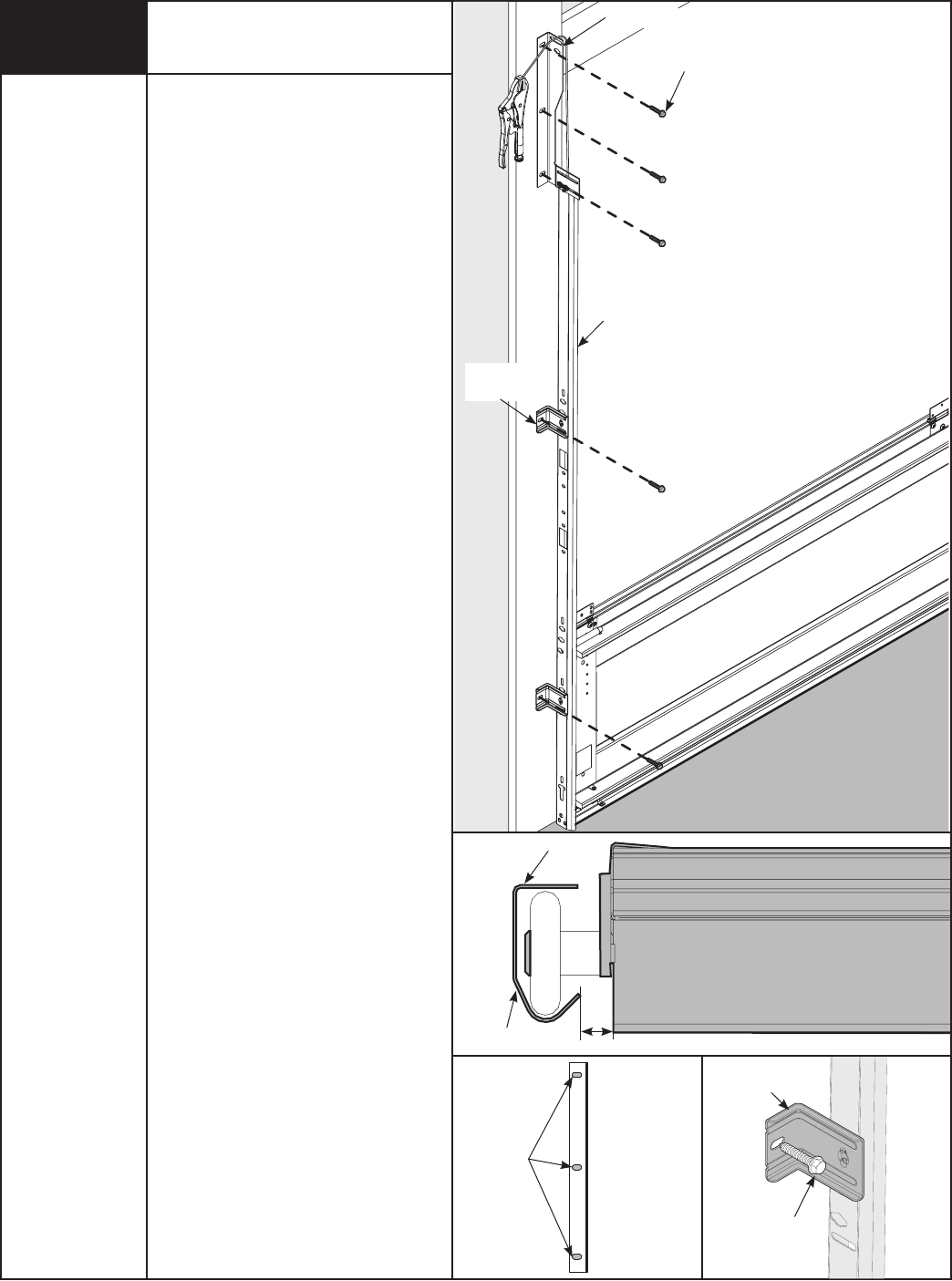
Position the left hand vertical track
assembly over the rollers of the bottom
section. Make sure the counterbalance
cable is located between the rollers and
the door jamb.
Drill 3/16” pilot holes for the lag screws.
Loosely fasten jamb brackets and
flagangle to the jamb using 5/16” x 2”
lag screws.
On the bottom jamb bracket, tighten
the lag screw securing the bottom jamb
bracket to the jamb, to maintain the
5/8” spacing.
Repeat for the right hand side.
BOTTOM
SECTION
BOTTOM SECTION
VERTICAL TRACK
ROLLER
5/16” X 2”
LAG SCREWS
FLAGANGLE
VERTICAL
TRACK
ASSEMBLY
JAMB
BRACKET
3/16” Drill Bit
Power Drill
7/16” Socket
Driver
Tape Measure
Level
(2) Vice Grips
5/8”
LAG
SCREW
LOCATIONS
LAG
SCREW
JAMB
BRACKET
15
Please Do Not Return This Product To The Store. Contact your local Wayne-Dalton dealer. To find your local Wayne-Dalton dealer, refer to your
local yellow pages/business listings or go to the Find a Dealer section online at www.wayne-dalton.com
Tools Needed:
INSTALLATION
Stacking Sections
NOTE: For door section identification
see page 4.
NOTE: Make sure hinge leafs are
flipped down, when stacking another
section on top.
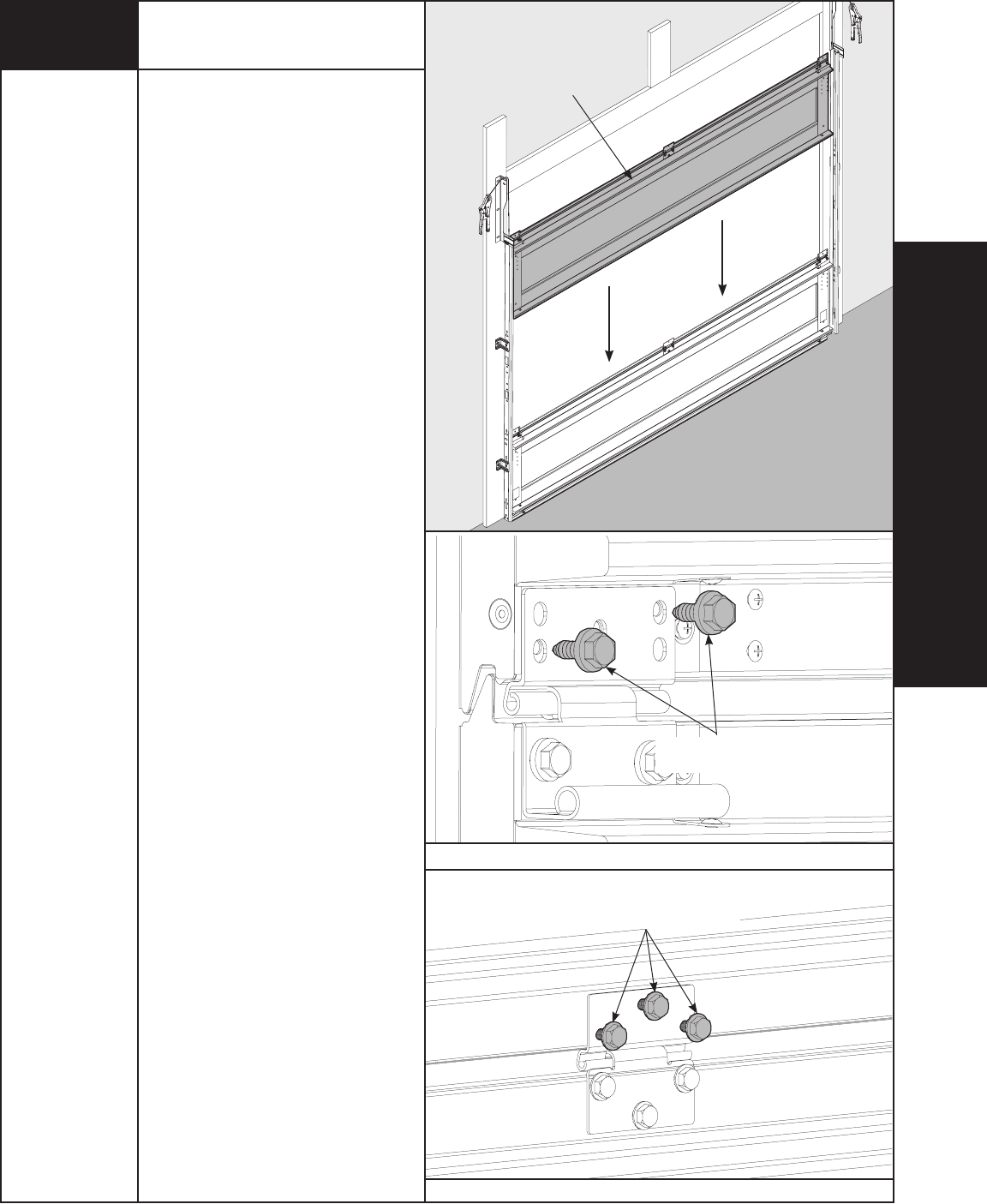
Place rollers in hinge tubes of the
second section (lock section).
With assistance, lift the second section
and guide rollers into the vertical
tracks.
Keep sections vertically aligned and
fasten hinges to connect the sections
using 1/4”- 14 x 5/8” self tapping
screws.
Repeat for other section(s) except top
section.
IMPORTANT: END HINGES HAVE (2)
SCREWS AND INTERMEDIATE HINGES
HAVE (3) SCREWS.
NOTE: Install lock at this time (sold
separately). See instructions in
OPTIONAL SIDELOCK INSTALLATION on
page 28.
6
Power Drill
7/16” Socket
Driver
(2) 1/4”-14 X 5/8”
SELF TAPPING SCREWS
END HINGES (LEFT HAND SHOWN, RIGHT HINGE SYMMETRICALLY OPPOSITE)
INTERMEDIATE HINGES
(3) 1/4”-14 X 5/8” SELF TAPPING
SCREWS
LOCK SECTION
16
Please Do Not Return This Product To The Store. Contact your local Wayne-Dalton dealer. To find your local Wayne-Dalton dealer, refer to your
local yellow pages/business listings or go to the Find a Dealer section online at www.wayne-dalton.com
Tools Needed:
Top Brackets
Power Drill
7/16” Socket
Driver
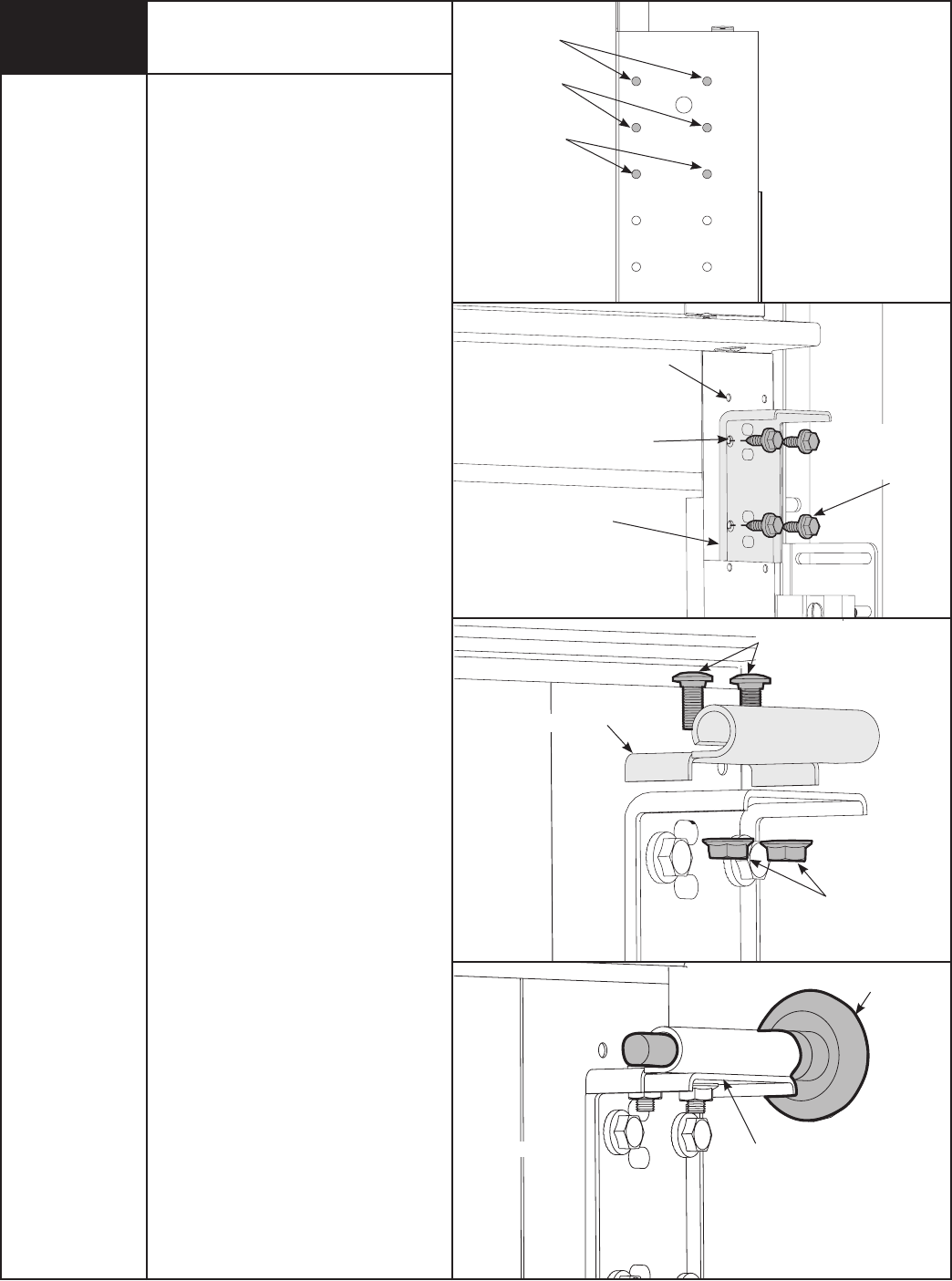
7
TOP BRACKET SLIDE
(2) 1/4”- 20
FLANGE HEX
NUTS
ROLLER
TOP BRACKET SLIDE
TOP SECTION
TOP SECTION
(2) 1/4”- 20 x 5/8”
CARRIAGE BOLTS
2ND
SET
1ST
SET
3RD
SET
NOTE: This step may be pre-assembled
on some models.
To install the L-shaped top brackets,
align the top holes in the top bracket
base with:
a) the second set of holes in the endstile
for 14” radius track.
b) the first set of holes in the endstile for
10” & 12” radius track.
Fasten using (4) 1/4”- 14 x 5/8” self
tapping screws.
Secure the top bracket slide to the
bracket base using (2) 1/4”- 20 x 5/8”
carriage bolts and (2) 1/4”-20 flange
hex nuts.
The top bracket slide will be tightened
and adjusted in Step 13. Insert rollers
into top bracket slide. Repeat for other
side.
(4) 1/4” - 14 x 5/8”
SELF TAPPING
SCREWS
TOP BRACKET BASE
1ST SET
(10” & 12” RADIUS)
2ND SET
(14” RADIUS)
TOP SECTION
17
Please Do Not Return This Product To The Store. Contact your local Wayne-Dalton dealer. To find your local Wayne-Dalton dealer, refer to your
local yellow pages/business listings or go to the Find a Dealer section online at www.wayne-dalton.com
Tools Needed:
Tools Needed:
INSTALLATION
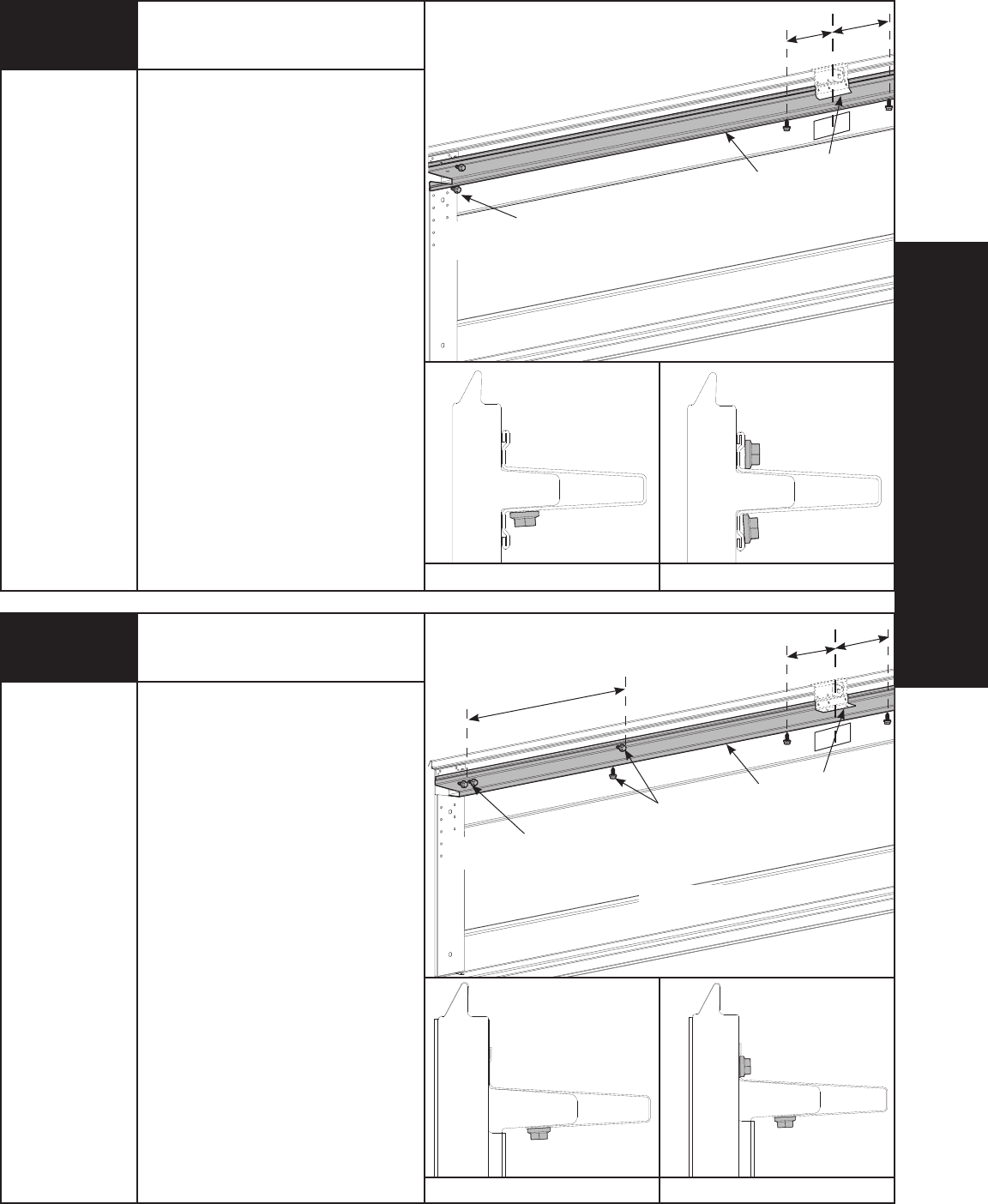
NOTE: If you have a model 9600 Series
door with windows in the top section or
9100 Sonoma (8’ high), skip this step
and complete step 9.
NOTE: Model 9100 Series door over 13’
wide require a 3” U-Bar (supplied).
Place the 3” u-bar over the top rib.
Fasten each end of the u-bar to the
endstile with (2) 1/4”- 20 x 11/16” self
drilling screws.
Fasten center of the u-bar as shown
to the rib using (2) 1/4”- 14 x 5/8” self
tapping screws 6” to the left and 6”
inches to the right of the center of the
door section.
NOTE: Upon completion of this step,
continue with Step 10.
NOTE: If a 3” U-Bar was installed in step
8, skip this step.
NOTE: Model 9600 glazed top doors
13’-0” wide or greater will be supplied
with a 3” asymmetrical u-bar for the top
section.
Place the 3” asymmetrical u-bar over the
top rib. Fasten each end of the u-bar to
the endstile with (2) 1/4”- 20 x 11/16”
self drilling screws.
Fasten center of the u-bar as shown
to the rib using (2) 1/4”- 14 x 5/8” self
tapping screws 6” off of the center of the
door section.
Fasten both walls of the u-bar as shown
using 1/4”- 14 x 5/8” self tapping screws
every 30-36 inches. (approximately 18
self tapping screws per 18’ u-bar)
U-Bar
U-Bar - Asymmetrical
(4) 1/4”- 20 X 11/16”
SELF DRILLING SCREWS
Power Drill
7/16” Socket
Driver
Power Drill
7/16” Socket
Driver
8
9
U-BAR
OPERATOR
BRACKET
(INSTALLED IN
STEP 10)
TOP DOOR SECTION
6”
6”
ATTACHING CENTER OF U-BAR ATTACHING ENDS OF U-BAR
(2) 1/4”- 20 X 11/16”
SELF DRILLING SCREWS
1/4”- 14 X 5/8” SELF
TAPPING SCREWS
U-BAR
OPERATOR
BRACKET
(INSTALLED IN
STEP 10)
TOP DOOR SECTION
30” TO 36”
6”
6”
ATTACHING CENTER OF U-BAR ATTACHING INTERMEDIATES OF U-BAR
18
Please Do Not Return This Product To The Store. Contact your local Wayne-Dalton dealer. To find your local Wayne-Dalton dealer, refer to your
local yellow pages/business listings or go to the Find a Dealer section online at www.wayne-dalton.com
Tools Needed:
INSTALLATION WITH U-BAR INSTALLATION WITH U-BAR
Power Drill
7/16” Socket
Driver
Vice Clamps
Phillips Head
Screwdriver
TOP SECTION
WITH OR
WITHOUT U-BAR
CENTER
LINE OPERATOR
BRACKET
U-BAR
TOP
SECTION
TOP
FLANGE
(2) #12 X 1/2”
PHILLIPS HEAD
SCREWS VICE CLAMP
NOTE: NOT REQUIRED FOR J-STRUTS.
OPERATOR BRACKET
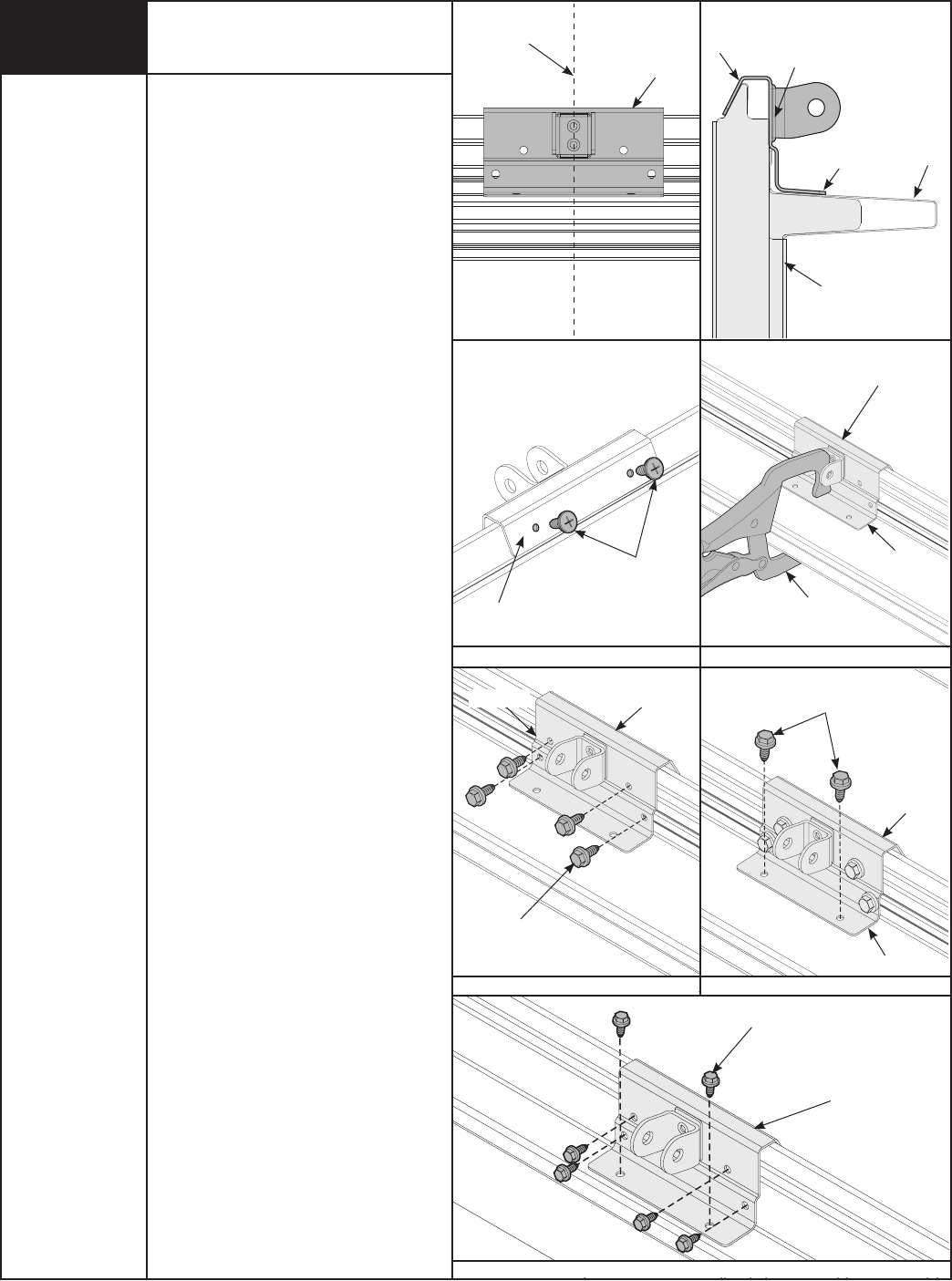
Operator Bracket
NOTE: Operator bracket must be mounted
and secured prior to installing top section.
NOTE: If an idriveTM operator is to be
installed, the operator bracket is not
required to be installed.
IMPORTANT: WHEN INSTALLING A
TROLLEY TYPE OPERATOR ON 9100, 9400
AND 9600 SERIES DOORS, A WAYNE-
DALTON TROLLEY BRACKET MUST
BE SECURELY ATTACHED TO THE TOP
SECTION, ALONG WITH ANY U-BAR’S
INITIALLY PROVIDED WITH THE DOOR. IT IS
THEN UNNECESSARY TO FURTHER
REINFORCE THE TOP SECTION OF THIS
WAYNE-DALTON DOOR WHEN ATTACHING
A TROLLEY TYPE OPERATOR, AS LONG AS
THE INSTALLATION OF THE OPERATOR IS
ACCORDING TO WAYNE-DALTON’S
INSTRUCTIONS AND FORCE SETTINGS ARE
ADJUSTED PROPERLY.
Locate the center of the top section and
place the operator bracket on top of the
section as illustrated. Align the center of
the bracket with the center line of the
top section. For retro fit applications, the
operator bracket must be aligned with an
existing operator and positioned on the top
section as illustrated.
Install (2) #12 x 1/2” phillips head screws
on the top flange of the operator bracket.
U-BAR INSTALLED: If a U-Bar is installed
on the top section, clamp the bottom flange
of the operator bracket to the U-Bar. Make
sure the bottom flange of the bracket
is held in place, flush against the U-Bar
before continuing.
NO U-BAR INSTALLED: If a U-Bar is not
installed on the top section, continue with
the steps below.
Attach (4) 1/4”- 14 x 5/8” self tapping
screws to the front of the operator bracket.
Next attach (2) 1/4”- 14 x 5/8” self tapping
screws to the bottom flange of the operator
bracket. Remove vice clamps if placed on
operator bracket previously.
NOTE: If you have a 9100 door, use (2)
1/4”- 20 x 11/16” self drilling screws
used to attach the U-Bar instead of the (2)
1/4”- 14 x 5/8” self tapping screws when
attaching the bottom flange of the operator
bracket to U-Bar.
NOTE: When attaching an operator bracket
to the top section with a U-Bar installed,
apply additional pressure to thread the
fasteners into the U-Bar.
OPERATOR
BRACKET
(2) 1/4”- 14 X 5/8”
SELF TAPPING SCREWS
(4) 1/4”- 14 X 5/8”
SELF TAPPING
SCREWS
OPERATOR
BRACKET
OPERATOR
BRACKET
(6) 1/4”- 14 X 5/8”
SELF TAPPING
SCREWS
U-BAR
U-BAR
U-BAR
FRONT
BOTTOM
FLANGE
TOP
FLANGE
BOTTOM
FLANGE
BOTTOM
FLANGE
FRONT
TOP FLANGE INSTALLATION INSTALLATION WITH U-BAR
INSTALLATION WITHOUT U-BAR
10
19
Please Do Not Return This Product To The Store. Contact your local Wayne-Dalton dealer. To find your local Wayne-Dalton dealer, refer to your
local yellow pages/business listings or go to the Find a Dealer section online at www.wayne-dalton.com
Tools Needed:
INSTALLATION
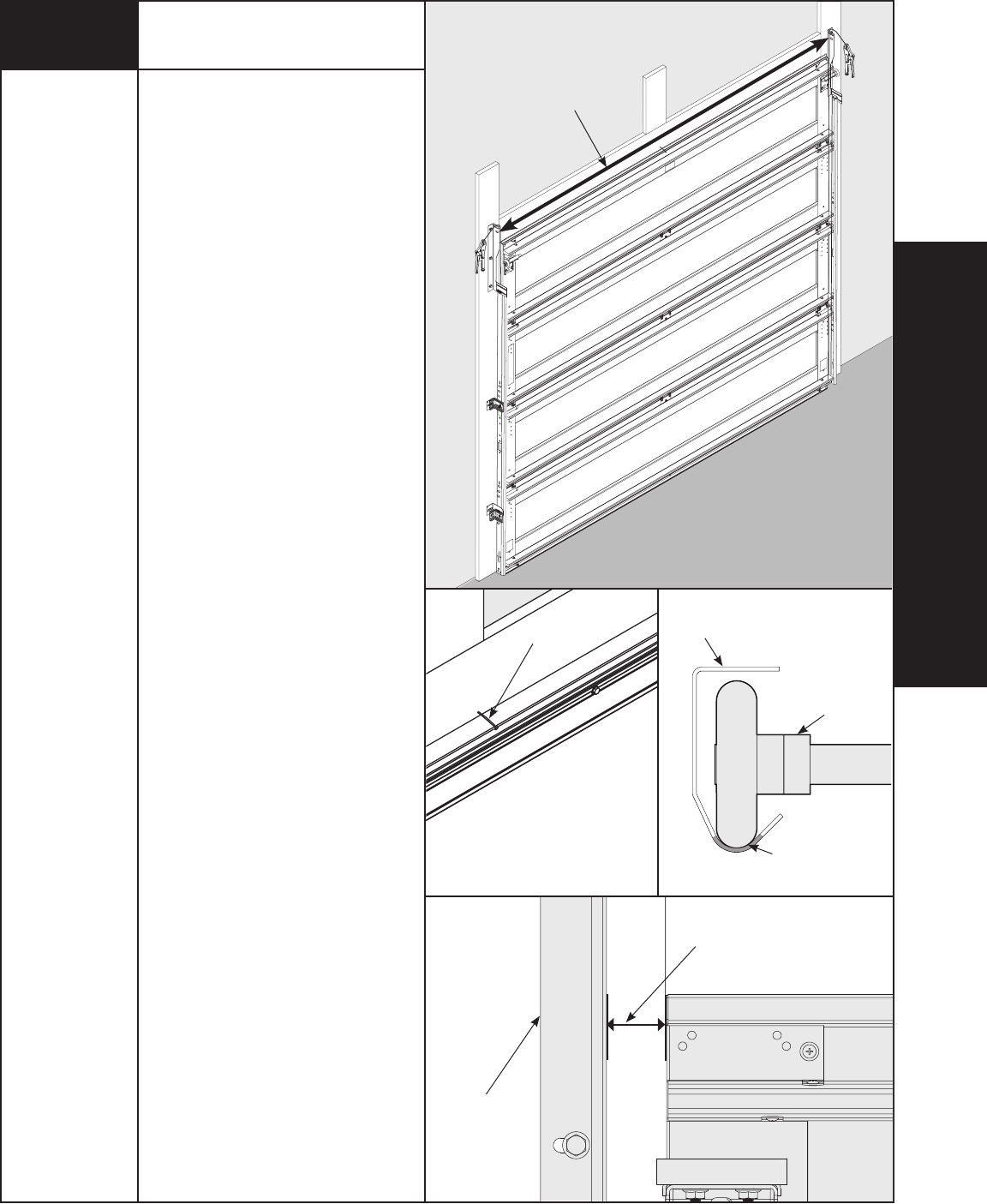
Top Section
Place the top section in the opening
and vertically align with lower sections.
Temporarily secure the top section by
driving a nail in the header near the
center of the door and bending it over
the top section.
Now flip up hinge leaf against section,
fastening center hinges first, and end
hinges last. (Refer to Step 6).
When installing a door with a torsion
counterbalance system, vertical
track alignment is critical. Position
flagangle between 1-11/16” (43 mm)
to 1-3/4” (44 mm) from the edge of
the door. Tighten the bottom lag screw.
Flagangles must be parallel to the door
sections.
Repeat for opposite side.
IMPORTANT: THE DIMENSION
BETWEEN THE FLAGANGLES MUST BE
DOOR WIDTH PLUS 3-3/8” (86MM) TO
3-1/2” (89 MM) FOR SMOOTH, SAFE
DOOR OPERATION.
Complete the vertical track installation
by securing the center jamb bracket(s)
and tightening the other lag screws.
Push the vertical track against the
rollers so that the rollers are touching
the deepest part of the curved side of
the track (see illustration). Tighten all
the carriage bolts and nuts.
Repeat for opposite side.
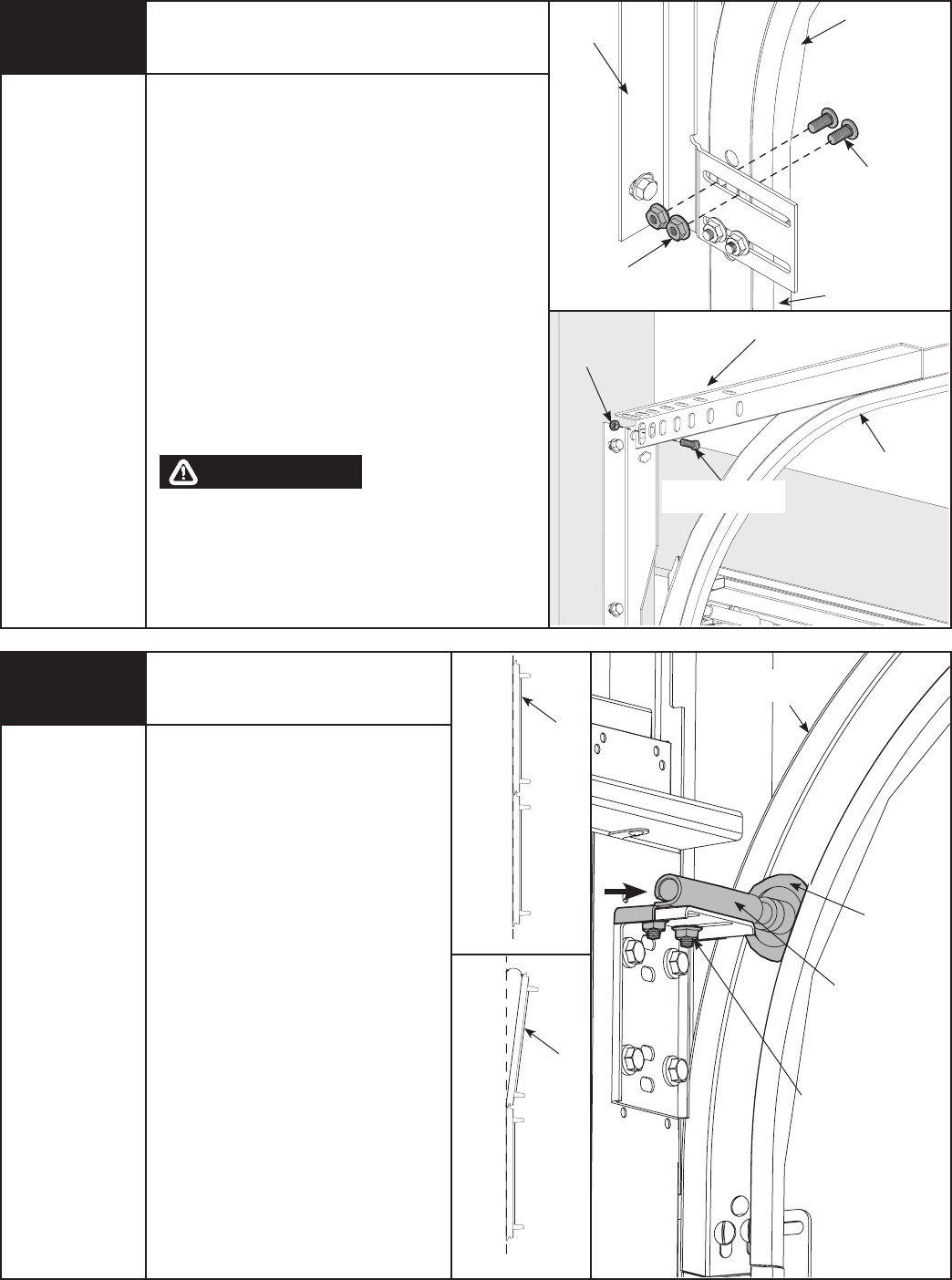
11
Hammer
Tape Measure
Power Drill
7/16” Socket
Driver
1-11/16” TO 1-3/4”
FLAGANGLE
TOP
SECTION
NAIL
ROLLER
VERTICAL TRACK
ROLLER AGAINST
VERTICAL TRACK
TOP SECTION
DOOR WIDTH
+3-3/8” TO 3-1/2”
20
Please Do Not Return This Product To The Store. Contact your local Wayne-Dalton dealer. To find your local Wayne-Dalton dealer, refer to your
local yellow pages/business listings or go to the Find a Dealer section online at www.wayne-dalton.com
Tools Needed:
Tools Needed:
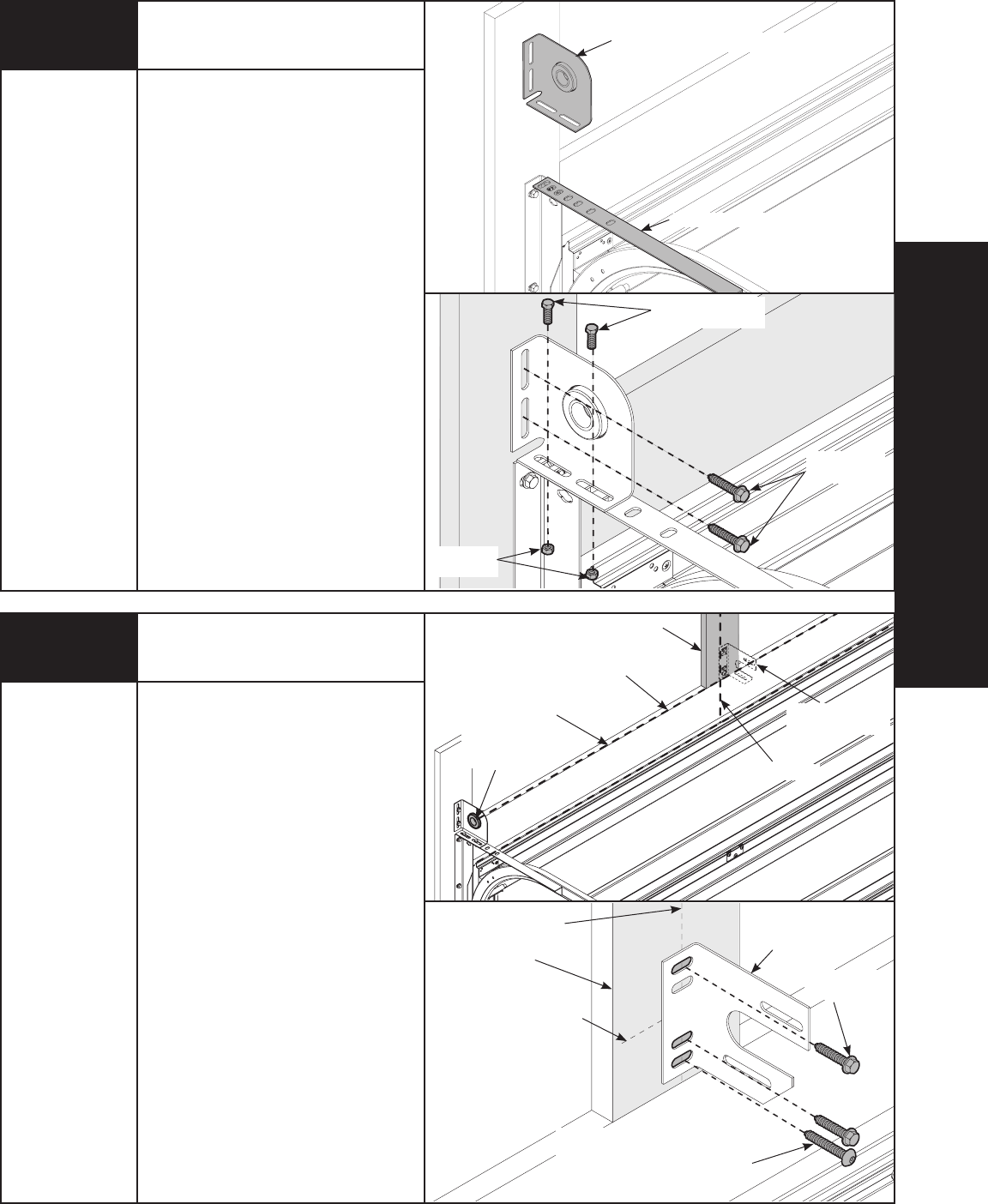
Attaching Horizontal Track to Adjustable
Flagangle
To install horizontal track, place the curved end over
the top roller. Align the bottom of the horizontal track
with the vertical track. Hand tighten the horizontal
track to the flagangle with (2) 1/4”- 20 x 5/8” carriage
bolts and (2) 1/4”- 20 flange hex nuts.
Level the horizontal track assembly and bolt the
horizontal angle to the slot in the flagangle using
(1) 3/8”- 16 x 3/4” hex head bolt and (1) 3/8”- 16 hex
nut. Repeat for other side. Remove the nail that was
temporarily holding the top section in place, installed
in Step 11.
IMPORTANT: FAILURE TO REMOVE NAIL BEFORE
ATTEMPTING TO RAISE DOOR COULD CAUSE
PERMANENT DAMAGE TO TOP SECTION.
DO NOT RAISE DOOR UNTIL HORIZONTAL
TRACKS ARE SE CURED AT REAR, AS
OUTLINED IN STEP 21, OR DOOR COULD FALL
FROM OVERHEAD POSI TION CAUSING SEVERE
OR FATAL INJURY.
12
9/16” Socket
7/16” Socket
Ratchet Wrench
9/16” Wrench
Level
Hammer
WARNING (1) 3/8”- 16 X 3/4”
HEX HEAD BOLT
(1) 3/8”- 16
HEX NUT
HORIZONTAL
TRACK
HORIZONTAL ANGLE
FLAGANGLE
(2) 1/4”- 20 FLANGE
HEX NUTS VERTICAL TRACK
HORIZONTAL
TRACK
(2) 1/4”- 20 X 5/8”
CARRIAGE BOLTS
With horizontal tracks installed, you can
now adjust the top brackets. Vertically
align the top section of the door with the
lower sections. Once aligned, position
the top bracket slide, out against the
horizontal track.
Maintaining the slide’s position, tighten
the (2) 1/4”- 20 flange hex nuts to
secure the top roller slide to the top
bracket base.
13 Adjusting Top Brackets HORIZONTAL
TRACK
TOP
BRACKET
SLIDE
(2) 1/4”- 20
FLANGE HEX
NUTS
CORRECT
INCORRECT
TOP
ROLLER
TOP
SECTION
TOP
SECTION
TOP
SECTION
7/16” Wrench
21
Please Do Not Return This Product To The Store. Contact your local Wayne-Dalton dealer. To find your local Wayne-Dalton dealer, refer to your
local yellow pages/business listings or go to the Find a Dealer section online at www.wayne-dalton.com
Tools Needed:
Tools Needed:
INSTALLATION
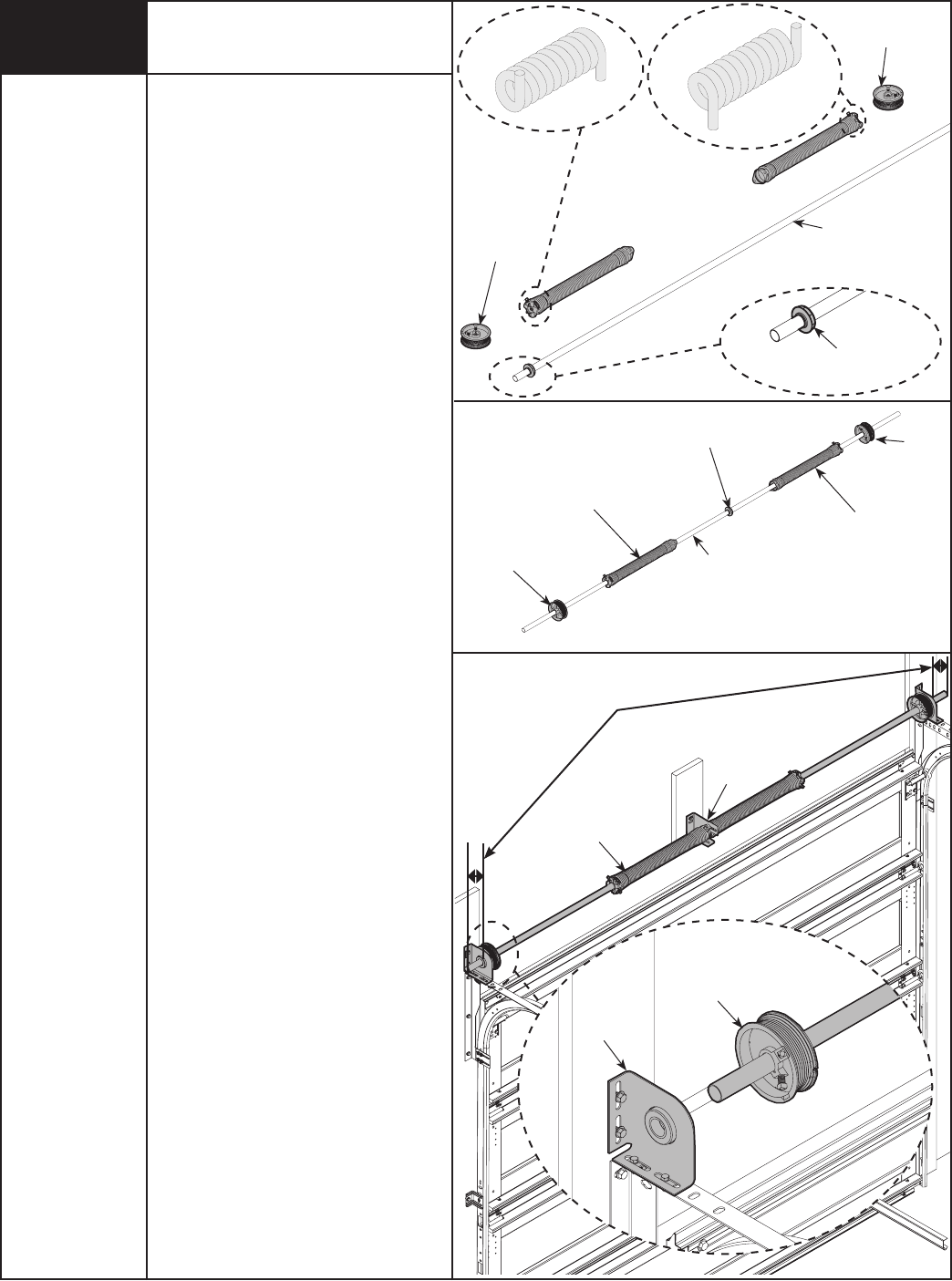
Torsion End Bearing Brackets
End bearing brackets are right and
left. Using the slots in the lower flange
of the end bearing bracket, align the
bracket with the flagangle on top of the
horizontal angle and secure the end
bearing bracket to the horizontal angle
using (2) 3/8”- 16 x 3/4” hex head bolts
and (2) 3/8”- 16 nuts.
Once the bracket is secured to the
horizontal angle, secure the top of the
end bearing bracket to the jamb using
(2) 5/16” x 2” lag screws. Repeat for
other side.
NOTE: Right and left hand is always
determined from inside the garage
looking out.
Power Drill
7/16” Socket
Driver
9/16” Socket
Ratchet Wrench
9/16” Wrench
LEFT END BEARING BRACKET
HORIZONTAL ANGLE
(2) 5/16” X 2”
LAG SCREWS
(2) 3/8”- 16 X 3/4”
HEX HEAD BOLTS
(2) 3/8”- 16
HEX NUTS
Center Bearing Bracket
Power Drill
7/16” Socket
Driver
Level
Tape Measure
Pencil
1/4” Torx Bit
Measure to locate the center of the door
and mark a vertical pencil line on the
mounting surface above the door, to
indicate the center line of the door. Then,
measure from the center of the bearing, in
one of the end bearing brackets, DOWN to
the top of the door. Using that dimension,
measure UP from the top of the door
and mark a horizontal pencil line on the
mounting surface, intersecting the vertical
pencil line. Now align the edge of the
center bearing bracket along the vertical
pencil line on the mounting surface. Center
the bearing bracket on the horizontal
line. This will ensure the torsion tube is
level between the center and end bearing
brackets. Attach the center bearing bracket,
in this location, to the mounting surface,
using (2) 5/16” x 2” lag screws and
(1) 5/16” x 2” tamper-resistant lag screw.
IMPORTANT: USE THE 5/16” X 2” TAMPER-
RESISTANT LAG SCREW ONLY IF MOUNTING
SURFACE MOUNTED OVER MASONRY.
TAMPER-RESISTANT LAG SCREW MUST BE
ATTACHED THROUGH THE BOTTOM HOLE
OF THE CENTER BEARING BRACKET.
VERTICAL LINE
MOUNTING SURFACE
EQUAL DISTANCE
CENTER OF
END BEARING
BRACKET
HORIZONTAL LINE CENTER BEARING
BRACKET
CENTER
BEARING
BRACKET
(2) 5/16” X 2”
LAG SCREWS
MOUNTING
SURFACE
HORIZONTAL LINE
VERTICAL
LINE
14
15
(1) 5/16” X 2”
TAMPER-RESISTANT LAG SCREW
OR (1) 5/16” X 2” LAG SCREW
22
Please Do Not Return This Product To The Store. Contact your local Wayne-Dalton dealer. To find your local Wayne-Dalton dealer, refer to your
local yellow pages/business listings or go to the Find a Dealer section online at www.wayne-dalton.com
Tools Needed:
16
none
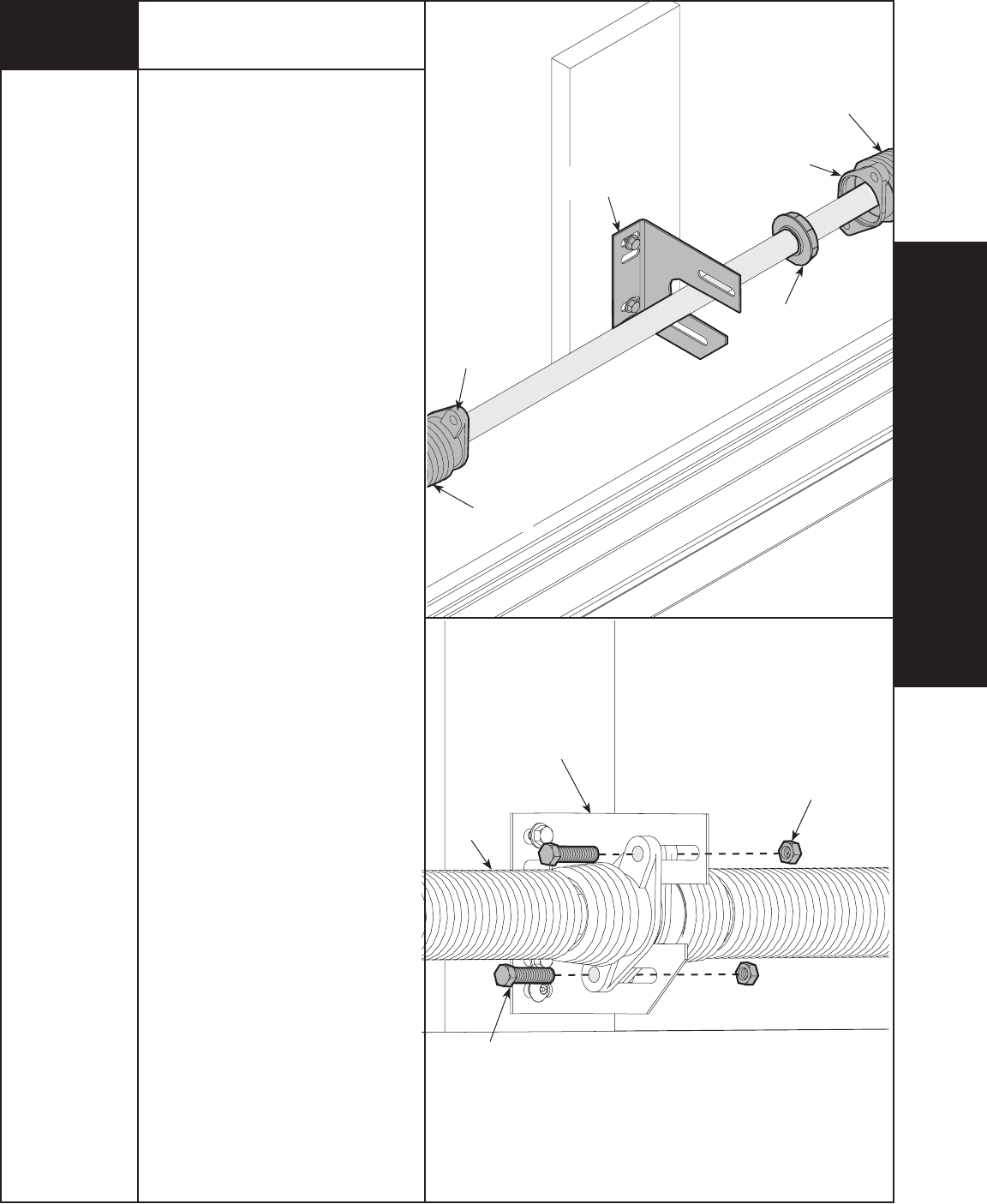
Torsion Spring Assembly
NOTE: Right and left hand is always
determined from inside the garage
looking out.
NOTE: Identify the springs provided as
either right hand wound (red winding
cone), which goes on the LEFT HAND
SIDE or left hand wound (black winding
cone), which goes on the RIGHT HAND
SIDE.
Facing the inside of the door, lay the
torsion tube on the floor. Lay the spring
with the black color coded winding
cone and the black color coded cable
drum, at the right hand end of the tube.
Lay the spring with the red color coded
winding cone and the red color coded
cable drum, at the left hand end of the
tube.
NOTE: The set screws used on all
torsion counterbalance winding cones
and cable drums, are now colored red.
DO NOT identify right and left hand by
the set screw color.
Slide the nylon center bushing onto the
torsion tube followed by the springs and
cable drums. The nylon center bushing,
springs and cable drums must be
positioned, as shown.
With assistance, pick up the torsion
assembly and slide one end of the tube
through one end bearing bracket. Lay
the torsion tube into the center bearing
bracket and slide the other end of the
tube into the opposite end bearing
bracket. Position the torsion tube so
that equal amounts of the tube extend
from each end bearing bracket.
LEFT HAND
CABLE DRUM
RED
RIGHT HAND WOUND RED
WINDING CONE LEFT HAND SIDE
RIGHT HAND CABLE
DRUM BLACK
TORSION
TUBE
LEFT HAND WOUND BLACK
WINDING CONE RIGHT HAND SIDE
NYLON CENTER
BRACKET BUSHING
LEFT HAND CABLE
DRUM RED
RIGHT HAND WOUND
RED WINDING CONE
LEFT HAND SIDE
NYLON CENTER
BRACKET BUSHING
RIGHT
HAND
CABLE
DRUM
BLACK
TORSION
TUBE
LEFT HAND WOUND
BLACK WINDING CONE
RIGHT HAND SIDE
TORSION
ASSEMBLY
CENTER
BRACKET
EQUAL
SPACING
END
BEARING
BRACKET
TORSION
ASSEMBLY
23
Please Do Not Return This Product To The Store. Contact your local Wayne-Dalton dealer. To find your local Wayne-Dalton dealer, refer to your
local yellow pages/business listings or go to the Find a Dealer section online at www.wayne-dalton.com
Tools Needed:
INSTALLATION
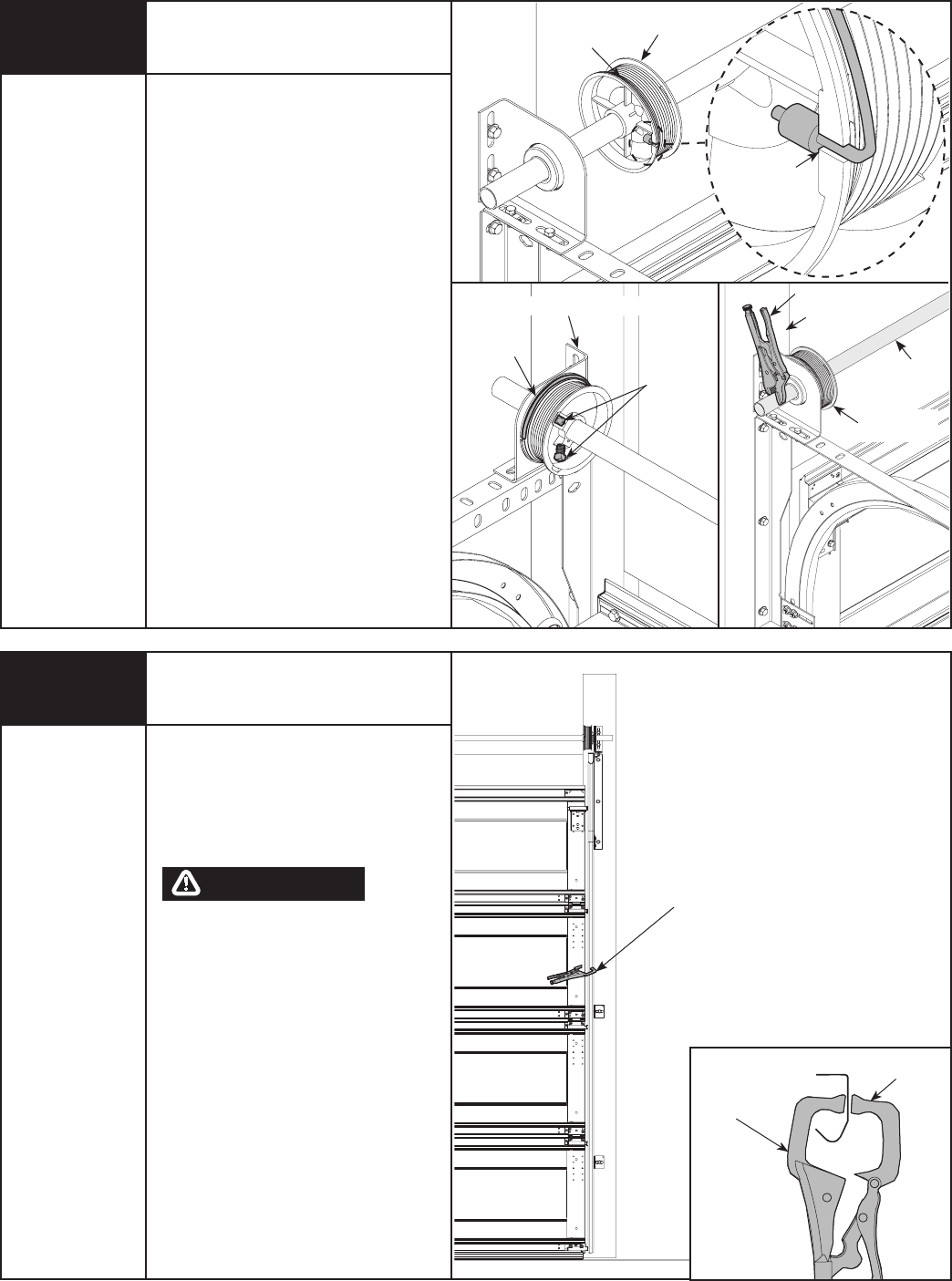
Slide the nylon center bushing into the
stationary spring cone at the end of the
spring and align the stationary spring
cone(s) with the holes in the center
bearing bracket. Secure the spring(s) to
the center bearing bracket with
(2) 3/8”- 16 x 1-1/2” hex head bolts
and (2) 3/8”- 16 nuts.
IMPORTANT: SPRINGS UNDER TENSION
CAN BE DANGEROUS.
IMPORTANT: THE SPRING WARNING
TAG(S) SUPPLIED MUST BE SECURELY
ATTACHED TO THE STATIONARY SPRING
CONE IN PLAIN VIEW. SHOULD A
REPLACEMENT SPRING WARNING TAG
BE REQUIRED, CONTACT WAYNE-
DALTON CORP. FOR FREE
REPLACEMENTS.
17 Nylon Center Bushing
TORSION
SPRING
(2) 3/8”- 16 NUT
(2) 3/8”- 16 X 1-1/2”
HEX HEAD BOLT
CENTER BEARING
BRACKET
TORSION
SPRING
TORSION
SPRING
NYLON CENTER
BUSHING
CENTER BEARING
BRACKET
STATIONARY
SPRING CONE
STATIONARY
SPRING CONE
9/16” Socket
Ratchet Wrench
9/16” Wrench
24
Please Do Not Return This Product To The Store. Contact your local Wayne-Dalton dealer. To find your local Wayne-Dalton dealer, refer to your
local yellow pages/business listings or go to the Find a Dealer section online at www.wayne-dalton.com
Tools Needed:
Tools Needed:
Counterbalance Cables
Vice Grips
3/8” Wrench
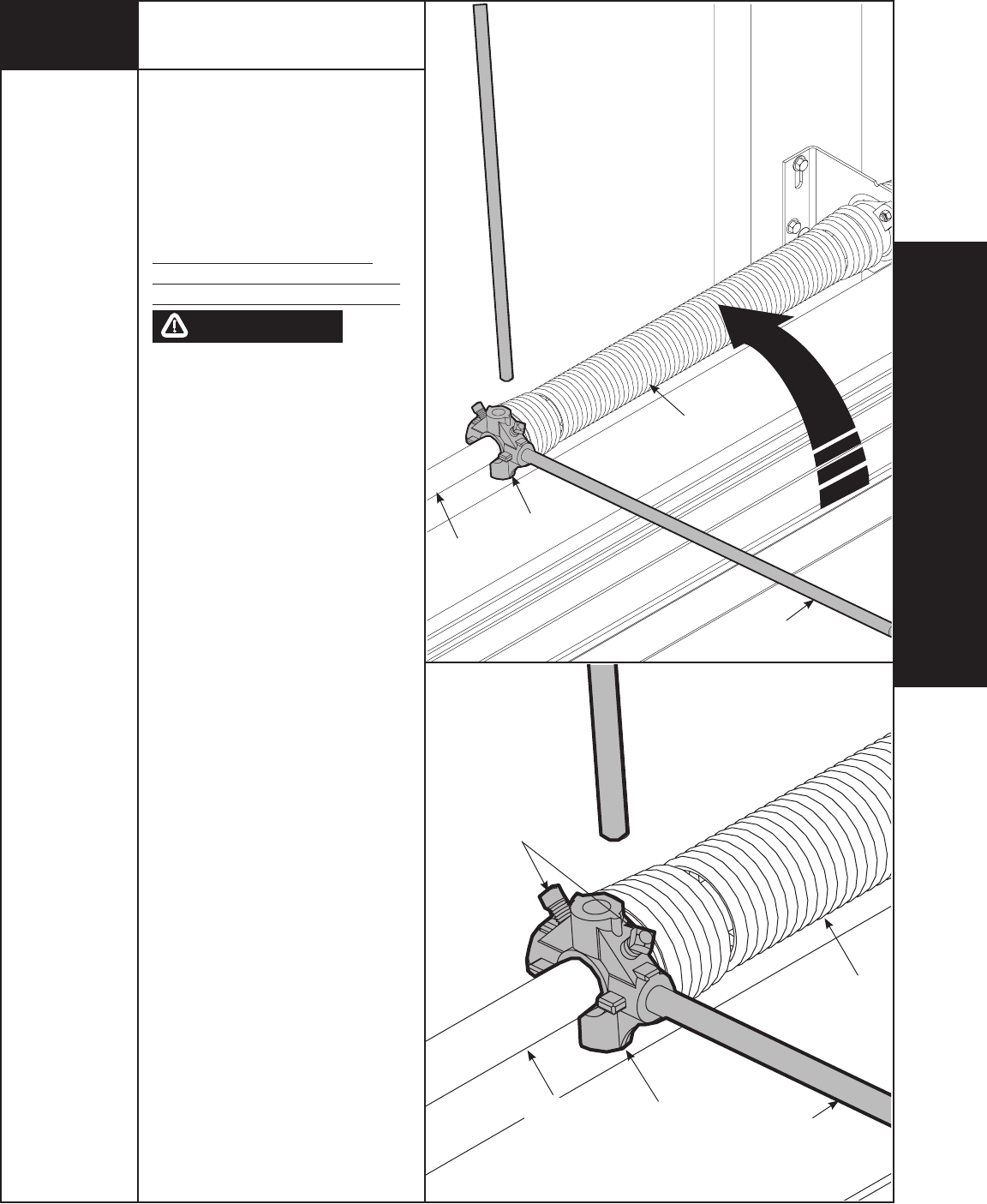
Release the vice grips from the ends of the
cables and thread the counterbalance
cables around the back side of the cable
drums and verify that there are no cable
obstructions. Hook the cables into the
drums. Slide the left hand cable drum
against the left hand end bearing bracket
and tighten the set screws in the drum to
14-15 ft. lbs. of torque (Once set screws
contact the tube, tighten screws one full
turn). Rotate the left hand drum and torsion
tube until cable is taut. Attach vice grips to
torsion tube and brace vice grips against
jamb to keep cable taut. Slide the right
hand cable drum against the right hand
end bearing bracket and rotate drum until
cable is taunt. Tighten set screws in right
hand cable drum to 14-15 ft. lbs. of torque
(Once set screws contact the tube, tighten
screws one full turn).
IMPORTANT: CHECK EACH CABLE, MAKING
SURE BOTH ARE SEATED PROPERLY ON
THE CABLE DRUMS AND HAVE EQUAL
CABLE TENSION.
18
Securing Door
for Spring Winding
(2) Vice Clamps
19
LEFT END BEARING BRACKET
CABLE IN
POSITION SET
SCREWS
VICE GRIPS
TORSION
TUBE
JAMB
LEFT CABLE
DRUM
LEFT CABLE DRUM
CABLE
CABLE
HOOKED IN
CABLE DRUM
TRACK
VICE CLAMPS
ATTACHED TO
INNER RAIL
OF TRACK
Place vice clamps onto both vertical
tracks just above the third roller. This is
to prevent the garage door from raising
while winding torsion springs.
FAILURE TO PLACE VICE
CLAMPS ONTO VERTICAL TRACK
CAN ALLOW DOOR TO RAISE
AND CAUSE SEVERE OR FATAL
INJURY
IMPORTANT: DO NOT USE IMPACT GUN
TO WIND SPRING(S).
WARNING PLACE VICE CLAMPS ABOVE
3RD ROLLER ON BOTH
VERTICAL TRACKS
25
Please Do Not Return This Product To The Store. Contact your local Wayne-Dalton dealer. To find your local Wayne-Dalton dealer, refer to your
local yellow pages/business listings or go to the Find a Dealer section online at www.wayne-dalton.com
Tools Needed:
INSTALLATION
Position a ladder slightly to the side of
spring so that the winding cone is
easily accessible, yet your body is not
in direct line with the winding bars.
Check the label attached to the spring
warning tag for the required number of
complete turns to balance your door.
6’6” Door Height = Approx 7 Turns
7’0” Door Height = Approx 7-1/2 Turns
8’0” Door Height = Approx 8-3/4 Turns
PRIOR TO WINDING OR MAKING
ADJUSTMENTS TO THE SPRINGS, ENSURE
YOU’RE WINDING IN THE PROPER
DIRECTION AS STATED IN THE
INSTALLATION INSTRUCTIONS. OTHERWISE
THE SPRING FITTINGS MAY RELEASE FROM
SPRING IF NOT WOUND IN THE PROPER
DIRECTION AND COULD RESULT IN SEVERE
OR FATAL INJURY.
Alternately inserting the winding bars
into the holes of the spring’s winding
cone, rotate the winding cone upward
toward ceiling, 1/4 turn at a time, until
the required number of complete turns
for your door height is achieved. As the
last 1/4 turn is achieved, securely hold
winding bar while tightening both set
screws in winding cone to 14-15 ft. lbs.
of torque (Once set screws contact the
tube, tighten screws one full turn).
Carefully remove winding bar from
winding cone. Proceed to wind the
second spring in the same manner.
While holding the door down, to prevent
it from rising unexpectedly, in the event
the spring(s) were overwound, carefully
remove the locking clamps from the
torsion tube and the vertical tracks.
IMPORTANT: CAUTIOUSLY REMOVE
LOCKING PLIERS FROM THE TORSION
TUBE AND LOCKING CLAMPS FROM
THE VERTICAL TRACKS.
Adjustments to the required from the
number of turns stated may be
necessary. If door raises off floor under
spring tension alone, Reduce spring
tension until door rests on the floor. If
the door is hard to raise or drifts down
on its own, add spring tension. An
unbalanced door such as this can
cause garage door opener operation
problems.
Winding Torsion Spring(s)
Power Drill
3/16” Drill Bit
7/16” Socket
Driver
Phillips Head
Screwdriver
Approved
Winding Bars
20
APPROVED
WINDING BARS
WINDING
CONE
SPRING
TORSION
TUBE
APPROVED
WINDING BARS
SET
SCREWS
WINDING
CONE
SPRING
TORSION
TUBE
WARNING

26
Please Do Not Return This Product To The Store. Contact your local Wayne-Dalton dealer. To find your local Wayne-Dalton dealer, refer to your
local yellow pages/business listings or go to the Find a Dealer section online at www.wayne-dalton.com
Tools Needed:
Rear Support
KEEP HORIZONTAL TRACK
PARALLEL AND WITHIN 3/4”
MAXIMUM OF DOOR EDGE,
OTHERWISE DOOR COULD FALL,
RESULTING IN SEVERE INJURY OR
DEATH.
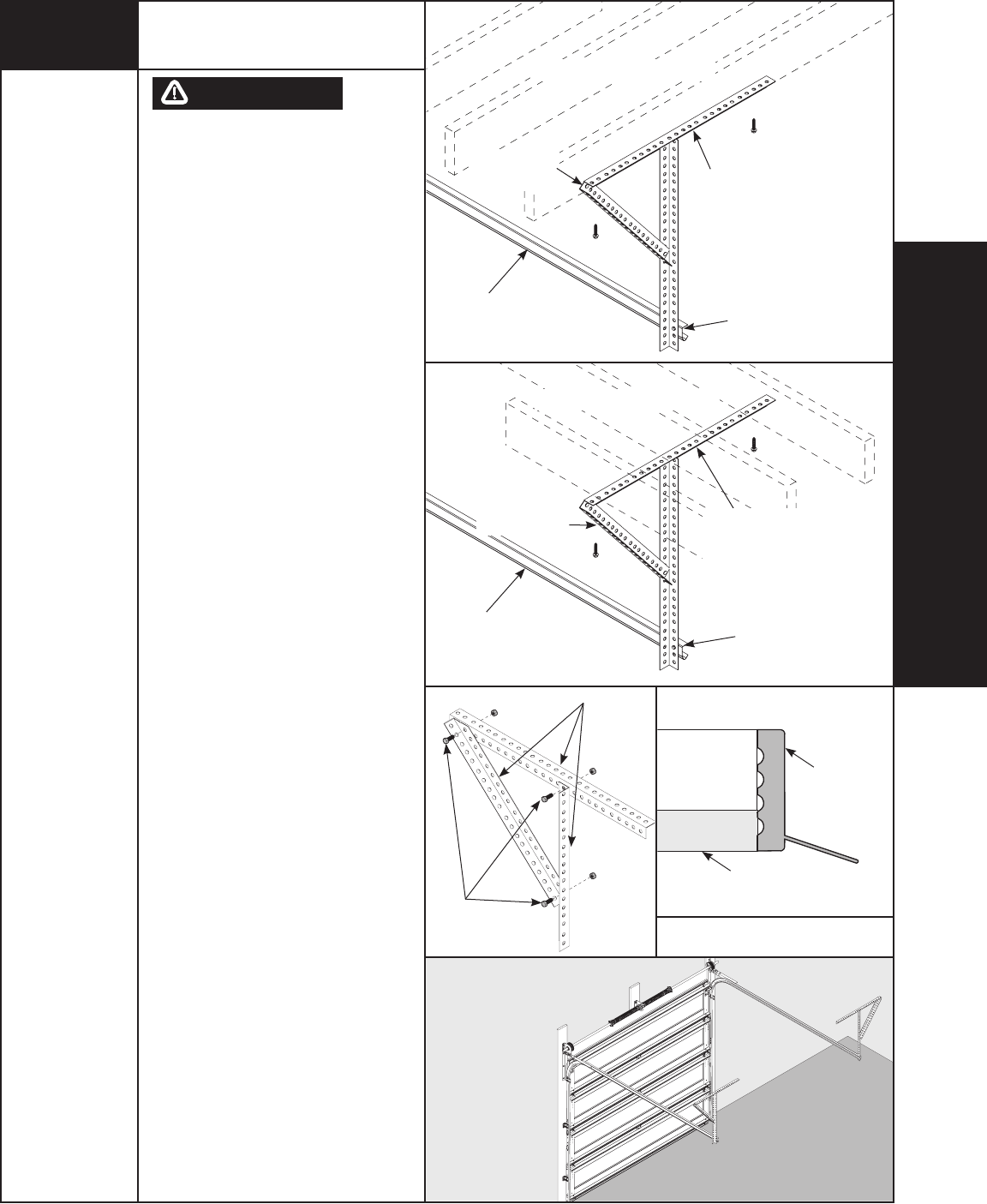
Raise the door until the top section and
half of the next section are in a horizontal
position. Do not raise door any further
since rear of horizontal track is not yet
supported.
RAISING DOOR FURTHER CAN
RESULT IN DOOR FALLING AND
CAUSE SEVERE INJURY OR DEATH.
Clamp a pair of vice clamps on the
vertical tracks just above the second
roller on one side, just below the second
roller on the other side. This will prevent
the door from raising or lowering while
installing the rear support.
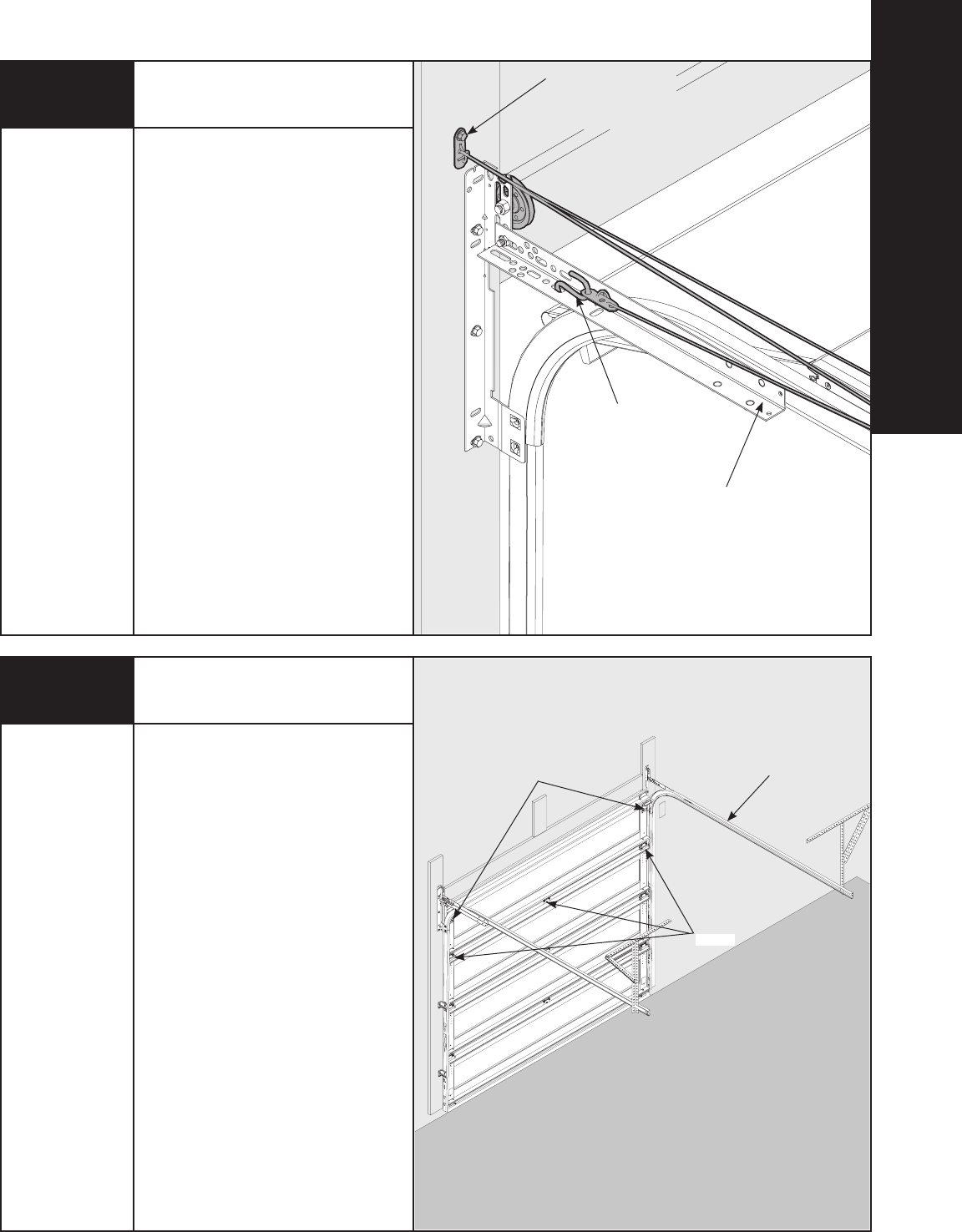
Using perforated angle, 5/16” x 1-5/8”
hex head lag screws and 5/16” bolts
with nuts (may not be supplied), fabricate
rear support for horizontal tracks. Attach
horizontal tracks to the rear supports
with 5/16”- 18 x 1-1/4” hex bolts and
nuts (may not be supplied). Horizontal
tracks must be level and parallel with
door.
NOTE: If rear supports are to be installed
over drywall, use 5/16” x 2” hex head lag
screws.
Adjust weather seal (if necessary) Now
permanently attach the weather seal to
both door jambs and header. (Temporarily
attached in PREPARING THE OPENING on
page 10.) Avoid pushing weather seal
stop too tightly against face of door.
21
WARNING
WARNING
Ratchet Wrench
1/2” Socket
1/2” Wrench
(2) Vice Clamps
DOOR IN THE
UP POSITION
VERTICAL
TRACK
3/4”
VICE
CLAMPS
DOOR EDGE
HORIZONTAL TRACK
27
Please Do Not Return This Product To The Store. Contact your local Wayne-Dalton dealer. To find your local Wayne-Dalton dealer, refer to your
local yellow pages/business listings or go to the Find a Dealer section online at www.wayne-dalton.com
Tools Needed:
INSTALLATION
PRIOR TO WINDING OR MAKING
ADJUSTMENTS TO THE SPRINGS, ENSURE
YOU’RE WINDING IN THE PROPER
DIRECTION AS STATED IN THE
INSTALLATION INSTRUCTIONS. OTHERWISE
THE SPRING FITTINGS MAY RELEASE FROM
SPRING IF NOT WOUND IN THE PROPER
DIRECTION AND COULD RESULT IN SEVERE
OR FATAL INJURY.
To adjust spring tension, fully close
door. Apply locking pliers to track above
third roller. Insert a winding bar into
the winding cone. Push upward on the
winding bar while carefully loosening
the set screws in the winding cone.
BE PREPARED TO SUPPORT THE FULL
FORCE OF THE TORSION SPRING ONCE
THE SET SCREWS ARE LOOSE. Carefully
adjust spring tension 1/4 turn. Retighten
both set screws in the winding cone and
repeat for the other side. Recheck door
balance DO NOT ADJUST MORE THAN
1/2 TURN FROM THE RECOMMENDED
NUMBER OF TURNS. If door still does
not balance correctly, contact a qualified
door agency.
If the door still does not operate easily,
lower the door into the closed position,
UNWIND THE SPRING(S) FULLY (Refer
to “P1” on page 6 “Torsion Spring
Removal For Standard Lift”) and
recheck the following the items:
1.) Check the door for level.
2.) Check the torsion tube for level.
3.) Check the track spacing.
4.) Check the counterbalance cables for
equal tension.
5.) Check the track for potential
obstruction of the rollers.
6.) Clamp locking pliers onto track and
rewind springs
IMPORTANT: IF DOOR STILL DOES NOT
OPERATE PROPERLY, THEN CONTACT A
QUALIFIED DOOR AGENCY.
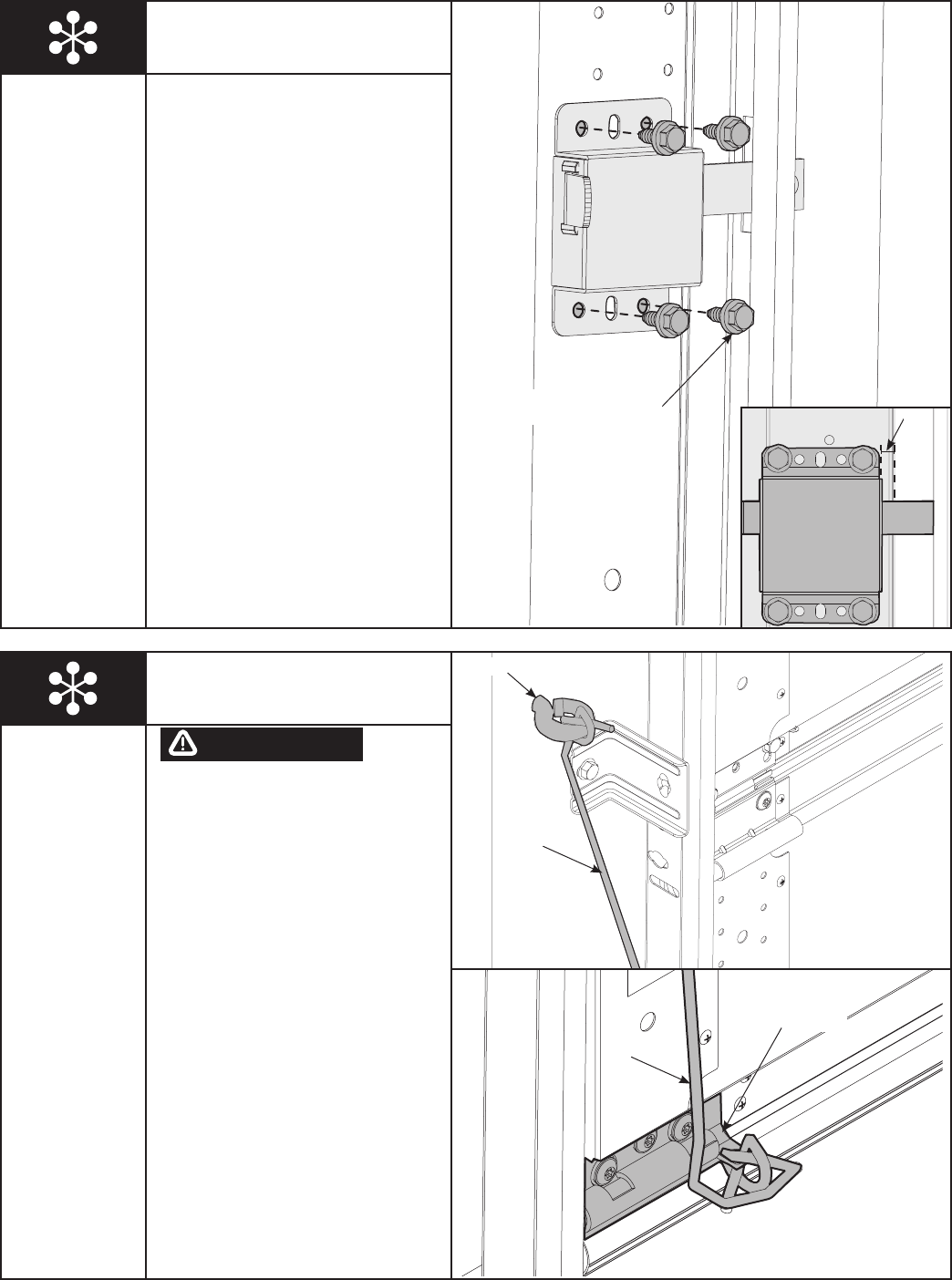
Rear Support Continued...
PERFORATED ANGLE
(3) 5/16” BOLTS
& NUTS
HORIZONTAL TRACK
BOLT MUST EXTEND INTO
THE TRACK TO SERVE AS
A ROLLER STOP
PERFORATED
ANGLE BRACE PERFORATED ANGLE -BOLTED
USING (2) 5/16” X 1-5/8”
HEX HEAD LAG SCREWS
TO CEILING MEMBER AND
PARALLEL TO WIDTH OF DOOR
SOUND FRAMING MEMBERS
SOUND FRAMING MEMBERS
HORIZONTAL TRACK
BOLT MUST EXTEND INTO
THE TRACK TO SERVE AS
A ROLLER STOP
JAMB
WEATHER
SEAL
PERMANENTLY ATTACHED
WEATHER SEAL
ANGLE BRACE PERFORATED ANGLE -BOLTED
USING (2) 5/16” X 1-5/8”
HEX HEAD LAG SCREWS
TO CEILING MEMBER AND
PARALLEL TO WIDTH OF DOOR
WARNING
28
Please Do Not Return This Product To The Store. Contact your local Wayne-Dalton dealer. To find your local Wayne-Dalton dealer, refer to your
local yellow pages/business listings or go to the Find a Dealer section online at www.wayne-dalton.com
Tools Needed:
Tools Needed:
DO NOT INSTALL PULL ROPES
ON DOORS WITH ELECTRIC
OPERATORS. CHILDREN MAY
BECOME ENTANGLED IN THE
ROPE CAUSING SEVERE OR
FATAL INJURY.
Measure and mark the jamb
approximately 48” to 50” (1220 to 1270
mm) from floor on the right or left side
of door. Drill 1/8” pilot hole for No. 6
screw eye. Install the No. 6 screw eye.
Tie the pull rope to the No. 6 screw eye
and to the bottom bracket as shown.
Side Lock
Install the side lock on the second
section of the door. Secure the lock to
the section with (4) 1/4”- 20 x 11/16”
self drilling screws. Square the lock
assembly with the door section and
align with the square hole in the vertical
track. The side lock should be spaced
in approximately 1/8” from the section
edge.
IMPORTANT: SIDE LOCKS MUST BE
REMOVED OR MADE INOPERATIVE IN
THE UNLOCKED POSITION IF AN
OPERATOR IS INSTALLED ON THE
DOOR.
NOTE: After completing this step,
continue with step 7 on page 16.
Power Drill
7/16” Socket
Driver
(4) 1/4”- 20 X 11/16”
SELF DRILLING SCREWS 1/8”
Pull Rope
NO. 6 SCREW EYE
PULL ROPE
BOTTOM BRACKET
PULL ROPE
WARNING
Power Drill
1/8” Drill Bit

29
Please Do Not Return This Product To The Store. Contact your local Wayne-Dalton dealer. To find your local Wayne-Dalton dealer, refer to your
local yellow pages/business listings or go to the Find a Dealer section online at www.wayne-dalton.com
Tools Needed:
OPTIONAL INSTALLATION
Step Plate
Make one mark 1” (25 mm) up from
the center of bottom edge of the bottom
section and another mark 2-3/16” (56
mm) up from the first mark.
Drill a 7/16” (11 mm) hole through the
section at each mark and insert the
outside step plate.
Loosely fasten step plate slide to base
with (1) 1/4” - 20 x 5/8” carriage bolt
and nut.
Align inside step plate holes and
fasten from inside using the #8 screws
provided. Install one #8 x 3/4” screw in
the bottom step plate hole. The screw in
the top hole varies with door models.
Use the screw size shown below for
your model door.
a) #8 x 3/4” screw for Model 9100
b) #8 x 1” screw Model 9600
Tighten 1/4”-20 carriage bolt and nut.
STEP PLATE OUTSIDE
STEP PLATE INSIDE
7/16” Drill Bit
Power Drill
7/16” Wrench
#8 SCREWS
ASSEMBLED
STEP PLATE
1/4” - 20 X 5/8”
CARRIAGE BOLT
HEX NUT
STEP PLATE
BASE
STEP PLATE
SLIDE

30
Please Do Not Return This Product To The Store. Contact your local Wayne-Dalton dealer. To find your local Wayne-Dalton dealer, refer to your
local yellow pages/business listings or go to the Find a Dealer section online at www.wayne-dalton.com
DETERMINE THE WAYNE-DALTON
TRACK RADIUS BEING USED:
Trolley Installation for
Standard Lift
Measure the curved ends of the horizontal track to determine
if you have a 12” or 15” radius horizontal track, as shown
in FIG. 2.1. Determine center line of door. Mark vertical line
at this point, on the header wall. Raise the door slightly until
the top section reaches the highest point of travel (high arc).
Using a level, mark this high arc point of travel on the header
wall, intersecting the vertical center line, as shown in FIG.
2.2 through 2.3. Hold the wall bracket’s bottom edge to the
appropriate 1/2” - 1” (room permitting) above of the high
arc line and centered on the vertical line, as shown in FIG.
2.3. Spot the wall brackets mounting holes on the header
wall and then refer to your garage door operator manual for
pre-drilling and securing the wall bracket to header. Using the
OPERATOR HOOK-UP CHARTS, refer to referenced illustrations
in FIG. 2.4 through FIG. 2.5 for correct arm hook-up from
trolley to operator bracket.
NOTE: Refer to your operator manual for specific details on
how to assembly the curved and straight arm, as shown in
FIG. 2.4 through FIG. 2.5.
NOTE: Depending on your setup, you may or may not have to
cut straight arm to accomplish trolley settings, as shown in
FIG. 2.4 through FIG. 2.5.
Attach door arm to trolley and align the appropriate door arm
hole with the hole in the door operator bracket. Insert (1) hex
head bolt through hole of operator bracket and door arm.
Install (1) LOCKING hex nut and just tighten until snug.
FAILURE TO USE LOCKING NUT CAN RESULT IN
ARM RELEASING AND POSSIBLE RESULTING IN
PROPERTY DAMAGE AND/OR PERSONAL INJURY.
QUANTUM AND CLASSIC OPERATORS REQUIRE:
(1) 3/8” - 16 x 1” hex bolt and (1) 3/8” - 16 LOCKING hex nut,
as shown in FIG. 2.6.
LINEAR, LIFTMASTER (SEARS), GENIE OPERATORS
REQUIRE:
(1) 5/16” - 18 x 1” hex bolt and (1) 5/16” - 18 LOCKING hex
nut, as shown in FIG. 2.6.
HORIZONTAL
TRACK
12” OR 15”
STRAIGHT
ARM
SHOWN
LOCKING
HEX NUT
HEX BOLT
OPERATOR
BRACKET
FIG. 2.6
FIG. 2.5
STRAIGHT
ARM
CURVED
ARM
CUT STRAIGHT
ARM TO
ACCOMPLISH
TROLLEY
SETTING
FIG. 2.4
CUT STRAIGHT
ARM TO
ACCOMPLISH
TROLLEY
SETTING
CURVED
ARM
STRAIGHT
ARM
WARNING
OPERATOR HOOK-UP CHART STANDARD LIFT FOR 15” RADIUS
OPERATOR MODELS TYPE OF ARM BEING USED REF. ILLUSTRATIONS ABOVE
QUANTUM/CLASSIC CURVED / STRAIGHT FIG. 2.5
LINEAR STRAIGHT / CURVED FIG. 2.4
LIFTMASTER
(SEARS) CURVED / STRAIGHT FIG. 2.5
GENIE CURVED / STRAIGHT FIG. 2.5
OPERATOR HOOK-UP CHART STANDARD LIFT FOR 12” RADIUS
OPERATOR MODELS TYPE OF ARM BEING USED REF. ILLUSTRATIONS ABOVE
QUANTUM/CLASSIC CURVED / STRAIGHT FIG. 2.5
LINEAR STRAIGHT / CURVED FIG. 2.4
LIFTMASTER
(SEARS) CURVED / STRAIGHT FIG. 2.5
GENIE CURVED / STRAIGHT FIG. 2.5
FIG. 2.2
TOP
SECTION
HIGH ARC
LEVEL
FIG. 2.3
FROM
STEP 12
HIGH ARC
LINE
TYPICAL 1/2” - 1” ABOVE HIGH ARC
VERTICAL
CENTER LINE
HEADER
TORQUEMASTER®
COUNTERBALANCE
FIG. 2.1

31
Please Do Not Return This Product To The Store. Contact your local Wayne-Dalton dealer. To find your local Wayne-Dalton dealer, refer to your
local yellow pages/business listings or go to the Find a Dealer section online at www.wayne-dalton.com
OPTIONAL INSTALLATION
Trolley Installation for
Low Headroom HIGH ARC
LOW
HEADROOM
TRACK
TOP
SECTION
LEVEL
FIG. 3.1 FIG. 3.2
FIG. 3.3
STRAIGHT
ARM
FIG. 3.4
CURVED
ARM
CUT STRAIGHT
ARM TO
ACCOMPLISH
TROLLEY
SETTING
OPERATOR HOOK-UP CHART FOR LOW HEADROOM
OPERATOR MODELS
TYPE OF ARM BEING USED
PREFERRED
HOOKUP
REF. ILLUSTRA-
TIONS ABOVE
OPTIONAL
HOOKUP
REF. ILLUSTRA-
TIONS ABOVE
QUANTUM/CLASSIC CURVED /
STRAIGHT FIG. 3.4 STRAIGHT FIG. 3.3
LINEAR STRAIGHT FIG. 3.3 N/A N/A
LIFTMASTER
(SEARS)
CURVED /
STRAIGHT FIG. 3.4 STRAIGHT FIG. 3.3
GENIE CURVED /
STRAIGHT FIG. 3.4 STRAIGHT FIG. 3.3
Determine center line of door. Mark vertical line at this
point, on the header wall. Raise the door slightly until the
top section reaches the highest point of travel (high arc).
Using a level, mark this high arc point of travel on the header
wall, intersecting the vertical center line, as shown in FIG.
3.1 through 3.2. Hold the wall bracket’s bottom edge to the
appropriate 1/2” - 1” (room permitting) above of the high
arc line and centered on the vertical line, as shown in FIG.
3.2. Spot the wall brackets mounting holes on the header
wall and then refer to your garage door operator manual for
pre-drilling and securing the wall bracket to header. Using the
OPERATOR HOOK-UP CHARTS, refer to referenced illustrations
in FIG. 3.3 through FIG. 3.4 for correct arm hook-up from
trolley to operator bracket.
NOTE: Refer to your operator manual for specific details on
how to assembly the curved and straight arm, as shown in
FIG. 3.3 through FIG. 3.4.
NOTE: Depending on your setup, you may or may not have to
cut straight arm to accomplish trolley settings, as shown in
FIG. 3.3 through FIG. 3.4.
Attach door arm to trolley and align the appropriate door arm
hole with the hole in the door operator bracket. Insert (1) hex
head bolt through hole of operator bracket and door arm.
Install (1) LOCKING hex nut and just tighten until snug.
FAILURE TO USE LOCKING NUT CAN RESULT IN
ARM RELEASING AND POSSIBLE RESULTING IN
PROPERTY DAMAGE AND/OR PERSONAL INJURY.
QUANTUM AND CLASSIC OPERATORS REQUIRE:
(1) 3/8” - 16 x 1” hex bolt and (1) 3/8” - 16 LOCKING hex nut,
as shown in FIG. 3.5.
LINEAR, LIFTMASTER (SEARS), GENIE OPERATORS
REQUIRE:
(1) 5/16” - 18 x 1” hex bolt and (1) 5/16” - 18 LOCKING hex
nut, as shown in FIG. 3.5.
WARNING
FROM
STEP 12
HIGH ARC
LINE
TYPICAL 1/2” - 1”
ABOVE HIGH ARC
VERTICAL
CENTER LINE
HEADER
TORQUEMASTER®
COUNTERBALANCE
STRAIGHT
ARM
SHOWN
LOCKING
HEX NUT
HEX BOLT
OPERATOR
BRACKET
FIG. 3.5
32
Please Do Not Return This Product To The Store. Contact your local Wayne-Dalton dealer. To find your local Wayne-Dalton dealer, refer to your
local yellow pages/business listings or go to the Find a Dealer section online at www.wayne-dalton.com
Tools Needed:
Trolley Operator
OPERATOR MUST BE TESTED
AT TIME OF INSTALLATION AND
MONTHLY THEREAFTER TO
ENSURE THAT DOOR REVERSES
ON CONTACT WITH 2 X 4 BOARD
LAID FLAT UNDER THE DOOR.
FAILURE TO ADJUST OPERATOR,
IF NECESSARY, CAN RESULT IN
SEVERE OR FATAL INJURY. IF
YOUR OPERATOR IS EQUIPPED
WITH A PHOTOELECTRIC EYE
SYSTEM, THEN THIS MUST
BE TESTED AT THE SAME
TIME TO ENSURE THAT DOOR
DOES NOT CLOSE AND A
CLOSING DOOR OPENS IF
PHOTOELECTRIC EYE SYSTEM IS
OBSTRUCTED. FAILURE TO MAKE
ADJUSTMENTS, IF NECESSARY,
CAN RESULT IN SEVERE OR FATAL
INJURY.
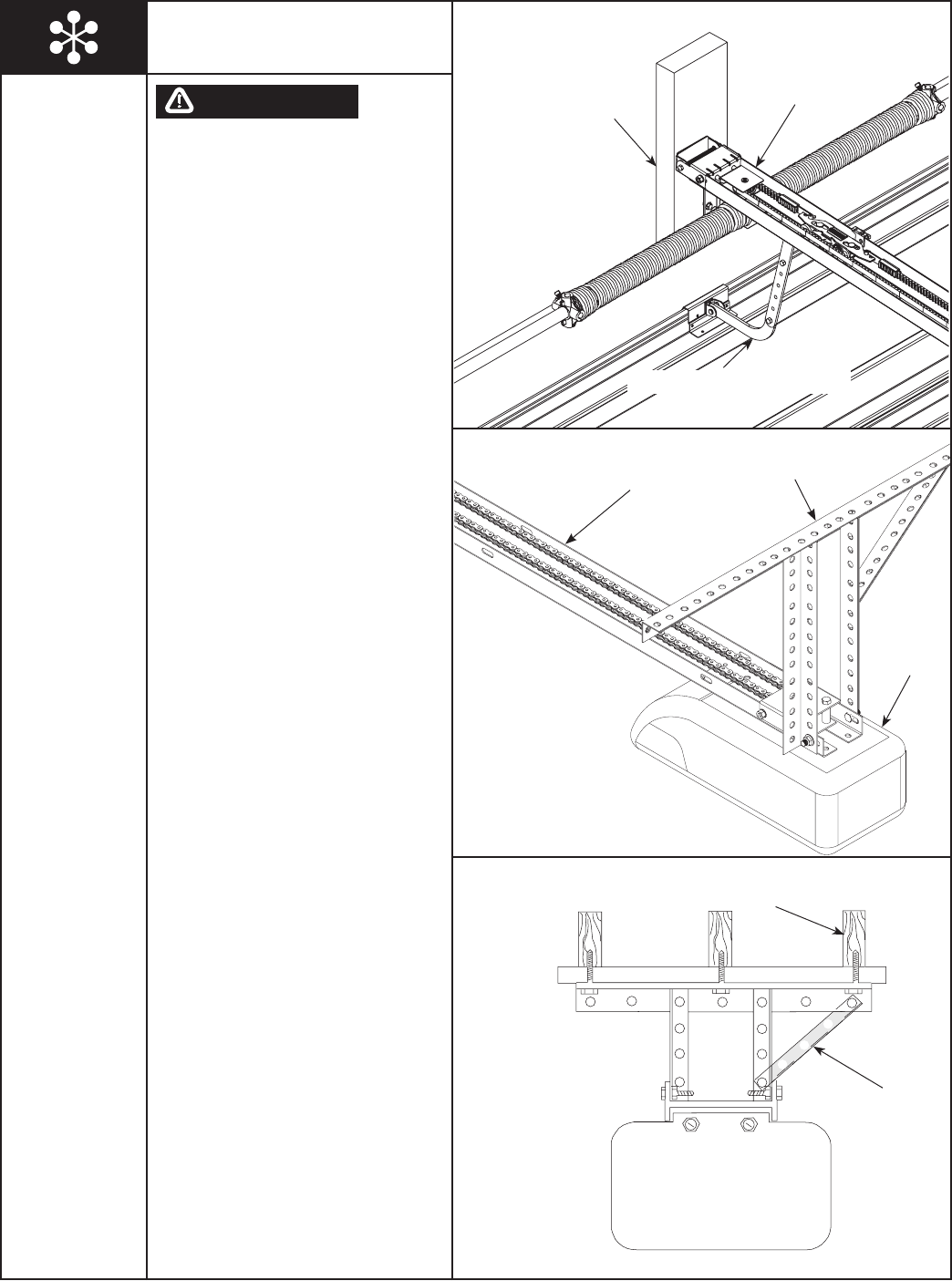
1. Install operator rail 1/2” to 1-1/2”
(13 - 38 mm) above high arc of top
section of the door.
2. Mount operator to ceiling so that
1” to 1-1/2” (25 - 38 mm)
clearance is maintained between
trolley rail and top section when
door is fully open (trolley rail will
slope down towards rear).
3. Attach door arm to operator bracket
installed in Step 10.
4. Attach operator rail to suitable
mounting surface, 2 x 6 lumber
minimum.
5. Attach operator to ceiling using
perforated angle.
IMPORTANT: ANGLES MUST BE
SECURELY ATTACHED TO SOUND
FRAMING MEMBER(S).
HEADER
OPERATOR
FRAMING MEMBERS
PERFORATED ANGLE
OPERATOR
RAIL
PERFORATED
ANGLE
OPERATOR RAIL
WARNING SUITABLE MOUNTING
SURFACE 2 X 6
LUMBER MINIMUM
DOOR ARM TO OPERATOR BRACKET
33
Please Do Not Return This Product To The Store. Contact your local Wayne-Dalton dealer. To find your local Wayne-Dalton dealer, refer to your
local yellow pages/business listings or go to the Find a Dealer section online at www.wayne-dalton.com
MAINTENANCE
Cleaning
Painting
Cleaning Your Garage Door
IMPORTANT: DO NOT USE A PRESSURE WASHER ON YOUR GARAGE DOOR!
While factory-applied finishes on garage doors are durable, it is desirable to clean them on a routine basis. Some discoloration of the
finish may occur when a door has been exposed to dirt-laden atmosphere for a period of time. Slight chalking may also occur as a
result of direct exposure to sunlight.
Cleaning the door will generally restore the appearance of the finish. To maintain an aesthetically pleasing finish of the garage door, a
periodic washing of the garage door is recommended.
The following cleaning solution is recommended
A mild detergent solution consisting of one cup detergent (with less than 0.5% phosphate) dissolved into five gallons of warm water will
aid in the removal of most dirt.
NOTE: The use of detergents containing greater than 0.5% phosphate is not recommended for use in general cleaning of garage doors.
NOTE: Be sure to clean behind weather stripping on both sides and top of door.
CAUTION: NEVER MIX CLEANSERS OR DETERGENTS WITH BLEACH.
GLASS CLEANING INSTRUCTIONS
Clean with a mild detergent solution (same as above) and a soft cloth. After cleaning, rinse thoroughly.
ACRYLIC CLEANING INSTRUCTIONS
Clean acrylic glazing with nonabrasive soap or detergent and plenty of water. Use your bare hands to feel and dislodge any caked on
particles. A soft, grit-free cloth, sponge or chamois may be used to wipe the surface. Do not use hard or rough cloths that will scratch
the acrylic glazing. Dry glazing with a clean damp chamois.
NOTE: DO NOT USE any window cleaning fluids, scouring compounds, gritty cloths or solvent-based cleaners of any kind.
Surface Preparation for Painting
Wax on the surface must be removed or paint peeling/flaking will result. To remove this wax, it will be necessary to lightly scuff the
surface with a fine steel wool pad, saturated with soapy water. A final wipe and rinse should be done with clean water only, to remove
any loose particles and any soapy film residue.
Surface scratches, which have not exposed the metal substrate, can be lightly buffed or sanded with 0000 steel wool or No. 400 sand
paper to create a smoother surface. Care must be taken to not expose the substrate under the paint. Once the substrate is exposed, the
likelihood for rusting is greatly increased.
If substrate is exposed, it must be treated to prevent rust from forming. Sand the exposed area lightly and paint with a high quality metal
primer, specifically intended for galvanized surfaces, to protect the area from corrosion. Allow for drying time on primer can label before
applying topcoat. The surface of the factory-applied finish, that is being painted, must not be too smooth, or the paint will not adhere to
it. It is advisable to test in an inconspicuous area, to evaluate adhesion. If poor adhesion is observed, surface preparation for painting the
factory-applied finish must be repeated until desired results are achieved. Again, care must be taken to not expose the substrate under
the paint.
Painting
After surface has been properly prepared, it must be allowed to dry thoroughly, and then coated immediately with premium quality latex
house paint. Follow paint label directions explicitly. Oil base or solvent base paints are not recommended. Please note that if substrate is
exposed and not properly primed, painting with latex paint may cause accelerated rusting of the steel in the exposed area.

34
Please Do Not Return This Product To The Store. Contact your local Wayne-Dalton dealer. To find your local Wayne-Dalton dealer, refer to your
local yellow pages/business listings or go to the Find a Dealer section online at www.wayne-dalton.com
Painting Continued....
NOTES:
1. Repainting of finish painted steel doors cannot be warranted, as this condition is totally beyond the door manufacturer’s control.
2. Consult a professional coatings contractor if in doubt about any of the above directions.
3. Follow directions explicitly on the paint container labels for proper applications of coatings and disposal of containers. Pay particular
attention to acceptable weather and temperature conditions in which to paint.

35
Please Do Not Return This Product To The Store. Contact your local Wayne-Dalton dealer. To find your local Wayne-Dalton dealer, refer to your
local yellow pages/business listings or go to the Find a Dealer section online at www.wayne-dalton.com
Lifetime Limited Warranty
Models 9100, 9400, 9600
Subject to the terms and conditions contained in this Lifetime Limited Warranty, Wayne-Dalton Corp. (“Manufacturer”) warrants the sections of the door, which is described
at the top of this page, for as long as you own the door against:
(i) The door becoming inoperable due to rust-through of the steel skin from the core of the door section, due to cracking, splitting, or other
deterioration of the steel skin, or due to structural failure caused by separation or degradation of the foam insulation.
(ii) Peeling of the original paint on the door as a result of a defect in the original paint or in the application of the original paint coating, in cases
where the door sections and the original paint: (a) have not been subjected to adverse atmospheric conditions or contaminates (such as salt water
or other marine environment, or to toxic or abrasive substances, including those in the air); (b) have been maintained in compliance with
Manufacturer’s recommendations; and (c) have not been subject to physical abrasion, impacted by a hard object, or punctured (including
without limitation “paint rub” occurring in metal to metal contact and movement).
The Manufacturer warrants the garage door hardware (except springs) and the tracks of the above-described door, for as long as you own the door, against
defects in material and workmanship, subject to all the terms and conditions below.
The Manufacturer warrants those component parts of the door not covered by the preceding provisions of this Lifetime Limited Warranty against defects in
material and workmanship for a period of ONE (1) YEAR from the date of installation.
The Manufacturer warrants the factory-applied finish and the factory attached stiles against fading and cosmetic changes from the time of installation for TWO
(2) YEARS. If the door is re-stained or re-painted, the TWO (2) YEARS warranty for the factory-applied finish is void. The Model 9400 factory attached stiles are warranted
against peeling, cracking, chalking, or delamination from the time of installation for TWO (2) YEARS.
After a period of TWENTY (20) YEARS, from time of installation, replacement of Lifetime Limited Warranty materials will be pro-rated at 50 per cent of Manu-
facturer’s published list pricing at time of claim, and you must pay this amount.
This Limited Warranty is extended only to the person who purchased the product and continues to own the premises (where the door is installed) as his/her
primary residence (“Buyer”). This Limited Warranty does not apply to residences other than primary, or to commercial or industrial installations, or to installations on rental
property (even when used by a tenant as a residence). This Limited Warranty is not transferable to any other person (even when the premises is sold), nor does it extend
benefits to any other person. As a result this warranty does NOT apply to any person who purchases this product from someone other than an authorized Wayne-Dalton
dealer or distributor.
The Manufacturer will not be responsible for any damage attributable to improper storage, improper installation, or any alteration of the door or its compo-
nents, abuse, damage from corrosive fumes or substances, salt spray or saltwater air, fire, Acts of God, failure to properly maintain the door, or attempt to use the door, its
components or related products for other than its intended purpose and its customary usage. This Limited Warranty does not cover ordinary wear. This Limited Warranty
will be voided if the original finish is painted over, unless Manufacturer’s preparation and painting instructions are followed explicitly. This Limited Warranty will be voided if
any holes are drilled into the door, other than those specified by the Manufacturer.
THIS LIMITED WARRANTY COVERS A CONSUMER PRODUCT AS DEFINED BY THE MAGNUSON-MOSS ACT. NO WARRANTIES, EXPRESS OR IMPLIED (INCLUDING
BUT NOT LIMITED TO THE WARRANTY OF MERCHANTABILITY OR FITNESS FOR A PARTICULAR PURPOSE) WILL EXTEND BEYOND THE TIME PERIOD SET FORTH IN UNDER-
SCORED BOLD FACE TYPE IN THIS LIMITED WARRANTY, ABOVE.
• SomeStatesdonotallowlimitationsonhowlonganimpliedwarrantylasts,sotheabovelimitationsmaynotapplytoyou.
Any claim under this Limited Warranty must be made in writing, within the applicable warranty period, to the dealer from which the product was purchased.
Unless the dealer is no longer in business, a written claim to the Manufacturer will be the same as if no claim had been made at all.
At the Manufacturer’s option, a service representative may inspect the product on site, or Buyer may be required to return the product to the Manufacturer at
Buyer’s expense. Buyer agrees to cooperate with any representative of the Manufacturer and to give such representative full access to the product with the claimed defect
and full access to the location of its installation.
If the Manufacturer determines that the claim is valid under the terms of this Limited Warranty, the Manufacturer will repair or replace the defective product.
The decision about the manner in which the defect will be remedied will be at the discretion of the Manufacturer, subject to applicable law. THE REMEDY WILL COVER ONLY
MATERIAL. THIS LIMITED WARRANTY DOES NOT COVER OTHER CHARGES, SUCH AS FIELD SERVICE LABOR FOR REMOVAL, INSTALLATION, PAINTING, SHIPPING, ETC.
Any repairs or replacements arranged by Manufacturer will be covered by (and subject to) the terms, conditions, limitations and exceptions of this Limited War-
ranty; provided, however, that the installation date for the repaired or replaced product will be deemed to be the date the original product was installed, and this Limited
Warranty will expire at the same time as if there had been no defect. If a claim under this Limited Warranty is resolved in a manner other than described in the immediately
preceding paragraph, then neither this Limited Warranty nor any other warranty from the Manufacturer will cover the repaired or replaced portion of the product.
THE REMEDIES FOR THE BUYER DESCRIBED IN THIS LIMITED WARRANTY ARE EXCLUSIVE and take the place of any other remedy. The liability of the Manu-
facturer, whether in contract or tort, under warranty, product liability, or otherwise, will not go beyond the Manufacturer’s obligation to repair or replace, at its option, as
described above. THE MANUFACTURER WILL NOT UNDER ANY CIRCUMSTANCES BE LIABLE FOR SPECIAL, INCIDENTAL, OR CONSEQUENTIAL DAMAGES, including (but not
limited to) damage or loss of other property or equipment, personal injury, loss of profits or revenues, business or service interruptions, cost of capital , cost of purchase or
replacement of other goods, or claims of third parties for any of the foregoing.
• SomeStatesdonotallowtheexclusionorlimitationofincidentalorconsequentialdamages,sotheabovelimitationorexclusionmaynotapplyto
you.
No employee, distributor, dealer, representative, or other person has the authority to modify any term or condition contained in this Limited Warranty or to grant
any other warranty on behalf of or binding on the Manufacturer, and anyone’s attempt to do so will be null and void.
Buyer should be prepared to verify the date of installation to the satisfaction of the Manufacturer.
The rights and obligations of the Manufacturer and Buyer under this Limited Warranty will be governed by the laws of the State of Ohio, USA, to the extent
permitted by law.
• ThisLimitedWarrantygivesyouspeciclegalrightsandyoumayalsohaveotherrights,whichmayvaryfromStatetoState.

36
Covered by one or more of the following Patents; 5,408,724; 5,409,051; 5,419,010; 5,495,640; 5,522,446; 5,562,141; 5,566,740;
5,568,672; 5,718,533; 6,019,269; 6,089,304; 6,644,378; 6,374,567; 6,561,256; 6,527,037; 6,640,872; 6,672,362; 6,725,898; 6,843,300;
6,915,573; 6,951,237; 7,014,386; 7,036,548; 7,059,380; 7,121,317; 7,128,123; 7,134,471; 7,134,472; 7,219,392; 7,254,868. Canadian:
2,384,936; 2,477,445; 2,495,175; 2,507,590; 2,530,701; 2,530,74; 2, 2,532,824. Other US and Foreign Patents pending.
Contact your local Wayne-Dalton dealer. To find your local Wayne-Dalton dealer, refer to your local yellow pages
business listings or go to the Find a Dealer section online at www.wayne-dalton.com
Thank you for your purchase
Please Do Not Return This Product To The Store
