Weider Crossbar Vision Wesy3873 Users Manual WESY38732 202970
Weider-Wesy38732-Owner-S-Manual weider-wesy38732-owner-s-manual
Weider-Wesy38731-Owner-S-Manual weider-wesy38731-owner-s-manual
Weider-Wesy3873-2-Users-Manual-233830 weider-wesy3873-2-users-manual-233830
WESY3873.2 to the manual 04efe88f-a6dc-4cd9-98ef-a483d392541c
2015-05-18
: Weider Weider-Crossbar-Vision-Wesy3873-Users-Manual-734070 weider-crossbar-vision-wesy3873-users-manual-734070 weider pdf
Open the PDF directly: View PDF  .
.
Page Count: 24
CAUTION
Read all precautions and instruc-
tions in this manual before
using this equipment. Save this
manual for future reference.
Model No. WESY3873.2
Serial No.
Write the serial number in the
space above for future reference.
QUESTIONS?
As a manufacturer,we are com-
mitted to providing complete
customer satisfaction. If you
have questions, or if a part is
damaged or missing, PLEASE
CONTACT OUR CUSTOMER
SERVICE DEPARTMENT
DIRECTLY.
CALL TOLL-FREE:
1-877-992-5999
Mon.–Fri., 6 a.m.–6 p.m. MST
ON THE WEB:
www.weiderservice.com
Visit our website at
www.weiderfitness.com
new products, prizes,
fitness tips, and much more!
V
USER’S MANUAL
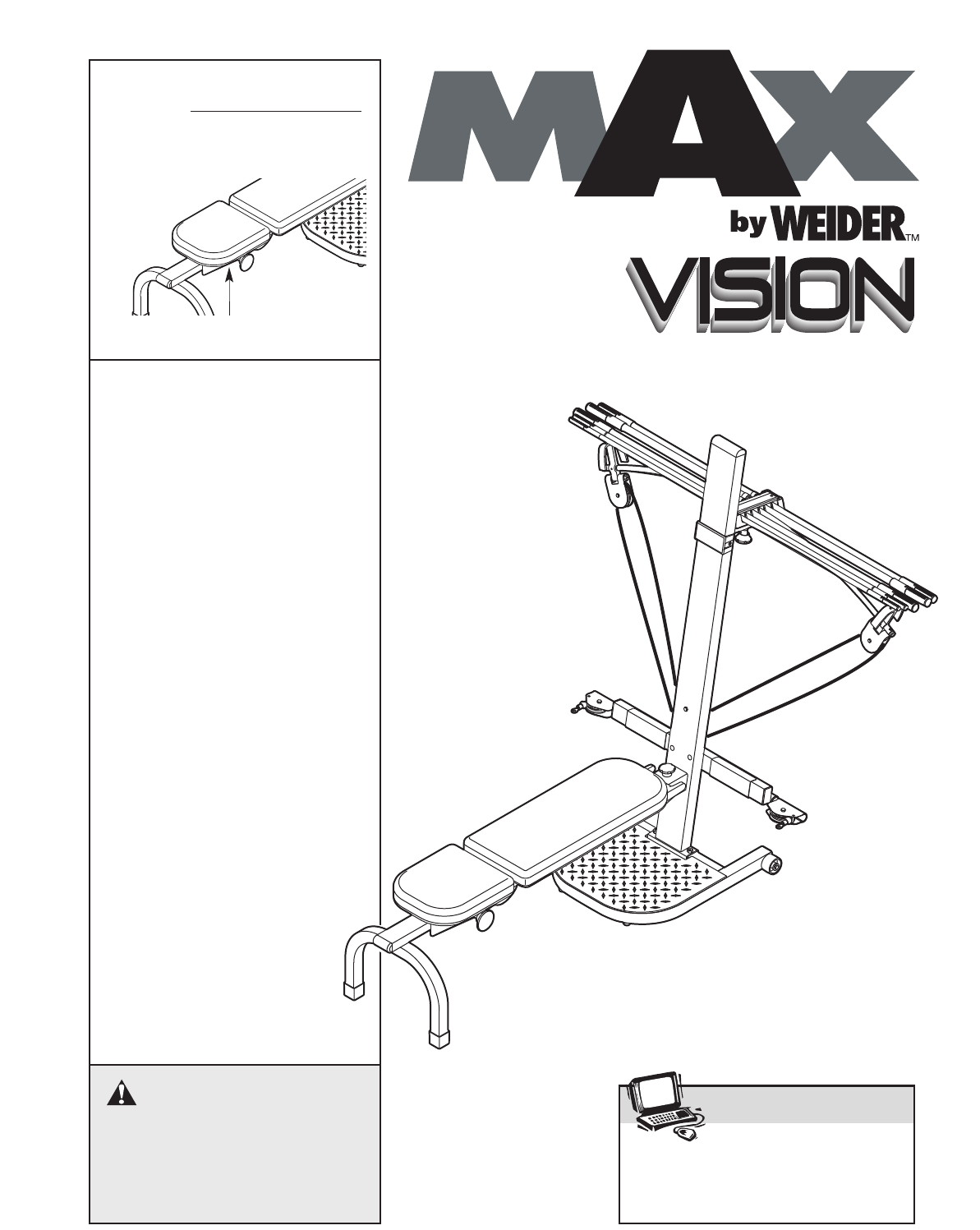
Serial Number Decal (under seat)
2
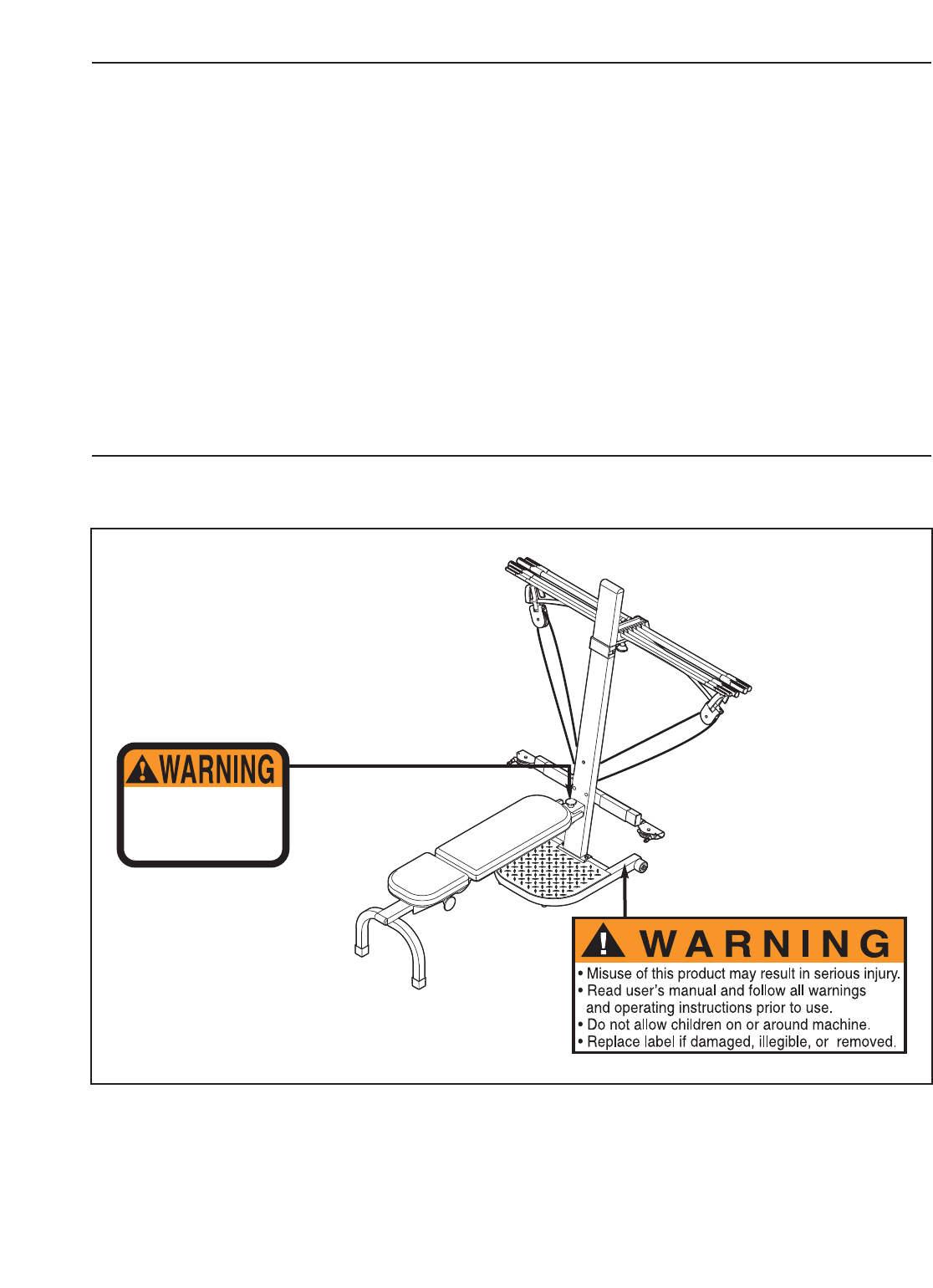
WARNING DECAL PLACEMENT
WARNING DECAL PLACEMENT . . . . . . . . . . . . . . . . . . . . . . . . . . . . . . . . . . . . . . . . . . . . . . . . . . . . . . . . . . . . . 2
IMPORTANT PRECAUTIONS . . . . . . . . . . . . . . . . . . . . . . . . . . . . . . . . . . . . . . . . . . . . . . . . . . . . . . . . . . . . . . . . 3
BEFORE YOU BEGIN . . . . . . . . . . . . . . . . . . . . . . . . . . . . . . . . . . . . . . . . . . . . . . . . . . . . . . . . . . . . . . . . . . . . . . 4
ASSEMBLY . . . . . . . . . . . . . . . . . . . . . . . . . . . . . . . . . . . . . . . . . . . . . . . . . . . . . . . . . . . . . . . . . . . . . . . . . . . . . . .5
ADJUSTMENTS . . . . . . . . . . . . . . . . . . . . . . . . . . . . . . . . . . . . . . . . . . . . . . . . . . . . . . . . . . . . . . . . . . . . . . . . . . 12
CABLE DIAGRAM . . . . . . . . . . . . . . . . . . . . . . . . . . . . . . . . . . . . . . . . . . . . . . . . . . . . . . . . . . . . . . . . . . . . . . . . .15
EXERCISE GUIDELINES . . . . . . . . . . . . . . . . . . . . . . . . . . . . . . . . . . . . . . . . . . . . . . . . . . . . . . . . . . . . . . . . . . 16
ORDERING REPLACEMENT PARTS . . . . . . . . . . . . . . . . . . . . . . . . . . . . . . . . . . . . . . . . . . . . . . . . . .Back Cover
LIMITED WARRANTY . . . . . . . . . . . . . . . . . . . . . . . . . . . . . . . . . . . . . . . . . . . . . . . . . . . . . . . . . . . . . . Back Cover
Note: A PART IDENTIFICATION CHART and a PART LIST/EXPLODED DRAWING are attached in the center of
this manual. Remove the PART IDENTIFICATION CHART and PART LIST/EXPLODED DRAWING before begin-
ning assembly.
MAX by WEIDER is a trademark of ICON IP
,Inc.
TABLE OF CONTENTS
The decals shown here have been
placed on the resistance system. If a
decal is missing or illegible, call the
toll-free telephone number on the front
cover of this manual and order a free
replacement decal. Apply the decal in
the location shown.
Keep hands and
fingers clear of
this area.

3
1. Read all instructions in this manual and all
warnings on the resistance system before
using the resistance system. Use the resist-
ance system only as described in this manual.
2. It is the responsibility of the owner to ensure
that all users of the resistance system are
adequately informed of all precautions.
3. The resistance system is intended for home
use only. Do not use the resistance system in
any commercial, rental, or institutional setting.
4. Keep the resistance system indoors, away
from moisture and dust. Place the resistance
system on a level surface, with a mat
beneath it to protect the floor or carpet. Make
sure that there is enough clearance around
the resistance system to mount, dismount,
and use the resistance system.
5. Inspect and properly tighten all parts regular-
ly. Replace any worn parts immediately.
6. Keep children under 12 and pets away from
the resistance system at all times.
7. Keep hands and feet away from moving parts.
8. Always wear athletic shoes for foot protec-
tion while exercising.
9. Make sure the rings on the resistance bars
are pushed against the tray before using the
resistance system.
10. The resistance system is designed to sup-
port a maximum user weight of 300 pounds.
11. When adding resistance, both ends of the
resistance bars must rest under the two “U”-
channels. Add and remove resistance bars
from the “U”-channels one resistance bar at
atime.
12. Pull on the cable only while sitting on the
bench or standing on the base plate.
13. The resistance system is designed to be
used with the included resistance, and the
resistance included with a MAX by WEIDER
MAX PACK. Do not use the resistance sys-
tem with any other type of resistance.
14. Keep clear of the area around the “U”-chan-
nels while the resistance system is in use.
Do not add or remove resistance bars from
the “U”-channels while the end of the long
cable is pulled out.
15. Always adjust the resistance bars assembly
to the horizontal position and make sure the
fulcrum knob is secure before using the
resistance system.
16. Make sure the storage knob is in place and
fully tightened each time the resistance sys-
tem is used.
17. Make sure that the cable remains on the pul-
leys at all times. If the cable binds as you are
exercising, stop immediately and make sure
that the cable is on the pulleys. Replace all
cables at least every two years.
18. If you feel pain or dizziness while exercising,
stop immediately and begin cooling down.
WARNING: Before beginning this or any exercise program, consult your physician. This
is especially important for persons over the age of 35 or persons with pre-existing health problems.
Read all instructions before using. ICON assumes no responsibility for personal injury or property
damage sustained by or through the use of this product.
WARNING: To reduce the risk of serious injury, read the following important precautions
before using the resistance system.
IMPORTANT PRECAUTIONS
4
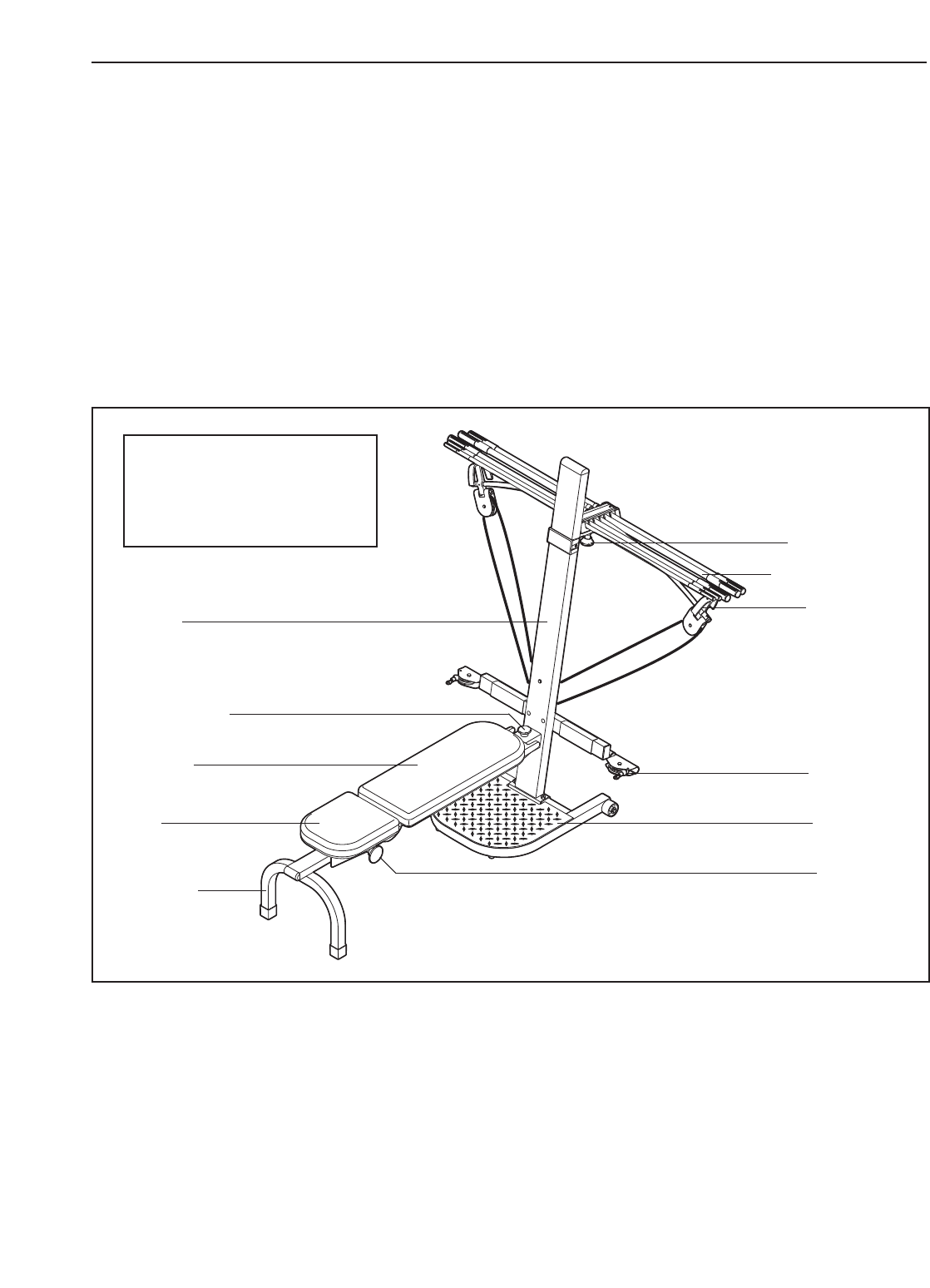
Backrest
Storage Knob
Fulcrum Knob
Upright
Long Cable
Base Plate
Seat Knob
Seat
Front Leg
Resistance Bars
“U”-Channel
BEFORE YOU BEGIN
Thank you for selecting the innovative MAX by
WEIDER™VISION resistance system. The resistance
system offers a selection of stations designed to devel-
opevery major muscle group of the body. Whether your
goal is to tone your body, build dramatic muscle size
and strength, or improve your cardiovascular system,
the resistance system will help you to achieve the spe-
cific results you want.
For your benefit, read this manual carefully before
using the resistance system. If you have questions
after reading this manual, see the front cover of this
manual. To help us assist you, please note the product
model number and serial number before calling. The
model number is WESY3873.2. The serial number can
befound on a decal attached to the resistance system
(see the front cover of this manual).
To avoid a registration fee for any service needed
under warranty, you must register the resistance
system at www.weiderservice.com/registration.
Before reading further, please review the drawing below
and familiarize yourself with the parts that are labeled.
ASSEMBLED DIMENSIONS:
Height: 60 in. / 152 cm
Width: 66 in. / 168 cm
Depth: 76 in. / 193 cm
5
Before beginning assembly, carefully read the
following information and instructions:
•Assembly requires two persons.
•Place all parts in a cleared area and remove the
packing materials. Do not dispose of the packing
materials until assembly is completed.
•
For help identifying small parts, use the PART
IDENTIFICATION CHART.
Note: Some small
parts may have been pre-attached for shipping. If
apart is not in the parts bag, check to see if it
has been pre-attached.
•Tighten all parts as you assemble them, unless
instructed to do otherwise.
•Asyou assemble the resistance system, make
sure all parts are oriented as shown in the draw-
ings.
The included Allen wrenches and the follow-
ing tools (not included) are required for assem-
bly:
• Two adjustable wrenches
• One rubber mallet
• One standard screwdriver
• One Phillips screwdriver
• Lubricant, such as grease or petroleum jelly,
and soapy water.
Assembly will be more convenient if you have a
socket set, a set of open-end or closed-end
wrenches, or a set of ratchet wrenches.
Make Things Easier for Yourself
This manual is designed to ensure that the resist-
ance system can be assembled successfully by
most people. However, it is important to realize
that the versatile resistance system has many
parts and that the assembly process will take
time. Most people find that by setting aside plenty
of time, assembly will go smoothly.
ASSEMBLY
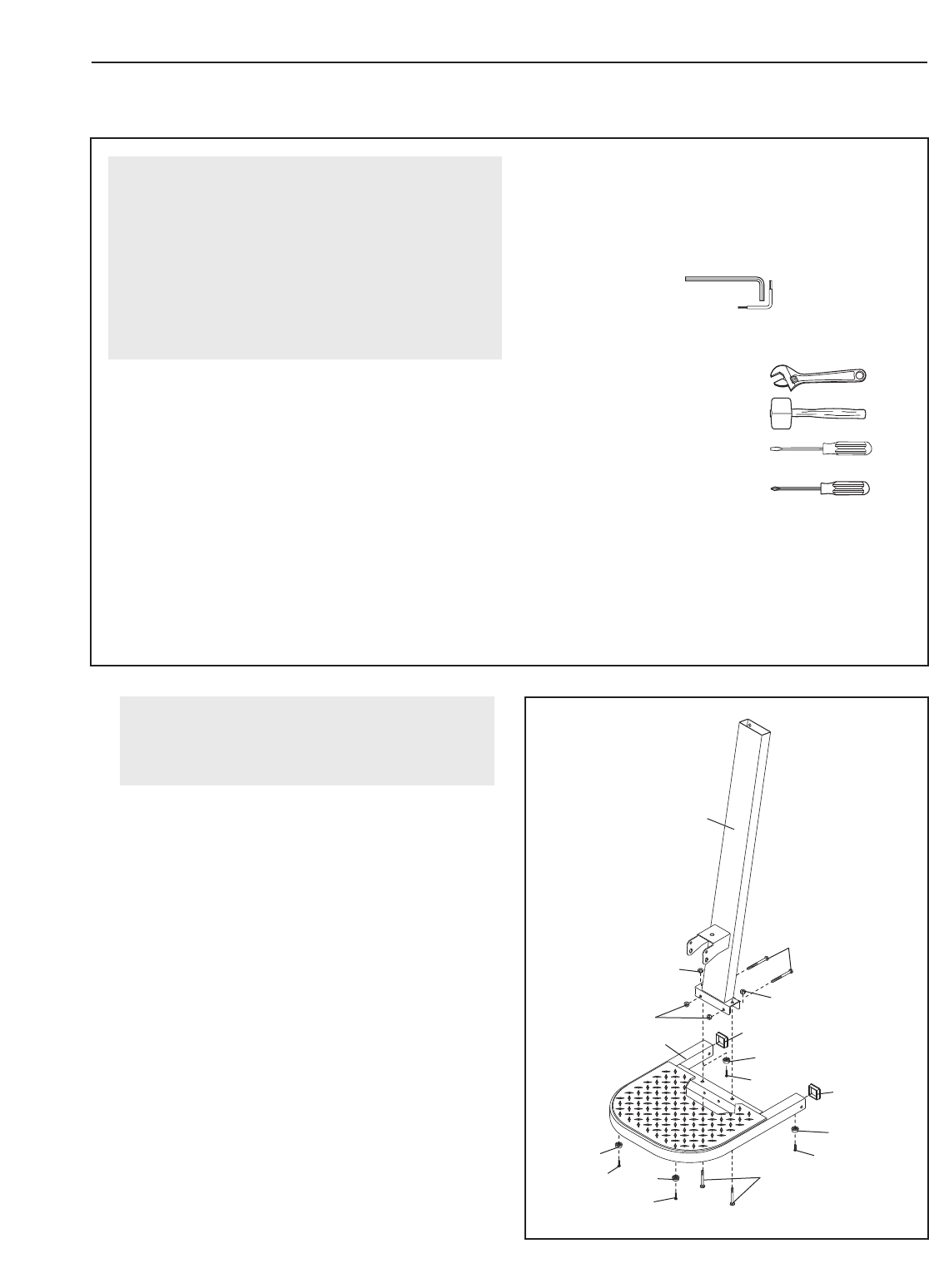
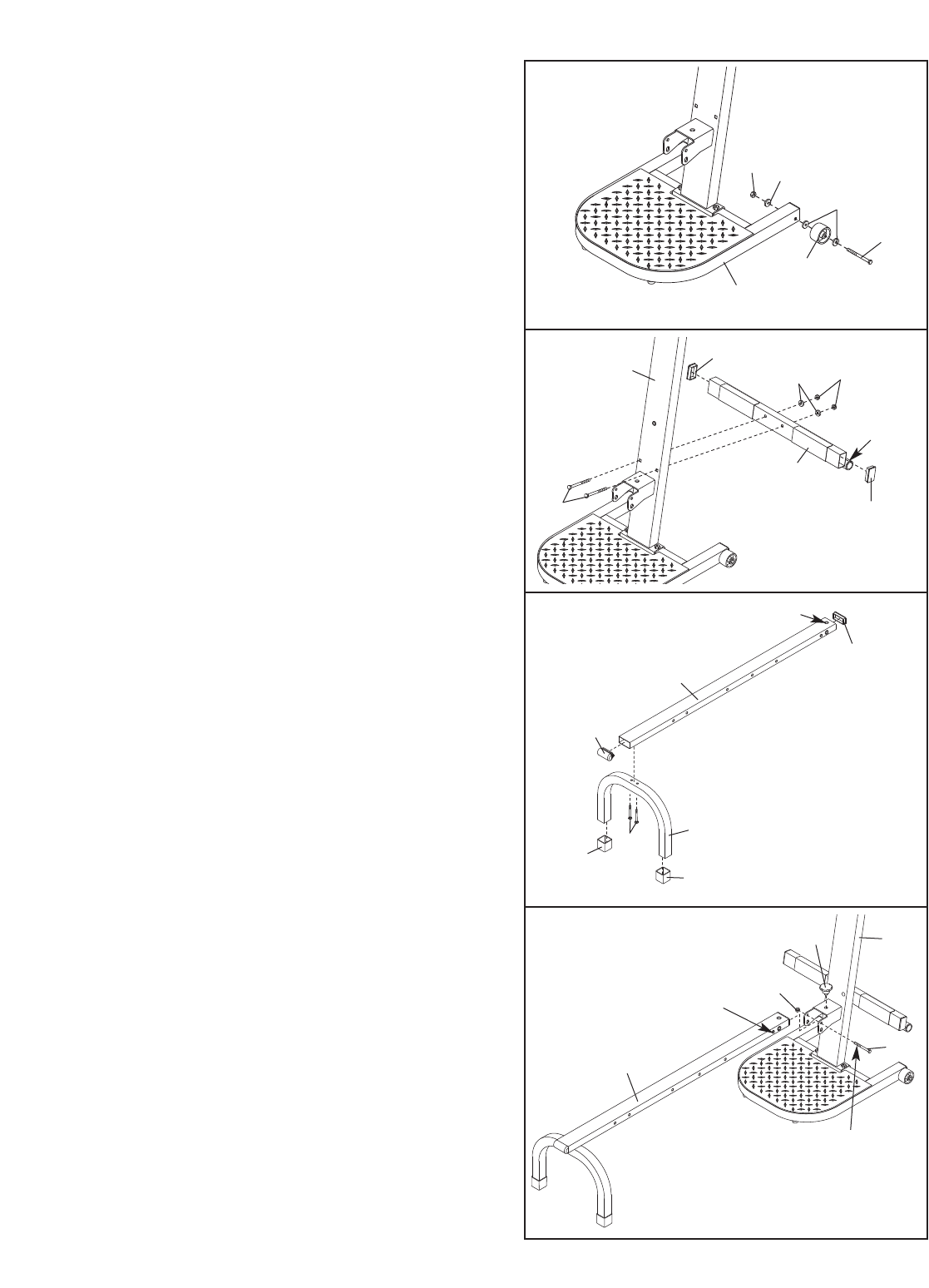
1
1.
Press two 50mm Square Inner Caps (38) into the
Base (1).
Attach two Plastic Feet (53) and two Large Plastic
Feet (26) to the Base (1) with four M4 x 16mm
Screws (62).
Attach the Upright (3) to the Base (1) with two
M10 x 66mm Carriage Bolts (83), two M10 x
72mm Bolts (64), and four M10 Nylon Locknuts
(76) as shown. Note: This step will be easier to
complete if the Upright and Base are tipped
on their sides.
Before beginning assembly,make sure that
you have read and understand the informa-
tion in the box above.
76
76
76
64
3
62
62
1
53
53
62
26
62
26
38
38
83
75
6
2. Attach a Wheel (31) to the outside of the Base (1)
with an M10 x 108mm Bolt (81), three M10
Washers (75), and an M10 Nylon Locknut (76).
Do not overtighten the Nylon Locknut; the
Wheel must be able to turn easily.
Attach the other Wheel (not shown) in the same
manner.
2
1
31
75
76
75
81
3. Press a 38mm x 64mm Inner Cap (41) into each
end of the Cross Tube (11).
Orient the Cross Tube (11) as shown, with the
welded tubes at the bottom. Attach the Cross
Tube to the Upright (3) with two M10 x 140mm
Carriage Bolts (73), two M10 Washers (75), and
two M10 Nuts (47).
341
3
73 41
Welded
Tube
11
47
5. Lubricate an M10 x 103mm Bolt (66) with grease.
Attach the Bench Rail (5) to the Upright (3) with
the Bolt and an M10 Nylon Locknut (76). Do not
overtighten the Locknut; the Bench Rail must
be able to pivot easily.
Tighten the Storage Knob (30) into the Upright (3)
and the Bench Rail (5).
4. Press the 38mm x 76mm Dome Cap (87) into the
indicated end of the Bench Rail (5). Press a
38mm x 76mm Inner Cap (34) into the other end
of the Bench Rail.
Press two 50mm Square Outer Caps (27) onto
the ends of the Front Leg (6).
Attach the Bench Rail (5), with the hole on the
top, to the Front Leg (6) with two M10 x 68mm
Screws (61).
4
5
5
34
Hole
87
27
27
61 6
76
30
66
Lubricate
Insert the bolt
through this hole
5
3
7
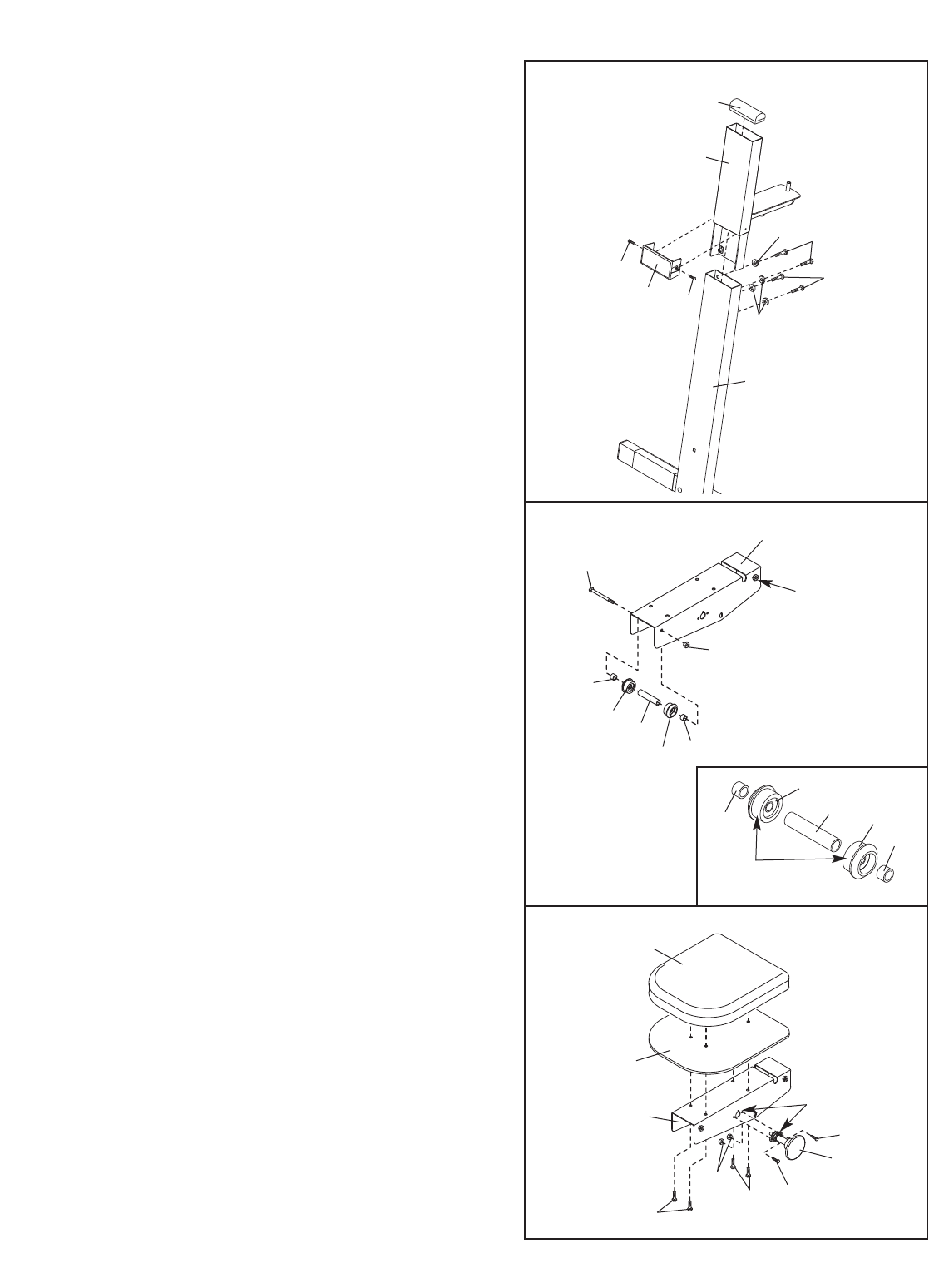
6. Press the Large Dome Cap (7) into the Top
Upright (4).
Attach the Top Upright (4) to the Upright (3) with
four M10 x 25mm Button Head Screws (78), and
four M10 Lock Washers (21).
Attach the Name Plate (70) to the Top Upright (4)
with two M4 x 16mm Screws (62).
6
4
3
70 62
62 78
78
7
21
21
7. Attach two 8mm Metal Spacers (42), a 60mm
Metal Spacer (39), and two Bearing Wheels (46)
to one end of the Seat Carriage (12) with an M8 x
104mm Button Head Bolt (60) and an M8 Nylon
Locknut (65) as shown. Make sure the parts are
oriented as shown in the inset drawing; the
Seat Knob (not shown) will not engage the
Bench Rail (not shown) if they are incorrectly
oriented. Do not overtighten the Locknut; the
Bearing Wheels must be able to roll easily.
Attach two Bearing Wheels (not shown) to the
other end of the Seat Carriage (12) in the
same manner.
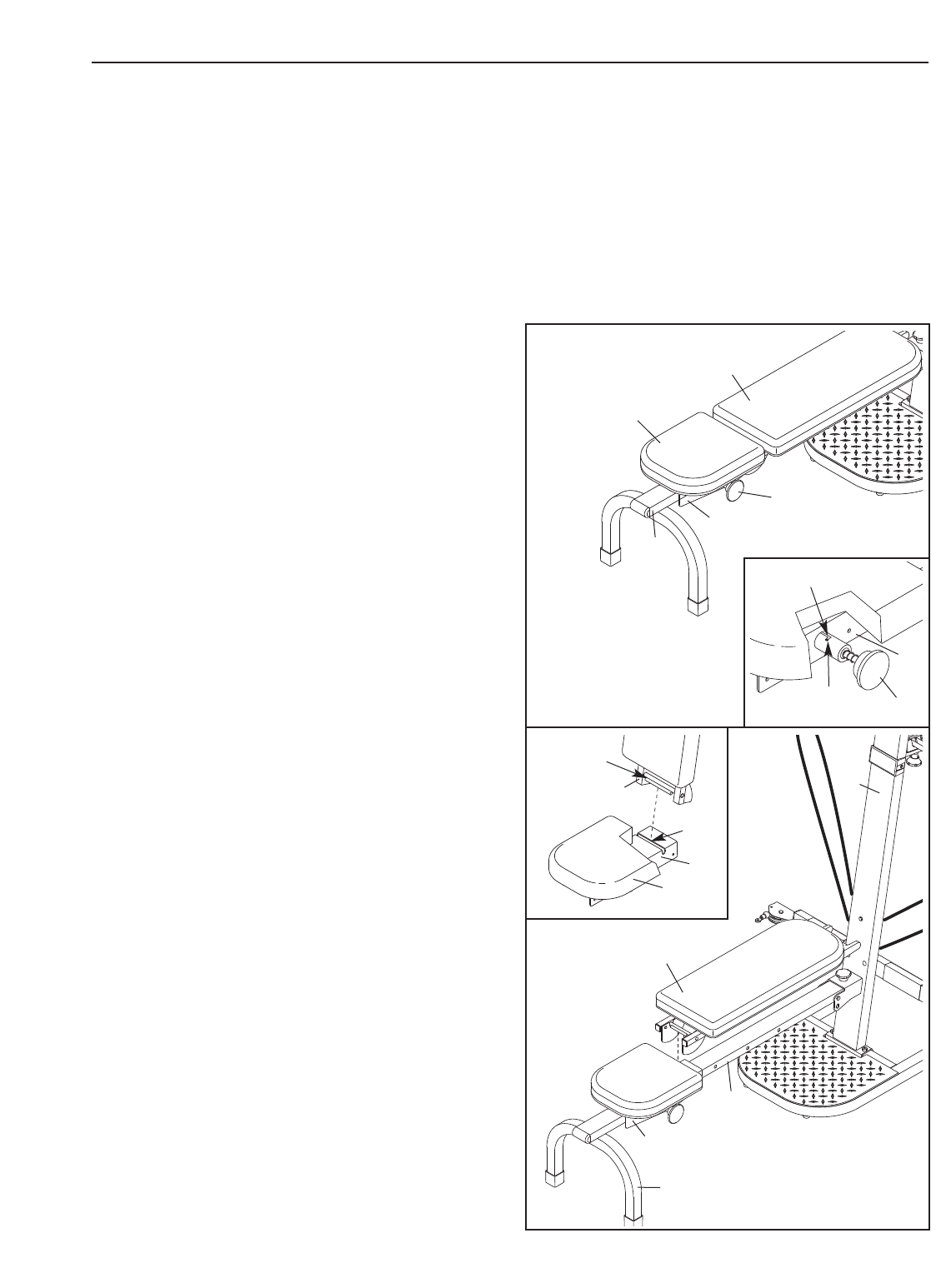
8. Attach the Seat Knob (45) to the Seat Carriage
(12) with two M6 x 13mm Bolts (59) and two M6
Nylon Locknuts (69). Make sure that the slot in
the Knob is aligned with the slot in the Seat
Carriage, as shown.
Orient the Seat (13), the Seat Backing (9), and
the Seat Carriage (12) as shown. Attach the Seat
and the Seat Backing to the Seat Carriage with
four 1/4” x 16mm Button Head Screws (82).
7
13
9
12
82
82
45
Slots
59
59
69
12
60
Attach second
set of wheels
here
65
42
42
39
46
46
Wide
Side
42 42
39
46
46
8
8
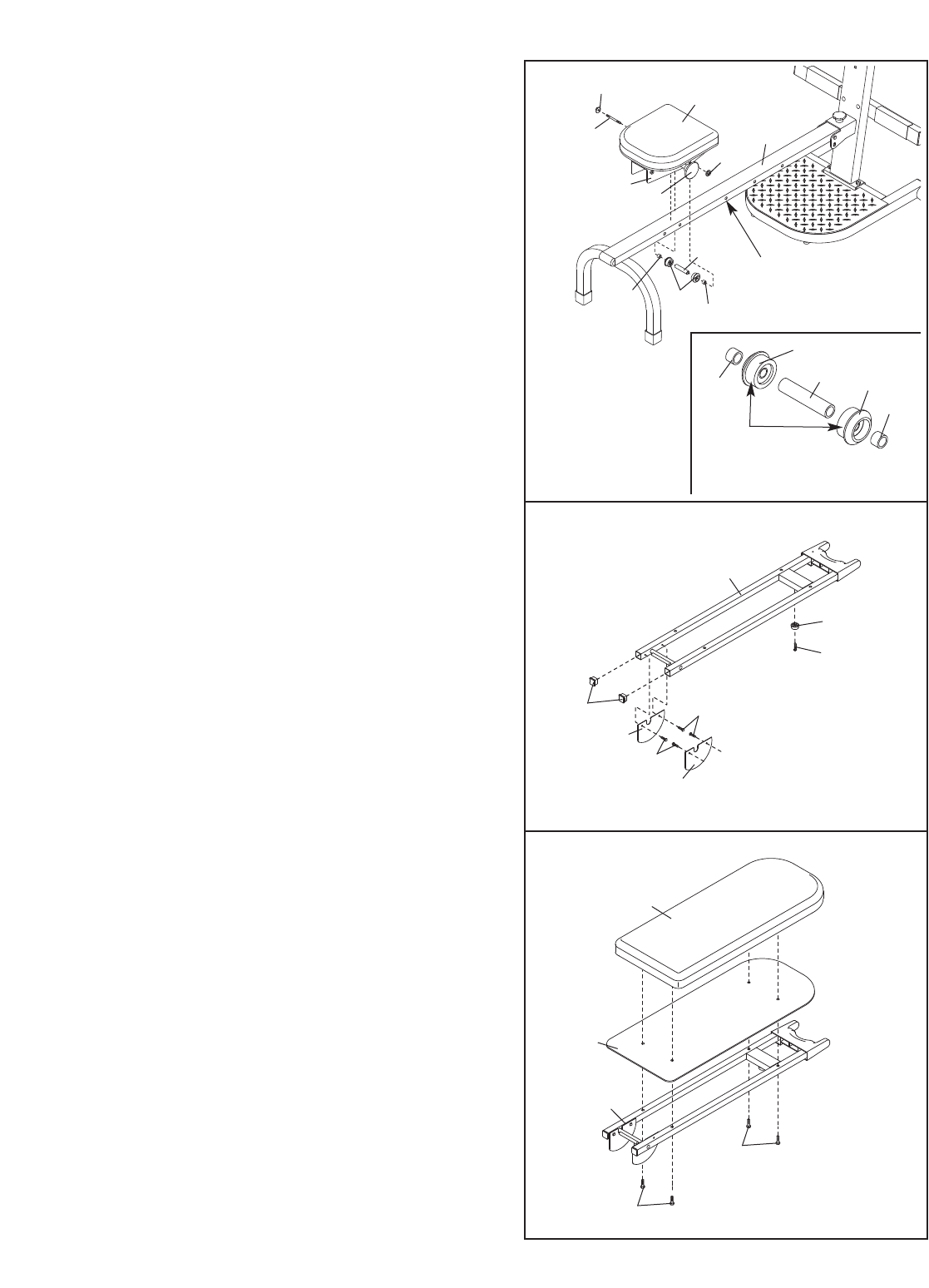
9. Pull out the Seat Knob (45) as far as it will go, and
set the Seat Carriage (12) on the Bench Rail (5).
Loosely attach two 8mm Metal Spacers (42), a
60mm Metal Spacer (39), and two Bearing
Wheels (46) to the center holes in the Seat
Carriage (12) with two M8 Flange Nuts (19) and
the M8 x 114mm Axle (57). Make sure that the
serrated edge of the Flange Nuts are against
the Seat Carriage.
While a second person presses down on the Seat
(13), hold the wheel assembly firmly against the
bottom of the Bench Rail (5) and properly tighten
the M8 Flange Nuts (19). Make sure that three
threads are extending past the Nut, and that
the wide sides of all six Wheels (46) are
pressed against the Bench Rail.
Engage the Seat Knob (45) into an adjustment
hole in the Bench Rail (5).
9
45
57
42 46 42
Adjustment
Hole
12
13
5
19
19
Wide
Side
42
42
39
46
46
39
11. Orient the Backrest (14) and the Backrest
Backing (8) as shown. Attach the Backrest and
the Backrest Backing to the Backrest Frame (15)
with four 1/4” x 45mm Button Head Screws (58).
11
15
8
58
58
14
10. Press two 25mm Square Inner Caps (54) into the
indicated end of the Backrest Frame (15).
Attach a Plastic Foot (53) to the Backrest Frame
(15) with an M4 x 16mm Screw (62).
Attach the two Guard Plates (17) to the inside of
the Backrest Frame (15) with four M4 x 16mm
Screws (62).
10
53
62
15
54
17
62
62
17
9
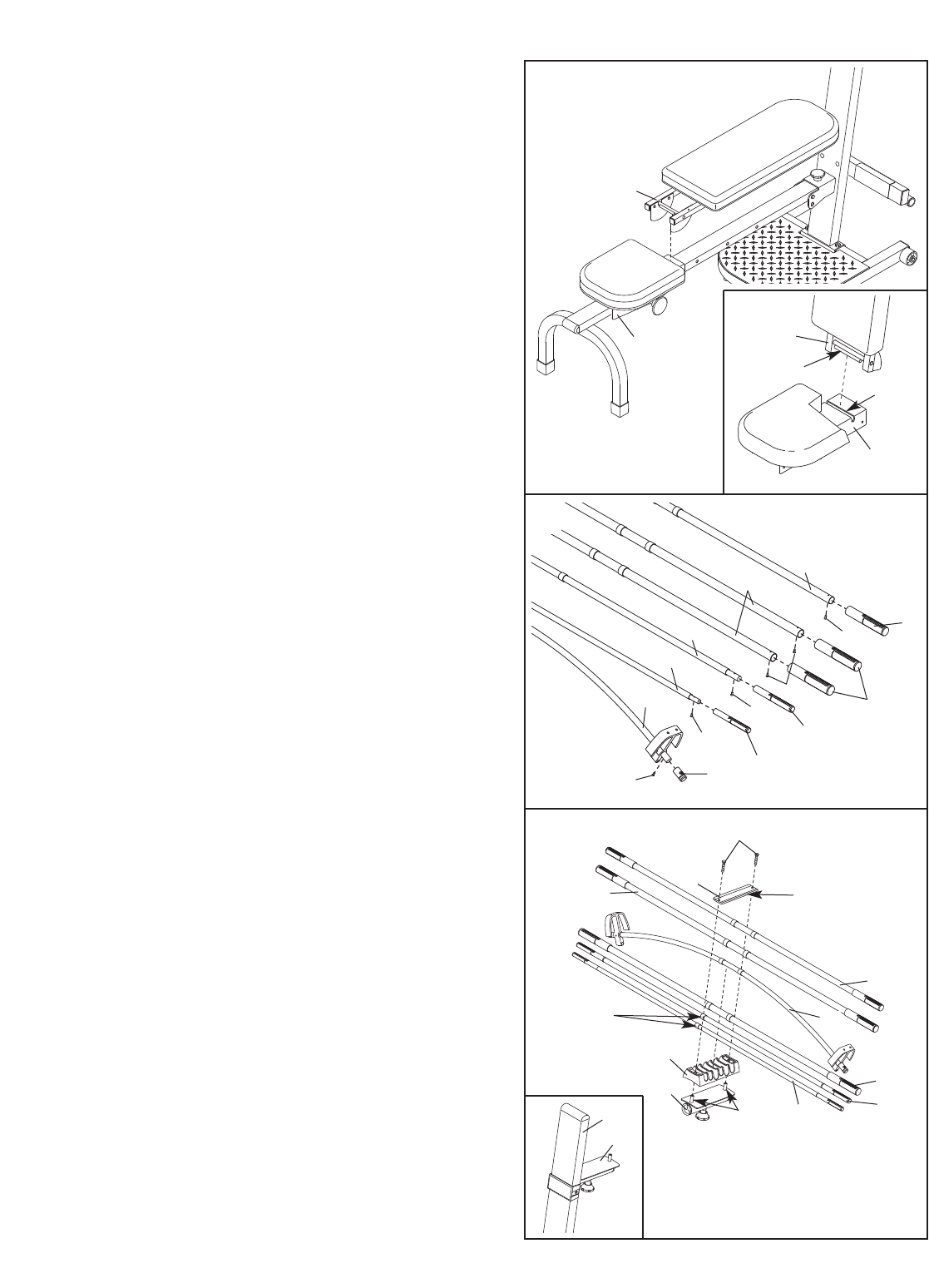
13. Attach the two 10-pound Short Caps (20) to the
10-pound Center Resistance Bar (44) with two
M4 x 12mm Flat Head Screws (85).
Using ten M4 x 12mm Flat Head Screws (85),
attach the two 10-pound Caps (32) to the 10-
pound Removable Resistance Bar (67), the two
20-pound Caps (77) to the 20-pound Removable
Resistance Bar (36), the four 80-pound Caps (33)
to the two 80-pound Resistance Bars (55), and
the two 40-pound Caps (79) to the 40-pound
Resistance Bar (52).
79
77
32
20
33
67
36
55
52
85
85
85
85
85
44
13
12
12. Insert the rod on the Backrest Frame (15) into the
slot in the Seat Carriage (12). Hold the Backrest
Frame vertically over the Seat Carriage and
slide the rod into the slot, as shown in the
inset drawing.
15
12
Rod
Slot
12
15
14 86
72
Rings on
this side
Edges
up
52
55
55
44
36
67
18
Rods
35
18
4
14. Locate the Fulcrum (18) on the Top Upright (4)
(see the inset drawing). Slide the Tray (35) onto
the rods on the Fulcrum. Make sure the Tray is
oriented as shown in the drawing.
Set the Resistance Bars into the Tray (35) in the
following order: the 10-pound Removable
Resistance Bar (67), the 20-pound Removable
Resistance Bar (36), an 80-pound Resistance Bar
(55), the 10-pound Center Resistance Bar (44),
the other 80-pound Resistance Bar (55), and the
40-pound Resistance Bar (52). Make sure the
indicated rings are on the side shown and the
arrows point toward the Tray.
Attach the Cover Plate (72), with the edges up, to
the Tray(35) with two M8 x 19mm Button Head
Screws (86).
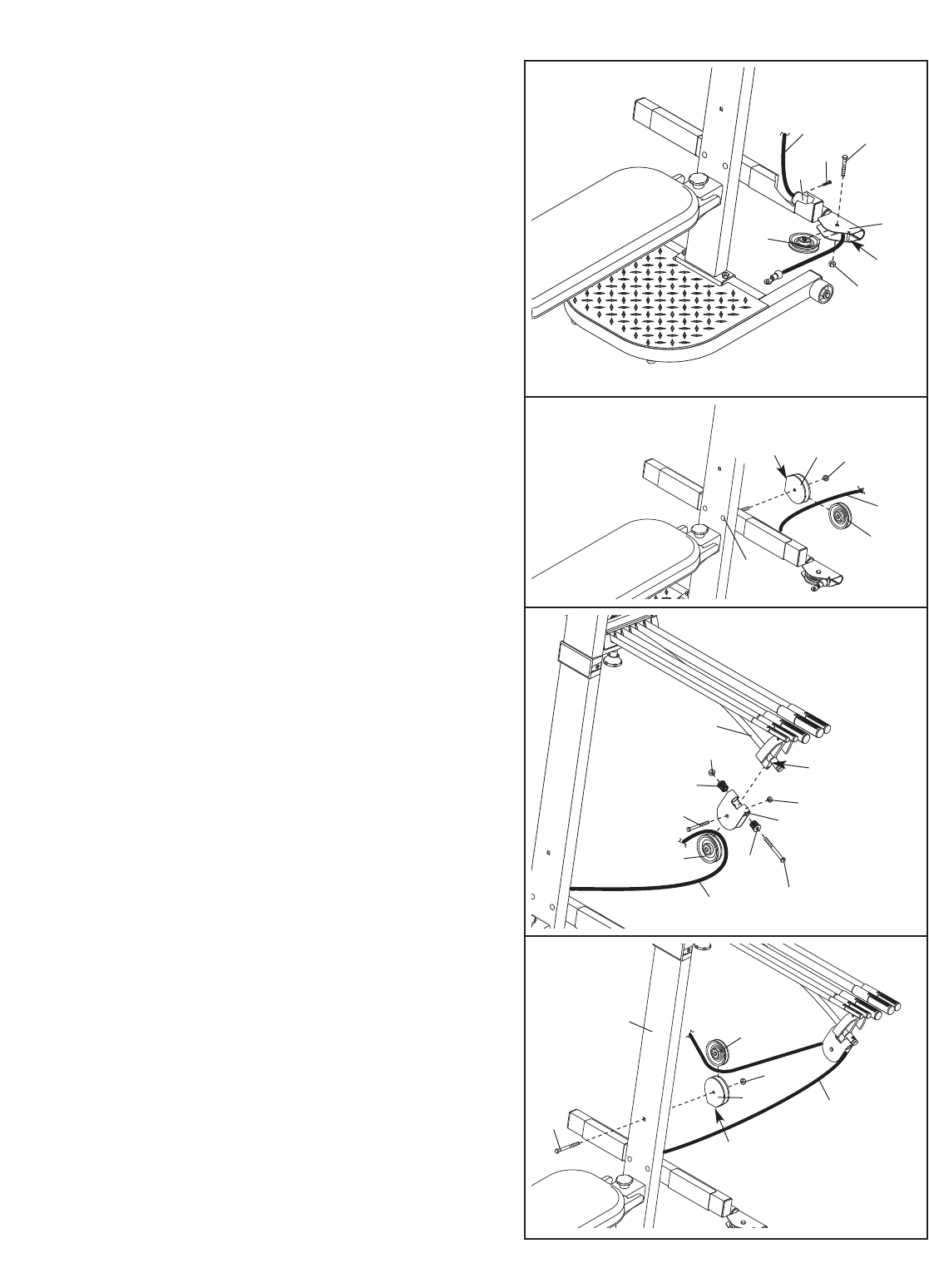
10
17. Attach a Pulley Housing (56) to the indicated “U”-
channel on the 10-pound Center Resistance Bar
(44) with an M10 x 102mm Button Head Bolt (24),
two Pivot Bushings (74), and an M10 Nylon
Locknut (76).
Wrap the Long Cable (80) around a 90mm Pulley
(28). Attach the Pulley inside of the Pulley
Housing (56) with an M10 x 42mm Button Head
Bolt (71) and an M10 Nylon Locknut (76).
18. Wrap the Long Cable (80) under a 90mm Pulley
(28) as shown. Attach the Pulley and a Pulley
Guard (29) to the Upright (3) with an M10 x
113mm Button Head Bolt (40) and an M10 Nylon
Locknut (76). Make sure the flat edge of the
Pulley Guard is on the bottom.
17
18
24
56
28
80
44
76
76
71
74
74
80
29
40
28
3
76
16. Wrap the Long Cable (80) around a 90mm Pulley
(28). Attach the Pulley and a Pulley Guard (29) to
the indicated M10 x 140mm Carriage Bolt (73)
with an M10 Nylon Locknut (76). Make sure the
flat edge of the Pulley Guard is on the side
shown.
16
76
28
80
73
29
Flat
Edge
Flat
Edge
15. Locate the Long Cable (80). Insert one end of
the Cable through the welded tube on the indicat-
edend of the Cross Tube (11) and then through a
Swivel Arm (22). If necessary, use the tip of a
screwdriver to pull the end of the Cable out of the
Swivel Arm. Be sure the Cable is on the indicat-
ed side of the welded rod in the Swivel Arm.
Insert the Swivel Arm (22) into the welded tube
on the Cross Tube (11). Secure the Swivel Arm
with an M4 x 5mm Screw (10).
Wrap the Long Cable (80) around a 90mm Pulley
(28). Attach the Pulley inside of the Swivel Arm
(22) with an M10 x 42mm Button Head Bolt (71)
and an M10 Nylon Locknut (76).
15
71
22
10
28
80
11
76
Rod
“U”-channel
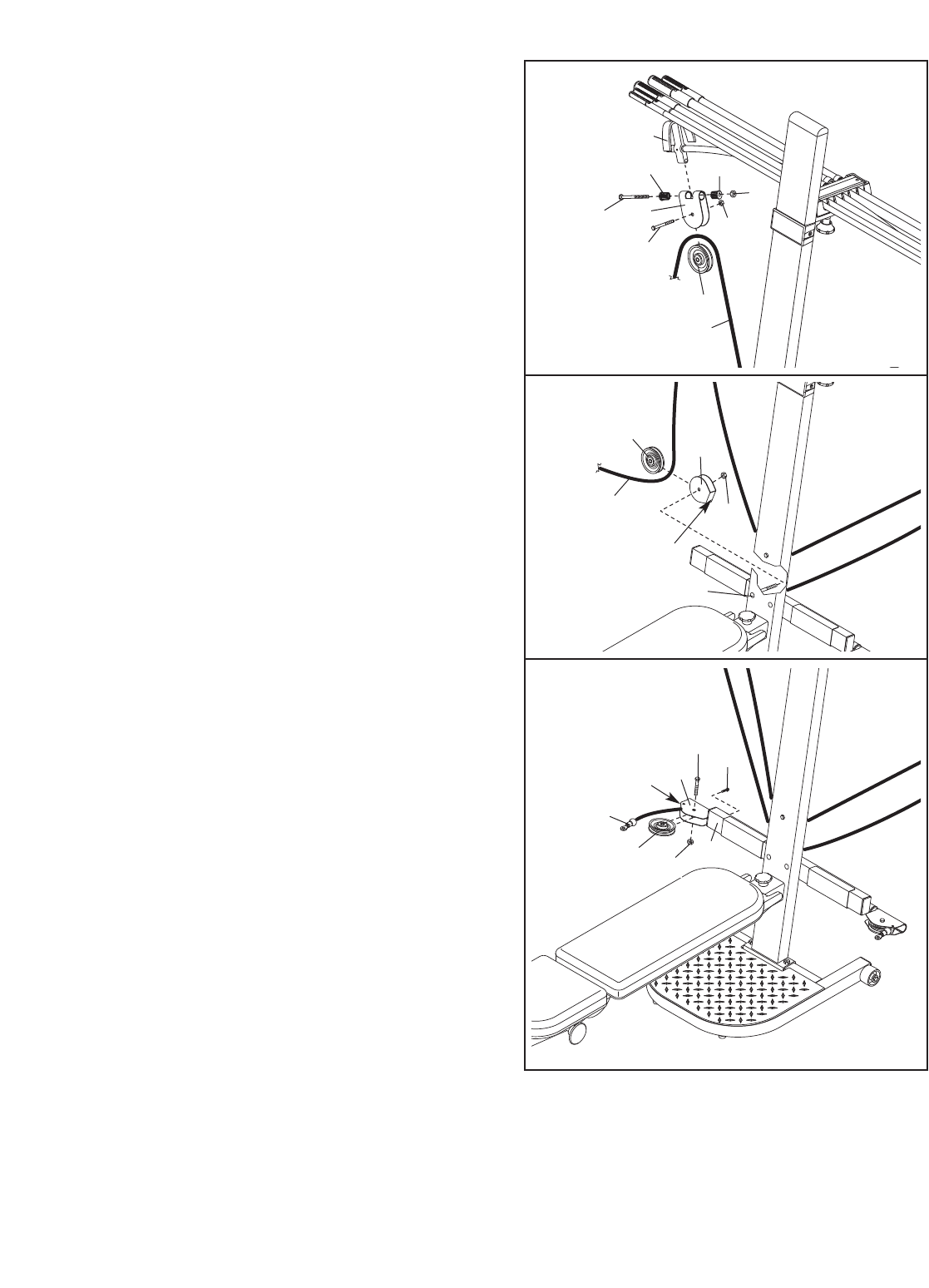
11
21
80
Rod
28
71
76
11
19. Attach a Pulley Housing (56) to the “U”-channel
on the 10-pound Center Resistance Bar (44) with
anM10 x 102mm Button Head Bolt (24), two
Pivot Bushings (74), and an M10 Nylon Locknut
(76).
Wrap the Long Cable (80) around a 90mm Pulley
(28). Attach the Pulley inside of the Pulley
Housing (56) with an M10 x 42mm Button Head
Bolt (71) and an M10 Nylon Locknut (76).
20. Wrap the Long Cable (80) around a 90mm Pulley
(28). Attach the Pulley and a Pulley Guard (29) to
the indicated M10 x 140mm Carriage Bolt (73)
with an M10 Nylon Locknut (76). Make sure the
flat edge of the Pulley Guard is on the side
shown.
19
20
28
74
56
74
76
76
80
71
28
80
Flat
Edge
29
76
73
24
44
22 10
21. Make sure there are no Resistance Bars (not
shown) under the “U”-channels on the 10-pound
Center Resistance Bar (not shown). Have a sec-
ond person pull on the Long Cable (80) to create
slack in the Cable.
Insert the end of the Long Cable (80) through the
welded tube on the end of the Cross Tube (11)
and then through the remaining Swivel Arm (22).
Make sure the Cable is on the indicated side
of the welded rod in the Swivel Arm.
Insert the Swivel Arm (22) into the welded tube
on the Cross Tube (11). Secure the Swivel Arm
with an M4 x 5mm Screw (10).
Wrap the Long Cable (80) around a 90mm Pulley
(28). Attach the Pulley inside of the Swivel Arm
(22) with an M10 x 42mm Button Head Bolt (71)
and an M10 Nylon Locknut (76).
22.
Make sure that all parts have been properly tightened. The use of the remaining parts will be explained in
ADJUSTMENTS, beginning on the following page.
Before using the resistance system, pull the long cable a few times to be sure that it moves smoothly over
the pulleys. If the cable does not move smoothly, find and correct the problem. IMPORTANT: If the cables
are not properly installed, they may be damaged when heavy resistance is used. See the CABLE
DIAGRAM on page 15 for proper cable routing.
This section explains how to adjust the resistance system. See the EXERCISE GUIDELINES on page 16 for
important information about how to get the most benefit from your exercise program. Also, refer to the accompa-
nying exercise guide to see the correct form for each exercise.
Make sure all parts are properly tightened each time the resistance system is used. Replace worn parts immedi-
ately. The resistance system can be cleaned with a damp cloth and a mild, non-abrasive detergent. Do not use
solvents. The resistance bars can be cleaned with a vinyl and rubber protectant, available at an automotive or
department store.
12
ADJUSTMENTS
ADJUSTING THE SEAT
The Seat (13) can be secured in any of five positions
on the Bench Rail (5). To move the Seat, pull the
Seat Knob (45) out as far as it will go, and slide the
Seat to the desired position. Engage the Seat Knob
into an adjustment hole in the Bench Rail. Note: It
may be necessary to lift up on the Seat in order to
engage the Seat Knob.
To perform row exercises, the leg press strap must be
attached to the long cable (see ATTACHING THE
ACCESSORIES, on page 13), and the Seat Carriage
(12) must be able to roll along the Bench Rail (5).
First, remove the Backrest (14) from the Seat
Carriage (see ADJUSTING THE BACKREST, below).
Then, pull the Seat Knob (45) out as far as it will go,
and turn the Knob so that the pin rests at the end of
the “L”-shaped slot (see the inset drawing).
13
14
45
12
5
12
45
Pin
“L”-Slot
14
15
12
13
Rod
Slot
5
12
6
3
ADJUSTING THE BACKREST
The Backrest (14) can be used in a level position or
one of three inclined positions. To use the Backrest in
alevel position, secure the Seat Carriage (12) to the
adjustment hole in the Bench Rail (5) next to the Front
Leg (6) (see ADJUSTING THE SEAT, above).
Touse the Backrest (14) in an inclined position,
secure the Seat Frame (12) to one of the three
adjustment holes in the Bench Rail (5) closer to the
Upright (3). Rest the Backrest against the Upright.
For row exercises, remove the Backrest (14). Hold
the Backrest vertically over the Seat (13) and lift the
rod out of the slot in the Seat Carriage (12) (see the
inset drawing).
13
49
80
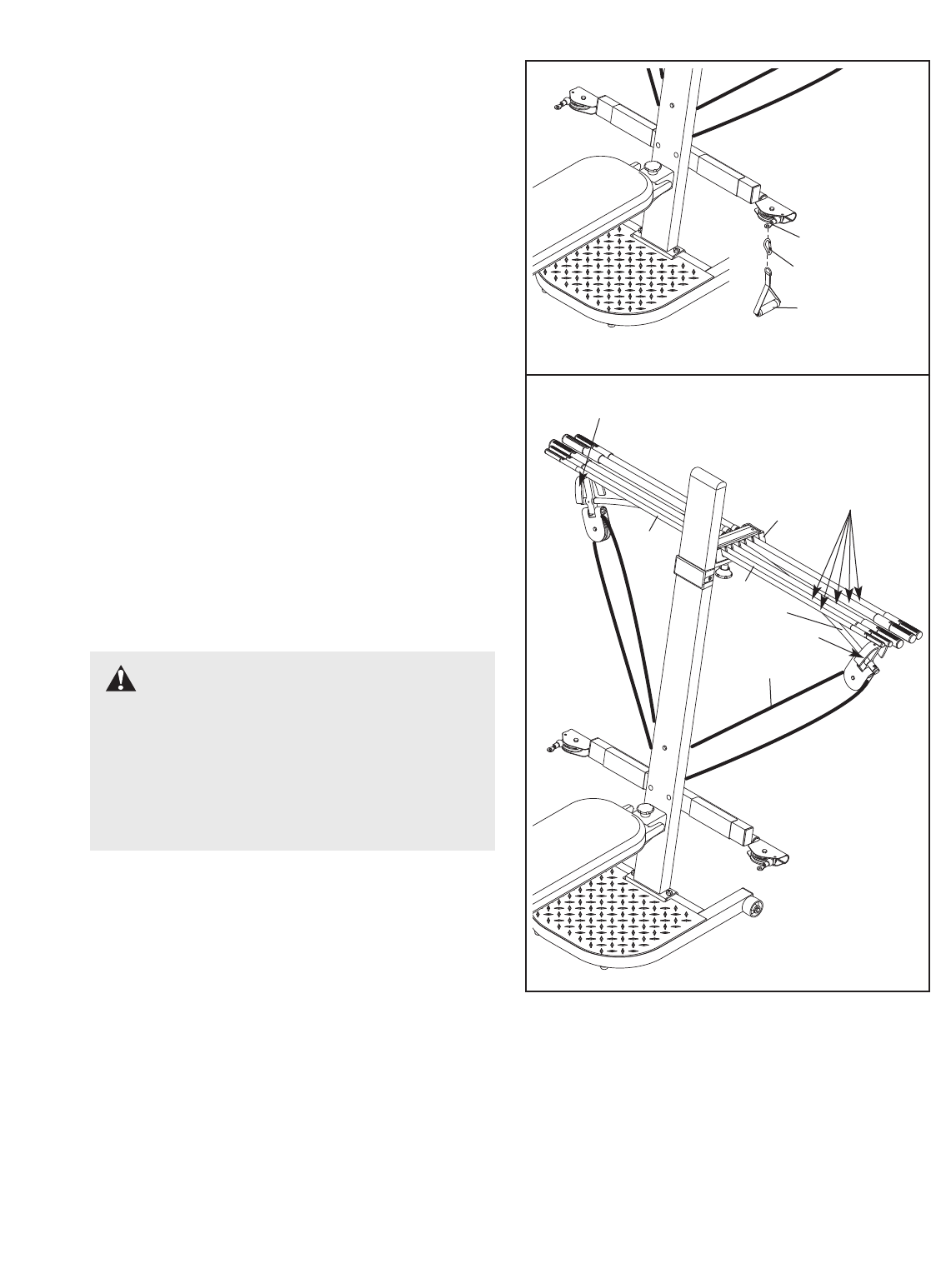
ATTACHING THE ACCESSORIES
Attach each Short Handle (49) to the Long Cable (80)
with a Cable Clip (51).
The Long Handles (not shown) and the Ankle Strap
(not shown) can be attached to the Long Cable (80)
with Cable Clips (51). Attach the Leg Press Strap (not
shown) to both ends of the Long Cable with two Cable
Clips.
51
44
35
67
36
80
“U”-channel
“U”-channel
Resistance
Bars
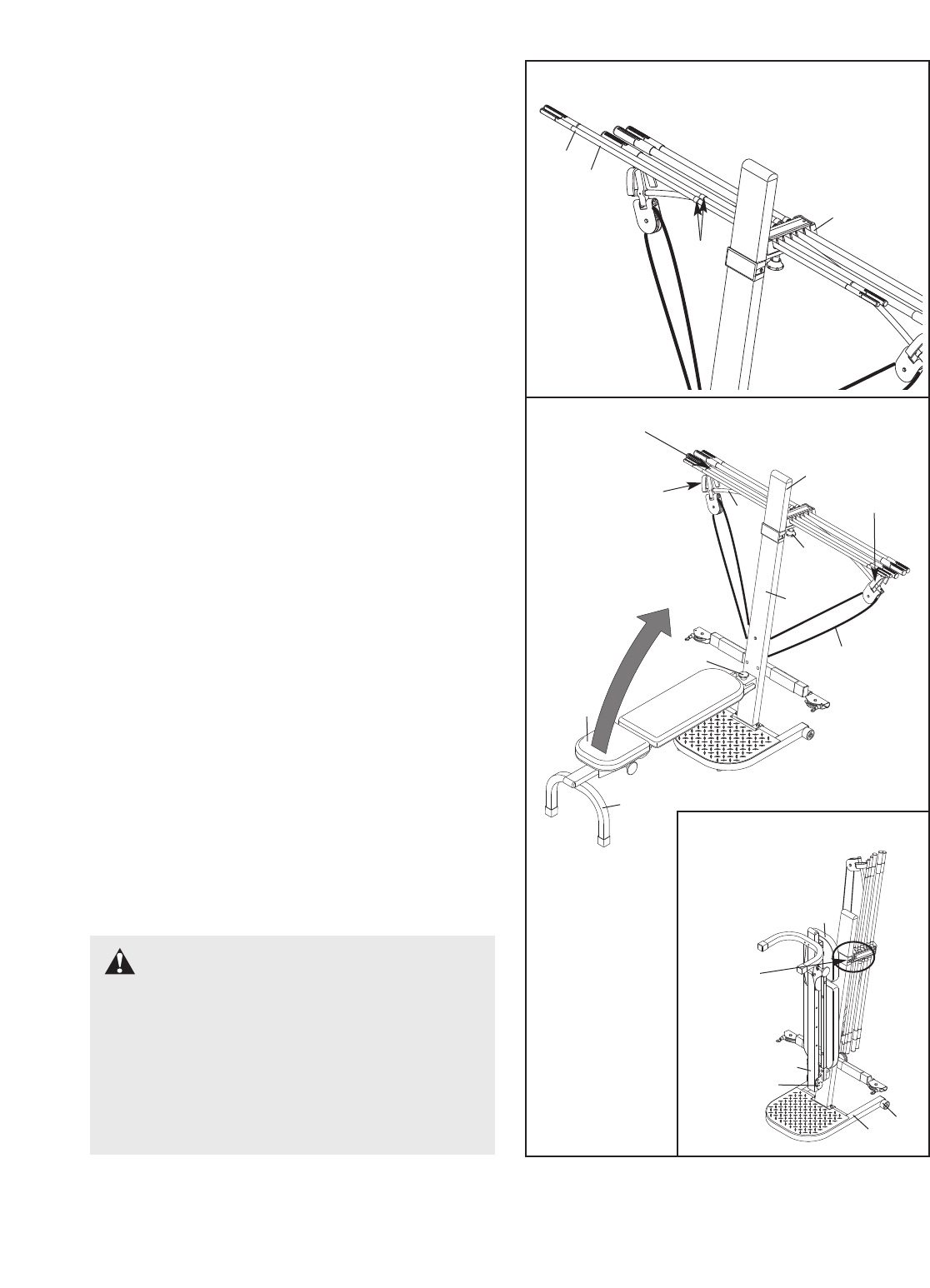
ADJUSTING THE RESISTANCE
To add resistance, hold a “U”-channel on the 10-
pound Center Resistance Bar (44) firmly and push
the end of a resistance bar under it. Repeat with the
other end of the resistance bar. If more resistance is
needed, add one resistance bar at a time.
Note: When adding resistance, always start with the
heaviest resistance bar to be used, and finish with the
lightest resistance bar. When removing resistance
bars from the “U”-channels, start with the lightest
resistance bar and finish with the heaviest.
Note: The resistance system uses progressive resist-
ance. As the resistance bars begin to bend, the
amount of resistance will increase gradually. As the
resistance bars bend further, the resistance will
increase rapidly.
Note: Additional resistance can be added to the
resistance system. To purchase more resistance,
call the toll-free phone number on the front cover of
this manual and ask for model number WEMC0642
(100-pound MAX PACK) or WEMC0942 (200-pound
MAX PACK).
WARNING: When adding resist-
ance, make sure that both ends of the resist-
ance bar rest under the two “U”-channels. The
rings on the Removable Resistance Bars (36,
67) must be pushed against the Tray (35). Do
not add or remove resistance bars from the
“U”-channels while an end of the Long Cable
(80) is pulled out.
14
30
Resistance
Bars
6
3
4
43
44 “U”-channel
“U”-channel
80
13
STORING THE RESISTANCE SYSTEM
To store the resistance system, make sure the Seat
(13) is in the position closest to the Front Leg (6) (see
ADJUSTING THE SEAT on page 12). Next, remove
the Storage Knob (30) from the Upright (3). Lift the
Front Leg toward the Top Upright (4), and tighten the
Storage Knob into the side of the Upright and the
Bench Rail (5).
Remove all of the resistance bars from the “U”-chan-
nels on the 10-pound Center Resistance Bar (44)
(see ADJUSTING THE RESISTANCE on page 13).
Finally,loosen the Fulcrum Knob (43) and pull it out
as far as it will go. Turn the resistance bar assembly
vertically and engage the Fulcrum Knob into the ful-
crum on the Top Upright (4). Note: Storing the
resistance bars vertically will prolong the life of
the resistance bars.
Tomove the resistance system, place the toe of your
shoe on the end of the Base (1) and hold the resist-
ance system in the indicated area. Tilt the resistance
system back onto the Wheels (31) and roll it to the
new location. Be careful not to let the Seat (13)
pinch your hands when you tilt the system back.
WARNING: Make sure that all of
the resistance bars are removed from the “U”-
channels before moving the resistance bar
assembly to the stored position.
Make sure that the resistance bar assembly is
in the horizontal position and that the Storage
Knob (30) is in place and fully tightened each
time the resistance system is used.
Stored Position
Hold in
this area
USING THE REMOVABLE RESISTANCE BARS
The Removable Resistance Bars (36, 67) can be used
to exercise apart from the resistance system, as shown
in the video or on the exercise guide. To remove a
Resistance Bar, pull it out of the Tray (35).
Toreplace the Removable Resistance Bars (36, 67),
slide them into the Tray (35) from the side shown, so
that the arrows on the rings point toward the Tray.
Make sure the rings are pushed against the Tray.
35
36
67
Rings
131
6
5
30
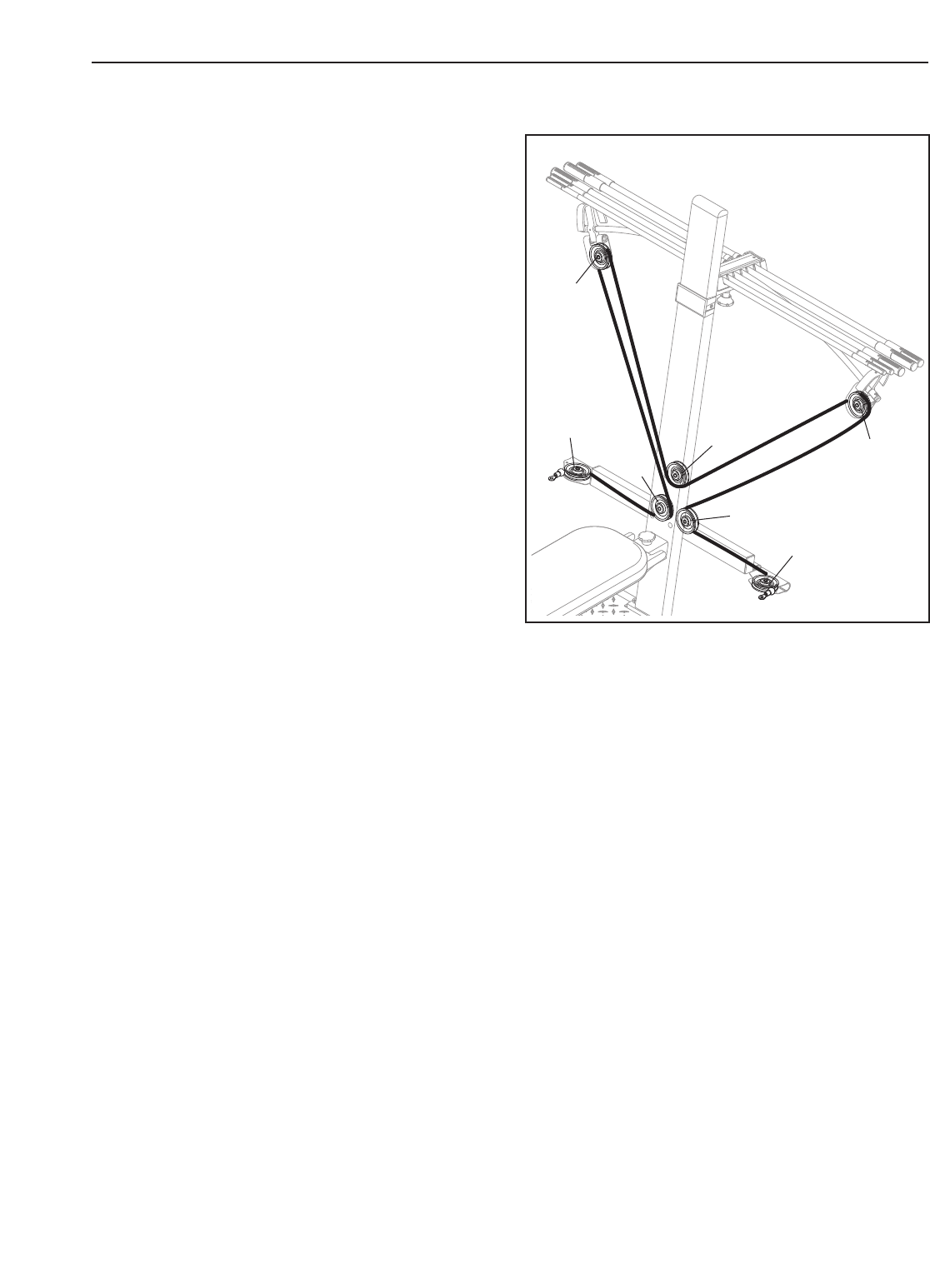
CABLE DIAGRAM
The cable diagram shows the proper routing of the
Long Cable (80). Use the diagram to make sure that
the cable has been assembled correctly. If the cable
has not been correctly routed, the resistance system
will not function properly and damage may occur. The
numbers show the correct route for the cable.
74
5
6
1
2
Long Cable (80)
3
15

16
EXERCISE GUIDELINES
THE FOUR BASIC TYPES OF WORKOUTS
Muscle Building
Toincrease the size and strength of your muscles,
push them close to their maximum capacity. Your mus-
cles will continually adapt and grow as you progres-
sively increase the intensity of your exercise. You can
adjust the intensity level of an individual exercise in
two ways:
•by changing the amount of resistance used
•by changing the number of repetitions or sets per-
formed. (A “repetition” is one complete cycle of an
exercise, such as one sit-up. A “set” is a series of
repetitions.)
The proper amount of resistance for each exercise
depends upon the individual user. You must gauge
your limits and select the amount of resistance that is
right for you. Begin with 3 sets of 8 repetitions for each
exercise you perform. Rest for 3 minutes after each
set. When you can complete 3 sets of 12 repetitions
without difficulty, increase the amount of resistance.
Toning
You can tone your muscles by pushing them to a mod-
erate percentage of their capacity. Select a moderate
amount of resistance and increase the number of rep-
etitions in each set. Complete as many sets of 15 to
20 repetitions as possible without discomfort. Rest for
1minute after each set. Work your muscles by com-
pleting more sets rather than by using high amounts of
resistance.
Weight Loss
To lose weight, use a low amount of resistance and
increase the number of repetitions in each set.
Exercise for 20 to 30 minutes, resting for a maximum
of 30 seconds between sets.
Cross Training
Cross training is an efficient way to get a complete and
well-balanced fitness program. An example of a bal-
anced program is:
•Plan strength training workouts on Monday,
Wednesday, and Friday.
•Plan 20 to 30 minutes of aerobic exercise, such as
running on a treadmill or riding on an elliptical or
exercise bike, on Tuesday and Thursday.
•Rest from both strength training and aerobic exercise
for at least one full day each week to give your body
time to regenerate.
The combination of strength training and aerobic exer-
cise will reshape and strengthen your body, plus devel-
op your heart and lungs.
PERSONALIZING YOUR EXERCISE PROGRAM
Determining the exact length of time for each workout,
aswell as the number of repetitions or sets completed,
is an individual matter. It is important to avoid overdo-
ing it during the first few months of your exercise pro-
gram. You should progress at your own pace and be
sensitive to your body’s signals. If you experience pain
or dizziness at any time while exercising, stop immedi-
ately and begin cooling down. Find out what is wrong
before continuing. Remember that adequate rest and a
proper diet are important factors in any exercise pro-
gram.
WARMING UP
Begin each workout with 5 to 10 minutes of stretching
and light exercise to warm up. Warming up prepares
your body for more strenuous exercise by increasing
circulation, raising your body temperature and deliver-
ing more oxygen to your muscles.
WORKING OUT
Each workout should include 6 to 10 different exercis-
es. Select exercises for every major muscle group,
emphasizing areas that you want to develop most. To
give balance and variety to your workouts, vary the
exercises from session to session.
Schedule your workouts for the time of day when your
energy level is the highest. Each workout should be
followed by at least one day of rest. Once you find the
schedule that is right for you, stick with it.
EXERCISE FORM
Maintaining proper form is an essential part of an
effective exercise program. This requires moving
through the full range of motion for each exercise, and
moving only the appropriate parts of the body.
Exercising in an uncontrolled manner will leave you
feeling exhausted. On the exercise guide accompany-
ing this manual you will find photographs showing the
correct form for several exercises, and a list of the
muscles affected. Refer to the muscle chart on the fol-
lowing page to find the names of the muscles.
The repetitions in each set should be performed
smoothly and without pausing. The exertion stage of
each repetition should last about half as long as the
return stage. Proper breathing is important. Exhale
during the exertion stage of each repetition and inhale
during the return stroke. Never hold your breath.
Rest for a short period of time after each set. The
ideal resting periods are:
•Rest for three minutes after each set for a muscle
building workout.
•Rest for one minute after each set for a toning work-
out.
•Rest for 30 seconds after each set for a weight loss
workout.
Plan to spend the first couple of weeks familiarizing
yourself with the equipment and learning the proper
form for each exercise.
COOLING DOWN
End each workout with 5 to 10 minutes of stretching.
Include stretches for both your arms and legs. Move
slowly as you stretch and do not bounce. Ease into
each stretch gradually and go only as far as you can
without strain. Stretching at the end of each workout
is an effective way to increase flexibility.
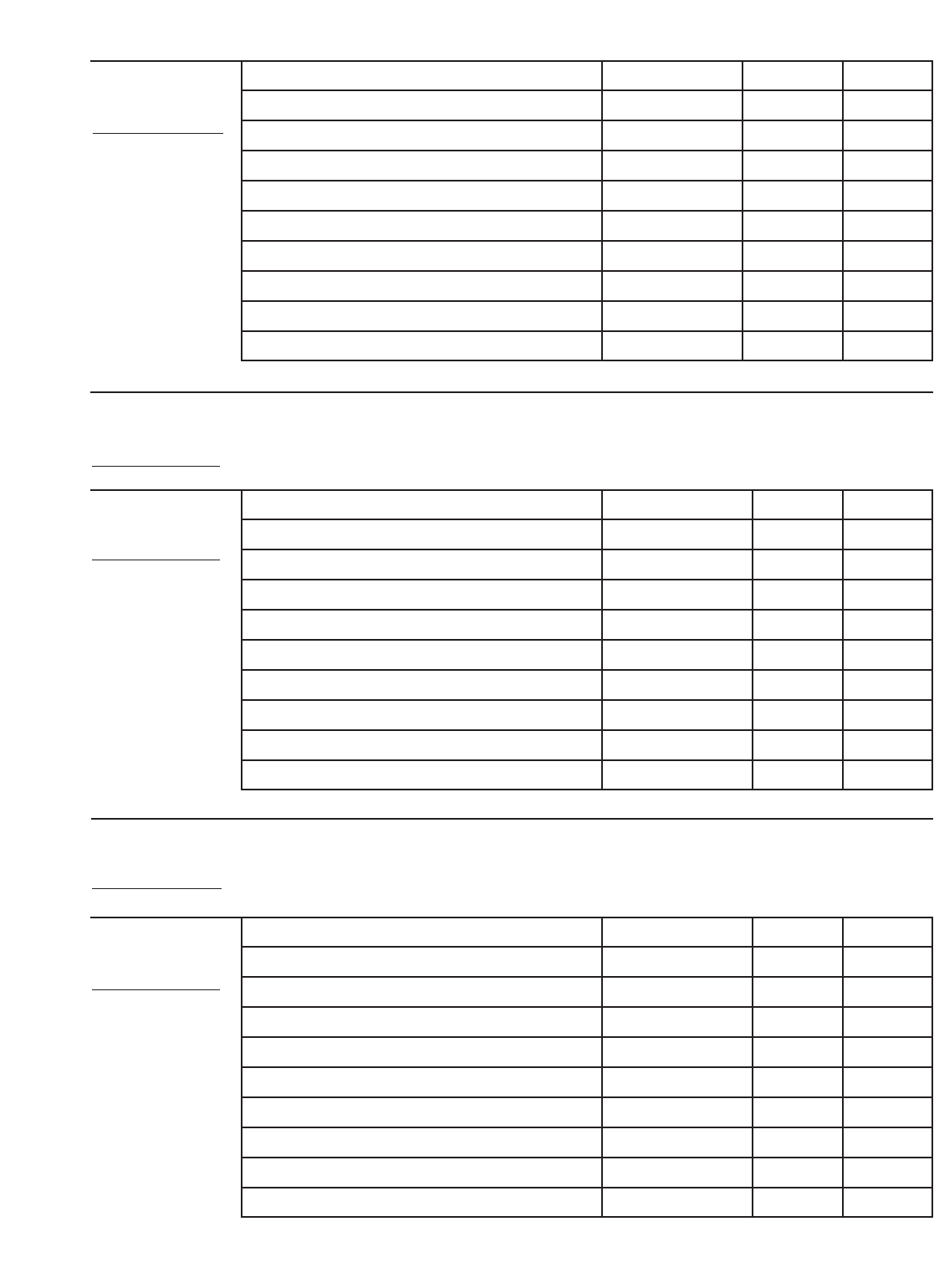
STAYING MOTIVATED
For motivation, keep a record of each workout. The
charts on pages 18 and 19 of this manual can be pho-
tocopied and used to schedule and record your work-
outs. List the date, the exercises performed, the resist-
ance used, and the numbers of sets and repetitions
completed. Record your weight and key body meas-
urements at the end of every month. Remember, the
key to achieving the greatest results is to make exer-
cise a regular and enjoyable part of your everyday life.
17
N
O
P
Q
R
S
T
U
W
V
M
L
J
G
F
H
I
K
E
C
D
B
A
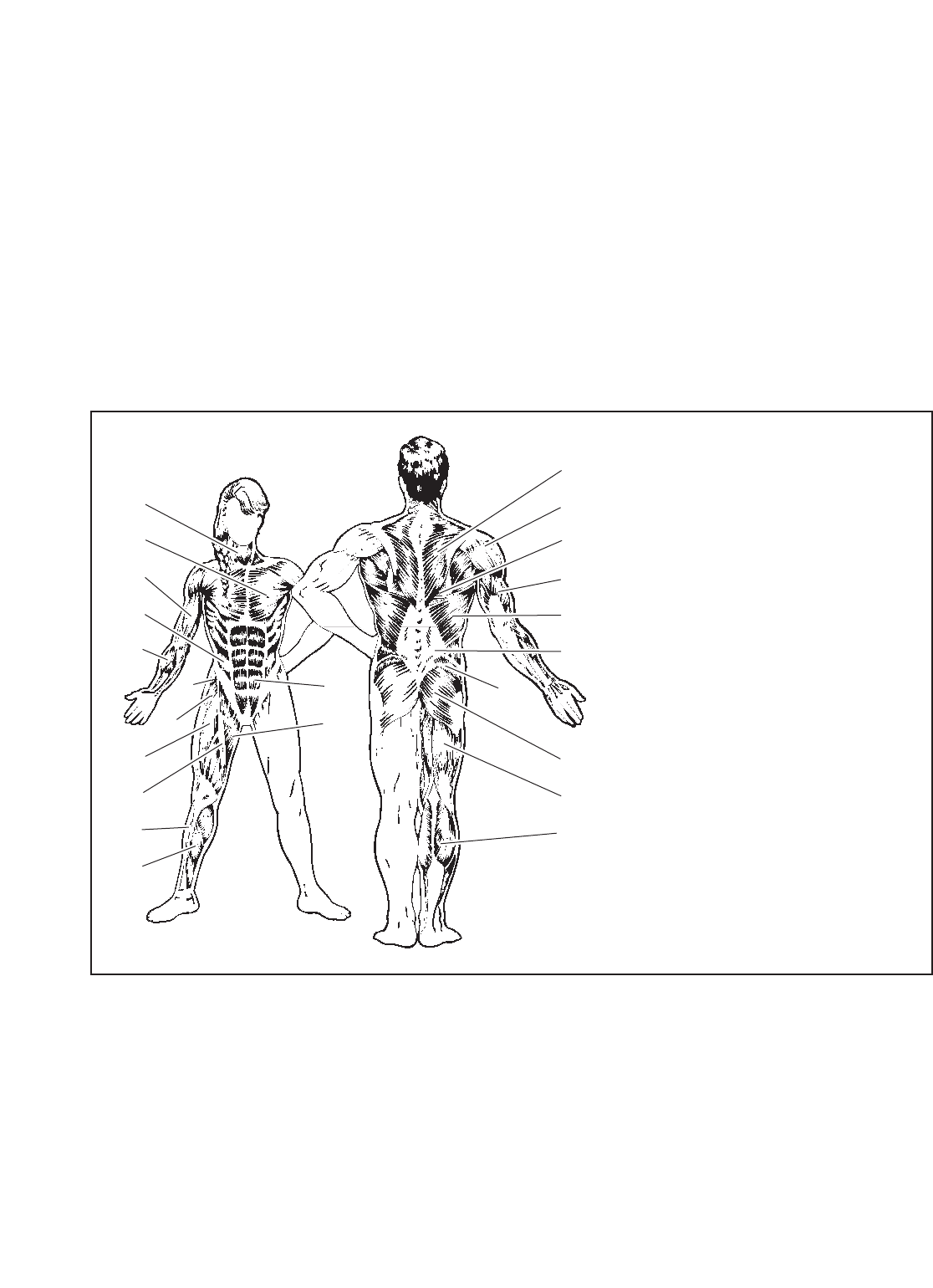
MUSCLE CHART
A. Sternomastoid (neck)
B. Pectoralis Major (chest)
C. Biceps (front of arm)
D. Obliques (waist)
E. Brachioradials (forearm)
F. Hip Flexors (upper thigh)
G. Abductor (outer thigh)
H. Quadriceps (front of thigh)
I. Sartorius (front of thigh)
J. Tibialis Anterior (front of calf)
K. Soleus (front of calf)
L. Rectus Abdominus (stomach)
M. Adductor (inner thigh)
N. Trapezius (upper back)
O. Rhomboideus (upper back)
P. Deltoid (shoulder)
Q. Triceps (back of arm)
R. Latissimus Dorsi (mid back)
S. Spinae Erectors (lower back)
T. Gluteus Medius (hip)
U. Gluteus Maximus (buttocks)
V. Hamstring (back of leg)
W. Gastrocnemius (back of calf)
18
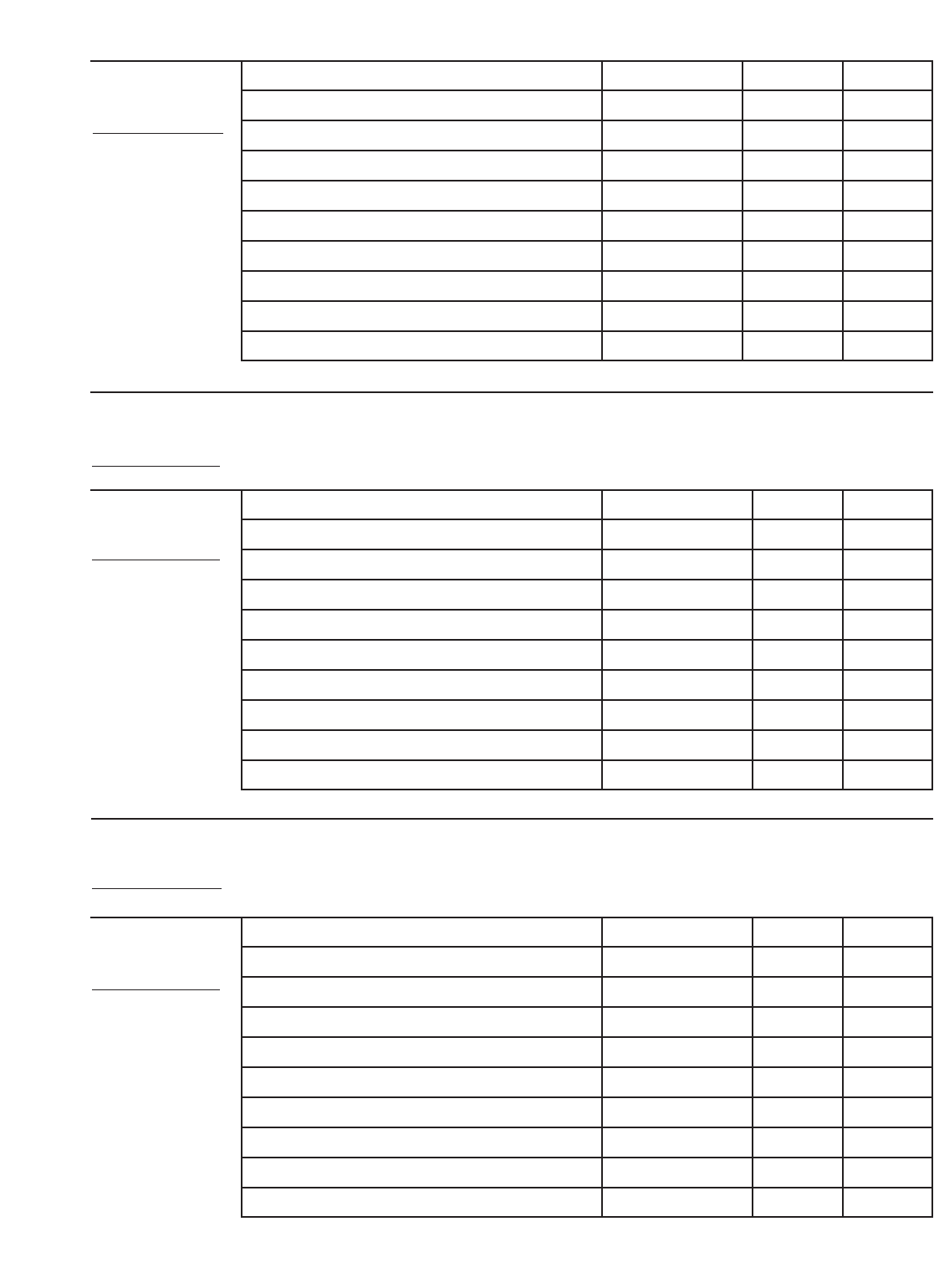
MONDAY
Date:
/ /
EXERCISE RESISTANCE SETS REPS
EXERCISE RESISTANCE SETS REPS
EXERCISE RESISTANCE SETS REPS
AEROBIC EXERCISE
AEROBIC EXERCISE
TUESDAY
Date:
/ /
WEDNESDAY
Date:
/ /
THURSDAY
Date:
/ /
FRIDAY
Date:
/ /
Make photocopies of this page for scheduling and recording your workouts.
19
MONDAY
Date:
/ /
EXERCISE RESISTANCE SETS REPS
EXERCISE RESISTANCE SETS REPS
EXERCISE RESISTANCE SETS REPS
AEROBIC EXERCISE
AEROBIC EXERCISE
TUESDAY
Date:
/ /
WEDNESDAY
Date:
/ /
THURSDAY
Date:
/ /
FRIDAY
Date:
/ /
Make photocopies of this page for scheduling and recording your workouts.
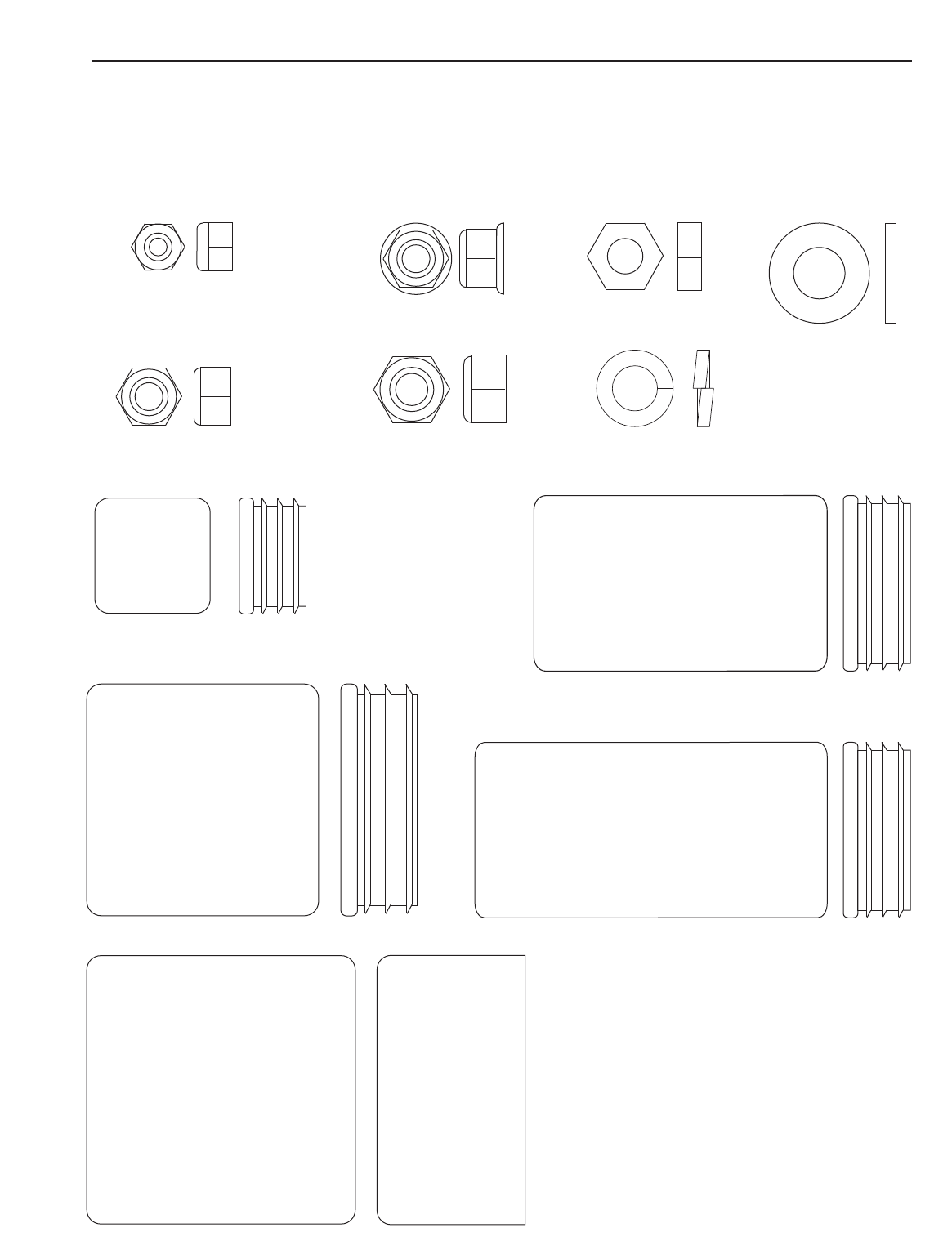
M10 Nylon Locknut (76)
M8 Nylon Locknut (65)
M6 Nylon Locknut (69)
M8 Flange Nut (19)
M10 Lock Washer (21)
50mm Square
Inner Cap (38)
25mm Square Inner Cap (54)
38mm x 64mm Inner Cap (41)
38mm x 76mm Inner Cap (34)
M10 Nut (47)
50mm Square Outer Cap (27)
M10 Washer (75)
PART IDENTIFICATION CHART
Refer to the drawings below to identify small parts used in assembly. The number in parentheses below each
drawing is the key number of the part, from the PART LIST on the reverse side of this page. Note: Some small
parts may have been pre-attached. If a part is not in the parts bag, check to see if it has been pre-attached.
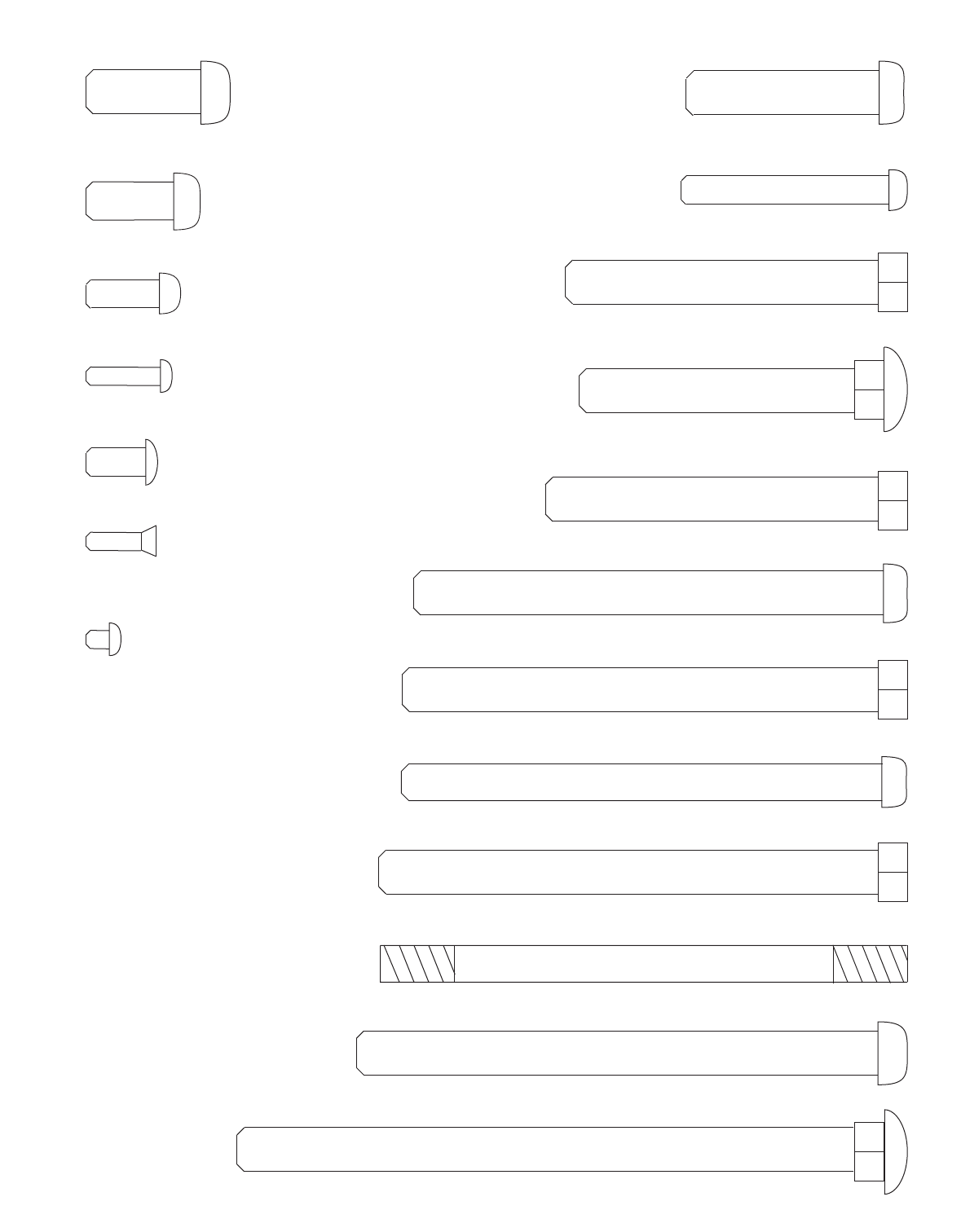
M10 x 108mm Bolt (81)
M6 x 13mm Bolt (59)
M4 x 16mm Screw (62)
M4 x 12mm Flat
Head Screw (85)
M10 x 25mm Button Head Screw (78)
M8 x 19mm Button Head Screw (86)
M
M10 x 72mm Bolt (64)
M4 x 5mm Screw (10)
M10 x 140mm Carriage Bolt (73)
M10 x 113mm Button Head Bolt (40)
M8 x 114mm Axle (57)
M10 x 42mm Button Head Bolt (71)
M10 x 103mm Bolt (66)
1/4” x 45mm Button Head Screw (58)
M10 x 102mm Button Head Bolt (24)
M8 x 104mm Button Head Bolt (60)
1/4” x 16mm Button Head Screw (82) M10 x 68mm Screw (61)
M10 x 66mm Carriage Bolt (83)

Note: “#” indicates a non-illustrated part. Specifications are subject to change without notice. See the back cover
of the user’s manual for information about ordering replacement parts.
Key No. Qty. Description Key No. Qty. Description
1 1 Base
21 Base Plate
3 1 Upright
4 1 Top Upright
5 1 Bench Rail
6 1 Front Leg
7 1 Large Dome Cap
8 1 Backrest Backing
9 1 Seat Backing
10 2 M4 x 5mm Screw
11 1 Cross Tube
12 1 Seat Carriage
13 1 Seat
14 1 Backrest
15 1 Backrest Frame
16 1 Backrest Cap
17 2 Guard Plate
18 1 Fulcrum
19 2 M8 Flange Nut
20 2 10-pound Short Cap
21 4 M10 Lock Washer
22 2 Swivel Arm
23 2 Grip Tape
24 2 M10 x 102mm Button Head Bolt
25 4 Arm Bushing
26 2 Large Plastic Foot
27 2 50mm Square Outer Cap
28 7 90mm Pulley
29 3 Pulley Guard
30 1 Storage Knob
31 2 Wheel
32 2 10-pound Cap
33 4 80-pound Cap
34 1 38mm x 76mm Inner Cap
35 1 Tray
36 1 20-pound Removable Resistance
Bar
37 2Fulcrum Bushing
38 2 50mm Square Inner Cap
39 3 60mm Metal Spacer
40 1M10 x 113mm Button Head Bolt
41 2 38mm x 64mm Inner Cap
42 6 8mm Metal Spacer
43 1 Fulcrum Knob
44 110-pound Center Resistance Bar
45 1 Seat Knob
46 6 Bearing Wheel
47 2M10 Nut
48 1 Leg Press Strap
49 2 Short Handle
50 1 Ankle Strap
51 2 Cable Clip
52 1 40-pound Resistance Bar
53 3 Plastic Foot
54 2 25mm Square Inner Cap
55 2 80-pound Resistance Bar
56 2 Pulley Housing
57 1 M8 x 114mm Axle
58 4 1/4” x 45mm Button Head Screw
59 2 M6 x 13mm Bolt
60 2 M8 x 104mm Button Head Bolt
61 2 M10 x 68mm Screw
62 15 M4 x 16mm Screw
63 1 Retainer Ring
64 2 M10 x 72mm Bolt
65 2 M8 Nylon Locknut
66 1 M10 x 103mm Bolt
67 1 10-pound Removable Resistance
Bar
68 2 Long Handle
69 2 M6 Nylon Locknut
70 1 Name Plate
71 4 M10 x 42mm Button Head Bolt
72 1 Cover Plate
73 2 M10 x 140mm Carriage Bolt
74 4 Pivot Bushing
75 8 M10 Washer
76 16 M10 Nylon Locknut
77 2 20-pound Cap
78 4 M10 x 25mm Button Head Screw
79 2 40-pound Cap
80 1 Long Cable
81 2 M10 x 108mm Bolt
82 4 1/4” x 16mm Button Head Screw
83 2 M10 x 66mm Carriage Bolt
84 1Fulcrum Endcap
85 12 M4 x 12mm Flat Head Screw
86 2 M8 x 19mm Button Head Screw
87 138mm x 76mm Dome Cap
# 1 User’s Manual
# 1 Exercise Guide
#1 Exercise Decal
#1Exercise Video
#1 Large Allen Wrench
# 1 Small Allen Wrench
PART LIST—Model No. WESY3873.2 R1005A
23
23
79
33
70 62
62
4
78
78
3
28
76
76
28
28
29
28
29
22
71
73
30
76
66
34
5
41
2
76
42
62
53
53
62 83
83
62
1
75
81
31
38
75
76
75
38
31
75
81
49
80
25
25
11
41
80
75
75 25
47
10
71
28
68
48
50
40
62
22
29
62
26
62
26
28
76
64
76
76
35
63
37
37
18
43
85
28
24
74
74
56
71
76 76
74
76
74
71
24 56
76
85
33
79
77
32
85
85
67
36
55
52
32 77
85
33
86
72
51
84
21
21
10
20
44
85
20
85
7
14
8
15
16
54
62
17
17
62
58
58 62 58
53 62
69
13
9
82
82
65
60
12
19
45
59
59
65
46
46
19
60
57
39
46
42
42
46
39 46
42
39 42
87
61
27
27
6
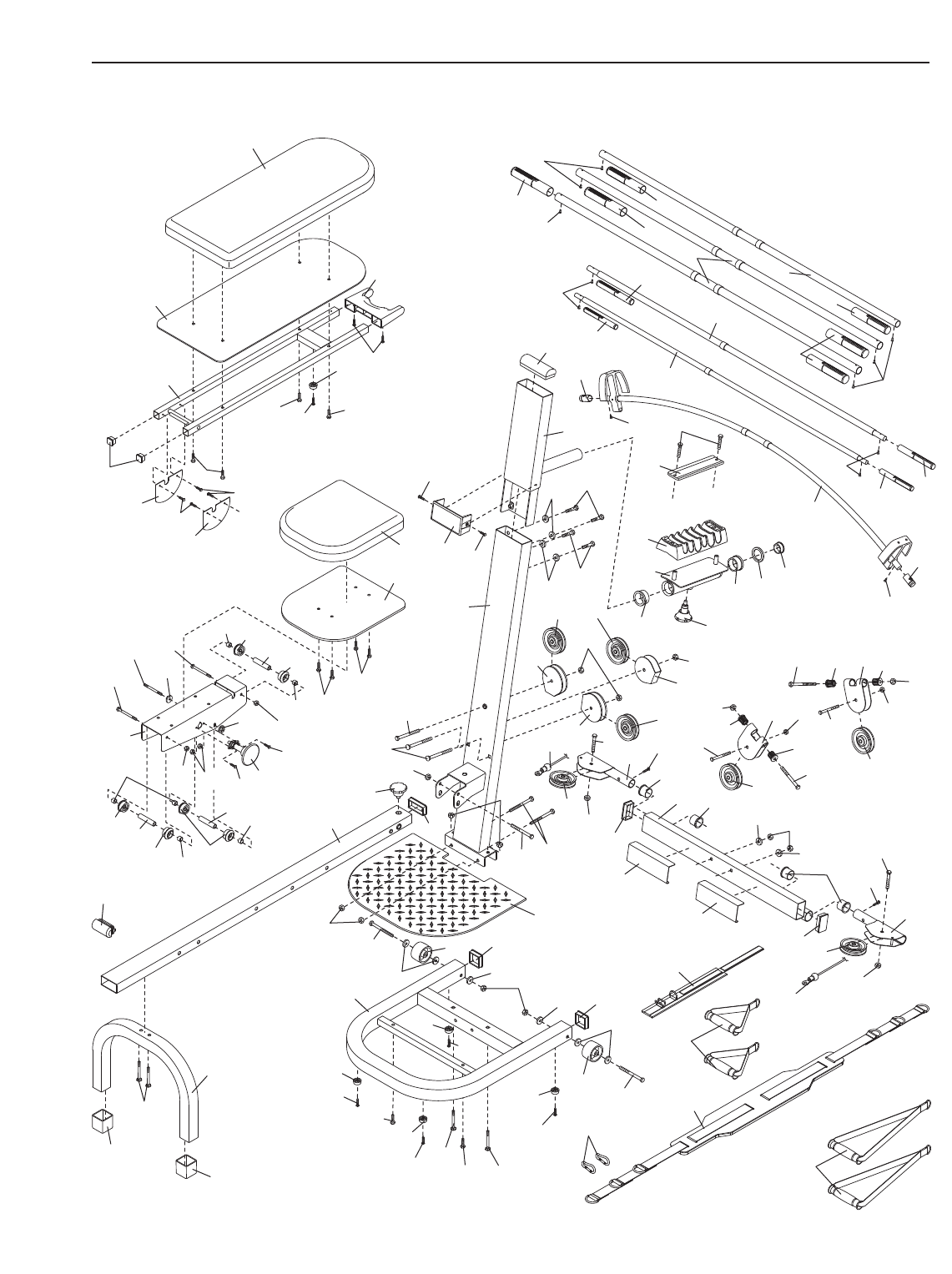
EXPLODED DRAWING—Model No. WESY3873.2 R1005A

Part No. 221094 R1005A Printed in China © 2004 ICON IP, Inc.
To order replacement parts, see the front cover of this manual. To help us assist you, please be prepared to give
the following information:
•the MODEL NUMBER of the product (WESY3873.2)
• the NAME of the product (MAX by WEIDER VISION resistance system)
• the SERIAL NUMBER of the product (see the front cover of this manual)
• the KEY NUMBER and DESCRIPTION of the part(s) (see the PART LIST and EXPLODED DRAWING in the
center of this manual)
ORDERING REPLACEMENT PARTS
ICON Health & Fitness, Inc. (ICON), warrants this product to be free from defects in workmanship and
material, under normal use and service conditions, for a period of five (5) years from the date of purchase.
ICON warrants the resistance bars for the lifetime of the product. Shipping of the resistance bars is not
covered. Labor is covered for one (1) year.This warranty extends only to the original purchaser.ICON's
obligation under this warranty is limited to replacing or repairing, at ICON's option, the product through
one of its authorized service centers. All repairs for which warranty claims are made must be pre-author-
ized by ICON. If the product is shipped to a service center, freight charges to and from the service center
will be the customer’s responsibility. For in-home service, the customer will be responsible for a minimal
trip charge. This warranty does not extend to any product or damage to a product caused by or attribut-
able to freight damage, abuse, misuse, improper or abnormal usage or repairs not provided by an ICON
authorized service center; products used for commercial or rental purposes; or products used as store
display models. No other warranty beyond that specifically set forth above is authorized by ICON.
ICON is not responsible or liable for indirect, special or consequential damages arising out of or in con-
nection with the use or performance of the product or damages with respect to any economic loss, loss
of property,loss of revenues or profits, loss of enjoyment or use, costs of removal or installation or other
consequential damages of whatsoever nature. Some states do not allow the exclusion or limitation of inci-
dental or consequential damages. Accordingly,the above limitation may not apply to you.
The warranty extended hereunder is in lieu of any and all other warranties and any implied warranties of
merchantability or fitness for a particular purpose is limited in its scope and duration to the terms set forth
herein. Some states do not allow limitations on how long an implied warranty lasts. Accordingly,the above
limitation may not apply to you.
This warranty gives you specific legal rights. You may also have other rights which vary from state to state.
ICON HEALTH & FITNESS, INC., 1500 S. 1000 W., LOGAN, UT 84321-9813
LIMITED WARRANTY
