Whirlpool XPCP Appliance Modular Transmitter User Manual Layout 1

Whirlpool Corporation Appliance Modular Transmitter Layout 1

Contents

manual pt 2

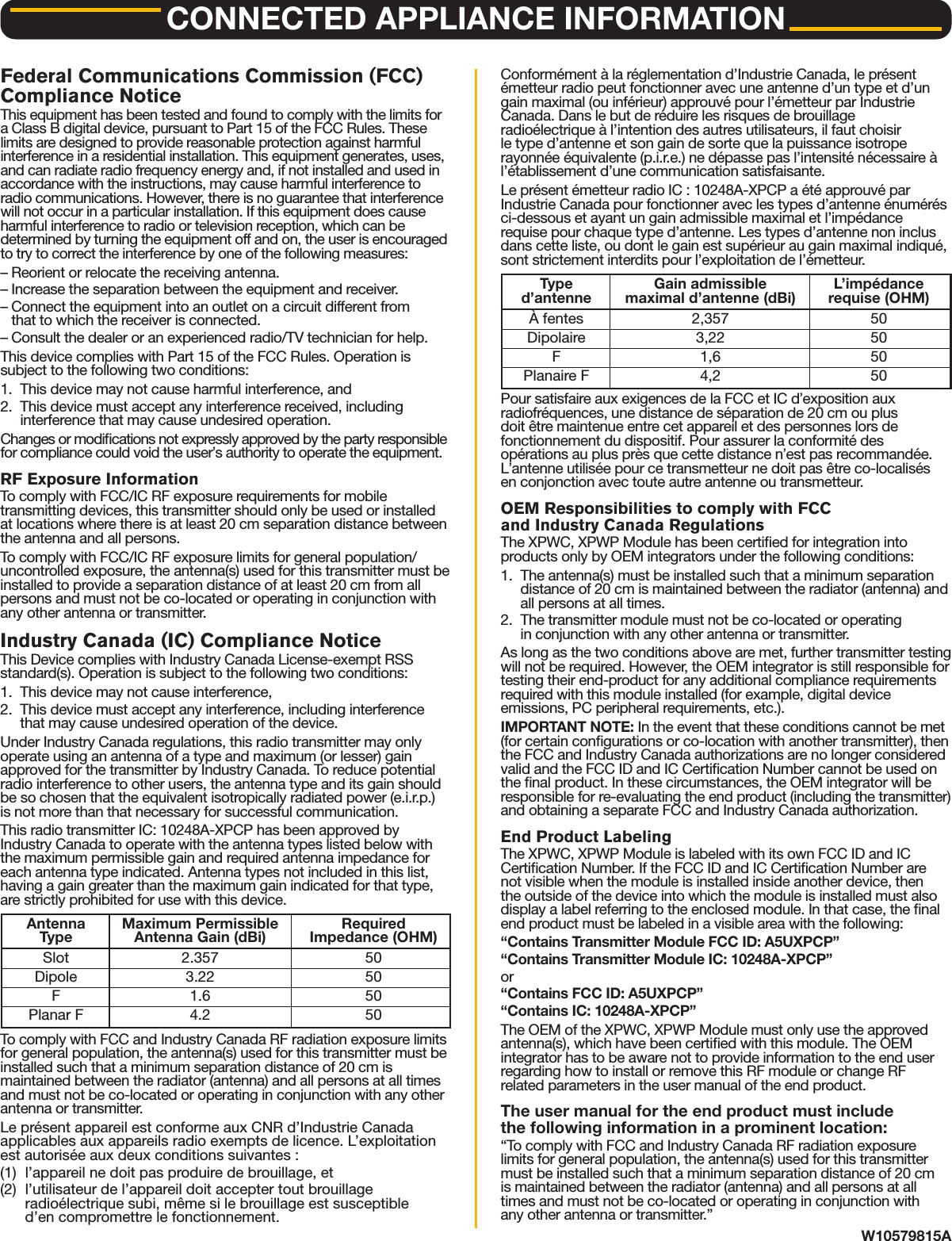
CONNECTED APPLIANCE INFORMATIONW10579815AFederal Communications Commission (FCC)Compliance NoticeThis equipment has been tested and found to comply with the limits fora Class B digital device, pursuant to Part 15 of the FCC Rules. Theselimits are designed to provide reasonable protection against harmfulinterference in a residential installation. This equipment generates, uses,and can radiate radio frequency energy and, if not installed and used inaccordance with the instructions, may cause harmful interference toradio communications. However, there is no guarantee that interferencewill not occur in a particular installation. If this equipment does causeharmful interference to radio or television reception, which can bedetermined by turning the equipment off and on, the user is encouragedto try to correct the interference by one of the following measures:– Reorient or relocate the receiving antenna.– Increase the separation between the equipment and receiver.– Connect the equipment into an outlet on a circuit different fromthat to which the receiver is connected.– Consult the dealer or an experienced radio/TV technician for help.This device complies with Part 15 of the FCC Rules. Operation issubject to the following two conditions:1. This device may not cause harmful interference, and2. This device must accept any interference received, includinginterference that may cause undesired operation.Changes or modications not expressly approved by the party responsiblefor compliance could void the user’s authority to operate the equipment.RF Exposure InformationTo comply with FCC/IC RF exposure requirements for mobiletransmitting devices, this transmitter should only be used or installedat locations where there is at least 20 cm separation distance betweenthe antenna and all persons.To comply with FCC/IC RF exposure limits for general population/uncontrolled exposure, the antenna(s) used for this transmitter must beinstalled to provide a separation distance of at least 20 cm from allpersons and must not be co-located or operating in conjunction withany other antenna or transmitter.Industry Canada (IC) Compliance NoticeThis Device complies with Industry Canada License-exempt RSSstandard(s). Operation is subject to the following two conditions:1. This device may not cause interference,2. This device must accept any interference, including interferencethat may cause undesired operation of the device.Under Industry Canada regulations, this radio transmitter may onlyoperate using an antenna of a type and maximum (or lesser) gainapproved for the transmitter by Industry Canada. To reduce potentialradio interference to other users, the antenna type and its gain shouldbe so chosen that the equivalent isotropically radiated power (e.i.r.p.)is not more than that necessary for successful communication.This radio transmitter IC: 10248A-XPCP has been approved byIndustry Canada to operate with the antenna types listed below withthe maximum permissible gain and required antenna impedance foreach antenna type indicated. Antenna types not included in this list,having a gain greater than the maximum gain indicated for that type,are strictly prohibited for use with this device.To comply with FCC and Industry Canada RF radiation exposure limitsfor general population, the antenna(s) used for this transmitter must beinstalled such that a minimum separation distance of 20 cm ismaintained between the radiator (antenna) and all persons at all timesand must not be co-located or operating in conjunction with any otherantenna or transmitter.Le présent appareil est conforme aux CNR d’Industrie Canadaapplicables aux appareils radio exempts de licence. L’exploitationest autorisée aux deux conditions suivantes :(1) l’appareil ne doit pas produire de brouillage, et(2) l’utilisateur de l’appareil doit accepter tout brouillageradioélectrique subi, même si le brouillage est susceptibled’en compromettre le fonctionnement.Conformément à la réglementation d’Industrie Canada, le présentémetteur radio peut fonctionner avec une antenne d’un type et d’ungain maximal (ou inférieur) approuvé pour l’émetteur par IndustrieCanada. Dans le but de réduire les risques de brouillageradioélectrique à l’intention des autres utilisateurs, il faut choisirle type d’antenne et son gain de sorte que la puissance isotroperayonnée équivalente (p.i.r.e.) ne dépasse pas l’intensité nécessaire àl’établissement d’une communication satisfaisante.Le présent émetteur radio IC : 10248A-XPCP a été approuvé parIndustrie Canada pour fonctionner avec les types d’antenne énumérésci-dessous et ayant un gain admissible maximal et l’impédancerequise pour chaque type d’antenne. Les types d’antenne non inclusdans cette liste, ou dont le gain est supérieur au gain maximal indiqué,sont strictement interdits pour l’exploitation de l’émetteur.Pour satisfaire aux exigences de la FCC et IC d’exposition auxradiofréquences, une distance de séparation de 20 cm ou plusdoit être maintenue entre cet appareil et des personnes lors defonctionnement du dispositif. Pour assurer la conformité desopérations au plus près que cette distance n’est pas recommandée.L’antenne utilisée pour ce transmetteur ne doit pas être co-localisésen conjonction avec toute autre antenne ou transmetteur.OEM Responsibilities to comply with FCCand Industry Canada RegulationsThe XPWC, XPWP Module has been certied for integration intoproducts only by OEM integrators under the following conditions:1. The antenna(s) must be installed such that a minimum separationdistance of 20 cm is maintained between the radiator (antenna) andall persons at all times.2. The transmitter module must not be co-located or operatingin conjunction with any other antenna or transmitter.As long as the two conditions above are met, further transmitter testingwill not be required. However, the OEM integrator is still responsible fortesting their end-product for any additional compliance requirementsrequired with this module installed (for example, digital deviceemissions, PC peripheral requirements, etc.).IMPORTANT NOTE: In the event that these conditions cannot be met(for certain congurations or co-location with another transmitter), thenthe FCC and Industry Canada authorizations are no longer consideredvalid and the FCC ID and IC Certication Number cannot be used onthe nal product. In these circumstances, the OEM integrator will beresponsible for re-evaluating the end product (including the transmitter)and obtaining a separate FCC and Industry Canada authorization.End Product LabelingThe XPWC, XPWP Module is labeled with its own FCC ID and ICCertication Number. If the FCC ID and IC Certication Number arenot visible when the module is installed inside another device, thenthe outside of the device into which the module is installed must alsodisplay a label referring to the enclosed module. In that case, the nalend product must be labeled in a visible area with the following:“Contains Transmitter Module FCC ID: A5UXPCP”“Contains Transmitter Module IC: 10248A-XPCP”or“Contains FCC ID: A5UXPCP”“Contains IC: 10248A-XPCP”The OEM of the XPWC, XPWP Module must only use the approvedantenna(s), which have been certied with this module. The OEMintegrator has to be aware not to provide information to the end userregarding how to install or remove this RF module or change RFrelated parameters in the user manual of the end product.The user manual for the end product must includethe following information in a prominent location:“To comply with FCC and Industry Canada RF radiation exposurelimits for general population, the antenna(s) used for this transmittermust be installed such that a minimum separation distance of 20 cmis maintained between the radiator (antenna) and all persons at alltimes and must not be co-located or operating in conjunction withany other antenna or transmitter.”Antenna Maximum Permissible RequiredType Antenna Gain (dBi) Impedance (OHM)Slot 2.357 50Dipole 3.22 50F 1.6 50Planar F 4.2 50Type Gain admissible L’impédanced’antenne maximal d’antenne (dBi) requise (OHM)À fentes 2,357 50Dipolaire 3,22 50F 1,6 50Planaire F 4,2 50

Navigation menu