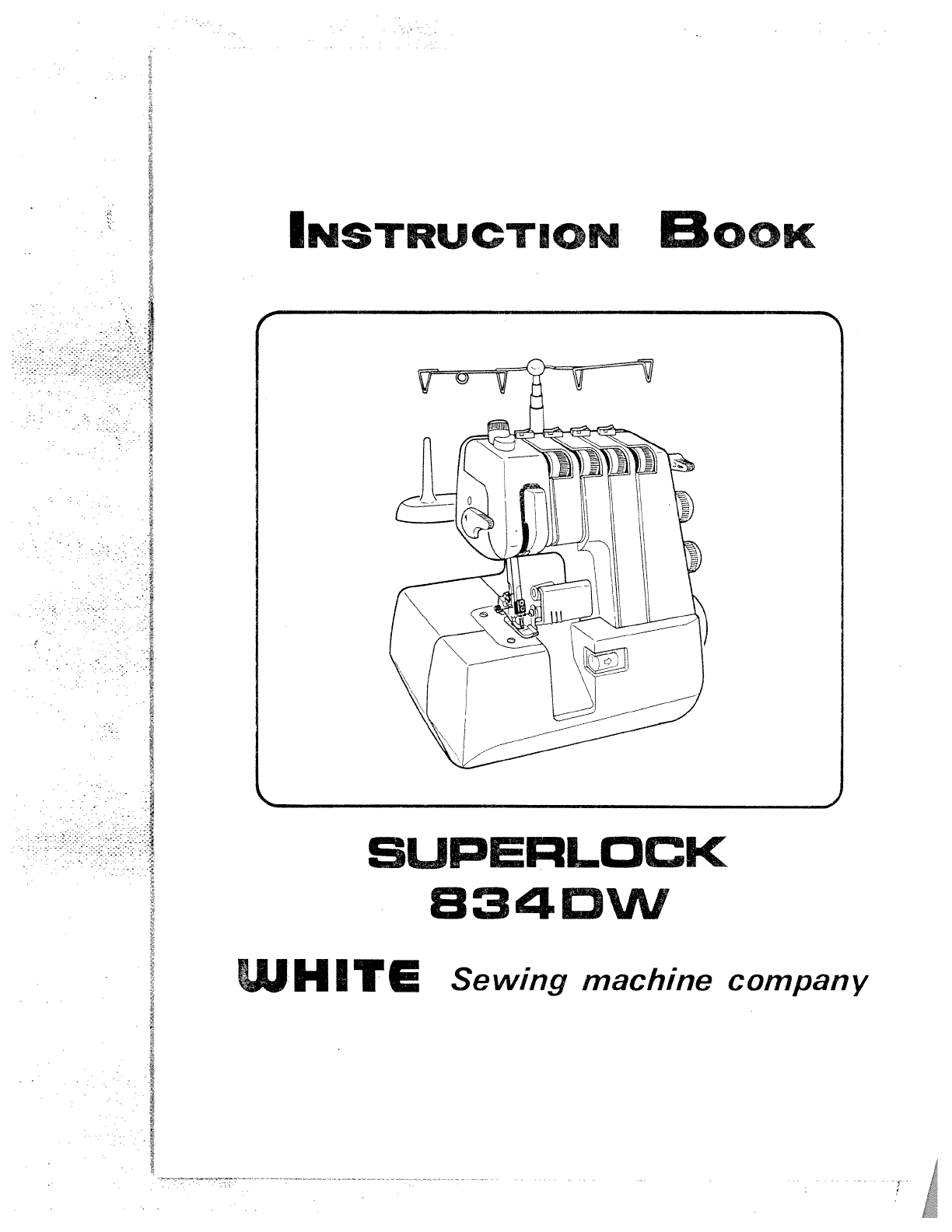
White Superlock 834Dw Users Manual
834DW to the manual a4ad7aff-11d0-4800-9532-33bf54e4021e
2015-02-03
: White White-Superlock-834Dw-Users-Manual-479195 white-superlock-834dw-users-manual-479195 white pdf
Open the PDF directly: View PDF  .
.
Page Count: 37
v
-I
IC
0
o
z
w
0
0
z
m
C,,
CD
(I%
CD
w
w
a
U)
C
m
D
r
0
0
POLARIZED
PLUG
CAUTION
To
reduce
the
risk
of
electric
shock,
this
appliance
has
a
polarized
plug
(one
blade
is
wider
than
the
other).
This
plug
will
fit in
a
polarized
outlet
only
one
way.
if
the
plug
does
not
fit
fully
in
the
outlet,
reverse
the
plug.
If
it
still
does
not
fit,
contact
a
qualified
electrician
to
install
the proper
outlet.
Do
not
change
the
plug
in
any
way.
OVERLOOK
SEWING
MACHINE
Record
in
space
provided
below
the
Serial
No.
and
Model
No.
of
this
appliance.
The
Serial
No.
is
located
Rear
of
arm.
The
Model
No.
is
located
Rear
of
arm.
Serial
No.
_______________________________
Model
No.
834DW
Retain
these
numbers
for
future
reference.
iITANT
SAFETY
INSTRUcTIONS
When
using
an
electrical
appliance,
basic
safety
precautions
should
always
be
followed,
including
the
following:
Read
II
instructions
before
using
(this
INE——To
reduce
the
risk
of
electric
shock:
An
appliance
should never
be
left
unattended
when
plugged
in.
Always
unplug
this
appliance
from
the
electric
outlet
immediately
after
using
and
before
cleaning.
WARNING——To
reduce
the
risk
of
burns,
fire,
scctrc
shcck,
or
injury
to
persons:
1.
Do
not
allow
to
be
used
as
a
toy.
Close
attention
is
necessary
when
this
appliance
is
used
by
or
near
children.
2.
Use
this
appliance
only
for
its
intended
use
as
described
in
this
manual.
Use
only
attachments
recommended
by
the
manufacturer
as
contained
in
this manual.
3.
Never
operate
this
appliance
if
it
has
a
damaged
cord
or
plug,
if
it
is
not
working
properly,
if
it
has
been
dropped
or
damaged,
or
dropped
into
water.
Return
the
appliance
to
the
nearest
authorized dealer
or
service
center
for
examination,
repair;
eiectricai
or
mechanical
adjustment.
4.
Never
operate
the
appliance
with
any
air
openings
blocked,
Keep
ventilation
open
ings
of
the
sewing
machine
and
foot
controller
free
from
the
accumulation
of lint,
dust,
and
loose
cloth.
5.
Never drop
or
insert
any
object
into
any
opening.
6.
Do
not
use
outdoors.
7.
Do
not
;?erate
where
aerosol
(spray)
products
are
being
used
or
where
oxygen
is
being
administered.
8. To
disconnect,
turn
all
controls
to
the
off
(“0”)
position,
then
remove
plug
from
outlet.
9.
Do
not
unplug
by
pulling
on
cord.
To
unplug,
grasp
the
plug,
not
the
cord.
DANGER
1.
Always
unplug
before
relamping.
Replace
bulb
with
same
type rated
15
watts.
2.
Do
not
reach
for
an
appliance that has
fallen
into
water.
Unplug immediately.
3.
Do
not
place
or
store
appliance
where
it
can
fall
or
be
pulled
into
a
tub
or
sink.
Do
not
place
in
or
drop
into
water
or
other
liquid.
WARNING
1.
Keep
fingers
away
from
all
moving
parts.
Special
care
is
required
around
the
sewing
machine
needle.
2.
Always
use
the
proper
needle
plate.
The
wrong
plate
can
cause
the needle
to
break.
3.
Do
not
use
bent
needles.
4.
Do
not
pull
or
push
fabric
while
stitching.
It
may
deflect
the
needle
causing
it
to
break.
5.
Switch
the sewing
machine
off
(“0”)
when making
any
adjustments
in
the
needle
area, such as
threading
needle,
changing
needle,
or
changing
presser
foot,
etc.
6.
Always
unplug
sewing machine
from
the
electrical
outlet
when
removing
covers,
lubricating,
or
when
making any
other
user
servicing
adjustments
mentioned
in
the
instruction manual.
7.
Never
operate
on
a
soft
surface such
as
a
bed
or
couch
where
the
air
openings
may
be
blocked.
SAVE
THESE
INSTRUCTIONS
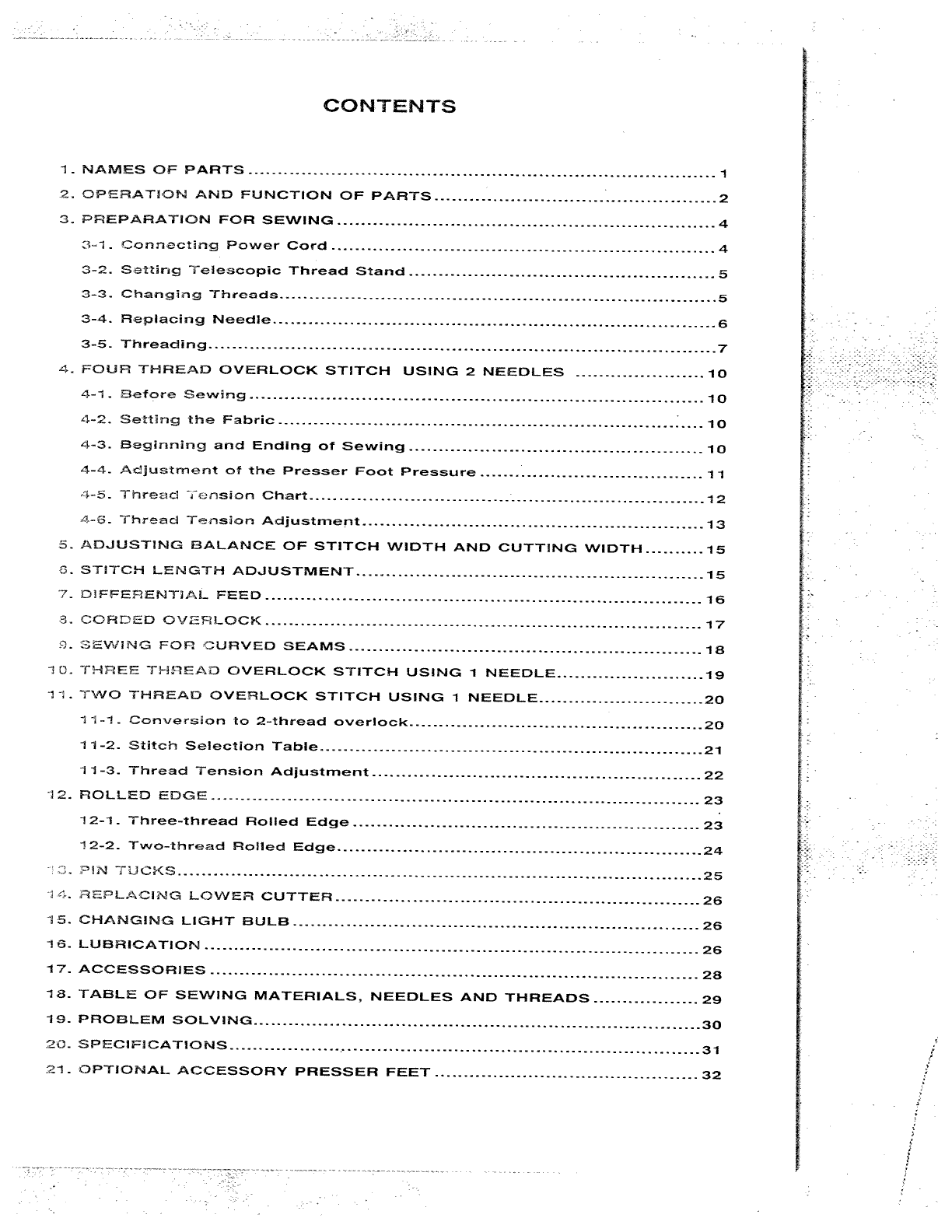
CONTENTS
1
-
NAMES
OF
PARTS
1
2.
OPERATION
AND
FUNCTION
OF
PARTS
2
3.
PREPARATION
FOR
SEWING
4
3-rni.
Connecting
Power
Cord
4
3-2.
Setting
Telescopic
Thread
Stand
5
3-3.
Changing
Threads
5
3-4.
Replacing
Needle
6
3-5.
Threading
7
4.
FOUR
THRE.D
OVERLOCK
STITCH
USING
2
NEEDLES
10
4—1
.
Sefore
Sewing
10
4-2.
Setting
the
Fabric
10
4-3.
Beginning
and
Ending
of
Sewing
10
4-4.
Adjustment
of
the
Presser
Foot
Pressure
1 1
4-5.
Threscl
Tnsion
Chart
12
4-5.
Thread
Tension
Adjustment
13
5.
ADJUSTiNG
BALANCE
OF STITCH
WIDTH
AND
CUTTING
WIDTH
15
5.
STITCH
LENGTH
ADJUSTMENT
15
7.
DIFFERENTiAL
FEED
16
3.
CORDED
OVERLOCK
17
1.
SEWING
FOR
CURVED
SEAMS
18
10.
THREE
THREAD OVERLOCK
STITCH
USING
1
NEEDLE
19
11.
TWO
THREAD OVERLOCK
STITCH
USING
1
NEEDLE
20
I
1-1
-
Conversion
to
2-thread
overlock
20
11-2.
Stitch
Selection
Table
21
11-3.
Thread
Tension
Adjustment
22
12.
ROLLED EDGE
23
12-1.
Three-thread
Rolled
Edge
23
12-2.
Two-thread
Rolled
Edge
24
D
TUCKS
25
REPLACING LOWER
CUTTER
26
15.
CHANGING
LIGHT BULB
26
16.
LUBRICATION
26
17.
ACCESSORIES
28
18.
TABLE OF
SEWING
MATERIALS,
NEEDLES
AND
THREADS
29
19.
PROBLEM
SOLViNG
30
20.
SPECIFICATIONS
31
21.
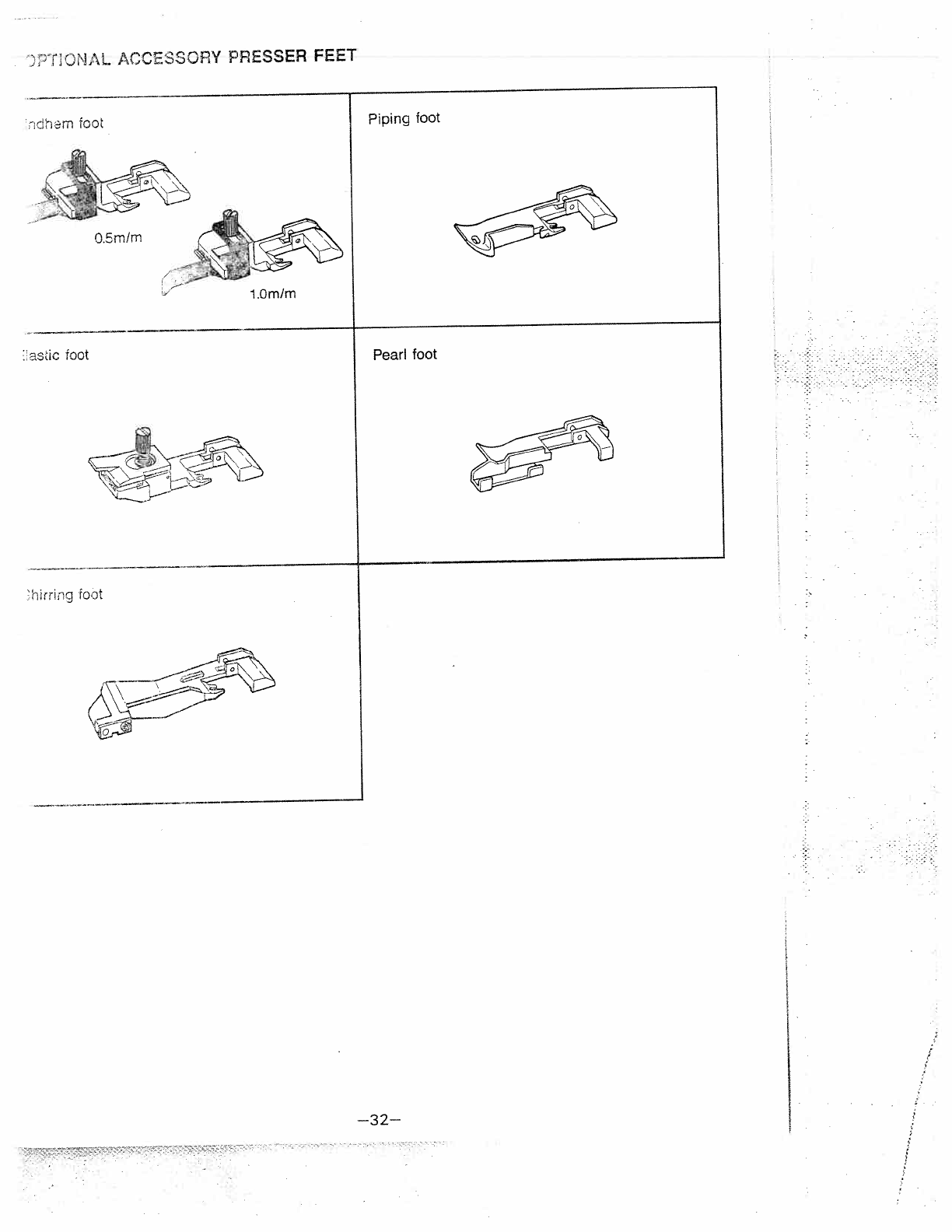
OPTIONAL
ACCESSORY
PRESSER
FEET 32
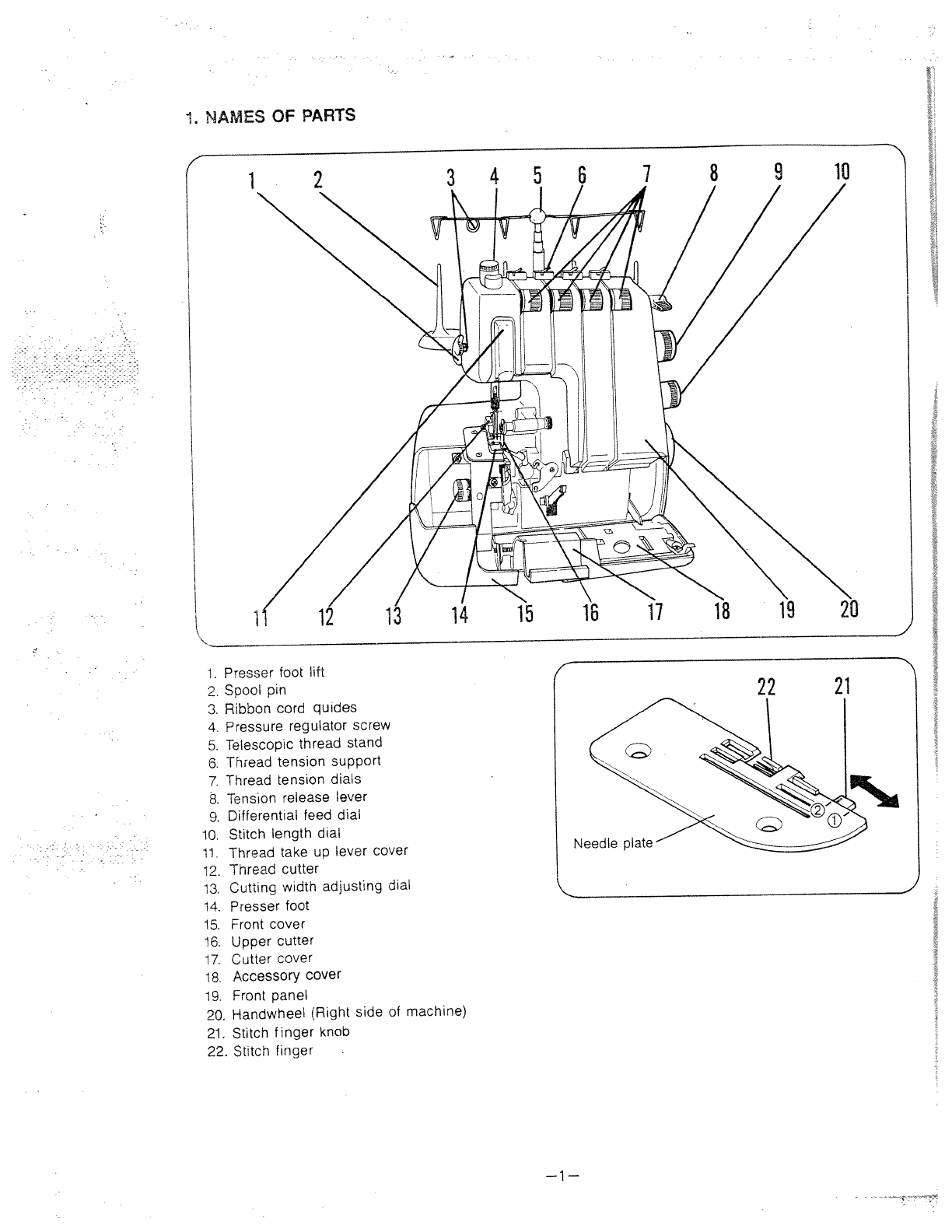
I.
1.
NAMES
OF
PARTS
n
1456
y
L
LL
\Y
/
Y
/iI;
1
12
13
14
15
16 17 18 19
20
1,
Presser
foot
lift
2.
Spool
pin
22
21
3.
Ribbon cord
quides
4.
Pressure
regulator screw
5.
Telescopic
thread
stand
9Dfferentialfeeddial
11.
Thread take
up
lever
cover
Needle
plate
2.
Triread
cutter
13.
Cutting
width
adjusting
dial
14.
Presser
foot
15,
Front
cover
16.
Upper
cutter
17.
Cutter
cover
18.
Accessory
cover
19.
Front
panel
20.
Handwheel
(Right
side
of
machine)
21.
Stitch
finger
knob
22. Stitch
finger
I
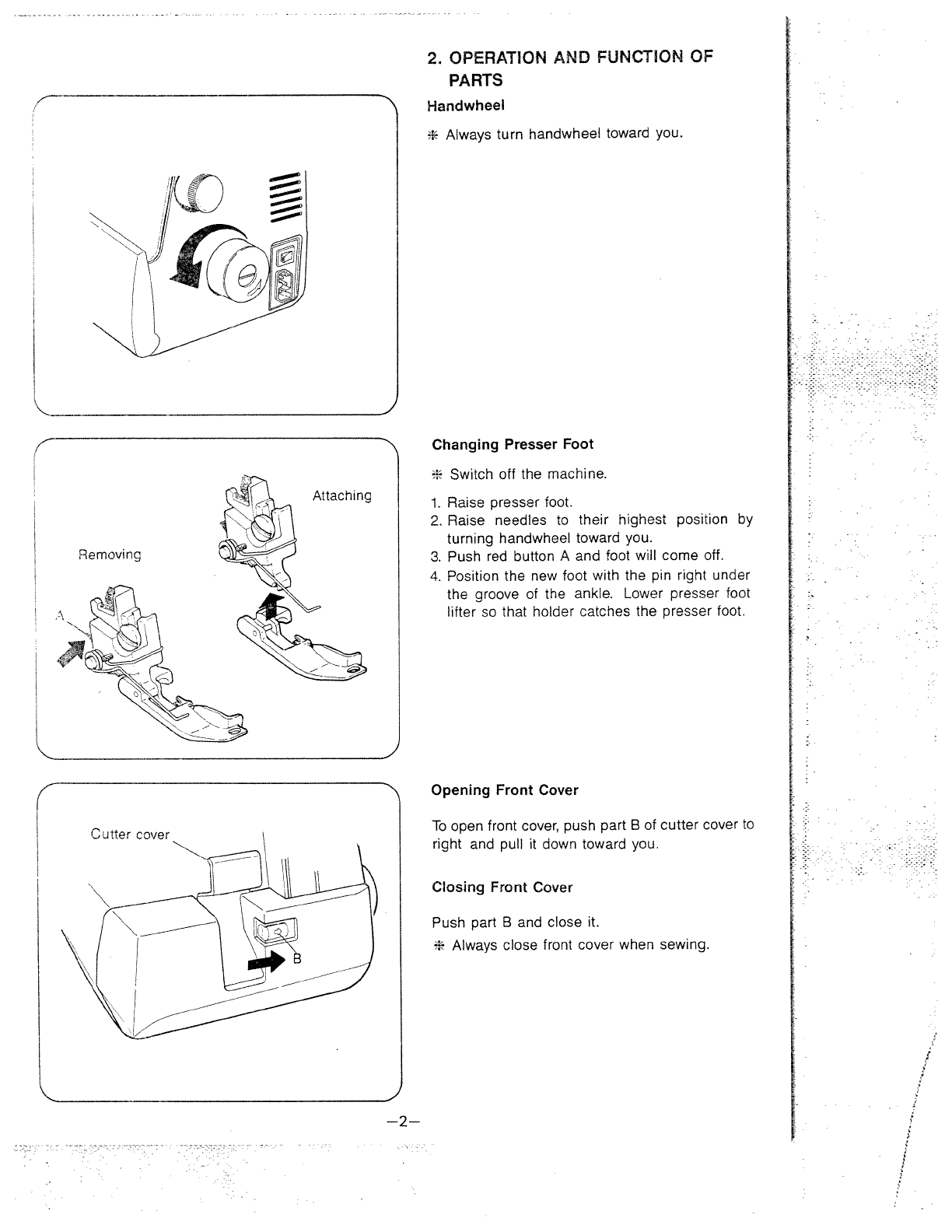
2.
OPERATION
AND
FUNCTION
OF
PARTS
Handwheel
Always
turn
handwheel
toward
you.
Changing
Presser
Foot
)
±
Switch
off
the machine.
1.
Raise
presser
foot.
2.
Raise
needles
to
their
highest
position
by
turning
handwheel
toward
you.
3.
Push
red
button
A
and
foot
will
come
off.
4.
Position
the
new
foot
with
the
pin
right
under
the
groove
of
the
ankle.
Lower
presser
foot
lifter
so
that
holder
catches
the
presser
foot.
Opening
Front
Cover
To
open
front
cover,
push
part
B
of
cutter
cover
to
right
and
pull
it
down
toward
you.
Closing
Front
Cover
Push
part
B
and
close
it.
+
Always
close
front
cover
when
sewing.
Attaching
Re
movi
n
ç
I
—2—
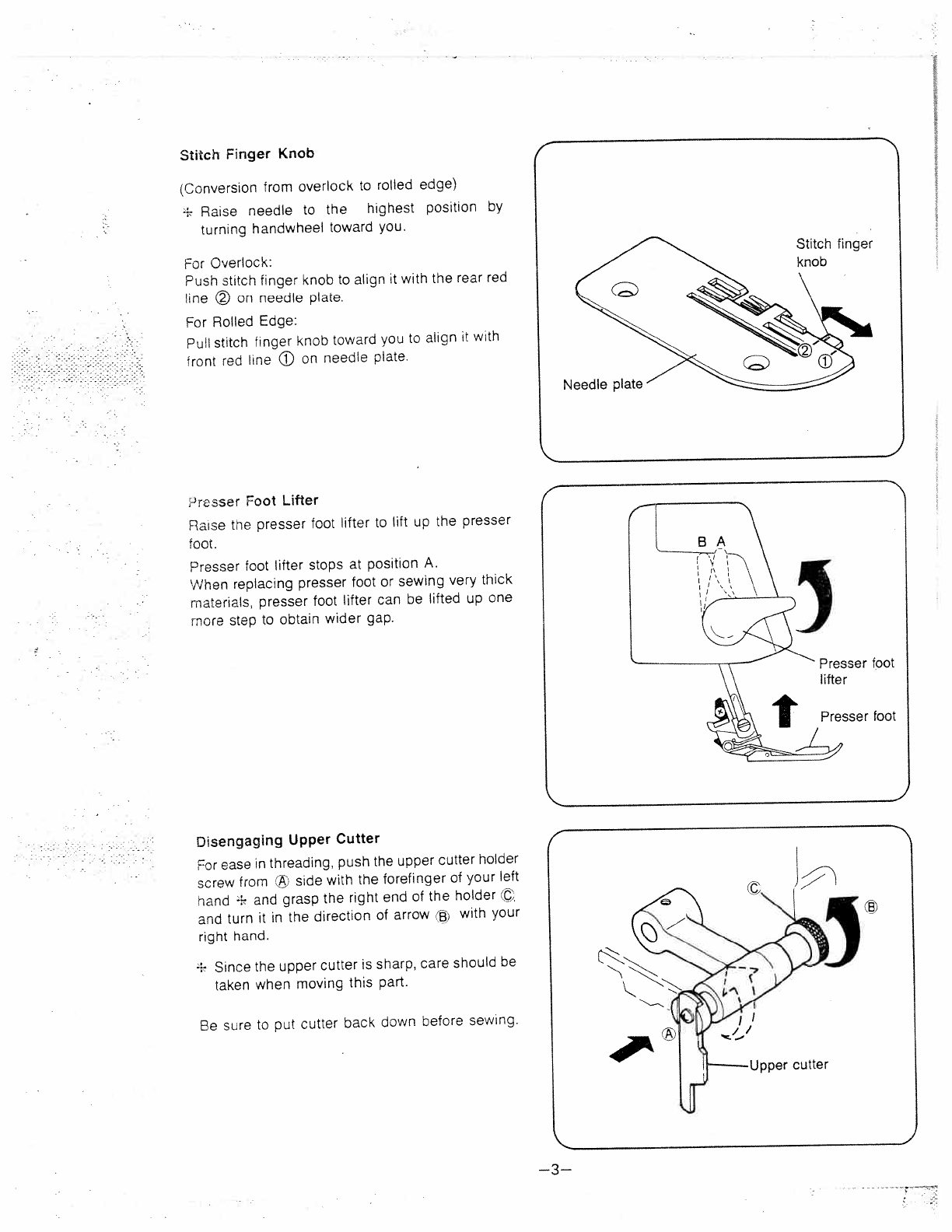
Stitch
Finger
Knob
(Conversion
from
overlock
to
rolled
edge)
÷
Raise
needle
to
the highest
position
by
turning
handwheel
toward
you.
For
Overlock:
Push
stitch
finger
knob
to
align
it
with
the
rear
red
line
©
on
needle
plate.
For
Rolled
Edge:
Pull
stitch finger
knob
toward
you
to
align
t
with
front
red
line
on
needle
plate.
resser
Foot
Lifter
Raise
tne
presser
foot
lifter to
lift
up
the
presser
foot.
Presser
foot lifter
stops
at
position
A.
When
replacing
presser
foot
or
sewing
very
thick
materials,
presser
foot
lifter
can
be
lifted
up
one
more
step
to
obtain wider gap.
Disengaging
Upper
Cutter
For
ease
in
threading,
push
the
upper
cutter
holder
screw
from
side
with
the
forefinger
of
your
left
hand
±
and
grasp
the
right
end
of
the
holder
.
and
turn
it
in
the
direction
of
arrow
B
with
your
right
hand.
+Since
the
upper
cutter
is
sharp,
care
should
be
taken
when
moving
this
part.
Be
sure
to
put
cutter
back
down
before sewing.
Presser
foot
lifter
Presser
toot
I
-Upper
cutter
)
—3—
3.
PREPARATION
FOR
SEW!NG
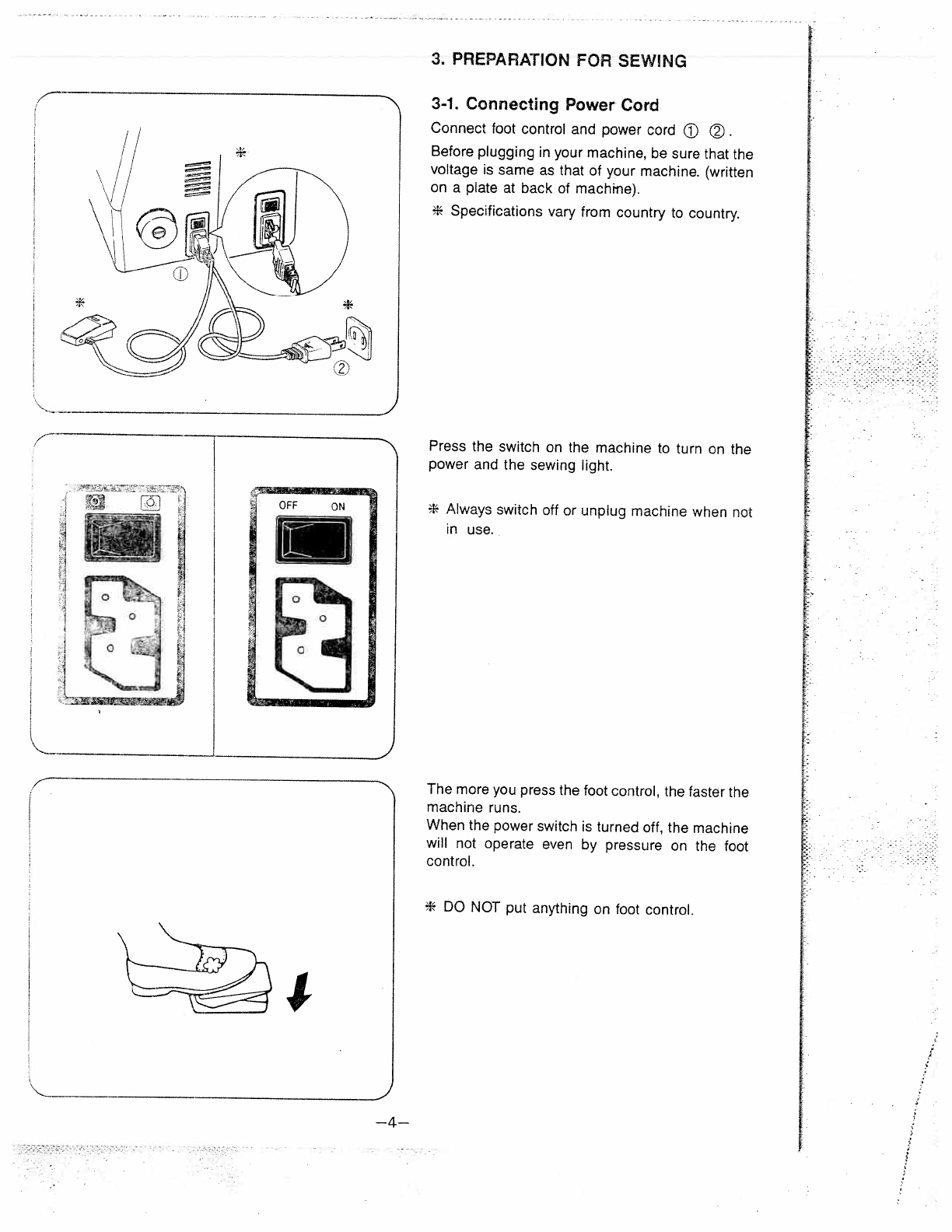
3-1.
Connecting
Power
Cord
Connect
foot
control
and
power cord
®
Before
plugging
in
your
machine,
be
sure
that
the
voltage
is
same
as
that
of
your
machine.
(written
on
a
plate
at
back
of
machrne).
*
Specifications
vary
from
country
to
country.
ij
OFF
ON
Press
the
switch
on
the machine
to
turn
on
the
power
and
the
sewing
light.
*
Always
switch
off
or
unplug
machine
when
not
in
use.
$
The
more
you
press
the
foot
control,
the
faster
the
machine
runs.
When
the
power
switch
is
turned
off,
the
machine
will
not
operate
even
by
pressure
on
the
foot
control.
*
DO NOT
put
anything
on
foot
control.
1/
—4—
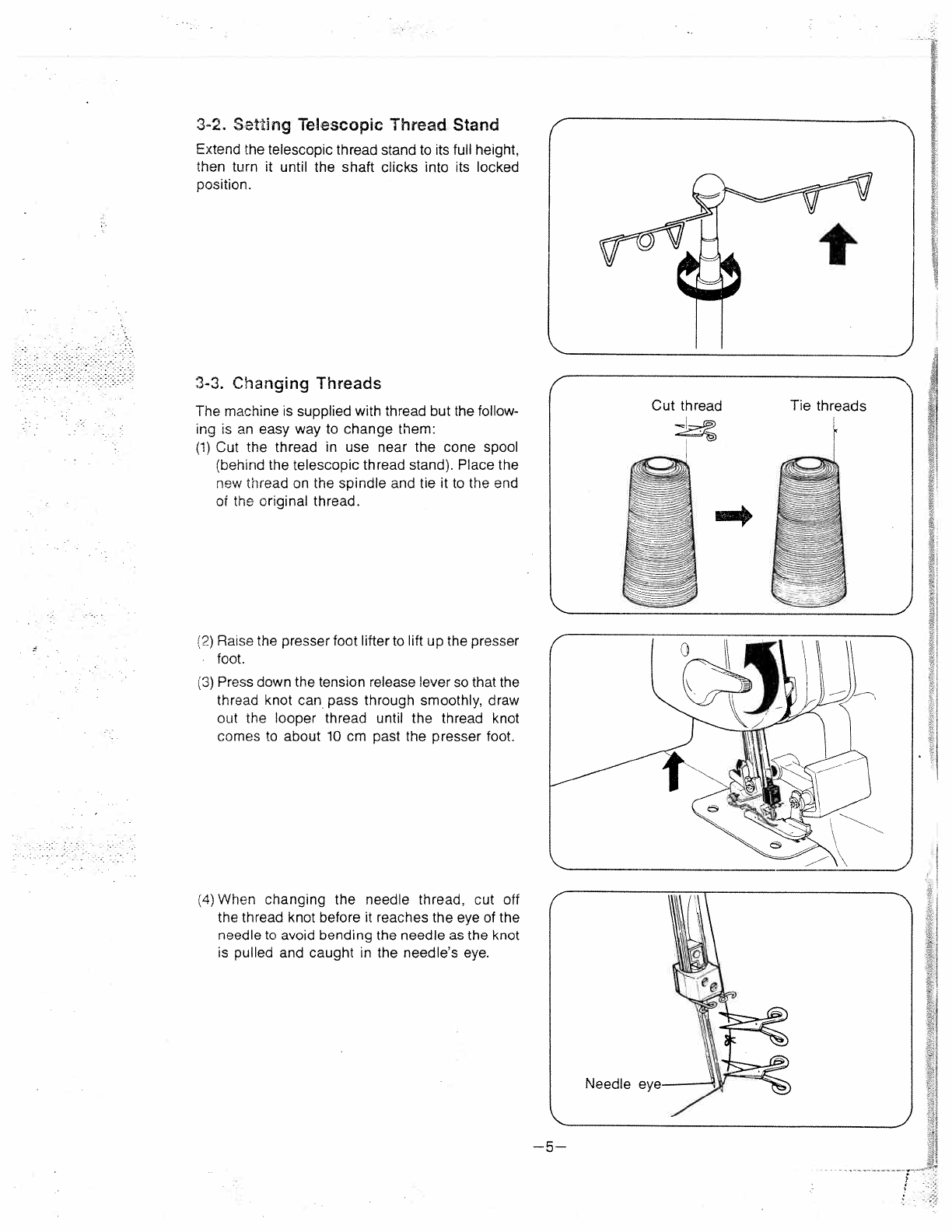
3-2.
Setting
Telescopic
Thread Stand
Extend
the
telescopic thread stand
to
its
full
height,
then
turn
it
until
the
shaft
clicks
into
its
locked
position.
3-3.
Changing
Threads
The
machine
is
supplied
with
thread
but the follow
ing
is
an
easy
way
to
change
them:
(1)
Cut
the
thread
in
use
near
the
cone
spool
(behind
the
telescopic thread
stand).
Place
the
new
thread
on
the
spindle
and
tie
it
to
the
end
of
the
original
thread.
(2)
Raise
the
presser
foot
lifter
to
lift
up
the
presser
foot.
(3)
Press
down
the
tension
release
lever
so
that
the
thread
knot
can
pass
through
smoothly, draw
out
the
looper
thread
until
the
thread
knot
comes
to
about
10
cm
past
the
presser
foot.
(4)
When
changing
the
needle thread,
cut
off
the
thread
knot
before
it
reaches
the
eye
of
the
needle
to
avoid
bending
the
needle
as
the
knot
is
pulled
and
caught
in
the needle’s
eye.
I
Cut
thread
Tie
threads
3
—
—5—-
I
Loosen
I
—6—
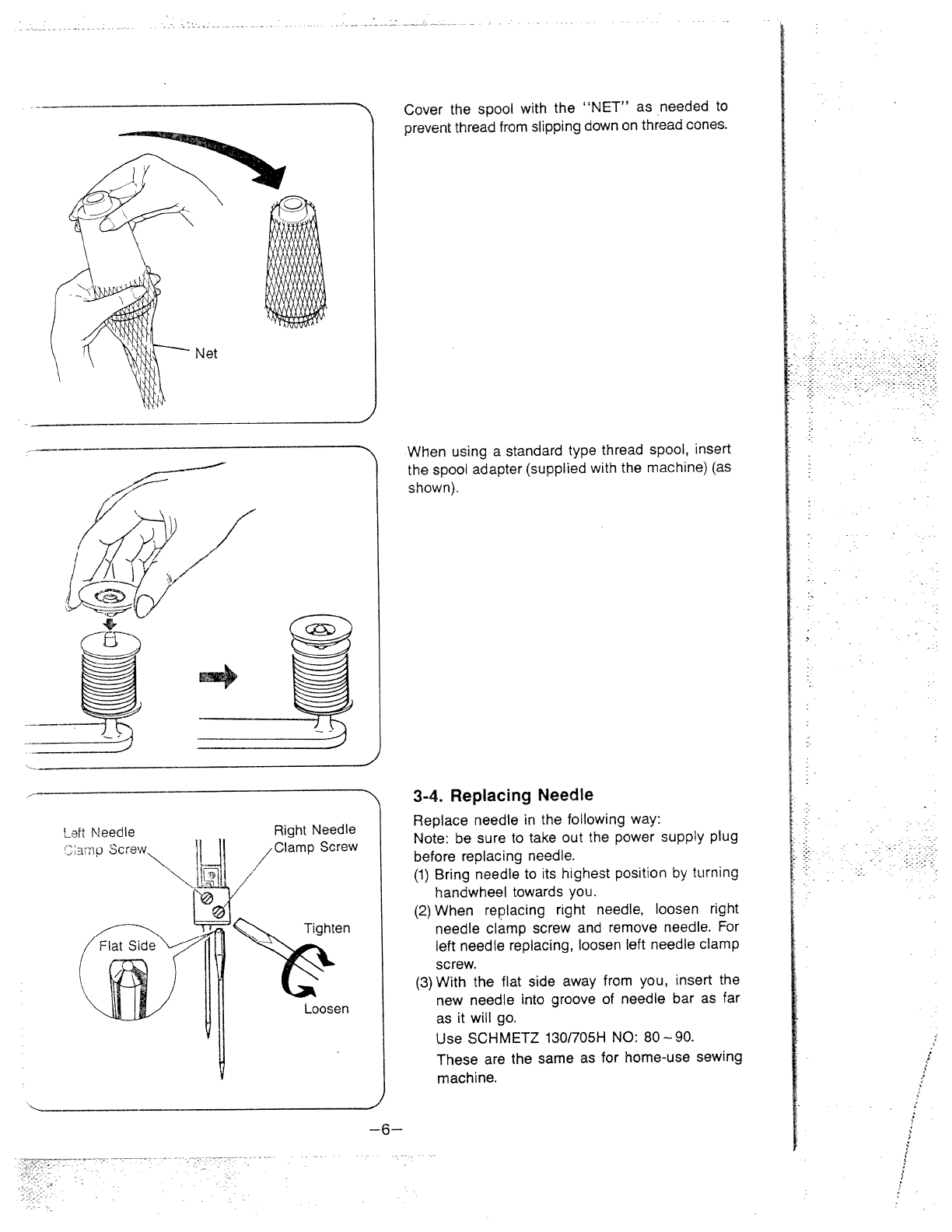
Cover
the
spool
with
the
“NET”
as
needed
to
prevent
thread
from
slipping
down on
thread cones.
When
using
a
standard
type
thread
spool,
insert
the
spool
adapter
(supplied
with
the
machine)
(as
shown).
3-4.
Replacing
Needle
Replace
needle
in
the
following
way:
Note:
be
sure
to
take
out the
power
supply
plug
before
replacing
needle.
(1)
Bring
needle
to
its
highest
position
by
turning
handwheel
towards
you.
(2)
When
replacing
right
needle,
loosen
right
needle
clamp
screw
and
remove
needle.
For
left
needle
replacing,
loosen
left
needle
clamp
screw.
(3)
With
the
flat
side
away
from
you,
insert the
new
needle
into
groove
of
needle
bar
as
far
as
it
will
go.
Use
SCHMETZ
130/705H
NO:
80—90.
These
are the
same
as
for
home-use
sewing
machine.
Left
Needle
Right
Needle
Clamp
Screw
Tighten
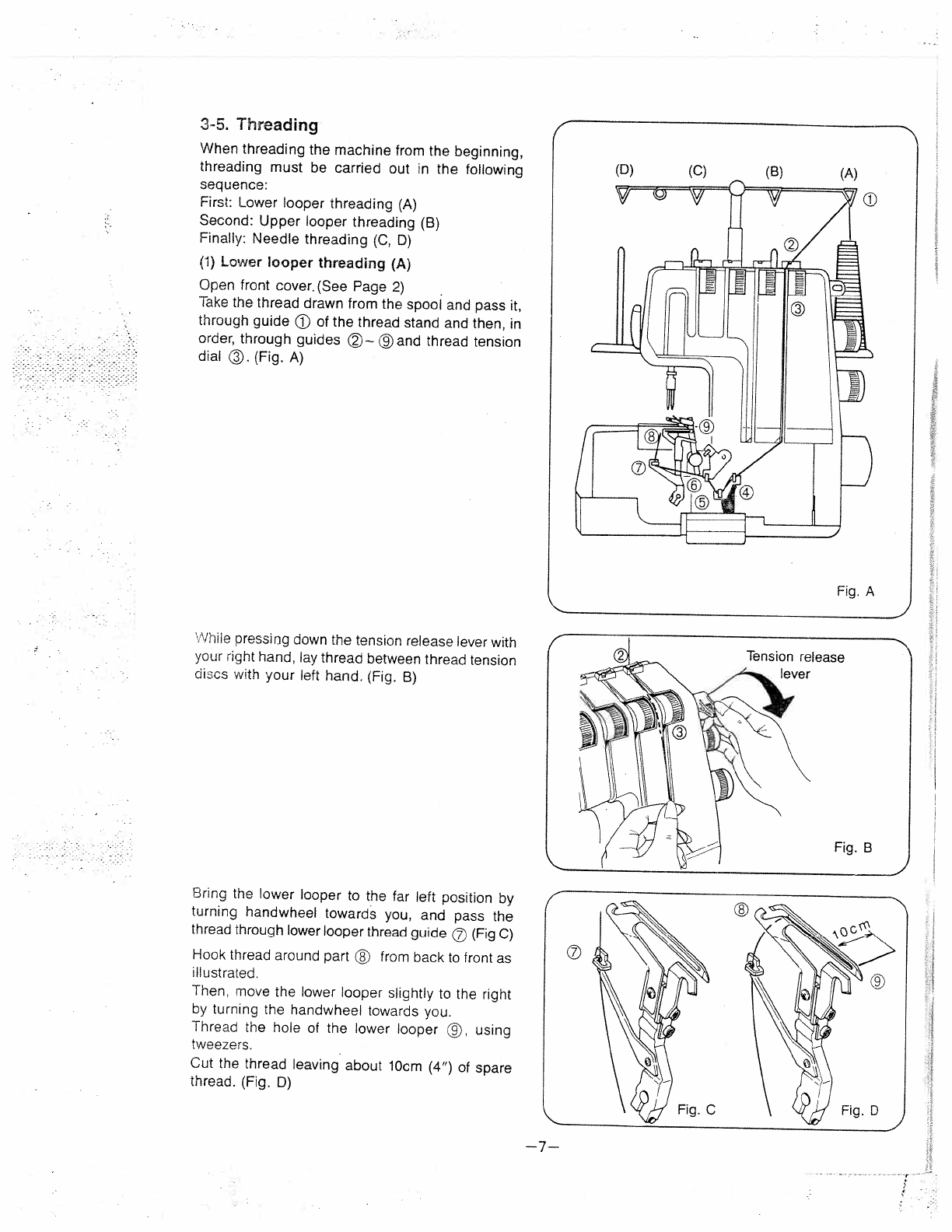
35.
Threading
When
threading
the machine
from
the beginning,
threading must
be
carried
out
in
the
following
sequence:
First:
Lower
looper
threading
(A)
Second:
Upper
looper
threading
(8)
Finally:
Needle
threading
(C,
D)
(1)
Lower
looper
threading
(A)
Open
front
cover.
(See
Page
2)
Take
the
thread
drawn
from
the
spool
and
pass
it,
through
guide
cj
of
the
thread
stand
and
then,
in
order,
through
guides
©--
©and
thread
tension
dial
©.
(Fig.
A)
,Vhiie
pressing
down
the tension
release
lever
with
your
right
hand,
lay
thread
between
thread
tension
discs
with
your
left
hand.
(Fig.
B)
Bring
the
lower
looper
to
the
far
left
position
by
turning
handwheel
towards
you,
and
pass
the
thread
through
lower
looper
thread
guide
0
(Fig
C)
Hook
thread
around
part
®
from
back
to
front
as
illustrated.
Then,
move
the
lower
looper
slightly
to
the
right
by
turning
the
handwheel
towards
you.
Thread
the hole
of
the
lower
looper
©,
using
tweezers.
Cut the
thread
leaving
about
10cm
(4”)
of
spare
thread.
(Fig.
D)
(D)
(C)
(B)
(A)
Fig.
A
—7—
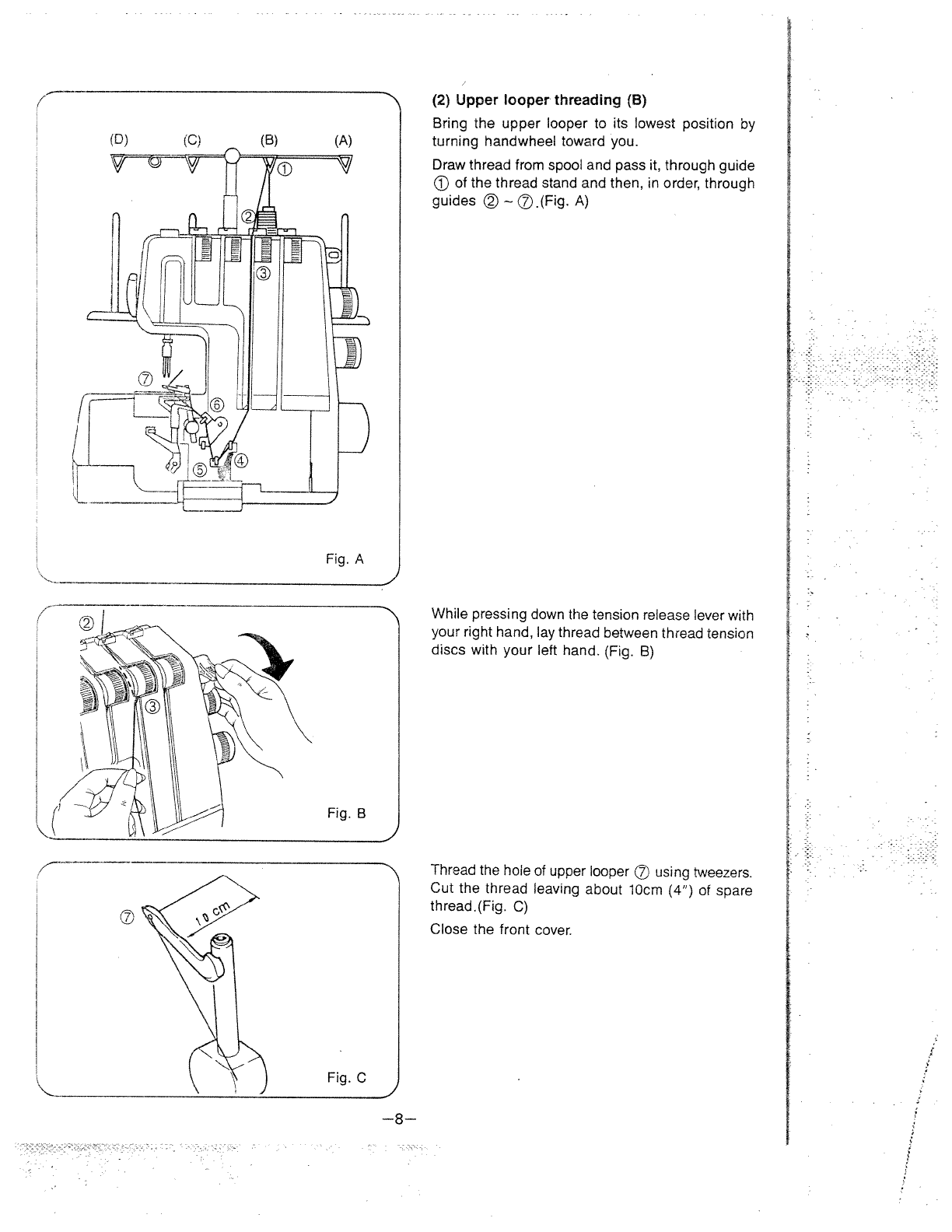
(2)
Upper
looper threading
(8)
Bring
the
upper
looper
to
its
lowest
position
by
turning
handwheel
toward
you.
Draw
thread
from
spool
and
pass
it,
through guide
c
of
the
thread
stand
and
then,
in
orde
through
guides
©
—
©.(Fig.
A)
While
pressing
down
the
tension
release
lever
with
your
right
hand,
lay
thread
between
thread
tension
discs
with
your
left
hand.
(Fig.
B)
Thread
the
hole
of
upper
looper
0
using
tweezers.
Cut
the
thread
leaving
about
10cm
(4”)
of
spare
thread.(Fig.
C)
Close the
front
cover.
(D)
(C)
(B)
(A)
Fig.
A
Fig.
B
—8—
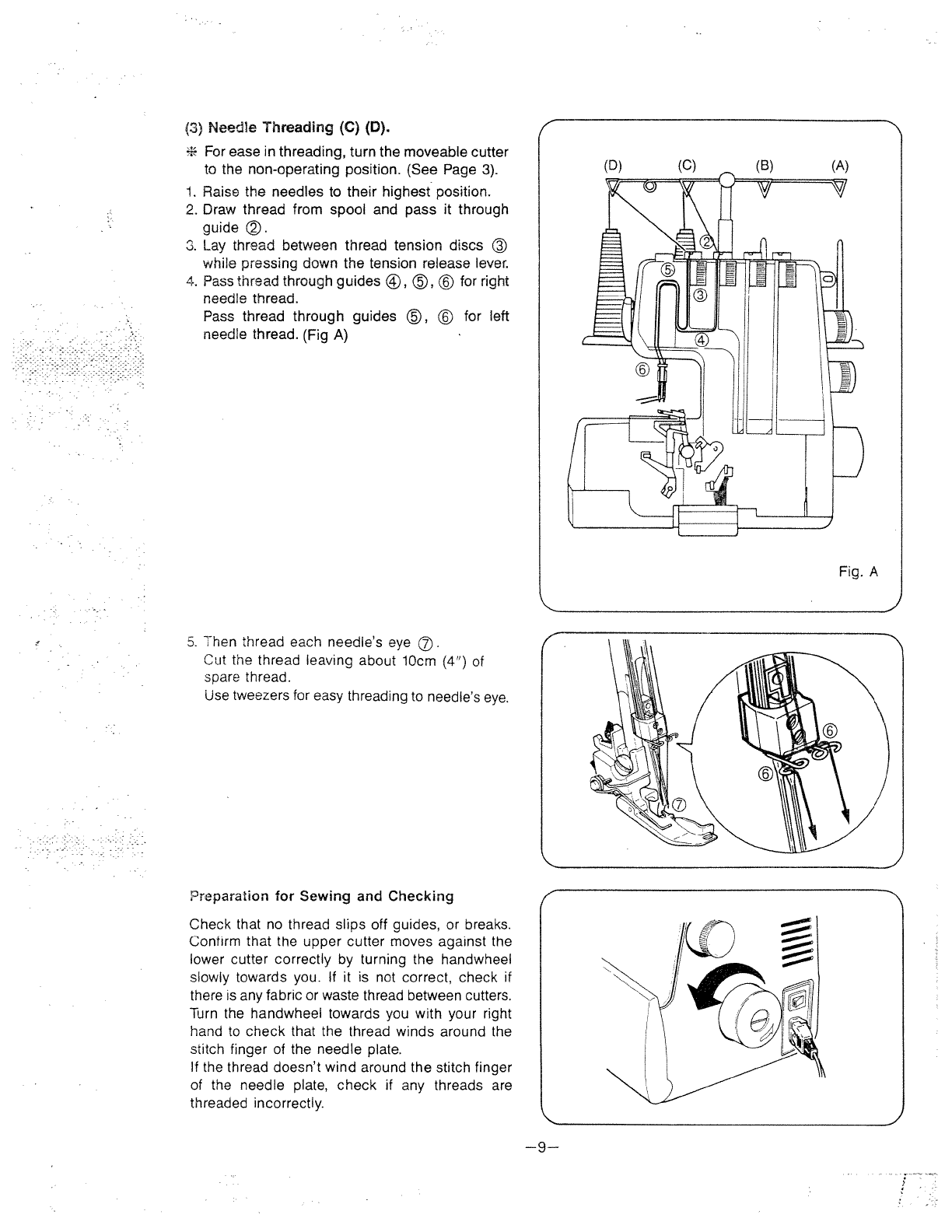
(3)
Needle
Threading
(C) (D).
For
ease
in
threading,
turn
the
moveable
cutter
to
the
non-operating
position.
(See
Page
3).
1.
Raise
the
needles
to
their
highest
position.
2.
Draw
thread
from
spool
and
pass
it
through
guide®.
3.
Lay
thread between
thread
tension
discs
©
while
pressing
down
the
tension
release
lever.
4.
Pass
thread
through
guides
©,
®,
©
for
right
needle thread.
Pass
thread
through
guides
©,
©
for
left
needle thread.
(Fig
A)
5.
Then
thread
each
needle’s
eye
0.
Cut
the
thread
leaving
about
10cm
(4”)
of
spare
thread.
Use
tweezers
for
easy
threading
to
needle’s
eye.
Preparation
for
Sewing and
Checking
Check
that
no
thread
slips
off
guides,
or
breaks.
Confirm
that
the
upper
cutter
moves
against
the
lower
cutter
correctly
by
turning
the handwheel
slowly
towards
you.
If
it
is
not
correct,
check
if
there
is
any fabric
or
waste
thread
between
cutters.
Turn
the
handwheel
towards
you
with
your
right
hand
to
check
that
the
thread
winds
around
the
stitch finger
of
the
needle
plate.
If
the
thread doesn’t
wind
around
the
stitch finger
of
the
needle
plate,
check
if
any
threads
are
threaded
incorrectly.
(D)
(C)
(B)
(A)
Fig.
A
-I
7-
—9—
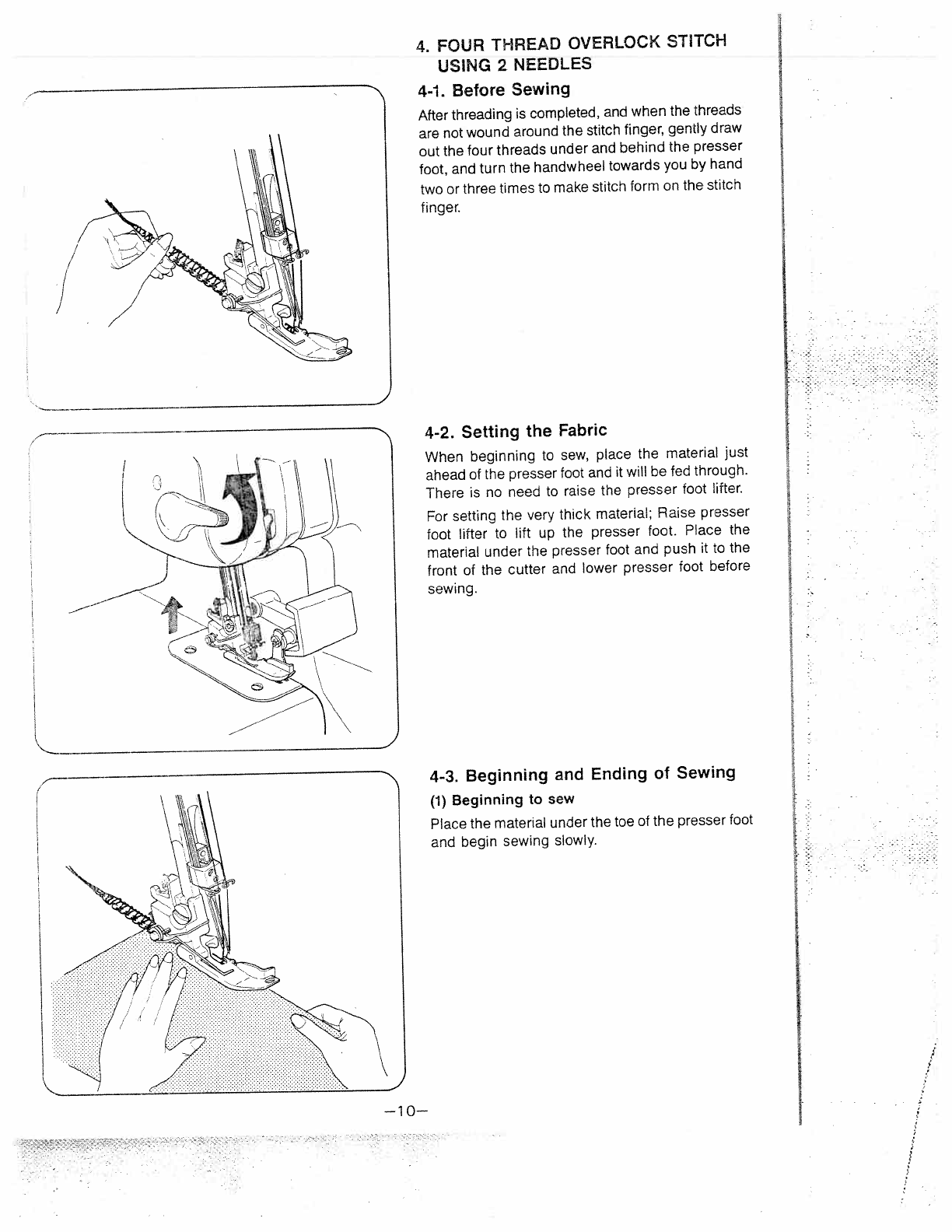
4.
FOUR THREAD
OVERLOCK
STITCH
USING
2
NEEDLES
4-1.
Before
Sewing
I
After
threading
is
completed,
and
when the
threads
are
not
wound
around
the
stitch
finger,
gently
draw
out
the
four
threads
under
and
behind
the
presser
foot,
and
turn
the
handw
heel
towards
you
by
hand
two
or
three
times
to
make
stitch
form
on
the
stitch
finger.
4-2.
Setting
the
Fabric
When
beginning
to
sew,
place
the
material
just
ahead
of
the
presser
foot
and
it
will
be
fed
through.
There
is
no
need
to
raise the
presser
foot
lifter.
For
setting
the
very
thick material;
Raise
presser
foot
lifter
to
lift
up
the
presser
foot.
Place
the
material
under
the
presser
foot
and
push
it
to
the
front
of
the
cutter
and
lower
presser
foot
before
sewing.
4-3.
Beginning
and Ending
of
Sewing
(1)
Beginning
to
sew
Place
the
material
under the
toe
of
the
presser
foot
and
begin
sewing
slowly.
7
—10--
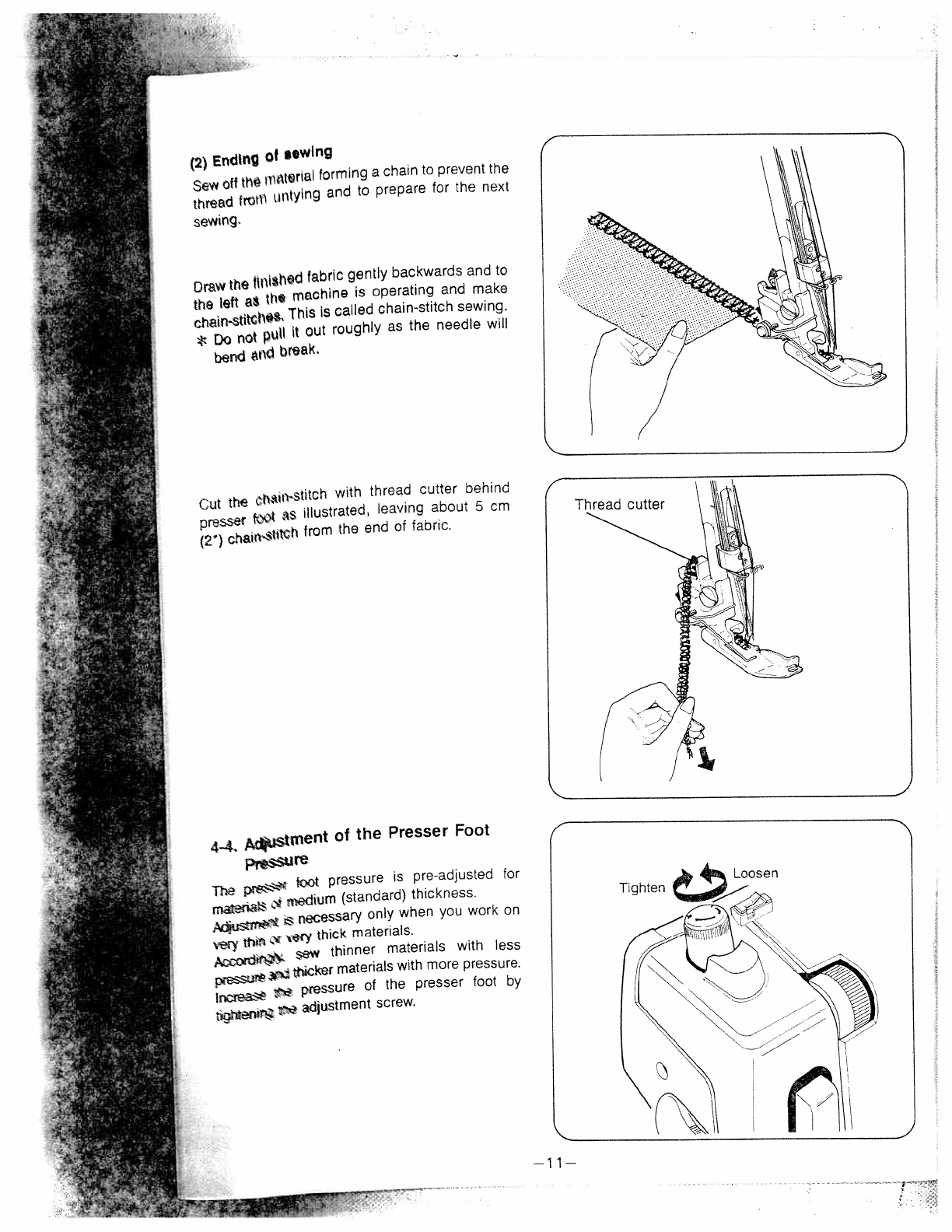
(2)
EndIng
of
sewing
Sew
oft
th
terial
forming
a
chain
to
prevent
the
thread
mtying and
to
prepare
for
the
next
sewing.
oraw
me
shed
fabric
gently
backwards
and
to
the
‘eft
a*
me
machine
is
operating
and make
chain-Stith
This
is
called
chain-stitch
sewing.
*
oo
not
pufl
it
out roughly
as
the
needle
will
bead
nd
break.
Cut
the
hfltit
with
thread cutter
behind
presser
toot
s
illustrated,
leaving
about
5
cm
(2”)
ctI
ifl$tit
from
the end
of
fabric.
pistment
of
the
Presser
Foot
PreSsure
me
presset
toot
pressure
is
pre-adjusted
for
y
medium
(standard)
thickness.
necessary
only
when
you
work
on
very
thr
ery
thick
materials.
sew
thinner materials
with
less
thAcker
materials
with
more
pressure.
pressure
of
the
presser
foot
by
adjustment
screw.
4
4
—11—
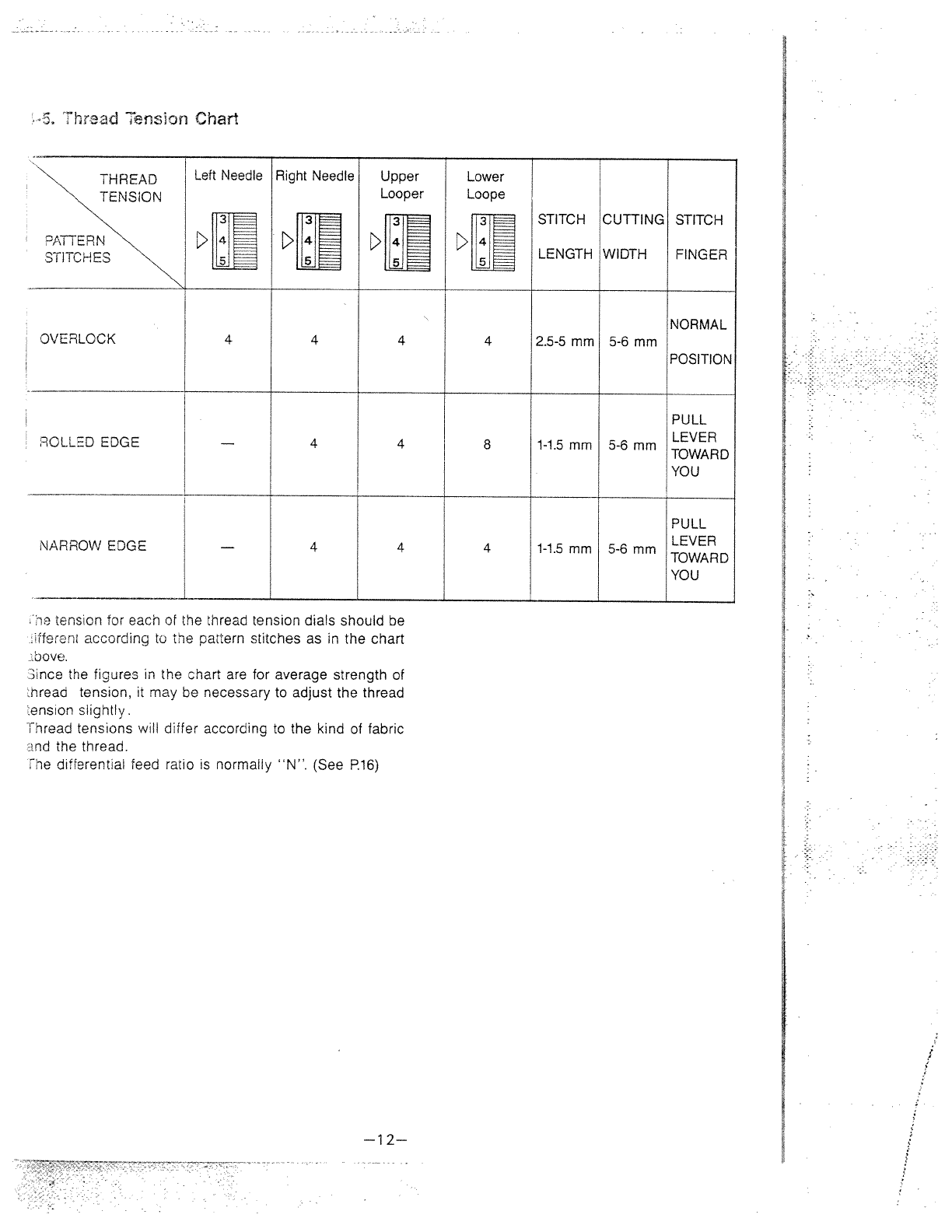
3.
Thread
Tension Chart
,e
tension
for
each
of
the
thread
tension
dials
should
be
.fferent
according
to
the
pattern
stitches
as
in
the
chart
‘Dove.
3ince
the
figures
in
the chart
are
for
average
strength
of
nread
tension,
it
may
be
necessary
to
adjust the
thread
.ension slightly.
rhread
tensions
will
differ
according
to
the
kind
of
fabric
.mnd
the
thread.
The
differential
feed
ratio
is
normally
‘N”.
(See
P16)
THREAD
Left
Needle
Right
Needle
Upper
Lower
TENSiON
Looper
Loope
‘j3l
‘f3l
I
3
STITCH
CUTTING
STITCH
PTT;:NN
LENGTH
WIDTH
FINGER
STITCHES
L
..
NORMAL
OVERLOOK
4444
2.5-5
mm
5-6
mm
:
POSITION
PULL
LEVER
ROLLED
EDGE
—
44
8
1-1.5
mm
5-6
mm
TOWARD
YOU
PULL
LEVER
NARROW
EDGE
—
4
4
4
1-1.5
mm
5-6
mm
TOWARD
YOU
—12--
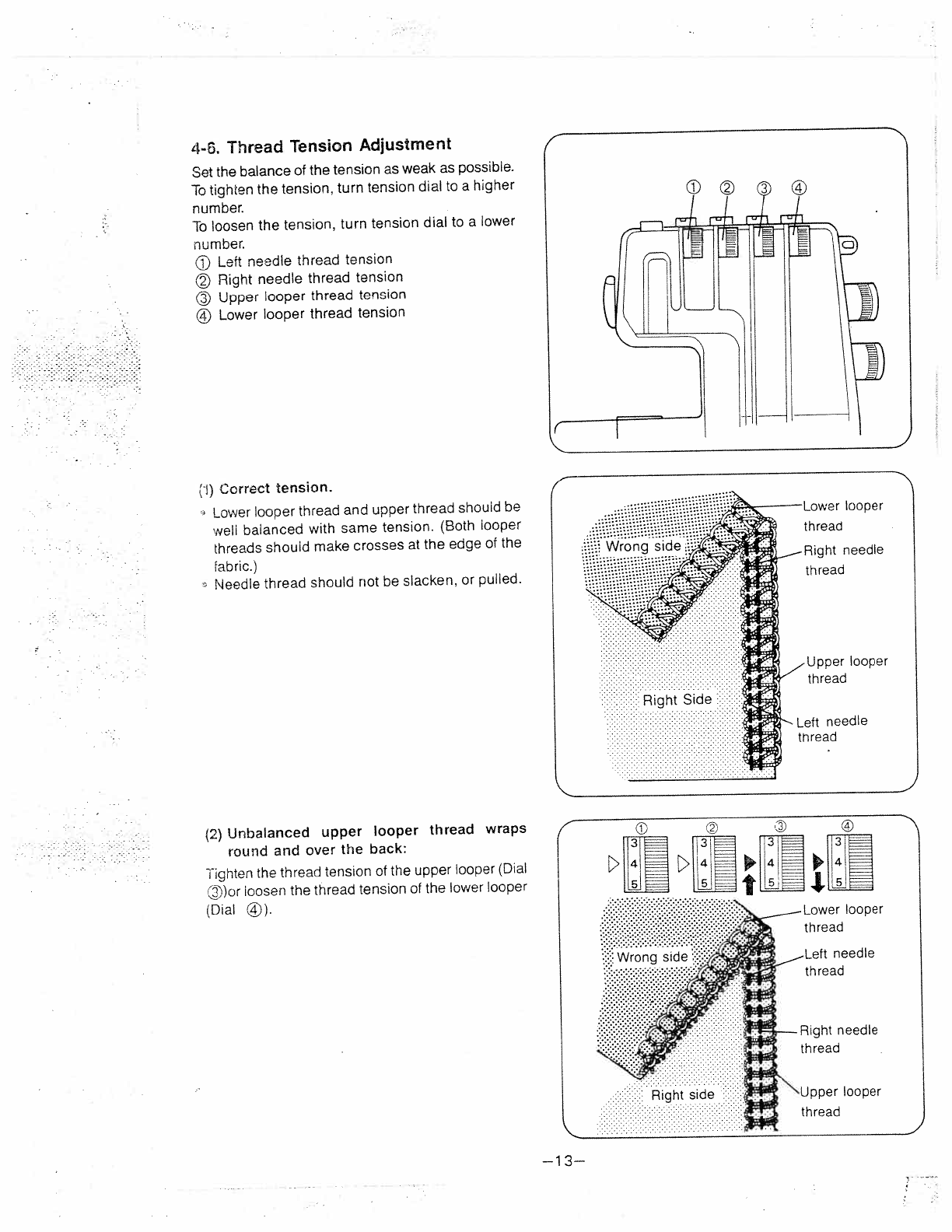
4-6.
Thread
Tension
Adjustment
Set
the
balance
of
the
tension
as
weak
as
possible.
To
tighten
the
tension,
turn
tension
dial
to
a
higher
number.
To
loosen
the
tension,
turn
tension
dial
to
a
lower
number.
®
Left
needle thread
tension
©
Right
needle
thread
tension
©
Upper
looper
thread
tension
©
Lower
looper
thread
tension
(1)
Correct
tension.
Lower
looper
thread
and
upper
thread
should
be
well
balanced
with
same
tension.
(Both
looper
threads
should
make
crosses
at
the
edge
of
the
fabric.)
Needle
thread
should
not
be
slacken,
or
pulled.
(2)
Unbalanced
upper
looper
thread
wraps
round
and
over
the
back:
Tighten
the
thread
tension
of
the
upper
looper
(Dial
©)or
loosen
the
thread tension
of
the
lower
looper
(Dial
©).
N
7-
J
N
thread
Right
needle
thread
.Upper
looper
thread
Left
needle
thread
Right
Side
—13—
(51
C
z
C,
CD
0.
(0
CD
CD
0
CD
CD
0
0
0
0
0
CD
C
0
0)
0)
z
C,
CD
0
CD
CD
CD
CD
CD
0)
0
0
0
0
0
C,)
CD
BC
z
0
.
0)
0-CD
0
0-
CD—
DCD
CD
C’
0
CD
0)
0-
C,)
ö-z
::j-
(1)CD
o-
-
hi
0)
(D
:,-
c.
0
CD
00
oc
0
z
0
CD
0
P
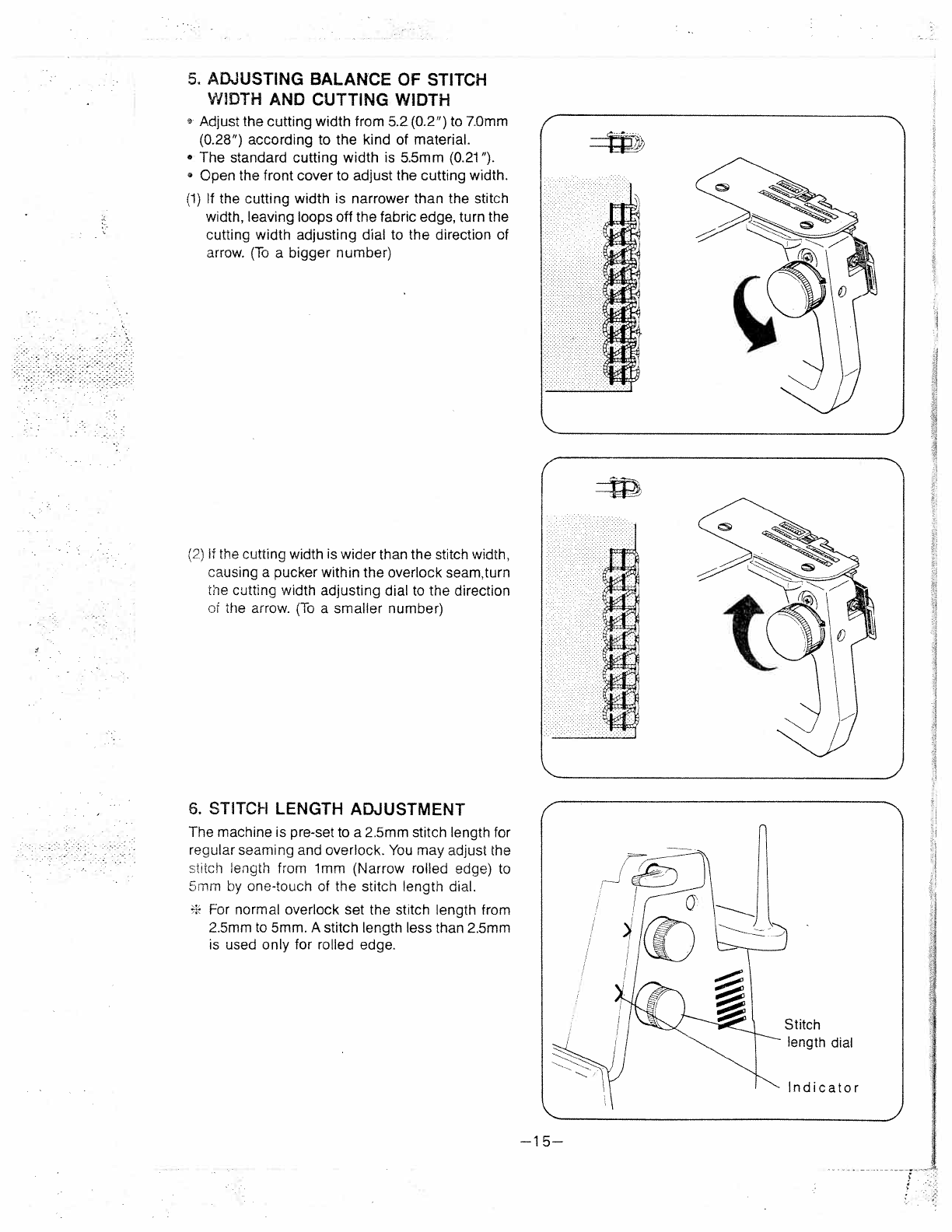
5.
ADJUSTING
BALANCE
OF
STITCH
WIDTH
AND
CUTTING
WIDTH
Adjust
the
cutting
width
from
5.2(0.2”)
to
7.0mm
(0.28”)
according
to
the
kind
of
material.
The
standard
cutting
width
is
5.5mm
(0.21”).
Open
the
front
cover
to
adjust
the
cutting
width.
(1)
If
the cutting
width
is
narrower
than
the
stitch
width,
leaving
loops
off
the
fabric
edge,
turn
the
cutting
width
adjusting
dial
to
the
direction
of
arrow.
(To
a
bigger number)
(2)
If
the cutting
width
is
wider
than
the
stitch
width,
causing
a
pucker
within
the
overlock
seam,turn
the
cutting
width
adjusting
dial
to
the
direction
of
the
arrow.
(To
a
smaller
number)
6.
STITCH LENGTH
ADJUSTMENT
The
machine
is
pre-set
to
a
2.5mm
stitch length
for
regular
seaming
and
overlock.
You
may
adjust
the
stuch length
from
1mm
(Narrow
rolled
edge)
to
5mm
by
one-touch
of
the
stitch length
dial.
+
For
normal overlock
set
the
stitch
length
from
2.5mm
to
5mm.
A
stitch length
less
than
2.5mm
is
used
only
for
rolled
edge.
I
4
4
/
Stitch
length
dial
Indicator
—15—
1i
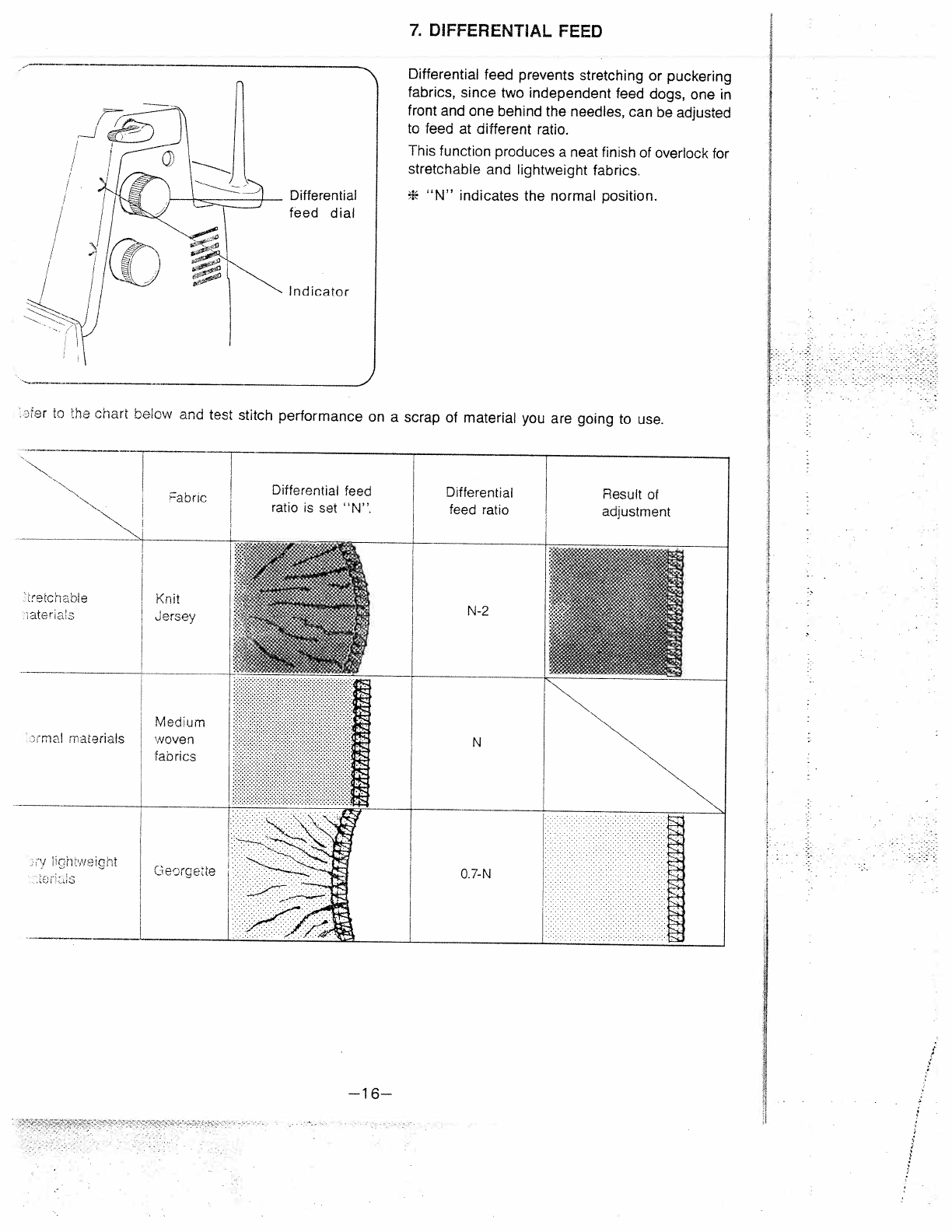
7.
DFFERENTAL
FEED
p
Differential
Differential
feed
prevents
stretching
or
puckering
fabrics,
since
two
independent
feed
dogs,
one
in
front
and
one
behind
the
needles, can
be adjusted
to
feed
at
different
ratio.
This
function
produces
a
neat
finish
of
overlock
for
stretchable
and
lightweight
fabrics.
+
“N”
indicates the
normal
position.
icr
to
the
cnart
below
and
test
stitch
performance
on
a
scrap
of
material
you
are
going
to
use.
.
—
Differential
feed
Differential
Result
of
—anrin
,, ,,
ratio
is
set
N
feed
ratio
adjustment
—---H--
obaole
Knit
N
2
dte
ersPy
-__
Medium
I
ma
riols
‘oven
N
aorics
i
rri
id’tclt
07N
—16—
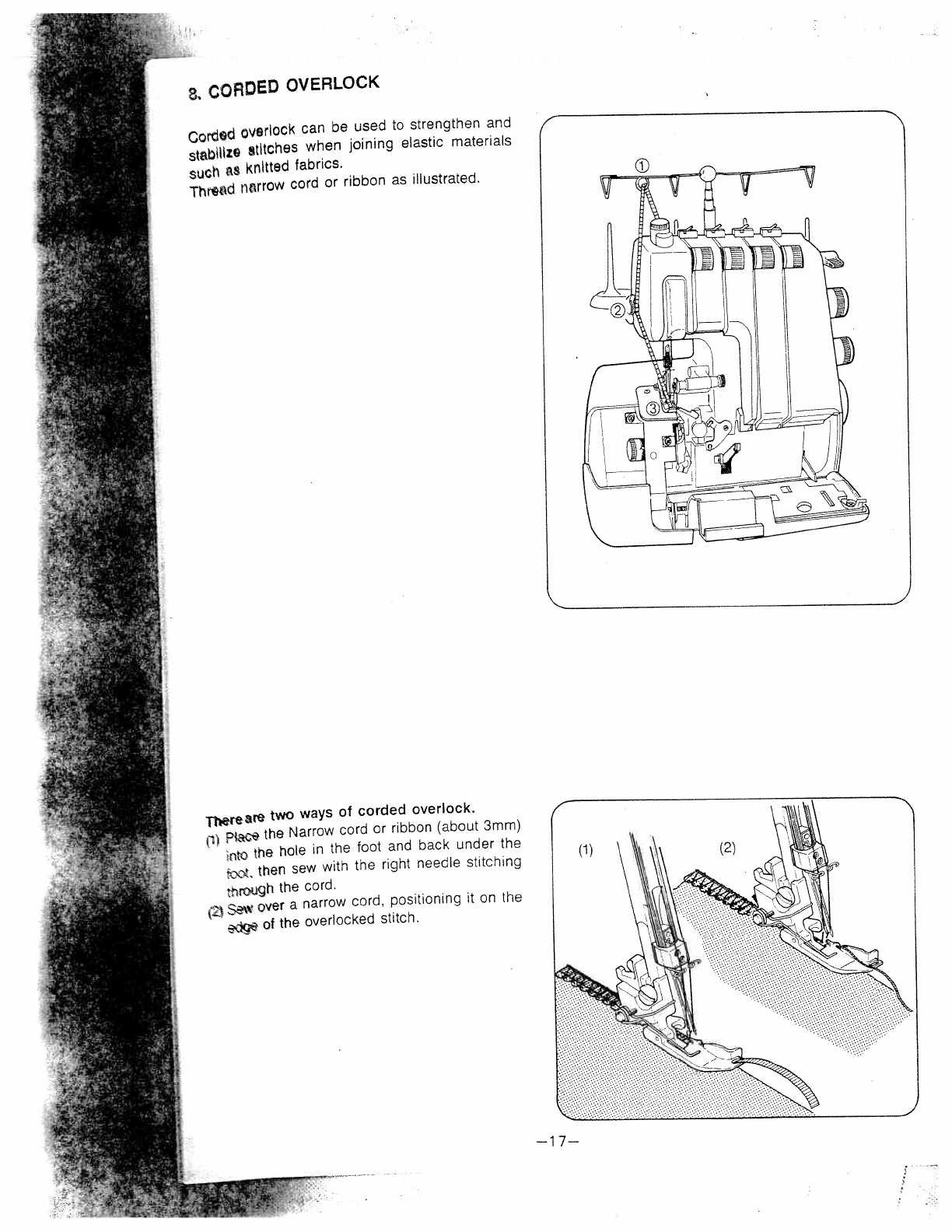
8.
CORDED
OVERLOCK
Corded
overlock
can
be
used
to
strengthen
and
stabIlZe
stitches
when
joining
elastic materials
such as
knitted
fabrics.
Thread
nrrow
cord
or
ribbon
as
illustrated.
There
re
two
ways
of
corded
overlock.
(1)
place
the
Narrow
cord
or
ribbon
(about
3mm)
into
the
hole
in
the
foot
and
back
under the
then
sew
with
the
right
needle
stitching
rough
the
cord.
cz
Sew
over
a
narrow
cord,
positioning
it
on
the
edge
of
the
overlocked
stitch.
I
J
—17—
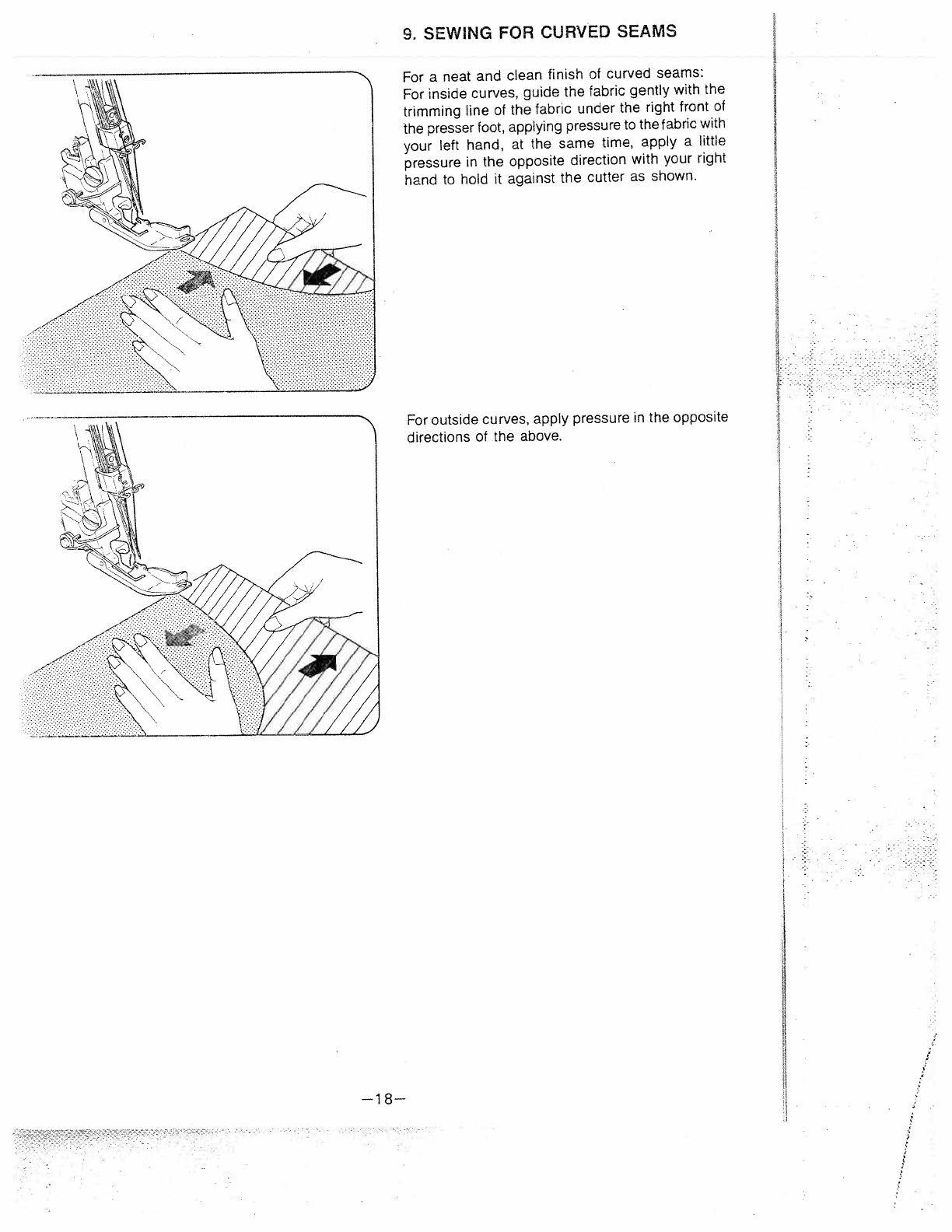
9.
SEWING
FOR
CURVED
SEAMS
For
a
neat
and
clean
finish
of
curved
seams:
For
inside
curves,
guide
the
fabric
gently
with
the
trimming
line
of
the
fabric
under
the
right front
of
the
presser
foot,
applying
pressure
to
the
fabric
with
your
left
hand,
at
the
same
time,
apply
a
little
pressure
in
the opposite
direction
with
your
right
hand
to
hold
it
against
the
cutter
as
shown.
For
outside curves,
apply
pressure
in
the
opposite
directions
of
the
above.
—18—
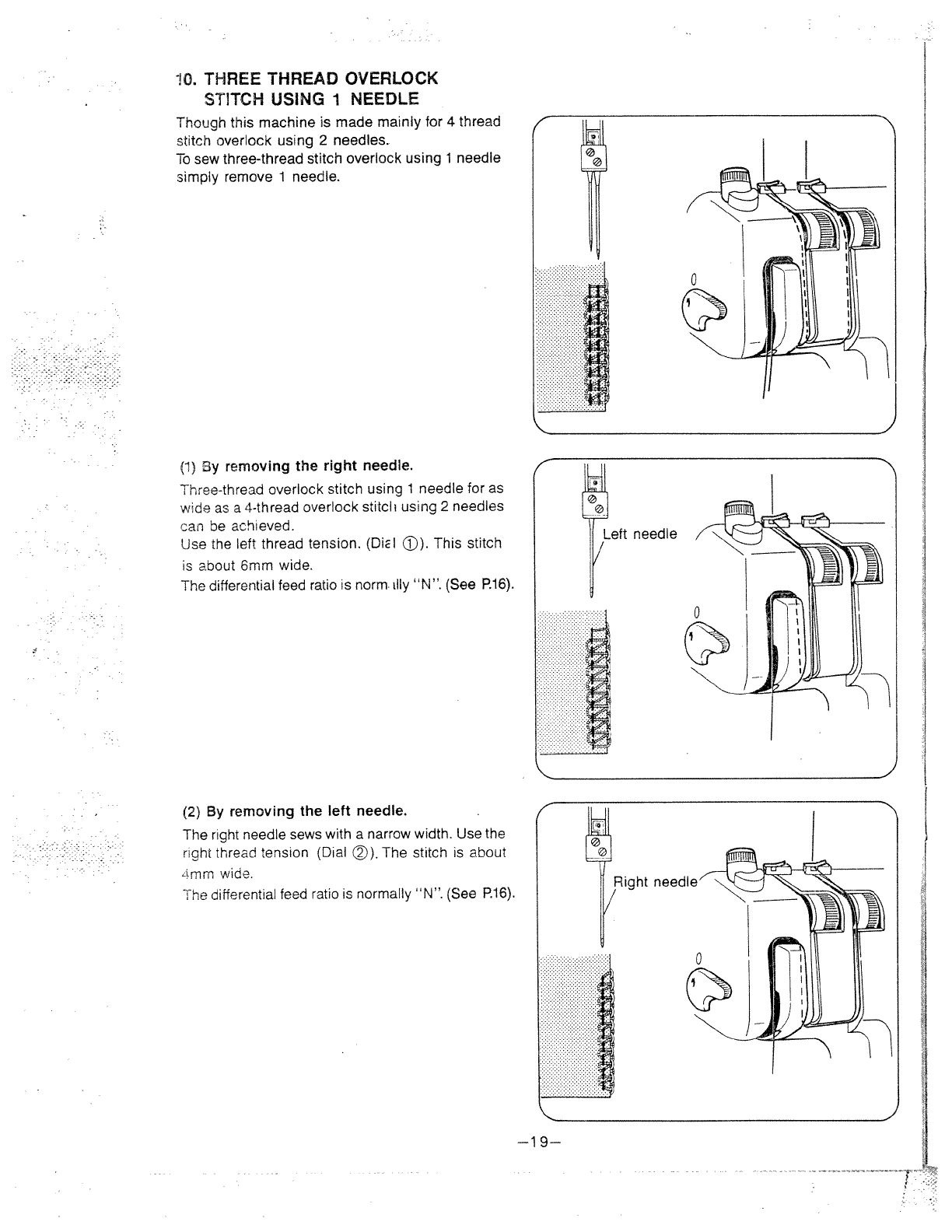
10.
THREE THREAD
OVERLOCK
STITCH
USING
I
NEEDLE
Though this
machine
is
made
mainly
for 4
thread
ii
stitch
overlock
using
2
needles.
,jjj1,
To
sew
three-thread
stitch
overlock
using
1
needle
simply
remove
1
needle.
V
N
(1)
By
removing
the
right
needle.
iI
Three-thread
overlock
stitch using
1
needle
for
as
1
llJi,
wde
as
a
4-thread
overlock
stitch
using
2
needles
I
can
be
achieved.
Use
the
left
thread
tension.
(DiE
I
.
This
stitch
/t
needle
—
is
about
6mm
wide.
The
differential
feed
ratio
is
norm
illy
“N”.
(See
R16)
(2)
By
removing
the
left
needle.
The
right
needle
sews
with
a
narrow
width.
Use
the
naht
thread
tension
(Dial
©).
The
stitch
is
about
arnm
wice.
..—1
Riaht
needle
The
differential
feed
ratio
is
normally
“N”.
(See
P.16).
1/
.
—
—1
9—
-7
ii
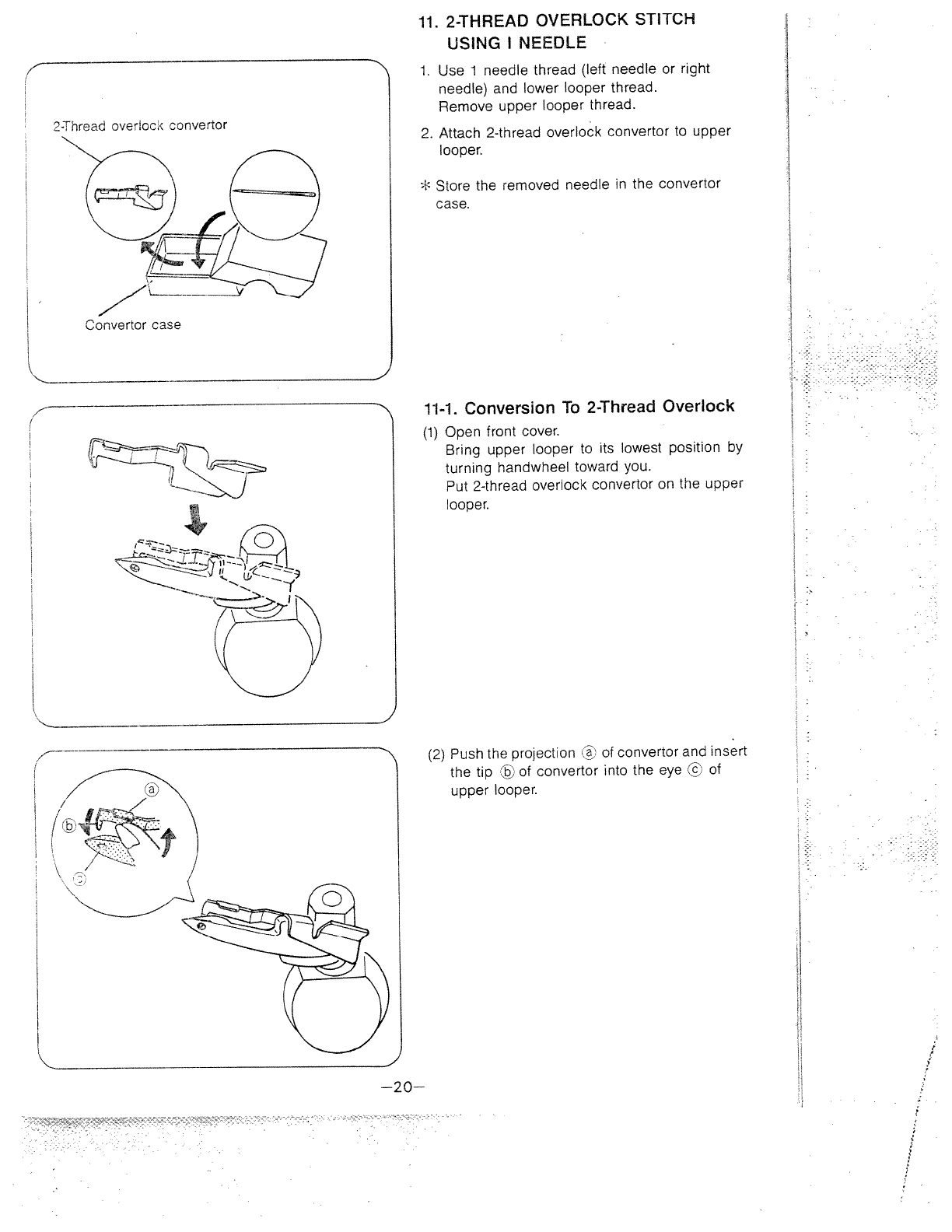
11.
2-THREAD OVERLOCK STITCH
USING
I
NEEDLE
1.
Use
1
needle
thread
(left
needle
or
right
needle)
and
lower
looper
thread.
Remove
upper
looper
thread.
2.
Attach
2-thread
overlock
convertor
to
upper
looper.
*
Store
the
removed
needle
in
the convertor
case.
11-1.
Conversion
To
2-Thread
Overlock
(1)
Open
front
cover.
Bring
upper
looper
to
its
lowest
position
by
turning
handwheel
toward
you.
Put
2-thread
overlock
convertor
on
the
upper
looper.
(2)
Push
the
projection
;
of
convertor
and
insert
the
tip
EJ
of
convertor
into
the
eye
(
of
upper
looper.
2-Thread
overlcc
convertor
Convertor
case
J
)
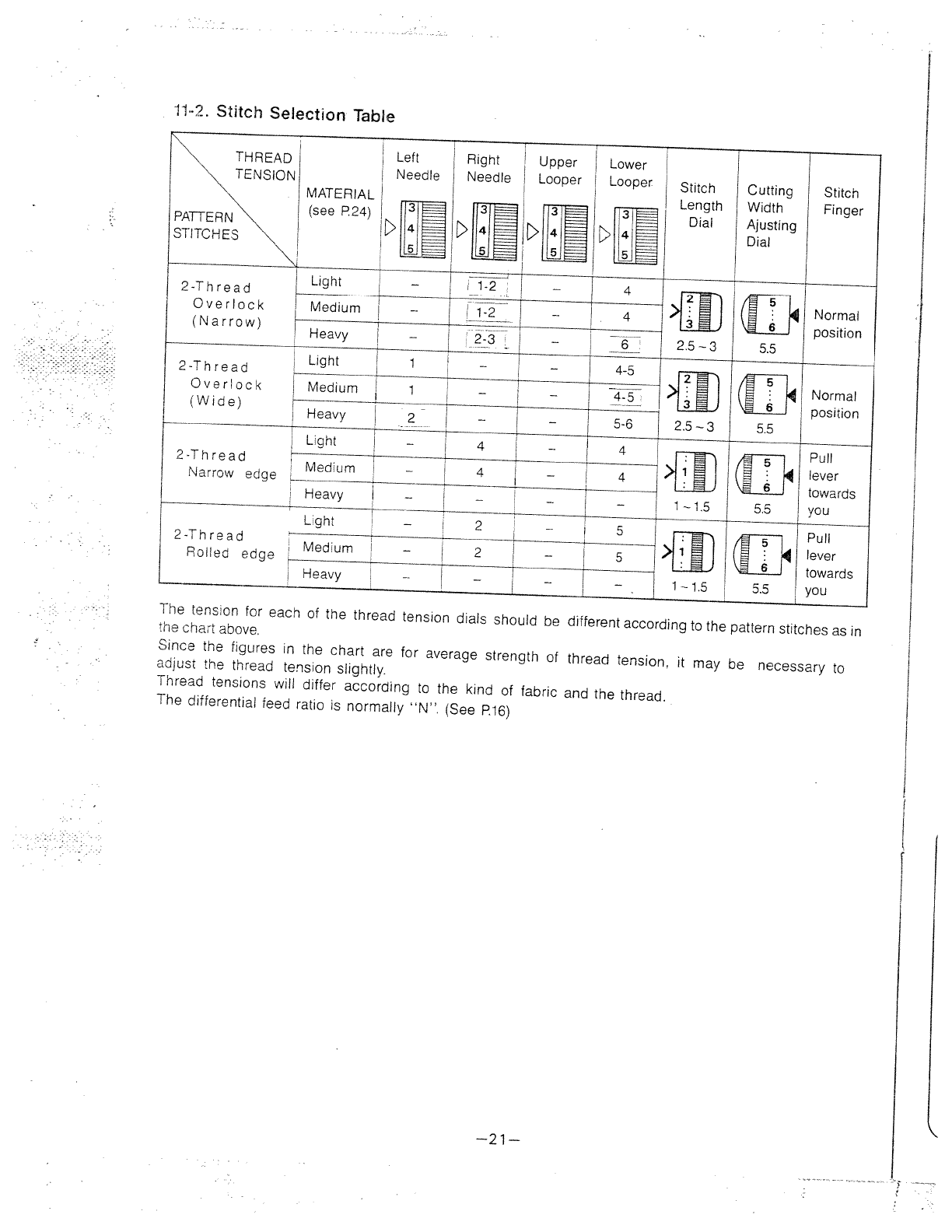
11-2.
Stitch SelecUon
Tabie
\\
\
THREAD
Left
Right
Upper
Lower
TENSION
1
Needle
Needle
Looper Looper
Stitch
Cutting
Stitch
PAfl\
MATERIAL
Length
j
Width
Finger
I3l
Il3I
[{[
3’
Dial
(see
P24)
4lI
Dial
Ajusting
STITCHEa
________
—
J
Light
—
1-2
—
1
fTh
2-Thread
I
Normal
Overlock
Medium
—
1-2
—
4
>1J
EI1
position
(Narrow)
Heavy
—
2-3
—
6
2.5
3
5.5
•
Light
1
—
—
2
2
-T
h
r
e
a
d
Normal
Over
1
ock
Medium
1
—
—
>1
position
(Wide)
Heavy
2
——
5-6
2.5
—3
5.5
2-Thread
lever
Light
—
4
—
4
Pull
Narrow
edge
.
towards
Medium
—
4
—
4
Heavy
—
—
I
—
—
1
—1.5
5.5
you
Light
—
2
—
5
I
,j
Pull
2-Thread
lever
Roled
edge
>1111
J__L_l
towards
Medium
—
2
—
5
Heavy
—
—
—
—
1
—
1.5
5.5
you
The
tenson
for
each
of
the
thread
tension
dials
should
be
different
according
to
the pattern
stitches
as
in
the
chart
aoove.
Since
the
figures
in
the
chart
are
for
average
strength
of
aDJUSt
the
thread tension
slightly.
Thread
tensions
will
differ
according
to
the
kind
of
fabric
The
differential
feed
ratio
is
normally
“N’,
(See
P16)
thread
tension,
it
may
be
necessary
to
and
the
thread.
\
—21—
t’J
-n
\
£
C)
)
0
D(D
D
0
—I
D
::r
o
CD
-
•
-
0
D-
0(0
(D
CD
-‘
—
Dj
C)
-
CD
CD
—
0
T
:3
icD
o
CD—
c
DO-
—
0
CD
0(0
COO
-
CD
cn
o_-
CD
DD
5
0
CD
o
i
0.
0
g
DD
CD
(0D
O
-_CI)
-
——
-‘
U)
-
CD
Pi-
CD
D
0
D
—
-
0-
0)FJ
—
CD
CD
O-_. 0
z
.
0
—
-‘
Ch
3
4__;__
0
(j)
CD
t
---
.-
0(0
:3
D—
0-
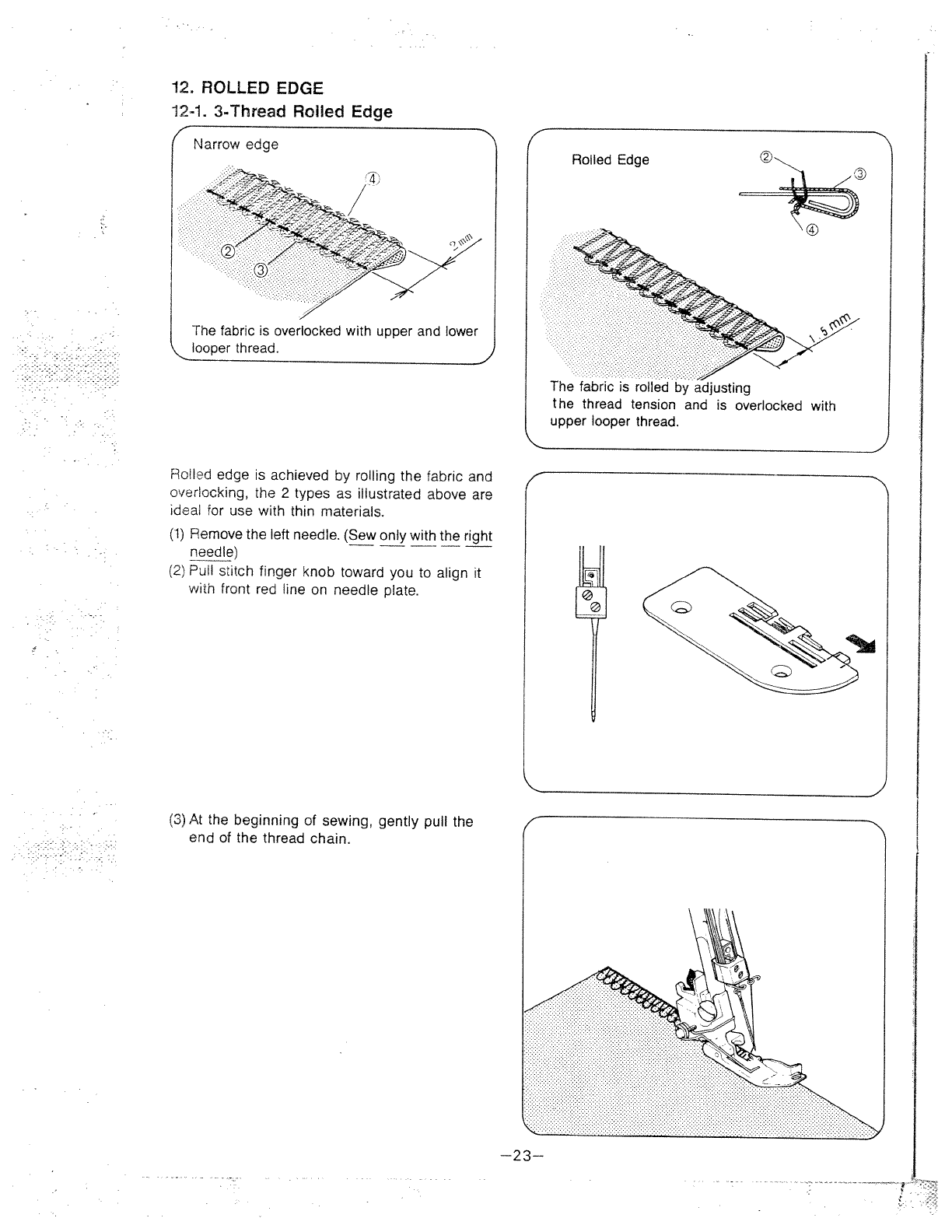
12.
ROLLED
EDGE
12-1.
3-Thread
Rolled
Edge
Rolled
edge
is
achieved
by rolling
the
fabric
and
overlocking,
the
2
types as
illustrated
above are
deal
for
use
with
thin
materials.
(1)
Remove
the
left
needle.
(Sew
only
with
the
right
needle)
(2)
Pull
stitch finger
knob
toward
you
to
align
it
with
front red
line
on
needle
plate.
Narrow
edge
Roiled
Edge
©
The
fabric
is
overlocked
with
upper and
lower
\.joper
thread.
I
The
fabric
is
roiled
by
adjusting
the
thread
tension
and
is
overlocked
with
upper
looper
thread.
/
(3)At
the
beginning
of
sewing,
gently
pull
the
-
end
of
the
thread
chain.
—23—
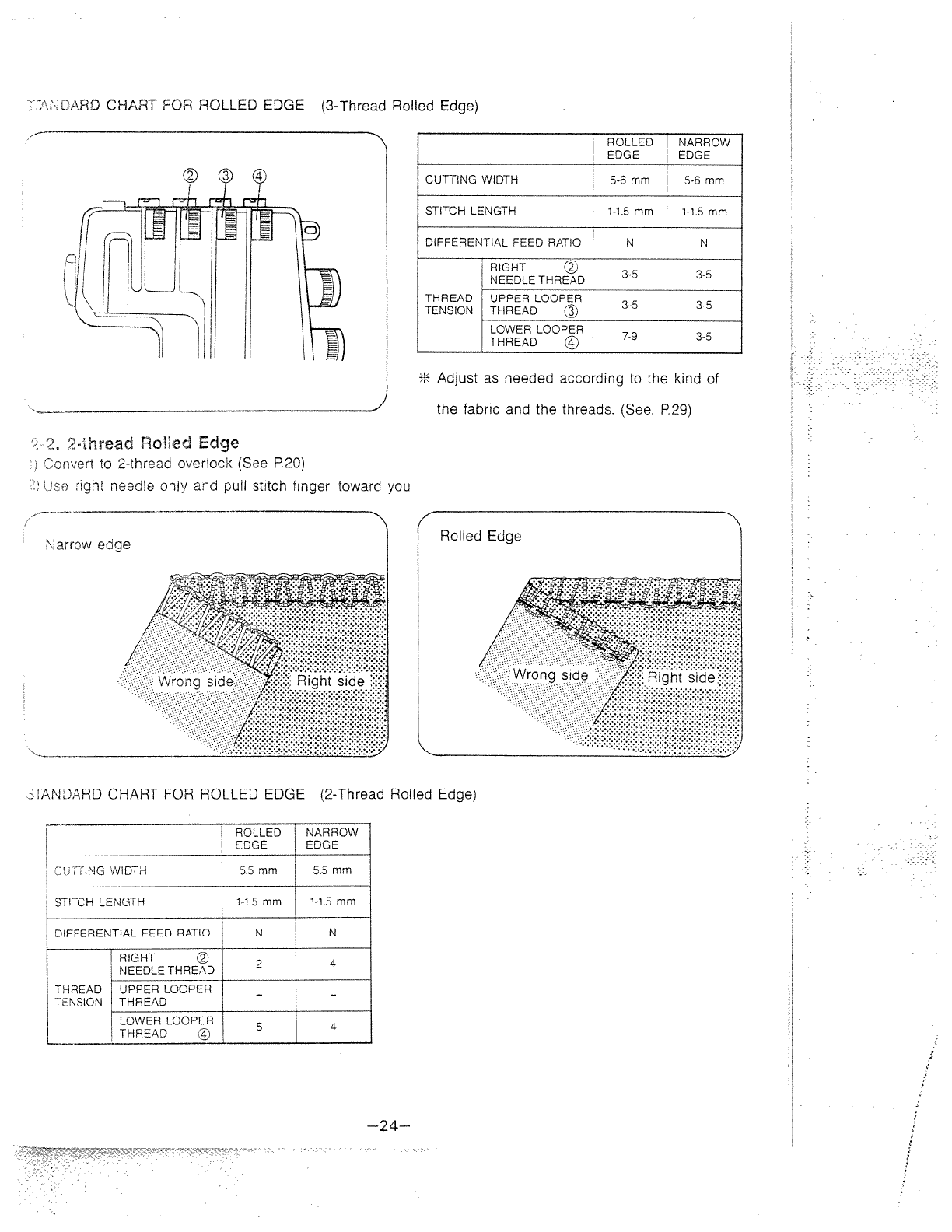
isDARD
CHART
FOR
ROLLED
EDGE
(3-Thread
Rolled
Edge)
+
Adjust
as
needed
according
to
the
kind
of
the
fabric
and
the
threads.
(See.
P.29)
.2.
2-Uiread
Rofled
Edge
Thnvert
to
2-threac
overiock
(See
P.20)
*n
ngh
needS
only
and
pull
stitch
finger toward
you
3TANDARD
CHART
FOR
ROLLED
EDGE
(2-Thread
Rolled
Edge)
ROLLED
NARROW
EDGE
EDGE
Ci
rNG
NIDTrI
5.5mm
55mm
STITCH
LENGTH
1-1.5
mm
1.1.5
mm
DIFFERENTIAL FEED
RATIO
N
N
RIGHT
©
2
4
-
LOWER
LOOPER
THREAD
.
r
ROLLED NARROW
EDGE
EDGE
CUflING
WIDTH
5-6
mm
5-6
mm
STITCH
LENGTH
1-1.5
mm
1-1
5
mm
DIFFERENTIAL FEED
RATIO
NN
RIGHT
©
3-5
3-5
NEEDLE
THREAD
THREAD
UPPER
OOER
3-5
3-5
TENSION
THREAD
LOWER
LOOPER
7-9
3-5
THREAD
-J
—24—
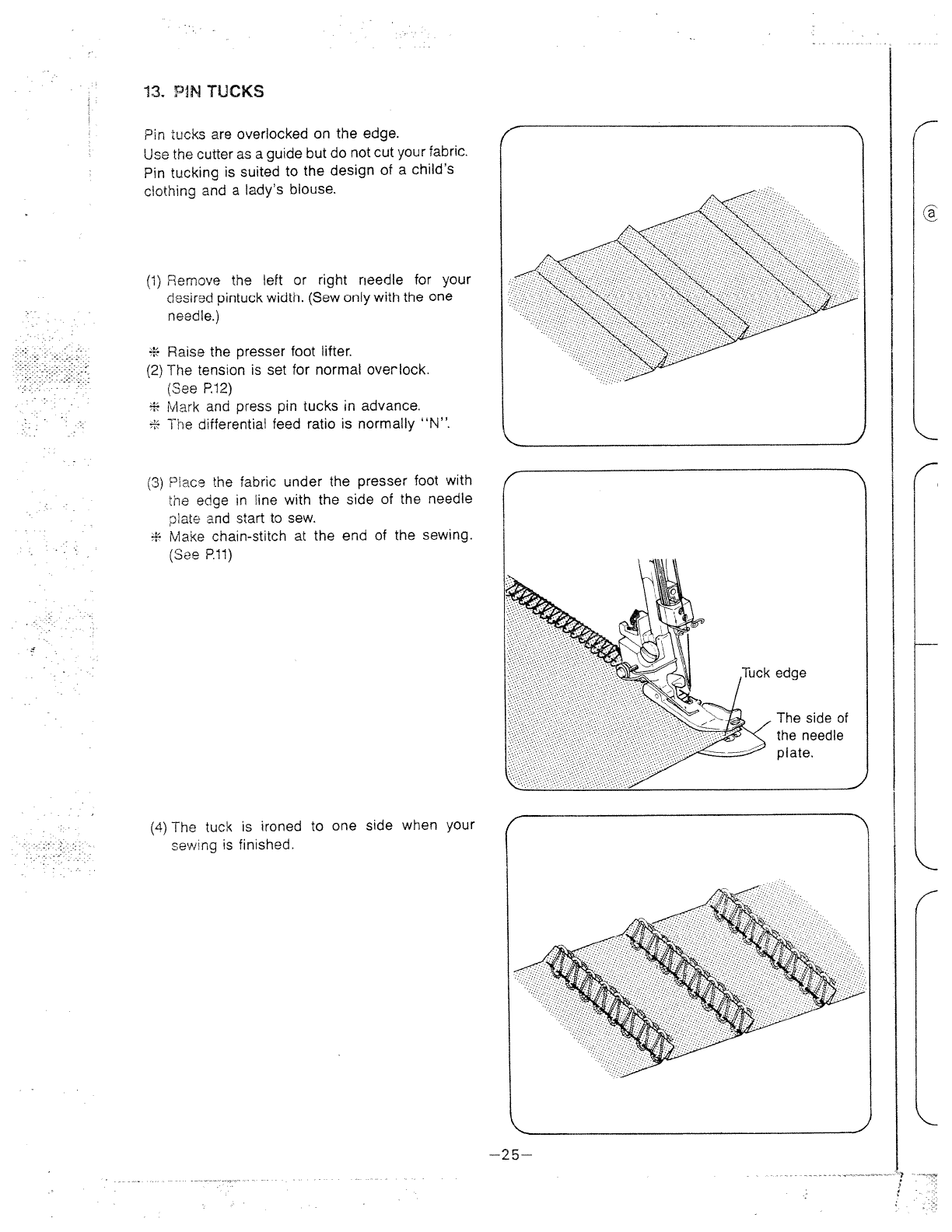
13.
PN
TUCKS
Pin
tucks
are
overlocked
on
the
edge.
Use
the cutter
as
a
guide
but
do not
cut
your
fabric.
Pin
tucking
is
suited
to
the
design
of
a
child’s
clothing
and
a
lady’s
blouse.
(1)
Remove the
left
or
right
needle
for
your
desired
pintuck
width.
(Sew
only
with
the one
needle.)
*
Raise
the
presser
foot
lifter.
(2)
The
tension
is
set
for
normal
over
lock.
(See
P12)
*
Mark
and
press
pin
tucks
in
advance.
The
differential
feed
ratio
is
normally
“N”.
(3)
Place
the
fabric
under
the
presser
foot with
Ide
edge
in
line with
the
side
of
the
needle
plate
and
start
to
sew.
+
Make
chain-stitch
at
the
end
of
the
sewing.
(See
P.11)
J
(4)
The
tuck
is
ironed
to
one side
when
your
Dewing
5
finished
—25—
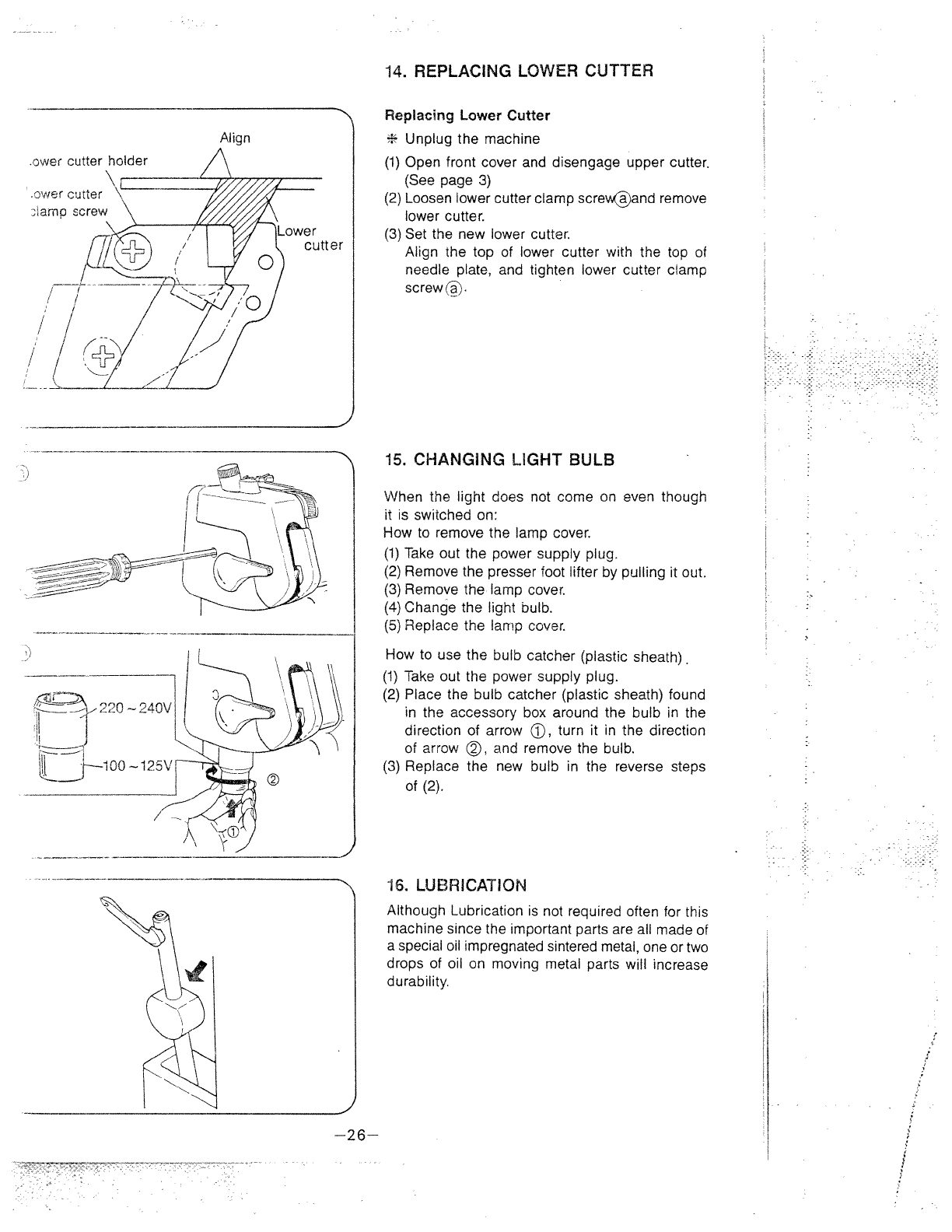
14.
REPLACING
LOWER
CUTTER
Replacing
Lower
Cutter
Align
Unplug
the
machine
(1)
Open
front
cover
and
disengage
upper
cutter.
(See
page
3)
(2)
Loosen
lower
cutter clamp
screwJand
remove
lower
cutter.
(3)
Set
the
new
lower
cutter.
Align
the
top
of
lower
cutter
with
the
top
of
needle
plate,
and
tighten
lower
cutter
clamp
screw(j.
15.
CHANGING
LIGHT BULB
When
the
light
does
not
come
on
even though
it
is
switched
on:
How
to
remove
the
lamp
cover.
(1)
Take
out
the
power
supply
plug.
(2)
Remove
the
presser
foot
lifter
by
pulling
it
out.
(3)
Remove
the
lamp
cover.
(4)
Change
the
light
bulb.
(5)
Replace
the
lamp
cover.
How to
use
the
bulb
catcher
(plastic
sheath).
(1)
Take
out
the
power
supply
plug.
(2)
Place
the
bulb
catcher
(plastic
sheath)
found
in
the
accessory
box
around
the
bulb
in
the
direction
of
arrow
,
turn
it
in
the
direction
of
arrow
©,
and
remove
the
bulb.
(3)
Replace
the
new bulb
in
the
reverse
steps
of (2).
16.
LUBRICATION
Although Lubrication
is
not
required
often
for
this
machine since
the
important
parts
are
all
made
of
a
special
oil
impregnated sintered
metal,
one
or
two
drops
of
oil
on
moving
metal
parts
will
increase
durability.
.ower
cutter holder
cutter
—26—
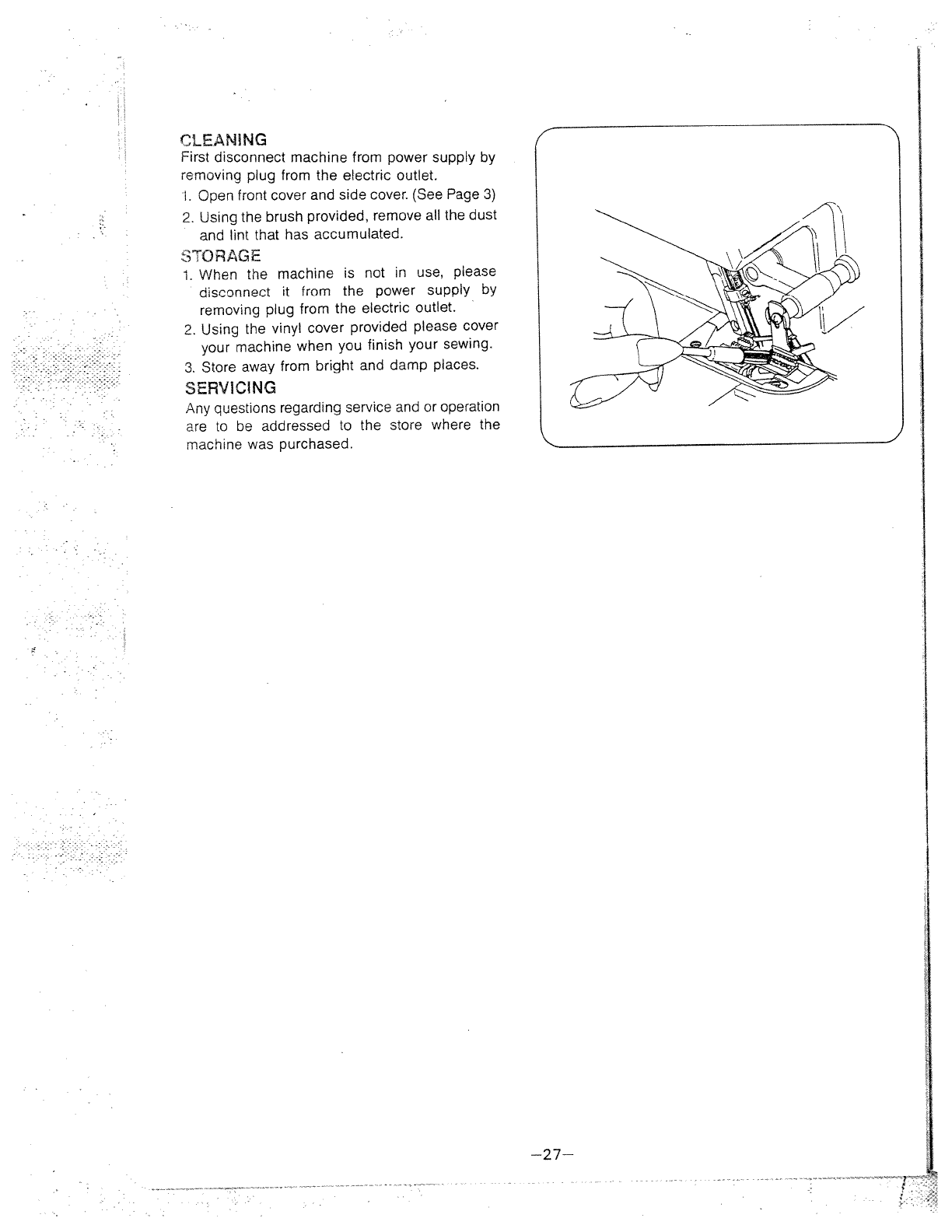
CLEANING
First
disconnect machine
from
power
supply
by
removing
plug
from
the
electric
outlet.
1.
Open
front
cover
and
side
cover.
(See
Page
3)
2.
Using
the
brush
provided, remove
all
the
dust
and
lint
that
has
accumulated.
STORAGE
1.
V’lhen
the
machine
is
not
in
use,
please
disconnect
it
from
the
power
supply
by
removing
plug
from
the
electric
outlet.
2.
Using
the
vinyl
cover
provided
please
cover
your
machine
when
you
finish
your
sewing.
3.
Store
away
from
bright
and
damp
places.
SERVICING
Any
questions
regarding
service
and
or
operation
are
to
be
addressed
to
the
store where
the
machine
was
purchased.
—27—
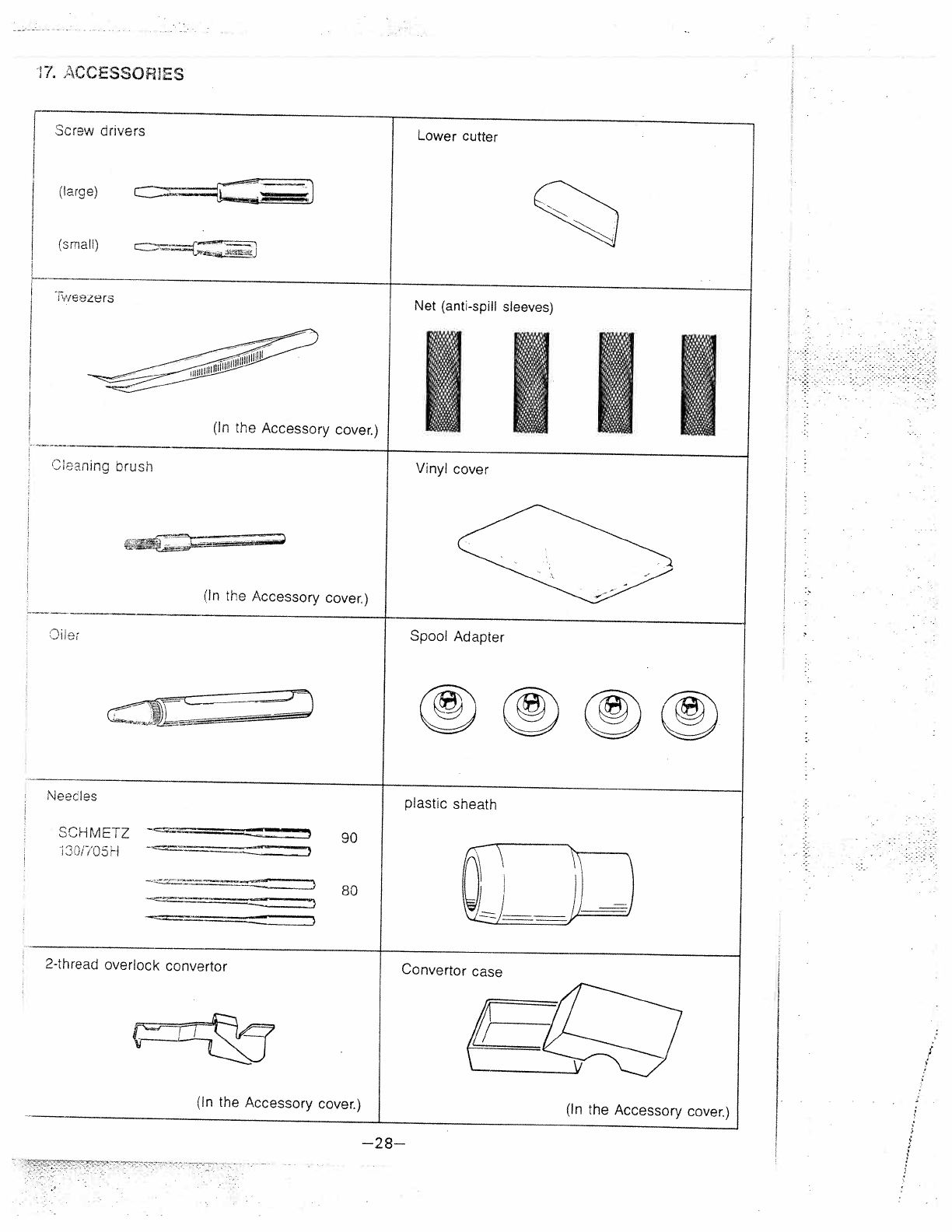
17.
ACCES$OR1S
Screw
drivers
Lower
cutter
(large)
(small)
Tieezers
Net
(anti-spill
sleeves)
(In
the
Accessory
cover.)
lcaning
brush
Vinyl
cover
n
the
Accessory
cover.)
Spool
Adapter
Needles
plastic
sheath
S’’
H
M
EZ
0
H
80
Ii
...
.....
...
2-thread
overlock
convertor
Convertor
case
(In
the
Accessory
cover.)
(In
the Accessory
cover.)
—28—
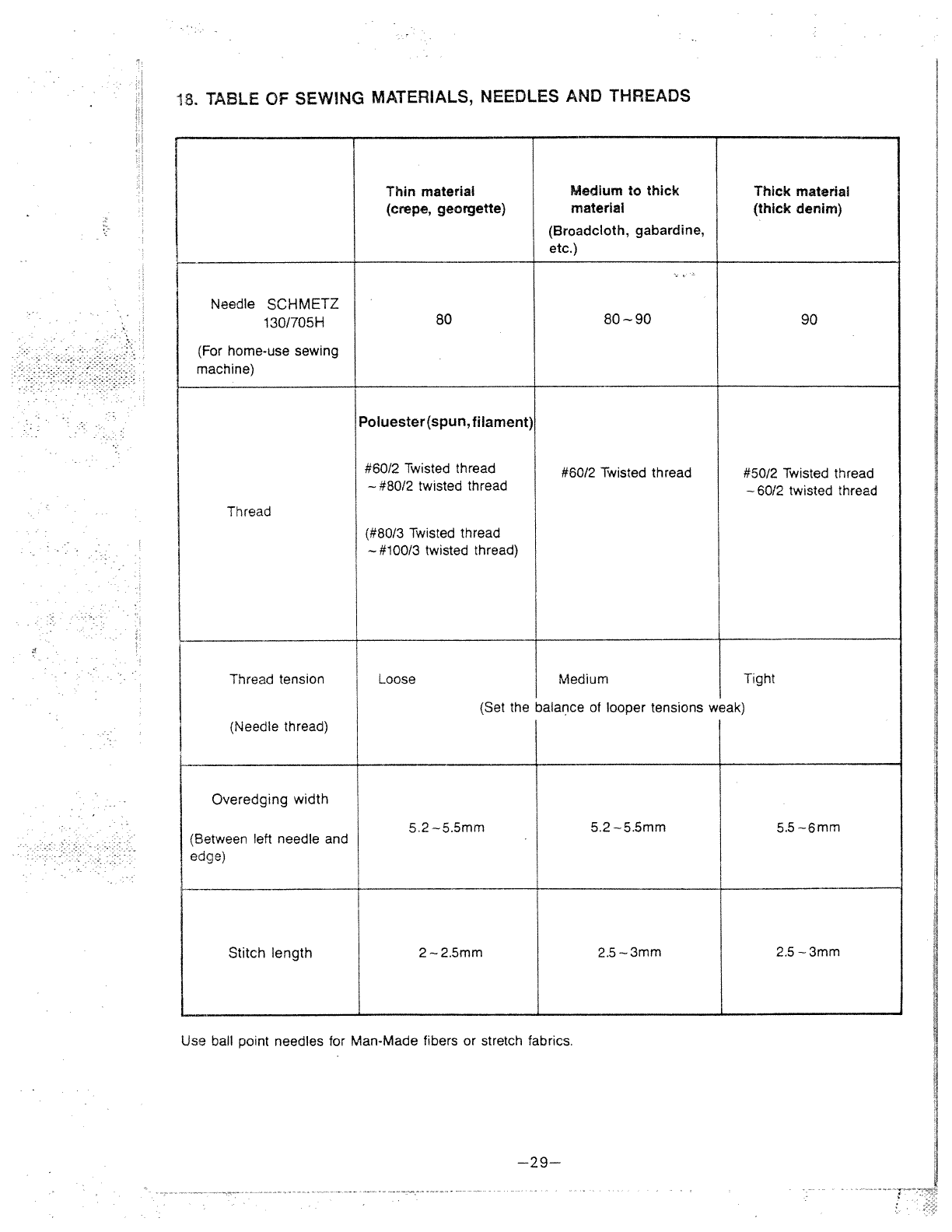
18.
TABLE
OF
SEWING
MATERIALS,
NEEDLES
AND
THREADS
Thin
material
Medium
to
thick
Thick
material
(crepe,
georgette)
material (thick denim)
(Broadcloth,
gabardine,
etc.)
Needle SCHMETZ
130/705H
80
80—90
90
(For
home-use
sewing
machine)
Poluester(spun,
filament)
#60/2
Twisted
thread
#60/2
Twisted
thread
#50/2
Twisted
thread
—
#80/2
twisted
thread
—
60/2
twisted
thread
Thread
(#80/3
Twisted
thread
—#100/3
twisted
thread)
Thread
tension
Loose
Medium
Tight
(Set
the
balance
of
looper
tensions
weak)
(Needle thread)
Overedging
width
52—55mm
5.2—5.5mm
55—6mrn
(8etween
left
needle
and
edce)
Stitch
length
2—2.5mm 2.5—3mm 2.5—3mm
Use
ball
point
needles
for
Man-Made
fibers
or
stretch
fabrics.
—29—
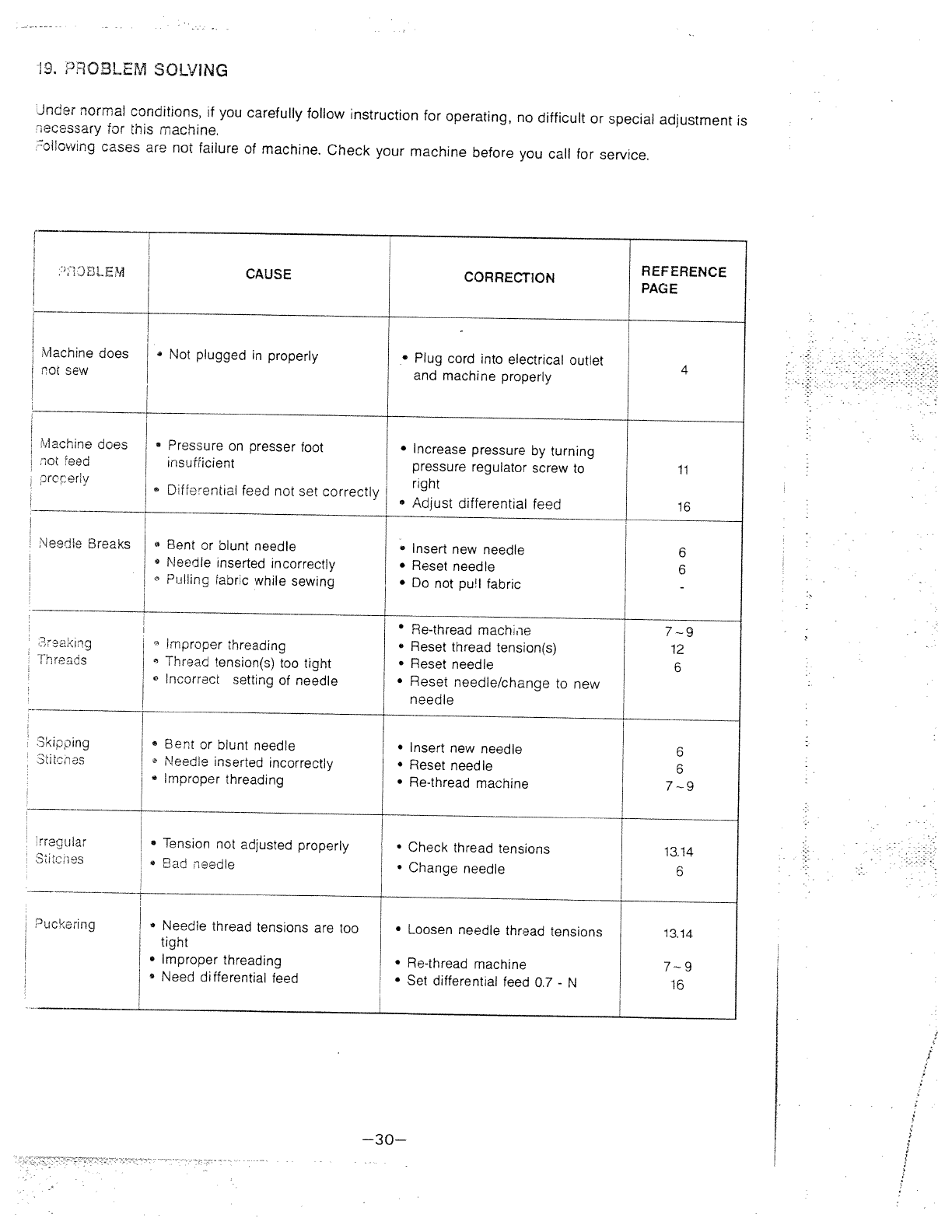
19.
PROBLEM
SOLVING
Under
normal
conditions,
if
you
carefully
follow
instruction
for
operating,
no
difficult
or
special
adjustment
is
necessary
for
this
machine.
Toliowing
cases
are
not
failure
of
machine.
Check
your
machine
before
you call for
service.
SQiLEM
CAUSE
CORREc11ON
REFERENCE
Machine
does
Not
plugged
in
properly
•
Plug cord
into
electrical
outlet
not
sew
and
machine
properly
Machine
does
•
Pressure
on
presser
foot
•
Increase
pressure
by
turning
not
feed
insufficient
pressure
regulator screw
to
11
Drccerlv
right
Differential
feed
not
set
correctly
I
•
Adlust
differential
feed
16
Needle Breaks
Bent
or
blunt
needle
•
Insert
new
needle
6
Needle
inserted
incorrectly
•
Reset needle
6
Pulling
fabric
while
sewing
•
Do
not
pull
fabric
-
Re-thread
machine
7—9
S-caking
improper
threading
•
Reset
thread
tension(s)
12
Threads Thread
tension(s)
too
tight
•
Reset needle
6
Incorrect setting
of
needle
•
Reset
needle/change
to
new
needle
3kipping
I
•
Bent
or
blunt
needle
•
Insert
new
needle
6
Stitches
Needle inserted
incorrectly
•
Reset
needle
6
a
Improper
threading
•
Re-thread
machine
7—9
irreaular
•
Tension
not
adjusted
properly
•
Check
thread tensions
13.14
Stitcnes
Bad
needle
•
Change
needle
6
Puckering
•
Needle
thread
tensions
are
too
•
Loosen
needle
thread
tensions
13.14
tight
•
Improper
threading
•
Re-thread
machine
7—9
•
Need
differential
feed
•
Set
differential
feed
0.7
-
N
16
—30—
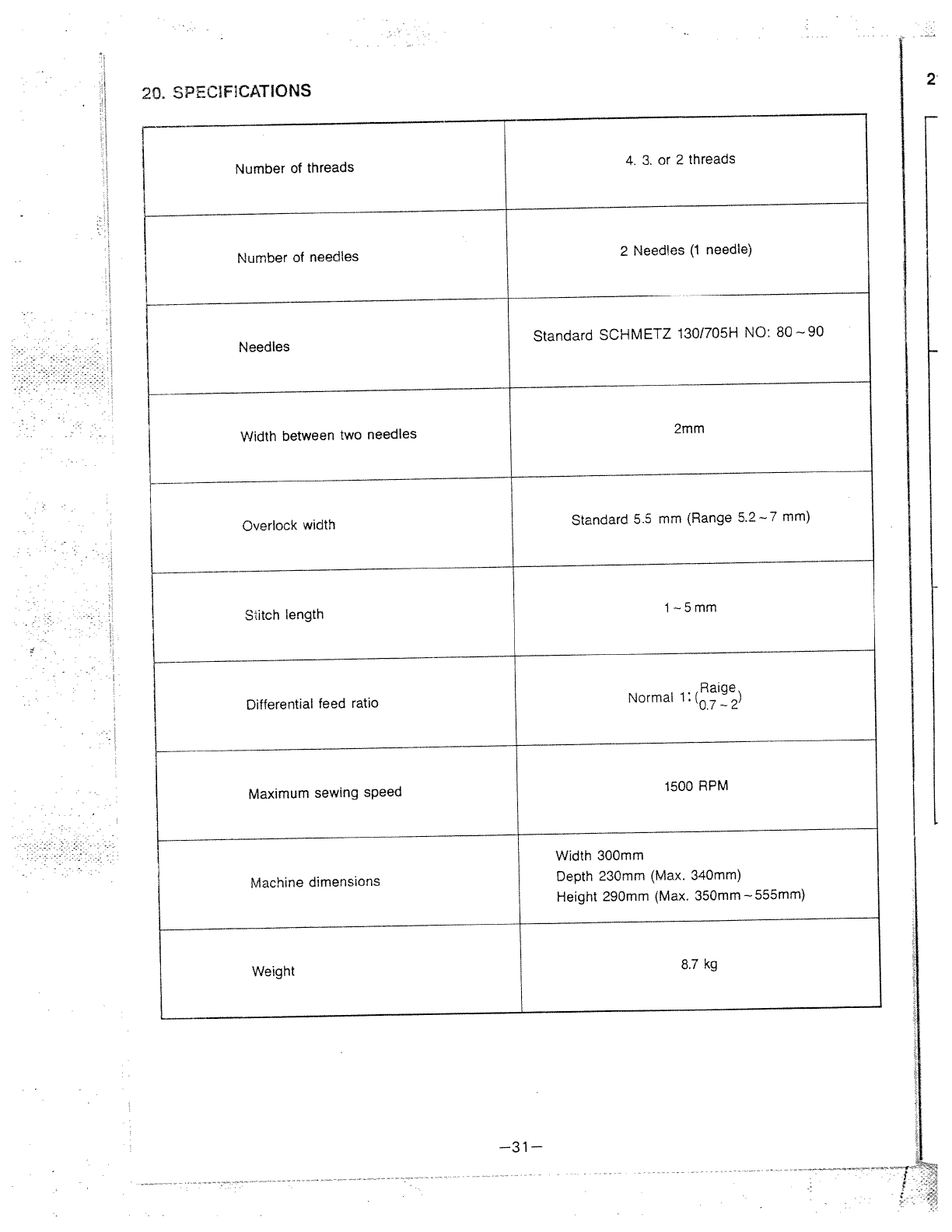
20.
SPECIF!CA11ONS
Number
of
threads
4.
3.
or
2
threads
Number
of
needles
2
Needles
(1
needle)
Needles
Standard
SCHMETZ
130/705H
NO:
80—90
Width
between
two
needles
2mm
Overlock
width
Standard
5.5
mm
(Range
5.27
mm)
r
Stitch
length
1
5mm
...
Raige
Differential
feed
ratio Normal
,
—
Maximum
sewing
speed
1500
RPM
Width
300mm
Machine
dimensions
Depth
230mm
(Max.
340mm)
Height
290mm
(Max.
350mm-..555mm)
Weight
8.7
kg
—31--
2
N)
L
C)
C,
C)
m
C),
C)
rn
0
m
-n
m
m
