Win Accord 6226-8DN Digital Photo Frame User Manual
WIN ACCORD LTD., Digital Photo Frame
User Manual


Table of Contents
Table of Contents..…………………………………………………..…………………2
Important Safety Precautions............................................................................3
Cleaning the LCD Screen. ..….…...……………………………………………….3
Cleaning the Digital Picture Frame....…………………………………………….3
What's in the Box…………………………..…………………………………………..4
Identifying the Parts…………….…….…………………………………………..4
Replacing Remote Control Battery….………..…………………………………...5
Product Specification…………………………….……………………………………6
Features…………………………….…..………………………………………….6
Specification……………………….…..…………………………………………..6
Using the Digital Picture Frame……….……………………………………………..7
Select Mode………………….…..…………………………………………………7
Card Selection……………….……..……………………………………………...7
Photo…………………...….………..……………………………………………..8
Music………………...…….……...……………………………………………….8
Video………………..…….………………………………………………………..9
File Management……...….………………………………………………………..9
Time………………………...…………………………………………………….10
Frequently Asked Questions………………………………………………………...11

Important Safety Precautions
Always follow these basic safety precautions when using your Digital Picture Frame. This
will reduce the risk of fire, electric shock, and injury.
Warning: To reduce the risk of fire or shock hazard, do not expose this product to rain or
moisture.
Warning: To prevent the risk of electric shock, do not remove the cover. There are no
user-serviceable parts inside. Refer all servicing to qualified personnel.
The Digital Picture Frame is for indoor use only.
Unplug the Digital Picture Frame before performing care and maintenance.
Do not clock the ventilation holes on the back of the Digital Picture Frame at any time.
Keep your Digital Picture Frame out of direct sunlight and heat sources.
Protect the power cord. Route power cords so that they are not likely to be walked on
or pinched by items places on or against them. Pay particular attention to the point
where the cord attaches to the Digital Picture Frame.
Only use the AC adapter included with the Digital Picture Frame. Using any other power
adapter will void your warranty.
Unplug the power cord from the outlet when the unit is not in use.
Cleaning the LCD Screen
Treat the screen gently.
To clean fingerprints or dust from the LCD screen, it is recommended to use a soft, non-abrasive
cloth such as a camera lens cloth to clean the LCD screen.
If you use a commercial LCD cleaning kit, do not apply the cleaning liquid directly to the LCD
screen. Clean the LCD screen with cleaning cloth moistened with the liquid.
Cleaning the Digital Picture Frame
Clean the outer surface of the Digital Picture Frame (excluding the screen) with a soft cloth
dampened with water.
What's In the Box
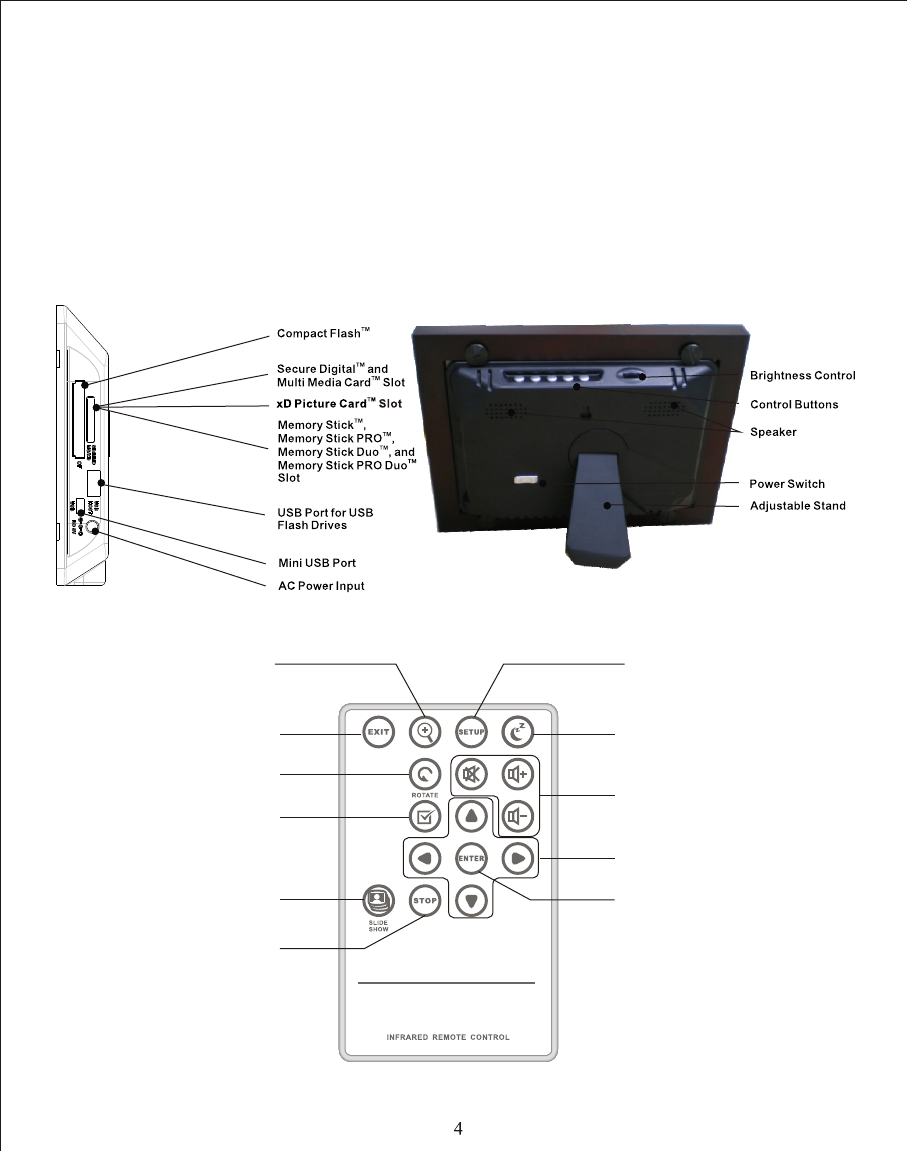
Identifying the Parts
Digital Picture Frame
Power Adapter
Remote Control
USB Cable
User's Manual
Zoom In
EXIT
ROTATION
SELECT
SLIDESHOW
STOP
SETUP
POWER
Volume Control
Direction Control
ENTER
DIGITAL PICTURE FRAME
Replacing the Remote Control Battery
If the remote control stops working or works improperly, replace the battery (CR2025 lithium
battery) with a new one.
1. Pull out the battery holder.
2. Remove the old battery from the holder and then put a new battery with “+” facing up.
3. Insert the battery holder back to the remote control.
Warning
Battery may explode if mistreated. Do not recharge, disassemble
or dispose of in fire
Notes
When the lithium battery becomes weak, the operating distance of the Remote Control
may shorten, or the Remote Control may not function properly. In this case, replace the
battery with a CR2025 lithium battery. Use of another battery may present a risk of fire
or explosion.
Dispose the used batteries as specified by the local authorities.
Do not leave the Remote Control in a very hot and humid place.
Incorrect use of the battery may cause leaking and corrosion.
- When the Remote control will not be used for a long period of time, remove the
- Incorrectly inserting, shorting, dismantling, or heating the battery, or throwing it
into a fire may cause the battery to rupture and leak.
battery from the remote control to prevent leaking and corrosion.
Product Specification
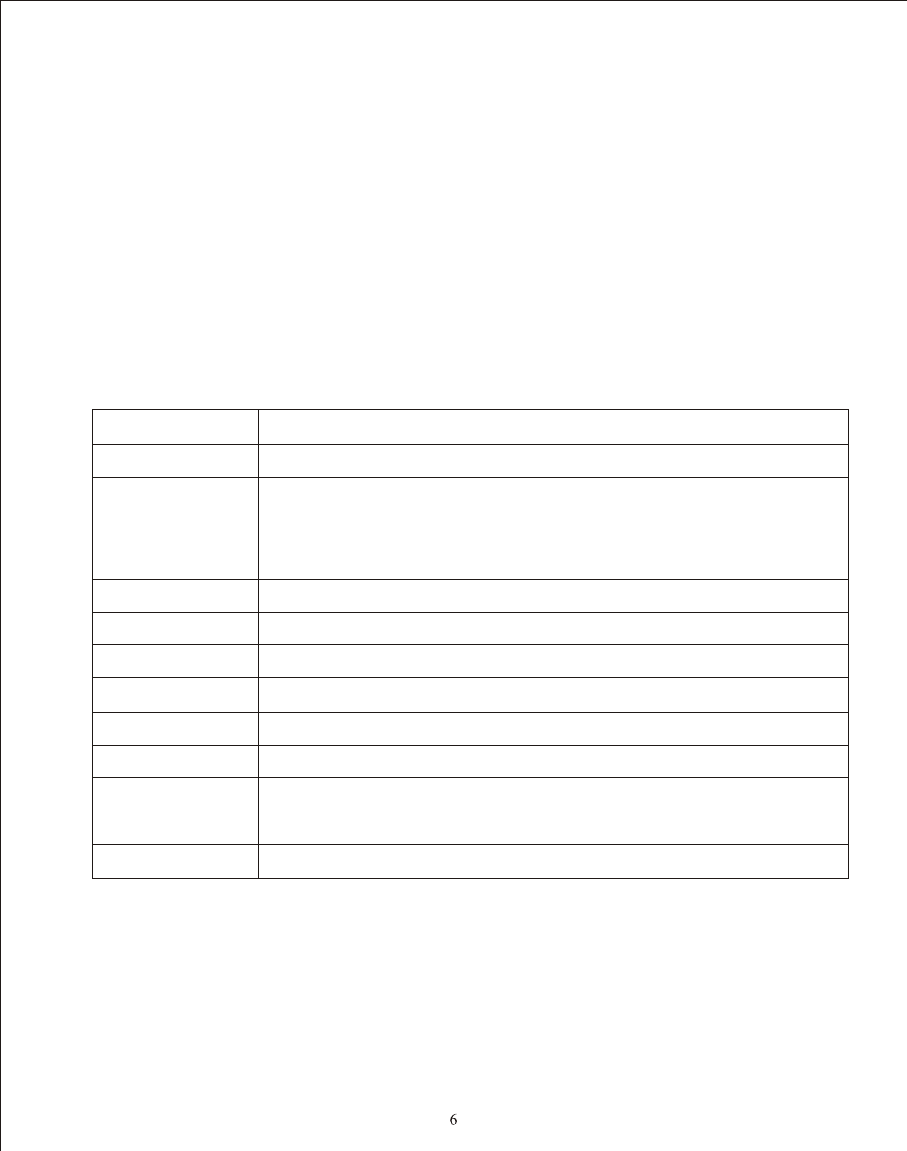
Product
Resolution
Memory Card
Formats
Image Formats
Audio Formats
Video Formats
USB Ports
Power Input
Power Output
Internal
Speakers
Certification
8” Digital Photo Frame
800 x 600 pixel
Secure Digital™, Multi-Media Card™, Memory Stick™,
Memory Stick Pro™, Memory Stick Duo™, Memory Stick Pro
Duo™, Compact Flash™, and USB flash drives
JPEG, BMP, PNG, GIF, TIFF
MP3, WAV, WMA, AAC
MPEG1/2/4, M-JPEG, AVI, Divx
USB 2.0 (Host) x 1, mini-USB x 1
AC 100V~240V, 50~60Hz
DC 5V / 2A
CE / FCC / RoHS
Features
Specification
1W x 2
Image rotation, zoom in, background music
Display files by name or by date
ArcSoft™ effects: Dynamic Lighting, Face Beautify, and Face Tracking
Using the Digital Picture Frame
After the Digital Picture Frame is turned on, the slide show starts automatically after 2
seconds. Press EXIT button to Select Mode screen.
Select Mode
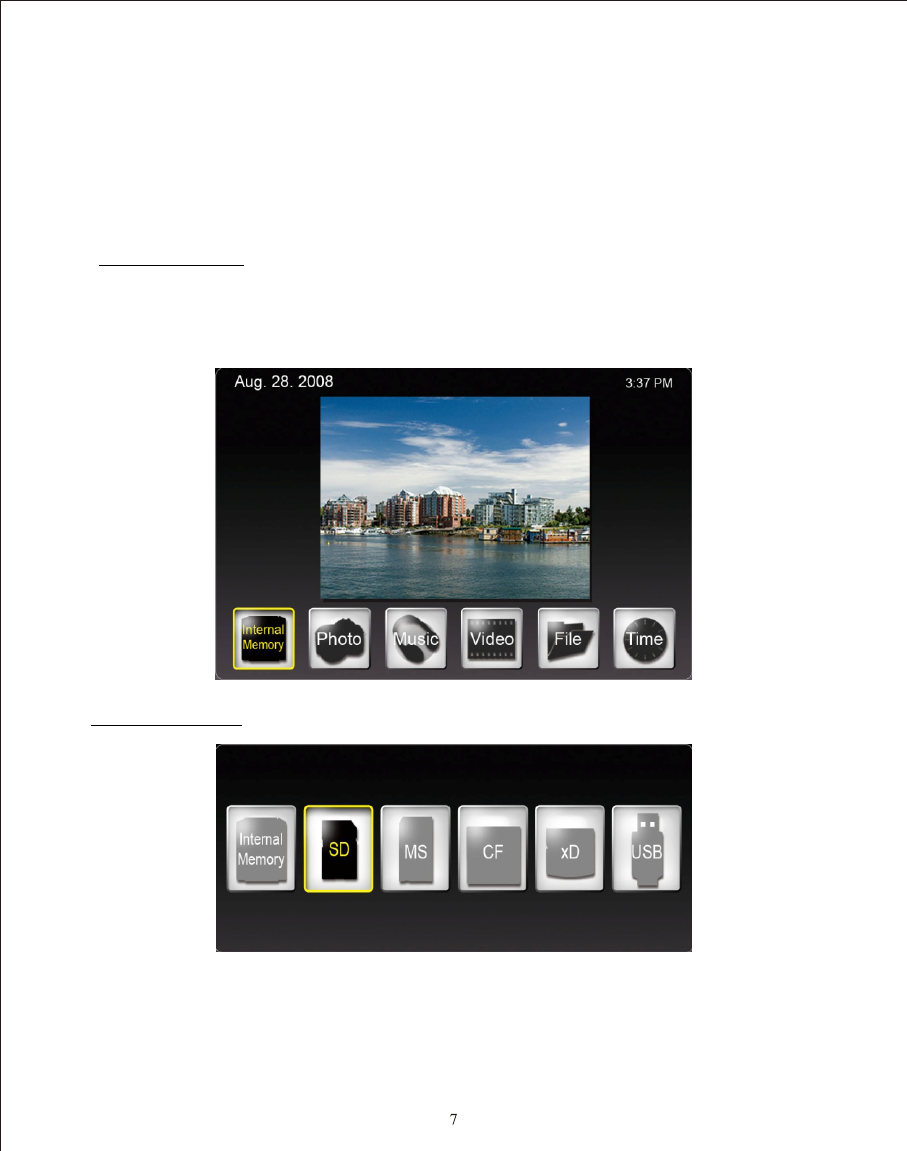
In Select Mode, you will see below screen. There are 6 options: Card Selection, Photo, Music,
Video, File Management, and Time.
Card Selection
If there is not any memory card inserted, “Internal Memory” shows. When the memory card
is inserted, ex. SD card, the icon will change to SD; if the MS card is inserted, the icon will
change to MS. The card also can be selected by pressing ENTER on the Card Selection icon.
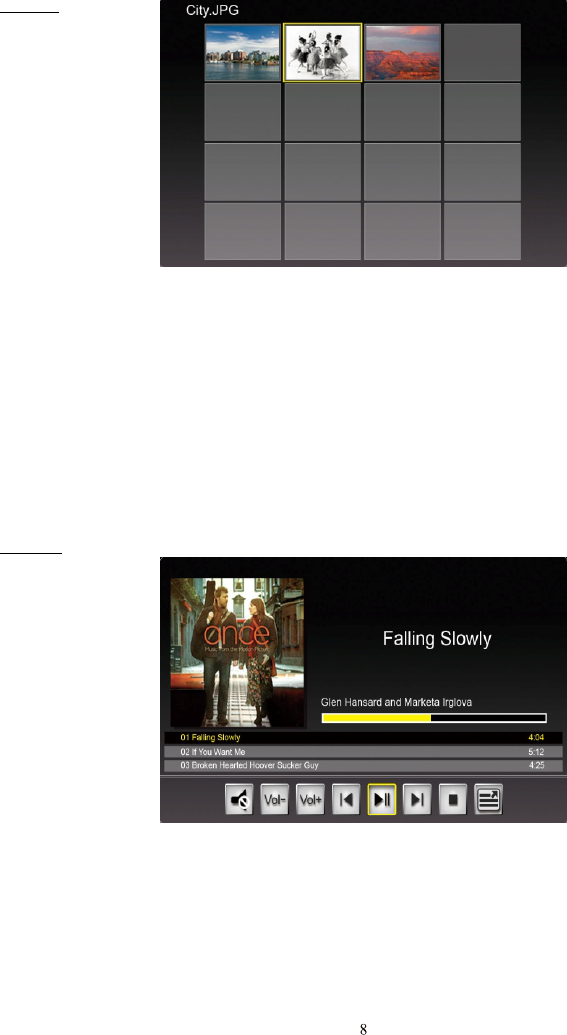
Photo
By pressing SETUP, there are options of File Sorting, Copy Photo (memory card to
internal memory), Delete Photo (from internal memory), Factory Default, Select Card,
Display Image Size, Magic Window, Slideshow Transition, Slideshow Speed, ArcSoft™
Screen Effect, and Adjust LCD Color.
Music
In Music, slideshow plays while the music is playing. The music information and the
play time are shown at the right side of the slideshow. The control buttons are at the
bottom. to
By pressing SETUP, there are options of File Sorting, Copy Music (memory card to
internal memory), Delete Music (from internal memory), Factory Default, Select
Card, and Audio Playback Repeat.
To show the music file list, move to the most right control button and press ENTER.
By pressing ZOOM or ENTER once, the single photo displays.
- Press ENTER to start or pause the slideshow.
- Press ZOOM to zoom in the image.
- Press ROTATE to rotate the image 90° counterclockwise.
- Press SELECT to select or unselect the image(s). The selected images can be
copied or deleted at one time.
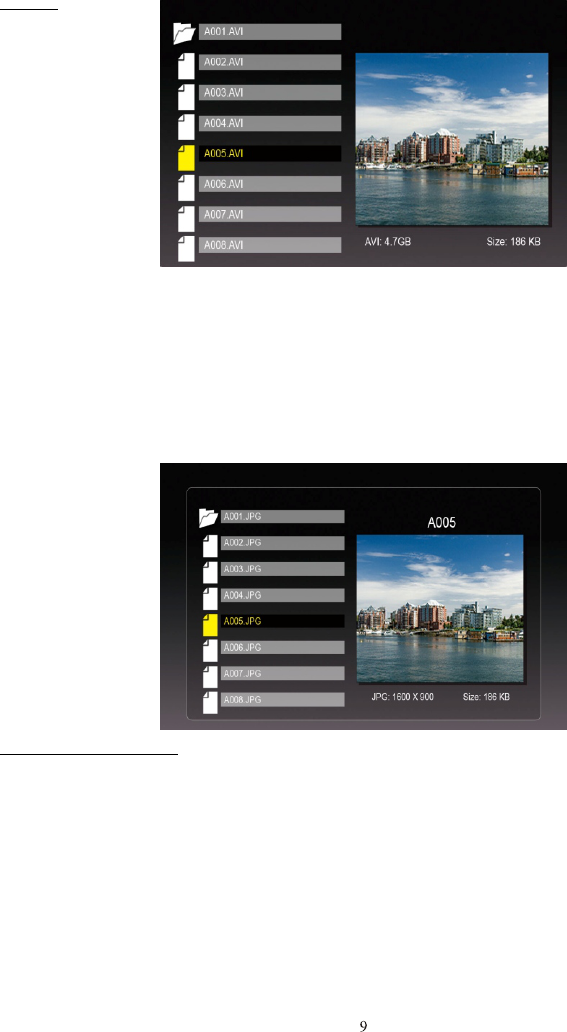
Video
In Video, the file list will be on the left side and the preview will be on the right side.
File Management
In File, the file list will be on the left side and the image previews will be shown on the
right side. For video and music files, only the file information will be shown on the
right side.
Press ENTER on video/music files to play the video/music. Press ENTER on image
files to view the image on full screen; press ENTER again to start the slideshow.
Press SELECT to select the files.
By pressing SETUP, there are options of Copy Files (memory card to internal memory),
Delete Files (internal memory), Factory Default, and Select Card.
Press ENTER to play the video, RIGHT to forward, LEFT to backward, UP to play last
video, and DOWN to play next video.
By pressing SETUP, there are options of File Sorting, Copy Movie (memory card to
internal memory), Delete Movie (internal memory), Factory Default, Select Card, and
Video Playback Repeat.
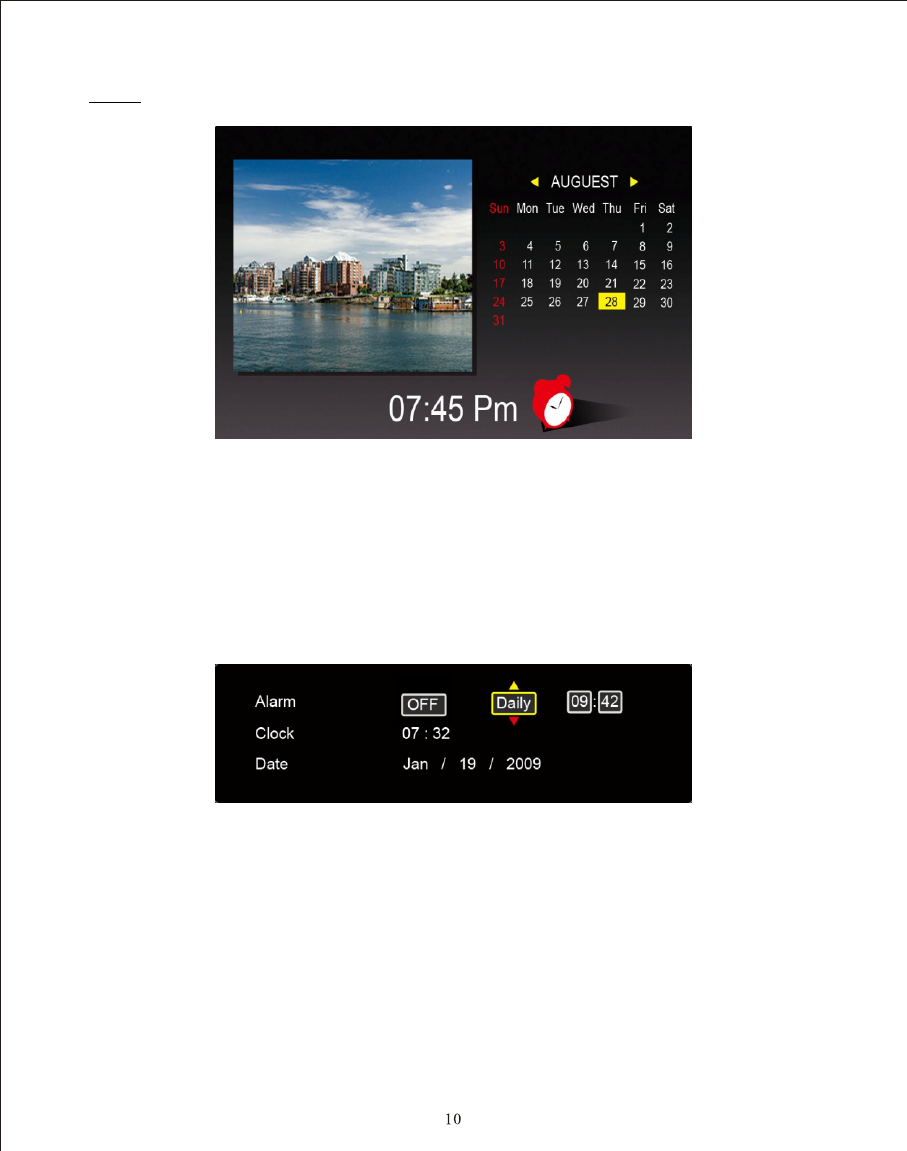
Time
In time, the slide show plays at the left side, calendar shows at the right side, and the
time is displayed at the bottom.
When the alarm is set, the red alarm icon shows.
The date of today will be shown as yellow.
Press SETUP to setup alarm, clock, and date, as shown below.
- Set the alarm time duration at the first block. The alarm will be ringing for every
3, 5, or 10 minutes.
- Set the alarm for once or daily at the second block.

Frequently Asked Questions
Q: How do I set up my Digital Picture Frame?
A: It is very simple to get you Digital Picture Frame out of the box and running in just a few
minutes. Just plug the power adapter into the Digital Picture Frame and into a standard
wall socket. Insert a memory card into the appropriate card slot on the side of the Digital
Picture Frame and turn it on. Your first slideshow will automatically start to play.
Q: What memory cards can the Digital Picture Frame read?
A: Compatible memory cards include Secure Digital™, Multi-Media Card™, Memory
Stick™, Memory Stick Pro™, Memory Stick Duo™, Memory Stick Pro Duo™, and
Compact Flash™.
Q: I set up the Digital Picture Frame; why does it not turn on?
A: The adapter may be not securely connected to the Digital Picture Frame or wall socket,
or the Power Switch may not be on. Please check if the adapter is properly plugged to
the Digital Picture Frame and the wall socket.
Q: I have a memory card in the Digital Picture Frame; why can't I view my photos?
A: First, check whether the memory card is one of the listed above and the images are one
of the formats listed in the Specification on page 6. Second, turn the Digital Picture
Frame off and make sure that the memory card is facing the correct direction and is
inserted all the way into the card slot and. Third, turn the Digital Picture Frame on;
you should see the Select Mode Screen. Follow the instruction of Card Selection to
select your memory card.
Note: Some digital cameras save images in other formats. Please refer to your camera's
manual if your photo format is not listed in the Specification.
Q: Why is the picture display slower with some pictures and faster with others?
A: Higher resolution pictures will be loaded slowly. Try to use lower resolution pictures or
down sampling your images. See your camera's operating manual for details on
downsizing your photos.
Q: Does the Digital Picture Frame support all JPEG files?
A: No. The Digital Picture Frame supports the JPEG files taken by a digital camera. It may
not read all image files downloaded from the Internet or from other graphic applications.
Changes or modifications not expressly approved by the party responsible for
compliance could void the user's authority to operate the equipment.
This equipment has been tested and found to comply with the limits for a Class
B digital device, pursuant to Part 15 of the FCC Rules. These limits are
designed to provide reasonable protection against harmful interference in a
residential installation. This equipment generates uses and can radiate radio
frequency energy and, if not installed and used in accordance with the
instructions, may cause harmful interference to radio communications.
However, there is no guarantee that interference will not occur in a particular
installation. If this equipment does cause harmful interference to radio or
television reception, which can be determined by turning the equipment off and
on, the user is encouraged to try to correct the interference by one or more of
the following measures:
-- Reorient or relocate the receiving antenna.
-- Increase the separation between the equipment and receiver.
-- Connect the equipment into an outlet on a circuit different from that to which
the receiver is connected.
-- Consult the dealer or an experienced radio/TV technician for help