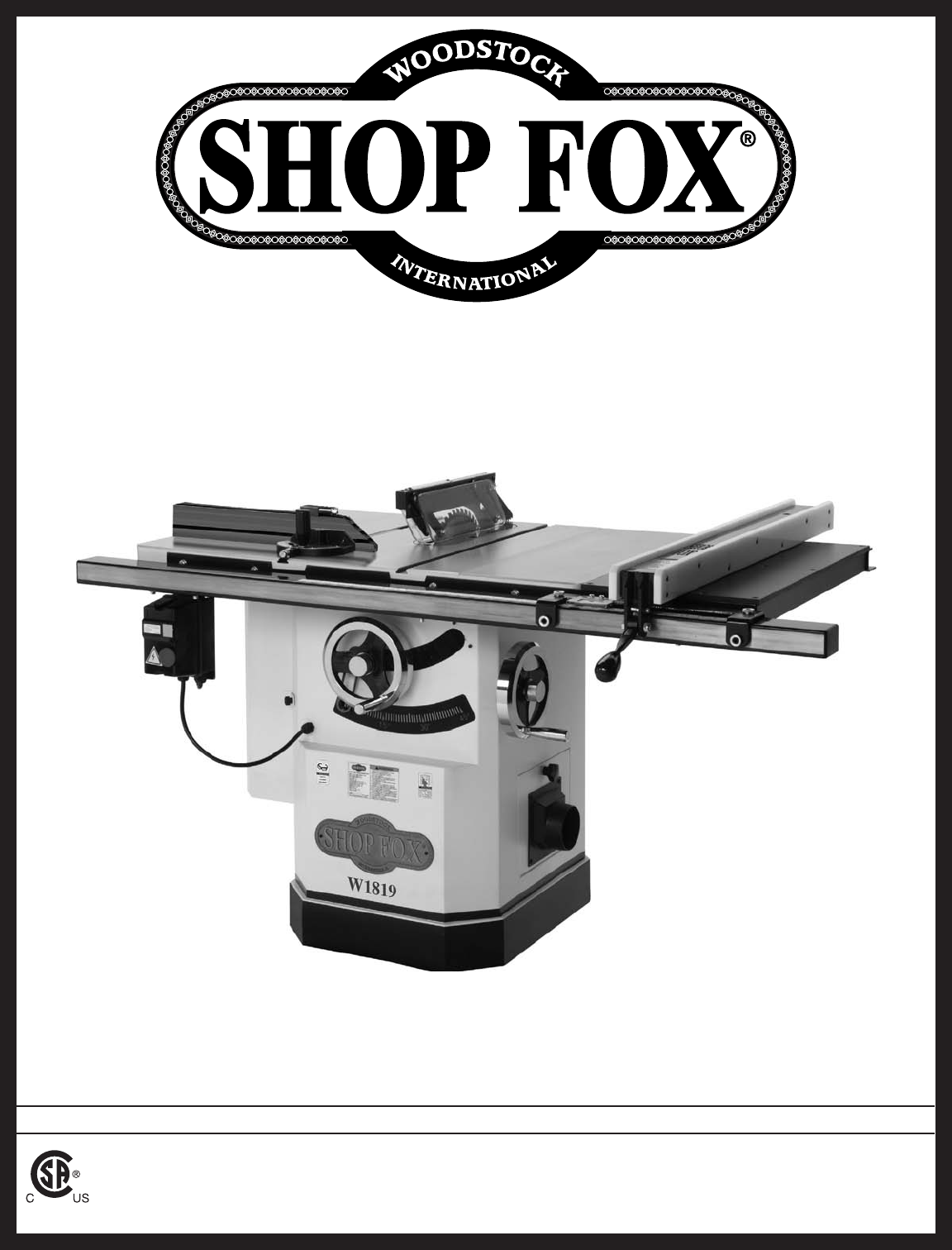
Woodstock W1819 W1820 Users Manual 20 11.13.12
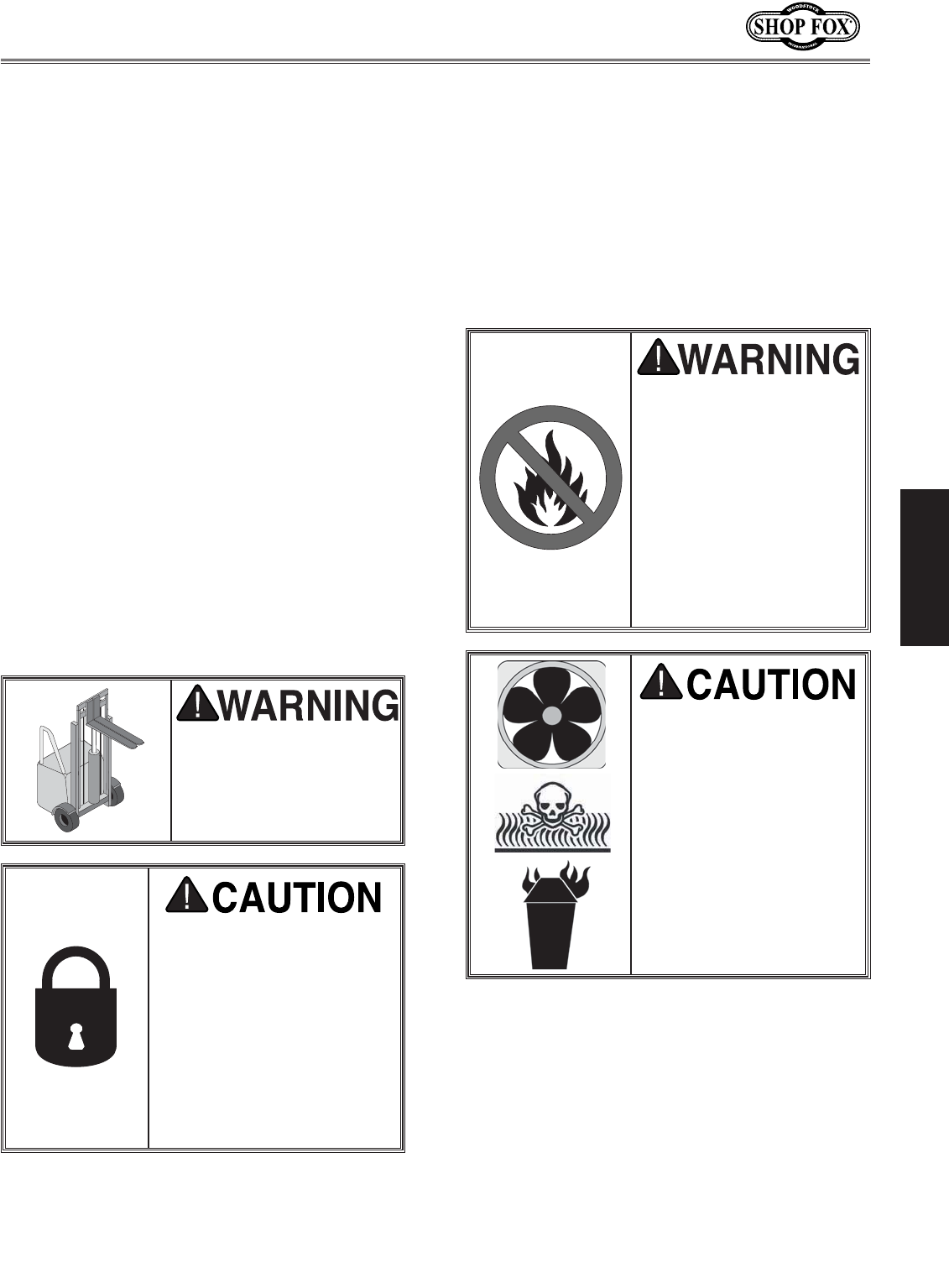
W1819W1820 to the manual ce914bfa-da71-440b-b59e-78f7b0dbcc4c
2015-02-03
: Woodstock Woodstock-W1819-W1820-Users-Manual-478240 woodstock-w1819-w1820-users-manual-478240 woodstock pdf
Open the PDF directly: View PDF  .
.
Page Count: 96
DLC:GHB6CJ6A
;DGBD9:AHB6CJ;68IJG:9H>C8:&'$&%
BD9:AL&-&.$L&-'%
&%867>C:IH6L
E]dcZ/(+%,()"()-'Dca^cZIZX]c^XVaHjeedgi/iZX]"hjeedgi5h]de[dm#W^o
8DENG><=I?JAN!'%&%7NLDD9HID8@>CI:GC6I>DC6A!>C8#G:K>H:9B6G8=!'%&&7A
L6GC>C</CDEDGI>DCD;I=>HB6CJ6AB6N7:G:EGD9J8:9>C6CNH=6E:DG;DGBL>I=DJI
I=:LG>II:C6EEGDK6AD;LDD9HID8@>CI:GC6I>DC6A!>C8#
&(%+%IG7AIH?7Eg^ciZY^c8]^cV
23257
K_`jdXelXcgifm`[\jZi`k`ZXcjX]\kp`ejkilZk`fejfek_\gifg\ij\klg#
fg\iXk`fe#dX`ek\eXeZ\#Xe[j\im`Z\f]k_`jdXZ_`e\&kffc%JXm\k_`j
[fZld\ek#i\]\ikf`kf]k\e#Xe[lj\`kkf`ejkilZkfk_\ifg\iXkfij%
=X`cli\kfi\X[#le[\ijkXe[Xe[]fccfnk_\`ejkilZk`fej`ek_`jdXelXc
dXpi\jlck`e]`i\fij\i`fljg\ijfeXc`ealipÇ`eZcl[`e^XdglkXk`fe#
\c\ZkifZlk`fe#fi[\Xk_%
K_\fne\if]k_`jdXZ_`e\&kffc`jjfc\cpi\jgfej`Yc\]fi`kjjX]\lj\%
K_`ji\jgfej`Y`c`kp`eZcl[\jYlk`jefkc`d`k\[kfgifg\i`ejkXccXk`fe`e
XjX]\\em`ifed\ek#g\ijfee\ckiX`e`e^Xe[ljX^\Xlk_fi`qXk`fe#
gifg\i`ejg\Zk`feXe[dX`ek\eXeZ\#dXelXcXmX`cXY`c`kpXe[Zfdgi\$
_\ej`fe#Xggc`ZXk`fef]jX]\kp[\m`Z\j#Zlkk`e^&jXe[`e^&^i`e[`e^kffc
`ek\^i`kp#Xe[k_\ljX^\f]g\ijfeXcgifk\Zk`m\\hl`gd\ek%
K_\dXel]XZkli\in`ccefkY\_\c[c`XYc\]fi`ealipfigifg\ikp
[XdX^\]ifde\^c`^\eZ\#`dgifg\ikiX`e`e^#dXZ_`e\df[`]`ZXk`fejfi
d`jlj\%
Jfd\[ljkZi\Xk\[Ypgfn\ijXe[`e^#jXn`e^#^i`e[`e^#[i`cc`e^#Xe[
fk_\iZfejkilZk`feXZk`m`k`\jZfekX`ejZ_\d`ZXcjbefnekfk_\JkXk\f]
:Xc`]fie`XkfZXlj\ZXeZ\i#Y`ik_[\]\Zkjfifk_\ii\gif[lZk`m\_Xid%
Jfd\\oXdgc\jf]k_\j\Z_\d`ZXcjXi\1
C\X[]ifdc\X[$YXj\[gX`ekj%
:ipjkXcc`e\j`c`ZX]ifdYi`Zbj#Z\d\ekXe[fk_\idXjfeipgif[lZkj%
8ij\e`ZXe[Z_ifd`ld]ifdZ_\d`ZXccp$ki\Xk\[cldY\i%
Pflii`jb]ifdk_\j\\ogfjli\jmXi`\j#[\g\e[`e^fe_fnf]k\epfl
[fk_`jkpg\f]nfib%Kfi\[lZ\pfli\ogfjli\kfk_\j\Z_\d`ZXcj1
Nfib`eXn\ccm\ek`cXk\[Xi\X#Xe[nfibn`k_Xggifm\[jX]\kp\hl`g$
d\ek#jlZ_Xjk_fj\[ljkdXjbjk_XkXi\jg\Z`Xccp[\j`^e\[kf]`ck\i
flkd`ZifjZfg`ZgXik`Zc\j%
J<KLG<C<:KI@:8C D8@EK<E8E:< J<IM@:< G8IKJFG<I8K@FEJJ8=<KP@EKIF;L:K@FE
LJ<K?<HL@:B>L@;<G8><C89<CJKFJ<8I:?FLK@E=FID8K@FE=8JK
@EKIF;L:K@FE%%%%%%%%%%%%%%%%%%%%%%%%%%%%%%%%%%%%%)
Woodstock Technical Support .................. 2
Controls and Features ........................... 3
Model W1819 Specifications .................... 4
Model W1820 Specifications .................... 7
J8=<KP%%%%%%%%%%%%%%%%%%%%%%%%%%%%%%%%%%%%%%%%%%%%% ('
Standard Machinery Safety Instructions .... 10
Additional Safety for Table Saws ............ 12
Preventing Kickback ........................... 13
Protecting Yourself From Kickback .......... 13
Glossary of Terms .............................. 14
<C<:KI@:8C%%%%%%%%%%%%%%%%%%%%%%%%%%%%%%%%%%%%%%% (,
Circuit Requirements .......................... 15
Grounding Requirements ...................... 16
Extension Cords ................................ 16
J<KLG%%%%%%%%%%%%%%%%%%%%%%%%%%%%%%%%%%%%%%%%%%%%%% (.
Unpacking ....................................... 17
Items Needed for Setup ....................... 17
Inventory ........................................ 18
Fence Inventory W1819 ....................... 19
Fence Inventory W1820 ....................... 20
Machine Placement ............................ 21
Cleaning Machine ............................... 21
Assembly ......................................... 22
Dust Collection ................................. 29
Test Run .......................................... 30
FG<I8K@FEJ%%%%%%%%%%%%%%%%%%%%%%%%%%%%%%%%%%%%%%% *(
General .......................................... 31
Basic Controls ................................... 31
Non-Through & Through Cuts ................ 32
Blade Selection ................................. 33
Blade Installation .............................. 35
Blade Guard Assembly ......................... 36
Riving Knife ..................................... 38
Workpiece Inspection .......................... 39
Ripping ........................................... 40
Crosscutting ..................................... 41
Miter Cuts ....................................... 42
Miter Fence ..................................... 42
Flip Stop ......................................... 43
Blade Tilt & Bevel Cuts........................ 43
Dado Cutting .................................... 44
Rabbet Cutting ................................. 47
Resawing ......................................... 49
Table Saw Accessories ......................... 53
J?FG$D8;<J8=<KP8::<JJFI@<J%%%%%%%%%%%% ,,
Featherboards .................................. 55
Push Sticks ...................................... 58
Push Blocks ...................................... 59
Narrow-Rip Auxiliary Fence & Push Block .. 60
Outfeed & Support Tables .................... 62
Crosscut Sled .................................... 62
D8@EK<E8E:<%%%%%%%%%%%%%%%%%%%%%%%%%%%%%%%%%%%% -*
Schedule ......................................... 63
Cleaning ......................................... 63
Lubrication ...................................... 64
J<IM@:<%%%%%%%%%%%%%%%%%%%%%%%%%%%%%%%%%%%%%%%%%%%% -,
General .......................................... 65
Blade Tilt Stops ................................. 65
Miter Slot to Blade Parallelism ............... 67
Spreader or Riving Knife Alignment ......... 68
Fence Adjustments ............................. 70
Fence Scale Calibration ....................... 72
Miter Gauge Adjustments ..................... 73
Belt Tension & Replacement ................. 74
Electrical Safety Instructions ................. 75
Model W1819/W1820 Wiring Diagram ....... 76
Troubleshooting ................................. 77
G8IKJ%%%%%%%%%%%%%%%%%%%%%%%%%%%%%%%%%%%%%%%%%%%%%% .0
Body .............................................. 79
Trunnion ......................................... 81
Blade Guard ..................................... 84
Miter Gauge ..................................... 85
Fence ............................................. 86
W1819 Extension Wing & Rails ............... 87
W1820 Extension Wing & Rails ............... 88
Machine Labels ................................. 89
N8II8EKP%%%%%%%%%%%%%%%%%%%%%%%%%%%%%%%%%%%%%%%% 0*
:fek\ekj
-2-
Df[\cN(/(0&N(/)'D]^%J`eZ\()&('
@EKIF;L:K@FE
Nff[jkfZbK\Z_e`ZXcJlggfik
This machine has been specially designed to provide many years of trouble-free service. Close attention
to detail, ruggedly built parts and a rigid quality control program assure safe and reliable operation.
Woodstock International, Inc. is committed to customer satisfaction. Our intent with this manual is to
include the basic information for safety, setup, operation, maintenance, and service of this product.
We stand behind our machines! In the event that questions arise about your machine, please contact
Woodstock International Technical Support at (360) 734-3482 or send e-mail to: k\Z_$jlggfik7j_fg]fo%
Y`q. Our knowledgeable staff will help you troubleshoot problems and process warranty claims.
@EKIF;L:K@FE
If you need the latest edition of this manual, you can download it from _kkg1&&nnn%j_fg]fo%Y`q.
If you have comments about this manual, please contact us at:
Nff[jkfZb@ek\ieXk`feXc#@eZ%
8kke1K\Z_e`ZXc;fZld\ekXk`feDXeX^\i
G%F%9fo)*'0
9\cc`e^_Xd#N80/)).
<dX`c1dXelXcj7nff[jkfZb`ek%Zfd
-3-
Df[\cN(/(0&N(/)'D]^%J`eZ\()&('
@EKIF;L:K@FE
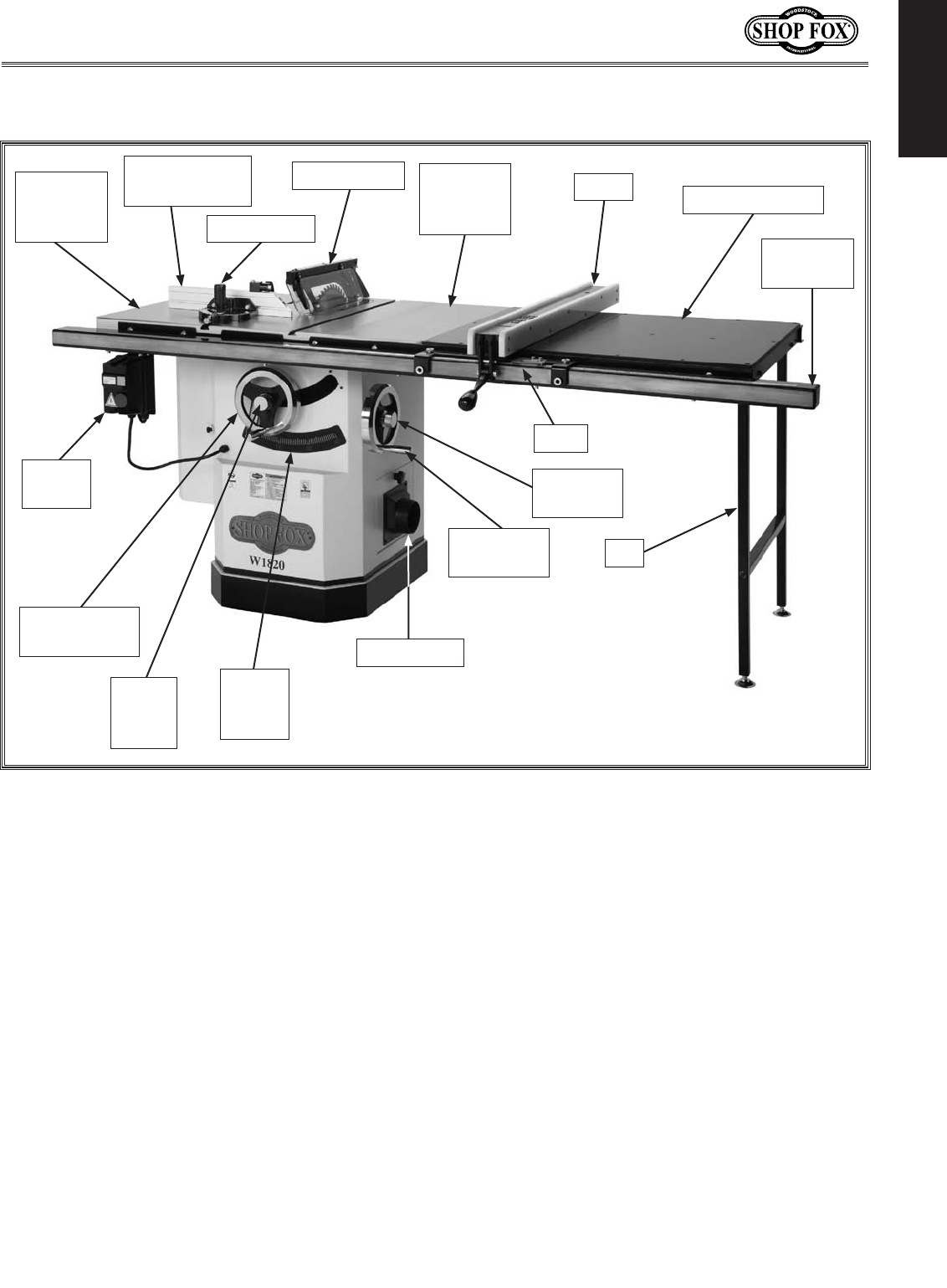
:fekifcjXe[=\Xkli\j
=`^li\(%Identification (Model W1820 shown).
Front Rail
Tube
Fence Extension Table
Blade
Height
Lock
Blade Height
Handwheel
Blade Tilt
Lock
Blade Guard
Scale
Left
Extension
Wing
Right
Extension
Wing
On/Off
Switch
Leg
Blade Tilt
Handwheel
Table
Tilt
Scale
4" Dust Port
Miter Fence
with Flip Stop
Miter Gauge

-4-
Df[\cN(/(0&N(/)'D]^%J`eZ\()&('
@EKIF;L:K@FE
02'(/:
6+23)2;&$%,1(76$::5,9,1*.1,)(

-5-
Df[\cN(/(0&N(/)'D]^%J`eZ\()&('
@EKIF;L:K@FE

-6-
Df[\cN(/(0&N(/)'D]^%J`eZ\()&('
@EKIF;L:K@FE

-7-
Df[\cN(/(0&N(/)'D]^%J`eZ\()&('
@EKIF;L:K@FE
02'(/:
6+23)2;&$%,1(76$::5,9,1*.1,)(/21*5$,/6

-8-
Df[\cN(/(0&N(/)'D]^%J`eZ\()&('
@EKIF;L:K@FE

-9-
Df[\cN(/(0&N(/)'D]^%J`eZ\()&('
@EKIF;L:K@FE
-10-
Df[\cN(/(0&N(/)'D]^%J`eZ\()&('
J8=<KP
@e[`ZXk\jXgfk\ek`Xccp_XqXi[fljj`klXk`fen_`Z_#`]efkXmf`[\[#
D8Pi\jlck`ed`efifidf[\iXk\`ealip%
@e[`ZXk\jXe`dd`e\ekcp_XqXi[fljj`klXk`fen_`Z_#`]efkXmf`[\[#
N@CCi\jlck`e[\Xk_fij\i`flj`ealip%
@e[`ZXk\jXgfk\ek`Xccp_XqXi[fljj`klXk`fen_`Z_#`]efkXmf`[\[#
:FLC;i\jlck`e[\Xk_fij\i`flj`ealip%
K_`jjpdYfc`jlj\[kfXc\ikk_\lj\ikflj\]lc`e]fidXk`feXYflk
gifg\ifg\iXk`fef]k_\\hl`gd\ekfiXj`klXk`fek_XkdXpZXlj\
[XdX^\kfk_\dXZ_`e\ip%
EFK@:<
J8=<KP
FNE<IËJD8EL8C%Read and understand this
owner’s manual BEFORE using machine.
KI8@E<;FG<I8KFIJFECP%Untrained operators
have a higher risk of being hurt or killed. Only
allow trained/supervised people to use this
machine. When machine is not being used,
disconnect power, remove switch keys, or
lock-out machine to prevent unauthorized
use—especially around children. Make
workshop kid proof!
;8E><IFLJ<EM@IFED<EKJ%Do not use
machinery in areas that are wet, cluttered,
or have poor lighting. Operating machinery
in these areas greatly increases the risk of
accidents and injury.
D<EK8C8C<IKE<JJI<HL@I<;%Full mental
alertness is required for safe operation of
machinery. Never operate under the influence
of drugs or alcohol, when tired, or when
distracted.
<C<:KI@:8C<HL@GD<EK@EALIPI@JBJ%You can
be shocked, burned, or killed by touching live
electrical components or improperly grounded
machinery. To reduce this risk, only allow an
electrician or qualified service personnel to
do electrical installation or repair work, and
always disconnect power before accessing or
exposing electrical equipment.
;@J:FEE<:KGFN<I=@IJK%Always disconnect
machine from power supply BEFORE making
adjustments, changing tooling, or servicing
machine. This eliminates the risk of injury
from unintended startup or contact with live
electrical components.
<P<GIFK<:K@FE%Always wear ANSI-approved
safety glasses or a face shield when operating
or observing machinery to reduce the risk of
eye injury or blindness from flying particles.
Everyday eyeglasses are not approved safety
glasses.
JkXe[Xi[DXZ_`e\ipJX]\kp@ejkilZk`fej
For Your Own Safety,
Read Manual Before Operating Machine
K_\ gligfj\ f] jX]\kp jpdYfcj `j kf XkkiXZk pfli Xkk\ek`fe kf gfjj`Yc\ _XqXi[flj Zfe[`k`fej% K_`j
dXelXclj\jXj\i`\jf]jpdYfcjXe[j`^eXcnfi[j`ek\e[\[kfZfem\pk_\c\m\cf]`dgfikXeZ\f]k_\
jX]\kpd\jjX^\j%K_\gif^i\jj`fef]jpdYfcj`j[\jZi`Y\[Y\cfn%I\d\dY\ik_XkjX]\kpd\jjX^\jYp
k_\dj\cm\j[fefk\c`d`eXk\[Xe^\iXe[Xi\efkXjlYjk`klk\]figifg\iXZZ`[\ekgi\m\ek`fe d\X$
jli\jÇk_`ji\jgfej`Y`c`kp`jlck`dXk\cplgkfk_\fg\iXkfi
J8=<KP
JkXe[Xi[DXZ_`e\ipJX]\kp@ejkilZk`fej

-11-
Df[\cN(/(0&N(/)'D]^%J`eZ\()&('
J8=<KP
N<8I@E>GIFG<I8GG8I<C%Do not wear
clothing, apparel, or jewelry that can become
entangled in moving parts. Always tie back
or cover long hair. Wear non-slip footwear to
avoid accidental slips, which could cause loss
of workpiece control.
?8Q8I;FLJ;LJK%Dust created while using
machinery may cause cancer, birth defects,
or long-term respiratory damage. Be aware of
dust hazards associated with each workpiece
material, and always wear a NIOSH-approved
respirator to reduce your risk.
?<8I@E>GIFK<:K@FE%Always wear hearing
protection when operating or observing
loud machinery. Extended exposure to this
noise without hearing protection can cause
permanent hearing loss.
I<DFM<8;ALJK@E>KFFCJ%Tools left on
machinery can become dangerous projectiles
upon startup. Never leave chuck keys,
wrenches, or any other tools on machine.
Always verify removal before starting!
@EK<E;<;LJ8><%Only use machine for
its intended purpose and never make
modifications not approved by Woodstock.
Modifying machine or using it differently
than intended may result in malfunction or
mechanical failure that can lead to serious
personal injury or death!
8NBN8I;GFJ@K@FEJ%Keep proper footing and
balance at all times when operating machine.
Do not overreach! Avoid awkward hand
positions that make workpiece control difficult
or increase the risk of accidental injury.
:?@C;I<E9PJK8E;<IJ%Keep children and
bystanders at a safe distance from the work
area. Stop using machine if they become a
distraction.
>L8I;J:FM<IJ%Guards and covers reduce
=FI:@E>D8:?@E<IP%Do not force machine. It
will do the job safer and better at the rate for
which it was designed.
E<M<IJK8E;FED8:?@E<%Serious injury may
occur if machine is tipped or if the cutting
tool is unintentionally contacted.
JK89C<D8:?@E<%Unexpected movement during
operation greatly increases risk of injury or
loss of control. Before starting, verify machine
is stable and mobile base (if used) is locked.
LJ<I<:FDD<E;<;8::<JJFI@<J%Consult
this owner’s manual or the manufacturer for
recommended accessories. Using improper
accessories will increase risk of serious injury.
LE8KK<E;<;FG<I8K@FE%To reduce the risk
of accidental injury, turn machine F== and
ensure all moving parts completely stop
before walking away. Never leave machine
running while unattended.
D8@EK8@EN@K?:8I<%Follow all maintenance
instructions and lubrication schedules to
keep machine in good working condition. A
machine that is improperly maintained could
malfunction, leading to serious personal injury
or death.
:?<:B;8D8><;G8IKJ%Regularly inspect
machine for any condition that may affect
safe operation. Immediately repair or replace
damaged or mis-adjusted parts before
operating machine.
D8@EK8@EGFN<I:FI;J%When disconnecting
cord-connected machines from power, grab
and pull the plug—NOT the cord. Pulling the
cord may damage the wires inside, resulting
in a short. Do not handle cord/plug with wet
hands. Avoid cord damage by keeping it away
from heated surfaces, high traffic areas, harsh
chemicals, and wet/damp locations.

-12-
Df[\cN(/(0&N(/)'D]^%J`eZ\()&('
J8=<KP
8[[`k`feXcJX]\kp]fiKXYc\JXnj
?8E;GFJ@K@FE@E>% Never purposely touch a saw blade during operation. Always keep hands/fingers
out of the blade path; place them where they cannot slip into the blade accidentally. Never reach
around, behind, or over the blade. Touching a spinning saw blade will cause serious laceration or
amputation injuries.
9C8;<>L8I;% Use the blade guard for all “through cuts” for which it can be used. (A through cut is
an operation where the blade cuts completely through the top of the workpiece.) Make sure the blade
guard is installed and adjusted correctly; promptly repair or replace it if damaged. Always re-install
blade guard immediately after operations that require its removal. Operating saw with the blade guard
removed greatly increases the risk of severe laceration or amputation injuries from accidental blade
contact.
I@M@E>BE@=<% Use the riving knife for all “non-through cuts” for which it can be used. (A non-through
cut is an operation where the blade does not cut through the top of the workpiece.) Make sure the
riving knife is aligned and positioned correctly; and promptly repair or replace it if damaged. Using the
riving knife incorrectly will increase the risk of kickback or accidental blade contact.
KICKBACK. Kickback occurs when the saw blade ejects the workpiece back toward the operator. Know
how to reduce the risk of kickback, and learn how to protect yourself if it does occur.
FEEDING WORKPIECE. Feeding the workpiece incorrectly will increase risk of kickback. Never start
the saw with a workpiece touching the blade; allow the blade to reach full speed before cutting. Only
feed the workpiece against the direction of blade rotation. Always use some type of guide (fence, miter
gauge, sliding table or sled, etc.) to feed the workpiece in a straight line. Never back a workpiece out
of a cut or try to move it backwards or sideways after starting a cut. Feed cuts all the way through to
completion. Never perform any operation “freehand” (making a cut without using a fence or guide).
FENCE. Make sure the fence remains properly adjusted and parallel with the blade. Always lock the
fence in place before using. Using or adjusting the fence incorrectly will increase risk of kickback.
PUSH STICKS/BLOCKS. Use push sticks or push blocks whenever possible to keep your hands farther
away from the blade while cutting; in the event of an accident these devices will often take damage
that would have happened to hands/fingers.
:LK$F==G@<:<J% Never use your hands to move cut-offs away from the blade while the saw is running.
If a cut-off becomes trapped between the blade and table insert, turn the saw F== and allow the blade
to completely stop before removing it.
BLADE ADJUSTMENTS. Adjusting the blade height or tilt during operation increases the risk of crashing
the blade and sending metal fragments flying with deadly force at the operator or bystanders. Only
adjust the blade height and tilt when the blade is completely stopped and the saw is F==.
CHANGING BLADES. Always disconnect power before changing blades. Changing blades while the saw is
connected to power greatly increases the injury risk if saw is accidentally powered up.
DAMAGED SAW BLADES. Never use blades that have been dropped or otherwise damaged. Damaged
blades can fly apart and strike the operator with shards of metal.
DADO AND RABBET OPERATIONS. DO NOT attempt dado or rabbeting operations without first reading
those sections in this manual. Dado and rabbeting operations require special attention because they
must be performed with the blade guard removed.
-13-
Df[\cN(/(0&N(/)'D]^%J`eZ\()&('
J8=<KP
JkXk`jk`Zj j_fn k_Xk dfjk Zfddfe XZZ`$
[\ekjXdfe^kXYc\jXnlj\ijZXeY\c`eb\[
kfb`ZbYXZb%B`ZbYXZb`jkpg`ZXccp[\]`e\[
Xj k_\ _`^_$jg\\[ \a\Zk`fe f] jkfZb ]ifd
k_\ kXYc\ jXn kfnXi[ `kj fg\iXkfi% @e
X[[`k`fe kf k_\ [Xe^\i f] k_\ fg\iXkfi
fifk_\ij`ek_\Xi\XY\`e^jkilZbYpk_\
]cp`e^jkfZb#`k`jf]k\ek_\ ZXj\ k_Xk k_\
fg\iXkfiËj_Xe[jXi\glcc\[`ekfk_\YcX[\
[li`e^k_\b`ZbYXZb%
Below are ways to avoid the most common
causes of kickback:
• Only cut workpieces with at least one
smooth and straight edge. DO NOT cut
warped, cupped or twisted wood.
• Never attempt freehand cuts. If the
workpiece is not fed parallel with the
blade, kickback will likely occur. Always use
the rip fence or miter gauge to support the
workpiece.
• Make sure the spreader or riving knife
is aligned with the blade. A misaligned
spreader or riving knife can cause the
workpiece to catch or bind, increasing the
chance of kickback. If you think that your
spreader or riving knife is not aligned with
the blade, check it immediately!
• Take the time to check and adjust the rip
fence parallel with the blade; otherwise,
the chances of kickback are extreme.
• The spreader or riving knife maintains the
kerf in the workpiece, reducing the chance
of kickback. Always use the riving knife for
all non-through operations, unless a dado
blade is installed. Always use the spreader
with the blade guard for all through cuts.
• Feed cuts through to completion. Anytime
you stop feeding a workpiece in the middle
of a cut, the chance of kickback is greatly
increased.
• Keep the blade guard installed and in good
working order. Only remove it when per-
forming non-through cuts and immediately
re-install the blade guard when finished.
Remember, always use the riving knife for all
non-through operations, unless a dado blade
is installed.
• Make multiple, shallow passes when per-
forming a non-through cut. Making a deep
non-through cut will greatly increase the
chance of kickback.
Gi\m\ek`e^B`ZbYXZb
Even if you know how to prevent kickback,
it may still happen. Here are some ways to
protect yourself if kickback DOES occur:
• Stand to the side of the blade during every
cut. If kickback does occur, the thrown
workpiece usually travels directly in front
of the blade.
• Wear safety glasses or a face shield. In the
event of kickback, your eyes and face are
the most vulnerable part of your body.
• Never, for any reason, place your hand
behind the blade. Should kickback occur,
your hand may be pulled into the blade,
which could cause amputation.
• Use a push stick to keep your hands farther
away from the moving blade. If kickback
occurs, the push stick will most likely take
the damage that your hand would have
received.
• Use featherboards or anti-kickback devices
to prevent or slow down kickback.
Gifk\Zk`e^Pflij\c]
=ifdB`ZbYXZb

-14-
Df[\cN(/(0&N(/)'D]^%J`eZ\()&('
J8=<KP
The following is a list of common definitions, terms and phrases used throughout this manual as they relate
to this table saw and woodworking in general. Become familiar with these terms for assembling, adjusting
or operating this machine.
8iYfi1 A metal shaft extending from the drive
mechanism that is the mounting location for
the saw blade.
9\m\c :lk1 A cut made with the blade tilted to
an angle between 0˚ and 45˚ to cut a beveled
edge onto a workpiece. Refer to GX^\ +* for
more details.
9cX[\ >lXi[ 8jj\dYcp1 Metal or plastic safety
device that mounts over the saw blade. Its
function is to prevent the operator from com-
ing into contact with the saw blade. Refer to
GX^\*- for more details.
:ifjjZlk1 Cutting operation in which the crosscut
fence is used to cut across the shortest width
of the workpiece. Refer to GX^\ +( for more
details.
;X[f9cX[\1 Blade or set of blades that are used
to cut grooves and rabbets. Refer to GX^\ *+
for more details. ;FEFKlj\X[X[fYcX[\
cXi^\i k_Xe / `e [`Xd\k\i fe k_`j jXn The
saw and arbor are not intended to safely use a
larger dado blade.
;X[f :lk1 Cutting operation that uses a dado
blade to cut a flat bottomed groove into the
face of the workpiece. Refer to GX^\ ++ for
more details.
=\Xk_\iYfXi[1 Safety device used to keep the
workpiece against the rip fence and against
the table surface. Refer to GX^\ ,, for more
details.
B\i]1 The resulting cut or gap in the workpiece
after the saw blade passes through during a
cutting operation.
B`ZbYXZb1 An event in which the workpiece is
propelled back towards the operator at a high
rate of speed.
Efe$K_ifl^_:lk1 A cut in which the blade does
not cut through the top of the workpiece.
Refer to GX^\*) for more details.
GXiXcc\c1 Being an equal distance apart at every
point along two given lines or planes (i.e. the
rip fence face is parallel to the face of the saw
blade).
G\ig\e[`ZlcXi1 Lines or planes that intersect and
form right angles (i.e. the blade is perpendicu-
lar to the table surface).
Glj_ Jk`Zb1 Safety device used to push the
workpiece through a cutting operation. Used
most often when rip cutting thin workpieces.
Refer to GX^\,/ for more details.
IXYY\k1 Cutting operation that creates an L-shaped
channel along the edge of the workpiece. Refer
to GX^\+. for more details.
I`g:lk1 Cutting operation in which the rip fence
is used to cut across the widest width of the
workpiece. Refer to GX^\+' for more details.
I`m`e^ Be`]\1 Metal plate located behind the
blade. It maintains the kerf opening in the
wood when performing a cutting operation.
Refer to GX^\*/ for more details.
JkiX`^_k\[^\1 A tool used to check the flatness,
parallelism, or consistency of a surface(s).
K_`eB\i]9cX[\1A blade with a kerf or thickness
that is thinner than a standard blade cannot be
used on this saw.
K_ifl^_:lk1 A cut in which the blade cuts com-
pletely through the workpiece. Refer to GX^\
*) for more details.
>cfjjXipf]K\idj
-15-
Df[\cN(/(0&N(/)'D]^%J`eZ\()&('
<C<:KI@:8C
<C<:KI@:8C
:`iZl`kI\hl`i\d\ekj
This machine must be connected to the correct size and
type of power supply circuit, or fire or electrical damage
may occur. Read through this section to determine if an
adequate power supply circuit is available. If a correct
circuit is not available, a qualified electrician MUST install
one before you can connect the machine to power.
A power supply circuit includes all electrical equipment
between the breaker box or fuse panel in the building
and the machine. The power supply circuit used for
this machine must be sized to safely handle the full-
load current drawn from the machine for an extended
period of time. (If this machine is connected to a circuit
protected by fuses, use a time delay fuse marked D.
)
:`iZl`kI\hl`i\d\ekj
This machine is prewired to operate on a 220V power
supply circuit that has a verified ground and meets the
following requirements:
:`iZl`kKpg\%%%%%%%%%%%%%%%))'M&)+'M#-'?q#J`e^c\$G_Xj\
:`iZl`kJ`q\%%%%%%%%%%%%%%%%%%%%%%%%%%%%%%%%%%%%%%%%%%%%% )'8dgj
Gcl^&I\Z\gkXZc\%%%%%%%%%%%%%%%%%%%%%%%%%%%%%%%%%%%% E<D8-$)'
=lcc$CfX[:lii\ekIXk`e^
The full-load current rating is the amperage a machine
draws at 100% of the rated output power. On machines
with multiple motors, this is the amperage drawn by the
largest motor or sum of all motors and electrical devices
that might operate at one time during normal operations.
=lcc$CfX[:lii\ekIXk`e^%%%%%%%%%%%%%%%%%%%%%%%%%%%()%/8dgj
K_\ dXZ_`e\ dljk Y\ gifg\icp j\k lg
Y\]fi\ `k `j jX]\ kf fg\iXk\% ;F EFK
Zfee\Zk k_`j dXZ_`e\ kf k_\ gfn\i
jfliZ\ lek`c `ejkilZk\[ kf [f cXk\i `e
k_`jdXelXc%
@eZfii\Zkcp n`i`e^ fi ^ifle[`e^ k_`j
dXZ_`e\ZXeZXlj\\c\ZkifZlk`fe#]`i\#
fidXZ_`e\[XdX^\%Kfi\[lZ\k_`ji`jb#
fecpXe\c\Zki`Z`XefihlXc`]`\[j\im`Z\
g\ijfee\c j_flc[ [f Xep i\hl`i\[
\c\Zki`ZXcnfibfek_`jdXZ_`e\%
EFK@:<
K_\ Z`iZl`k i\hl`i\d\ekj c`jk\[ `e k_`j
dXelXc Xggcp kf X [\[`ZXk\[ Z`iZl`kÇ
n_\i\fecpfe\dXZ_`e\n`ccY\ilee`e^
XkXk`d\%@]k_`jdXZ_`e\n`ccY\
Zfee\Zk\[ kf X j_Xi\[ Z`iZl`k n_\i\
dlck`gc\dXZ_`e\jn`ccY\ilee`e^Xkk_\
jXd\k`d\#Zfejlckn`k_Xe\c\Zki`Z`Xe
kf\ejli\k_Xkk_\Z`iZl`k`jgifg\icp
j`q\[]fijX]\fg\iXk`fe%
-16-
Df[\cN(/(0&N(/)'D]^%J`eZ\()&('
<C<:KI@:8C
>ifle[`e^I\hl`i\d\ekj
<ok\ej`fe:fi[j
This machine MUST be grounded. In the event of certain
types of malfunctions or breakdowns, grounding provides
a path of least resistance for electric current to travel—in
order to reduce the risk of electric shock.
Improper connection of the equipment-grounding wire will
increase the risk of electric shock. The wire with green
insulation (with/without yellow stripes) is the equipment-
grounding wire. If repair or replacement of the power
cord or plug is necessary, do not connect the equipment-
grounding wire to a live (current carrying) terminal.
Check with a qualified electrician or service personnel
if you do not understand these grounding requirements,
or if you are in doubt about whether the tool is
properly grounded. If you ever notice that a cord or
plug is damaged or worn, disconnect it from power, and
immediately replace it with a new one. Grounding Prong
Current Carrying Prongs
6-20 PLUG
GROUNDED
6-20 RECEPTACLE
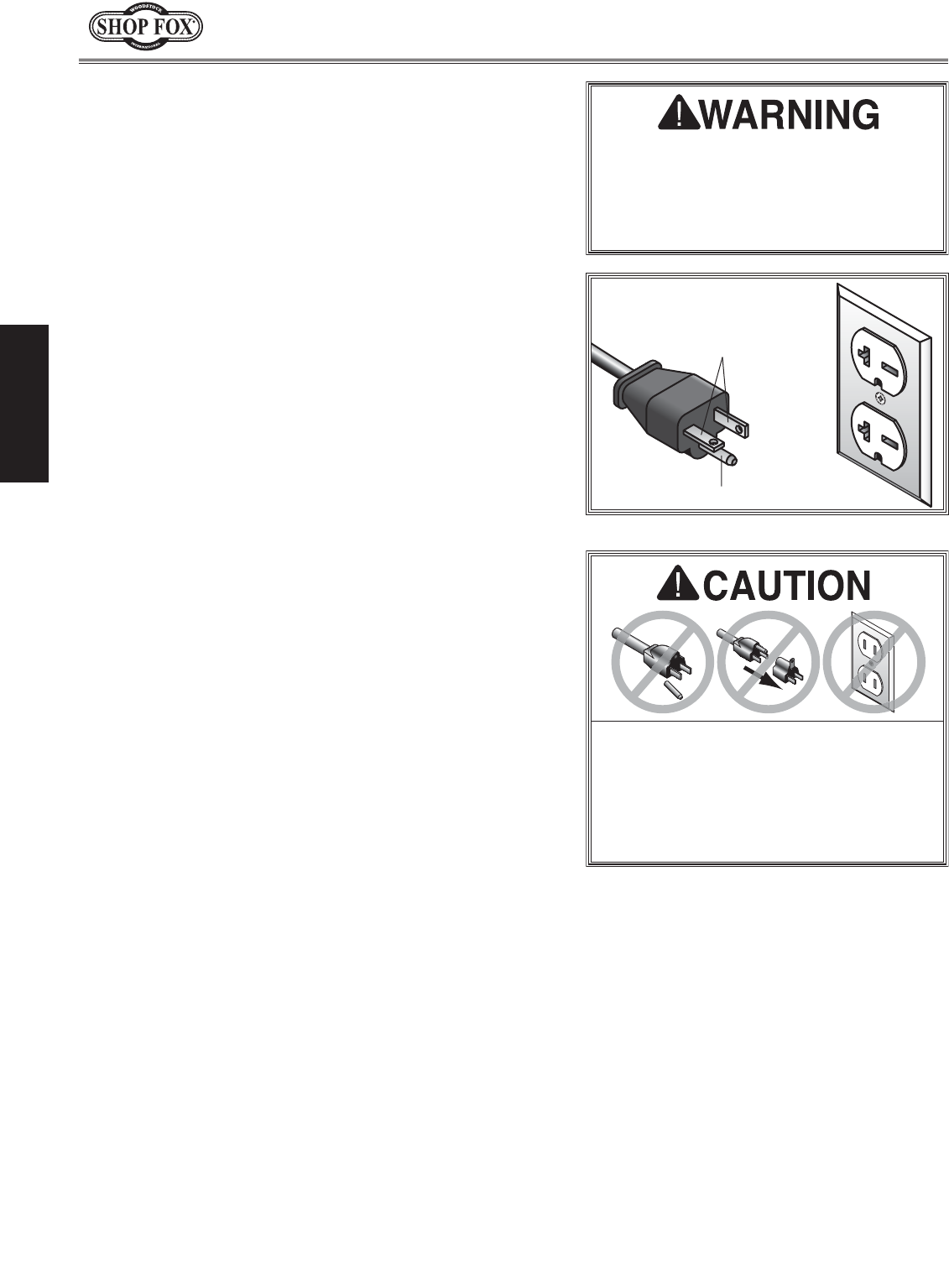
=`^li\2% NEMA 6-20 plug & receptacle.
This machine is equipped with a power cord that has an
equipment-grounding wire and NEMA 6-20 grounding plug.
The plug must only be inserted into a matching receptacle
(see =`^li\) that is properly installed and grounded in
accordance with local codes and ordinances.
=fi))'M:fee\Zk`fe
We do not recommend using an extension cord with this
machine. Extension cords cause voltage drop, which may
damage electrical components and shorten motor life.
Voltage drop increases with longer extension cords and
the gauge smaller gauge sizes (higher gauge numbers
indicate smaller sizes).
Any extension cord used with this machine must contain a
ground wire, match the required plug and receptacle, and
meet the following requirements:
K_\ dXZ_`e\ dljk Y\ gifg\icp j\k lg
Y\]fi\ `k `j jX]\ kf fg\iXk\% ;F EFK
Zfee\Zk k_`j dXZ_`e\ kf k_\ gfn\i
jfliZ\ lek`c `ejkilZk\[ kf [f cXk\i `e
k_`jdXelXc%
;F EFK df[`]p k_\ gifm`[\[ gcl^ fi
lj\XeX[Xgk\i`]k_\gcl^n`ccefk
]`k k_\ i\Z\gkXZc\% @ejk\X[# _Xm\ Xe
\c\Zki`Z`Xe`ejkXcck_\gifg\ii\Z\gkXZc\
fe X gfn\i jlggcp Z`iZl`k k_Xk d\\kj
k_\i\hl`i\d\ekj]fik_`jdXZ_`e\%
D`e`dld>Xl^\J`q\Xk))'M%%%%%%%%%%%%%%%%%%%%%% (+8N>
DXo`dldC\e^k_J_fik\i`j9\kk\i %%%%%%%%%%%%%%%%,']k%
-17-
Df[\cN(/(0&N(/)'D]^%J`eZ\()&('
J<KLG
This machine has been carefully packaged for safe
transportation. If you notice the machine has been
damaged during shipping, please contact your authorized
Shop Fox dealer immediately.
LegXZb`e^
J<KLG
The following items are needed, but not included, to
setup your machine.
;\jZi`gk`fe Hkp
• Safety Glasses for Each Person ..........................1
• Degreaser or Solvent for Cleaning ................Varies
• Disposable Rags for Cleaning ......................Varies
• Straightedge ................................................1
• Level .........................................................1
• Dust Collection System ...................................1
• 4" Dust Hose ................................................1
• 4" Hose Clamp ..............................................1
• Assistant for Lifting .......................................1
• Needle Nose Pliers ........................................1
• Wrench or Socket 17mm .................................1
• Wrenches or Sockets 13mm ..............................2
• Wrench or Socket 10mm .................................1
• Wrench 14mm ..............................................1
• Adjustable Wrench ........................................1
@k\djE\\[\[]fiJ\klg
LJ< _\cg\ij fi gfn\i
c`]k`e^ \hl`gd\ek kf c`]k
k_`j dXZ_`e\% Fk_\in`j\#
j\i`flj g\ijfeXc `ealip
dXpfZZli%
N\Xi jX]\kp ^cXjj\j [li`e^ k_\ \ek`i\
j\klggifZ\jj
K_`jdXZ_`e\gi\j\ekj
j\i`flj `ealip _XqXi[j
kflekiX`e\[lj\ij%I\X[
k_ifl^_k_`j\ek`i\dXe$
lXc kf Y\Zfd\ ]Xd`c`Xi
n`k_ k_\ Zfekifcj Xe[
fg\iXk`fejY\]fi\ jkXik$
`e^k_\dXZ_`e\
-18-
Df[\cN(/(0&N(/)'D]^%J`eZ\()&('
J<KLG
The following is a description of the main components
shipped each W1819/W1820 model. Lay the components
out to inventory them.
Efk\1@]pflZXek]`e[Xe`k\dfek_`jc`jk#Z_\Zbk_\
dflek`e^cfZXk`fefek_\dXZ_`e\fi\oXd`e\k_\
gXZbX^`e^dXk\i`XcjZXi\]lccp%FZZXj`feXccpn\gi\$`ejkXcc
Z\ikX`eZfdgfe\ekj]fij_`gg`e^gligfj\j%
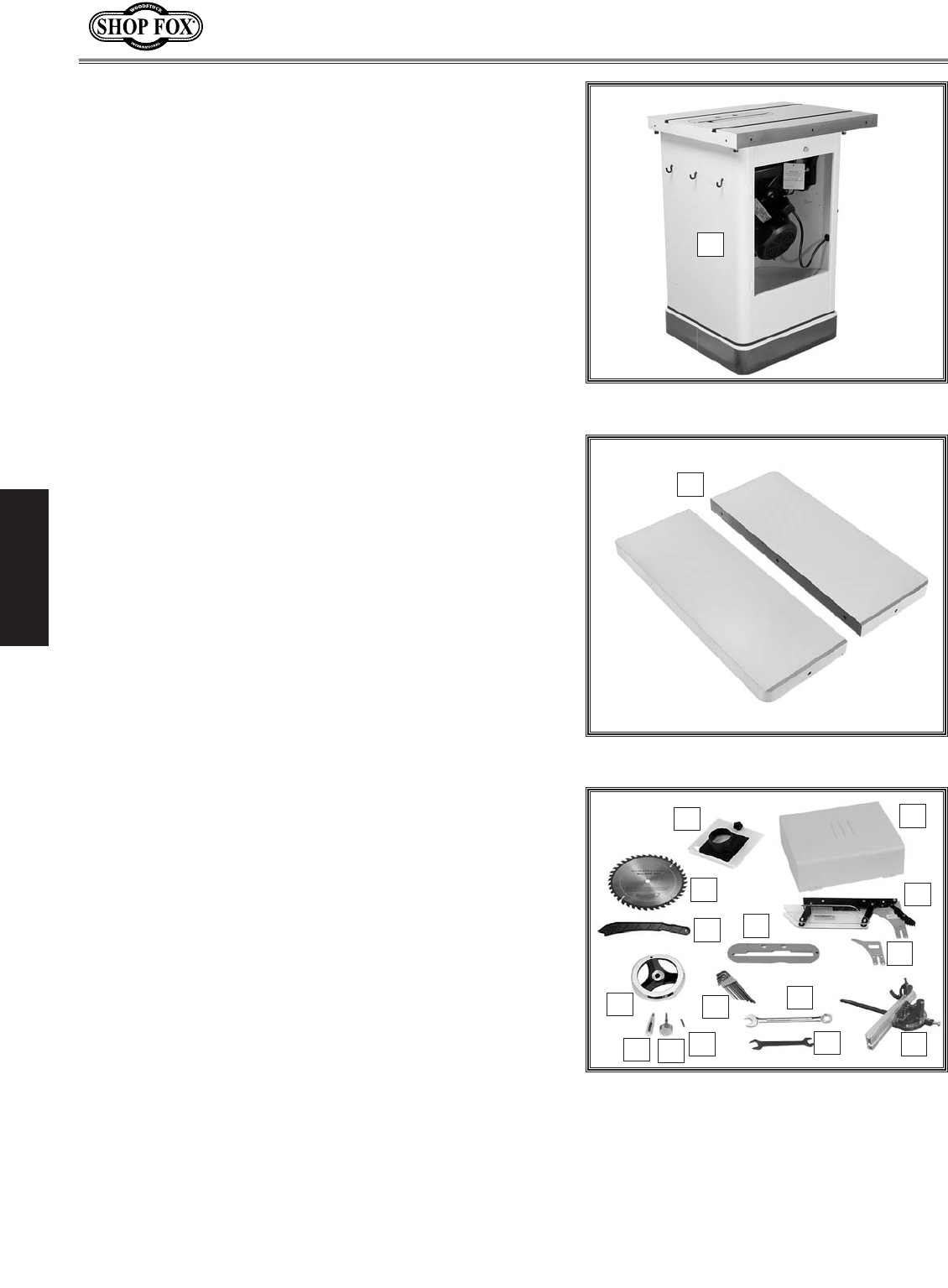
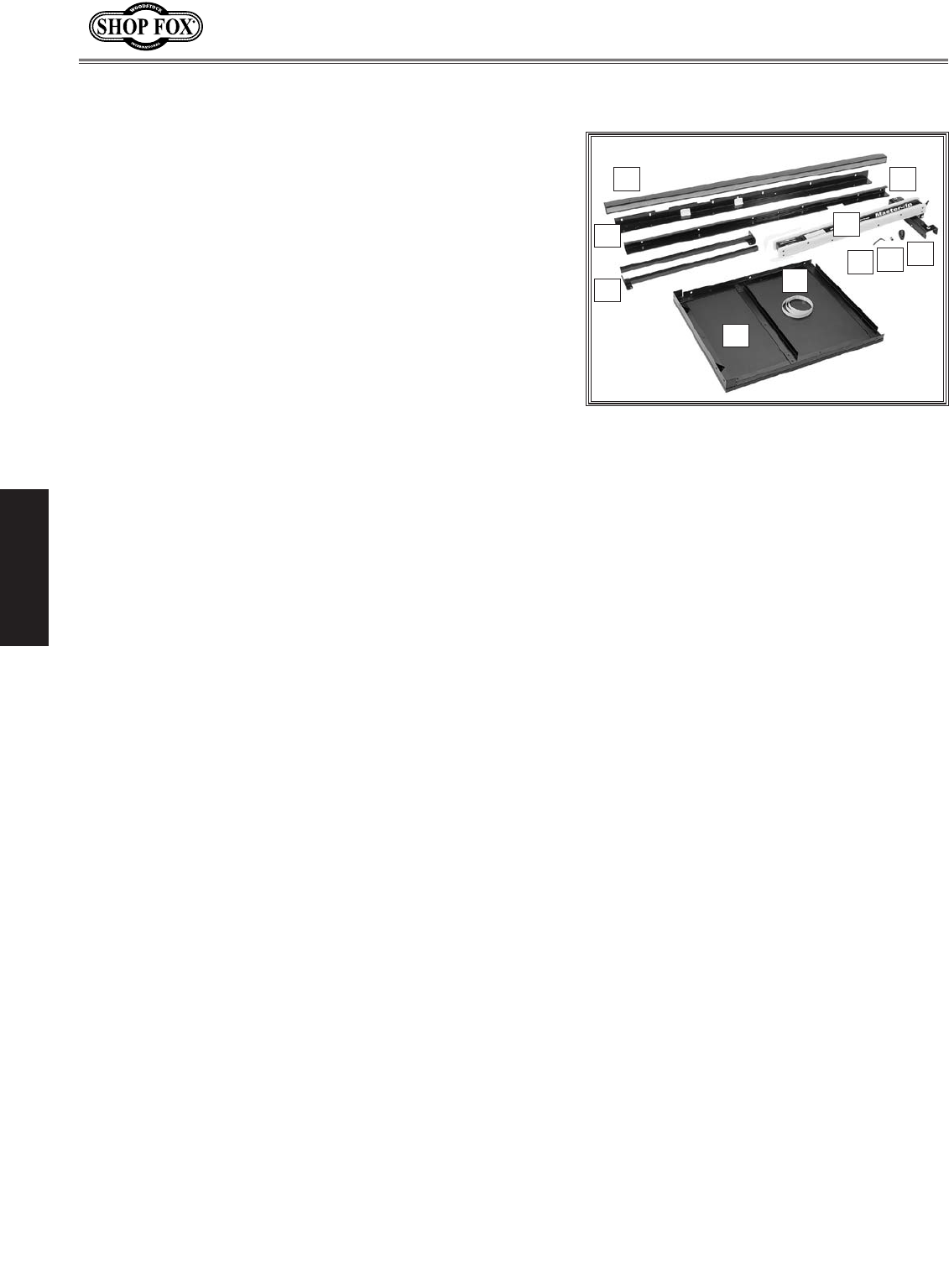
9fo:fek\ekj1=`^li\j*Æ, Hkp
8% Main Table Saw Unit .......................................1
9% Extension Wings ............................................2
:% Dust Port ....................................................1
;% Motor Door ..................................................1
<% Blade Guard Assembly ....................................1
=% Riving Knife .................................................1
>% Miter Fence and Flip Stop ................................1
?% Wrench 27mm ..............................................1
@% Wrench 22/24mm ..........................................1
A% Dado Table Insert ..........................................1
B% Hex Wrench Set (Eight Pieces) 1.5-8mm ...............1
C% Key 5 x 5 x 40 ..............................................1
D% Handwheel Lock Knob ....................................1
E% Handwheel Handle ........................................1
F% Handwheel ..................................................1
G% Push Stick ...................................................1
H% Saw Blade 10" x 40T .......................................1
?Xi[nXi\EfkJ_fne Hkp
• Phillips Head Screw M6-1 x 12 (Magnetic Switch) ....1
• Hex Bolts M8-1.25 x 16 (Magnetic Switch) ............2
• Lock Washers 6mm (Magnetic Switch) .................3
• Flat Washers 6mm (Magnetic Switch) ..................3
@em\ekfip
=`^li\*% Main table saw unit.
A
=`^li\+% Extension wings.
B
=`^li\,%Component inventory.
H
O
P
Q
I
J
K
L
M
N
CD
E
F
G
-19-
Df[\cN(/(0&N(/)'D]^%J`eZ\()&('
J<KLG
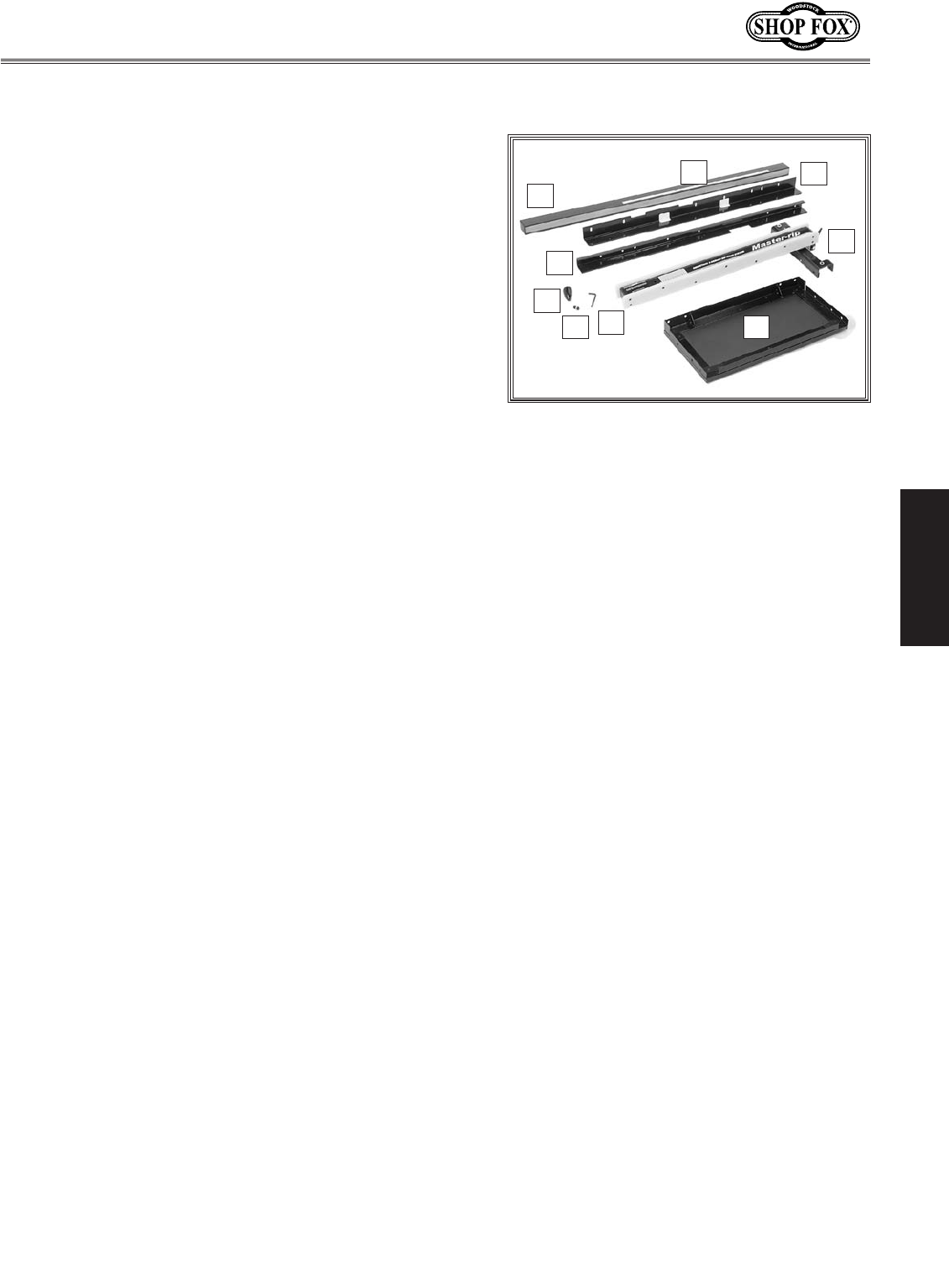
=\eZ\@em\ekfipN(/(0
:fdgfe\ekj Hkp
8% Front Rail Rectangular Tube 62" .........................1
9% Front Rail Tape Scale .....................................1
:% Front Rail 50"...............................................1
;% Rear Rail 50" ................................................1
<% Fence Assembly ............................................1
=% Fence Handle ...............................................1
>% Rear Rail Foot M12-1.75 ..................................1
?% Hex Wrench 6mm ..........................................1
@% Extension Table 27" x 133⁄4" .............................1
?Xi[nXi\Xe[KffcjEfkJ_fne Hkp
• Cap Screws M6-1 x 16 (Front Rail/Tube) ...............3
• Flat Washers 6mm (Front Rail/Tube) ...................3
• Lock Washers (Front Rail/Tube) .........................3
• Hex Bolts M8-1.25 x 40 (Front & Rear Rails) ..........6
• Flat Washers 8mm (Front & Rear Rails) .............. 14
• Lock Washers 8mm (Front & Rear Rails) ...............8
• Hex Nuts M8-1.25 (Front & Rear Rails) ................6
• Hex Bolts M8-1.25 x 30 (Rear Rail) .....................2
• Hex Bolts M6-1 x 16 (Extension Table) .................4
• Hex Nuts M6-1 (Extension Table) ........................4
• Flat Washers 6mm (Extension Table) ...................8
• Lock Washers 6mm (Extension Table) ..................4
=`^li\-% Inventory needed to install the
fence on the Model W1819.
E
F
GHI
A
BC
D
-20-
Df[\cN(/(0&N(/)'D]^%J`eZ\()&('
J<KLG
=\eZ\@em\ekfipN(/)'
:fdgfe\ekj Hkp
8% Front Rail Rectangular Tube 82" .........................1
9% Front Rail 70"...............................................1
:% Rear Rail 70" ................................................1
;% Fence Assembly ............................................1
;% Fence Handle ...............................................1
=% Rear Rail Foot ..............................................1
>% Hex Wrench 6mm ..........................................1
?% Front Rail Tape Scale .....................................1
@% Extension Table ............................................1
A% Legs ..........................................................2
?Xi[nXi\Xe[KffcjEfkJ_fne Hkp
• Feet w/Bolts & Hex Nuts ...........................2 Sets
• Cap Screws M6-1 x 16 (Front Rail/Tube) ...............5
• Flat Washers 6mm (Front Rail/Tube) ...................5
• Lock Washers (Front Rail/Tube) .........................5
• Hex Bolts M8-1.25 x 40 (Front & Rear Rails) ..........6
• Flat Washers 8mm (Front & Rear Rails) .............. 14
• Lock Washers 8mm (Front & Rear Rails) ...............8
• Hex Nuts M8-1.25 (Front & Rear Rails) ................6
• Hex Bolts M8-1.25 x 30 (Rear Rail) .....................2
• Hex Bolts M6-1 x 16 (Extension Table) .................6
• Hex Nuts M6-1 (Extension Table) ........................6
• Flat Washers 6mm (Extension Table) ................. 12
• Lock Washers 6mm (Extension Table) ..................6
• Cap Screws M8-1.25 x 20 (Legs) .........................4
• Flat Washers 8mm (Legs) .................................4
• Lock Washers 8mm (Legs) ................................4
• Hex Nuts M8-1.25 (Legs) .................................4
=`^li\.% Inventory needed to install the
fence on the Model W1820.
E
F
G
H
I
A
B
J
C
D
-21-
Df[\cN(/(0&N(/)'D]^%J`eZ\()&('
J<KLG
=cffiCfX[1 This machine distributes a
heavy load in a small footprint. Some
residential floors may require additional
bracing to support both machine and
operator.
Nfib`e^:c\XiXeZ\j1 Consider existing and
anticipated needs, size of material to be
processed through the machine, and space
for auxiliary stands, work tables or other
machinery when establishing a location for
your table saw.
C`^_k`e^1 Lighting should be bright enough
to eliminate shadow and prevent eye strain.
<c\Zki`ZXc1Electrical circuits must be
dedicated or large enough to handle
amperage requirements. Outlets must be
located near each machine, so power or
extension cords are clear of high-traffic
areas. Follow local electrical codes for
proper installation of new lighting, outlets,
or circuits.
D8B<pflij_fgÈZ_`c[
jX]\%É <ejli\ k_Xk pfli
nfibgcXZ\ `j `eXZZ\jj`Yc\
kf Z_`c[i\e Yp Zcfj`e^ Xe[
cfZb`e^Xcc\ekiXeZ\jn_\e
pflXi\XnXp%E<M<IXccfn
lekiX`e\[ m`j`kfij `e pfli
j_fg n_\e Xjj\dYc`e^#
X[aljk`e^ fi fg\iXk`e^
\hl`gd\ek%
:c\Xe`e^DXZ_`e\
The table and other unpainted parts of your
table saw are coated with a waxy grease that
protects them from corrosion during shipment.
Clean this grease off with a solvent cleaner or
citrus-based degreaser. DO NOT use chlorine-
based solvents such as brake parts cleaner or
acetone—if you happen to splash some onto a
painted surface, you will ruin the finish.
DXZ_`e\GcXZ\d\ek
LJ< _\cg\ij fi gfn\i
c`]k`e^ \hl`gd\ek kf c`]k
k_`j dXZ_`e\% Fk_\in`j\#
j\i`flj g\ijfeXc `ealip
dXpfZZli%
E<M<IZc\Xen`k_^Xjfc`e\
fi fk_\i g\kifc\ld$
YXj\[jfcm\ekj%Dfjk_Xm\
cfn ]cXj_ gf`ekj# n_`Z_
dXb\ k_\d \oki\d\cp
]cXddXYc\% 8 i`jb f]
\ogcfj`fe Xe[ Ylie`e^
\o`jkj `] k_\j\ gif[lZkj
Xi\lj\[%J\i`fljg\ijfeXc
`ealip dXp fZZli `] k_`j
nXie`e^`j`^efi\[
8CN8PJ nfib `e n\cc$
m\ek`cXk\[Xi\Xj]Xi]ifd
gfjj`Yc\ `^e`k`fe jfliZ\j
n_\e lj`e^ jfcm\ekj kf
Zc\Xe dXZ_`e\ip% DXep
jfcm\ekj Xi\ kfo`Z n_\e
`e_Xc\[ fi `e^\jk\[% Lj\
ZXi\ n_\e [`jgfj`e^
f] nXjk\ iX^j Xe[
kfn\cj kf Y\ jli\ k_\p
;F EFK Zi\Xk\ ]`i\ fi
\em`ifed\ekXc_XqXi[j%
-22-
Df[\cN(/(0&N(/)'D]^%J`eZ\()&('
J<KLG
Assembly steps are the same for the Model W1819 and
W1820 except where noted. Assembly consists of install-
ing minor components, the extension wings, front and rear
rails, extension table, and the legs (Model W1820 only).
KfXjj\dYc\k_\kXYc\jXn#[fk_\j\jk\gj1
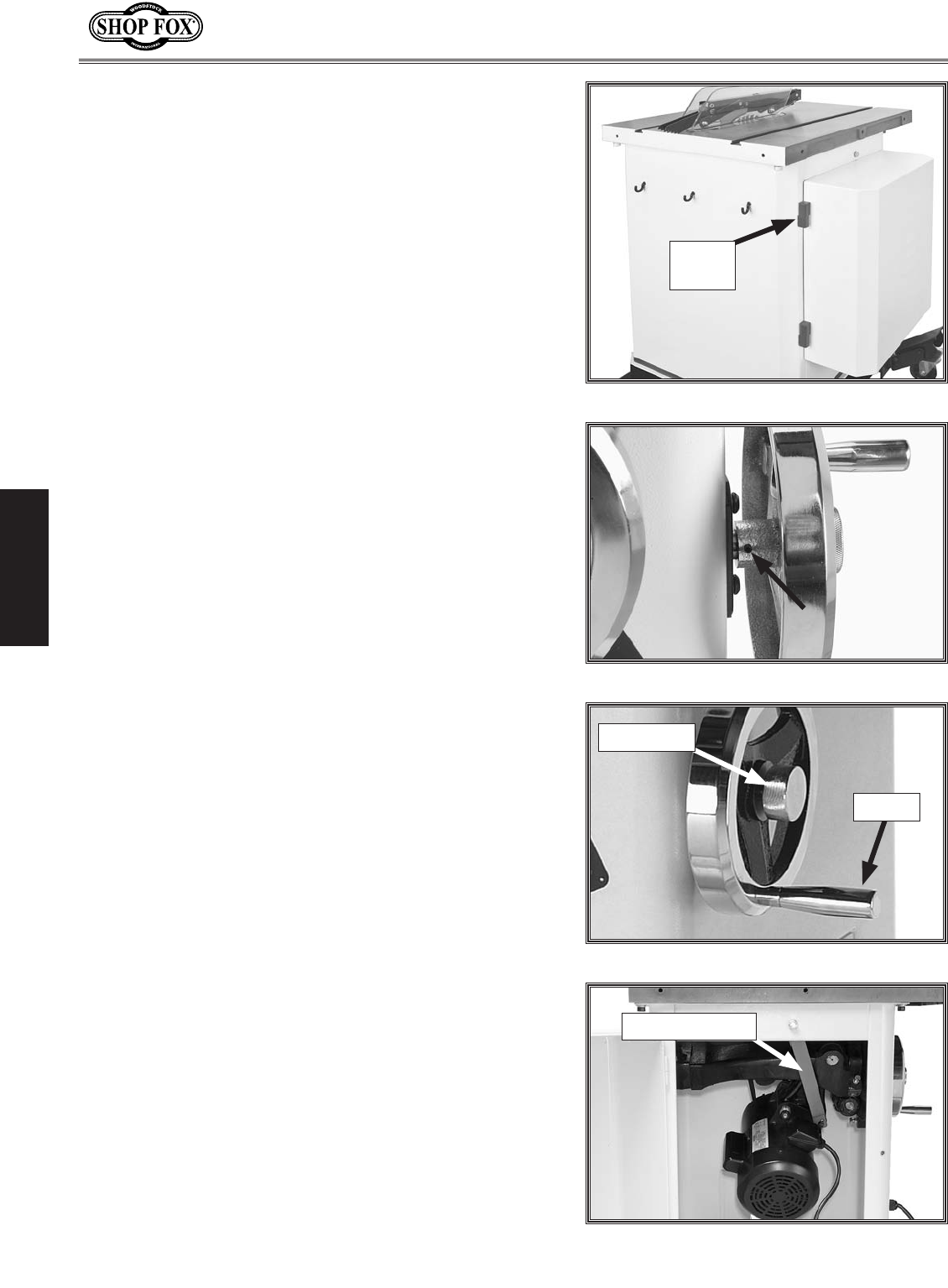
(% Pull the magnetic switch out of the saw cabinet and
install the door by inserting the door pins into the
hinge sockets on the cabinet (see =`^li\ /).
8jj\dYcp
=`^li\('% Handwheel installed.
=`^li\/% Door installed.
Hinge
Socket
=`^li\0% Handwheel set screw.
Lock Knob
Handle
=`^li\((% Shipping brace location.
Shipping Brace
)% Place the included 5 x 5 x 40 key in the handwheel
shaft and slide the handwheel onto the shaft on the
front of the table saw. Use the included 2.5mm hex
wrench to tighten the set screw (see =`^li\0) on
the side of the handwheel until it is secure.
*% Thread the handwheel lock knob into the center of
the handwheel and tighten, then install the handle
into the handwheel and tighten with a 14mm wrench
(see =`^li\(').
+% Remove the shipping brace (see =`^li\(() using
a 17mm wrench and a pair of needle nose pliers.
Re-install the M10-1.5 x 25 hex bolt, flat washer, hex
nut and the cotter pin, and save the shipping brace.
-23-
Df[\cN(/(0&N(/)'D]^%J`eZ\()&('
J<KLG
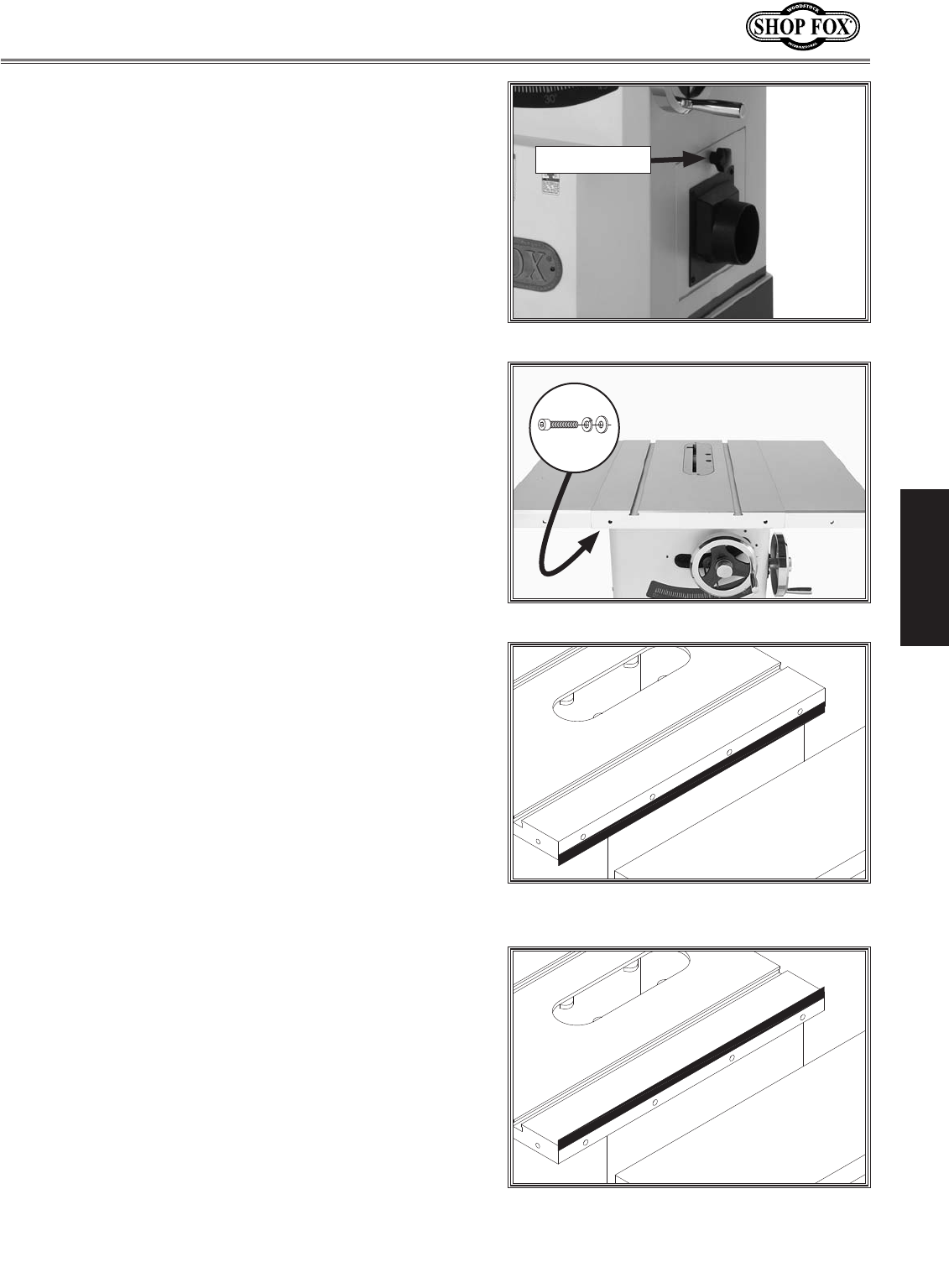
,% Insert the lip of the lower part of the dust port into
the cabinet and tighten the thumb knob to secure
(see =`^li\()).
-% Remove the M8-1.25 x 30 cap screws, 8mm flat
washers, and 8mm lock washers from the ends of the
main table.
.% Inspect the extension wings and main table mating
surfaces for burrs or foreign materials that may
inhibit assembly.
The mating edges of the wings and the table must
be clean, smooth, and flat. Use a wire brush or file
if necessary to clean up the edges. This step will
ensure that the wings mount properly to the main
table.
/% While a helper holds the wings in place, attach
each extension wing to the main table with the four
M8-1.25 x 30 cap screws, 8mm lock washers, and
8mm flat washers removed in Jk\g- (see =`^li\
(*).
0% Place the straightedge across the extension wings
and main table to make sure that the combined
table surface is flush and flat.
— If the combined table surface is flat, skip to the
next step.
— If the outside end of the extension wing tilts
down, use a strip of masking tape along the
bottom edge of the main table to shim the
extension wing up (=`^li\(+).
— If the outside end of the extension wing tilts up,
use a strip of masking tape along the top edge of
the main table to shim the extension wing down
(=`^li\(,).
Efk\18]k\ii\$`ejkXcc`e^n`e^j#i\dfm\Xcc\oZ\jj
dXjb`e^kXg\n`k_XiXqfiYcX[\%
=`^li\(+% Masking tape location for tilting
the extension wing up.
=`^li\(,% Masking tape location for
adjusting the extension wing down.
=`^li\(*% Extension wings installed.
x4
=`^li\()% Dust port installed.
Thumb Knob
-24-
Df[\cN(/(0&N(/)'D]^%J`eZ\()&('
J<KLG
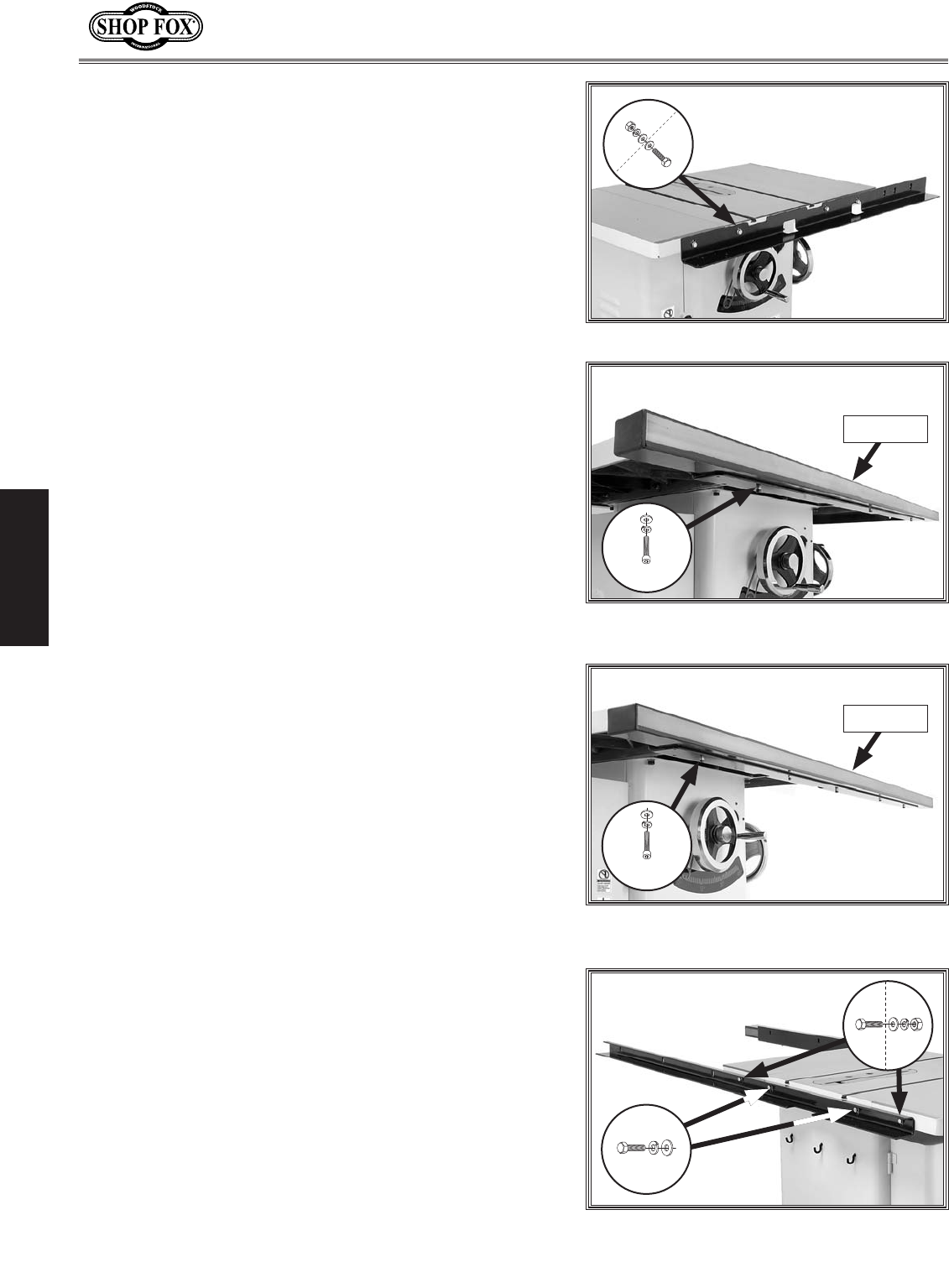
('% Install the front rail onto the table and extension
wings with four M8-1.25 x 40 hex bolts, eight 8mm
flat washers, four 8mm lock washers, and four
M8-1.25 hex nuts, as shown in =`^li\(-.
Before final tightening, make sure the front rail is
set 3⁄16" below the beveled edge along the entire
length of the table.
()% Attach the rear rail to the holes on the main table
using two M8-1.25 x 30 hex bolts, 8mm lock washers
and 8mm flat washers, as shown in =`^li\ (0.
(*% Secure the rear rail to the extension wings with two
M8-1.25 x 40 hex bolts, four 8mm flat washers, two
8mm lock washers and two M8-1.25 hex nuts.
((% N(/(0FECP: Install the 62" front rail tube onto the
50" front rail with the three M6-1 x 16 cap screws,
6mm flat washers, and 6mm lock washers, as shown
in =`^li\(..
N(/)'FECP1Install the 82" front rail tube onto the
70" front rail with five M6-1 x 16 cap screws, 6mm
lock washers, and 6mm flat washers, as shown in
=`^li\(/.
=`^li\(-% Front rail installed (W1819).
=`^li\(.% Model W1819 tube attached to
front rail.
x3
=`^li\(/% Model W1820 tube attached to
front rail.
x5
=`^li\(0% Rear rail installed (W1820).
x2
Rail Tube
Rail Tube
-25-
Df[\cN(/(0&N(/)'D]^%J`eZ\()&('
J<KLG
Efk\1 9\]fi\k`^_k\e`e^k_\]Xjk\e\ij#Z_\ZbkfdXb\jli\
k_\kfg\[^\f]k_\i\XiiX`c`j]clj_n`k_k_\cfn\jk\[^\
f]Yfk_K$jcfkjj\\ =`^li\ )' # jfk_\ d`k\i ^Xl^\ n`cc
jc`[\jdffk_cpn_\e`ejkXcc\[cXk\i%
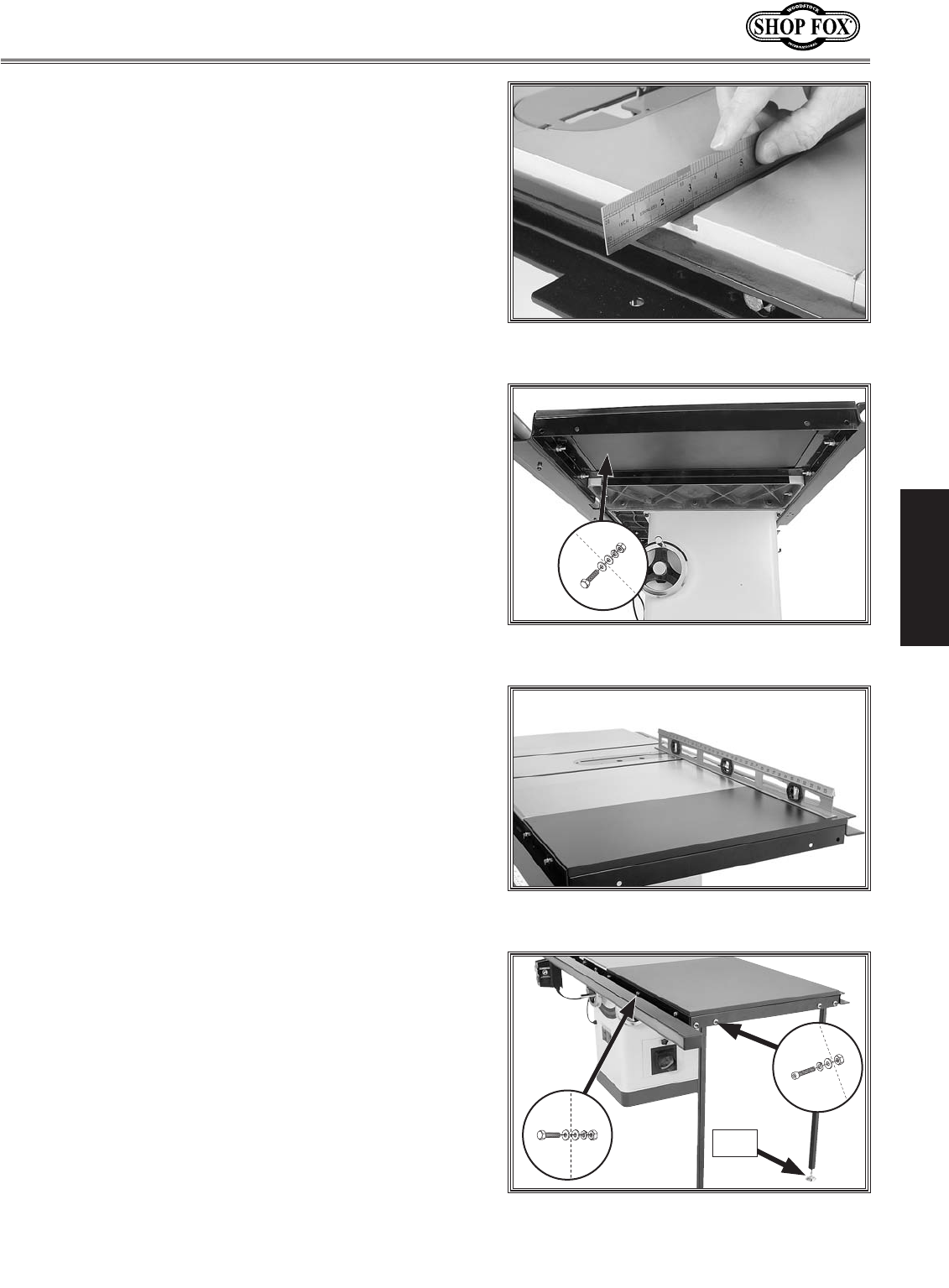
N(/(0<ok\ej`feKXYc\
(% Install the extension table between the front and
rear rails with the four M6-1 x 16 hex bolts, eight
6mm flat washers, four 6mm lock washers, and four
M6-1 hex nuts, as shown in =`^li\)(.
)% Using a long straightedge, adjust the extension table
so it is flat (both flush and parallel) with the main
table and extension wings (=`^li\))), then tighten
the fasteners.
N(/)'<ok\ej`feKXYc\
(% Remove the six M6-1 x 16 hex bolts, (12) 6mm flat
washers, six 6mm lock washers, and six M6-1 hex
nuts from the extension table.
)% While an assistant holds the extension table between
the front and rear rails, fasten the extension table
to the rails with the fasteners removed in Jk\g(.
*% Thread the feet into the legs with the two M8-1.25
x 60 hex bolts, place the legs under the table, and
thread the feet out until the top of each leg is
against the underside corner of the table.
+% Use the four M8-1.25 x 20 cap screws, 8mm lock
washers, 8mm flat washers, and M8-1.25 hex nuts to
secure the legs to the end of the extension table, as
shown in =`^li\)*.
=`^li\)'% Verifying rear rail is flush with
bottom of T-slot.
=`^li\ )(. Model W1819 extension table
installed.
=`^li\))% Adjusting Model W1819
extension table flush with wing and table.
=`^li\)*% Model W1820 extension table
installed.
x4
Foot
-26-
Df[\cN(/(0&N(/)'D]^%J`eZ\()&('
J<KLG
,% Adjust the extension table so it is flat (both flush
and parallel) with the main table, using a long
straightedge (similar to the method shown in =`^li\
))). This can be done by loosening the mounting
bolts and adjusting the feet up/down as needed.
-% Tighten the extension table mounting bolts, and
tighten the hex nuts on the feet up against the legs
so they will not move.
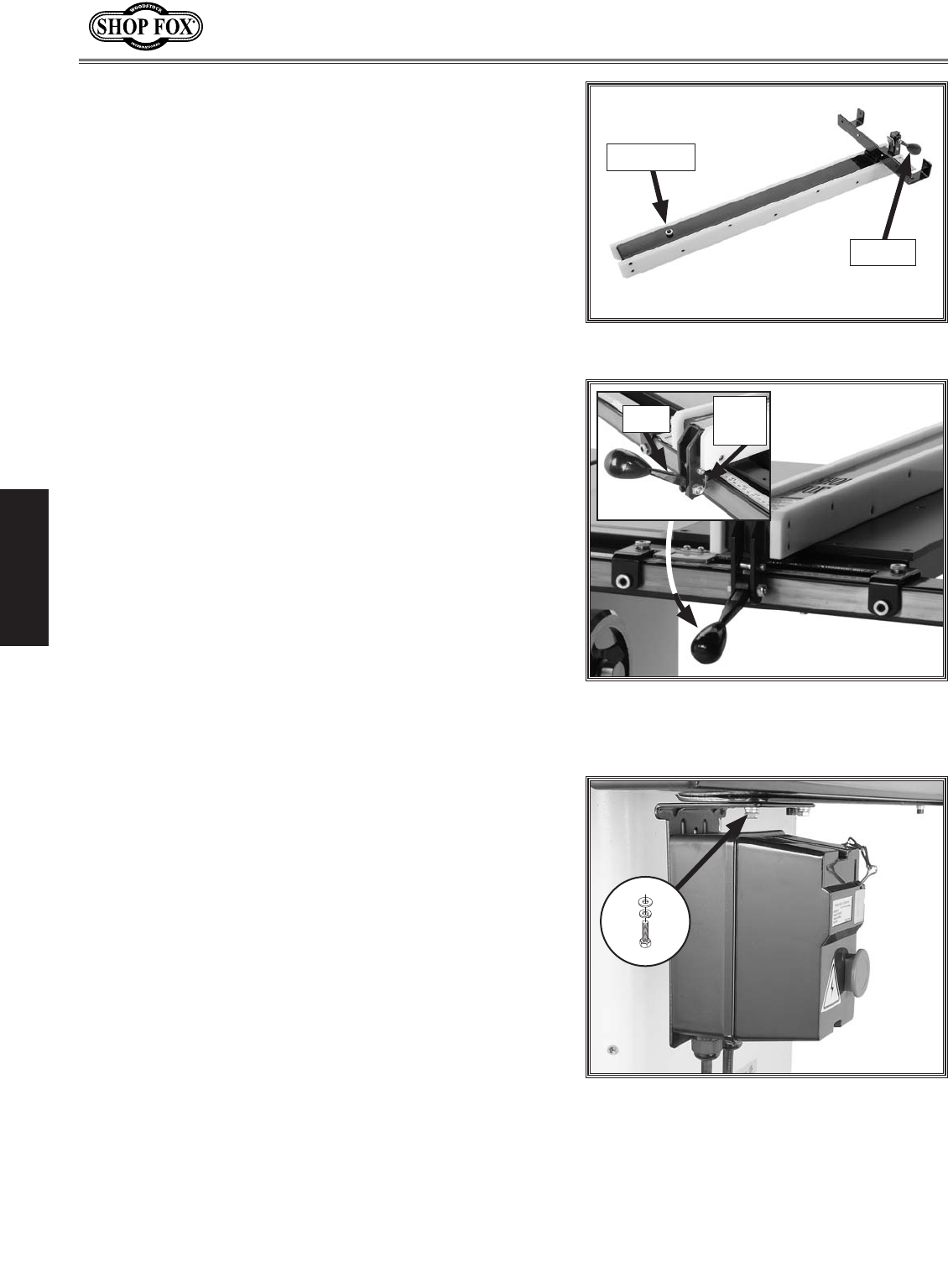
=\eZ\D`k\i>Xl^\
(%Attach the fence handle to the fence and thread
the rear rail foot into the bottom of the fence (see
=`^li\)+).
)% Place the fence on the rails on the right hand side of
the blade (see =`^li\),).
Efk\1DXb\jli\k_\ZXd]ffkZfekXZkjk_\ZXdfe
k_\]\eZ\cfZb_Xe[c\Y\]fi\pflgcXZ\k_\]\eZ\fe
k_\iX`c#fk_\in`j\k_\]\eZ\n`ccefkcfZbfekfk_\
iX`cklY\%
*% Slide the miter gauge into the T-slot on the left hand
side of the blade.
DX^e\k`ZJn`kZ_
(% Install the magnetic switch onto the bottom left
hand side of the front rail using two M6-1 x 12 hex
bolts, 6mm lock washers, and 6mm flat washers, as
shown in =`^li\)-.
)% Secure the top of the switch to the rail with an M6-1
x 12 Phillip head screw, 6mm lock washer, and flat
washer.
JXn9cX[\
(% Remove the table insert by unscrewing the screw
that fastens it to the table.
)% Raise the arbor all the way up and set the blade
angle at 0º.
*% Remove the arbor nut and arbor flange from the
arbor, slide on the included 10" saw blade, making
sure the teeth face the front of the saw, then install
the arbor flange and arbor nut onto the blade. See
GX^\*, for additional details.
=`^li\)+% Fence assembled.
=`^li\),% Fence installed on rails.
Cam Cam
Foot
=`^li\)-% Magnetic switch installed.
Rear Foot
Handle
-27-
Df[\cN(/(0&N(/)'D]^%J`eZ\()&('
J<KLG
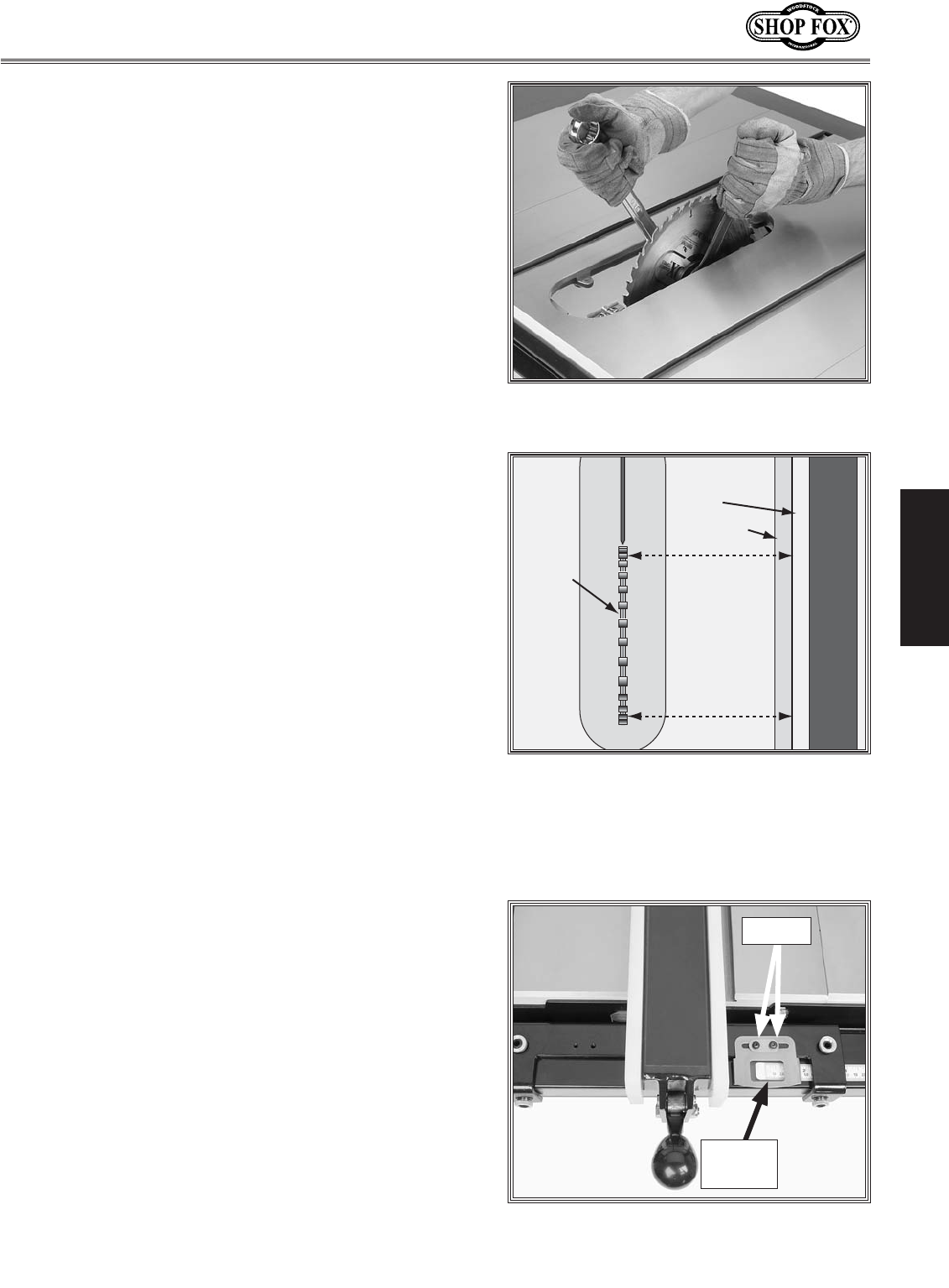
+% Put on a pair of heavy leather gloves and use the
included arbor wrenches to tighten the arbor nut
(turn clockwise to tighten), as shown in =`^li\)..
:_\Zb`e^=\eZ\GXiXcc\c`jd
(% Slide the fence along the rail. If it drags across the
table, then adjust the foot at the rear of the fence
with a 6mm hex wrench to raise the fence off of
the table, just enough so that the gap between the
fence and the table is even from front to back.
)% Slide the fence up against the right hand edge of the
miter slot, and lock it in place. Examine how the
fence lines up with the miter slot (see =`^li\28).
Efk\1 @k`jg\id`jj`Yc\]fik_\YXZbf]k_\]\eZ\
kfg`mfkflknXi[efkdfi\k_Xe(Ð-+]ifdY\`e^
gXiXcc\ckfk_\YcX[\%K_`jZi\Xk\jXjc`^_kcpcXi^\i
fg\e`e^Y\kn\\ek_\]\eZ\Xe[k_\i\Xif]k_\
YcX[\kfi\[lZ\k_\i`jbf]nfibg`\Z\Y`e[`e^
fiYlie`e^Xj`k`j]\[k_ifl^_k_\Zlk%DXep
nff[nfib\ij`ek\ek`feXccpj\klgk_\`i]\eZ\`ek_`j
dXee\i%B\\gk_`j`ed`e[Y\]fi\X[aljk`e^pfli
]\eZ\%=fidfi\[\kX`cjj\\=`^li\('.feGX^\.(%
— If the fence/miter slot are still parallel with the
blade, proceed to Jk\g=\eZ\JZXc\.
— If the fence is not parallel to the blade/miter
slot, then you MUST adjust the fence, as described
in =\eZ\8[aljkd\ekj on GX^\.', so that it is
parallel to the blade.
— If the miter slot is not parallel with the blade, you
must follow the procedures described in D`k\iJcfk
kf9cX[\GXiXcc\c`jd on GX^\-..
=\eZ\JZXc\
Since the adhesive fence scale will be difficult to remove
once it installed, determine whether you will use the
pointer window on the right or the left side of the fence
before installing the scale.
The pointer window may come pre-installed on the left
side of the fence. However, we recommend loosening the
mounting screws on the window and re-installing it on the
right side of the fence (see =`^li\)0) so workpieces will
not cover the pointer window when preparing to cut.
=`^li\).% Securing blade.
;ZcXZ^h
EVgVaaZaid
B^iZgHadi!
l]^X]^h
EVgVaaZaid
7aVYZ
B^iZgHadi
7aVYZ
;ZcXZ
=`^li\)/% Checking fence parallelism with
blade.
=`^li\)0% Aligning rail tape with scale
pointer.
Screws
Pointer
Window
-28-
Df[\cN(/(0&N(/)'D]^%J`eZ\()&('
J<KLG
On the Model W1819, if you move the pointer window to
the right side of the fence, you may have to trim the last
two inches of the scale so it will not protrude past the
end of the fence tube.
One option for using the pointer window on the left side
of the fence is to use it in conjunction with a small, left-
reading scale (not included).
Kf`ejkXcck_\]\eZ\jZXc\#[fk_\j\jk\gj1
(% Slide the fence up against the saw blade and lock it
in place.
)% Place the front rail tape scale on the fence tube,
making sure it is parallel with the tube and that the
"0" end is directly under the red line on the pointer
window, as shown in =`^li\)0.
*% Lightly mark the "0" location on the fence tube with
a pencil, then remove the fence.
+% Peel the tape and carefully align the "0" mark on the
scale with the pencil mark you made on the fence
tube.
— If you make a mistake, loosen the screws on the
pointer window, slide the fence against the blade,
adjust the pointer window so the red line on the
window is over the 0" mark on the tape, then
secure the screws.
9cX[\>lXi[
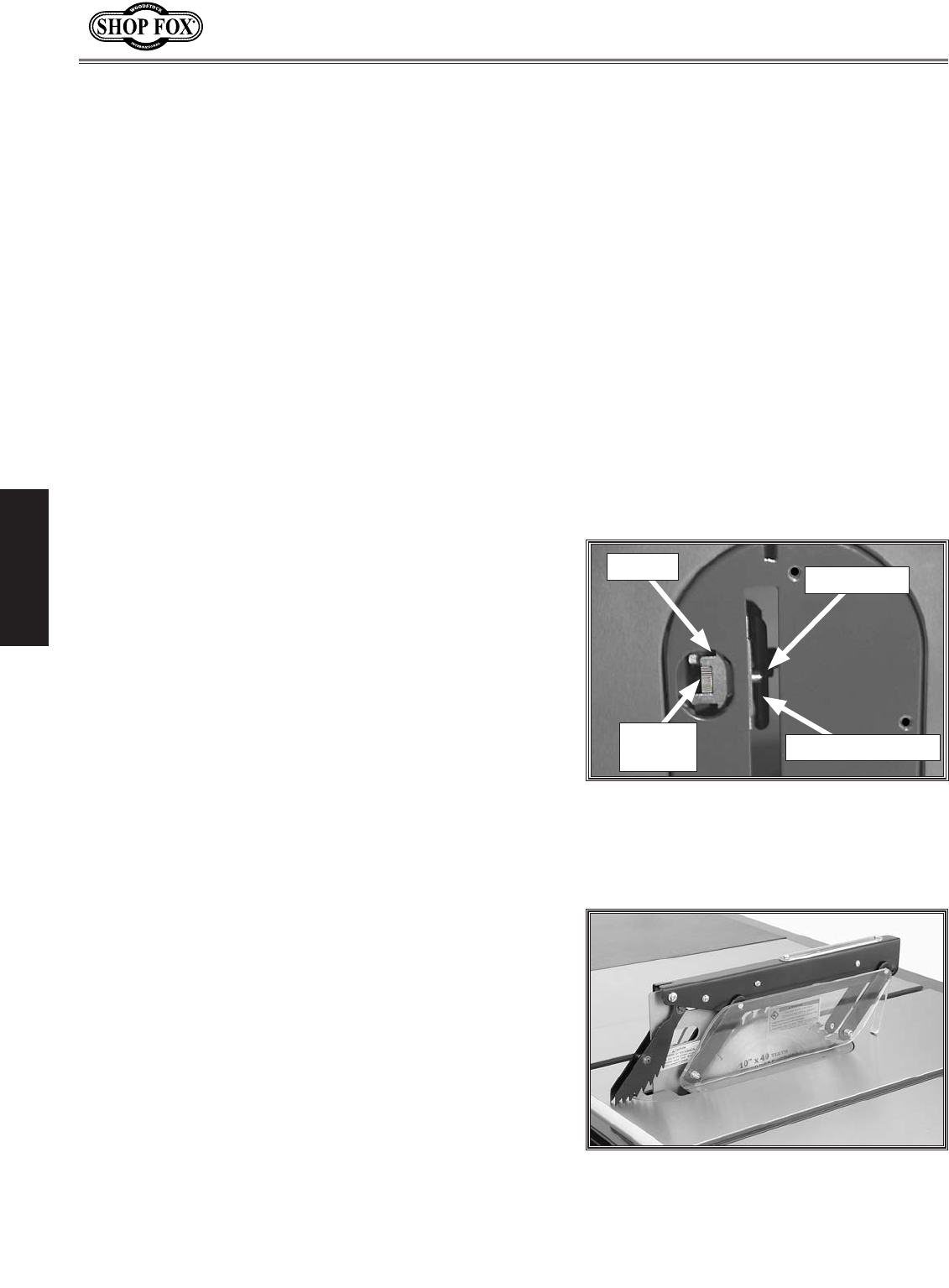
(% Re-install the table insert, slide the knurled knob out
(see =`^li\*') and rotate it forward so it engages
the upper bracket.
)% Slide the blade guard spreader all the way down
into the adjustment block, then rotate the knurled
knob so it disengages the bracket and the locking pin
engages the hole in the center of the spreader.
*% Give the spreader an upward tug to verify that it is
locked.
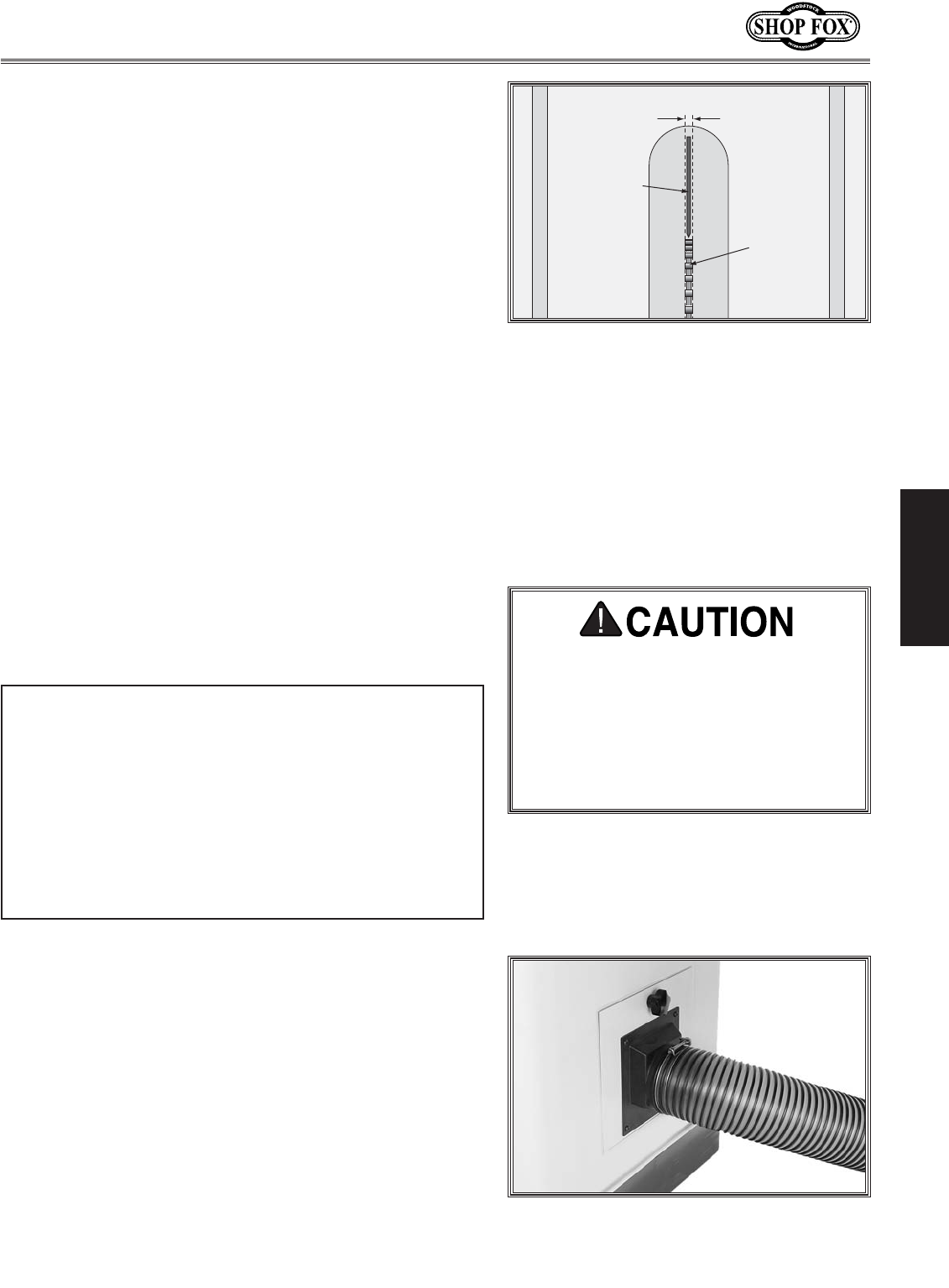
The blade guard, when properly installed, should
look like =`^li\*(, and should pivot freely so it
touches the table surface in the down position. It
should also swing up high enough to accommodate
the workpiece. =`^li\*(% Blade guard installed.
=`^li\*'% Knurled knob used to secure
spreader.
Locking Pin
Knurled
Knob
Bracket
Adjustment Block
-29-
Df[\cN(/(0&N(/)'D]^%J`eZ\()&('
J<KLG
8c`^ed\ek
Qfe\
Jgi\X[\ifi
I`m`e^Be`]\
9cX[\
=`^li\*)% Spreader/riving knife alignment
zone.
+% Adjust the set screws to make sure the table insert
is flush with the table (use a straightedge as a
guide), then tighten the button head screw to secure
the table insert in place.
,. Place a straightedge against the blade and the
spreader. When properly aligned, the spreader/
riving knife will be parallel with the blade and in the
"Alignment Zone," shown in =`^li\*).
— If the spreader/riving knife is not inside the
alignment zone and not parallel with the
blade, then it needs to be adjusted. Proceed to
"Adjusting Alignment on GX^\-0.
— If the spreader/riving knife is not parallel with
the blade, it may be bent. Proceed to "Checking
Alignment on GX^\-/ to determine if the
spreader/riving knife is bent.
;ljk:fcc\Zk`fe
To connect a dust collection hose, do these steps:
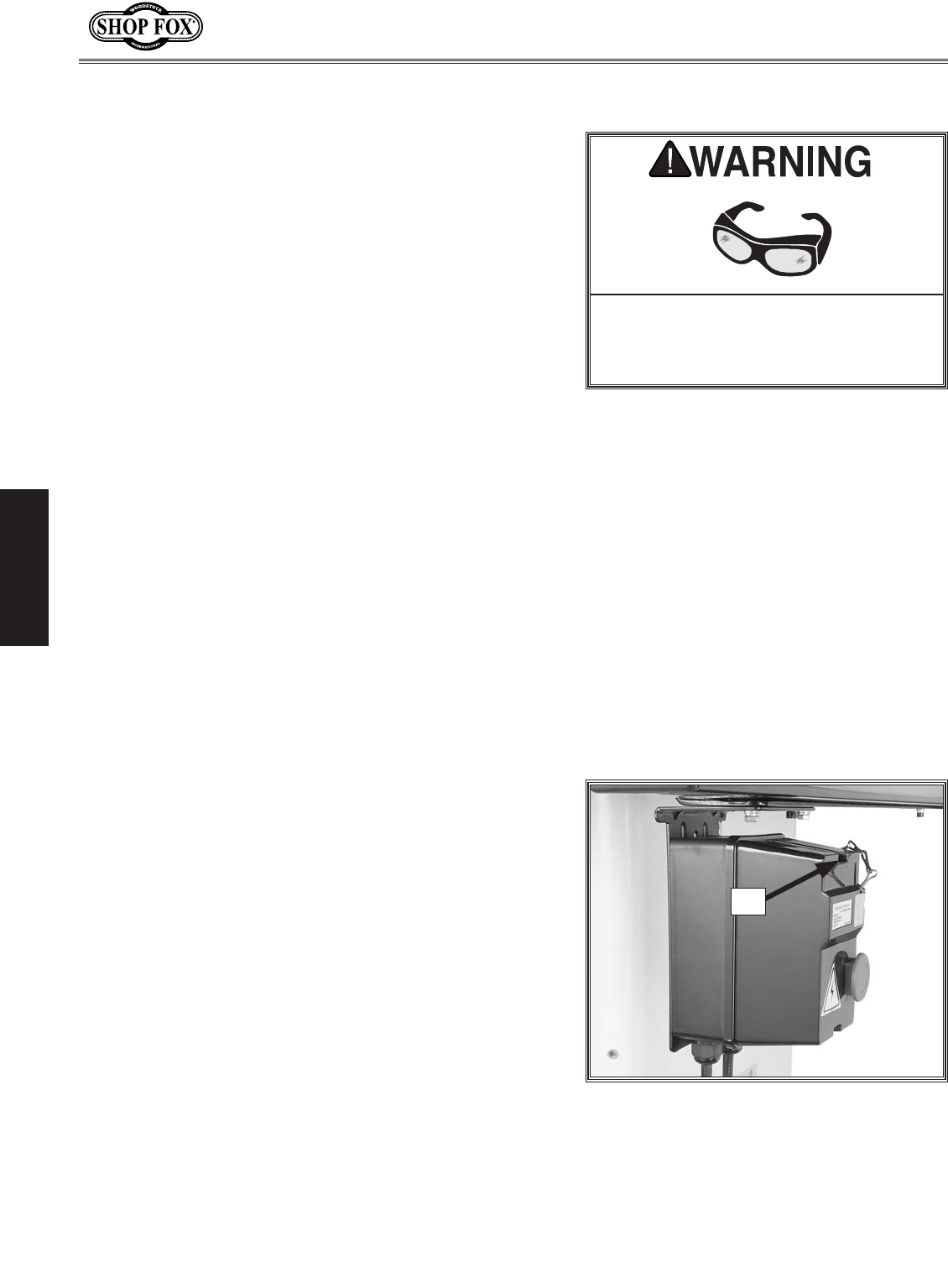
1. Fit a 4" dust hose over the dust port, as shown in
Figure 33, and tightly secure in place with a hose
clamp.
2. Tug the hose to make sure it does not come
off. Efk\1A tight fit is necessary for proper
performance.
:fdgfe\ekjXe[?Xi[nXi\E\\[\[1 Hkp
Dust Hose 4 " (not included) ...................................1
Hose Clamps 4" (not included) ................................2
Dust Collection System (not included) ......................1 ;FEFKfg\iXk\k_\Df[\cN(/(0
fi N(/)' n`k_flk Xe X[\hlXk\ [ljk
Zfcc\Zk`fe jpjk\d% K_`j jXn Zi\Xk\j
jlYjkXek`Xc Xdflekj f] nff[ [ljk
n_`c\fg\iXk`e^%=X`cli\kflj\X[ljk
Zfcc\Zk`fe jpjk\d ZXe i\jlck `e j_fik
Xe[cfe^$k\idi\jg`iXkfip`cce\jj%
I\Zfdd\e[\[:=DXk;ljkGfik1+'':=D
;fefkZfe]lj\k_`j:=Di\Zfdd\e[Xk`fen`k_k_\iXk`e^
f]k_\[ljkZfcc\Zkfi%Kf[\k\id`e\k_\:=DXkk_\[ljk
gfik#pfldljkZfej`[\ik_\j\mXi`XYc\j1( :=DiXk`e^f]
k_\[ljkZfcc\Zkfi#) _fj\kpg\Xe[c\e^k_Y\kn\\ek_\
[ljkZfcc\ZkfiXe[k_\dXZ_`e\#* eldY\if]YiXeZ_\j
finp\j#Xe[+ Xdflekf]fk_\ifg\ec`e\jk_ifl^_flk
k_\jpjk\d%<ogcX`e`e^_fnkfZXcZlcXk\k_\j\mXi`XYc\j
`jY\pfe[k_\jZfg\f]k_`jdXelXc%:fejlckXe\og\ikfi
gliZ_Xj\X^ff[[ljkZfcc\Zk`fe_fn$kfYffb%
=`^li\**% Dust hose attached to dust
port.
-30-
Df[\cN(/(0&N(/)'D]^%J`eZ\()&('
J<KLG
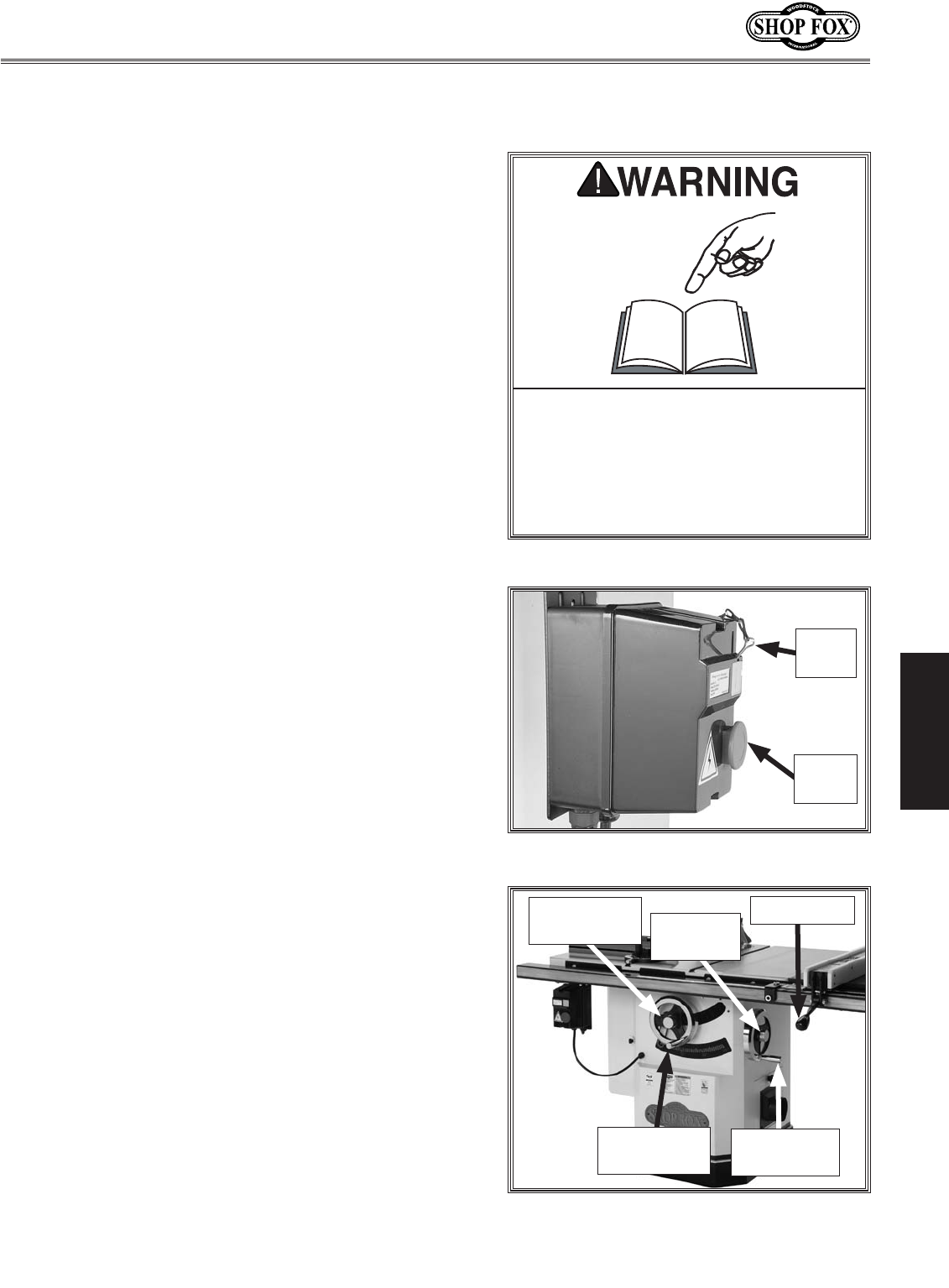
=`^li\*+% Switch disabling pin inserted
into ON button.
Pin
Once the assembly is complete, test run the machine to
make sure it runs properly for regular operations. The
test run consists of verifying the following: 1) The motor
powers up and runs correctly, and 2) the safety disabling
mechanism on the switch works correctly.
If, during the test run, you cannot easily locate the source
of an unusual noise or vibration, stop using the machine
immediately, then review KiflYc\j_ffk`e^ on GX^\...
If you still cannot remedy a problem, contact our Tech
Support at (360) 734-3482 for assistance.
Kfk\jkilek_\dXZ_`e\#[fk_\j\jk\gj1
(% Make sure you have read the safety instructions at
the beginning of the manual and that the machine is
fully assembled and set up properly.
)% Make sure all tools and objects used during setup are
cleared away from the machine.
*% Connect the machine to the power source.
+% Verify that the machine is operating correctly by
turning the machine FE.
— When operating correctly, the machine runs
smoothly with little or no vibration or rubbing
noises.
— Investigate and correct strange or unusual noises
or vibrations before operating the machine further.
Always disconnect the machine from power when
investigating or correcting potential problems.
,% Turn the machine F==.
-% Insert the switch disabling pin through the green ON
button, as shown in =`^li\*+.
.% Press the green ON button to test the disabling
feature on the switch.
— If the machine does not start, the switch disabling
feature is working as designed.
— If the machine starts, immediately stop the
machine. The switch disabling feature is not
working correctly. This safety feature must
work properly before proceeding with regular
operations. Call Tech Support for help.
K\jk Ile
Gifa\Zk`c\j k_ifne ]ifd k_\ dXZ_`e\
Zflc[ ZXlj\ j\i`flj \p\ `ealip% N\Xi
jX]\kp ^cXjj\j kf i\[lZ\ k_\ i`jb f]
`ealip%
-31-
Df[\cN(/(0&N(/)'D]^%J`eZ\()&('
FG<I8K@FEJ
FG<I8K@FEJ
>\e\iXc
This machine will perform many types of operations
that are beyond the scope of this manual. Many of these
operations can be dangerous or deadly if performed
incorrectly.
The instructions in this section are written with the
understanding that the operator has the necessary
knowledge and skills to operate this machine. @]XkXep
k`d\pflXi\\og\i`\eZ`e^[`]]`Zlck`\jg\i]fid`e^Xep
fg\iXk`fe#jkfglj`e^k_\dXZ_`e\
If you are an inexperienced operator, we strongly
recommend that you read books or trade articles, or seek
training from an experienced Table Saw operator before
performing any unfamiliar operations. 8Yfm\Xcc#pfli
jX]\kpj_flc[Zfd\]`ijk
I<8;Xe[le[\ijkXe[k_`j\ek`i\`ejkilZ$
k`fe dXelXc Y\]fi\ lj`e^ k_`j dXZ_`e\%
J\i`flj g\ijfeXc `ealip dXp fZZli `]
jX]\kpXe[fg\iXk`feXc`e]fidXk`fe`jefk
le[\ijkff[ Xe[ ]fccfn\[% ;F EFK i`jb
pflijX]\kpYpefki\X[`e^
9Xj`Z:fekifcj
ON/OFF Switch: Starts and stops the motor.
Safety Pin & Chain: When installed (as shown in Figure
35) disables the switch to prevent accidental startup.
=`^li\*,. ON/OFF switch disabled.
Safety
Pin
OFF
Switch
Blade Tilt: To adjust the blade tilt, loosen the blade tilt
lock, turn the blade tilt handwheel to position the blade
at the desired angle, then tighten the lock shown in
Figure 36.
Blade Height: To set the blade height, unlock the blade
height lock, turn the handwheel to set the blade height
approximately 1⁄4" higher than the workpiece, then
re-tighten the blade height lock.
Fence Lock: After adjusting the fence to the desired
width of cut, lock it in place by firmly pushing the fence
lock down until it stops.
Blade Height
Lock Blade Tilt
Lock
Blade Height
Handwheel
Blade Tilt
Handwheel
Fence Lock
=`^li\*-%Basic table saw controls.
-32-
Df[\cN(/(0&N(/)'D]^%J`eZ\()&('
FG<I8K@FEJ
Efe$K_ifl^_K_ifl^_
:lkj
Efe$K_ifl^_:lkj
A non-through cut is a sawing operation where the blade
does not protrude above the top face of the wood stock,
as shown in =`^li\*..
Examples of non-through cuts include dadoes and
rabbets. Non-through cuts have a higher risk of injury
from kickback because the spreader and blade guard
must be removed. When making non-through cuts with a
standard blade, the riving knife MUST be installed. When
making non-through cuts with a dado blade, extreme
care, including using multiple light passes must be used,
because the blade guard cannot be used.
K_\]fccfn`e^efe$k_ifl^_ZlkjXi\[\jZi`Y\[`ek_`j
dXelXcfek_\gX^\jefk\[Y\cfn1
Dado Cutting:GX^\++
Rabbet Cutting:GX^\+.
Resawing: GX^\+0
=`^li\*/% Example of a through cut
(blade guard not shown for illustrative
clarity).
=\eZ\
JXn9cX[\
Nfibg`\Z\
=\eZ\
JXn9cX[\
Nfibg`\Z\
=`^li\*.. Example of a non-through cut.
K_ifl^_:lkj
A through cut is a sawing operation in which the
workpiece is completely sawn through, as shown in =`^li\
*/. Examples of through cuts are rip cuts, cross cuts,
miter cuts, and beveled cuts. The blade guard assembly
MUST be used when performing through cuts.
K_\]fccfn`e^k_ifl^_ZlkjXi\[\jZi`Y\[`ek_`jdXelXc
fek_\gX^\jefk\[Y\cfn1
Ripping:GX^\+'
Crosscutting:GX^\+(
Miter Cuts:GX^\+)
Blade Tilt & Bevel Cuts:GX^\+*
;XdX^\ kf pfli \p\j# cle^j# Xe[ \Xij
Zflc[ i\jlck ]ifd lj`e^ k_`j dXZ_`e\
n`k_flk gifg\i gifk\Zk`m\ ^\Xi% 8cnXpj
n\XijX]\kp^cXjj\j#Xi\jg`iXkfi#Xe[
_\Xi`e^gifk\Zk`fe[li`e^fg\iXk`fe%
-33-
Df[\cN(/(0&N(/)'D]^%J`eZ\()&('
FG<I8K@FEJ
9cX[\J\c\Zk`fe
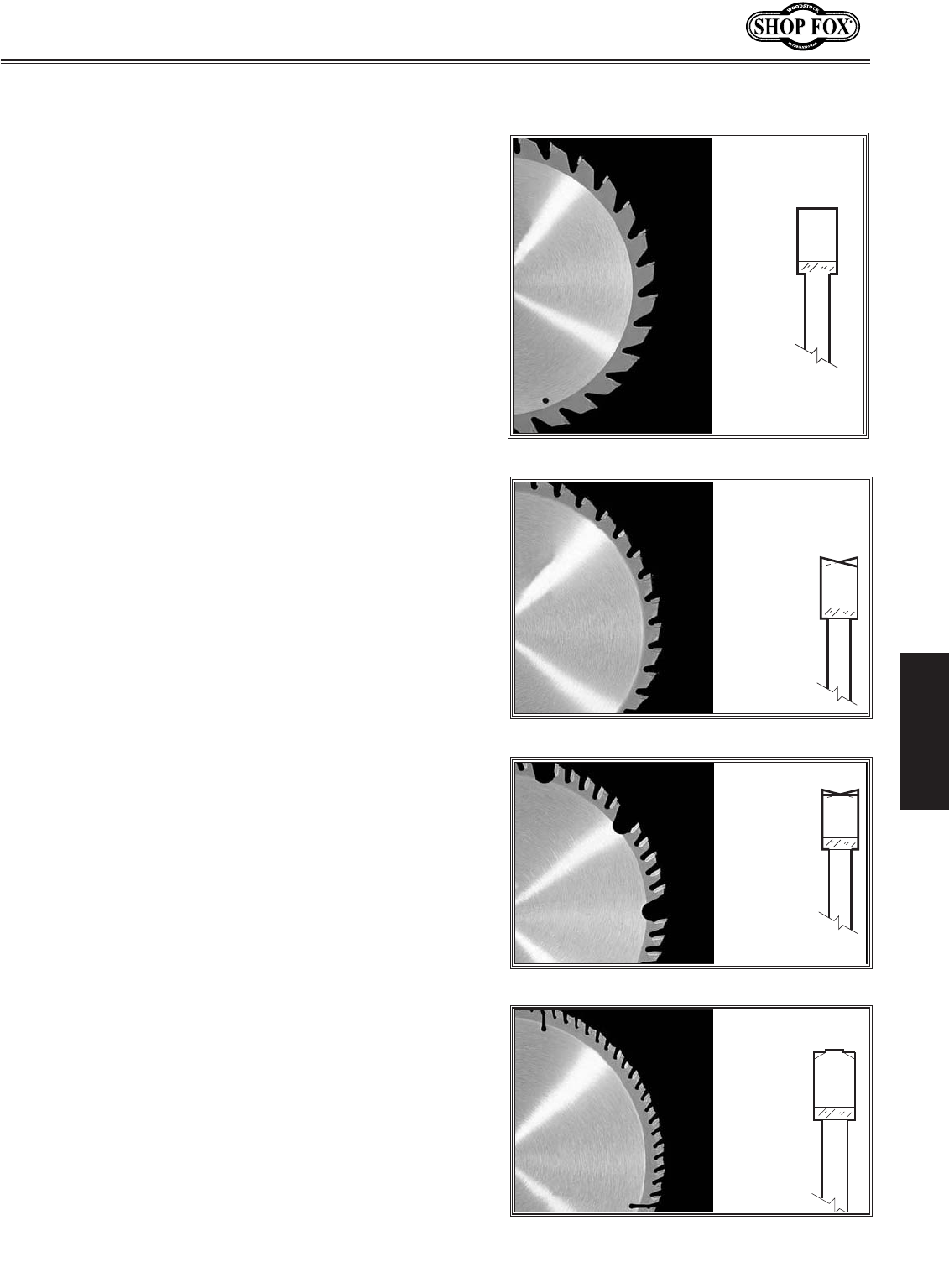
I`gg`e^YcX[\]\Xkli\j(see =`^li\*0)1
• Best for cutting with the grain of the workpiece.
• 20-40 teeth.
• Flat-top ground tooth profile.
• Large gullets for large chip removal.
=cXk
Kfg
9cX[\
=`^li\*0. Ripping blade.
:ifjjZlkYcX[\]\Xkli\j(see =`^li\+')1
• Best for cutting across the grain of the workpiece.
• 60-80 teeth.
• Alternate top bevel tooth profile.
• Small hook angle and a shallow gullet.
:fdY`eXk`feYcX[\]\Xkli\j(see =`^li\+()1
• Adequate for cutting both with and across the grain.
• 40-50 teeth.
• Alternate top bevel and flat, or alternate top bevel
and raker tooth profile.
• Teeth are arranged in groups of five.
• Gullets are small and shallow within the groups of
five teeth, similar to a cross-cut blade; then large
and deep between each group of five, like a ripping
blade.
CXd`eXk\YcX[\]\Xkli\j(see =`^li\+))1
• Best for cutting plywood or veneer.
• 40-80 teeth.
• Triple chip tooth profile.
• Very shallow gullet.
8ck\ieXk\
Kfg
9\m\c
=`^li\+'% Crosscutting blade.
8ck\ieXk\
Kfg
9\m\c
Xe[
=cXk
Ki`gc\
:_`g
9cX[\
=`^li\+)%Laminate blade.
=`^li\+(%Combination blade.
-34-
Df[\cN(/(0&N(/)'D]^%J`eZ\()&('
FG<I8K@FEJ
=`^li\+*%Stacked dado blade.
;X[f9cX[\j(see =`^li\+*)1
There are two types of dado blades: stacked and wobble.
• JkXZb\[;X[f9cX[\: These dedicated dado cutting
blade sets consist of up to 8 individual blades.
Multiple cutters are "stacked" between two outside
blades. The width of the dado is determined by the
combination of cutters that are “stacked” together.
The dado is cut in a single pass leaving a smooth and
square channel in the face of the workpiece. Stacked
dado blades are the most expensive option, but are
worth considering if your projects require a lot of
visible dado cuts. A stacked dado blade is shown in
=`^li\+*.
• NfYYc\;X[f9cX[\: Also a dedicated dado blade,
a wobble blade usually consists of a single blade
that is tilted on the arbor shaft while it is spinning.
The channel is cut in the face of the workpiece as
the blade passes through its pre-adjusted width of
travel. Wobble blades are an inexpensive option
when visibly pleasing channels are not a concern.
K_`eB\i]9cX[\
A blade with a kerf or thickness that is thinner than
a standard blade. Since thin kerf blades are typically
the same thickness of the spreader or riving knife—and
in some cases thinner—we DO NOT recommend that
they be used on this saw due to the increased risk of
kickback. The acceptable kerf range is 0.102"– 0.126"
(2.6mm–3.2mm).
Efk\1K_`jj\Zk`fefeYcX[\j\c\Zk`fe`jYpef
d\XejZfdgi\_\ej`m\%8cnXpj]fccfnk_\jXnYcX[\
dXel]XZkli\iji\Zfdd\e[Xk`fejkf\ejli\jX]\Xe[
\]]`Z`\ekfg\iXk`fef]pflikXYc\jXn%
-35-
Df[\cN(/(0&N(/)'D]^%J`eZ\()&('
FG<I8K@FEJ
9cX[\@ejkXccXk`fe
The saw blade is sharp. Use extra care or wear
gloves when handling the blade or working near it.
Review this section, even if your saw blade came pre-
installed.
Kf`ejkXcck_\YcX[\#[fk_\j\jk\gj1
(% DISCONNECT THE SAW FROM POWER!
)% Put on heavy leather gloves and raise the arbor all
the way up.
*% Remove the table insert and blade guard/riving
knife, depending on what is installed.
+% Use the arbor wrenches to loosen and remove the
arbor nut, flange, and blade.
Efk\1 K_\XiYfielk_Xji`^_k_Xe[k_i\X[j2klie`k
Zflek\iZcfZbn`j\kfcffj\e%
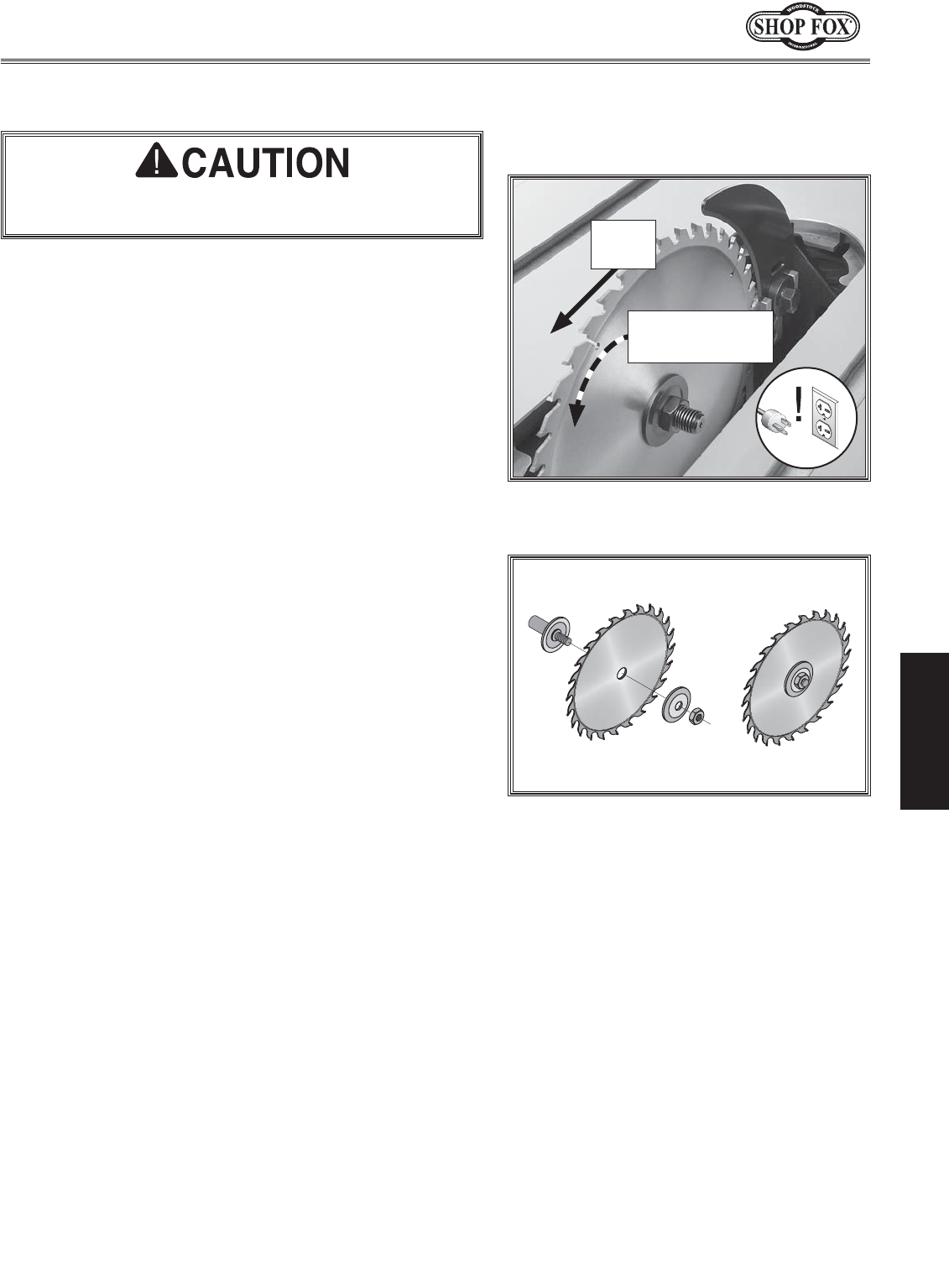
,% Slide the blade over the arborwith the teeth facing
the front of the saw, as shown in =`^li\++%
-% Re-install the arbor flange and the arbor nut (see
=`^li\+,), and tighten them against the blade with
the wrenches included with the saw. DO NOT over-
tighten.
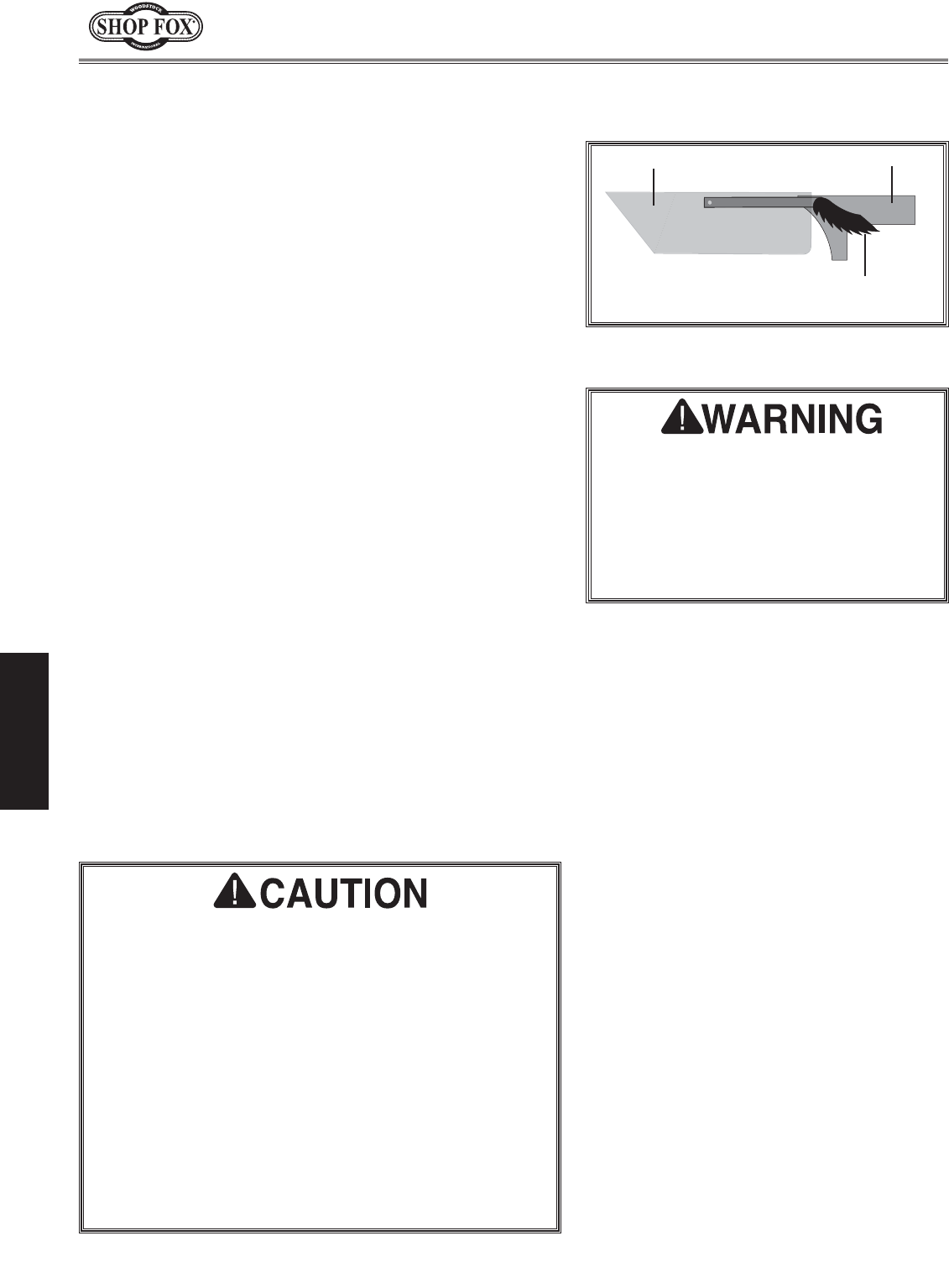
=`^li\++% Example of correct blade
direction.
Teeth Direction
& Blade Rotation
Front
of Saw
=`^li\45% Blade installation.
-36-
Df[\cN(/(0&N(/)'D]^%J`eZ\()&('
FG<I8K@FEJ
9cX[\>lXi[8jj\dYcp
The term "blade guard" refers to the assembly that con-
sists of the clear polycarbonate shield, the spreader, and
the anti-kickback pawls on each side of the spreader
(=`^li\ +-). Each of these components have important
safety functions during the operation of the saw.
>lXi[
The clear polycarbonate guard allows the operator to
see the blade cut the workpiece during operation. This
guard is designed to lift as the workpiece is pushed into
the blade and remain in contact with the workpiece
throughout the entire cut.
The guard reduces injury risk by providing a barrier
around the blade that prevents accidental contact and
contains flying wood chips.
To ensure that the guard does its job effectively, it must
always be in the downward position against the table
in the resting position during idle operation, and the
hinge mechanism must be maintained in good working
condition so the guard can freely pivot up and down to
accommodate the height of the workpiece and return to
the table surface.
Jgi\X[\i
The spreader is a metal plate that prevents the newly
cut kerf of the workpiece from pinching the backside of
the blade, causing kickback. The spreader also acts as a
barrier behind the blade to shield hands from being pulled
into the blade if a kickback occurs.
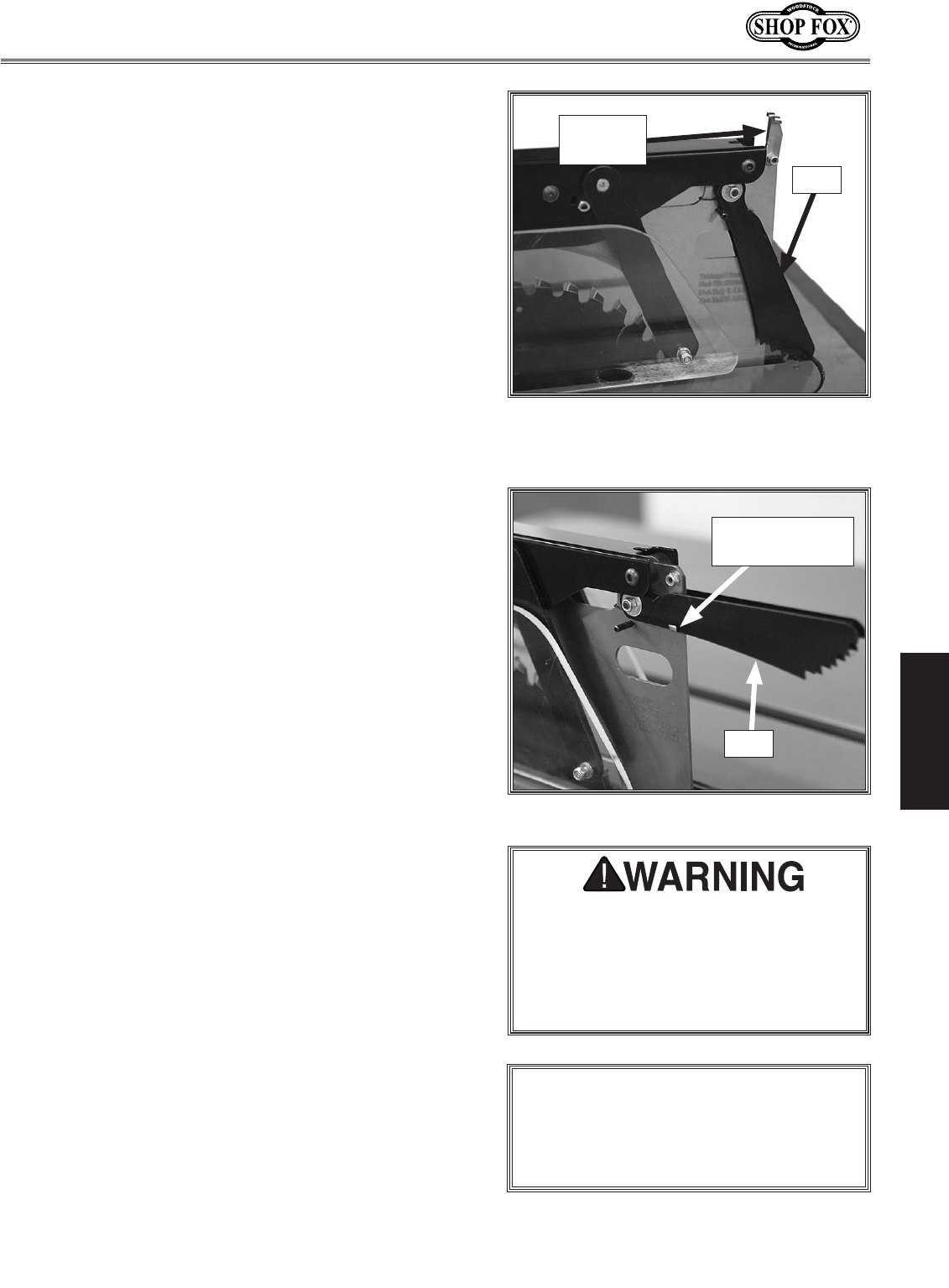
=`^li\+-% Blade guard assembly
components.
:c\XiJ_`\c[ Jgi\X[\i
8ek`$B`ZbYXZb
GXnc
In order to work properly, the spreader
cannot be bent or misaligned with the
blade. If the spreader gets accidentally
bent, take the time to straighten it
or just replace it. Using a bent or
misaligned spreader will increase the
risk of kickback!
To ensure that the blade spreader works safely, the
following requirements MUST be met when installing
new blades:
9cX[\;`Xd\k\i1('
Jgi\X[\iK_`Zbe\jj1'%()%,dd
I\hl`i\[ 9cX[\ 9f[p K_`Zbe\jj \oZcl[`e^ k\\k_ 1
'%'.(Æ'%'0+
(%/Æ)%+dd
I\hl`i\[ 9cX[\ B\i] K_`Zbe\jj1 '%(')Æ '%()-
)%-ddÆ*%)dd
The spreader MUST be aligned/adjusted to the blade.
K_\j\ i\hl`i\d\ekj Xi\ efk Xggc`ZXYc\ kf [X[f
YcX[\j%
-37-
Df[\cN(/(0&N(/)'D]^%J`eZ\()&('
FG<I8K@FEJ
8ek`$B`ZbYXZbGXncj
The anti-kickback pawls allow the workpiece to travel in
only one direction. If the workpiece moves backwards,
such as during a kickback, the pawls will dig into the
workpiece to slow or stop it.
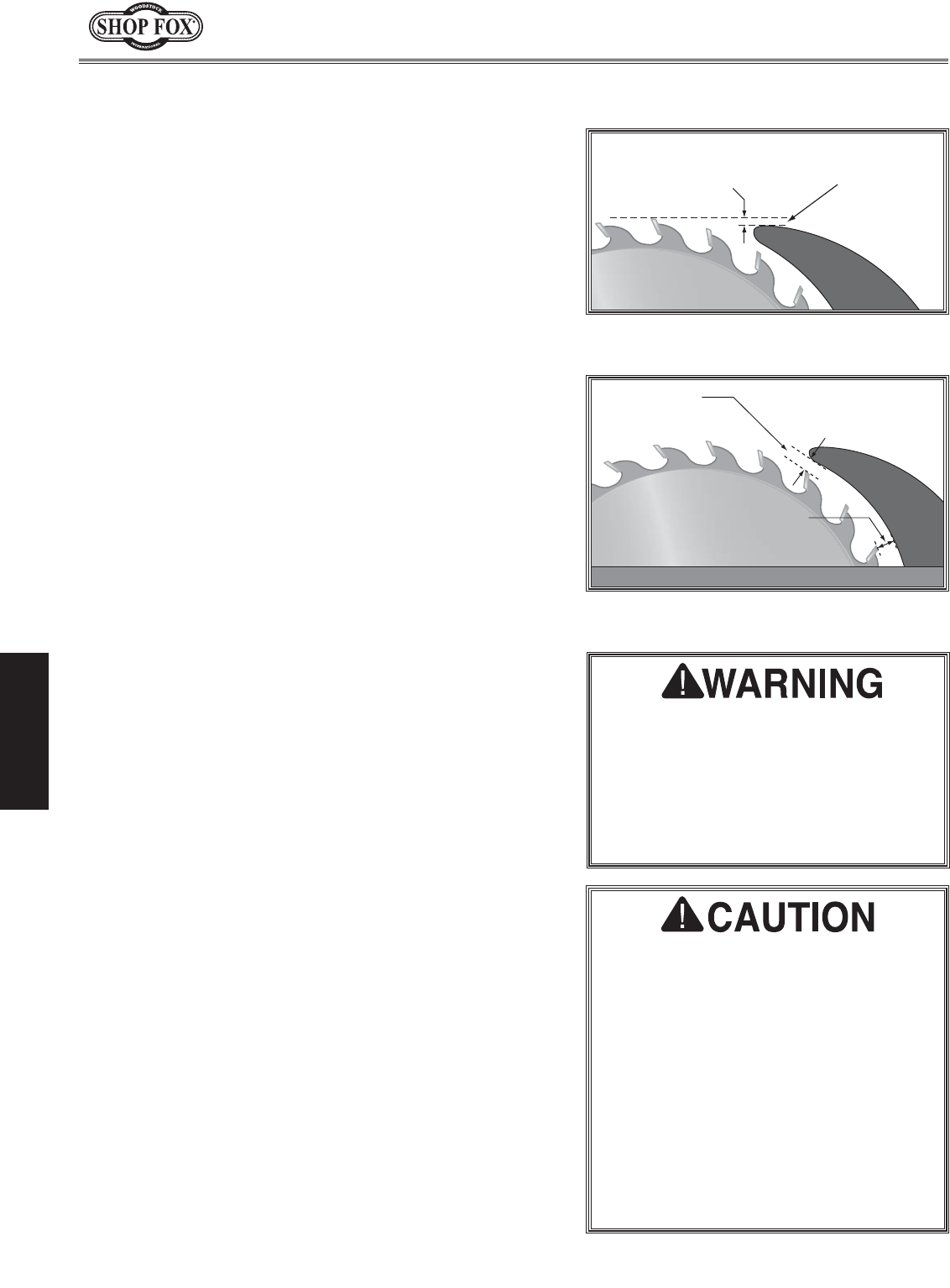
To work properly, the pawls must return to their bottom-
most position after pivoting, as shown in Figure 47, and
they must not be engaged in the arresting hooks. If the
pawls fail to return to the bottom position, the pivot
spring may have been dislodged or broken and will need
to be fixed/replaced.
;`jXYc`e^GXncj
To disable the pawls, rotate the arresting hooks
downward, then place the pawls on each of the hooks, as
shown in Figure 48.
Use your best judgment before retracting the pawls,
as they are provided for your safety. Certain situations
could warrant retracting the pawls. For example, you
might retract the pawls if you are concerned about them
scratching a delicate workpiece, or if you believe that
they will obstruct a narrow workpiece and cause feeding
difficulty or loss of control.
=`^li\ +.. Pawls in return position.
=`^li\ +/. Pawl disabled.
Pawl
Arresting
Hooks
Arresting Hooks
(One Shown)
Pawl
<eXYc`e^GXncj
To enable the pawls, lift up on each pawl and move
them outward and down until they both touch the table
surface, as shown in Figure 47.
N_\ekfLj\k_\9cX[\>lXi[
The blade guard assembly MUST always be installed on
the saw for all normal through cuts (those where the
blade cuts all the way through the thickness of the
workpiece).
N_\eEfkkfLj\k_\9cX[\>lXi[
The blade guard cannot be used on any non-through
cuts (those in which the blade does not cut all the way
through the thickness of the workpiece).
Sometimes the blade guard or its components can get in
the way when cutting very narrow workpieces or other
specialized cuts. Because the blade guard is provided to
decrease your risk of injury, it should not be used if it
gets in the way of making a safe cut. Use good judgment!
N\ [f efk i\Zfdd\e[ [`jXYc`e^ k_\
gXncj [li`e^ efidXc fg\iXk`fej lec\jj
XYjfclk\cpe\Z\jjXip%@edfjkj`klXk`fej#
[`jXYc`e^ k_\ gXncj n`cc `eZi\Xj\ pfli
i`jb f] j\i`flj g\ijfeXc `ealip `e k_\
\m\ekf]Xb`ZbYXZb%
EFK@:<
N_\e\m\i k_\ YcX[\ ^lXi[ ZXeefk
Y\lj\[#k_\i`m`e^be`]\dljkY\
`ejkXcc\[%
-38-
Df[\cN(/(0&N(/)'D]^%J`eZ\()&('
FG<I8K@FEJ
I`m`e^Be`]\
The riving knife works in the same manner as the spread-
er on the blade guard assembly. It is a metal plate that
prevents the newly cut workpiece from pinching the back-
side of the blade and causing kickback.
The key difference between the spreader and the riving
knife is that the riving knife mounts below the blade's
highest point of rotation, as shown in =`^li\+0.
The height difference between the riving knife and the
blade allows the workpiece to pass over the blade during
non-through cuts (those in which the blade does not cut
all the way through the thickness of the workpiece).
The riving knife acts as a barrier behind the blade to
reduce the risk of hands being pulled into the blade if
a kickback occurs. The riving knife must be kept within
the range shown in Figure 50. For that reason, we only
recommend using a 10" blade for operations that require
use of the riving knife.
=`^li\+0% Height difference between
riving knife and blade.
?\`^_k;`]]\i\eZ\
D`e`dld(dd
DXo`dld,dd
I`m`e^
Be`]\
=`^li\ ,'. Allowable top and bottom
distances between riving knife and blade.
D`e`dld*dd
Kfg;`jkXeZ\
9fkkfd;`jkXeZ\
DXo`dld/dd
D`e`dld*dd
DXo`dld/dd
KXYc\
I`m`e^
Be`]\
@efi[\ikfnfibgifg\icp#k_\i`m`e^
be`]\ ZXeefk Y\ Y\ek fi d`jXc`^e\[
n`k_k_\YcX[\%@]k_\i`m`e^be`]\^\kj
XZZ`[\ekXccp Y\ek# kXb\ k_\ k`d\ kf
jkiX`^_k\e `k fi aljk i\gcXZ\ `k% Lj`e^
X Y\ek fi d`jXc`^e\[ i`m`e^ be`]\ n`cc
`eZi\Xj\k_\i`jbf]b`ZbYXZb
To ensure riving knife works safely, the
following requirements MUST be met
when installing new blades:
9cX[\;`Xd\k\i1('
I`m`e^Be`]\K_`Zbe\jj1'%()%,dd
I\hl`i\[ 9cX[\ 9f[p K_`Zbe\jj
\oZcl[`e^k\\k_ 1'%'.(Æ'%'0+(%/Æ
)%+dd
I\hl`i\[ 9cX[\ B\i] K_`Zbe\jj1
'%(')Æ'%()-)%-ddÆ*%)dd
Iiving knife MUST be aligned to blade;
K_\j\ I\hl`i\d\ekj [f efk Xggcp kf
[X[fYcX[\j%
?fnkf@ejkXcck_\I`m`e^Be`]\
The riving knife is installed in a similar manner to the
blade guard and spreader. Refer to Blade Guard on GX^\
*- for installation instructions.
N_\ekfLj\k_\I`m`e^Be`]\
Use the riving knife for all non-through cuts made with
a standard table saw blade (i.e., dadoes or rabbet cuts
in which a dado blade is NOT used, and when using a
tenoning jig). Also, use the riving knife for those special
operations where the blade guard or its components get
in the way of safe operation, such as with very narrow
cuts.
When Not to Use the Riving Knife
The riving knife CANNOT be used with a dado blade
that has a diameter smaller than 10." Otherwise, the
riving knife height will exceed the blade height and the
workpiece will hit the riving knife during the cut, forcing
the operator into a dangerous situation of trying to turn
the saw off with the workpiece stuck halfway through the
cut.
In addition, although it is possible to use the riving knife
for through cutting operations, the blade guard assembly
offers far more injury protection and risk reduction than
the riving knife. Therefore, we strongly recommend that
you use the blade guard assembly instead of the riving
knife for through cuts.

-39-
Df[\cN(/(0&N(/)'D]^%J`eZ\()&('
FG<I8K@FEJ
Nfibg`\Z\@ejg\Zk`fe
Some workpieces are not safe to cut or may
require modification before they can be made
safe to cut.
9\]fi\Zlkk`e^#^\k`ek_\_XY`kf]`ejg\Zk`e^
Xccnfibg`\Z\j]fik_\]fccfn`e^:
• Material Type: This machine is intended
for cutting natural and man-made wood
products, laminate covered wood products,
and some plastics. Cutting drywall or
cementitious backer board creates
extremely fine dust and may reduce the
life of the bearings. This machine is NOT
designed to cut metal, glass, stone, tile,
etc.; cutting these materials with a table
saw may lead to injury.
• Foreign Objects: Nails, staples, dirt,
rocks and other foreign objects are often
embedded in wood. While cutting, these
objects can become dislodged and hit the
operator, cause kickback, or break the
blade, which might then fly apart. Always
visually inspect your workpiece for these
items. If they can't be removed, DO NOT
cut the workpiece.
Large/Loose Knots:Loose knots can
become dislodged during the cutting
operation. Large knots can cause kickback
and machine damage. Choose workpieces
that do not have large/loose knots or plan
ahead to avoid cutting through them.
Wet or "Green" Stock: Cutting wood
with a moisture content over 20% causes
unnecessary wear on the blades, increases
the risk of kickback, yields poor results.
• Excessive Warping: Workpieces with
excessive cupping, bowing, or twisting are
dangerous to cut because they are unstable
and often unpredictable when being
cut. DO NOT use workpieces with these
characteristics!
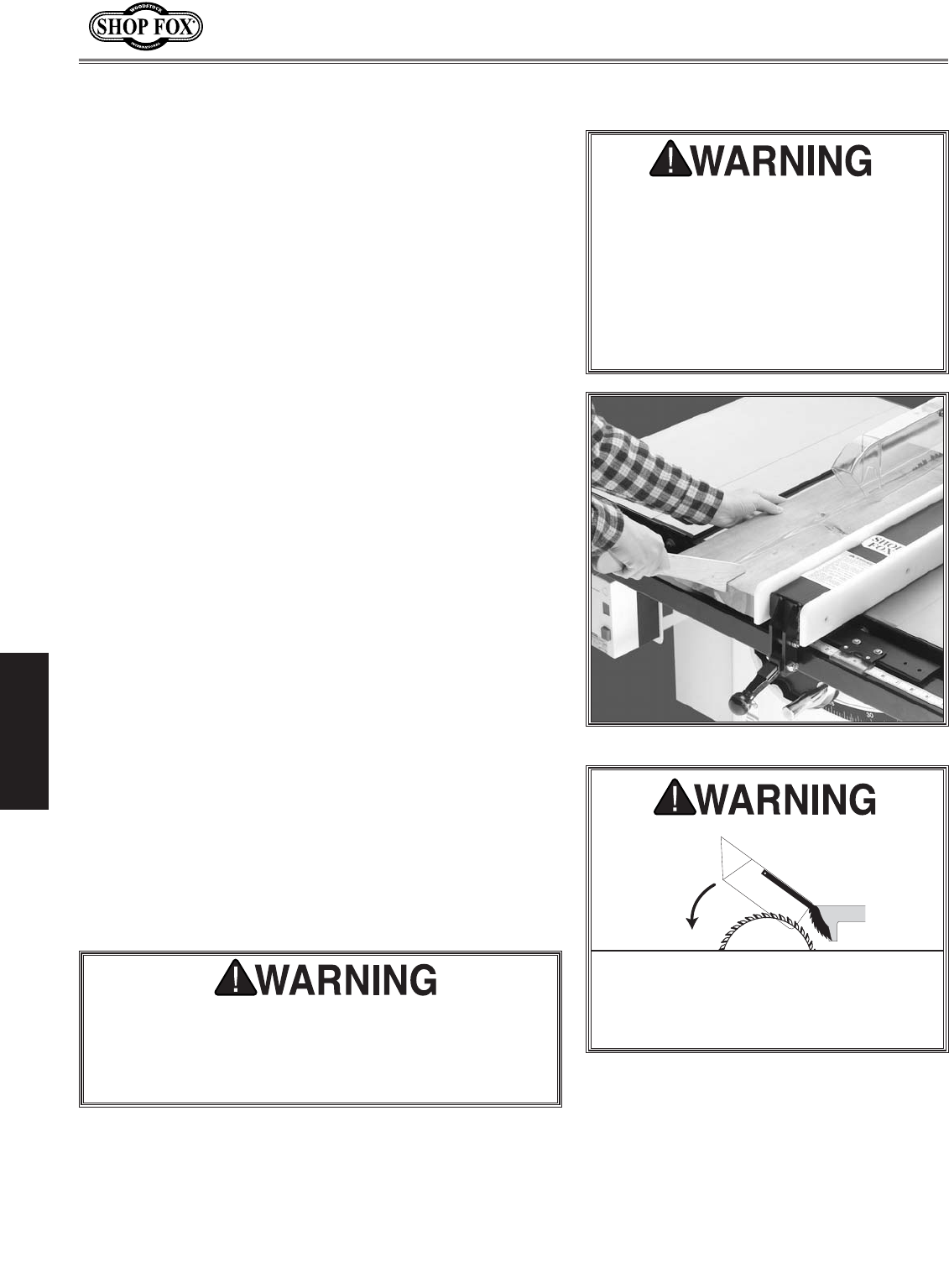
• Minor Warping: Workpieces with slight
cupping can be safely supported if the
cupped side is facing the table or the
fence.
-40-
Df[\cN(/(0&N(/)'D]^%J`eZ\()&('
FG<I8K@FEJ
I`gg`e^
"Ripping" means cutting with the grain of a natural wood
workpiece. In other man-made materials such as MDF or
plywood, ripping simply means cutting lengthwise.
KfdXb\Xi`gZlk#[fk_\j\jk\gj1
(% Review Gi\m\ek`e^B`ZbYXZb on GX^\(*and take
the necessary precautions to prevent kickback.
)% If using natural wood, joint one long edge of the
workpiece on a jointer.
*% DISCONNECT THE SAW FROM POWER!
+% Ensure that the blade guard/spreader is installed.
,% Set the fence to the desired width of cut on the
scale.
-% Adjust the blade height so the highest saw tooth
protrudes approximately 1/4" above the workpiece.
.% Set up safety devices such as featherboards or other
anti-kickback devices.
/% Rotate the blade by hand to make sure it does not
come into contact with any of the safety devices.
0% Plug the saw into the power source, turn it FE# and
allow it to reach full speed.
Efk\1 K_\af`ek\[\[^\f]k_\nfibg`\Z\dljkjc`[\
X^X`ejkk_\]\eZ\[li`e^k_\Zlkk`e^fg\iXk`fe%
('% Use a push stick to feed the workpiece through
the saw blade, as shown in =`^li\,(, until the
workpiece is completely past the saw blade.
J\i`flj `ealip ZXe Y\ ZXlj\[ Yp
b`ZbYXZb% B`ZbYXZb `j X _`^_$jg\\[
\oglcj`fef]jkfZb]ifdk_\kXYc\jXn
kfnXi[ Xe fg\iXkfi% K_\ fg\iXkfi fi
YpjkXe[\ij dXp Y\ jkilZb Yp ]cp`e^
jkfZb# fi k_\ fg\iXkfiËj _Xe[j ZXe
Y\ glcc\[ `ekf k_\ YcX[\ [li`e^ k_\
b`ZbYXZb%
=`^li\,(%Typical ripping operation.
B\\gk_\YcX[\^lXi[`ejkXcc\[Xe[`e
k_\ [fne gfj`k`fe% =X`cli\ kf [f k_`j
Zflc[i\jlck`ej\i`fljg\ijfeXc`ealip
fi[\Xk_%
Klie F== k_\ jXn Xe[ Xccfn k_\ YcX[\ kf Zfd\ kf
XZfdgc\k\jkfgY\]fi\i\dfm`e^k_\Zlk$f]]g`\Z\%
=X`cli\kf]fccfnk_`jnXie`e^Zflc[i\jlck`ej\i`flj
g\ijfeXc`ealip%
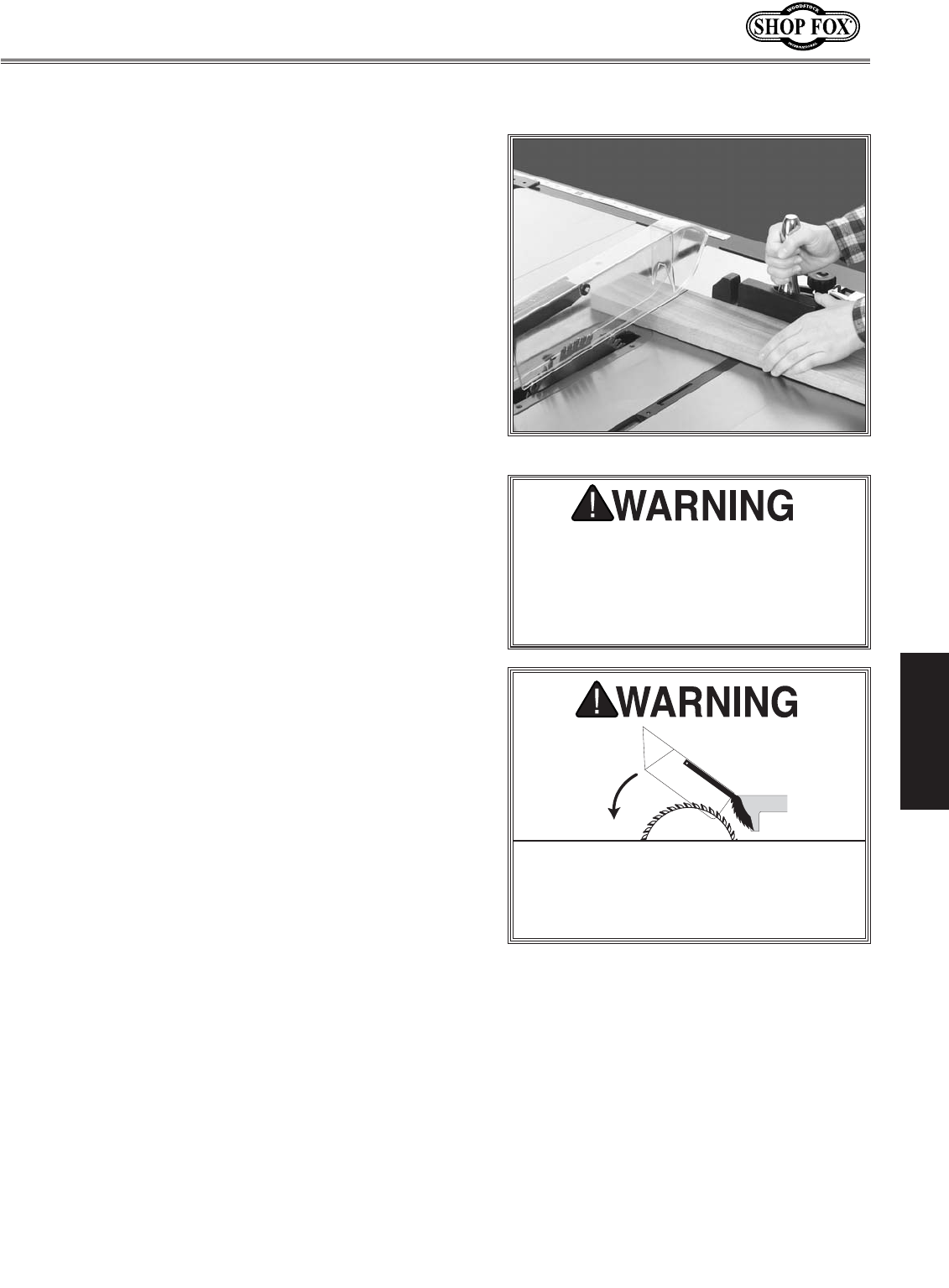
-41-
Df[\cN(/(0&N(/)'D]^%J`eZ\()&('
FG<I8K@FEJ
:ifjjZlkk`e^
"Crosscutting" means cutting across the grain of a natural
wood workpiece. In other man-made materials, such as
MDF or plywood, crosscuttting means cutting across the
width of the workpiece.
KfdXb\XZifjjZlklj`e^k_\d`k\i^Xl^\#[fk_\j\
jk\gj1
(% DISCONNECT THE SAW FROM POWER!
)% Ensure that the blade guard/spreader is installed.
*% Move the rip fence aside and position the miter
gauge, adjusted to 90°, in a miter slot.
+% Adjust the blade height so the teeth protrude
approximately 1/4" above the workpiece.
,% Slide the miter gauge near the blade and adjust the
workpiece so the blade will cut on the waste side of
the line.
-% Plug in the table saw, turn it FE# and allow it to
reach full speed.
.% Hold the workpiece firmly against the face of the
miter gauge (see =`^li\,)) and ease it through the
blade until the workpiece is completely past the saw
blade.
=`^li\,)%Typical crosscutting operation.
KlieF==k_\jXnXe[Xccfnk_\YcX[\
kf Zfd\ kf X Zfdgc\k\ jkfg Y\]fi\
i\dfm`e^ k_\ Zlk$f]] g`\Z\% =X`cli\
kf ]fccfn k_`j nXie`e^ Zflc[ i\jlck `e
j\i`fljg\ijfeXc`ealip%
B\\gk_\YcX[\^lXi[`ejkXcc\[Xe[`e
k_\ [fne gfj`k`fe% =X`cli\ kf [f k_`j
Zflc[i\jlck`ej\i`fljg\ijfeXc`ealip
fi[\Xk_%
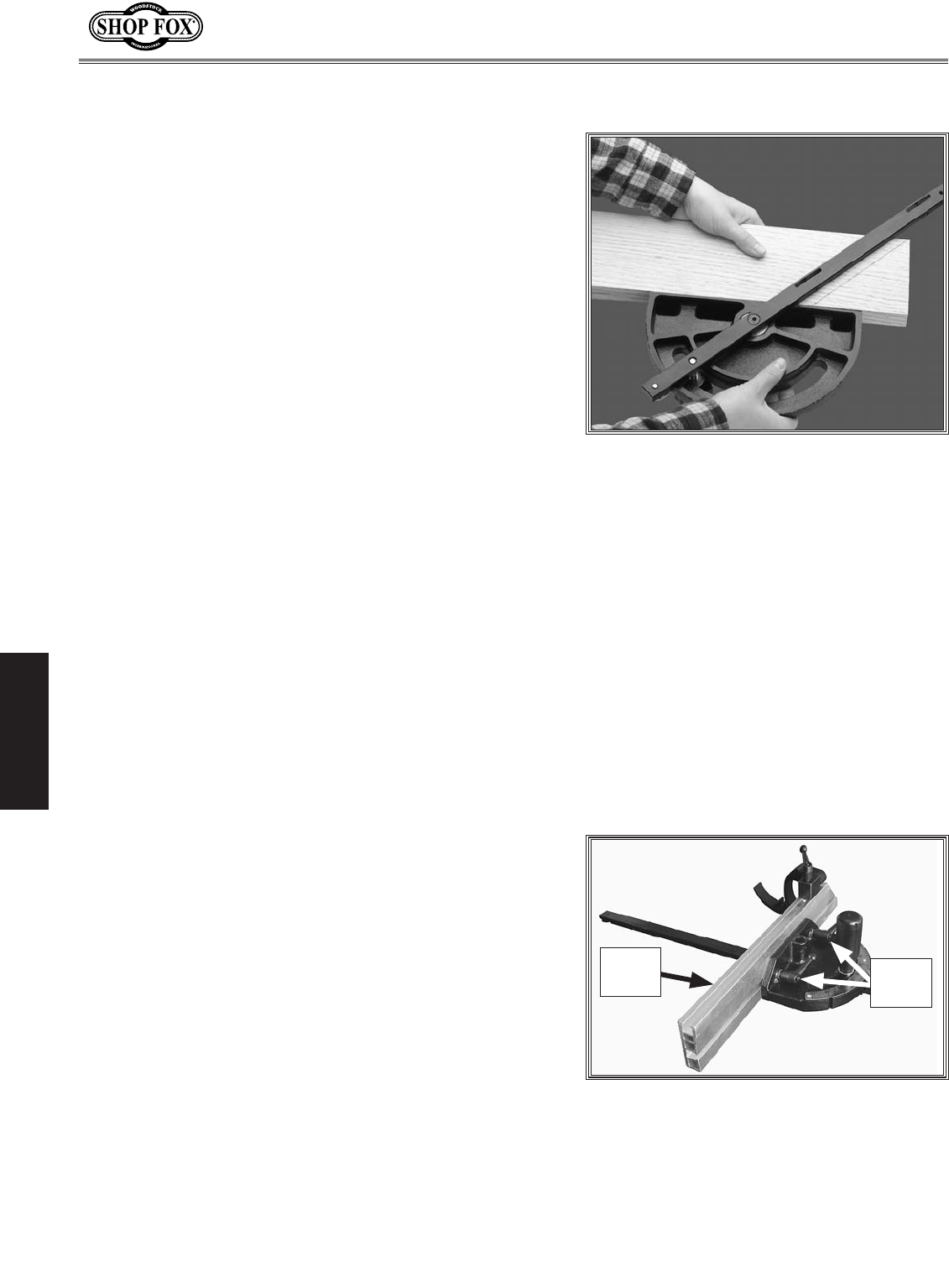
-42-
Df[\cN(/(0&N(/)'D]^%J`eZ\()&('
FG<I8K@FEJ
=`^li\,*% Example of marking miter line.
D`k\i:lkj
A miter is an angled crosscut. Miters are usually cut in the
same manner as crosscuts, using the miter gauge and a
predetermined mark on the workpiece.
Kfg\i]fidXd`k\iZlk#[fk_\j\jk\gj1
(% DISCONNECT THE SAW FROM POWER!
)% Ensure that the blade guard/spreader is installed.
*% Determine the angle of your cut. If the angle needs
to be very precise, use a protractor to set the miter
gauge to the blade.
+% Place the face of the miter gauge against the edge
of the workpiece and place the bar across the face
of the workpiece. Use the bar as a guide to mark
your cut, as shown in =`^li\,*.
,% Place the miter gauge back into the slot and hold
the workpiece firm against the miter gauge body.
Slide the miter gauge near the blade and adjust the
workpiece so the blade will cut on the waste side of
the line.
-% Proceed to make the cut in the same manner as
described in the :ifjjZlkk`e^ instructions on GX^\
+(.
=`^li\,+% Miter fence lock levers.
D`k\i=\eZ\
The miter fence provides greater workpiece support than
the miter gauge alone, especially for longer workpieces.
Simply loosen the lock levers shown in =`^li\,+, slide
the miter fence in the needed direction for the cutting
operation, then tighten the levers. Make sure the miter
fence does not contact the blade guard or blade when
moved through its full range of travel.
Lock
Levers
Miter
Fence
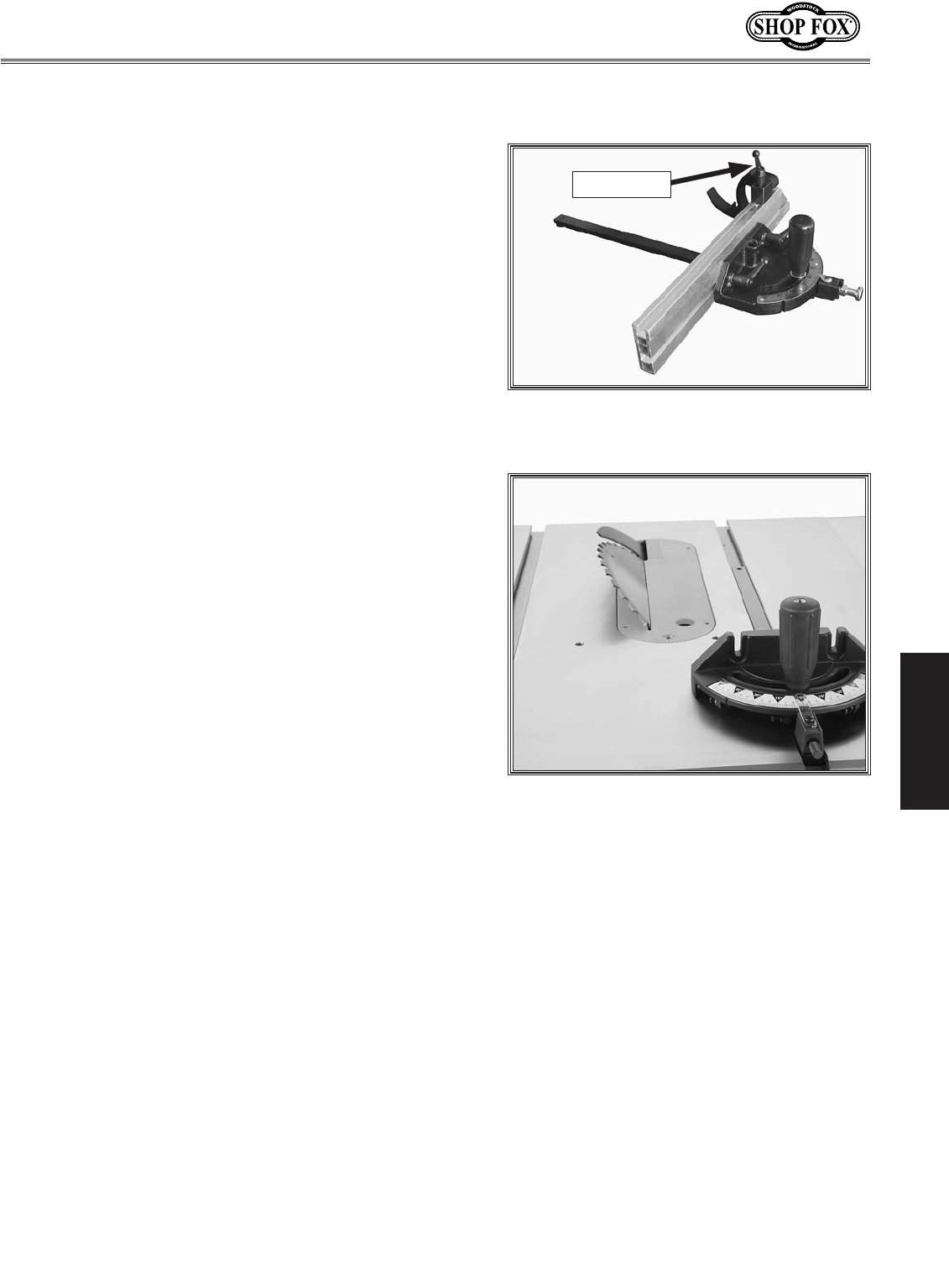
-43-
Df[\cN(/(0&N(/)'D]^%J`eZ\()&('
FG<I8K@FEJ
9cX[\K`ck9\m\c:lkj
When the blade tilt stop bolts are properly adjusted, as
described on GX^\-,, the blade tilt handwheel allows the
operator to tilt the blade to the left, anywhere between
0° and 45°. This is used most often when cutting bevels
or compound miters. =`^li\,- shows an example of the
blade when tilted to 45°.
=`^li\,-. Blade tilted to 45° for bevel
cutting on a typical table saw.
=`^li\ ,,. Flip stop lock lever.
=c`gJkfg
The flip stop can be positioned anywhere along the top
of the miter fence and secured in place with a lock lever
(see =`^li\,,), the same distance away from the blade
as your desired width of cut.
The flip stop can be used in the down position to make
multiple cuts of the same width. It can be pivoted
(hence the name “flip”) out of the way to allow longer
workpieces to be cut, then pivoted back down to make
additional cuts at the specified cutting width.
Lock Lever
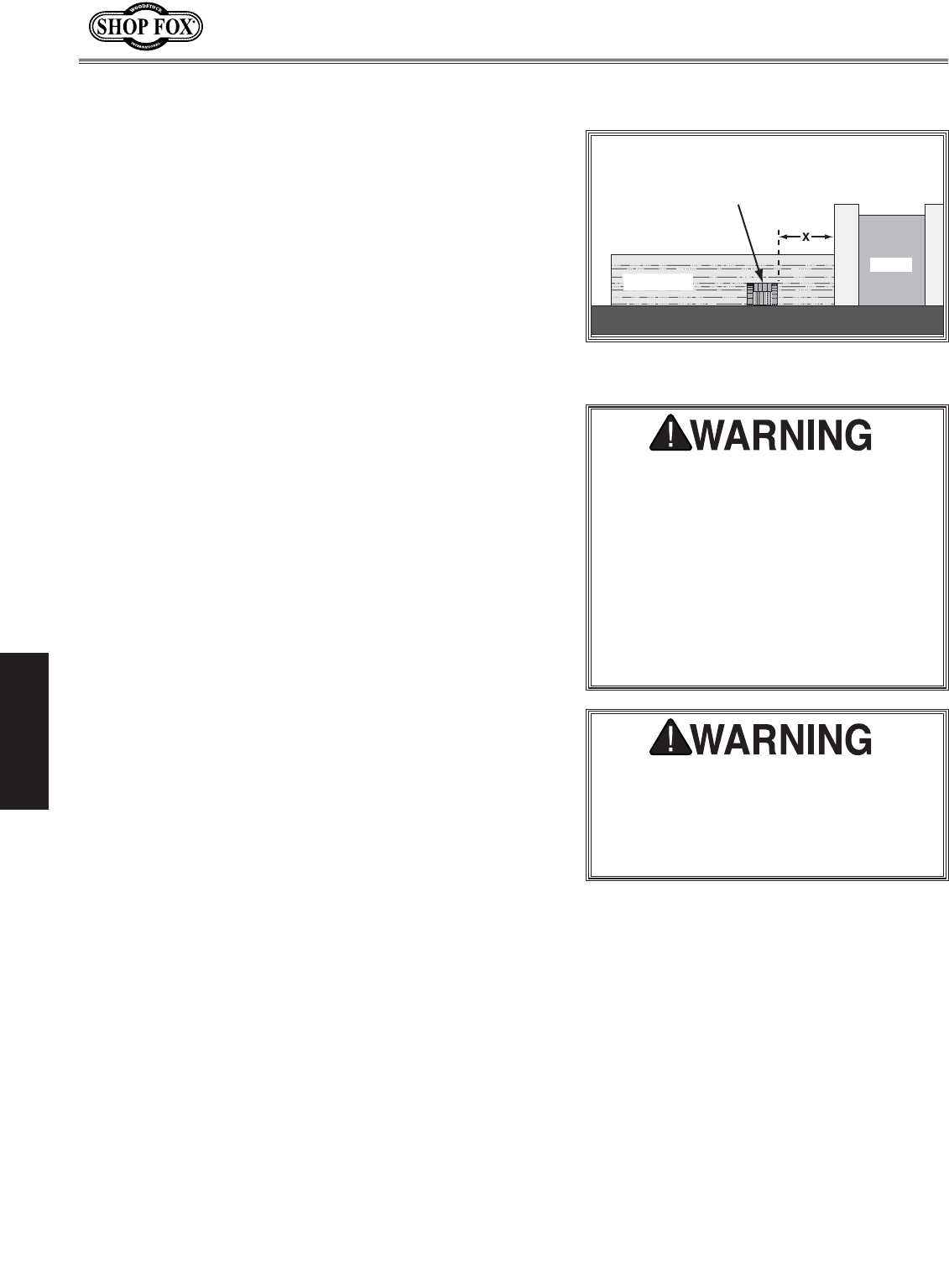
-44-
Df[\cN(/(0&N(/)'D]^%J`eZ\()&('
FG<I8K@FEJ
;X[f:lkk`e^
Commonly used in furniture joinery, a dado is a straight
channel cut in the face of the workpiece. Dadoes can be
cut using either a dedicated dado blade or a standard
saw blade. Figure 57 shows a cutaway view of a dado cut
being made with a dado blade.
The included dado table insert must be installed and used
when a dado blade is installed—unless a zero clearance
table insert is used instead.
The table saw motor is pushed to its limits when making
a dado cut with a dado blade. If the motor starts to bog
down, slow down your feed rate, reduce the depth of cut
and make multiple shallow passes.
@ejkXcc`e^X;X[f9cX[\
(% DISCONNECT THE SAW FROM POWER!
)% Remove the table insert, the blade guard assembly
or riving knife, and the saw blade.
*% Attach and adjust the dado blade system according
to the dado blade manufacturer’s instructions
+% Install the dado insert.
;X[f9cX[\
Nfibg`\Z\
=\eZ\
=`^li\,.%Example of a dado cut with a
dado blade.
;F EFK dXb\ X k_ifl^_$Zlk n`k_
X [X[f YcX[\% ;X[f YcX[\j Xi\ efk
[\j`^e\[ ]fi k_ifl^_ Zlkj% =X`cli\ kf
]fccfn k_`j nXie`e^ Zflc[ i\jlck `e
j\i`fljg\ijfeXc`ealip%
;X[f YcX[\j _Xm\ X _`^_\i i`jb f]
b`ZbYXZb k_Xe efidXc YcX[\j Y\ZXlj\
k_\`icXi^\j`q\Xggc`\jjkife^\i]fiZ\j
kf k_\ nfibg`\Z\% K_`j i`jb `eZi\Xj\j
i\cXk`m\kfk_\[\gk_Xe[n`[k_f]k_\
Zlk% Kf d`e`d`q\ pfli i`jb f] j\i`flj
g\ijfeXc `ealip# \ejli\ k_Xk jkfZb `j
]cXk Xe[ jkiX`^_k# Xe[ dXb\ dlck`gc\
c`^_k Zlkj iXk_\i k_Xe fe\ [\\g Zlk
kfXZ_`\m\k_\[\j`i\[Zlkk`e^[\gk_%
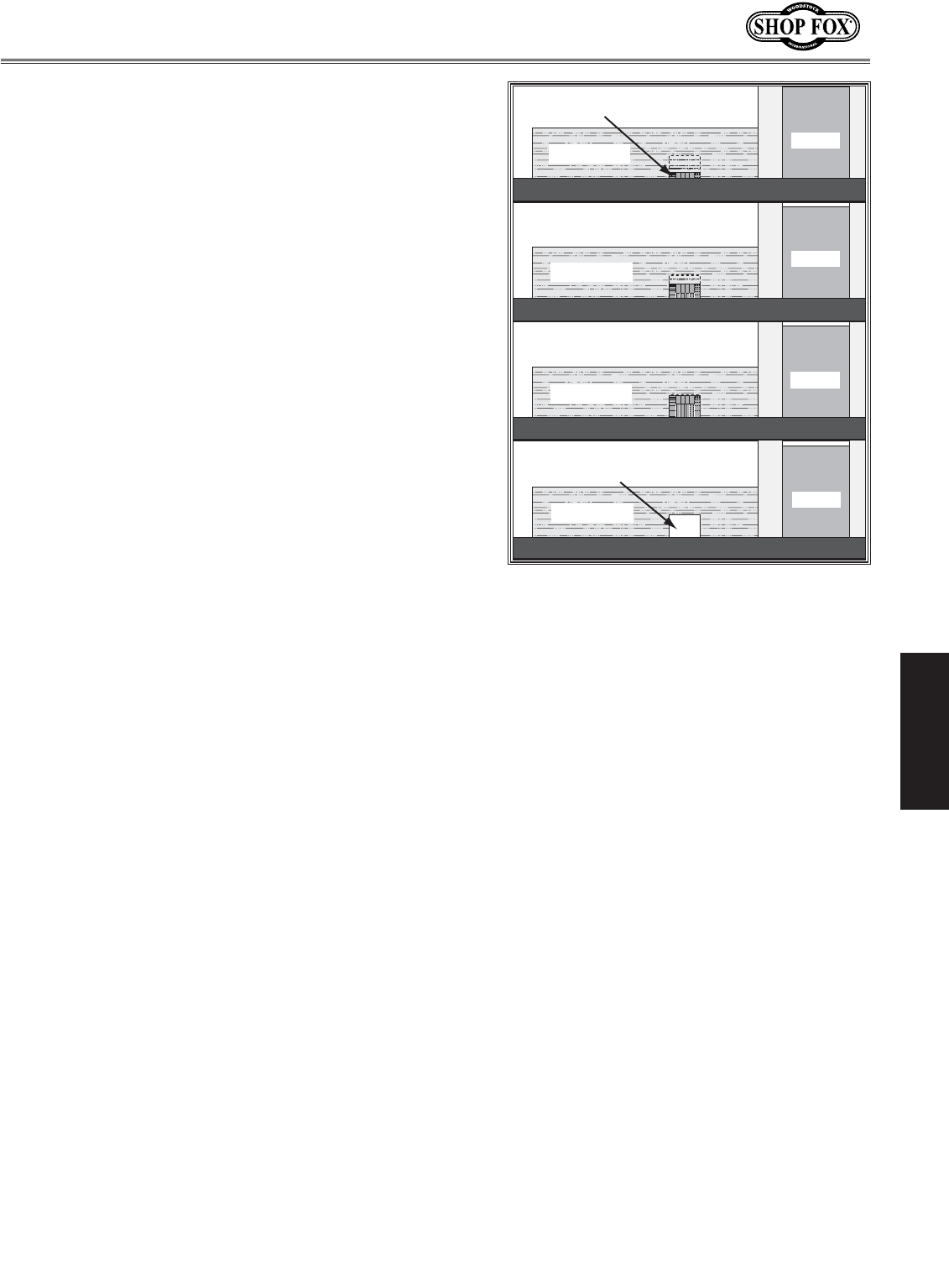
-45-
Df[\cN(/(0&N(/)'D]^%J`eZ\()&('
FG<I8K@FEJ
:lkk`e^;X[f\jn`k_X;X[f9cX[\
Because dado blades are so much wider than standard
blades, they place a much greater amount of force against
the workpiece when cutting.
To avoid injury, dado cuts require a much slower feed rate
than normal cuts, and they are best done with multiple
light cuts that get progressively deeper until the desired
depth of cut is achieved, as demonstrated in Figure 58.
KfZlkX[X[fn`k_X[X[fYcX[\#[fk_\j\jk\gj1
(% Adjust the dado blade to the desired depth of cut.
)% Adjust the distance between the fence and the
inside edge of the blade, as shown in =`^li\,. on
GX^\++.
— If dadoing across the workpiece, use the miter
gauge and carefully line up the desired cut
with the dado blade. DO NOT use the fence in
combination with the miter gauge.
*% Reconnect the saw to the power source.
+% Turn the saw FE. The blade should run smooth, with
no vibrations.
,% When the blade has reached full speed, perform a
test cut with a scrap piece of wood.
-% If the cut is satisfactory, repeat the cut with the
actual workpiece.
=`^li\,/% Example of dado being cut with
multiple light cuts, instead of one deep
cut.
Dado Blade
Workpiece Fence
Cut 1
Workpiece Fence
Cut 2
Workpiece Fence
Cut 3
Finished
Dado Cut
Workpiece Fence
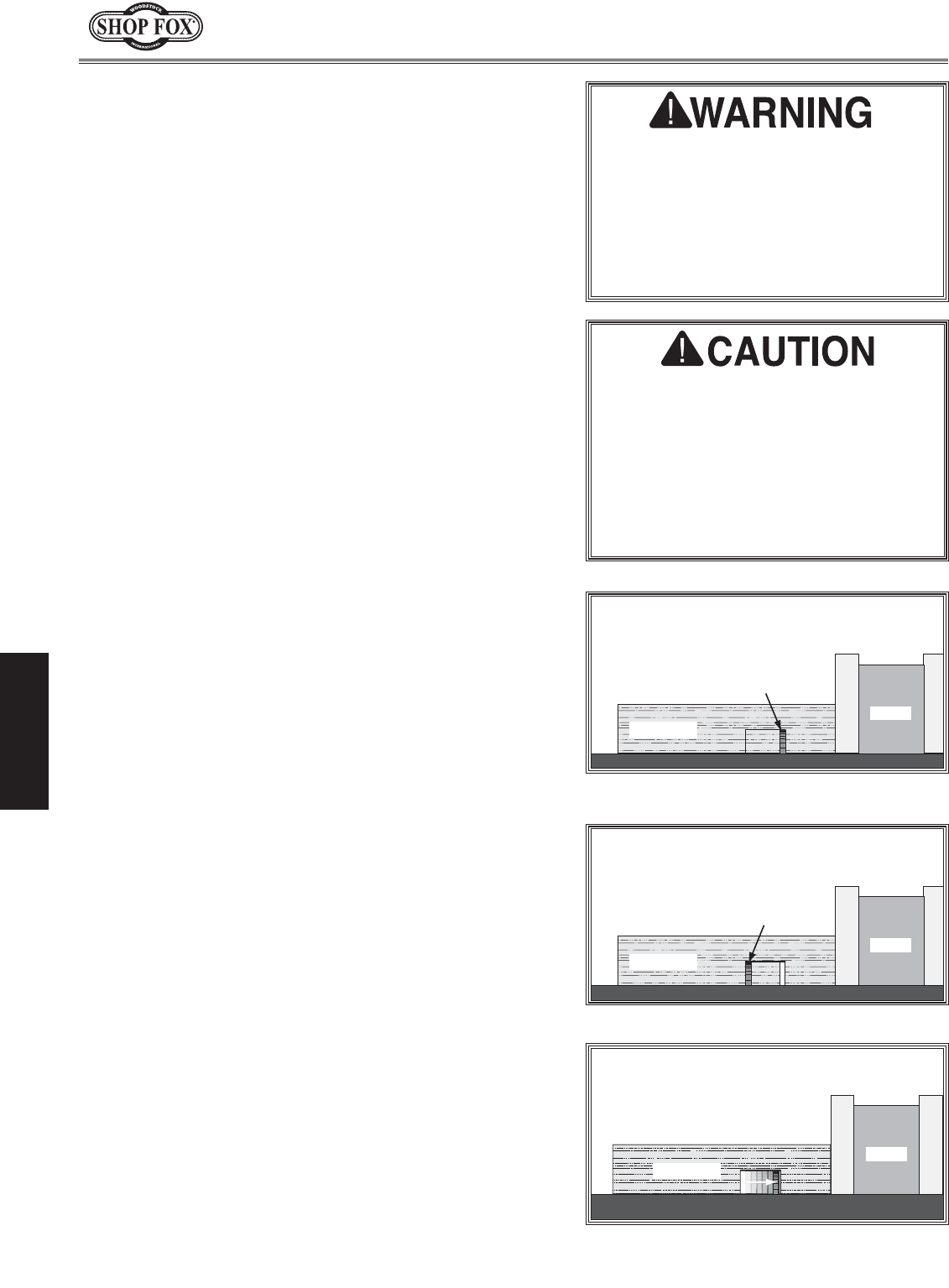
-46-
Df[\cN(/(0&N(/)'D]^%J`eZ\()&('
FG<I8K@FEJ
:lkk`e^;X[f\jn`k_XJkXe[Xi[9cX[\
A ripping blade is typically the best blade to use for
cutting dadoes when using a standard blade because it
removes sawdust very efficiently. See GX^\**for blade
details.
Kflj\XjkXe[Xi[jXnYcX[\kfZlk[X[f\j#[fk_\j\
jk\gj1
(% DISCONNECT THE SAW FROM POWER!
)% Ensure that the riving knife and standard table insert
are installed and properly adjusted.
*% Mark the width of the dado cut on the workpiece.
Include marks on the edge of the workpiece so the
cut path can be aligned when the workpiece is lying
on the table.
+% Raise the blade up to the desired depth of cut
(depth of dado channel desired).
— If dadoing across the workpiece, use the miter
gauge to support the workpiece, and align the
blade to cut one of the dado sides. DO NOT use
the fence in combination with the miter gauge.
— If dadoing the length of a workpiece, align the
blade to cut one of the dado sides as shown in
=`^li\,0.
,% Reconnect the saw to the power source and turn the
saw FE. Allow the blade to reach full speed.
-% Perform the cutting operation.
.% Re-adjust the fence so the blade is aligned with the
other edge of the intended dado channel (=`^li\
-').
Efk\19\jli\kfb\\gk_\Zlkjn`k_`epflidXibj2
fk_\in`j\#k_\[X[fn`ccY\kffY`^%
/% Continue making cuts toward the center of the dado
until the dado is complete (see =`^li\-().
K_\[Xe^\if]b`ZbYXZb`eZi\Xj\ji\cX$
k`m\kfk_\[\gk_Xe[n`[k_f]XZlk%
I\[lZ\k_\i`jbf]b`ZbYXZbYpdXb`e^
dlck`gc\gXjj\jkfXZ_`\m\k_\[\j`i\[
[\gk_ f] Zlk% =X`cli\ kf ]fccfn k_\j\
nXie`e^j Zflc[ i\jlck `e j\i`flj g\i$
jfeXc`ealip%
Blade
Workpiece
Fence
Cut 1
=`^li\,0%Single-blade dado first cut.
Workpiece
Fence
Cut 2 Blade
=`^li\-'%Single-blade dado second cut.
Nfibg`\Z\
=\eZ\
Cuts 3+
=`^li\61%Addtional cuts.
8cnXpjlj\glj_jk`Zbj#]\Xk_\iYfXi[j#
glj_gX[[c\jXe[fk_\ijX]\kpXZZ\jjf$
i`\jn_\e\m\igfjj`Yc\kf`eZi\Xj\jX]\$
kp Xe[ Zfekifc [li`e^ fg\iXk`fej k_Xk
i\hl`i\ k_\ YcX[\ ^lXi[ Xe[ jgi\X[\i
kf Y\ i\dfm\[ ]ifd k_\ jXn% 8CN8PJ
i\gcXZ\ k_\ YcX[\ ^lXi[ X]k\i [X[f`e^
`jZfdgc\k\%
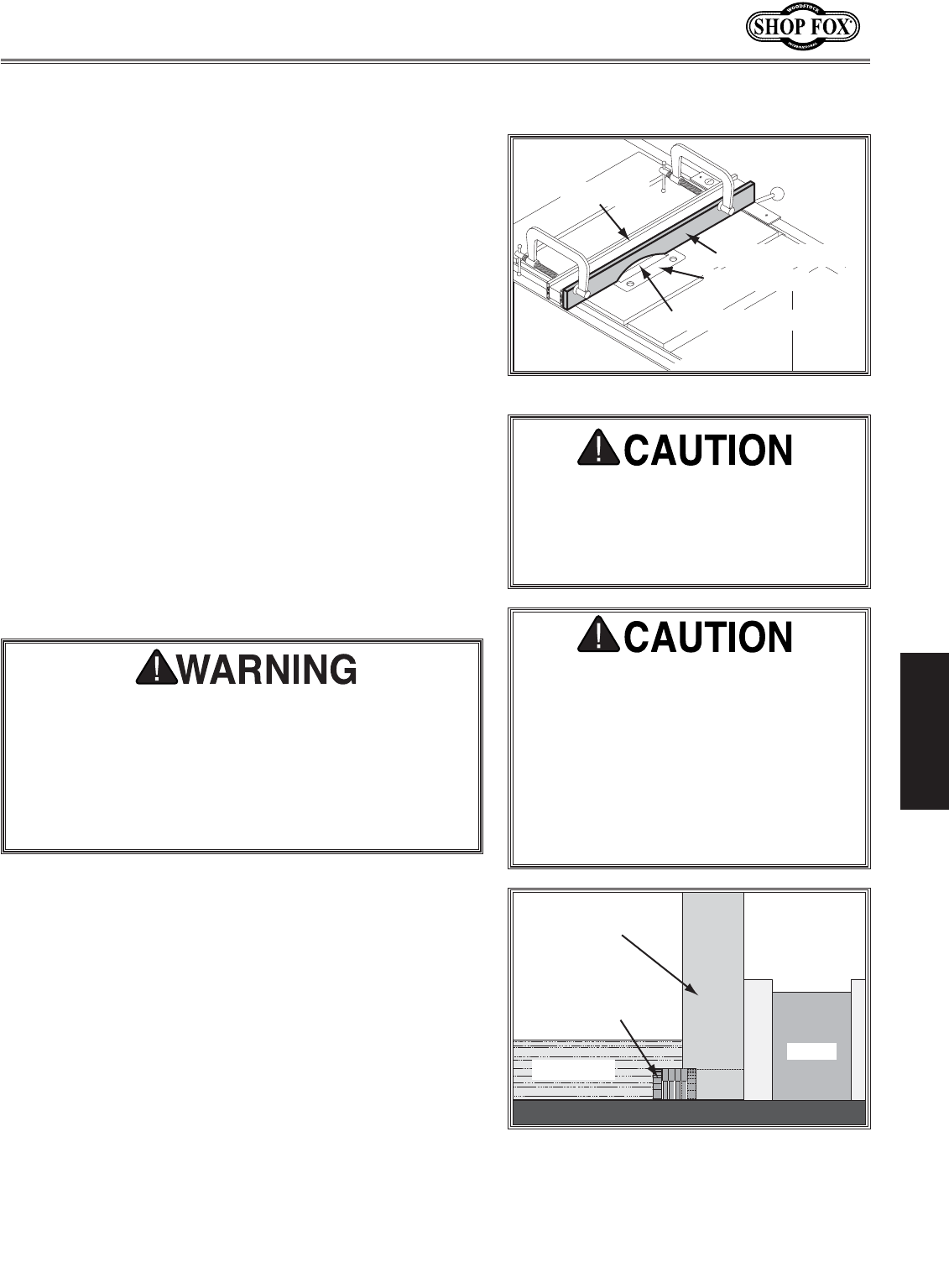
-47-
Df[\cN(/(0&N(/)'D]^%J`eZ\()&('
FG<I8K@FEJ
I`g=\eZ\
JXZi`]`Z`Xc=\eZ\
;X[f@ej\ik
9cX[\:lk$Flk
=`^li\-)%Sacrificial fence.
IXYY\k:lkk`e^
Pfl dXp \og\i`\eZ\ b`ZbYXZb [li`e^
k_`j gifZ\[li\% JkXe[ kf k_\ j`[\ f]
k_\ YcX[\ Xe[ n\Xi jX]\kp ^cXjj\j fi
X ]XZ\ j_`\c[ kf gi\m\ek `ealip n_\e
Zlkk`e^iXYY\kj%
Workpiece
Fence
Dado Blade
Sacrificial Fence
=`^li\-*%Rabbet cutting with a dado
blade
8cnXpjlj\glj_jk`Zbj#]\Xk_\iYfXi[j#
glj_ gX[[c\j Xe[ fk_\i jX]\kp
XZZ\jjfi`\j n_\e\m\i gfjj`Yc\ kf
`eZi\Xj\ jX]\kp Xe[ Zfekifc [li`e^
fg\iXk`fej n_`Z_ i\hl`i\ k_Xk k_\
YcX[\ ^lXi[ Xe[ jgc`kk\i dljk Y\
i\dfm\[ ]ifd k_\ jXn% 8CN8PJ
i\gcXZ\k_\YcX[\^lXi[X]k\i[X[f`e^
`jZfdgc\k\%
Commonly used in furniture joinery, a rabbet is an
L-shaped groove cut in the edge of the workpiece.
Rabbets can be cut with either a dado blade or a standard
saw blade.
Rabbet cutting on the edge of the workpiece requires a
sacrificial fence attachment as shown in =`^li\-). Make
the sacrificial fence the same length as the fence and
3⁄4" thick. Attach it to the fence with screws or clamps,
making sure they are all secure and tight. Raise the
blade into the sacrificial fence to the height needed.
:lkk`e^IXYY\kjn`k_;X[f9cX[\
(% DISCONNECT THE SAW FROM POWER!
)% Adjust the dado blade to the height needed for the
rabbeting operation. When cutting deep rabbets, take
more than one pass to reduce the risk of kickback.
*% Adjust the fence and align the workpiece to perform
the cutting operation, as shown in =`^li\-*.
+% Reconnect the saw to the power source and turn
the saw FE. When the blade has reached full speed,
perform a test cut with a scrap piece of wood.
— If the cut is satisfactory, repeat the cut with the
final workpiece.
Dado blades have a higher risk of kickback than normal
blades because their larger size applies stronger force
to the workpiece. This risk increases relative to the
depth and width of the cut. To minimize your risk of
serious personal injury, ensure that the stock is flat
and straight, and make multiple light cuts (rather than
one deep cut) to achieve the desired cutting depth.
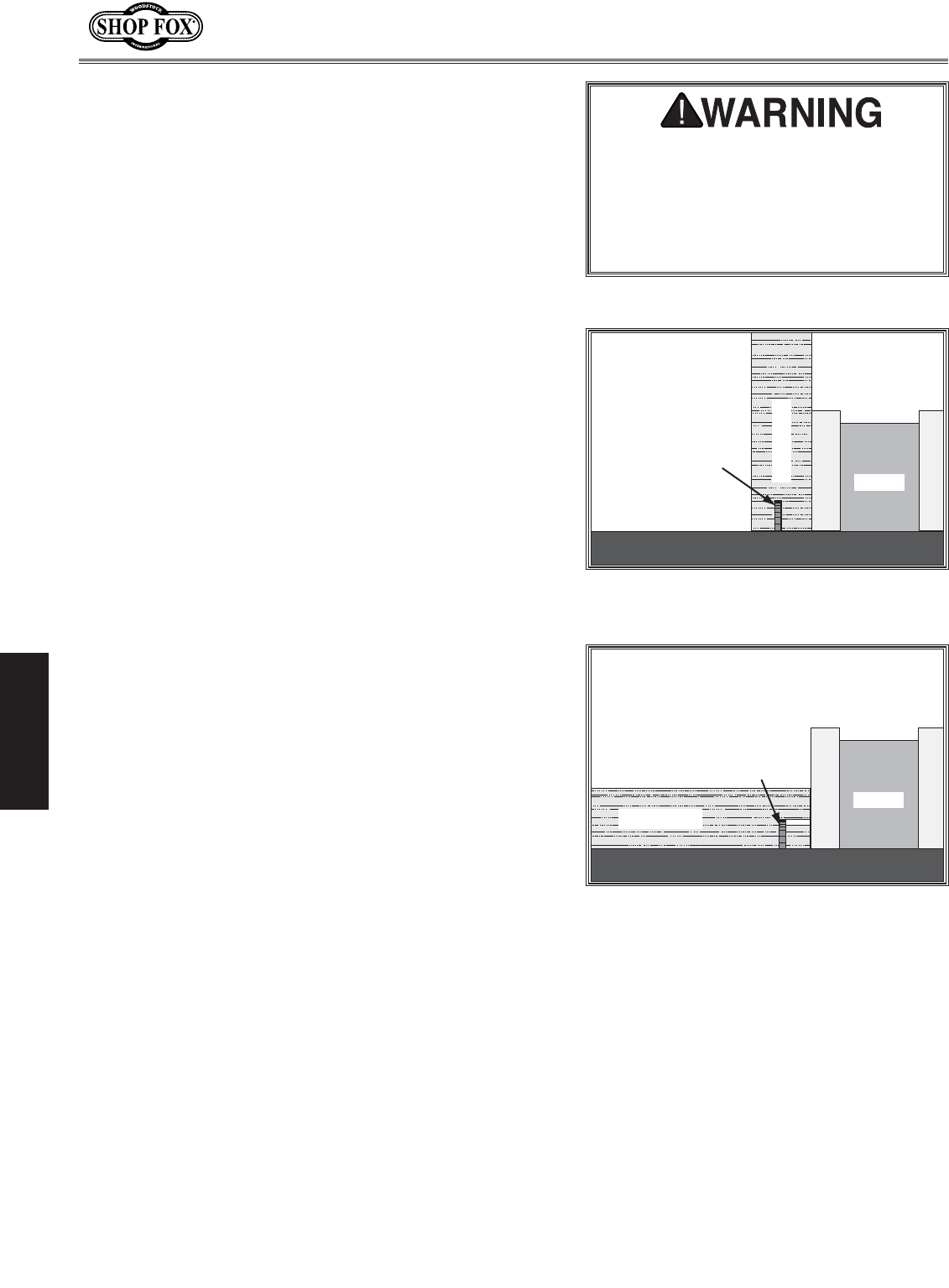
-48-
Df[\cN(/(0&N(/)'D]^%J`eZ\()&('
FG<I8K@FEJ
:lkk`e^IXYY\kjn`k_JkXe[Xi[9cX[\
A ripping blade is typically the best blade to use for
cutting rabbets when using a standard blade because it
removes sawdust very efficiently (see Page 33 for blade
details about ripping blades). Also, a sacrificial fence is
not required when cutting rabbets with a standard blade.
KfZlkXiXYY\kn`k_XjkXe[Xi[YcX[\#[fk_\j\jk\gj1
(% DISCONNECT THE SAW FROM POWER!
)% Ensure that the riving knife and standard table insert
are installed.
*% Mark the width of the rabbet cut on the edge of the
workpiece, so you can clearly identify the intended
cut.
+% Raise the blade up to the desired depth of cut
(depth of rabbet channel desired). When cutting
deep rabbets, take more than one pass to reduce
the risk of kickback.
,% Stand the workpiece on edge, as shown in =`^li\-+,
then adjust the fence so the blade is aligned with the
inside of your rabbet channel.
-% Reconnect the saw to the power source and turn the
saw ON. When the blade has reached full speed, per-
form a test cut with a scrap piece of wood.
— If the cut is satisfactory, repeat the cut with the
final workpiece.
.% Lay the workpiece flat on the table, adjust the
saw blade height to intersect with the first cut, as
shown in =`^li\-,#then perform the second cut to
complete the rabbet.
K_\[Xe^\if]b`ZbYXZb`eZi\Xj\ji\cX$
k`m\kfk_\[\gk_f]XZlk%I\[lZ\k_\
i`jb f] b`ZbYXZb Yp dXb`e^ dlck`gc\
gXjj\jkfXZ_`\m\k_\[\j`i\[[\gk_f]
Zlk% =X`cli\ kf ]fccfn k_\j\ nXie`e^j
Zflc[i\jlck`ej\i`fljg\ijfeXc`ealip%
=`^li\-+%Rabbet cutting with a standard
blade.
Fence
Blade
Workpiece
=`^li\-,%Rabbet cutting with a standard
blade.
Workpiece
Fence
Blade
-49-
Df[\cN(/(0&N(/)'D]^%J`eZ\()&('
FG<I8K@FEJ
I\jXn`e^
Resawing is the process of cutting a thick piece of stock
into one or more thinner pieces. Although resawing can
be done with a table saw, we strongly recommend that
you use a bandsaw instead.
A bandsaw is the ideal machine for resawing, and
resawing with one is fairly easy and safe. A table saw
is not intended for resawing, and resawing with one
is difficult and dangerous due to the increased risk of
kickback from binding and deep cuts, and the increased
risk of injury from having to remove the guard.
If you insist on resawing with a table saw, DO NOT do
so without using a resaw barrier and wearing a full face
shield. The following instructions describe how to build a
resaw barrier and add an auxiliary fence to your standard
fence, to reduce the risk injury from resawing on a table
saw.
Efk\1 This table saw can only resaw wood that is less
than 63⁄8" tall.
I\jXn`e^feXkXYc\jXn`eZi\Xj\jk_\
Z_XeZ\j f] b`ZbYXZb% J\i`flj `ealip
ZXe Y\ ZXlj\[ Yp b`ZbYXZb% B`ZbYXZb
`jX_`^_$jg\\[\oglcj`fef]jkfZb]ifd
k_\kXYc\jXnkfnXi[Xefg\iXkfi%K_\
fg\iXkfifiYpjkXe[\ijdXpY\jkilZb
Yp ]cp`e^ jkfZb# fi k_\ fg\iXkfiËj
_Xe[j ZXe Y\ glcc\[ `ekf k_\ YcX[\
[li`e^b`ZbYXZb%
I\jXn`e^ fg\iXk`fej i\hl`i\ gifg\i
gifZ\[li\j kf Xmf`[ j\i`flj `ealip%
<okiX ZXi\ dljk Y\ kXb\e kf gi\m\ek
b`ZbYXZb n_\e i\jXn`e^% 8ep k`ck`e^
fi dfm\d\ek f] k_\ nfibg`\Z\ XnXp
]ifdk_\]\eZ\n`ccZXlj\b`ZbYXZb%9\
Z\ikX`ek_XkjkfZb`j]cXkXe[jkiX`^_k%
=X`cli\kf]fccfnk_\j\nXie`e^jZflc[
i\jlck`ej\i`fljg\ijfeXc`ealip%
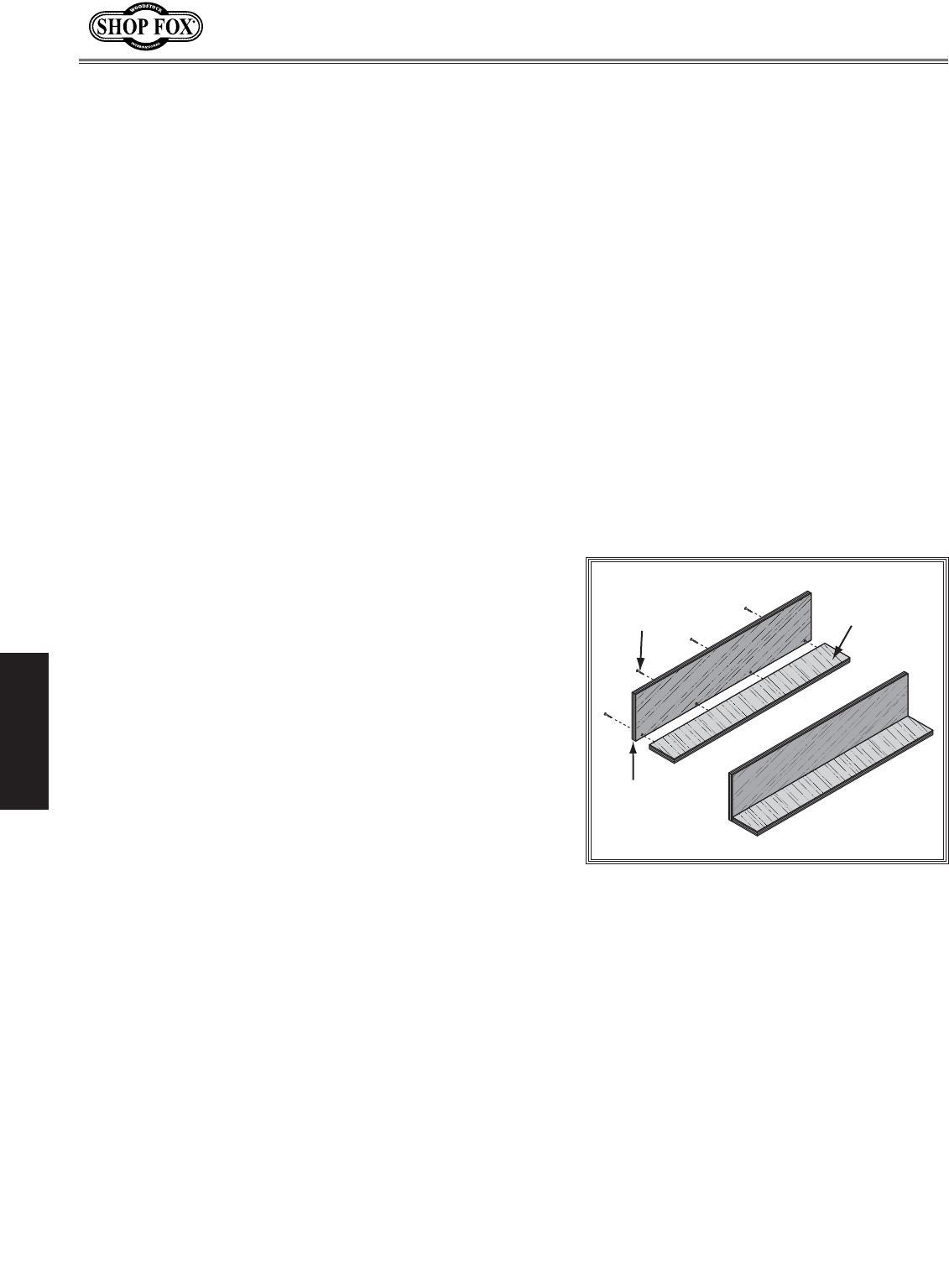
-50-
Df[\cN(/(0&N(/)'D]^%J`eZ\()&('
FG<I8K@FEJ
DXb`e^I\jXn9Xii`\i
The resaw barrier acts in tandem with the rip fence when
resawing to provide tall support for the workpiece to
minimize the probability of it binding against the blade
and causing kickback.
KffcjE\\[\[]fik_\I\jXn9Xii`\i1
Table Saw ........................................................1
Jointer and Planer ............................. Recommended
Clamps ................................................2 Minimum
Drill and Drill Bits ...............................................1
:fdgfe\ekjE\\[\[]fik_\I\jXn9Xii`\i1
Wood* 3⁄4" x 6" x Length of Table Saw Fence ...............1
Wood* 3⁄4" x 3" x Length of Table Saw Fence ...............1
Wood Screws #10 x 2" ..........................................4
Wood Glue ........................................... As Needed
* Fecplj\]lie`kli\^iX[\gcpnff[#b`ce[i`\[_Xi[nff[#
fiL?D?gcXjk`Zkfgi\m\eknXig`e^%
KfYl`c[k_\i\jXnYXii`\i#[fk_\j\jk\gj1
(% Cut your wood pieces to the size specified above.
If you are using hardwood, cut the pieces oversize,
then joint and plane them to the correct size to
make sure they are square and flat.
)% Pre-drill and countersink 4 holes approximately 3⁄8"
from the bottom of the 6" tall board. These will
be use as pilot holes when attaching the board to
another piece in the next step.
*% Glue the end of the 3" board, then clamp the boards
at a 90° angle with the larger board in the vertical
position, as shown in =`^li\--, fasten together with
the wood screws. =`^li\--% Clamping the resawing barrier.
#10 x 2"
Wood Screw
Assembled
Resaw Barrier
3⁄4"
3⁄4"
8lo`c`Xip=\eZ\
The auxiliary fence is necessary if you are resawing a
workpiece that is taller than it is wide. It should be no
less than 1⁄2" shorter than the board to be resawn.
:fdgfe\ekjE\\[\[]fik_\8lo`c`Xip=\eZ\1
Hardwood or Plywood 3⁄4" x (Height) x Length of Table
Saw Fence ........................................................1
KffcjE\\[\[]fik_\I\jXn9Xii`\i1
Table Saw ........................................................1
Jointer and Planer ............................. Recommended
Clamps ................................................2 Minimum
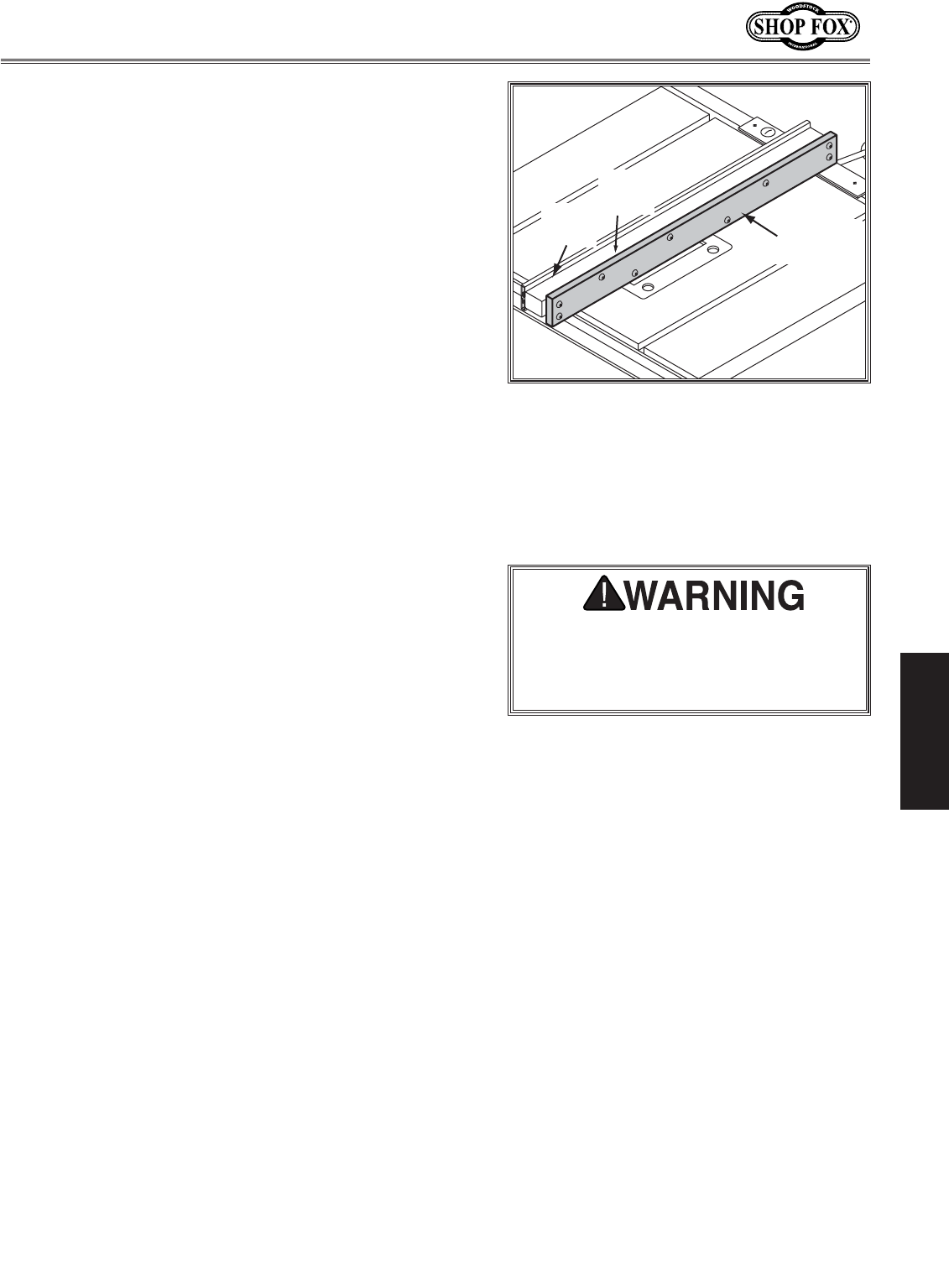
-51-
Df[\cN(/(0&N(/)'D]^%J`eZ\()&('
FG<I8K@FEJ
I\jXn`e^Fg\iXk`fej
The table saw motor is pushed to its limits when
resawing. If the motor starts to bog down, slow down
your feed rate. Motor overloading and blade wear can
be reduced by using a ripping blade. Ripping blades are
designed to clear the sawdust quickly.
:fdgfe\ekjE\\[\[]fiI\jXn`e^1
Zero Clearance Insert ..........................................1
Ripping Blade 10" ...............................................1
Clamps ............................................................2
Shop Made Auxiliary Fence ....................................1
Shop Made Resaw Barrier ......................................1
Kfg\i]fidi\jXn`e^fg\iXk`fej#[fk_\j\jk\gj1
(% DISCONNECT THE SAW FROM POWER!
)% Remove the standard table insert and the blade
guard assembly.
*% Install a ripping blade and the riving knife, lower the
blade below the table, then install a zero clearance
table insert.
=\eZ\
9f[p
8lo`c`Xip
=\eZ\
=\eZ\
=XZ`e^
=`^li\67% Auxiliary fence.
Pfl dXp \og\i`\eZ\ b`ZbYXZb [li`e^
k_`j gifZ\[li\% JkXe[ kf k_\ j`[\ f]
k_\YcX[\Xe[n\XiX]lcc]XZ\j_`\c[kf
gi\m\ek`ealipn_\ei\jXn`e^%
KfYl`c[k_\Xlo`c`Xip]\eZ\#[fk_\j\jk\gj1
(% Cut the auxiliary fence board to size. If you are using
hardwood, cut the board oversize, then joint and
plane the board to the correct size to make sure the
board is square and flat.
Efk\1Fecplj\]lie`kli\^iX[\gcpnff[fib`ce[i`\[
_Xi[nff[kfgi\m\eknXig`e^%
)% Unthread the fence face mounting hardware and
remove the fence face from the fence assembly.
*% Place the auxiliary fence next the fence face you
removed in Jk\g(, mark the location of the nine
mounting holes on the auxiliary fence, then drill the
holes.
+% Use the mounting hardware that had previously
attached the fence face to attach the auxiliary
fence. The end result should be similar to =`^li\67.
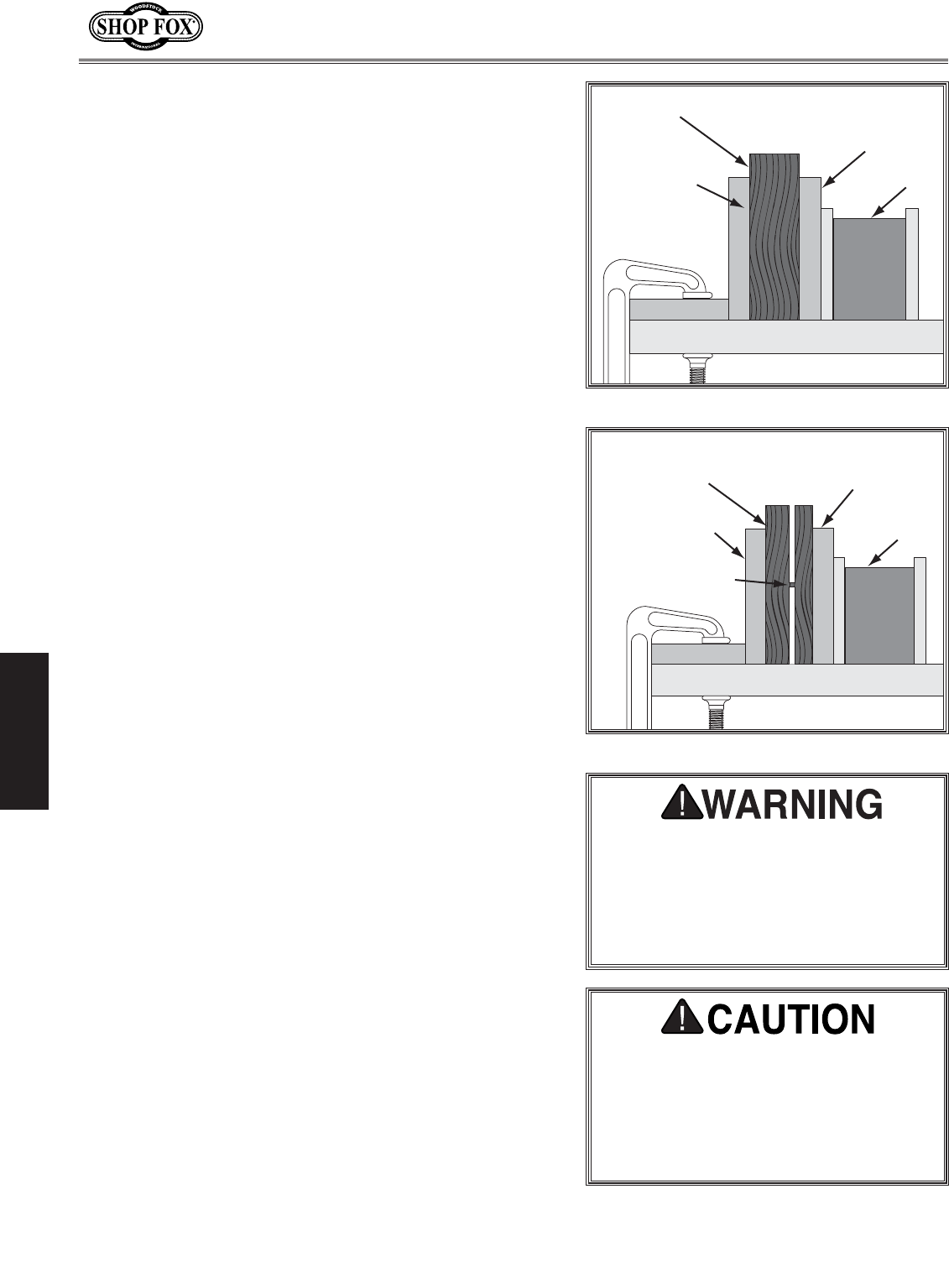
-52-
Df[\cN(/(0&N(/)'D]^%J`eZ\()&('
FG<I8K@FEJ
+% Attach the auxiliary fence to the standard fence and
set it to the desired width.
Efk\1N_\e]`^li`e^flkk_\Zfii\Zkn`[k_#[fefk
]fi^\kkfXZZflek]fiYcX[\b\i]Xe[k_\`eXZZliXZp
f]k_\]\eZ\jZXc\n_`c\k_\Xlo`c`Xip]\eZ\`j
`ejkXcc\[%Kpg`ZXccp`k`jY\jkkflj\Xd\Xjli`e^
kXg\kfj\kk_\]\eZ\%
,% Place the workpiece against the auxiliary fence and
slide the resaw barrier against the workpiece, as
shown in =`^li\68. Now clamp the resaw barrier to
the top of the table saw at both ends.
-% Slide the workpiece over the blade to make sure it
moves smoothly, then remove the workpiece.
.% Raise the blade approximately an inch, or close
to half the height of the workpiece (=`^li\69),
whichever is less.
/% Plug in the table saw, turn it FE, and use a push
stick or push block to feed the workpiece through
the blade, using a slow and steady feed rate.
0% Flip the workpiece end for end, keeping the same
side against the fence, and run the workpiece
through the blade.
('% Repeat Jk\gj.Æ0 until the blade is close to half
of the height of the board to be resawn. The ideal
completed resaw cut will leave a 1⁄8" connection
when the resawing is complete as shown in =`^li\
69. Leaving a 1⁄8" connection will reduce the risk of
kickback.
((% Turn F== the table saw, then separate the parts of
the workpiece and hand plane the remaining ridge to
remove it.
()% When finished resawing, remove the resaw barrier
and auxiliary fence, then re-install the blade guard/
spreader or riving knife and standard table insert.
=`^li\-/. Ideal resaw workpiece setup.
8lo`c`Xip
=\eZ\
=\eZ\
I\jXn
9Xii`\i
Nfibg`\Z\ (Front View)
=`^li\69% Ideal completed resaw cut.
8lo`c`Xip
=\eZ\
=\eZ\
I\jXn
9Xii`\i
(&/:fee\Zk`fe
Nfibg`\Z\
8cnXpjlj\glj_jk`Zbjfiglj_gX[[c\j
kf `eZi\Xj\ jX]\kp Xe[ Zfekifc [li`e^
fg\iXk`fejn_`Z_i\hl`i\k_Xkk_\YcX[\
^lXi[ Xe[ jgi\X[\i dljk Y\ i\dfm\[
]ifdk_\jXn%8CN8PJi\gcXZ\k_\YcX[\
^lXi[X]k\ii\jXn`e^`jZfdgc\k\%
K_\ [Xe^\i f] b`ZbYXZb `eZi\Xj\j
i\cXk`m\ kf k_\ [\gk_ f] X Zlk% I\[lZ\
k_\i`jbf]b`ZbYXZbYpdXb`e^dlck`gc\
gXjj\jkf XZ_`\m\ k_\ [\j`i\[[\gk_ f]
Zlk% =X`cli\ kf ]fccfn k_\j\ nXie`e^j
Zflc[i\jlck`ej\i`fljg\ijfeXc`ealip%
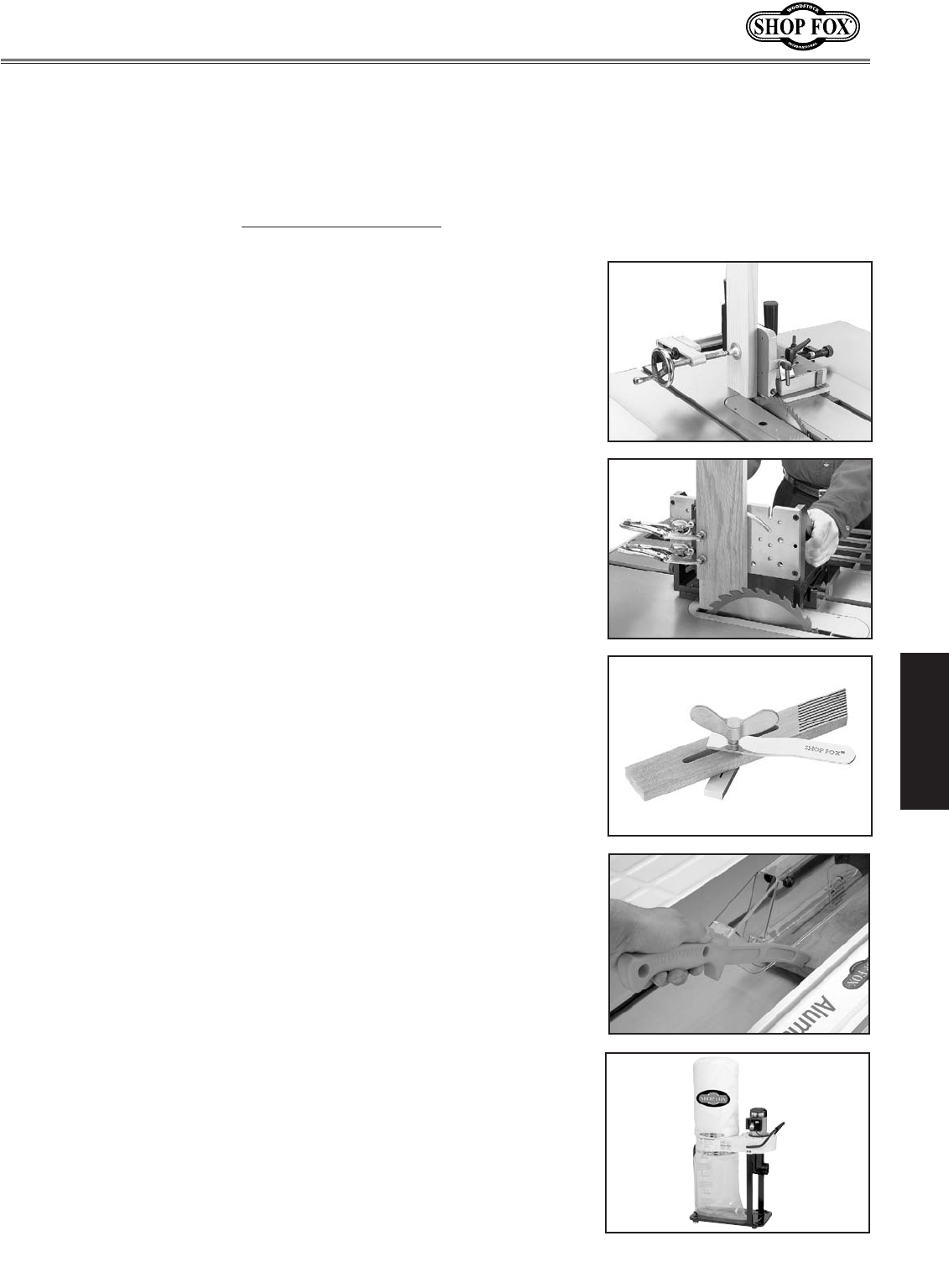
-53-
Df[\cN(/(0&N(/)'D]^%J`eZ\()&('
FG<I8K@FEJ
KXYc\JXn8ZZ\jjfi`\j
The following table saw accessories may be available through your local Woodstock International Inc.
Dealer. If you do not have a dealer in your area, these products are also available through online deal-
ers. Please call or e-mail Woodstock International Inc. Customer Service to get a current listing of deal-
ers at: 1-800-840-8420 or at sales@woodstockint.com.
TheDf[\c;*)+-Shop FoxK\efe`e^A`^ZXe_\cgpflproduce
perfect tenons for mortise and tenon joinery. This tenoning jig also
adjusts for angled tenon cutting set-ups. Standard 3/8" x 3/4" miter bar
fits all miter gauge slots including T-slots.
The Df[\c;*'0-Shop Fox=\Xk_\iYfXi[ can reduce the risk of
kick-back and help you achieve consistent results. Designed to lock
into standard 3/8" x 3/4" miter gauge slots, these featherboards are
adjustable for various stock widths and miter slot locations. No drill-
ing or bulky clamp arrangements.
The Df[\cN(,'' Shop FoxI`^_k8e^c\A`^is constructed using
top quality aluminum castings and plates which are machined to
exacting tolerances. It has the perfect weight-use ratio to dampen
vibration, yet is still light enough to easily slide the workpiece
through the machining process. Its quality and precision are evident
from the first cut. Cut tenons, dados, rail ends, and finger joints
safely and with complete accuracy.
The Df[\c ;*())Shop FoxGlj_Jk`Zbcan help you keep your
hands a safe distance from blades and cutters while still maintaining
control of the workpiece against machine fences. A true necessity
when running narrow stock. Durable handle is designed for maximum
control. Measure 131/2" overall.
The Df[\c N(.).Shop Fox(?G;ljk:fcc\Zkfiis the perfect
companion for the Model W1819/W1820. It packs a 1 HP, 110V/220V,
single-phase motor and 800 CFM air suction capacity.
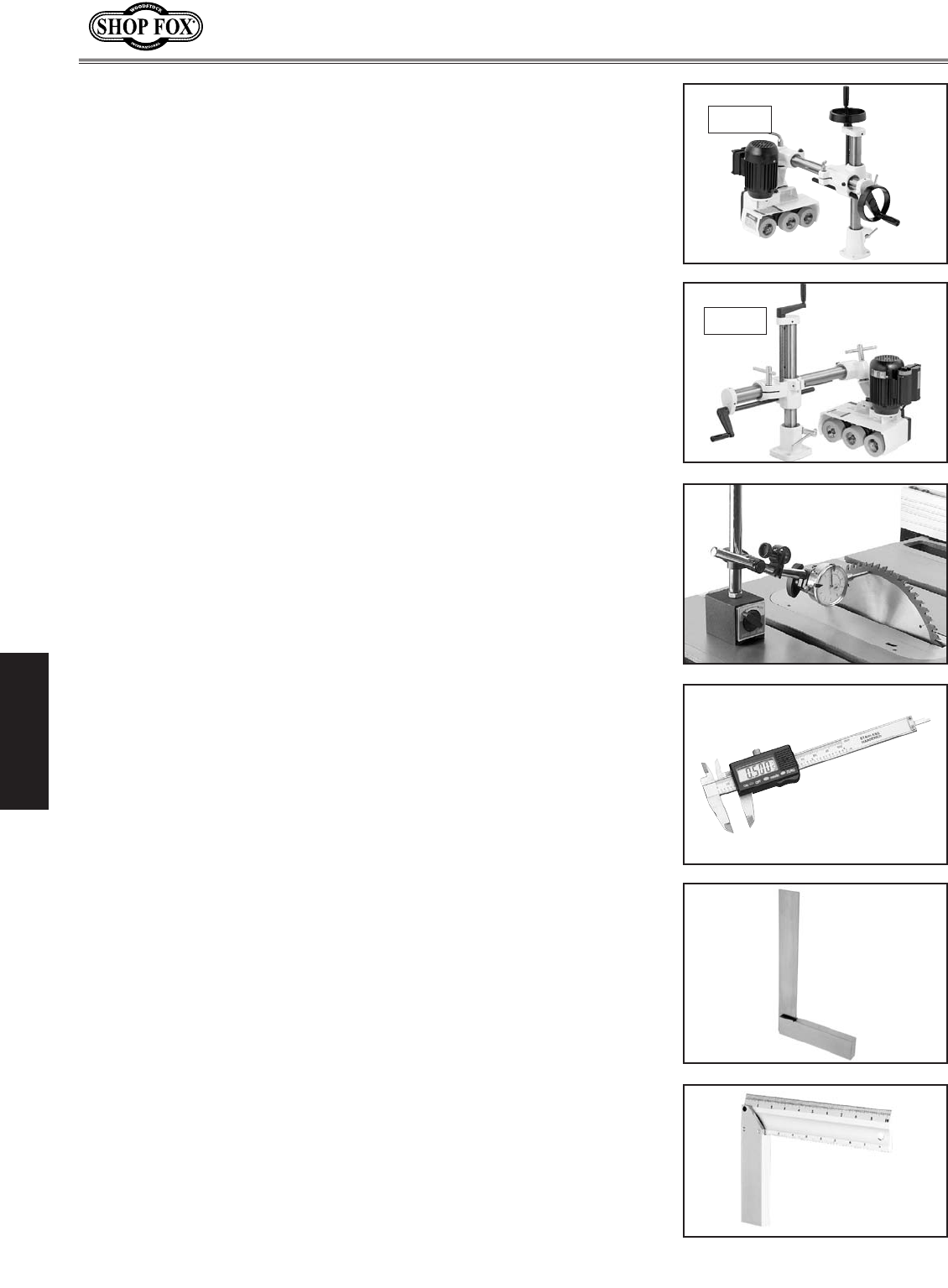
-54-
Df[\cN(/(0&N(/)'D]^%J`eZ\()&('
FG<I8K@FEJ
TheDf[\c;*)'. DX^e\k`Z9Xj\n`k_;`Xc@e[`ZXkfi`e:Xj\ is the
best value in precision measuring instruments. Powerful magnetic
base with infinitely adjustable control arm, fine tuning beam
and magnetic switch. Add to this the 1" travel dial indicator with
divisions of 0.001", 0.100" per revolution, and a 0.100" counter and
any setup job is a snap.
9Xc[<X^c\;`^`kXc:Xc`g\ij are very nice digital calipers with the
following features: Extra large LCD readout. Accuracy: ± 0.001"/
0.02mm. Resolution: 0.0005/ 0.01mm. Inch and metric digital display.
Stainless steel construction. Built-in computer interface port with
automatic shutoff.
9<('*(: 4 Digital Caliper
9<('*): 6" Digital Caliper
9<('**: 8" Digital Caliper
;**/*: 4" Precision Square
;**/+: 6" Precision Square
High precision 8cld`eldJhlXi\j are perfect for square layouts and
machine setup.
;*'-/: 10" Aluminum Square
;*'-01 12" Aluminum Square
;*'.'1 18" Aluminum Square
;*'.(1 24" Aluminum Square
D3384
Gfn\i=\\[\ijwill make light work out of those big jobs with
greater accuracy and safety. TheDf[\cN(.-,features a 1⁄4 HP,
110V, 1.8 Amp motor. The Df[\cN(.-- features a 1⁄2 HP, 220V, 4
Amp motor. Both models feature forward/reverse, XYZ adjustment,
multiple feed speeds, and synthetic rubber wheels.
W1765
W1766
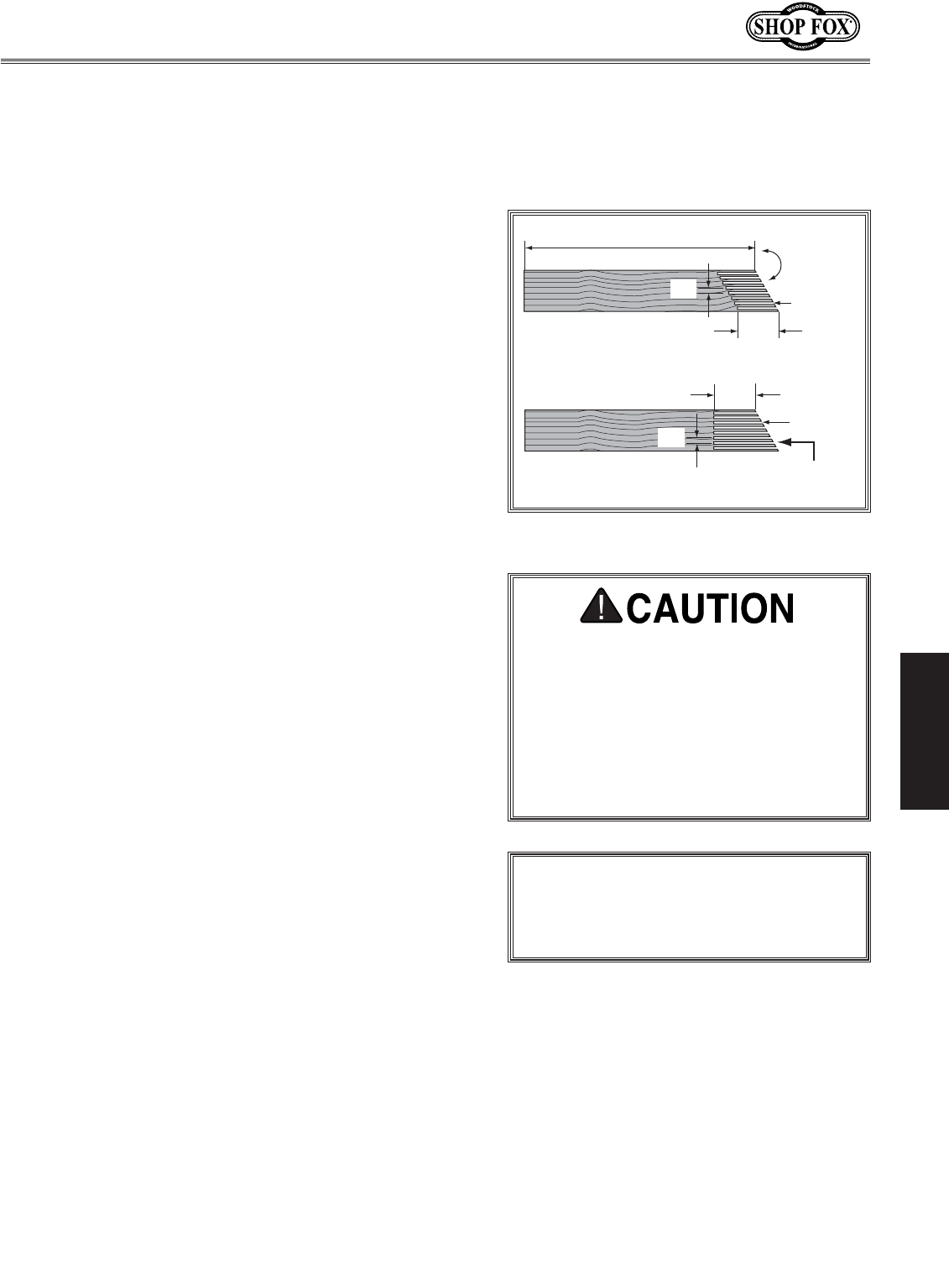
-55-
Df[\cN(/(0&N(/)'D]^%J`eZ\()&('
FG<I8K@FEJ
=\Xk_\iYfXi[j
Easily made from scrap stock, featherboards (=`^li\.')
provide an added degree of protection against kickback,
especially when used together with push sticks. They
also maintain pressure on the workpiece to keep it
against the fence or table while cutting, which makes
the operation easier and safer because the cut can be
completed without the operator’s hands getting near the
blade. The angled ends and flexibility of the fingers allow
the workpiece to move in only one direction, which helps
slow/stop the workpiece if a kickback occurs.
DXb`e^X=\Xk_\iYfXi[
This sub-section covers the two basic types of
featherboards: 1) Those secured by clamps to the table or
fence, or 2) those secured by a wood runner that mounts
in the table saw miter slot.
Materials for Clamp-Mounted Featherboard
Hardwood 3⁄4" x 3"-6" x 10"-28" ...............................1
Materials for Miter Slot-Mounted Featherboard
Hardwood 3⁄4" x 3"-6" x 10"-28" ...............................1
Hardwood 3⁄8" x (Miter Slot Width) x 5"L ...................1
Wing Nut 1/4"-20 .................................................1
Flat Head Screw 1⁄4"-20 x 2" ..................................1
Flat Washer 1⁄4"-20 .............................................1
To make a featherboard, do these steps:
(% Cut a hardwood board 3⁄4" thick to size. The length
and width of the board can vary according to your
design. Most featherboards are 10"–28" long and 3"–6"
wide. Make sure the wood grain runs parallel with
the length of the featherboard, so the fingers you
create in Jk\g* will bend without breaking.
)% Cut a 30º angle at one end of the board.
J?FG$D8;<J8=<KP8::<JJFI@<J
A
B
30°
2"-3"
1/16"-1/8"
Kerf
1/16"-1/8"
Kerf
2"-3"
10" (Minimum)
Initial Cut
Progressively
Longer Cuts
3/8"
3/8"
=`^li\.'% Patterns for featherboards
(top view shown).
N\i\Zfdd\e[lj`e^XYXe[jXn]fi
dXb`e^]`e^\ijY\ZXlj\`kk\e[jkf
Y\jX]\i%8kXYc\jXnZXeY\lj\[#
Ylk`kn`ccfm\i$Zlkk_\le[\ij`[\f]
k_\\e[j#gif[lZ\Xk_`Zb\ib\i]#Xe[
i\hl`i\pflkfjkfgk_\YcX[\_Xc]$
nXpk_ifl^_k_\Zlk#n_`Z_ZXeY\
[Xe^\iflj%
EFK@:<
Fecpjk\gj(Æ*Xi\i\hl`i\[kfdXb\X
ZcXdg$dflek\[]\Xk_\iYfXi[%
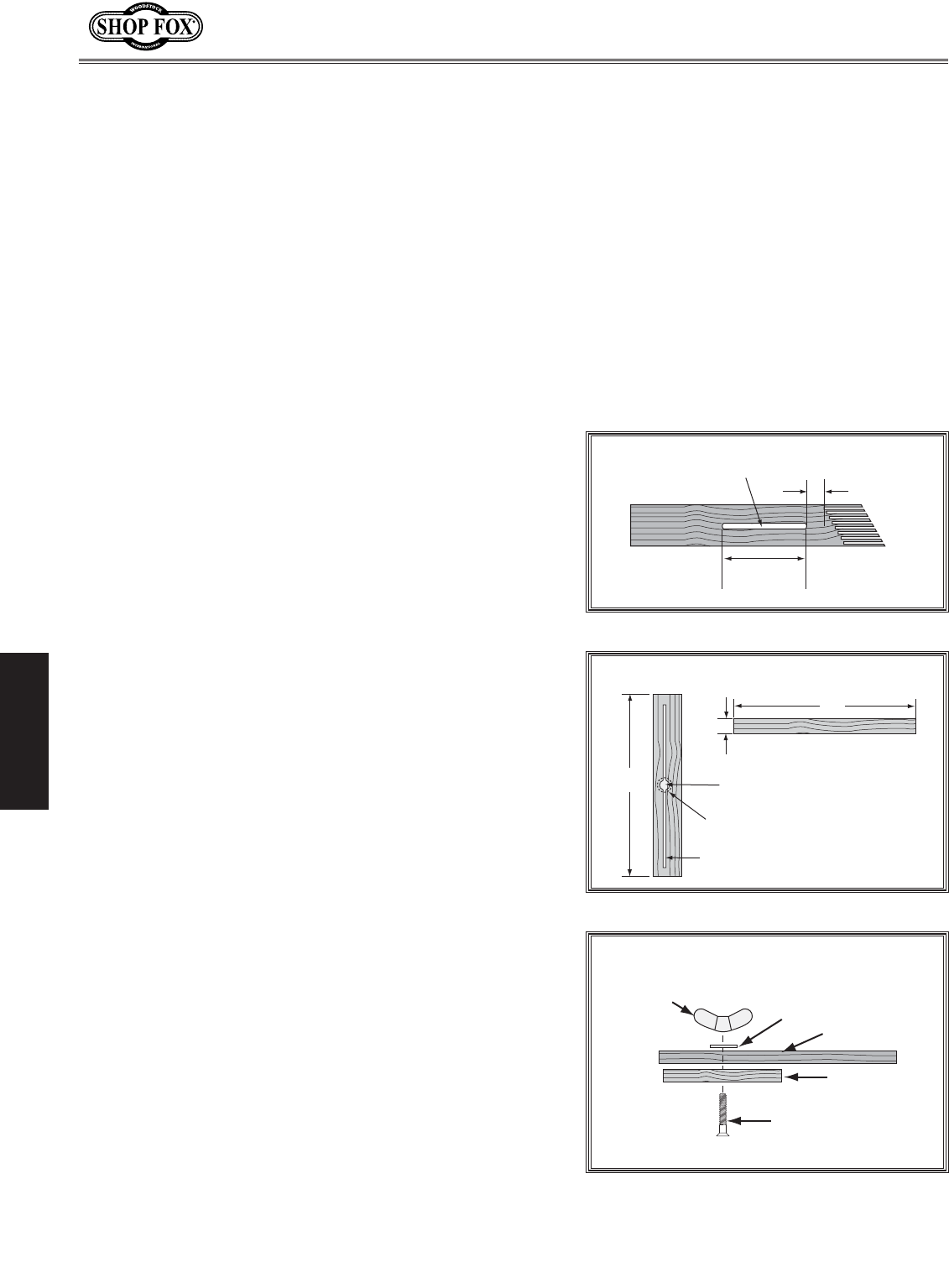
-56-
Df[\cN(/(0&N(/)'D]^%J`eZ\()&('
FG<I8K@FEJ
1"-2"
4"-5"
1/4"-3/8" Slot
=`^li\.(% Slot routed in featherboard.
5"
5"
4" Slot
(Top View) (Side View)
3/8"
Countersink on Bottom
1/4" Hole
=`^li\.)% Miter bar pattern.
(Side View)
Wing Nut
Miter Bar
Featherboard
Flat Head Screw
Flat Washer
=`^li\.*% Assembling miter slot
featherboard components.
+% Rout a
1⁄4"–3⁄8" wide slot 4"–5" long in the workpiece
and 1"–2" from the short end of the featherboard
(see =`^li\.().
,% Cut a miter bar that will fit in the table miter slot
approximately 5" long, as shown in =`^li\.).
K`g1:fej`[\idXb`e^k_\d`k\iYXicfe^\i]ficXi^\i
]\Xk_\iYfXi[jÇXggifo`dXk\cp_Xc]k_\c\e^k_f]k_\
kfkXc]\Xk_\iYfXi[Çkfjlggfikk_\]fiZ\Xggc`\[kf
k_\]\Xk_\iYfXi[[li`e^lj\%
K`g1 K_\c\e^k_f]k_\]cXk_\X[jZi\n[\g\e[jfe
k_\k_`Zbe\jjf]k_\]\Xk_\iYfXi[Çk_fl^_((Ð)kf)
c\e^k_jljlXccpnfib%
Now, proceed to Dflek`e^=\Xk_\iYfXi[`eD`k\i
Jcfk on GX^\,..
-% Drill a
1⁄4" hole in the center of the bar, then
countersink the bottom to fit a 1⁄4"-20 flat head
screw.
.% Mark a 4" line through the center of the countersunk
hole, then use a jig saw with a narrow blade to cut
it out.
/% Assemble the miter bar and featherboard with a 1⁄4"-
20 x flat head screw, flat washer, and a wing nut or
a star knob (see =`^li\.*). Congratulations! Your
featherboard is complete.
*% Make a series of end cuts with the grain,
approximately 3⁄8"–1⁄4" apart and 2"–3" long, as shown
in =`^li\.'(A).
Alternatively, start cuts at 2"-3" deep, then make
them progressively deeper, as shown in =`^li\.'
(B).
@DGFIK8EK1 Cuts made across the grain will result
in weak fingers that easily break when flexed. When
made correctly, the fingers should withstand flexing
from moderate pressure. To test the finger flexibility,
push firmly on the ends with your thumb. If the
fingers do not flex, they are likely too thick (the
cuts are too far apart).
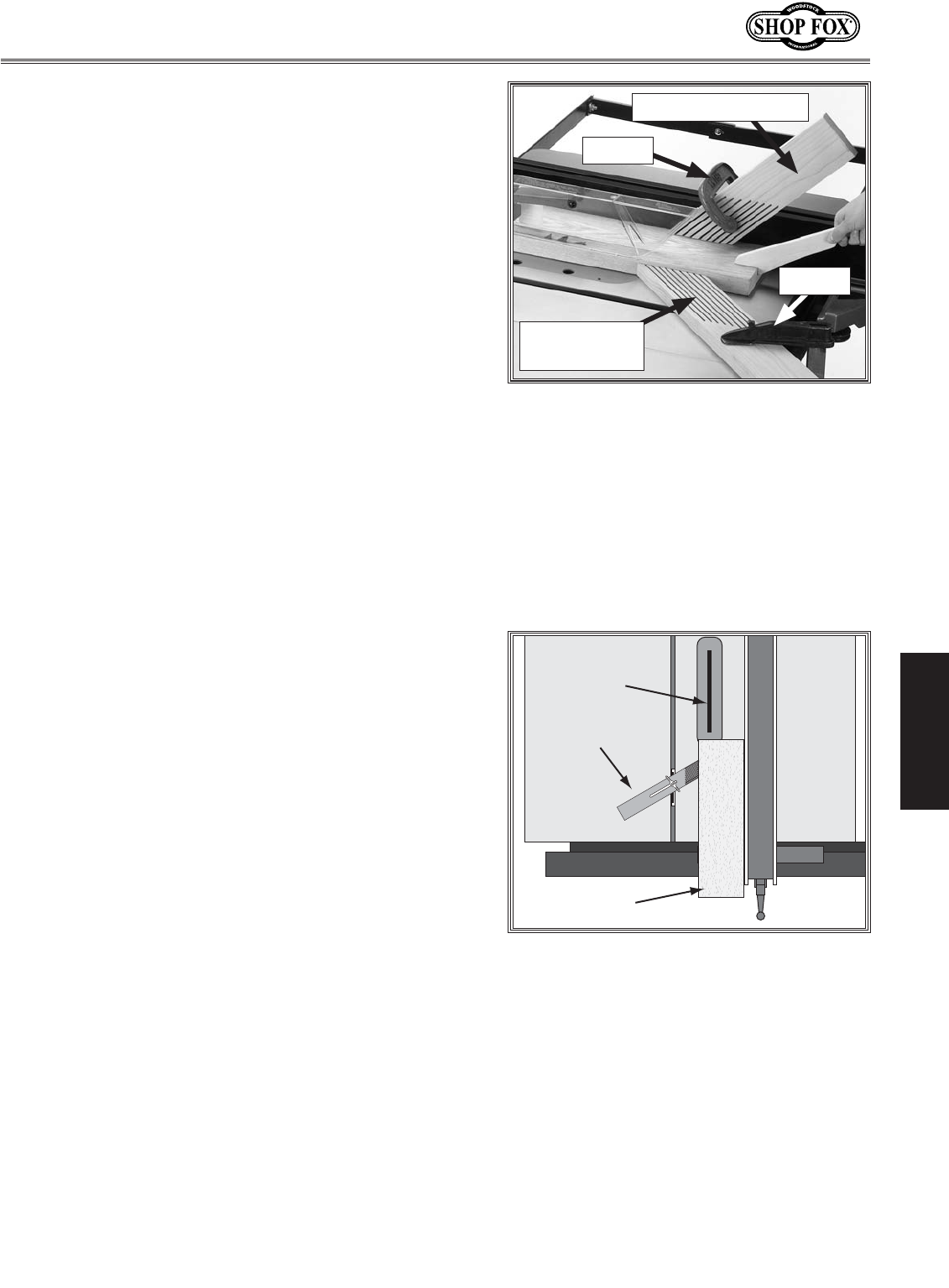
-57-
Df[\cN(/(0&N(/)'D]^%J`eZ\()&('
FG<I8K@FEJ
Dflek`e^=\Xk_\iYfXi[jn`k_:cXdgj
(% Lower the saw blade, then adjust the fence to the
desired width and secure it.
)% Place the workpiece against the fence, making sure
it is 1" in front of the blade.
*% Place a featherboard on the table away from the
blade so all fingers point forward and contact the
workpiece (see =`^li\.+).
+% Secure the featherboard to the table with a clamp.
,% Check the featherboard by pushing it with your
thumb to ensure it is secure.
— If the featherboard moves, tighten the clamp
more.
-% Mount a second featherboard to the fence with
another clamp (see =`^li\.+), then repeat Jk\g,
to ensure it is secure.
Dflek`e^=\Xk_\iYfXi[`eD`k\iJcfk
(% Lower the saw blade, then adjust the fence to the
desired width and secure it.
)% Place the workpiece evenly against the fence, with
the end approximately 1" in front of the blade.
*% Slide the featherboard miter bar into the miter slot,
making sure the fingers slant toward the blade, as
shown in =`^li\.,.
+% Position the fingered edge of the featherboard
against the edge of the workpiece, so that all
of the fingers contact the workpiece. Slide the
featherboard toward the blade until the first finger
is nearly even with the end of the workpiece, which
should be approximately 1" away from the blade.
,% Double check the workpiece and the featherboard to
ensure they are properly positioned as described in
Jk\g+. Then secure the featherboard to the table.
Check the featherboard by hand to make sure it is
tight.
Efk\1 K_\]\Xk_\iYfXi[j_flc[Y\gcXZ\[]`idcp
\efl^_X^X`ejkk_\nfibg`\Z\kfb\\g`kX^X`ejkk_\
]\eZ\Ylkefkjfk`^_kk_Xk`k`j[`]]`Zlckkf]\\[k_\
nfibg`\Z\%
=`^li\.+% Example of featherboards
secured with clamps.
Featherboard
Blade
Workpiece
=`^li\.,% Featherboard installed in miter
slot and supporting workpiece for ripping
cut.
Fence Featherboard
Table
Featherboard
Clamp
Clamp
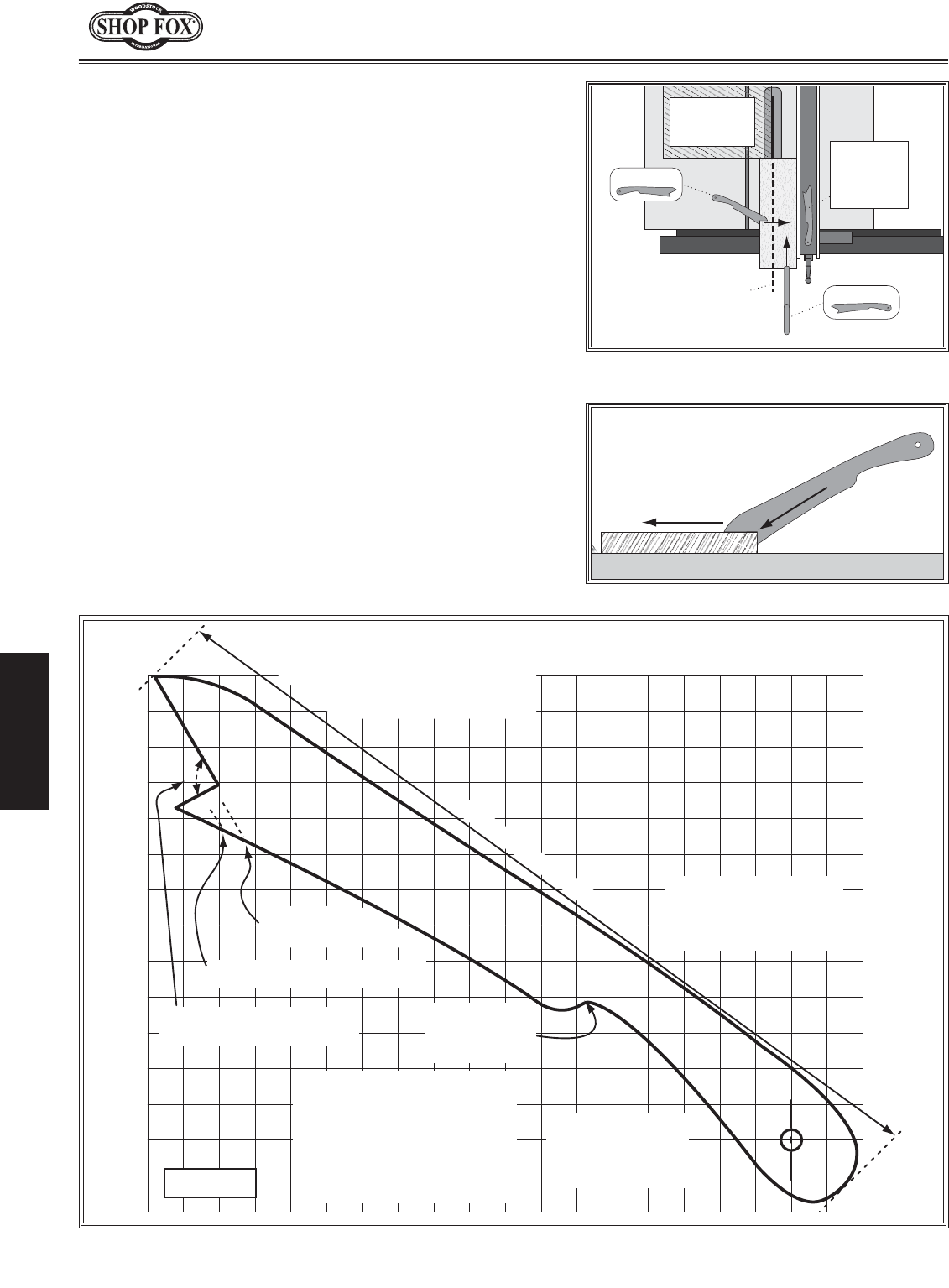
-58-
Df[\cN(/(0&N(/)'D]^%J`eZ\()&('
FG<I8K@FEJ
Glj_Jk`Zbj
When used correctly, push sticks reduce the risk of injury
by keeping hands away from the blade while cutting. In
the event of an accident, a push stick can absorb damage
that would have otherwise happened to hands or fingers.
Use push sticks whenever your hands will get within 12"
of the blade. To maintain control when cutting large
workpieces, start the cut by feeding with your hands then
use push sticks to finish the cut, so your hands are not on
the end of the workpiece as it passes through the blade.
=\\[`e^1 Place the notched end of the push stick
against the end of the workpiece (see inset =`^li\.-),
and move the workpiece into the blade with steady
downward and forward pressure.
Jlggfik`e^1 A second push stick can be used to keep the
workpiece firmly against the fence while cutting. When
using a push stick in this manner, only apply pressure
before the blade; otherwise, pushing the workpiece
against or behind the blade will increase the risk of
kickback (see =`^li\.-).
90º
Cut here to
push 1⁄4" stock
Cut here to push 1⁄2" stock
Notch for placing on
corners of workpieces
15
3
/
4
" Minimum Length
MATERIAL: Only use hard-
wood, sturdy plywood, or
high-density plastic. Do not
use softwood that may break
under pressure or metal that
can break teeth from the
blade!
SANDING: Sand
edges to remove
rough edges and
increase comfort.
SIZING: Push stick must
be at least 15 3⁄4" long.
Use 1⁄2"–3⁄4" thick
material.
Notch to help
prevent hand
from slipping
1⁄2" Grid
=`^li\78. Template for a basic shop-made push stick (not shown at actual size).
DXb`e^XGlj_Jk`Zb
Use this template to make
your own push stick.
=`^li\..% Side view of push stick in-use.
Feeding
Supporting
Blade
Path Push Stick
Push Stick
Push Stick
Prohibition
Zone Store Push
Stick Here
for Easy
Access
=`^li\.-% Using push sticks to rip narrow
stock.
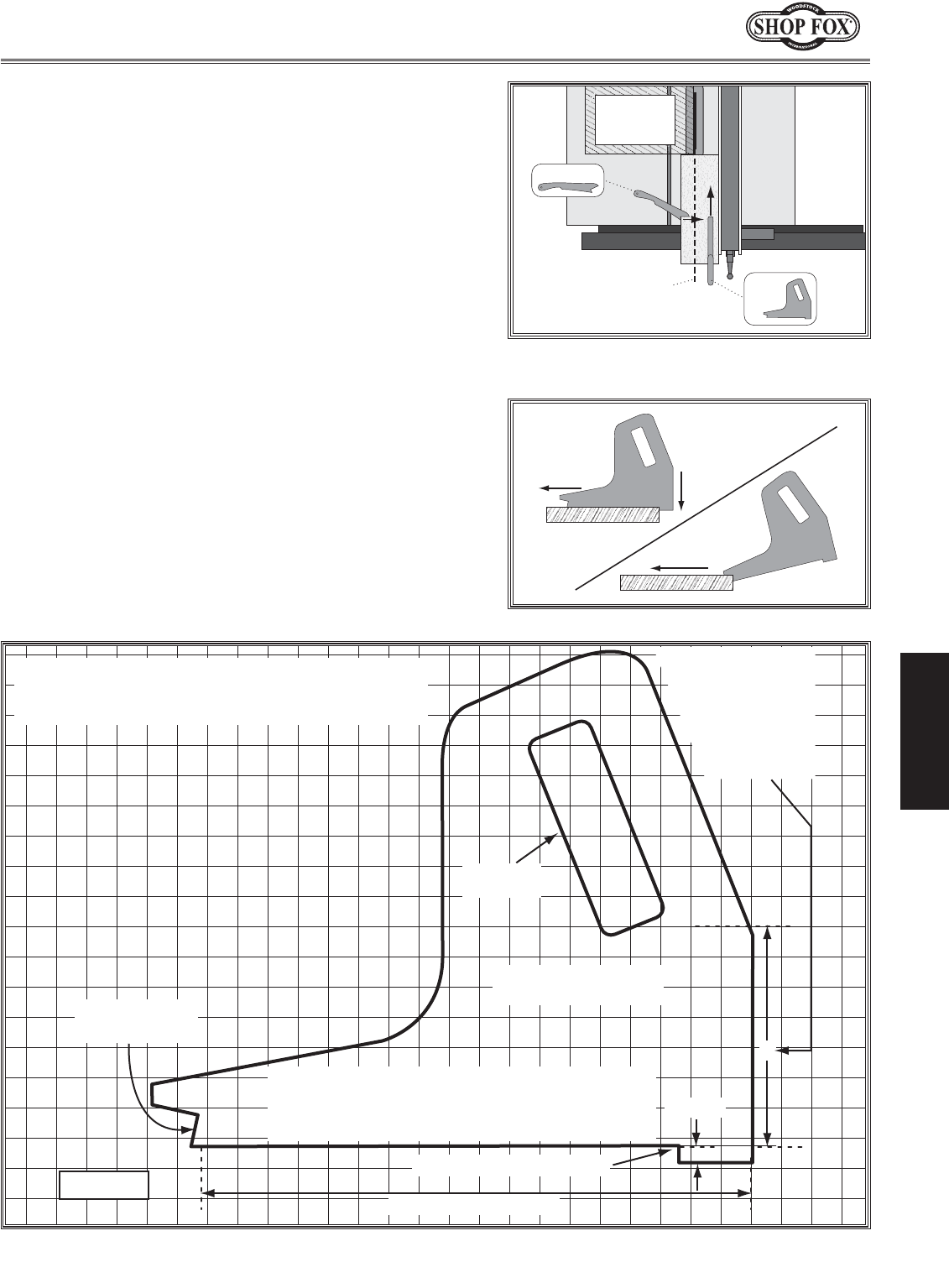
-59-
Df[\cN(/(0&N(/)'D]^%J`eZ\()&('
FG<I8K@FEJ
Glj_9cfZbj
When used correctly, a push block reduces the risk of
injury by keeping hands away from the blade while
cutting. In the event of an accident, a push block often
takes the damage that would have otherwise happened
to hands or fingers.
A push block can be used in place of or in addition to
a push stick for feeding workpieces into the blade. Due
to their design, push blocks allow the operator to apply
firm downward pressure on the workpiece that could not
otherwise be achieved with a push stick.
The push block design on this page (see =`^li\81) can
be used in two different ways (see =`^li\80). Typically,
the bottom of the push block is used until the end of the
workpiece reaches the blade.
The notched end of the push block is then used to push
the workpiece the rest of the way through the cut,
keeping the operator's hands at a safe distance from the
blade. A push stick is often used at the same time in the
other hand to support the workpiece during the cut.
=`^li\/'. Side view of push block in use.
Blade
Path
Push Stick
Push
Block
Push Stick
Prohibition
Zone
Feeding
Supporting
=`^li\.0% Using a push block and push
stick to make a rip cut.
9"−10" Minimum Length
Lip for pushing workpiece
Handle for
firm grip
Make push block with
1⁄2"–3⁄4" thick material
1⁄4"–1⁄2"
4"
Notch for use
as a push stick
1⁄2" Grid
CAUTION: Only use hardwood, sturdy plywood, or
high-density plastic. Do not use softwood that
may break under pressure or metal that can break
teeth from the blade!
CAUTION: Bottom
of handle must be
at least 4" above
bottom of push
block to keep
hand away from
blade.
=`^li\/(. Template for a basic shop-made push stick (not shown at actual size).
DXb`e^XGlj_9cfZb
Use this template to make your own push block.
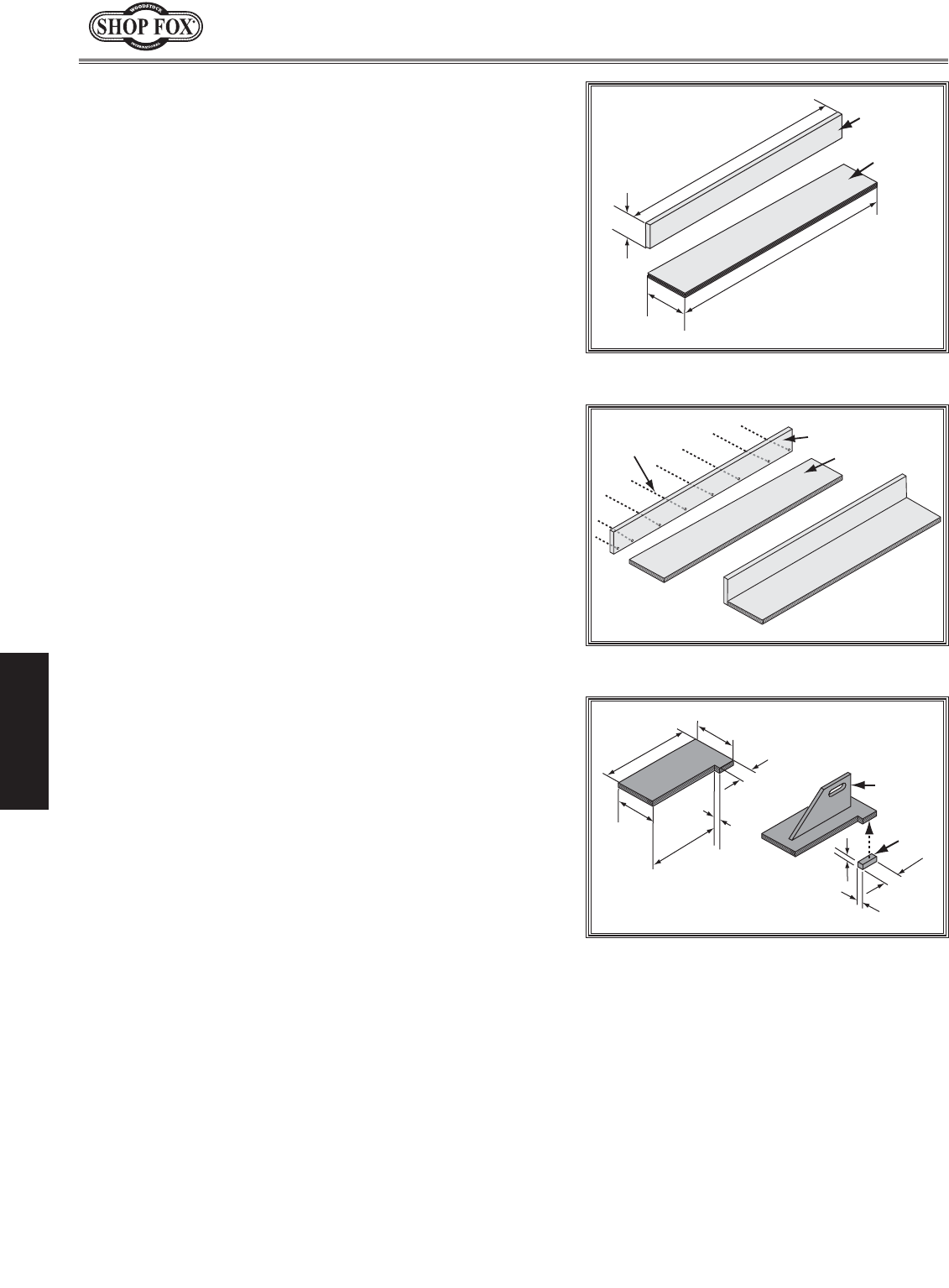
-60-
Df[\cN(/(0&N(/)'D]^%J`eZ\()&('
FG<I8K@FEJ
EXiifn$I`g8lo`c`Xip
=\eZ\Glj_9cfZb
There are designs for hundreds of specialty jigs that can
be found in books, trade magazines, and the internet.
These types of jigs can greatly improve the safety and
consistentcy of cuts. They are particularly useful during
production runs when dozens or hundreds of the same
type of cut need to be made.
The narrow-rip auxiliarly fence and push block system
shown in this section is an example of a specialty jig that
can be made to increase the safety of very narrow rip
cuts.
DXb`e^XEXiifn$I`gGlj_9cfZb]fiXe
8lo`c`Xip=\eZ\
Materials for Narrow-Rip Push Block & Auxiliary Fence
Hardwood 3⁄4" x 3" x Length of Fence .......................1
Plywood 1⁄2" x 51/4" x Length of Fence .....................1
Plywood 1⁄2" x 10" x 5"-9" .....................................1
Plywood 1⁄2" x 15" x 53⁄8" ......................................1
Wood Screws #8 x 11/4" ............................ As Needed
KfdXb\XeXiifn$i`gglj_YcfZb#[fk_\j\jk\gj1
(% Cut a piece of 1⁄2" thick plywood 5
1⁄4" wide and as
long as your table saw fence; cut a piece of 3⁄4"
thick hardwood 3" wide and as long as your table
saw fence, as shown in =`^li\/).
Efk\1 N\i\Zfdd\e[Zlkk`e^k_\_Xi[nff[YfXi[
fm\ij`q\#k_\eaf`ek`e^Xe[gcXe`e^`kkfk_\Zfii\Zk
j`q\kfdXb\jli\k_\YfXi[`jjhlXi\Xe[]cXk%Fecp
lj\]lie`kli\$^iX[\gcpnff[fib`ce$[i`\[_Xi[nff[
kfgi\m\eknXig`e^%
)% Pre-drill and countersink eight pilot holes 3⁄8" from
the bottom of the 3" wide board, as shown in =`^li\
83, then fasten the 5
1⁄4" and 3" wide boards with
eight #8 x 11⁄4" wood screws.
+% Using the
1⁄2" material you used in the previous
steps, cut out pieces for the push block per the
dimensions shown in =`^li\/+; for the handle, cut
a piece 10" long by 5"–9" high and shape it as desired
to fit in your hand.
,% Attach the handle to the base with #8 x 11⁄4" wood
screws, attach the lip to the base with cyanoacrylate
type wood glue.
3"
Length
of Fence
Length
of Fence
51⁄4"
3⁄4"
Hardwood
1⁄2"
Plywood
=`^li\/)% Auxiliary fence dimensions.
=`^li\83%Location of pilot holes.
1⁄2" Plywood
Completed
Fence
Pilot Holes
3⁄4" Hardwood
5 5⁄8"
15"
5 1⁄4"
12 1⁄2"
2 1⁄2"
3⁄8"
Lip
Handle
3⁄8"
3⁄8"2 1⁄2"
=`^li\/+% Push block dimensions and
construction.
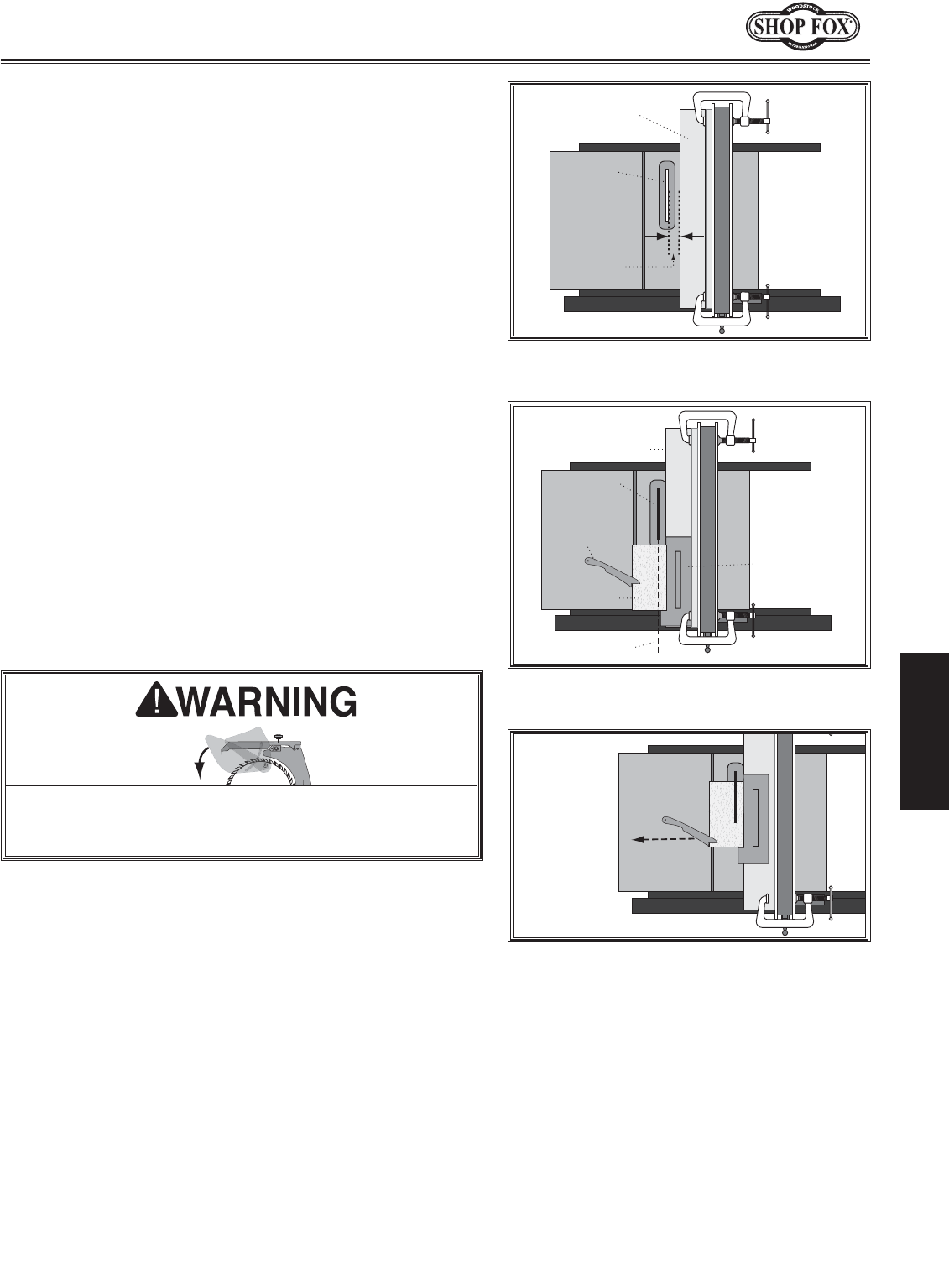
-61-
Df[\cN(/(0&N(/)'D]^%J`eZ\()&('
FG<I8K@FEJ
Lj`e^k_\8lo`c`Xip=\eZ\Xe[Glj_9cfZb
(% Place the auxiliary fence on the table and clamp it
to the fence at both ends, then adjust the distance
between the auxiliary fence and the blade—this
determines how wide the workpiece will be ripped
(see =`^li\/,).
)% Install the blade guard, then secure the spreader
pawls in the upright position, as shown in Figure 48
on GX^\*., so they do not interfere with the push
block lip.
*% Place the workpiece 1" in front of the blade and
evenly against the table and the auxiliary fence.
+% Turn the saw FE, then begin ripping the workpiece
using a push stick for side support.
As the workpiece nears the end of the cut, place
the push block on the auxiliary fence with the lip
directly behind the workpiece, then release the
push stick just before it is even with the blade (see
=`^li\/.). Guide the workpiece the rest of the way
through the cut with the push block, then re-install
the pawls on the spreader when cutting operations
are finished.
Workpiece
Cutting
Width
Blade
Auxilliary Fence
=`^li\85% Adjusting ripping distance
between blade and auxiliary fence.
Auxilliary Fence
Blade
Workpiece
Push Stick
for Side
Support
Blade Path
Push
Block
=`^li\/-% Adjusting ripping distance
between blade and auxiliary fence.
Release
Push Stick
Before Blade
=`^li\ /.. Ripping with push block.
B\\gk_\YcX[\^lXi[`ejkXcc\[Xe[`ek_\[fne
gfj`k`fe%=X`cli\kf[fk_`jZflc[i\jlck`ej\i`flj
g\ijfeXc`ealipfi[\Xk_%
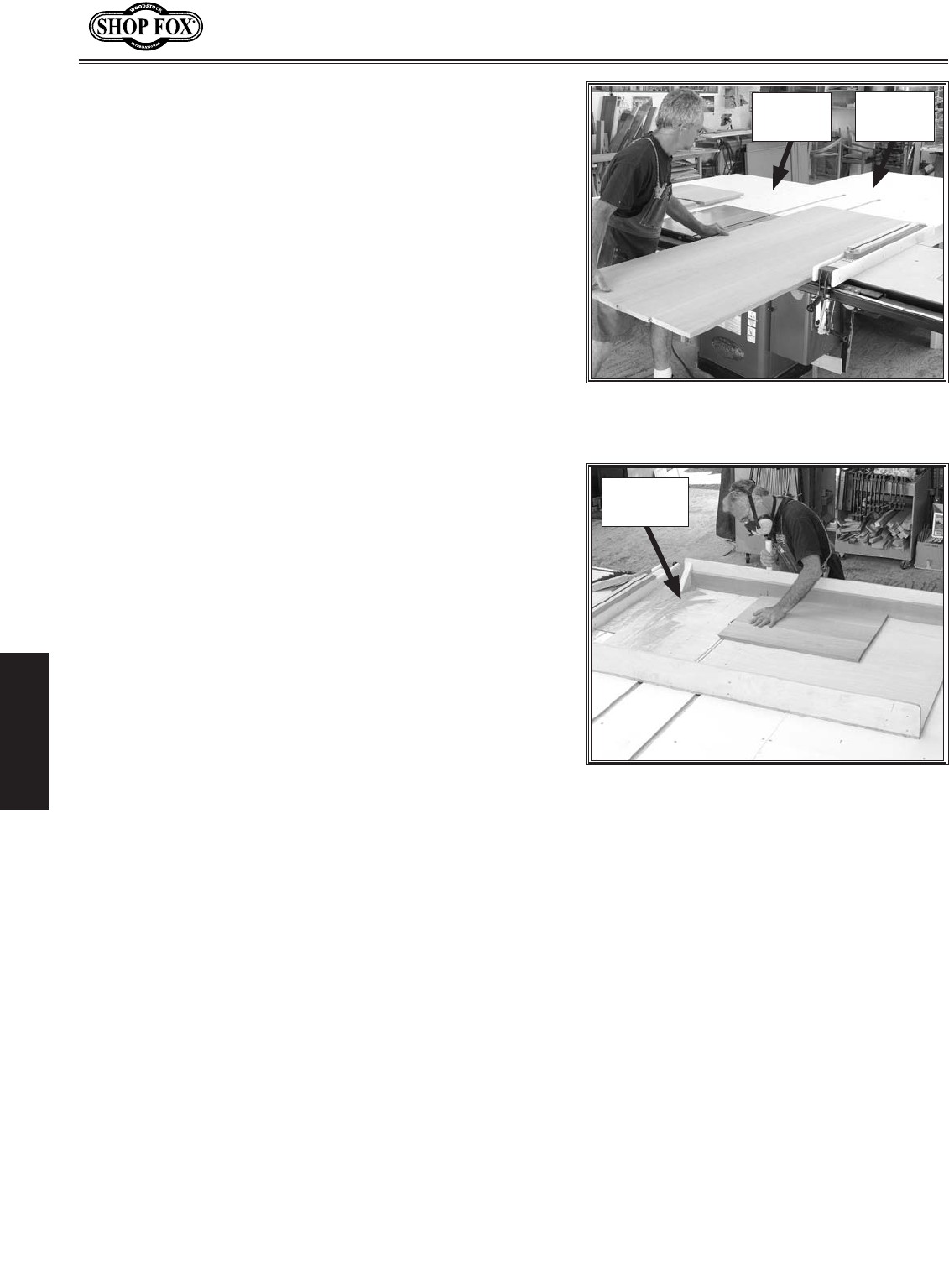
-62-
Df[\cN(/(0&N(/)'D]^%J`eZ\()&('
FG<I8K@FEJ
One of the best accessories for improving the safety and
ease of using a table saw is simply placing a large table
(outfeed table) behind the saw to catch the workpiece
(see =`^li\//). Additionally, another table to the left
of the saw (support table) can also help support large
workpieces so they can be cut safely and accurately.
A crosscut sled (see =`^li\/0) is a fantastic way to
improve the safety and accuracy of crosscutting on the
table saw. Most expert table operator uses a crosscut
sled when they have to crosscut a large volume of work,
because the sled offers substantial protection against
kickback when crosscutting.
Flk]\\[JlggfikKXYc\j
:ifjjZlkJc\[
=`^li\//% Example of outfeed & support
tables.
=`^li\/0%Example of crosscut sled.
Crosscut
Sled
Outfeed
Table
Support
Table
-63-
Df[\cN(/(0&N(/)'D]^%J`eZ\()&('
D8@EK<E8E:<
D8@EK<E8E:<
Cleaning the Model W1819/W1820 is relatively easy.
Vacuum excess wood chips and sawdust, and wipe off the
remaining dust with a dry cloth. If any resin has built up,
use a resin dissolving cleaner to remove it.
After cleaning, treat all unpainted cast iron and steel with
a non-staining lubricant.
Occasionally it will become necessary to clean the
internal parts with more than a vacuum. To do this,
remove the table top and clean the internal parts with
resin/pitch dissolver or mineral spirits and a stiff wire
brush or steel wool. DO NOT USE WATER—WATER WILL
CAUSE CAST IRON TO RUST.
Make sure the internal workings are dry before using
the saw again, so that wood dust will not accumulate.
If any essential lubrication is removed during cleaning,
re-lubricate those areas.
:c\Xe`e^
For optimum performance from your machine, follow this
maintenance schedule and refer to any specific instructions
given in this section.
;X`cp:_\Zb1
• Inspect blades for damage or wear.
• Check for loose mounting bolts/arbor nut.
• Check cords, plugs, and switch for damage.
• Check for any other condition that could hamper the
safe operation of this machine.
• Wipe the table clean after every use—this ensures
moisture from wood dust does not remain on bare
metal surfaces.
N\\bcpDX`ek\eXeZ\1
• Wipe down the table surface and grooves with a
lubricant and rust preventive such as SLIPIT®.
• Vacuum dust buildup from the motor housing and
trunnions.
• Clean the pitch and resin from the saw blade with a
cleaner like OxiSolv® Blade & Bit Cleaner.
Dfek_cpDX`ek\eXeZ\1
Check/tighten the belt tension (GX^\.+).
JZ_\[lc\
D8B< JLI< k_Xk pfli dXZ_`e\ `j
legcl^^\[[li`e^ Xcc dX`ek\eXeZ\gif$
Z\[li\j@]k_`jnXie`e^`j`^efi\[#j\i`$
fljg\ijfeXc`ealipdXpfZZli%
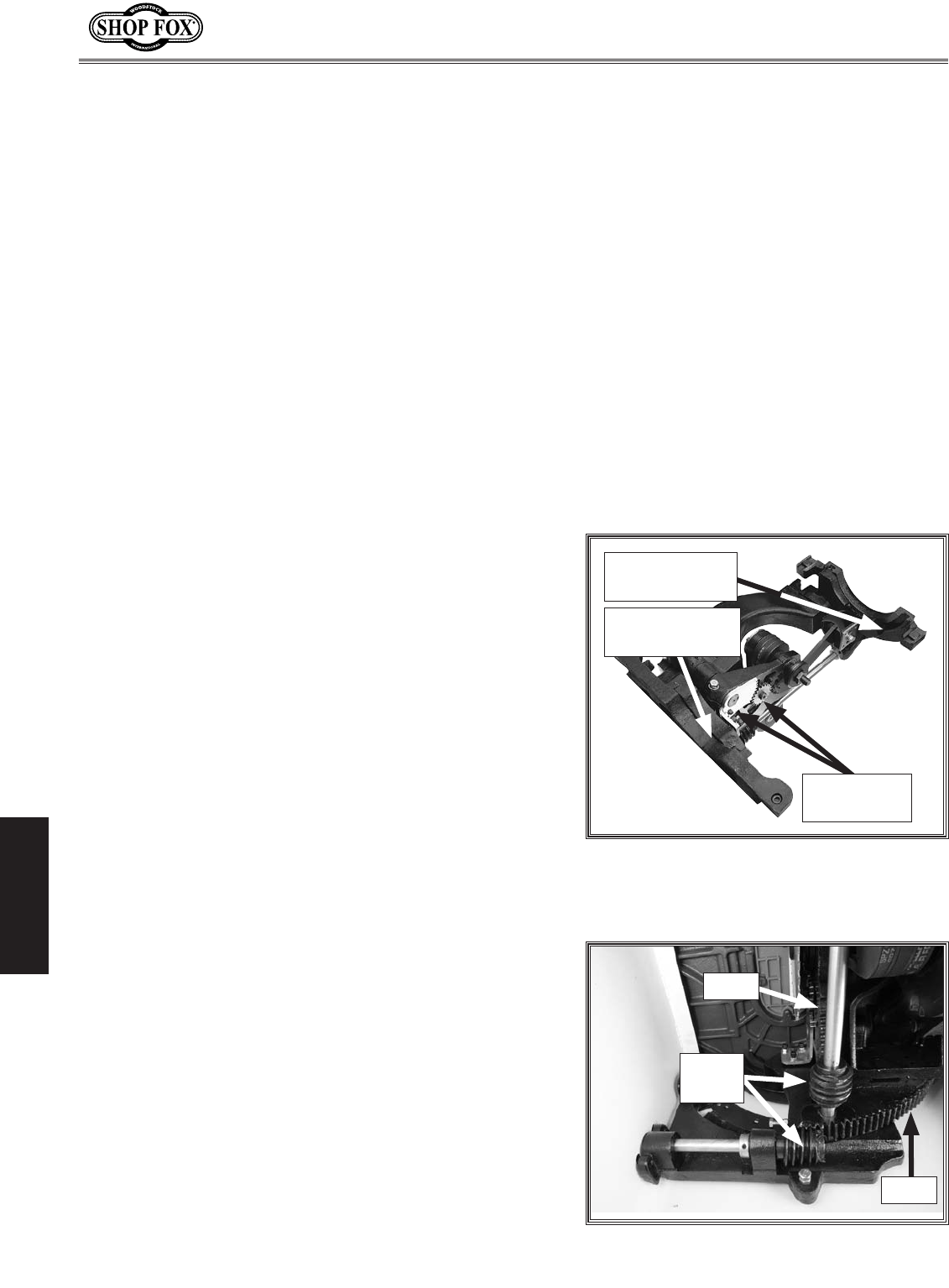
-64-
Df[\cN(/(0&N(/)'D]^%J`eZ\()&('
D8@EK<E8E:<
ClYi`ZXk`fe
An essential step for lubrication is cleaning the compo-
nents before lubricating them.
This step is critical because dust and chips build up on
lubricated components, which makes them hard to move.
Simply adding more grease to built-up grime will not
result in smooth moving components.
Clean the components in this section with an oil/grease
solvent cleaner.
The following are the main components that need to be
lubricated:
• Trunnion Slides and Orientation Gears
• Worm Gears, Trunnion and Bearing Housing Teeth
Kilee`feJc`[\jFi`\ekXk`fe>\Xij
Clean the trunnion slides with mineral spirits and a rag,
and brush a dab of lithium grease into each groove. Move
the blade tilt back and forth to spread the grease (see
=`^li\0').
Also use a wire brush and mineral spirits to clean any
debris or grime off the orientation gears, then apply
lithium grease to the gears with a brush.
=`^li\0'% Trunnion slides and tilt
leadscrew.
Rear Trunnion
Slide
Front Trunnion
Slide
Nfid>\Xij#Kilee`feXe[9\Xi`e^?flj`e^
K\\k_
Clean away any built up grime and debris with a wire
brush and mineral spirits from the worm gears and
the teeth (see =@^li\91) on the bearing housing and
trunnion. Then use a brush or rag to apply a thin coat of
white lithium grease to the gears and teeth.
=`^li\0(%Worm gears and teeth.
Worm
Gears
Teeth
Teeth
Orientation
Gears
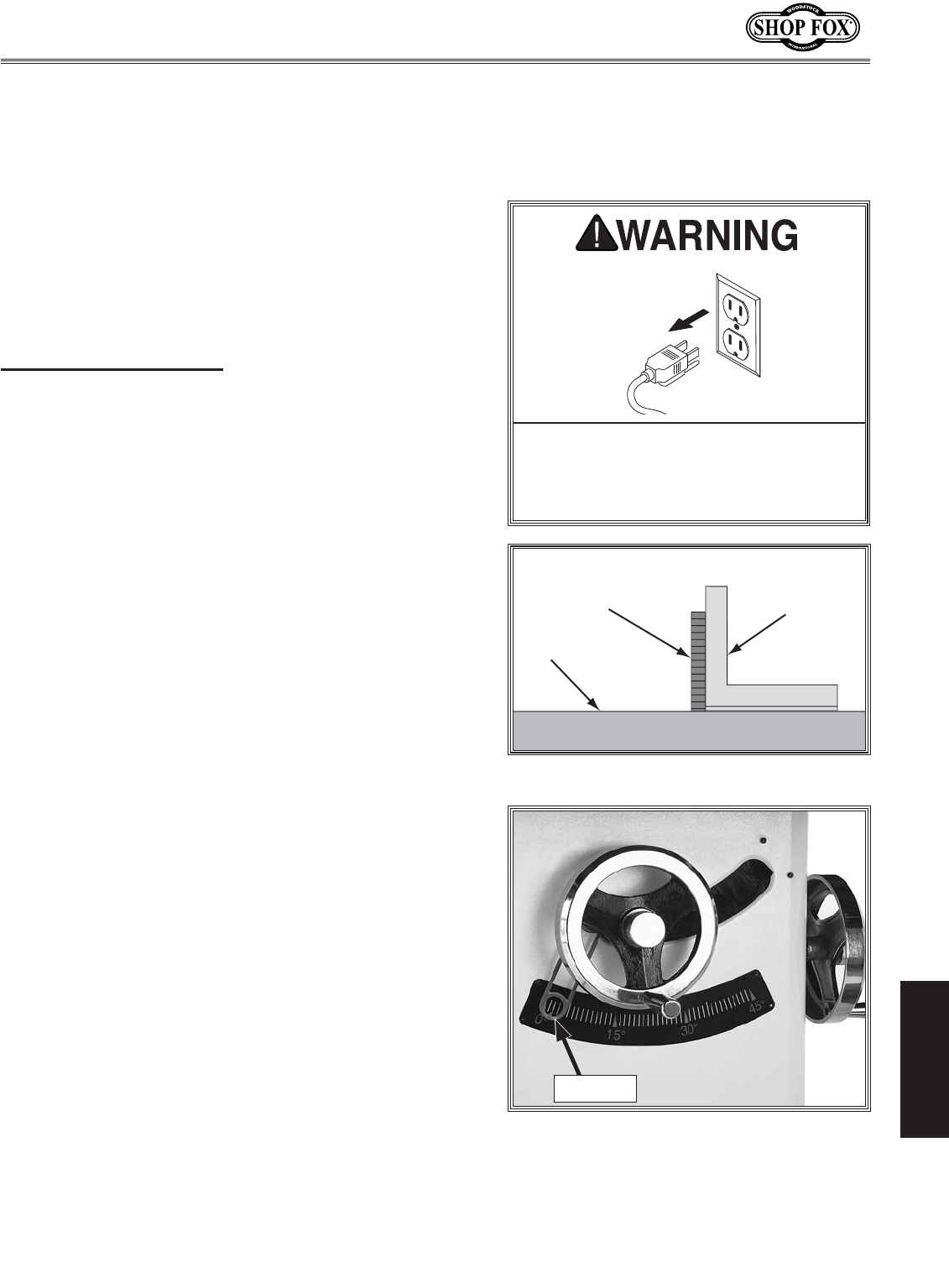
-65-
Df[\cN(/(0&N(/)'D]^%J`eZ\()&('
J<IM@:<
J<IM@:<
This section covers the most common service adjustments
or procedures that may need to be made during the life
of your machine.
If you require additional machine service not included
in this section, please contact Woodstock International
Technical Support at (360) 734-3482 or send e-mail to:
k\Z_$jlggfik7j_fg]fo%Y`q.
>\e\iXc
The table saw features stop bolts that stop the blade
exactly at 45° and 90° when tilting it with the handwheel.
The tilt scale reads "0" when the blade is 90° to the table.
The stops have been set at the factory and should require
no adjustments, unless you notice that your cuts are not
accurate.
9cX[\K`ckJkfgj D8B< JLI< k_Xk pfli dXZ_`e\ `j
legcl^^\[ [li`e^ Xcc j\im`Z\ gifZ\$
[li\j @] k_`j nXie`e^ `j `^efi\[# j\i`$
fljg\ijfeXc`ealipdXpfZZli%
KffcjE\\[\[ Hkp
90Square .......................................................1
45° Square .......................................................1
Hex Wrench 3mm ...............................................1
Wrench 10mm ...................................................1
Wrench 13mm ...................................................1
J\kk`e^0'Jkfg9fck
(% DISCONNECT THE SAW FROM POWER!
)% Raise the blade as high as it will go, then tilt it toward
0° until it stops and cannot be tilted any more.
*% Place a 90° square against the table and blade so
it contacts the blade evenly from bottom to top, as
shown in =`^li\0). Make sure a blade tooth does not
obstruct the placement of the square.
— If the blade is 90° to the table, then adjustments
do not need to be made. Make sure the tilt
indicator arrow shown in =`^li\0* points to
the 0° mark on the scale. Adjust the position
by loosening the button head screw, moving the
indicator with your fingers, then tightening the
screw.
— If the blade is not 90° to the table, you will need
to adjust the 90° stop screw. Proceed to the next
step.
=`^li\0)%Checking blade at 90°.
KXYc\
0'JhlXi\
9cX[\
=`^li\0*. Tilt indicator arrow.
Indicator
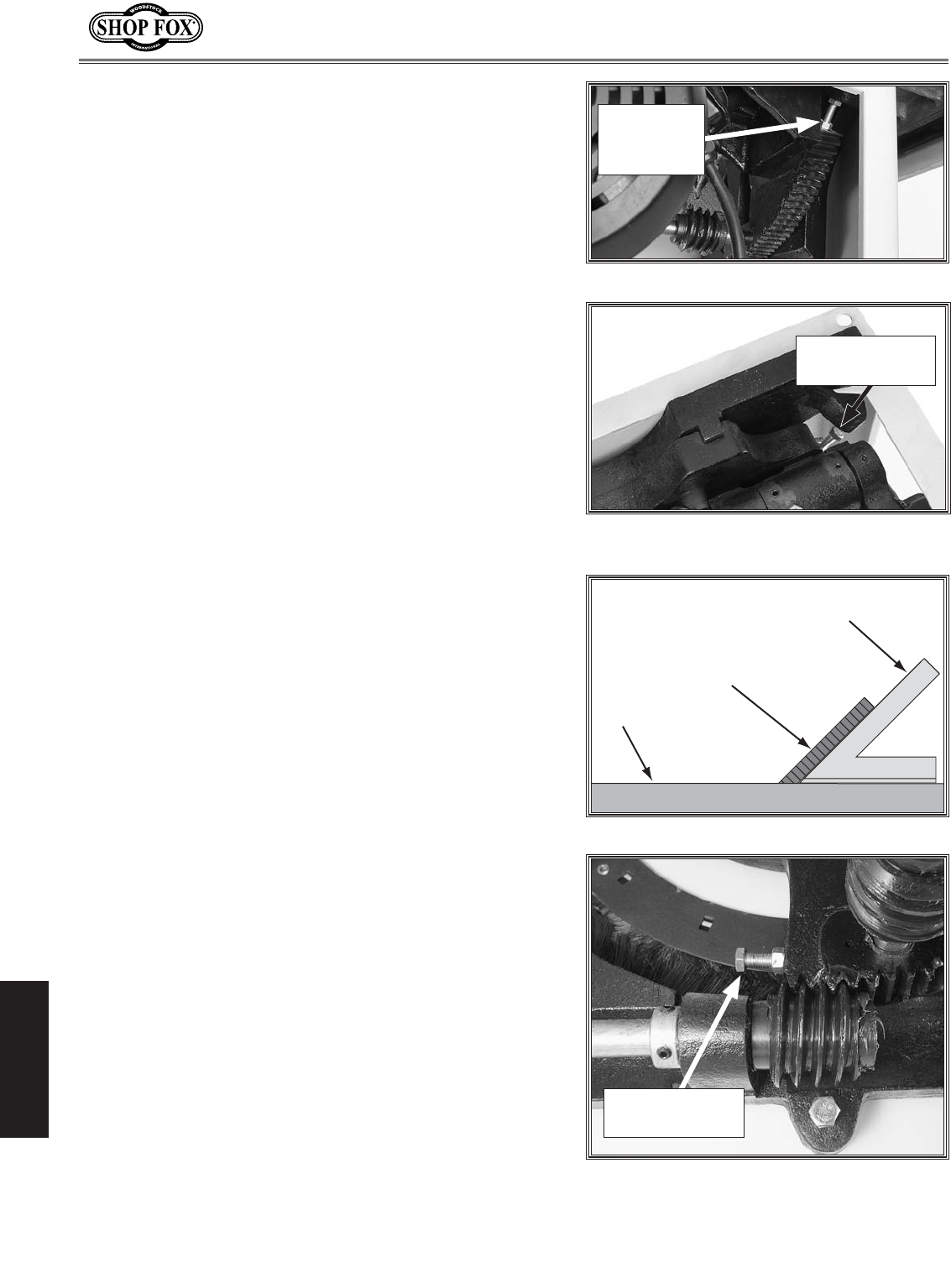
-66-
Df[\cN(/(0&N(/)'D]^%J`eZ\()&('
J<IM@:<
+% Tilt the blade away from 0° by about 5°, so there is
room for the stop bolt to move.
,% Open the motor access cover, loosen the jam nut
shown in =`^li\j 0+Æ0,, adjust the stop bolt up or
down according to how far off the blade was from
90°. Repeat Jk\g* and, if necessary, make additional
adjustments to the stop bolt until the table stops at
90°.
-% Tighten the jam nut, then close the motor cover.
=`^li\0+% 90° stop bolt and jam nut.
90° Stop
Bolt & Jam
Nut
=`^li\0,. 90° stop bolt and jam nut
(table removed for clarity).
90° Stop Bolt &
Jam Nut
=`^li\0-%Checking blade at 45°.
9cX[\
+,JhlXi\
KXYc\
J\kk`e^+,Jkfg9fck
(% DISCONNECT THE SAW FROM POWER!
)% Raise the blade as high as it will go, then tilt it
towards 45° until it stops and cannot be tilted any
more.
*% Place a 45° square against the table and blade so
it contacts the blade evenly from bottom to top, as
shown in =`^li\0-. Make sure a blade tooth does not
obstruct the placement of the square.
— If the blade is 45° to the table, then adjustments
do not need to be made.
— If the blade is not 45° to the table, you will need
to adjust the 45° stop screw. Proceed to the next
step.
+% Tilt the blade to 15°, so there is room for the stop
bolt to move, then remove the dust port to access the
stop bolt.
,% Loosen the jam nut on the 45° stop bolt (see =`^li\
0.) with a 13mm wrench, adjust the stop bolt up or
down according to how far off the blade was from
45°.
-% Continue adjusting the stop bolt until it contacts the
cabinet when the blade is at 45°, then tighten the
jam nut.
.% Close the dust port.
=`^li\0.% 45° stop bolt and jam nut.
45° Stop Bolt &
Jam Nut
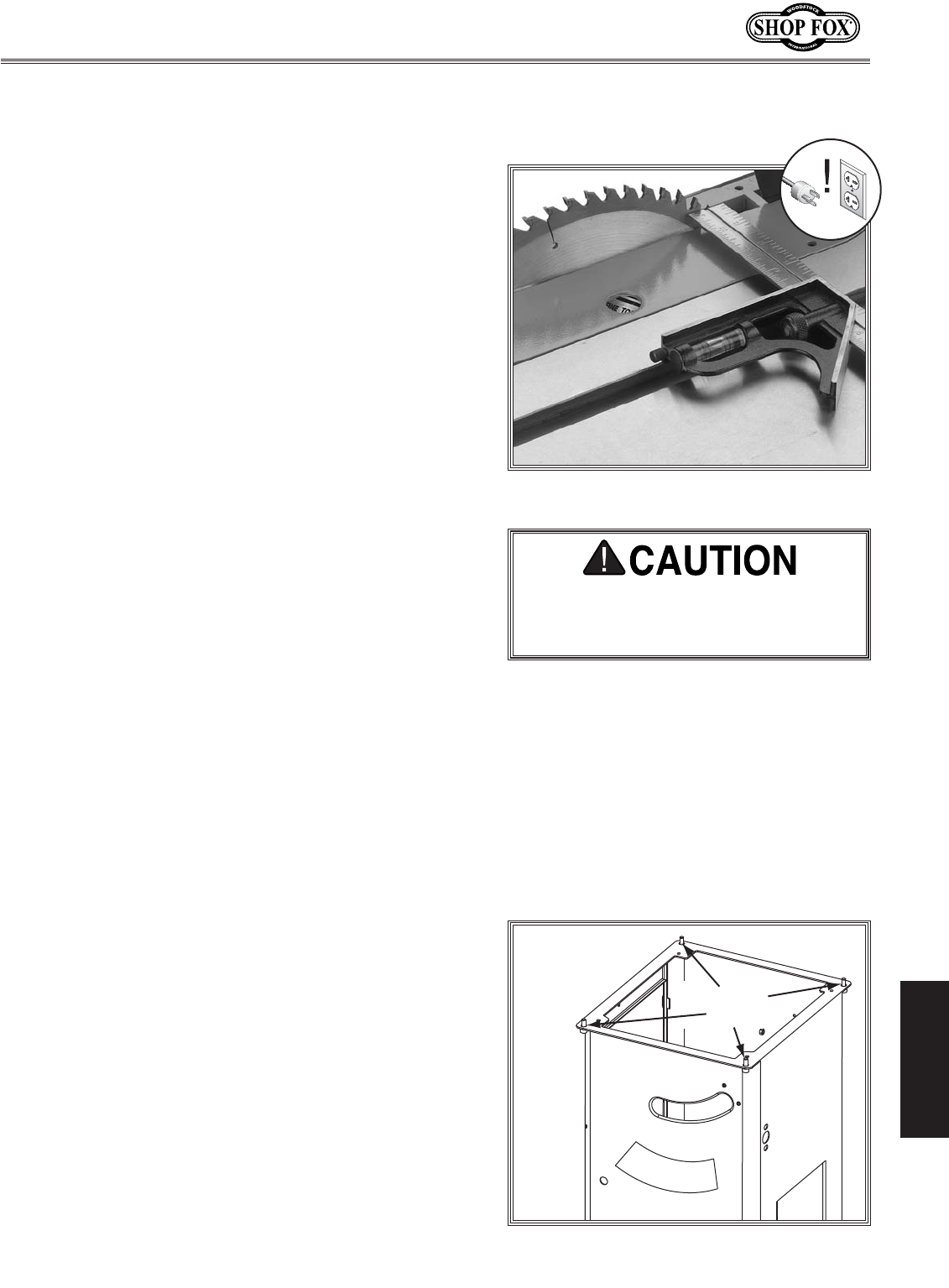
-67-
Df[\cN(/(0&N(/)'D]^%J`eZ\()&('
J<IM@:<
D`k\iJcfkkf9cX[\
GXiXcc\c`jd
Figure 98. Example of adjusting blade to
miter slot.
Your table saw will give the best results if the miter slot
and the rip fence are parallel to the blade. If either of
these are not exactly parallel, your cuts and your fin-
ished work will be lower in quality, but more importantly,
the risk of kickback will be increased. Take the time to
adjust your table saw properly. A few minutes now will
be time well spent.
KffcjE\\[\[ Hkp
Adjustable Square ..............................................1
Marker ............................................................1
KfX[aljkk_\YcX[\gXiXcc\ckfk_\d`k\ijcfk#[fk_\j\
jk\gj1
(% DISCONNECT THE SAW FROM POWER!
)% Use an adjustable square to measure the distance
from the miter slot to a carbide tip on the blade, as
shown in =`^li\0/. Make sure that the face of the
adjustable square is even along the miter slot.
*% With the end of the adjustable square just touching
the tooth or carbide tip, lock the square in place.
Now, mark the carbide tip with a marker where you
made this measurement.
+% Rotate the marked blade tip to the other end of the
table insert.
,% Slide the adjustable square down to the other end
of the table insert, and compare the distance from
the marked blade tip to the end of the adjustable
square.
— If the blade tip measurement is not the same, the
table will need to be adjusted. Proceed to Jk\g-.
— If the blade tip measurement is the same on both
sides, go to Jk\g..
-% To adjust the table, loosen the four cap screws
in the table mounting locations (see =`^li\00)
and slightly tap the table in the needed direction.
Repeat Jk\gj )Æ,until the blade and miter slot are
parallel.
.% Tighten the table mounting cap screws in a
crisscross, alternating manner.
K_\jXnYcX[\`j[Xe^\ifljcpj_Xig%Lj\
\okiX ZXi\ fi n\Xi ^cfm\j n_\e _Xe$
[c`e^k_\YcX[\finfib`e^e\Xi`k%
Figure 99. Table mounting bolts.
Dflek`e^
9fckj
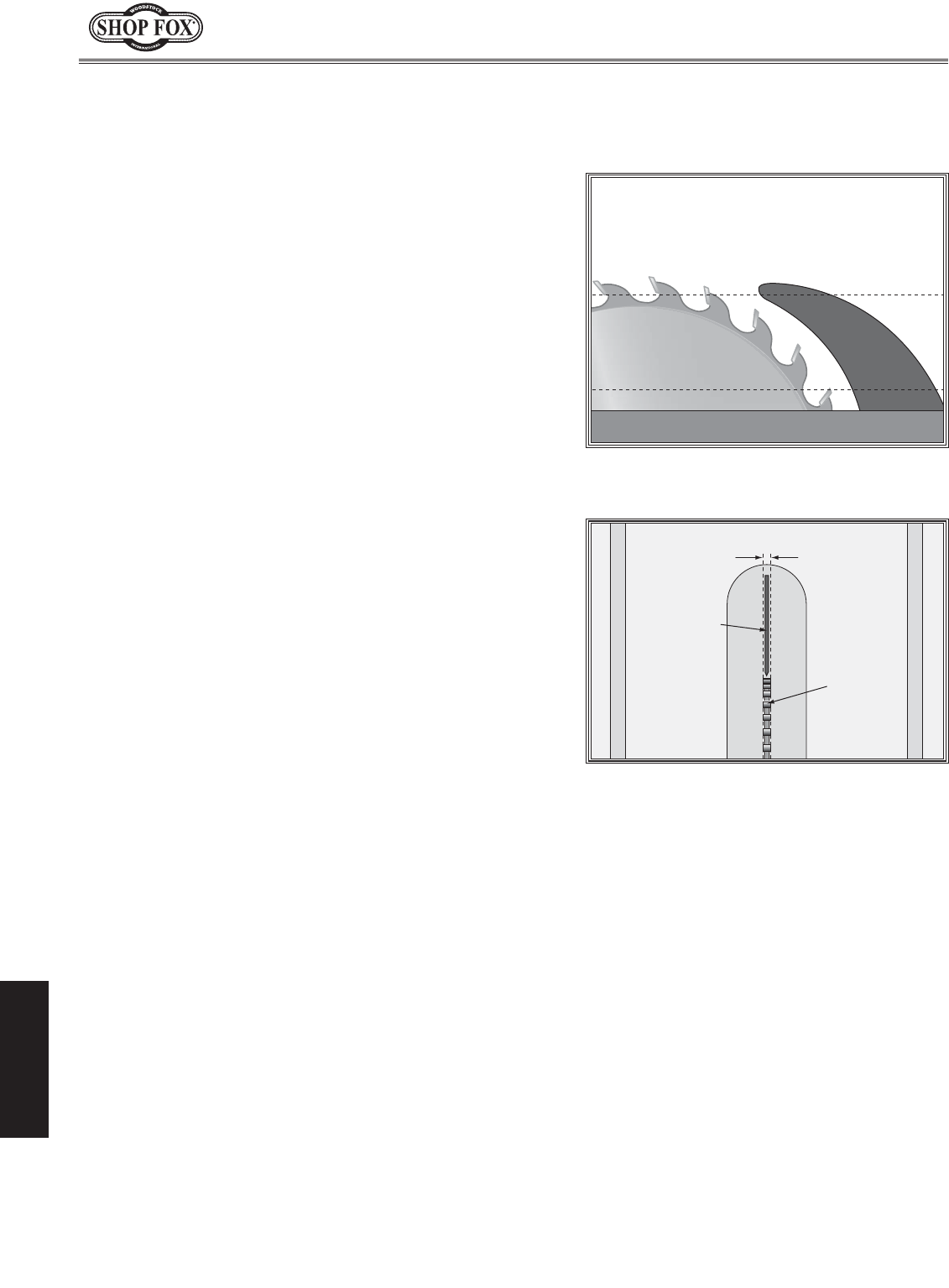
-68-
Df[\cN(/(0&N(/)'D]^%J`eZ\()&('
J<IM@:<
Jgi\X[\ifiI`m`e^Be`]\
8c`^ed\ek
:_\Zb`e^8c`^ed\ek
The blade guard spreader and riving knife must be aligned
with the blade when installed. If the spreader/riving knife
is not aligned with the blade, then the workpiece will
before forced sideways during the cut, which will increase
the risk of kickback.
KffcjE\\[\[ Hkp
Straightedge .....................................................1
KfZ_\Zbk_\jgi\X[\i&i`m`e^be`]\Xc`^ed\ek#[fk_\j\
jk\gj1
(% DISCONNECT THE SAW FROM POWER!
)% Raise the saw blade to the maximum height so you
have easy working access.
*% Place the straightedge alternately against the top
and bottom of blade and spreader/riving knife, as
shown in =`^li\(''. The spreader/riving knife
should be parallel with the blade along its length at
both positions, and it should be in the "Alignment
Zone," as shown in =`^li\('(.
— If the spreader/riving knife is not parallel with the
blade and inside the alignment zone, then it needs
to be adjusted. Proceed to 8[aljk`e^8c`^ed\ek
instructions.
— If the spreader/riving knife is not parallel with the
blade at either the top or bottom, it may be bent.
+% Remove the spreader/riving knife and place it on a
flat surface and check to see if the spreader/riving
knife lays evenly along its length.
— If the spreader/riving knife does not lay evenly,
proceed to 8[aljk`e^9\ekJgi\X[\i&I`m`e^Be`]\
on GX^\-0.
=`^li\('(% Spreader/riving knife
alignment zone.
8c`^ed\ek
Qfe\
Jgi\X[\ifi
I`m`e^Be`]\
9cX[\
=`^li\(''% Checking top and bottom
riving knife parallelism with blade.
Table
Riving
Knife
Top Alignment
Bottom Alignment
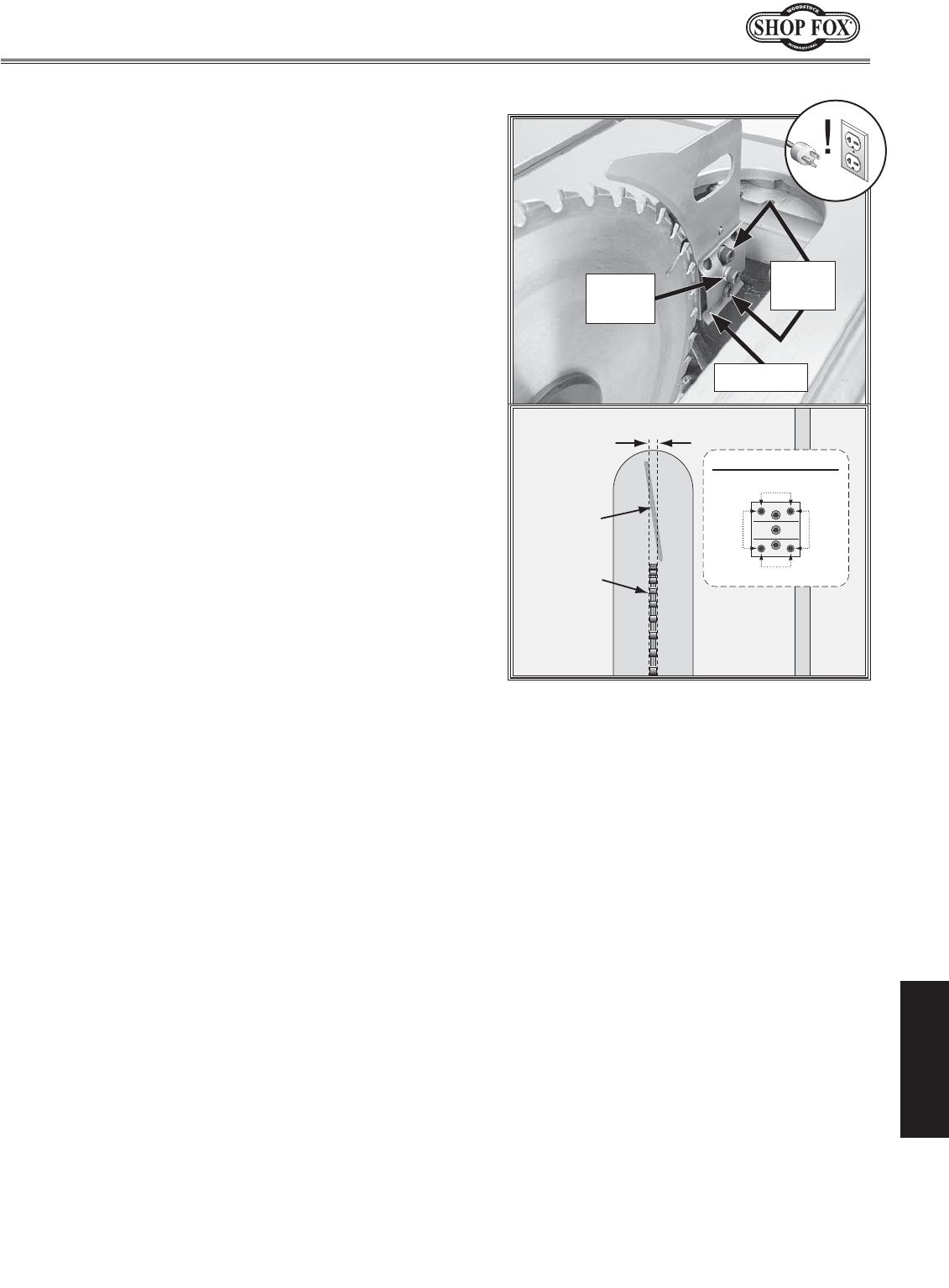
-69-
Df[\cN(/(0&N(/)'D]^%J`eZ\()&('
J<IM@:<
8[aljk`e^8c`^ed\ek
The spreader/riving knife mounting position can be
adjusted into alignment with the blade using the set
screws on the spreader/riving knife mounting block.
Gfjj`Yc\KffcjE\\[\[ Hkp
Hex Wrench 3mm ...............................................1
Hex Wrench 5mm ...............................................1
To adjust the spreader/riving knife position, do these
steps:
1. DISCONNECT THE SAW FROM POWER!
)% Remove the table insert.
*% Adjust each pair of set screws that controls the
direction required to move the mounting block so
the riving knive can be aligned with the blade (see
=`^li\(')). Make sure to move both screws in even
increments.
+% Re-install the table insert.
,% Follow :_\Zb`e^8c`^ed\ek,Jk\gj(Æ*to determine
if the spreader/riving knife is parallel with the blade
and inside the "Alignment Zone."
— If the spreader/riving knife is in the alignment
zone, no additional steps are necessary.
— If the spreader/riving knife is still not in the
alignment zone, continue adjusting the set screws
on the mounting block as necessary to correctly
position the spreader/riving knife.
-% Tighten the two cap screws on the mounting block to
secure the spreader/riving knife adjustment.
Cap
Screws
Set Screw
=`^li\(')%Set screws for adjusting
spreader/riving knife position.
8c`^ed\ek
Qfe\
D`jXc`^e\[
Jgc`kk\ifi
I`m`e^Be`]\
9cX[\
Adjustment Block
Kfg:fekifc
J`[\
:fekifc
J`[\
:fekifc
9fkkfd:fekifc
Center
Screw
Cap
Screws
8[aljk`e^9\ekJgi\X[\i&I`m`e^Be`]\
(% DISCONNECT THE SAW FROM POWER!
)% Bend the spreader or riving knife by hand while
installed, then follow Jk\gj(Æ* in :_\Zb`e^
8c`^ed\ek to determine if it is parallel with the
blade and inside the "Alignment Zone" (refer to
:_\Zb`e^8c`^ed\ek).
— If this does not work, remove it to straighten.
— If you cannot straighten it properly, replace it.
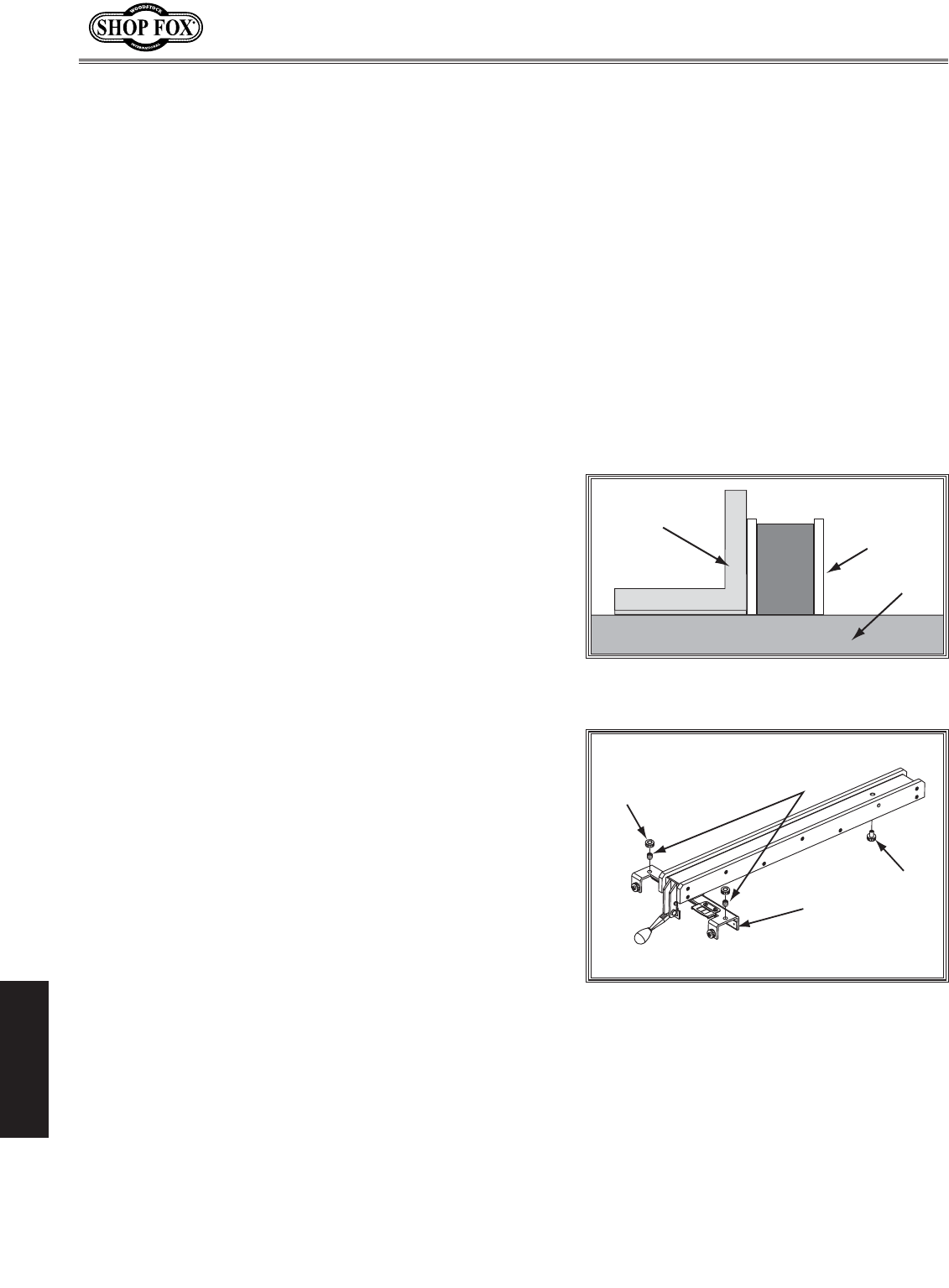
-70-
Df[\cN(/(0&N(/)'D]^%J`eZ\()&('
J<IM@:<
=\eZ\8[aljkd\ekj
There are four main adjustments for the fence: (1) square,
(2) height, (3) parallelism, and (4) clamping pressure.
Keep in mind that these adjustments are interconnected
and some trial-and-error may be needed to achieve
satisfactory results.
KffcjE\\[\[ Hkp
Hex Wrench 6mm ...............................................1
Square ............................................................1
Felt-Tipped Marker .............................................1
JhlXi\Xe[?\`^_k
The fence face must be square to the table in order to
produce square cuts. The fence should be adjusted so it
does not drag across the table surface.
KfZ_\Zb&X[aljkk_\]\eZ\_\`^_kXe[jhlXi\e\jjkfk_\
kXYc\#[fk_\j\jk\gj1
(% DISCONNECT THE SAW FROM POWER!
)% Place a square on the table against the face of the
fence (see =`^li\('*) to check if the fence is square
to the table.
— If the fence is square to table, go to Jk\g+.
— If the fence is not square to table, go to Jk\g*.
*% Adjust the set screws (see =`^li\('+) on top of the
fence bracket to ensure the fence face is 90° to the
table, then tighten the knurled lock nuts.
+% Look at the gap between the fence and table top.
— If the gap is approximately 1⁄16" and even from the
front of the table to the back, then no additional
adjustments are necessary.
— If the gap is uneven, if the fence height is more
than 1⁄8", or if the fence touches the table, then
continue with Jk\g,.
,% Adjust the fence height with the rear rail foot
until the gap between the table and the fence is
approximately 1⁄16" and even from the front of the
table to the back. Efk\1 @]k_\]ifek\e[f]k_\
]\eZ\e\\[jkfY\X[aljk\[lgfi[fne#lj\k_\
j\kjZi\nj]ifd=`^li\('+2kliek_\d`e\m\e
`eZi\d\ekjXe[i\Z_\Zbk_\jhlXi\e\jjX]k\inXi[j%
=`^li\('*% Checking if fence is square to
table.
0'JhlXi\
=\eZ\
KXYc\
=`^li\('+% Fence components used to
adjust fence height and squareness to
table.
=\eZ\
9iXZb\k
J\kJZi\nj
CfZbElk
I\XiIX`c
=ffk
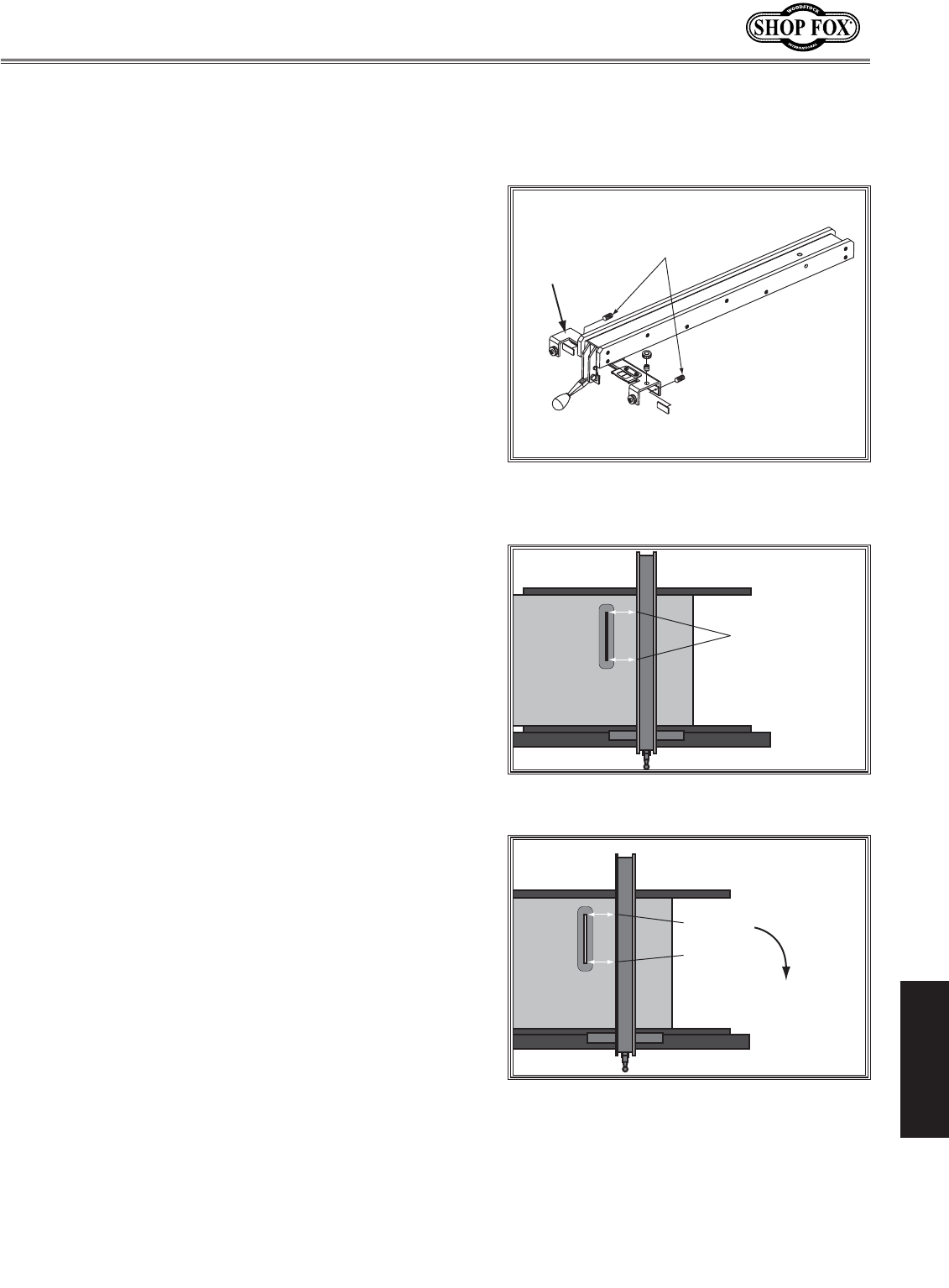
-71-
Df[\cN(/(0&N(/)'D]^%J`eZ\()&('
J<IM@:<
Clamping Pressure and Parallelism
Set screws on the rear side of the fence bracket adjust
the clamping pressure to hold your fence securely, and
position the fence parallel to the blade.
KfX[aljkk_\]\eZ\ZcXdg`e^gi\jjli\Xe[gXiXcc\c`jd
kfk_\YcX[\#[fk_\j\jk\gj1
(% DISCONNECT THE SAW FROM POWER!
)% Remove the fence.
*% Equally adjust the set screws shown in =`^li\(',
on the rear side of the front bracket as necessary
until the clamping pressure is strong enough that the
fence will not move as pressure is applied against it.
=`^li\(',% Location of set screws used
to adjust fence parallelism and clamping
pressure.
J\kJZi\nj
=\eZ\
9iXZb\k
+% Place the fence approximately 4" away from the
blade.
,% Measure the distance between the fence and the
front of the blade at one end of the table insert,
then mark the tooth that you measured from with a
felt-tipped marker.
-% Rotate the blade to the other end of the table insert
(see =`^li\('-), and recheck the distance between
the fence and the blade to ensure they are parallel.
.% Use trial-and-error to adjust the set screws so the
fence is parallel to the blade and the clamping
pressure is sufficient.
Fgk`feXc: Jfd\nff[nfib\ijgi\]\ikff]]j\kk_\
i\Xif]k_\]\eZ\(Ð-+]ifdk_\YcX[\#Xjj_fne`e
=`^li\('.#kf_\cggi\m\ekk_\nfibg`\Z\]ifd
Y`e[`e^Xe[Ylie`e^%
The argument is that this offset adjustment reduces
the chance of kickback by alleviating potential
binding that may occur between the backside of
the blade and fence. The trade-off is slightly less
accurate cuts.
=`^li\('-. Example of fence aligned
parallel to miter slot.
JgXZ\
9\kn\\e
=\eZ\9cX[\
<m\e
=`^li\('.% Adjusting fence with a 1⁄64"
offset.
O
O"(&-+
<okiXJgXZ\
kfGi\m\ek9`e[`e^
O4PfliD\Xjli\d\ek
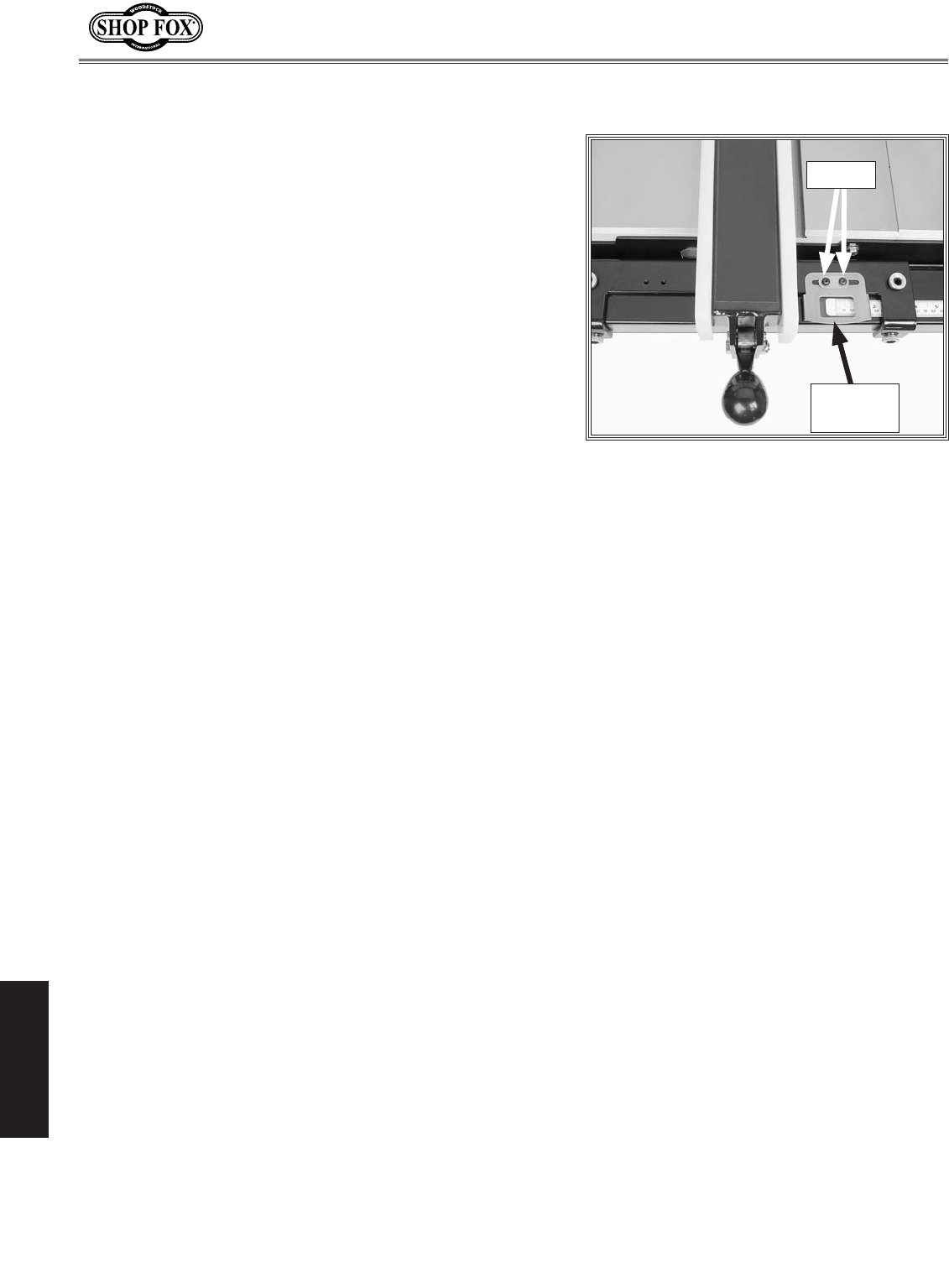
-72-
Df[\cN(/(0&N(/)'D]^%J`eZ\()&('
J<IM@:<
=\eZ\JZXc\:Xc`YiXk`fe
The fence scale indicator window, shown in =`^li\('/,
can be calibrated with the fence scale if you notice that
your cuts do not accurately match what is shown on the
fence scale. The indicator adjusts by loosening the two
mounting screws and sliding it in the desired direction.
KffcjE\\[\[ Hkp
Hex Wrench 2.5mm .............................................1
Scrap Piece of Wood ............................................1
KfZXc`YiXk\k_\]\eZ\jZXc\`e[`ZXkfin`e[fnj#[f
k_\j\jk\gj1
(% Position and lock the fence at 13", as indicated by
the scale, cut your scrap piece of wood.
)% Reposition and lock the fence at 12", as indicated by
the scale.
*% Flip your scrap piece of wood over, placing the side
that was cut in Jk\g) against the fence, and cut
your scrap piece of wood.
+% Measure the width of the freshly cut workpiece with
a tape measure. The workpiece width should be
exactly 12". If it is not, then adjust the indicator
window to match the width of the workpiece.
=`^li\('/% Fence indicator window.
Screws
Indicator
Window
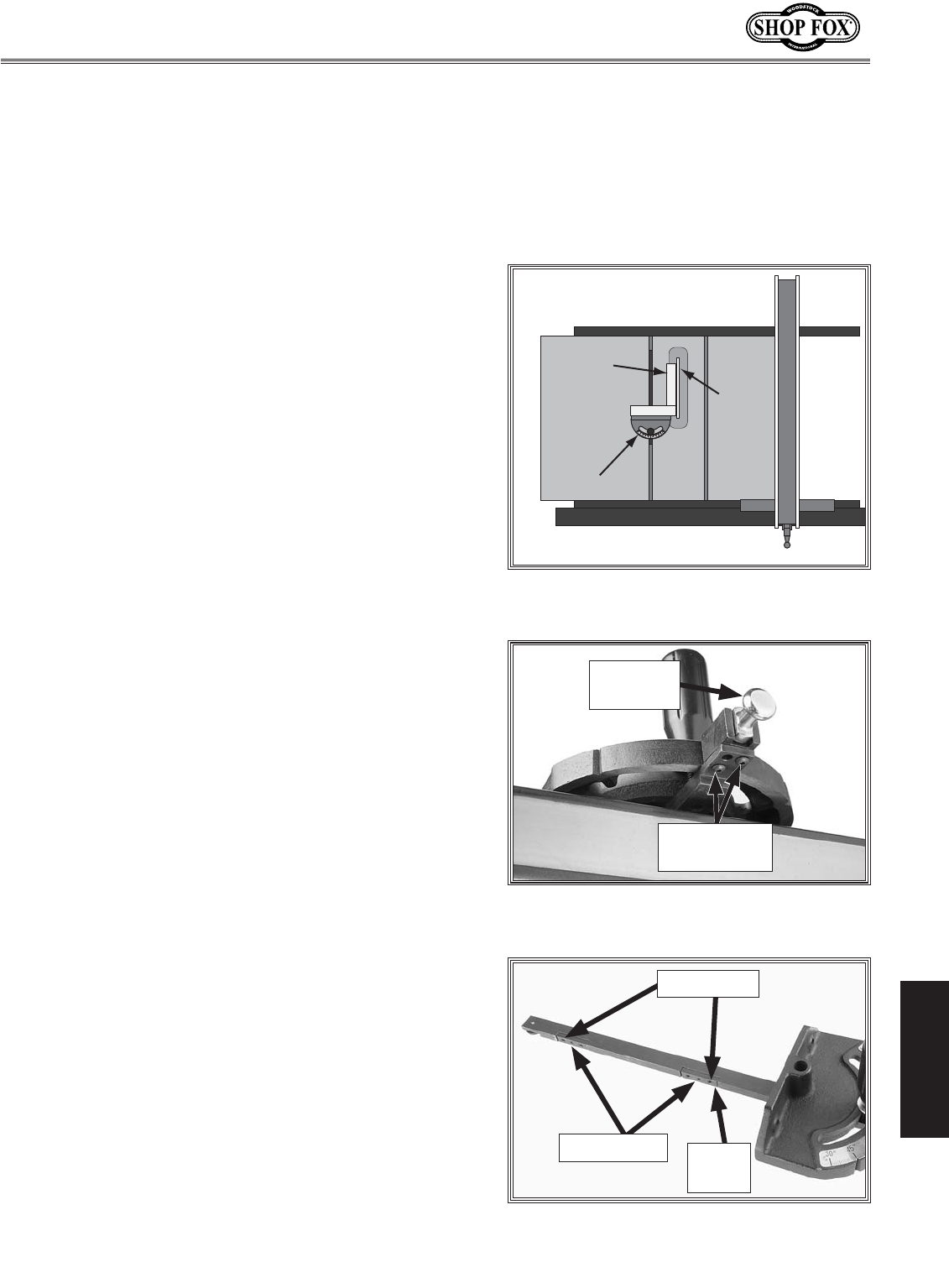
-73-
Df[\cN(/(0&N(/)'D]^%J`eZ\()&('
J<IM@:<
D`k\i>Xl^\8[aljkd\ekj
The miter gauge can be adjusted so it is perpendicular to
the blade and so it is snug in the T-slot.
KffcjE\\[\[ Hkp
90° Square .......................................................1
45° Square .......................................................1
Hex Wrench 2.5mm .............................................1
Hex Wrench 2mm ...............................................1
Hex Wrench 3mm ...............................................1
:_\Zb`e^&J\kk`e^0'Jkfgj
(% DISCONNECT THE SAW FROM POWER!
)% Slide the miter gauge into the T-slot on the table.
*% Loosen the miter gauge lock knob, pull out the
positive stop knob, then pivot the miter gauge body
to 90° so the stop knob springs into position.
=`^li\('0% Checking 90° stop on miter
gauge.
JhlXi\
D`k\i>Xl^\
9cX[\
=`^li\(('% Screws for adjusting miter
gauge body.
Button Head
Cap Screws
Positive
Stop Knob
,% Loosen the button head cap screws on the positive
stop knob block (see =`^li\ (('), adjust the miter
body until it is flush with the square, then tighten the
screws.
-% Loosen the screw on the front of the miter bar, adjust
the pointer to 0°, then tighten the screw.
+% Place the 90° square evenly against the face of the
miter gauge and the blade, as shown in =`^li\('0.
— If the square touches the miter body and the body
of the blade (not the teeth) evenly at the same
time, then it is square to the blade and the 90°
stop is set correctly. No further adjustments are
necessary.
— If the square does not touch the miter body and
blade body evenly at the same time, then proceed
to Jk\g,.
8[aljk`e^D`k\i9XiK`^_ke\jj
The miter bar can be adjusted so it fits more tightly in
the miter slot.
To adjust the miter bar tightness, loosen the cap screw
on each guide block (see =`^li\(((), adjust the set
screws as needed, then tighten the cap screw.
=`^li\(((% Screws for adjusting miter bar
in miter slot.
Set Screws
Cap Screws Guide
Block
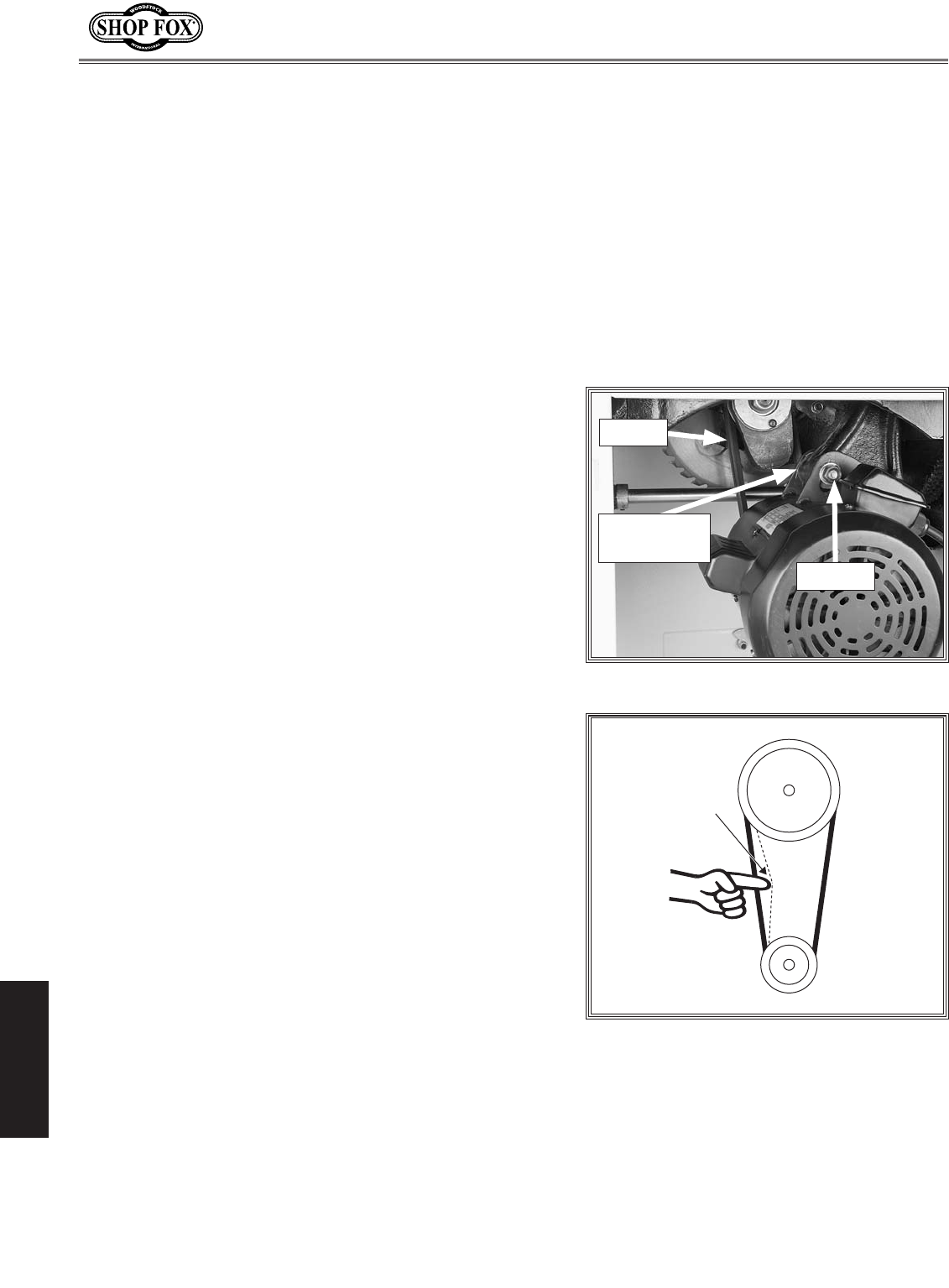
-74-
Df[\cN(/(0&N(/)'D]^%J`eZ\()&('
J<IM@:<
9\ckK\ej`fe
I\gcXZ\d\ek
KffcjE\\[\[ Hkp
Wrenches 18mm .................................................2
K\ej`fe`e^9\ck
(% DISCONNECT THE SAW FROM POWER!
)% Lower the blade completely, then open the motor
cabinet.
*% Loosen the hex nuts on the motor shown in =`^li\
((), and pivot the motor up and down to make sure
that it is movable.
+% Press down on the motor with one hand to keep the
belt tension tight, then tighten the hex nuts.
,% Press each V-belt in the center to check the belt
tension.
The belts are correctly tensioned when there is
approximately 1⁄2" deflection when they are pushed
with moderate pressure, as shown in =`^li\((*.
— If there is more than 1⁄2" deflection when the
V-belts are pushed with moderate pressure, loosen
the hex nuts, adjust the motor downward, then
tighten the hex nuts.
-% Close the motor access cover.
I\gcXZ`e^9\ck
(% DISCONNECT THE SAW FROM POWER!
)% Lower the blade completely, then open the motor
access cover.
*% Loosen the hex nuts that secure the motor (see
=`^li\(())and raise the motor fully to remove
tension on the V-belts. Roll the V-belts off of the
arbor and motor pulleys. Install a new matching
set of V-belts onto the pulleys, lower the motor to
tension the V-belts, then tighten the hex nuts.
+% Follow Jk\g, in the K\ej`fe`e^9\ck subsection to
check V-belt tension, then close the motor cover.
The three V-belts stretch slightly as the saw is used. Most
of the belt stretching will happen during the first 16 hours
of use, but it may continue in small increments through
continued use.
Glcc\p
;\]c\Zk`fe
Glcc\p
=`^li\((*. Checking belt tension.
1⁄2"
=`^li\(()% Motor mounting nut.
V-Belts
Hex Nut
(Not Shown)
Hex Nut
-75-
Df[\cN(/(0&N(/)'D]^%J`eZ\()&('
J<IM@:<
These pages are current at the time of printing. However, in the spirit of improvement, we may
make changes to the electrical systems of future machines. Study this diagram carefully. If you notice
differences between your machine and these wiring diagrams, call Woodstock International Technical
Support at (360) 734-3482.
(% J?F:B?8Q8I;% Working on wiring that is
connected to a power source is extremely
dangerous. Touching electrified parts will
result in personal injury including but not
limited to severe burns, electrocution,
or death. Disconnect the power from
the machine before servicing electrical
components!
)% HL8C@=@<;<C<:KI@:@8E% Due to the
inherent hazards of electricity, only a
qualified electrician should perform wiring
tasks on this machine. If you are not a
qualified electrician, get help from one
before attempting any kind of wiring job.
*% N@I<:FEE<:K@FEJ% All connections must
be tight to prevent wires from loosening
during machine operation. Double-check all
wires disconnected or connected during any
wiring task to ensure tight connections.
+% N@I<&:FDGFE<EK;8D8><% Damaged
wires or components increase the risk of
serious personal injury, fire, or machine
damage. If you notice that any wires or
components are damaged while performing
a wiring task, replace those wires or
components before completing the task.
,% DFKFIN@I@E>% The motor wiring shown
in these diagrams is current at the time
of printing, but it may not match your
machine. Always use the wiring diagram
inside the motor junction box.
-% DF;@=@:8K@FEJ% Using aftermarket parts or
modifying the wiring beyond what is shown
in the diagram may lead to unpredictable
results, including serious injury or fire.
.% :8G8:@KFIJ&@EM<IK<IJ% Some capacitors
and power inverters store an electrical
charge for up to five minutes after being
disconnected from the power source. To
avoid being shocked, wait at least this long
before working on these components.
/% <C<:KI@:8CI<HL@I<D<EKJ% You MUST
follow the electrical requirements at the
beginning of this manual when connecting
your machine to a power source.
0% <OG<I@<E:@E>;@==@:LCK@<J% If you are
experiencing difficulties understanding
the information included in this section,
contact our Technical Support at (360) 734-
3482.
<c\Zki`ZXcJX]\kp@ejkilZk`fej
The photos and diagrams
included in this section are
best viewed in color. You
can view these pages in
color at www.shopfox.biz.
BLACK
WHITE
GREEN
RED
BLUE
BROWN
GRAY
ORANGE
YELLOW
YELLOW
GREEN
PURPLE
PINK
LIGHT
BLUE
BLUE
WHITE
TUR-
QUOISE
WIRING DIAGRAM COLOR KEY
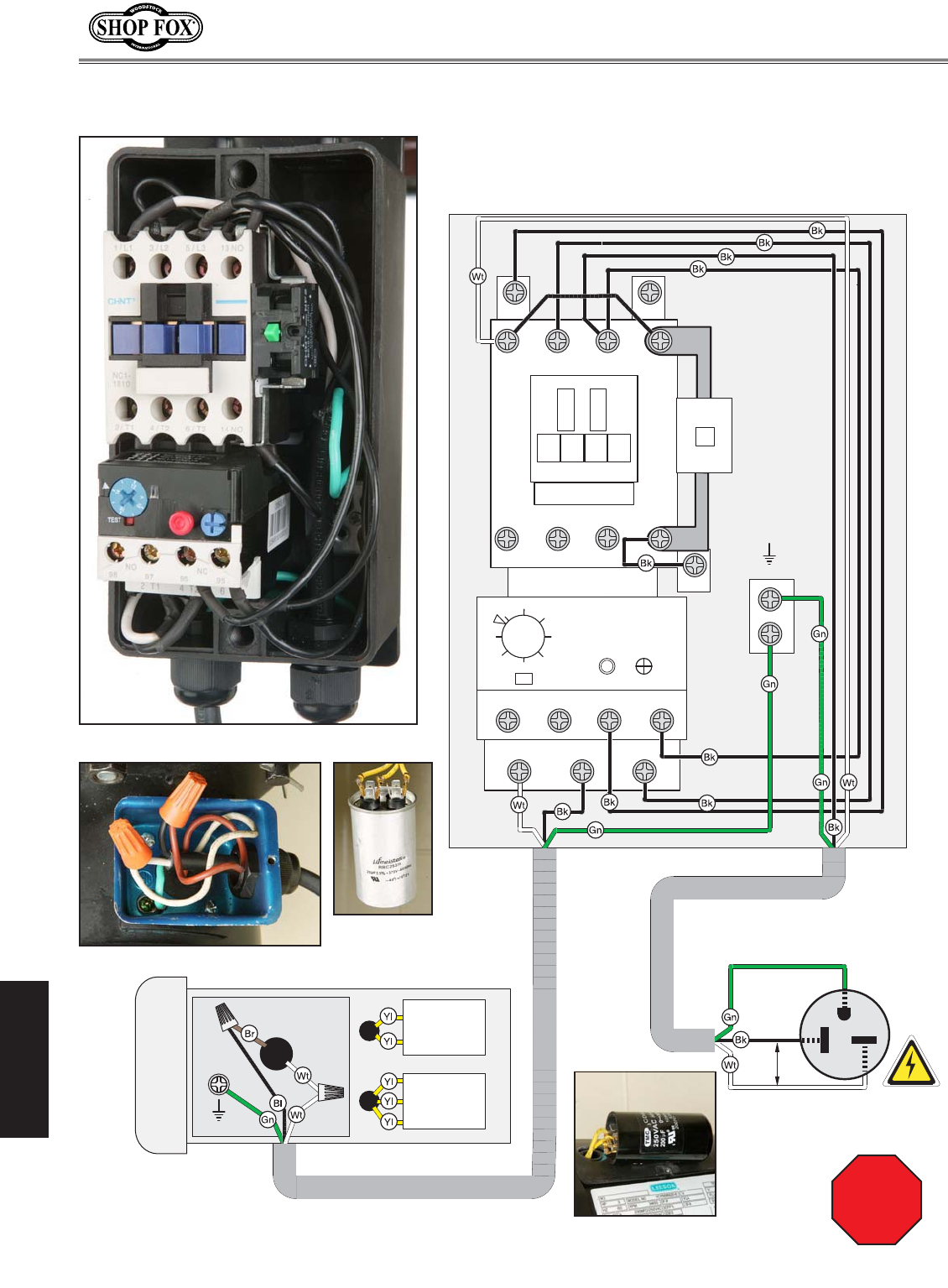
-76-
Df[\cN(/(0&N(/)'D]^%J`eZ\()&('
J<IM@:<
>ifle[
))'M
DFKFI
JkXik
:XgXZ`kfi
)''D=;
),'M8:
Ile
:XgXZ`kfi
),D=;
*.'M8:
*C) ,C*
(*
EF
)K( +K) -K*
8( 8)
(+
EF
K<JK
?
0.EF
0/EF
(+ ()
(/
(-
0,E:
0-E:
)K( +K) -K*
F==
:?@EK
EI)$),
(C(
:?@EK
E:@$(/
))'M
-'?Q
D,
8)
FE
:?@EK
EG)
?fk
?fk
>ifle[
))'
M8:
>ifle[
-$)'Gcl^
8jI\Zfdd\e[\[
>
JKFG
Read
Page 75
Before
Wiring
Df[\cN(/(0&N(/)'N`i`e^;`X^iXd
=`^li\((.% Start capacitor.
=`^li\((-%
Run capacitor.
=`^li\((+% Magnetic switch.
=`^li\((,% Motor wiring.
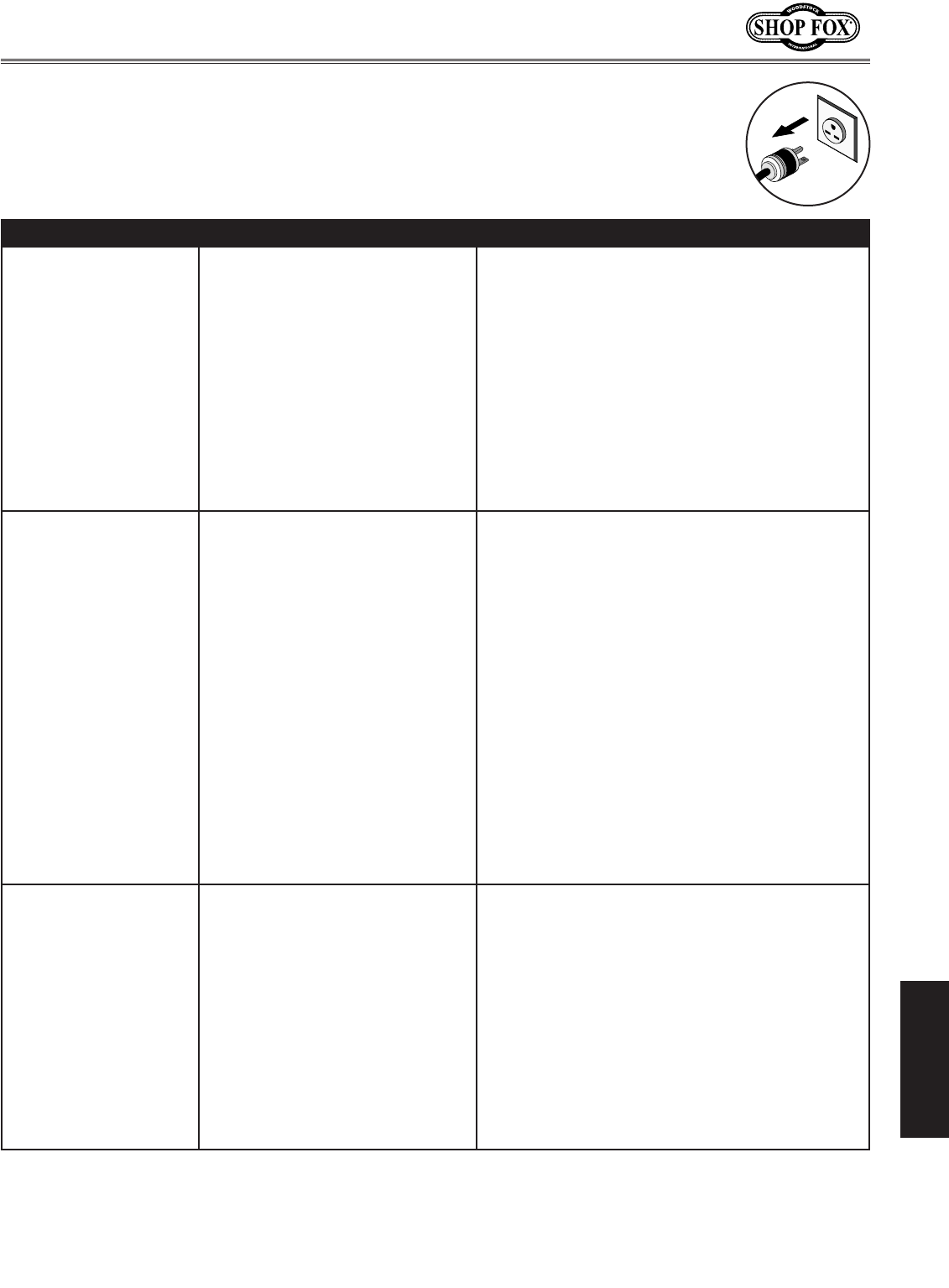
-77-
Df[\cN(/(0&N(/)'D]^%J`eZ\()&('
J<IM@:<
KiflYc\j_ffk`e^
This section covers the most common problems and corrections with this type of
machine. N8IE@E>;FEFKdXb\XepX[aljkd\ekjlek`cgfn\i`j[`jZfee\Zk\[Xe[
dfm`e^gXikj_Xm\Zfd\kfXZfdgc\k\jkfg
Symptom Possible Cause Possible Solution
Machine does not start or a
breaker trips.
1. Locking pin installed.
2. Blown fuse.
3. Power supply switched OFF or at
fault.
4. Plug/receptacle at fault/wired
wrong.
5. Motor connection wired wrong.
6. Wall circuit breaker tripped.
7. Wiring open/has high resistance.
8. Motor ON/OFF switch at fault.
9. Start capacitor at fault.
10. Motor at fault.
1. Remove locking pin from ON button.
2. Replace fuse/ensure no shorts.
3. Ensure power supply is on/has correct voltage.
4. Test for good contacts; correct the wiring.
5. Correct motor wiring connections.
6. Ensure circuit size is correct/replace weak breaker.
7. Check/fix broken, disconnected, or corroded wires.
8. Replace switch.
9. Test/replace if faulty.
10. Test/repair/replace.
Machine stalls or is under-
powered.
1. Feed rate/cutting speed too fast.
2. Workpiece material unsuitable for
machine.
3. Workpiece crooked; fence mis-
adjusted.
4. Machine undersized for task.
5. Run capacitor at fault.
6. Belt slipping.
7. Motor wired incorrectly.
8. Plug/receptacle at fault.
9. Pulley/sprocket slipping on shaft.
10. Motor bearings at fault.
11. Contactor not energized/has poor
contacts.
12. Motor overheated.
13. Motor at fault.
1. Decrease feed rate/cutting speed.
2. Only cut wood/ensure moisture is below 20%.
3. Straighten or replace workpiece/adjust fence.
4. Use correct blade/reduce feed rate or depth of
cut.
5. Test/repair/replace.
6. Tension/replace belt (Page 74).
7. Wire motor correctly.
8. Test for good contacts/correct wiring.
9. Replace loose pulley/shaft.
10. Test/repair/replace.
11. Test all legs for power/replace if faulty.
12. Clean motor, let cool, and reduce workload.
13. Test/repair/replace.
Machine has vibration or
noisy operation.
1. Motor or component loose.
2. Blade at fault.
3. Belts worn or loose.
4. Pulley loose.
5. Motor mount loose/broken.
6. Machine incorrectly mounted.
7. Arbor pulley loose.
8. Motor fan rubbing on fan cover.
9. Arbor bearings at fault.
10. Motor bearings at fault.
1. Inspect/replace damaged bolts/nuts, and re-tighten
with thread locking fluid.
2. Replace warped/bent blade; resharpen dull blade.
3. Tension/replace belts (Page 74).
4. Realign/replace shaft, pulley, setscrew, and key.
5. Tighten/replace.
6. Tighten mounting bolts; relocate/shim machine.
7. Retighten/replace arbor pulley.
8. Fix/replace fan cover; replace loose/damaged fan.
9. Replace arbor housing bearings; replace arbor.
10. Test by rotating shaft; grinding/loose shaft requires
bearing replacement.
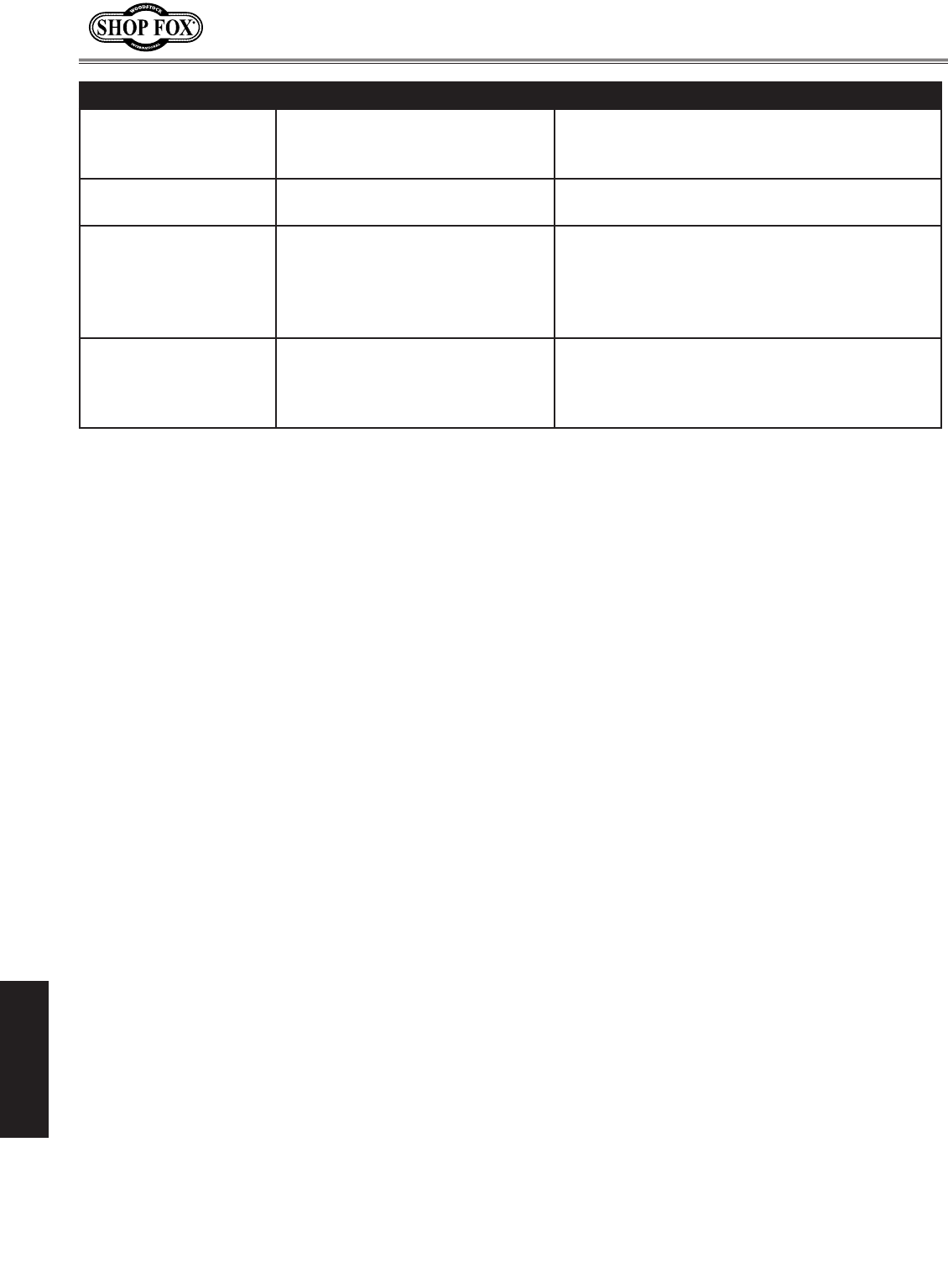
-78-
Df[\cN(/(0&N(/)'D]^%J`eZ\()&('
J<IM@:<
Symptom Possible Cause Possible Solution
Blade is not aligned with
miter slot or fence.
1. Blade is warped.
2. Table top is not parallel to blade.
3. Fence is not parallel to blade.
1. Replace blade (GX^\*,).
2. Make table parallel to blade (GX^\-.).
3. Make fence parallel to blade (GX^\.').
Blade does not reach 90°. 1. 90° stop bolt is out of adjustment.
2. Sawdust stuck on stop bolt.
1. Adjust 90° stop bolt (GX^\-,).
2. Clean sawdust off stop bolt.
Blade hits insert at 45°. 1. 45° stop bolt is out of adjustment.
2. Sawdust stuck on stop bolt.
3. Hole in insert is inadequate.
4. Table out of alignment.
5. Blade position is incorrect.
1. Adjust 45° stop bolt (GX^\-,).
2. Clean sawdust off stop bolt.
3. File or mill the hole in the insert.
4. Align blade to the table (GX^\-.).
5. Adjust blade position.
Board binds or burns when
feeding through table saw.
1. Dull blade.
2. Blade is warped.
3. Fence is not parallel to blade.
4. Table top is not parallel to blade.
1. Replace blade.
2. Replace blade (GX^\*,).
3. Make fence parallel to blade (GX^\.').
4. Make table parallel to blade (GX^\-.).
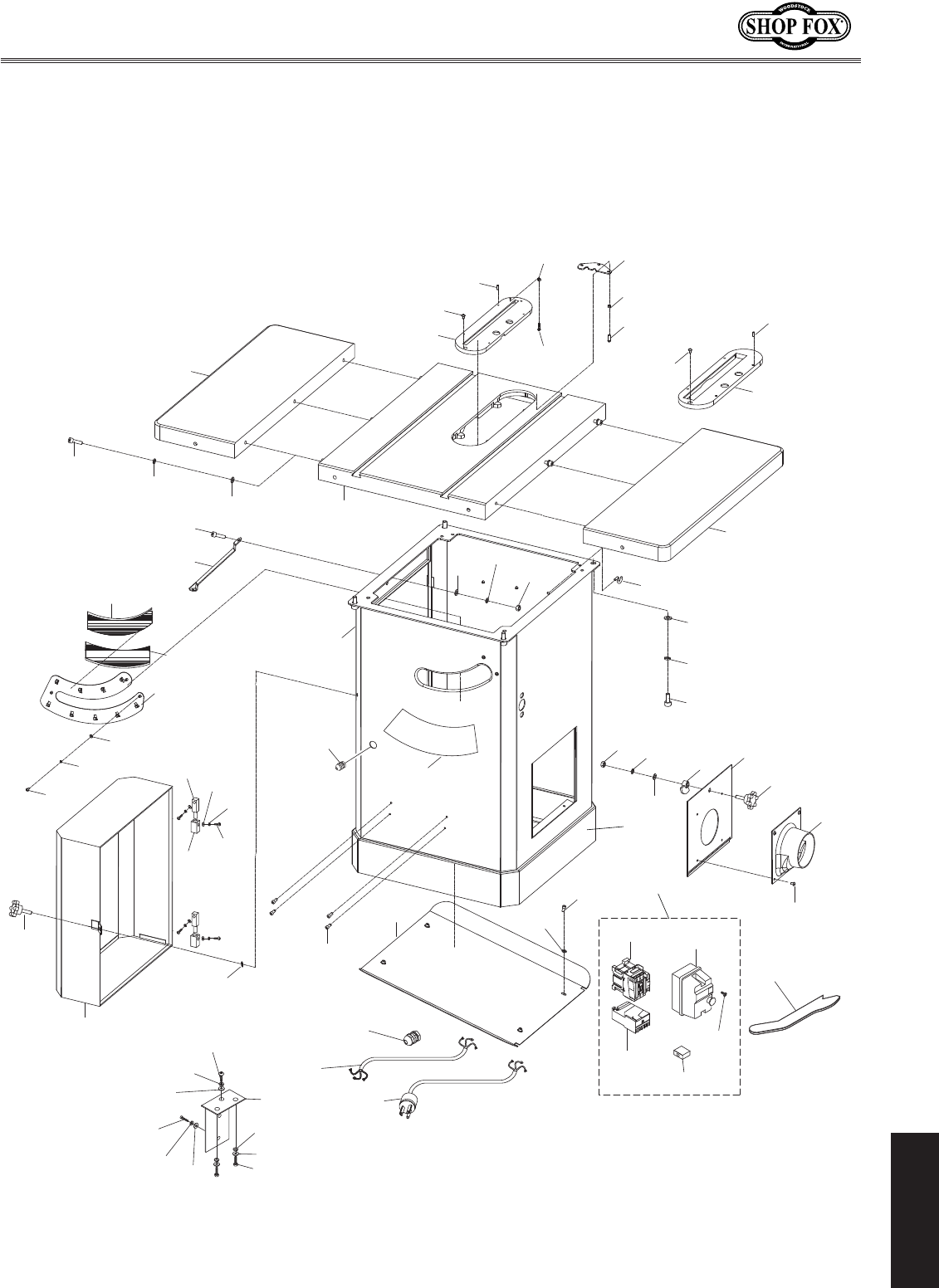
-79-
Df[\cN(/(0&N(/)'D]^%J`eZ\()&('
G8IKJ
155
155-1
155-2
155-3
155-4
155-5
108
109
109
156
110
110
168
169
170 171
101
102
103
104
105
106
107
108
109
114
115
118
119
120
121
122
123
124
125
126
127
127
128
129
130
131
132
132
133
133
134
136
140
141
142
143 144
145
146
146-1
146-2
147
148
149
150
151
152
153
153
154
164
163
172
166
165
173
177
174
175
176
G8IKJ
9f[p
-80-
Df[\cN(/(0&N(/)'D]^%J`eZ\()&('
G8IKJ
9f[pGXikjC`jk
REF PART # DESCRIPTION REF PART # DESCRIPTION
101 X1819101 CABINET STAND 144 XPLW06M LOCK WASHER 10MM
102 XPCAP88M CAP SCREW M10-1.25 X 25 145 XPN02M HEX NUT M10-1.5
103 XPLW06M LOCK WASHER 10MM 146 X1819146 DUST SHIELD
104 XPW04M FLAT WASHER 10MM 146-1 X1819146-1 UPPER BRUSH
105 X1819105 TILT SCALE 146-2 X1819146-2 LOWER BRUSH
106 X1819106 STRAIN RELIEF 147 XPS02M PHLP HD SCR M4-.7 X 12
107 X1819107 BASE PLATE 148 XPW05M FLAT WASHER 4MM
108 XPS14M PHLP HD SCR M6-1 X 12 149 XPLW02M LOCK WASHER 4MM
109 XPW03M FLAT WASHER 6MM 150 X1819150 HOOK
110 XPLW03M LOCK WASHER 6MM 151 XPTLW13M INT TOOTH WASHER 6MM
114 X1819114 MOTOR COVER 152 X1819152 LIMIT PLATE
115 X1819115 KNOB BOLT M6-1 153 XPN06M HEX NUT M5-.8
118 X1819118 CLEAN-OUT DOOR 154 XPS06M PHLP HD SCR M5-.8 X 20
119 X1819119 DOOR LATCH 155 X1819155 MAG SWITCH ASSEMBLY MS-15
120 X1819120 KNOB BOLT M8-1.25 155-1 X1819155-1 CONTACTOR CHINT NC1-18
121 XPW01M FLAT WASHER 8MM 155-2 X1819155-2 OL RELAY CHINT NR2-25 12-18
122 XPLW04M LOCK WASHER 8MM 155-3 X1819155-3 SWITCH BOX FRONT/BACK
123 XPN03M HEX NUT M8-1.25 155-4 X1819155-4 MAG SWITCH COVER SCREW
124 X1819124 DUST HOOD 155-5 X1819155-5 ON/OFF SWITCH CHINT NP2
125 XPS05M PHLP HD SCR M5-.8 X 8 156 X1819156 SWITCH BRACKET
126 X1819126 TABLE 163 X1819163 STRAIN RELIEF
127 X1819127 EXTENSION WING 164 X1819164 MOTOR CORD 14AWG 3C
128 XPCAP13M CAP SCREW M8-1.25 X 30 165 X1819165 POWER CORD W/PLUG
129 XPLW04M LOCK WASHER 8MM 166 X1819166 BLACK TRIM TAPE
130 XPW01M FLAT WASHER 8MM 168 XPB02M HEX BOLT M6-1 X 12
131 X1819131 STANDARD TABLE INSERT 169 XPBHS16M BUTTON HD CAP SCR M5-.8 X 16
132 XPSS53M SET SCREW M5-.8 X 12 170 XPLW01M LOCK WASHER 5MM
133 XPS08M PHLP HD SCR M5-.8 X 12 171 XPW02M FLAT WASHER 5MM
134 XPS06M PHLP HD SCR M5-.8 X 20 172 X1819172 PUSH STICK
136 X1819136 DADO TABLE INSERT 173 X1819173 UPPER HINGE BLOCK
140 XPRIV004M STEEL BLIND RIVET 4 X 10MM 174 XPW02M FLAT WASHER 5MM
141 X1819141 SHIPPING BRACE 175 XPLW01M LOCK WASHER 5MM
142 XPB74M HEX BOLT M10-1.5 X 20 176 XPBHS06M BUTTON HD CAP SCR M5-.8 X 12
143 XPW04M FLAT WASHER 10MM 177 X1819177 LOWER HINGE BLOCK
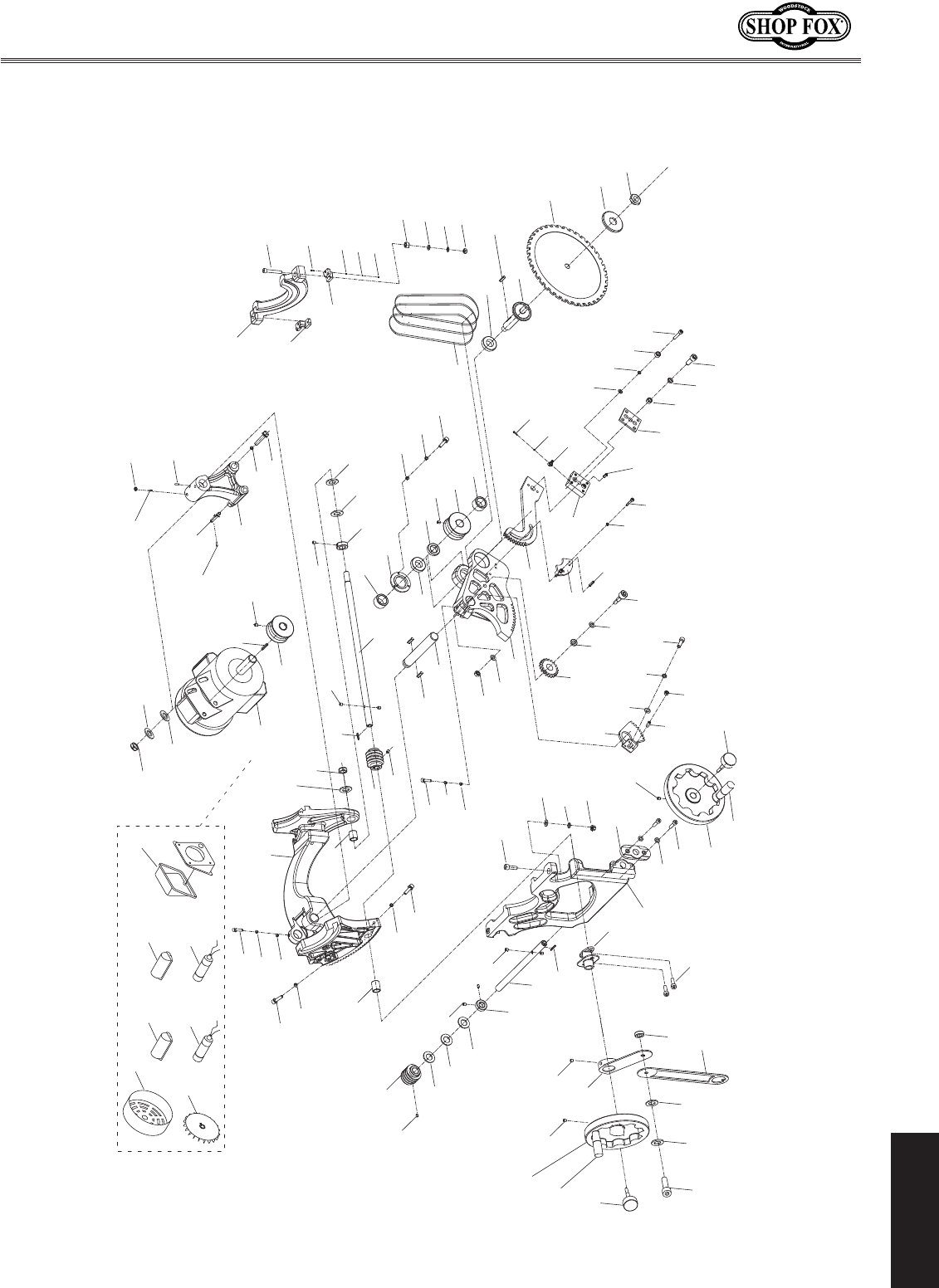
-81-
Df[\cN(/(0&N(/)'D]^%J`eZ\()&('
G8IKJ
Kilee`fe
201
202 203
201
202
203
204
205
206
207 208 209
210
211
212
213
214
215
216
216
217
217
218
219
219
220
220
221
221
222
222
222
222
223 223
224 224
225
226
227
228
229
230
231
232
232
233
234
234-1
234-2 234-3
234-4
234-5
234-6
234-7
235
236
237
238
238
239
240
241
242
243 244
245
246
252
253
253
254
255
255
257
258
259
263
264
265
266
267
268
269
270
271
272
273
274
275
276
277
278
279
280
280
281
282
283
284
285
286
287
288
295
296
297
298
299
300
301
302
303
304
305
306
307
308
309
310
311
313
314
315
316
317
318
319
320
321
322
323
324
325
326
330
330
331
332
333
334
202-1
202-1
-82-
Df[\cN(/(0&N(/)'D]^%J`eZ\()&('
G8IKJ
Kilee`feGXikjC`jk
REF PART # DESCRIPTION REF PART # DESCRIPTION
201 X1819201 HANDWHEEL LOCK KNOB 242 XPSS14M SET SCREW M8-1.25 X 12
202 X1819202 HANDWHEEL HANDLE 243 XPSS19M SET SCREW M8-1.25 X 30
202-1 X1819202-1 HANDWHEEL 244 XPN03M HEX NUT M8-1.25
203 XPSS53M SET SCREW M5-.8 X 12 245 X1819245 ELEVATION SHAFT
204 X1819204 TILT POINTER PIVOT 246 XPLN14M LOCK NUT M18-1.5
205 XPSS26M SET SCREW M5-.8 X 6 252 XPB09M HEX BOLT M8-1.25 X 20
206 X1819206 TILT POINTER 253 XPN03M HEX NUT M8-1.25
207 XPCAP25M CAP SCREW M6-1 X 12 254 XPB20M HEX BOLT M8-1.25 X 35
208 XPLW03M LOCK WASHER 6MM 255 X1819255 SHAFT SLEEVE
209 XPW03M FLAT WASHER 6MM 257 XPSS20M SET SCREW M8-1.25 X 8
210 XPN01M HEX NUT M6-1 258 X1819258 COMPRESSION SPRING
211 X1819211 TILT POINTER BRACKET 259 XPSTB002M STEEL BALL 8MM
212 XPCAP38M CAP SCREW M5-.8 X 25 263 X1819263 REAR TRUNNION
213 X1819213 TILT SHAFT BRACKET 264 X1819264 SPACER
214 XPCAP31M CAP SCREW M8-1.25 X 25 265 XPCAP13M CAP SCREW M8-1.25 X 30
215 XPLW04M LOCK WASHER 8MM 266 XPW01M FLAT WASHER 8MM
216 X1819216 SHAFT PIN 267 XPLW04M LOCK WASHER 8MM
217 XPK170M KEY 5 X 5 X 36 268 XPN03M HEX NUT M8-1.25
218 X1819218 TILT SHAFT 269 X1819269 PIVOT SHAFT
219 X1819219 LOCK COLLAR 270 XPK44M KEY 6 X 6 X 50
220 XPSS03M SET SCREW M6-1 X 8 271 X1819271 PIVOT BRACKET
221 XPLW12M LOCK WASHER 18MM 272 XPB116M HEX BOLT M10-1.5 X 45
222 X1819222 COPPER WASHER 18MM 273 XPLW06M LOCK WASHER 10MM
223 X1819223 WORM 274 XPW04M FLAT WASHER 10MM
224 XPSS01M SET SCREW M6-1 X 10 275 X1819275 ARBOR NUT
225 X1819225 FRONT TRUNNION 276 X1819276 ARBOR FLANGE
226 XPCAP72M CAP SCREW M10-1.5 X 30 277 X1819277 BLADE 10" 40TPI 5/8" BORE
227 XPW04M FLAT WASHER 10MM 278 X1819278 BLADE ARBOR
228 XPLW06M LOCK WASHER 10MM 279 XPK12M KEY 5 X 5 X 30
229 XPN02M HEX NUT M10-1.5 280 XP6005ZZ BALL BEARING 6005ZZ
230 X1819230 BELT SPZ 625 281 X1819281 FRONT PULLEY SPACER
231 X1819231 MOTOR PULLEY 282 X1819282 ARBOR PULLEY
232 XPSS53M SET SCREW M5-.8 X 12 283 X1819283 REAR PULLEY SPACER
233 XPK12M KEY 5 X 5 X 30 284 X1819284 FLANGE RING
234 X1819234 MOTOR 3HP 220V 1PH 285 XPS08M PHLP HD SCR M5-.8 X 12
234-1 X1819234-1 MOTOR FAN COVER 286 XPLW01M LOCK WASHER 5MM
234-2 X1819234-2 MOTOR FAN 287 XPW02M FLAT WASHER 5MM
234-3 X1819234-3 R CAPACITOR 25M 370V 1-3/4 X 3 288 XPLN15M LOCK NUT M16-1.5
234-4 X1819234-4 R CAPACITOR COVER 295 X1819295 REAR TRUNNION BRACKET
234-5 X1819234-5 S CAP 200M 250V 1-1/4 X 2-3/4 296 X1819296 FRONT TRUNNION BRACKET
234-6 X1819234-6 S CAPACITOR COVER 297 XPCAP13M CAP SCREW M8-1.25 X 30
234-7 X1819234-7 MOTOR JUNCTION BOX 298 XPW01M FLAT WASHER 8MM
235 X1819235 ORIENTATION PIN 299 XPLW04M LOCK WASHER 8MM
236 XPRP108M ROLL PIN 4 X 28 300 XPN03M HEX NUT M8-1.25
237 XPB121M HEX BOLT M12-1.75 X 100 301 X1819301 BULL GEAR
238 XPW06M FLAT WASHER 12MM 302 X1819302 SPLITTER ADJUSTMENT BLOCK
239 XPLW05M LOCK WASHER 12MM 303 XPW03M FLAT WASHER 6MM
240 XPN09M HEX NUT M12-1.75 304 XPLW03M LOCK WASHER 6MM
241 X1819241 MOTOR FRAME SUPPORT 305 XPCAP06M CAP SCREW M6-1 X 25
-83-
Df[\cN(/(0&N(/)'D]^%J`eZ\()&('
G8IKJ
Kilee`feGXikjC`jk
REF PART # DESCRIPTION REF PART # DESCRIPTION
306 XPSS04M SET SCREW M6-1 X 12 320 X1819320 PLATE GEAR
307 X1819307 SPLITTER LOCK PLATE 321 XPSS25M SET SCREW M6-1 X 20
308 XPLW03M LOCK WASHER 6MM 322 XPN01M HEX NUT M6-1
309 XPB08M HEX BOLT M6-1 X 20 323 XPWF10M FENDER WASHER 10MM
310 X1819310 ORIENTATION PLATE 324 XPW01M FLAT WASHER 8MM
311 XPRP49M ROLL PIN 5 X 25 325 XPLW04M LOCK WASHER 8MM
313 XPLW01M LOCK WASHER 5MM 326 XPCAP14M CAP SCREW M8-1.25 X 20
314 XPCAP38M CAP SCREW M5-.8 X 25 330 X1819330 SPACER
315 X1819315 GEAR 331 X1819331 POSITION PIN ASSEMBLY
316 XPCAP47M CAP SCREW M10-1.5 X 40 332 XPLW02M LOCK WASHER 4MM
317 XPW04M FLAT WASHER 10MM 333 XPSS22M SET SCREW M4-.7 X 12
318 XPLN05M LOCK NUT M10-1.5 334 X1819334 MAIN TRUNNION
319 X1819319 GEAR BUSHING
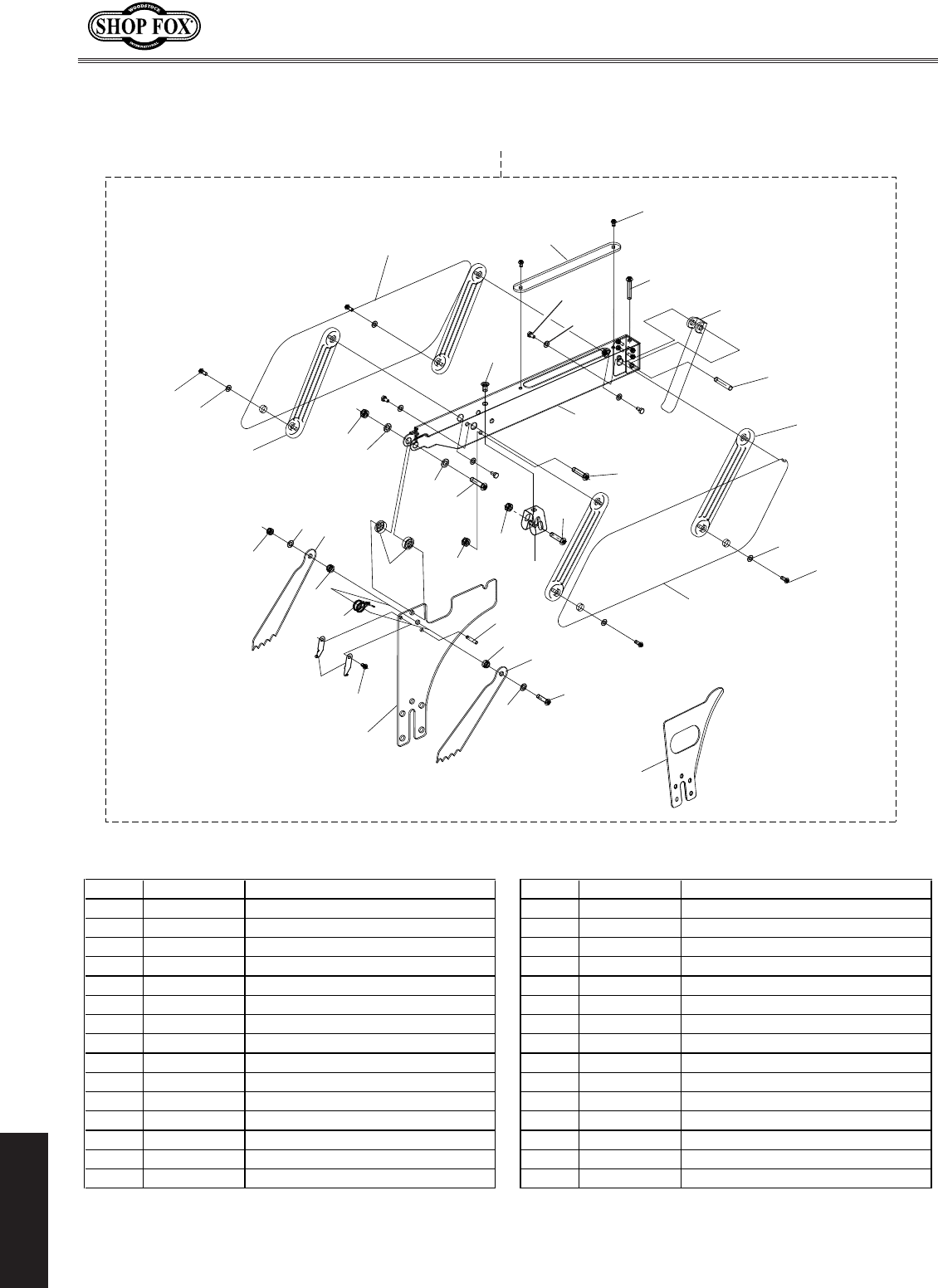
-84-
Df[\cN(/(0&N(/)'D]^%J`eZ\()&('
G8IKJ
9cX[\>lXi[
REF PART # DESCRIPTION REF PART # DESCRIPTION
401AV3 X1819401AV3 BLADE GUARD ASSEMBLY V3.02.11 440V2 XPB122M HEX BOLT M4-.7 X 8
415 XPRP39M ROLL PIN 4 X 20 441V2 XPS62M PHLP HD SCR M6-1 X 30
419 X1819419 TORSION SPRING 442V2 X1819442V2 GUARD SPACER V2.10.10
422V2 X1819422V2 SUPPORT ARM V2.10.10 445 X1819445 PAWL SPACER
423 XPS47M PHLP HD SCR M6-1 X 25 446 XPB42M HEX BOLT M5-.8 X 20
424 XPW03M FLAT WASHER 6MM 447 XPLN02M LOCK NUT M5-.8
426 X1819426 TOP GUARD PLASTIC 448 XPW02M FLAT WASHER 5MM
427 XPS17M PHLP HD SCR M4-.7 X 6 449 X1819449 PAWL
428 X1819428 FRONT GUARD PLASTIC 450V2 X1819450V2 SPREADER V2.10.10
429V2 X1819429V2 ROLL PIN 6 X 32 451 X1819451 RIVING KNIFE
431V2 X1819431V2 SIDE GUARD PLASTIC V2.10.10 452V2 X1819452V2 RIVET V2.02.11
432V2 X1819432V2 GUARD SWING ARM V2.10.10 453 X1819453 PAWL HOOK 2-PC
433V2 XPS38M PHLP HD SCR M4-.7 X 10 454V2 X1819454V2 RIVET 5 X 12MM V2.02.11
434 XPW02M FLAT WASHER 5MM 456 X1819456 GUARD CLAMP
435V2 XPLN03M LOCK NUT M6-1 457 XPS531M PHLP HD SCR M6-1 X 35
439V2 XPW02M FLAT WASHER 5MM 458V2 XPB11M HEX BOLT M5-.8 X 8
+'(8M*
+(,
+(0
+))M)
+)*
+)+
+)+
+)-
+).
+)/
+)0M)
+*(M)
+*(M)
+*)M)
+*)M)
+,-
+,.
+**M)
+**M)
+*+
+*+
+*,M)
+,)M)
+,*
+,/M)
+,+M)
+*0M)
++'M) ++(M)
++)M)
++,
++,
++-
++. ++.
++/
++/
++0
++0
+,'M)
+,(
+*,M)
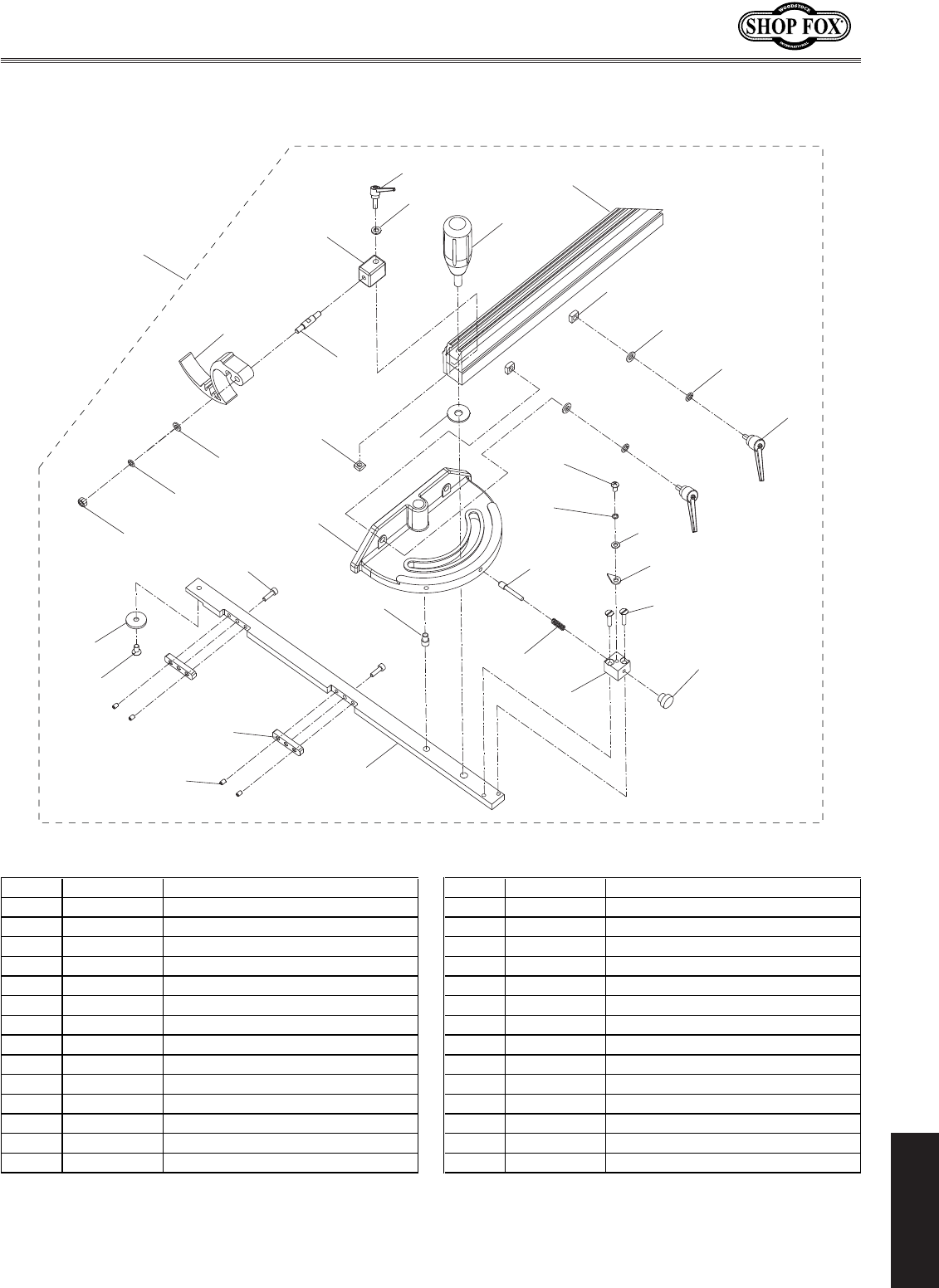
-85-
Df[\cN(/(0&N(/)'D]^%J`eZ\()&('
G8IKJ
D`k\i>Xl^\
REF PART # DESCRIPTION REF PART # DESCRIPTION
501AV2 X1819501AV2 MITER GAUGE ASSEMBLY V2.12.10 515 XPW05M FLAT WASHER 4MM
501 X1819501 MITER BAR 516 XPLW02M LOCK WASHER 4MM
502 X1819502 GIB 517 XPS07M PHLP HD SCR M4-.7 X 8
503 XPSS79M SET SCREW M4-.7 X 6 518 X1819518 MITER KNOB
504 XPCAP41M CAP SCREW M4-.7 X 14 519 X1819519 FENDER WASHER 8MM
505 X1819505 T-SLOT WASHER 520 X1819520 MITER GAUGE FENCE
506 XPFH30M FLAT HD SCR M5-.8 X 8 521 X1819521 T-NUT M6-1
507 X1819507 MITER BODY PIVOT PIN 522 XPW03M FLAT WASHER 6MM
508 X1819508 MITER GUAGE BODY 523V2 X1819523V2 PLASTIC WASHER 6MM
509 X1819509 STOP PIN KNOB 524V2 X1819524V2 LOCK LEVER M6-1 X 25 V2.12.10
510 X1819510 STOP PIN BLOCK 525 X1819525 FLIP STOP BRACKET
511 X1819511 COMPRESSION SPRING 526V2 X1819526V2 LOCK LEVER M6-1 X 32 V2.12.10
512 X1819512 STOP PIN 527 X1819527 FLIP STOP PIVOT SHAFT
513 XPFH77M FLAT HD SCR M4-.7 X 20 528 X1819528 FLIP STOP
514 X1819514 POINTER 529 XPLN03M LOCK NUT M6-1
501AV2
501
502
503
504
505
506
507
508
509
510
511
512
513
514
515
516
517
518
519
520
521
522
523V2
524V2
525
526V2
527
528
529
522
522
523V2
521
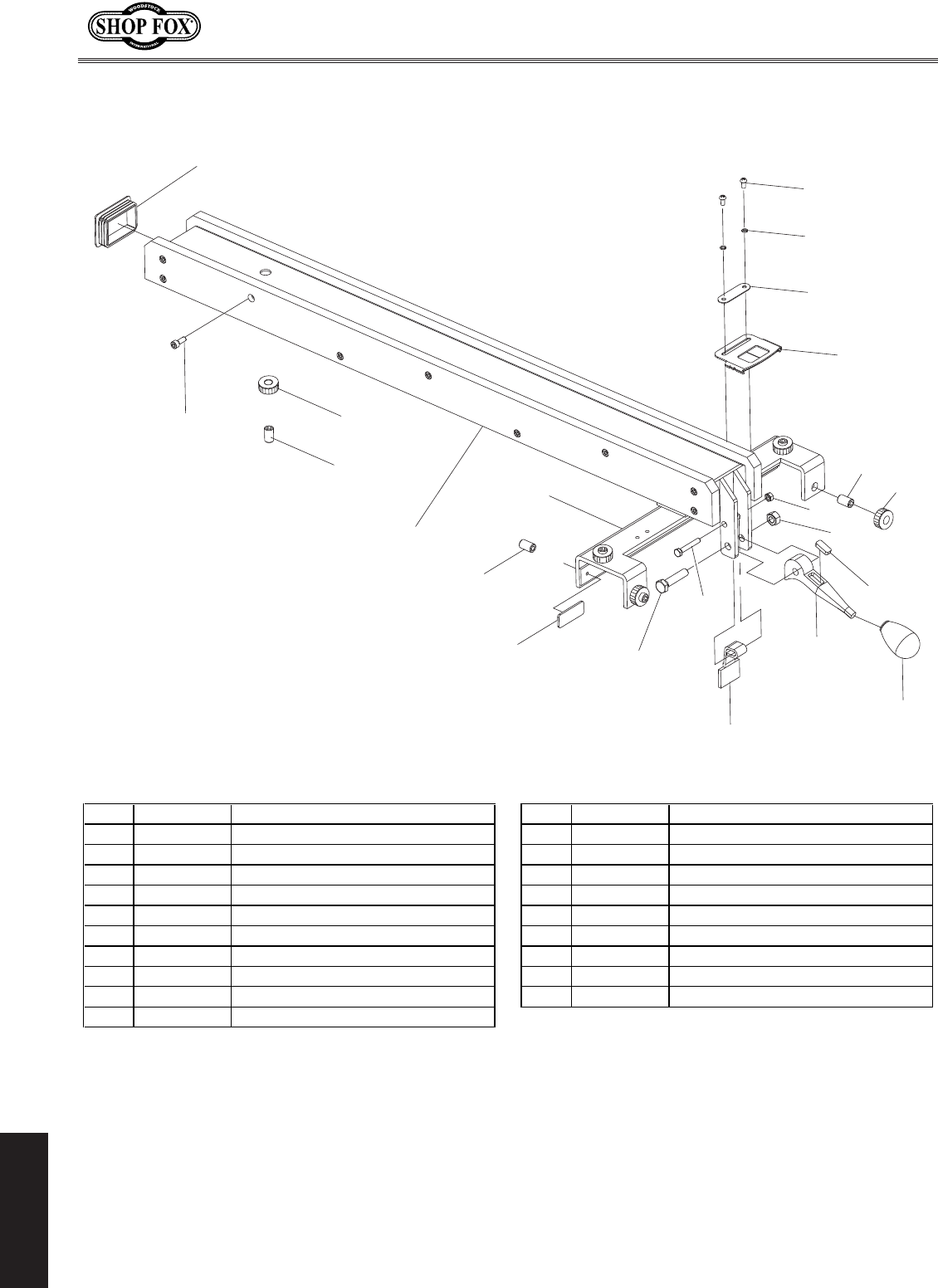
-86-
Df[\cN(/(0&N(/)'D]^%J`eZ\()&('
G8IKJ
=\eZ\
REF PART # DESCRIPTION REF PART # DESCRIPTION
601 X1819601 FENCE END CAP 612 XPB47M HEX BOLT M6-1 X 40
602 X1819602 FENCE FACE 613 XPLN03M LOCK NUT M6-1
603 XPCAP01M CAP SCREW M6-1 X 16 614 XPB116M HEX BOLT M10-1.5 X 45
604 X1819604 GLIDE PAD 615 XPLN05M LOCK NUT M10-1.5
605 X1819605 FENCE SCALE WINDOW 616 X1819616 LOCK FOOT
606 XPSS109M SET SCREW M12-1.75 X 16 617 X1819617 MAGNET
607 XPS09M PHLP HD SCR M5-.8 X 10 618 X1819618 FENCE LOCK LEVER
608 XPLW01M LOCK WASHER 5MM 619 X1819619 FENCE LOCK KNOB
609 X1819609 SCALE INDICATOR 620 XPSS32M SET SCREW M12-1.75 X 30
610 X1819610 FENCE BODY 621 X1819621 KNURLED KNOB M12-1.75
611 X1819611 ALIGNMENT SET SCREW
601
602
603
604
605
606
607
608
609
611
612
613
614
615
616
617
618
619
620
621
621
610
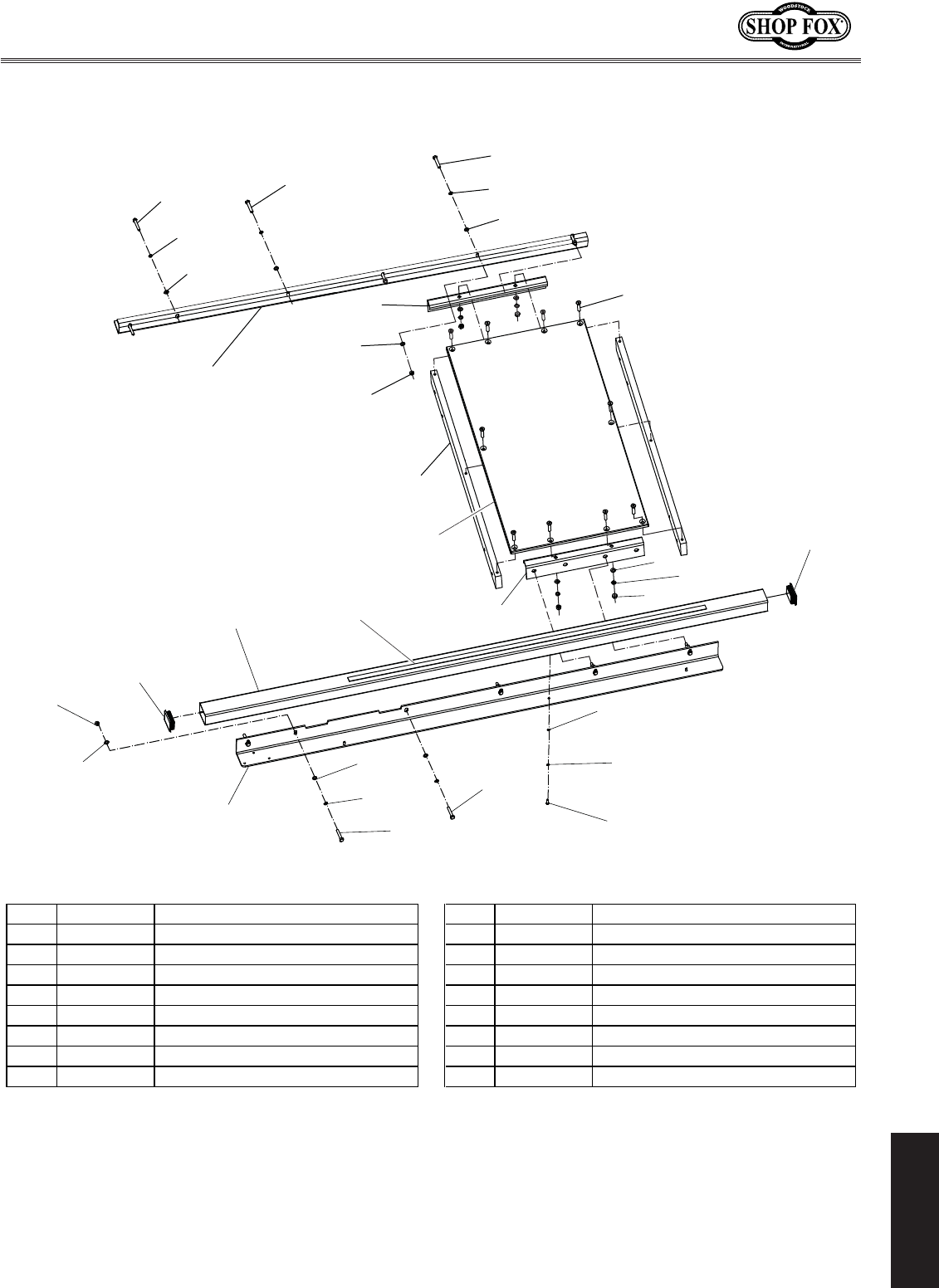
-87-
Df[\cN(/(0&N(/)'D]^%J`eZ\()&('
G8IKJ
N(/(0<ok\ej`feN`e^IX`cj
REF PART # DESCRIPTION REF PART # DESCRIPTION
701 X1819701 GUIDE TUBE END CAP 710 XPW01M FLAT WASHER 8MM
702 X1819702 GUIDE TUBE 711 X1819711 REAR RAIL
703 X1819703 FENCE SCALE 712 XPB15M HEX BOLT M8-1.25 X 40
704 X1819704 FRONT RAIL 713 XPN03M HEX NUT M8-1.25
705 XPCAP01M CAP SCREW M6-1 X 16 714 X1819714 EXTENSION WING
706 XPLW03M LOCK WASHER 6MM 716 X1819716 LONGITUDINAL EXTENSION SUPPORT
707 XPW03M FLAT WASHER 6MM 717 X1819717 CROSS EXTENSION SUPPORT
708 XPB26M HEX BOLT M8-1.25 X 30 718 XPN01M HEX NUT M6-1
709 XPLW04M LOCK WASHER 8MM 719 XPFH12M FLAT HD SCR M6-1 X 25
701
702 703
704 705
706
707
708
709
710
711
712
713
714
716
717
718
719
716
710
713
710
701
709
710 706
707
708
705
706
707
712
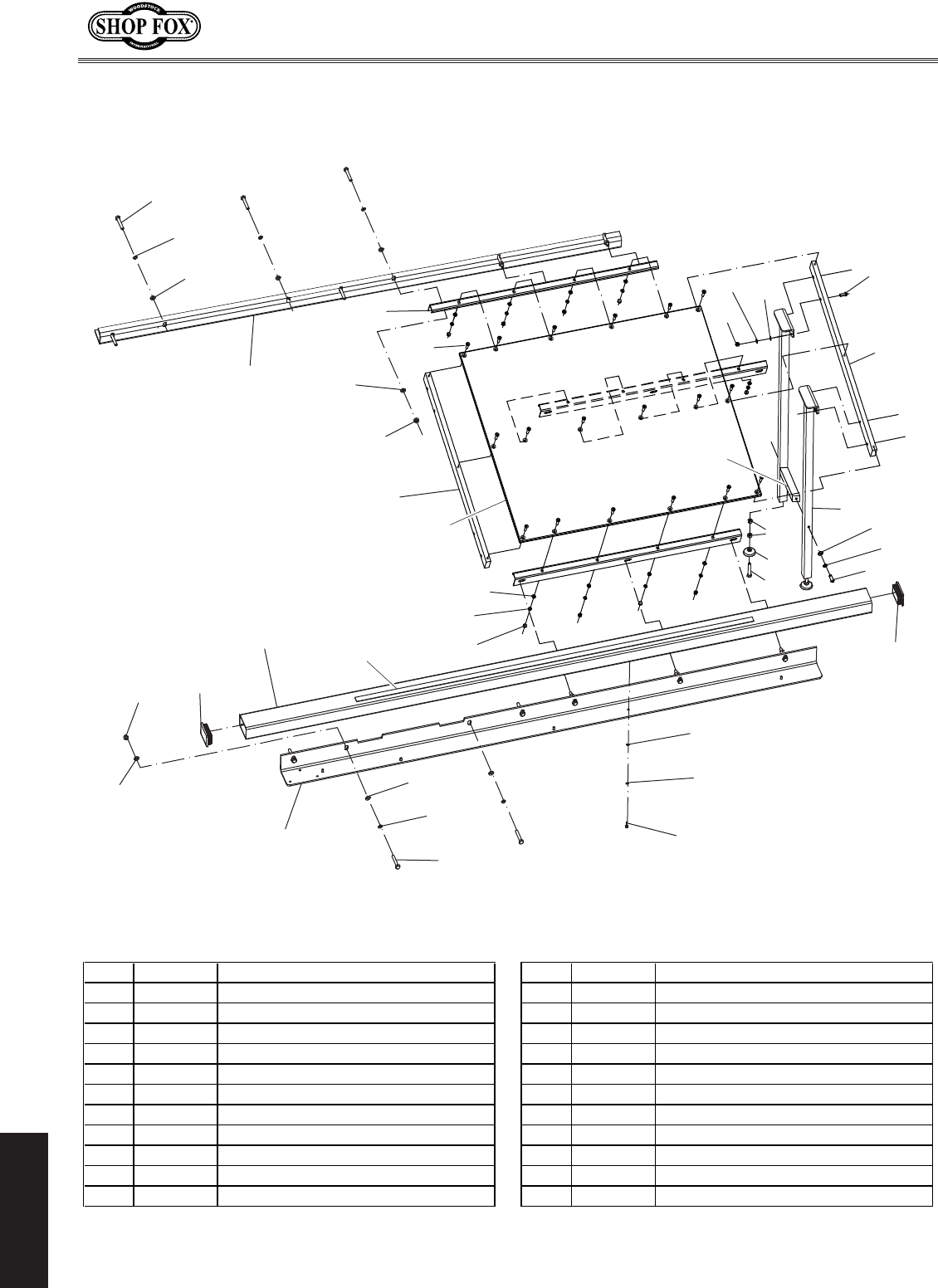
-88-
Df[\cN(/(0&N(/)'D]^%J`eZ\()&('
G8IKJ
N(/)'<ok\ej`feN`e^IX`cj
REF PART # DESCRIPTION REF PART # DESCRIPTION
701 X1820701 GUIDE TUBE END CAP 720 X1820720 EXTENSION WING
705 XPCAP01M CAP SCREW M6-1 X 16 721 X1820721 LONGITUDINAL EXTENSION SUPPORT
706 XPLW03M LOCK WASHER 6MM 722 X1820722 LEG
707 XPW03M FLAT WASHER 6MM 723 X1820723 LEG CROSS BAR
708 XPB26M HEX BOLT M8-1.25 X 30 724 XPBHS20M BUTTON HD CAP SCR M8-1.25 X 30
709 XPLW04M LOCK WASHER 8MM 725 X1820725 FOOT
710 XPW01M FLAT WASHER 8MM 726 XPB28M HEX BOLT M8-1.25 X 60
712 XPB15M HEX BOLT M8-1.25 X 40 727 XPBHS07M BUTTON HD CAP SCR M8-1.25 X 40
713 XPN03M HEX NUT M8-1.25 728 X1820728 REAR RAIL
717 X1820717 CROSS EXTENSION SUPPORT 729 X1820729 GUIDE TUBE
718 X1820718 HEX NUT M6-1.25 730 X1820730 FENCE SCALE
719 XPFH12M FLAT HD SCR M6-1 X 25 731 X1820731 FRONT RAIL
701
705
706
707
708
709
710
712
713
717
718
719
720
721
722
723
724
725
726
727
728
729 730
731
710
710
709
713
717
710
709
713
706
707
710
709
713
710
701
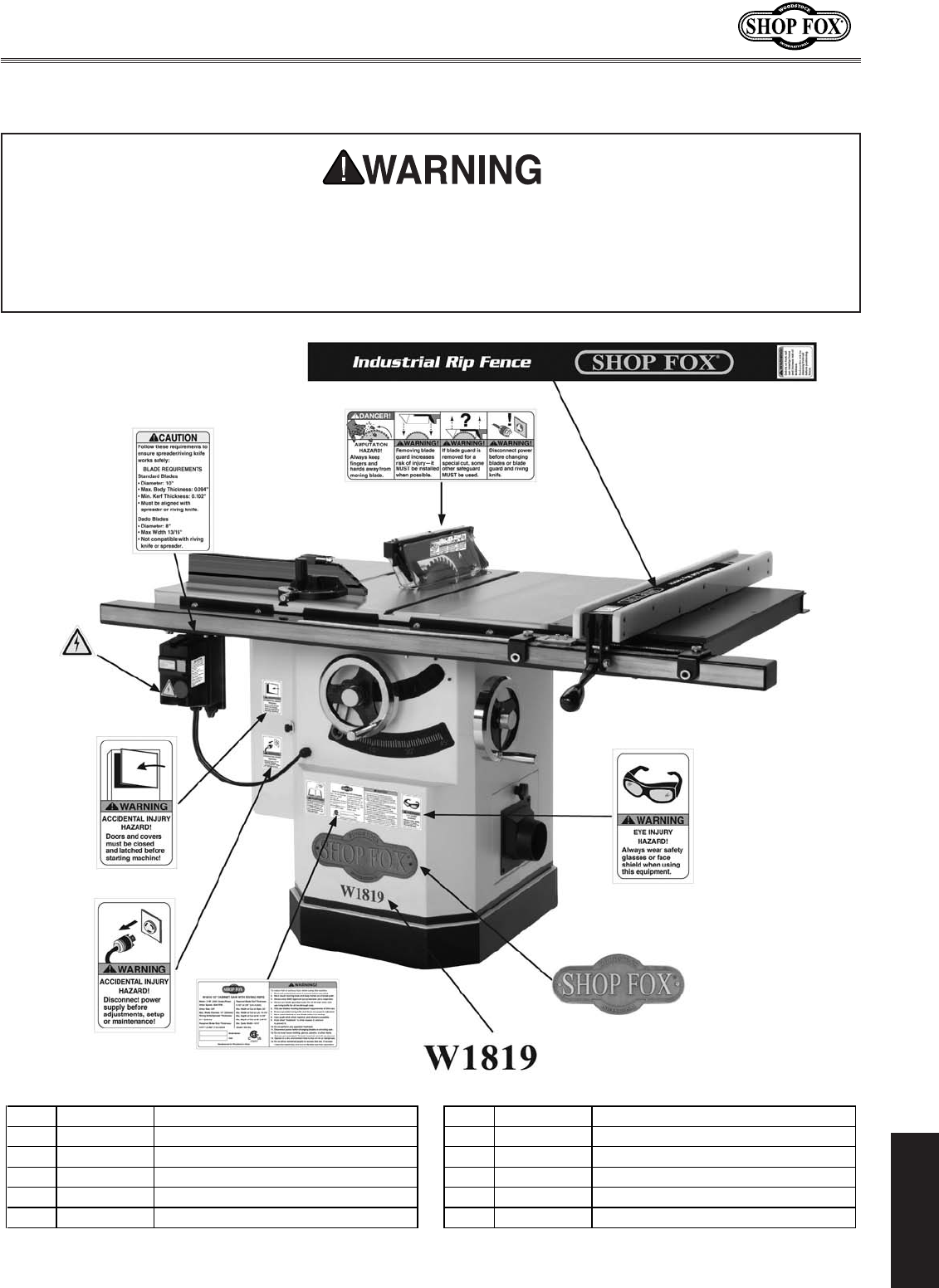
-89-
Df[\cN(/(0&N(/)'D]^%J`eZ\()&('
G8IKJ
DXZ_`e\CXY\cj
JX]\kpcXY\cj nXie XYflkdXZ_`e\ _XqXi[jXe[_fn kf gi\m\ekdXZ_`e\ [XdX^\fi `ealip%K_\
fne\i f] k_`j dXZ_`e\ DLJK dX`ekX`e k_\ fi`^`eXc cfZXk`fe Xe[ i\X[XY`c`kp f] Xcc cXY\cj fe k_`j
dXZ_`e\%@]XepcXY\c`ji\dfm\[fiY\Zfd\jlei\X[XYc\#I<GC8:<k_XkcXY\cY\]fi\Xccfn`e^k_\
dXZ_`e\kf\ek\ij\im`Z\X^X`e%:fekXZkNff[jkfZb@ek\ieXk`feXc#@eZ%Xk(*-').*+$*+/)finnn%
j_fg]fokffcj%Zfdkffi[\ie\ncXY\cj%
REF PART # DESCRIPTION REF PART # DESCRIPTION
801 XLABEL-04 ELECTRICITY LABEL 807 X1819807 MODEL NUMBER LABEL (W1819)
802 X1819802 TABLE SAW PRECAUTIONS LABEL 807 X1820807 MODEL NUMBER LABEL (W1820)
803 X1819803 BLADE GUARD WARNING LABEL 808 X1819808 MACHINE ID LABEL (W1819)
804 X1819804 RIP FENCE LABEL 808 X1820808 MACHINE ID LABEL (W1820)
805 X1819805 EYE INJURY HAZARD LABEL 809 X1819809 DISCONNECT POWER LABEL
806 D3377 SHOP FOX NAMEPLATE 810 X1819810 MOTOR COVER WARNING LABEL
801
802
803
804
805
806
807
808
809
810

-90-
Df[\cN(/(0&N(/)'D]^%J`eZ\()&('
G8IKJ

Df[\cN(/(0&N(/)'D]^%J`eZ\()&('

TAPE ALONG EDGES--PLEASE DO NOT STAPLE
FOLD ALONG DOTTED LINE
FOLD ALONG DOTTED LINE
NFF;JKF:B@EK<IE8K@FE8C@E:%
G%F%9FO)*'0
9<CC@E>?8D#N80/)).$)*'0
Place
Stamp
Here

N8II8EKP
Nff[jkfZb@ek\ieXk`feXc#@eZ%nXiiXekjXccJ_fg=fodXZ_`e\ipkfY\]i\\f][\]\Zkj]ifdnfibdXej_`g
Xe[dXk\i`Xcj]fiXg\i`f[f]knfp\Xij]ifdk_\[Xk\f]fi`^`eXcgliZ_Xj\Ypk_\fi`^`eXcfne\i%
K_`jnXiiXekp[f\jefkXggcpkf[\]\Zkj[l\[`i\Zkcpfi`e[`i\Zkcpkfd`jlj\#XYlj\#e\^c`^\eZ\fi
XZZ`[\ekj#cXZbf]dX`ek\eXeZ\#fii\`dYlij\d\ekf]k_`i[gXikp\og\ej\j`eZlii\[%
Nff[jkfZb@ek\ieXk`feXc#@eZ%n`cci\gX`ifii\gcXZ\#Xk`kj\og\ej\Xe[Xk`kjfgk`fe#k_\J_fg=fo
dXZ_`e\fidXZ_`e\gXik#n_`Z_`eefidXclj\_Xjgifm\ekfY\[\]\Zk`m\#gifm`[\[k_Xkk_\fi`^`eXc
fne\ii\kliejk_\gif[lZkgi\gX`[kfXJ_fg=fo]XZkfipj\im`Z\Z\ek\in`k_giff]f]k_\`igliZ_Xj\
f]k_\gif[lZkn`k_`eknfp\Xij#Xe[gifm`[\jNff[jkfZb@ek\ieXk`feXc#@eZ%i\XjfeXYc\fggfikle`kpkf
m\i`]pk_\Xcc\^\[[\]\Zkk_ifl^_`ejg\Zk`fe%@]`k`j[\k\id`e\[k_\i\`jef[\]\Zk#fik_Xkk_\[\]\Zk
i\jlck\[]ifdZXlj\jefkn`k_`ek_\jZfg\f]Nff[jkfZb@ek\ieXk`feXc@eZ%jnXiiXekp#k_\ek_\fi`^`eXc
fne\idljkY\Xik_\Zfjkf]jkfi`e^Xe[i\klie`e^k_\gif[lZk%
K_`j`jNff[jkfZb@ek\ieXk`feXc#@eZ%jjfc\ni`kk\enXiiXekpXe[XepXe[XccnXiiXek`\jk_XkdXp
Y\`dgc`\[YpcXn#`eZcl[`e^Xepd\iZ_XekXY`c`kpfi]`ke\jj#]fiXepgXik`ZlcXigligfj\#Xi\_\i\Yp
c`d`k\[kfk_\[liXk`fef]k_`jni`kk\enXiiXekp%N\[fefknXiiXekk_XkJ_fg=fodXZ_`e\ipZfdgc`\j
n`k_k_\gifm`j`fejf]XepcXnfiXZkj%@eef\m\ekj_XccNff[jkfZb@ek\ieXk`feXc#@eZ%jc`XY`c`kple[\i
k_`jnXiiXekp\oZ\\[k_\gliZ_Xj\gi`Z\gX`[]fik_\gif[lZk#Xe[Xepc\^XcXZk`fejYifl^_kX^X`ejk
Nff[jkfZb@ek\ieXk`feXc#@eZ%j_XccY\ki`\[`ek_\JkXk\f]NXj_`e^kfe#:flekpf]N_XkZfd%N\j_Xcc
`eef\m\ekY\c`XYc\]fi[\Xk_#`eali`\jkfg\ijfejfigifg\ikpfi]fi`eZ`[\ekXc#Zfek`e^\ek#jg\Z`Xcfi
Zfej\hl\ek`Xc[XdX^\jXi`j`e^]ifdk_\lj\f]fligif[lZkj%
<m\ip\]]fik_XjY\\edX[\kf\ejli\k_XkXccJ_fg=fodXZ_`e\ipd\\kj_`^_hlXc`kpXe[[liXY`c`kp
jkXe[Xi[j%N\i\j\im\k_\i`^_kkfZ_Xe^\jg\Z`]`ZXk`fejXkXepk`d\Y\ZXlj\f]fliZfdd`kd\ekkf
Zfek`elfljcp`dgifm\k_\hlXc`kpf]fligif[lZkj%
N8II8EKP

=^\]FjVa^inBVX]^cZhVcYIddah
LddYhidX`>ciZgcVi^dcVa!>cX#XVgg^Zhi]djhVcYhd[egdYjXihYZh^\cZY
idbZZii]ZcZZYhd[idYVnhlddYldg`ZghVcYbZiValdg`Zgh#
6h`ndjgYZVaZgVWdjii]ZhZ[^cZegdYjXih/
