Y Soft a s 0YX0MU03088 USB Reader v3 LF & Legic User Manual

Y Soft Corporation, a.s. USB Reader v3 LF & Legic

Contents

User Manual

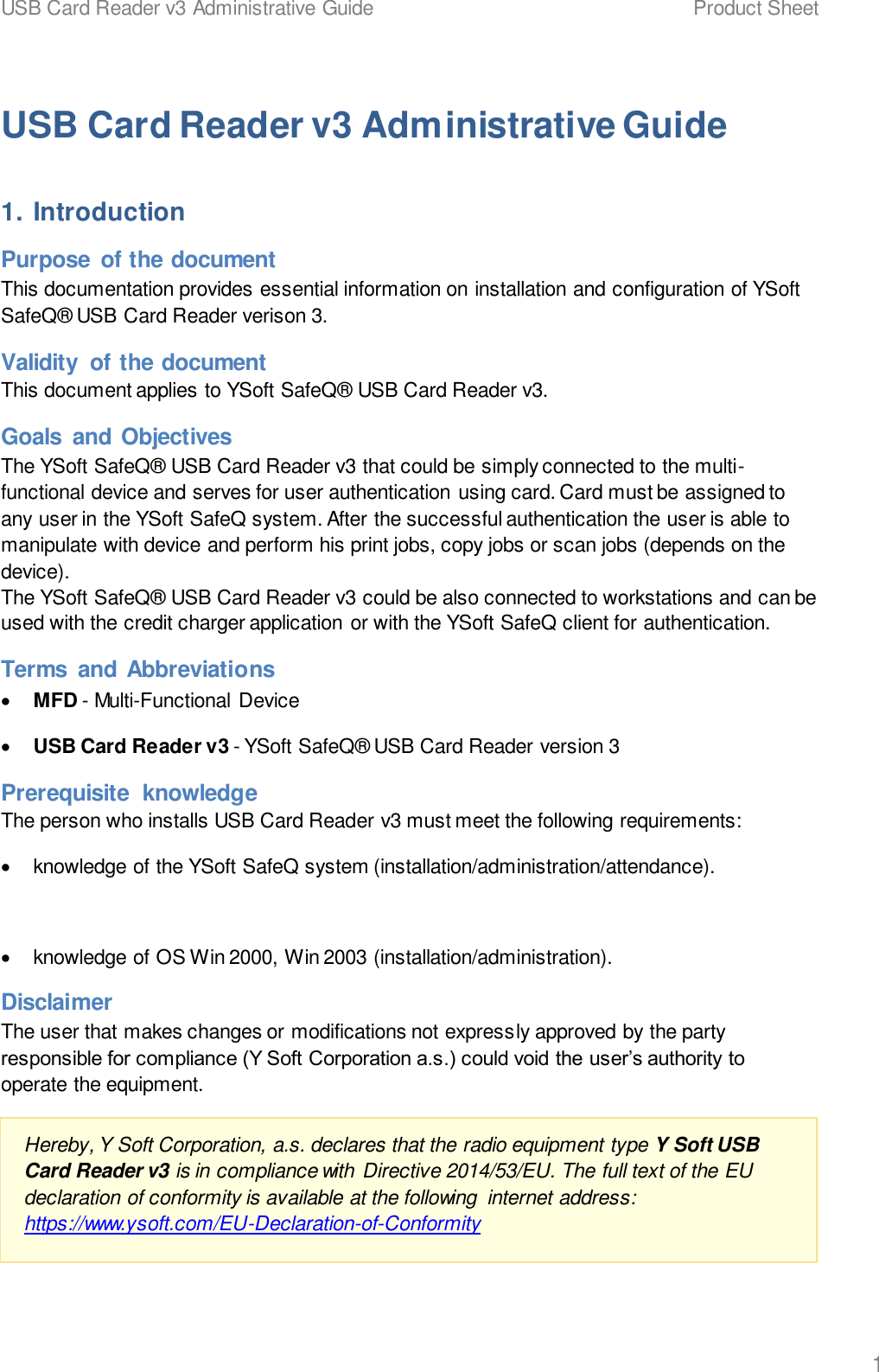
USB Card Reader v3 Administrative Guide    Product Sheet   1  USB Card Reader v3 Administrative Guide 1. Introduction Purpose  of the document This documentation provides essential information on installation and configuration of YSoft SafeQ® USB Card Reader verison 3. Validity  of the document This document applies to YSoft SafeQ® USB Card Reader v3. Goals  and Objectives The YSoft SafeQ® USB Card Reader v3 that could be simply connected to the multi-functional device and serves for user authentication using card. Card must be assigned to any user in the YSoft SafeQ system. After the successful authentication the user is able to manipulate with device and perform his print jobs, copy jobs or scan jobs (depends on the device). The YSoft SafeQ® USB Card Reader v3 could be also connected to workstations and can be used with the credit charger application or with the YSoft SafeQ client for authentication. Terms  and Abbreviations • MFD - Multi-Functional Device • USB Card Reader v3 - YSoft SafeQ® USB Card Reader version 3 Prerequisite  knowledge The person who installs USB Card Reader v3 must meet the following requirements: •  knowledge of the YSoft SafeQ system (installation/administration/attendance).  •  knowledge of OS Win 2000, Win 2003 (installation/administration). Disclaimer The user that makes changes or modifications not expressly approved by the party responsible for compliance (Y Soft Corporation a.s.) could void the user’s authority to operate the equipment. Hereby, Y Soft Corporation, a.s. declares that the radio equipment type Y Soft USB Card Reader v3 is in compliance with Directive 2014/53/EU. The full text of the EU declaration of conformity is available at the following  internet address:  https://www.ysoft.com/EU-Declaration-of-Conformity
USB Card Reader v3 Administrative Guide    Product Sheet   2 This equipment has been tested and found to comply with the limits for a Class A digital device, pursuant to part 15 of the FCC Rules. These limits are designed to provide reasonable protection against harmful interference when the equipment is operated in a commercial environment. This equipment generates, uses, and can radiate radio frequency energy and, if not installed and used in accordance with the instruction manual, may cause harmful interference to radio communications. Operation of this equipment in a residential area is likely to cause harmful interference in which case the user will be required to correct the interference at his own expense. This device complies with Industry Canada’s licence-exempt RSSs. Operation is subject to the following  two conditions: (1) This device may not cause interference; and (2) This device must accept any interference, including interference that may cause undesired operation of the device. Le présent appareil est conforme aux CNR d'Industrie Canada applicables aux appareils radio exempts de licence. L'exploitation est autorisée aux deux conditions suivantes : (1) l'appareil ne doit pas produire de brouillage, et (2) l'utilisateur de l'appareil doit accepter tout brouillage radioélectrique subi, même si le brouillage est susceptible d'en compromettre le fonctionnement.                       . 埋込み型心臓ペースメーカーおよび埋込み型除細動器を装着されている場合は、本装置または本装置のワイ ヤレスカードシステムのリーダライタ部(アンテナ部)から12cm以上離れて携行および使用してください。 電波により埋込み型心臓ペースメーカーおよび埋込み型除細動器の動作に影響を与える場合があります。  The product is in conformity with Directive 2002/96/EC of the European Parliament and of the Council of 27 January 2003 on waste electrical and electronic equipment (WEEE) and Directive 2003/108/EC of the European Parliament and of the Council of 8 December 2003 amending Directive 2002/96/EC on waste electrical and electronic equipment (WEEE).  Only for indoor use 2. Overview System  overview YSoft SafeQ® USB Card Reader has following characteristics: •  Connection and power supply of the card reader via the USB host interface.  •  Exchange of card reader possible without MFD turning off (hot-plug).
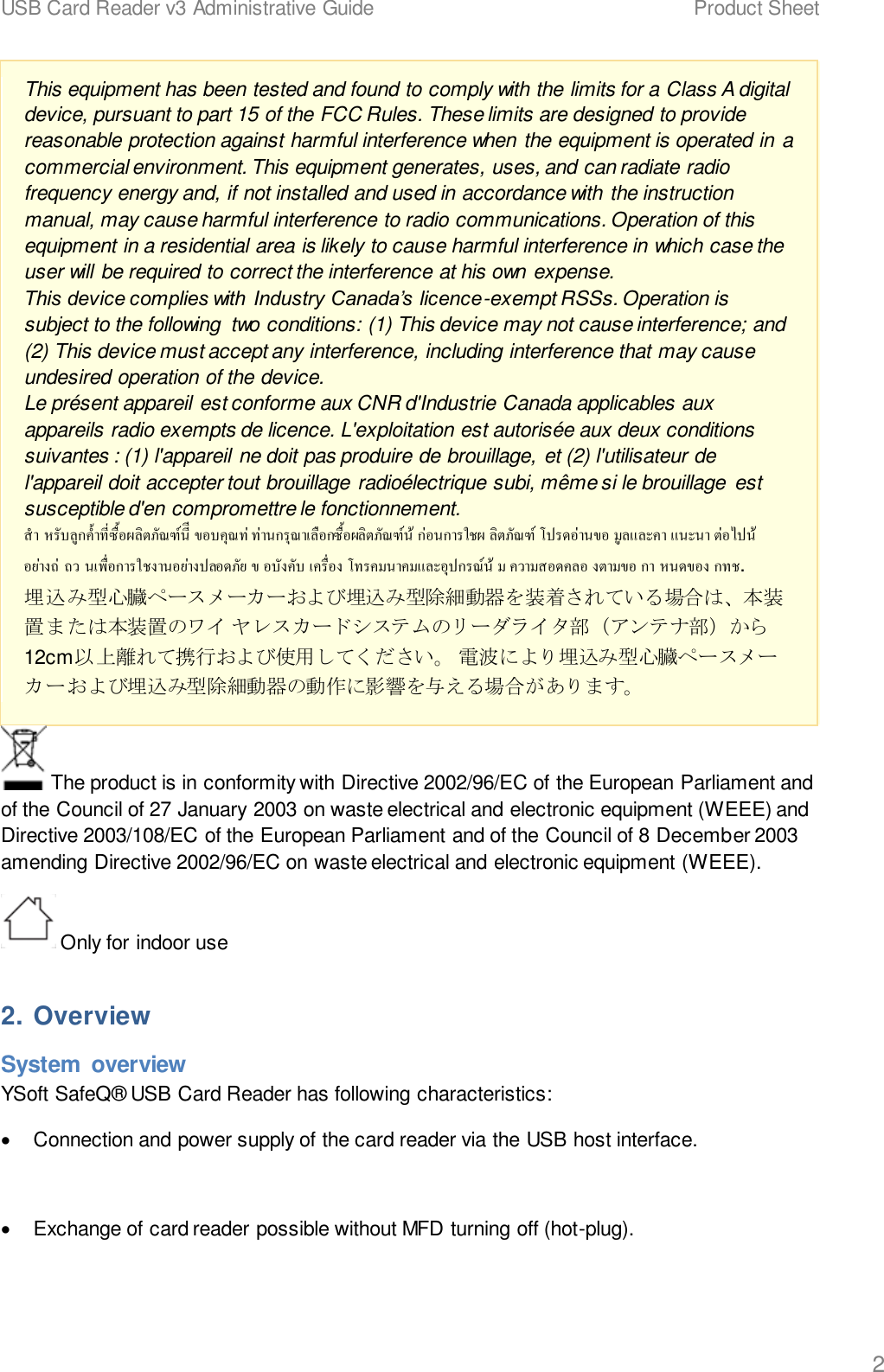
USB Card Reader v3 Administrative Guide    Product Sheet   3 •  Compatibility with some MFD additions. Hardware  components  USB card reader specifications Parameter Value Identification Using a card reader Voltage 5V DC Maximum current input 0.5A Working temperature +5°C to +35°C Storage temperature 0°C to +50°C Working air humidity 20% to 85% without condensation Storage air humidity 8% to 85% without condensation Resistance to magnetic field no added resistance Transmitting frequency 125 kHz, 13.56 MHz 3. Usage Please use the card by placing it on the edge of the reader as indicated below.
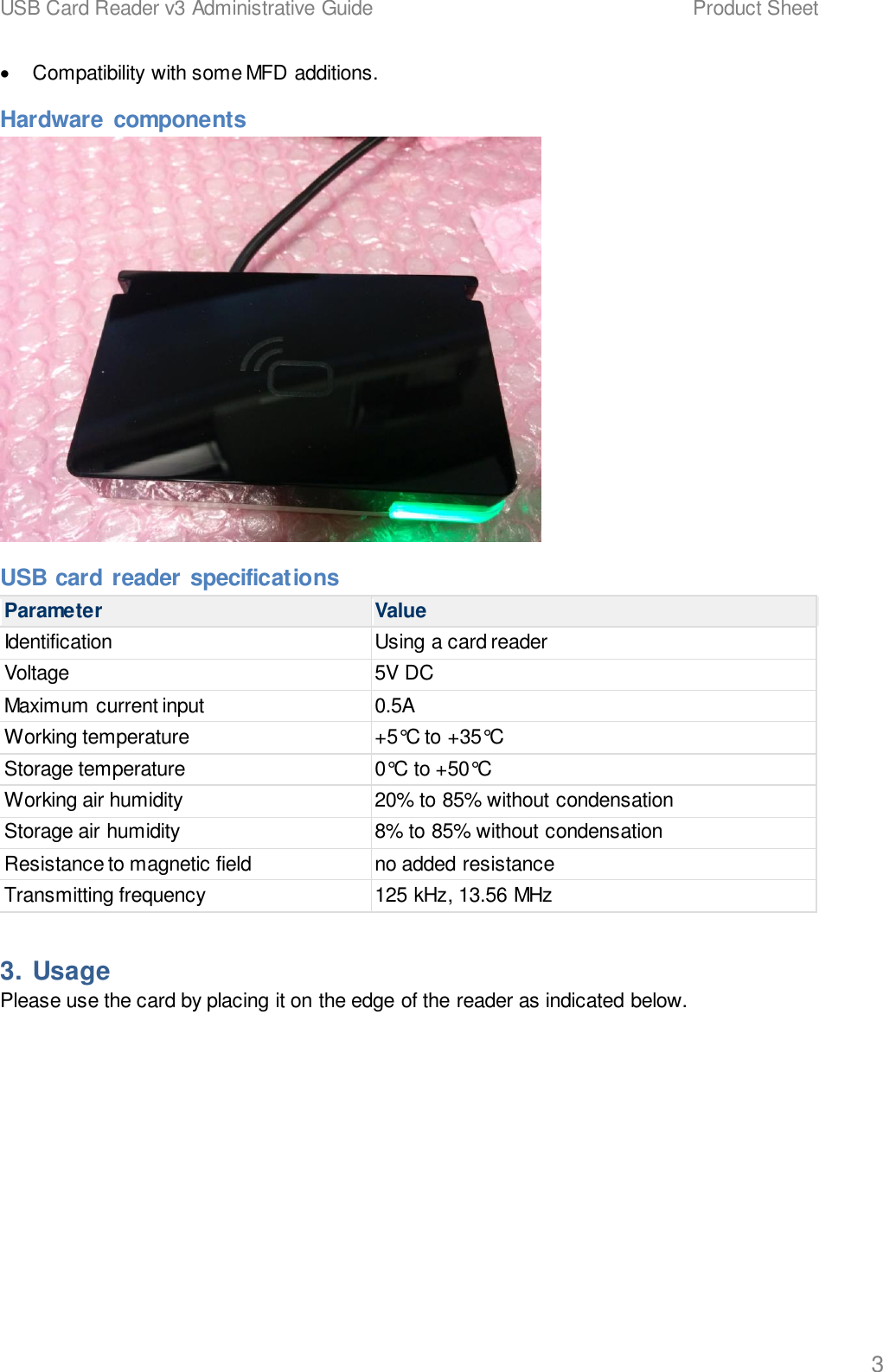
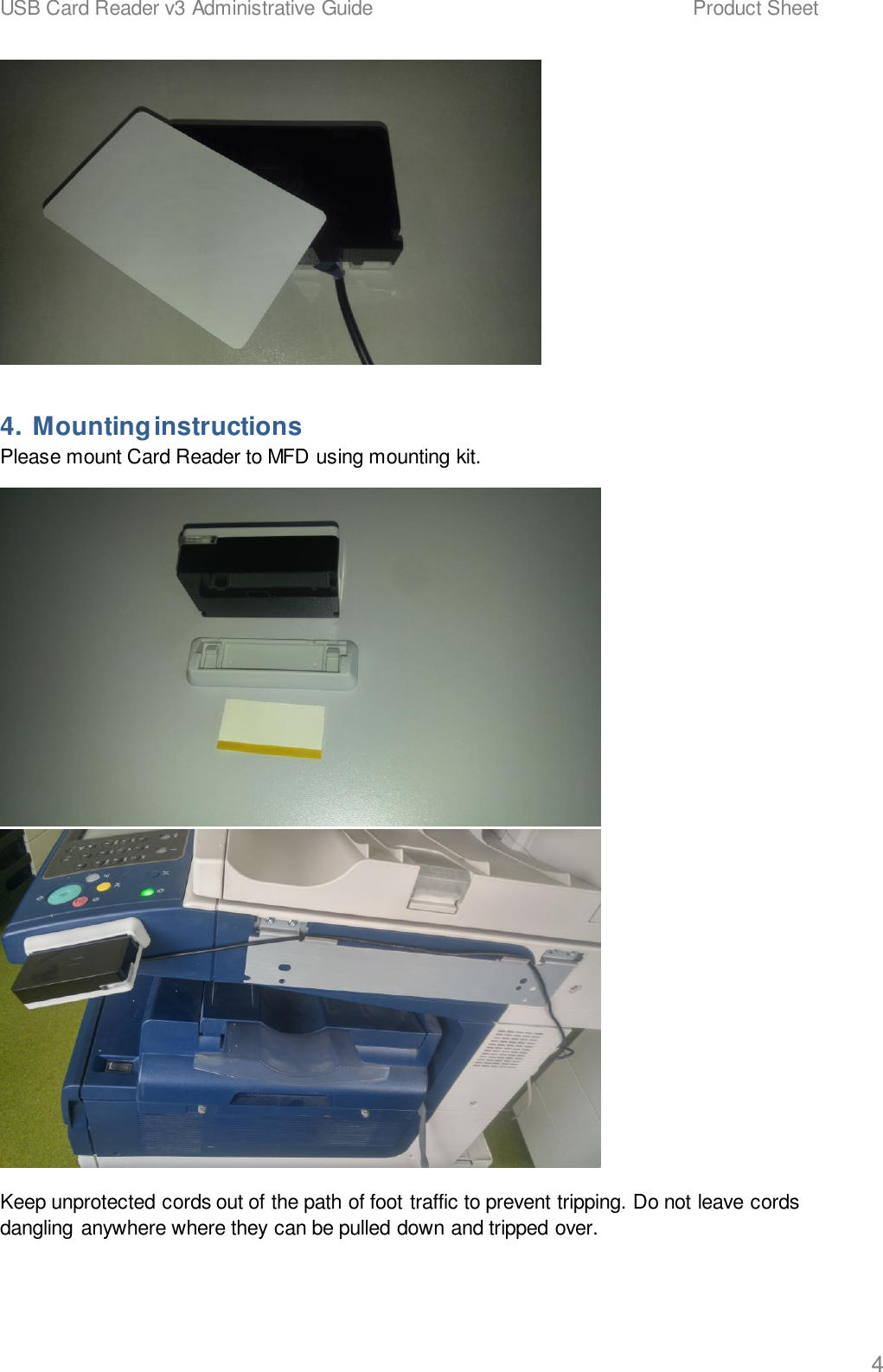
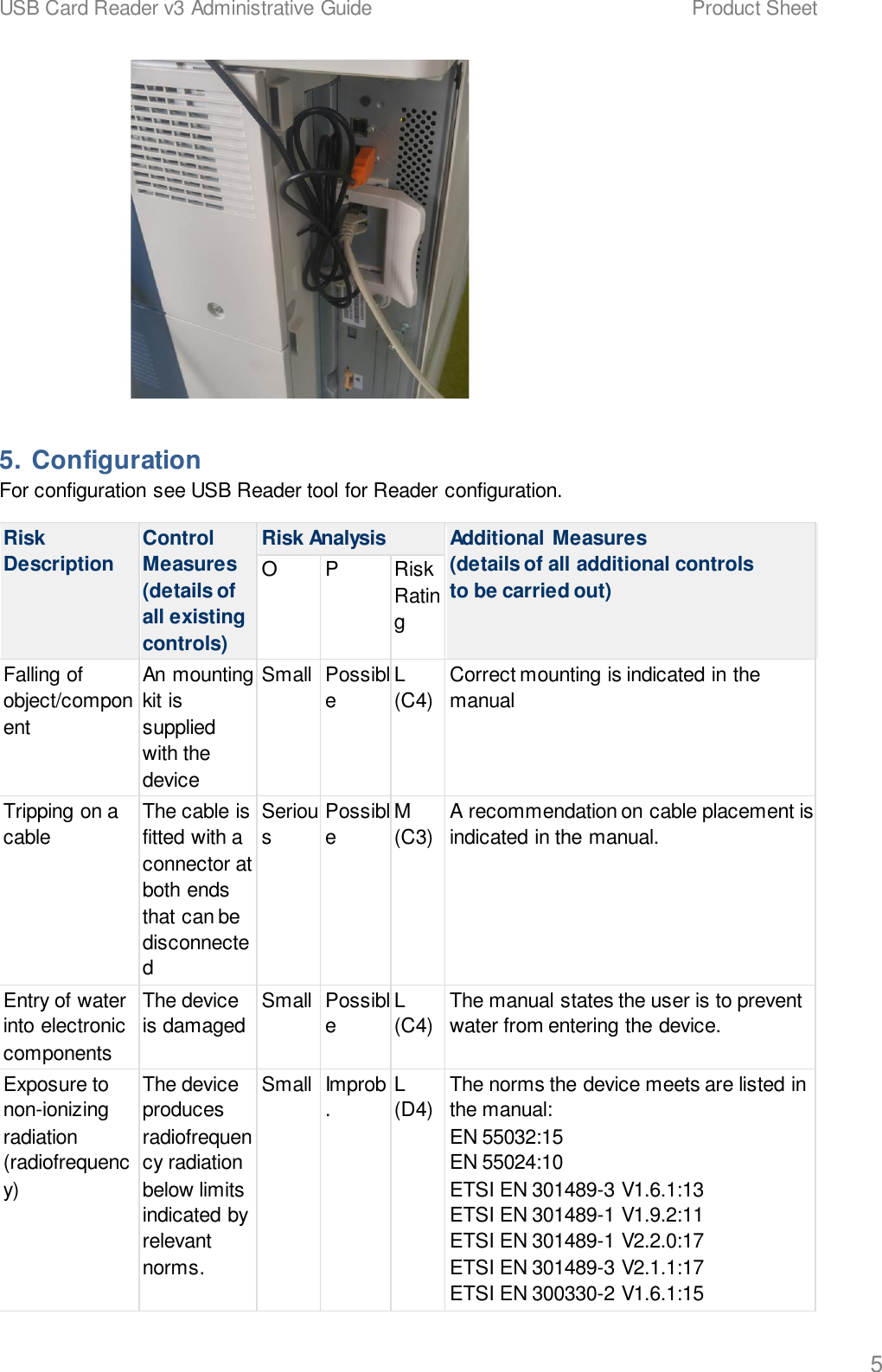
USB Card Reader v3 Administrative Guide    Product Sheet   4  4. Mounting instructions Please mount Card Reader to MFD using mounting kit.   Keep unprotected cords out of the path of foot traffic to prevent tripping. Do not leave cords dangling anywhere where they can be pulled down and tripped over.
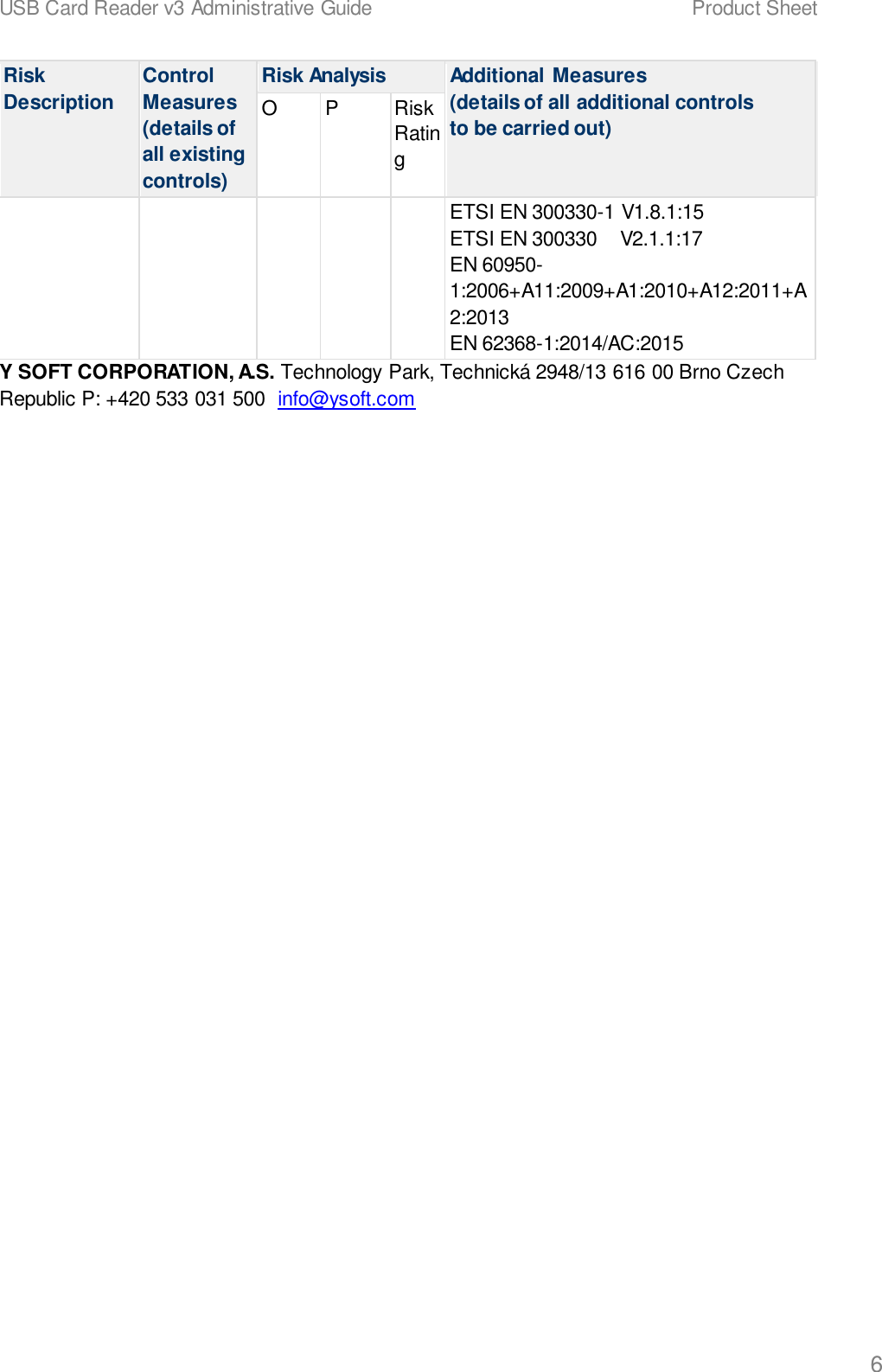
USB Card Reader v3 Administrative Guide    Product Sheet   5  5. Configuration For configuration see USB Reader tool for Reader configuration. Risk Description Control Measures (details of all existing controls) Risk Analysis Additional Measures (details of all additional controls to be carried out) O P Risk Rating Falling of object/component An mounting kit is supplied with the device Small Possible L (C4) Correct mounting is indicated in the manual Tripping on a cable The cable is fitted with a connector at both ends that can be disconnected Serious Possible M (C3) A recommendation on cable placement is indicated in the manual. Entry of water into electronic components The device is damaged Small Possible L (C4) The manual states the user is to prevent water from entering the device. Exposure to non-ionizing radiation (radiofrequency) The device produces radiofrequency radiation below limits indicated by relevant norms. Small Improb. L (D4) The norms the device meets are listed in the manual: EN 55032:15 EN 55024:10 ETSI EN 301489-3 V1.6.1:13 ETSI EN 301489-1 V1.9.2:11 ETSI EN 301489-1 V2.2.0:17 ETSI EN 301489-3 V2.1.1:17 ETSI EN 300330-2 V1.6.1:15
USB Card Reader v3 Administrative Guide    Product Sheet   6 Risk Description Control Measures (details of all existing controls) Risk Analysis Additional Measures (details of all additional controls to be carried out) O P Risk Rating ETSI EN 300330-1 V1.8.1:15 ETSI EN 300330    V2.1.1:17 EN 60950-1:2006+A11:2009+A1:2010+A12:2011+A2:2013 EN 62368-1:2014/AC:2015 Y SOFT CORPORATION, A.S. Technology Park, Technická 2948/13 616 00 Brno Czech Republic P: +420 533 031 500  info@ysoft.com
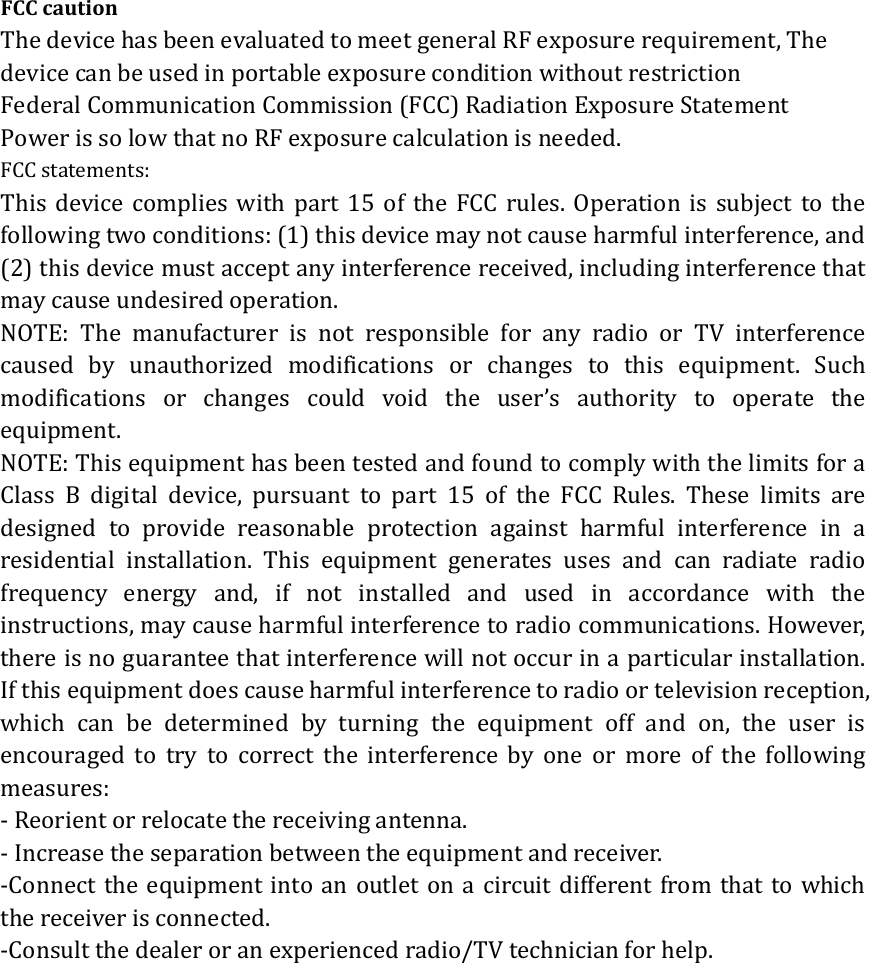
FCC caution The device has been evaluated to meet general RF exposure requirement, The device can be used in portable exposure condition without restriction Federal Communication Commission (FCC) Radiation Exposure Statement Power is so low that no RF exposure calculation is needed. FCC statements: This device complies with part 15 of the FCC rules. Operation is subject to the following two conditions: (1) this device may not cause harmful interference, and (2) this device must accept any interference received, including interference that may cause undesired operation.   NOTE: The manufacturer is not responsible for any radio or TV interference caused by unauthorized modifications or changes to this equipment. Such modifications or changes could void the user’s authority to operate the equipment. NOTE: This equipment has been tested and found to comply with the limits for a Class B digital device, pursuant to part 15 of the FCC Rules. These limits are designed to provide reasonable protection against harmful interference in a residential installation. This equipment generates uses and can radiate radio frequency energy and, if not installed and used in accordance with the instructions, may cause harmful interference to radio communications. However, there is no guarantee that interference will not occur in a particular installation. If this equipment does cause harmful interference to radio or television reception, which can be determined by turning the equipment off and on, the user is encouraged to try to correct the interference by one or more of the following measures: ‐ Reorient or relocate the receiving antenna. ‐ Increase the separation between the equipment and receiver. ‐Connect the equipment into an outlet on a circuit different from that to which the receiver is connected. ‐Consult the dealer or an experienced radio/TV technician for help.

Navigation menu