Yamaha 6L2 28199 1L 25D Owner's Manual User To The F6610ad0 49d1 460f 9944 D75a7070dc6a
User Manual: Yamaha 6L2-28199-1L to the manual
Open the PDF directly: View PDF  .
.
Page Count: 68

Printed in Japan
March 2004–0.2 ×1 !Printed on recycled paper
25D
OWNER’S MANUAL
6L2-28199-1L
U.S.A.Edition
LIT-18626-05-83
6L2-9-1L Hyoshi 3/17/04 2:45 PM Page 1
EMU25060
ZMU01690
Read this owner’s manual carefully before operating your outboard motor.
6L2-9-1L Hyoshi 3/17/04 2:45 PM Page 2
Important manual information
EMU25100
To the owner
Thank you for choosing a Yamaha outboard
motor. This Owner’s Manual contains infor-
mation needed for proper operation, mainte-
nance and care. A thorough understanding
of these simple instructions will help you ob-
tain maximum enjoyment from your new
Yamaha. If you have any question about the
operation or maintenance of your outboard
motor, please consult a Yamaha dealer.
In this Owner’s Manual particularly important
information is distinguished in the following
ways.
The Safety Alert Symbol means
ATTENTION! BECOME ALERT! YOUR
SAFETY IS INVOLVED!
WARNING
EWM00780
Failure to follow WARNING instructions
could result in severe injury or death to
the machine operator, a bystander, or a
person inspecting or repairing the out-
board motor.
CAUTION:
ECM00700
A CAUTION indicates special precautions
that must be taken to avoid damage to the
outboard motor.
NOTE:
A NOTE provides key information to make
procedures easier or clearer.
Yamaha continually seeks advancements in
product design and quality. Therefore, while
this manual contains the most current prod-
uct information available at the time of print-
ing, there may be minor discrepancies
between your machine and this manual. If
there is any question concerning this manu-
al, please consult your Yamaha dealer.
NOTE:
The 25MH and the standard accessories are
used as a base for the explanations and illus-
trations in this manual. Therefore some
items may not apply to every model.
EMU25110
25D
OWNER’S MANUAL
©2004 by Yamaha Motor Corporation, USA
1st edition, March 2004
All rights reserved.
Any reprinting or unauthorized use
without the written permission of
Yamaha Motor Corporation, USA
is expressly prohibited.
Printed in Japan
P/N LIT-18626-05-83

Table of contents
General information .......................... 1
Identification numbers record........... 1
Outboard motor serial number .......... 1
Emission control information ............ 1
North American models..................... 1
Safety information ............................ 2
Important labels................................ 3
Warning labels .................................. 3
Basic boating rules
(Rules of the road) ......................... 4
Steering and sailing rules and sound
signals............................................. 4
Rules when encountering vessels .... 4
Other special situations..................... 5
Fueling instructions .......................... 7
Gasoline............................................ 8
Engine oil .......................................... 8
Propeller selection............................ 8
Start-in-gear protection ....................9
Basic components .......................... 10
Main components........................... 10
Fuel tank ......................................... 10
Fuel joint ......................................... 11
Fuel gauge ...................................... 11
Fuel tank cap .................................. 11
Air vent screw ................................. 11
Tiller handle .................................... 11
Gear shift lever................................ 11
Throttle grip..................................... 11
Throttle indicator ............................. 12
Throttle friction adjuster................... 12
Engine stop lanyard switch ............. 12
Engine stop button .......................... 13
Choke knob for pull type ................. 13
Manual starter handle ..................... 13
Steering friction adjuster ................. 13
Trim tab with anode ........................ 14
Trim rod (tilt pin).............................. 14
Shallow water lever......................... 14
Tilt lock mechanism......................... 15
Tilt support bar ................................ 15
Top cowling lock lever(s)
(turn type) ..................................... 15
Warning system .............................15
Overheat warning............................ 15
Operation ......................................... 17
Installation...................................... 17
Mounting the outboard motor .......... 17
Clamping the outboard motor.......... 18
Breaking in engine ......................... 19
Gasoline and engine oil mixing
chart (25:1)....................................19
Procedure for pre-mixed models..... 19
Preoperation checks ...................... 20
Fuel ................................................. 20
Oil .................................................... 20
Controls ........................................... 20
Engine ............................................. 20
Filling fuel and engine oil ............... 20
Filling fuel for portable tank ............. 20
Ring Free Fuel Additive................... 21
Gasoline and oil mixing (100:1)....... 21
Operating engine ........................... 22
Feeding fuel (portable tank) ............22
Starting engine ................................ 23
Warming up engine........................ 25
Choke start models .........................25
Shifting........................................... 25
Forward (tiller handle and remote
control models) .............................25
Reverse (manual tilt and hydro tilt
models) ......................................... 26
Stopping engine............................. 26
Procedure........................................ 26
Trimming outboard motor............... 27
Adjusting trim angle for manual tilt
models .......................................... 28
Adjusting boat trim ..........................28
Tilting up and down........................ 29
Procedure for tilting up .................... 30
Procedure for tilting down
(manual tilt models).......................30
Cruising in shallow water ............... 31
Cruising in shallow water
(manual tilt models).......................31
Cruising in other conditions............ 32
Maintenance .................................... 33
Specifications................................. 33
Transporting and storing outboard
motor............................................ 33

Table of contents
Clamp screw mounting models....... 34
Storing outboard motor ................... 34
Procedure ....................................... 35
Lubrication
(except oil injection models) ......... 36
Cleaning and anticorrosion
measures ...................................... 36
Cleaning the outboard motor .......... 36
Checking painted surface of
motor............................................. 36
Periodic maintenance..................... 37
Replacement parts.......................... 37
Maintenance chart .......................... 38
Greasing ......................................... 39
Cleaning and adjusting spark plug.. 39
Checking fuel system...................... 40
Inspecting fuel filter ......................... 41
Cleaning fuel filter ........................... 41
Inspecting idling speed ................... 42
Checking wiring and connectors ..... 42
Exhaust leakage ............................. 42
Water leakage................................. 42
Checking propeller .......................... 43
Removing the propeller................... 44
Installing the propeller..................... 44
Changing gear oil............................ 44
Cleaning fuel tank ........................... 45
Inspecting and replacing anode(s).. 46
Checking top cowling ...................... 46
Coating the boat bottom.................. 46
Trouble Recovery............................ 48
Troubleshooting ............................. 48
Temporary action in emergency..... 51
Impact damage ............................... 51
Starter will not operate .................... 51
Emergency starting engine ............. 52
Treatment of submerged motor...... 53
Procedure ....................................... 53
Consumer information.................... 55
Important warranty information for
U.S.A. and Canada ...................... 55
YAMAHA MOTOR
CORPORATION, U.S.A.
OUTBOARD MOTOR TWO
YEAR LIMITED WARRANTY.......57
IMPORTANT WARRANTY
INFORMATION IF YOU USE
YOUR YAMAHA OUTSIDE
U.S.A. OR CANADA .................... 60
1
General information
EMU25170
Identification numbers record
EMU25182
Outboard motor serial number
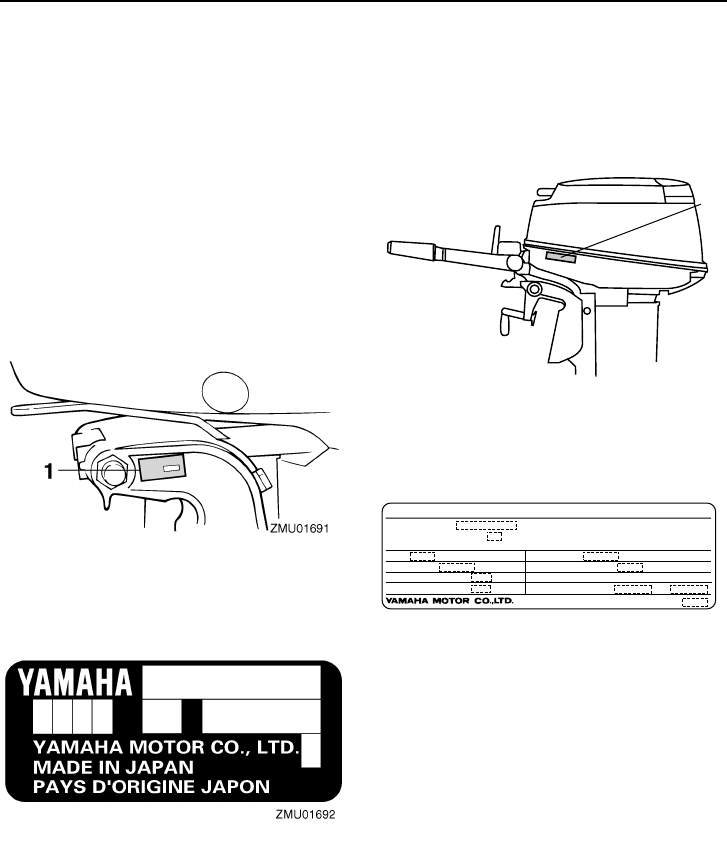
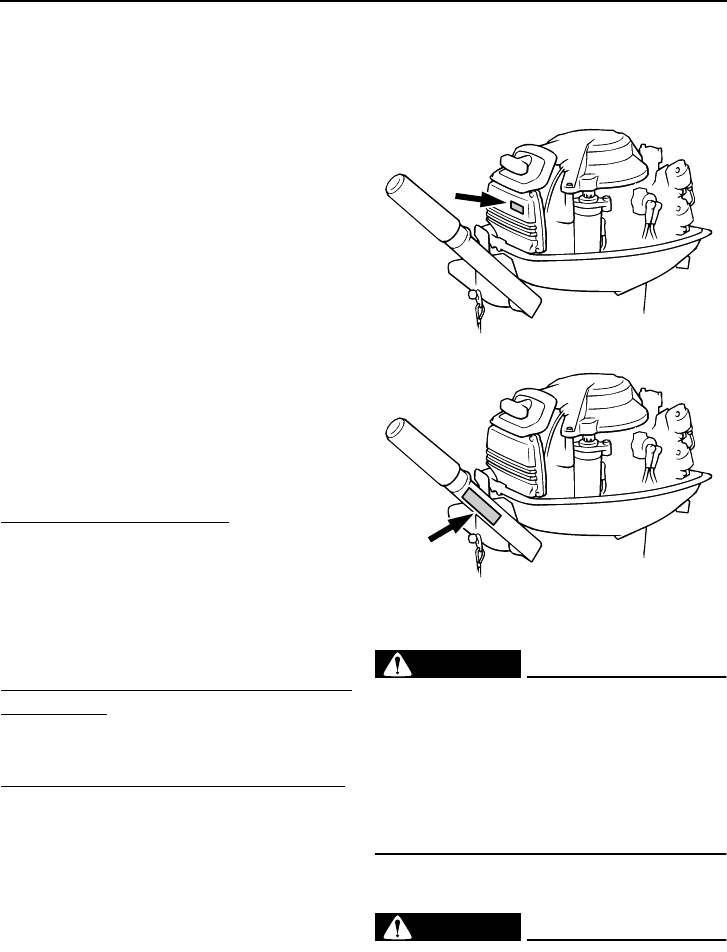
The outboard motor serial number is
stamped on the label attached to the port
side of the clamp bracket or the upper part of
the swivel bracket.
Record your outboard motor serial number in
the spaces provided to assist you in ordering
spare parts from your Yamaha dealer or for
reference in case your outboard motor is sto-
len.
EMU25220
Emission control information
EMU25230
North American models
This engine conforms to U.S. Environmental
Protection Agency (EPA) regulations for ma-
rine SI engines. See the label affixed to your
engine for details.
EMU30390
Approval label of emission control certif-
icate
This label is attached to the bottom cowling.
Existing Technology; N/A
EMU25261
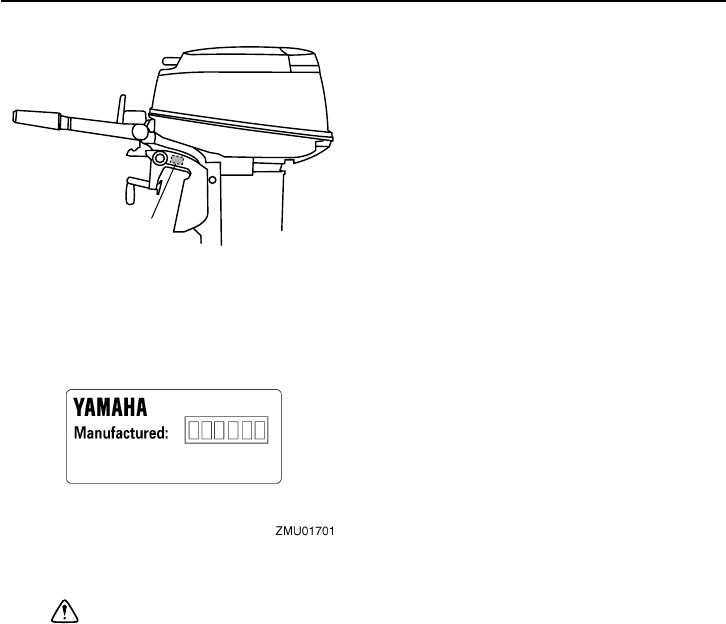
Manufactured date label
This label is attached to the clamp bracket or
the swivel bracket.
1. Outboard motor serial number location
1. Approval label location
1
ZMU04828
EMISSION CONTROL INFORMATION
ENGINE FAMILY :
THIS ENGINE CONFORMS TO 2001 U.S. EPA REGULATIONS FOR MARINE SI ENGINES.
REFER TO THE OWNERS MANUAL FOR MAINTENANCE SPECIFICATIONS AND ADJUSTMENTS.
FELs :
SPARK PLUG :
DISPLACEMENT :
ADVERTISED POWER :
IDLE SPEED :
SPARK PLUG GAP (mm) :
FUEL : GASOLINE
VALVE LASH (mm) : IN EX
cm
kw
g/kw-hr rpm IN NEUTRAL
3
ZMU04304
General information
2
EMU25361
Safety information
●
Before mounting or operating the outboard
motor, read this entire manual. Reading it
should give you an understanding of the
motor and its operation.
●
Before operating the boat, read any own-
er’s or operator’s manuals supplied with it
and all labels. Be sure you understand
each item before operating.
●
Do not overpower the boat with this out-
board motor. Overpowering the boat could
result in loss of control. The rated power of
the outboard should be equal to or less
than the rated horsepower capacity of the
boat. If the rated horsepower capacity of
the boat is unknown, consult the dealer or
boat manufacturer.
●
Do not modify the outboard. Modifications
could make the motor unfit or unsafe to
use.
●
Never operate after drinking alcohol or tak-
ing drugs. About 50% of all boating fatali-
ties involve intoxication.
●
Have an approved personal flotation de-
vice (PFD) on board for every occupant. It
is a good idea to wear a PFD whenever
boating. At a minimum, children and non-
swimmers should always wear PFDs, and
everyone should wear PFDs when there
are potentially hazardous boating condi-
tions.
●
Gasoline is highly flammable, and its va-
pors are flammable and explosive. Handle
and store gasoline carefully. Make sure
there are no gas fumes or leaking fuel be-
fore starting the engine.
●
This product emits exhaust gases which
contain carbon monoxide, a colorless,
odorless gas which may cause brain dam-
age or death when inhaled. Symptoms in-
clude nausea, dizziness, and drowsiness.
Keep cockpit and cabin areas well ventilat-
ed. Avoid blocking exhaust outlets.
●
Check throttle, shift, and steering for prop-
er operation before starting the engine.
●
Attach the engine stop switch lanyard cord
to a secure place on your clothing, or your
arm or leg while operating. If you acciden-
tally leave the helm, the cord will pull from
the switch, stopping the engine.
●
Know the marine laws and regulations
where you will be boating—and obey
them. For basic boating rules, see “Rules
of the road” on page 4.
●
Stay informed about the weather. Check
weather forecasts before boating. Avoid
boating in hazardous weather.
●
Tell someone where you are going: leave
1. Manufactured date label location
1ZMU04125
General information
3
a Float Plan with a responsible person. Be
sure to cancel the Float Plan when you re-
turn.
●
Use common sense and good judgment
when boating. Know your abilities, and be
sure you understand how your boat han-
dles under the different boating conditions
you may encounter. Operate within your
limits, and the limits of your boat. Always
operate at safe speeds, and keep a careful
watch for obstacles and other traffic.
●
Always watch carefully for swimmers dur-
ing the engine operation.
●
Stay away from swimming areas.
●
When a swimmer is in the water near you
shift into neutral and shut off the engine.
Be informed about boating safety. Additional
publications and information can be obtained
from many organizations, including the fol-
lowing:
United States Coast Guard
Consumer Affairs Staff (G-BC)
Office of Boating, Public, and Consumer Af-
fairs
U.S. Coast Guard Headquarters
Washington, D.C. 20593-0001
Boating Safety Hotline: 1-800-368-5647
National Marine Manufacturers Associa-
tion (NMMA)
401 N. Michigan Ave.
Chicago, Il 60611
Marine Retailers Association of America
155 N. Michigan Ave.
Chicago, Il 60601
EMU25380
Important labels
EMU25395
Warning labels
EMU25401
Label
WARNING
EWM01260
●
Be sure shift control is in neutral before
starting engine. (except 2HP)
●
Do not touch or remove electrical parts
when starting or during operation.
●
Keep hands, hair, and clothes away
from flywheel and other rotating parts
while engine is running.
EMU25431
Label
WARNING
EWM01300
●
This engine is equipped with a neutral
starting device.
●
The engine will not start unless the shift
ZMU04780
ZMU03684

General information
4
control is in neutral position.
EMU25500
Basic boating rules (Rules of
the road)
Just as there are rules which apply when you
are driving on streets and high ways, there
are waterway rules which apply when you
are driving your boat. These rules are used
internationally, and are also enforced by the
United States Coast Guard and local agen-
cies. You should be aware of these rules,
and follow them whenever you encounter
another vessel on the water.
Several sets of rules prevail according to
geographic location, but are all basically the
same as the International Rules of the Road.
The rules presented here in your Owner’s
Manual are condensed, and have been pro-
vided for your convenience only. Consult
your local U.S. Coast Guard Auxiliary or De-
partment of Motor Vehicles for a complete
set of rules governing the waters in which
you will be using your boat.
EMU25510
Steering and sailing rules and sound
signals
Whenever two vessels on the water meet
one another, one vessel has the right-of-
way; it is called the “stand-on” vessel. The
vessel which does not have the right-of-way
is called the “give-way” or “burdened” vessel.
These rules determine which vessel has the
right-of-way, and what each vessel should
do.
Stand-on vessel
The vessel with the right-of-way has the duty
to continue its course and speed, except to
avoid an immediate collision. When you
maintain your direction and speed, the other
vessel will be able to determine how best to
avoid you.
Give-way vessel
The vessel which does not have the right-of-
way has the duty to take positive and timely
action to stay out of the way of the Stand-On
vessel. Normally, you should not cross in
front of the vessel with the right-of-way. You
should slow down or change directions brief-
ly and pass behind the other vessel. You
should always move in such a way that the
operator of the other vessel can see what
you are doing.
“The general prudential rule”
This rule is called Rule 2 in the International
Rules and says,
“In obeying and construing these rules due
regard shall be had to all dangers of naviga-
tion and collision, and to any special circum-
stances, which may render a departure from
the above rules necessary in order to avoid
immediate danger.”
In other words, follow the standard rules ex-
cept when a collision will occur unless both
vessels try to avoid each other. If that is the
case, both vessels become “Give-Way” ves-
sels.
EMU25520
Rules when encountering vessels
There are three main situations which you
may encounter with other vessels which
could lead to a collision unless the Steering
Rules are followed:
Meeting:
(you are approaching another ves-
sel head-on)
Crossing:
(you are traveling across the oth-
er vessel’s path)
Overtaking:
(you are passing or being
passed by another vessel)
In the following illustration, your boat is in the
center. You should give the right-of-way to
any vessels shown in white area (you are the
Give-Way vessel). Any vessels in the shad-
ed area must yield to you (they are the Give-
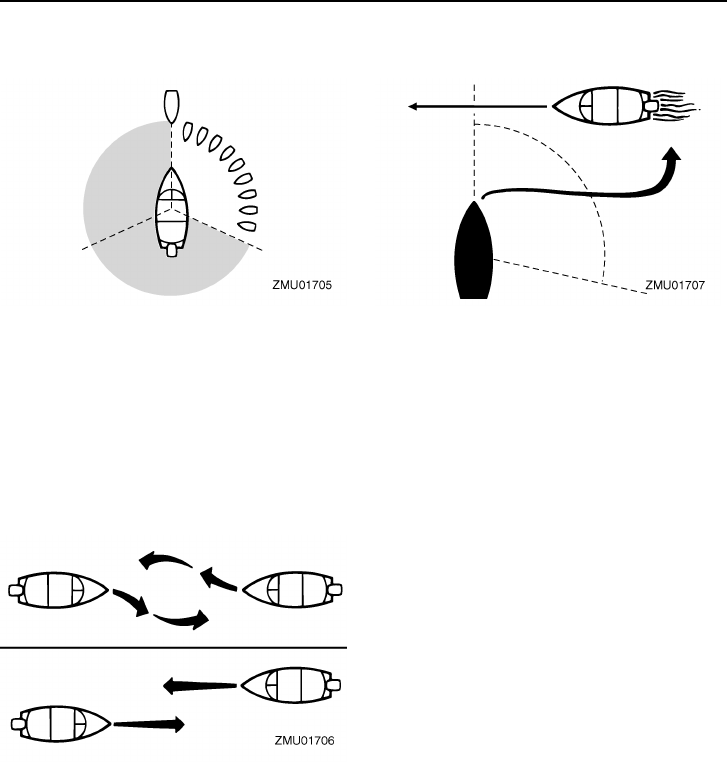
General information
5
Way vessels). Both you and the meeting
vessel must alter course to avoid each other.
Meeting
If you are meeting another power vessel
head on, and are close enough to run the risk
of collision, neither of you has the right-of-
way! Both of you should alter course to avoid
an accident. You should keep the other ves-
sel on your port (left) side. This rule doesn’t
apply if both of you will clear one another if
you continue on your set course and speed.
Crossing
When two power driven vessels are crossing
each other’s path close enough to run the
risk of collision, the vessel which has the oth-
er on the starboard (right) side must keep out
of the way of the other. If the other vessel is
on your right, you must keep out of its way;
you are the Give-Way vessel. If the other
vessel is on your port (left) side, remember
that you should maintain course and direc-
tion, provided the other vessel gives you the
right-of-way as it should.
Overtaking
If you are passing another vessel, you are
the “Give-Way” vessel. This means that the
other vessel is expected to maintain its
course and speed. You must stay out of its
way until you are clear of it. Likewise, if an-
other vessel is passing you, you should
maintain your speed and direction so that the
other vessel can steer itself around you.
EMU25530
Other special situations
There are three other rules you should be
aware of when driving your boat around oth-
er vessels.
Narrow channels and bends
When navigating in narrow channels, you
should keep to the right when it is safe and
practical to do so. If the operator of a power-
driven vessel is preparing to go around a
bend that may obstruct the view of other wa-
ter vessels, the operator should sound a pro-
longed blast on the whistle (4 to 6 seconds).
If another vessel is around the bend, it too
should sound the whistle. Even if no reply is
heard, however, the vessel should still pro-
ceed around the bend with caution. If you
navigate such waters with your boat, you will
need to carry a portable air horn, available
from local marine supply stores.

General information
6
Fishing vessel right-of-way
All vessels which are fishing with nets, lines
or trawls are considered to be “fishing ves-
sels” under the International Rules. Vessels
with trolling lines are not considered fishing
vessels. Fishing vessels have the right-of-
way regardless of position. Fishing vessels
cannot, however, impede the passage of
other vessels in narrow channels.
Sailing vessel right-of-way
Sailing vessels should normally be given the
right-of-way. The exceptions to this are:
1. When the sailing vessel is overtaking
the power-driven vessel, the power-driv-
en vessel has the right-of-way.
2. Sailing vessels should keep clear of any
fishing vessel.
3. In a narrow channel, a sailing vessel
should not hamper the safe passage of
a power-driven vessel which can navi-
gate only in such a channel.
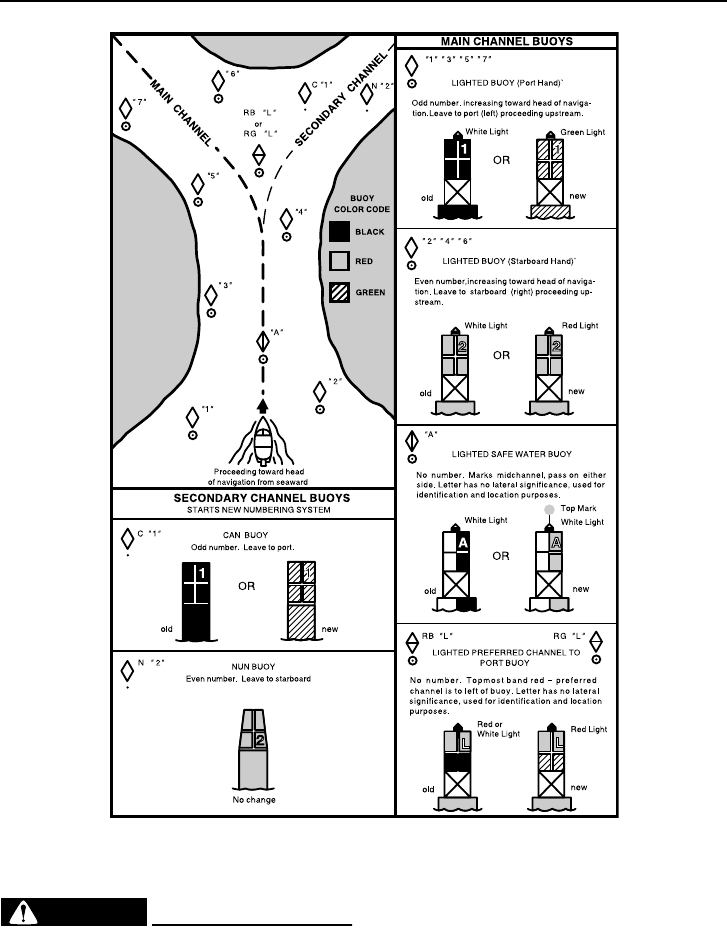
Reading buoys and other markers
The waters of the United states are marked
for safe navigation by the lateral system of
buoyage. Simply put, buoys and markers
have an arrangement of shapes, colors,
numbers and lights to show which side of the
buoy a boater should pass on when navigat-
ing in a particular direction. The markings on
these buoys are oriented from the perspec-
tive of being entered from seaward (the boat-
er is going towards the port). This means that
red buoys are passed on the starboard
(right) side when proceeding from open wa-
ter into port, and black buoys are to port (left)
side. When navigating out of port, your posi-
tion with respect to the buoys should be re-
versed; red buoys should be to port and
black buoys to starboard.
Many bodies of water used by boaters are
entirely within the boundaries of a particular
state. The Uniform State Waterway Marking
System has been devised for these waters.
This system uses buoys and signs with dis-
tinctive shapes and colors to show regulato-
ry or advisory information. These markers
are white with black letters and orange
boarders. They signify speed zones, restrict-
ed areas, danger areas, and general infor-
mation.
Remember, markings may vary by geo-
graphic location. Always consult local boat-
ing authorities before driving your boat in
unfamiliar waters.
General information
7
EMU25540
Fueling instructions
WARNING
EWM00010
GASOLINE AND ITS VAPORS ARE HIGH-
LY FLAMMABLE AND EXPLOSIVE!
●
Do not smoke when refueling, and keep
away from sparks, flames, or other
sources of ignition.
●
Stop engine before refueling.
●
Refuel in a well-ventilated area. Refuel
portable fuel tanks off the boat.
●
Take care not to spill gasoline. If gaso-
line spills, wipe it up immediately with
ZMU01708
General information
8
dry rags.
●
Do not overfill the fuel tank.
●
Tighten the filler cap securely after re-
fueling.
●
If you should swallow some gasoline,
inhale a lot of gasoline vapor, or get
gasoline in your eyes, get immediate
medical attention.
●
If any gasoline spills onto your skin, im-
mediately wash with soap and water.
Change clothing if gasoline spills on it.
●
Touch the fuel nozzle to the filler open-
ing or funnel to help prevent electro-
static sparks.
CAUTION:
ECM00010
Use only new clean gasoline which has
been stored in clean containers and is not
contaminated with water or foreign mat-
ter.
EMU25570
Gasoline
If knocking or pinging occurs, use a different
brand of gasoline or premium unleaded fuel.
Gasohol
There are two types of gasohol: gasohol con-
taining ethanol and that containing metha-
nol. Gasohol containing ethanol can be used
if ethanol content does not exceed 10% and
the fuel meets minimum octane ratings.
Yamaha does not recommended gasohol
containing methanol because it can cause
fuel system damage or engine performance
problems.
EMU25650
Engine oil
If the recommended engine oil is not avail-
able, another 2-stroke engine oil with an
NMMA-certified TC-W3 rating may be used.
EMU25741
Propeller selection
The performance of your outboard motor will
be critically affected by your choice of propel-
ler, as an incorrect choice could adversely
affect performance and could also seriously
damage the motor. Engine speed depends
on the propeller size and boat load. If engine
speed is too high or too low for good engine
performance, this will have an adverse effect
on the engine.
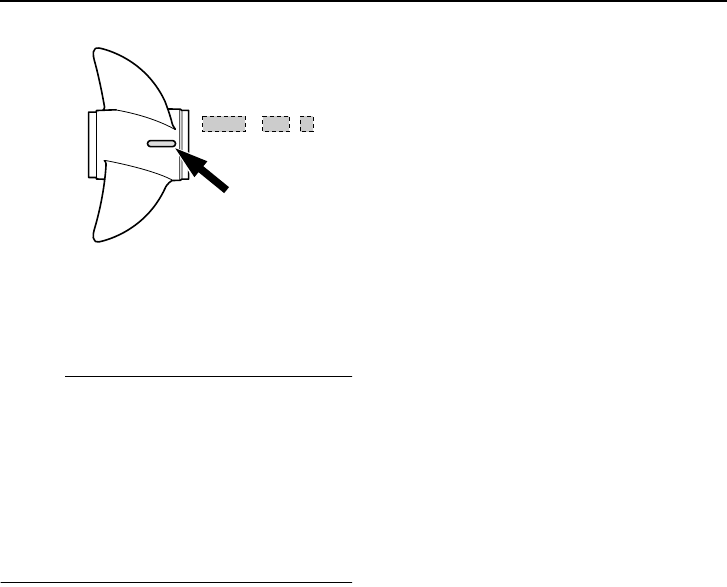
Yamaha outboard motors are fitted with pro-
pellers chosen to perform well over a range
of applications, but there may be uses where
a propeller with a different pitch would be
more appropriate. For a greater operating
load, a smaller-pitch propeller is more suit-
able as it enables the correct engine speed
to be maintained. Conversely, a larger-pitch
propeller is more suitable for a smaller oper-
ating load.
Yamaha dealers stock a range of propellers,
and can advise you and install a propeller on
your outboard that is best suited to your ap-
plication.
Recommended gasoline:
Regular unleaded gasoline with a min-
imum octane rating of 86 (Pump Oc-
tane Number) = (R+M)/2
Recommended engine oil:
YAMALUBE 2-stroke outboard motor
oil
General information
9
NOTE:
Select a propeller which will allow the engine
to reach the middle or upper half of the oper-
ating range at full throttle with the maximum
boat load. If operating conditions such as
light boat loads then allow the engine r/min to
rise above the maximum recommended
range, reduce the throttle setting to maintain
the engine in the proper operating range.
For instructions on propeller removal and in-
stallation, see page 43.
EMU25770
Start-in-gear protection
Yamaha outboard motors or Yamaha-ap-
proved remote control units are equipped
with start-in-gear protection device(s). This
feature permits the engine to be started only
when it is in neutral. Always select neutral
before starting the engine.
1. Propeller diameter in inches
2. Propeller pitch in inches
3. Type of propeller (propeller mark)
ZMU04605
-
x
123
10
Basic components
EMU25795
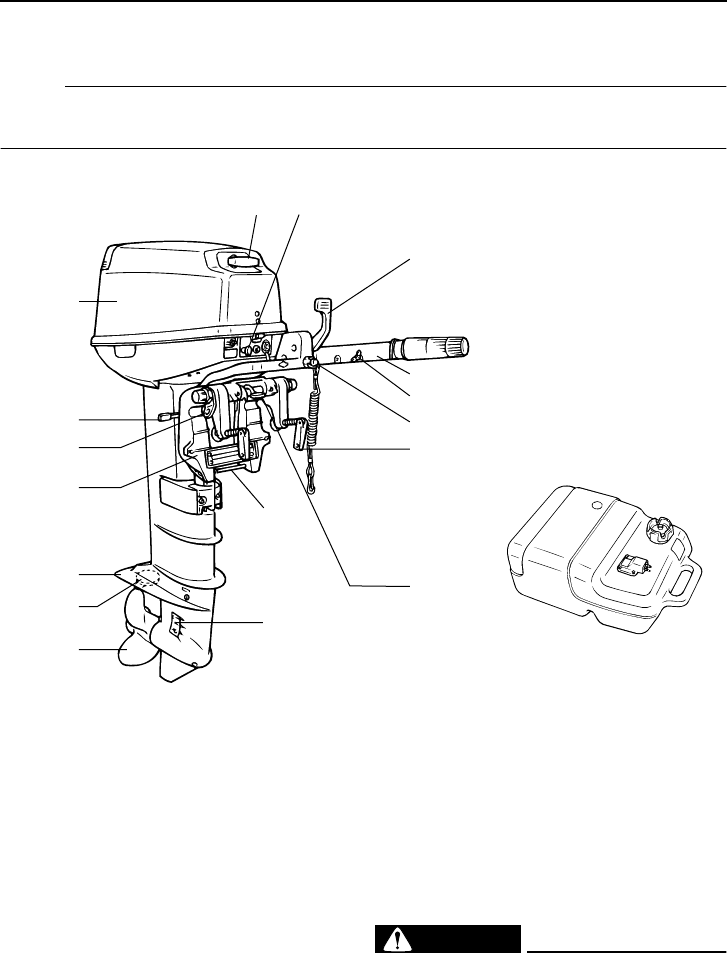
Main components
NOTE:
* May not be exactly as shown; also may not be included as standard equipment on all mod-
els.
25D
EMU25802
Fuel tank
If your model was equipped with a portable
fuel tank, its function is as follows.
WARNING
EWM00020
The fuel tank supplied with this engine is
its dedicated fuel reservoir and must not
13
12
11
18
15
14
7
8
1
3
2
4
6
5
9
10
16
17
ZMU04829
1. Top cowling lock lever
2. Choke knob
3. Gear shift lever
4. Tiller handle
5. Throttle friction adjuster
6. Engine stop button/Engine stop lanyard
switch
7. Transom clamp handle
8. Tilt lock lever
9. Trim rod
10. Cooling water inlet
11. Propeller
12. Trim tab (anode)
13. Anti-cavitation plate
14. Clamp bracket
15. Rope attachment
16. Shallow water lever
17. Top cowling
18. Fuel tank*
Basic components
11
be used as a fuel storage container. Com-
mercial users should conform to relevant
licensing or approval authority regula-
tions.
EMU25830
Fuel joint
This joint is used to connect the fuel line.
EMU25841
Fuel gauge
This gauge is located on either the fuel tank
cap or on the fuel joint base. It shows the ap-
proximate amount of fuel remaining in the
tank.
EMU25850
Fuel tank cap
This cap seals the fuel tank. When removed,
the tank can be filled with fuel. To remove the
cap, turn it counterclockwise.
EMU25860
Air vent screw
This screw is on the fuel tank cap. To loosen
the screw, turn it counterclockwise.
EMU25911
Tiller handle
To change direction, move the tiller handle to
the left or right as necessary.
EMU25922
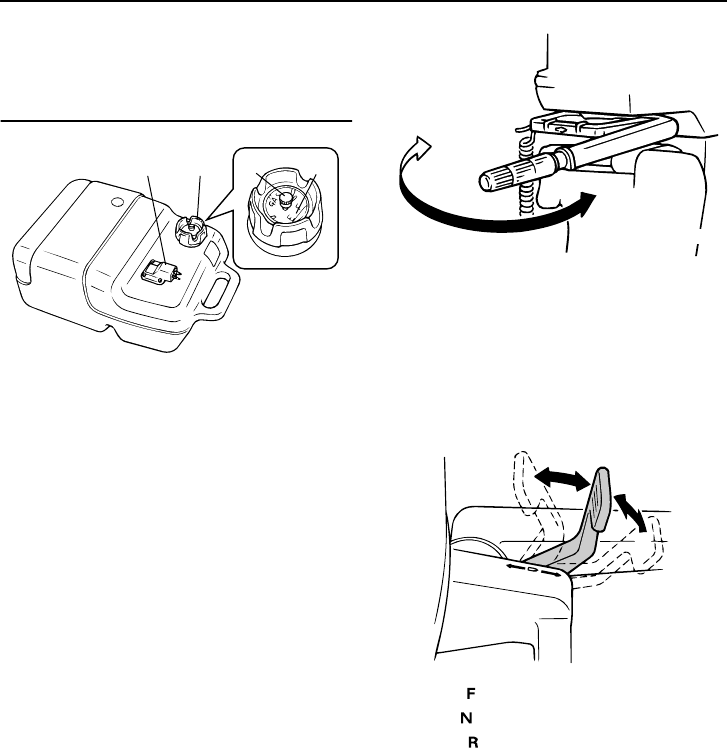
Gear shift lever
Pulling the gear shift lever towards you puts
the engine in forward gear so that the boat
moves ahead. Pushing the lever away from
you puts the engine in reverse gear so that
the boat moves astern.
EMU25941
Throttle grip
The throttle grip is on the tiller handle. Turn
the grip counterclockwise to increase speed
and clockwise to decrease speed.
1. Fuel joint
2. Fuel gauge
3. Fuel tank cap
4. Air vent screw
ZMU03157
13
42
1. Forward “ ”
2. Neutral “ ”
3. Reverse “ ”
ZMU02846
2
1
3
RN
F
ZMU03687
Basic components
12
EMU25961
Throttle indicator
The fuel consumption curve on the throttle
indicator shows the relative amount of fuel
consumed for each throttle position. Choose
the setting that offers the best performance
and fuel economy for the desired operation.
EMU25970
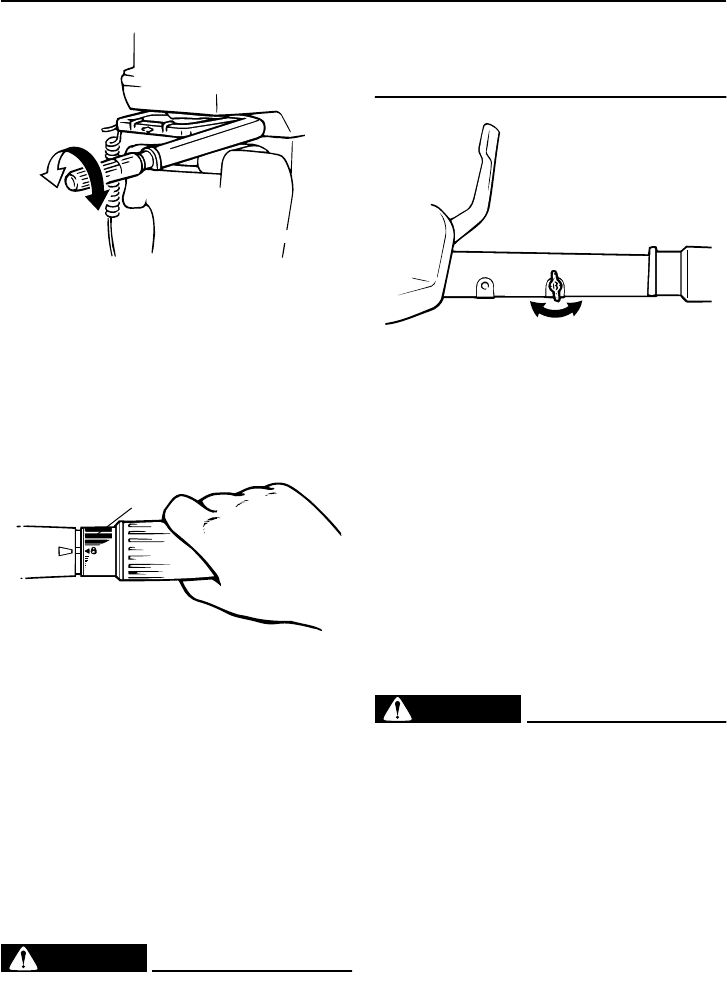
Throttle friction adjuster
A friction device provides adjustable resis-
tance to movement of the throttle grip or the
remote control lever, and can be set accord-
ing to operator preference.
To increase resistance, turn the adjuster
clockwise. To decrease resistance, turn the
adjuster counterclockwise.
WARNING
EWM00030
Do not overtighten the friction adjuster. If
there is too much resistance, it could be
difficult to move throttle lever or grip,
which could result in an accident.
When constant speed is desired, tighten the
adjuster to maintain the desired throttle set-
ting.
EMU25990
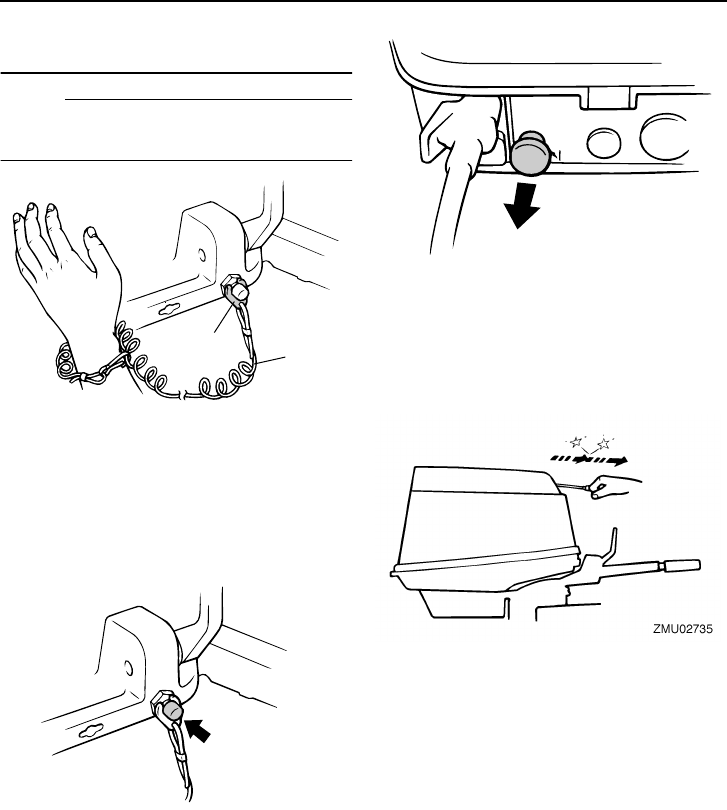
Engine stop lanyard switch
The lock plate must be attached to the en-
gine stop switch for the engine to run. The
lanyard should be attached to a secure place
on the operator’s clothing, or arm or leg.
Should the operator fall overboard or leave
the helm, the lanyard will pull out the lock
plate, stopping ignition to the engine. This
will prevent the boat from running away un-
der power.
WARNING
EWM00120
●
Attach the engine stop switch lanyard
to a secure place on your clothing, or
your arm or leg while operating.
●
Do not attach the lanyard to clothing
that could tear loose. Do not route the
lanyard where it could become entan-
gled, preventing it from functioning.
●
Avoid accidentally pulling the lanyard
during normal operation. Loss of en-
gine power means the loss of most
steering control. Also, without engine
power, the boat could slow rapidly. This
1. Throttle indicator
ZMU02848
ZMU02849
1
ZMU03688
Basic components
13
could cause people and objects in the
boat to be thrown forward.
NOTE:
The engine cannot be started with the lock
plate removed.
EMU26001
Engine stop button
To open the ignition circuit and stop the en-
gine, push this button.
EMU26011
Choke knob for pull type
To supply the engine with the rich fuel mix-
ture required to start, pull out this knob.
EMU26070
Manual starter handle
To start the engine, first gently pull the han-
dle out until resistance is felt. From that posi-
tion, then pull the handle straight out quickly
to crank the engine.
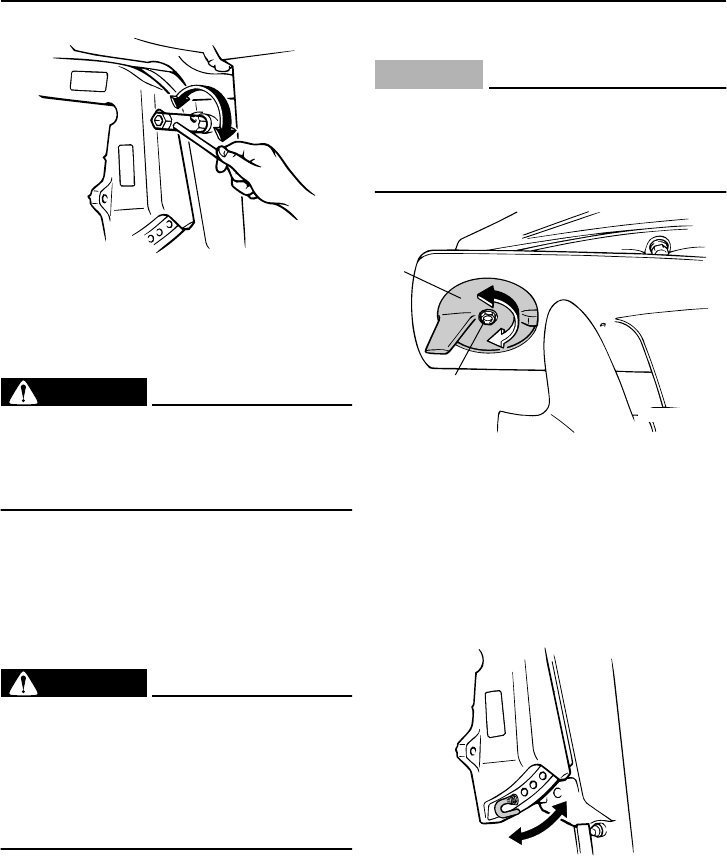
EMU26122
Steering friction adjuster
A friction device provides adjustable resis-
tance to the steering mechanism, and can be
set according to operator preference. An ad-
justing screw or bolt is located on the swivel
bracket.
1. Lanyard
2. Lock plate
2
1
ZMU03689
ZMU03690
ZMU04127
Basic components
14
To increase resistance, turn the adjuster
clockwise.
To decrease resistance, turn the adjuster
counterclockwise.
WARNING
EWM00040
Do not overtighten the friction adjuster. If
there is too much resistance, it could be
difficult to steer, which could result in an
accident.
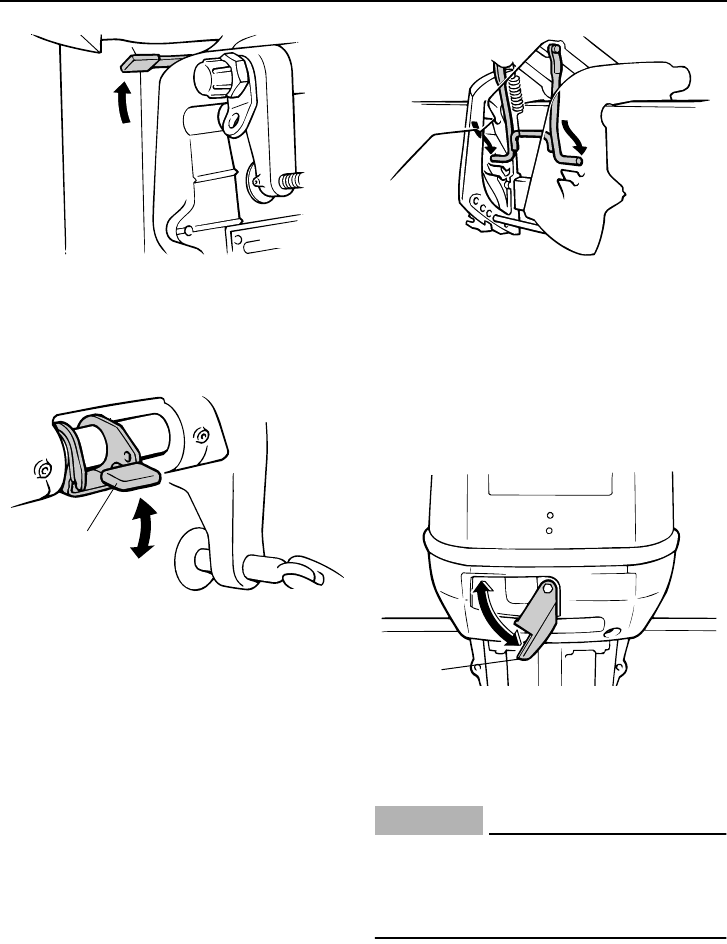
EMU26240
Trim tab with anode
The trim tab should be adjusted so that the
steering control can be turned to either the
right or left by applying the same amount of
force.
WARNING
EWM00840
An improperly adjusted trim tab could
cause difficult steering. Always test run
after the trim tab has been installed or re-
placed to be sure steering is correct. Be
sure you have tightened the bolt after ad-
justing the trim tab.
If the boat tends to veer the left (port side),
turn the trim tab rear end to the port side “A”
in the figure. If the boat tends to veer the right
(starboard side), turn the trim tab end to the
starboard side “B” in the figure.
CAUTION:
ECM00840
The trim tab also serves as an anode to
protect the engine from electrochemical
corrosion. Never paint the trim tab as it
will become ineffective as an anode.
EMU26261
Trim rod (tilt pin)
The position of the trim rod determines the
minimum trim angle of the outboard motor in
relation to the transom.
EMU26270
Shallow water lever
Lifting this lever will tilt the motor up partially
to provide more clearance when operating in
shallow water.
ZMU02908
1. Trim tab
2. Bolt
ZMU02822
1
2
A
B
ZMU02929
Basic components
15
EMU30530
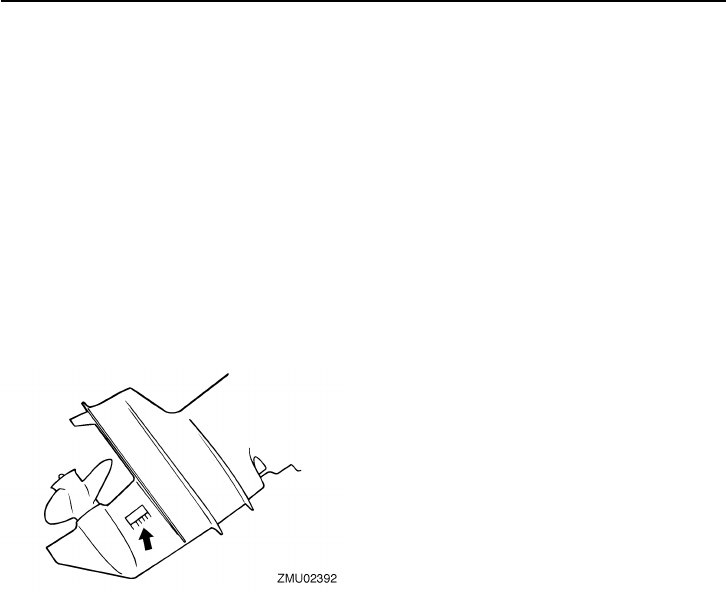
Tilt lock mechanism
The tilt lock mechanism is used to prevent
the outboard motor from lifting out of the wa-
ter when in reverse gear.
To lock it, set the tilt lock lever in the lock po-
sition. To release, push the tilt lock lever in
the release position.
EMU26330
Tilt support bar
The tilt support bar keeps the outboard motor
in the tilted up position.
EMU26372
Top cowling lock lever(s) (turn type)
To remove the engine top cowling, turn the
lock lever(s) and lift off the cowling. When in-
stalling the cowling, check to be sure it fits
properly in the rubber seal. Then lock the
cowling again by returning the lever(s) to the
lock position.
EMU26801
Warning system
CAUTION:
ECM00090
Do not continue to operate the engine if a
warning device has activated. Consult
your Yamaha dealer if the problem can-
not be located and corrected.
EMU26813
Overheat warning
This engine has an overheat warning device.
1. Tilt lock lever
ZMU04111
1
ZMU03695
1. Top cowling lock lever(s)
ZMU03699
ZMU03701
1
Basic components
16
If the engine temperature rises too high, the
warning device will activate.
Activation of warning device
●
The engine speed will automatically de-
crease to about 2000 r/min.
●
The overheat warning indicator will light (if
equipped on the bottom cowling or the ta-
chometer).
●
The buzzer will sound (if equipped on the
tiller handle, remote control box, or main
switch panel).
If the warning system has activated, stop the
engine and check the cooling water inlet for
clogging.
17
Operation
EMU26901
Installation
CAUTION:
ECM00110
Incorrect engine height or obstructions
to smooth water flow (such as the design
or condition of the boat, or accessories
such as transom ladders or depth finder
transducers) can create airborne water
spray while the boat is cruising. Severe
engine damage may result if the motor is
operated continuously in the presence of
airborne water spray.
NOTE:
During water testing check the buoyancy of
the boat, at rest, with its maximum load.
Check that the static water level on the ex-
haust housing is low enough to prevent wa-
ter entry into the powerhead, when water
rises due to waves when the outboard is not
running.
EMU26910
Mounting the outboard motor
WARNING
EWM00820
●
Overpowering a boat could cause se-
vere instability. Do not install an out-
board motor with more horsepower
than the maximum rating on the capac-
ity plate of the boat. If the boat does not
have a capacity plate, consult the boat
manufacturer.
●
The information presented in this sec-
tion is intended as reference only. It is
not possible to provide complete in-
structions for every possible boat and
motor combination. Proper mounting
depends in part on experience and the
specific boat and motor combination.
WARNING
EWM00830
Improper mounting of the outboard mo-
tor could result in hazardous conditions
such as poor handling, loss of control, or
fire hazards. Observe the following:
●
For permanently mounted models, your
dealer or other person experienced in
proper rigging should mount the motor.
If you are mounting the motor yourself,
you should be trained by an experi-
enced person.
●
For portable models, your dealer or oth-
er person experienced in proper out-
board motor mounting should show
you how to mount your motor.
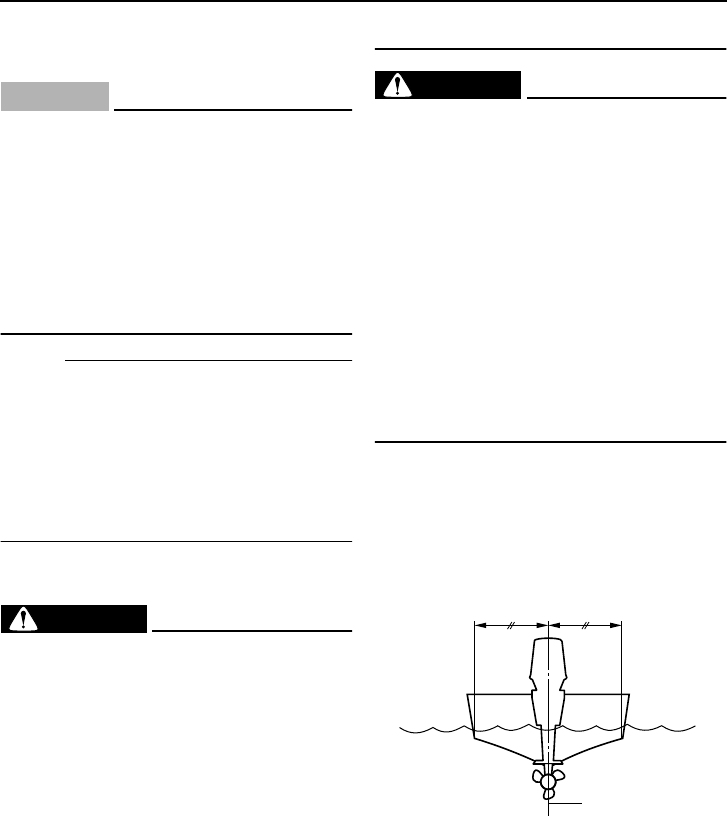
Mount the outboard motor on the center line
(keel line) of the boat, and ensure that the
boat itself is well balanced. Otherwise the
boat will be hard to steer. For boats without
a keel or which are asymmetrical, consult
your dealer.
EMU26920
Mounting height
To run your boat at optimum efficiency, the
water resistance (drag) of the boat and out-
board motor must be made as little as possi-
ble. The mounting height of the outboard
1. Center line (keel line)
ZMU01760
1
Operation
18
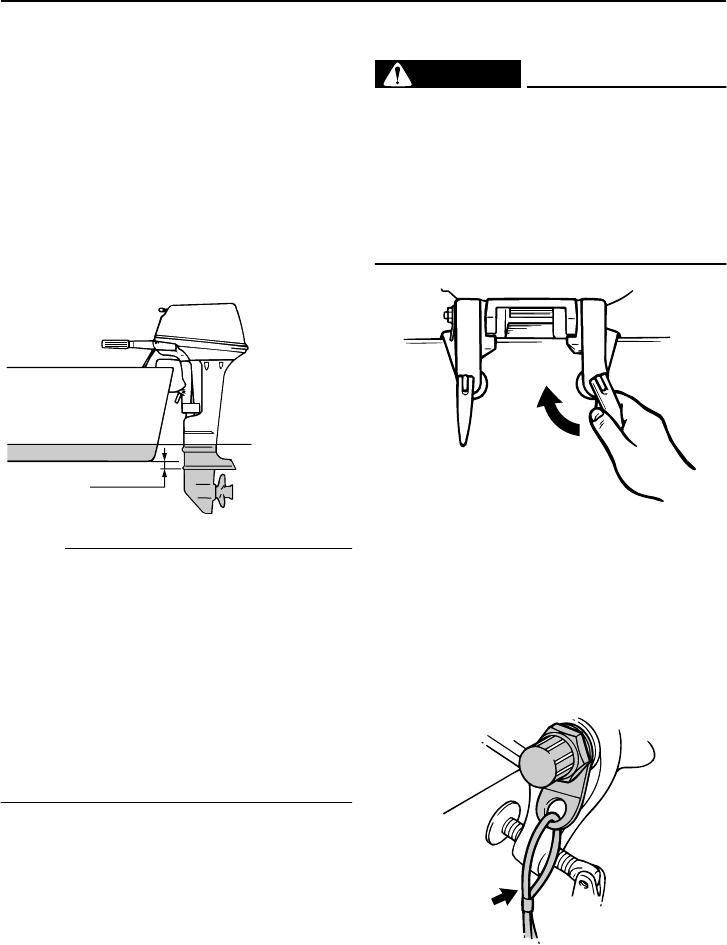
motor greatly affects the water resistance. If
the mounting height is too high, cavitation
tends to occur, thus reducing the propulsion;
and if the propeller tips cut the air, the engine
speed will rise abnormally and cause the en-
gine to overheat. If the mounting height is too
low, the water resistance will increase and
thereby reduce engine efficiency. Mount the
outboard motor so that the anti-cavitation
plate is between the bottom of the boat and
a level 25 mm (1 in.) below it.
NOTE:
●
The optimum mounting height of the out-
board motor is affected by the boat and
motor combination and the desired use.
Test runs at different heights can help de-
termine the optimum mounting height.
Consult your Yamaha dealer or boat man-
ufacturer for further information on deter-
mining the proper mounting height.
●
For instructions on setting the trim angle of
the outboard motor, see page 27.
EMU26970
Clamping the outboard motor
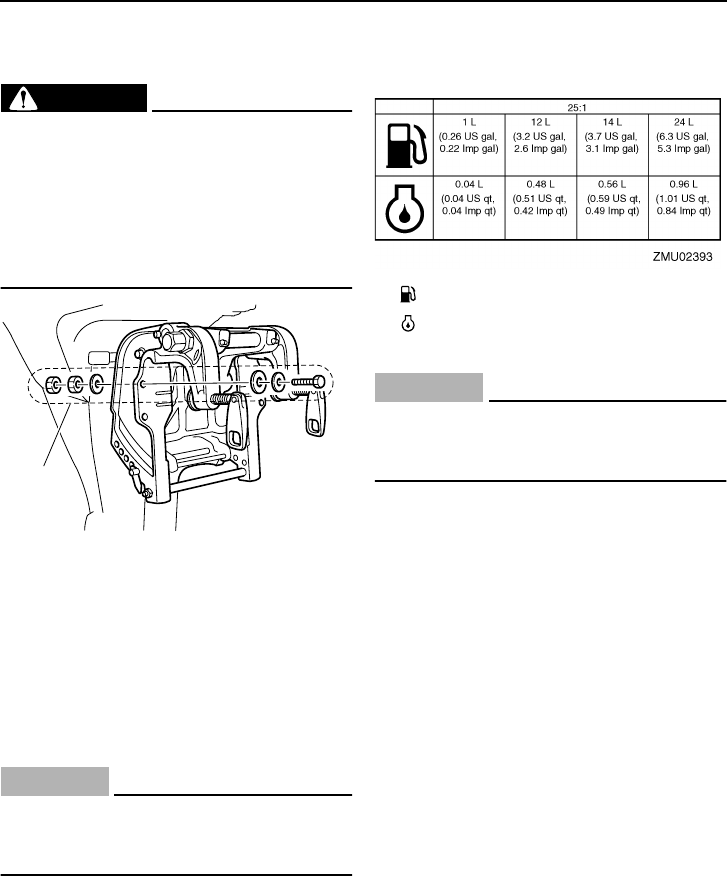
1. Place the outboard motor on the tran-
som so that it is positioned as close to
the center as possible. Tighten the tran-
som clamp screws evenly and securely.
Occasionally check the clamp screws
for tightness during operation of the out-
board motor because they could be-
come loose due to engine vibration.
WARNING
EWM00640
Loose clamp screws could allow the out-
board motor to fall off or move on the
transom. This could cause loss of control
and serious injury. Make sure the tran-
som screws are tightened securely. Oc-
casionally check the screws for tightness
during operation.
2. If the engine restraint cable attachment
is equipped on your engine, an engine
restraint cable or chain should be used.
Attach one end to the engine restraint
cable attachment and the other to a se-
cure mounting point on the boat. Other-
wise the engine could be completely lost
if it accidentally falls off the transom.
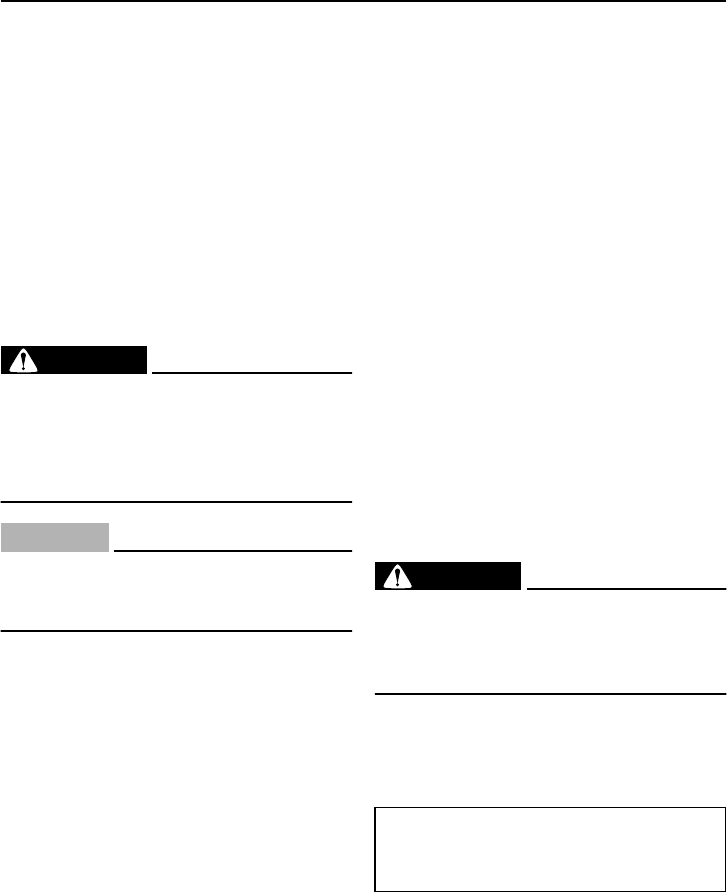
3. Secure the clamp bracket to the transom
using the bolts provided with the out-
ZMU02011
0–25mm
(0–1in.)
ZMU02012
ZMU02013
Operation
19
board (if packed). For details, consult
your Yamaha dealer.
WARNING
EWM00650
Avoid using bolts, nuts or washers other
than those contained in the engine pack-
aging. If used, they must be of at least the
same quality of material and strength and
must be tightened securely. After tighten-
ing, test run the engine and check their
tightness.
EMU30172
Breaking in engine
Your new engine requires a period of break-
in to allow mating surfaces of moving parts to
wear in evenly. Correct break-in will help en-
sure proper performance and longer engine
life.
CAUTION:
ECM00800
Failure to follow the break-in procedure
could result in reduced engine life or
even severe engine damage.
EMU27050
Gasoline and engine oil mixing chart
(25:1)
CAUTION:
ECM00150
Be sure to mix gasoline and oil complete-
ly, otherwise the engine may be dam-
aged.
EMU27073
Procedure for pre-mixed models
Run the engine under load (in gear with a
propeller installed) as follows.
1. First 10 minutes:
Run the engine at the lowest possible
speed. A fast idle in neutral is best.
2. Next 50 minutes:
Do not exceed half throttle (approxi-
mately 3000 r/min). Vary engine speed
occasionally. If you have an easy-plan-
ing boat, accelerate at full throttle onto
plane, then immediately reduce the
throttle to 3000 r/min or less.
3. Second hour:
Accelerate at full throttle onto plane,
then reduce engine speed to three-quar-
ter throttle (approximately 4000 r/min).
Vary engine speed occasionally. Run at
full throttle for one minute, then allow
about 10 minutes of operation at three-
quarter throttle or less to let the engine
1. Bolts
ZMU02637
1
1. : Gasoline
2. : Engine oil
Operation
20
cool.
4. Third through tenth hours:
Avoid operating at full throttle for more
than 5 minutes at a time. Let the engine
cool between full-throttle runs. Vary en-
gine speed occasionally.
5. After the first 10 hours:
Operate the engine normally. Use the
standard premix ratio of gasoline and oil.
For details on mixing fuel and oil, see
page 20.
EMU27101
Preoperation checks
WARNING
EWM00080
If any item in the preoperation check is
not working properly, have it inspected
and repaired before operating the out-
board motor. Otherwise an accident
could occur.
CAUTION:
ECM00120
Do not start the engine out of water. Over-
heating and serious engine damage can
occur.
EMU27110
Fuel
●
Check to be sure you have plenty of fuel
for your trip.
●
Make sure there are no fuel leaks or gaso-
line fumes.
●
Check fuel line connections to be sure they
are tight (if equipped Yamaha fuel tank or
boat tank).
●
Be sure the fuel tank is positioned on a se-
cure, flat surface, and that the fuel line is
not twisted or flattened, or likely to contact
sharp objects (if equipped Yamaha fuel
tank or boat tank).
EMU27120
Oil
●
Check to be sure you have plenty of oil for
your trip.
EMU27130
Controls
●
Check throttle, shift, and steering for prop-
er operation before starting the engine.
●
The controls should work smoothly, with-
out binding or unusual free play.
●
Look for loose or damaged connections.
●
Check operation of the starter and stop
switches when the outboard motor is in the
water.
EMU27140
Engine
●
Check the engine and engine mounting.
●
Look for loose or damaged fasteners.
●
Check the propeller for damage.
EMU27233
Filling fuel and engine oil
EMU27242
Filling fuel for portable tank
WARNING
EWM00060
Gasoline and its vapors are highly flam-
mable and explosive. Keep away from
sparks, cigarettes, flames, or other
sources of ignition.
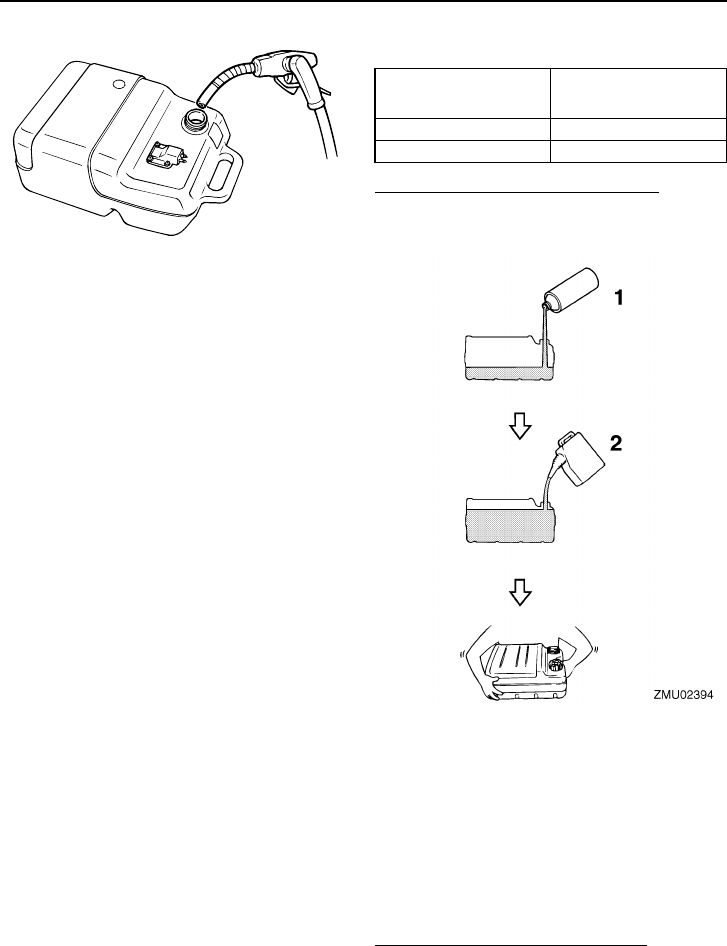
1. Remove the fuel tank cap.
2. Fill the fuel tank carefully.
3. Close the cap securely after refueling.
Wipe up any spilled fuel.
Fuel tank capacity (if equipped Yamaha
fuel tank):
24L
Operation
21
EMU27270
Ring Free Fuel Additive
Gasoline is a precise blend of many different
substances, each chosen to give certain
characteristics. Gasoline blends have been
changing in recent years in response to con-
cerns about pollution and resulting emis-
sions regulations. One of the most obvious
changes has been the elimination of lead
from most fuels.
As gasoline has changed, the amount of ad-
ditives such as aromatics and oxygenates
has increased. These additives are impor-
tant for the engines in passenger cars, but
they can have detrimental effects in marine
engines, because of increased deposits in
the combustion chamber. When enough de-
posits collect, piston rings begin sticking.
Performance drops and engine wear in-
creases dramatically.
While many additives available may reduce
deposits, Yamaha recommends the use of
Ring Free Fuel Additive
, available from
your Yamaha dealer.
Ring Free Fuel Addi-
tive
has repeatedly proven its ability to clean
combustion deposits from inside the engine,
notably the critical piston-ring-land area, and
fuel system components. Follow product la-
beling for use instructions.
EMU27403
Gasoline and oil mixing (100:1)
If equipped with a portable fuel tank
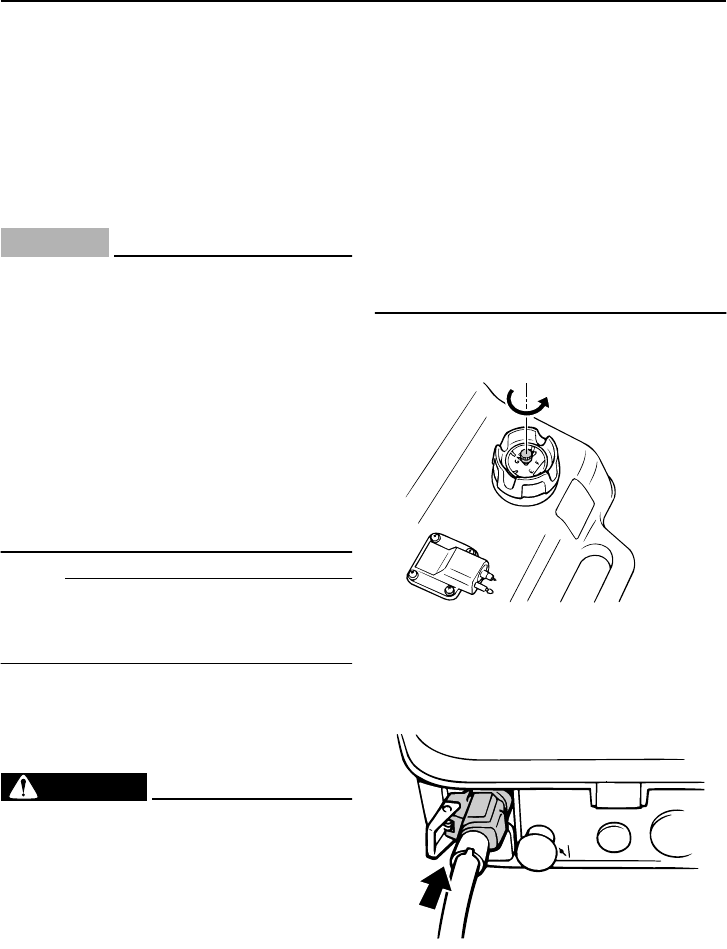
1. Pour oil into the portable fuel tank, and
then add gasoline.
2. Replace the fuel tank cap and close
tightly.
3. Shake the fuel tank to mix the fuel thor-
oughly.
4. Make sure that the oil and gasoline are
mixed.
If equipped with a built-in fuel tank
1. Pour oil into a clean fuel can, and then
add gasoline.
ZMU03012
Gasoline to engine
oil ratio
Break-in period See page 19
After break-in 100:1
1. Engine oil
2. Gasoline
Operation
22
2. Replace the fuel can cap and close tight-
ly.
3. Shake the fuel can to mix the fuel thor-
oughly.
4. Make sure that the oil and gasoline are
mixed.
5. Pour the gasoline and oil mixture into the
built-in fuel tank.
CAUTION:
ECM00810
●
Avoid using any oil other than the spec-
ified type.
●
Use a thoroughly blended fuel-oil mix-
ture.
●
If the mixture is not thoroughly mixed,
or if the mixing ratio is incorrect, the
following problems could occur. Low
oil ratio: Lack of oil could cause major
engine trouble, such as piston seizure.
●
High oil ratio: Too much oil could cause
fouled spark plugs, smoky exhaust,
and heavy carbon deposits.
NOTE:
If using a permanently installed tank, pour
the oil gradually as the gasoline is being add-
ed to the tank.
EMU27450
Operating engine
EMU27461
Feeding fuel (portable tank)
WARNING
EWM00420
●
Before starting the engine, make sure
that the boat is tightly moored and that
you can steer clear of any obstructions.
Be sure there are no swimmers in the
water near you.
●
When the air vent screw is loosened,
gasoline vapor will be released. Gaso-
line is highly flammable, and its vapors
are flammable and explosive. Refrain
from smoking, and keep away from
open flames and sparks while loosen-
ing the air vent screw.
●
This product emits exhaust gases
which contain carbon monoxide, a col-
orless, odorless gas which could cause
brain damage or death when inhaled.
Symptoms include nausea, dizziness,
and drowsiness. Keep cockpit and cab-
in areas well ventilated. Avoid blocking
exhaust outlets.
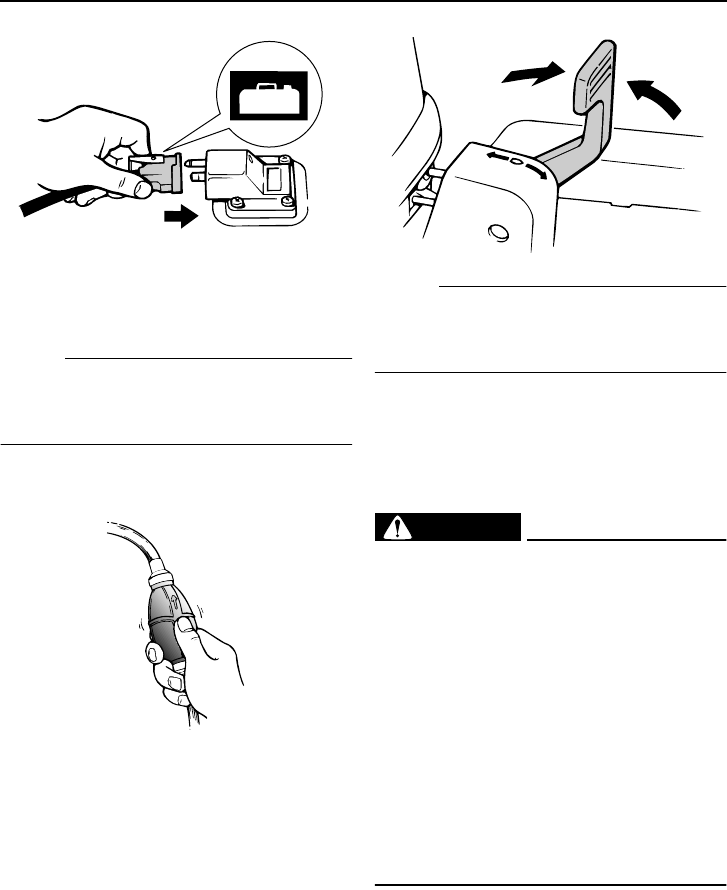
1. If there is an air vent screw on the fuel
tank cap, loosen it 2 or 3 turns.
2. If there is a fuel joint on the motor, firmly
connect the fuel line to the joint. Then
firmly connect the other end of the fuel
line to the joint on the fuel tank.
ZMU02022
ZMU04113
Operation
23
3. If a steering friction adjuster is provided
on your outboard motor, securely attach
the fuel line to the fuel line clamp.
NOTE:
During engine operation place the tank hori-
zontally, otherwise fuel cannot be drawn
from the fuel tank.
4. Squeeze the primer pump with the outlet
end up until you feel it become firm.
EMU27490
Starting engine
EMU27505
Manual start models (tiller control)
1. Place the gear shift lever in neutral.
NOTE:
The start-in-gear protection device prevents
the engine from starting except when in neu-
tral.
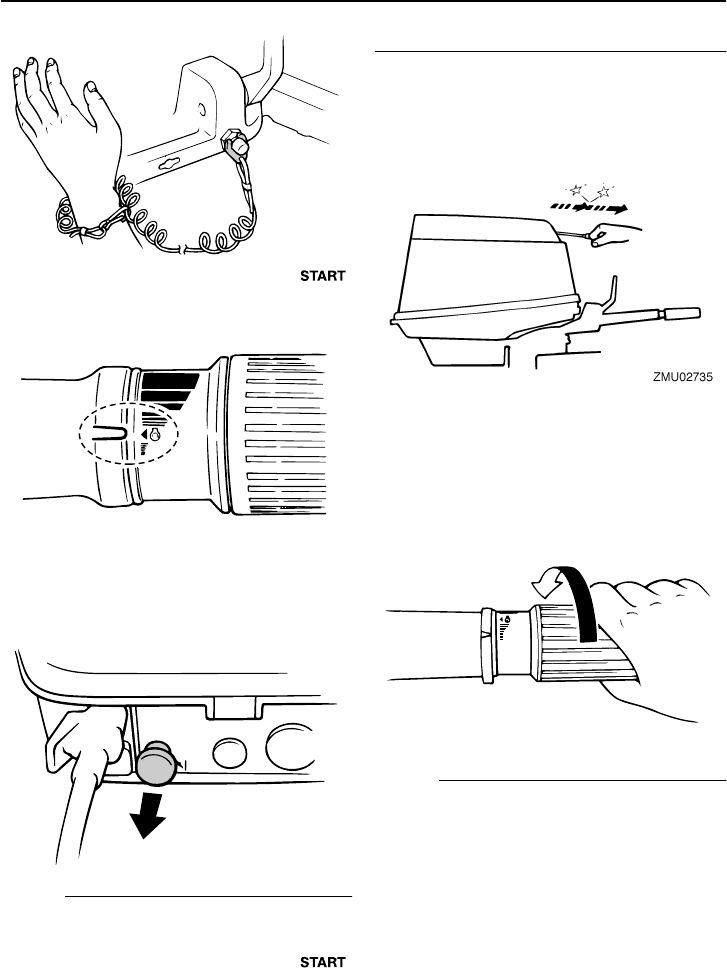
2. Attach the engine stop switch lanyard to
a secure place on your clothing, or your
arm or leg. Then install the lock plate on
the other end of the lanyard into the en-
gine stop switch.
WARNING
EWM00120
●
Attach the engine stop switch lanyard
to a secure place on your clothing, or
your arm or leg while operating.
●
Do not attach the lanyard to clothing
that could tear loose. Do not route the
lanyard where it could become entan-
gled, preventing it from functioning.
●
Avoid accidentally pulling the lanyard
during normal operation. Loss of en-
gine power means the loss of most
steering control. Also, without engine
power, the boat could slow rapidly. This
could cause people and objects in the
boat to be thrown forward.
ZMU02024
ZMU02025
N
ZMU03714
Operation
24
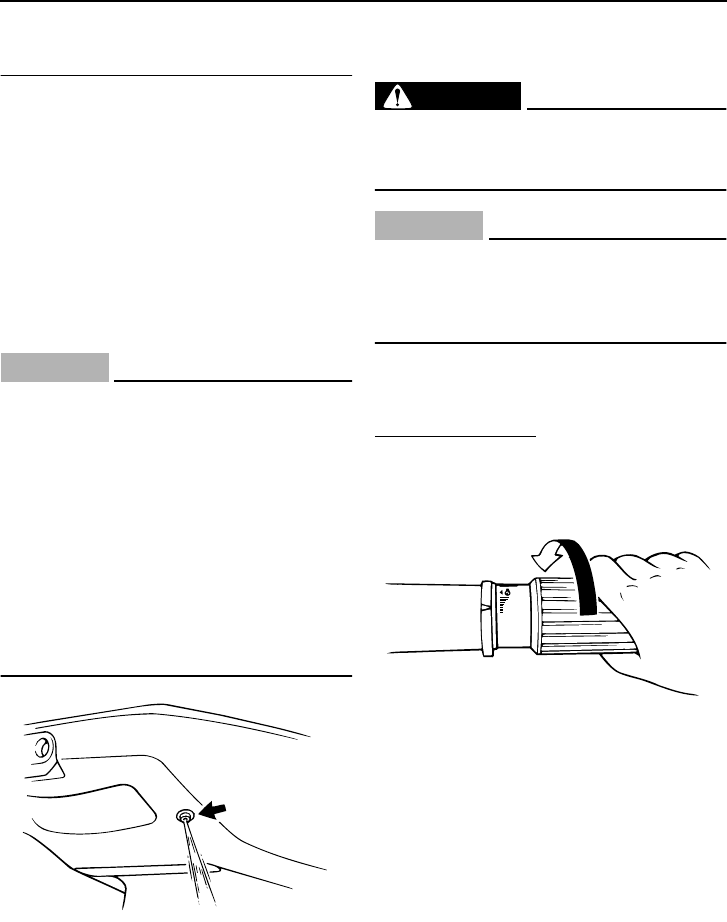
3. Place the throttle grip in the “”
(start) position.
4. Pull out / turn the choke knob fully. After
the engine starts, replace / return the
knob to the home position.
NOTE:
●
It is not necessary to use the choke when
starting a warm engine.
●
If the choke knob is left in the “”
(start) position while the engine is running,
the engine will run poorly or stall.
5. Pull the manual starter handle slowly un-
til you feel resistance. Then give a
strong pull straight out to crank and start
the engine. Repeat if necessary.
6. After the engine starts, slowly return the
manual starter handle to its original po-
sition before releasing it.
7. Slowly return the throttle grip to the fully
closed position.
NOTE:
●
When the engine is cold, it needs to be
warmed up. For further information, see
page 25.
●
If the engine does not start on the first try,
repeat the procedure. If the engine fails to
start after 4 or 5 tries, open the throttle a
small amount (between 1/8 and 1/4) and
try again. Also if the engine is warm and
fails to start, open the throttle a same
ZMU03744
ZMU02954
ZMU04114
ZMU02030
Operation
25
amount and try to start the engine again. If
the engine still fails to start, see page 48.
EMU27670
Warming up engine
EMU27680
Choke start models
1. After starting the engine, allow it to idle
for 3 minutes to warm up. Failure to do
so will shorten engine life. Gradually re-
turn the choke knob to its home position
as the engine warms up.
2. Check for a steady flow of water from the
cooling water pilot hole.
CAUTION:
ECM00510
A flow of water from the hole on the ex-
haust cover shows that the water pump is
pumping water through the cooling pas-
sages. If water is not flowing out of the
hole at all times while the engine is run-
ning, overheating and serious damage
could occur. Stop the engine and check
whether the cooling water inlet on the
lower case or the cooling water pilot hole
is blocked. Consult your Yamaha dealer if
the problem cannot be located and cor-
rected.
EMU27740
Shifting
WARNING
EWM00180
Before shifting, make sure there are no
swimmers or obstacles in the water near
you.
CAUTION:
ECM00220
To change the boat direction or shifting
position from forward to reverse or vice-
versa, first close the throttle so that the
engine idles (or runs at low speeds).
EMU27763
Forward (tiller handle and remote
control models)
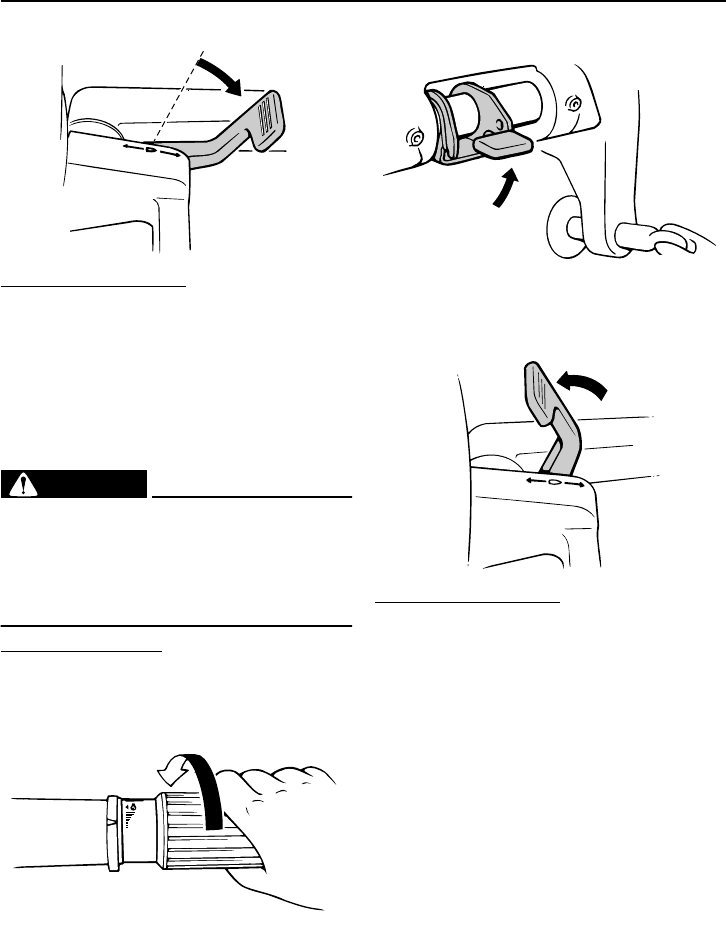
Tiller control models
1. Place the throttle grip in the fully closed
position.
2. Move the gear shift lever quickly and
firmly from neutral to forward.
ZMU02856
ZMU02030
Operation
26
Remote control models
1. Pull up the neutral interlock trigger (if
equipped) and move the remote control
lever quickly and firmly from neutral to
forward.
EMU27795
Reverse (manual tilt and hydro tilt
models)
WARNING
EWM00190
When operating in reverse, go slowly. Do
not open the throttle more than half. Oth-
erwise the boat could become unstable,
which could result in loss of control and
an accident.
Tiller control models
1. Place the throttle grip in the fully closed
position.
2. On models equipped with a tilt lock le-
ver, check that it is in the lock/down po-
sition.
3. Move the gear shift lever quickly and
firmly from neutral to reverse.
Remote control models
1. Check that the tilt lock lever is in the lock
position.
2. Pull up the neutral interlock trigger (if
equipped) and move the remote control
lever quickly and firmly from neutral to
reverse.
EMU27820
Stopping engine
Before stopping the engine, first let it cool off
for a few minutes at idle or low speed. Stop-
ping the engine immediately after operating
at high speed is not recommended.
EMU27832
Procedure
1. Push and hold the engine stop button
until the engine comes to a complete
stop.
N
F
ZMU03718
ZMU02030
ZMU03719
N
R
ZMU03720
Operation
27
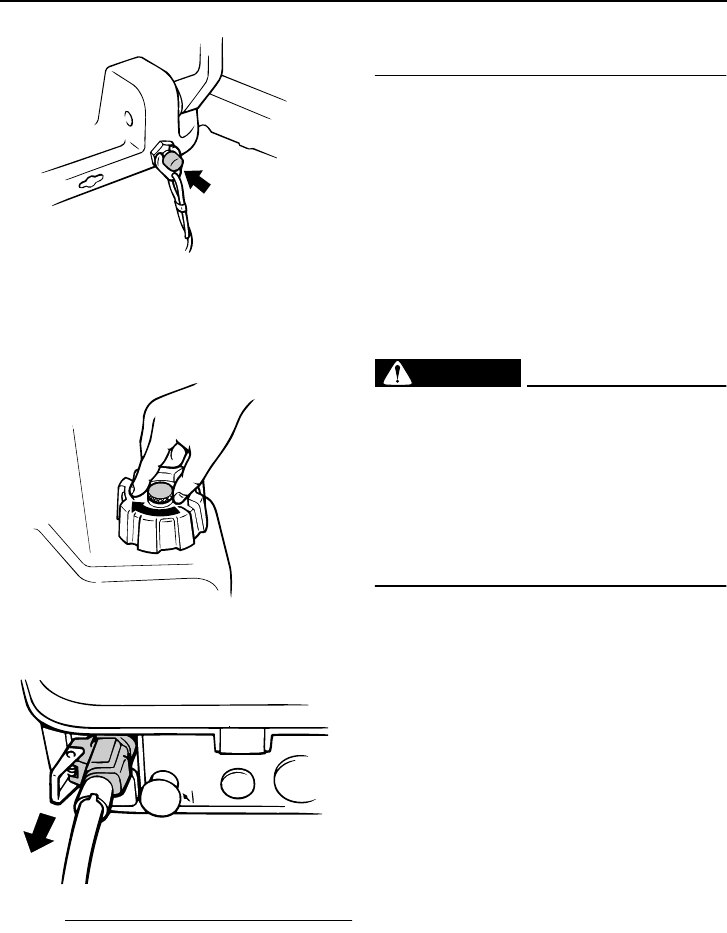
2. After stopping the engine, tighten the air
vent screw on the fuel tank cap and set
the fuel cock lever or knob to the closed
position, if equipped.
3. Disconnect the fuel line if you are using
an external fuel tank.
NOTE:
If the outboard motor is equipped with an en-
gine stop switch lanyard, the engine can also
be stopped by pulling the lanyard and remov-
ing the lock plate from the engine stop
switch.
EMU27861
Trimming outboard motor
The trim angle of the outboard motor helps
determine the position of the bow of the boat
in the water. Correct trim angle will help im-
prove performance and fuel economy while
reducing strain on the engine. Correct trim
angle depends upon the combination of
boat, engine, and propeller. Correct trim is
also affected by variables such as the load in
the boat, sea conditions, and running speed.
WARNING
EWM00740
Excessive trim for the operating condi-
tions (either trim up or trim down) can
cause boat instability and can make
steering the boat more difficult. This in-
creases the possibility of an accident. If
the boat begins to feel unstable or is hard
to steer, slow down and/or readjust the
trim angle.
ZMU03690
ZMU02301
ZMU04121
Operation
28
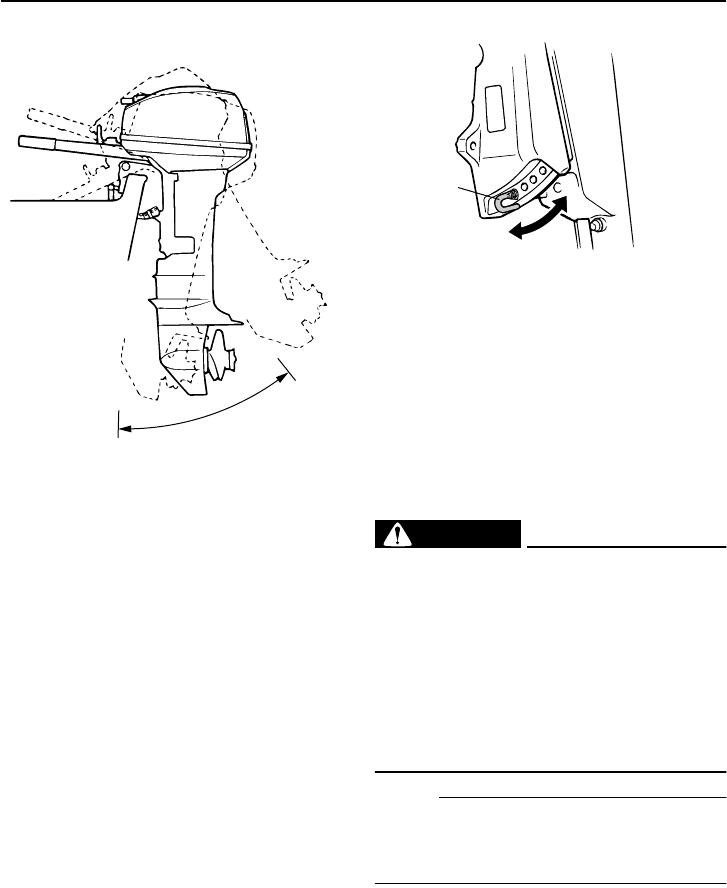
EMU27871
Adjusting trim angle for manual tilt
models
There are 4 or 5 holes provided in the clamp
bracket to adjust the outboard motor trim an-
gle.
1. Stop the engine.
2. Remove the trim rod from the clamp
bracket while slightly tilting the outboard
motor up.
3. Reposition the rod in the desired hole.
To raise the bow (“trim-out”), move the rod
away from the transom.
To lower the bow (“trim-in”), move the rod to-
ward the transom.
Make test runs with the trim set to different
angles to find the position that works best for
your boat and operating conditions.
WARNING
EWM00400
●
Stop the engine before adjusting the
trim angle.
●
Use care to avoid being pinched when
removing or installing the rod.
●
Use caution when trying a trim position
for the first time. Increase speed gradu-
ally and watch for any signs of instabil-
ity or control problems. Improper trim
angle can cause loss of control.
NOTE:
The outboard motor trim angle can be
changed approximately 4 degrees by shifting
the trim rod one hole.
EMU27911
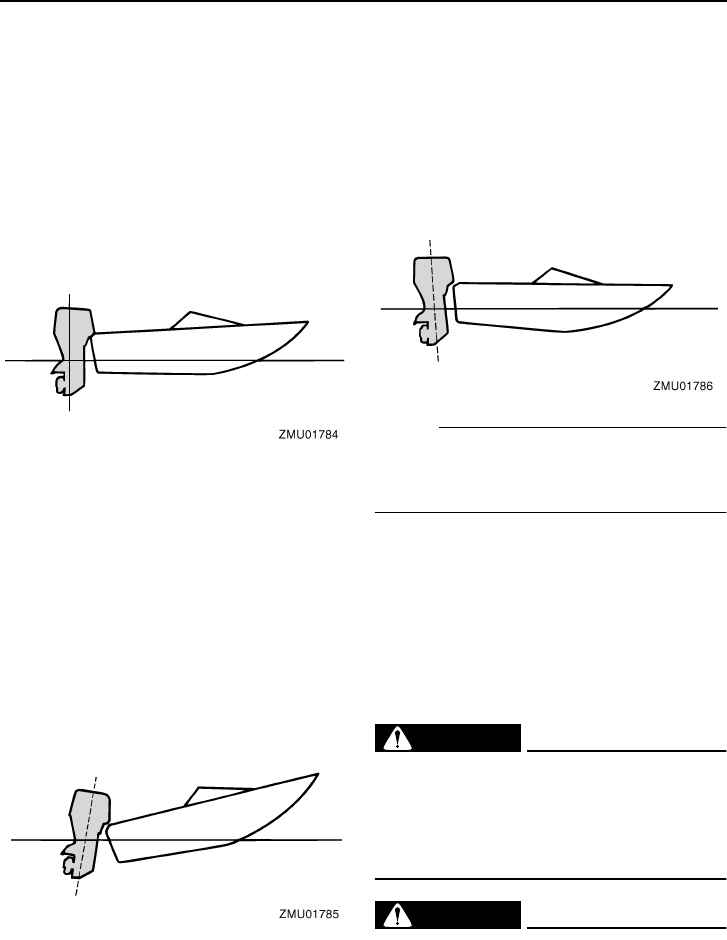
Adjusting boat trim
When the boat is on plane, a bow-up attitude
results in less drag, greater stability and effi-
ciency. This is generally when the keel line of
1. Trim operating angle
ZMU02858
1
1. Trim rod
ZMU02909
1
Operation
29
the boat is up about 3 to 5 degrees. With the
bow up, the boat may have a greater tenden-
cy to steer to one side or the other. Compen-
sate for this as you steer. The trim tab can
also be adjusted to help offset this effect.
When the bow of the boat is down, it is easier
to accelerate from a standing start onto
plane.
Bow Up
Too much trim-out puts the bow of the boat
too high in the water. Performance and econ-
omy are decreased because the hull of the
boat is pushing the water and there is more
air drag. Excessive trim-out can also cause
the propeller to ventilate, which reduces per-
formance further, and the boat may “por-
poise” (hop in the water), which could throw
the operator and passengers overboard.
Bow Down
Too much trim-in causes the boat to “plow”
through the water, decreasing fuel economy
and making it hard to increase speed. Oper-
ating with excessive trim-in at higher speeds
also makes the boat unstable. Resistance at
the bow is greatly increased, heightening the
danger of “bow steering” and making opera-
tion difficult and dangerous.
NOTE:
Depending on the type of boat, the outboard
motor trim angle may have little effect on the
trim of the boat when operating.
EMU27931
Tilting up and down
If the engine will be stopped for some time or
if the boat is moored in shallows, the out-
board motor should be tilted up to protect the
propeller and casing from damage by colli-
sion with obstructions, and also to reduce
salt corrosion.
WARNING
EWM00220
Be sure all people are clear of the out-
board motor when tilting up and down,
also be careful not to pinch any body
parts between the drive unit and engine
bracket.
WARNING
EWM00250
Leaking fuel is a fire hazard. If there is a
fuel joint on the outboard motor, discon-
nect the fuel line or close the fuel cock if
Operation
30
the engine will be tilted for more than a
few minutes. Otherwise fuel may leak.
CAUTION:
ECM00241
●
Before tilting the outboard motor, stop
the engine by following the procedure
on page 26. Never tilt the outboard mo-
tor while the engine is running. Severe
damage from overheating can result.
●
Do not tilt up the engine by pushing the
tiller handle (if equipped) because this
could break the handle.
EMU27952
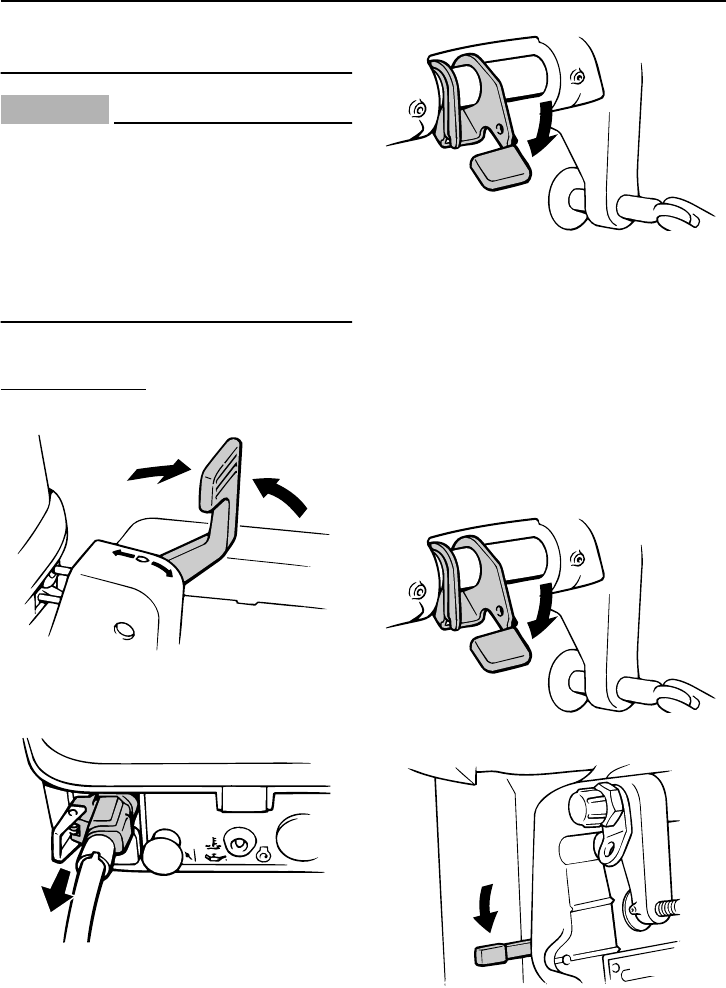
Procedure for tilting up
Manual tilt models
1. Place the gear shift lever in neutral.
2. Disconnect the fuel line if a fuel joint is
provided on the outboard motor.
3. Place the tilt lock lever in the release po-
sition.
4. Hold the rear of the top cowling with one
hand, tilt the engine up, and turn the tilt
support lever to the lock position and
support the engine.
EMU28022
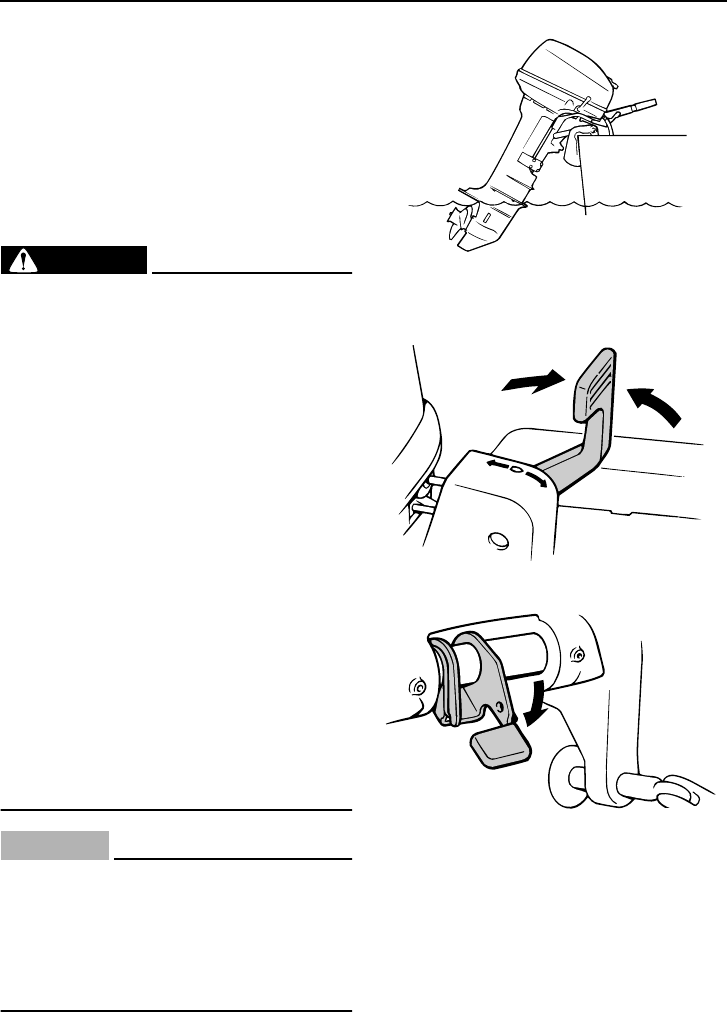
Procedure for tilting down (manual
tilt models)
1. Place the tilt lock lever in the release/
down position or return the shallow wa-
ter lever to its original position.
2. Slightly tilt the engine up until the tilt sup-
N
ZMU03724
ZMU03725
ZMU03726
ZMU03747
ZMU03731
Operation
31
port bar is automatically released.
3. Slowly tilt the engine down.
EMU28060
Cruising in shallow water
The outboard motor can be tilted up partially
to allow operation in shallow water.
EMU28071
Cruising in shallow water (manual tilt
models)
WARNING
EWM00710
●
Place the gear shift in neutral before us-
ing the shallow water cruising system.
●
Run the boat at the lowest possible
speed when using the shallow water
cruising system. The tilt lock mecha-
nism does not work while the shallow
water cruising system is being used.
Hitting an underwater obstacle could
cause the outboard motor to lift out of
the water, resulting in loss of control.
●
Do not rotate the outboard motor 180°
and operate the boat in reverse. Place
the gear shift in reverse to operate the
boat in reverse.
●
Use extra care when operating in re-
verse. Too much reverse thrust can
cause the outboard motor to lift out of
the water, increasing the chance of ac-
cident and personal injury.
●
Return the outboard motor to its normal
position as soon as the boat is back in
deeper water.
CAUTION:
ECM00260
Do not tilt the outboard motor up so that
the cooling water inlet on the lower unit is
above the surface of the water when set-
ting up for and cruising in shallow water.
Otherwise severe damage from overheat-
ing can result.
EMU28132
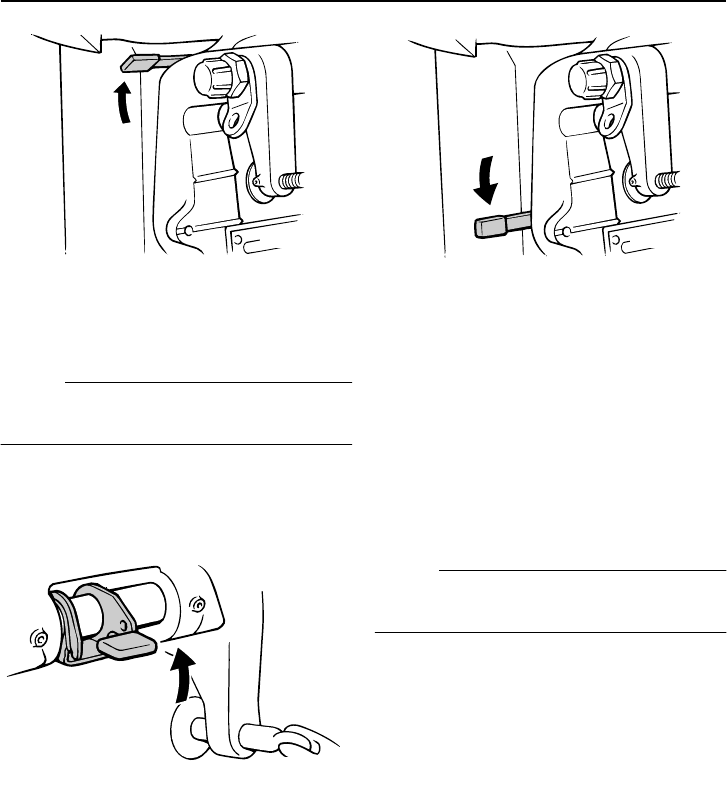
Procedure
1. Place the gear shift lever in neutral.
2. Push the tilt lock lever down to release it.
3. Pull up the shallow water lever.
ZMU02868
N
ZMU03745
ZMU03746
Operation
32
4. Slightly tilt the outboard motor up. The
tilt support bar will lock automatically,
supporting the outboard motor in a par-
tially raised position.
NOTE:
This outboard motor has 2 positions for shal-
low water cruising.
5. To return the outboard motor to the nor-
mal running position, place the tilt lock
lever and shallow water lever to the lock
position.
6. Slightly tilt the outboard motor up until
the tilt support bar automatically returns
to the free position.
7. Slowly lower the outboard motor to the
normal position.
EMU28190
Cruising in other conditions
Cruising in salt water
After operating in salt water, wash out the
cooling water passages with fresh water to
prevent them from becoming clogged with
salt deposits.
NOTE:
For cooling system flushing instructions, see
page 33.
Cruising in turbid water
Yamaha strongly recommends that you use
the optional chromium-plated water pump kit
if you use the outboard motor in turbid (mud-
dy) water conditions.
ZMU03728
ZMU03729
ZMU03731

33
Maintenance
EMU28216
Specifications
Dimension:
Overall length:
936 mm (36.9 in)
Overall width:
358 mm (14.1 in)
Overall height S:
1068 mm (42.0 in)
Transom height S:
419 mm (16.5 in)
Weight (AL) S:
48.0 kg (106 lb)
Performance:
Full throttle operating range:
5000–6000 r/min
Maximum output:
18.4 kW@5500 r/min (25 HP@5500
r/min)
Idling speed (in neutral):
750
±
50 r/min
Engine:
Type:
2-stroke L
Displacement:
395.0 cm
3
(24.10 cu.in)
Bore
×
stroke:
67.0
×
56.0 mm (2.64
×
2.20 in)
Ignition system:
CDI
Spark plug (NGK):
B7HS-10
Spark plug with resistor (NGK):
BR7HS-10
Spark plug gap:
0.9–1.0 mm (0.035–0.039 in)
Control system:
Tiller
Starting system:
Manual
Starting carburetion system:
Choke valve
Alternator output:
80 W
Drive unit:
Gear positions:
Forward-neutral-reverse
Gear ratio:
2.08 (27/13)
Trim and tilt system:
Manual tilt
Propeller mark:
F
Fuel and oil:
Recommended fuel:
Regular unleaded gasoline
Min. pump octane:
86
Recommended engine oil:
YAMALUBE 2-stroke outboard motor
oil
Fuel:oil ratio:
Regular gasoline:
100 :1
Lubrication:
Pre-mixed fuel and oil
Recommended gear oil:
Hypoid gear oil SAE#90
Gear oil quantity:
370.0 cm
3
(12.51 US oz) (13.05
Imp.oz)
Tightening torque for engine:
Spark plug:
25.0 Nm (18.4 ft-lb) (2.55 kgf-m)
Propeller nut:
35.0 Nm (25.8 ft-lb) (3.57 kgf-m)
EMU28222
Transporting and storing
outboard motor
WARNING
EWM00690
●
Leaking fuel is a fire hazard. When
Maintenance
34
transporting and storing the outboard
motor, close the air vent screw and fuel
cock to prevent fuel from leaking.
●
USE CARE when transporting fuel tank,
whether in a boat or car.
●
DO NOT fill fuel container to maximum
capacity. Gasoline will expand consid-
erably as it warms up and can build up
pressure in the fuel container. This can
cause fuel leakage and a potential fire
hazard.
WARNING
EWM00700
Never get under the lower unit while it is
tilted, even if a motor support bar is used.
Severe injury could occur if the outboard
motor accidentally falls.
CAUTION:
ECM00660
Do not use the tilt support lever or knob
when trailering the boat. The outboard
motor could shake loose from the tilt sup-
port and fall. If the motor cannot be trail-
ered in the normal running position, use
an additional support device to secure it
in the tilt position.
The outboard motor should be trailered and
stored in the normal running position. If there
is insufficient road clearance in this position,
then trailer the outboard motor in the tilt po-
sition using a motor support device such as
a transom saver bar. Consult your Yamaha
dealer for further details.
EMU28235
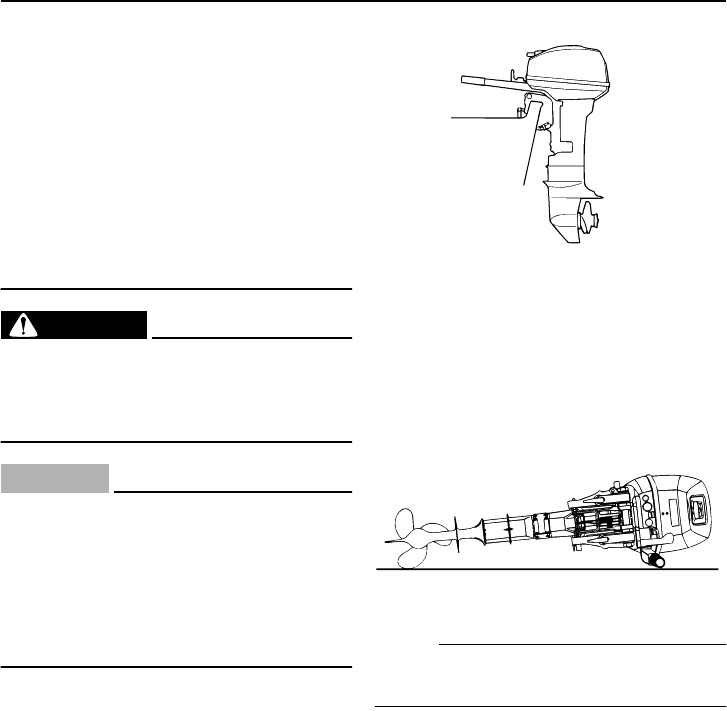
Clamp screw mounting models
When transporting or storing the outboard
motor while removed from a boat, keep the
outboard motor in the attitude shown.
NOTE:
Place a towel or something similar under the
outboard motor to protect it from damage.
EMU30272
Storing outboard motor
When storing your Yamaha outboard motor
for prolonged periods of time (2 months or
longer), several important procedures must
be performed to prevent excessive damage.
It is advisable to have your outboard motor
serviced by an authorized Yamaha dealer
prior to storage. However, you, the owner,
with a minimum of tools, can perform the fol-
ZMU02870
ZMU02869
Maintenance
35
lowing procedures.
CAUTION:
ECM01411
●
Do not place the outboard motor on its
side before the cooling water has
drained from it completely, otherwise
water may enter the cylinder through
the exhaust port and cause engine trou-
ble.
●
Store the outboard motor in a dry, well-
ventilated place, not in direct sunlight.
EMU28301
Procedure
EMU28372
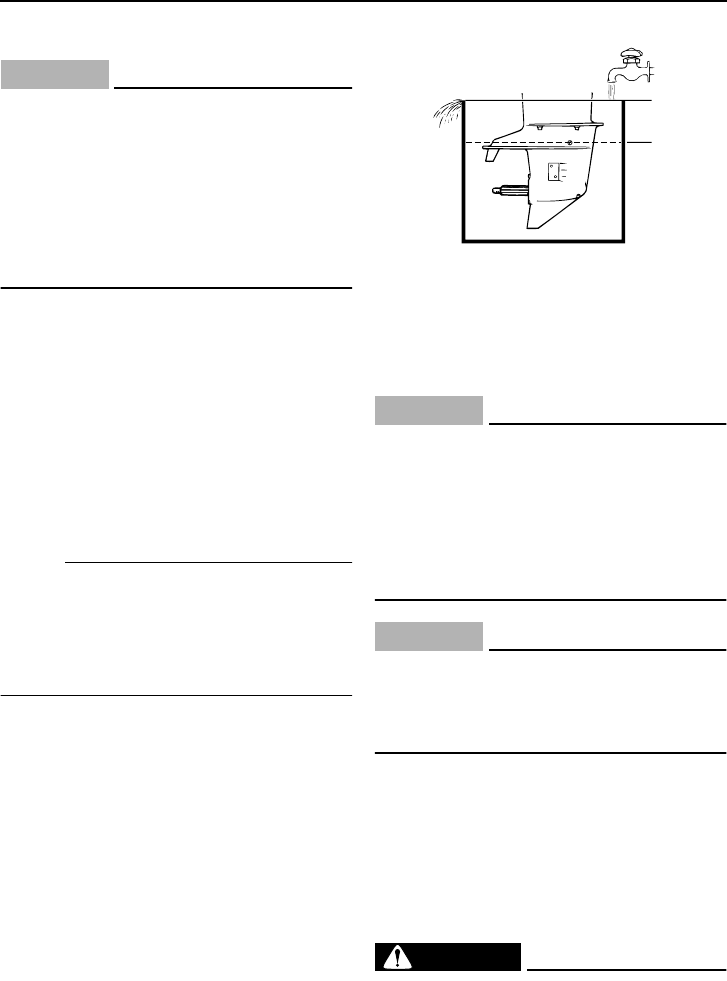
Flushing in a test tank
1. Wash the outboard motor body using
fresh water. For further information, see
page 36.
2. Fill the fuel tank with fresh fuel and add
one ounce of “Yamaha Fuel Conditioner
and Stabilizer” (Part No. LUB-FUELC-
12-00) to each gallon of fuel.
NOTE:
The use of “Yamaha Fuel Conditioner and
Stabilizer” eliminates the need to drain the
fuel system. Consult your Yamaha dealer or
other qualified mechanic if the fuel system is
to be drained instead.
3. Remove the engine top cowling and si-
lencer cover.
4. Install the outboard motor on the test
tank.
5. Fill the tank with fresh water to above the
level of the anti-cavitation plate.
CAUTION:
ECM00300
Do not run the engine without supplying
it with cooling water. Either the engine
water pump will be damaged or the en-
gine will be damaged from overheating.
Before starting the engine, be sure to
supply water to the cooling water passag-
es.
CAUTION:
ECM00290
If the fresh water level is below the level
of the anti-cavitation plate, or if the water
supply is insufficient, engine seizure may
occur.
6. Cooling system flushing is essential to
prevent the cooling system from clog-
ging up with salt, sand, or dirt. In addi-
tion, fogging of the engine is mandatory
to prevent excessive engine damage
due to rust. Perform the flushing and
fogging at the same time.
WARNING
EWM00090
●
Do not touch or remove electrical parts
1. Water surface
2. Lowest water level
ZMU02051
1
2
Maintenance
36
when starting or during operation.
●
Keep hands, hair, and clothes away
from the flywheel and other rotating
parts while the engine is running.
7. Run the engine at a fast idle for 10–15
minutes in neutral position.
8. Just prior to turning off the engine, quick-
ly spray “Yamaha Stor-Rite Engine
Fogging Oil” (Part No. LUB-STRRT-12-
00) alternately into each carburetor or
the fogging hole of the silencer cover, if
equipped. When properly done, the en-
gine will smoke excessively and almost
stall.
9. Remove the outboard motor from the
test tank.
10. Drain the cooling water completely out
of the motor. Clean the body thoroughly.
11. Install the silencer cover/cap and top
cowling.
EMU28400
Lubrication (except oil injection
models)
1. Grease the spark plug threads and in-
stall the spark plug(s) and torque to
proper specification. For information on
spark plug installation, see page 39.
2. Change the gear oil. For instructions,
see page 44. Inspect the oil for the pres-
ence of water that indicates a leaky seal.
Seal replacement should be performed
by an authorized Yamaha dealer prior to
use.
3. Grease all grease fittings. For further de-
tails, see page 39.
EMU28421
Cleaning and anticorrosion
measures
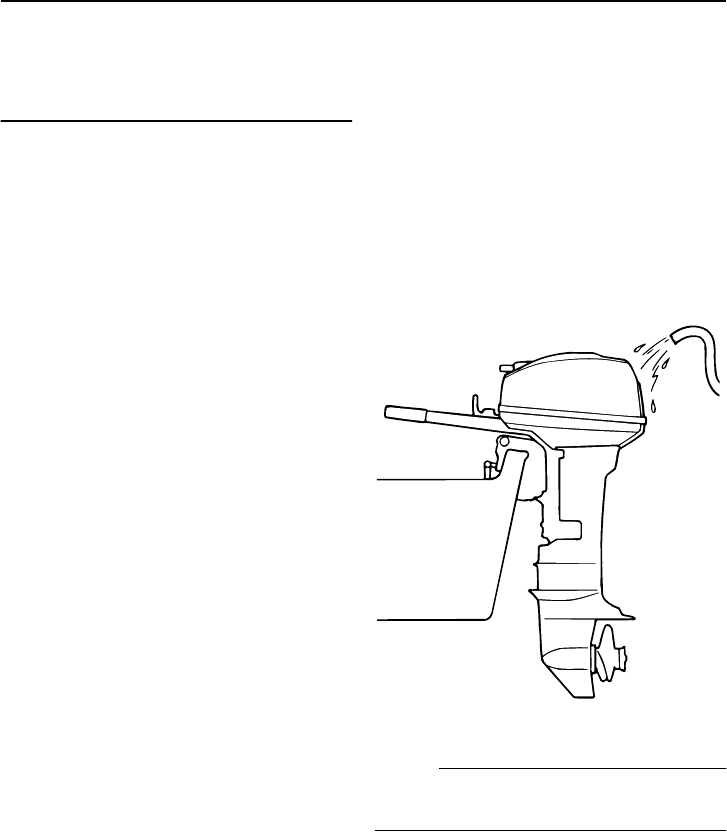
1. Wash down the exterior of the outboard
motor with fresh water and dry off com-
pletely.
2. Spray the outboard motor exterior with
“Yamaha Silicone Protectant” (Part No.
LUB-SILCNE-13-00).
3. Wax the cowling with a non-abrasive
wax such as “Yamaha Silicone Wax”
(Part No. ACC-11000-15-02).
EMU28450
Cleaning the outboard motor
After use, wash the exterior of the outboard
motor with fresh water. Flush the cooling
system with fresh water.
NOTE:
For cooling system flushing instructions, see
page 33.
EMU28460
Checking painted surface of motor
Check the motor for scratches, nicks, or flak-
ing paint. Areas with damaged paint are
more likely to corrode. If necessary, clean
and paint the areas. A touch-up paint is avail-
able from your Yamaha dealer.
ZMU02871
Maintenance
37
EMU28483
Periodic maintenance
WARNING
EWM01070
Be sure to turn off the engine when you
perform maintenance unless otherwise
specified. If you or the owner is not famil-
iar with machine servicing, this work
should be done by your Yamaha dealer or
other qualified mechanic.
Maintenance, replacement, or repair of
the emission control devices and sys-
tems may be performed by any marine
engine repair establishment or individual.
All warranty repairs, however, including
those to the emission control system,
must be performed by an authorized
Yamaha marine dealership.
A service manual is available for purchase
through your Yamaha dealer for owners who
have the mechanical skills, tools, and other
equipment necessary to perform mainte-
nance not covered by this owner’s manual.
EMU28510
Replacement parts
If replacement parts are necessary, use only
genuine Yamaha parts or parts of the same
type and of equivalent strength and materi-
als. Any part of inferior quality may malfunc-
tion, and the resulting loss of control could
endanger the operator and passengers.
Yamaha genuine parts and accessories are
available from your Yamaha dealer.
Maintenance
38
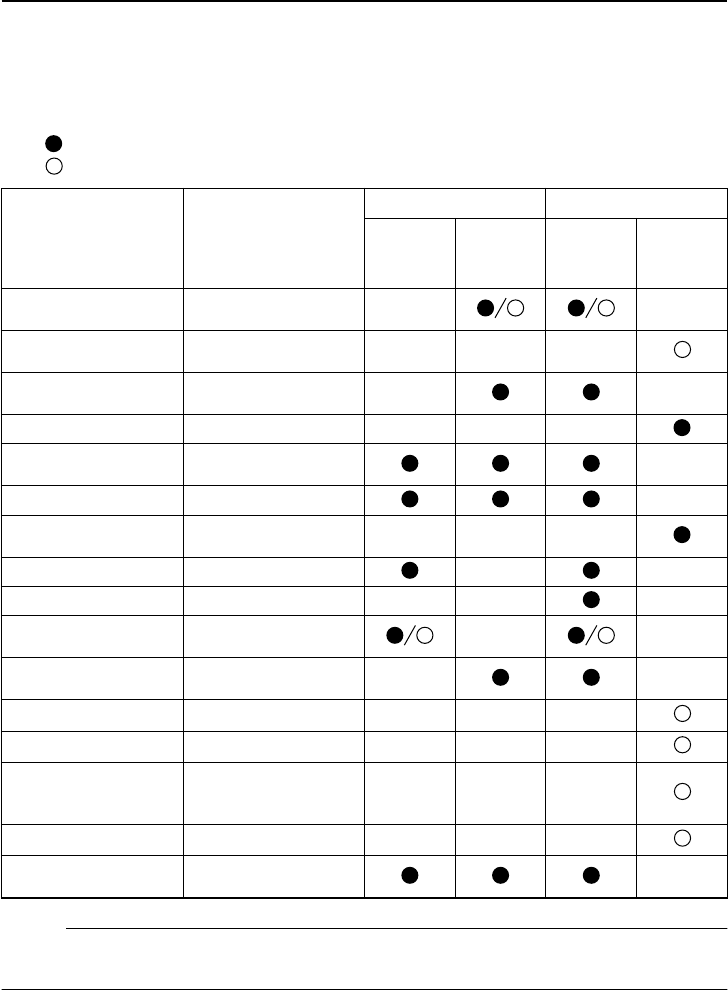
EMU28521
Maintenance chart
Frequency of maintenance operations may be adjusted according to the operating condi-
tions, but the following table gives general guidelines. Refer to the sections in this chapter for
explanations of each owner-specific action.
The “” symbol indicates the check-ups which you may carry out yourself.
The “” symbol indicates work to be carried out by your Yamaha dealer.
NOTE:
When operating in salt water, turbid or muddy water, the engine should be flushed with clean
water after each use.
Item Actions
Initial Every
10 hours
(1 month)
50 hours
(3
months)
100
hours (6
months)
200
hours (1
year)
Anode(s) (external) Inspection / replace-
ment
Anode(s) (internal) Inspection / replace-
ment
Cooling water pas-
sages Cleaning
Cowling clamp Inspection
Fuel filter (can be dis-
assembled) Inspection / cleaning
Fuel system Inspection
Fuel tank (Yamaha por-
table tank) Inspection / cleaning
Gear oil Change
Greasing points Greasing
Idling speed (carbure-
tor models) Inspection / adjustment
Propeller and cotter pin Inspection / replace-
ment
Shift link / shift cable Inspection / adjustment
Thermostat Inspection
Throttle link / throttle
cable / throttle pick-up
timing
Inspection / adjustment
Water pump Inspection
Spark plug(s) Cleaning / adjustment /
replacement
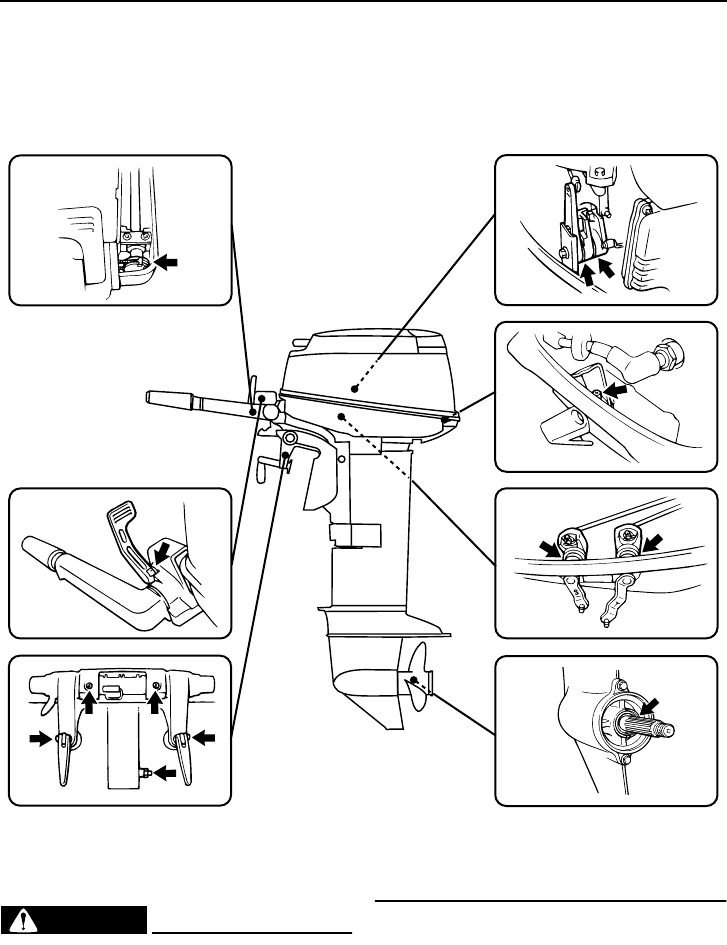
Maintenance
39
EMU28931
Greasing
Yamaha marine grease (Water resistant grease)
25D
EMU28951
Cleaning and adjusting spark plug
WARNING
EWM00560
When removing or installing a spark plug,
be careful not to damage the insulator. A
damaged insulator could allow external
sparks, which could lead to explosion or
fire.
The spark plug is an important engine com-
ponent and is easy to inspect. The condition
of the spark plug can indicate something
about the condition of the engine. For exam-
ZMU03734
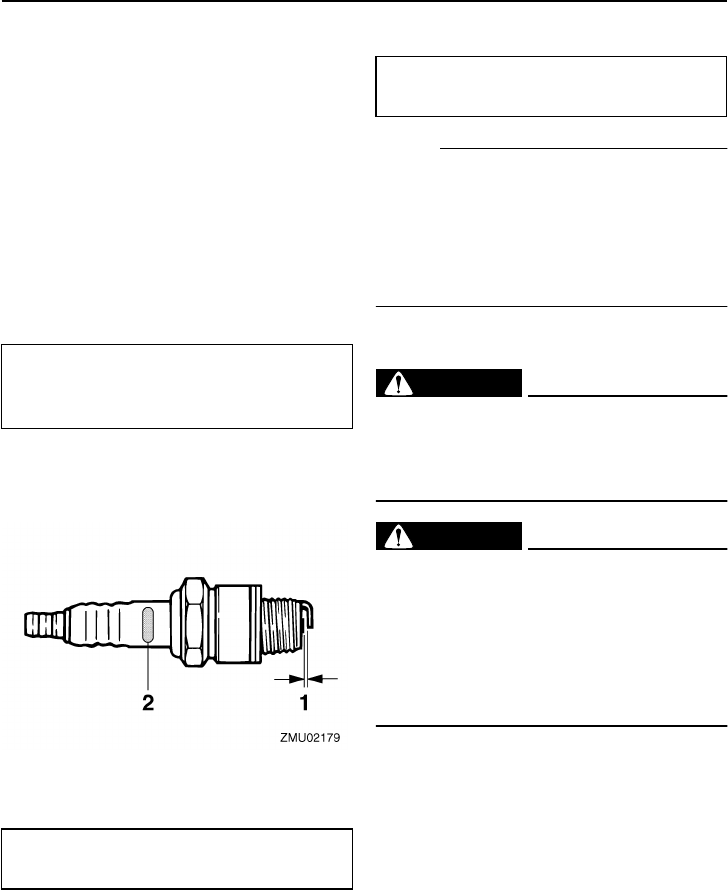
Maintenance
40
ple, if the center electrode porcelain is very
white, this could indicate an intake air leak or
carburetion problem in that cylinder. Do not
attempt to diagnose any problems yourself.
Instead, take the outboard motor to a
Yamaha dealer. You should periodically re-
move and inspect the spark plug because
heat and deposits will cause the spark plug
to slowly break down and erode. If electrode
erosion becomes excessive, or if carbon and
other deposits are excessive, you should re-
place the spark plug with another of the cor-
rect type.
Before fitting the spark plug, measure the
electrode gap with a wire thickness gauge;
adjust the gap to specification if necessary.
When fitting the plug, always clean the gas-
ket surface and use a new gasket. Wipe off
any dirt from the threads and screw in the
spark plug to the correct torque.
NOTE:
If a torque-wrench is not available when you
are fitting a spark plug, a good estimate of
the correct torque is 1/4 to 1/2 a turn past fin-
ger-tight. Have the spark plug adjusted to the
correct torque as soon as possible with a
torque-wrench.
EMU28962
Checking fuel system
WARNING
EWM00060
Gasoline and its vapors are highly flam-
mable and explosive. Keep away from
sparks, cigarettes, flames, or other
sources of ignition.
WARNING
EWM00910
Leaking fuel can result in fire or explo-
sion.
●
Check for fuel leakage regularly.
●
If any fuel leakage is found, the fuel
system must be repaired by a qualified
mechanic. Improper repairs can make
the outboard unsafe to operate.
Check the fuel lines for leaks, crack, or mal-
function. If a problem is found, your Yamaha
dealer or other qualified mechanic should re-
pair it immediately.
Standard spark plug:
B7HS-10
BR7HS-10
1. Spark plug gap
2. Spark plug I.D. mark (NGK)
Spark plug gap:
0.9–1.0 mm (0.035–0.039 in)
Spark plug torque:
25.0 Nm (18.4 ft-lb) (2.55 kgf-m)

Maintenance
41
Checkpoints
●
Fuel system parts leakage
●
Fuel line joint leakage
●
Fuel line cracks or other damage
●
Fuel connector leakage
EMU28980
Inspecting fuel filter
WARNING
EWM00310
Gasoline is highly flammable, and its va-
pors are flammable and explosive.
●
If you have any question about properly
doing this procedure, consult your
Yamaha dealer.
●
Do not perform this procedure on a hot
or running engine. Allow the engine to
cool.
●
There will be fuel in the fuel filter. Keep
away from sparks, cigarettes, flames or
other sources of ignition.
●
This procedure will allow some fuel to
spill. Catch fuel in a rag. Wipe up any
spilled fuel immediately.
●
The fuel filter must be reassembled
carefully with the O-ring, filter cup, and
hoses in place. Improper assembly or
replacement could result in a fuel leak,
which could result in a fire or explosion
hazard.
EMU29001
Cleaning fuel filter
1. Remove the nut holding the fuel filter as-
sembly if equipped.
2. Unscrew the filter cup, catching any
spilled fuel in a rag.
3. Remove the filter element, and wash it in
solvent. Allow it to dry. Inspect the filter
element and O-ring to make sure they
are in good condition. Replace them if
necessary. If any water is found in the
fuel, the Yamaha portable fuel tank or
other fuel tanks should be checked and
cleaned.
ZMU04772
1. Nut
1. Filter cup
2. Filter element
3. Filter housing
4. O-ring
1
ZMU03812
ZMU02079
1
4
2
3
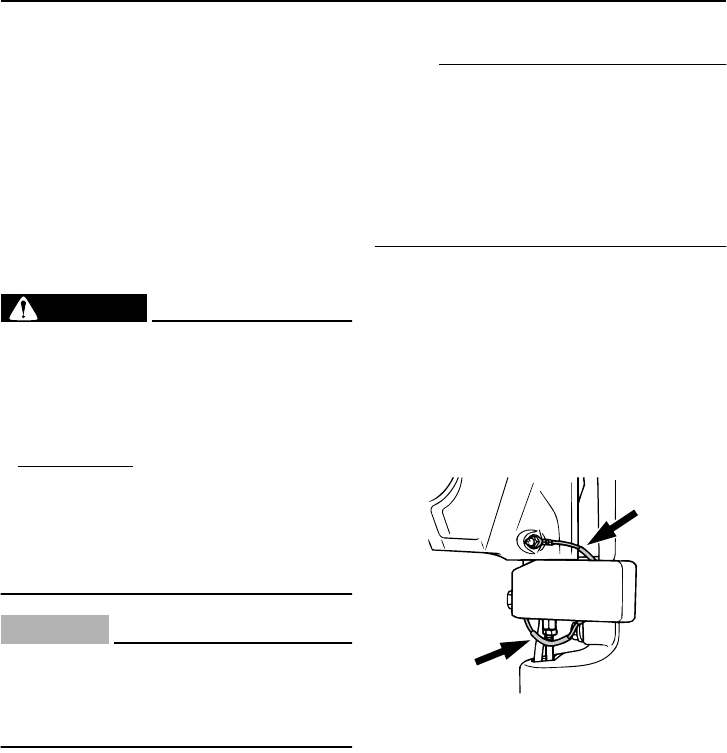
Maintenance
42
4. Reinstall the filter element in the cup.
Make sure the O-ring is in position in the
cup. Firmly screw the cup onto the filter
housing.
5. Attach the filter assembly to the bracket
so that the fuel hoses are attached to the
filter assembly.
6. Run the engine and check the filter and
lines for leaks.
EMU29040
Inspecting idling speed
WARNING
EWM00450
●
Do not touch or remove electrical parts
when starting or during operation.
●
Keep hands, hair, and clothes away
from the flywheel and other rotating
parts while the engine is running.
●
2-hp models: The propeller rotates
whenever the engine is running. Do not
move the throttle control lever from the
start position during warm-up. The boat
could unexpectedly start to move,
which could result in an accident.
CAUTION:
ECM00490
This procedure must be performed while
the outboard motor is in the water. A
flushing attachment or test tank can be
used.
A diagnostic tachometer should be used for
this procedure. Results may vary depending
on whether testing is conducted with the
flushing attachment, in a test tank, or with the
outboard motor in the water.
1. Start the engine and allow it to warm up
fully in neutral until it is running smooth-
ly.
2-hp model: Warm the engine with the
throttle in the start position or less. If the
outboard is mounted on a boat, be sure
the boat is tightly moored.
NOTE:
Correct idling speed inspection is only possi-
ble if the engine is fully warmed up. If not
warmed up fully, the idle speed will measure
higher than normal. If you have difficulty ver-
ifying the idle speed, or the idle speed re-
quires adjustment, consult a Yamaha dealer
or other qualified mechanic.
2. Verify whether the idle speed is set to
specification. For idle speed specifica-
tions, see page 33.
EMU29111
Checking wiring and connectors
●
Check that each grounding wire is properly
secured.
●
Check that each connector is engaged se-
curely.
EMU29120
Exhaust leakage
Start the engine and check that no exhaust
leaks from the joints between the exhaust
cover, cylinder head, and body cylinder.
EMU29130
Water leakage
Start the engine and check that no water
leaks from the joints between the exhaust
cover, cylinder head, and body cylinder.
ZMU03737
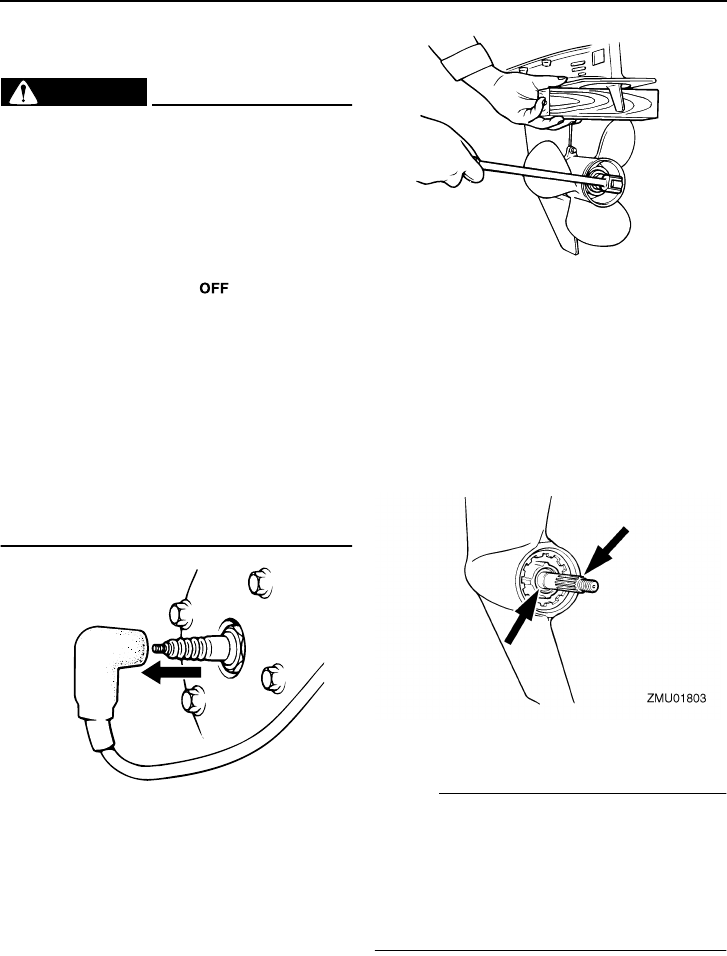
Maintenance
43
EMU29171
Checking propeller
WARNING
EWM00321
You could be seriously injured if the en-
gine accidentally starts when you are
near the propeller.
●
Before inspecting, removing, or install-
ing the propeller, remove the spark
plug caps from the spark plugs. Also,
place the shift control in neutral, turn
the main switch to “” (off) and re-
move the key, and remove the lanyard
from the engine stop switch. Turn off
the battery cut-off switch if your boat
has one.
●
Do not use your hand to hold the pro-
peller when loosening or tightening the
propeller nut. Put a wood block be-
tween the anti-cavitation plate and the
propeller to prevent the propeller from
turning.
Checkpoints
●
Check each of the propeller blades for
wear, erosion from cavitation or ventila-
tion, or other damage.
●
Check the propeller shaft for damage.
●
Check the splines / shear pin for wear or
damage.
●
Check for fish line tangled around the pro-
peller shaft.
●
Check the propeller shaft oil seal for dam-
age.
NOTE:
If the shear pin equipped: it is designed to
break if the propeller hits a hard underwater
obstacle to help protect the propeller and
drive mechanism. The propeller will then
spin freely on the shaft. If this happens, the
shear pin must be replaced.
ZMU02876
ZMU01897
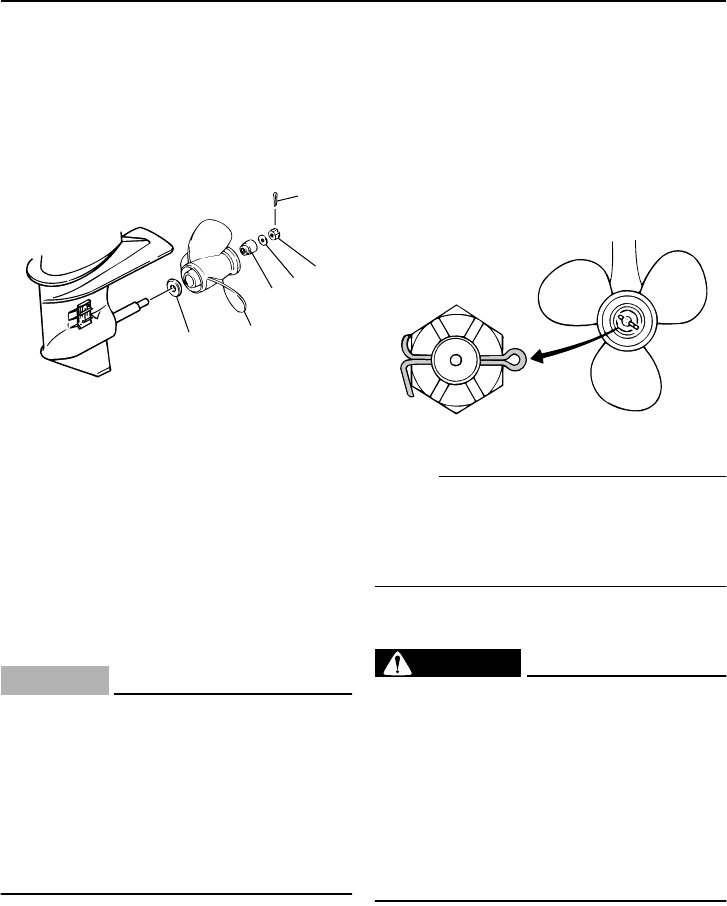
Maintenance
44
EMU29193
Removing the propeller
1. Straighten the cotter pin and pull it out
using a pair of pliers.
2. Remove the propeller nut, washer, and
spacer (if equipped).
3. Remove the propeller and thrust wash-
er.
EMU29230
Installing the propeller
CAUTION:
ECM00340
●
Be sure to install the thrust washer be-
fore installing the propeller, otherwise
the lower case and propeller boss
could be damaged.
●
Be sure to use a new cotter pin and
bend the ends over securely. Otherwise
the propeller could come off during op-
eration and be lost.
1. Apply Yamaha marine grease or a cor-
rosion resistant grease to the propeller
shaft.
2. Install the spacer(if equipped), thrust
washer, and propeller on the propeller
shaft.
3. Install the spacer (if equipped) and the
washer. Tighten the propeller nut to the
specified torque.
4. Align the propeller nut with the propeller
shaft hole. Insert a new cotter pin in the
hole and bend the cotter pin ends.
NOTE:
If the propeller nut does not align with the
propeller shaft hole after tightening to the
specified torque, tighten the nut further to
align it with the hole.
EMU29280
Changing gear oil
WARNING
EWM00800
●
Be sure the outboard motor is securely
fastened to the transom or a stable
stand. You could be severely injured if
the outboard motor falls on you.
●
Never get under the lower unit while it
is tilted, even when the tilt support lever
or knob is locked. Severe injury could
occur if the outboard motor accidental-
ly falls.
1. Tilt the outboard motor so that the gear
oil drain screw is at the lowest point pos-
sible.
2. Place a suitable container under the
1. Cotter pin
2. Propeller nut
3. Washer
4. Spacer
5. Propeller
6. Thrust washer
ZMU02829
65
432
1
ZMU02063
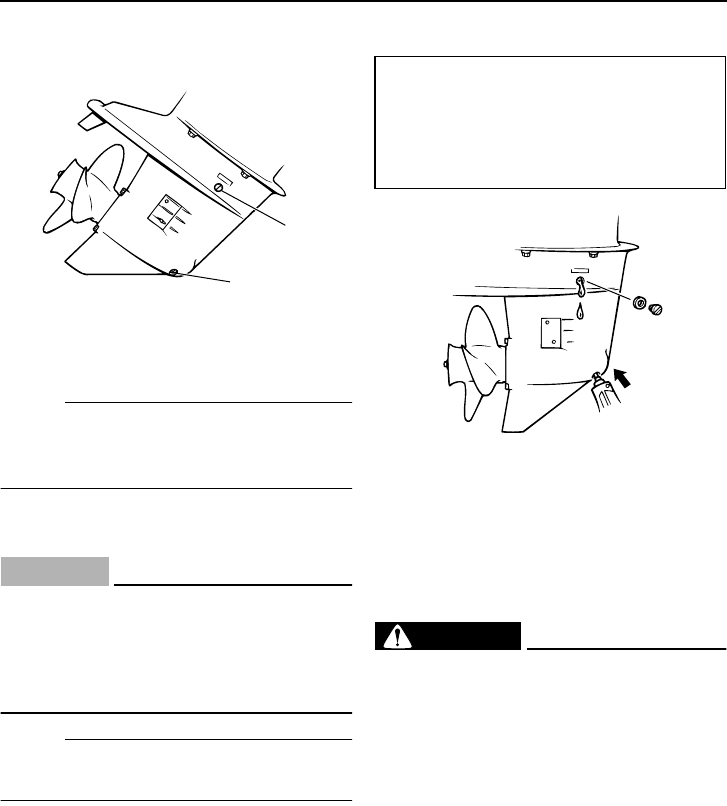
Maintenance
45
gear case.
3. Remove the gear oil drain screw.
NOTE:
If the magnetic gear oil drain screw
equipped: remove all metal particles from
the screw before installing it.
4. Remove the oil level plug to allow the oil
to drain completely.
CAUTION:
ECM00710
Inspect the used oil after it has been
drained. If the oil is milky, water is getting
into the gear case which can cause gear
damage. Consult a Yamaha dealer for re-
pair of the lower unit seals.
NOTE:
For disposal of used oil consult your Yamaha
dealer.
5. With the outboard motor in a vertical po-
sition, and using a flexible or pressur-
ized filling device, inject the gear oil into
the gear oil drain screw hole.
6. When the oil begins to flow out of the oil
level plug hole, insert and tighten the oil
level plug.
7. Insert and tighten the gear oil drain
screw.
EMU29302
Cleaning fuel tank
WARNING
EWM00920
Gasoline is highly flammable, and its va-
pors are flammable and explosive.
●
If you have any question about properly
doing this procedure, consult your
Yamaha dealer.
●
Keep away from sparks, cigarettes,
flames, or other sources of ignition
when cleaning the fuel tank.
●
Remove the fuel tank from the boat be-
fore cleaning it. Work only outdoors in
an area with good ventilation.
●
Wipe up any spilled fuel immediately.
●
Reassemble the fuel tank carefully. Im-
proper assembly can result in a fuel
leak, which could result in a fire or ex-
1. Gear oil drain screw
2. Oil level plug
ZMU03738
2
1
Recommended gear oil:
Hypoid gear oil SAE#90
Gear oil quantity:
370.0 cm
3
(12.51 US oz) (13.05
Imp.oz)
ZMU03739
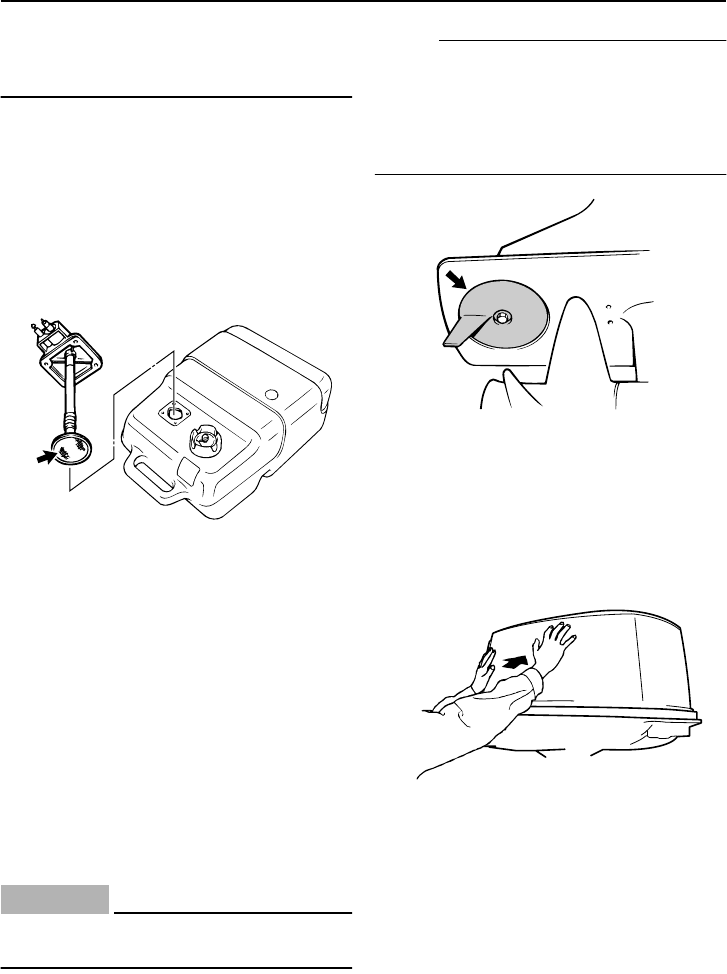
Maintenance
46
plosion hazard.
●
Dispose of old gasoline according to lo-
cal regulations.
1. Empty the fuel tank into an approved
container.
2. Pour a small amount of suitable solvent
into the tank. Install the cap and shake
the tank. Drain the solvent completely.
3. Remove the screws holding the fuel joint
assembly. Pull the assembly out of the
tank.
4. Clean the filter (located on the end of the
suction pipe) in a suitable cleaning sol-
vent. Allow the filter to dry.
5. Replace the gasket with a new one. Re-
install the fuel joint assembly and tighten
the screws firmly.
EMU29312
Inspecting and replacing anode(s)
Yamaha outboard motors are protected from
corrosion by sacrificial anodes. Inspect the
external anodes periodically. Remove scales
from the surfaces of the anodes. Consult a
Yamaha dealer for replacement of external
anodes.
CAUTION:
ECM00720
Do not paint anodes, as this would render
them ineffective.
NOTE:
Inspect ground leads attached to external
anodes on equipped models. Consult a
Yamaha dealer for inspection and replace-
ment of internal anodes attached to the pow-
er unit.
EMU29390
Checking top cowling
Check the fitting of the top cowling by push-
ing it with both hands. If it is loose have it re-
paired by your Yamaha dealer.
EMU29400
Coating the boat bottom
A clean hull improves boat performance. The
boat bottom should be kept as clean of ma-
rine growth as possible. If necessary, the
boat bottom can be coated with an anti-foul-
ing paint approved for your area to inhibit
marine growth.
Do not use anti-fouling paint which includes
ZMU02066
ZMU02924
ZMU04677
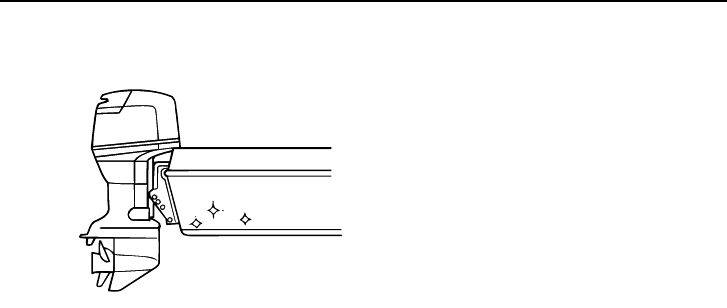
Maintenance
47
copper or graphite. These paints can cause
more rapid engine corrosion.
ZMU01943

48
Trouble Recovery
EMU29422
Troubleshooting
A problem in the fuel, compression, or igni-
tion systems can cause poor starting, loss of
power, or other problems. This section de-
scribes basic checks and possible remedies,
and covers all Yamaha outboard motors.
Therefore some items may not apply to your
model.
If your outboard motor requires repair, bring
it to your Yamaha dealer.
If the engine trouble warning indicator is
flashing, consult your Yamaha dealer.
Starter will not operate.
Q. Is battery capacity weak or low?
A. Check battery condition. Use battery of
recommended capacity.
Q. Are battery connections loose or corrod-
ed?
A. Tighten battery cables and clean battery
terminals.
Q. Is fuse for electric start relay or electric cir-
cuit blown?
A. Check for cause of electric overload and
repair. Replace fuse with one of correct am-
perage.
Q. Are starter components faulty?
A. Have serviced by a Yamaha dealer.
Q. Is shift lever in gear?
A. Shift to neutral.
Engine will not start (starter operates).
Q. Is fuel tank empty?
A. Fill tank with clean, fresh fuel.
Q. Is fuel contaminated or stale?
A. Fill tank with clean, fresh fuel.
Q. Is fuel filter clogged?
A. Clean or replace filter.
Q. Is starting procedure incorrect?
A. See page 23.
Q. Has fuel pump malfunctioned?
A. Have serviced by a Yamaha dealer.
Q. Are spark plug(s) fouled or of incorrect
type?
A. Inspect spark plug(s). Clean or replace
with recommended type.
Q. Are spark plug cap(s) fitted incorrectly?
A. Check and re-fit cap(s).
Q. Is ignition wiring damaged or poorly con-
nected?
A. Check wires for wear or breaks. Tighten
all loose connections. Replace worn or bro-
ken wires.
Q. Are ignition parts faulty?
A. Have serviced by a Yamaha dealer.
Q. Is engine stop switch lanyard not at-
tached?
A. Attach lanyard.
Q. Are engine inner parts damaged?
A. Have serviced by a Yamaha dealer.
Engine idles irregularly or stalls.
Q. Are spark plug(s) fouled or of incorrect
type?
A. Inspect spark plug(s). Clean or replace
with recommended type.

Trouble Recovery
49
Q. Is fuel system obstructed?
A. Check for pinched or kinked fuel line or
other obstructions in fuel system.
Q. Is fuel contaminated or stale?
A. Fill tank with clean, fresh fuel.
Q. Is fuel filter clogged?
A. Clean or replace filter.
Q. Have ignition parts failed?
A. Have serviced by a Yamaha dealer.
Q. Has warning system activated?
A. Find and correct cause of warning.
Q. Is spark plug gap incorrect?
A. Inspect and adjust as specified.
Q. Is ignition wiring damaged or poorly con-
nected?
A. Check wires for wear or breaks. Tighten
all loose connections. Replace worn or bro-
ken wires.
Q. Is specified engine oil not being used?
A. Check and replace oil as specified.
Q. Is thermostat faulty or clogged?
A. Have serviced by a Yamaha dealer.
Q. Are carburetor adjustments incorrect?
A. Have serviced by a Yamaha dealer.
Q. Is fuel pump damaged?
A. Have serviced by a Yamaha dealer.
Q. Is air vent screw on fuel tank closed?
A. Open air vent screw.
Q. Is choke knob pulled out?
A. Return to home position.
Q. Is motor angle too high?
A. Return to normal operating position.
Q. Is carburetor clogged?
A. Have serviced by a Yamaha dealer.
Q. Is fuel joint connection incorrect?
A. Connect correctly.
Q. Is throttle valve adjustment incorrect?
A. Have serviced by a Yamaha dealer.
Q. Is battery cable disconnected?
A. Connect securely.
Warning buzzer sounds or indicator
lights.
Q. Is cooling system clogged?
A. Check water intake for restriction.
Q. Is engine oil level low?
A. Fill oil tank with specified engine oil.
Q. Is heat range of spark plug incorrect?
A. Inspect spark plug and replace it with rec-
ommended type.
Q. Is specified engine oil not being used?
A. Check and replace oil with specified type.
Q. Is engine oil contaminated or deteriorat-
ed?
A. Replace oil with fresh, specified type.
Q. Is oil filter clogged?
A. Have serviced by a Yamaha dealer.
Q. Has oil feed/injection pump malfunc-
tioned?

Trouble Recovery
50
A. Have serviced by a Yamaha dealer.
Q. Is load on boat improperly distributed?
A. Distribute load to place boat on an even
plane.
Q. Is water pump or thermostat faulty?
A. Have serviced by a Yamaha dealer.
Q. Is there excess water in fuel filter cup?
A. Drain filter cup.
Engine power loss.
Q. Is propeller damaged?
A. Have propeller repaired or replaced.
Q. Is propeller pitch or diameter incorrect?
A. Install correct propeller to operate out-
board at its recommended speed (r/min)
range.
Q. Is trim angle incorrect?
A. Adjust trim angle to achieve most efficient
operation.
Q. Is motor mounted at incorrect height on
transom?
A. Have motor adjusted to proper transom
height.
Q. Has warning system activated?
A. Find and correct cause of warning.
Q. Is boat bottom fouled with marine growth?
A. Clean boat bottom.
Q. Are spark plug(s) fouled or of incorrect
type?
A. Inspect spark plug(s). Clean or replace
with recommended type.
Q. Are weeds or other foreign matter tangled
on gear housing?
A. Remove foreign matter and clean lower
unit.
Q. Is fuel system obstructed?
A. Check for pinched or kinked fuel line or
other obstructions in fuel system.
Q. Is fuel filter clogged?
A. Clean or replace filter.
Q. Is fuel contaminated or stale?
A. Fill tank with clean, fresh fuel.
Q. Is spark plug gap incorrect?
A. Inspect and adjust as specified.
Q. Is ignition wiring damaged or poorly con-
nected?
A. Check wires for wear or breaks. Tighten
all loose connections. Replace worn or bro-
ken wires.
Q. Have ignition parts failed?
A. Have serviced by a Yamaha dealer.
Q. Is specified engine oil not being used?
A. Check and replace oil with specified type.
Q. Is thermostat faulty or clogged?
A. Have serviced by a Yamaha dealer.
Q. Is air vent screw closed?
A. Open the air vent screw.
Q. Is fuel pump damaged?
A. Have serviced by a Yamaha dealer.
Q. Is fuel joint connection incorrect?
A. Connect correctly.
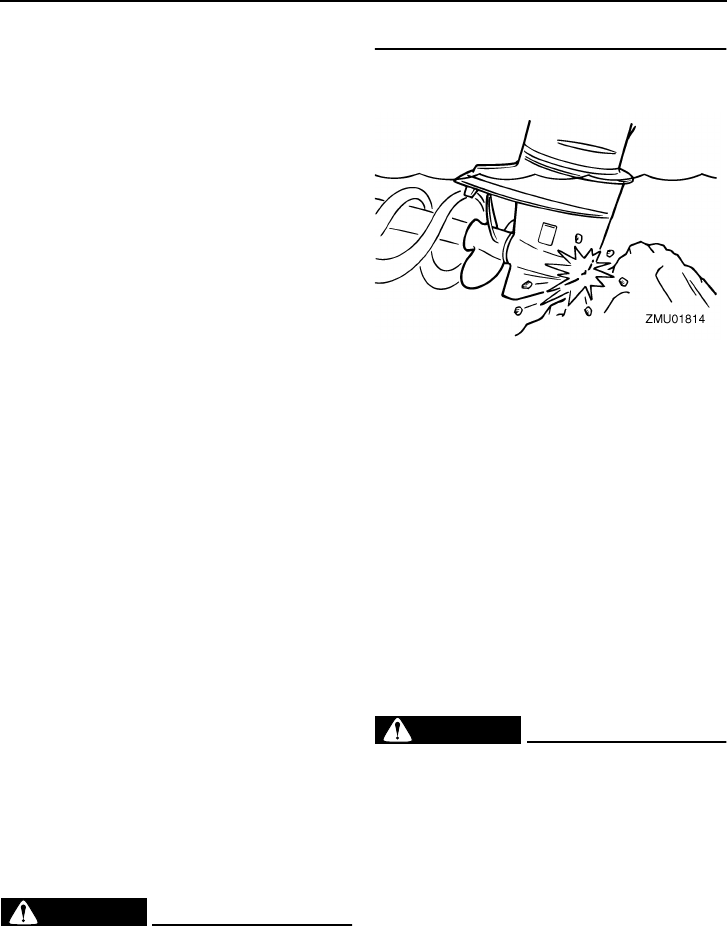
Trouble Recovery
51
Q. Is heat range of spark plug incorrect?
A. Inspect spark plug and replace it with rec-
ommended type.
Q. Is high pressure fuel pump drive belt bro-
ken?
A. Have serviced by a Yamaha dealer.
Q. Is engine not responding properly to shift
lever position?
A. Have serviced by a Yamaha dealer.
Engine vibrates excessively.
Q. Is propeller damaged?
A. Have propeller repaired or replaced.
Q. Is propeller shaft damaged?
A. Have serviced by a Yamaha dealer.
Q. Are weeds or other foreign matter tangled
on propeller?
A. Remove and clean propeller.
Q. Is motor mounting bolt loose?
A. Tighten bolt.
Q. Is steering pivot loose or damaged?
A. Tighten or have serviced by a Yamaha
dealer.
EMU29431
Temporary action in
emergency
EMU29440
Impact damage
WARNING
EWM00870
The outboard motor can be seriously
damaged by a collision while operating or
trailering. Damage could make the out-
board motor unsafe to operate.
If the outboard motor hits an object in the wa-
ter, follow the procedure below.
1. Stop the engine immediately.
2. Inspect the control system and all com-
ponents for damage. Also inspect the
boat for damage.
3. Whether damage is found or not, return
to the nearest harbor slowly and careful-
ly.
4. Have a Yamaha dealer inspect the out-
board motor before operating it again.
EMU29531
Starter will not operate
If the starter mechanism does not operate
(the engine cannot be cranked with the start-
er), the engine can be started with an emer-
gency starter rope.
WARNING
EWM01020
●
Use this procedure only in an emergen-
cy and only to return to port for repairs.
●
When the emergency starter rope is
used to start the engine, the start-in-
gear protection device does not oper-
ate. Make sure the remote control lever
is in neutral. Otherwise the boat could
unexpectedly start to move, which
could result in an accident.
●
Attach the engine stop switch lanyard
to a secure place on your clothing, or
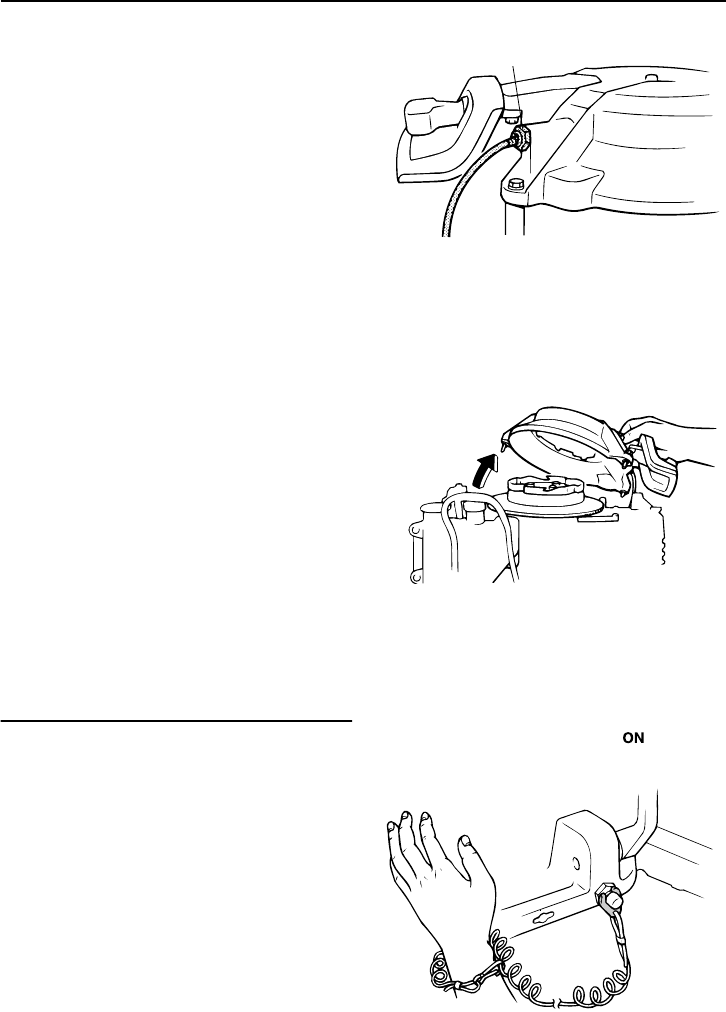
Trouble Recovery
52
your arm or leg while operating.
●
Do not attach the lanyard to clothing
that could tear loose. Do not route the
cord where it could become entangled,
preventing it from functioning.
●
Avoid accidentally pulling the lanyard
during normal operation. Loss of en-
gine power means the loss of most
steering control. Also, without engine
power, the boat could slow rapidly. This
could cause people and objects in the
boat to be thrown forward.
●
Be sure no one is standing behind you
when pulling the starter rope. It could
whip behind you and injure someone.
●
An unguarded, rotating flywheel is very
dangerous. Keep loose clothing and
other objects away when starting the
engine. Use the emergency starter rope
only as instructed. Do not touch the fly-
wheel or other moving parts when the
engine is running. Do not install the
starter mechanism or top cowling after
the engine is running.
●
Do not touch the ignition coil, spark
plug wire, spark plug cap, or other elec-
trical components when starting or op-
erating the motor. You could get an
electrical shock.
EMU29561
Emergency starting engine
1. Remove the top cowling.
2. Remove the start-in-gear protection ca-
ble from the starter, if equipped.
3. Remove the starter/flywheel cover after
removing the bolt(s).
4. Prepare the engine for starting. For fur-
ther information, see page 23. Be sure
the engine is in neutral and that the en-
gine stop switch lanyard lock plate is at-
tached to the engine stop switch. The
main switch must be “” (on), if
equipped.
1. Start-in-gear protection cable
ZMU03740
1
ZMU03741
ZMU03742
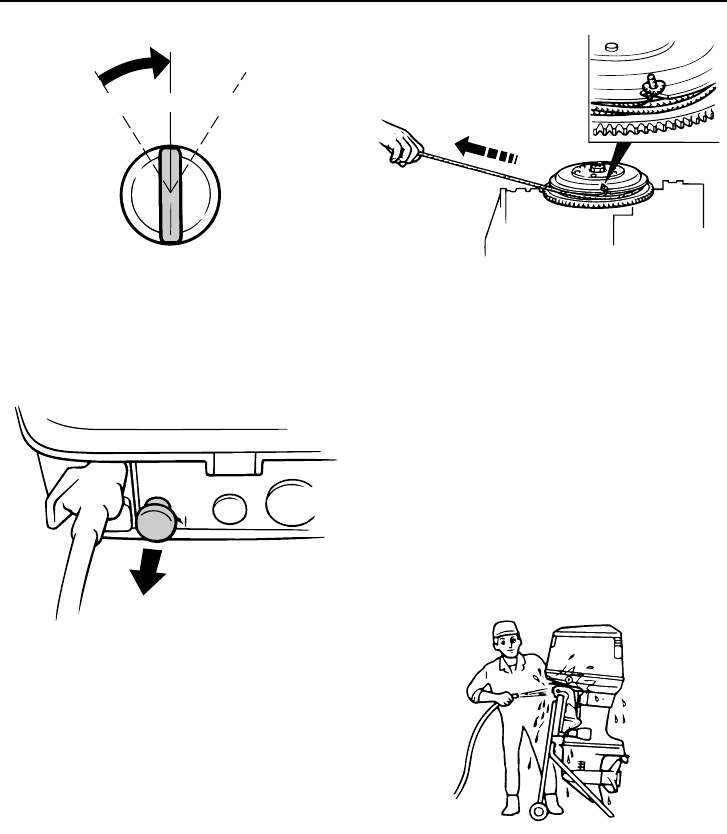
Trouble Recovery
53
5. If equipped the choke knob, pull out it
when the engine is cold. After the engine
starts, gradually return the choke knob
to its home position as the engine warms
up.
6. Insert the knotted end of the emergency
starter rope into the notch in the flywheel
rotor and wind the rope several turns
around the flywheel clockwise.
7. Give a strong pull straight out to crank
and start the engine. Repeat if neces-
sary.
EMU29760
Treatment of submerged motor
If the outboard motor is submerged, immedi-
ately take it to a Yamaha dealer. Otherwise
some corrosion may begin almost immedi-
ately.
If you cannot immediately take the outboard
motor to a Yamaha dealer, follow the proce-
dure below in order to minimize engine dam-
age.
EMU29771
Procedure
1. Thoroughly wash away mud, salt, sea-
weed, and so on, with fresh water.
2. Remove the spark plugs and face the
spark plug holes downward to allow any
water, mud, or contaminants to drain.
ON STARTOFF
ZMU01906
ZMU04119
ZMU02928
ZMU01909
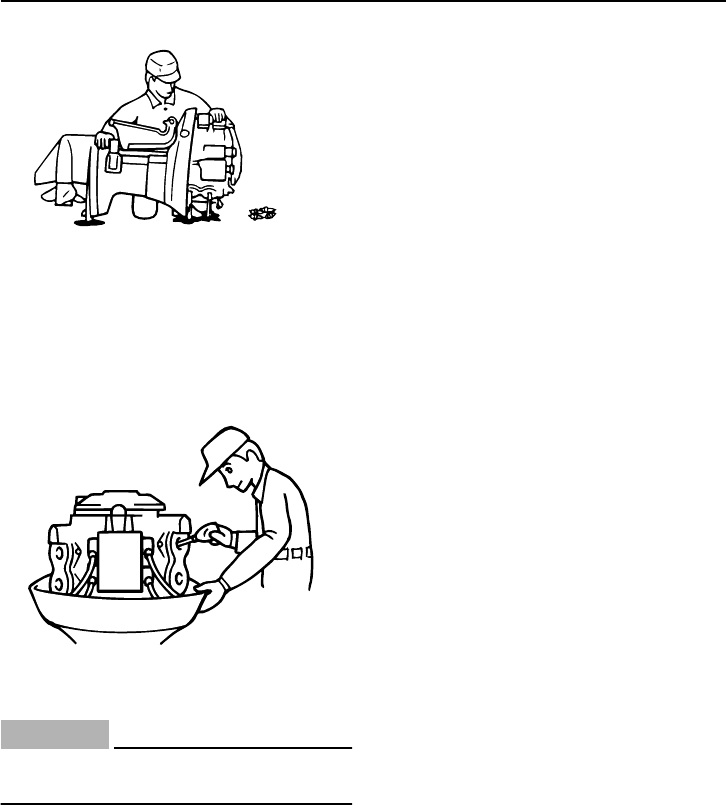
Trouble Recovery
54
3. Drain the fuel from the carburetor, fuel
filter, and fuel line.
4. Feed fogging oil or engine oil through
the carburetor(s) and spark plug holes
while cranking with the manual starter or
emergency starter rope.
5. Take the outboard motor to a Yamaha
dealer as soon as possible.
CAUTION:
ECM00400
Do not attempt to run the outboard motor
until it has been completely inspected.
ZMU01910
ZMU01911

55
Consumer information
EMU29811
Important warranty information for U.S.A. and Canada
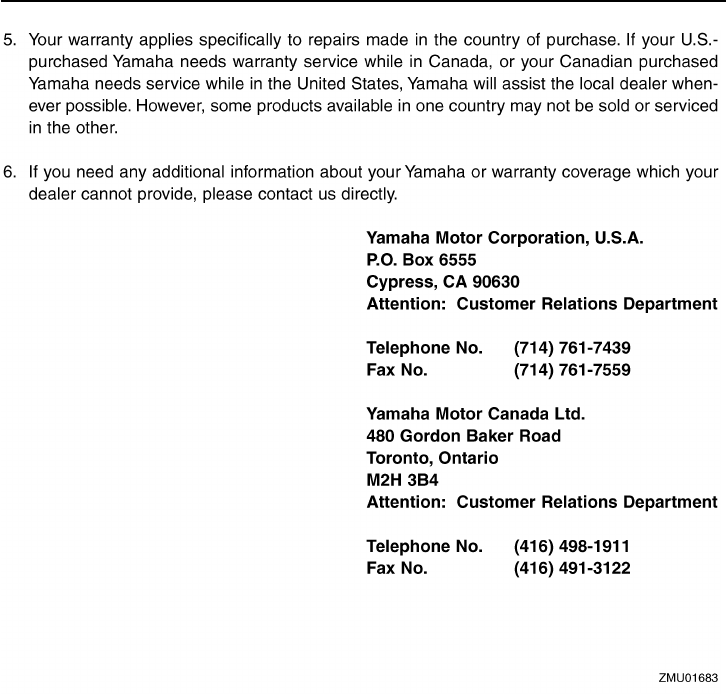
Consumer information
56
Consumer information
57
EMU29820
YAMAHA MOTOR CORPORATION, U.S.A.
OUTBOARD MOTOR TWO YEAR LIMITED WARRANTY
Consumer information
58
Consumer information
59
Consumer information
60
EMU29840
IMPORTANT WARRANTY INFORMATION IF YOU USE YOUR
YAMAHA OUTSIDE U.S.A. OR CANADA

Printed in Japan
March 2004–0.2 ×1 !Printed on recycled paper
25D
OWNER’S MANUAL
6L2-28199-1L
U.S.A.Edition
LIT-18626-05-83
6L2-9-1L Hyoshi 3/17/04 2:45 PM Page 1
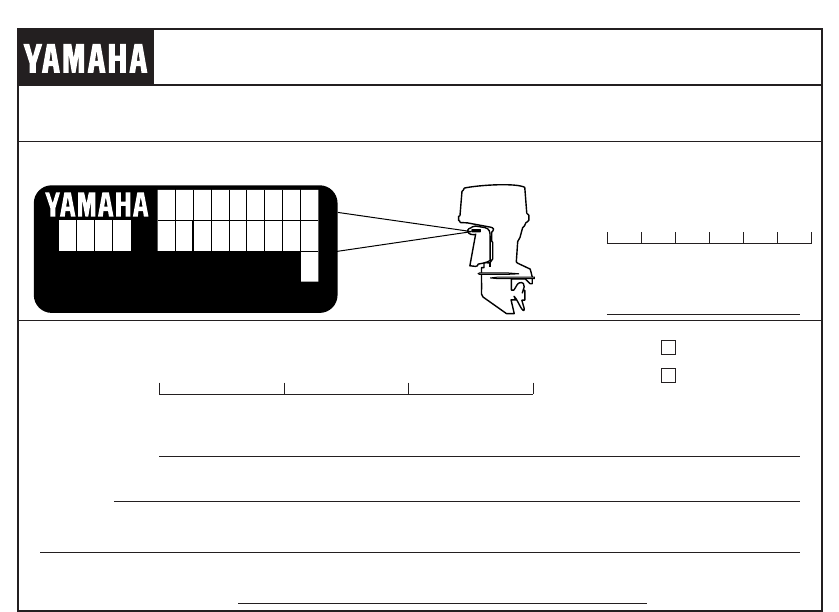
YAMAHA MOTOR CO., LTD.
MADE IN JAPAN
PAYS D'ORIGINE JAPON
OUTBOARD MOTOR WARRANTY REGISTRATION
ENREGISTREMENT DE LA GARANTIE DU MOTEUR HORS-BORD
Please complete and mail this card. This information is necessary to accurately register your unit for warranty.
Veuillez signer ci-dessous pour attester que le montage et l’inspection ont été faits dans le respect des directives d’inspection et
que la marche à suivre pour la garantie et l’entretien a été expliquée à l’acheteur au détail.
OUTBOARD MOTOR MODEL AND SERIAL NUMBER (From I.D. label on clamp bracket)
MODÉLE ET NO. DE SÉRIE DU MOTEUR HORS-BORD (sur l’étiquette d’identification de la presse de fixation)
(For Dealer Use Only)
(A l’usage du concessionnaire)
YAMAHA DEALER NUMBER
NO. DU CONCESSIONNAIRE
YAMAHA
DEALER NAME
NOM DU
CONCESSIONNAIRE
DATE SOLD
DATE DE
LIVRAISON
OWNER’S NAME
NOM DU
PROPRIÉTAIRE
ADDRESS
ADRESSE
PHONE NUMBER ( )
NUMÉRO DE TÉLÉPHONE
USAGE
(Check One)
UTILISATION
(En cocher un.)
PLEASURE
LOISIR
COMMERCIAL
COMMERCIAL
MONTH DAY YEAR
MOIS JOUR ANNÉE
FIRST LAST
PRÉNOM NOM DE FAMILLE
STREET
RUE
CITY STATE/PROVINCE ZIP
VILLE PROVINCE CODE POSTAL
Warranty card 2/27/02 11:47 AM Page 1

PLACE
POSTAGE
HERE
ATTN: WARRANTY DEPARTMENT
Warranty card 2/27/02 11:47 AM Page 2
