Yamaha Motorcycle Majesty Users Manual YP400W Owner's
Motorcycle-Majesty-Users-Manual yamaha-motorcycle-majesty-users-manual-133859
Yamaha Motorcycle YP400W LIT-11626-20-31_majesty_1329
Yamaha Majesty to the manual b0d6d374-35b4-4381-9110-61e98560fd88
2014-12-13
: Yamaha Motorcycle-Majesty-Users-Manual yamaha-motorcycle-majesty-users-manual-133859 pdf
Open the PDF directly: View PDF  .
.
Page Count: 102 [warning: Documents this large are best viewed by clicking the View PDF Link!]
- YP400W Owner's Manual
- Introduction
- Important Manual Information
- Table of Contents
- Chapter 1 Safety Information
- Chapter 2 Description
- Chapter 3 Instrument and Control Functions
- Chapter 4 Pre-Operation Checks
- Chapter 5 Operation and Important Riding Points
- Chapter 6 Periodic Maintenance and Minor Repair
- Chapter 7 Scooter Care and Storage
- Chapter 8 Specifications
- Chapter 9 Consumer Information
- Index

LIT-11626-20-31 5RU-28199-12
YP400W
OWNER’S MANUAL
EAU10041

INTRODUCTION
EAU10090
Congratulations on your purchase of the Yamaha YP400W. This model is the result of Yamaha’s vast experience in the pro-
duction of fine sporting, touring, and pacesetting racing machines. It represents the high degree of craftsmanship and reli-
ability that have made Yamaha a leader in these fields.
This manual will give you an understanding of the operation, inspection, and basic maintenance of this scooter. If you have
any questions concerning the operation or maintenance of your scooter, please consult a Yamaha dealer.
The design and manufacture of this Yamaha scooter fully comply with the emissions standards for clean air applicable at the
date of manufacture. Yamaha has met these standards without reducing the performance or economy of operation of the
scooter. To maintain these high standards, it is important that you and your Yamaha dealer pay close attention to the rec-
ommended maintenance schedules and operating instructions contained within this manual.
IMPORTANT MANUAL INFORMATION
EAU35821
Particularly important information is distinguished in this manual by the following notations:
NOTE:
●
This manual should be considered a permanent part of this scooter and should remain with it even if the scooter is sub-
sequently sold.
●
Yamaha continually seeks advancements in product design and quality. Therefore, while this manual contains the most
current product information available at the time of printing, there may be minor discrepancies between your scooter and
this manual. If you have any questions concerning this manual, please consult your Yamaha dealer.
WARNING
EWA12580
PLEASE READ THIS MANUAL AND THE “YOU AND YOUR MOTORCYCLE: RIDING TIPS” BOOKLET CAREFULLY
AND COMPLETELY BEFORE OPERATING THIS SCOOTER. DO NOT ATTEMPT TO OPERATE THIS SCOOTER UN-
TIL YOU HAVE ATTAINED ADEQUATE KNOWLEDGE OF ITS CONTROLS AND OPERATING FEATURES AND UNTIL
YOU HAVE BEEN TRAINED IN SAFE AND PROPER RIDING TECHNIQUES. REGULAR INSPECTIONS AND CARE-
FUL MAINTENANCE, ALONG WITH GOOD RIDING SKILLS, WILL ENSURE THAT YOU SAFELY ENJOY THE CAPA-
BILITIES AND THE RELIABILITY OF THIS SCOOTER.
*Product and specifications are subject to change without notice.
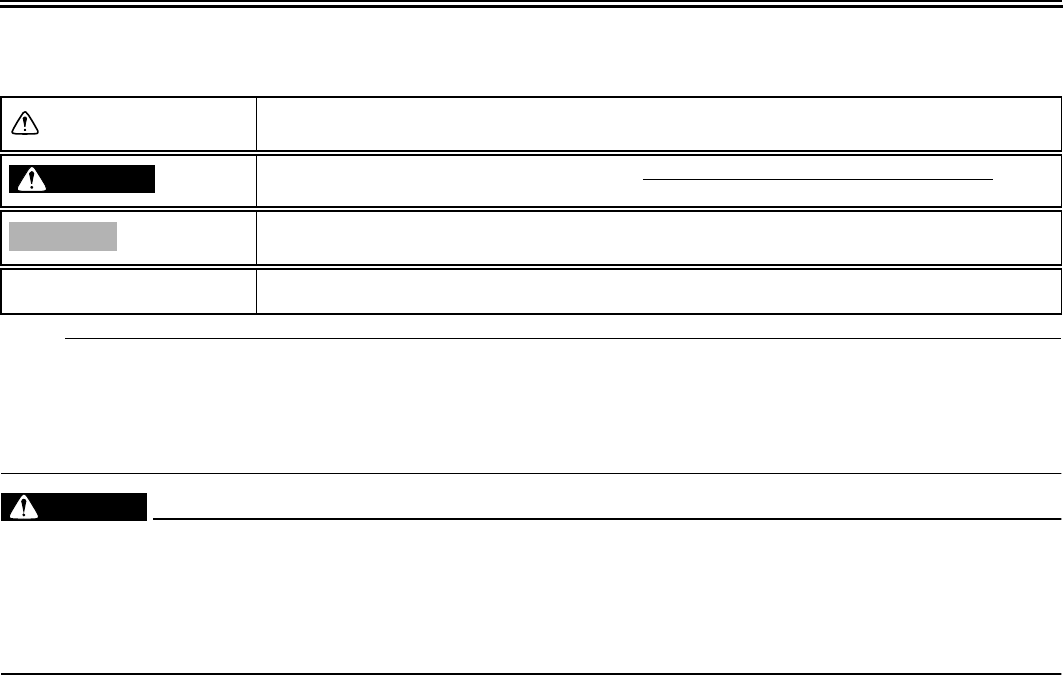
The Safety Alert Symbol means ATTENTION! BECOME ALERT! YOUR SAFETY IS
INVOLVED!
Failure to follow WARNING instructions could result in severe injury or death to the
scooter operator, a bystander, or a person inspecting or repairing the scooter.
A CAUTION indicates special precautions that must be taken to avoid damage to
the scooter.
A NOTE provides key information to make procedures easier or clearer.
WARNING
CAUTION:
NOTE:
IMPORTANT MANUAL INFORMATION
EAU10192
YP400W
OWNER’S MANUAL
©2006 by Yamaha Motor Corporation, U.S.A.
1st edition, April 2006
All rights reserved.
Any reprinting or unauthorized use
without the written permission of
Yamaha Motor Corporation, U.S.A.
is expressly prohibited.
Printed in Japan.
P/N LIT-11626-20-31
AFFIX DEALER
LABEL HERE

TABLE OF CONTENTS
SAFETY INFORMATION
...................1-1
Further safe-riding points .................1-4
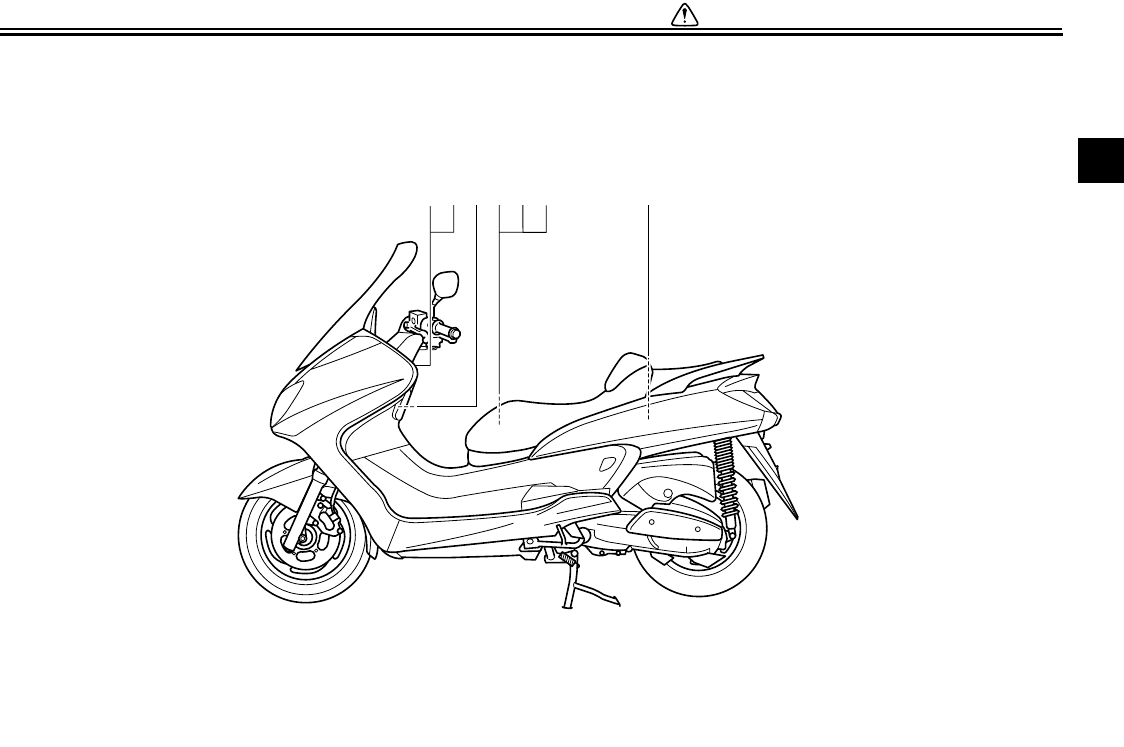
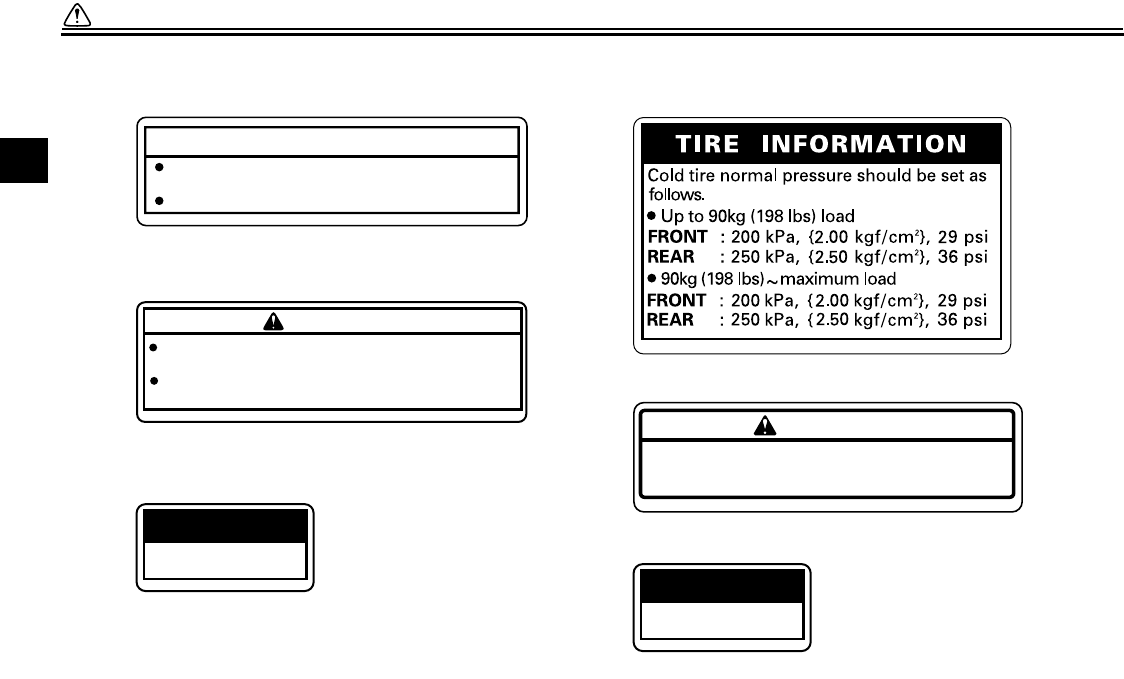
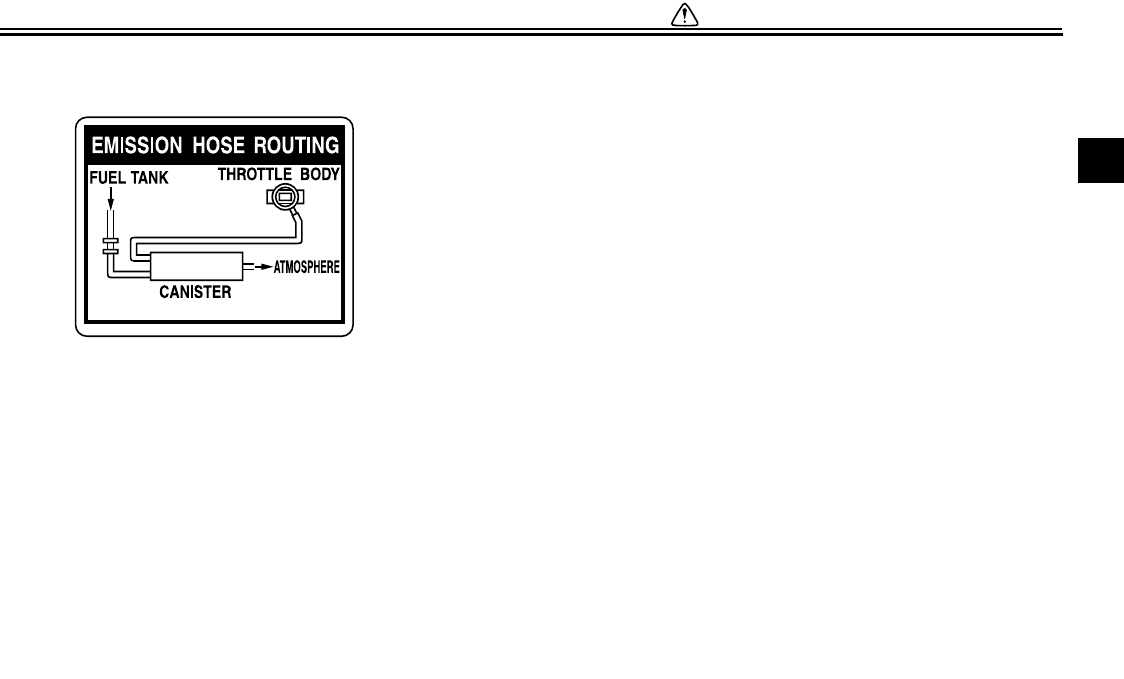
Location of important labels .............1-6
DESCRIPTION
...................................2-1
Left view ...........................................2-1
Right view .........................................2-2
Controls and instruments..................2-3
INSTRUMENT AND CONTROL
FUNCTIONS
........................................3-1
Main switch/steering lock .................3-1
Indicator and warning lights .............3-2
Speedometer ...................................3-2
Tachometer .....................................3-3
Multi-function display .......................3-3
Handlebar switches .........................3-6
Front brake lever .............................3-7
Rear brake lever ..............................3-8
Rear brake lock lever .......................3-8
Fuel tank cap ...................................3-9
Fuel ................................................3-10
Catalytic converter .........................3-11
Seats .............................................3-11
Adjusting the rider seat ..................3-12
Storage compartments ..................3-13
Sidestand .......................................3-15
Ignition circuit cut-off system .........3-15
PRE-OPERATION CHECKS
...............4-1
Pre-operation check list ...................4-2
OPERATION AND IMPORTANT
RIDING POINTS
.................................. 5-1
Starting the engine .......................... 5-1
Starting off ....................................... 5-2
Acceleration and deceleration ......... 5-2
Braking ............................................ 5-2
Engine break-in ............................... 5-3
Parking ............................................ 5-4
PERIODIC MAINTENANCE AND
MINOR REPAIR
.................................. 6-1
PERIODIC MAINTENANCE ............ 6-1
Owner’s tool kit ................................ 6-2
Periodic maintenance chart for the
emission control system .............. 6-3
General maintenance and lubrication
chart ............................................. 6-4
Removing and installing cowlings and
panels .......................................... 6-8
Checking the spark plug ................ 6-12
Canister ......................................... 6-14
Engine oil and oil filter element ..... 6-14
Final transmission oil ..................... 6-17
Coolant .......................................... 6-18
Air filter elements and check hoses
and V-belt case air filter
element ...................................... 6-20
Checking the throttle cable free
play ............................................ 6-23
Valve clearance ............................. 6-23
Tires .............................................. 6-23
Cast wheels .................................. 6-25
Accessories and replacement
parts ........................................... 6-26
Front and rear brake lever free
play ............................................ 6-26
Adjusting the rear brake lock lever
cable .......................................... 6-27
Checking the front and rear brake
pads ........................................... 6-28
Checking the brake fluid level ....... 6-28
Changing the brake fluid ............... 6-29
Checking and lubricating the
cables ........................................ 6-30
Checking and lubricating the throttle
grip and cable ............................ 6-30
Lubricating the front and rear brake
levers ......................................... 6-30
Checking and lubricating the
centerstand and sidestand ........ 6-31
Checking the front fork .................. 6-31
Checking the steering ................... 6-32
Checking the wheel bearings ........ 6-33
Battery ........................................... 6-33
Replacing the fuses ...................... 6-34
Replacing a headlight bulb ........... 6-36
Tail/brake light ............................... 6-36
Replacing a front turn signal light
bulb ............................................ 6-36
Replacing a rear turn signal light
bulb ............................................ 6-37

TABLE OF CONTENTS
Replacing the license plate light
bulb ............................................6-38
Troubleshooting .............................6-39
Troubleshooting charts ..................6-40
SCOOTER CARE AND
STORAGE
...........................................7-1
Care .................................................7-1
Storage ............................................7-3
SPECIFICATIONS
..............................8-1
CONSUMER INFORMATION
..............9-1
Identification numbers .....................9-1
Reporting safety defects ..................9-3
Scooter noise regulation ..................9-4
Maintenance record .........................9-5
YAMAHA MOTOR CORPORATION,
U.S.A. STREET AND ENDURO
MOTORCYCLE LIMITED
WARRANTY .................................9-7
YAMAHA EXTENDED SERVICE
(Y.E.S.) ........................................9-9

1-1
1
SAFETY INFORMATION
EAU10261
SCOOTERS ARE SINGLE TRACK
VEHICLES. THEIR SAFE USE AND
OPERATION ARE DEPENDENT
UPON THE USE OF PROPER
RIDING TECHNIQUES AS WELL AS
THE EXPERTISE OF THE OPERA-
TOR. EVERY OPERATOR SHOULD
KNOW THE FOLLOWING REQUIRE-
MENTS BEFORE RIDING THIS
SCOOTER.
HE OR SHE SHOULD:
●
OBTAIN THOROUGH INSTRUC-
TIONS FROM A COMPETENT
SOURCE ON ALL ASPECTS OF
SCOOTER OPERATION.
●
OBSERVE THE WARNINGS
AND MAINTENANCE REQUIRE-
MENTS IN THE OWNER’S MAN-
UAL.
●
OBTAIN QUALIFIED TRAINING
IN SAFE AND PROPER RIDING
TECHNIQUES.
●
OBTAIN PROFESSIONAL TECH-
NICAL SERVICE AS INDICATED
BY THE OWNER’S MANUAL
AND/OR WHEN MADE NECES-
SARY BY MECHANICAL CONDI-
TIONS.
Safe riding
●
Always make pre-operation
checks. Careful checks may help
prevent an accident.
●
This scooter is designed to carry
the operator and passenger.
●
The failure of motorists to detect
and recognize scooters in traffic is
the predominating cause of auto-
mobile/scooter accidents. Many
accidents have been caused by an
automobile driver who did not see
the scooter. Making yourself con-
spicuous appears to be very effec-
tive in reducing the chance of this
type of accident.
●
Therefore:
●
Wear a brightly colored jacket.
●
Use extra caution when ap-
proaching and passing through
intersections, since intersec-
tions are the most likely places
for scooter accidents to occur.
●
Ride where other motorists can
see you. Avoid riding in another
motorist’s blind spot.
●
Many accidents involve inexperi-
enced operators. In fact, many op-
erators who have been involved in
accidents do not even have a cur-
rent driver’s license.
●
Make sure that you are qualified
and that you only lend your
scooter to other qualified opera-
tors.
●
Know your skills and limits.
Staying within your limits may
help you to avoid an accident.
●
We recommend that you prac-
tice riding your scooter where
there is no traffic until you have
become thoroughly familiar with
the scooter and all of its con-
trols.
●
Many accidents have been caused
by error of the scooter operator. A
typical error made by the operator
is veering wide on a turn due to
EXCESSIVE SPEED or undercor-
nering (insufficient lean angle for
the speed).
●
Always obey the speed limit and
never travel faster than warrant-
ed by road and traffic conditions.

SAFETY INFORMATION
1-2
1
●
Always signal before turning or
changing lanes. Make sure that
other motorists can see you.
●
The posture of the operator and
passenger is important for proper
control.
●
The operator should keep both
hands on the handlebar and
both feet on the footboard during
operation to maintain control of
the scooter.
●
The passenger should always
hold onto the operator, the seat
strap or grab bar, if equipped,
with both hands and keep both
feet on the passenger footrests.
●
Never carry a passenger unless
he or she can firmly place both
feet on the passenger footrests.
●
Never ride under the influence of
alcohol or other drugs.
●
This scooter is designed for
on-road use only. It is not suitable
for off-road use.
Protective apparel
The majority of fatalities from scooter
accidents are the result of head inju-
ries. The use of a safety helmet is the
single most critical factor in the preven-
tion or reduction of head injuries.
●
Always wear an approved helmet.
●
Wear a face shield or goggles.
Wind in your unprotected eyes
could contribute to an impairment
of vision which could delay seeing
a hazard.
●
The use of a jacket, substantial
shoes, trousers, gloves, etc., is ef-
fective in preventing or reducing
abrasions or lacerations.
●
Never wear loose-fitting clothes,
otherwise they could catch on the
control levers or wheels and cause
injury or an accident.
●
Never touch the engine or exhaust
system during or after operation.
They become very hot and can
cause burns. Always wear protec-
tive clothing that covers your legs,
ankles, and feet.
●
Passengers should also observe
the above precautions.
Modifications
Modifications made to this scooter not
approved by Yamaha, or the removal of
original equipment, may render the
scooter unsafe for use and may cause
severe personal injury. Modifications
may also make your scooter illegal to
use.
Loading and accessories
Adding accessories or cargo to your
scooter can adversely affect stability
and handling if the weight distribution of
the scooter is changed. To avoid the
possibility of an accident, use extreme
caution when adding cargo or accesso-
ries to your scooter. Use extra care
when riding a scooter that has added
cargo or accessories. Here are some
general guidelines to follow if loading
cargo or adding accessories to your
scooter:
Loading
The total weight of the operator, pas-
senger, accessories and cargo must
not exceed the maximum load limit.
Maximum load:
196 kg (432 lb)
SAFETY INFORMATION
1-3
1
When loading within this weight limit,
keep the following in mind:
●
Cargo and accessory weight
should be kept as low and close to
the scooter as possible. Make sure
to distribute the weight as evenly
as possible on both sides of the
scooter to minimize imbalance or
instability.
●
Shifting weights can create a sud-
den imbalance. Make sure that ac-
cessories and cargo are securely
attached to the scooter before
riding. Check accessory mounts
and cargo restraints frequently.
●
Never attach any large or heavy
items to the handlebar, front fork,
or front fender. Such items can
create unstable handling or a slow
steering response.
Accessories
Genuine Yamaha accessories have
been specifically designed for use on
this scooter. Since Yamaha cannot test
all other accessories that may be avail-
able, you must personally be responsi-
ble for the proper selection, installation
and use of non-Yamaha accessories.
Use extreme caution when selecting
and installing any accessories.
Keep the following guidelines in mind,
as well as those provided under “Load-
ing” when mounting accessories.
●
Never install accessories or carry
cargo that would impair the perfor-
mance of your scooter. Carefully
inspect the accessory before using
it to make sure that it does not in
any way reduce ground clearance
or cornering clearance, limit sus-
pension travel, steering travel or
control operation, or obscure lights
or reflectors.
●
Accessories fitted to the handle-
bar or the front fork area can
create instability due to improper
weight distribution or aerody-
namic changes. If accessories
are added to the handlebar or
front fork area, they must be as
lightweight as possible and
should be kept to a minimum.
●
Bulky or large accessories may
seriously affect the stability of
the scooter due to aerodynamic
effects. Wind may attempt to lift
the scooter, or the scooter may
become unstable in cross
winds. These accessories may
also cause instability when
passing or being passed by
large vehicles.
●
Certain accessories can dis-
place the operator from his or
her normal riding position. This
improper position limits the free-
dom of movement of the opera-
tor and may limit control ability,
therefore, such accessories are
not recommended.
●
Use caution when adding electri-
cal accessories. If electrical acces-
sories exceed the capacity of the
scooter’s electrical system an
electric failure could result, which
could cause a dangerous loss of
lights or engine power.
Gasoline and exhaust gas
●
GASOLINE IS HIGHLY FLAMMA-
BLE:
●
Always turn the engine off when
refueling.

SAFETY INFORMATION
1-4
1
●
Take care not to spill any gaso-
line on the engine or exhaust
system when refueling.
●
Never refuel while smoking or in
the vicinity of an open flame.
●
Never start the engine or let it run
for any length of time in a closed
area. The exhaust fumes are poi-
sonous and may cause loss of
consciousness and death within a
short time. Always operate your
scooter in an area that has ade-
quate ventilation.
●
Always turn the engine off before
leaving the scooter unattended
and remove the key from the main
switch. When parking the scooter,
note the following:
●
The engine and exhaust system
may be hot, therefore, park the
scooter in a place where pedes-
trians or children are not likely to
touch these hot areas.
●
Do not park the scooter on a
slope or soft ground, otherwise it
may fall over.
●
Do not park the scooter near a
flammable source (e.g., a kero-
sene heater, or near an open
flame), otherwise it could catch
fire.
●
If you should swallow any gaso-
line, inhale a lot of gasoline vapor,
or allow gasoline to get into your
eyes, see your doctor immediate-
ly. If any gasoline spills on your
skin or clothing, immediately wash
the affected area with soap and
water and change your clothes.
EAU10371
Further safe-riding points
●
Be sure to signal clearly when
making turns.
●
Braking can be extremely difficult
on a wet road. Avoid hard braking,
because the scooter could slide.
Apply the brakes slowly when
stopping on a wet surface.
●
Slow down as you approach a cor-
ner or turn. Once you have com-
pleted a turn, accelerate slowly.
●
Be careful when passing parked
cars. A driver might not see you
and open a door in your path.
●
Railroad crossings, streetcar rails,
iron plates on road construction
sites, and manhole covers be-
come extremely slippery when
wet. Slow down and cross them
with caution. Keep the scooter up-
right, otherwise it could slide out
from under you.
●
The brake pads could get wet
when you wash the scooter. After
washing the scooter, check the
brakes before riding.
●
Always wear a helmet, gloves,
trousers (tapered around the cuff

SAFETY INFORMATION
1-5
1
and ankle so they do not flap), and
a bright colored jacket.
●
Do not carry too much luggage on
the scooter. An overloaded scoot-
er is unstable.
SAFETY INFORMATION
1-6
1
EAU10381
Location of important labels
Please read the following important labels carefully before operating this vehicle.
2
13567
4
SAFETY INFORMATION
1-7
1
CAUTION
Cleaning
with
alkaline
or
acid
cleaner,
gasoline
or
solvent
will
damage
windshield.
Use
neutral
detergent.
3JJ
—
2835Y
—
A0
1
WARNING
BEFORE YOU OPERATE THIS VEHICLE, READ
THE OWNER’S MANUAL AND ALL LABELS.
ALWAYS WEAR AN APPROVED MOTORCYCLE
HELMET, eye protection, and protective clothing.
5GK-2118K-00
5RU-24877-A0
LOAD LIMIT
2 kg {4 lbs}
5RU-21668-00
WARNING
Improper loading can cause loss of control.
Read owner’s manual for proper loading.
3JJ
—
28446
—
A1
3LD-24877-A0
LOAD LIMIT
5 kg {11 lbs}
2
3
4
5
6
SAFETY INFORMATION
1-8
1
7
5RU-21686-00
2-1
1
2
3
4
5
6
7
8
9
DESCRIPTION
EAU10410
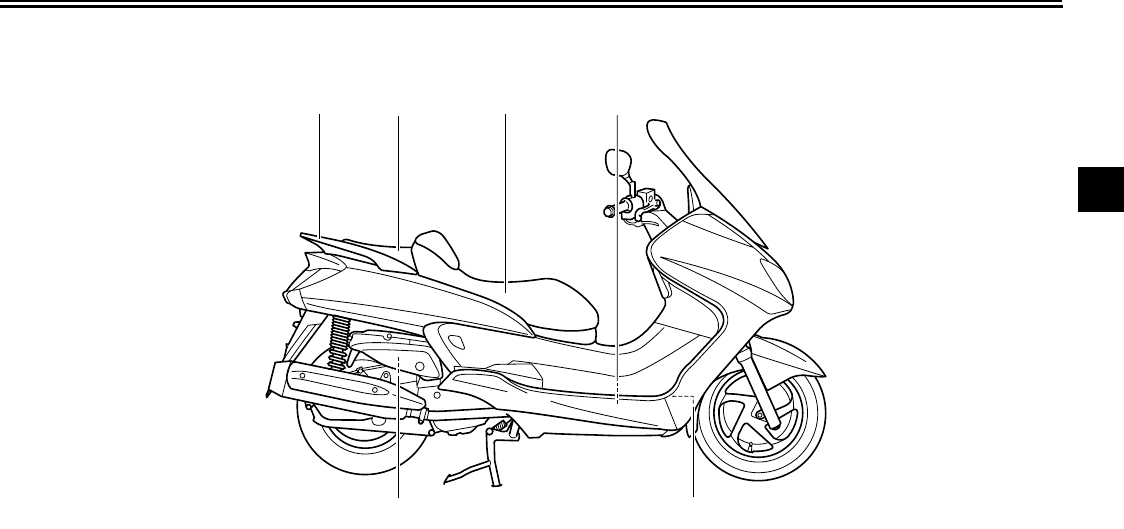
Left view
9
12 3 567
8
4
1011
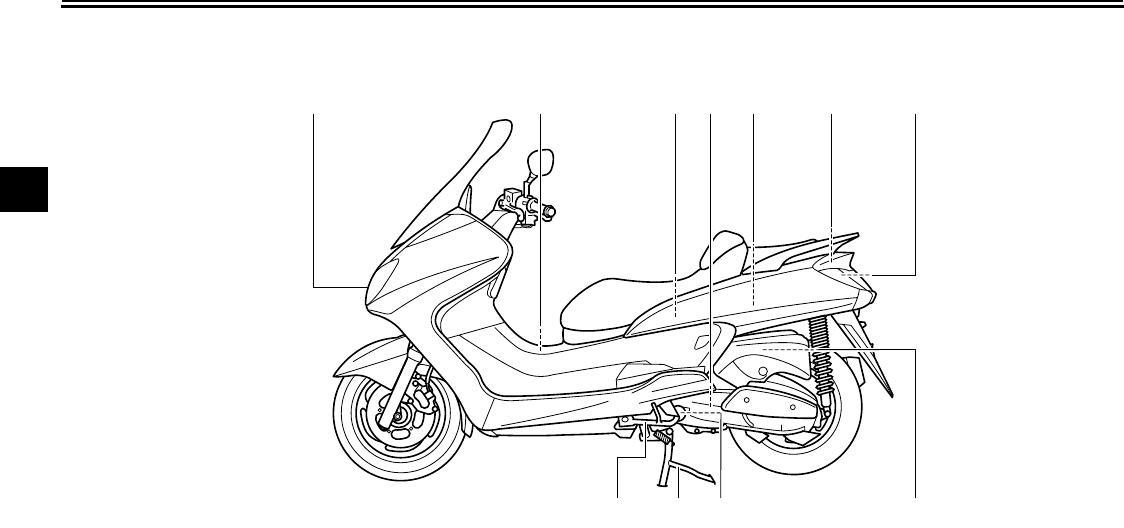
1. Headlight (page 6-36)
2. Fuel tank cap (page 3-9)
3. Rear storage compartment (page 3-13)
4. V-belt case air filter element (page 6-20)
5. Owner’s tool kit (page 6-2)
6. Fuses (page 6-34)
7. Battery (page 6-33)
8. Air filter element (left) (page 6-20)
9. Engine oil filter element (page 6-14)
10. Centerstand (page 6-31)
11. Sidestand (page 3-15, 6-31)
DESCRIPTION
2-2
2
3
4
5
6
7
8
9
EAU10420
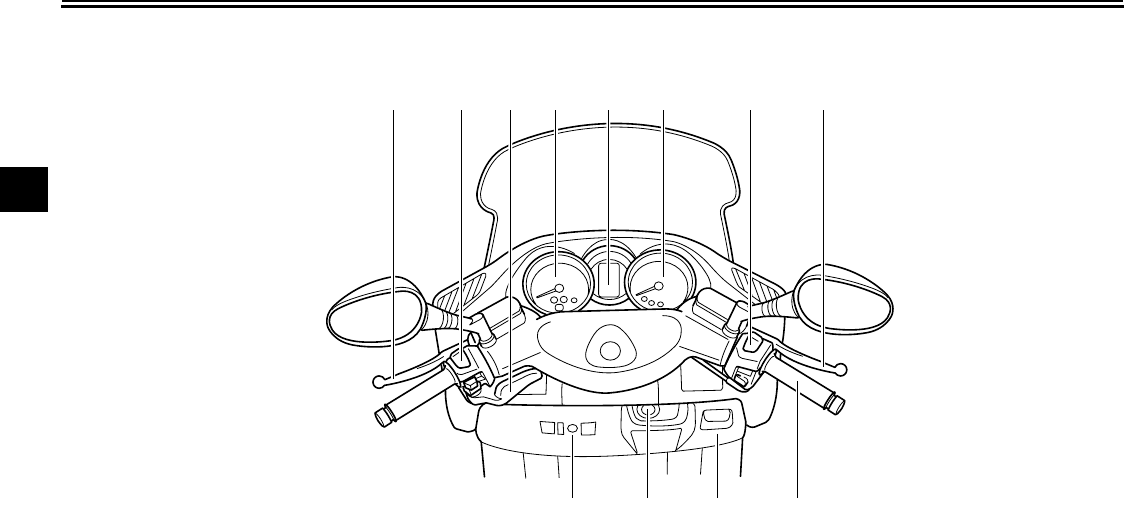
Right view
5
1234
6
1. Grab bar (page 5-2)
2. Passenger seat (page 3-11)
3. Rider seat (page 3-11)
4. Coolant reservoir (page 6-18)
5. Radiator
6. Air filter element (right) (page 6-20)
DESCRIPTION
2-3
1
2
3
4
5
6
7
8
9
EAU10430
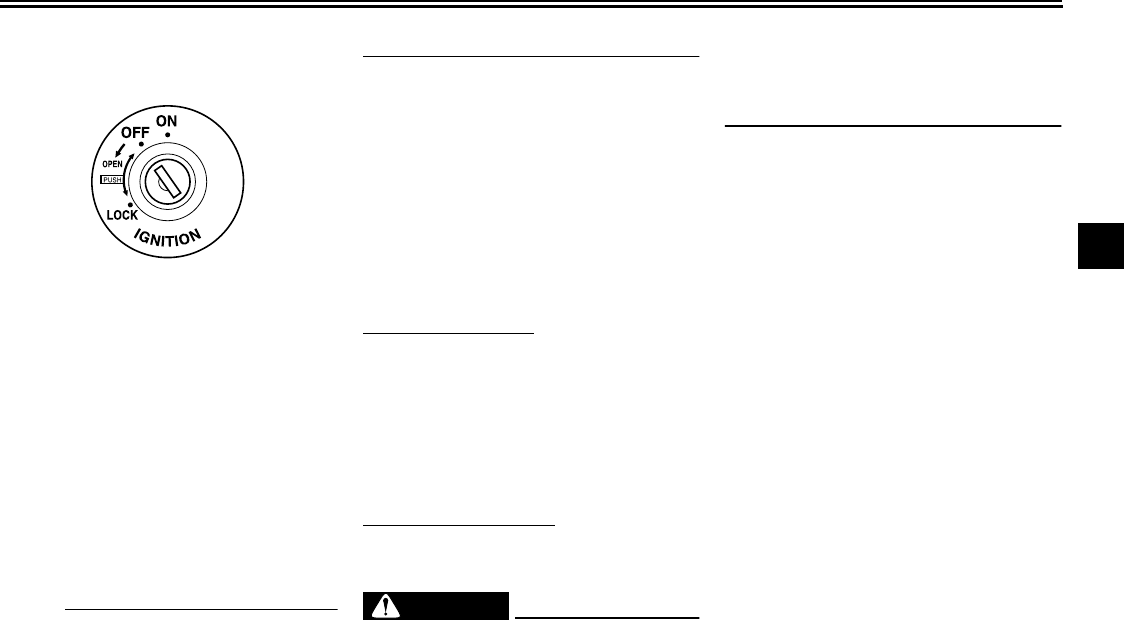
Controls and instruments
1345678
9101112
2
1. Rear brake lever (page 3-8)
2. Left handlebar switches (page 3-6)
3. Rear brake lock lever (page 3-8)
4. Speedometer (page 3-2)
5. Multi-function display (page 3-3)
6. Tachometer (page 3-3)
7. Right handlebar switches (page 3-6)
8. Front brake lever (page 3-7)
9. Throttle grip (page 6-23)
10. Front storage compartment B (page 3-13)
11. Main switch/steering lock (page 3-1)
12. Front storage compartment A (page 3-13)
3-1
2
3
4
5
6
7
8
9
INSTRUMENT AND CONTROL FUNCTIONS
EAU10460
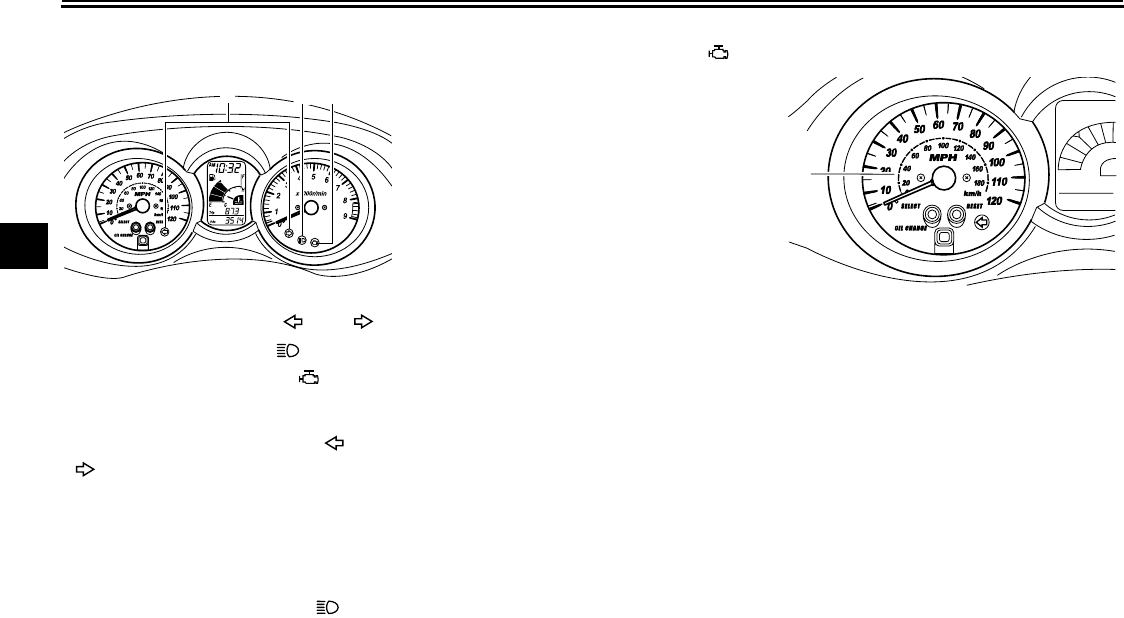
Main switch/steering lock
The main switch/steering lock controls
the ignition and lighting systems, and is
used to lock the steering. The various
positions are described below.
EAU36070
ON
All electrical circuits are supplied with
power; the meter lighting, taillight, li-
cense plate light and position lights
come on, and the engine can be start-
ed. The key cannot be removed.
NOTE:
The headlights come on automatically
when the engine is started and stay on
until the key is turned to “OFF” or the
sidestand is moved down.
EAU10660
OFF
All electrical systems are off. The key
can be removed.
EAU10680
LOCK
The steering is locked, and all electrical
systems are off. The key can be re-
moved.
To lock the steering
1. Turn the handlebars all the way to
the left.
2. Push the key in from the “OFF” po-
sition, and then turn it to “LOCK”
while still pushing it.
3. Remove the key.
To unlock the steering
Push the key in, and then turn it to
“OFF” while still pushing it.
WARNING
EWA10060
Never turn the key to “OFF” or
“LOCK” while the vehicle is moving,
otherwise the electrical systems will
be switched off, which may result in
loss of control or an accident. Make
sure that the vehicle is stopped be-
fore turning the key to “OFF” or
“LOCK”.
INSTRUMENT AND CONTROL FUNCTIONS
3-2
1
2
3
4
5
6
7
8
9
EAU11003
Indicator and warning lights
EAU11030
Turn signal indicator lights “” and
“”
The corresponding indicator light flash-
es when the turn signal switch is
pushed to the left or right.
EAU11080
High beam indicator light “”
This indicator light comes on when the
high beam of the headlight is switched
on.
EAU11480
Engine trouble warning light “”
This warning light comes on when an
electrical circuit monitoring the engine
is defective. When this occurs, have a
Yamaha dealer check the self-diagno-
sis system.
The electrical circuit of the warning light
can be checked by turning the key to
“ON”. If the warning light does not come
on for a few seconds, then go off, have
a Yamaha dealer check the electrical
circuit.
EAU11601
Speedometer
The speedometer shows the riding
speed.
When the key is turned to “ON”, the
speedometer needle will sweep once
across the speed range and then return
to zero in order to test the electrical cir-
cuit.
1. Turn signal indicator lights “” and “”
2. High beam indicator light “”
3. Engine trouble warning light “”
123
1. Speedometer
1
INSTRUMENT AND CONTROL FUNCTIONS
3-3
2
3
4
5
6
7
8
9
EAU11872
Tachometer
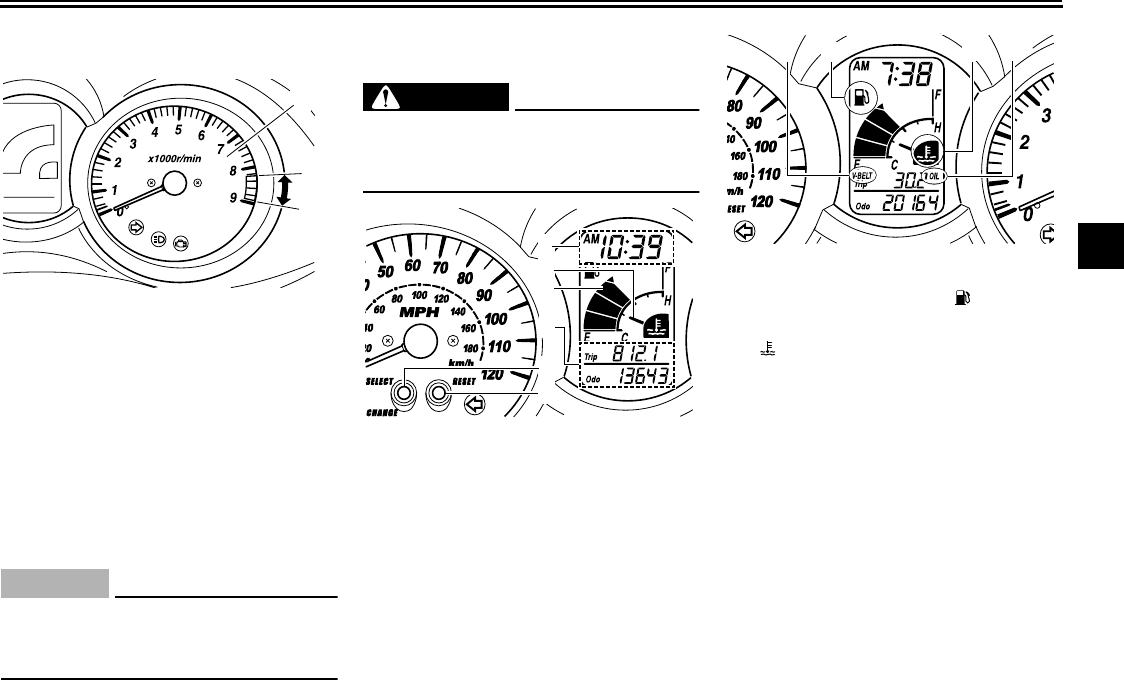
The electric tachometer allows the rider
to monitor the engine speed and keep it
within the ideal power range.
When the key is turned to “ON”, the ta-
chometer needle will sweep once
across the r/min range and then return
to zero r/min in order to test the electri-
cal circuit.
CAUTION:
ECA10031
Do not operate the engine in the ta-
chometer red zone.
Red zone: 8250 r/min and above
EAU36104
Multi-function display
WARNING
EWA12311
Be sure to stop the vehicle before
making any setting changes to the
multi-function display.
The multi-function display is equipped
with the following:
●
a fuel meter
●
a coolant temperature meter
●
an odometer (which shows the to-
tal distance traveled)
●
two tripmeters (which show the
distance traveled since they were
last set to zero)
●
a fuel reserve tripmeter (which
shows the distance traveled since
the bottom segment of the fuel
meter and fuel level warning indi-
1. Tachometer
2. Tachometer red zone
1
2
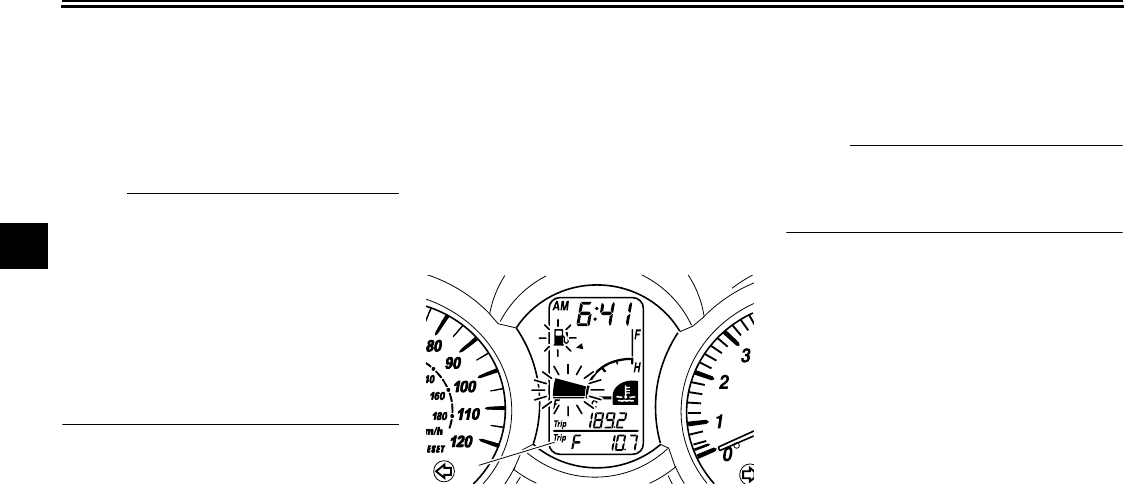
1. Clock/ambient temperature display
2. Coolant temperature meter
3. Fuel meter
4. Odometer/tripmeters
5. “SELECT” button
6. “RESET” button
1
2
3
4
5
6
1. V-belt replacement indicator “V-BELT”
2. Fuel level warning indicator “”
3. Coolant temperature warning indicator
“”
4. Oil change indicator “OIL”
12 34
INSTRUMENT AND CONTROL FUNCTIONS
3-4
1
2
3
4
5
6
7
8
9
cator started flashing)
●
a self-diagnosis device
●
a clock
●
an ambient temperature display
●
an oil change indicator
●
a V-belt replacement indicator
NOTE:
●
Be sure to turn the key to “ON” be-
fore using the “SELECT” and “RE-
SET” buttons.
●
When the key is turned to “ON”, all
of the display segments of the
multi-function display will appear
one after the other and then disap-
pear, in order to test the electrical
circuit.
Odometer and tripmeter modes
Pushing the “SELECT” button switches
the display between the odometer
mode “ODO” and the tripmeter modes
“TRIP” in the following order:
ODO
→
TRIP (top)
→
TRIP (bottom)
→
ODO
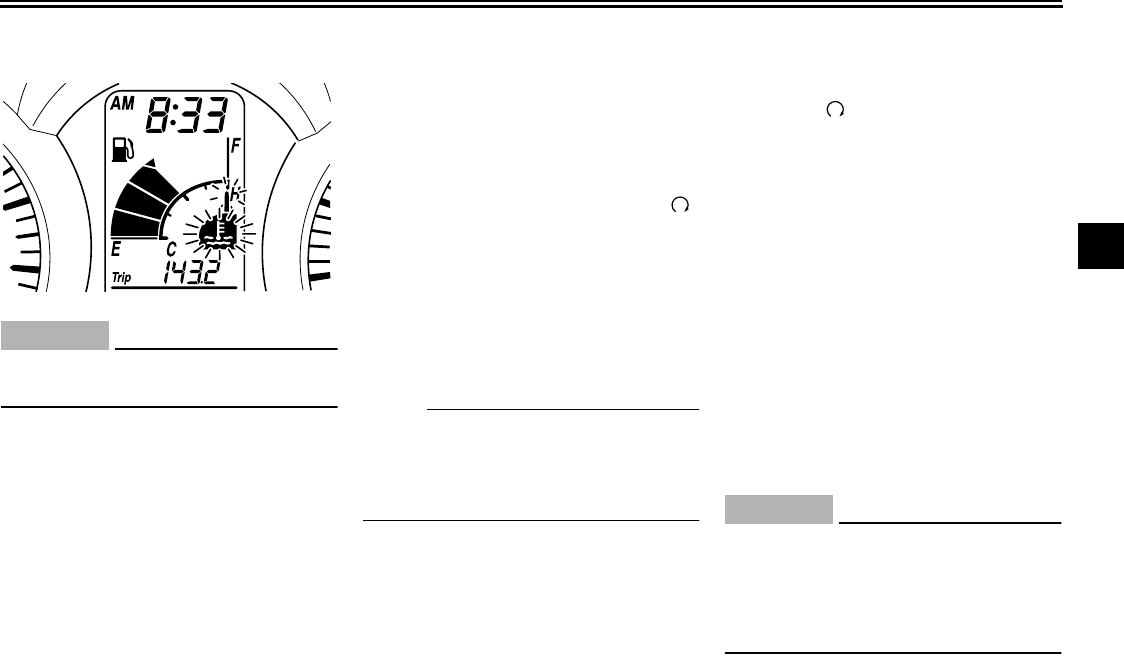
When approximately 2.8 L (0.74 US
gal) (0.62 Imp.gal) of fuel remains in the
fuel tank, the bottom segment of the
fuel meter and fuel level warning indica-
tor will start flashing, and the display will
automatically change to the fuel re-
serve tripmeter mode “TRIP F” and
start counting the distance traveled
from that point. In that case, pushing
the “SELECT” button switches the dis-
play between the various tripmeter and
odometer modes in the following order:
TRIP F
→
TRIP (top)
→
TRIP (bottom)
→
ODO
→
TRIP F
To reset a tripmeter, select it by push-
ing the “SELECT” button until “TRIP” or
“TRIP F” begins flashing (“TRIP” or
“TRIP F” will only flash for five sec-
onds). While “TRIP” or “TRIP F” is
flashing, push the “RESET” button for
at least one second. If you do not reset
the fuel reserve tripmeter manually, it
will reset itself automatically and the
display will return to the prior mode af-
ter refueling and traveling 5 km (3 mi).
NOTE:
The display cannot be changed back to
“TRIP F” after pushing the “RESET”
button.
Fuel meter
With the key in the “ON” position, the
fuel meter indicates the amount of fuel
in the fuel tank. The display segments
of the fuel meter disappear towards “E”
(Empty) as the fuel level decreases.
When the fuel level reaches the bottom
segment near “E”, the fuel level warn-
ing indicator and the bottom segment
will flash. Refuel as soon as possible.
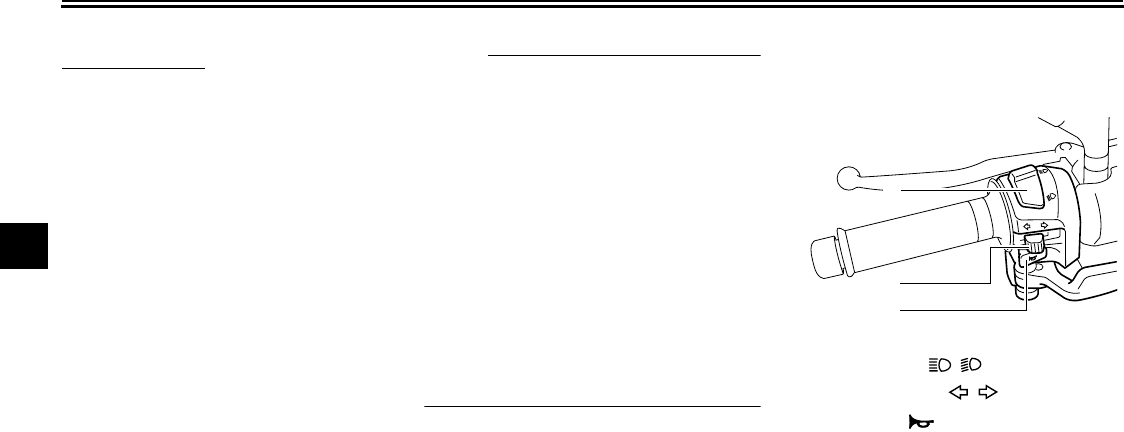
Coolant temperature meter
With the key in the “ON” position, the
coolant temperature meter indicates
the temperature of the coolant. The
coolant temperature varies with chang-
es in the weather and engine load. If
the top segment and coolant tempera-
ture warning indicator flash, stop the
1. Fuel reserve tripmeter
1
INSTRUMENT AND CONTROL FUNCTIONS
3-5
2
3
4
5
6
7
8
9
vehicle and let the engine cool. (See
page 6-40.)
CAUTION:
ECA10020
Do not operate the engine if it is
overheated.
Oil change indicator “OIL”
This indicator flashes at the initial
1000 km (600 mi), then at 5000 km
(3000 mi) and every 5000 km (3000
mi) thereafter to indicate that the en-
gine oil should be changed.
After changing the engine oil, reset the
oil change indicator. (See page 6-14.)
If the engine oil is changed before the
oil change indicator comes on (i.e. be-
fore the periodic oil change interval has
been reached), the indicator must be
reset after the oil change for the next
periodic oil change to be indicated at
the correct time. (See page 6-14.)
The electrical circuit of the indicator can
be checked according to the following
procedure.
1. Set the engine stop switch to “”
and turn the key to “ON”.
2. Check that the indicator comes on
for a few seconds and then goes
off.
3. If the indicator does not come on,
have a Yamaha dealer check the
electrical circuit.
NOTE:
The oil change indicator may flash
when the engine is revved with the
scooter on the centerstand, but this
does not indicate a malfunction.
V-belt replacement indicator
“V-BELT”
This indicator flashes every 20000 km
(12500 mi) when the V-belt needs to be
replaced.
The electrical circuit of the indicator can
be checked according to the following
procedure.
1. Turn the key to “ON” and make
sure that the engine stop switch is
set to “”.
2. If the indicator does not come on,
have a Yamaha dealer check the
electrical circuit.
Self-diagnosis device
This model is equipped with a self-diag-
nosis device for various electrical cir-
cuits.
If any of those circuits are defective, the
multi-function display will indicate a
two-digit error code (e.g., 12, 13, 14).
If the multi-function display indicates
such an error code, note the code num-
ber, and then have a Yamaha dealer
check the vehicle.
CAUTION:
ECA11790
If the multi-function display indi-
cates an error code, the vehicle
should be checked as soon as pos-
sible in order to avoid engine dam-
age.
INSTRUMENT AND CONTROL FUNCTIONS
3-6
1
2
3
4
5
6
7
8
9
Clock mode
To set the clock:
1. Push the “SELECT” button and
“RESET” button together for at
least two seconds.
2. When the hour digits start flashing,
push the “RESET” button to set the
hours.
3. Push the “SELECT” button, and
the minute digits will start flashing.
4. Push the “RESET” button to set
the minutes.
5. Push the “SELECT” button and
then release it to start the clock.
Pushing the “SELECT” button for
at least two seconds switches the
clock display to the ambient tem-
perature display.
Ambient temperature display
This display shows the ambient tem-
perature from –10 °C (14 °F) to 50 °C
(122 °F) in 1 °C or 1 °F increments. The
temperature displayed may vary from
the ambient temperature. Pushing the
“SELECT” button for at least two sec-
onds switches the ambient temperature
display to the clock display.
NOTE:
●
If the ambient temperature falls be-
low –10 °C (14 °F), a lower tem-
perature than –10 °C (14 °F) will
not be displayed.
●
If the ambient temperature climbs
above 50 °C (122 °F), a higher
temperature than 50 °C (122 °F)
will not be displayed.
●
The accuracy of the temperature
reading may be affected when
riding slowly (approximately under
20 km/h (12.5 mi/h)) or when
stopped at traffic signals, railroad
crossings, etc.
EAU12346
Handlebar switches
Left
1. Dimmer switch “/”
2. Turn signal switch “/”
3. Horn switch “”
1
2
3
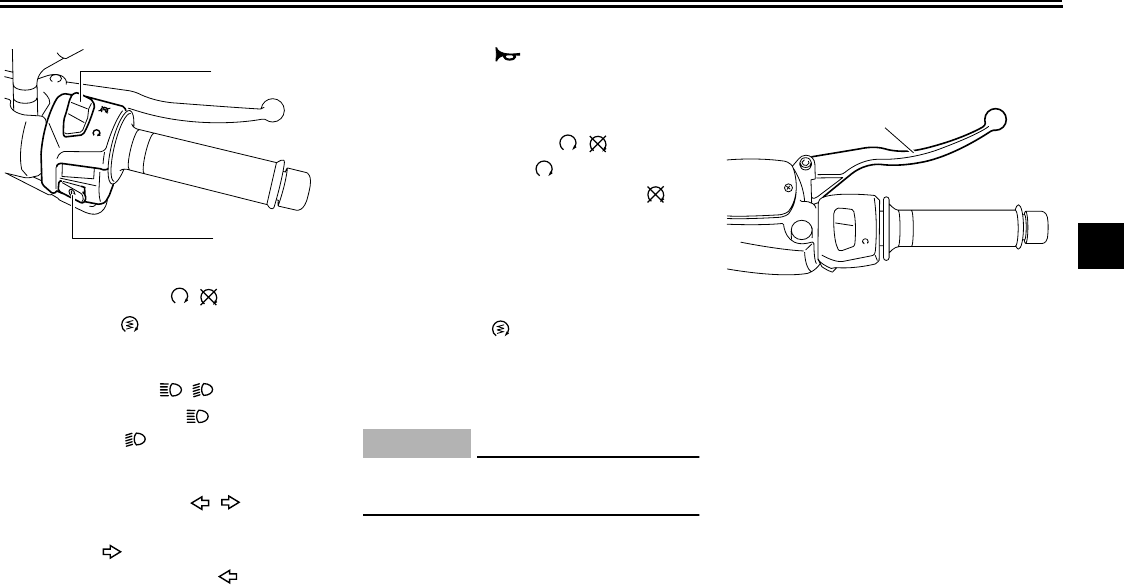
INSTRUMENT AND CONTROL FUNCTIONS
3-7
2
3
4
5
6
7
8
9
Right
EAU12400
Dimmer switch “/”
Set this switch to “” for the high
beam and to “” for the low beam.
EAU12460
Turn signal switch “/”
To signal a right-hand turn, push this
switch to “”. To signal a left-hand
turn, push this switch to “”. When re-
leased, the switch returns to the center
position. To cancel the turn signal
lights, push the switch in after it has re-
turned to the center position.
EAU12500
Horn switch “”
Press this switch to sound the horn.
EAU12660
Engine stop switch “/”
Set this switch to “” before starting
the engine. Set this switch to “” to
stop the engine in case of an emergen-
cy, such as when the vehicle overturns
or when the throttle cable is stuck.
EAU12720
Start switch “”
With the sidestand up, push this switch
while applying the front or rear brake to
crank the engine with the starter.
CAUTION:
ECA10050
See page 5-1 for starting instruc-
tions prior to starting the engine.
EAU12900
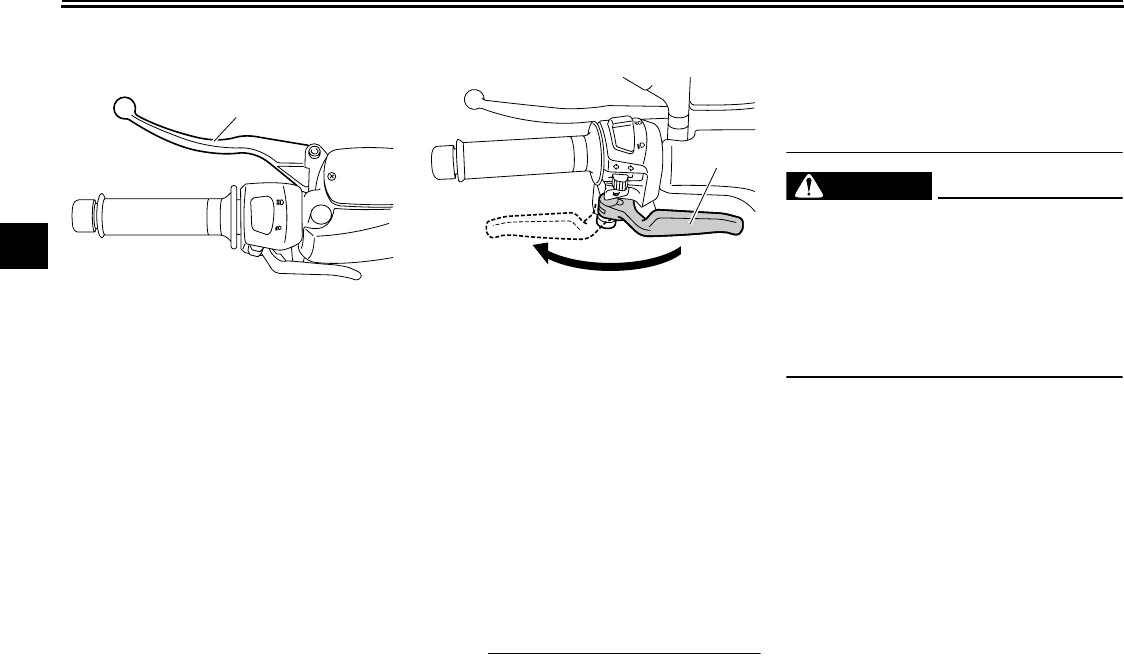
Front brake lever
The front brake lever is located on the
right handlebar grip. To apply the front
brake, pull this lever toward the handle-
bar grip.
1. Engine stop switch “/”
2. Start switch “”
1
2
1. Front brake lever
1
INSTRUMENT AND CONTROL FUNCTIONS
3-8
1
2
3
4
5
6
7
8
9
EAU12950
Rear brake lever
The rear brake lever is located on the
left handlebar grip. To apply the rear
brake, pull this lever toward the handle-
bar grip.
EAU12962
Rear brake lock lever
This vehicle is equipped with a rear
brake lock lever to prevent the rear
wheel from moving while stopped at
traffic signals, railroad crossings, etc.
To lock the rear wheel
Push the rear brake lock lever to the left
until it snaps into place.
To unlock the rear wheel
Push the rear brake lock lever back to
the original position.
NOTE:
●
Be sure to check that the rear
wheel does not move when the
rear brake lock lever is applied.
●
To provide secure locking of the
rear wheel, apply the rear brake le-
ver first before moving the rear
brake lock lever to the left.
WARNING
EWA12361
Never move the rear brake lock lever
to the left while the vehicle is mov-
ing, otherwise loss of control or an
accident may result. Make sure that
the vehicle is stopped before mov-
ing the rear brake lock lever to the
left.
1. Rear brake lever
1
1. Rear brake lock lever
1

INSTRUMENT AND CONTROL FUNCTIONS
3-9
2
3
4
5
6
7
8
9
EAU13161
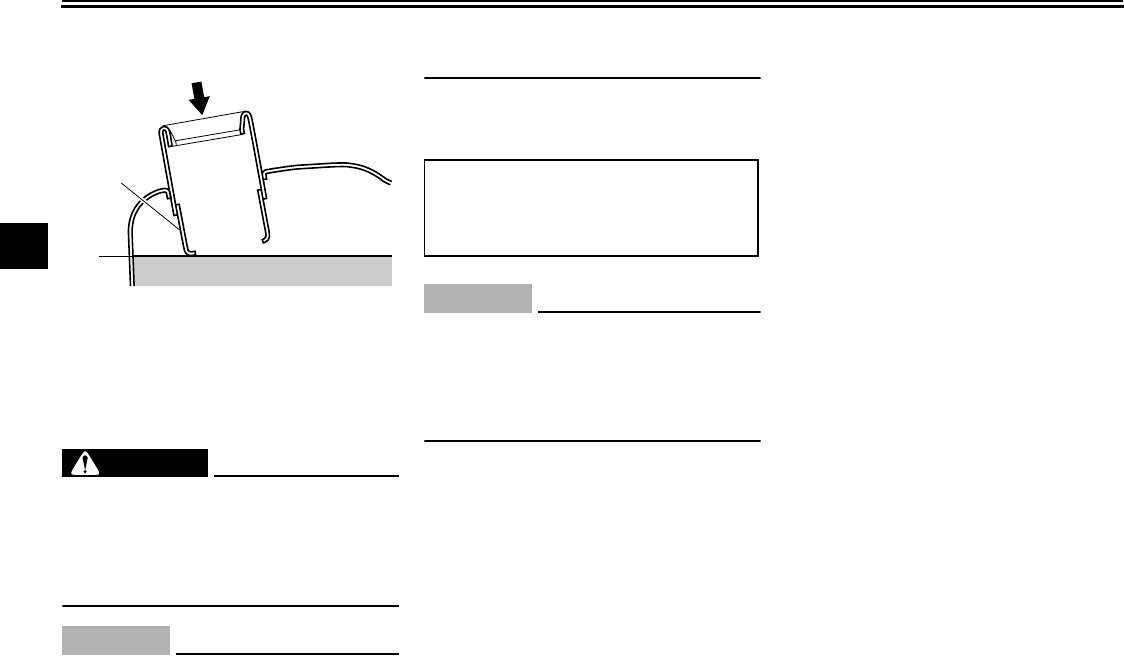
Fuel tank cap
To open the fuel tank cap
1. Open the lid by sliding the lever
forward, and then pull the lever up.
2. Insert the key into the lock and turn
it clockwise. The lock will be re-
leased and the fuel tank cap can
be removed.
To install the fuel tank cap
1. Align the match marks, insert the
fuel tank cap into the tank opening,
and then push down on the cap.
2. Turn the key counterclockwise to
the original position, and then re-
move it.
3. Close the lid.
WARNING
EWA11120
Be sure that the fuel tank cap is
properly installed and locked before
riding the scooter.
1. Lid
2. Opening lever
2
1
1. Fuel tank cap
1. Match marks
1
1
INSTRUMENT AND CONTROL FUNCTIONS
3-10
1
2
3
4
5
6
7
8
9
EAU13211
Fuel
Make sure that there is sufficient fuel in
the tank. Fill the fuel tank to the bottom
of the filler tube as shown.
WARNING
EWA10880
●
Do not overfill the fuel tank, oth-
erwise it may overflow when the
fuel warms up and expands.
●
Avoid spilling fuel on the hot en-
gine.
CAUTION:
ECA10070
Immediately wipe off spilled fuel
with a clean, dry, soft cloth, since
fuel may deteriorate painted surfac-
es or plastic parts.
EAU36080
CAUTION:
ECA11400
Use only unleaded gasoline. The use
of leaded gasoline will cause severe
damage to internal engine parts,
such as the valves and piston rings,
as well as to the exhaust system.
Your Yamaha engine has been de-
signed to use regular unleaded gaso-
line with a pump octane number
[(R+M)/2] of 86 or higher, or a research
octane number of 91 or higher. If
knocking (or pinging) occurs, use a
gasoline of a different brand or premi-
um unleaded fuel. Use of unleaded fuel
will extend spark plug life and reduce
maintenance costs.
Gasohol
There are two types of gasohol: gaso-
hol containing ethanol and that contain-
ing methanol. Gasohol containing
ethanol can be used if the ethanol con-
tent does not exceed 10%. Gasohol
containing methanol is not recom-
mended by Yamaha because it can
cause damage to the fuel system or ve-
hicle performance problems.
1. Fuel tank filler tube
2. Fuel level
2
1
Recommended fuel
UNLEADED GASOLINE ONLY
Fuel tank capacity:
14.0 L (3.70 US gal) (3.08 Imp.gal)

INSTRUMENT AND CONTROL FUNCTIONS
3-11
2
3
4
5
6
7
8
9
EAU13431
Catalytic converter
This model is equipped with a catalytic
converter in the exhaust system.
WARNING
EWA10860
The exhaust system is hot after op-
eration. Make sure that the exhaust
system has cooled down before do-
ing any maintenance work.
CAUTION:
ECA10700
The following precautions must be
observed to prevent a fire hazard or
other damages.
●
Use only unleaded gasoline.
The use of leaded gasoline will
cause unrepairable damage to
the catalytic converter.
●
Never park the vehicle near pos-
sible fire hazards such as grass
or other materials that easily
burn.
●
Do not allow the engine to idle
too long.
EAU34140
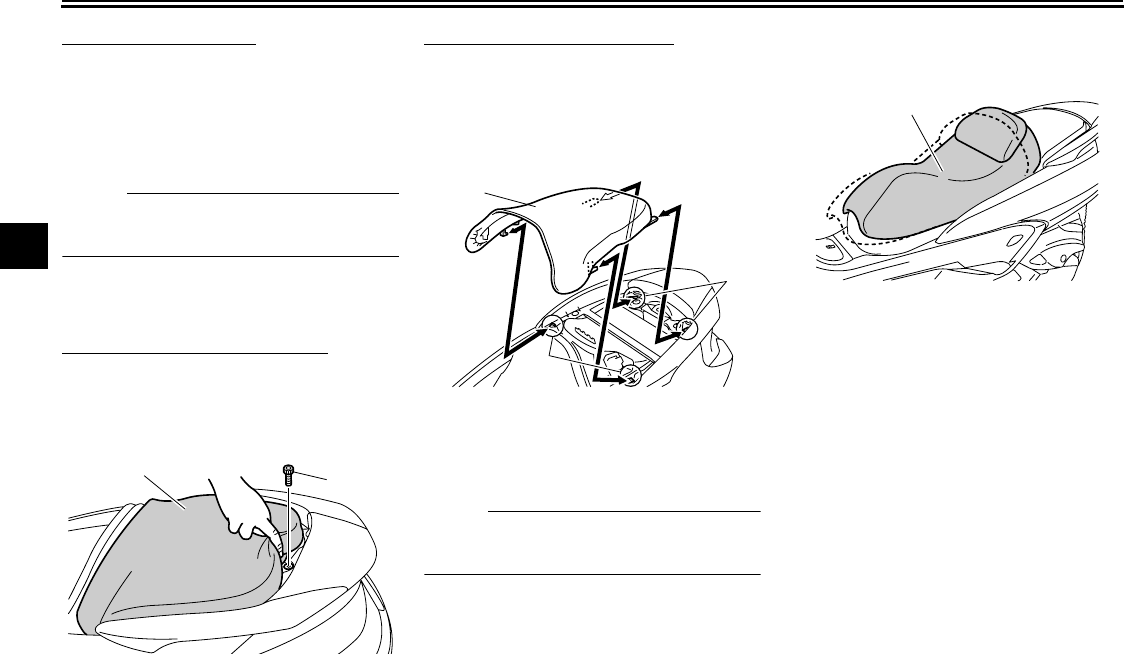
Seats
Rider seat
To open the rider seat
1. Place the scooter on the center-
stand.
2. Insert the key into the main switch,
and then turn it counterclockwise.
NOTE:
Do not push inward when turning the
key.
3. Fold the rider seat up.
1. Rider seat
2. Passenger seat
2
1
1. Open.
1. Rider seat
1
1
INSTRUMENT AND CONTROL FUNCTIONS
3-12
1
2
3
4
5
6
7
8
9
To close the rider seat
1. Fold the rider seat down, and then
push it down to lock it in place.
2. Remove the key from the main
switch if the scooter will be left un-
attended.
NOTE:
Make sure that the rider seat is properly
secured before riding.
Passenger seat
To remove the passenger seat
1. Open the rider seat.
2. Remove the bolt, and then pull the
passenger seat forward.
To install the passenger seat
1. Insert the projections on the pas-
senger seat into the holders as
shown, place the passenger seat
in the original position, and then in-
stall the bolt.
2. Close the rider seat.
NOTE:
Make sure that the passenger seat is
properly secured before riding.
EAU34150
Adjusting the rider seat
The rider seat can be adjusted as fol-
lows to change the riding position.
1. Open the rider seat. (See
page 3-11.)
2. Remove the bolts.
1. Passenger seat
2. Bolt
2
1
1. Passenger seat
2. Seat holder
1
2
2
1. Rider seat
1
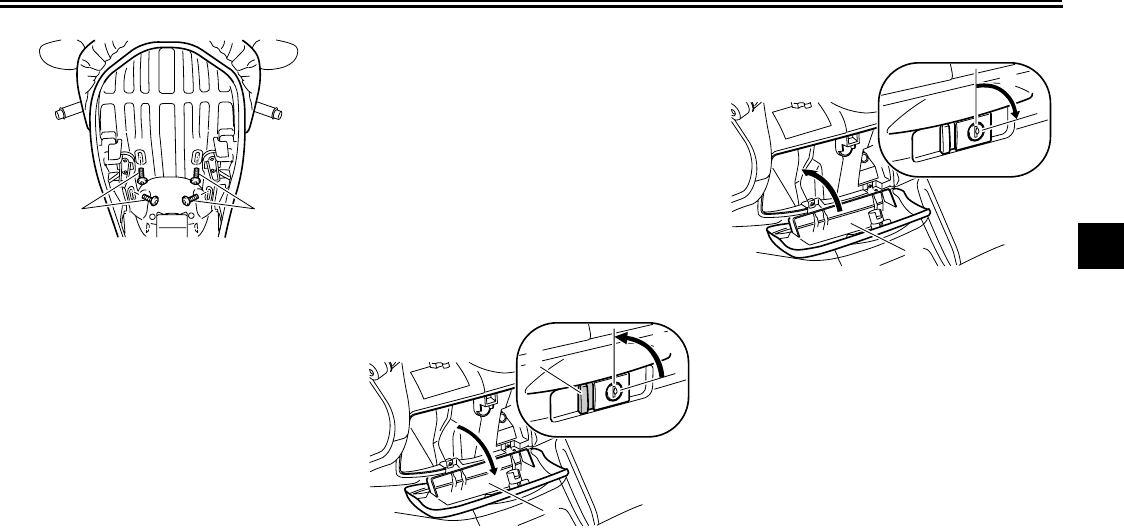
INSTRUMENT AND CONTROL FUNCTIONS
3-13
2
3
4
5
6
7
8
9
3. Slide the rider seat forward or
backward to the desired position.
4. Install bolts and securely tighten
them.
5. Close the rider seat.
EAU14492
Storage compartments
Front storage compartment A
To open the storage compartment
when it is locked, insert the key in the
lock, turn it counterclockwise, and then
grasp the lock while pushing the button
in.
To open the storage compartment
when it is unlocked, simply grasp the
lock while pushing the button in.
To lock the storage compartment, push
the lid into the original position, insert
the key in the lock, turn it clockwise,
and then remove it.
Front storage compartment B
To open the storage compartment,
slide the lever up, and then pull on the
lever.
1. Bolt
11
1. Open.
2. Button
3. Lid
2
3
1
1. Lock.
2. Lid
2
1
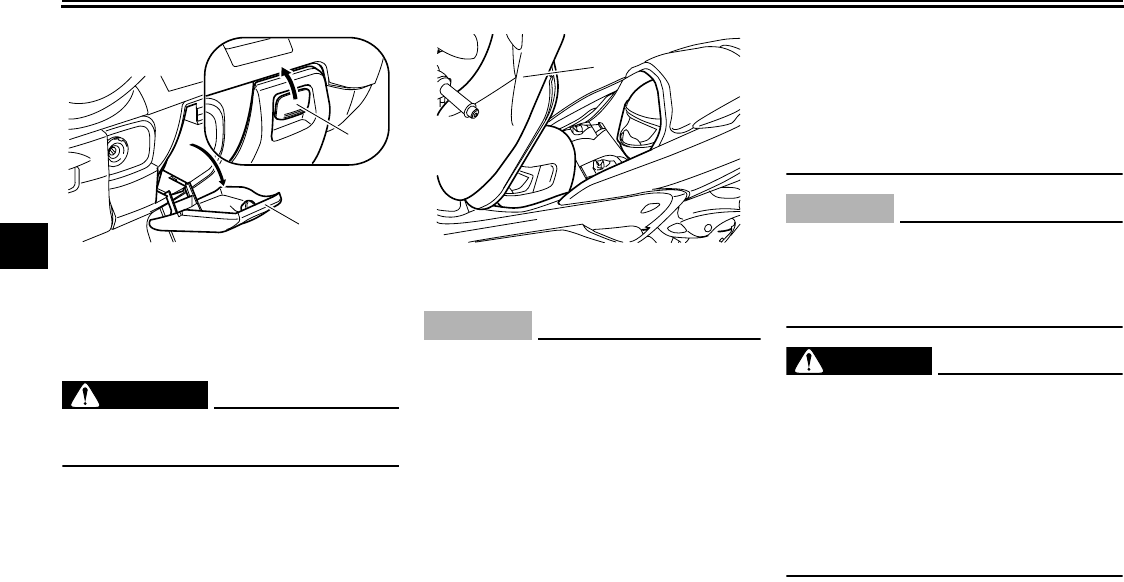
INSTRUMENT AND CONTROL FUNCTIONS
3-14
1
2
3
4
5
6
7
8
9
To close the storage compartment,
push the lid into the original position.
WARNING
EWA11160
Do not store heavy items in this
compartment.
Rear storage compartment
Two helmets can be stored in the stor-
age compartment under the seats.
(See page 3-11.)
CAUTION:
ECA10080
Keep the following points in mind
when using the storage compart-
ment.
●
Since the storage compartment
accumulates heat when ex-
posed to the sun, do not store
anything susceptible to heat in-
side it.
●
To avoid humidity from spread-
ing through the storage com-
partment, wrap wet articles in a
plastic bag before storing them
in the compartment.
●
Since the storage compartment
may get wet while the scooter is
being washed, wrap any articles
stored in the compartment in a
plastic bag.
●
Do not keep anything valuable
or breakable in the storage com-
partment.
CAUTION:
ECA11100
Do not leave the rider seat open for
an extended period of time, other-
wise the light may cause the battery
to discharge.
WARNING
EWA11170
Do not exceed the following loading
limits:
●
Front storage compartment A:
2 kg (4 lb)
●
Rear storage compartment: 5 kg
(11 lb)
●
Maximum load for the vehicle:
196 kg (432 lb)
1. Storage compartment opening lever
2. Lid
2
1
1. Rider seat
1
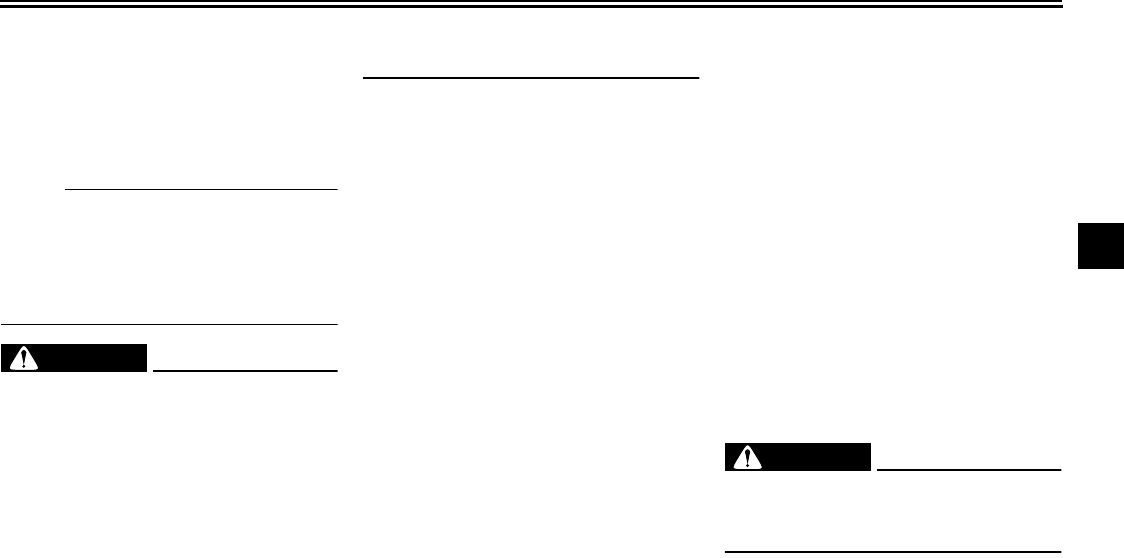
INSTRUMENT AND CONTROL FUNCTIONS
3-15
2
3
4
5
6
7
8
9
EAU15301
Sidestand
The sidestand is located on the left side
of the frame. Raise the sidestand or
lower it with your foot while holding the
vehicle upright.
NOTE:
The built-in sidestand switch is part of
the ignition circuit cut-off system, which
cuts the ignition in certain situations.
(See further down for an explanation of
the ignition circuit cut-off system.)
WARNING
EWA10240
The vehicle must not be ridden with
the sidestand down, or if the side-
stand cannot be properly moved up
(or does not stay up), otherwise the
sidestand could contact the ground
and distract the operator, resulting
in a possible loss of control.
Yamaha’s ignition circuit cut-off
system has been designed to assist
the operator in fulfilling the respon-
sibility of raising the sidestand be-
fore starting off. Therefore, check
this system regularly as described
below and have a Yamaha dealer re-
pair it if it does not function proper-
ly.
EAU15371
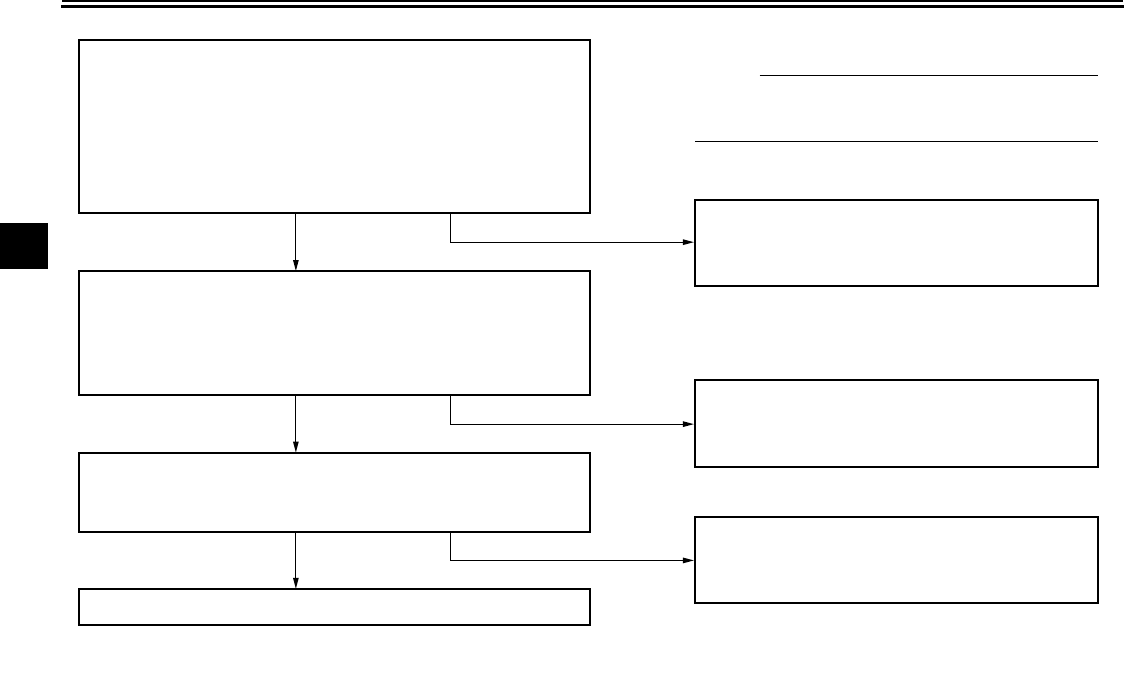
Ignition circuit cut-off system
The ignition circuit cut-off system (com-
prising the sidestand switch and brake
light switches) has the following func-
tions.
●
It prevents starting when the side-
stand is up, but neither brake is ap-
plied.
●
It prevents starting when either
brake is applied, but the sidestand
is still down.
●
It cuts the running engine when the
sidestand is moved down.
Periodically check the operation of the
ignition circuit cut-off system according
to the following procedure.
WARNING
EWA10250
If a malfunction is noted, have a
Yamaha dealer check the system be-
fore riding.
INSTRUMENT AND CONTROL FUNCTIONS
3-16
1
2
3
4
5
6
7
8
9
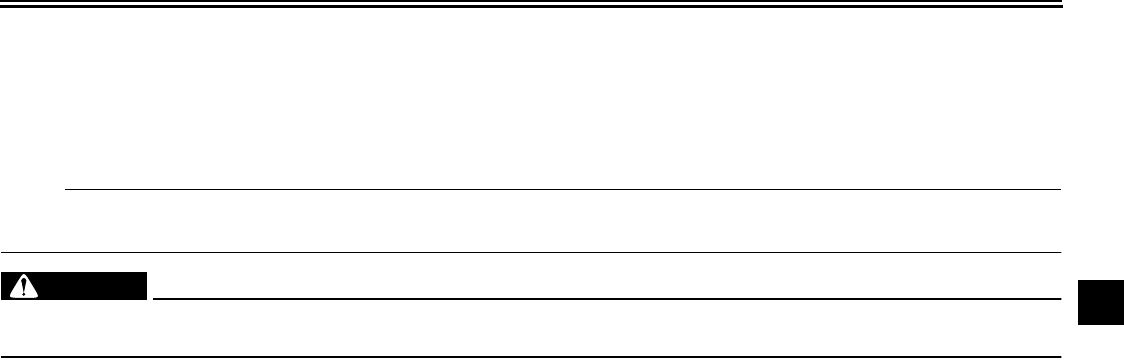
With the engine turned off:
1. Move the sidestand down.
2. Make sure that the engine stop switch is turned on.
3. Turn the key on.
4. Keep the front or rear brake applied.
5. Push the start switch.
Does the engine start?
With the engine still off:
6. Move the sidestand up.
7. Keep the front or rear brake applied.
8. Push the start switch.
Does the engine start?
With the engine still running:
9. Move the sidestand down.
Does the engine stall?
The system is OK. The scooter can be ridden.
This check is most reliable if performed with
a warmed-up engine.
The sidestand switch may be defective.
The scooter should not be ridden until
checked by a Yamaha dealer.
The brake switch may be defective.
The scooter should not be ridden until
checked by a Yamaha dealer.
The sidestand switch may be defective.
The scooter should not be ridden until
checked by a Yamaha dealer.
YES NO
YES NO
NO YES
NOTE:
4-1
2
3
4
5
6
7
8
9
PRE-OPERATION CHECKS
EAU15591
The condition of a vehicle is the owner’s responsibility. Vital components can start to deteriorate quickly and unexpectedly,
even if the vehicle remains unused (for example, as a result of exposure to the elements). Any damage, fluid leakage or loss
of tire air pressure could have serious consequences. Therefore, it is very important, in addition to a thorough visual inspec-
tion, to check the following points before each ride.
NOTE:
Pre-operation checks should be made each time the vehicle is used. Such an inspection can be accomplished in a very short
time; and the added safety it assures is more than worth the time involved.
WARNING
EWA11150
If any item in the Pre-operation check list is not working properly, have it inspected and repaired before operating
the vehicle.
PRE-OPERATION CHECKS
4-2
1
2
3
4
5
6
7
8
9
EAU15605
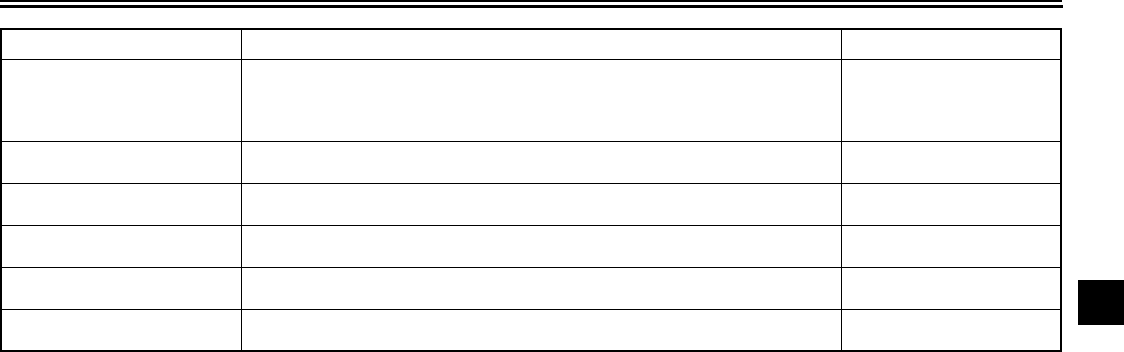
Pre-operation check list
ITEM CHECKS PAGE
Fuel
●
Check fuel level in fuel tank.
●
Refuel if necessary.
●
Check fuel line for leakage.
3-10
Engine oil
●
Check oil level in engine.
●
If necessary, add recommended oil to specified level.
●
Check vehicle for oil leakage.
6-14
Final transmission oil
●
Check vehicle for oil leakage. 6-17
Coolant
●
Check coolant level in reservoir.
●
If necessary, add recommended coolant to specified level.
●
Check cooling system for leakage.
6-18
Front brake
●
Check operation.
●
If soft or spongy, have Yamaha dealer bleed hydraulic system.
●
Check brake pads for wear.
●
Replace if necessary.
●
Check fluid level in reservoir.
●
If necessary, add recommended brake fluid to specified level.
●
Check hydraulic system for leakage.
6-26, 6-28
Rear brake
●
Check operation.
●
If soft or spongy, have Yamaha dealer bleed hydraulic system.
●
Check brake pads for wear.
●
Replace if necessary.
●
Check fluid level in reservoir.
●
If necessary, add recommended brake fluid to specified level.
●
Check hydraulic system for leakage.
6-26, 6-28
Throttle grip
●
Make sure that operation is smooth.
●
Check cable free play.
●
If necessary, have Yamaha dealer adjust cable free play and lubricate cable
and grip housing.
6-23, 6-30
PRE-OPERATION CHECKS
4-3
2
3
4
5
6
7
8
9
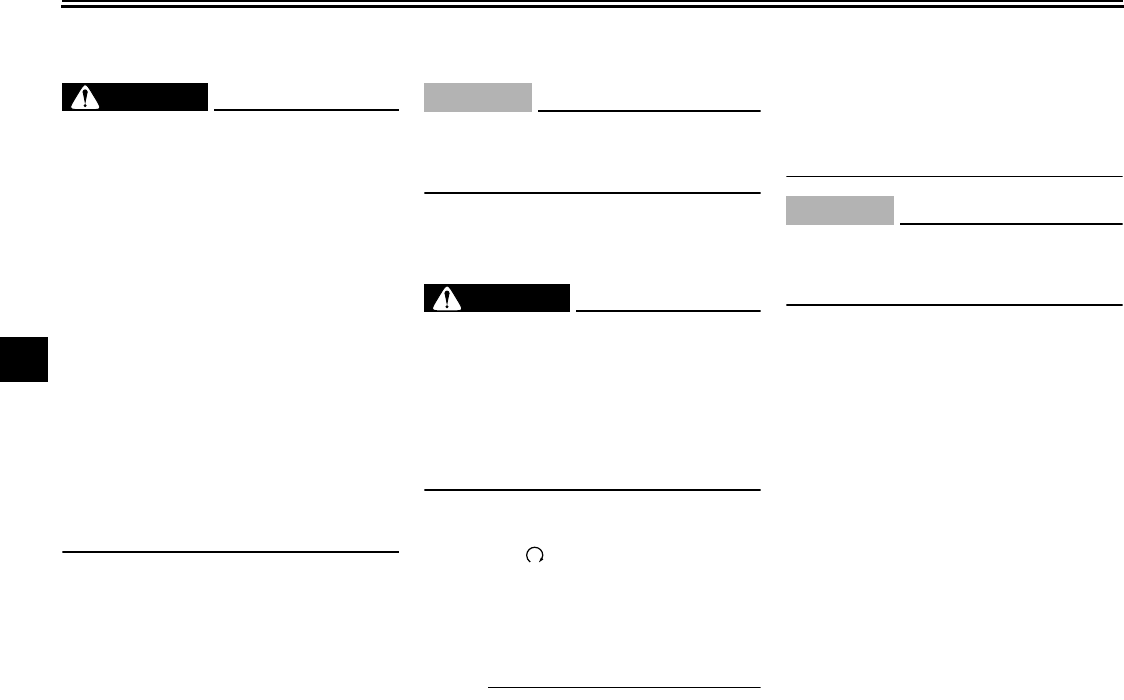
Wheels and tires
●
Check for damage.
●
Check tire condition and tread depth.
●
Check air pressure.
●
Correct if necessary.
6-23, 6-25
Brake levers
●
Make sure that operation is smooth.
●
Lubricate lever pivoting points if necessary. 6-30
Centerstand, sidestand
●
Make sure that operation is smooth.
●
Lubricate pivots if necessary. 6-31
Chassis fasteners
●
Make sure that all nuts, bolts and screws are properly tightened.
●
Tighten if necessary. —
Instruments, lights, signals
and switches
●
Check operation.
●
Correct if necessary. —
Sidestand switch
●
Check operation of ignition circuit cut-off system.
●
If system is defective, have Yamaha dealer check vehicle. 3-15
ITEM CHECKS PAGE
5-1
1
2
3
4
5
6
7
8
9
OPERATION AND IMPORTANT RIDING POINTS
EAU15980
WARNING
EWA10870
●
Become thoroughly familiar
with all operating controls and
their functions before riding.
Consult a Yamaha dealer re-
garding any control or function
that you do not thoroughly un-
derstand.
●
Never start the engine or oper-
ate it in a closed area for any
length of time. Exhaust fumes
are poisonous, and inhaling
them can cause loss of con-
sciousness and death within a
short time. Always make sure
that there is adequate ventila-
tion.
●
For safety, always start the en-
gine with the centerstand down.
EAU34460
Starting the engine
CAUTION:
ECA10250
See page 5-3 for engine break-in in-
structions prior to operating the ve-
hicle for the first time.
In order for the ignition circuit cut-off
system to enable starting, the side-
stand must be up.
WARNING
EWA10290
●
Before starting the engine,
check the function of the igni-
tion circuit cut-off system ac-
cording to the procedure
described on page 3-15.
●
Never ride with the sidestand
down.
1. Turn the key to “ON” and make
sure that the engine stop switch is
set to “”.
2. Close the throttle completely.
3. Start the engine by pushing the
start switch while applying the front
or rear brake.
NOTE:
If the engine does not start, release the
start switch, wait a few seconds, and
then try again. Each starting attempt
should be as short as possible to pre-
serve the battery. Do not crank the en-
gine more than 10 seconds on any one
attempt.
CAUTION:
ECA11040
For maximum engine life, never ac-
celerate hard when the engine is
cold!

OPERATION AND IMPORTANT RIDING POINTS
5-2
2
3
4
5
6
7
8
9
EAU16760
Starting off
NOTE:
Before starting off, allow the engine to
warm up.
1. While pulling the rear brake lever
with your left hand and holding the
grab bar with your right hand, push
the scooter off the centerstand.
2. Sit astride the seat, and then ad-
just the rear view mirrors.
3. Switch the turn signal on.
4. Check for oncoming traffic, and
then slowly turn the throttle grip (on
the right) in order to take off.
5. Switch the turn signal off.
EAU16780
Acceleration and deceleration
The speed can be adjusted by opening
and closing the throttle. To increase the
speed, turn the throttle grip in direction
(a). To reduce the speed, turn the throt-
tle grip in direction (b).
EAU16791
Braking
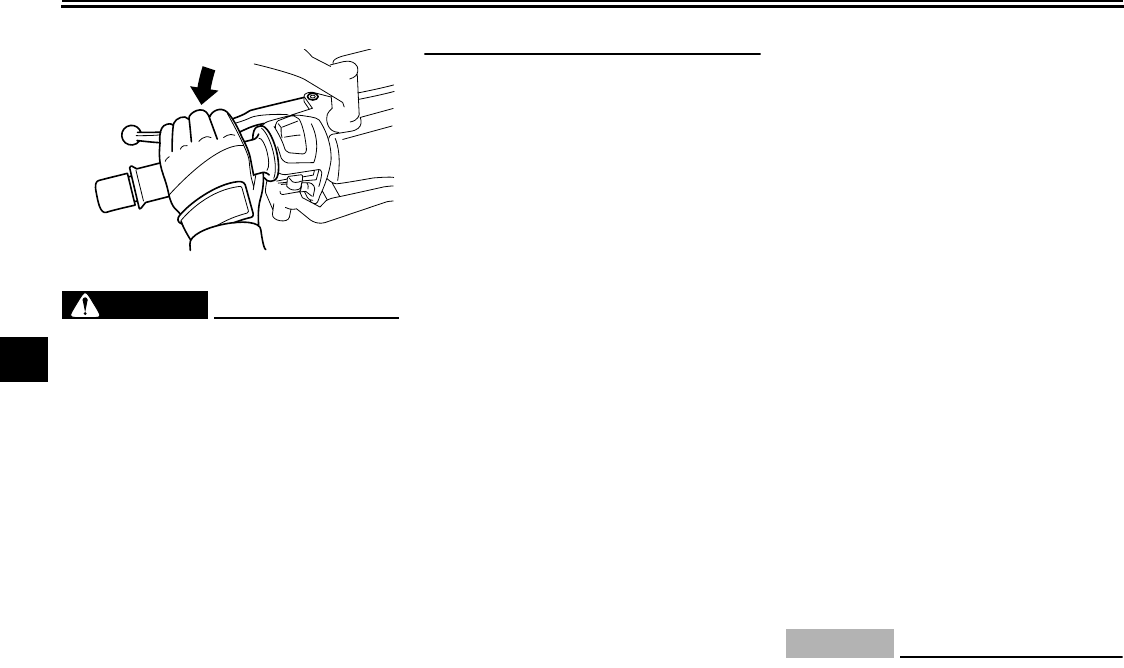
1. Close the throttle completely.
2. Apply both front and rear brakes
simultaneously while gradually in-
creasing the pressure.
Front
1. Grab bar
1
(a)
(b)
OPERATION AND IMPORTANT RIDING POINTS
5-3
1
2
3
4
5
6
7
8
9
Rear
WARNING
EWA10300
●
Avoid braking hard or suddenly
(especially when leaning over to
one side), otherwise the scooter
may skid or overturn.
●
Railroad crossings, streetcar
rails, iron plates on road con-
struction sites, and manhole
covers become extremely slip-
pery when wet. Therefore, slow
down when approaching such
areas and cross them with cau-
tion.
●
Keep in mind that braking on a
wet road is much more difficult.
●
Ride slowly down a hill, as brak-
ing downhill can be very diffi-
cult.
EAU16841
Engine break-in
There is never a more important period
in the life of your engine than the period
between 0 and 1600 km (1000 mi). For
this reason, you should read the follow-
ing material carefully.
Since the engine is brand new, do not
put an excessive load on it for the first
1600 km (1000 mi). The various parts in
the engine wear and polish themselves
to the correct operating clearances.
During this period, prolonged full-throt-
tle operation or any condition that might
result in engine overheating must be
avoided.
EAU34320
0–1000 km (0–600 mi)
Avoid prolonged operation above 4000
r/min.
1000–1600 km (600–1000 mi)
Avoid prolonged operation above 6000
r/min.
CAUTION:
ECA12930
After 1000 km (600 mi) of operation,
be sure to replace the engine oil, fi-

OPERATION AND IMPORTANT RIDING POINTS
5-4
2
3
4
5
6
7
8
9
nal transmission oil and the oil filter
element.
1600 km (1000 mi) and beyond
The vehicle can now be operated nor-
mally.
CAUTION:
ECA10310
●
Keep the engine speed out of
the tachometer red zone.
●
If any engine trouble should oc-
cur during the engine break-in
period, immediately have a
Yamaha dealer check the vehi-
cle.
EAU17212
Parking
When parking, stop the engine, and
then remove the key from the main
switch.
WARNING
EWA10310
●
Since the engine and exhaust
system can become very hot,
park in a place where pedestri-
ans or children are not likely to
touch them.
●
Do not park on a slope or on soft
ground, otherwise the vehicle
may overturn.
CAUTION:
ECA10380
Never park in an area where there
are fire hazards such as grass or
other flammable materials.
6-1
1
2
3
4
5
6
7
8
9
PERIODIC MAINTENANCE AND MINOR REPAIR
EAU17271
Safety is an obligation of the owner. Pe-
riodic inspection, adjustment and lubri-
cation will keep your vehicle in the
safest and most efficient condition pos-
sible. The most important points of
scooter inspection, adjustment, and lu-
brication are explained on the following
pages.
Maintenance, replacement, or repair of
the emission control devices and sys-
tems may be performed by any repair
establishment or individual that is certi-
fied (if applicable).
WARNING
EWA10320
If you are not familiar with mainte-
nance work, have a Yamaha dealer
do it for you.
WARNING
EWA10330
This scooter is designed for use on
paved roads only. If this scooter is
operated in abnormally dusty, mud-
dy or wet conditions, the air filter el-
ement should be cleaned or
replaced more frequently, otherwise
rapid engine wear may result. Con-
sult a Yamaha dealer for proper
maintenance intervals.
EAU17301
PERIODIC MAINTENANCE
PROPER PERIODIC MAINTENANCE
OF YOUR VEHICLE IS IMPORTANT
IN ORDER TO ENJOY LONG, PLEA-
SURABLE SERVICE. ESPECIALLY
IMPORTANT ARE THE MAINTE-
NANCE SERVICES RELATED TO
EMISSIONS CONTROL. THESE
CONTROLS NOT ONLY FUNCTION
TO ENSURE CLEANER AIR, BUT
ARE ALSO VITAL TO PROPER EN-
GINE OPERATION AND MAXIMUM
PERFORMANCE. IN THE FOLLOW-
ING PERIODIC MAINTENANCE
CHARTS, THE SERVICES RELATED
TO EMISSIONS CONTROL ARE
GROUPED SEPARATELY. THESE
SERVICES REQUIRE SPECIALIZED
DATA, KNOWLEDGE, AND EQUIP-
MENT. YAMAHA DEALERS ARE
TRAINED AND EQUIPPED TO PER-
FORM THESE PARTICULAR SER-
VICES.
PERIODIC MAINTENANCE AND MINOR REPAIR
6-2
2
3
4
5
6
7
8
9
EAU17501
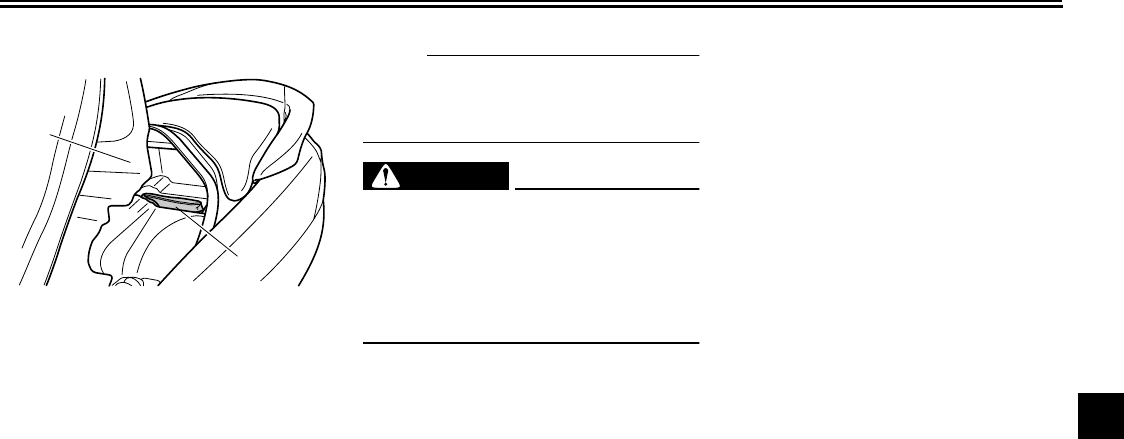
Owner’s tool kit
The owner’s tool kit is located inside the
rear storage compartment. (See
page 3-13.)
Pull up the storage compartment mat,
and then remove the owner’s tool kit.
The service information included in this
manual and the tools provided in the
owner’s tool kit are intended to assist
you in the performance of preventive
maintenance and minor repairs. How-
ever, additional tools such as a torque
wrench may be necessary to perform
certain maintenance work correctly.
NOTE:
If you do not have the tools or experi-
ence required for a particular job, have
a Yamaha dealer perform it for you.
WARNING
EWA10350
Modifications not approved by
Yamaha may cause loss of perfor-
mance and render the vehicle un-
safe for use. Consult a Yamaha
dealer before attempting any chang-
es.
1. Storage compartment mat
2. Owner’s tool kit
1
2

PERIODIC MAINTENANCE AND MINOR REPAIR
6-3
1
2
3
4
5
6
7
8
9
EAU17600
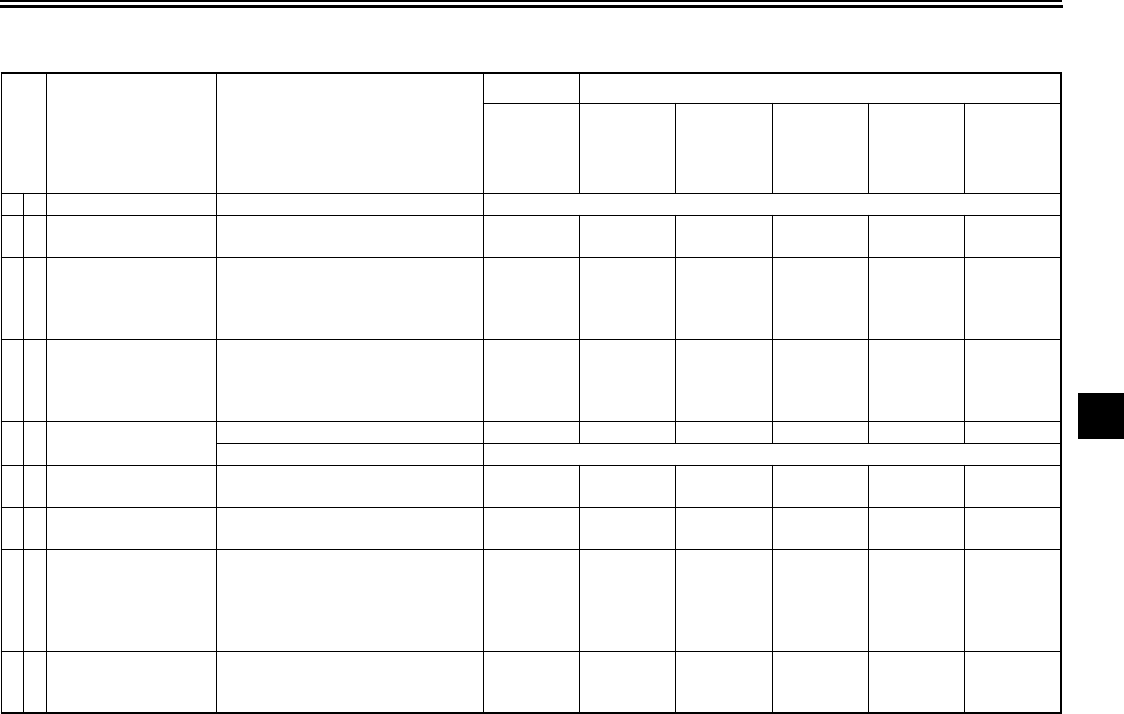
Periodic maintenance chart for the emission control system
* Since these items require special tools, data and technical skills, have a Yamaha dealer perform the service.
No. ITEM ROUTINE
INITIAL ODOMETER READINGS
600 mi
(1000 km)
or
1 month
4000 mi
(7000 km)
or
6 months
8000 mi
(13000 km)
or
12 months
12000 mi
(19000 km)
or
18 months
16000 mi
(25000 km)
or
24 months
20000 mi
(31000 km)
or
30 months
1*
Fuel line
●
Check fuel and vacuum hoses
for cracks or damage.
●
Replace if necessary.
√√√√√
2
Spark plug
●
Check condition.
●
Adjust gap and clean.
●
Replace every 10000 mi (16000
km) or 18 months.
√√
Replace.
√√
3*
Valve clearance
●
Check and adjust valve clear-
ance when engine is cold. Every 26600 mi (42000 km)
4*
Crankcase breather
system
●
Check breather hose for cracks
or damage.
●
Replace if necessary.
√√√√√
5*
Fuel injection
●
Check engine idle speed.
√√√√√√
6*
Evaporative emis-
sion control system
●
Check control system for dam-
age.
●
Replace if necessary.
√
7*
Air induction system
●
Check the air cut-off valve, reed
valve, and hose for damage.
●
Replace any damaged parts.
√
PERIODIC MAINTENANCE AND MINOR REPAIR
6-4
2
3
4
5
6
7
8
9
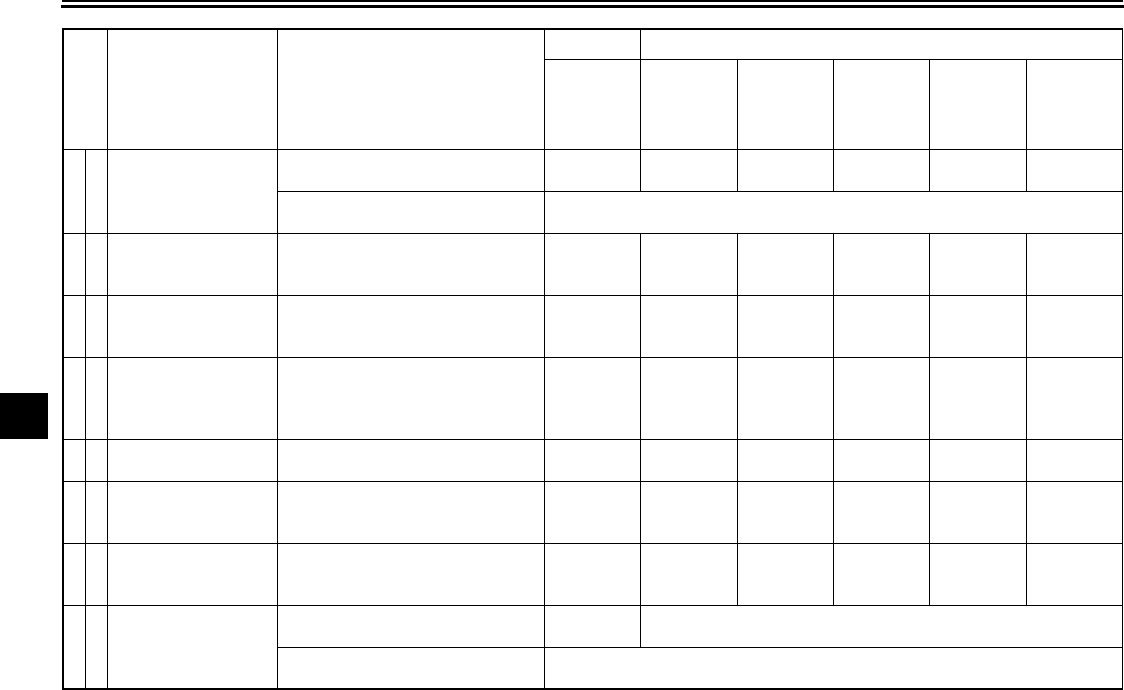
EAU32183
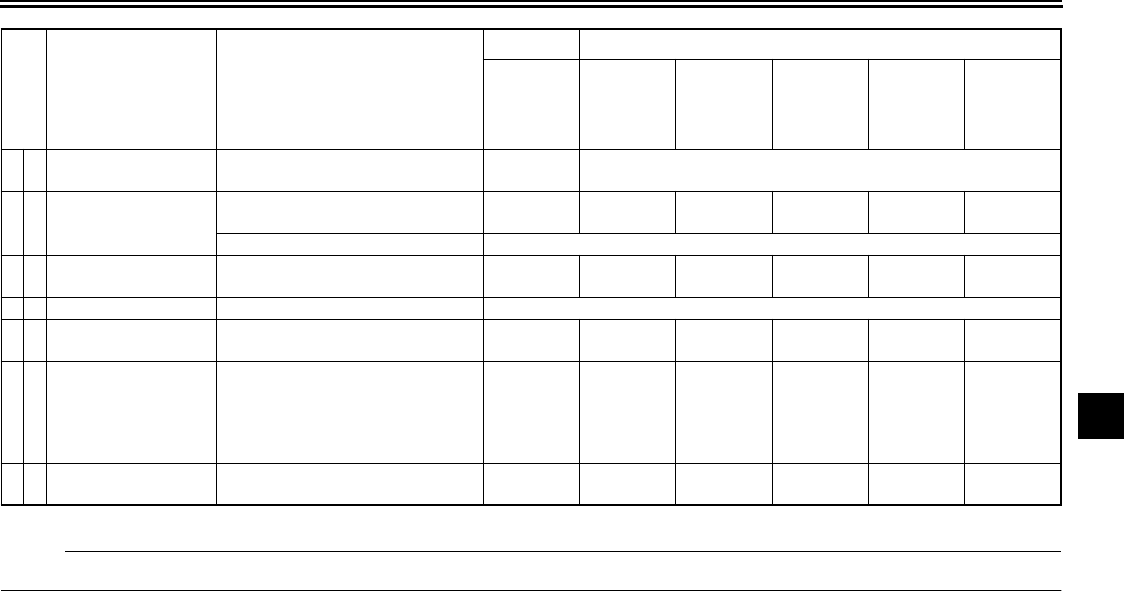
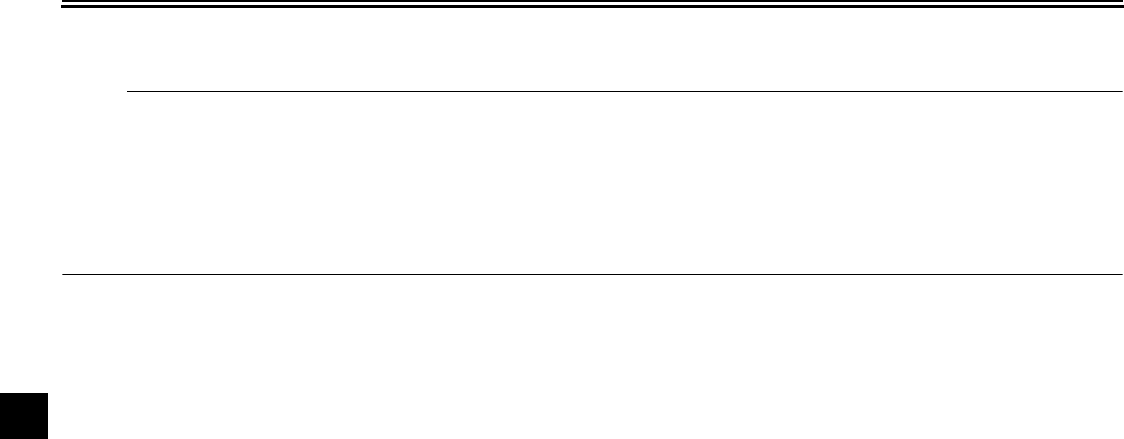
General maintenance and lubrication chart
No. ITEM ROUTINE
INITIAL ODOMETER READINGS
600 mi
(1000 km)
or
1 month
4000 mi
(7000 km)
or
6 months
8000 mi
(13000 km)
or
12 months
12000 mi
(19000 km)
or
18 months
16000 mi
(25000 km)
or
24 months
20000 mi
(31000 km)
or
30 months
1
Air filter elements
●
Replace. Every 12000 mi (19000 km)
2
V-belt case air filter
element
●
Clean.
√√√√√
3*
Front brake
●
Check operation, fluid level, and
for fluid leakage.
●
Replace brake pads if neces-
sary.
√√√√√√
4*
Rear brake
●
Check operation, fluid level, and
for fluid leakage.
●
Replace brake pads if neces-
sary.
√√√√√√
5*
Brake hoses
●
Check for cracks or damage.
√√√√√
●
Replace. Every 4 years
6
Rear brake lock
●
Check operation.
●
Adjust.
√√√√√√
7*
Wheels
●
Check runout and for damage.
●
Replace if necessary.
√√√√√
8*
Tires
●
Check tread depth and for dam-
age.
●
Replace if necessary.
●
Check air pressure.
●
Correct if necessary.
√√√√√
9*
Wheel bearings
●
Check bearings for smooth
operation.
●
Replace if necessary.
√√√√√
PERIODIC MAINTENANCE AND MINOR REPAIR
6-5
1
2
3
4
5
6
7
8
9
10
*
Steering bearings
●
Check bearing assemblies for
looseness.
√√√√√√
●
Moderately repack with lith-
ium-soap-based grease. Every 12000 mi (19000 km)
11
*
Chassis fasteners
●
Check all chassis fitting and fas-
teners.
●
Correct if necessary.
√√√√√
12
Front and rear brake
lever pivot
●
Apply lithium-soap-based
grease (all-purpose grease)
lightly.
√√√√√
13
Centerstand and sid-
estand pivots
●
Check operation.
●
Apply lithium-soap-based
grease (all-purpose grease)
lightly.
√√√√√
14
*
Sidestand switch
●
Check operation and replace if
necessary.
√√√√√√
15
*
Front fork
●
Check operation and for oil leak-
age.
●
Replace if necessary.
√√√√√
16
*
Shock absorber
assemblies
●
Check operation and for oil leak-
age.
●
Replace if necessary.
√√√√√
17
Engine oil
●
Change. (See pages 3-3 and
6-14.)
√
When the oil change indicator flashes (every 3125 mi (5000 km))
●
Check oil level and vehicle for oil
leakage. Every 3125 mi (5000 km)
No. ITEM ROUTINE
INITIAL ODOMETER READINGS
600 mi
(1000 km)
or
1 month
4000 mi
(7000 km)
or
6 months
8000 mi
(13000 km)
or
12 months
12000 mi
(19000 km)
or
18 months
16000 mi
(25000 km)
or
24 months
20000 mi
(31000 km)
or
30 months
PERIODIC MAINTENANCE AND MINOR REPAIR
6-6
2
3
4
5
6
7
8
9
* Since these items require special tools, data and technical skills, have a Yamaha dealer perform the service.
NOTE:
From 24000 mi (37000 km) or 36 months, repeat the maintenance intervals starting from 8000 mi (13000 km) or 12 months.
18
Engine oil filter ele-
ment
●
Replace.
√
Every 12500 mi (20000 km)
19
*
Cooling system
●
Check coolant level and vehicle
for coolant leakage.
√√√√√
●
Change. Every 3 years
20
Final transmission
oil
●
Check vehicle for oil leakage.
●
Change.
√√√
21
*
V-belt
●
Replace. When the V-belt replacement indicator flashes (every 12500 mi (20000 km)).
22
*
Front and rear brake
switches
●
Check operation.
√√√√√√
23
*
Throttle grip hous-
ing and cable
●
Check operation and free play.
●
Adjust the throttle cable free
play if necessary.
●
Lubricate the throttle grip hous-
ing and cable.
√√√√√
24
*
Lights, signals and
switches
●
Check operation.
●
Adjust headlight beam.
√√√√√√
No. ITEM ROUTINE
INITIAL ODOMETER READINGS
600 mi
(1000 km)
or
1 month
4000 mi
(7000 km)
or
6 months
8000 mi
(13000 km)
or
12 months
12000 mi
(19000 km)
or
18 months
16000 mi
(25000 km)
or
24 months
20000 mi
(31000 km)
or
30 months
PERIODIC MAINTENANCE AND MINOR REPAIR
6-7
1
2
3
4
5
6
7
8
9
EAU36370
NOTE:
●
The air filters and V-belt filter need more frequent service if you are riding in unusually wet or dusty areas.
●
Hydraulic brake service
●
After disassembling the brake master cylinders and calipers, always change the fluid. Regularly check the brake fluid
levels and fill the reservoirs as required.
●
Every two years replace the internal components of the brake master cylinders and calipers, and change the brake
fluid.
●
Replace the brake hoses every four years and if cracked or damaged.
PERIODIC MAINTENANCE AND MINOR REPAIR
6-8
2
3
4
5
6
7
8
9
EAU18712
Removing and installing
cowlings and panels
The cowlings and panels shown need
to be removed to perform some of the
maintenance jobs described in this
chapter. Refer to this section each time
a cowling or panel needs to be re-
moved and installed.
EAU34281
Cowling A
To remove the cowling
1. Open the rider seat. (See
page 3-11.)
2. Remove the quick fasteners in the
rear storage compartment, and
then pull the cowling off as shown.
NOTE:
The quick fastener is removed by push-
ing the center pin in with a screwdriver,
and then pulling the fastener out.
To install the cowling
1. Place the cowling in the original
position, and then install the quick
fasteners.
NOTE:
To install the quick fastener, push the
center pin out so that it will protrude
from the fastener head, insert the fas-
tener into the cowling, and then push
the protruding pin in until it is flush with
the fastener head.
2. Close the rider seat.
1. Panel A
2. Cowling C
3. Cowling A
4. Cowling B
5. Panel B
6. Cowling E
2 3 4
5
6
1
1. Cowling D
1
1. Quick fastener
2. Cowling A
1
2

PERIODIC MAINTENANCE AND MINOR REPAIR
6-9
1
2
3
4
5
6
7
8
9
Cowling B
To remove the cowling
1. Remove the screws.
2. Remove the cowling as shown.
To install the cowling
Place the cowling in the original posi-
tion, and then install the screws.
Cowlings C and D
To remove one of the cowlings
1. Remove cowlings A and B.
2. Remove the passenger seat. (See
page 3-11.)
3. Remove the grab bar by removing
the grab bar bolts and collars.
4. Remove the screw access cover
by pulling it off.
5. Remove the screws, and then pull
the cowling off.
To install the cowling
1. Place the cowling in the original
position, and then install the
screws.
1. Cowling B
2. Screw
1. Cowling B
1
2
1
1. Grab bar bolt
2. Collar
3. Grab bar
1
3
1
2
2
1. Screw access cover
1. Screw
1
1
1
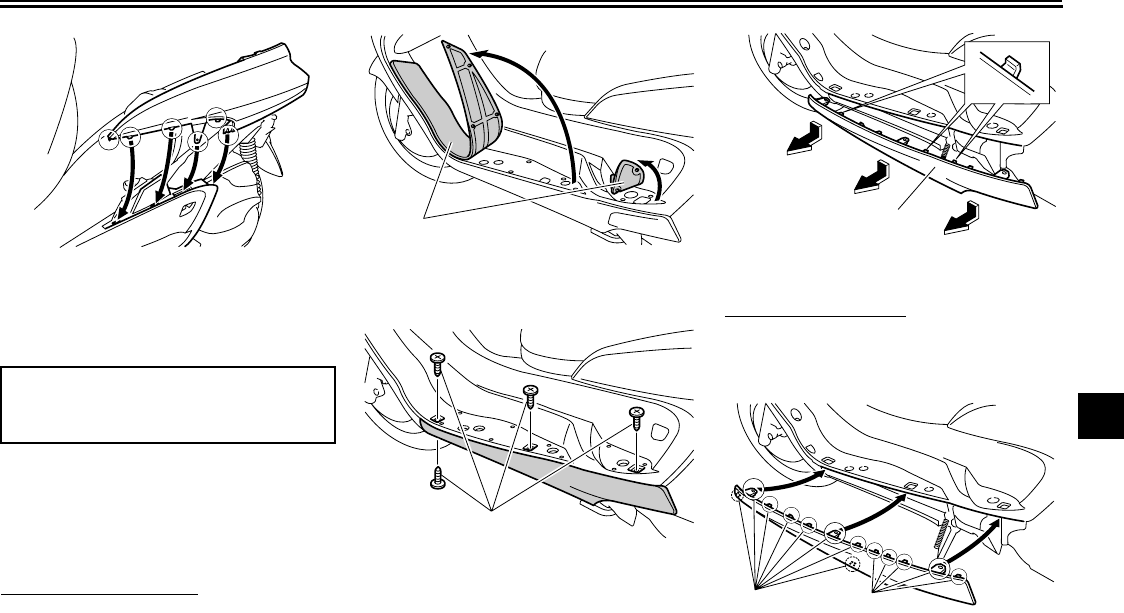
PERIODIC MAINTENANCE AND MINOR REPAIR
6-10
2
3
4
5
6
7
8
9
2. Install the screw access cover by
placing it in its original position.
3. Install the grab bar by installing the
collars and grab bar bolts.
4. Install the passenger seat.
5. Install cowlings A and B.
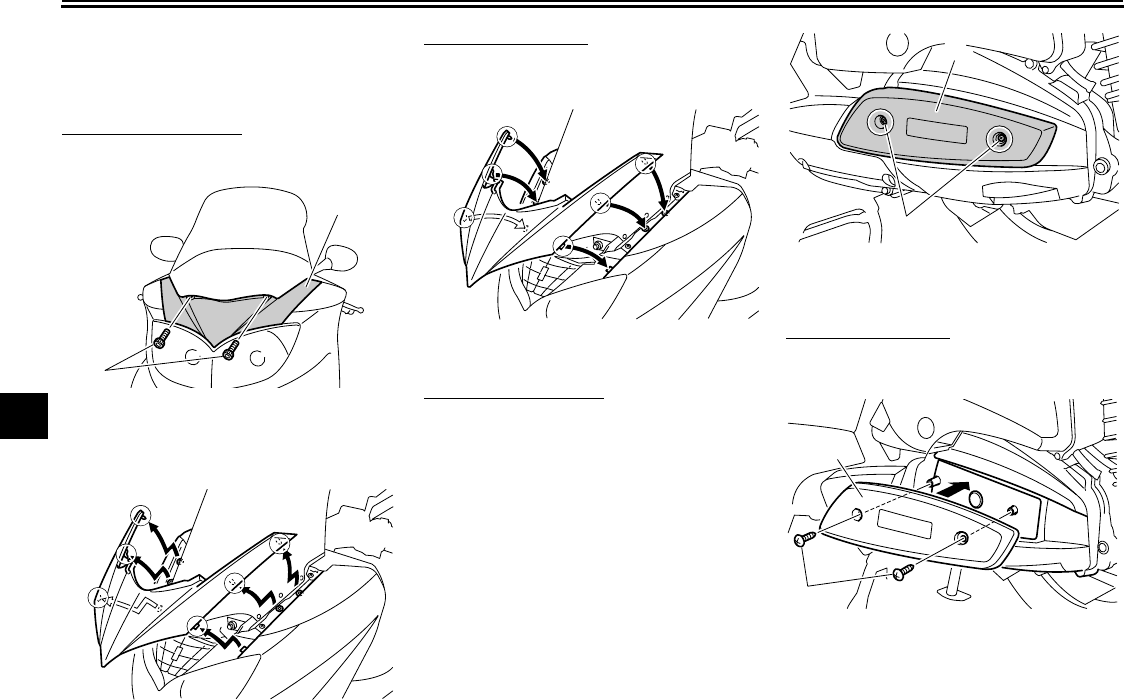
Cowling E
To remove the cowling
1. Pull up the left floorboard mats as
shown.
2. Remove the cowling screws.
3. Pull the cowling down slightly, and
then pull it outward as shown.
To install the cowling
1. Insert the tabs on the cowling into
the slots as shown, and then install
the screws.
2. Place the left floorboard mats in
the original position.
Tightening torque:
Grab bar bolt:
23 Nm (2.3 m·kgf, 16.6 ft·lbf)
1. Left floorboard mat
1. Screw
1
1
1. Cowling E
1. Tab
1
11
PERIODIC MAINTENANCE AND MINOR REPAIR
6-11
1
2
3
4
5
6
7
8
9
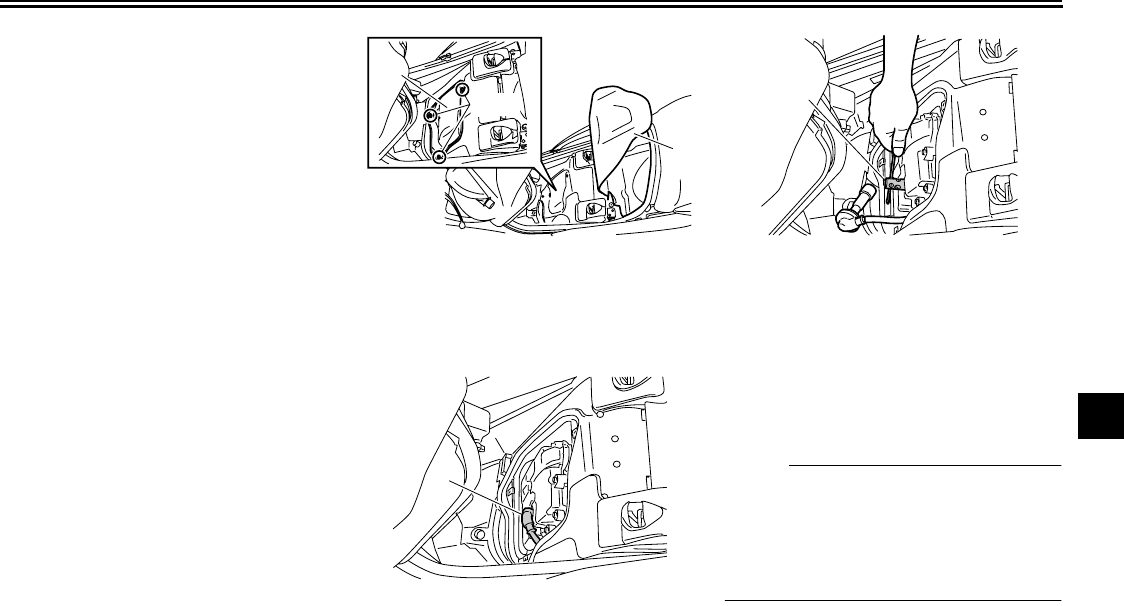
EAU34290
Panel A
To remove the panel
1. Remove the bolts.
2. Pull the panel out as shown.
To install the panel
Place the panel in the original position,
and then install the bolts.
Panel B
To remove the panel
Remove the screws, and then pull the
panel outward.
To install the panel
Place the panel in the original position,
and then install the screws.
1. Bolt
2. Panel A
2
1
1. Panel B
2. Screw
1. Screw
2. Panel B
2
1
1
2
PERIODIC MAINTENANCE AND MINOR REPAIR
6-12
2
3
4
5
6
7
8
9
EAU34171
Checking the spark plug
The spark plug is an important engine
component, which is easy to check.
Since heat and deposits will cause any
spark plug to slowly erode, the spark
plug should be removed and checked
in accordance with the periodic mainte-
nance and lubrication chart. In addition,
the condition of the spark plug can re-
veal the condition of the engine.
To remove the spark plug
1. Open the rider seat. (See
page 3-11.)
2. Pull up the storage compartment
mat, and then remove the spark
plug cover by removing the
screws.
3. Remove the spark plug cap.
4. Remove the spark plug as shown,
with the spark plug wrench includ-
ed in the owner’s tool kit.
To check the spark plug
1. Check that the porcelain insulator
around the center electrode of the
spark plug is a medium-to-light tan
(the ideal color when the vehicle is
ridden normally).
NOTE:
If the spark plug shows a distinctly dif-
ferent color, the engine could be defec-
tive. Do not attempt to diagnose such
problems yourself. Instead, have a
Yamaha dealer check the vehicle.
2. Check the spark plug for electrode
erosion and excessive carbon or
other deposits, and replace it if
necessary.
1. Storage compartment mat
2. Spark plug cover
3. Screw
1. Spark plug cap
1
2
3
1
1. Spark plug wrench
1
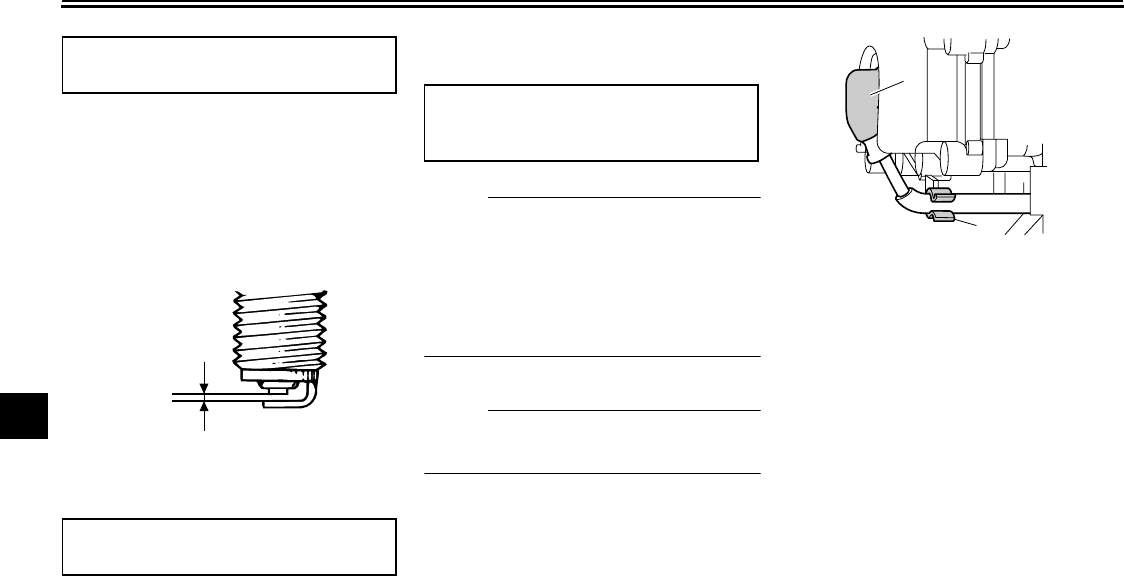
PERIODIC MAINTENANCE AND MINOR REPAIR
6-13
1
2
3
4
5
6
7
8
9
To install the spark plug
1. Measure the spark plug gap with a
wire thickness gauge and, if nec-
essary, adjust the gap to specifica-
tion.
2. Clean the surface of the spark plug
gasket and its mating surface, and
then wipe off any grime from the
spark plug threads.
3. Install the spark plug with the
spark plug wrench, and then tight-
en it to the specified torque.
NOTE:
If a torque wrench is not available when
installing a spark plug, a good estimate
of the correct torque is 1/4–1/2 turn
past finger tight. However, the spark
plug should be tightened to the speci-
fied torque as soon as possible.
4. Install the spark plug cap.
NOTE:
Make sure the spark plug wire is fas-
tened in the clamp as shown.
5. Install the spark plug cover by in-
stalling the screws.
6. Place the storage compartment
mat in the original position.
7. Close the rider seat.
Specified spark plug:
NGK/CR7E
1. Spark plug gap
Spark plug gap:
0.7–0.8 mm (0.028–0.031 in)
1
Tightening torque:
Spark plug:
12.5 Nm (1.25 m·kgf, 9 ft·lbf)
1. Spark plug cap
2. Spark plug wire clamp
1
2
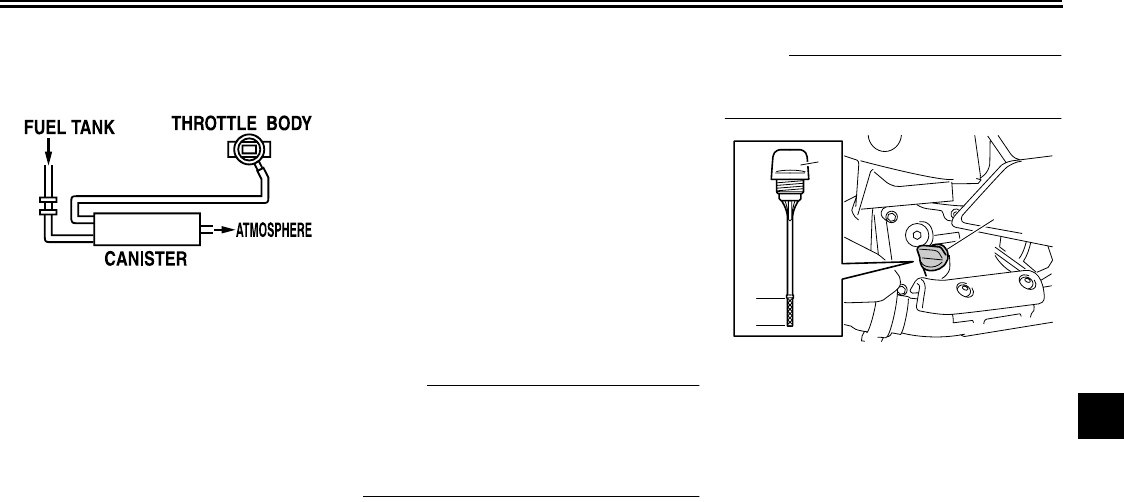
PERIODIC MAINTENANCE AND MINOR REPAIR
6-14
2
3
4
5
6
7
8
9
EAU36110
Canister
This model is equipped with a canister
to prevent the discharging of fuel vapor
into the atmosphere. Before operating
this vehicle, make sure to check the fol-
lowing:
●
Check each hose connection.
●
Check each hose and canister for
cracks or damage. Replace if
damaged.
●
Make sure that the canister breath-
er is not blocked, and if necessary,
clean it.
EAU34181
Engine oil and oil filter
element
The engine oil level should be checked
before each ride. In addition, the oil
must be changed and the oil filter ele-
ment replaced at the intervals specified
in the periodic maintenance and lubri-
cation chart and when the oil change in-
dicator comes on.
To check the engine oil level
1. Place the vehicle on the center-
stand.
NOTE:
Make sure that the vehicle is positioned
straight up when checking the oil level.
A slight tilt to the side can result in a
false reading.
2. Start the engine, warm it up for
several minutes, and then turn it
off.
3. Wait a few minutes until the oil set-
tles, remove the oil filler cap, wipe
the dipstick clean, insert it back
into the oil filler hole (without
screwing it in), and then remove it
again to check the oil level.
NOTE:
The engine oil should be between the
minimum and maximum level marks.
4. If the engine oil is below the mini-
mum level mark, add sufficient oil
of the recommended type to raise
it to the correct level.
5. Insert the dipstick into the oil filler
hole, and then tighten the oil filler
cap.
1. Engine oil filler cap
2. Maximum level mark
3. Minimum level mark
1
2
3
1
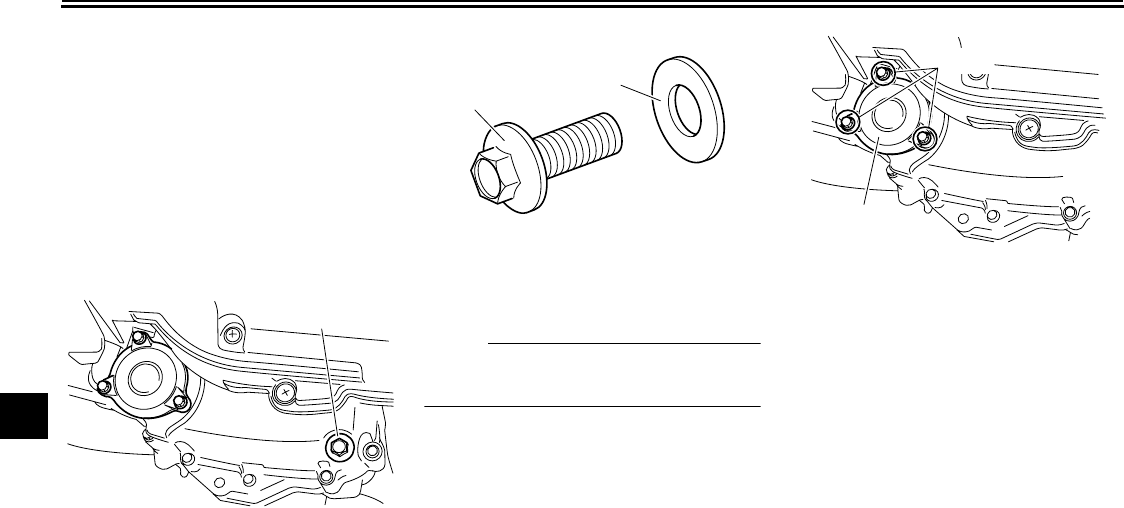
PERIODIC MAINTENANCE AND MINOR REPAIR
6-15
1
2
3
4
5
6
7
8
9
To change the engine oil (with or
without oil filter element replace-
ment)
1. Start the engine, warm it up for
several minutes, and then turn it
off.
2. Place an oil pan under the engine
to collect the used oil.
3. Remove the engine oil filler cap
and the engine oil drain bolt to
drain the oil from the crankcase.
4. Check the washer for damage and
replace it if necessary.
NOTE:
Skip steps 5–7 if the oil filter element is
not being replaced.
5. Remove the oil filter element cover
by removing the bolts.
6. Remove and replace the oil filter
element and O-rings.
1. Engine oil drain bolt
1
1. Engine oil drain bolt
2. Washer
2
1
1. Bolt
2. Oil filter element cover
2
1
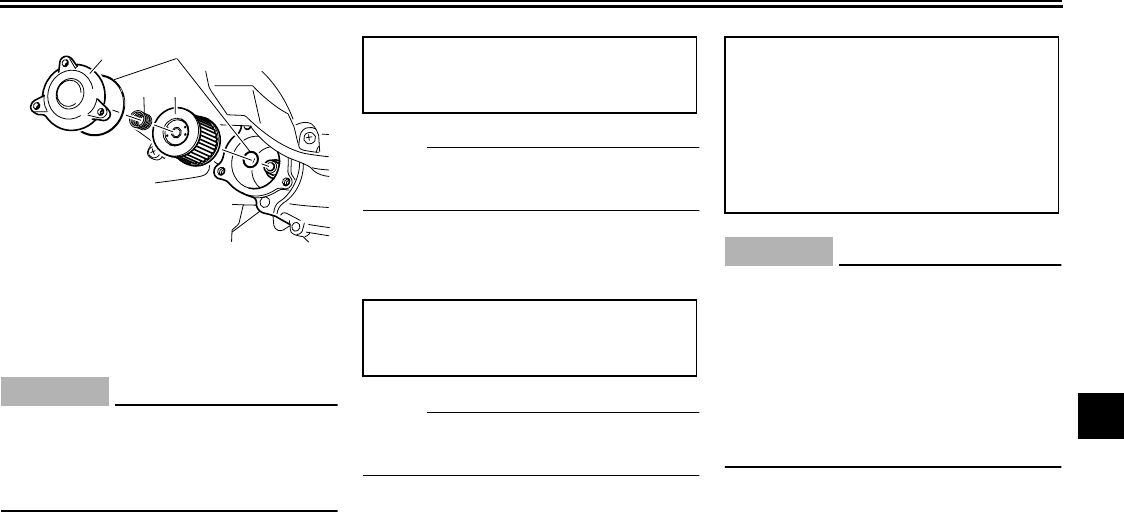
PERIODIC MAINTENANCE AND MINOR REPAIR
6-16
2
3
4
5
6
7
8
9
CAUTION:
ECA12910
When removing the oil filter element
cover, the compression spring will
fall out. Take care not to lose the
compression spring.
7. Install the compression spring and
oil filter element cover by installing
the bolts, then tightening them to
the specified torque.
NOTE:
Make sure that the O-rings are properly
seated.
8. Install the washer and the engine
oil drain bolt, and then tighten the
drain bolt to the specified torque.
NOTE:
Make sure that the washer is properly
seated.
9. Add the specified amount of the
recommended engine oil, and then
install and tighten the oil filler cap.
CAUTION:
ECA11670
●
Do not use oils with a diesel
specification of “CD” or oils of a
higher quality than specified. In
addition, do not use oils labeled
“ENERGY CONSERVING II” or
higher.
●
Be sure no foreign material en-
ters the crankcase.
10. Start the engine, and then let it idle
for several minutes while checking
it for oil leakage. If oil is leaking, im-
mediately turn the engine off and
check for the cause.
11. Reset the oil change indicator ac-
cording to the following procedure.
To reset the oil change indicator
1. Turn the key to “ON”.
1. Oil filter element cover
2. O-ring
3. Compression spring
4. Oil filter element
12
34
Tightening torque:
Oil filter element cover bolt:
10 Nm (1.0 m·kgf, 7.2 ft·lbf)
Tightening torque:
Engine oil drain bolt:
20 Nm (2.0 m·kgf, 14.5 ft·lbf)
Recommended engine oil:
See page 8-1.
Oil quantity:
Without oil filter element replace-
ment:
1.50 L (1.59 US qt) (1.32 Imp.qt)
With oil filter element replacement:
1.70 L (1.80 US qt) (1.50 Imp.qt)
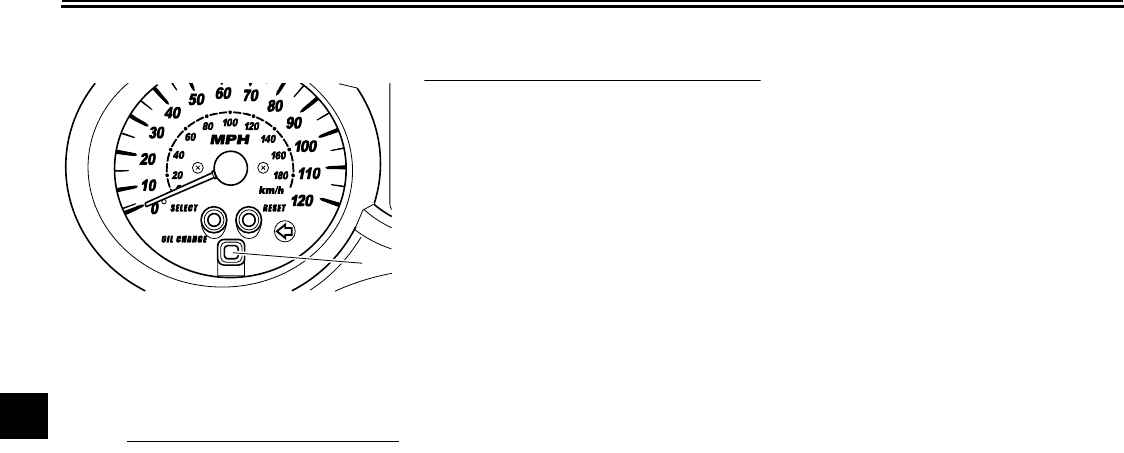
PERIODIC MAINTENANCE AND MINOR REPAIR
6-17
1
2
3
4
5
6
7
8
9
2. Hold the “OIL CHANGE” button
pushed for two to eight seconds.
3. Release the “OIL CHANGE” but-
ton, and the oil change indicator
will go off.
NOTE:
If the engine oil is changed before the
oil change indicator comes on (i.e. be-
fore the periodic oil change interval has
been reached), the indicator must be
reset after the oil change for the next
periodic oil change to be indicated at
the correct time. To reset the oil change
indicator before the periodic oil change
interval has been reached, follow the
above procedure, but note that the indi-
cator will come on for 1.4 seconds after
releasing the “OIL CHANGE” button,
otherwise repeat the procedure.
EAU20061
Final transmission oil
The final transmission case must be
checked for oil leakage before each
ride. If any leakage is found, have a
Yamaha dealer check and repair the
scooter. In addition, the final transmis-
sion oil must be changed as follows at
the intervals specified in the periodic
maintenance and lubrication chart.
1. Start the engine, warm up the final
transmission oil by riding the
scooter for several minutes, and
then stop the engine.
2. Place the scooter on the center-
stand.
3. Place an oil pan under the final
transmission case to collect the
used oil.
4. Remove the oil filler cap and drain
bolt to drain the oil from the final
transmission case.
1. “OIL CHANGE” button
1
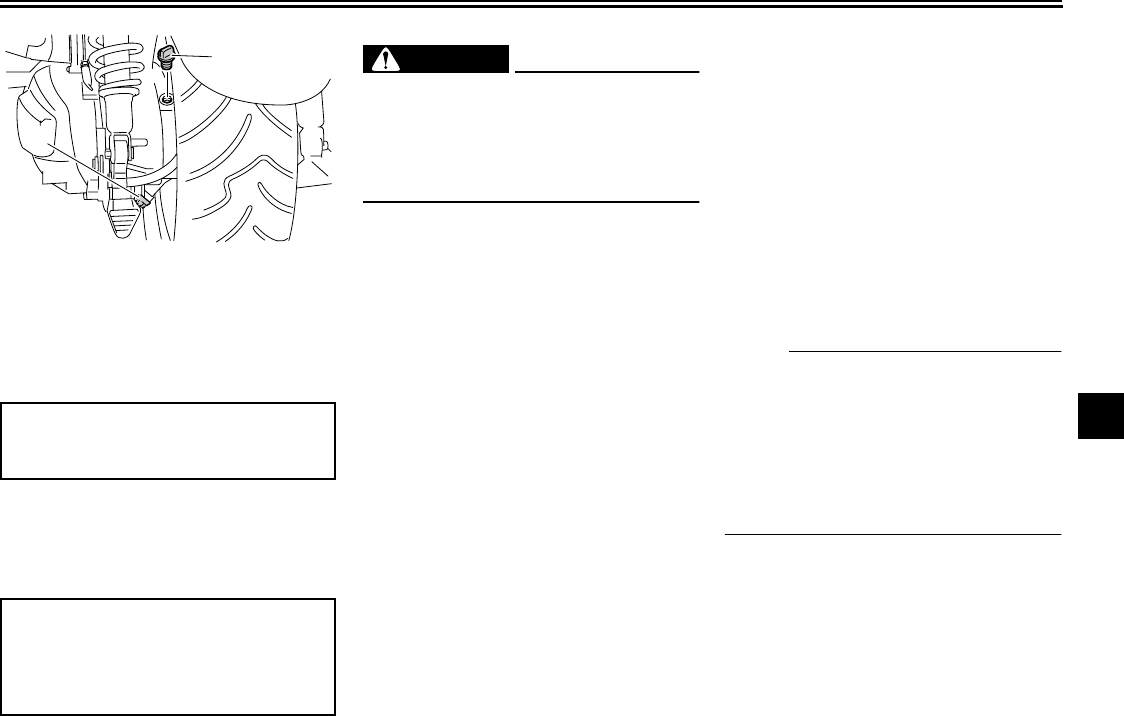
PERIODIC MAINTENANCE AND MINOR REPAIR
6-18
2
3
4
5
6
7
8
9
5. Install the final transmission oil
drain bolt, and then tighten it to the
specified torque.
6. Add the specified amount of the
recommended final transmission
oil, and then install and tighten the
oil filler cap.
WARNING
EWA11310
●
Make sure that no foreign mate-
rial enters the final transmission
case.
●
Make sure that no oil gets on the
tire or wheel.
7. Check the final transmission case
for oil leakage. If oil is leaking,
check for the cause.
EAU20070
Coolant
The coolant level should be checked
before each ride. In addition, the cool-
ant must be changed at the intervals
specified in the periodic maintenance
and lubrication chart.
EAU34192
To check the coolant level
1. Place the vehicle on a level sur-
face and hold it in an upright posi-
tion.
NOTE:
●
The coolant level must be checked
on a cold engine since the level
varies with engine temperature.
●
Make sure that the vehicle is posi-
tioned straight up when checking
the coolant level. A slight tilt to the
side can result in a false reading.
2. Pull up the right floorboard mat as
shown.
1. Final transmission oil filler cap
2. Final transmission oil drain bolt
Tightening torque:
Final transmission oil drain bolt:
20 Nm (2.0 m·kgf, 14.5 ft·lbf)
Recommended final transmission
oil:
See page 8-1.
Oil quantity:
0.25 L (0.26 US qt) (0.22 Imp.qt)
2
1
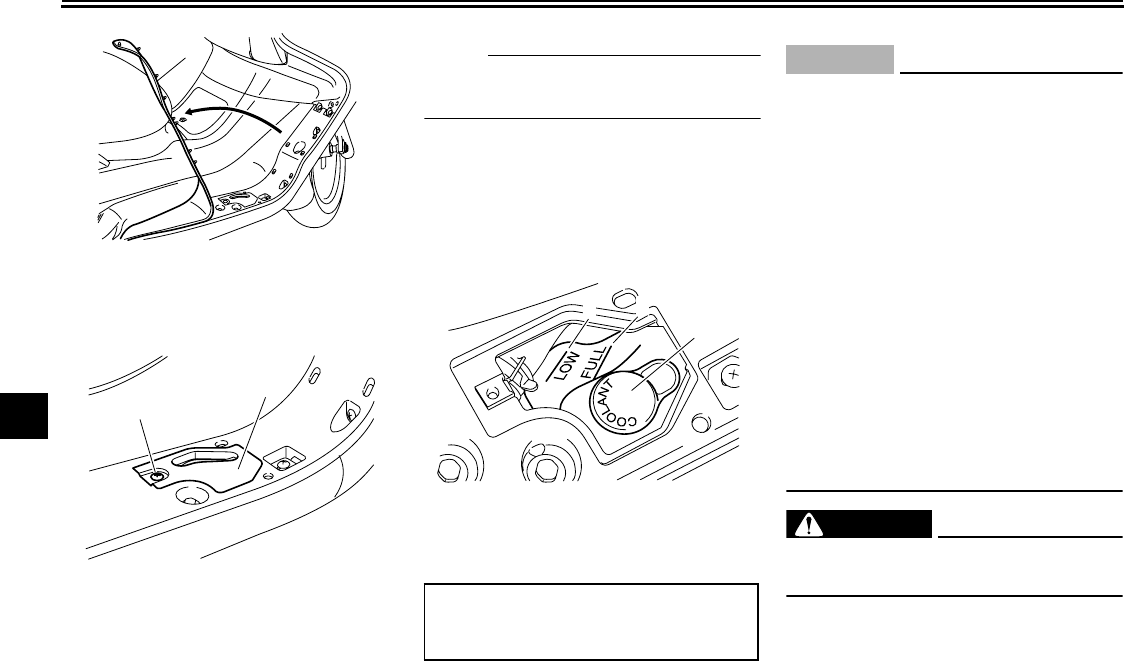
PERIODIC MAINTENANCE AND MINOR REPAIR
6-19
1
2
3
4
5
6
7
8
9
3. Remove the coolant reservoir cov-
er by removing the screw.
4. Check the coolant level in the cool-
ant reservoir.
NOTE:
The coolant should be between the
minimum and maximum level marks.
5. If the coolant is at or below the
minimum level mark, open the
coolant reservoir cap, add coolant
to the maximum level mark, and
then close the coolant reservoir
cap.
CAUTION:
ECA10471
●
If coolant is not available, use
distilled water or soft tap water
instead. Do not use hard water
or salt water since it is harmful
to the engine.
●
If water has been used instead
of coolant, replace it with cool-
ant as soon as possible, other-
wise the cooling system will not
be protected against frost and
corrosion.
●
If water has been added to the
coolant, have a Yamaha dealer
check the antifreeze content of
the coolant as soon as possible,
otherwise the effectiveness of
the coolant will be reduced.
WARNING
EWA10380
Never attempt to remove the radiator
cap when the engine is hot.
6. Install the coolant reservoir cover
by installing the screw.
7. Place the right floorboard mat in
the original position.
1. Right floorboard mat
1. Screw
2. Coolant reservoir cover
1
1
2
1. Minimum level mark
2. Maximum level mark
3. Coolant reservoir cap
Coolant reservoir capacity (up to the
maximum level mark):
0.32 L (0.34 US qt) (0.28 Imp.qt)
12
3
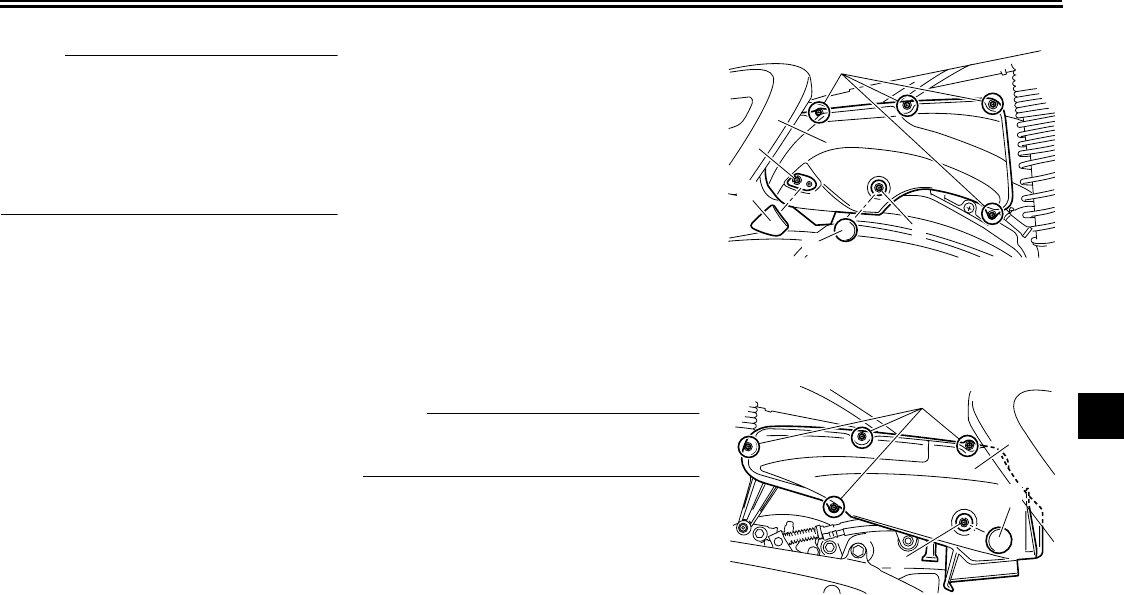
PERIODIC MAINTENANCE AND MINOR REPAIR
6-20
2
3
4
5
6
7
8
9
NOTE:
●
The radiator fan is automatically
switched on or off according to the
coolant temperature in the radia-
tor.
●
If the engine overheats, see page
6-40 for further instructions.
EAU34203
Air filter elements and check
hoses and V-belt case air filter
element
The air filter elements and the V-belt
case air filter element should be ser-
viced at the intervals specified in the
periodic maintenance and lubrication
chart. Service all air filter elements
more frequently if you are riding in un-
usually wet or dusty areas.
Replacing the air filter elements
1. Place the scooter on the center-
stand.
NOTE:
Continue as follows for each air filter el-
ement.
2. Remove the air filter case cover by
removing the rubber cap and
screws.
Left
Right
3. Pull the air filter element out.
1. Screw
2. Air filter case cover
3. Rubber cap
1. Screw
2. Air filter case cover
3. Rubber cap
1
2
1
1
3
3
1
1
2
3
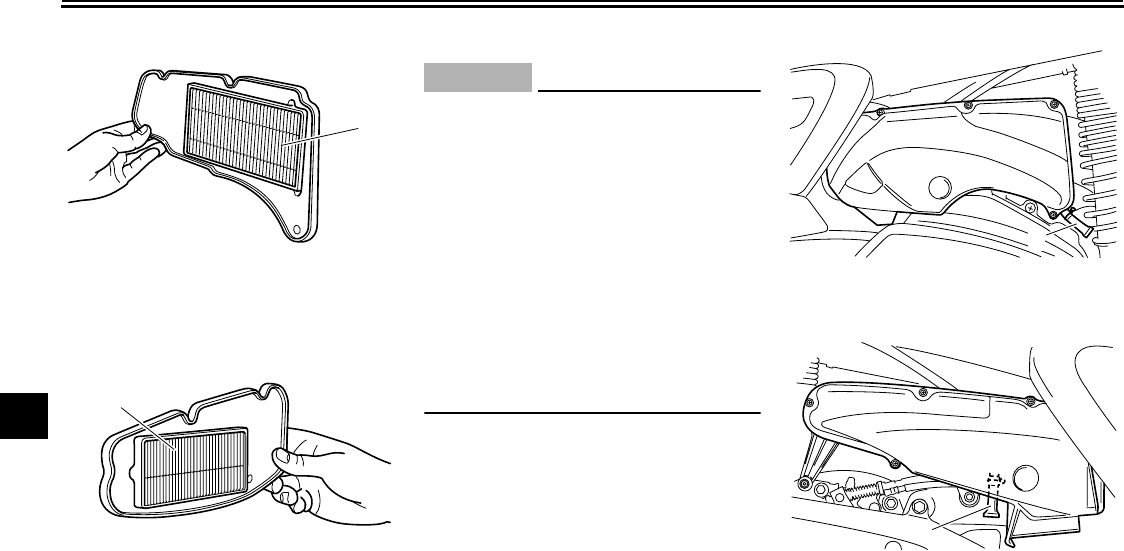
PERIODIC MAINTENANCE AND MINOR REPAIR
6-21
1
2
3
4
5
6
7
8
9
Left
Right
4. Insert a new air filter element into
the air filter case.
5. Install the air filter case cover by in-
stalling the screws.
6. Install the rubber cap.
CAUTION:
ECA12922
●
Make sure that each filter ele-
ment is properly seated in its
case.
●
Always replace both air filter el-
ements at the same time, other-
wise poor engine performance
or damage to the engine may re-
sult.
●
The engine should never be op-
erated without the filter ele-
ments installed, otherwise the
piston(s) and/or cylinder(s) may
become excessively worn.
To clean the air filter check hoses
1. Check the hose at the bottom of
both air filter cases for accumulat-
ed dirt or water.
Left
Right
2. If dirt or water is visible, remove
the hose, clean it, and then install
it.
1. Air filter element
1. Air filter element
1
1
1. Air filter check hose
1. Air filter check hose
1
1
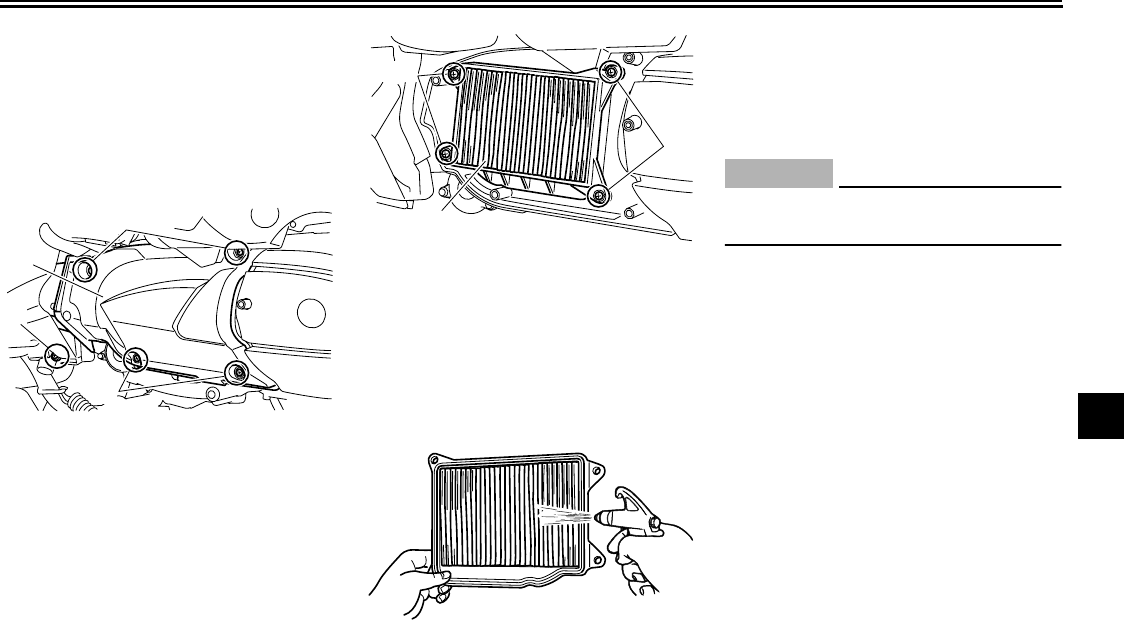
PERIODIC MAINTENANCE AND MINOR REPAIR
6-22
2
3
4
5
6
7
8
9
Cleaning the V-belt case air filter el-
ement
1. Remove cowling E. (See
page 6-8.)
2. Remove panel B. (See page 6-8.)
3. Remove the V-belt air filter case
cover by removing the screws.
4. Remove the V-belt case air filter
element by removing the screws.
5. Lightly tap the V-belt case air filter
element to remove most of the
dust and dirt, and then blow out the
dirt with compressed air as shown.
6. Check the V-belt case air filter ele-
ment for damage and replace it if
necessary.
7. Install the V-belt case air filter ele-
ment by installing the screws.
8. Install the V-belt air filter case cov-
er by installing the screws.
CAUTION:
ECA12940
Make sure that the V-belt filter ele-
ment is properly seated in its case.
9. Install the panel.
10. Install the cowling.
1. Screw
2. V-belt air filter case cover
2
1
1
1
1. Screw
2. V-belt case air filter element
2
1
1
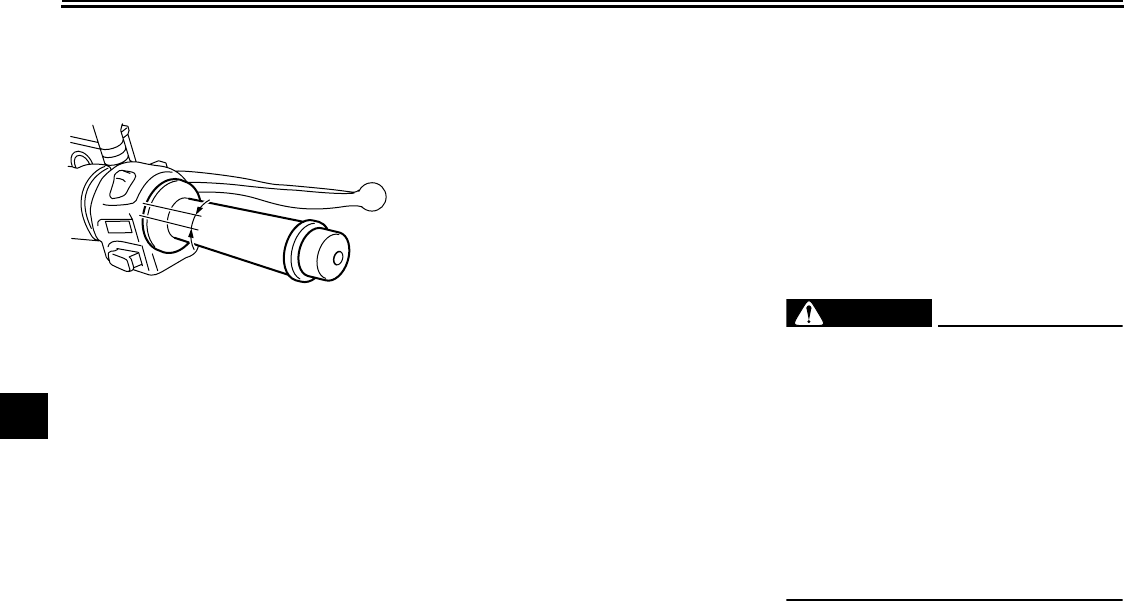
PERIODIC MAINTENANCE AND MINOR REPAIR
6-23
1
2
3
4
5
6
7
8
9
EAU21381
Checking the throttle cable
free play
The throttle cable free play should mea-
sure 3.0–5.0 mm (0.12–0.20 in) at the
throttle grip. Periodically check the
throttle cable free play and, if neces-
sary, have a Yamaha dealer adjust it.
EAU21401
Valve clearance
The valve clearance changes with use,
resulting in improper air-fuel mixture
and/or engine noise. To prevent this
from occurring, the valve clearance
must be adjusted by a Yamaha dealer
at the intervals specified in the periodic
maintenance and lubrication chart.
EAU36131
Tires
To maximize the performance, durabil-
ity, and safe operation of your vehicle,
note the following points regarding the
specified tires.
Tire air pressure
The tire air pressure should be checked
and, if necessary, adjusted before each
ride.
WARNING
EWA10500
●
The tire air pressure must be
checked and adjusted on cold
tires (i.e., when the temperature
of the tires equals the ambient
temperature).
●
The tire air pressure must be ad-
justed in accordance with the
riding speed and with the total
weight of rider, passenger, car-
go, and accessories approved
for this model.
1. Throttle cable free play
1

PERIODIC MAINTENANCE AND MINOR REPAIR
6-24
2
3
4
5
6
7
8
9
WARNING
EWA12600
Proper loading of your vehicle is im-
portant for several characteristics of
your vehicle, such as handling,
braking, performance and safety. Do
not carry loosely packed items that
can shift. Securely pack your heavi-
est items close to the center of the
vehicle, and distribute the weight
evenly from side to side. Properly
check the condition and pressure of
your tires. NEVER OVERLOAD
YOUR VEHICLE. Make sure that the
total weight of the cargo, rider, pas-
senger, and accessories (cowling,
saddlebags, etc. if approved for this
model) does not exceed the maxi-
mum load of the vehicle. Operation
of an overloaded vehicle could
cause tire damage, an accident, or
even injury.
Tire inspection
The tires must be checked before each
ride. If a tire tread shows crosswise
lines (minimum tread depth), if the tire
has a nail or glass fragments in it, or if
the sidewall is cracked, have a Yamaha
dealer replace the tire immediately.
NOTE:
The tire tread depth limits may differ
from country to country. Always comply
with the local regulations.
Tire information
This model is equipped with tubeless
tires.
WARNING
EWA10590
Operating the scooter with exces-
sively worn tires decrease riding
stability and can lead to loss of con-
trol. Have excessively worn tires re-
placed by a Yamaha dealer
immediately. Brakes, tires, and relat-
ed wheel parts replacement should
be left to a Yamaha Service Techni-
cian.
Tire air pressure (measured on cold
tires):
0–90 kg (0–198 lb):
Front:
200 kPa (29 psi) (2.00 kgf/cm
2
)
Rear:
250 kPa (36 psi) (2.50 kgf/cm
2
)
90–196 kg (198–432 lb):
Front:
200 kPa (29 psi) (2.00 kgf/cm
2
)
Rear:
250 kPa (36 psi) (2.50 kgf/cm
2
)
Maximum load*:
196 kg (432 lb)
* Total weight of rider, passenger, car-
go and accessories
1. Tire sidewall
2. Tire tread depth
3. Tire wear indicator
1
2
3
Minimum tire tread depth (front and
rear):
1.0 mm (0.04 in)
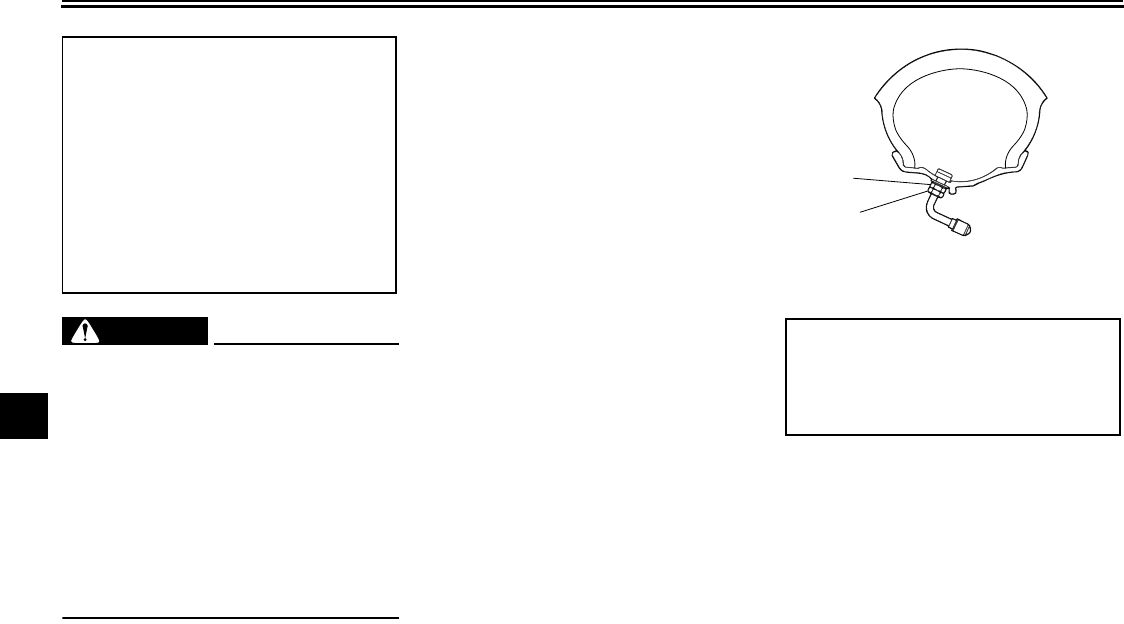
PERIODIC MAINTENANCE AND MINOR REPAIR
6-25
1
2
3
4
5
6
7
8
9
WARNING
EWA10580
●
It is dangerous to ride with a
worn-out tire. When a tire tread
begins to show crosswise lines,
have a Yamaha dealer replace
the tire immediately.
●
The replacement of all wheel-
and brake-related parts, includ-
ing the tires, should be left to a
Yamaha dealer, who has the
necessary professional knowl-
edge and experience.
EAU21992
Cast wheels
To maximize the performance, durabil-
ity, and safe operation of your vehicle,
note the following points regarding the
specified wheels.
●
The wheel rims should be checked
for cracks, bends, warpage or
damage before each ride. If any
damage is found, have a Yamaha
dealer replace the wheel. Do not
attempt even the smallest repair to
the wheel. A deformed or cracked
wheel must be replaced.
●
The wheel should be balanced
whenever either the tire or wheel
has been changed or replaced. An
unbalanced wheel can result in
poor performance, adverse han-
dling characteristics, and a short-
ened tire life.
●
Ride at moderate speeds after
changing a tire since the tire sur-
face must first be “broken in” for it
to develop its optimal characteris-
tics.
●
After repairing or replacing the rear
tire, tighten the valve stem nut and
locknut to the specified torques.
Front tire:
Size:
120/80-14M/C 58S
Manufacturer/model:
IRC/MB67
DUNLOP/D305FL
Rear tire:
Size:
150/70-13M/C 64S
Manufacturer/model:
IRC/MB67
DUNLOP/D305L
1. Valve stem nut
2. Valve stem locknut
Tightening torques:
Valve stem nut:
1.5 Nm (0.2 m·kgf, 1.1 ft·lbf)
Valve stem locknut:
3.0 Nm (0.3 m·kgf, 2.2 ft·lbf)
1
2
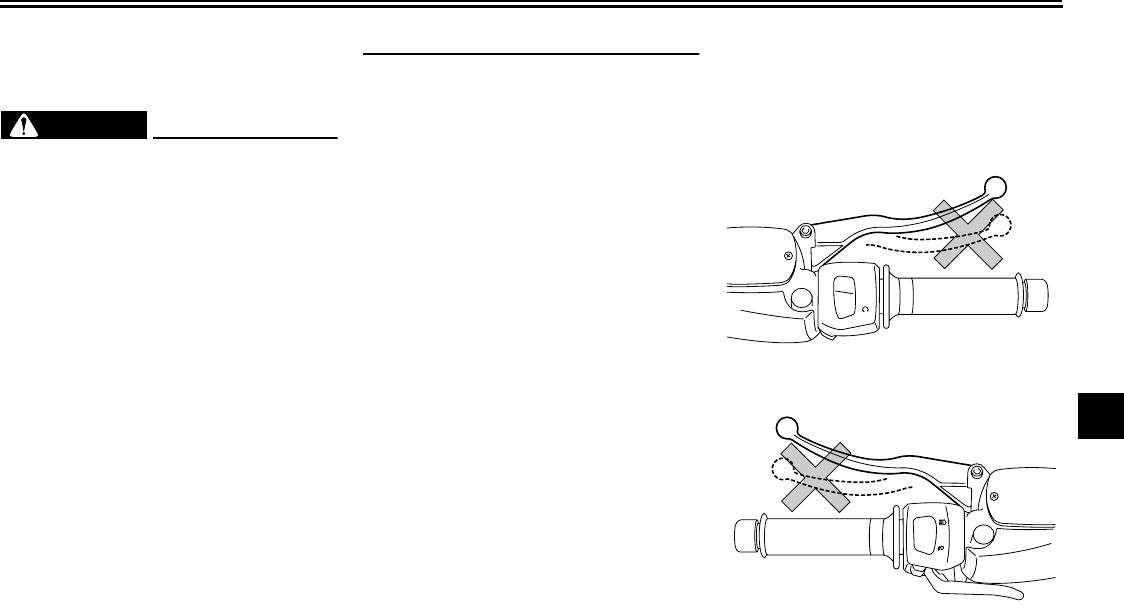
PERIODIC MAINTENANCE AND MINOR REPAIR
6-26
2
3
4
5
6
7
8
9
EAU22011
Accessories and replacement
parts
WARNING
EWA10621
This vehicle is not designed to pull a
trailer or to be attached to a sidecar.
The accessories or replacement
parts you choose for your vehicle
should be designed specifically for
this model, and they must be se-
curely mounted to maintain the in-
herent stability of the original
design. Genuine Yamaha Parts and
Accessories are designed and test-
ed to be compatible with your vehi-
cle. Please consider Genuine
Yamaha Parts and Accessories be-
fore making a purchase. Use of
non-Yamaha-approved accessories
or replacement parts may cause
loss of handling stability and riding
safety. Since Yamaha cannot con-
trol the quality of accessories or
parts manufactured by other compa-
nies, Yamaha cannot be held liable
for any consequences caused by
the use of items which have not
been approved by Yamaha.
EAU33453
Front and rear brake lever free
play
Front
Rear
There should be no free play at the
brake lever ends. If there is free play,
have a Yamaha dealer inspect the

PERIODIC MAINTENANCE AND MINOR REPAIR
6-27
1
2
3
4
5
6
7
8
9
brake system.
WARNING
EWA14211
A soft or spongy feeling in the brake
lever can indicate the presence of air
in the hydraulic system. If there is air
in the hydraulic system, have a
Yamaha dealer bleed the system be-
fore operating the vehicle. Air in the
hydraulic system will diminish the
braking performance, which may re-
sult in loss of control and an acci-
dent.
EAU33473
Adjusting the rear brake lock
lever cable
Rear brake lock lever cable adjustment
may be required if the rear brake lock
lever does not hold properly. When the
rear brake lock lever is not in use, the
rear brake lock lever cable length
should measure 45 mm to 47 mm (1.77
in to 1.85 in) at the rear brake caliper.
Periodically check the rear brake lock
lever cable length and, if necessary,
adjust it as follows.
To increase the rear brake lock lever
cable length, turn the adjusting nut at
the rear brake caliper in direction (a).
To decrease the rear brake lock lever
cable length, turn the adjusting nut in
direction (b).
WARNING
EWA10650
If proper adjustment cannot be ob-
tained as described, have a Yamaha
dealer make this adjustment.
1. Adjusting nut
2. Rear brake lock lever cable length
12
(a)
(b)
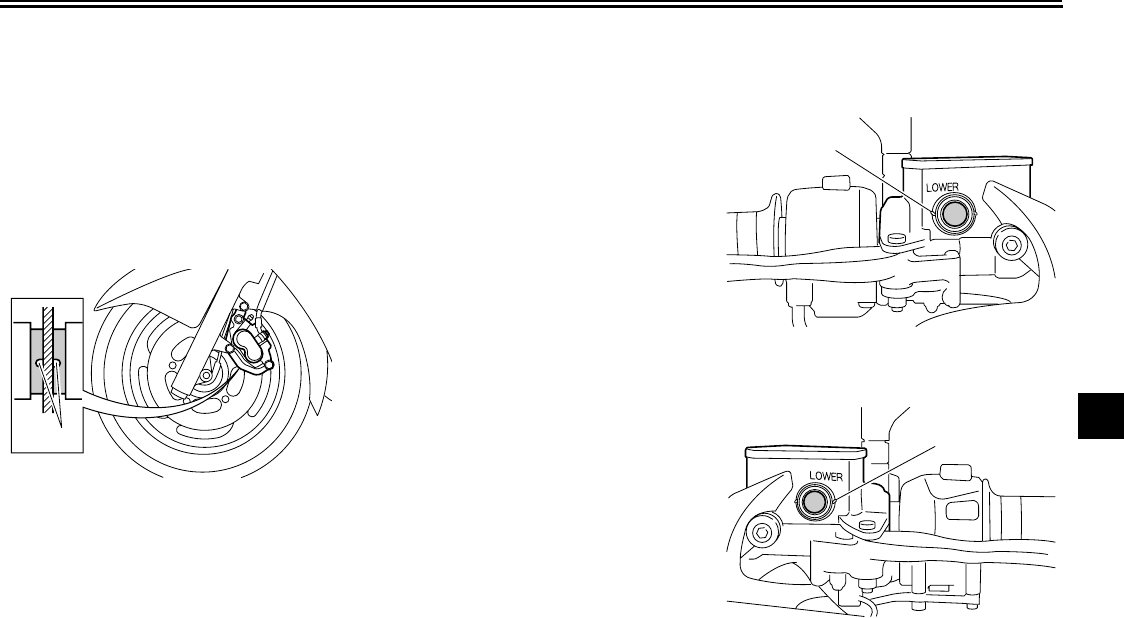
PERIODIC MAINTENANCE AND MINOR REPAIR
6-28
2
3
4
5
6
7
8
9
EAU22390
Checking the front and rear
brake pads
The front and rear brake pads must be
checked for wear at the intervals spec-
ified in the periodic maintenance and
lubrication chart.
EAU22420
Front brake pads
Each front brake pad is provided with a
wear indicator groove, which allows
you to check the brake pad wear with-
out having to disassemble the brake.
To check the brake pad wear, check
the wear indicator groove. If a brake
pad has worn to the point that the wear
indicator groove has almost disap-
peared, have a Yamaha dealer replace
the brake pads as a set.
EAU34210
Rear brake pads
Have a Yamaha dealer check each
rear brake pad for damage and mea-
sure the lining thickness and if neces-
sary, replace them as a set.
EAU22580
Checking the brake fluid level
Front brake
Rear brake
Insufficient brake fluid may allow air to
1. Wear indicator groove
1
1. Minimum level mark
1. Minimum level mark
1
1

PERIODIC MAINTENANCE AND MINOR REPAIR
6-29
1
2
3
4
5
6
7
8
9
enter the brake system, possibly caus-
ing it to become ineffective.
Before riding, check that the brake fluid
is above the minimum level mark and
replenish if necessary. A low brake fluid
level may indicate worn brake pads
and/or brake system leakage. If the
brake fluid level is low, be sure to check
the brake pads for wear and the brake
system for leakage.
Observe these precautions:
●
When checking the fluid level,
make sure that the top of the brake
fluid reservoir is level.
●
Use only the recommended quality
brake fluid, otherwise the rubber
seals may deteriorate, causing
leakage and poor braking perfor-
mance.
●
Refill with the same type of brake
fluid. Mixing fluids may result in a
harmful chemical reaction and
lead to poor braking performance.
●
Be careful that water does not en-
ter the brake fluid reservoir when
refilling. Water will significantly
lower the boiling point of the fluid
and may result in vapor lock.
●
Brake fluid may deteriorate paint-
ed surfaces or plastic parts. Al-
ways clean up spilled fluid
immediately.
●
As the brake pads wear, it is nor-
mal for the brake fluid level to grad-
ually go down. However, if the
brake fluid level goes down sud-
denly, have a Yamaha dealer
check the cause.
EAU22730
Changing the brake fluid
Have a Yamaha dealer change the
brake fluid at the intervals specified in
the NOTE after the periodic mainte-
nance and lubrication chart. In addition,
have the oil seals of the master cylin-
ders and calipers as well as the brake
hoses replaced at the intervals listed
below or whenever they are damaged
or leaking.
●
Oil seals: Replace every two
years.
●
Brake hoses: Replace every four
years.
Recommended brake fluid:
DOT 4
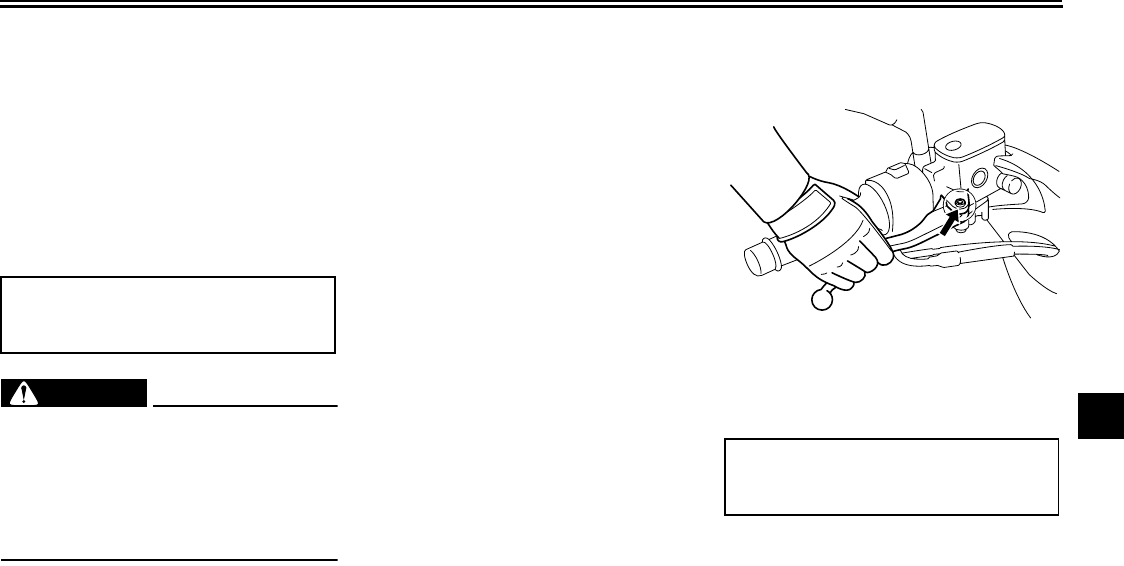
PERIODIC MAINTENANCE AND MINOR REPAIR
6-30
2
3
4
5
6
7
8
9
EAU23091
Checking and lubricating the
cables
The operation of all control cables and
the condition of the cables should be
checked before each ride, and the ca-
bles and cable ends should be lubricat-
ed if necessary. If a cable is damaged
or does not move smoothly, have a
Yamaha dealer check or replace it.
WARNING
EWA10710
Damage to the outer housing of ca-
bles may result in internal rusting
and cause interference with cable
movement. Replace damaged ca-
bles as soon as possible to prevent
unsafe conditions.
EAU23111
Checking and lubricating the
throttle grip and cable
The operation of the throttle grip should
be checked before each ride. In addi-
tion, the cable should be lubricated at
the intervals specified in the periodic
maintenance chart.
EAU23170
Lubricating the front and rear
brake levers
The pivoting points of the front and rear
brake levers must be lubricated at the
intervals specified in the periodic main-
tenance and lubrication chart.
Recommended lubricant:
Yamaha Chain and Cable Lube or
engine oil SAE 10W-30
Recommended lubricant:
Lithium-soap-based grease (all-pur-
pose grease)
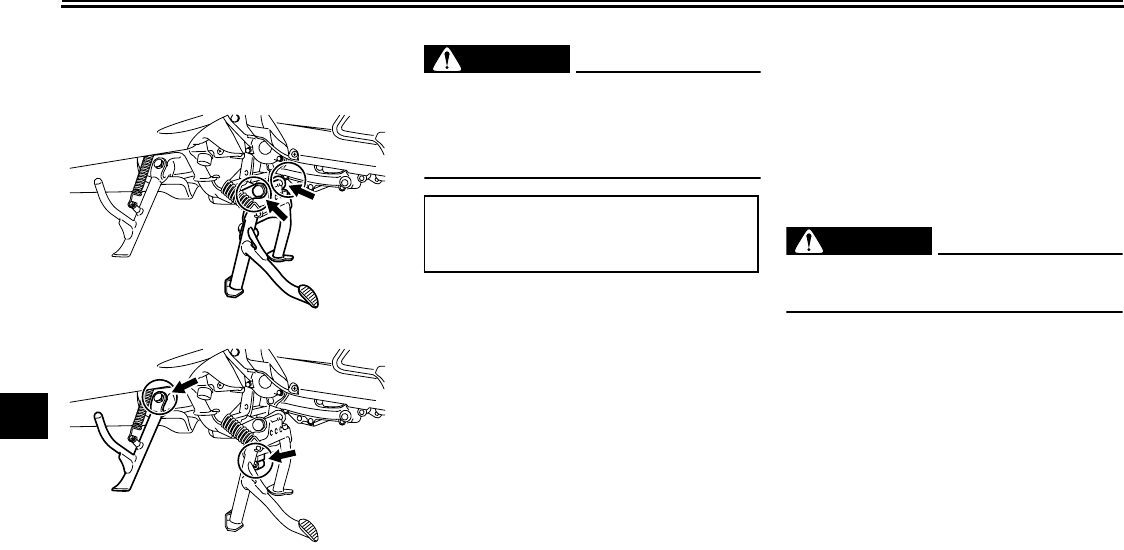
PERIODIC MAINTENANCE AND MINOR REPAIR
6-31
1
2
3
4
5
6
7
8
9
EAU23211
Checking and lubricating the
centerstand and sidestand
The operation of the centerstand and
sidestand should be checked before
each ride, and the pivots and met-
al-to-metal contact surfaces should be
lubricated if necessary.
WARNING
EWA10740
If the centerstand or sidestand does
not move up and down smoothly,
have a Yamaha dealer check or re-
pair it.
EAU23271
Checking the front fork
The condition and operation of the front
fork must be checked as follows at the
intervals specified in the periodic main-
tenance and lubrication chart.
To check the condition
WARNING
EWA10750
Securely support the vehicle so that
there is no danger of it falling over.
Check the inner tubes for scratches,
damage and excessive oil leakage.
To check the operation
1. Place the vehicle on a level sur-
face and hold it in an upright posi-
tion.
2. While applying the front brake,
push down hard on the handlebars
several times to check if the front
fork compresses and rebounds
smoothly.
Recommended lubricant:
Lithium-soap-based grease (all-pur-
pose grease)
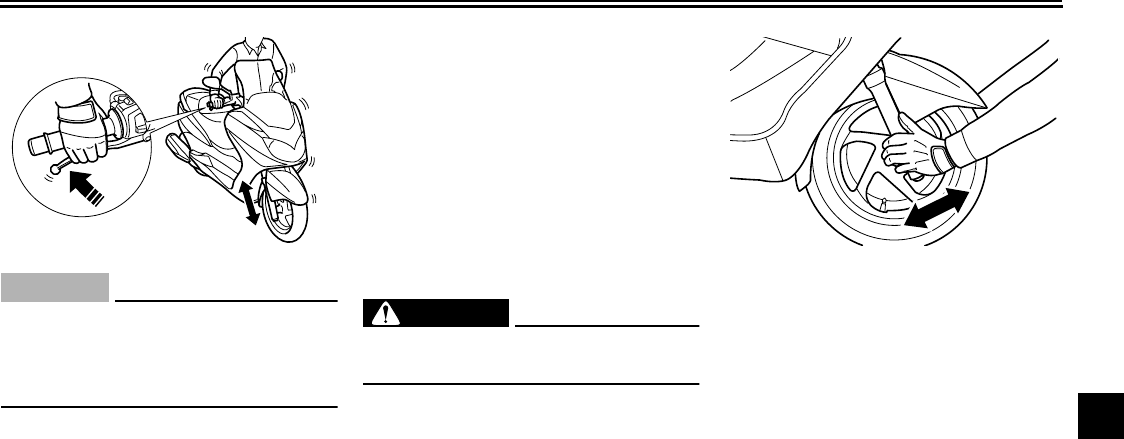
PERIODIC MAINTENANCE AND MINOR REPAIR
6-32
2
3
4
5
6
7
8
9
CAUTION:
ECA10590
If any damage is found or the front
fork does not operate smoothly,
have a Yamaha dealer check or re-
pair it.
EAU23280
Checking the steering
Worn or loose steering bearings may
cause danger. Therefore, the operation
of the steering must be checked as fol-
lows at the intervals specified in the pe-
riodic maintenance and lubrication
chart.
1. Place a stand under the engine to
raise the front wheel off the
ground.
WARNING
EWA10750
Securely support the vehicle so that
there is no danger of it falling over.
2. Hold the lower ends of the front
fork legs and try to move them for-
ward and backward. If any free
play can be felt, have a Yamaha
dealer check or repair the steering.
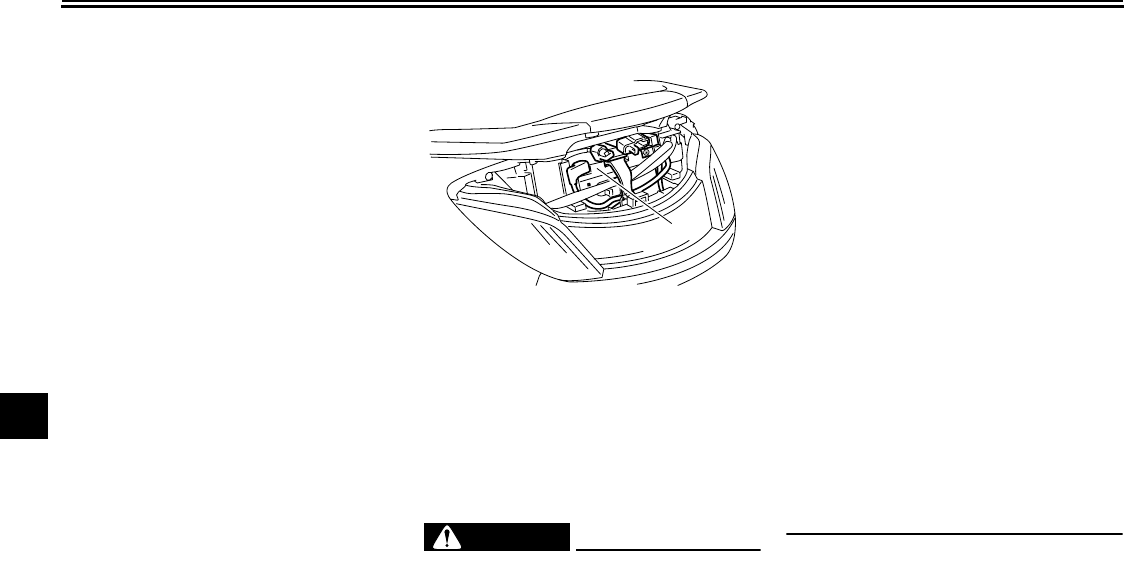
PERIODIC MAINTENANCE AND MINOR REPAIR
6-33
1
2
3
4
5
6
7
8
9
EAU23290
Checking the wheel bearings
The front and rear wheel bearings must
be checked at the intervals specified in
the periodic maintenance and lubrica-
tion chart. If there is play in the wheel
hub or if the wheel does not turn
smoothly, have a Yamaha dealer check
the wheel bearings.
EAU34221
Battery
The battery is located behind cowling
A. (See page 6-8.)
This model is equipped with a
sealed-type (MF) battery, which does
not require any maintenance. There is
no need to check the electrolyte or to
add distilled water.
WARNING
EWA10760
●
Electrolyte is poisonous and
dangerous since it contains sul-
furic acid, which causes severe
burns. Avoid any contact with
skin, eyes or clothing and al-
ways shield your eyes when
working near batteries. In case
of contact, administer the fol-
lowing FIRST AID.
●
EXTERNAL: Flush with plenty
of water.
●
INTERNAL: Drink large quan-
tities of water or milk and im-
mediately call a physician.
●
EYES: Flush with water for 15
minutes and seek prompt
medical attention.
●
Batteries produce explosive hy-
drogen gas. Therefore, keep
sparks, flames, cigarettes, etc.,
away from the battery and pro-
vide sufficient ventilation when
charging it in an enclosed
space.
●
KEEP THIS AND ALL BATTER-
IES OUT OF THE REACH OF
CHILDREN.
To charge the battery
Have a Yamaha dealer charge the bat-
tery as soon as possible if it seems to
have discharged. Keep in mind that the
battery tends to discharge more quickly
if the vehicle is equipped with optional
1. Battery
1

PERIODIC MAINTENANCE AND MINOR REPAIR
6-34
2
3
4
5
6
7
8
9
electrical accessories.
To store the battery
1. If the vehicle will not be used for
more than one month, remove the
battery, fully charge it, and then
place it in a cool, dry place.
2. If the battery will be stored for more
than two months, check it at least
once a month and fully charge it if
necessary.
3. Fully charge the battery before in-
stallation.
4. After installation, make sure that
the battery leads are properly con-
nected to the battery terminals.
CAUTION:
ECA10630
●
Always keep the battery
charged. Storing a discharged
battery can cause permanent
battery damage.
●
To charge a sealed-type (MF)
battery, a special (constant-volt-
age) battery charger is required.
Using a conventional battery
charger will damage the battery.
If you do not have access to a
sealed-type (MF) battery charg-
er, have a Yamaha dealer
charge your battery.
EAU34232
Replacing the fuses
The main fuse and the fuse box, which
contains the fuses for the individual cir-
cuits, are located behind cowling A.
(See page 6-8.)
If a fuse is blown, replace it as follows.
1. Turn the key to “OFF” and turn off
the electrical circuit in question.
2. Remove the blown fuse, and then
install a new fuse of the specified
amperage.
NOTE:
If the main fuse is blown, remove the
grab bar to access the main fuse. After
replacing the main fuse, install the grab
bar. (See page 6-8.)
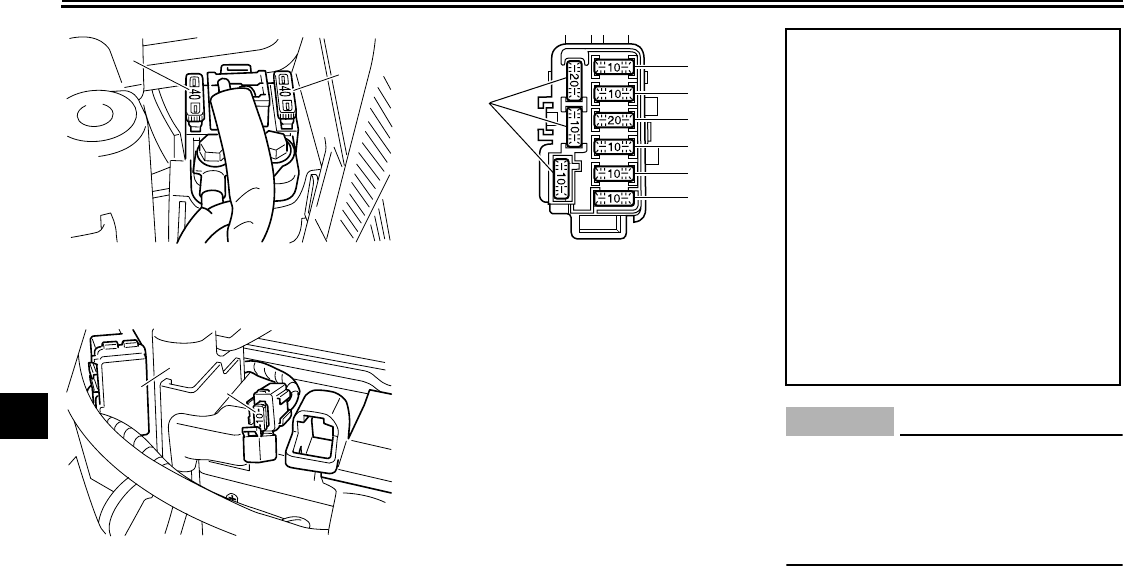
PERIODIC MAINTENANCE AND MINOR REPAIR
6-35
1
2
3
4
5
6
7
8
9
CAUTION:
ECA10640
Do not use a fuse of a higher amper-
age rating than recommended to
avoid causing extensive damage to
the electrical system and possibly a
fire.
3. Turn the key to “ON” and turn on
the electrical circuit in question to
check if the device operates.
4. If the fuse immediately blows
again, have a Yamaha dealer
check the electrical system.
1. Spare main fuse
2. Main fuse
1. Fuse box
2. Taillight fuse
1
2
1
2
1. Ignition fuse
2. Signaling system fuse
3. Headlight fuse
4. Radiator fan fuse
5. Backup fuse (for odometer and clock)
6. Fuel injection system fuse
7. Spare fuse
7
1
2
3
4
5
6
Specified fuses:
Main fuse:
40.0 A
Ignition fuse:
10.0 A
Signaling system fuse:
10.0 A
Headlight fuse:
20.0 A
Taillight fuse:
10.0 A
Radiator fan fuse:
10.0 A
Fuel injection system fuse:
10.0 A
Backup fuse:
10.0 A
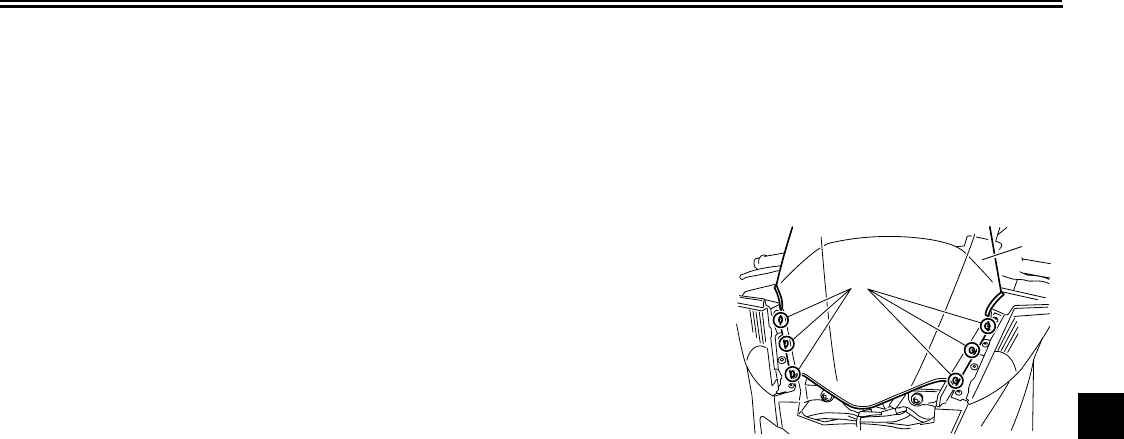
PERIODIC MAINTENANCE AND MINOR REPAIR
6-36
2
3
4
5
6
7
8
9
EAU34240
Replacing a headlight bulb
This model is equipped with quartz bulb
headlights. If a headlight bulb burns
out, have a Yamaha dealer replace it
and, if necessary, adjust the headlight
beam.
EAU24180
Tail/brake light
This model is equipped with an LED
type of tail/brake light.
If the tail/brake light does not come on,
have a Yamaha dealer check it.
EAU36121
Replacing a front turn signal
light bulb
1. Place the scooter on the center-
stand.
2. Remove panel A. (See page 6-8.)
3. Remove the windshield by remov-
ing the screws.
4. Remove the front turn signal light
unit by removing the screws.
1. Screw
2. Windshield
1
2
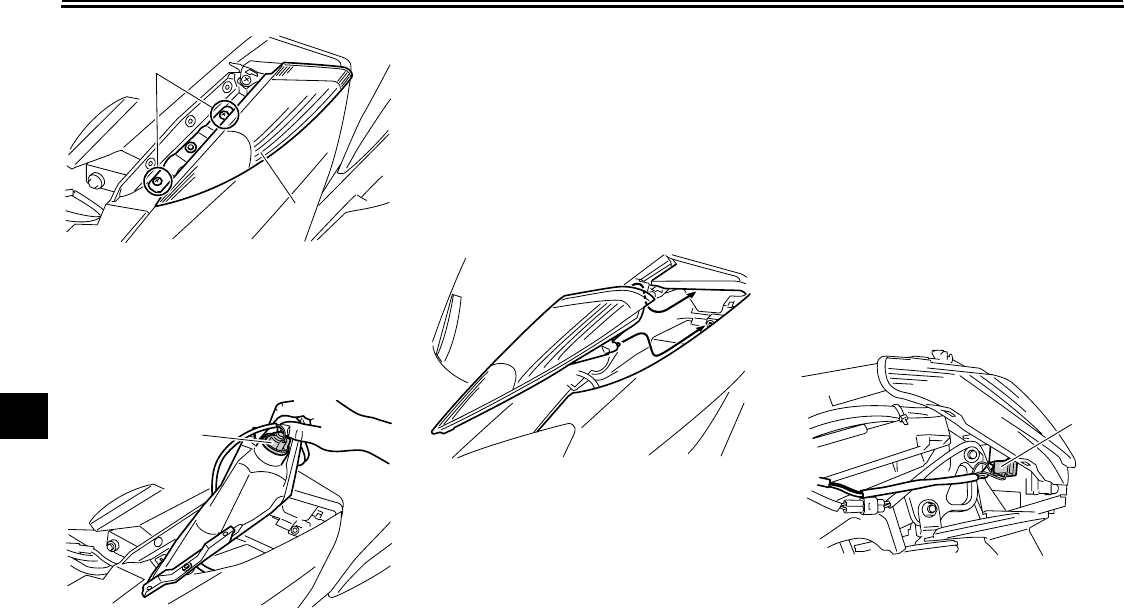
PERIODIC MAINTENANCE AND MINOR REPAIR
6-37
1
2
3
4
5
6
7
8
9
5. Remove the socket (together with
the bulb) by turning it counter-
clockwise.
6. To remove the defective turn sig-
nal light bulb, push it in and turn it
counterclockwise.
7. To insert a new turn signal light
bulb into the socket, push it in, and
then turn it clockwise until it stops.
8. Install the socket (together with the
bulb) by turning it clockwise.
9. Place the turn signal light unit in
the original position, and then in-
stall the screws.
10. Install the windshield by installing
the screws.
11. Install panel A.
EAU34260
Replacing a rear turn signal
light bulb
1. Place the scooter on the center-
stand.
2. Remove cowling C for replacing
the left turn signal light bulb or
cowling D for replacing the right
turn signal light bulb. (See
page 6-8.)
3. Remove the socket (together with
the turn signal light bulb) by turning
it counterclockwise.
4. Remove the defective bulb by
pushing it in and turning it counter-
clockwise.
5. Insert a new bulb into the socket,
1. Screw
2. Front turn signal light unit
1. Turn signal light bulb socket
1
2
1
1. Turn signal light bulb socket
1
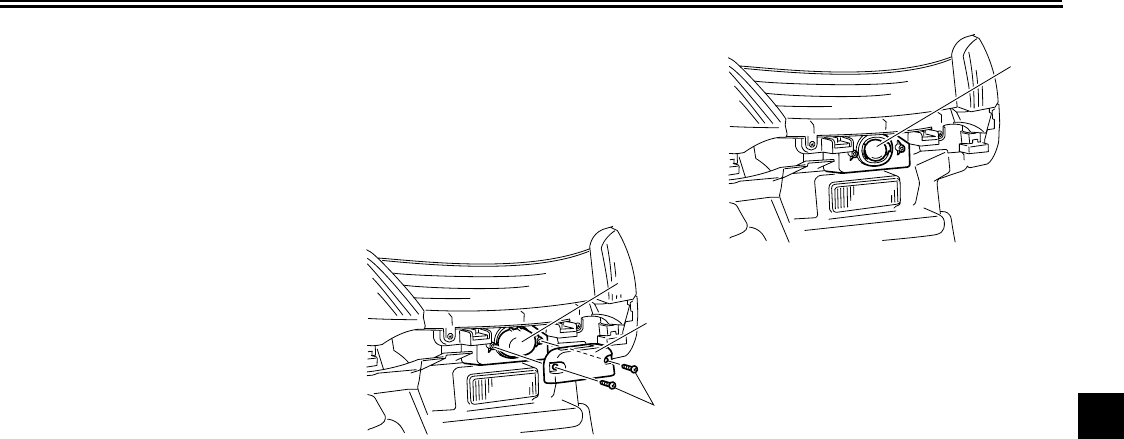
PERIODIC MAINTENANCE AND MINOR REPAIR
6-38
2
3
4
5
6
7
8
9
push it in, and then turn it clock-
wise until it stops.
6. Install the socket (together with the
bulb) by turning it clockwise.
7. Install the cowling removed.
EAU34270
Replacing the license plate
light bulb
1. Remove cowling B. (See
page 6-8.)
2. Remove the license plate light cov-
er and license plate light lens by
removing the screws.
3. Remove the defective bulb by
pushing it in and turning it counter-
clockwise.
4. Insert a new bulb into the socket,
push it in, and then turn it clock-
wise until it stops.
5. Install the license plate light lens
and license plate light cover by in-
stalling the screws.
6. Install the cowling.
1. License plate light lens
2. License plate light cover
3. Screw
1
2
3
1. Bulb
1

PERIODIC MAINTENANCE AND MINOR REPAIR
6-39
1
2
3
4
5
6
7
8
9
EAU25880
Troubleshooting
Although Yamaha scooters receive a
thorough inspection before shipment
from the factory, trouble may occur dur-
ing operation. Any problem in the fuel,
compression, or ignition systems, for
example, can cause poor starting and
loss of power.
The following troubleshooting charts
represent quick and easy procedures
for checking these vital systems your-
self. However, should your scooter re-
quire any repair, take it to a Yamaha
dealer, whose skilled technicians have
the necessary tools, experience, and
know-how to service the scooter prop-
erly.
Use only genuine Yamaha replace-
ment parts. Imitation parts may look like
Yamaha parts, but they are often inferi-
or, have a shorter service life and can
lead to expensive repair bills.
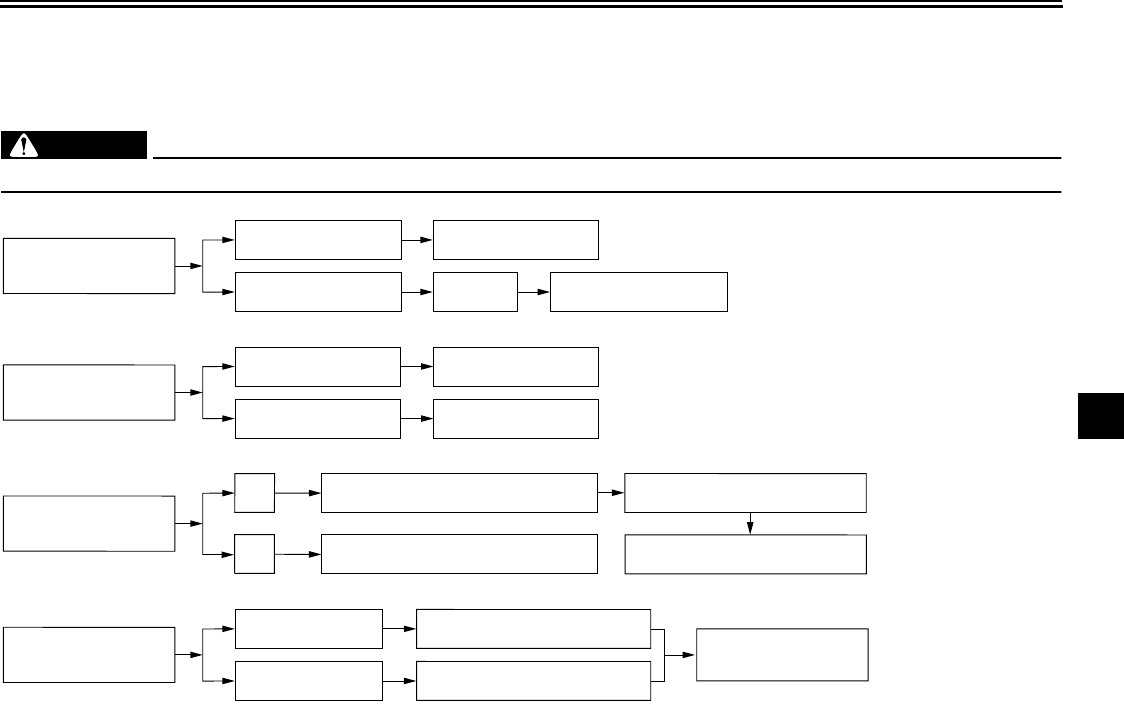
PERIODIC MAINTENANCE AND MINOR REPAIR
6-40
2
3
4
5
6
7
8
9
EAU42130
Troubleshooting charts
Starting problems or poor engine
performance
WARNING
EWA10840
Keep away open flames and do not smoke while checking or working on the fuel system.
Check the fuel level in
the fuel tank.
1. Fuel
There is enough fuel.
There is no fuel.
Check the compression.
Supply fuel. The engine does not start.
Check the compression.
Operate the electric starter.
2. Compression
There is compression.
There is no compression.
Check the ignition.
Have a Yamaha dealer
check the vehicle.
Remove the spark plug
and check the electrodes.
3. Ignition Wipe off with a dry cloth and correct the
spark plug gap, or replace the spark plug.
Have a Yamaha dealer check the vehicle.
The engine does not start.
Have a Yamaha dealer
check the vehicle.
The engine does not start.
Check the battery.
Operate the electric starter.
4. Battery The engine turns over
quickly.
The engine turns over
slowly.
The battery is good.
Check the battery lead connections,
and charge the battery if necessary.
Dry
Wet Operate the electric starter.
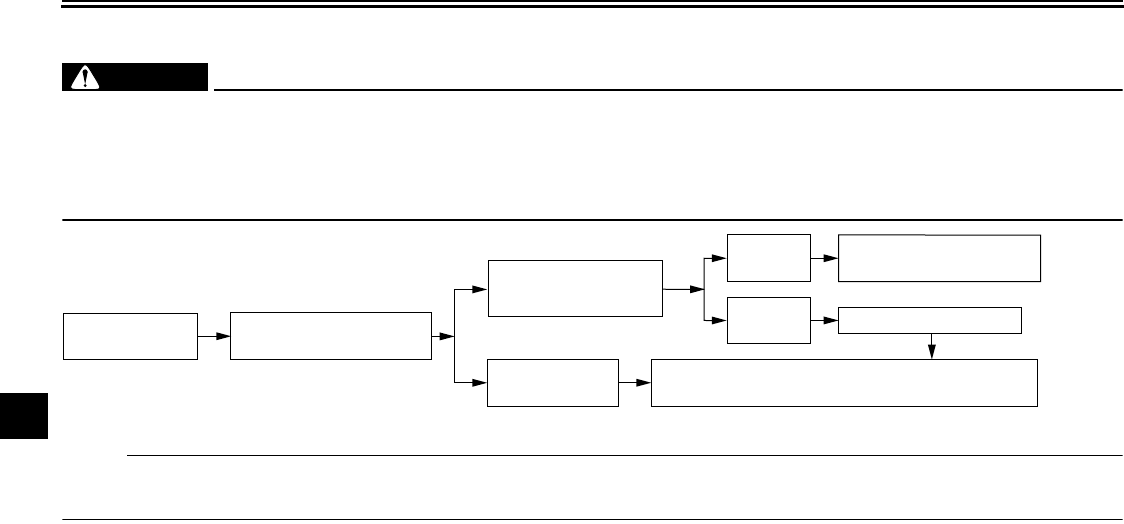
PERIODIC MAINTENANCE AND MINOR REPAIR
6-41
1
2
3
4
5
6
7
8
9
Engine overheating
WARNING
EWA10400
●
Do not remove the radiator cap when the engine and radiator are hot. Scalding hot fluid and steam may be
blown out under pressure, which could cause serious injury. Be sure to wait until the engine has cooled.
●
After removing the radiator cap retaining bolt, place a thick rag, like a towel, over the radiator cap, and then
slowly rotate the cap counterclockwise to the detent to allow any residual pressure to escape. When the hissing
sound has stopped, press down on the cap while turning it counterclockwise, and then remove the cap.
NOTE:
If coolant is not available, tap water can be temporarily used instead, provided that it is changed to the recommended coolant
as soon as possible.
Wait until the
engine has cooled.
Check the coolant level in the
reservoir and radiator.
The coolant level
is OK.
The coolant level is low.
Check the cooling system
for leakage.
Have a Yamaha dealer check
and repair the cooling system.
Add coolant. (See NOTE.)
Start the engine. If the engine overheats again, have a
Yamaha dealer check
and repair the cooling system.
There is
leakage.
There is
no leakage.
7-1
2
3
4
5
6
7
8
9
SCOOTER CARE AND STORAGE
EAU26090
Care
While the open design of a scooter re-
veals the attractiveness of the technol-
ogy, it also makes it more vulnerable.
Rust and corrosion can develop even if
high-quality components are used. A
rusty exhaust pipe may go unnoticed
on a car, however, it detracts from the
overall appearance of a scooter. Fre-
quent and proper care does not only
comply with the terms of the warranty,
but it will also keep your scooter looking
good, extend its life and optimize its
performance.
Before cleaning
1. Cover the muffler outlet with a
plastic bag after the engine has
cooled down.
2. Make sure that all caps and covers
as well as all electrical couplers
and connectors, including the
spark plug cap, are tightly in-
stalled.
3. Remove extremely stubborn dirt,
like oil burnt onto the crankcase,
with a degreasing agent and a
brush, but never apply such prod-
ucts onto seals, gaskets and wheel
axles. Always rinse the dirt and de-
greaser off with water.
Cleaning
CAUTION:
ECA10780
●
Avoid using strong acidic wheel
cleaners, especially on spoked
wheels. If such products are
used on hard-to-remove dirt, do
not leave the cleaner on the af-
fected area any longer than in-
structed. Also, thoroughly rinse
the area off with water, immedi-
ately dry it, and then apply a cor-
rosion protection spray.
●
Improper cleaning can damage
windshields, cowlings, panels
and other plastic parts. Use only
a soft, clean cloth or sponge
with mild detergent and water to
clean plastic.
●
Do not use any harsh chemical
products on plastic parts. Be
sure to avoid using cloths or
sponges which have been in
contact with strong or abrasive
cleaning products, solvent or
thinner, fuel (gasoline), rust re-
movers or inhibitors, brake flu-
id, antifreeze or electrolyte.
●
Do not use high-pressure wash-
ers or steam-jet cleaners since
they cause water seepage and
deterioration in the following ar-
eas: seals (of wheel and swing-
arm bearings, fork and brakes),
electric components (couplers,
connectors, instruments,
switches and lights), breather
hoses and vents.
●
For scooters equipped with a
windshield: Do not use strong
cleaners or hard sponges as
they will cause dulling or
scratching. Some cleaning com-
pounds for plastic may leave
scratches on the windshield.
Test the product on a small hid-
den part of the windshield to
make sure that it does not leave
any marks. If the windshield is
scratched, use a quality plastic
polishing compound after
washing.
SCOOTER CARE AND STORAGE
7-2
1
2
3
4
5
6
7
8
9
After normal use
Remove dirt with warm water, a mild
detergent, and a soft, clean sponge,
and then rinse thoroughly with clean
water. Use a toothbrush or bottlebrush
for hard-to-reach areas. Stubborn dirt
and insects will come off more easily if
the area is covered with a wet cloth for
a few minutes before cleaning.
After riding in the rain, near the sea or
on salt-sprayed roads
Since sea salt or salt sprayed on the
roads during winter are extremely cor-
rosive in combination with water, carry
out the following steps after each ride in
the rain, near the sea or on
salt-sprayed roads.
NOTE:
Salt sprayed on roads in the winter may
remain well into spring.
1. Clean the scooter with cold water
and a mild detergent after the en-
gine has cooled down.
CAUTION:
ECA10790
Do not use warm water since it in-
creases the corrosive action of the
salt.
2. Apply a corrosion protection spray
on all metal, including chrome- and
nickel-plated, surfaces to prevent
corrosion.
After cleaning
1. Dry the scooter with a chamois or
an absorbing cloth.
2. Use a chrome polish to shine
chrome, aluminum and stain-
less-steel parts, including the ex-
haust system. (Even the thermally
induced discoloring of stain-
less-steel exhaust systems can be
removed through polishing.)
3. To prevent corrosion, it is recom-
mended to apply a corrosion pro-
tection spray on all metal,
including chrome- and nickel-plat-
ed, surfaces.
4. Use spray oil as a universal clean-
er to remove any remaining dirt.
5. Touch up minor paint damage
caused by stones, etc.
6. Wax all painted surfaces.
7. Let the scooter dry completely be-
fore storing or covering it.
WARNING
EWA10940
●
Make sure that there is no oil or
wax on the brakes or tires. If
necessary, clean the brake
discs and brake linings with a
regular brake disc cleaner or ac-
etone, and wash the tires with
warm water and a mild deter-
gent.
●
Before operating the scooter
test its braking performance
and cornering behavior.
CAUTION:
ECA10800
●
Apply spray oil and wax spar-
ingly and make sure to wipe off
any excess.
●
Never apply oil or wax to any
rubber and plastic parts, but
treat them with a suitable care
product.
●
Avoid using abrasive polishing
compounds as they will wear
away the paint.
NOTE:
Consult a Yamaha dealer for advice on
SCOOTER CARE AND STORAGE
7-3
2
3
4
5
6
7
8
9
what products to use.
EAU36560
Storage
Short-term
Always store your scooter in a cool, dry
place and, if necessary, protect it
against dust with a porous cover.
CAUTION:
ECA10820
●
Storing the scooter in a poorly
ventilated room or covering it
with a tarp, while it is still wet,
will allow water and humidity to
seep in and cause rust.
●
To prevent corrosion, avoid
damp cellars, stables (because
of the presence of ammonia)
and areas where strong chemi-
cals are stored.
Long-term
Before storing your scooter for several
months:
1. Follow all the instructions in the
“Care” section of this chapter.
2. Fill up the fuel tank and add fuel
stabilizer (if available) to prevent
the fuel tank from rusting and the
fuel from deteriorating.
3. Perform the following steps to pro-
tect the cylinder, piston rings, etc.
from corrosion.
a. Remove the spark plug cap
and spark plug.
b. Pour a teaspoonful of engine oil
into the spark plug bore.
c. Install the spark plug cap onto
the spark plug, and then place
the spark plug on the cylinder
head so that the electrodes are
grounded. (This will limit spark-
ing during the next step.)
d. Turn the engine over several
times with the starter. (This will
coat the cylinder wall with oil.)
e. Remove the spark plug cap
from the spark plug, and then
install the spark plug and the
spark plug cap.
WARNING
EWA10950
To prevent damage or injury from
sparking, make sure to ground the
spark plug electrodes while turning
the engine over.
4. Lubricate all control cables and the
SCOOTER CARE AND STORAGE
7-4
1
2
3
4
5
6
7
8
9
pivoting points of all levers and
pedals as well as of the sidestand/
centerstand.
5. Check and, if necessary, correct
the tire air pressure, and then lift
the scooter so that both of its
wheels are off the ground. Alterna-
tively, turn the wheels a little every
month in order to prevent the tires
from becoming degraded in one
spot.
6. Cover the muffler outlet with a
plastic bag to prevent moisture
from entering it.
7. Remove the battery and fully
charge it. Store it in a cool, dry
place and charge it once a month.
Do not store the battery in an ex-
cessively cold or warm place
[less than 0 °C (30 °F) or more
than 30 °C (90 °F)]. For more in-
formation on storing the battery,
see page 6-33.
NOTE:
Make any necessary repairs before
storing the scooter.
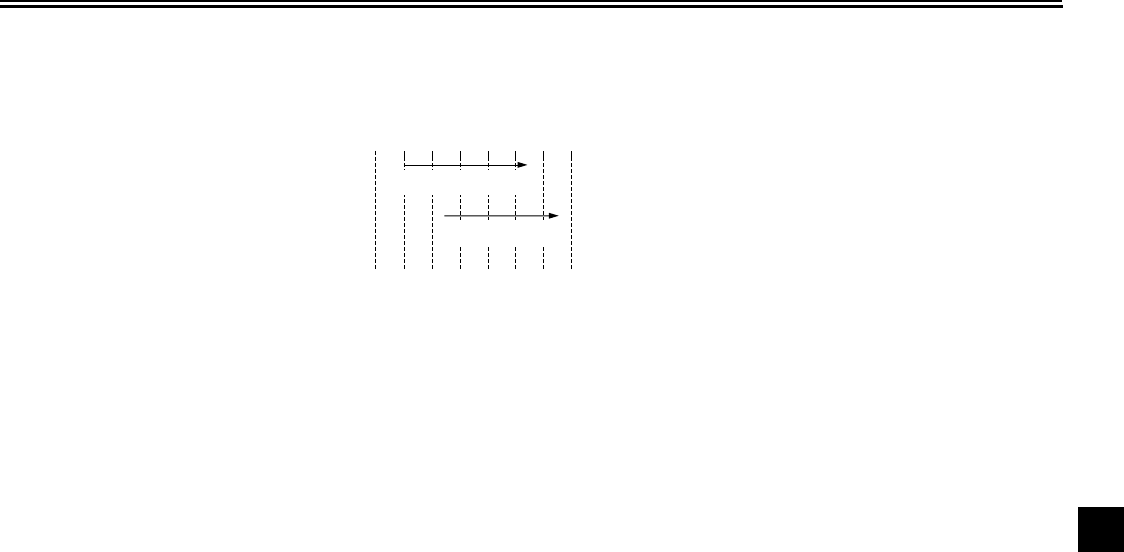
8-1
2
3
4
5
6
7
8
9
SPECIFICATIONS
EAU2633G
Dimensions:
Overall length:
2230 mm (87.8 in)
Overall width:
780 mm (30.7 in)
Overall height:
1380 mm (54.3 in)
Seat height:
750 mm (29.5 in)
Wheelbase:
1565 mm (61.6 in)
Ground clearance:
120 mm (4.72 in)
Minimum turning radius:
2600 mm (102.4 in)
Weight:
With oil and fuel:
212.0 kg (467 lb)
Engine:
Engine type:
Liquid cooled 4-stroke, DOHC
Cylinder arrangement:
Forward-inclined single cylinder
Displacement:
395.0 cm
3
Bore
×
stroke:
83.0
×
73.0 mm (3.27
×
2.87 in)
Compression ratio:
10.60 :1
Starting system:
Electric starter
Lubrication system:
Wet sump
Engine oil:
Type:
YAMALUBE 4, SAE10W30 or SAE20W40
Recommended engine oil grade:
API service SE, SF, SG type or higher
Engine oil quantity:
Without oil filter element replacement:
1.50 L (1.59 US qt) (1.32 Imp.qt)
With oil filter element replacement:
1.70 L (1.80 US qt) (1.50 Imp.qt)
Final transmission oil:
Type:
SAE10W30 type SE motor oil
Quantity:
0.25 L (0.26 US qt) (0.22 Imp.qt)
Cooling system:
Coolant reservoir capacity (up to the maxi-
mum level mark):
0.32 L (0.34 US qt) (0.28 Imp.qt)
Radiator capacity (including all routes):
1.57 L (1.66 US qt) (1.38 Imp.qt)
Air filter:
Air filter element:
Oil-coated paper element
Fuel:
Recommended fuel:
Unleaded gasoline only
Fuel tank capacity:
14.0 L (3.70 US gal) (3.08 Imp.gal)
Fuel injector:
Manufacturer:
AISAN
Model/quantity:
1100-87C00-A
Spark plug (s):
Manufacturer/model:
NGK/CR7E
Spark plug gap:
0.7–0.8 mm (0.028–0.031 in)
Clutch:
Clutch type:
Dry, centrifugal automatic
Transmission:
Primary reduction system:
Helical gear
Primary reduction ratio:
31/14 (2.214)
Secondary reduction system:
Helical gear
Secondary reduction ratio:
42/16 (2.625)
Transmission type:
V-belt automatic
10° 30° 50° 70° 90° 110°
0° 130°F
YAMALUBE 4 (10W30)
or SAE 10W30
YAMALUBE 4 (20W40)
or SAE 20W40
–10° 0° 10° 20° 30° 40°
–20° 50°C
SPECIFICATIONS
8-2
1
2
3
4
5
6
7
8
9
Operation:
Centrifugal automatic type
Chassis:
Frame type:
Aluminum die-cast and steel tube back-
bone
Caster angle:
27.00 °
Trail:
100.0 mm (3.94 in)
Front tire:
Type:
Tubeless
Size:
120/80-14M/C 58S
Manufacturer/model:
IRC/MB67
Manufacturer/model:
DUNLOP/D305FL
Rear tire:
Type:
Tubeless
Size:
150/70-13M/C 64S
Manufacturer/model:
IRC/MB67
Manufacturer/model:
DUNLOP/D305L
Loading:
Maximum load:
196 kg (432 lb)
* (Total weight of rider, passenger, cargo
and accessories)
Tire air pressure (measured on cold
tires):
Loading condition:
0–90 kg (0–198 lb)
Front:
200 kPa (29 psi) (2.00 kgf/cm
2
)
Rear:
250 kPa (36 psi) (2.50 kgf/cm
2
)
Loading condition:
90–196 kg (198–432 lb)
Front:
200 kPa (29 psi) (2.00 kgf/cm
2
)
Rear:
250 kPa (36 psi) (2.50 kgf/cm
2
)
Front wheel:
Wheel type:
Cast wheel
Rim size:
14 x MT3.00
Rear wheel:
Wheel type:
Cast wheel
Rim size:
13 x MT4.00
Front brake:
Type:
Single disc brake
Operation:
Right hand operation
Recommended fluid:
DOT 4
Rear brake:
Type:
Single disc brake
Operation:
Left hand operation
Recommended fluid:
DOT 4
Front suspension:
Type:
Telescopic fork
Spring/shock absorber type:
Coil spring/oil damper
Wheel travel:
107.0 mm (4.21 in)
Rear suspension:
Type:
Unit swing
Spring/shock absorber type:
Coil spring/oil damper
Wheel travel:
104.0 mm (4.09 in)
Electrical system:
Ignition system:
Transistorized coil ignition (digital)
Charging system:
AC magneto
Battery:
Model:
GT9B-4
Voltage, capacity:
12 V, 8.0 Ah

SPECIFICATIONS
8-3
2
3
4
5
6
7
8
9
Headlight:
Bulb type:
Halogen bulb
Bulb voltage, wattage
×
quantity:
Headlight:
12 V, 60 W/55.0 W
×
2
Tail/brake light:
LED
Front turn signal/position light:
12 V, 21 W/5.0 W
×
2
Rear turn signal light:
12 V, 21.0 W
×
2
License plate light:
12 V, 5.0 W
×
1
Meter lighting:
12 V, 2.0 W
×
3
High beam indicator light:
12 V, 1.4 W
×
1
Turn signal indicator light:
12 V, 1.4 W
×
2
Engine trouble warning light:
12 V, 1.4 W
×
1
Fuses:
Main fuse:
40.0 A
Headlight fuse:
20.0 A
Taillight fuse:
10.0 A
Signaling system fuse:
10.0 A
Ignition fuse:
10.0 A
Radiator fan fuse:
10.0 A
Fuel injection system fuse:
10.0 A
Backup fuse:
10.0 A

9-1
1
2
3
4
5
6
7
8
9
CONSUMER INFORMATION
EAU26351
Identification numbers
Record the key identification number,
vehicle identification number and mod-
el label information in the spaces pro-
vided below for assistance when
ordering spare parts from a Yamaha
dealer or for reference in case the vehi-
cle is stolen.
KEY IDENTIFICATION NUMBER:
VEHICLE IDENTIFICATION
NUMBER:
MODEL LABEL INFORMATION:
EAU26381
Key identification number
The key identification number is
stamped into the key tag. Record this
number in the space provided and use
it for reference when ordering a new
key.
EAU26410
Vehicle identification number
The vehicle identification number is
stamped into the frame.
NOTE:
The vehicle identification number is
used to identify your vehicle and may
be used to register it with the licensing
authority in your area.
1. Key identification number
1
1. Vehicle identification number
1
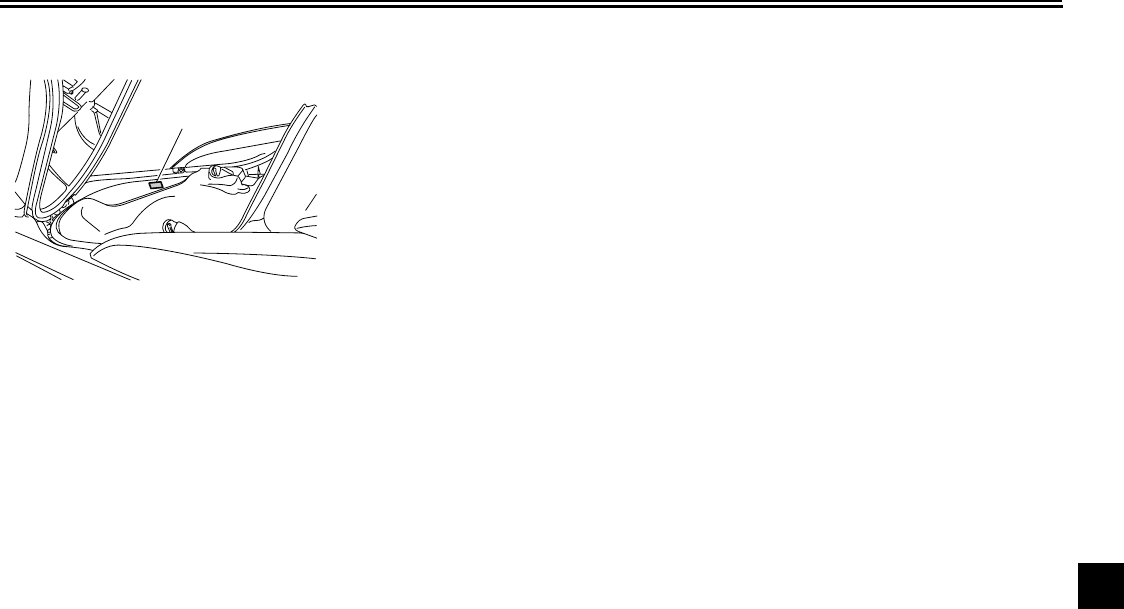
CONSUMER INFORMATION
9-2
2
3
4
5
6
7
8
9
EAU26500
Model label
The model label is affixed to the inside
of the rear storage compartment. (See
page 3-13.) Record the information on
this label in the space provided. This in-
formation will be needed when ordering
spare parts from a Yamaha dealer.
1. Model label
1

CONSUMER INFORMATION
9-3
1
2
3
4
5
6
7
8
9
EAU26550
Reporting safety defects
If you believe that your vehicle has a defect which could cause a crash or could cause injury or death, you should immediately
inform the National Highway Traffic Safety Administration (NHTSA) in addition to notifying Yamaha Motor Corporation,
U.S.A. If NHTSA receives similar complaints, it may open an investigation, and if it finds that a safety defect exists in a group
of vehicles, it may order a recall and remedy campaign. However, NHTSA cannot become involved in individual problems
between you, your dealer, or Yamaha Motor Corporation, U.S.A.
To contact NHTSA, you may either call the Auto Safety Hotline toll-free at 1-800-424-9393 (or 366-0123 in Washington, D.C.
area) or write to: NHTSA, U.S. Department of Transportation, Washington, D.C. 20590. You can also obtain other information
about motor vehicle safety from the Hotline.
CONSUMER INFORMATION
9-4
2
3
4
5
6
7
8
9
EAU26580
Scooter noise regulation
TAMPERING WITH NOISE CONTROL SYSTEM PROHIBITED:
Federal law prohibits the following acts or the causing thereof: (1) The removal or rendering inoperative by any person other
than for purposes of maintenance, repair, or replacement of any device or element of design incorporated into any new ve-
hicle for the purpose of noise control prior to its sale or delivery to the ultimate purchaser or while it is in use or (2) the use of
the vehicle after such device or element of design has been removed or rendered inoperative by any person.
“AMONG THOSE ACTS PRESUMED TO CONSTITUTE TAMPERING ARE THE ACTS LISTED BELOW.”
These acts include tampering with the following systems; i.e., modification, removal, etc.
Exhaust system
●
Muffler
●
Exhaust pipe
●
Silencer
Intake system
●
Air cleaner case
●
Air cleaner element
●
Intake duct
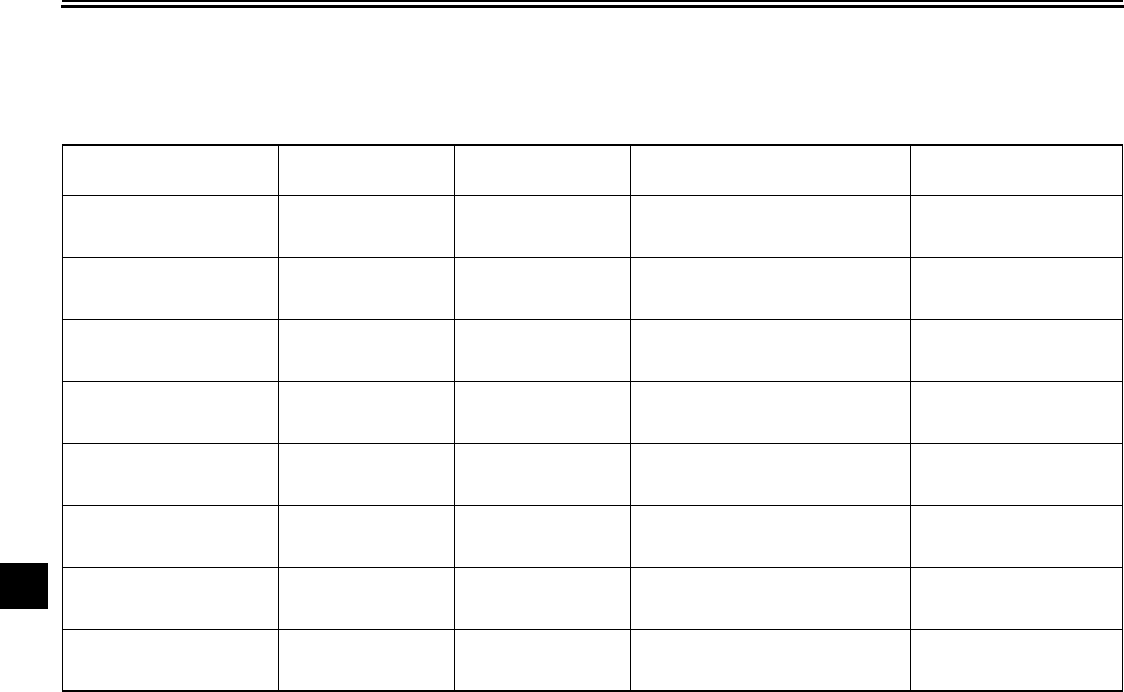
CONSUMER INFORMATION
9-5
1
2
3
4
5
6
7
8
9
EAU26632
Maintenance record
Copies of work orders and/or receipts for parts purchased and installed on your vehicle will be required to document that
maintenance has been completed in accordance with the emissions warranty. The chart below is printed only as a reminder
that maintenance work is required. It is not acceptable proof of maintenance work.
Maintenance
interval
Date of
service Mileage Servicing dealer
name and address Remarks
600 mi
(1000 km) or
1 month
4000 mi
(7000 km) or
6 months
8000 mi
(13000 km) or
12 months
12000 mi
(19000 km) or
18 months
16000 mi
(25000 km) or
24 months
20000 mi
(31000 km) or
30 months
24000 mi
(37000 km) or
36 months
28000 mi
(43000 km) or
42 months
CONSUMER INFORMATION
9-6
2
3
4
5
6
7
8
9
32000 mi
(49000 km) or
48 months
36000 mi
(55000 km) or
54 months
40000 mi
(61000 km) or
60 months
Maintenance
interval
Date of
service Mileage Servicing dealer
name and address Remarks
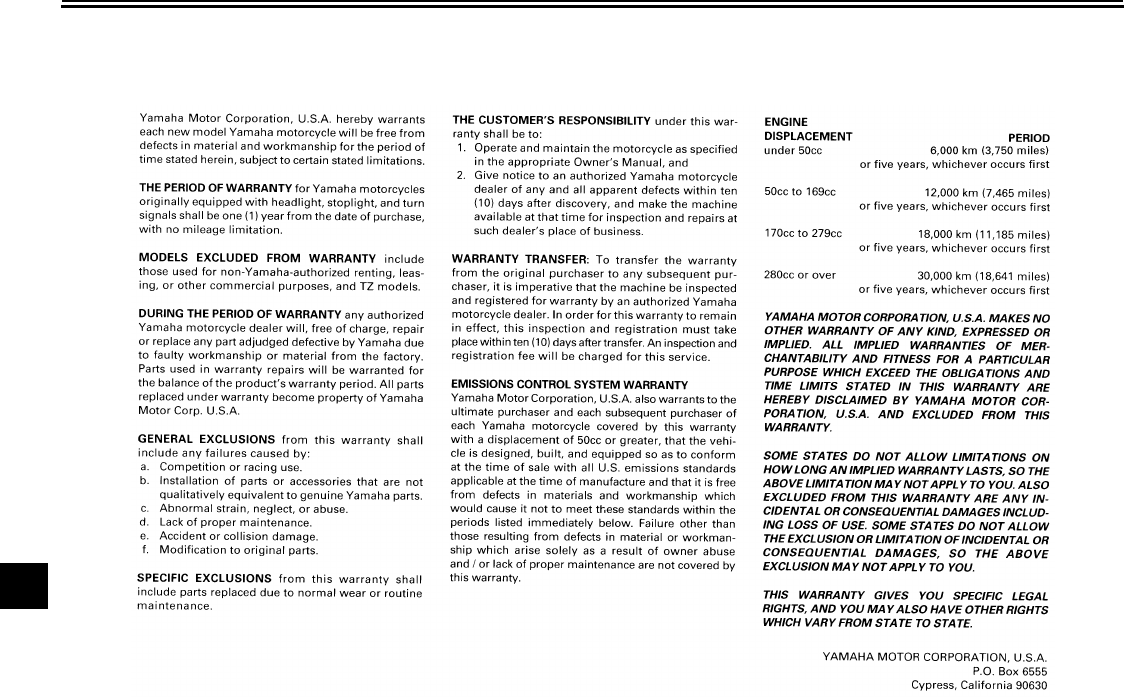
CONSUMER INFORMATION
9-7
1
2
3
4
5
6
7
8
9
EAU26662
YAMAHA MOTOR CORPORATION, U.S.A. STREET AND ENDURO MOTORCYCLE LIMITED
WARRANTY
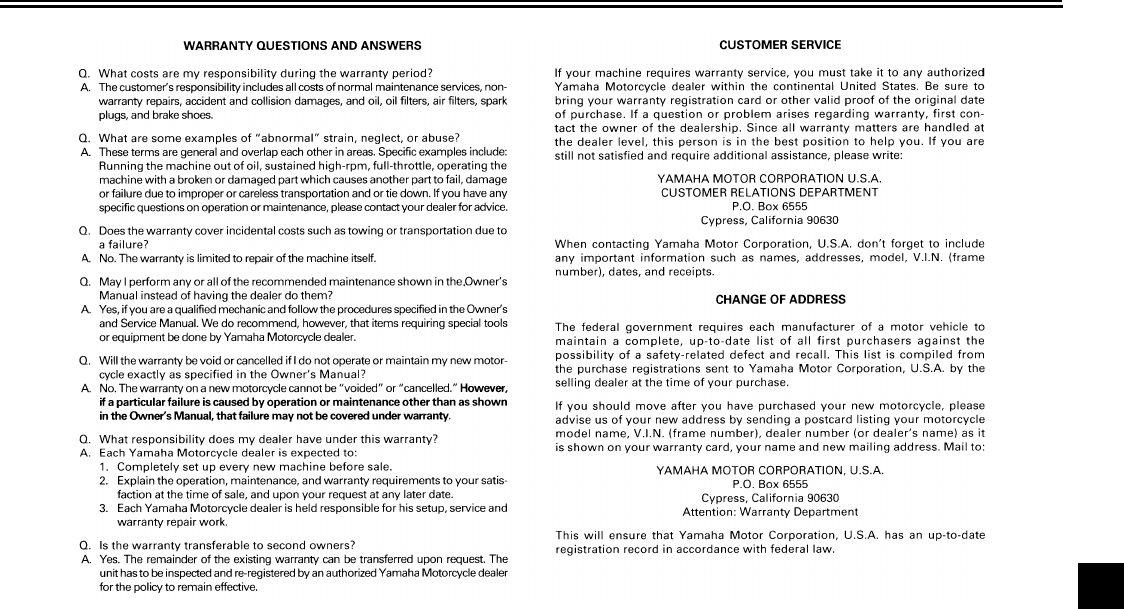
CONSUMER INFORMATION
9-8
2
3
4
5
6
7
8
9
CONSUMER INFORMATION
9-9
1
2
3
4
5
6
7
8
9
EAU26750
YAMAHA EXTENDED SERVICE (Y.E.S.)
Keep your Yamaha protected even after your warranty
expires with genuine Yamaha Extended Service (Y.E.S.).
Y.E.S. is designed and administered by Yamaha Motor
Corporation to provide maximum owner satisfaction. You
get uninterrupted factory-backed coverage for extra
peace of mind.
Y.E.S. is flexible. You choose the plan that’s right for
you: 12 months, 24 months, 36 months or, on certain
models, even 48 months beyond your warranty period.
Y.E.S. is designed and administered by the same
Yamaha people who handle your warranty – and it
shows in the comprehensive coverage benefits. There
are no mileage limitations. Coverage isn’t limited to
“moving parts” or the “drive train” like many other plans.
And Y.E.S. covers manufacturing defects just like the
warranty. See the sample contract at your Yamaha
dealer to see how comforting uninterrupted factory-
backed protection can be.
You don’t have to pay anything for covered repairs.
There’s no deductible to pay, and repairs aren’t
“pro-rated.” You don’t have any “out-of-pocket” expenses
for covered repairs.
In addition, Travel and Recreation Interruption Protection
(TRIP) is included at no extra cost. TRIP gives you up to
$150 reimbursement per occurrence for any reasonable
expenses you incur because your Yamaha needs
covered service: replacement vehicle rental, emergency
towing, phone calls, even food and lodging when you are
away from home. This superb coverage goes into effect
when you purchase Y.E.S., so it applies to any warranty
repairs as well as covered repairs during your entire
Y.E.S. plan period.
Y.E.S. coverage is honored at any authorized Yamaha
dealer nationwide.
Y.E.S. coverage is transferable to a new owner if you
sell or trade-in. That can make your Yamaha much more
valuable!
This excellent Y.E.S. plan coverage is only available to
Yamaha owners like you, and only while your Yamaha is still
within the Yamaha Limited Warranty period. So visit your
authorized Yamaha dealer to get all the facts. He can show
you how easy it is to protect your investment with Yamaha
Extended Service.
CONSUMER INFORMATION
9-10
2
3
4
5
6
7
8
9
We urge you to act now. You’ll get the excellent benefits of
TRIP coverage right away, and you’ll rest easy knowing
you’ll have strong factory-backed protection even after your
Yamaha Limited Warranty expires.
A special note:
If visiting your dealer isn’t convenient, contact Yamaha with
your Primary ID number (your frame number). We’ll be
happy to help you get the Y.E.S. coverage you need.
Yamaha Service Marketing
P.O. Box 6555
Cypress, CA 90630
1-(866)-YES-EXTD (1-866-937-3983)

INDEX
A
Acceleration and deceleration................... 5-2
Accessories and replacement parts........ 6-26
Air filter elements and check hoses and
V-belt case air filter element ................. 6-20
B
Battery..................................................... 6-33
Brake fluid, changing .............................. 6-29
Brake fluid level, checking ...................... 6-28
Brake lever, front....................................... 3-7
Brake lever, rear ....................................... 3-8
Brake levers, lubricating.......................... 6-30
Braking...................................................... 5-2
C
Cables, checking and lubricating ............ 6-30
Canister................................................... 6-14
Care .......................................................... 7-1
Catalytic converter .................................. 3-11
Centerstand and sidestand, checking
and lubricating ...................................... 6-31
Coolant.................................................... 6-18
Cowlings and panels, removing and
installing.................................................. 6-8
D
Dimmer switch .......................................... 3-7
E
Engine break-in......................................... 5-3
Engine oil and oil filter element ............... 6-14
Engine stop switch .................................... 3-7
Engine trouble warning light...................... 3-2
F
Final transmission oil .............................. 6-17
Front and rear brake lever free play........ 6-26
Front and rear brake pads, checking ...... 6-28
Front fork, checking .................................6-31
Fuel..........................................................3-10
Fuel tank cap .............................................3-9
Fuses, replacing ......................................6-34
H
Handlebar switches ...................................3-6
Headlight bulb, replacing .........................6-36
High beam indicator light ...........................3-2
Horn switch................................................3-7
I
Identification numbers................................9-1
Ignition circuit cut-off system ...................3-15
Indicator and warning lights.......................3-2
K
Key identification number ..........................9-1
L
Labels, location of......................................1-6
License plate light bulb, replacing ...........6-38
M
Main switch/steering lock...........................3-1
Maintenance and lubrication, periodic .......6-4
Maintenance, emission control system......6-3
Maintenance, periodic................................6-1
Maintenance record...................................9-5
Model label ................................................9-2
Multi-function display .................................3-3
N
Noise regulation.........................................9-4
P
Parking.......................................................5-4
Part locations.............................................2-1
Pre-operation check list .............................4-2
R
Rear brake lock lever ................................3-8
Rear brake lock lever cable, adjusting ....6-27
Rider seat, adjusting................................3-12
S
Safe-riding points ......................................1-4
Safety defects, reporting ...........................9-3
Safety information .....................................1-1
Seats .......................................................3-11
Sidestand ................................................3-15
Spark plug, checking ...............................6-12
Specifications ............................................8-1
Speedometer............................................. 3-2
Starting off .................................................5-2
Starting the engine ....................................5-1
Start switch................................................ 3-7
Steering, checking................................... 6-32
Storage...................................................... 7-3
Storage compartments ............................3-13
T
Tachometer ...............................................3-3
Tail/brake light .........................................6-36
Throttle cable free play, checking............6-23
Throttle grip and cable, checking and
lubricating..............................................6-30
Tires ........................................................6-23
Tool kit....................................................... 6-2
Troubleshooting.......................................6-39
Troubleshooting charts............................ 6-40
Turn signal indicator lights.........................3-2
Turn signal light bulb (front), replacing ....6-36
Turn signal light bulb (rear), replacing..... 6-37
Turn signal switch......................................3-7

INDEX
V
Valve clearance .......................................6-23
Vehicle identification number.....................9-1
W
Warranty, extended ...................................9-9
Warranty, limited........................................9-7
Wheel bearings, checking .......................6-33
Wheels.....................................................6-25

PRINTED ON RECYCLED PAPER
YAMAHA MOTOR CO., LTD.
PRINTED IN JAPAN
2006.5–0.7×1 !
(E)
