Yamaha RX 397 Manual E U
User Manual: Yamaha RX-397 Manual
Open the PDF directly: View PDF  .
.
Page Count: 37

RX-397
Stereo Receiver
OWNER’S MANUAL
U
IMPORTANT SAFETY INSTRUCTIONS
i
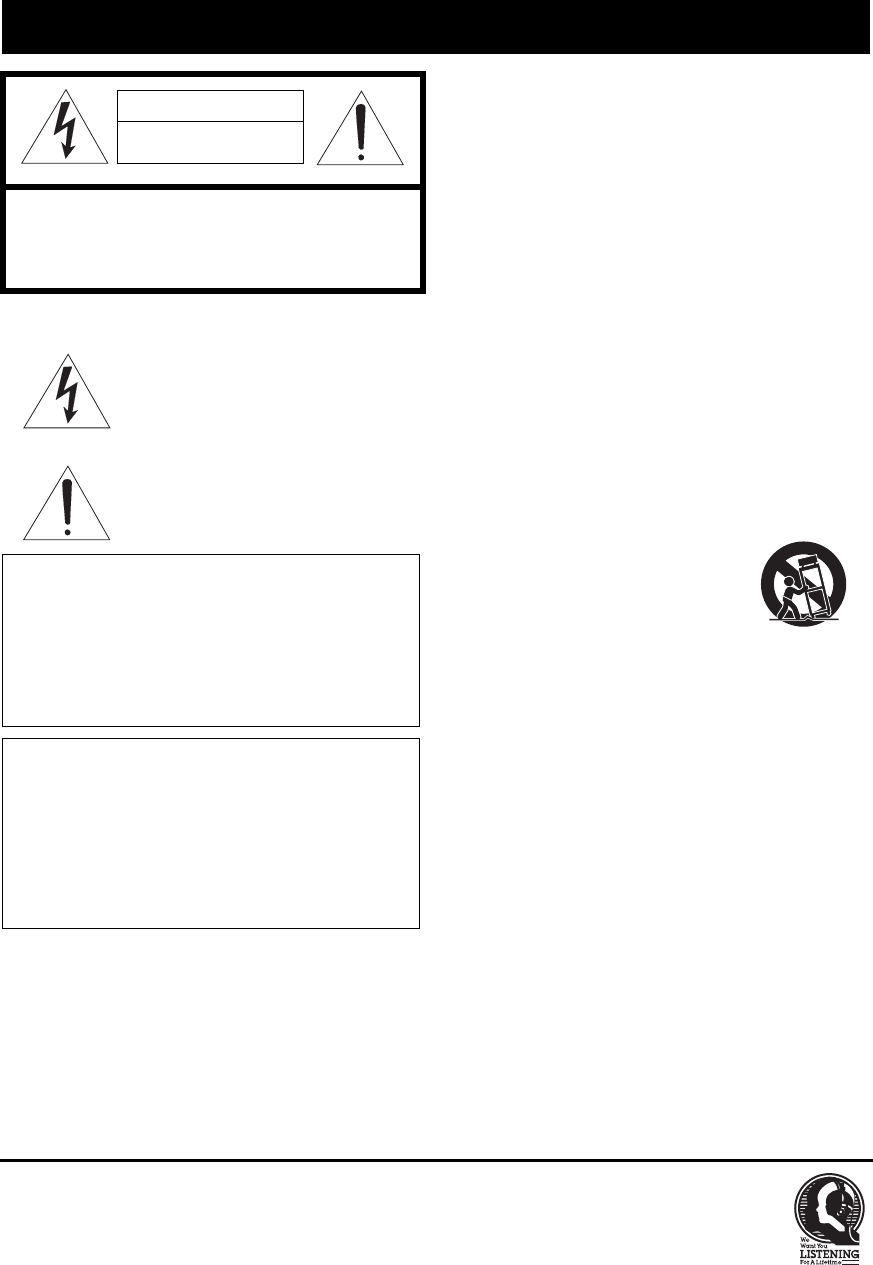
• Explanation of Graphical Symbols
The lightning flash with arrowhead symbol, within an
equilateral triangle, is intended to alert you to the
presence of uninsulated “dangerous voltage” within
the product’s enclosure that may be of sufficient
magnitude to constitute a risk of electric shock to
persons.
The exclamation point within an equilateral triangle
is intended to alert you to the presence of important
operating and maintenance (servicing) instructions in
the literature accompanying the appliance.
1Read these instructions.
2Keep these instructions.
3Heed all warnings.
4Follow all instructions.
5Do not use this apparatus near water.
6Clean only with dry cloth.
7Do not block any ventilation openings. Install in accordance
with the manufacturer’s instructions.
8Do not install near any heat sources such as radiators, heat
registers, stoves, or other apparatus (including amplifiers)
that produce heat.
9Do not defeat the safety purpose of the polarized or
grounding-type plug. A polarized plug has two blades with
one wider than the other. A grounding type plug has two
blades and a third grounding prong. The wide blade or the
third prong are provided for your safety. If the provided plug
does not fit into your outlet, consult an electrician for
replacement of the obsolete outlet.
10 Protect the power cord from being walked on or pinched
particularly at plugs, convenience receptacles, and the point
where they exit from the apparatus.
11 Only use attachments/accessories specified by the
manufacturer.
12 Use only with the cart, stand, tripod,
bracket, or table specified by the
manufacturer, or sold with the apparatus.
When a cart is used, use caution when
moving the cart/apparatus combination to
avoid injury from tip-over.
13 Unplug this apparatus during lightning storms or when
unused for long periods of time.
14 Refer all servicing to qualified service personnel. Servicing
is required when the apparatus has been damaged in any
way, such as power-supply cord or plug is damaged, liquid
has been spilled or objects have fallen into the apparatus, the
apparatus has been exposed to rain or moisture, does not
operate normally, or has been dropped.
IMPORTANT SAFETY INSTRUCTIONS
Note to CATV system installer:
This reminder is provided to call the CATV system
installer’s attention to Article 820-40 of the NEC that
provides guidelines for proper grounding and, in
particular, specifies that the cable ground shall be
connected to the grounding system of the building, as
close to the point of cable entry as practical.
IMPORTANT
Please record the serial number of this unit in the space
below.
MODEL:
Serial No.:
The serial number is located on the rear of the unit.
Retain this Owner’s Manual in a safe place for future
reference.
CAUTION
CAUTION: TO REDUCE THE RISK OF
ELECTRIC SHOCK, DO NOT REMOVE
COVER (OR BACK). NO USER-SERVICEABLE
PARTS INSIDE. REFER SERVICING TO
QUALIFIED SERVICE PERSONNEL.
RISK OF ELECTRIC SHOCK
DO NOT OPEN
We Want You Listening For A Lifetime
YAMAHA and the Electronic Industries Association’s Consumer Electronics Group want you to get the most out of your
equipment by playing it at a safe level. One that lets the sound come through loud and clear without annoying blaring or
distortion – and, most importantly, without affecting your sensitive hearing. Since hearing damage from loud sounds is
often undetectable until it is too late, YAMAHA and the Electronic Industries Association’s Consumer Electronics Group
recommend you to avoid prolonged exposure from excessive volume levels.
IMPORTANT SAFETY INSTRUCTIONS
ii
FCC INFORMATION (for US customers)
1 IMPORTANT NOTICE: DO NOT MODIFY THIS
UNIT!
This product, when installed as indicated in the
instructions contained in this manual, meets FCC
requirements. Modifications not expressly approved by
Yamaha may void your authority, granted by the FCC, to
use the product.
2 IMPORTANT: When connecting this product to
accessories and/or another product use only high quality
shielded cables. Cable/s supplied with this product MUST
be used. Follow all installation instructions. Failure to
follow instructions could void your FCC authorization to
use this product in the USA.
3 NOTE: This product has been tested and found to comply
with the requirements listed in FCC Regulations, Part 15
for Class “B” digital devices. Compliance with these
requirements provides a reasonable level of assurance that
your use of this product in a residential environment will
not result in harmful interference with other electronic
devices.
This equipment generates/uses radio frequencies and, if
not installed and used according to the instructions found
in the users manual, may cause interference harmful to the
operation of other electronic devices.
Compliance with FCC regulations does not guarantee that
interference will not occur in all installations. If this
product is found to be the source of interference, which
can be determined by turning the unit “OFF” and “ON”,
please try to eliminate the problem by using one of the
following measures:
Relocate either this product or the device that is being
affected by the interference.
Utilize power outlets that are on different branch (circuit
breaker or fuse) circuits or install AC line filter/s.
In the case of radio or TV interference, relocate/reorient
the antenna. If the antenna lead-in is 300 ohm ribbon lead,
change the lead-in to coaxial type cable.
If these corrective measures do not produce satisfactory
results, please contact the local retailer authorized to
distribute this type of product. If you can not locate the
appropriate retailer, please contact Yamaha Electronics
Corp., U.S.A. 6660 Orangethorpe Ave, Buena Park, CA
90620.
The above statements apply ONLY to those products
distributed by Yamaha Corporation of America or its
subsidiaries.
CAUTION: READ THIS BEFORE OPERATING YOUR UNIT.
iii
1To assure the finest performance, please read this manual
carefully. Keep it in a safe place for future reference.
2Install this sound system in a well ventilated, cool, dry, clean
place – away from direct sunlight, heat sources, vibration,
dust, moisture, and/or cold. Allow ventilation space of at least
30 cm on the top, 20 cm on the left and right, and 20 cm on
the back of this unit.
3Locate this unit away from other electrical appliances, motors,
or transformers to avoid humming sounds.
4Do not expose this unit to sudden temperature changes from
cold to hot, and do not locate this unit in an environment with
high humidity (i.e. a room with a humidifier) to prevent
condensation inside this unit, which may cause an electrical
shock, fire, damage to this unit, and/or personal injury.
5Avoid installing this unit where foreign objects may fall onto
this unit and/or this unit may be exposed to liquid dripping or
splashing. On the top of this unit, do not place:
– Other components, as they may cause damage and/or
discoloration on the surface of this unit.
– Burning objects (i.e. candles), as they may cause fire,
damage to this unit, and/or personal injury.
– Containers with liquid in them, as they may fall and liquid
may cause electrical shock to the user and/or damage to
this unit.
6Do not cover this unit with a newspaper, tablecloth, curtain,
etc. in order not to obstruct heat radiation. If the temperature
inside this unit rises, it may cause fire, damage to this unit,
and/or personal injury.
7Do not plug in this unit to a wall outlet until all connections
are complete.
8Do not operate this unit upside-down. It may overheat,
possibly causing damage.
9Do not use force on switches, knobs and/or cords.
10 When disconnecting the power cable from the wall outlet,
grasp the plug; do not pull the cable.
11 Do not clean this unit with chemical solvents; this might
damage the finish. Use a clean, dry cloth.
12 Only voltage specified on this unit must be used. Using this
unit with a higher voltage than specified is dangerous and may
cause fire, damage to this unit, and/or personal injury.
YAMAHA will not be held responsible for any damage
resulting from use of this unit with a voltage other than
specified.
13 To prevent damage by lightning, keep the power cord and
outdoor antennas disconnected from a wall outlet or the unit
during a lightning storm.
14 Do not attempt to modify or fix this unit. Contact qualified
YAMAHA service personnel when any service is needed. The
cabinet should never be opened for any reasons.
15 When not planning to use this unit for long periods of time
(i.e. vacation), disconnect the AC power plug from the wall
outlet.
16 Install this unit near the AC outlet and where the AC power
plug can be reached easily.
17 Be sure to read the “TROUBLESHOOTING” section on
common operating errors before concluding that this unit is
faulty.
18 Before moving this unit, press STANDBY/ON to set this unit
to the standby mode, and disconnect the AC power plug from
the wall outlet.
19 VOLTAGE SELECTOR (Asia and General models only)
The VOLTAGE SELECTOR on the rear panel of this unit
must be set for your local main voltage BEFORE plugging
into the AC main supply. Voltages are:
General model .............AC 110/120/220/230–240 V, 50/60 Hz
Asia model ................................ AC 220/230–240 V, 50/60 Hz
CAUTION: READ THIS BEFORE OPERATING YOUR UNIT.
WARNING
TO REDUCE THE RISK OF FIRE OR ELECTRIC
SHOCK, DO NOT EXPOSE THIS UNIT TO RAIN
OR MOISTURE.
This unit is not disconnected from the AC power
source as long as it is connected to the wall outlet, even
if this unit itself is turned off by STANDBY/ON. This
state is called the standby mode. In this state, this unit
is designed to consume a very small quantity of power.
FOR CANADIAN CUSTOMERS
To prevent electric shock, match wide blade of plug to
wide slot and fully insert.
This Class B digital apparatus complies with Canadian
ICES-003.
POUR LES CONSOMMATEURS CANADIENS
Pour éviter les chocs électriques, introduire la lame la
plus large de la fiche dans la borne correspondante de
la prise et pousser jusqu’au fond.
Cet appareil numérique de la classe B est conforme à
la norme NMB-003 du Canada.
1
PREPARATIONINTRODUCTION OPERATION
ADDITIONAL
INFORMATION
FEATURES............................................................. 2
SUPPLIED ACCESSORIES ................................. 2
CONTROLS AND FUNCTIONS ......................... 3
Front panel ................................................................. 3
Front panel display .................................................... 5
Rear panel .................................................................. 6
Remote control........................................................... 7
Installing batteries in the remote control ................... 8
Using the remote control ........................................... 8
CONNECTIONS .................................................... 9
Connecting speakers ................................................ 10
Connecting the AM and FM antennas ..................... 11
Connecting the power supply cord .......................... 13
Turning on and off this unit ..................................... 14
PLAYING AND RECORDING .......................... 15
Playing a source....................................................... 15
Adjusting the tonal quality....................................... 16
Recording a source .................................................. 17
Using the SLEEP timer............................................ 18
Muting the sound output.......................................... 19
FM/AM TUNING ................................................. 20
Automatic tuning ..................................................... 20
Manual tuning .......................................................... 21
Automatic preset tuning........................................... 21
Manual preset tuning ............................................... 23
Selecting preset stations........................................... 24
Exchanging preset stations ...................................... 24
ADVANCED SETUP ........................................... 25
Changing the ADVANCED SETUP
menu parameters.................................................. 25
TROUBLESHOOTING ....................................... 27
SPECIFICATIONS .............................................. 30
CONTENTS
INTRODUCTION
PREPARATION
OPERATION
ADDITIONAL INFORMATION
FEATURES
2
Built-in 2-channel power amplifier
◆Minimum RMS output power
50 W + 50 W (8 Ω), 0.04% THD, 20 Hz to 20 kHz
◆Highly dynamic power, low impedance drive
capability
Sophisticated AM/FM tuner
◆40-station random access preset tuning
◆Automatic preset tuning
◆Preset station exchanging capability
◆Radio Data System tuning capability
(Europe model only)
Other features
◆PURE DIRECT button used to reproduce the purest
source sound
◆Continuously variable loudness control
◆Sleep timer
◆Remote control capability
•y indicates a tip for your operation.
• Some operations can be performed by using either the buttons on the front panel of this unit or those on the remote control. In case the
button names differ between this unit and the remote control, the names of the buttons on the remote control are given in parentheses.
• This manual is printed prior to production. Design and specifications are subject to change in part as a result of improvements, etc. In
case of differences between the manual and the product, the product has priority.
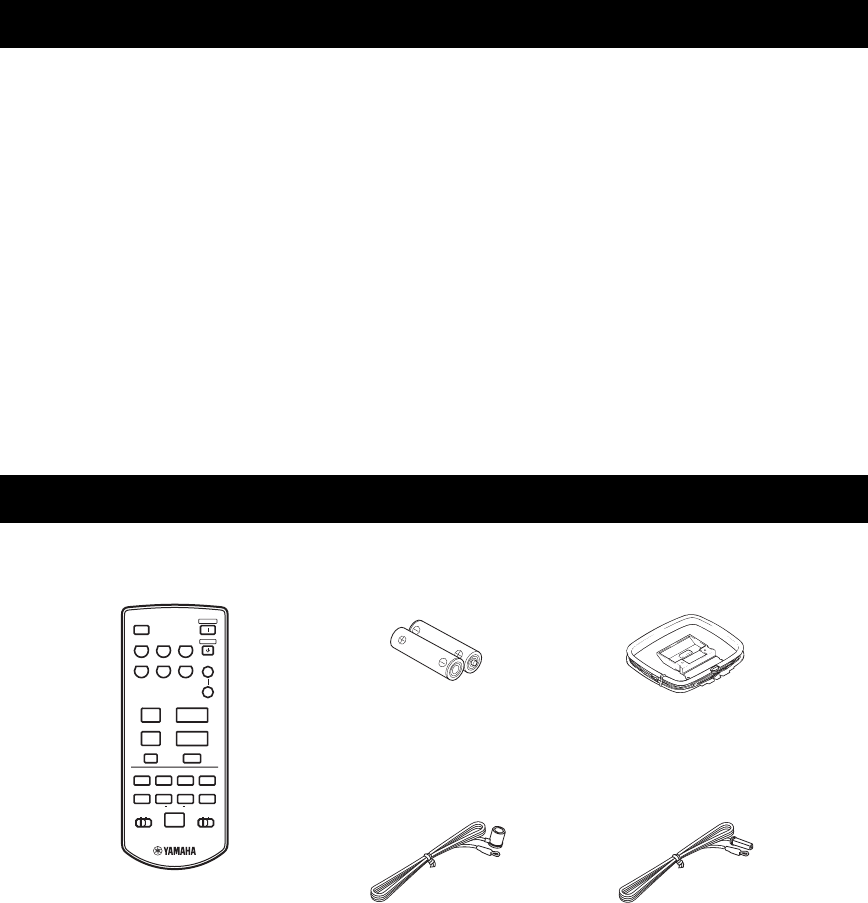
Please check that you received all of the following parts.
FEATURES
SUPPLIED ACCESSORIES
CD/DVD PHONO TUNER
MD TAPE AUX
SPEAKERS
B
A
POWER
STANDBY
+
–
u
d
SLEEP
REC
EON
FREQ/TEXT
MODE STARTPTY SEEK
A/B
DISC
DIR A
p
DIR B
A/B/C/D/E
MUTE
PRESET VOLUME
TAPECD
DEVICE
AMP
w
e
f
b
s
a
DISPLAY
Remote control Batteries (x2)
(AAA, R03, UM-4)
Indoor FM antenna
(U.S.A., Canada and
General models)
AM loop antenna
Indoor FM antenna
(Europe and Australia
models)
CONTROLS AND FUNCTIONS
3
INTRODUCTION
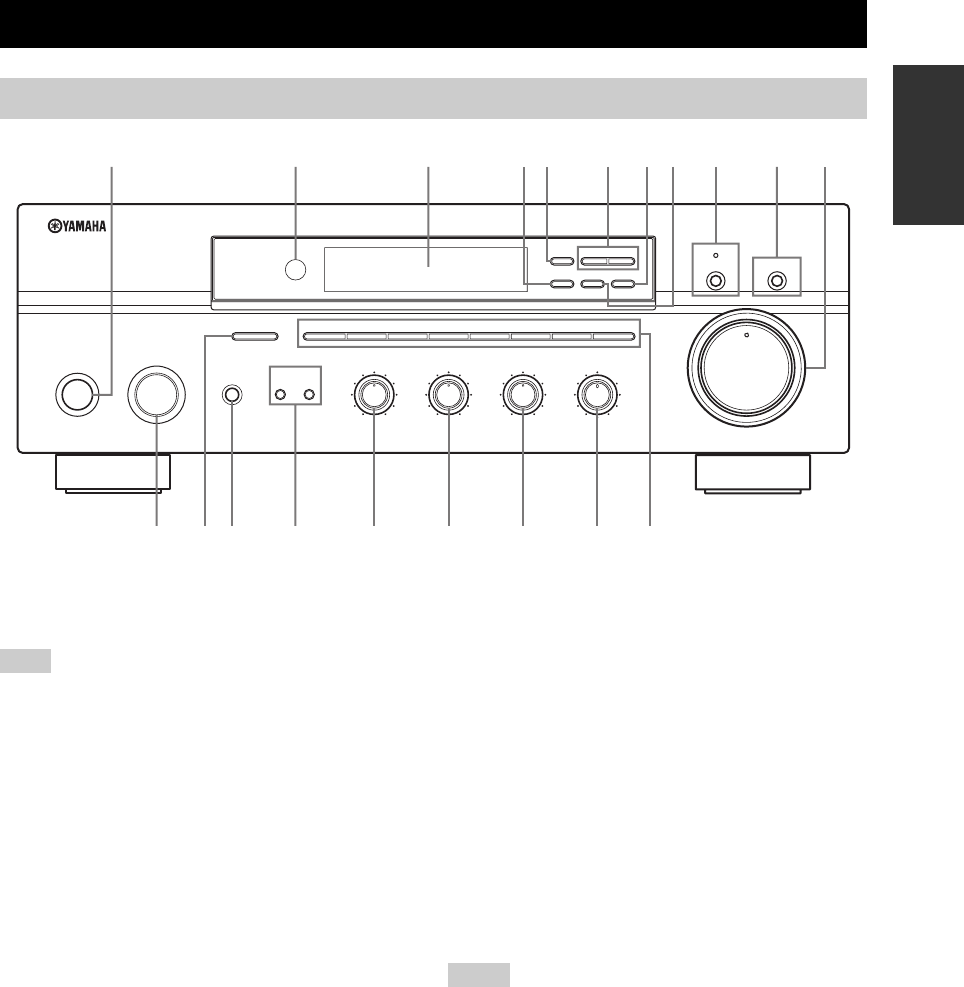
1STANDBY/ON
Turns on this unit or sets it to the standby mode.
See page
14
for details.
In the standby mode, this unit consumes a small amount of power
to receive infrared signals from the remote control.
2Remote control sensor
Receives infrared signals from the remote control.
3Front panel display
Shows information about the operational status of this
unit.
4EDIT
Exchanges the assignment of two preset stations with each
other when TUNER is selected as the input source (see
page 24).
5FM/AM
Switches the reception band between AM and FM when
TUNER is selected as the input source (see page 20).
6TUNING l / h
Selects the tuning frequency when TUNER is selected as
the input source (see page 20).
7TUNING MODE
Switches the tuning mode between automatic (the AUTO
indicator turns on as a result) and manual (the AUTO
indicator turns off as a result) when TUNER is selected as
the input source.
8MEMORY
Stores a station in the system memory (see page 23).
Sets this unit to the automatic preset tuning mode (see
page 21).
9PURE DIRECT and indicator
Allows you to listen to a source in the purest possible
sound. The indicator above it lights up when this function
is turned on (see page 16).
0TAPE MONITOR
Allows you to listen to the sound played back on the tape
deck connected to the TAPE terminals on the rear panel of
this unit.
When the 3-head tape deck is used for recording, you can
also monitor the sound being recorded.
The TAPE MON indicator lights up in the front panel
display when you press TAPE MONITOR (see page 17).
• When TAPE MON indicator lights up, you cannot select any
input source.
• To listen to the source selected with the INPUT selector, press
TAPE MONITOR again so that the TAPE MON indicator turns
off.
• When TAPE (tape deck) is selected with the INPUT selector,
this function will not turn on even if TAPE MONITOR is
pressed.
CONTROLS AND FUNCTIONS
Front panel
STANDBY
/ON
INPUT
PHONES
BASS
SPEAKERS
TAPE MONITORPURE DIRECT
55
101
44
22
33
+
–
VOLUME
l
TUNING
h
FM/AM
EDIT
A/B/C/D/E
12345678
MEMORY
MAN'L/AUTO FM
TUNING MODE
AUTO/MAN'L
BA
TREBLE
55
101
44
22
33
+
–
BALANCE
55
101
44
22
33
R
L
LOUDNESS
57
1FLAT
6
48
210
–
30dB
39
0
12
12
2
8
4
∞
20
20
60
60
26
26
40
40
16
16
-dB
-dB
DISPLAY
2154783096
DCBEFGHIJ
A
(U.S.A. and Canada models)
Note
Notes

CONTROLS AND FUNCTIONS
4
AVOLUME
Increases or decreases the sound output level.
This does not affect the OUT (REC) level.
BINPUT selector
Selects the input source you want to listen to.
CA/B/C/D/E
Selects the preset station group (A to E) when TUNER is
selected as the input source (see page 22).
DPHONES jack
Outputs audio for private listening with your headphones.
Press SPEAKERS A and B so that the SP A/B indicators turn off
before you connect your headphones to the PHONES jack.
ESPEAKERS A/B
Turns on or off the speaker set connected to the
SPEAKERS A and/or SPEAKERS B terminals on the rear
panel each time the corresponding button is pressed (see
page 15).
FBASS
Increases or decreases the low frequency response. The 0
position produces a flat response (see page 16).
GTREBLE
Increases or decreases the high frequency response. The 0
position produces a flat response (see page 16).
HBALANCE
Adjusts the sound output balance of the left and right
speakers to compensate for sound imbalances caused by
speaker locations or listening room conditions (see page
16).
ILOUDNESS
Retains a full tonal range at any volume level to
compensate for the human ears’ loss of sensitivity to high
and low-frequency ranges at a low volume level (see page
16).
JPreset station number buttons
(1 to 8)
Selects the preset station number (1 to 8) directly when
TUNER is selected as the input source (see page 24).
Note
Note
CONTROLS AND FUNCTIONS
5
INTRODUCTION
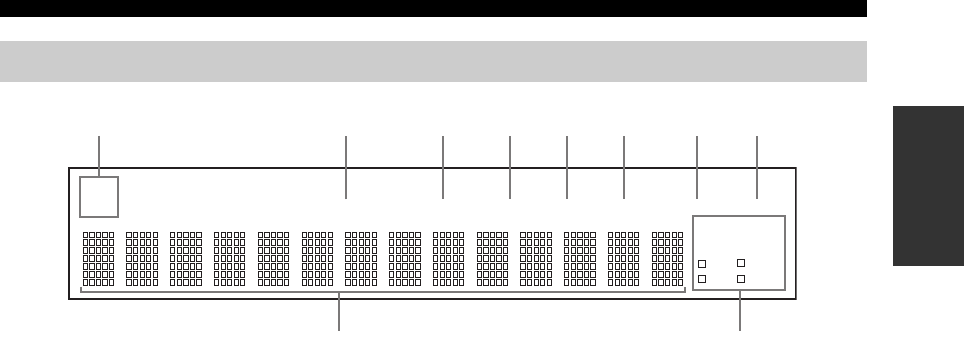
1SP (SPEAKERS) A/B indicators
Light up according to the set of speakers selected.
Both indicators light up when both sets of speakers are
selected.
2TAPE MON (MONITOR) indicator
Lights up while the TAPE monitor function is turned on.
3MEMORY indicator
Flashes for approximately 5 seconds after MEMORY on
the front panel is pressed. While the MEMORY indicator
is flashing, store the displayed station in the system
memory by using A/B/C/D/E and one of the preset station
number buttons on the front panel.
4AUTO indicator
Lights up when this unit is in the automatic tuning mode.
5TUNED indicator
Lights up when this unit is tuned into a station.
6STEREO indicator
Lights up when this unit is receiving a strong signal for an
FM stereo broadcast while the AUTO indicator is lit.
7SLEEP indicator
Lights up when the sleep timer is turned on.
8MUTE indicator
Flashes while the MUTE function is turned on.
9Multi-information display
Shows information when adjusting or changing settings.
■Europe model only
0Radio Data System indicators
The box-shaped indicator beside the name of each Radio
Data System mode lights up when the corresponding
Radio Data System mode is selected.
PTY HOLD indicator
Lights up while searching for stations in the PTY
SEEK mode.
EON indicator
Lights up when the Radio Data System station that
offers the EON data service is being received.
Front panel display
SP
HOLDPTY
A B
TAPE
MON
MEMORY AUTO
TUNED STEREO
SLEEP
EON
PS
RT
PTY
CT
MUTE
09
1 3 4 6 7 85
2
CONTROLS AND FUNCTIONS
6
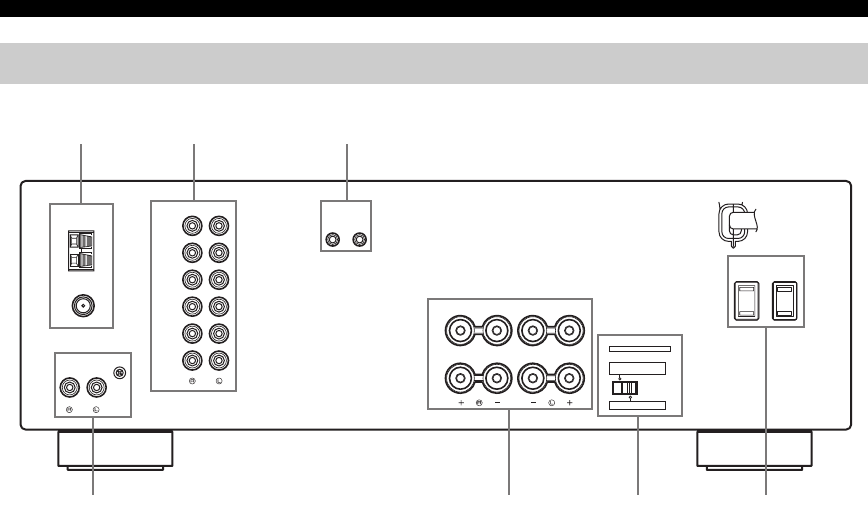
1Antenna terminals
Connect FM and AM antennas.
See page 11 for connections information.
2AUDIO jacks
Connect audio components.
See page 9 for connection information.
3REMOTE jacks
These jacks are used to input/output remote control
signals.
See page 13 for connection information.
4PHONO jacks and GND terminal
Connect a turntable.
See page 9 for connection information.
5SPEAKERS terminals
Connect speakers.
See page 10 for connection information.
6IMPEDANCE SELECTOR switch
Switches the impedance setting.
See page 13 for details.
7AC OUTLET(S) (SWITCHED)
Use to supply power to your other audio components.
See page 13 for details.
■Asia and General models only
VOLTAGE SELECTOR
See page 13 for details.
Rear panel
GND
AM
ANT
FM
ANT
75Ω
UNBAL.
CD/DVD
AUX
IN
(PLAY)
IN
(PLAY)
OUT
(REC)
OUT
(REC)
TAP E
MD
AUDIOTUNER
AUDIO GND
REMOTE
PHONO
IN OUT
A OR B: 4ΩMIN. /SPEAKER
A + B: 8ΩMIN. /SPEAKER
A OR B: 8ΩMIN. /SPEAKER
IMPEDANCE SELECTOR
SET BEFORE POWER ON
SELECTEUR D'IMPEDANCE
SPEAKERS
CLASS 2 WIRING
A
B
AC OUTLETS
SWITCHED
6745
12 3
(U.S.A. and Canada models)
CONTROLS AND FUNCTIONS
7
INTRODUCTION
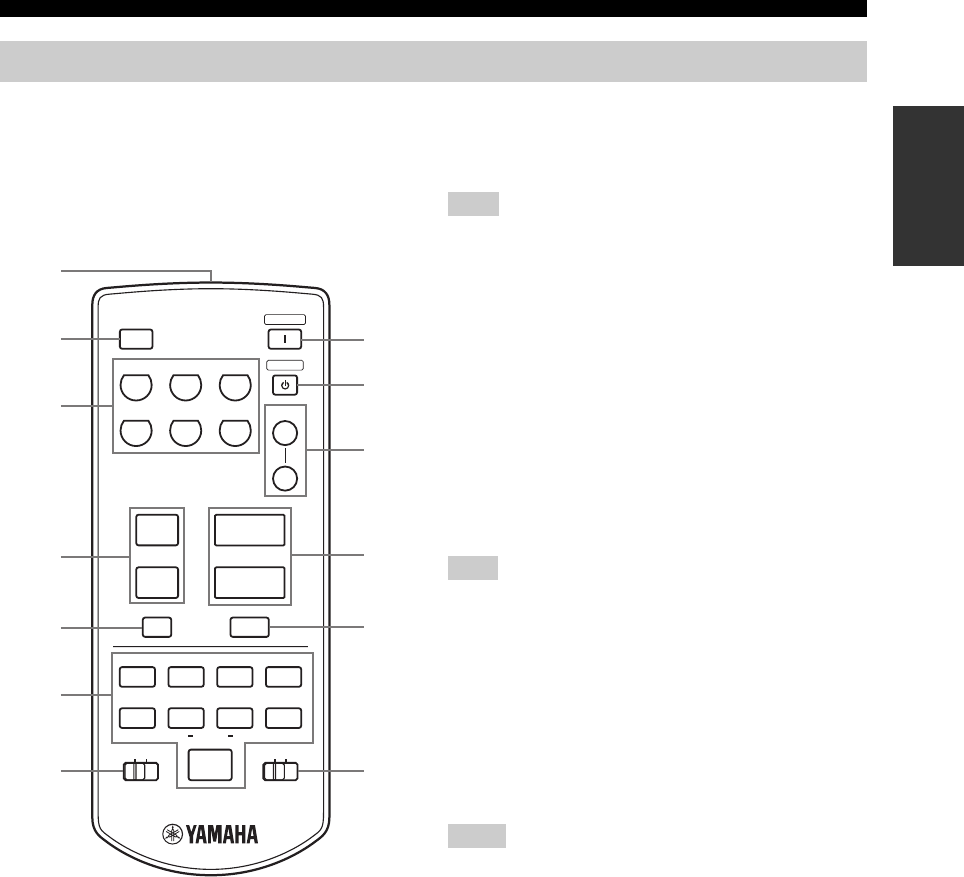
This section describes the function of each button on the
remote control used to control this unit or other
components made by YAMAHA. The functions of the
buttons used to control your other audio components are
the same as those of the corresponding buttons on those
components. Refer to those components’ instruction
manuals for details.
1Infrared signal transmitter
Sends infrared signals.
2SLEEP
Sets the sleep timer.
3Input selector buttons
Select the desired input source.
4PRESET u / d
Selects the preset station number (1 to 8) when TUNER is
selected as the input source.
5A/B/C/D/E
Selects the preset station group (A to E) when TUNER is
selected as the input source.
6Radio Data System/CD player/Cassette tape
deck control buttons
Controls Radio Data System features, YAMAHA CD
players or YAMAHA cassette tape deck.
The Radio Data System features (FREQ/TEXT, PTY SEEK
MODE and PTY SEEK START) are only applicable to the
Europe model and are operational only when TUNER is selected
as the input source and the AMP/DEVICE switch is slid to the
AMP position.
7AMP/DEVICE switch
Switches the function of the control buttons numbered 6
between controlling this unit and controlling YAMAHA
CD players or YAMAHA cassette tape deck.
8POWER
Turns on this unit.
9STANDBY
Sets this unit to the standby mode.
In the standby mode, this unit consumes a small amount of power
to receive infrared signals from the remote control.
0SPEAKERS A/B
Turns on or off the set of speakers connected to the
SPEAKERS A and/or SPEAKERS B terminals on the rear
panel of this unit when the corresponding button is
pressed each time.
AVOLUME +/–
Increases or decreases the sound output level.
• This does not affect the OUT (REC) level.
• When you press VOLUME +/– to control the sound output
level of this unit, VOLUME on the front panel rotates.
BMUTE
Mutes the sound output. Press again to restore the sound
output to the previous volume level (see page 19).
CCD/TAPE switch
Switches the function of the control buttons numbered 6
between controlling YAMAHA CD players and
controlling YAMAHA cassette tape deck when the AMP/
DEVICE switch is slid to the DEVICE position.
Remote control
CD/DVD PHONO TUNER
MD TAPE AUX
SPEAKERS
B
A
POWER
STANDBY
+
–
u
d
SLEEP
REC
EON
FREQ/TEXT
MODE STARTPTY SEEK
A/B
DISC
DIR A
p
DIR B
A/B/C/D/E
MUTE
PRESET VOLUME
TAPECD
DEVICE
AMP
w
e
f
b
s
a
DISPLAY
8
9
0
A
B
C
1
3
7
6
4
5
2
Note
Note
Notes
CONTROLS AND FUNCTIONS
8
■Notes on batteries
• Change all of the batteries if the operation range of the remote control decreases.
• Use AAA, R03, UM-4 batteries for the remote control.
• Make sure that the polarities are correct. See the illustration inside the battery compartment of each remote control.
• Remove the batteries if the remote control is not used for an extended period of time.
• Do not use old batteries together with new ones.
• Do not use different types of batteries (such as alkaline and manganese batteries) together. Read the packaging carefully as these
different types of batteries may have the same shape and color.
• We strongly recommend using alkaline batteries.
• If the batteries have leaked, dispose of them immediately. Avoid touching the leaked material or letting it come into contact with
clothing, etc. Clean the battery compartment thoroughly before installing new batteries.
• Do not throw away batteries with general house waste; dispose of them correctly in accordance with your local regulations.
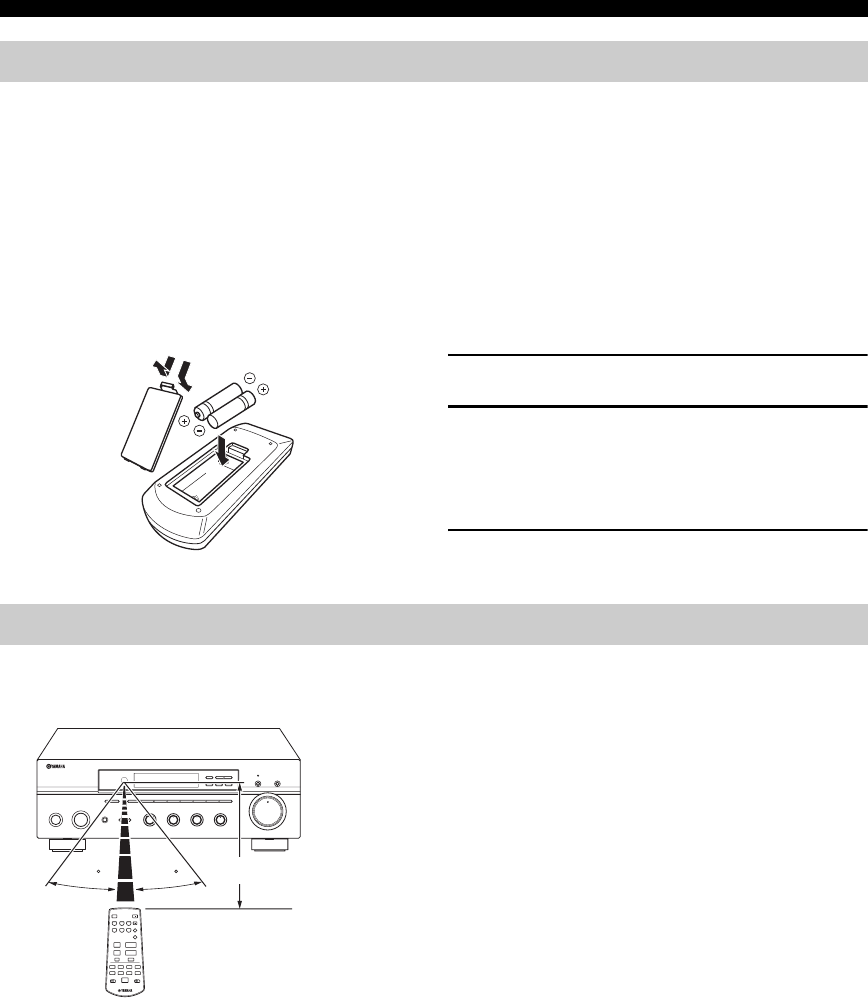
1Open the battery compartment cover.
2Insert the supplied batteries in each remote
control according to the polarity markings (+
and –) on the inside of the battery
compartment.
3Close the cover back.
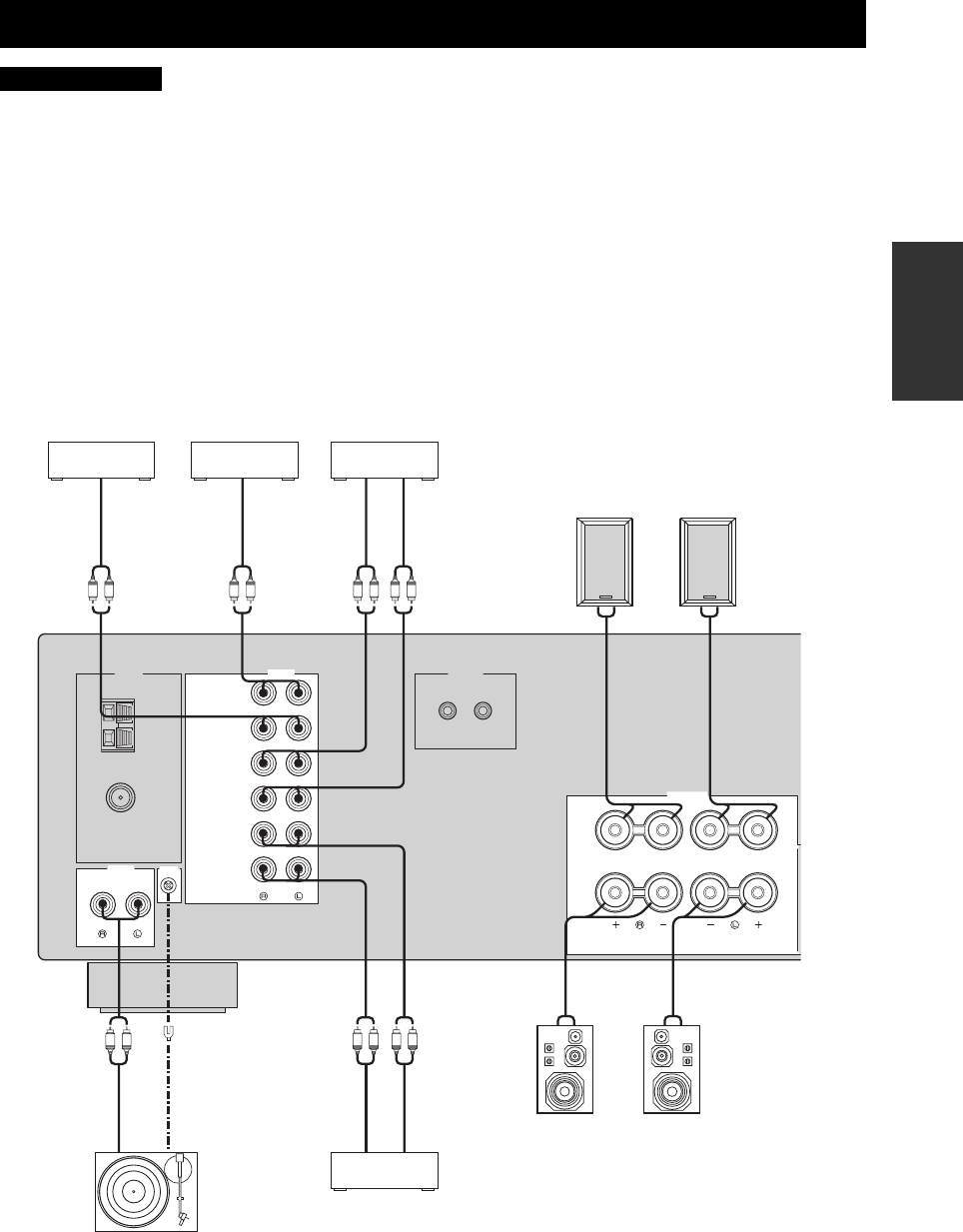
The remote control transmit a directional infrared beam.
Be sure to aim the remote control directly at the remote control sensor on the front panel of this unit.
■Handling the remote control
• The area between the remote control and this unit must be clear
of large obstacles.
• Do not spill water or other liquids on the remote control.
• Do not drop the remote control.
• Do not leave or store the remote control in the following types
of conditions:
– places of high humidity, such as near a bath
– places of high temperature, such as near a heater or a stove
– places of extremely low temperatures
– dusty places
• Do not expose the remote control sensor to strong lighting, in
particular, an inverter type fluorescent lamp; otherwise, the
remote control may not work properly. If necessary, position
this unit away from direct lighting.
Installing batteries in the remote control
13
2
Using the remote control
30 30
Approximately 6 m (19.7 ft)
CONNECTIONS
9
PREPARATION
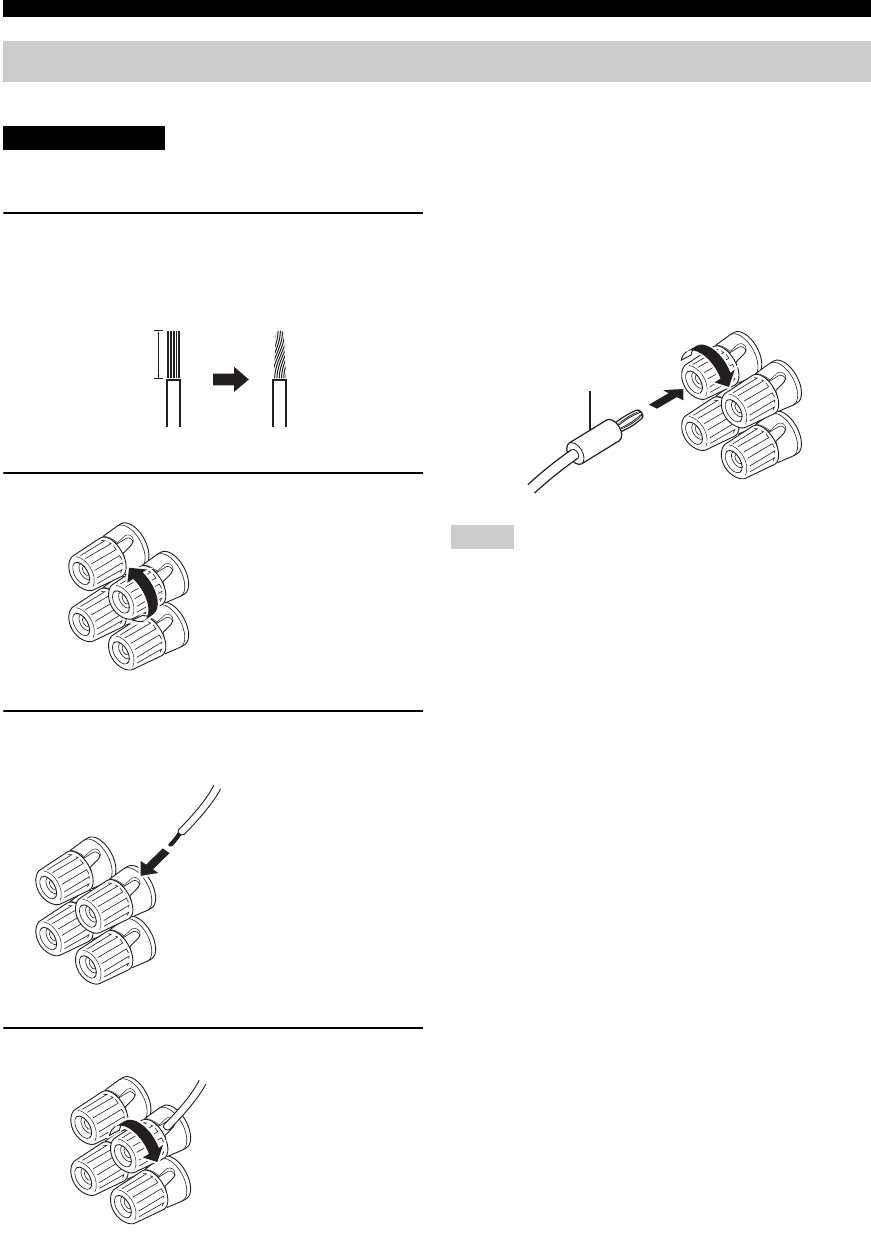
• Do not connect this unit or other components to the main power until all connections between components are complete.
• Do not let the bare speaker wires touch each other or do not let them touch any metal part of this unit. This could damage this unit and/
or the speakers.
• All connections must be correct: L (left) to L, R (right) to R, “+” to “+” and “–” to “–”. If the connections are faulty, no sound will be
heard from the speakers, and if the polarity of the speaker connections is incorrect, the sound will be unnatural and lack bass. Also,
refer to the owner’s manual for each of your components.
• Use the RCA type pin plug cables for audio components except speakers.
y
• The PHONO jacks are designed to connect a turntable with an MM or high-output MC cartridge. If you have a turntable with a low-
output MC cartridge, use an in-line boosting transformer or an MC-head amplifier when connecting your turntable to the PHONO
jacks.
• Connect your turntable to the GND terminal to reduce noise in the signal. However, you may hear less noise without the connection to
the GND terminal for some record players.
CONNECTIONS
CAUTION
GND
AM
ANT
FM
ANT
75Ω
UNBAL.
CD/DVD
AUX
IN
(PLAY)
IN
(PLAY)
OUT
(REC)
OUT
(REC)
TAPE
MD
AUDIOTUNER
AUDIO GND
REMOTE
PHONO
IN OUT
SPEAKERS
A
B
R L
LR LR
L
R
L
R
LRLR
+ – – +
+––+
Turntable
CD/DVD player,
etc.
Audio in
MD recorder,
etc.
Tape deck, etc.
Audio out
Audio out
GND
Audio out
Audio in
Audio out
MP3 player, etc.
Audio out
Speakers B
Speakers A
10
CONNECTIONS
Be sure to connect the left channel (L), right channel (R), “+” (red) and “–” (black) properly.
Before connecting the speakers, make sure that the power of this unit is off.
1Remove approximately 10 mm (3/8 in) of
insulation from the end of each speaker
cable and twist the exposed wires of the
cable together to prevent short circuits.
2Unscrew the knob.
3Insert one bare wire into the hole in the side
of each terminal.
4Tighten the knob to secure the wire.
■Connecting the banana plug
(U.S.A., Canada, Australia and General
models only)
First, tighten the knob and then insert the banana plug into
the end of the corresponding terminal.
• One or two speaker sets can be connected to this unit. If you use
only one speaker set, connect it to either the SPEAKERS A or B
terminals.
• Use speakers with the specified impedance shown on the rear
panel of this unit.
Connecting speakers
CAUTION
10 mm (3/8 in)
Red: positive (+)
Black: negative (–)
Red: positive (+)
Black: negative (–)
Red: positive (+)
Black: negative (–)
Notes
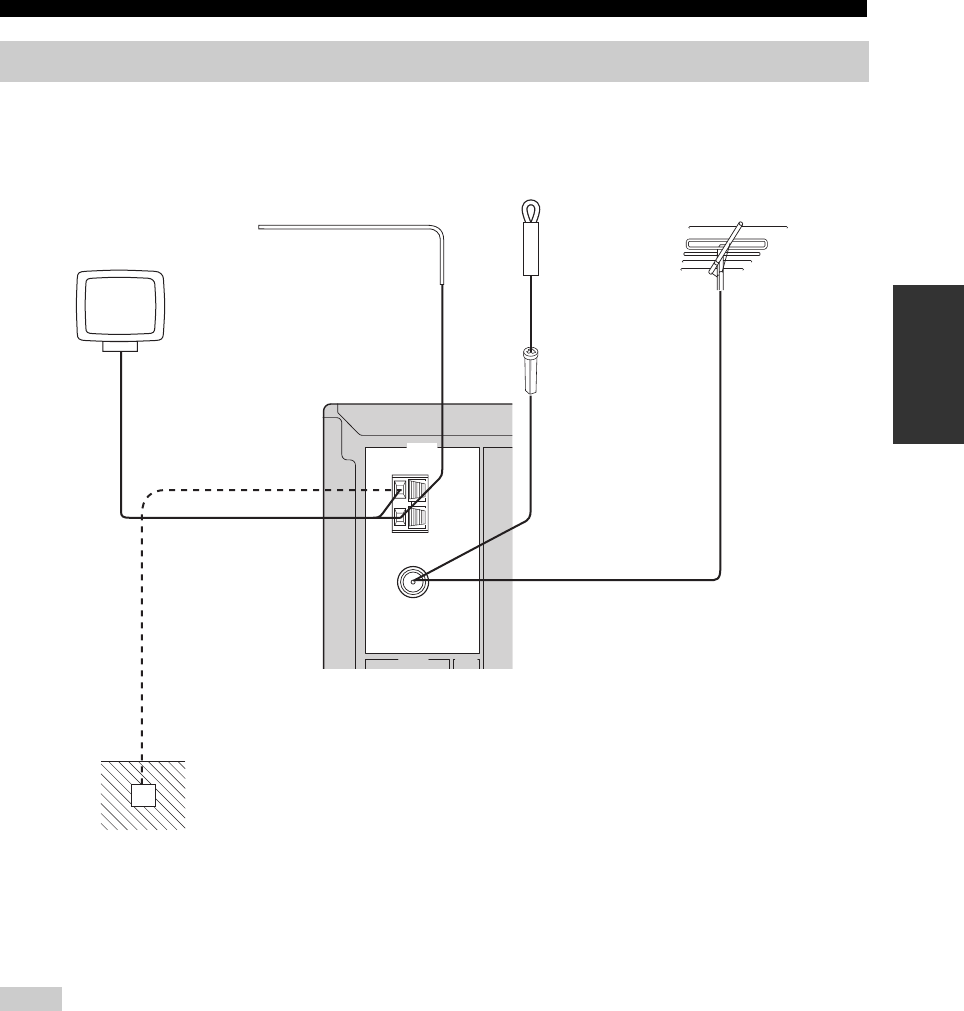
Banana plug
11
CONNECTIONS
PREPARATION
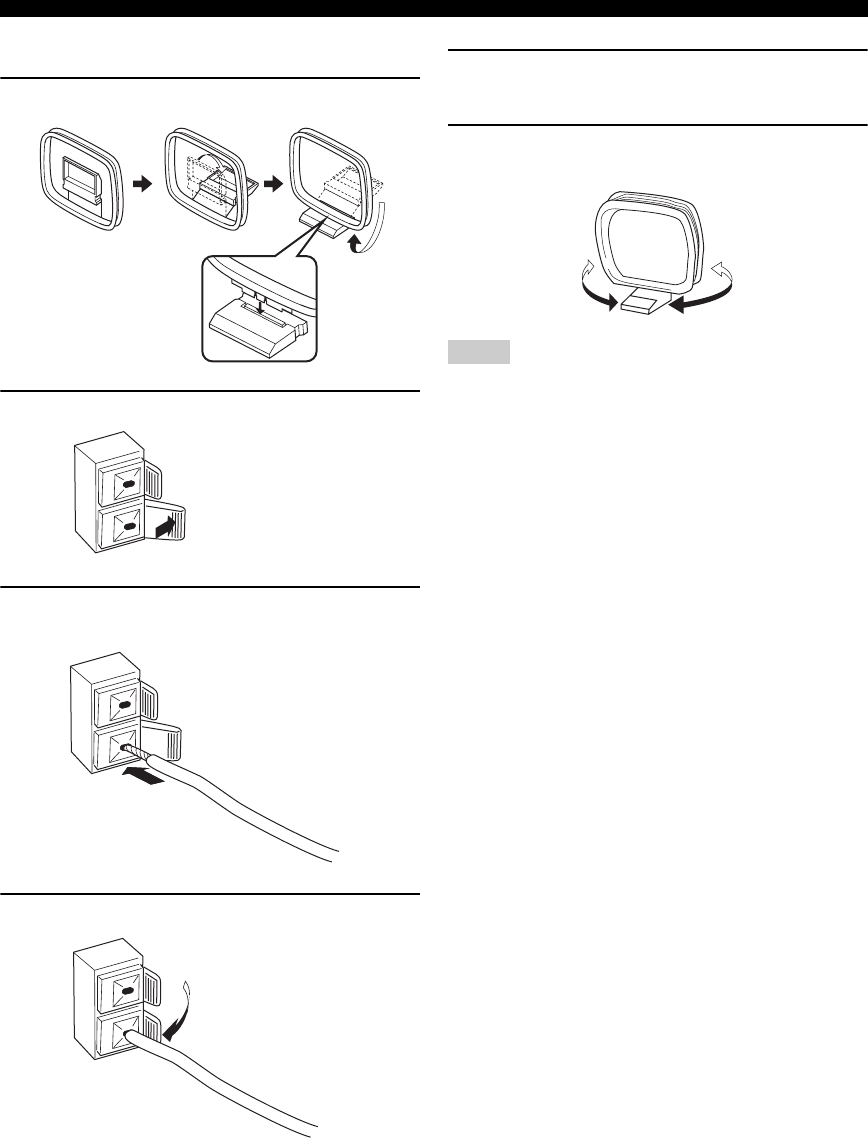
Both AM and FM indoor antennas are included with this unit. In general, these antennas should provide sufficient signal
strength. Connect each antenna correctly to the designated terminals.
• A properly installed outdoor antenna provides clearer reception than an indoor one. If you experience poor reception quality, an
outdoor antenna may improve the quality. Consult your nearest authorized YAMAHA dealer or service center about outdoor antennas.
• If you connect an outdoor FM antenna to this unit, do not connect the indoor FM antenna to this unit.
• To minimize interference from automobile ignition, locate the antenna as far from heavy traffic as possible.
• Keep the feeder cable or coaxial cable as short as possible. Do not bundle or roll up excess cable.
• The antenna should be placed at least 2 meters from reinforced concrete walls or metal structures.
Connecting the AM and FM antennas
Notes
GND
AM
ANT
FM
ANT
75Ω
UNBAL.
TUNER
AUDIO GND
AM loop antenna
(included)
Indoor FM antenna
(included)
Outdoor AM antenna
Use a 5 to 10 m of vinyl-
covered wire extended
outdoors from a window. Outdoor FM antenna
Ground (GND terminal)
For maximum safety and
minimum interference, connect
the antenna GND terminal to a
good earth ground. A good earth
ground is a metal stake driven into
moist earth.
12
CONNECTIONS
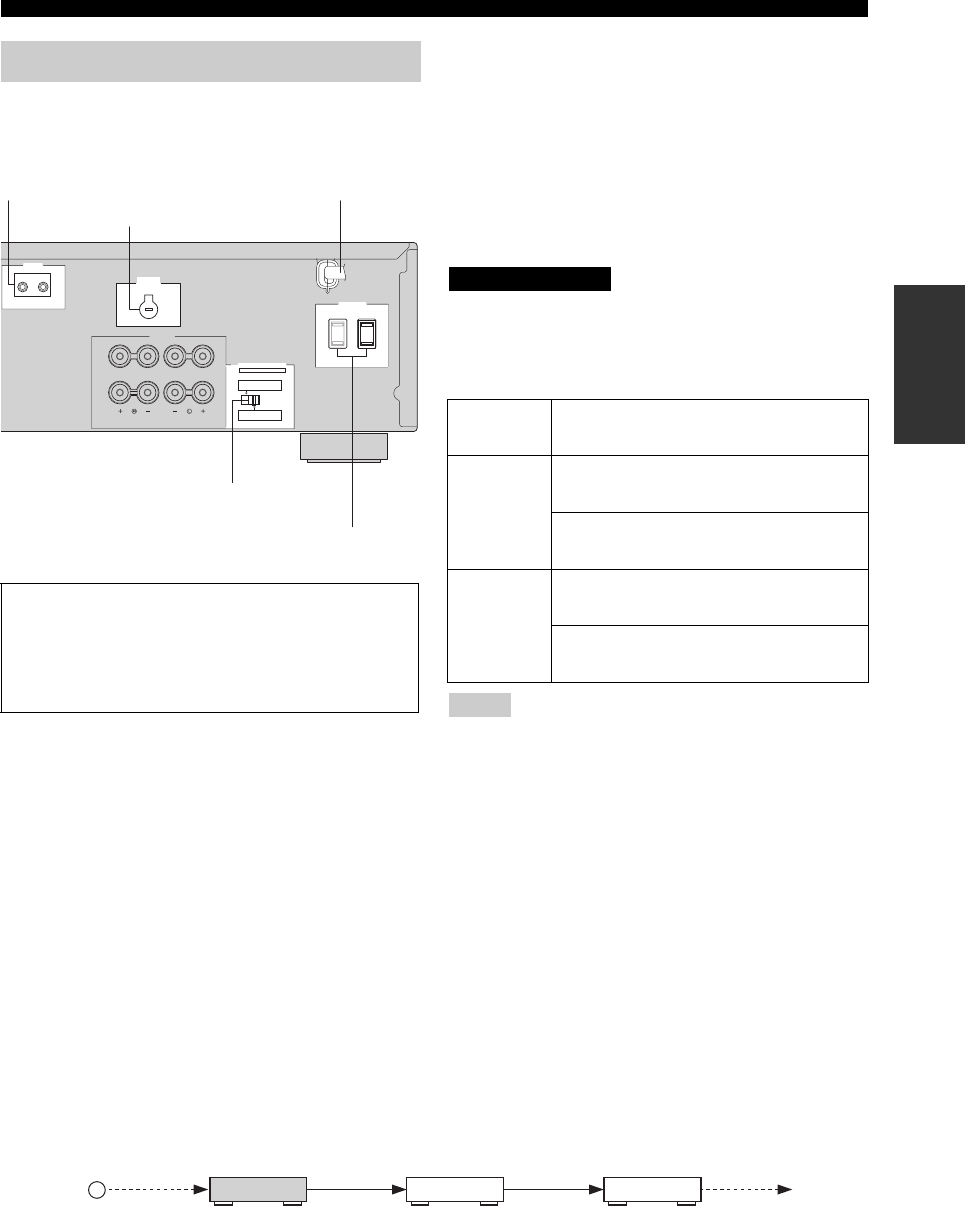
■Connecting the AM loop antenna
1Set up the AM loop antenna.
2Press and hold the tab.
3Insert the AM loop antenna lead wires into
the AM ANT terminal.
4Release the tab.
5Repeat steps 2 to 4 to insert the AM loop
antenna lead wires into the GND terminal.
6Orient the AM loop antenna for the best
reception.
• The AM loop antenna should be placed away from this unit.
• A properly installed outdoor antenna provides clearer reception
than an indoor one. If you experience poor reception quality, an
outdoor antenna may improve the quality. It is recommended
that you should connect a 5 to 10 m of vinyl-covered wire to the
AM ANT terminal and extend it outdoors from a window.
Consult your nearest authorized YAMAHA dealer or service
center about outdoor antennas.
• The AM loop antenna should always be connected, even if an
outdoor AM antenna is connected to this unit.
Notes
13
CONNECTIONS
PREPARATION
Plug the power supply cord into the AC wall outlet after
all other connections are complete.
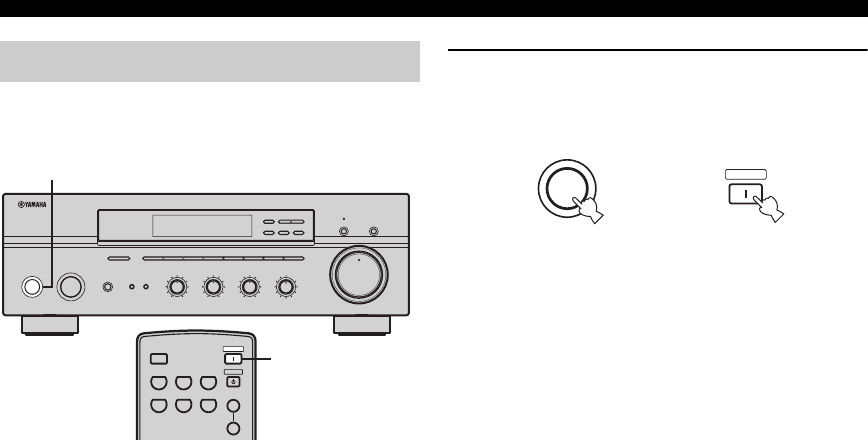
■AC OUTLET(S) (SWITCHED)
Australia model ...................................................... 1 outlet
Other models ....................................................... 2 outlets
Use these outlets to connect the power supply cords from
your other components to this unit. The AC OUTLET(S)
supplies power to any connected components whenever
the power of this unit is turned on. For information on the
maximum power (total power consumption of
components), see “SPECIFICATIONS” on page 30.
■REMOTE jacks
Some YAMAHA models are able to connect directly to the
REMOTE jack on the rear panel of this unit. If you own these
products, you may not need to use an infrared emitter. Up to six
YAMAHA components can be connected as shown below.
■VOLTAGE SELECTOR
(Asia and General models only)
VOLTAGE SELECTOR on the rear panel of this unit must
be set for your local main voltage BEFORE plugging the
power supply cord into the AC wall outlet.
Voltages are as follows:
Asia model ......................... AC 220/230–240 V, 50/60 Hz
General model ...... AC 110/120/220/230–240 V, 50/60 Hz
■IMPEDANCE SELECTOR switch
Do not slide the IMPEDANCE SELECTOR switch while the
power of this unit is turned on, as doing so may damage the unit.
Select the switch position (left or right) according to the
impedance of the speakers in your system.
• The Canada model cannot use two separate speaker sets (A and
B) simultaneously when the IMPEDANCE SELECTOR switch
is slid to the right position.
• If this unit fails to turn on, the IMPEDANCE SELECTOR
switch may not be fully slid to either position. If this is the case,
slide the switch all the way to either position when the power
supply to this unit is completely cut off.
Connecting the power supply cord
Memory back-up
The memory back-up circuit prevents the stored data
from being lost. However, the stored data will be lost if
the power cord is disconnected from the AC wall outlet
for more than one week.
REMOTE
IN OUT
A OR B: 4ΩMIN. /SPEAKER
A + B: 8ΩMIN. /SPEAKER
A OR B: 8ΩMIN. /SPEAKER
A + B:16ΩMIN. /SPEAKER
IMPEDANCE SELECTOR
SET BEFORE POWER ON
SPEAKERS
CLASS 2 WIRING
VO LTAGE
SELECTOR
A
B
AC OUTLETS
SWITCHED
(General model)
IMPEDANCE SELECTOR
switch
AC power supply cord
VOLTAGE SELECTOR
AC OUTLET(S)
REMOTE jacks
Switch
position Impedance level
Right
If you use one set (A or B), the impedance of
each speaker must be 8 Ω or higher.
If you use two sets (A and B), the impedance
of each speaker must be 16 Ω or higher.
Left
If you use one set (A or B), the impedance of
each speaker must be 4 Ω or higher.
If you use two sets (A and B), the impedance
of each speaker must be 8 Ω or higher.
Notes
CAUTION
OUTOUT IN
REMOTE
IN
REMOTE
OUT IN
REMOTE REMOTE
This unit YAMAHA
component
YAMAHA
component
Infrared signal
receiver
14
CONNECTIONS
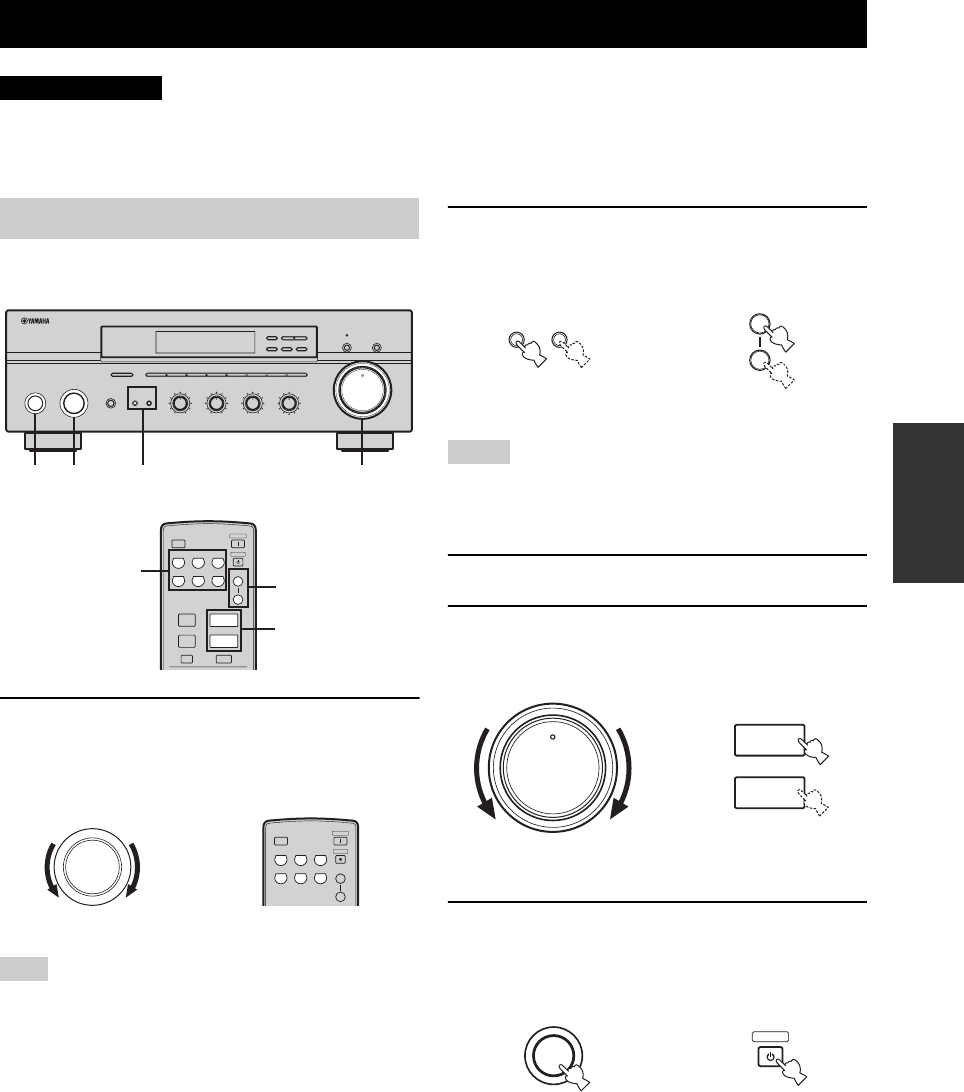
When all connections are complete, turn on the power of
this unit.
1Press STANDBY/ON on the front panel (or
POWER on the remote control) to turn on this
unit.
Press STANDBY/ON on the front panel (or
STANDBY on the remote control) to set this unit to
the standby mode.
Turning on and off this unit
STANDBY
/ON
INPUT
PHONES
BASS
TAPE MONITORPURE DIRECT
55
101
44
22
33
+
–
VOLUME
l
TUNING
h
FM/AM
EDIT
A/B/C/D/E
12345678
MEMORY
MAN'L/AUTO FM
TUNING MODE
AUTO/MAN'L
TREBLE
55
101
44
22
33
+
–
BALANCE
55
101
44
22
33
R
L
LOUDNESS
57
1FLAT
6
48
210
–
30dB
39
SPEAKERS
BA
1
0
12
12
2
8
4
∞
20
20
60
60
26
26
40
40
16
16
-dB
-dB
CD/DVD PHONO TUNER
MD TAPE AUX
SPEAKERS
B
A
POWER
STANDBY
SLEEP
1
STANDBY
/ON
Front panel Remote control
or
POWER
PLAYING AND RECORDING
15
OPERATION
Extreme caution should be exercised when you play back CDs encoded in DTS.
If you play back a CD encoded in DTS on a DTS-incompatible CD player, you will only hear some unwanted noise that may damage
your speakers. Check whether your CD player supports CDs encoded in DTS. Also, check the sound output level of your CD player
before you play back a CD encoded in DTS.
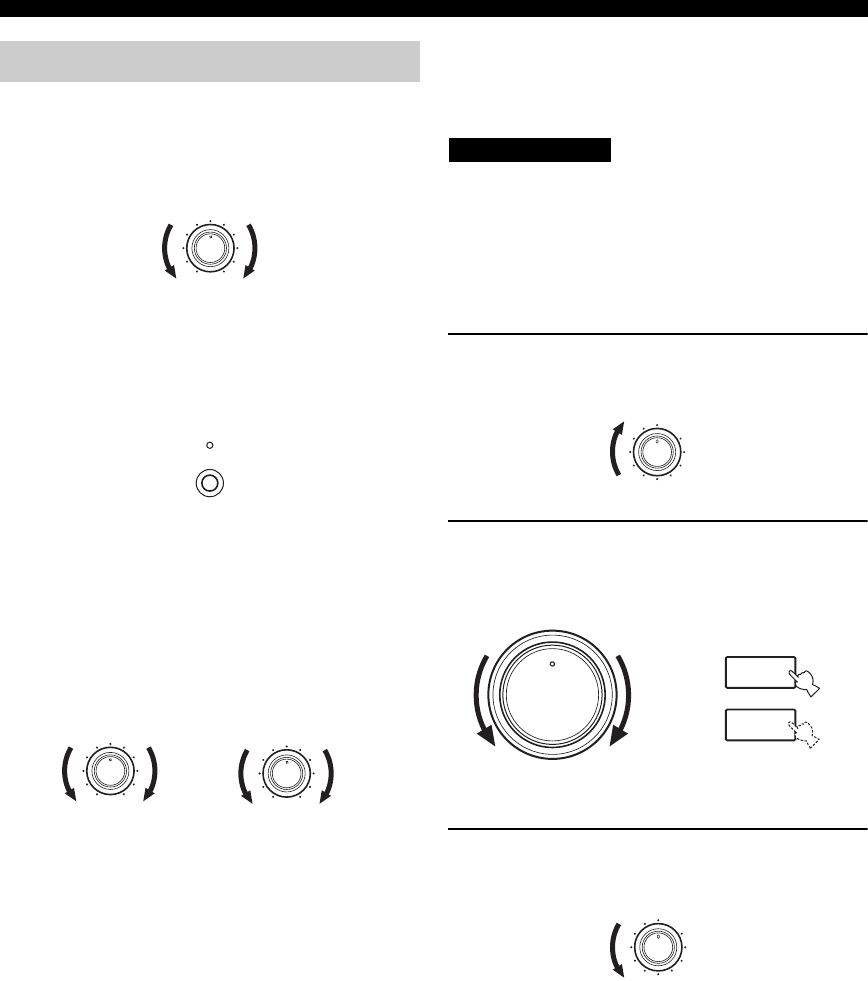
1Rotate the INPUT selector on the front panel
(or press one of the input selector buttons on
the remote control) to select the desired
input source.
You cannot select any input source while the TAPE MON
indicator lights up in the front panel display.
2Press SPEAKERS A and/or SPEAKERS B on
the front panel or on the remote control to
select speakers A and/or speakers B.
• Both SPEAKERS A and B can be selected.
• Make sure that the IMPEDANCE SELECTOR switch is
correctly set (see page 13).
3Play the source.
4Rotate VOLUME on the front panel (or press
VOLUME +/– on the remote control) to adjust
the sound output level.
5Press STANDBY/ON on the front panel again
(or press STANDBY on the remote control) to
finish using this unit and set it to the standby
mode.
PLAYING AND RECORDING
CAUTION
Playing a source
Note
STANDBY
/ON
INPUT
PHONES
BASS
SPEAKERS
TAPE MON ITORPURE DIRECT
55
101
44
22
33
+
–
VOLUME
l
TUNING
h
FM/AM
EDIT
A/B/C/D/E
12345678
MEMORY
MAN'L/AUTO FM
TUNING MODE
AUTO/MAN'L
BA
TREBLE
55
101
44
22
33
+
–
BALANCE
55
101
44
22
33
R
L
LOUDNESS
57
1FLAT
6
48
210
–
30dB
39
1 2
54
0
12
12
2
8
4
∞
20
20
60
60
26
26
40
40
16
16
-dB
-dB
CD/DVD PHONO TUNER
MD TAPE AUX
SPEAKERS
B
A
POWER
STANDBY
+
–
u
d
SLEEP
A/B/C/D/E
MUTE
PRESET VOLUME
2
4
1
INPUT
CD/DVD PHONO TUNER
MD TAPE AUX
SPEAKERS
B
A
POWER
STANDBY
SLEEP
Front panel Remote control
or
Notes
SPEAKERS
BA
A
B
SPEAKERS
or
Front panel Remote control
0
12
12
2
8
4
∞
20
20
60
60
26
26
40
40
16
16
-dB
-dB
VOLUME
+
–
VOLUME
Remote control
Front panel
or
STANDBY
/ON
STANDBY
Remote control
Front panel
or
16
PLAYING AND RECORDING
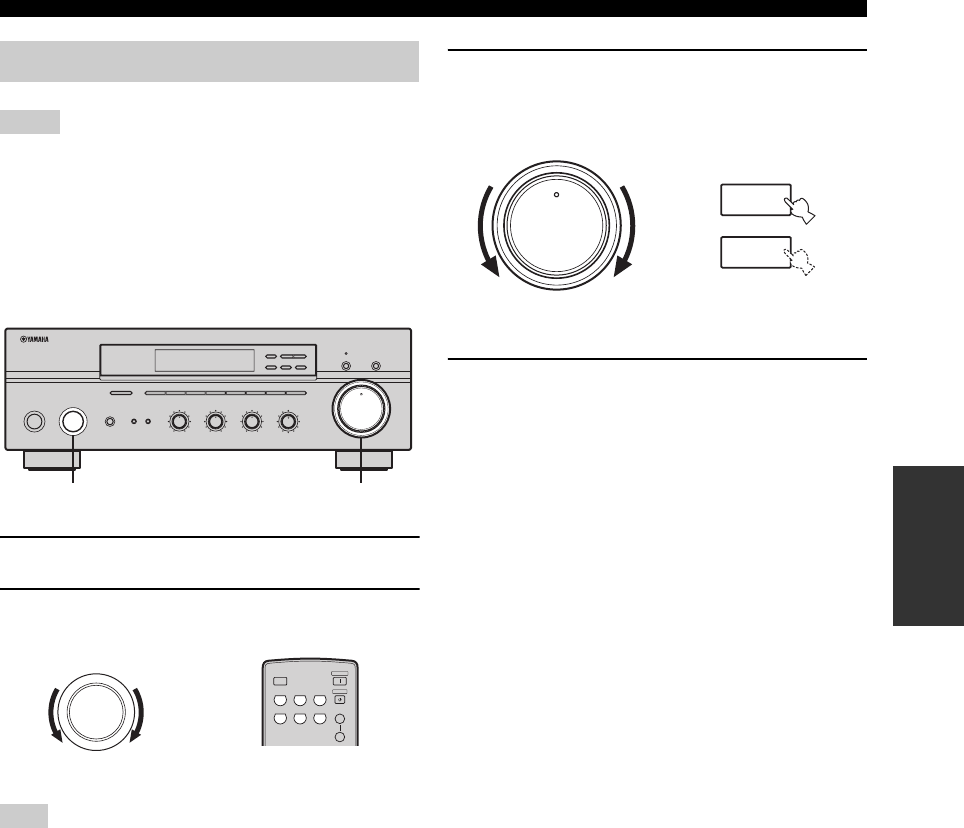
■Adjusting the BALANCE control
Adjusts the sound output balance of the left and right
speakers to compensate for sound imbalance caused by
speaker locations or listening room conditions.
■Using the PURE DIRECT button
Routes input signals from your audio sources so that the
input signals bypass the BASS, TREBLE, BALANCE and
LOUDNESS controls, thus eliminating any alterations to
the audio signals and creating the purest possible sound.
■Adjusting the BASS and TREBLE
controls
Adjust the high and low frequency response.
BASS
Increases or decreases the low frequency response.
TREBLE
Increases or decreases the high frequency response.
■Adjusting the LOUDNESS control
Retains a full tonal range at any volume level, thus
compensating for the human ears’ loss of sensitivity to
high and low-frequency ranges at a low volume level.
If the PURE DIRECT button is turned on with the LOUDNESS
control set at a certain level, the input signals bypass the
LOUDNESS control, resulting in a sudden increase in the sound
output level. To prevent your ears or the speakers from being
undesirably damaged, be sure to press the PURE DIRECT button
AFTER lowering the sound output level or AFTER checking that
the LOUDNESS control is properly set.
1Rotate the LOUDNESS control on the front
panel to the FLAT position.
2Rotate VOLUME on the front panel (or press
VOLUME +/– on the remote control) to set the
sound output level to the loudest listening
level that you would listen to.
3Rotate the LOUDNESS control until the
desired volume is obtained.
Adjusting the tonal quality
BALANCE
55
101
44
22
33
R
L
PURE DIRECT
BASS
55
101
44
22
33
+
–
TREBLE
55
101
44
22
33
+
–
CAUTION
LOUDNESS
57
1FLAT
6
48
210
–
30dB
39
0
12
12
2
8
4
∞
20
20
60
60
26
26
40
40
16
16
-dB
-dB
VOLUME
+
–
VOLUME
Remote control
Front panel
or
LOUDNESS
57
1FLAT
6
48
210
–
30dB
39
17
PLAYING AND RECORDING
OPERATION
• The VOLUME, BASS, TREBLE, BALANCE and
LOUDNESS controls and the PURE DIRECT buttons have no
effect on the source being recorded.
• Check the copyright laws in your country to record from
records, CDs, radio, etc. Recording copyright-protected
material may infringe on copyright laws.
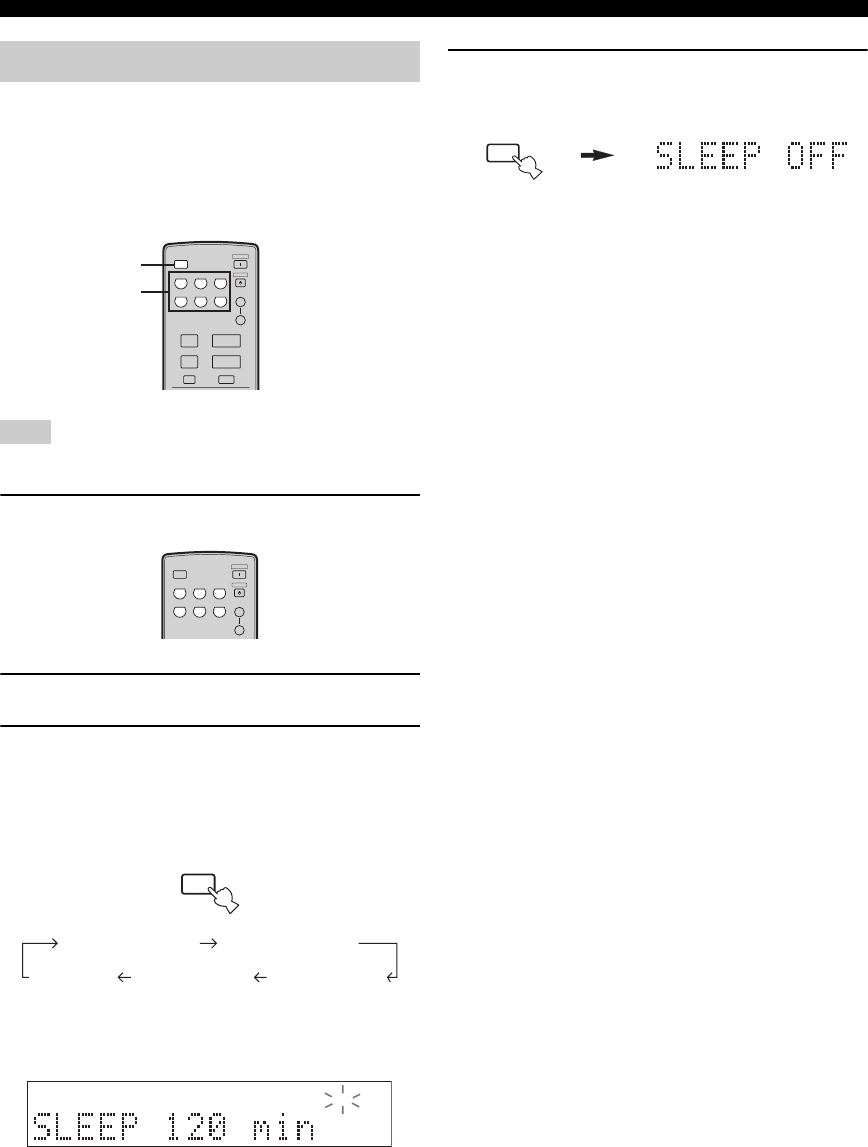
1Play the selected source to record from.
2Rotate the INPUT selector on the front panel
to select the source you want to record from.
You cannot select any input source while the TAPE MON
indicator lights up in the front panel display.
3Rotate VOLUME on the front panel (or press
VOLUME +/– on the remote control) to adjust
the sound output level of the selected source
to record from.
4Begin recording on the MD recorder, the tape
deck or the VCR connected to this unit.
y
If the 3-head tape deck is used for recording, you can monitor the
sound of recording by pressing TAPE MONITOR.
Recording a source
Notes
Note
STANDBY
/ON
INPUT
PHONES
BASS
TAPE MONPURE DIRECT
55
101
44
22
33
+
–
VOLUME
l
TUNING
h
FM/AM
EDIT
A/B/C/D/E
12345678
MEMORY
MAN'L/AUTO FM
TUNING MODE
AUTO/MAN'L
TREBLE
55
101
44
22
33
+
–
BALANCE
55
101
44
22
33
R
L
LOUDNESS
57
1FLAT
6
48
210
–
30dB
39
SPEAKERS
BA
23
0
12
12
2
8
4
∞
20
20
60
60
26
26
40
40
16
16
-dB
-dB
INPUT
CD/DVD PHONO TUNER
MD TAPE AUX
SPEAKERS
B
A
POWER
STANDBY
SLEEP
Front panel Remote control
or
0
12
12
2
8
4
∞
20
20
60
60
26
26
40
40
16
16
-dB
-dB
VOLUME
+
–
VOLUME
Remote control
Front panel
or
18
PLAYING AND RECORDING
Use this feature to automatically set this unit to the
standby mode after a certain amount of time. The SLEEP
timer is useful when you are going to sleep while this unit
is playing or recording a source. The SLEEP timer also
automatically turns off any external components
connected to the AC OUTLETS.
The SLEEP timer can only be set with the remote control.
1Press one of the input selector buttons on
the remote control to select an input source.
2Start playback on the selected input source.
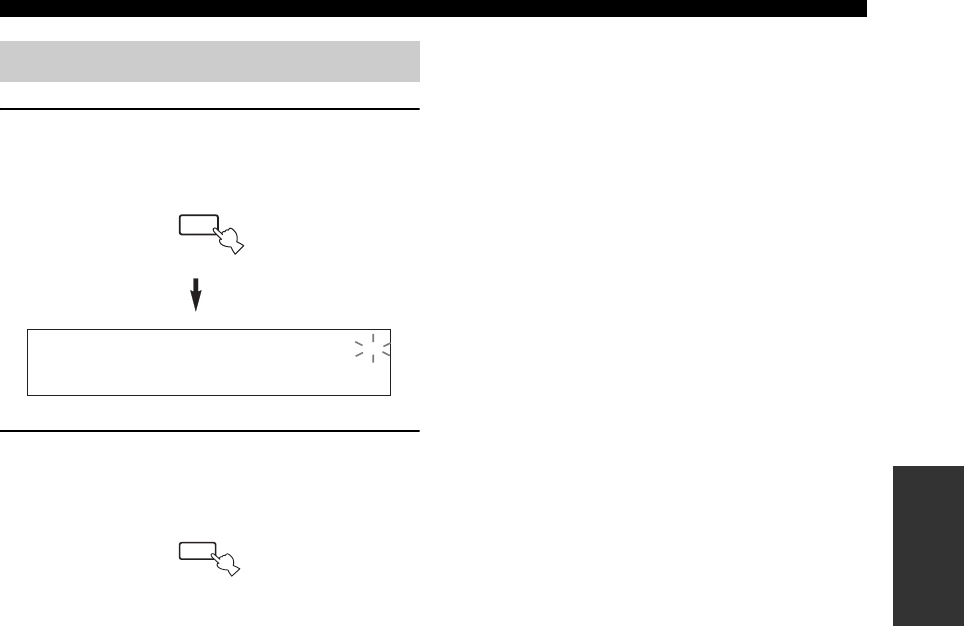
3Press SLEEP repeatedly to set the amount of
time before this unit is set to the standby
mode.
Each time you press SLEEP, the front panel display
changes as shown below.
The SLEEP indicator flashes while switching the
amount of time for the sleep timer.
4Press SLEEP repeatedly so that SLEEP OFF
appears in the front panel display.
After a few seconds, SLEEP OFF disappears from the
front panel display, and the SLEEP indicator turns
off.
y
The sleep timer setting can also be canceled by pressing
STANDBY on the remote control (or STANDBY/ON on the front
panel) to set this unit to the standby mode.
Using the SLEEP timer
Note
CD/DVD PHONO TUNER
MD TAPE AUX
SPEAKERS
B
A
POWER
STANDBY
+
–
u
d
SLEEP
A/B/C/D/E
MUTE
PRESET VOLUME
1
3
CD/DVD PHONO TUNER
MD TAPE AUX
SPEAKERS
B
A
POWER
STANDBY
SLEEP
SLEEP
SLEEP 120 min SLEEP 90 min
SLEEP 60 minSLEEP 30 minSLEEP OFF
SLEEP
SLEEP
19
PLAYING AND RECORDING
OPERATION
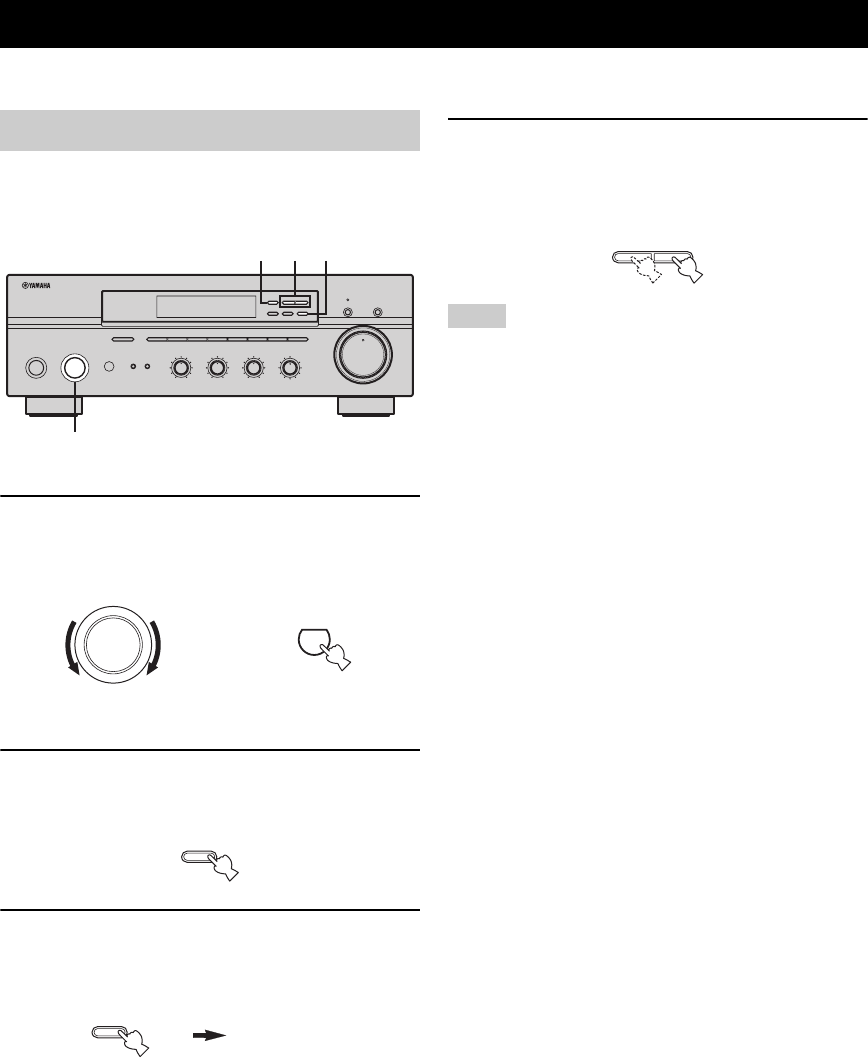
1Press MUTE on the remote control to mute
the sound output.
The MUTE indicator flashes in the front panel
display.
2Press MUTE on the remote control again to
resume the sound output.
The MUTE indicator disappears from the front panel
display.
Muting the sound output
MUTE
MUTE
MUTE
FM/AM TUNING
20
There are 2 tuning methods; automatic and manual. Select either method according to your preference and the strength of
station signals.
Automatic tuning is effective when station signals are
strong and there is no interference.
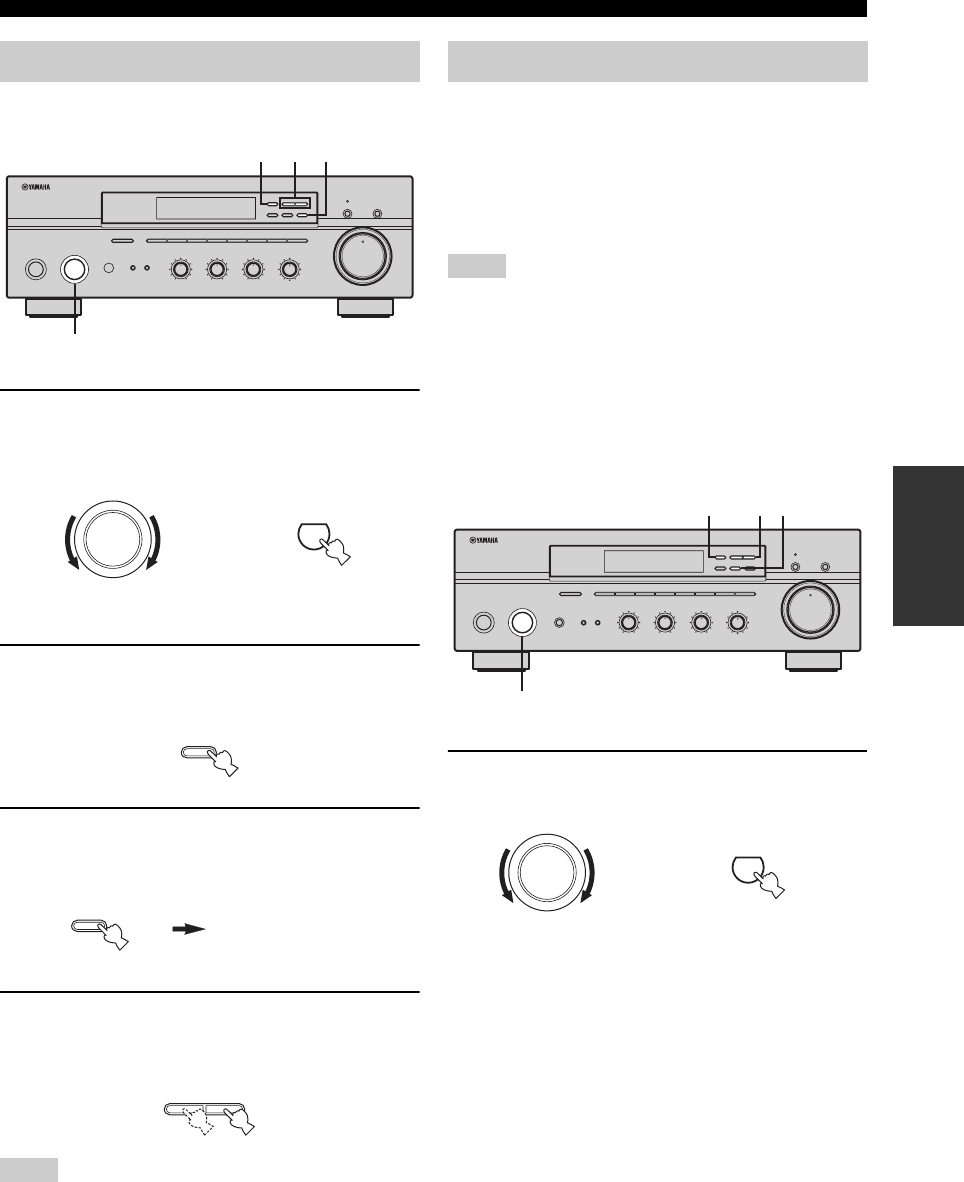
1Rotate the INPUT selector (or press TUNER
on the remote control) to select TUNER as
the input source.
2Press FM/AM on the front panel to select the
reception band (FM or AM).
FM or AM appears in the front panel display.
3Press TUNING MODE on the front panel so
that the AUTO indicator lights up in the front
panel display.
4Press TUNING l / h once to begin
automatic tuning.
Press h to tune into a higher frequency.
Press l to tune into a lower frequency.
• When you tune into a station, the frequency of the received
station is shown in the front panel display.
• To search for another station, press TUNING l / h once more.
• If the tuning search does not stop at the desired station because
the station signals are weak, try using the manual tuning
method.
FM/AM TUNING
Automatic tuning
STANDBY
/ON
INPUT BASS
TAPE MONITORPURE DIRECT
55
101
44
22
33
+
–
VOLUME
l
TUNING
h
FM/AM
EDIT
A/B/C/D/E
12345678
MEMORY
MAN'L/AUTO FM
TUNING MODE
AUTO/MAN'L
TREBLE
55
101
44
22
33
+
–
BALANCE
55
101
44
22
33
R
L
LOUDNESS
57
1FLAT
6
48
210
–
30dB
39
SPEAKERS
BA
2 4 3
1
0
12
12
2
8
4
∞
20
20
60
60
26
26
40
40
16
16
-dB
-dB
INPUT
TUNER
or
Front panel Remote control
FM/AM
TUNING MODE
AUTO/MAN'L
AUTO
Lights up
Notes
l
TUNING
h
21
FM/AM TUNING
OPERATION
Manual tuning is effective when station signals are weak.
1Rotate the INPUT selector (or press TUNER
on the remote control) to select TUNER as
the input source.
2Press FM/AM on the front panel to select the
reception band (FM or AM).
FM or AM appears in the front panel display.
3Press TUNING MODE on the front panel so
that the AUTO indicator disappears from the
front panel display.
4Press TUNING l / h to manually tune into
the desired station.
Hold down the button to continue tuning search.
• When you tune into a station, the frequency of the received
station is shown in the front panel display.
• If you tune into an FM station, it is automatically received in the
monaural mode to increase signal quality.
You can use the automatic preset tuning method to
automatically store FM stations. This function enables this
unit to automatically tune into FM stations with strong
signals and store up to 40 (8 stations in each of the 5
groups, A1 to E8) of those received stations in order. You
can then easily recall any preset stations by selecting the
preset station numbers where they are stored.
• Any station data stored under a preset station number is cleared
when you store a new station under that preset station number.
• If the number of received stations does not reach 40 (E8),
automatic preset tuning automatically stops once searching all
available stations are tuned into and stored.
• Only FM stations with sufficient signal strength are stored
automatically by automatic preset tuning. If the station you
want to store is weak in signal strength, try using the manual
preset tuning method.
1Rotate the INPUT selector (or press TUNER
on the remote control) to select TUNER.
Manual tuning
Notes
STANDBY
/ON
INPUT BASS
TAPE MONITORPURE DIRECT
55
101
44
22
33
+
–
VOLUME
l
TUNING
h
FM/AM
EDIT
A/B/C/D/E
12345678
MEMORY
MAN'L/AUTO FM
TUNING MODE
AUTO/MAN'L
TREBLE
55
101
44
22
33
+
–
BALANCE
55
101
44
22
33
R
L
LOUDNESS
57
1FLAT
6
48
210
–
30dB
39
SPEAKERS
BA
2 4 3
1
0
12
12
2
8
4
∞
20
20
60
60
26
26
40
40
16
16
-dB
-dB
INPUT
TUNER
or
Front panel Remote control
FM/AM
TUNING MODE
AUTO/MAN'L
AUTO
Disappears
l
TUNING
h
Automatic preset tuning
Notes
STANDBY
/ON
INPUT
PHONES
BASS
TAPE MONITORPURE DIRECT
55
101
44
22
33
+
–
VOLUME
l
TUNING
h
FM/AM
EDIT
A/B/C/D/E
12345678
MEMORY
MAN'L/AUTO FM
TUNING MODE
AUTO/MAN'L
TREBLE
55
101
44
22
33
+
–
BALANCE
55
101
44
22
33
R
L
LOUDNESS
57
1FLAT
6
48
210
–
30dB
39
SPEAKERS
BA
2
1
34
0
12
12
2
8
4
∞
20
20
60
60
26
26
40
40
16
16
-dB
-dB
INPUT
TUNER
or
Front panel Remote control
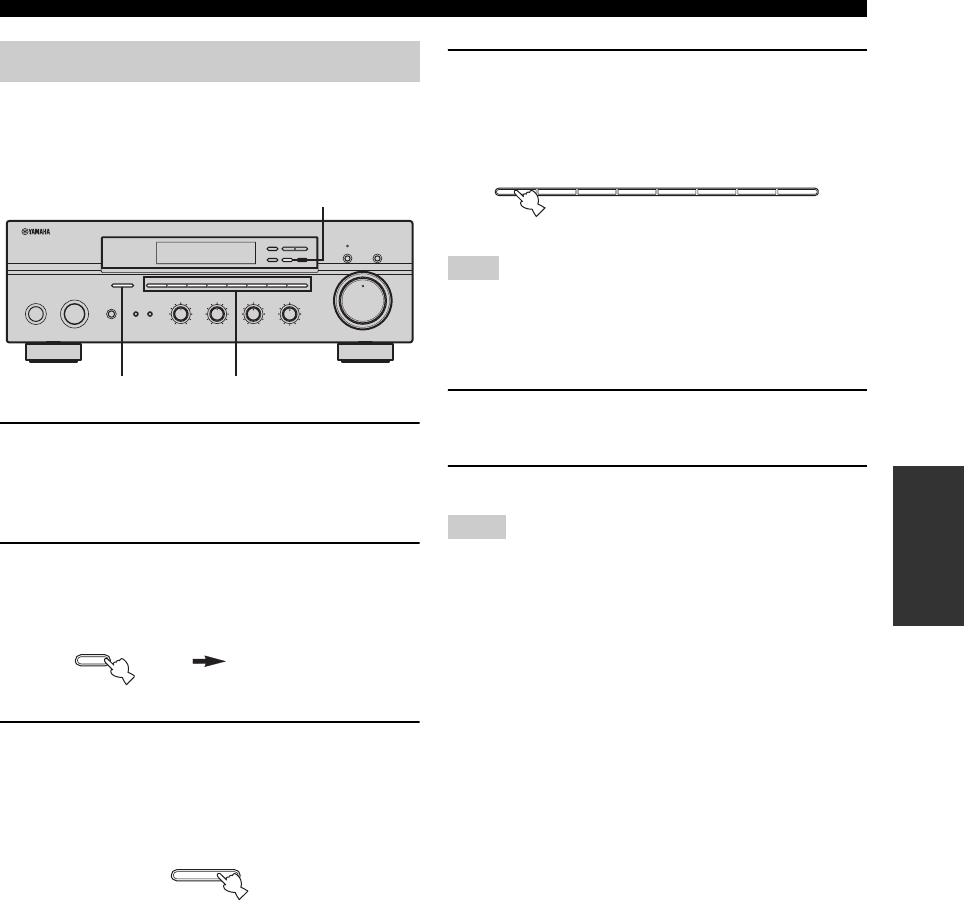
22
FM/AM TUNING
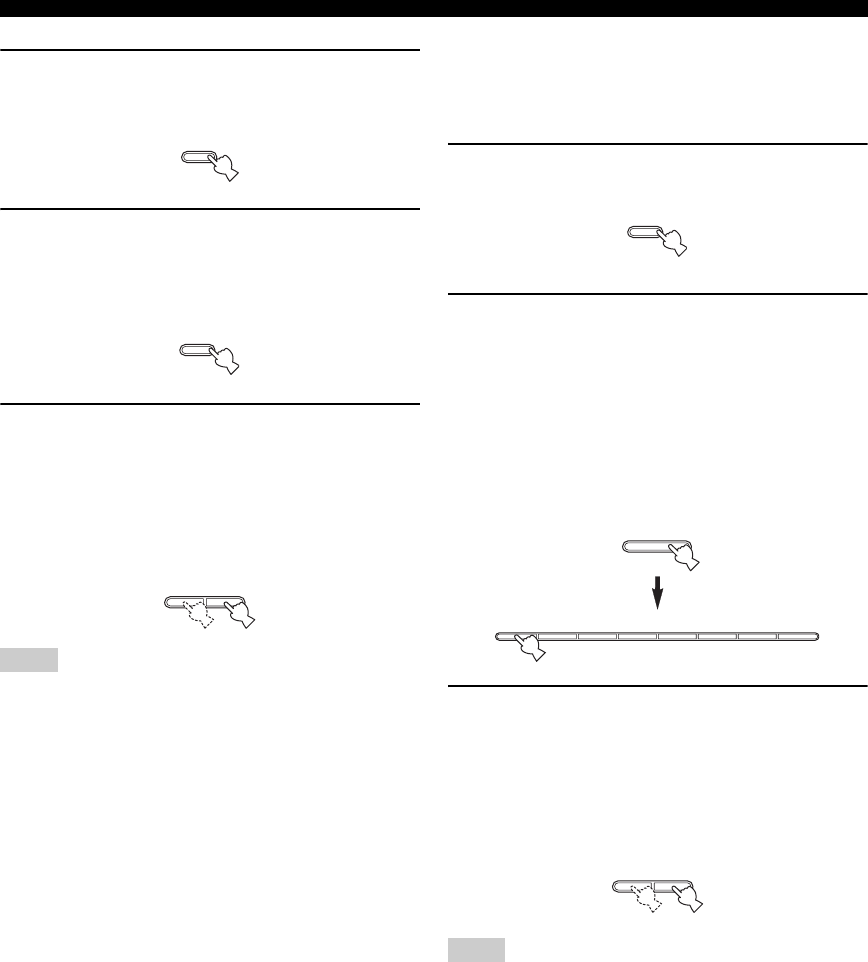
2Press FM/AM on the front panel to select FM
as the reception band.
FM appears in the front panel display.
3Press and hold MEMORY on the front panel
for more than 3 seconds.
The preset station group and the MEMORY and
AUTO indicators flash in the front panel display.
4Press TUNING l / h once to begin
automatic preset tuning.
Press h to tune into higher frequencies.
Press l to tune into lower frequencies.
When automatic preset tuning is complete, the
frequency of the last preset station is shown in the
front panel display.
• If TUNING l / h is not pressed within approximately 5
seconds while the MEMORY and AUTO indicators are
flashing, automatic preset tuning automatically begins from the
currently displayed frequency and proceeds toward higher
frequencies.
• Received stations are sequentially programmed to 8 stations in
each preset station group (A1 to A8). If 8 stations are all
programmed in a preset station group, another 8 stations are
sequentially programmed in the next preset station group.
■Customized automatic preset tuning
You can specify a preset station group and a preset station
number from which this unit stores the FM stations
received by automatic preset tuning.
1Press and hold MEMORY on the front panel
for more than 3 seconds.
2Press A/B/C/D/E and then press one of the
preset station number buttons on the front
panel to select the preset station group and
the preset station number where the first
received station will be stored.
For example, if you select C5, the first received
station is automatically programmed to C5 and the
next received stations are sequentially programmed
to C6, C7, etc.
3Press TUNING l / h on the front panel to
begin automatic preset tuning.
Press h to tune into higher frequencies.
Press l to tune into lower frequencies.
When automatic preset tuning is complete, the
frequency of the last preset station is shown in the
front panel display.
Automatic preset tuning stops when the received stations have all
been stored up to E8.
Notes
FM/AM
MEMORY
MAN'L/AUTO FM
l
TUNING
h
Note
MEMORY
MAN'L/AUTO FM
A/B/C/D/E
12345678
l
TUNING
h
23
FM/AM TUNING
OPERATION
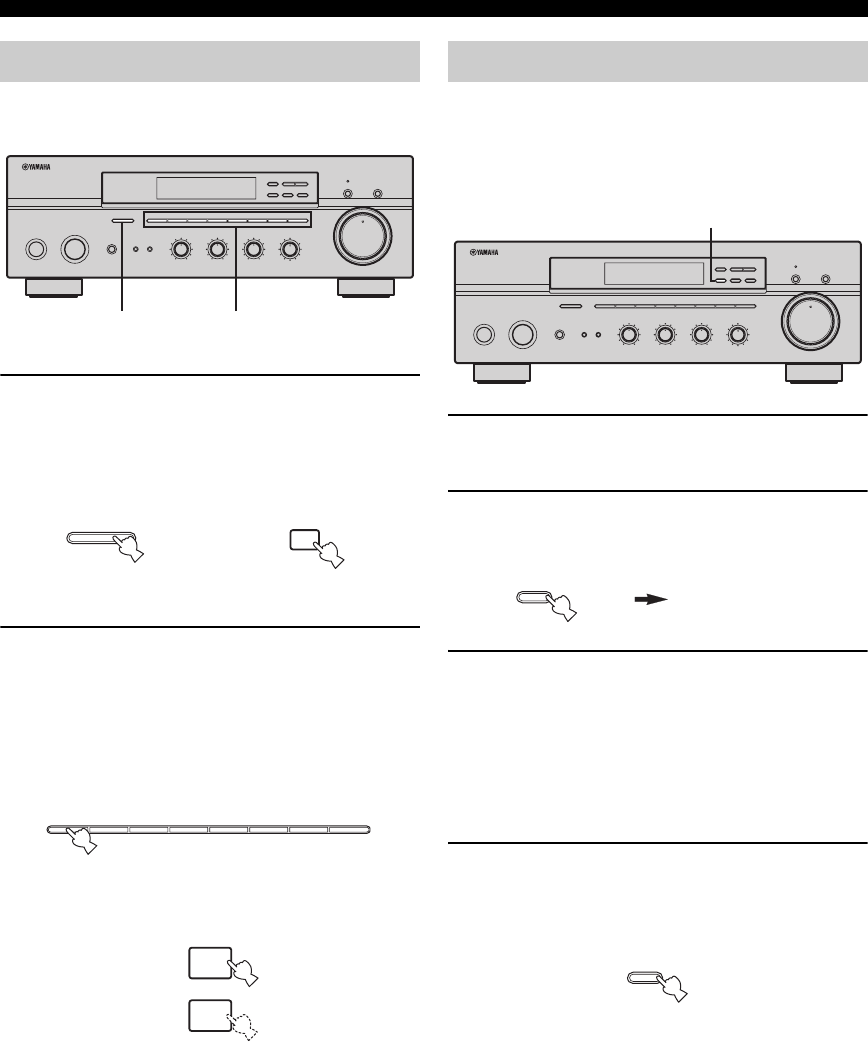
You can also manually store up to 40 stations (8 stations in
each of the 5 groups, A1 to E8). You can then easily recall
any preset stations by selecting the preset station numbers
where they are stored.
1Repeat steps 1 to 4 in “Automatic tuning” or
in “Manual tuning” to tune into a station.
When you tune into a station, the frequency of the
received station is shown in the front panel display.
2Press MEMORY on the front panel.
The MEMORY indicator flashes in the front panel
display for approximately 5 seconds.
3Press A/B/C/D/E on the front panel
repeatedly to select a preset station group (A
to E).
The selected preset station group is shown in the front
panel display.
4Press one of the preset station number
buttons on the front panel to select a preset
station number (1 to 8) where you want to
store the station.
This operation must be done within 5 seconds while the
MEMORY indicator is flashing in the front panel display.
Otherwise, the manual preset tuning process is automatically
canceled.
5Press MEMORY on the front panel to store
the station.
6Repeat steps 1 to 5 to store other stations.
• Any station data stored under a preset station number is cleared
when you store a new station under that preset station number.
• The reception mode (stereo or monaural) is stored along with
the station frequency.
Manual preset tuning
STANDBY
/ON
INPUT
PHONES
BASS
TAPE MONITORPURE DIRECT
55
101
44
22
33
+
–
VOLUME
l
TUNING
h
FM/AM
EDIT
A/B/C/D/E
12345678
MEMORY
MAN'L/AUTO FM
TUNING MODE
AUTO/MAN'L
TREBLE
55
101
44
22
33
+
–
BALANCE
55
101
44
22
33
R
L
LOUDNESS
57
1FLAT
6
48
210
–
30dB
39
SPEAKERS
BA
34
2,5
0
12
12
2
8
4
∞
20
20
60
60
26
26
40
40
16
16
-dB
-dB
MEMORY
MAN'L/AUTO FM
MEMORY
Flashes
A/B/C/D/E
Note
Notes
12345678
24
FM/AM TUNING
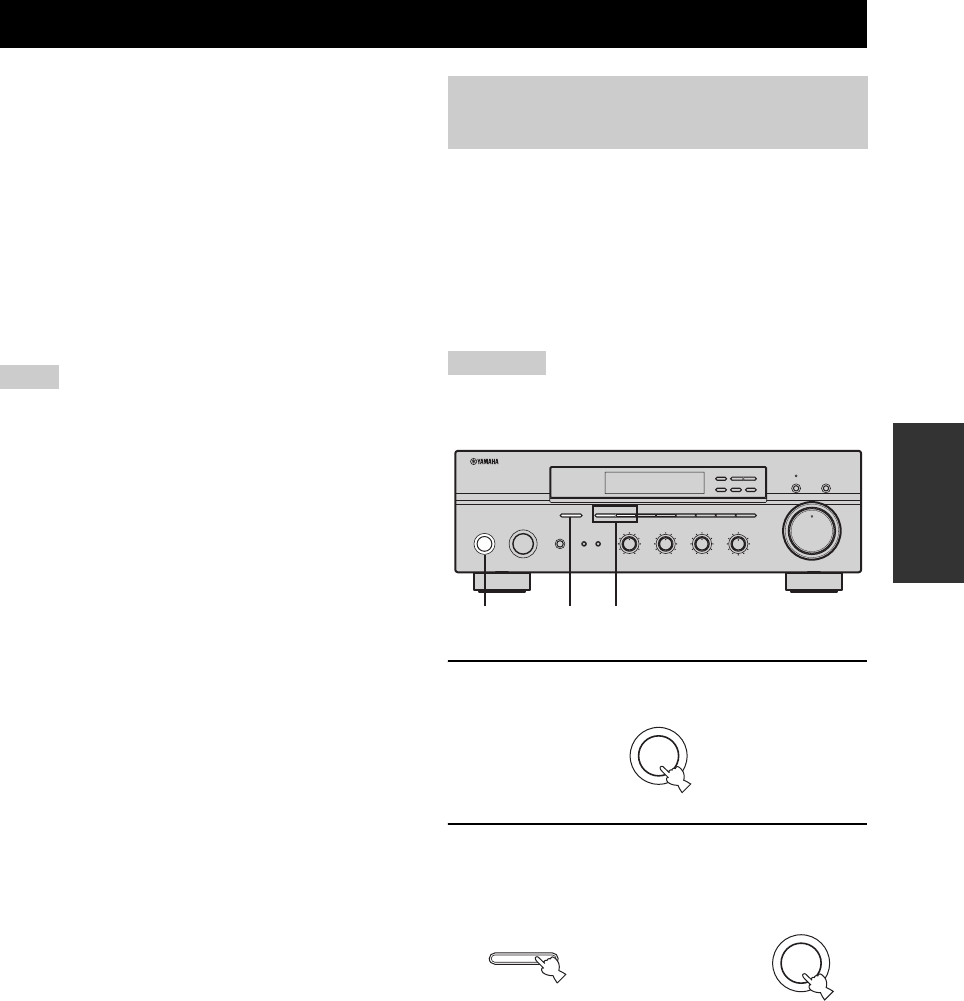
You can tune into the desired station simply by selecting
the preset station number where it is stored.
1Press A/B/C/D/E on the front panel
repeatedly (or on the remote control) to
select a preset station group (A to E).
The selected preset station group is shown in the front
panel display.
2Press one of the preset station number
buttons on the front panel (or
PRESET u / d on the remote control) to
select a preset station number (1 to 8).
The preset station number appears in the front panel
display along with the reception band and the
frequency.
You can exchange the assignment of two preset stations
with each other. The following procedure describes an
example where a preset station E1 is exchanged with
another preset station A5.
1Repeat steps 1 and 2 in “Selecting preset
stations” to select a preset station E1.
2Press EDIT on the front panel.
E1 and the MEMORY indicator flash in the front
panel display.
3Repeat steps 1 and 2 in “Selecting preset
stations” to select another preset station A5.
A5 and the MEMORY indicator flash in the front
panel display.
4Press EDIT on the front panel again.
E1-A5 appears in the front panel display, indicating
that the two preset station assignments have been
exchanged.
Selecting preset stations
STANDBY
/ON
INPUT
PHONES
BASS
TAPE MONITORPURE DIRECT
55
101
44
22
33
+
–
VOLUME
l
TUNING
h
FM/AM
EDIT
A/B/C/D/E
12345678
MEMORY
MAN'L/AUTO FM
TUNING MODE
AUTO/MAN'L
TREBLE
55
101
44
22
33
+
–
BALANCE
55
101
44
22
33
R
L
LOUDNESS
57
1FLAT
6
48
210
–
30dB
39
SPEAKERS
BA
12
0
12
12
2
8
4
∞
20
20
60
60
26
26
40
40
16
16
-dB
-dB
A/B/C/D/E
A/B/C/D/E
Front panel
or
Remote control
12345678
u
d
PRESET
or
Front panel
Remote control
Exchanging preset stations
STANDBY
/ON
INPUT
PHONES
BASS
TAPE MONITORPURE DIRECT
55
101
44
22
33
+
–
VOLUME
l
TUNING
h
FM/AM
EDIT
A/B/C/D/E
12345678
MEMORY
MAN'L/AUTO FM
TUNING MODE
AUTO/MAN'L
TREBLE
55
101
44
22
33
+
–
BALANCE
55
101
44
22
33
R
L
LOUDNESS
57
1FLAT
6
48
210
–
30dB
39
SPEAKERS
BA
2,4
0
12
12
2
8
4
∞
20
20
60
60
26
26
40
40
16
16
-dB
-dB
EDIT MEMORY
Flashes
MEMORY
Flashes
EDIT
ADVANCED SETUP
25
OPERATION
■ADVANCED SETUP menu parameters
Change the initial settings (indicated in bold under each
parameter) to reflect the needs of your listening
environment.
Factory presets PRESET
Use to reset all parameters to the factory presets.
Choices: CANCEL, RESET
• Select CANCEL if you do not want the parameters of
this unit to be initialized when you reset the factory
presets.
• Select RESET if you want all of the parameters of this
unit to be initialized when you reset the factory presets.
• This setting does not affect the parameters in the ADVANCED
SETUP menu.
• The resetting process starts next time you turn on the power of
this unit.
Tuner TU
(Asia and General models only)
Use to switch the frequency step selection according to the
frequency spacing in your area.
Choices: AM10/FM100, AM9/FM50
• North, Central and South America:
AM10/FM100 (kHz)
• Other areas: AM9/FM50 (kHz)
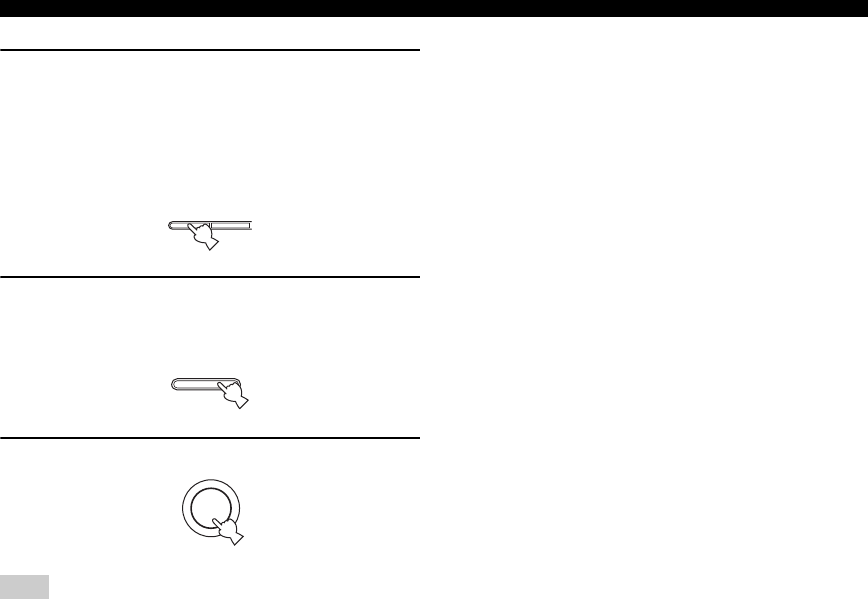
The ADVANCED SETUP menu is displayed in the front
panel display.
y
• During the ADVANCED SETUP procedure, audio output is
muted.
• During the ADVANCED SETUP procedure, only
STANDBY/ON, A/B/C/D/E and the preset station number
buttons (1 and 2) on the front panel are operational.
Be sure to set the speaker impedance before using this unit
to play back audio signals (see page 13).
1Press STANDBY/ON on the front panel to set
this unit to the standby mode.
2Press and hold A/B/C/D/E on the front panel
and then press STANDBY/ON.
This unit is turned on, and the ADVANCED SETUP
menu appears in the front panel display.
ADVANCED SETUP
Notes
Changing the ADVANCED SETUP
menu parameters
CAUTION
STANDBY
/ON
INPUT
PHONES
BASS
TAPE MON ITORPURE DIRECT
55
101
44
22
33
+
–
VOLUME
l
TUNING
h
FM/AM
EDIT
A/B/C/D/E
12345678
MEMORY
MAN'L/AUTO FM
TUNING MODE
AUTO/MAN'L
TREBLE
55
101
44
22
33
+
–
BALANCE
55
101
44
22
33
R
L
LOUDNESS
57
1FLAT
6
48
210
–
30dB
39
SPEAKERS
BA
2,41,2,5 3
0
12
12
2
8
4
∞
20
20
60
60
26
26
40
40
16
16
-dB
-dB
STANDBY
/ON
While holding down,
press
A/B/C/D/E
STANDBY
/ON
26
ADVANCED SETUP
3(Asia and General models only)
Press the preset station number buttons (1
and 2) on the front panel to move through the
menu and select the parameter you want to
adjust.
See page 25 for available parameters.
4Press A/B/C/D/E on the front panel
repeatedly to toggle between the available
parameters.
5Press STANDBY/ON to confirm your setting.
The settings you made are reflected next time you turn on this
unit.
Note
1 2
A/B/C/D/E
STANDBY
/ON
TROUBLESHOOTING
27
ADDITIONAL
INFORMATION
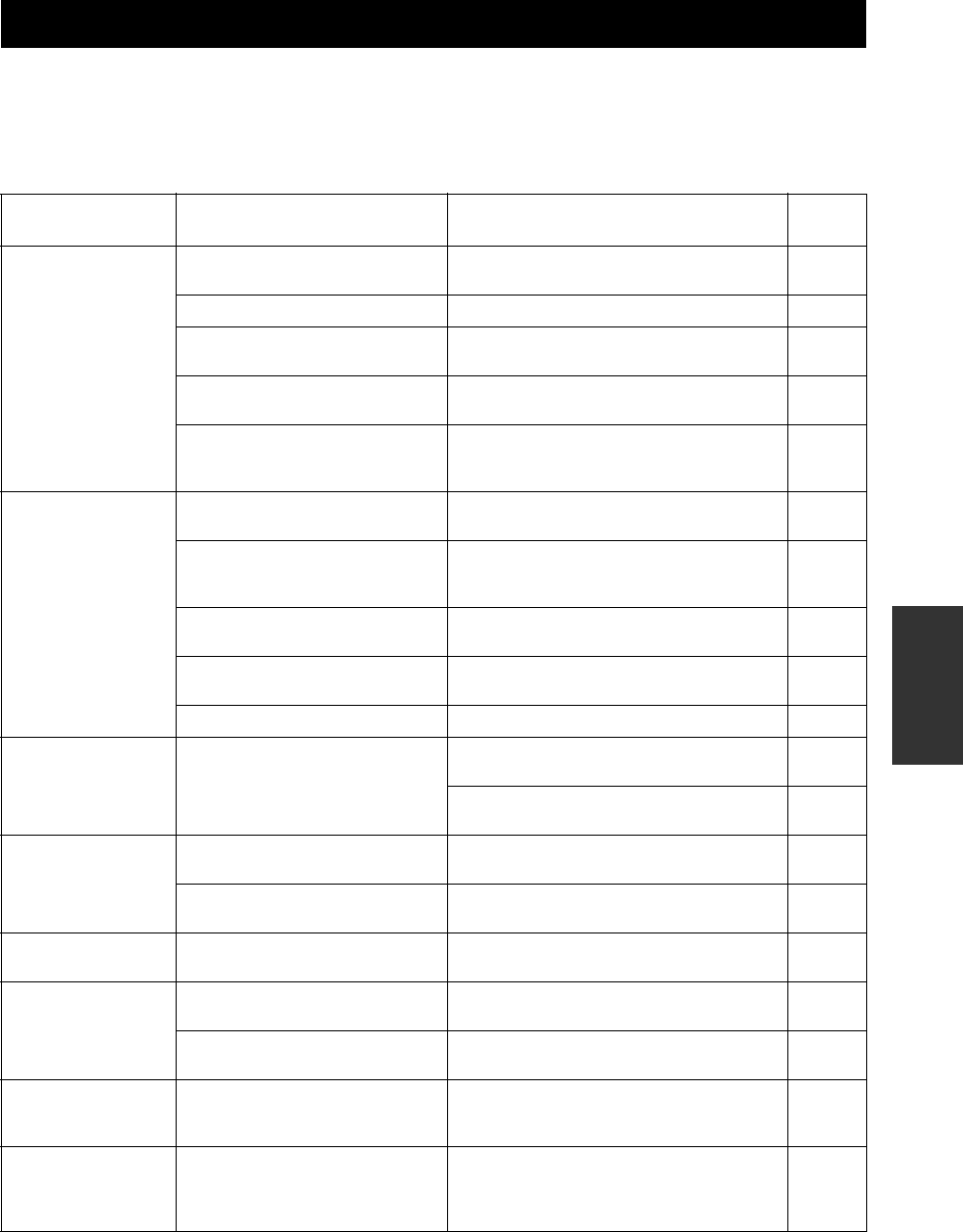
Refer to the chart below if this unit does not function properly. If the problem you are experiencing is not listed below or
if the instructions below do not help, set this unit to the standby mode, disconnect the power cord, and contact the nearest
authorized YAMAHA dealer or service center.
■General
TROUBLESHOOTING
Problem Cause Remedy See
page
This unit fails to turn
on.
The power supply cord is not connected or
the plug is not completely inserted.
Connect the power supply cord firmly. —
The impedance setting is incorrect. Set the impedance to match your speakers. 13
The protection circuitry has been activated
because of a short circuit, etc.
Check that the speaker wires are not touching each
other and then turn the power of this unit back on. 10
The IMPEDANCE SELECTOR switch on
the rear panel is not set to either end.
Set the IMPEDANCE SELECTOR switch to either
end when the power of this unit is turned off. 13
This unit has been exposed to a strong
external electric shock (such as lightning
or strong static electricity).
Set this unit to the standby mode, disconnect the
power supply cord, plug it back in after 30 seconds,
then use it normally.
—
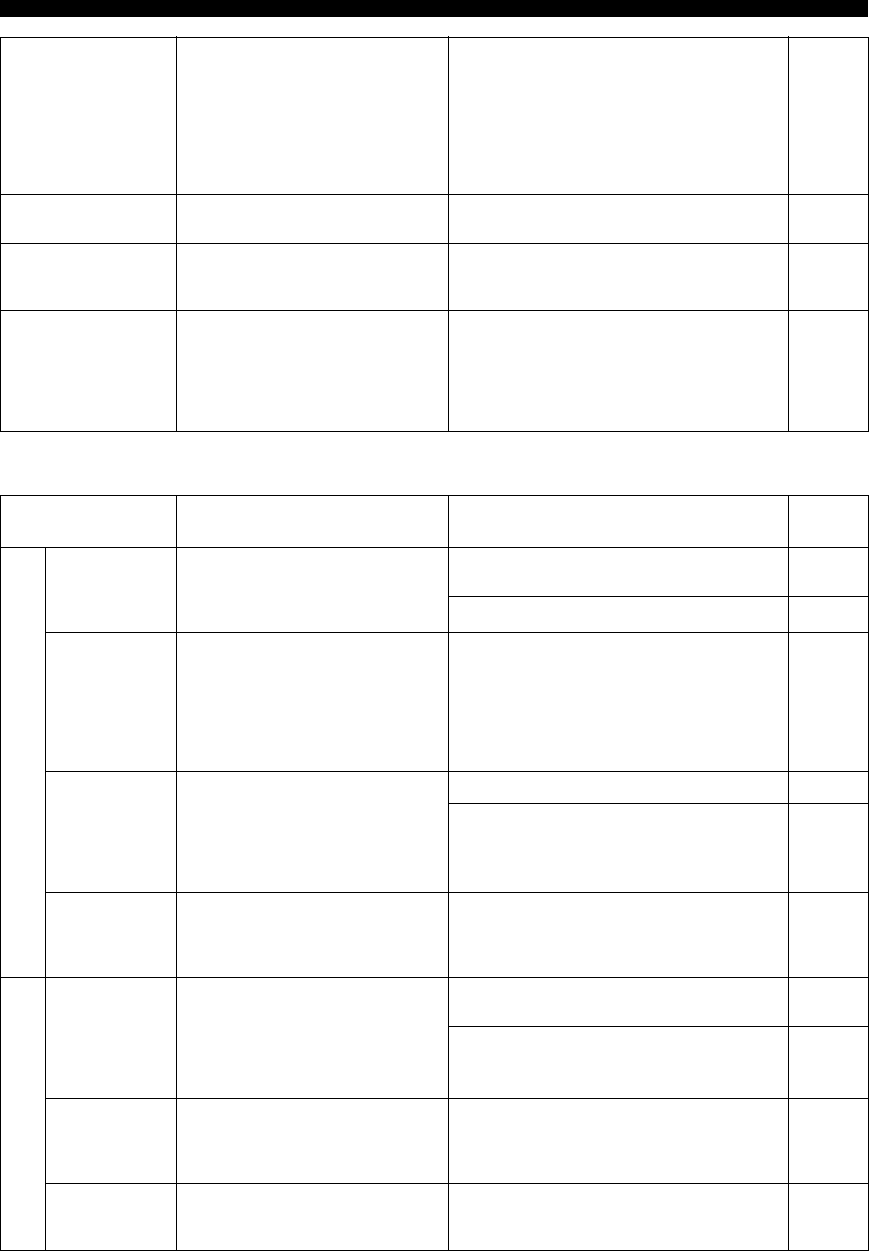
No sound Incorrect input or output cable
connections.
Connect the cables properly. If the problem persists,
the cables may be defective. 9
No appropriate input source has been
selected.
Select an appropriate input source with the INPUT
selector on the front panel (or one of the input
selector buttons on the remote control).
15
The TAPE MONITOR function is turned
on.
Turn off the TAPE MONITOR function. 3
The SPEAKERS A/B switches are not set
properly.
Turn on the corresponding SPEAKERS A or
SPEAKERS B. 15
Speaker connections are not secure. Secure the connections. 10
The sound suddenly
goes off.
The protection circuitry has been activated
because of a short circuit, etc.
Check that the IMPEDANCE SELECTOR setting is
correct. 13
Check that the speaker wires are not touching each
other and then turn the power of this unit back on. 10
Only the speaker on
one side can be
heard.
Incorrect cable connections. Connect the cables properly. If the problem persists,
the cables may be defective. 9
Incorrect setting for the BALANCE
control.
Set the BALANCE control to the appropriate
position. 16
There is a lack of bass
and no ambience.
The + and – wires are connected in
reverse at the amplifier or the speakers.
Connect the speaker wires to the correct + and –
phase. 10
A “humming” sound
can be heard.
Incorrect cable connections. Connect the audio plugs firmly. If the problem
persists, the cables may be defective. 9
No connection from the turntable to the
GND terminal.
Make the GND connection between the turntable and
this unit. 9
The volume level is
low while playing a
record.
The record is being played on a turntable
with an MC cartridge.
The turntable should be connected to this unit through
the MC head amplifier. —
The volume level
cannot be increased,
or the sound is
distorted.
The component connected to the TAPE
OUT or the MD OUT jacks of this unit is
turned off.
Turn on the power of the component.
—
28
TROUBLESHOOTING
■Tuner
The sound is
degraded when
listening with the
headphones
connected to the CD
player or the tape
deck connected to
this unit.
The power of this unit is turned off, or this
unit is set to the standby mode.
Turn on the power of this unit.
14
The sound level is
low.
The LOUDNESS control is functioning. Set the LOUDNESS control to the FLAT position. 16
The INPUT selector
will not function
though it is rotated.
The TAPE MONITOR function is turned
on.
Turn off the TAPE MONITOR function.
3
Using the BASS,
TREBLE, BALANCE
and LOUDNESS
controls does not
affect the tonal
quality.
The PURE DIRECT button is turned on. The PURE DIRECT button must be turned off to use
those controls.
16
Problem Cause Remedy See
page
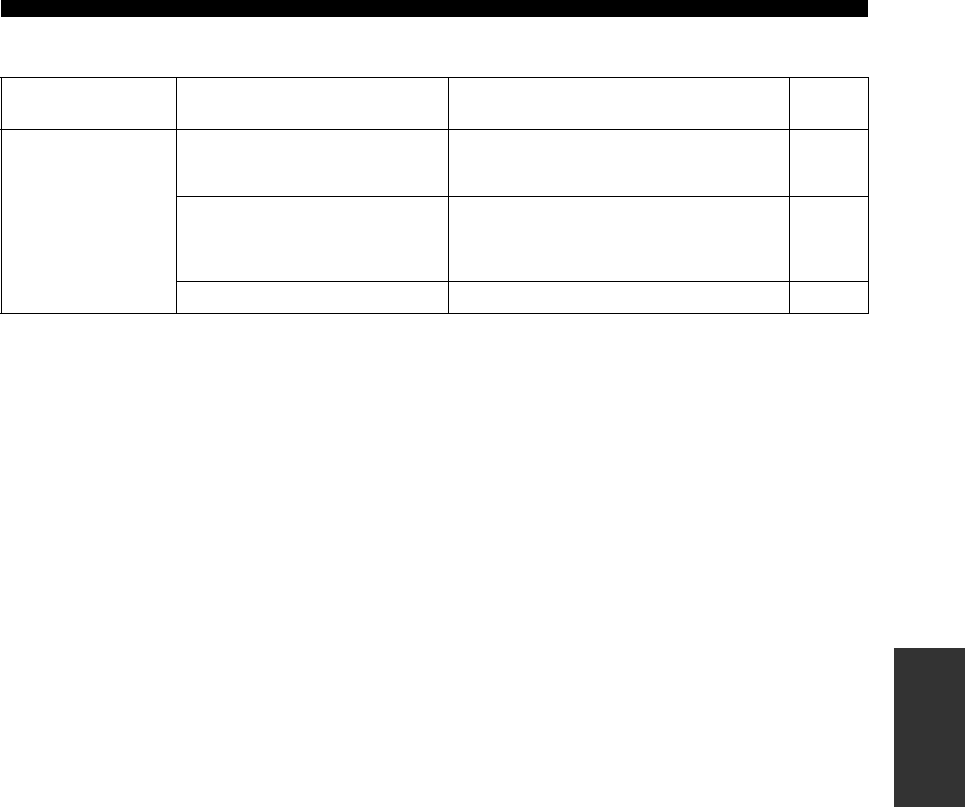
FM
FM stereo
reception is
noisy.
The particular characteristics of the FM
stereo broadcasts being received may
cause this problem when the transmitter is
too far away or the antenna input is poor.
Check the antenna connections.
Try using a high-quality directional FM antenna. 11
Try using the manual tuning method. 21
There is
distortion, and
clear reception
cannot be
obtained even
with a good FM
antenna.
There is multipath interference. Adjust the antenna position to eliminate the multipath
interference.
—
The desired
station cannot
be tuned in
with the
automatic
tuning method.
The signal is too weak. Try using a high-quality directional FM antenna. 11
Try using the manual tuning method.
21
Previously
preset stations
can no longer
be tuned in.
This unit has been disconnected for a long
period.
Preset the stations again.
21
AM
The desired
station cannot
be tuned in
with the
automatic
tuning method.
The signal is weak or the antenna
connections are loose.
Tighten the AM loop antenna connections and orient
it for the best reception. —
Try using the manual tuning method.
21
There are
continuous
crackling and
hissing noises.
The noises may result from lightning,
fluorescent lamps, motors, thermostats or
other electrical equipment.
Try using an outdoor antenna and a ground wire.
This will help somewhat, but it is difficult to
eliminate all noise. —
There are
buzzing and
whining noises.
A TV set is being used nearby. Move this unit away from the TV set.
—
29
TROUBLESHOOTING
ADDITIONAL
INFORMATION
■Remote control
Problem Cause Remedy See
page
The remote control
does not work nor
function properly.
Wrong distance or angle. The remote control will function within a maximum
range of 6 m (19.7 ft) and no more than 30 degrees
off-axis from the front panel.
8
Direct sunlight or lighting (from an
inverter type of fluorescent lamp, etc.) is
striking the remote control sensor of this
unit.
Reposition this unit.
—
The batteries are weak. Replace all batteries. 8

SPECIFICATIONS
30
AUDIO SECTION
• Minimum RMS Output Power
(8 Ω , 20 Hz to 20 kHz, 0.04% THD) ..................... 50 W + 50 W
• Dynamic Power (IHF)
(8/6/4/2 Ω) ........................................................... 70/77/89/100 W
• Maximum Output Power [Europe model only]
(1 kHz, 0.7% THD, 4 Ω) ...................................................... 55 W
• IEC Output Power [Europe model only]
(1 kHz, 0.04% THD, 8 Ω) .................................................... 52 W
• Power Band Width
(0.08% THD, 25 W, 8 Ω) .....................................10 Hz to 50 kHz
• Damping Factor (SPEAKERS A)
20 Hz to 20 kHz, 8 Ω ................................................. 150 or more
• Maximum Output Power (EIAJ)
[Asia and General models only]
(1 kHz, 10% THD, 8 Ω) ....................................................... 85 W
• Maximum Input Signal
PHONO (1 kHz, 0.04% THD) ............................ 115 mV or more
CD/DVD, etc. (1 kHz, 0.04% THD) ....................... 2.2 V or more
• Frequency Response
CD/DVD, etc. (20 Hz to 20 kHz) ................................. 0 ± 0.5 dB
CD/DVD, etc.
PURE DIRECT ON (10 Hz to 100 kHz) .................. 0 ± 1.0 dB
• RIAA Equalization Deviation
PHONO ........................................................................... ± 0.5 dB
• Total Harmonic Distortion
PHONO to OUT (REC)
(20 Hz to 20 kHz, 3 V) ............................................ 0.02% or less
CD/DVD, etc. to SPEAKERS
(20 Hz to 20 kHz, 25 W, 8 Ω) ................................. 0.02% or less
• Signal to Noise Ratio (IHF-A Network)
PHONO (5 mV input shorted) ............................... 82 dB or more
CD/DVD, etc. (150 mV input shorted) ................. 108 dB or more
• Residual Noise (IHF-A Network)
PURE DIRECT ON .......................................................... 100 µV
• Input Sensitivity/Input Impedance
PHONO .................................................................. 2.5 mV/47 kΩ
CD/DVD, etc. ........................................................ 150 mV/47 kΩ
• Output Level/Output Impedance
OUT (REC) ................................................ 150 mV/1.2 kΩ or less
• Headphone Output/Impedance
(Input 1 kHz, 150 mV, 8 Ω , 0.04% THD)
CD/DVD, etc. .......................................................... 0.47 V/330 Ω
• Channel Separation
CD/DVD, etc. (5.1 kΩ input shorted, 1/10 kHz) ....... 65/50 dB or
more
• Tone Control Characteristics
BASS
Boost/Cut (50 Hz) .......................................................... ±10 dB
Turnover Frequency ........................................................ 350 Hz
TREBLE
Boost/Cut (20 kHz) ........................................................ ±10 dB
Turnover Frequency ....................................................... 3.5 kHz
• Continuous Loudness Control
Attenuation (1 kHz) ............................................................ –30 dB
FM SECTION
• Tuning Range
[U.S.A. and Canada models] .......................... 87.5 to 107.9 MHz
[Asia and General models] ....... 87.5/87.50 to 107.9/108.00 MHz
[Other models] ............................................ 87.50 to 108.00 MHz
• Usable Sensitivity (IHF)....................................... 1.0 µV (11.2 dBf)
• Signal to Noise Ratio (IHF)
Mono/Stereo ............................................................. 76 dB/70 dB
• Harmonic Distortion (1 kHz)
Mono/Stereo ................................................................ 0.2%/0.3%
• Stereo Separation (1 kHz) ....................................................... 45 dB
• Frequency Response .......................... 20 Hz to 15 kHz, +0.5/–2 dB
AM SECTION
• Tuning Range
[U.S.A. and Canada models] .............................. 530 to 1710 kHz
[Asia and General models] ................. 530/531 to 1710/1611 kHz
[Other models] .................................................... 531 to 1611 kHz
• Usable Sensitivity ............................................................. 300 µV/m
GENERAL
• Power Supply
[U.S.A. and Canada models] ............................. AC 120 V, 60 Hz
[Asia model] ....................................AC 220/230-240 V, 50/60 Hz
[General model]................. AC 110/120/220/230-240 V, 50/60 Hz
[Australia model] ............................................... AC 240 V, 50 Hz
[Europe model] .................................................. AC 230 V, 50 Hz
• Power Consumption .............................................................. 130 W
• Standby Power Consumption ...................................... 0.1 W or less
• Maximum Power Consumption [General model only]
(8 Ω , 1 kHz, 10% THD) .................................................... 300 W
• AC Outlets
[Australia model] ................................ 1 (Total 100 W maximum)
[General model] .................................... 2 (Total 50 W maximum)
[Other models] .................................... 2 (Total 100 W maximum)
• Dimensions (W x H x D) ................................. 435 x 151 x 308 mm
(17-1/8” x 5-15/16” x 12-1/8”)
• Weight ............................................................ 7.4 kg (16 lbs. 5 coz.)
* Specifications are subject to change without notice.mm
SPECIFICATIONS
YAMAHA ELECTRONICS CORPORATION, USA
6660 ORANGETHORPE AVE., BUENA PARK, CALIF. 90620, U.S.A.
YAMAHA CANADA MUSIC LTD.
135 MILNER AVE., SCARBOROUGH, ONTARIO M1S 3R1, CANADA
YAMAHA ELECTRONIK EUROPA G.m.b.H.
SIEMENSSTR. 22-34, 25462 RELLINGEN BEI HAMBURG, GERMANY
YAMAHA ELECTRONIQUE FRANCE S.A.
RUE AMBROISE CROIZAT BP70 CROISSY-BEAUBOURG 77312 MARNE-LA-VALLEE CEDEX02, FRANCE
YAMAHA ELECTRONICS (UK) LTD.
YAMAHA HOUSE, 200 RICKMANSWORTH ROAD WATFORD, HERTS WD18 7GQ, ENGLAND
YAMAHA SCANDINAVIA A.B.
J A WETTERGRENS GATA 1, BOX 30053, 400 43 VÄSTRA FRÖLUNDA, SWEDEN
YAMAHA MUSIC AUSTRALIA PTY, LTD.
17-33 MARKET ST., SOUTH MELBOURNE, 3205 VIC., AUSTRALIA
©
2005 All rights reserved.
Printed in Malaysia
WG05070
This product mainly uses lead-free solder.
IMPORTANT SAFETY INSTRUCTIONS
RX-497/RX-397
Read the following instructions instead of “IMPORTANT SAFETY INSTRUCTIONS” (1 to 14
on page i) on the OWNER’S MANUAL.
1Read Instructions – All the safety and operating instructions
should be read before the product is operated.
2Retain Instructions – The safety and operating instructions
should be retained for future reference.
3Heed Warnings – All warnings on the product and in the
operating instructions should be adhered to.
4Follow Instructions – All operating and use instructions
should be followed.
5Cleaning – Unplug this product from the wall outlet before
cleaning. Do not use liquid cleaners or aerosol cleaners.
6Attachments – Do not use attachments not recommended by
the product manufacturer as they may cause hazards.
7
Water and Moisture – Do not use this product near water – for
example, near a bath tub, wash bowl, kitchen sink, or laundry
tub; in a wet basement; or near a swimming pool; and the like.
8Accessories – Do not place this product on an unstable cart,
stand, tripod, bracket, or table. The product may fall,
causing serious injury to a child or adult, and serious
damage to the product. Use only with a cart, stand, tripod,
bracket, or table recommended by the manufacturer, or sold
with the product. Any mounting of the product should
follow the manufacturer’s instructions, and should use a
mounting accessory recommended by the
manufacturer.
9A product and cart combination should be
moved with care. Quick stops, excessive
force, and uneven surfaces may cause the
product and cart combination to overturn.
10 Ventilation – Slots and openings in the cabinet are
provided for ventilation and to ensure reliable operation of
the product and to protect it from overheating, and these
openings must not be blocked or covered. The openings
should never be blocked by placing the product on a bed,
sofa, rug, or other similar surface. This product should not
be placed in a built-in installation such as a bookcase or rack
unless proper ventilation is provided or the manufacturer’s
instructions have been adhered to.
11 Power Sources – This product should be operated only from
the type of power source indicated on the marking label. If
you are not sure of the type of power supply to your home,
consult your product dealer or local power company. For
products intended to operate from battery power, or other
sources, refer to the operating instructions.
12 Grounding or Polarization – This product may be equipped
with a polarized alternating current line plug (a plug having
one blade wider than the other). This plug will fit into the
power outlet only one way. This is a safety feature. If you
are unable to insert the plug fully into the outlet, try
reversing the plug. If the plug should still fail to fit, contact
your electrician to replace your obsolete outlet. Do not
defeat the safety purpose of the polarized plug.
13 Power-Cord Protection – Power-supply cords should be
routed so that they are not likely to be walked on or pinched
by items placed upon or against them, paying particular
attention to cords at plugs, convenience receptacles, and the
point where they exit from the product.
14 Lightning – For added protection for this product during a
lightning storm, or when it is left unattended and unused for
long periods of time, unplug it from the wall outlet and
disconnect the antenna or cable system. This will prevent
damage to the product due to lightning and power-line
surges.
15 Power Lines – An outside antenna system should not be
located in the vicinity of overhead power lines or other
electric light or power circuits, or where it can fall into such
power lines or circuits. When installing an outside antenna
system, extreme care should be taken to keep from touching
such power lines or circuits as contact with them might be
fatal.
16 Overloading – Do not overload wall outlets, extension
cords, or integral convenience receptacles as this can result
in a risk of fire or electric shock.
17 Object and Liquid Entry – Never push objects of any kind
into this product through openings as they may touch
dangerous voltage points or short-out parts that could result
in a fire or electric shock. Never spill liquid of any kind on
the product.
18 Servicing – Do not attempt to service this product yourself
as opening or removing covers may expose you to
dangerous voltage or other hazards. Refer all servicing to
qualified service personnel.
19 Damage Requiring Service – Unplug this product from the
wall outlet and refer servicing to qualified service personnel
under the following conditions:
a) When the power-supply cord or plug is damaged,
b) If liquid has been spilled, or objects have fallen into the
product,
c) If the product has been exposed to rain or water,
d) If the product does not operate normally by following
the operating instructions. Adjust only those controls
that are covered by the operating instructions as an
improper adjustment of other controls may result in
damage and will often require extensive work by a
qualified technician to restore the product to its normal
operation,
e) If the product has been dropped or damaged in any
way, and
f) When the product exhibits a distinct change in perfor-
mance - this indicates a need for service.
IMPORTANT SAFETY INSTRUCTIONS
RX-497_397_U_FLR.fm Page i Thursday, September 8, 2005 9:51 AM
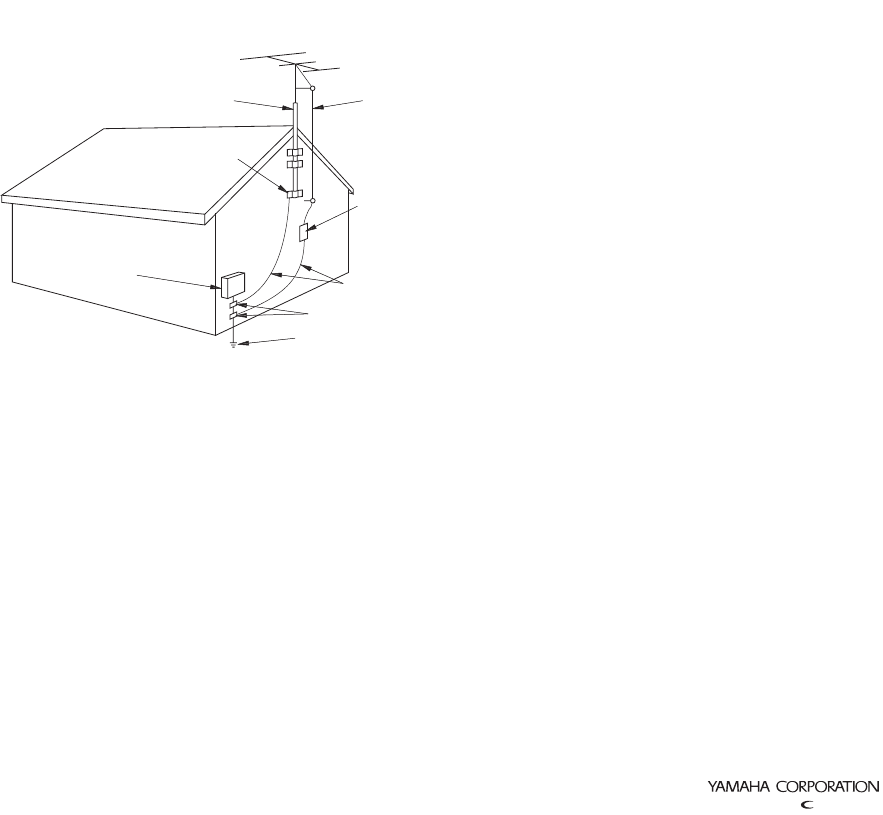
EXAMPLE OF ANTENNA GROUNDING
MAST
GROUND
CLAMP
ANTENNA
LEAD IN
WIRE
ANTENNA
DISCHARGE UNIT
(NEC SECTION 810–20)
GROUNDING CONDUCTORS
(NEC SECTION 810–21)
GROUND CLAMPS
POWER SERVICE GROUNDING
ELECTRODE SYSTEM
(NEC ART 250. PART H)
ELECTRIC
SERVICE
EQUIPMENT
NEC – NATIONAL ELECTRICAL CODE
20 Replacement Parts – When replacement parts are required,
be sure the service technician has used replacement parts
specified by the manufacturer or have the same
characteristics as the original part. Unauthorized
substitutions may result in fire, electric shock, or other
hazards.
21 Safety Check – Upon completion of any service or repairs to
this product, ask the service technician to perform safety
checks to determine that the product is in proper operating
condition.
22 Wall or Ceiling Mounting – The unit should be mounted to a
wall or ceiling only as recommended by the manufacturer.
23 Heat – The product should be situated away from heat
sources such as radiators, heat registers, stoves, or other
products (including amplifiers) that produce heat.
24 Outdoor Antenna Grounding – If an outside antenna or
cable system is connected to the product, be sure the antenna
or cable system is grounded so as to provide some
protection against voltage surges and built-up static charges.
Article 810 of the National Electrical Code, ANSI/NFPA 70,
provides information with regard to proper grounding of the
mast and supporting structure, grounding of the lead-in wire
to an antenna discharge unit, size of grounding conductors,
location of antenna discharge unit, connection to grounding
electrodes, and requirements for the grounding electrode.
WG63450
Printed in Malaysia
a
RX-497_397_U_FLR.fm Page ii Thursday, September 8, 2005 9:51 AM
