Yamaha Trombone Owner's Manual Trombones En Om A0
User Manual: Yamaha Trombones Owner's Manual
Open the PDF directly: View PDF  .
.
Page Count: 19
日本語
EnglishDeutschFrançaisEspañol
中文
Русский
한국어
トロンボ ーン
取扱説明書
Trombone
Owner’s Manual
Posaune
Bedienungsanleitung
Trombone
Mode d’emploi
Trombón
Manual de instrucciones
Trombone
Manual de instruções
长号
使用手册
Тромбон
Руководство пользователя
트롬본
사 용설명서
Português

2
このたびは、ヤマハ管楽器をお買い上げいただき、まことにありがとうございます。
楽器を正しく組み立て性能をフルに発揮させるため、また永く良い状態で楽器を
お使いいただくために、この取扱説明書をよくお読みください。
P.19
You are now the owner of a high quality musical instrument. ank you for choosing Yamaha.
For instructions on the proper assembly of the instrument, and how to keep the instrument in optimum
condition for as long as possible, we urge you to read this Owner’s Manual thoroughly.
P.33
Sie sind nun der stolze Besitzer eines hochwertigen Musikinstruments. Vielen Dank, dass Sie sich für ein
Instrument der Marke Yamaha entschiedenen haben. Um mit den Handgrien zum Zusammensetzen
und Zerlegen des Instruments vertraut zu werden und dieses über Jahre hinweg in optimalem Zustand
halten zu können, raten wir Ihnen, diese Anleitung aufmerksam durchzulesen.
P.47
Vous êtes dès à présent le propriétaire d’un instrument de musique de haute qualité.
Nous vous remercions d’avoir choisi Yamaha. En ce qui concerne les instructions relatives à un assem-
blage adéquat de l’instrument et sur la façon de garder l’instrument dans des conditions optimales aussi
longtemps que possible, nous vous conseillons vivement de lire entièrement le présent Mode d’emploi.
P.61
P.75
Usted es ahora propietario de un instrumento musical de alta calidad. Le agradecemos su elección de un
instrumento Yamaha. Le aconsejamos que lea todo este manual de instrucciones para ver las instruc-
ciones para el montaje correcto del instrumento y para aprender a conservar el instrumento en óptimas
condiciones durante tanto tiempo como sea posible.
Agora você é o proprietário de um instrumento musical de alta qualidade. Obrigado por escolher a marca
Yamaha. Aconselhamos que leia cuidadosamente todo o manual do proprietário para ver as instruções de
montagem adequada do instrumento, bem como manter em ótimas condições de uso pelo máximo de
tempo possível.
P.89
现在您已经是高品质乐器的主人了 ! 在此 , 我们衷心感谢您选择雅马哈乐器 ,
同时也恳请您完整阅读该使用手册 , 从而可以充分了解有关乐器正确组装及
如何使您的乐器尽可能长久地处于最佳状况的使用说明。
P.103
P.117
야마하 악기를 구입해 주셔서 감사합니다 . 악기의 알맞은 조립 방법 및 보관을 위
해 본 사용설명서를 반드시 읽어주시기 바랍니다 .
P. 3
Вы стали обладателем высококачественного музыкального инструмента. Благодарим Вас
за выбор продукции Yamaha. Для получения инструкций по правильной сборке данного
инструмента и его длительном хранении в оптимальных условиях мы настоятельно
рекомендуем Вам внимательно прочитать настоящее руководство.
19
Trombone
Owner’s Manual
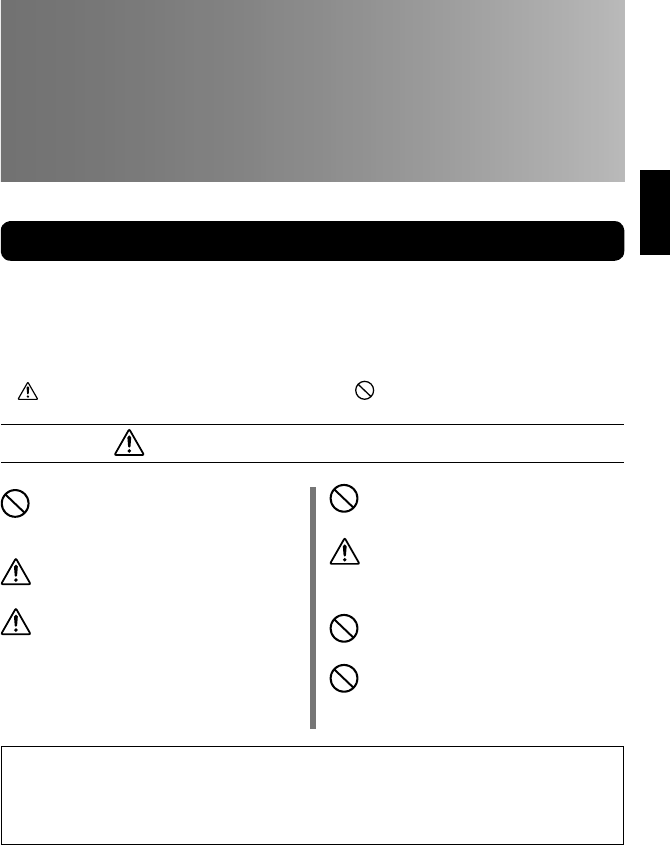
Precautions Please read before using
Do not throw or swing the instrument when others
are close by.
The mouthpiece or other parts may fall off hitting other
people. Always treat the instrument gently.
Keep the oil, polish, etc., out of children’s mouths.
Keep the oil, polish, etc., out of children’s reach and do
maintenance when children are not present.
Be aware of climatic conditions such as tempera-
ture, humidity, etc.
Keep the instrument away from heat sources such as
heaters, etc. Also, do not use or store the instrument in
any extreme conditions of temperature or humidity. Do-
ing so may result in damage to key balance, linkage, or
pads, resulting in problems during performance.
Never use benzene or thinner for maintenance on
instruments with a lacquer finish.
Doing so may result in damage to the finish’s top coat.
Take care not to disfigure the instrument.
Placing the instrument where it is unstable may cause
the instrument to fall or drop resulting in disfigurement.
Take care as to where and how you place the instru-
ment.
Do not modify the instrument.
Besides voiding the warranty, modification of the instru-
ment may make repairs impossible.
Keep small parts out of the reach of infants.
Your children may accidentally swallow them.
The precautions given below concern the proper and safe use of the instrument, and are to pro-
tect you and others from any damage or injuries. Please follow and obey these precautions.
If children are using the instrument, a guardian should clearly explain these precautions to the child and make sure
they are fully understood and obeyed. After reading this manual, please keep it in a safe place for future reference.
■ About the Icons
: This icon indicates points which should be paid attention to. : This icon indicates actions that are prohibited.
Caution Disobeying the points indicated with this mark may lead to
damage or injury.
In regards to brass instruments with a plate finish, the color of the finish may change over time however, it should be
of no concern in regards to the instrument’s performance. Discoloration in its early stage can easily be removed with
maintenance. (As discoloration progresses, it may be difficult to remove.)
* Please use the accessories that are specified for use with the particular type of finish found on the instrument. Also, metal polishes
remove a thin layer of the finish’s top coat which will make the finish thinner. Please be aware of this before using polish.
20
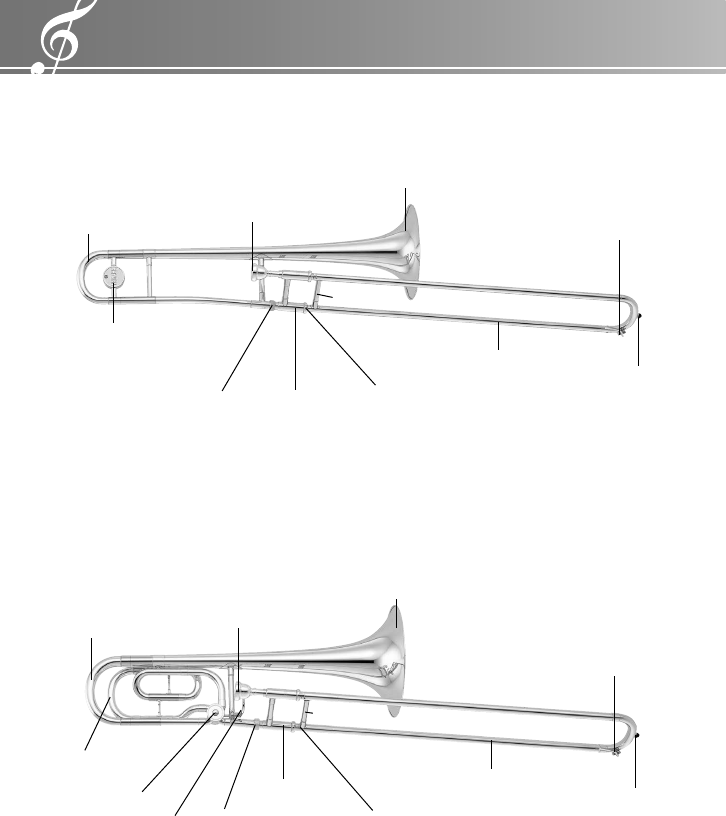
Nomenclature
Tuning Slide
■ Tenor Trombone
■ Tenor Bass Trombone
Slide Receiver
Bell
Water Key
Balancer
Mouthpiece
Slide Stopper Slide Lock Ring
Slide Bumper
Tuning Slide
Rotary Valve Lever Slide Receiver
Bell
Water Key
F Attachment
Tuning Slide
Rot ar y Valve
Mouthpiece
Slide Stopper Slide
Slide Lock Ring
Bumper
Slide Brace
Slide Brace
21
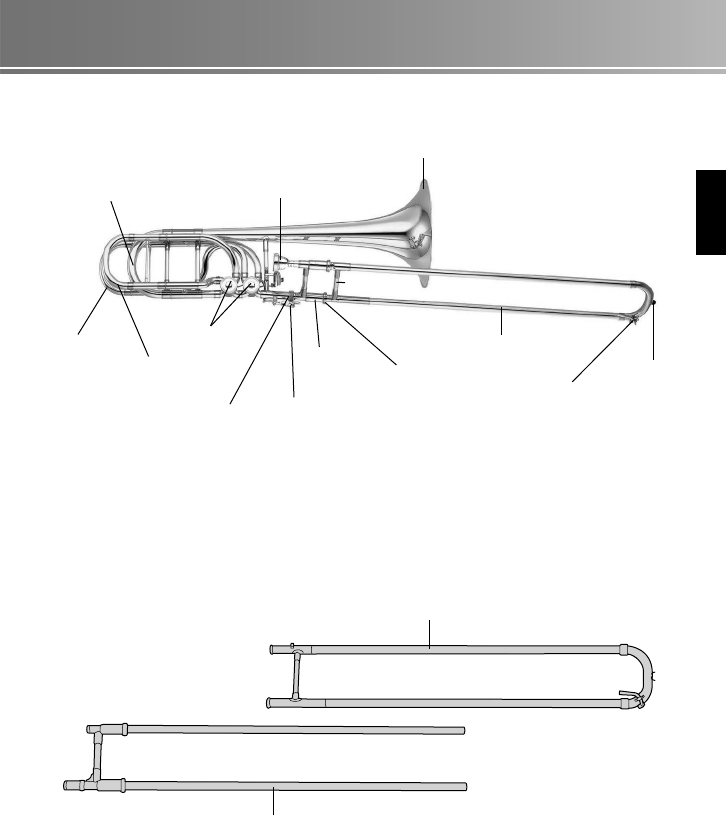
Nomenclature
■ Bass Trombone
■ Slide
* Due to improvements, specifications and appearance may change without notice.
F Attachment
Tuning Slide
Rotary Valve Lever
Slide Receiver
Bell
Tuning Slide
Gb Attachment
Tuning Slide
Rotary Valves
Mouthpiece
Slide
Stopper Slide Lock Ring
Slide Brace
Slide
Water Key
Bumper
Outer Slide
Inner Slide
22
Handling the Instrument
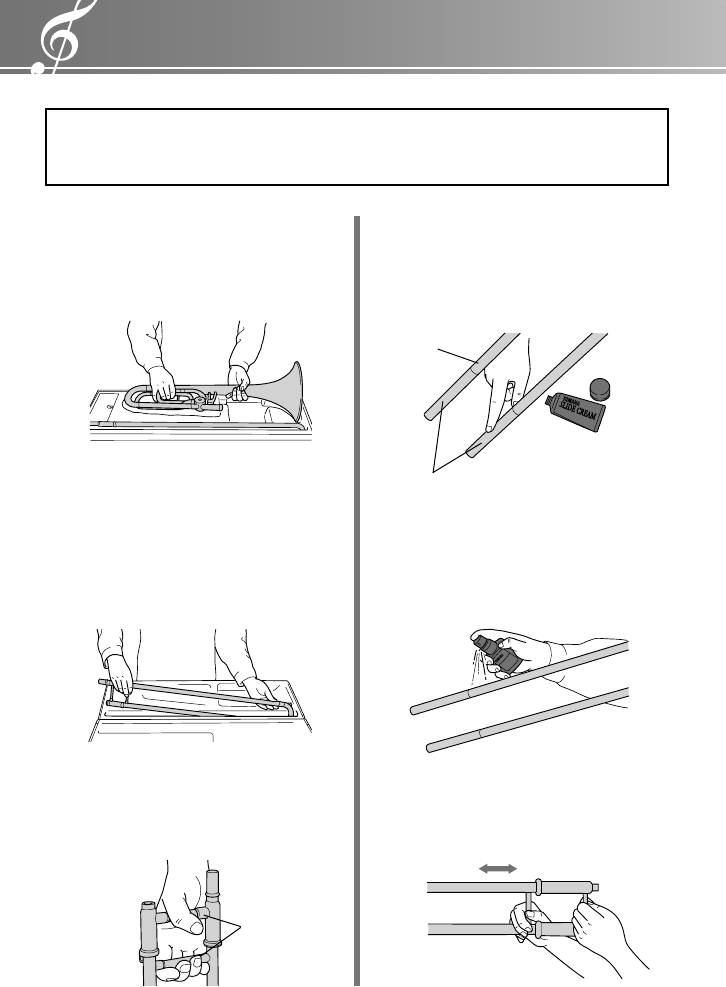
e instrument is made with very thin metal so please handle it with care. Do not apply any
excessive force, or bump it in a manner that will dent or damage the instrument.
■ Removing the Instrument From
Its Case
1. Holding the instrument with both hands,
gently remove the instrument from its case.
Slide Braces
Before Playing
* Holding only the main section of the instrument
can result in damage to the bell, so please hold
on to both the bell and the main part of the
instrument when removing it from the case.
2. When removing the slide from the case, hold
the slide with both hands hooking a nger on
the slide brace to keep the slide from moving,
and gently lift the slide out of the case.
* Always hold the slide with both hands. Holding
it with only one hand may result in damage to the
slide.
* When carrying only the slide, make sure that both
of the slide braces are held together to prevent
either section of the slide from dropping.
■ Preparing the Slide
1. Remove dirt from inside of the inner slide
then apply a bit of slide cream on the slightly
thicker end sections of the slide.
Inner slide
Apply slide cream to these parts
* Do not use slide grease on these parts.
2. After applying slide cream, use a water spray
bottle to moisten the slide suciently.
3. Put the outer slide on the inner slide and slide
the two sections back and forth several times
to distribute the cream evenly.
23
Before Playing
* e amount of slide cream applied to the slide
has an eect on how smooth the slide moves.
Experiment with dierent amounts of cream to
determine the optimum amount necessary.
* If the slide becomes sluggish while playing,
moisten the slide with the water spray bottle.
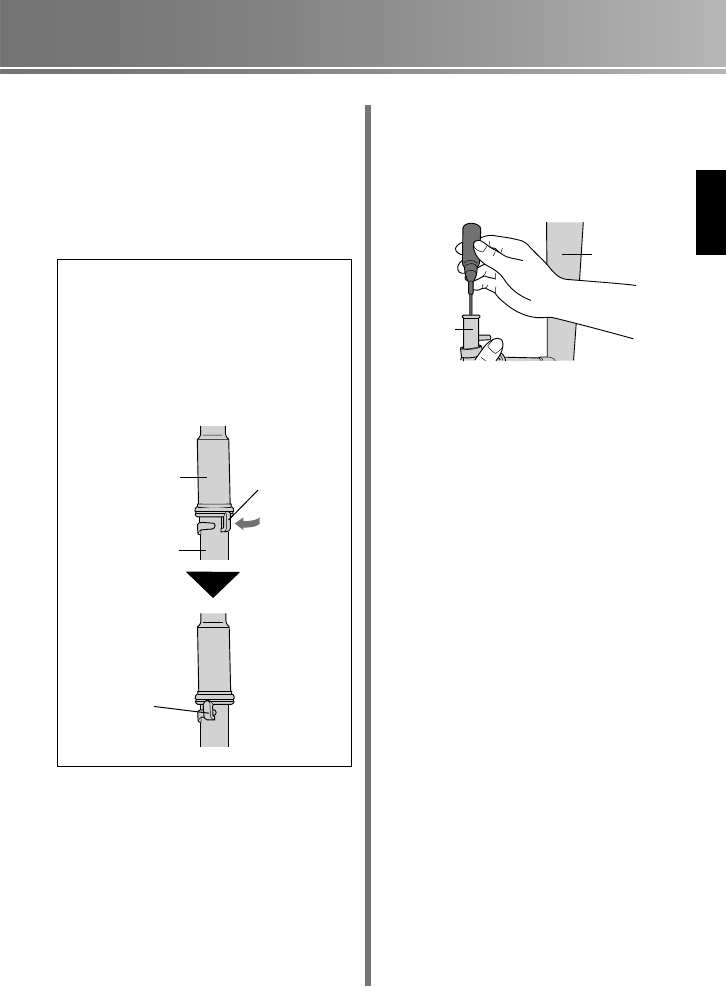
CAUTION!
Preventing the Slide From Coming O
e slide consists of outer and inner slide
sections. Make sure that the slide lock ring
is securely locked to keep the outer slide
from accidentally coming o when assem-
bling the instrument, etc.
Slide Stopper Slide Lock Ring
Outer Slide
When Locked
■ Oiling the Rotary Valve
On tenor bass trombones and bass trombones,
apply rotor oil directly to the rotary valve through
the slide receiver.
Bell
Receiver
* Rotor oil adhering to the inside of the receiver can
attract dirt and dust to the rotary valve resulting
in poor function. Please use caution.
24
Before Playing
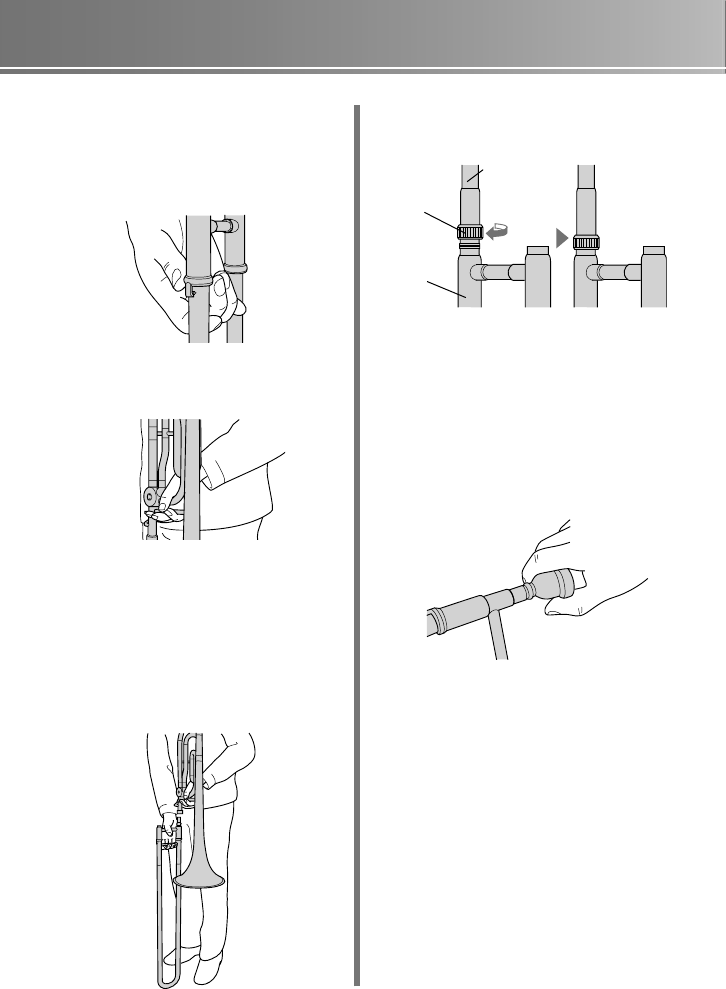
■ Assembling the Instrument
1. After conrming that the slide lock is locked,
hold the slide by the slide brace and rest the
bumper on the oor.
2. Use your other hand to hold on to the bell sec-
tion.
* Make sure you hold on to the bell section close
to the slide receiver. If you hold on to the tuning
slide, the tuning slide may come o or poor stabil-
ity may result in the instrument being bumped.
3. Attach the slide section to the main bell sec-
tion. Attach the slide so that it is at a suitable
angle when you play.
4. After attaching, tighten the slide receiver to
secure the slide in place.
Receiver
Slide
Receiver
Slide
Stopper
* After assembly is complete, make sure that the
slide brace is used to hold the instrument. Also,
handle the instrument with care, being careful not
to bump or damage it.
■ Attaching the Mouthpiece
Insert the mouthpiece until it just ts snugly in the
mouthpiece receiver and is no longer loose.
* Never insert the mouthpiece with force or un-
necessary strength. e mouthpiece may become
stuck in the receiver.
25
Before Playing
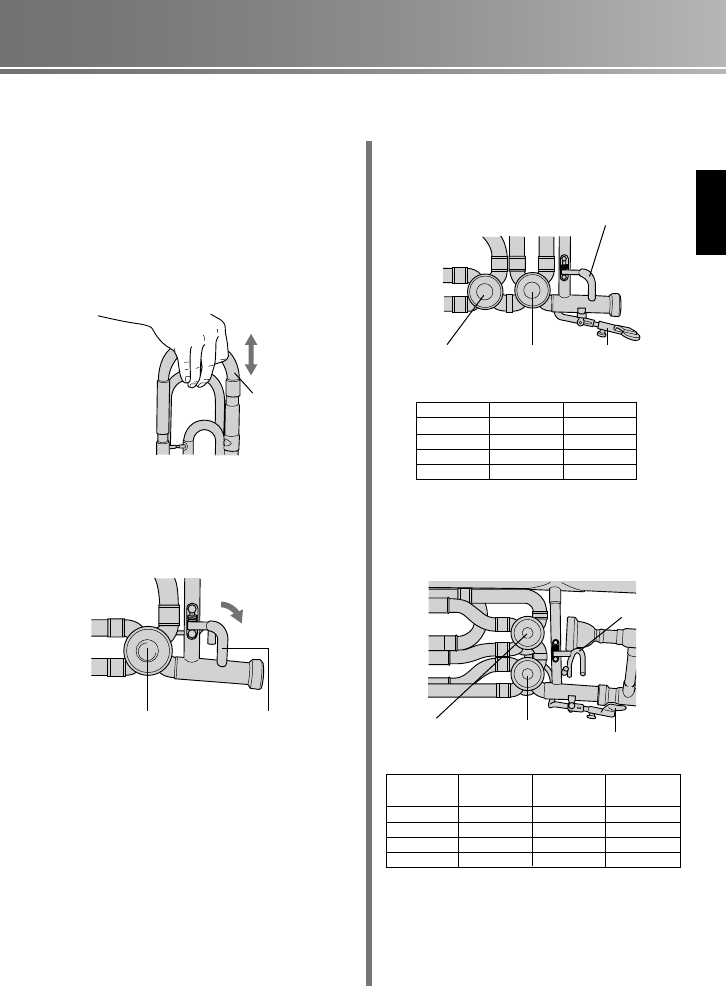
■ Tuning the Instrument
Slide the main tuning slide in or out to tune the
instrument. Since temperatures have an effect
on the instrument’s pitch, blow some warm air
through the instrument to warm it up before tun-
ing.
Adjust the length of the main tuning slide until
you achieve the desired pitch.
Main Tuning Slide
About the rotary valve
On trombones with a single rotary valve, engaging
the valve with the lever will change the pitch from
Bb to F.
Bb
F
Rotary Valve Rotary Valve
Lever
On trombones with double rotary valves, the levers
can be used to change the pitch from Bb-F, B b-
Gb, Bb-D.
First Lever
Second Rotary
Valve
First
Rotary Valve
Second Lever
O ..... When the lever is engaged
X ..... When the lever is disengaged
Oset rotary valves
First Lever
Second Rotary
Valve First
Rotary Valve Second Lever
O ..... When the lever is engaged
X ..... When the lever is disengaged
First Lever Second Lever Pitch
X X Bb
O X F
X O Gb
O O D
First Lever Second Lever Pitch
X X Bb Bb
O X F F
X O (Bb) (Bb)
O O Eb D
Using D
Attachment
26
Caring for the Instrument
■ After Playing
After playing the instrument, make sure that moisture or dirt is removed from the instru-
ment using the procedure described below.
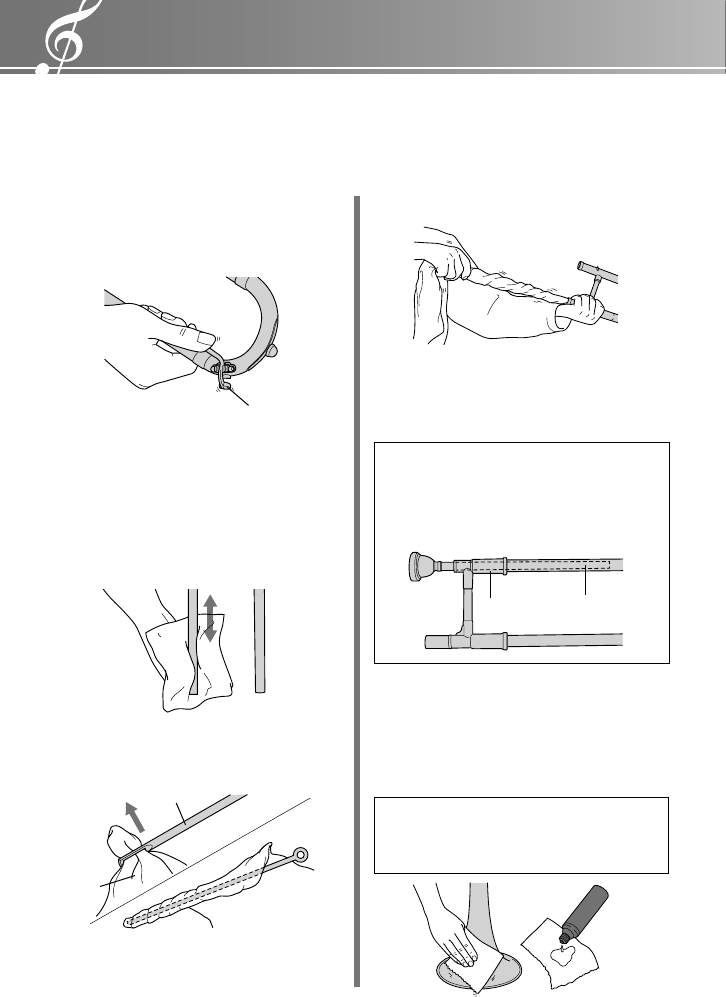
● Cleaning the Slide
1. Open the water key to remove moisture from
inside the slide section.
Water Key
* e outer slide section is made using materials
that are excellent at resisting corrosion however,
corrosion may appear if moisture is left in the
instrument for an extended period of time. Please
use caution.
2. Use a gauze cloth to clean o the slide cream
and moisture on the inner slide.
3. Wrap a cleaning rod with gauze so there is no
bare metal exposed.
Cleaning Rod
Gauze
* Exposed metal can damage the interior of the
slide.
4. Clean the slide’s interior.
* Firmly hold on to the gauze to prevent the gauze
from coming o the cleaning rod.
* Hold on to the slide brace as shown in the illustra-
tion while cleaning.
Take Care When Cleaning
A leadpipe is tted inside the slide stopper so
take care not to let the gauze become stuck in
the leadpipe.
Slide Stopper Leadpipe
● Cleaning the exterior
Gently wipe the surface of the instrument with a
polishing cloth. If dirt or tarnish is obvious, use
one of the following accessories listed below.
For lacquer nishes
Polishing cloth + lacquer polish
For silver plate
Silver cloth + silver polish
27
Caring for the Instrument
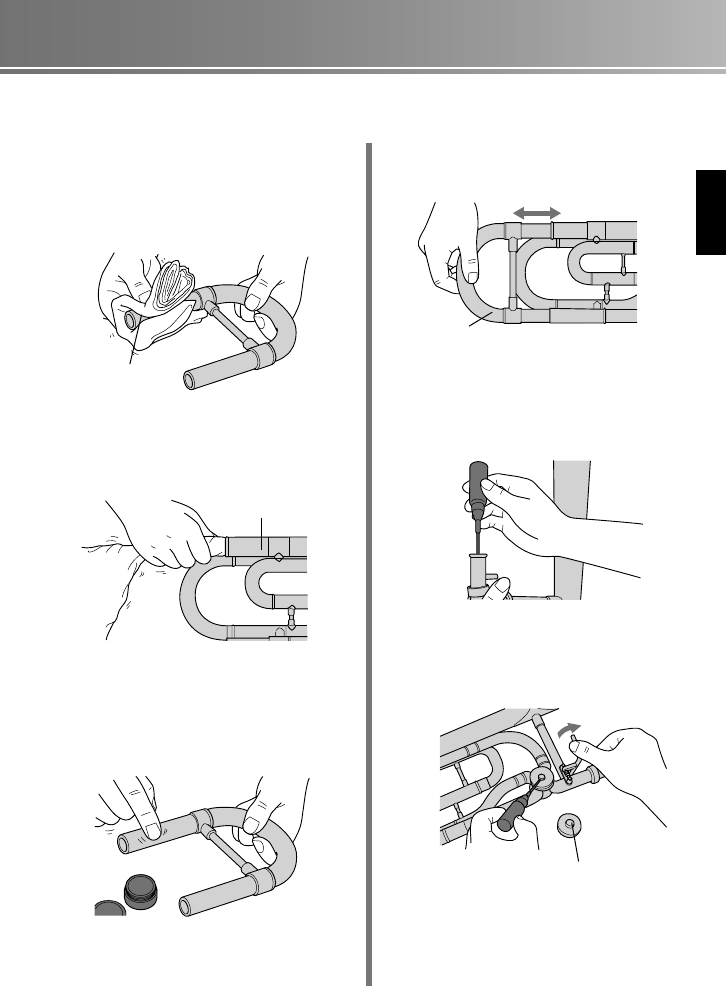
■ Once or Twice a Month Maintenance
Inner tuning
slide surface
2. Wrap a cleaning rod with gauze and remove
dirt from the interior of the inner and outer
tuning slide.
Outer tuning slide
* Hold the gauze securely to prevent it from coming
o of the cleaning rod.
3. Apply a small amount of slide grease to the
surface of the inner tuning slide.
* Never use slide grease on the slide. is grease is
for use on tuning slides only.
4. Slide the tuning slides back and forth several
times to distribute the grease evenly.
Tuning Slide
● Rotary Valve Maintenance
1. Apply some rotor oil to the rotary valve
through the slide receiver end.
2. Remove the rotary valve cap and apply a small
amount of rotor spindle oil to the center of the
rotary valve and the area supporting the shaft.
rotary valve cap
● Cleaning the Tuning Slide
1. Use a gauze cloth to remove dirt from the in-
ner tuning slide’s surfaces.
28
Caring for the Instrument
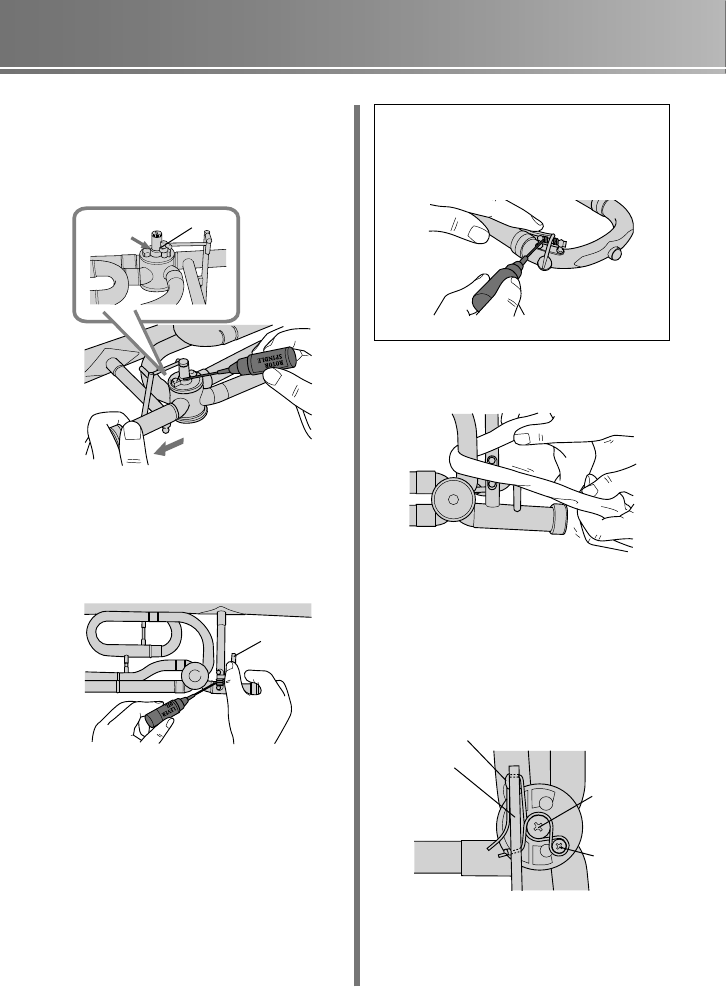
3. Also apply small amounts of rotor spindle oil
to the rotor rotation shaft and its receiver. After
applying oil, close the valve cap and move the
lever a few times to distribute the oil evenly.
Apply oil here Rotary
* e rotary valve is a precision crafted part.
Attempting to remove the valve in an improper
manner will cause damage.
4. Apply some lever oil to the lever mechanism.
Lever
Oil the water key
Neglecting to oil the water key can result in
poor function of the water key.
Use a ne gauze cloth to clean in tight places.
● Stringing the Rotary Valve
Wrap the string as shown in the illustration below
then fasten the string in place with the small string
screw. After the string is secured, use the small
screw A to adjust the lever position.
String screw B
Lever linkage
Rotor stem
screw
String screw A
29
Caring for the Instrument
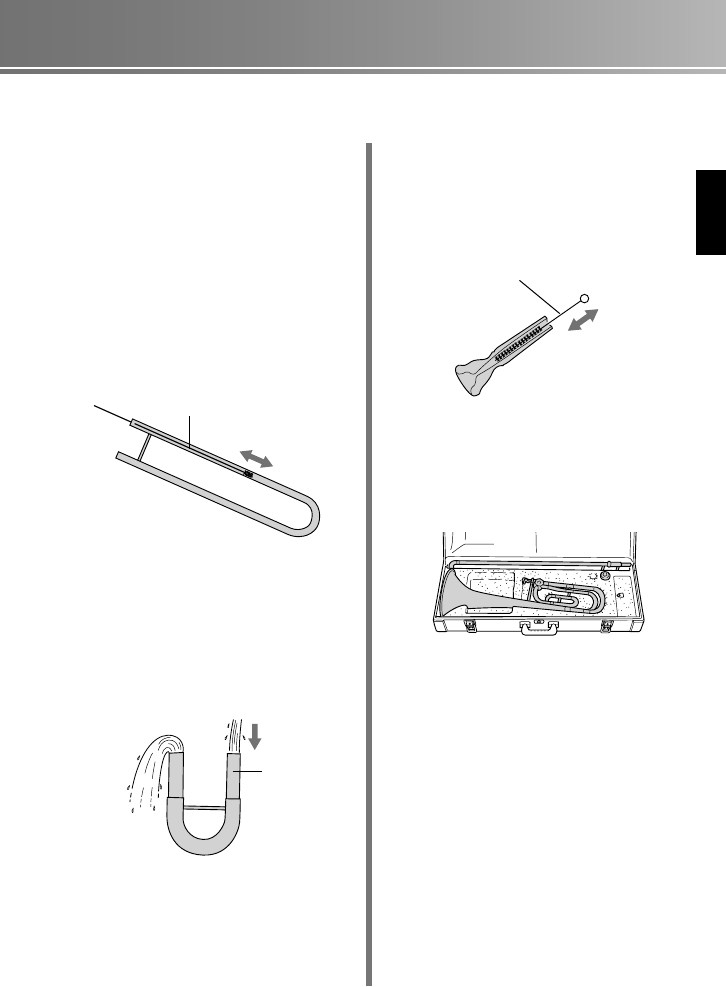
■ Twice Yearly Maintenance
● Cleaning the instrument
1. Prepare a brass soap water solution.
Mix 1 part brass soap with between 10 and 15
parts warm water (30° C to 40° C). Remove
the tuning slide and slide sections before plac-
ing the instrument in the soap water solution.
* Contact your dealer when the rotary valve needs
cleaning.
2. Apply some brass soap solution to a flexible
cleaner and use the cleaner to clean the inside
of the instrument.
Outer Slide
* Use a cleaning rod wrapped with gauze to clean
out the inside of the inner slide.
3. After cleaning the instrument, use clean water
to thoroughly rinse out the brass soap water
solution. After that, apply some slide grease to
the tuning slide and reassemble.
Tuning slide
● Cleaning the mouthpiece
Dip the mouthpiece brush in a brass soap water
solution and use the brush to clean the mouth-
piece’s throat. Rinse the mouthpiece thoroughly
with clean water.
Mouthpiece brush
Always place the instrument in its case when you
are nished playing. Also, keep the instrument in
its case during breaks.
30
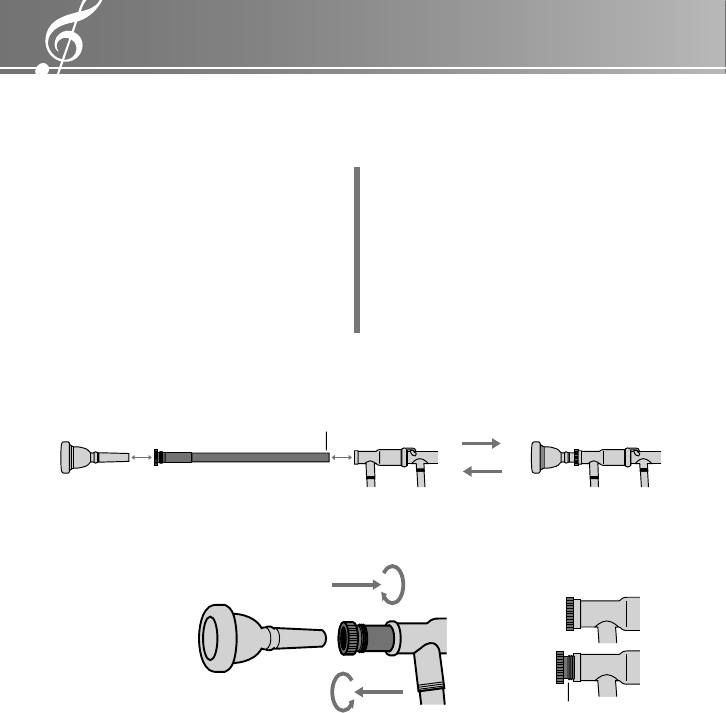
Attaching and Detaching Leadpipe
1. e tip of the leadpipe is thin. Be careful not
to damage it while attaching and detaching.
2. If you apply a small amount of slide grease to
the tip of the leadpipe, attaching and detach-
ing can be performed more smoothly.
3. When attaching, clockwise (rotate to the
right).
4. When the mouthpiece is inserted, it is easy to
hold and attach or detach the leadpipe.
5. When detaching, counter-clockwise (rotate to
the left).
e leadpipe on instruments equipped with a detachable leadpipe can be removed as de-
scribed below.
Leadpipe
1,2
4
5. When detaching: detach from the threaded
section by rotating to the left and pull out.
Attach
Detach
* Please use your instrument with the
leadpipe completely attached.
e shape of the threaded section
3. When attaching: slide up to the threaded
section and then rotate to the right.
OK
NG
31
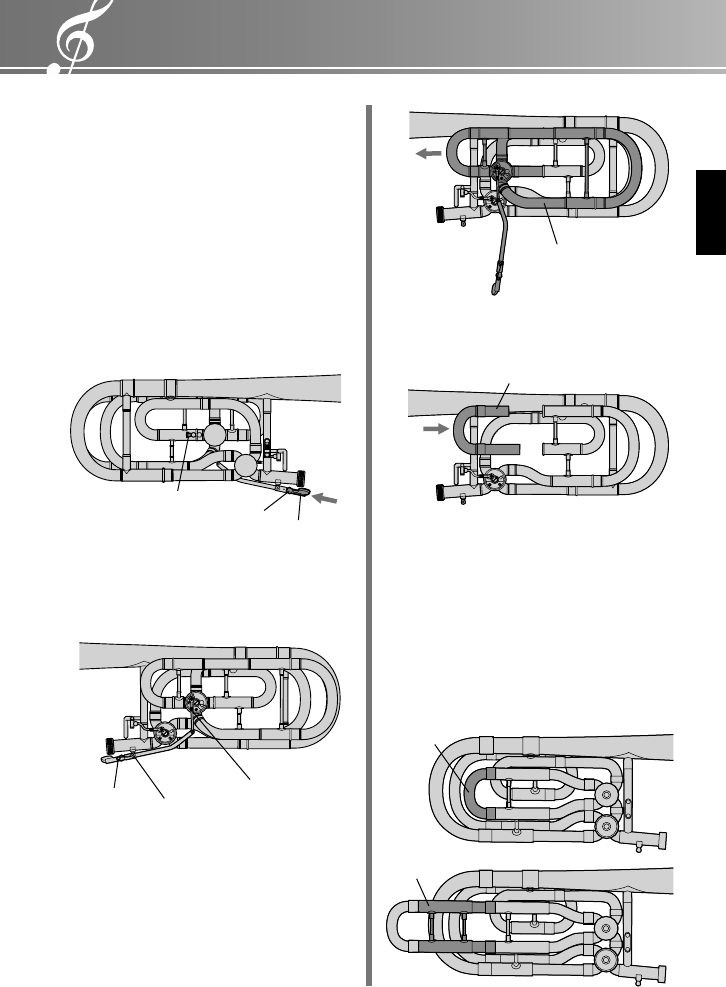
Exchanging Attachments
■ Remove the 2nd Valve Section
(YBL822G)
Removing the 2nd valve section on the YBL822G
bass trombone lets you use the instrument as a
single rotary bass trombone (Bb/F/Db –> Bb/F).
Follow the instructions below to carefully remove
the 2nd valve section and attach the F-valve slide.
1. Remove the screw on the 2nd valve section.
Next, loosen the trigger screw and slide the
trigger rod all the way in, then tighten the
screw to secure the lever rod.
2. Hook the end of the spring onto the spring
hook. Next, loosen the lever rod to remove.
3. Carefully remove the 2nd valve section making
sure the parts do not come in contact with the
instrument.
■ Attaching the D Extension
(YBL620G)
Installing the included D extension changes the
YBL620G bass trombone from a Bb/F/Eb to a Bb/
F/D bass trombone.
1. Remove the Eb-valve slide then attach the in-
cluded D extension slide.
Screw
Trigger Screw
Trigger Rod
Bearing Adjustment Screw
Lever Rod
Spring Hook
2nd Valve Section
Remove
Eb-valve
D-valve
(included)
F-valve slide
4. Remove the F-valve slide from the 2nd valve
section and attach it to the instrument.
32
Troubleshooting
e rotary valve is sluggish.
• Dirt has accumulated between the rotary
valve and valve casing.
• e rotary valve lever linkage is bent.
➞ Contact the dealer from whom you pur-
chased the instrument.
• e string is loose.
➞ Re-attach the string.
e mouthpiece cannot be removed.
• e instrument was dropped or hit with the
mouthpiece attached. Or, the mouthpiece
was inserted with too much force.
• e instrument has been left for a long
period of time with the mouthpiece inserted
in the instrument.
➞ Contact the dealer from whom you pur-
chased the instrument.
e instrument makes an abnormal
sound when played.
• Solder on the instrument has come loose, or
a foreign object is in the pipe.
➞ Contact the dealer from whom you pur-
chased the instrument.
e rotary valve lever makes a metallic
sound when moved.
• e lever comes into contact with the pipes.
➞ Re-attach the string and adjust the lever’s
position.
• Screws are loose.
➞ Firmly tighten the screws.
• e rotary valve and valve casing have come
loose.
➞ Contact the dealer from whom you pur-
chased the instrument.
Tone is not clear and pitch is poor.
• A large amount of dirt has accumulated
inside the pipe.
➞ Wash out the pipes.
• ere is a large dent in the pipe and air is
leaking from a pipe seam.
• e mouthpiece is loose and air is leaking
from around the mouthpiece.
• e holes in the rotary valve and valve casing
are not aligned.
➞ Contact the dealer from whom you pur-
chased the instrument.
e slide does not move smoothly.
• Dirt has accumulated between the inner and
outer slides.
➞ Wash the inside of the slide.
• e slide is bent.
• ere is a dent in the slide.
➞ Never use the instrument with a damaged
slide. Contact the dealer from whom you
purchased the instrument.
e tuning slide is stuck can not be
removed. e slide is sluggish.
• Dirt or dust between the tuning slide and
pipe has scratched the tuning slide.
➞ oroughly remove dirt and apply some
slide grease that matches the type of slide.
• Dropping or hitting the slide has caused a
dent, or the slide was bent while cleaning.
➞ Contact the dealer from whom you pur-
chased the instrument.
e screw is too tight and cannot be
removed.
• e screw is corroded.
• Hitting the instrument has damaged the
screw.
➞ Contact the dealer from whom you pur-
chased the instrument.
132
L6 L4
7
L2
6
L1
4
4
2
2
7
L2
6
L1
4
4
2
2
1
(6)
1
1L5L3
5
5
3
3
5
5
3
3
5
5
3
3
3
3
3
3
3
3
1
1
1
1
2
2
1
L3
4
4
2
2
4
4
3
3
1
(4)
1
1
(4)
1
2
2
2
2
2
2
1
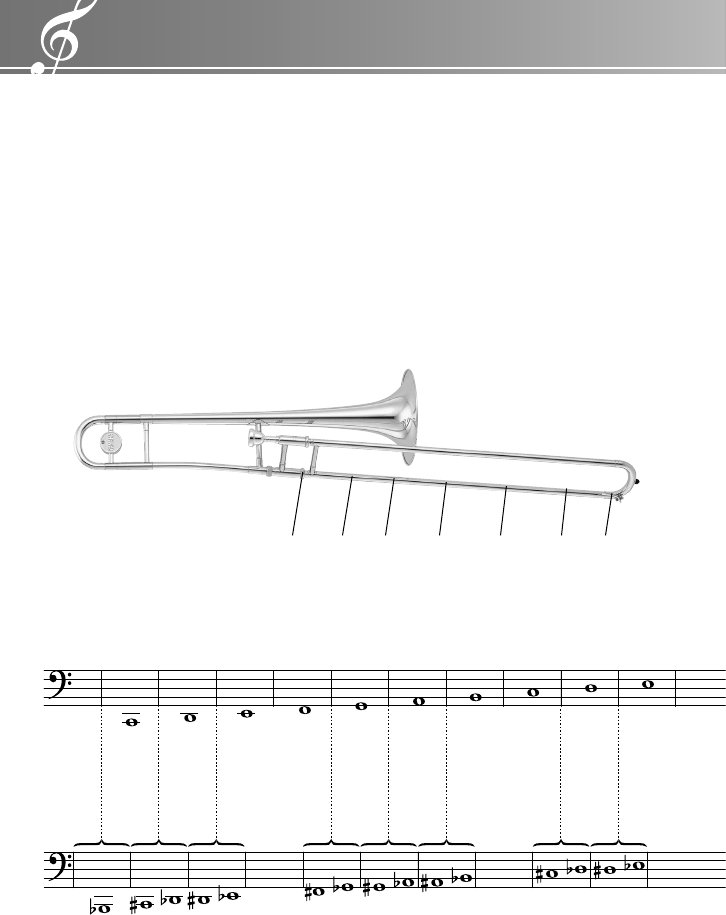
■テナートロンボーン / Tenor Trombone / Tenorposaune / Trombone ténor / Trombón tenor /
Trombone Tenor / 次中音长号 / Теноровый тромбон /테너 트롬본
23 4 5 6 7
★ () は替えポジションです。
★
テナーバスのレバー (L) を押すと、F 管になります。
★
Positions in parenthesis ( ) denote alternate positions.
★ Changes to F when the lever (L) on a tenor bass
trombone is pressed
★ Alternative Positionen stehen in Klammern ( ).
★ Ändert sich bei einer Tenorbassposaune beim
Drücken des Hebels (L) in F.
★ Les positions entre parenthèse ( ) dénote les
position alternatives.
★ Passe en Fa quand la palette (L) du trombone
ténor complet est actionnée
★ Las posiciones entre paréntesis ( ) indican
posiciones alternativas.
★ Cambia a F cuando se presiona la palanca (L) de
un trombón tenor bajo.
L6 L4
7
L2
6
L1
4
4
2
2
7
L2
6
L1
4
4
2
2
1
(6)
1
1L5L3
5
5
3
3
5
5
3
3
5
5
3
3
3
3
3
3
3
3
1
1
1
1
2
2
1
L3
4
4
2
2
4
4
3
3
1
(4)
1
1
(4)
1
2
2
2
2
2
2
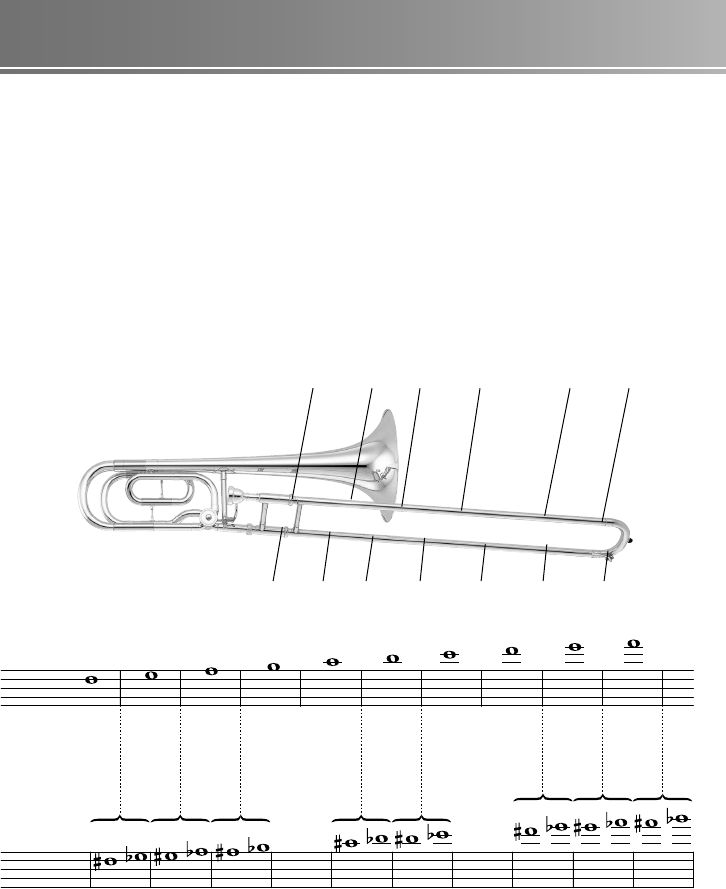
ポ ジ ション 表 / Position Chart / Positionstabelle / Tableau des positions /
Cuadro de posiciones / Ta bela de posições / 把位图 / аблица позиций /포지션 차 트
133
L6 L4
7
L2
6
L1
4
4
2
2
7
L2
6
L1
4
4
2
2
1
(6)
1
1L5L3
5
5
3
3
5
5
3
3
5
5
3
3
3
3
3
3
3
3
1
1
1
1
2
2
1
L3
4
4
2
2
4
4
3
3
1
(4)
1
1
(4)
1
2
2
2
2
2
2
★ As posições entre parêntesis ( ) indicam posições
alternativas.
★ Altera para F quando pressionado a haste do
rotor (L) em um trombone tenor baixo.
■
テナーバストロンボーン / Tenor Bass Trombone / Tenorbassposaune / Trombone ténor complet /
Trombón tenor bajo / Trombone Tenor Baixo / 次中低音长号 / Теноровый бас-тромбон /테너 베이스 트롬본
1 2 3 4 5 6 7
L1 L2 L3 L4 L5 L6
★ 括号 () 中的为交替把位
★ 按下次中低音长号上的连杆时 , 音调变为 F 调
★ Позиции в круглых скобках ( ) являются дополни-
тельными.
★ Строй F при нажатом квартветиле (L).
★ 괄호 ( ) 안의 위치는 대체 위치입니다 .
★ 테너 베이스 트롬본의 레버 (L) 를 누르면 F 로 바뀝
니다 .
L6 L4
7
L2
6
L1
4
4
2
2
7
L2
6
L1
4
4
2
2
1
(6)
1
1L5L3
5
5
3
3
5
5
3
3
5
5
3
3
3
3
3
3
3
3
1
1
1
1
2
2
1
L3
4
4
2
2
4
4
3
3
1
(4)
1
1
(4)
1
2
2
2
2
2
2
ポ ジ ション 表 / Position Chart / Positionstabelle / Tableau des positions /
Cuadro de posiciones / Ta bela de posições / 把位图 / аблица позиций /포지션 차 트

Manual Development Group
© 2013 Yamaha Corporation
Published 05/2019 发行 POCP-A0
VDE1670
〒430-8650 静岡県浜松市中区中沢町 10-1
