ZOTECH PS-2101W-A Wireless LAN print server, USB 2.0 User Manual

ZOTECH Co., Ltd. Wireless LAN print server, USB 2.0

User manual

ZOTWireless LAN print server, USB 2.0716U2W, PS-2101W,DN-13014-3, 716U2W-A,PS-2101W-A, RP-WU211User Manual
1 TABLE OF CONTENTS COPYRIGHT ...............................................................................................................................................................3 1. INTRODUCTION ...................................................................................................................................................4 PRODUCT OVERVIEW ................................................................................................................................................4 WIRELESS SPECIFICATIONS ......................................................................................................................................4 COMPONENTS AND FEATURES...................................................................................................................................5 HARDWARE INSTALLATION ........................................................................................................................................5 NETWORK ENVIRONMENT .........................................................................................................................................7 WIRED NETWORK WITH PRINT SERVER: ...................................................................................................................7 WIRELESS NETWORK WITH PRINT SERVER: ..............................................................................................................7 INFRASTRUCTURE (ACCESS POINT) MODE: ...............................................................................................................7 AD-HOC (PEER-TO-PEER) MODE:..........................................................................................................................8 2. PRINT SERVER INSTALLATION .......................................................................................................................9 PREPARATION ...........................................................................................................................................................9 CONFIGURATION SOLUTION TABLE ............................................................................................................................9 3. SOFTWARE INSTALLATION ............................................................................................................................ 11 INSTALLING THE PSADMIN AND PRINT SERVER’S DRIVER ........................................................................................ 11 USING PSADMIN ..................................................................................................................................................... 21 WIZARD................................................................................................................................................................... 22 MANUAL SETUP ....................................................................................................................................................... 24 REFRESH ................................................................................................................................................................ 27 MULTIPLE PRINT QUEUES CONFIGURATION (NOVELL NETWARE) ............................................................................ 27 UNINSTALLING THE PSADMIN ON WINDOWS PC ..................................................................................................... 28 4. INTERNET PRINTER CONNECTION AND HP WEB JETADMIN ................................................................. 29 IPP OVERVIEW ....................................................................................................................................................... 29 HP WEB JETADMIN OVERVIEW ............................................................................................................................... 31 INSTALLING HP WEB JETADMIN .............................................................................................................................. 31 REMOVING HP WEB JETADMIN UTILITY .................................................................................................................. 32 5. CONFIGURATION FROM EMBEDDED WEB SERVER ................................................................................. 34 OVERVIEW .............................................................................................................................................................. 34 USING EMBEDDED WEB SERVER............................................................................................................................. 34 SETUP MENU .......................................................................................................................................................... 42 INSTALLING PRINT SERVER ON NETWARE 4.X/5.X .................................................................................................. 50 SETTING UP A MACINTOSH COMPUTER (MAC 8.X/9.X) ............................................................................................ 52 6. NETWORK PRINT MONITOR(9X/ME/NT4/2000/XP 32-BIT.) ....................................................................... 56 PREPARATION ......................................................................................................................................................... 56 TCP/IP PROTOCOL INSTALLATION .......................................................................................................................... 57 IPX/SPX-COMPATIBLE PROTOCOL INSTALLATION ................................................................................................... 57 NETBEUI PROTOCOL INSTALLATION (9X/ME/NT4/2000) ...................................................................................... 58 WINDOWS 95/98/ME/NT/2000/XP/2003 MANUAL INSTALLATION PROCEDURE ....................................................... 58 UNINSTALLING NETWORK PRINT PORT ON WINDOWS 95/98/ME/NT/2000/XP/2003 ............................................. 60 7. TCP/IP LPR PORT PRINTING INSTALLATION ............................................................................................. 61 BASIC TCP/IP INSTALLATION OVERVIEW ................................................................................................................ 61 ASSIGNING AN IP ADDRESS ..................................................................................................................................... 61 WINDOWS NT LPR PORT PRINTING INSTALLATION ................................................................................................. 62 WINDOWS 2000/XP/2003/VISTA/7 STANDARD TCP/IP PORT PRINTING INSTALLATION ......................................... 63 UNIX INSTALLATION ................................................................................................................................................ 66 8. UPGRADING PRINT SERVER .......................................................................................................................... 70 OVERVIEW .............................................................................................................................................................. 70
  2UPGRADING THE PRINT SERVER FROM PSADMIN ..................................................................................................... 71 UPGRADING THE PRINT SERVER FROM WINDOWS NT/2000/XP/2003/VISTA/7 (THROUGH TCP/IP) ....................... 71 UPGRADING THE PRINT SERVER FROM UNIX (THROUGH TCP/IP) ........................................................................... 71 UPGRADING THE PRINT SERVER FROM BROWSER .................................................................................................... 71 9. TROUBLESHOOTING ........................................................................................................................................ 73 GENERAL TROUBLESHOOTING OVERVIEW ............................................................................................................... 73 POWER RELATED PROBLEMS .................................................................................................................................. 73 PRINT PORT RELATED PROBLEMS ........................................................................................................................... 73 WINDOWS 95/98/ME/NT/2000/XP TROUBLESHOOTING ......................................................................................... 74 MOVING THE PRINT SERVER TO A NEW SEGMENT ................................................................................................... 75 MOVING YOUR COMPUTER TO A NEW SEGMENT .................................................................................................... 76 NOVELL NETWARE TROUBLESHOOTING .................................................................................................................. 76 TCP/IP TROUBLESHOOTING ................................................................................................................................... 77 APPENDIX ................................................................................................................................................................ 79 FREQUENTLY ASKED QUESTIONS ............................................................................................................................ 84 ADDITIONAL INSTALLATION INSTRUCTIONS .............................................................................................................. 86
                                                                                            3  Trademarks NetWare  is  a  registered  trademark  of  Novell  Inc  and  Windows  95/98/Me  and  Windows NT/2000/XP/2003/Vista/7 are registered trademarks of Microsoft Corp. All other brands and product names are trademarks of their respective companies.  Copyright No part of this publication may be reproduced in any form or by any means or used to make any derivative (such as translation, transformation or adaptation) without the express written consent of the manufacturer as stipulated by the United States Copyright Act of 1976.  FCC Warning This equipment has been tested and found to comply with the limits for a  Class B digital device, pursuant to subpart J of Part  15  of  the  FCC Rules. These  limits  are  designed  to provide reasonable protection against harmful interference when the equipment is operated in  a  commercial  environment.  This  equipment  generates,  uses,  and  can  radiate  radio frequency energy and, if not installed and used in accordance with the instruction manual, may cause harmful interference to radio communications. Operation of this equipment in a residential area is likely to cause harmful interference in which the user will be required to correct the interference at their own expense.  All contents are subject to change without prior notice.     Part No. PS716U2W-V1.1   Federal Communication Commission Interference Statement This equipment has been tested and found to comply with the limits for a Class B digital device, pursuant to Part 15 of the FCC Rules. These limits are designed to provide reasonable protection against harmful interference in a residential installation. This equipment generates, uses, and can radiate radio frequency energy and, if not installed and used in accordance with the instructions, may cause harmful interference to radio communications. However, there is no guarantee that interference will not occur in a particular installation. If this equipment does cause harmful interference to radio or television reception, which can be determined by turning the equipment off and on, the user is encouraged to try to correct the interference by one or more of the following measures: • Reorient or relocate the receiving antenna. • Increase the separation between the equipment and receiver. • Connect the equipment into an outlet on a circuit different from that to which the receiver is connected. • Consult the dealer or an experienced radio/TV technician for help. FCC Caution: This device complies with Part 15 of the FCC Rules. Operation is subject to the following two conditions: (1) This device may not cause harmful interference, and (2) this device must accept any interference received, including interference that may cause undesired operation. Non-modification Statement: Changes or modifications not expressly approved by the party responsible for compliance could void the user's authority to operate the equipment.   FCC Radiation Exposure Statement: This equipment complies with FCC radiation exposure limits set forth for an uncontrolled environment. This equipment should be installed and operated with minimum distance 20cm between the radiator & your body.     一般設備(低功率電波輻射性電機管理辦法第12、14條)--- 經型式認證合格之低功率射頻電機,非經許可,公司、商號或使用者均不得擅自變更頻率,加大功率或變更原設計之特性及功能。--- 低功率射頻電機之使用不得影響飛航安全及干擾合法通信:經發現有干擾現象時,應立即停用,並改善至無干擾時方得繼續使用。前項合法通信,指依電信法規定作業之無線電通信低功率射頻電機需忍受合法通信或工業、科學及醫療用電波輻射性電機設備之干擾。
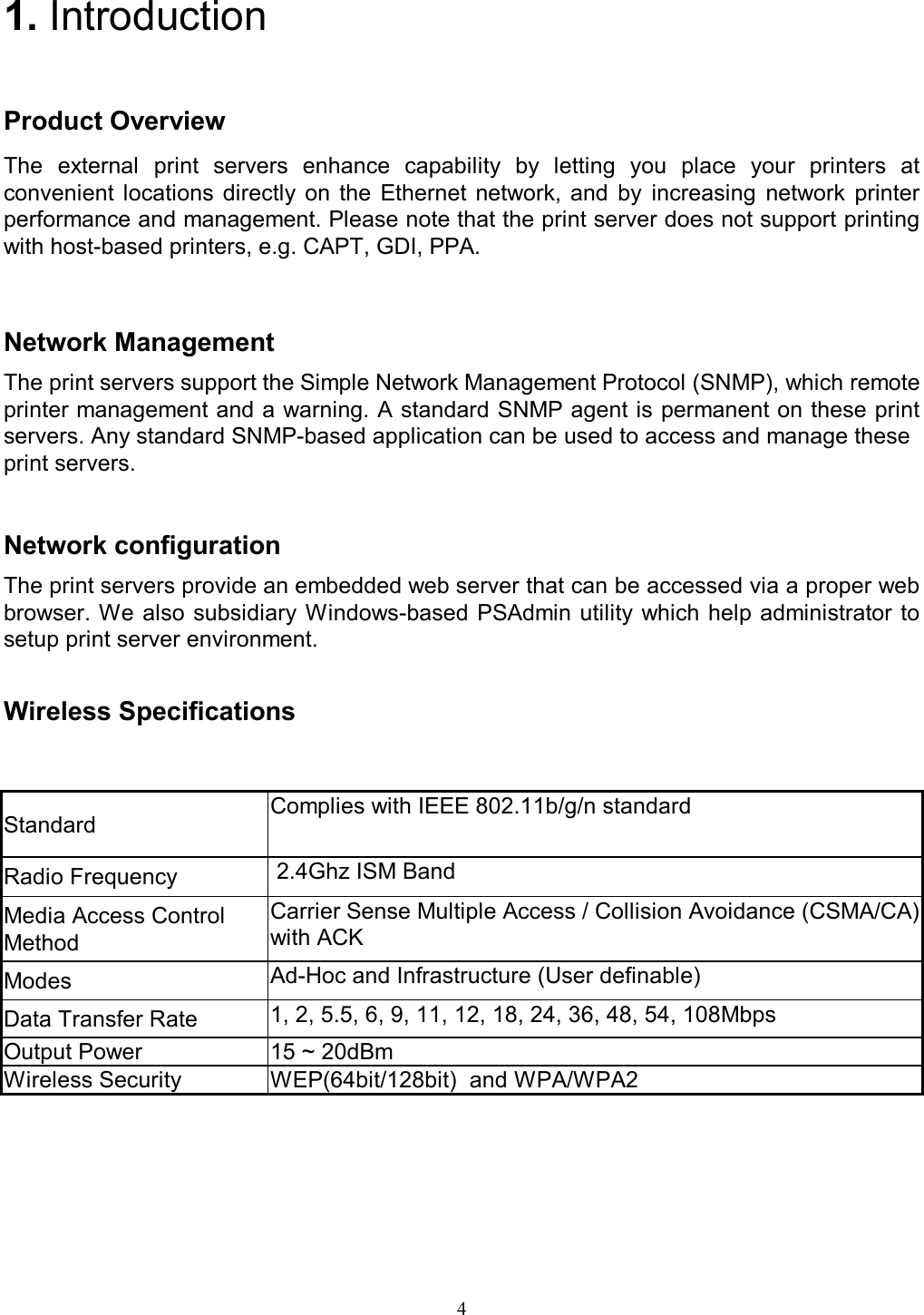
  4  1. Introduction Product Overview The  external  print  servers  enhance  capability  by  letting  you  place  your  printers  at convenient  locations  directly  on  the  Ethernet  network,  and  by  increasing  network  printer performance and management. Please note that the print server does not support printing with host-based printers, e.g. CAPT, GDI, PPA.   Network Management The print servers support the Simple Network Management Protocol (SNMP), which remote printer management and a warning. A standard SNMP agent is permanent on these print servers. Any standard SNMP-based application can be used to access and manage these print servers.   Network configuration The print servers provide an embedded web server that can be accessed via a proper web browser. We also subsidiary Windows-based PSAdmin utility which  help  administrator to setup print server environment.   Wireless Specifications Standard  Complies with IEEE 802.11b/g/n standard Radio Frequency   2.4Ghz ISM Band Media Access Control Method Carrier Sense Multiple Access / Collision Avoidance (CSMA/CA) with ACK Modes  Ad-Hoc and Infrastructure (User definable) Data Transfer Rate  1, 2, 5.5, 6, 9, 11, 12, 18, 24, 36, 48, 54, 108Mbps Output Power  15 ~ 20dBm Wireless Security  WEP(64bit/128bit)  and WPA/WPA2
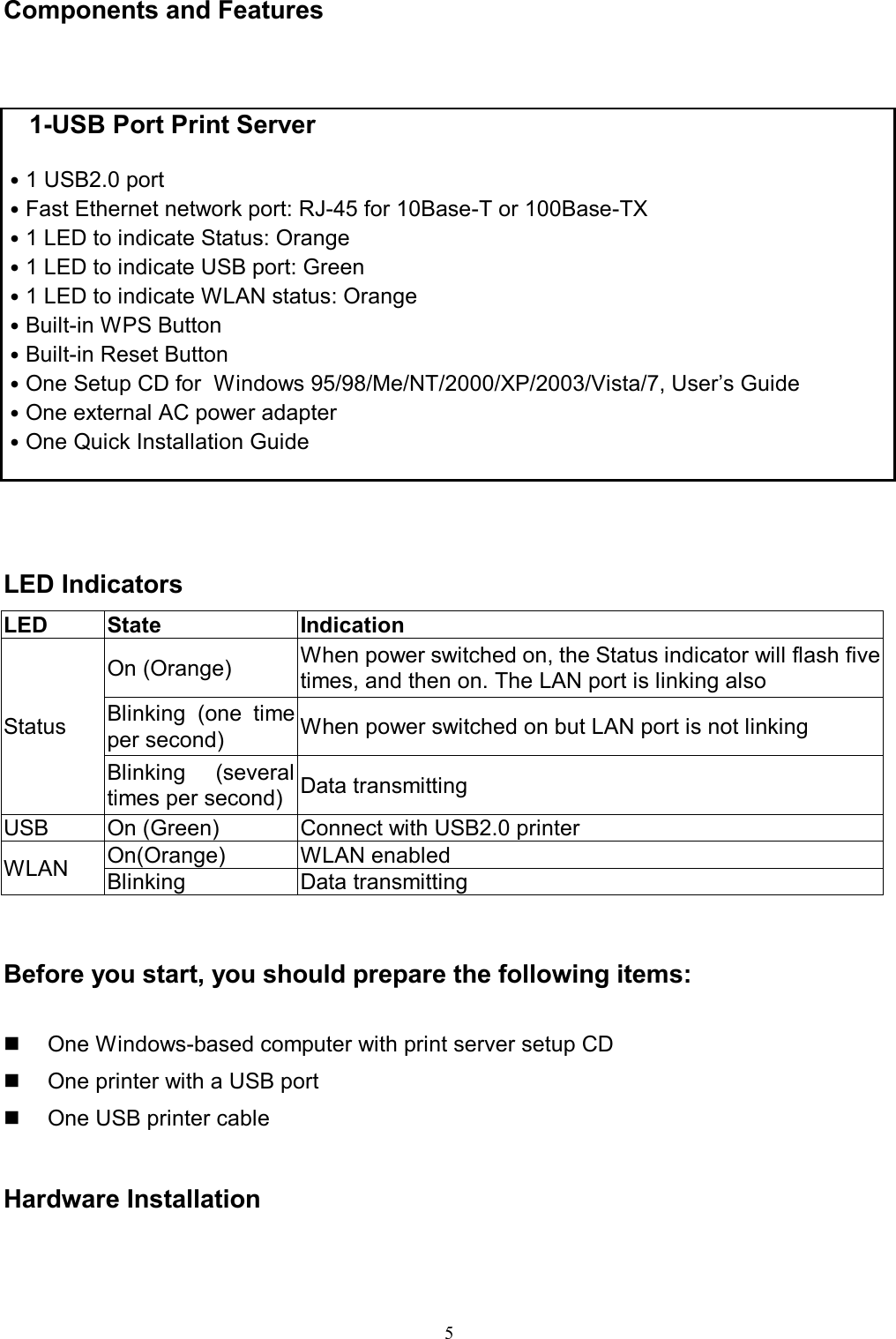
                                                                                            5  Components and Features  1-USB Port Print Server  ˙1 USB2.0 port ˙Fast Ethernet network port: RJ-45 for 10Base-T or 100Base-TX ˙1 LED to indicate Status: Orange ˙1 LED to indicate USB port: Green  ˙1 LED to indicate WLAN status: Orange ˙Built-in WPS Button ˙Built-in Reset Button ˙One Setup CD for  Windows 95/98/Me/NT/2000/XP/2003/Vista/7, User’s Guide ˙One external AC power adapter ˙One Quick Installation Guide      LED Indicators LED  State  Indication Status On (Orange)  When power switched on, the Status indicator will flash five times, and then on. The LAN port is linking also Blinking  (one  time per second)  When power switched on but LAN port is not linking Blinking  (several times per second) Data transmitting  USB  On (Green)  Connect with USB2.0 printer WLAN  On(Orange)  WLAN enabled Blinking  Data transmitting   Before you start, you should prepare the following items:    One Windows-based computer with print server setup CD   One printer with a USB port   One USB printer cable   Hardware Installation
  6To install the print servers, you need to complete these steps: ˙Confirm that your printer USB port works well. ˙Connect  the  print  server  to  the  network  and  printer,  and  plug  in  the  print  server.  Follow these instructions to install the print servers, please refer to any peripheral you are connecting to the print server:  1.  Turn off the printer’s power.  2.  Connect the print server to your printer with the USB cable.  3.  Turn the printer’s power on.  4.  Plug the AC power adapter into the power connector on the print server.  5.  Wait 10 seconds until all the LEDs have stopped flashing. (the WLAN LED will continue to flash if data is being transmitted via wireless connectivity).   Note: The Status LED should be flash five times when POST. If not, please contact your local dealer for repair or replacement. Then WLAN LED should be on to associate with  the  proper Access Point  with  best  wireless  signal.  If  not,  please  contact  your local dealer for repair or replacement  WPS  WiFi Protected Setup  Printer  Server  supports  WiFi  Protected  Setup  (WPS),  which  is  an  easy  way  to  set  up  a secure  wireless  network. WPS is an industry standard specification, defined by  the  WiFi Alliance.  WPS allows you to quickly set up a wireless network with strong security, without having to configure security settings manually. Each WPS connection  works  between two devices. Both devices must support WPS (check each device’s documentation to make sure).  1.  Press WPS buttons in each of the device itself and Wireless AP in three seconds and release it, then the WLAN LED of device will be off. 2.  Wait two minutes to find another device  that also has WPS activated.  Then,  the  two devices connect and set up a secure network by themselves.
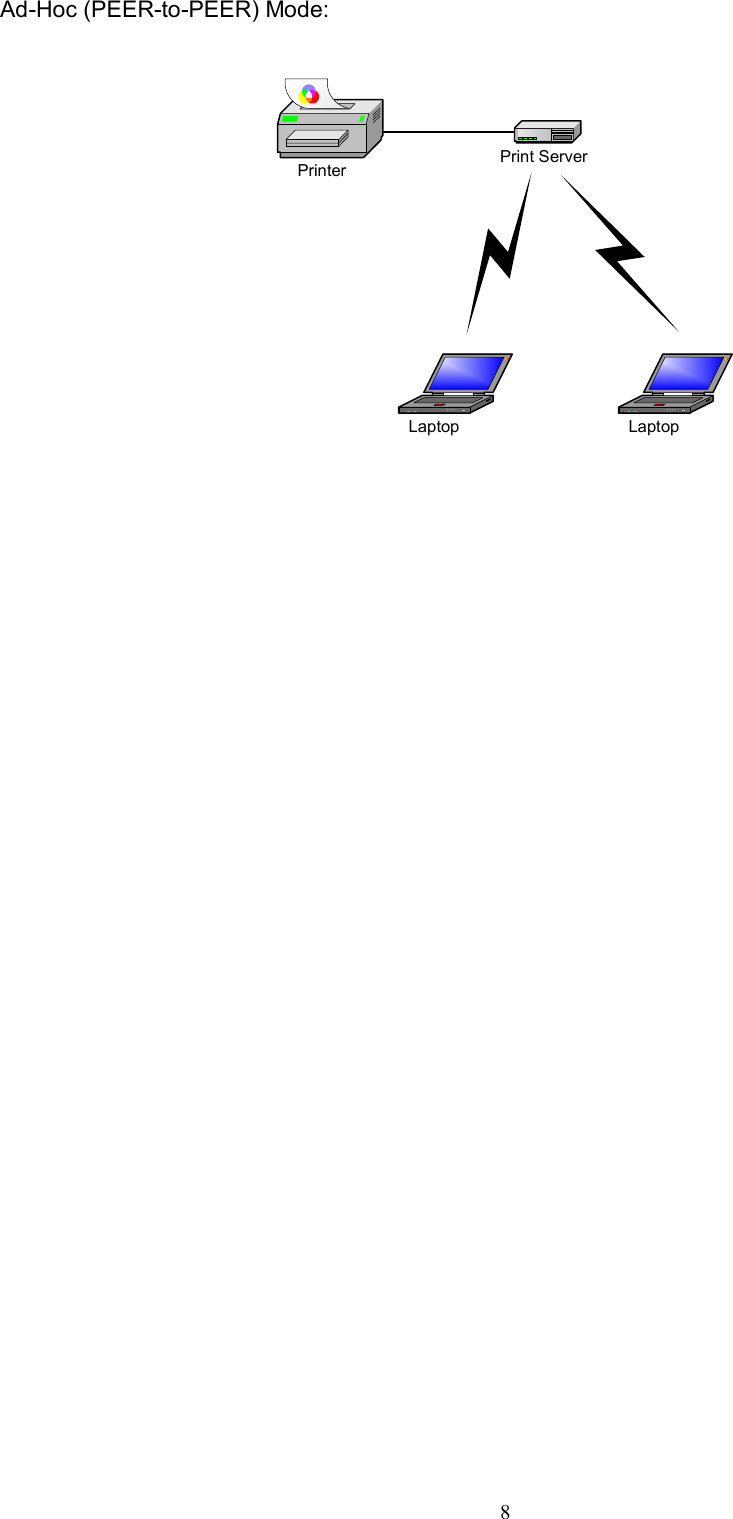
                                                                                            7  Network Environment Wired Network with Print Server: Printer Print ServerComputer Computer ComputerHUB  Wireless Network with Print Server: Infrastructure (Access Point) Mode: Printer Print ServerComputer Computer ComputerHUBAccess PointLaptop Laptop
  8Ad-Hoc (PEER-to-PEER) Mode: Printer Print ServerLaptop Laptop
                                                                                            9  2. Print Server Installation Preparation To  meet  users’  network  printing  needs  in  today’s  heterogeneous  and  multiple  protocol networking environments, the print server supports industrial standard protocols, including TCP/IP, IPX/SPX, NetBEUI and AppleTalk. This means that  the  print server supports the most  popular  network  operating  systems  today,  including  NetWare,  Windows 95/98/Me/NT/2000/XP/2003/Vista/7, UNIX systems and Macintosh computer. As such, there might  be several ways to deploy the print server on your network.   Supported Networks Print server supports a variety of network protocols, including TCP/IP, IPX/SPX, NetBEUI and AppleTalk. In addition, we provide software for network configuration on the following networks:  ˙Novell NetWare 3.12, 4.x, 5.x (Bindery and NDS) ˙Microsoft Windows 95/98/Me ˙Microsoft Windows NT/2000/XP/2003/Vista/7 ˙Apple EtherTalk ˙UNIX /Linux system ˙Internet (via Internet Printer Connection software)  Configuration Solution Table Setup  Operating System  Function  Remarks PSAdmin utility / Setup Wizard Windows 95/98/Me Windows NT/2000/XP/2003/ Vista/7 Install a single network on a peer-to-peer or client-server network Easy  printer  installation  runs  from print server setup CD Embedded Web server Windows 95/98/Me Windows NT/2000/XP/2003/ Vista/7 Mac OS, Linux… Remote setup print server from private LAN Support Microsoft Internet Explorer 5.01  or  higher,  Mozilla  Firefox, Netscape 7.2 or higher, etc. HP Web JetAdmin Windows  Remote management of print  Print  server  solution  for  continual
  10NT/2000/XP/2003/ Vista/7 server, include alert and consumables management  of  multiple  printers- anywhere on your LAN Internet Printing Protocol Windows NT/2000/XP/2003/ Vista/7 Printing via the internet to Internet Printing Protocol- enabled print server Allows saving distribution of HQ hardcopy document over Internet, replacing fax, mail  Comment Configuration  solution  Table  has  many  installations  way  to  setup  Windows  95/98/Me, Windows  NT/2000/XP/2003/Vista/7,  NetWare,  UNIX  /  Linux  system  and  Mac  computer. Firstly,  we  introduce  PSAdmin  utility,  HP  Web  JetAdmin  program  and  Internet  Printing Protocol solution. Then we will discuss Embedded Web Server Installation with print server.
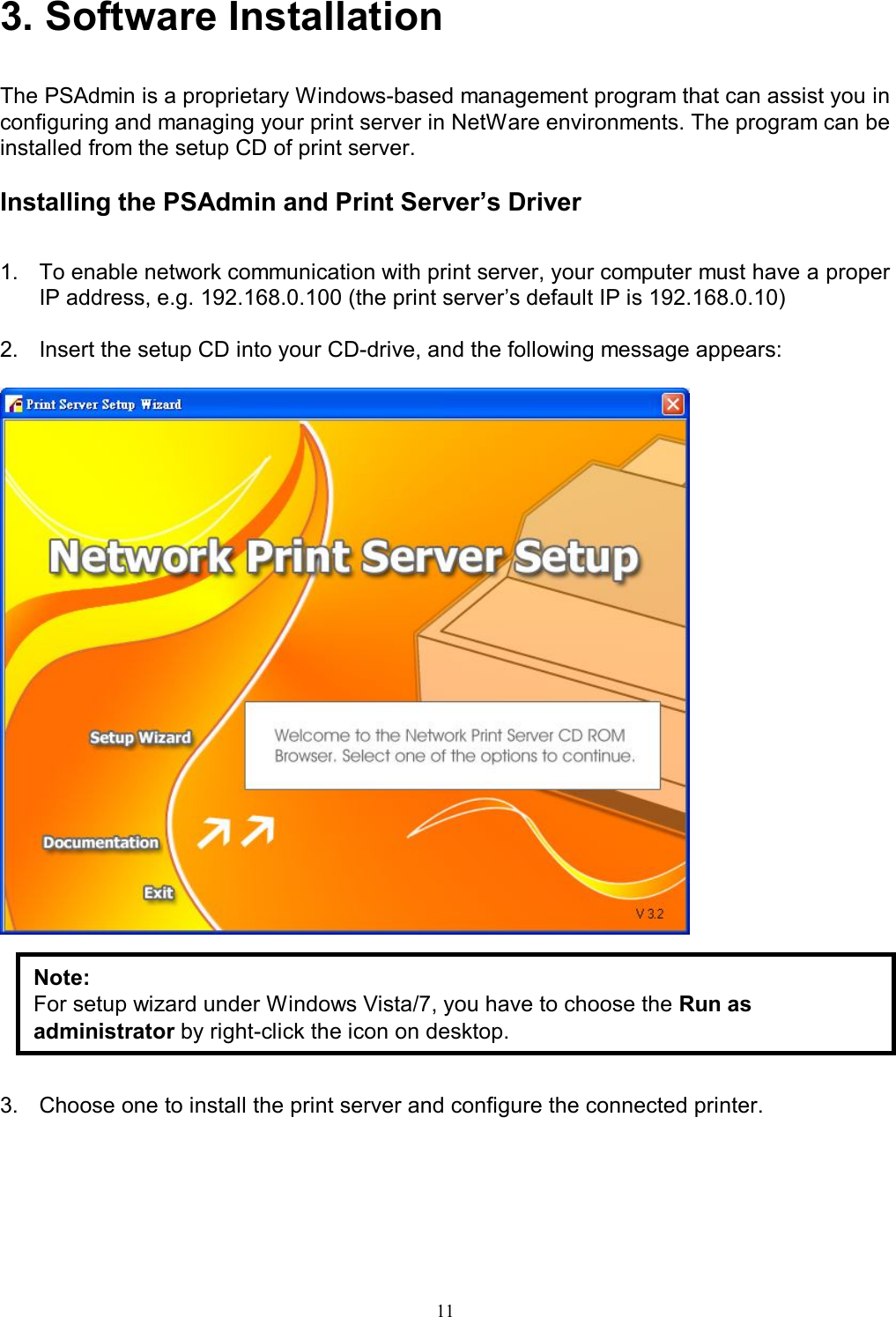
                                                                                            11  3. Software Installation  The PSAdmin is a proprietary Windows-based management program that can assist you in configuring and managing your print server in NetWare environments. The program can be installed from the setup CD of print server.  Installing the PSAdmin and Print Server’s Driver  1.  To enable network communication with print server, your computer must have a proper IP address, e.g. 192.168.0.100 (the print server’s default IP is 192.168.0.10)  2.  Insert the setup CD into your CD-drive, and the following message appears:          3.  Choose one to install the print server and configure the connected printer. Note: For setup wizard under Windows Vista/7, you have to choose the Run as administrator by right-click the icon on desktop.
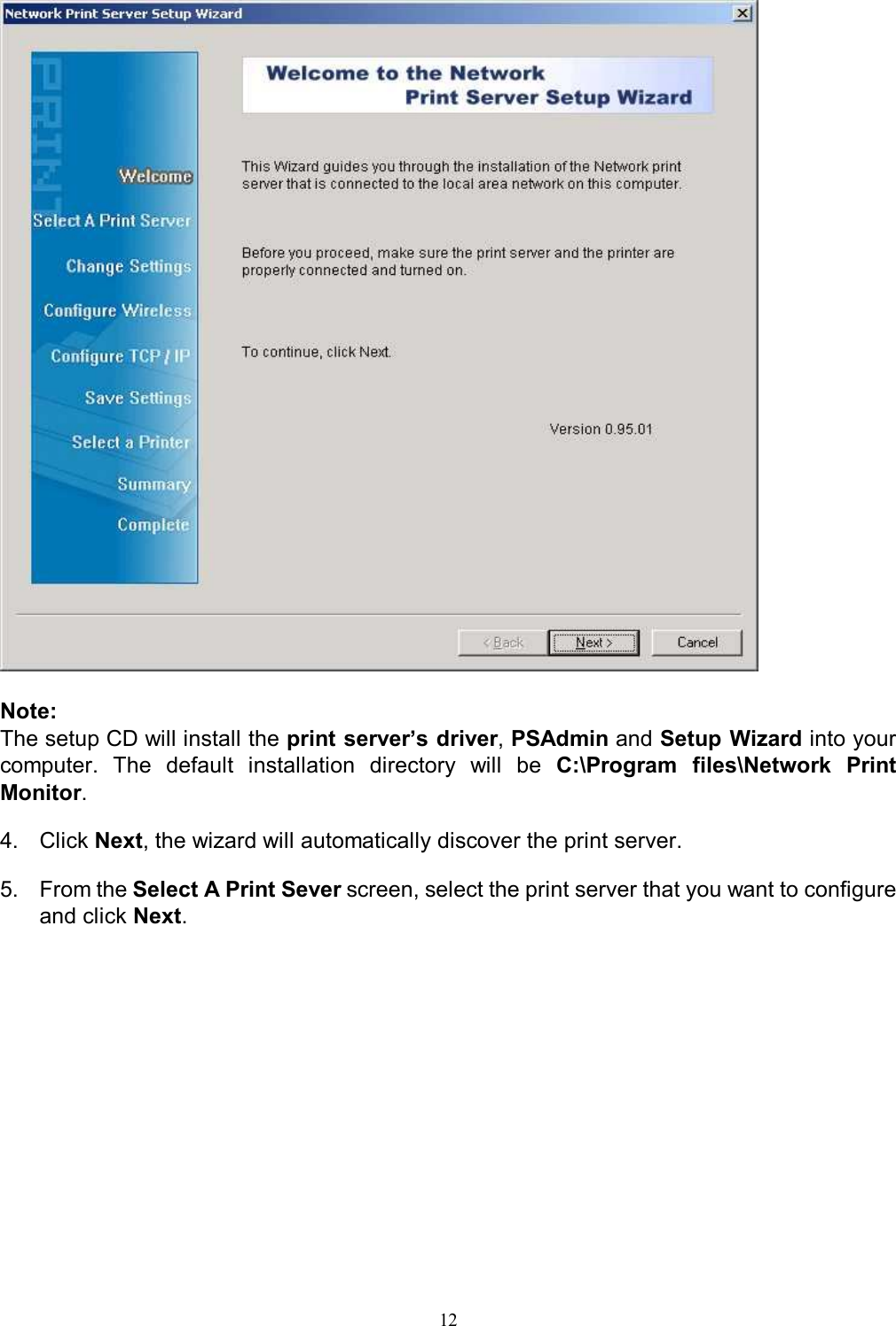
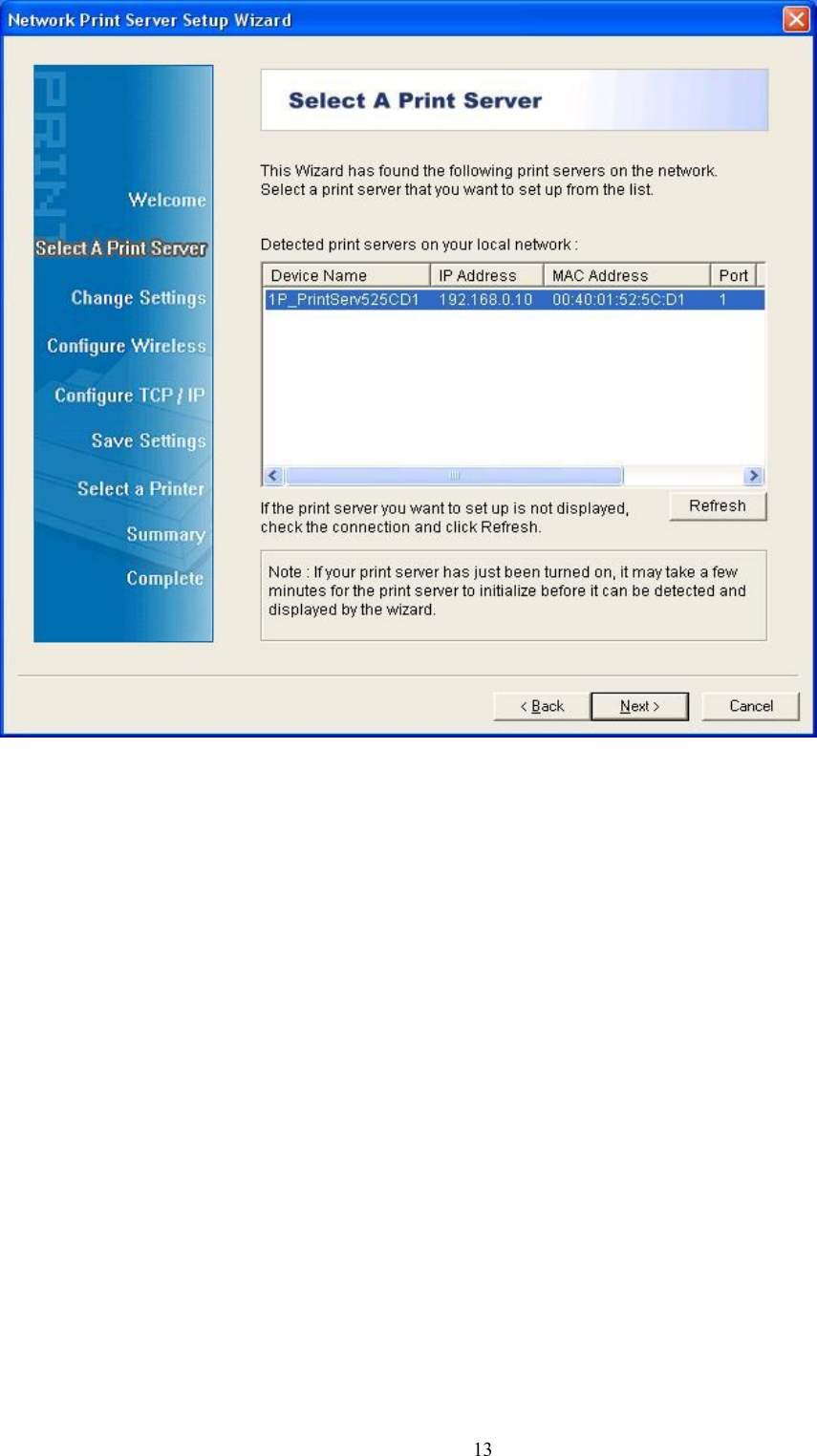
  12   Note:  The setup CD will install the print server’s driver, PSAdmin and Setup Wizard into your computer.  The  default  installation  directory  will  be  C:\Program  files\Network  Print Monitor.  4.  Click Next, the wizard will automatically discover the print server.   5.  From the Select A Print Sever screen, select the print server that you want to configure and click Next.
                                                                                            13
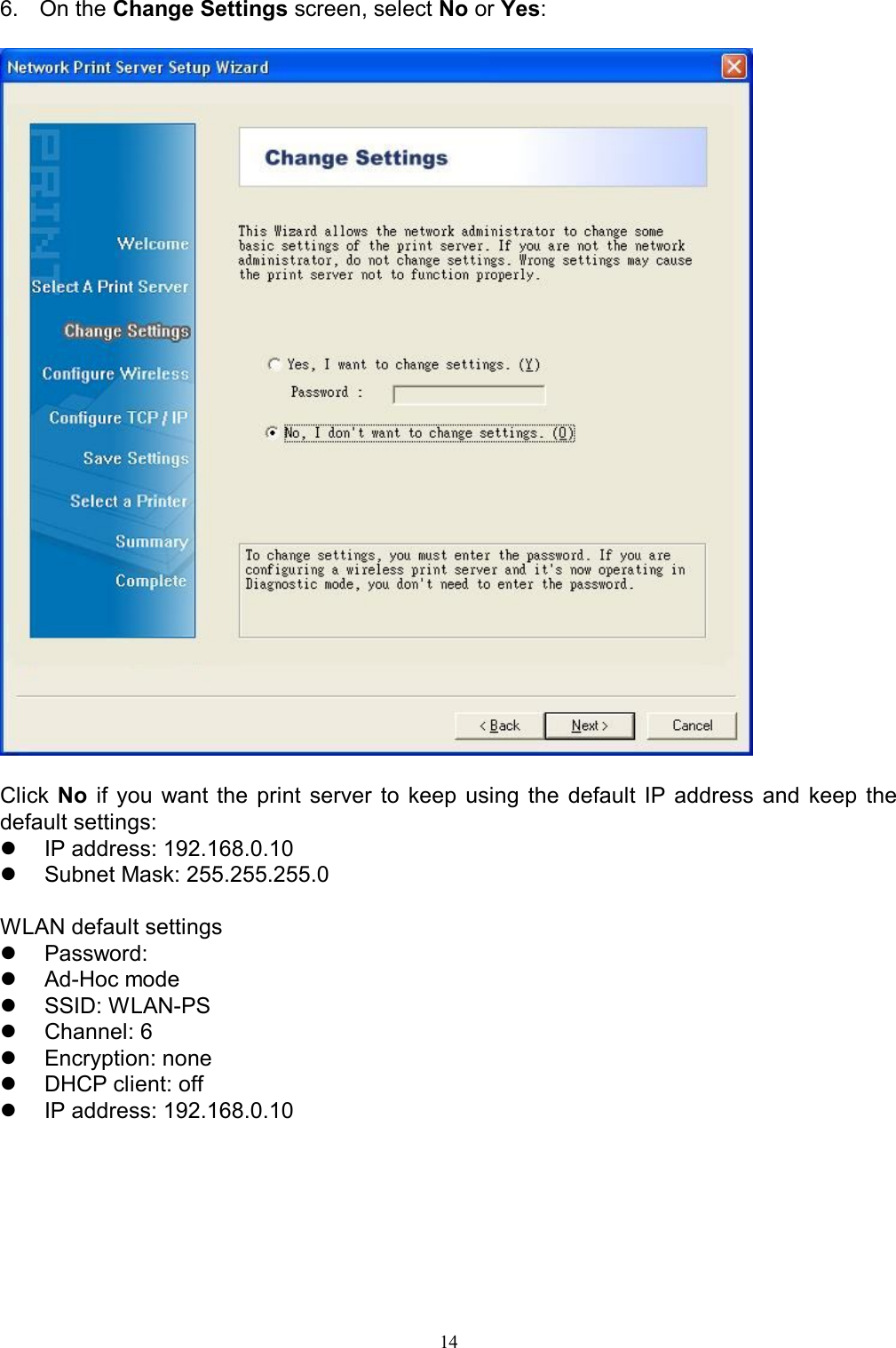
  146.  On the Change Settings screen, select No or Yes:     Click  No  if  you  want  the  print  server  to  keep  using  the  default  IP address  and  keep  the default settings:   IP address: 192.168.0.10   Subnet Mask: 255.255.255.0  WLAN default settings   Password:    Ad-Hoc mode   SSID: WLAN-PS   Channel: 6   Encryption: none   DHCP client: off   IP address: 192.168.0.10
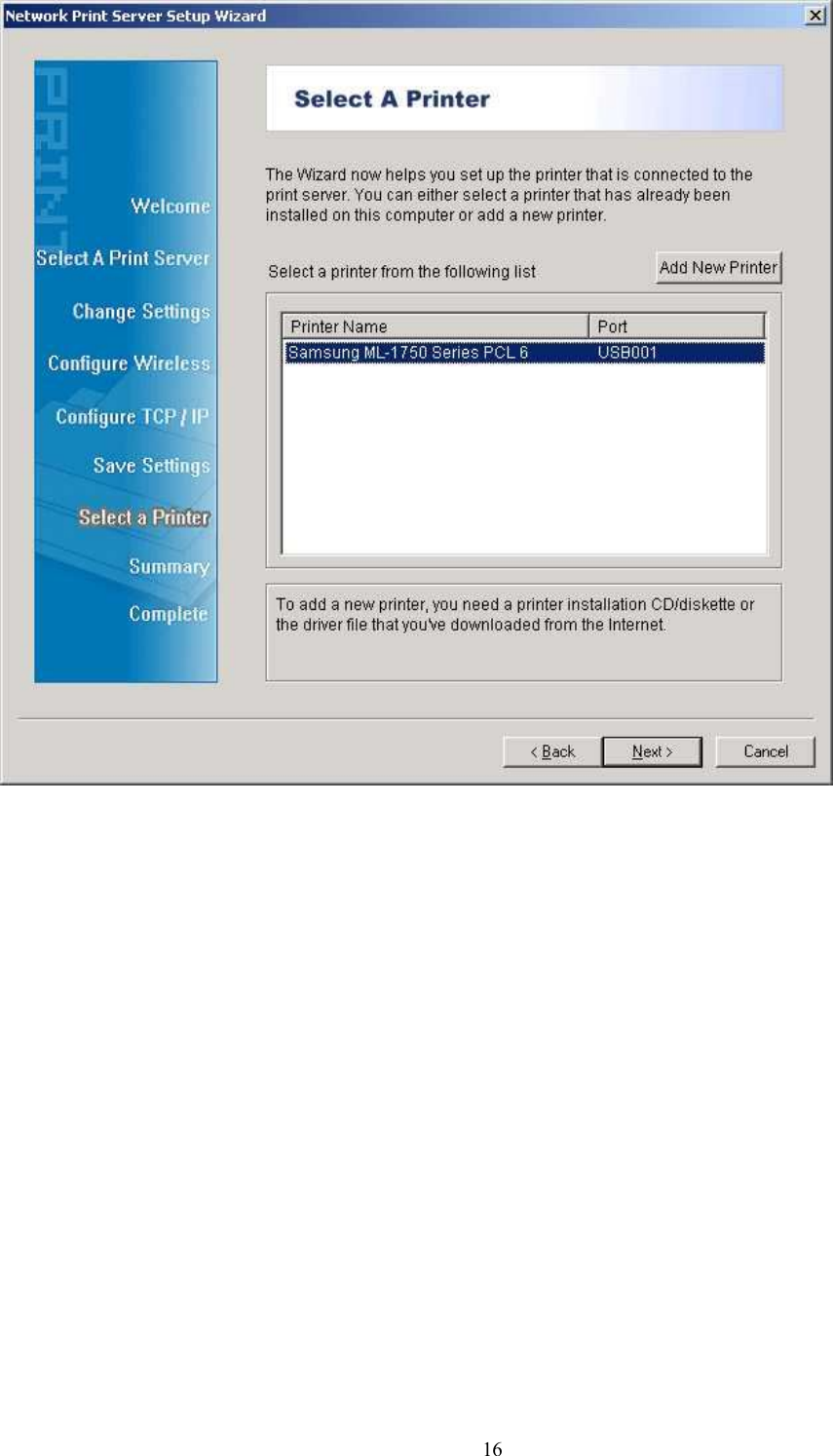
                                                                                            15  Or  Click Yes if you want change wireless settings or assign a static IP address to the print server:   On the Basic Wireless Settings screen, select Communication Type according to your network: -  Infrastructure -  Ad-Hoc   Enter the proper SSID of your wireless network. - Channel: optional - Data Transmit Rates: select Auto or others - Transmit Mode:  select Auto or others   On the Wireless Security screen, enable or disable WEP/WPA/WPA2 encryption, configure according to your wireless network and click Next.   On the TCP/IP Settings screen, specify a fixed or dynamic IP address for the print server, a fixed IP address is highly recommended. Click Next.   Click Yes if you want change IP address of the print server, and then click Next.        7.  In the setup wizard, select an already configured printer from the list, click Next, Next and then Finish to complete the installation. Or  Select  Add  New  Printer if the print server is connected to a printer  that  hasn’t been installed before and does not appear in the list. Note: 1. The IP address of print server must be within the same subnet as your network adapter. 2. After you save the new IP address, the print server will automatic reboot once to make ready for the new IP address. It may take a couple of seconds.
  16
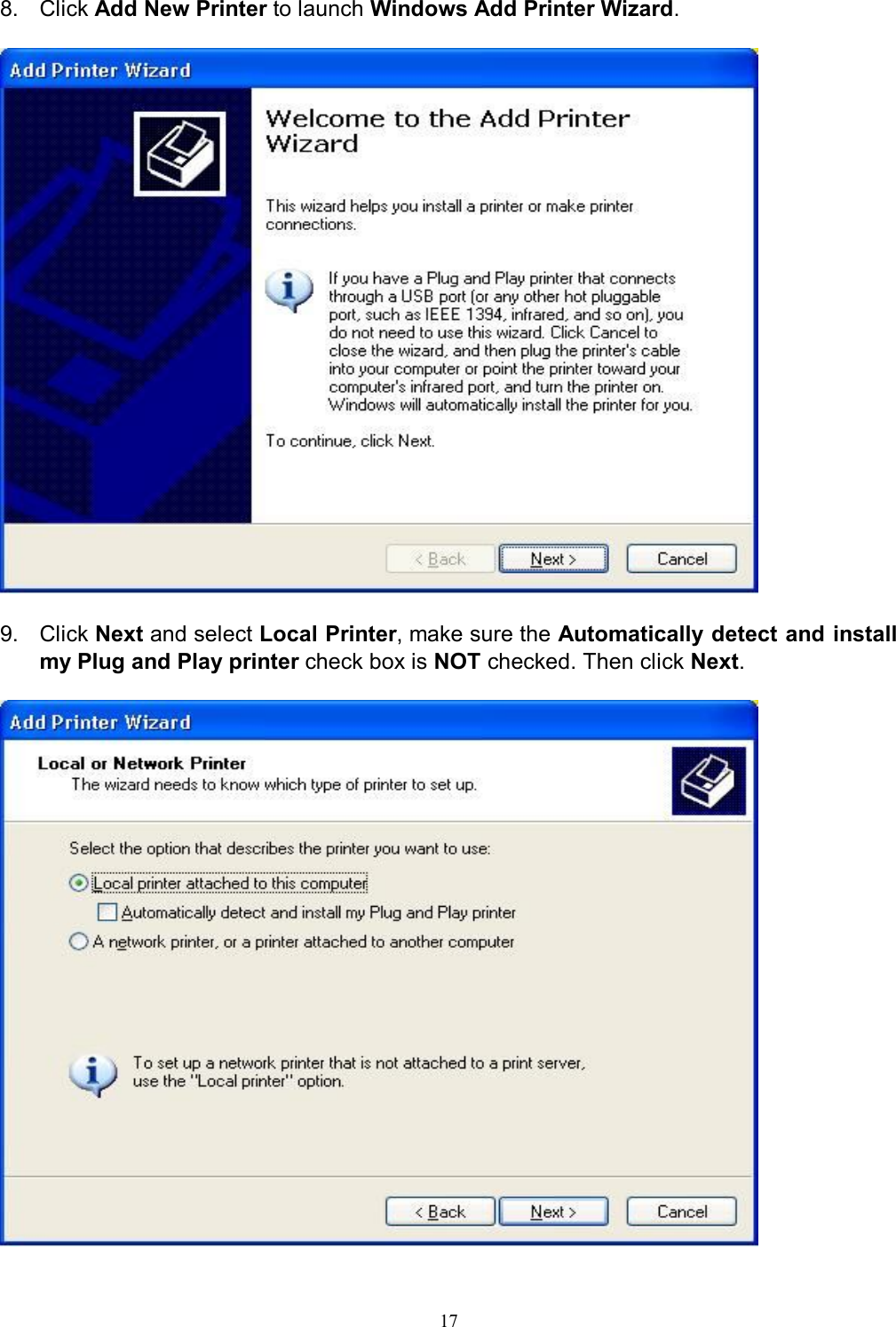
                                                                                            17   8.  Click Add New Printer to launch Windows Add Printer Wizard.    9.  Click Next and select Local Printer, make sure the Automatically detect and install my Plug and Play printer check box is NOT checked. Then click Next.
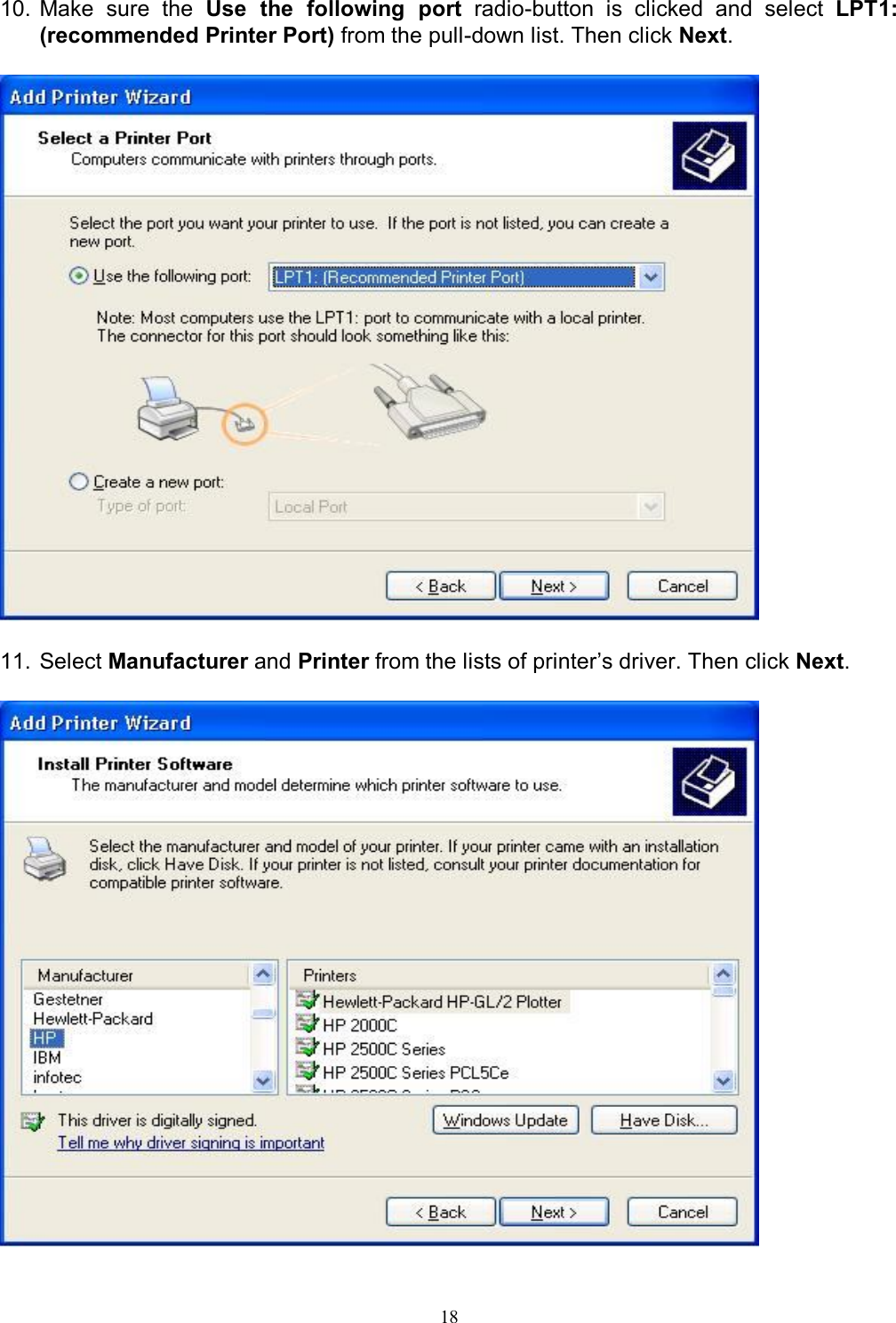
  18 10. Make  sure  the  Use  the  following  port  radio-button  is  clicked  and  select  LPT1: (recommended Printer Port) from the pull-down list. Then click Next.    11. Select Manufacturer and Printer from the lists of printer’s driver. Then click Next.
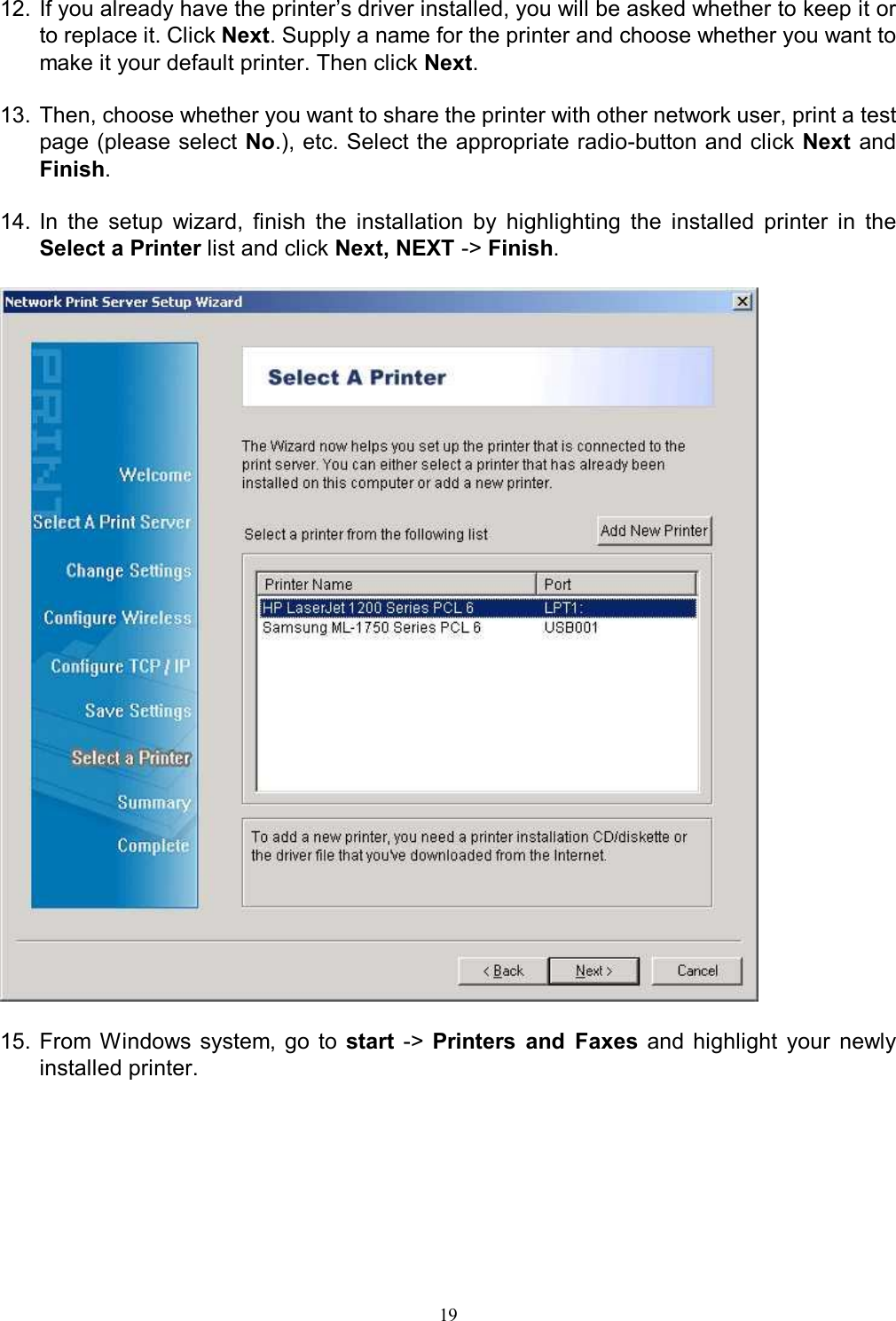
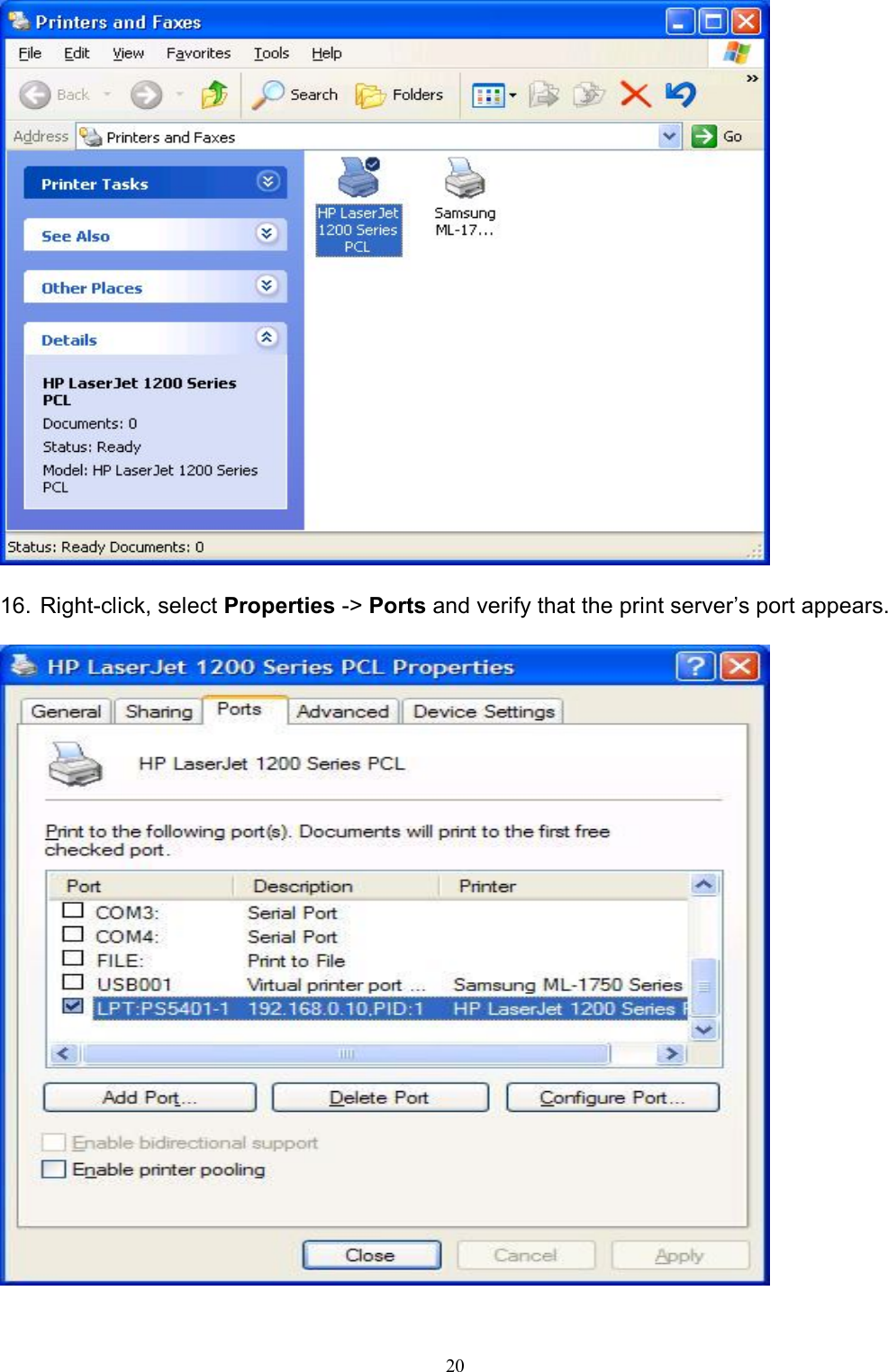
                                                                                            19   12. If you already have the printer’s driver installed, you will be asked whether to keep it or to replace it. Click Next. Supply a name for the printer and choose whether you want to make it your default printer. Then click Next.  13. Then, choose whether you want to share the printer with other network user, print a test page (please select No.), etc. Select the appropriate radio-button and click Next and Finish.  14. In  the  setup  wizard,  finish  the  installation  by  highlighting  the  installed  printer  in  the Select a Printer list and click Next, NEXT -> Finish.    15. From  Windows system,  go  to  start  ->  Printers  and  Faxes  and  highlight  your  newly installed printer.
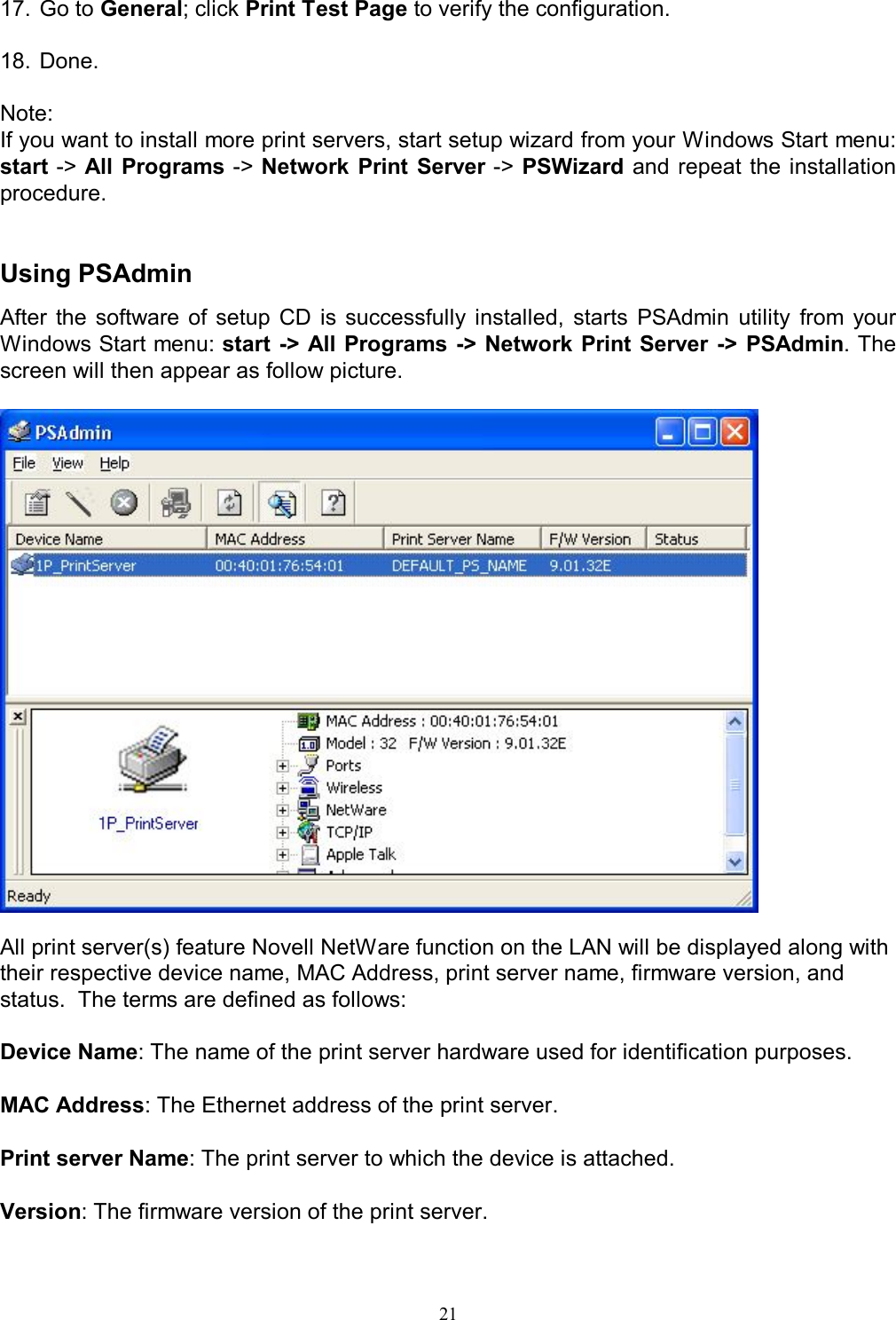
  20  16. Right-click, select Properties -> Ports and verify that the print server’s port appears.
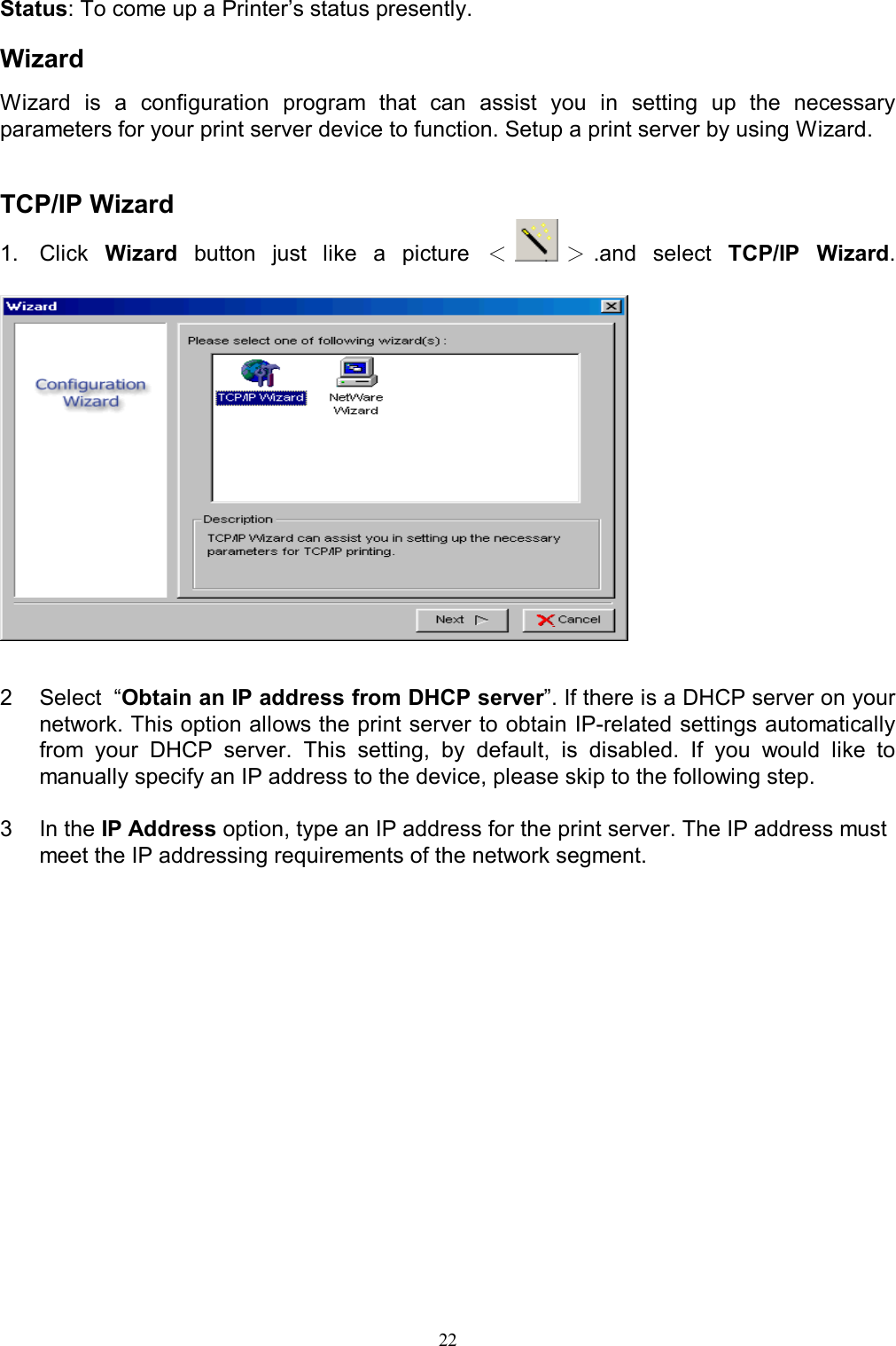
                                                                                            21   17. Go to General; click Print Test Page to verify the configuration.  18. Done.  Note: If you want to install more print servers, start setup wizard from your Windows Start menu: start -> All Programs -> Network  Print  Server -> PSWizard and repeat the installation procedure.   Using PSAdmin After  the  software  of  setup  CD  is  successfully  installed,  starts  PSAdmin  utility  from  your Windows Start menu: start -> All Programs -> Network Print Server  ->  PSAdmin. The screen will then appear as follow picture.    All print server(s) feature Novell NetWare function on the LAN will be displayed along with their respective device name, MAC Address, print server name, firmware version, and status.  The terms are defined as follows:  Device Name: The name of the print server hardware used for identification purposes.  MAC Address: The Ethernet address of the print server.  Print server Name: The print server to which the device is attached.  Version: The firmware version of the print server.
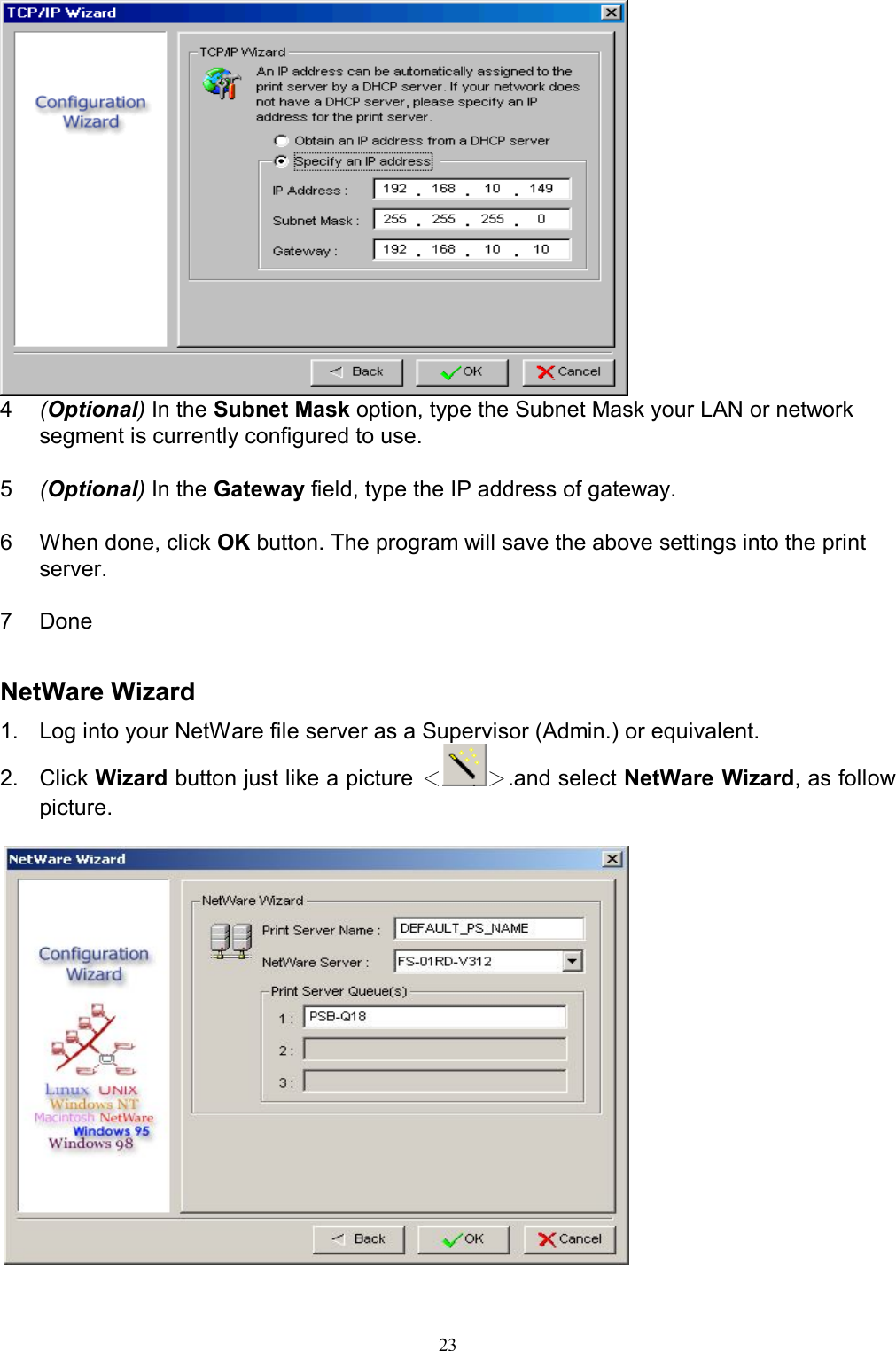
  22Status: To come up a Printer’s status presently.  Wizard Wizard  is  a  configuration  program  that  can  assist  you  in  setting  up  the  necessary parameters for your print server device to function. Setup a print server by using Wizard.   TCP/IP Wizard 1.  Click  Wizard  button  just  like  a  picture  <>.and  select  TCP/IP  Wizard.     2  Select  “Obtain an IP address from DHCP server”. If there is a DHCP server on your network. This option allows the print server to obtain IP-related settings automatically from  your  DHCP  server.  This  setting,  by  default,  is  disabled.  If  you  would  like  to manually specify an IP address to the device, please skip to the following step.  3  In the IP Address option, type an IP address for the print server. The IP address must meet the IP addressing requirements of the network segment.
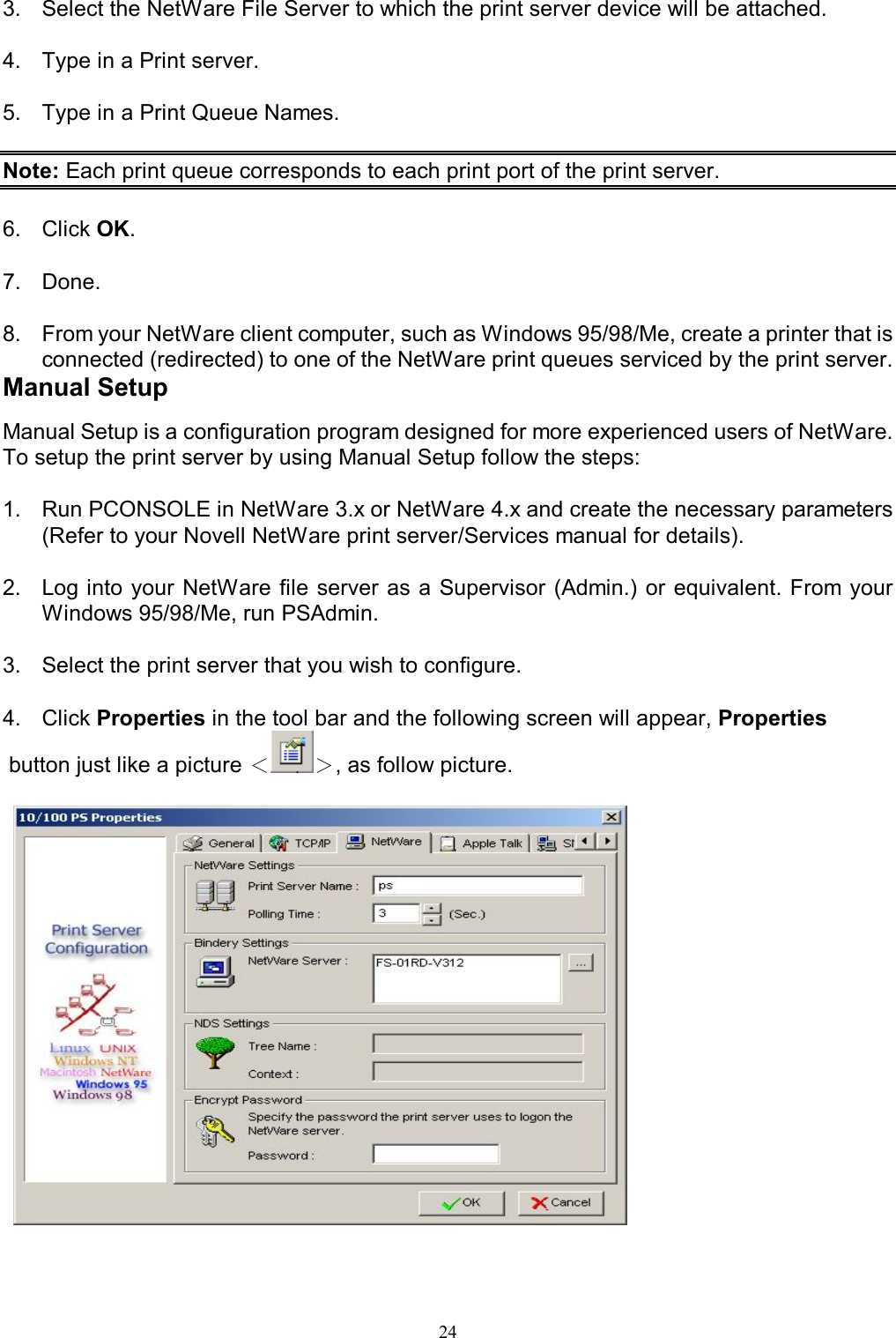
                                                                                            23   4  (Optional) In the Subnet Mask option, type the Subnet Mask your LAN or network segment is currently configured to use.  5  (Optional) In the Gateway field, type the IP address of gateway.  6  When done, click OK button. The program will save the above settings into the print server.  7  Done   NetWare Wizard 1.  Log into your NetWare file server as a Supervisor (Admin.) or equivalent. 2.  Click Wizard button just like a picture <>.and select NetWare Wizard, as follow picture.
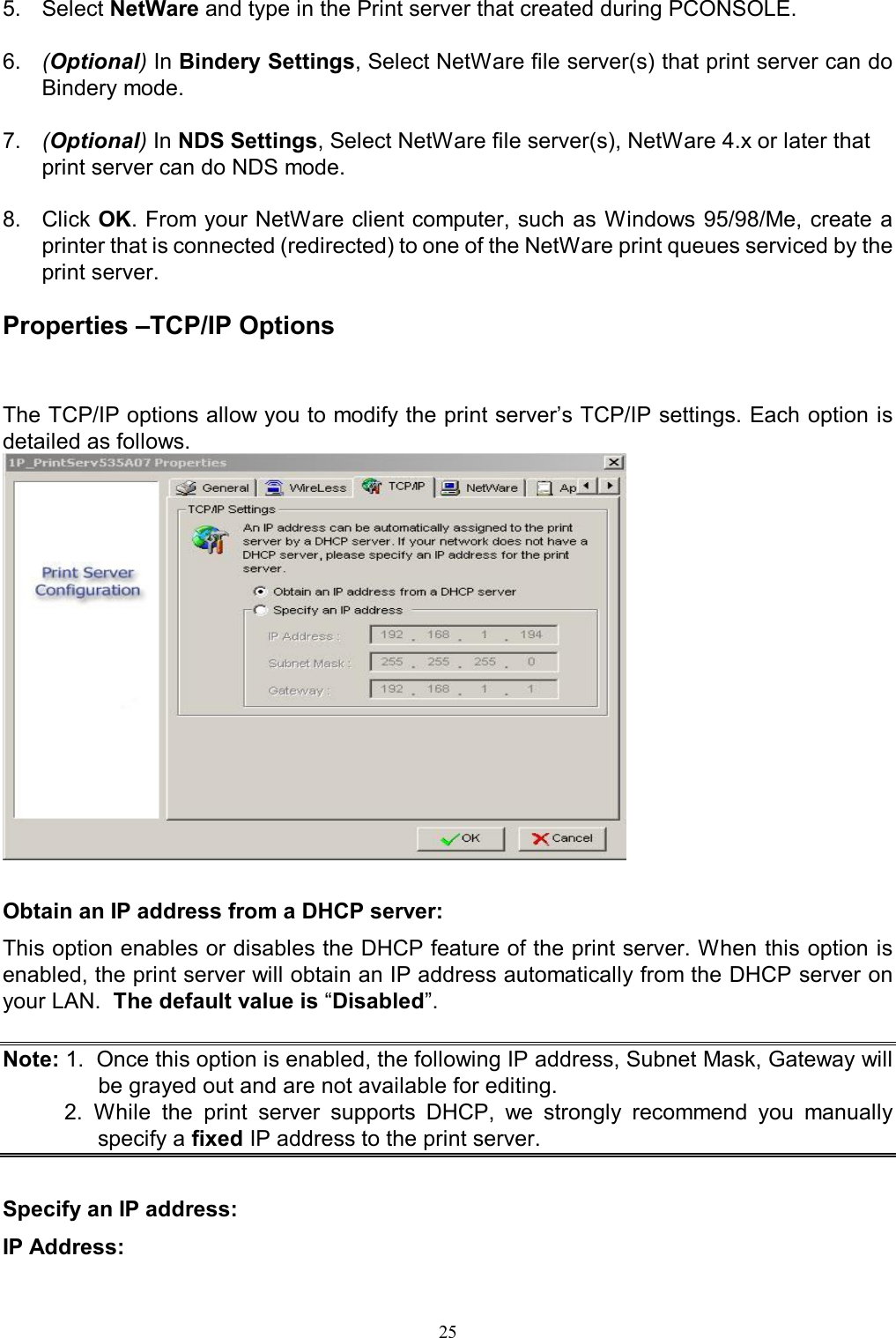
  243.  Select the NetWare File Server to which the print server device will be attached.  4.  Type in a Print server.  5.  Type in a Print Queue Names.  Note: Each print queue corresponds to each print port of the print server.  6.  Click OK.  7.  Done.  8.  From your NetWare client computer, such as Windows 95/98/Me, create a printer that is connected (redirected) to one of the NetWare print queues serviced by the print server. Manual Setup Manual Setup is a configuration program designed for more experienced users of NetWare. To setup the print server by using Manual Setup follow the steps:  1.  Run PCONSOLE in NetWare 3.x or NetWare 4.x and create the necessary parameters (Refer to your Novell NetWare print server/Services manual for details).   2.  Log into your NetWare file server as a Supervisor (Admin.) or  equivalent. From your Windows 95/98/Me, run PSAdmin.  3.  Select the print server that you wish to configure.  4.  Click Properties in the tool bar and the following screen will appear, Properties  button just like a picture <>, as follow picture.
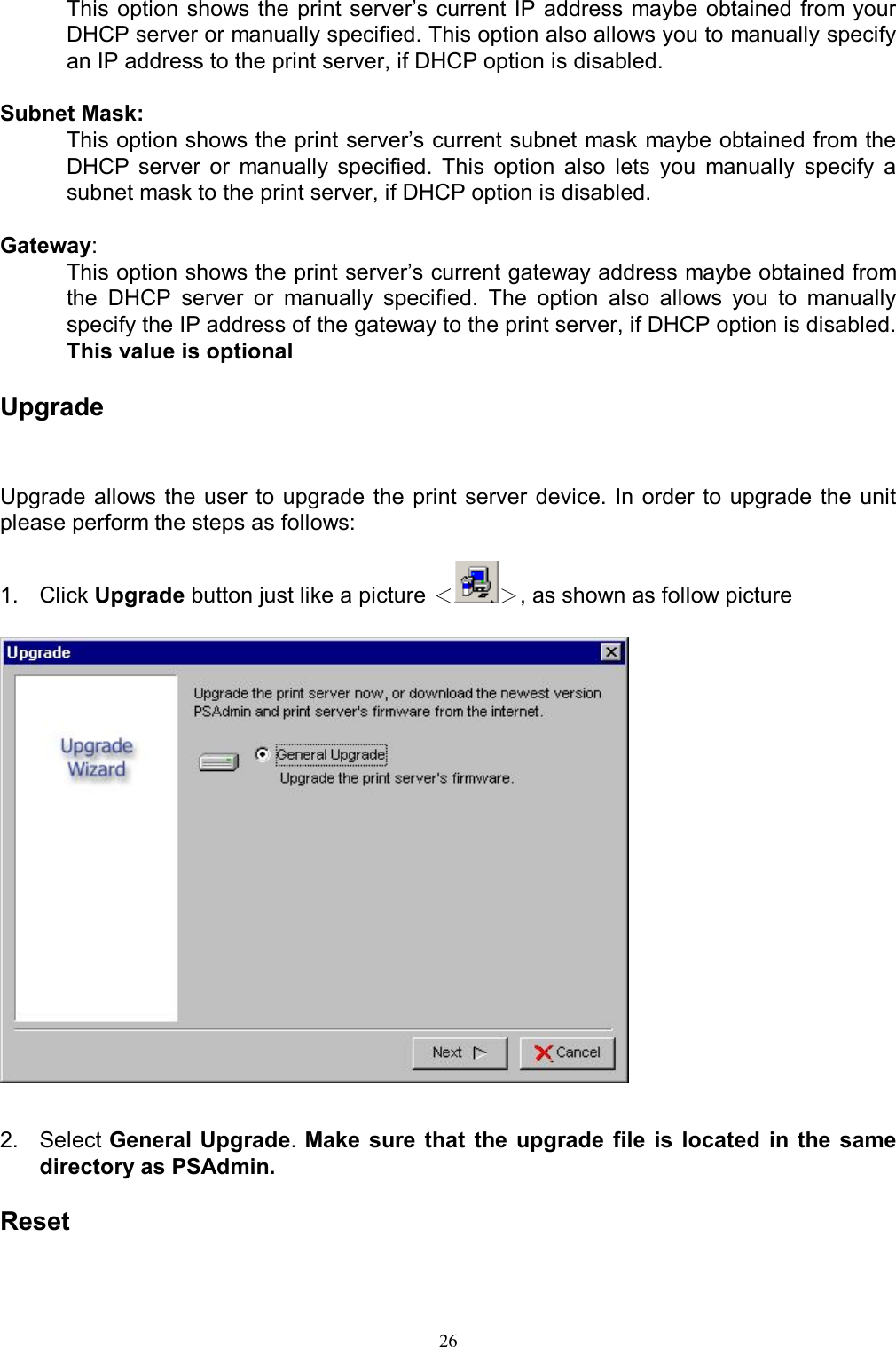
                                                                                            25  5.  Select NetWare and type in the Print server that created during PCONSOLE.  6.  (Optional) In Bindery Settings, Select NetWare file server(s) that print server can do Bindery mode.  7.  (Optional) In NDS Settings, Select NetWare file server(s), NetWare 4.x or later that print server can do NDS mode.  8.  Click OK. From your NetWare client computer, such as Windows 95/98/Me, create a printer that is connected (redirected) to one of the NetWare print queues serviced by the print server.  Properties –TCP/IP Options The TCP/IP options allow you to modify the print server’s TCP/IP settings. Each option is detailed as follows.   Obtain an IP address from a DHCP server: This option enables or disables the DHCP feature of the print server. When this option is enabled, the print server will obtain an IP address automatically from the DHCP server on your LAN.  The default value is “Disabled”.  Note: 1.  Once this option is enabled, the following IP address, Subnet Mask, Gateway will be grayed out and are not available for editing.           2.  While  the  print  server  supports  DHCP,  we  strongly  recommend  you  manually specify a fixed IP address to the print server.  Specify an IP address: IP Address:
  26This option shows the print server’s current  IP address  maybe obtained from your DHCP server or manually specified. This option also allows you to manually specify an IP address to the print server, if DHCP option is disabled.  Subnet Mask:  This option shows the print server’s current subnet mask maybe obtained from the DHCP  server  or  manually  specified.  This  option  also  lets  you  manually  specify  a subnet mask to the print server, if DHCP option is disabled.   Gateway:  This option shows the print server’s current gateway address maybe obtained from the  DHCP  server  or  manually  specified.  The  option  also  allows  you  to  manually specify the IP address of the gateway to the print server, if DHCP option is disabled. This value is optional  Upgrade Upgrade allows the user  to  upgrade the  print  server device. In order to  upgrade the  unit please perform the steps as follows:  1.  Click Upgrade button just like a picture <>, as shown as follow picture     2.  Select General Upgrade. Make  sure that  the upgrade  file  is  located  in  the same directory as PSAdmin.   Reset
                                                                                            27  1.   Click Reset button just like a picture <>.  2.   Reset  allows  the  user  to  reset  the  print  server  device  in  order  to  establish  a  new connection or for new settings to take effect.  Refresh 1.   Click Reset button just like a picture <>.  2.   Refresh searches the network for all attached print server(s).     Note:  Configure the print speed in the Advanced label, must match the printer’s speed which connect to the print server. Undependable configuration will cause printer to abnormal printing. If there are printing problem for some dot matrix printers, please try to set print speed to “slow”.    Multiple Print Queues Configuration (Novell Netware)  To configure the print server to service multiple print queues, please follow the instructions listed below:  1.  Log into your NetWare file server as a Supervisor (Admin.) or equivalent.  2.  Run the PSAdmin from your Windows.  3.  Select the print server and to be configured.  4.  Click the Wizard icon in the tool bar.  5.  Type in a Print server and a Print Queue Name (For more detailed information about Wizard, please refer to the “Wizard” section in this chapter).  6.  Run the NetWare’s PCONSOLE and create additional print queues.  7.  Select the Print server name you specify in Step 5.  8.  Select  the  “Print  server  Configuration”  option  and  select  the  ”Queue  Serviced  by Printer”  option  (For  NetWare  4.x’s  PCONSOLE,  please  select  “Printers”  option  and select “Printer 0” instead).  9.  Select the “Printer 0” and press the [Insert] key to add the print queues you create in Step  6  into  the  list  (For  NetWare  4.x’s  PCONSOLE,  please  select  “Print  queues assigned” option instead).
  28 10. Reset the print server by clicking the “Reset” icon from the PSAdmin. Done.  Note:  Please  refer  to  NetWare’s  Print  server/Services  manuals  for  detailed  PCONSOLE commands.    Uninstalling the PSAdmin on Windows PC To help users easily remove all installed software components of the PSAdmin from their Windows PC, and the PSAdmin software comes with un-installation wizard program that can automatically remove the software components from their Windows PC systems in minutes. Please follow the directions listed below to proceed with the un-installation procedure. After the PSAdmin is removed, the print server is no longer accessible via the PSAdmin. You have to re-install the PSAdmin on your system in order to access the print server again.  Procedure:  1.  Click Start, point to Settings, and select Control Panel. 2.  Double click the Add/Remove Programs icon. 3.  Click Change or Remove Programs tab. 4.  Select Network Print Monitor and click Change/Remove button. 5.  The un-installation wizard program will be launched. 6.  Follow the directions on the screen to complete the un-installation procedure.
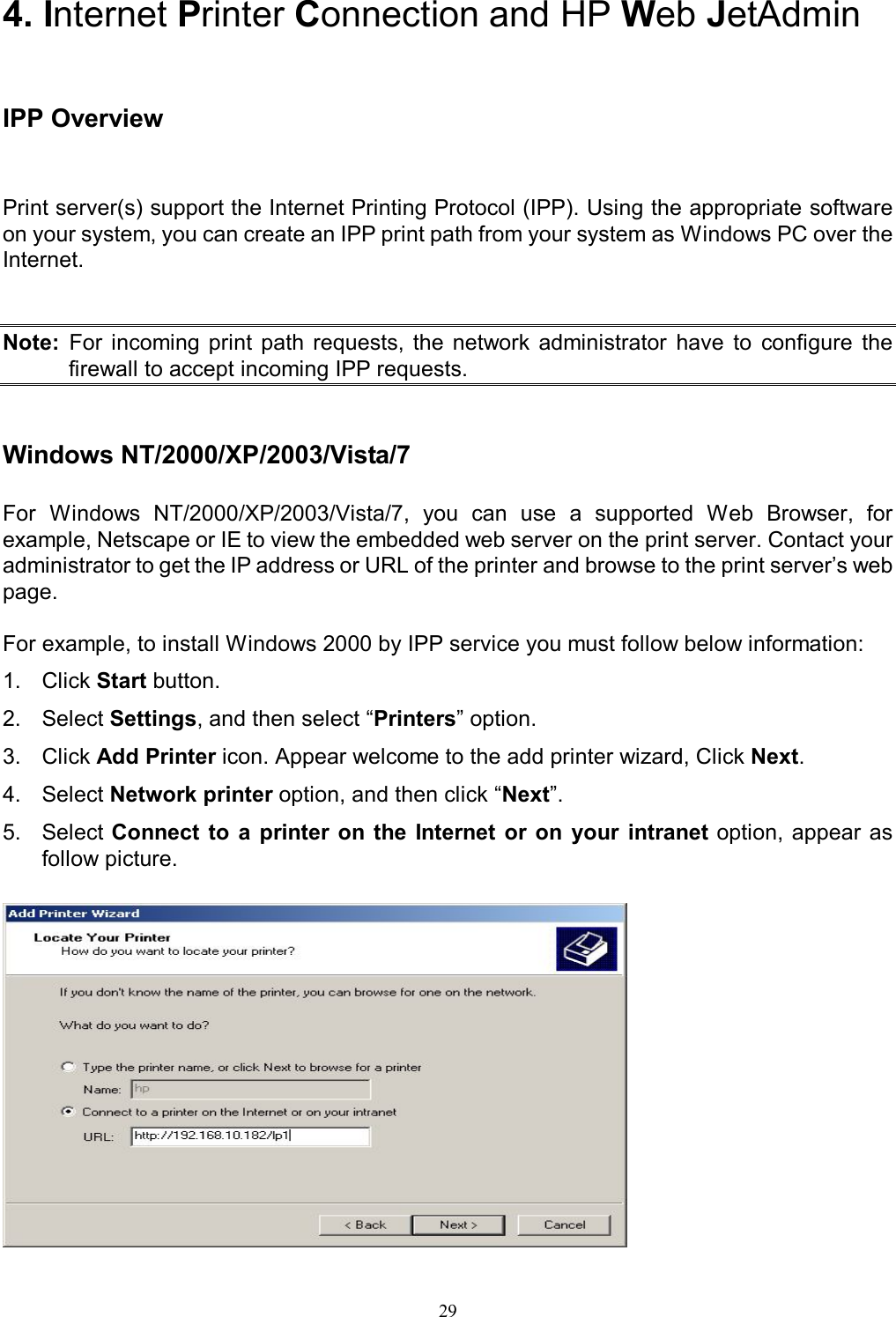
                                                                                            29  4. Internet Printer Connection and HP Web JetAdmin  IPP Overview Print server(s) support the Internet Printing Protocol (IPP). Using the appropriate software on your system, you can create an IPP print path from your system as Windows PC over the Internet.   Note:  For  incoming  print  path  requests,  the  network  administrator  have  to  configure  the firewall to accept incoming IPP requests.   Windows NT/2000/XP/2003/Vista/7  For  Windows  NT/2000/XP/2003/Vista/7,  you  can  use  a  supported  Web  Browser,  for example, Netscape or IE to view the embedded web server on the print server. Contact your administrator to get the IP address or URL of the printer and browse to the print server’s web page.  For example, to install Windows 2000 by IPP service you must follow below information: 1.  Click Start button. 2.  Select Settings, and then select “Printers” option. 3.  Click Add Printer icon. Appear welcome to the add printer wizard, Click Next. 4.  Select Network printer option, and then click “Next”. 5.  Select Connect  to  a printer  on  the  Internet  or  on  your  intranet option, appear as follow picture.
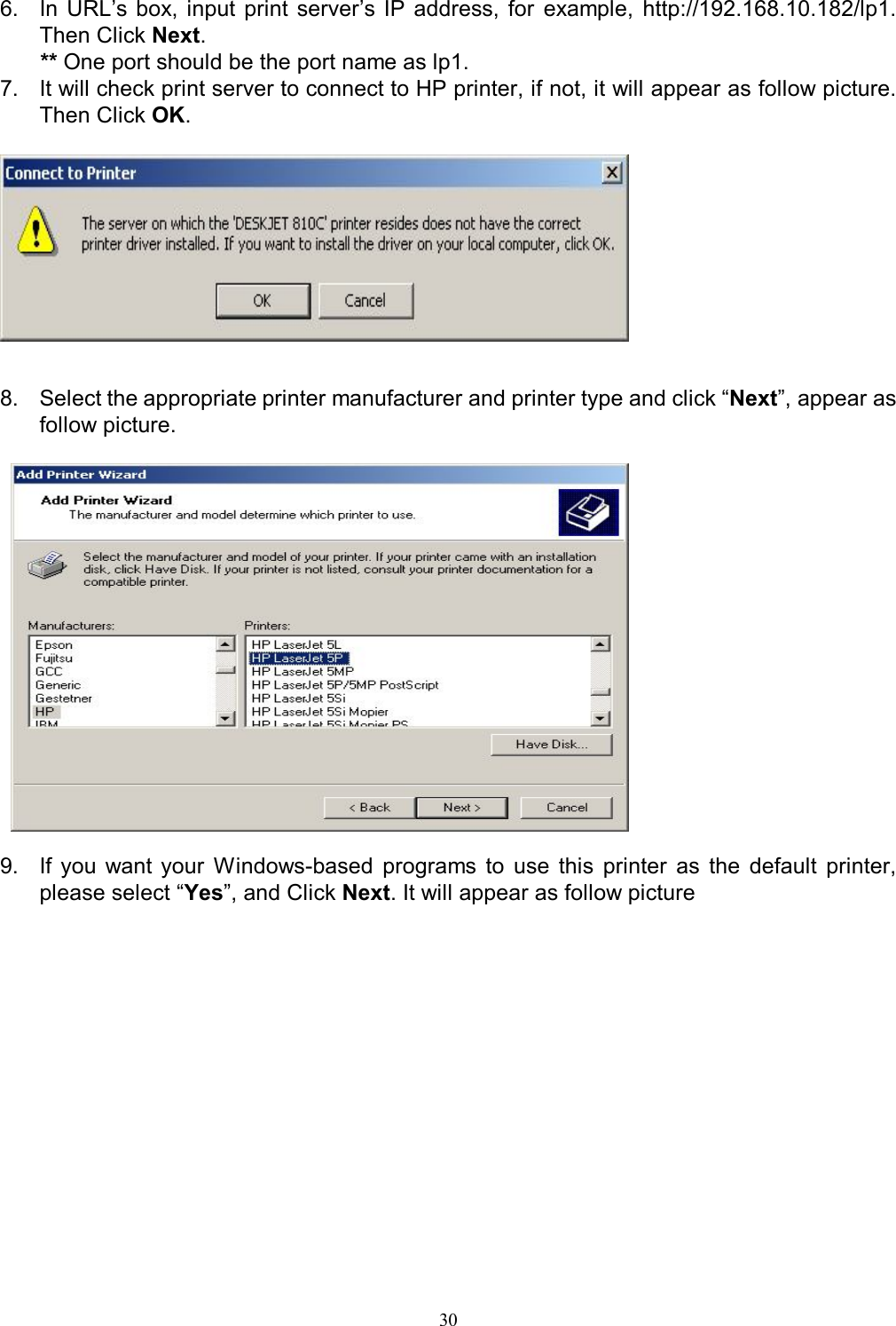
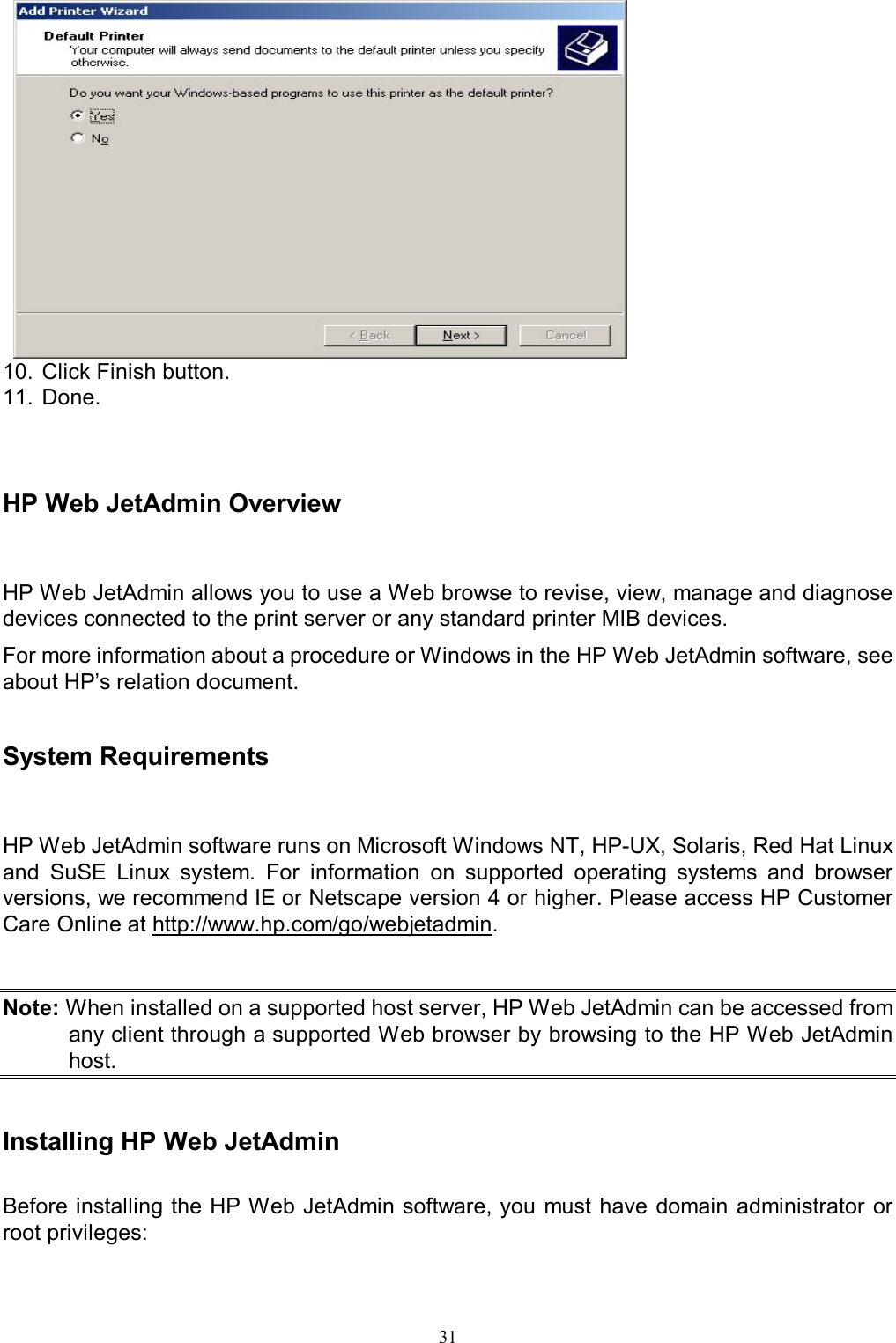
  30 6.  In  URL’s  box, input  print  server’s  IP address,  for  example,  http://192.168.10.182/lp1. Then Click Next. ** One port should be the port name as lp1. 7.  It will check print server to connect to HP printer, if not, it will appear as follow picture. Then Click OK.     8.  Select the appropriate printer manufacturer and printer type and click “Next”, appear as follow picture.    9.  If  you  want  your  Windows-based  programs  to  use  this  printer  as  the  default  printer, please select “Yes”, and Click Next. It will appear as follow picture
                                                                                            31   10. Click Finish button. 11. Done.    HP Web JetAdmin Overview HP Web JetAdmin allows you to use a Web browse to revise, view, manage and diagnose devices connected to the print server or any standard printer MIB devices. For more information about a procedure or Windows in the HP Web JetAdmin software, see about HP’s relation document.   System Requirements HP Web JetAdmin software runs on Microsoft Windows NT, HP-UX, Solaris, Red Hat Linux and  SuSE  Linux  system.  For  information  on  supported  operating  systems  and  browser versions, we recommend IE or Netscape version 4 or higher. Please access HP Customer Care Online at http://www.hp.com/go/webjetadmin.   Note: When installed on a supported host server, HP Web JetAdmin can be accessed from any client through a supported Web browser by browsing to the HP Web JetAdmin host.   Installing HP Web JetAdmin  Before installing the HP Web JetAdmin software, you must have domain administrator or root privileges:
  32Download the installation files from HP Customer Care Online at http://www.hp.com/go/webjetadmin/. Follow the instructions on the screen to install the HP Web JetAdmin software.  Note:  Installation instructions are also contained in the HP Web JetAdmin install file.      Confirming Installation and Supply Access  ˙Confirming that the HP Web JetAdmin software is correctly installed by navigating to it with your browser as shown in the following. For example, http://  server domain  port/ where server domain is the host name of your web server and port is the port number assigned during installation.  ˙Supply users access to HP Web JetAdmin software by adding a link to your web server’s home page that is addressed to HP Web JetAdmin’s URL. For example: http://server.domain:port/   Configuring and Modifying a Device Using your browser, navigate to HP Web JetAdmin’s URL. For example: http://server.domain:port/ Follow the instructions on the appropriate home page to configure or modify your printer.  Note: You can also substitute the server domain with TCP/IP address.   Removing HP Web JetAdmin Utility To remove HP  Web  JetAdmin  software  from  your  web  server,  use  the  uninstall  program provided with the software package.
                                                                                            33
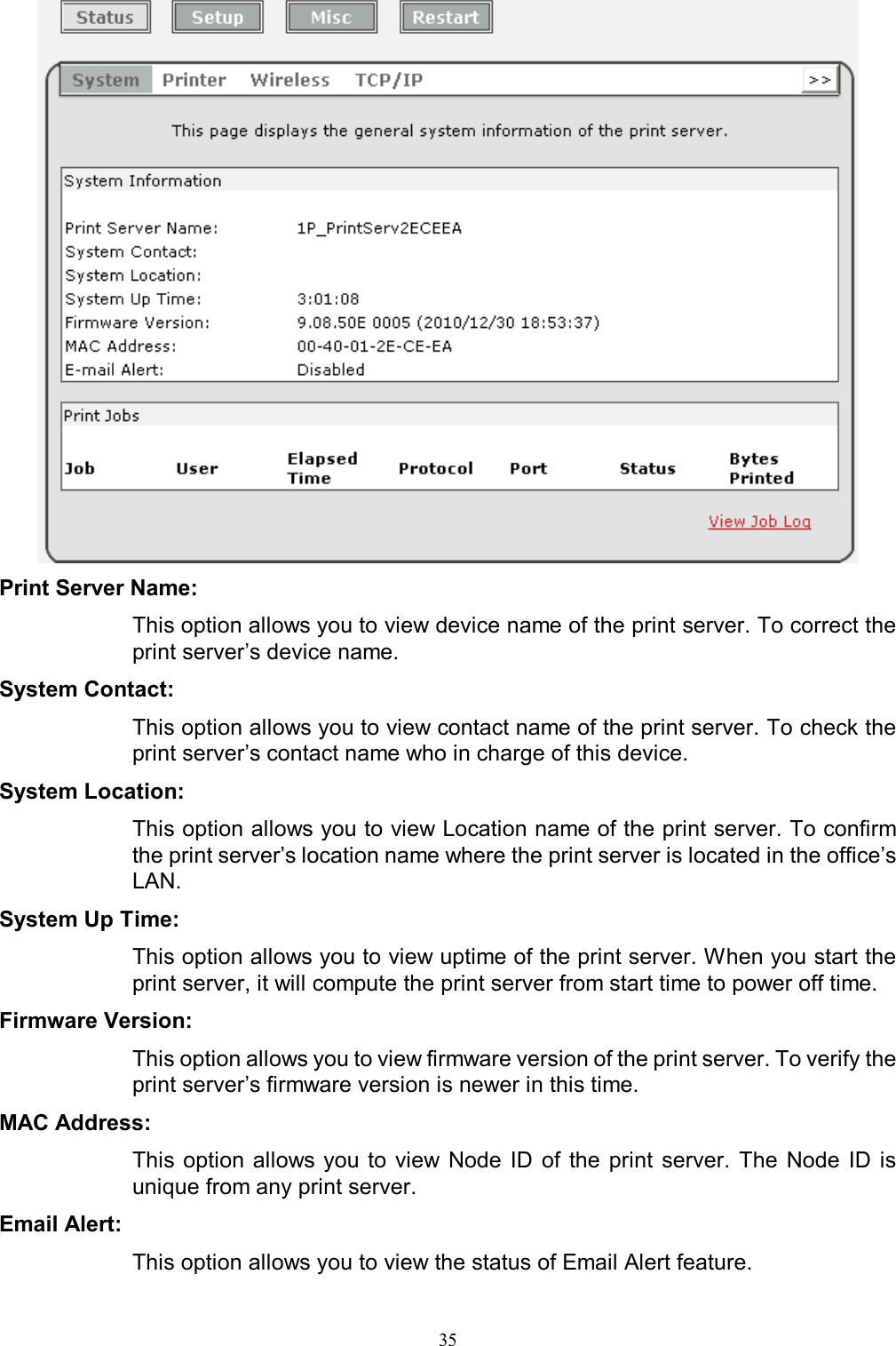
  34 5. Configuration from Embedded Web Server   Overview The  Print  Server  contains  an  embedded  web  server  that  can  be  accessed  through  a supported web browser on a LAN, for example, Microsoft Internet Explorer 5.01 or higher, Mozilla Firefox, Netscape 7.2 or higher, etc.  The embedded web server provides access to configuration and management pages for the print server and the connected peripheral device.  Using Embedded Web Server Before you can use the embedded web server, the print server must be configured with an IP address. There are many ways to configure the print server’s IP address. For example, the Windows-based of PSAdmin utility can easily set an IP address with the print server, please see the Properties – TCP/IP options of chapter 3. After an IP address is established on the print server, perform the following step:  Status Menu Once you have finished the IP address configuration with print server. You should be use web browser to view and management the print server. The status menu of the print server helps administrator control the print server’s System, Printer, NetWare, TCP/IP, SNMP and AppleTalk of status for the time being.  Preparation  Enter the print server’s IP address in the Address field of your Web browser. Press Enter. Then the print server page will appear. From here you can configure all print server settings.  Please follow this information in the status menu of the print server:  System Status 1.  Click Status, it then appears the sub-menu. 2.  Click System, it then as shown in the following picture.
                                                                                            35   Print Server Name:  This option allows you to view device name of the print server. To correct the print server’s device name. System Contact:  This option allows you to view contact name of the print server. To check the print server’s contact name who in charge of this device. System Location:  This option allows you to view Location name of the print server. To confirm the print server’s location name where the print server is located in the office’s LAN. System Up Time:  This option allows you to view uptime of the print server. When you start the print server, it will compute the print server from start time to power off time. Firmware Version:  This option allows you to view firmware version of the print server. To verify the print server’s firmware version is newer in this time. MAC Address:  This option allows you to view  Node  ID  of  the  print  server.  The  Node  ID  is unique from any print server. Email Alert:  This option allows you to view the status of Email Alert feature.
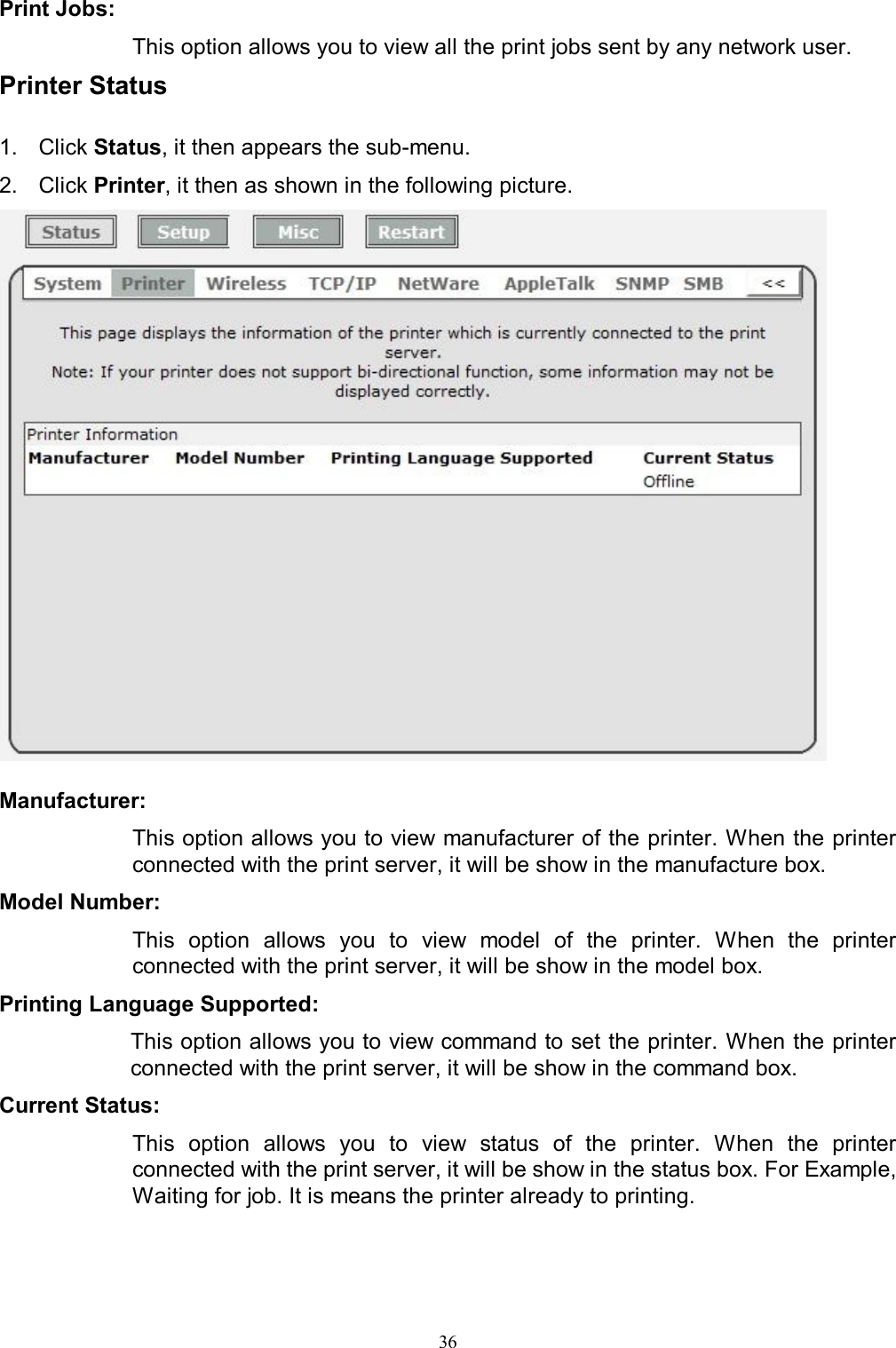
  36Print Jobs:  This option allows you to view all the print jobs sent by any network user. Printer Status  1.  Click Status, it then appears the sub-menu. 2.  Click Printer, it then as shown in the following picture.   Manufacturer:  This option allows you to view manufacturer of the printer. When the printer connected with the print server, it will be show in the manufacture box. Model Number:  This  option  allows  you  to  view  model  of  the  printer.  When  the  printer connected with the print server, it will be show in the model box. Printing Language Supported:  This option allows you to view command to set the printer. When the printer connected with the print server, it will be show in the command box. Current Status:  This  option  allows  you  to  view  status  of  the  printer.  When  the  printer connected with the print server, it will be show in the status box. For Example, Waiting for job. It is means the printer already to printing.
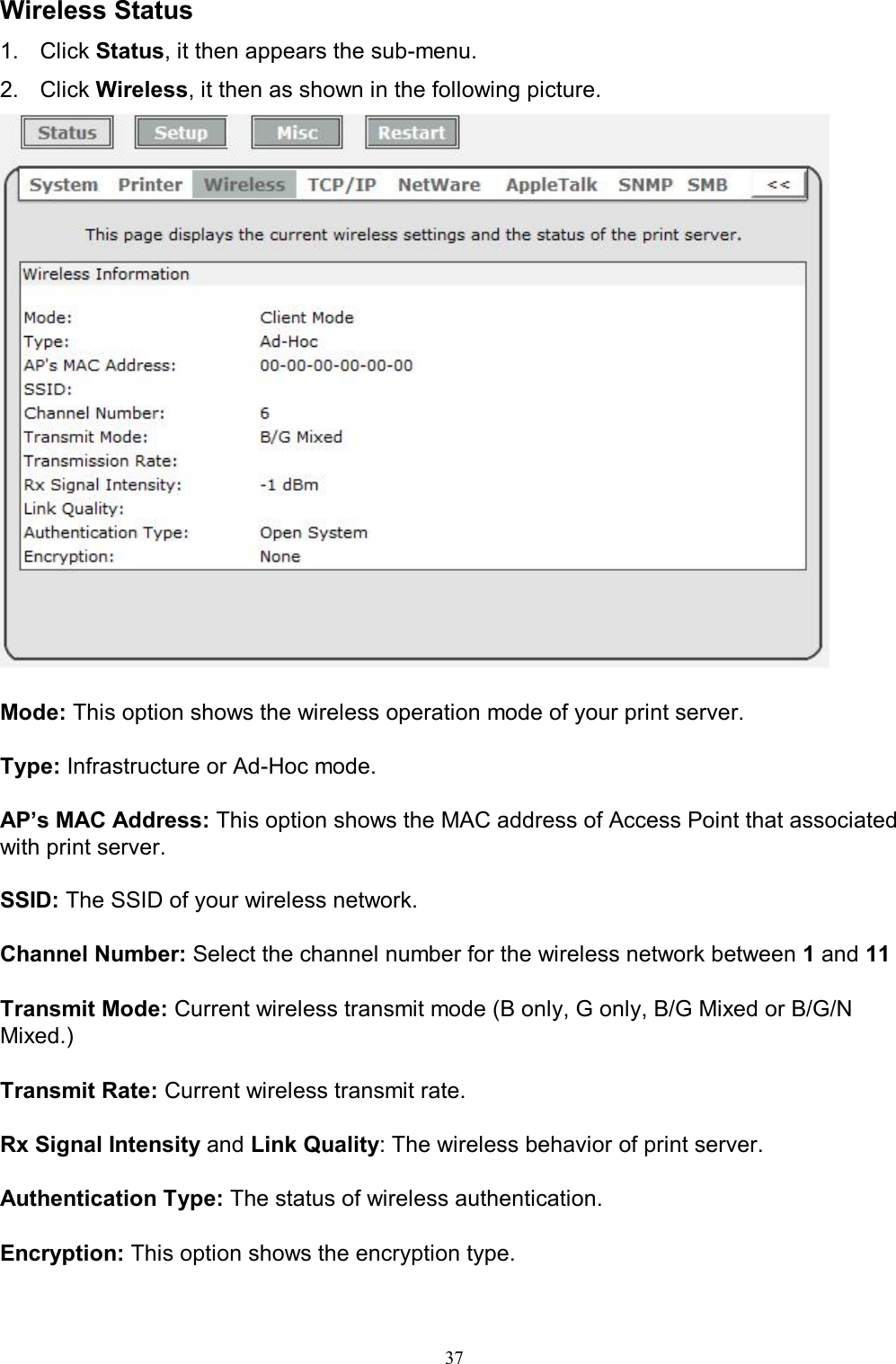
                                                                                            37  Wireless Status 1.  Click Status, it then appears the sub-menu. 2.  Click Wireless, it then as shown in the following picture.   Mode: This option shows the wireless operation mode of your print server.  Type: Infrastructure or Ad-Hoc mode.  AP’s MAC Address: This option shows the MAC address of Access Point that associated with print server.  SSID: The SSID of your wireless network.  Channel Number: Select the channel number for the wireless network between 1 and 11  Transmit Mode: Current wireless transmit mode (B only, G only, B/G Mixed or B/G/N Mixed.)  Transmit Rate: Current wireless transmit rate.  Rx Signal Intensity and Link Quality: The wireless behavior of print server.  Authentication Type: The status of wireless authentication.  Encryption: This option shows the encryption type.
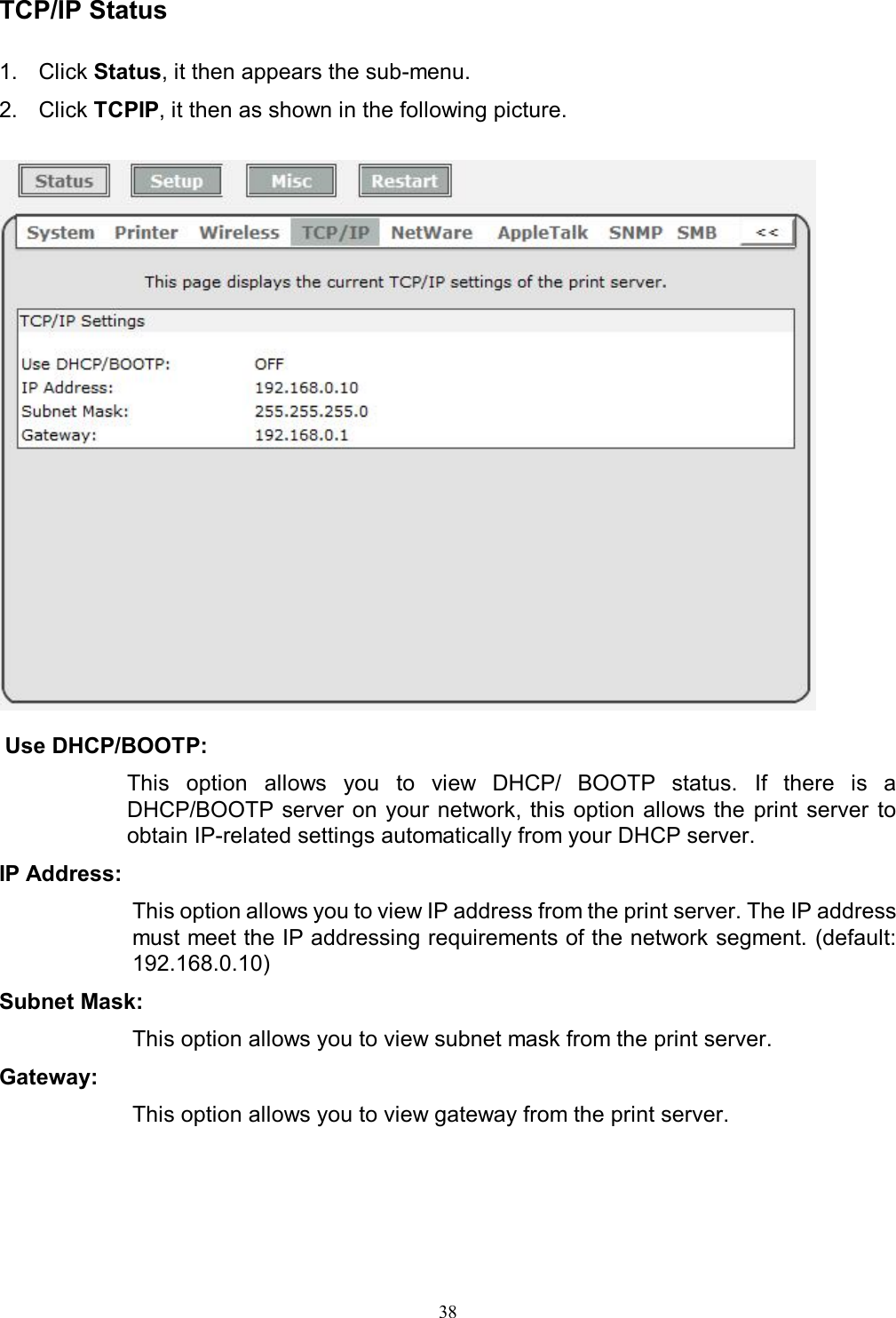
  38 TCP/IP Status  1.  Click Status, it then appears the sub-menu. 2.  Click TCPIP, it then as shown in the following picture.    Use DHCP/BOOTP:  This  option  allows  you  to  view  DHCP/  BOOTP  status. If  there  is  a DHCP/BOOTP server on  your network, this option allows the  print  server  to obtain IP-related settings automatically from your DHCP server. IP Address:  This option allows you to view IP address from the print server. The IP address must meet the IP addressing requirements of the network segment. (default: 192.168.0.10) Subnet Mask:  This option allows you to view subnet mask from the print server. Gateway: This option allows you to view gateway from the print server.
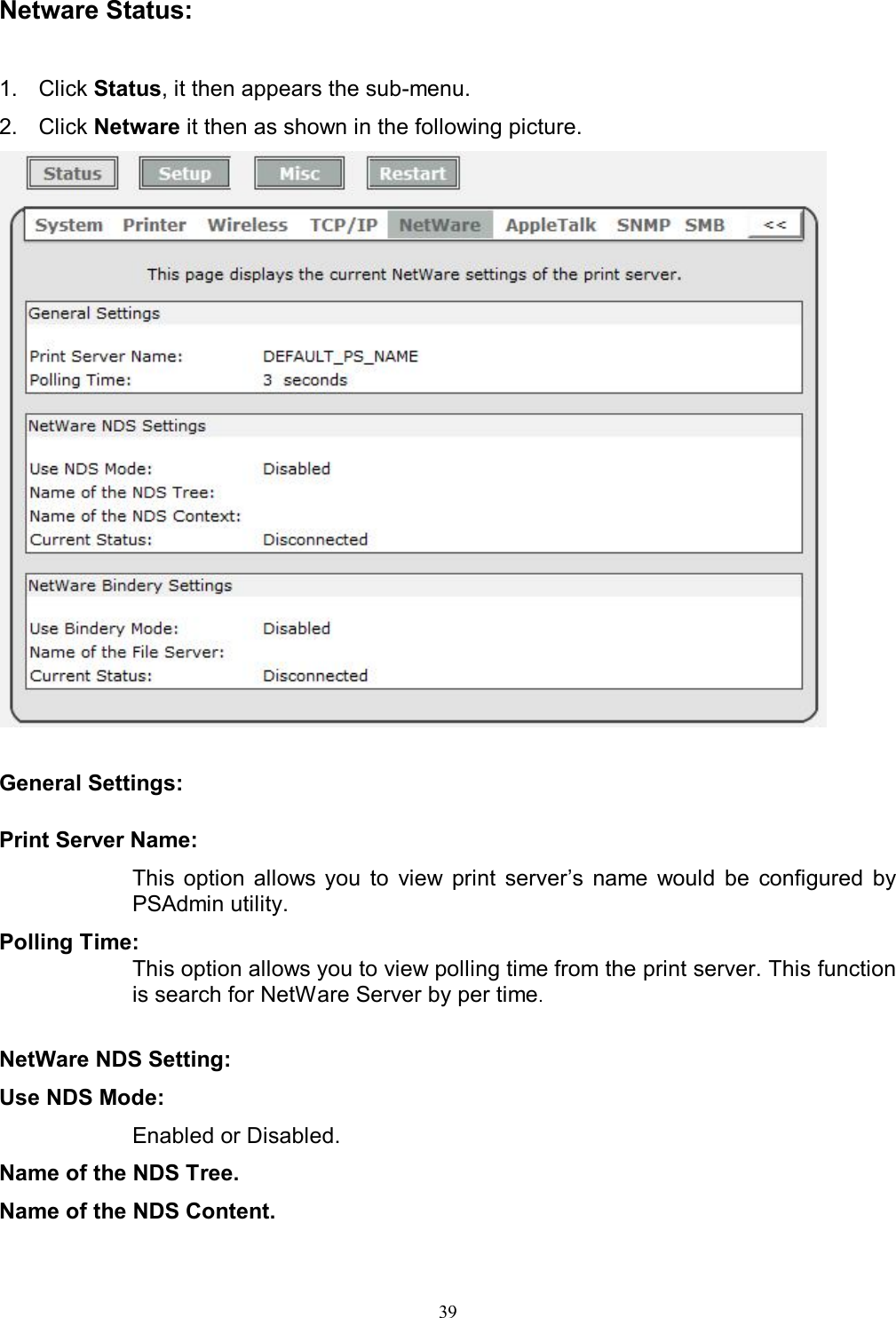
                                                                                            39   Netware Status:  1.  Click Status, it then appears the sub-menu. 2.  Click Netware it then as shown in the following picture.   General Settings:  Print Server Name:  This  option  allows you  to  view  print  server’s  name  would  be  configured  by PSAdmin utility. Polling Time:  This option allows you to view polling time from the print server. This function is search for NetWare Server by per time.  NetWare NDS Setting: Use NDS Mode:  Enabled or Disabled. Name of the NDS Tree. Name of the NDS Content.
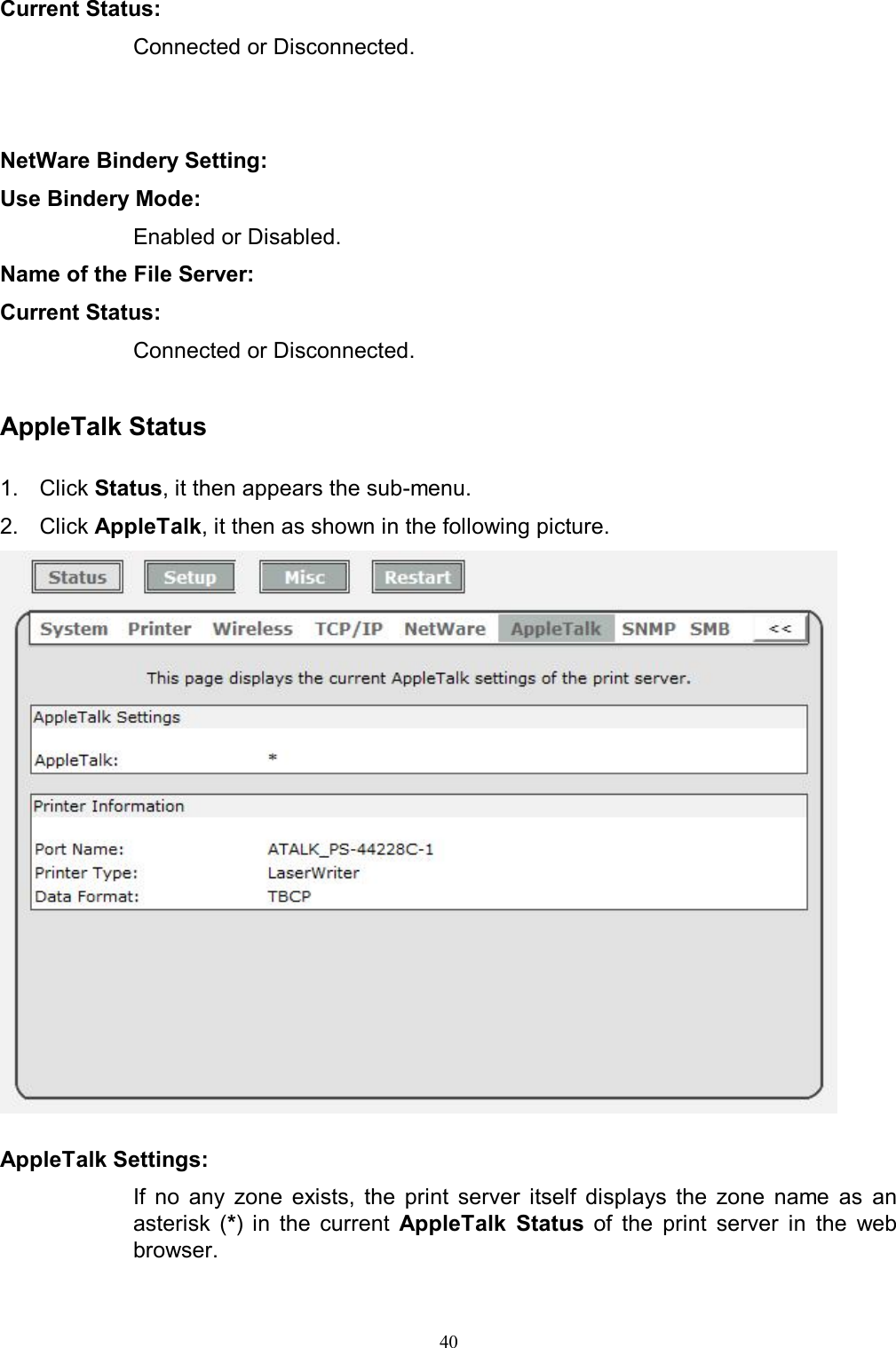
  40Current Status:  Connected or Disconnected.   NetWare Bindery Setting: Use Bindery Mode:  Enabled or Disabled. Name of the File Server: Current Status:  Connected or Disconnected.  AppleTalk Status  1.  Click Status, it then appears the sub-menu. 2.  Click AppleTalk, it then as shown in the following picture.   AppleTalk Settings:  If  no  any  zone  exists,  the  print  server  itself  displays  the  zone  name  as  an asterisk  (*)  in  the  current  AppleTalk  Status  of  the  print  server  in  the  web browser.
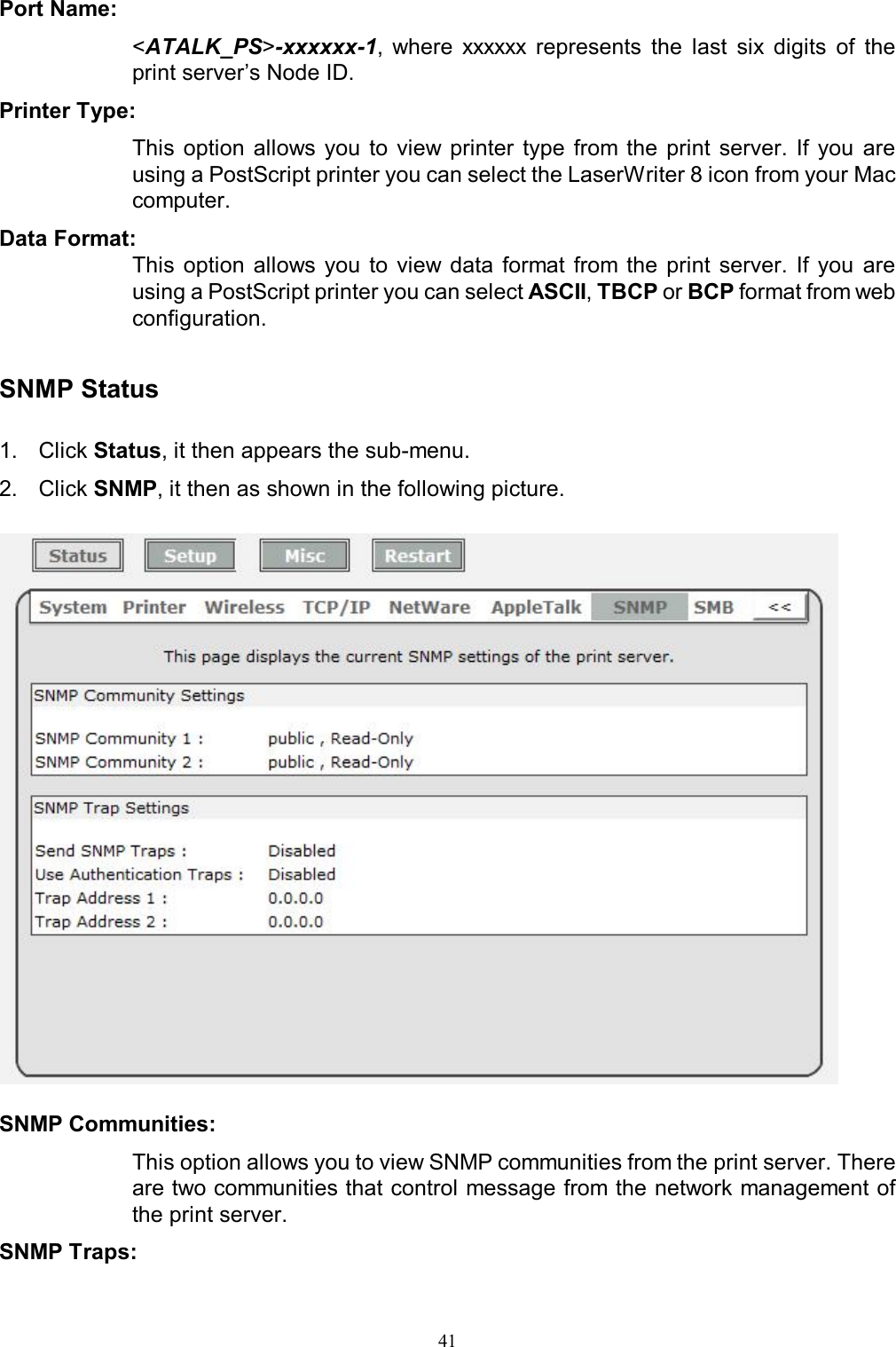
                                                                                            41  Port Name:  <ATALK_PS>-xxxxxx-1,  where  xxxxxx  represents  the  last  six  digits  of  the print server’s Node ID. Printer Type:  This  option  allows you  to  view printer  type  from  the  print  server.  If you  are using a PostScript printer you can select the LaserWriter 8 icon from your Mac computer. Data Format:  This  option  allows you  to  view data  format  from  the  print  server.  If  you  are using a PostScript printer you can select ASCII, TBCP or BCP format from web configuration.   SNMP Status  1.  Click Status, it then appears the sub-menu. 2.  Click SNMP, it then as shown in the following picture.    SNMP Communities:  This option allows you to view SNMP communities from the print server. There are two communities that control message from the network management of the print server. SNMP Traps:
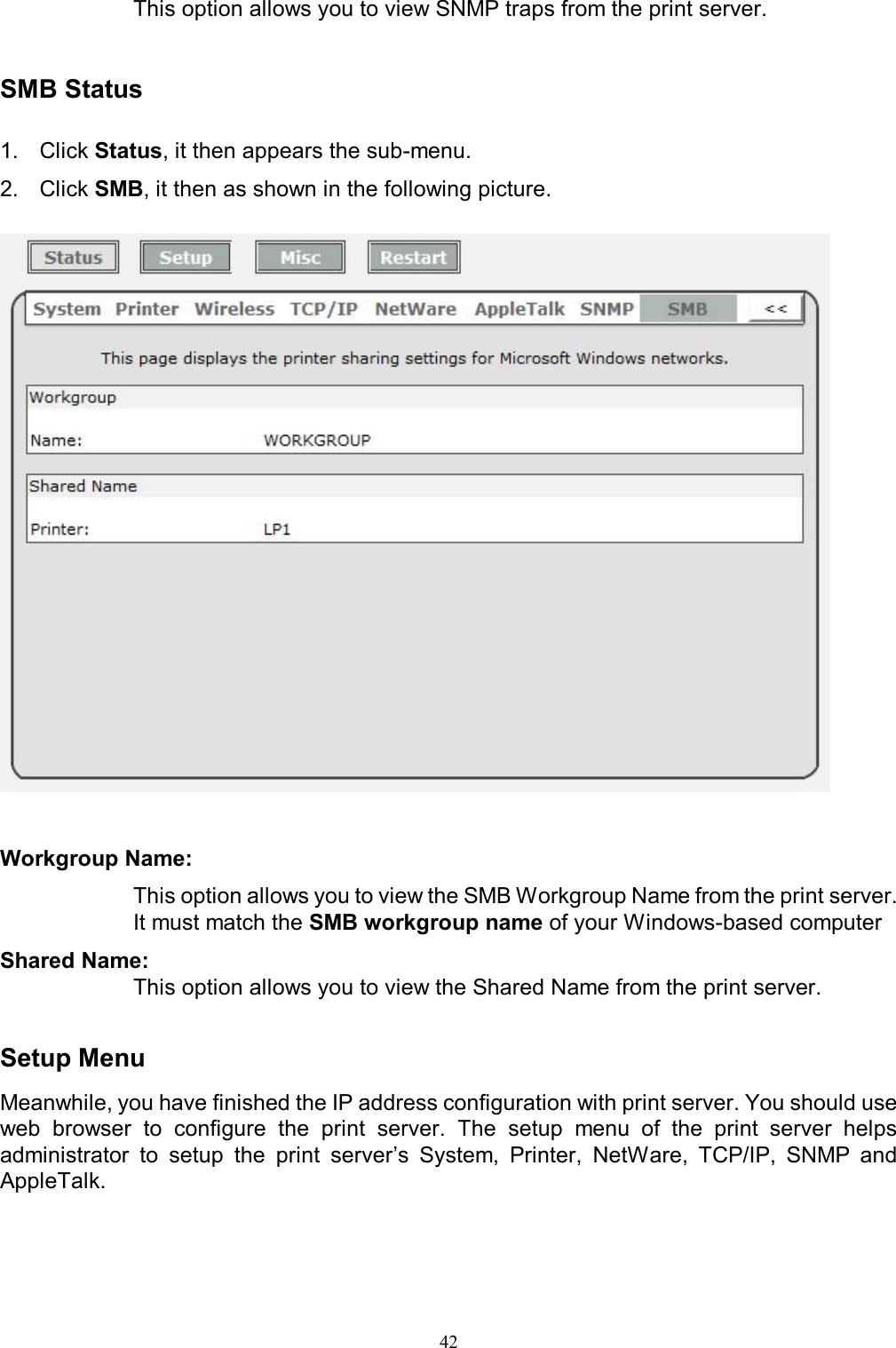
  42This option allows you to view SNMP traps from the print server.   SMB Status  1.  Click Status, it then appears the sub-menu. 2.  Click SMB, it then as shown in the following picture.     Workgroup Name:  This option allows you to view the SMB Workgroup Name from the print server. It must match the SMB workgroup name of your Windows-based computer Shared Name:  This option allows you to view the Shared Name from the print server.   Setup Menu Meanwhile, you have finished the IP address configuration with print server. You should use web  browser  to  configure  the  print  server.  The  setup  menu  of  the  print  server  helps administrator  to  setup  the  print  server’s  System,  Printer,  NetWare,  TCP/IP,  SNMP  and AppleTalk.
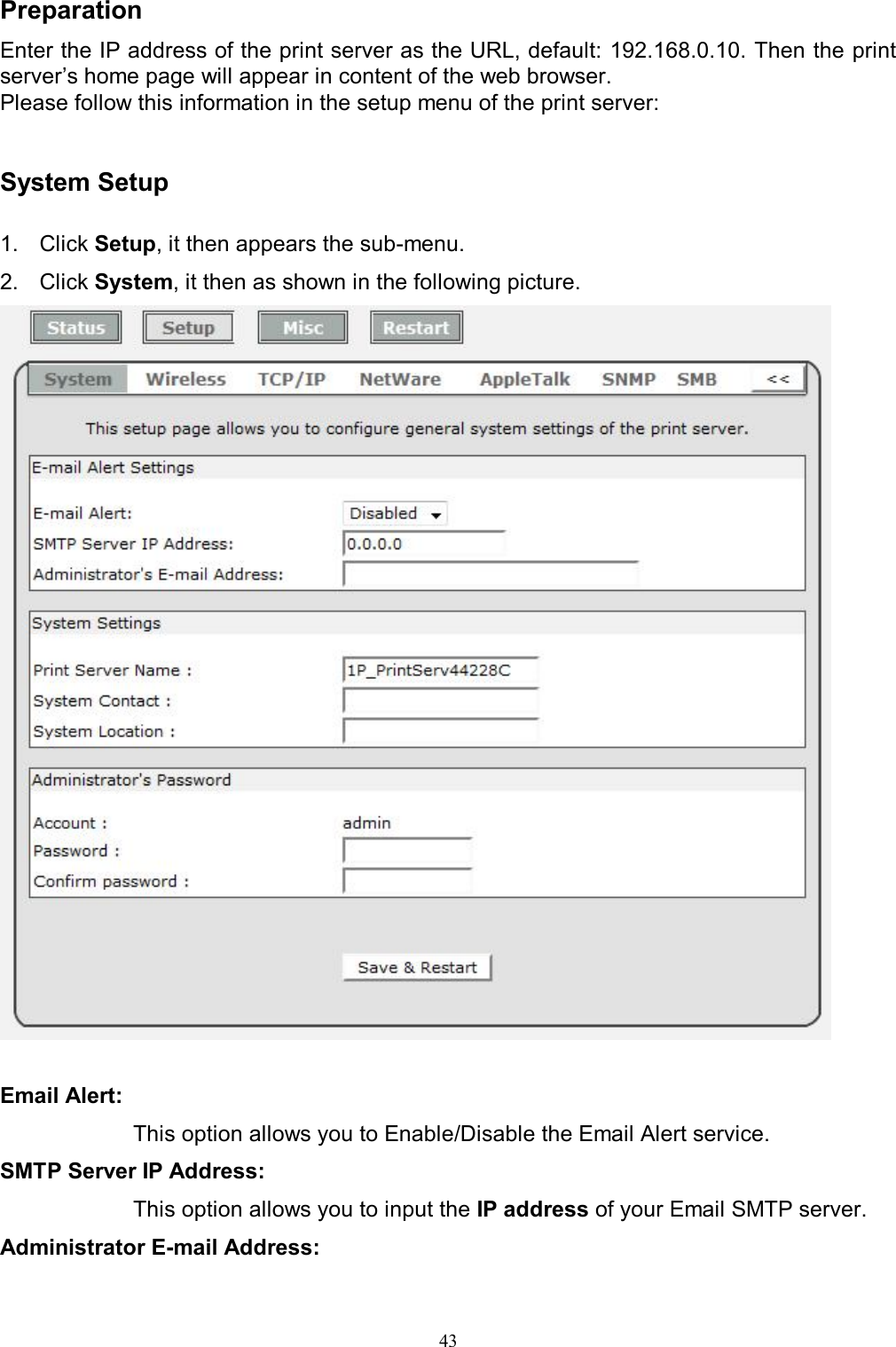
                                                                                            43  Preparation Enter the IP address of the print server as the URL, default: 192.168.0.10. Then the print server’s home page will appear in content of the web browser. Please follow this information in the setup menu of the print server:   System Setup  1.  Click Setup, it then appears the sub-menu. 2.  Click System, it then as shown in the following picture.    Email Alert:  This option allows you to Enable/Disable the Email Alert service. SMTP Server IP Address:  This option allows you to input the IP address of your Email SMTP server. Administrator E-mail Address:
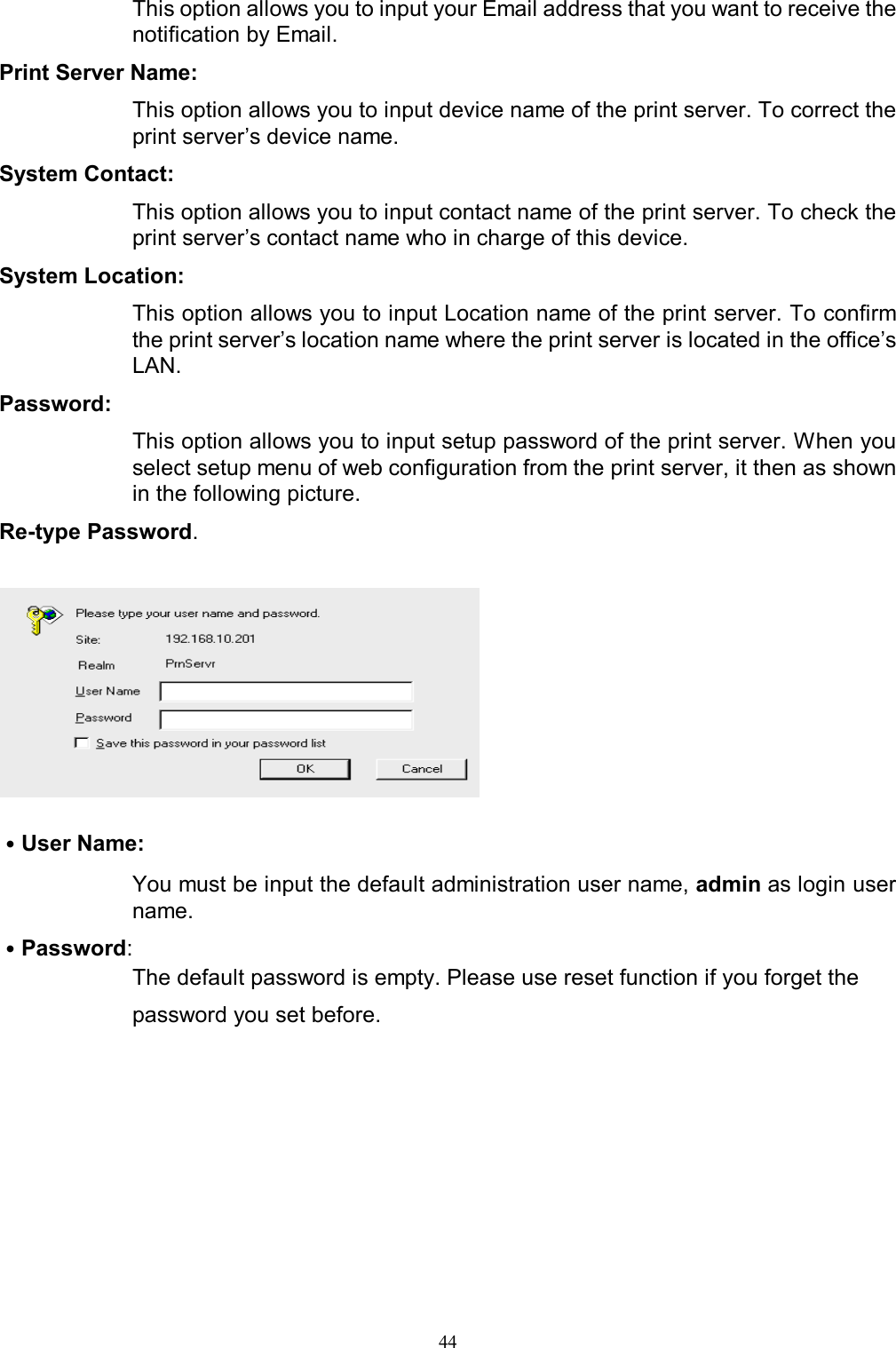
  44This option allows you to input your Email address that you want to receive the notification by Email. Print Server Name:  This option allows you to input device name of the print server. To correct the print server’s device name. System Contact:  This option allows you to input contact name of the print server. To check the print server’s contact name who in charge of this device. System Location:  This option allows you to input Location name of the print server. To confirm the print server’s location name where the print server is located in the office’s LAN. Password:  This option allows you to input setup password of the print server. When you select setup menu of web configuration from the print server, it then as shown in the following picture. Re-type Password.    ˙User Name:  You must be input the default administration user name, admin as login user name. ˙Password:  The default password is empty. Please use reset function if you forget the password you set before.
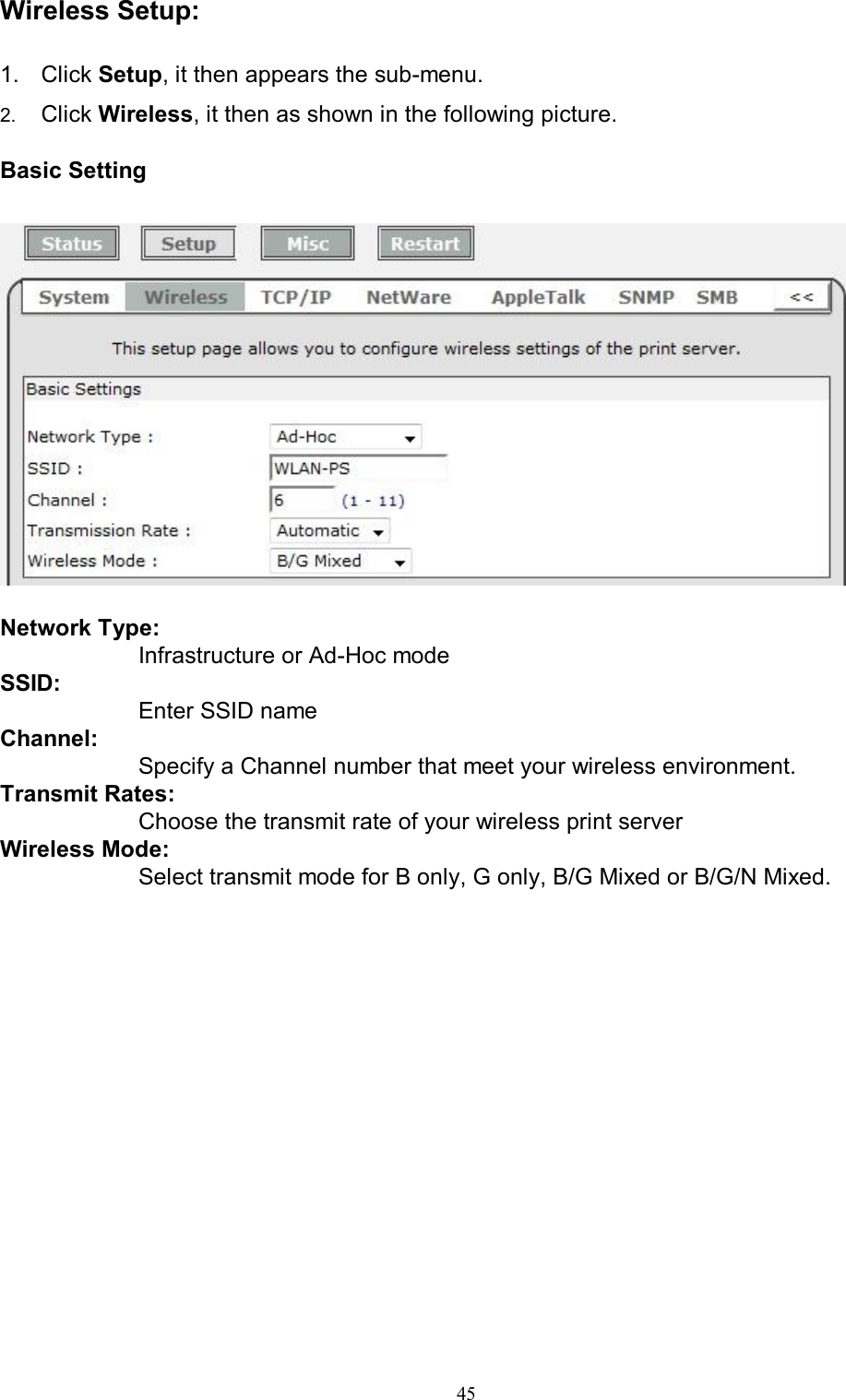
                                                                                            45  Wireless Setup:  1.  Click Setup, it then appears the sub-menu. 2.  Click Wireless, it then as shown in the following picture.  Basic Setting     Network Type:  Infrastructure or Ad-Hoc mode SSID:  Enter SSID name Channel:  Specify a Channel number that meet your wireless environment. Transmit Rates:  Choose the transmit rate of your wireless print server Wireless Mode:  Select transmit mode for B only, G only, B/G Mixed or B/G/N Mixed.
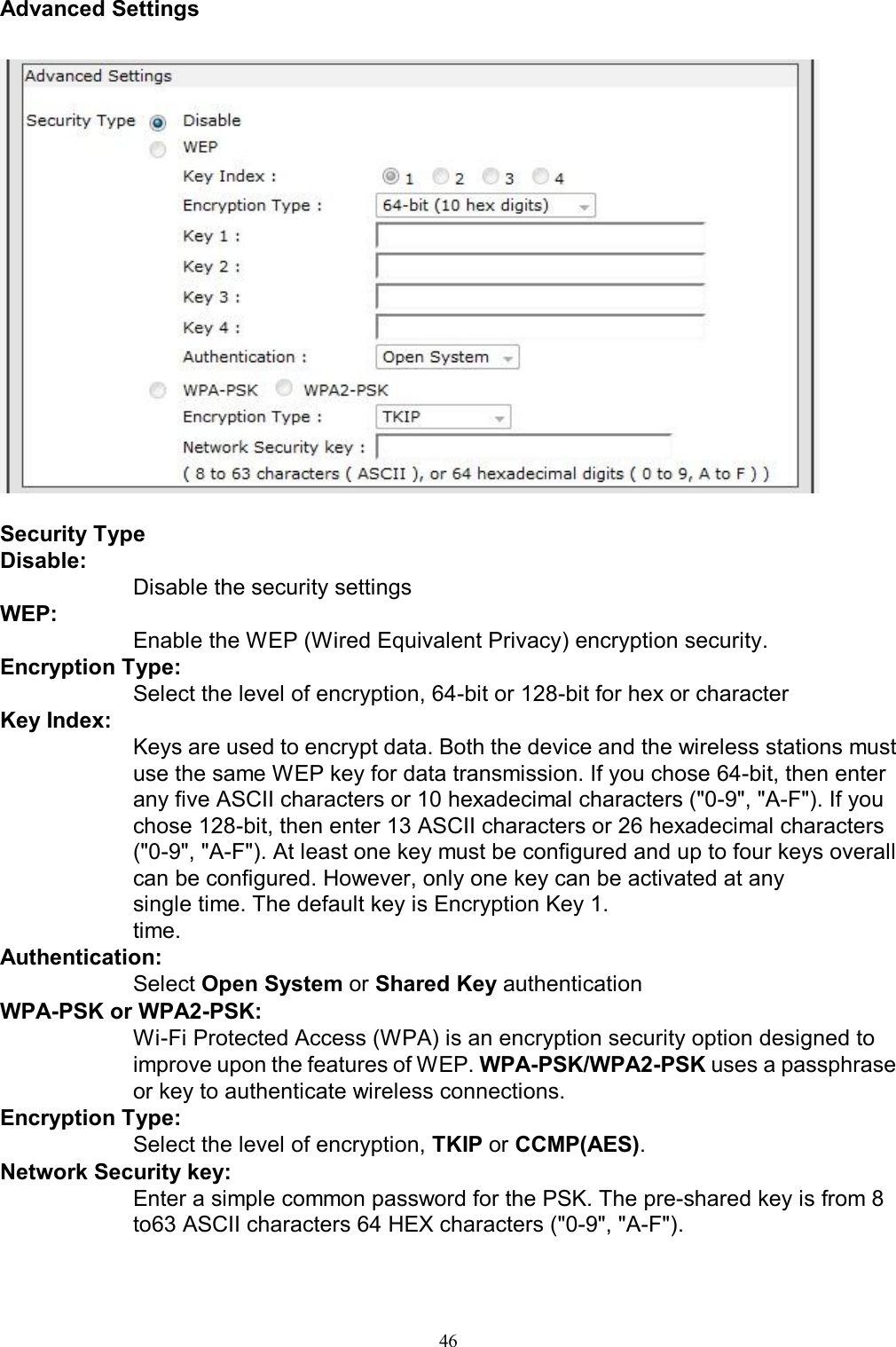
  46Advanced Settings     Security Type Disable:  Disable the security settings  WEP:  Enable the WEP (Wired Equivalent Privacy) encryption security. Encryption Type: Select the level of encryption, 64-bit or 128-bit for hex or character Key Index: Keys are used to encrypt data. Both the device and the wireless stations must use the same WEP key for data transmission. If you chose 64-bit, then enter any five ASCII characters or 10 hexadecimal characters ("0-9", "A-F"). If you chose 128-bit, then enter 13 ASCII characters or 26 hexadecimal characters ("0-9", "A-F"). At least one key must be configured and up to four keys overall can be configured. However, only one key can be activated at any single time. The default key is Encryption Key 1.       time. Authentication:        Select Open System or Shared Key authentication WPA-PSK or WPA2-PSK:        Wi-Fi Protected Access (WPA) is an encryption security option designed to        improve upon the features of WEP. WPA-PSK/WPA2-PSK uses a passphrase       or key to authenticate wireless connections. Encryption Type:  Select the level of encryption, TKIP or CCMP(AES). Network Security key:        Enter a simple common password for the PSK. The pre-shared key is from 8        to63 ASCII characters 64 HEX characters ("0-9", "A-F").
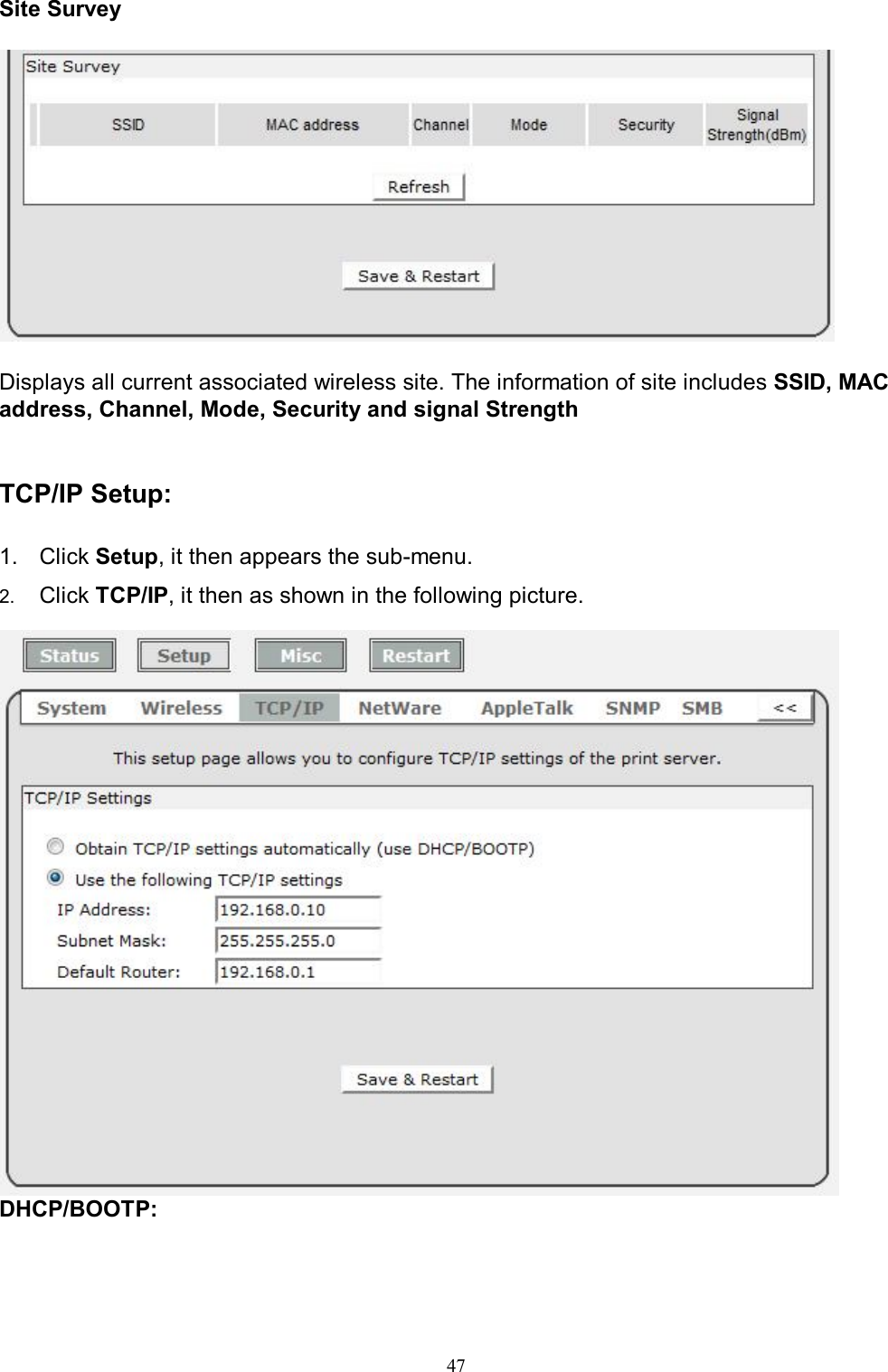
                                                                                            47  Site Survey    Displays all current associated wireless site. The information of site includes SSID, MAC address, Channel, Mode, Security and signal Strength    TCP/IP Setup:  1.  Click Setup, it then appears the sub-menu. 2.  Click TCP/IP, it then as shown in the following picture.   DHCP/BOOTP:
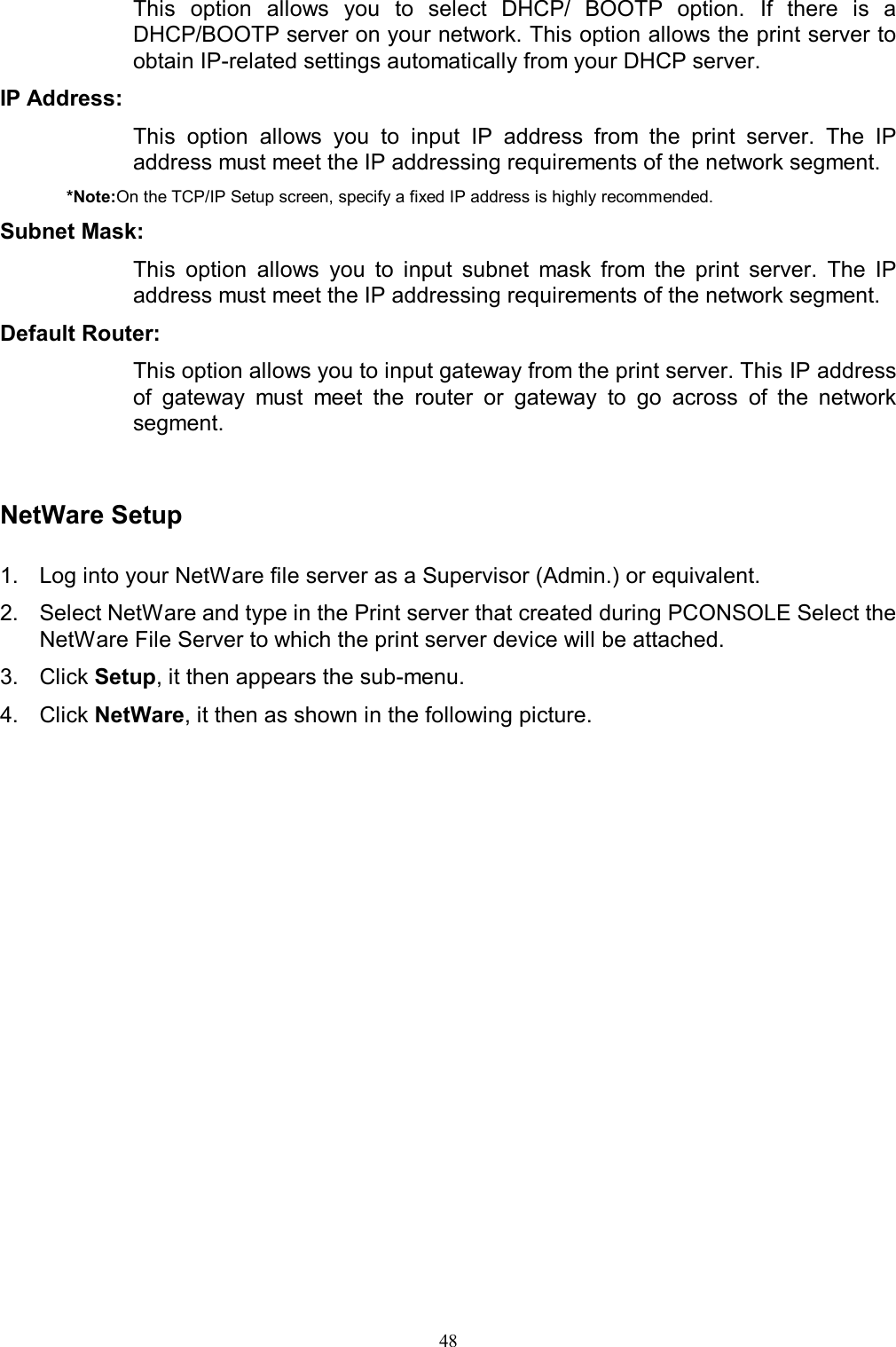
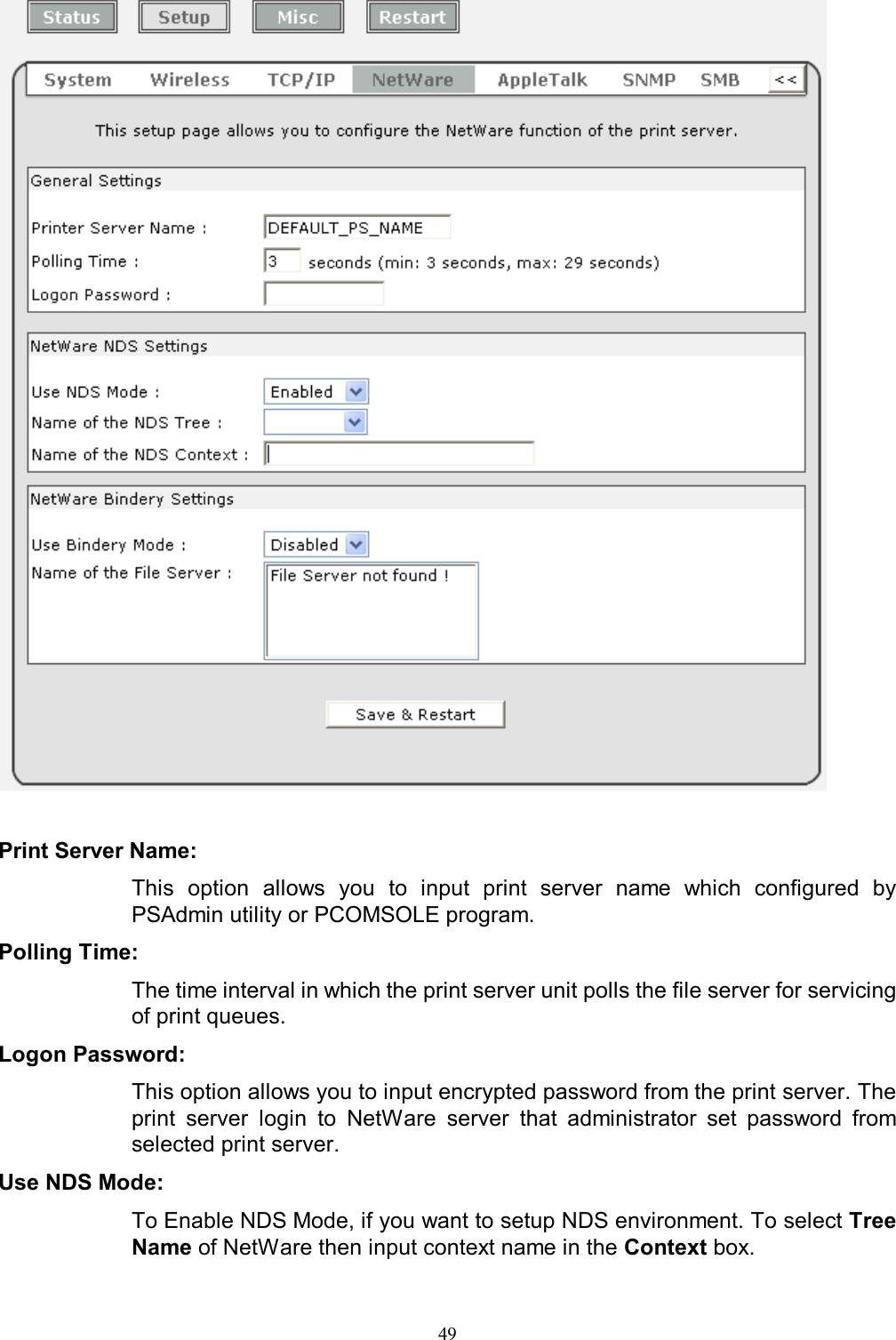
  48This  option  allows  you  to  select  DHCP/  BOOTP  option. If  there  is  a DHCP/BOOTP server on your network. This option allows the print server to obtain IP-related settings automatically from your DHCP server. IP Address:  This  option  allows  you  to  input  IP  address  from  the  print  server.  The  IP address must meet the IP addressing requirements of the network segment. *Note:On the TCP/IP Setup screen, specify a fixed IP address is highly recommended. Subnet Mask:  This  option  allows  you  to  input  subnet  mask  from  the  print  server.  The  IP address must meet the IP addressing requirements of the network segment. Default Router:  This option allows you to input gateway from the print server. This IP address of  gateway  must  meet  the  router  or  gateway  to  go  across  of  the  network segment.   NetWare Setup  1.  Log into your NetWare file server as a Supervisor (Admin.) or equivalent. 2.  Select NetWare and type in the Print server that created during PCONSOLE Select the NetWare File Server to which the print server device will be attached. 3.  Click Setup, it then appears the sub-menu.  4.  Click NetWare, it then as shown in the following picture.
                                                                                            49     Print Server Name:  This  option  allows  you  to  input  print  server  name  which  configured  by PSAdmin utility or PCOMSOLE program. Polling Time:  The time interval in which the print server unit polls the file server for servicing of print queues. Logon Password:  This option allows you to input encrypted password from the print server. The print  server  login  to  NetWare  server  that  administrator  set  password  from selected print server. Use NDS Mode:  To Enable NDS Mode, if you want to setup NDS environment. To select Tree Name of NetWare then input context name in the Context box.
  50Bindery Mode:  To Enable Bindery Mode, if you want to setup Bindery environment. To select File Server Name of NetWare.    Installing Print Server on NetWare 4.x/5.x  Due to its architecture and functionality, the print server must work under NetWare 4.x/5.x NDS  Bindery  Emulation.  When  you  install  the  NetWare  file  server  for  the  first  time,  by default, the installation program will automatically set up the Bindery Emulation function for you by adding “SET BINDERY CONTEXT =” in the AUTOEXEC.NCF file. By default, the bindery context will only be set on your organization (O) object. If you have ever modified this line, or if you have ever added any organization units (OU) to your NDS tree after the  NetWare  system was  installed, please read  the  following section before you install the print server.  For the purpose of illustration, we assume the NDS tress structure is as follows:  [ROOT]                (O)ABC                                   (OU)ABC-USA                 (OU)Sales                                                             Admin                                                              FileServer-1                       (OU) Tech                                Installation Procedure 1.  At your file server console, type “load install”. 2.  Select “NCF files options”. 3.  Select “Edit AUTOEXEC.NCF file”. 4.  Add or Modify the “SET BINDERY CONTEXT =” line to include the NDS organization   (O) and all organization unit (OU) objects where users are located. For example: SET BINDERY  CONTEXT  =  O=ABC;  OU=SALES.OU=ABC-USA.O=ABC; OU=TECH.OU=ABC-USA.O=ABC ; 5.  When done, save the new AUTOEXEC.NCF file. Please restart your NetWare file server in order for new settings to take effect immediately. 6.  Next, please refer to “Auto Setup” section in this chapter to finish installing your print server. 7.  Log into your NetWare file server as a Supervisor (Admin.) or equivalent via a Bindery connection.
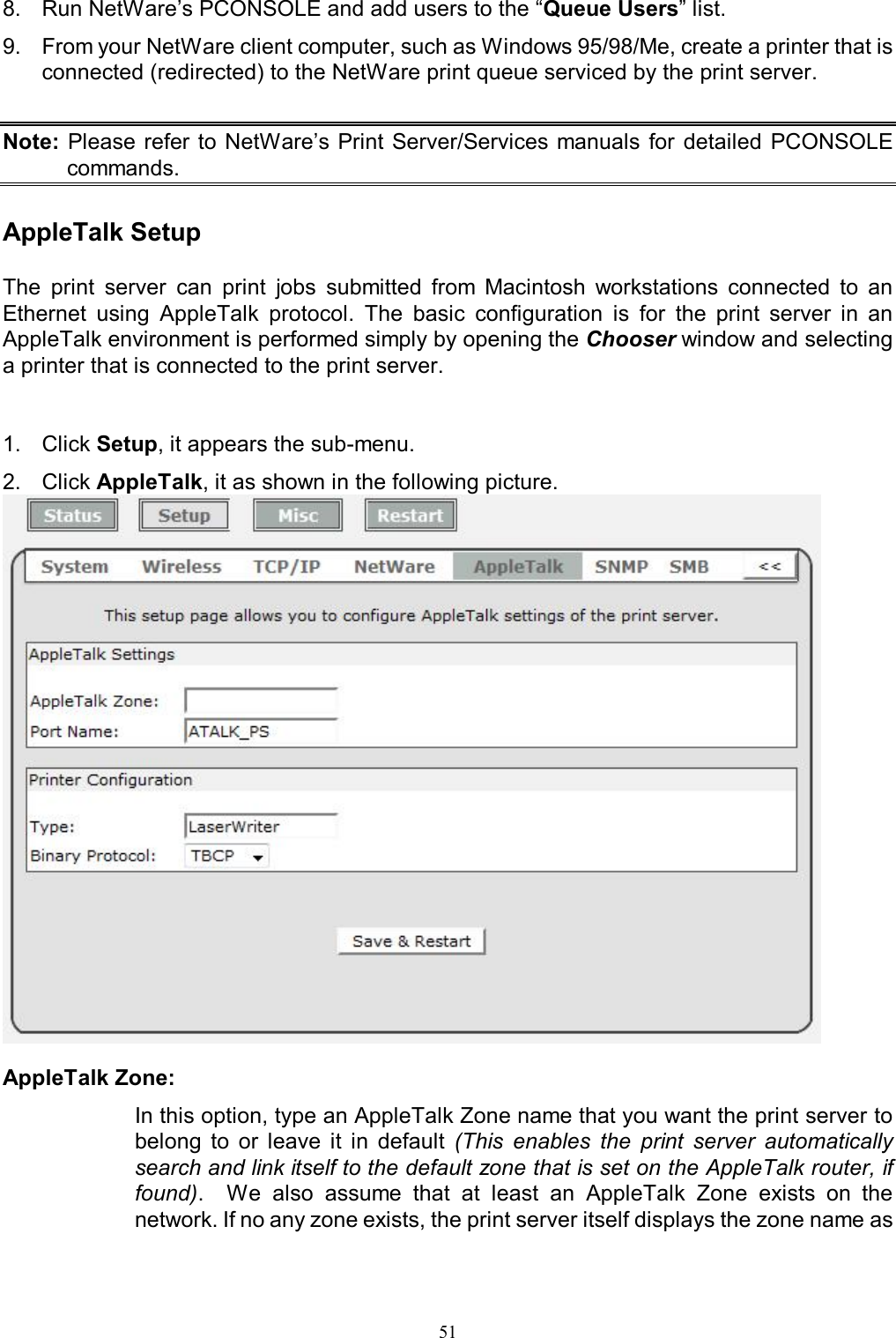
                                                                                            51  8.  Run NetWare’s PCONSOLE and add users to the “Queue Users” list. 9.  From your NetWare client computer, such as Windows 95/98/Me, create a printer that is connected (redirected) to the NetWare print queue serviced by the print server.  Note: Please refer to NetWare’s Print Server/Services manuals  for  detailed  PCONSOLE commands.  AppleTalk Setup  The  print  server  can  print  jobs  submitted  from  Macintosh  workstations  connected  to  an Ethernet  using  AppleTalk  protocol.  The  basic  configuration  is  for  the  print  server  in  an AppleTalk environment is performed simply by opening the Chooser window and selecting a printer that is connected to the print server.   1.  Click Setup, it appears the sub-menu. 2.  Click AppleTalk, it as shown in the following picture.   AppleTalk Zone:  In this option, type an AppleTalk Zone name that you want the print server to belong  to  or  leave  it  in  default  (This  enables  the  print  server  automatically search and link itself to the default zone that is set on the AppleTalk router, if found).    We  also  assume  that  at  least  an  AppleTalk  Zone  exists  on  the network. If no any zone exists, the print server itself displays the zone name as
  52an asterisk (*) in the current AppleTalk Status of the print server in the web browser. Port Name:  In this option, type a name for identification purpose or just leave it in default (recommended).   Note: The default print server’s Chooser name is as shown as follows:  <ATALK_PS>-xxxxxx-1, where  xxxxxx represents the last  six digits  of the  device’s Node ID. For example: ATALK_PS-40EEED-1. You may also change the <ATALK_PS> to a name you like for identification purpose in this option. The print server will append the last six digits to the name you specify. Type:  In this option, the LaserWriter of printer   type by default (recommended).  Binary Protocol:  In this option, data format includes ASCII, TBCP and BCP.   Setting Up a Macintosh Computer (Mac 8.x/9.x) 1.  At a Macintosh computer, from the Apple menu, select Chooser.  2.  The Chooser window then displays an Apple Zone list. Select the Zone name that you specified when configuring the PRINT SERVER.  Note: If you select a Zone that the PRINT SERVER doesn’t belong to, as you specified in the previous section, no print server will be displayed in the Step 4.   3.  You have to use a PostScript printer that you can select the LaserWriter 8 icon.  4.  The  Chooser  window  then  displays  PRINT  SERVER  (s)  featuring  the  support  for AppleTalk  protocol,  along  with  its  default  Chooser  Name  in  the  right-hand  Select  A PostScript Printer dialog box.  Note: 1.You may change the default Chooser name and Zone name of a PRINT SERVER by using your web browser before  proceeding  with this installation.  Please  see  the previous section in this chapter for details.          2. If you use Mac OS 8.x or 9.x, please make sure your printer support PostScript.  5.  Click Setup… button and choose the PPD file matching your printer, and click OK. If your printer does not appear in the PPD file list, please contact your printer vendor. You may also use the Generic PPD if you do not need any printer specific features.
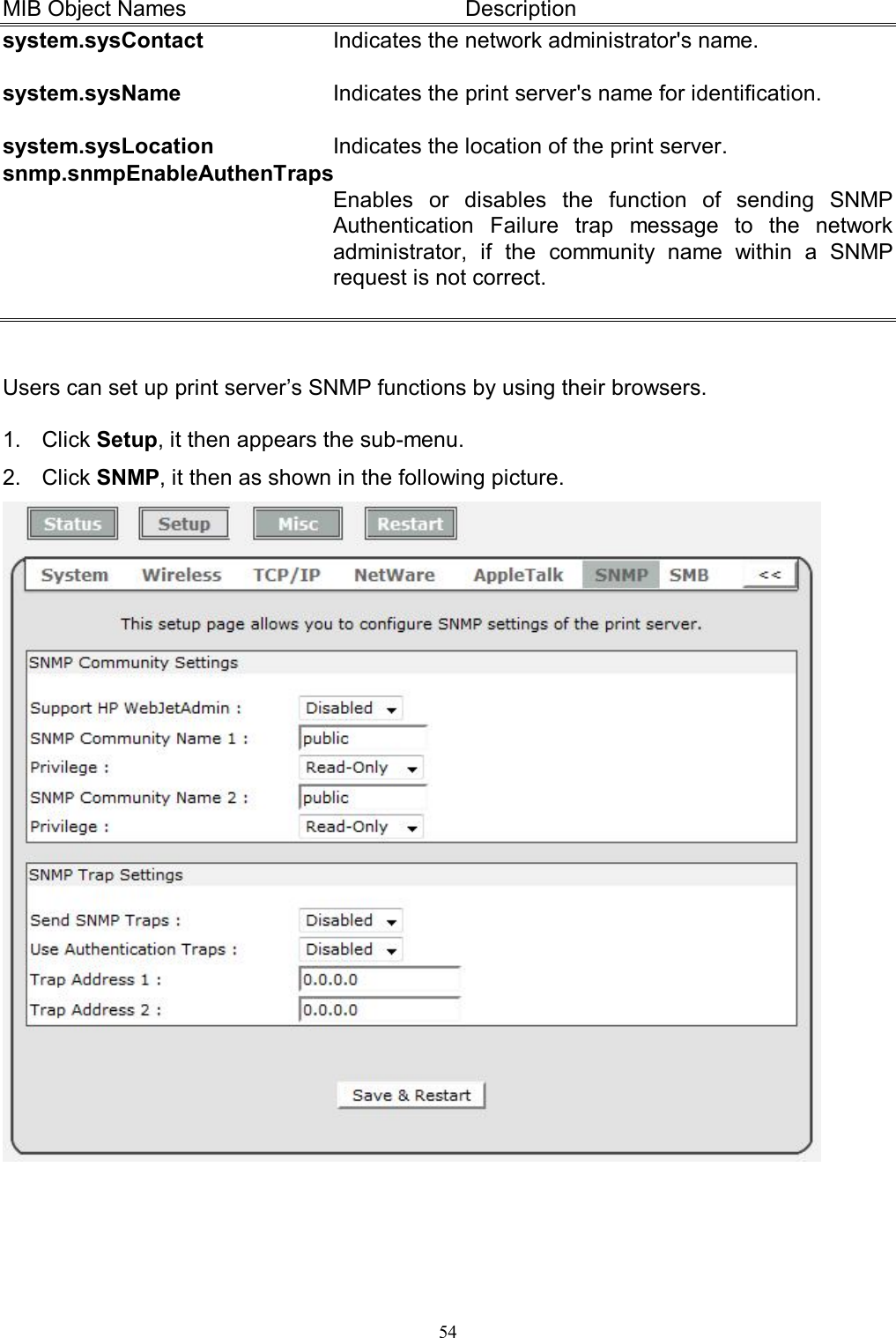
                                                                                            53   6.  Close the Chooser Windows.  7.  Done.  SNMP Setup  TCP/IP  networks  use  a  standard  management  protocol  called  Simple  Network Management Protocol (SNMP). SNMP is widely used in the industry as a solution for remote network  management  and  monitoring  of  networking  devices.  SNMP  actually  includes  a protocol, a database structure specification, and a set of database objects. The database objects are contained in a standard database called Management Information Base (MIB) that  is  stored  on  the  networking  device  called  SNMP  agent.  The  print  server's  SNMP implementation runs in a TCP/IP environment.  A  host  on  the  network  running  Network  Management  System  (NMS)  software  can access the print server device by reading and writing the MIB objects stored in the device. The Network Management Systems are available from many third-party vendors, such as Hewlett-Packard's OpenView.  When accessing (traversing) MIB objects in the print server using NMS software called SNMP  manager,  you  need  to  provide  a  community  name  in  each  SNMP  request  for authentication purpose. The print server supports up to two community names. The default community name is public (case-sensitive), with Read Only access right in default. When  an  unusual  condition  or  activity  occurs,  the  SNMP  agent  alerts  the  SNMP manager through SNMP traps. Following list summaries SNMP trap messages that the print server will send out.   Activities/SNMP Trap Messages       Description Link Up or Link Down  When the network interface on the print server fails, a link down trap message is generated; if the network interface comes back to life, a link up trap message is sent.  Cold Start or Warm Start  When the print server restarts, the cold start or warm start trap message is generated.  Authentication Failure  When  the  print  server  received  a  SNMP request  with  a community  name  that  does  not  match  the  community name  the  print  server  is  configured  with    (stored  in  the print  server's memory),  an  authentication  failure  trap message is generated.   In the print server's SNMP implementation, the following MIB objects are available for updating.
  54MIB Object Names          Description system.sysContact  Indicates the network administrator's name.  system.sysName  Indicates the print server's name for identification.  system.sysLocation  Indicates the location of the print server. snmp.snmpEnableAuthenTraps Enables  or  disables  the  function  of  sending  SNMP Authentication  Failure  trap  message  to  the  network administrator,  if  the  community  name  within  a  SNMP request is not correct.    Users can set up print server’s SNMP functions by using their browsers.  1.  Click Setup, it then appears the sub-menu. 2.  Click SNMP, it then as shown in the following picture.
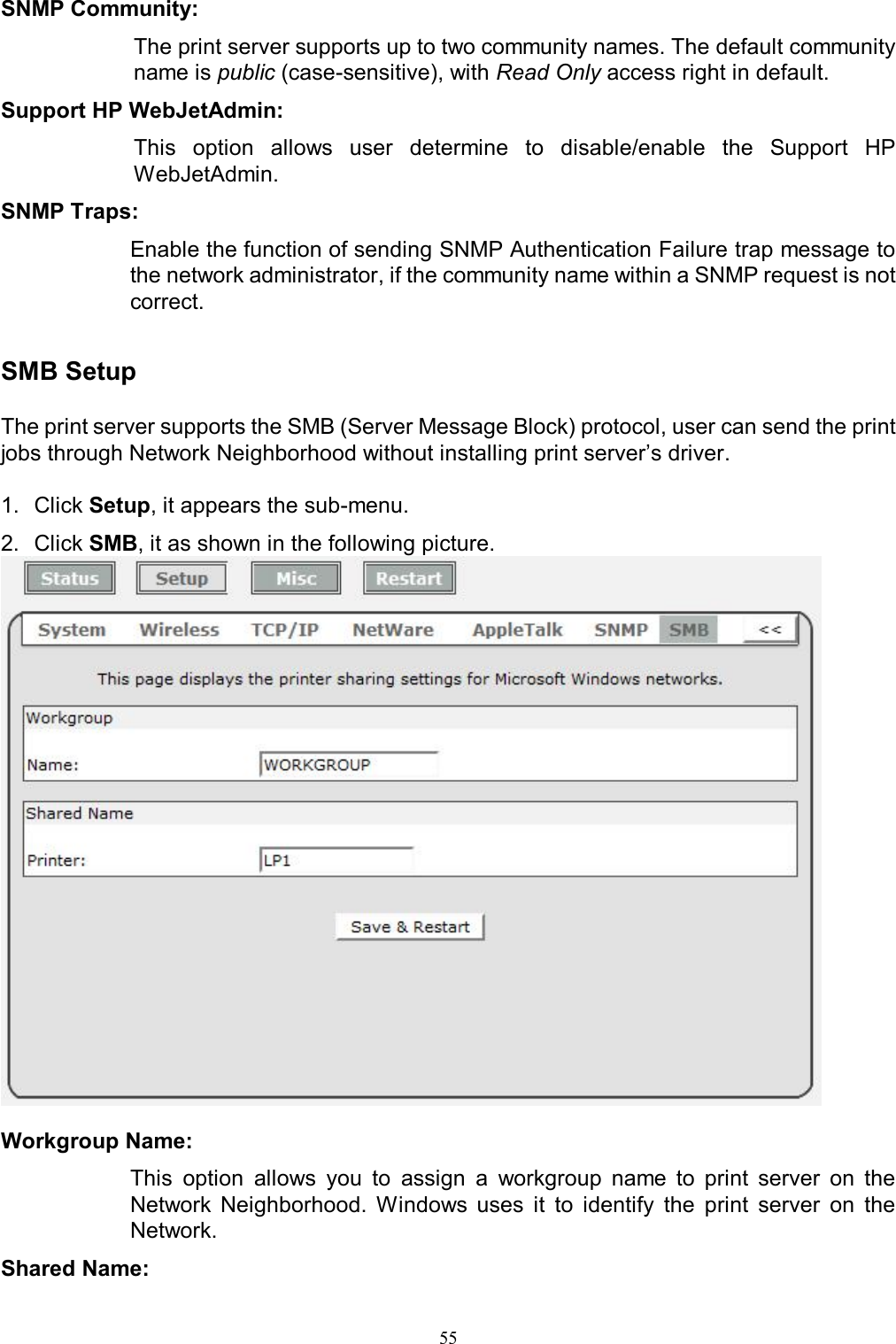
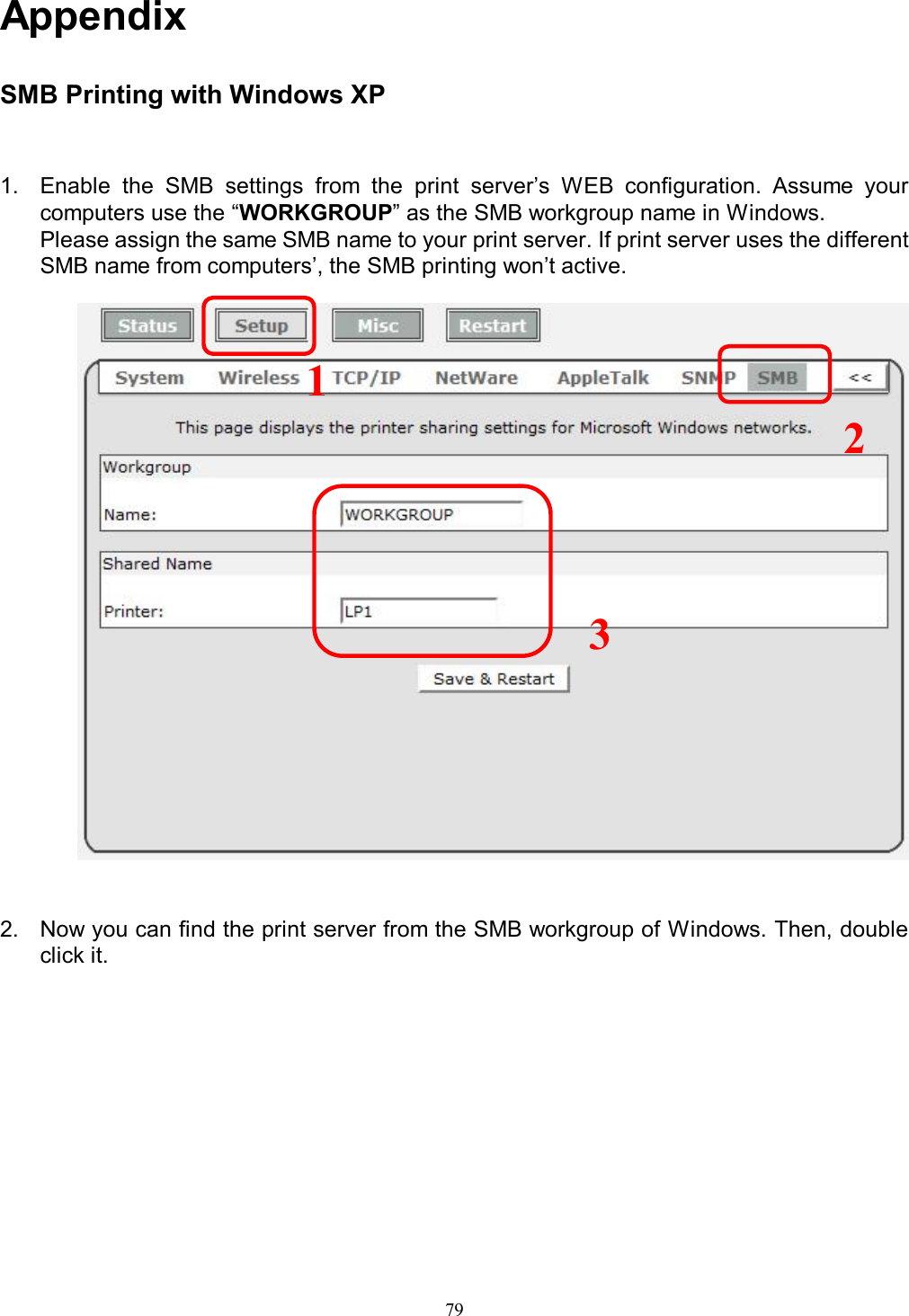
                                                                                            55  SNMP Community:  The print server supports up to two community names. The default community name is public (case-sensitive), with Read Only access right in default. Support HP WebJetAdmin:  This  option  allows  user  determine  to  disable/enable  the  Support  HP WebJetAdmin. SNMP Traps:  Enable the function of sending SNMP Authentication Failure trap message to the network administrator, if the community name within a SNMP request is not correct.  SMB Setup  The print server supports the SMB (Server Message Block) protocol, user can send the print jobs through Network Neighborhood without installing print server’s driver.   1.  Click Setup, it appears the sub-menu. 2.  Click SMB, it as shown in the following picture.   Workgroup Name:  This  option  allows  you  to  assign  a  workgroup  name  to  print  server  on  the Network  Neighborhood.  Windows  uses  it  to  identify  the  print  server  on  the Network. Shared Name:
  56This option allows you to assign a name to print server’s port.  6.  Network  Print  Monitor(9X/ME/NT4/2000/XP 32-bit.)   Preparation The  print  server  supports  TCP/IP,  IPX/SPX  and  NetBEUI  protocols  under  Windows computer.  Please  make  sure  that  the  following  steps  have  been  completed  before proceeding  with  installation  under  Windows  95/98/ME/NT4/2000/XP  32bit  edition/server 2003 32bit edition.   Select A Desired Protocol TCP/IP The  TCP/IP  Protocol  must  be  installed.    For  further  information,  please  read  “TCP/IP Protocol Installation” section in this chapter.  Note: If TCP/IP protocol is chosen,  please  refer to “Assigning an IP Address to the print server” section later in this chapter.   IPX/SPX The IPX/SPX-compatible Protocol must be installed.  For further information, please read “IPX/SPX-compatible Protocol Installation” section in this chapter.    NetBEUI  (9X/ME/NT4/2000)  The  NetBEUI  protocol  must  be  installed.  For  further  information,  please  read  “NetBEUI Protocol Installation” section in this chapter. The Windows XP/2003/Vista/7 does not support the NetBEUI printing.
                                                                                            57    TCP/IP Protocol Installation 1.  Click Start, point to Settings and select Control Panel.  2.  Double click the Network icon.  3.  If the TCP/IP Protocol is not already installed, click Add.  4.  Select Protocol and click Add.  5.  Select Microsoft from the Manufacturers list.  6.  Select TCP/IP Protocol from the Network Protocols list.  7.  Specify  an  IP  address,  Subnet  Mask,  and  Gateway  address  or  specific  “Obtain  IP address automatically”, if a DHCP server is available on the LAN.  8.  Restart the computer.  9.  Done.  Note:  Using  TCP/IP  protocol  to  access  the  print  server  requires  well-configured  TCP/IP settings.  If  you  are  not  familiar  with  these  settings,  please  consult  your  network administrator for details or ask for help.   IPX/SPX-compatible Protocol Installation 1.  Click Start, point to Settings, and select Control Panel. 2.  Double click the Network icon. 3.  If the IPX/SPX-compatible Protocol is not already installed, click Add.  4.  Select Protocol and click Add.  5.  Select Microsoft from the Manufacturers list.  6.  Select  IPX/SPX-compatible  Protocol  from  the  Network  Protocols  list  and  follow  the instructions on the screen.  7.  Restart the computer.  8.  Done.
  58 NetBEUI Protocol Installation (9X/ME/NT4/2000) 1.  Click Start, point to Settings, and select Control Panel.  2.  Double click the Network icon.  3.  If the NetBEUI is not already installed, click Add.  4.  Select Protocol and click Add.  5.  Select Microsoft from the Manufacturers list.  6.  Select  NetBEUI  from  the  Network  Protocols  box  and  follow  the  instructions  on  the screen.  7.  Restart your computer for new settings to take effect.  8.  Done.  Note:  For  more  detailed  information,  please  refer  to  your  Microsoft  Windows 9X/ME/NT/2000 manuals.    Windows 95/98/Me/NT/2000/XP/2003 manual Installation Procedure Please perform the steps as follows to ensure a smooth installation:   1.  Run Setup from the print server’s Setup CD.  2.  The Network Print Monitor for Windows 95/98/Me Setup will then appear. Click Next. 3.  A message reading, “Setup is complete. You may add the Network Print Port by using the PSAdmin” will appear.  Click OK.  4.  Click Start, point to Settings, and select Printers.  5.  Double-click the Add Printer icon.  6.  Select Local Printer and click Next.  7.  Select the appropriate printer manufacturer and printer type and click Next.  8.  Select LPT1 and click Next.
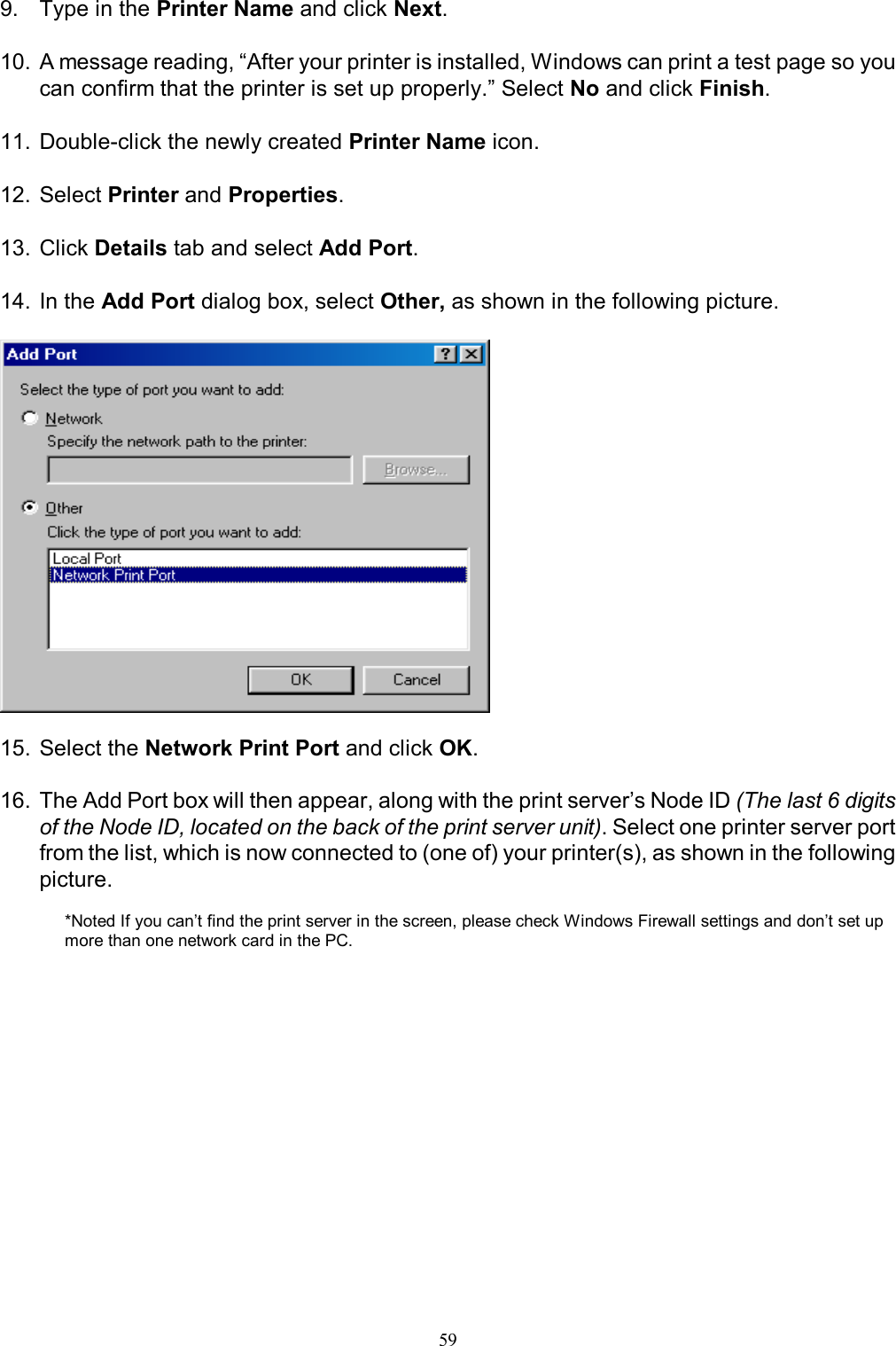
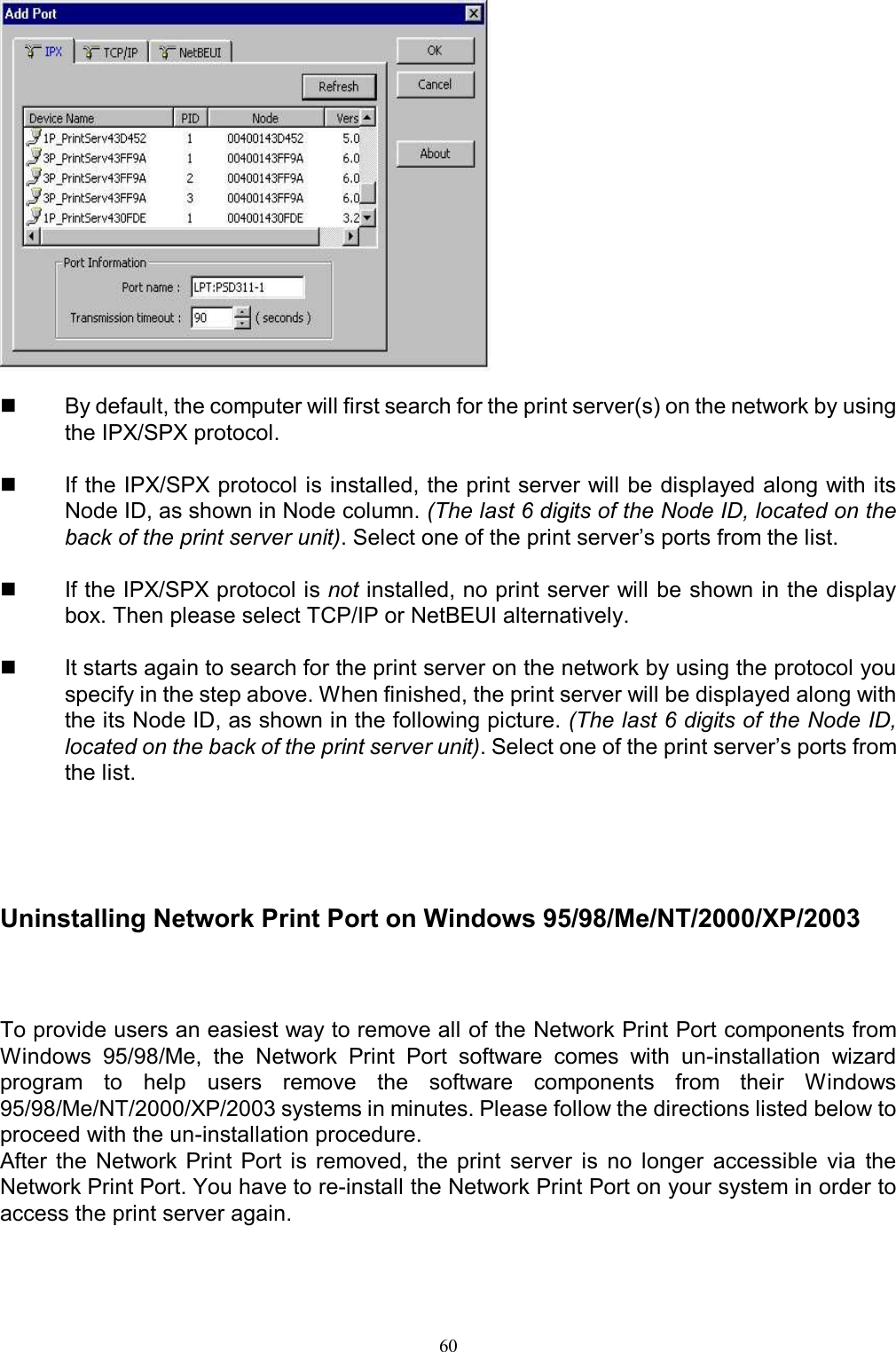
                                                                                            59  9.  Type in the Printer Name and click Next.  10. A message reading, “After your printer is installed, Windows can print a test page so you can confirm that the printer is set up properly.” Select No and click Finish.  11. Double-click the newly created Printer Name icon.  12. Select Printer and Properties.  13. Click Details tab and select Add Port.  14. In the Add Port dialog box, select Other, as shown in the following picture.    15. Select the Network Print Port and click OK.  16. The Add Port box will then appear, along with the print server’s Node ID (The last 6 digits of the Node ID, located on the back of the print server unit). Select one printer server port from the list, which is now connected to (one of) your printer(s), as shown in the following picture.  *Noted If you can’t find the print server in the screen, please check Windows Firewall settings and don’t set up more than one network card in the PC.
  60    By default, the computer will first search for the print server(s) on the network by using the IPX/SPX protocol.    If the IPX/SPX protocol is installed, the print server will be displayed along with its Node ID, as shown in Node column. (The last 6 digits of the Node ID, located on the back of the print server unit). Select one of the print server’s ports from the list.    If the IPX/SPX protocol is not installed, no print server will be shown in the display box. Then please select TCP/IP or NetBEUI alternatively.    It starts again to search for the print server on the network by using the protocol you specify in the step above. When finished, the print server will be displayed along with the its Node ID, as shown in the following picture. (The last 6 digits of the Node ID, located on the back of the print server unit). Select one of the print server’s ports from the list.   Uninstalling Network Print Port on Windows 95/98/Me/NT/2000/XP/2003  To provide users an easiest way to remove all of the Network Print Port components from Windows  95/98/Me,  the  Network  Print  Port  software  comes  with  un-installation  wizard program  to  help  users  remove  the  software  components  from  their  Windows 95/98/Me/NT/2000/XP/2003 systems in minutes. Please follow the directions listed below to proceed with the un-installation procedure. After  the  Network  Print  Port  is  removed,  the  print  server  is  no  longer  accessible  via  the Network Print Port. You have to re-install the Network Print Port on your system in order to access the print server again.
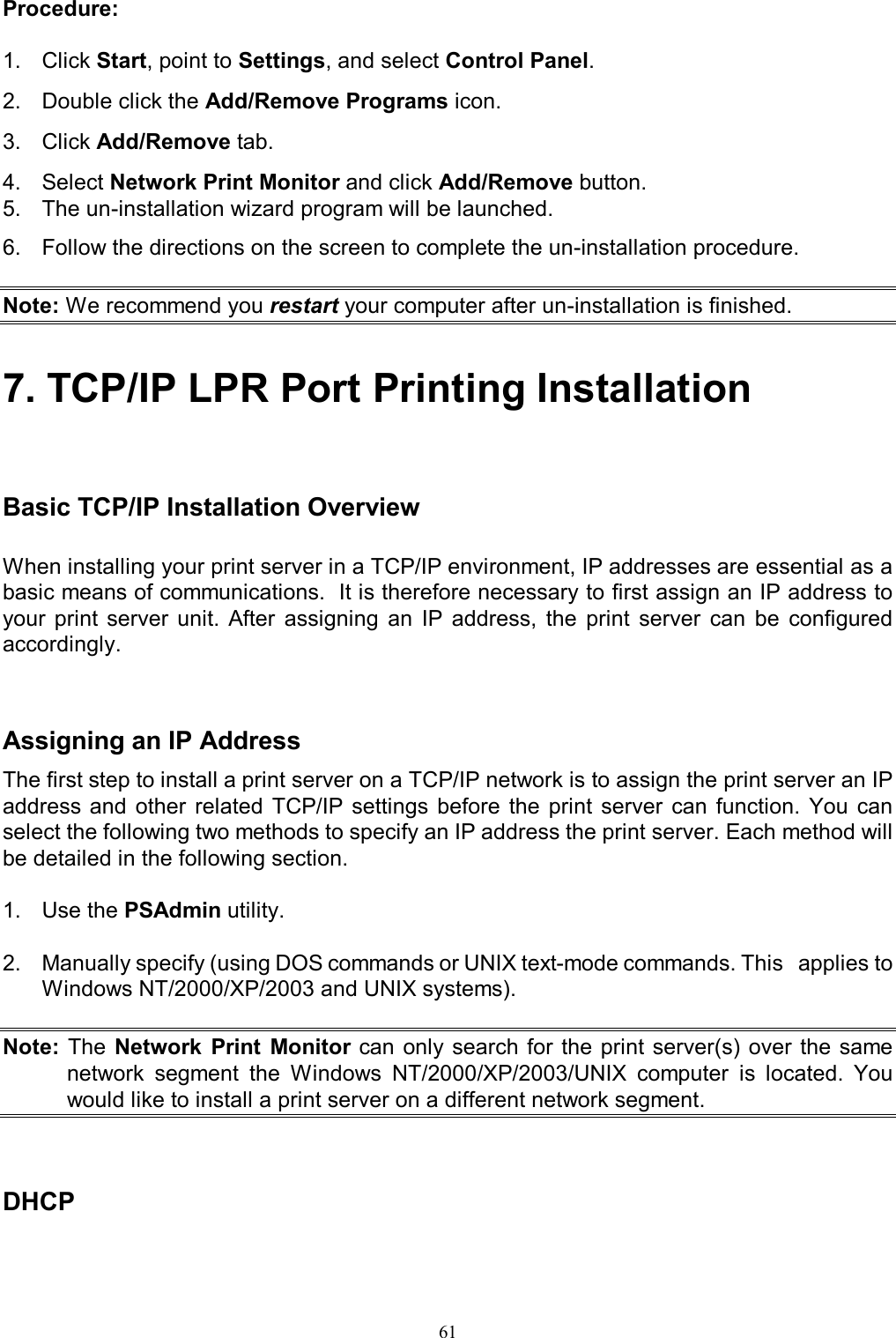
                                                                                            61  Procedure:  1.  Click Start, point to Settings, and select Control Panel. 2.  Double click the Add/Remove Programs icon. 3.  Click Add/Remove tab. 4.  Select Network Print Monitor and click Add/Remove button. 5.  The un-installation wizard program will be launched. 6.  Follow the directions on the screen to complete the un-installation procedure.  Note: We recommend you restart your computer after un-installation is finished.  7. TCP/IP LPR Port Printing Installation    Basic TCP/IP Installation Overview When installing your print server in a TCP/IP environment, IP addresses are essential as a basic means of communications.  It is therefore necessary to first assign an IP address to your  print  server  unit.  After  assigning  an  IP  address,  the  print  server  can  be  configured accordingly.    Assigning an IP Address The first step to install a print server on a TCP/IP network is to assign the print server an IP address and  other  related  TCP/IP settings  before  the  print  server  can  function.  You  can select the following two methods to specify an IP address the print server. Each method will be detailed in the following section.  1.  Use the PSAdmin utility.  2.  Manually specify (using DOS commands or UNIX text-mode commands. This   applies to Windows NT/2000/XP/2003 and UNIX systems).  Note: The Network  Print  Monitor can only search for  the  print  server(s) over the same network  segment  the  Windows  NT/2000/XP/2003/UNIX  computer  is  located.  You would like to install a print server on a different network segment.    DHCP
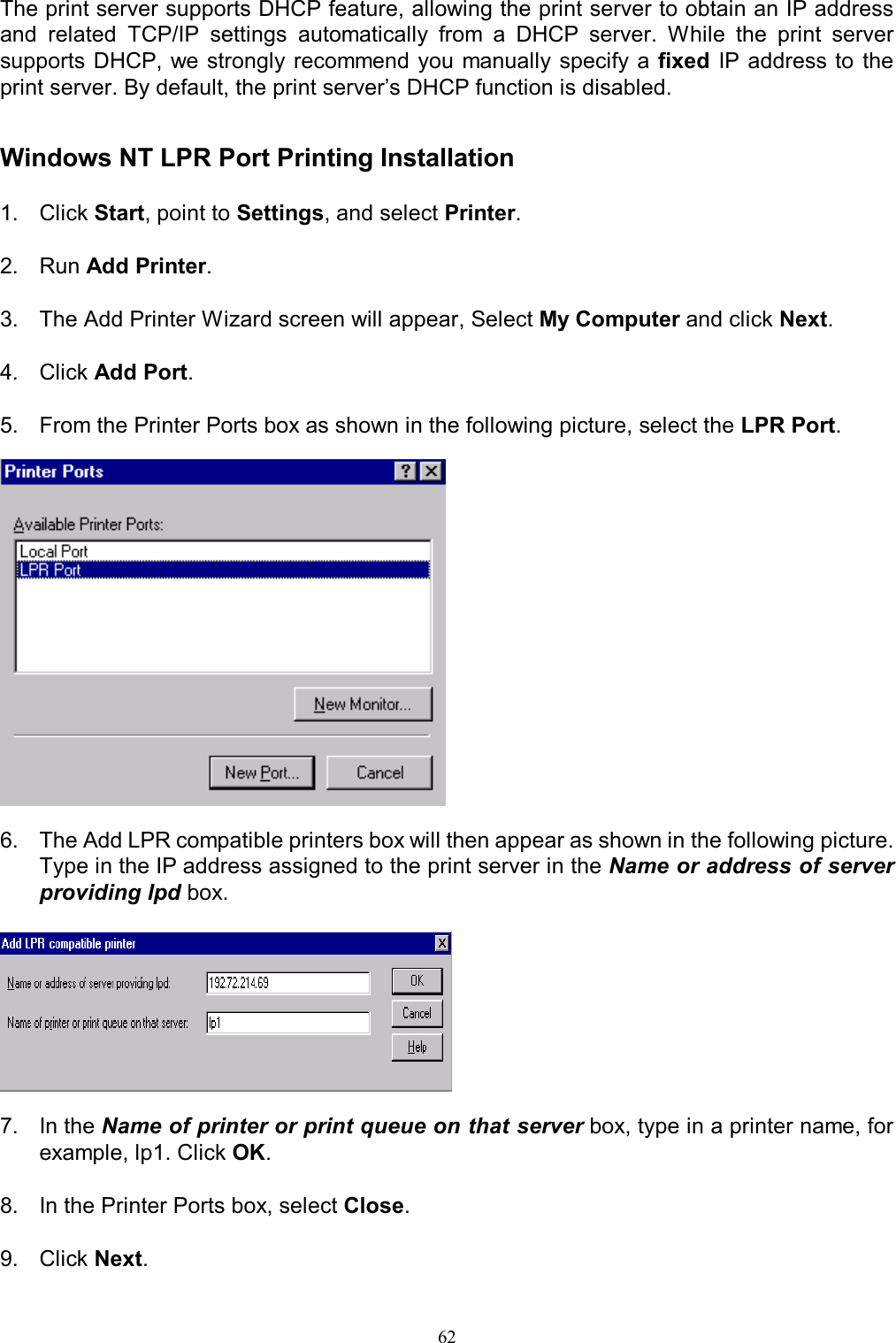
  62The print server supports DHCP feature, allowing the print server to obtain an IP address and  related  TCP/IP  settings  automatically  from  a  DHCP  server.  While  the  print  server supports DHCP, we strongly recommend you  manually  specify a fixed IP address  to  the print server. By default, the print server’s DHCP function is disabled.   Windows NT LPR Port Printing Installation  1.  Click Start, point to Settings, and select Printer.  2.  Run Add Printer.  3.  The Add Printer Wizard screen will appear, Select My Computer and click Next.  4.  Click Add Port.  5.  From the Printer Ports box as shown in the following picture, select the LPR Port.    6.  The Add LPR compatible printers box will then appear as shown in the following picture. Type in the IP address assigned to the print server in the Name or address of server providing lpd box.    7.  In the Name of printer or print queue on that server box, type in a printer name, for example, lp1. Click OK.  8.  In the Printer Ports box, select Close.  9.  Click Next.
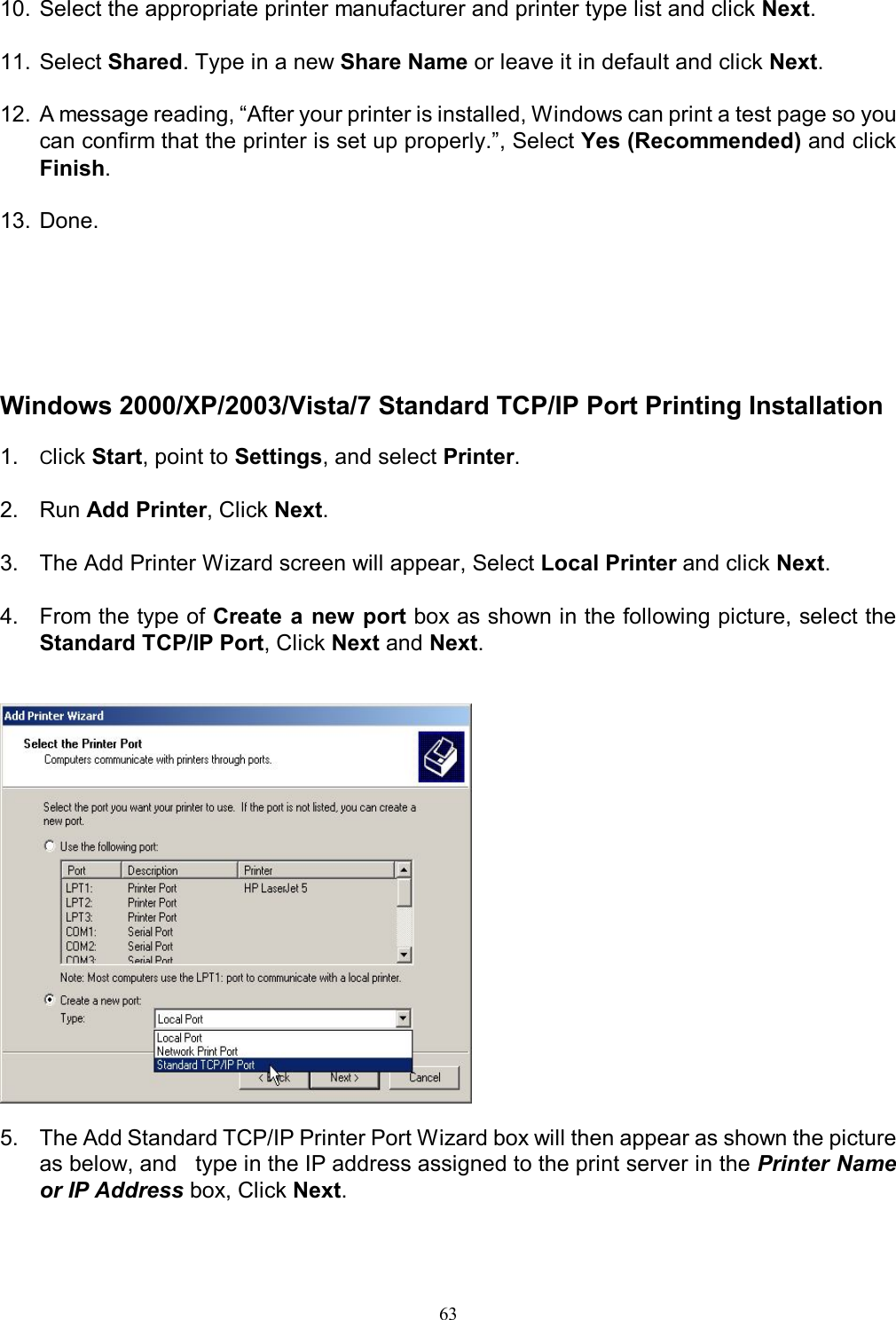
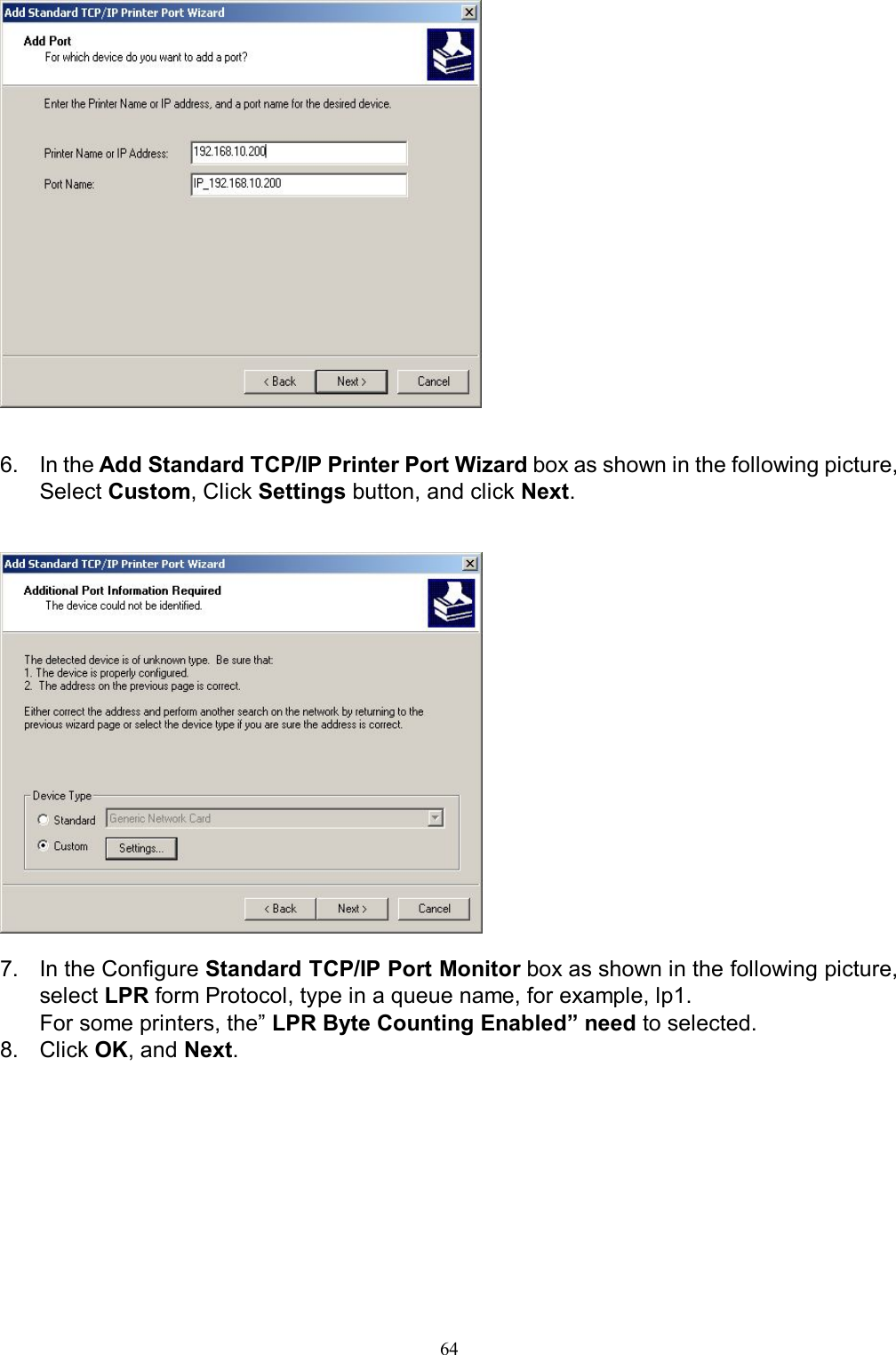
                                                                                            63   10. Select the appropriate printer manufacturer and printer type list and click Next.  11. Select Shared. Type in a new Share Name or leave it in default and click Next.  12. A message reading, “After your printer is installed, Windows can print a test page so you can confirm that the printer is set up properly.”, Select Yes (Recommended) and click Finish.  13. Done.       Windows 2000/XP/2003/Vista/7 Standard TCP/IP Port Printing Installation  1.  Click Start, point to Settings, and select Printer.  2.  Run Add Printer, Click Next.  3.  The Add Printer Wizard screen will appear, Select Local Printer and click Next.  4.  From the type of Create a  new port box as shown in the following picture, select the Standard TCP/IP Port, Click Next and Next.     5.  The Add Standard TCP/IP Printer Port Wizard box will then appear as shown the picture as below, and   type in the IP address assigned to the print server in the Printer Name or IP Address box, Click Next.
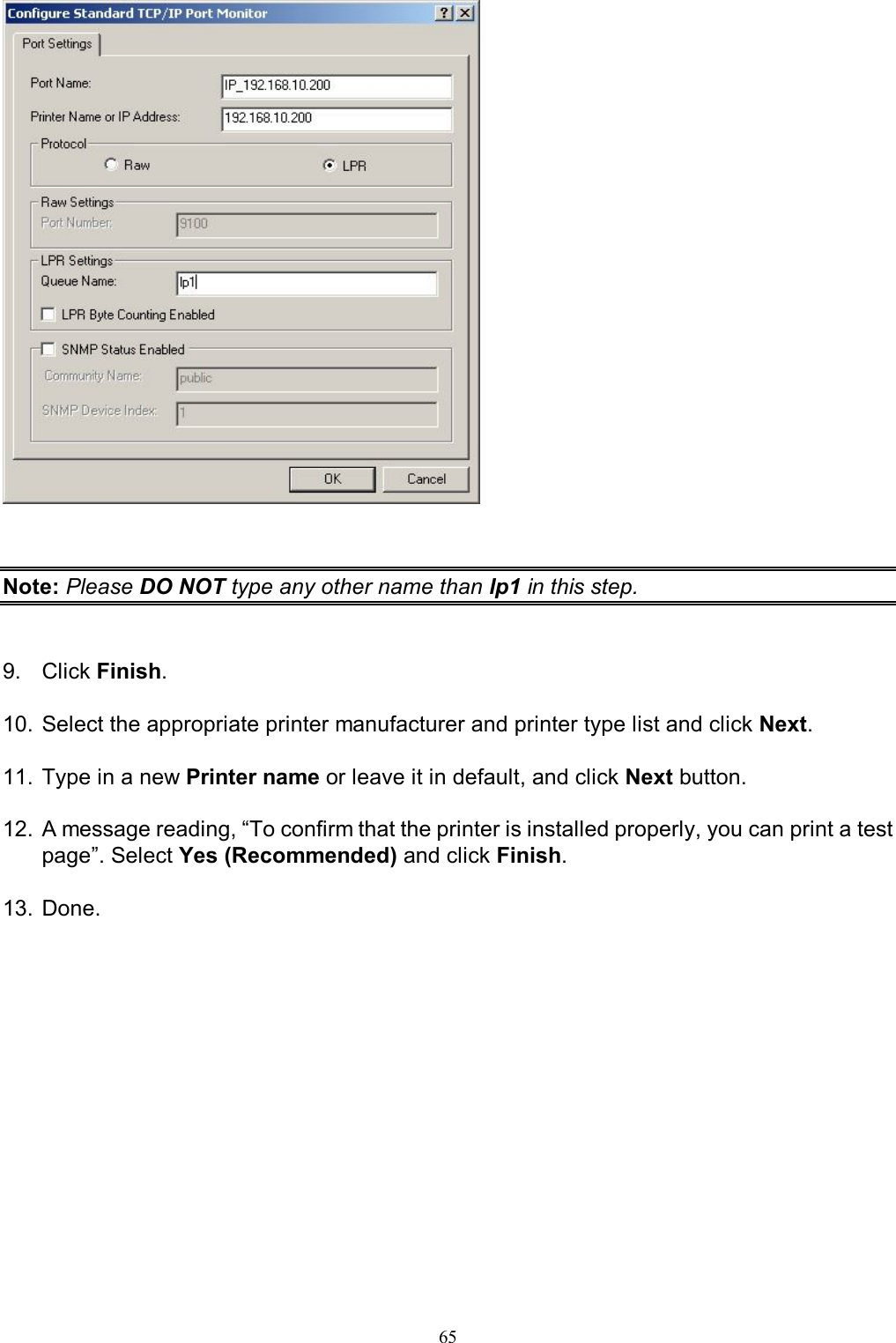
  64   6.  In the Add Standard TCP/IP Printer Port Wizard box as shown in the following picture, Select Custom, Click Settings button, and click Next.     7.  In the Configure Standard TCP/IP Port Monitor box as shown in the following picture, select LPR form Protocol, type in a queue name, for example, lp1. For some printers, the” LPR Byte Counting Enabled” need to selected. 8.  Click OK, and Next.
                                                                                            65      Note: Please DO NOT type any other name than lp1 in this step.   9.  Click Finish.  10. Select the appropriate printer manufacturer and printer type list and click Next.  11. Type in a new Printer name or leave it in default, and click Next button.  12. A message reading, “To confirm that the printer is installed properly, you can print a test page”. Select Yes (Recommended) and click Finish.  13. Done.
  66UNIX Installation After the static IP address is assigned, the Print Server is ready to be configured. For some UNIX/Linux systems, we include the detailed installation procedures below. If you can’t find the installation procedure corresponding to your UNIX system,  please  refer to your UNIX manuals for details about configuring your UNIX for the “remote printing system”.     SCO UNIX 8.0.0 (Caldera Open Unix 8.0.0) 1.  Select “SCO Admin”.  2.  Select “Printer Setup Manager”.    3.  Enter /Printer / Add TCP / IP Printer…    4.  Name:  Input a name you like. For example: Test. Protocol Type:   Choose “lpd (BSD)”. Make/Model:   Select the printer model. For example: EPSON LQ570. Printer Connection Type:   Choose “On Remote Server”. Remote System:       Input the IP address of the printer server. For example: 192.168.1.250. Remote Printer:   lp1 or lp2 or lp3. (fixed) If the printer connected to the first print server port, please choose lp1. If the printer connected to the second print server port, please choose lp2. If the printer connected to the third print server port, please choose lp3.  5.  Click “OK”.  6.  Enter /Printer / Make Default.   System V Release 4 Unix 1.  For example: the print server has a static IP address: 192.168.1.100  2.  Input “lpsystem –tbsd 192.168.1.100”.  3.  Input “lpadmin –pa1 –s 192.168.1.100!lp1”. lp1 for the first print server port.   4.  Input “accept a1”.
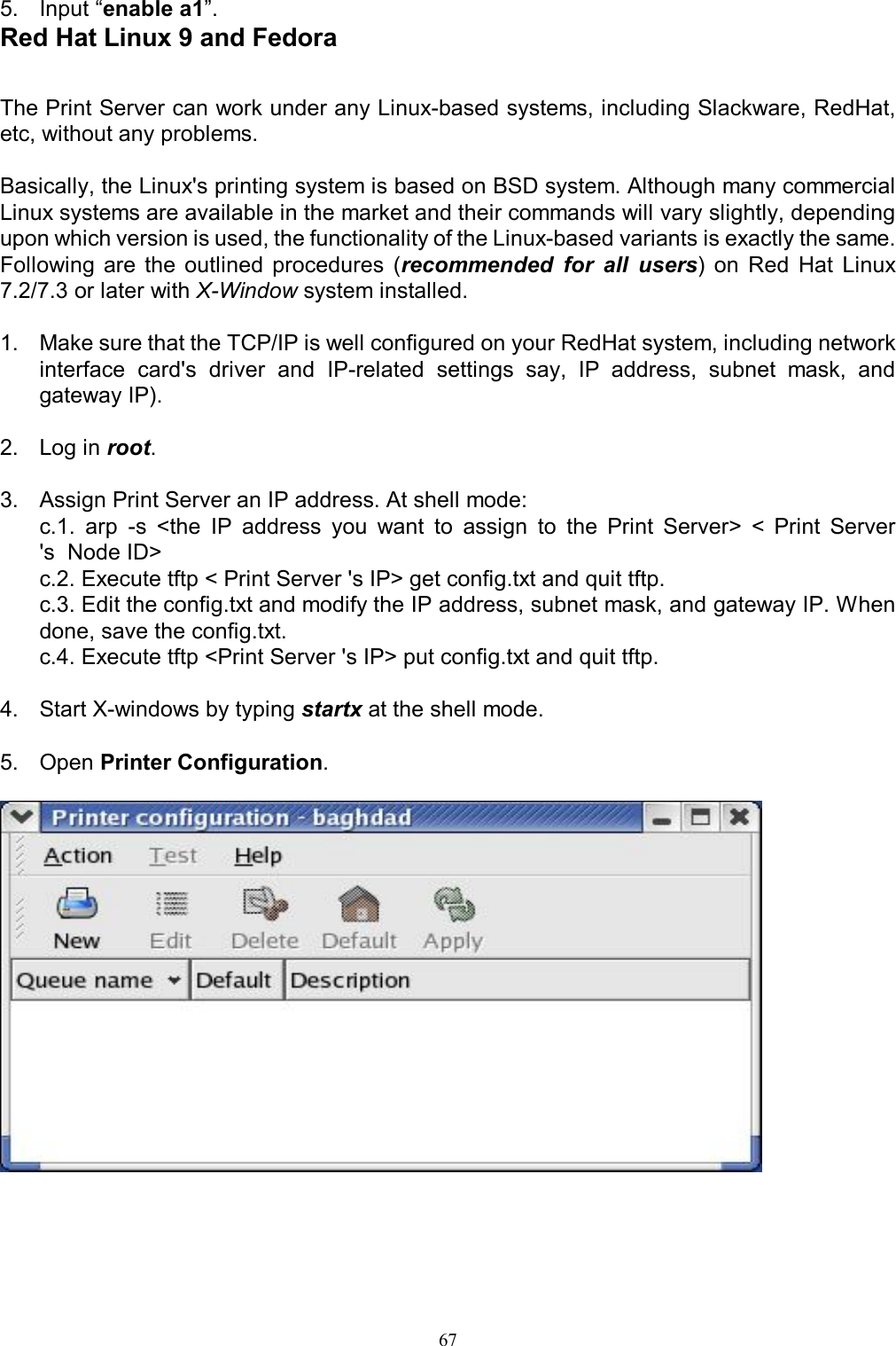
                                                                                            67  5.  Input “enable a1”. Red Hat Linux 9 and Fedora  The Print Server can work under any Linux-based systems, including Slackware, RedHat, etc, without any problems.  Basically, the Linux's printing system is based on BSD system. Although many commercial Linux systems are available in the market and their commands will vary slightly, depending upon which version is used, the functionality of the Linux-based variants is exactly the same. Following  are  the  outlined  procedures  (recommended  for  all  users)  on  Red  Hat  Linux 7.2/7.3 or later with X-Window system installed.  1.  Make sure that the TCP/IP is well configured on your RedHat system, including network interface  card's  driver  and  IP-related  settings  say,  IP  address,  subnet  mask,  and gateway IP).  2.  Log in root.  3.  Assign Print Server an IP address. At shell mode:    c.1.  arp  -s  <the  IP  address  you  want  to  assign  to  the  Print  Server>  <  Print  Server 's  Node ID>   c.2. Execute tftp < Print Server 's IP> get config.txt and quit tftp.   c.3. Edit the config.txt and modify the IP address, subnet mask, and gateway IP. When done, save the config.txt.    c.4. Execute tftp <Print Server 's IP> put config.txt and quit tftp.  4.  Start X-windows by typing startx at the shell mode.  5.  Open Printer Configuration.
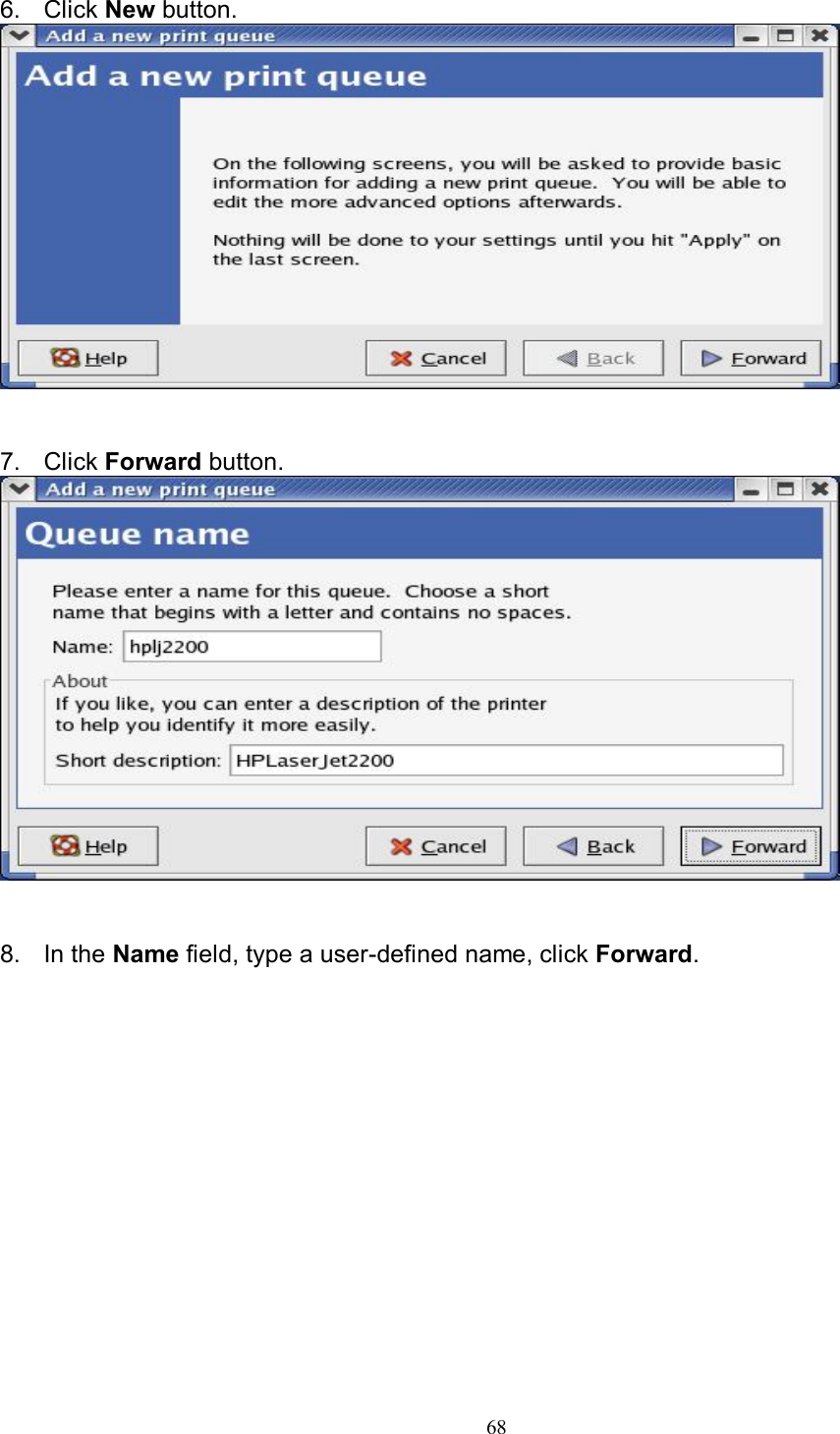
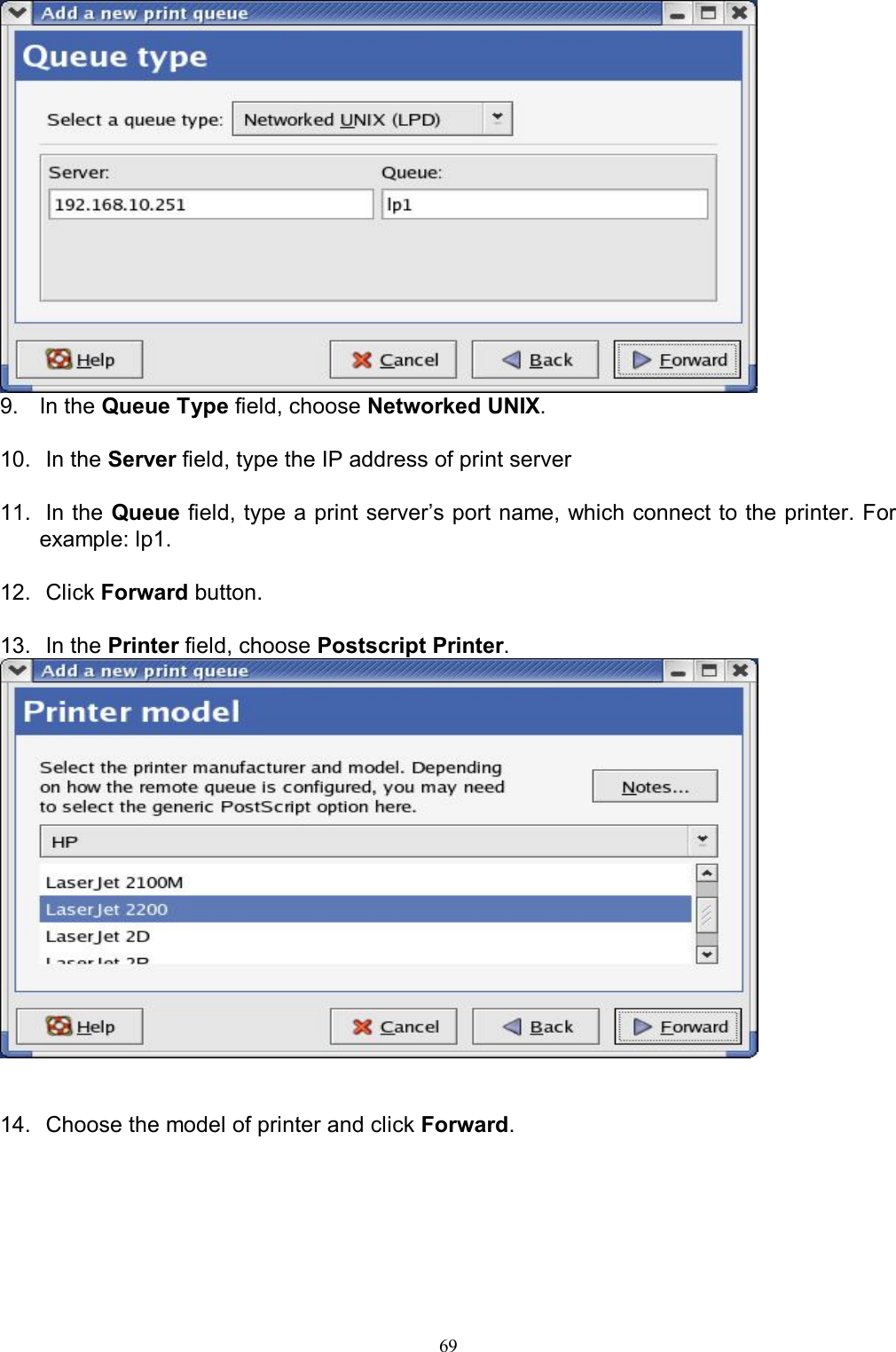
  68  6.  Click New button.    7.  Click Forward button.    8.  In the Name field, type a user-defined name, click Forward.
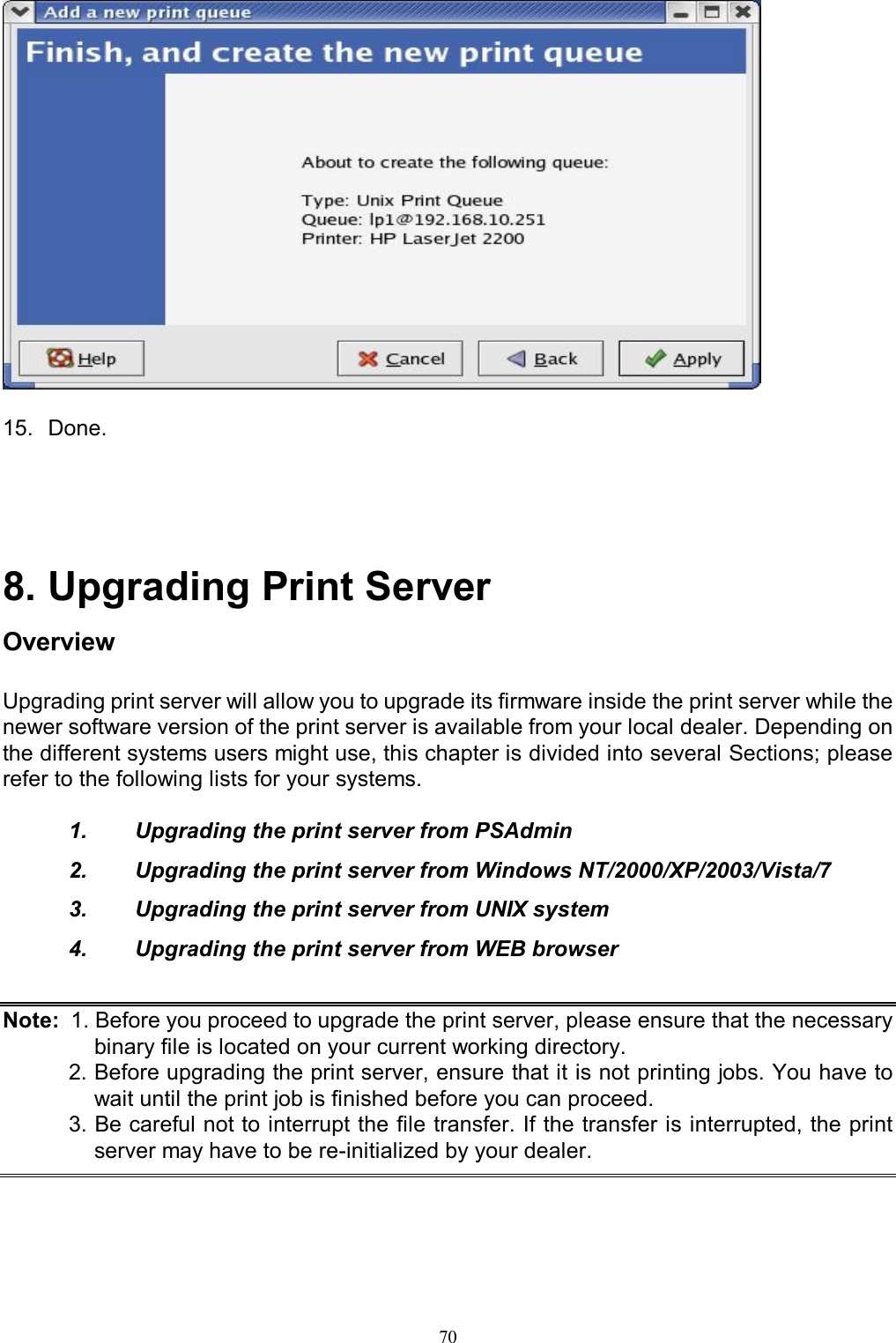
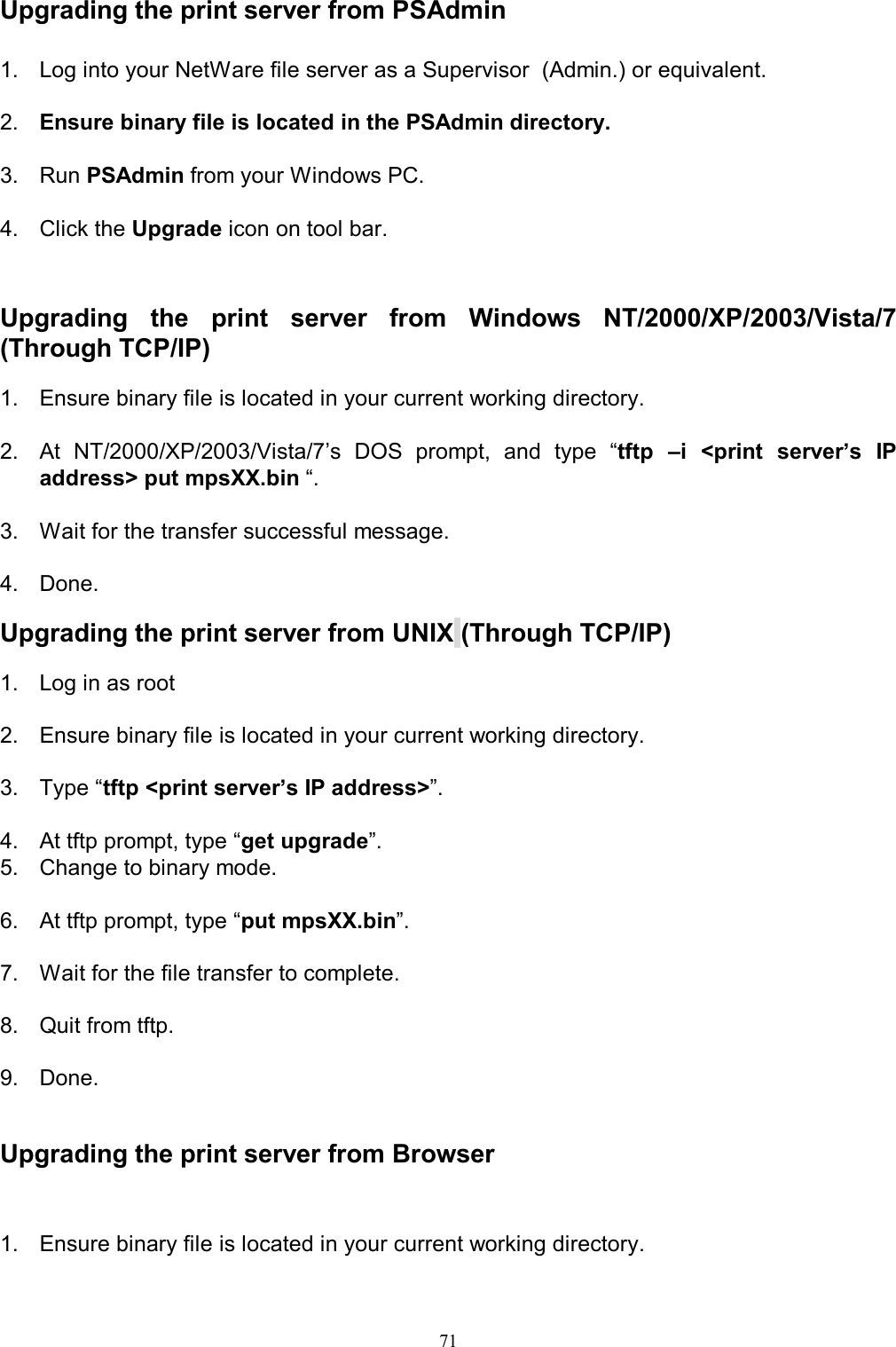
                                                                                            69   9.  In the Queue Type field, choose Networked UNIX.  10.  In the Server field, type the IP address of print server  11.  In the Queue field, type a print server’s port name, which connect to the printer. For example: lp1.  12.  Click Forward button.  13.  In the Printer field, choose Postscript Printer.    14.  Choose the model of printer and click Forward.
  70  15.  Done.     8. Upgrading Print Server Overview Upgrading print server will allow you to upgrade its firmware inside the print server while the newer software version of the print server is available from your local dealer. Depending on the different systems users might use, this chapter is divided into several Sections; please refer to the following lists for your systems.  1.  Upgrading the print server from PSAdmin 2.  Upgrading the print server from Windows NT/2000/XP/2003/Vista/7 3.  Upgrading the print server from UNIX system 4.  Upgrading the print server from WEB browser   Note:  1. Before you proceed to upgrade the print server, please ensure that the necessary binary file is located on your current working directory. 2. Before upgrading the print server, ensure that it is not printing jobs. You have to wait until the print job is finished before you can proceed. 3. Be careful not to interrupt the file transfer. If the transfer is interrupted, the print server may have to be re-initialized by your dealer.
                                                                                            71  Upgrading the print server from PSAdmin 1.  Log into your NetWare file server as a Supervisor  (Admin.) or equivalent.  2.  Ensure binary file is located in the PSAdmin directory.   3.  Run PSAdmin from your Windows PC.  4.  Click the Upgrade icon on tool bar.   Upgrading  the  print  server  from  Windows  NT/2000/XP/2003/Vista/7 (Through TCP/IP)  1.  Ensure binary file is located in your current working directory.  2.  At  NT/2000/XP/2003/Vista/7’s  DOS  prompt,  and  type  “tftp  –i  <print  server’s  IP address> put mpsXX.bin “.  3.  Wait for the transfer successful message.  4.  Done.  Upgrading the print server from UNIX (Through TCP/IP)  1.  Log in as root  2.  Ensure binary file is located in your current working directory.  3.  Type “tftp <print server’s IP address>”.  4.  At tftp prompt, type “get upgrade”. 5.  Change to binary mode.  6.  At tftp prompt, type “put mpsXX.bin”.  7.  Wait for the file transfer to complete.  8.  Quit from tftp.  9.  Done.   Upgrading the print server from Browser  1.  Ensure binary file is located in your current working directory.
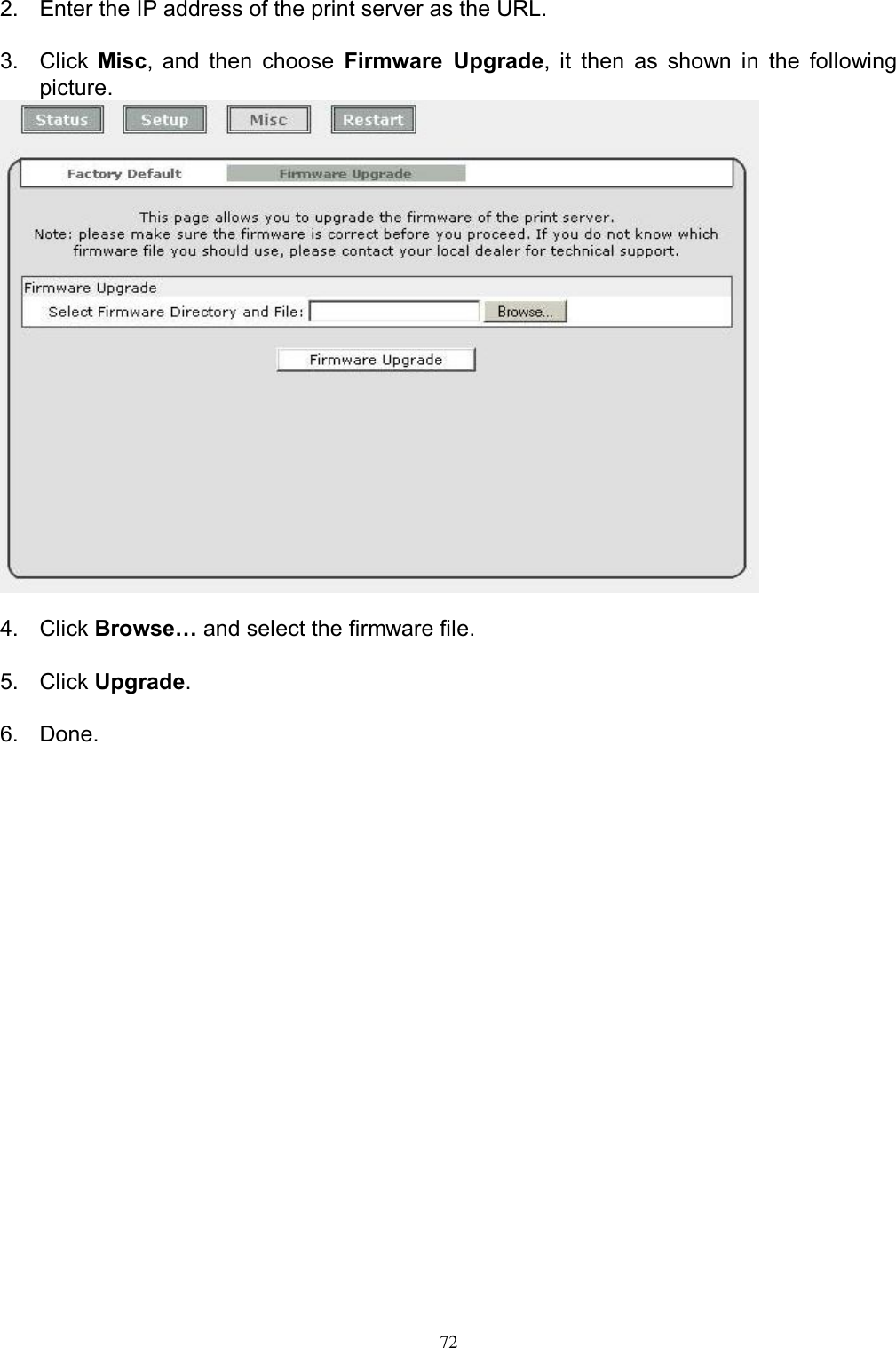
  722.  Enter the IP address of the print server as the URL.  3.  Click  Misc,  and  then  choose  Firmware  Upgrade,  it  then  as  shown  in  the  following picture.   4.  Click Browse… and select the firmware file.  5.  Click Upgrade.  6.  Done.
                                                                                            73   9. Troubleshooting General Troubleshooting Overview The  most  common  problems,  which  cause  the  print  server  to  perform  improperly,  are covered in this chapter.  If a problem still exists after reading this chapter, please contact your dealer for technical support.    LED Light Indicators  The print server is equipped with LED lights to assist in diagnosing problems that are the result of the network and/or the print server hardware itself.   Status (Orange) When the print server unit is powered on, the Status LED will flash five times as part of the unit’s Power On Self Test (POST).  This indicates that the print server hardware is properly configured.  Note: Make sure that the LED flashes five times (POST) upon connecting the power. If the unit does not flash five times, contact your dealer for a replacement or repair.  WLAN (Orange) When the WLAN enabled, the WLAN LED will be on. When data transmitting, it will be blinking. USB (Green) Print server is being connected with USB printer.  Power Related Problems The print server requires an external AC power adapter in order for it to function. If you have a power problem, check to see whether the power cord or its connectors are damaged. More importantly, check to see that the AC power adapter included with the print server matches the AC voltage in your country or area. Using an incorrect AC adapter will damage your print server.  Print Port Related Problems Printing data failure may be caused by a loose connection of the print server to the USB port of  the  printer.  Check  to  see  if  any  of  the  pins  on  the  USB  connector  are  damaged.  In
  74addition, check the cable connection. If  the  pins  are  damaged,  contact  your  dealer  for  a replacement connector.  Windows 95/98/Me/NT/2000/XP Troubleshooting Multi-Segment LAN Environment Installation (through the Network Print Port) If  your  print  server  and  Windows  95/98/Me/NT/2000/XP/2003/Vista/7  are  located  on  two different  segments,  and  your  Windows NT  server  is  used  as  the  router/gateway  you  will need  to  implement  the  following  procedures  in  order  for  your  print  server  to  function properly:   Add the RIP for NWLink IPX/SPX compatible transport. See RIP for NWLink IPX/SPX compatible transport Installation Procedure later in this section.  Add the frame type 802.2 for both Ethernet adapters. See Multi-Segment Frame Type 802.2 Installation later in this section.   RIP for NWLink IPX/SPX compatible transport Installation Procedure 1.  From your Windows NT server that is used as a router, select Start from the bottom left hand corner of the screen.  2.  Select Settings.  3.  Select Control Panel.  4.  Double-click the Network icon.  5.  Select Services.  6.  Select Add.  7.  In the Select  Network Service  box, select  the  RIP  for  NWLink  IPX/SPX  compatible transport.  Click OK.  8.  Follows the directions on the screen.  9.  Done.   Multi-Segment Frame Type 802.2 Installation  1.  From your Windows NT server that is used as a router, select Start from the bottom left hand corner of the screen.  2.  Point to Settings, and select Control Panel.
                                                                                            75  3.  Double-click the Network icon.  4.  Select Protocols.Select the NWLink IPX/SPX Compatible Transport.  5.  Select Properties. 6.  Select your (first) network interface card and select Manual Frame Type Detection.  7.  Click Add.  8.  In the Frame Type field, select Ethernet 802.2.  9.  In the Network Number field, type in an unique 8-digit hexadecimal network number. For example: 12345ABC.  10. Select Add.  11. Repeat the Steps 8-12 for the other Ethernet adapter.  12. Restart the computer.  13. Done.   Moving the print server to A New Segment If the print server is moved from one network segment to another after the initial installation, through  the  Network  Print  Port,  the  print  server  must  be  reconfigured  on  the  original Windows NT server or on each Windows 95/98 computer using this print server in order for the print server’s driver on each computer to re-establish a new connection.  Print Server Reconfiguration Procedure on Windows 95/98/Me  1.  Click Start on the bottom left hand corner of the screen.  2.  Select Settings and select Printers.  3.  Select your printer connected to the print server, and right-click the printer icon. Select Properties.  4.  Click Details tab.  5.  Click Port Settings as shown in the picture below. The print server will be displayed on the next print server’s configuration screen.  Find your original print server according to its Port Name or other distinguished name and click this print server.  6.  Click OK and it returns to the printer’s Properties page.
  767.  Click OK.  8.  Done.   Print server Reconfiguration Procedure on Windows NT  1.  Click Start on the bottom left hand corner of the screen.  2.  Select Settings and select Printers.  3.  Select your printer connected to the print server, and right-click the printer icon. Select Properties.  4.  Click Ports tab.  5.  Click Configure Port. The print server will be shown on the next screen.  6.  Find your original print server according to its Port Name or other distinguished name and click this print server.  7.  Click OK and it returns to the printer’s Properties page.  8.  Click OK.  9.  Done!    Moving Your Computer to A New Segment  If you are using  the  print  server  through  the  Network  Print  Port  on  your  NT  or  Windows 95/98/Me computer and your computer is going to be moved  onto  another  segment,  you have to reconfigure the print server on your computer to use your print server. However, this situation is like moving the print server to a new segment. Please refer to the “Moving the print server to a new segment” section for more detailed reconfiguration instructions.  Novell NetWare Troubleshooting Many  printing  problems  can  be  traced  back  to  incorrect  or  incomplete  print  server installations. It is always wise to check the installation configurations first.
                                                                                            77  In some cases, if necessary, delete the print server, print queue(s) or other setting(s). Next recreate the necessary parameters or reconfigure the print server by running the PSAdmin.  TCP/IP Troubleshooting When you  are configuring a new print server  on  your  NT/UNIX  server  through  LPR  Port printing under  TCP/IP protocol,  you  might  encounter  the  following  problem in  your  initial installation steps:       " I can do the "arp" command. However, when I am going to ping or tftp the print server, it always  shows  Request  timed  out.  I  have  checked  the  print server’s  power  and  it  exactly passed the POST. Besides, the network cabling is OK. As such, I can't do tftp command to get and put the print server's configuration file and save its IP address permanently. I can't, therefore, continue installing the print server."   Regarding this problem, there are three possible causes:  A.  The print server's Node ID you specified in the "arp" command is not correct.                                                          If this is the case, please ensure the Node ID field in the corresponding entry of the print server's IP address in NT's ARP cache table is correct by typing the following command at NT's DOS prompt. "arp -a"  If the Node ID shown on the screen doesn't match the print server's Node ID, please follow the instructions below to reset the entry.  1.  At NT's DOS prompt, type "arp -d <print server's IP address>" to delete the current entry.  2.  Type "arp -s <print server's IP> <print server's Node ID>" to specify a new ARP entry.  3.  Refer to Chapter 7 for the detailed instructions to complete the installation.   B.  The print server's IP address is duplicated or is as same as another computer's IP address on the network.                      If this is the case, please consult your network administrator to obtain an unused IP address for your print server.   C.  The print server is on one segment and your Windows NT server is on the other segment.                                               (This troubleshooting guide will also apply to a multiple-segmented network while installing the print server)  For example, assuming the print server is on Segment A, NT server is on Segment B, and there is a gateway computer between Segment A and Segment B. The network might be a complete TCP/IP network, or a hybrid of TCP/IP and IPX/SPX network.
  78If this is the case, you have to adopt the following steps, depending on which platform the gateway computer is.  a.  If the gateway computer is a NT/UNIX server:  You have to do the same "arp" command to specify an entry on the NT/UNIX computer as a gateway in order for it to forward your subsequent "ping" or/and "tftp" commands to the print server.  b.  If the gateway computer is a Novell NetWare file server:  1.  Due to the presence of this NetWare file server, the IPX/SPX protocol might be used on your  network.  Therefore,  we  strongly  suggest  you  run  the  PSAdmin  from  any  client computer and select "Manual Setup" to specify the print server's IP address (For more detailed information about Manual Setup, please refer to Chapter 3).  2.  If  the  solution  described  above  is  not  applicable,  you  have  to  follow  the  instructions below to set up the print server's IP address. For  the  purpose  of  explanation,  we  assume  the  NT  server  is  on  Segment  A  and  its  IP address is 192.72.214.66 (subnet mask: 255.255.255.224), the print server is going to be installed on Segment B, with IP address, for example, 192.72.214.100.  1.  Find an unused IP address on Segment A for temporary use in the following steps, for example, 192.72.214.68.  2.  Connect your print server to Segment A as a networked node.  3.  On  your  NT  server,  type,  for  example,  "arp  -s  192.72.214.68  00-40-01-3F-02-AB". Please note, in this arp command you have to type 192.72.214.68 on purpose. Do not type this IP address as 192.72.214.100.  4.  Type  "tftp 192.722.214.68 get  config.txt". The  configuration  file  will  then  be  retrieved and transferred to your NT server.  5.  Type "edit config.txt" to modify this configuration file.  6.  In your editor, modify "BoxIPAddress" field from "0.0.0.0" to "192.72.214.100". Leave other options as default and do not change their values. When done, save this new file  and  quit  from  your  editor.  Please  note,  in  this  step  you  must  specify  an  IP address  which  is  valid  on  Segment  B, such  as  192.72.214.100  in  this  example, rather than 192.72.214.68.  7.  Type, for example, "tftp 192.72.214.68 put config.txt" to save this new configuration back to print server.  8.  Move the print server back to the Segment B.   9.  Done!
                                                                                            79   Appendix  SMB Printing with Windows XP 1.  Enable  the  SMB  settings  from  the  print  server’s  WEB  configuration.  Assume  your computers use the “WORKGROUP” as the SMB workgroup name in Windows. Please assign the same SMB name to your print server. If print server uses the different SMB name from computers’, the SMB printing won’t active.                         2.  Now you can find the print server from the SMB workgroup of Windows. Then, double click it. 1 2 3
  80   3.  Double click it again.
                                                                                            81  4.  Now you have to install the printer’s driver.    5.  Choose it from the “Add Printer Wizard”.
  826.  Install printer successfully.    7.  Now, you can find your printer’s icon and you can use the SMB printing mode.
                                                                                            83  Reset Button Reboot the Print server: 1.  Verify the power of print server is turned on. 2.  Press the reset button once, and then release it.  WARNING: This will restart the print server and stop all on-going and pending print jobs!  How to load factory default with the reset button? 1.  Turn off the print server. 2.  Press the reset button and keep it. I mean DON'T release the 3.  Turn on the print server. 4.  After seven seconds, release the reset button. 5.  The print server will restart and load default automatically.  WARNING:  This  will  erase  all  settings  of  print  server  to  default  and  should  be performed with caution!   Print Self-test Page: 1.  Verify the power of print server is turned on. 2.  Press the reset button for 5 seconds, and then release it. 3.  Then the self-test page including the factory default settings will be printed.                    Note: 1. It is strongly recommended to use Laser Printer for self-test page printing. 2. Some printers are not supposed to print the self-test page completely. For example, the HP deskjet 948c/895CXi will print the self-test page, but its paper-out LED will light up.
  84 Frequently Asked Questions  Question A  Print jobs are sent to the print queue successfully, but fail to be sent to the printer.  Possible explanations  1.  The Print server Name/Print Queue configuration in PCONSOLE is incorrect. 2.  The Print server name specified and stored in the print server memory doesn’t match the same one set in PCONSOLE. 3.  The  network  cable  or  power  adapter  connected  to  the  print  server  is  loose  or disconnected. 4.  The printer is off-line, jammed or out of paper.  Solutions  1.  Check all the information in PCONSOLE. 2.  Check all the information of the print server by running PSAdmin. 3.  Check to see that if the network cabling and power adapter are properly connected. 4.  Recheck  the  print  server  connection  by  running  the  PSAdmin.  It  should  read “Connected.”   Question B  Print jobs start printing, but print very slowly or print unknown characters.  Possible explanation and solution  A printer driver is missing or is incompatible with that printer.  Using a print driver that is not specific for the printer can cause printing errors.  Install the proper printer driver. If these printer drivers are not available to you, please contact your printer manufacturer.   Question C  The  upgrading  process  indication  bar  stops  and  does  not  seem  to  proceed  again  while upgrading the print server.  Possible Explanation
                                                                                            85   There might be a network problem. This causes the upgrading procedure to fail.  Solutions  1.  Check the network cabling, especially from the workstation running the PSAdmin to the print server unit. 2.  Run the PSAdmin and upgrade the print server again. Question D  The Status LED light keeps blinking after POST.  Possible explanation and solution  The last upgrade process was not completed.  The print server must be upgraded again by using the PSAdmin.  Please see Chapter 3 for details.   Question E  The  PSAdmin reports  “Create  Print  server  Error”,  “Create  Printer  Error”,  or  “Create  Print Queue Error” while using Auto Setup.  Possible Explanation  The print server name, the printer name, or the print queue name you specified in the Auto Setup dialogue box contains a space.  Solution  Check to see if there is a space in the print server name, the printer name, or the queue name. Type in a new name without a space between two characters or replace a space by a dash (-) or an underscore (_).   Question F  The PSAdmin reports “Print server Already Exists”, “Printer Already Exists”, or “Print Queue Already Exists” after specifying the print server name, or the print queue name in Auto Setup.  Possible Explanation  A same print server name or queue names exists in the specific NetWare file server as the one you specified in the Auto Setup dialogue box.  Solution
  86Specify a new print server name or queue name in the Auto Setup.   Question G  The setup Wizard can’t find print server.  Possible Explanation  The Personal Firewall installed in your computer blocks the connection.  Solution  Please disable the Personal Firewall or adjust the security level to lower.    Additional Installation Instructions Panasonic KX-P6100/6300/6500  If you are using a Panasonic KX-P6100/6300/6500 laser printer with the print server through the  Network  Print  Port  under  Windows  95/98,  please  redirect  the  printer  named “Panasonic  KX-P6100  PCL” or “Panasonic  KX-P6300  PCL”, or  “Panasonic  KX-P6500 PCL” to the print server through the Network Print Port.  DO  NOT  redirect  the  printer  named  “Panasonic  KX-P6100  GDI”,  “Panasonic  KX-P6300 GDI”, or “Panasonic KX-P6500 GDI” to the print server.  Please note that the print server doesn’t support printing with host-based  printers, e.g. CAPT, GDI, and PPA printers. Furthermore, the print server doesn’t support any non-printing functions of MFP (Multiple Function Printer).

Navigation menu