Zoom St 224 Operation Manual
Zoom Corporation ST-224 SampleTrak Operation Manual zom019 Zoom Corporation - ST-224 SampleTrak - Operation Manual
Zoom Corporation ST-224 SampleTrak Operation Manual zom019 Zoom Corporation - ST-224 SampleTrak - Operation Manual
ST-224 to the manual 42ad27d1-9926-4df1-96f3-3bf840be9c26
2014-12-13
: Zoom Zoom-St-224-Operation-Manual-134670 zoom-st-224-operation-manual-134670 zoom pdf
Open the PDF directly: View PDF  .
.
Page Count: 76
- USAGE AND SAFETY PRECAUTIONS
- CONTENTS
- Introduction
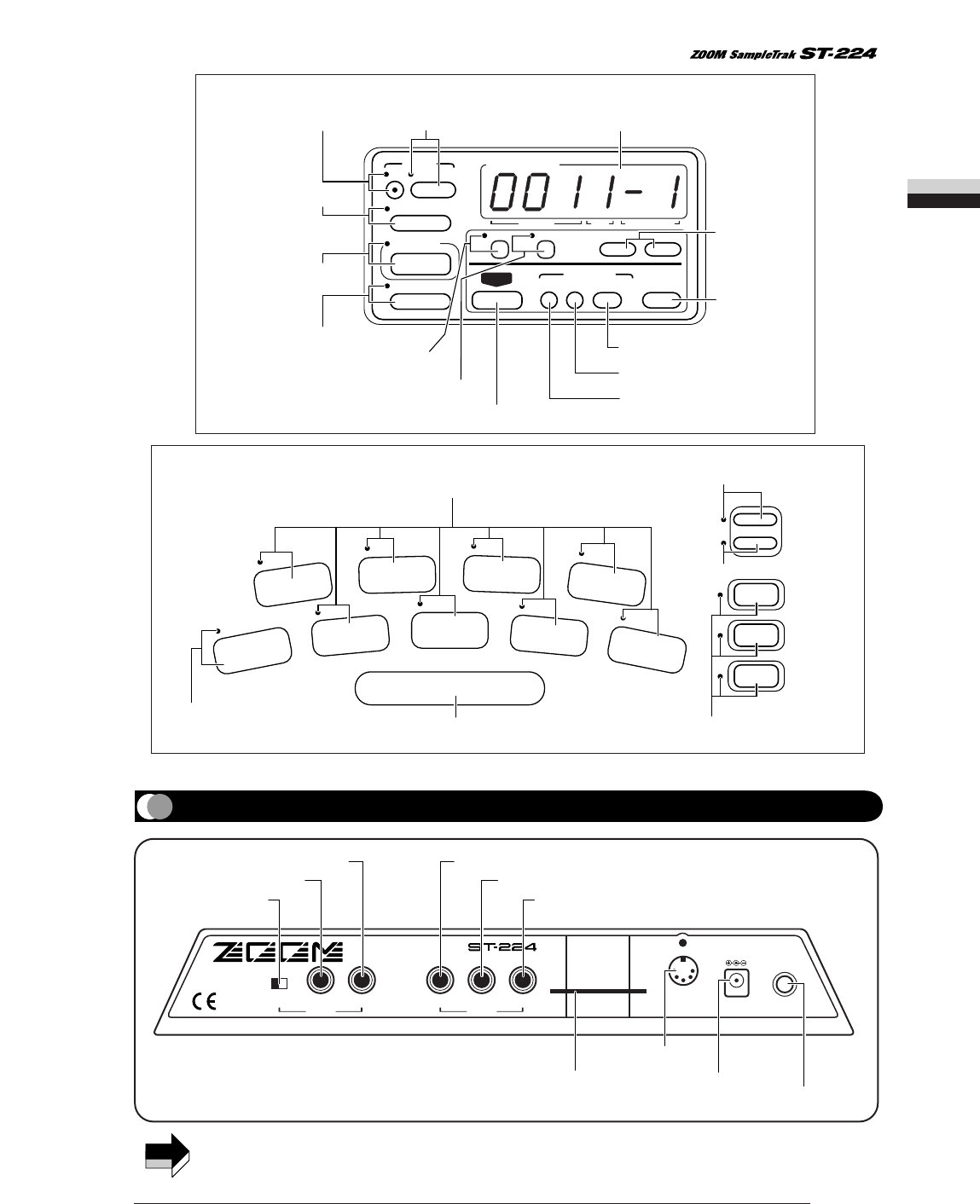
- Names of Parts
- Getting Connected
- Quick Guide
- Introducing the ST-224
- Let's Try Out Sampling
- Pad Play Mode Operation
- Playing Samples In Pads 1 - 8
- Using the [SOURCE] Pad to Play an External Sound Source
- Assigning a Sample to a Pad
- Assigning a Sample to a Major Scale
- Setting the Sample Playback Position
- Setting the Playback Parameters for Each Pad
- Pad Parameters
- Copying Pad Settings
- Clearing Pad Settings
- Erasing a Sample
- Optimizing Samples
- Matching BPM of Pads (Auto Sync)
- Using the Internal Effects
- Creating Songs
- Playing Songs With Pads (Play List Function)
- Using the Resampling Function
- Storing and Reading Data
- MIDI Application Example
- Other Functions
- Troubleshooting
- ST-224 Specifications
- ST-224 File Import Details
- MIDI Implementation
- MIDI Implementation Chart
OPERATION MANUAL
SAFETY PRECAUTIONS
In this manual, symbols are used to highlight warnings and cautions for you to read so that accidents can be
prevented. The meanings of these symbols are as follows:
Please observe the following safety tips and precautions to ensure hazard-free use of the SampleTrak ST-
224.
•Power requirements
The SampleTrak ST-224 is powered by the supplied AC adapter. To prevent malfunction and safety
hazards, do not use any other kind of AC adapter.
When using the SampleTrak ST-224 in an area with a different line voltage, please consult your
local ZOOM distributor about acquiring a proper AC adapter.
•Environment
Avoid using your SampleTrak ST-224 in environments where it will be exposed to:
• Extreme temperature
• High humidity or moisture
• Excessive dust or sand
• Excessive vibration or shock
•Handling
The SampleTrak ST-224 is a precision instrument. Do not exert undue pressure on the keys and
other controls. Also take care not to drop the unit, and do not subject it to shock or excessive
pressure.
•Alterations
Never open the case of the SampleTrak ST-224 or attempt to modify the product in any way since
this can result in damage to the unit.
•Connecting cables and input and output jacks
You should always turn off the power to the SampleTrak ST-224 and all other equipment before
connecting or disconnecting any cables. Also make sure to disconnect all cables and the AC adapter
before moving the SampleTrak ST-224.
USAGE AND SAFETY PRECAUTIONS
2
USAGE AND SAFETY PRECAUTIONS
Warning
This symbol indicates explanations about extremely
dangerous matters. If users ignore this symbol and handle the
device the wrong way, serious injury or death could result.
Caution
This symbol indicates explanations about dangerous matters. If
users ignore this symbol and handle the device the wrong way,
bodily injury and damage to the equipment could result.
Warning
Caution
Caution
Caution
Caution

Usage Precautions
•Electrical interference
For safety considerations, the SampleTrak ST-224 has been designed to provide maximum protection
against the emission of electromagnetic radiation from inside the device, and protection from external
interference. However, equipment that is very susceptible to interference or that emits powerful
electromagnetic waves should not be placed near the SampleTrak ST-224, as the possibility of
interference cannot be ruled out entirely.
With any type of digital control device, the SampleTrak ST-224 included, electromagnetic interference
can cause malfunctioning and can corrupt or destroy data. Care should be taken to minimize the risk of
damage.
•Cleaning
Use a soft, dry cloth to clean the SampleTrak ST-224. If necessary, slightly moisten the cloth. Do not
use abrasive cleanser, wax, or solvents (such as paint thinner or cleaning alcohol), since these may dull
the finish or damage the surface.
Please keep this manual in a convenient place for future reference.
3
USAGE AND SAFETY PRECAUTIONS

USAGE AND SAFETY PRECAUTIONS ••••• 2
SAFETY PRECAUTIONS ••••••••••••••••••••••• 2
Usage Precautions •••••••••••••••••••••••••••• 3
Introduction ••••••••••••••••••••••••••••••••• 5
Names of Parts ••••••••••••••••••••••••••••• 6
Front Panel ••••••••••••••••••••••••••••••••••• 6
Rear Panel ••••••••••••••••••••••••••••••••••• 7
Getting Connected •••••••••••••••••••••••••• 8
Connections to Playback Equipment and MIDI
Equipment ••••••••••••••••••••••••••••••••••• 8
Connection to Sound Source (1) •••••••••••••••• 8
Connection to Sound Source (2) •••••••••••••••• 9
Adjusting the Volume •••••••••••••••••••••••••• 9
Quick Guide ••••••••••••••••••••••••••••••• 10
Quick Guide (1) Listening to the Demo ••••••••• 10
Quick Guide (2) Playing the Preset Pads •••••••• 11
Quick Guide (3) Assign an Effect to a Pad ••••••• 12
Quick Guide (4) Try Out Sampling •••••••••••••• 14
Introducing the ST-224 •••••••••••••••••••• 16
ST-224 Configuration ••••••••••••••••••••••••• 16
Samples •••••••••••••••••••••••••••••••••••• 16
Pads and banks •••••••••••••••••••••••••••••• 17
ST-224 Memory Configuration ••••••••••••••••• 18
BPM •••••••••••••••••••••••••••••••••••••••• 19
Let's Try Out Sampling •••••••••••••••••••• 20
(1) Manual Sampling ••••••••••••••••••••••••• 20
(2) Auto Sampling •••••••••••••••••••••••••••• 23
Pad Play Mode Operation ••••••••••••••••• 25
Playing Samples In Pads 1 - 8 ••••••••••••••••• 25
Using the [SOURCE] Pad to Play an
External Sound Source •••••••••••••••••••••• 26
Assigning a Sample to a Pad •••••••••••••••••• 27
Assigning a Sample to a Major Scale ••••••••••• 28
Setting the Sample Playback Position •••••••••• 29
Setting the Playback Parameters for
Each Pad •••••••••••••••••••••••••••••••••• 31
Pad Parameters •••••••••••••••••••••••••••••• 32
Copying Pad Settings ••••••••••••••••••••••••• 34
Clearing Pad Settings ••••••••••••••••••••••••• 35
Erasing a Sample •••••••••••••••••••••••••••• 36
Optimizing Samples••••••••••••••••••••••••••• 37
Matching BPM of Pads (Auto Sync) •••••• 38
Using the Auto Sync Function (Basic Steps) ••••• 38
Changing BPM for Every Pad
(Auto Sync Advanced Steps) ••••••••••••••••• 41
Using the Internal Effects ••••••••••••••••• 42
Applying an Effect to a Specific Pad •••••••••••• 42
Synchronizing Effect Parameter BPM ••••••••••• 44
Effect Types ••••••••••••••••••••••••••••••••• 46
Creating Songs •••••••••••••••••••••••••••• 48
Song Recording •••••••••••••••••••••••••••••• 48
Playing a Song ••••••••••••••••••••••••••••••• 51
Changing Song Settings •••••••••••••••••••••• 52
Song Function Parameters •••••••••••••••••••• 53
Copying a Song •••••••••••••••••••••••••••••• 54
Deleting a Song •••••••••••••••••••••••••••••• 55
Playing Songs With Pads
(Play List Function) ••••••••••••••••••••••• 56
Assigning Songs to Pads •••••••••••••••••••••• 56
Using the Resampling Function ••••••••••• 57
Resampling Pad Play or Songs •••••••••••••••• 57
Storing and Reading Data ••••••••••••••••• 59
Storing/Reading Bulk Data (Backup Memory) •••• 59
Formatting a Data Card ••••••••••••••••••••••• 60
Storing Bulk Data (Data Card) •••••••••••••••••• 61
Loading Bulk Data (Data Card) •••••••••••••••• 63
Loading Individual Pad Data/Waveform Data
(Data Card/Backup Memory) ••••••••••••••••• 64
MIDI Application Example •••••••••••••••• 66
MIDI Connections •••••••••••••••••••••••••••• 66
Playing ST-224 Samples Under Control of External
Equipment •••••••••••••••••••••••••••••••••• 66
Synchronizing Song Playback of the ST-224
With External Equipment •••••••••••••••••••• 68
Other Functions ••••••••••••••••••••••••••• 69
Resetting the ST-224 to the Factory Default
(Initializing) ••••••••••••••••••••••••••••••••• 69
Initializing Without Loading Backup Memory Data
(Quick Start) •••••••••••••••••••••••••••••••• 69
Troubleshooting ••••••••••••••••••••••••••• 70
ST-224 Specifications ••••••••••••••••••••• 71
ST-224 File Import Details •••••••••••••••• 72
MIDI Implementation •••••••••••••••••••••• 73
MIDI Implementation Chart ••••••••••••••• 75
CONTENTS
4
CONTENTS
Thank you for selecting the ZOOM SampleTrak ST-224 (hereafter simply called
the "ST-224"). The ST-224 is a sampler with the following features:
• Versatile sampler settings
The sampler section allows selection of three sound quality grades and stereo/mono
switching. Whether you want Hi-Fi for best sound or Lo-Fi for long recording time, the
choice is yours. Sampled waveforms can be stored in the internal backup memory or
on external data cards (option).
• Pad play feels like a rhythm machine
Sampled sounds are assigned to eight pads (x three banks) which can be played
with a simple tapping motion. Playback start and end position can be selected for each
pad, and parameters such as level, tuning, and panning can be easily adjusted.
• Sequencer stores 8 songs, PLAYLIST allows DJ use
An internal sequencer lets you memorize a pad playing session to create eight
original songs. The songs can then be assigned to pads 1 - 8 for real-time playing
(PLAYLIST).
• Useful special effects
The ST-224 also incorporates 22 powerful sound effects. A mixer function allows you
to assign an effect to one or more specific pads. Knobs and rotary controls on the panel
can be used to vary effect parameters in real time.
• Auto sync function-great for creating rhythm tracks
The beats per minute (BPM) of a sample assigned to a pad can be matched to the BPM
of one selected sample. Changing the length of a sample is possible without
changing pitch. This allows you for example to easily adjust the tempo of a drum loop
and bass pattern sampled from a CD.
• Sophisticated resampling feature
The ST-224 is the first unit in this price class to offer resampling. Phrases with
effects played with the pads or by the internal sequencer can be sampled again in the
digital domain.
• Built in presets and demo song
A number of built-in presets programmed at the factory lets you use the ST-224
right away. The unit also contains an impressive demo song making full use of the
various features.
Please take the time to read this manual carefully, so as to get the most out of your
ST-224 and to ensure optimum performance and reliability.
Except for special cases such as personal use, unauthorized sampling of material from copyrighted
sources (including but not limited to CDs, records, tapes, video clips, broadcast material) is
prohibited.
* Microsoft, Windows, MS-DOS are registered trademarks of Microsoft Corporation.
Apple and Macintosh are registered trademarks of Apple Computer Inc.
5
Introduction
Introduction
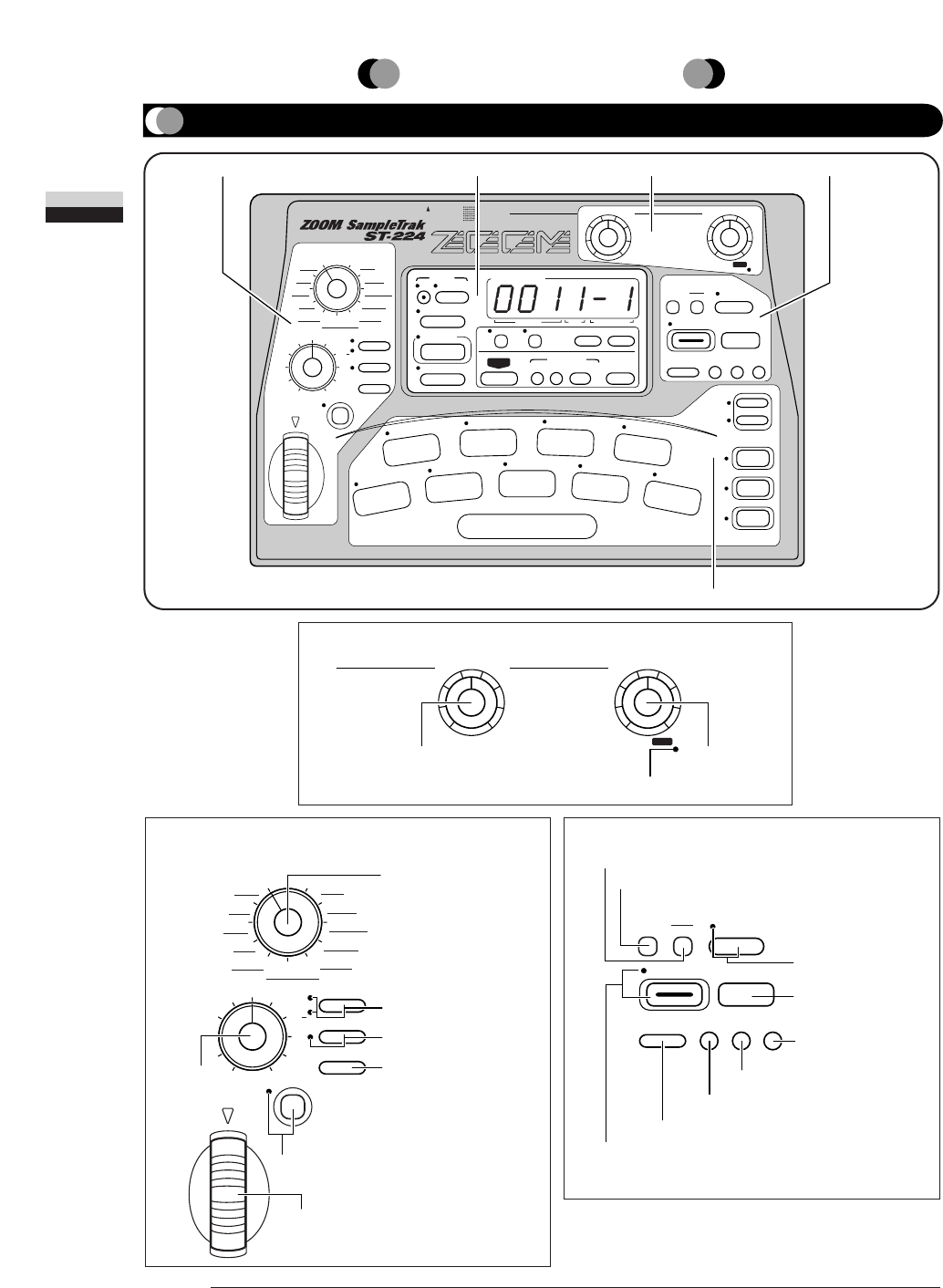
Names of Parts
6
Names of Parts
Front Panel
■ Display/sequencer section ■ Effects section ■ Input/output section ■ Sampling section
■ Pad section
BANK
3
BANK
2
BANK
SONG
PAD
1
FUNCTION
PAD ASSIGN
CAPACITY
ERASE OPTIMIZE
PLAY/STOP
RECORD
RE-SAMPLE
GRADE
MONO
STEREO
SAMPLING
MAXMINMAXMIN
INPUTOUTPUT
PEAK
INPUT
RL/MONO MIC/LINE
OUTPUT
RDATA CARDMIDI INDC INPOWER L/MONO PHONES
EFFECT
EDIT 2
VOLUME/BASS
EXCITER
TREMOLO
AUTO PAN
LO-FI EFFECT
EXTREME EQ
COMPRESSOR
RESONANCE
HIGH-PASS
LOW-PASS
DISTORTION
RING MODULATOR
PITCH SHIFTER
DIMENSION
CHORUS
PHASER
FLANGER
STEP CRY
DELAY
REVERB
TIME STRETCH
SCRATCH
EFFECT
ON/OFF
PAD ENABLE
A
B
EFFECT SYNC
EDIT 1
LOOP/MARK
4
SHIFT
OFFSET
6
SWING
PANNING
8
MIDI
TRIGGER/GATE
2
QUANTIZE
TUNING
SOURCE
SOURCE MIX
5
PRE COUNT
END POINT
3
TIME SIG
START POINT
1
BAR LENGTH
LEVEL
7
CLICK VOLUME
REVERSE
COPY DELETE
EXIT
LOAD SAVE
+
–
AUTO SYNC
PLAYLIST
TAP
BPM
SONG
PLAY/STOPREC
BPM/
VALUE
MEASURE
SAMPLE/SONGBEAT
BACKUP
SPECIAL
INTERNAL/DATA CARD
EFFECT
EDIT 2
VOLUME/BASS
EXCITER
TREMOLO
AUTO PAN
LO-FI EFFECT
EXTREME EQ
COMPRESSOR
RESONANCE
HIGH-PASS
LOW-PASS
DISTORTION
RING MODULATOR
PITCH SHIFTER
DIMENSION
CHORUS
PHASER
FLANGER
STEP CRY
DELAY
REVERB
TIME STRETCH
SCRATCH
EFFECT
ON/OFF
PAD ENABLE
A
B
EFFECT SYNC
EDIT 1
■ Effects section
[EFFECT SELECT] switch
[EFFECT BANK] key & LED
[EFFECT ON/OFF] key & LED
[EFFECT PAD ENABLE] key
[EDIT 2] knob
[EDIT 1] wheel
[EFFECT SYNC] key & LED
MAXMINMAXMIN
INPUTOUTPUT
PEAK
INPUT
RL/MONO MIC/LINE
OUTPUT
RL/MONO PHONES
■ Input/output section
[OUTPUT] knob [INPUT] knob
[INPUT PEAK] LED
PAD ASSIGN
CAPACITY
ERASE OPTIMIZE
PLAY/STOP
RECORD
RE-SAMPLE
GRADE
MONO
STEREO
SAMPLING
■ Sampling section
[GRADE] key
[MONO/STEREO] key
[RECORD] key & LED
[RE-SAMPLE] key & LED
[PLAY/STOP] key
[PAD ASSIGN] key
[OPTIMIZE] key
[CAPACITY] key
[ERASE] key
7
Names of Parts
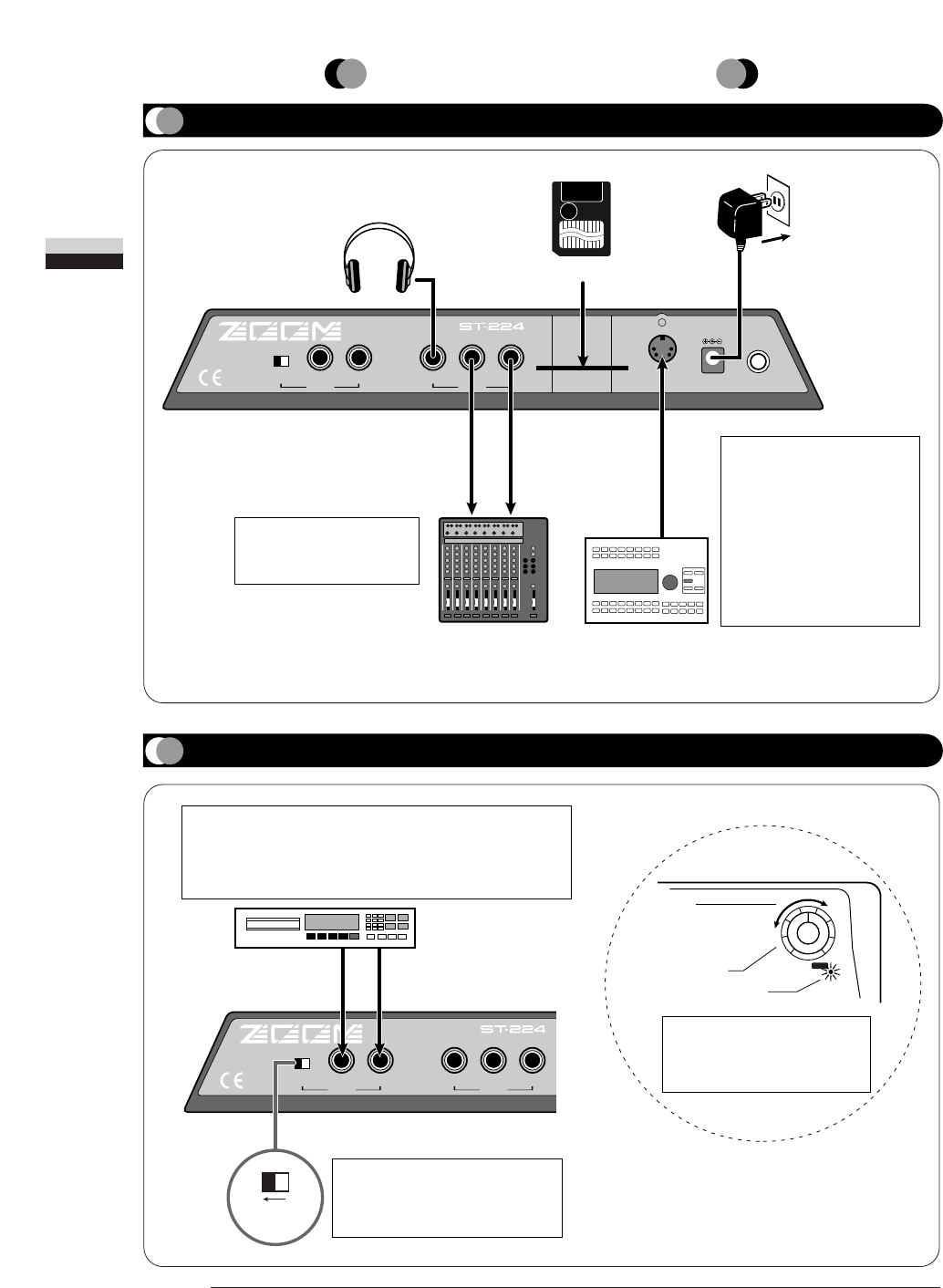
Rear Panel
In this manual, names of front panel and rear panel controls and jacks are indicated by square brackets [ ].
NOTE
COPY DELETE
EXIT
LOAD SAVE
+
–
AUTO SYNC
PLAYLIST
TAP
BPM
SONG
PLAY/STOPREC
BPM/
VALUE
MEASURE
SAMPLE/SONGBEAT
BACKUP
SPECIAL
INTERNAL/DATA CARD
■ Display/sequencer section
Display
[SPECIAL] key
[-] [+] keys
[EXIT] key [LOAD] key
[SAVE] key
[COPY] key & LED
[DELETE] key & LED
[INTERNAL/DATA CARD] key
[SONG REC] key & LED [SONG PLAY/STOP] key & LED
[TAP/BPM] key & LED
[PLAYLIST] key & LED
[AUTO SYNC] key & LED
ZOOM CORPORATION
MADE IN JAPAN
MODEL
L/M
O
N
O
PHONES
R DATA CARD MIDI IN DC9V
300mA
POWER
OUTPUT
L/M
O
N
O
LINE/MIC
R
INPUT
[INPUT R] jack [OUTPUT R] jack
[INPUT L/MONO] jack [PHONES] jack
[LINE/MIC] switch [OUTPUT L/MONO] jack
[DATA CARD] slot
[MIDI IN] jack
[POWER] switch
[DC9V] jack
LOOP/MARK
4
SHIFT
OFFSET
6
SWING
PANNING
8
MIDI
TRIGGER/GATE
2
QUANTIZE
TUNING
SOURCE
SOURCE MIX
5
PRE COUNT
END POINT
3
TIME SIG
START POINT
1
BAR LENGTH
LEVEL
7
CLICK VOLUME
REVERSE
BANK
3
BANK
2
BANK
SONG
PAD
1
FUNCTION
■ Pad section [PAD FUNCTION] key & LED
[SONG FUNCTION] key & LED
[BANK 1] - [BANK 3] keys & LEDs
[SOURCE] pad & LED [LOOP/MARK] pad
Pads 1 - 8 & LEDs
Getting Connected
8
Getting Connected
Connections to Playback Equipment and MIDI Equipment
ZOOM CORPORATION
MADE IN JAPAN
MODEL
L/M
O
N
O
PHONES
R DATA CARD MIDI IN DC9V
300mA
POWER
OUTPUT
L/M
O
N
O
LINE/MIC
R
INPUT
DC INPUTPHONES
AC Adapter
(mixer, audio system, radiocassette player, etc.)
Playback equipment MIDI OUT jack of MIDI sequencer or computer
with MIDI interface
HeadPhones Data card (option)
OUTPUT L/MONO MIDI INOUTPUT R
For mono playback, only the
[OUTPUT L/MONO] jack
needs to be connected.
When wishing to synchronize
the operation of the ST-224
with an external sequencer or
control the sound of the ST-
224 sound from external
MIDI equipment, connect the
MIDI OUT jack of the
external equipment to the
[MIDI IN] jack of the ST-224,
using a MIDI cable.
ZOOM CORPORATION
MADE IN JAPAN
MODEL
L/M
O
N
O
PHONES
R DATA CARD MIDI IN DC9V
300mA
POWER
OUTPUT
L/M
O
N
O
LINE/MIC
R
INPUT
MAXMIN
INPUT
PEAK
INPUT
R MIC/LINEL/MONO
CD Player
INPUT L/MONO INPUT R [INPUT PEAK] LED
[INPUT] knob
LINE/MIC
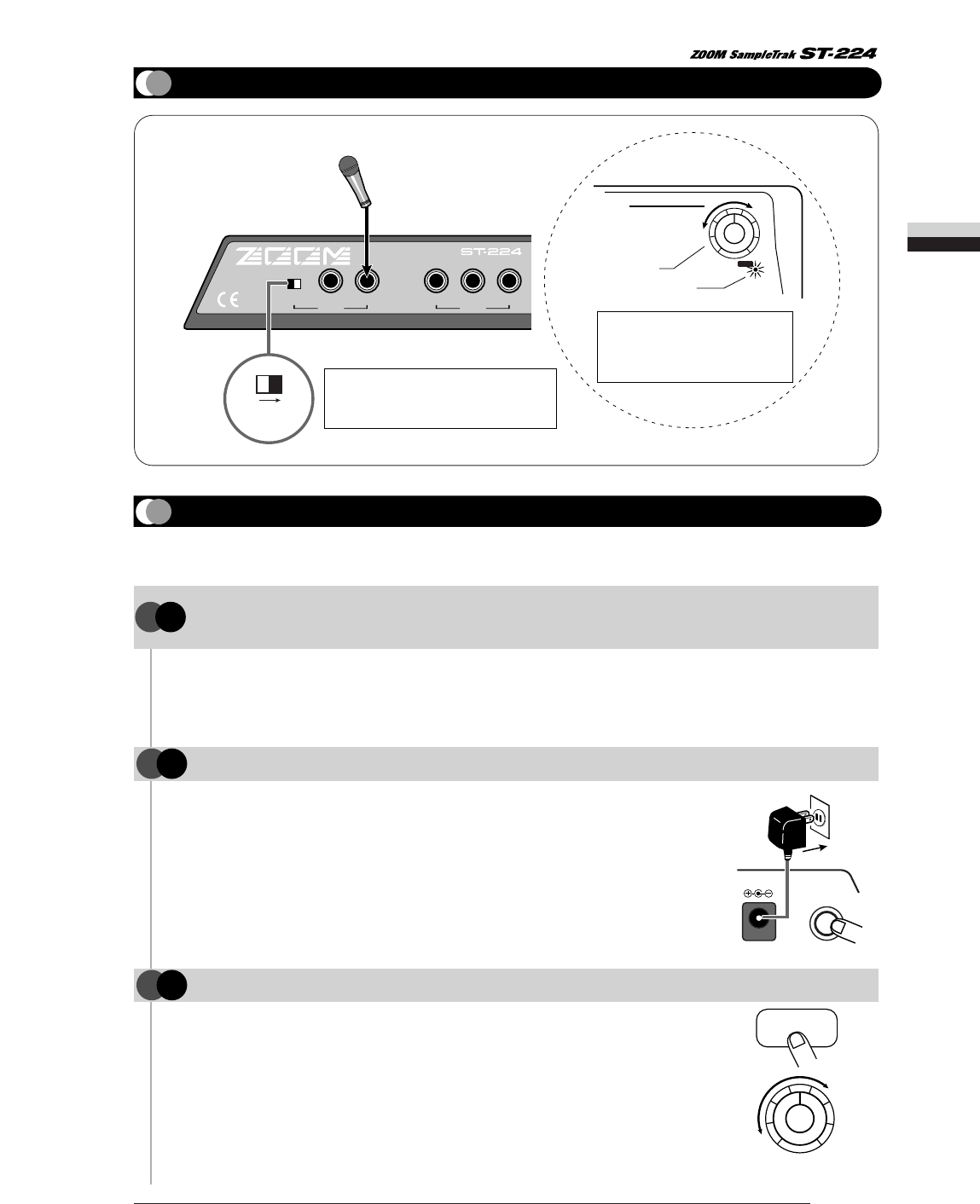
To sample a signal from equipment
with line-level output such as a CD
player, set the [LINE/MIC] switch
to the "LINE" position.
When sampling a stereo source, connect the [INPUT L/MONO]
jack and the [INPUT R] jack to the source. For mono sampling,
only the [INPUT L/MONO] jack needs to be connected. It is
also possible to mix a stereo source internally and perform
mono sampling ( ➔ p. 21).
Adjust the [INPUT] knob so that
the [INPUT PEAK] LED on the
front panel lights up during the
loudest passages of the music.
Connection to Sound Source (1) (CD Player)
If cables are connected or disconnected while power to the playback
equipment is on, or if power is turned on with the volume turned up,
damage to the speakers may result.
Connect the output cable of the supplied AC adapter to the [DC9V]
jack on the ST-224, and set the [POWER] switch to ON.
If the ST-224 is in the factory default condition, you can play preset
sounds by tapping the pads. Hit pads 1 - 8 and adjust the [OUTPUT]
knob on the ST-224 and the volume control on the playback
equipment to obtain the desired volume (to initialize the unit to the
factory default ➔p.69).
ZOOM CORPORATION
MADE IN JAPAN
MODEL
L/M
O
N
O
PHONES
R DATA CARD MIDI IN DC9V
300mA
POWER
OUTPUT
L/M
O
N
O
LINE/MIC
R
INPUT
MAXMIN
INPUT
PEAK
INPUT
R MIC/LINEL/MONO
Microphone INPUT L/MONO
LINE/MIC
[INPUT PEAK] LED
[INPUT] knob
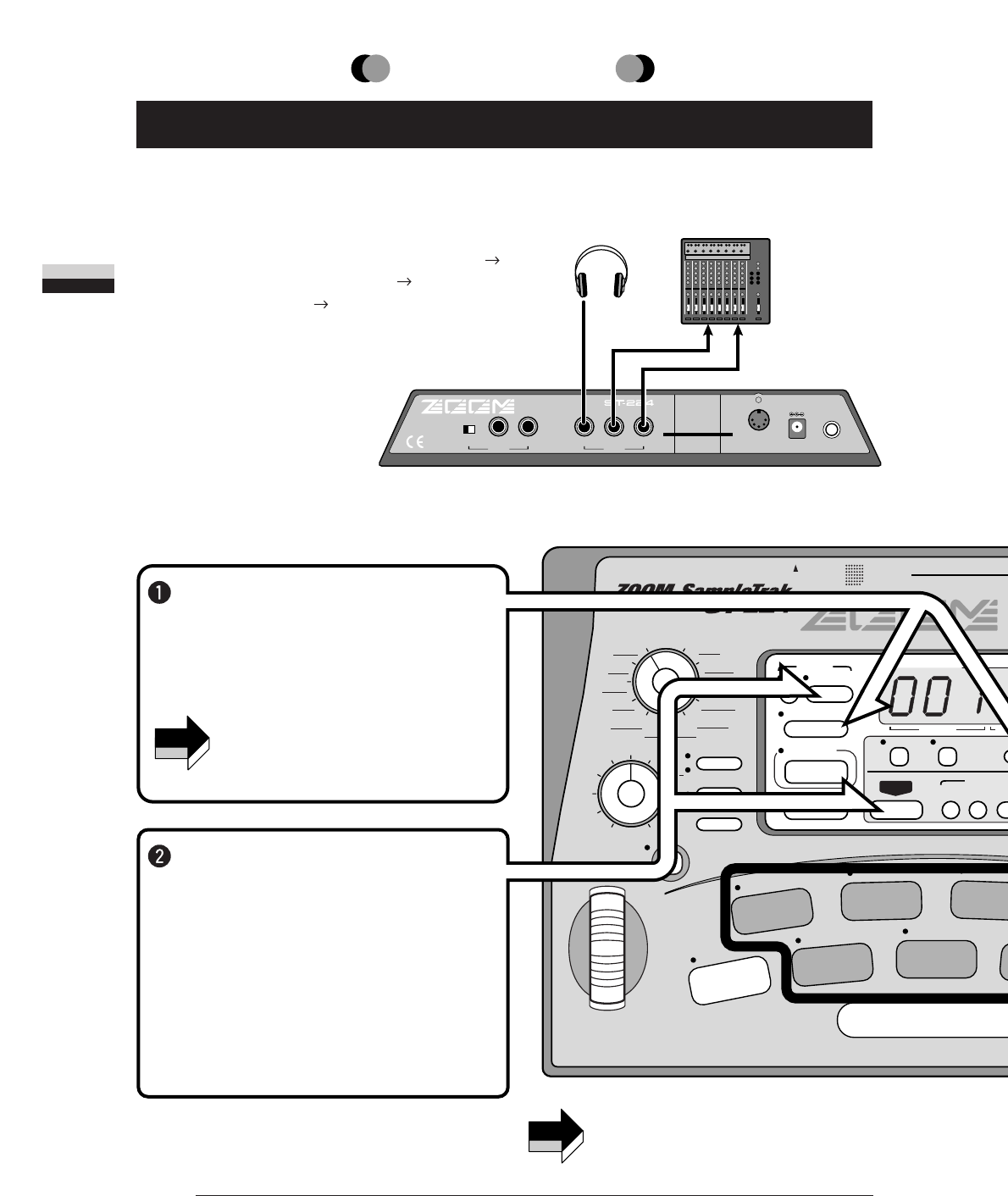
To sample a signal from a microphone,
set the [LINE/MIC] switch to the "MIC"
position.
Adjust the [INPUT] knob so that
the [INPUT PEAK] LED on the
front panel lights up during the
loudest passages of the music.
While power to the playback equipment is still off and the volume is set to minimum,
verify that all connections have been established correctly.
1
STEP
Turn on power to the ST-224.
2
STEP
Turn on power to the playback equipment.
3
STEP
9
Getting Connected
Connection to Sound Source (2) (Microphone)
Adjusting the Volume
When connections have been established, adjust the volume as follows.
DC9V
300mA
POWER
AC Adapter
[OUTPUT] knob
MAXMIN
OUTPUT
Pads 1 - 8
OUTPUT
RDATA CARDMIDI INDC INPOWER L/MONO PHONES
EFFECT
EDIT 2
VOLUME/BASS
EXCITER
TREMOLO
AUTO PAN
LO-FI EFFECT
EXTREME EQ
COMPRESSOR
RESONANCE
HIGH-PASS
LOW-PASS
DISTORTION
RING MODULATOR
PITCH SHIFTER
DIMENSION
CHORUS
PHASER
FLANGER
STEP CRY
DELAY
REVERB
TIME STRETCH
SCRATCH
EFFECT
ON/OFF
PAD ENABLE
A
B
EFFECT SYNC
EDIT 1
LOOP/MARK
4
SHIFT
OFFSET
2
QUANTIZE
TUNING
SOURCE
SOURCE MIX
5
PRE C
END
3
TIME SIG
START POINT
1
BAR LENGTH
LEVEL
COPY DELETE
EXIT
AUTO SYNC
PLAYLIST
TAP
BPM
SONG
PLAY/STOPREC
MEASURE
BEA
BPM/
VALUE
BACKU
LOAD SAVE
INTERNA
While holding down the [SPECIAL]
key, press the [PLAYLIST] key.
The demo song starts. Playback of the
song loops endlessly.
Previously sampled material will be
erased. Store the contents in the backup
memory if desired ( ➔ p. 59).
[Preparations ]
• Connect the ST-224 to the playback equipment ( p. 8).
• Turn power on in the order ST- 224 playback equipment,
and adjust the volume ( p. 9).
To stop the demo song, press
the [EXIT] or [SONG PLAY/STOP]
key.
The ST- 224 reverts to the normal
condition. The contents last stored in the
backup memory will be restored.
* While the song is playing, other controls
except the [EXIT] or [SONG PLAY/STOP]
key have no effect.
[P
• C
• Th
fa
fa
w
OUTPUT L/MONOPHONES
OUTPUT R Playback equipment
Headphones
The [SOURCE] pad on the front panel is a
special pad that allows using an external
input signal as sound source. It is not used
for playing internal samples.
ZOOM CORPORATION
MADE IN JAPAN
MODEL
L/M
O
N
O
PHONES
R DATA CARD MIDI IN DC9V
300mA
POWER
OUTPUT
L/M
O
N
O
LINE/MIC
R
INPUT
NOTE
NOTE
The ST-224 comes with a demo song already built in. Listen to this to hear for yourself what the ST-224 can
do.
Quick Guide
10
Quick Guide
Quick Guide (1) Listening to the Demo
BANK
3
BANK
2
BANK
SONG
PAD
1
FUNCTION
PAD ASSIGN
CAPACITY
ERASE OPTIMIZE
PLAY/STOP
RECORD
RE-SAMPLE
GRADE
MONO
STEREO
SAMPLING
MAXMINMAXMIN
INPUTOUTPUT
PEAK
INPUT
RL/MONO MIC/LINE
OUTPUT
RL/MONO PHONES
LOOP/MARK
4
SHIFT
OFFSET
6
SWING
PANNING
8
MIDI
TRIGGER/GATE
5
PRE COUNT
END POINT
TIME SIG
START POINT
7
CLICK VOLUME
REVERSE
COPY DELETE
EXIT
+
–
MEASURE
SAMPLE/SONGBEAT
BPM/
VALUE
BACKUP
SPECIAL
LOAD SAVE
INTERNAL/DATA CARD
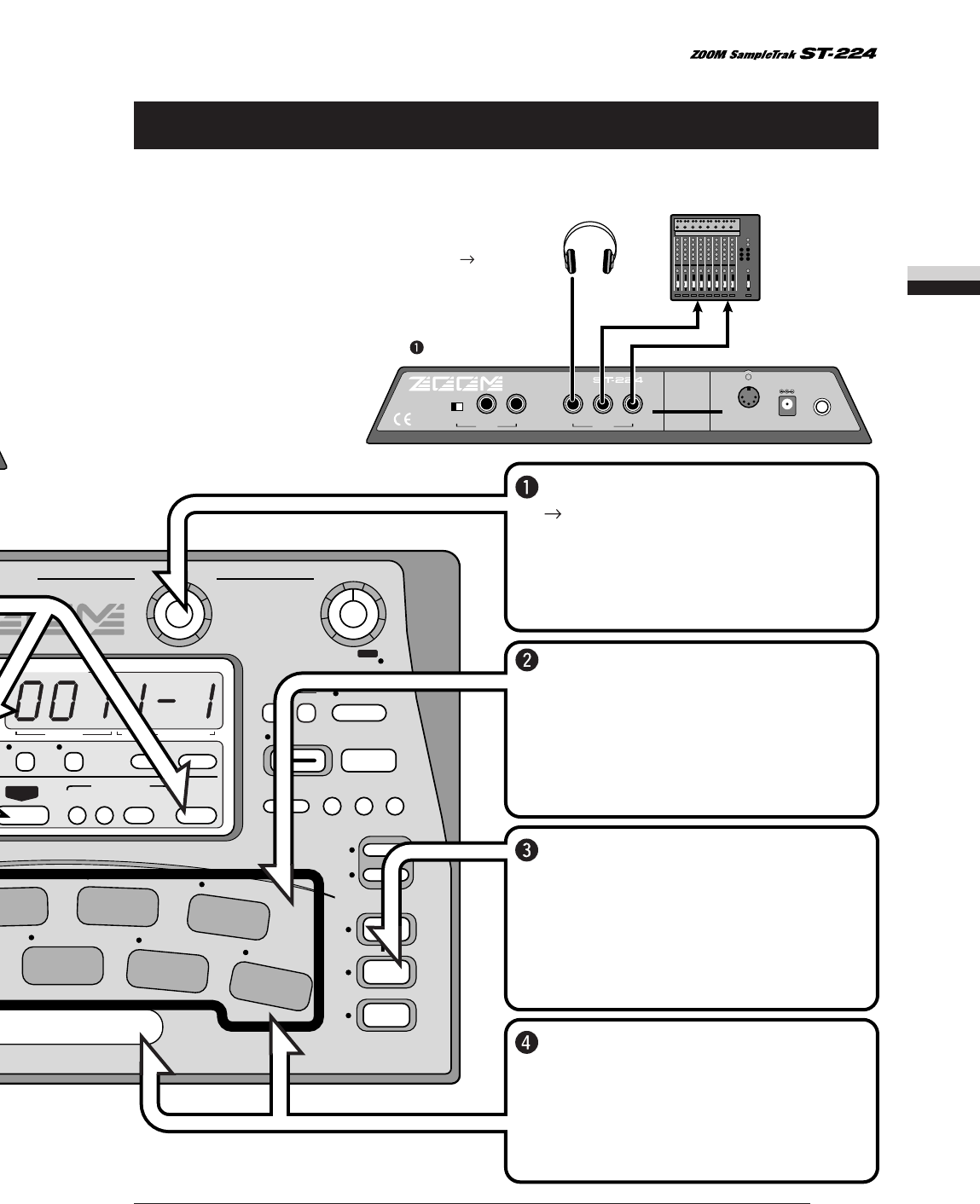
Turn power on in the order ST-224
playback equipment. Adjust the
[OUTPUT] knob on the ST-224
and the volume control on the
playback equipment to obtain the
desired volume.
Hit any of the pads 1 - 8 to try out
the sound.
When you hit a pad, its LED lights up and
the preset sampling content is played. Pads
1 - 8 are preprogrammed with different
samples.
To switch pads 1 - 8 to a different
bank, press the [BANK 2] key.
The ST-224 incorporates three banks
(groups of settings for pads 1 - 8). In the
factory default condition, banks 1 and 2 are
preprogrammed with different samples.
[Preparations ]
• Connect the ST-224 to the playback equipment ( p. 8).
• The Quick Guide assumes that the ST-224 is in the
factory default condition. To return the ST-224 to the
factory default condition, hold down the [SAVE] key
while turning power to the unit on in step .
To repeat the sound of a pad, hit
the pad while holding the
[LOOP/MARK] pad down.
While the [LOOP/MARK] pad is held, the
sound of a pad is looped.
PHONES
tOUTPUT L/MONO
OUTPUT R Playback equipment
Headphones
d
ZOOM CORPORATION
MADE IN JAPAN
MODEL
L/M
O
N
O
PHONES
R DATA CARD MIDI IN DC9V
300mA
POWER
OUTPUT
L/M
O
N
O
LINE/MIC
R
INPUT
11
Quick Guide
Quick Guide (2) Playing the Preset Pads
The ST-224 allows assigning sampled sounds to pads and playing these manually (pad play). You can try out
the preset sounds that are assigned to the pads at the factory.
12
Quick Guide
OUTPUT
RDATA CARDMIDI INDC INPOWER L/MONO P
EFFECT
EDIT 2
VOLUME/BASS
EXCITER
TREMOLO
AUTO PAN
LO-FI EFFECT
EXTREME EQ
COMPRESSOR
RESONANCE
HIGH-PASS
LOW-PASS
DISTORTION
RING MODULATOR
PITCH SHIFTER
DIMENSION
CHORUS
PHASER
FLANGER
STEP CRY
DELAY
REVERB
TIME STRETCH
SCRATCH
EFFECT
ON/OFF
PAD ENABLE
A
B
EFFECT SYNC
EDIT 1
LOOP/MARK
4
SHIFT
OFFSET
2
QUANTIZE
TUNING
SOURCE
SOURCE MIX
5
3
TIME SIG
START POINT
1
BAR LENGTH
LEVEL
COPY DELETE
EXIT
AUTO SYNC
PLAYLIST
TAP
BPM
SONG
PLAY/STOPREC
MEASURE
BPM/
VALUE
BA
LOAD SAV
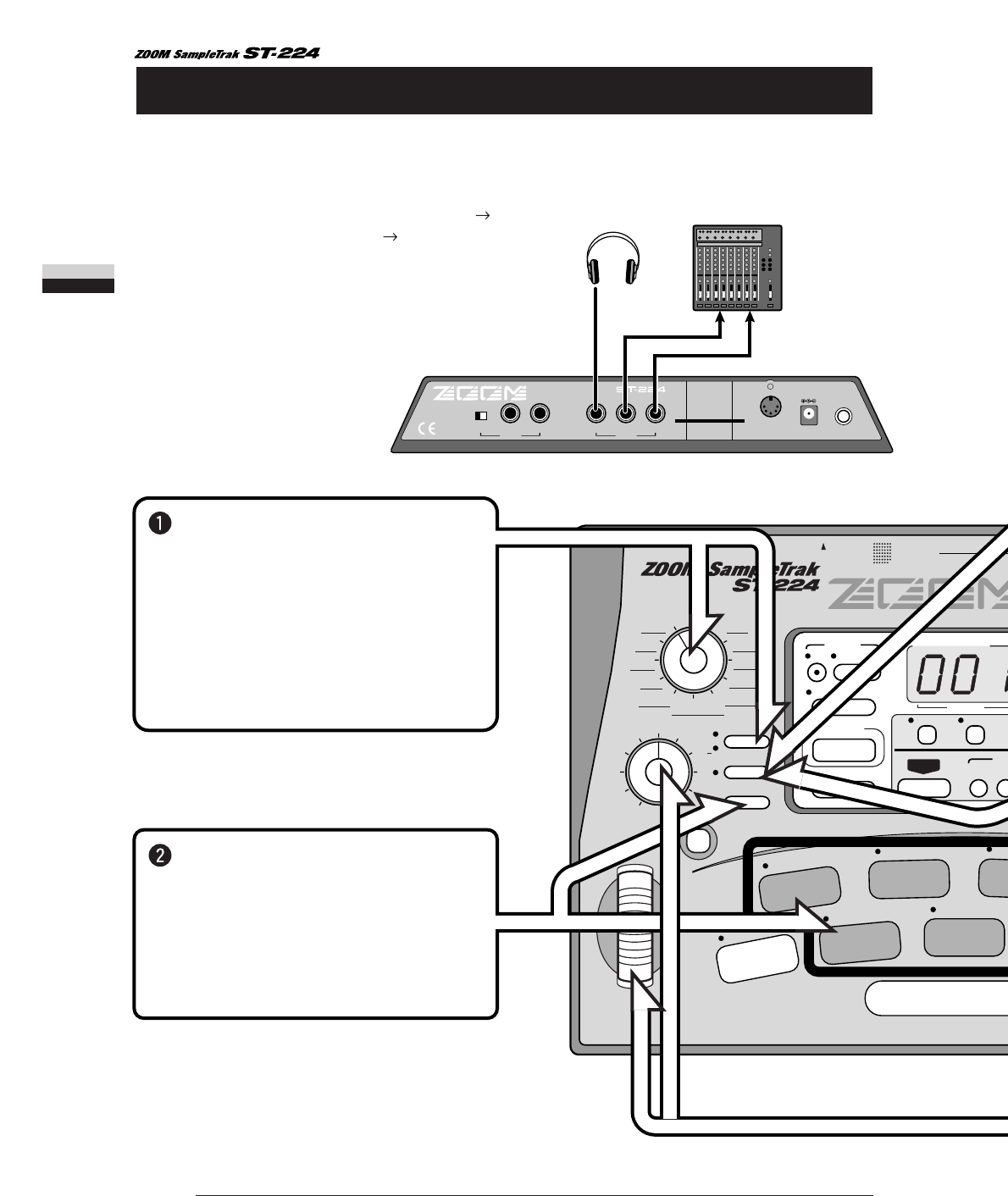
Use the [EFFECT SELECT]
switch and [EFFECT BANK] key
to select the desired effect type.
Turn the [EFFECT SELECT] switch so that it
points to the name of the desired effect.
When LED A is lit, non-underlined effects
can be selected. When LED B is lit,
underlined effects can be selected ( ➔ p.46).
While holding down the
[EFFECT PAD ENABLE] key,
press the pad to which you
want to assign effect.
The LED of the selected pad lights up. It
is also possible to select several pads.
[Preparations ]
•Connect the ST-224 to the playback equipment ( p. 8).
•Turn power on in the order ST-224 playback equipment.
OUTPUT L/MONOPHONES
OUTPUT R Playback equipment.
Headphones
ZOOM CORPORATION
MADE IN JAPAN
MODEL
L/M
O
N
O
PHONES
R DATA CARD MIDI IN DC9V
300mA
POWER
OUTPUT
L/M
O
N
O
LINE/MIC
R
INPUT
The ST-224 incorporates built-in effects with 22 effect types. Among these, you can select any desired effect
and assign it to a pad.
Quick Guide (3) Assign an Effect to a Pad
13
Quick Guide
BANK
3
BANK
2
BANK
SONG
PAD
1
FUNCTION
PAD ASSIGN
CAPACITY
ERASE OPTIMIZE
PLAY/STOP
RECORD
RE-SAMPLE
GRADE
MONO
STEREO
SAMPLING
MAXMINMAXMIN
INPUTOUTPUT
PEAK
INPUT
RL/MONO MIC/LINE
OUTPUT
RL/MONO PHONES
LOOP/MARK
4
SHIFT
OFFSET
6
SWING
PANNING
8
MIDI
TRIGGER/GATE
UANTIZE
TUNING
5
PRE COUNT
END POINT
3
TIME SIG
START POINT
7
CLICK VOLUME
REVERSE
COPY DELETE
EXIT
+
–
C
P
MEASURE
SAMPLE/SONGBEAT
BPM/
VALUE
BACKUP
SPECIAL
LOAD SAVE
INTERNAL/DATA CARD
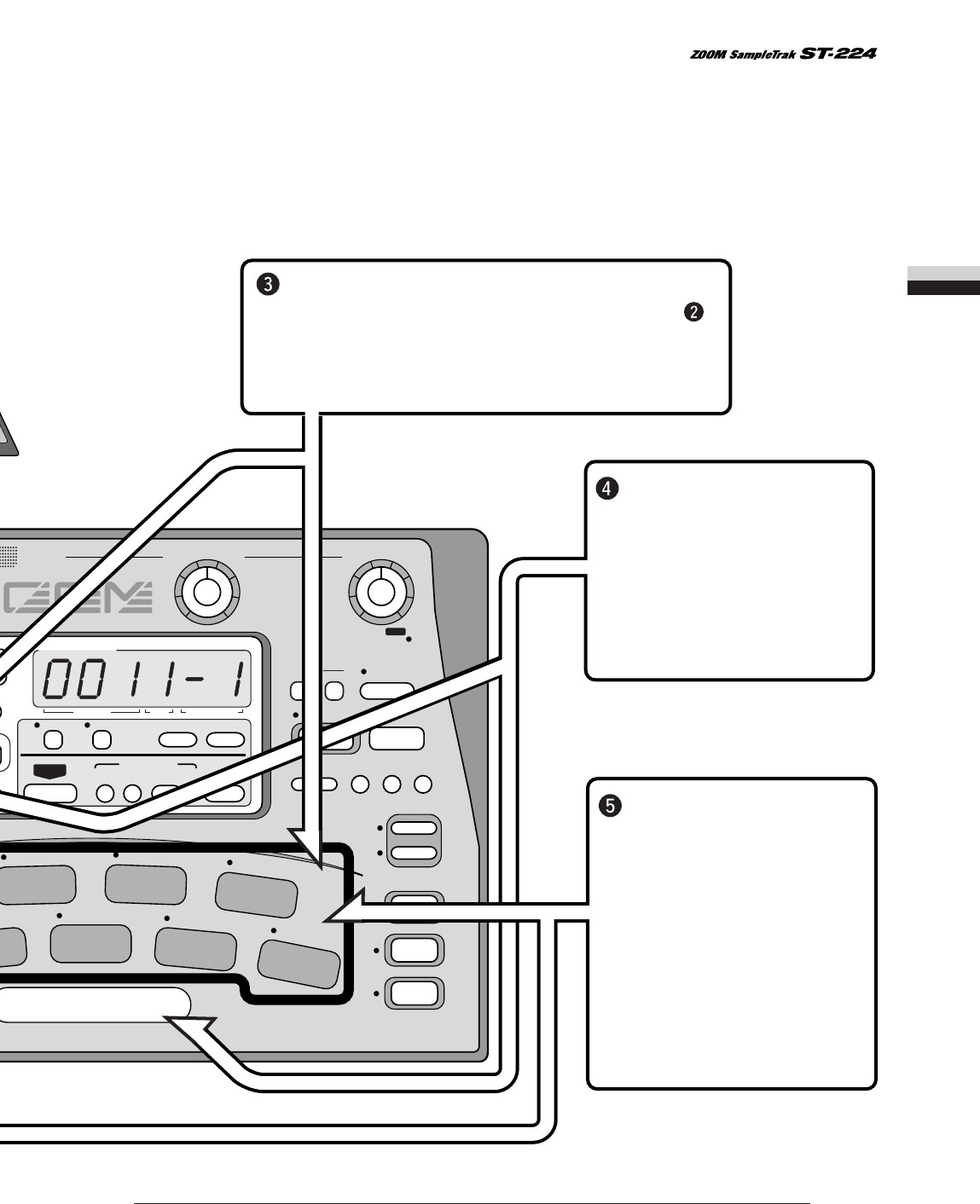
While holding down the [EFFECT ON/OFF]
key, hit the pad that was selected in step .
While the [EFFECT ON/OFF] key is held down, the effect is
active.
To turn the effect
permanently on, hold
down the [LOOP/MARK]
key and press the
[EFFECT ON/OFF] key.
To effect off, press the [EFFECT
ON/OFF] key.
To alter the effect
during a performance,
use the [EDIT 1] wheel
and [EDIT 2] knob while
hitting the pad.
The [EDIT 1] wheel and [EDIT 2]
knob serve to change the effect
parameters in real time. Which
parameters are affected by the
controls depends on the effect
type.
ent.
14
Quick Guide
OUTPUT
RDATA CARDMIDI INDC INPOWER L/MONO PHON
EFFECT
EDIT 2
VOLUME/BASS
EXCITER
TREMOLO
AUTO PAN
LO-FI EFFECT
EXTREME EQ
COMPRESSOR
RESONANCE
HIGH-PASS
LOW-PASS
DISTORTION
RING MODULATOR
PITCH SHIFTER
DIMENSION
CHORUS
PHASER
FLANGER
STEP CRY
DELAY
REVERB
TIME STRETCH
SCRATCH
EFFECT
ON/OFF
PAD ENABLE
A
B
EFFECT SYNC
EDIT 1
LOOP/MARK
4
SHIFT
OFFSET
2
QUANTIZE
TUNING
SOURCE
SOURCE MIX
5
PR
EN
3
TIME SIG
START POINT
1
BAR LENGTH
LEVEL
COPY DELETE
EXIT
AUTO SYNC
PLAYLIST
TAP
BPM
SONG
PLAY/STOPREC
MEASURE
B
BPM/
VALUE
BACK
LOAD SAVE
INTE
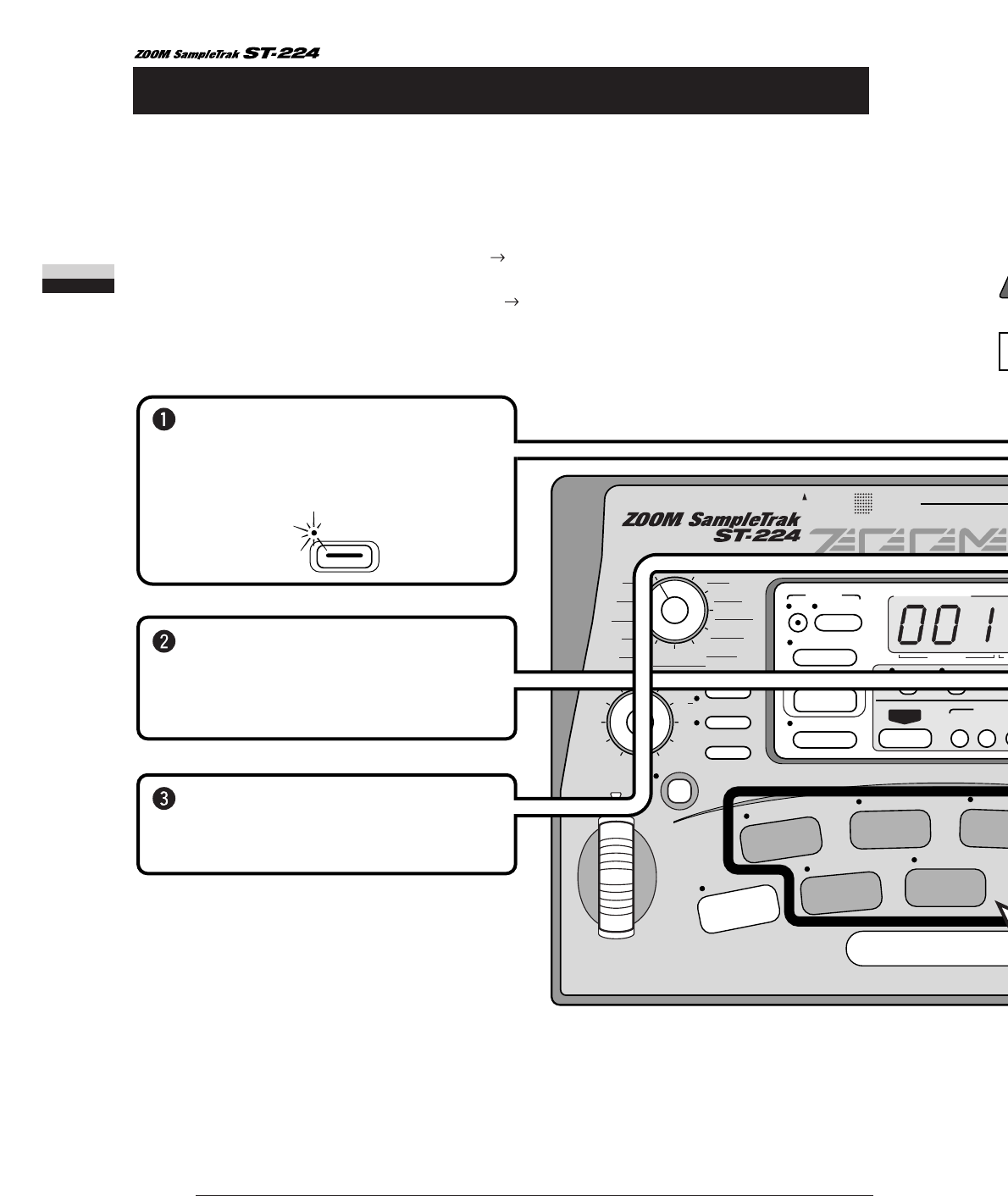
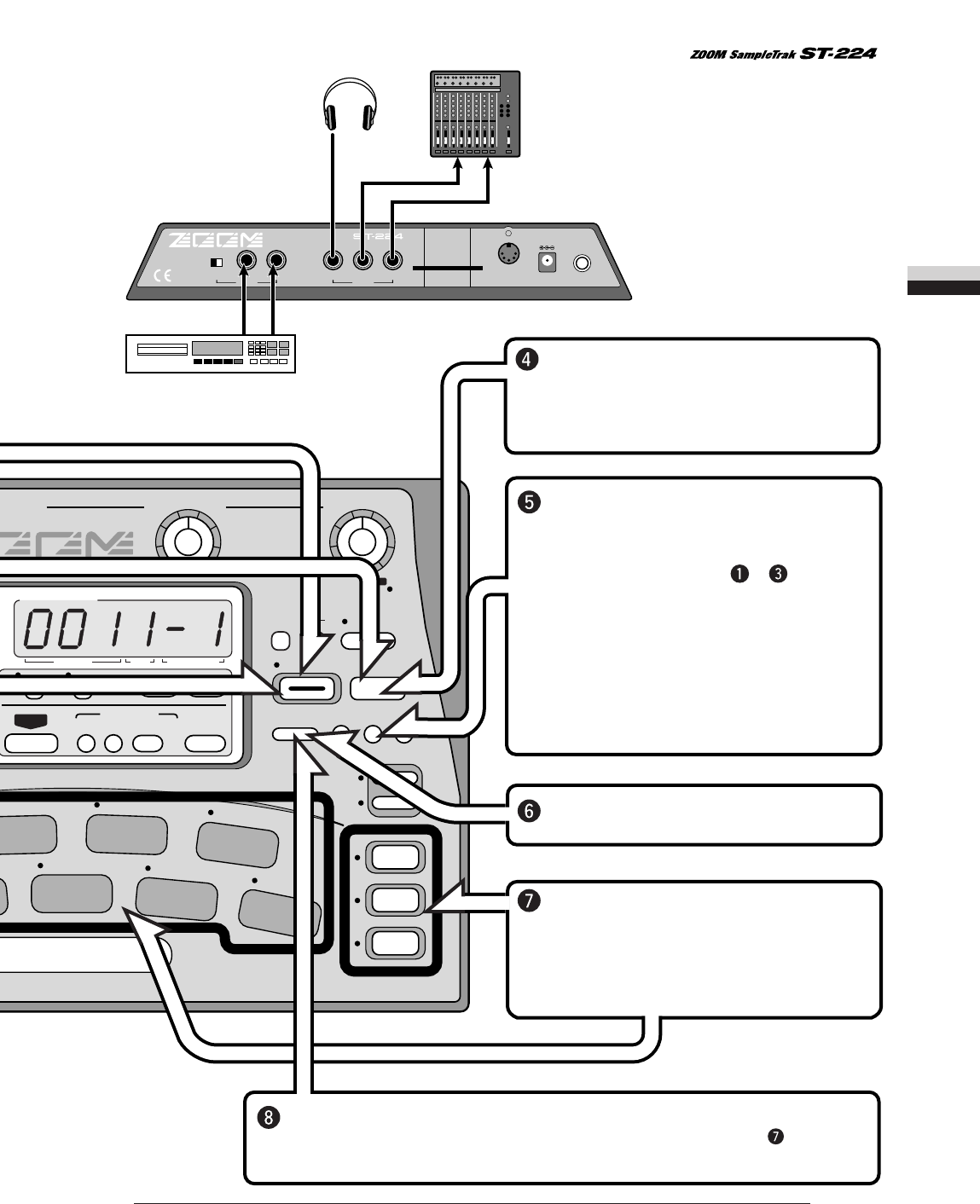
Press the [RECORD] key.
The ST-224 goes into the sampling standby
mode, and the LED of the [RECORD] key
flashes.
[Preparations ]
• Connect the ST-224 to the playback equipment ( p. 8).
• Connect the CD player output jacks to the [INPUT R] and [INPUT L/MONO] jacks on the ST-224. Set the
[INPUT] knob of the ST-224 to a suitable position ( p. 8).
• Select a track from the CD which you want to sample and set the CD player to pause at the start of the
desired track.
Press the [RECORD] key again
and then immediately release the
pause condition of the CD player
to start playback.
At the end of the passage that
you want to sample, press the
[PLAY/STOP] key.
RECORD
In Quick Guide (2), you played samples that were already preprogrammed in the unit. Now let's try out
assigning a sampled sound to a pad yourself. The following description shows how to use the supplied
sampling CD to sample drum and percussion sounds and assign the samples to pads.
Quick Guide (4) Try Out Sampling
15
Quick Guide
BANK
3
BANK
2
BANK
SONG
PAD
1
FUNCTION
PAD ASSIGN
CAPACITY
ERASE OPTIMIZE
PLAY/STOP
RECORD
RE-SAMPLE
GRADE
MONO
STEREO
SAMPLING
MAXMINMAXMIN
INPUTOUTPUT
PEAK
INPUT
RL/MONO MIC/LINE
OUTPUT
RL/MONO PHONES
LOOP/MARK
4
SHIFT
OFFSET
6
SWING
PANNING
8
MIDI
TRIGGER/GATE
5
PRE COUNT
END POINT
TIME SIG
START POINT
7
CLICK VOLUME
REVERSE
COPY DELETE
EXIT
+
–
MEASURE
SAMPLE/SONGBEAT
BPM/
VALUE
BACKUP
SPECIAL
LOAD SAVE
INTERNAL/DATA CARD
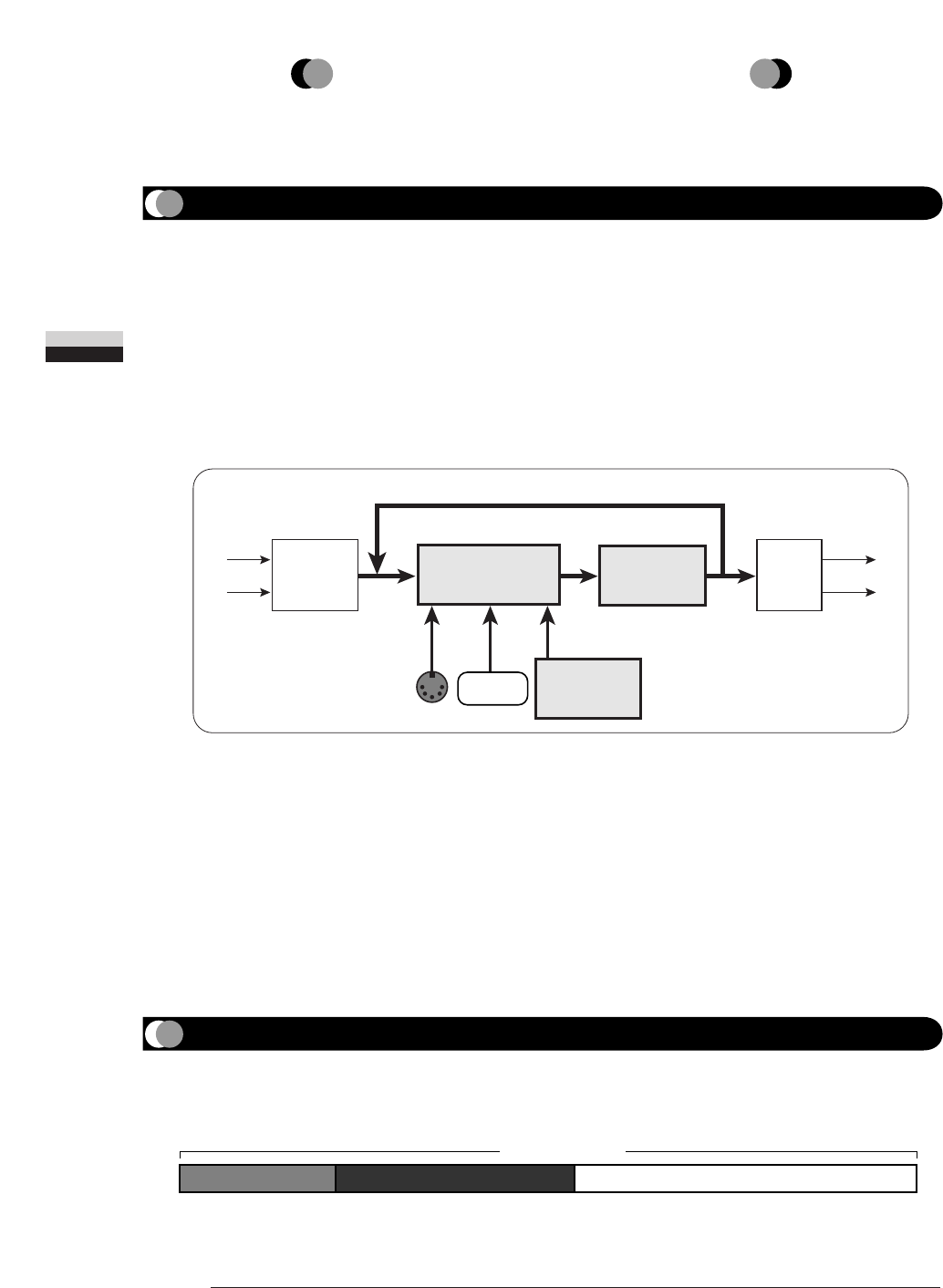
Press the [PLAY/STOP] key.
The sampled sound is played back, letting
you check the result of the process.
When wishing to redo the
sampling, press the [ERASE] key
to erase the sample ( ➔ p. 36), and
then perform steps - again.
If the start or end of the sample is cut off, or
if it sounds distorted, you should redo the
sampling. If there is a blank period before or
after the sample, this can be removed later
and repeated sampling is not necessary
(
➔ p. 29).
Press the [PAD ASSIGN]
key again.
Press one of the [BANK 1] -
[BANK 3] keys and then one of
the pads 1 - 8 to select the pad to
which you want to assign the
sample.
Press the [PAD ASSIGN] key twice.
The pad assignment is complete. Whenever
you hit the pad selected in step , the sound
of the sample will be heard.
INPUT L/MONO INPUT R
CD player
OUTPUT R Playback equipment
Headphones
OUTPUT L/MONOPHONES
ZOOM CORPORATION
MADE IN JAPAN
MODEL
L/M
O
N
O
PHONES
R DATA CARD MIDI IN DC9V
300mA
POWER
OUTPUT
L/M
O
N
O
LINE/MIC
R
INPUT
This section explains the basic configuration of the ST- 224 as well as some important terms used in this
manual.
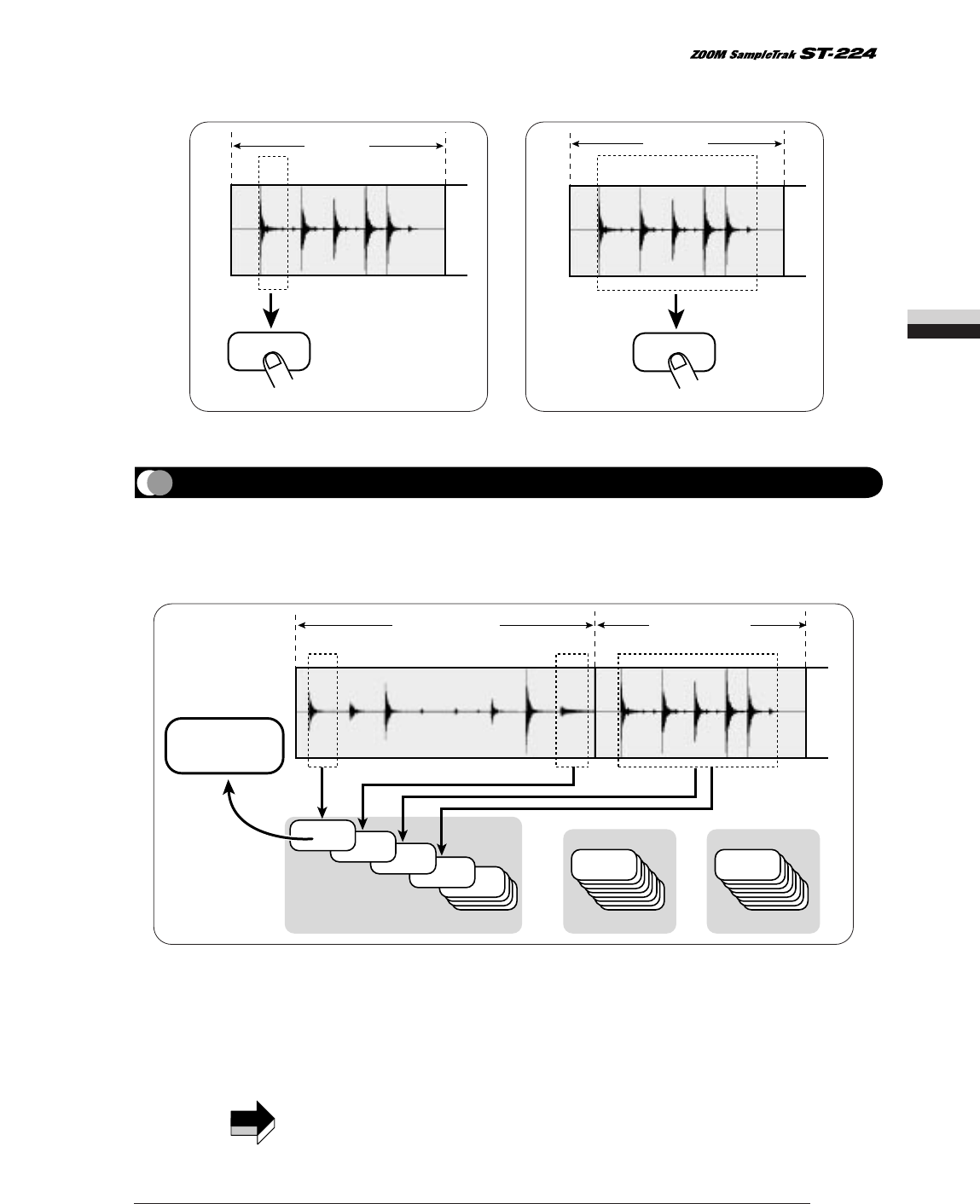
The illustration below shows the basic configuration of the ST-224. As can be seen from the chart, the ST-224
is made up of three main sections.
• Sampler
Samples the audio signal and performs playback using the pads and sequencer.
• Sequencer
Stores data about pad operation to enable automatic sampler playback.
• Effects
Allows alteration of the sampler signal in various ways.
The analog signal supplied via the [INPUT R] and [INPUT L/MONO] jacks is converted into digital form by
the A/D converter and the resulting waveform data are stored in the memory of the sampler section (main
memory).
Sampled and stored sounds can be played back in various ways, for example by hitting the pads on the unit, by
the internal sequencer, or under control of an external sequencer connected via the [MIDI IN] jack. The
maximum number of samples that can be played simultaneously is 8 mono samples or 4 stereo samples.
The sound of the samples played by the pads or sequencer can be altered if desired by the effects section, and
then appears at the [OUTPUT R] and [OUTPUT L/MONO] jacks. It is also possible to return this signal to the
sampling section and sample it again (resampling).
In the ST-224, a waveform that has been sampled in one sampling process is called a "sample". Each sample
automatically receives a number and is stored in the main memory. The ST-224 can store a maximum of 32
samples, depending on the size of each sample.
After sampling, the entire sample or a part of it can be assigned to one of the pads 1 - 8 on the front panel, for
Introducing the ST-224
16
Introducing the ST-224
ST-224 Configuration
Samples
INPUT
L
RRecord
(Sampling)
MIDI IN
Effects
section
Sampler
section
Sequencer
section
Pads
OUTPUT
L
R
Playback
Resampling
Basic Configuration of ST-224
Main Memory
SAMPLE #1 SAMPLE #2 Empty area
Main Memory and Samples
playback by hitting the pad. For example, when sampling a drum pattern, a single drum sound or the entire
pattern can be assigned to a pad.
A combination of all settings for pads 1 - 8 is called a "bank". The ST-224 has three banks which are selected
with the [BANK 1] - [BANK 3] keys. In effect, the ST-224 therefore gives the user access to a total of 24 pads.
A pad to which a sample has been assigned has various playback parameters which can be set individually.
These parameters include playback start and stop position, level, tuning, and panning.
Note that changing these parameters does not affect the original sample. Assigning one sample to several pads
and setting these to different parameters result in different sound, but the original sample does not change or
become a new sample.
The [SOURCE] pad on the front panel is a special pad that allows using an
external input signal as sound source. It is not used for playing internal samples.
NOTE
17
Introducing the ST-224
Sample
Boom !
Boom bang thump thump boom
Pad
Boom bang thump thump boom
Boom bang thump thump boom
Sample
Pad
Sample #1 Sample #2
BANK 1 BANK 2
Pads 1–8
BANK 3
Pads 1–8
Pads 1–8
Pad parameters
• Level • Tuning
• Panning etc.
Pads and banks
Assigning a sample to a pad
Assigning only one sound to the pad Assigning the entire pattern to the pad
18
Introducing the ST-224
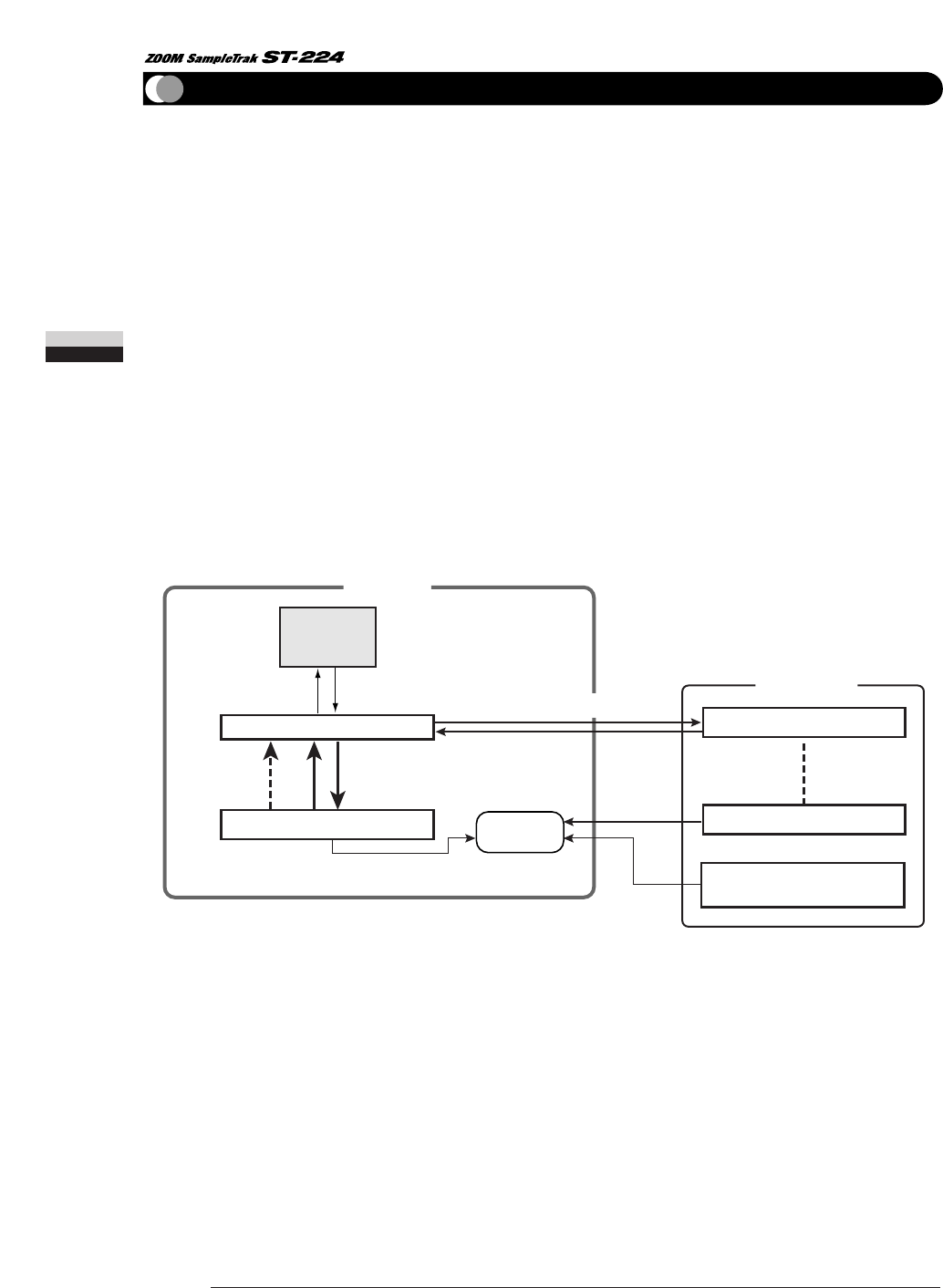
The following three types of memory are used in the ST- 224.
• Main memory
Volatile memory whose contents are lost when the ST-224 is turned off. Temporarily holds waveform data, pad
parameter setting data, and song data for the internal sequencer.
• Backup memory
Nonvolatile memory whose contents are retained also when the ST-224 is turned off. Serves for
permanently storing the entire contents of the main memory (bulk data). Only one set of bulk data can be stored
in the backup memory.
• Data card (SM04)
External storage media inserted in the [DATA CARD] slot on the rear panel of the unit. Like the backup memory,
it serves for storing bulk data, but it can hold more than one bulk data set (as many as the card capacity allows).
When the store target is a data card, up to 99 sets of bulk data can be stored.
When sampling or song recording is performed with the ST- 224, the waveform data and song data are
temporarily stored in the main memory. During pad play and song playback, the ST-224 will read data directly
from the main memory.
If the contents of the main memory are not saved to internal backup memory or to an external data card
(SM04), they will be lost when the unit is turned off. To prevent losing important data, be sure to save them
before turning the unit off, or more often if there is a possibility of power interruptions. Bulk data saved in
backup memory are automatically read into the main memory the next time the unit is turned on. (This means
that the unit returns to the same condition that was active before the power was switched off.) It is also possible
to manually load data from backup memory or data cards into the main memory.
ST-224 Memory Configuration
Automatic
read-in
at power-on Store/Read-in
Sequencer
section
Store/Read-in
Read-in
Waveform
data
Pad data
01–99
ST-224
DATA CARD
BACK UP Memory
MAIN MEMORY
Waveform data
PAD
Bulk data
Bulk data
WAV file/AIFF file
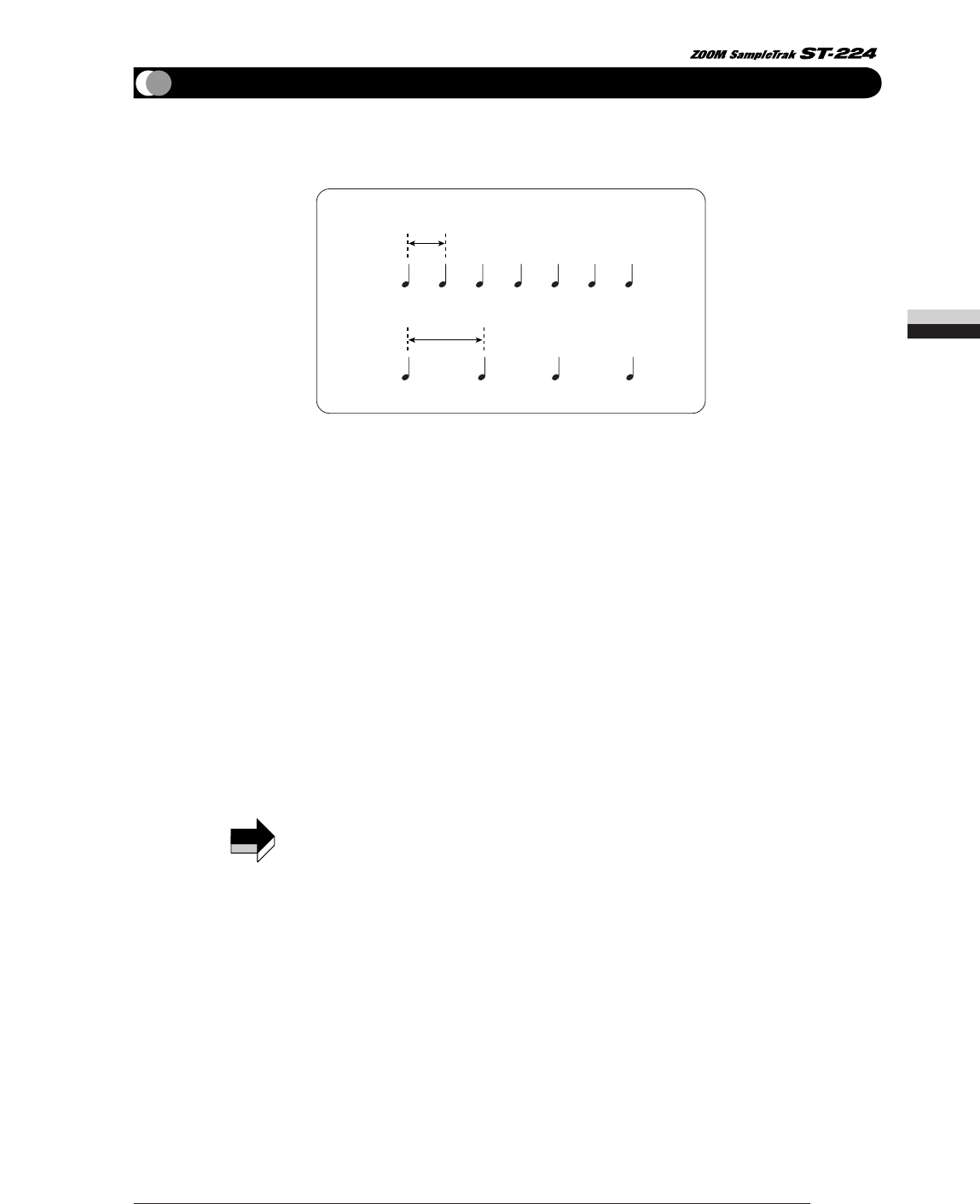
BPM (beats per minute) is a tempo unit that indicates the number of quarter notes per minute. For example, a
piece where a quarter note is 0.5 seconds long will have a BPM figure of 120, whereas a piece where a quarter
note is 1 seconds long will have a BPM figure of 60.
The ST-224 handles three types of BPM, which can be set individually.
• Song BPM
Indicates the tempo of a stored song. This value is stored separately for each song.
• Pad BPM
Indicates the playback time of a pad. The ST-224 considers the playback time of a sample assigned to a pad to
be four beats (quarter note x 4) and automatically calculates the BPM for the pad. This serves mainly for
synchronizing the tempo of several pads (Auto Sync feature). When parameters such as the sample start
point and end point, tuning etc. are changed, the pad BPM also is adjusted automatically.
•Effect BPM
Serves for synchronizing the parameters of certain effects (delay time, flanger modulation speed, etc.) to a given
tempo. The synchronized parameter depends on the effect type (some effect types do not have a parameter that
can be synchronized).
The value of Effect BPM is same as Song BPM unless edited.
For each type of BPM, the setting range is 40 - 250.
NOTE
19
Introducing the ST-224
BPM
BPM=120
BPM=60
0.5 s
1 s
20
Let's Try Out Sampling
This section explains how to use the [RECORD] key to manually specify the start and end point of the
sampling process. Manual sampling is convenient for example for quickly sampling a desired rhythm or bass
pattern while listening to a CD.
Except for special cases such as personal use, unauthorized sampling of material from copyrighted sources
(including but not limited to CDs, records, tapes, video clips, broadcast material) is prohibited.
• In the factory default condition, the ST-224 will read the preset sample sources from
backup memory into the main memory. Also in this condition, it is possible to sample a new
source and store the result in a free area of the main memory, but for maximum recording
length, you should first erase some or all preset samples from the main memory (
➔
p. 36).
• The sampled waveform is temporarily stored in the main memory, but it will be lost if the unit
is turned off without first transferring the waveform data to the internal backup memory or
external data cards. (The next time the unit is turned on, the contents of the backup
memory will be read into the main memory.) Be sure to store important sample data (
➔
p. 59).
NOTE
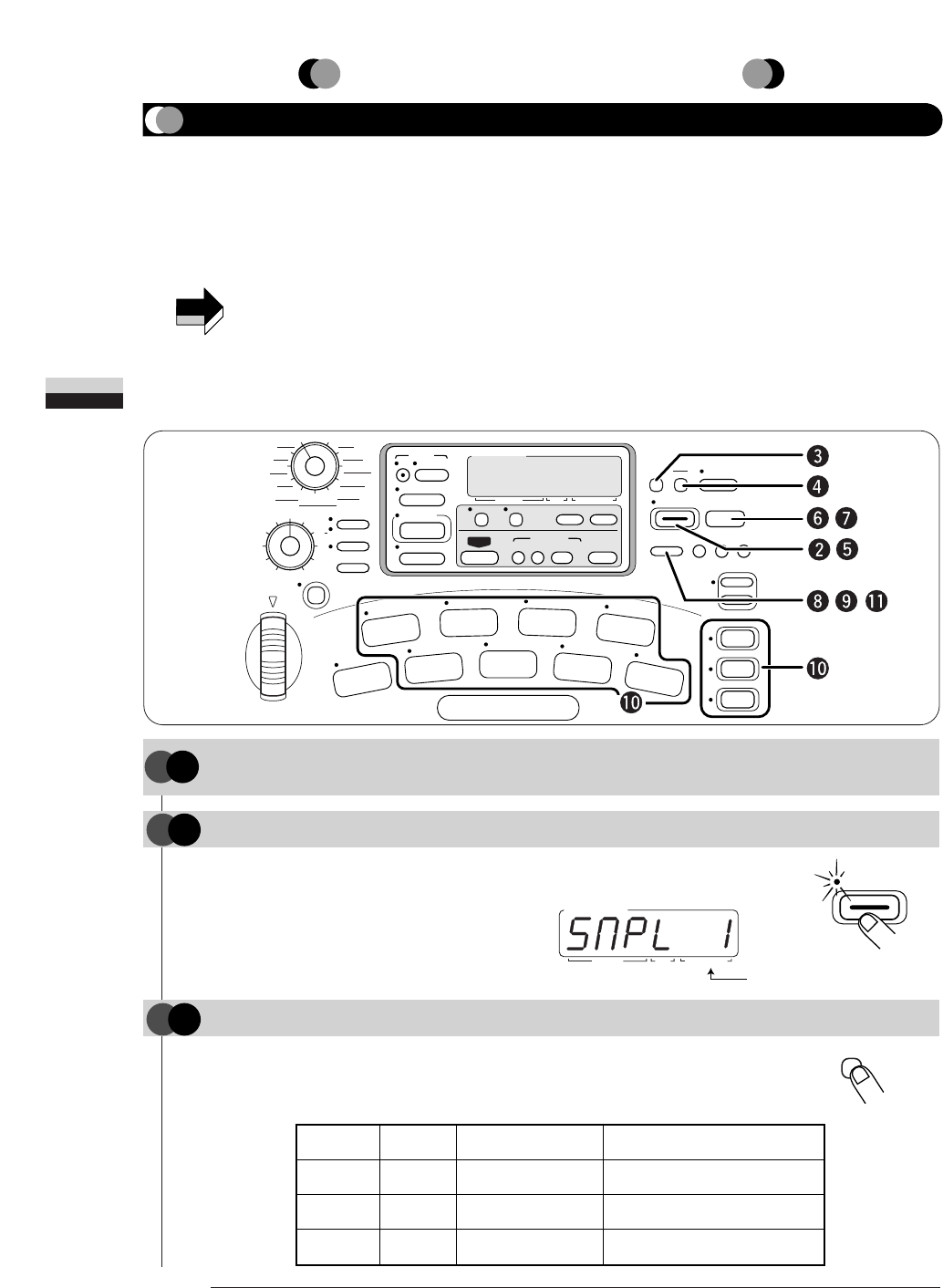
The ST-224 goes into the sampling standby mode, and the LED of
the [RECORD] key flashes. A number for the new sample is shown on
the display.
The currently selected grade appears on the display. You can change
the grade between three settings by holding down the [GRADE] key
and using the [-] and [+] keys.
BANK
3
BANK
2
BANK
SONG
PAD
1
FUNCTION
PAD ASSIGN
CAPACITY
ERASE OPTIMIZE
PLAY/STOP
RECORD
RE-SAMPLE
GRADE
MONO
STEREO
SAMPLING
EDIT 2
VOLUME/BASS
EXCITER
TREMOLO
AUTO PAN
LO-FI EFFECT
EXTREME EQ
COMPRESSOR
RESONANCE
HIGH-PASS
LOW-PASS
DISTORTION
RING MODULATOR
PITCH SHIFTER
DIMENSION
CHORUS
PHASER
FLANGER
STEP CRY
DELAY
REVERB
TIME STRETCH
SCRATCH
EFFECT
ON/OFF
PAD ENABLE
A
B
EFFECT SYNC
EDIT 1
LOOP/MARK
4
SHIFT
OFFSET
6
SWING
PANNING
8
MIDI
TRIGGER/GATE
2
QUANTIZE
TUNING
SOURCE
SOURCE MIX
5
PRE COUNT
END POINT
3
TIME SIG
START POINT
1
BAR LENGTH
LEVEL
7
CLICK VOLUME
REVERSE
COPY DELETE
BACKUP
EXIT SPECIAL
LOAD SAVE
INTERNAL/DATA CARD
+
–
AUTO SYNC
PLAYLIST
TAP
BPM
SONG
PLAY/STOPREC
BPM/
VALUE
MEASURE
SAMPLE/SONGBEAT
Sample number
BPM/
VALUE
MEASURE
SAMPLE/SONGBEAT
RECORD
GRADE
Connect the sound source (CD player or microphone etc.) to the [INPUT R] and [INPUT
L/MONO] jacks ( ➔p. 8 – 9).
1
STEP
Press the [RECORD] key.
2
STEP
When wishing to change the sampling grade (sound quality), press the [GRADE] key.
3
STEP
Let's Try Out Sampling
(1) Manual Sampling
Grade Sampling
frequency
32kHz
Maximum sampling time
(per sample)
30 seconds
Sampling time
(total)
Mono 60 seconds/Stereo 30 seconds
HiFi
(High fidelity)
16kHz 60 seconds Mono 120 seconds/Stereo 60 seconds
Stnd
(Standard)
8kHz 120 seconds Mono 240 seconds/Stereo 120 seconds
LoFi
(Low fidelity)
21
Let's Try Out Sampling
If you press the [CAPACITY] key, the approximate remaining
sampling time in seconds (calculated for HiFi and Mono) will appear
on the display.
The indication "Mn" (Mono) or "St" (Stereo) will appear on the display.
To change the setting, hold down the [MONO/STEREO] key and use
the [-] or [+] key. (The default setting is "Mono".)
The grade and mono/stereo selection can be made individually for
each sample. Remember that using stereo sampling will reduce the
available sampling time and the number of samples that can be
played simultaneously by half.
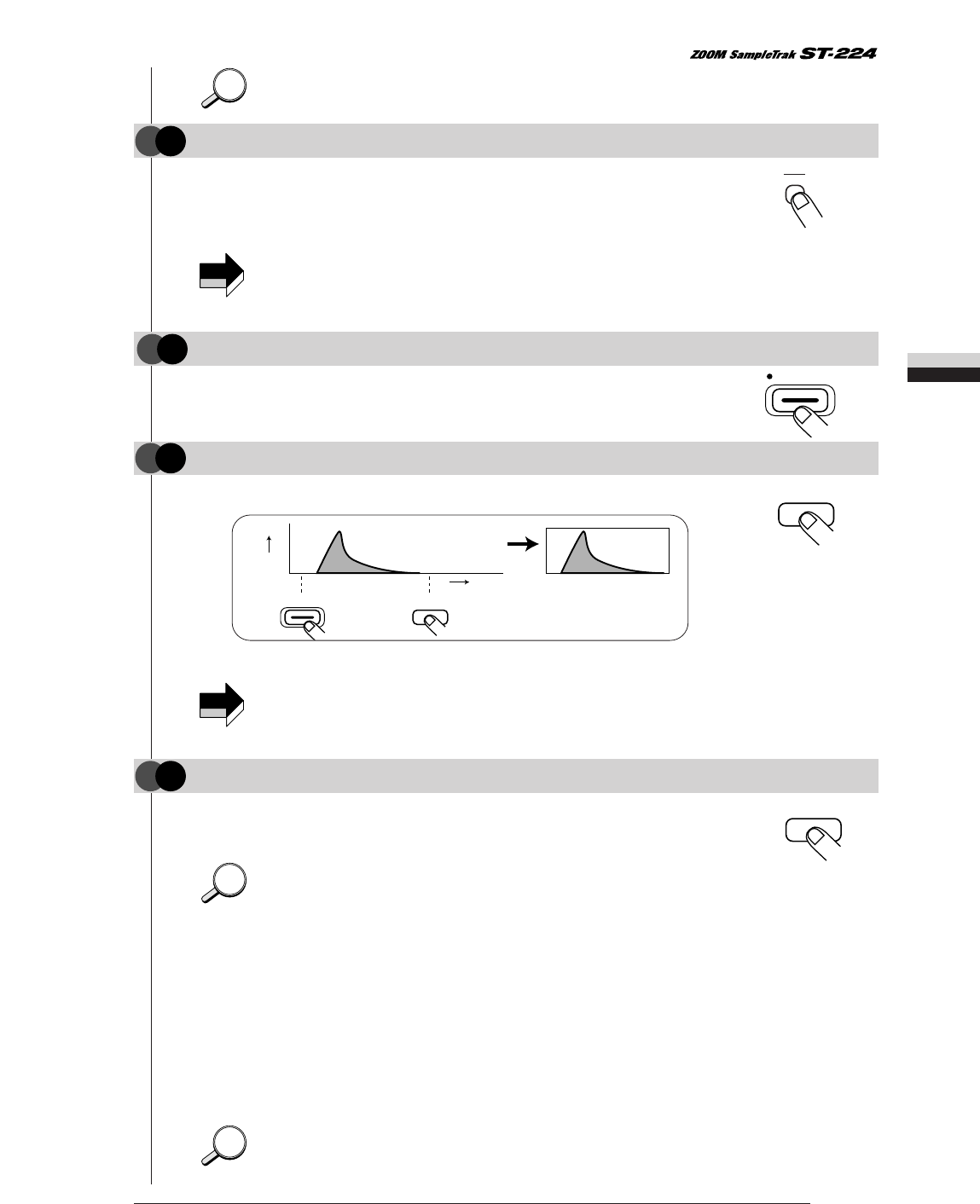
In manual sampling, the LED of the [RECORD] key stays lit as soon
as you press the key, and sampling starts.
Sampling ends as soon as the key is pressed.
If sampling is not stopped manually, it continues until the main
memory is full or the maximum sampling time is reached. Sampling
will automatically end at that point.
The sampled sound is played back for as long as the key is held
down (gate playback).
To check the status of sampled sound, press the [GRADE]
(or [MONO/STEREO]) key then the value with the number of the
sample is shown on the display.
•To erase the new sample and redo the sampling process
Press the [ERASE] key twice ( ➔p.36), and then repeat steps 2 - 7.
•To keep the new sample and continue sampling the same source
Repeat steps 2 - 7.
•To assign the new sample to a pad
Proceed to step 8.
The playback start time and end time in the sample can be changed
later ( ➔p. 29). Therefore repeated sampling is not necessary even
if there is a blank at the beginning or the end of the sample.
HINTHINT
HINTHINT
NOTE
NOTE
HINTHINT
Press the [RECORD] key and then immediately start playback of the sound source.
5
STEP
To end sampling, press the [PLAY/STOP] key.
6
STEP
To check the result of the process, press the [PLAY/STOP] key.
7
STEP
MONO
STEREO
RECORD
PLAY/STOP
PLAY/STOP
Sampling start
Level
Sampling end
Time Sample
PLAY/STOP
RECORD
Manual sampling
To switch between mono and stereo, use the [MONO/STEREO] key.
4
STEP
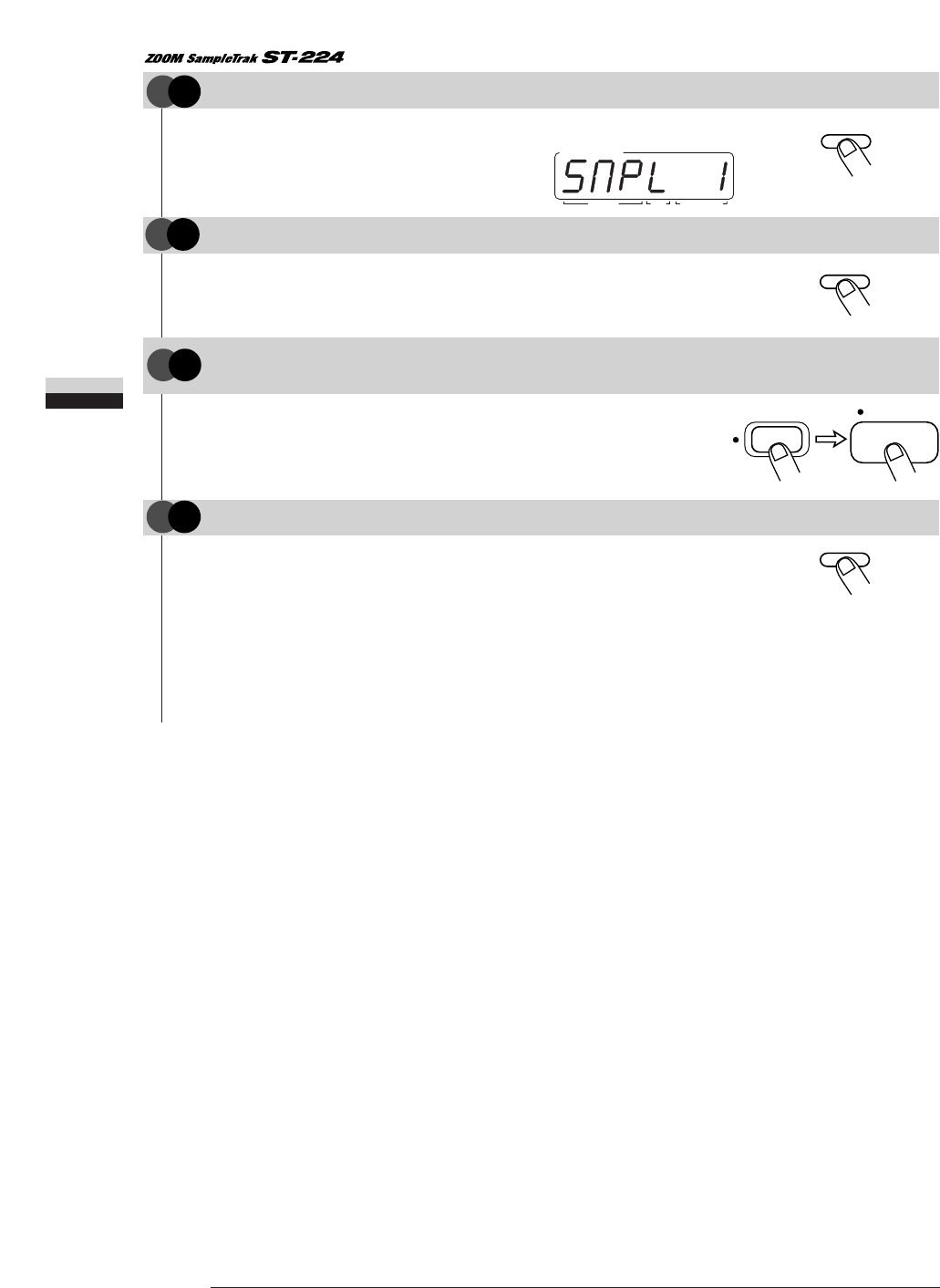
The number of the most recent sample is shown.
The currently selected sample will be assigned to the pad.
The assign process is confirmed.
• To cancel the assign process
Press the [EXIT] key to return to the play mode.
•To make a new sample
Perform steps 1 - 11 again.
22
Let's Try Out Sampling
PAD ASSIGN
PAD ASSIGN
BANK
1
BANK 1– 3 keys Pads 1 – 8
Press the [PAD ASSIGN] key.
8
STEP
Use the [BANK 1] - [BANK 3] keys and the pads 1 - 8 to select the pad to which you want
to assign the sample.
10
STEP
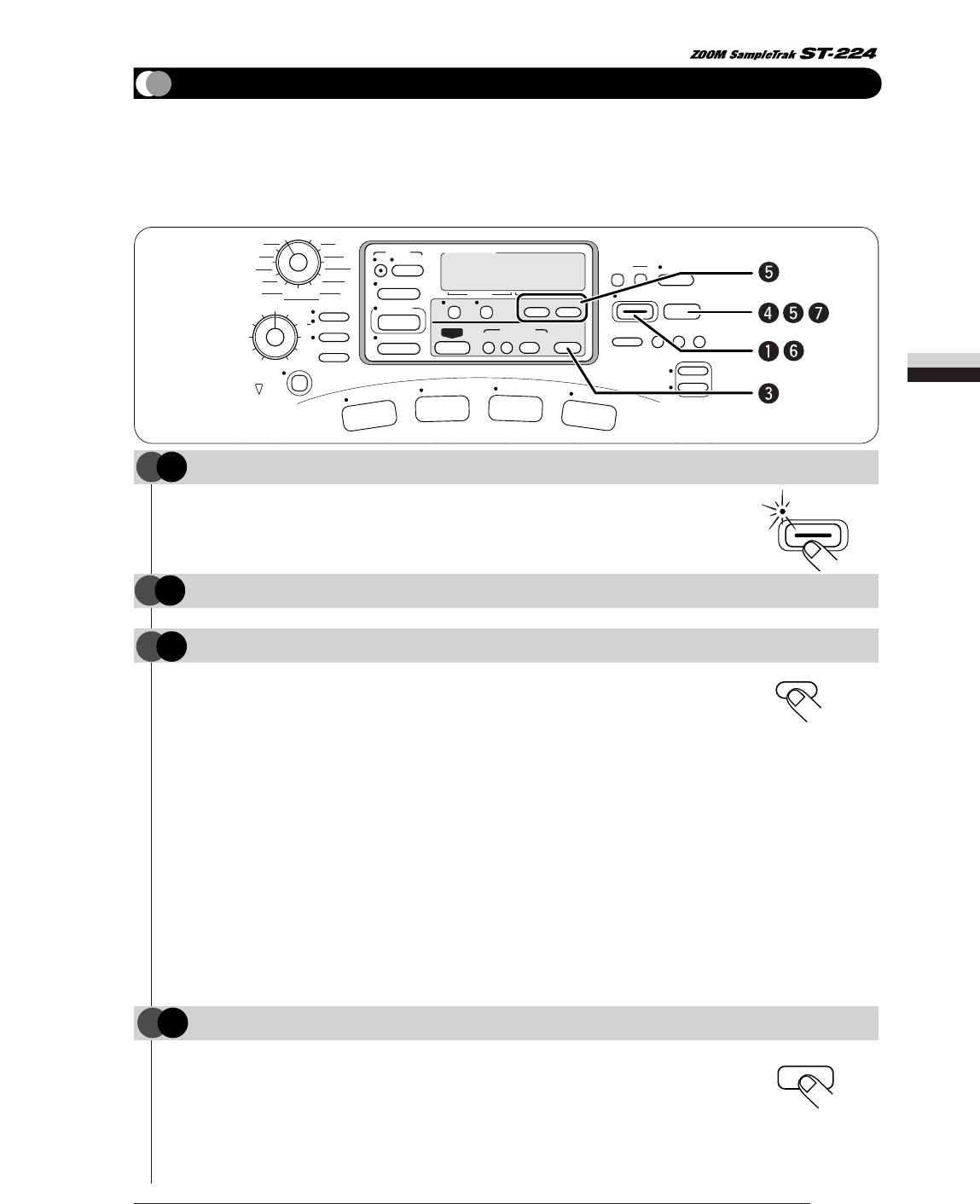
Press the [PAD ASSIGN] key.
11
STEP
Press the [PAD ASSIGN] key once more.
9
STEP
PAD ASSIGN
BPM/
VALUE
MEASURE
SAMPLE/SONGBEAT
23
Let's Try Out Sampling
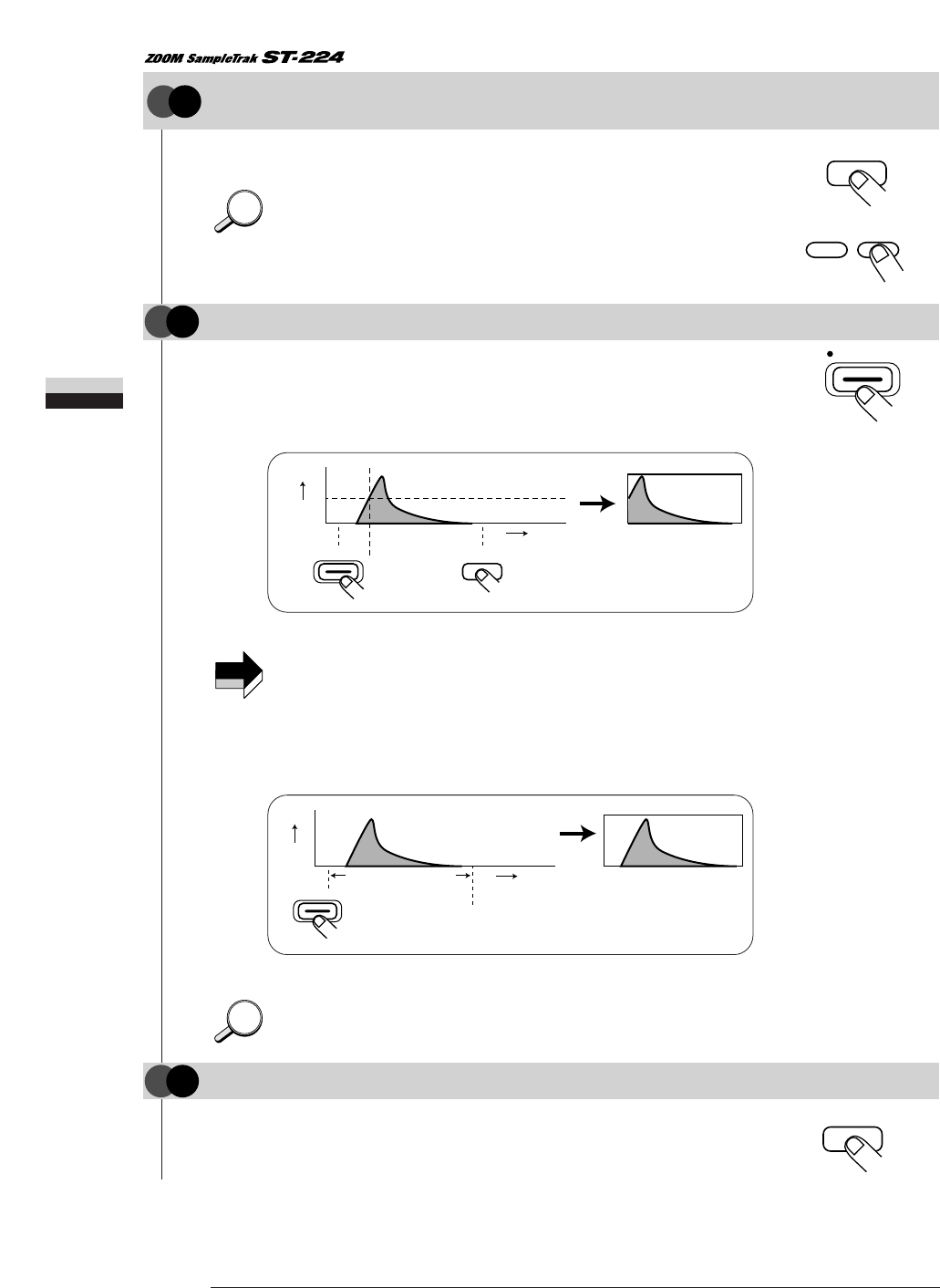
The ST-224 goes into the sampling standby mode, and the LED of
the [RECORD] key flashes.
In this mode, sampling will start when the signal level exceeds a
certain threshold (trigger level). This is useful for example for
sampling drums or percussion sounds.
While holding down the [SPECIAL] key, the currently selected trigger
level appears on the display. You can use the [-] and [+] keys to
change the trigger level. The following settings are available.
•ArMoFF (default setting)
Sampling starts immediately when [RECORD] key is pressed (auto
recording mode is off).
•ArM 1 - ArM 3
Auto recording mode is on. Higher figures mean a higher trigger
level.
In this mode, sampling will stop automatically after a certain interval
(called the auto sampling time) has elapsed. This is useful for
example for sampling guitar phrases that you play yourself.
While holding down the [PLAY/STOP] key, the currently selected auto
sampling time appears on the display. (The default setting is oFF.)
Besides the manual sampling procedure using the [RECORD] key as described above, the ST-224 also
allows auto sampling where the start and stop of sampling is controlled automatically. There are two auto
sampling modes: the auto recording mode where sampling starts automatically when the signal level
exceeds a certain threshold, and the auto stop mode where sampling stops automatically after a preset
interval.
BANK
SONG
PAD
1
FUNCTION
PAD ASSIGN
CAPACITY
ERASE OPTIMIZE
PLAY/STOP
RECORD
RE-SAMPLE
GRADE
MONO
STEREO
SAMPLING
EDIT 2
VOLUME/BASS
EXCITER
TREMOLO
AUTO PAN
LO-FI EFFECT
EXTREME EQ
COMPRESSOR
RESONANCE
HIGH-PASS
LOW-PASS
DISTORTION
RING MODULATOR
PITCH SHIFTER
DIMENSION
CHORUS
PHASER
FLANGER
STEP CRY
DELAY
REVERB
TIME STRETCH
SCRATCH
EFFECT
ON/OFF
PAD ENABLE
A
B
EFFECT SYNC
EDIT 1
4OFFSET
6
PANNING
TUNING
5
PRE COUNT
END POINT
3
TIME SIG
START POINT
1
BAR LENGTH
LEVEL
7
CLICK VOLUME
REVERSE
COPY DELETE
BACKUP
EXIT SPECIAL
LOAD SAVE
INTERNAL/DATA CARD
+
–
AUTO SYNC
PLAYLIST
TAP
BPM
SONG
PLAY/STOPREC
BPM/
VALUE
MEASURE
SAMPLE/SONGBEAT
Connect the sound source and adjust the input level. Then press the [RECORD] key.
1
STEP
Select the desired sampling grade and the mono/stereo setting.
2
STEP
To perform sampling in auto recording mode, hold down the [SPECIAL] key.
3
STEP
To perform auto stop sampling, hold down the [PLAY/STOP] key.
4
STEP
(2) Auto Sampling
RECORD
SPECIAL
PLAY/STOP
The value can be set in 1 second steps.
The auto sampling time can also be specified in BPM units. To do
this, hold down the [BPM] key and use the [-] and [+] keys to
change the time. The display will change to BPM units. The time
corresponding to four beats of the displayed BPM value will be the
auto sampling time. Pressing the [BPM] key again returns to the
normal display.
•When auto recording mode is selected
Sampling starts as soon as the signal exceeds the preset trigger
level for the first time. Pressing the [PLAY/STOP] key stops
sampling.
When auto recording mode is used to sample a source with a slow
attack curve, the beginning of an attack sound may be cut off.
•When auto stop mode is selected
Sampling starts according to the conditions set for auto recording
mode, and ends when the preset auto sampling time has elapsed.
Auto recording mode and auto stop mode can be used together.
By following steps 8 - 11 shown on page 22, you can assign the
sample to a pad.
HINTHINT
NOTE
HINTHINT
While holding down the [PLAY/STOP] key, use the [-] and [+] keys to change the auto stop
sampling time
5
STEP
Press the [RECORD] key to start sampling.
6
STEP
Use the [PLAY/STOP] key to check the recorded sample.
7
STEP
24
Let's Try Out Sampling
Level
Time
Trigger Level
Sample
Sampling start Sampling end
PLAY/STOP
RECORD
Auto recording mode sampling
Level
Time
Auto Sampling Time Sample
RECORD
Sampling start Sampling end
Auto stop sampling
RECORD
PLAY/STOP
PLAY/STOP
+–
[–] [+] keys
25
Pad Play Mode Operation
The corresponding LED lights up.
While the pad is pressed, its LED is lit and the sample assigned to the
pad is played from start to end. Playback of the sample then stops.
(This is called "one-shot playback".)
• The default operation mode is "gate playback" where the
sample is only played for as long as the pad is held down. The
mode can be changed to the trigger (or retrigger) mode as
described on page 33, some of factory preset sounds are set in
this mode.
• While a pad is being pushed, the bank cannot be switched. To
switch banks without sound interruption, choose loop playback
in step 3.
The sample will then be played repeatedly in a continuous loop.
(This is called "loop playback".)
• The action of the pad when the [LOOP/MARK] pad is pressed
depends on whether the pad playback mode ( ➔p. 33) is set to
gate playback or trigger (retrigger) playback.
• When a pad set to gate playback is hit while holding down the
[LOOP/MARK] pad, loop playback continues in the hold state
also when the pad is released. To stop playback, hit the same
pad again.
• If the sound of a pad set to trigger (retrigger) playback is playing,
and the pad is hit again while holding down the [LOOP/MARK]
pad, the sound does not stop (loop playback will begin after the
sample has played through). To stop playback, hit the same pad
again.
HINTHINT
NOTE
BANK
3
BANK
2
BANK
SONG
PAD
1
FUNCTION
EFFECT SYNC
EDIT 1
LOOP/MARK
4
SHIFT
OFFSET
6
SWING
PANNING
8
MIDI
TRIGGER/GATE
2
QUANTIZE
TUNING
SOURCE
SOURCE MIX
5
PRE COUNT
END POINT
3
TIME SIG
START POINT
1
BAR LENGTH
LEVEL
7
CLICK VOLUME
REVERSE
Use the [BANK 1] - [BANK 3] keys to select the desired bank.
1
STEP
Hit one of pads 1 - 8.
2
STEP
To play the sample continuously, hold the [LOOP/MARK] pad down while hitting the pad.
3
STEP
This section explains operation of the unit in pad play mode. In this mode, pads are played to produce their
assigned samples. This is the basic operation mode of the ST-224. The playback position and playback mode of
each sample are also adjusted in this mode.
Pad Play Mode Operation
Playing Samples In Pads 1 - 8
BANK
1
BANK 1– 3 keys
Pads 1 – 8
LOOP/MARK
+Pads 1 – 8
[LOOP/MARK] pad
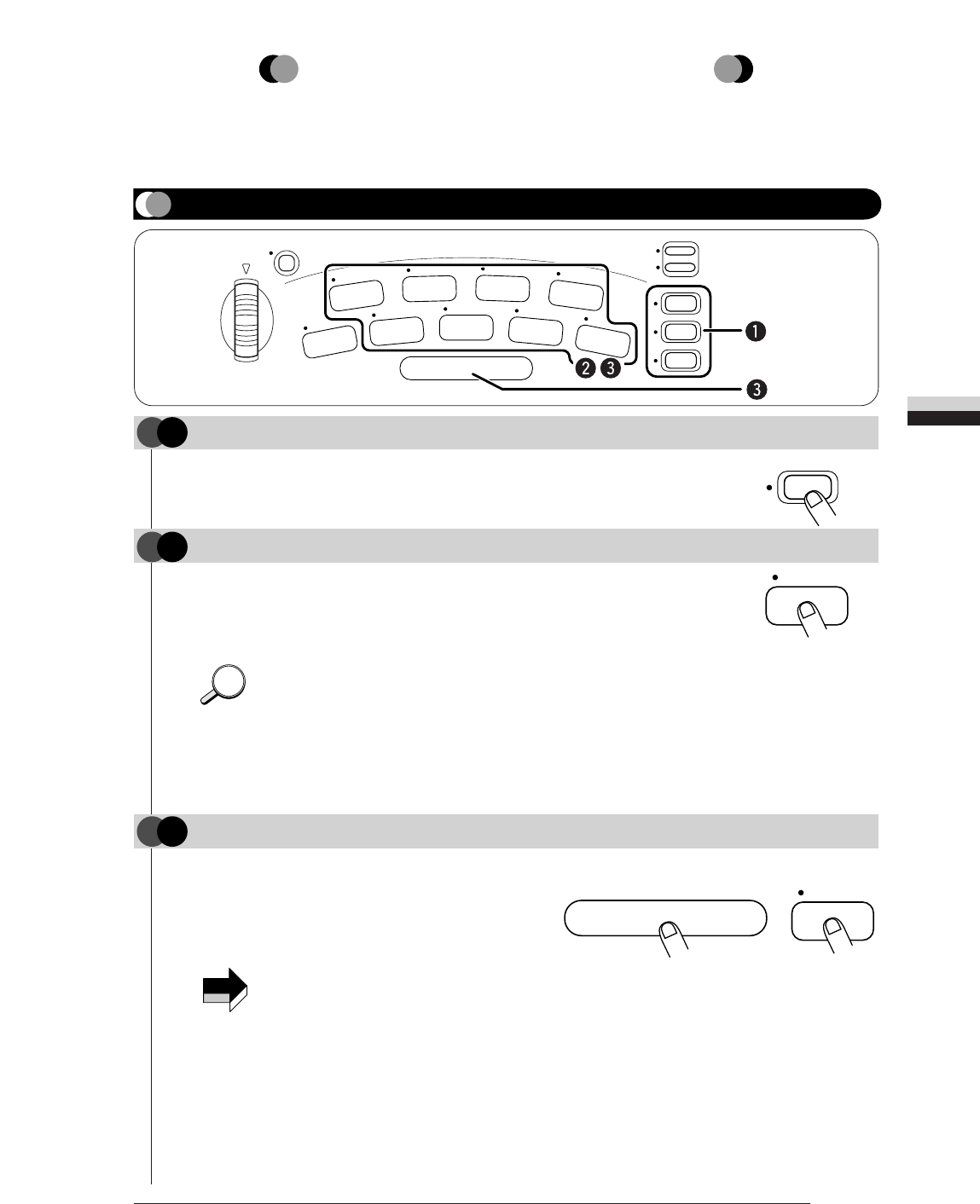
The [PAD FUNCTION] key is a special key that allows setting the
playback function for each pad. When the [PAD FUNCTION] key
and then the [SOURCE] pad is pressed, you can select whether
to send the signal from the input jacks constantly to the output
jacks (on) or send it only when hitting the [SOURCE] pad (oFF).
When set to "on" the signal from the input jacks is sent constantly to
the output jacks. When set to "oFF", the signal is sent only when
hitting the [SOURCE] pad. (The default setting is "oFF".)
The sound of the source is supplied to the output jacks only while the
[SOURCE] pad is pressed.
To keep the source sound that is supplied, hit the [SOURCE]
pad while holding down the [LOOP/MARK] pad.
HINTHINT
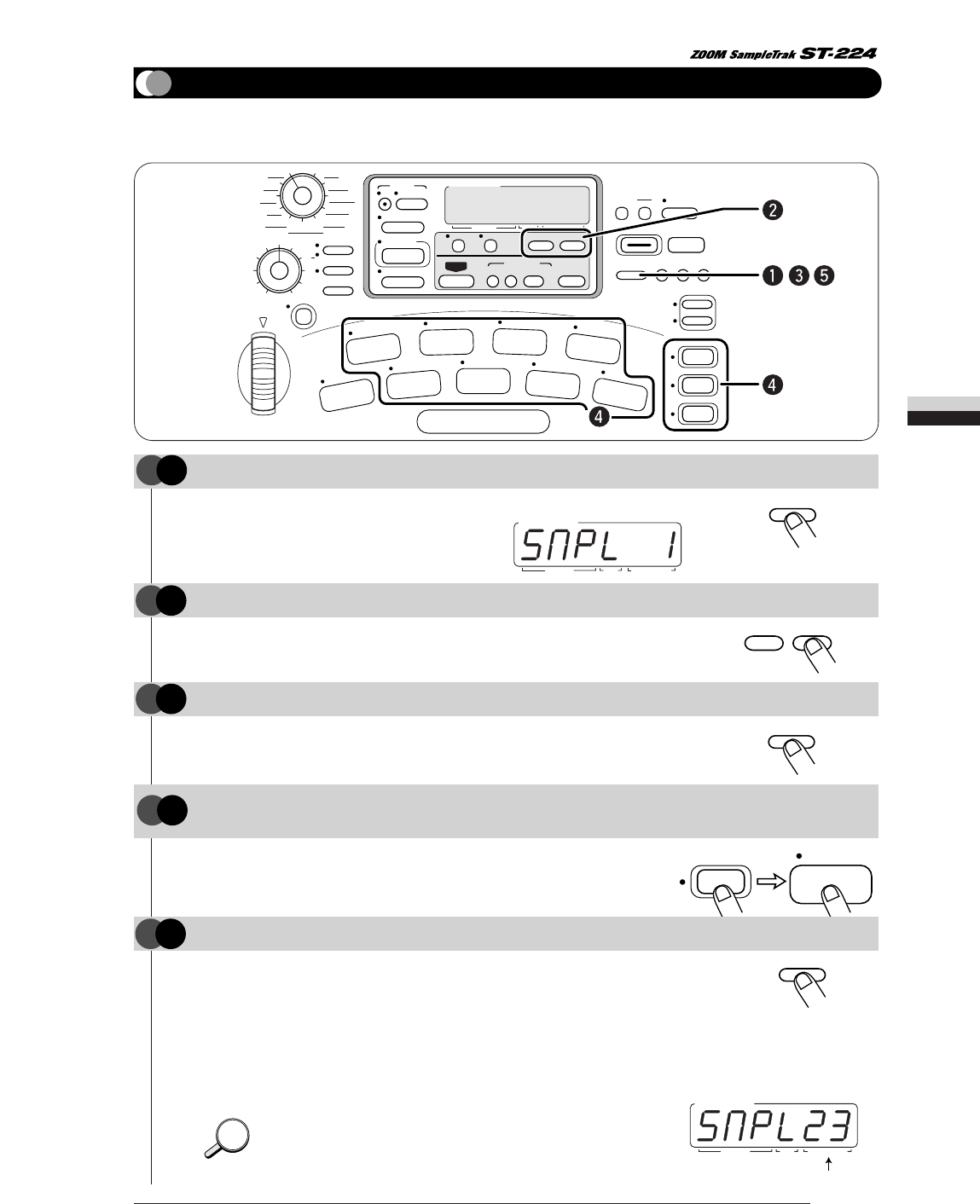
The [SOURCE] pad is a special pad that allows using an externally connected component as sound
source for pad play. For example, when a CD player or other source component is connected to the
[INPUT L/MONO] jack and [INPUT R] jack, the sound from that source will be heard while the
[SOURCE] pad is pressed. When the pad is released, the signal is muted ("gate playback"). By hitting the
[SOURCE] pad in the rhythm of the music, the external source can be switched on and off in the manner
of a DJ creating a special effect.
Sound source
[SOURCE] pad
Signal
Connect the sound source (CD player etc.) to the [INPUT R] and [INPUT L/MONO] jacks
( ➔p. 8 – 9).
1
STEP
Press the [PAD FUNCTION] key and then the [SOURCE] pad.
2
STEP
Use the [-] [+] keys or the [EDIT 1] wheel to set the display indication to "oFF".
3
STEP
Press the [PAD FUNCTION] key again.
4
STEP
Set the sound source to playback and hit the [SOURCE] pad.
5
STEP
26
Pad Play Mode Operation
Using the [SOURCE] Pad to Play an External Sound Source
BANK
3
BANK
2
BANK
SONG
PAD
1
FUNCTION
PAD ASSIGN
CAPACITY
ERASE OPTIMIZE
PLAY/STOP
RECORD
EDIT 2
HIGH-PASS
LOW-PASS
DISTORTION
RING MODULATOR
PITCH SHIFTER
DIMENSION
EFFECT
ON/OFF
PAD ENABLE
A
B
EFFECT SYNC
EDIT 1
LOOP/MARK
4
SHIFT
OFFSET
6
SWING
PANNING
8
MIDI
TRIGGER/GATE
2
QUANTIZE
TUNING
SOURCE
SOURCE MIX
5
PRE COUNT
END POINT
3
TIME SIG
START POINT
1
BAR LENGTH
LEVEL
7
CLICK VOLUME
REVERSE
COPY DELETE
BACKUP
EXIT SPECIAL
LOAD SAVE
INTERNAL/DATA CARD
+
–
AUTO SYNC
PLAYLIST
TAP
BPM
MEASURE
SAMPLE/SONGBEAT
SONG
PAD
FUNCTION
SOURCE
SOURCE MIX
+–
EDIT 1
[EDIT 1]
wheel
[–] [+] keys
Pad Play With [SOURCE] Pad
27
Pad Play Mode Operation
The number of the currently selected sample appears on the display.
The assign process is confirmed.
•To continue assigning samples
Repeat steps 1 - 5.
•To cancel the assign process
Press the [EXIT] key to return to the play mode.
To check which sample is assigned to a pad, press the [PAD
ASSIGN] key while holding down the pad. The sample number
appears on the display.
HINTHINT
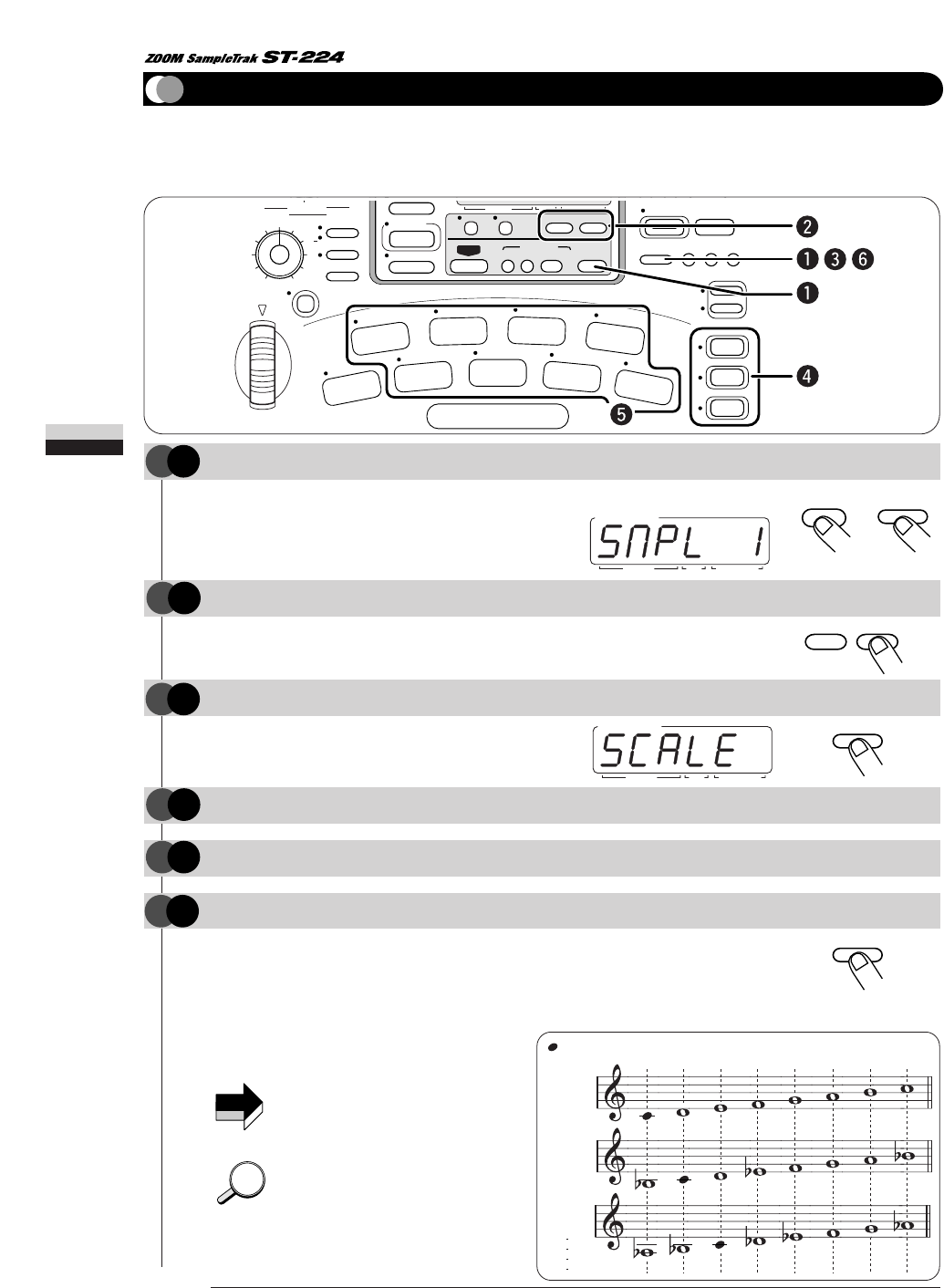
Samples stored in the main memory can be assigned to any desired pad also after sampling is completed.
This section explains how to select a sample from the main memory and assign it to a pad.
BANK
3
BANK
2
BANK
SONG
PAD
1
FUNCTION
PAD ASSIGN
CAPACITY
ERASE OPTIMIZE
PLAY/STOP
RECORD
RE-SAMPLE
GRADE
MONO
STEREO
SAMPLING
EDIT 2
VOLUME/BASS
EXCITER
TREMOLO
AUTO PAN
LO-FI EFFECT
EXTREME EQ
COMPRESSOR
RESONANCE
HIGH-PASS
LOW-PASS
DISTORTION
RING MODULATOR
PITCH SHIFTER
DIMENSION
CHORUS
PHASER
FLANGER
STEP CRY
DELAY
REVERB
TIME STRETCH
SCRATCH
EFFECT
ON/OFF
PAD ENABLE
A
B
EFFECT SYNC
EDIT 1
LOOP/MARK
4
SHIFT
OFFSET
6
SWING
PANNING
8
MIDI
TRIGGER/GATE
2
QUANTIZE
TUNING
SOURCE
SOURCE MIX
5
PRE COUNT
END POINT
3
TIME SIG
START POINT
1
BAR LENGTH
LEVEL
7
CLICK VOLUME
REVERSE
COPY DELETE
BACKUP
EXIT SPECIAL
LOAD SAVE
INTERNAL/DATA CARD
+
–
AUTO SYNC
PLAYLIST
TAP
BPM
SONG
PLAY/STOPREC
BPM/
VALUE
MEASURE
SAMPLE/SONGBEAT
PAD ASSIGN
PAD ASSIGN
+–
[–] [+] keys
PAD ASSIGN
BANK
1
BANK 1– 3 keys Pads 1 – 8
Press the [PAD ASSIGN] key.
1
STEP
Press the [PAD ASSIGN] key.
3
STEP
Use the [-] and [+] keys to select the sample number.
2
STEP
Use the [BANK 1] - [BANK 3] keys and the pads 1 - 8 to select the pad to which you want
to assign the sample.
4
STEP
Press the [PAD ASSIGN] key.
5
STEP
Assigning a Sample to a Pad
BPM/
VALUE
MEASURE
SAMPLE/SONGBEAT
Sample number
BPM/
VALUE
MEASURE
SAMPLE/SONGBEAT
28
Pad Play Mode Operation
The number of the currently selected sample appears on the display.
The indication "SCALE" appears on the display.
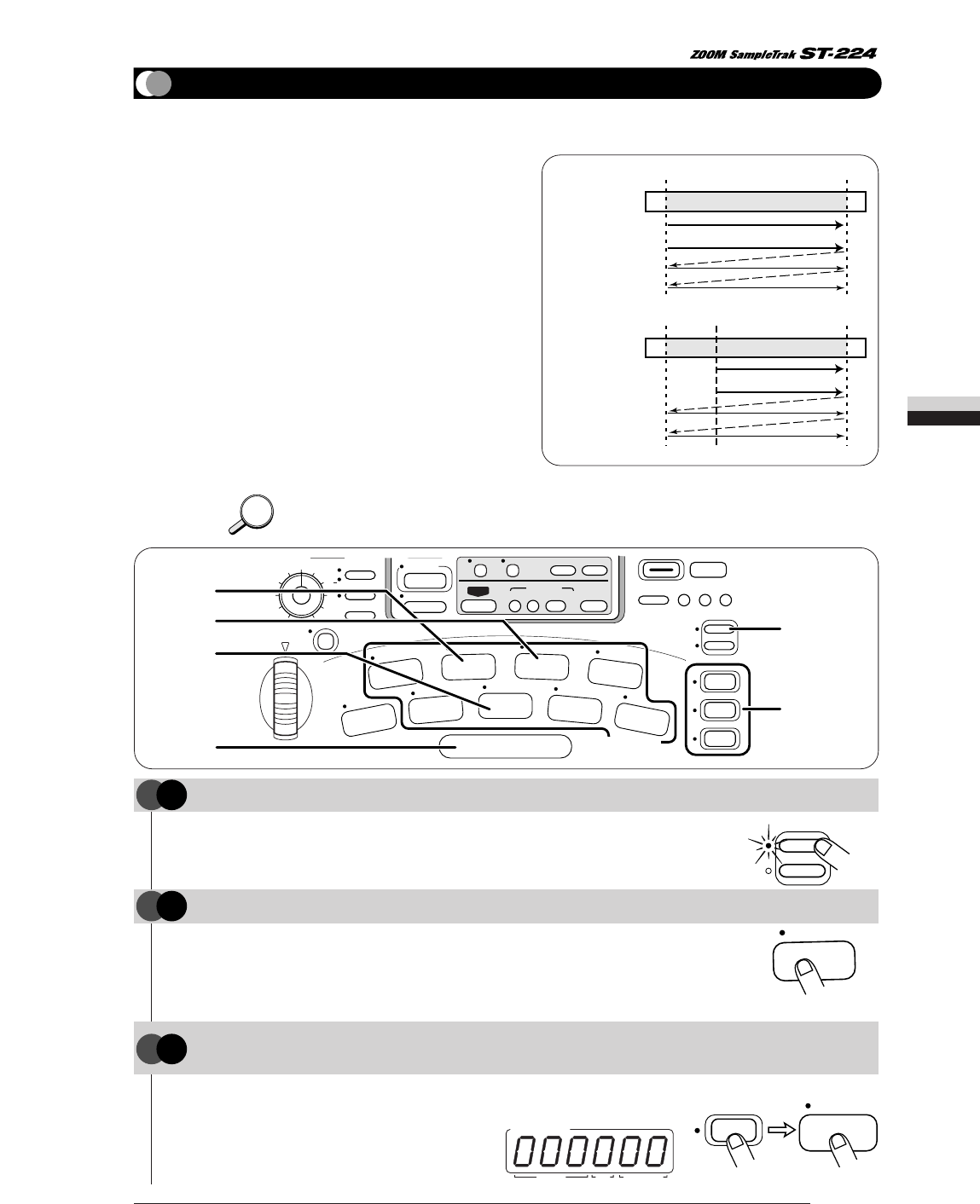
The sample selected in step 1 is assigned to all pads 1 - 8, and the
pad tuning is automatically changed using a Major scale, using pad 1
as the prime. For example, if the original pitch was middle C, the
tuning for the various pads, depending on the pad chosen in step 5,
will be as follows.
If the selected bank already contains
pads with samples, these will be
erased.
• When wishing to cancel the
automatic assignment process,
press the [EXIT] key.
• When wishing to use a different
scale, edit the TUNING parameter
for each pad in step 6 ( ➔p. 32).
NOTE
HINTHINT
Sometimes it may be useful to assign the same sample to several pads and play the pads with changed
pitch (such as when a single bass note was sampled). The ST-224 can automatically assign one sample to
pads 1 - 8 and change the pad tuning using a Major scale.
BANK
3
BANK
2
BANK
SONG
PAD
1
FUNCTION
PAD ASSIGN
CAPACITY
ERASE OPTIMIZE
PLAY/STOP
RECORD
EDIT 2
HIGH-PASS
LOW-PASS
DISTORTION
RING MODULATOR
PITCH SHIFTER
DIMENSION
EFFECT
ON/OFF
PAD ENABLE
A
B
EFFECT SYNC
EDIT 1
LOOP/MARK
4
SHIFT
OFFSET
6
SWING
PANNING
8
MIDI
TRIGGER/GATE
2
QUANTIZE
TUNING
SOURCE
SOURCE MIX
5
PRE COUNT
END POINT
3
TIME SIG
START POINT
1
BAR LENGTH
LEVEL
7
CLICK VOLUME
REVERSE
COPY DELETE
BACKUP
EXIT SPECIAL
LOAD SAVE
INTERNAL/DATA CARD
+
–
AUTO SYNC
PLAYLIST
TAP
BPM
MEASURE
SAMPLE/SONGBEAT
+
–
[–] [+] keys
+
PAD ASSIGN
SPECIAL
PAD ASSIGN
PAD ASSIGN
BPM/
VALUE
MEASURE
SAMPLE/SONGBEAT
While holding down the [SPECIAL] key, press the [PAD ASSIGN] key.
1
STEP
To activate the automatic assignment process, press the [PAD ASSIGN] key again.
6
STEP
Use the [-] and [+] keys to select the sample number.
2
STEP
Use the [BANK 1] - [BANK 3] keys to select the bank to which you want to assign the sample.
4
STEP
Press the [PAD ASSIGN] key again.
3
STEP
Use pads 1 - 8 to select the pad to which the sample should be assigned with the original pitch.
5
STEP
Assigning a Sample to a Major Scale
Pad 1
= Original pitch
Pad 2 Pad 3 Pad 4 Pad 5 Pad 6 Pad 7 Pad 8
Pad 1 was
pressed
Pad 2 was
pressed
Pad 3 was
pressed
BPM/
VALUE
MEASURE
SAMPLE/SONGBEAT
29
Pad Play Mode Operation
The [PAD FUNCTION] LED flashes.
The [PAD FUNCTION] LED and the LED of pad 3 are lit.
Pressing the [PAD FUNCTION] key and then pad 3 enables the
setting of the start point. All sample playback stops.
While the pad is held down, the sample assigned to the pad plays in
a loop.
The address of the currently set start point
is shown on the display. If the start point
has not been set, "000000" is shown.
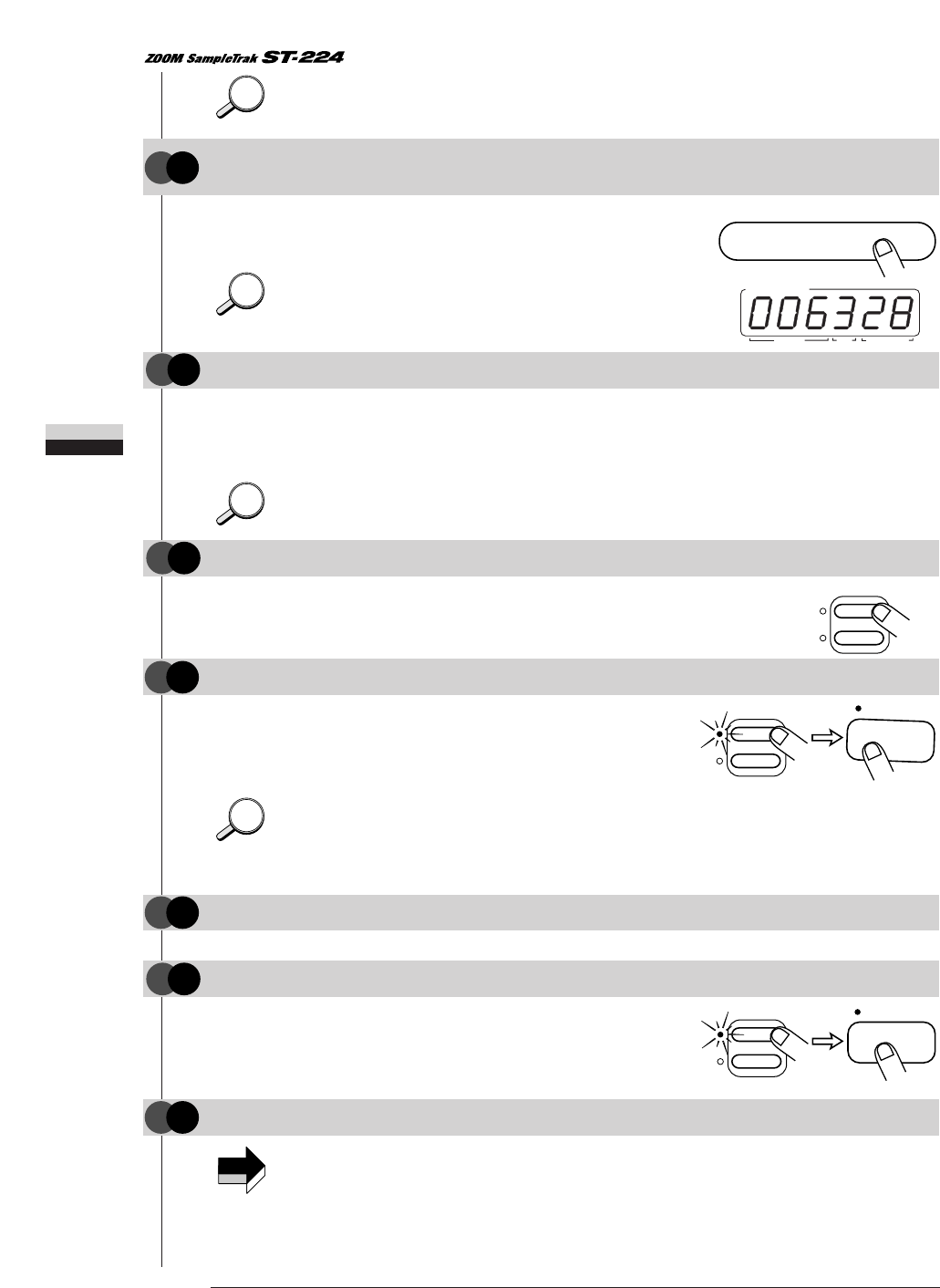
After assigning a sample to a pad, the following three parameters can be changed to specify the playback
position.
•Start point
Normal playback start point. When the pad is pressed,
playback starts from this point.
•End point
Normal playback end point. During one-shot playback,
playback ends when this point is reached. During loop
playback, playback returns to the start point when this
point is reached.
•Offset
By selecting this value, the playback start position can be
shifted forwards. During one-shot playback, playback
starts at the offset point and stops at the end point.
During loop playback, playback starts at the offset point
and returns to the start point when the end point is
reached.
When there is a blank at the beginning and end of the sample, it can be eliminated by
moving the start point and end point.
HINTHINT
BANK
3
BANK
2
BANK
SONG
PAD
1
FUNCTION
PAD ASSIGN
CAPACITY
ERASE OPTIMIZE
PLAY/STOP
RECORD
EDIT 2
HIGH-PASS
DISTORTION
RING MODULATOR
DIMENSION
EFFECT
ON/OFF
PAD ENABLE
A
B
EFFECT SYNC
EDIT 1
LOOP/MARK
4
SHIFT
OFFSET
6
SWING
PANNING
8
MIDI
TRIGGER/GATE
2
QUANTIZE
TUNING
SOURCE
SOURCE MIX
5
PRE COUNT
END POINT
3
TIME SIG
START POINT
1
BAR LENGTH
LEVEL
7
CLICK VOLUME
REVERSE
COPY DELETE
BACKUP
EXIT SPECIAL
LOAD SAVE
INTERNAL/DATA CARD
+
–
AUTO SYNC
TAP
BPM
MEASURE
SAMPLE/SONGBEAT
qy
uo
e
ret
w
o
u
SONG
PAD
FUNCTION
3
TIME SIG
START POINT
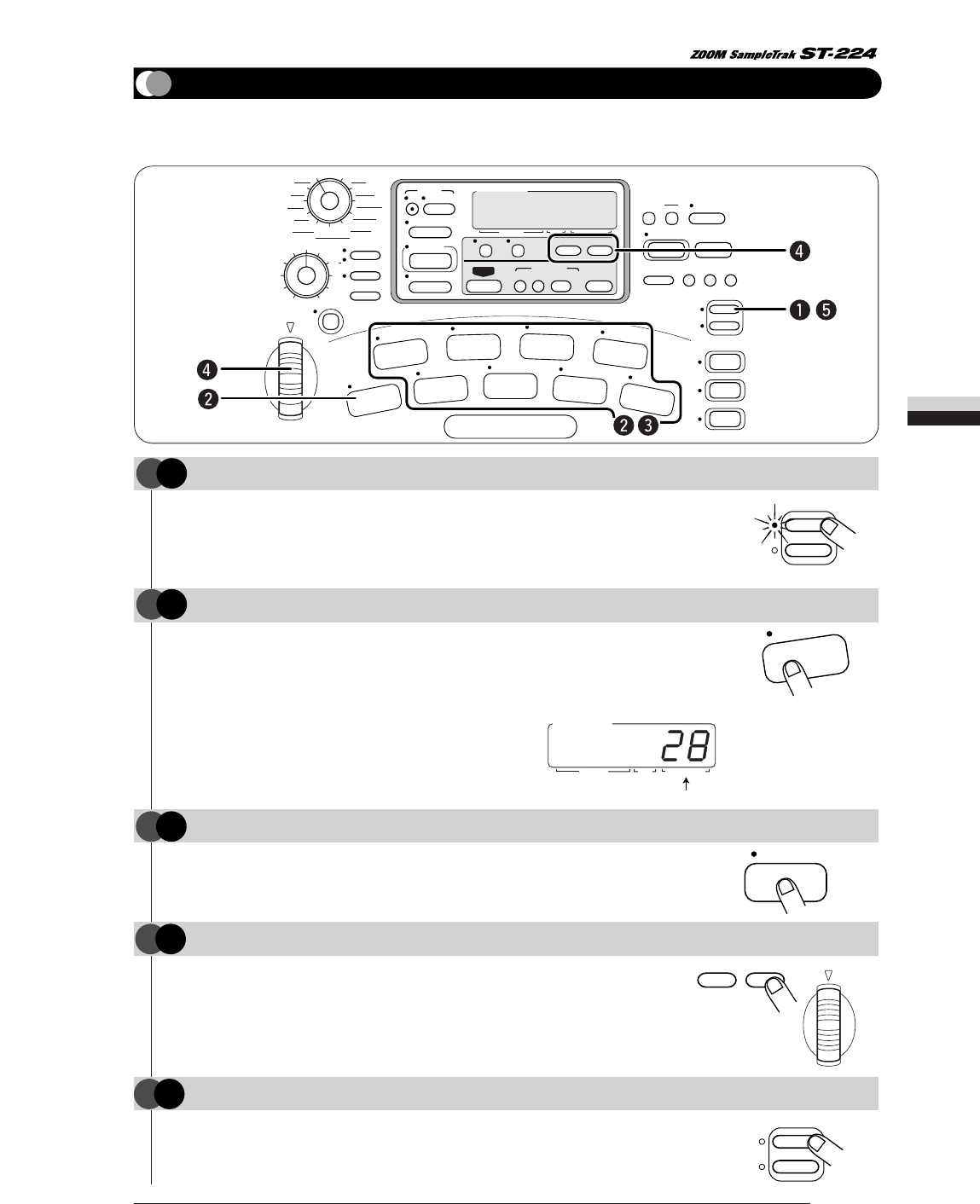
Press the [PAD FUNCTION] key.
1
STEP
To set the start point, press pad 3 (START POINT).
2
STEP
Use the [BANK 1] - [BANK 3] keys and the pads 1 - 8 to select the pad for which to set the
start point.
3
STEP
Setting the Sample Playback Position
Sample
Start point
[One-shot playback]
[Loop playback]
[One-shot playback]
[Loop playback]
End point
End point
Sample
Start point Offset point
BANK
1
BANK 1– 3 keys Pads 1 – 8
BPM/
VALUE
MEASURE
SAMPLE/SONGBEAT
30
The display indication can be switched from number of samples to
milliseconds. To do this, press the [SPECIAL] key after step 3.
The address of that point (or the time in milliseconds) is shown on the
display, and the new start point is set to this location.
It is also possible to use the [EDIT 1] wheel for setting the start
point. Moving the wheel during loop playback sets the start point
to that location. For fine adjustment, hold down the [SOURCE] pad
while turning the [EDIT 1] wheel.
If necessary, the [-] [+] keys can be used to fine-tune the start point. It
is also possible to directly specify the address with the [-] [+] keys
without using the[LOOP/[MARK] pad or the [EDIT 1] wheel.
To return the start point set with the [LOOP/MARK] pad to the
original position, press the [LOOP/MARK] pad again when
playback has stopped.
The [PAD FUNCTION] LED goes out and the new start point is set.
The [PAD FUNCTION] LED and the LED of pad 5 are lit.
Pressing the [PAD FUNCTION] key and then pad 5 enables
the setting of the end point.
Pressing the [BPM] key while setting the end point switches the
display to BPM units. This value is automatically calculated,
considering the passage from the start point to the end point as 4
beats.
Pressing the [BPM] key again switches back to normal display.
The [PAD FUNCTION] LED and the LED of pad 4 are lit.
Pressing the [PAD FUNCTION] key and then pad 4 enables
the setting of the offset.
• All settings can only be made within the length range of the
current sample.
• The start point cannot be set to fall after the end point, and the
end point cannot be set to fall before the start point.
• The offset point cannot be set to fall outside of the range
between start point and end point.
HINTHINT
HINTHINT
HINTHINT
HINTHINT
NOTE
BPM/
VALUE
MEASURE
SAMPLE/SONGBEAT
LOOP/MARK
[LOOP/MARK] pad
SONG
PAD
FUNCTION
SONG
PAD
FUNCTION
5
PRE COUNT
END POINT
SONG
PAD
FUNCTION
4
SHIFT
OFFSET
While listening to the loop playback of the sample, hit the [LOOP/MARK] pad at the point
you want to designate as start point.
4
STEP
Press the pad selected in step 3 to confirm the new start point.
5
STEP
Press the [PAD FUNCTION] key.
6
STEP
Set the new end point, using the same procedure as described in steps 3 - 6.
8
STEP
To modify the offset, press the [PAD FUNCTION] key and then pad 4 (OFFSET).
9
STEP
Set the new offset, using the same procedure as described in steps 3 - 6.
10
STEP
To modify the end point, press the [PAD FUNCTION] key and then pad 5 (END POINT).
7
STEP
Pad Play Mode Operation
31
Pad Play Mode Operation
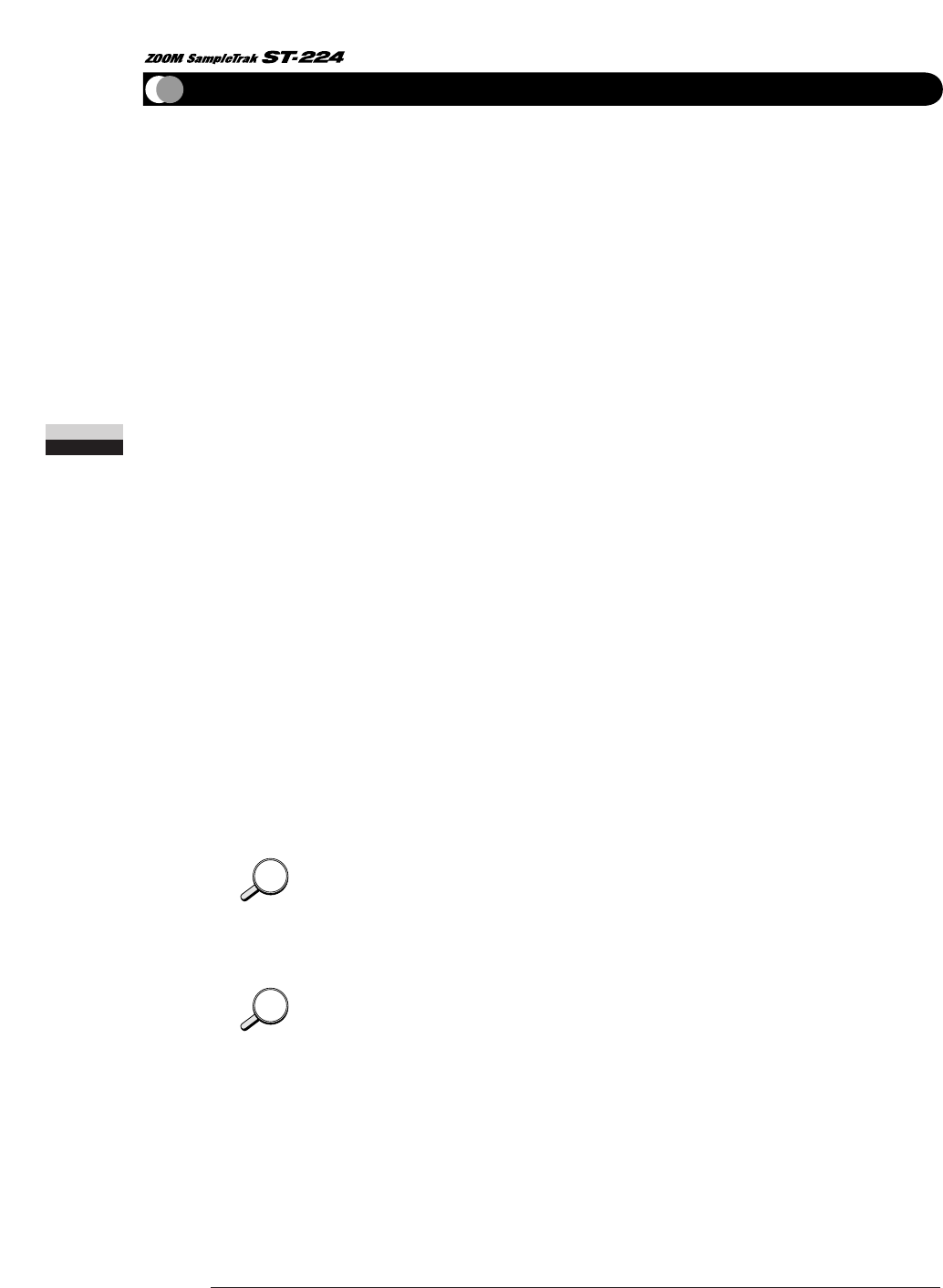
The [PAD FUNCTION] LED flashes.
(Parameter names are printed at the top right of the pads.) The [PAD
FUNCTION] LED and the LED of the selected pad light up, and the
current setting of that parameter is shown on the display. For a
detailed explanation of parameters, see page 32.
For some parameters, the [LOOP/MARK] pad can also be used to
specify a setting ( ➔p. 32).
The change is made and the unit reverts to the pad play mode.
The playback parameters such as level, tuning, playback position, etc. can be set individually for each
pad.
BANK
3
BANK
2
BANK
SONG
PAD
1
FUNCTION
PAD ASSIGN
CAPACITY
ERASE OPTIMIZE
PLAY/STOP
RECORD
RE-SAMPLE
GRADE
MONO
STEREO
SAMPLING
EDIT 2
VOLUME/BASS
EXCITER
TREMOLO
AUTO PAN
LO-FI EFFECT
EXTREME EQ
COMPRESSOR
RESONANCE
HIGH-PASS
LOW-PASS
DISTORTION
RING MODULATOR
PITCH SHIFTER
DIMENSION
CHORUS
PHASER
FLANGER
STEP CRY
DELAY
REVERB
TIME STRETCH
SCRATCH
EFFECT
ON/OFF
PAD ENABLE
A
B
EFFECT SYNC
EDIT 1
LOOP/MARK
4
SHIFT
OFFSET
6
SWING
PANNING
8
MIDI
TRIGGER/GATE
2
QUANTIZE
TUNING
SOURCE
SOURCE MIX
5
PRE COUNT
END POINT
3
TIME SIG
START POINT
1
BAR LENGTH
LEVEL
7
CLICK VOLUME
REVERSE
COPY DELETE
BACKUP
EXIT SPECIAL
LOAD SAVE
INTERNAL/DATA CARD
+
–
AUTO SYNC
PLAYLIST
TAP
BPM
SONG
PLAY/STOPREC
BPM/
VALUE
MEASURE
SAMPLE/SONGBEAT
SONG
PAD
FUNCTION
1
BAR LENGTH
LEVEL
SONG
PAD
FUNCTION
+–
EDIT 1
[EDIT 1]
wheel
[–] [+] keys
Parameter setting value
BPM/
VALUE
MEASURE
SAMPLE/SONGBEAT
Press the [PAD FUNCTION] key.
1
STEP
Press one of pads 1 - 8 or the [SOURCE] pad to select the parameter to change.
2
STEP
Press the pad whose parameter you want to edit.
3
STEP
Use the [-] [+] keys or the [EDIT 1] wheel to change the setting.
4
STEP
Press the [PAD FUNCTION] key again.
5
STEP
Setting the Playback Parameters for Each Pad
Pads 1 – 8
32
Pad Play Mode Operation
The types and values of parameters that can be set for pads 1 - 8 and the [SOURCE] pad are as follows.
• [SOURCE] pad (SOURCE MIX)
When this parameter is set to "on", the signal supplied at the input jacks is always sent to the output jacks. When
the parameter is "oFF", the signal is sent only while the [SOURCE] pad is being pressed. The [-] [+] keys or the
[EDIT 1] wheel can be used to change the setting. For information on use of the [SOURCE] pad, see page 26.
Setting values: on, oFF (Default settings: oFF)
• Pad 1 (LEVEL)
Sets the output level for each sample. The [-] [+] keys or the [EDIT 1] wheel can be used to select a setting
between 1 and 100. This parameter is also valid for the [SOURCE] pad. Pressing the [LOOP/MARK] pad resets
the unit to the default (50).
Setting values: 1 - 100 (Default settings: 50)
• Pad 2 (TUNING)
Allows pitch tuning for each sample in units of 1 cent, over a range of +-3 octaves.
The [-] [+] keys serve to change the setting in cent units, and the [EDIT 1] wheel in semitone units. The tuning
setting can also be made in BPM units. In this case, the [BPM] key must be held down while the [-] [+] keys or
the [EDIT 1] wheel are used (the indication "BPM" appears on the display).
Pressing the [LOOP/MARK] pad resets the unit to the original tuning. Pressing the [BPM] key again
switches back to normal display.
Setting values: -36.00 - 36.00 (Default settings: 0) / 40 - 250 (BPM)
• Pad 3 (START POINT)
• Pad 4 (OFFSET)
• Pad 5 (END POINT)
Serve to set the start point, offset, and end point respectively. The [LOOP/MARK] pad
serves to specify the point and the [-] [+] keys allow fine-tuning. (For details, see page
29.)
Setting values: 000000 - 960000 (sample units) or 0.000 - 120.000 (S units)
(Default settings Start point: 0 Offset: 0 End point: last address)
The start point, offset, and end point can be displayed in sample units or in
millisecond units. To switch the display method, press the [SPECIAL] key. The end
point can also be set in BPM units.
• Pad 6 (PANNING)
Sets the panning position (left/right channel distribution) of the sample. When the setting is "L50", the
sample plays only in the left channel. A setting of "0" is center, and a setting of "r50" right channel only. Use
the [-] [+] keys or the [EDIT 1] wheel to make the setting. This parameter is also valid for the [SOURCE] pad.
Pressing the [LOOP/MARK] pad resets the unit to the default (0).
Setting values: L50 - 0 - r50 (Default settings: 0)
HINTHINT
HINTHINT
Pad Parameters
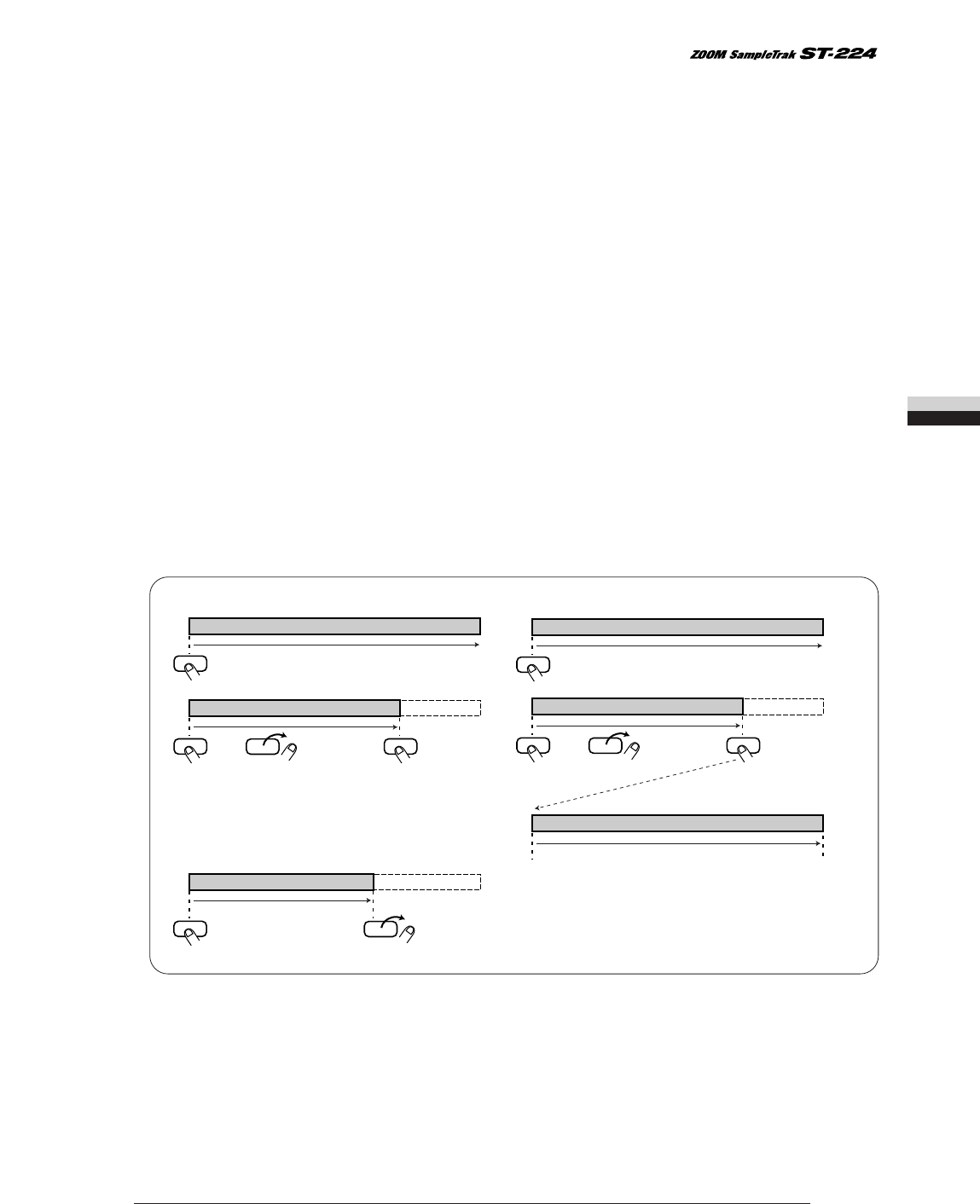
• Pad 7 (REVERSE)
Switches between reverse playback (on) and normal playback (oFF). When "on" is selected, playback
proceeds from the end point to the start point. Use the [- ] [+] keys or the [EDIT 1] wheel or the
[LOOP/MARK] pad to make the setting.
Setting values: oFF, on (Default settings: oFF)
• Pad 8 (TRIGGER/GATE)
Selects one of the following three playback modes. Use the [-] [+] keys or the [EDIT 1] wheel or the
[LOOP/MARK] pad to make the setting. This parameter is also valid for the [SOURCE] pad.
• Trigger playback
Sound starts when pad is hit once and stops when pad is hit again.
• Retrigger playback
Same as trigger playback, but hitting the pad during playback restarts from the beginning.
The [SOURCE] pad can not be set with this value.
• Gate playback
Sound is heard only while pad is held down and stops when pad is released (default).
Setting values: trGGEr/rEtrG/GAtE (Default settings: GAtE)
33
Pad Play Mode Operation
[Trigger playback]
Sample plays to the end when pad is hit once
[Gate playback]
[Re-Trigger playback]
Sample plays to the end when pad is hit once
Sample plays only while pad is held down
Sample stops when same pad
is hit again during play Pressing a pad that is playing
stops play and then resumes
from the beginning
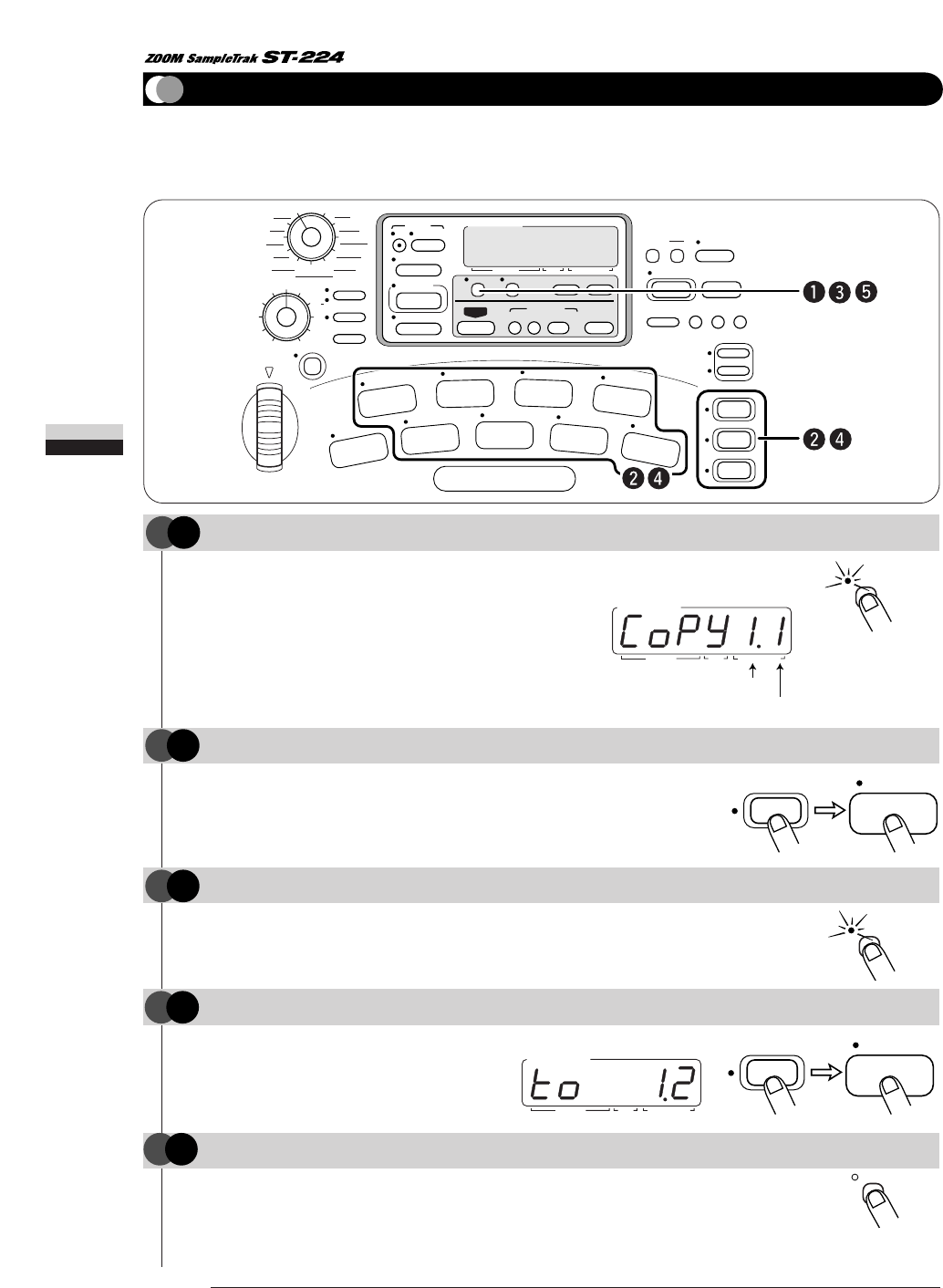
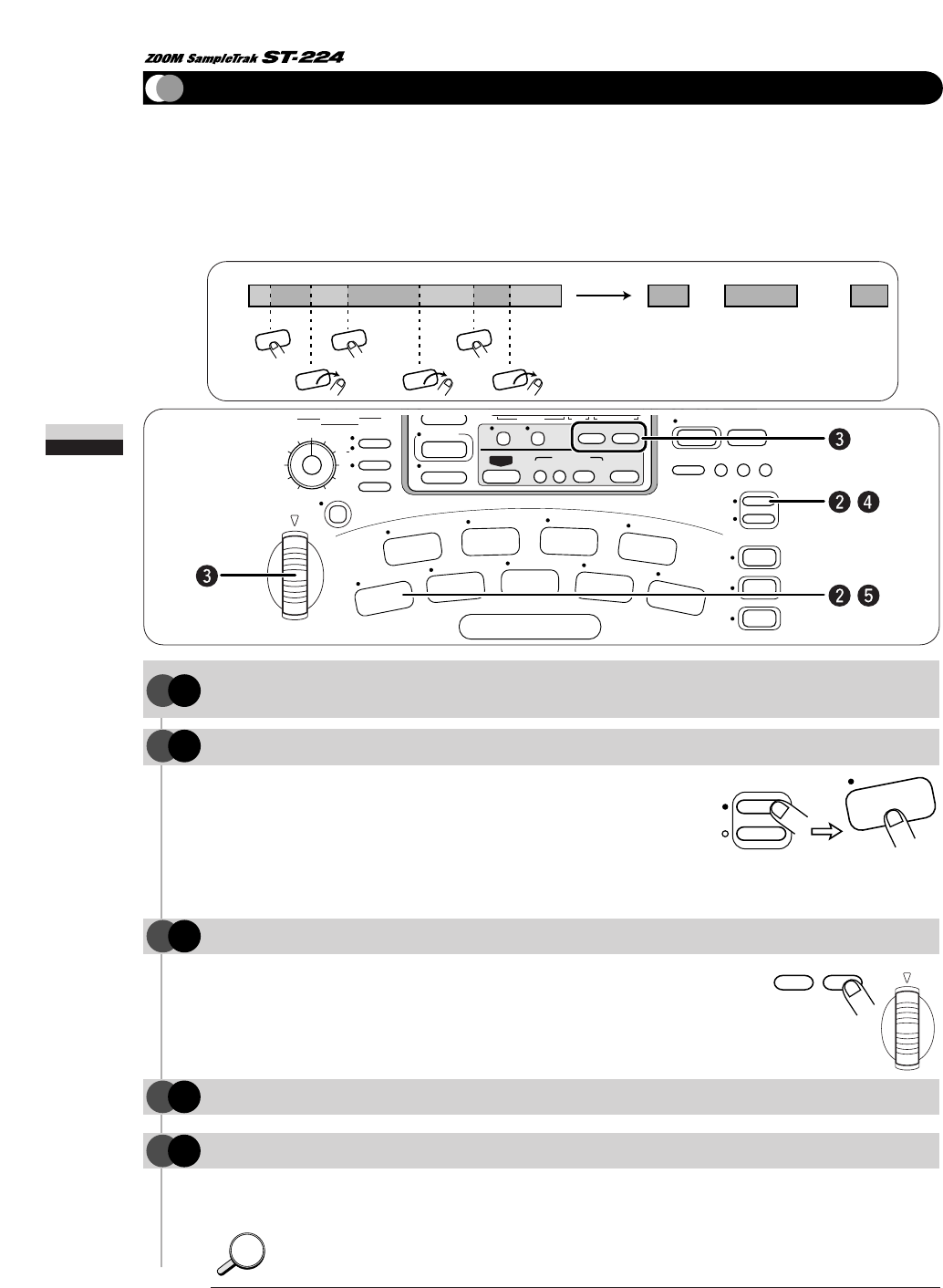
The [COPY] LED flashes and the bank number (1 - 3) and pad number
(1 - 8) of the copy source are shown on the display.
The copy source is selected.
The copy is carried out. To cancel the copy process, press the [EXIT]
key.
The settings for a given pad (sample number, playback position, playback method, etc.) can be copied to
another pad. This is useful for example when wishing to play the same sample with two pads, while changing
only the tuning and panning settings.
BANK
3
BANK
2
BANK
SONG
PAD
1
FUNCTION
PAD ASSIGN
CAPACITY
ERASE OPTIMIZE
PLAY/STOP
RECORD
RE-SAMPLE
GRADE
MONO
STEREO
SAMPLING
EDIT 2
VOLUME/BASS
EXCITER
TREMOLO
AUTO PAN
LO-FI EFFECT
EXTREME EQ
COMPRESSOR
RESONANCE
HIGH-PASS
LOW-PASS
DISTORTION
RING MODULATOR
PITCH SHIFTER
DIMENSION
CHORUS
PHASER
FLANGER
STEP CRY
DELAY
REVERB
TIME STRETCH
SCRATCH
EFFECT
ON/OFF
PAD ENABLE
A
B
EFFECT SYNC
EDIT 1
LOOP/MARK
4
SHIFT
OFFSET
6
SWING
PANNING
8
MIDI
TRIGGER/GATE
2
QUANTIZE
TUNING
SOURCE
SOURCE MIX
5
PRE COUNT
END POINT
3
TIME SIG
START POINT
1
BAR LENGTH
LEVEL
7
CLICK VOLUME
REVERSE
COPY DELETE
BACKUP
EXIT SPECIAL
LOAD SAVE
INTERNAL/DATA CARD
+
–
AUTO SYNC
PLAYLIST
TAP
BPM
SONG
PLAY/STOPREC
BPM/
VALUE
MEASURE
SAMPLE/SONGBEAT
COPY
BANK
1
BANK 1– 3 keys Pads 1 – 8
BANK
1
BANK 1– 3 keys Pads 1 – 8
COPY
COPY
Bank number
Pad number
BPM/
VALUE
MEASURE
SAMPLE/SONGBEAT
BPM/
VALUE
MEASURE
SAMPLE/SONGBEAT
Press the [COPY] key.
1
STEP
Use the [BANK 1] - [BANK 3] keys and the pads 1 - 8 to select the pad to which to copy.
4
STEP
Use the [BANK 1] - [BANK 3] keys and the pads 1 - 8 to select the pad from which to copy.
2
STEP
Press the [COPY] key.
3
STEP
Press the [COPY] key again.
5
STEP
Copying Pad Settings
34
Pad Play Mode Operation
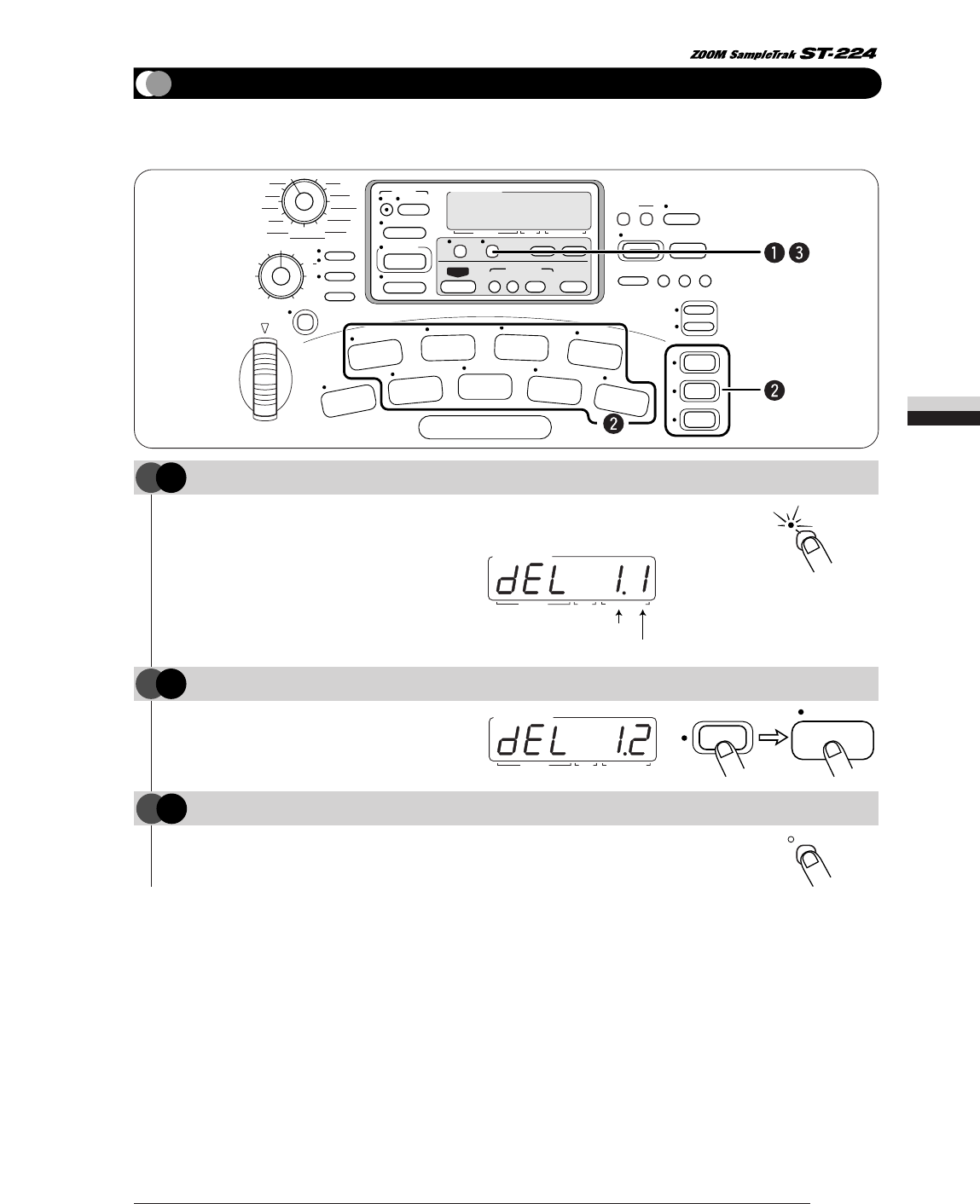
35
Pad Play Mode Operation
The [DELETE] LED flashes and the bank number (1 - 3) and pad
number (1 - 8) of the pad to be deleted are shown on the display.
The settings for the pad are deleted. To cancel the delete process,
press the [EXIT] key instead of the [DELETE] key.
The settings for a given pad can be erased when no longer needed. When the settings for a pad are erased,
the sample reverts to the original (unassigned) condition.
BANK
3
BANK
2
BANK
SONG
PAD
1
FUNCTION
PAD ASSIGN
CAPACITY
ERASE OPTIMIZE
PLAY/STOP
RECORD
RE-SAMPLE
GRADE
MONO
STEREO
SAMPLING
EDIT 2
VOLUME/BASS
EXCITER
TREMOLO
AUTO PAN
LO-FI EFFECT
EXTREME EQ
COMPRESSOR
RESONANCE
HIGH-PASS
LOW-PASS
DISTORTION
RING MODULATOR
PITCH SHIFTER
DIMENSION
CHORUS
PHASER
FLANGER
STEP CRY
DELAY
REVERB
TIME STRETCH
SCRATCH
EFFECT
ON/OFF
PAD ENABLE
A
B
EFFECT SYNC
EDIT 1
LOOP/MARK
4
SHIFT
OFFSET
6
SWING
PANNING
8
MIDI
TRIGGER/GATE
2
QUANTIZE
TUNING
SOURCE
SOURCE MIX
5
PRE COUNT
END POINT
3
TIME SIG
START POINT
1
BAR LENGTH
LEVEL
7
CLICK VOLUME
REVERSE
COPY DELETE
BACKUP
EXIT SPECIAL
LOAD SAVE
INTERNAL/DATA CARD
+
–
AUTO SYNC
PLAYLIST
TAP
BPM
SONG
PLAY/STOPREC
BPM/
VALUE
MEASURE
SAMPLE/SONGBEAT
Clearing Pad Settings
DELETE
BANK
1
BANK 1– 3 keys Pads 1 – 8
DELETE
BPM/
VALUE
MEASURE
SAMPLE/SONGBEAT
Bank number
Pad number
BPM/
VALUE
MEASURE
SAMPLE/SONGBEAT
Use the [BANK 1] - [BANK 3] keys and the pads 1 - 8 to select the pad to delete.
2
STEP
Press the [DELETE] key.
1
STEP
Press the [DELETE] key again.
3
STEP
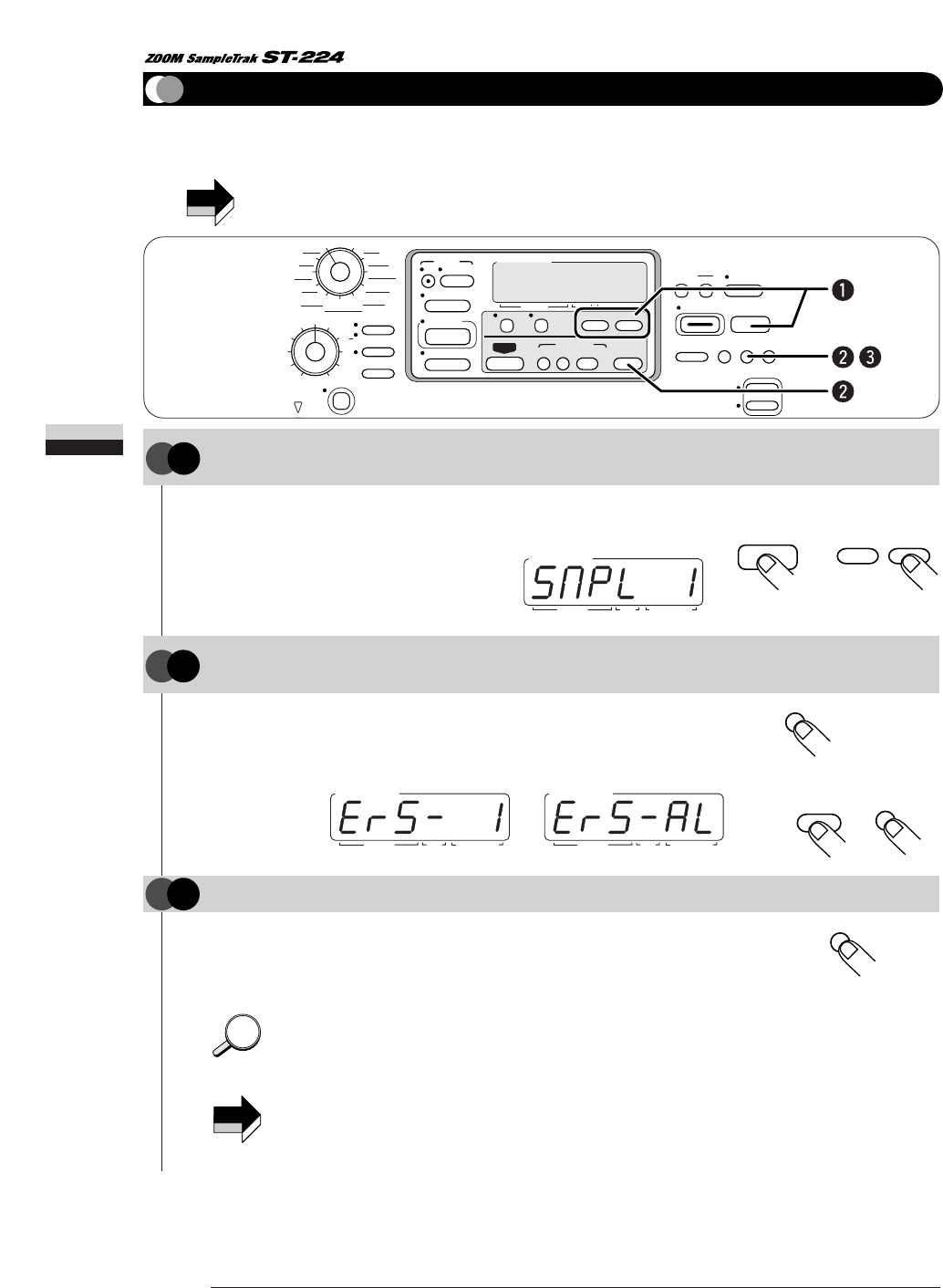
You can delete a specific sample or all samples from the main memory. This is useful for example to
remove all preprogrammed samples or to remove unwanted samples in order to free up memory.
Also when all samples are erased, the preprogrammed samples of the ST-224 can be
restored by initializing the unit.
While the [PLAY/STOP] key is held down, the display shows the
currently selected sample number. Use the [-] [+] keys to change the
sample number.
When a selected sample is being erased, the indication "ErS-XX" (XX
is the sample number) is shown on the display. When all samples are
being erased, the indication "ErS-AL" is shown on the display.
After erasing is completed, the unit reverts to the normal play mode.
To cancel the erase process, press the [EXIT] key instead of the
[ERASE] key.
Take care that you do not erase a sample you wish to keep. If a
sample has not been transferred to the internal backup memory or
an external data card, an erased sample cannot be restored.
• Also when a specific sample is erased, the numbers of the other
samples do not change.
• Also when all samples are erased, the preprogrammed samples
of the ST-224 can be restored by initializing the unit.
HINTHINT
NOTE
NOTE
SONG
PAD
FUNCTION
PAD ASSIGN
CAPACITY
ERASE OPTIMIZE
PLAY/STOP
RECORD
RE-SAMPLE
GRADE
MONO
STEREO
SAMPLING
EDIT 2
VOLUME/BASS
EXCITER
TREMOLO
AUTO PAN
LO-FI EFFECT
EXTREME EQ
COMPRESSOR
RESONANCE
HIGH-PASS
LOW-PASS
DISTORTION
RING MODULATOR
PITCH SHIFTER
DIMENSION
CHORUS
PHASER
FLANGER
STEP CRY
DELAY
REVERB
TIME STRETCH
SCRATCH
EFFECT
ON/OFF
PAD ENABLE
A
B
EFFECT SYNC
EDIT 1
5
E
STARTPOINT
COPY DELETE
BACKUP
EXIT SPECIAL
LOAD SAVE
INTERNAL/DATA CARD
+
–
AUTO SYNC
PLAYLIST
TAP
BPM
SONG
PLAY/STOPREC
BPM/
VALUE
MEASURE
SAMPLE/SONGBEAT
+
PLAY/STOP
[–] [+] keys
+–
SPECIAL+ERASE
ERASE
or
ERASE
To erase a specific sample, hold down the [PLAY/STOP] key and use the [-] [+] keys to
select the sample number.
1
STEP
To erase the selected sample only, press the [ERASE] key. To erase all samples, hold
down the [SPECIAL] key and press the [ERASE] key.
2
STEP
Press the [ERASE] key again to carry out the erase process.
3
STEP
Erasing a Sample
36
Pad Play Mode Operation
BPM/
VALUE
MEASURE
SAMPLE/SONGBEAT
BPM/
VALUE
MEASURE
SAMPLE/SONGBEAT
BPM/
VALUE
MEASURE
SAMPLE/SONGBEAT
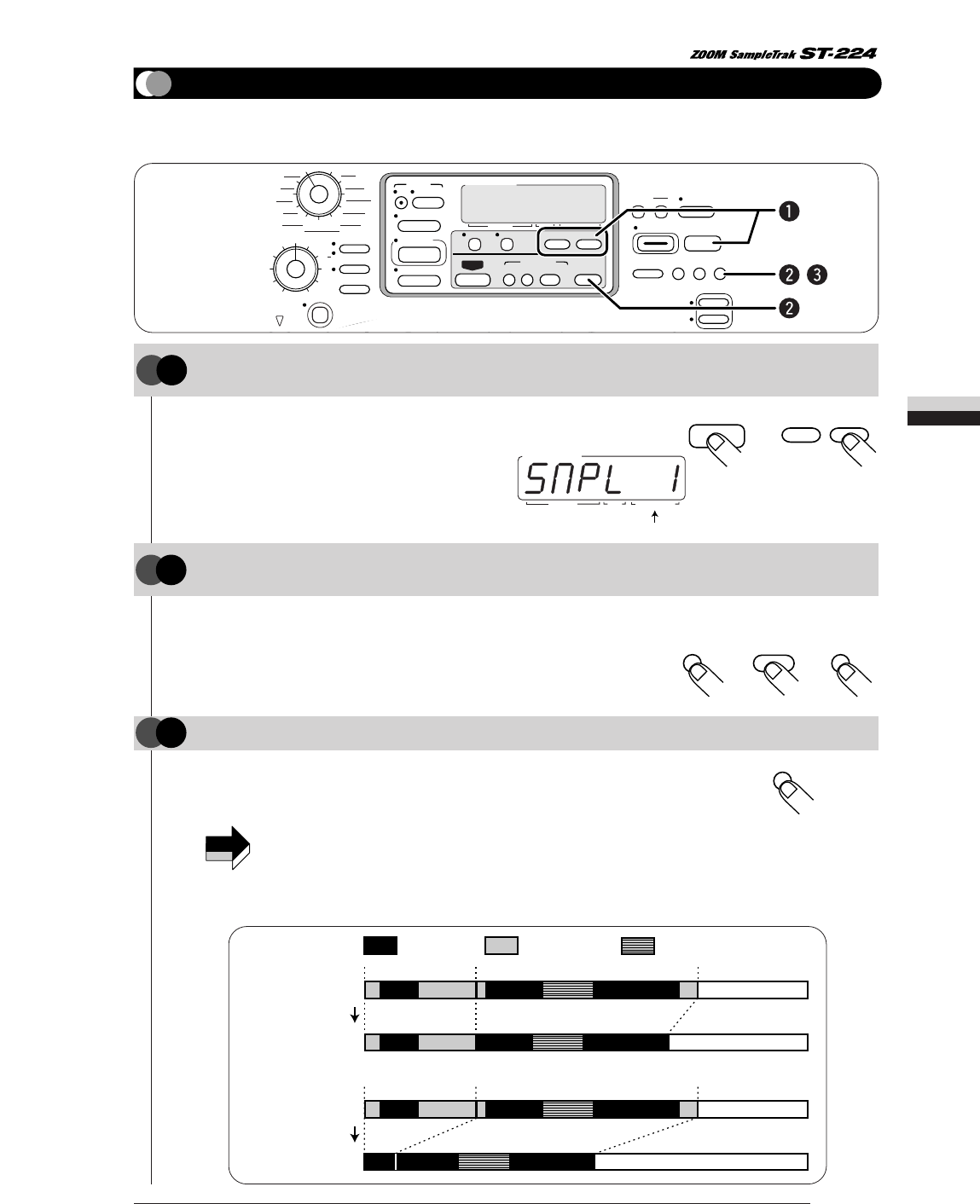
37
Pad Play Mode Operation
While the [PLAY/STOP] key is held down, the display shows the
currently selected sample number. Use the [-] [+] keys to change the
sample number.
When a selected sample is being optimized, the indication "oPt-XX"
(XX is the sample number) is shown on the display. When all samples
are being optimized, the indication "oPt-AL" is shown on the display.
After optimizing is completed, the unit reverts to the normal play
mode.
• When several waveforms out of a single sample are assigned to
pads, unused parts are not optimized.
• If a sample has not been transferred to the internal backup
memory or an external data card, it cannot be restored after
optimizing.
Samples that are not assigned to pads or any unused portion can be erased to free up memory in the main
memory. This is called optimizing. The process can be applied to a specific sample or to all samples.
SONG
PAD
FUNCTION
PAD ASSIGN
CAPACITY
ERASE OPTIMIZE
PLAY/STOP
RECORD
RE-SAMPLE
GRADE
MONO
STEREO
SAMPLING
EDIT 2
VOLUME/BASS
EXCITER
TREMOLO
AUTO PAN
LO-FI EFFECT
EXTREME EQ
COMPRESSOR
RESONANCE
HIGH-PASS
LOW-PASS
DISTORTION
RING MODULATOR
PITCH SHIFTER
DIMENSION
CHORUS
PHASER
FLANGER
STEP CRY
DELAY
REVERB
TIME STRETCH
SCRATCH
EFFECT
ON/OFF
PAD ENABLE
A
B
EFFECT SYNC
EDIT 1
5
ENDPOINT
3
STARTPOINT
COPY DELETE
BACKUP
EXIT SPECIAL
LOAD SAVE
INTERNAL/DATA CARD
+
–
AUTO SYNC
PLAYLIST
TAP
BPM
SONG
PLAY/STOPREC
BPM/
VALUE
MEASURE
SAMPLE/SONGBEAT
+
PLAY/STOP
[–] [+] keys
+–
OPTIMIZE
SPECIAL +OPTIMIZEOPTIMIZE or
To optimize only a specific sample, hold down the [PLAY/STOP] key and use the [-] [+]
keys to select the sample number.
1
STEP
To optimize the selected sample only, press the [OPTIMIZE] key. To optimize all samples,
hold down the [SPECIAL] key and press the [OPTIMIZE] key.
2
STEP
Press the [OPTIMIZE] key again.
3
STEP
Optimizing Samples
Sample number
BPM/
VALUE
MEASURE
SAMPLE/SONGBEAT
SAMPLE#1 SAMPLE#2
SAMPLE#1 SAMPLE#2
SAMPLE#1 SAMPLE#2
SAMPLE#1 SAMPLE#2
Used portion Unused portion Unused portion between
used portions
Optimizing
(sample number 2)
Optimizing
all samples
Empty area
Empty area
Empty area
Empty area
NOTE
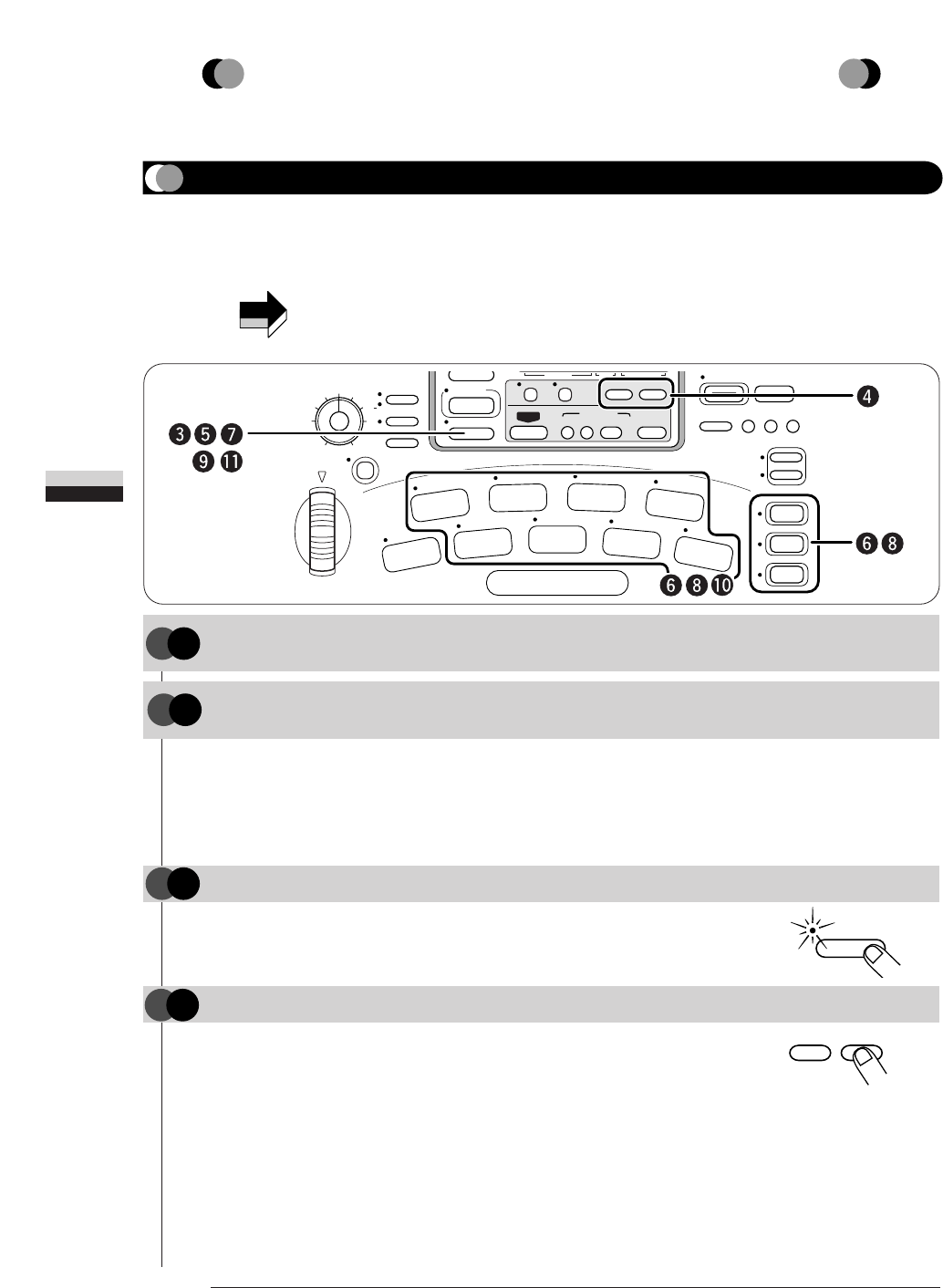
The ST-224 considers the length of the waveform assigned to a pad
as being 4 beats (quarter note x 4), and automatically calculates the
BPM value for this waveform. Therefore it is necessary to adjust each
sample so that it loops perfectly before using the Auto Sync function.
The following two types are available.
•tuninG
The tuning value of the slave pitch is changed, and the sample
length is changed. (A new sample is not created.)
•rESMPL
The pitch is kept the same, and a new sample with changed length
is created (resampling). This new sample is the assigned to the
slave pad. It takes processing time to resample.
The ST-224 incorporates an auto sync function that matches the tempo (BPM) of a pad to that of a reference
pad. This is useful for example to align the tempo of a drum pattern and bass pattern sampled separately.
BANK
3
BANK
2
BANK
SONG
PAD
1
FUNCTION
PAD ASSIGN
CAPACITY
ERASE OPTIMIZE
PLAY/STOP
RECORD
EDIT 2
EFFECT
ON/OFF
PAD ENABLE
A
B
EFFECT SYNC
EDIT 1
LOOP/MARK
4
SHIFT
OFFSET
6
SWING
PANNING
8
MIDI
TRIGGER/GATE
2
QUANTIZE
TUNING
SOURCE
SOURCE MIX
5
PRE COUNT
END POINT
3
TIME SIG
START POINT
1
BAR LENGTH
LEVEL
7
CLICK VOLUME
REVERSE
COPY DELETE
BACKUP
EXIT SPECIAL
LOAD SAVE
INTERNAL/DATA CARD
+
–
AUTO SYNC
PLAYLIST
TAP
BPM
MEASURE
SAMPLE/SONGBEAT
AUTO SYNC
+–
[–] [+] keys
Sample the drum pattern and bass pattern or any other patterns you want to synchronize,
and assign them to pads.
1
STEP
Adjust the start point and end point of each pad so that the sample for each pad has a
smooth transition when using loop playback.
2
STEP
Press the [AUTO SYNC] key.
3
STEP
Using the Auto Sync Function (Basic Steps)
38
Matching BPM of Pads (Auto Sync)
Matching BPM of Pads (Auto Sync)
From the duration of a waveform assigned to a pad, the ST- 224 can calculate the tempo, expressed in
BPM (quarter note beats per minute). The auto sync function uses this value to match the tempo of the
slave pad to that of a reference (master) pad.
Be sure to set the start point and end point so that there is a smooth rhythmic
transition when using loop playback, because the ST-224 uses these points to
make its calculations.
NOTE
Use the [-] [+] keys to select the auto sync type.
4
STEP
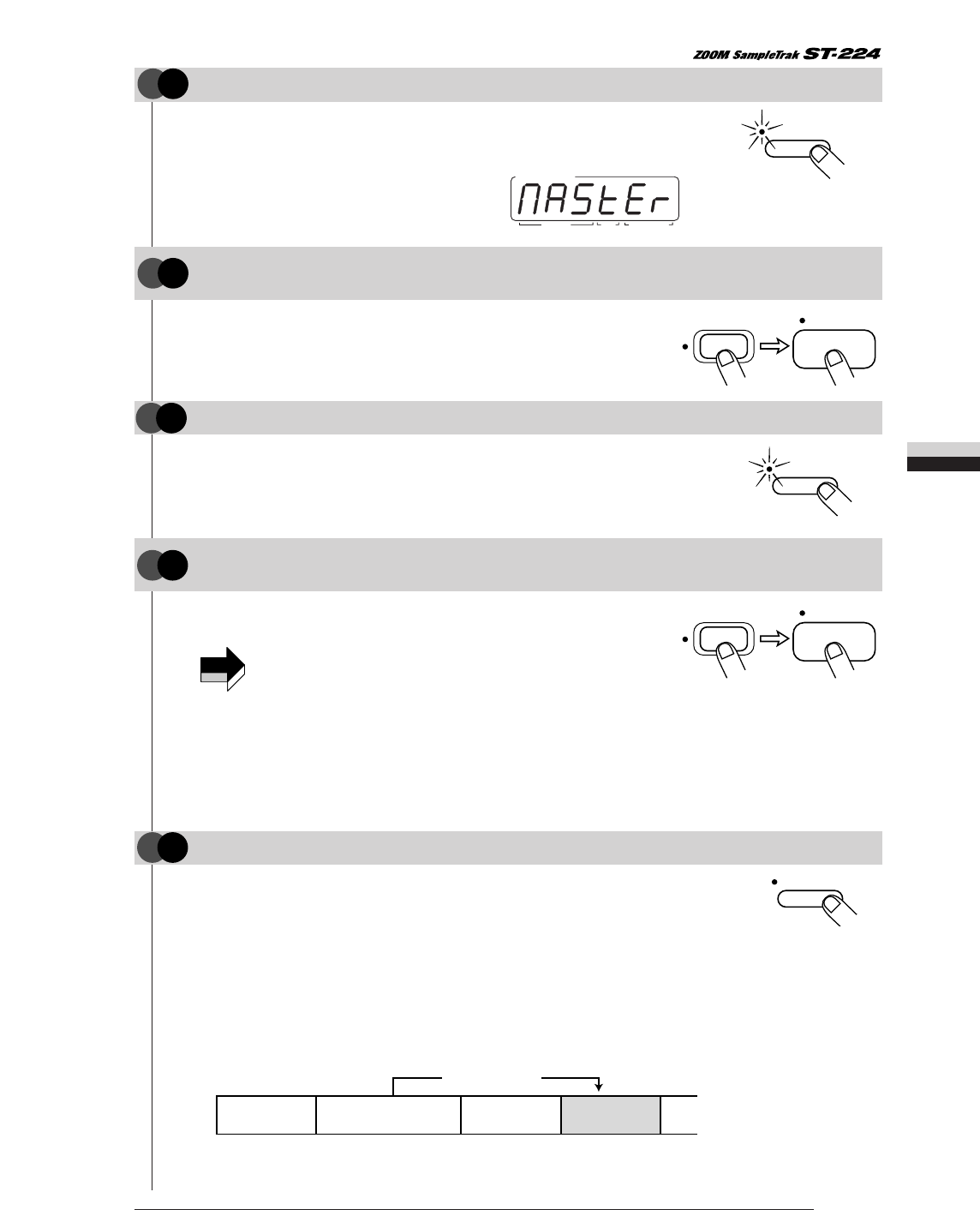
39
Matching BPM of Pads (Auto Sync)
The [AUTO SYNC] LED flashes, and the indication "MAStEr" (master)
appears on the display. This guides the user to specify the pad to be
used as reference (master).
The LED of the selected pad lights up.
The indication "SLAvE" (slave) appears on the display. This guides
the user to specify the pad to be used as slave pad whose tempo is
to be changed.
The LED of the selected pad lights up.
• When "rESMPL" is selected in step 4, a new sample will be
created in the main memory. Therefore, sufficient free memory
must be available. If not, or if the maximum number of 32
samples has already been reached, the indication "FULL"
appears on the display when the slave pad is specified in step 8.
In this case, delete unnecessary samples first.
• A pad which has same BPM value as the master pad can not be
selected, in this case the indication "SAME" appears on the
display.
•When "tuninG" is selected in step 4
The tuning value of the slave pad is changed.
•If "rESMPL" is selected in step 4
The length of the sample assigned to the slave pad is changed, a
new sample is created in the main memory (resampling) and
assigned to the slave pad. During recording, the new sample can
be monitored via the output jacks.
NOTE
Use the [BANK 1] - [BANK 3] keys and the pads 1 - 8 to select the master pad for auto
sync.
6
STEP
Use the [BANK 1] - [BANK 3] keys and the pads 1 - 8 to select the slave pad for auto
sync.
8
STEP
AUTO SYNC
AUTO SYNC
AUTO SYNC
BANK
1
BANK 1– 3 keys Pads 1 – 8
BANK
1
BANK 1– 3 keys Pads 1 – 8
Press the [AUTO SYNC] key.
7
STEP
Press the [AUTO SYNC] key.
9
STEP
Press the [AUTO SYNC] key.
5
STEP
BPM/
VALUE
MEASURE
SAMPLE/SONGBEAT
RESAMPLING
SAMPLE #1
(MASTER) SAMPLE #2
(SLAVE) SAMPLE #3 SAMPLE #4
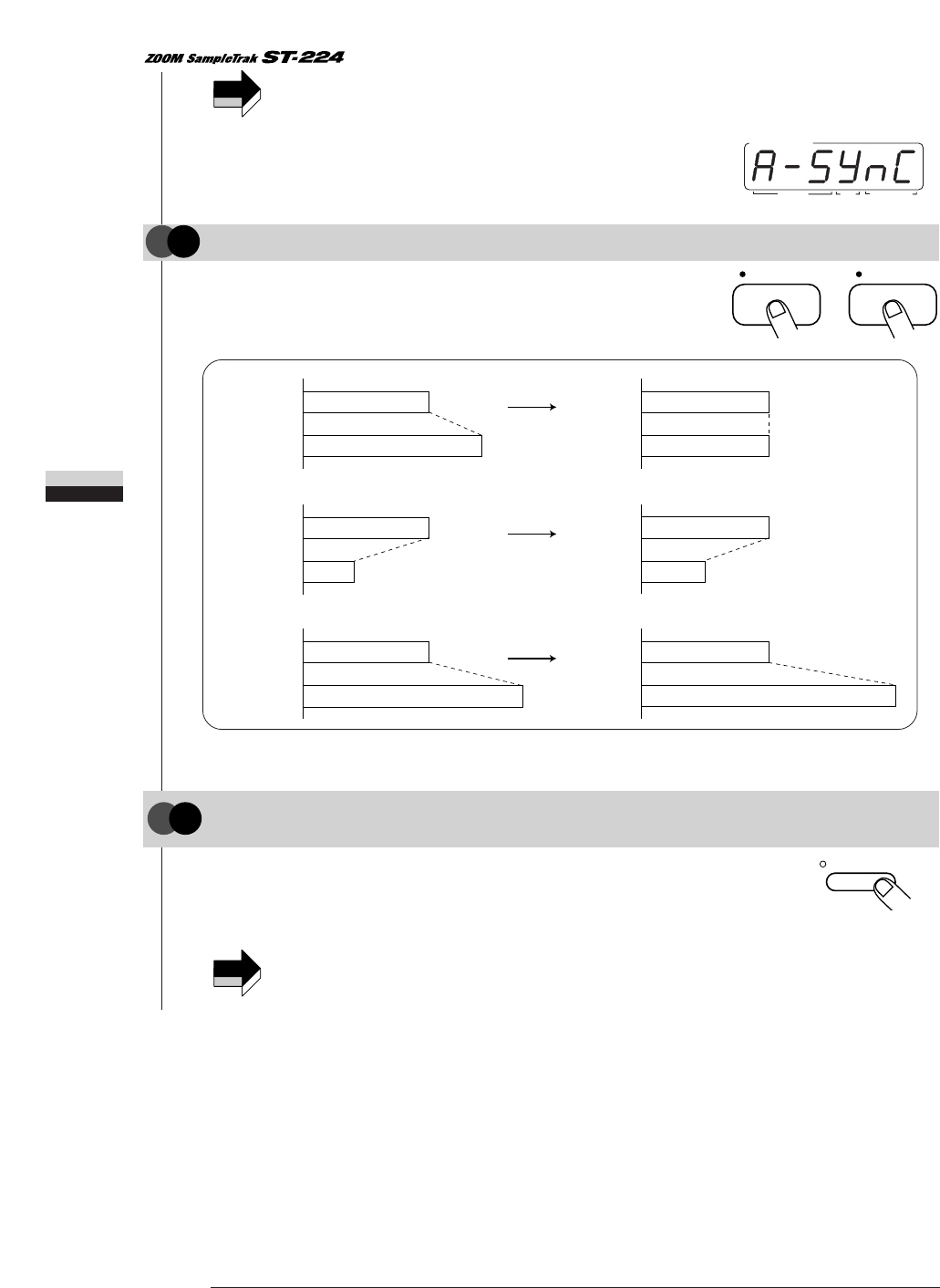
When "rESMPL" is selected as auto sync type, resampling is
carried out with the pitch shift effect applied. This may result in a
slight alteration of the sound.
When auto sync is completed, the indication "A-SYnC" appears on
the display.
Examples of AUTO SYNC
To redo the auto sync process, press the [EXIT] key. The unit returns
to the condition before auto sync was executed. (The newly created
sample is erased.)
When "rESMPL is selected as auto sync type, the sample assigned
to the slave pad will be retained also after auto sync is executed. If
this sample is no longer needed, erase or optimize it ( ➔p. 36 – 37).
NOTE
NOTE
40
Matching BPM of Pads (Auto Sync)
Hit the master and slave pad together, to check whether the tempo is properly matched.
10
STEP
If auto sync was successful, press the [AUTO SYNC] key again to terminate the auto sync
mode.
11
STEP
AUTO SYNC
Pads 1 – 8
Pads 1 – 8
BPM/
VALUE
MEASURE
SAMPLE/SONGBEAT
PAD 1
(Master)
BPM=120
PAD 2
(Slave)
BPM=120
AutoSync
PAD 1
(Master)
BPM=120
PAD 2
(Slave)
BPM=80
PAD 1
(Master)
BPM=120
PAD 2
(Slave)
BPM=240
AutoSync
PAD 1
(Master)
BPM=120
PAD 2
(Slave)
BPM=245
PAD 1
(Master)
BPM=120
PAD 2
(Slave)
BPM=60
AutoSync
PAD 1
(Master)
BPM=120
PAD 2
(Slave)
BPM=50
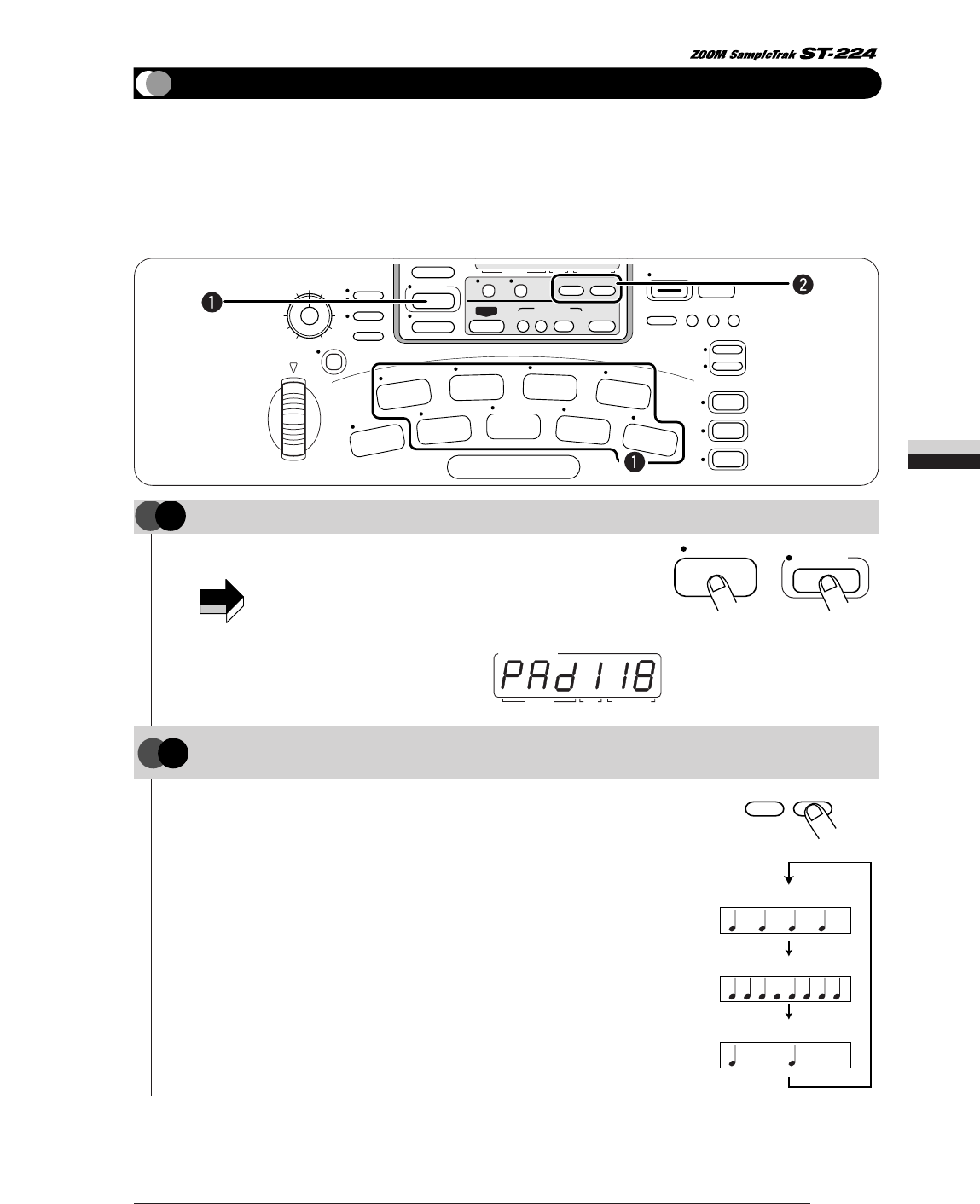
The automatically calculated BPM value appears on the display.
The range of BPM values allowed by the ST-224 is 40 - 250. If the
calculated BPM value is outside of this range, it is multiplied or
divided by 2 until it fits in the range.
Each push of the [-] or [+] key changes the setting within the
allowable range. For example, if the current setting is 120, the setting
cycles as follows: 120 (4 beats) ➔240 (8 beats) ➔60 (2 beats).
Choose the setting that corresponds to the number of beats in the
current sample.
NOTE
TAP
BPM
+
Pads 1 – 8
+–
[–] [+] keys
BPM=120
BPM=240
BPM=60
Hold down the pad whose BPM you want to change, and press the [BPM] key.
1
STEP
While the BPM value is being shown, use the [-] [+] keys to set the actual BPM value of
the phrase.
2
STEP
41
Matching BPM of Pads (Auto Sync)
Changing BPM for Every Pad (Auto Sync Advanced Steps)
As explained in the previous section, the ST-224 regards the length of a sample assigned to a pad as 4
beats, and automatically calculates the BPM value for that pad. However, sometimes it may be desirable
to synchronize phrases or patterns with a different beat pattern (such as combining a 4-beat bass pattern
with an 8-beat drum pattern or a 2-beat sequencer pattern). In such a case, the BPM of a pad must be set
to the actual value before using the auto sync function. Proceed as described below to change the BPM of
a pad.
BANK
3
BANK
2
BANK
SONG
PAD
1
FUNCTION
PAD ASSIGN
CAPACITY
ERASE OPTIMIZE
PLAY/STOP
RECORD
EDIT 2
EFFECT
ON/OFF
PAD ENABLE
A
B
EFFECT SYNC
EDIT 1
LOOP/MARK
4
SHIFT
OFFSET
6
SWING
PANNING
8
MIDI
TRIGGER/GATE
2
QUANTIZE
TUNING
SOURCE
SOURCE MIX
5
PRE COUNT
END POINT
3
TIME SIG
START POINT
1
BAR LENGTH
LEVEL
7
CLICK VOLUME
REVERSE
COPY DELETE
BACKUP
EXIT SPECIAL
LOAD SAVE
INTERNAL/DATA CARD
+
–
AUTO SYNC
PLAYLIST
TAP
BPM
MEASURE
SAMPLE/SONGBEAT
BPM/
VALUE
MEASURE
SAMPLE/SONGBEAT
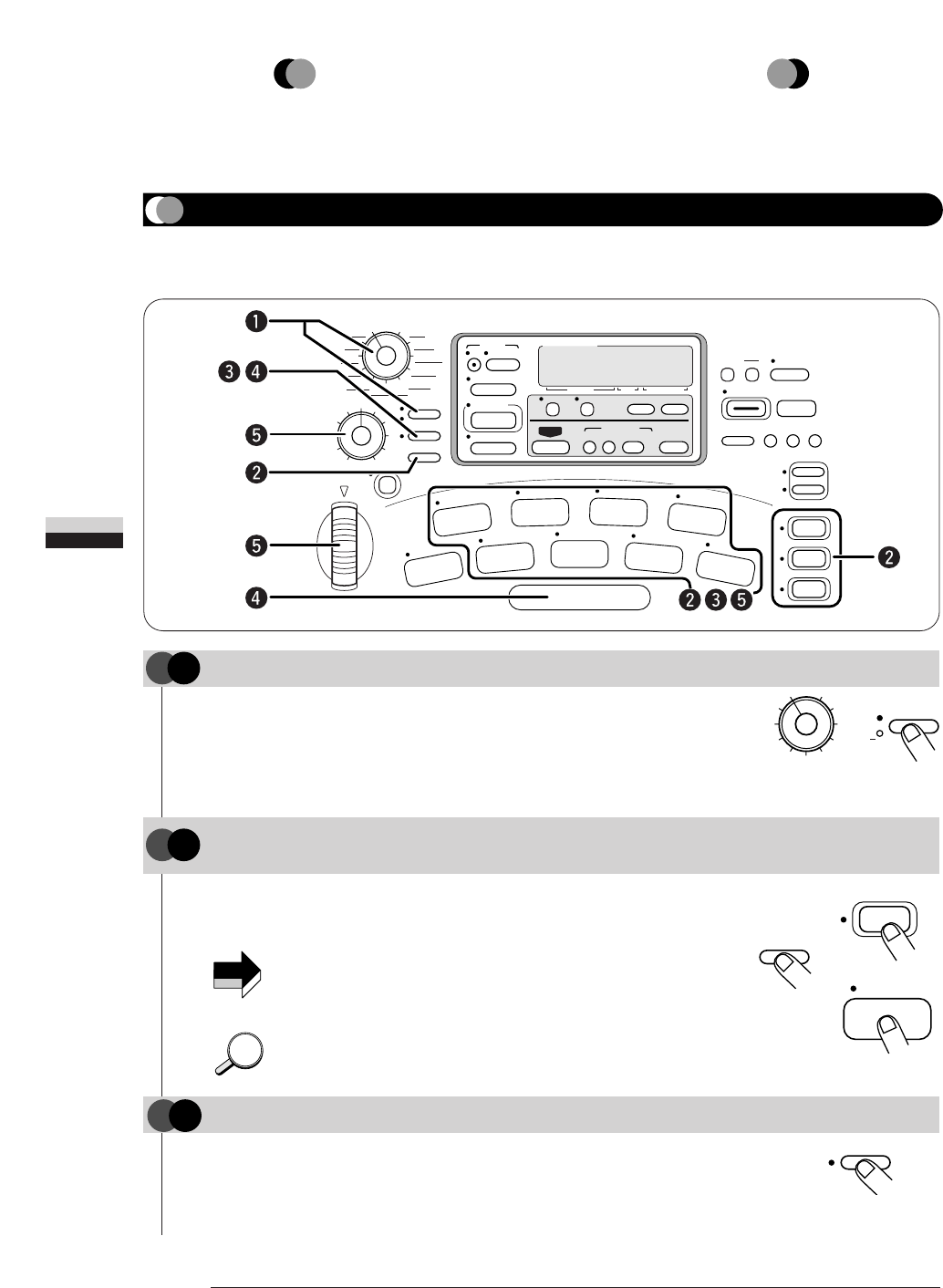
The ST-224 has 22 types of built-in effects. You can select any effect and apply it to the sound of any pad. The
[EDIT 1] wheel and [EDIT 2] knob on the unit can be used to adjust effect parameters in real time. It is also
possible to synchronize a specific effect parameter with a certain BPM value.
Using the Internal Effects
42
Using the Internal Effects
Rotate the [EFFECT SELECT] switch so that it points to the desired
effect type. Use the [EFFECT BANK] key to switch between bank A
(effect types without underline) and bank B (effect types with
underline).
The LEDs of the selected pads light up, and the sound from these
pads will be processed by the effects section.
By pressing the [SOURCE] pad, the input source that is controlled
by the [SOURCE] pad ( ➔p. 26) can also be routed to the effects
section (excluding certain effect types).
The TIME STRETCH/SCRATCH effect can be applied only to
sampled sound.
While the [EFFECT ON/OFF] key is held down, the [EFFECT ON/OFF]
LED is lit and the effect is on.
HINTHINT
NOTE
This section explains how to select an effect type, apply an effect to a pad, and how to adjust effect
parameters.
BANK
3
BANK
2
BANK
SONG
PAD
1
FUNCTION
PAD ASSIGN
CAPACITY
ERASE OPTIMIZE
PLAY/STOP
RECORD
RE-SAMPLE
GRADE
MONO
STEREO
SAMPLING
EFFECT
EDIT 2
VOLUME/BASS
EXCITER
TREMOLO
AUTO PAN
LO-FI EFFECT
EXTREME EQ
COMPRESSOR
RESONANCE
HIGH-PASS
LOW-PASS
DISTORTION
RING MODULATOR
PITCH SHIFTER
DIMENSION
CHORUS
PHASER
FLANGER
STEP CRY
DELAY
REVERB
TIME STRETCH
SCRATCH
EFFECT
ON/OFF
PAD ENABLE
A
B
EFFECT SYNC
EDIT 1
LOOP/MARK
4
SHIFT
OFFSET
6
SWING
PANNING
8
MIDI
TRIGGER/GATE
2
QUANTIZE
TUNING
SOURCE
SOURCE MIX
5
PRE COUNT
END POINT
3
TIME SIG
START POINT
1
BAR LENGTH
LEVEL
7
CLICK VOLUME
REVERSE
COPY DELETE
BACKUP
EXIT SPECIAL
LOAD SAVE
INTERNAL/DATA CARD
+
–
AUTO SYNC
PLAYLIST
TAP
BPM
SONG
PLAY/STOPREC
BPM/
VALUE
MEASURE
SAMPLE/SONGBEAT
+
EFFECT
A
B
[EFFECT SELECT]
switch
PAD ENABLE
BANK
1
+
BANK 1– 3 keys
Pad
Use the [EFFECT SELECT] switch and [EFFECT BANK] key to select the effect type.
1
STEP
Hold down the [EFFECT PAD ENABLE] key and use the [BANK 1] - [BANK 3] keys and the
pads 1 - 8 to select the pad to which to apply the effect. (Multiple pads can be selected.)
2
STEP
While holding down the [EFFECT ON/OFF] key, hit the pad you selected in step 2.
3
STEP
Applying an Effect to a Specific Pad
ON/OFF
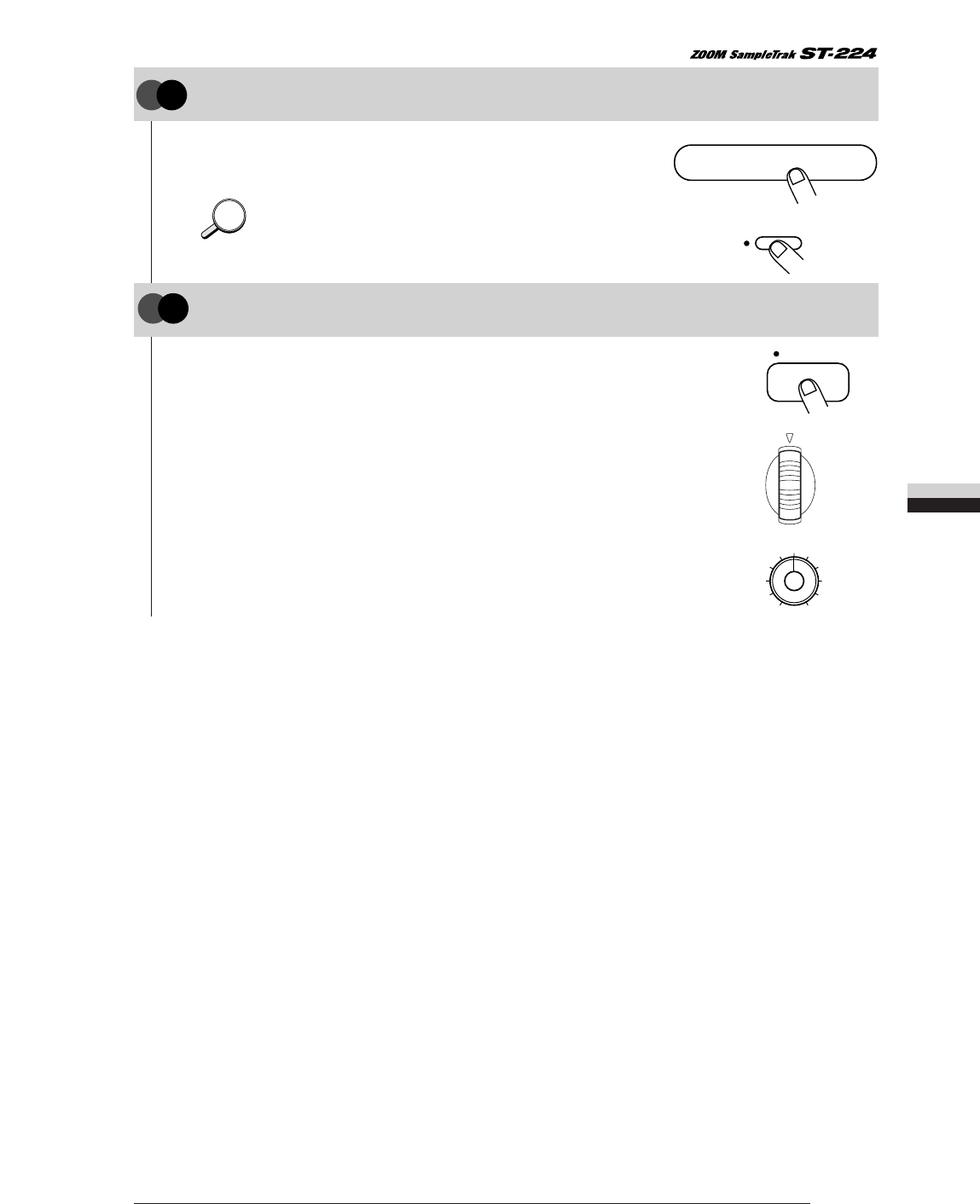
To turn the effect off again, press the [EFFECT ON/OFF] key once
more.
When a MIDI message is used to turn an effect on, the effect will
stay on until turned off by another MIDI message.
The [EDIT 1] wheel and [EDIT 2] knob can be used to edit effect
parameters, and they also serve as real-time effect controllers during
pad or sequencer playback. Which parameters are adjusted by the
[EDIT 1] wheel and [EDIT 2] knob depends on the currently selected
effect type ( ➔p. 46).
HINTHINT
43
Using the Internal Effects
Pad
EDIT 2
EDIT 1
[EDIT 1]
wheel
[EDIT 2]
knob
To turn the effect on permanently, hold down the [LOOP/MARK] pad and press the
[EFFECT ON/OFF] key.
4
STEP
Operate the [EDIT 1] wheel and [EDIT 2] knob while hitting the pad for which effect
processing has been enabled.
5
STEP
ON/OFF
LOOP/MARK
+
[LOOP/MARK] pad
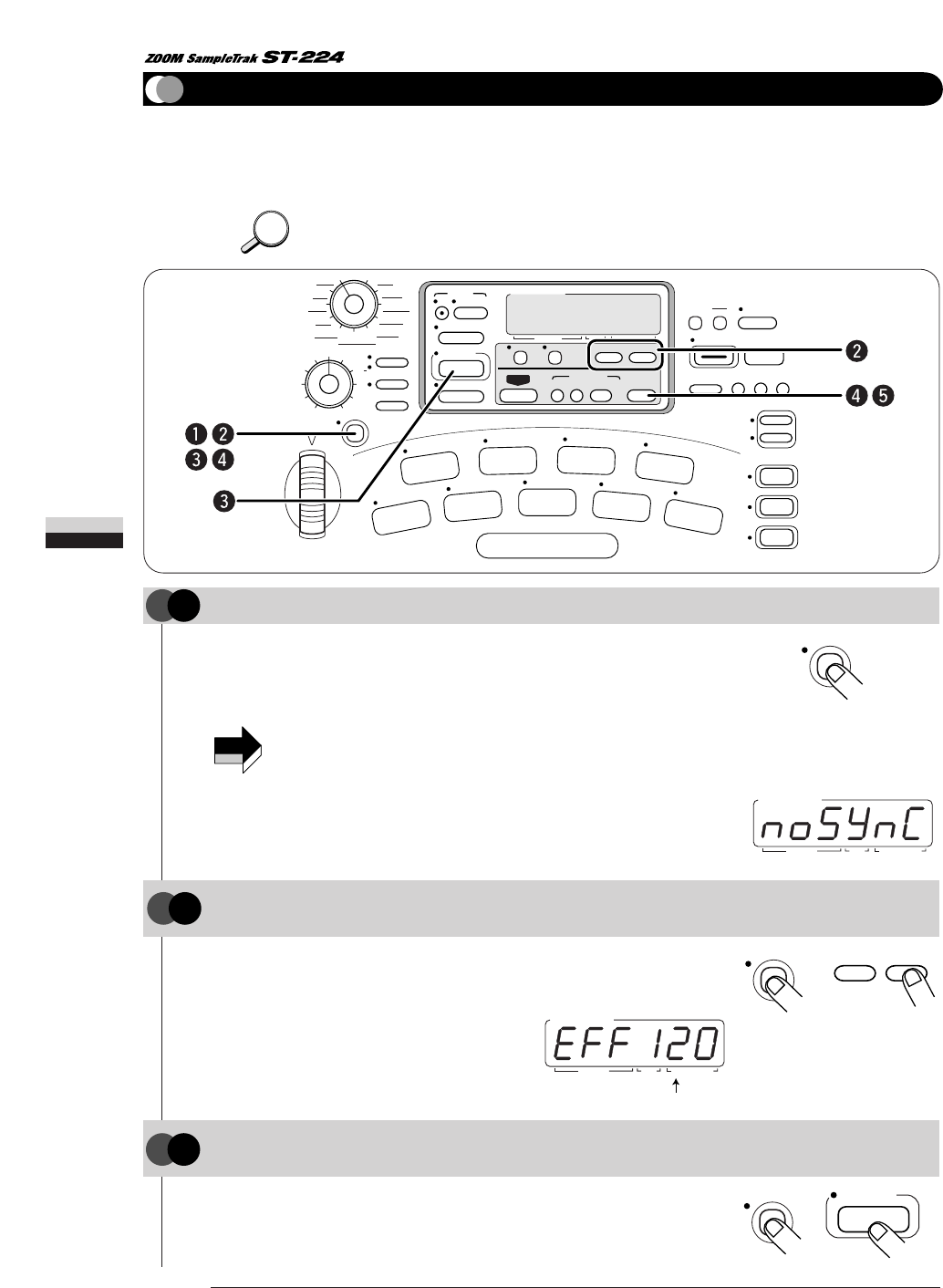
The [EFFECT SYNC] LED lights up and the effect parameter is set
automatically as to synchronize to effect BPM.
To turn the effect sync off, press the [EFFECT SYNC] key once more.
Which effect parameter is synchronized to BPM depends on the
effect. For some effects, there is no parameter that will be
synchronized ( ➔p. 46).
If an effect type which cannot be synchronized to BPM is selected,
the indication "no SYnC" is shown on the display.
While the [EFFECT SYNC] key is held down, the effect BPM is shown
on the display. Each push of a key changes the setting by one
increment.
The interval of the last 4 taps is automatically detected by the ST-224
and converted to a BPM value.
NOTE
TAP
BPM
EFFECT SYNC
+
44
Using the Internal Effects
The ST-224 incorporates a special BPM function for effects (called "effect BPM") which allows
synchronizing a selected effect parameter to this tempo. For example, this lets you easily match the delay
time or modulation cycle to the tempo of a song.
Effect BPM can be set separately from pad BPM and the tempo of the internal
sequencer. Effect BPM is the same tempo as the current Song unless you change it.
HINTHINT
BANK
3
BANK
2
BANK
SONG
PAD
1
FUNCTION
PAD ASSIGN
CAPACITY
ERASE OPTIMIZE
PLAY/STOP
RECORD
RE-SAMPLE
GRADE
MONO
STEREO
SAMPLING
EDIT 2
VOLUME/BASS
EXCITER
TREMOLO
AUTO PAN
LO-FI EFFECT
EXTREME EQ
COMPRESSOR
RESONANCE
HIGH-PASS
LOW-PASS
DISTORTION
RING MODULATOR
PITCH SHIFTER
DIMENSION
CHORUS
PHASER
FLANGER
STEP CRY
DELAY
REVERB
TIME STRETCH
SCRATCH
EFFECT
ON/OFF
PAD ENABLE
A
B
EFFECT SYNC
EDIT 1
LOOP/MARK
4
SHIFT
OFFSET
6
SWING
PANNING
8
MIDI
TRIGGER/GATE
2
QUANTIZE
TUNING
SOURCE
SOURCE MIX
5
PRE COUNT
END POINT
3
TIME SIG
START POINT
1
BAR LENGTH
LEVEL
7
CLICK VOLUME
REVERSE
COPY DELETE
BACKUP
EXIT SPECIAL
LOAD SAVE
INTERNAL/DATA CARD
+
–
AUTO SYNC
PLAYLIST
TAP
BPM
SONG
PLAY/STOPREC
BPM/
VALUE
MEASURE
SAMPLE/SONGBEAT
Press the [EFFECT SYNC] key.
1
STEP
To input the effect BPM value manually, hold the [EFFECT SYNC] key down and use the
[-] [+] keys to change the value.
2
STEP
For tap input of the effect BPM, hold down the [EFFECT SYNC] key and tap the [BPM]
key in the desired tempo.
3
STEP
Synchronizing Effect Parameter BPM
EFFECT SYNC
EFFECT SYNC
+[–] [+] keys
+–
Effect BPM
BPM/
VALUE
MEASURE
SAMPLE/SONGBEAT
BPM/
VALUE
MEASURE
SAMPLE/SONGBEAT
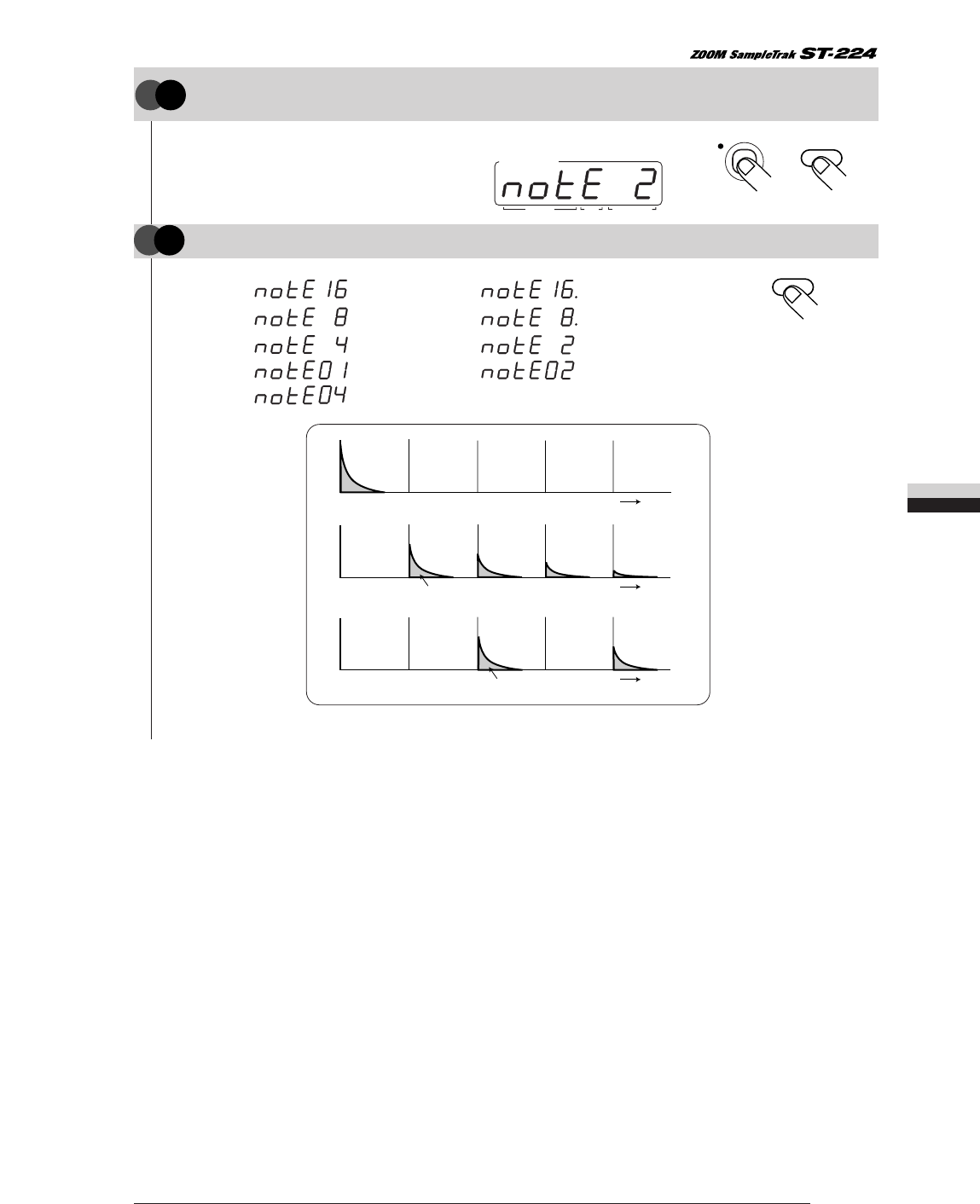
The currently selected resolution appears on the display.
SPECIAL
EFFECT SYNC
+
SPECIAL
BPM/
VALUE
MEASURE
SAMPLE/SONGBEAT
45
Using the Internal Effects
Use the [SPECIAL] key to select the next resolution setting
5
STEP
To set Effect BPM in metrical beats, hold down the [EFFECT SYNC] key and
press the [SPECIAL] key.
4
STEP
sixteenth note
eighth note
quarter note
full note
four full notes
dotted sixteenth note
dotted eighth note
half note
two full notes
Resolution = notE 16
Resolution = notE 8
Time
Time
Delayed sound
Time
Delayed sound
Original
sound
Example for effect BPM synchronization
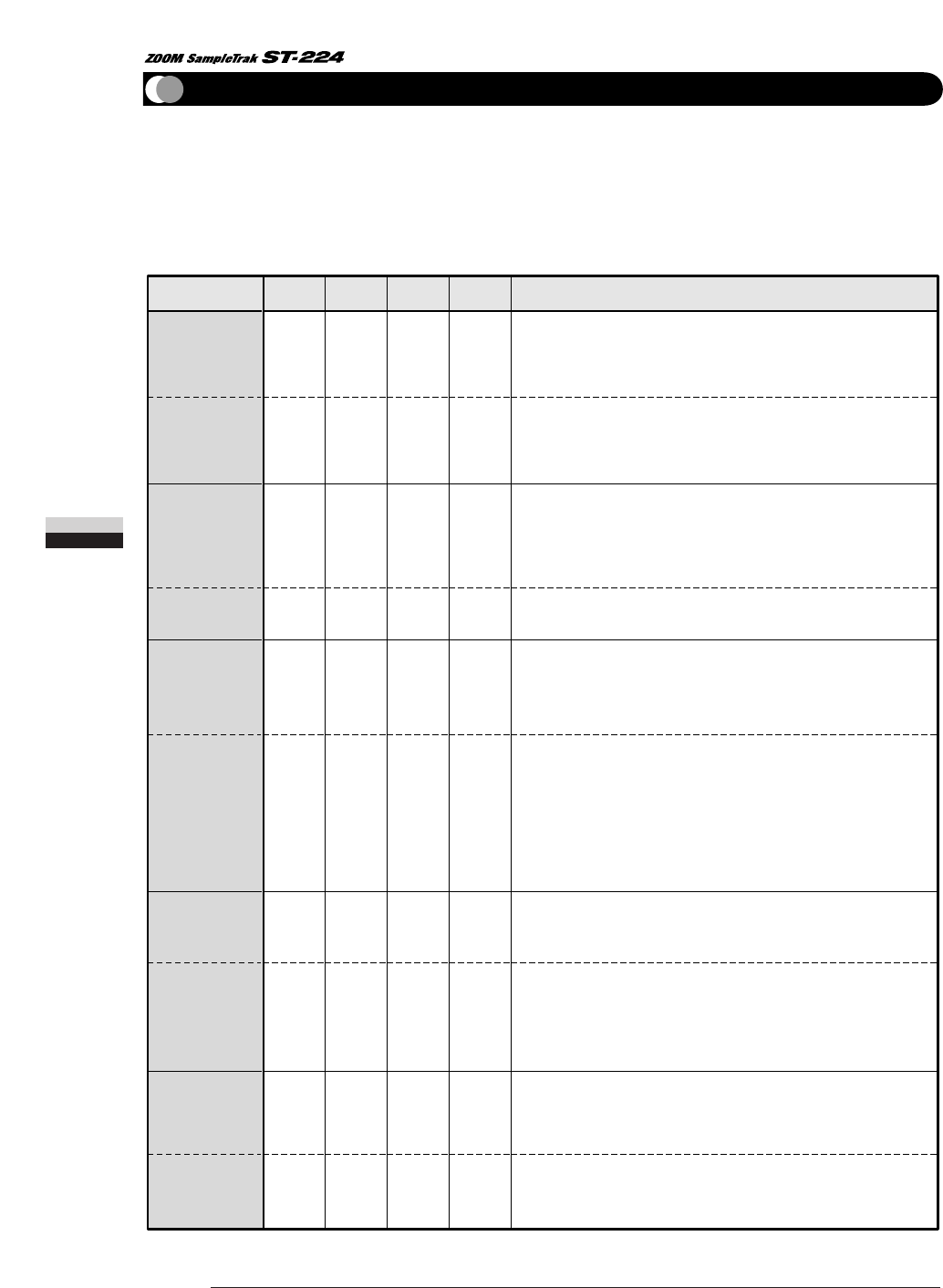
46
Using the Internal Effects
This section lists all effect types with their parameters which can be adjusted using the [EDIT 1] wheel and
[EDIT 2] knob. The list also shows which parameters can be synchronized to effect BPM.
EDIT 1 = parameter can be adjusted with [EDIT 1] wheel
EDIT 2 = parameter can be adjusted with [EDIT 2] knob
SYNC = parameter can be synchronized to effect BPM
Effect Types
EDIT 1EFFECT TYPE BANK EDIT 2 SYNC Description
TIME
STRETCH A amount tone –
SCRATCH B speed tone –
DELAY A time
feedback
mix &
time
REVERB B time mix –
FLANGER A rate
feedback
rate
STEP CRY B rate &
reso &
mod-
wave
sens rate
CHORUS A rate mix –
PHASER B rate rate
PITCH SHIFTER
A pitch tone –
DIMENSION B rise
level tone –
resonance
This effect stretches or compresses the sample duration without
changing the pitch. The [EDIT 1] wheel adjusts the duration (amount),
and the [EDIT 2] knob the sound quality (tone). This effect type cannot
be used with the [SOURCE] pad.
This effect stretches or compresses the sample duration and also changes
the pitch, depending on the stretch or compression ratio. The [EDIT 1]
wheel adjusts the duration (speed), and the [EDIT 2] knob the sound
quality (tone).
This delay type effect creates an echo. The [EDIT 1] wheel adjusts the
delay time (time: max. 505 ms), and the [EDIT 2] knob the number of
repeats (feedback) and the mix amount (mix). When the [EFFECT
SYNC] key is set to ON, the delay time parameter is synchronized to the
effect BPM.
This effect adds reverberation to the sound. The [EDIT 1] wheel adjusts
the reverb time (time), and the [EDIT 2] knob the mix amount (mix).
This is a stereo flanger effect. The [EDIT 1] wheel adjusts the flanger
fluctuation speed (rate), and the [EDIT 2] knob the feedback intensity
(feedback) and the mix amount (mix). When the [EFFECT SYNC] key
is set to ON, the fluctuation cycle is synchronized to the effect BPM.
This is a special effect that uses filters to lend a distinct, stair-like
character to the sound. The [EDIT 1] wheel adjusts the sample & hold
speed (rate) and the filter resonance (reso) and modulation waveform
balance (mod-wave). The [EDIT 2] knob adjusts the effect sensitivity
(sens). When the [EFFECT SYNC] key is set to ON, the sample & hold
cycle is synchronized to the effect BPM. Turning the wheel forward
intensifies the cry effect and turning it backward increases the step
effect.
This is a stereo chorus effect with width and depth. The [EDIT 1] wheel
adjusts the chorus speed (rate), and the [EDIT 2] knob the mix amount
(mix).
This effect adds a phase-shifted component to the original sound,
resulting in a pulsating character. The [EDIT 1] wheel adjusts the
pulsing speed (rate), and the [EDIT 2] knob the resonance (resonance).
When the [EFFECT SYNC] key is set to ON, the resonance is
synchronized to the effect BPM.
Pitch-shifter with a +-1 octave range. The [EDIT 1] wheel adjusts the
pitch shift amount (pitch), and the [EDIT 2] knob the sound quality
(tone).
This effect produces a spatial broadening of the sound. The [EDIT 1]
wheel adjusts the effect intensity (rise level), and the [EDIT 2] knob the
sound quality (tone).
47
Using the Internal Effects
EDIT 1 EDIT 2 SYNC
DISTORTION A gain tone –
RING
MODULATOR Bbalance –
LOW-PASS A LFO
HIGH-PASS B
frequency
frequency
frequency
LFO
EXTREME EQ A gain –
RESONANCE B
resonance
sens LFO
LO-FI A noise tone –
COMPRESSOR B
B
B
ratio
threshold
–
TREMOLO A
A
rate &
clip rate
depth
AUTO PAN rate width rate
VOLUME/BASS
volume bass
boost –
EXCITER sens
frequency
–
resonance
resonance
filter type
EFFECT TYPE BANK Description
This effect produces a wild-sounding distortion. The [EDIT 1] wheel
adjusts the distortion gain (gain), and the [EDIT 2] knob the tone. The
distortion is a mono effect.
This effect uses AM (amplitude modulation) to achieve a metallic
sound. The [EDIT 1] wheel adjusts the modulation frequency
(frequency), and the [EDIT 2] knob the level ratio between original
sound and effect sound (balance).
This is a low-pass filter that cuts off high frequencies. The [EDIT 1]
wheel adjusts the filter cutoff frequency (frequency), and the [EDIT 2]
knob the resonance (resonance). When the [EFFECT SYNC] key is set
to ON, the periodic alteration of the filter cutoff frequency (LFO) is
synchronized to the effect BPM.
This is a high-pass filter that cuts off low frequencies. The [EDIT 1]
wheel adjusts the filter cutoff frequency (frequency), and the [EDIT 2]
knob the resonance (resonance). When the [EFFECT SYNC] key is set
to ON, the periodic alteration of the filter cutoff frequency (LFO) is
synchronized to the effect BPM.
When the [EDIT 1] wheel is turned forward, the selected frequency band
is attenuated. When the wheel is turned back, the frequency range
outside the selected band is attenuated. The [EDIT 2] knob selects the
LOW, MID, or HIGH range.
This is a filter whose effectivity varies with the signal level. The [EDIT
1] wheel adjusts the filter sensitivity (sens). When the [EFFECT SYNC]
key is set to ON, the periodic alteration of the filter sensitivity (LFO) is
synchronized to the effect BPM.
This effect makes the sound gritty and rough. The [EDIT 1] wheel
adjusts the record type noise (noise), and the [EDIT 2] knob the sound
quality (tone).
This is a conventional compressor for compressing the dynamic range.
The [EDIT 1] wheel adjusts the compression ratio (ratio), and the [EDIT
2] knob the threshold level (threshold).
This is a tremolo effect which shifts the volume periodically up and
down. The [EDIT 1] wheel adjusts the tremolo speed (rate) and the
modulation waveform clipping amount (clip). The [EDIT 2] knob
adjusts the tremolo effect intensity (depth). When the [EFFECT SYNC]
key is set to ON, the periodic alteration of the tremolo is synchronized to
the effect BPM.
This effect periodically moves the sound back and forth between the
right and left channel. The [EDIT 1] wheel adjusts the auto pan speed
(rate), and the [EDIT 2] knob the stereo width (width). When the
[EFFECT SYNC] key is set to ON, the auto pan cycle is synchronized to
the effect BPM.
Adjusts the volume level and the low-frequency boost. The [EDIT 1]
wheel adjusts the volume (volume : 0 dB at center position, max. +6 dB) ,
and the [EDIT 2] knob the amount of bass boost (bass boost).
This effect emphasizes a specified frequency range according to the
signal level, giving a prominent character to the sound. The [EDIT 1]
wheel adjusts the effect sensitivity (sens), and the [EDIT 2] knob the
emphasized frequency (frequency).
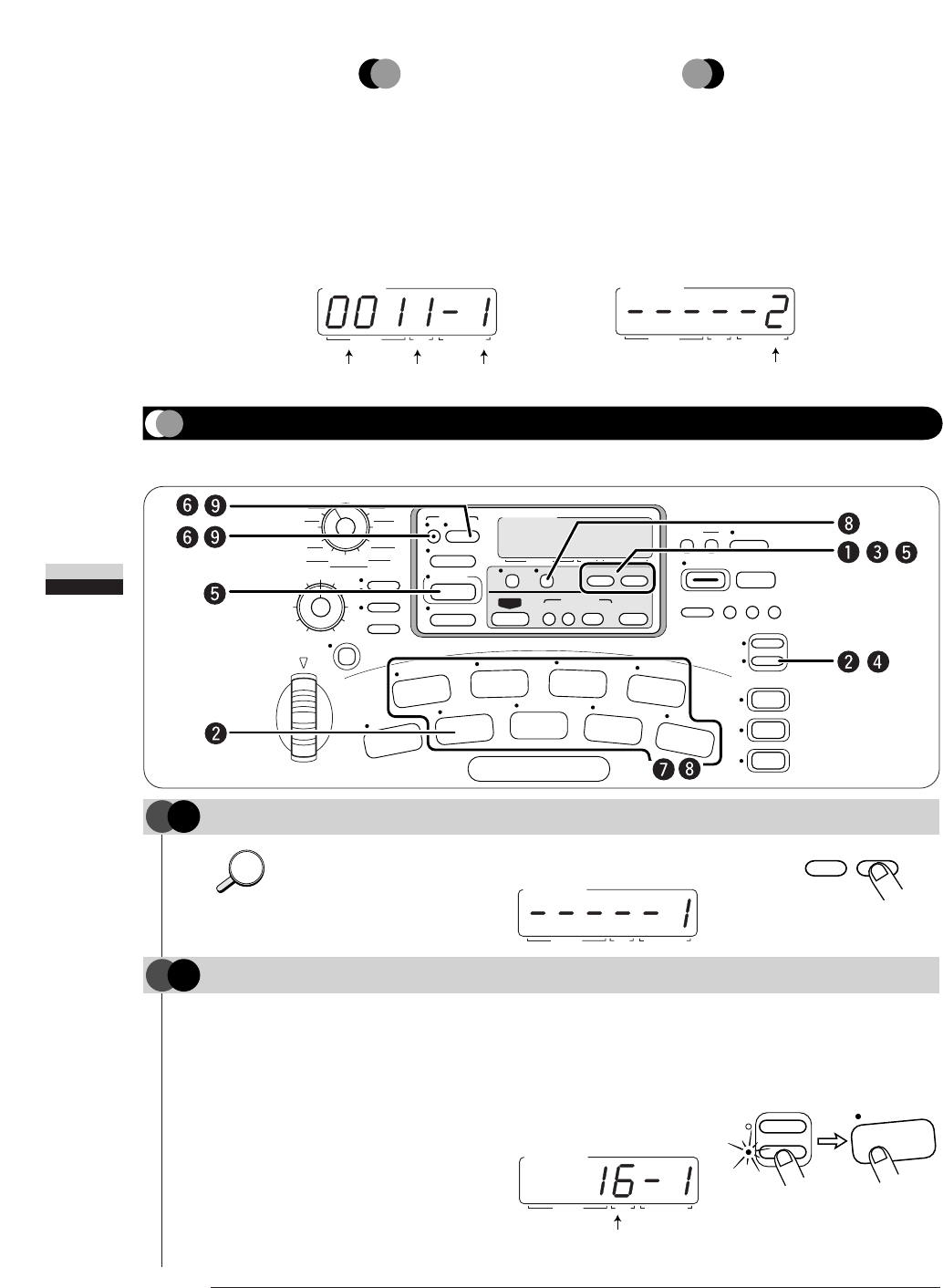
The ST-224 lets you record and play eight songs. A song is a series of pad actions. The maximum number of
sounds is 5000, and the maximum length of all songs together is 300 bars.
When a song which contains data has been selected, the song number and information about the current
position (number of bars and beats) are shown on the display. When a song without data has been selected, the
position information shows only "-----".
The following procedure will record a series of pad actions as a song.
Creating Songs
48
Creating Songs
Song recording
BANK
3
BANK
2
BANK
SONG
PAD
1
FUNCTION
PAD ASSIGN
CAPACITY
ERASE OPTIMIZE
PLAY/STOP
RECORD
RE-SAMPLE
GRADE
MONO
STEREO
SAMPLING
EDIT 2
VOLUME/BASS
EXCITER
TREMOLO
AUTO PAN
LO-FI EFFECT
EXTREME EQ
COMPRESSOR
RESONANCE
HIGH-PASS
LOW-PASS
DISTORTION
RING MODULATOR
PITCH SHIFTER
DIMENSION
CHORUS
PHASER
FLANGER
STEP CRY
DELAY
REVERB
TIME STRETCH
SCRATCH
EFFECT
ON/OFF
PAD ENABLE
A
B
EFFECT SYNC
EDIT 1
LOOP/MARK
4
SHIFT
OFFSET
6
SWING
PANNING
8
MIDI
TRIGGER/GATE
2
QUANTIZE
TUNING
SOURCE
SOURCE MIX
5
PRE COUNT
END POINT
3
TIME SIG
START POINT
1
BAR LENGTH
LEVEL
7
CLICK VOLUME
REVERSE
COPY DELETE
BACKUP
EXIT SPECIAL
LOAD SAVE
INTERNAL/DATA CARD
+
–
AUTO SYNC
PLAYLIST
TAP
BPM
SONG
PLAY/STOPREC
BPM/
VALUE
MEASURE
SAMPLE/SONGBEAT
It is also possible to select a song which already has data and add
to it.
The [SONG FUNCTION] LED flashes and the LED of pad 2 lights up,
and the current quantize setting appears on the display. The quantize
setting determines the amount of detail with which the notes in a pad
action is recorded. Choose the quantize setting with regard to the
kind of pattern you want to record. This will automatically ensure
proper timing.
HINTHINT
In play mode, use the [-] [+] keys to select an empty song (1 - 8).
1
STEP
Press the [SONG FUNCTION] key and then pad 2.
2
STEP
Song number
BPM/
VALUE
MEASURE
SAMPLE/SONGBEAT
BPM/
VALUE
MEASURE
SAMPLE/SONGBEAT
Quantize setting
BPM/
VALUE
MEASURE
SAMPLE/SONGBEAT
Number of bars Number of beats Song number
BPM/
VALUE
MEASURE
SAMPLE/SONGBEAT
Song with data was selected Blank song was selected
+–
[–] [+] keys
SONG
PAD
FUNCTION
2
QUANTIZE
TUNING
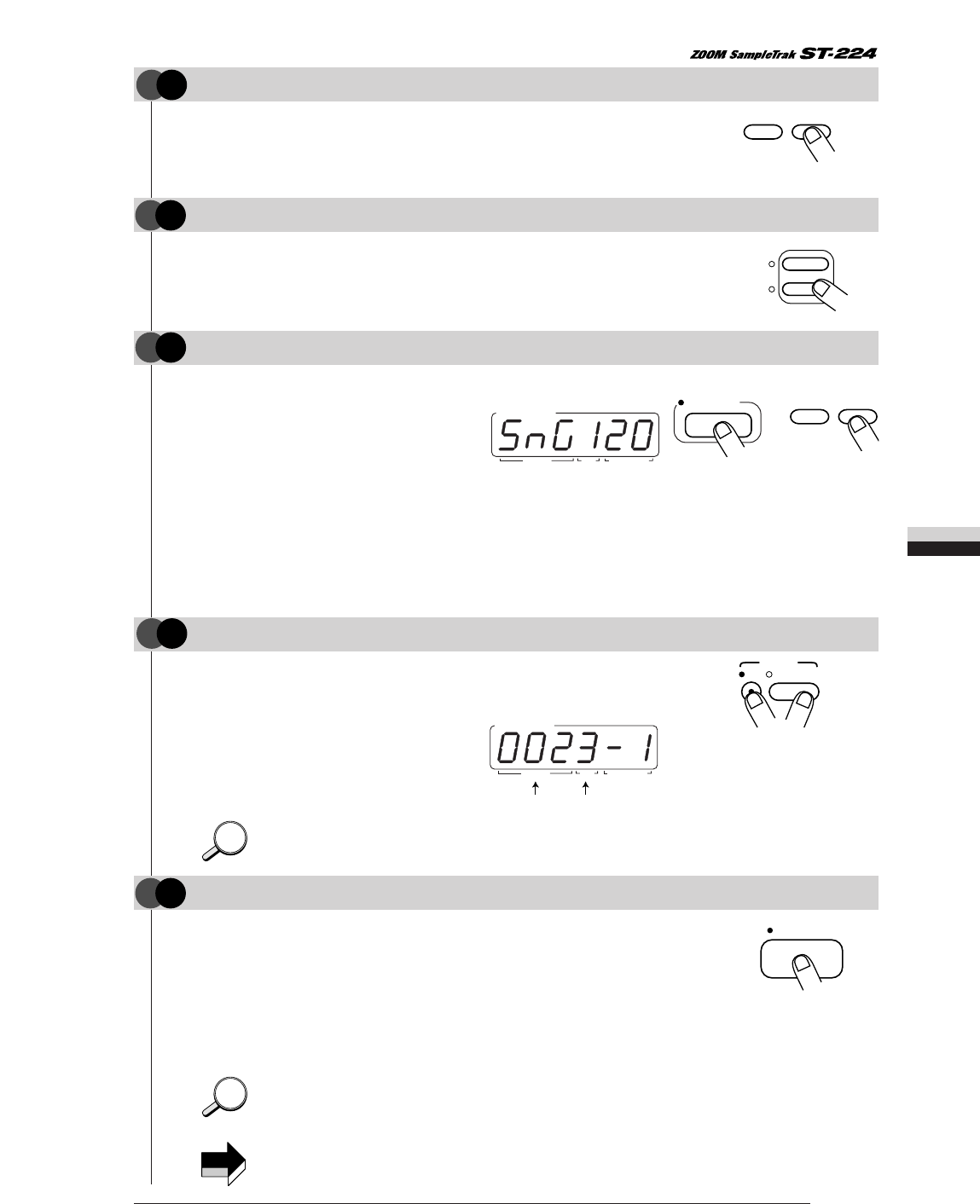
49
Creating Songs
4 quarter note 8 eighth note 12 eight note triplet
16 sixteenth note 24 sixteenth note triplet 32 thirty-second note
Hi No quantization (1/24 of a quarter note)
The [SONG FUNCTION] LED goes out, and the new quantize setting
becomes active.
While the [BPM] key is held down, the display shows the BPM setting
of the song.
To change the BPM setting, use the [-] [+] keys. It is also possible to
perform tap input. To do this, tap the [BPM] key in the desired tempo.
The interval of the last 4 taps is automatically detected by the ST-224
and converted to a BPM value.
This BPM setting can be stored for individual songs.
The [SONG REC] LED lights up and recording starts with a
metronome sound. The current bar and number of beats appears on
the display.
If not otherwise specified, an empty song has 4/4 beats and 4 bars.
(To change the beats and length of a song, see page 53.)
The samples assigned to the pads are heard, and the performance is
recorded in the song with the selected quantize resolution. When the
end of the song is reached, recording loops back to the beginning, so
you can repeat the recording as often as desired. (The maximum
number of sounds that may used simultaneously is 8 mono samples.
If this number is exceeded, sound dropouts may occur.)
You can also switch banks with the [BANK 1] - [BANK 3] keys
during recording and hit pads from other banks.
• Remember that the song records not the sound itself but only
the series of pad actions. Therefore if the sample assigned to a
HINTHINT
HINTHINT
NOTE
Use the [-] [+] keys to select the desired quantize setting (minimum note).
3
STEP
Press the [SONG FUNCTION] key again.
4
STEP
Holding down the [SONG REC] key, press the [SONG PLAY/STOP] key.
6
STEP
Hold down the [BPM] key and use the [-] [+] keys to set the tempo (BPM).
5
STEP
Tap the pads according to the metronome sound.
7
STEP
+–
[–] [+] keys
+[–] [+] keys
TAP
BPM
+–
SONG
PAD
FUNCTION
SONG
PLAY/STOPREC
Pads 1 – 8
Bar Number of beats
BPM/
VALUE
MEASURE
SAMPLE/SONGBEAT
BPM/
VALUE
MEASURE
SAMPLE/SONGBEAT
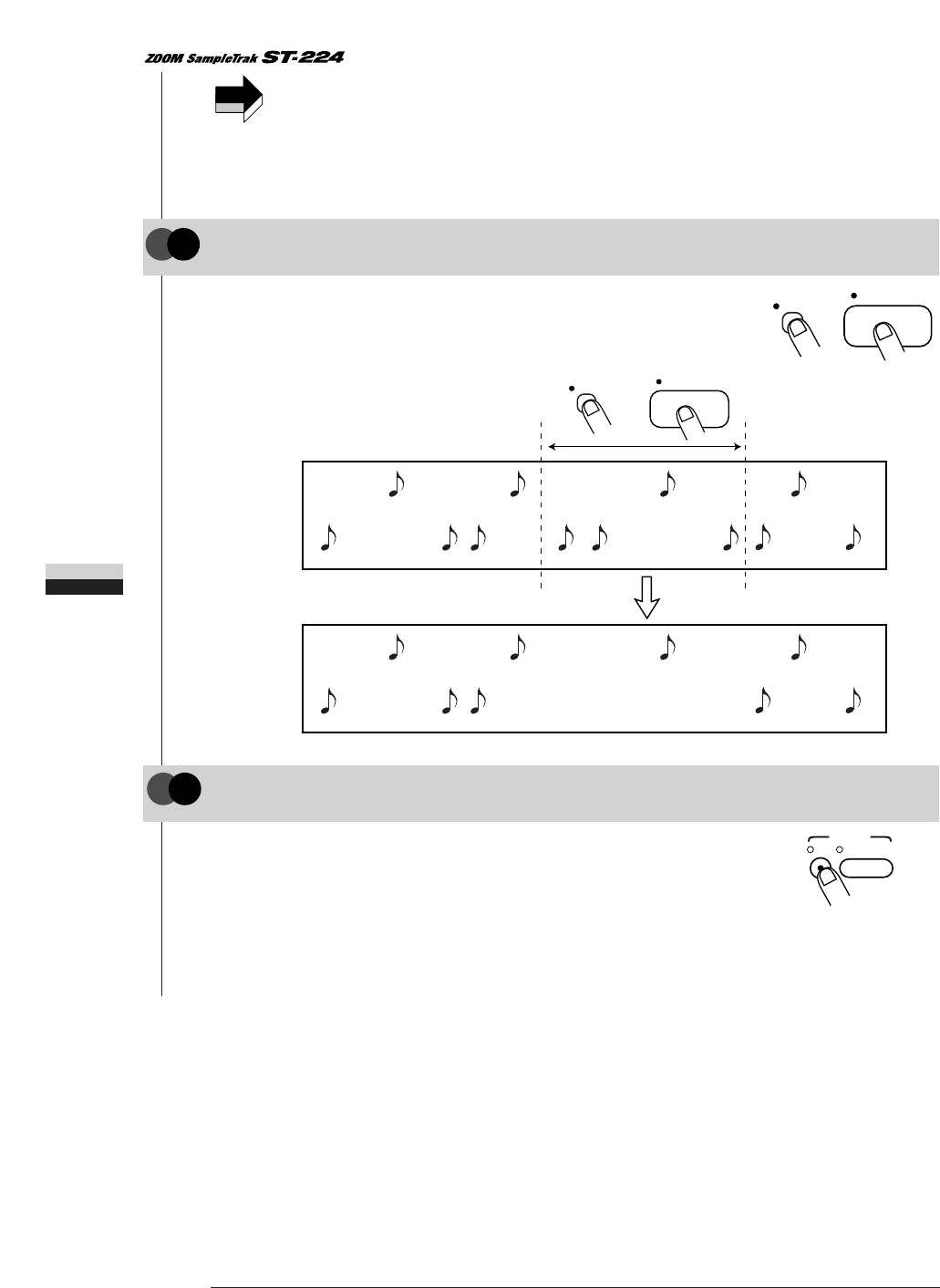
pad is changed after recording, the song will also be different
during playback.
• Effect operations are not recorded in a song. However, if effects
are enabled for a pad, the effects will be active also during
playback of the song.
• The operation of the [SOURCE] pad cannot be recorded.
While the [DELETE] key is held down, any pads that are hit will be
deleted from the song.
The [SONG REC] LED goes out and song recording stops.
The song is temporarily stored in the main memory, but it will be lost
if the unit is turned off without first transferring the song data to the
internal backup memory or external data cards. Do not forget to store
any songs you wish to keep. (For information on how to store songs,
see page 59.)
50
Creating Songs
+Pads 1 – 8
DELETE
SONG
PLAY/STOPREC
Pad 1
Pad 2
SONG
Pad 1
Pad 2
+Pad 2
DELETE
If you have made a mistake in playing a particular pad, hold down the [DELETE] key and
hit the pad again.
8
STEP
To terminate recording, press the [SONG REC] key once more or press the [SONG PLAY]
key.
9
STEP
NOTE
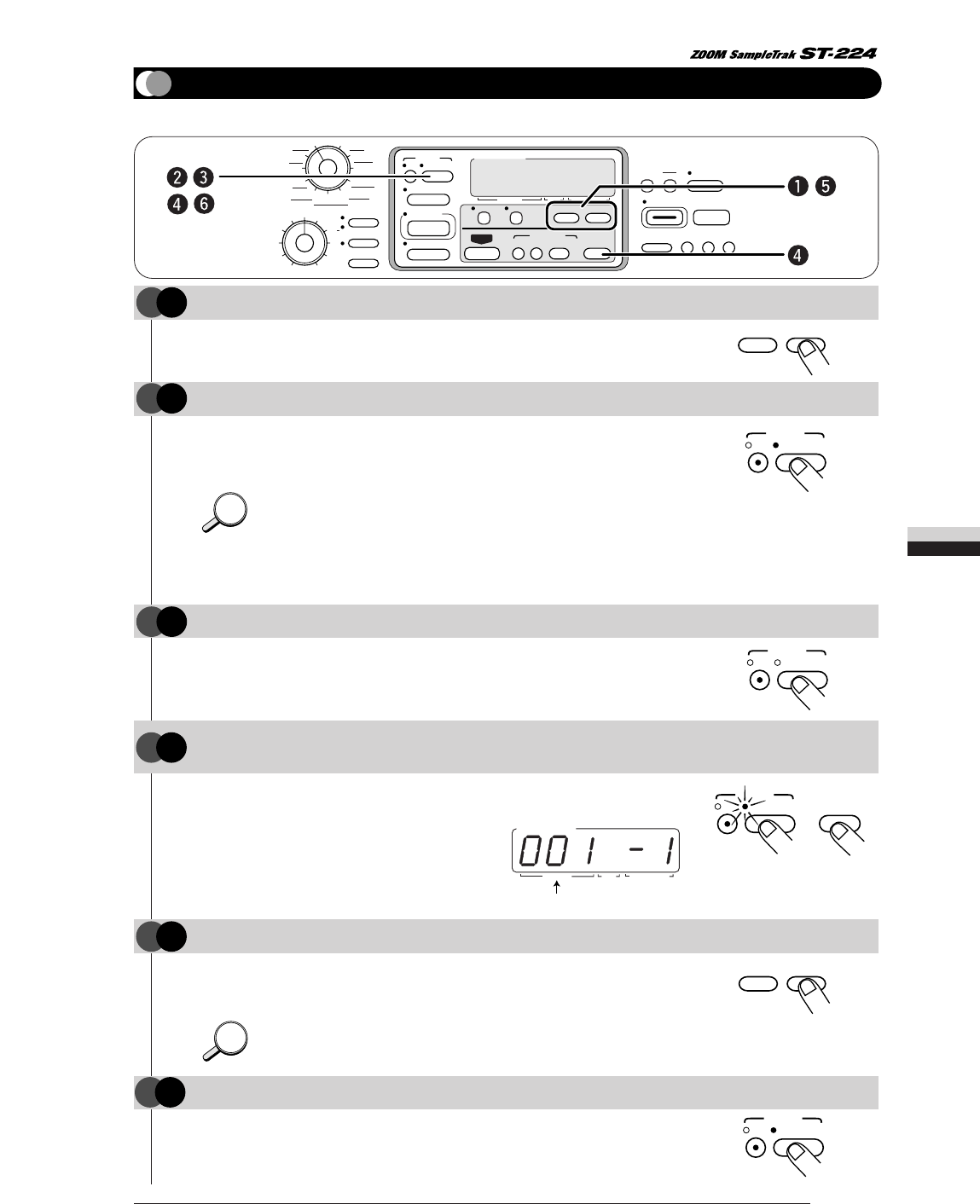
The [SONG PLAY/STOP] LED lights up and playback of the song
starts at the beginning.
• Also during playback of a song, you can hit pads to play them
manually. However, the maximum number of simultaneous
sounds may not be exceeded.
• Effect operations are not recorded in the song.
• Pressing the [SONG PLAY/STOP] key while holding down the
[LOOP/MARK] pad causes the song to be repeated.
The [SONG PLAY/STOP] LED goes out.
The playback start position is indicated on the display, using the
number of bars.
The number of bars shown on the display changes according to the
[-] [+] key operation.
You can also use the [EDIT 1] wheel instead of the [-] [+] keys.
The new start point is set. Song recording and playback can be
carried out from this point.
HINTHINT
This section describes how to play a song that has been recorded.
PAD ASSIGN
CAPACITY
ERASE OPTIMIZE
PLAY/STOP
RECORD
RE-SAMPLE
GRADE
MONO
STEREO
SAMPLING
EDIT 2
VOLUME/BASS
EXCITER
TREMOLO
AUTO PAN
LO-FI EFFECT
EXTREME EQ
COMPRESSOR
RESONANCE
HIGH-PASS
LOW-PASS
DISTORTION
RING MODULATOR
PITCH SHIFTER
DIMENSION
CHORUS
PHASER
FLANGER
STEP CRY
DELAY
REVERB
TIME STRETCH
SCRATCH
EFFECT
ON/OFF
PAD ENABLE
A
B
COPY DELETE
BACKUP
EXIT SPECIAL
LOAD SAVE
INTERNAL/DATA CARD
+
–
AUTO SYNC
PLAYLIST
TAP
BPM
SONG
PLAY/STOPREC
BPM/
VALUE
MEASURE
SAMPLE/SONGBEAT
+–
[–] [+] keys
SONG
PLAY/STOPREC
SONG
PLAY/STOPREC
In play mode, use the [-] [+] keys to select the song number (1 - 8).
1
STEP
Press the [SONG PLAY/STOP] key.
2
STEP
To stop the song, press the [SONG PLAY/STOP] key again.
3
STEP
+
SONG
PLAY/STOPREC
SPECIAL
You can also change the playback position of the song. While the song is stopped, hold
down the [SPECIAL] key and the press the [SONG PLAY/STOP] key.
4
STEP
+–
[–] [+] keys
SONG
PLAY/STOPREC
Use the [-] [+] keys to specify the bar.
5
STEP
When you have specified the desired position, press the [SONG PLAY/STOP] key.
6
STEP
51
Creating Songs
Playing a Song
HINTHINT
Number of bars at playback start position
BPM/
VALUE
MEASURE
SAMPLE/SONGBEAT
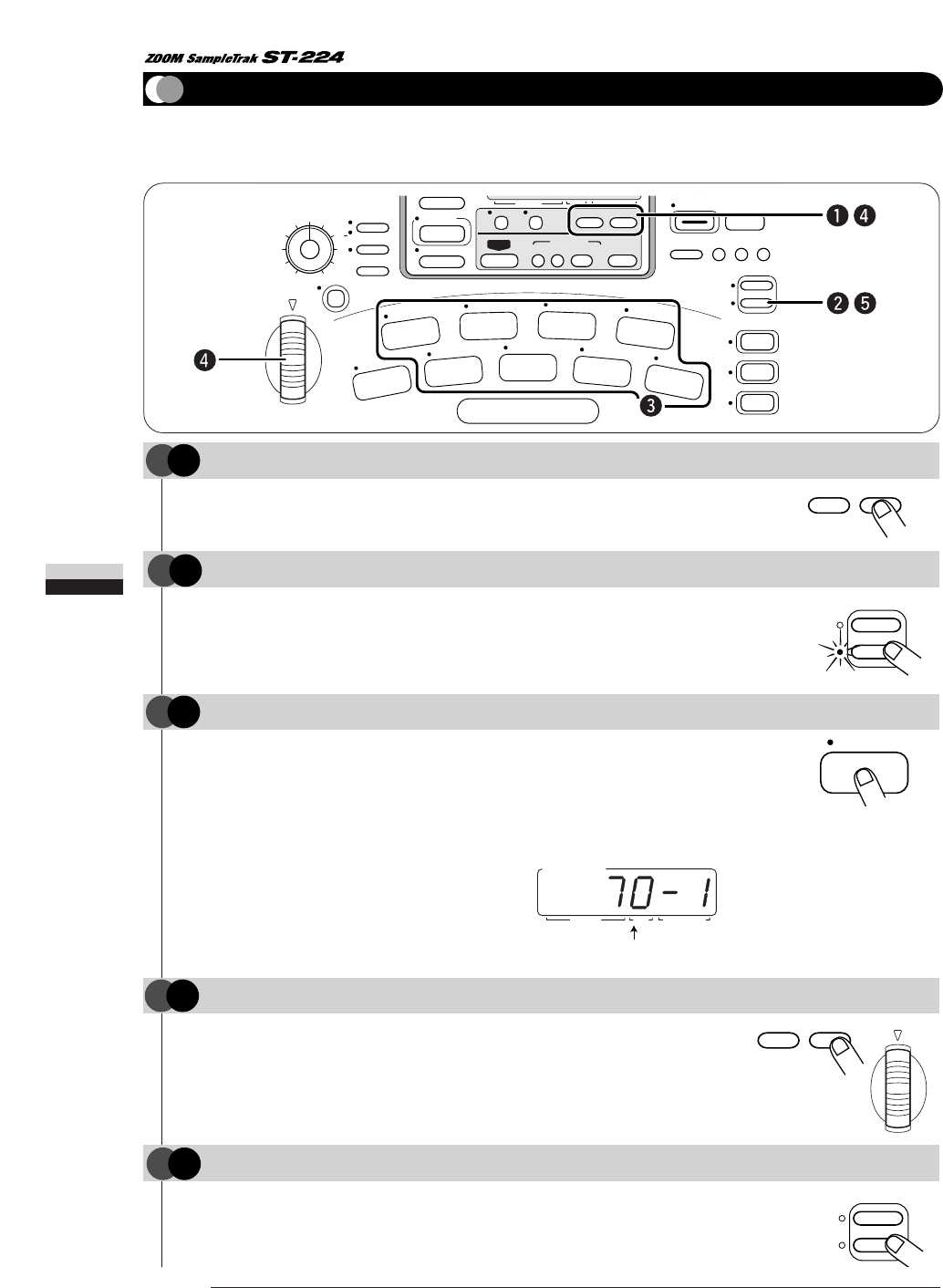
The [SONG FUNCTION] LED flashes.
When the [SONG FUNCTION] key is pressed, the pads serve to
select the parameters printed at the bottom right. When a pad is
pressed, the [SONG FUNCTION] LED and the LED of the pad are
constantly lit, and the setting of the respective parameter appears on
the display. (For details on the song function parameters, see page
53.)
The [SONG FUNCTION] LED goes out and the changed parameter is
accepted. To cancel the parameter change, press the [EXIT] key
instead of the [SONG FUNCTION] key.
52
Creating Songs
The length of a song or the number of beats, the metronome sound volume, pre-count setting and other
song settings (song function parameters) can be changed, as follows.
BANK
3
BANK
2
BANK
SONG
PAD
1
FUNCTION
PAD ASSIGN
CAPACITY
ERASE OPTIMIZE
PLAY/STOP
RECORD
EDIT 2
EXTREME EQ
RESONANCE
HIGH-PASS
LOW-PASS
DISTORTION
RING MODULATOR
PITCH SHIFTER
DIMENSION
CHORUS
PHASER
EFFECT
ON/OFF
PAD ENABLE
A
B
EFFECT SYNC
EDIT 1
LOOP/MARK
4
SHIFT
OFFSET
6
SWING
PANNING
8
MIDI
TRIGGER/GATE
2
QUANTIZE
TUNING
SOURCE
SOURCE MIX
5
PRE COUNT
END POINT
3
TIME SIG
START POINT
1
BAR LENGTH
LEVEL
7
CLICK VOLUME
REVERSE
COPY DELETE
BACKUP
EXIT SPECIAL
LOAD SAVE
INTERNAL/DATA CARD
+
–
AUTO SYNC
PLAYLIST
TAP
BPM
MEASURE
SAMPLE/SONGBEAT
SONG
PAD
FUNCTION
SONG
PAD
FUNCTION
Pads 1 – 8
+–
[–] [+] keys
+–
EDIT 1
[EDIT 1]
wheel
[–] [+] keys
Press the [SONG FUNCTION] key.
2
STEP
In play mode, use the [-] [+] keys to select the song number (1 - 8).
1
STEP
Select the item to be set, using pads 1 - 8.
3
STEP
Use the [-] [+] keys or the [EDIT 1] wheel to change the setting.
4
STEP
Press the [SONG FUNCTION] key again.
5
STEP
Changing Song Settings
Parameter setting values
BPM/
VALUE
MEASURE
SAMPLE/SONGBEAT
The song function parameters assigned to pads 1 - 8 are as follows.
• Pad 1 (BAR LENGTH)
Sets the length of a bar in the song. The maximum number is 300 bars for each song. This parameter can be
specified for each song individually.
Setting values: 1 - 300 (Default settings: 4)
If a song is set to a longer time after recording, blank bars are added to the end of the
song. If set to a shorter time, the excess bars are cut off.
• Pad 2 (QUANTIZE)
Sets the quantization value used for recording ( ➔p. 49). This parameter has no effect on song playback.
Setting values: 4, 8, 12, 16, 24, 32, Hi (Default settings: 16)
• Pad 3 (TIME SIG)
Sets the time of the song. This parameter can be specified for each song individually.
Setting values: 2 (2/4), 3 (3/4), 4 (4/4) (Default settings: 4)
After recording is complete, the beat of a song cannot be changed.
• Pad 4 (SHIFT)
Shifts the playback timing of the ST-224 back and forth. This is useful for example to match the playback to the
timing of external equipment. The setting is made in 1-tick units (1/24 of a quarter note), and the maximum
setting is 2 bars.
Setting values: -48 to +48 (Default settings: 0)
When this item is changed, the playback data stored for a song are rewritten.
Excess portions at the beginning and end will be cut off.
• Pad 5 (PRE COUNT)
Determines whether the metronome sound is heard before recording.
0: No pre-count
1: Recording starts after pre-count of 1 measure.
2: Recording starts after pre-count of 2 measures.
PAd: Recording starts as soon as a pad is hit.
Setting values: 0, 1, 2, PAd (Default settings: 1)
• Pad 6 (SWING)
Sets the swing (rhythm fluctuation) during song playback. Higher values result in more pronounced swing. This
parameter only affects playback, it does not alter the recorded data of a song.
Setting values: 50 - 75 (Default settings: 50)
• Pad 7 (CLICK VOLUME)
Sets the volume of the metronome click.
Setting values: 0 - 100 (Default settings: 70)
• Pad 8 (MIDI)
The internal sequencer can be controlled either by the internal clock (int) or by the MIDI clock derived from
MIDI messages sent from external equipment (Midi).
Setting values: int, Midi (Default settings: int)
When "Midi" is selected, song recording
is not possible.
NOTE
NOTE
NOTE
NOTE
HINTHINT
53
Creating Songs
Song Function Parameters
While this song parameter is called, the MIDI
receive channel can be selected by holding
down any of the [BANK 1] - [BANK 3] keys and
using the [-] [+] keys.
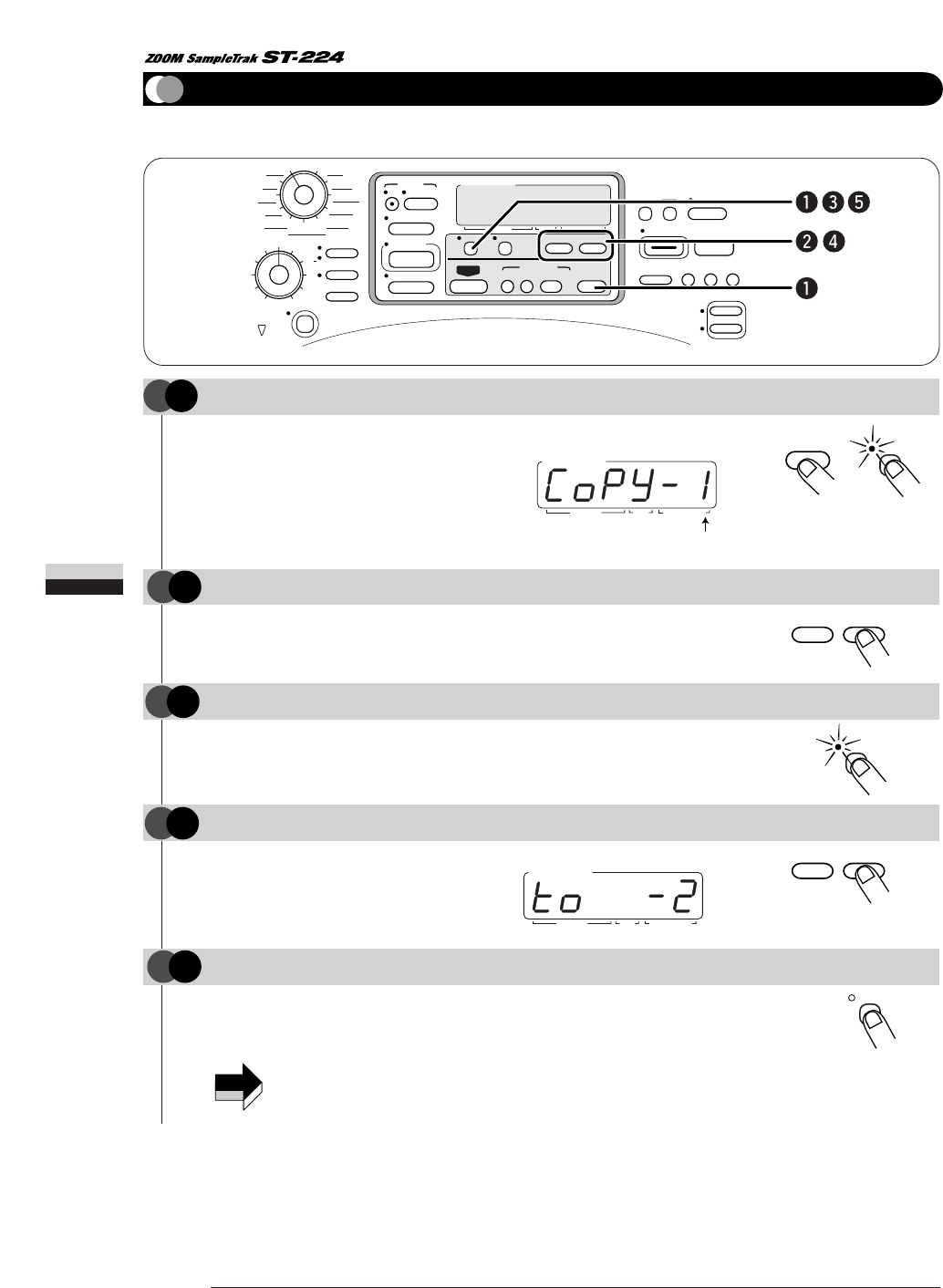
The [COPY] LED flashes and the song number (1 - 8) of the copy
target appears on the display.
The [COPY] LED goes out and the copy is carried out. To cancel the
copy process, press the [EXIT] key instead of the [COPY] key.
If a copy is attempted without sufficient free capacity in the main
memory, the indication "FULL" appears on the display. Delete
songs that are no longer needed.
NOTE
54
Creating Songs
The data recorded for a song can be copied to another song, for example to create a different version.
SONG
PAD
FUNCTION
PAD ASSIGN
CAPACITY
ERASE OPTIMIZE
PLAY/STOP
RECORD
RE-SAMPLE
GRADE
MONO
STEREO
SAMPLING
EDIT 2
VOLUME/BASS
EXCITER
TREMOLO
AUTO PAN
LO-FI EFFECT
EXTREME EQ
COMPRESSOR
RESONANCE
HIGH-PASS
LOW-PASS
DISTORTION
RING MODULATOR
PITCH SHIFTER
DIMENSION
CHORUS
PHASER
FLANGER
STEP CRY
DELAY
REVERB
TIME STRETCH
SCRATCH
EFFECT
ON/OFF
PAD ENABLE
A
B
EFFECT SYNC
EDIT 1
COPY DELETE
BACKUP
EXIT SPECIAL
LOAD SAVE
INTERNAL/DATA CARD
+
–
AUTO SYNC
PLAYLIST
TAP
BPM
SONG
PLAY/STOPREC
BPM/
VALUE
MEASURE
SAMPLE/SONGBEAT
+–
[–] [+] keys
+–
[–] [+] keys
+
COPY
SPECIAL
COPY
COPY
Use the [-] [+] keys to select the song to be used as copy source.
2
STEP
Hold down the [SPECIAL] key and press the [COPY] key.
1
STEP
Press the [COPY] key.
5
STEP
Use the [-] [+] keys to select the song to be used as copy target.
4
STEP
Press the [COPY] key.
3
STEP
Copying a Song
Song number
BPM/
VALUE
MEASURE
SAMPLE/SONGBEAT
BPM/
VALUE
MEASURE
SAMPLE/SONGBEAT
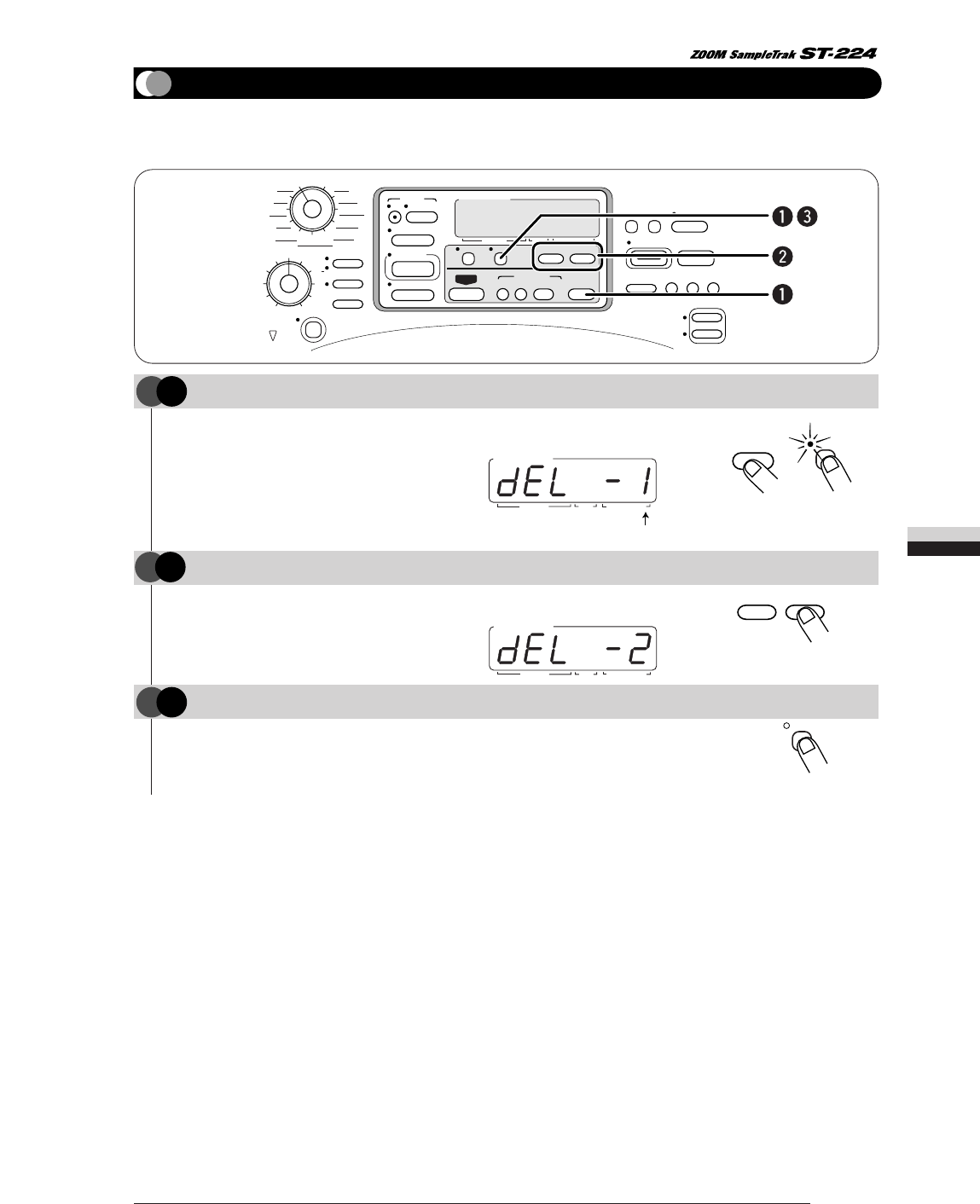
The [DELETE] LED flashes and the song number (1 - 8) of the delete
target appears on the display.
The [DELETE] LED goes out and the delete process is carried out. To
cancel the delete process, press the [EXIT] key instead of the
[DELETE] key.
The data recorded for a song can be deleted if no longer required. A deleted song is returned to the
default (blank) condition.
SONG
PAD
FUNCTION
PAD ASSIGN
CAPACITY
ERASE OPTIMIZE
PLAY/STOP
RECORD
RE-SAMPLE
GRADE
MONO
STEREO
SAMPLING
EDIT 2
VOLUME/BASS
EXCITER
TREMOLO
AUTO PAN
LO-FI EFFECT
EXTREME EQ
COMPRESSOR
RESONANCE
HIGH-PASS
LOW-PASS
DISTORTION
RING MODULATOR
PITCH SHIFTER
DIMENSION
CHORUS
PHASER
FLANGER
STEP CRY
DELAY
REVERB
TIME STRECH
SCRATCH
EFFECT
ON/OFF
PAD ENABLE
A
B
EFFECT SYNC
EDIT 1
COPY DELETE
BACKUP
EXIT SPECIAL
LOAD SAVE
INTERNAL/DATA CARD
+
–
AUTO SYNC
PLAYLIST
TAP
BPM
SONG
PLAY/STOPREC
BPM/
VALUE
MEASURE
SAMPLE/SONGBEAT
+
DELETE
SPECIAL
DELETE
+–
[–] [+] keys
Hold down the [SPECIAL] key and press the [DELETE] key.
1
STEP
Use the [-] [+] keys to select the song to be deleted.
2
STEP
Press the [DELETE] key again.
3
STEP
55
Creating Songs
Deleting a Song
Song number
BPM/
VALUE
MEASURE
SAMPLE/SONGBEAT
BPM/
VALUE
MEASURE
SAMPLE/SONGBEAT
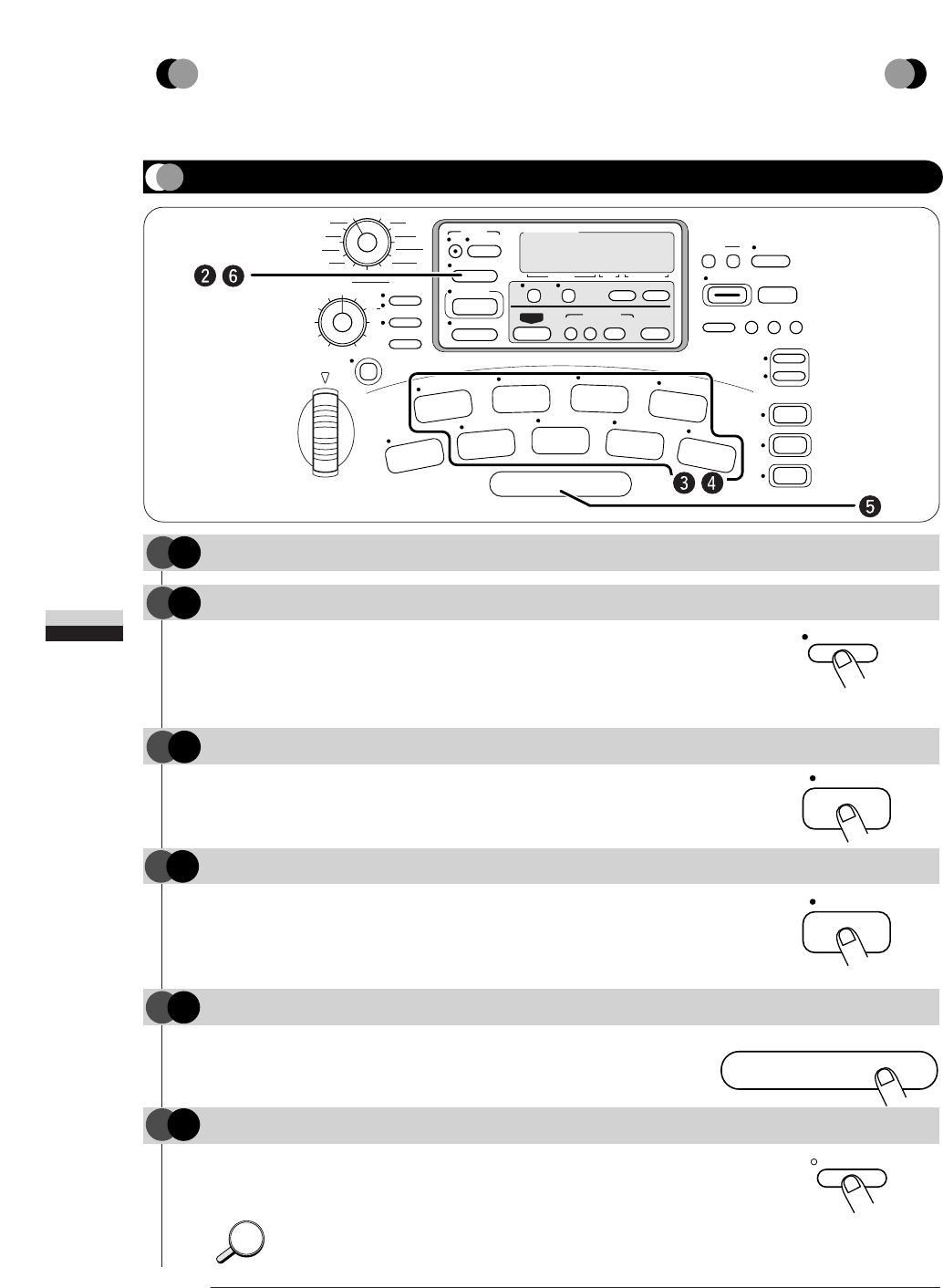
The ST-224 incorporates a play list function which lets you assign songs 1 - 8 to pads 1 - 8 and play the songs
by hitting the pads. This section explains how to use this function.
Playing Songs With Pads (Play List Function)
56
Playing Songs With Pads (Play List Function)
The ST-224 goes into play list mode. The [PLAYLIST] LED lights up
and the [BANK 1] - [BANK 3] LEDs go out. Songs 1 - 8 are now
assigned to pads 1 - 8 and can be played with the pads.
The LED of the pad lights up and the song assigned to the pad is
played back in loop mode.
Only one song can be played at a time. If another pad is pressed
while a song is playing, the previous song stops and playback of the
new song starts.
The song continues to play also after the pad is released.
The [PLAYLIST] LED goes out and the unit reverts to normal play
mode.
Also during play list playback, the internal effects and the
[SOURCE] pad for input source playback can be used.
HINTHINT
BANK
3
BANK
2
BANK
SONG
PAD
1
FUNCTION
PAD ASSIGN
CAPACITY
ERASE OPTIMIZE
PLAY/STOP
RECORD
RE-SAMPLE
GRADE
MONO
STEREO
SAMPLING
EDIT 2
VOLUME/BASS
EXCITER
TREMOLO
AUTO PAN
LO-FI EFFECT
EXTREME EQ
COMPRESSOR
RESONANCE
HIGH-PASS
LOW-PASS
DISTORTION
RING MODULATOR
PITCH SHIFTER
DIMENSION
CHORUS
PHASER
FLANGER
STEP CRY
DELAY
REVERB
TIME STRETCH
SCRATCH
EFFECT
ON/OFF
PAD ENABLE
A
B
EFFECT SYNC
EDIT 1
LOOP/MARK
4
SHIFT
OFFSET
6
SWING
PANNING
8
MIDI
TRIGGER/GATE
2
QUANTIZE
TUNING
SOURCE
SOURCE MIX
5
PRE COUNT
END POINT
3
TIME SIG
START POINT
1
BAR LENGTH
LEVEL
7
CLICK VOLUME
REVERSE
COPY DELETE
BACKUP
EXIT SPECIAL
LOAD SAVE
INTERNAL/DATA CARD
+
–
AUTO SYNC
PLAYLIST
TAP
BPM
SONG
PLAY/STOPREC
BPM/
VALUE
MEASURE
SAMPLE/SONGBEAT
PLAYLIST
Pads 1 – 8
Pads 1 – 8
Record songs 1 - 8 to assign to the pads.
1
STEP
While the unit is in play mode, press the [PLAYLIST] key.
2
STEP
Press one of pads 1 - 8.
3
STEP
To switch songs, hit another pad.
4
STEP
LOOP/MARK
[LOOP/MARK] pad
To set song playback to the hold mode, press the [LOOP/MARK] pad.
5
STEP
PLAYLIST
To terminate the play list mode, press the [PLAYLIST] key.
6
STEP
Assigning Songs to Pads
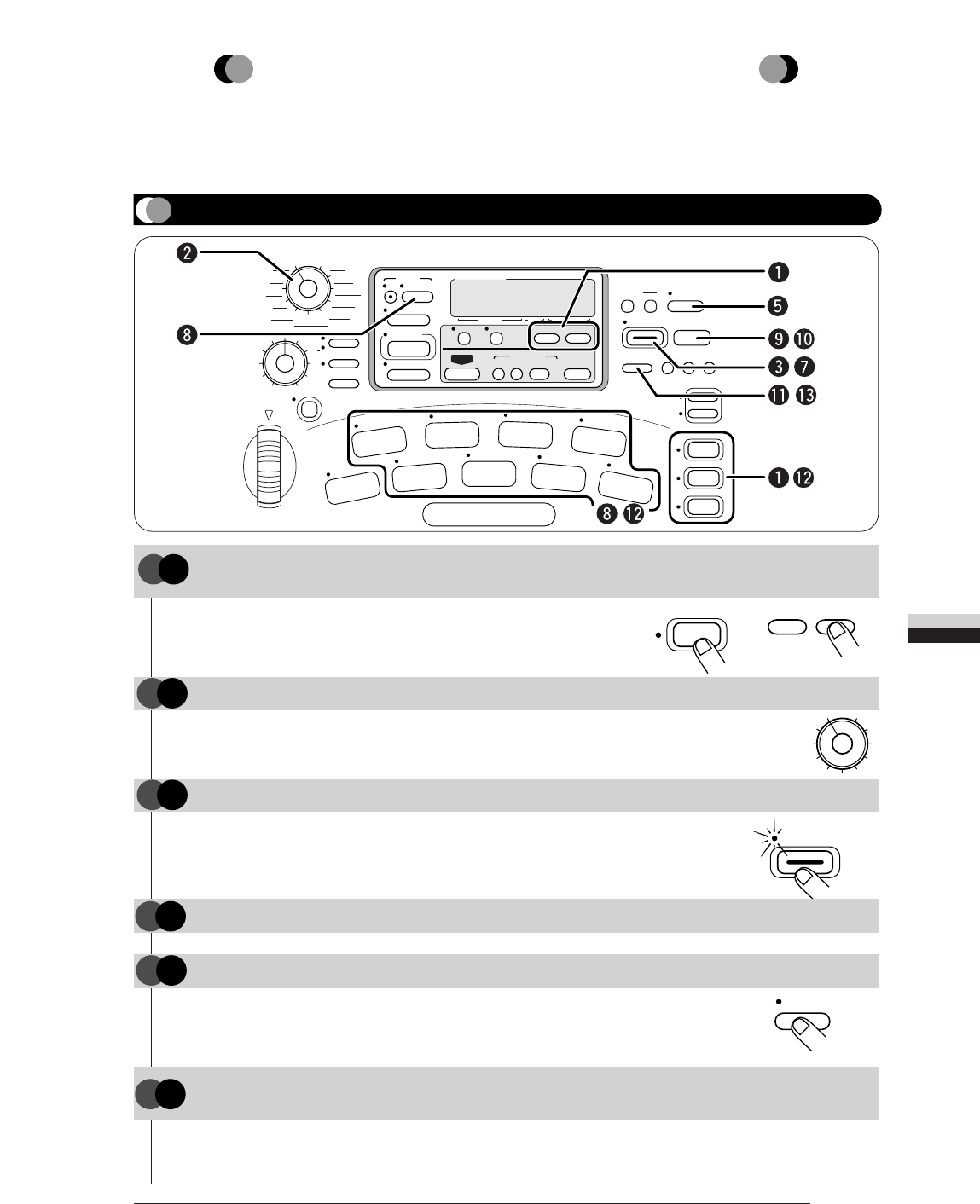
"Resampling" refers to returning the output of the ST-224 to the sampler section for repeated sampling in the
digital domain. This can be used to create a new sample based on multi-pad play or song playback by the
internal sequencer. The new sample can then again be assigned to a pad. Resampling is also possible while the
internal effects are active.
The [RECORD] LED flashes and the ST-224 goes into the sampling
standby condition.
The [RE-SAMPLE] LED lights up and the ST-224 is in the resampling
standby condition.
• To terminate resampling after a preset interval
Hold down the [PLAY/STOP] key, and use the [-] [+] keys to set the
auto sampling time ( ➔p. 24).
BANK
3
BANK
2
BANK
SONG
PAD
1
FUNCTION
PAD ASSIGN
CAPACITY
ERASE OPTIMIZE
PLAY/STOP
RECORD
RE-SAMPLE
GRADE
MONO
STEREO
SAMPLING
EFFECT
EDIT 2
VOLUME/BASS
EXCITER
TREMOLO
AUTO PAN
LO-FI EFFECT
EXTREME EQ
COMPRESSOR
RESONANCE
HIGH-PASS
LOW-PASS
DISTORTION
RING MODULATOR
PITCH SHIFTER
DIMENSION
CHORUS
PHASER
FLANGER
STEP CRY
DELAY
REVERB
TIME STRETCH
SCRATCH
EFFECT
ON/OFF
PAD ENABLE
A
B
EFFECT SYNC
EDIT 1
LOOP/MARK
4
SHIFT
OFFSET
6
SWING
PANNING
8
MIDI
TRIGGER/GATE
2
QUANTIZE
TUNING
SOURCE
SOURCE MIX
5
PRE COUNT
END POINT
3
TIME SIG
START POINT
1
BAR LENGTH
LEVEL
7
CLICK VOLUME
REVERSE
MAXMINMAXMIN
INPUTOUTPUT
PEAK
COPY DELETE
BACKUP
EXIT SPECIAL
LOAD SAVE
INTERNAL/DATA CARD
+
–
AUTO SYNC
PLAYLIST
TAP
BPM
SONG
PLAY/STOPREC
BPM/
VALUE
MEASURE
SAMPLE/SONGBEAT
BANK
1
BANK 1– 3 keys
+–
[–] [+] keys
[EFFECT SELECT]
switch
RECORD
To resample pad play, use the [BANK 1] - [BANK 3] keys to select the bank which
contains the desired pad. To resample a song, use the [-] [+] keys to select the song.
1
STEP
Press the [RECORD] key.
3
STEP
Select the desired sampling grade and the mono/stereo setting.
4
STEP
If desired, select the internal effects.
2
STEP
57
Using the Resampling Function
Resampling Pad Play or Songs
Using the Resampling Function
RE-SAMPLE
Press the [RE-SAMPLE] key.
5
STEP
To terminate resampling automatically, perform the following steps, depending on the
desired mode.
6
STEP
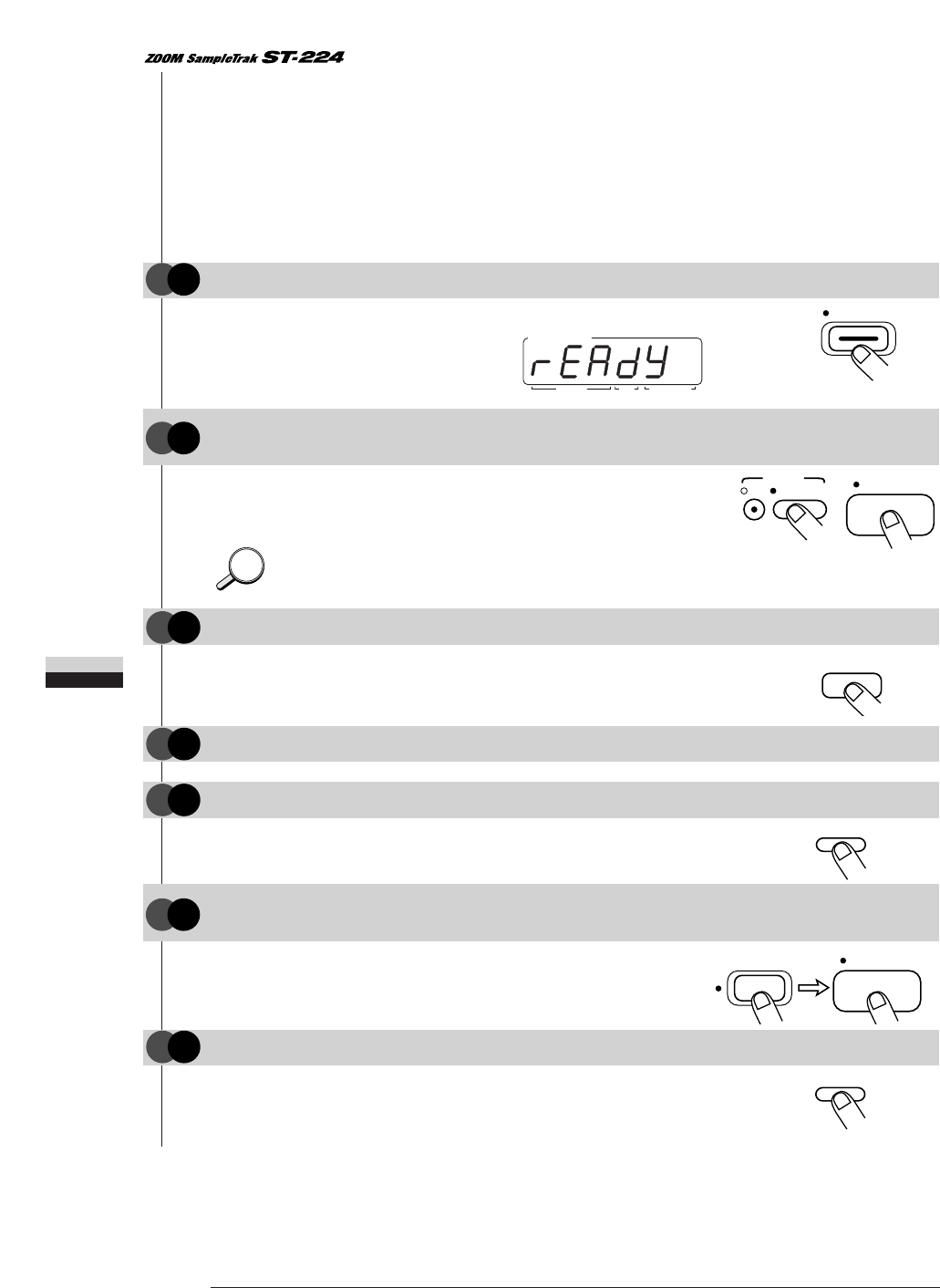
• To terminate resampling when one-shot playback of pad is
completed
Press the [PAD FUNCTION] key so that the [PAD FUNCTION] LED
lights up.
• To terminate resampling when playback of song is completed
Press the [SONG FUNCTION] key so that the [SONG FUNCTION]
LED lights up.
The indication "rEAdy" appears on the display.
Resampling starts as soon as the [SONG PLAY/STOP] key or one of
pads 1 - 8 is pressed.
Resampling can be carried out while combining song playback and
pad play, and while varying effect parameters in real time.
The new sample is assigned to the selected pad. (Detail of Assigning
a Sample to a Pad ➔p. 27)
HINTHINT
58
Using the Resampling Function
RECORD
PLAY/STOP
BANK
1
BANK 1– 3 keys Pads 1 – 8
PAD ASSIGN
BPM/
VALUE
MEASURE
SAMPLE/SONGBEAT
SONG
PLAY/STOPREC
Pads 1 – 8
Press the [RECORD] key again.
7
STEP
To resample a song, press the [SONG PLAY/STOP] key. To resample pad play, hit one of
pads 1 - 8.
8
STEP
To manually terminate resampling, press the [PLAY/STOP] key.
9
STEP
If desired, use the [PLAY/STOP] key to check the sample.
10
STEP
Press the [PAD ASSIGN] key twice.
11
STEP
Use the [BANK 1] - [BANK 3] keys and the pads 1 - 8 to select the pad to which you want
to assign the sample.
12
STEP
Press the [PAD ASSIGN] key again.
13
STEP
PAD ASSIGN
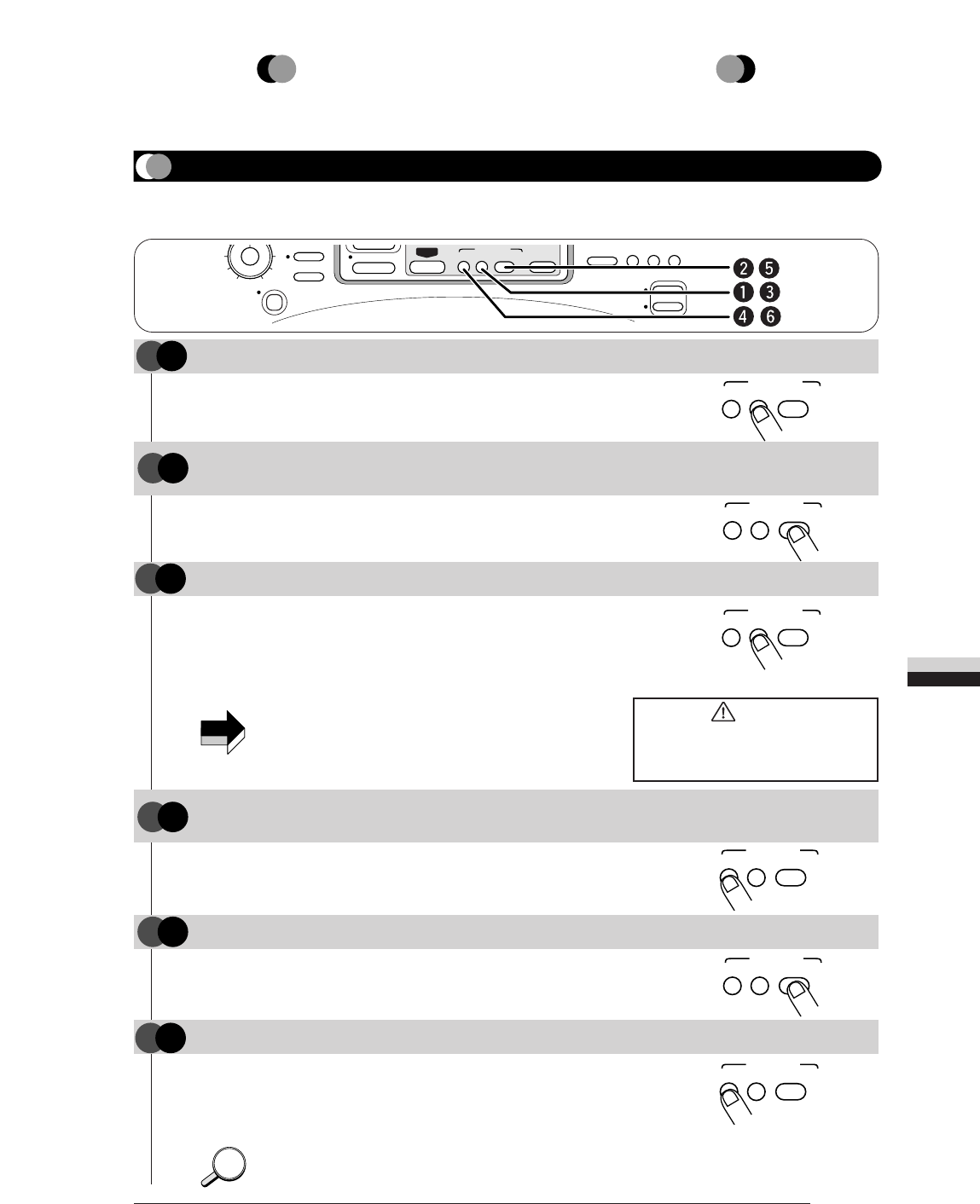
59
Storing and Reading Data
This section explains how to save the entire main memory contents or the waveform data for a pad to the
backup memory and how to load this data back into the main memory.
Storing and Reading Data
Bulk data (all waveform data, pad parameter settings, song data for
internal sequencer) are saved to the backup memory. The ST-224
then returns to the regular play mode. When wishing to cancel the
store process, press the [EXIT] key instead of the [SAVE] key.
• The backup memory can hold only one set of bulk data.
The previous set will be overwritten.
• During storing, all currently playing pads are stopped
(including the [SOURCE] pad).
Bulk data are copied from the backup memory into the main memory.
The ST-224 then returns to the regular play mode. When wishing to
cancel the load process, press the [EXIT] key instead of the [LOAD] key.
When the unit is turned on, the last bulk data saved in backup
memory are copied back to the main memory.
HINTHINT
NOTE
This section explains how to save bulk data (main memory contents) to the backup memory and how to
load bulk data from backup memory into the main memory.
SONG
PAD
FUNCTION
PAD ASSIGN
CAPACITY
ERASE OPTIMIZE
ON/OFF
PAD ENABLE
B
EFFECT SYNC
BACKUP
EXIT SPECIAL
LOAD SAVE
INTERNAL/DATA CARD
AUTO SYNC
BACKUP
LOAD SAVE
INTERNAL/DATA CARD
BACKUP
LOAD SAVE
INTERNAL/DATA CARD
BACKUP
LOAD SAVE
INTERNAL/DATA CARD
BACKUP
LOAD SAVE
INTERNAL/DATA CARD
To save bulk data, press the [SAVE] key.
1
STEP
BACKUP
LOAD SAVE
INTERNAL/DATA CARD
Press the [SAVE] key again.
3
STEP
BACKUP
LOAD SAVE
INTERNAL/DATA CARD
To load data from backup memory into the main memory, press the [LOAD] key while the
unit is in play mode.
4
STEP
Use the [INTERNAL/DATA CARD] key to set the load target to "Int" (internal).
5
STEP
Press the [LOAD] key again.
6
STEP
Use the [INTERNAL/DATA CARD] key to set the save target to "Int" (internal backup
memory).
2
STEP
Storing/Reading Bulk Data (Backup Memory)
CAUTION
Never turn power to the unit off while
data are being saved. Otherwise the
data may be destroyed.
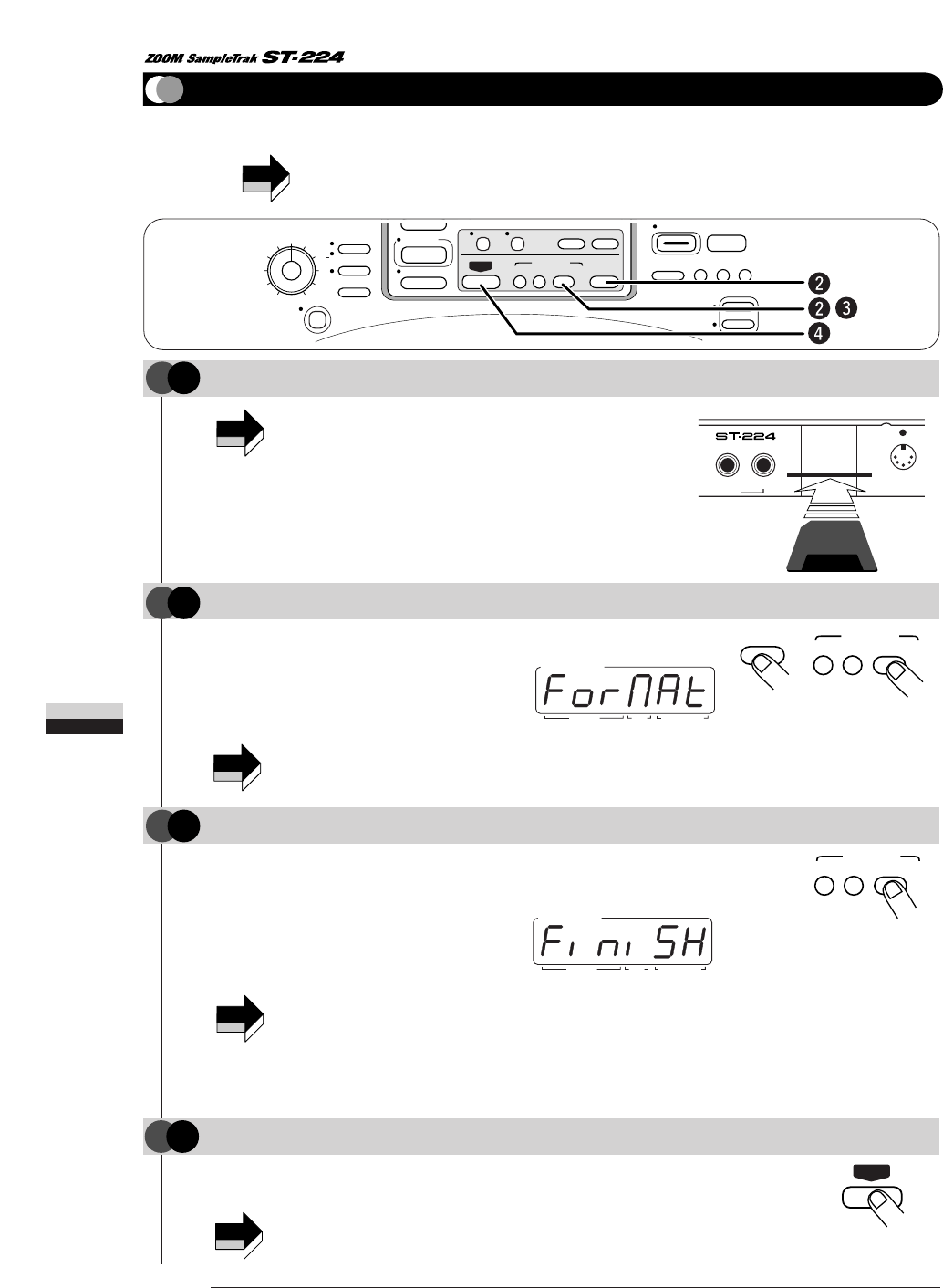
• Insert the data card in such a way that the corner cutout
is on the far left side and the connector area faces
towards the rear.
• If the card is not oriented properly, it will not go fully into
the slot. Forcefully pushing the card in may damage it.
60
Storing and Reading Data
The indication "ForMAt" appears on the display.
If the indication "noCArd" appears, the data card is not recognized.
Check whether the card has been inserted properly.
The display indication flashes and formatting starts. When formatting
is completed, the indication "FiniSH" appears on the display.
• When formatting is carried out, any data already stored on the
card will be lost. Take care not to accidentally erase a card.
• If the indication "Cd Err" appears during formatting, there is a
problem with the data card. Repeat the process from step 1. If
the same error occurs again, use a different card.
The ST-224 reverts to the play mode.
Cards formatted in other devices may not be usable in the ST-224.
NOTE
NOTE
NOTE
NOTE
Before a data card can be used for saving and loading data, it must be formatted (initialized) as follows.
Use only data cards formatted in the ST-224.
NOTE
SONG
PAD
FUNCTION
PAD ASSIGN
CAPACITY
ERASE OPTIMIZE
PLAY/STOP
RECORD
EDIT 2
EFFECT
ON/OFF
PAD ENABLE
A
B
EFFECT SYNC
COPY DELETE
BACKUP
EXIT SPECIAL
LOAD SAVE
INTERNAL/DATA CARD
+
–
AUTO SYNC
TAP
BPM
MEASURE
SAMPLE/SONGBEAT
Insert a data card into the [DATA CARD] slot on the rear panel of the unit.
1
STEP
Press the [INTERNAL/DATA CARD] key.
3
STEP
When formatting is completed, press the [EXIT] key.
4
STEP
Hold down the [SPECIAL] key and press the [INTERNAL/DATA CARD] key.
2
STEP
Formatting a Data Card
L/M
O
N
O
DATA CARD
MIDI IN
OUTPUT
Data Card
ST-224 Rea Panel
SPECIAL+
BACKUP
LOAD SAVE
INTERNAL/DATA CARD
BPM/
VALUE
MEASURE
SAMPLE/SONGBEAT
BPM/
VALUE
MEASURE
SAMPLE/SONGBEAT
BACKUP
LOAD SAVE
INTERNAL/DATA CARD
EXIT
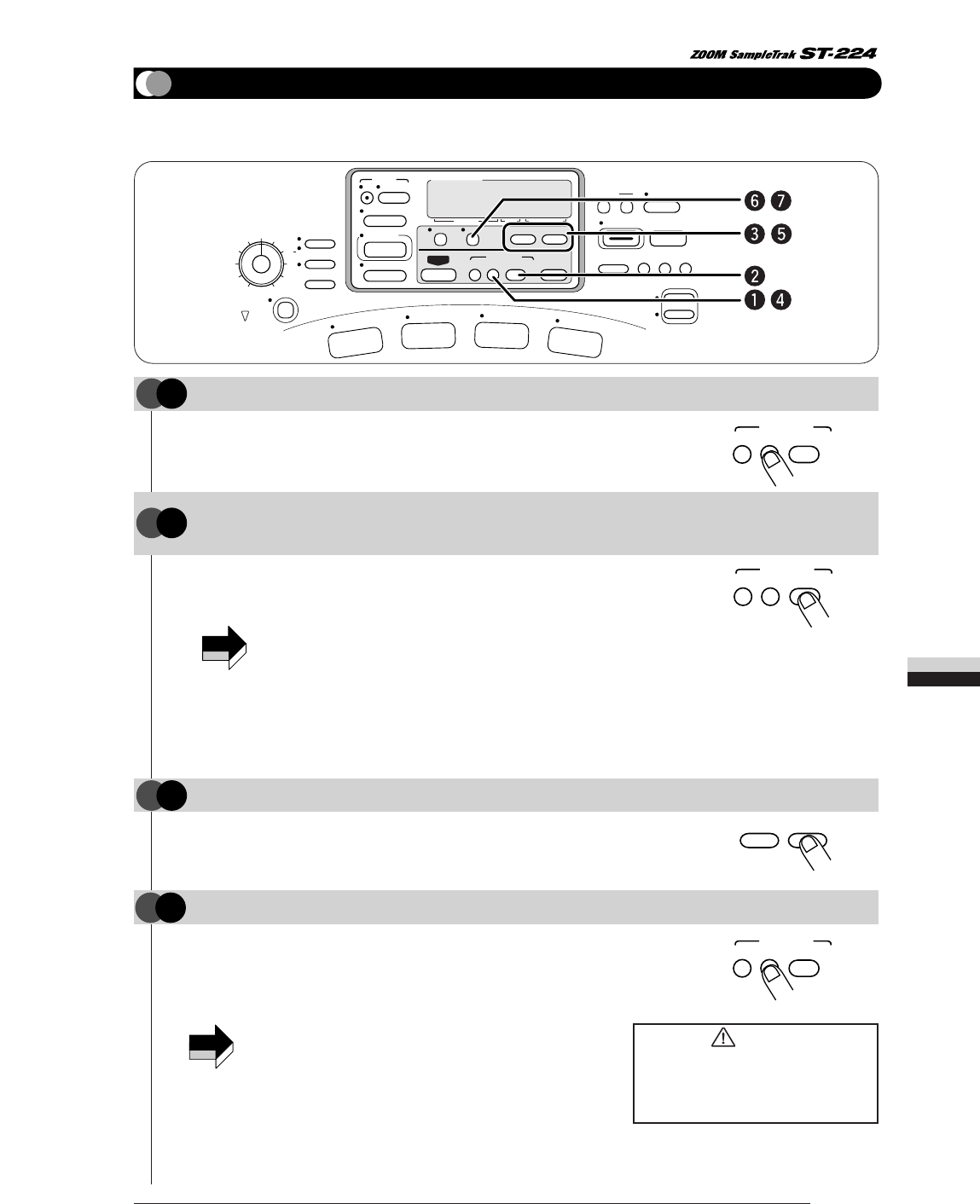
61
Storing and Reading Data
A data card can hold up to 99 sets of bulk data, within the limits of
actually available capacity.
• If the indication "noCArd" appears, the data card is not
recognized. Check whether the card has been inserted properly.
• If the indication "Cd Err" appears, there is a problem with the
data card. Format the card again.
• If the source of the last loaded bulk data was a data card, the
original file number will appear. Otherwise a new file number will
be shown.
When the number of an already stored file is selected, the display
flashes.
Bulk data (all waveform data, pad parameter settings, song data for
internal sequencer) are saved to the data card. The ST-224 then
returns to the regular play mode.
• If the indication "Cd FULL" appears after step 3, the
data card does not have enough free capacity. Erase
bulk data that are no longer needed. If the indication
"Cd Err" appears, the data card is defective. Format the
card again.
• When the number of a file where data are already
stored is selected, the display flashes.
• During storing, all currently playing pads are stopped
(including the [SOURCE] pad).
NOTE
This section explains how to save bulk data (main memory contents) on a data card SM04 (option) and
how to load bulk data back from data card into the main memory.
SONG
PAD
FUNCTION
PAD ASSIGN
CAPACITY
ERASE OPTIMIZE
PLAY/STOP
RECORD
RE-SAMPLE
GRADE
MONO
STEREO
SAMPLING
EDIT 2
EFFECT
ON/OFF
PAD ENABLE
A
B
EFFECT SYNC
EDIT 1
5
PRE COUNT
END POINT
3
TIME SIG
START POINT
1
BAR LENGTH
LEVEL
7
CLICK VOLUME
REVERSE
COPY DELETE
BACKUP
EXIT SPECIAL
LOAD SAVE
INTERNAL/DATA CARD
+
–
AUTO SYNC
PLAYLIST
TAP
BPM
SONG
PLAY/STOPREC
BPM/
VALUE
MEASURE
SAMPLE/SONGBEAT
BACKUP
LOAD SAVE
INTERNAL/DATA CARD
BACKUP
LOAD SAVE
INTERNAL/DATA CARD
BACKUP
LOAD SAVE
INTERNAL/DATA CARD
+–
[–] [+] keys
Press the [SAVE] key while the ST- 224 is in play mode.
1
STEP
Use the [INTERNAL/DATA CARD] key to set the save target to "CArdXX" (data card; XX is
a file number from 1 to 99).
2
STEP
Press the [SAVE] key again.
4
STEP
Use the [-] [+] keys to select the save target file number (1 - 99).
3
STEP
Storing Bulk Data (Data Card)
NOTE
CAUTION
Never turn power to the unit off or
remove a card while data are being
saved. Otherwise the data may be
destroyed.
The [DELETE] LED flashes.
The bulk data selected in step 3 are deleted. When wishing to cancel
the delete process, press the [EXIT] key to return to play mode.
62
Storing and Reading Data
+–
[–] [+] keys
DELETE
To remove bulk data that are no longer needed, use the [-] [+] keys to choose the file
number (1 - 99) when "CArdXX" is displayed in step 2.
5
STEP
Press the [DELETE] key.
6
STEP
Press the [DELETE] key again.
7
STEP
DELETE
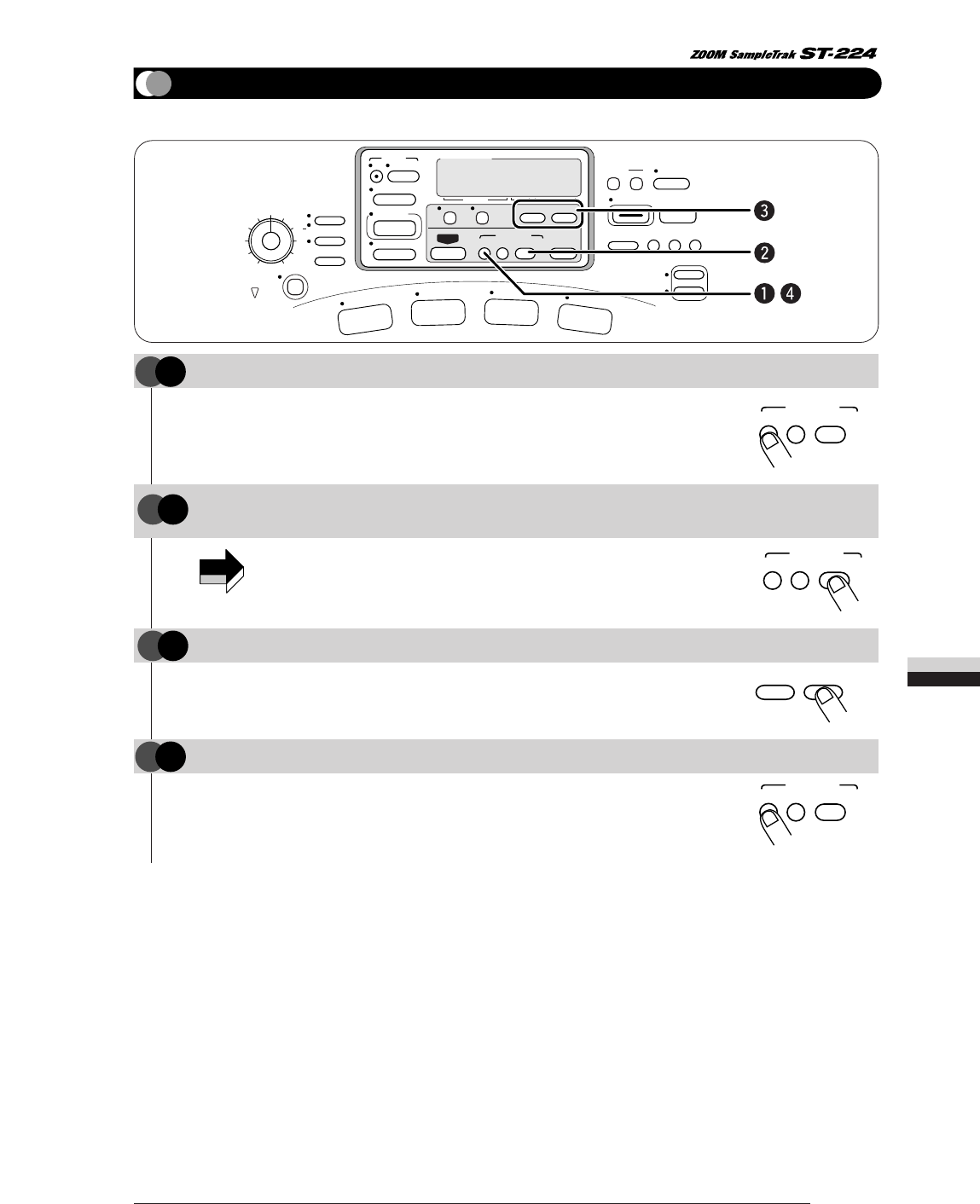
If the indication "noCArd" appears, the data card is not recognized.
Check whether the card has been inserted properly.
Bulk data (all waveform data, pad parameter settings, song data for
internal sequencer) are copied from the data card into the main
memory. The ST-224 then returns to the regular play mode.
NOTE
Use the [-] [+] keys to select the number of the bulk data source file (1 - 99).
3
STEP
Press the [LOAD] key while the unit is in play mode.
1
STEP
63
Storing and Reading Data
BACKUP
LOAD SAVE
INTERNAL/DATA CARD
BACKUP
LOAD SAVE
INTERNAL/DATA CARD
BACKUP
LOAD SAVE
INTERNAL/DATA CARD
+–
[–] [+] keys
Use the [INTERNAL/DATA CARD] key to select "CArdXX" as load source. (XX is a file
number from 1 to 99.)
2
STEP
Press the [LOAD] key again.
4
STEP
SONG
PAD
FUNCTION
PAD ASSIGN
CAPACITY
ERASE OPTIMIZE
PLAY/STOP
RECORD
RE-SAMPLE
GRADE
MONO
STEREO
SAMPLING
EDIT 2
EFFECT
ON/OFF
PAD ENABLE
A
B
EFFECT SYNC
EDIT 1
5
PRE COUNT
END POINT
3
TIME SIG
START POINT
1
BAR LENGTH
LEVEL
7
CLICK VOLUME
REVERSE
COPY DELETE
BACKUP
EXIT SPECIAL
LOAD SAVE
INTERNAL/DATA CARD
+
–
AUTO SYNC
PLAYLIST
TAP
BPM
SONG
PLAY/STOPREC
BPM/
VALUE
MEASURE
SAMPLE/SONGBEAT
Loading Bulk Data (Data Card)
This section explains how load bulk data stored on a data card SM04 (option) into the main memory.
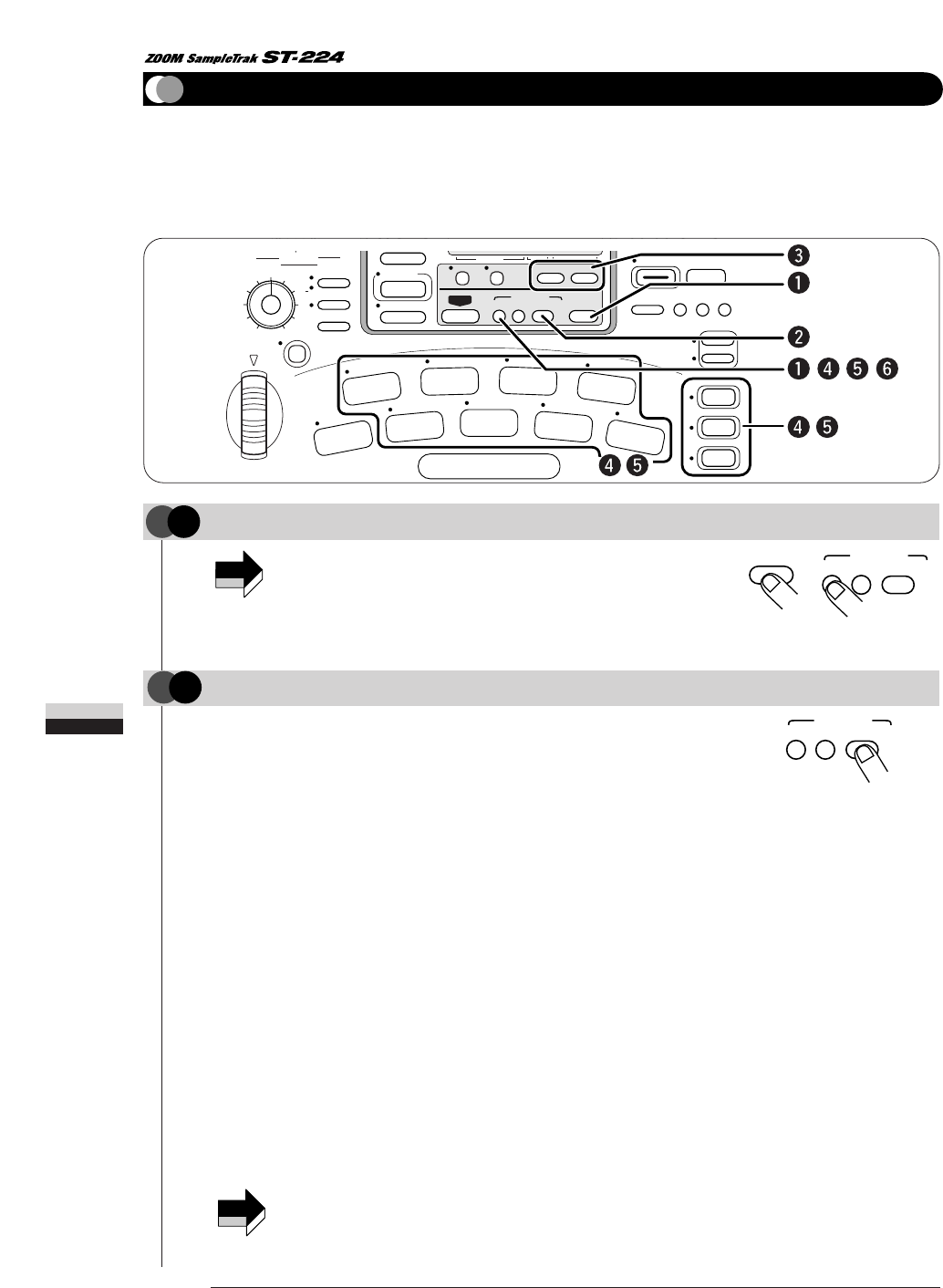
• If the indication "noCArd" appears, the data card is not
recognized. Check whether the card has been inserted properly.
• If the indication "Cd Err" appears, there is a problem with the
data card. Format the card again.
With each push of the [INTERNAL/DATA CARD] key, the selection
cycles through the following three settings.
• int
ST-224 bulk data stored internally in the backup memory. Pad data
comprised in the bulk data can be loaded into main memory and
assigned as samples to pads.
• CardXX (XX = 1 - 99)
ST-224 bulk data stored on a data card. Pad data comprised in the
bulk data can be loaded into main memory and assigned as
samples to pads.
• FileXX (XX = 1 - 99)
Stereo or mono WAV files stored on a data card. Waveform data
comprised in files can be loaded into main memory and assigned
as samples to pads.
• AIFFXX (XX = 1 - 99)
Stereo or mono AIFF files stored on a data card. Waveform data
comprised in files can be loaded into main memory and assigned
as samples to pads.
• When storing WAV files or AIFF files on a data card for use with
the ST-224, the files should be named "??.WAV" or "??.AIF" (??
stands for a number from 01 - 99). Files with other names are
disregarded.
The ST-224 can individually extract pad data (waveform data and parameter setting information for a
specific pad) from bulk data stored on a data card.
It is also possible to load regular waveform files (WAV or AIFF files) stored on a data card. This lets you
use WAV files or AIFF files created on a computer as samples in the ST-224.
BANK
3
BANK
2
BANK
SONG
PAD
1
FUNCTION
PAD ASSIGN
CAPACITY
ERASE OPTIMIZE
AUDITION
RECORD
EDIT 2
EXTREME EQ
RESONANCE
HIGH-PASS
LOW-PASS
DISTORTION
RING MODULATOR
PITCH SHIFTER
DIMENSION
CHORUS
PHASER
EFFECT
ON/OFF
PAD ENABLE
A
B
EFFECT SYNC
EDIT 1
LOOP/MARK
4
SHIFT
OFFSET
6
SWING
PANNING
8
MIDI
TRIGGER/GATE
2
QUANTIZE
TUNING
SOURCE
SOURCE MIX
5
PRE COUNT
END POINT
3
TIME SIG
START POINT
1
BAR LENGTH
LEVEL
7
CLICK VOLUME
REVERSE
COPY DELETE
BACKUP
EXIT SPECIAL
LOAD SAVE
INTERNAL/DATA CARD
+
–
AUTO SYNC
PLAYLIST
TAP
BPM
MEASURE
SAMPLE/SONGBEAT
SPECIAL+
BACKUP
LOAD SAVE
INTERNAL/DATA CARD
BACKUP
LOAD SAVE
INTERNAL/DATA CARD
Hold down the [SPECIAL] key and press the [LOAD] key.
1
STEP
Use the [INTERNAL/DATA CARD] key to select the type of file to be used as a source.
2
STEP
Loading Individual Pad Data/Waveform Data (Data Card/Backup Memory)
64
Storing and Reading Data
NOTE
NOTE
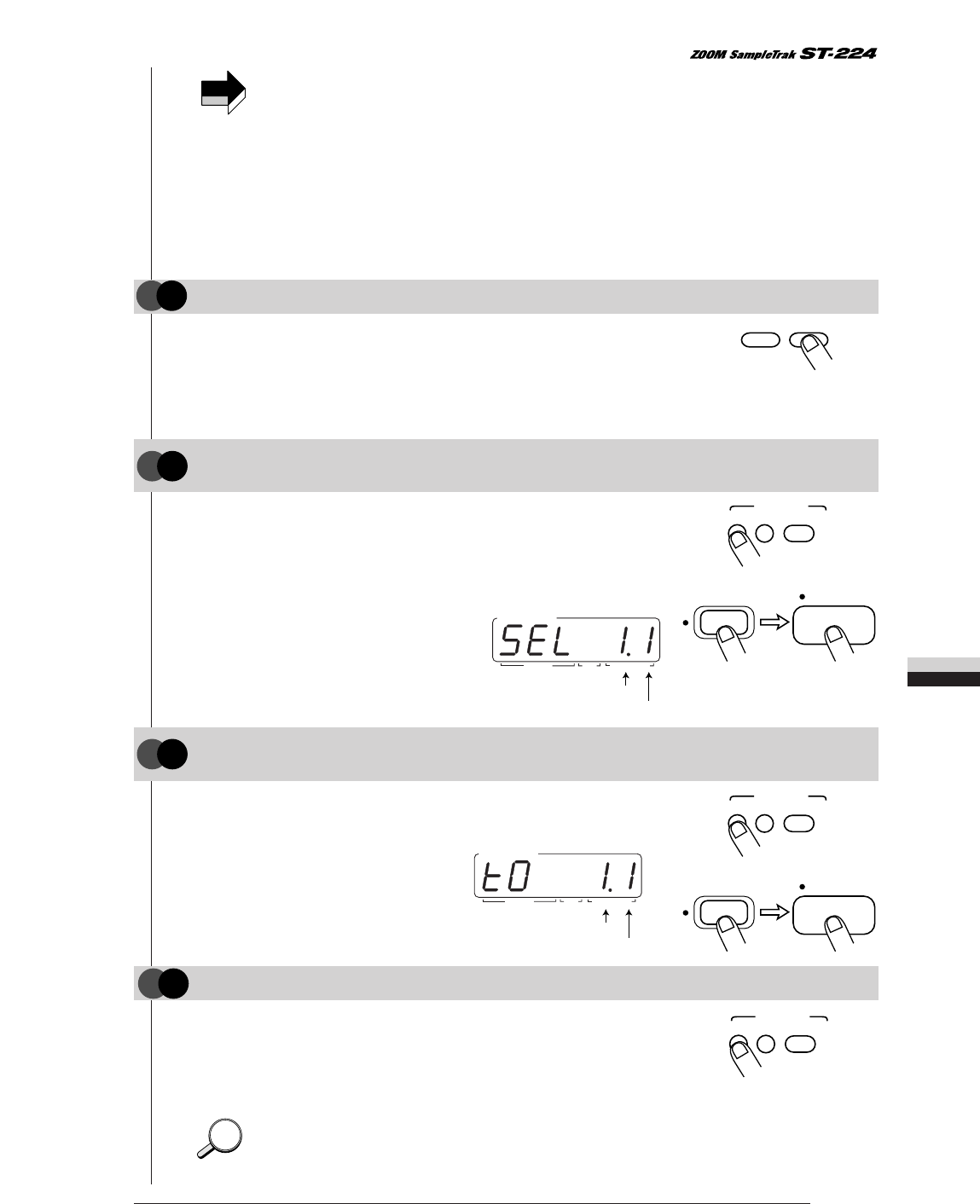
• To store WAV files or AIFF files on a data card for the ST-224, a
computer capable of reading and writing MS- DOS format data
cards is required.
• If "--" is shown in place of XX, the data card does not contain
any of the files described above.
• When wishing to recall a preset sound, store the contents of the
main memory and backup memory to a data card as required,
and then reset the ST-224 to the factory default condition
( ➔p. 69). By storing the present sounds on a data card,
recalling of specific waveform data becomes possible. This is a
handy feature.
• If "int" or "CArdXX" was selected in step 2
Proceed to step 4.
• If "FILEXX" or "AIFFXX" was selected in step 2
Proceed to step 5.
If "CArdXX" was selected in step 2, the bank number and pad
number for the desired data within the bulk data must be specified
before proceeding to step 5. When the [LOAD] key is pressed, the
bank number (1 - 3) and pad number (1 - 8) for the source appear on
the display. Specify the desired numbers here.
When the [LOAD] key is pressed, the bank number (1 - 3) and pad
number (1 - 8) for the target appear on the display. Specify the
desired numbers here.
If "int" or "CArdXX" was selected in step 2, the waveform data and
pad parameters are loaded into the specified pad. If "FILEXX" or
"AIFFXX" was selected, waveform data only are loaded into the
specified pad.
When reading in a WAV file or AIFF file, the sampling frequency and
tuning parameters are automatically converted.
For details, see the section "ST-224 File Import Details" on page
72.
HINTHINT
65
Storing and Reading Data
BPM/
VALUE
MEASURE
SAMPLE/SONGBEAT
Bank number
Pad number
BPM/
VALUE
MEASURE
SAMPLE/SONGBEAT
Bank number
Pad number
+–
[–] [+] keys
BANK
1
BANK 1– 3 keys Pads 1 – 8
BACKUP
LOAD SAVE
INTERNAL/DATA CARD
BACKUP
LOAD SAVE
INTERNAL/DATA CARD
BANK
1
BANK 1– 3 keys Pads 1 – 8
BACKUP
LOAD SAVE
INTERNAL/DATA CARD
If "int" or "CArdXX" was selected in step 2, press the [LOAD] key and use the [BANK 1] -
[BANK 3] keys and pads 1 - 8 to select the load source bank number and pad number.
4
STEP
Press the [LOAD] key and use the [BANK 1] - [BANK 3] keys and pads 1 - 8 to select the
load target bank number and pad number.
5
STEP
To execute the loading process, press the [LOAD] key again.
6
STEP
Use the [-] [+] keys to select the file number (1 - 99).
3
STEP
NOTE
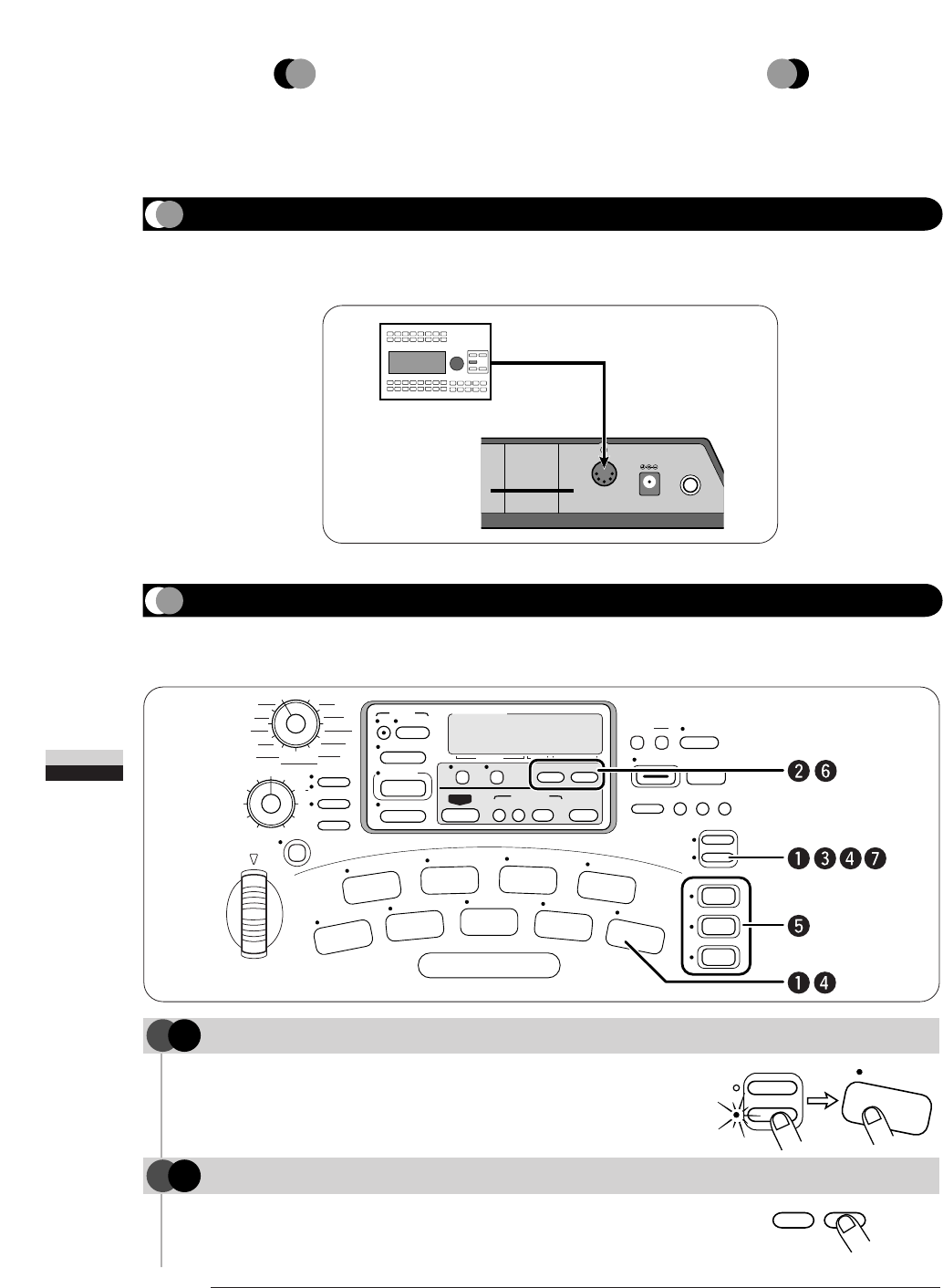
This section describes an example for using the MIDI capability of the ST-224.
Samples assigned to the pads of the ST-224 can be played from external MIDI equipment, or songs stored in
the ST- 224 can be synchronized by a MIDI sequencer or rhythm machine.
To use the MIDI capability, connect the MIDI OUT jack of the external equipment to the [MIDI IN] jack
on the ST- 224, using a MIDI cable.
Samples assigned to pads in the ST-224 (and an input source controlled by the [SOURCE] pad) can be
played by an external MIDI sequencer or MIDI controller.
MIDI Application Example
MIDI Connections
Playing ST-224 Samples Under Control of External Equipment
66
MIDI Application Example
DATA CARD MIDI IN DC9V
300mA
POWER
MIDI OUT jack of
the external equipment
[MIDI IN] jack
MIDI cable
BANK
3
BANK
2
BANK
SONG
PAD
1
FUNCTION
PAD ASSIGN
CAPACITY
ERASE OPTIMIZE
AUDITION
RECORD
RE-SAMPLE
GRADE
MONO
STEREO
SAMPLING
EDIT 2
VOLUME/BASS
EXCITER
TREMOLO
AUTO PAN
LO-FI EFFECT
EXTREME EQ
COMPRESSOR
RESONANCE
HIGH-PASS
LOW-PASS
DISTORTION
RING MODULATOR
PITCH SHIFTER
DIMENSION
CHORUS
PHASER
FLANGER
STEP CRY
DELAY
REVERB
TIME STRECH
SCRATCH
EFFECT
ON/OFF
PAD ENABLE
A
B
EFFECT SYNC
EDIT 1
LOOP/MARK
4
SHIFT
OFFSET
6
SWING
PANNING
8
MIDI
TRIGGER/GATE
2
QUANTIZE
TUNING
SOURCE
SOURCE MIX
5
PRE COUNT
END POINT
3
TIME SIG
START POINT
1
BAR LENGTH
LEVEL
7
CLICK VOLUME
REVERSE
COPY DELETE
BACKUP
EXIT SPECIAL
LOAD SAVE
INTERNAL/DATA CARD
+
–
AUTO SYNC
PLAYLIST
TAP
BPM
SONG
PLAY/STOPREC
BPM/
VALUE
MEASURE
SAMPLE/SONGBEAT
Press the [SONG FUNCTION] key and the pad 8 (MIDI).
1
STEP
Use the [-] [+] keys to set the display indication to "Int".
2
STEP
SONG
PAD
FUNCTION
8
MIDI
TRIGGER/GATE
+–
[–] [+] keys
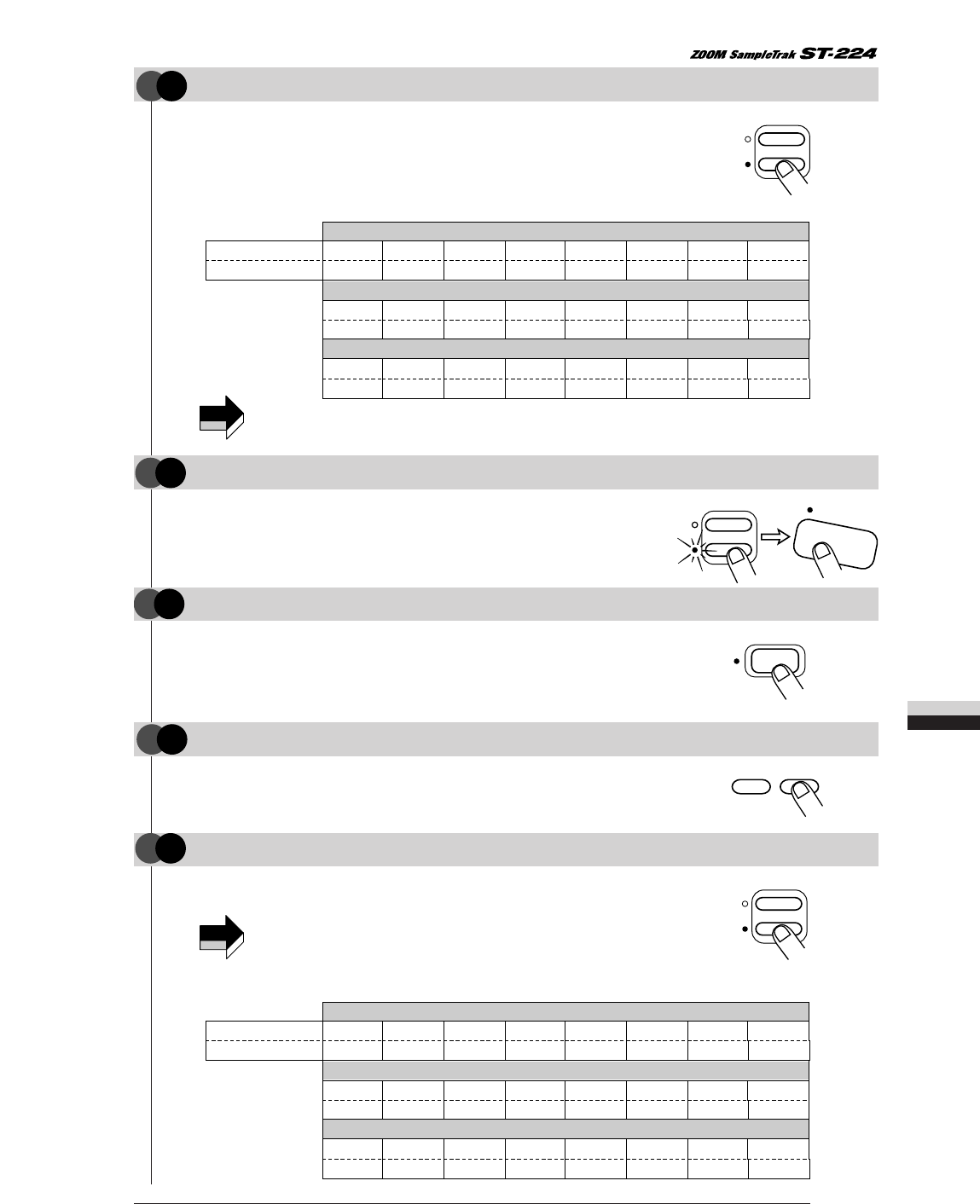
67
MIDI Application Example
Note data received via the [MIDI IN] jack can now be used to play the
samples assigned to the various pads of the ST-224. The correlation
between note numbers/names and pads is shown below.
The velocity information of note data is not used.
While one of the [BANK 1] - [BANK 3] keys is held down, the current
MIDI channel is shown on the display.
In the default condition of the ST-224, the MIDI channel 1 is selected.
1 - 16: MIDI messages are received in the specified MIDI channel.
oFF: No MIDI channel messages are received.
The MIDI channel setting is accepted.
When the MIDI channel 10 is selected, the correlation between
note numbers and pads changes as follows, to accommodate the
GM drum kit.
NOTE
NOTE
SONG
PAD
FUNCTION
SONG
PAD
FUNCTION
8
MIDI
TRIGGER/GATE
BANK
1
BANK 1– 3 keys
+–
[–] [+] keys
BANK 1
SOURCE PAD PAD 1 PAD 2 PAD 3 PAD 4 PAD 5 PAD 6 PAD 7 PAD 8
35(B1) 36(C2) 37(C#2) 38(D2) 39(D#2) 40(E2) 41(F2) 42(F#2) 43(G2)
BANK 2
PAD 1 PAD 2 PAD 3 PAD 4 PAD 5 PAD 6 PAD 7 PAD 8
44(G#2) 45(A2) 46(A#2) 47(B2) 48(C3) 49(C#3) 50(D3) 51(D#3)
BANK 3
PAD 1 PAD 2 PAD 3 PAD 4 PAD 5 PAD 6 PAD 7 PAD 8
52(E3) 53(F3) 54(F#3) 55(G3) 56(G#3) 57(A3) 58(A#3) 59(B3)
BANK 1
SOURCE PAD PAD 1 PAD 2 PAD 3 PAD 4 PAD 5 PAD 6 PAD 7 PAD 8
95(B6) 96(C7) 97(C#7) 98(D7) 99(D#7) 100(E7) 101(F7) 102(F#7) 103(G7)
BANK 2
PAD 1 PAD 2 PAD 3 PAD 4 PAD 5 PAD 6 PAD 7 PAD 8
104(G#7) 105(A7) 106(A#7) 107(B7) 108(C8) 109(C#8) 110(D8) 111(D#8)
BANK 3
PAD 1 PAD 2 PAD 3 PAD 4 PAD 5 PAD 6 PAD 7 PAD 8
112(E8) 113(F8) 114(F#8) 115(G8) 116(G#8) 117(A8) 118(A#8) 119(B8)
Press the [SONG FUNCTION] key again.
3
STEP
To set the MIDI channel, press the [SONG FUNCTION] key and then pad 8 (MIDI).
4
STEP
Press and hold one of the [BANK 1] - [BANK 3] keys.
5
STEP
Use the [-] [+] keys to select the MIDI receive channel.
6
STEP
Press the [SONG FUNCTION] key again.
7
STEP
Note numbers / names and pads
Note numbers / names and pads (MIDI channel 10)
SONG
PAD
FUNCTION
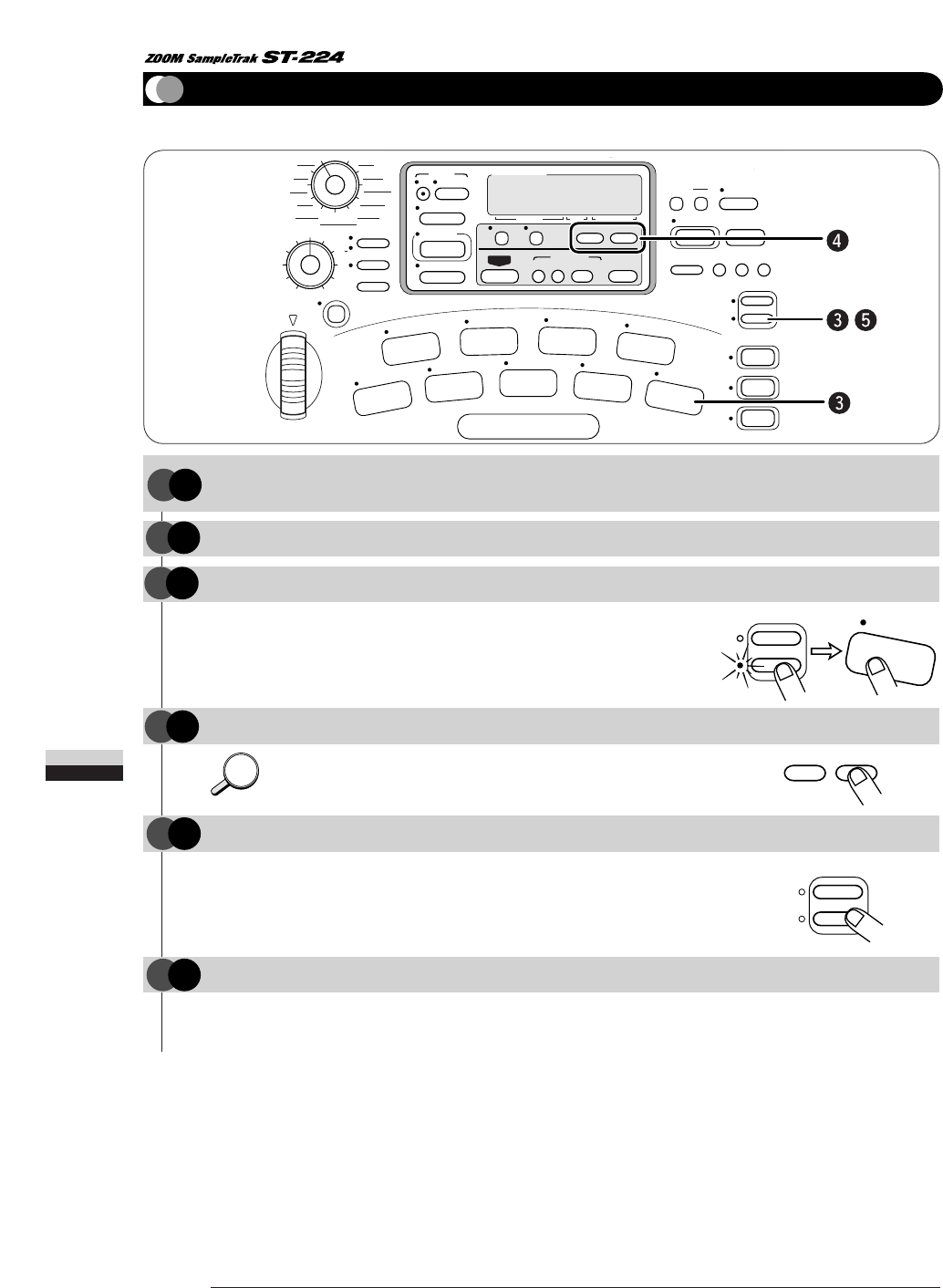
While this setting is selected, song recording is not possible.
The ST-224 now is set up to receive the MIDI clock, song position
pointer, and start/stop/continue messages via the [MIDI IN] jack.
The ST-224 also begins playback.
HINTHINT
Song playback of the ST-224 can be synchronized to an external MIDI sequencer or rhythm machine.
BANK
3
BANK
2
BANK
SONG
PAD
1
FUNCTION
PAD ASSIGN
CAPACITY
ERASE OPTIMIZE
PLAY/STOP
RECORD
RE-SAMPLE
GRADE
MONO
STEREO
SAMPLING
EFFECT
EDIT 2
VOLUME/BASS
EXCITER
TREMOLO
AUTO PAN
LO-FI EFFECT
EXTREME EQ
COMPRESSOR
RESONANCE
HIGH-PASS
LOW-PASS
DISTORTION
RING MODULATOR
PITCH SHIFTER
DIMENSION
CHORUS
PHASER
FLANGER
STEP CRY
DELAY
REVERB
TIME STRETCH
SCRATCH
EFFECT
ON/OFF
PAD ENABLE
A
B
EFFECT SYNC
EDIT 1
LOOP/MARK
4
SHIFT
OFFSET
6
SWING
PANNING
8
MIDI
TRIGGER/GATE
2
QUANTIZE
TUNING
SOURCE
SOURCE MIX
5
PRE COUNT
END POINT
3
TIME SIG
START POINT
1
BAR LENGTH
LEVEL
7
CLICK VOLUME
REVERSE
MAXMINMAXMIN
PEAK
COPY DELETE
BACKUP
EXIT SPECIAL
LOAD SAVE
INTERNAL/DATA CARD
+
–
AUTO SYNC
PLAYLIST
TAP
BPM
SONG
PLAY/STOPREC
BPM/
VALUE
MEASURE
SAMPLE/SONGBEAT
SONG
PAD
FUNCTION
+–
[–] [+] keys
Set the external equipment up so that it sends the MIDI clock, song position pointer, and
start/stop/continue messages.
1
STEP
Select the song at the ST-224 that you want to synchronize.
2
STEP
Press the [SONG FUNCTION] key and then pad 8 (MIDI).
3
STEP
Use the [-] [+] keys to call up the indication "Midi" on the display.
4
STEP
Press the [SONG FUNCTION] key again.
5
STEP
Give the start command from the external equipment.
6
STEP
Synchronizing Song Playback of the ST-224 With External Equipment
68
MIDI Application Example
SONG
PAD
FUNCTION
8
MIDI
TRIGGER/GATE
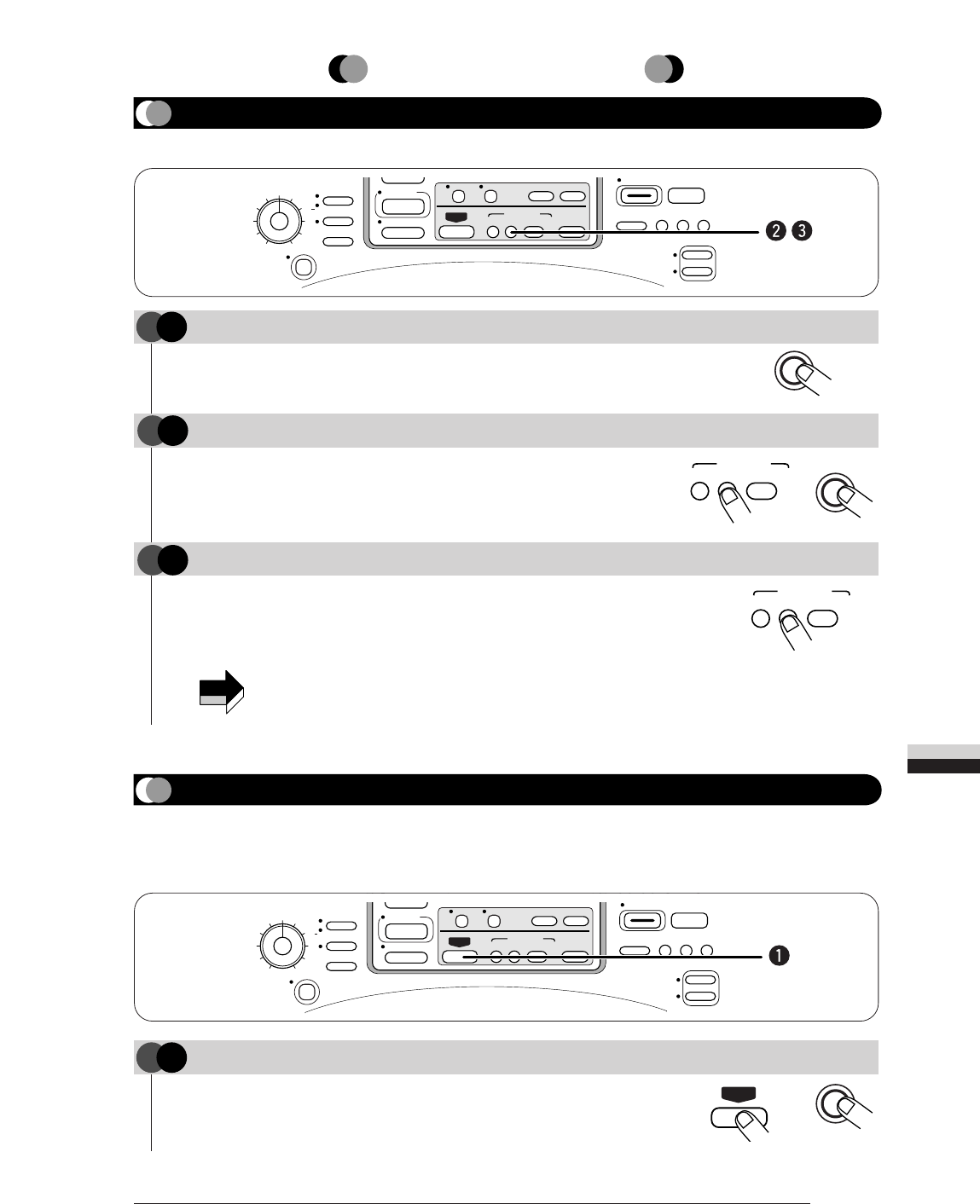
The ST-224 becomes ready for use immediately, because the loading
process from backup memory is skipped. The main memory will be
empty.
The indication "init" appears on the display.
To cancel the initialization, press the [EXIT] key.
The ST-224 is reset to the factory default condition, and the
preprogrammed sound sources (samples) are loaded into the main
memory.
Proceed with care. When initialization is performed, all bulk data
stored in the backup memory will be erased.
NOTE
POWER
BACKUP
LOAD SAVE
INTERNAL/DATA CARD
BACKUP
LOAD SAVE
INTERNAL/DATA CARD
POWER
POWER
Turn off the ST-224.
1
STEP
While holding down the [SAVE] key, turn the unit back on again.
2
STEP
Press the [SAVE] key again.
3
STEP
69
Other Functions
Resetting the ST-224 to the Factory Default (Initializing)
You can reset the unit to the factory default condition as follows.
EXIT
Hold down the [EXIT] key and turn the ST-224 on.
1
STEP
Initializing Without Loading Backup Memory Data (Quick Start)
Normally, the ST-224 loads data from backup memory into the main memory every time the unit is
turned on. This causes a certain delay until the unit can be used for playing or sampling. When wishing to
skip this step and get the unit ready for use quickly, perform the following steps.
Other Functions
SONG
PAD
FUNCTION
PAD ASSIGN
CAPACITY
ERASE OPTIMIZE
PLAY/STOP
RECORD
EDIT 2
EFFECT
ON/OFF
PAD ENABLE
A
B
EFFECT SYNC
COPY DELETE
BACKUP
EXIT SPECIAL
LOAD SAVE
INTERNAL/DATA CARD
+
–
AUTO SYNC
PLAYLIST
TAP
BPM
MEASURE
SAMPLE/SONGBEAT
SONG
PAD
FUNCTION
PAD ASSIGN
CAPACITY
ERASE OPTIMIZE
PLAY/STOP
RECORD
EDIT 2
EFFECT
ON/OFF
PAD ENABLE
A
B
EFFECT SYNC
COPY DELETE
BACKUP
EXIT SPECIAL
LOAD SAVE
INTERNAL/DATA CARD
+
–
AUTO SYNC
PLAYLIST
TAP
BPM
MEASURE
SAMPLE/SONGBEAT
If there seems to be a problem with the unit, check the following points first.
Troubleshooting
70
Troubleshooting
Symptom Check Remedy
No sound, or
very low volume.
Playback sound
is distorted or
breaks up.
Sampling not
possible.
Sound of
[SOURCE] input
cannot be turned
off.
Effects do not
work.
Song cannot be
recorded.
Sound is heard
when hitting pads,
but MIDI play
does not work.
Is correct AC adapter connected
properly? Refer to section "Getting Connected" ( ➔ p. 8) and establish
correct connections. Use only the supplied AC adapter.
Are [OUTPUT L/MONO] jack
and [OUTPUT R] jack
connected correctly to the
playback equipment?
Refer to section "Getting Connected" ( ➔ p. 8) and establish
correct connections.
Are the correct cables being
used? Try changing to another shielded cable.
Is the playback equipment set
up correctly? Is the volume
control set to an appropriate
level?
Establish appropriate settings.
Is the [OUTPUT] knob of the
ST-224 set up correctly? Establish an appropriate setting.
Was a pad hit to which no
sample is assigned? Was
playback of a song without data
attempted?
Select an appropriate pad or song.
Is the LEVEL pad parameter set
to a low value? Set the LEVEL pad parameter to an appropriate value.
Is output level of ST-224 set too
high? Adjust [OUTPUT] knob on ST-224 to a suitable position.
Is level of sound source used
for sampling too high? Adjust [INPUT] knob on ST-224 to a suitable position, and
repeat the sampling process.
Is level of sound source used
for sampling too low? Adjust [INPUT] knob on ST-224 to a suitable position, and
repeat the sampling process.
Is [RE-SAMPLE] key set to ON? Set [RE-SAMPLE] key to OFF.
Is memory used up? Delete samples and songs that are no longer needed.
Is SOURCE MIX pad parameter
set to "on"?
Use [PAD FUNCTION] key and [SOURCE] pad to change
setting of SOURCE MIX parameter from "on" (input source
is constantly supplied to output) to "oFF" (input source is
only supplied to output when [SOURCE] pad is pressed).
Is effect processing enabled for
the pad? Use the [EFFECT PAD ENABLE] key and the pad to send
the sound of the desired pad to the effects section.
Are you trying to apply the
TIME STRETCH or SCRATCH
effect to the [SOURCE] pad?
The TIME STRETCH and SCRATCH effect does not work
for the [SOURCE] pad.
Is mode other than pad play
mode or song mode selected? Press the [EXIT] key to terminate other modes.
Is MIDI receive set to ON? Use the [SONG FUNCTION] key and pad 8 to set the MIDI
parameter from "Midi" (receive MIDI messages) to "Int" (do
not receive MIDI messages).
Is the MIDI receive channel
properly set? Match the ST-224 MIDI receive channel ( ➔ p. 67) to the
send channel of the MIDI device.
71
ST-224 Specifications
ST-224 Specifications
• Signal processing 18-bit A/D converter / 18-bit D/A converter
• DSP ZOOM original ZFX-2
• Sampling frequency Hi-Fi: 32 kHz / STANDARD: 16 kHz / Lo-FI: 8 kHz
• Total recording time (mono) Hi-Fi: 60 s / STANDARD: 120 s / Lo-FI: 240 s
• Maximum recording time per sample Hi-Fi: 30 s / STANDARD: 60 s / Lo-FI: 120 s
• Maximum number of simultaneous samples 8
• Tempo 40 - 250 BPM
• Songs 8
• Number of recorded notes approx. 5000
• Resolution 24 clock/quarter note
• Number of built-in effects 22 (11 x 2 banks)
• Pads 8 pads x 3 banks + SOURCE pad
• Controls
EDIT 1 wheel (effects + edit)
EDIT 2 knob (effects)
EFFECT TYPE SELECT knob
INPUT knob
OUTPUT knob
• Control input MIDI IN
• Display 6-column 7-segment LED
• Inputs
LINE/MIC (L/MONO, R)
Standard phone jack (mono) x 2
LINE/MIC selector x 1
Impedance: 20 kilohms
Rated input level LINE: -10 dBm
MIC: -56 dBm
• Outputs
LINE (L/MONO, R) Standard phone jack (mono) x 2
Impedance: max. 1 kilohm Maximum output level: +6 dBm
Headphones Standard phone jack (stereo) x 1
Output power: 50 mW (into 32 ohms)
• Internal memory For backup (1 data set; read/write)
• Expansion memory (data card) For backup (max 99 data sets; read/write)
WAV files (read only)
AIFF files (read only)
• Power requirements 9 V DC, 300 mA
(from supplied dedicated AC adapter AD-0006A)
• Dimensions 290 (W) x 192 (D) x 60 (H)
• Weight 1.1 kg
• Supplied accessories Instruction manual
Sound list
Warranty card
AC adapter (AD-006A)
Sample CD
• Optional accessories Data cards (SM04)
* 0 dB = 0.775 Vrms
* Design and specifications subject to change without notice.

72
ST-224 File Import Details
ST-224 File Import Details
The ST-224 can import standard PCM files via Data card(SM04 option).
1. Windows WAV Files
PCM file type used by Microsoft Windows
Imported from .WAV files
The following types of RIFF format files can be imported:
Sampling frequency:any frequency from 8 kHz - 48 kHz
Quantization 16 bit or 8 bit linear
Stereo or mono
Maximum 1900 kilobytes (maximum WAV data capacity / stereo)
WAV file name conventions
Files must be named "??.WAV" (?? stands for a number from 01 - 99). Files are listed by number.
2. Apple AIFF Files
The ST-224 can import AIFF standard PCM files as used on the Apple Macintosh.
PCM parameters are the same as for WAV files, but loop point information in the files is not imported.
AIFF file name conventions
Files must be named "??.AIF" (?? stands for a number from 01 - 99). Files are listed by number.
PCM files to be imported must be stored in the root directory of the data card. Files not stored in the root
directory cannot be imported.
73
MIDI Implementation
MIDI Implementation
1. TRANSMITTED DATA
NONE.
2.RECOGNIZED DATA
1) CHANNEL VOICE MESSAGES
STATUS SECOND THIRD DESCRIPTION
1000 nnnn 0kkk kkkk 0vvv vvvv NOTE OFF
kkk kkkk : Note number ( See NOTE 1 ).
vvv vvvv : Note Off Velocity ( ignored ).
1001 nnnn 0kkk kkkk 0000 0000 NOTE OFF
kkk kkkk : Note number ( See NOTE 1 ).
1001 nnnn 0kkk kkkk 0vvv vvvv NOTE ON
kkk kkkk : Note number ( See NOTE 1 ).
vvv vvvv : Note On Velocity ( not 0 ).
1010 nnnn 0kkk kkkk 0vvv vvvv POLYPHONIC KEY PRESSURE
kkk kkkk : Note number ( See NOTE 2 ).
vvv vvvv : Pressure value ( See NOTE 2 ).
1011 nnnn 0ccc cccc 0vvv vvvv CONTROL CHANGE
ccc cccc : Control number ( See NOTE 3 ).
vvv vvvv : Control value.
1100 nnnn 0ppp pppp ---- ---- PROGRAM CHANGE
ppp pppp : Program cahnge number( See NOTE 4 ).
NOTE : nnnn = MIDI Channel Number ( 0000 - 1111 )
1 : Recognized Note numbers are 35-59 at Basic channel on normal mode,
or 95-119 at channel 10 at extention mode.
2 : Note #12(bank1/pad1)-#35(bank3/pad8) control to change "REVERSE of pad_function(PAD)".
Note #36(bank1/pad1)-#59(bank3/pad8) control to change "EFFECT PAD ENABLE(PAD)".
Note #108(source pad) control to change "EFFECT PAD ENABLE(SOURCE)".
Pressure value(0) is turning off,pressure value(not 0) is turning on.
Note #60(bank1/pad1)-#83(bank3/pad8) control to change "LEVEL of pad_function(PAD)".
Note #84(bank1-pad1)-#107(bank3/pad8) control to change "PANNING of pad_function(PAD)".
Note #109(source pad) control to change "LEVEL of pad_function(SOURCE)".
Pressure value(0 to 99) is value of the control.
If pressure value is greater than 99, internal pressure value is limited to 99.
Note #110(source pad) control to change "PANNING of pad_function(SOURCE)".
Pressure value(0 to 100) is value of the control.
If pressure value is greater than 100, internal pressure value is limited to 100.
3 : Control #12 can be used to Effect Parameter 1(control value 0..100).
Control #13 can be used to Effect Parameter 2(control value 0..100).
If control value is greater than 100, internal control value is Limited to 100.
Control #14 can be used to Effect BPM 40bpm(control value 0)..167bpm(control value 127).
Control #15 can be used to Effect BPM 168bpm(control value 0)..250bpm(control valeu 82).
Control #80 can be used to EFFECT OFF(control value 0)/ON(control value 127).
Control #81 can be used to EFFECT SYNC OFF(control value 0) / ON(control value 127).

74
MIDI Implementation
4 : #00 EFFECT BANK A : TIME STRETCH #11 EFFECT BANK B : SCRATCH
#01 EFFECT BANK A : DELAY #12 EFFECT BANK B : REVERB
#02 EFFECT BANK A : FLANGER #13 EFFECT BANK B : STEP CRY
#03 EFFECT BANK A : CHORUS #14 EFFECT BANK B : PHASER
#04 EFFECT BANK A : PITCH SHIFTER #15 EFFECT BANK B : DIMENSION
#05 EFFECT BANK A : DISTORTION #16 EFFECT BANK B : RING MODULATOR
#06 EFFECT BANK A : LOW-PASS #17 EFFECT BANK B : HIGH-PASS
#07 EFFECT BANK A : EXTREME EQ #18 EFFECT BANK B : RESONANCE
#08 EFFECT BANK A : LO-FI EFFECT #19 EFFECT BANK B : COMPRESSOR
#09 EFFECT BANK A : TREMOLO #20 EFFECT BANK B : AUTO PAN
#10 EFFECT BANK A : VOLUME/BASS #21 EFFECT BANK B : EXCITER
2) CHANNEL MODE MESSAGES
STATUS SECOND THIRD DESCRIPTION
1011 nnnn 0111 1000 0000 0000 ALL SOUNDS OFF
1011 nnnn 0111 1001 0000 0000 RESET ALL CONTROLLERS ( See NOTE 5 )
1011 nnnn 0111 1011 0000 0000 ALL NOTES OFF
1011 nnnn 0111 1100 0000 0000 ALL NOTES OFF
NOTE : nnnn = MIDI Channel Number ( 0000 - 1111 )
5 :
"REVERSE of pad_function" pressure value is 0.
"EFFECT PAD ENABLE" pressure value is 0.
"LEVEL of pad_function" pressure value is 49.
"PANNING of pad_function" pressure value is 50.
"Effect parameter 1" control value is 0.
"Effect parameter 2" control value is 0.
"EFFECT BPM" control value is 120BPM.
"EFFECT ON/OFF" control value is 0(OFF).
"EFFECT SYNC ON/OFF" control value is 0(OFF).
3) SYSTEM COMMON MESSAGES, SYSTEM REAL TIME MESSAGES
STATUS SECOND THIRD DESCRIPTION
1111 0010 0xxx xxxx 0mmm mmmm SONG POSITION POINTER
xxx xxxx : Pointer LSB Value
mmm mmmm : Pointer MSB Value
1111 0011 0sss ssss ---- ---- SONG SELECT
sss ssss : Song Number 0-7
1111 1000 ---- ---- ---- ---- TIMING CLICK
1111 1010 ---- ---- ---- ---- START
1111 1011 ---- ---- ---- ---- CONTINUE
1111 1100 ---- ---- ---- ---- STOP
NOTE:
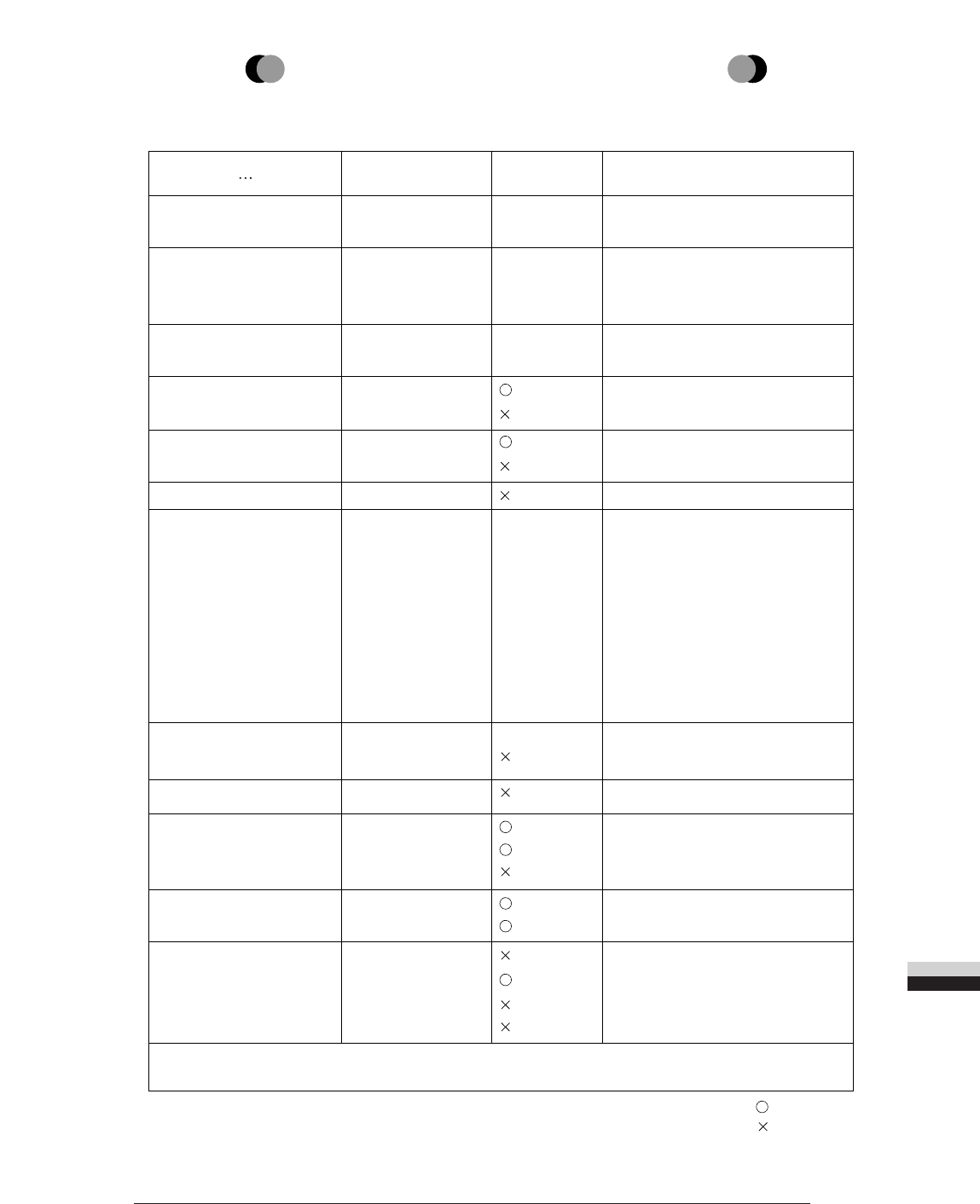
75
MIDI Implementation Chart
[ Sampling Machine ] Data : 6.Oct.,1998
Model SampleTrak ST-224 MIDI Implementation Chart Version : 1.00
Transmitted Recognized Remarks
Function
Basic Default 1
Channel Changed 1-16
Default 3
Mode Messages
Altered
***************
Note 35-59 95-119 ( channel 10 )
Number | True voice ***************
Velocity Note On Note On = not 0.
Note Off
After Key's
Touch Ch's
Pitch Bend
12 Effect parameter 1
13 Effect parameter 2
Control 14,15 Effect BPM
80 Effect ON/OFF
Change
120 All Sounds Off
121 Reset All Controllers
Prog 0-21 Selects a effect_type
Change True # ***************
System Exclusive
System Song Pos
Song Sel 0-7
Common Tune
System Clock
Real Time Commands
Aux Local On/Off
All Notes Off
Mes- Active Sense
sages Reset
Notes No Transmitted messages.
Mode 2 : OMNI ON, MONO : Yes
Mode 4 : OMNI OFF, MONO : No
Mode 1 : OMNI ON, POLY
Mode 3 : OMNI OFF, POLY
MIDI Implementation Chart

ZOOM CORPORATION
NOAH Bldg., 2-10-2, Miyanishi-cho, Fuchu-shi, Tokyo 183-0022, Japan
PHONE: 042-369-7116 FAX: 042-369-7115
Printed in Japan 224-5000
