Zte Overture 2 Cricket User Guide
ZTE_Overture_2_User_Guide_English_-_PDF_-_4.02MB_ ZTE Overture 2 - ZTE USA
Zte-Overture-2-Manual zte-overture-2-manual zte-overture-2-manual manuals phones s.theinformr.com 3:
User Guide ZTE_Overture_2_User_Guide_Cricket ZTE User Guides
File Type pdf zte-overture-2-user-guide zte-overture-2-user-guide How do I get the User Guide for the Overture 2 (Z813) with Cricket?
Overture 2 (Cricket Wireless) - User Guide Overture_2_UG_English Free User Guide for ZTE Mobile Phone, Manual - page3
2015-08-20
: Zte Zte-Overture-2-Cricket-User-Guide-799868 zte-overture-2-cricket-user-guide-799868 zte pdf
Open the PDF directly: View PDF  .
.
Page Count: 58
ZTE Overture™ 2
User Guide

1CONTENTS
Contents
Getting started ..................................................7
Phone setup ...................................................7
Extending the battery life ........................................9
Powering your phone on/off. . . . . . . . . . . . . . . . . . . . . . . . . . . . . . . . . . . . . . 9
Getting around ...............................................11
Getting to know your phone. . . . . . . . . . . . . . . . . . . . . . . . . . . . . . . . . . . . . 13
Key functions .................................................14
Phone calls ....................................................24
Making calls .................................................24
Using speed dial ..............................................25
Receiving calls ................................................26
Adjusting your call settings ......................................28
Contacts .......................................................30
Importing and exporting contacts ................................30
Sharing contact information ....................................31
Creating a contact ............................................31
Adding a contact to Favorites ...................................32
Searching for a contact ........................................32
Joining contacts ..............................................32
Separating contact information ..................................33
Creating a new group .........................................33
Some of the contents in this manual may differ from your phone depending
on the software of the phone. Actual color may vary.
Your phone is designed to make it easy for you to access a wide variety of
content. For your protection, we want you to be aware that some applications
that you enable may involve the location of your phone being shared. For
applications available through Cricket, we offer privacy controls that let you
decide how an application may use the location of your phone and other
phones on your account. However, the Cricket privacy tools do not apply
to applications available outside of Cricket. Please review the terms and
conditions and the associated privacy policy for each location-based service
to learn how location information will be used and protected. In addition, your
Cricket phone may be used to access the internet and to download, and/
or purchase goods, applications, and services from Cricket or elsewhere from
third parties. Cricket provides tools for you to control access to the Internet
and certain Internet content. These controls may not be available for certain
devices which bypass Cricket controls.
© 2015 Cricket Wireless LLC. All rights reserved. Cricket and the Cricket logo
are trademarks under license to Cricket Wireless LLC.
© 2015 ZTE CORPORATION. All rights reserved. No part of this publication may
be excerpted, reproduced, translated or utilized in any form or by any means,
electronic or mechanical, including photocopying and microlm, without
the prior written permission of ZTE Corporation. The manual is published by
ZTE Corporation. We reserve the right to make modications on print errors or
update specications without prior notice.
microSDHC logo is a trademark of SD-3C, LLC. Manufactured under license
from Dolby Laboratories. Dolby, Dolby Audio and the double - D symbol
are trademarks of Dolby Laboratories. Qualcomm and Snapdragon are
trademarks of Qualcomm Incorporated, registered in the United States and
other countries. Used with permission. Other marks are the property of their
respective owners.
2 CONTENTS 3CONTENTS
Entering text ....................................................34
Changing input methods ....................................... 34
Google™ keyboard ............................................34
Gesture typing ................................................ 35
TouchPal X keyboard ...........................................36
Google Voice typing ...........................................39
Input method settings .......................................... 39
Editing text ...................................................39
Messaging .....................................................41
Opening the messaging screen .................................41
Sending a message ...........................................41
Replying to a message .........................................42
Forwarding a message .........................................42
Copying a message ...........................................42
Changing message settings ....................................43
Email ..........................................................44
Setting up the rst email account ................................44
Checking your emails ..........................................44
Responding to an email ........................................44
Writing and sending an email ...................................45
Adding and editing email accounts ..............................46
Changing general email settings ................................47
Connecting to the Internet. . . . . . . . . . . . . . . . . . . . . . . . . . . . . . . . . . . . . . . . 48
Adding a new mobile data connection ...........................48
Turning on Wi-Fi® ..............................................48
Connecting to a Wi-Fi network ...................................49
Adding a Wi-Fi network .........................................49
Checking the Wi-Fi network status ................................49
Connecting to a WPS network ...................................50
Connecting to virtual private networks ............................50
Browsing the Internet ............................................52
Using the Browser .............................................52
Opening a web page or searching the web .......................52
Using multiple browser tabs .....................................52
Opening a new browser tab ....................................53
Switching between tabs ........................................53
Setting the home page. . . . . . . . . . . . . . . . . . . . . . . . . . . . . . . . . . . . . . . . . 53
Downloading les .............................................53
Changing browser settings ......................................53
Using Wi-Fi Direct® ...............................................54
Connecting to another device via Wi-Fi Direct ......................54
Sending data via Wi-Fi Direct ....................................54
Receiving data via Wi-Fi Direct ...................................54
Bluetooth® .....................................................55
Turning Bluetooth on/off ........................................55
Changing the device name .....................................55
Pairing with another Bluetooth device ............................. 55
Unpairing from a Bluetooth device ...............................56
5CONTENTS
4 CONTENTS
Sending data via Bluetooth .....................................56
Receiving data via Bluetooth ....................................57
Entertainment ..................................................58
Capturing a photo ............................................58
Adjusting camera settings ......................................59
Using different camera modes ...................................59
Manual mode ................................................60
Fun mode ....................................................60
Recording a video .............................................61
Adjusting camcorder settings ...................................61
Playing your music ............................................62
Viewing your music library ......................................62
Setting a song as the default ringtone ............................62
Playing music .................................................63
Managing playlists ............................................64
Using your gallery .............................................64
Retouching your pictures .......................................66
Playing videos ................................................67
Making memorable memos .....................................67
Recording a voice memo ....................................... 67
Playing a voice memo .........................................68
Google applications .............................................69
Gmail™ ...................................................... 69
Google Calendar™ ............................................70
Google Chrome™ .............................................70
Google+™ ...................................................70
Google Maps™ ...............................................71
Google Search ...............................................73
Google Music™ ...............................................74
Google Play™ Store ............................................77
Creating a Google Wallet account ...............................78
Applications. . . . . . . . . . . . . . . . . . . . . . . . . . . . . . . . . . . . . . . . . . . . . . . . . . . . 79
Backup & Restore .............................................79
Calculator ...................................................79
Clock .......................................................79
Downloads ................................................... 80
File Manager .................................................80
Mi-Moment ...................................................81
Sele ........................................................81
Task Manager ................................................81
Amazon Kindle™ .............................................. 81
Evernote® ....................................................82
YouTube™ .................................................... 82
Phone settings ..................................................83
General Settings ..............................................83
Wireless and networks .......................................... 85
Device ......................................................86
Connecting your phone to a computer via USB .....................87
Call settings ..................................................87
Personal .....................................................87
6 CONTENTS 7GETTING STARTED
Getting started
Phone setup
Installing the micro-SIM card
Power off your phone before installing or replacing the
micro-SIM card.
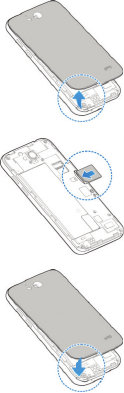
1. Insert your ngernail into the slot at the bottom left of the
back cover and lift it up gently.
2. Hold the micro-SIM card with the cut corner oriented as
shown and slide it into the card slot until you hear a click.
Important: To avoid damage to the phone, do not use
other kinds of SIM cards or a non-standard micro-SIM
card cut from a SIM card. You can obtain the standard
micro-SIM card from your service provider.
3. Align the back cover with the back of the phone and
press the cover back into place. Make sure all the tabs
are secure and there are no gaps around the cover.
Accounts ....................................................89
System ......................................................89
Upgrading the phone software ....................................91
Troubleshooting .................................................92
For your safety ..................................................95
General safety ................................................95
FCC RF exposure information (SAR) ............................... 96
FCC compliance .............................................. 97
Hearing Aid Compatibility (HAC) regulations for mobile phones .......98
CTIA ........................................................99
Distraction ..................................................100
Product handling .............................................101
Electrical safety ..............................................104
Interference .................................................105
Explosive environments ........................................ 106
Specications .................................................108
Warranty ...................................................... 109
Limited warranty .............................................110
How to get warranty service ....................................111
Other warranty programs ......................................111
Notes .........................................................112
Installing a microSDHC™ card (not included)
The microSDHC card can be installed and removed while the phone is
powered on. Unmount the microSDHC card before removing or replacing it.
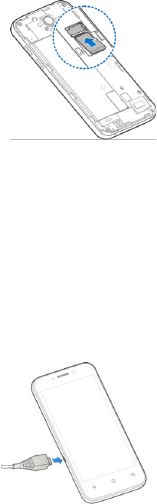
1. Remove the back cover.
2. Hold your microSDHC card with the metal contacts
facing down and slide it into the card slot.
Note: Some applications may require a microSDHC card
to work normally or may store certain data on it. Therefore,
it is recommended that you keep a microSDHC card
installed and not remove or replace it randomly.
3. Press the back cover gently back into place until you hear a click.
Charging the battery
Your phone’s battery should have enough power for the phone to turn on,
nd a signal, and make a few calls. You should fully charge the battery as
soon as possible.
If the battery is low, there will be a pop-up message on the screen. As you
charge your phone, the screen will tell you the exact battery level each time
you wake up your phone.
If the battery is extremely low, you may be unable
to power on the phone even when it is being charged.
In this case, try again after charging the phone for at
least 10 minutes. Contact customer service if you still
cannot power on the phone after prolonged charging.
1. Insert the charger’s connector into the charging port.
Be sure to insert the connector in the correct
orientation. Do not force the connector into the port.
9GETTING STARTED
8 GETTING STARTED
2. Plug the charger into a standard AC wall outlet.
3. When the battery is fully charged, unplug the charger and disconnect it
from the phone.
Warning! Use only ZTE-approved chargers and cables. The use of unapproved
accessories could damage your phone or cause the battery to explode.
Caution: Do not change the built-in rechargeable battery in your phone
by yourself. The battery can only be changed by ZTE or ZTE authorized
service provider.
Extending the battery life
Active applications, screen brightness levels, Bluetooth and Wi-Fi usage, and
GPS functionality can drain your battery. You can follow the helpful tips below
to conserve your battery power:
• Reduce the screen backlight time.
• Lower the screen brightness.
• Turn auto-sync, Wi-Fi, and Bluetooth off when not in use.
• Disable the GPS function when not in use. Most applications using this
function will periodically query the GPS satellites for your current location;
each query drains your battery.
Powering your phone on/off
Make sure the micro-SIM card is in your phone and the battery is charged.
• Press and hold the Power key to power on your phone.
• To power it off, press and hold the Power key to open the options menu.
Tap Power off.

10 GETTING STARTED 11GETTING STARTED
Setting up your phone for the rst time
When you rst power on your phone after you purchase it or reset it to factory
settings (see Phone settings – Personal – Backup & reset), you need to set up
your phone settings before using it.
1. Tap the language eld to select the language you want to use and then
tap .
2. Tap SKIP to set up Wi-Fi connections later or tap a network. If the network is
secured, enter the password and tap CONNECT > NEXT.
3. Tap Enter your email to sign in to your Gmail account or tap OR CREATE
A NEW ACCOUNT. You can also tap SKIP to set up an account later. The
following steps may vary depending on which option you choose.
4. You will be prompted to read the terms of Google service. Tap ACCEPT
to continue.
5. Tap to set up payment info, or choose Remind me later. Tap NEXT.
6. If prompted, choose to restore data from a backup of another device, or
choose Set up as new device. Tap NEXT.
7. Congure the Google location options and tap Next.
Switching to Sleep Mode
To save battery power, Sleep Mode suspends your phone in a low-power-
consumption state while the display is off. Your phone also goes into Sleep
Mode by itself when the display is automatically turned off after a certain
period of time, which you can set by tapping > Settings > Display > Sleep
from the home screen.
Press the Power key to switch to Sleep Mode.
Waking up your phone
1. Press the Power key to activate your screen display.
2. Press and hold any blank area of the screen to unlock the screen and keys.
Or, drag an application shortcut (Phone or Sele) along the bottom of the
screen to unlock the screen and open the application quickly.
Note: If you have set an unlock pattern, PIN, or password for your phone
(see Phone settings – Personal – Security) you’ll need to draw the pattern or
enter the PIN/password to unlock your screen.
Getting around
Touch control
Your phone’s touch screen lets you control actions through a variety of touch
gestures.
• Tap: Tap the buttons, icons, or applications to select items or to open
applications.
• Press and hold: To open the available options for an item (such as a
message or link in a web page), press and hold the item.
• Swipe or slide: To swipe or slide means to quickly drag your nger vertically
or horizontally across the screen.
• Drag: To drag, press and hold your nger with some pressure before you
start to move your nger. While dragging, do not release your nger until
you have reached the target position.
12 13
Getting to know your phone
GETTING STARTED
• Pinch: In some apps (such as Maps, Browser, and Gallery), you can zoom in
and out by placing two ngers on the screen and pinching them together
(to zoom out) or spreading them apart (to zoom in).
• Rotate the screen: For most screens, you can automatically change
the screen orientation from portrait to landscape by turning the phone
sideways.
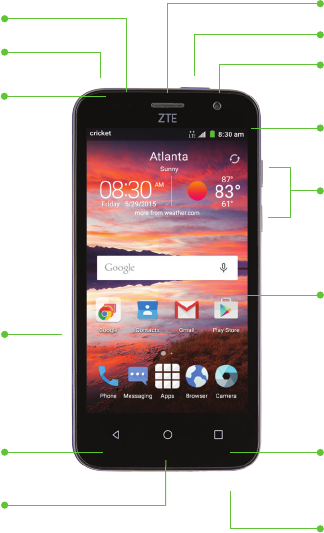
GETTING STARTED
Proximity and
light sensor
Headset port
Indicator light
Back key
Charging/
data port
Volume keys
Camera lens
Power key
Earpiece
Home key
Touch screen
Recent apps key
Microphone
Status and
notication bar
14 15
Key functions
Key Function
Power key Press and hold to turn phone on/off, restart the phone,
or set to Airplane mode.
Press to switch your phone to Sleep Mode.
Press to wake up your phone.
Home key Tap to return to the main home screen from any
application or screen.
Press and hold to use Google Search and Now.
Recent
apps key Tap to see recently used applications.
Back key Tap to go to the previous screen.
Volume keys Adjust the volume of the phone.
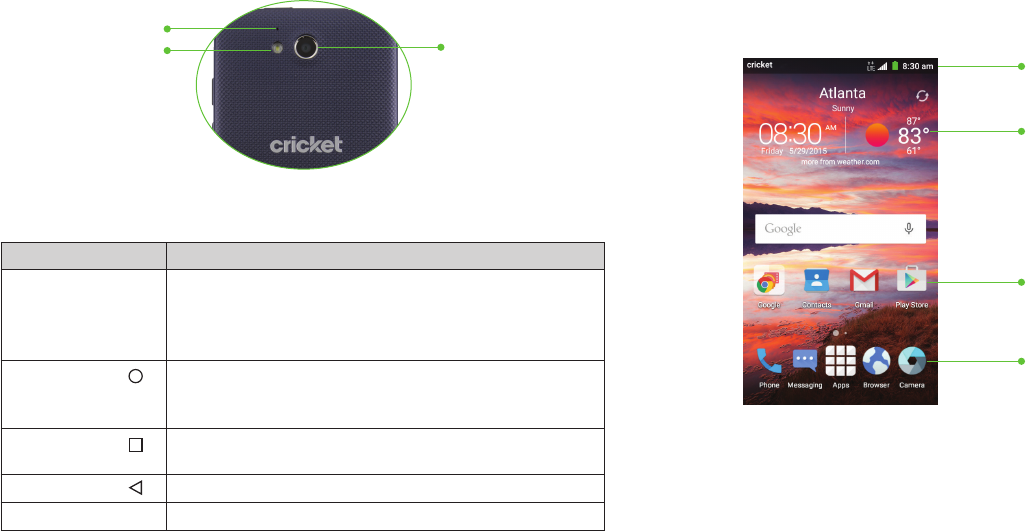
Home screens
You can customize your home screens. Set your own wallpaper, add the
widgets or application shortcuts you need, or remove them as you like.
Extended home screen
The home screen extends beyond the screen width, giving you a lot more
space to add more stuff. Simply swipe your nger to the left or right to see the
extended home screen panels.
Shortcuts
Status and
notication bar
Favorite shortcuts
Widget
GETTING STARTEDGETTING STARTED
Back camera lens
Flash
Back
Microphone
16 17
Choosing your wallpaper
1. Press and hold an empty place on the home screen and tap Wallpapers.
2. Tap a wallpaper to set it. You can also tap GALLERY or LIVE WALLPAPER for
additional options.
Adding items to your home screen
• To add an app to your home screen, tap
, press and hold the desired
app, and drag it to the home screen.
• To add a widget to your home screen, press and hold a blank part of the
screen and tap Widgets. Press and hold the desired widget and drag it to
the home screen.
Adjusting widget size
1. Press and hold a widget on the home screen and then release it.
2.
An outline appears around the widget. Drag the outline to resize the widget.
Note: Not all widgets can be resized.
Organizing icons with a folder
1. Tap and hold a shortcut on the home screen until Folder appears.
2. Drag the shortcut to Folder and release it. A new folder will be created
and the shortcut is placed in the folder.
3. To add more shortcuts into the folder, press and hold each shortcut and
drag it over the folder before releasing it.
Tip: Tap the folder and then tap the name eld to rename the folder.
Removing items from your home screen
1. Press and hold the item you want to delete until Delete appears on
the screen.
2.
Drag the item to Delete and release your nger when the item turns red.
Setting the home screen transition effect
1. Press and hold an empty place on the home screen and tap Effect.
2. Tap to select a transition effect.
Viewing your apps
From the home screen, tap to access all the applications on the phone.
You can add apps to your home screen and uninstall or disable them.
Uninstalling or disabling an application
1. From the home screen, tap .
2. Press and hold an application.
3. To uninstall an app, drag it to Uninstall and release it. To disable an app,
drag it to
Disable and release it.
4. Tap OK.
Note: To nd the disabled applications, tap
> > Settings > Apps >
DISABLED. Tap an application and tap ENABLE to enable it. Not all
applications can be uninstalled or disabled.
GETTING STARTEDGETTING STARTED
18 19
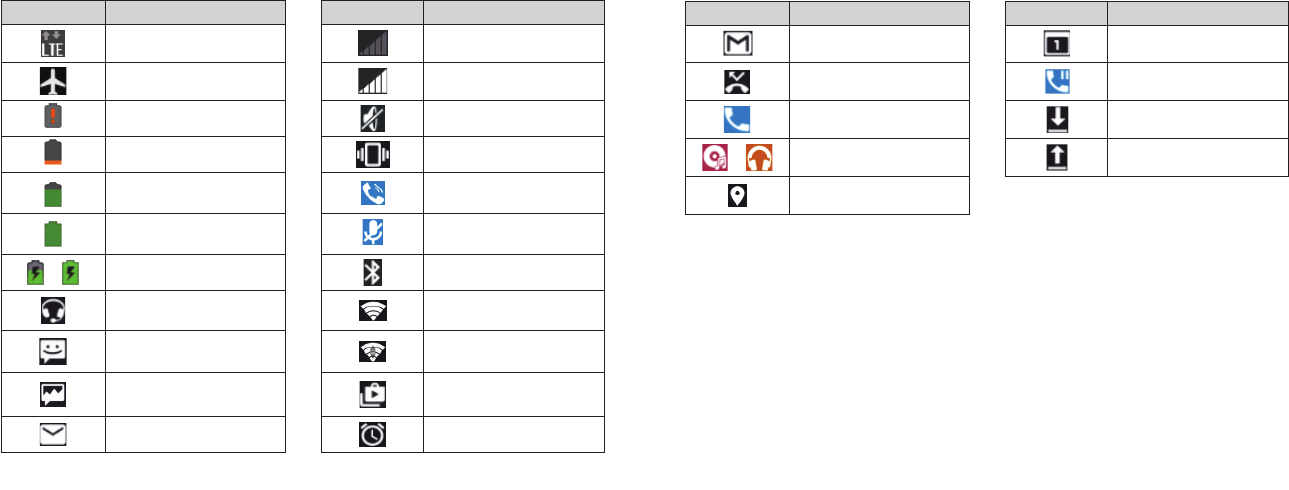
Status and notication icons
Your phone will tell you exactly what’s going on by showing you simple icons.
Here’s what they mean.
Indicators and icons
Indicator What it means Indicator What it means
Mobile data in use No signal
Airplane mode Signal strength
Battery empty Ringer off
Battery low Vibrate mode
Battery partially
drained Speaker on
Battery full Phone
microphone off
/ Battery charging Bluetooth on
Wired headset
connected Connected to a Wi-Fi
network
New SMS Wi-Fi in use
New MMS Updates available
New email Alarm set
Indicator What it means Indicator What it means
New Gmail message Upcoming event
Missed call Call on hold
Call in progress Downloading data
/ Song is playing Sending data
GPS on
GETTING STARTEDGETTING STARTED
20 21
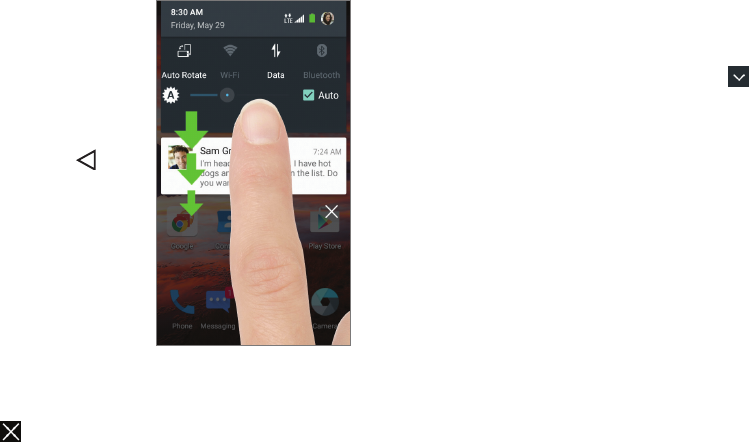
Using the Notications panel
The Notications panel provides quick access
to alerts including new messages, emails, and
software updates.
• To open the Notications panel, swipe your nger
down from the top of the screen.
• To close the Notications panel, swipe your nger
up from the bottom of the screen or tap
.
Responding to or removing a notication
You can respond to or remove notications in
the Notications panel. The panel also supports
expandable notications that let you perform
additional actions.
• To respond to a notication, tap it.
• To expand a notication, slide down with
one nger. You can also swipe two ngers
vertically or pinch/zoom to expand or collapse
certain notications.
• To remove a notication, swipe it left or right.
• To remove all notications, tap .
• Most apps that send notications, such as Gmail and Google+, have
notication settings that you can adjust.
Note: If you turn off notications for an app, you may miss important alerts
and updates. The notications of some apps cannot be turned off.
Using Quick Settings
The Quick Settings located in the Notications panel make it convenient to
view or change the most common settings for your phone.
Open the Notications panel and tap to view the full Quick Settings menu.
• Sound: Tap to turn sound on or off.
• Vibrate: Tap to turn vibrate mode on or off.
• Power manager: Tap to turn Power saving mode on or off.
• Dolby: Tap to turn Dolby Audio on or off.
• GPS: Tap to turn GPS on or off.
• Airplane: Tap to turn Airplane mode on or off.
• Flashlight: Tap to turn the ashlight on or off.
• Sync: Tap to turn auto-sync on or off.
• Auto Rotate: Tap to turn the auto-rotate feature on or off.
• Wi-Fi: Tap to turn Wi-Fi on or off.
• Data: Tap to enable or disable data access over the mobile network.
• Bluetooth: Tap to turn Bluetooth on or off.
• Brightness: Uncheck Auto and drag the slider to adjust screen brightness.
Tip: You can change the order of the Quick Settings by tapping EDIT, pressing
and holding an icon, and then dragging it to the desired position.
GETTING STARTEDGETTING STARTED

22 23
Protecting your phone with a screen unlock pattern
You can protect your phone by creating a screen lock. When enabled, you
need to press and hold certain icon, draw a pattern or enter a numeric PIN or
password to unlock the phone’s screen and keys.
1. From the home screen, tap > Settings > Security.
2. Tap Screen lock.
3. Tap Long press, Pattern, PIN, or Password.
• Tap None to disable screen lock.
• Tap Long press to enable screen lock and allow unlock with a “press
and hold” gesture. You can unlock the screen by tapping and holding
on a blank area of the screen.
• Tap Pattern to create a pattern you must draw to unlock the screen.
• Tap PIN or Password to set a numeric PIN or a password that you must
enter to unlock your screen.
Protecting your phone with encryption
You can encrypt all the data on your phone: Google Accounts, application
data, music and other media, downloaded information, and so on. If you do,
you must enter a numeric PIN or password each time you power on
your phone.
Warning! Encryption is irreversible. The only way to revert to an unencrypted
phone is to perform a factory data reset, which erases all your data.
Encryption provides additional protection in case your phone is stolen, and
may be required or recommended in some organizations. Consult your
system administrator before turning it on. In many cases the PIN or password
you set for encryption is controlled by the system administrator.
Before turning on encryption, prepare as follows:
• Set a lock screen PIN or password.
• Charge the battery.
• Keep the phone connected to the charger.
• Schedule an hour or more for the encryption process: you must not
interrupt it or you will lose some or all of your data.
When you’re ready to turn on encryption:
1. From the home screen, tap > Settings > Security > Encrypt phone.
2. Read the information about encryption carefully.
The ENCRYPT PHONE button is dimmed if your battery’s not charged or
your phone’s not plugged in.
If you change your mind about encrypting your phone, tap
.
Warning! If you interrupt the encryption process, you will lose data.
3. Tap ENCRYPT PHONE.
4. Enter your lock screen PIN or password and tap NEXT.
5. Tap ENCRYPT PHONE again.
The encryption process starts and displays its progress. Encryption can take
an hour or more, during which time your phone may restart several times.
When encryption is completed, you’re prompted to enter your PIN or
password.
Subsequently, you must enter your PIN or password each time you power on
your phone, to decrypt it.
GETTING STARTEDGETTING STARTED
24 25
Phone calls
Making calls
There are many ways to make a call with your phone, and they’re all easy to do.
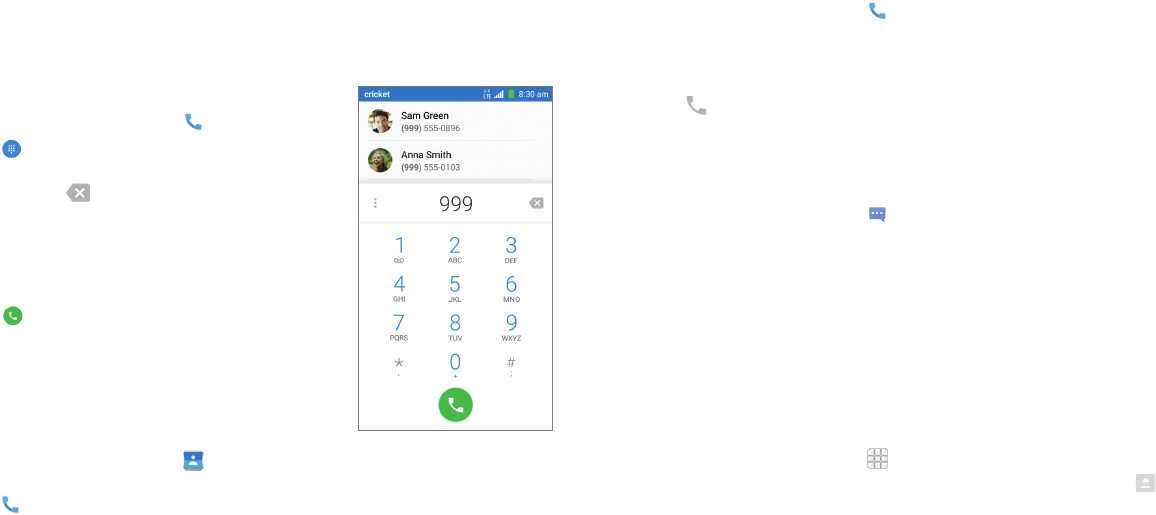
Calling from the dialer
1. From the home screen, tap .
2. Tap to open the dialer.
3. Enter the phone number with the on-screen
keypad. Tap to delete incorrect digits.
Note: As you enter digits, your phone searches
for contacts that match. If you see the number
you want to dial, touch it to place the call
immediately without entering the rest of
the number.
4. Tap to place the call.
Tip: To make an international call, press and hold
the 0 key to enter the plus (+) symbol. Next, enter
the country code, followed by the city/area code,
and then the phone number.
Calling from your contacts
1. From the home screen, tap .
2. Swipe your nger up or down to scroll through the contacts list and
tap next to the contact you want to call.
Tip: You can search for a contact by tapping the search eld above the
contacts list.
PHONE CALLS
Calling from your call history
1. From the home screen, tap > RECENT CALLS.
2. Flick the screen up or down and tap the contact you want to call.
Tip: You can search for a contact by tapping the search eld above the
contacts list.
3. Tap next to the number or contact you want to call.
Calling from a text message
If a text message contains a phone number that you want to call, you can
make the call while viewing the text message.
1. From the home screen, tap .
2. Tap the conversation and then tap the phone number in a message you
want to call.
3. Tap Call.
Using speed dial
Press and hold the 1–9 key from the dialer to call the corresponding speed
dial number.
The 1 key is reserved for your voicemail.
Assigning a speed dial key
1. From the home screen, tap > Settings > Call settings > Speed dial.
2. Tap a speed dial key and then input a phone number. Or, tap to select
a contact from the contact list.
3. Tap OK.
PHONE CALLS
26 27PHONE CALLS
Receiving calls
Answering a call
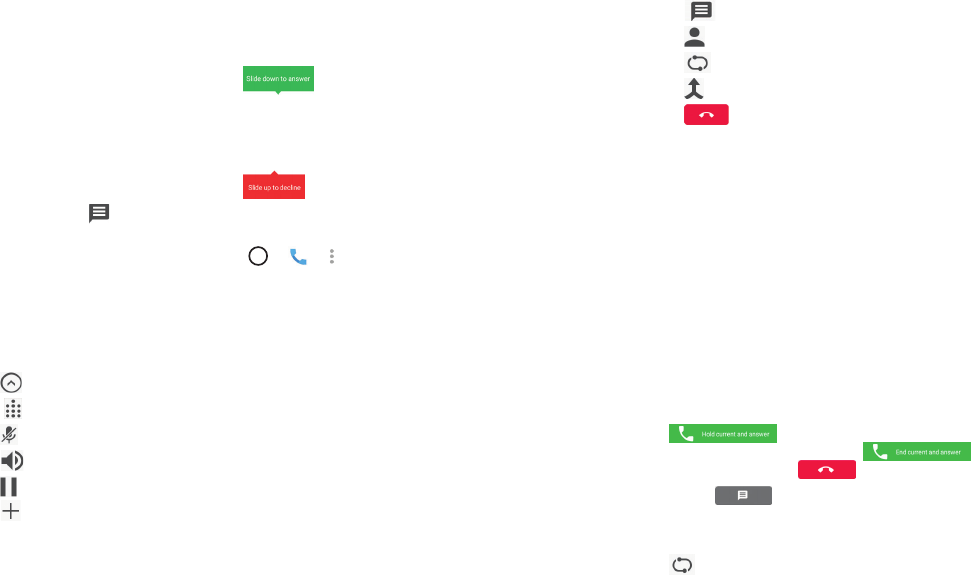
When you receive a phone call, slide down to answer the call.
Note: To silence the ringer before answering the call, press either end of the
Volume key.
Rejecting a call
When you receive a phone call, slide up to reject the call.
You can also tap to reject the call and select a preset text message or
write your own to send to the caller.
Tip: To edit a preset text response, tap
> > > Settings > General
settings > Quick responses.
Using options during a call
During a call, you will see a number of on-screen options. Tap an option to
select it.
• Tap to view all call options.
• Tap to switch to the dialer (to enter a code, for example).
• Tap to mute or unmute your microphone.
• Tap to turn the speaker on or off.
• Tap to put the call on hold.
• Tap to make another call separately from the rst call, which is put
on hold.
• Tap to open the Messaging app.
• Tap to open the Contacts app.
• Tap to switch between two calls.
• Tap to merge separate calls into a single conference call.
• Tap to end the current call.
Warning! Because of higher volume levels, do not place the phone near your
ear during speakerphone use.
Managing multi-party calls
When call waiting and three-way call features are available, you can switch
between two calls or set up a conference call.
Note: Call waiting and three-way call features require network support and
may result in additional charges. Please contact your service provider for
more information.
Switching between current calls
When you’re on a call, your phone screen informs you that another call is
coming in and displays the caller ID.
To respond to an incoming call while you’re on a call:
Tap to answer the call. This puts the rst caller on hold and
answers the second call. Tap to answer the second call and
end the rst call. Tap to reject the second call.
Note: Tap to reject the second call and select a preset text message
or write your own to send to the caller.
To switch between two calls:
Tap on the screen.
PHONE CALLS
28 29
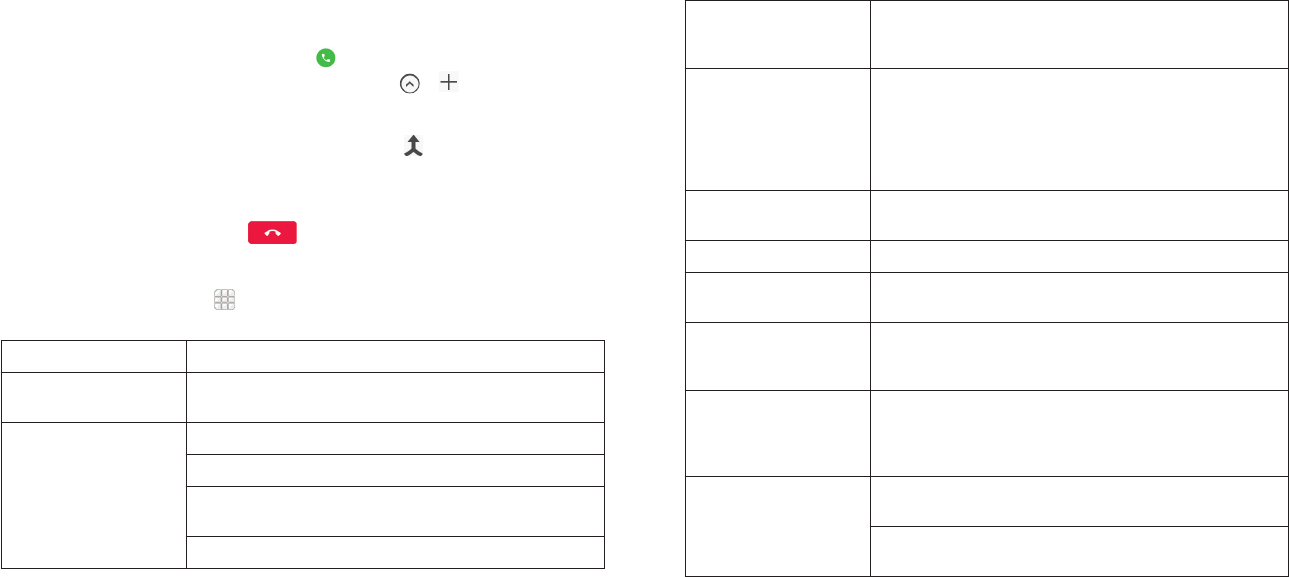
Setting up a conference call
With this feature, you can talk to two people at the same time.
1. In the dialer, enter a number and tap .
2. Once you have established the connection, tap > and dial the
second number. This puts the rst caller on hold and dials the second
number.
3. When you’re connected to the second party, tap .
If one of the people you called hangs up during your call, you and the
remaining caller stay connected. If you initiated the call and are the rst to
hang up, all callers are disconnected.
To end the conference call, tap .
Adjusting your call settings
From the home screen, tap > Settings > Call settings to congure the
call options.
Vibrate pattern Select the vibration pattern for incoming calls.
Vibrate when call is
answered Check this option to enable vibration when call is
answered.
Voicemail
Service: Select voicemail service provider.
Setup: Edit the voicemail number.
Sound: Set the notication sound for new
voicemails.
Vibrate: Set the condition for vibration.
Fixed Dialing
Numbers
Restrict outgoing calls to a xed set of numbers.
To do this you must know your micro-SIM card’s
PIN2 code.
TTY mode
Your phone is a TTY compatible device. A TTY
device can allow people who have hearing or
speech disabilities to communicate by telephone.
Simply connect the TTY device to the phone’s
headset jack. Select a TTY mode for your phone to
work with a TTY device, or turn TTY off.
Hearing aids Check this option to turn on hearing aid
compatibility.
Speed dial Set speed dialing keys.
DTMF tones Set the length of dual-tone multi-frequency signal
tones.
Call ended
operation tips
Check this option to prompt you to call, send
a message, or add to contact when the call is
ended.
Call forwarding
Forward your incoming calls to a different
number. And choose when to forward: Always
forward, When busy, When unanswered, or When
unreachable.
Additional settings
Caller ID: Choose whether people you call can
see your number.
Call waiting: See new incoming calls while you’re
on another call.
PHONE CALLS PHONE CALLS

Contacts
You can add contacts on your phone and synchronize them with
the contacts in your Google account or other accounts that support
contact syncing.
To see your contacts, tap on the home screen. From there, you can tap
the tabs on the top to quickly switch to FAVORITES or GROUPS.
Importing and exporting contacts
You can import/export contacts from/to your micro-SIM card, phone storage,
or microSDHC card. This is especially useful when you need to transfer
contacts between different devices. You can also quickly share your contacts
using Bluetooth, Email, Messaging, etc.
Importing contacts from the micro-SIM card
1. From the home screen, tap .
2. Tap > Import/Export > Manage SIM card contacts.
3. If you have added contact accounts other than the phone, select an
account in which to save the contacts.
4. Tap > Import SIM Contacts.
5. Check the contacts you want to import and tap .
Importing contacts from a microSDHC card or phone
storage
1. From the Contacts screen, tap > Import/Export > Import from storage.
2. If you have added contact accounts other than the phone, select an
account in which to save the contacts.
30 CONTACTS 31CONTACTS
3. Select the vCard le(s) in the microSDHC card or the phone storage and
tap OK.
Note: If the microSDHC card is not installed in the phone, you can import
vCard le(s) in the phone storage.
Exporting contacts to the micro-SIM card
1. From the Contacts screen, tap > Import/Export > Export to SIM card.
2. Check the contacts you want to export and then tap .
Exporting contacts to the microSDHC card or phone storage
1. From the Contacts screen, tap > Import/Export > Export to storage.
2. The phone will prompt you with the name of the vCard le and the
directory in which the le will be saved. Tap OK to create the le.
Note: If the microSDHC card is not installed in the phone, you can export
vCard le(s) into the phone storage.
Sharing contact information
1. From the Contacts screen, tap > Import/Export > Share visible contacts.
2. Choose how to share the contacts. Options depend on the applications
and services installed.
Creating a contact
1. From the Contacts screen, tap to add a new contact.
2. Tap the account eld near the top of the screen to choose where to save
the contact. If a sync account is selected, the contacts will be synced
automatically with your account online.

32 33
3. Enter the contact name, phone numbers, email addresses, and other
information.
4. Tap to save the contact.
Adding a contact to Favorites
You can add the contacts you use frequently to Favorites so that you can nd
them quickly.
1. From the Contacts screen, tap the contact you want to add to Favorites.
2. Tap .
Searching for a contact
1. Tap above the contacts list.
2. Enter the contact name you want to search for. Matching contacts will
be listed.
Joining contacts
As your phone synchronizes with multiple online accounts, you may see
duplicate entries for the same contact. You can merge all the separate
information of a contact into one entry in the Contacts list.
1. From the home screen, tap .
2. Tap a contact to display the contact’s details.
3. Tap > > Join.
4. Tap the contact whose information you want to join with the rst entry.
5. Tap .
CONTACTS
The information from the second contact is added to the rst, and the second
contact is no longer displayed in the contacts list.
You can repeat these steps to join another contact to the main contact.
Separating contact information
If contact information from different sources was joined in error, you can
separate the information back into individual contacts on your phone.
1. From the home screen, tap .
2. Tap a contact you have merged and want to separate.
3. Tap > > Separate.
4. Tap OK to conrm.
Creating a new group
1. From the home screen, tap > GROUPS.
2. Tap at the bottom of the screen.
3. If you have added contact accounts other than the phone, choose an
account for the new group.
4. Enter the group name.
5. Tap Add member and select the contacts you wish to be the group
members.
6. Tap .
Note: Tap Default below RINGTONE to set a special ringtone for incoming
calls from the group members.
7. Tap .
CONTACTS
34 35
• Tap to use uppercase or lowercase letters. This key also changes to
indicate the current case you are using: for lowercase, for uppercase,
and when locked in uppercase. Press and hold or double-tap to lock
the keyboard in uppercase.
• Tap to delete any text you have entered.
• Tap to select numbers and symbols. You can then tap to access
more.
• Tap to enter miniature icons.
• Tap to use Google’s networked voice input.
• Press and hold to change the input language or the Google keyboard
settings.
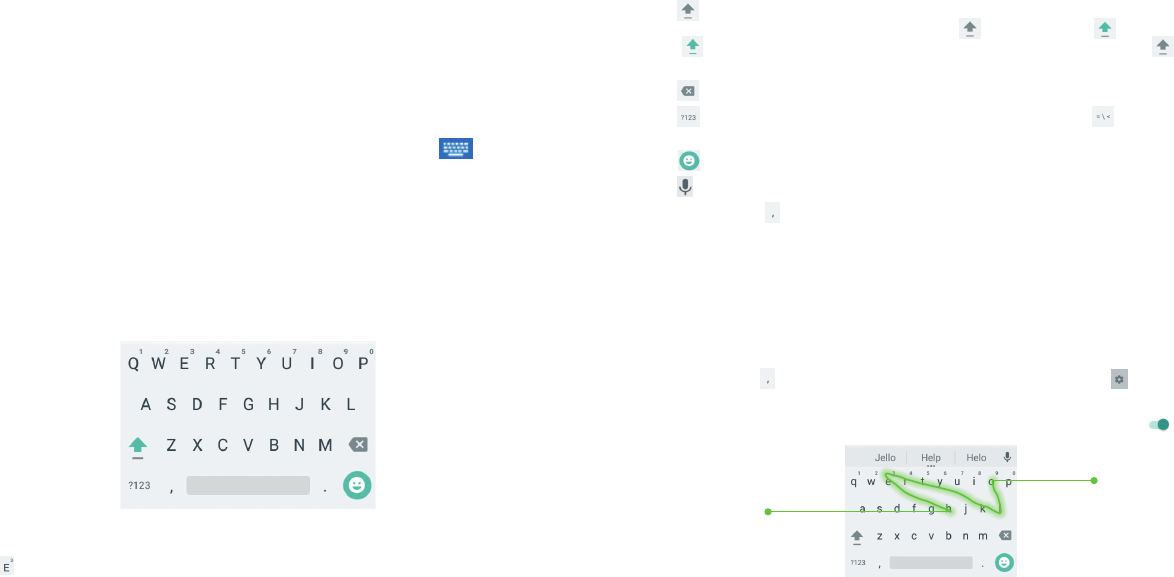
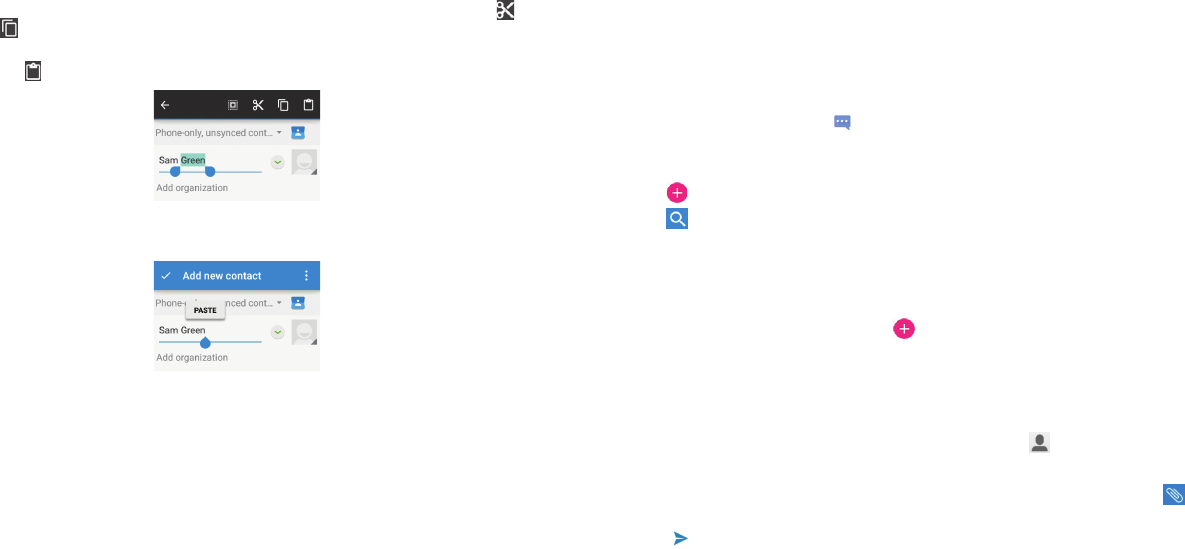
Gesture typing
The Google keyboard supports gesture typing feature. You use this feature to
input a word by sliding through the letters.
To enable and use gesture typing:
1. Tap and hold on the Google keyboard and then slide to . Tap Google
Keyboard Settings.
2. Tap Gesture Typing and make sure Enable gesture typing is on .
Entering text
You can enter text using the on-screen keyboard. Some apps open it
automatically. In others, you open it by tapping where you want to type. You
can also enter text by speaking with the Google voice typing feature.
Changing input methods
1. When you use the on-screen keyboard to enter text, the icon appears
on the notication bar.
2. Open the notication panel and tap Change keyboard.
3. Select an input method you need.
Google keyboard
The Google keyboard provides a layout similar to a desktop computer
keyboard. Turn the phone sideways and the keyboard will change from
portrait to landscape.
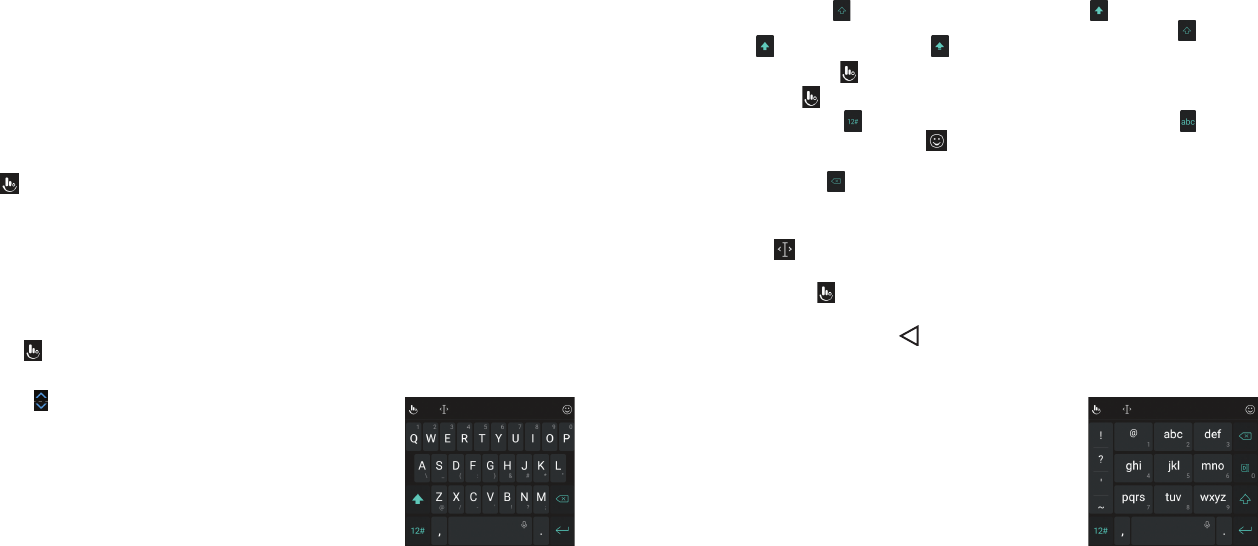
• Tap the alphabetic keys to enter letters. Press and hold the keys to enter
associated accented letters or numbers. For example, to enter È, press and
hold and the available accented letters and number 3 appear. Then
slide your nger to choose È.
End of the word
Start of the word
ENTERING TEXT ENTERING TEXT
36 ENTERING TEXT
3. Move your nger from letter to letter on the keyboard to trace a word
without lifting the nger until you reach the end of the word.
Tips:
• Tap when you want to. If you want to enter a single letter, go ahead
and tap.
• Lift your nger at the end of the word. A space is added automatically
when you begin to trace the next word.
TouchPal X keyboard
The TouchPal keyboard offers three layouts: Full, PhonePad and T+. You can
tap > Language to select a layout or an input language.
You can also use Curve® to speed up text input by replacing the key tapping
operation with a tracing gesture where you move your nger from letter to
letter without lifting the nger until you reach the end of the word.
Resizing the keyboard
Before using TouchPal keyboard, you can resize the keyboard to make it t
the screen.
1. Tap on the top left of the keyboard.
2. Tap Resize.
3. Drag up or down to resize the keyboard.
4. Tap any place on the screen.
The Full layout
The Full layout offers an input experience similar to a
computer keyboard.
• The alphabetic keys: Tap the keys to enter letters.
37ENTERING TEXT
Tap a key and slide down to enter the number or symbol on the key. You
can also press and hold a key and slide to choose more characters.
• The capital key: Tap to use uppercase. Double-tap to lock uppercase.
This key also changes to indicate the current case you are using: for
lowercase, for uppercase, and when locked in uppercase.
• Word prediction: Tap > Prediction ON/Prediction OFF.
• Languages: Tap > Language.
• Pre-dened texts: Tap to enter digits and symbols. You can tap to go
back to the alphabetic keys. Tap > Emoji, Emoji Art, or Emoticon to enter
emoji or emoticons.
• The delete key: Tap to delete text before the cursor. You can also slide
left on the key to delete an entire word.
• Voice input: Press and hold the space bar and speak into the microphone.
• Edit text: Tap to open text editing options. You can move the cursor,
select, cut, copy, paste, or delete text.
• More options: Tap to access the quick settings of TouchPal keyboard,
change the keyboard theme, and more.
• Close the keyboard: Tap the
. You can tap the text eld again to show
the keyboard.
The PhonePad layout
The layout is similar to a phone pad.
Tap an alphabetic key repeatedly until the desired
letter or number appears. Press and hold the key and
slide left or right to choose the text you need.
If word prediction is enabled, just tap the keys once
and choose the right word.
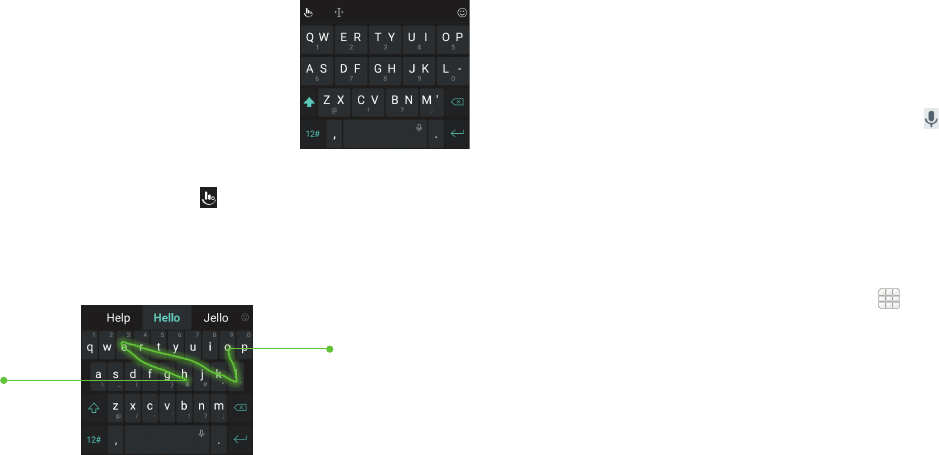
The T+ layout
Tap to enter the left letter on the key. Double-tap or ick
right to enter the right letter/symbol on the key. Press
and hold a key and slide left or right to choose more
letters and symbols.
If word prediction is enabled, just tap the keys and
choose the right word.
Enabling and Using Touchpal Curve
1. On the TouchPal X keyboard screen, tap > Settings > Smart input and
check Curve® - Word gesture.
2. Move your nger from letter to letter on the keyboard to trace a word
without lifting the nger until you reach the end of the word.
Note: Curve is only available in the Full layout.
Notes:
• Tap to type when you want to. If you want to enter a single letter, simply tap
the key once.
• Lift your nger at the end of the word. A space is added automatically
when you begin to trace the next word.
38 ENTERING TEXT 39ENTERING TEXT
Google Voice typing
Google Voice typing uses the Google voice recognition service to convert
speech to text. You must have a data connection on a mobile or Wi-Fi network
to use it.
1. Flick down the status bar when entering text and tap Change keyboard,
and then select Google voice typing. Or tap to access the voice typing
feature when you are using the Google keyboard.
2. When you see the microphone image, speak what you want to type.
3. You can continue entering text to keep it or to delete it.
Tip: Say “comma,” “period,” “question mark,” “exclamation mark,” or
“exclamation point” to enter punctuation.
Input method settings
Choose input method settings by tapping > Settings > Language & input
from the home screen.
In the Keyboard & input methods section, you can set the default input
method and choose the settings for input methods.
Editing text
• Move the insertion point: Tap where you want to type. The cursor blinks in
the new position, and a tab appears below it. Drag the tab to move the
cursor.
• Select text: Press and hold or double tap within the text. The nearest word
highlights, with a tab at each end of the selection. Drag the tabs to change
the selection.
End of the word
Start of the word
• Cut or copy: Select the text you want to manipulate. Then tap the Cut or
Copy button to cut or copy the text to the clipboard.
• Replace text with the clipboard text: Select the text you want to replace.
Then tap or PASTE.
• Insert text from the clipboard: Move cursor to the insertion point and then
press and hold the tab below the cursor. Release your nger and tap PASTE.
40 ENTERING TEXT 41MESSAGING
Messaging
You can use Messaging to exchange text messages (SMS) and multimedia
messages (MMS).
Opening the messaging screen
From the home screen, tap .
The Messaging screen opens, where you can create a new message, search
for messages, or open an ongoing message thread.
• Tap to write a new text or multimedia message.
• Tap to search for a message with keywords.
• Tap an existing message thread to open the conversation you’ve had with
a certain number.
Sending a message
1. From the Messaging screen, tap at the bottom.
2. Add recipients by one of the following ways:
• Tap the To eld and manually enter the recipient’s number or the
contact name. If the phone presents a few suggestions, tap the one
you want to add.
• Select recipients from your contacts by tapping .
3. Tap the Type message eld and enter the content of your text message.
4. If you want to send a multimedia message, tap the paper clip icon to
attach a le or a slideshow to the message.
5. Tap to send your message.

42 MESSAGING
Notes:
• You can also include email addresses as recipients for multimedia
messages.
• Do not add any attachment if you want to send a text message. Otherwise
you may be charged for a multimedia message.
Replying to a message
Messages you receive are appended to existing threads of the same number.
If the new message comes from a new number, a new thread is created.
1. From the Messaging screen, tap the thread that has the message you
want to reply to.
2. Type your reply in the text box at the bottom. You can tap if you want to
reply with an MMS.
3. Tap to send your message.
Forwarding a message
1. From the Messaging screen, tap the thread that has the message you
want to forward.
2. Tap the message.
3. Tap Forward in the menu that opens.
4. Enter a recipient for the message and edit the content if you want.
5. Tap to send your message.
Copying a message
To copy a text message from the phone to the SIM card, tap the message,
then tap Copy to SIM card.
43MESSAGING
To copy a text message from the SIM card to the phone, tap in the
Messaging screen and select Settings > Manage SIM card messages. Then
press and hold a message and select Copy to phone memory.
Changing message settings
The phone’s message settings are pre-congured for you to use immediately.
To change them, tap > Settings from the Messaging screen.

44 EMAIL
Email
From the home screen, tap > Email. You can receive and send emails
from your webmail or other accounts using POP3 or IMAP, or access your
Exchange ActiveSync account for your corporate email needs.
Setting up the rst email account
1. When you open Email for the rst time, select an account type and then
enter your email address and password.
2. Tap Next to let the phone retrieve the network parameters automatically.
Note: You can also enter these details manually by tapping Manual setup
or when automatic setup fails.
3. Follow the on-screen instructions to nish the setup.
Your phone will show the inbox of the email account and start to download
email messages.
Checking your emails
Your phone can automatically check for new emails at the interval you set
when setting up the account.
When you are in an email account, swipe down on the screen to download
new emails. Tap Load more messages at the bottom of the email list to
download earlier messages.
Responding to an email
You can reply to or forward a message that you receive. You can also delete
messages and manage them in other ways.
45EMAIL
Replying to or forwarding an email
1. Open the email you want to reply to or forward.
2. Choose from the following:
• To reply to the sender, tap .
• To reply to the sender and all recipients of the original email, tap .
• To forward the email to someone else, tap .
3. Edit your message and tap Send.
Marking an email as unread
You can return a read email to the unread state—for example, to remind
yourself to read it again later. You can also mark a batch of emails as unread.
• While reading a message, tap > Mark as unread.
• While in an email list (for instance, the Inbox), tap the checkboxes before
the messages and then tap .
Deleting an email
You can delete an email from its folder. You can also delete a batch of emails.
• While reading a message, tap > OK.
• While in an email list (for instance, the Inbox), tap the checkboxes before
the messages and then tap > OK.
Writing and sending an email
1. Open your email Inbox and tap .
Note: If you have more than one email account added on the phone,
tap the sender line to select the account you want to use for sending
the message.

46 EMAIL
2. Enter a contact name or email address in the To eld. Separate each
recipient with a comma. You can also tap to select recipients from your
contacts, contact groups, or history.
Note: Tap > Add Cc/Bcc to send a cc or bcc to other recipients.
3. Enter the email subject and compose the email text.
4. Tap > Attach le to add audio les, images, videos, and other types of
les as an attachment.
5. Tap Send at the top right of the screen to send the message.
Adding and editing email accounts
Adding an email account
After setting up your rst email account (see Email – Setting up the rst email
account), you can add more email accounts and manage them separately.
1. Open Email to get to the Inbox screen.
2. Tap > Settings and tap ADD ACCOUNT at the top right of the screen.
3. Follow the prompts to set up the account as you did with the rst one.
Editing an email account
You can change a number of settings for an account, including how often
you check for email, how you’re notied of new mails, your email signature,
and details about the servers the account uses to send and receive mail.
1. Open Email to get the Inbox screen.
2. Tap > Settings and tap the account you want to change.
3. Make the changes and tap
when you’re nished.
47EMAIL
Changing general email settings
1. General settings apply to all email accounts you add.
2. Open Email to get the Inbox screen.
3. Tap > Settings > General.
4. Make the changes and tap
when you’re nished.
48 CONNECTING TO THE INTERNET
Connecting to the Internet
Your phone’s impressive networking capabilities allow you to access
the Internet or your corporate network with ease. You can use default
connection settings to connect to the Web via your mobile network or Wi-Fi.
The mobile data connection can be enabled/disabled manually. From the
home screen, tap
> Settings
> Mobile networks and check or uncheck
Mobile Data.
Adding a new mobile data connection
To connect to the Internet you can use the default Access Point Names (APN).
If you want to add a new APN, please contact your service provider to get the
necessary information.
1. From the home screen, tap > Settings > Mobile networks > Access
Point Names.
2. Tap > New APN.
3. Tap each item to enter the information you received from your service
provider.
4. Tap > Save.
Tip: To set the APN to default settings, tap > Reset to default.
Turning on Wi-Fi
Wi-Fi is a wireless networking technology that can provide Internet access
at distances of up to 100 meters, depending on the Wi-Fi router and your
surroundings.
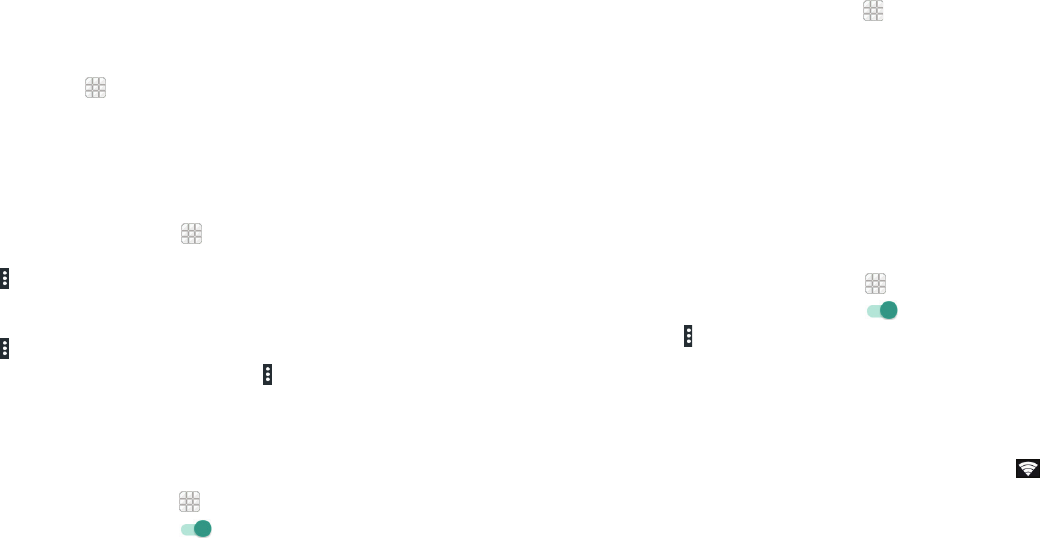
1. From the home screen, tap
> Settings
.
2. Slide the Wi-Fi switch to the position to turn on Wi-Fi.
49CONNECTING TO THE INTERNET
Connecting to a Wi-Fi network
1. From the home screen, tap
> Settings
> Wi-Fi. The Wi-Fi access points, or
“hotspots,” that your phone has detected are displayed with their names
and security settings.
2. Tap an access point to connect to it. If security features are implemented,
you’ll need to enter a password.
Note: Your phone automatically connects to previously used Wi-Fi networks
when they are in range.
Adding a Wi-Fi network
You can add a Wi-Fi network if the network does not broadcast its name
(SSID), or to add a Wi-Fi network when you are out of range.
To connect to a secured network, you rst need to get the security details from
the network’s administrator.
1. From the home screen, tap > Settings > Wi-Fi.
2. Slide the Wi-Fi switch to the position.
3. Tap
> Add network.
4. Enter the network SSID (name). If necessary, enter security or other network
conguration details.
5. Tap SAVE.
Checking the Wi-Fi network status
You can check the Wi-Fi network by looking at the icon in the status bar.
Or tap the access point that the phone is currently connected to in the Wi-Fi
screen. You can then check the network status from the pop-up window.
50 CONNECTING TO THE INTERNET
Connecting to a WPS network
Wi-Fi Protected Setup (WPS) is a feature that makes it easy to add your phone
to the access points which supply WPS.
You can use one of the following methods to connect your phone to a wireless
network using WPS.
Method one: WPS button (Recommended)
1. From the home screen, tap > Settings > Wi-Fi.
2. Slide the Wi-Fi switch to the position.
3. Tap
> Advanced > Wi-Fi Push Button.
4. Press the WPS button on the wireless router and the access point will
recognize your phone and add it to the network.
Method two: PIN
1. From the home screen, tap > Settings > Wi-Fi.
2. Slide the Wi-Fi switch to the position.
3. Tap
> Advanced > WPS Pin Entry.
4. The WPS PIN displays on the screen. Enter the PIN into the access point’s
setup page.
After entering the PIN, your phone automatically nds the access point and
congures the connection.
Note: For detailed information about the WPS feature of access point, please
refer to its documentation.
Connecting to virtual private networks
Virtual private networks (VPNs) allow you to connect to the resources inside
a secured local network. VPNs are commonly deployed by corporations,
51CONNECTING TO THE INTERNET
schools, and other institutions to let people access local network resources
when not on campus, or when connected to a wireless network.
Depending on the type of VPN you are using, you may be required to enter
your login credentials or install security certicates before you can connect to
your VPN. You can get this information from your network administrator.
Adding a VPN
1. From the home screen, tap > Settings > More > VPN.
2. Tap and ll in the information provided by your network administrator.
Note: You need to set a lock screen pattern, PIN, or password before you
can use credential storage.
3. Tap SAVE.
The VPN is added to the list on the VPN screen.
Connecting to a VPN
1. From the home screen, tap > Settings > More > VPN.
2. Tap the VPN that you want to connect to.
3. When prompted, enter any requested credentials, and then tap Connect.
When you are connected, the VPN connected icon appears in the Status bar.
Modifying a VPN
1. From the home screen, tap > Settings > More > VPN.
2. Press and hold the VPN that you want to modify.
3. Tap Edit prole and edit the VPN settings you want.
4. Tap SAVE.

52 BROWSING THE INTERNET
Browsing the Internet
Use Browser to view web pages and search for information.
Using the Browser
From the home screen, tap .
Browser also opens when you tap a web link—for example, in an email or a
text message.
Opening a web page or searching the web
1. Open the Browser app.
2. Tap the address box at the top of the web page. If the address box isn’t
visible, scroll to the top of the web page.
3. Enter the address (URL) of a web page. Or, enter terms you want to
search for.
4. Tap a URL or search suggestion, or tap Go to open the web page or
search results.
5. To go back a page, tap > . To go forward, tap > .
Tips:
• Tap in the address box if you want to stop opening the page.
• Tap in the address box if you want to refresh the page.
• To bookmark a web page, open it and tap > Add bookmark. Give the
bookmark a name and tap Add.
Using multiple browser tabs
You can open several web pages at the same time (one page in each tab)
and switch between them freely.
53BROWSING THE INTERNET
Opening a new browser tab
Tap . A new browser window opens and the homepage is loaded.
Switching between tabs
Tap the tabs at the top of the screen to switch between tabs.
Tip: Tap on a tab to close it.
Setting the home page
Your home page opens when you open a new browser tab, and when you
start Browser after restarting your phone.
1. Open the page you want to set as your home page.
2. Tap > Settings > Set Homepage.
3. Tap the address box, enter a web page, and press
.
Downloading les
1. Press and hold an image or a link to a le or to another web page.
2. In the menu that opens, tap Save image or Save link > Download.
The downloaded les are saved to your phone or the microSDHC card. You
can view or open the downloaded les by tapping > Download.
Changing browser settings
You can congure a number of browser settings to customize the way you
browse the web, including several you can use to control your privacy.
To open the browser settings screen, tap > Settings in the web page screen.

54 USING WI-FI DIRECT
Using Wi-Fi Direct
Wi-Fi Direct allows Wi-Fi devices to connect to each other without the need for
wireless access points (hotspots).
Connecting to another device via Wi-Fi Direct
1. From the home screen, tap > Settings > Wi-Fi.
2. If Wi-Fi is off, slide the Wi-Fi switch to the position.
3. Tap
> Advanced >
Wi-Fi Direct. Your phone will search for other devices
enabled with Wi-Fi Direct connections.
4. Tap a device name under Peer Devices to connect with it. The other device
will receive a Wi-Fi Direct connection prompt and need to accept the
request for connection. Both devices may need to enter a common PIN. If
prompted, tap CONNECT.
5. Once connected, the device is displayed as “Connected.”
Sending data via Wi-Fi Direct
1. Open the appropriate application and select the le or item you want
to share.
2. Select the option for sharing via Wi-Fi Direct. The method may vary by
application and data type.
3. Tap a device the phone has connected with or wait for it to search for new
devices and tap one of them.
Receiving data via Wi-Fi Direct
When an attempt to transfer data via Wi-Fi Direct is received, you can see a
notication in the status bar. Tap Accept to start receiving the data.
Received les are stored automatically in a dedicated folder (WiFiShare, for
instance) in the phone storage or microSDHC directory. You can access them
with the File Manager app.
55BLUETOOTH
Bluetooth
Bluetooth is a short-range wireless communication technology. Phones or
other devices with Bluetooth capabilities can exchange information wirelessly
within a distance of about 32 feet (10 meters). The Bluetooth devices must be
paired before the communication is performed.
Turning Bluetooth on/off
1. From the home screen, tap > Settings > Bluetooth.
2. Slide the Bluetooth switch to the or position.
When Bluetooth is on, the icon will appear in the status bar. Your phone will
be visible to nearby devices while Bluetooth Settings is open.
Changing the device name
1. From the home screen, tap > Settings > Bluetooth.
2. Slide the Bluetooth switch to the position if Bluetooth is off.
3. Tap
> Rename this device.
4. Edit the name and tap RENAME.
Pairing with another Bluetooth device
1. From the home screen, tap > Settings > Bluetooth.
2. Slide the Bluetooth switch to the position if Bluetooth is off.
Your phone automatically scans for and displays the IDs of all
available Bluetooth devices in range. You could tap > Refresh if
you want to scan again.
3. Tap the device you want to pair with.

56 BLUETOOTH
4. Conrm that the Bluetooth passkeys are the same between the two
devices and tap PAIR. Alternately, enter a Bluetooth passkey and tap PAIR.
Pairing is successfully completed when the other device accepts the
connection or the same passkey is entered.
Note: The Bluetooth passkey may be xed for certain devices, such as
headsets and hands-free car kits. You can try entering 0000 or 1234
(the most common passkeys), or refer to the documents for that device.
Unpairing from a Bluetooth device
You can make your phone forget its pairing connection with another
Bluetooth device. To connect to the device again, you may need to enter or
conrm a passkey again.
1. From the home screen, tap > Settings > Bluetooth and make sure
Bluetooth is turned on.
2. In the list of paired devices, tap beside the Bluetooth device you want
to unpair from.
3. Tap FORGET.
Sending data via Bluetooth
1. Open the appropriate application and select the le or item you want
to share.
2. Select the option for sharing via Bluetooth. The method may vary by
application and data type.
3. Tap a Bluetooth device the phone has paired with or wait for it to search
for new devices and tap one of them.
57BLUETOOTH
Receiving data via Bluetooth
1. Turn Bluetooth on before trying to receive data via Bluetooth.
Note: If the phone has not been paired with the sending device, you may
need to tap your phone’s device name in the Bluetooth menu in Settings
to keep the phone detectable through Bluetooth.
2. Swipe down on the status bar and tap .
3. Tap ACCEPT to start receiving the data.
Depending on whether a microSDHC card is installed, received les are
stored automatically in a dedicated folder (Bluetooth, for instance) in the
phone storage or microSDHC directory. You can access them in the File
Manager. Received contacts (vCard les) are automatically imported to
your contact list.
58 ENTERTAINMENT
Entertainment
You can use your phone to take
photos and record videos. Photos
and videos are stored to the
phone’s microSDHC card or the
phone’s internal storage. You can
copy them to your computer or
access them in the Gallery.
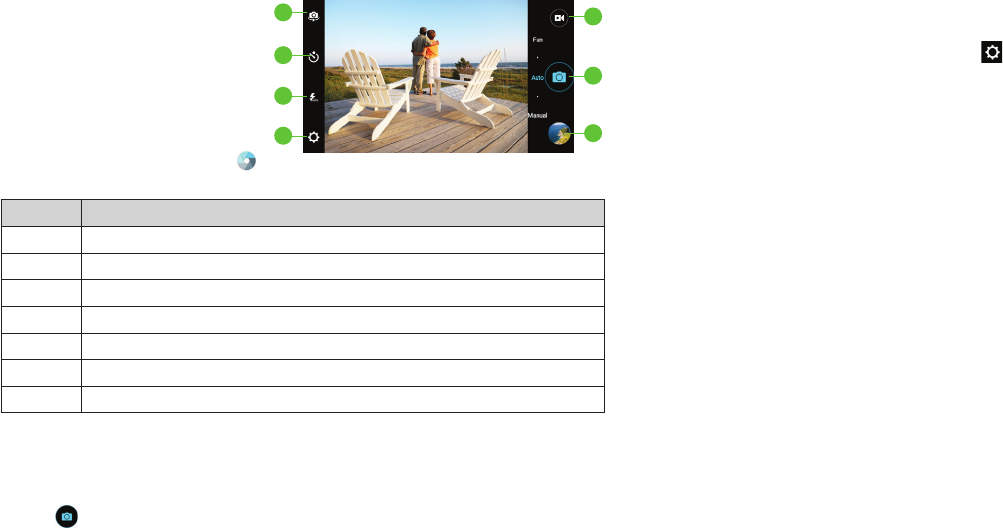
Capturing a photo
1. From the home screen, tap .
2. Aim the camera at the subject and make any necessary adjustments.
Number Function
1 Switch between the front and the back camera.
2 Choose time interval.
3 Change the ash mode for the rear-facing camera.
4 Change the camera settings.
5View photos and videos you have taken.
6 Capture a photo.
7 Record a video.
Tip: You can pinch or spread on the screen or press the Volume keys to zoom
in or zoom out.
3. You can either let the camera autofocus on the center of the screen, or
touch another area on the screen that you want to focus on.
4. Tap to take the photo.
59ENTERTAINMENT
Warning! Keep a safe distance when using the ash. Do not point the ash
toward people’s or animals’ eyes.
Adjusting camera settings
1. Before taking a photo, you can tap > CAMERA to open the following
camera setting options:
• Full screen: Turn full screen on or off.
• Shutter tone: Set the shutter tone.
• Geo-tagging: Select whether to store the GPS location in
captured pictures.
• Review: Set the lapse time for viewing a photo after you take it.
• Storage location: Change the storage location for captured photos.
• Restore defaults: Restore the default camera settings.
Note: Not all options are available for the front camera.
Using different camera modes
Choose from three different camera modes (Auto, Manual, and Fun) for
different options while taking photos.
Notes
:
• Auto mode is the default setting for the camera (see Entertainment –
Capturing a photo and Adjusting camera settings).
• Modes are only available on the rear-facing camera.
17
6
2
3
45
60 ENTERTAINMENT
Manual mode
1. From the home screen, tap .
2. Tap Manual.
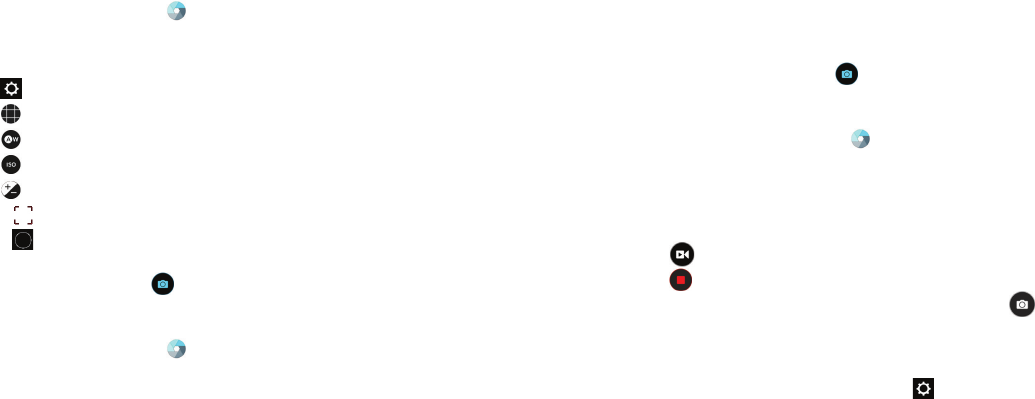
3. Aim the camera and make the following adjustments:
• Tap > CAMERA > Picture size to change the camera resolution.
• Tap to choose a grid to frame the photo proportionately.
• Tap to choose the color temperature of the photo.
• Tap to choose a light sensitivity setting for the camera.
• Tap to change the exposure setting.
• Drag to any area on the screen that you want to focus on.
• Drag to any area on the screen where you want the camera to meter
exposure so as to adjust the photo brightness.
4. Aim the camera and tap to take a photo.
Fun mode
1. From the home screen, tap .
2. Tap Fun.
3. Tap a shot mode to select it:
• Special effect: Choose from effects such as Fisheye, Sepia, or Mosaic.
• Smile: Camera automatically takes a photo when it detects a smile.
• HDR: Camera combines several shots into one image with balanced
shadows and highlights.
• Interval: Take pictures in chosen time frame intervals.
61ENTERTAINMENT
• Panorama: Tap and move the camera right or left to capture a
panorama shot.
• Multi-exposure: Overlap two photos into one image.
4. Follow on-screen instructions to take photos and add different effects.
5. Aim the camera and tap to take a photo.
Recording a video
1. From the home screen, tap .
2. Aim the camera at the subject. You can tap any area on the screen that
you want the camcorder to focus on before and during recording.
Tip: Pinch or spread on the screen or press the Volume Keys to zoom in or
zoom out.
3. Tap to start recording.
4. Tap to stop recording.
Tip: While the recording is in progress, you can tap to save the frame as a
separate photo.
Adjusting camcorder settings
Before recording a video, you can tap > VIDEO to open the following
camcorder settings options:
• Video quality: Tap the drop-down menu to select the video resolution.
• Time lapse: Set the lapse time for recording video.
• Focus lock when recording: Lock the focus when recording video.
• Geo-tagging: Select whether to store the GPS location in
captured videos.

62 ENTERTAINMENT
• Storage location: Change the storage location for captured videos.
• Restore defaults: Restore the default camcorder settings.
Note: Not all options are available for the front camcorder.
Playing your music
From the home screen, tap > Music to play audio les stored on your
phone. Music supports a wide variety of audio formats, so it can play music
you purchase from online stores, music you copy from your CD collection, and
so on.
Viewing your music library
From the home screen, tap > Music and your music library is displayed. All
your audio les are cataloged according to the information stored in the les.
Tap the tabs at the top of the screen to view your music library organized by
All Songs, Playlists, Favorites, Artists, Albums, or Folders. You can also tap
RECENT PLAY to browse songs you recently played.
Note: If an audio le is being played, its summary information is displayed at
the bottom of the music library screen. Tap the summary information to open
the playback screen.
Setting a song as the default ringtone
The song will be used as the ringtone for all incoming calls, except those from
contacts to whom you have assigned special ringtones.
1. From the home screen, tap > Music to see the music library.
2. Tap next to a song in any list.
3. Tap Set as ringtone.
4. Tap Phone Ringtone or Notication Ringtone.
63ENTERTAINMENT
Tip: If the song is being played and you’re in the playback screen, you can
tap > Set as ringtone.
Playing music
Tap a song in the music library to listen to it. The following playback screen
appears.
Number Function
1 Song, album, and artist information.
2
Album artwork and lyrics (if available).
3 Track information.
4 Open the Dolby Audio app.
5Toggle repeat mode: repeating
current song, repeating all songs, or
sequential.
6Playback control. Skip songs or pause
and resume playback. Drag the slider
to jump to any part of the song.
7Play the current playlist in shufe
mode, where tracks are played in
random order.
8 Add the song to your favorites.
9 Share the song.
10 Get more options.
1
2
4
6
8
10
7
5
39
64 ENTERTAINMENT
Managing playlists
Create playlists to organize your music les into sets of songs so that you can
play the songs you like in the order you prefer.
• Tap > Add to next to a song to add it to a playlist or create a
new playlist.
• Tap > Delete next to a playlist to delete the playlist.
• Tap > Rename next to a playlist to rename the playlist.
• Tap a playlist to view its content. You can remove songs from the playlist by
pressing and holding a song, tapping more songs you want to remove, and
then tapping .
Using your gallery
Opening your gallery
From the home screen, tap > Gallery to view albums of your pictures
and videos.
Working with albums
When you open Gallery, all pictures and videos on your phone are displayed
in a number of albums.
Viewing album contents
Tap an album to view the pictures and videos it contains.
Sharing albums, pictures, or videos
1. Press and hold an item to select an album, or after you open an album to
select a picture or a video.
2. Tap more items that you want to share.
65ENTERTAINMENT
3. Tap and select how you want to share the items.
Deleting albums
1. Press and hold an album until it is selected.
2. Tap more albums that you want to delete.
3. Tap > OK.
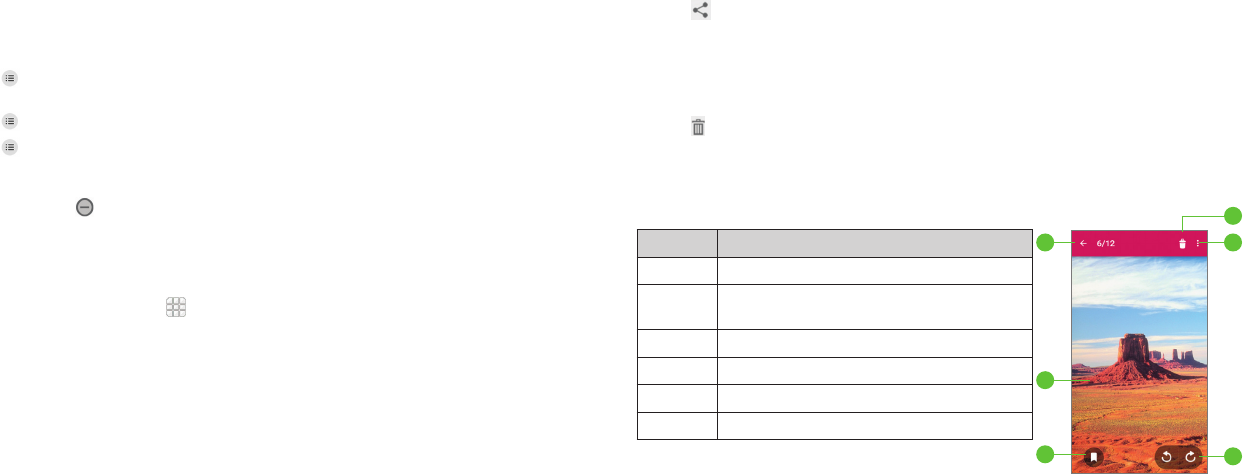
Working with pictures
Tap a picture in an album to view the picture in full screen. Tap the screen to
view the following features.
Number Function
1 Return to the album.
2Swipe horizontally to see more; double
tap a picture to zoom in or out.
3 Add a tag.
4 Rotate the picture.
5 Get more options.
6 Delete the photo or video.
• Swipe horizontally to see more pictures or videos.
• Pinch a picture or video to make it smaller. You’ll
then see a lmstrip-style view of all your pictures and videos in a row. Swipe
left or right to scan through them all.
Tip: You can delete a picture or video by swiping it up or down in the
lmstrip view. If you accidentally delete one, tap UNDO to retrieve it.
1 5
6
2
34
66
• Double-tap the picture, or pinch two ngers together or spread them
apart to zoom out or in.
Note: Some options may not be available for certain albums or pictures.
Retouching your pictures
You can edit any photos you took and some other pictures in Gallery. The
changed picture is saved in the current album, while the original image is
never affected.
1. Tap > Edit while viewing a picture in full screen to open the Photo
Editor interface.
2. Tap the icons along the bottom of the screen to edit the picture.
Tip: Slide left or right on the bottom of the screen to nd all icons.
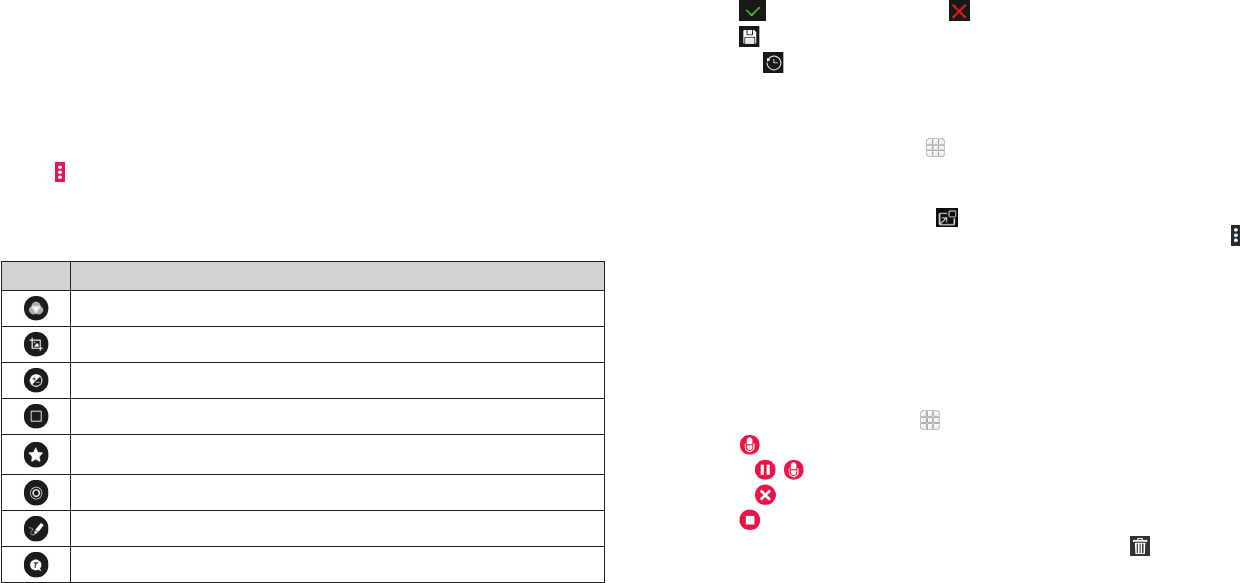
Icon Function
Apply lters and old photo effects.
Crop, rotate, straighten, or ip (mirror) the picture.
Adjust exposure, saturation, hue, sharpness, and other color options.
Add a frame to the picture.
Decorate people in the picture with comical mustaches,
eyeglasses, hats, and more.
Apply a blur effect to the picture.
Select a color and draw anything on the picture.
Add text to the picture and adjust its effect.
ENTERTAINMENT 67ENTERTAINMENT
3. Tap to keep the change or to cancel it.
4. Tap to save the new picture.
Note: Tap in the Photo Editor screen to see the edits you have made and
undo or redo them.
Playing videos
1. From the phone screen, tap > Video Player.
2. Tap a video name to start playing. Tap the video to view the playback
controls.
In the Video Player, you can tap to play the video in a small oating
window
and continue with other tasks on the phone. You can also tap >
Trim while the video is playing in full screen to cut a segment of the video clip
and save it as a new video le.
Making memorable memos
Sound Recorder enables you to record voice memos and listen to them
whenever you like.
Recording a voice memo
1. From the home screen, tap > Sound Recorder.
2. Tap to start recording. During recording, you can do the following:
• Tap / to pause or continue the recording.
• Tap to cancel the recording.
3. Tap to stop recording. The memo is automatically saved.
If you don’t want to save the memo after recording it, tap > OK to delete it.
6
7

68 69
Playing a voice memo
Playing a memo you just recorded
Tap at the bottom of the screen.
Playing any saved memo
1. Tap at the top right of the screen to see all recordings.
2. Tap the title of a memo to play it.
Note: You can also tap next to a memo to delete, rename, share, trim,
check its le information, add a tag, or set it as your phone ringtone.
ENTERTAINMENT
Google applications
Signing in to your Google account lets you synchronize Gmail, calendar
events, contacts and other data between your phone and the web. And if
you don’t have an account, you can easily create one.
1. From the home screen, tap > Settings > Accounts > Google.
2. Tap Enter your email to sign in to your existing account, or OR CREATE A
NEW ACCOUNT to create a new account.
3. Follow the on-screen steps to enter the information about the account and
nish the setup.
Gmail
Gmail is a web-based email service that’s congured when you sign in to
your Google account. Depending on your synchronization settings, the
Gmail on your phone can be automatically synchronized with your
account on the web.
Creating and sending an email
1. From the home screen, tap .
2. Tap .
3. Enter a contact name or email address in the To eld. Separate each
recipient with a comma.
4. Enter the email subject and compose the text.
5. To attach les, tap > Attach le.
6. Tap at the top right of the screen to send the message.
GOOGLE APPLICATIONS

70 71
Google Calendar
From the home screen, tap > Calendar to use Google Calendar, Google’s
time management application. You can use the calendar to schedule
appointments, including meetings and other events. Your appointments
will be displayed on the screen as are scheduled. You can also synchronize
appointments to your Google account, which enables you to manage your
schedule online on your PC.
Google Chrome
Chrome on your ZTE Overture 2 can sync bookmarks, browsing history, and
opened tabs from your Google account so that you can maintain the same
experience across your phone, PC, tablet, and other devices.
Google+
Google+ is a social networking service offered by Google. The Google+
application on your phone enables you to manage your data, chat with
online contacts, organize them in different circles, and share your selected
information.
From the home screen, tap Google > Google+.
Note: For detailed information about Google+, open Google+ and tap >
Help to view the online instructions.
Getting started with Google+
Open the Google+ app and tap Home near the top of the screen to use the
following features:
• Home: Add a suggested person, or see posts people have shared with you,
a circle you are in, or everyone.
• Circles: Find people to add to your Google+ circles, create new circles, view
and organize people into circles based on your relationships. You can also
follow content posted by people you nd interesting.
• Find communities: Search and join all kinds of online communities, where
people gather for the sharing and discussion of a common topic.
• Photos: View photos you uploaded, photos of you, photos from your posts
and more.
• Locations: See your friends’ locations on the map and congure your
location sharing settings.
• Events: Manage your social calendar. You can add events, invite people,
and then share photos in real time from the event.
Google Maps
Activating location services
To use Google Maps and nd your location, you must enable location
services on your phone.
1. From the home screen, tap > Settings > Location.
2. Slide the Location switch at the top to turn location access on or off.
3. When location access is enabled, tap Mode to select the location sources
you want to use.
•
High accuracy: Use GPS, Wi-Fi, and mobile networks to determine location.
• Battery saving: Use only Wi-Fi and mobile networks to get your
approximate location. This will drain less power from your battery than
using GPS.
• Device only: Use GPS to pinpoint your location.
GOOGLE APPLICATIONS GOOGLE APPLICATIONS

72 73
• Accelerated location: Slide the switch to turn on/off the Qualcomm®
IZat™ hardware accelerated location feature.
Getting your location
1. From the home screen, tap Google > Maps.
2. Tap at the bottom.
The map centers on a dot and an arrow that indicate your location and the
direction the phone is facing.
Searching for a location
1. From the home screen, tap Google > Maps.
2. Tap the search box on the top.
3. Enter the address or the type of business you’re looking for in the search
box. If suitable suggestions appear below the search box, tap one to
search for it.
Tip: You can also tap beside the search box to use voice search.
4. Tap the search key on the keyboard.
5. Swipe the search result at the bottom card left or right to see other results.
You can slide the result up to nd more information about the location as
well as options for getting directions and more.
Getting directions to your destination
Maps can provide directions for travel by car, public transportation, foot,
or bicycle.
1. From the home screen, tap Google > Maps.
2. Tap .
GOOGLE APPLICATIONS
3. Select the mode of transportation and then enter a start and end point. If
your location is found, it will appear in the start point eld by default.
4. Tap a suggested route to view it on the map.
You can swipe the bottom card left or right to choose other routes. Slide the
bottom card up to see the route directions in a list.
Note: Tap to use Google Maps Navigation and get turn-by-turn voice
directions.
Searching for local places
Google Maps helps you nd all kinds of businesses and establishments
around you. You can rate these places and get recommendations.
1. From the home screen, tap Google > Maps.
2. Navigate the map view to the area you’d like to explore. You can explore
nearby locations or pan the map to another location.
3. Tap the search box at the top.
4. Tap the Explore nearby card and choose one option in the new screen.
Results will appear on cards.
5. Tap a location to see it on the map or get directions.
You can also slide up the bottom card for more information such as the
street address, website, or street view, and options for calling, saving to
your Google Account, or sharing with others.
Note: The Explore nearby feature is not available for all areas.
Google Search
You can search for information on the Web or your phone using Google
Search, or perform certain tasks by speaking.
GOOGLE APPLICATIONS
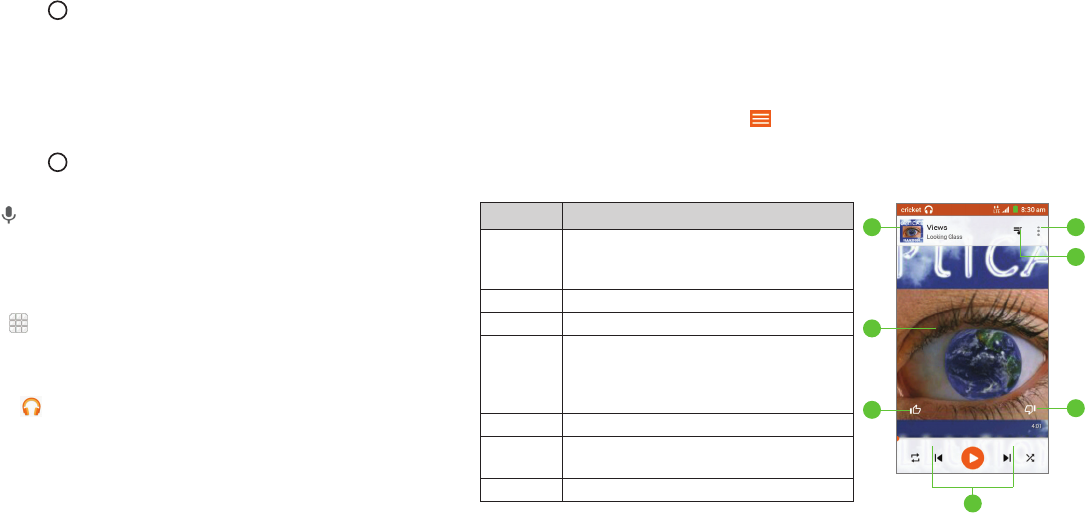
74 75
Searching with text
You can search for information on the Internet or on the phone (such as
apps and contacts) by entering text.
1. Press and hold
the Home key
to open Google Search.
2. Enter the terms you want to search for in the search box and tap the
search key on the keyboard, or tap a search suggestion that appears
below the search box.
Searching by speaking
You can also search the Web or perform certain tasks by speaking.
1. Press and hold
the Home key
to open Google Search.
2. Tap the microphone icon to the right of the search box.
Note: You can also tap from the home screen.
3. Speak the terms you want to search for or the question you want to ask.
When you’re nished, your speech is analyzed and the search is initiated.
Changing search settings
From the home screen, tap > Google Settings > Search & Now to set
phone search, voice, accounts and privacy, and notication options.
Google Music
The Play Music application ( ) works with Google Music, Google’s online
music store and streaming service. You can stream via mobile data or Wi-Fi
and listen to your favorite songs that you’ve added to your online Google
Music library. You can also play audio les you’ve copied directly to your
phone from a computer.
GOOGLE APPLICATIONS
Note: The availability of Google Music is dependent on your region. If it’s not
available, or you don’t have a mobile data or Wi-Fi connection, you can only
play music stored on your phone.
Playing your music
From the home screen, tap Google > Play Music. If prompted, select an
account to access its online music library.
The app searches your online library and your phone for music and playlists
before displaying your combined music library, organized by GENRES, ARTISTS,
ALBUMS, and SONGS. You can tap > My Library or Playlists to view all the
music and playlists. To change views of your library, swipe left or right.
Tap a song to play it. When the song is playing, tap the summary information
at the bottom to display the playback screen.
Number Function
1Song and artist information. Tap or
drag down to return to the music
library.
2 Album artwork.
3 Give the song a thumbs-up.
4
Playback control. Skip songs, pause
and resume playback, use shufe
or repeat. Drag the progress bar to
jump to any part of the song.
5 Give the song a thumbs-down.
6Tap to see the current playlist
(queue).
7 Get more options.
GOOGLE APPLICATIONS
1
2
3
6
7
5
4
76 77
You can still control the music when you are not in the playback screen.
• In the music library of the Play Music app, tap the summary information at
the bottom of the screen to restore the playback screen.
• In other apps, swipe down the notication panel. Tap the song title to
restore the playback screen, pause/resume playback, or skip to the next/
previous song.
• When the screen is locked, the song information, album cover, and
playback controls are displayed on the top of the screen. You can pause/
resume playback or skip songs.
Managing playlists
Create playlists to organize your music les into sets of songs so that you can
play the songs you like in the order you prefer.
Creating a playlist or adding a song to a playlist
Tap next to the song and select Add to playlist.
Removing songs from a playlist
1. Tap > Playlists and select a playlist.
2. Tap next to the song.
3. Tap Remove from playlist.
Deleting a playlist
1. Tap > Playlists in the Play Music app and select a playlist.
2. Tap next to the playlist you want to delete.
3. Tap Delete > OK.
GOOGLE APPLICATIONS
Note: Certain automatically created playlists such as Last added cannot
be deleted.
Google Play Store
From the home screen, tap . You can buy or rent music, books, movies,
apps, and download them to your phone.
Note: The content you can access in Google Play Store depends on your
region and your service provider.
Browsing and searching for apps
You can browse apps by category. Tap a top-level category, such as GAMES,
and tap the app from any subcategory.
You can also search for apps using an app’s name or description or the
developer’s name. Simply tap and enter the search terms.
Downloading and installing apps
When you nd the app you are interested in, tap it to open its details screen
where more information about the app is displayed.
1. Tap INSTALL (free apps) or the price (paid apps). If the app is not free,
you need to sign in to your Google Wallet account and select a payment
method.
Caution: Once installed, some apps can access many functions or a
signicant amount of your personal data. The Play Store will show you what
the app can access. Tap ACCEPT to proceed, or press
to cancel.
2. Wait for the app to be downloaded and installed automatically. Payment
needs to be authorized before paid apps start downloading.
The app is successfully installed when the icon appears in the status bar.
Open the app from this notication or by locating it in Apps .
GOOGLE APPLICATIONS

78 79
Creating a Google Wallet account
You must set up a Google Wallet account to purchase items from the
Play Store.
Choose one of the following:
• On your computer, go to wallet.google.com to create a Google Wallet
account.
• The rst time you use your phone to buy an item from Google Play Store,
you’re prompted to enter your billing information to set up a Google Wallet
account.
Warning! When you’ve used Google Wallet once to purchase items from the
Play Store, the phone remembers your password so you don’t need to enter it
the next time. For this reason, you should secure your phone to prevent others
from using it without your permission.
GOOGLE APPLICATIONS
Applications
Backup & Restore
From the home screen, tap > Backup & Restore. You can back up your
user data, such as contacts and messages, and installed applications to the
memory card regularly. If the data gets lost, restore it from the memory card.
Tap > Help to view detailed guide.
Calculator
From the home screen, tap > Calculator to use the phone’s convenient
built-in calculator for some basic as well as advanced mathematical equations.
Clock
From the home screen, tap > Clock to use a series of timing tools.
Setting a new alarm
1. Tap in the Clock app.
2. Tap an existing alarm to congure it, or tap at the bottom of the screen
to create a new alarm.
3. Set up the alarm options, such as time, repeat, and alarm sound.
4. Tap SAVE to save and exit.
Note: To enable or disable existing alarms directly, just slide the switch.
APPLICATIONS
80 81
Checking World time
Tap in the Clock app to check local time for cities around the world.
Tap at the bottom to add a new city or country.
Using the Stopwatch and Countdown
Tap or in the Clock app to use the stopwatch or the countdown timer.
Stopwatch allows you to record lap times, while Countdown allows you to set
a time and count down to zero.
Downloads
The Downloads app keeps a record of the les you have downloaded using
the apps such as Browser, Email, or Gmail.
From the home screen, tap > Downloads.
• Tap a le to open it with the appropriate application.
• Press and hold a le, or check the box in front of it, to delete or share it.
File Manager
Quickly access all of your images, videos, audio clips, and other types of les
on your phone and the microSDHC card.
From the home screen, tap > File Manager. You can nd the le you
need by category in the Category tab , or tap Phone or SD Card
to browse folders and les on the phone storage or the microSDHC card.
• Tap folders and les to access stored items.
• Press and hold an item to access options such as copy, move, share,
or delete.
• To copy or move an item, navigate to a new location and tap PASTE.
• Tap to create a new folder in the current directory.
Mi-Moment
From the home screen, tap > Mi-Moment to create, view, and manage
your notes. You can add audio les, pictures, videos and more to your notes.
Sele
Take seles quickly and easily with the front-facing camera. From the home
screen, tap > Sele. You can also open this app from the lock screen by
pressing and dragging the shortcut along the bottom of the screen.
Task Manager
From the home screen, tap > Task Manager to view or stop applications.
• Tap a task in the TASKS tab to check the details of the application or force
it to stop.
• Tap the APPS tab to manage all the apps on your phone.
• Tap the RESOURCES tab to view the real-time use of the system resources
(CPU, RAM, and storage).
Amazon Kindle
From the home screen, tap > Amazon Kindle. Tap Start Reading and sign
in or create an Amazon account. From there, you can purchase and read
from a selection of hundreds of thousands of books available in the Amazon
Kindle book store.
APPLICATIONS APPLICATIONS

82 83
Evernote
From the home screen, tap > Evernote. Evernote allows you to organize
your notes and keep productivity high. Record voice reminders, create to-do
lists, capture photos, and more. Also allows you to access this information not
only on your phone but on your PC as well.
YouTube
From the home screen, tap > YouTube.
You can watch YouTube videos or upload your own.
APPLICATIONS
Phone settings
From the home screen, tap > Settings. The Settings app contains most of
the tools for customizing and conguring your phone.
General Settings
Airplane mode
Swipe the On/Off switch to turn airplane mode on or off.
Wi-Fi
Turn Wi-Fi on or off and congure your Wi-Fi connections.
When Wi-Fi is on, tap
> Advanced > Wi-Fi Direct in the Wi-Fi menu to share
data between two devices via Wi-Fi Direct.
Bluetooth
Turn Bluetooth on or off and congure your Bluetooth connections.
Mobile networks
Enable or disable data service, allow data services when roaming, select
preferred network mode, or set access point names for data access.
Important: Data roaming and always-on data may incur signicant
roaming charges.
Sound
Adjust volumes, set Dolby Digital Plus sound enhancement, set up priority
interruptions, set up phone and notication ringtones, and more.
PHONE SETTINGS

84 85
Display
• Brightness level: Set the brightness of the display.
• Adaptive brightness: Optimize brightness level for available light.
• Wallpaper: Select a background image for the home screen and lock
screen.
• Auto-rotate screen: Allow the screen to rotate the display when you rotate
the phone.
• Sleep: Set the length of time of inactivity before the screen turns off
automatically.
• Daydream: Manage the Daydream function. When Daydream is enabled,
photos or animations will be displayed as a screensaver.
• Font size: Set the font size of the text on the screen.
• Navigation key light duration: Set light duration of the navigation keys
(Back, Home, and Recent Apps).
Date & time
Set date, time, time zone, and how date and time are displayed. You can also
use network-provided data.
Language & input
• Language: Select a language and region for your system.
• Spell checker: Use Google spell checker to check for spelling errors when
entering text.
• Personal dictionary: Add new words to the phone’s dictionary or remove
words from the dictionary. The words you add are used for spell check and
word suggestion.
• Keyboard & input methods: Congure text input settings.
• Voice input: Select voice input services.
• Text-to-speech output:
• Preferred engine: Select the speech synthesis engine you want to use or
change its settings.
• Speech rate: Select how quickly you want the synthesizer to speak.
• Listen to an example: Play a brief sample of the speech synthesizer,
using your current settings.
• Default language status: Describes support level of default language.
• Pointer speed: Select how fast the pointer/mouse should scroll when you
connect the phone to a trackpad or mouse accessory.
Wireless and networks
Data usage
Tap next to Cellular data to turn mobile data on or off.
You can check how much data has been used during the time cycle you
set, set a cellular data limit, see which apps have been using data, or restrict
background data for individual apps.
Note: The data usage is measured by your phone, and your carrier’s data
usage accounting may differ.
VPN
Set up and connect to virtual private networks.
PHONE SETTINGS PHONE SETTINGS

86 87
Default SMS app
Choose the preferred application for sending and receiving SMS.
Device
Storage
Check memory information for your microSDHC card and internal storage.
Tap Unmount SD card to unmount the microSDHC card from your phone so
that you can safely remove the card while the phone is on.
Tap Erase external SD card to delete all data on the microSDHC card.
Power manager
Check how much power remains for the battery and what has been using
the battery.
You can set the mode in order to save battery life.
Apps
See apps installed on your phone and manage them.
Tap an app in the DOWNLOADED, RUNNING, or ALL tab to see its information.
You can stop the app, uninstall or disable the app, or clear data and cache.
Connect to PC
Select the USB connection mode between your phone and PC.
You can connect your phone to a computer with a USB cable and transfer
music, pictures, and other les in both directions. Your phone stores these les
in the internal storage or on a removable microSDHC card.
Connecting your phone to a computer via USB
1. Connect your phone to the PC with a USB cable.
2. From the home screen, tap > Settings > Connect to PC, or open the
notication panel and tap .
3. Choose one of the following options:
• Charge only: Charge your phone via USB.
• Install driver: Install the driver needed for some USB connection modes
(such as MTP). You only need to install the driver on the same PC once
Note: You can also install the driver on PC by running the executable le
in the new CD-ROM drive.
• Media device (MTP): Transfer media les on Windows® or Mac.
Note: For Windows XP, please install the drivers and Media Player 11 (or
later version) when you use Media device (MTP) for the rst time. If you
have a Mac, visit http://www.android.com/letransfer to download the
necessary software.
• Camera (PTP): Transfer photos using camera software.
Call settings
Congure the call options (see Phone calls – Adjusting your call settings).
Personal
Location
Activate location services to determine your location (see Google
applications – Google Maps – Activating location services).
PHONE SETTINGS PHONE SETTINGS
88 89
Security
• Screen lock: Disable the screen lock or enable it with long press, pattern,
PIN, or password.
• Owner info: Set the text that you may display on the lock screen.
• Smart Lock: Keep the phone unlocked when connected to trusted devices,
in trusted places, or unlocked by trusted faces.
• Encrypt phone: Encrypt your data on the phone to protect your privacy.
• Set up SIM/RUIM card lock:
• Lock SIM card: Activate or deactivate the PIN lock to require PIN before
accessing the micro-SIM card.
• Change SIM PIN: Change the PIN used to access the micro-SIM card.
Note: Put all your condential passwords in a safe place for future use. If
you enter the wrong SIM PIN more times than allowed, your micro-SIM card
will be locked and you cannot access the mobile phone network. Contact
your operator for a PIN Unlock Key (PUK) to restore the micro-SIM card.
• Make passwords visible: Display passwords as you enter them.
• Device administrators: View or deactivate apps you have authorized to be
device administrators.
• Unknown sources: Tap this option to permit installation of apps from
sources other than the Play Store.
• Storage type: Describes your storage.
• Trusted credentials: Display trusted CA certicates.
• Install from SD card: Install certicates from the storage card.
• Clear credentials: Delete all certicates.
PHONE SETTINGS
• Trust agents: View or deactivate trust agents.
• Screen pinning: Keep a screen of your choice in view, so that others
cannot switch to other apps and access your personal information.
• Apps with usage access: Turn on or off some apps’ access to your phone
usage information.
Backup & reset
• Back up my data: Back up app data, Wi-Fi passwords, and other settings to
Google servers after you sign in to your Google account.
• Backup account: Set the Google account that the data is backed up to.
• Automatic restore: Restore previously backed up settings and data when
you reinstall an app.
• Factory data reset: Reset your phone to factory default settings. All your
personal data from the phone’s internal storage will be erased. You can
also erase the data on the microSDHC card during the process.
Accounts
Manage your accounts and synchronization. Tap Accounts to sign in to or
create accounts on your phone.
Tap an account type to see that type of accounts you have added and
adjust the accounts settings.
System
Accessibility
Congure the system accessibility options and accessibility plug-ins on your
phone, such as using TalkBack for low-vision users.
PHONE SETTINGS
90 91
Printing
Congure cloud printing service options, manage print jobs, and more.
About phone
View phone status, legal information, and other information. You can
also upgrade your phone system from update packages copied to the
storage card.
PHONE SETTINGS
Upgrading the phone software
There are several ways to upgrade your phone software:
1. Use the online upgrade tool for mobile terminal products.
2. Use the one-press upgrade package offered by your mobile service
provider.
3. Use your PC to download an upgrade package to your microSDHC card
and install it to your phone from the card.
Note: Visit the ZTE ofcial handset service support website (http://www.
ztedevice.com/support) and click your country or region to learn more
about the above upgrade methods, as well as which phones and methods
are supported.
UPGRADING THE PHONE SOFTWARE

92 93
Troubleshooting
If you encounter problems while using the phone, or if it performs abnormally,
you can refer to the chart below. If your particular problem cannot be
resolved using the information in the chart, contact the dealer where you
purchased the phone.
Problem Possible causes Possible solution
Poor reception The network signal is too weak at
your current location, for example, in
a basement or near a tall building,
because wireless transmissions
cannot effectively reach it.
Move to a location where the
network signal can be properly
received.
The network is busy at the current
time (for example, during peak times,
there may be too much network
trafc to handle additional calls).
Avoid using the phone at such
times, or try again after waiting
a short time.
You are too far away from a base
station for your service provider. You can request a service area
map from your service provider.
Echo or noise Poor network link quality on the part
of your service provider. End the call and dial again. You
may be switched to a better-
quality network link or phone
line.
Poor local telephone line quality. End the call and dial again. You
may be switched to a better-
quality network link or phone
line.
Unable to
select certain
features
Your service provider does not
support these features, or you have
not applied for services that provide
these features.
Contact your service provider.
Problem Possible causes Possible solution
Battery not
charging The battery or battery charger is
damaged. Contact the dealer.
The phone’s temperature is below 0°C
or higher than 45°C. Adjust the environment to avoid
extremes of temperature.
Poor contact between the battery
and charger. Check all connectors to make
sure all connections have been
properly made.
Shortened
standby time The standby time is related to your
service provider system conguration.
The same phone used with different
service providers’ systems will not
provide exactly the same length of
standby time.
If you are located in an area
where signaling is weak,
temporarily power off the phone.
The battery is depleted. In high
temperature environments, battery life
will be shortened.
Use a new battery.
If you are not able to connect to the
network, the phone will continue
to send out signals as it attempts
to locate a base station. Doing so
consumes battery power and will
consequently shorten standby time.
Change your location to one
where the network is accessible,
or temporarily turn off your
phone.
Cannot turn
your phone on Battery power has been depleted. Recharge the phone’s battery.
micro-SIM card
error The micro-SIM card has
malfunctioned or is damaged. Take the micro-SIM card to your
service provider for testing.
The micro-SIM card is inserted
improperly. Insert the micro-SIM card
properly.
There is debris on the micro-SIM card
contacts. Use a soft, dry cloth to clean the
micro-SIM card contacts.
TROUBLESHOOTING TROUBLESHOOTING
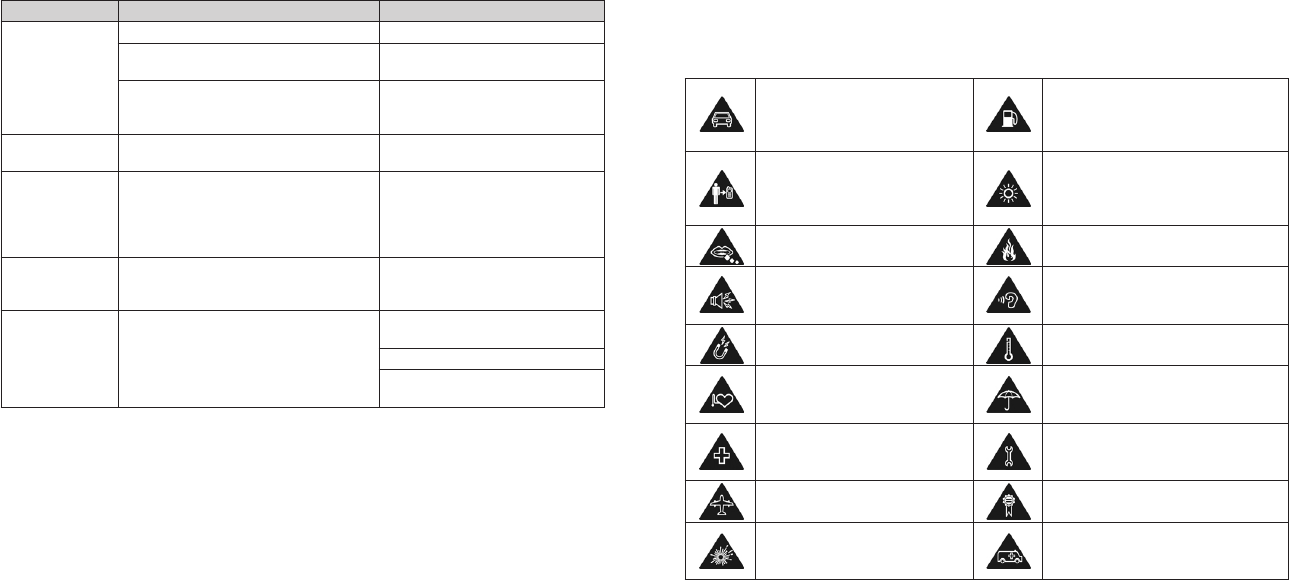
94 95
Problem Possible causes Possible solution
Unable to
connect to the
network
The micro-SIM card is invalid. Contact your service provider.
You are not within the network’s
service area. Check the service area with
your service provider.
Poor signal. Move to an open space, or if
you are inside a building, move
closer to a window.
Cannot make
outgoing calls You have activated Fixed Dialing
Numbers.Go to Fixed Dialing Numbers
and disable it.
PIN code
blocked You have entered an incorrect PIN
code three consecutive times. Contact your service provider.
If the service provider provides
the SIM card’s PUK code, use
the PUK code to unlock the SIM
card.
Unable to enter
information into
the phonebook
The phonebook’s memory is already
full. Delete unnecessary data from
the contacts.
Phone crashes,
reboots, freezes,
or cannot be
powered on
Some third-party software is not
compatible with your phone. Uninstall the software that may
cause the problem.
Upgrade the phone software.
Reset the phone to factory
status.
For your safety
General safety
Don’t make or receive
handheld calls while
driving. And never text
while driving.
Don’t use at gas stations.
Keep your phone at least
half an inch (15 mm) away
from your ear or body while
making calls.
Your phone may produce
a bright or ashing light.
Small parts may cause
choking. Don’t dispose of your phone
in a re.
Your phone can produce
a loud sound. To prevent possible hearing
damage, do not listen at high
volume levels for long periods
Avoid contact with
anything magnetic. Avoid extreme temperatures.
Keep away from
pacemakers and other
electronic medical devices. Avoid contact with liquids. Keep
your phone dry.
Power off when asked to
in hospitals and medical
facilities. Don’t take your phone apart.
Power off when told to
in aircrafts and airports. Only use approved accessories.
Power off when near
explosive materials or
liquids. Don’t rely on your phone as a
primary device for emergency
communications.
TROUBLESHOOTING FOR YOUR SAFETY
96 97
FCC RF Exposure Information (SAR)
This phone is designed and manufactured not to exceed the emission
limits for exposure to radio frequency (RF) energy set by the Federal
Communications Commission of the United States.
During SAR testing, this device was set to transmit at its highest certied power
level in all tested frequency bands, and placed in positions that simulate RF
exposure in usage against the head with no separation, and near the body
with the separation of 10 mm. Although the SAR is determined at the highest
certied power level, the actual SAR level of the device while operating can
be well below the maximum value. This is because the phone is designed to
operate at multiple power levels so as to use only the power required to reach
the network. In general, the closer you are to a wireless base station antenna,
the lower the power output.
The exposure standard for wireless devices employs a unit of measurement
known as the Specic Absorption Rate, or SAR. The SAR limit set by the FCC
is 1.6 W/kg.
Tests for SAR are conducted using standard operating positions accepted by
the FCC with the device transmitting at its highest certied power level in all
tested frequency bands.
The FCC has granted an Equipment Authorization for this model phone with
all reported SAR levels evaluated as in compliance with the FCC RF exposure
guidelines. SAR information on this model phone is on le with the FCC and
can be found under the Display Grant section of www.fcc.gov/oet/ea/fccid
after searching on FCC ID: SRQ-Z812.
For this device, the highest reported SAR value for usage against the head is
0.77 W/kg, for usage near the body is 1.35 W/kg.
While there may be differences between the SAR levels of various phones and
at various positions, they all meet the government requirements.
SAR compliance for body-worn operation is based on a separation distance
of 0.4 inches (10 mm) between the unit and the human body. Carry this
device at least 0.4 inches (10 mm) away from your body to ensure RF
exposure level compliant or lower to the reported level. To support body-worn
operation, choose the belt clips or holsters, which do not contain metallic
components, to maintain a separation of 0.4 inches (10 mm) between this
device and your body.
RF exposure compliance with any body-worn accessory, which contains
metal, was not tested and certied, and use such body-worn accessory
should be avoided.
FCC compliance
This mobile phone complies with part 15 of the FCC Rules. Operation is
subject to the following two conditions: (1) This device may not cause harmful
interference, and (2) this device must accept any interference received,
including interference that may cause undesired operation.
This mobile phone has been tested and found to comply with the limits for
a Class B digital device, pursuant to Part 15 of the FCC Rules. These limits are
designed to provide reasonable protection against harmful interference in
a residential installation. This equipment generates, uses and can radiate
radio frequency energy and, if not installed and used in accordance with
the instructions, may cause harmful interference to radio communications.
However, there is no guarantee that interference will not occur in a particular
installation. If this equipment does cause harmful interference to radio or
television reception, which can be determined by turning the equipment off
and on, the user is encouraged to try to correct the interference by one or
more of the following measures:
• Reorient or relocate the receiving antenna.
• Increase the separation between the equipment and receiver.
FOR YOUR SAFETY FOR YOUR SAFETY
98 99
• Connect the equipment into an outlet on a circuit different from that to
which the receiver is connected.
• Consult the dealer or an experienced radio/TV technician for help.
Caution: Changes or modications not expressly approved by the party
responsible for compliance could void the user‘s authority to operate
the equipment.
Hearing Aid Compatibility (HAC) regulations for
mobile phones
In 2003, the FCC adopted rules to make digital wireless telephones
compatible with hearing aids and cochlear implants. Although analog
wireless phones do not usually cause interference with hearing aids or
cochlear implants, digital wireless phones sometimes do because of
electromagnetic energy emitted by the phone’s antenna, backlight, or
other components. Your phone is compliant with FCC HAC regulations (ANSI
C63.19- 2011). While some wireless phones are used near some hearing
devices (hearing aids and cochlear implants), users may detect a buzzing,
humming, or whining noise. Some hearing devices are more immune than
others to this interference noise and phones also vary in the amount of
interference they generate. The wireless telephone industry has developed
a rating system for wireless phones to assist hearing device users in nding
phones that may be compatible with their hearing devices. Not all phones
have been rated. Phones that are rated have the rating on their box or a
label located on the box. The ratings are not guarantees. Results will vary
depending on the user’s hearing device and hearing loss. If your hearing
device happens to be vulnerable to interference, you may not be able to use
a rated phone successfully. Trying out the phone with your hearing device is
the best way to evaluate it for your personal needs.
This phone has been tested and rated for use with hearing aids for some of
the wireless technologies that it uses. However, there may be some newer
wireless technologies used in this phone that have not been tested yet for
use with hearing aids. It is important to try the different features of this phone
thoroughly and in different locations, using your hearing aid or cochlear
implant, to determine if you hear any interfering noise. Consult your service
provider or the manufacturer of this phone for more information on hearing
aid compatibility. If you have questions about return or exchange policies,
consult your service provider or phone retailer.
M-Ratings: Phones rated M3 or M4 meet FCC requirements and are likely
to generate less interference to hearing devices than phones that are not
labeled. M4 is the better/higher of the two ratings.
T-Ratings: Phones rated T3 or T4 meet FCC requirements and are likely to
be more usable with a hearing device’s telecoil (“T Switch” or “Telephone
Switch”) than unrated phones. T4 is the better/ higher of the two ratings.
(Note that not all hearing devices have telecoils in them.)
Your phone meets the M4/T4 level rating.
Hearing devices may also be rated. Your hearing device manufacturer
or hearing health professional may help you nd this rating. For more
information about FCC Hearing Aid Compatibility, please go to
http://www.fcc.gov/cgb/dro.
CTIA
a) Do not disassemble or open crush, bend or deform, puncture or shred.
b) Do not modify or remanufacture, attempt to insert foreign objects into
the battery, immerse or expose to water or other liquids, expose to re,
explosion or other hazard.
FOR YOUR SAFETY FOR YOUR SAFETY
100 101
c) Only use the battery for the system for which it is specied.
d) Only use the battery with a charging system that has been qualied
with the system per CTIA Certication Requirements for Battery System
Compliance to IEEE 1725. Use of an unqualied battery or charger may
present a risk of re, explosion, leakage, or other hazard.
e) Do not short circuit a battery or allow metallic conductive objects to
contact battery terminals.
f ) Replace the battery only with another battery that has been qualied with
the system per this standard, IEEE-Std-1725. Use of an unqualied battery
may present a risk of re, explosion, leakage or other hazard.
g) Promptly dispose of used batteries in accordance with local regulations.
h) Battery usage by children should be supervised.
i ) Avoid dropping the phone or battery. If the phone or battery is dropped,
especially on a hard surface, and the user suspects damage, take it to a
service center for inspection.
j) Improper battery use may result in a re, explosion or other hazard.
The phone shall only be connected to products that bear the USB-IF logo or
have completed the USB-IF compliance program.
Distraction
Driving
Full attention must be given to driving at all times in order to reduce the risk
of an accident. Using a phone while driving (even with a hands-free kit) can
cause distraction and lead to an accident. You must comply with local laws
and regulations restricting the use of wireless devices while driving.
FOR YOUR SAFETY
Operating machinery
Full attention must be given to operating the machinery in order to reduce
the risk of an accident.
Product handling
General statement on handling and use
You alone are responsible for how you use your phone and any
consequences of its use.
You must always power off your phone wherever the use of a phone is
prohibited. Use of your phone is subject to safety measures designed
to protect users and their environment.
• Always treat your phone and its accessories with care and keep it in
a clean and dust-free place.
• Do not expose your phone or its accessories to open ames or lit
tobacco products.
• Do not expose your phone or its accessories to liquid, moisture, or
high humidity.
• Do not drop, throw, or try to bend your phone or its accessories.
• Do not use harsh chemicals, cleaning solvents, or aerosols to clean the
device or its accessories.
• Do not paint your phone or its accessories.
• Do not attempt to disassemble your phone or its accessories. Only
authorized personnel can do so.
FOR YOUR SAFETY
102 103
• Do not expose your phone or its accessories to extreme temperatures,
minimum 23°F and maximum 122°F (minimum – 5°C and maximum + 50°C).
• Please check local regulations for disposal of electronic products.
• Do not carry your phone in your back pocket as it could break when
you sit down.
Small children
Do not leave your phone and its accessories within the reach of small
children or allow them to play with it. They could hurt themselves or others,
or could accidentally damage the phone.
Your phone contains small parts with sharp edges that may cause an injury
or may become detached and create a choking hazard.
Demagnetization
To avoid the risk of demagnetization, do not allow electronic devices or
magnetic media close to your phone for a long time.
Electrostatic discharge (ESD)
Do not touch the micro-SIM card’s metal connectors.
Antenna
Do not touch the antenna unnecessarily.
Normal use position
When placing or receiving a phone call, hold your phone to your ear, with the
bottom toward your mouth.
FOR YOUR SAFETY
Air bags
Do not place a phone in the area over an air bag or in the air bag
deployment area as an airbag inates with great force and serious injury
could result.
Store the phone safely before driving your vehicle.
Seizures/blackouts
The phone can produce a bright or ashing light. A small percentage of
people may be susceptible to blackouts or seizures (even if they have never
had one before) when exposed to ashing lights or light patterns such as
when playing games or watching video. If you have experienced seizures or
blackouts or have a family history of such occurrences, please consult
a physician.
Repetitive strain injuries
To minimize the risk of Repetitive Strain Injury (RSI) when texting or playing
games with your phone:
• Do not grip the phone too tightly.
• Press the keys lightly.
• Use the special features that are designed to minimize the times of pressing
buttons, such as Message Templates and Predictive Text.
• Take lots of breaks to stretch and relax.
Emergency calls
This phone, like any wireless phone, operates using radio signals, which
cannot guarantee connection in all conditions. Therefore, you must never rely
solely on any wireless phone for emergency communications.
FOR YOUR SAFETY
104 105
FOR YOUR SAFETY
Loud noise
This phone is capable of producing loud noises, which may damage your
hearing. Turn down the volume before using headphones, Bluetooth stereo
headsets or other audio devices.
Phone heating
Your phone may become warm during charging and during normal use.
Electrical safety
Accessories
Use only approved accessories.
Do not connect with incompatible products or accessories.
Take care not to touch or allow metal objects, such as coins or key rings, to
contact or short-circuit in the battery terminals.
Connection to a car
Seek professional advice when connecting a phone interface to the vehicle
electrical system.
Faulty and damaged products
Do not attempt to disassemble the phone or its accessories.
Only qualied personnel can service or repair the phone or its accessories.
If your phone (or its accessories) has been submerged in water, punctured, or
subjected to a severe fall, do not use it until you have taken it to be checked
at an authorized service center.
Interference
General statement on interference
Care must be taken when using the phone in close proximity to personal
medical devices, such as pacemakers and hearing aids.
Pacemakers
Pacemaker manufacturers recommend that a minimum separation of
6 inches (15 cm) be maintained between a mobile phone and a pacemaker
to avoid potential interference with the pacemaker. To achieve this, use the
phone on the opposite ear to your pacemaker and do not carry it in a
breast pocket.
Hearing aids
People with hearing aids or other cochlear implants may experience
interfering noises when using wireless devices or when one is nearby.
The level of interference will depend on the type of hearing device and the
distance from the interference source, increasing the separation between
them may reduce the interference. You may also consult your hearing aid
manufacturer to discuss alternatives.
Medical devices
Please consult your doctor and the device manufacturer to determine if
operation of your phone may interfere with the operation of your medical
device.
FOR YOUR SAFETY
106 107
Hospitals
Switch off your wireless device when requested to do so in hospitals, clinics,
or health care facilities. These requests are designed to prevent possible
interference with sensitive medical equipment.
Aircraft
Switch off your wireless device whenever you are instructed to do so by airport
or airline staff.
Consult the airline staff about the use of wireless devices on board the
aircraft. If your device offers a ‘ight mode’, this must be enabled prior to
boarding an aircraft.
Interference in cars
Please note that because of possible interference to electronic equipment,
some vehicle manufacturers forbid the use of mobile phones in their vehicles
unless a hands-free kit with an external antenna is included in the installation.
Explosive environments
Gas stations and explosive atmospheres
In locations with potentially explosive atmospheres, obey all posted signs to
turn off wireless devices such as your phone or other radio equipment.
Areas with potentially explosive atmospheres include fueling areas, below
decks on boats, fuel or chemical transfer or storage facilities, and areas where
the air contains chemicals or particles, such as grain, dust, or metal powders.
FOR YOUR SAFETY
Blasting caps and areas
Power off your mobile phone or wireless device when in a blasting area or in
areas posted with power off “two-way radios” or “electronic devices” notices to
avoid interfering with blasting operations.
FOR YOUR SAFETY

108 109
Specications
Handset specications are shown in the following table.
Network frequency LTE 2,4,5,17
GSM/GPRS/EDGE 850/900/1800/1900
UMTS/HSPA/HSPA+ 850/1900/2100
Operating system Android™ 5.0 (Lollipop)
Display 4.5" FWVGA
854 x 480
Processor Qualcomm MSM8916 processor
1.2 GHz quad-core
Memory 1 GB RAM, up to 8 GB ROM
microSDHC support up to 32 GB
Wi-Fi 802.11 b/g/n
Camera Rear: 5 MP autofocus, LED Flash
Front: VGA
Talk time Up to 10 hours
Standby time Up to 360 hours
Dimensions 5.31 x 2.59 x 0.39 in
Weight 4.71 oz (with battery)
Battery 2100 mAh
HAC Rated for hearing aids: M4/T4
Charging solution Micro USB port
with Qualcomm Quick Charge™ 1.0
Headset solution 3.5 mm headphone jack
Warranty
ZTE offers you a limited warranty that the enclosed subscriber unit and its
enclosed accessories will be free from defects in material and workmanship
for a period that expires one year from the date of sale of the Product to you,
provided that you are the original end user purchaser of the Product and
provided that your purchase was made from a supplier authorized by the
Seller. Transfer or resale of a Product will automatically terminate warranty
coverage with respect to that Product. This limited warranty is not transferable
to any third party, including but not limited to any subsequent purchaser or
owner of the Product. This limited warranty is applicable only to end users in
the United States.
1. This product or phone is warranted for 12 (twelve) months from date of
purchase.
2.
For warranty service information, please call ZTE service number
(877) 817-1759
(Toll Free). The manufacturer’s website,
http://www.zteusa.com, is also available for assistance.
3. This warranty only applies if the product has been used in accordance
with the manufacturer’s instructions under normal use and with
reasonable care.
4. What this warranty does not cover:
a) Defects or damages resulting from the misuse of this product.
b) Defects or damages from abnormal use, abnormal conditions,
improper storage, exposure to moisture, dampness or corrosive
environments, unauthorized modications, unauthorized repair, neglect,
rough handling, abuse, accident, alteration, improper installation,
incorrect voltage application, food or liquid spoilage, acts of God.
c) Normal wear and tear.
SPECIFICATIONS WARRANTY
110 111
d) If the Product has been opened, modied or repaired by anyone other
than a warranty service center or if it is repaired using unauthorized
spare parts.
e) If the serial number or mobile accessory date code has been removed,
erased, defaced, altered or are illegible in any way subject to sole
judgment of ZTE.
LIMITED WARRANTY
TO THE EXTENT PERMITTED BY APPLICABLE LAW, THIS LIMITED WARRANTY IS YOUR
SOLE AND EXCLUSIVE REMEDY AGAINST ZTE AND ZTE’S SOLE AND EXCLUSIVE
LIABILITY IN RESPECT OF DEFECTS IN PRODUCT. HOWEVER, THIS LIMITED
WARRANTY SHALL NOT EXCLUDE NOR LIMIT ANY OF YOUR LEGAL (STATUTORY)
RIGHTS UNDER THE APPLICABLE NATIONAL LAWS.
TO THE EXTENT PERMITTED BY APPLICABLE LAW ZTE DOES NOT ASSUME ANY
LIABILITY FOR LOSS OF OR DAMAGE TO OR CORRUPTION OF DATA, FOR ANY
LOSS OF PROFIT, LOSS OF USE OF PRODUCTS OR FUNCTIONALITY, LOSS OF
BUSINESS, LOSS OF REVENUES OR LOSS OF ANTICIPATED PROFIT, INCREASED
COSTS OR EXPENSES OR FOR ANY INDIRECT, OR SPECIAL OR CONSEQUENTIAL
LOSS OR DAMAGE. TO THE EXTENT PERMITTED BY APPLICABLE LAW, ZTE’S LIABILITY
SHALL BE LIMITED TO THE PURCHASE VALUE OF THE PRODUCT. THE ABOVE
LIMITATIONS SHALL NOT APPLY TO DEATH OR PERSONAL INJURY CAUSED BY
DEFECT OF PRODUCT IN MATERIAL, DESIGN AND WORKMANSHIP.
How to get warranty service
To obtain warranty service, please call (877) 817-1759. Please have the
following information available when you send the phone in for repair:
• A valid Proof of Purchase
• Return address
• Daytime phone number or fax number
• Model #
• IMEI # (Look for the 15-digit IMEI # behind the battery of the device.)
• Complete description of the problem
• Transportation prepaid
Other warranty programs
You may have other warranty programs with your purchase, such as
warranty exchange. If so, please refer to equipment package or the original
point of sale.
WARRANTY WARRANTY
112 NOTES
Notes
