Canon EOS 1Dx Mark II Wireless File Transmitter WFT E6 Eos1dx Mk2 Wfte6 Im En
User Manual: canon EOS 1Dx Mark II - Wireless File Transmitter WFT-E6 Free User Guide for Canon EOS Series Camera, Manual - page2
Open the PDF directly: View PDF  .
.
Page Count: 152 [warning: Documents this large are best viewed by clicking the View PDF Link!]
- Cover
- Introduction
- Basic Network Settings
- Transferring Images to an FTP Server
- Operating Remotely Using EOS Utility
- Operating Remotely Using WFT Server
- Operating Remotely Using a Smartphone
- Linked Shooting
- Synchronizing the Camera Time Wirelessly
- Terminating the Connection and Reconnecting
- Checking and Operating Connection Settings
- Troubleshooting Guide
- Reference

INSTRUCTION MANUAL
E
Wireless File Transmitter
for EOS-1D X Mark II
This product also supports certain CINEMA EOS cameras. For compatible
products, contact the nearest Canon Service Center. When using the
transmitter, refer to “Guide for Canon Camcorders”.
This manual explains how to use Wireless File Transmitter WFT-E6 with the
EOS-1D X Mark II.
WFT-E6
2
The transmitter is an accessory for EOS cameras that enables wireless
functions when attached to the camera.
Using the transmitter’s wireless functions enables you to do the
following:
Introduction
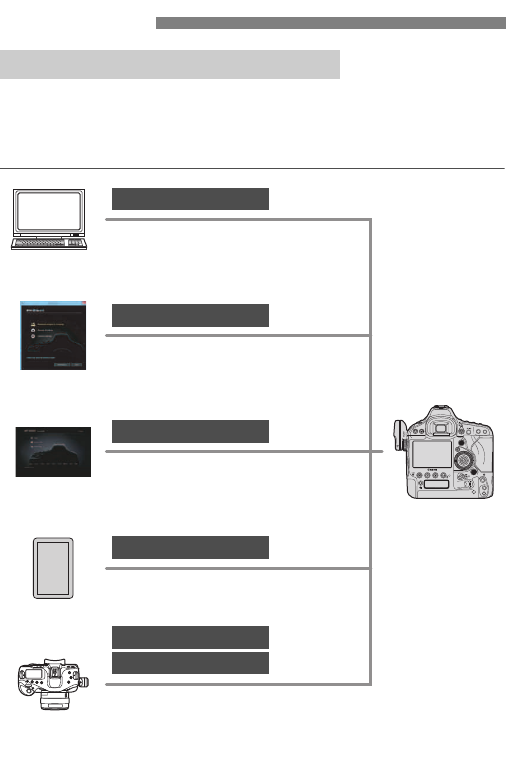
What You Can Do with the Transmitter
Use EOS Utility to shoot, view, and
download images remotely
FTP Transfer
WFT Server
Linked Shooting
Transfer images to an FTP server
Wirelessly trigger shooting by slave
cameras linked to a master camera
Synchronize time between the
same camera models
Use a web browser to shoot, view, and
download images remotely
EOS Utility
Smartphone
Sync the Camera Time
Use a smartphone to shoot, view, and
download images remotely

3
To comply with local radio wave regulations, Canon offers five
region-specific versions of the transmitter (A, B, C, D, and E) in
various areas around the world (see separate sheet). For
convenience, the product in this manual is referred to as “WFT-E6”,
without reference to the versions A, B, C, D, or E.
In this manual, the term “access point” indicates wireless LAN
access points, wireless LAN routers, etc. that relay a LAN
connection.
These instructions should be followed only after setting up your LAN
and FTP server environments. For information about setting up the
environments, refer to the documentation provided with each device
or contact the manufacturer.
The EOS-1D X Mark II is used for operation instructions,
illustrations, and sample screens in this manual. Note that the
functions, operations, screens displayed on your camera, etc. may
differ, depending on the camera model used.
Read the Camera Instruction Manual and familiarize yourself with
operating the camera before following the instructions on camera
options.
Icons in this Manual
<6> : Indicates the Main Dial.
<5> : Indicates the Quick Control Dial.
<9> : Indicates the Multi-controller.
<0> : Indicates the Setting button.
* In addition to the above, the icons and symbols used on the camera’s buttons
and displayed on the LCD monitor are also used in this manual when discussing
relevant operations and functionality.
(p.**) : Reference page numbers for more information.
: Warnings to prevent potential problems during operation.
: Supplemental information.
Conventions Used in this Manual

4
Conventions Used in this Manual
Basic Assumptions
All operations explained in this manual assume that the power
switch is set to <1>.
It is assumed that all the menu settings, Custom Functions, etc. are
set to their defaults.
Image transfer, remote shooting, or viewing images requires adequate
knowledge of configuring your wireless LAN and FTP server. Canon cannot
provide support for configuring wireless LANs or FTP servers.
Note that Canon cannot be held liable for any loss or damage to the
transmitter from erroneous network or FTP server settings. In addition,
Canon cannot be held liable for any other loss or damage caused by use of
the transmitter.
When using wireless functions, establish appropriate security at your own
risk and discretion. Canon cannot be held liable for any loss or damage
caused by unauthorized access or other security breaches.
5
Chapter List
Introduction 2
Basic Network Settings 13
Transferring Images to an FTP Server 37
Operating Remotely Using EOS Utility 55
Operating Remotely Using WFT Server 59
Operating Remotely Using a Smartphone 75
Linked Shooting 83
Synchronizing the Camera Time Wirelessly 97
Terminating the Connection and Reconnecting 101
Checking and Operating Connection Settings 105
Troubleshooting Guide 117
Reference 139
1
2
3
4
5
6
7
8
9
10
11

6
2
1
3
4
Introduction 2
Conventions Used in this Manual..................................................... 3
Chapter List ...................................................................................... 5
Safety Precautions ........................................................................... 8
Nomenclature ................................................................................. 10
Attaching to the Camera..................................................................11
Basic Network Settings 13
Preparation..................................................................................... 14
Basic Communication Function Settings........................................ 18
Displaying the Connection Wizard ................................................. 22
Connecting with Easy Connection.................................................. 25
Checking the Type of Access Point................................................ 27
Connecting via WPS (PBC Mode).................................................. 28
Connecting via WPS (PIN Mode) ................................................... 29
Connecting to a Detected Network Manually ................................. 31
Setting the IP Address.................................................................... 34
Transferring Images to an FTP Server 37
Configuring FTP Server Connection Settings ................................ 38
Transferring Images Individually..................................................... 43
Batch Transfer................................................................................ 48
Viewing Transferred Images........................................................... 53
Operating Remotely Using EOS Utility 55
Configuring EOS Utility Connection Settings ................................. 56
Using EOS Utility............................................................................ 58
Operating Remotely Using WFT Server 59
Configuring WFT Server Connection Settings ............................... 60
Displaying WFT Server .................................................................. 62
Viewing Images .............................................................................. 65
Shooting Remotely [Camera control] ............................................. 67
Shooting Remotely [Simple control] ............................................... 72
Using WFT Server in Linked Shooting ........................................... 74
Contents

7
Contents
10
11
6
9
7
8
5Operating Remotely Using a Smartphone 75
Configuring Smartphone Connection Settings................................76
Operating the Camera Using a Smartphone...................................78
Specifying Viewable Images ...........................................................80
Linked Shooting 83
Basic Linked Shooting ....................................................................84
Positioning the Cameras.................................................................88
Using the Transmitter with WFT Server..........................................90
Synchronizing the Camera Time Wirelessly 97
Synchronizing the Time...................................................................98
Terminating the Connection and Reconnecting 101
Terminating the Connection ..........................................................102
Reconnecting ................................................................................ 103
Checking and Operating Connection Settings 105
Displaying the Connection Settings Screen..................................106
Changing Settings.........................................................................108
Saving and Loading Settings ........................................................ 112
Function Settings Screen.............................................................. 114
Troubleshooting Guide 117
Responding to Error Messages .................................................... 118
Troubleshooting Guide.................................................................. 135
Communication Function Setting Notes........................................136
Checking Network Settings...........................................................138
Reference 139
Creating and Registering Captions ...............................................140
Setting Network Manually .............................................................142
Setting IP Address Manually.........................................................144
Specifications ................................................................................ 146
Index .............................................................................................149
8
The following precautions are provided to prevent harm or injury to
yourself and others. Make sure to thoroughly understand and follow
these precautions before using the product.
If you experience any malfunctions, problems, or damage to the
product, contact the nearest Canon Service Center or the dealer
from whom you purchased the product.
Safety Precautions
Warnings: Follow the warnings below. Otherwise, death or
serious injuries may result.
To prevent fire, excessive heat, chemical leakage, explosions, and electrical shock,
follow the safeguards below.
• Do not insert any foreign metallic objects into the electrical contacts of the
equipment, accessories, or connecting cables.
Do not use the equipment where there is flammable gas. There is a risk of explosion
or fire.
If you drop the equipment and the casing breaks open to expose the internal parts,
do not touch the exposed parts. There is a possibility of electrical shock.
Do not disassemble or modify the equipment. High-voltage internal parts may cause
electrical shock.
Do not store the equipment in dusty or humid places. This is to prevent fire or
electrical shock.
Before using the equipment on board airplanes or in hospitals, make sure use is
permitted. Electromagnetic waves emitted by the equipment may interfere with
instrumentation or medical equipment.
Do not hold the camera in the same position for long periods of time. Even if the
camera does not feel too hot, prolonged contact with the same body part may cause
skin redness or blistering due to low-temperature contact burns. Using a tripod is
recommended for people with circulation problems or very sensitive skin, or when
using the camera in very hot places.
Cautions: Follow the cautions below. Otherwise, physical injury
or property damage may result.
Do not leave the equipment in a hot car interior or near high-temperature objects.
The equipment may become hot and cause burns if touched.
Do not leave the product in a low-temperature environment for an extended period of
time. The equipment will become cold and may cause injury when touched.
Do not cover or wrap the transmitter with a cloth. This may trap heat inside, posing a
risk of fire.
Do not use paint thinner, benzene, or other organic solvents to clean the transmitter.
This poses a risk of fire and may be hazardous to your health.

9
Safety Precautions
The transmitter is a precision instrument. Do not drop it or subject it to
physical shock.
The transmitter is not waterproof. Do not use it underwater.
Wipe off any moisture with a dry and clean cloth. If the transmitter has been
exposed to salty air, wipe it with a clean, well-wrung wet cloth.
Never leave the transmitter near any equipment that generates a strong
magnetic field, such as magnets or electric motors.
Do not leave the transmitter in excessive heat, such as in a vehicle in direct
sunlight. High temperatures may damage the transmitter.
Do not wipe the transmitter using cleaners containing organic solvents. For
stubborn dirt, take it to the nearest Canon Service Center.
Avoid storing the transmitter where there are chemicals that result in rust
and corrosion such as in a chemical lab.
Handling Precautions
10
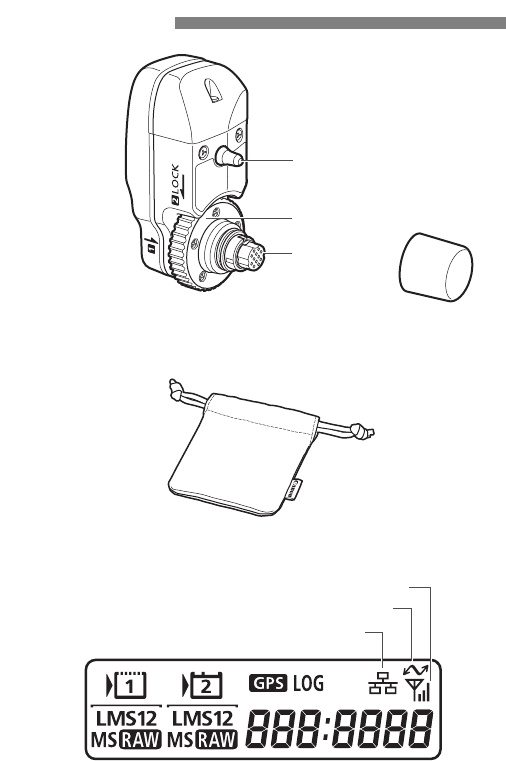
Nomenclature
Attachment pin
Tightening screw
Terminal
<F>Wired LAN connection
Connection icon
<D>Wireless LAN connection
Transmitter Case
EOS-1D X Mark II Rear LCD Panel (Example Display)
Terminal cap
11
Set the camera’s power switch to <2> before attaching the
transmitter.
The transmitter is powered by the camera. Ensure the camera
battery has sufficient charge. If the battery level drops to 19% or
less, you cannot transfer captured images.
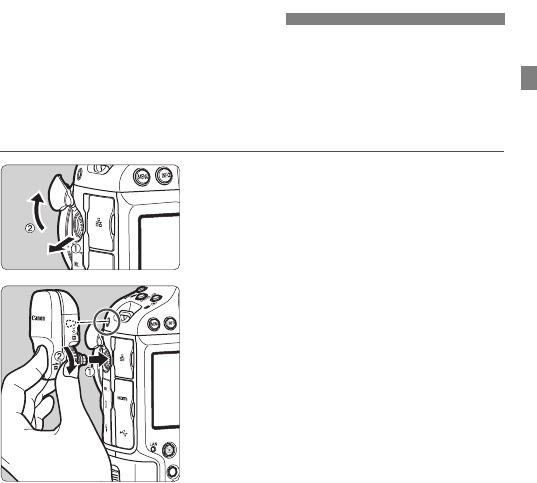
1Open the terminal cover on the
camera.
Pull out the system extension
terminal cover and rotate it toward the
front.
2Attach the transmitter.
Align the transmitter terminal and
attachment pin with the
corresponding camera terminal and
hole.
Push the terminal firmly into the
camera.
As you push the terminal into the
camera with your left index finger,
turn the tightening screw until it stops
rotating to attach the transmitter
securely.
Removing the transmitter
Set the camera’s power switch to <2>.
Loosen the tightening screw until it spins freely.
Pull the terminal out of the camera.
Attaching to the Camera
12
Attaching to the Camera
Movie Shooting When an External Microphone is Used
If wireless functions are in use, noise may be recorded regardless of the use
of the built-in microphone(s) or an external microphone. It is recommended
that you do not use wireless functions when shooting movies.

13
1
Basic Network Settings
Complete the basic network settings by using the menu
screen on the camera’s LCD monitor.

14
[FTP trans.]
You can transfer captured images to an FTP server.
Images can be automatically transferred as you shoot them, or you
can select images to be transferred later.
Computer Operating Systems
Use of [FTP trans.] requires that one of the following operating
systems be installed on a computer. In addition, the computer must
be set up as an FTP server in advance.
• Windows 8, Windows 8 Pro, Windows 8.1, Windows 8.1 Pro
• Windows 7 (Professional, Enterprise, or Ultimate Edition for
32- or 64-bit systems)
• Windows Vista (Business, Enterprise, or Ultimate Edition for
32- or 64-bit systems)
For instructions on setting up a computer as an FTP server, refer to
the documentation provided with each device or contact the
manufacturer.
Note that the following operating systems cannot be used
because FTP server functionality is not provided.
• Windows 7 Home Premium
• Windows Vista Home Premium or Home Basic Edition
Preparation

15
Preparation
[EOSUtility]
You can perform remote shooting over a wireless LAN using EOS
Utility (EOS software).
In addition to remote shooting, almost all EOS Utility camera
operations are supported, because this option utilizes a wireless
LAN instead of an interface cable.
Requires a computer with EOS Utility (EOS software) installed.
[WFTserver]
You can perform advanced remote shooting or view images stored
in the camera by connecting to the transmitter from a web browser
on a computer, smartphone, or other device, as easily as accessing
a Web site.
Browsers
The following operating systems and web browsers have been
confirmed to be compatible with this device. Depending on your
environment, operation may differ.
Windows 8.1, Windows 7: Google Chrome Ver. 44
Windows 8.1, Windows 7: Internet Explorer 11
OS X (operating system version 10.10): Safari Ver. 8.0
iOS (operating system version 8.4): Safari
Android (operating system version 4.4): Google Chrome
* Operation on the above operating systems and web browsers cannot be
guaranteed for all the terminals.
* Not available unless the web browser is set to allow cookies.
* Not available unless the web browser is set to use JavaScript.
* Movies cannot be played back unless the web browser supports HTML 5.

16
Preparation
[Smartphone]
You can perform basic remote shooting or view images stored in the
camera on a smartphone or tablet.
To use this function, a smartphone on which iOS or Android is
installed is necessary. In addition, the dedicated application
Camera Connect (free of charge) must be installed on the
smartphone.
• Camera Connect can be downloaded from the App Store or
Google Play.
• For the operating system versions supported by Camera Connect,
refer to the download site of Camera Connect.
• The interface and functionality of the camera and Camera Connect
are subject to change due to firmware updates for the camera or
application updates for Camera Connect, iOS, Android, etc. In
such a case, features of the camera or Camera Connect may differ
from sample screens or operation instructions in this manual.
In this manual and on the camera’s LCD monitor, “smartphone”
refers to smartphones and tablets.
[LinkedShot]
You can perform linked shooting using multiple compatible cameras
with WFT series transmitters attached. This feature lets you link up
to 10 slave cameras to the master camera on which you will release
the shutter. Note that there will be a slight delay after you release the
master camera shutter before the slave cameras shoot. Movie
shooting is not supported.
[Sync time between cameras]
You can set the master camera time on up to 10 slave cameras.
Note that even after synchronization, there will be a slight margin of
error between master and slave camera time of ±0.05 seconds, at
most.
Set up multiple cameras of the same camera model with the WFT-
E6 or WFT-E8 attached.

17
Preparation
When connecting using an access point, connect the target device to
the access point in advance.
Connecting Using an Access Point
Transmitting Movies
Because of the large size of individual movie files, wireless file transmission
takes some time. Set up an environment where each device can achieve
stable communication with the access point and the transmitter by referring
to the information on page 136.
18
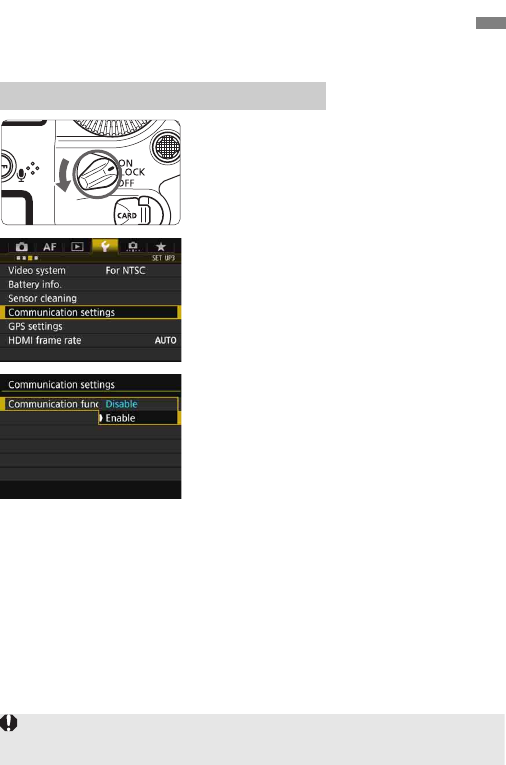
First, configure basic communication function settings.
1Turn the camera on.
2Select [Communication settings].
On the camera, press the <M>
button.
Under the [53] tab, select
[Communication settings], then
press <0>.
3Select [Enable] in
[Communication func].
[Network settings] is now available.
Basic Communication Function Settings
Setting the Communication Function
If [z1: Multiple exposure] is set to any setting other than [Disable], [53:
Communication settings] cannot be selected.
19
Basic Communication Function Settings
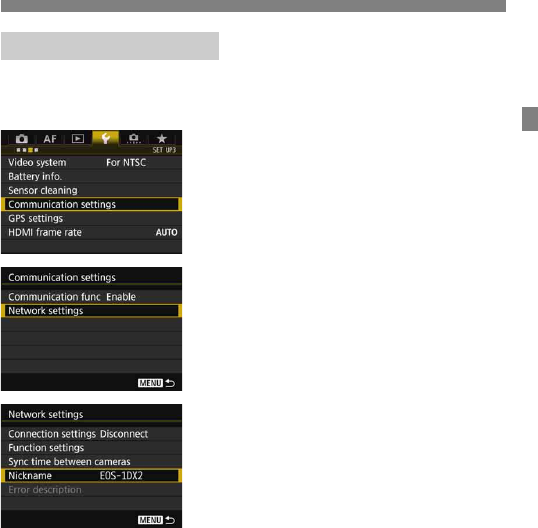
Set a nickname (for identification) for the camera.
When the camera is connected to another device over a LAN, the
nickname will be displayed on the device.
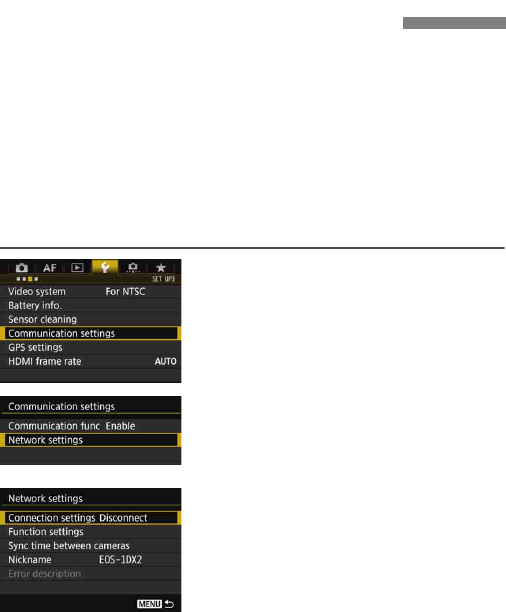
1Select [Communication settings].
Under the [53] tab, select
[Communication settings], then
press <0>.
2Select [Network settings].
Set [Communication func] to
[Enable], then select [Network
settings].
3Select [Nickname].
Registering a Nickname
20
Basic Communication Function Settings
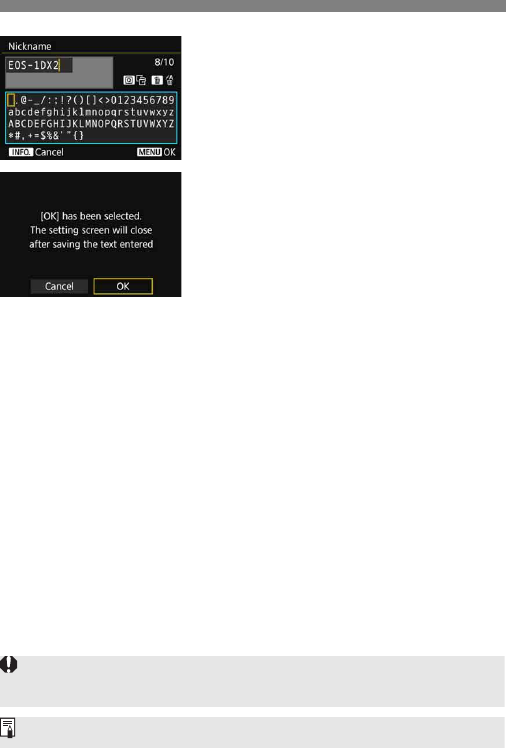
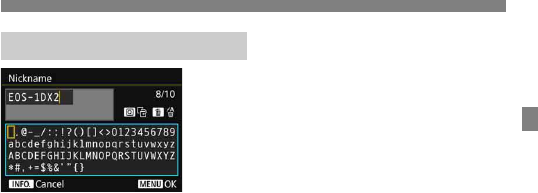
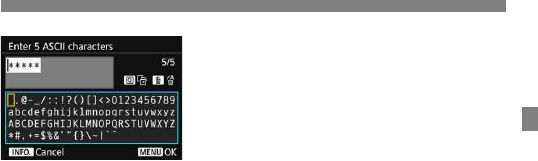
4Enter a nickname.
For instructions on entering
characters, see the next page.
Enter any characters between 1 to 10
characters in length.
5Exit the setting.
When you are finished, press the
<M> button.
Select [OK] on the confirmation
dialog and press <0> to return to
the menu screen.
The basic settings for the communication function are now complete.
For further explanation of syncing the camera time and linked
shooting, see the following pages.
Syncing the camera time B page 97
Linked shooting B page 83
For connection settings other than the above, see the explanation from
page 22.
Since the nickname is mandatory information for a LAN connection, you
cannot delete all the characters.
By default, the camera name will be displayed for the nickname.
21
Basic Communication Function Settings
Changing the entry area
Press the <Q> button to toggle
between the top and bottom entry
areas.
Moving the cursor
Use <5> or <9> in the top area to
move the cursor.
Entering text
In the bottom area, use <5> or <9> to select a character, then
press <0> to enter it.
You can check how many characters you have entered, and how
many more can be entered, by referring to [*/*] on the upper right of
the screen.
Deleting a character
Press the <L> button to delete one character.
Finishing the text entry
Press the <M> button to confirm what you have entered and
exit. If a confirmation dialog is displayed, select [OK] to exit.
Canceling the text entry
Press the <B> button to cancel text entry and exit. If a
confirmation dialog is displayed, select [OK] to exit.
Virtual Keyboard Operation
22
This section describes the process following the connection
instructions. If an error is displayed, see “Troubleshooting Guide” in
Chapter 10 (p.117) and check the settings.
Pressing the shutter button or other camera controls during
configuration using the connection instructions will close the
connection instructions. Do not press the shutter button or other
controls until configuration is finished.
Under the [52] tab, set [Auto power off] to [Disable]. If auto power
off is activated, the connection instructions will be closed during the
configuration process.
1Select [Communication settings].
Under the [53] tab, select
[Communication settings], then
press <0>.
2Select [Network settings].
Set [Communication func] to
[Enable], then select [Network
settings].
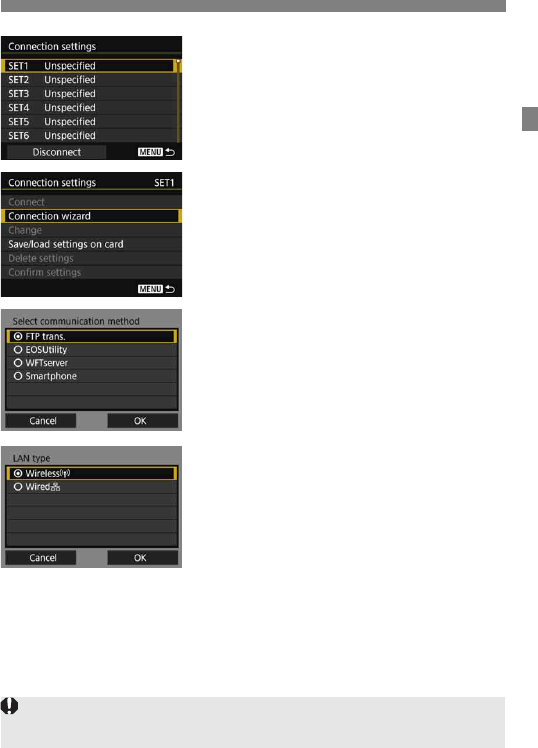
3Select [Connection settings].
Displaying the Connection Wizard
23
Displaying the Connection Wizard
4Select [SET*].
5Select [Connection wizard].
The [Select communication
method] screen is displayed.
The <Y> lamp on the camera will
blink in green.
6Select the communication
method.
Select the communication method by
referring to page 14.
Select [OK] and press <0> to go to
the next screen.
7Select [Wireless].
Select [OK] and press <0> to go to
the next screen.
Select [Wired] when using a network
cable for the Ethernet RJ-45 terminal
on the camera. For details, refer to
the Wired LAN Instruction Manual
provided with the camera.
If [Wireless] cannot be selected in step 7, attach the transmitter securely to
the camera referring to page 11.
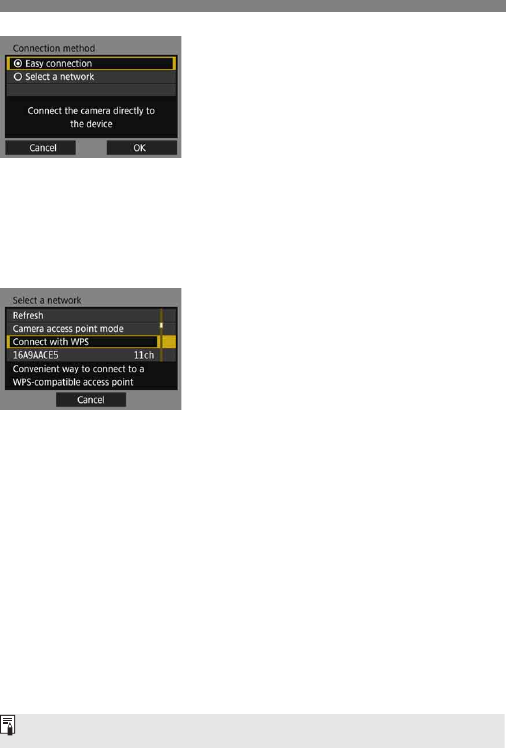
24
Displaying the Connection Wizard
8Select the connection method.
Not displayed when [FTP trans.] is
selected in step 6. Proceed to step 9.
Select an item, then press <0>.
To connect the camera directly to
each device, select [Easy
connection]. Proceed to page 25.
To connect using a Wi-Fi access
point, select [Select a network].
Proceed to step 9.
Select [OK] and press <0> to go to
the next screen.
9Select the network.
Select a network connection method.
For subsequent operations, see page
27.
For [Camera access point mode] displayed in step 9, see page 36.
25
The instructions in this chapter are continued from page 24.
The camera and each device can be directly connected wirelessly. No
access point is necessary, so you can establish a wireless connection
easily.
To establish connection, operations on the computer, smartphone, etc. are
required. For details, refer to the corresponding device’s instruction manual.
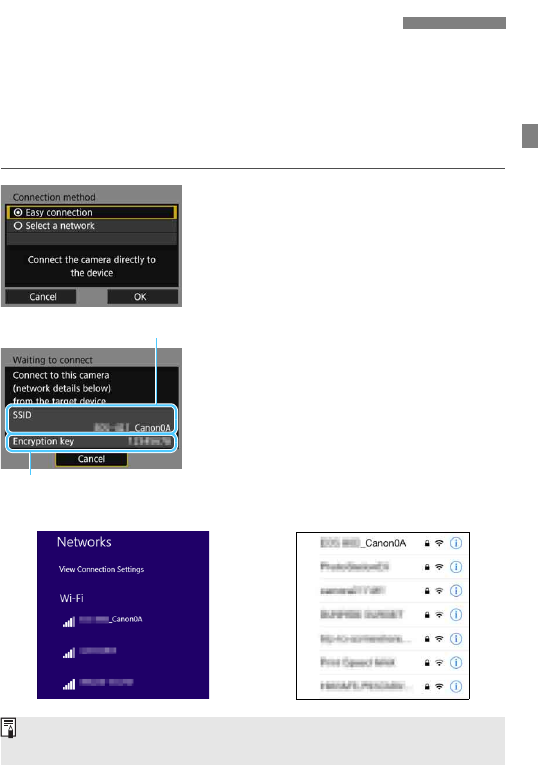
1Select [Easy connection].
Select [OK] and press <0> to go to
the next screen.
2Operate the target device and
connect it to the camera.
Activate the Wi-Fi function of the
target device, then select the SSID
(network name) displayed on the
camera’s LCD monitor.
For the password, enter the
encryption key (password) displayed
on the camera’s LCD monitor.
Connecting with Easy Connection
Encryption key (password)
SSID (network name)
Smartphone’s screen (sample)Computer’s screen (sample)
When connecting by selecting [Easy connection], “_Canon0A” is
displayed at the end of the SSID.
26
Connecting with Easy Connection
The following instructions are for settings screens that vary depending
on the communication method. Read the page that introduces the
selected communication method.
EOS Utility
Chapter 3 (p.55)
WFT Server
Chapter 4 (p.59)
Smartphone
Chapter 5 (p.75)
Completing Settings for the Communication Method

27
To connect using an access point, check if the access point supports
WPS* that allows easy connection between Wi-Fi devices.
If you do not know if the access point you use is WPS-compatible, refer
to the access point instruction manual or other documentation.
* Wi-Fi Protected Setup
When WPS is supported
The following two connection methods are available. Connection
can be established easier with WPS (PBC mode).
• Connecting via WPS (PBC mode): Perform the operations
described on page 28.
• Connecting via WPS (PIN mode): Perform the operations
described on page 29.
When WPS is not supported
• Connecting to a detected network manually: Perform the
operations described on page 31.
Access Point Encryption
The transmitter supports the following options for [Authentication] and
[Encryption settings]. Therefore, when connecting to a detected
network manually, the encryption used by the access point must be one
of the following.
[Authentication]: Open system, Shared key, or WPA/WPA2-PSK
[Encryption settings]: WEP, TKIP, or AES
Checking the Type of Access Point
If stealth functions of the access point are active, connection may
be disabled. Deactivate stealth functions.
When connecting to a network that has a network administrator, ask the
administrator about the detailed setting procedures.
If the network you use filters by MAC address, register the MAC address of
the transmitter at the access point. The MAC address can be checked on
the [Function settings] screen (p.114).
28
The instructions in this chapter are continued from page 27.
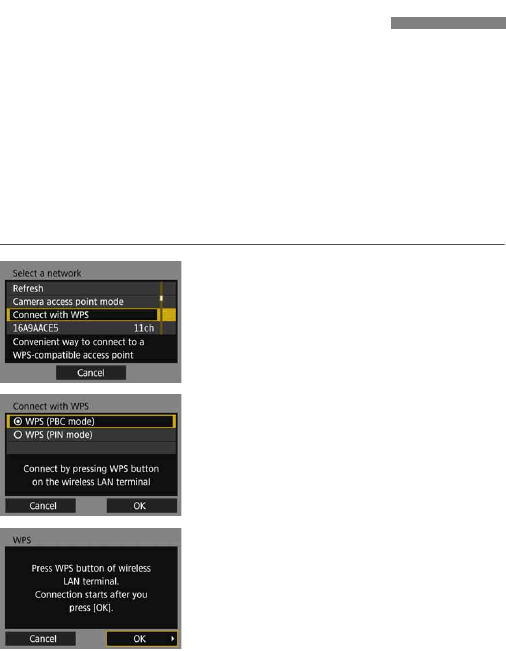
This is a connection mode available when using an access point
compatible with WPS. In pushbutton connection mode (PBC mode), the
camera and the access point can be connected simply by pressing the
WPS button on the access point.
If multiple access points are active in the surrounding area, it may be
more difficult to establish a connection. In such a case, try using
[WPS (PIN mode)] to establish a connection.
Check the position of the WPS button on the access point in advance.
It may take approx. one minute to establish a connection.
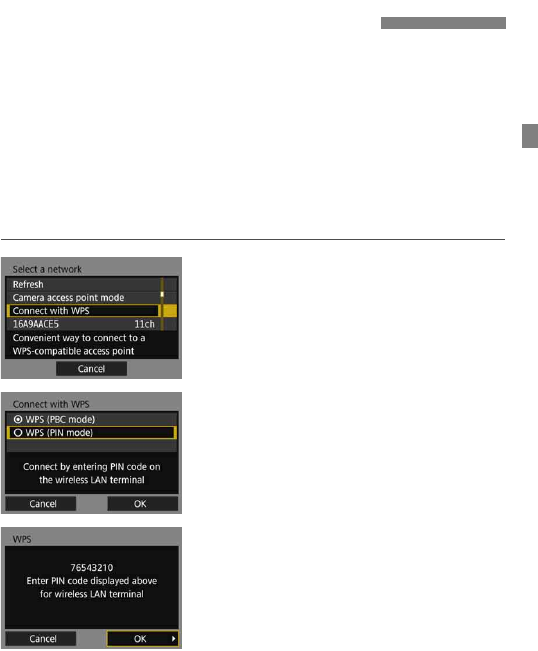
1Select [Connect with WPS].
2Select [WPS (PBC mode)].
Select [OK] and press <0> to go to
the next screen.
3Connect to the access point.
Press the access point’s WPS button.
For details about where the button is
located and how long to press it, refer
to the access point’s instruction
manual.
Select [OK] and press <0> to
establish a connection with the
access point.
When a connection with the access
point is established, the [IP address
set.] screen (p.34) is displayed.
Connecting via WPS (PBC Mode)
29
The instructions in this chapter are continued from page 27.
This is a connection mode available when using an access point
compatible with WPS. In PIN code connection mode (PIN mode), an 8-
digit identification number specified on the camera is set at the access
point to establish a connection.
Even if there are multiple access points active in the surrounding
area, a relatively reliable connection can be established using this
shared identification number.
It may take approx. one minute to establish a connection.
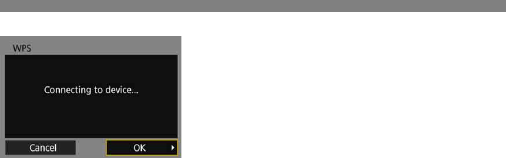
1Select [Connect with WPS].
2Select [WPS (PIN mode)].
Select [OK] and press <0> to go to
the next screen.
3Specify the PIN code.
At the access point, specify the 8-digit
PIN code displayed on the camera’s
LCD monitor.
For instructions on setting PIN codes
at the access point, refer to the
access point’s instruction manual.
After the PIN code is specified, select
[OK] and press <0>.
Connecting via WPS (PIN Mode)
31
The instructions in this chapter are continued from page 27.
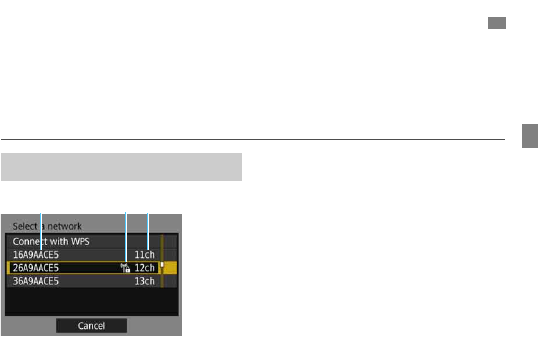
Establish a connection by selecting the SSID (or ESS-ID) of the access
point to connect to from a list of active access wireless LAN terminals
nearby.
1Select an access point.
Turn the <5> dial to select the
access point to connect to from the
list of access points.
(1) SSID
(2) An icon is displayed if the access point is encrypted
(3) Channel used
[Refresh] and [Manual settings]
Scroll down the screen in step 1 to display [Refresh] and [Manual
settings].
To search for access points again, select [Refresh].
To configure settings for the access point manually, select [Manual
settings]. Enter the SSID using the virtual keyboard and then
configure settings following the instructions displayed.
Connecting to a Detected Network Manually
Selecting the Access Point
(1) (2) (3)
32
Connecting to a Detected Network Manually
Enter the encryption key (password) specified for the access point.
For details on the specified encryption key, refer to the access
point’s instruction manual.
The screens displayed in steps 2 to 4 below vary depending on the
authentication and encryption specified for the access point.
Go to page 34 when the [IP address set.] screen is displayed
instead of the screens for steps 2 to 4.
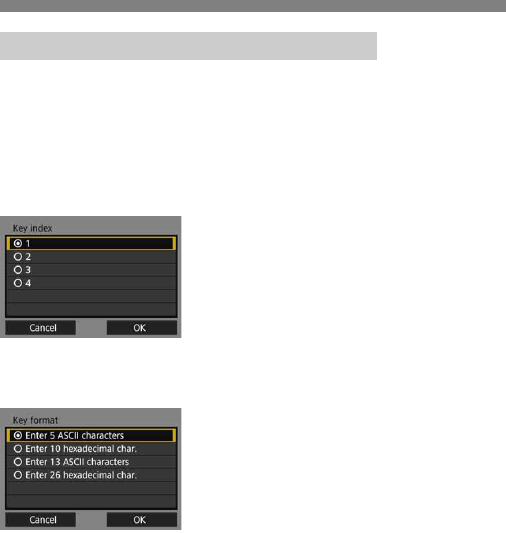
2Select a key index.
The [Key index] screen is displayed
only if WEP encryption is used by the
access point.
Select the key index number
specified for the access point, then
press <0>.
Select [OK] and press <0> to go to
the next screen.
3Select the format and the number
of characters used for the key.
Select [OK] and press <0> to go to
the next screen.
Entering the Access Point Encryption Key
34
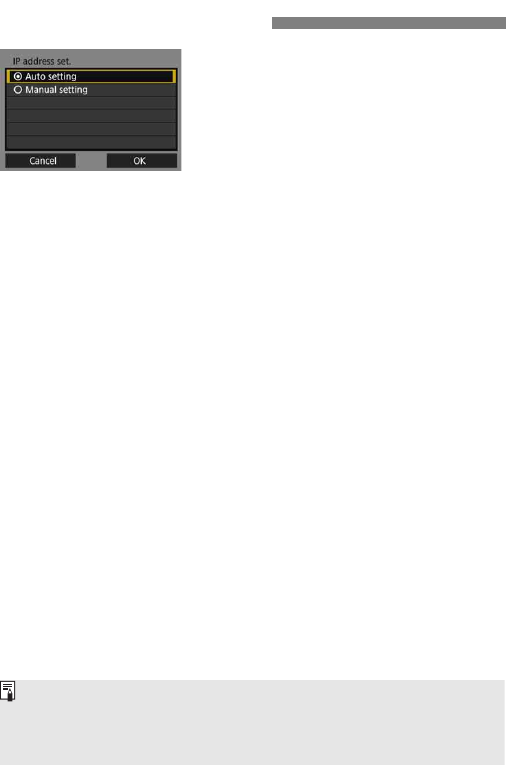
Select [Auto setting].
Select [OK] and press <0> to
display the setting screen for the
communication method (p.35).
If [Auto setting] results in an error or
if you want to specify the settings
manually, see page 144.
Setting the IP Address
The IP address can only be set automatically in environments using DHCP
servers, or access points or routers with DHCP server functionality, such
that IP addresses and related settings are assigned and configured
automatically.
35
Setting the IP Address
The following instructions are for settings screens that vary depending
on the communication method. Read the page that introduces the
selected communication method.
FTP Transfer
Chapter 2 (p.37)
EOS Utility
Chapter 3 (p.55)
WFT Server
Chapter 4 (p.59)
Smartphone
Chapter 5 (p.75)
Completing Settings for the Communication Method
36
Setting the IP Address
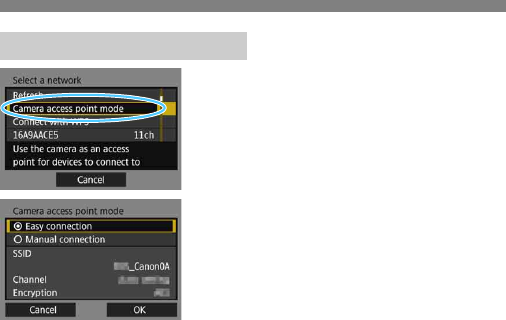
Camera access point mode is a
connection mode for connecting the
camera directly to each device.
Displayed when [EOSUtility],
[WFTserver], or [Smartphone] is
selected for the communication method.
In camera access point mode, the
following two connection methods are
available.
[Easy connection]: See “Connecting
with Easy Connection” (p.25) to
establish a connection.
[Manual connection]: See page 142
to establish a connection.
Camera Access Point Mode

37
2
Transferring Images to
an FTP Server
By connecting to an FTP server, you can transfer
images stored in the camera to a computer.
With FTP transfer, you can automatically transfer
images to the FTP server as you shoot or transfer a set
of shots together.
The instructions in this chapter are continued from Chapter
1.
38
These instructions are continued from Chapter 1.
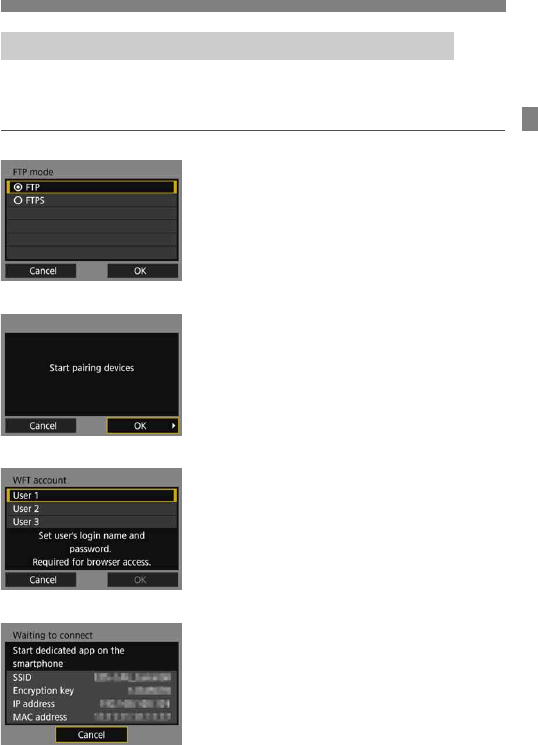
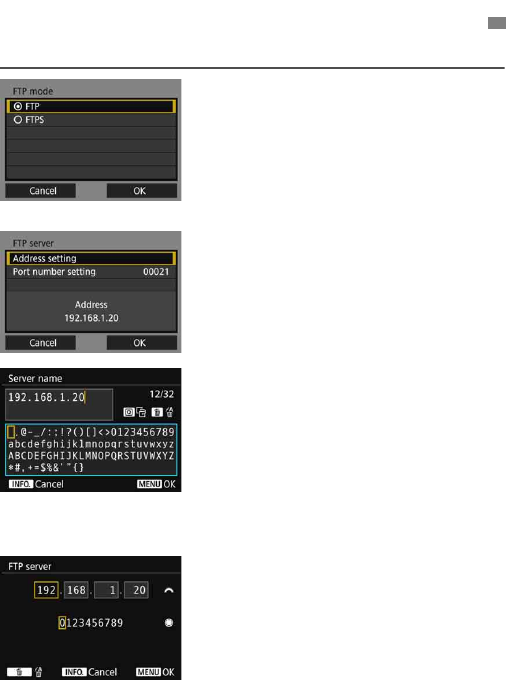
1Select an FTP mode.
To establish security for FTP transfer
using a root certificate, select [FTPS].
For root certificate settings, see page
41.
Select [OK] and press <0> to go to
the next screen.
2Select [Address setting].
The virtual keyboard is displayed.
3Enter the FTP server’s server
name or IP address.
If you have set the IP address setting
to [Auto setting] or the DNS address
setting to [Manual setting], the
screen on the left is displayed.
For instructions on screen operations,
see “Virtual Keyboard Operation”
(p.21).
If you have set the DNS address
setting to [Disable], the screen on the
left is displayed.
Turn the <6> dial to move the input
position in the upper area and turn
the <5> dial to select the number.
Press <0> to enter the selected
number.
Configuring FTP Server Connection Settings
39
Configuring FTP Server Connection Settings
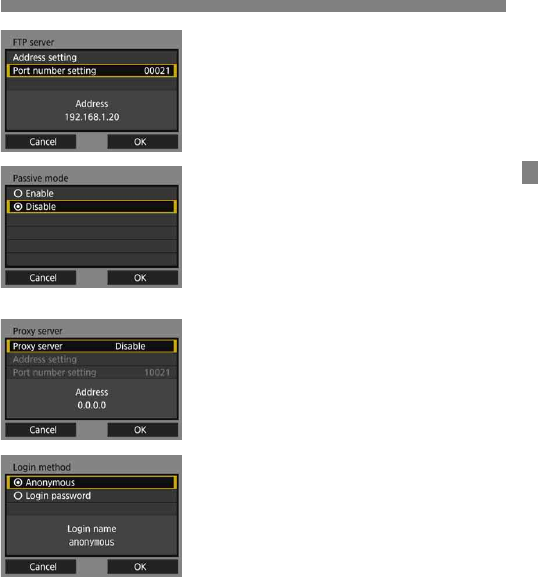
4Set the port number.
[Port number setting] should usually
be 00021.
Select [OK] and press <0> to go to
the next screen.
5Set the passive mode setting.
Select [OK] and press <0> to go to
the next screen.
If an Error 41 (“Cannot connect to
FTP server”) is displayed in step 8,
setting [Passive mode] to [Enable]
may resolve it.
6Set the proxy server.
Select [OK] and press <0> to go to
the next screen.
7Set the login method.
Select [OK] and press <0> to go to
the next screen.
40
Configuring FTP Server Connection Settings
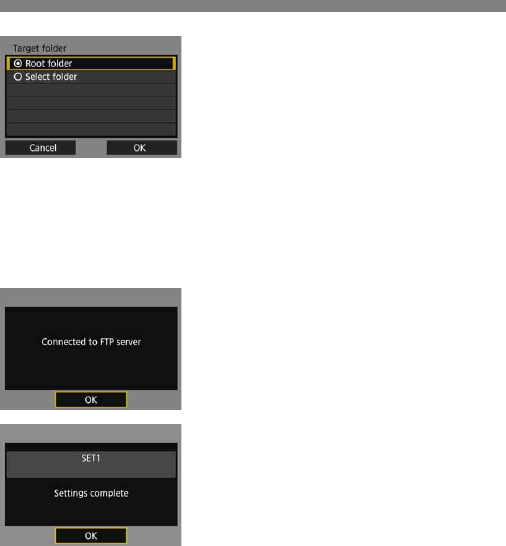
8Set the target folder.
Select [Root folder] to have images
saved in the root folder as specified in
FTP server settings (p.53).
Select [Select folder] to specify a
target folder in the root folder. If no
folder exists, a folder will be created
automatically.
Select [OK] and press <0> to go to
the next screen.
The <Y> lamp on the camera will
light up in green.
9Select [OK].
Press <0>. A connection
completion screen will appear.
10
Select [OK].
Press <0> to return to the [Network
settings] screen.
Settings information is stored in the
camera. It is not stored in the
transmitter.
The connection settings for FTP transfer are now complete.
During image transfer, the <Y> lamp on the camera blinks in green.
41
Configuring FTP Server Connection Settings
If the FTP mode is set to [FTPS] when configuring the connection
settings, the same root certificate as the FTP server must be imported
to the camera.
Only the root certificate whose file name is “root.cer”, “root.crt”, or
“root.pem” can be imported to the camera.
Only one root certificate file can be imported to the camera.
Insert a card containing the root certificate file in advance.
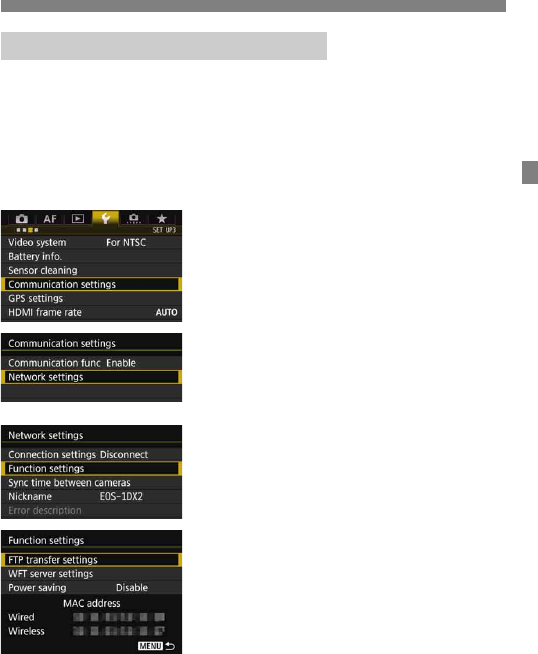
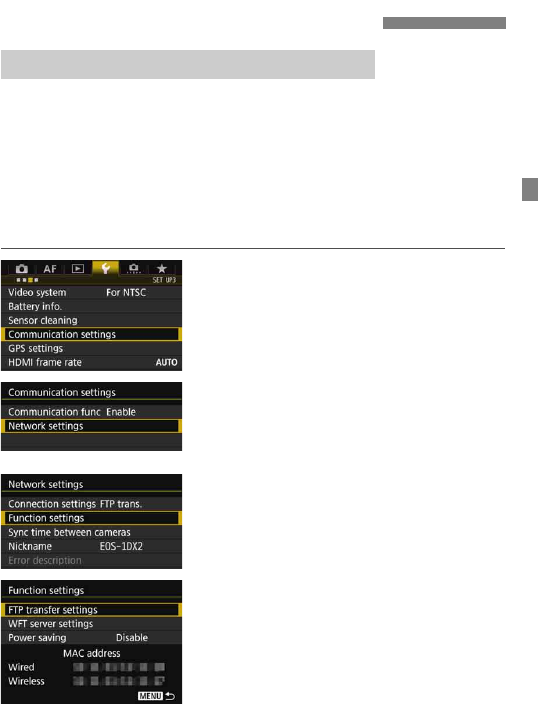
1Select [Communication settings].
Under the [53] tab, select
[Communication settings], then
press <0>.
2Select [Network settings].
Set [Communication func] to
[Enable], then select [Network
settings].
3Select [Function settings].
4Select [FTP transfer settings].
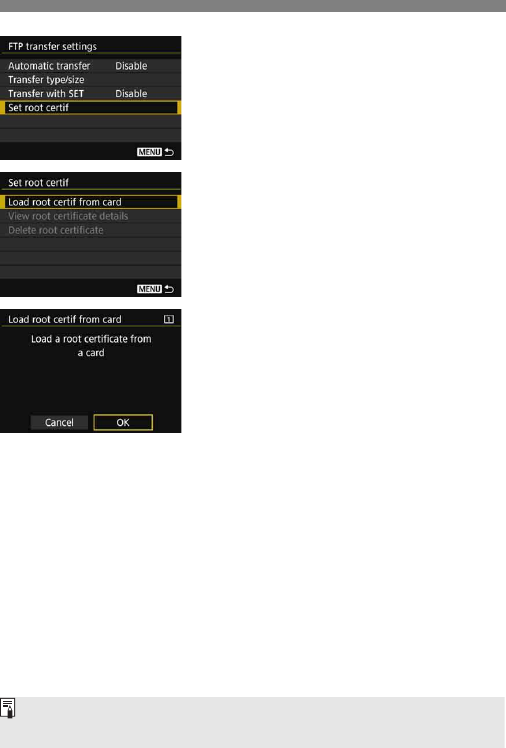
Importing a Root Certificate for FTPS
42
Configuring FTP Server Connection Settings
5Select [Set root certif].
6Select [Load root certif from
card].
7Select [OK].
The root certificate is imported.
Select [OK] on the confirmation
dialog to return to the [Set root certif]
screen.
Select [Delete root certificate] on the screen for step 6 to delete the
root certificate imported to the camera. Select [View root certificate
details] to check the issuer, subject, validity period, and other
information.
You can import a certificate from the card selected for [Record/play] or
[Playback] under [51: Record func+card/folder sel.].
43
An image can be automatically transferred to the FTP server
immediately after shooting. You can also continue still photo shooting
even while images are being transferred.
Before shooting, be sure to insert a card into the camera. If you
shoot without recording images, they cannot be transferred.
Note that automatic transfer of movies during shooting is not
supported. Transfer the movie after shooting, as described on pages
48-52.
1Select [Communication settings].
Under the [53] tab, select
[Communication settings], then
press <0>.
2Select [Network settings].
Set [Communication func] to
[Enable], then select [Network
settings].
3Select [Function settings].
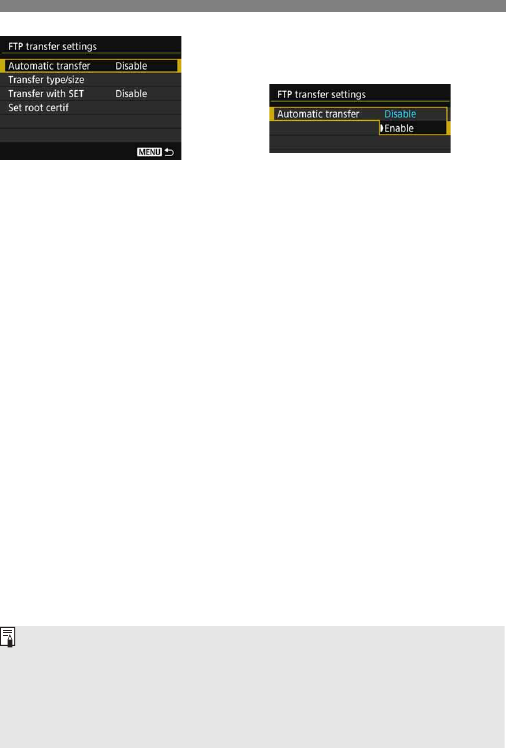
4Select [FTP transfer settings].
Transferring Images Individually
Automatic Image Transfer After Each Shot
44
Transferring Images Individually
5Select [Automatic transfer].
Select [Enable].
6Take the picture.
The captured image is transferred to
the FTP server.
During continuous shooting, images are transferred to the FTP server in
the order they are captured.
The captured images are also stored on the card.
Any images for which transfer fails or is interrupted will be transferred
automatically when the connection is recovered (p.47). These images
can also be re-transferred in batch at a later time (p.48).
45
Transferring Images Individually
Simply play back an image and press <0> to transfer it. You can also
continue still photo shooting even while images are being transferred.
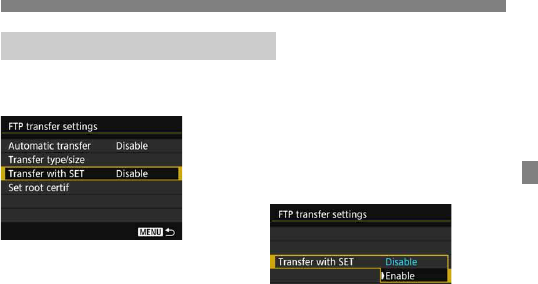
1Select [Transfer with SET].
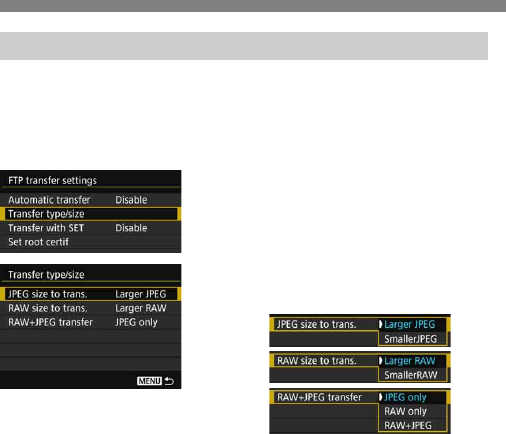
On the setting screen of FTP transfer,
select [Transfer with SET].
Select [Enable].
2Select the image.
Press the <x> button on the
camera.
Select the image to transfer, then
press <0> to transfer the image.
Movies cannot be transferred this
way. Selecting a movie and
pressing <0> will display the
movie playback panel.
Transferring the Current Image
46
Transferring Images Individually
You can select which images to transfer when recording images of
different sizes to a CF card and CFast card simultaneously, or when
shooting in RAW+JPEG image quality.
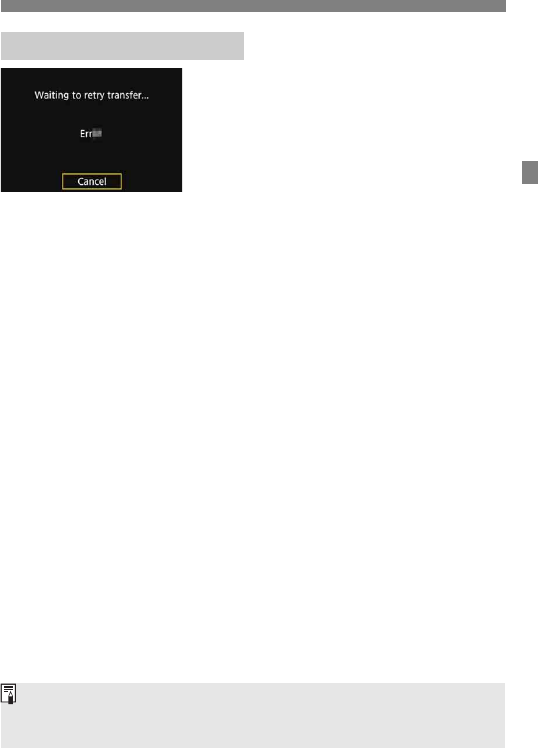
Select [Transfer type/size] in step 5 on page 44 to select the size or
type of images to transfer.
1Select [Transfer type/size].
2Select the size and type of images
to transfer.
To transfer smaller JPEGs when the camera is set up to record
larger JPEGs to either a CF card or CFast card and smaller JPEGs
to the other, set [JPEG size to trans.] to [SmallerJPEG].
When the camera is set up to record RAW images to either a CF
card or CFast card and JPEGs to the other, specify which images to
transfer in the [RAW+JPEG transfer] setting. Similarly, complete the
same setting when RAW+JPEG images are recorded
simultaneously to a single card.
When images of the same size are recorded to both a CF card and
CFast card simultaneously, images recorded to the card selected for
[Record/play] or [Playback] in [Record func+card/folder sel.]
under the [51] tab are transferred.
Selecting Particular Sizes or Types of Images to Transfer
47
Transferring Images Individually
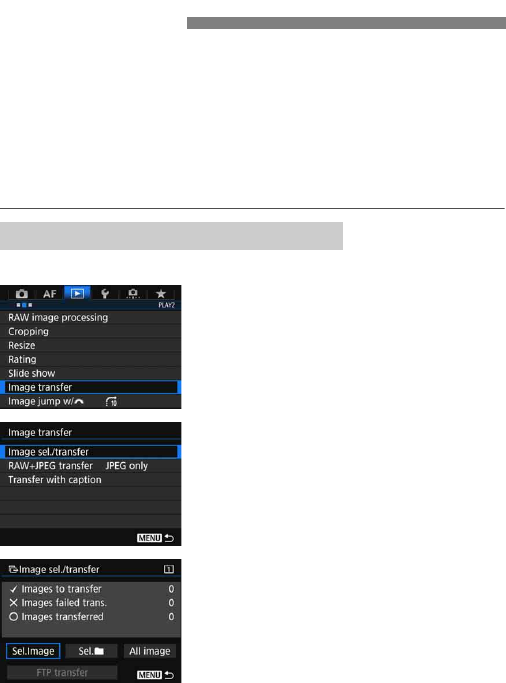
If transfer fails, the <Y> lamp on the
camera blinks in red. In this case, press the
<M> button, select [Communication
settings] under the [53] tab, and press
<0>. When the screen shown on the left is
displayed, check the error code number and
see page 118 to eliminate the cause of the
error.
Once the cause of the error is eliminated, the images whose transfer
previously failed will be re-transferred automatically. With this option
activated, transfer is attempted again automatically after failure,
whether automatic transfer is used or captured images are transferred
via FTP. Note that when you cancel image transfer, or turn off the
camera, the image will not be re-transferred automatically. See page 48
and transfer the image.
Auto Retry if Transfer Fails
By setting the power saving function on the [Function settings] screen
(p.114), you can log off the transmitter from the FTP server after transfer
and stop the LAN connection.
48
After shooting, you can select multiple images as desired and transfer
them all at once. You can also transfer unsent images or images that
could not be sent previously. Additionally, you can add a caption before
transferring images.
You can also continue still photo shooting even while images are being
transferred.
When the Live View shooting/Movie shooting switch is set to
<k>, images cannot be transferred. Set it to <A>.
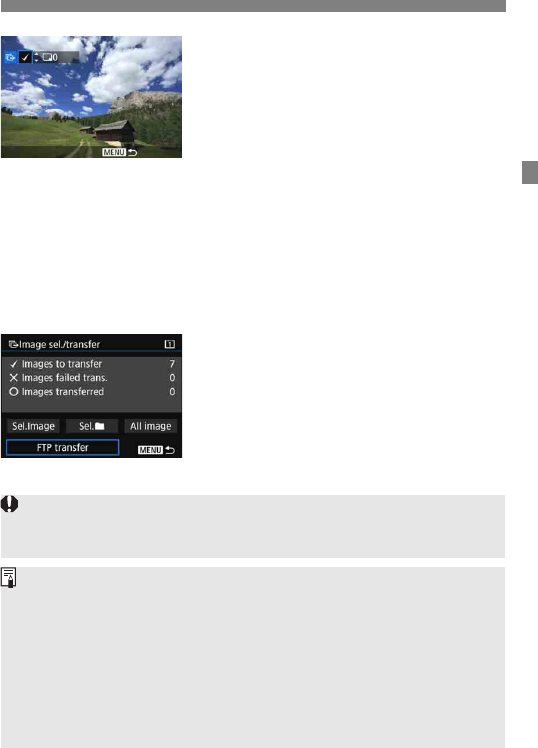
Sel.Image
1Select [Image transfer].
Under the [32] tab, select [Image
transfer], then press <0>.
2Select [Image sel./transfer].
3Select [Sel.Image].
Batch Transfer
Selecting the Images to be Transferred
49
Batch Transfer
4Select images to transfer.
Turn the <5> dial to select the
image to be transferred, then press
<0>.
Turn the <5> dial to display the [X]
on the screen’s upper left, then press
<0>.
If you press the <u> button and turn
the <6> dial counterclockwise, you
can select an image from a three-
image display. To return to the single-
image display, turn the <6> dial
clockwise.
To select other images to be
transferred, repeat step 4.
5Transfer the image.
Select [FTP transfer], then press
<0>.
Select [OK] on the confirmation
dialog to transfer the image.
Images selected with [Sel.n] and
[All image] can also be transferred in
this way.
If you set the Live View shooting/Movie shooting switch to <k> during the
image transfer of captured images, the image transfer will be temporarily
cancelled. Set it to <A> to resume the image transfer.
You can also transfer shot movies. However, when the Live View
shooting/Movie shooting switch is set to <k>, images cannot be
transferred. Set it to <A> and transfer them.
Up to 9,999 images can be selected in one batch.
When [Sel.Image] is selected, you can check the transfer history on the
upper left of the screen: No mark: Not selected. X: Selected for transfer.
l: Transfer failed. k: Transfer succeeded.
The procedures for [RAW+JPEG transfer] (p.51) and above steps 1 to 4
can also be performed even while the camera is not connected to an
FTP server.
50
Batch Transfer
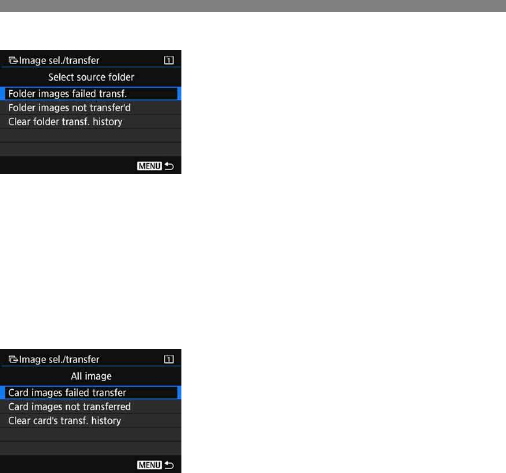
Sel.n
Select [Sel.n] and select [Folder
images not transfer’d]. When you
select a folder, all the images in that
folder not yet transferred to the FTP
server will be selected.
Selecting [Folder images failed transf.] will select the selected folder’s
images that failed to transfer.
Selecting [Clear folder transf. history] will clear the transfer history of
the images in the selected folder. After clearing the transfer history, you
can select [Folder images not transfer’d] and again transfer all the
images in the folder.
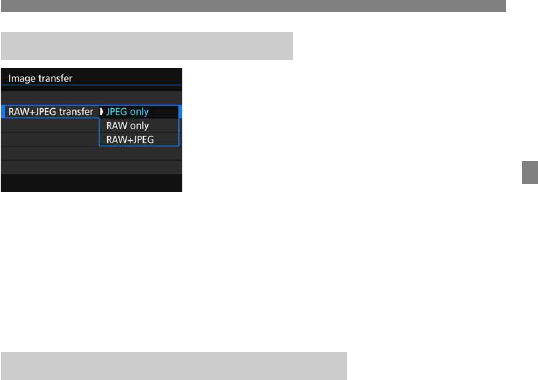
All image
If [All image] is selected and you select
[Card images not transferred], all the
images on the card not yet transferred to
the FTP server will be selected.
For a description of [Card images failed
transfer] and [Clear card’s transf.
history], see “Sel.n” above.
51
Batch Transfer
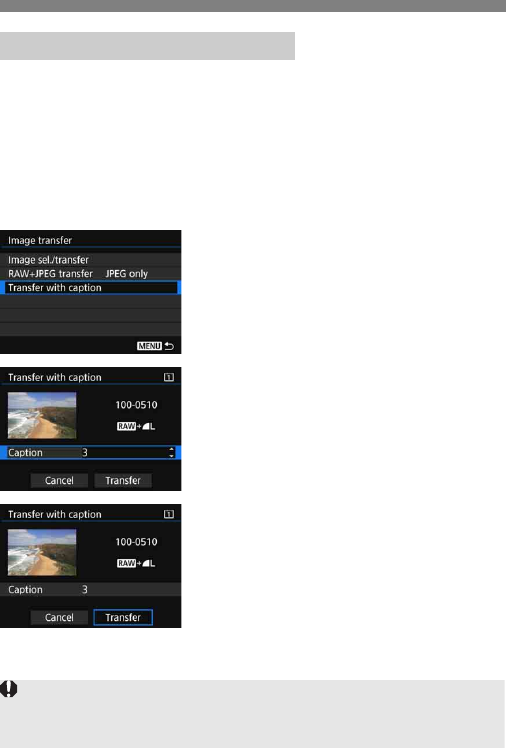
For RAW+JPEG images, you can specify
which image to transfer.
In step 2 on page 48, select
[RAW+JPEG transfer], and select the
image to be transferred: [JPEG only],
[RAW only], or [RAW+JPEG].
The [RAW+JPEG transfer] setting
switches in tandem with the
[RAW+JPEG transfer] setting under
[53: Communication settings] 9
[Network settings] 9 [Function
settings] 9 [FTP transfer settings]
9 [Transfer type/size] (p.46).
You can use the menu even during image transfer. However, to prevent
transfer problems, some menu items are unavailable during transfer,
including [Network settings], [Protect images], [Erase images],
[Format card], and [Record func+card/folder sel.].
Transferring RAW+JPEG Images
Menu Operation During Image Transfer
52
Batch Transfer
When you select [Transfer with caption] in step 2 on page 48, you can
add a registered caption to each image before transfer. This is
convenient if you want to inform the recipient of the printing quantity, for
example. The caption is also added to images stored in the camera.
You can check captions added to images by examining the Exif
information, in the user comments.
For instructions on creating and registering captions, see page
140.
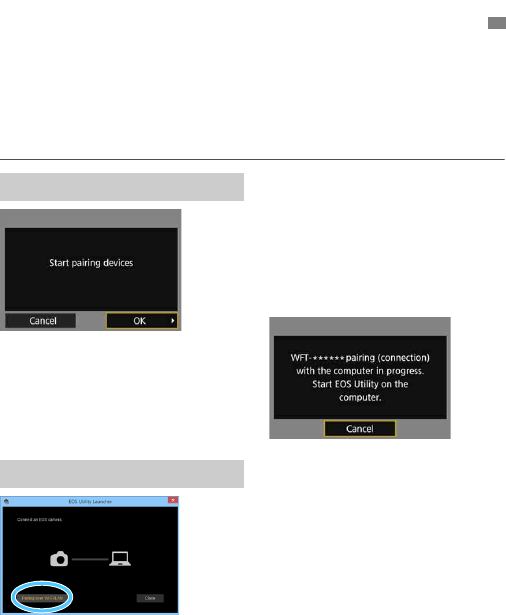
1Select [Transfer with caption].
Select [Transfer with caption] on the
screen for step 2 on page 48, then
press <0>.
The last image played back is
displayed.
2Set a caption.
Select [Caption], then press <0>.
Turn the <5> dial to select the
content of the caption, then press
<0>.
3Select [Transfer].
The image is transferred with the
caption. When the transfer is
complete, the [Image transfer]
screen will reappear.
Adding a Caption Before Transfer
It is not possible to manually select images on the [Transfer with caption]
screen. To select another image for transfer with a caption, play back that
image before following these steps.

53
Images transferred to the FTP server are stored in the following folder
as specified in the FTP server settings.
Under the default settings of the FTP server, images are stored in [C
drive] 9 [Inetpub] folder 9 [ftproot] folder, or in a subfolder of this
folder.
If the root folder of the transfer destination has been changed in the
FTP server settings, ask the FTP server administrator where images
are transferred.
Under the default settings, transferred images will be stored in the root
folder specified in the FTP server settings, in a folder structure such as
“A/DCIM/100EOS1D”, which is automatically created.
However, when a CF card has been selected for recording and
playback, a folder structure such as “A/DCIM/100EOS1D” will be
automatically created; when a CFast card has been selected, the folder
structure will be “B/DCIM/100EOS1D”. (Images will be stored
separately, with CF card images in folder A and CFast images in folder
B.)
Viewing Transferred Images
Target Folders for the FTP Server
Folders for Image Storage

54
MEMO

55
3
Operating Remotely
Using EOS Utility
Using EOS Utility, you can view images stored in the
camera or save them to a computer. Additionally, you
can operate the camera remotely to take a picture or
change camera settings using EOS Utility.
Almost all EOS Utility camera operations are supported,
because this option utilizes a wireless LAN instead of
an interface cable.
The instructions in this chapter are continued from Chapter
1.
Install EOS Utility on the computer before setting up a
connection (p.15).
56
These instructions are continued from Chapter 1.
To establish a connection, operations on the computer are required.
For details, refer to the computer’s instruction manual.
The configuration procedure is as follows, using Windows 8.1 as an
example.
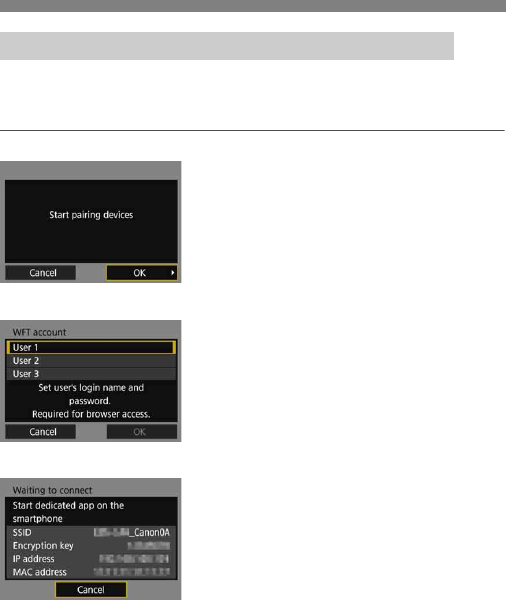
1Select [OK].
Select [OK] and press <0>. The
following message is displayed.
“******” represents the last six digits of
the MAC address of the transmitter.
2Start EOS Utility on the computer.
3In EOS Utility, click [Pairing over
Wi-Fi/LAN].
If a firewall-related message is
displayed, select [Yes].
Configuring EOS Utility Connection Settings
Operation on the Camera-1
Operation on the Computer
57
Configuring EOS Utility Connection Settings
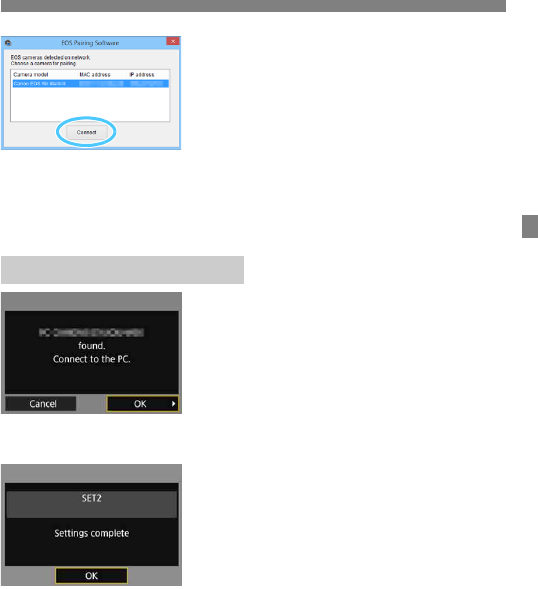
4Click [Connect] on the computer.
Select the camera to connect to, then
click [Connect].
If multiple cameras are displayed,
identify the camera to connect to by
its MAC address displayed on the
camera’s LCD monitor.
The MAC address can also be
checked on the [Function settings]
screen (p.114).
5Select [OK].
When the camera detects the
computer on which you clicked
[Connect] in step 4, the screen on
the left is displayed.
Select [OK] and press <0>. A
connection completion screen will
appear.
6Select [OK].
Press <0> to return to the [Network
settings] screen.
The <Y> lamp on the camera will
light up in green.
Settings information is stored in the
camera. It is not stored in the
transmitter.
The settings for connecting to EOS Utility are now complete.
There is no need to complete pairing again if you will continue using
a particular camera to which the transmitter is attached and
computer together after pairing without changing the settings.
Operation on the Camera-2
58
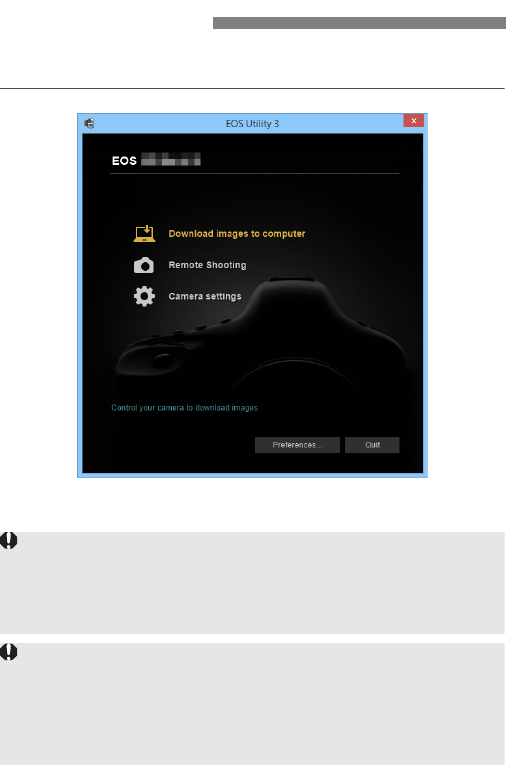
For EOS Utility instructions, refer to the EOS Utility Instruction Manual.
In addition to remote shooting, various camera operations are available.
Using EOS Utility
In Remote Live View shooting, the rate of image transmission is slower
compared to a connection via an interface cable. Therefore, moving
subjects cannot be displayed smoothly.
While connected, [Multiple exposure], [RAW image processing],
[Cropping], or [Resize] cannot be selected.
Do not hold the camera in the same position for long periods of time.
Even if the camera does not feel too hot, prolonged contact with the same
body part may cause skin redness or blistering due to low-temperature
contact burns. Using a tripod is recommended for people with circulation
problems or very sensitive skin, or when using the camera in very hot
places.

59
4
Operating Remotely
Using WFT Server
Using a web browser, you can view images stored in
the camera or save them to a computer, smartphone,
etc. Additionally, you can operate the camera remotely
to take a picture or change camera settings using a web
browser.
The instructions in this chapter are continued from Chapter
1.
60
These instructions are continued from Chapter 1.
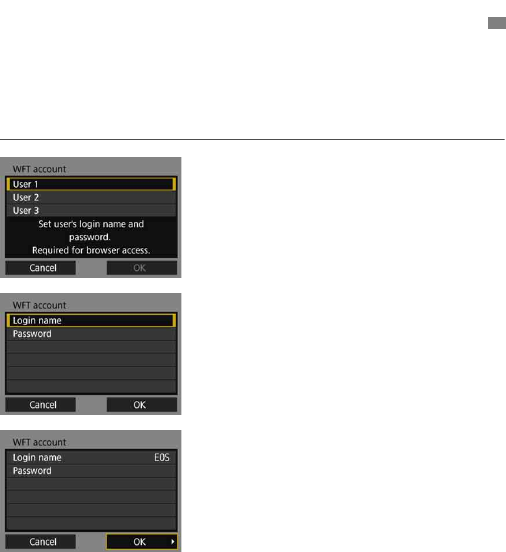
Enter a login name and password for connecting to the camera from a
computer. The login name and password you specify here are used
when connecting to the camera.
1Select [User *].
With WFT Server, you can connect
the camera to up to three devices.
Select a user number to prevent
conflicts when users at other devices
are connected simultaneously.
2Select [Login name] or
[Password].
The virtual keyboard is displayed.
See page 21 to enter a login name
and password.
3Select [OK].
After specifying the login name and
password, select [OK] and press
<0>.
The screen for step 1 will reappear.
To add a user, repeat steps 1 to 3.
Configuring WFT Server Connection Settings
61
Configuring WFT Server Connection Settings
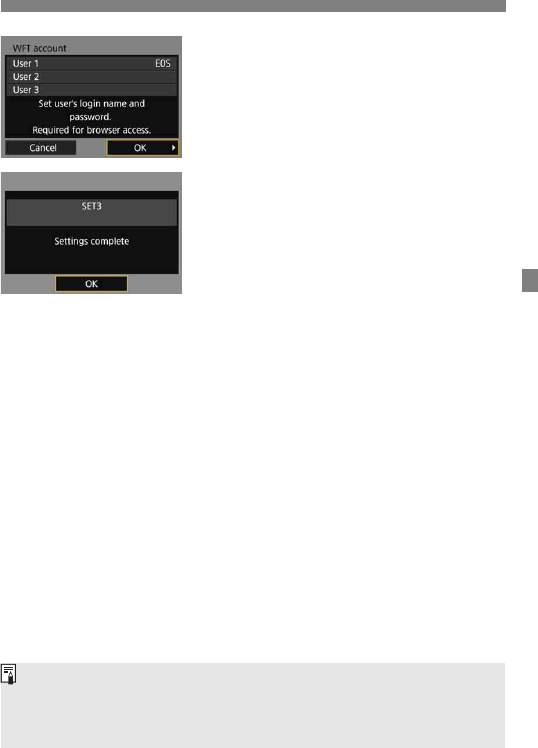
4Select [OK].
Select [OK] and press <0>. A
connection completion screen will
appear.
5Select [OK].
Press <0> to return to the [Network
settings] screen.
Settings information is stored in the
camera. It is not stored in the
transmitter.
The settings for connecting to WFT Server are now complete.
You can change the WFT account settings on the [Function settings]
screen (p.114). The port number setting can also be changed on the
[Function settings] screen. Note that there is normally no need to change
the port number (80).
62
In the web browser, display WFT Server, a screen for transmitter
operations. Connect the camera to a computer, smartphone, etc. via
LAN in advance.
To access the camera from a web browser, the camera’s IP address
displayed in step 6 must be entered in the address field of the web
browser.
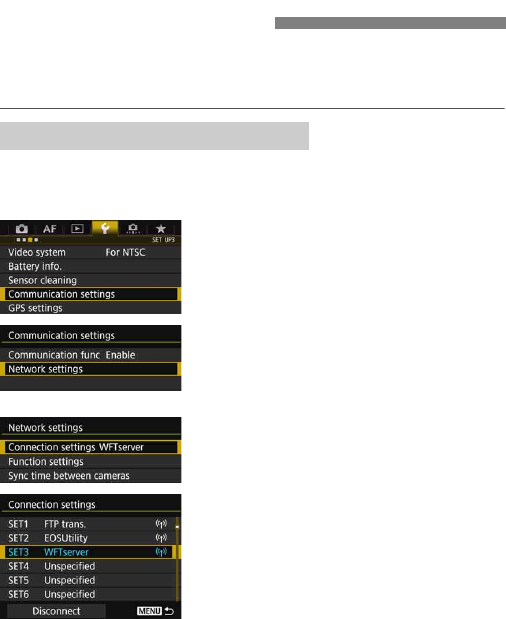
1Select [Communication settings].
Under the [53] tab, select
[Communication settings], then
press <0>.
2Select [Network settings].
Set [Communication func] to
[Enable], then select [Network
settings].
3Select [Connection settings].
4Select [SET* WFTserver].
Displaying WFT Server
Checking the Camera’s IP Address
63
Displaying WFT Server
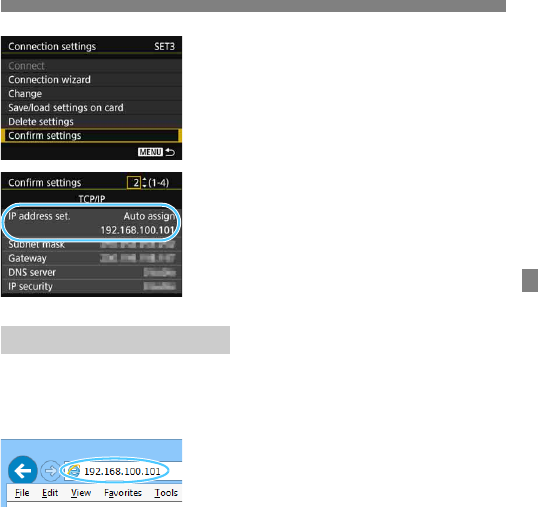
5Select [Confirm settings].
The settings are displayed.
6Check the settings.
Turn the <5> dial to display other
screens.
Write down the IP address.
After checking it, press the <M>
button to exit the confirmation dialog.
7Start the web browser.
Start a web browser on a computer,
smartphone, etc.
8Enter the URL.
In the address field, enter the IP
address you wrote down in step 6.
Press the <Enter> key.
Logging in to WFT Server
64
Displaying WFT Server
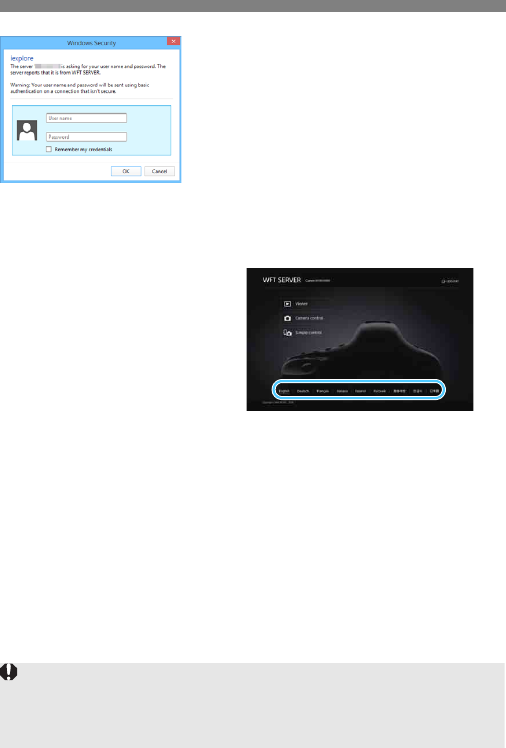
9Enter the [Login name] and
[Password].
Enter the [Login name] (user name)
and [Password] specified on page
60.
Press [OK] to display the WFT Server
screen.
10
Select the language.
Select a language at the bottom of
the screen.
WFT Server cannot be used unless the web browser supports
JavaScript.
While connected, [Multiple exposure], [RAW image processing],
[Cropping], or [Resize] cannot be selected.
65
You can browse images on the camera’s card as follows.
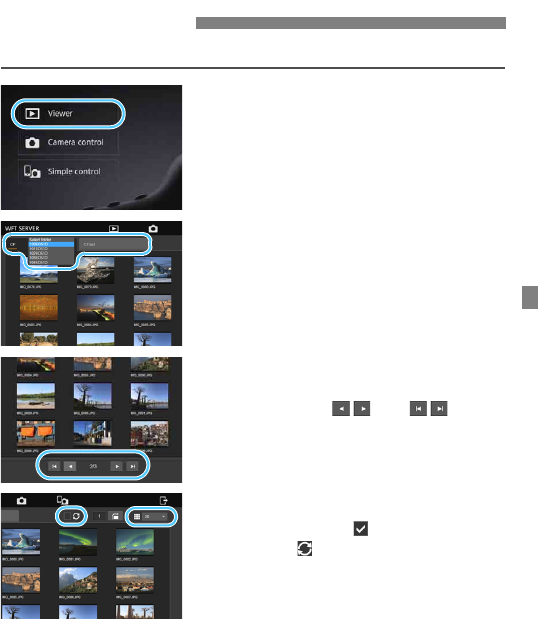
1Press [3 Viewer].
The image viewing screen is
displayed.
2Select the card and folder.
Press the [CF] or [CFast] tab to select
a card.
Press the folder name on the right of
the selected tab to select a folder
from the pull-down list.
3Select an image.
To view other images, change the
screen with [ ] or [ ] at the
bottom of the screen.
You can specify how many
thumbnails are shown per screen
from the pull-down list on the upper
right of the screen.
When you add [ ] to the checkbox
beside [ ], the screen will be
refreshed periodically.
For movies, [D] or [C] is
displayed beside the file names.
Viewing Images
66
Viewing Images
4Download images.
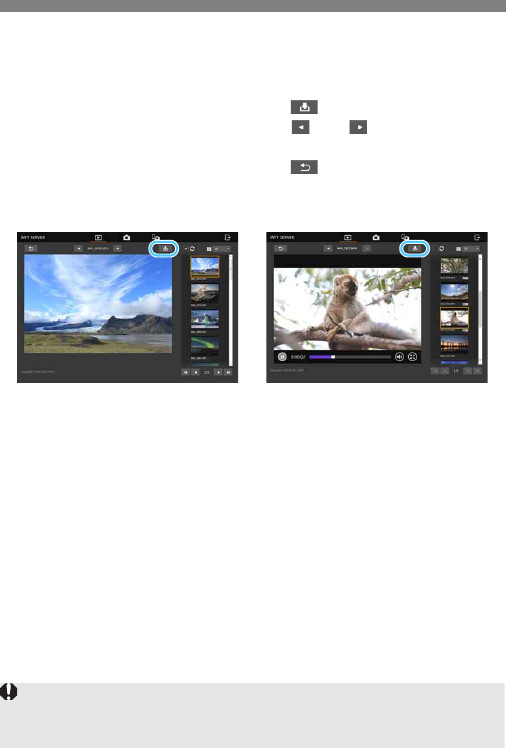
When you select a thumbnail, the
image is displayed at a larger size.
Press [ ] to download the image.
Press [ ] or [ ] to display the
previous or next image.
Press [ ] to return to the image
viewing screen.
Still photo playback screen Movie playback screen
Note that due to the performance of computers and smartphones, or
browsers used, the following may occur: Images cannot be displayed, images
are displayed slowly, or images cannot be downloaded to the devices.
67
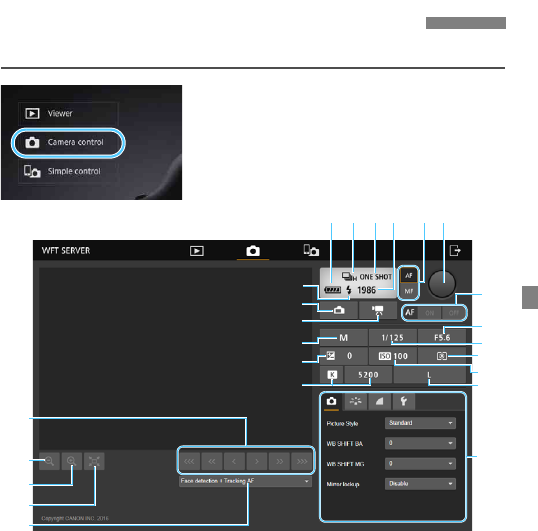
You can use WFT Server to shoot remotely.
1Press [z Camera control].
The advanced capture screen is
displayed.
Shooting Remotely [Camera control]
(1) Battery check (
13
) Menu
(2) Drive mode (
14
) Flash-ready
(3) AF mode (
15
) Still photo Live View shooting button
(4) Possible shots (
16
) Movie shooting button
(5) AF/MF switching button (
17
) Shooting mode
(6) Shutter button (
18
) Exposure compensation
(7) AF button (
19
) White balance
(8) Aperture (
20
) Manual focus button
(9) Shutter speed (
21
) Reduce button
(
10
) Metering mode (
22
) Magnify button
(
11
)ISO speed (
23
) Live View image size switching button
(
12
) Image-recording quality (
24
)AF method
(
15
)
(
16
)
(
17
)
(
18
)
(
19
)
(
14
)
(
20
)
(2) (3)(1)
(
11
)
(4) (5) (6)
(7)
(8)
(9)
(
10
)
(
12
)
(
13
)
(
21
)
(
22
)
(
23
)
(
24
)

68
Shooting Remotely [Camera control]
2Set the lens’s focus mode switch
to <f>.
When you press and let go of the
Shutter button (6), the camera will
autofocus and take a picture.
Drive mode (2) displays the drive mode set on the camera. Note that
even if the camera’s drive mode is set to continuous shooting, single
shooting will apply for remote shooting.
When the camera’s Live View shooting/Movie shooting switch is set to
<k>, still photo shooting is not possible.
Anti-flicker shooting will be set to [Disable] automatically.
If Mirror lockup is set to any setting other than [Disable], shooting is not
possible. Set it to [Disable] in the Menu (
13
).
With One-Shot AF, the picture is not taken if focus is not achieved. Display
Live View image and focus manually.
69
Shooting Remotely [Camera control]
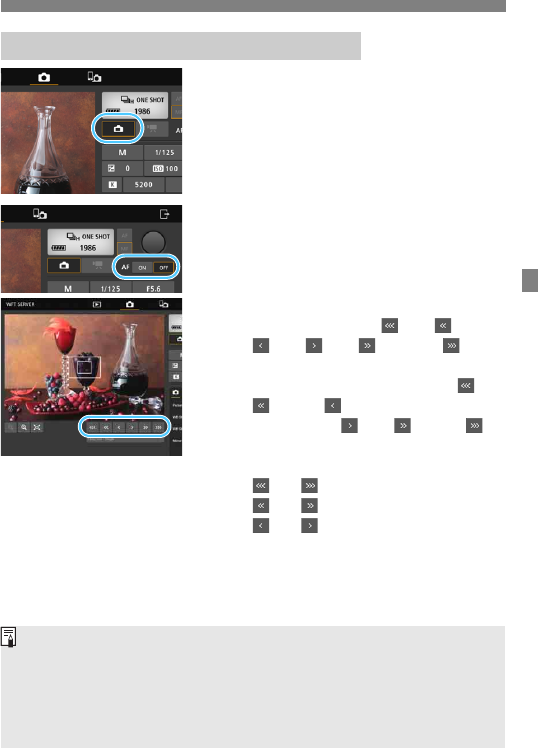
1Display Live View image.
Press the Still photo Live View
shooting button (
15
).
2Adjust the focus.
Using autofocus
Press [ON] on the AF button (7) to
autofocus.
Focusing manually
Press the buttons < >, < >,
< >, < >, < >, and < > to
adjust the focus.
To focus more closely, press < >,
< >, or < >. To focus farther
away, press < >, < >, or < >.
Three levels of focus adjustment are
available.
< > < >: Largest increment
< > < >: Intermediate increment
< > < >: Smallest increment
Displaying Live View Image for Shooting
If Live View image is not displayed, enable Live View shooting in the
Menu (
13
).
To make Live View image display more responsive, press the Live View
image size switching button (
23
). Live View image will be displayed at a
smaller size, improving responsiveness. To restore the original size,
press the button again.
70
Shooting Remotely [Camera control]
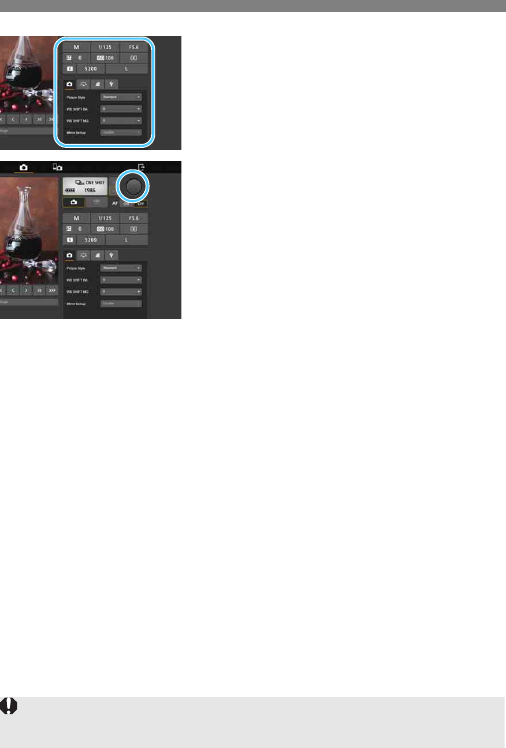
3Configure the shooting settings.
Select setting items (such as image-
recording quality) to view the setting
details, which you can configure.
Complete the settings as needed.
4Take the picture.
Press the Shutter button (6). When
you let go of the button, the picture is
taken.
The captured image is displayed.
Captured images are stored on the
camera’s card.
To download images, see “Viewing
Images” (p.65).
The Live View image may freeze when shooting if the camera is accessed
by multiple devices.
71
Shooting Remotely [Camera control]
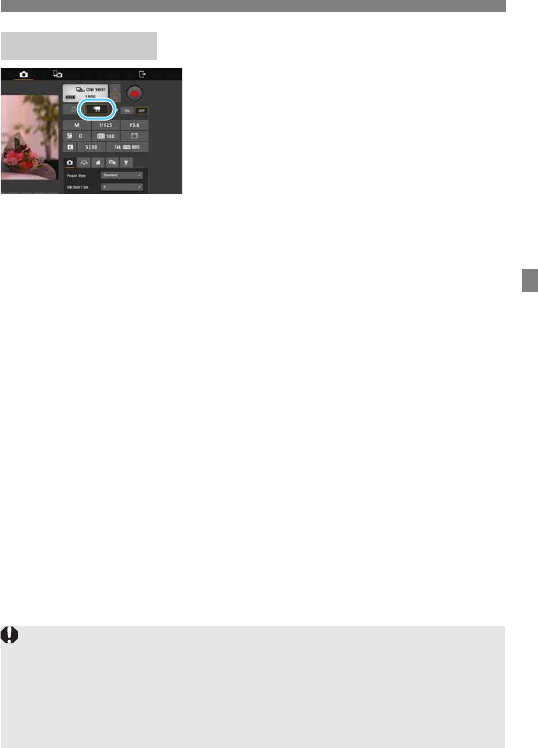
Press the Movie shooting button
(
16
) to display the movie shooting
screen.
The setting procedures are the same
as still photo shooting.
Press the Shutter button (6). When
you let go of the button, movie
shooting will start.
During movie shooting, the red [o]
on the Shutter button (6) changes to a
white [n].
Press the Shutter button (6) again.
When you let go of the button, movie
shooting will stop.
Shooting Movies
Do not hold the camera in the same position for long periods of time.
Even if the camera does not feel too hot, prolonged contact with the same
body part may cause skin redness or blistering due to low-temperature
contact burns. Using a tripod is recommended for people with circulation
problems or very sensitive skin, or when using the camera in very hot
places.
72
Although detailed function settings are not available on the basic
capture screen, it is convenient for shooting remotely using a
smartphone or other small-screen devices due to the compact design of
the operation screen.
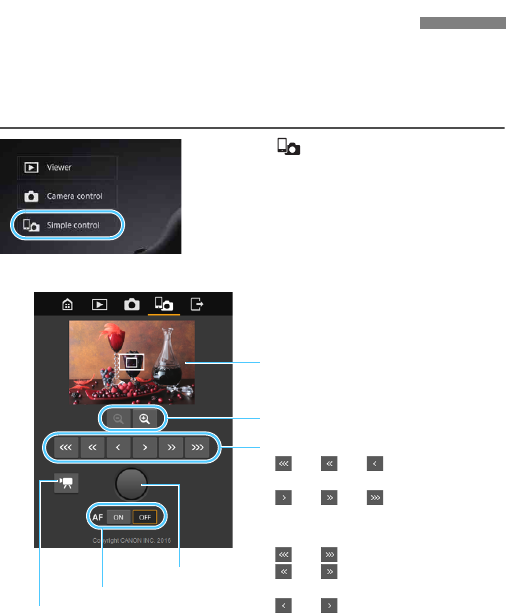
1Press [ Simple control].
The basic capture screen and Live
View image are displayed.
Shooting Remotely [Simple control]
Live View image screen
Manual focus button
<> <> <>:Focuses more
closely
<> <> <>:Focuses
farther away
Levels of focus adjustment
< > < >: Largest increment
< > < >: Intermediate
increment
< > < >: Smallest increment
Shutter button
Magnify/reduce button
Still photo/movie shooting
switching button
AF button
73
Shooting Remotely [Simple control]
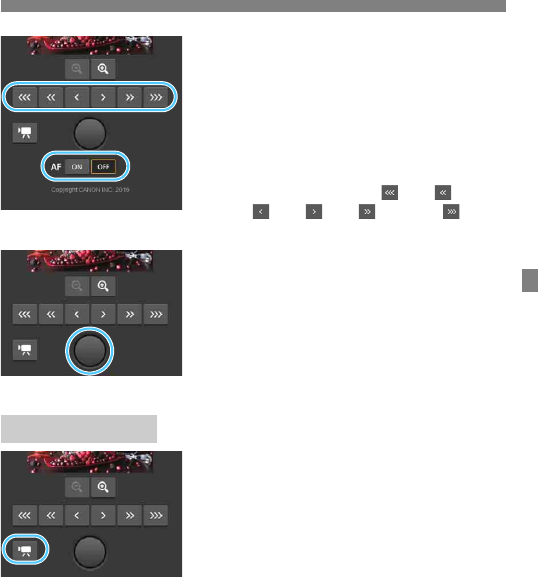
2Adjust the focus.
Set the lens’s focus mode switch to
<f>.
Using autofocus
Press [ON] on the AF button to
autofocus.
Focusing manually
Press the buttons < >, < >,
< >, < >, < >, and < > to
adjust the focus.
3Take the picture.
Press the Shutter button. When you let
go of the button, the picture is taken.
The captured image is displayed.
Captured images are stored on the
camera’s card.
To download images, see “Viewing
Images” (p.65).
Press the [z] or [k] button to
switch between the still photo
shooting screen and movie
shooting screen.
The setting procedures are the same
as still photo shooting.
Press the Shutter button. When you
let go of the button, movie shooting
will start.
During movie shooting, the red [o]
on the Shutter button changes to a
white [n].
Press the Shutter button again. When
you let go of the button, movie
shooting will stop.
Shooting Movies
74
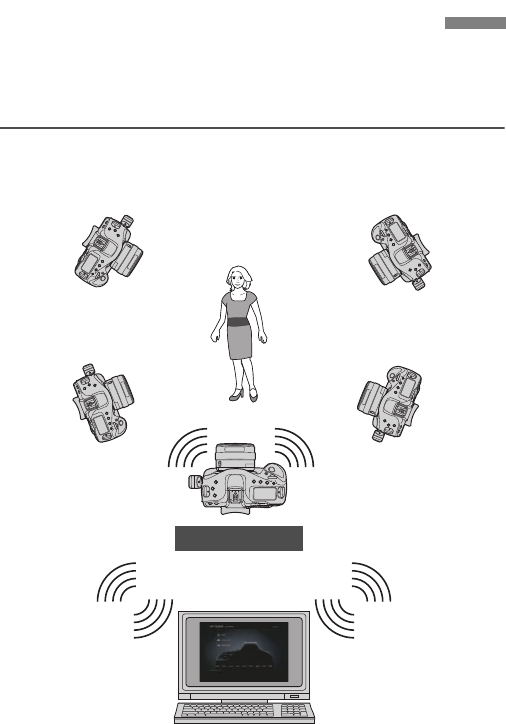
Remote shooting in WFT Server can be used in conjunction with the
transmitter’s “Linked Shooting” function (p.83). Additionally, images on
the master camera’s card and slave cameras’ cards can be viewed and
downloaded.
Using WFT Server in Linked Shooting
Slave camera
Linked Shooting
WFT Server
Slave camera
Slave camera
Slave camera
Master camera

75
5
Operating Remotely
Using a Smartphone
Using a smartphone, you can view images stored in the
camera or save them to the smartphone. Additionally,
you can operate the camera remotely to take a picture
or change camera settings using a smartphone.
The instructions in this chapter are continued from Chapter
1.
Install Camera Connect on the smartphone before setting
up a connection (p.16).
76
These instructions are continued from Chapter 1.
To establish connection, operations on the smartphone are required.
For details, refer to the smartphone’s instruction manual.
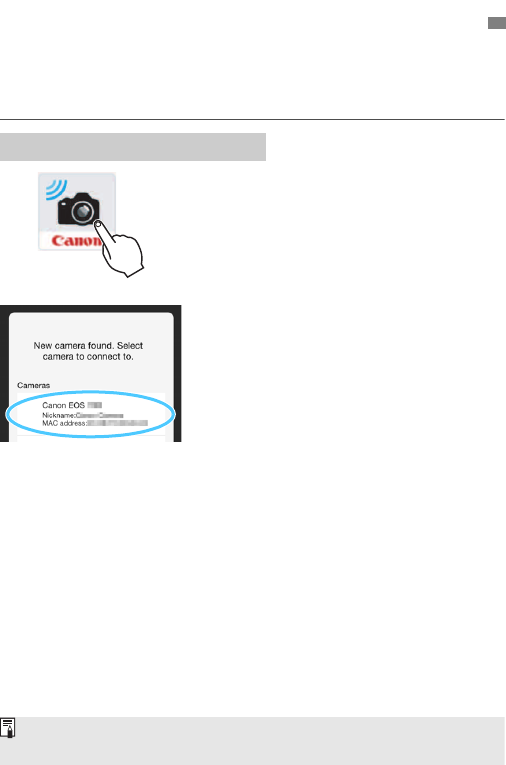
1Start Camera Connect on the
smartphone.
When the [Waiting to connect]
screen is displayed on the camera’s
LCD monitor, start Camera Connect
on the smartphone.
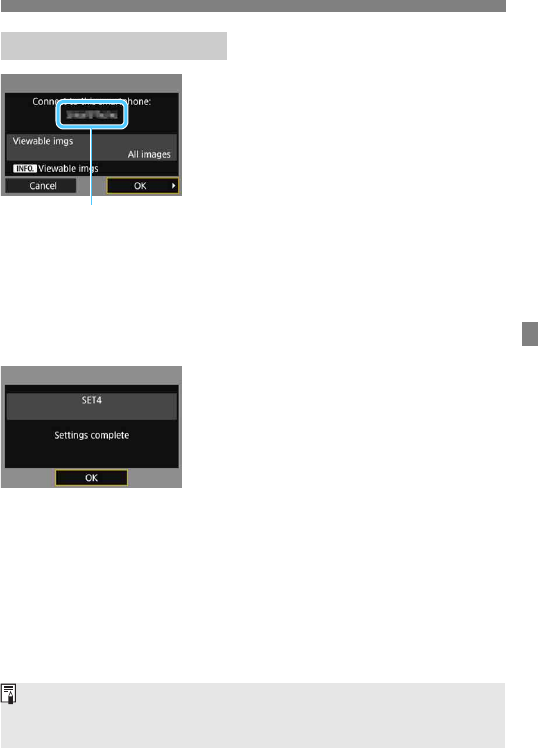
2Select the camera to connect to
on the smartphone.
Select and tap the camera to connect
to from [Cameras] on Camera
Connect.
If multiple cameras are displayed,
identify the camera to connect to by
its MAC address displayed on the
camera’s LCD monitor.
Configuring Smartphone Connection Settings
Operation on the Smartphone
The MAC address of the transmitter can also be checked on the [Function
settings] screen (p.114).
77
Configuring Smartphone Connection Settings
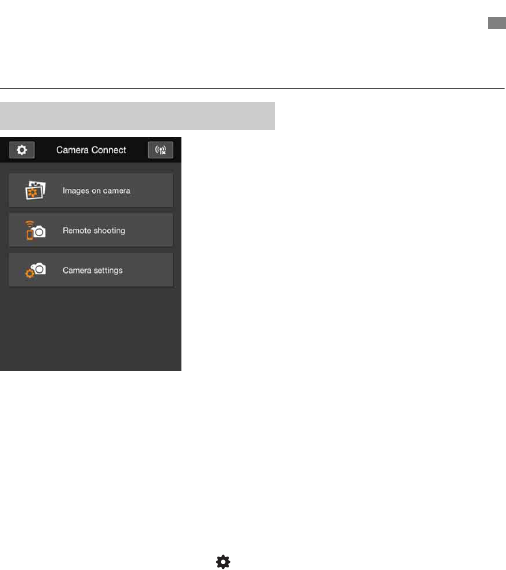
3Connect to the camera.
When a connection is established,
the screen on the left will appear on
the camera’s LCD monitor.
To specify viewable images, press the
<B> button. See step 7 on page
81 to set them.
Select [OK] and press <0>. A
connection completion screen will
appear.
The main window of Camera Connect
will be displayed on the smartphone.
The <Y> lamp on the camera will
light up in green.
4Select [OK].
Press <0> to return to the [Network
settings] screen.
Settings information is stored in the
camera. It is not stored in the
transmitter.
The settings for connecting to a smartphone are now complete.
Operation on the Camera
The device name set on
Camera Connect
You can check or change the device name on the setting screen of
Camera Connect.
While connected, the camera’s auto power off does not function.
78
You can use a smartphone with Camera Connect installed to view
images stored in the camera and shoot remotely.
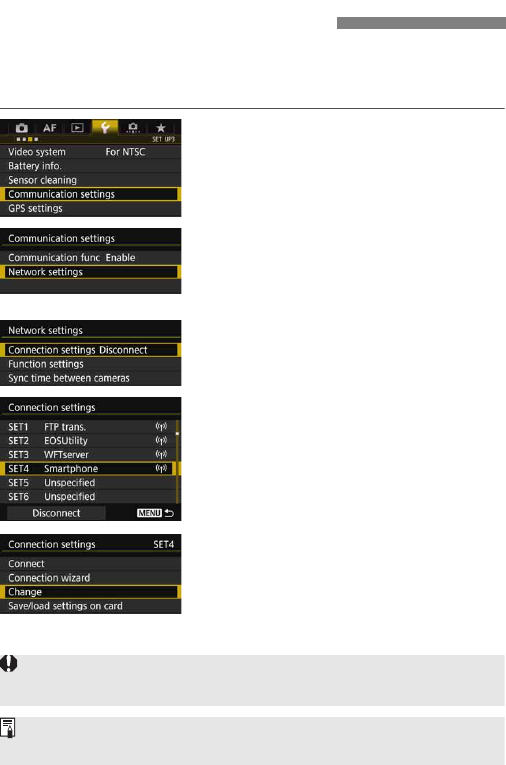
The main functions of Camera Connect
are described below. Touch the screen to
learn the operation procedures.
[Images on camera]
Images stored in the camera can be
viewed.
Images stored in the camera can be
saved on a smartphone.
Operations such as deletion can be
performed on images stored in the
camera.
[Remote shooting]
The camera’s Live View image can
be viewed using a smartphone.
You can shoot using remote
operation.
[Camera settings]
Camera settings can be changed.
(Settings button)
Use this button to access various
settings for Camera Connect.
Operating the Camera Using a Smartphone
Camera Connect Main Window

79
Operating the Camera Using a Smartphone
When the connection is terminated while recording a movie with remote
shooting, the camera responds as follows:
• When the Live View shooting/Movie shooting switch is set to <k>,
movie shooting continues.
• When the Live View shooting/Movie shooting switch is set to <A>,
movie shooting stops.
When the Live View shooting/Movie shooting switch is set to <A> and
the movie mode is set by operating Camera Connect, you cannot shoot
by operating the camera.
While connected, [Multiple exposure], [RAW image processing],
[Cropping], or [Resize] cannot be selected.
In remote shooting, the AF speed may become slower.
Depending on the connection status, image display or shutter release
may be delayed.
When saving images to a smartphone, you cannot take a picture even if
you press the camera’s shutter button. Also, the camera’s LCD monitor
may turn off.
Even if MOV-format movies are displayed in the list, they cannot be
saved to a smartphone. Note that depending on the smartphone’s OS,
saving MP4-format movies may not be possible.
The connection will stop if you set the camera’s power to <2> or
open the card slot cover.
If you send RAW images to a smartphone, they will be saved as resized
JPEG images.
While connected, the camera’s auto power off does not function.
While connected, disabling the smartphone’s power saving function is
recommended.
Do not hold the camera in the same position for long periods of time.
Even if the camera does not feel too hot, prolonged contact with the same
body part may cause skin redness or blistering due to low-temperature
contact burns. Using a tripod is recommended for people with circulation
problems or very sensitive skin, or when using the camera in very hot
places.
80
You can specify images viewable from a smartphone by operating the
camera. Images can be specified during connection setup or after
the connection is terminated.
1Select [Communication settings].
Under the [53] tab, select
[Communication settings], then
press <0>.
2Select [Network settings].
Set [Communication func] to
[Enable], then select [Network
settings].
3Select [Connection settings].
4Select [SET* Smartphone].
5Select [Change].
Specifying Viewable Images
If [Viewable imgs] is set to any setting other than [All images], remote
shooting is not possible.
When reconnecting to a smartphone, check the viewable images setting
before establishing a connection.
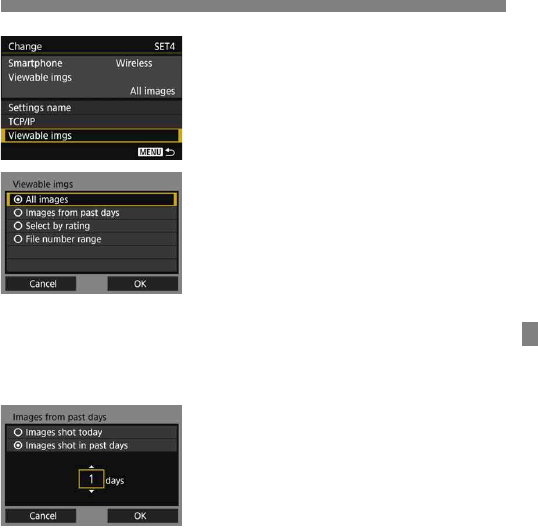
81
Specifying Viewable Images
6Select [Viewable imgs].
7Select an item.
Select [OK] and press <0> to
display the setting screen.
[All images]
All images stored on the card become viewable.
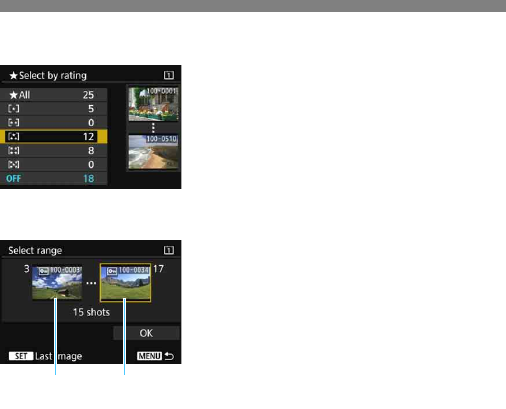
[Images from past days]
Specify viewable images on the
shooting-date basis. Images shot up to
nine days ago can be specified.
Select an item, then press <0>.
When [Images shot in past days] is
selected, images shot up to the
specified number of days before the
current date become viewable. When
<r> is shown for the number of
days, turn the <5> dial to specify the
number of days, then press <0> to
confirm the selection.
Select [OK] and press <0> to
specify the viewable images.
82
Specifying Viewable Images
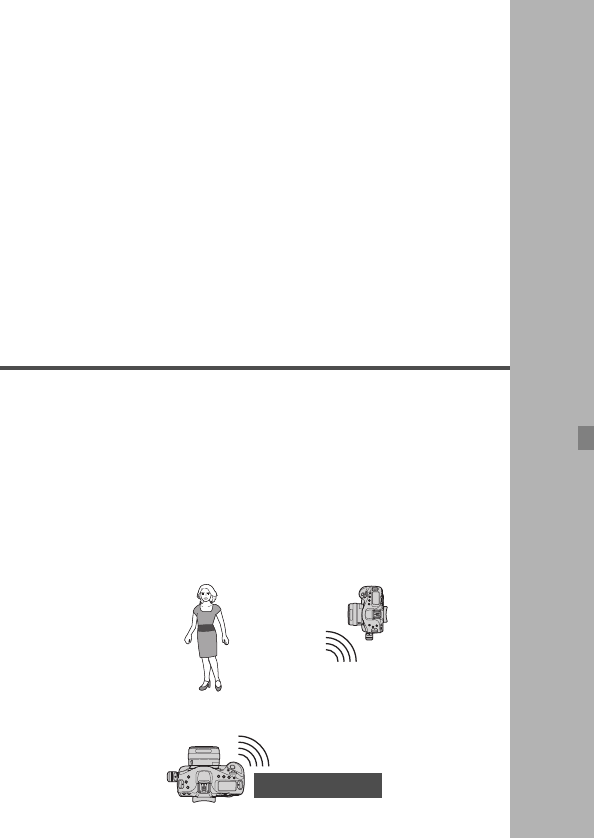
[Select by rating]
Specify viewable images depending on
whether a rating has been added (or not
added) or by the type of rating.
Select a rating, then press <0> to
specify the viewable images.
[File number range] (Select range)
Select the first and last images from
images arranged by the file number to
specify the viewable images.
1 Turn the <5> dial to select the first
image to be set as viewable.
2Press <0> to display the image
selection screen.
Select an image using the <5> dial.
If you press the <u> button and turn
the <6> dial counterclockwise, you
can select an image from the index
display.
3 Select an image and press <0> to
determine the selection.
4 Specify the last image to be set as
viewable by the same operation.
Select an image shot later than the
image selected as the first image.
5 When the first and last images are
specified, select [OK], then press
<0>.
First image Last image
83
6
Linked Shooting
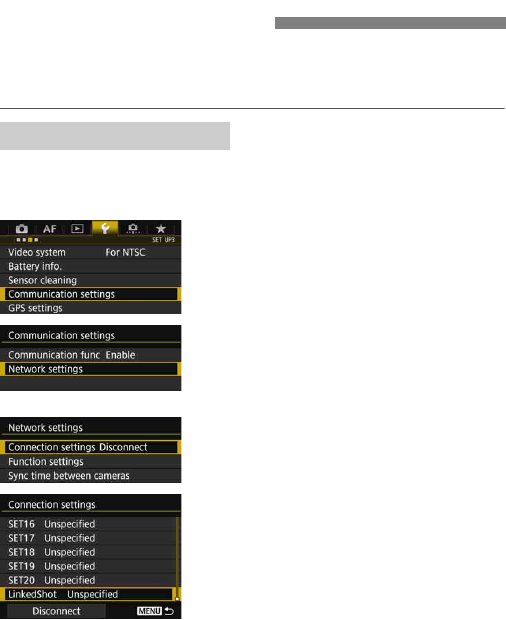
With linked shooting, up to 10 slave cameras can be
linked in a wireless network to the master camera on
which you will release the shutter.
Any cameras compatible with linked shooting, when
they have WFT series transmitters attached, can be
used as slave cameras, regardless of model.
Note that there will be a slight delay after you release
the master camera shutter until the slave camera
shutters are released. Movie shooting is not supported.
Slave camera
Master camera
84
Link the master camera to slave cameras for basic linked shooting.
When the Live View shooting/Movie shooting switch is set to
<k>, linked shooting is not possible. Set it to <A>.
First, set up slave cameras by operating the cameras to use as slaves.
When using multiple slave cameras, operate all slave cameras in the
same way.
1Select [Communication settings].
Under the [53] tab, select
[Communication settings], then
press <0>.
2Select [Network settings].
Set [Communication func] to
[Enable], then select [Network
settings].
3Select [Connection settings].
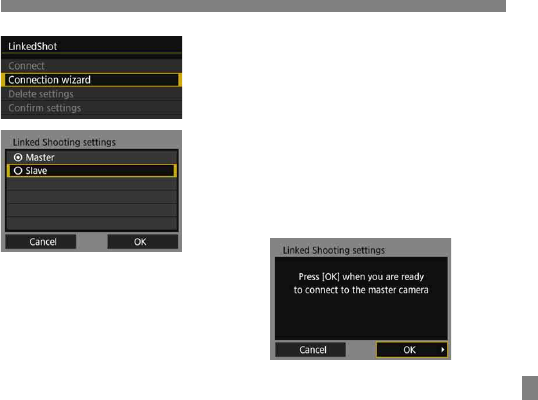
4Select [LinkedShot].
Turn the <5> dial to select
[LinkedShot] at the bottom.
Basic Linked Shooting
Preparing Slave Cameras
85
Basic Linked Shooting
5Select [Connection wizard].
6Select [Slave].
Select [OK] and press <0> to go to
the next screen. The slave cameras
are now ready, with the following
screen displayed.
When using multiple slave cameras,
set up all slave cameras to slave
state.
Once the settings are complete,
slaves cannot be added. You must
repeat the setup process from step 1.
86
Basic Linked Shooting
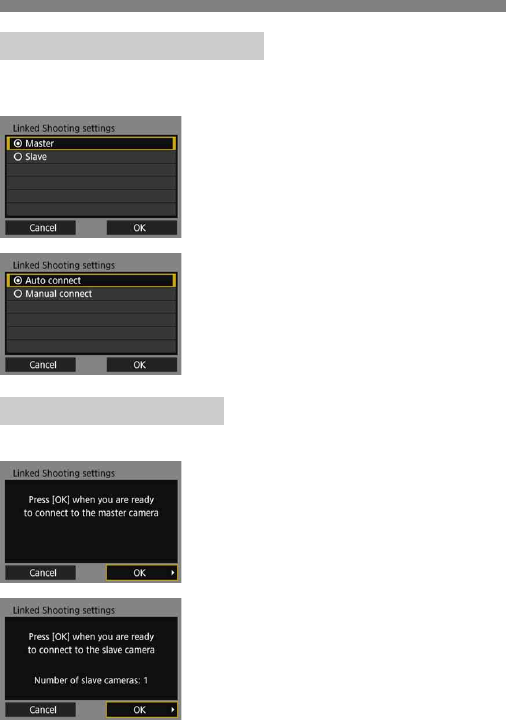
Set up the master camera by operating the camera to use as the
master.
7Select [Master].
Perform steps 1 to 5 on page 84 for
the master camera, then select
[Master].
Select [OK] and press <0> to go to
the next screen.
8Select [Auto connect].
Select [OK] and press <0> to go to
the next screen.
To set manually, see page 91.
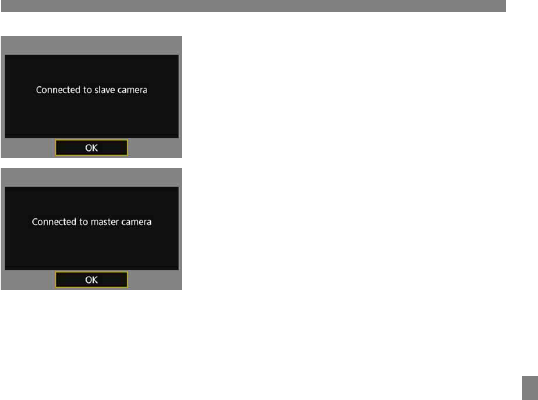
Operate the slave cameras and master camera to connect them.
9On the slave cameras, select
[OK].
On all slave cameras, select [OK].
On the master camera’s LCD monitor,
the number of slave cameras
detected is displayed.
10
On the master camera, select
[OK].
Check the number of slave cameras,
then select [OK].
Preparing the Master Camera
Connecting the Cameras
87
Basic Linked Shooting
11
On all cameras, select [OK].
On the master camera and all slave
cameras, select [OK].
Settings information is stored in the
camera. It is not stored in the
transmitter.
88
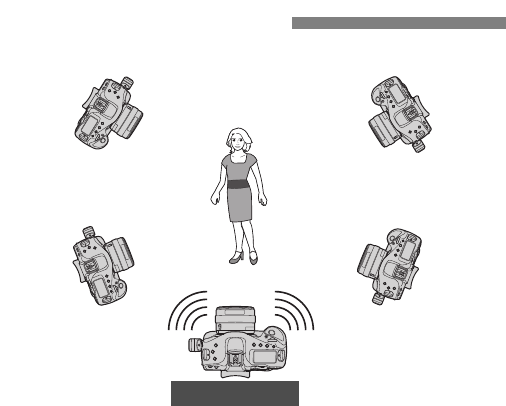
Set the Live View shooting/Movie shooting switch to <A>.
Position the slave cameras in clear view of the master camera,
without objects between them.
Slave cameras can be positioned up to approx. 100 m / 656 ft. from
the master camera. However, the distance supported for linked
shooting may be shorter depending on the wireless communication
conditions, which are affected by how the cameras are positioned,
the environment of use, and weather conditions.
Pressing the shutter button halfway on the master camera will also
put the slave cameras in the state corresponding to when their
shutter buttons are pressed halfway. Similarly, fully pressing the
shutter button on the master camera will also put the slave cameras
in the state corresponding to when their shutter buttons are fully
pressed.
There will be a slight delay after the master camera shutter is
released before the slave camera shutters are released.
(Simultaneous shooting is not possible.)
Positioning the Cameras
Slave camera
Master camera
Slave camera
Slave cameraSlave camera
89
Positioning the Cameras
If focus cannot be achieved with autofocus, linked shooting is not
possible with the corresponding slave camera units.
Do not use multiple flash units. Although slight, there is a difference in
the shutter release timing which may cause out-of-sync flash firing and
inadequate exposure.
Linked shooting is not possible when the slave cameras are set to any
setting other than [Mirror lockup: Disable], or when the Live View
shooting/Movie shooting switch of the master or slave camera is set to
<k>.
During linked shooting, when you press the AE lock or depth-of-field
preview button, the camera adjusts the focus and meters as if you had
pressed the shutter button halfway.
Once you have established a connection between the master camera
and slave cameras, the settings are retained even after you replace the
batteries.
If you will no longer use a slave camera in linked shooting, set
[Connection settings] to [Disconnect] on that slave camera.
Any cameras compatible with linked shooting, when they have WFT
series transmitters attached, can be used as slave cameras, regardless
of model.
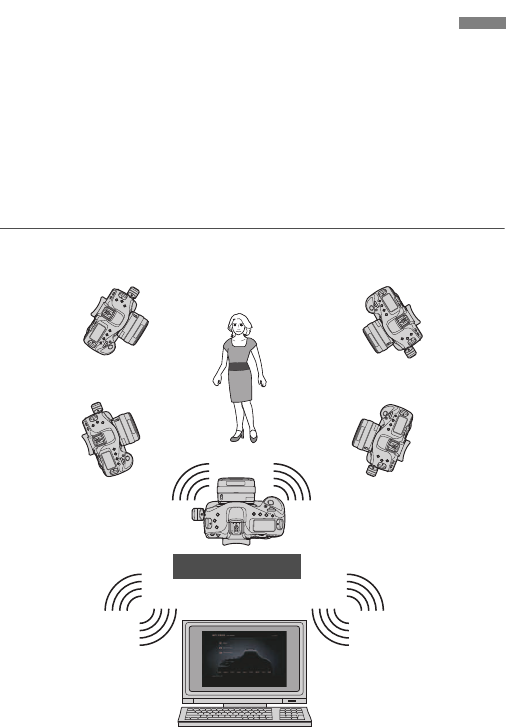
90
Using WFT Server, you can shoot remotely with a master camera linked
to slave cameras set to shoot at the same time. WFT Server can also
be used to access the master camera or slave cameras for Live View
display, and you can adjust the focus and configure remote shooting
settings as needed.
Additionally, images on camera cards can be viewed and
downloaded.
Wireless LAN functions and operating system of the computer
must support ad hoc mode.
Using the Transmitter with WFT Server
Linked Shooting
WFT Server
Slave camera
Master camera
Slave camera
Slave cameraSlave camera
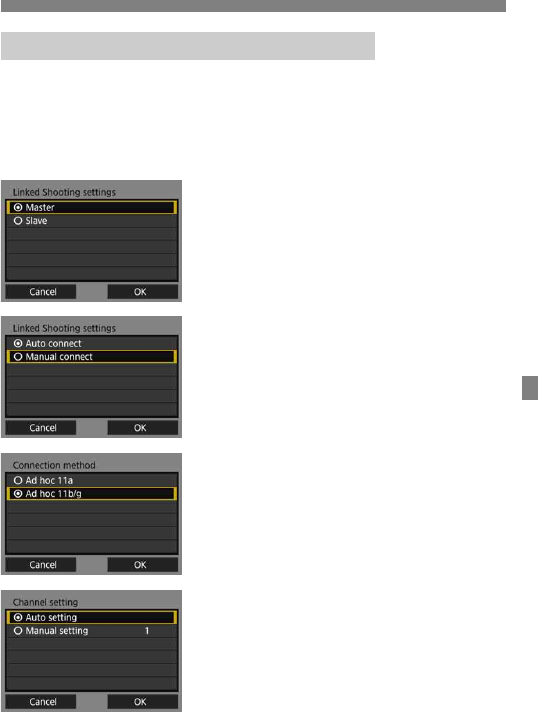
91
Using the Transmitter with WFT Server
1Set up the slave cameras.
Perform steps 1 to 6 on page 84 for
the cameras to use as slaves. When
the next screen is displayed, the
slave cameras are ready.
2Set up the master camera.
Perform steps 1 to 5 on page 84 for
the camera to use as the master, then
select [Master].
Select [OK] and press <0> to go to
the next screen.
3Select [Manual connect].
Select [OK] and press <0> to go to
the next screen.
4Select connection method.
Select the wireless LAN ad hoc mode
supported by the computer.
Select [OK] and press <0> to go to
the next screen.
5Specify the channel.
When selecting [Manual setting],
specify the same channel on the
master camera, slave cameras, and
computer.
Select [OK] and press <0> to go to
the next screen.
Connecting the Master and Slave Cameras
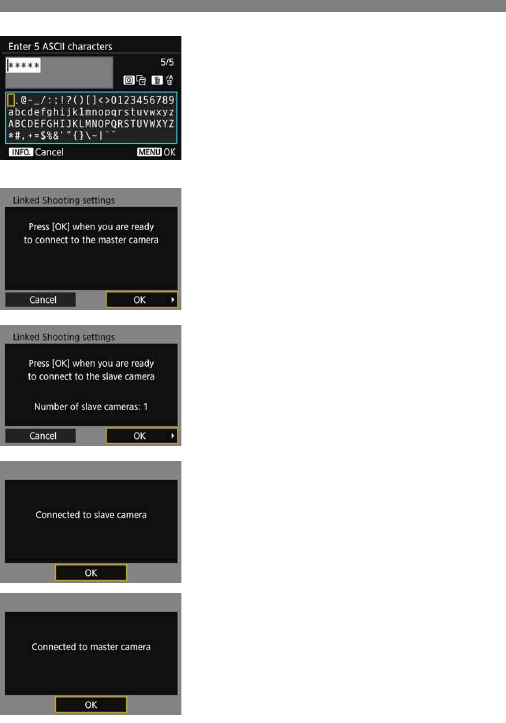
92
Using the Transmitter with WFT Server
6Enter the encryption key.
Enter a 5-digit encryption key
(password) and press the <M>
button.
Set the key entered here on the
computer in order to connect to the
master camera from the computer.
7On the slave cameras, select
[OK].
On all slave cameras, select [OK].
On the master camera’s LCD monitor,
the number of slave cameras
detected is displayed.
8On the master camera, select
[OK].
Check the number of slave cameras,
then select [OK].
9On all cameras, select [OK].
On the master camera and all slave
cameras, select [OK].
Settings information is stored in the
camera. It is not stored in the
transmitter.
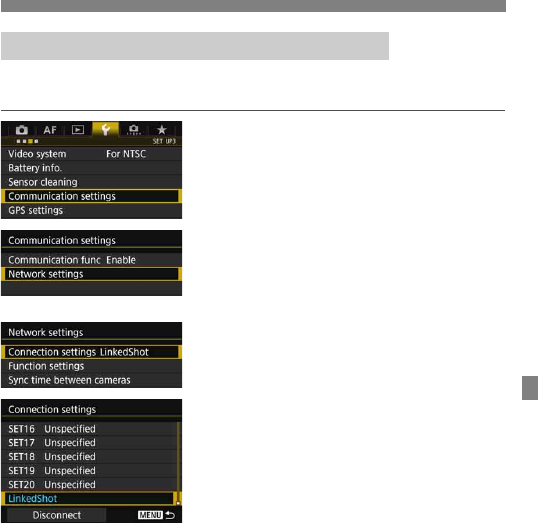
93
Using the Transmitter with WFT Server
You will need the camera’s IP address and SSID, displayed in step 6, to
connect to the camera from a computer.
1Select [Communication settings].
Under the [53] tab, select
[Communication settings], then
press <0>.
2Select [Network settings].
Set [Communication func] to
[Enable], then select [Network
settings].
3Select [Connection settings].
4Select [LinkedShot].
Turn the <5> dial to select
[LinkedShot] at the bottom.
Checking the Camera’s IP Address and SSID
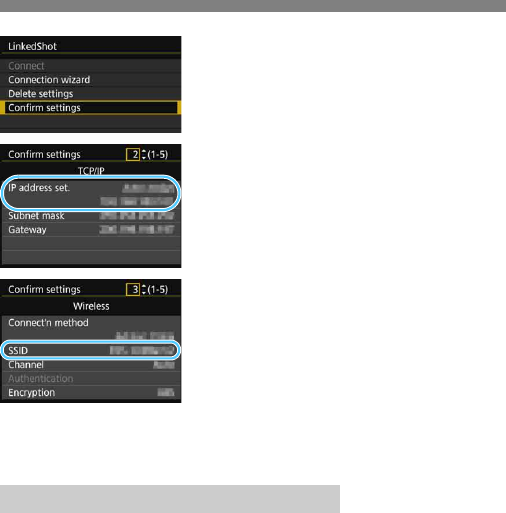
94
Using the Transmitter with WFT Server
5Select [Confirm settings].
The settings are displayed.
6Check the settings.
Turn the <5> dial to display other
screens.
Write down the IP address and SSID.
The SSID is the same for all the
cameras.
After checking the settings, press the
<M> button to exit the
confirmation dialog.
Check settings on the master camera and all slave cameras in the
same way.
IP addresses assigned to cameras end in 1 - 11, as in 192.168.1.1 -
192.168.1.11.
For this reason, assign computer IP addresses that end in a number
higher than 11, as in 192.168.1.12.
IP Addresses Assigned to Computers

95
Using the Transmitter with WFT Server
To connect the cameras and the computer, use the computer’s wireless
LAN device search function.
For information about the wireless LAN device search function, refer
to the computer instruction manual.
Wireless LAN functions and operating system of the computer
must support ad hoc mode.
Set up a WFT account on the [Function settings] screen (p.114) in
advance.
1From the computer, find cameras
on the network.
Use the computer’s wireless LAN
device search function.
2Connect to a camera.
Select a device with the same ID as
the SSID you wrote down in step 6 on
page 94.
In the password field, enter the
encryption key set in step 6 on page 92.
The computer is now connected to
the camera.
3Display WFT Server.
For the operation procedure, see
page 62.
In the address field, enter the IP
address you wrote down in step 6 on
page 63.
To connect to a different camera,
change the IP address in the address
field.
Log in to a WFT account by entering
the [Login name] (user name) and
[Password] specified in advance.
Connecting the Cameras and the Computer

96
Using the Transmitter with WFT Server
For how to use WFT Server, see page 59.
To switch cameras, enter the IP address of the master or slave
camera in the web browser.
When shooting remotely with linked shooting, connect to the master
camera. If you connect to a slave camera, only that slave camera
will shoot, without linked shooting.
You can connect to slave cameras, adjust the focus and configure
shooting functions, and then use the master camera for linked
shooting.
Making Images Viewable and Shooting Remotely
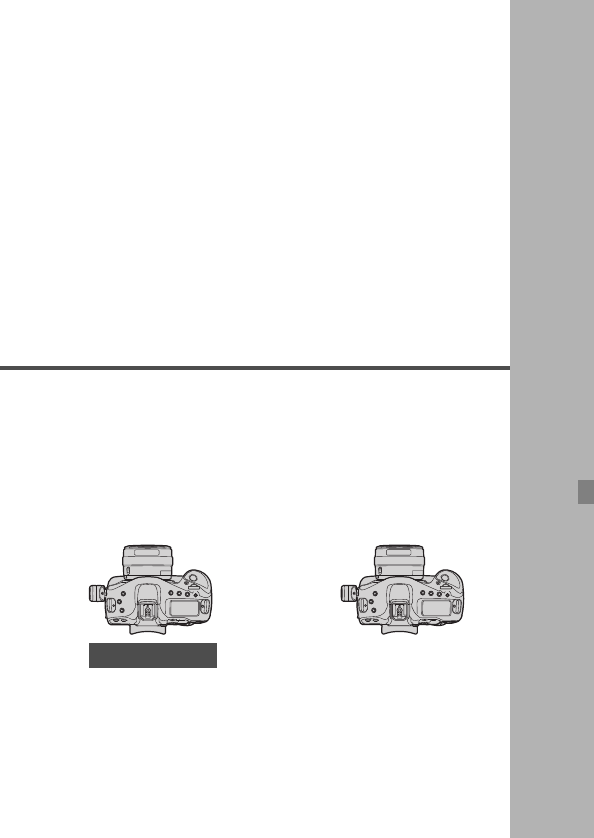
97
7
Synchronizing the
Camera Time Wirelessly
You can wirelessly synchronize multiple cameras of the
same camera model when the transmitter is attached.
You can set the master camera time on up to 10 slave
cameras. Note that even after synchronization, there
will be a slight margin of error between master and
slave camera time of ±0.05 seconds, at most.
Slave cameraMaster camera
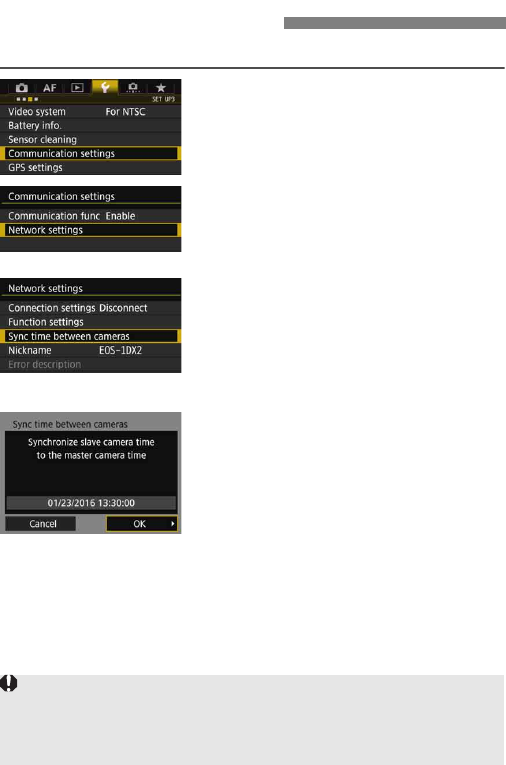
98
Steps 1 to 5 are the same on the master and slave cameras.
1Select [Communication settings].
Under the [53] tab, select
[Communication settings], then
press <0>.
2Select [Network settings].
Set [Communication func] to
[Enable], then select [Network
settings].
3Select [Sync time between
cameras].
If connected to another device, [Set
[Connection settings] to
[Disconnect]] will appear. Select
[OK] to terminate the connection.
4Select [OK].
Synchronizing the Time
Synchronize the camera time between the same camera
models.
If the camera models of the master camera and slave cameras are different,
synchronizing the time with slave cameras is not possible.
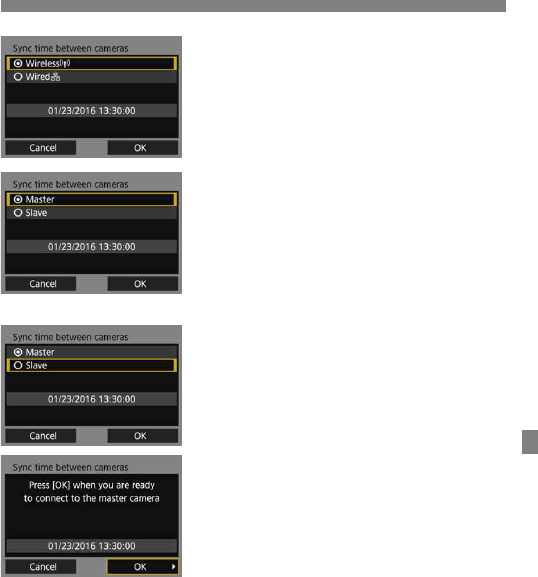
99
Synchronizing the Time
5Select [Wireless].
Select [OK] and press <0> to go to
the next screen.
6Set up the master camera.
Select [Master], then press <0>.
Select [OK] and press <0> to go to
the next screen.
When the next screen is displayed,
the master camera is ready. Go to
step 7 to set up the slave cameras.
7Set up the slave cameras.
After configuring the slave camera
settings following steps 1 to 5 on the
preceding page, select [Slave].
Select [OK] and press <0> to go to
the next screen.
Select [OK] on the displayed screen.
To set the time on multiple slave
cameras, follow these steps on all
slave cameras.
On the master camera’s LCD monitor,
the number of slave cameras
detected is displayed.
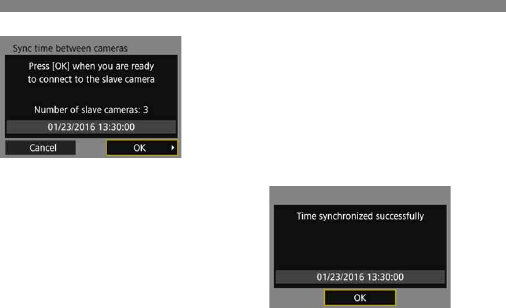
100
Synchronizing the Time
8On the master camera, select
[OK].
Check the number of slave cameras,
then select [OK].
The time on slave cameras is
synchronized to the master camera
time.
Select [OK] to return to the [Network
settings] screen.

101
8
Terminating the Connection
and Reconnecting
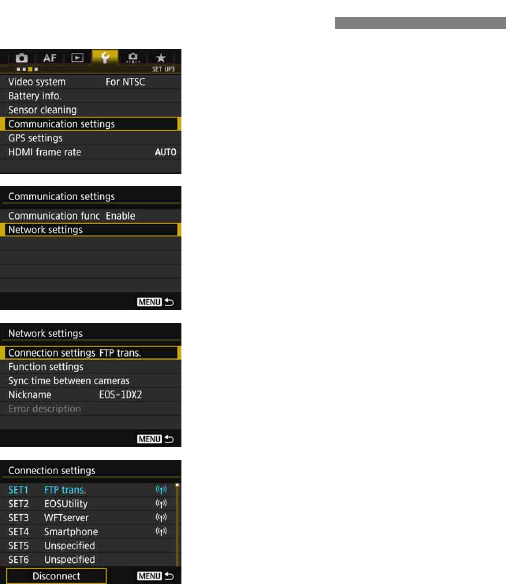
102
1Select [Communication settings].
Under the [53] tab, select
[Communication settings], then
press <0>.
2Select [Network settings].
Set [Communication func] to
[Enable], then select [Network
settings].
3Select [Connection settings].
4Select [Disconnect].
The connection is terminated.
Terminating the Connection
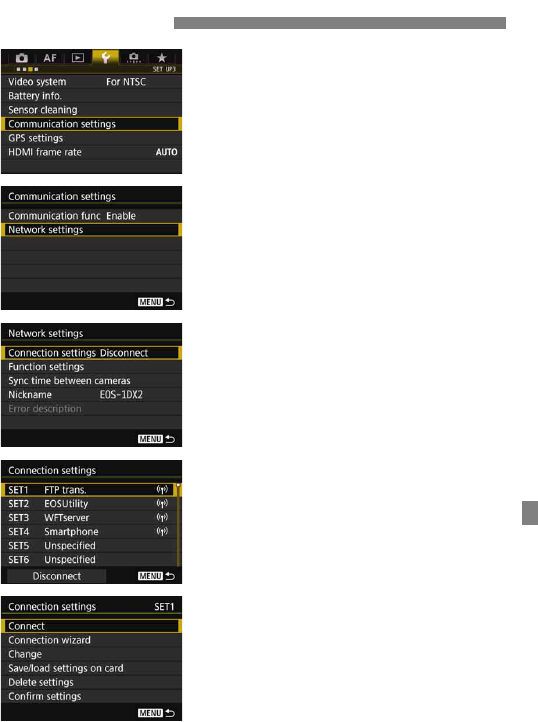
103
1Select [Communication settings].
Under the [53] tab, select
[Communication settings], then
press <0>.
2Select [Network settings].
Set [Communication func] to
[Enable], then select [Network
settings].
3Select [Connection settings].
4Select [SET*].
From the saved settings, select the
setting to connect to.
5Select [Connect].
The connection is re-established.
If settings have been changed on the
target device, configure the settings
again to connect to the camera.
Reconnecting

104
MEMO

105
9
Checking and Operating
Connection Settings
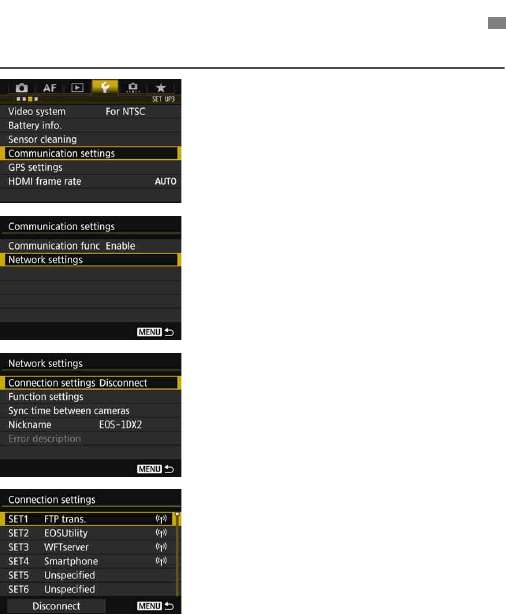
106
Check, change, or delete connection settings saved on the camera.
1Select [Communication settings].
Under the [53] tab, select
[Communication settings], then
press <0>.
2Select [Network settings].
Set [Communication func] to
[Enable], then select [Network
settings].
3Select [Connection settings].
4Select the setting.
From the saved settings, select the
setting to check.
Displaying the Connection Settings Screen
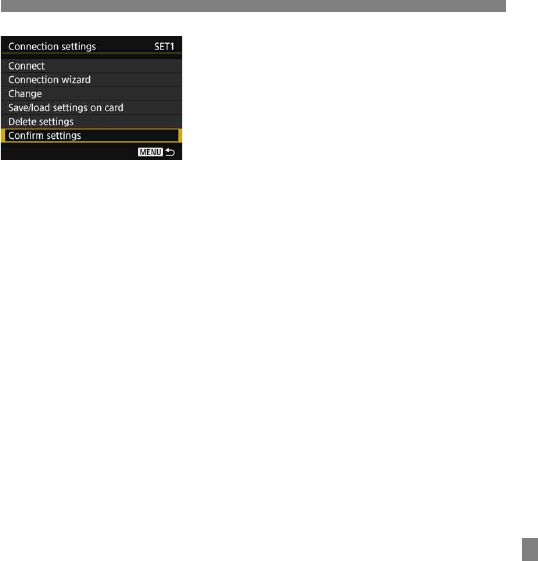
107
Displaying the Connection Settings Screen
5Check or change the settings.
Select an item and press <0>, then
check or change the settings on the
displayed screen.
[Connect] (p.103)
Select this to re-establish a connection. Select [OK] on the confirmation
dialog and press <0> to establish a connection.
[Connection wizard]
Set up a connection using the connection wizard. Follow the
procedures displayed to complete the connection settings. If settings
are already saved, they will be overwritten.
[Change] (p.108)
Change connection settings saved on the camera.
[Save/load settings on card] (p.112, 113)
Save connection settings saved on the camera to a card, or load
connection settings saved on a card into the camera.
[Delete settings]
Delete connection settings saved on the camera. Select [OK] on the
confirmation dialog to delete the setting.
[Confirm settings]
Check connection settings saved on the camera. When you select
[Confirm settings], the settings will be displayed.
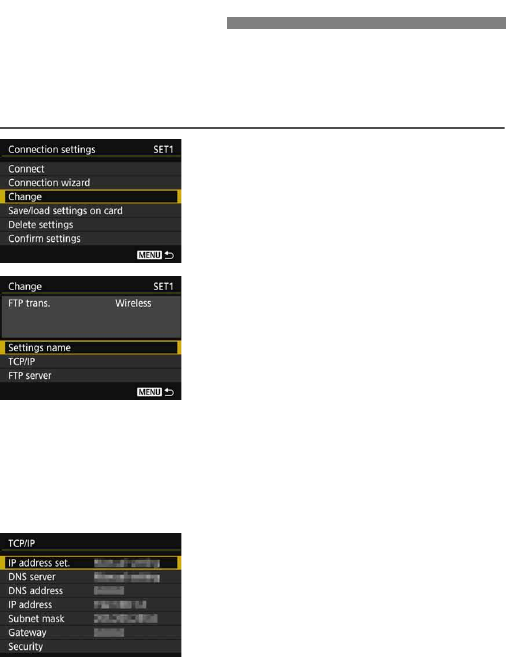
108
Settings originally completed using the connection wizard can be
changed as follows. You can also change settings that cannot be set
using the connection wizard, such as when an image with the same file
name as an existing file is sent to the FTP server.
1Select [Change].
On the [Connection settings] screen
displayed in step 5 on page 107,
select [Change].
2Select the item to change.
Select the item and press <0>. A
setting screen will appear.
[Settings name]
You can name the settings. Select [Settings name], then enter
characters using the virtual keyboard (p.21).
[TCP/IP]
Configure network settings such as IP
address settings and security settings.
Changing Settings
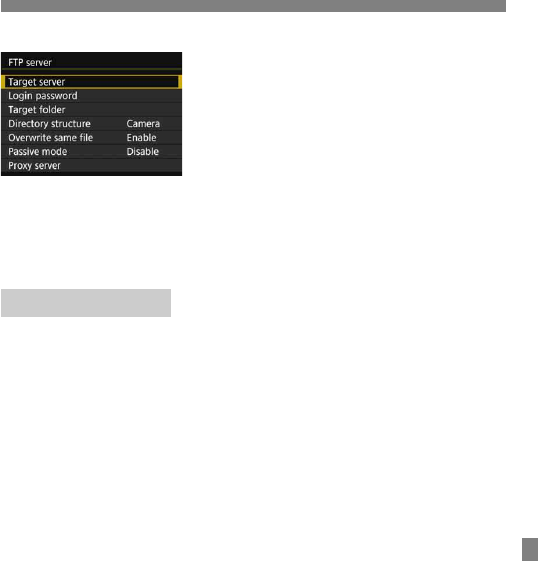
109
Changing Settings
[FTP server]
This is displayed for settings that
connect to an FTP server. Configure FTP
server settings.
[Viewable imgs] (p.80)
This is displayed for settings that connect to a smartphone. See page
80 to set.
Configured in [TCP/IP] 9 [Security].
IPsec is a set of standards for encrypted communication over the
Internet. It provides effective security for both wireless and wired LANs.
To use this function, you must enable IPsec in the network settings of
the computer. When IPsec is employed, only transport mode is
supported, and 3DES or AES encryption and SHA-1 authentication are
used. Note that the IP address of the computer for communication with
the transmitter must be entered in [Destination address] on the
settings screen.
IP Security (IPsec)

110
Changing Settings
Configured in [FTP server] 9 [Directory structure].
Selecting [Camera] automatically creates a folder structure matching
that of the camera’s (such as A/DCIM/100EOS1D) in the server’s root
folder for image storage. If you have created a subfolder in the root
folder by changing the [Target folder] setting, a folder structure such as
“A/DCIM/100EOS1D” is automatically created in that folder for image
storage.
Selecting [Default] will use the root folder for image storage. If you have
created a subfolder in the root folder by changing the [Target folder]
setting, images are saved in that folder.
Configured in [FTP server] 9 [Overwrite same file].
When [Overwrite same file] is set to [Disable]
If there is already a file of the same name in the target folder on the FTP
server, the new file is saved with an extension consisting of an
underscore and a number, as in IMG_0003_1.JPG.
When you resend images if initial transfer fails
Even if the transmitter is configured to overwrite files of the same name,
if you resend an image file that could not be transferred initially, the
existing file may not be overwritten in some cases. If this happens, the
new file is saved with an extension consisting of an underscore, a letter,
and a number, as in IMG_0003_a1.JPG.
Directory Structure of the Target Folder
Overwriting Files of the Same Name

111
Changing Settings
Configured in [FTP server] 9 [Passive mode].
Enable this setting in network environments protected by a firewall. If an
Error 41 occurs (“Cannot connect to FTP server”), setting passive mode
to [Enable] may enable access to the FTP server.
Passive Mode
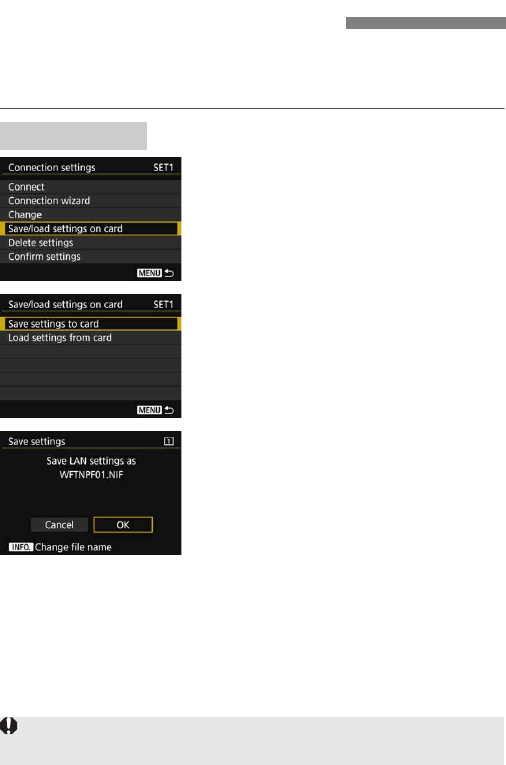
112
Connection settings can be saved on a card for use with other cameras.
In addition, connection settings configured on other cameras can be
applied to the camera to be used.
1Select [Save/load settings on
card].
On the [Connection settings] screen
displayed in step 5 on page 107,
select [Save/load settings on card].
2Select [Save settings to card].
3Select [OK].
The file name is determined
automatically by the camera:
WFTNPF, followed by a number (01
to 99) and the extension NIF. You can
rename the file as desired by
pressing the [z] button.
The settings are saved on the card.
The settings are saved as a file in the
area of the card shown when the card
is opened (in the root directory).
Saving and Loading Settings
Saving Settings
Only ten settings files can be saved on one card from the camera. To save
more than ten, use another card.
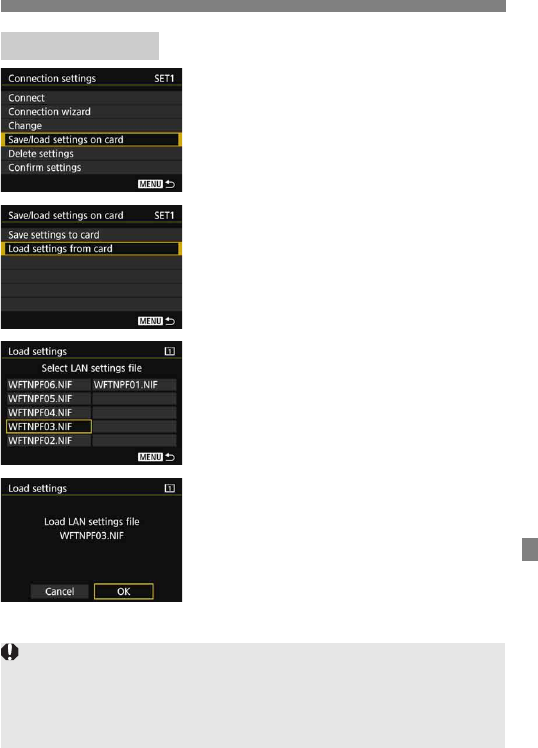
113
Saving and Loading Settings
1Select [Save/load settings on
card].
On the [Connection settings] screen
displayed in step 5 on page 107,
select [Save/load settings on card].
2Select [Load settings from card].
3Select the settings file.
Select a settings file that matches
your network environment.
4Select [OK].
Information from the settings file is
loaded into the selected settings
number.
Loading Settings
Even if a computer or other device is used to save more than ten settings
files on one card, only ten will be displayed on the camera’s load settings
screen. To load eleven or more settings files, first load up to ten setting files,
then load the remaining files from a card that does not contain already
loaded setting files.
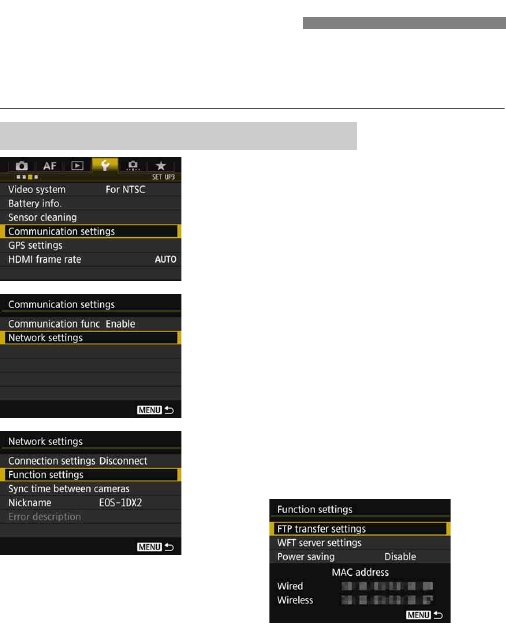
114
On the [Function settings] screen, you can configure settings for FTP
transfer and the WFT Server, set the power saving function, and check
the MAC address.
1Select [Communication settings].
Under the [53] tab, select
[Communication settings], then
press <0>.
2Select [Network settings].
Set [Communication func] to
[Enable], then select [Network
settings].
3Select [Function settings].
The [Function settings] screen is
displayed.
Function Settings Screen
Displaying the Function Settings Screen
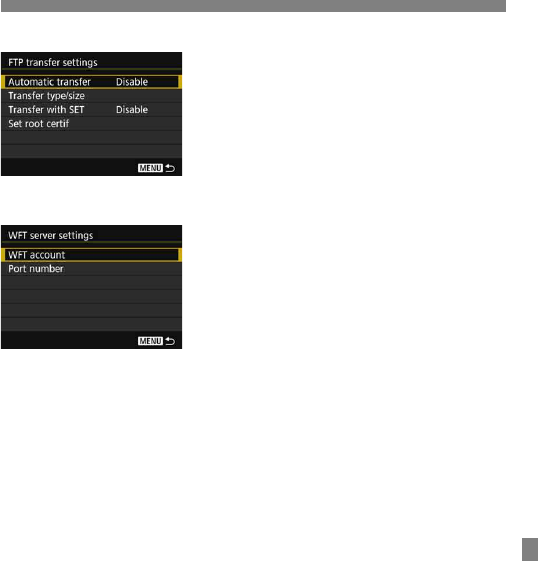
115
Function Settings Screen
[FTP transfer settings]
Configure FTP transfer settings. See
page 37 to set.
[WFT server settings]
Configure WFT Server settings. You can
set the WFT account and port number.
For instructions on setting the WFT
account, see page 60.
Note that there is normally no need to
change the port number (80).

116
Function Settings Screen
[Power saving]
FTP Trans.
When [Enable] is set, if no image is transferred for a certain period
of time, the transmitter will log off from the FTP server and stop the
LAN. When the transmitter is ready for image transfer, the
connection is re-established automatically.
EOSUtility/WFTserver/Smartphone
If no communication is established for a certain period of time, the
transmission rate drops to save power. Note that the camera
responds as follows regardless of the [Power saving] setting.
• When a connection is established with [Easy connection], the
power saving function is disabled.
• When a connection is established using an access point, the
power saving function is enabled.
LinkedShot
The power saving function is disabled regardless of the setting.
[MAC address]
The MAC address of the transmitter can be checked. The MAC address
of the transmitter is displayed in [Wireless].

117
10
Troubleshooting Guide
Transfer speed in ad hoc mode may become extremely slow when
the transmitter is used with certain types of computer. For more
information, contact your dealer or nearest Canon Service Center.
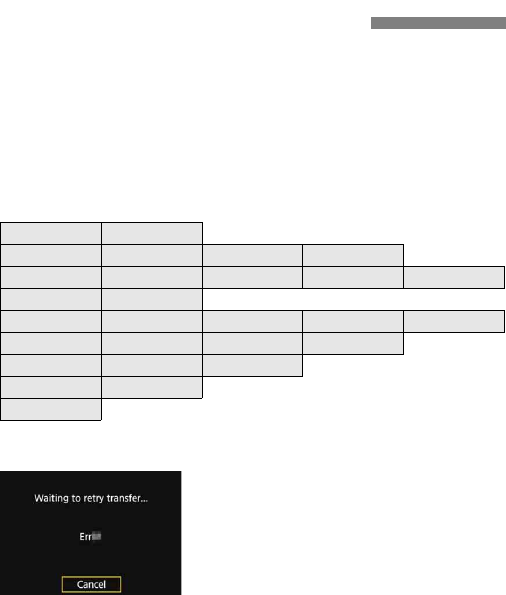
118
If a wireless setting error is displayed on the camera’s LCD monitor,
refer to the examples of corrective actions in this section to eliminate
the cause of the error. In case of errors, the <Y> lamp on the
camera blinks in red. The error details can also be checked under the
[53] tab [Communication settings] 9 [Network settings] 9 [Error
description].
Click the error code number’s page in the following chart to jump to the
corresponding page.
If [Waiting to retry transfer...] is displayed
If image transfer via FTP fails after
shooting, the screen on the left is
displayed, and the camera’s <Y>
lamp blinks in red. Check the error code
number and eliminate the cause of the
error.
Once the cause of the error is eliminated, the images whose transfer
previously failed will be re-transferred automatically.
Note that when you cancel image transfer, or turn off the camera, the
image will not be re-transferred automatically. See page 48 and transfer
the image.
Responding to Error Messages
11 (p.119) 12 (p.119)
21 (p.119) 22 (p.121) 23 (p.122) 24 (p.122)
41 (p.124) 42 (p.126) 43 (p.126) 44 (p.126) 45 (p.127)
46 (p.128) 47 (p.128)
61 (p.129) 62 (p.129) 63 (p.130) 64 (p.130) 65 (p.131)
66 (p.131) 67 (p.132) 68 (p.132) 69 (p.132)
71 (p.133) 72 (p.133) 73 (p.133)
82 (p.134) 83 (p.134)
91 (p.134)

119
Responding to Error Messages
In the case of [EOSUtility], is EOS Utility running?
Start EOS Utility and re-establish the connection (p.56).
In the case of [Smartphone], is Camera Connect running?
Establish a connection using Camera Connect (p.76).
Are the transmitter and the access point set to use the same
encryption key for authentication?
This error occurs if the encryption keys do not match when the
authentication method for encryption is set to [Open system].
The setting is case-sensitive, so check upper- and lower-case
characters. Make sure that the correct encryption key for
authentication is entered on the transmitter (p.32).
Are the target device and access point turned on?
Turn on the target device and access point, then wait a while. If a
connection still cannot be established, perform the procedures to
establish the connection again.
What to check on the transmitter
On the transmitter, IP address is set to [Auto setting]. Is this
the correct setting?
If no DHCP server is used, configure settings after setting the IP
address to [Manual setting] on the transmitter (p.144).
11: Connection target not found
12: Connection target not found
21: No address assigned by DHCP server

120
Responding to Error Messages
What to check on the DHCP server
Is the power of the DHCP server on?
Turn on the DHCP server.
Are there enough addresses for assignment by the DHCP
server?
Increase the number of addresses assigned by the DHCP server.
Remove devices assigned addresses by the DHCP server from
the network to reduce the number of addresses in use.
Is the DHCP server working correctly?
Check the DHCP server settings to make sure it is working
correctly as a DHCP server.
If applicable, ask your network administrator to ensure the DHCP
server is available.
What to check on the network as a whole
Does your network include a router or similar device that
serves as a gateway?
If applicable, ask your network administrator for the network
gateway address and enter it on the transmitter (p.138, 144).
Make sure that the gateway address setting is correctly entered on
all network devices, including the transmitter.
Responding to Error Messages 21 - 24
Also check the following points when responding to errors numbered 21 - 24.
Are the transmitter and the access point set to use the same
encryption key for authentication?
This error occurs if the encryption keys do not match when the
authentication method for encryption is set to [Open system]. The
setting is case-sensitive, so check upper- and lower-case characters.
Make sure that the correct encryption key for authentication is entered
on the transmitter (p.32).

121
Responding to Error Messages
What to check on the transmitter
On the transmitter, DNS address is set to [Manual setting]. Is
this the correct setting?
If no DNS server is used, set the transmitter’s DNS address setting
to [Disable] (p.144).
On the transmitter, does the DNS server’s IP address setting
match the server’s actual address?
On the transmitter, set the IP address that matches the address of
the DNS server used (p.138, 144).
What to check on the DNS server
Is the power of the DNS server on?
Turn on the DNS server.
Are the DNS server settings for IP addresses and the
corresponding names correct?
On the DNS server, make sure IP addresses and the
corresponding names are entered correctly.
Is the DNS server working correctly?
Check the DNS server settings to make sure the server is working
correctly as a DNS server.
If applicable, ask your network administrator to ensure that the
DNS server is available.
What to check on the network as a whole
Does your network include a router or similar device that
serves as a gateway?
If applicable, ask your network administrator for the network
gateway address and enter it on the transmitter (p.138, 144).
Make sure that the gateway address setting is correctly entered on
all network devices, including the transmitter.
22: No response from DNS server

122
Responding to Error Messages
What to check on the transmitter
Is another device on the transmitter network using the same
IP address as the transmitter?
Change the transmitter’s IP address to avoid using the same
address as another device on the network. Otherwise, change the
IP address of the device that has a duplicate address.
If the transmitter’s IP address is set to [Manual setting] in network
environments using a DHCP server, change the setting to [Auto
setting] (p.34).
What to check on the transmitter
The transmitter’s proxy server setting is [Enable]. Is this the
correct setting?
If no proxy server is used, set the proxy server setting to [Disable]
(p.39).
Do the transmitter’s [Address setting] and [Port No.] settings
match those of the proxy server?
Configure the transmitter’s proxy server address and port number
to match those of the proxy server (p.39).
Are the transmitter’s proxy server settings correctly entered
on the DNS server?
Make sure the proxy server’s [Address] is correctly entered on the
DNS server.
23: Duplicate IP address
24: No response from proxy server

123
Responding to Error Messages
What to check on the proxy server
Is the power of the proxy server on?
Turn on the proxy server.
Is the proxy server working correctly?
Check the proxy server settings to make sure it is working correctly
as a proxy server.
If applicable, ask your network administrator for the proxy server’s
address setting and port number, then enter them on the
transmitter.
What to check on the network as a whole
Does your network include a router or similar device that
serves as a gateway?
If applicable, ask your network administrator for the network
gateway address and enter it on the transmitter.
Make sure that the gateway address setting is correctly entered on
all network devices, including the transmitter.

124
Responding to Error Messages
What to check on the transmitter
On the transmitter, does the FTP server’s IP address setting
match the server’s actual address?
Configure the IP address on the transmitter to match the actual
FTP server address (p.38).
Are the transmitter and the access point set to use the same
encryption key for authentication?
This error occurs if the encryption keys do not match when the
authentication method for encryption is set to [Open system].
The setting is case-sensitive, so check upper- and lower-case
characters. Make sure that the correct encryption key for
authentication is entered on the transmitter (p.32).
On the transmitter, does the [Port number setting] for the FTP
server match the actual port number of the FTP server?
Configure the same port number (usually 21) on the transmitter
and FTP server. Configure the port number on the transmitter to
match the actual FTP server port number (p.39).
Are the transmitter’s FTP server settings correctly entered on
the DNS server?
Make sure the FTP server’s [Server name] is correctly entered on
the DNS server. Make sure the [Server name] for the FTP server
is correctly entered on the transmitter (p.38).
41: Cannot connect to FTP server

125
Responding to Error Messages
What to check on the FTP server
Is the FTP server working correctly?
Configure the computer correctly to function as an FTP server.
If applicable, ask your network administrator for the FTP server
address and port number, then enter them on the transmitter.
Is the power of the FTP server on?
Turn on the FTP server. The server may have been turned off
because of an energy-saving mode.
On the transmitter, does the FTP server’s IP address setting
(in [Address]) match the server’s actual address?
Configure the IP address on the transmitter to match the actual
FTP server address (p.38).
Is a firewall or other security software enabled?
Some security software uses a firewall to restrict access to the FTP
server. Change the firewall settings to allow access to the FTP
server.
You may be able to access the FTP server by setting [Passive
mode] to [Enable] on the transmitter (p.111).
Are you connecting to the FTP server via a broadband router?
Some broadband routers use a firewall to restrict access to the
FTP server. Change the firewall settings to allow access to the
FTP server.
You may be able to access the FTP server by setting [Passive
mode] to [Enable] on the transmitter (p.111).

126
Responding to Error Messages
What to check on the network as a whole
Does your network include a router or similar device that
serves as a gateway?
If applicable, ask your network administrator for the network
gateway address and enter it on the transmitter (p.138, 144).
Make sure that the gateway address setting is correctly entered on
all network devices, including the transmitter.
What to check on the FTP server
Is the FTP server configured to restrict access to only some IP
addresses?
Change the FTP server settings to allow access from the [IP
address] configured on the transmitter in the TCP/IP settings.
What to check on the FTP server
Have you exceeded the maximum number of FTP server
connections?
Disconnect some network devices from the FTP server or increase
the maximum number of connections in the FTP server settings.
This error occurs if the transmitter fails to disconnect from
the FTP server for some reason.
Turn off and on the FTP server and camera.
42: FTP server rejected connection
43: Cannot connect to FTP server. Error code received
from server.
44: Cannot disconnect FTP server. Error code received
from server.

127
Responding to Error Messages
What to check on the transmitter
On the transmitter, is the [Login name] entered correctly?
Check the login name for accessing the FTP server. The setting is
case-sensitive, so check upper- and lower-case characters. Make
sure the correct login name is entered on the transmitter (p.39).
On the transmitter, is the [Login password] entered correctly?
If a login password is configured on the FTP server, check the
upper- and lower-case characters to make sure the password on
the transmitter matches it (p.39).
What to check on the FTP server
Do the user rights for the FTP server allow reading, writing,
and log access?
Configure the FTP server’s user rights to allow reading, writing,
and log access.
Is the folder specified as the transfer destination on the FTP
server named with ASCII characters (p.21)?
Use ASCII characters for the folder name.
45: Cannot login to FTP server. Error code received
from server.

128
Responding to Error Messages
What to check on the FTP server
The connection was terminated by the FTP server.
Restart the FTP server.
Do the user rights for the FTP server allow reading, writing,
and log access?
Configure the FTP server’s user rights to allow reading, writing,
and log access.
Do user rights allow access to the target folder on the FTP
server?
Configure the user rights for access to the target folder on the FTP
server to allow saving images from the transmitter.
Is the power of the FTP server on?
Turn on the FTP server. The server may have been turned off
because of an energy-saving mode.
Is the hard disk of the FTP server full?
Increase available space on the hard disk.
This error occurs if, for some reason, the transmitter fails to
receive confirmation from the FTP server that image file
transfer is complete.
Turn off and on the FTP server and camera, then transfer the
images again.
46: For the data session, error code received from FTP
server
47: Image file transfer completion not confirmed by
FTP server

129
Responding to Error Messages
Are any obstacles blocking the line of sight between the
transmitter and the antenna of the access point?
Move the antenna of the access point to a position clearly visible
from the point of view of the transmitter (p.136).
What to check on the transmitter
Does the SSID set on the transmitter match that of the access
point?
Check the SSID at the access point, then set the same SSID on
the transmitter (p.31).
What to check at the access point
Is the access point turned on?
Turn on the power of the access point.
If filtering by MAC address is active, is the MAC address of the
transmitter used registered at the access point?
Register the MAC address (p.116) of the transmitter used at the
access point.
What to check on the transmitter
Is the transmitter configured for communication in
infrastructure mode?
Configure the transmitter for communication in ad hoc mode.
What to check at the access point
Is there a nearby access point for ad hoc communication?
Set up an access point for ad hoc communication near the
transmitter.
61: Selected SSID wireless LAN network not found
62: No response from wireless LAN terminal

130
Responding to Error Messages
Are the transmitter and the access point set to use the same
authentication method?
The transmitter supports the following authentication methods:
[Open system], [Shared key], and [WPA/WPA2-PSK] (p.27).
Are the transmitter and the access point set to use the same
encryption key for authentication?
The setting is case-sensitive, so check upper- and lower-case
characters. Make sure that the correct encryption key for
authentication is entered on the transmitter (p.32).
If filtering by MAC address is active, is the MAC address of the
transmitter used registered at the access point?
Register the MAC address (p.116) of the transmitter at the access
point.
Are the transmitter and the access point set to use the same
encryption method?
The transmitter supports the following encryption methods: WEP,
TKIP, and AES (p.27).
If filtering by MAC address is active, is the MAC address of the
transmitter used registered at the access point?
Register the MAC address (p.116) of the transmitter used at the
access point.
63: Wireless LAN authentication failed
64: Cannot connect to wireless LAN terminal

131
Responding to Error Messages
Are any obstacles blocking the line of sight between the
transmitter and the antenna of the access point?
Move the antenna of the access point to a position clearly visible
from the point of view of the transmitter (p.136).
The wireless LAN connection was lost, for some reason, and
the connection cannot be restored.
The following are possible reasons: excessive access to the
access point from other terminals, a microwave oven or similar
appliance in use nearby (interfering with IEEE 802.11n/g/b (2.4
GHz band)), or influence of rain or high humidity (p.136).
Are the transmitter and the access point set to use the same
encryption key for authentication?
The setting is case-sensitive, so check upper- and lower-case
characters. Make sure that the correct encryption key for
authentication is entered on the transmitter and the access point
(p.32).
Note that if the authentication method is [Open system], an Error
41 (“Cannot connect to FTP server”) is displayed.
65: Wireless LAN connection lost
66: Incorrect wireless LAN encryption key
132
Responding to Error Messages
Are the transmitter and the access point set to use the same
encryption method?
The transmitter supports the following encryption methods: WEP,
TKIP, and AES (p.27).
If filtering by MAC address is active, is the MAC address of the
transmitter used registered at the access point?
Register the MAC address (p.116) of the transmitter used at the
access point.
Did you hold down the access point’s WPS (Wi-Fi Protected
Setup) button for the specified period of time?
Hold down the WPS button for the period of time instructed by the
access point’s instruction manual.
Are you trying to establish a connection near the access
point?
Try establishing the connection when both devices are within reach
of each other.
Connection is in progress by other access points in
Pushbutton Connection mode (PBC mode) of Wi-Fi Protected
Setup (WPS).
Wait a while before trying to establish the connection, or try to
establish a connection in PIN code connection mode (PIN mode)
(p.29).
67: Incorrect wireless LAN encryption method
68: Cannot connect to wireless LAN terminal. Retry
from the beginning.
69: Multiple wireless LAN terminals have been found.
Cannot connect. Retry from the beginning.

133
Responding to Error Messages
Are you following the correct procedure to establish the
connection with slave cameras?
Operate slave cameras by following the correct instructions (p.84,
85).
Are the slave cameras too far from the master camera?
Bring the slave cameras closer to the master camera.
Are you following the correct procedure to establish the
connection with master camera?
Operate the master camera by following the correct instructions
(p.86, 87).
Is the master camera too far from the slave cameras?
Bring the master camera closer to the slave cameras.
Are you following the correct procedure to establish a
connection between the master and slave cameras?
Operate the master and slave cameras by following the correct
instructions (p.98-100).
Is the master camera too far from the slave cameras?
Bring the master and slave cameras closer together.
71: Cannot connect to slave camera
72: Cannot connect to master camera
73: Could not synchronize the time

134
Responding to Error Messages
Is the transmitter attached correctly?
Make sure the transmitter is securely inserted in the camera (p.11).
Due to transmitter temperature rise, wireless operation has
temporarily stopped and the wireless LAN connection has
been terminated.
Allow the transmitter to cool down (for example, by shielding it from
direct sunlight). When the transmitter cools down, the connection
will be automatically re-established.
A problem other than error code number 11 to 83 occurred.
Turn off and on the camera’s power switch.
82: Wireless File Transmitter not connected
83: Wireless LAN connection terminated because of
high WFT temperature
91: Other error
135
If a problem occurs, first refer to this Troubleshooting Guide to check
the camera and connected device. If this Troubleshooting Guide does
not resolve the problem, contact the nearest Canon Service Center.
To transfer captured images to an FTP server, set the Live View
shooting/Movie shooting switch to <A>.
When the Live View shooting/Movie shooting switch is set to
<k>, images cannot be transferred.
To perform linked shooting, set the Live View shooting/Movie
shooting switch to <A>.
When the Live View shooting/Movie shooting switch is set to
<k>, linked shooting is not possible.
Even with a combination of the same camera and smartphone, if
you have changed the settings or selected a different setting,
reconnection may not be established even after selecting the same
SSID. In such a case, delete the camera connection settings from
the Wi-Fi settings on the smartphone and set up a connection
again.
If Camera Connect is left running while setting up a connection
again, the connection may not be established. In such a case,
restart Camera Connect.
If wireless operation is used continuously in high ambient
temperatures for a prolonged period, the camera temperature may
rise; consequently, an Error 83 may appear and the wireless
operation may stop (p.134).
Troubleshooting Guide
Cannot transfer images to an FTP server.
Cannot perform linked shooting.
Cannot reconnect to a smartphone.
The camera and transmitter heat up and the transmission
rate drops.

136
If the transmission rate drops, the connection is lost, or other problems
occur when using the communication function, try the following
corrective actions.
When using the transmitter indoors, install the device in the same
room where you are shooting.
Install the device higher than the transmitter.
Install the device where people or objects do not come between it
and the transmitter.
Install the device as close to the transmitter as possible. In
particular, note that during outdoor use in poor weather, rain may
absorb radio waves and disrupt the connection.
If the transmission rate of a wireless LAN drops because of the
influence of the following electronic devices, stop using them or
establish a connection further away from them. In addition, switching to
a wired LAN can resolve the problem.
The transmitter communicates over wireless LANs via
IEEE 802.11n/g/b using radio waves in the 2.4 GHz band. For this
reason, the wireless LAN transmission rate may drop if there are
nearby microwave ovens, cordless telephones, microphones, or
similar devices operating on the same frequency band.
If a wireless LAN terminal on the same frequency band as the
transmitter is used nearby, the transmission rate of the wireless
LAN may drop.
Communication Function Setting Notes
Access Point and Antenna Installation Location
Nearby Electronic Devices

137
Communication Function Setting Notes
When multiple cameras with a wireless transmitter attached are
connected to one access point, make sure that the cameras’ IP
addresses are different.
When multiple cameras with a wireless transmitter attached are
connected to one access point, the transmission rate drops.
When there are multiple IEEE 802.11n/g/b (2.4 GHz band) access
points, leave a gap of four channels between each wireless LAN
channel to reduce radio wave interference. For example, use
channels 1, 6, and 11, channels 2, 7, and 12, or channels 3, 8, and
13.
When IEEE 802.11n/a can be used (on the 5 GHz band), switch to
IEEE 802.11n/a (on the 5 GHz band) and specify a different
channel.
If security settings have not been properly set, the following problems
may occur.
Transmission monitoring
Third parties with malicious intent may monitor the wireless LAN
transmissions and attempt to acquire the data you are sending.
Unauthorized network access
Third parties with malicious intent may gain unauthorized access to
the network you are using to steal, modify, or destroy information.
Additionally, you could fall victim to other types of unauthorized
access such as impersonation (where someone assumes an
identity to gain access to unauthorized information) or springboard
attacks (where someone gains unauthorized access to your
network as a springboard to cover their tracks when infiltrating
other systems).
To prevent these types of problems from occurring, be sure to
thoroughly secure your network.
Notes for Using Multiple Wireless Transmitters
Security

138
Windows
Open the Windows [Command Prompt], then type ipconfig /all and
press the <Enter> key.
The IP address assigned to the computer is displayed, as well as the
subnet mask, gateway, and DNS server information.
Mac OS
In Mac OS X, open the [Terminal] application, enter ifconfig -a, and
press the <Return> key. The IP address assigned to the computer is
indicated in the [en0] item by [inet], in the format “***.***.***.***”.
* For information about the [Terminal] application, refer to the Mac OS X help.
To avoid using the same IP address for the computer and other
devices on the network, change the rightmost number when
configuring the IP address assigned to the camera in the processes
described on page 144.
Checking Network Settings
Example: 192.168.1.10

139
11
Reference
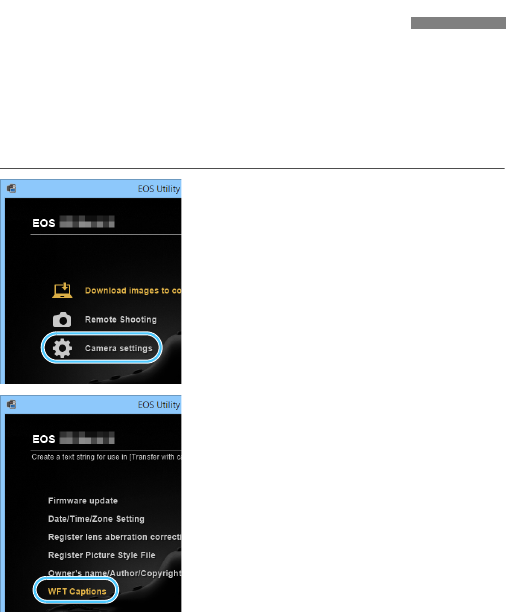
140
Follow these steps to create captions and register them on the camera,
as introduced in “Adding a Caption Before Transfer” (p.52). When
creating and registering captions, use a computer on which EOS Utility
is installed.
See “Operating Remotely Using EOS Utility” on page 55 to enable
the use of EOS Utility over a LAN.
1Start EOS Utility and select
[Camera settings].
The camera settings screen is
displayed.
2Select [WFT Captions].
The screen for caption creation is
displayed.
Creating and Registering Captions
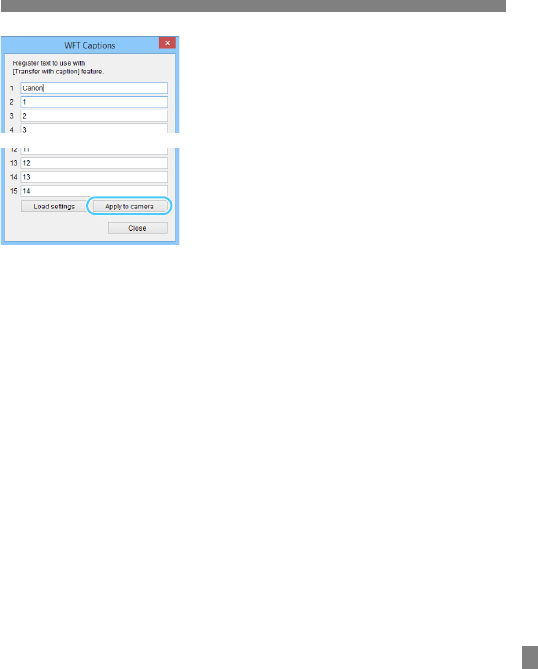
141
Creating and Registering Captions
3Enter the caption or captions.
Enter up to 31 characters (in ASCII
format).
To acquire caption data stored in the
camera, select [Load settings].
4Register the captions on the
camera.
Select [Apply to camera] to register
your new captions on the camera.
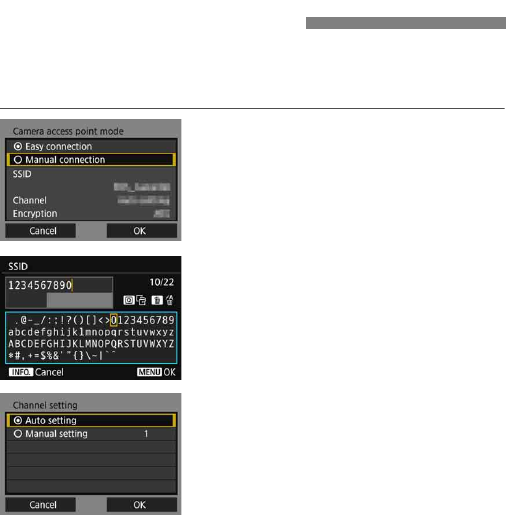
142
Set the network settings for the camera access point mode manually.
Set [SSID], [Channel setting], and [Encryption settings] on each
screen displayed.
1Select [Manual connection].
Select [OK] and press <0> to go to
the next screen.
2Enter an SSID (network name).
Enter any characters using the virtual
keyboard (p.21).
When you are finished, press the
<M> button.
3Select the desired channel
setting.
To specify the settings manually,
select [Manual setting], then turn the
<6> dial.
Select [OK] and press <0> to go to
the next screen.
Setting Network Manually
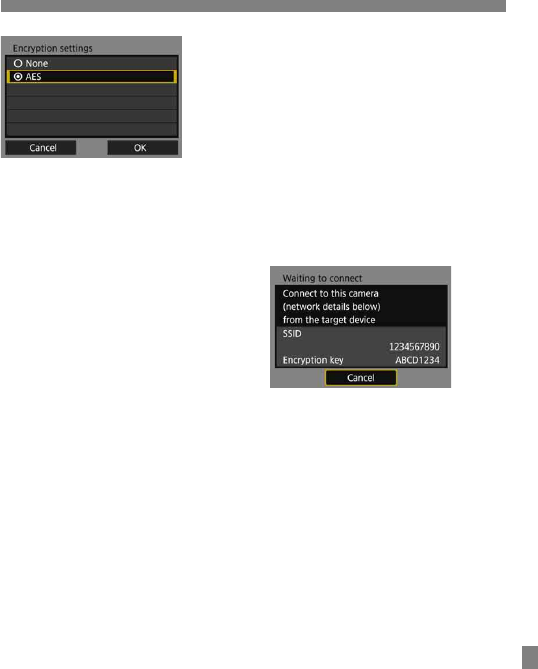
143
Setting Network Manually
4Select the desired encryption
setting.
For encryption, select [AES].
Select [OK] and press <0>.
When [AES] is selected, the virtual
keyboard (p.21) is displayed. Enter
any encryption key of eight
characters, then press the <M>
button to set.
The set SSID and encryption key are
displayed.
For subsequent operations, see
“Connecting with Easy Connection”
(p.25).
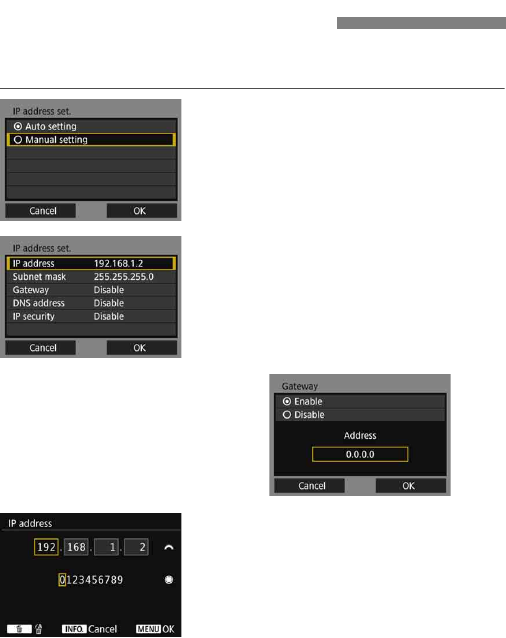
144
Set the IP address settings manually. The items displayed will differ
depending on the communication method.
1Select [Manual setting].
Select [OK] and press <0> to go to
the next screen.
2Select the item to be set.
Select an item and press <0>. The
number entry screen will appear.
To use a gateway, DNS address, or
IPsec, select [Enable], select
[Address], then press <0>.
3Enter the desired values.
Turn the <6> dial to move the input
position in the upper area and turn
the <5> dial to select the number.
Press <0> to enter the selected
number.
To set the entered values and return
to the screen for step 2, press the
<M> button.
Setting IP Address Manually
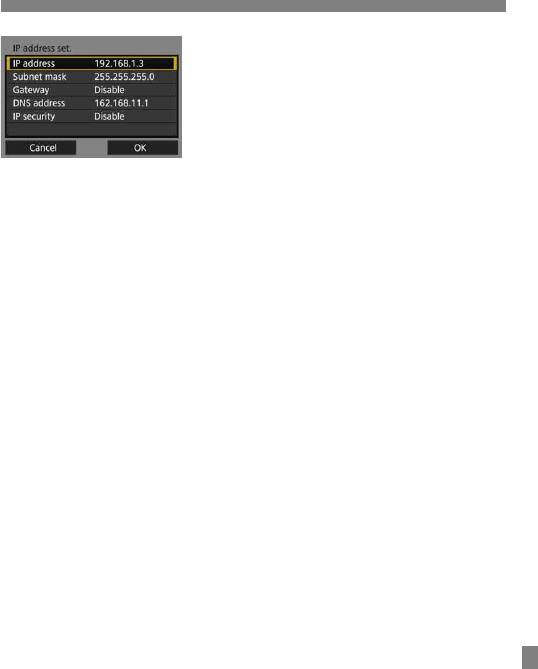
145
Setting IP Address Manually
4Select [OK].
When you have completed setting the
necessary items, select [OK] and
press <0>.
The setting screen for the
communication method will appear.
If you are not sure what to enter, see
“Checking Network Settings” (p.138),
or ask the network administrator or
another person knowledgeable about
the network.

146
9Type
Type: IEEE 802.11n/a/g/b wireless LAN compatible image
transfer accessory
9Wireless LAN
Standards compliance: IEEE 802.11n, IEEE 802.11a,
IEEE 802.11g, IEEE 802.11b
Transmission method: DS-SS modulation (IEEE 802.11b)
OFDM modulation (IEEE 802.11n/a/g)
Transmission range: Up to approx. 150 m / 492 ft.
* With no obstructions between the transmitting and
receiving antennas and no radio interference
* Up to 15 m / 49.2 ft. when connected to a
smartphone directly
Transmission frequency (central frequency):
Connection method: Infrastructure mode, camera access point mode, ad
hoc mode
* Wi-Fi Protected Setup supported
Security: Authentication method: Open system, Shared key,
WPA/WPA2-PSK
Encryption: WEP, TKIP, AES
* IPsec supported
Specifications
Version Frequency Channels
WFT-E6A
2412 to 2462 MHz 1 to 11 ch
5180 to 5320 MHz 36 to 64 ch
5745 to 5825 MHz 149 to 165 ch
WFT-E6B
2412 to 2472 MHz 1 to 13 ch
5180 to 5320 MHz 36 to 64 ch
5500 to 5700 MHz 100 to 140 ch
WFT-E6C 2412 to 2472 MHz 1 to 13 ch
5745 to 5805 MHz 149 to 161 ch
WFT-E6D
2412 to 2462 MHz 1 to 11 ch
5280 to 5320 MHz 56 to 64 ch
5500 to 5700 MHz 100 to 140 ch
WFT-E6E
2412 to 2472 MHz 1 to 13 ch
5180 to 5320 MHz 36 to 64 ch
5500 to 5700 MHz 100 to 140 ch
5745 to 5825 MHz 149 to 165 ch
147
Specifications
9LAN Functions
FTP transfer: Automatic transfer
Image selection and transfer
Transfer using SET button
Transfer with captions
* FTPS supported
EOS Utility:
EOS Utility remote control functions over wireless LAN
WFT Server: Camera control, Simple control
Image viewing and downloading
Smartphone: Images can be viewed, controlled, and received
using a smartphone.
Remote control of the camera using a smartphone is
possible.
Linked shooting: Shooting with up to 10 slave cameras linked to a
master camera
Transmission range: Up to approx. 100 m / 328 ft.
Synchronizing camera time: Syncing up to 10 slave cameras to the master
camera time
Margin of error with master camera: Approx. ±0.05
seconds
* Synchronize the camera time between the same
camera models.
9Number of Possible Shots
Number of possible shots during [Automatic transfer] (Approx. shots)
* The figures above are based on a fully-charged Battery Pack LP-E19, [Power
saving] enabled, and CIPA (Camera & Imaging Products Association) testing
standards.
* When transferring images consecutively over wireless LAN, the number of
possible shots will decrease.
9Dimensions and Weight
Dimensions (W x H x D): 24.7 x 57.0 x 34.1 mm / 0.97 x 2.24 x 1.34 in.
Weight: Approx. 38 g / 1.34 oz. (body only)
9Operation Environment
Working temperature range: 0°C - 45°C / 32°F - 113°F
Working humidity: 85% or less
All the data above is based on Canon’s testing standards and CIPA (Camera &
Imaging Products Association) testing standards and guidelines.
Transmitter specifications and appearance are subject to change without notice.
Temperature Normal Temperature
(23°C / 73°F)
Low Temperatures
(0°C / 32°F)
Possible shots 1030 890

148
Trademarks
Microsoft and Windows are trademarks or registered trademarks of
Microsoft Corporation in the United States and/or other countries.
Macintosh and Mac OS are trademarks of Apple Inc., registered in the U.S.
and other countries.
The Wi-Fi CERTIFIED logo and the Wi-Fi Protected Setup mark are
trademarks of the Wi-Fi Alliance.
WPS used on camera settings screens and in this manual stands for Wi-Fi
Protected Setup.
UPnP is a trademark of the UPnP Implementers Corporation.
All other trademarks are the property of their respective owners.

149
Index
A
Account (WFT)........................60, 115
Ad hoc.............................................91
AES.................................................27
Area of use
............ Areas of Use and Restrictions
Authentication .........................27, 109
Auto power off.................................22
Automatic image transfer................43
B
Batch transfer..................................48
Browsers ...................................15, 63
C
Camera access point mode ............36
Camera Connect.......................16, 78
Camera control (Remote shooting)
...67
Captions..................................52, 140
Channel...Areas of Use and Restrictions
Connection wizard ..........................22
D
DHCP server...................................34
DNS address.................................144
DNS server ...................................138
E
Easy connection..............................25
Encryption key ................................32
Encryption settings..................27, 142
EOS Utility...........................15, 55, 58
Error messages.............................118
ESS-ID ............................................31
F
Folders ......................................40, 53
FTP mode .......................................38
FTP server ......................................37
FTP transfer..............................14, 37
FTPS .............................................. 38
Function settings .......................... 114
G
Gateway ....................................... 144
I
IEEE 802.11n/a/g/b
............Areas of Use and Restrictions
Image transfer ................................ 37
Individual image transfer ................ 43
IP address ........................ 34, 38, 144
IP security (IPsec) ........................ 109
J
JPEG .............................................. 46
K
Key format ...................................... 32
Keyboard ........................................ 21
L
LCD panel ...................................... 10
Linked shooting .............................. 83
Login method.................................. 39
Login name..................................... 60
M
MAC address.................... 27, 56, 116
Master camera ......................... 86, 99
Movies ................................ 66, 71, 73
N
Network .......................................... 13
Nickname ....................................... 19
O
Open system .................................. 27
Overwriting files of same name .... 110
P
Pairing ............................................ 56
Passive mode............................... 111

150
Index
Password ........................................ 60
PBC mode ......................................28
PIN code connection mode.............29
PIN mode........................................29
Port number ....................................39
Power saving ................................ 116
Proxy server....................................39
Pushbutton connection mode .........28
R
RAW ............................................... 46
RAW+JPEG .................................... 46
Reconnecting................................103
Remote shooting...........58, 67, 72, 78
Re-transfer......................................47
Router ............................................. 34
S
Select folder.................................... 40
Settings......................................... 112
Loading.....................................113
Saving ......................................112
Settings name...............................108
Shared key......................................27
Simple control (Remote shooting)
...72
Slave camera............................84, 99
Smartphone ..............................16, 75
SSID ...............................................31
Stealth functions .............................27
Subnet mask......................... 138, 144
Sync camera time .....................16, 97
T
Target folder......................40, 53, 110
TCP/IP .......................................... 108
TKIP................................................27
Transfer after shooting....................48
Transfer history ...............................49
Transfer with SET ...........................45
Transferred images ........................ 53
Troubleshooting............................ 117
U
URL ................................................ 63
V
Viewable images ............................ 80
Viewing images ........................ 65, 78
W
Web browser ............................ 15, 63
WEP ............................................... 27
WFT server .............................. 15, 59
WFTserver................................ 15, 59
Wired LAN...................................... 23
Wireless LAN specification
............Areas of Use and Restrictions
WPA/WPA2-PSK ............................ 27
WPS (Wi-Fi Protected Setup) ........ 27

151
MEMO

The descriptions in this Instruction Manual are current as of March 2016.
For information on the compatibility with any products introduced after this date,
contact any Canon Service Center. For the latest version Instruction Manual,
refer to the Canon Web site.
CPA-E198-000 © CANON INC. 2016
