

BANDIT 2590 Track Drum Style Whole Tree Chipper Instruction Manual
File info: application/pdf · 120 pages · 19.13MB
MODEL 2590 - Stephenson Equipment
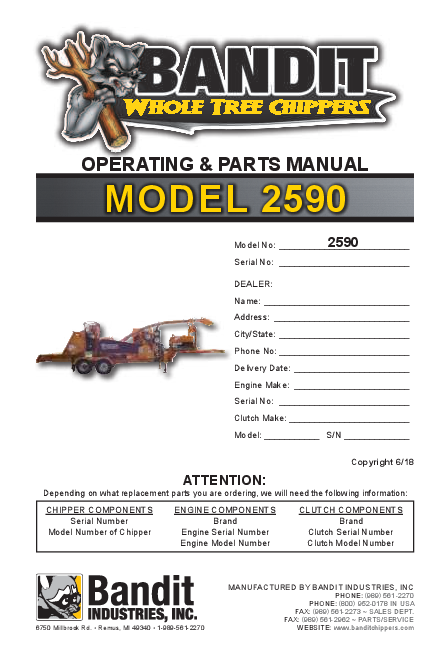
MODEL 2590. OPERATING & PARTS MANUAL. 6750 Millbrook Rd. • Remus, MI 49340 • 1-989-561-2270. MANUFACTURED BY BANDIT INDUSTRIES, INC. PHONE: (989) 561-2270.
[PDF] MODEL 2590 - Stephenson Equipmentstephensonequipment.com › 2021/10
Bandit 2590
Equipment Manuals | Stephenson Equipment, Inc. | Harrisburg Pennsylvania
Full PDF Document

If the inline viewer fails, it will open the original document in compatibility mode automatically. You can also open the file directly.
Extracted Text
OPERATING & PARTS MANUAL
MODEL 2590

Model No: __________2__5_9__0___________
Serial No: __________________________
DEALER: Name: _____________________________ Address: ___________________________ City/State: __________________________ Phone No: __________________________ Delivery Date: _______________________ Engine Make: _______________________ Serial No: __________________________ Clutch Make: ________________________ Model: ___________ S/N _____________

Copyright 6/18

ATTENTION:
Depending on what replacement parts you are ordering, we will need the following information:

CHIPPER COMPONENTS Serial Number
Model Number of Chipper

ENGINE COMPONENTS Brand
Engine Serial Number Engine Model Number

CLUTCH COMPONENTS Brand
Clutch Serial Number Clutch Model Number

6750 Millbrook Rd. � Remus, MI 49340 � 1-989-561-2270

MANUFACTURED BY BANDIT INDUSTRIES, INC PHONE: (989) 561-2270
PHONE: (800) 952-0178 IN USA FAX: (989) 561-2273 ~ SALES DEPT. FAX: (989) 561-2962 ~ PARTS/SERVICE WEBSITE: www.banditchippers.com

CALIFORNIA PROPOSITION 65

! WARNING ! ADVERTENCIA

Breathing diesel engine exhaust exposes you to chemicals known to the State of California to cause cancer and birth defects or other reproductive harm.

Respirar gases de escape de motores diesel le expone a qu�micos conocidos por el estado de California como causales de c�ncer y defectos cong�nitos u otros da�os reproductivos.

� Always start and

� Siempre encienda y opere el

operate the engine in a

motor en �reas bien ventiladas.

well-ventilated area.

� Si est� en un �rea cerrada,

� If in an enclosed area,

ventile escape hacia el exterior.

vent the exhaust to the

� No modifique ni altere el

outside.

sistema de escape.

� Do not modify or tamper � No deje el motor en ralent� a no

with the exhaust system. ser que sea necesario.

� Do not idle the engine except as necessary.

Para mayor informaci�n visite: www.P65warnings.ca.gov/diesel

For more information go to:

www.P65warnings.ca.gov/diesel

SPW-46 8/18

! WARNING ! ADVERTENCIA Cancer and C�ncer y da�o Reproductive reproductivo Harm
www.P65warnings.ca.gov SPW-47 8/18

WARRANTY VALIDATION FORM (WHOLE TREE & LOADER FED CHIPPER)
IMPORTANT - WARRANTY WILL BE DEEMED NULL AND
VOID IF THIS FORM IS NOT FILLED OUT COMPLETELY AND
ACCURATELY AND RETURNED TO THE CUSTOMER DATA
DEPARTMENT WITHIN 10 DAYS OF EQUIPMENT DELIVERY

Customer Data Department
6750 Millbrook Road Remus, MI, USA 49340 Phone: (800) 952-0178 in USA Phone: (989) 561-2270 Fax: (989) 561-2273 Website: www.banditchippers.com

PURCHASER / OWNER INFORMATION:

Company Name __________________________________ Contact Name _____________________

Mailing/Street Address _______________________________________ City _______________________

State ___________________ Zip Code _______ Country ______________ Telephone Number ( __ ) ________

E-mail ____________________________ Machine Model No. _______ Date Put Into Service ______

Machine Serial No. ____________________ Machine Work Order No. ________ Machine Hours _______

Engine Make _________________ Engine Serial No. __________________ Machine Color _______


DEALER / SELLER INFORMATION:

Dealer/Seller Name _______________________________ Contact Name _____________________

Mailing/Street Address _______________________________________ City _______________________

State ___________________ Zip Code _______ Country ______________ Telephone Number ( __ ) ________

1. _____ The customer has received instruction and fully understands all operational, safety and maintenance requirements of the equipment.
2. _____ The customer has received instruction and fully understands that everyone within 100 feet of the machine must wear proper personal safety equipment including hard hat, face shield, safety glass, gloves, ear protection and/or other items per OSHA and ANSI requirements.
3. _____ The customer has received instruction and fully understands the equipment maintenance schedules and procedures. The customer understands that it is their responsibility to perform scheduled maintenance that includes periodic relief valve adjustments, retightening all fasteners as needed, periodic cleaning of flow divider, clutch and belt adjustments, and other items.
4. _____ The customer has received instruction and fully understands not to reach into the infeed hopper with hands or feet.
5. _____ The customer has received instruction and fully understands that the operators must always be located within easy reach of all feed control and shut down devices.
6. _____ The customer has received instruction and fully understands that this machine is designed to be `loader' fed and is to follow all feeding instructions in the manual. The customer understands that under no circumstances should the operator hand feed these machines or use anything other than mechanical devices, knuckle boom loader or the machines loader to feed these machines.
7. _____ The customer has received instruction and fully understands the purpose of and proper operation of any and all safety devices and guards. The customer understands to never attempt to override any safety device or guard.
8. _____ The customer has received instruction and fully understands that before performing any maintenance on the machine the ignition key must be removed, the cables must be completely disconnected from the battery, the disc/drum must have come to a complete stop, and the disc/drum lock must be installed. The customer understands they must allow the necessary time for the disc/drum to come to a complete stop before opening the disc/drum housing or start any maintenance or service procedures. The customer has received instruction and fully understands the purpose of the beltshield inspection hole and that they are never to attempt any maintenance or service procedures until visually confirming the belts have come to a complete stop. 9. _____ The customer has received instruction and fully understands that the machine is not to be operated without the factory approved hood pin assembly in place and padlocked, the machine is not to be operated with any type of make shift hood pin, and the machine is not to be operated under any circumstances with the chipper hood open or unsecured.
10. _____ Customer has reviewed and fully understands limited warranty, and all written and visual instructions.
11. _____ The customer has received instruction and fully understands that warranty will not apply if the machine is operated with replacement parts or equipment not manufactured or recommended by Bandit Industries, Inc.
12. _____ Customer has received, been advised, and understands the manuals, and the Safety/Service video supplied with the chipper. A video is supplied for equipment models as available.
13. _____ All Danger, Warning and Operational decals are properly displayed on equipment and fully understood by customer.
14. _____Customer has been instructed, understands, and agrees that all potential operators must: See the supplied video, be instructed on all the Danger, Warning and Operational decals, read the manual and follow the procedures.
I have inspected this equipment and find it in correct working condition. To the best of my knowledge, the customer and his/her personnel are aware of, and agree to the above procedures.

Signed: ________________________________________________________ Date: ______________
(Dealer Representative)
The equipment has been thoroughly checked by the above named dealer representative, and I am satisfied with his/her instructions. I have also read, understand, and agree to reverse side of page.

Signed: ________________________________________________________ Date: ______________

Copyright 2/17 FORM #WV-117

(Customer)


Copyright 2-17 FORM #Q-111


TO BE RETURNED AFTER THIRTY (30) DAYS OF OPERATION

DATE PURCHASE: ______________________ MODEL: ________________________________

Please return to: Customer Data Department 6750 Millbrook Road Remus, MI 49340

SERIAL NUMBER: _______________________ DEALER NAME: ________________________

_______________________________________ Phone: (800) 952-0178 in USA Phone: (989) 561-2270 Fax: (989) 561-2273 Website: www.banditchippers.com

EQUIPMENT QUALITY REPORT

All of the employees that build your equipment strive to manufacturer the very best quality product on the market. We would appreciate your efforts in letting us know how we are doing.
We would like you to operate your machine for thirty (30) days and then fill out this questionnaire and mail it to us. This will help us to keep producing a good product and improving our products through your recommendations.

1. Did your machine perform to your expectations? _______________________________________ 2. Was the machine delivered on schedule? _____________________________________________ 3. Was the paint color and finish to your satisfaction? ______________________________________ 4. Was machine equipment as ordered? ________________________________________________ 5. Did all welds appear to be high quality? ______________________________________________ 6. Was the overall machine to your liking? ______________________________________________ 7. What problems have you experienced? ______________________________________________ 8. Have any components regularly loosened that caused problems? __________________________ 9. Does the hydraulic system seem to have adequate power for feeding wood into the machine? _____ 10. Is the machine manufactured to accommodate service in an adequate manner? If not, please explain:
_______________________________________________________________________________ 11. General comments and/or suggestions: ________________________________________________
_______________________________________________________________________________ _______________________________________________________________________________ 12. Would you like to be contacted concerning more of our equipment? ________________________


YOUR COMPANY: ________________________________ NAME: __________________________________________ ADDRESS: ______________________________________ CITY: ___________________________________________ STATE & ZIP: _____________________________________ PHONE: ( ____ ) _________________________________ E-MAIL: _________________________________________

MODEL 2590

TABLE OF CONTENTS

TABLE OF CONTENTS
PAGE INTRODUCTION & WARRANTY........................................................... 2 SERIAL NUMBER LOCATIONS............................................................ 6 EQUIPMENT SPECIFICATIONS ........................................................... 13 DECALS................................................................................................... 14 CONTROLS ............................................................................................. 21 TRANSPORTATION PROCEDURES.................................................... 34 MAINTENANCE ...................................................................................... 37 HYDRAULICS ......................................................................................... 73 ELECTRICAL .......................................................................................... 84 REPLACEMENT PARTS ........................................................................ 85
INFEED HOPPER COMPONENTS ................................................ 86 BEARING COMPONENTS ............................................................. 95 CHIPPER COMPONENTS .............................................................. 88 CHIPPER KNIFE & HARDWARE ................................................... 92 ANVIL HARDWARE ........................................................................ 94 DISCHARGE COMPONENTS ........................................................ 96 LOADER COMPONENTS ............................................................... 98 FRAME & ACCESSORY COMPONENTS ..................................... 100 FRONT STABILIZER COMPONENTS........................................... 102 FUEL TANK COMPONENTS .......................................................... 103 HYDRAULIC TANK COMPONENTS ............................................. 105 ENGINE COMPONENTS ................................................................ 106 HYDRAULIC COMPONENTS......................................................... 108 AIR BRAKE COMPONENTS .......................................................... 115 SERVICE RECORD ................................................................................ 116

NOTICE
ANY PART, PORTION, DESIGN, NUMBER, SPECIFICATION, AND/OR DIMENSION IN THIS MANUAL IS SUBJECT TO CHANGE WITHOUT NOTICE BY THE MANUFACTURER.

Copyright 6/18

1

Bandit

INTRODUCTION & WARRANTY

INTRODUCTION

The purpose of this manual is to provide the user with specifications and procedures for the operation, maintenance and repair of this BANDIT product. As with any piece of equipment, safety should always be a constant thought while the machine is being operated, serviced or stored. In order to highlight this consideration, the material which addresses safety is proceeded by the following signal words:

Signal Word
! DANGER

Likelihood of Occurrence Will occur if warning is ignored

Degree of Potential Injury or Damage
Severe

! WARNING

Can occur if warning is ignored

Severe

! CAUTION

Will or can occur if warning is ignored

Minor to Severe

NOTICE

Important, but not hazard related

Minor

The equipment is designed and manufactured in accordance with the latest product industry standards. This alone does not prevent injury. It is the operator's responsibility to use good judgement and follow the warnings and instructions as indicated in this manual, on the machine and follow all safety standards per ANSI and OSHA instructions.

! WARNING
Improper use of the product can result in severe personal injury. Personnel using the equipment must be qualified, trained and familiar with the operating procedures as defined in this manual, prior to operating the product.

! WARNING
It is the responsibility of the owner or employer to ensure that the operator is trained and practices safe operation while using and servicing the machine. It is also the owner's responsibility to provide and follow a regularly scheduled preventative maintenance and repair program on the product, using only factory approved replacement parts. Any unapproved repairs or modifications may not only damage the machine and its performance, but could result in severe personal injury. Unapproved repairs or modifications will void warranty and eliminate manufacturer of any liability claims. Consult the equipment manufacturer with any questions.
Each machine is shipped with a manual, a customer's check sheet on the product, and any available parts & service manuals on component parts not produced by this manufacturer. Additional copies of these manuals and check sheets can be purchased from the manufacturer, or through the dealer. Engine parts, service and maintenance manuals MUST be purchased through the engine manufacturer or their dealer.
NOTICE
The producer of this Bandit product reserves the right to make any modifications or revisions to the design or specifications of its machine without advance notice. The producer also reserves the right to change machine and part prices as needed without advance notice.

Copyright 6/18

2

Bandit

MODEL 2590

SERIAL NUMBER LOCATIONS

TYPICAL CHIPPER SERIAL NUMBER AND/OR WORK ORDER NUMBER LOCATIONS

2

1

1. Engine Frame (Right Side) 2. W/O # on top of frame side (Right Side)

NOTICE
The engine information is located on the engine block. The clutch information is located on the clutch plate (if equipped).

Copyright 6/18

6

Bandit

MODEL 2590

SAFETY PROCEDURES
SAFETY PROCEDURES ! DANGER

The words ! Danger, ! Warning, ! Caution, and Notice are used on the safety decals and throughout this manual, to make you aware of the safety procedures. These procedures are very important, read and obey them. YOUR SAFETY IS VERY IMPORTANT TO US!
This machine is equipped with safety decals, guards and designs for your protection.
Don't ever take the machine for granted, always be cautious and careful when operating your equipment.
Read and follow all the instructions in your manual thoroughly. Your safety is dependent on your knowledge of how to operate and maintain this machine. You may obtain additional copies of this manual from your Bandit Dealer.
Before operating machine, you must have all potential operators; read and understand manuals and decals, watch the video and follow the recommendations.
Regardless of how hard a manufacturer tries to produce a safe machine, accidents still happen. Normally accidents are caused by people making mistakes. They do not read the manual, they ignore warning decals or do not use lockouts provided for their safety. This normally happens after the person has become accustomed to the machinery. In the initial start up and operation of the machinery, they are cautious, they are very careful because they do not understand the machine.
This equipment is intended for use by adults who have been properly trained and are physically capable of operating the machine safely. Never allow minors to operate this machine. Never operate any machine while under the influence of drugs or alcohol. Never operate equipment that is in need of repair or adjustment. Keep children, bystanders and animals clear of working area.
There must be at least two qualified and trained operators at the work site. They must be positioned in safe working locations, following safety procedures and instructions, and aware of each others whereabouts. There must, also, be at least two people on site during maintenance and service procedures in case an accident should occur.

! WARNING
Operators must at all times be located within easy reach of all feed control and shut-off devices when the unit is running. They must be attentive and prepared to activate the devices.
! DANGER
Torn or loose clothing is more likely to get caught in moving machinery parts or tree branches. Keep such items as long hair, shirt sleeves, and shirt tails properly contained. Avoid wearing necklaces, rings, watches, and especially neckties while operating this machinery. Make sure the machine is in excellent condition, and all the guards are in place, tight and secure.
Wear all personal protection equipment and follow all safety standards per ANSI and OSHA instructions. Examples of equipment: hard hat, face shield, safety glasses, gloves, ear protection, etc. Do not wear gauntlet or secured fit gloves. Always keep a fully charged fire extinguisher with the machine while operating or servicing the machine.

! DANGER

Before starting the machine, take a minute to check a few things. The machine should be in an area restricted from people passing by. This area around the machine must be free of all objects that can obstruct your movement when working with the machine. The machine should be checked for loose tools or foreign objects, especially in the infeed hopper area. All tools not in use should be secured in a tool box.

! WARNING
Before performing maintenance on the machine remove all debris, oil, grease, water, snow, ice, etc. from all machine surfaces.
! DANGER
Keep hands clear of all pinch points.

Copyright 6/18

7

Bandit

MODEL 2590

SAFETY PROCEDURES

SAFETY PROCEDURES

! DANGER
NEVER sit, stand, lay, climb or ride anywhere on this machine while it is running, operating, or in transit. You will be injured.
! DANGER
Pay attention to the direction of the discharge chute before chipping. Never stand in front of the chipper discharge chute. Never direct the chute towards anyone or anything that could cause an accident or problems. Always stop chipping and warn anyone that comes near the discharge area. Failure to do this could result in severe injury. Wood chips flying out of the discharge chute can be very dangerous!
! WARNING
It is very important after you have operated a new machine for approximately an hour to shut down the machine and recheck all nuts and bolts. It is normal for nuts and bolts to loosen once on a new piece of machinery. If you tighten them now, there is a good possibility they won't loosen again. Certain nuts and bolts should be checked periodically such as anvil and knife nuts and bolts, etc. for torque and fit.
Most of the nuts used on the machine are self locking. After a nut or bolt has been removed five times, it should be replaced to ensure proper tightness. This is especially critical on the chipper knife nuts and bolts!
After the engine is started, let the chipper disc/drum turn at the lowest RPM's possible. Listen for any type of noise that is foreign. Any steel on steel noise is foreign. If you hear a noise, stop the engine, find the problem and fix it.
! WARNING
It is very important after you have operated a new machine for approximately an hour to shut down the machine and recheck all hydraulic fittings. Relieve all pressure and retighten as needed.
DO NOT GO NEAR HYDRAULIC LEAKS! High pressure oil easily punctures skin causing serious injury, gangrene, or death. Avoid burns from fluid. Hot fluid under pressure can cause severe burns. DO NOT use fingers or skin to check for leaks. Lower load or relieve hydraulic pressure before loosening fittings. Relieve all pressure in the system before disconnecting the lines, hoses, or performing other work. Use a piece of cardboard to find leaks. Never use your bare hands. Allow system to cool down to ambient temperature before opening any coolant or hydraulic oil system.
In cold weather situations let your hydraulic system idle for approximately 15 minutes to allow the system to warm up to operating temperature.

! DANGER
Never reach into the infeed hopper area of the machine, there is never any reason to. The feedwheels are designed to pull trees and brush of any length into the machine. Pulling a hand, arm, foot or entire body through the machine is much easier than pulling a tree. Do not think you will be able to pull yourself free of the feedwheels, they will not let go. There is absolutely no reason to work inside of the infeed hopper. If the feedwheels become tangled or clogged: disengage clutch, wait for the disc/drum to come to a complete stop, turn off engine, remove the ignition key, make sure the ignition key is in your possession, install the disc/drum lock pin, and disconnect the battery before cleaning them out. If there are short pieces, just leave them until feeding longer pieces. While the longer pieces are feeding, simply put the short pieces on top of them. The longer pieces will take them on into the machine.
If there is larger diameter wood, try to feed it with smaller diameter wood. Start a small diameter limb which will partially open the feedwheels. Once the feedwheels are partially open it is much easier to insert the larger diameter wood.
When feeding larger diameter wood, listen for the engine to possibly lug down. If it starts lugging down stop the feedwheels by stopping the feed system, and let the engine recover to full speed. If the machine is equipped with Autofeed and it is functioning properly, the feed system will automatically stop to let the engine recover. This will help stop the machine from plugging the discharge chute.
! DANGER
DO NOT operate this machine indoors! Exhaust fumes can be fatal. Never refuel while the machine is running. Never refuel in the shop or building. Always refuel in a well ventilated area, away from sparks or open flames, DO NOT SMOKE. Extinguish all smoking materials. Wipe up all spilled fuel before restarting the engine. Do not fill above 1/2" (12.7mm) from top of tank.
To obtain the most from your machine, for the least amount of cost, it is a good practice to set up and follow a scheduled preventative maintenance program. It will eliminate many possible problems and down time.
NOTICE
The Bandit has only been run for a short time to test proper hydraulic pressures, possible leaks, etc. The fuel tank will be empty. Fuel is provided through a small auxiliary tank for testing. This immensely helps maintain safety in our manufacturing facility and while shipping.

Copyright 6/18

8

Bandit

MODEL 2590

SAFETY PROCEDURES

SAFETY PROCEDURES

! DANGER

! WARNING

Keep the machine in good condition. Be sure the machine is in good operating condition and that all safety devices, including guards and shields are installed and functioning properly. Visually inspect the machine daily before starting the machine. Refer to the "Daily Start Up & Maintenance". Make no modifications to your equipment unless specifically recommended or requested by Bandit Industries Inc.
! WARNING
DO NOT operate this machine unless all hydraulic control devices operate properly. They must function, shift and position smoothly and accurately at all times. Faulty controls can cause personal injury!
! DANGER
Avoid moving parts. Keep hands, feet, and clothing away from power driven parts. Keep all guards and shields in place and properly secured.
! DANGER
Never feed any materials that might contain wires, stones, nails, metal objects, or any foreign object which may damage the knives and become dangerous projectiles.
! DANGER
DO NOT run or operate this machine with any door/compartment open. Door enclosures are guards, you can be injured if open during operation.
! DANGER
DO NOT attempt to hand feed this machine. DO NOT operate the loader arm or chipper when anyone is standing or working in front of the chipper infeed opening. Failure to do this could result in serious injury or death.
! DANGER
DO NOT hand feed this machine! This machine is designed to only be fed by a mechanical log loader. Feeding material into this machine by hand is not permitted or authorized. Severe injury or death can result!
! WARNING
EXPLOSION HAZARD: Ultra low sulfur diesel (ULSD) poses a greater static ignition hazard than earlier diesel formulations with higher sulfur content. Avoid death or serious injury from fire or explosion; consult with your fuel or fuel system supplier to ensure the delivery system is in compliance with fueling standards for proper grounding and bonding practices.

Never use jumper cables during freezing temperatures. Tow the machine inside and allow the battery time to warm up. If the machine must be started outside, inspect the battery acid for ice formation. Explosion will occur with a frozen battery. If the machine is going to be operated in excessively cold conditions, a larger cold cranking amp battery may be needed to ensure proper and prompt starting. Never use jumper cables in a confined or unventilated area. Battery acid fumes are explosive. Battery acid can cause severe burns. Never expose an open flame or spark near the battery. Keep all burning materials away from the battery. When servicing the battery, shield eyes and face, and do not smoke. Service in a well ventilated area.
! DANGER
DO NOT remove the hood pin until the chipper disc/drum has came to a complete stop. The chipper disc/drum will coast for several minutes after the engine is shut down. Always wait at least several minutes.
DO NOT operate this machine without the Hood Pin in place. Do not operate the machine with any type of makeshift hood pin or an improperly installed hood pin! The Hood Pin MUST be padlocked.
DO NOT operate the machine with the chipper hood open under any circumstances.
! DANGER
Before attempting any type of maintenance, disengage clutch, wait for the disc/drum to come to a complete stop, turn off engine, remove the ignition key, make sure the ignition key is in your possession, install the disc/drum lock pin, and disconnect the battery.
ALWAYS install the disc/drum lock pin to prevent inadvertent rotation. On disc chippers insert lock pin through lock pin tube on the belly band under hood rest. On drum chippers insert lock pin through lock pin tube on side of drum housing.
Simply slide the lock pin into the disc/drum lock tube. This is to ensure that the chipper disc/drum cannot be started while you are working inside the machine. If for some reason the chipper disc/drum would start to turn, it would simply hit the lock pin.
! DANGER
The knives must be securely fastened and torqued in position. If one comes loose or breaks during operation, someone or something may get injured or damaged.
! DANGER
Chipper knives are sharp and can be dangerous. It is always necessary for your protection to be extra careful and wear proper hand protection when handling knives.

Copyright 6/18

9

Bandit

MODEL 2590

SAFETY PROCEDURES

SAFETY PROCEDURES

! DANGER
Before opening or closing the feedwheel trap door: disengage clutch, turn off engine, wait for the disc/drum to come to a complete stop, install the disc/drum lock pin, disconnect battery, and make sure the ignition key is in your possession. In the event that dirty material is being run through the chipper the feedwheel trap door can be opened.
! WARNING
The machine was built with a chipper hood engine disable plug which disables the engine if it is not installed properly with the hood pin holding the chipper hood in the closed position. Correctly installed and maintained, the engine will not start or it will shut off if the chipper hood engine disable plug is disconnected. The chipper hood must NEVER be opened, or pushed closed if the chipper disc/drum is turning.
! DANGER
DO NOT slam the chipper hood to the open position. This will cause damage to the hinge. If your hinge has become damaged by slamming the hood to the open position, Replace The Hinge Immediately! If the hinge has become damaged it will cause misalignment of the hood, the chipper disc/drum may then hit the hood and cause a serious accident! Lubricate the hood hinge daily.
! DANGER
Never turn the chipper disc/drum by hand, always carefully use a pry bar or wood bar. This will help prevent the person turning the disc/drum from being injured should the disc/drum break loose.
A sight hole in the chipper beltshield has been provided. If chipper belts are moving do not open chipper hood. Do not stick fingers in sight hole.
! DANGER
Do not work inside the mouth of the chipper or around the feedwheel(s), until you have installed the yoke lock pin completely and securely to help keep the top feedwheel in the raised position. Remove top wheel springs if equipped, block and chain top wheel up before doing any work inside throat.

Use Yoke Lock Pin

Use Chain

Use Wooden
Block

! DANGER
If the chipper is properly maintained and operated correctly, the chipper should not plug. In the unlikely event that the chipper becomes plugged, do not attempt to clean out the discharge or chipper housing in the field. Take the machine to a local dealer or professional shop. If the machine is a rental, take it back to the rental company.
! DANGER
If the discharge or hood need to be removed, always use some sort of mechanical device like an overhead hoist, loader, lift truck, etc. that is rated for lifting that component. Follow all OSHA instructions for lifting.
NOTICE
Do not attempt to start the engine or engage the engine PTO (power-take-off) system on this machine if the chipper disc/drum is jammed or frozen in place. If you do, you will damage or ruin the drive belts and/or the PTO which will not be covered under warranty and will cost you down time and money.
! DANGER
Do not work on the machine if the engine is running with the clutch disengaged. A clutch can self engage if either the pilot or throw-out bearing happens to seize to the main output shaft.
There are various types of clutches (PTO's) available for this type of equipment. Make sure to study the original clutch manufacturer's manual that is provided with the machine and follow its instructions for operation, service, and adjustments. Some styles require clutch engagement to be maintained so that it takes a lot of force, others will require very little force, and some are push button, electric, manual lever, or hydraulic activation. Each different style clutch (PTO) is a very expensive item that will fail if not correctly maintained and adjusted. It will be quite costly if a few minutes are not taken daily, weekly, and monthly to keep the clutch serviced as required.
The operator must take care in the engagement and disengagement of the clutch, engine RPM should always be at idle speed. When the engine has sufficiently warmed up, bump the clutch handle against engagement to start the chipper disc/drum turning. This will have to be repeated until the chipper disc/drum is turning at proper ratio with engine RPM. Then push the handle all the way in gear until it locks into position securely. After engagement raise engine RPM to full throttle. Engaging and disengaging the clutch at high engine RPM will quickly and excessively wear out clutch plates as well as bearings. Refer to clutch manufacturer's manual for proper service and operation.

Copyright 6/18

10

Bandit

MODEL 2590

SAFETY PROCEDURES

SAFETY PROCEDURES

! DANGER

! WARNING

Always block the tires and the machine tongue

Check laws and regulations. Know and obey all

whenever the machine is unhooked for operation. federal, state, and local laws and regulations that

DO NOT rely on the hydraulic stabilizers. With the apply to your work situation and the transportation

bouncing and rocking, the stabilizer cylinders may of a machine this size.

have a tendency to leak off allowing the machine to drop down slowly. Do not depend on them for

! WARNING

stability. Install secure blocking as needed.

Refer to the Material Safety Data Sheet (MSDS)

NOTICE
Tongue jacks or optional rear stabilizers, whether hydraulic or manually operated are designed to stabilize the machine. The tongue jack or rear stabilizers are not designed to hold the machine off the ground at any time. Install secure blocking and / or chocking as needed. Before transporting

for information pertaining to the knife babbitt material including the health hazard information, first aid procedures, special handling procedures, disposal procedures, etc. If needed, contact your nearest dealer or Bandit Industries for the knife babbitt MSDS.
! DANGER

the machine, ensure the tongue jack and rear

DO NOT operate this chipper or loader arm when

stabilizers are fully retracted and secured to the anyone is performing any type of maintenance

transport position.

to the machine. Before attempting any type

! WARNING

of maintenance disengage clutch, wait for the disc/drum to come to a complete stop, turn off

CLEAN MACHINE OF ALL DEBRIS! DO NOT engine, remove the ignition key, make sure the

leave this machine unattended until all potential fire ignition key is in your possession, install the

debris is removed, no fire or smoldering exists, and disc/drum lock pin, disconnect the battery, and the

hot spots are cold. The engine creates many hot loader, if equipped, is positioned on the ground.

spots including: exhaust manifold, exhaust, turbo Failure to do this could result in serious injury or death.

(if equipped), etc. Remove all flammable debris such as wood, chips, leaves, oils, fuels, etc. from

! WARNING

engine exhaust, engine turbo (if equipped), beside, around, and under engine, around and under tanks, inside belt shields and guards, inside battery and tool boxes, inside cabinets (if equipped), and anywhere materials collect. ALWAYS keep several type A:B:C fire extinguishers operational and on the job at all times.

Before performing maintenance on the machine remove all debris, oil, grease, water, snow, ice, etc. from all machine surfaces.
! WARNING
Before you begin to transport your trailerized

! WARNING
Operation of this equipment may create sparks that can start fires around dry vegetation. A spark arrester may be required. The operator should contact local fire agencies for laws or regulations relating to fire prevention requirements.
NOTICE
Expensive damage to the Bandit will occur if proper preparation is not taken before welding on the machine. Be sure to disconnect both battery cables and the engine ECM (engine control module) before welding. Follow the specific Engine MFG. instructions for proper welding and grounding procedures, before attempting to weld on the machine. If welding on the machine, do not ground the welder through the machine bearings, ground near work to be performed.

machine follow all of the transportation procedures on pages 34 - 36. Make sure that the tongue has been raised to the proper height and attach the machine securely to the towing vehicle. Once secured to vehicle, locate tongue jack and secure it in the transport position. Always hook safety chains to vehicle by crossing them under the tongue allowing enough slack to avoid binding or dragging the ground when making turns. Check brakes and highway lights make sure that they are all operating properly. Check that the plug terminal functions match the towing vehicle for proper operation. Make sure that the discharge chute is in the transport position pointed over the tongue of machine and the transport bolt is securely in its place. Be sure to check tire pressure before you begin to transport the machine. Close the folding pan, if equipped for the infeed hopper and make sure spring latches are locked into place. If machine is equipped with a vise, make sure to secure in place and clamp jaws closed. Close and secure

! DANGER

any of the following, if equipped: tool box, battery box,

Do not touch hot machine surfaces. The machine surfaces may be hot due to the machine operating recently or the machine setting in the sunlight.

engine cowl doors and side panels, radiator debris screens, inspection doors, cabinet doors, housing covers, tank caps and covers, etc.

Copyright 6/18

11

Bandit

MODEL 2590

SAFETY PROCEDURES

SAFETY PROCEDURES
IF MACHINE IS EQUIPPED WITH A SELF PROPELLED UNDERCARRIAGE
Machines equipped with undercarriage tracks are shipped with a manual from the track manufacturer. Refer to it for service, operation, and safety information.
! WARNING
Do not attempt to operate the machine on an ascending or descending slope of more than 25� or 46% or a side slope of more than 17� or 30%, it is Dangerous and could be Fatal. This is the maximum slope grade the machine can be operated on if the hydraulic system, self propelled undercarriage, and engine are running at maximum performance and good traction is sustained.
Maximum Slope Grade

Ascending or Descending Slope

Side Slope

25� MAX. 100 FT. (30.5 m)

46 FT. (14 m) (46%)

17� MAX. 100 FT. (30.5 m)

30 FT. (9.1 m) (30%)

Diagram shows percentage to degree of slope. Percentage is in vertical feet for every 100 horizontal feet.

! WARNING
Any increase from the specified maximum operating angles may cause loss of lubrication function and damage the engine.
! DANGER
The machine should never be parked on a slope at any time. The machine can coast or creep causing equipment damage and/or personal injury.
! DANGER
Make sure everyone is clear of machine before moving the machine. Stay clear of undercarriage travel system when the machine is moving.

! DANGER
NEVER sit, stand, lay, climb or ride anywhere on this machine while it is running, operating, or in transit. You will be injured.
! DANGER
Use EXTREME CAUTION when traveling over non-level surface! This machine can tip over or tip backwards on non-level surface. You will cause engine damage, machine damage and possible personal injury!
! DANGER
DO NOT entangle feet or hands in undercarriage travel system.

CALIFORNIA
Proposition 65 Warning
Diesel engine exhaust and some of its
constituents are known to the State of
California to cause cancer, birth defects,
and other reproductive harm.

Copyright 6/18

12

Bandit

MODEL 2590

EQUIPMENT SPECIFICATIONS

EQUIPMENT SPECIFICATIONS

Approximate Dimensions & Weights
(Dimensions & weights will vary depending on optional equipment)

Model 2590 Trailer

Height: Length: Width:
Weight:

144" (3.7 m) 423" (10.7 m)
113" (2.9 m) 29,000 - 35,000 lbs. (13,154 - 15,876 kg)

Fuel Tank Capacity: Hydraulic Tank Capacity:

200 gal. (757 Liters) 85 gal. (322 Liters)

Copyright 6/18

13

Bandit

MODEL 2590

DECALS

DECAL LOCATIONS - 2590
Decal locations may vary, these are general locations.

5,8,10,12,18,23

18,60,63,64,65,68,69 1 10,24,27,28,48,55
16,19,22,24,44,47

1,2,34,38

49,50,52,57 14,22,49,51,55,60

17

52

2,25,26,33,36,38,45,47,50

1,2,9,11,12 14,18,24,34
4,7,11,12
9

52

3,17,22,31,40,54,58

7,24,39,48

24

NOTICE
Some decals are for optional equipment. Decal locations may vary, these are general locations. If any decals become damaged, replace immediately.

Copyright 6/18

14

Bandit

MODEL 2590

DECALS

DECAL LOCATIONS - 2590
Modifications and/or additions of decals to this list will happen.
Consult chipper dealer or manufacturer for most current decal package.

LOCATION
1. 2. 3. 4. 5. 6. 7. 8. 9. 10. 11. 12. 13. 14. 15. 16. 17. 18. 19. 20. 21. 22. 23. 24. 25. 26. 27. 28. 29. 30. 31. 32. 33. 34. 35. 36. 37. 38. 39. 40. 41.

NUMBER
SPD-02 SPD-03 SPD-04 SPD-15 SPD-16 SPD-17 SPD-19 SPD-20 SPD-22 SPD-25 SPD-28 SPD-29 SPD-30 SPD-32 SPD-33 SPD-37 SPD-62 ID-67 INST-01 INST-02 INST-03 INST-04 INST-10 INST-12 INST-44 INST-45 INST-48 INST-49 INST-53 INST-75 INST-90 INST-91 INST-92 INST-95 INST-100 INST-101 INST-102 INST-147 INST-185 INST-222 INST-274

DESCRIPTION
Moving Parts... Danger Lockout... Flying Discharge Material... Loader Arm Do Not Hand Feed... Do Not Run Or Operate...With Door/Compartment Open... Entanglement Flying Objects Stand Clear... Emergency Shut Down Only Stand Clear - Moving Conveyor Do Not Insert Fingers Do Not Climb or Reach Into Infeed Conveyor... Do Not Sit, Stand, Lay, Climb... Do Not Operate This Machine... Do Not Work Under... Lockout All Energy Sources... Stay Clear of Tongue Jack/Stabilizer Made in USA Remove To Check Torque... Yoke Lock Hole Yoke Lock Bar Arrow Stabilizer Down / Up. Grease Daily (Arrow) Proposition 65 For Parts and Service... Disc/Drum Lock Tube Disc/Drum Lock Pin Hydraulic Oil...Hydrex XV... Hydraulic Oil For "PT Tech" Clutch... Tongue Down / Up Lubricant For "Twin Disc" Hydraulic Clutch... Air Brake Release Electric Plug-In Schematic Lubricate Cutter Head Bearings... Canada Engine Decal Joystick Yoke Feedwheel Remote Start Procedure Yoke Lock Instructions Electrical Plug Diagram Remote Key Pad

NOTICE
Some decals are for optional equipment. Decal locations may vary, these are general locations. If any decals become damaged, replace immediately.

Copyright 6/18

15

Bandit

MODEL 2590

DECALS

DECAL LOCATIONS - 2590
Decal locations may vary, these are general locations.

5,8,10,12,18,23

18,60,63,64,65,68,69 1 10,24,27,28,48,55
16,19,22,24,44,47

1,2,34,38

49,50,52,57 14,22,49,51,55,60

17

52

2,25,26,33,36,38,45,47,50

1,2,9,11,12 14,18,24,34
4,7,11,12
9

52

3,17,22,31,40,54,58

7,24,39,48

24

NOTICE
Some decals are for optional equipment. Decal locations may vary, these are general locations. If any decals become damaged, replace immediately.

Copyright 6/18

16

Bandit

MODEL 2590

DECALS

DECAL LOCATIONS - 2590
Modifications and/or additions of decals to this list will happen.
Consult chipper dealer or manufacturer for most current decal package.

LOCATION
42. 43. 44. 45. 46. 47. 48. 49. 50. 51. 52. 53. 54. 55. 56. 57. 58. 59. 60. 61. 62. 63. 64. 65. 66. 67. 68. 69. 70.

NUMBER
N-02 N-03 N-05 SPN-06 N-07 N-09 SPN-11 SPN-14 SPN-16 SPN-17 SPN-20 N-30 SPN-36 N-30 N-51 N-69 SPW-01 SPW-02 SPW-04 SPW-06 SPW-07 SPW-08 SPW-11 SPW-13 SPW-15 SPW-27 SPW-31 900-8901-14 900-8900-56

DESCRIPTION
Maintain Lubrication... Service Required Under Beltshield... Frequently Adjust...PTO... Decal Maintenance... Clutch Operation... Adjustable Feed Speed... Correct Knife And Hardware... Do Not Start To Weld...Unless... 24 Volt Circuit Battery Disconnect Switch Off (Arrow) On Maximum Towing Speed 55 MPH (88 KPH) Wait 2 minutes to disconnect battery 12 Volt Circuit Must Wait 2...Before Turning Off Battery... Battery Instructions Patents.... Do Not Go Near Oil Leaks... Diesel Fuel Only... Frozen Battery Can Explode... Warning Side Slope Warning Sound Horn Wear Personal Protection... Warning Parking on Slope Warning Clean Debris Warning Belt Shield Door ...Equipment May Create Sparks... Explosion Hazard...Ultra Low Sulfur Diesel... Basic Safety Decal Kit (Options may require additional decals) Bandit Model 2590 Logo Decal Kit

Additional Decals for Machine Equipped With A Track Undercarriage - Consult dealer or manufacturer

for general locations.

71.

SPD-19

...Minimum 10 Feet Away From Tracks...

72.

SPD-38

Do Not Entangle Feet...

73.

SPW-06

Do Not Attempt...Slope Of More Than...

74.

SPW-07

Do Not Move Machine...Horn Is Blown...

75.

SPW-11

Do Not Leave Unit Parked On A Slope...

NOTICE
Some decals are for optional equipment. Decal locations may vary, these are general locations. If any decals become damaged, replace immediately.

Copyright 6/18

17

Bandit

MODEL 2590

DECALS

DECALS
Decals located on your Bandit equipment contain useful information to assist you in operating your equipment safely. Some of the decals on your machine and their location are shown in this section.
It is very important that all decals remain in place and in good condition on your machine. Please follow the care and instructions given below.
1. You should use soap and water to keep your decals clean. Never use mineral spirits or any other abrasive cleaners.
2. Immediately replace any missing or damaged decals. The location the decal is going to be applied to must be clean and dry, and at least 40�F (5�C) before applying decal.
3. When the need arises to replace a machine component with a decal attached, be sure and replace the decal.
4. Replacement decals are available, and can be purchased from the manufacturer or your Bandit Dealer. 5. Peel back about half of the backer paper on the decal. Position it on the flat, dry, clean surface so it
is smooth and secure. Peel off the remainder of the backer paper as you continue to stick the decal on the surface. 6. Rub decal from the center outward to remove air bubbles and to secure contact. 7. Combination English / Spanish decals are typically standard. Other foreign language decals are available and may be purchased. Mail translated decals required to Bandit Industries, Inc.
EXAMPLES:

NOTICE

THE CLUTCH SHOULD NOT BE ENGAGED

OR DISENGAGED AT ENGINE SPEEDS ABOVE

LOW IDLE.

DO NOT operate this Clutch/PTO unless proper adjustments and

lubrication are maintained per the Clutch/PTO Manufacturer's Manual.

Different brands and models require different service and operation

procedures. New Clutch/PTO's require more frequent adjustment.

GOOD OPERATORS

DON'T WASTE MONEY!

Clutches will fail, glaze over, and burn up from improper

adjustment. This will cost the owner of this machine

thousands of dollars to repair. A well maintained, correctly

adjusted clutch should function properly for years.

LEAVING THE CLUTCH DISENGAGED EVEN

FOR SHORT PERIODS OF TIME WILL

REDUCE PILOT BEARING AND CLUTCH

PLATE LIFE! REFER TO CLUTCH MANUAL FOR

OPERATING AND MAINTENANCE PROCEDURES.

N-07 1/18

Copyright 6/18

18

Bandit

MODEL 2590

DECALS

Copyright 6/18

19

Bandit

MODEL 2590

DECALS

Copyright 6/18

20

Bandit

OPERATION

OPERATION

DANGER
Avoid moving parts. Keep hands, feet, and clothing away from power driven parts. Keep all guards and shields in place and properly secured. Contact with moving parts will result in serious injury or death.
Never feed any materials that might contain wires, stones, nails, metal objects, or any foreign object which may damage the knives and become dangerous projectiles.
Do not operate this machine without the hood pin in place. Do not operate the machine with any type of makeshift hood pin or an improperly installed hood pin. The hood pin must be padlocked.
Do not attempt to hand fed this machine. This machine is designed to be fed by a mechanical log loader. Feeding material into this machine by hand is not permitted or authorized. Severe injury or death can result!

WARNING
There must be at least two qualified and trained operators at the work site. They must be positioned in safe working locations, following safety procedures and instructions, and aware of each others' whereabouts.
NOTICE
Do not operate this machine unless all machine controls operate properly. They must function, shift smoothly and accurately at all times.
Make sure machine safety guards are properly installed and safety devices are functioning properly.
Check laws and regulations. Know and obey all laws and regulations that apply to your work situation.
Make sure that all required maintenance has been completed before following the set-up procedures.

SET-UP

Before starting the machine, read all safety procedures and watch the start-up

and safety videos.

� Prepare and set up the work site. Make sure there are no loose tools, cans, lines or any other foreign objects in the area. Anything not in use must be stored in a tool box or stowed away.
� Stabilize the infeed hopper and tongue if unhooked from a tow vehicle.
� Do not rely on a tongue jack to keep the machine stable if unhooked from a tow vehicle.
� Make sure to chock the tires. � Check for and remove any foreign objects in the
infeed hopper.

� Make sure the discharge is pointed in a safe direction.
� Adjust the flipper as needed. � Make sure all personal protective equipment
(PPE) is worn. Examples of PPE: hard hat, face shield, gloves (no gauntlet style gloves or secured fit), ear protection, high visibility vest, and steel toe boots. � Follow all start-up procedures.

START-UP

1. Follow all engine manufacturer's recommendations for starting the engine.
2. If equipped with a hydraulic clutch, engage the clutch from the control panel. If equipped with a manual clutch, bump the clutch handle until the drum or disc is moving, then fully engage the clutch handle.

3. Throttle the machine up.

MACHINE OPERATION

1. Once the machine is at full RPM, engage the feedwheels in the forward direction.
2. Fee the machine with a mechanical log loader. 3. Feed large, or butt end, of the branch or log into
the infeed hopper first. Never feed this machine by hand.

4. If the limb or log does not feed, it may need repositioned. To reposition, read the following steps: A. Reverse the feedwheels, reposition the limb or log, and feed again. B. The log may need to be removed from the machine to a safe work area and trimmed before attempting to feed again if it still will not feed.

Copyright 12/20

INSERT

Bandit

MACHINE OPERATION
NOTICE
Chippers are not designed to cut chunk wood, dimensional lumber including rail road ties, or end cut logs standing on end. Chipper knives coming in contact with a flat surface puts an extreme shock load on the chipper drum or disc components and bearings. This can cause damage to the machine that will not be covered under warranty.

OPERATION

SHUT DOWN

1. Stop feeding material. 2. Allow the machine to clear out any remaining material.
3. Make sure the top feedwheel is in the lowered position. 4. Throttle the machine down. 5. Disengage the clutch. 6. Wait for the chipper drum or disc to come to a complete stop.

7. Shut the engine off. 8. Remove the key, and make sure it stays in your possession. 9. Allow the machine to cool down 10. Remove all debris, wood chips, sawdust, leaves, etc. from the machine. 11. If transporting the machine, follow the transport procedures.

Copyright 12/20

INSERT

Bandit

MODEL 2590

CONTROLS

MACHINE ORIENTATION REFERENCE

RASDIIDATEOR

DISCEHNADRGE

INFEEENDDHOPPER

DSRIDIVEE

Copyright 6/18

21

Bandit

MODEL 2590

CONTROLS

CONTROL OPERATING PROCEDURES
(REFER TO ELECTRONIC OPERATORS MANUAL)

Track Radio Remote Control

Trailer Radio Remote Control

Copyright 6/18

Tether Control 22

Bandit

MODEL 2590

CONTROLS

STARTING THE MACHINE
Follow the daily start-up and maintenance check list before starting the machine. Before starting the engine make sure that the clutch is not engaged. Turn the battery disconnect switch to the on position. Make sure the engine kill switch is not depressed. Make sure the chipper hood engine disable switch is plugged together. Turn the ignition switch one stop to the ON position. This will turn on the electrical fuel pump and the rest of the electrical system. Then turn the ignition switch all the way to the right and hold until the engine starts. There will be a five second delay, during this time a beeping sound will be heard alerting anyone near the machine that it is starting. Also the temperature overheat light will cycle letting you know that it is working.
Some engines have a pressure override switch wired into their systems. In this case, depress the pressure override button and turn the ignition switch all the way to the right, now hold both until the engine starts. Once there is oil pressure the override button may be released.
REMOTE STARTING PROCEDURE
1. Follow the daily start-up and maintenance check list before starting the machine.
2. Turn the ignition key to the on position.
3. Ensure the machine e-stops are not activated, if equipped.
4. Put the machine in the radio mode on the control panel.
5. Put the engine in the idle mode on the control panel.
6. Ensure switches and paddles are in neutral positions on the radio remote.
7. Ensure the red e-stop button on the radio remote is depressed.
8. If it's a track machine, press the high / low switch to low on the radio remote.
9. Twist and release the red e-stop button on the radio remote. The yellow active light on the radio remote will flash. The green link light on the radio remote receiver will light.
10. Now the engine is ready to be started.

Copyright 6/18

23

Bandit

MODEL 2590

CONTROL CABINET

CONTROLS
GEM Gauge For Engine

Fuses

Data Link

12V Power Outlet

Ignition Switch

BATTERY BOX

MAIN CIRCUIT BREAKER
Located on battery box

Battery Disconnect Switch

MACHINE E-STOP (if equipped)

Air Brake Release

NOTICE Control panels may not be exactly as shown.

Copyright 6/18

24

Bandit

MODEL 2590

VALVE LOCATIONS

Top Feed Relief Valve 900-3942-62

CONTROLS

Bottom Feed Pressure Relief 900-3909-05

Copyright 6/18

25

Bandit

MODEL 2590

CONTROL CABINET

CONTROLS
GEM Gauge For Engine

Tether Receptacle

Fuses

Data Link

BATTERY BOX

12V Power Outlet

Ignition Switch

MAIN CIRCUIT BREAKER

Battery Disconnect Switch

Power 12V Fuse 30 amp Hood Light 12V Fuse 15 amp

Tether Receptacle

Main Circuit Breaker Tripped

Copyright 6/18

Push to Reset 26

Bandit

MODEL 2590
Top Feedwheel

CONTROLS

CONTROLS
Bottom Feedwheel

Feedwheel Flow Control Valves

Yoke Lock Switch

! DANGER
Before attempting any type of maintenance, disengage clutch, wait for the disc/drum to come to a complete stop, turn off engine, remove the ignition key, make sure the ignition key is in your possession, install the disc/drum lock pin, wait 2 minutes and then disconnect the battery.

Discharge Up/Down

Discharge Flipper Up/Down

Discharge Flipper Left/Right

Yoke Lock/Unlock
Yoke Up/Down

Copyright 6/18

Valve Bank 27

Bandit

MODEL 2590

CONTROLS

CONTROLS

Key Pad Controller Stabilizers and Discharge

Copyright 6/18

28

Bandit

MODEL 2590 Knob

DRUM HOUSING AIR VENTS

CONTROLS

Sliding Air Vent

Vent Cover

There are two air vents on each side of the drum housing of your machine. The air vents can be opened or closed to adjust your chip throwing to your particular application. The chip throwing distance has many variables for example: type of material chipping, size of material chipping, the machine engine size, if machine is equipped with autofeed or not, etc.
! DANGER
Before adjusting the air vents; disengage clutch, turn off engine, wait for the drum to come to a complete stop, install the drum lock pin, disconnect battery, and make sure the ignition key is in your possession.

! DANGER
Before attempting any type of maintenance, disengage clutch, wait for the disc/drum to come to a complete stop, turn off engine, remove the ignition key, make sure the ignition key is in your possession, install the disc/drum lock pin, wait 2 minutes and then disconnect the battery.
! DANGER
If the discharge or hood need to be removed, always use some sort of mechanical device like an overhead hoist, loader, lift truck, etc. that is rated for lifting that component. Follow all OSHA instructions for lifting.

Copyright 6/18

29

Bandit

MODEL 2590
Yoke Lock Switch

YOKE LOCK
Yoke Lock

CONTROLS

! DANGER
Before attempting any type of maintenance disengage clutch, wait for the disc/drum to come to a complete stop, turn off engine, remove the ignition key, make sure the ignition key is in your possession, install the disc/drum lock pin, wait 2 minutes and then disconnect the battery.
Before working inside the infeed hopper or under the top feedwheel: raise the yoke, activate the yoke lock cylinders, install the yoke lock pin, safety chain the yoke in the raised position with some sort of mechanical device like an overhead hoist, loader, lift truck, etc. that is rated for lifting that component. Follow all OSHA instructions for lifting.

Use Yoke Lock Pin

Use Chain

Use Wooden Block

Copyright 6/18

30

Bandit

MODEL 2590

CONTROLS

CHIPPER HOOD ENGINE DISABLE SWITCH OPERATION
This chipper hood engine disable switch is installed for safety purposes. It is designed to shut down the engine if the hood pin is not properly in place holding the chipper hood in the closed position. The system must be correctly maintained and operative at all times. If the actuator key of the switch is not correctly installed the engine will not start or run.
The chipper hood engine disable switch is located on top of the chipper hood (see Figure 1). The chipper hood engine disable switch is made up of two parts: an electric switch and an actuator key (see Figure 2). The electric switch is bolted to a mount on top of the chipper hood and the actuator key is attached by a cable to the hood pin (see Figure 1).
If the chipper hood engine disable switch is not properly installed then the engine will not start or run. If the chipper hood engine disable switch becomes disconnected while the chipper engine is running the engine will be shut down or be disabled from running. This is for safety purposes, to ensure that the hood pin is not removed and the chipper hood is not opened while the engine is running.
The chipper hood engine disable switch is wired to shut down the chipper engine. When the actuator key is pulled out of the electric switch the electric circuit is broken, disabling the engine.

FIGURE 1

HOOD PIN PADLOCK

HOOD DOOR

ELECTRIC SWITCH

FIGURE 2
ACTUATOR KEY

ELECTRIC SWITCH

Copyright 6/18

31

Bandit

MODEL 2590

CONTROLS

TONGUE JACK - PINTLE HITCH

900-3920-01
Tongue Jack Control Valve: NOTE: Remove the lock pin BEFORE operating this function. The tongue jack control valve operates the tongue jack cylinder. To raise the front of the machine, push the
control handle up. To lower the front of the machine, pull the control handle down. The tongue jack control valve is in the off position in the center position.
! DANGER
Before attempting any type of maintenance disengage clutch, wait for the disc/drum to come to a complete stop, turn off engine, remove the ignition key, make sure the ignition key is in your possession, install the disc/drum lock pin, wait 2 minutes and then disconnect the battery.
DUAL COIL REVERSE VALVE

Dual Coil Reverse Valve:

900-3949-27

This will normally be located near the fender of the machine on right side. It can be recognized by a valve

with two solenoids bolted on a square block. The solenoid is approximately 2 1/2" (63.5mm) diameter x 2 3/4"

(69.9mm) long. It will have two wires coming from it or on the newer machines it will have a connector with a

light screwed to it. The feed coil must have power (indicated by the light in the connector) for the feedwheels

to feed and pull material in.

Solenoid is Electronically activated to produce a magnetic pull which shifts the spool inside the hydraulic valve. Shifting of the spool changes oil flow direction from operating forward or dumping oil to tank.

High or HI is the setting when the feedwheels will turn back on (feeding operation).

Low or LO is the setting when the autofeed will reverse (if equipped) the feedwheels and then turn the feedwheels off.

Back Amount of time in seconds the feedwheels will back the wood away from the cutter disc/drum. Normally this will be set at .3 seconds.

Copyright 6/18

32

Bandit

MODEL 2590

CONTROLS

STABILIZERS - FIFTH WHEEL HITCH

900-3920-01
Front Stabilizer Control Valve: NOTE: Remove the lock pin BEFORE operating this function. The front stabilizer control valve operates the front stabilizer cylinder. (there will be one valve on each side)
To raise the front of the machine, push the control handle away from you, towards the machine. To lower the front of the machine, pull the control handle towards you, away from the machine. The stabilizer control valve is the off position in the center position.

900-3920-01
Rear Stabilizer Control Valve: NOTE: Remove the lock pin BEFORE operating this function. The rear stabilizer control valve operates the rear stabilizer cylinder, there will be one valve on each side
of the machine near the rear stabilizer. To lower the rear stabilizer, push the control handle away from you, towards the machine. To lift the rear stabilizer, pull the control handle towards you, away from the machine. The rear stabilizer control valve is in the off position in the center position.

Copyright 6/18

33

Bandit

MODEL 2590

TRANSPORTATION PROCEDURES

TRANSPORTATION PROCEDURES

! WARNING

BEFORE TRANSPORTING THE MACHINE THE FOLLOWING MUST BE COMPLETED.

1. Idle engine, disengage clutch.

2. Make sure the feedwheel is in the lowered position.

3. Lower the discharge into the transport position, setting on top of the discharge chute support.

4. Raise the front of the machine or transport trailer with the stabilizer legs and remove the stabilization blocks used.

5. Couple machine or transport trailer to transport vehicle by lowering the machine onto the hitch or backing into the 5th wheel. Make sure the hitch matches the coupling size. Then secure hitch and lock it or make sure the 5th wheel has a positive lock.

6. Place the stabilizer legs in the transport position, fully retracted and install the lock pin.

7. Place all controls in the "off" position.

8. Disengage clutch wait for the chipper drum to come to a complete stop, turn off engine and you must have the ignition key in your possession.

9. Wait at least 2 minutes after the engine shuts down and disconnect the battery.

10. Disconnect and store the tether remote control or the radio remote control in the cabinet.

11. Attach the safety chains by crossing them under hitch, make sure to allow the proper amount of slack in chains to avoid binding or dragging the ground when making turns.

12. Secure the tail light tether cords and hook up the plug-ins. The light assembly with the green pigtail is for the right side (curb side) and the light assembly with the yellow pigtail is for the road side.

13. Plug in the electrical connection for the lights on the machine or transport trailer and connect the break-away cable (if equipped).

14. Check running lights, turn signals, and brake lights. All must be operating properly before transporting the machine. If equipped with electric brakes, check to make sure they are operating correctly.

15. If equipped with air brakes, connect the brake lines and make sure the air tank drain valve is closed. Check brakes to make sure they are operating correctly.

16. Remove all excess debris. Remove any wood or debris which may have collected.

17. Store all tools in the tool box and make sure all boxes and cabinets are closed and secured.

18. Check tires for correct pressure, cuts or damaged rims.

19. Check lug nuts and retorque if necessary. Check new units before operation, check again after 20-25 miles (32-40 km) and regularly check at least weekly.

20. Inspect and replace any axle dust caps that are damaged or leaking.

21. Check wheel bearings and grease or oil axles per axle manufacturer's manual.

22. Fold radiator screen to the transport position and secure into place.

23. Fold all steps and ladders into transport position and pin into place.

24. Walk around the machine to confirm that everything is secure and that there is not anything loose that could fall off during transport. Look under machine to ensure nothing is dragging. Look down both sides of the machine for anything sticking out that may become damaged during transport.

25. If machine is equipped with a vise, make sure to secure in place and clamp jaws closed.

26. Close and secure any of the following, if equipped: engine cowl doors and side panels, radiator debris screens, inspection doors, housing covers, tanks caps and covers, etc.

27. If the machine is self propelled and on a transport trailer, make sure the trailer has the correct load capacity, the machine is positioned on the trailer for correct weight distribution, and the machine is securely bound down to the trailer bed per your States binding requirements. Make sure the loading ramps are securely stored for transport. (See Loading & Unloading Self-Propelled Machines.)

28. The machine is now ready for transport. Make sure to obey all local regulations and laws regarding the transporting of this type of machine.

29. Do not drive too fast for road conditions or exceed speed regulations for equipment towing. Machine must be hauled level and the towing vehicle must be sized to handle hitch weight, towing weight, and braking requirements.

Copyright 6/18

34

Bandit

MODEL 2590

TRANSPORTATION PROCEDURES

LOADER TRANSPORTATION PROCEDURES

Figure 1

! WARNING
IF EQUIPPED WITH LOADER OPTION, BEFORE TRANSPORTING THE MACHINE THE FOLLOWING MUST BE COMPLETED ALONG WITH THE MACHINE TRANSPORTATION PROCEDURES. 1. Idle engine, disengage clutch, and install clutch lock if equipped.
2. Close the jaws on the grapple.
3. Swing the loader to the center from side to side and install the loader swing lock pin.
4. Tuck grapple onto infeed hopper as shown in Figure 1 to help prevent damage to the hydraulic hoses and fittings.
5. Securely attach transport chain to the jib boom as shown in Figure 1.
6. Lower the main boom and jib boom until the transport chain is tight.
7. Place all hydraulic controls in the "off" position.
8. Wait for the chipper drum to come to a complete stop, turn off engine, remove ignition key, make sure the ignition key is in your possession, wait 2 minutes and then disconnect the battery and you must have the ignition key in your possession.
9. Place the joystick swing out in the transport position, if equipped.
10. Make sure running lights, turn signals, and brake lights are visible when loader is in the transport position.
11. Make sure all reflectors and/or lights are in proper place and in working order on the loader per Federal and your States' Department of Transportation Code of Regulations.
12. With the machine in the transport position, measure the overall height and width to make sure the machine is within the highway clearance regulations of the Department of Transportation.

Copyright 6/18

35

Bandit

MODEL 2590

TRANSPORTATION PROCEDURES

LOADING & UNLOADING SELF-PROPELLED MACHINES
! WARNING
BEFORE ATTEMPTING TO USE A TRAILER FOR TRANSPORT, MAKE SURE THE TRAILER TOWING VEHICLE IS APPROPRIATE FOR THE TASK. 1. The trailer has a cargo weight rating capacity for the weight of the machine. The combined weight of the
trailer and the machine can not exceed the load capacity of the tires, axles, hitch coupler system or the GVWR (Gross Vehicle Weight Rating) of the trailer.
2. The trailer must have a lighting system and a braking system to match and perform correctly off the towing vehicle's system. You must meet the Federal and your States' Department of Transportation Code of Regulations concerning lights, brakes, and highway transit.
3. Make sure the towing vehicle has the hauling and hitch capacity ratings for the trailer and machine combination. The towing vehicle must be mechanically sound and capable of handling the towing job.
4. The trailer should be constructed with appropriate chain down positions for the specific sized machine. You must have binders that will withstand the strain of the machine trying to move while it is being transported.
5. Follow the trailer manufacturer's recommendations for the amount of weight on the tongue or hitch according to the total machine package weight to correctly position the machine on the trailer bed.
6. The loading ramps or loading gate of the trailer must be constructed to withstand the weight and forces involved in loading and unloading the machine.
! WARNING
BEFORE LOADING OR UNLOADING THE MACHINE, INSPECT AND CONFIRM THE FOLLOWING STEPS: When loading or unloading the self-propelled machine on the trailer, use care and caution. The maneuvering of the equipment must be slow, smooth, and intentional, not fast and jerky. 1. Make sure the trailer and towing vehicle are parked on a flat surface. They must be stable on the surface
with the brakes locked and/or the wheels chocked to avoid unwanted movement.
2. Position the loading ramps or loading gate securely between the trailer and the ground level. Have them located so that they are in line with the tires or tracks of the machine when it moves.
3. Remove and store the chains and binders used for transporting.
4. Confirm that there are not any obstacles on the trailer bed, around the trailer that may cause restricted movement of the machine or the operator.
5. The only person in the area should be the one that is operating the machine controls, and he/she should be very experienced with the controls on this machine.
6. If you are on streets, roads or public areas, position the warning cones etc, per your company's safety policy.
7. Follow all pre-startup instructions for the machine.
8. Typically, the engine end of the machine should be positioned so that it is toward the tongue of the trailer, during transport.
9. Align the machine with the trailer bed, and the loading ramps. The only equipment movement should be slowly, straight on or straight off the trailer.
10. With the engine and the machine at as low a speed as possible, move the machine toward the ramp system. Make sure the alignment is correct throughout the travel.
11. Properly secure the equipment and the area to avoid any possible accidents or dangers.

Copyright 6/18

36

Bandit

MODEL 2590

MAINTENANCE

MACHINE ORIENTATION REFERENCE

RASDIIDATEOR

DISCEHNADRGE

INFEEENDDHOPPER

DSRIDIVEE

Copyright 6/18

37

Bandit

MODEL 2590

MAINTENANCE

MAINTENANCE

The Bandit is a very simple machine to maintain. If you will follow a regular scheduled preventative maintenance program, you should have years of trouble free operation.

! DANGER
Before attempting any type of maintenance, disengage clutch, wait for the disc/drum to come to a complete stop, turn off engine, remove the ignition key, make sure the ignition key is in your possession, install the disc/drum lock pin, wait 2 minutes and then disconnect the battery.

! DANGER
Do not let anyone operate or maintain this machine until they have thoroughly read this manual, reviewed the equipment decals, watched the equipment video, and has been properly trained. You can purchase additional Bandit manuals, decals and videos for a nominal fee.

NOTICE
Consult your engine manual for proper break-in procedures. Various engines require somewhat different procedures.

NOTICE
Failure to properly break-in your engine may result in poor bearing and piston ring surfaces.

NOTICE
The Bandit has only been run for a short time to test proper hydraulic pressures, possible leaks, etc. The fuel tank will be empty. Fuel is provided through a small auxiliary tank for testing. This immensely helps maintain safety in our manufacturing facility and while shipping.

NOTICE
Expensive damage to the Bandit will occur if proper preparation is not taken before welding on the machine. Be sure to disconnect both battery cables and the engine ECM (engine control module) before welding. Follow the specific Engine MFG. instructions for proper welding and grounding procedures, before attempting to weld on the machine. If welding on the machine, do not ground the welder through the machine bearings, ground near work to be performed.
DAILY START UP & MAINTENANCE

1. Check the safety decals and engine gauges: Replace any missing or damaged decals and/or engine gauges.
2. Check all safety equipment: Check for proper operation. Repair or replace as needed.
3. Check entire machine for loose bolts, nuts, parts, or components: Check entire machine for any loose parts or components. Check for loose nuts or bolts. Torque, tighten, or replace any of the loose components. See page 43 for specific bolt torques.
4. Check all guards: Check to make sure all guards are in place and installed correctly. Make sure they are secure.
5. Check chipper hood hinge: Make sure the hood hinge operates correctly, and is lubricated. Must replace hinge if damaged.

6. Checking for foreign objects: Before opening the hood make sure the clutch is disengaged, the engine off, battery is disconnected, the drum lock pin is installed, and also make sure the ignition key is in your possession. Remove the hood pin padlock, disconnect the chipper hood engine disable switch suppress the spring lock for hood pin on disc chippers, and then remove the hood lock pin. Look for any foreign objects inside the chipper housing or in the knife pockets of the disc/drum. Remove any foreign objects found.
7. Check chipper drum assembly: Check the condition of knife bolt threads, secure welds, torqued bolts, excessive wear and impact cracks. If a problem is found contact the chipper manufacturer or an authorized Bandit dealer. Also check the chipper housing at this time. Check the chipper base, belly band, and hoods for wear or damage. Also inspect the chipper bearings.

Copyright 6/18

38

Bandit

MODEL 2590

MAINTENANCE

DAILY START UP & MAINTENANCE (cont.)

8. Check chipper drum to turn: Very carefully, manually with a pry bar or wood bar, turn the chipper drum a full revolution. This is to ensure the anvil and knives have proper clearance. If the chipper drum is jammed with debris or frozen in place, DO NOT attempt to start the engine and engage clutch until the chipper disc/drum rotates freely.
9. Check the condition of the knives, anvil, and attaching hardware: Grind, file, or replace the knives to keep them sharp. Check the anvil and attaching hardware for the knives and anvil. Replace if necessary.
10. Properly torque the knife mounting hardware: All knife mounting hardware must be factory approved. Knife mounting hardware must be replaced after maximum of 4-5 knife rotations/changes to ensure safe clamping ability. Torque set, AT ALL TIMES to: See TORQUE CHART on page 43.
11. Hood lock pin and padlock: After closing chipper hood, reinsert the hood pin and padlock, make sure pin is tight and secure. If worn replace immediately. Don't use a worn or makeshift hood pin. Make sure the spring lock for the hood pin is in the correct position on disc chippers. Make sure the chipper hood engine disable switch is installed correctly and that it is also operating properly.
12. Grease all feedwheel and conveyor bearings daily: Use an EP-2 Lithium type grease only for all feedwheel and conveyor bearings. Grease bearings with one shot of grease. This type of bearing are designed with a relief system that will not allow over greasing. In other words, you can not hurt the bearing seals by pumping in too much grease. Most of the failures related to bearings are diagnosed as "Contamination". Contamination is caused by improper lubrication. Wipe off excess grease. Excessive grease will attract dirt.
13. Check and oil feedwheel slide box: Check that the feedwheel slide box is working smoothly and oil with 10W/30 type motor oil. Clean and oil the slide guides. After pinning, chaining, and blocking the top yoke in the up position, clean and oil each side of the bottom yoke. New machines, especially, need oiling to ensure correct operation during break-in.

14. Check / adjust the chipper drive belt tension: Inspect belt condition and replace if needed. The belts will need to be tightened several times in the first few days of operation. A loose belt will slip and then glaze over. Once they slip you must replace them. Check hydraulic pump drive belts also if equipped. See pages 58 - 59 for procedures.
15. Check drive chain tension: Check tension on all chain drives and tighten as necessary. Chain tension is 1/4" (6 mm) per foot (0.3 m) of center distance between the sprockets, NOT to exceed a 1/2" (13 mm) of deflection. The top feedwheel chain tension is 1/2" (13 mm). Do not over tighten, which may result in hydraulic motor failure.
16. Check the hydraulic pump and motor shafts: Check the hydraulic pump and hydraulic motor shafts for fit and tightness.
17. Check hydraulic oil level: The hydraulic oil reservoir tank level should always remain at 3/4 to 7/8 full. Remember to check DAILY to avoid excessive heat build up.
18. Check hydraulic shut-off valves: Check to ensure all shut-off valves are open.
19. Check for any fluid leaks: Inspect for any oil, fuel, hydraulic oil, or engine coolant leaks. Check all hoses, fittings, lines, and tanks. DO NOT use fingers or skin to check for hydraulic leaks. Repair or replace any damaged or leaking components.
20. Check hydraulic control valves: Inspect all hydraulic control valves and ensure they operate smoothly and shift correctly.
21. Check the fuel level: Check the fuel level, running out and repriming is time consuming. Do not over fill, and you must leave fuel expansion space in the top of the tank.
22. Check engine oil and coolant level: Follow the engine manufacturer manual recommendations for fluid levels. You MUST follow specific ENGINE MFG. manual recommendations for radiator coolant, additives, lubrication, correct engine speed, ETC.
23. Check DEF level on Tier 4 engines: Check the Diesel Emissions Fluid (DEF) level on Tier 4 engines. Fill to engine manufacturer's manual recommendations.

Copyright 6/18

39

Bandit

MODEL 2590

MAINTENANCE

DAILY START UP & MAINTENANCE (cont.)

24. Check radiator, debris screen: Refer to the engine manufacturer's manual. Thoroughly clean radiator fins at least once a day or more in excessive conditions. Make sure debris is not packed between fins. Use compressed air and/or pressurized water (soap may also be needed) to clean the radiator, depending on the level and type of debris. If pressurized water is used, be careful not to turn the debris hard and pack solid between the radiator fins. Make sure to clean the radiator in the correct direction depending on if the cooling fan is a sucker or a pusher; do not propel the debris into the radiator with compressed air or pressurized water. A partially plugged radiator will not allow the engine to cool properly. Keep the compressed air or pressurized water a safe distance from the radiator fins so they are not damaged. Visually inspect the radiator fins and make sure they are not bent or closed off, repair or replace as needed. Clean cooling fan, shroud on air cooled engines, and the debris screen (if so equipped). Improper service, maintenance, or neglect will cause overheating problems and/or engine failure.
25. Check oil cooler (if equipped): Thoroughly clean cooler fins at least once a day or more in excessive conditions. Make sure debris is not packed between fins. Use compressed air and/or pressurized water (soap may also be needed) to clean the oil cooler, depending on the level and type of debris. If pressurized water is used, be careful not to turn the debris hard and pack solid between the cooler fins. Make sure to clean the cooler in the correct direction; do not propel the debris into the cooler with compressed air or pressurized water. Keep the compressed air or pressurized water a safe distance from the cooler fins so they are not damaged. Visually inspect the cooler fins and make sure they are not bent or closed off, repair or replace as needed.
26. Fasten debris screen (if equipped): If equipped, fasten debris screen in front of the radiator.
27. Check air cleaner or precleaner: Clean or replace element following engine manual recommendations. Also, check and clean the vacuator valve.
28. Check clutch: Check for proper lubrication, and engagement tension adjustment, frequently adjust and lubricate per PTO clutch manufacturer's manual. Bandit Industries, Inc. does not warranty clutch failures.

29. Unfold the clutch handle (if equipped): Unfold the clutch handle from transport position and pin into place.
30. Check hydraulic clutch and clutch oil tank (if equipped): Maintain proper oil level with the specified oil type and change the clutch oil filter per clutch manufacturer's manual. Bandit Industries, Inc. does not warranty clutch failures.
31. Check tires and air pressure (if equipped): Check tires for wear, weather checking and damage. Replace if damaged. Fill each tire to rated capacity on tire.
32. Inspect axle dust caps (if equipped): Inspect axle dust caps and replace if damaged or leaking.
33. Inspect, adjust, and lubricate tracks (if equipped): Inspect, adjust, and lubricate tracks as needed per track MFG. manual.
34. Block the tires and tongue (if equipped): Before operation block the tires and tongue for stability. Do not rely on tongue jack for operational stabilization.
35. Check the infeed hopper and around machine: Check in the infeed hopper for any foreign objects and around the entire machine for tools, cans, saws, etc. All tools not in use should be stored in a tool box.
36. Check the conveyor drive pins: Make sure the conveyor pins are tack welded in place.
37. Check the discharge direction: Make sure the discharge is pointed in a safe direction.
38. Review all safety procedures on decals, from manual, and from video.
39. Make sure all safety equipment is being worn: Make sure you are wearing all of your safety equipment: hard hat, face shield, gloves, eye protection, ear protection, etc. per ANSI and OSHA standards.
40. Turn the battery disconnect switch on.
41. Make sure the throttle switch is in the idle position on the control panel.
42. Remember to check EVERYTHING on the checklist.

Copyright 6/18

40

Bandit

MODEL 2590

MAINTENANCE

WEEKLY MAINTENANCE

1. Check anvil clearance, tightness, and wear: Measure the anvil clearance. The clearance should be .120" (3.0 mm) from highest knife. Check the anvil hardware, make sure the bolts are at the proper torque. The anvil is a normal wear item, if it is worn you can rotate it to a new working edge. Refer to pages 56 - 57 for the exact checking of anvil clearance procedure.
2. Check alternator and fan belts on engine: Inspect belt condition and replace as needed. As applicable adjust and maintain per the engine manufacturer's manual.
3. Check wheel lug nuts (if equipped): Keep lug nuts tight, retorque, replace if needed.

4. Check fluid level in pump bearing block(s): Keep the fluid level in the pump bearing block(s) full, use an 80W/90 type gear lube. Requires a minimum of 2.2 oz (65 ml) and a maximum of 4.4 oz (130 ml).
5. Lubricate all steel friction areas: Lubricate all steel friction areas including, but not limited to pivoting, hinged, sliding, rotating areas on the machine (i.e. conveyor chain, cabinet doors, discharge, discharge flipper, engine adjusters, etc.)
6. Lube chain driven components: Use a dry lube on any chain driven components: chain driven feedwheels, etc.

MONTHLY MAINTENANCE

1. Grease drum head bearings: Grease with 16 pumps, every 120 hours or once a month with a specific synthetic type grease. Use Mobil 1 Universal Synthetic grease, Mobil SHC 220 Synthetic grease, Mobil AW2 Synthetic grease, or Amsoil Multi-Purpose Grease NLGI#2.
2. Check towing hitch (if equipped): Check for excessive damage or wear. Replace if needed. Keep pintle ring or 5th wheel greased to reduce wear.
3. Check discharge and infeed hopper wear: Check for wear on discharge, infeed hopper, and discharge direction adjustor; build up, repair or replace as needed.
4. Inspect feedwheel motor connections, sprockets, and bushings: Check and maintain correct torque, on feedwheel motor connections, sprockets, and bushings.
5. Check feedwheel teeth for sharpness: Replace if needed.
6. Check infeed conveyor chain: Check the tracking and tightness of the infeed conveyor chain. Make sure the chain is running true. Adjust as needed.

7. Check chipper bearings and chipper sheave: Check, retighten all bearing bolts, bearing lock collars, and also belt sheave bushings to correct torques.
8. Check hydraulic pumps, motors, and gear boxes: Check tightness and connections of all hydraulic pumps, hydraulic motors, and gear boxes. Tighten if needed.
9. Check hydraulic function pressures: Check, reset and maintain all hydraulic function pressure settings to a maximum of the specified PSI (bar). This will give you the best performance from the hydraulic system.
10. Check wheel bearings (if equipped): Check and grease or oil wheel bearings per axle manufacturer's instructions.
11. Check and adjust brakes (if equipped): Check and adjust brakes as needed per axle MFG. manual.

3 MONTH MAINTENANCE

1. Hydraulic oil filter(s): Must be replaced after FIRST 10 HOURS OF
OPERATION, USE A 10 MICRON FILTER. After first change replace oil filter every 3 months or 400 hours.

2. High pressure oil filters: Must be replaced every 3 months or 400 hours or if
the restriction gauge shows that it needs changed,
USE A 10 MICRON FILTER.

Copyright 6/18

41

Bandit

MODEL 2590

MAINTENANCE

6 MONTH MAINTENANCE

1. Pump bearing block(s): Pack the female spines of the bearing block(s) every 6 months or every 1000 hours with an EP-2 Lithium type grease. See Page 70.
2. Feedwheel gear box: Change gear lube after first 50 hours and 100 hours, then every 6 months or every 1000 hours afterwards. Requires 31 oz. (.92 Liter) of 80W/90 type gear lube, keep full.

3. Infeed conveyor gear box: Change gear lube after first 50 hours and 100 hours, then every 6 months or every 1000 hours afterwards.
Requires 22 oz. (.65 Liter) of 80W/90 type gear lube,
keep full.

YEARLY MAINTENANCE

1. Hydraulic oil: Change hydraulic oil and flush the hydraulic reservoir tank.
2. Hydraulic suction screen(s): Change hydraulic suction screen(s) yearly or every 2000 hours.
3. Fuel tank: Drain and clean the fuel tank yearly.

4. Remove old grease from drum head bearings and repack with new grease: Disassemble the drum head bearings, remove
all grease from the lower bearing housing, also
check that the bearings are still tight, repack the bearing with new grease, fill the housing 1/2 of the way and reassemble the bearing, once a year with a specific synthetic type grease. Use Mobil 1 Universal Synthetic grease, Mobil SHC 220 Synthetic
grease, Mobil AW2 Synthetic grease, or Amsoil
Multi-Purpose Grease NLGI#2

! WARNING
WHEN YOU CHANGE CHIPPER KNIVES
CHECK CHIPPER DRUM ASSEMBLY FOR CONDITION OF KNIFE BOLT THREADS, SECURE WELDS, TORQUED BOLTS, EXCESSIVE WEAR AND IMPACT CRACKS. IF A PROBLEM IS FOUND CONTACT CHIPPER MANUFACTURER OR AN AUTHORIZED CHIPPER DEALER. ALSO CHECK THE CHIPPER HOUSING AT THIS TIME. CHECK BELLY BAND, BASE, AND HOODS FOR WEAR AND DAMAGE. ALSO INSPECT THE CHIPPER BEARINGS.

Copyright 6/18

42

NOTICE
USE CORRECT KNIFE AND HARDWARE DO NOT use a size or style chipper knife, bolt or nut other than factory approved for this chipper - see manual.
DO NOT over torque or under torque knife bolts and nuts - see manual.
DO NOT resharpen knife more than minimum width - see manual.
DO NOT use a knife bolt or nut which has been tightened over (5) times - replace. DO NOT improperly install the knife nuts. Flat surface of nut goes toward the chipper disc. DO check the chipper disc/drum daily for secure welds, cracks, excessive wear, torqued bolts, elongated bolt holes and/or good bolt hole threads. If problem is found, contact chipper manufacturer or authorized dealer.
Bandit

MODEL 2590

MAINTENANCE

BOLT TORQUE CHART
(THESE TORQUES ARE BASED ON DRY, CLEAN THREADS)

DESCRIPTION

BOLT SIZE TORQUE (FT.-LBS.) TORQUE (Nm)

Chipper Bearing Bolts

1" - 8 NC

500

678

Drum Bearing Housing Bolts

1" - 8 NC

325

441

Chipper Drum Bolt-On Hub

7/8" - 9 NC

350

475

Drum Keyless Taperlock Bushing

170

230

Knife Bolts - Babbitt Style

5/8" - 18 NF

210

285

Knife Holder Bolts

3/4" - 10 NC

250

339

Anvil

3/4" - 10 NC

250

339

Belly Band Bolts

5/8" - 11 NC

200

271

Feedwheel Bearing Bolts

5/8" - 11 NC

212

287

Feedwheel Bearing Set Screws

3/8" - 24 NF

20

27

Grip-Tight Feedwheel Bearing Set Screws

2

3

Engine Hold Downs

350

475

Sheave Bushing "J"

5/8" - 11 NC

135

183

Sheave Bushing "M"

3/4" - 10 NC

225

305

Sheave Bushing "N"

7/8" - 9 NC

300

407

Sprocket Bushing "Q1"

3/8" - 24 NF

30

41

Sprocket Bushing "R1"

3/8" - 24 NF

30

41

Valve Solenoid Retainer Nut

4 - 6

5 - 8

Hitch Mount Bolts

7/8" - 9 NC

350

475

Before tightening bolts be sure you have the correct size bolt for the correct amount of torque.

Use only factory approved knives and hardware.

BASIC WHEEL TORQUE REQUIREMENTS (per mfg.)
KEEP LUG NUTS PROPERLY TIGHTENED, CHECK NEW UNIT BEFORE OPERATION, CHECK AGAIN AFTER 20-25 MILES (32-40 km) AND REGULARLY CHECK AT LEAST WEEKLY.
5 & 6 Lug Hubs (1/2" - 20 Studs) ........................90 - 120 ft.-lbs. Torque (122 - 163 Nm) 8 Lug Hubs (1/2" - 20 Studs) .............................. 90 - 120 ft.-lbs. Torque (122 - 163 Nm) 8 Lug Hubs (9/16" - 18 Studs) ............................ 110 - 120 ft.-lbs. Torque (149 - 163 Nm) 8 Lug Hubs (5/8" - 18 Studs) .............................. 190 - 210 ft.-lbs. Torque (258 - 285 Nm) (Cone Nut) 8 Lug Hubs (5/8" - 18 Studs) .............................. 275 - 325 ft.-lbs. Torque (373 - 441 Nm) (Flange Nut) 8 Lug Hubs (22mm x 1.5 Studs) .........................450 - 500 ft.-lbs. Torque (610 - 678 Nm) (Flange Nut) 10 Lug Hubs (3/4" - 16 Studs) ............................ 450 - 500 ft.-lbs. Torque (610 - 678 Nm)
(Consult axle manufacturers manual shipped with each machine for specific axle-stud-wheel combination lug nut torques.)

Copyright 6/18

43

Bandit

MODEL 2590

MAINTENANCE

DAILY START UP & MAINTENANCE CHECK LIST Each day before starting your machine these checks must be made:

OK REPAIRED
1. Check the safety decals and engine gauges, replace if damaged. 2. Check, maintain, and service all safety equipment for proper operation:
engine disable plug, hood pin, spring lock for hood pin (disc chippers only), etc. 3. Check entire machine for loose nuts, bolts, parts, and components. 4. Check all guards to make sure they are tight and securely in place. 5. Make sure hood hinge operates correctly, is not damaged, and is lubricated. 6. Open chipper hood and check for any foreign objects in chipper housing or knife pockets. 7. Check the condition of chipper disc/drum assembly. 8. Carefully rotate the chipper drum with a pry bar or wood bar to ensure proper
anvil clearance. If chipper drum is jammed with debris or frozen in place, do not attempt to start engine and engage clutch until chipper drum rotates freely. 9. Check the condition of your knives, anvil, and attaching hardware. 10. Properly torque knife mounting hardware. 11. After closing chipper hood, reinsert the hood pin and padlock, make sure the hood pin is tight and secure. Make sure the hood lock pin is firmly in place, the spring lock for hood pin springs back into position on disc chippers, and the chipper hood engine disable switch is installed correctly. 12. Grease feedwheel and conveyor bearings (1 shot) daily. 13. Check feedwheel slide box is working smoothly, clean, and oil. 14. Check and adjust belt tension on chipper and hydraulic pump belt drives or replace. 15. Check and adjust chain drive tension. 16. Check hydraulic pump and motor shafts for fit and tightness. 17. Check and always maintain hydraulic level at 3/4 to 7/8 full. 18. Check to ensure all hydraulic shut-off valves are open. 19. Check all hoses, fittings, lines, and tanks for damage and fluid leaks. 20. Check hydraulic control valves and ensure they operate and shift correctly. 21. Check fuel level. (Running out and repriming is time consuming). 22. Check engine oil, coolant levels, and correct engine speed. Follow ENGINE MANUFACTURER'S manual specs. 23. Check DEF level on Tier 4 engines. Fill to engine manufacturer's manual recommendations. 24. Check radiator and debris screen. Clean as necessary. Clean cooling fan and shroud on air cooled engines. 25. Check oil cooler (if equipped). Clean as necessary. 26. If equipped, fasten debris screen in front of the radiator. 27. Check air cleaner, precleaner, and vacuator valve. Clean as necessary. 28. Check clutch for proper engagement tension and lubrication, frequently adjust and grease per PTO manufacturer's manual recommendations. 29. Unfold the clutch handle from the transport position and pin into place (if equipped). 30. Check hydraulic clutch fluid level per manufacturer's manual recommendations (if equipped). 31. Check condition of the tires (if equipped). Fill as needed. 32. Inspect and replace any axle dust caps that are damaged or leaking (if equipped). 33. Inspect, adjust, and lubricate tracks per manufacturer's manual recommendations (if equipped). 34. Block tires and tongue for stability before operation (if equipped). Do not rely on tongue jack. 35. Check infeed hopper and around entire machine for any foreign objects, tools, cans, saws, etc. 36. Check to make sure the conveyor drive pins are tack welded in place. 37. Make sure discharge is pointed in safe direction. 38. Review all safety procedures on decals, from manual, and from video. 39. Wear all applicable safety equipment: hard hat, face shield, gloves, eye protection, ear protection, etc. 40. Turn battery disconnect switch on. 41. Make sure the throttle switch is in the idle position on the control panel. 42. Remember to check EVERYTHING on the checklist.

Copyright 6/18

44

Bandit

MODEL 2590

MAINTENANCE

WEEKLY CHECK LIST
Every week these checks must be made:

OK REPAIRED

1. Check anvil clearance, tightness, and wear.

2. Check alternator and fan belts on engine, adjust or replace.

3. Check and retighten wheel lug nuts (if equipped).

4. Keep pump bearings block(s) full of gear lube (if equipped).

5. Lubricate steel friction areas: pivoting, hinged, sliding, & rotating areas (i.e. conveyor chain, cabinet doors, discharge, discharge flipper, engine adjusters, etc).

6. Use a dry lube on any chain driven component.

MONTHLY CHECK LIST
Every month these checks must be made:

OK REPAIRED

1. Grease drum head bearings every 120 hours or monthly with 16 pumps of Mobil 1 Universal Synthetic grease, Mobil SHC 220 Synthetic grease, Mobil AW2 Synthetic grease, or Amsoil Multi-Purpose Grease NLGI#2..

2. Check towing hitch for wear, keep pintle ring or 5th wheel greased.

3. Check discharge, and infeed hopper for wear.

4. Inspect feedwheel motor connection, sprockets, and bushings.

5. Check feedwheel teeth for sharpness.

6. Check infeed conveyor chain tightness and tracking.

7. Check and retighten bearing bolts, bearing lock collars, and sheave bushings.

8. Check connections and tightness of hydraulic pumps, motors, and gear boxes.

9. Check hydraulic function pressures. Set to specified PSI (bar).

10. Check and fill tires to rated pressure (if equipped).

11. Check and grease or oil wheel bearings, follow axle MFG. instructions (if equipped).

3 MONTH CHECK LIST
Every three months these checks must be made:

OK REPAIRED

1. Replace hydraulic filter(s) after first 10 hours then quarterly or every 400 hours.

2. Replace high pressure oil filter quarterly or every 400 hours.

6 MONTH CHECK LIST
Every six months these checks must be made:
1. Pack the female splines of the bearing block(s) with grease. 2. Change gear lube in feedwheel gear box. 3. Change gear lube in infeed conveyor gear box.
YEARLY CHECK LIST
Every six months these checks must be made:
1. Change hydraulic oil and flush the hydraulic tank. 2. Replace hydraulic suction screen(s) annually or every 2000 hours. 3. Drain and clean the fuel tank. 4. Remove all grease from drum head bearings, repack and fill housing 1/2 full.

OK REPAIRED OK REPAIRED

Copyright 6/18

45

Bandit

MODEL 2590

MAINTENANCE

TOP 10 CHIPPER MAINTENANCE ITEMS

Maintenance, along with proper operation, is the most important thing you can do to get the optimum production and life out of the chipper. Failure to follow proper maintenance procedures will affect chipper life and void warranty!

! DANGER
Before attempting any type of maintenance disengage clutch, turn off engine, wait for the disc/drum to come to a complete stop, install the disc/drum lock pin, disconnect battery, and make sure the ignition key is in your possession.

MAINTENANCE ITEM WHAT TO CHECK

RESULTS

1. Sharp knives - Bandit approved 1. Proper sharpening procedures

new knives or professionally

will pay dividends! Maintaining

sharpened

your chipper knives will reduce

2. Proper knife width and angle

fuel consumption and increase the

3. Properly torque the knife mounting

life of your chipper.

1. Knives &

hardware. 4. Bandit approved knife mounting

2. Operating your chipper with dull knives increases the amount

Anvil

hardware, must be replaced after 4 - 5 knife rotations/changes to

of power required to chip, increases machine vibration

ensure safe clamping ability

and cause feeding problems.

5. Correct anvil to knife clearance.

The extra vibration will cause

6. Anvil's working edge is not rounded cracks to develop throughout the

off or chipped up. 7. Anvil hardware properly torqued.

machine and void warranty.

1. Belts must be tightened several

1. Loose and slipping belts will

2. Belt Drives 3. Clutch

times in the first few days of operation. 2. Proper belt tension. 3. Proper belt alignment.
1. Adjust the clutch several times in the break-in period per the manufacturer's manual.
2. DO NOT engage/disengage the clutch at high rpm.
3. Do Not use the clutch to dislodge a jam.

affect the performance of feeding. Burnt, glazed, and
broke belts due to improper adjustments will not be covered under warranty. 1. If not adjusted correctly, the
clutch will slip under a load
causing feeding problems. Burnt
and glazed clutches will not be covered under warranty.

1. All bearings, pivots points, hinges, 1. Improper lubrication will cause

4. Lubrication

chains, etc. need to be greased or oiled per the manual. 2. The feed system slide box must be oiled to ensure proper operation,

failure, premature wear, or
binding, which will not be covered under warranty.

DO NOT grease.

5. Engine

1. All filters, radiator screens, radiator, 1. Not following these maintenance

coolant level, water separators, oil, items will cause overheating,

etc. must be checked, serviced,

poor performance, and could

Maintenance

and changed per the engine manufacturer's manual.

cause possible engine damage
that will not be covered under warranty.

Copyright 6/18

46

Bandit

MODEL 2590

MAINTENANCE

TOP 10 CHIPPER MAINTENANCE ITEMS cont.

MAINTENANCE ITEM WHAT TO CHECK

RESULTS

1. Clean the radiator with compressed 1. Not following these maintenance

6. Engine Radiators & Screens

air and/or pressurized water (soap may also be needed) to clean the radiator, depending on the level and type of debris. If pressurized water is used, be careful not to turn the debris hard and pack solid between the radiator fins.

items will cause overheating,
poor performance, and could
cause possible engine damage that will not be covered under warranty.

7. Chipper Hood

1. If the engine does not start, check that the Engine Disable Plug is installed correctly.
2. The terminals on the Engine

1. Engine will not start or will not stay running and will have down time for repairs.

Engine Disable Plug

Disable Plug socket may need to be spread to get a good connection and/or also check for corrosion on

the terminals.

1. Maintain the hydraulic tank level at 1. Poor performance and will have

3/4 to 7/8 full. 2. Change hydraulic filters per owners
manual.

down time for repairs.

3. Check hydraulic function pressures

8. Hydraulic

per owners manual. 4. Start with simple checks if the feed

System

system is not working properly. Look at any dump cartridges

or solenoids on the hydraulic system, often tapping of the block or removing the cartridge and cleaning it will take care of

problems.

1. Open the bottom feedwheel clean-out door and clean any

1. Bottom feedwheel binding up and possible down time for

9. Feed System
Slide Box

debris to make sure no binding

repairs.

occurs.

2. Too much pressure from the

2. Adjust the yoke springs to the size

yoke springs will not allow the

of the wood.

wood to feed properly. Too

3. The feed system slide box must be little pressure will allow the

oiled to ensure proper operation,

feedwheels to spin on the wood.

DO NOT grease.

3. The slide box may bind up

causing down time for repairs.

1. Make sure the engine RPM returns 1. May let the engine stall out when

to original RPM, if not the autofeed feeding wood, the chipper could

will not allow the feedwheels to run. plug with wood chips causing

2. Make sure the cartridges and

down time for unplugging.

valves in the hydraulic system are 2. Belts may slip and glaze over

10. Autofeed

functioning properly. See if they are stuck or full of debris 3. Refer to the autofeed manual

that will not be covered under warranty.

for troubleshooting and the owners manual for additional troubleshooting and information on

settings.

Copyright 6/18

47

Bandit

MODEL 2590

MAINTENANCE

LUBRICATION CHART

CHECK

# DESCRIPTION

DAY WEEK MONTH PROCEDURE

1 Drum Bearings

X 16 pumps monthly - wipe off excess

2 Feedwheel Bearings

X

3 Infeed Conveyor Bearings

X

4 Hood Hinge

X

5 Discharge Flipper

X

1 shot of grease - wipe off excess 1 shot of grease - wipe off excess 1 to 2 shots of grease - wipe off excess Daily - wipe off excess

6

Steel Friction Areas: pivoting, hinged, sliding, rolling

X

Lubricate (i.e. yoke lock pins, cabinet doors, radiator screen hinges, etc.)

7 Pintle Eye Ring / Towing Hitch

X Grease to reduce wear

8 Infeed Chain Adjuster

X

2 to 3 shots of grease - wipe off excess

9 Chain Driven Components

X

Dry lube (chain driven feedwheels)

10 Pump Bearing Block

Keep Full Change every 6 mo. 80W/90 Lube & Grease splines

11 Bottom Feedwheel Gearbox

Keep Full Change every 6 mo. 80W/90 type gear lube

12 Feedwheel Slide Box

X

Clean and oil with 10W/30

13 Wheel Beaings - if applicable

Lubricate per MFG's instructions

14 Clutch

Lubricate per MFG's instructions

A right angle grease fitting may need to be used to grease some of the lubrication points. This type of grease fitting can be obtained from most local automotive parts stores.

4

9

10

14

7

NOTICE

Use as a reference only, locations may vary depending on options or component manufacturer. Lubrication point instructions are described on the machine, in the Lubrication & Coolant

Section and Maintenance Section of this manual, or component manufacturer's manual.

Copyright 6/18

48

Bandit

MODEL 2590

LUBRICATION CHART

MAINTENANCE

5

1

2

11 9 12
8

6

3

13

NOTICE

Use as a reference only, locations may vary depending on options or component manufacturer. Lubrication point instructions are described on the machine, in the Lubrication & Coolant

Section and Maintenance Section of this manual, or component manufacturer's manual.

Copyright 6/18

49

Bandit

MODEL 2590

MAINTENANCE

CHIPPER SECTION
Knives should be replaced in sets. These sets are determined by the amount of resharpening done to the
knives. It should be reinstalled with another knife of comparable usage. It helps to keep the disc/drum balanced,
and it helps maintain chip quality. NEVER allow these knives to wear beyond absolute specified minimum distance from the center line of bolt.

5/8" x 6" (15.9 mm x 152.4 mm) Babbitt Chipper Knife

30�
Min. 5" (127 mm)

TROUBLE SHOOTING CHIPPER PROBLEMS

1. Chipper makes poor quality chips or does 3. Discharge Plugs or Does Not Throw Chips

not feed properly. A. Knives have lost their edge. File, sharpen or

Properly. A. Lugging engine on large material - keep

replace knives. DO NOT operate the Bandit

engine RPM up.

with dull knives.

B. Knives are dull or worn to minimum size.

B. Knife anvil worn or needs adjustment.

C. Obstruction in discharge chute. Patches

Rotate, repair or replace (see Figure 1).

welded into the chute can cause obstruction

C. Feedwheel(s) are not operating correctly.

of chip flow. Anything causing an obstruction

(SEE HYDRAULIC TROUBLE SHOOTING).

will cause the chute to plug.

D. The throat/base opening is a high-wear area.

D. Chipping rotting material that has little

The feed plate anvil takes much of this wear

substance can also plug the discharge chute.

but other areas wear as well. Attention must

E. Worn fan blades.

be paid to any areas where outer, noncutting edges of chipper knife are exposed. These areas must be built up with weld to maintain the original integrity. E. Knives are at the wrong angle. Knives must be sharpened at a 30� to 30 1/2� angle. F. Feedwheel teeth worn (REPLACE). G. Material being chipped is very small, dry or rotting. This type of material does not produce good chip quality.

4. Chipper Bearings Running Too Hot. A. Improper lubrication - Grease with 16 pumps every 120 hours or once a month with an NLGI #2, lithium - complex grease with an base oil viscosity of 220 cSt for example (Mobil XHP 222) Multi-Purpose Grease NLGI#2. B. Chipper drum operating at too high RPM's. DO NOT exceed recommended RPM's. C. Check the chipper bearing locking collars

2. Chipper Knife Hits Anvil. A. Check the anvil clearance at both sides of the
knife by using a feeler gauge, the clearance
should be approximately .120" (3.0 mm) from

or locknut for tightness. D. Bearings worn out (REPLACE).
KNIFE SAVER KIT

the highest knife.

Through various tests, Bandit has found that using

B. Check the chipper bearing bolts for tightness the Knife Saver will increase the life span of chipper

(SEE TORQUE CHART).

knives if used during the recommended times.

Each knife installed in every new machine at Bandit

has the Knife Saver used on it before leaving the

factory. The Knife Saver can be purchased from

FIGURE 1

If anvil is not too worn, the four working edges can be ground or machined to repair.

your local Bandit dealer. - Use the Knife Saver on brand new knives. - Use the Knife Saver on freshly resharpened knives.

- Use the Knife Saver every day during the Daily

Start-Up & Maintenance while the knives are checked.

- Use the Knife Saver when the machine is shut

down for a break during the day.

NOTE: Make sure the anvil clearance will still be obtainable after grinding or machining.
Copyright 6/18

PART NO. 500-0001-16 900-9901-65 900-9914-29 900-9914-24
50

DESCRIPTION
Knife Saver Kit File For Knife Saver Kit Only Replacement Blades For Knife Saver Knife Changing Gloves
Bandit

MODEL 2590

MAINTENANCE

KNIFE SHARPENING

Only Bandit knives and hardware are recommended for use in your Bandit chippers. Only then can you be assured of a quality product that fits and performs the best to the standards of excellence that is expected from the Bandit chipper.

Chipper knives MUST be kept sharp at all times for the ultimate chipper and knife performance. The main cause of poor cutting performance is dull knives.
Dull Knives Cause: - Excessive waste of engine horsepower - Bad quality chips; chunks, slivers, etc. - Excessive strain on knives and mounting hardware - Excessive strain on chipper disc/drum bearings
and total machine - Excessive chipping vibration damaging the machine - Excessive strain on drives, PTO's, engines, etc. - Increase the probability of the discharge plugging
and decreases the throwing distance - Loss of time and money
The Dulling Of Chipper Knives Is Caused By: - Poor quality knives - Improper anvil to knife clearance - Force feeding wood faster than chipper will accept - Dirt, grit, or foreign material on the wood - Chipper knives sharpened at wrong angle - Improper care of knives and knife hardware
These are just a few factors, there are other situations that can lead to the dulling of chipper knives.
NOTICE
Many times a chipper knives cutting edge/point can be brought back to a good edge with a #10 Flat Bastard Mill File. This can reduce the amount of resharpening.
Typical Knife Grinding Angles: "Bolt-In" Knives = 30� to 30 1/2� Angle

! CAUTION
Do not sharpen the knives in a direction which produces a radius, or hollow grind, on the surface of the knife. Strength and life of the cutting edge is reduced.
- For maximum chipper efficiency, the original cutting angle must be maintained when the knives are sharpened. The knives should be machine ground to produce a flat, straight edge.
- Do not sharpen the knives with a hand held power grinder. The knife angle can't be held and heat will distort the metal.
- Sharpening techniques should be the same as those employed for any high carbon steel cutting edge. Use a coolant and exercise care not to draw temper or crack the cutting edges by excessive heating.
- Knives may be sharpened repeatedly as long as their original width is not reduced to less than the specified minimum width. If a knife measures less than the specified minimum width after sharpening, it must be discarded.
- Inspect the knives after sharpening to ensure the knives are free of cracks.
- Maintain spare sharpened knives to avoid downtime for knife sharpening.
! DANGER
Chipper knives are sharp and can be dangerous. It is always necessary for your protection to be extra careful and wear proper hand protection when handling knives.

Knives should be replaced in sets. These sets are determined by the amount of resharpening done to the knives (knife width). Resharpening knives reduces the width of the knife. Knife replacement should be done in sets of the same width knives. That will reduce chipping vibration and increase chipping performance.

NOTICE
USE CORRECT KNIFE AND HARDWARE
DO NOT use a size or style chipper knife, bolt or nut other than factory approved for this chipper - see manual.

NOTICE
- Keep knives sharp. - Keep knife angle correct when sharpening. - Do not over sharpen so knife is narrower than
allowed width, or you will pack wood and break knives. - Use correct knife size, knife quality, knife mounting hardware, and torque knife mounting hardware to the specified torque. - Replace knife mounting hardware after (5) times of tightening.

DO NOT over torque or under torque knife bolts and nuts - see manual.
DO NOT resharpen knife more than minimum width - see manual.
DO NOT use a knife bolt or nut which has been tightened over (5) times - replace.
DO NOT improperly install the knife nuts. Flat surface of nut goes toward the chipper disc.
DO check the chipper disc/drum daily for secure welds, cracks, excessive wear, torqued bolts, elongated bolt holes and/or good bolt hole threads. If problem is found, contact chipper manufacturer or authorized dealer.

Copyright 6/18

51

Bandit

MODEL 2590

MAINTENANCE

KNIFE CHANGING PROCEDURE
Only Bandit knives and hardware are recommended for use in your Bandit chippers. Only then can you be assured of a quality product that fits and performs the best to the standards of excellence that is expected from the Bandit chipper.
! DANGER
Chipper knives are sharp and can be dangerous. It is always necessary for your protection to be extra careful and wear proper hand protection when handling knives. Before changing knives make sure all shut down procedures are followed.

1. Before attempting any type of maintenance disengage clutch, wait for the disc/drum to come to a complete stop, turn off engine, remove the ignition key, make sure the ignition key is in your possession, install the disc/drum lock pin, and then disconnect the battery. 2. Disconnect the chipper hood engine disable plug.
3. Remove the padlock from the hood pin.
4. On disc chippers, recess the spring lock for the hood pin and retract the hood pin. On drum chippers, retract the hood pin.
5. Carefully open the hinged part of the chipper hood. Do not slam the chipper hood to the open position. This will cause damage to the hinge. If the hinge becomes damaged by slamming the hood open, replace the hinge immediately! If the hinge has become damaged, it will cause misalignment of the hood, the chipper disc/drum may hit the hood and cause a serious accident!
6. Changing the chipper knives is a two person job. One person, using a wooden block, holds the chipper knife in place while the other person removes the chipper knife hardware. Remove all of the knives in each pocket. If the machine is a disc chipper with 5/8" knife bolts, typically a 3/8" allen key and a 1 1/16" socket is required to change or torque the knife hardware. If the machine is a disc chipper with 1/2" knife bolts, typically a 5/16" allen key and a 7/8" socket is required to change or torque the knife hardware. If the machine is a drum chipper, typically a 15/16" socket is required to change or torque the knife hardware.
7. Once the knives have been removed, inspect the knife pocket. Check for secure welds, excessive wear, impact cracks, and elongated bolt holes on disc chippers or the condition of the knife bolt threads on drum chippers. If a problem is found, contact your local dealer or Bandit Industries.
8. Clean out the knife pocket at this time. Remove all debris from the pocket and knife bolt holes.
9. Sharpen, rotate, or replace the chipper knife. Knives should be professionally ground, maintaining angle and dimensional specifications. Knives should be replaced in sets. These sets are determined by the amount of resharpening done to the knives. It should be reinstalled with another knife of comparable usage. It helps to keep the disc/drum balanced, and it helps maintain chip quality. Do not allow the knives to wear beyond the absolute minimum specified distance from the center line of the bolt hole. Reinstall the chipper knives. Make sure to properly torque the knife hardware, see Bolt Torque Chart. Knife mounting hardware must be replaced after maximum of 4 - 5 knife rotations/changes to in sure safe clamping ability. All knives and knife mounting hardware must be factory approved.
10. Remove the disc/drum lock pin. Very carefully, manually with a bar, turn the chipper disc/drum to the next knife pocket. Reinstall the disc/drum lock pin.
11. Repeat steps 6 though 10, for each knife pocket.
12. Once the knives have been changed or rotated, check the anvil clearance. Make sure the clearance is maintained to the specified distance from the highest knife. Do Not under any circumstance attempt to rotate the chipper disc/drum while someone is inside the infeed hopper. They may become seriously injured, Do Not Do This!
13. Close the hinged part of the chipper hood and reinstall the hood pin, hood pin padlock, chipper hood disable plug, and on disc chippers make sure the spring lock for the hood pin springs back into position.

Copyright 6/18

52

Bandit

MODEL 2590

MAINTENANCE

CHIPPER SECTION "CLAMP-IN" KNIFE HARDWARE
! DANGER
Replace the bolts, nuts, knives, clamps and holder when they need it. DON'T stretch it! You will pay for it either by damage to machine or possible damage to a person. Knife pocket bolts should be replaced after (5) uses.
Using a piece of wood, install the sharp babbitted knife and hold it firmly into position. The piece of wood will hold the knife back into pocket.
To retighten the knife clamp; first tighten center knife bolt and then tighten the outside bolts. Knife bolts must be torqued tight at 210 ft.-lbs. (285 Nm).
Always check with a .002 to .005 feeler gauge to make sure the knife, counter knife and clamps are seated tight at all seams when done. There should not be any gap between the knife pocket pinch points in hardware.
To remove the dull knife, hold the knife in position carefully with leather gloves. Then loosen the bolts with a 6-point socket. They only need to be loosened enough to let knife slide out. Clean all debris out of the knife pocket and hardware.

! WARNING
Refer to the Material Safety Data Sheet (MSDS) for information pertaining to the knife babbitt material including the health hazard information, first aid procedures, special handling procedures, disposal procedures, etc. If needed, contact your nearest dealer or Bandit Industries for the knife babbitt MSDS.
KNIFE BABBITTING PROCEDURES
1. Insert the knives into the knife gauge and slide the spacers up tight to avoid overspill of the babbitt material.

2. Heat the knife and knife gauge with a torch (see Figure 1). This will prevent blow back which could occur if there were any moisture left in the fixture.

3. Pour babbitt slowly from the ladle on to knife gauge between steps gradually filling the cavity (see Figure 2).

4. Once the babbitt has cooled remove the knife (see Figure 3) and place on a stand so the excess babbitt can be filed away (see Figure 4). Do not allow the babbitt to extend over the edges of the knife or serious damage will result to the components in the knife pocket.

FIGURE 1

FIGURE 2

FIGURE 3

FIGURE 4

"PROPER" USE OF BABBITT ON CHIPPER KNIVES

BABBITT

TOP CLAMP

KNIFE

"IMPROPER" USE OF BABBITT ON CHIPPER KNIVES

BABBITT

TOP CLAMP

KNIFE

KNIFE HOLDER
Copyright 6/18

KNIFE HOLDER

KNIFE MUST SIT FLAT

53

Bandit

MODEL 2590

MAINTENANCE

BABBITT KNIFE & HOLDERS INSTALLATION

! DANGER
Before attempting any type of maintenance, disengage clutch, wait for the disc/drum to come to a complete stop, turn off engine, remove the ignition key, make sure the ignition key is in your possession, install the disc/drum lock pin, wait 2 minutes and then disconnect the battery.

! DANGER
Never turn the chipper drum by hand, always carefully use a pry bar or wood bar. This will help prevent the person turning the disc/drum from being injured should the drum break loose.
A sight hole in the chipper beltshield has been provided. If chipper belts are moving do not open chipper hood. Do not stick fingers in sight hole.
! DANGER
The knives must be securely fastened and torqued in position. If one comes loose or breaks during operation, someone may get injured or something may get damaged.

! DANGER
Chipper knives are sharp and can be dangerous. It is always necessary for your protection to be extra careful and wear proper hand protection when handling knives.
1. Follow all pre-maintenance shut down procedures.

2. Clean the surface of the knife sub holder, knife holder, all threaded holes, and all bolt threads of all debris. See Figure 1.

3. If replacing counter knife: be sure counter knife, bolts, and threaded holes are also clean of debris. The counter knife must be installed using Loctite 243 (blue) on the socket head cap screws and torqued to 15 ft.-lbs (20 Nm). See Figure 2. If the counter knife is not replaced, make sure the socket head cap screws are not sticking above the knife holder surface.

4. Inspect the knife holder and drum head pocket to make sure there is no debris on either.

5. Place the knife holder in the drum head pocket making sure the knife holder sits flat. The knife holder may look different than the knife holder shown in Figure 3, depending on knife options.
6. Apply Loctite 243 (blue) or equivalent to the knife holder bolts.

7. After the bolts have been started, push the knife holder back in to the drum head pocket to make sure the knife holder is tight against the back of the drum head pocket.

8. Using the pattern shown in Figure 3, tighten and torque the knife holder bolts to 250 ft.-lbs. (339 Nm). If the knife holder bolts have been tightened or removed five times, the bolts need to be replaced to ensure proper tightness.

9. Repeat steps 2 through 8 for every drum head pocket.

10. After all the removable knife holders are installed, the knives can be installed. See Figure 3.

11. Make sure the knife is of at least minimum width, refer to the manual.

12. Remove any debris from the knife, knife bolt, and bolt holes and then place the knife on the knife holder.

13. Remove any debris from the top clamp and look for dishing or wear. Replace if needed. Place the top clamp on the knife.

14. Thread the knife bolts through the top clamp and knife and hand tighten as far as possible. Do Not Use an impact wrench to start the knife bolts, the knife holder bolt holes can strip.

15. Make sure the knife babbitt is tight against the back of the knife holder.

16. Using the pattern shown in Figure 4, tighten and torque the knife bolts to 210 ft.-lbs. (285 Nm). After the bolts have been tightened to the correct torque, check the torque on the knife bolt one more time by checking the bolts in a row. If the knife bolts have been tightened or removed five times, the bolts need to be replaced to ensure proper tightness.

17. Repeat steps 10 through 16 for every drum head pocket.

18. After all the knives are installed, the anvil needs to be checked for proper clearance. See the Anvil Adjustment section.

19. Slowly turn the drum head with a pry bar or wood bar to make sure everything clears. Rotate the

chipper drum at least one (1) revolution.

Copyright 6/18

54

Bandit

MODEL 2590

MAINTENANCE

BABBITT KNIFE & HOLDERS INSTALLATION

Figure 1

Clean all the threaded holes if the knife holder is
removed or replaced.

Figure 2
If replacing the counter knife, apply Loctite 243 to the socket head cap screws and torque
to 15 ft.-lbs. (20 Nm).
Counter Knife
Figure 3
Knife Holder
Apply Loctite 243 to the knife holder bolts and torque to 250 ft.-lbs. (339 Nm).

73

26

9 5 14 8

Figure 4
Install the knives and torque the knife bolts to
210 ft.-lbs. (285 Nm)
Copyright 6/18

5 3 12 4 6

55

Bandit

MODEL 2590

ANVIL ADJUSTMENT

MAINTENANCE

Drum Head

Anvil To Knife Gauge

Knife Anvil

Anvil Adjuster Bolts
Anvil Puller Block

Anvil Bolts Torque To
Specs

View looking through the feedwheels at the throat area

Drum Head

Knife

View looking up underneath drum head and base area

Anvil Adjuster Eye Bolt

Anvil Push Pull Plate

Anvil Adjuster Eye Bolt

Anvil To Knife Gauge

Anvil

Copyright 6/18

56

Anvil Bolts Torque To
Specs

Anvil Support Mount

Bandit

MODEL 2590

MAINTENANCE

ANVIL ADJUSTMENT

! DANGER
Before attempting any type of maintenance, disengage clutch, wait for the disc/drum to come to a complete stop, turn off engine, remove the ignition key, make sure the ignition key is in your possession, install the disc/drum lock pin, wait 2 minutes and then disconnect the battery.
! DANGER
Before working inside the infeed hopper or under the top feedwheel: raise the yoke, activate the yoke lock cylinders, install the yoke lock pin, safety chain the yoke in the raised position, and insert a wooden block to assist in holding the yoke in the raised position.

Use Yoke Lock Pin

Use Chain

Use Wooden Block

! DANGER
Do Not under any circumstance attempt to rotate the chipper drum while someone is inside the infeed hopper. They may become seriously injured, Do Not Do This!
CHECK THE ANVIL TO KNIFE CLEARANCE
1. This clearance should be checked on a weekly basis or as knives are changed. To check the anvil clearance, follow all pre-maintenance shut down procedures. Once all safety procedures are completed the anvil to knife clearance can be checked.
2. In order to check the clearance one person will need to climb into the infeed hopper. Use a feeler gauge or the anvil to knife gauge supplied by Bandit to check the clearance of the first knife to the anvil. Check the clearance at the left and right sides of the knife.
3. Once that knife has been checked climb back out of the infeed hopper, remove the drum lock pin, and very carefully rotate the chipper drum so the other knives can be checked.
4. Once all knives have been checked adjust the anvil according to the closest knife. The anvil to knife clearance should be .120 inches (3.0 mm).
5. Set the closest knife to this distance.
ANVIL ADJUSTMENT PROCEDURE
1. To adjust the anvil first loosen two of the hex nuts on either the inside or outside of the anvil puller block. If the anvil needs to be adjusted closer to the drum, loosen the outside anvil adjuster hex nuts. If the anvil needs to be adjusted away from the drum, loosen the inside anvil adjuster hex nuts.
2. Loosen the anvil bolts from underneath the machine. 3. Once the components have been loosened, move the anvil to the correct clearance using the anvil
adjuster bolts and hex nuts. 4. Once the knife is set to the correct clearance, .120 inches (3.0 mm), retighten all components.. 5. Make sure bolts are torqued to their specific bolt torques refer to bolt torques on page 43. 6. Carefully rotate the chipper drum to make sure all the knives clear the anvil.

Copyright 6/18

57

Bandit

MODEL 2590

MAINTENANCE
CHIPPER BELT TENSION

! DANGER
Before attempting any type of maintenance, disengage clutch, wait for the disc/drum to come to a complete stop, turn off engine, remove the ignition key, make sure the ignition key is in your possession, install the disc/drum lock pin, and disconnect the battery.
NOTICE
Every month, the beltshield needs to be removed and the belts need to be checked and adjusted. For best results use a good belt tension tester. The slot in the beltshield is for a quick daily check of the belt tension.
NOTICE
Do not over tighten the hydraulic pump belt. Most all pump failures result from too much side load on the pump shaft. Too much belt tension is very easy to detect inside a failed pump. Pumps with this condition will not be covered under warranty.
GENERAL RULES FOR TENSIONING
1. Check tensioning during the first 2 through 48 hours of run-in operation especially.
2. Over tensioning or under tensioning shortens belt and bearing life.
3. Keep belts free from foreign materials that may cause the belt to slip.
4. Make V-drive inspection on a periodic basis. Never use belt dressing as this will damage the belt and cause early failure.
5. Belts should never be forced over the sheave. Allow enough room for belts to slip on.
6. Always make sure sheaves are aligned properly.
MAIN DRIVE BELTS
1. Follow all pre-maintenance shut down procedures. 2. Locate the center of the belt span between the
sheaves. 3. Push or pull down on each poly band belt until the
belt has deflected 1" to 1 1/8" (25.4 to 28.6 mm). 4. Record the push or pull down force on each poly
band belt. The force should be 175 to 190 lbs. (80 to 86 kg)/poly band belt. 5. Adjust the belt tension if the force fall outside of this range.
PUMP DRIVE BELTS (IF EQUIPPED)
1. Follow all pre-maintenance shut down procedures. 2. Locate the center of the span between sheaves. 3. Push or pull down on the belt until the belt has
deflected 3/8" (9.5 mm). 4. Record push or pull down force. The force should
be 9 to 11 lbs (4.1 to 5.0 kg). 5. Adjust the belt tension if the force falls outside
of this range.

! WARNING
If belts are not properly adjusted belts will slip, glaze over, and be ruined. THIS FAILURE IS NOT COVERED BY WARRANTY!
NOTICE
DO NOT IGNORE THIS MAINTENANCE RULE New belts stretch very soon and must be adjusted several times in the first few hours of operation. Adjust after one hour of operation, then every four hours until the belts quit stretching. Failure to do this will cause the belts to burn and fly off. THIS FAILURE IS NOT COVERED BY WARRANTY!
NOTICE
It is a good practice to rotate the sheaves during tensioning. Then recheck deflections. The belts may need to be tightened again.
! DANGER
Keep hands clear of all pinch points
ADJUSTMENT PROCEDURE
1. Remove beltshield. 2. To adjust the belt tension, loosen the four engine
mounting bolts and the jam nuts on the engine adjuster on the radiator end of the engine. 3. Adjust the belt tension with the engine adjuster on the clutch end of the engine. If you have to push the engine with the adjuster, the belts will tighten slightly after the engine is realigned. 4. Use the engine adjuster on the radiator end of the engine to realign the engine, so the engine sheave and chipper sheave are aligned. The sheaves can be checked with a string or straight edge. 5. Torque the two engine mounting bolts (see Torque Chart for the correct torque) on the opposite side of the engine from the engine adjusters. 6. Loosen the jam nuts on the engine adjuster on the radiator end of the engine. 7. Torque the engine mount bolt and then tighten the engine adjuster jam nuts on the radiator end. 8. Hand tighten the remaining engine mount bolt. Loosen the engine adjuster jam nuts all the way and torque the engine mount bolt. 9. Tighten the engine adjuster jam nuts on the clutch end. 10. Recheck the belt tension and alignment, if readjustment is needed go back to step 2. 11. Reinstall beltshield.

Copyright 6/18

58

Bandit

MODEL 2590

MAINTENANCE
CHIPPER BELT TENSION

FIGURE 1

Chipper Sheave

Check Sheave Alignment With a Straight Edge or String
Engine Sheave

Engine Mounting Bolts

Mounting Bolts Positioning Jam Nuts
Adjuster Bolt
FIGURE 2

Mounting Bolts

Adjuster Bolt

Adjuster Bolt

BELT TENSION GAUGES
SINGLE BARREL GAUGE (UP TO 30 lbs.) 900-1919-23
DOUBLE BARREL GAUGE (UP TO 66 lbs.) 900-1917-02
TRIPLE BARREL GAUGE (UP TO 90 lbs.) 900-1919-67
FIVE BARREL GAUGE (UP TO 165 lbs.) 900-1919-66

Mounting Bolts

Worn or misaligned belts and sheaves in the power train causes belt slippage, thus power loss. Keep the power train working for you, not against you, by checking for needed adjustment or replacement.

GOOD BELT WORN SHEAVE WORN BELT

BELT

BELT

BELT

Main Drive Belts: 1" - 1 1/8" (25.4 - 28.5 mm) deflection with 175 - 190 lbs. (79.3 - 86.1 kg) of force.
Pump Drive Belts: 3/8" (9.5 mm) deflection with 9 - 11 lbs. (4.1 - 5.0 kg) of force.

YYEESS

YES

NO

NNOO

SPACE

SHEAVE
Copyright 6/18

SHEAVE

SHEAVE
59

Bandit

MODEL 2590

MAINTENANCE
INFEED MAINTENANCE

! DANGER
Before attempting any type of maintenance, disengage clutch, wait for the disc/drum to come to a complete stop, turn off engine, remove the ignition key, make sure the ignition key is in your possession, install the disc/drum lock pin, wait 2 minutes and then disconnect the battery.

ADJUSTING INFEED CONVEYOR CHAIN TENSION
1. Follow all pre-maintenance shut down procedures.
2. The infeed chain is tightened or loosened by moving the idler conveyor wheel (located at the end on the conveyor). See Figure 2.
3. Loosen the bearing adjuster mounting bolts.
4. Loosen the eye bolt jam nuts and adjust the idler conveyor out to tighten the conveyor chain or adjust the idler conveyor wheel in to loosen the conveyor chain..
5. Be sure that the bearings on both sides are tensioned the same and that the infeed conveyor chain is running straight.
6. Stand at the end of the conveyor and look down under the infeed chain. The infeed chain should have a clearance of 1/4" to 3/8" (6 - 10 mm) from the conveyor bed in the middle between the conveyor wheels. See Figure 1.
7. Running the infeed conveyor chain too loose may cause premature wear and running the infeed conveyor chain too tight may cause premature failure.
8. When adjustment is finished be sure to tighten the bearing or bearing adjuster bolts and nuts.

Figure 1

VIEW LOOKING AT END OF CONVEYOR

Infeed chain should have 1/4" to 3/8" (6 - 10 mm) of clearance from the
conveyor bed in the middle between the conveyor wheels.

Conveyor Bed

Copyright 6/18

60

Bandit

MODEL 2590 Figure 2

MAINTENANCE
INFEED MAINTENANCE

NOTICE
There is one conveyor bearing adjuster on each side of the conveyor of your machine. The bearing adjuster
must be adjusted equally on both sides. Count the number of threads on each side as you adjust the infeed conveyor. Remember to tighten the bearing adjuster when finished.

Adjuster Bolt Jam Nut
Bearing Adjuster Mounting Bolts

Copyright 6/18

61

Bearing Adjuster Mounting Bolts
Bandit

MODEL 2590

MAINTENANCE

TWIN DISC SP318 CLUTCH HANDLE & TORQUE

! DANGER
Before attempting any type of maintenance, disengage clutch, wait for the disc/drum to come to a complete stop, turn off engine, remove the ignition key, make sure the ignition key is in your possession, install the disc/drum lock pin, wait 2 minutes then disconnect the battery.

Checking clutch engagement torque on Twin Disc 318: 1. Follow all pre-maintenance shut down procedures.
2. Remove 3/8" bolt, lock washer, flat washer, large retaining flat washer and 1-1/2" diameter spacer.
3. Remove engagement handle off from engagement shaft.
4. With hardware removed a 1-1/2" 6 point socket will go the engagement shaft.
5. Check engagement torque with a torque wrench, suggested torque values will be found on the clutch inspection plate.
6. Please refer to the Twin Disc service/maintenance manual if there are required adjustments needed to meet the torque values listed on the inspection cover.
7. Reinstall the clutch handle and hardware that was removed once clutch engagement torque check is completed.

Remove hardware and install socket here to check torque.

Copyright 6/18

62

Bandit

MODEL 2590

MAINTENANCE

DISCHARGE REMOVAL

! DANGER
Before attempting any type of maintenance, disengage clutch, wait for the disc/drum to come to a complete stop, turn off engine, remove the ignition key, make sure the ignition key is in your possession, install the disc/drum lock pin, wait 2 minutes then disconnect the battery.
! DANGER
If the discharge or hood need to be removed, always use some sort of mechanical device like an overhead hoist, loader, lift truck, etc. that is rated for lifting that component. Follow all OSHA instructions for lifting.
1. Follow all pre-maintenance shut down procedures.
2. Remove the hydraulic cylinder pin that controls the discharge up and down, see Figure 1.
3. Unhook all hydraulic hoses on the side and side and top cylinders see Figure 2.
4. Securely fasten a hoist to the discharge lifting lug, see Figure 3.
5. With the hoist, lift the discharge straight up, see Figure 4.
6. Repeat the steps in a reverse order to reinstall the discharge.

Figure 1

Remove Cylinder Pin.

Figure 2 Unhook side and top cylinder hoses.

Figure 3

Discharge Lifting Lug

Figure 4

Lift Discharge Up

Copyright 6/18

63

Bandit

MODEL 2590

MAINTENANCE

CONVEYOR CLEAN OUT DOOR

! DANGER
Before attempting any type of maintenance disengage clutch, wait for the disc/drum to come to a complete
stop, turn off engine, remove the ignition key, make sure the ignition key is in your possession, install the disc/drum lock pin, wait 2 minutes and then disconnect the battery.

NOTICE
There is one conveyor clean out door on each side of the conveyor of your machine. The clean out door can be removed to clean out any material that gets built up between the conveyor wheels. Bolt the clean out doors back in place after the material is removed.

Copyright 6/18

64

Bandit

MODEL 2590

MAINTENANCE

BOTTOM FEEDWHEEL REMOVAL

! DANGER
Before attempting any type of maintenance, disengage clutch, wait for the disc/drum to come to a complete stop, turn off engine, remove the ignition key, make sure the ignition key is in your possession, install the disc/drum lock pin, wait 2 minutes then disconnect the battery.

1. Follow all pre-maintenance shut down procedures. 2. Remove the drive chains from the left side of the bottom feedwheel shaft. 3. Remove the sprockets and bushings from the left side of the bottom feedwheel shaft. 4. Block the bottom feedwheel up and unbolt the bottom feedwheel bearings. 5. Remove the block and drop the bottom feedwheel straight down until it hits the frame. 6. Remove both feedwheel bearings from the bottom feedwheel shaft. 7. Swing the right side end of the bottom feedwheel forward towards the engine, until it clears the frame. 8. Drop the right side end of bottom feedwheel down and out between the axles.

Figure 1

Remove the drive chains, sprockets, and bushings.

Copyright 6/18

65

Bandit

MODEL 2590

MAINTENANCE

DRUM HEAD BEARING YEARLY SERVICE

! DANGER
Before attempting any type of maintenance, disengage clutch, wait for the disc/drum to come to a complete stop, turn off engine, remove the ignition key, make sure the ignition key is in your possession, install the disc/drum lock pin, wait 2 minutes and then disconnect the battery.
1. Follow all pre-maintenance shut down procedures.
2. Clean off and around bearing. 3. Mark the bearing cap and bottom of the bearing housing to make sure the bearing cap is installed correctly
after greasing the bearing.
4. Remove the 4 cap bolts from the bearing housing.
5. With a pry bar, pry sequentially under the cap pry slots at each corner of the bearing.
6. Lift off the bearing cap, inspect, and wipe off the interior. 7. With nitrile gloves on and a clean rag, manually scoop and wipe out the grease from the bearing cavity
and place in a disposal bucket. See Figure 1.
8. Manually work new grease into existing bearing while slowly turning the bearing and remove the old grease as it gets pushed out by the new grease.
9. Fill the bottom bearing housing to approximately 1/2 full and apply some grease to the bearing cap. See Figures 3 through 5.
10. Reinstall the bearing cap and tap with a rubber hammer until the top and bottom halves of the bearing housing are seated.
11. Ensure mating surfaces are clean and labyrinth seals are seated properly. Match marks have to line up.
12. Clean the bearing housing cap bolts and lightly oil.
13. Reinstall the four bearing housing cap bolts and retorque sequentially (a clockwise pattern is suggested in 20 ft-lb (27 Nm) increments are suggested) until the bolts are torqued to 350 ft-lbs (475 Nm) for the drum head bearings. See Figure 6.

Figure 1

Figure 2

Figure 3

Figure 4 Copyright 6/18

Figure 5 66

Figure 6
Bandit

MODEL 2590

MAINTENANCE

DRUM HEAD BEARING YEARLY SERVICE
BEARING RELUBE PROCEDURE

START
If the procedure is performed outside, protect the bearings from rain or snow
Follow all pre-maintenance shut down procedures and prevent shaft rotation
Sweep off large contamination from bearing housings
Spray industrial solvent and wipe or scrub off housing
Release drive belt tension
Remove 4 cap bolts from bearing housing
Wipe off cap bolts and their threads with a
clean shop rag, spray with light oil, cover in
rag and lay aside
With a crowbar, pry sequentially under the cap pry slots at each corner of the bearing
Lift off the top cap, inspect, wipe interior clean with a clean shop towel and place on a
clean surface
Copyright 6/18

Inspect grease condition for extreme wear, contamination or water emulsification

High amount of contamination
present?

YES

NO
With nitrile gloves on, and with a clean rag, manually scoop and wipe out grease from cavity and place in
disposal bucket

Replace bearing

Changing from one grease to another?
NO Manually work new grease into the bearing and fill the housing to approximately 1/2 full
with new grease

YES

Clean inside of housing, including top cap, and spray bearing
with solvent. Dry with pressurized air and wipe
with clean rag

Reinstall bearing cap and tap with rubber hammer until top and bottom halves are seated. Ensure mating surface are clean and labyrinth seals are seated properly. Match marks have to line up.

Reinstall 4 cap bolts and retorque sequentially (suggest a clockwise pattern in 20 ft-lb increments) to instruction manual
specification
67

FINISH
Bandit

MODEL 2590
SERVICING BEARING BLOCK
The female splines in the bearing block need to be packed with an EP-2 Lithium type grease every six months or every 1000 hours. To do this, unbolt the hydraulic pump from the bearing block and slide the hydraulic pump out of the bearing block. There is no need to loosen or remove the hydraulic lines. Once the hydraulic pump is removed from the bearing block, inspect the internal splines of the bearing block and the external splines of the hydraulic pump. The tops of the splines should be flat. If the splines are pointed, they are wore and need to be replaced. If the splines are good, pack the internal splines of the bearing block with an EP-2 Lithium type grease, reinstall the hydraulic pump, and bolt the hydraulic pump to the bearing block.
The fluid in the bearing block needs to be checked weekly and kept full with an 80W/90 type gear lube. See the Weekly Maintenance for the capacity, if needed.

BEARING BLOCK
INTERNAL SPLINES OF THE BEARING BLOCK

HYDRAULIC PUMP
EXTERNAL SPLINES OF THE HYDRAULIC PUMP

NOTICE Parts may not be exactly as shown.

Copyright 6/18

68

Bandit

MODEL 2590

MAINTENANCE

CHAIN PULLER

! DANGER
Before attempting any type of maintenance, disengage clutch, wait for the disc/drum to come to a complete stop, turn off engine, remove the ignition key, make sure the ignition key is in your possession, install the disc/drum lock pin, wait 2 minutes and then disconnect the battery.

A chain puller tool may be needed to install the master link when installing or replacing the feedwheel drive chains. Follow all the tool manufacturer's safety and installation instructions.

Copyright 6/18

69

Bandit

MODEL 2590

MAINTENANCE

PROCEDURE FOR UNPLUGGING YOUR CHIPPER
If your chipper is plugging, it is usually caused by allowing the engine to drop below required R.P.M.'s. This can be resolved by simply shutting the feedwheel(s) off when the engine begins to lug down. Operating the engine at speeds lower than full R.P.M.'s causes your chipper to plug. Always run the chipper at full engine speed. If your chipper is equipped with the optional autofeed feature, make sure it is set correctly. The setting for the low R.P.M. stop must be high enough not to allow the chipper discharge to plug. Dull chipper knives also contribute to chipper plugging. Dull knives can create slivers and chunks, causing the engine to lug excessively. Both of the aforementioned conditions cause a plugging situation.
! DANGER
If the chipper is properly maintained and operated correctly, the chipper should not plug. In the unlikely event that the chipper becomes plugged, do not attempt to clean out the discharge or chipper housing in the field. Take the machine to a local dealer or professional shop. If the machine is a rental, take it back to the rental company.

! DANGER
If the discharge or hood need to be removed, always use some sort of mechanical device like an overhead hoist, loader, lift truck, etc. that is rated for lifting that component. Follow all OSHA instructions for lifting.

STEPS TO FOLLOW WHEN UNPLUGGING YOUR CHIPPER
1. Before attempting any type of maintenance disengage clutch, wait for the drum to come to a complete stop, turn off engine, remove ignition key, be sure to have the ignition key in your possession, disconnect the battery and install the disc/drum lock pin.
2. There must be at least two people on site during maintenance and service procedures in case an accident should occur.
3. Make sure the chipper drum is NOT turning and then open the hinged portion of the chipper hood.
4. Using gloved hands and some type of raking tool, dig the chips out of the chipper housing.
5. If the discharge chute is plugged, use a raking tool to pull the majority of chips out of the open outlet end of the chute. If the discharge chute needs to removed, use some sort of mechanical device like an overhead hoist, loader, lift truck, etc. that is rated to lift the discharge. Follow all OSHA instructions for lifting.
6. Never allow a person to turn the chipper drum when someone else is working inside the chipper housing. More than likely, the chipper drum will turn hard then loosen causing it to turn faster. If another person is anywhere near the chipper drum, they may be injured.
7. Never turn the chipper drum by hand. Always use a pry bar or wood bar. This will prevent the person turning the drum from being injured should the drum break loose.
8. Reinstall the discharge chute, mount securely and point it in a safe direction away from anything.
9. Never leave the chipper hood open and try to start the engine in order to engage the chipper drum to blow chips out of the housing, this is very hard on the P.T.O. of the chipper and may burn clutch plates. Also, the flying debris is very dangerous. An exposed chipper drum turning very fast creates an unsafe condition. In other words, DO NOT start the chipper with the hood open because it is just too dangerous.
10. Once the drum turns freely, close the chipper hood, insert the hood pin, install the padlock in the hood pin, reinstall the chipper hood engine disable plug, make sure the spring lock for hood pin springs back to the correct operating position on disc chippers, start engine, properly engage clutch and throttle to full speed. Insert a small branch into the feedwheel(s). If the chips discharge properly, the chipper is clear and normal operation may resume.

Copyright 6/18

70

Bandit

MODEL 2590

MAINTENANCE

TIRE WEAR DIAGNOSTIC CHART

Wear Pattern

Cause

Action

Edge � Under Wear inflation

� Adjust pressure to particular load per tire catalog

Side Wear

� Not hauling trailer level
� Bent axles � Wide tires � Wheel
bearings

� Must be hauled parallel to the ground
� Replace as needed
� Characteristic of wide flotation tires
� Adjust or replace

Cup Wear

� Out of balance wheel bearings

� Check bearing adjustment and balance tires
� Adjust or replace

The wear pattern and tread life of tires involves many variables that the user has control of, but DOES NOT fall under faulty manufacture or design.
The following is a list of some causes supplied by tire suppliers and axle manufacturers:
� Misalignment - from rough roads, pot holes, excessive speeds and hitting curbs.
� Tire Width - the wider the tire for flotation, the more uneven the tire wear.
� Tire Air Pressure - to much or too little, for the load.
� Vehicle Hitch Height - if trailer is not level with ground, axle camber is misaligned.
� Maintenance - wheel bearing lubrication and adjustment. Follow axle MFG. instructions.
� Brakes - uneven or misadjusted brakes cause irregular brake activation.

Center � Over Wear inflation

� Adjust pressure to particular load per tire catalog

Flat Spots

� Wheel lock up and tire skidding

� Avoid sudden stops and adjust brakes

RECOMMENDED BRAKE ADJUSTMENT PROCEDURE PER AXLE MANUFACTURER.

The proper clearance between the shoe and drum surfaces will be set up initially from our factory to assure proper operation during the normal break in period. No further adjustment will be necessary until the vehicle completes the recommended break in period of 200 miles (322 km).
Since all brakes of this type must be burnished or "run in" before their full effectiveness can be achieved, the MFG. maintenance manuals call for readjustment after the first 200 miles (322 km) of operation. This usually allows ample time for the burnishing to take place. Readjustments are not necessary for brakes fitted with self-adjustment features although periodic inspection is suggested.
The following shows the correct adjustment for the MFG. brakes of 12 1/4" and 16 1/2" diameter.
NOTICE
Clearances that are too small will result in excessive drag and overheating while too much clearance can render the brake nonfunctional.

AXLE SIZE 20,000 LBS.
25,000 LBS.

SIZE 12 1/4" x 7 1/2"
16 1/2" x 7"

TYPE DIAMETRAL CLEARANCE CLICKS TO BACK OFF

Air

.040" (1 mm)

N/A

Air

.030" (0.8 mm)

N/A

For additional brake adjustment procedures consult the axle manufacturer manual. For additional parts break downs and service videos go to www.dexteraxle.com

Copyright 6/18

71

Bandit

MODEL 2590

MAINTENANCE

PAINT CARE
To help keep up the appearance of your Bandit equipment and reduce the possibility of surface rust follow these steps:
1. The machine should be washed on a regular basis with a non-abrasive mild detergent and then rinsed thoroughly. Do not pressure wash sensitive areas like: decals, gauges, electronic devices, autofeed control, etc.
2. If a stone chip, paint scratch, or paint crack occurs - it should be repaired immediately. Simply sand the edges of the damaged paint area, mask off the surrounding area, and apply primer and paint to the dry, clean, and warm area. This will keep the damaged area from spreading or getting worse.
3. If you are unable to sand and mask the area, there are containers of primer and paint available. A small brush can be used to touch up the area.
4. Also, primer and most colors of paint are available in aerosol spray cans to simply spray over the effected area after it is cleaned, dry, and warmed. This method is not as reliable as the process in step #2.
It is also reported that some equipment owners polish their machine at least yearly, and keep good mud flaps on their towing trucks to prolong the machines paint.

WINDOW WASHING INSTRUCTIONS
DO NOT use any glass cleaner on windows. Follow these steps to clean the windows:
1. Rinse with water to remove abrasive dirt. 2. Wash with soap or mild detergent, using a soft cloth sponge.
Compatible cleaners: Top Job, Joy�, Palmolive Liquid�, Windex� Ammonia Free DO NOT SCRUB 3. Rinse once more, then dry with a soft cloth or chamois. 4. To remove grease, wet paint or decals: rub gently with a cloth wetted thoroughly in VM&P Natha or Isopropyl Alcohol. Wash and rinse.
DO NOT USE RAZOR BLADES, SCRAPERS, SQUEEGEES, ETC.

Copyright 6/18

! DANGER

LOCKOUT ALL ENERGY SOURCES BEFORE SERVICING OR REMOVING
GUARDS OR HOODS!

1. Shut off engine/motor. Key in possession.
2. Disengage pto/clutch.
3. Wait for cutter disc/drum to come to a COMPLETE STOP (takes at least several minutes).
4. Install disc/drum lock pin.
5. Loader arm (if equipped) securely on ground and hydraulic pressure released.
6. Unplug engine disable plug-in.
7. Remove padlock from hood pin.
8. Press down and hold hood spring lock pin (on disc chippers).
9. Retract hood pin.

DO NOT RESTART UNTIL ALL GUARDS

AND HOODS ARE SECURELY AND

PROPERLY INSTALLED.

D-03 6/17

72

Bandit

MODEL 2590

HYDRAULICS

HYDRAULICS

! WARNING
It is very important after you have operated a new machine for approximately an hour to shut down the machine and recheck all hydraulic fittings. Relieve all pressure and retighten as needed.
DO NOT GO NEAR HYDRAULIC LEAKS! High pressure oil easily punctures skin causing serious injury, gangrene, or death. Avoid burns from fluid. Hot fluid under pressure can cause severe burns. DO NOT use fingers or skin to check for leaks. Lower load or relieve hydraulic pressure before loosening fittings. Relieve all pressure in the system before disconnecting the lines, hoses, or performing other work. Use a piece of cardboard to find leaks. Never use your bare hands. Allow system to cool down to ambient temperature before opening any coolant or hydraulic oil system.
In cold weather situations let your hydraulic system idle for approximately 15 minutes to allow the system to warm up to operating temperature.
! WARNING
DO NOT operate this machine unless all hydraulic control devices operate properly. They must function, shift and position smoothly and accurately at all times. Faulty controls can cause personal injury!

HYDRAULIC FLUID REQUIREMENTS
This machine is equipped with "Petro-Canada Hydrex XV" hydraulic fluid. It is recommended to replace with the same. "Petro-Canada Hydrex XV" is an all season hydraulic fluid. This is a premium performance, long life anti-wear, hydraulic fluid, designed for all season use in heavy duty hydraulic systems. "Petro-Canada Hydrex XV" allows year round use under wide extremes of temperature. It allows the hydraulic system to start at temperatures as low as -40�C/-40�F, under no load conditions and it improves lubrication of hydraulic components at high operating temperatures. It will also help protect against hydraulic failures during the wide temperature swings of spring and fall. To find the closest "Petro-Canada Hydrex XV" dealer call 1-888-284-4572.
Multi Viscosity motor oils are not recommended to mix with "Petro-Canada Hydrex XV" hydraulic oil. AW oils may mix with "Petro-Canada Hydrex XV" hydraulic oil. The following are specifications and authorizations of compatible oils. Only a high quality anti-wear (AW) hydraulic oil containing foam, corrosion, rust and oxidation inhibitors should be used. This viscosity grade depends on the oil temperature in service, based on the climate and operating conditions.

Hydrex XV ISO 22, AW ISO 32, AW ISO 46, AW ISO 68, AW ISO 100, AW

Viscosity Index

>235

>95

>95

>95

>95

>95

Flash Point >240�C/464�F >200�C/395�F >210�C/410�F >220�C/430�F >220�C/430�F >240�C/464�F

Oxidations

Stability >9,000 Hours >3,000 Hours >3,000 Hours >3,000 Hours >3,000 Hours >3,000 Hours

(ASTM D0943)

Cold Start-up, No Load, Max

-40�C/-40�F

-34�C/-29�F

-26�C/-14�F

19�C/-3�F

-9�C/16�F

-4�C/24�F

HYDRAULIC FLUID FOR "PT TECH" CLUTCH
If machine is equipped with a "PT Tech" hydraulic clutch, the clutch must use "Mobil" Fluid #424, per
clutch manufacturer's recommendations. Refer to clutch manufacturer's manual for more information, fluid level, inspection, and service.

HYDRAULIC FLUID FOR "TWIN DISC" CLUTCH
If machine is equipped with a "Twin Disc" hydraulic clutch, the clutch is equipped with "Petro-Canada
Duron" SAE 30W oil. If changing oil, could use SAE - API Class CD or CC: meet Caterpillar TO-2 transmission
oil specifications or meet Allison Type C-4 transmission fluid specifications, per clutch manufacturer's recommendations. Refer to clutch manufacturer's manual for more information, fluid level, inspection, and service.

Copyright 6/18

73

Bandit

MODEL 2590

HYDRAULICS

HYDRAULICS
Alternate hydraulic oils are available, but they do not equal the performance or longevity of the "Hydrex XV" oil. Consult the following information supplied by the oil distributor.

CELSIUS (C)

-40 -34 -29 -23 -18 -12 -7 -1 +4 +10 +16 +21 +27 +32 +38 +43 +49 +54

FAHRENHEIT (F) -40 -30 -15 -10 0 +10 +20 +30 +40 +50 +60 +70 +80 +90 +100 +110 +120 +130

ANTI-WEAR HYD. OIL NO. 68

ANTI-WEAR HYD. OIL NO. 46

ANTI-WEAR HYD. OIL NO. 32

ANTI-WEAR HYD. OIL NO. 22

HIGH VI - ANTI-WEAR HYD. OIL NO. 46 (>140 VI)

PETRO CANADA HYDREX XV (245 VI)
NOTICE
The above chart is a suggested guide for viscosity of hydraulic fluids at start up ambient temperature. The load, demand, and cleanliness of the equipment will affect actual oil temperatures which can increase dramatically above ambient air temperatures during operation. The actual viscosity needed is based on oil temperature during operation and not air temperature. Compare your fluid specifications with the specifications below to verify compliance.
When choosing a hydraulic fluid - these maximum and minimum specifications must be met: Minimum Viscosity during operation = 12 cSt Maximum No-Load Viscosity at start-up = 2000 cSt
Hydraulic fluids vary in their resistance to oxidation at elevated temperatures, their ability to protect against metal-to-metal contact under increasing temperature, and their ability to separate water from the fluid. Viscosity is temperature dependent. Fluids with high viscosity-index (VI) will thin out slower at higher temperature and thicken slower at colder temperatures allowing a wider operating range. Choose a fluid that has test results in these areas for best results.
Based on the varying temperatures of the area where Bandit equipment is used, and the high demand and loads placed on this equipment, Bandit has filled each hydraulic system with Petro-Canada's Hydrex XV All Season Hydraulic Fluid for maximum protection and performance.
Go to: lubricants.petro-canada.com to find a dealer near you.
NOTICE
Some component manufacturers require different specific lubrication requirements, such as gear boxes, undercarriage drives, fluid engagement clutches, etc. Refer to the manufacturer's manual for information.

Copyright 6/18

74

Bandit

MODEL 2590

HYDRAULICS

TYPICAL HYDRAULIC RELIEF PRESSURE SETTINGS TYPICAL HYDRAULIC FLOWS AND RPM SETTINGS (Approximate, For Reference Only, Engine At Full RPM)

Equipment Model
Top Feedwheel GPM (LPM)
Bottom Feedwheel GPM (LPM)
Accessory GPM (LPM)
Top Feedwheel Relief PSI (bar)
Bottom Feedwheel Relief PSI (bar)
Conveyor Relief PSI (bar)
Yoke Lift PSI (bar)
Yoke Lock / Unlock PSI (bar)
Flipper Left / Right PSI (bar)
Flipper Up / Down PSI (bar)
Front Stabilizer PSI (bar)
Rear Stabilizer PSI (bar)

2590
32 (121)
23 (87)
15 (57)
2300 (158)
2300 (158)
2300 (158)
1000 (69)
1000 at idle (69 at idle)
1000 (69)
1000 (69)
2500 (172)
2000 at idle (138 at idle)

NOTICE
DO NOT UNDER ANY CIRCUMSTANCES OVER-SET THESE RELIEF PRESSURES, BECAUSE IT WILL CAUSE DAMAGE TO COMPONENT PARTS AS WELL AS HYDRAULIC PARTS.
NOTICE
These typical hydraulic flows and relief pressure settings are with the engine at full RPM. All settings are subject to change!
! CAUTION
After the initial start-up of the machine and after any replacement of hydraulic components, that fittings and hoses should be re-checked for leaks and clearances.

Copyright 6/18

75

Bandit

MODEL 2590

HYDRAULICS

HYDRAULICS

THE BANDIT HYDRAULIC SYSTEM

The Bandit is equipped with a very efficient, simple hydraulic system. Each component is capable of withstanding a specified PSI (bar) and still operate for a very long time.
If the simple rules mentioned below are followed, the hydraulic components will last for years:
� After you have operated a new machine for approximately an hour shut down the machine and recheck all hydraulic fittings for tightness and leaks.
� Avoid hydraulic pump cavitation. Low oil levels or cold start-ups will cause the hydraulic pump to cavitate. Cavitation will ruin the pump and possibly the entire hydraulic system. Cavitation only has to happen once. This will start the pump on its way to ruin. Allow hydraulic system to turn slowly for several minutes in cold weather in order for hydraulic system to warm up. Cavitation is not covered under warranty.
� Do not increase the feedwheel relief valve settings beyond specified PSI (bar). This will cause damage to hydraulic components. Do not set any other hydraulic component past it's specified pressure or this will cause damage to the hydraulic components.
� Keep hydraulic oil clean. Dirty oil will cause excessive wear and loss of hydraulic power.
� Replace the hydraulic oil filter(s) after first 10 hours and with each 400 hours of operation or 3 months.
� Replace hydraulic oil & suction screen(s) at least once yearly. This is also a very good time to flush and clean the tank. Replace hydraulic oil immediately if it is contaminated or looks "milky". See pages 75 - 76 for hydraulic oil requirements.

� If the Bandit's hydraulic system is kept clean and the hydraulic pressures are not increased beyond the specified PSI (bar), the maximum use and life should be received from the Bandit chipper hydraulic system.
� If a problem is encountered, it will more than likely be located in the relief valve or something as simple as belts or clutch slipping, check these first.
� Do not close the optional hydraulic shut-off valve for more than 3 to 4 seconds. Hydraulic shut-off valve handle must be completely turned on (in line with hose) at all times unless checking hydraulic pressure. Pressure gauge should be safely stored and installed only when checking pressure. Follow above instructions or this will cause unwarranted damage to the hydraulic components.
� Never close the ball valves on the hydraulic tank suction ports (if equipped) while the machine is running, this will ruin the hydraulic pump and components.
� Some component manufacturers require different specific hydraulic lubrication, such as gear boxes, undercarriage drives, etc. Refer to their manuals and maintenance section of this manual.

! CAUTION

After the initial start-up of the machine and after any replacement of hydraulic components, that fittings and hoses should be re-checked for leaks and clearances.

Copyright 6/18

76

Bandit

MODEL 2590

HYDRAULICS

HYDRAULICS

! WARNING
It is very important after you have operated a new machine for approximately an hour to shut down the machine and recheck all hydraulic fittings. Retighten as needed.
DO NOT GO NEAR HYDRAULIC LEAKS! High pressure oil easily punctures skin causing serious injury, gangrene, or death. Avoid burns from fluid. Hot fluid under pressure can cause severe burns. DO NOT use fingers or skin to check for leaks. Lower load or relieve hydraulic pressure before loosening fittings. Relieve all pressure in the system before disconnecting the lines, hoses, or performing other work. Use a piece of cardboard to find leaks. Never use your bare hands. Allow system to cool down to ambient temperature before opening any coolant or hydraulic oil
system.
In cold weather situations let your hydraulic system idle for approximately 15 minutes to allow the system to warm
up to operating temperature.

! WARNING
DO NOT operate this machine unless all hydraulic control devices operate properly. They must function, shift and position smoothly and accurately at all times. Faulty controls can cause personal injury!

NOTICE
Some equipment and components such as fluid engagement clutch's (PTO's) have their own lubrication requirements. Consult their manufactures manual for that information.

! DANGER
Before attempting any type of maintenance, disengage clutch, wait for the disc/drum to come to a complete stop, turn off engine, remove the ignition key, make sure the ignition key is in your possession, install the disc/drum lock pin, wait 2 minutes and then disconnect the battery.
NOTICE
DO NOT UNDER ANY CIRCUMSTANCES OVER-SET THESE RELIEF PRESSURES, BECAUSE IT WILL CAUSE DAMAGE TO COMPONENT PARTS AS WELL AS HYDRAULIC PARTS.
NOTICE
These typical hydraulic flows and relief pressure settings are with the engine at full RPM. All settings are subject to change!
! CAUTION
After the initial start-up of the machine and after any replacement of hydraulic components, that fittings and hoses should be re-checked for leaks and clearances.

NOTICE
When returning hydraulic components for warranty make sure to box up all warranted parts to avoid additional damage while shipping. Do not disassemble any hydraulic components which are to be warranted. Anything which has been disassembled or tampered with will not be warranted. Items being returned must be clean. All hydraulic components must have all hosing ports plugged. Failure to plug ports will allow debris to enter components which will void warranty.

Copyright 6/18

77

Bandit

MODEL 2590

HYDRAULICS

HYDRAULIC SYSTEM TROUBLE SHOOTING

Before attempting any type of maintenance, disengage clutch, wait for the disc/drum to come to a complete stop, turn off engine, remove the ignition key, make sure the ignition key is in your possession, install the disc/drum lock pin, and disconnect the battery.

PROBLEM

POSSIBLE CAUSE

SOLUTION

Dull knives.

Replace knives

Worn feed teeth

Replace

Feedwheel(s) turn at normal speed but does not chip wood properly.

Low feedwheel relief valve setting Pump is worn Motor is weak Feedwheel springs too loose

Readjust to specified PSI (bar) Replace Replace Adjust

Clutch / belts out of adjustment

Adjust

Engine not running at full RPMs

Adjust

Dull knives

Replace knives

Feedwheel(s) slow or stop when feeding

Relief valve is worn or dirty

Clean, reset, or replace

Pump is worn

Replace

Motor is worn

Replace

Feedwheel up

slide

box

sticking

or

hanging

Lubricate

Relief valve stuck open

Clean or replace

Worn hydraulic motor

Replace

Pump is worn

Replace

Feedwheel relief pressure not correct

Reset to specified PSI (bar

Pinched or damaged hydraulic hose

Replace

Feedwheel(s) turn slowly or not at all

Feedwheel valve leaking internally

(control

valve)

worn

&

Replace

Autofeed dump valve stuck open

Lightly tap on dump block, remove & clean, or replace

Low hydraulic oil level

Fill to 3/4" to 7/8" full minimum

Plugged oil screen

Replace

Binding such as worn bearings, etc.

Repair

Control lever improperly shifting valve Readjust, valve must open completely

Dull knives

Replace knives

Low oil level

Fill 3/4" to 7/8" full minimum

Pump is worn

Replace

Relief valve stuck open or opens easily Clean, reset, or replace

Hydraulic oil very Damaged hose hot, causing system Oil suction screen or filter plugged to operate slowly Oil cooler plugged (if equipped)

Replace Clean or replace Clean

Motor is worn

Replace

Binding

Repair

Operator running oil over relief too much DO NOT DO THIS

Flow control is on for too long

Open flow control

MAINTAIN FEEDWHEEL HYDRAULIC PRESSURE AT SPECIFIED PSI (bar) Follow typical hydraulic flow and relief settings on page 75.
Follow proper hydraulic oil requirements on pages 73 - 74.

Copyright 6/18

78

Bandit

MODEL 2590

HYDRAULICS

CORRECTING HYDRAULIC PROBLEMS
Before attempting any type of maintenance disengage clutch, wait for the disc/drum to come to a complete stop, turn off engine, remove the ignition key, make sure the ignition key is in your possession, install the disc/drum lock pin, and disconnect the battery.

COMPONENT

PROCEDURE

Checking relief valve setting

Contact your nearest dealer or Bandit Industries for instructions to check the relief valve setting.

Adjusting relief valve setting

Contact your nearest dealer or Bandit Industries for instructions to adjust the relief valve setting.

Cleaning relief valve (with engine shut off)

Contact your nearest dealer or Bandit Industries for instructions to clean the relief valve.

Checking for defective pump

1. See pages 82 - 83 on how to check a hydraulic pump.

Checking for defective motor

1. If everything checks out as correct, it may be time to check the hydraulic motor.
2. If your machine has Live Hydraulics, see page 81 on how to check a hydraulic motor.
3. If your machine does not have Live Hydraulics, contact your local dealer or Bandit Industries for instructions.

NOTICE
When returning hydraulic components for warranty make sure to box up all warranted parts to avoid additional damage while shipping. Do not disassemble any hydraulic components which are to be warranted. Anything which has been disassembled or tampered with will not be warranted. Items being returned must be clean. All hydraulic components must have all hosing ports plugged. Failure to plug ports will allow debris to enter components which will void warranty.

MAINTAIN FEEDWHEEL HYDRAULIC PRESSURE AT SPECIFIED PSI (bar) Follow typical hydraulic flow and relief settings on page 75.
Follow proper hydraulic oil requirements on pages 73 - 74.

Copyright 6/18

79

Bandit

MODEL 2590

HYDRAULICS
"B" Load Sense Relief "B" Port Valve

"A" Port Valve "A" Load Sense Relief
DPC130
___________________________________________________________

Tie rods tightening (22 lbft)
vantages anNdOTEo: pRetfeirotonchseck sheet or machine S/N when ordering parts.

Copyright 6/18

80

Bandit

MODEL 2590

HYDRAULICS

HYDRAULIC MOTOR CHECK OUT
HYDRAULIC MOTOR CHECK OUT FOR MACHINES WITH LIVE HYDRAULICS
To check out the hydraulic motor the mechanic will need a pressure gauge capable of reading 3000 psi (207 bar), a Tee fitting to install to the control valve, a plug fitting to install in the control or relief valve, and a clean 5 gallon (19L) pail.
1. The following instructions are for machines with Live Hydraulics, for machines without Live Hydraulics contact your local dealer or Bandit Industries.
2. In order to check out a hydraulic motor, it is necessary to mechanically stop the motor from turning while under load. The hydraulic pump needs to be driven without turning the chipper disc/drum (Live Hydraulics). Feed a reasonably large size log into the machine until it contacts the stationary disc/drum. This should stall the hydraulic motor(s). It may also be necessary to apply down pressure by operating the yoke control valve (if equipped).
3. With the feedwheel(s) mechanically locked as described, turn the engine off and keep the key in your possession. If the hydraulic motor does not have a case drain, unhook the hose going from the hydraulic motor back to the control valve at the valve, some machines will be equipped with a flow divider between the hydraulic motor and the control valve. If the hydraulic motor has a case drain, unhook the case drain hose that goes to the relief valve at the valve and put the hose into the hydraulic tank.
4. Place the end of the hose in a clean 5 gallon (19L) pail. 5. Plug the open port of the control valve or main relief valve. 6. Unhook the other hose in the control valve and install a Tee fitting into the control valve and attach the
hose to the Tee fitting. 7. Install a pressure gauge in the other port in the Tee fitting to monitor hydraulic pressure. 8. Put the infeed control valve in the center position and start the engine. 9. Increase the engine speed slowly to full rpm. 10. Operate the infeed control valve to feed the log into the stationary disc/drum. If the feedwheel(s) try to
turn, apply down pressure by using the yoke control valve (if equipped). 11. Providing the pump and the relief are functioning properly, the pressure gauge should read the specified
main relief setting. 12. Observe the amount of hydraulic fluid coming from the hose into the pail. If the amount of leakage in
the pail is 1 g.p.m. (3.8 L.p.m.) or less the motor is good. If the amount of leakage in the pail is over 1 g.p.m. (3.8 L.p.m.) the motor needs to be replaced.

000

0

0

Gauge 0

0

0

0

000

Hydraulic Motor
Flow Direction

Tee Fitting

Flow Direction

Plugged Port

Control Valve

Clean 5 Gallon
Pail

Copyright 6/18

81

Bandit

MODEL 2590

HYDRAULICS

HYDRAULIC PUMP CHECK OUT
HYDRAULIC PUMP CHECK WITHOUT USING A FLOW METER
To check out the hydraulic pump the mechanic will need a needle type control valve, a pressure gauge capable
of reading 3000 psi (207 bar), an in-line 2500 psi (172 bar) relief, and a hose long enough to span between
the pump and the hydraulic tank.
1. Disconnect the pressure line going from the pump at the first component and cap the fitting at the component. 2. Attach a Tee fitting to the end of the pressure hose (which was removed from the component) and install
the Tee fitting and gauge. 3. Attach an in-line 2500 psi (172 bar) relief to the Tee fitting with the gauge. 4. Attach the hydraulic flow control valve to the in-line relief and the hose (you supply) to the outlet port of
the flow control valve. 5. Make sure the pressure gauge is installed up stream from the flow control valve. Failure to do
this will cause serious damage to the hydraulic pump when testing. 6. If the hydraulic oil tank is equipped with a mesh strainer in the fill neck, remove it and place the open
end of the hose (you supply) into the tank fill neck. 7. MAKE SURE THAT THE FLOW CONTROL VALVE IS FULLY OPEN SO AS TO ALLOW
UNRESTRICTED FLOW TO PASS THROUGH IT. 8. Start the engine to engage the pump, the clutch may have to be engaged if the pump is belt driven.
9. Have a second person lift the hydraulic hose far enough out of the tank inlet to observe the flow of oil going into the tank. Observe the pressure gauge reading to make sure a high pressure does not exist.
10. Increase the engine speed slowly to full rpm and at the same time observe the pressure. This should
still remain low.
11. SLOWLY turn the needle valve on the flow control in and observe the pressure increase on the pressure gauge.
12. Continue closing the flow control valve until the pressure gauge reading reaches 90% of the normal relief valve setting (example: if system operates at 2500 psi (172 bar), do not exceed 2250 psi (155 bar).
Never allow the pressure to go more than 90% of the main relief pressure. 13. If the pump is good there should be no noticeable decrease in the flow rate coming out of the hose and
into the hydraulic tank.
14. If 90% of the main relief pressure can not be obtained and/or the flow rate of the hose is considerably less, then the pump is worn or damaged.

First component after pump.

Cap after removing
hose.

Flow Control Valve

Hose
supplied by you.

In-Line Relief

00 0

0

0

0

0

0

0

000

Gauge

Tee Fitting

Do not exceed
90% of system pressure.

Remove any filler neck screen.

Flow Direction
Outlet
Pump

Hydraulic Tank

Flow Direction

Copyright 6/18

82

Bandit

MODEL 2590

HYDRAULICS

HYDRAULIC PUMP CHECK OUT
HYDRAULIC PUMP CHECK OUT USING A FLOW METER (WITH RELIEF)
To check out the hydraulic pump the mechanic will need a needle type flow meter capable of reading 3000 psi (207 bar) and a long enough hose that will go from the flow meter back to the first component.
1. Disconnect the pressure line going from the pump at the first component. 2. Attach the flow meter to the end of the pressure hose (which was removed from the component). 3. Attach the hose you supplied to the outlet of the flow meter and run the hose back to the first component.
MAKE SURE THE HOSES ARE ON THE CORRECT SIDES OF THE FLOW METER. 4. Make sure the pressure gauge is installed up stream from the flow control valve. Failure to do
this will cause serious damage to the hydraulic pump when testing. 5. MAKE SURE THAT THE FLOW CONTROL VALVE IS FULLY OPEN SO AS TO ALLOW
UNRESTRICTED FLOW TO PASS THROUGH IT. 6. Start the engine to engage the pump, the clutch may have to be engaged if the pump is belt driven.
7. Observe the flow rate through the meter and pressure gauge reading to make sure a high pressure does not exist.
8. Increase the engine speed slowly to full rpm and at the same time observe the pressure and flow rate. The pressure should still remain low. Make a note of the flow rate (gpm or Lpm) at full engine rpm.
9. SLOWLY turn the needle valve on the flow control in and observe the pressure increase on the pressure gauge.
10. Continue closing the flow control valve until the pressure gauge reading reaches 90% of the normal relief valve setting (example: if system runs at 2500 psi (172 bar), do not exceed 2250 psi (155 bar).
Never allow the pressure to go more than 90% of the main relief pressure. 11. If the pump is good, you should have at least 80% of the flow rate (gpm or Lpm) passing through the
flow meter as noted at low pressure and full rpm (example: 10 gpm (38 Lpm) and low pressure = 8 gpm (30 Lpm) at 90% pressure).
12. If 90% of the main relief pressure can not be obtained and/or the flow rate passing through the meter is considerably less, then the pump is worn or damaged.

First component after pump.

Hose
supplied by you.

Flow Meter (with relief)

00 0

0

0

0

0

0

0

000

00 0

0

0

0

0

0

0

000

Flow Direction
Outlet

Do not exceed

Pump

90% of system

pressure.

Copyright 6/18

Hydraulic Tank
83

Flow Direction

Bandit

MODEL 2590

ELECTRICAL

TYPICAL ELECTRICAL WIRING DIAGRAMS

6 Wire Main Cable Color Code Red R (Brake Light) White W (Ground) Green G (Right Turn) Yellow Y (Left Turn)
Black BL (Running Lights) Brown BR (N/A)

6 = BROWN - N/A
1 = WHITE - GROUND 2 = BLACK - RUNNING LIGHT
3 = YELLOW - LEFT TURN 4 = RED - BRAKE LIGHT

5 = GREEN - RIGHT TURN

AMBER MARKER
LIGHT
BL W
6 WIRE MAIN CABLE
BL W
AMBER MARKER
LIGHT

Copyright 6/18

84

RED MARKER
LIGHT

BL

W

G

BL

R BL

RIGHT TURN LIGHT
BRAKE LIGHT

BL

3 LIGHT

MARKER

W

BAR

BL
R BL Y W BL
RED MARKER
LIGHT

BRAKE LIGHT
LEFT TURN LIGHT

Bandit

MODEL 2590

REPLACEMENT PARTS

REPLACEMENT PARTS SECTION
Depending on what replacement parts you are ordering the following information will be needed:

CHIPPER COMPONENTS Serial Number
Model Number of Chipper

ENGINE COMPONENTS Brand
Engine Serial Number
Engine Spec. Number

CLUTCH COMPONENTS Brand
Serial Number
Assembly Number of Clutch

NOTICE
When ordering any replacement parts you should have the serial number (S/N) and model of the machine to ensure that you receive the correct replacement part. See page 6 for typical serial number & work order number locations.
NOTICE
All nuts, bolts, washers, and many other components can be ordered by physical description.
NOTICE
Some of the components shown in this section are for optional equipment and may not apply to every machine.
NOTICE
Bandit Industries Inc. reserves the right to make changes in models, size, design, installations and applications on any part without notification.

MACHINE ORIENTATION REFERENCE
DISCEHNADRGE RASDIIDATEOR

INFEEENDDHOPPER

Copyright 6/18

85

DSRIDIVEE
Bandit

MODEL 2590

INFEED HOPPER COMPONENTS
YOKE/INFEED

30 31 32 34

35

33

29

36

8

28 4

27

38 37
30 4
29

26

22

24

21

25
15 14
4

20 19 18 17 16 9 89 8

23 8 4
13

15 15 14
39

9 8

6

7

4 11
12

4

10

2

7

4

1 5
3 4

NOTICE Parts may not be exactly as shown.

Copyright 6/18

86

Bandit

MODEL 2590

INFEED HOPPER COMPONENTS

LOCATION
1. 2. 3. 4. 5. 6. a.
b. 7. 8. 9. 10. 11. 12. 13. 14. 15. 16. 17. 18. 19. 20. 21. 22. 23. 24. a.
b. c. 25. a. b. c. 26. 27. 28. 29. 30. a. b. c. 31. 32. 33. 34. 35. 36. 37. 38. 39.

PART NUMBER
259-2001-49 259-2000-72 259-2002-62 900-1915-56 259-2000-86 259-2001-26 259-1001-95 259-3003-89 900-1915-53 900-1915-58 259-2001-27 259-1001-76 955-300086 259-2000-94 959-3001-53 900-2926-79 900-1915-55 259-2002-72 900-3942-59 900-6907-69 900-3943-57 920-300330 900-3925-07 259-2000-84 900-1913-25 900-1910-16 900-1910-15 900-1913-25 900-1910-16 900-1910-15 259-2001-46 937-300285 900-1915-54 259-2000-54 900-1909-78 900-1910-16 900-1910-15 900-1903-43 900-1907-97 900-1902-42 975-200074 900-3906-29 259-1001-78 900-3928-16 977-305502 259-2000-60

YOKE/INFEED
DESCRIPTION
Rear Bumper Assembly Conveyor Bearing Adjuster Assembly (Radiator Side) Conveyor Bearing Adjuster Assembly (Drive Side) Bearing Conveyor Idler Wheel Assembly (Auger Style) Conveyor Infeed Chain Slat Assembly 7 1/2' Conveyor (34 Needed) Conveyor Infeed Chain Slat Assembly 10' Conveyor (46 Needed) *** Trap Door Cover Infeed Conveyor Drive and Driven Sprocket Drive and Driven Bushing Infeed Conveyor Drive Wheel Assembly Trap Door Assembly Trap Door Assembly Pin Bottom Feedwheel Assembly Lexan Work Light Cover Work Light Driven Bushing Conveyor Gear Box Mount Conveyor Gear Box Gasket Hydraulic Motor Yoke Support Top Yoke Cylinder Yoke Top Assembly Bottom Feedwheel Drive Chain (44") (Includes b. & c.) Master Link Half Link Infeed Conveyor Drive Chain (47") (Includes b. & c.) Master Link Half Link Top Feedwheel Assembly Yoke Slide Top Feedwheel Driven Sprocket Chain Guard Top Feedwheel Drive Chain Master Link Half Link Drive Bushing Drive Sprocket Cylinder Bushing Motor Mount Hydraulic Motor Top Yoke Assembly Yoke Lock Cylinder Yoke Lock Pin Yoke Lock Pin Assembly

** Components vary with engine options, refer to Check sheet or machine S/N. *** 10' Infeed Conveyor is optional, refer to check or machine S/N

NOTICE Nuts, bolts, washers, and all other components can be ordered by physical description.

Copyright 6/18

87

Bandit

MODEL 2590

CHIPPER/BASE

CHIPPER COMPONENTS

4

5

2

1

7 3
6

98 10 8

12

11

17

13 14
15
16

12 18

11 10 9
22
23 24

19

25

20 21

NOTICE Parts may not be exactly as shown.

Copyright 6/18

88

Bandit

MODEL 2590

CHIPPER COMPONENTS

LOCATION
1. 2. 3. 4. 5. 6. a.
b. 7. 8. 9. 10. 11. 12. 13. 14. a.
b. 15. 16. 17. 18. 19. 20. 21. 22. 23. 24. 25.

PART NUMBER
259-2002-54 938-3014-13 938-3014-11 900-2916-31 259-2000-17 259-1000-06 259-1001-69 977-100101 259-2002-56 900-4908-29 937-300007 259-3003-48 259-3002-37 259-2002-55 259-2004-44 259-2002-28 259-2000-42 955-300086 259-3001-20 259-3014-55 977-100100
** ** ** ** ** **

CHIPPER/BASE
DESCRIPTION
Discharge Hood Assembly Drop in Breakers Hinged Hood Lock Pin Hold Down Plate Hinged Hood Lock Pin Engine Disable Switch Hinged Hood Assembly Chipper Drum Assembly (440 Hp - 499 Hp) Chipper Drum Assembly (500 +Hp ) Drum Bearing (Radiator Side) Base Divider Plate Assembly (Chip Breaker) Plastic Knob For Air Vents Air Vent Cover Vent Cover Base/Chipper Shaft Slot Cover Replaceable Upper Belly Band - Back Half (Dividers) Replaceable Lower Belly Band Assembly Replaceable Lower Belly Band Assembly (Micro/Laminate) Discharge Chute Base Assembly Drum Lock Pin Anvil Base/Shaft Cover Drum Bearing (Drive Side) Driven Sheave Driven Bushing Drive Sheave Drive Bushing Drive Belts Beltshield Assembly

** Components vary with engine options, refer to check sheet or machine S/N.

NOTICE Nuts, bolts, washers, and all other components can be ordered by physical description.

Copyright 6/18

89

Bandit

MODEL 2590

CHIPPER DRUM

CHIPPER COMPONENTS

5 4

8 3

2 3

4 6
7

LOCATION PART NUMBER DESCRIPTION

1. 2. 3. 4. 5. 6. 7. a.
b. c. d. 8.

259-1000-06 259-2000-82 938-200133 900-1914-34 259-3005-52 977-301610 259-3013-82 259-3014-86 259-3000-68 259-3005-21 See Pages 92 - 93

Drum Assembly Complete Drum Assembly Drum End Plate Assembly Keyless Locking Bushing Keyless Locking Bushing Cover Plate Keyless Locking Bushing Cover Plate 5" Drum Head Shaft (440 HP - 499 HP) 5" Drum Head Shaft (500 + HP) 4 15/16" Drum Head Shaft (440 HP - 499 HP) 4 15/16" Drum Head Shaft (500 + HP) Drum Knife Pocket Assembly

NOTICE Parts may not be exactly as shown.

Copyright 6/18

90

Bandit

MODEL 2590

CHIPPER COMPONENTS
MICRO CHIPPER DRUM

8 5
4 3
4 6 7

2 3

LOCATION PART NUMBER

1. 2. 3. 4. 5. 6. 7. a.
b. c. d. 8.

259-1000-88 259-2002-20 938-200133 900-1914-34 259-3005-52 977-301610 259-3013-82 259-3014-86 259-3000-68 259-3005-21 See Pages 92 - 93

DESCRIPTION
Drum Assembly Complete Drum Assembly Drum End Plate Assembly Keyless Locking Bushing Keyless Locking Bushing Cover Plate Drum Bushing Cover Plate 5" Drum Head Shaft (440 HP - 499 HP) 5" Drum Head Shaft (500 + HP) 4 15/16" Drum Head Shaft (440 HP - 499 HP) 4 15/16" Drum Head Shaft (500 + HP) Drum Knife Pocket Assembly See page

NOTICE Parts may not be exactly as shown.

Copyright 6/18

91

Bandit

MODEL 2590
4 3

CHIPPER KNIFE & HARDWARE
BABBITT STYLE KNIFE
8 7 6
5 9
10

2

NOTICE KNIFE BOLTS MUST BE INSTALLED THROUGH KNIFE AS SHOWN.

LOCATION PART NUMBER DESCRIPTION

1.

259-1000-93

Micro Chip Pocket Assembly

2.

259-3013-33

Knife Holder - Babbitt Style Knife

3.

259-3004-84

Counter Knife

4.

900-4909-76

1/4" - 20 x 1/2" SHCS Counter Knife Bolts

5.

900-9907-29

Drum Knife

6.

259-3000-92

Drum Knife Clamp

7.

900-4901-32

Washer

8.

900-4913-99

5/8" - 18 x 2" NF Gr 8 Hex Head Bolt

9.

900-4921-18

3/4" - 10 x 1 3/4" SHCS

10.

259-2000-38

Chipper Knife Gauge

11.

900-4921-18

Ladle (Not Shown)

12.

900-9900-60

Bar Of Babbitt (Not Shown)

Knife Holders, Knife Holder Bolts, & Knife Gauges for other chip sizes available upon request.
Torque Knife Bolt to 210 ft.-lbs. (285 Nm) Torque Knife Holder Bolt to 250 ft.-lbs. (339 Nm) with Loctite 243 (Blue) Torque Counter Knife Bolts to 15 ft.-lbs. (20 Nm) with Loctite 243 (Blue)

KNIFE SAVER KIT
LOCATION PART NUMBER DESCRIPTION

1.

500-0001-16

Knife Saver Kit

2.

900-9901-65

File For Knife Saver Kit Only

3.

900-9914-29

Replacement Blades For Knife Saver

4.

900-9914-24

Knife Changing Gloves

NOTICE Parts may not be exactly as shown.

Copyright 6/18

92

Bandit

MODEL 2590

CHIPPER KNIFE & HARDWARE
BOLT IN STYLE KNIFE
5 4 3
2

1

NOTICE KNIFE BOLTS MUST BE INSTALLED THROUGH KNIFE AS SHOWN.
LOCATION PART NUMBER DESCRIPTION

1.

938-300005

Knife Holder

2.

900-4914-30

3/4"-10NC x 2 1/4" SHCS Knife Holder Bolt

3.

900-9902-27

Knife

4.

900-4901-32

5/8" Washer

5.

900-4913-99

5/8"-18NF x 2" Gr 8 Hex Head Bolt

Knife Holders, Knife Holder Bolts, & Knife Gauges for other chip sizes available upon request.
Torque Knife Bolt to 210 ft.-lbs. (285 Nm) Torque Knife Holder Bolt to 250 ft.-lbs. (339 Nm) with Loctite 243 (Blue)

KNIFE SAVER KIT
LOCATION PART NUMBER DESCRIPTION

1.

500-0001-16

Knife Saver Kit

2.

900-9901-65

File For Knife Saver Kit Only

3.

900-9914-29

Replacement Blades For Knife Saver

4.

900-9914-24

Knife Changing Gloves

Copyright 6/18

93

Bandit

MODEL 2590 DIRFEECETDION

ANVIL HARDWARE

LOCATION
1. 2. 3. 4. 5. 6. 7. 8. 9. 10.

PART NUMBER
259-3001-20 900-4903-21 900-4902-75 900-4907-04 900-4901-32 900-4907-17 900-4912-80 900-4907-14 955-300193 900-4921-24

DESCRIPTION
Anvil Only 3/4" Mill Carb Washer Adjuster Eye Bolt 5/8" x 6" 5/8"-11NC Nut 5/8" Mill Carb Washer 3/4" Lock Washer 3/4"-10NC x 4" Bolt 3/4"-10NC x 3" Bolt Anvil to Knife Gauge Anvil Hardware Kit (Includes Items 2 - 8)

Anvil Bolt Torque: 250 ft.-lbs. (339 Nm)

NOTICE Parts may not be exactly as shown.

Copyright 6/18

94

Bandit

MODEL 2590
1.

DRUM BEARING

BEARING COMPONENTS

4a. 4b.

3. 2.

4b. 4a. 2. 2.

LOCATION
1. 2. a.
b. 3. 4. a.
b. 5. 6. a.
b. c. d. e. 7. a. b. c. 8. a. b.

1.
PART NUMBER
900-1913-74 900-1911-88 900-1921-82 900-1911-86 900-1911-87 900-1921-83 900-1911-89 900-4909-15 900-4914-25 900-4913-52 900-4908-99 900-6907-68 900-4913-37 900-4913-52 900-6907-68
** **

DESCRIPTION
Bearing Housing Bearing Adapter - Includes Lock Washer & Lock Nut - 4 15/16" Bearing Adapter - Includes Lock Washer & Lock Nut - 5" Bearing Insert - 4 15/16" or 5" Grease Seal - Includes Seal Ring (1 per on Radiator Side Bearing) - 4 15/16" Grease Seal - Includes Seal Ring (1 per on Radiator Side Bearing) 5" Bearing End Cap (Not Shown) - 4 15/16" or 5" 1"-8NC x 6" Bearing Housing Cap Bolt (Not Shown) 1"-8NC x 12 1/2" Bearing Housing Cap Bolt (Not Shown) 1"-8NC Automation Lock Nut (Not Shown) 1" Lock Washer (Not Shown) 1" Washer (Not Shown) 1"-8NC x 4 1/2" Bearing Mounting Bolt (Not Shown) 1"-8NC Automation Lock Nut (Not Shown) 1" Washer (Not Shown) Bearing Assembly - Drive Side (Includes 1 - 4) Bearing Assembly - Radiator Side (Includes 1 - 5)

Torque Bearing Housing Cap Bolt to 350 ft.-lbs. (475 Nm) Torque Bearing Mounting Bolt to 500 ft.-lbs. (678 Nm)
** Components vary with engine, order by physical description or machine S/N

NOTICE Parts may not be exactly as shown.

Copyright 6/18

95

Bandit

MODEL 2590

DISCHARGE COMPONENTS
5th WHEEL STANDARD DISCHARGE

4
3 1

5

6

6

6

5

7

8 6

9 12

2 10

11

LOCATION PART NUMBER DESCRIPTION

1.

259-1001-52

5th Wheel Discharge Assembly

2.

259-3009-25

Discharge Top Plate (Lower Section)

3.

259-3009-26

Discharge Top Plate (Middle Section)

4.

259-3009-27

Discharge Top Plate (Top Section)

5.

900-3943-75

Discharge Tilt and Swivel Cylinder

6.

938-1000-25

Discharge Flipper Chute Swivel Shaft

7.

259-2000-36

Discharge Flipper Chute, Outer Assembly

8.

259-2000-56

Discharge Flipper Chute, Inner Assembly

9.

930-3010-23

Discharge Clean-Out Door (Top Section)

10.

259-3009-38

Discharge Clean-Out Door (Middle Section)

11.

259-3009-37

Discharge Clean-Out Door (Lower Section)

12.

900-3925-03

Discharge Lift Cylinder

NOTICE Nuts, bolts, washers, and all other components can be ordered by physical description.

NOTICE Parts may not be exactly as shown.

Copyright 6/18

96

Bandit

MODEL 2590
3

DISCHARGE COMPONENTS

PINTLE HITCH DISCHARGE

5

4

4

5

1

5

75

6

2

9

8

10

LOCATION
1. 2. 3. 4. 5. 6. 7. 8. 9. 10.

PART NUMBER
259-2002-67 900-3926-44 259-3006-34 900-3943-75 938-1000-25 259-2000-36 259-2000-56 900-3925-03 259-3003-56 259-3003-57

DESCRIPTION
Discharge Weldment Assembly Stauff Clamp Discharge Chute Top Removable Plate Discharge Tilt and Swivel Cylinder Discharge Flipper Chute Swivel Shaft Discharge Flipper Chute, Outer Assembly Discharge Flipper Chute, Inner Assembly Discharge Lift Cylinder Discharge Clean-Out Door (Upper) Discharge Clean-Out Door (Lower)

Copyright 6/18

97

Bandit

MODEL 2590

LOADER COMPONENTS

NOTICE Parts may not be exactly as shown.

Copyright 6/18

98

Bandit

MODEL 2590

LOADER COMPONENTS

LOCATION
1. 2. 3. 4. 5. 6. 7. 8. 9. 10. 11. 12. 13. 14. a.
b. 15. 16. 17. 18. 19. 20. 21. 22. 23. 24. a.
b. 25. 26. 27. 28. 29.

PART NUMBER
900-3901-57 900-3901-59 900-3901-58 900-3904-42 900-3934-85 900-1901-44 960-0005-49 900-4906-70 900-1909-95 975-200009 960-200054 900-1901-42 900-4905-44 975-0500-28 900-3905-55 975-200022 960-200078 975-200054 975-200076 900-1915-89 900-1901-42 975-200054 975-200054 975-200053 975-0500-27 900-3905-54 975-0500-23 975-200042 975-300267 900-4912-56 900-4912-55

DESCRIPTION
Loader Swing Hydraulic Motor Spline Adapter Gear Box Oil Cup For Planetary Speed Reducer Oil Hose For Planetary Speed Reducer Pinion Gear Washer 1/2"-13NC Bolt Turntable Bearing Pedestal Mount Assembly Pedestal Assembly Spherical Bearing Nut Jib Boom Cylinder Rotobec Jib Boom Cylinder Jib Boom Jib Boom To Grapple Swing Damper Pin Jib Boom Cylinder To Jib Boom Pin Jib Boom To Main Boom Pin Bushing Split Bushing Jib Boom Cylinder To Main Boom Pin Main Boom Cylinder To Main Boom Pin Main Boom Cylinder Pedestal Pin Main Boom Cylinder Rotobec Main Boom Cylinder Main Boom Assembly Main Boom To Pedestal Pin Retainer Cap 1" Lock Washer 1"-8NC Bolt

NOTICE Nuts, bolts, washers, and all other components can be ordered by physical description.

Copyright 6/18

99

Bandit

MODEL 2590

FRAME & ACCESSORY COMPONENTS
2590 FRAME

21

15

20 19 16

17

18

15 23

13 14
12

24 25

7 3 69

34

2

1

5

2 1

11 8 10
6 5
4 3

14 12
3

26 13

15 27
28
29 30

22 15

Pintle Hitch Option
31 32
33

NOTICE Parts may not be exactly as shown.

Copyright 6/18

100

Bandit

MODEL 2590

FRAME & ACCESSORY COMPONENTS

LOCATION
1. 2. 3. 4. 5. 6. a.
b. 7. 8. 9. 10. 11. 12. 13. 14. 15. a.
b. 16. 17. 18. 19. 20. 21. 22. a.
b. c. 23. 24. 25. 26. 27. 28. 29. a. b. 30. a. b. c. d. e. f. g. h. 31. 32. 33.

PART NUMBER
977-301530 900-2923-53 900-2909-60 900-2914-94 900-2908-75 259-2001-41 259-2001-42 900-2927-84 959-8000-32 938-3013-10 938-3013-11 900-2902-41 900-3934-24 914-1000-38 959-2001-87 959-2910-17 900-2914-94 900-9905-52 900-9934-57 259-7000-05 900-5901-01 259-2001-50 259-2002-45 959-2001-24 900-4908-19 900-9902-24 259-2002-64 930-2000-83 955-1014-77 259-3020-43 900-9909-31 259-1001-83 900-5909-43 900-5913-95 900-5909-17 900-5910-07 900-5908-78 900-5909-16 900-5909-15 900-5905-80 900-5907-29 900-5905-72 259-2002-60 900-5900-71 977-100053

2590 FRAME
DESCRIPTION
Poly Tail Light Cover LED Tail Light LED Marker Light Red Rubber Grommet for LED Marker Light Rubber Grommet for LED Marker Light Tail Light Box left side (Radiator Side) Tail Light Box right side (Drive Side) License Plate Light LED 3 Light Bar & Mount Tail Light Bracket left side (Radiator Side) Tail Light Bracket right side (Drive Side) Junction Box Rear Stabilizer Cylinder Pin Assembly (Rear Stabilizer) Rear Stabilizer Leg Assembly Amber Marker Light Rubber Grommet for LED Marker Light Air Compressor Cable Step 9" Hydraulic Manifold Assembly Air Tank (Air Brakes) Front Stabilizer Assembly (Radiator Side) See page 102 Discharge Chute Support Assembly Engine Start Panel Cabinet T-Handle Latch Key (Not Shown) Front Stabilizer Assembly (Right Side) See page 102 Tilt Up Step Assembly Valve Bank Cover Mud Flap Mount Strap Mud Flap Suspension Assembly Axle Assembly (8 Bolt hub) Axle Assembly (10 Bolt hub) 10R17.5 Tire & Rim (Steel) 10R17.5 Tire & Rim (Aluminum) 17.5 Rim 6 3/4 8 Bolt Hub Pilot (Aluminum Rim Only) 17.5 Rim 6 3/4 8 Bolt Hub Pilot (Rim Only) 10R17.5 16 Ply (Tire Only) 385/65R 22.5 Tire on Aluminum Rim (10 Bolt rim) 385/65R22.5 20 Ply (Tire Only) 22.5 x 12.25 10 Bolt Hub Pilot (Aluminum Rim Only) Grapple Barrel Assembly 3" Pintle Hitch Safety Chain Assembly

** Order Brake Hub And Drum Assembly According To Axle Type. (Grease Type, Oil Type, Never Lube Type).
*-* Engine Rails And Adjusters Will Vary Depending On Engine And Component Options. Order By Serial Number Of Chipper Or Physical Description.

NOTICE Nuts, bolts, washers, and all other components can be ordered by physical description.

Copyright 6/18

101

Bandit

MODEL 2590
2 3 4
4 3

FRONT STABILIZER COMPONENTS
1 8

3 6
2 4
7

5 8
6

4 7
3

LOCATION
1. 2. 3. 4. 5. 6. 7. 8.

PART NUMBER
259-2004-51 900-3953-08 900-4905-19 955-300086 259-2004-52 259-2004-50 259-2004-49 900-3917-25

DESCRIPTION
Stabilizer Top Housing (Left Side) Stabilizer Cylinder Hair Pin Clip Stabilizer Leg Pin Stabilizer Top Housing (Right Side) Stabilizer Inner Leg Stabilizer Bottom Leg Small Stauff Clamp

NOTICE Parts may not be exactly as shown.

Copyright 6/18

102

Bandit

MODEL 2590

FUEL TANK COMPONENTS

130 GALLON FUEL TANK

3

4

3

5

8

2

6

7

1 10

9

LOCATION
1. 2. 3. 4. 5. 6. 7. 8. 9. 10. a.
b. c.

PART NUMBER
259-2000-34 900-3900-73 900-3933-66 977-304518 900-2923-93 980-0125-85 900-3917-71 900-2904-14 900-3922-60 900-3952-62 900-3947-93 900-3947-92

DESCRIPTION
Fuel Tank Complete 130 gal. (492 Liter) Bushing Fuel Suction Pipe Fuel Cap Locking Cover 29" Fuel Sender Fuel Tank Lock Bar Filler Cap Black Plastic 29 1/2" Sight Gauge (Non Electric) 3/4" Magnetic Drain Plug Fuel Cap Vented Filler Neck Strainer Filler Neck

NOTICE Tank assemblies vary with options. Specify all options when ordering. NOTICE Parts may not be exactly as shown.

Copyright 6/18

103

Bandit

MODEL 2590

FUEL TANK COMPONENTS
200 GALLON FUEL TANK
4 3

5 3

8

2

6

7

1 12

9 10

11

LOCATION
1. 2. 3. 4. 5. 6. 7. 8. 9. 10. 11. 12. a.
b. c.

PART NUMBER
259-2003-05 900-3900-73 900-3933-66 977-304518 900-2923-93 980-0125-85 900-3917-71 900-2902-24 900-7900-14 960-300489 900-3922-60 900-3952-62 900-3947-93 900-3947-92

DESCRIPTION
Fuel Tank Complete 200 gal. (757 Liter) Bushing Fuel Suction Pipe Fuel Cap Locking Cover 29" Fuel Sender Fuel Tank Lock Bar Filler Cap Black Plastic 32" Sight Gauge (Non Electric) Rubber Isolator Fuel Tank Mount 3/4" Magnetic Drain Plug Fuel Cap Vented Filler Neck Strainer Filler Neck

NOTICE Tank assemblies vary with options. Specify all options when ordering. NOTICE Parts may not be exactly as shown.

Copyright 6/18

104

Bandit

MODEL 2590
3 2 4
1

HYDRAULIC TANK COMPONENTS
5
7 6
8 9

15

14 13
12

10 11 11

LOCATION
1. 2. 3. 4. 5. 6. 7. 8. 9. 10. 11. 12. 13. 14. 15. a.
b. c.

PART NUMBER
259-2001-47 900-2920-31 977-304518 249-3007-66 259-2003-96 977-303477 980-0125-85 900-3917-71 900-2903-93 900-3932-05 900-3925-21 900-3922-60 960-300489 900-7900-14 900-3952-62 900-3947-93 900-3947-92

DESCRIPTION
Hydraulic Tank Complete 85 gal. (322 Liter) Fuel Sender Fuel Cap Locking Cover Temporary Filter Cover Engine Fluid Heater Loop Engine Fluid Heater Loop Mount Gasket Fuel Tank Lock Bar Filler Cap Black Plastic 12" Sight Gauge (Non Electric) O-Ring Tank Strainer 1" O-Ring Tank Strainer 1 1/2" 3/4" Magnetic Drain Plug Fuel Tank Mount Rubber Isolator Fuel Cap Vented Filler Neck Strainer Filler Neck

NOTICE Tank assemblies vary with options. Specify all options when ordering. NOTICE Parts may not be exactly as shown.

Copyright 6/18

105

Bandit

MODEL 2590

ENGINE COMPONENTS

20

19

18

21 17
18

14

27 22 28

23

31 30 29

26

25 24 32

3

2

15

16

14

13

12

11 3

8

4

9

4 5

7 6

6

1

10 10

NOTICE Parts may not be exactly as shown.

Copyright 6/18

106

Bandit

MODEL 2590

ENGINE COMPONENTS

LOCATION
1. 2. a.
b. 3. 4. 5. 6. 7. 8. 9. 10. 11. 12. 13. 14. 15. 16. 17. 18. 19. 20. 21. 22. 23. 24. 25. 26. 27. 28. 29. 30. 31. 32.

PART NUMBER
959-2000-00 930-2002-99 930-2003-00 900-2924-62
** 259-1002-00 930-3001-56 259-1002-00 900-2914-81 900-2908-04 900-6907-88 930-2001-24 259-3011-77
** 900-2910-17 259-2004-46 930-2003-35 959-2003-39 900-6910-49
** 900-6909-53 959-2002-18 900-3962-54 259-3016-12 900-4911-08 978-300129 978-300126 955-1011-25 900-1916-19 900-1902-04 900-1906-70 259-3016-28 900-4904-26

DESCRIPTION
Engine Debris Screen Debris Screen Spacer Frame (Twin Disc or PTTECH HPTO318) ** Debris Screen Spacer Frame (PTTECH HPTO14 or HPTO15) ** Amber Marker Light (Oval) Engine Adjuster Engine Adjuster Rail Engine Clamp Block Engine Adjuster Rail Main Circuit Breaker Start-Up Beeper Battery 8D-MHD Battery Box Assembly Engine / Clutch Plate (PT Tech Clutch) Clutch Amber Marker Light (Round) Air Cleaner Support (PT Tech Clutch) Engine Canopy Assembly Engine Exhaust Flange 45� Exhaust Clamp Exhaust Flex Tubing Rain Cap 8" Engine Muffler Assembly Bearing Block Engine 3G/5V Sheave 5/8"-11NC x 2-1/2" SHCS Pump Mount Slide Pump Mount Belt Shield Back Plate 3G/5V9.0-2517 Sheave Bushing Belt Belt Shield Front Plate Eye Bolt

** Components vary with engine options, refer to check or machine S/N.

NOTICE Nuts, bolts, washers, and all other components can be ordered by physical description.

Copyright 6/18

107

Bandit

MODEL 2590 1

HYDRAULIC COMPONENTS 3
2

LOCATION PART NUMBER DESCRIPTION

1.

900-3932-95 Internal Hydraulic Return Filter Ass'y (Includes #2)

2.

900-3931-34 Filter Only For Internal Hydraulic Return Filter Ass'y

3.

900-3944-48 Filter Gauge

Flex Fan Valve 900-6913-80

NOTICE Subject to change without notice, refer to the machine check sheet for the hydraulic part numbers.

NOTICE Parts may not be exactly as shown.

Copyright 6/18

108

Bandit

MODEL 2590

HYDRAULIC COMPONENTS

T - Manifold 900-3917-50

Counter Balance 900-3923-05

Pilot Block 900-3983-12

Bottom Feed Pressure Relief 900-3909-05

Dual Pilot Valve 900-3949-09

NOTICE Parts may not be exactly as shown.

Copyright 6/18

109

Splitter Manifold 960-0020-89
Bandit

MODEL 2590

FPS VALVE

HYDRAULIC COMPONENTS

2

1

LOCATION
1. a. b.
2. 3.
4.
5. 6.

1

PART NUMBER

DESCRIPTION

900-3938-13 900-3938-12 900-3908-23 900-3907-69
900-3907-99
900-3901-69 900-3907-12

Solenoid Only - 24 Volt Solenoid Only - 12 Volt Relief Only Valve Section With 24 Volt Solenoids - Flipper Up/Down, Flipper Left/Right, & Discharge Up/Down Valve Section With 12 Volt Solenoids - Flipper Up/Down, Flipper Left/Right, & Discharge Up/Down Valve Section With 24 Volt Solenoids - Yoke Up/Down Valve Section With 12 Volt Solenoids - Yoke Up/Down

Valve Bank 900-3970-92

NOTICE Parts may not be exactly as shown.

Copyright 6/18

110

Bandit

MODEL 2590

HYDRAULIC COMPONENTS

TYPICAL SPRING LOADED CONTROL VALVE COMPONENTS

1

6

6 7

2

11

8

9

13

10

4 3

12

6 6

9 7

LOCATION PART NUMBER DESCRIPTION

1. 2. 3. 4. 5. 6. 7. 8.
9.
10. 11. 12. 13. 14.
LOCATION

904-0003-29 900-3905-95 904-0003-30 904-0003-31 904-0003-32
900-3937-34 904-0003-33
900-3901-12
904-0003-34 904-0003-35 904-0003-36 900-A-2941 904-0003-37
PART NUMBER

Handle Only (Long) Valve Bracket Only With Screws Master Link Only Control Valve Pin And Cotter Key For Control Valve Bracket, Handle And Chain Link NOTE: INCLUDES #'s 1, 2, 3, 4 Seal Kit For Control Valve Seal Retainer For Control Valve NOTE: NOT INCLUDED IN SEAL KIT Relief Valve Kit - Spring, Ball, Screw NOTE: SOLD ONLY AS A KIT Valve Spool Stop For Spring Loaded Valve Valve Spool Spring Valve Spacer For Yoke Lift Valve Spring Center Kit For Spring Loaded Valve Detent Cap Only For Spring Loaded Valve (Short)
CONTROL VALVE
DESCRIPTION

1.

900-3920-01

Tongue Jack / Rear Stabilizer

NOTICE Parts may not be exactly as shown.

Copyright 6/18

111

Bandit

MODEL 2590
HOSE CLAMP

HYDRAULIC COMPONENTS
HOSE GUARD

LOCATION
1. 2. 3. 4. a.
b. c. 5. a. b. c. d. e. f. g. h. i. j. k. 6. a. b.

PART NUMBER
N/A N/A N/A 900-3914-09 900-3914-08 900-3926-47 900-3917-25 900-3926-44 900-3928-19 900-3914-02 900-3915-61 900-3913-32 900-3914-03 900-3914-07 900-3914-04 900-3914-05 900-3914-06 900-3914-10 900-3920-11

HOSE CLAMP
DESCRIPTION
Bolt Locking Plate Plastic Clamp Weld Plate for 1/4" Double Clamp Weld Plate for 1/2" Double Clamp Weld Plate for 3/4" Double Clamp 1/4" Double Clamp Assembly (Includes #'s 1-4) 3/8" Double Clamp Assembly (Includes #'s 1-4) 1/2" Single Clamp Assembly (Includes #'s 1-4) 1/2" Single Clamp Assembly For Steel Lines (Includes #'s 1-4) 1/2" Double Clamp Assembly (Includes #'s 1-4) 1/2" Double Clamp Assembly For Steel Lines (Includes #'s 1-4) 3/4" Single Clamp Assembly (Includes #'s 1-4) 3/4" Double Clamp Assembly (Includes #'s 1-4) 1" Single Clamp Assembly (Includes #'s 1-4) 1 1/4" Single Clamp Assembly (Includes #'s 1-4) 1 1/2" Single Clamp Assembly (Includes #'s 1-4) Stacking Bolt for 1/2" Double Clamp (Not Shown) Stacking Bolt for 3/4" Double Clamp (Not Shown)

LOCATION
7. a. b. c.

PART NUMBER
900-3934-76 900-3934-77 900-3934-78

HOSE GUARD
DESCRIPTION
Hose Guard - 4" Long Hose Guard - 6" Long Hose Guard - 8" Long

Copyright 6/18

112

Bandit

MODEL 2590

HYDRAULIC COMPONENTS
BOTTOM FEED RELIEF BLOCK
Hydraulic Hose From Pump
Hydraulic Hose To Tank

LOCATION
1. 2. a.
b. 3.

PART NUMBER
N/A 900-3908-23 900-3919-96 900-3923-48

DESCRIPTION
Main Relief Block Only Main Relief Only (Vickers) Main Relief Only (Danfoss) Main Relief Block Assembly (Includes #'s 1 & 2)

"AUTO FEED PLUS" SYSTEM (DOUBLE SOLENOID)

Torque Retainer Nut to a maximum of 4 to 6 ft.-lbs. and install Loctite 243 (blue). Over torque will cause damage and will also void warranty.

LOCATION

PART NUMBER

DESCRIPTION

1. 2. 3. a.
b. 4. a.
b. 5. 6. 7. a.
b. c.

900-3920-20 900-2909-55 900-3923-58 900-3920-19 900-3940-61 900-3919-47 900-3918-38 900-3915-44 900-3925-89 900-3920-71 900-3918-63

Retainer Nut (Danfoss) Herschman Connector Only 24 Volt Solenoid Only (Danfoss) 12 Volt Solenoid Only (Danfoss) 24 Volt Solenoid Assembly (Danfoss Includes #'s 1,3a,4, & 6) 12 Volt Solenoid Assembly (Danfoss Includes #'s 1,3b,4, & 6) Autofeed Plus Relief Block Subplate (DTS) Seal Kit (Not Shown) 10' Cord and Molded Herschman Connector (Not Shown) 16' Cord and Molded Herschman Connector (Not Shown) 25' Cord and Molded Herschman Connector (Not Shown)

NOTICE Parts may not be exactly as shown.

Copyright 6/18

113

Bandit

MODEL 2590

HYDRAULIC COMPONENTS

Flow Control Valve Top Feedwheel 900-3942-61
Top Feed Relief Valve 900-3942-62

Flow Control Valve Bottom Feedwheel
900-3924-54
Hydraulic Pump 900-3943-56

Auxiliary Pump 900-3942-65

NOTICE Parts may not be exactly as shown.

Copyright 6/18

114

Bandit

MODEL 2590

AIR BRAKE COMPONENTS

LOCATION
1. 2. 3. 4. 5. a.
b. 6.

PART NUMBER
900-5903-81 900-3911-17 034-057-01 900-3925-61 900-5905-56 900-9900-34 900-5905-57

DESCRIPTION
Glad Hands Coil Flex Hoses - 1 Set Air Chamber Quick Release Valve Air Tank 150 PSI Pop Off Valve (Not Shown) Air Tank Regulator

NOTICE Parts may not be exactly as shown.

Copyright 6/18

115

Bandit

MODEL 2590 DATE

SERVICE RECORD
DESCRIPTION

SERVICE RECORD AMOUNT

Copyright 6/18

116

Bandit