

Resideo L4006,7,8; L6006,7,8 Aquastat® Controllers
PRODUCT DATA
General
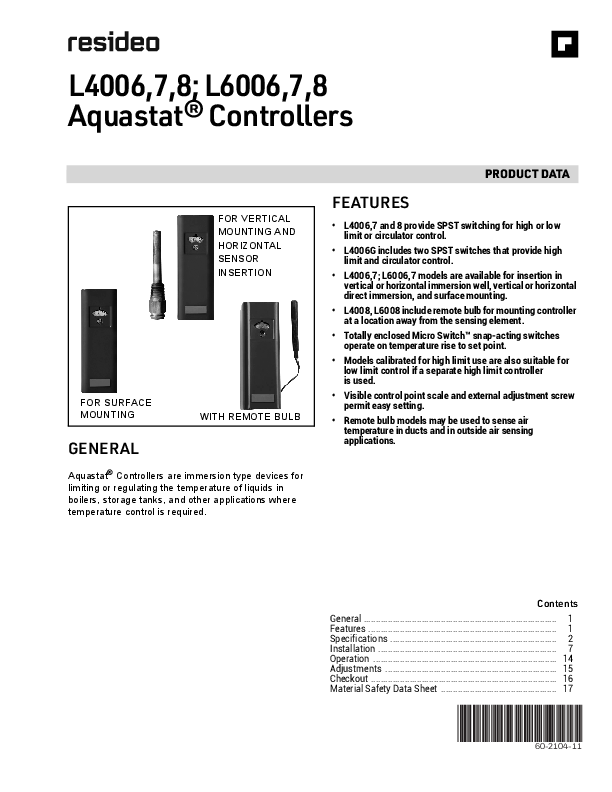
Aquastat® Controllers are immersion type devices for limiting or regulating the temperature of liquids in boilers, storage tanks, and other applications where temperature control is required.
Features
- L4006,7 and 8 provide SPST switching for high or low limit or circulator control.
- L4006G includes two SPST switches that provide high limit and circulator control.
- L4006,7; L6006,7 models are available for insertion in vertical or horizontal immersion well, vertical or horizontal direct immersion, and surface mounting.
- L4008, L6008 include remote bulb for mounting controller at a location away from the sensing element.
- Totally enclosed Micro Switch™ snap-acting switches operate on temperature rise to set point.
- Models calibrated for high limit use are also suitable for low limit control if a separate high limit controller is used.
- Visible control point scale and external adjustment screw permit easy setting.
- Remote bulb models may be used to sense air temperature in ducts and in outside air sensing applications.
Specifications
IMPORTANT: The specifications given in this publication do not include normal manufacturing tolerances. Therefore, this unit may not exactly match the listed specifications. Also, this product is tested and calibrated under closely controlled conditions, and some minor differences in performance can be expected if those conditions are changed.
NOTE: The following specifications are standard. Variances, available as options, are listed in Tables 1 and 2.
Electrical Ratings (A):
Models with 2°F (1°C) fixed differential:
| 120 Vac | 240 Vac | |
| Full Load | 2.6 | 1.3 |
| Locked Rotor | 15.6 | 7.8 |
Models with 5°F (3°C) fixed differential or 5°F to 30°F (3°C to 17°C) adjustable differential:
| 110/120 Vac | 200/240 Vac | 277 Vaca | |
| Full Load | 8.0 | 5.1 | 4.2 |
| Locked Rotor | 48.0 | 30.6 | 25.2 |
| Millivoltage | 0.25 at 0.25 to 12 Vdc | ||
a L6008G only.
Switching:
L4006, L4007, L4008: SPST. L6006, L6007, L6008: SPDT (breaks R-B and makes R-W on temperature rise at setpoint).
Pressure Rating:
Capillary Bulb (Direct Immersion): 200 psi (1379 kPa). Immersion Well: 255 psi (1758 kPa).
Sensing Bulb Material:
Copper.
Sensing Bulb Fill:
Liquid--toluene or silicone oil.
Sensing Bulb Dimensions:
2-7/8 in. (73 mm) long, 3/8 in. (10 mm) diameter.
Wiring:
Screw terminals.
Maximum Ambient Temperature:
150°F (66°C).
Approvals:
- Underwriters Laboratories Inc: Remote bulb devices and well-mounted devices shipped without well are component recognized: File No. MP466, Guide No. MBPR2.
- L4006A shipped with well, L4006G, L4007A,B; L6006C for surface mounting, L6006B for direct immersion mounting, and L6007A are listed: File No. MP466, Guide No. MBPR.
- L6008G is listed: File No. E4436, Guide No. XAPX.
- Canadian Standards Association: File No. LR1620, Guide No. 400-E-O.
ANSI Miswiring:
Models with 1/4 in. tab terminal meet ANSI Appliance Miswiring Standard.
Mounting:
Horizontal and vertical models mount directly to an immersion well installed in a boiler fitting. L4006H and L6006C contain bracket and clamp for surface mounting on pipe or tank. Remote bulb models have three mounting holes in rear of case for screw mounting to a vertical surface. The L6006B direct immersion model also mounts directly to a boiler fitting.
Finish:
Gray.
Dimensions:
Installation: See Fig. 1, 2, and 3. Immersion Well: See Fig. 4. Boiler Fitting and Bulb: See Fig. 5.
Accessories and Parts:
- 137536A Scale Lock Assembly: Includes one 137536-767 Scale Lock and one 80844C-767 Screw, No. 3-48 x 3/16.
- Q615A1004 Weatherproof Enclosure (for remote bulb devices only).
- 107408 Heat-Conductive Compound (4-oz. can).
- 104488 Spring Clip (stainless steel).
- 124904 Well Adapter.
Immersion Well Assemblies and Compression Fittings:
See form 68-0040, Wells and Fittings for Temperature Controllers, for list and ordering information.
[Diagram] Fig. 1. Approximate case installation dimensions in inches (mm) for direct insertion models, showing knockouts for conduit and reset button location.
[Diagram] Fig. 2. Approximate installation dimensions in inches (mm) for remote bulb models, showing mounting holes and alternate sensing element positions.
[Diagram] Fig. 3. Approximate installation dimensions in inches (mm) for surface mount models, showing knockouts.
[Diagram] Fig. 4. Approximate immersion well dimensions in inches (mm).
[Diagram] Fig. 5. Approximate boiler fitting and bulb dimensions in inches (mm).
Model Specifications
Table 1. L4006, L4007, L4008 Controller (SPST Switching) Specifications.
| Model | Application | Range °F (°C) | Midscale Differential °F (°C) | Insertiona | Switching On Temperature Rise | Available Options |
| L4006A | High or low limit | 40° to 180° (4° to 82°) or 100° to 240° (38° to 116°) | 2° or 5° fixed (1° or 3°) or 5° to 30° adjustable (3° to 17°) | Horizontal | Breaks | -- NPT brass spud 1/2 or 3/4 in. -- Special capillary assembly. -- Insertion 3-3/8 or 5 in. (86 or 127 mm) -- Celsius scale markings. -- Factory-set stops at 160°, 180°, 185°, 200°, 220°, or 230°F (71°, 82°, 85°, 93°, 104°, or 110°C). -- Insulation depths of 1-1/2, 3 or 4 in. (38, 76, or 102 mm). -- Screw and mounting brackets. -- Plastic tubing over well. -- Modified dial with stop. -- Special cover and knobs. -- With ground screw. |
| L4006B | Circulator | 100° to 240°F (38° to 116°C) | 5°F (3°C) fixed or 5° to 30°F (3° to 17°C) adjustable | Horizontal | Makes | -- Insulation depth 1-1/2 or 3 in. (38 or 76 mm). -- NPT brass spud 3/4 in. -- Screw in front of case on dial suitable for Powerpile® control. -- Factory-set stop at 240°F (116°C). |
| L4006C | High or low limit | 65° to 200°F (18° to 93°C) | 3-1/2°F (2°C) fixed | Horizontal direct immersion | Breaks | -- Less cover. -- Capillary 10 in. (254 mm). -- NPT brass spud 3/4 in. |
| L4006Eb | High limit | 130° to 290°F (54° to 141°C) | Manual reset | Horizontal or vertical | Breaks | -- Insulation depth 1-1/2 or 3 in. (38 or 76 mm). -- NPT brass spud 1/2 in. -- Factory-set stop at 250°F (121°C). -- Capillary 8 in. (203 mm). |
| L4006G | High limit and circulator control | 100° to 200°F (38° to 93°C) | 10°F (6°C) fixed | Horizontal | Two switches break simultaneously | -- External adjustment knob. -- Insulation depth 4 in. (102 mm). -- Factory-set stop at 160°F (71°C). -- Celsius scale markings. -- Without well. |
| L4007A | High or low limit | 100° to 240°F (38° to 116°C) | 2° or 5°F (1° or 3°C) fixed, 5° to 30°F (3° to 17°C) adjustable | Horizontal or vertical | Breaks | -- Insulation depth 1-1/2 or 3 in. (38 or 76 mm). |
Table 1. L4006, L4007, L4008 Controller (SPST Switching) Specifications. (Continued)
| Model | Application | Range °F (°C) | Midscale Differential °F (°C) | Insertiona | Switching On Temperature Rise | Available Options |
| L4007B | Circulator | 100° to 240°F (38° to 116°C) | 5°F (3°C) fixed or 5° to 30°F (3° to 17°C) adjustable | Vertical | Makes | -- Celsius scale markings. |
| L4008A | High or low limit | 100° to 240°F (38° to 116°C) or 130° to 270°F (54° to 132°C) | 5°F (3°C) fixed, 5° to 30°F (3° to 17°C) adjustable | Remote bulb direct immersion | Breaks | -- Remote capillary 5-1/2 ft (1.7 m), 8-1/2 ft (2.6 m) or 10 ft (3.0 m). -- Factory-set scale stops at 120°, 170°, or 200°F (49°, 77°, or 93°C) -- Celsius scale markings. -- Front cover screw. |
| L4008B | Circulator | 100° to 240°F (38° to 116°C) | 5°F (3°C) fixed or 5° to 30°F (3° to 17°C) adjustable | Remote bulb direct immersion | Makes | -- Capillary 5-12 ft. (1.7 m). |
| L4008Eb | High limit | 40° to 80°F (4° to 27°C) or 130° to 270°F (54° to 132°C) | Manual reset | Remote bulb | Breaks | -- Factory-set scale stops at 140°, 200°, or 250°F (60°, 93°, or 121°C). -- Capillary 5-1/2 ft. or 20 ft. (1.7 m or 6.1 m). |
a Some models include copper well or fitting; specify when ordering. Also specify boiler tapping size 1/2 or 3/4 in. NPT and insulation depth.
b Manual reset (trip-free) switch breaks circuit and locks out when controlled medium reaches setpoint. Controlled temperature must drop 20°F (11°C) below setpoint before contacts can be manually reset.
Table 2. L6006, L6007, L6008 Controller (SPDT Switching) Specifications.
| Model | Application | Range °F (°C) | Midscale Differential °F (°C) | Insertiona | Availlable Options |
| L6006A | Circulator and low limit or high limit | 100° to 240°F (38° to 116°C) or 100° to 290° (38° to 143°C) | 5°F (3°C) fixed or 5° to 30°F (3° to 17°C) adjustable | Horizontal or vertical surface mounted | -- Modified dial with stop. -- NPT brass spud 1/2 in. or 3/4 in. -- 3-3/8 in. (86 mm) insertion. -- Without well. -- Adapter for horizontal or vertical mount. -- Insulation depth 1-1/2 or 3 in. (38 or 76 mm). |
| L6006B | Circulator and low limit or high limit | 100° to 240°F (38° to 116°C) | 5°F (3°C) fixed or 5° to 30°F (3° to 17°C) adjustable, or 30°F (17°C) fixed. | Direct immersion. | -- Insulation depth 1-1/2 in. (38 mm). -- 3/4 in. brass compression fitting. |
| L6006C | Circulator, low limit, and high limit | 65° to 200°F (18° to 93°C) | 5°F (3°C) fixed or 5° to 30°F (3° to 17°C) adjustable | Horizontal or vertical surface mounted | -- Strap-on, surface mount. -- Insulation depth 1-1/2 or 3 in. (38 or 76 mm). |
| L6007A | Circulator and low limit or high limit | 40° to 180°F (4° to 82°C) | Fixed | Horizontal or vertical | -- Modified dial with stop. -- Capillary 5-1/2 ft. (1.7 m). |
| L6008A | Circulator and low limit cooling | 100° to 240°F (38° to 116°C) or -30° to +70°F (-35° to +21°C) | 5°F (3°C) fixed or 5° to 30°F (3° to 17°C) adjustable | Remote bulb | -- Capillary 6 ft. (1.8 m). -- Adjustable interstage differ- ential; 5° to 10°F (2° to 6°C). |
| L6008G | Two-stage Aquastat® Controller to cycle two-stage gas valve. | 130° to 230°F (54° to 110°C) or 60° to 160°F (16° to 71°C) | 3-1/2°F (2°C) fixed | Remote bulb | -- |
| L6008H (maximum temperature of element 405°F [207°C]) | Low fire Aquastat® Controller | 150° to 200°F (66° to 93°C) | 15°F (8°C) fixed | Remote bulb | -- Capillary 33 in. (0.8 m). |
a Some models include copper well or fitting; specify when ordering. Also specify boiler tapping size 1/2 or 3/4 in. NPT and insulation depth.
Installation
When Installing This Product...
- Read these instructions carefully. Failure to follow them could damage the product or cause a hazardous condition.
- Check the ratings given in the instructions and on the product to make sure the product is suitable for your application.
- Installer must be a trained, experienced service technician.
- After installation is complete, check out product operation as provided in these instructions.
⚠️ WARNING Explosion Hazard. Can cause serious injury, death or property damage. This product is intended for use only in systems with a pressure relief valve.
⚠️ WARNING Electrical Shock Hazard. Can cause serious injury or death. Disconnect power supply before beginning installation to prevent electrical shock or equipment damage.
❗ CAUTION Equipment Damage Hazard. Use of incorrect device or improper installation can damage the system. 1. Do not replace immersion-type Aquastat Controller with strap-on Aquastat Controller. 2. Do not secure draw nut so tightly that retainer clamp can collapse tubing.
IMPORTANT
- Terminals on these Aquastat relays are approved for copper wire only.
- Controller may be used with or without immersion well. If used, well must snugly fit sensing bulb for best thermal response. Insert bulb until it rests against the bottom of the well. Use well of correct length and bend the tubing, if necessary, to provide enough force to hold the bulb against the bottom of the well. Avoid making a sharp bend in the tubing that it can produce a break in the tubing and cause loss of fill. This condition causes the high and low limit controls to be made continuously.
- If well does not snugly fit on bulb, use the heat-conductive compound as follows: Fold the plastic bag of compound lengthwise and twist gently. Snip the end of the bag and insert into the well. Slowly pull out the bag while squeezing firmly to distribute compound evenly in the well. Insert the bulb into the well. Bend the tubing, if necessary, to provide force to hold the bulb against the bottom of the well and to hold the outer end of the bulb firmly in contact with the side of the well. Wipe off excess compound.
The manufacturer usually provides a tapping for insertion of the controller sensing element. This tapping is located at a point where typical water temperature can be measured. Depending on the model, the element is inserted in an immersion well, through a boiler fitting, or directly immersed. Installation should be made by a qualified service technician. Follow the instructions furnished by the system manufacturer, if available. Otherwise, refer to appropriate procedure listed below.
Mounting Immersion Well and Direct Immersion Models (L4006A,B,C,E,G; L4007A,B; L6006A,B; L6007A)
Installing Immersion Well Models (L4006A,B,E,G; L4007A,B; L6006A; L6007A)
On an existing installation, shut off the power and remove the old control. If the old immersion well appears suitable, and if the adapter clamp on the Aquastat Controller fits the old well spud, this well does not need to be replaced.
To replace the well:
- If the system is filled, drain the system to a point below the boiler tapping.
- Remove the old well from the boiler tapping.
- Install the immersion well included with the controller. If the boiler tapping is greater than 1/2 in., use a reduction fitting to adapt the boiler opening to the 1/2 in. threads that are standard with the well or fitting. Fittings with 3/4 in. threads are also available.
- Fill the system. Make sure that the well is screwed in tightly enough to prevent leakage. Do not use the case as a handle to tighten the well after the controller is secured to the well.
To install the controller:
- Loosen the screw (at the top of the case, above the scale setting), and remove the cover. Loosen the two screws that secure the adapter clamp (Fig. 6).
- Insert the sensing element into the immersion well.
- Fasten the case of the Aquastat Controller to the well with the adapter clamp. Make certain that the clamp is properly positioned over the groove of the well spud. Also, be sure the flange at the opening of the well fits snugly into the opening of the case. The sensing bulb must bottom in the well.
NOTE: Some models include up to 3 in. (76 mm) extra capillary tubing inside the case. In these models, pull out that extra tubing, if needed.
[Diagram] Fig. 6. Internal view of L6006A, highlighting the setpoint dial, differential adjustment wheel, adapter clamp screws, and insertion element.
Installing Direct Immersion Models (L4006C, L6006B)
Models that provide for direct immersion of the sensing element into the boiler include a bulb compression fitting assembly instead of an immersion well. Install the fitting in the boiler tapping as follows:
- Be sure the sealing washer is in place as shown in Fig. 7. Make sure that the spud of the bulb compression fitting is screwed in tightly enough to prevent leaking.
- Insert the immersion sensing bulb through the bulb compression fitting. Adjust the adapter clamp so that it fits over the groove at the opening of the bulb compression fitting.
- Tighten the adapter clamp screws so that the Aquastat Controller is firmly attached to the bulb compression fitting.
[Diagram] Fig. 7. Direct immersion model with fitting partially removed, showing adapter clamp, split sleeve, sealing washer, and bulb compression fitting.
Mounting Remote Bulb Models (L4008A,B,E; L6008A,G,H)
The remote temperature-sensing bulb can either be installed in an immersion well (Fig. 8) that extends into the boiler or tank, or it can be directly immersed in the controlled medium. See Fig. 9. For installations that do not use a well, secure the remote bulb with a bulb compression fitting (Fig. 10), or capillary compression fitting (Fig. 11).
Order well, well adapter, bulb compression fitting or capillary compression fitting separately. See form 68-0040, Wells and Fittings for Temperature Controllers. If used, well must snugly fit sensing bulb for the best thermal response. Insert bulb until it rests against the bottom of the well. Hold it there while tightening the tubing clamp. See Fig. 8.
The boiler manufacturer usually provides a tapping for the insertion of the Aquastat Controller sensing element. This tapping should be located at a point where typical water temperature can be measured. Never locate the bulb or protecting immersion well close to a hot or cold water inlet or a steam coil.
If the system is filled, drain system to a point below the boiler tapping, or wherever the sensing bulb is to be installed.
The bulb can also be installed in the supply line of an indirect water heater, in the direct water heater itself, or in the feed riser, about 6 in. (153 mm) above the boiler. If the riser is valved, the bulb can be installed between the boiler and the valve.
NOTE: Do not make sharp bends or kinks in the capillary. Make bends no sharper than 1 in. (25 mm) radius.
After installing the controller, carefully coil the excess capillary at the bottom of the controller case.
Mounting Immersion Well
- Screw the well into the boiler, tank, or pipe tapping.
- Insert the bulb in the well, pushing the tubing until the bulb bottoms in the well.
- Attach the retainer clamp to the end of the well spud. Loosen the draw nut and spread the jaws of the clamp with the screwdriver if necessary. See Fig. 8.
- With the retainer clamp attached to the well spud (be sure the jaws of the clamp hook over the ridge at the end of the spud, as shown at points A in Fig. 8), adjust the tubing to fit through the retainer clamp groove, as shown at point B (Fig. 8).
- Tighten the draw nut so that the retainer clamp is firmly attached to the well spud and the tubing is held securely in place.
[Diagram] Fig. 8. Immersion well fitting, showing mounting clamp, spud, well, tubing, and jaw details.
[Diagram] Fig. 9. Internal view of an L4008L or L6008G controller, with labels for sensing element, snap switches, and capillary tube.
Mounting With Bulb Compression Fitting
- Screw the fitting into the boiler or pipe tapping.
- Slide the sealing washer onto the bulb.
- Insert the bulb into the fitting until the bulb bottoms.
- Slide the split sleeve into the fitting. See Fig. 10.
[Diagram] Fig. 10. Bulb compression fitting, showing clamp screws, bulb, sealing washer, split sleeve, and insertion length.
- Place clamps A and B on the assembly so that the sleeve is drawn into the fitting when the screws are tightened.
- NOTE: Make sure that the nub on clamp A engages space between the sleeve and the clamp.
- Tighten the clamp screws evenly.
Mounting With Capillary Compression Fitting
- Screw the fitting into the boiler or pipe tapping.
- Place the packing nut on the tubing.
- Slide the bulb completely through the fitting.
- Place the composition disk and four slotted brass washers on the tubing in the order shown in Fig. 11. Turn the brass washers so the slots are 180 degrees apart.
[Diagram] Fig. 11. Capillary compression fitting, showing packing nut, composition disk, slotted brass washers, and capillary tubing.
- Slide the seal assembly into the fitting and tighten the packing nut.
DUCT MOUNTING
- Drill a 3/4 in. (19 mm) hole in the duct wall large enough to admit the sensing bulb into the holder.
- Using the holder as a template, mark and drill holes for the bulb holder mounting screws. See Fig. 12.
[Diagram] Fig. 12. Bulb support for duct mounting.
- Break the holder to the desired length. See Fig. 13.
- NOTE: The holder must be long enough to hold the sensing bulb in freely circulating air away from the duct wall. Neatly coil the excess capillary at the controller case or at the bulb holder.
- Place the capillary in the bulb holder channel. Pinch the top edges of the holder together at each segment. See Fig. 14.
[Diagram] Fig. 13. Removing excess bulb support.
[Diagram] Fig. 14. Securing capillary in bulb holder.
- Insert the bulb holder into the controlled area through the hole prepared in step 1.
- Fasten the bulb holder to the duct wall with the screws furnished.
Mounting Remote Bulb Models For Outdoor Air Sensing
These models have a 5 ft (1.5 m) capillary that establishes the maximum distance between the case and the outdoor mounting.
Install the bulb on the outside of the building in the shield provided (Fig. 15) where it can be exposed to representative air temperature, but not to direct sunlight. Mount the bulb high enough so that accumulated snow, leaves, or other debris cannot obstruct circulation of air around it, and where children cannot reach it. Avoid vents from the building.
Install the case at the indoor location selected, fastening the screws through holes in the back of the case. Bring out the bulb and tubing through a 3/4 in. (19 mm) hole in the outside wall, avoiding sharp bends or kinks. Leave excess tubing coiled near the case. Do not make sharp bends near the case or bulb.
Slip the bulb through the supports in the shield. Pinch the split supporting clip until it holds the bulb firmly in position. If the seal-off tube protrudes from under the shield, bend it under as shown in Fig. 15.
Hold the shield over the mounting position and form a small-radius bend in the tubing. Place the split plug around the tubing and move the shield into the mounting location as a unit. Push the split plug into the hole until it is wedged securely in place. Fasten the shield in place on the wall with the screws provided.
NOTE: If the tubing is properly shaped and the split plug installed as directed, the shield will cover the split plug, and the hole in the wall will be hidden from sight.
[Diagram] Fig. 15. Mounting a bulb in a shield outside a building, with labels for outdoor sensing bulb, split wood plug, and shield.
Mounting L6008A Remote Bulb Controller
Mounting with Guard Bracket
Mount the bulb in the guard bracket as shown in Fig. 16. Locate the bulb and bracket combination in freely circulating air in the controlled area. With screws provided, fasten the bracket in place.
[Diagram] Fig. 16. Securing a remote bulb in a clip when mounting with a guard bracket.
Mounting on Suction Line
- In cooling units with more than one suction line, place the sensing bulb on the common line.
- Make certain the bulb is at least 2 ft (0.6 m) from the point at which the suction line leaves the cooler. This prevents the outside temperature from being transmitted to the remote bulb through the copper tubing of the suction line.
- Place the remote sensing bulb on the side of the horizontal suction line between the coil and trap (not on the trap).
- Attach the sensing bulb to the suction line with clips or straps. See Fig. 17.
- Coil the excess length of capillary tubing near the L6008A case.
[Diagram] Fig. 17. Attaching a remote bulb to a horizontal suction line.
Mounting Surface Mount Models
The L4006H and L6006C are designed for surface mounting on piping or tanks. Mount the controller directly on the tank surface using the adjustable mounting bracket as shown in Fig. 18. The controller can be mounted in any position.
When mounting the L4006H or L6006C on piping, the pipe should be 1 in. (25 mm) diameter or larger for accurate temperature sensing. Remove any insulation from the pipe. Thoroughly scrape off all scale, rust, or paint. Mount the controller using adjustable bracket furnished. Turn on power.
[Diagram] Fig. 18. Mounting L4006H or L6006C directly on a surface.
Wiring
Disconnect power supply before beginning installation to prevent electrical shock or equipment damage.
All wiring must comply with local codes and ordinances regarding wire size, type of insulation, enclosure, etc. Figs. 19 through 28 show typical hookups.
When wiring a switch equipped with a 1/4 in. tab terminal connector, use 187 to 22 gauge wire with an AMP Inc. part no. 2-520129-2 fully insulated flag receptable connector or equivalent.
[Diagram] Fig. 19. Typical gas-fired system with domestic hot water.
[Diagram] Fig. 20. Typical oil-fired gravity system.
[Diagram] Fig. 21. L6008A used to control cooling equipment and indicating light.
[Diagram] Fig. 22. Typical oil-fired hydronic system with domestic hot water.
[Diagram] Fig. 23. Typical oil-fired hydronic heating system that provides year-round domestic hot water using RA832A.
[Diagram] Fig. 24. Typical connection diagram for an oil-fired, hydronic heating system that provides year-round domestic hot water using RA817A.
[Diagram] Fig. 25. Typical wiring hookup using L6006 or L6007 with L8148A.
[Diagram] Fig. 26. Typical systems with 120 volt electric heat primaries.
[Diagram] Fig. 27. Typical Powerpile® System wiring diagram.
[Diagram] Fig. 28. Typical oil burner installation using L4008G.
Operation
For proper selection of settings, follow the boiler manufacturer recommendations.
High Limit Controller
R-B terminals provide high limit switching function (contacts open at set point on temperature rise). See Fig. 29 and 30. Shuts off burner if water temperature exceeds high limit setting. Burner restarts when temperature drops to high limit setting, less differential.
NOTE: On manual reset models, the reset button on the front of the case must be pushed in to allow the burner to operate after a high limit shutdown.
[Diagram] Fig. 29. Operation of L6008G, showing switch actions based on temperature rise and fall, and interstage differential.
[Diagram] Fig. 30. Operation of L4008L, showing switch actions based on temperature rise and fall, and differential.
Low Limit Controller
R-B terminals provide low limit switching function (contacts open at set point on temperature rise). Maintains minimum boiler temperature for domestic hot water. Turns on boiler at temperature setting, less differential.
Circulator Controller
R-W terminals provide circulation control function (contacts close at set point on temperature rise). Prevents circulation of water that is below the desired heating temperature. Breaks circulator circuit on temperature drop below setting less differential; remakes on rise to setting.
L6008G Adjustable Interstage Differential
When the temperature at the sensing element rises above the set point of the controller, the switch on the right makes R-W. If the temperature continues to rise through the preselected interstage differential of the controller, the switch on the left makes
Conversely, on a temperature fall, the switch on the left makes R-B, providing first step switching. If the temperature continues to fall, the switch on the right makes R-B to provide sequencing of equipment.
Adjustments
Adjusting Differential
Set the differential to correspond with the boiler manufacturer recommendations. To adjust models with adjustable differential, rotate the wheel on the back of the snap switch, see Fig. 31, until the desired reading is aligned with the V notch in the frame. The wheel provides an adjustment from 5°F to 30°F (3°C to 17°C). Replace the cover on the Aquastat Controller.
[Diagram] Fig. 31. Adjusting the differential on a snap switch.
Adjust the control point to correspond with the boiler manufacturer recommendations. To adjust, insert a screwdriver in the slotted screw type head located beneath the window in the cover. Turn the scale to the desired control point.
Adjusting L6008G Interstage Differential
The L6008G Controller has an adjustable interstage differential. The set point adjustment knob determines the temperature at which the right switch operates. The left switch can be adjusted to operate from 3°F to 10°F (1.7°C to 5.6°C) above the point of operation of the right switch. See Fig. 29 for the operation of the L6008G. The interstage differential is adjusted by turning the star wheel with a narrow screwdriver inserted into the rectangular hole in the chassis (Fig. 32).
[Diagram] Fig. 32. Interstage differential adjustment on an L6008G.
L6008A Location Differential Calibration
The L6008A1093 is calibrated for applications where the bulb and controller case are located in the same control space.
If the bulb and controller case are located in separate rooms, and if the temperature in the two rooms is different, an adjustment is required. Adjust the dial setting (control space temperature setting) to compensate for the difference in temperature.
- If the L6008A case is located in a room with a higher temperature than indicated on the dial setting, raise the dial setting the number of degrees listed in Table 3.
- If the L6008A case is located in a room with a lower temperature than indicated on the dial setting, lower the dial setting the number of degrees listed in Table 3.
Table 3. Temperature Adjustments.
| Difference Between Desired Room Temperature and Case Temperature | Reduce Dial Setting | ||
| °F | °C | °F | °C |
| 0 | 0 | -- | 0 |
| 5 | 3 | 3/4 | 0.5 |
| 10 | 6 | 1-1/2 | 1 |
| 15 | 8 | 2 | 1 |
| 20 | 11 | 2-3/4 | 2 |
| 25 | 14 | 3-1/2 | 2 |
| 30 | 17 | 4-1/4 | 3 |
| 35 | 20 | 5 | 3 |
| 40 | 22 | 5-3/4 | 4 |
| 45 | 25 | 6-1/2 | 4 |
| 50 | 28 | 7 | 4 |
| 55 | 31 | 8 | 5 |
| 60 | 33 | 8-1/2 | 5 |
| 70 | 39 | 10 | 6 |
| 80 | 45 | 11-1/2 | 7 |
[Diagram] Fig. 33. L6008A calibration for compensating temperature differences between rooms.
Manual Reset
If the device includes manual reset (L4006E, L4008E), be sure to press the red reset button on the front of the case to make sure that the controller is not locked out on safety. When checking out the system, adjust the limit setting low enough so the temperature of the controlled medium reaches the high limit setting. When the limit setting is reached, the Aquastat Controller locks out and the burner shuts down. When the temperature of the controlled medium drops to the high limit setting, less the differential, push the manual reset button to make the system operative again. Reset the control to the proper high limit setting.
Checkout
⚠️ WARNING Explosion Hazard. Can cause serious injury, death or property damage. This product is intended for use only in systems with a pressure relief valve.
Check to make certain that the Aquastat Controller is properly installed and adjusted. Put the system into operation and observe the action of the control through several cycles to make certain it provides proper control of the system as described in the Operation section. Make any additional adjustments necessary for assuring comfort requirements.
Material Safety Data Sheet
Section 1. Product And Company Identification
- Product Name: Heat Conductive Compound
- MSDS ID: DS9021
- Synonyms: MS1699
- Product Use: Heat conductive material used to enhance contact and heat transfer in temperature sensor applications.
- Manufacturer: Resideo Technologies, Inc., 1985 Douglas Drive North, Golden Valley, MN 55422
- Date Released: October 8, 1999
- NFPA Ratings: Health 0; Flammability 1; Reactivity 0; Personal Protection B
Section 2. Composition, Information on Ingredients
| Ingredient | CAS Number | Percent | PEL | TVL |
| #2 Lithium Complex Grease (70%): | ||||
| Mineral Oil | 64742-65-0 | 35-50 | 5 mg/m³ | 5 mg/m³ |
| Mineral Oil | 64742-62-7 | 20-25 | 5 mg/m³ | 5 mg/m³ |
| Lithium Hydrostearate/Sebacate Complex | 68815-49-6 | 4-9 | -- | -- |
| Zinc Alkyldithiophosphate | 68649-42-3 | 0-2 | -- | -- |
| Aluminum Paste (30%): | ||||
| Aluminum, as Al | 7429-90-5 | 20-25 | 15 mg/m³ | 10 mg/m³ |
| Aliphatic Petroleum Distillates | 8052-41-3 | 10-15 | 2900 mg/m³ | 525 mg/m³ |
| Stearic Acid | 57-11-4 | 1-2 | -- | -- |
| Aromatic Petroleum Distillates | 64742-95-6 | 1-2 | 5 mg/m³ | 5 mg/m³ |
Additional Information: Part No. 120650 (0.5 oz tube); Part No. 107408 (4 oz can); Part No. 197007 (5 gallon container). May also contain minute amounts of lithium and molybdenum lubricant compounds.
Section 3. Hazard Identification
Acute Health Effects:
- Skin: Excessive contact may cause skin irritation and dermatitis.
- Eye: Direct contact with eye will cause irritation.
- Inhalation: No adverse effects are expected.
- Ingestion: Ingestion of product may cause nausea, vomiting and diarrhea.
Chronic Health Effects:
Existing skin rash or dermatitis may be aggravated by repeated contact.
OSHA Hazard Classifications:
None.
Carcinogenicity:
Not considered to be a carcinogen by either OSHA, NTP, IARC, or ACGIH.
Section 4. First Aid Measures
- Eye Contact: Flush eyes with water for 15 minutes. Remove any contact lenses and continue to flush. Obtain medical attention if irritation develops and persists.
- Skin Contact: Remove excess with cloth or paper. Wash thoroughly with mild soap and water. Obtain medical attention if irritation develops and persists.
- Ingestion: Contact physician or local poison control center immediately.
- Inhalation: Remove patient to fresh air and obtain medical attention if symptoms develop.
Section 5. Fire Fighting Measures
- Material Flash Point: > 383°F (195°C). Will burn if exposed to flame.
- Extinguishing Media: Carbon dioxide, dry chemical or foam.
- Special Fire Fighting Procedures: None.
- Explosion Hazards: None. Aluminum powder can react with water to release flammable hydrogen gas. In the form of this product, this reaction is not expected.
Section 6. Accidental Release Measures
Scrape up and dispose of as solid waste in accordance with state and federal regulations.
Section 7. Handling and Storage
Store in dry place. Keep container closed when not in use.
Section 8. Exposure Controls and Personal Protection.
- Ventilation: No special ventilation is required when working with this product.
- Respiratory Protection: None required.
- Eye Protection: Not normally required. However, use chemical safety goggles or faceshield if potential for eye contact exists, especially if material is heated.
- Hand/Clothing Protection: Not normally required. Protective gloves and clothing are recommended, as material is difficult to remove from skin and clothing.
- Other Protective Equipment: None required.
Section 9. Physical and Chemical Properties
- Appearance/Odor: Aluminum color, semi-solid material, pleasant odor.
- Solubility in Water: Negligible.
- Specific Gravity: 0.86.
Section 10. Stability and Reactivity
- Stability: Stable.
- Reactivity: Hazardous polymerization will not occur.
- Incompatibilities: Strong oxidizing agents and halogens.
- Hazardous Decomposition Products: Carbon dioxide, carbon monoxide.
Section 11. Toxicology Information.
No data available.
Section 12. Ecological Information
Chemical Fate Information: Hydrocarbon components will biodegrade in soil; relatively persistent in water.
Section 13. Disposal Consideration
Dispose of as solid waste in accordance with local, state and federal regulations.
Section 14. Transportation Information
DOT Classification: Not classified as hazardous.
Section 15. Regulatory Information
SARA Title III Supplier Notification: Include in Section 311/312 inventory reports if amounts exceed 10,000 pounds. Aluminum compounds are subject to the reporting requirements under Section 313 of Emergency Planning and Community Right-To-Know Act of 1986 (40 CFR 372). Ingredients listed in TSCA Inventory.
Section 16. Other Information
This information is furnished without warranty, expressed or implied, except that is accurate to the best of our knowledge.
Prepared by: PROSAR, 1295 Bandana Boulevard, Suite 335, St. Paul, MN 55108 (651-917-6100).
 Smart Home Products and Systems | Resideo