

File info: application/pdf · 516 pages · 18.92MB
F·SE/F FLIGHT MANUAL - DocDroid
AF76-0472 thru AF76-0490 manual for these particular serial numbered. AF76-1616 thru AF76-1642 aircraft, reference to a supplemental flight. AF77-0328 thru ...
Download
Northrop F-5EF Flight Manual | DocDroid
Full PDF Document

If the inline viewer fails, it will open the original document in compatibility mode automatically. You can also open the file directly.
Extracted Text
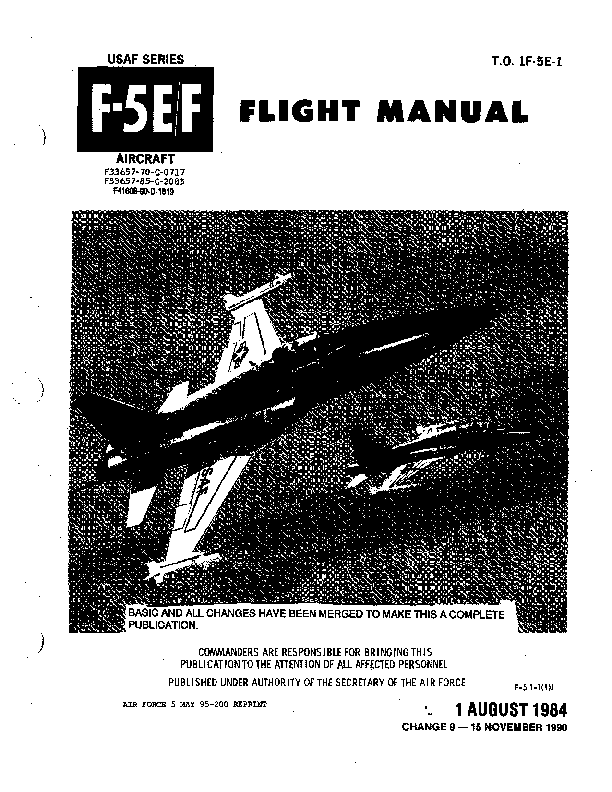
USAF SERIES
T.0. 1F-5E�l
F�SE/F FLIGHT MANUAL
)
AIRCRAFT
F33 65 7- 70-C-O 71 7 F3365 7-85-C-2083
F41608-90�D-1819
)
BASIC AND ALL CHANGES HAVE BEEN MERGED TO MAKE THIS A COMPLETE PUBLICATION.
) COMMANDERS ARE RESPONSIBLE FOR BR I NG I NG TH IS PUBLICATION TO THE ATTENTION OF ALL AFFECTED PERSONNEL
PUBLISHED UNDER AUTHORITY OF THE SECRETARY OF THE AIR FORCE
F-5 l-1(1)J
AIR FORCE 5 MAY 95-200 REPRINT
1 AUGUST 1984
CHANGE 9 -15 NOVEMBER 1990
LIST OF EFFECTIVE PAGES
INSERT LATEST CHANGED PAGES. DESTROY SUPERSEDED PAGES.
NOTE: The portion of the text affected by the changes is indicated by a vertical line in the outer margins of the page. Changes to illustrations are indicated by miniature pointing hands. Changes to wiring diagrams are indicated by shaded areas.
Dates of issue for original and changed pages are: Original .�. 0 ��.� 1 Aug 84 Change �..�� 7 ��.� 1 Dec 86 Change �.��� 1 ..�� 1 Dec 84 Change ����� 8 ���� 1 Dec 87 Change ��... 2 ��.� 1 Apr 85 Change ..... 9 .... 15 Nov 90 Change ���.. 3 �.�� 1 Aug 85 Change ����� 4 .��� 1 Dec 85 Change �.��� 5 ���. 1 Apr 86 Change ����� 6 ���� 1 Aug 86
TOTAL NUMBER OF PAGES IN THIS PUBLICATION IS 532 CONSISTING OF THE FOLLOWING:
Page No.
*Change No.
Title ............. 9
A- B .............. 9
Page
*Change
No.
No.
1-42 - 1-43 ...��� o !
1-44 .�.�...��...� 4
Page No.
*Change No.
1-93 �����.������� 5
1-94 - 1-99...�.. o
C Blank ............ 9
i . ............... 0
ii Blank���.����� o iii �����������.�� o
1-45 �.��.��....�. 0
1-46 �.�.�.�.����. 8
1-47 - 1-48 ...��. o
1-49 ..�..�.��.��. 4
1-100 ...........� 1
1-101 - 1-109 �.�� o
1-110 ......�..��. 8
1-111 ......��...� 0
i V ��������������� 3
1-50 ��.�.��..���. 0
1-112 ......��.��. 8
)
V �� � ���� � �������� 5
1-51 .����.��.�..� 1
1-113 - 1-122 ..... 0
vi .��..��..�...�� 8
1-52 - 1-53 ...��. 0
1-123 ............. 9
vii ���������.���. 5
1-54 ��...���.���. 5
1-124 - 1-126 ..... 0
viii .............. 9
1-55 - 1-64 ������ 0
1-127 ............. 9
ix - x Deleted��� 8
xi Blank �������.. o
1-65 �.��.�..�..�. 8 1-66���.....�...� 7
1-128 - 1-129 ��.�. 8
1-130 Blank ���.�� 8
xii ��.���.��.��.� 0
1-1 ��.��.����...� 0 1-2 .�.�����.��.�. 4 1-3 ........ : ....... 9
1-4 �..�������..�� 0 1-5 - 1-10��...�. 7 1-11 - 1-22 .�.... 0 1-23 - 1-28 .�.��. 7 1-29 - 1-32 ....... 0 1-33 .............. 9 1-34 - 1-35 ....... 0 1-36 - 1-37 �.��.. 8 1-38 ��.�.�..����� o 1-39 - 1-41 ���... 8
1-67 ...��........ 0 1-68 ���.����...�� 4
1-69 - 1-76 ..��.. o
1-77 - 1-79��...� 4 1-80 - 1-81 �����. 0 1-82 - 1-83 ..��.� 4
1-84 - 1-85 ������ o
1-86 ��������..��� 2
1-87 ��....�..���� 0 1-88 �..���.����.. 3 1-89 .��........�. 4 1-90 .............. 0
1-91 .............. 9
1-92 ����.�������� 4
1-131 ������������ 8 1-132 ............. 0
1-133 - 1-134 ..... 9
1-135 ������������ 5 1-136 - 1-130 ���� 0 1-139 ��.��������� 4 1-140 ������������ 7
1-141 - 1-156 ��� :o
1-157 ������������ 3
1-1sa ������������ s
2-1 .�����������.� 0
2-2 - 2-3 .......... 9 2-4 - 2-7 ����..�� 8
2-8 �.������������ 0
CURRENT FLIGHT CREW CHECKLIST
)
T.O. 1F-5E-1CL-1
1 AUGUST 1984
CHANGE 8 -~- 15 NOVEMBER 1990 � Zero in this column indicates an original page.
A Change9
L-9
!.IST OF EFFECTIVE PAGES
Page No.
*Change No.
2-9 ................ 8
2-10 ............... 9
2-11 ............... 8
2-12 - 2-13 �����. o
2-14 �.�����..��.� 4 2-15 - 2-16 �.��.� 0 2-17 .�.��.�..��.� 4
2-18 .............. 9
2-19 - 2-22 ....... 0
2-23 ���..�..����� 3
2-24 .�.���������� o
3-1 - 3-2 ��.��.�. 0 3-3 .������.������ 2
3-4 - 3-6 .......... 0
3-7 ................ 9
3-a .............. e
3-9 - 3-10���.��� 0 3-11 ������������� e
3-12 - 3-14 ������ o
3-15 ������������� 8 3-16 ������������� 7 3-16A������������ 8
3-168 Blank ..���� s
3-17 �.�.����....� 8
3-10 - 3-19 ������ o
3-20 .��.��.��.��� 2 3-21 �������....�. 5 3-22 ����.�������� 0
3-23 .............. 9
3-24 - 3-25 �..��� 4 3-26 - 3-30 ������ 0 3-31 - 3-34 ������ 8
3-35 ������������� o
3-36 Blank ������� o
4-1 �������������� o
4-2 Blank��.�..�� 0 5-1 ....�.....�... 0 s-2 �. _�.���...... 4
5-3 �������.������ 0
s-4 .............. s
5-5 �������������� o 5-6 �������������� 6
s-1 - s-a ........ o
5-9 ................ 9
5-10 �����..�.���. 8 s-11 ������������. 0 5-12 ���.�.���.�.� 6
Page No,
*Change No,
s-13 - s-14 �..��� o 5-15 �.������.���� 3
5-16 - 5-11 .����� 0 5-18 - 5-21 ������ 6 5-22 - 5-23 ����.� 3 5-24 ������...���. l 5-25 - 5-34 �.�.�. 0 5-35 .�.....�..... 4
5-36 - 5-45 ..�..� o
5-46 Blank .�...�� o
6-1 ��.�.......... 2 6-2 - 6-4 ...�.... 3
6-5 - 6-6 ...�..�� o
6-7 ��������.����� 3 6-8 - 6-11 .��.�.� 2 6-12 �.����������� 4 6-12A.~ ��.�...��. 3 6-12B Blank ������ 3 6-13 - 6-14 �.���� 2
6-15 - 6-20 .��... 0
1-1 - 7-6 ..�.��.. o
A-1 ��.���.������� 0
A-2 Blank��.�.... o
Al-1 ��........�.. 4 Al-2 �.�.�........ 6 Al-3 �.���...�..�. 4 Al-4 - Al-7 .�...� 0 Al-8 ������������. 5 Al-BA ��.������.�� 4 Al-BB Blank������ 4 Al-9 - Al-20 ����� 0 A2-l - A2-15 ����� 0 A2-16 ��������.��� 3 A2-17 - A2-33 ���� 0
A2-34 Blank �.���� o
A3-1 - A3-2 ...... C A3-3 �����������.. ~ A3-4 - A3-17 .��.. 0
A3-18 Blank .��.�� o
A4-1 - A4-24 ����� 0 A4-25 - A4-30 ���. 4
AS-1 - AS-6 �.���� 0 A6-1 - A6-6 ������ 0 A7-1 - A7-12 ���.� 0 AS-1 - AB-11. ���� 0 A8-12 - AB-13 .��. 4 AS-14 - AS-59 ���. 0
AS-60 Blank ������ o
*Zero in this column indicates an original page.
T.O. lF-SE-1
Page No.
*Change No.
A9-l ��.�.����.��� 0 A9-2 ��.���������� 4
A9-3 �� A9-9 ���.��-0
A9-10 Blank ������ o
Al0-1 - Al0-10 .�� 0 Glossary 1 ....... 0 Glossary 2......� 2
Glossary 3 Glossary 4 ��.�� 0
Index 1 ��..��.��� 6 Index 2 -
Index 8 ����.��. 0
Change 9 8/(C Blank)
T.O. 1F-5E-1
TABLE OF CONTENTS
, SECTION: ,: SECTION
SECTION SECTION ', SECTJON
1
:. SECTION' ~� SECTJON t�� '1APPENDIX
I
DESCRIPTION AND OPERATION
11
NORMAL PROCEDURES
111 EMERGEN~Y PROCEDURES
IV CREW DUTIES (NOT APPLICABLE)
V
OPERATING LIMITATIONS
VI
FLIGHT CHARACTERISTICS
VII ADVERSE WEATHER OPERATION
I
PERFORMANCE DATA
PAGE 1-1 2-1 3-1
-
5-1 6-1 7-1 A-1
�GLOSSARY
)
ABBREVIATIONS ALPHABETICAL
GLOSSARY 1
INDEX 1
F-5 l-2(l)A
i/(ii blank)
T.O. 1F-5E-1
SCOPE
) This manual contains the necessary informa-
tion for safe and efficient operation of your aircraft. These instructions provide you with a general knowledge of the aircraft and its characteristics and specific normal and emergency operating procedures. Your experience is recognized; therefore, basic flight principles are avoided. Instructions in this manual are prepared to be understandable by the least experienced crew that can be expected to operate the aircraft. This manual provides the best possible operating instructions under most conditions, but is not a substitute for sound judgment. Multiple emergencies, adverse weather, terrain, etc, may require modification of the procedures.
PERMISSIBLE OPERATIONS
'fhe flight manual takes a positive approach and normally states only what you can do. Un-
) usual operations or configurations are prohibited unless specifically covered herein. Clearance must be obtained before any questionable operation, which is not specifically permitted in this manual, is attempted.
HOW TO BE ASSURED OF HAVING LATEST DATA
Refer to T.0. 0-1-1-4 for a listing of all current flight manuals, safety supplements, operational supplements, and checklists. Also, check the flight manual title page, the title block of each safety and operational supplement, and all status pages attached to formal safety and operational supplements. Clear up all discrepancies before flight.
ARRANGEMENT
The manual is divided into seven fairly independent sections and an appendix to simplify reading it straight thru or using it as a reference manual.
SAFETY SUPPLEMENTS
Information involving safety will be promptly forwarded to you in a safety supplement. Urgent information is published in interim safety supplements and transmitted by teletype. Formal supplements are mailed. The supplement title block and status page (published with formal supplements only) should be checked to de-
Iii
T.O. 1F-5E-1
termine the supplement's effect on the manual and other outstanding supplements.
OPERATIONAL SUPPLEMENTS
Information involving changes to operating procedures will be forwarded to you by operational supplements. The procedure for handling operational supplements is the same as for� safety supplements.
CHECKLIST
The flight manual contains itemized procedures with necessary amplifications. The checklist contains itemized procedures without the amplification. Primary line items in the flight manual and checklist are identical. If a formal safety or operational supplement affects your checklist, the affected checklist page will be attached to the supplement. Cut it out and insert it over the affected page but never discard the check.list page in case the supplement is rescinded and the page is needed.
HOW TO GET PERSONAL COPIES
Each pilot is entitled to a personal copy of the flight manual, safety supplements, operational supplements, and a checklist. The required quantities should be ordered 'before you need them to assure their prompt receipt. Check with your publication distribution officer - it is his job to fulfill your T.O. requests. Basically, you must order the required quantities on the
I appropriate Technical Order Index. T.0. 00-5-1
and T.O. 00-5-2 give detailed information for properly ordering these publications. Make sure a system is established at your base to deliver the pubiications to the pilots immediately upon receipt.
FLIGMT MANUAL BINDERS
Loo8eleaf binders and sectionalized tabs are available for use with your manual. They are obtained thru local purchase procedures and are listed in the Federal Supply Schedule (FSC Group 75, Office Supplies, Part I). Check with your supply personnel for assistance in procur~ ing these items.
WARNINGS, CAUTIONS, AND NOTES
The following definitions apply to Warnings,
Cautions, and Notes found throughout the
manual.
I WARNING
Operating procedures, techniques, etc, which could result in personal injury or loss of life if not carefully followed.
Operating procedures, techniques, etc, which could result in damage to equipment if not carefully followed.
NOTE
An operating procedure, technique, etc, which is considered essential to emphasize.
USE OF WORDS SHALL, WILL, SHOULD, AND MAY
The words shall or will are used to indicate a mandatory requirement. The word should is m;ed to indicate a nonmandatory desire or preferred method of accomplishment. The word may is used to indicate an acceptable or suggested means of accomplishment.
YOUR RESPONSIBILITY - TO LET US KNOW
Every effort is made to keep the flight manual current. Review conferences with operating personnel and a constant review of accident and flight test reports assure inclusion of the latest data in the manual. We cannot correct an error unless we know of its existence. In this regard, it is essential that you do your part. Comments, corrections, and questions regarding this manual or any phase of the flight manual program are welcomed. These should be forwarded on AF Form 847 thru your
iv
Change 3
T.O. 1F-5E-1
command headquarters to: San Antonio ALC/MMUA, Kelly AFB, TX 78241-5000.
AF79-1688 thru AF79-1691 AF79-1698 thru AF79-1701
PUBLICATION DATE
) The date appearing on the title page of this � flight manual represents the currency of mate-
rial contained herein. The publication date is not the printing or distribution date. When re-. ferring to the manual, use the publication date plus the date of the latest change (when published).
e. AF76-1526 thru AF76-1591 [~:_U AF77-0332 thru AF77-0335 AF77-0366 thru AF77-0379 AF77-1767 thru AF77-1770 AF78-0028 thru AF78-0037 AF78-0814 thru AF78-0821 AF78-0826 thru AF78-0829 AF78-0865 thru AF78-0875 AF79-1920 thru AF79-1941
AIRCRAFT DESIGNATION CODES
f. AF74-1463 thru AF74-1466 ~
AF74-1582 thr�u AF74-1585
A code system to identify text, illustrations,
AF74-1604 thru AF74-1611
charts and procedures peculiar to specific
AF75-0604 thru AF75-0608
blocks or models of aircraft in this flight manu-
AF76-1685
al is as follows:
g. AF79-1681 thru AF79-1687 I E-a i
APPLICABLE AIRCRAFT CODE
AF79-1694 thru AF79-1697
AF79-1702 thru AF79-l707
a. All F-5E and F-5F aircraft No Code
AF'79-1717 thru AF79-l720
AFS0-0299 thru AFS0-0319
b. All F-5E aircraft only
AF81-0006 thru AFSl-0019
AF81-0558 thru AFBl-0593
) c. All F-5F aircraft only
�
AFSl-0632 thru AFSl-0638
AFSl-0823 thru AFSl-0857
d. AF71-1417 thru AF71-1421
AF82-0634 thru AF82-0639
AF72-1386 thru AF72-1406
AF82-0644 and AF82-0645
AF73-0846 thru AF73-0888
AF83-0083 thru AF83-0112
AF73-0890
AF84-0183 and AF84-0184
AF73-0892 thru AF73-0902
AF84-0490 and AF84-0491
AF73-1626 thru AF73-1646 AF74-0958 thru AF74-0997
AF85-0043 and AF85-0044 AF85-0057 and AF85-0058
I
AF74-1445 thru AF74-1462
AF85-1586 thru AF85-1595
AF74-1467 thru AF74-1575
AF74-1586 thru AF74-1603
h. AF73-0889 and AF73-0891 00
AF74-1612 thru AF74-1617
AF75-0709 thru AF75-0711
AF75-0314 thru AF75-0373
AF75-0735 thru AF75-0742
AF75-0442 thru AF75-0461
AF75-0753 thru AF75-0755
AF75-0491 thru AF75-0527
AF76-1611 thru AF76-1615
AF75-0573 thru AF75-0603
AF76-1640 thru AF76-1642'
AF75-0609 thru AF75-0627
AF77-0336 thru AF77-0350
AF76-0471 thru AF76-0490
AF77-1778 and AF77-1779
AF76-1616 thru AF76-1639
AF78-0774 thru AF78-0787
AF76-1643 thru AF76-1683
AF78-0802 and AF78-0803
)
AF77-0328 thru AF77-0331 AF77-1771 thru AF77-1777
AF78-2435 and AF78-2436 AF78-2444 thru AF78-2446
AF78-0770 thru AF78-0773
AF79-1709
AF78-0789 thru AF78-0798
AF79-1916 thru AF79-1919
AF78-2447
AFSl-0641 and AF81-0642
Change 5
v
T.O. 1F-5E-1
1. AF76-1592 thru AF76-1597 AF77-0359 thru AF77-0361 AF78-0822 thru AF78-0825 AF78-0876 thru AF78-0884 AF79-1942 thru AF79-1945
j. AF79-1692 and AF79-1693 AF79-1708 AF79-1721 thru AF79-l726 AFS0-0296 thru AFS0-0298 AF81-0594 thru AF81-0613 AFSl-0639 and AF81-0640 AF81-0858 thru AF81-0863 AF82-0004 and AF82-0005 AF82-0089 thru AF82-0091 AF82-0187 thru AF82-0189 AF82-0640 thru AF82-0643 AF83-0072 thru AF83-0074 AF83-0113 thru AF83-0142 AF84-0456 and AF84-0457 AF85-0053 thru AF85-0056
I AF86-0090 and AF86-0091
When complete paragraphs or illustrations are applicable to specific blocks of aircraft, the appropriate code will appear opposite the heading. Notes, cautions, warnings, and steps of a procedure applicable to specific blocks of aircraft will have the code appear as the first item of the sentence or procedure.
SUPPLEMENTAL FLIGHT MANUALS
Aircraft equipped with systems and/or equipment not included in this manual are covered in supplemental flight manuals. To ensure proper use of the code system in this flight manual for these particular serial numbered aircraft, reference to a supplemental flight manual is required. Specific blocks of aircraft designated as configuration peculiar are as follows:
a. T.0. 1F-5E-1-2 'AF74-1505 AF74-1512 thru AF74-1519 AF74-1536 thru AF74-1541
b. T.O. 1F-5E{III}-1 AF75-0442 thru AF75-0456 AF.75-0709 thru AF75-0711 AF76-1614 and AF76-1615 AF76-1677 thru AF76-1686 AFSl-0641 and AF81-0642
vi Change 8
C. T.O. 1F-5EilYl:l AF76-1526 thru AF76-1597 AF81-0826 thru AF81-0857 AF81-0858 thru AF81-0863
d. T.O. 1F-5EfV2:l AF73-0884 AF73-0886 thru AF73-0888 AF73-0890 AF73-1626 AF73-1629 thru AF73-1634 AF73-1641 thru AF73-1646 AF74-1471 thru AF74-1479 AF74-1482 and AF74-1483 AF74-1485 thru AF74-1494 AF75-0457 thru AF75-0461 AF75-0501 thru AF75-0527 AF75-0573 thru AF75-0603 AF75-0626 and AF75-0627
1 AF76-1643 thru AF76-1663 AFSl-0558 thru AFSl-0615
e. T.O. 1F-5E(Vfil AF77-0359 thru AF77-0361 AF77-0366- thru AF77-0379 AF77-1767 thru AF77-1770 AF79-1926 thru AF79-1931 AF82-0187 thru AF82-0189 AF85-1586 thru AF85-1591 AF86-0090 and AF86-009 l
f. T.O. 1F-5E(VII}-1 AF78-0814 thru AF78-0829
g. T.O. 1F-5E(VIII}-1 AF75-0351 thru AF75-0373 AF76-0472 thru AF76-0490 AF76-1616 thru AF76-1642 AF77-0328 thru AF77-0350 AF78-0028 thru AF78-0037 AF78-0865 thru AF78-0884 AF79-1717 thru AF79-1726 AFS0-0296 thru AFS0-0319 AFSl-0006 thru AFSl-0019 AF83-0083 thru AF83-0142
h. T.0. 1F-5E(IXH AF79-1681 thru AF79-1687 AF79-1692 thru AF79-1697 AF79-1702 thru AF79-1708
1. T.O. 1F-5E{X}-1 AFSl-0632 thru AF81-0640 AFSl-0823 thru AFSl-0825
' )
I
)
J. T.O. 1F-5E(Xl}-1 AF79-1920 thru AF79-1925 AF79-1932 thru AF79-1945
k. T.O. 1F-5E(XIII}-1
\ }
AF78-0802 and AF78-0803
AF79-1916 thru AF79-1919
l. T.O. 1F-5E(XIV}-1 AF82-0634 thru AF82-0645
m. T.O. 1F-5E(XV}-1
I
AF85-0043 and AF85-0044 AF85-0053 thru AF85-0058
AF85-1592 thru AF85-1595
n. NTM 1F-5E-1(2} AF74-1582 thru AF74-1617
o. NTM 1F-5E-l(N} AF73-0858 and AF73-0868 AF73-0872 and AF73-0883 AF73-0895 AF73-0900 and AF74-1533 AF74-1480 AF75-0753 thru AF75-0755
T.O. 1F-5E-1
ADDITIONAL EFFECTIVITIES
This manual applies to the following aircraft with reference to the VOR/ILS, marker beacon and attitude director indicator.
AF71-1417 thru AF71-1421 AF72-1386 thru AF72-1406 AF73-0846 thru AF73-0855 AF73-0865 and AF73-0866 AF73-0879 thru AF73-0882 AF73-0885 AF73-0896 thru AF73-0899 AF73-1635 and AF73-1636 AF73-1640 AF74-1484 AF74-1505 thru AF74-1519 AF74-1528 thru AF74-1575 AF75-0612 thru AF75-0617 AF82-0089 thru AF82-0091 AF83-0072 thru AF83-0074
This manual applies to the following aircraft with reference to the dual UHF & RWR.
AF82-0089 thru AF82-0091 AF83-0072 thru AF83-0074
l
/
Change 5
vii
T.O. 1F-5E-1
TIME COMPLIANCE TECHNICAL ORDERS
The following TCTOs and ECPs are applicable to this Flight Manual. Reference to T.O. or ECP num-
ber within brackets [ ] in the text and illustrations of the Flight Manual requires referral to this
list. TCTOs not yet released, or those known to be completed, are not included. Referenced TCTOs
�)
will be deleted from this list after one year beyond the rescission date published on the TCTO or
supplement extension, ifissued. For a complete list ofTCTOs affecting F-5E and F-5F aircraft, refer
to Technical Order Indexes, T.O. 0-1-71, T.O. 0-1-1-4, and supplements thereto.
T.O. NUMBER
TITLE
PRODUCTION EFFECTIVITY
RETROFIT EFFECTIVITY
1F-5E-594
Installation of Ballast (ECP 211)
AF74-1571 thru AF74-1575 AF75-0338 thru AF75-0373 AF75-0454 thru AF75-0456 AF75-0499 and AF75-0500
1
AF71-1417 thru AF71-1421 AF72-1386 thru AF72-1406 AF73-0846 thru AF73-0888 AF73-0890 AF73-0892 thru AF73-0902 AF73-0933 thru AF73-0990 AF73-1626 thru AF73-1646 AF74-0958 thru AF74-0997 AF74-1362 thru AF74-1570 AF74-1582 thru AF74-1617 AF75-0314 thru AF75-0337 AF75-0442 thru AF75-0453 AF75-0457 thru AF75-0461 AF75-0491 thru AF75-0498 AF75-0501 thru AF75-0527
lF-5-941
Hydraulic Overtemp Indicating System
All F-5E/F
lF-5-954 l F-,>E-o::o
Relocation of Anti-G Valve
.\.~gTt>SS()J' ltt< lar l 'p:2:rad1�
.
All F-5E/F
Al-'11-lll!IX
.\ F ,2-0 l:;t11i
,\ 1"1::-00~;-);J
A F,::-oo"'o,->
A F1:l-Olli'.11\J
,\ F"i:l-OOX<"i;)
,\ F,::-o 1o::.->
.\F,-!-Oli'ii~ lhru Al",l-OL->>II
AF,-1-0 I,):Hi
AF1--l-Ot,'>::,
A F7 HI J;1:m tlm1 A F"i 1-0 I;)! I
,\ F,-J-o I,->,->X
AF 7--l-01 ,->Ii-!
AF1Hilt>ti,
AF,-1-0 li>"iO AF1!-0L'>12
)
AF7HJli'>7:l
I
viii Change 9
Pages ix and x are deleted.
TACTICAL FIGHTER
T.O. 1F-5E-1
~,.
F�SF
TACTICAL FIGHTER/TRAINER
� (xi blank)/xli
. t',~l.,-.-. F-5 1-3(1)8
T.O. 1F-5E�1
Section I
DESCRIPTION
SECTION I
AND OPERATION
F-5 1-76(ll
TABLE OF CONTENTS
Page
The Aircraft .................................................................................................................................. 1�2
Engines .......................................................................................................................................... 1-32
Fuel System ................................................................................................................................. 1-41
Jettison System .......................~.................................................................................................. 1-51
Electrical System ........................................................................................................................ 1-54
Hydraulic Systems ..................................................................................................................... 1-65
Landing Gear System ............................................................................................................... 1-67
Wheel Brake System ................................................................................................................ 1-70
Drag Chute System ................................................................................................................... 1-70
Arresting Hook System ............................................................................................................ 1-70
Speed Brake System ................................................................................................................ 1-71
Wing Flap System ..................................................................................................................... 1-71
\
Flight Control System ............................................................................................................... 1-78
J
Pilot-Static System .................................................................................................................... 1-80
Central Air Data Co1nputer ..................................................................................................... 1-81
Angle-of-Attack System ........................................................................................................... 1-81
Attitude and Heading Reference System .......................................................................... 1-83
Communication and Navigation Equipment ...................................................................... 1-92
Warning, Caution, and Indicator Lights System .............................................................. 1-110
Lighting Equipment .................................................................................................................... 1-113
Oxygen System ........................................................................................................................... 1-118
Canopy ........................................................................................................................................... 1-121
Ejection Seat (Standard and lniproved) ............................................................................ 1-123
Environmental Control System .............................................................................................. 1-136
Windshield Rain Removal System [E] [1o--2 J ....................................... ~.. -.................. 1-141
Anti-Icing Systems ..................................................................................................................... 1-141
Aircraft Weapons System ....................................................................................................... 1-142
Tow Target System (Dart) ...................................................................................................... 1-142
Miscellaneous Equipment ........................................................................................................ 1-144
Photoreconnaissance Camera System [�e�-2_) .................................................................... 1-144
1�1
Section I
T.O. 1F-5E-1
THE AIRCRAFT
with artificial feel devices to simulate feel to
the pilot. The cockpit(s) are enclosed by manu-
The � single-place and the � two-place high- ally-operated clamshell canopy(ies). Fuel cells
performance, multipurpose tactical fighters are in the fuselage, with additional fuel carried
are produced by the Northrop Corporation, in external tanks. The fire control system in-
Aircraft Division. In addition to twin-engine reliability, the aircraft are capable of supersonic
an-1 cludes a fire control radar with search and
range tracking or (some aircraft) range and
)
flight. Similarity of operating procedures and gle tracking capability, a lead computing opti-
flight characteristics will allow a pilot qualified cal sight, and a sight camera. Basic armament
in either aircraft to fly the other with a mini- includes two 20mm guns in the nose(� left gun
mum of training. The � rear cockpit is only), and air-to-air missile on each wingtip.
equipped with dual controls and instrumenta- Additional weapons consisting of various
tion to allow the aircraft to be used as a pilot bombs, rockets, and flares are carried on five
trainer or dual-piloted tactical fighter; howev- jettisonable pylons. Later aircraft, in addition
er, minimum crew requirement is one pilot. to the above, incorporate improved handling
Thrust is provided by two turbojet engines quality (IHQ) modifications consisting of a
equipped with afterburners. An automatic aux- shark nose radome with shortened pitot boom,
iliary intake door on each side of the fuselage and wing leading edge extensions (LEX). The
above the wing trailing edge provides addition- shark nose design improves directional stabili-
al air to the engines during takeoff and low- ty at high angles-of-attack while the increased
speed flight. The fuselage is an area-rule (coke- wing surface area of the LEX improves lift and
bottle) shape. The wing, horizontal tail, and maximdrn turn rate, further enhancing com-
vertical stabilizer are moderately sweptback. bat performance.
The � wing is fitted with wing fences to im-
prove boundary layer control. Each wing is AIRCRAFT DIMENSIONS
I equipped with leading and trailing edge flaps used for takeoff, _landing, loiter, and inflight
The overall dimensions of the aircraft with
maneuvering. The maneuver flap system incor- normal tire and strut inflation are:
porated on earlier aircraft provides automatic
control of flap position by the central air data
computer (CADC). On later aircraft ([E:Jil
Im), an auto flap system allows fully automat-
ic selection of flap position thru signals from
both an angle-of-attack switching unit and the
CADC. Deceleration equipment includes a
speed brake under the central fuselage, a drag
chute to decrease landing roll, and an arresting
I hook under the aft fuselage for runway emergency arrestment. The tricycle landing gear has a steerable nosewheel and a two-position
Length ........... ' ..... 48 ft 2 111
(with shark
nose) ������������������� 47 ft 5 in
Wingspan with
wingtip launcher
rails ���������������������� 26 ft 8 in
Heigh Tread
t
...�.�.�.�.�.�.�.��,. �.�.�..�.�.�.�.�.�
13 12
ft ft
4 6
m in
Wheelbase ........... 16 ft 11 Ill
51 ft 8 m
50 ft 11 in
26 ft 8 ll1 13 ft 2 m 12 ft 6 Ill 21 ft 2 in
extendable nose gear strut used for takeoff. Flight controls are hydraulically actuated by two independent hydraulic systems equipped
See section II for turning radius and ground clearance.
1�2
Change 4
T.O. 1F-5E-1
Section I
AIRCRAFT GROSS WEIGHT (TYPICAL)
The average gross weights, including pilot (one
pilot � ), full internal fuel (JP-4), oil, full bal-
last, and no ammunition are as follows:
With wingtip launcher rails (no pylons) ................
15,650 lb 15,860 lb
\
With wingtip launcher
I
rails and full center-
With wingtip launcher rails
line 275-gallon tank ...... ...... .. .............. 17,850 lb 18,060 lb
(no pylons) ................ 15,050 lb 15,170 lb
The above gross weights shall not be used for
With wingtip launcher
mission planning. For exact aircraft gross
rails and full center-
weight, refer to the current Form 365-4 (Form
line 275-gallon
F) for the aircraft to be flown.
tank ....... .. .. .. ... ............ 17,250 lb 17,370 lb
AIRCRAFT DIFFERENCES
The aircraft main difference table (figure 1-1) lists various systems or equipment considered significant to affect operation of the aircraft. See figure 1-2 for a typical aircraft general arrangement, and figures 1-3 thru 1-29 for typical cockpit arrangements.
)
MAIN DIFFERENCE TABLE
SEE FOREWORD FOR AIRCRAFT EFFECTIVITIES
SYSTEM
Al RCRAFT CODE
DI Im IE IE DI Ill 1B
AP0-153 RADAR
@
*O
I
AP0-157 RADAR
0
APQ-159(V)-3 RADAR
0
0
AP0-159(V)-4 RADAR
0 0
AP0-15q(V\-5 RAOAR
@
I
ASG-29 OPTICAL SIGHT
0
0
0
ASG-31 OPTICAL SIGHT
0
0
0 0
RECON NOSE (REMOVABLE) WINDSHIELD RAIN REMOVAL
*O
@
0
IMPROVED HANDLING QUALITIES
@
0 @
0
MANUEVER FLAP AUTO FLAP
0 0 0
0 0
0
0
)
ALR-46(V)-3 RWR
@
ARN-127 VOR/ILS
@
@
Q INSTALLED
@ SOME AIRCRAFT
* RADAR REMOVED WHEN RECON NOSE INSTALLED
F-51-157(1)R
Figure 1-1.
Change9 1-3
Section I
T.O. 1F-5E-1
-
GENERAL ARRANGEMENT (TYPICAL)
)
1 PITOT-STATIC BOOM 2 RADAR ANTENNA 3 AVIONICS EQUIPMENT BAYS 4 BATTERY
5 GUNS <�0 LEFT ONLY>
6 ELECTRICAL EQUIPMENT BAY 7 LEADING EDGE FLAP
8 LAUNCHER RAIL 9 AILERON 10 TRAILING EDGE FLAP
11 HYDRAULIC RESERVOIRS 12 FUEL VENT 13 DRAG CHUTE COMPARTMENT 14 ENGINES 15 EXTERNAL ELECTRICAL
RECEPTACLE 16 ENGINE AUX INTAKE DOOR 17 R FUEL (AFT> SYSTEM CELLS 18 '. FUEL (FWD) SYSTEM CELL 19 ENGINE AIR INLET DUCT
Figure 1-2.
20 LIQUID OXYGEN CONVERTER 21 TOTAL TEMPERATURE PROBE 22 AOA VANE 23 WING FENCE 24 LIQUID OXYGEN CONVERTER 25 EXTERNAL TAIL BALLAST0 26 ENGINE STARTER AIR INLET 27 ARRESTING HOOK 28 SPEED BRAKE 29 INTERPHONE RECEPTACLE
(GROUND CREW TO PILOT>
F-5 1-20( 1)H
1-4
T.O. 1F-5E-1
COCKPIT ARRANGEMENT (TYPICAL)
Section I
DIIB
INSTRUMENT PANEL
MAGNETIC COMPASS
PANEL
RIGHT VERT ICAL
\
)
. / r-~
~ ~ - - - - - ANTI-G SUIT VALVE
)
Figure 1-3.
F-5 1-4(1 )F
Change 7
1-5
Section I
T.O. 1F-5E-1
COCKPIT ARRANGEMENT-FRONT (TYPICAL)�
INSTRUMENT PANEL
DI
1-6
Change 7
Figure 1-4.
F-5 1-4(7)G
T.O. 1F-5E-1
COCKPIT ARRANGEMENT-REAR (TYPICAL)
Section I
DI
INSTRUMENT PANEL
LEFT VERTICAL PANEL
MIRROR (EACM SIDE)
~1
Figure 1-5.
F-5 l-7(1)F
Change 7
1-7
Section I
T.O. 1F-5E-1
COCKPIT ARRANGEMENT (TYPICAL)
MAC NE TIC COl'vl PASS
LEFT VERTICAL PANEL
COMPASS CORRECTION CARD IIOLDERS
LEFT CONSOLE
1-8
Change 7
Figure 1-6.
)
F-5 l-5(5)8
T.O. 1F-5E�1
COCKPIT ARRANGEMENT�-FRONT (TYPICAL)
Section I
[l]IB
INSTRUMENT PANEL
MAGNETIC COMPASS MIRROR (EACH SIDE J
LEFT VERT ICAl PANEL,
\
J
LEFT CONSOLE
r<!~]:..___ANTl�G SUIT VALVE
)
Figure 1-7.
F-5 l-4(l2)C
Change 7
1�9
Section I
T.O. 1F-5~-1
=
.
COCKPIT ARRANGEMENT-REAR (TYPICAL)
[ll[E
MIRROR (EACH SIDE l
)
LEFT VERTICAL PANEL
RIGHT VERTICAL PANEL
ANTJ-G SUIT TEST BUTTON (T.O. lF-5-954)
:.;...�-..~�.. 1V,'j) (;"~."~L;EFT CONSOLE
. �1 ~..
ANTI-G SUIT VALVE
1-10
Change 7
Figure 1-8.
)
f-5 l-7(8)(
T.O. 1F-5E-1
INSTRUMENT PANEL (TYPICAL)
Section I
)
1 LMDING GEAR PO SITION INDICATOR LIGHTS
I 2 DRAG CHUTE T-HANDLE
PITCH TRll\;I INDICATOR
4 AIRSPEED/IVI ACH INDICATOR
5 CAMERA OPERATE LIGHTS (W/ RECUN NOSE l
6 ATTITUDE INDICATOR FAST-ERECT SWITCH
7 ATTITUDE INDICATOR
u0 ANGLE-OF-ATTACK INDEXER
') COrviPUTINC OPTICAL SIGHT
l 0 SIGHT CAMERA
11 CLOCK
1? ACCE LEROrvlE TER
1:: STANDBY ATTITUDE INDICATOR
)
1'1 ENGINE TACHO ~IE TERS JC, EXHAUST GAS TEMPERATURE INDICATORS
! (, AUX INTAKE. DOORS INDICATOR
I 7 OIL PRE SS URE INDI CA TOR '. DUAL '
I "" I UEL QUANTITY IND ICATOR (l)lJAL ',
19 NOZZLE POSITION INDICATORS
20 FUEL FLOW INDICATORS :?l CABIN PRESSURE ALTIMETER 22 HYDRAULIC PRESSURE INDICATORS 23 FIRE WARNING LIGHT 24 MASTER CAUTION LIGHT 25 RADAR INDICATOR (W/0 RECON NOSE) 26 VERTICAL VELOCITY INDICATOR 27 HORIZONTAL SITUATION INDICATOR 28 ANGLE-OF-ATTACK INDICATOR 29 AL TlrVIETER 3 0 ARRE STl NG HOOK BUTTON 31 FLAP INDICATOR 32 LANDING GEAR DOWN LOCK OVERRIDE
BUTTON 33 LANDING GEAR LEVER 34 LANDING GEAR AND FLAP WARNING
SILENCE BUTTON
Figure 1-9.
F-5 1-8(1 )J
1-11
Section I
T.O. 1F-5E-1
INSTRUMENT PANEL-FRONT (TYPICAL)
DI
1 LANDING GEAR POS ITI ON INDICATO R LIGHTS 2 DRAG CHUTE T-HAND L E 3 PITCH TRI M IN DICATOR 4 AIRSPEED/ MACH INDI CATOR 5 ATTITUDE INDICATOR 6 ATTIT UDE IND ICATOR FA ST ERECT SWITCH 7 AN GLE-OF- ATTACK IN DEXER 8 COMPUT ING OPTICAL SIGHT 9 SIGHT CAMERA 10 MASTER CAUTION LIGHT 11 TURN - SLIP INDICATOR 12 AC.CE LEROM ETER 13 ENG INE TACHOMETERS 14 EX HAUST GAS TEMPERAT URE IN DICATORS 1 5 AUX INTAl< E DOORS IND ICATOR 1 6 OIL PRESSURE IND ICATOR (DUAU 17 FUEL QUANTITY IND ICATOR <DUAL) 1 8 NOZZLE POSIT ION IND ICAT ORS
19 FU EL FLOW IND ICATORS
20 STAN DB Y ATT ITUDE IND ICATO R
2 1 HYDRAULIC PRESS URE IND ICATORS
22 CLOCK
23 FIRE CONTROL RADAR LI GHT
I
24 f' IRE WAR NING LIGHT
2 5 RAD AR IND ICATOR
26 VERTICA L VELOC ITY IND ICA TOR
27 HORI Z0 1\J TAL SITUA TI ON IN DICATOR
28 AN GL E-OF - ATTAC I( IN DICATO R
29 AL TIIVIETER
30 ARR ESTIN C HOOK L'. UTTON
3 1 FLAP IND ICATOR 32 LAN DING GEAR DOWNLOCK OV[RRI DE
)
CUTT ON
.3.3 LAN DI NG GEAR LEVCR
34 LAND ING GEAR AND l" LAP WA~N ING
SIL ENC E 1;UTTO N
1-12
Figure 1- 10.
f - 5 1-8( 2 1H
T.O. 1F-5E-1
INSTRUMENT PANEL - REAR (TYPICAL)
)
Section I
DI
)
1 LANDING GEAR POSITION INDI CATOR LIGHTS
2 DRAG CHUTE T-HANDLE
3 PIT CH TR IM IN DICATOR
4 AIRSPEED/MACH INDICAT OR
5 FIRE WARN I NG L IGHT
6 ATTITUDE IN DICATOR
7 ANG L E-OF- ATTACI< INDEXER
8 MA STER CAU TION LIGH T
9 TUR N-SLIP INDI CATOR
10 ACCELEROMETER
)
11 RADAR VIDEO TR IM/ FIRE CONTRO L SYST E~1l MODE INDICATOR LIGHT S
12 RADAR IN DICATOR
13 AUX INTAKE DOORS INDICATOR
14 ENG INE TACHOM ETER S
15 EXHAUST GA S TEMPERATURE IN DICATOR S
1 6 NOZZLE POSITION INDICATORS
1 7 FIRE CONTROL RADAR LI GHT
I
1 8 STANDBY ATTI TUDE INDICATOR
19 CLO CK
2 0 VERT ICAL VELOCITY IN DICATOR
21 HORIZONTAL SITUATION INDI CATOR
22 ANGL E-O F- ATTACK IN DICATOR
23 ALT IM ETER
24 ARREST ING HOOK BUTTON
2 5 FLAP IN DICATOR
26 LANDIN G GEAR DOWNLO CK OVERRI DE
BUTTON
27 LANDING GEAR LEVER
28 LAND ING GEAR AND F LAP WARN I NG
SILENCE BUTTON
Figure 1-11.
F-51-lO(l)H
1-13
Section I
T.O. 1F-5E-1
INSTRUMENT PANEL (TYPICAL)
1 LANDING GEAR POS ITION I NDICATOR LI GHTS
I 2 DRAG CHUTE T-HAND L E
18 NOZZ LE POS ITION INDICATORS 19 FUEL QUANT ITY IND ICATOR WUALl
3 FL AP IND ICATOR
20 FUE L F LOW IND ICATOR (DUALl
4 AI RSP EED/MACH INDICATOR
2 1 MASTER CAUTION LIG HT
5 ATT I TUDE IND ICATOR
22 ACCE LEROMETER
6 PITCH TR IM IND ICA TOR
23 F IRE WARNING LIGHT
7 ATT ITUDE INDICATOR FAST -ERECT SWI TCH
24 RADAR IND ICATOR
8 ANGLE - OF - ATTACK INDEXER
25 HORIZONTAL SITUATION INDICATOR
9 COMPUT ING OPT ICAL SIGHT
26 VERT ICAL VELOC ITY INDICATOR
10 SIGH T CAMERA
2 7 STANDBY ATTITUDE INDICATOR
11 CL OCK
28 ALTl METER
12 HYDRAU LIC PRESSURE INDICATORS
29 ANGLE - OF-ATTACK INDICATOR
13 ENG INE TACHOMETER S
30 ARREST ING HOOK BUTTON
14 EXHAUST GAS TEMPERATURE I NDICATORS
3 1 LANDI NG GEAR DOWNLOCK OVERR IDE BUTTON
15 AUX IN TAKE DOORS INDICATOR 16 OIL PRESS URE INDICATOR WUALl
32 LANDING Gt.AR LEVER 33 LANDI NG GEAR AND FLAP WARNING
)
17 CAB IN PRESSUR E AL Tl METER
SILENCE BUTTON
Figure 1-12.
F-5 1-8( 14)C
1-14
T.O. 1F-5E-1
JNSTRUMENT PANEL-FRONT (TYPICAL)
,
Section I
IIIIB
1 LANDING GEAR POSITION INDICATOR LIGHTS
13 NOZZLE POSITION INDICATORS
2 DRAG CHUTE T-HANDLE
19 FUEL QUANTITY INDICATOR (DUAU
3 FLAP INDICATOR
20 FUEL FLOW INDICATOR (DUAL)
4 AIRSPEED/MACH INDICATOR
21 MASTER CAUTION LIGHT
5 ATTITUDE INDICATOR
22 IICCELEROMETER
6 PITCH TRIM INDICATOR
23 FIRE WARNING LIGHT
7 ATTITUDE INDICATOR FAST-ERECT SWITCH
24 FIRE CONTROL RADAR LIGHT
I
3 ANGLE-OF-ATTACK INDEXER
25 RADAR INDICATOR
9 COMPUTING OPTICAL SIGHT
26 HORIZONTAL SITUATION INDICATOR
10 SIGHT CAMERA
27 VERTICAL VELOCITY INDICATOR
11 CLOCK
23 STANDBY ATTITUDE INDICATOR
12 HYDRAULIC PRESSURE INDICATORS
29 ALTIMETER
13 ENGINE TACHOMETERS
30 ANGLE-OF-ATTACK INDICATOR
14 EXHAUST GAS TEMPERATURE INDICATORS
31 ARRESTING HOOK BUTTON
15 AUX INTAKE DOORS INDICATOR
32 LANDING GEAR DOWNLOCK OVERRIDE BUTTON
)
16 OIL PRESSURE INDICATOR (DUAU 1 7 CABIN PRESSURE ALTIMETER
33 LANDING GEAR LEVER 3 4 LANDING GEAR AND FLAP WARNING
SILENCE BUTTON
Figure 1-13.
F-5 1-8(13)D
1-15
Section I
T.0. 1F-5E-1
INSTRUMENT PANEL-REAR (TYPICAL)
IIIIB
1 LANDING GEAR POSITION INDICATOR LIGHT S 2 DRAG CHUTE T-HANDLE 3 AIRSPEED/fvlll.CH INDICATOR 4 FIRE WARNING LIGHT 5 PITCH TRIM INDICATOR 6 IVIASTER CAUT ION LIGHT 7 ANGLE-OF-ATTACK INDE XER 3 ATTITUDE IN DICATOR 9 CLOCK 10 RADAR VIDEO TRIM l l=IRE CONTROL SYSTEM
MODE INDICATOR LIGHTS 11 AU XILIARY IN TAKE DOOR S INDICATOR 1 2 ENG IN E TACHOMETERS 13 EXHAUST GAS TEMPERATURE INDICATOR S 14 NOZZLE PO SITION INDICATORS
1 5 FIR E CONTROL RADAR LIGH T
I
16 RADAR INDICATOR
17 AC CE LER OIVIE TER
1 8 VERTICAL VELOCITY INDICATOR
1 9 HORIZ ONTAL SITUATION IN DICATOR
20 STANDBY ATTITUDE INDICATOR
21 ALTIMETER
22 ANGLE-OF-ATTACK IND ICATOR
23 ARRE STING HOOK BUTTON
24 FLAP INDICATOR
25 LANDING GEAR DOWN LOCK OVERRIDE BUTTON
26 LA NDING GEAR HANDLE
27 LANDING GEAR AND F LAP WARNING
SILENCE BUTTON
.)
Figure 1-14.
F- 5 1-10(7) E
1-16
VERTICAL PANELS (TYPICAL)
INTERVAL SWITCH~
LANDING GEAR ALTERNATE RELEASE HANDLE
BOMBS ARM SWITCH
IVIISSILE VOLUME l<NOB -----.;;,.:;::,..,
T.O. 1F-5E-1
EMERGENCY ALL JETTISON BUTTON
EXTERNAL STORE~ JETTISON T-HANDLE (SAFETY PIN INSTALLED)
) COCKPIT PRE SS URIZATION SWITCH
CANOPY DKNEFOOBG _ ___.,..,
ENGINE ANTI-ICE SWITCH BOOST PUMP SWITCHES
CANOPY JETTISON T-HANDLE (SAFETY PIN INSTALLED)
)
ARMAMENT PANEL LIGHTS l<NOB
EXTERNAL FUEL
CROSSFEED
TRANSFER SWITCHES SWITCH
AUTOBALANCE SWITCH
OXYGEN QUANTITY INDI CA TOR
GENERATOR SW IT CHE S
Figure 1-15.
ANTENNA SELECTOR SWITCH
F-5 1-13(1 )H
1-17
T.O. 1F-5E~1
VERTICAL PANELS -FRONT (TYPICAL)
BOMBS ARM SWITCH
EMERGENCY ALL JETTISON 8UTTO N
EXTERNAL STORES SELECTOR
DI
)
MISSILE VOLUME KNOB
LANDING & TAX\ LIGHT SWITCH
FUEL SHUTOFF SWITCHES
COCKPIT
PRESSURIZATION COCKPIT
SWITCH
TEMPERATURE
SWITCH
COC\(PIT TEMPERATURE KNOB
CANOPY DEFOG KNOB
ENGINE ANTI-ICE SWITCH BOOST PUMP SWITCHES
1-18
GENERATO R SWIT CHES
Figure 1-16.
)
F-5 1-1 3( 2)C
T.O. 1F-5E-1
VERTICAL PANELS-REAR (TYPICAL)
RADAR OVERRIDE SWITCH
FUEL SHUTOFF SWITCHES
Section I
1111
EMERGENCY ALL JETTISON BUTTON
)
OIL PRESSURE INDICATO R (DUAU
FUEL FLOW INDICATORS
UTILITY HYDRAULIC PRESSURE INDICAT OR
FLIGHT CONTROLS
HYDRAULIC PRESSURE
)
INDICATOR
CA NOPY JETTISON T-HANDLE (SAFETY PIN INSTALLED)
Figure 1-17.
FUEL SYSTEM INDICATOR LIGHTS
OXYGEN QUANTITY INDICATOR
F-51-lS(l)D
1-19
Section I
T.O. 1F-5E-1
VERTICAL PANELS (TYPICAL)
INTERVAL SWITCH
BOMBS ARM SWITCH
LANDING GEAR ALTERNATE
EMERGENCY ALL JETT ISON BUTTON
IIIIE
SELE CT JE TTISON SWI TCH
FUEL SHUTOFF SWITCHES
COCKPIT
TEMPERATURE
COCKPIT
SWITCH
PRE SS URIZATION
SWITCH
ENGINE START BU TTO NS
ARMAMENT PANEL LIGHT S l<NOB
COCKPIT TEMPERATURE KNOB
EXTER NA L FUE L
TR ANSFER
CROS SF EE D
SWITCHES
SWITCH
CANOPY DEFOG KNOB
ENGINE ANTI - ICE SWITCH
1-20
Figure 1-18.
OXYGEN
QUANTITY
IN DICATOR
)
F- 5 1-13(9)(
T.O. 1F-5E-1
VERTICAL PANELS- FRONT (TYPICAL)
INTERVAL SWITCH
LANDING GEAR ALTERNATE RELE,'\SE HANDLE
BOMBS ARM SWITCH
Section I
IIJIB
EMERGENCY ALL JETTISON BUTTON
MISSILE VOLUME KNOB----
FUEL SHUTOFF SWITCHES----!!...._
) COCKPIT
PRESSURIZATION SWITCH
ARMAMENT POSITION SELECTOR SWITCHES (7 )
ENGINE START ElUTTONS
ARrvlAMENT PANEL LIGHTS KNOB
E:XTERNAL FUEL TRANSFER SWITCHES
CROSSFEED SWITCH
CANOPY DEFOG KNOB
)
ENGINE ANTI-ICE SWITCH
Figure 1-19.
CANOPY JETTISON T-HANDLE (SAFETY PIN INSTALLED)
COCKPIT AIR INLET
OXYGEN QUANTITY INDICATOR
F-5 1-13(10)8
1-21
Section I
T.O. 1F-5E-1
VERTICAL PANELS -REAR (TYPICAL)
RADAR / REC ON OVERRIDE SWITCH
COMMINAV OVERRIDE SWITCH
IIIIB
EMERGENCY ALL JETTISON BUTTON
1-22
FUEL SYSTEM INDICATOR LIGHTS
CANOPY JETTISON T-HANDL E (SAFETY PIN IN STALLED)
OXYGEN QUANTITY INDI CATOR
Figure 1-20.
)
/
F-5 l - 15( 5)C
T.O. 1F-5E-1
CONSOLE PANELS (TYPICAL)
NOSE STRUT SWITCH / THROTTLES
Section I
111111
FUEL AND OXYGEN SWITCH
LIGHTING CONTROL _,., , PANEL..--
RECON CAMERA CONTROL PANEL (W/RECO,N NOSE) i--_STABILITY AUGMENTER
CONTROL PANEL
SIGHT BIT SWITCH
ANTI-G SUIT TEST BUTTON
[T. 0. 1F-5-954]
)
';;5"
-I
.,.,
~---CIRCUIT BREAKER PANELS---....
...I .
Figure 1-21.
Change 7
1�23
Section I
T.O. 1F-5E-1
CONSOLE PANELS-FRONT (TYPICAL)
L,--SIGHT TEST SWITCH
CABIN PRESSURE AUi METER ANTENNA SELEC fOR SWITCH COMPASS SWITCII
l 11ROTTLES
FUEL ANO OXYGEN 5WITCII
DI
)
~STAOILITY AUGM[NTEI< CONTROL PANl:L
~--iy.l., ~. )O
ANTl�G SUIT TEST BUTTON
[T.O. !F-5-954]
~ r�'J- I\
1-24
Change 7
Figure 1-22.
3>: (;
I "O
n
>
.CJ)
' " C,
,oI :Z CJ)
I -I
' " C, .
"O
T.O. 1F-5E-1
CONSOLE. PANELS-REAR (TYPICAL)
_.ANGLE-OF-ATTACK MANEUVER MODE SWITCH
Section I
DI
" ..
~
'
�
' ,
' ANII-G
""O\
~ illili ---ANTI-G SUIT TEST BUTTON
[T.O. lF-5-954]
\
)
Figure 1-23.
Change 7
1-25
Section I
T.O. 1F-5E-1
CONSOLE PANELS (TYPICAL}
[IIIB
NOSE STRUT SWITCH
CAUTION LIGHT PA.'\JEL-
IFF/SIF CONTROL P A N E L - � - - -......
THROTTLES
COMPASS SWITCH
FLAP LEVER
RADAR CONTROL PANEL
LIGHTING CONTROL PANEL-----,.
)
1�28
Change 7
Figure 1-24.
T.O. 1F-5E-1
CONSOLE PANELS-FRONT (TYPICAL)
OXYGEN REGULATOR
NOSE STRUT SWITCH
CAUTION LIGHT PANEL-----.!
IFF/SIF CONTROL PANEL-----..!
TtlROTTLES
FUEL AND OXYGEN SWITCH
COMPASS SWITCH
Section I
lllrB
RADAR CONTROL PANEL
LIGHTING CONTROL PANEL
STABILITY AUGMENTER CONTROL PANEL
ANTl�G SUIT TEST BUTTON
[T. 0. 1F-5-954)
) - - - CIRCUIT BREAKER PANELS It> uI .
Figure 1-25.
Change 7
1-27
Section I
T.O. 1F-5E�1
CONSOLE .PANELS .. REAR (TYPICAL)
ANGLE-OF-ATTACK MANF.UVER MODE SWITCH
THROTTLES FLAP LEVER
RADAR CONTROL PANEL
[ll[E
1-28
Change 7
Figure 1-26.
T.O. 1F-5E-1
PEDESTAL PANELS (TYPICAL).
Section I
BIB
hyu,e 1�27.
TACAN CONTROL PANEL
RUDDER PEDAL ADJUSTMENT T-HANDLE
CIRCUIT BREAKER PANEL
f-5 1-24(1 )H
1-29
Section I
T.O. 1F-5E�1
PEDESTAL PANELS (TYPICAL)
Ill
1-30
INTERCOM PANEL~
II --CONTROL TRANSFER PANEL
COMPASS CORRECTION CARD HOLDERS . . . _ ~ - -
---CIRCUIT
----
BREAKER PANEL
Figure 1-28.
)
F-5 l-24(2}G
PE DEST AL PANELS
T.O. 1F-5E-1
TACAN CONTROL
PANEL
Section I
IIIllIIB UHF RADIO
CONTROL PANEL
r~ .z:I
ANTENNA SELECTOR SWITCH
NAVIGATION MOOE CONTROL PANEL
RUDDER PEDAL ADJUSTMENT T-HANDLE
CIRCUIT BREAKER PANEL
UHF RADIO CONTROL PANEL--__..
)
CIRCUIT BREAKER PANEL
Figure 1-29.
f-5 1-24(10).4
1-31
Section I
T.O. 1F-5E-1
ENGINES
The aircraft is powered by two J85-GE-21 turbojet engines equipped with afterburners (figure 1-30). Sea level, standard day, static thrust at military (MIL) power is 3250 pounds and at maximum afterburner (MAX) power, 4650 pounds. Air to each engine enters thru an air inlet duct on the side of the fuselage and is directed into the engine compressor section by a variable geometry system consisting of inlet guide vanes and variable stator vanes. The variable geometry system reduces the possibility of a compressor stall. Compressor bleed air is used to provide anti-icing to the inlet guide vanes, bullet nose, and T2 sensor of the engine and pressurization to the radar waveguide, windshield and canopy seals, anti-G suit, and external fuel tanks for transferring fuel. Compressor bleed air also provides windshield and canopy defog, cockpit pressurization, and pressurization and cooling of the aft electrical bay and the forward avionics bay. The nine-stage axial flow compressor is coupled directly to a two-stage turbine. Exhaust gases from the combustor section pass thru the two-stage turbine
section and are discharged thru a variable exhaust nozzle. An exhaust gas temperature (EG'f) control system electrohydraulically varies the opening of the nozzle to provide overtemperature protection and maintain EGT within allowable limits in MIL and afterburner (AB) power ranges.
AUXILIARY INTAKE DOORS
An auxiliary (aux) intake door on each side of the fuselage above the wing trailing edge provides additional air to the engines for added thrust during takeoff and low-speed flight. The doors are ac powered and automatically and individually controlled by a true mach signal from the central air data computer (CADC). After takeoff, the doors close at approximately mach 0.4 (255�10 KIAS). During descent� and landing pattern entry, the doors open at approxima~ely mach 0.375 (235�5 KIAS). An aux intake doors indicator on the instrument panel provides an indication of closed, intermediate, or open position of the doors. During engine start, the auxiliary intake doors open after each individual generator comes on the line.
FUEL NOZZLES
TURBINE SECTION -"-
COMBUSTOR SECTION
-----------~ AFTERBURNER SECTION
1�32
liL,.,iHIOX
AFTERBURNER MAIN FUEL MANIFOLD
, 't:1tJlt1 ,. 30.
)
f .. s 1-22(1>
T.O. 1F-5E-1
Section I
Upon loss of ac power, the doors move to closed THROTTLES
position as the doors are spring-loaded closed
and actuated open.
The throttle (figure 1-31) for each engine pro-
vides main engine control from OFF to IDLE,
IDLE to MIL and afterburner control from
)
minimum to maximum (MAX) afterburner op-
eration. Each throttle controls respective en-
� Ground operations - If a door or both doors fail to open following engine start, reject the aircraft. If either or both doors fail to open fully during ground operations, the engines are restricted to IDLE or MAX power settings during ground operations to prevent overheating, with occasional transient settings permissible for taxiing. (See section V for limitations.)
gine fuel supply, fuel shutoff valve, main fuel control throttle angle and stopcock valve, main and afterburner ignition circuitry, engine speed, and afterburner control operation. The left throttle also controls crossbleed start valve circuitry. Fingerlifts on the forward side of each throttle (� front cockpit) provide a stop detent at IDLE. Raising the fingerlift permits retarding the throttle from IDLE to OFF. In the IDLE to MIL range, throttle friction .is constant. A spring detent between MIL and
� Takeoff - If the doors fail in the close po-
MIN afterburner must be passed over for after-
sition during takeoff roll, a thrust loss of
burner or nonafterburner operation. After-
approximately 7 percent and a corre-
burner thrust modulation is provided
sponding increase in takeoff ground run
throughout the afterburner range. Throttle
should be expected. (See appendix I for
friction in the afterburner range is slightly
performance.)
greater than that provided from IDLE to MIL
� In Flight - Doors failed in the open position. An increase--in fuel consumption of up to 10 percent, depending on flight conditions, may occur, and flight planning
position. Throttle friction is preset and not adjustable by the pilot.
I I WARNING
should be adjusted accordingly.
� In Flight - Doors failed in the close position. Since this failure is most probable at low altitudes and airspeeds, the most probable effect is upon landing pattern entry and the subsequent pattern, approach, and landing. With this condition, the approximate thrust loss of 7 percent should be kept in mind for possible goaround or missed approach power requirements.
� In Flight - Doors failed in an intermediate position. With this condition, assume the worst case of the inflight failures discussed above and proceed accordingly and as mission requirements dictate.
Normal airstarts can be made with doors failed in the open or intermediate position.
NOTE
Engine demanded airflow at high power settings and low airspeeds will cause reverse airflow through the keel.
To avoid inadvertent engine shutdown while retarding the throttle(s) toward idle, do not rest the extended fingers on the fingerlifts.
IGNITION SYSTEM
The ignition system provides electrical ac power for starting either engine on the ground or during flight. The ignition system for each engine consists of an engine start button, arming circuits, 40-second ignition timer, and main and afterburner igniters. AC power can be provided by an external electrical power unit, aircraft generator power, or aircraft battery powered static inverter. Engine start buttons
are provided in both � cockpits. With the bat-
tery switch OFF, the engine start button ignition circuits are inoperative. With the battery switch at BATT and the throttle at OFF, pushing the engine start button arms the ignition circuit and starts the ignition timer. The
Change 9 1..:33
Section I
T.O. 1F-5E�1
THROTTLE. QUADRANT (TYPICAL)
MISSILE UN CAGE SWITCH
THROTTLES
MICROPHONE
BUTTON
FLAP THUMB SWITCH
Figure 1�31.
f-5 1-19(1 }f
ignition circuit is completed to the main and afterburner� igniters when the throttle is positioned at IDLE. When the throttle is advanced from MIL into AB range, (with or without external power) the ignition circuit is completed tQ the main and afterburner igniters, starting the ignition timer for approximately 40 seconds. Afterburner ignition and timer operation may be discontinued at any time by retarding the throttle out of AB range. For ground starts only, the ignition duty cycle is: 3 attempted starts, 3 minutes off, an additional 3 attempted starts, and 23 minutes off. See figure 1-32 for location and function of engine controls and indicators.
ENGINE FUEL CONTROL SYSTEM
The engine fuel control system (figure 1-33) meters the proper amount of fuel to the engine for optimum performance throughout the engine operating range.
Main Fuel Pump
The engine-driven main fuel pump is a combination boost and high-pressure pump mounted on the engine accessory gearbox. The main fuel pump also provides servo fuel pressure to the afterburner servos and the afterburner shutoff valve.
Main Fuel Control
A hydromechanical main fuel control, consisting of a metering section and a computing section, regulates the fuel flow to the engine and schedules the variable geometry system to maintain operation within limits. Pressurized fuel from the engine-driven fuel pump flows thru the main fuel control to the overspeed governor, the oil coolers, pressurizing and drain valve, and is distributed by the main fuel manifold to the 12 main fuel nozzles.
1-34
T.O. 1F-5E-1
ENGINE CONTROLS/INDICATORS (TYPICAL)
Section I
-----------------------------------------------------------------
)
Figure 1-32.
F-5 1-27(1) C
1-35
T.O. 1F-5E-1
ENGINE CONTROLS/INDICATORS (TYPICAL) (Figure 1-32)
CONTROLS/INDICATORS
1 ENGINE START Buttons (LEFT and RIGHT)
I
Push
FUNCTION
Momentarily pushing button for selected
engine electrically arm:-. ignition circuit and allov.�s ignition timer to run for approxi-
)
mutely 40 seconds. The P3 compressor dump
system is deactivateJ.
2 FIRE Warning Lights On (RED) (L&R)
- (FIRE) Indicates a fire or overheat condition in respective engine compartment. Light remains on until condition is corrected and then goes out. If condition recurs, light comes on again.
3 Engine Tachometers (L&R)
Indicates engine rpm from Oto 110%.
4 Exhaust Gas Temperature (EGT) Indicators (L&R) (EHU-31/A)
Indicates biased engine EGT in �C.
!
4A Exhaust Gas Temperature (EGT) Indicators (L&R) (EHU-31A/ A)
ON Legend - Indicates ac power is available. (EHU-31/ A / A)
NOTE
(EHU-31A/A) It is possible to experience an unrecognized engine lightoff or flameout because this instrument does not indicate below 200�C.
5 AUX INTAKE DOORS Indicator
CLOSE OPEN
- Indicates both intake doors fully closed. - Indicates both intake doors fully open.
Barber Pole
a. Indicates one or both intake doors are at intermediate position.
b. Indicates one intake door open, the other intake door closed.
c. Indicates de power is not available.
6 Oil Pressure
Indicates engine oil system pressure in psi.
Indicator-Dual
(L&R Pointers)
7 Nozzle Position
Indicates nozzle position in percent of fully open position.
)
Indicators (L&R)
8 FUEL FLOW Indicators Indicates total fuel flow (including afterburner) in PPH to each
(L&R)
engine.
1-36 Change 8
T.O. 1F-5E-1
ENGINE CONTROLS/INDICATORS (TYPICAL) (Figure 1-32) (Continued)
CONTROLS/INDICATORS
FUNCTION
9 Throttles (L&R)
OFF
-- Disables ignition circuit to engine; closes engine main fuel control stopcock valve, immediately stopping fuel to the engine at the fuel control; electrically motors the aircraft main fuel shutoff valve closed, stopping aircraft fuel supply upstream of the engine driven fuel pump.
IDLE
MIi. MAX
) 10 Fingerlifts (L&R Throttles) (� Front Cockpit)
(Springloaded Down)
Down Raised
- a. During start, completes engine ignition circuit, opens engine main fuel control stopcock valve, electrically motors aircraft main fuel shutoff valve open.
h. Operates engine at IDLE power.
- Operates engine at MIL power.
Going from MIL to Max activates ignition circuit to fire main and AB igniters for approximately 40 seconds. Enables AB fuel pump lockout valve to open when RPM and acceleration criteria are met for AB operation. Activates P3 compressor dump system for approximately 16 seconds (if available and at intermediate or high altitude).
- Prevents movement of throttles from IDLE to OFF position.
- Permits movement of throttles from IDLE to OFF position.
Overspeed Governor
The hydromechanical overspeed governor is provided to limit engine speed to a maximum steady state of about 106% rpm if the main fuel control fails.
1
VARIABLE EXHAUST NOZZLE OPERATION
Variable exhaust nozzle operation is controlleu by throttle position and EGT. When the throttle is advanced slowly to MIL, nozzle opening decreases toward 0% until approximately 85% rpm. At this pofnt, the nozzle remains constant at a fixed cruise flat position ( 16% to 22%) until the throttle is ad) vance<l to where the nozzle starts to further close toward 0%. The engine delivers best cruise power performance with minimum fuel consumption when on the cruise flat. When the throttle is advanced beyond the cruise flat toward MIL rpm, the nozzle continues to close until an EGT above 670� � 5� is momen-
tarily reached. The nozzle then opens via the T5 <1mplifier control to maintain EGT within limits. This is called Ts modulation. Just prior to Ts modulation, the nozzle is still mechanically controlled by the throttle. A throttle setting just prior to Ts modulation improves fuel consumption rates. When Ts modulation occurs, the nozzle opens slightly. During a rapid throttle burst from IDLE to MIL or MAX, the nozle closes to 43% to 53%, and stays at that opening momentarily. Nozzle hesitation at this point during acceleration minimizes exhaust back pressure to provide rapid acceleration and to preclude compressor stall. The nozzle then closes to 0% to 3% until Ts modulation occurs. At high altitude, low airspeed, when a throttle burst from IDLE or
cruise to MIL or MAX is made, the nozzle opens toward the 43% to 53% area, then closes to approximately 7% to 12% to minimize rpm rollback and compressor stall prior
l'hangi.: 8
1-37
Section I
T.O. 1F-5E-1
- ENGINE FUEL CONTROL SYSTEM (TYPICAL)
......, .-,.:..--..,,,L.=.!,._�"l�..�,���������������;� i i i i
FUEL FLOW INDICATOR
'' iii
AB SHUTOFF VALVE
' '
i i
AB FUEL PUMP
. --- AB FUEL CONTROL
r
11
__ .I ---------------------
I
ACCELERATION
I
SWITCH LINE
MAIN FUEL CONTROL
SERVO SUPPLY TO
J
AB FUEL CONTROL
OVER SPEED L.-;....;;.r GOVERNOR
FEEDBACK CABLE~
I
~----~I---------� COMPENSATING I
CABLE
�--���--------
VARIABLE EXHAUST
I I
NOZZLE I
I �
AB MANIFOLD DRAIN VALVE
�'' ii
� i
. �
i i
� ;!
.......��...!i.
�'''''���'
NOZZLE
I
FEEDBACK
MAIN F U E L / VARIABLE INLET GUIDE
1~0ZZLE
ACTUATORS
CABLE
MANIFOLD
VANE AND STATOR
ACTUATOR RING
AB PILOT MANIFOLD
AB MAIN MANIFOLD
VANE ACTUATORS
)
F-5 l-73(4)A
FUEL FLOW
..D....--
FUEL PRESSURE FUEL FLOW TRANSMITTER FUEL BOOST PUMP PRESSURE
---�������
ELECTRICAL ACTUATION HYDRAULIC ACTUATION MECHANICAL ACTUATION
OVERSPEED GOVERNOR BYPASS PRESSURE
Figure 1-33.
to Ts modulation. During a throttle burst to AB range at low altitude, the main afterburner fuel flow is delayed by a sequence valve, momentarily causing the nozzle to pause (approximately 6% to 14% above MIL steady-state nozzle position) to allow afterburner pilot fuel to light off first; permitting a softer afterburner lightoff, thus reducing rpm rollback and compressor stall. In the event of engine overtemperature during nozzle modulation, the nozzle opens to approxim~tely 28% to 38% to maintain safe EGT operation. This nozzle position is known as the Ts lockout area. At high altitudes and low airspeeds, MIL nozzle opening may be larger and EGT lower than observed at low altitudes and high airspeeds. During ground operation at MIL power, nozzle opening should be approximately 10%. As the throttle advances into the AB range, openin~ should approximate 25% to 50% in mmimum afterburner, increasing to approximately 80% at maximum afterburner. Nozzle indication of 75% or hi~her indicates a fullopen nozzle (nozzle-limited) condition. Under this condition, fuel flow to the affected engine is reduced to maintain EGT within limits. If the
Ts amplifier fails during MIL or AB power, retard the throttle to maintain EGT within limits if flight conditions permit
Ts AMPLIFIER SYSTEM
The T5 amplifier system maintains a preset turbine discharge EGT within allowable limits during MIL and AB power operation by varying the exhaust nozzle opening. Operation is automatic with ac power supplied by the engine tachometer generator. If EGT is higher than the reference temperature, the amplifier causes the nozzle to open; if lower, the nozzle closes. The system operates primarily in MIL and AB power ranges.
Engine Inlet Temperature
The T2 sensor and the T2 resistancetemperature-detector are two engine compo-
./)� nents that indirectly control MIL/AB rpm and . EGT. The T2 sensor in the main fuel control re-
positions the three-dimensional cam to schedule rpm, variable geometry system, and set the proper acceleration fuel flow schedule during throttle transients throughout the operational envelope. T2 temperature controls MIL/AB rpm. For example, as airspeed increases, T2
temperature increases and MIL/AB rpm increases. When T2 temperature decreases, as in a sustained climb, MIL/AB rpm also decreases. With T2 temperature of -43�C and below, MIL/AB rpm may be as low as 90%. The T2 resistance-temperature-detector biases the T5 amplifier at cold engine inlet temperatures to
cut back fuel flow and corresponding EGT to prevent compressor and turbine stresses.
AFTERBURNER SYSTEM
Afterburner operation is initiated by advancing the throttle from MIL to AB range. Afterburner lightoff on ground should occur within approximately 5 seconds.
Afterburner Fuel Pump and Shutoff Valve
The engine-driven afterburner fuel pump is a single-stage centrifugal pump. The pump supplies fuel to the afterburner fuel control during afterburner operation. The afterburner shutoff valve, actuated by fuel pressure from the main fuel control, prevents fuel supply to the afterburner fuel pump inlet until the throttle is positioned in the afterburner range and the engine is operating at nearly military rpm.
Afterburner Fuel Control
The hydromechanical afterburner fuel control contains a fuel metering section, a computing section, and a nozzle control section. Fuel is scheduled to the afterburner main manifold spraybars as a function of throttle position, compressor discharge pressure, and nozzle position, and to the pilot manifold spraybars as a function of compressor discharge pressure only.
ENGINE OIL SYSTEM
Each engine has an independent, selfcontained oil supply and lubrication system with a serviceable capacity of 4 quarts. The system consists of an oil reservoir, a lubricating and scavenging six-element pump, oil filter and bypass, and an oil cooler (oil-to-fuel heat exchanger) with a pressure-controllet bypass valve. Oil is pumped from the reservoir and delivered under pressure thru the oil cooler and the oil filter to the engine accessory drive gearbox, main bearings, and other internal moving parts. Oil is returned to the reservoir thru the scavenging system. A sump vent system maintains a positive pressure, making the lubrication system insensitive to altitude. Large oil pressure fluctuations and zero oil pressure
Change 8
1-39
T.O. 1F-5E-1
may occur during maneuvering flight. (See section V, Operating Limitations.)
FIRE WARNING AND DETECTION SYSTEM
The fire warning and detection gystem provides a visual indication of a fire or an overheat condition in either engine compartment. When the system detects a fire or overheat condition, the fire warning light for the respective engine comes on. There are two bulbs in each fire warning light. For test purposes only, each bulb is connected to a different fire detection sensing loop. Any fire or overheat condition in either engine compartment will illuminate both bulbs in the respective fire warning light.
AIRFRAME-MOUNTED GEARBOX
An airframe-mounted gearbox is located forward and below each engine. Each enginedriven gearbox operates a hydraulic pump and an ac generator. Automatic gearbox shift occurs in the 68% to 72% engine rpm range.
ENGINE OPERATION
Ground Start
Starting the left engine requires an external low-pressure air source for initial motoring of the engine. After starting the first engine, the other engine is started by using the same external air source directed by a manually operated diverter valve. With external ac power applied, battery switch in BATT position, and the engine motoring at 10% rpm or above, momentarily pushing the start button arms the acpowered ignition circuit and permits the ignition timer to run for approximately 40 seconds. The ignition circuit to the main and afterburner igniters is completed and fuel flow starts to the engine when the throttle is advanced to IDLE. Without external ac power and the battery switch at BATT, a batterypowered static inverter activates to provide ac power for engine start when the start button is pushed. For battery start, the left engine should be started first as the static inverter supplies ac power to the left engine instruments during the start cycle. After one engine has been started and the generator is on the
line, the static inverter is automatically disconnected.
Crossbleed Start
A crossbleed start capability without external air is provided for starting the right engine after the left engine has been started. Compressed air from the ninth stage of the left engine compressor section is used for initial motoring of the right engine. A crossbleed control valve installed as part of the left engine compressor ducting system is alerted for activation when the left engine throttle is advanced above 70% rpm. Actuation of the right engine start button opens the crossbleed control valve, permitting air to flow from the left to the right engine. The right engine ignition circuit is then completed by moving the right throttle from OFF to IDLE position. In order to ~nsure an adequate flow of air for starting, the'left engine should be operating at approximately 95% rpm. The crossbleed control valve closes and power is removed from the valveopen circuit any time the left throttle is below approximately 70% rpm, the aircraft is airborne, or approximately 40 seconds after the right engine start button has been actuated.
Airstart
If the throttle is at OFF, the airstart is accompli!-.hed hy pushing the engine start button and advancing the throttle to IDLE, the same as for ground starts. If the throttle is in the IDLE to MIL range, alternate airstart is accomplished by advancing the throttle into AB range. This activates the engine ignition circuits to the main and afterburner igniters, allows th~ ignition timer to run for approximately 40 seconds and emihles the P3 compressor dump system. [f the throttle is in AB range, the throttle mm,t be cycled to MIL and returned to AB range to activate the ignition circuits :rnd timer; or a start may be obtained
with throttle in AB range by pushing and holding engine start button until lightoff occurs. The battery switch must be at BATI to activate the static inverter when the engine start button is pushed to complete engine start. With no ac power, the battery switch must be at BATI to provide ignition when throttle is moved into AB range.
1-40 Change 8
COMPRESSOR STALL
A compressor stall is an aerodynamic interruption of airflow thru the compressor. The stall sensitivity of an engine is increased by foreign , object damage, high angles of attack at low air) speeds and high altitudes, abrupt yaw impulses ' at low airspeeds (below approximately 150 KIAS), temperature distortion, engine anti-ice system in operation, and ice formation on the engine inlet ducts or inlet guide vanes. (See discussion in section VII, Adverse Weather Procedures.) Compressor stalls can also be caused by component malfunctions; engine rigged out of limits; throttle bursts to MIL or MAX power at high altitude and low airspeed; hot gas ingestion from other aircraft or during gun firing at high altitudes and negative g conditions; and maneuvering flight with landing gear down at altitudes above 30,000 feet. Variable inlet guide vanes and variable stators have been installed in the engine to reduce the possibility of compressor stall. Operation is automatic as a function of engine rpm and inlet temperature. A P3 compressor dump system activates for approximately 16 seconds to reduce the possibility of compressor stall when a throttle is burst to AB range at intermediate or high altitudes; however, installed engines must also be modified with a connecting P3 dump system. During sustained maneuvering without throttle movement, increased stall margin can .be obtained by positioning the throttle at 85% to 95% rpm.
FLAME OUT
Flameout may be caused by component malfunctions, compressor stall, fuel starvation, fuel contamination (water), fuel icing, engine inlet guide vane icing (see section VII) and by throttle transients outside the normal flight envelope. Improper recovery from an unusual attitude such as a high pitch attitude stall (see section VI) can produce an abrupt yaw at low airspeed, causing compressor stall and flameout.
FUEL SYSTEM
The fuel system (figure 1-34) consists of three bladder-type fuel cells in the fuselage divided into two independent systems. With the ex-
T.O. 1F-5E-1
ception of some modified aircraft, each cell I
contains a network of explosion and fire suppressant foam material. The forward cell supplies fuel to the left engine; the cente.r and aft cells supply the right engine. Either system can supply fuel to both engines. Additional fuel may he carried in jettisonable external tanks. Fuel is transferred from external tanks to the internal systems thru the single-point manifold by air pressure supplied by the compressor ninth stage of each engine. Each internal system contains an individually controlled fuel boost pump, a fuel shutoff valve controlled by either the throttle or a shutoff switch, a fuel flow indicator, and low fuel and pressure caution lights. A dualpointer fuel quantity indicator serves both internal systems. Fuel quantity and fuel flow indications are provided in both� cockpi ts . The internal system contains a 2-way semiautomatic fuel crossfeed balancing system controlled by the autobalance switch. A crossfeed switch and left and right fuel boost pump switches (�front cockpit) are provided to manually control crossfeed operation. The internal system contains a common vent to vent fuel vapors overboard at the vertical stabilizer trailing edge just above the rudder. Control of external fuel transfer to internal system is .e_rovided by external fuel transfer switches {(�.)front cock_eit). An external tanks
empty caution light (� both cockpits) indi-
cates that selected external tanks are empty.
FUEL SYSTEM INDICATOR LIGHTS �
Rear cockpit fuel system indicator lights provide indication of external fuel, boost pump, and crossfeed switch positioning. With fuel system in autobalance operation, the indicator lights indicate left or right boost pump off and crossfeed on.
FUEL BOOST PUMPS
Two ac-powered dual-inlet fuel boost pumps provide fuel under pressure to the enginedriven main fuel pump, and during afterburner operation, to the engine-driven afterburner fuel pump. The left system boost pump is in the inverted flight compartment of the forward fuel cell; the right system boost pump is in the inverted flight compartmen.t of
Change 8
1�41
Section I
T.O. 1F-5E�1
FUEL SYSTEM (TYPICAL)
AIR PRESSURE REGULATOR ANO RELIEF VALVE
--1/ou�--
VENT SYSTEM OMITTED FOR CLARITY.
)
FUEL.AND OXYGEN SWITCH
THROTTLES
LI-N-OI-CA-T-O-R�L-IG-H�TS�(-R�EA�R�0�>-~I
FUEL FLOW
INDICATOR
TO LEFT
TO RIGHT
-,,,,,,,,:
LEFT FUEL SUPPLY RIGHT-FUEL SUPPLY EXTERNAL FUEL SUPPLY
FUEL CONTROL FUEL CONTROL
- @ FUEL QUANTITY PROBE
- - ENGINE BLEED AIR
(0 0) BOOST PUMP
,......, CHECK VALVE
0
FUEL FLOW TRANSMITTER
(I) CROSSFEEO VALVE
)
����
0
�
SINGLE-POINT FUELING LINE SINGLE-POINT MANIFOLD FUEL FLOAT SWITCH
� ~
ELECTRICAL ACTUATION FUEL SHUTOFF VALVE FUEL LEVEL CONTROL VALVE
c:::::] LEFT SYSTEM
ffi!ff41 RIGHT SYSTEM
D FUEL PRESSURE SWITCH
D
TANK PRESSURE RELIEF VALVE
F-5 l-32(2)E
Figure 1-34.
1-42
T.O. 1F-5E-1
Section I
the aft fuel cell. Either boost pump is capable of supplying sufficient fuel to both engines throughout the IDLE to MAX power range with the fuel system in crossfeed operation. If both boost pumps are inoperative, sufficient fuel flows by gravity to maintain maximum afterburner power from sea level to 6000 feet. Sufficient fuel may flow by gravity to maintain maximum afterburner power to 25,000 feet. Reduced power and flight at the lowest practical altitude for terrain clearance and emergency requirements further assure continued stable engine operation with boost pumps inoperative. With both boost pumps off or inoperative, crossfeed is not available and less usable fuel is available due to location of the gravity feed fuel inlet in each system.
FUEL FLOAT SWITCHES
A low-level volume-sensing float switch in each internal fuel system closes when the fuel level drops to approximately 350 to 400 pounds, dependent upon switch positioning, indicating system tolerances, and fuel density. A 10-second time delay relay is energized when the float switch closes. If fuel quantity level does not increase and open the float switch, the J respective fuel low caution light comes on and the autobalance holding solenoid for the opposite system is deactivated. For example, when the autobalance switch is at the left low position and the float switch in the right system closes, the autobalance switch returns to the center position.
FUELS
IEach engine is adjusted prior to installation to provide proper airstart minimum fuel flow and density settings for the primary fuel. See figure 1-81, Servicing Diagram, for listing of primary, alternate, and emergency fuels. See section III for airstart envelopes to be used with primary and alternate fuels and section V for limitations when using alternate or emergency fuels.
FUEL QUANTITY
Fuel quantity data for the internal and external fuel systems are shown in figure 1-35. Quantities listed for 275-gallon external tanks are shown as minimum capacities for tank
manufacture variances or restricted capacity refueling procedure. Actual total weight of fuel depends on the specific gravity of the fuel.
External 275-Gallon Tank Capacity Differences
Internal differences in 275-gallon type external fuel tanks can cause fuel capacity to vary. Tank differences are caused by procurement from different manufacturing sources, internal modifications, or procedural restrictions for refueling certain tank configurations. Mixed tank configurations are possible throughout the inventory; therefore, actual total usable fuel quantity for each aircraft should be verified before flight.
FUEL SYSTEM MANAGEMENT
Fuel balancing is required on each flight because the right (AFT) system has a greater fuel capacity than the left (FWD) system (see figure 1-35 for fuel quantity data) and because the engines may use fuel at different rates causing unequal fuel quantities. During f1ight, check indicated fuel quantities against known or expected quantities at preplanned flight stages and check fuel quantity gages for proper operation with the FUEL & OXY switch (see figure 1-36 for location and function of controls and indicators). Ifa malfunctioning indicator is suspected or discovered, fuel quantity can be estimated by using available information such as
I opposite system quantity or by using fuel con-
sumption vs time. With indicator malfunction do not select manual crossfeed operation to avoid possible dual engine flameout caused by fuel starvation.
Autobalance Operation
Autobalance operation is initiated by pulling the autobalance switch out of detent and positioning it to the left or right low position corresponding to the internal system with the lower fuel quantity. The switch is held at the selected position by a holding solenoid. Selecting the left low position opens the crossfeed valve and reverses rotation of the left boost pump to permit fuel feeding from the right system to both engines. Selecting right low position opens the crossfeed valve and turns off the right boost pump to permit fuel feeding from left system
1-43
Section I
T.O. 1F-5E�1
FUEL QUANTITY DATA
DATA BASIS
e CAPACITIES CALl0RA TED FOR
STANDARD DAY CONDITION.
e SINGLE-POINT REFUELING -
LEVEL RAMP ATTITUDE.
� FUEL DENSITY:
)
JP-4
- 6.5 LB/US GAi.
JET A-1 OR JP -8
JP-5
- 6. 7 LB/US GAL
- 6.8 LB/US GAL
FULLY SERVICED
JP-4
POUNDS
JET A-I JP-8
JP-5
GAL
USABLE
POUNDS JP-4 JET A� I
JP-8
JP-5
4537 4676 4746
677
4400 4536
4604
1989 2050
2081
296
1924 1983
2013
2626 2666
381 2477 2553
2591
4647 2034 2613
4790 2097 2693
4862 2128 27:34
694 451l 4650 303 1970 2030 391 2541 2620
4719
2060
I 2659
CL W/275 GALS
275
...J
, z <( V') 2 INBDS, EACH W/275 GALS 550
0 "
II) <( CL W/260 GALS
262
"'"' t2 INBDS, EACH W/260 GALS 524
V')
ff: z I ...J ,,: CL W/150 GALS <(
152
,_ - (.'.) <( 2 INBDS, EACH W/150 GALS 304
1788 3575 1703 3406
988 1976
1843 3685 1755 351 l 1018 2037
1870 3740 1782 3563 1034 2067
MAXIMUM FUEL
!~_,
~
l2
N
V')
c!, ;j_ ~
~ (.'.) .q;
I-
INTERNAL & 3 EXTERNAL TANKS, EACH W/275 GALS
INTERNAL & 3 EXTERNAL TANKS, EACH W/260 GALS
INTERNAL & 3 EXTERNAL TANKS, EACH W/150 GALS
MAXIMUM FUEL
1523 9900 10,204 10,356 1484 9646 9942 10,091 1154 7501 7731 7847
[T. 0. lf-5-921]
_, v,
~ ~
'{;, i
N
V'>
�
�'.l
~- ' ~"
I-
INTERNAL & 3 EXTERNAL TANKS, EACH W/275 GALS INTERNAL & 3 EXTERNAL TANKS, EACH W/260 GALS
INTERNAL & 3 EXTERNAL TANKS, EACH W/150 GALS
1540 10,010 10,318 10,472 1501 9756 10,056 10,207 1171 7611 7845 7963
273
546
260 520 150 300
1496 1457 1127
1513 1474 1144
1775 3549 1690 3380
975 1950
1829 3658 1742 3484 1005 20!0
1856 3713 1768 3536 1020 2040
9724 10,023 10,173 9470 9762 9908
7325 7551
7664
9834 10, 137 10,288 9581 9875 10,023 7436 7664 7779
F-5 1-54( l)J
)
Figure 1~35.
1�44
Change 4
T.O. 1F-5E-1
FUEL SYSTEM CONTROLS/ INDICATOR~ (TYPICAL)
)
Section I
0
----------------------------------~-~~--~--~--------------------
;-
)
1111'.B
Figure 1-38.
F-5 1-55(2) E
1-45
T.O. 1F-5E-1
FUEL SYSTEM CONTROLS/INDICATORS (TYPICAL) (Figura 1-38)
CONTROLS/INDICATORS
FUNCTION
1 FUEL SHUTOFF Switches (L&R)
I (Guarded)
CLOSED
- (Guard Open) Shuts off fuel to enfine by
closing corresponding fuel shutof valve,
)
regardless of throttle position. �Rear cockpit
switch is inoperative when front cockpit
switch is at CLOSED.
~
LEFT/ RIGHT
2 FUEL QUANTITY
Indication
Indicator (L&R Pointers)
3 EXT FUEL Transfer
Switches (� Front Cockpit)
OFF
CL& PYLONS
TIP
The switch(es) should be used only in an emergency, as damage to the engine driven fuel pumps and main fuel control may occur.
- (Guard Closed) Fuel shutoff valves controlled by throttle.
- Each pointer indicates pounds of usable fuel in respective internal fuel system. Also centers autobalance switch when pointers aligned within 50 to 125 pounds, when autobalance is used. Capacitance type acoperated.
NOTE
With JET A-1, JP-8, or JP-5 fuel, clockwise rotation of the right fuel quantity pointer may occur during takeoff and inflight while transferring external fuel. This is caused by a high density cold fuel condition when the right internal fuel system is filled beyond the indicating capability. Rotation will stop when the right system capacity reduces to capability of indicator.
- Closes fuel shutoff valve(s) in pylon(s).
- Opens fuel shutoff valve(s) in pylon(s) for transfer of fuel to internal system.
- (Switch not used.)
1�48 Chang-: 8
T.O. 1F-5E�1
Section 1
1-47
Section I
T.O. 1F-5E-1
FUEL SYSTEM CONTROLS/INDICATORS (TYPICAL) (Figurr 1-36) (Continued)
CONTROLS/INDICATORS
8 EXT TANKS EMPTY On Caution Light
FUNCTION
- Fuel transfer from external tanks group completed (CL or both wing inboard tanks). Placing EXT FUEL transfer switch(es) at OFF turns light out.
NOTE
If carrying only one inboard fuel tank, the light does not illuminate when external transfer is complete.
9 L and R FUEL LOW
On
Caution Lights
- Fuel remaining in respective internal system is approximately 350 to 400 pounds or less for longer than 10 seconds or aircraft is placed in negative-G condition for 10 seconds or longer.
10 L and R FUEL PRESS On
Caution Lights
11 �� CENTERLINE,
On
PYLON, TIPS Indicator
Lights (Rear Cockpit)
(GREEN)
- Low-presi,ure warning indicates a pressure of 6.5 psi or less.
-- Respective external fuel transfer switch(es) in the front cockpit are on (up).
12 � LEFT BOOST OFF & On
RIGHT BOOST OFF Indicator Light (Rear Cockpit) (YELLOW)
- Respective boost pump switch in front cockpit is at OFF position, or AUTOBALANCE switch is at LEF'I' LOW or RIGHT LOW.
13 � CROSSFEED ON
On
Indicator Light (Rear
Cockpit) (YELLOW)
14 Throttles (L&R)
OFF
- Crossfeed switch in front cockpit is at
CROSSFEED position, or autobalance
crossfeed
system
-
has
opened
c-ro~ssf-ee-d -va-lv-e.-
- Shuts off fuel by closing fuel shutoff valve.
IDLE
- Provides fuel by opening fuel shutoff valve.
MIL
- Operates engine at military power.
MAX
- Operates engine at maximum power.
)
1-48
T.O. 1F-5E-1
Section I
to both engines. Autobalance operation ceases when: (1) fuel quantity indicator pointers are within 50 to 125 pounds; (2) the low level float switch in the system supplying fuel closes for longer than 10 seconds, �or; (3) the crossfeed switch is positioned to CROSSFEED. When autobalance operation ceases, the holding solenoid is deenergized, allowing the autobalance switch to return to center, the low system boost pump resumes normal operation, and the crossfeed valve automatically closes (unless the crossfeed switch has been positioned to CROSSFEED). Maneuvering f1ight may produce fuel sloshing sufficient to affect fuel quantity indicator pointers and low level float switches and could cease autobalance operation prematurely. When using JP-5 fuel, right hand quantity pointer rotates constantly with� full internal fuel. Autobalance should be delayed until sufficient fuel is used from right system to achieve stabilized indication. Autobalance operation functions normally with only one engine running (ac power available and both boost pumps operating).
NOTE
� Crossfeed switch must be at OFF and boost pump switches at LEFT and RIGHT for autobalancing to function.
� Intentional zero- or negative-g conditions should be avoided during crossfeed or gravity feed operation due to the probability of uncovering one or both boost pump 'inlets and the possibility of engine flameout due to fuel starvation.
I Manual Crossfeed Operation (Manual Balancing)
Manual crossfeed is accomplished by turning the crossfeed switch on to open the crossfeed valve and turning off the boost pump switch of the system with the lower fuel quantity. When the fuel quantities of both systems indicate within 100 pounds of each other, the boost pump switch that is off should be turned on. After the pump has operated for a minimum of 2 minutes, turn the crossfeed switch OFF. If the switches are not repositioned after the systems indicate balanced, the systems become unbalanced in the opposite direction.
Low Fuel Operation
If an internal fuel system has less than 650 pounds of fuel, the quantity of fuel falls below the fuel boost pump upper-inlet and the boost pump output is reduced approximately 40%. During crossfeed operation, if the engines are operated at power settings requiring a fuel flow of 6000 pounds per engine per hour or greater, the low pressure light may come on and engine rpm fluctuations may occur because of insufficient fuel pressure. If the fuel is below approximately 400 pounds in either system, do not attempt to ensure fuel flow to both engines by selecting crossfeed operation with both fuel boost pumps operating. If the fuel supply in one system is depleted, or is pulled away from the boost pump by g-forces and the boost pump in the other system fails, air may be supplied to engines causing dual engir,ufflameout. There is no cockpit indication of boost pump failure. With both fuel systertis below app-:-oximately 400 pounds, autobalance operation is not available.
Single Engine Operation
Autobalance operation should be used to maintain fuel balanced until approximately 400 pounds remain in each system (800 pounds total}. Then, with both boost pumps operating, place the crossfeed switch to CROSSFEED and allow the engine to be fed from both systems simultaneously.
External Fuel Sequencing
When external tanks are carried, use inboard tanks first, centerline tank next, and internal fuel last. During ground operation, delay or stop transfer of external fuel when either the left system indicates 1700 pounds or more, or right system indicates 2300 pounds or more. When inboard tanks are empty (indicated when EXT TANKS EMP'fY caution light comes on), check fuel quantity indicator for a decrease in quantity to assure that inboard tanks are empty. To transfer centerline tank fuel, turn off PYLONS fuel transfer switch and turn on CL fuel transfer switch. Failure to turn off the fuel transfer switch when inboard tanks are empty prevents EXT TANKS EMPTY light from indicating when the centerline tank is
Change 4
1-49
Section I
T.O. 1F-5E-1
empty. The light remains on until the switch is turned off.
I I WARNING
NOTE
Fuel venting during ground operation is
Fuel balancing should be delayed until
a fire hazard.
)
external fuel transfer is complete.
If fuel venting occurs on ground or in flight, dis-
continue fuel transfer from external tank until
Fuel Venting
fuel quantity indicator indicates less than total
Fuel may vent overboard if fuel level shutoff valves in the internal system fail while transferring fuel from external tanks.
capacity. If in a climb, level aircraft and do not climb to a higher altitude until internal fuel quantities have been reduced.
)
1-50
T.O. 1F-5E-1
Section I
JETTISON SYSTEM
The jet l ison system prov1d('S selective or salvo
ji'l t ison o!' pylon carried stores and spJectivP jet-
\
I
tison of' wingtip stot�Ps. On later aircrnl't ! E 1 t-: 1 F 1 ,.. :! J the system is powered by
thP lmttc�rY or when ac power is available, by
tfw 1r:-1nsl'ornwr-1�1�ctifo�r" thru the 28-nlc bus.
On t�ttrlier ;_1ircTafl
F I�::, 1.. ) the
;-;\�stelll 1:-, powen�d b.\� tlw ii,Jttery only;
110\\'PVer, u one shot tlwrnrnl battery
emergency jettison :,;_,stern prnvides. hack up
power. Cont rnb consi;-;t of 1111 Pnwrgt�ncy all
jetti;;on butt,m. :ind a St'l(�ct jetti,.;on switch and
button. The (�arlir�r uircr:1!'t an� additionally
equ1ppt�d with ,rn \t(�1�1rnl :..:ton�,.; jettison
T lrnndle l!1 I1t�11 oil lw :2k \flt pm,Pr capability.
Armament position s\'lector switches are also
usPd t'or select ivP ,it>ttison. Stores and pylons (if
jet t isonable I may he jettisoned on t lw ground
Pl' in !light regardless of battery switch or
L11H1111,: ,/1�,1r position SeP fiu;urP 1.;37 for
,,:,;:,,;U�rn scl1t>t11u! 1( ;rnd loc,11 iun o! -.nnl ruls. Spp
sr:�ction V for jettison l1mih.
STORES SALVO-JETTISON
When the emergency all jPtt ison button or thP external stores jettison T,handle rif installedl is actuatC>d. the s.vstern jtilt isons the outboard stores first, the centerline store 200 millisec(inds later. and inboard stores or empty fuel tanks :.JOO milliseconds later !or 800 milliseconds later for tanks containing fuell regardless of the annament position selector switch settings.
SELECT JETTISON SWITCH AT SELECT POSITION
The centerline store. any wing store, or paired wing store (both outboard or both inboard) may bP jPltisoned individually as selectPd by the ar-
mament position selector switches. Only one release or paired release occurs for each actuation of the select jettison button. The released station or stations must be deselected before another store can be jettisoned. Sequencing logic provides priority to release centerline, inboard, outboard, and wingtips in that order, For example, with inboard and outboard selected t lw inboard jettisons and must be selected OFF before outboard can be jettisoned.
SELECT JETTISON SWITCH AT ALL PYLONS
A single actuation of the select jettison button jettisons \Ving and centerline stores and also actuates the pylon jettison circuits. If pylons are jettisoned with stores, the stores jettison from the pylons first followed by the pylons 1 second later.
I WARNING
� Following an attempted releasP or jettison, any munition that does not separate from the uircraft should be considered arnwd and susceptible to inadvertent release during landing.
� For
[E-2 I[�], jettison control cir-
cuit breakt>r must be in for emprgency all
jettison circuit or select .iettison circuit to
operate.
� For I E-111 E-:3 I!TI] I F-2 I. the jettison
control circuit breaker and emergency
all jettison circuit breaker must be in for
the respective jettison circuit to operate.
NOTE
Pylons jettison only if equipped with necessary hardware and explosive bolts.
)
Change 1
1-51
Section I
0
ETTISON SYST
, IIIIBD
T.O. 1F-5E-1
flA TT LRY ilU '.i
- - - - - -----I-E-- --- ---- ---- --- ---- --- ---- --- --- ----
IIIIEIII .
",~.......
) ....../ /� .
\�\ "
~ .-. ' \
'.>. . .
-.. ,.
-~ .' .
G
FRONTG
REAR IJIIE
1-52
Figure 1-37.
T.O. 1F-5E�1
Section I
JETTISON SYSTEM CONTROLS (Figure 1�37)
CONTROLS/INDICATORS
FUNCTION
1 EXTERNAL STORES Pull
(JEurT1TIlJS{OzJNanTd-HandFlreont
Cockpit)
- Connects emergency jettison battery power to electrically salvo-jettison stores in safe condition from all pylons, bypassing all armament control selections.
2 EMERGENCY ALL JETTISON Button
PUSH
- Connects aircraft battery bus power to electrically salvo-jettison stores in safe condition from all pylons, bypassing all armament control selections.
3 SELECT JETTISON
Switch (� Front Cockpit)
SELECT POSITION
- Completes stores jettison electrical circuits to pylons or wingtip launchers selected by armament position selector switch(es). Switch must be pulled out and up.
OF'F'
- Disconnects electrical power to select jettison
circuits.
NOTE
Switch must be at OFF for normal release/firing circuits to function.
ALL PYLONS
- Completes pylon jettison electrical circuits to all pylons. Switch must be pulled out and down.
4 SELECT JETTISON
Button (� Front Cockpit)
PUSH
a. With select jettison switch at SELECT POSITION, connects aircraft battery bus power to electrically jettison selected stores, individually or in pairs, in safe condition from selected pylons and wingtip launchers (fired safe).
NOTE
All armament position selector switches must be off except the switch of the selected station of the store to be jettisoned.
\
J
5 ARMAMENT
OFF
POSITION SELECTOR
Switches (7)
Up
(� Front Cockpit)
b. With select jettison switch at ALL PYLONS, connects aircraft battery bus power to electrically jettison stores in safe condition (if carried) from all pylons followed by jettison of all pylons.
- Opens respective select jettison circuits.
- Closes respective select jettison circuits.
1�53
Section I
T.O. 1F-5E-1
ELECTRICAL SYSTEM
Electrical power is supplied by two ac systems and one de system (figure 1-38). An external receptacle is provided for ac power input to the aircraft when the engines are not in operation. DC power is supplied by a battery and two 33-ampere transformer-rectifiers. See figures l-39 thru 1-48 for cockpit circuit breaker panels.
AC POWER SYSTEM
AC power is supplied by two 13/15 kva 320 to 480 Hz generators, one operating from each engine. Each generator functions independently and supplies 115/200-volt three-phase power to the ac buses. Normally, power distribution is divided between the right and left systems. One generator automatically assumes the full load, except the corresponding aux intake door, without disruption if the other generator is off or inoperative. Generators cut in individually when each engine reaches approximately 48% rpm and should be on the line at engine idle. Generator dropout occurs at approximately 43% rpm.
I some (}:=3] [E-2 I l on the caution light panel (�
both cockpits) warns of a de overload. See section III for de overload emergency procedures.
Battery Switch
The battery switch (figures 1-15, 1-16, 1-18, and 1-19) on the right vertical panel(� front cockpit) is a two-position switch placarded BATT and OFF. During normal flight conditions, the switch should remain in BATT position.
NOTE
If the battery relay does not close when battery switch is placed at BATT, a normal start cannot be accomplished.
STATIC INVERTER
I
A static inverter, powered by the de bus, converts 24-volt de from the battery to 115-volt ac. The inverter, when activated, provides an alternate source of uc power for the following:
a. Engine ignition on the ground or in flight.
Generator Switches and Caution Lights
b. Operation of left engine instruments
Two switches placarded L GEN and R GEN are on the right vertical panel (� front cockpit)
and utility hydraulic pressure indicator during st.art of left engine.
(figures 1-15, 1-16, 1-18, and 1-19). Generator caution lights, placarded L GENERATOR and
c. Fuel and oxygen quantity indicators.
R GENERATOR, on the caution light panel(� both cockpits) (figures 1-21 thru 1-26) come on any ti~e the respective generator fails or is turned off. Each generator switch has a RESET position, permitting the pilot to reset the gener� ators if necessary.
On the ground, with de power only (battery switch at BATT), the inverter is activated when either engine start button is pushed or when the fuel and oxygen(� front cockpit) switch is held at GAGE TEST or QTY CHECK position. In flight, with dual engine f1ameout (battery
DC POWER SYSTEM
switch ut BATT), the inverter is activated when either engine start button is pushed or either
throttle is moved into AB range for engine re-
DC power is obtained from each ac system thru starts, or when the fuel and oxygen switch is
a transformer-rectifier which converts ac to de.
A 24-volt, 11-ampere-hour (I E-111 E-3 i[EJJI F-21
held at GAGE TEST or QTY CHE!CK position. In flight, with normal ac-dc power, operation
13-ampere-hour) nickel-cadmium battery of the static inverter can be checked by posi-
serves as a standby source of power for all de circuits and is charged by the transformer-
tioning the fuel and oxygen switch to GAGE TEST and observing counterclockwise move-
)
rectifiers. If one transformer-rectifier fails, the ment of fuel and oxygen quantity indicator
other continues to supply all de power. A cau-
tion light placarded DC OVERLOAD (�I E-1 I
pointers.
1-54 Change 5
ELECTRICAL SYSTEM (TYPICAL)
BUS CONrACfOR RELAYS
(Shown in energized position. Deenergized when the corresponding generator is not operating properly.)
LEFT GENERATOR 13/15 KVA
,ON
OFF RESET
EXTERNAL POWER CONT ACTOR
(Powered by battery thru generator control unit. Open when aircraft
~ "�~ � system is supplying power.) , ~ 1111 :11 11 .
.
I -::-
T.O. 1F-5E-1
RIGHT GENERATOR 13/15 KVA
-
AC NORMAL POWER
AC ALTERNATE POWER
111111111
AC EXTERNAL POWER
ELECTRICAL ACTUATION
MECHANICAL ACTUATION
-
DC NORMAL
POWER
AHRS @]]
AIM-9 POWER AOA HEATER
AC GENERATOR CONTROLS
AHRS (gJ
AIM - 9 CONTROLS
BLANKING ELECTRONIC UNIT CASI N Al R VALVES
CANOPY SEAL
0AOA INDICATOR (@
ARMAMENT PANEL LIGHTS
CENTRAL AIR OATA COMPUTER @TI
AIR CROSSBLEEO VALVE
ADA INDICATOR (gJ
ARMAMENT-ARMING MODE SELECT, POWER
CAUTION, WARNING & INOICATOA LIGHTS (DIM)
ENGINE INSTRUMENT LIGHTS
)
COCKPIT AIR-CONDITIONING CONSOLE LIGHTS ENGINE IGNITION
FLOODLIGHTS (NORMAL)
FUEL QUANTITY, PRIMARY
& RELEASE
ARRESTING HOOK AUX INTAKE DOOR INDICATOR
CAUTION, WARNING & INDICATOR LIGHl S(BRT
CENTRAL AIR DATA COMPUTER (gJ
FLIGHT INSTRUMENT LIGHTS FUEL QUANTITY , SECONDARY LANDING/TAXI LIGHTS ~ NOSE EQUIPMENT BAY COOLING OXYGEN QUANTITY
GUN FIRING
IFF /SI F @TI
0 LEADING EDGE FLAP MOTORS @TI LAUX INTAKE DOOR
L EGT INDICATOR L FUEL BOOST PUMP L FUEL FLOW INDICATOR
8L HYDRAULIC PRESSURE INDICATOR LOIL PRESSURE INDICATOR NOSE EQUIPMENT BAY COOLING OPTICAL SIGHT @f] OPTICAL SIGHT LIGHT (RETICLE)
0 PITCH TRIM INDICATOR
f} POSITION & FORMATION LIGHTS @]] RADAR @fJ
@ RECON CAMERA COMPARTMENT COOLING & DEFOG
STABILITY AUGMENTER
0 TACAN ~
THUNDERSTORM LIGHTS TOTALTEMPEAATUAEPAOBEHEATEA TRIM CONTROL
UHF/ADF @TI NO. 2 UHF/AOF @II
0 VOR/ILS [gij
0 POWERED BY 26-VOLT AC THRU
TRANSFORMER
COMM NAV , RAOAR / RECON OVERRIDE
0 (REAAi 0 CONTROL TRANSFER SWITCHES(FRONT I
ENGINE ANTI-ICE ENGINE START & IGNITION CONTROL EXTERNAL FUEL CONTROL VALVES
FIRE DETECTORS FLAP CONTROL (LEADING & TRAILING
EDGE) (gJ
FLAP INDICATOR
FLOODLIGHTS (EMERGENCY) FUEL & OXYGEN SWITCH
FUEL AUTOBALANCE SWITCH FUEL CROSSFEED VALVE FUEL SHUTOFF VALVES GUN BAY PURGING & DEFLECTOR DOORS
IFF/SIF (gJ
INTEAPHONE
LANDING GEAR/FLAP AUDIBLE WARNING LANDING GEAR CONTROL AND SAFETY
LANDING/TAXI LIGHTS CONTROL (gJ
NOSEWHEEL STEERING CONTROL NOZZLE POSITION INDICATORS
OPTICAL SIGHT (gJ POSITION LIGHT CONTROL (gJ
Ill IE . . RADAR (gJ
RADAR TRANSPONDER @AECON CAMERA CONTROLS
@RECON CAMERA OPERATE LIGHTS
0 PITOT HEATER A AUX INTAKE ODO A R EGT INDICATOR R FUEL BOOST PUMP R FUEL FLOW INDICATOR
SR HYDRAULIC PRESSURE INDICATOR ROIL PRESSURE INDICATOR ROTATING BEACON AWA [!ill SEAT ADJUSTMENT SIGHT CAMERA POWER TRAILING EDGE FLAP MOTORS (Q�I
FUEL & OXYGEN QUANTITY CHECK ENGINE IGNITION (EITHER ENGINE)
(NO GEN OR EXT PWR)
E) LEFT ENGINE EGT, FUEL FLOW&
OIL PRESSURE
E) LEFT HYDRAULIC PRESSURE
f} POWERED BY 6-VOLT AC THRU
AWA (gJ
SIGHT CAMERA CONTROL
)
TRANSFORMER
E) ENGINE START SEQUENCE ONLY
SPEED BRAKE CONTROL STANDBY ATTITUDE INDICATOR TACAN [�ig
TUAN & SLIP INDICATOR . .
(gJ REQUIRES AC POWER
0 NO POWEH TRANSFER TO
OPPOSITE GENERATOR
UHF RADIO NO. 2 UHF RADIO
UHF/ AOF fiic1
NO. 2 UHF!Ali'F ~
@TI REQUIRES DC POWER
@ W/ AECON NOSE
UTILITY LIGHT
Ill IE VOA/ILS (gJ
WINOSHIELO RAIN REMOVAL
F-5 1-35(1)N
Figure 1-38.
1-55
'.)( lJL�- l ,-!
BE>t a1n6t.:J lAJ.lcJVlJ clO:J 06 O:J1\/10clJ
gg-~
.J
)I:-'
'1 I '" '
)
\.',
\.'\.
(Allcl\/lJ clO.:! 06 031.\/lOcll
� -J\f l10A OOU!i.l l
00@~~,,0
dW'tfl A40N\l'J I NIIVM I IX'tfJ.�!>01 AlO >.XO NOIJ.n'tfJ
. ::> 35\fHd
000@@0
111000
51H!>ll
�
xnv
J.SNI
!>NJ lll
00@@0@ 9 35\fHd
)
li:1111'1/i JJS AlO UO:J
IIIIY
'ONI OAH
Ul'tfJH lOJld'
NliV:)
I -110 Ill
�
Y 35\fHd
� -
Sl3NVd ~3>1V3~B lln~~H~
T.O. 1F-5E�1
CIRCUIT BREAKER PANELS -FRONT
Section I
�
.(ROTATED 90� FOR CLARITY)
l
j
(ROTATED 90� FOR CLARITY)
Figure 1-40.
F-5 1-37(2) C
1-57
Section I
T.O. 1F-5E-1
CIRCUIT BREAKER PANELS - REAR
DI
{ROTATED 90� FOR CLARITY)
1-58
IIAIUNG EDGE
�IGHT
FLAP ACTUATOI
XFM� RICT � IUEL
IIGHf
FU
IUEL
RIGHT
@@@@@oo@�� NO, 2&
10011
CAMHA
LOAD
fl OW
IOT
PHASE A
TRAILING EDGI
@��@@oo�?~,@ HAP AClUATOI
Xfl,II RICT l IUU
SIGHT
R ENG
HAI
PHASE B
fRA.IUNG EOG�
HAP ACf\JATOI
XfMR AICT l FUil
SIGH!
Afl COOLING
NO. 2 I
IODSf CAMHA
DOOi ACII ILWI
���@@oo@�oo
PHASE C IIS/200 VOLT AC
8
!ROTATED 90� FOR CLARITY)
Figure 1-41.
F-5 1-39(1JB
T.O. 1F-5E-1
CIRCUIT BREAKER PANELS
Section I
IIIIB
28 VO TDC
� @)):;: lffT
Q
�� ARMAMENT
WPW�NR
WPN PWR
CENTU
RIGHT
@})
~
,11180 ,
UNI
INIO @
0 W PWR P N @
U:fT . OUfBD
1@ -BAT BUS JIJIIION CONTROl ~.. ,....
� ARWMPINNG �. ~
WPN �
HU.Ml .. 1.
WPN PWR IHGH1
� OU!BD
�Q MWOPONE
UL &
..._1.
AIM,9,INTLK
� RIGHI� fMHGfNCY@ 0 AU
V'I
A,ImM-1
Ath1 9
�
Jlt!IION -
CONT
. CONT
(�)
(�)
(ROTATED 90� FOR CLARITY)
�
I
j
(ROTA TED 90� FOR CLARITY) Figure 1-42.
F-5 1-37(12) A
1-59
Section I
T.O. 1F-5E-1
CIRCUIT BREAKER PANELS-FRONT
IIIIB
(ROTATED 90� FOR CLARITY)
1-60
(ROTATED 90� FOR CLARITY) Figure 1-43.
)
f�S 1-37( 11 )B
T.O. 1F-5E-1
CIRCUIT. BREAKER PANELS-REAR
Section I
IIIIE
)
. (ROTATED 90� FOR CLAR ITV) Figure 1-44.
F-5 1-39(4)8
1-61
Section I
T.O. 1F-5E-1
CIRCUIT BREAKER PANELS (TYPICAL)
BEHIND SEAT
BIB
1-62
(ROTATED 90� FOR CLARITY) Figure 1-45.
F-5 1-40(2) D
T.O. 1F-5E�1
CIRCUIT BREAKER PANELS,
BEHIND REAR SEAT
. .Section I
Figure 1�46.
F-5 1-40(1) B
)
1-63
Section I
T.O. 1F-5E-1
CIRCUIT BREAKER PANELS
BEHIND SEAT
IIIIB
)
(ROTATED 90� FOR CLAR ITYI
@@����� TIP TANK ~TAIL LT~PRIM POS LS.~L�WR FUS L~S
LTS R
L
R
L
R
L
1-64
(ROTATED 90� FOR CLARITYt Figure 1-47.
F-5 1-40(8) A
CIRCUIT BREAKER PANELS
BEHIND REAR SEAT
T.O. 1F-5E-1
1111&
Figure 1-48.
F-5 1-40(7)A
HYDRAULIC SYSTEMS
Hydraulic power is supplied by two indepen-
dent systems, the flight control hydraulic sys-
tem and the utility hydraulic system (figure
1-49). Each system is powered by a positive dis-
placement piston-type pump. The right air-
frame-mounted gearbox drives the flight
control hydraulic system pump, and the left
airframe-mounted gearbox drives the utility
hydraulic system pump. Both systems operate
at 3000 psi. The flight control and utility hy-
draulic systems both provide the hydraulic
power for the flight controls. In addition, the
utility hydraulic system provides the hydraulic
power to operate the landing gear, gear doors,
speed brake, wheel brakes, stability augment-
er, nosewheel steering, two-position nose gear
/ 1
strut, gun bay purge doors, and gun gas deflector doors.
HYDRAULIC PRESSURE INDICATORS
The hydraulic pressure indicators on the instrument panel (� rear cockpit right vertical
panel) (figures 1-9, 1-10, 1-12, 1-13, 1-17, and 1-20) provide visual indication of hydraulic pressure in each system. See section V for indicator markings and pressure limits.
HYDRAULIC CAUTION LIGHTS
A hydraulic caution light for each system, placarded UTILITY HYO and FLIGHT HYO, on the caution light panel (figures 121 thru 1-26) comes on when the respective system pressure drops to 1500 psi or less to indicate a low-pressure condition. The light automatically goes out when a pressure of approximately 1800 psi i!-. restored. On aircraft incorporating T.O. I F-5-941, the hydraulic caution lights w'ill also illuminate to indicate a hydraulic fluid overtemperature condition. If the caution light is caused by a fluid overtemperature, it will remain on until the temperature returns to normal. To determine which condition (low pressure or high temperature) has caused the light to come on, the corresponding hydraulic pressure indicator must he checked.
Change 8
1-65
Section I
HYDRAULIC SYSTEMS
T.O. 1F-5E�1
RETURN FROM SYSTEMS:
ENGINE DRIVEN HYDRAULIC PUMP
LOW PRESSURE CAUTION LIGHTS
UTILITY HYO
FLIGHT HYO
ENGINE DRIVEN HYDRAULIC PUMP
HYDRAULIC PRESSURE INDICATORS
LEFT AND RIGHT AILERONS
HORIZONTAL TAIL
� � � � a WHEEL BRAKES
RUDDER
LANDING GEAR, TWO-POSITION NOSE STRUT, AND NOSEWHEEL STEERING
SPEED BRAKE
STABILITY AUGMENTER
GUl'J BAY PURGE AND DEFLECTOR DOORS
PRESSURE SUPPLY RETURN COMPRESSOR AIR ELECTRICAL ACTUATION
1-1 CHECK VALVE
� PRESSURE REGULATOR
e
PRESSURE TRANSMITTER
Figure 1-49.
� FILTER
~ PRESSURE SWITCH
0 THERMAL SWITCH ) . 0. 1F-5-941'
F-5 1-44( 1)A
1�66
Change 7
T.O. 1F-5E-1
Section I
LANDING GEAR SYSTEM
NOTE
The landing gear system provides normal ex-
tension and retraction of gear, alternate exten-
)
sion of gear, nose gear strut hike-dehike, and nosewheel steering. The landing gear is extend-
ed and retracted by utility hydraulic system
pressure electrically controlled by the landing
gear lever(� both cockpits). Retraction time is
9 seconds with nose gear strut hiked and 6 sec-
onds with nose gear strut dehiked. Gear exten-
sion time is 6 seconds. The main gear is held
in the retracted position by individual uplocks
hydraulically actuated. The nose gear uplock
is contained within the gear dragbrace mecha-
nism. All gears are held down by hydraulic
pressure on the gear actuators and locked in
the down position by spring-loaded overcenter
downlocks. Three green lights, a red warning
light, and an audible warning signal (beeper)
heard thru the headset are provided to indicate
when the landing gear is in a safe or unsafe po-
sit.ion. A landing gear alternate release is pro-
vided in case of utility hydraulic system or
electrical malfunction .. See figure 1-50 for loca-
tion t~nd function of all controls and indicators.
To prevent possible hydraulic fluid overventing during single engine taxi/ground operation, avoid unnecessary flight control inputs.
NOSE GEAR STRUT HIKE-DEHIKE
The nose gear strut can be extended (hiked) 13 inches or retracted (dehiked) on the ground by the nose strut switch outboard of the fhrottle quadrant (� front cockpit). Full hiking of the strut adds approximately 3 degrees to the pitch attitude, which shortens takeoff ground run. The nosewheel is steerable in the hiked and dehiked positions; however, steering response may be slower during transit. Automatic strut dehike occurs anytime aircraft weight is off the main gear, regardless of the position of the gear lever. The strut fully dehikes before it enters the wheel well.
LANDING GEAR CONTROLS/ INDICATORS (TYPICAL)
)
... ______R_E_AR__Q_______ ...
Figure 1-50.
F-5 1-64(1)6
1-67
Section I
T.O. 1F-5E-1
LANDING GEAR CONTROLS/INDICATORS (TYPICAL) (Figure 1-50)
CONTROLS/INDICATORS
FUNCTION.
1 Landing Gear Alternate Pull and Hold - Extends landing gear (gear lever up or down).
Release Handle
(Until Gear
(� Front Cockpit)
Unlocks)
)
2 Landing Gear Position On Indicator Lights (GREEN)
- Indicates each respective landing gear is down and locked.
3 Landing Gear DOWNLOCK OVERRIDE Button
4 Landing Gear Lever
5 Landing Gear Lever Warning Light (RED)
I
Push and Hold LGUP/ LG DOWN
On
- Overrides locking solenoid to permit raising of gear lever.
-
- Retracts or extend~ landing gear.
~
!
Do not place the left foot outboard or
behind the rudder pedal because of the
possibility of striking the landing gear
linkage causing uncommanded landing
gear operation.
--�-
a. Indicates one or more gear unsafe. b. Indicates one or more gear doors open
when landing gear lever is up. C. With the gear lever up, the red light and
audible warning beeper activate at altitudes below 9500 feet, at an airspeed less than 210�10 KIAS, with one or both throttles retarded below approximately 96% rpm. d. The red light comes on and the audible warning beeper sounds when the landing gear lever is down and the gear door switch in the wheel well is used to open the main gear doors.
6 Landing Gear and Flap WARNING SILENCE Button
Push (Momentary)
- Silences audible warning signal.
-
7 Nosewheel Steering
Depress
- On ground - Engages nosewheel steering.
Button
and Hold
Steering is controlled by movement of the rudder pedals.
)
- In flight - Used as an alternate microphone button.
1-68
Change 4
T.O. 1F-5E-1
Section I
LANDING GEAR CONTROLS/INDICATORS (TYPICAL) (Figure 1�50) (Continued)
CONTROLS/INDICATORS
FUNCTION
8 Gear Alternate Release OFF
Reset Control
(� Front Cockpit)
RESET
- No function. - Resets landing gear to normal system.
With utility hydraulic pressure available, landing gear safety pins shall
be installed before using the reset control to prevent possible gear collapse.
9 NOSE STRUT Switch EXTEND
- Lengthens nose gear strut to hiked position.
(� Front Cockpit)
RETRACT - Shortens nose gear strut to dehike position.
~~~~~~-~~~~--!~~~-~~~--~~~~~~-~~~~~~--~~~~~~
NOTE
Hiking nose gear strut may cause utility hydraulic reservoir to show low level.
LANDING GEAR ALTERNATE EXTENSION
A landing gear alternate release D-handle (�
front cockpit) (figure 1-50) permits gear extension with the landing gear lever up or down should the normal extension system fail. Pulling the handle deenergizes the landing gear hydraulic and electrical systems and releases the main gear uplocks, main gear inboard door locks, nose gear, and nose gear forward door to allow the landing gear to extend, assisted by gravity and airloads. With all gear fully extended, the green lights come on and the red light in the gear handle goes out if the gear lever is down; however the gear doors remain open. Only nosewheel steering is inoperative after alternate extension of the gear.
If handle is improperly stowed, not fully in and in vertical position, it may prevent gear normal retraction/extension and cause loss of nosewheel steering.
LANDING GEAR DOWNLOCK OVERRIDE
The landing gear downlock override button to the right of the landing gear lever (figure 1-50) enables the landing gear lever to be raised to the LG UP position while the aircraft is on the ground with the struts compressed. If the locking solenoid fails to release the landing gear lever from the LG DOWN position when the struts are extended, as after takeoff, the button can be pressed and held to allow the lever to be placed at LG UP.
LANDING GEAR DOOR SWITCH
The landing gear door switch is located in the right main landing gear well. The switch is placarded GEAR DOORS and has two positions. NORMAL position allows normal operation of the landing gear doors. With utility
1-69
Section I
T.O. 1F-5E-1
hydraulic pressure, OPEN position opens land- craft. Further movement of the handle unlocks
ing gear doors.
the compartment door latch, allowing the
spring-loaded pilot chute to deploy and with-
NOSEWHEEL STEERING
draw the drag chute into the airstream. The
handle will lock in the deployed position. The
The nosewheel steering system provides direc- drag chute can be jettisoned by turning the
tional control and shimmy damping during T-handle 90 degrees clockwise and pulling it
)
ground operation. With the nosewheel steering out to the next stop (approximately an addi-
button pressed and held, nosewheel steering is tional 3-1/4 inches). The handle is under spring
controlled by movement of the rudder pedals. tension during the final pull to jettison chute.
Nosewheel steering is available when the air- When released, the handle retracts to the first
craft weight is on the right main gear. When stop. To stow, rotate the handle counterclock-
the nosewheel steering button is released, the wise and push it in.
system provides viscous shimmy damping ca-
pability. Damping is effected by use of hydrau-
lic fluid trapped within the nosewheel steering
actuator and is not dependent upon utility hy-
draulic system pressure.
To avoid inadvertent jettisoning of the
WHEEL BRAKE SYSTEM
drag chute, ensure that handle is pulled to first stop and locked without rotation.
Each main wheel is equipped with hydraulically operated multiple-disk power brakes. Brakes
!
ARRESTING HOOK SYSTEM
are operated by conventional toe-type brake pedals (rudder pedals) and use utility hydraulic system pressure to operate brake control valves. Proper brake disc operating clearances are automatically provided when the. brake pedals are momentarily pressed hard while engines are running. Should the utility system fail, the brake valve acts as a brake master cylinder, and brake pressure is proportional to the amount of foot pressure applied to the brake pedal. After utility system failure, unlimited brake applications are still available.
The arresting hook system is an emergency system consisting of a retracted hook under the fu-
selage aft section and a button (� both
cockpits)(figure 1-9 thru 1-14) to electrically release and extend the hook for runway arrestment. The hook is held in the up position by a lock assembly. A ground safety pin is provided to prevent inadvertent actuation on the ground and must be removed before flight. The gear lever must be down for hook to extend. For extension, the uplock is released electrically by pushing the arresting hook button. The hook
DRAG CHUTE SYSTEM
then extends by torsion bar spring force, maintaining a positive downward force on the hook
The drag chute system consists of a 15-foot ring-slot deceleration parachute, packed in a deployment bag and stowed in an air-cooled compartment at the base of the rudder, and a
T-handle (� both cockpits) to deploy the chute.
while a self-contained hydraulic damping unit acts as a snubber to minimize hook bounce. Activation of the arresting hook button illuminates the light in the button to indicate hook release, and automatically dehikes the nose gear strut, if hiked. See section V for maximum
DRAG CHUTE T-HANDLE
hook arrestment speeds.
The drag chute T'-handle on the instrument
panel (figures 1-9 thru 1-14) is mechanically
connected to the drag chute release mecha-
)
nism. To deploy the chute, the handle is pulled
straight out (without turning) to the first stop
(approximately 3-1/4 inches). Initial movement
of the handle latches the drag chute to the air-
1-70
Section I
SPEED BRAKE SYSTEM
WING FLAP SYSTEM
An electrically-controlled, hydraulicallyactuated speed brake is located under the fuselage center section. The speed b1�ake is powered by the utility hydraulic system and controlled by a three-position speed brake switch on the right throttle (figure 1-31). The variable speed brake has a full extension of 45� without a centerline (CL) store and 30� with a CL store. After release or jettison of CL store, full speed brake extension is obtained by cycling the speed brake switch. High airspeeds may prevent full extension. The speed brake and horizontal tail are mechanically interconnected to minimize trim change during speed brake operation.
SPEED BRAKE OPERATION
Aircraft are equipped with either a maneuver
flap system ( [E-] [E:n rnIJ [f.:J
) or
an auto flap system ( ~ I F-2 I ). Either
flap system consists of leading and trailing
edge flaps used for takeoff, inflight
maneuvering/loiter, and landing. Each flap
surface is operated by an ac-powered electrical
actuator. The left and right leading edge
actuators and the left and right trailing edge
actuators are mechanically interconnected to
prevent asymmetric flap extension. Both the
leading and trailing edge flaps are electrically
interconnected and, in turn, mechanically
interconnected to the horizontal tail operating
mechanism to mm1m1ze trim changes
automatically when the flaps are operated.
Positioning the switch aft opens speed brake (out); forward position closes speed brake (in). The center (off) position neutralizes hydraulic pressure. Intermediate speed brake positions can be obtained by short intermittent actuation of the switch. For the open and intermediate speed brake positions, the switch(� front cockpit) should be returned to center position after positioning speed brake. The speed brake switch in the � rear cockpit is springloaded to the center position.
NOTE
� � Actuation of the rear cockpit speed
brake switch overrides front cockpit selection of speed brake. To prevent the possibility of speed brake creeping open after being closed from rear cockpit, cycle the front cockpit switch to the center and then to the forward position. After closing the speed brake from front cockpit, leave switch at forward position.
FLAP CONTROLS (MANEUVER AND AUTO FLAP
SYSTEMS)
The flaps are controlled by either the flap lever on the throttle quadrant or by the thumb switch on the right throttle. The flap lever has three placarded settings: EMER (emergency) UP, THUMB SW, and FULL. Selecting EMER UP fully retracts the flaps. Selecting THUMB SW transfers control of the flaps to the thumb switch, which in turn has three placarded settings. The thumb switch settings and associated functions differ depending on the flap system installed, and are discussed separately below. Selecting FULL positions the flaps full down. In either flap system, the flap lever overrides all thumb switch settings when set to EMER UP or FULL. A flap indicator on the instrument panel provides visual indications of flap position when controlled by the flap lever, or selected thumb switch setting. See figure 1-51 or 1-52 for location and function of controls for the appropriate wing flap system.
� � To regain control of speed brake opera-
tion in the front cockpit, place the front
cockpit speed brake switch in the center
position, then actuate to obtain desired
)
speed brake position.
I
MANEUVER FLAP SYSTEM THUMB SWITCH
OPERATION ~:TI 1-e-::21 [~ [P:.TI
The maneuver flap system thumb switch (figure 1-51) has three settings placarded UP, CR (cruise), and M (maneuver). The up and cruise settings each command a single flap position while in the maneuver setting one of three possible flap positions is automatically determined
1-71
Section I
T.O. 1F�5E�1
MANEUVER FLAP SYSTEM CONTROLS/INDICATOR HIIIIB DIii
FLAP IND ICATIONS AND POSITIONS
INDICATIONS
POSIT IONS
@ cO":::c
1/4
CRUISE
@
12�
6:
l!l 0
~
112
MANEUVER (ABbVE 250 KIAS)
3/4
MANEUVER (200 TO 250 KIAS)
a�
~
...
u.
0
8 30
w :C::l, !:: ~
<(
@) 24�
FULL
20�
MANEUVER (BELOW 200 KIAS)
INDICATED MACH NUMBER
BARBER POLE APPEARS:
A. ELECTRICAL POWER REMOVED. B. DURING FLAP REPOSITIONING.
---------------~---------------WHEN REPOSITIONING FLAPS FROM UP TO FULL OR FULL TO
)
UP, THE FLAPS INDICATOR SHOWS M MOMENTARILY AS
FLAPS PASS THRU 1/2 12�/8� AND 3/4 18�/16� POSITIONS.
Figure 1-51.
F-5 1-46( l )f
1-72
T.O. 1F-5E�1
Section I
MANEUVER FLAP SYSTEM CONTROLS/INDICATOR (Figura 1-51)
CONTROLS/INDICATORS
FUNCTION
1 Flap Lever
\
\
!
EMER UP
- Flaps fully retract, overriding the flap thumb switch.
THUMB SW - Transfers flap control to flap thumb switch.
FULL
- Flaps fully extend, overriding the flap thumb switch.
2 Flap Thumb Switch
UP
- Flaps fully retract.
CR
- Trailing edge flap at cruise position.
M
- Flaps at maneuver setting.
Unmarked Center
Position (� Rear Cockpit)
- Transfers thumb switch control of flaps to front cockpit.
3 Flap Indicator
See figure 1-51 for flap indications vs flap position.
4 Landing Gear and Flap Push
- Silences audible warning signal..
)
WARNING SILENCE (Momentary)
Button
by signals from the central air data computer (CADC).
Flaps Up
In the UP setting, both leading and trailing edge flaps are fully retracted (0� /0�). Maximum range for all store configurations, and maximum endurance for an aircraft without stores is obtained with the flaps in the up position.
Cruise Flaps
In the CR setting, leading and trailing edge flaps are positioned at 0� /8�. This setting provides reduced fuel consumption and improved buffet control when the aircraft is flown at maximum endurance airspeed with stores
loaded. Above 550 KIAS or 0.95 IMN, the CADC prevents extension of the flaps by the thumb switch or, ifthe flaps are extended, initiates a steady audible warning signal.
Maneuver Flaps
In the M setting, the flaps are automatically positioned by signals from the CADC. Above 550 KIAS or 0.95 IMN, the CADC prevents extension of the flaps by the thumb switch or, if
the flaps are extended, initiates a steady audi-
ble warning signal. The audible warning signal may be silenced by retracting the flaps or pushing the warning silence button next to the gear lever. Maneuver flaps are used for takeoffs and landings, and may be used for inflight maneuvering. See figure 1-51 for maneuver flap autoshift speeds.
1�73
Section I
T.O. 1F-5E-1
AUTO FLAP SYSTEM THUMB SWITCH OPERATION ~-3] [�-=-2]
The auto flap system thumb switch (figure 1-52) has three settings placarded UP, FXD (fixed), and AUTO (automatic). The UP setting commands a fully retracted flap position, while in FXD or AUTO setting variable flap positions are automatically determined by signals from the angle-of-attack (AOA) switching unit and/or the CADC.
Flaps Up
In the UP setting, both leading and trailing edge flaps are fully retracted (0� /0�). Maximum range for all store configurations is obtained with flaps in the UP position.
Fixed Flaps
Fixed flaps provide reduced fuel consumption and improved buffet control when the aircraft is flown at reduced speed for maximum endurance with stores loaded. In fixed flaps setting, flaps are automatically positioned by the CADC to half (12� /8�) below approximately 32,000 fe~t MSL and shift to one-quarter (0� /8�) when climbing thru 32,000 feet (�2000 feet). On descent, the flaps shift back to half at approximately 28,000 feet MSL (�2000 feet). Flaps automatically retract to up approaching 550 KIAS or 0.95 IMN, regardless of altitude. Ifflaps fail to retract upon reaching this speed, a steady audible warning signal sounds. The audible warning is silenced by retracting the flaps or pushing the warning silence button located next to the gear levn.
Auto flaps
Automatic flap operation is normally used for all phases of maneuvering flight from takeoff thru landing. With AUTO selected, flaps automatically position to up (0� /0�), half (12� /8�), three-quarters (18� /16�), or full (24� /20�) by signals from the AOA switching unit and the CADC. Above 550 KIAS or 0.95 IMN, the CADC prevents extension of the flaps by the thumb
switch regardless of AOA. If the flaps are already extended when approaching 550 KIAS or 0.95 IMN, they automatically retract to full up. If the flaps fail to retract approaching this speed, a steady audible warning will sound. The audible warning is silenced by retracting the flaps or pushing the warning silence button located next to the gear lever. See figure 1-53 for auto flap shift schedule. Flaps automatically position to full down any time the gear lever is in the LG DOWN position or the gear alternate release handle is pulled. The flap indicator will also transition from AUTO to FULL. A failure within the AOA switching unit (indicated by illumination of the AOA/FLAPS caution light), or a CADC failure causes the flaps to freeze in their attained position. If only the AOA switching unit fails, control of flaps is regained thru the FXD or UP settings of the thumb switch or use of the flap lever. With CADC faiiure, only the UP setting of the thumb switch or use of the flap lever controls flap positioning. Flaps also freeze in their attained position during gun firing with the thumb switch set at AUTO.
NOTE
AUTO setting should not be selected during enroute cruise. Turbulence may produce AOA excursions that reposition flaps to half. This results in a significant decrease in cruise range.
FLAP INDICATOR AND WARNING SIGNAL OPERATION
The flap indicator and warning signal operation for auto/maneuver flap conditions are as follows:
� The audible warning signal may be
masked by cockpit noise during low altitude, high speed flight.
1-74
T.O. 1F-5E�1
, AUTO FLAP SYSTEM CONTROLS/INDICATORS
\)
Section I
FLAP IND !CATIONS AND POSITIONS
INDICATIONS
POSITIONS
co�:rc___U_P ___?. C
oo
===-
INDICATIONS
POSITIONS
@ oo
1/4
s�
C1C--~~~~--l:::::::::--_
12�
1/2
a�
.-:::::::-tC -~~~--~{~~
(ii o� CIC
UP
o�
1.--===---
12�
1/2
.-:::::::tC
90
~
@ 24� ~
FULL
20�
18�
3/4
16�
~
24�
FULL
20�
~
BARBER POLE APPEARS:
A. ELECTRICAL POWER REMOVED. B. DURING FLAP REPOSITIONING.
)
WHEN REPOSITIONING FLAPS FROM UP TO FULL OR FULL TO
UP, THE FLAP POSITION INDICATOR SHOWS BARBER POLE
UNTIL FLAPS REACH THE SELECTED POSITION.
F-5 1-46(5)B
Figure 1-52.
1-75
Section I
T.O. 1F-5E�1
AUTO FLAP SYSTEM CONTROLS/INDICATOR (Figure 1�52)
CONTROLS/INDICATORS
1 Flap Lever
EMER UP
-
FUNCTION
- Flaps fully retract, overriding the flap thumb switch.
THUMB SW - Transfers flap control to flap thumb switch.
FULL
- Flaps fully extend, overriding the flap thumb switch.
2 Flap Thumb Switch
UP
- Flaps fully retract.
FXD
- Permits optimum automatic flap positioning for stores loaded loiter flight.
AUTO
- Enables automatic operation of flaps.
Unmarked
Center Position (� Rear Cockpit)
- Transfers thumb switch control of flaps to front cockpit.
!
3 Landing Gear and Flap Push
- Silences audible warning signal.
WARNING SILENCE (Momen~ry)
Button
4 Flap Indicator
See figure 1-52 for flap indications vs flap positions.
5 AOA/FLAPS Caution On Light
- AOA switching unit failure. AUTO setting on flap thumb switch disabled.
6 AIR DATA COMPUTER On Caution Light
- CADC unreliable. AUTO and FXD settings of flap thumb switch disabled.
T.O. 1F-5E�1
Section I
-
FLAP CONDITION
Loss of CADC with
I maneuver/auto flaps
selected
Exceeding 550 KIAS or 0.95 IMN (whichever is less) with flaps extended
Flap setting not in agreement with control position
Electrical power removed
Flaps repositioning (in transit)
BARBER POLE
No
AUDIBLE SIGNAL
-
No
No
Yes
No
No
Yes
No
Yes
No
FLAP SYSTEM CONTROL TRANSFER �
The rear cockpit thumb switch has two placarded settings (Mand UP in[[][EI], AUTO
and UP in [IB ), and an unmarked, springloaded center setting. The center setting allows thumb switch control of flaps from the front cockpit. �Momentarily positioning the rear cockpit switch to Ml AUTO or UP overrides front cockpit thumb switch control of the flaps. The flap system remains in the position selected by the rear cockpit thumb switch until another setting is selected in the rear cockpit, or the front cockpit thumb switch is cycled to another setting. However, holding the rear cockpit thumb switch in M/AUTO or UP overrides any cycling or repositioning attempt by the front cockpit thumb switch. Flap lever selection of EMER UP or FULL in either cockpit overrides thumb switch settings in either cock-
pit.
NOTE
For critical phases of flight, the front cockpit thumb switch should be set to reflect the flap position selected in the rear cockpit.
AUTO FLAP SHIFT SCHEDULE
0 G
13.6 15.6
<(
0
12.0 13.9
<(
0
.u.....J.
<(
u
10.1 11.2
0 z
7.5 8.5
THUMB SWITCH FXD
UP
0
36 1/4
I-
LL. 34
�..... 32
I
u.J Q
30
=>
I...-. 28
zl'.)
iii
:::::E:; u
..J
<C
26 l/2
24
1/4
zl'.) 0 z
LU
V
"'u.J
Cl
0 KIAS
200 KIAS
330 KIAS
550 KIAS OR
0.95 IMN
\
/
0 SHIFT POINT WITH INCREASING
AOA (D ALTITUDE.
LEGEND: LE/TE
LE/TE
LE/TE
& SHIFT POINT ivlTH DECREASING
AOA (D ALTITUDE.
F-5 1-202(3)
UP 0�/0� 1/4 0�/8�
1/2 12�/8�
3/4 18�/16�
FULL 24"/20�
Figure 1�53.
Change 4
1-77
Section I
T.O. 1F-5E-1
FLIGHT CONTROL SYSTEM
The flight control system consists of an allmovable horizontal tail, ailerons, rudder, and a stability augmenter system. All control surfaces are actuated by dual hydraulic actuators, one powered by the utility hydraulic system and the other by the flight control hydraulic system. If either hydraulic system malfunctions, hydraulic power to the flight control system continues to be available. Artificial feel is built into the system, and electrical trim actuators change the relationship of the feel springs to the control stick. See figure 1-54 for location and function of all controls and indicators.
CONTROL STICK
The control stick incorporates a pitch and aileron trim button, weapon release button, trigger
(� inoperative in rear cockpit), dogfight button
( IE-1 ! IE-3 I[IT] [ff] dogfight/resume search
switch), nosewheel steering button, and a pitch damper cutoff switch. The nosewheel steering button may be used as an alternate microphone
button during flight, with landing gear up or down.
STABILITY AUGMENTER SYSTEM
The stability augmenter system (SAS) automatically positions the horizontal tail and rudder to damp out pitch and yaw oscillations and also provides manual rudder trim. With yaw damper off, rudder trim is inoperative and returns to neutral. The system is controlled by pitch and yaw damper switches and a pitch damper cutoff switch. The damper switches are electromagnetically held in the engaged positions and are springloaded to the off positions; and disengage automatically in case of certain system malfunctions or loss of ac power. The CADC senses airspeed and determines the amount of control surface movement required. The aircraft can be safely flown without augrnentatio,n throughout the entire flight envelope. However, augmentation improves handling characteristics and may be desirable for particular missions. A gun/rudder inter-,
connect � is provided to compensate for yaw
. PLIGHT CONTROL SYSTEM CONTROLS/INDICATORS (TYPICAL)
I f'iililHP j auoOIR
PfOAl ADJ
1-78
Change 4
r---------------,
I I
I I
I I I I I
: : I
,_ -
,,
~ \ __i
:
REAR O 4
'----F-ig-u-re--1--5-4-. --~-
F-5 1-6l(l)A
T.O. 1F-5E-1
Section I
FLIGHT CONTROL SYSTEM CONTROLS/INDICATORS (TYPICAL) (Figure 1-54}
CONTROLS/INDICATORS
FUNCTION
1 PITCH TRIM Indicator Indicates trim position of the horizontal tail from -1 to 10 increments.
2 Rudder Pedal Adjust
Pull
T-Handle
- Allows rudder pedal to be adjusted to desired position.
Stow
- Locks rudder pedals in desired position.
~:;~~~~~-)
~��###ff'-#.
Allowing handle to snap back may trip circuit breakers and cause the cable to kink and wear excessively.
3 Trim Button
Provides aileron trim in both directions and pitch trim from 10 increments nose-up trim to 1 increment nose-down trim.
4 Pitch Damper Cutoff Switch
Squeeze
- Disengages the pitch damper.
5 RUDDER TRIM Knob
Provides rudder trim in 5 increments of trim either side of neutral. (Trim effective only when yaw damper switch is at YAW.)
6 YAW DAMPER Switch YAW
- Engages the yaw damper.
OFF
- Disengages the yaw damper.
7 PITCH DAMPER Switch PITCH
- Engages the pitch damper.
OFF
- Disengages the pitch damper.
I when the gun is fired. The system can be disen-
gaged at any time during flight and may be reengaged during flight provided the SAS limitations in section V are observed.
AILERON LIMITER
An aileron limiter, which is mechanically positioned by retraction of the landing gear, provides a spring stop which limits the aileron to one-half travel. 'l'o obtain full aileron travel of 35 degrees up and 25 degrees down, additional stick force must be applied to override the aile-
ron spring stop. The aileron limiter is disengaged when the landing gear is in the extended position, allowing full aileron travel.
RUDDER TRAVEL
Maximum rudder deflection is 30 degrees either side of neutral with the landing gear extended or retracted; however, the amount of deflection during flight is a function of dynamic pressure force on the rudder surface and varies with airspeed and altitude.
Change 4
1-79
Section I
T.O. 1F-5E-1
HORIZONTAL TAIL TRAVEL
the lever to the desired position (RESET or
STBY).
Maximum� horizontal tail travel is 17 degrees
up and 5 degrees down. Maximum� horizontal AAU-34/A
tail travel is 20 degrees up and 5 degrees down.
The AAU-34/A altimeter (figures 1-12 thru
PITOT-STATIC SYSTEM
1-14) indicates up to 80,000 feet, and is settable
to sea level pressures from 28.10 to 31.00 inches
The pitot-static system supplies both impact of mercury. Three drums indicate altitude in
and static air pressure to the CADC and the air- 10,000, 1000, and 100-foot increments in a five-
speed/roach indicator. The altimeter and verti- digit display, with the last two zeros perma-
cal velocity indicator receive only static nently displayed. A single multi-turn pointer
pressure from the system.
rotates around the dial, which is graduated
from O to 1000 feet in 20 and 100-foot incre-
ALTIMETER
ments. The altimeter has a primary servoed
(ELE(.,Vf) and a standby (PNEU) operating
Aircraft are equipped with one of the following mode. In primary electrical mode, the altime-
altimeters: AAU-7A/A, AAU-19/A, or ter displays corrected altitude computed by the
AAU-34/A.
CADC. In the standby pneumatic mode, indi-
cated by the PNEU flag, the altimeter displays
AAU-7A/A
uncorrected altitude. The standby mode takes
over automatically in the event of malfunction
The AAU-7A/A is an aneroid altimeter which or CADC failure. The mode control lever is
senses and indicates uncorrected altitude springloaded in a neutral position. To select op- �
based on static pressure inputs from the pitot- erating mode, momentarily position the lever
static system. A setting knob at the lower left to the desired position (ELECT or PNEU).
of the instrument face adjusts the altimeter
setting and altitude indications. The AAU-
NOTE
)
7A/A does not receive corrected altitude inputs
from the CADC.
The AAU-34/A altimeter may trip from
primary (ELECT) to standby (PNEU)
AAU-19/A
mode during transonic flight condition.
The AAU-19/A altimeter (figures 1-9 thru 1-11) indicates up to 80,000 feet, and is settable to sea level pressures from 28.10 to 31.00 inches of mercury. Three drum~ indicate altitude in 10,000, 1000, and 100-foot increments in a three-digit display, with the last two zeros deleted. A single multi-turn pointer rotates around the dial, which is graduated from O to 1000 feet in 50 and 100-foot increments. The altimeter has a primary servoed (RESET) and a
This is caused by transient pressure conditions within the pitot-static system, which does not affect CADC operation. However, allowable internal servo errors within the altimeter may be temporarily exceeded to cause the altimeter to revert to standby mode. When this occurs, normal primary mode of operation should be resumed by momentarily positioning the mode control lever to ELECT position.
standby (STBY) operating mode. In primary mode, the altimeter displays corrected altitude
AIRSPEED/MACH INDICATOR
computed by the CADC. In the standby mode, indicated by the STBY flag, the� altimeter displays uncorrected altitude. The standby mode automatically takes over in the event of malfunction or CADC failure. The mode control lever is springloaded in a neutral position...To select operating mode, momentarily position
The AVU-8 airspeed/ma~h indicator (figures 1-9 thru 1-14) indicates airspeed in knots from 80 to 850 and in mach number from 0.5 to 2.2 and is driven by the pitot-static system. The indicator includes a maximum allowable airspeed pointer (red) and an index setting pointer. The setting pointer is controlled by a
1-80
T.O. 1F-5E-1
Section I
knob in the lower right corner of the AOA indicator and indexer in the cockpit (�
instrument.
both cockpits), and in aircraft equipped with
the auto flap system an AOA switching unit.
CENTRAL AIR DATA COMPUTER
With landing gear down, the system automati-
cally provides angle-of-attack information thru
)
The central air data computer (CADC) converts displays on the AOA indicator and indexer.
raw air data inputs into computed outputs. See With landing gear up, angle-of-attack informa-
figure 1-55 for CADC functi9ns. The CADC is tion hi displayed only on the indicator. AOA
equipped with a monitoring system which con- transmitter information is also provided to the
tinually monitors the computing functions. CADC for use by the optical sight system.
Should a malfunction or failure occur, the AIR
DATA COMPU'rER light on the caution light AOA SWITCHING UNIT
[F'-21
panel comes on. However, failures within the
pitot-static system may cause erroneous inputs The AOA switching unit (figure 1-56) provides
to the CADC that are not indicated by caution angle-of-attack data to the auto flap control.
light illumination.
An AOA/FLAPS caution light on the caution
light panel indicates failure of the AOA switch-
ANGLE-OF-ATTACK SYSTEM
ing unit. The AOA indicator and indexer lights
operate independently of the switching unit. 11-
The angle-of-attack (AOA) system consists of a vane transmitter mounted on the fuselage, an
I lumination of the AOA/FLAPS caution light
has no effect on the indicator or indexer lights,
CADC FUNCTIONS (TYPICAL)
\)
TOTAL TOTAL TEMP ERA JURE
PROBE TEMPERATURE
PRESSURE ALTITUDE (ENCODED FOR AIMS ALTITUDE REPORTING)
-
PRESSURE ALTITUDE (CORRECTED)
IFF/SIF (AIMS)
PITOTSTATIC BOOM
AOA VANE TRANSMITTER
- IMPACT 8.
STATIC PRESSURE
- ANGLE OF
ATTACK
CENTRAL AIR DATA
COMPUTER
AOA SWITCHING
UNIT (AUTO FLAP)
I
ANGLE OF ATTACK (CORRECTED)
KTAS
-
�LEAD
COMPUTING
OPTICAL
-
SIGHT
TMN
�AUXILIARY INTAKE DOORS CONTROL
t
STABILITY AUGMENTER
SYSTEM
LANDING GEAR ~
WARNING
KCAS
t
t
FAIL
..... ,�� 1.,���
�
� r�lljl!I'
AAU-19/A AAU�34/A ALTIMETER
MANEINER FLAP
CONTROL
t
+ ,~
AUTO FLAP CONTROL
t ��
)
ANGLE-OF-A HACK
CAUTION LIGHT
(AUTO FLAP ONLY)
F-5 1-126(1)E
Figure 1�55.
1-81
Section I
T.O. 1F-5E-1
ANGLE �OF ~ATTACK SYSTEM/DISPLAYS
I I ANGLE-OF-ATTACK SYSTEM
--?tote
OFF FLAG APPEARS ONLY WHEN SYSTEM IS DEENERGIZED.
AOA INDICATOR
')
UP
AOA
AOA VANE
TO CADC
TRANSMITTER t - - - - - - 1 ~
NOSE GEAR
INDEXER
POSITION APPROACH
AOA SWITCHING
TO AUTO FLAP
DOWN
AOA
UNITmJ
CONTROL
---------------------------------------------------
A
AOA INDICATORS
AOA MANEUVER
MODE SWITCH
REAR
.._TR-i_o:_~-~-:r~\_R.:----~
TO CADC
AOA SWITCHING UNJTDfJ
TO AUTO FLAP CONTROL
REAR
�FRONT
UP
NOSE GEAR POSITION
DOWN
APPROACH AOA
ANGLE-OF-ATTACK DISPLAYS
I (GEAR AND FLAPS DOWN) ffYPI CAU
INDICATOR
INDEXER CREDl
AIRSPEED SLOW
(RED)
(GREEN)
SLIGHTLY SLOW
(GREEN)
ON SPEED
� �
(GREEN) ,(YELLOW)
SLIGHTLY FAST
, (YELLOW)
FAST
Figure 1-56.
1-82
Change 4
F-5 1-21(20)D
T.O. 1F-5E�1
Section I
AOA INDICATOR
NOTE
The AOA indicator is calibrated in units from � Due to time delay in system, aircraft may
0 to 30 and operates in all phases of flight. The.
have passed thru maximum rate-of-turn
\
on-speed index on the face of the indicator is set at approximately 3-o'clock position (15.8
angle-of-attack before indexers and indicators display �this information. Howev-
units) (figure 1-56), which is the optimum an-
er, accurate information is displayed
gle-of-attack for normal landing approaches
when maximum rate-of-turn angle-of-
with gear and flaps down. Each� indicator has
attack is entered with smooth, not too
a maximum rate-of-turn index set at 21 units.
rapid, application of flight controls.
When electrical power is removed from the
AOA system, an OFJ:t.., flag appears on the face � If the indexer lights are on when the gear
of the AOA indicator.
is moved from the up to the down posi-
tion, they may flash on and off until ap-
AOAINDEXER
proach information is displayed.
The AOA indexer provides a head-up display (figure 1-56) of angle-of-attack information in the form of three lighted symbols. The three lighted symbols include a RED chevron (upper) low-speed symbol, a GREEN (center) circle onspeed symbol, and a YELLOW chevron (bottom) high-speed symbol. Front cockpit � AOA indicator controls both indexers when gear is down, and rear cockpit AOA indicator controls
both indexers when �gear is up. The � AOA in-
dexer is operative only when the landing gear is down.
AOA MANEUVER MODE SWITCH �
Each cockpit has an AOA maneuver mode switch on the left trim panel (figures 1-22, 1-23, 1-25, and 1-26), placarded ON and OFF and springloaded to the center (neutral) position. Momentarily placing either switch to the ON position, with the landing gear up, activates both front and rear indexer lights. The indexer lights can be turned off by moving either switch from the center position to the OFF position while the gear is up. With the landing gear
1down, AOA maneuver mode switch is inoperative.
ATTITUDE AND HEADING REFERENCE SYSTEM
The attitude and heading reference system (AHRS) (figures 1-57 and 1-58) includes the attitude sensing and indicating subsystem, the heading and navigation subsystem, and the standby instruments. The attitude sensing and indicating subsystem consists of an attitude indicator (AI) or attitude director indicator (ADI), and rate switching gyro to control and coordinate functioning of the subsystem. 1'he heading and navigation subsystem consists of a horizontal situation indicator (HSI), a compass switch, and magnetic azimuth detector and compensator. Standby instruments consist of the standby attitude indicator and the magnetic compass. A power cutoff switch behind the headrest(� rear seat headrest) labeled ATT & HDG POWER, used for ground maintenance system check, controls aircraft electrical power to the AHRS and shall be positioned at ON for flight.
)
I
Change 4
1-83
Section I
T.O. 1F-5E-1
ATTITUDE REFERENCE CONTROLS/ INDICATORS
)
ATIITUDE DIRECTOR INDICATOR
STANDBY ATTITUDE INDICATOR
r----------------------,
F-5 1-23(1)E
1-84
Figure 1�57.
L-------�������-�������J
T.O. 1F-5E-1
Section I
ATTITUDE REFERENCE CONTROLS/INDICATORS (Figure 1-57)
CONTROLS/INDICATORS
FUNCTION
I PUSH FAST-ERECT
Switch (FAST ERECT
l~=IJ (~:-:'!]
l�~)
Push and Hold
- Provides fast erection of the AI or ADI at a minimum rate of 15 degrees per minute.
ATTITUDE INDICATOJUi thr~.2
2 Attitude Sphere
Position relative to miniature aircraft and horizon bar shows pitch and roll attitude.
3 Pitch Reference Scale Measures pitch attitude in 5-degree increments.
4 Horizon Bar 5 Pitch Trim Knob
Indicates horizon.
-
Adjusts position of horizon bar relative to miniature aircraft.
6 Bank Scale
7 Bank Pointer
Reference scale for measurement of bank angle in 10-degree increments.
Indicates bank angle in conjunction with bank scale.
8 Attitude Warning Flag OFF
- In view if electrical power to instrument is interrupted or has failed, and during fast erect cycle, including first 90 seconds after initial power application.
9 Miniature Aircraft
Fixed reference symbol to indicate attitude of aircraft.
ATTITUDE DIRECTO}! INDICATOR (10 thru 25)
10 Attitude Sphere
Position relative to miniature aircraft and horizon bar shows pitch and roll attitude.
11 Pitch Reference Scale . Measures pitch attitude in 5-degree increments.
12 Bank Steering Bar
In ILS mode, functions as course deviation indicator and indicates lateral deviation from selected localizer course.
13 Localizer Warning Flag LOC
- Indicates ILS localizer course indications unreliable.
14 Horizon Bar
Indicates horizon.
15 Miniature Aircraft
Fixed reference symbol to indicate aircraft attitude.
16 Manual Mode Flag
MAN
- In view when electrical power is off. Out of view when power is on.
1-85
Section I
T.O. 1F-5E-1
ATTITUDE REFERENCE CONTROLS/INDICATORS (Figure 1-57) (Continued)
CONTROLS/INDICATORS
17 Pitch Steering Bar
FUNCTION
In ILS mode, functions as a glide-slope indicator displaying vertical deviation from glide slope.
18 Pitch Trim Index
Index for zero pitch trim.
19 Pitch Trim Knob
Adjusts position of horizon bar relative to miniature aircraft.
20 Bank Scale
Reference scale for measurement of bank angle in 10-degree increments.
21 Bank Pointer
Indicates bank angle in conjunction with bank scale.
22 Attitude Warning Flag OFF
- In view, if electrical power to the instrument is interrupted or has failed, and during fast erect cycle, including first 90 seconds after initial power application.
23 Glide-Slope Scale
Indicates angular vertical displacement above or below glide slope. Each mark indicates 0.25 degree.
24 Glide-Slope Pointer
Indicates glide-slope position and amount of vertical deviation relative to aircraft.
25 Glide-Slope Warning
GS
Flag
STANDBY ATTITUDE INDICATOR {26 and 27)
- In view if glide-slope indications unreliable.
.
26 PULL TO CAGE/Pitch Pull and
Trim Knob
Release
- Permits initial erection of gyro. Gyro erects to true vertical within 3 minutes.
I
Pull and Turn
Turn while In
- Locks in cage position.
- Adjusts position of miniature aircraft up or down.
27 OFF Flag
In view when electrical power is removed and when caging trim knob is pulled out.
)
1-86
Change 2
T.O. 1F-5E�1
.
.
HEADING REFERENCE CONTROLS/INDICATORS
Section I
HORIZONTAL SITUATION INOICATOR
I
)
lllm.JIIIIB
------------------------~-------------------------------------
Figure 1-58.
REARO
F-5 1-23(2) E
1-87
Section I
T.O. 1F-5E-1
HEADING REFERENCE CONTROLS/INDICATORS (Figure 1-58)
CONTROLS/INDICATORS
FUNCTION
HORIZONTAL SITUATION
INDICATOR (1 thru !fil
1 Upper Lubber Line
Indicates aircraft heading on compass card.
)
2 Compass Card
Reference scale for course, heading, and bearing indications.
3 Course Selector Window Displays course selected by CRS set knob.
4 Bearing Pointer (Head) Indicates magnetic bearing to selected TACAN station or UHFI ADF transmitter.
5 OFF Flag
OFF
- Display occurs only when electrical power to
the instrument is interrupted or has failed.
6 TO/FROM Indicator (Triangular Windows)
7 Aircraft Symbol
Position of white triangle indicates whether selected course is to or from the station: If same side as course arrow head - TO; if same side as course arrow tail - FROM.
'
Represents aircraft position and direction of movement relative to selected course.
8 CRS (Course Set Knob) Positions course arrow. Course in degrees appears in course selector window.
9 Course Arrow (Tail)
Indicates reciprocal of selected course.
10 Lower Lubber Line
Indicates reciprocal of aircraft heading on compass card.
11 Bearing Pointer (Tail) Indicates reciprocal of magnetic bearing.
12 HOG (Heading Set
Knob)
Positions heading marker in all modes.
13 Course Deviation
Indicates position of, and amount of lateral deviation from,
Indicator (CDI)
selected TACAN or localizer course.
(Center section of course
arrow)
14 Course Deviation Scale
Indicates position left or right of selected course. Each dot indicates course deviation of 5 degrees in TACAN, 1.25 degrees in ILS.
15 Deviation/OF Window Blank
- Indicates normal operation and valid
indications in TACAN mode.
Red Flag
- Indicates invalid indications in TACAN
)
mode, loss of electrical power, or instrument
malfunction.
DF
- Indicates ADF mode of operation.
1�88
Change 3
T.O. 1F-5E-1
Section I
HEADING REFERENCE CONTROLS/INDICATORS (Figure 1-58) (Continued)
CONTROLS/INDICATORS
FUNCTION
-----------------+---------------------------------
16 Course Arrow (Head)
Indicates selected course; manually set by rotating CRS set
knob. ----------------------+--------------------------------
17 Heading Marker
Indicates desired heading� when manually set. Once set, the
marker remains fixed relative to card.
-------------------------------------1---------------------------------
18 Range Indicator & Warning Flag
Numeric Display
Displays slant range (nm) to or from selected TACAN station.
Warning Flag - Selected station is out of range, electrical
Display
power failure, instrument malfunction, or
ADF selected.
-------------------------------1-----------------------------------
MAGNETIC COMPASS (19)
19 LIGHT Switch
LIGHT
- Turns on magnetic compass light. (Engine instrument light control knob out of OFF.)
I
OFF
- Turns off light.
--------------------------+-----------------------------------
20 COMPASS (COMP) Switch (� Front Cockpit)
DIRECT (DIR) GYRO
The compass card maintains orientation to the last magnetic nortn azimuth. Magnetic sensing is not available and heading displayed is based solely on gyro stability.
MAG
(Normal operation) - Switching from DIRECT GYRO to MAG automatically fast slaves the compass card to indicate the correct magnetic heading. The card remains oriented to magnetic north.
FAST SLAVE (Momentary)
- Erects the compass card to magnetic north orientation within 25 seconds.
NOTE
The aircraft should be maintained in straight and level, unaccelerated flight for at least 30 seconds whenever using FAST SLAVE, or returning to MAG from DIRECT GYRO, or after ac power interruption. Wait 2 minutes between consecutive fast slave cycle attempts.
----------------------------------+-----------------------------------
21 � Compass Mode
On
Indicates compass switch in front cockpit is
Indicator Light (Rear
in DIRECT GYRO position.
Cockpit) ----�---~~-~���----------�-- -------------------------------
Change 4
1~89
Section I
T.O. 1F-5E-1
ATTITUDE INDICATOR
HORIZONTAL SITUATION INDICATOR
The ARU-20/A attitude indicator (AI)(� both The HSI (figure 1-58) (� both cockpits) indi-
cockpits) (figure 1-57) is gyro-stabilized to show cates heading, course, range to destination,
aircraft pitch and roll attitude. The attitude bearing to selected ground navigation aids,
sphere is stabilized by the displacement gyros course deviation, and system status. The in-
(two-gyro platform) powered by the left ac bus strument consists of an aircraft symbol, a com-
and the de bus. The AHRS rate gyro provides pass card graduated in 5-degree increments, a
electrical inputs to the displacement gyros so bearing pointer, lubber lines (upper and lower),
that the attitude sphere maintains position a course arrow, course selector window, course
thru a full 360 degrees of pitch and roll. The deviation indicator (CDI), TO/FROM indicator,
AI can be tumbled by power interruptions course (CRS) set knob, heading (HDG) set knob,
which cause an OFF flag to appear in the lower an OFF flag, and a Deviation/OF window. The
left of the indicator face. If power failure occurs Deviation DF window and OFF flag provide
in any flight condition other than straight and HSI status indications. The HSI is powered by
level, the AI may erect to a false vertical when the left ac bus.
power is returned. The FAST-ERECT switch on
the instrument panel next to the AI (� front Heading Information
cockpit) is provided to expedite gyro erection.
When the switch is pressed and held the atti- A three-position compass mode switch (figure
tude sphere and the horizon bar on the radar 1-58) det~rmines the heading displayed on the
indicator, when turned on, erect. Inflight erec- compass card of the HSI. With the compass
tion should be accomplished only in straight switch at MAG (normal operating position),
and level, unaccelerated flight. The attitude gyro-stabilized magnetic heading derived from
sensing subsystem provides pitch and roll sig- a remote magnetic azimuth detector appears
nals to the fire control radar and roll signals under the upper lubber line, with reciprocal
to the lead computing optical sight.
heading displayed under the lower lubber line.
When the compass switch is positioned at DI-
ATTITUDE DIRECTOR INDICATOR
RECT GYRO, magnetic azimuth detector input
is removed, and the compass card maintains
The attitude director indicator (ADI) (figure free-gyro orientation to whatever heading ex-
1-57) is gyro-stabilized to show aircraft pitch ists at the time DIRECT GYRO is selected. If
and roll attitude. The rate gyro provides elec- DIRECT GYRO is selected when the compass
trical inputs to the displacement gyros to stabi- card is not properly slaved to magnetic north,
lize the attitude sphere thru a full 360 degrees the compass card is stabilized but indicates in-
of pitch and roll. The ADI can be tumbled by correct magnetic heading, and the standby
power interruptions which cause an OFF flag magnetic compass must be used for correct
to appear at the lower left of the indicator face. heading information. In FAST SLAVE, the
If failure occurs in any condition other than compass card slaves within 25 seconds to mag-
straight and level flight, the ADI may erect to netic north orientation. When the course arrow
a false vertical when power is returned. The is set, it remains aligned (parallel) with the ra-
ADI also includes pitch and bank steering bars dial or localizer course selected, providing the
and localizer (LOC) and glide slope (GS) warn- compass card is slaved to magnetic north.
ing flags. In ILS mode the pitch and bank steer-
ing bars function as a course deviation The bearing pointer indicates correct magnetic
indicator and a glide-slope indicator, display- bearing to a selected TACAN station when the
ing only course and glide-slope deviation. The compass card is functioning in the MAG mode.
LOC and GS warning flags provide warning of If the compass card is not aligned with magnet-
failures of the localizer or glide-slope functions ic north, which is possible wheh in the DIRECT
)
of the ILS. The ADI is powered by the left ac GYRO mode, the bearing pointer still indicates
bus.
magnetic bearing to a selected TACAN station.
The bearing pointer does not indicate proper
relative bearing if the compass card is not
1�90
T.O. 1F-5E-1
Section I
slaved to magnetic north. With bearing pointer or compass malfunctions, the CDI may be used to find magnetic headings to a TACAN station; for this use, center the CDI with a TO indication and fly the course in the course selector window, using the standby compass.
With bearing pointer or compass malfunction, using the CDI to determine magnetic course to a TACAN station should be attempted only as a last resort if unable to confirm position by radar.
Aircraft Symbol
The aircraft symbol is presented at the center of the HSI and is fixed relative to the instrument. Comparison of the aircraft symbol with the compass card, course arrow, course deviation indicator, and heading marker gives a pictorial view of the angular relationship between the aircraft and the djsplayed navigational in-
formation.
\\
TACAN and UHFI ADF Operation
When a TACAN channel is selected and .with the compass in MAG mode, the head of the bearing pointer indicates magnetic bearing and the range indicat;or displays slant range to the station. When the course to the station is selected with the course set knob, a white triangle appears on the same side as head of course arrow (indicating TO), the CDI displays aircraft position relative to the selected course, and the Deviation/OF window is blank. When ADF is selected, the bearing pointer indicates relative bearing to selected ground or airborne station. In this mode, the Deviation/OF window displays DF, the CDI centers, and the range indicator warning flag appears.
tion. When the course to the station is selected with the course set knob, a white triangle appears on the same side as head of course arrow (indicating TO) and CDI displays aircraft position relative to the selected course. When an ILS frequency is selected, the navigation mode indicator displays ILS and the bearing pointer on the HSI stows at approximately 4 o'clock. The CDI displays localizer course position relative to the aircraft.
STANDBY ATTITUDE INDICATOR
The standby attitude indicator (ARU-32/A or ARU-42/ A-1) (figure 1-57) is a self-contained indicator that provides a visual indication of the bank and pitch of the aircraft and should be used when the attitude indicator or AHRS fails. The pitch limits are 92 degrees in climb, 78 degrees in dive, and the roll capability is a full 360 degrees. Approximately 3 minutes are required to erect to true vertical after power is
applied to the system. The indil'ato1� should be caged and locked befo1�e powet� is applied to the system, uncaged and set following; engine start and
left uncaged fot� the remainder of the flight. It
should be caged and locked prior to removing power from the system. The standby attitude indicator is pmvered by the 28-volt de bus. When powel' is interrupted or the indicator is eaged. the OFF wal'tling flag appeal's on the face of the indicator. Approximately H minutes of useful attitude information is pl'Ovided after power failu1�e.
I I WARNING
The indicator may precess following sustained acceleration or deceleration periods and may tumble during maneuvering flight near the vertical.
VOR/ILS Operation
When the NAV MODE selector is positioned at
) VOR/ILS and a VOR frequency selected, the
navigation mode indicator displays VOR. With compass in MAG mode, the head of the bearing pointer indicates magnetic bearing to the sta-
Avoid snap-releasing the cage and trim knob after setting to prevent damage to the indicator.
Change 9 1-91
Section I
T.O. 1F-5E-1
MAGNETIC COMPASS
UHF frequencies may be preset and selected by
the preset channel selector control. The system
A magnetic (standby) compass on the upper
right windshield frame (figure 1-58) (� front
includes a transceiver, a guard receiver, a control panel (� both cockpits), an antenna selec-
cockpit) is provided for use if the primary navi- tor switch (� front cockpit), and upper and
gation systems fail. Illumination of the com- lower antennas. Frequency ra.nge is 225.00 to
pass is controlled by a switch on the compass 399.975 megahertz. A total of7000 frequencies,
)
mount when the engine instrument light con- spaced 25 kilohertz (0.025 megahertz) apart,
trol knob on the lighting control panel is may be dialed by using the manual frequency
turned on. Compass correction cards are in the selector knobs and windows. The right window
holders on the right interior trim panel of the contains the digits 00, 25, 50, or 75. The ARC-
cockpit (figures 1-3, 1-4, and 1-6 thru 1-8) and 150 and ARC-164 radios operate in the same
rear cockpit pedestal (CT]) (figure 1-28).
manner and are interchangeable. See figure
1-60, sheets 1 and 2 for location and function
COMMUNICATION AND
of controls.
NAVIGATION EQUIPMENT
The communication and navigation equipment are listed in figure 1-59. See figure 1-38 for electrical power requirements.
.INTERCOMMUNICATION SYSTEM
To preclude damage to the transmitter, do dot key ARC-150 or ARC-164 transmitter while changing frequencies.
The intercom system provides headset amplification for the UHF radio, the radio-navigation
NOTE
systems, flaps and landing gear audio warning signals, the AIM-9 missile tones, cockpit-toground crew, and cockpit-to-cockpit communications.
On aircraft equipped with antenna selector switch incorporating AUTO mode position, replacement of ARC-164 with ARC-150 radio causes automatic antenna
CONTROL TRANSFER (COMM/NAV) �
selection to operate improperly. Manual selection of UPPER and LOW~R position
The COMM/NAV control transfer system allows transfer of cockpit operating control of either or both the UHF and navigation radio
is required. AUTO position may be placarded INOP (inoperative) when ARC-150 is installed.
sets. The system consists of a UHF radio transfer switch and navigation transfer switch in
DUAL UHF RADIOS
the front cockpit and a UHF and navigation override switch in the rear cockpit. See figure 1-60, sheets 1 and 2 for location and function of controls.
Some i aircraft are equipped with a second ARC-164 UHF radio with control head in front cockpit only. This second (No. 2) radio functions identically to the No. 1, and is also powered by
UHF RADIO
the de bus. To accommodate the second radio the antenna selector switch (front cockpit only)
is modified and a transmit selector switch is
Aircraft are equipped with either the added to each cockpit. The COMM TRANSFER
AN/ ARC-150 UHF radio or the AN/ARC-164 and COMM/NAV OVERRIDE switches pro-
UHF radio. The UHF radio provides two-way vide their normal function only for the No. 1
voice communication at line-of-sight range. An interface with an ANI ARA-50 UHFI ADF pro-
radio. See figure 1-60, sheet 3 for location and function of controls.
)
vides direction-finding capability. Twenty
1-92
Change 4
T.O. 1F-5E-1
Section I
COMMUNICATION/ NAVIGATION EQUIPMENT
TYPE DESIGNATION
USE
..
� � �
�
INTERCOM -A-N-/A-IC--18
AN/AIC-25
-~-�--~--- -
_U[HEF R_A_D_1_0 _
-A-N-/A-R-C--15-0- A- N/ARC-164---
NO. 2 UHF
__filW_!O
AN/ARC-164
TACAN
ANIARN-118
--�-------~--~--- --~----����'"
I DIE VOR/! LS (LOCALIZER, AN/ ARN-127 GU DE-SLOPE, MARKER ,_B_E_ACON I
Crew interco1111111.1nicatio11; fl igltl crew and 9rou11d personnel inte11,011u11w1ication when aircraft is parked,
C,Pilot. QBoth
crewmembers.
Cockpit(s) and exterior when interphone
receptacle is used.
00NPoendees.tal - both
cockpits.
Air-lo-ai� and air-lo-gro11nd communication.
4)Pilot. QBoth
- _c!!!'::!!'!�.'ill!~~
Pilot.
Line or sight.
4)Pedestal. 9Pedestal - both _ cockpits. _____
Right console front cockpit
-�------~--------
Bearing and DME
Bearing and range information, QPilot.
range 200 NM
Reception or coded ident,-
QBotlt
Iine of sight.
fication signals.
crew members. (Air-lo-air DME
-- --���
- . -- - -~~--------~---�-�
range 250 NM).
VOR - Line of sight
VOR bearinq ,rnd course
13 0 nm. Localizer
i11formaliun. LocJI izc,
course - 18 nm
course and glide-slo�e guidance. M.irker !Je,1con
Pilot
within 10� of center Iine.
Iiqht identification
GI ide-slope-10nm.
rece�tion.
Marker beacon-
vertical.
00Pedestal. Pedestal - both cockpits.
Right console arid pedestal.
UHF/ADF
AN/ARA-50
' - - - - - - - - ~ ��---------
IFFIS IF
- -AN-IA-P-X--72- AN/APX-101
-
RADAR
TRANSPONDER SST-181X
(SKYSPOTI 0
0
CONTROL TRANSFER
SYSTEM
Bearing information to ground or airborne UHF station.
C,Pilot.
QBoth
Liue of sight.
crewmernuer,.
------------ ---------~
Automatic coded replies to
QPilot.
ground interrogation for
QFrunt
aircraft identification and
cockpit
air tra [fie control.
crewmember.
Line of sight,
Automatic radar identification or aircraft for tracking by yround radar.
Enilbles either cock�it to control operation of comm11nication 111avi:1ation equi�ment. Rear cock1Jit has override ca1lability.
QPilot.
QFront cockpit
Line of sight.
crewmember. --t-�
Both crewmembers. lntercockpit.
'&Pedestal. 0Pedest,tl both
cockpits. IBRigltt console -
front cock,>it
0Right console. ORight console -
front cockpit.
DIBRight vertical panel.
1111 Le fl console -
front cockpit.
Right console front cockpit. Lert vertical rear cock�it (override).
ANTENNA LOCATIONS
0 IF INSTALLED
,...........sKYSPOT
Figure 1-59.
F-5 l-63(1)L
Change 5
1-93
Section I
T.O. 1F-5E-1
COMMUNICATIONS CONTROLS� (TYPICAL)
HIEDI
13
�
UHF RADIO ARC-164 CONTROL PANEL
)
� 0 FRONT CONTROL TRANSFER PANEL IC,ONLY)
-----------------------------------~--------------------------�-
16
1-94
Figure 1-60 {Sheet 1).
)
F-5 1-57( I) K
T.O. 1F-5E-1
COMMUNICATIONS CONTROLS
Section I
CIIIBIIIIB
UHF RADIO ARC-164 CONTROL PANEL
CONTROL TRANSFER PANEL ( f)ONLY)
~----------~-----------------------~~----------------------------
)
Figure 1-60 {Sheet 2).
F-5 l-57(2)F
1-95
Section I
T.O. 1F-5E-1
COMMUNICATIONS CONTROLS
�
NO. 2 UHF RADIO
\
ARC-164 CONTROL PANEL
NO. 1 UHF RADIO ARC-164 CONTROL PANEL
I �.. 1======~
~
,_-.!!
1-96
Figure 1-60 (Sheet 3).
)
F-5 1-57( l J)A
T.O. 1F�5E-1
Section I
COMMUNICATION CONTROLS (Figure 1-60)
CONTROLS
FUNCTION
1 Manual Dial Cover
Covers or uncovers the frequency numbers in windows above the
Release Lever (ARC-150 manual frequency selector knobs.
only)
-
2 Preset Channel Indicator
Displays selected preset channel.
3 Frequency Selector Mode Control
MANUAL
- UHF frequency is manually selected by setting of the five frequency selector knobs.
PRESE'I'
- Permits selection of one of the 20 preset frequencies.
GUARD
- Receiver and transmitter are tuned to 243.000 MHz (Military guard).
4 Manual Frequency Selector Windows
Five windows, displays discrete frequency selected with frequency selector knobs.
5 Manual Frequency - Selector Knobs
Five knobs, to dial discrete UHF frequencies.
6 TONE Transmit Button Push and Hold
- Transmits a 1020 cps tone on the selected frequency.
7 Preset Channel Selector
- - -C-ontrol
8 Function Selector
Selects one of 20 preset UHF channels.
OFF
- 'furns power off.
MAIN
- Receiver and transmitter operating on the same selected frequency.
BOTH
- Receiver and transmitter operating on same selected frequency; guard receiver operating on 243.000 MHz.
ADF
-
- Relative bearing to tuned station is displayed on HSI (some aircraft nonfunctional).
9 Hinged Access Door for Must be raised for access to preset channel set switch.
Preset Channel Set
Switch
-�--� ...
)
I
10 Preset Channel Chart
On outer cover of hinged access door. Preset channel frequencies
should be noted in appropriate space.
--�-
----
11 Volume Control
Controls volume of UHF reception.
~---------~---~----------------- ---
1-97
Section I
T.O. 1F-5E-1
COMMUNICATION CONTROLS (Figure 1�60) (Continued)
CONTROLS
FUNCTION
12 SQUELCH Control
ON
- Eliminates background noise in UHF normal
Switch
reception.
\
I
OF:C.'
- Disables squelch to permit reception of a
I
weak UHF signal.
13 Antenna Selector Switch UPPER (COMM ANT)
- Selects upper UHF antenna in vertical stabilizer.
AUTO
- Automatically selects upper UHF or lower UHF/IFF antenna.
LOWER
- Selects lower UHF/IFF antenna.
14 � IN'l'ERCOM Control Knob
Pull (Either Cockpit)
- Turns on intercommunication system for communication between cockpits and to ground crew, without use of microphone button, \.\rhen plugged in.
Push (Both Cockpits)
- Turns off intercommunication system.
Rotate
- Clockwise rotation with intercom knob pulled
)
out increases volume; counterclockwise
decreases volume.
15 � COMM Control Transfer Switch (Front Cockpit)
FWD AFT
- Front cockpit has control of UHF. - Rear cockpit has control of UHF.
NOTE
Each cockpit retains control of UHF volume and of the 'fONE transmit button regardless of the position of the COMM control transfer switch.
16 �COMM/NAV OVERRIDE Switch (Rear Cockpit)
OFF (guard closed)
- Position of COMM control transfer switch in front cockpit determines cockpit in control of communication equipment.
ON
- Takes control of communication and
navigation equipment in rear cockpit
regardless of position of COMM or NAV
)
control transfer switch in front cockpit.
/
1-98
T.O. 1F-5E-1
Section I
COMMUNICATION CONTROLS (Figure 1-60) (Continued)
CONTROLS
17 Transmit (XMT) Selector UHF 1 Switch
FUNCTION
- Selects NO. 1 UHF radio for transmitting and disables NO. 2 UHF radio for transmitting in the selecting cockpit.
BOTH
- Selects both NO. 1 and NO. 2 UHF radios for transmitting in the selecting cockpit.
UHF2
- Selects NO. 2 UHF radio for transmitting and disables NO. 1 UHF radio in the selecting cockpit.
18 UHF 1 Antenna Selector UPPER Switch (COMM ANT) (Front Cockpit)
Connects the upper antenna to the NO. 1 UHF radio, NO. 2 UHF radio is connected to
the lower antenna.
LOWER
- Connects the lower antenna to NO. 1 UHF radio, NO. 2 radio is connected to the upper antenna.
19 UHF 2 Volume Contr9l (Rear Cockpit)
Enables the rear seat crewmember to control the volume of the NO. 2 UHF radio.
Transmit Selector Switch
NOTE
The three position switch to the left of the pedestal panel, labeled XMT, allows each crewmember to select transmitting on No. 1, No. 2 or both radios.
NOTE
Either radio receives UHFI ADF only when it is connected to the lower antenna.
UHF AUTOMATIC DIRECTION FINDER (ADF) AN/ARA-50
Intercockpit coordination is required pri-
The ARA-50 ADF operates in conjunction with
or to transmitting on a radio controlled
the radio to provide bearing indication to any
by the opposite cockpit.
ground or airborne UHF station to which the
radio is tuned. Any frequency in the standard
Antenna Selector Switch
UHF communications band may be used. Rela-
tive bearing information is displayed on the
The two position switch (figure 1-60, sheet 3) labeled UHF 1 ANT, is located to the right of the
HSI when the ADF position is selected on the
radio control panel. Forl E-111 E-3 Ii F-111 F-21 and
pedestal panel (front cockpit onlyl. Positioning some[]:Jaircraft, ADF information is displayed
the switch to UPPER or LOWER, selects the on the HSI when the NAV MODE selector is
)
respective antenna for No. 1 radio and connects the No. 2 radio to the opposite antenna.
at DF.
Section I
T.O. 1F-5E-1
NOTE
� UHF/ADF homing signals may be un-
reliable with landing gear in down position.
� For UHF/ ADF operation, the COMM
and NAV control transfer switches must be selected to the same position (either FWD or AFT}.
TACAN SYSTEM
Aircraft are equipped with one of the following TACAN systems: AN/ARN-65, AN/ARN-84, or ANI ARN-118. The system provides bearing, range (DME), and course information to a TACAN ground (or airborne) station. TACAN information is displayed on the HSI. The NAV MODE selector must be at TACAN to display information on the HSI. The system operates in the UHF navigation band and provides 126 channels. In addition, the ARN-84 and ARN118 provide the capability of selecting an additional 126 channels and also have an air-to-air mode and self-test function.
d. Bearing pointer slews to 180 degrees, CDI centers, and TO indication appears for 15 seconds.
If the TEST light remains on after completion of the test cycle, the TACAN has malfunctioned. See figure 1-61 for location and function of controls.
X-BAND HADAR TRANSPONDER (SKYSPOT) SST-181
The radar beacon encoder-transponder system (skyspotl provides increased tracking capabilities for the X-band ground-based radar. A
I three-position switch placarded SST-181 on the
right vertical panel (O[}I E-2 I, figure 1-15) ([TI
Jef't console, figure 1-22), if installed, provides selection of OFF, DOUBLE, and SINGLE pulse reply. A 10-position code selector installed in the encoder-transponder is preset by the grouncl1 crew before night for code pulse spacing. If code position 1 has been preselected, the transponder will provide only single pulse coded replies regardless of the position of the switch.
The air-to-air mode provides range to similarlyequipped cooperating aircraft out to 250 nm. Cooperating aircraft must select TACAN channels spaced 63 channels apart. Bearing information for the ARN-84 is not provided and the bearing pointer rotates continuously. The ARN-118 provides range to cooperating aircraft, and bearing and range to specialiyequipped cooperating aircraft. In the A/A REC mode, bearing information is provided to specially-equipped cooperating aircraft. To obtain bearing to a cooperating aircraft, UHF/ADF can be used. Both the ARN-84 and ARN-118 provide a self-test capability; however, the ARN-118 has an automatic self-test. When the TACAN signal becomes unreliable or is lost, the ARN-118 switches to an automatic self-test. Indications of the automatic self-test are:
VOR/ILS NAVIGATION SYSTEM AN/ARN-127
The AHN-127 navigation system consists of a receiver, a control panel, VOR-localizer and glide-slope antenna in the upper vertical tail, and a marker beacon antenna in the lower center fuselage. The system provides VOR navigation, localizer, and glide-sope information to the ADI and HSI (figures 1-57 and 1-58). The system operates on odd decimal frequencies from 108.l Oto 111.95 MHz for ILS localizer and glide-slope information. Frequency range for VOR navigation information (displayed on the HSI) is the even decimal frequencies from 108.00 to 111.85 MHz and all frequencies from 112.00 to 117.95 MHz. See figure 1-62 f0r location and function of control and indicators.
a. TEST light blinks.
Instrument Landing System (ILS)
The ILS provides visual indications of glide-
b. Range warning flag and OFF flag appear slope and localizer course. Paired localizer and
)
on HSI.
glide slope frequencies are automatically se-
lected when the localizer frequency is sele~ted.
c. Bearing pointer slews to 270 degrees for 7 seconds.
The ARN-127 navigation system operates in the ILS mode whenever the navigation mode
1-100
Change 1
T.O. 1F-5E-1
Section I
selector is at VOR/ILS and ILS frequency is selected. The pitch and bank steering bars function as a glide slope indicator and a couxse deviation indicator displaying only course and glide slope deviation. Marker beacon passage is indicated by flashing of the green marker beacon light on the instrument panel. The marker beacon light functions when VOR/ILS mode is selected and ILS frequency is tuned.
NOTE
When making an ILS approach with the
antenna selector switch in the UPPER or
AUTO position, the �ADI pitch steering
bar may fluctuate during UHF transmis-
sion. Selection of LOWER antenna posi-
tion eliminates this operational
characteristic.
�
IFF/SIF SYSTEM AN/APX-72 OA AN/APX-101
The IFF/SIF system is an airborne pulse transponder which receives coded interrogations
from surface or airborne radar (IFF) and automatically transmits coded selective identification (SIF). The system operates in five modes and is capable of 1/P (Identification of Position) and emergency identification. The modes are: 1 - Security Identify; 2 - Self Identify; 3 - Air Traffic Identify; 4 (Classified) - Security Identify (when installed); and C --Altitude Reporting. The equipment consists of a control panel (� front cockpit) (figure 1-63), a transponder (transmitter-receiver), an airborne test set/in-flight monitor, an IF'F caution light on the caution light panel, and an antenna switching unit (lobing switch) in the nose section. The receiver responds only to interrogations in the selected mode and code. Mode 2 is preset into the transponder. An altitude encoder in the CADC provides an interrogating ground station with the aircraft altitude. Automatic altitude reporting is corrected pressure altitude computed by the CADC.
)
1-101
Section I
T.O. 1F-5E-1
NAVIGATION CONTROLS (TYPICAL)
(ARC-164)
(ARC-150)
UHF RAD 10 CONTROL PANEL
ARN-ll8 TACAN CONTROL PANEL
El
��
. . . . . NAVIGATION MODE CONTROL PANEL
,---~-~------------------------------~
-1 ---------------------T-HR-Ut-,:�-/-r-R--E-A'-R-0-----~
f-5 l -60( 1)H
)
Figure 1-61.
1-102
T.O. 1F-5E-1
Section I
NAVIGATION CONTROLS (TYPICAL) (Figure 1-61)
CONTROLS
1 � NAV CONTROL
mRANS Switch (Front Cockpit)
FRONT REAR
FUNCTION
- Front cockpit has control of TACAN. - Rear cockpit has control of TACAN.
2 UHF Radio Function Selector
-
ARN-118
ADF
- Relative bearing to t~ned station is displayed
I on HSI. Nonfunctional on aircraft with UHF
DF selection on NAV MODE selector.
3 CHANNEL Display Window
Displays selected channel and X/Y designation.
4 Volume Control
Controls volume of identification signals of selected TACAN channel.
5 Function Selector
OFF
- Turns off power.
REC
- Receiving identification signals from selected
station and provides bearing to station.
T/R
- Transmitting and receiving. Provides bearing
and range to station.
A/A REC
- Receiving identification signals and bearing information from specially equipped cooperating aircraft.
A/AT/R
- Provides range to cooperating aircraft and bearing and range to specially equipped cooperating aircraft.
6 Channel Selector Controls
Right knob controls right (units) digit of channel number and X/Y designation. Left knob controls first two digits (hundreds and tens) of channel number.
7 TEST Pushbutton
Push
- With function selector switch at T/R, course
(Momenta1 :r)
set to 180 degrees, and any channel selected,
observe the following:
a. TEST light blinks.
b. Range warning flag and OFF flag appear
on HSI.
)
c. Bearing pointer slews to 270 degrees for 7 seconds.
d. Range warning flag and OFF flag
disappear.
1-103
Section I
T.O. 1F-5E�1
NAVIGATION CONTROLS (TYPICAL) (Figure 1�61) (Continued)
CONTROLS
FUNCTION
7 TEST Pushbutton (Continued)
e. Range window shows 000, bearing
pointer slews to 180 degrees, CDI centers, and TO indication appears for 15
)
seconds.
f. Range warning flag and OFF flag
reappear.
NOTE
8 TEST Light
Blink
If TEST light comes on during test, repeat test in REC mode. If light does not come on in REC mode, malfunction is probably in the transmitter and bearing information is valid. If light comes on in both T/R and REC, all information is invalid.
/
- System in test mode.
On
- TACAN has malfunctioned.
9 NAV MODE Selector TACAN
- HSI steering and navigation indications provided by TACAN.
DF
..._ HSI bearing pointer points to UHF station
selected on UHF radio with radio function
selector in MAIN or BOTH.
10 � COMM/NAV
OVERRIDE Switch (Rear Cockpit)
Off (guard
closed)
- Position of NAV control transfer switch in front cockpit determines cockpit in control of navigation equipment.
ON
- Takes control of communication and
navigation equipment in rear cockpit
regardless of position of COMM or NAV
control transfer switch in front cockpit.
1-104
T.O. 1F-5E-1
Section I
MARKER BEACON LIGHT
NAVIGATION MODE
INDICATOR
F-5 1-60(6)D
Figure 1-62.
-NA-VI-GA-TI-ON- C-O-N-TR�O-LS-/IN-D-ICA-T-OR-S-(F-ig-ure-1--6-2)- - - - - - - - - - - - - - - - - - - - - - - -
CONTROLS/INDICATORS
FUNCTION
1 Marker Beacon Light (GREEN)
Flashes on and pulses beacon identification signals over marker beacon.
2 Navigation Mode Indicator
Lighted legend window displays navigation mode selected and operating mode of ADI and HSI. Indications are TCN, DF, VOR, and ILS.
ARN-127 (3 thru 7J
3 Frequency Readout
Displays selected VOR/ILS frequencies.
Windows ---------------------�------------------
4 VOR/MKR TEST Button
)
Push (Momentary)
Self-tests receiver operation. With 315 set in course window, CDI centers, TO/FROM indicator indicates TO, bearing pointer indicates 315, the OFF flag is not visible, and the mar�ker beacon light illuminates.
1-105
Section I
T.O. 1F-5E-1
NAVIGATION CONTROLS/INDICATORS (Figure 1�62) (Continued)
CONTROLS/INDICATORS
FUNCTION
5 MB VOL Knob
Clockwise rotation increases volume of marker beacon.
6 Frequency Select Knob(s)
Inner Knob - Selects decimal (.00-.95) MHz part of VOR/ILS frequency.
Outer Knob - Selects whole (108-117) MHz part of VOR/ILS frequency.
7 OFF/NAV VOL Knob
Clockwise rotation turns on VOR/ILS receiver and increases identifier volume.
8 ADI BARS/STOW Switch
ADI BARS
- Allows pitch and bank steering bars to come into view when an ILS frequency selected.
STOW
- Stows pitch and bank steering bars.
9 NAV MODE Selector VOR/ILS
Provides IVOR navigation data to HSI when VOR frequencies selected.
- Provides ILS localizer information to the ADI and HSI, and ILS glide-slope information to the ADI when ILS frequencies selected. The bearing pointer stows at the four o'clock position.
DF
- HSI bearing pointer points to UHF station
selected on UHF radio with radio function
selector in MAIN or BOTH.
TACAN
- Provides TACAN navigation data to HSI.
NOTE
Whenever TACAN is in T/R and an operating TACAN channel is tuned, TACAN DME is displayed in the HSI range window, regardless of the position of NAV MODE selector.
1-106
T.O. 1F-5E-1
' -
.
IFF/SIF .CO.NTROLS/ INDICf\TOR (TYPICAL)
nnt
CD---
r--~--~---------,
.::11ectiu11 1
~---~-----------Figure 1-63.
f-5 1-56(1)8
IFF/SIF CONTROLS/INDICATOR (TYPICAL) (Figure 1-63)
CONTROLS
FUNCTION
1 IFF Caution Light (� Both Cockpits)
Comes on when mode 4 interrogations are not properly processed and replied to or mode 4 code is zeroed.
2 MODE 4 CODE Selector ZERO (Pull - Erases mode codes, and Rotate)
B
- Selects preset codes.
A
- Selects preset codes.
HOLD
- Retains preset codes when landing gear is
(Momentary)
down provided 15 seconds pass before turning
electrical (AC & DC) power off.
3 MODE 4 REPLY Light Comes on when receiver-transmitter responds to mode 4 interrogations.
\
J
4 Radiation TEST and
Illuminates when receiver-transmitter responds properly to
Monitor Light
Modes 1, 2, 3/A, or C.
1-107
Section I
T.O. 1F-5E-1
IFF/SIF CONTROLS/INDICATOR (TYPICAL) (Figure 1-63) (Continued)
CONTROLS
__F,_U_NC_T_IO_N_
5 MASTER Control Selector
OFF STBY
- Disconnects power to system.
- Places receiver-transmitter in warmup (standby condition). Allow a minimum of 1 minute when system is first turned on.
LOW
- Applies power to receiver-transmitter but at reduced receiver sensitivity. Only local (strong) interrogations are recognized and answered.
NORM
- Applies power to receiver-transmitter at normal receiver sensitivity for full range operation.
6 RAD TES1'/MON Switch
EMER (Pull and Rotate)
RAD TEST
- Transmits emergency reply signals to modes 1, 2, or 3/A interrogations regardless of mode control settings. In addition, Mode 3 (7700) is transmitted automatically.
-
- Permits reply to test mode interrogations from test equipment.
MON
- Monitors station interrogations and coded reply. Test light illuminates when replies are transmitted in response to interrogations in Modes 1, 2, 3/A, or C.
OUT (Spring- - Deenergizes RAD TEST and MON. Switch is
loaded from
placed in OUT position and is not used
RAD TEST)
during flight.
7 Mode Select/TEST Switches (4)
ON (Spring-
loaded from TEST)
- Permits receiver-transmitter reply to Modes l, 2, 3/A, or C interrogations.
OUT
Disables the receiver-transmitter for the mode selected.
TEST
-- Built-in test function in receiver-transmitter
self-interrogates Modes 1, 2, 3/A, or C.
--��---�-��� ----
8 Identification of Position IDENT
-- Initiates identification reply for approxi-
(IP) Switch
(Momentary)
mately 20 seconds.
1�108
T.O. 1F-5E-1
Section I
IFF/SIF CONTROLS/INDICATOR (TYPICAL) (Figure 1-63) (Continued)
CONTROLS
FUNCTION
8 Identification of Position OUT (Spring� - Prevents triggering of IP reply. (IP) Switch (Continued) loaded from ID ENT)
MIC
- Permits IP replies to be transmitted by
pressing microphone button.
9 MODE 3/A Code Selectors (4)
Selects and displays Mode 3/A four-digit reply code number. For Traffic Identification.
10 MODE 1 Code Selectors Selects and displays Mode 1 two-digit reply code number. For
(2)
Security Identification.
11 MODE 4 Control Switch ON
- Permits reply to Mode 4 interrogations if master control selector is out of OFF/STBY.
OUT
- Disables Mode 4.
12 MODE 4 Monitor Control Switch
AUDIO
- Audible tone is heard and REPLY light comes on when Mode 4 responds.
OUT
- Disables audible tone and REPLY light.
LIGHT
- REPLY light comes on when Mode 4 responds.
)
1-109
T.O. 1F-5E�1
WARNING, CAUTION, AND INDICATOR LIGHTS SYSTEM
Warning, caution, and indicator lights warn of failures critical to flight, hazardous or potentially hazardous conditions, or of a change in system status requiring awareness and possible action. The lights consist of two red FIRE warning lights, a red gear unsafe warning light in the landing gear lever, a yellow MASTER CAUTION light, a yellow ARREST HOOK down light, three green landing gear position indicator lights, AOA indexer lights, and a caution light panel with 21 individual word capsules (yellow) for individual aircraft systems. A full set of warning, caution, and indicator lights is provided in both cockpits�� AWARNING test switch on the lighting control panel (right console) permits testing the lights and FIRE WARNING circuits. A three-position BRT/DIM switch, spring-loaded to the neutral position, allows a selection of bright or dim operating modes (see figure 1-64 for switch locations and operation). Warning, caution, and indicator lights are powered by the de bus in the bright mode and by the right ac bus in the dim mode.
NOTE
The fire warning lights cannot be dimmed.
CAUTION LIGHT PANEL
The caution light panel (figure 1-64) contains 21 individual system word capsules, including spare capsules. Spare capsules illuminate only when the WARNING test switch is positioned to TEST.
Each light when illuminated, except ENGINE ANTI-ICE ON, remains on as long as the malfunction exists or the status is unchanged. The individual system caution light does not go out when the MASTER CAUTION light is reset to, rearm the circuit. The ENGINE ANTI-ICE ON light will go on when the engine anti-ice switch is in the ON position. For functions of other individual caution lights, see the appropriate system description.
NOTE
The master caution light must be reset after each activation to provide warning of subsequent activation of caution lights.
WARNING TEST SWITCH
The warning test switch on the right console lighting control panel (� both cockpits) (figure 1-64) tests all warning, caution, and indicator lights in the cockpit as well as the landing gear audible warning signal, fire detection sensing loops, and angle-of-attack indexer.
Warning Test Switch Operation�
When the test switch in each cockpit is actuated simultaneously, the fire warning lights in both cockpits will come on, the landing gear audible warning signal and AOA lights will not operate in either cockpit.
NOTE
NOTE
On later aircraft, capsules placarded DIR
GYRO and INS illuminate when testing
the warning and caution lights, even
� When either cockpit warning test
though these systems are not installed in
switch is actuated, the fire warning
)
aircraft.
lights in both cockpits will illuminate.
1-110 Chang~ 8
T.O. 1F-5E-1
Section I
WARNING, CAUTION, AND INDICATOR LIGHTS (TYPICAL)
------------------------------------------------~----------------
.....- - - = j
\
)
/
Figure 1-64.
111111
F-5 1-107(1) C
1-111
T.O. 1F-5E-1
WARNING, CAUTION, AND INDICATOR LIGHTS & CONTROLS (Figure 1-84)
CONTROLS
FUNCTION
1 FIRE Warning Lights (RED)
See: ENGINE CONTROLS/INDICATORS.
2 Angle-of-Attack Indexer See: ANGLE-OF-ATTACK SYSTEM. Lights (RED, GREEN, YELLOW)
3 � FCR Light (GREEN) Refer to T.O. 1F-5E-34-l-1. (Both Cockpits)
4 MASTER CAUTION
On
Light (YELLOW)
- Illuminates when a caution light capsule comes on.
Push
- Light goes out; resets.
5 Caution Light Panel
On
Lights (YELLOW)
- Indicates system status or malfunction in the applicable system.
6 BRT/DIM Switch
BRT
- Warning, caution and indicator lights
(Spring-loaded to Center) (Momentary)
illuminate when activated in bright mode,
powered by 28-volt de bus.
DIM (Momentary)
- With flight instrument lights on, warning, caution, and indicator lights operate, when activated in dim mode, powered by right ac bus. With flight instrument lights off, or if ac power is lost, warning, caution, and indicator lights operate in bright mode.
. NOTE
The fire warning lights cannot be dimmed.
7 WARNING TEST Switch (Spring-loaded
OFF)
TEST
- Turns on all warning, caution, and indicator lights (� in the cockpit being tested) and tests gear audible warning, fire warning
sensing loop in each engine compartment,
and angle-of-attack indexer lights.
NOTE
When either cockpit test switch is ac-
tuated, the fire \Varning lights in hoth cockpits illuminate.
)
8 Landing Gear Lever Warning Light (RED)
See: LANDING GEAR CONTROLS/INDICATORS.
1-112 Change 8
T.O. 1F-5E-1
Section I
WARNING, CAUTION, AND INDICATOR LIGHTS & CONTROLS (Figure 1-64) (Continued)
--~-C~ONT-R-OL-S ----+------------F-UN-C-TIO-N----�--~
9 HOOK PUSH Button Light (In Button) (YELLOW)
See: ARRESTING HOOK SYSTEM.
----�-------------�-�- -------�-
10 Landing Gear Position 1� 8ee: LANDING GEAR CONTROLS/INDICATORS. Indicator Lights (GREEN)
11 � Fire Control System Refer to T.O. 1F-5E~34-1-1.
Mode Advisory Lights (Rear Cockpit) (WHITE)
12 � Fuel System Indicator See: FUEL SYSTEM CONTROLS/INDICATORS.
Lights Upper (GREEN); Lower (YELLOW); (Rear
Cockpit)
LIGHTING EQUIPMENT
The aircraft is equipped with exterior and interior lights (figure 1-65).
EXTERIOR LIGHTS
Exterior lights consist of du.al landing-taxi lights, position (navigation) lights, fuselage lights, formation lights, and a rotating anticollision beacon. See figure 1-65 for location of exterior lights and figure 1-66 for location and function of controls.
Landing-Taxi Lights
Two white landing-taxi lights, one on underside of each engine inlet duct, are electrically controlled, two position, retractable high and low intensity lights. The two positions are full extension for landing and intermediate for taxiing. The lights extend and retract only when the position lights are on. The Jights are turned on-off by the LOG & TAXI LIGHT switch. In flight, with gear down and position lights on, the lights are automatically in full extended position and at high intensity when turned on. The lights go out and retract when the gear is raised. On the ground, with weight on main gear, the lights automatically retract
to the intermediate position and each beam switches to low intensity.
Position and Fuselage Lights
Position lights consist of primr1ry position lights, one on the side of each engine inlet duct, four auxiliary position lights, one on the upper and lower surface of each wing, and two white tail position lights, one on each side of the vertical stabilizer. The upper auxiliary position lights have an inboard white glass segment. to illuminate the fuselage aft section and vertical stabilizer for night formation flying. The fuselage lights consist of two white lights, one on either side of the lower fuselage centerline. forward of the landing-taxi lights. The position and fuselage lights are powered by the left ac bus and controlleif hy th<' NA V knob on 1ighting conLrol panel.
Formation Lighti:1
Formation lights consist of two white lights, one on each side of dorsal behiml the cockpit, and a light on the aft end of each wingtip launcher. The lights are powPre<l hy the left ac bus and controlled by the FORMATION knob on the lighting control panel. The f<'ORMATION knob provides continuo11sly variable control from off to bright.
1-113
Section I
T.0. 1F~5E-1
LIGHTING EQUIPMENT��
I I INTERIOR
I CONSOLE FLOODLIGHTS (WHITE)
2 INSTRUMENT PANEL FLOODLIGHTS (WHITE)
3 UTILITY LIGHT (STOWED POSITION) (RED/WHITE)
4 UTILITY LIGHT (ALTERNATE LOCATION)
5 THUNDERSTORM LIGHTS ( C) ONLY) (WHITE)
\
I
0
LENS C A P - - d ' �
---ROTARY CONTROL
I I EXTERIOR
""PUSHBUTTON
\C,- UTILITY LIGHT
6 FORMATION LIGHT (EACH SIDE} (WHITE)
7 FORMATION LIGHT (L RED) (R GREEN) 8 AUXILIARY POSITION LIGHT (TOP & BOTTOM) (L RED) (R GREEN)
;:1 !~ )� 0
9 ROTA TING BEACON (EACH SIDE) (RED) 10 TAIL POSITION LIGHT (EACH SIDE) (WHITE)
~
11 PRIMARY POSITION LIGHT (EACH SIDE) (L RED) (R GREEN}
,
12 LANDING-TAXI LIGHTS (EXTENDED) (WHITE)
13 FUSELAGE LIGHTS (WHITE}
WHITE
TOP
F-5 1-188(1 )E
1-114
Figure 1-65.
BOTTOM
I1:0<a'{'\\''\'J
RED CLEAR (R WING GREEN)
V/7�>i RED FROSTED
mrea 1////@ CR WING GREEN) OPAQUE
T.O. 1F-5E-1
LIGHTING CONTROLS: (TYPICAL)
MAJOR
CHANGE
INTERIOR LIGHTING CONTROLS
Section I
SIGHT CONTROL PANEL
Ill ml III IB
MAGNETIC COMPASS
G FRONT G
)
LEFT VERTICAL PANEL
-----------------------------------------------------------------------------------------------------------------------
EXTERIOR LIGHTING CONTROLS
)
Figure 1-66.
F-5 1-85( l)D
1-115
Section I
T.O. 1F-5E-1
LIGHTING CONTROLS (Figure 1�66)
CONTROLS
FUNCTION
---------------����--�-------������---�-----------�-�
INTERIOR LIGHTING CONTROLS (1 thru 6)
1 Sight PNL LT Button (Momentary)
Push On
- With the armament panel lights knob on, turns on the sight control panel lights.
Push Off
2 Magnetic Compass Light LIGHT Switch
- Turns off sight control panel lights.
-
- With engine instrument knob out of OFF, turns on the magnetic compass light.
3 14,LOOD Knob
OFF
OFF to B-RT
- Turns off the light.
�-
- Turns on and controls intensity of floodlights. From three-o'clock position to BRT, turns on thunderstorm lights, and prevents dimming of warning, caution, and indicator lights.
4 FLT INSTR Knob
OFF to BRT
- Turns on and controls intensity of flight instrument lights. Knob at OFF prevents dimming of warning, caution, and indicator lights.
5 ENG INSTR Knob
OFF to
-- Turns on and controls intensity of engine
BRT
instrument lights and magnetic compass light
-
-
-
-
-
-
-
-
-
-
-
-
-
-
-
-
-
-
-
-
�
-
�
-
�
-
-
-
-(i�f�tu�r-ne-d
on). --
-
-
-
-
-
-
-
-
-
-
-
-
-
-
-
6 CONSOLE Knob
OFF to BRT
- Turns on and controls intensity of edgelighting of consoles, pedestal, vertical panels and instrument panel (including radar indicator lights).
7 ARMT PANEL LIGHTS OFF to
Knob
BRT
(� Front Cockpit)
EXTERIOR LIGHTING
CONTROLS (8 thru 11)
Turns on and controls intensity of edge-
lighting of armament panel and sight control
panel ( f'I{(l
[!::]] CF:~2] sight control
panel lights mus-t b-e -on)-. - � - � � - - - - -
8 NAV Knob
OFF
- All position lights off.
(� Front Cockpit)
CW to BRT - Turns on auxi1iary and tail position lights and controls intensity of auxiliary position
)
lights while tail position lights remain dim.
BRT
-- Turns on primary position lights full bright and auxiliary and tail position lights at full bright.
1-116
T.O. 1F-5E-1
Section I
LIGHTING CONTROLS (Figure 1�66} (Continued)
CONTROLS
EXTERIOR LIGHTING CONTROLS {8 thru 11) (Continued)
FUNCTION
8 NAV Knob (� Front Cockpit)
(Continued)
FLASH
- Primary and tail position lights - bright and flashing.
- Auxiliary position lights - bright and steady.
- Fuselage lights come on - bright and steady.
9 FORMATION Knob (� Front Cockpit)
OFF to BRT
- Turns on and controls intensity of formation lights.
10 BEACON Switch (� Front Cockpit)
OFF BEACON
- Rotating beacon off. - Rotating beacon on.
11 LOO & TAXI LIGHT OFF
Switch
(� Front Cockpit)
ON
- Landing-taxi lights off.
- Turns on both landing-taxi lights when gear is down and position lights on.
NOTE
The left wingtip launcher formation light is removed with the fairing when a target rocket is carried on the left launcher.
Rotating Beacon
Red rotating anti-collision beacon in the vertical stabilizer is powered by the right ac bus and controlled by the BEACON switch on the lighting control panel.
INTERIOR LIGHTS
Interior lights consist of flight and engine instrument lights, console and panel lights, floodlights, thunderstorm lights (@ only), and a utility light. See figure 1-65 for location of interior lights and figure 1-66 for location and function of controls.
Flight and Engine Instrument Lights
The flight and engine instruments on the instrument panel, right vertical panel, and right console are white-lighted by .internal lamps powered by the right ac bus. The lights are controlled by the FLT INSTR and ENG INSTR knobs on the lighting control panel.
Armament Panel Lights
The armament panel lights provide edgelighting of the armament panel and the sight control panel. The lights are powered by the left ac bus and controlled by the ARMT PANEL LIGHTS knob on the left vertical panel. On ~rE~--10 [__E_-_3] [_F_-T] [-_F_~_-J , the h�ghts on sight control panel are turned on-off by PNL LT button on sight control panel.
1-11,7
Section I
T.O. 1F-5E-l
Console Lights
The console lights provide edgelighting of the console, pedestal, instrument, and vertical panels. The lights are powered by the left ac bus and controlled by the CONSOLE knob on the lighting control panel.
Floodlights
Floodlights provide illumination of the instrument panel and the left and right consoles. The floodlights are powered by the left ac bus and controlled by the FLOOD knob on the lig.hting control panel. If no ac power, the floodlights are emergency-powered bright by the de bus thru the ENG INSTR knob bypassing the FLOOD knob. With no ac power' the ENG INSTR knob must be out of the OFF position for the floodlights to operate.
Thunderstorm Lights �
The thunderstorm lights on each side of bulkhead behind seat headrest provide white illumination of the cockpit The lights are powered by the left ac bus �rnd controlled by FLOOD knob (also control:, .. c.::>dlights) on the lighting control paneL
Utility Light
r'f~e utility light is located on the r~i:;ht interior
trim panel (� both cockpits). The light,
powered by the de bus is controlled by a pushbutton to allow momentary operation and a rotary control to allow continuous operation at any desired level of lamp intensity. The rotary lens cap provides selection of red or white spot or floodlighting. Pressing the push~utton provides full lamp intensity and permits use as a signaling light when pushbutton is intermittently pressed. The light, equipped with an extension cord can be unstowed to allow use anywhere in the cockpit. An auxiliary mounting support at lower right corner of windshield frame provides an alternate light location.
LWARNING)
~ight shall be stowed after use to prevent mte~ference with ejection seat and possible madvertent initiation of man-seat separation system.
OXYGEN SYSTEM
~ 5-liter liquid oxygen system supplies breathmg oxygen. An oxygen regulator on the right console controls the flow and pressure of the o.xygen and distributes it in the proper proportion to the mask. The oxygen regulator contains a gage, a blinker type flow indicator, emergency flow lever, oxygen diluter lever, and s1;1ppl~ lever. Controls and indicators are pro-
vided m both � cockpits.
OXVGEN,REGULATOR
A combination pressure breathing, diluter demand, oxygen regulator (figure 1-67) is .sed in c1:,njunc.tion with the oxygen mask. The oxygen system 1s controlled by the supply, diluter, and (�mergency levers. An interlock between the :'i.:.pply lever and diluter lever causes the diluter� lev~r to tri~ to IOOo/~ position when supply lever 1s at OFF, preventmg any flow of air thru syste1:n. Gaseous oxygen is supplied to the regulator m the range of 65 to 110 psi. The regulator r~duc~s .the ox.ygen pressure, mixes oxygen with au m varymg amounts, depending on altitude and demand, and delivers it thru a flexible hose to the oxygen mask. At high altitude, the regulator supplies positive pressure breathing. System operation is indicated by the flow indicator and oxygen pressure gage on the oxygen regulator panel. The emergency lever should remain at NORMAL unless an unscheduled pressure increase is required.
1-118
T.O. 1F-5E�.1
Section I
COCKPIT ALTITUDEFEET
35,000& ABOVE
DURATION IN HOURS
30,000 25,000 20,000 15,000
z
w ...
O(!I
>
:::> >-
!: )(
z V
!:i 0
<( c.,
... :e..~ a..c..:.,ao:z-~> zo
U, WW
U1�
"aW' oIz-
10,000
LIQUID CONTENTSLITERS
543 2
BELOW:
1/2 lfi 1
00 0
ONE TWO CREW CREW
� TOP FIGURES INDICATE DILUTER LEVER "100% OXYGEN".
� BOTTOM FIGURES INDICATE'DILUTER LEVER "NORMAL OXYGEN"'� Q FIGURES ARE FOR TWO O!EW. USE (J FIGURES FOR ONE CREW.
-----11<,te-----THE EMERGENCY OXYGEN CYLINDER PROVIDES APPROXIMATELY 10 MINUTES ADDITIONAL SUPPLY.
Figure 1-67.
�
G AND O FRONT SHOWN G REAR IDENTICAL
f-5 I 34(1 )f
1-119
Section I
T.O. 1F-5E-1
1-120
T.O. 1F-5E-1
section I
When placing the emergency lever at EMERCENCY or TEST MASK, it is mnndatory that the oxygen mask be fittt�d to tlw face nnd not removed. Continuous use of positive pressure with a leaking oxygen mask or the mask removed for f'XtPnded periods depletes the oxygen supply rapidly.
CANOPY
The cockpit (� both cockpits) is enclosed by a manually controlled one-piece clamshell type canopy. The canopy is counter-balanced throughout its travel limits. The canopy drive mechanism is protected against excessive loads by a hydraulic damper, which also restricts canopy opening and closing speeds. An inflatable seal in the canopy inflates only when the
canopy is locked and an engine is operating. Exterior and interior normal and jettison controls consist of locking handles and jettison handles and a canopy caution light. The exterior and interior locking handles must be used only to lock and unlockthe canopy. Raising and loweri11g the canopy must be done by hand pressure applied to the canopy frame.
Damage to canopy drive mechanism may result if the locking handles are used to raise and lower the canopy.
The canopy jettison T-handle in the cockpit(� both cockpits) is safetied by a removable safety pin. After the pin is removed, a spring clip which safeties the handle must be overridden when the handle is pulled. See figure 1-68 for location of controls and caution light.
1-121
Section I
T.O. 1F-5E�1
"?~
CANOPY CONTROLS/ INDICATORS}�;,
,r<1:
''
)
1, PUSH LATCH TO OPEN DOOR. 2. PULL "0" HANDLE OUT 6 FT
TO JETTISON CANOPY,
1-122
1. PUSH LATCH TO OPEN DOOR. 2. PUU "D" HANDLE OUT 6 FT
TO JETTISON CANOPY.
Figure 1-68.
I I WARNING
IF CANOPY IS OPENED IN FLIGHT, CANOPY rlANDLE WHIPS BACK. TO AVOID INJURY, CANOPY HANDLE SHOULD BE OPERA TED WITH PALM DOWN AND THUMB ON TOP OF HANDLE.
f-5 1-45(20)B
T.O. 1F-5E-1 CANOPY CONTROLS/INDICATOR (Figure 1-68)
Section I
CONTROLS/INDICATORS
FUNCTION
1 CANOPY JETTISON Pull T-Handle
- Jettisons canopy independent of seat ejection.
2 Canopy Handle (Interior)
Fully Forward - Canopy locked.
Pull Aft
Unlocks canopy.
3 CANOPY Caution Light Out
- Canopy locked. (� Both canopies locked.)
On
- Canopy unlocked. (� Either or both canopies
unlocked.)
4 Canopy External Handle Pull Out and - Unlocks canopy.
(Exterior)
Turn CW
Turn CCW - Locks canopy.
5 Canopy Jettison DHandle (Each side of fuselage)
Pull (Either Handle)
EJECTION SEAT(STANDARD AND IMPROVED)
IAfter TCTO 1F-5E-lml or TCTO 1F-5F-534 the seat is equipped with single motion ejection capa-
bility (raising the handgrips initiates the ejection
sequence) and a ballistic power inertial reel.
The � cockpit is equipped with either the Stan-
dard (figure 1-69) or Improved (figure 1-70)
rocket catapult ejection seat. The � cockpits
are equipped with the Improved rocket catapult ejection seat. Both type seats include: a seat adjusting unit and control switch, an automatic-opening safety belt, shoulder harness, inertia reel locking lever, headrest, canopy piercer, calfguard, two legbraces, two catapult firing triggers, a jettison initiator, a survival kit container, a man-seat separator system, and a sequenced seat ejection system (� only). The Improved seat additionally includes a drogue chute, which stabilizes the seat (and pilot) during ejection. Either seat ejects thru the canopy if canopy jettison fails. See section III
) for ejection envelopes and escape parameters. LEGBRACES I After TCTO 1F-5E-631 or TCTO 1F-5F pulling the handgrips raises the legbrnces and initiates the ejection sequence.
Legbraces with handgrips incorporating firing triggers are interconnected and attached to the seat. Raising the legbraces to the fully up and
(Approximately 6 feet) Jettisons canopy (� both canopies; front first, followed 1 second later by rear canopy).
locked position with the handgrips locks the shoulder harness(� only) and exposes the firing triggers. After the legbraces have been raised to the locked position, they cannot be lowered to the stowed position.
NOTE
With the seat fully down and the legbraces raised, space between the firing triggers and consoles is severely reduced.
INERTIA REEL LOCK
After TCTO 1F-5E-G31 or TCTO 1F-5F-5:34, when the ejection sequence is initiated through the actuation of the single motion triggering feature of the handgrips, the power-reel is actuated causing the shoulder harness to be fon:ibly retracted and restrained by gas pre::;:mre, regardless of the position of the lock lever.
An inertia reel lock consisting of a reel (� gasdriven power reel) and cable attachment provides mechanical locking and unlocking of the shoulder harness controlled by an inertia reel lock lever (figures 1-69 and 1-70). With the harness locked, (LOCK position) any slack remaining in the harness can be reduced by sitting back in the seat. The slack then reels in to assume a new locked position. When unlocked, (AUTO position) the harness is free to reel in and out. The inertial reel automatically locks when the shoulder harness reels out at a rapid
T.O. 1F-5E-1
EJECTION SEAT-STANDARD
SEAT TO CATAPULT ALIGNMENT
I - - --1 WARNING
ARROWS MUST BE ALI G NED WITH ATTACHI NG BO LTS TO ENSURE PR O PER SEAT-CATAPULT CONNECTI ON.
SHOULD ER HARN ESS
AN TI-G SUIT HO SE
I
J SURVIVAL KIT
EMERG ENCY RELEASE HANDLE HANDGRI P (STOWED ) (E ACH SID E )
1-124
OXYGEN AND COMM UNI CAT ION LEAD S
Figure 1-69.
SEAT ADJUST SWITCH
F-5 1- 30( l }F
T.O. 1F-5E-1
Section I
EJECTION SEAT -- STANDARD (Figure 1-69)
-- - --- ----- - ------------ �----��- -- -----�- - �,-�- -�� -- ---- ��-� �� - - -- �- - - - - - -- �- ----
---��---�-- ~~~:!:_~~-~~- ������� _ ...---1-. �--�____ ________ ________FUNCTION
1 Handgrips (Yellow with j Pulling either or both handgrips up to travel limits raises
black diagonal st.ripes) I legbraces to fully up and locked position and exposes triggers.
, First 12 degrees of travel unlocks both legbraces.
���-- - ������--- - - - �-� -�-�-��-� �-�-~ - t--� �---- .... �����-�-��-- - --- �
-----
1
2 Firing Triggers (Yellow j Squee~ing either or both triggers initiates canopy jettison and
with black diagonal
I seat eJect1on.
- -s-tri�p-e�s--) --� �--------
1
-��� ��-���+ -�- ����-���
-� -�--�---���-----�-- �--��--��-- - --
3 Emergency Release Handle
a. After ejection, pulling handle releases survival kit and inflates life raft (if installed).
b. While seated in aircraft, pulling handle releases both attaching straps from kit.
�-�� ..�... -�-�-�-�� -�-�- - �-�- �- --- --- - -- - - - �- - -- - - --
4 Inertia Reel Lock Lever LOCK
I
I
i AUTO
Locks shoulder harness.
Unlocks shoulder harness, freeing it to reel in and out. Harness automatically locks
I during a rapid reel out and/or during seat
ejection.
5 Seat Adjust Switch
Forward and : Hold
Lowers seat electrically.
Center
Spring-loaded neutral position.
6 Seat Sa fety Pin
Aft and Hold
Raisc~s seat electrically.
�-� . �-�� ---�-- - -�-���- - - --� ���-�------ - -�-�- �- -�-- - -
lnsertPd
Holds right legbrace handgrip down. The strea mer is a ttached to the canopy jettison pin streamer.
7 Gronnd Safety Pin
Provides mechanical snf'ing of the safety belt initiator during ground ma int.ena nce .
)
1-125
T.0. 1F-5E-1
EJECTION SEAT-IMPROVED (TYPICAL)
I WARNING
fij-------------------------1
I
EJECTION
I
I
SEQUENCE
SELECTOR
ARROWS MUST BE ALIGNED
WITH ATTACHING BOLTS TO
ENSURE PROPER SEAT-CATAPULT
CONNECTION.
)
CANOPY PIERCERS
SEAT TO CATAPULT ALIGNMENT
SEQUENCED EJECTION DUAL GAS-COUPLING
FRONT
~----------------------------J
0 CANOPY PIERCERS
p ~
DROGU E
ANTI-G SUIT HOSE
FIRING TRIGGER <EXPOSED WITH HANDGRIP UP)
1-126
SHOU LDER HARNESS
SA FETY BE LT
HANDGRIP (STOWED) <EACH SIDE)
)
SURVIVAL KIT
CREW/KIT RETENTION STRAP
Figure 1-70.
INERTIA REEL LOCK LEVER
F- 5 1-30(9)F
T.O. 1F-5E-1
Section I
EJECTION SEAT - IMPROVED (Figure 1-70)
CONTROLS
FUNCTION
1 Ground Safety Pin
Provides mechanical safing of the safety belt initiator during ground maintenance.
2 Firing Triggers (Yellow Squeezing either or both firing triggers initiates sequenced
with black diagonal
canopy jettison and seat ejection.
stripes)
3 Handgrips (Yellow with Pulling either or both handgrips up to travel limits raises black diagonal stripes) legbraces to fully up and locked position and exposes firing triggers. First 12 degrees of travel unlocks both legbraces.
4 Seat Adjust Switch
Forward and - Lowers seat electrically. Hold
Center
- Spring-loaded neutral position.
Aft and Hold - Raises seat electrically.
5 Seat Safety Pin
Inserted
- Holds right legbrace handgrip down. The streamer is attached to the canopy jettison handle safety pin streamer.
.6 Inertia Reel Lock Lever LOCK
- Locks shoulder harness.
After TCTO 1F-5E-6;H or TCTO 1F-5F-5:H. when the ejection sequence is initiated through the actuation of the single motion triggering feature of the handgrips, the power-reel is actuated causing the shoulder harness to be forcibly retracted and restrained by gas pressure, regardless of the position of the lock lever.
AUTO
7 � EJECTION
SOLO
SEQUENCE SELECTOR
(Rear Cockpit)
NORMAL
- Unlocks shoulder harness, freeing it to reel in and out. Harness automatically locks during rapid reel out and/or during seat ejection.
- No automatic ejection sequencing is provided. Each cockpit must eject independently.
- Ejection sequencing is automatic if the front cockpit initiates ejection. If ejection is initiated in the rear cockpit, each cockpit must eject independently.
Change 9 1-127
T.O. 1F�5E-1
EJECTION SEAT - IMPROVED (Figure 1-70) (Continued)
~~~~~~~~~~~~--~~~-~~--~~
CONTROLS
FUNCTION
7 � EJECTION
DUAL
SEQUENCE SELECTOR
(Rear Cockpit)
(Continued)
Automatic ejection sequencing occurs when either cockpit initiates ejection.
I I WARNING
Aircraft incorporating T.O. 1F-5F-523 are authorized unrestricted use of the selector. For all others, SOLO position is the only authorized selection for flight. Due to possible failure of the unmodified inertia reel to retract shoulder harness, SOLO position allows each crewmember to assume proper position before initiating seat ejection.
NOTE
The shoulder harness in both cockpits retracts when the ejection sequence selector is set at NORMAL and the firing triggers in the front cockpit are squeezed or when the ejection sequence selector is set at DUAL and the firing triggers in either cockpit are squeezed. See EJECTION SEQUENCE paragraph this section.
rate and remains locked until the lock lever is Safety Belt
cycled. In the @, when the handgrips are
raised, the shoulder harness is locked. In the
�, when the firing triggers are squeezed, the
power-reel is actuated causing the shoulder The modified HBU safety belt has a manual
harness to be forcibly retracted and restrained rekase latch on the left half of the belt, con~
by gas pressure, regardless of the position of taining a black and silver manual release
the lock lever.
lever. The manual release lever must be
raised slightly to insert the belt link and
pressed down to lock the belt. The automatic
AUTOMATIC-OPENING SAFETY BELT
parachute arming lanyard (gold key) must be installed on the right hand belt link and
The ejection seat is equipped with an HBU
pressed into the base of latch in order to lock
safety belt. The belt incorporates a I-second
the belt. The manual release lever is
(0.65 second in the Improved seat) delay ini-
squeezed and raised to manually release .the
)
tiator to provide automatic opening of the
belt. Automatic opening of the belt occurs on
belt during ejection. Use of the automatic-
the right side next to the automatic link dis-
opening feature of the belt decreases seat
connect. The gold key is retained on the left
separation and parachute deployment time,
belt for automatic parachute actuation. See
which reduces the altitude required for safe
figure 1-71 for proper connection and opera-
ejection.
tion of the HBU safety belt.
1-128 Chang.: H
AUTOMATIC OPENING SAFETY BELT HBU
T.O. 1F-5E-1
LOCKED
� AUTOMATIC DISCONNECT LINK AND BELT LINK.
0 CREW/KIT RETENTION STRAP LOOP OVER BELT LINK BEFORE SHOULDER HARNESS LOOPS, IWARNING'
FAILURE TO INSTALL CREW/KIT RETENTION STRAP LOOP ON BELT LINK FIRST MAY DELAY OR NEGATE MAN/SEAT SEPARATION DURING EJECTION,
� RIGHT AND LEFT SHOULDER HARNESS LOOPS OVER BELT LINK.
� ANCHOR (GOLD KEY FROM AUTOMATIC PARACHUTE ARMING LANYARD) OVER BELT LINK. �
IWARNING'
LANYARD MUST BE OUTSIDE PARACHUTE HARNESS AND NOT FOULED ON ANY EQUIPMENT, TO PERMIT CLEAN SEPARATION
FROM SEAT.
)
1tou
ANCHOR MUST BE OVER BELT LINK LAST AND PRESSED INTO
THE LATCH BASE IN ORDER TO LOCK THE LATCH.
� BELT LINK INSERTED IN MANUAL LATCH.
� MANUAL RELEASE LEVER LOCKED AND CHECKED.
[) AUTOMATICALLY OPENED
AUTOMATIC DISCONNECT LINK RELEASED BY GAS PRESSURE
FROM INITIATOR.
0 ANCHOR RETAINED IN LATCH ON LEFT BELT AS SEAT FALLS AWAY.
G) MANUAL RELEASE LEVER DOES NOT OPEN.
MANUALLY OPENED
CD SQUEEZE AND RAISE MANUAL RELEASE LEVER.
IWARNING'
)
IF THE BELT IS MANUALLY OPENED DURING EJECTION, THE
PARACHUTE WILL NOT OPEN AUTOMATICALLY UPON SEPARATION
FROM THE SEAT.
0 ANCHOR RELEASED FROM BELT LINK.
� SHOULDER HARNESS AND CREW/KIT RETENTION STRAP
LOOPS RELEASED FROM BELT LINK.
Figure 1-71
F-5 1-41(7)
Change 8
1-129/( 1-130 Blank)
MAN-SEAT SEPARATOR
The man-seat separator is an inverted Y-shaped web strap assembly routed along the back of the ejection seat. The upper end 0f the strap is attached to a gas-operated ballistic reel� behind the headrest, and the lower ends of the straps are routed under the survival kit and attached to the forward edge of the seat bucket. During ejection, high pressure gas from the safety belt initiator activates the ballistic reel, which draws the web straps taut, forcing the survival kit and pilot to separate from the seat.
ANTI-G SUIT HOSE
The anti-G suit hose on the left side of the seat next to the headrest (figures 1-69 and 1-70) is held in the stowed position by a flexible spring. A spring-loaded dust cover on the end of the hose must be opened to insert the anti-G suit hose connector.
PARACHUTE
The ejection seat may be equipped with either
)
the BA-22 or BA-25 personnel parachute. The ejection seat is compatible with either para-
chute; however, the BA-22 parachute equipped
with a zero-delay lanyard must have the lan-
yard attached to provide a similar minimum al-
titude ejection (below 2000 feet AGL) capability
(see section III).
BA-22
The BA-22 automatic-opening parachute can be equipped with either an aneroid device incorporating a 1-second delay timer or a
T.O. 1F-5E-1
0.25-second delay timer connected to the parachute arming lanyard. The BA-22 parachute with 1-second delay timer is also equipped with a zero-delay lanyard with hook. Connecting the parachute arming lanyard to the automaticopening safety belt connects the parachute arming lanyard and timer. The zero-delay lanyard (figure 1-72), connects the safety belt and the parachute ripcord to bypass timer operation. Major differences of the BA-22 parachute which affect ejection performance are:
a. Zero-delay lanyard (if installed) must be attached for optimum low-altitude ejection, but disconnected for ejection above 2000 feet above ground level (AGL).
b. BA-22 does. not permit use of the automatic deployment feature of the survival kit unless the parachute has been modified with a survival kit auto-release cable. With an unmodified parachute, the AUTO/MANUAL selector on the survival kit is inoperative, and the survival kit must be deployed manually after ejection.
BA-25
The BA-25 automatic-opening parachute is equipped with an aneroid device incorporating a 0.25-second delay timer connected to a parachute arming lanyard. Connecting the parachute arming lanyard to the automaticopening safety belt connects the parachute arming lanyard and timer (figure 1-72).
)
Chang(.; 8
1-131
Section I
T.O. 1F-5E-1
PERSONAL EQUIPMENT CONNECTIONS
TAB STUD
BEACON ACTUATOR TAB (UNSNAPPED)
EMERGENCY OXYGEN HOSE----
BEACON ACTUATOR TAB(SNAPPED)
OXYGEN HOSE DISCONNECT~---
EMERGENCY OXYGEN CYLINDER MANUAL ACTUATION HANDLE
PARACHUTE ARMING LANYARD ANCHOR (GOLD KEY}
CREW/KIT RETENTION STRAP
ZERO DELAY LANYARD HOOK <STOWED FOR AUTOMATIC TIMER OPERATION)
BA-22 PARACHUTE
ANTI-G SUIT HOSE DISCONNECT
PARACHUTE RIPCORD HANDLE
ZERO DELAY LANYARD HOOK <ATTACHED - UNMODIFIED BA-22 PARACHUTE ONLY}
SURVIVAL KIT DISCONNECT (EACH SIDE>
F-5 1-42( l)H
High Altitude Ejection
The open safety belt releases the shoulder har-
ness straps but retains the parachute arming
Above a preset altitude, the aneroid delays au- lanyard. With the zero delay lanyard hook
tomatic opening of the parachute until the oc- stowed, the parachute arming lanyard arms
cupant free-falls to the preset altitude. At or the parachute aneroid and timer device as the
below the preset altitude, only the timer func- crewmember separates from the seat. Above a
tion is required to deploy the parachute.
preset altitude, the aneroid delays automatic
opening of the parachute until the
'.:JECTION SEQUENCE �
crewmember free-falls to the preset altitude.
At or below the preset altitude, only the timer
Standard Seat
function is required to deploy the parachute.
With the zero delay lanyard hook attached to
The ejection sequence is initiated by raising the parachute ripcord handle, the parachute
handgrips. This action exposes the catapult fir- arming lanyard and zero-delay lanyard pull
ing triggers and automatically locks the shoul- the parachute ripcord. See section II for proper
der harness inertia reel. Squeezing either or connection of the zero-delay lanyard and to sec-
both triggers jettisons the canopy, and seat tion III for the proper use of ejection
ejection occurs 0.3 second later. Accompanying this action, the seat adjuster power cable and personal leads are disconnected, the calfguard
I I equipment.
WARNING
)
is lowered into position, and the automatic
safety belt 1-second delay initiator is activated.
Following the 1-second delay the initiator fires;
The zero-delay lanyard must be discon-
subsequent pressure buildup opens the safety
nected and stowed when operating at
belt and also actuates the man-seat separator,
high altitudes to permit the automatic
forcing the crewmember from the ejection seat.
parachute aneroid and timer to function.
1-132
T.O. 1F-5E�1
Section I
Improved Seat
The Improved seat ejection sequence functions in basically the same manner as the Standard seat, except that the automatic safety belt 0.65-second delay initiator is activated during
I Selector at SOLO
After TCTO lF-f>E-G:H or TCTO Lr'-5F-5:M the ejeetion sequence is initiated b~� ntising the handgrips.
)
seat/aircraft separation. After TCTO lF-iiE-mn or TCTO H'-iiF-5:14 the ejection sequence is
initiated by raising the handgrips. This action
jettisons the canopy and retracts the shoulder
harness. Seat ejection occurs 0.3 seconds later.
After the seat has left the cockpit. the drogue
chute deploys to stabilize the seat, and the safety
belt initiator fire::;, opening the safety belt and
actuating the man-seat separator�. As the et�e\\'�
member separates from the seat. the parachute
arming lanyard arms the parachute aneroid and
timer deviee. Above a preset altitude, the anel'Oid
delays automatic opening of the parachute until
the crewmember free-falls to the pre::;et altitude.
With the sequence selector at SOLO, no automatic ejection sequencing is provided. The ejection must be initiated separately for each seat. Squeezing the firing trigger(s) jettisons the canopy and retracts the shoulder harness. The seat ejects Q.3 second after firing trigger squeeze. With SOLO selected, and two crewmembers in the aircraft, the rear seat should eject first. The front seat should initiate ejection 1second after rear seat ejection.
I I WARNING
At or below the preset altitude, only the timer
function is required to deploy the parachute.
With the ejection sequence selector in
When the BA-22 parachute is used and with
SOLO position and both cockpits occu-
the zer.J delay lanyard hook attached to the
pied, intercockpit coordination is re-
parachute ripcord handle, the parachute arm-
quired to avoid seat collision after
ing lanyard and zero-delay lanyard pull the
ejection.
parachute ripcord. See section II for proper
\
connection of the zero-delay lanyard and to sec-
'
tion III for the proper use of ejection Selector at NORMAL
equipment.
l I WARNING
Aftel' TCTO H'-5E-WH or TCTO 1F-5F-5M the ejection sequence is initiated by raising tht� hand� grips.
With the selector at NORMAL, ejection se-
The zero-delay lanyard must be discon-
quence is determined by the crewmember initi-
nected and stowed when operating at
ating the ejection when the firing trigger(s) are
high altitudes to permit the automatic
squeezed. If the ejection is initiated in the front
parachute aneroid and timer to function.
cockpit, the rear cockpit canopy is jettisoned
EJECTION SEQUENCE �
and the shoulder harness retracts; 0.3 second later, the rear seat ejects. The front cockpit
'l'he � is equipped with a sequenced seat ejec-
canopy is jettisoned and the shoulder harness of the front seat retracts 0.45 second after the
tion system for automatic or manual ejection rear seat ejects. The front seat ejects 0.3 second
of either the front or rear ejection seat, inde- after the shoulder harness retracts. If the ejec-
pendently or in sequence. Seat ejection se- tion is initiated in the rear cockpit, only the
quence is determined by the positioning of an rear seat ejects. The front cockpit crewmember
ejection sequence selector on the rear cockpit must eject independently.
pedestal (figure 1-70) and whether the ejection
J
is initiated in the front or rear cockpit. A forc-
ible pull of the selector is required to select ei- Selector at DUAL
ther of three positions: SOLO, NORMAL, or
DUAL.
.
After TCTO 1F-5E-631 or TCTO 1F-5F-534 the ejection sequence is initiated by raising the handgrips.
I
Change 9 1-133
Section I
T.O. 1F-5E-1
With the selector at DUAL, when ejection is
initiated in either cockpit by raising the handgrips and squeezing the firing trigger(s), the rear cockpit canopy is jettisoned and the shoul-
I I WARNING
der harness retracts; 0.3 second later, the rear
seat ejects. The front cockpit canopy is jettisoned and the shoulder harness of the front ejection seat retracts 0.45 second after rear seat ejects. The front cockpit seat ejects 0.3 second after shoulder harness retracts.
The zero-delay lanyard must be disconnected and stowed when operating at high altitudes to permit the automatic parachute aneroid and timer to function.
\
)
NOTE
To ensure positive selectiori of SOLO or DUAL positions, pull selector full aft and rotate beyond detent positions (override marking provided) and push selector full forward. Selector automatically detents in selected position.
Seat Ejection
When ejection occurs, the seat adjuster power cable, the personal leads, and the sequenced ejection dual gas-coupling are disconnected, the calfguard is lowered into position, and the automatic safety belt 0.65-second delay initiator is activated. After the seat leaves the cockpit, the drogue chute deploys to stabilize the seat, and the safety belt initiator fires, opening the safety belt and actuating the man-seat separator. The open safety belt releases the shoulder harness straps but retains the parachute arming lanyard. The man-seat separator strap is drawn taut, separating the crewmember from the seat. As the crewmember separates from the seat, the parachute arming lanyard arms the parachute aneroid and timer device. Above a preset altitude, the aneroid delays automatic opening of the parachute until the crewmember free-falls to the preset altitude. .At or.bel<?w the preset altitude, only the timer funct10n 1s required to deploy the parachute. With the zero delay lanyard hook attached to the parachute ripcord handle, the parachute arming lanyard and zero-delay lanyard pull the parachute ripcord. See section II for proper connection of the zero-delay lanyard and section. III for the proper use of ejection equipment.
PERSONNEL LOCATOR BEACON
A personnel locator beacon in the parachute harness, if installed, is used to locate a pilot who has ejected. The beacon transmits a signal on 243.0 MHz. Upon parachute deployment, the beacon operates automatically when the actuator tab is snapped to the tab stud on the right rqain lift web of the harness (figure 1-72).
SURVIVAL KIT
The survival kit fits in the ejection seat and is attached to the parachute harness by web straps and quick-disconnect buckles. The forward section of the kit top is equipped with a seat cushion and the rear section provides support for a back type parachute. Depending on local command desires, kit contents vary and may include a life raft.
Standard
The standard survival kit (figure 1-69) must be manually released from the parachute harness following ejection-or during emergency exit on the ground. After ejection from the aircraft the survival kit is deployed by pulling the yel~ low emergency release handle on the right side of the kit. Pulling the handle up and backward releases the kit from the parachute harness the kit opens, and the life raft, if installed, de: ploys and automatically inflates when the survival kit lanyard attached to the harness reaches full length. For emergency exit on the ground, pulling the yellow emergency release handle, with pilot's weight on seat releases the kit and lanyard from the parachute harness. Normal ground egress from the cockpit should be accomplished by manually disconnecting the two quick-disconnect buckles from the parachute harness.
1-134 Change 9
T.O. 1F-5E-1
Improved
The improved survival kit (figure 1-73) incorporates an automatic deployment feature which may be selected by the AUTO/MANUAL selec-
i tor. This survival kit is for use with the BA-25
I or BA-22 parachute modified with auto release
cable. The kit is automatically released during the ejection sequence or retained for manual release, depending upon the selected position of the survival kit AUTO/MANUAL selector. During parachute deployment, the parachute right rear riser pulls the kit auto-release cable. If the AUTO/MANUAL selector is at AUTO, the kit auto-release cable pull causes an initiator cartridge to fire, and after a 4-second delay, the survival kit is automatically released. If the selector is at MANUAL, the cartridge is safetied and the kit must then be released manual-
ly by pulling the emergency release handle. When the kit is released, either automatically or manually, the quick-disconnect buckles/web straps separate from the kit, permitting it to open and fall away from the crewmember until the lanyard, attached to the parachute harness, is fully extended. The life raft, if included in the kit, automatically deploys and inflates.
For emergency exit on the ground, pulling the emergency release handle, with pilot's weight on seat, releases the kit and lanyard from the parachute harness, regardless of the position of the AUTO/MANUAL selector. Normal ground egress from the cockpit should be accomplished by manually disconnecting the two quickdisconnect buckles from the parachute harness.
SURVIVAL KIT
QUICK-DISCONNECT BUCKLES
EMERGENCY RELEASE HANDLE (MANUAL)
Figure 1-73.
SURVIVAL KIT LANYARD
0
AUTO/MANUAL SELECTOR
F-5 l-84(l)B
Change 5
1-135
Section I
T.O. 1F-5E-1
SURVIVAL KIT (IMPROVED) (Figure 1-73)
CONTROLS
1 Emergency Release
Pull
Handle
2 AUTO/MANUAL Selector
AUTO
(Up)
MANUAL
FUNCTION
a. After ejection, with AUTO/MANUAL selector at MANUAL; releases kit.
b. While seated on survival kit, regardless of the position of the AUTO/MANUAL selector; releases both straps from survival kit.
Permits automatic deployment of survival kit 4 seconds after parachute riser is fully stretched.
- Permits manual deployment of survival kit when emergency release handle is pulled.
ENVIRONMENTAL CONTROL
ture switch. In the automatic mode, a tempera-
SYSTEM
ture control valve automatically maintains the temperature level selected by the temperature
The environmental control system !figure 1-74, sheets l and 2) consists of the following: aircond itioning, pressurization, canopy and windshield defog, anti-g, and air distribution systems. All systems except anti-g suit, canopy and windshield seal system, hydraulic reser-
knob. In manual mode, the temperature controller is inactive. Temperature is controlled by manual operation of the temperature switch until desired temperature is achieved. Manual mode should be used only if a malfunction occurs in automatic mode.
voirs, external fuel tank and radar waveguide pressurization are controlled by controls on the right vertical panel front cockpit) (figure 1-15, 1-16, 1-18, and 1-1!::l). Air from the ninth stage of the compre::;sor section of each engine is used to perform cooling, heating, conditioning, and pressurization functions. Either engine provides sufficient air to operate the system in the E'vent of engine failure. Check valves prevent air bleedoff to an inoperative engine.
A pressure regulator automatically maintains the cockpit pressure differential schedule illustrated in figure 1-75. Cockpit pressure altitude is indicated on the cabin pressure altimeter (� front cockpit). Static pressure ports on each side of the fuselage below the windshield area provide a static air pressure source reference for the regulator and safety valve. A pressure safety valve incorporated in the system automatically protects the cockpit from excessive high or low pressure and depressurizes the
AIR-CONDITIONING AND PRESSURIZATION SYSTEMS
cockpit when the cockpit pressurization switch placarded CABIN PRESS is in the RAM DUMP position. Pressurizing air is supplied to the ex-
Air is rouu~d thru a heat exchanger, cooling
ternal tank system, anti-g suit system, canopy
tu rb1t1<:>. and water separator before entering and windshield seal system, hydraulic reser-
the cockpit area. Cockpit temperature is auto- voirs and radar waveguide.
matical l.v or manually selected by a tempera-
)
1-136
T.O. 1F-5E-1
ENVIRONMENTAL CONTROL SYSTEM
DIIE
ENGINE
COMPRESSOR
)
BLEED AIR
CANOPY AND
WINDSHIELD SEAL S
HYDR RESERVOIRS
�
.
.
.
.
. .ANTI-G SUIT .,,EXTERNAL TANK
RADAR WAVEGUIDE
PRESSUR IZA TION OPEN
RAM AIR INLET
CABIN TEMPERATURE CONTROLLER
CA'BIN AIR
~i
DIS TR'I BUTION i~t�~
EJECTOR
OPEN .
M
~ ELE CTR ICAL EQUIPMENT AND RADAR COO LING
RIGHT VERTICAL PANEL
CABIN TEMPERATURE CABIN PR ESSUR E SENSOR REGULATOR
PRESSUR E SAFE TY AND DUM P VA LVE (Normal ly cl osed)
� - � HCOOTMPERNEGSINSEO-R AIR
� - � CCOOLODLINAGIR TURBIN E
)
RAM AIR
'l'////,/,,0, COO LED ENG IN E -
. . , ' ' ' / COM PRE SSOR AIR
f{L%J[,JF,fJ, COND ITIONED AIR
� � � � PNEUMATIC SENSING AND CONTROL
- - - - MECHANICAL ACTUATION
ELECTRICAL ACTUATION
I - I CH ECK VALVE
Figure 1-74 {Sheet 1).
Q[ID SOLENOID VALVE
0 - ~ MOTOR OPER'l!!!..11 ATED VALVE
PNEUMATIC OPERATED VALV E
PR ESSURI ZED AR EA
F- 5 1-29(1)6
1-137
T.O. 1F-5E-1
ENVIRONMENTAL CONTROL SYSTEM
llll:EO
RAM AIR I N L ET
HIGH TE fvlP SWIT CH 3 00 , 1 0� F
RI GHT VERTICAL PANEL
(0 FRONT ONLY) CABIN PRESSUR E RE GULATOR
CADIN TEIVIPERATUHE SENSOR
HO T ENG INECOMPR ESSOR AIR
� � � � PNEU MAT IC SE NSING AND CONTRO L
Q]]]
SOL EN OID VA L VE
COO LI NG TURB INE COLD AIR
RA M AI R
COOL ED ENGINE COMPRE SSO R AIR
CONDI TION ED AIR
-- --- MECHANICAL ACTUA TI ON
ELECTR ICAL AC T UAT ION
1-1 CHECK VALVE
PRE SS UR IZED ARE A
Figure 1-74 (Sheet 2).
f �- {ffi)
lvl OTOR Ui'CR AT ED VAL VE
)
PilJE LINl AT IC
(L]
OPERATED
VAL VE
~
ELECTRO/ PNEUlvl ATI C VALVE
F-5 1-29(2)1:
1-138
Section I
ENVIRONMENTAL CONTROL SYSTEM CONTROLS (Figure 1-74)
CONTROLS
�-�-------�---�----- +----
1 CABIN PRESS Switch (Guarded)
RAM DUMP
FUNCTION
- Allows ram air to enter cockpit (� both cockpits) and avionics equipment bay thru the air distribution system.
CABIN PRESS. - (Guard Closed) Activates system to pressurize
( [El Lf:2J )
and air-condition cockpit.
NORMAL
( [Fl [li:j]
)
- (Guard Closed) Activates system to pressurize and air-condition cockpit.
DEFOG ONLY - a. Shuts off all air except defog.
( [fl l.f<Ell )
b. Shuts off cockpit control of inlet air
[!fa] )
temperature.
2 CABIN TEMP Switch AUTO
- Automatically maintains cockpit temperature selected by CABIN TEMP knob.
Center (Neutral)
- Locks bypass valve in the position held at time of switch actuation.
MAN COLD - Cockpit air supply temperature decreases until full cold is reached.
MAN HOT
- Cockpit air supply temperature increases until full hot is reached.
NOTE
When actuating switch, pause momentarily at center position to allow relay to function.
3
4
)
CABIN TEMP Knob
Permits selection of cockpit inlet air temperature.
I NOTE
Positioning knob toward HOT, increases cockpit temperature and prevents water
� � - - � � - - - - - - - - -e-nt-eri-ng-t-hr-u -co-ck-pit-a-ir -in-let-s. ~ - - -
CANOPY DEFOG Knob OFF
- Shuts off the windshield and canopy defog air.
INCREASE - Activates system to control amount of airflow thru defog flow control valve.
Change 4
1-139
Section I
T.O. 1F-5E-1
COCKPIT PRESSURIZATION SCHEDULE
50 45
35
....
~ 30
8 _!, 25
0
.~...
-;�, 20
ANTI-G SUIT
Anti-G suit air pressure is routed thru a regulating valve to the anti-G suit. A flexible hose from the regulating valve to the anti-G suit passes thru a quick-disconnect fitting on the left side of the ejection seat to allow automatic disconnection upon ejection. The anti-G suit valve is to the left side of the seat (figures 1-3 thru 1-8). The valve regulates air pressure to the anti-G suit to inflate the suit when positive G is encountered. The valve operates automatically and begins to function at about 1.75G, exerting an increasing pressure as the G-load is
I increased. When the acceleration decreases be-
low the valve opening G-setting, the valve closes and the suit deflates. The anti-G suit valve test button [T.O. lF-5-954} is located on the left console.
AIR DlfTRIBUTION @
The cockpit air distribution system provides
15
air-conditioning and pressurization airflow,
and routes cooling air to two cockpit air inlets
10
on the left canopy frame. An additional cockpit
air inlet is provided on the right vertical panel
of [fill fk3 l. Airflow volume of the inlets can
be adjusted or shut off by turning the outer
SEA LEVEL
opening and can also be adjusted directionally by tilting the inlet left-right or up-down. An in-
let in the right lower rear bulkhead of the cock-
----- EXAMPLE-----.
pit provides conditioned air to the floor area and is stationary and permanently open. In an
AIRCRAFT ALTITUDE OF 35,000 FEET EQUALS COCKPIT ALTITUDE Of APPROXtMATEL Y 14,500 FEET (DASH LINE).
emergency, the pilot can shut down the cockpit air-conditioning and pressurization system by
selecting the RAM DUMP position of the cock-
F-5 1-43(1)A
pit pressurization switch. The RAM DUMP po-
Figure 1-75.
sition fully opens the pressure safety valve, opens a small ram air door in the left side of
CANOPY AND WINDSHIELD DEFOGGING
the cockpit to provide ambient airflow (!]a]
IE-3 I opens a ram air valve to provide ambient
The canopy and windshield are defogged by a mixture of bleed air and partially cooled package h~t exchanger air that is directed thru
airflow from an opening behind the right engine air inlet duct), and closes the airconditioning shutoff valve.
ducting to the canopy and windshield surfaces.
Defogging air temperature is independent of
NOTEw
the temperature selected by the cockpit tem-
)
perature knob, but is maintained within tem-
The ram air door can be opened at any
perature limits by the defog temperature
airspeed but cannot be closed at airspeed
control valve and the defog temperature
above 400 KIAS.
sensor.
1-140
Change 7
T.O. 1fs5E-1
Section I
AIR DISTRIBUTION �
The cockpit air distribution subsystem provides distribution of the air-conditioning and pressurization airflow. Conditioned air is delivered to each cockpit thru an air-conditioning cockpit air inlet on the right vertical control panel and an inlet on the left canopy frame. Airflow from the cockpit air inlet on the right vertical panel can be adjusted or shut off by rotating and/or turning. The canopy inlet can only be rotated for directional airflow. Inlets at the forward end of the left and right consoles of each cockpit provide conditioned air to the floor area of the cockpits and are stationary and permanently open. In an emergency, the pilot in the front cockpit can shut down the cockpit air-conditioning and pressurization system by selecting the RAM DUMP position of the cockpit pressurization switch. The RAM DUMP position fully opens the pressure safety valve, opens a ram air valve to provide ambient airflow from an opening behind the right engine air inlet duct, and closes the airconditioning shutoff valve. A ram air valve in the forward avionics bay opens to provide cooling air as cabin air is discharged overboard thru the safety valve. 'l'his valve also automatically opens to supply cooling air whenever the aircraft is at or above an altitude of 40,000 feet.
ELECTRICAL/ELECTRONIC EQUIPMENT CONDITIONING
0Ii the ground, two ac-powered blowers circulate ambient air within the forward avionics bay when electrical power is on. When the canopy is closed, conditioned air from the cockpit area is discharged thru the cabin pressure regulator to the forward avionics bay. This conditioning maintains temperature limits in flight. The aft electrical bay is co,oled by circulating conditioned air.
WINDSHIELD RAIN REMOVAL SYSTEM C!J [~E~J
\ j
The windshield rain removal system is provid-
ed to improve forward visibility in rain. The
system consists of a rain removal switch out-
board of the throttles (figure 1-21), windshield
spray nozzles at the exterior base of the wind-
shield, a pressurized rain repellent fluid con-
tainer, timer, and solenoid valve in the nose compartment, and a system pressure gage in the nosewheel well.
SYSTEM OPERATION
Holding the rain removal switch momentarily at RAIN REMOVAL provides approximately 1/2 seco'nd of system operation. Rain repellent fluid squirts from the nozzles at the base of the windshield and reacts with the rain, spreading a transparent water-repellent film over the face of the windshield. One 1/2-second application lasts approximately 10 minutes. More than one application may be required initially if windshield is dirty or rain intensity is excessive; thereafter, application is made as neces� sary to maintain clear visibility. Rewetting starts to occur at the lower outer corners of the windshield. If the rewetted area is allowed to advance toward the center of the windshield, subsequent application of rain repellent fluid may not allow reclearing of the rewetted area. Applications of fluid should be repeated as necessary to prevent the rewetted area from advancing toward the center of the windshield.
NOTE
� Inadvertent application of fluid to a dry windshield or during light rain and pro1onged use of the system causes cloudy residue to build up on portions of the windshield.
� A Form 781 entry is required each time system is used.
ANTI-ICING SYSTEMS
ENGINE ANTI-ICE
The engine anti-ice system directs engine ninth-stage compressor hot air to the engine inlet guide vanes, T2 sensor, and the bullet nose of each engine. An electrically controlled engine anti-ice valve controls the flow of hot air to each engine. Both anti-ice valves are activated by an anti-ice switch on the right vertical panel (� front cockpit) (figure 1-74, sheets 1 and 2) and actuated by engine compressor discharge pressure. The switch has two positions:
1-141
Section I
T.O. 1F�5E-1
ENGINE and OFF. A caution light placarded ENGINE ANTI-ICE ON on the caution light panel illuminates when the switch is at ENGINE.
System Operation
The engine anti-ice valves are normally closed until electrically energized and sufficient air pressure is received from the engine to open them. The valves open when the engine anti-ice switch is positioned to ENGINE. At high engine rpm (below T5 modulation), a slight increase in EGT can be expected when the system is operating. Thrust loss during system operation is approximately 9% at MIL power and 6.5% at MAX power. At MIL power, the opening of the anti-ice valve may produce an approximate 100 lb/hr decrease in fuel flow and a 2% increase in nozzle opening indication. The engine anti-ice valve fails to the closed position if de power is lost.
NOTE
To check engine anti-ice system operation prior to flight, with throttle at 75% rpm, position ENGINE ANTI-ICE switch to ENGINE, and check for a slight rise in EGT. Also check that ENGINE ANTIICE ON caution light comes on when switch is actuated.
PITOT BOOM, TOTAL TEMPERATURE PROBE, AND AOA VANE ANTI-ICING
The pitot boom, total temperature probe, and AOA vane contain electric heating elements for anti-icing. The pitot heater is powered by the right ac bus; the AOA vane and total temperature probe elements are powered by the left ac bus. Positioning the two-position pitot heat switch on the right vertical panel(� front cockpit) (figures 1-15, 1-16, 1-18, and 1-19) to PlTOT activates all heating elements.
AIRCRAFT WEAPONS SYSTEM
For detailed description and operation of fire control radar, lead-computing optical sight, sight camera, gun and missile systems, and armament controls, refer to the Aircrew Nonnuclear Weapons Delivery Manual, T.O. 1F-5E-34-1-1. See Jettison System, this section, for description and operation of stores jettison controls. See section V for authorized store configurations and limitations.
RADAR WARNING RECEIVER SYSTEM
Some! F-2 !aircraft are equipped with AN/ALR46(V)3 radar warning receiver (RWR) system. It provides visual and audio warning of threat radar activity. Visual indications are displayed on an azimuth indicator and an indicatorcontrol on the instrument panel (figure 1-76). An audio alert tone generated with each threat signal detected is routed to the headset. A blanking electronic unit shields the RWR system from interference caused by RF emissions of other systems aboard the aircraft. Refer to T.O. 1F-5E-34-l-1-4 (Confidential) for detailed description, and function of controls.
TOW TARGET SYSTEM (DART)
The A/ A37U-15 (Dart) tow target system can be carried for aerial gunnery. The system consists of an RMU-10/ A tow reel pod on the centerline pylon and an adapter and launcher assembly on the left outboard pylon to carry, launch, and tow a TDU-10/B Dart target. Anylon rope is routed under the aft fuselage and the left horizontal stabilizer. The rope is suspended forward to the target and attached to the aircraft with cloth tape. Armament circuitry and switches provide controls for launching, towing, and freeing the target. Cable cutters in the tow reel can be electrically actuated to cut the tow cable. The tow reel pod and target carrier are not jettisonable. See section V for limitations and part 9 of the appendix for performance.
1-142
T.O. 1F-5E�1
"
RADAR WARNING RECEIVER SYSTEM
I I CONTROLS/INDICATORS
Section I
FRONT
1B
1i
AUDIO �
MODE SEARCH HANDOFF LAUNCH AlTITUOE
l====il====:=!J!:==:::::!.L!::::::::='!!::=:==.I
DIM
~ ~ J
SYS TEST
liilACT/PWR POWER
~~dlbdlb=:dl!:===11'\J �
INDICATOR CONTROL
-.1.------, r---------
~l '1l~
.,. I
/~/,
I I
///,:,)
...
AZIMUTH INDICATOR
I I ANTENNA LOCATIONS
SPIRAL ANTENNA (EACH SIDE)
\ )
BLADE ANTENNA
-------------------J
SLOT ANTENNA
Figure 1-76.
SPIRAL ANTENNA !EACH SIDE)
F-5 1-178(8)
1-143
Si;;ction I
T.O. 1F-5E-1
TOW TARGET SYSTEM CONTROLS
ground targets at a full range of speeds and at
low to medium altitudes.
Refer to T.O. 1F-5E-34-1-l for operation of
controls.
CAMERA COMPARTMENT ENVIRONMENTAL
CONTROL SYSTEM
MISCELLANEOUS EQUIPMENT
INSTRUMENT HOOD �
The camera compartment environmental control system (figure 1-78) controls the compart-
ment temperature and directs defog air to the
The rear cockpit may be equipped with an in- camera windows. The system draws cooling
strument hood for simulated instrument train- and defog air from the cockpit air-conditioning
ing flights. The hood is positioned on guides unit. The compartment is automatically cooled
and is stowed behind the ejection seat when not and the camera windows defogged when the
in use.
cockpit air-conditioning system is operating
and the camera mode selector is at TEST, RMT,
MXU-648 BAGGAGE/CARGO POD
or OPR. Temperature in the compartment is
maintained between 80� and 90�F, except for
The MXU-648 baggage/cargo pod is a modifica- occasional transients to 120�F on hot days at
tion of the BLU-1 unfinned and BLU-27 maximum airspeed, low-level missions.
unfinned series fire bombs. Each pod has a
hinged access door on the left side. Some pods CAME"A ARRANGEMENTS
have a removable tail cone for loading a variety
of cargo in size and length. The cargo compart- The cameras may be arranged in six basic ar-
ment contains a metal floor and a cargo tie- rays, depending on specific target and mission
down system, which consists of straps and/or requirements (figure 1-79, sheets 1 thru 6).
netting secured to permanent hooks installed Camera usage in the basic arrangements is dic-
in the floor. The maximum cargo weight per- tated by scale, ground coverage, environment
mitted is 300 pounds.
(hostile), and type of target. The arrangements
ELASTIC TIEDOWN CORDS �
provide two .trimetrogon arrays, two splitvertical arrays, one split--oblique array, and one
Elastic tiedown cords secure the rear cockpit survival kit in the seat bucket during solo
left oblique array. Camera and lens usage is restricted to the six basic arrangements.
flights for pilot/passenger pickup or delivery missions. They are installed in a criss-cross
CAMERAS
fashion by attaching the rear cord hooks to the safety belt attachment clevis pins near the back of the seat bucket on one side, and the front hooks to the opposite forward corner of the seat bucket.
The KS-121A camera is an aerial photographic sequential, pulse-operated still picture type with three alternate focal length lenses and shutter speeds of 1/250 to l/4000 second, which are infinitely variable within that range. The
PHOTORECONNAISSANCE
film format is 70mm (2.25 inches) square. A light filter, integral light sensor, and a 200-foot
CAMERA SYSTEM
film magazine with a capacity of 916 exposures
are included. Lenses are 1.5-inch, 3-inch, and
The photoreconnaissance camera system is in- 6-inch focal length. Exposure is automatically
tegrally mounted in the nose section (figure controlled by the light sensor and automatic
1-77). The system consists of four KS-121A exposure control computer thru adjustment of
70mm cameras, a computer-junction box, camera cooling and a camera window defog duct-
lens aperture and shutter speed. Shutter speeds are automatically set by the automatic
)
ing, a camera control panel, and camera exposure control circuits. The shutter operates
operate lights. The system provides high- at 1/4000 second until the lens is completely
resolution aerial photographic coverage of open and then automatically adjusts down to
the speed required, with 1/250 second the mini-
1-144
T.O. 1F-5E-1
Section I
mum shutter speed. Each camera is electrically connected to the computer-junction box. The computer-junction box and the cameras operate on 28-volt de power. The computer-junction box controls and coordinates camera operation.
CAMERA CONTROL PANEL
The camera control panel (figure 1-77) has a camera selector switch for each camera, a mode selector, an interval selector, a built-in-test (BIT) button with GO and NO-GO lights, a camera override switch, and four framesremaining counters with reset controls.
CAMERA OPERATE LIGHTS
A camera operate light for each camera on the instrument panel (figure 1-77) provides monitoring of camera operation head up. The green lights are numbered 1 thru 4 to correspond to cameras, camera selector switches, and framesremaining counters. Each light comes on while the corresponding camera is operating. If the selected exposure interval is 1 second or less, the light will be on steady. If the interval exceeds 1 second, the light pulses on with the camera for approximately 1 second each cycle.
VERTICAL STEREO - 60 PERCENT OVERLAP COVERAGE
If vertical stereo coverage is required, use the Vertical Stero - 60 Percent Overlap Coverage chart (figure 1-80) as a guide. Vertical stereo coverage is vertical photographs of the same target area taken from slightly different angles. When the stero (overlap) area is viewed thru special stereo viewing equipment, targets show vertical development permitting more effective analysis. Determine the size of the target and the scale required in the photography. Enter the chart with the scale and target size and determine first an altitude and lens focal length to provide the required scale; second, the number of exposures required to cover the longest dimension of the target; and, third, the interval setting required between exposures at your planned groundspeed. The length of your flight line to cover the long dimension is determined by the number of exposures required
and the other dimension of the target determines whether additional flight lines are required. Generally, a 20 percent side-overlap between flight lines is considered satisfactory.
STEREO COVERAGE OVERLAP
Stereo coverage requires 60 percent overlap from one exposure to the next, so that only 40 percent of each exposure is actual ground advance. The intervals in figure 1-80 are based on the formula, so the intervals recommended provide optimum stereo overlap coverage.
STEREO PLANNING SAMPLE PROBLEM
To provide stereo coverage of an industrial target area approximately 15,000 feet by 7500 feet at a desired scale of 1:10,000 go to figure 1-80. Determine that a 1.5-inch focal length lens at 1250 feet altitude, a 3-inch focal length lens at 2500 feet altitude, or a 6-inch focal length lens at 5000 feet altitude will satisfy your scale requirements. Considering tactical and other requirements, you seJect the 6-inch lens. In the GROUND COVERAGE (SINGLE :F'RAME) column, you find that each exposure with this lens at this altitude covers �1875 feet. With 60% overlap, each exposure advances only 40% of the coverage, so that 1875 X .40 = 750 feet is the ground advance for each exposure. Dividing 750 into 15,000 (the longest dimension of the target) discloses that 20 exposures covers the target lengthwise. Add 1 exposure at each end of each flight line to allow for turning error and lineup. Allowing 20% sidelap (side overlap) for each flight line (80% of 1875) discloses that each flight line covers 1500 feet across the target. Dividing 7500 by 1500 shows that 5 flight lines are required. Selecting 420 knots ground speed gives an INTVL-SEC switch setting of 1.0 second and the complete result is:
LENS ABSOLUTE ALTITUDE INTVL-SEC Setting EXP PER FLT LINES NO. OF FLT LINES TOTAL EXPOSURES
6.0~inch 5000 feet 1.0 second 22 5 110
1-145
Section I
T.O. 1F-5E-1
RECONNAISSANCE CAMERA SYSTEM
WINDOW
I I CAMERA CONTROLS AND INDICATORS
1-146
CAMERA CONTROL PANEL Figure 1-77.
f�5 l-153(1)C
T.O. 1F-5E-1
section I
RECON CAMERA SYSTEM CONTROLS/INDICATORS (Figure 1-77)
CONTROLS/INDICATORS
FUNCTION
\
J
1 FRAMES REMAINING Used to reset the FRAMES REMAINING readout when film
Reset Controls
magazine is refilled. Not used in flight.
2 FRAMES REMAINING Readout Counters
- Number of frames (exposures) remaining in film magazine. When rotating, camera is operating.
3 GO Light
On
- Camera BIT tested is operative.
4 BIT INITIATE Button Push (Momentary)
- Activates BIT test of selected camera with INTVL selector and mode selector at TEST. (A go indication is when each counter moves 3 to 5 frames and the GO light comes on after 4 seconds.)
5 NO-GO Light
On
- Camera BIT tested is inoperative.
6 Camera Select Switches OFF (4)
- Camera is not operating; de power not available at camera.
ON
- Camera operates as controlled by mode
8elector and camera remote operate button or
camera override switch.
7 CAMR OVERRIDE Switch
Overrides any position of mode selector and OFF position of camera select switches.
FWD
~ Operates camera No. 1.
R
- Operates camera No. 2.
L
- Operates camera No. 3.
VERT
- Operates camera No. 4 (or 3 a:nd 4).
Center
- Pushed in, operates all cameras.
8 Mode Selector
OFF
- Power is off to all cameras.
TEST
- BIT circuits are selected.
\
,J
RMT
- Transfers control of cameras to camera remote operate button (dogfight button) on
stick grip.
QPR
- Operates cameras selected by camera select
switches.
1-147
Secuon 1
T.O. 1f-5E-1
RECON CAMERA SYSTEM CONTROLS/INDICATORS (Figure 1�77) (Continued)
~ CONTROLS/INDICATORS ~ - - + - - - ~ - - - - - -F-UN-CT-IO-N- - ~ - - - - - - - - -
9 IN'l'VL-SEC Switch
TEST 1
- BIT interval circuits are selected.
Numerical Value
- Selects the placarded interval between exposures in seconds.
�
-
-
-
-
-
-
-
-
-
-
-
-
RWY +--
-
-
-
-
---
-Se-lec-ts-6
-ex-po-su-re-s
p-e-r s-ec�on-d.-
-
-
-
-
-
-
10 Camera Operate Lights On Steady (4) (Green)
- Corresponding camera is operating at an exposure interval of 1 second or less.
On & Pulsing - (Approximately 1-second cycle) Corresponding camera is operating at an exposure interval greater than 1 second.
11 Camera Remote Operate Press Button
- Operates selected camera(s) with mode selector at RMT.
CAMERA ENVIRONMENTAL CONTROL SYSTEM
l), COCKPIT
1>,IR-CONDITIONING
....---,..""'-~ ' - ~ - - - , . - - - - - , UNIT
='-
-"""
NOSE ELECTRICAL EQUIPMENT BAY AND OVERBOARD
"'-_"'-_
TEMPERATURE CONTROLLER
CAMERA CONTROL PANEL
MODULATING VALVE
PRESSURE REGULATOR VALVE
0
CAMERA COMPARTMENT
DEFOG DUCTS
0 TEMPERATURE SENSOR - CONTROLS DEFOG
CONDITIONED AIR
~ SOLENOID VALVE
AIRFLOW BETWEEN 80�F AND 90�F
@ TEMPERATURE LIMITER - CLOSES PRESSURE REGULATOR
- - ELECTRICAL ACTUATION
Q=:J PNEUMATIC VALVE
VALVE AT Jl0�F - OPENS VALVE BELOW 100�F
F-5 I- 152(1 )C
)
Figure 1-78.
1-148
T.O. 1F�5E-1
Section I
DEFINITIONS
ABSOLUTE ALTITUDE - Actual altitude above terrain (or water).
ARRAY - An arrangement of two or more cameras.
EXPOSURE (Frame) - One photograph,� or shutter cycle, of a camera.
COVERAGE-Ground (or other) area covered by one frame or exposure.
LINES PER MILLIMETER A measure of lens and film quality which governs the resolution capability.
NADIR aircraft.
The point directly below the
SCALE - The ratio of the photograph to the coverage, identical to the term as used in mapping.
PHOTO SCALE RECIPROCAL (PSR) - Denominator of the photo scale. Example photo scale - 1:10,000 PSR - 10,000.
OBLIQUE - A photograph taken at an angle other than vertical. High obliques include the horizon while low obliques do not.
VERTICAL - A photograph taken with the camera axis perpendicular to the terrain.
RESOLUTION -The capability of the system to make distinguishable closely adjacent optical images.
SPLIT-VERTICAL - Two cameras taking vertical photographs of an identical or overlapping area. Cameras may be angled obliquely to left and right with the overlapping coverage being the only portion which is vertical.
TRIMETROGON -A tri-camera array which gives horizon-to-horizon coverage with two oblique and one vertical camera.
PULSE-OPERATED CAMERA - An electrically actuated aerial camera in which actuation operates the shutter (exposes film) and advances the film.
STEREO- Overlapping vertical which, when viewed as stereo pairs with special equipment, give a three-dimensional effect which shows vertical development and characteristics in the overlap (stereo) area.
\ _/
1-149
Section I
T.O. 1F-5E-1
,�
CAMERA AREA COVERAGE
ARRANGEMENT NO. l
-- .
TRIMETROGON
FOCAL
DEPRESSION
LENGTH - INCHES ANGLE - DEGREES
USAGE
3 OR 6 1.5 I. 5
18
FWD OBLIQUE
26
R OBLIQUE
26
L OBLIQUE
1 5
90
VERTICAL
OPTIMUM ALTITUDE - 500 TO 1500 FEET
}
\
\
\ \
,R~~
\~-
.... \
----?tote--SATISFACTORY COVERAGE FROM 100 TO 5000 FEET.
wt wu..
I ~
-,
<(
"'"'
UJ
t-
OPTIMUM
w >
ALTITUDE
0
al <(
LU
._L
0
:::>
t_!:-,:
<(
GROUND COVERAGE - NAUTICAL MILES
1�150
tw LuL..)
I
z ~
...DC
LU
w > 0
<tl <(
w 0
:::> !:::
t-
..J
<(
GROUND COVERAGE - NAUTICAL MILES
Figure 1-79 (Sheet 1).
)
F-5 l-146(1 }C
T.O. 1F-5E-1
CAMERA AREA COVERAGE ,
ARRANGEMENT NO. 2
Section I
OPTIMUM ALTITUDE - 500 TO 1500 FEET
..-- ----- -/1/1,I
II I
II I II I II I
/ I
I
I I
I
I I
I
I I
\
I
\ oo\.l'4~cY::.
I G~ 1-
---'it4u---.
SATISFACTORY COVERAGE
FROM 100 TO 5000 FEET �
...
w
UJ LJ..
I
z
~
."w.".
T
OPTIMUM
w >
0
"<('
ALTITUDE
J_
w
0
...:>
!:::
..J
<(
GROUND COVERAGE - NAUTICAL MILES
� A
...
w uw .
I
z
~
."w.".
">"'
0
al <(
\
}
w:a::,
!:: ~
<(
T
OPTIMUM
I
GROUND COVERAGE - NAUTICAL MILES
Figure 1� 79 (Sheet 2).
F-5 1-147(1 )C
1-151
Section I
T.O. 1F-5E-1
111 __. - CAMERA AREA COVERAGE
ARRANGEMENT NO. 3
I -J!Mrl/r"-
SPLIT VERTICAL
CAMERA NUMBER
2 3
4
FOCAL LENGTH - INCHES
3 OR 6
"'
3
3
DEPRESSION ANGLE - DEGREES
USAGE
18
FWD OBLIQUE
NOT USED
74
. ,
74
SPLIT VERTICAL SPLIT VE~TICAL
OPTIMUM ALTITUDE - 1000 TO 5000 FEET
1 I
I II
I II
I II
I II
I
l I
I
I I I /
I
I \ I I I I
I I
C't-
I I ,,1t,\O~
I 1G!~
I
....
w
LU
u.
--1!<,u--
SATISFACTORY
....
COVERAGE FROM 500
uLw U .
TO 20,000 FEET.
GROUND COVERAGE - NAUTICAL MILES
1-152
GROUND COVERAGE - NAUTICAL MILES
Figure 1-79 (Sheet 3).
)
F-5 1-148(1 JC
T.O. 1F-5E-1
CAMERA AREA COVERAGE
ARRANGEMENT NO. 4
SPLIT VERTICAL
CAMERA NUMBER
1 2
FOCAL
. LENGTH - INCHES 6 -
DEPRESSION ANGLE - DEGREES
18
-
USAGE FWD OBLIQUE NOT USED
3
6
81. 5
SPLIT VERTICAL
4
6
81. 5
SPLIT VERTICAL
OPTIMUM ALTITUDE -2000 TO 10, 000 FEET
-------1/4te--------. SATISFACTORY COVERAGE FROM 1000 TO 40,000 FEET.
Section I
.,.-
/I
I II
I II
I II
I II
I II
I II
I II
I
I I
I
.I I
I
I I
I
I
I
1
I
I
I
I
,~~�,'
I
z ~
.w".'.
; w
w
.0::.>.
5
<:
~.w>
,-
W
o&
\
)
wo_z
::> <:
:i ~ I- - "0:':
<:
GROUND COVERAGE - NAUTICAL MILES
~--i-
OPTIMUM ................_..........;HALTITUDE
_1 _
GROUND COVERAGE - NAUTICAL MILES
Figure 1-79 (Sheet 4).
F-5 1-149{l)C
1-153
Section I
T.O. 1F-5E-1
CAMERA AREA COVERAGE�
ARRANGEMENT NO. 5
SPLIT OBLIQUE
II . CAMERA
FOCAL
DEPRESSION
NUMBER LENGTld - INCHES ANGLE - DEGREES
USAGE
)
l
3 OR 6
18
FWD OBLIQUE
2
6
25
R OBLIQUE
3
6
4
-
25
L OBLIQUE
-
NOT USED
OPTIMUM ALTITUDE - 200 TO 3000 FEET
- - - 1 l t , t e - -.....
SATISFACTORY COVERAGE FROM 200 TO 20,000 FEET. I
,-.
w
w
l l. .
z
<l'.
�c,":
UJ I-
w > 0
cO
<l'.
UJ
0
::)
':::
I...J
<l'.
. A. _
1-154
I
OPTIMUM AlTITUDE
1
GROUND COVERAGE - NAUTICAL MILES
Figure 1-79 (Sheet 5).
-f-
OPTIMUM ALTITUDE
_L_ )
F-5 1-150(1)C
T.O. 1F-5E-1
CAMERA AREA COVERAGE
ARRANGEMENT NO. 6
CAMERA NUMBER
I.
2 3 4
LEFT OBLIQUE
FOCAL LENGTH - INCHES
II DEPRESSION
ANGLE - DEGREES
USAGE
3 OR 6 3
18
FWD OBLIQUE
26
R OBLIQUE
3
26
L OBLIQUE
l.5
80
VERTICAL
OPT:~.1UM ALTITUDE - 500 TO 1500 FEET
--1b>te---
SATISFACTORY COVERAGE FROM 100 TO 5000 FEET.
~ect1un 1
----, \
I 11.
I\ \
II I \
II I \
//
I \
I/
I \
1
I \
~_1,.G:f"
//
I \ _, \~O.,Y
II \c,.~, O~
........
w.....
z
:::i:
Iw""""-''
f
w >
0
)
"<"(
I.U
I
Cl
:::)
!::
~
<(
GROUND COVERAGE - NAUTICAL MILES
z
<( a<
.w�."..'
> w
OPTIMUM
0
. ALTITUDE
"<"(
w C
:::)
!::
~~-L
~
<(
\
I
)
GROUND COVERAGE - NAUTICAL MILES
Figure 1-79 (Sheet 6}.
F-5 l-151(1)C
1�155
Sect1on �
T.O. 1F-5E�1
VERTICAL -STERE0-60% OVERLAP COVERAGE
70MM (2-1/4 INCHES)
80,000 10,000 20,000 40,000 15,000
4,572 6.0 6.0 6.0 6.0 6.0 6.0 6.0
40,000 5,000 10,000 20,000 7,500
2,286 6.0 6.0 5.0 4.0 4.0 3,0 3.0
36,000 4,500 9,000 18,000 6,750
2,057 6.0 5.0 4.0 4.0 3.0 3.0 2.0
32,000 4,o�oo 8,000 16,000 6,000 � 1,829 6.0 5.0 4.0 3.0 3.0 2,0 2.0
28,000 3,500 7,000 14,000 5,250
1,600 5.0 4.0 3.0 3.0 2.0 2.0 2.0
24,000 3,000 6,000 12,000 4,500
1,371 4.0 3.0 3.0 2.0 2.0 2.0 1.0
20,000 2,500 5,000 10,000 3,750
1,143 4.0 3.0 2.0 2.0 2.0 1.0 1.0
18,000 2,250 4,500 9,000 3,375
1,029 3.0 2,0 2.0 2.0 1.0 1.0 LO
16,000 2,000 4,000 8,000 3,000
914 3.0 2.0 2.0 1.0 1.0 1.0 1.0
14,000 1,750 3,500 7,000 2,625
800 2.0 2.0 1.0 l. 0 1.0 1.0 1.0
12,000 1,500 3,000 6,000 2,250
686 2,0 1.0 1.0 1.0 1.0 1.0 1/2
10,000 1,250 2,500 5,000 1,875
571 2.0 1.0 l. 0 1.0 1.0 1/2 1/2
8,000 1,000 2,000 4,000 1,500
457 l .O 1.0 1.0 1/2 1/2 1/2 1/2
6,000
750 1,500 3,000 I, 125
343 1.0 1/2 1/2 1/2 1/2 1/2 .l/3
5,000
625 1,250 2,500
937
286 1.0 1/2 1/2 1/2 1/2 1/3 1/3
4,000
500 1,000 2,000
750
229 1/2 1/2 1/2 1/3 l/3 1/3 1/4
3,000
375
750 1,500
562
171 1/2 1/2 1/3 1/3 1/4 1/4 l/5
2,000
250
500 1,000
375
114 1/3 1/4 1/4 1/5 R R R
1,480
185
370
740
281
93
1/4 1/5 R R R
R R
)
1,000
125
250
187
57
R R
R
R R
R R
*R RUNAWAY (0.17~SECOND INTERVAL) RECIPROCAL
F-5 1-145(1 )C
Figure 1-80.
1-156
T.O. 1F-5E-1
SERVICING DIAGRAM (TYPICAL) 3
1 BATTERY 2 WINDSHIELD RAIN REMOVAL CONTAINER 3 FUEL CELL DRAINS (UNDER RIGHT SIDE) 4 FUEL SYSTEM MANUAL FILLER CAPS 5 HYDRAULIC RESERVOIR FI L LER CAPS 6 OIL FILLER ACCESS DOOR (E ACH SIDE ) 7 ENGINE STARTER AIR INLET 8 VEN ACTUATOR SERVICE ACCESS
(IN STARTER AIR INLET DOOR) 9 DRAG CHUTE COMPARTMENT DOOR 10 EXTERNAL ELECTRICAL POWER RECEPTACLE 11 MANUAL FILLER CAP (EACH TANK)
O 12 SINGLE-POINT FUEL FILLER (UNDER LEFT SIDE)
13 OXYGEN FILLER VALVE (LOX CONVERTER I
O ) 14 WINDSHIELD RAIN REMOVAL PRESSUR E GAGE ISOME
Section I
()
REMARKS
PRIMARY: ENGINE ADJUSTED FOR
JP- 4 (M I L-T- 56241
F- 40
ALTERNATE: NONE EMERGENCY : JET A - 1 W/FSII OR - - - - JP- 8 (MIL -T-83133 )
F - 34 F-34
1 SIN GLE- POINT PRESSUR E REF UELI NG: USE 45-55 PSI SYSTEM.
)
,-
PRIMARY :
JET A-1 W/0 FSII JP-5 (MIL -T-56241
ENGINE ADJUSTED FOR
F- 35 F- 44
F-34
I J WARNING
TO PRECLUDE EXCESSIVE ELECTROSTATIC
DISCHARGE WHEN REFUELING WITH A FUEL GRADE OTHER TH AN PREVIOUSLY
FUEL
JET A - 1 W/FSII OR
CONTAINED IN TANKS, REDUCE SYSTEM
JP-8 (MIL-T-83133)
F-34
PRESSURE TO 15-25 PSI.
AL TERNA TE : JP-4 (MI L - T -5624)
F-40
JP-5 (MIL - T -5624) EMERGENCY : JET A - 1 W/0 FS II
F- 44 F- 35
?tote SEE SECTION V FOR FUE L SYSTEM LIM ITATIONS.
PRIMARY: ENGINE ADJUSTED FOR JP-5 (Ml L-T-5624)
AL TERNATE : JP- 4 (Ml L-T-56241 JET A - 1 W/ FSI I JP- 8 (Ml L- T -831331
EMERG ENCY : JET A - 1 W/0 FSII
F-44
F- 40
F- 34 F- 34 F- 35
2 MANUAL REFUELING: FILL LEFT INTERNAL SYSTEM FIRST. IF EXTERNAL TANK CARRIED, REF UE L AFTER INTERNAL SYSTEM IN SEQUENCE , CL AND WING TANKS.
I
ENGINE OIL
MIL - L..7808
0- 148
CHECK OIL LEVEL IMMEDIATELY AFTER ENGINE SHUTDOWN (WITHIN 15 MINUTES) .
HYDRAULIC FLUID
MIL - H-5606 MI L-H-83282
1 PRESS FILLER CAP DOWN TO VENT RESERVOIR PR ESSUR E. H-5 15 H-537 2 CAP UNLOCKED WHEN RED DOT SHOWS; LOCKED-
GREEN DOT.
LIQUID OXYGEN
MIL- 0-27210, TYPE II
TIRE PRESSURE
SEE DECAL INBOARD OF EACH
MAIN GEAR STRUT, UNDERSIDE OF WING SKIN SURFACE OR
INSIDE NOSE GEAR DOOR .
NON E NONE
1 TO BE FILLED ONLY BY QUALIFIED PERSONNEL.
2 USE MA-1 OR TYP E TMU27M TANK FOR SERVICE.
IWARNING~
DO NOT USE HIGH-PRESSURE SERVICE SYST EM.
EXTERNAL ELECTRICAL POWER
M32A-60A (USAF) OR EQUIVALENT NC- 5 (USN) OR EQUIVALENT
?,iMo~~6~l~b1 .NONE
~~ fcH MUST SUPPLY 3- PHASE,
)
EXTERNAL AIR (JASU)
MA - 1A (USAF) OR EQUIVAL ENT GTC-85 OR MA-1E (USN)
WELLS AIR START SYSTEM M32A-60A
350�F NONE JASU RECOMMENDED MINIMUM OUTPUT: 42 PSIA
100 LB/MIN
WINDSHI ELD
RAIN REPELLENT FLUID CONTAINER,
RAIN REMOVAL PART NO. 65- 38196- 2 (BOE ING)
NON E
CHECK PR ESSURE GAGE FOR GR EEN ARC INDICATION (45- 200 PSI) .
VEN ACTUATOR POWER UNIT
MIL- L- 7808
0- 148 REQUIRES VEN ACTUATOR SERVICE CART, PN 21C31 28G0 1.
F-5 1- 49(1)K
Figure 1-81.
Change 3
1-157
Section I
UND SAFETY p
T.O. 1F-5E-1
note 0
,..G..R..O--UN D SA FE TY PI N S IDENTI CA L
ARRESTING HOOK
NOSE GEAR
1-158
Change 5
Figure 1-82.
)
F- 5 1- 28( 1)8 SO LID BLAC K PlATE ( . I CO LOR PLATE)
T.O. 1F-5E-1
Section II
NORMAL PROCEDURES
TABLE OF CONTENTS
F-5 1-77(1)
Page
Preparation for Flight ............................................................................................................... 2-1 Preflight Check ...................................................................."'............................~............................ 2-2 Before Starting Engines ........................................................................................................... 2-7 Starting Engines .......................................................................................................................... 2-7 Before Taxi ................................................................................................................................... 2-9 Taxi ................................................................................................................................................... 2-10 Before Takeoff ............................................................................................................................ 2-10 Takeoff ............................................................................................................................................ 2�11 After Takeoff ................................................................................................................................ 2�11 Climb ..............................................................................,.�.......,........................................................ 2�12 Fuel Balancing ............................................................................................................................. 2-12 Cruise ............................................................................................................................................. 2-13 Descent ...................................................................................................,........................................... 2�13
BLaenfodriengLa..n..d...i.n..g.....�.�.�.�.~..�.�.�.�.�.�.�.�.�.�.�.�..�.�.�.�.�.�.�.�.�.�.�.�.�.�.�.�.�.�.�.�.�.�.�.�.�.�.�.�.�.�.�.�.�.�.�.�.�.�.�.�.�.�.�.�.�.�.�.�.�.�.�.�.�..�.�.�.�.�.�.�.�.�.�.�.�.�.�.�.�.�.�.�.�.�.�.�.�.�.�.�.�.�.�.�.�.�.�.�.�.�.�.�.�.�.�.�.�.�.�.�.�.�.�.�.�.�..� 22�-1144 After Landing ............................................................................................................................... 2-17 Engine Shutdown ....................................................................................................................... 2-17 Before Leaving Aircraft ............................................................................................................ 2-18 Instrument Flight Procedures ................................................................................................. 2-18 Night Flying .................................................................................................................................. 2-18 Recon Camera Operation l_!=_:_2J ............................................................................................ 2-23
PREPARATION FOR FLIGHT
FLIGHT RESTRICTIONS
See section V for operating limitations.
FLIGHT PLANNING
See appendix I for takeoff, flight, and landirnz performance data.
TAKEOFF AND LANDING DATA CARD
) See appendix I for information necessary to fill
out the takeoff and landing data card in the checklist, T.O. 1F-5E-ICL-l.
WEIGHT AND BALANCE
I Refer to T.0. 1-lB-40 for weight and balance.
Ensure Form 365-4 (Form F) filed for loaded configuration complies with authorized configurations in section V.
CHECKLIST
Your abbreviated checklist is T.O. 1F-5E-1CL-1.
ENTRANCE TO AIRCRAFT
Unlock canopy using the canopy external handle and manually lift canopy to the open position. Entry is from the left side, using a ladder hooked over the canopy rail or the built-in retractable steps.
2-1'
Section II
T.O. 1F-5E�1
PREFLIGHT CHECK
BEFORE EXTERIOR INSPECTION
1. Form 781 - Check. Check form for both aircraft status and proper servicing.
2. Seat and Canopy Safety Pins - Installed.
3. � (Rear CKPT) Survival Kit Elastic Tiedown Cords - Removed and Stored for all Dual Flights.
I I WARNING
Failure to remove elastic tiedown cords from survival kit equipped seats precludes man-seat separation after ejection.
A. MISSILE SELECT Switch - As Required.
B. IFF ANT (antenna) TEST Switch BOTH.
C. AUX INLET DOOR TEST Switch FLIGHT.
D. ATT & HDG (attitude and heading)
POWER Switch - ON.
SWITCHES BEHIND HEADREST
~ GND ~ AIM-9B ~ AFT
~ AIM-9J
AIM-9E
BOTH~ FWD
TEST FUGH~'/J'f
(Al
(8)
(Cl
(D) F-5 1-!87{1)8
4. � Sequenced Ejection Dual-Gas Coupling Quick-Disconnect - Check. Visually verify proper connection of upper and lower halves of disconnect.
5. Seat Attachment Bolts - Check Alignment.
6. (Improved Ejection Seat) Drogue Chute Cover - Check. Check that left cover fits closely and conforms to the contour of the drogue chute container. The forward edge of the cover should fit inside or below edge of container.
I I WARNING
If the drogue chute cover is forced above the edges of the container, the chute is improperly installed and shall be replaced. If the cover is not flush with the container, and if the canopy is lost or jettisoned in flight, wind blast effect could separate the cover from the container and cause inadvertent drogue chute deployment.
7. Switches Behind Headrest(� rear seat) - Check (4).
8. Seat Ground Maintenance Safety Pins Removed.
If safety pins are installed, do not remove until status of system has been checked by maintenance personnel. 9. Gear Lever - LG DOWN. 10. Gear Alternate Release Reset Control RESET. 11. Armament and Jettison Switches OFF and SAFE.
I 12. [EJ I E-2 ![[]External Stores Jettison T-Handle - In; Safety Pin - Installed.
12A. Standby Attitude Indicator Cag�ed and
Loeked ( � both eockpit::;),
13. Battery Switch - As Required.
NOTE
� Operation of static inverter and fuel and oxygen quantity indicators may be checked at this point, if desired.
� Failure of indicators to respond indicates static inverter failure.
14. External Power - As Required.
15. Publications - Check.
)
EXTERIOR INSPECTION
The aircraft should be checked for general condition, access doors and filler caps secured, and
2-2 Change9
T.O. 1F-5E-1
Section II
PREFLIGHT CHECK (Continued)
5. Circuit Breakers - Check.
for hydraulic, oil and fuel leaks as well as the following:
All circuit breakers on left and right consoles in (closed). 6. (Improved Ejection Seat) Drogue Chute
1. AOA Vane Cover - Removed. 2. Pitot Cover - Removed. 3. Gear Safety Pins Removed. 4. Gear Door Switch NORMAL. 5. Pylon and Launcher Safety Pins - As
Required. 6. Pylon Ordnance Selector(s) - As
Required. 7. Aux Intake Doors Closed. 8. Arresting Hook Safety Pin Removed. 9. � External Tail Ballast - As Required.
See section V for additional store configuration ballast requirements for one and
two crew. 10. Retractable Steps Stowed.
Cover - Check.
Check that left cover fits closely and con-
forms to the contour of the drogue chute
container. The forward edge of the cover
should fit inside or below the edge of
container.
HA. Standby Attitude lndi<:ator Uneag-ed.
I
7. Radar Override Switch - Off (guard
closed).
8. Comm/Nav Override Switch Off
(guard closed).
9. Comm & Nav Equipment
As
Required.
10. Oxygen Regulator - NORMAL/ 100%/
OFF.
Place oxygen emergency/test lever in
NORMAL position, diluter lever in
100% position, and supply lever in OFF
INTERIOR INSPECTION
REAR COCKPIT (SOLO FLIGHTS) �
position. 11. Lighting Controls - OFF.
\
)
1. Ejection Sequence Selector - SOLO.
12. Instrument Hood - Removed or Secured.
2. Seat and Canopy Safety Pins
Check all bungee cords connected.
Installed.
13. Canopy - Close and Lock.
3. Survival Kit Removed or Secured
with Elastic Tiedown Cords.
I I WARNING
COCKPIT
NOTE
� Steps marked with an asterisk("') do not
Automatic safety belt and shoulder har-
apply to rear seat crewmember.
ness do not provide adequate restraint
for survival kit during zero or negative-g
1. Safety Belt, Shoulder Harness, Crew/
maneuvers.
Kit Retention Strap, Survival Kit, and
NOTE
The survival kit shall be removed for solo
Personal Equipment - Attach.
I I WARNING
flights unless required for pi-
lot/passenger pickup missions.
� Ensure survival kit straps are routed
)
4. Safety Belt, Shoulder Harness, and
under the safety belt to prevent interference and probable man-seat entangle-
Crew/Kit Retention Strap - Secure.
ment during the ejection sequence.
Stow all loose equipment and secure au-
tomatic safety belt, shoulder harness,
and crew/kit retention strap.
Change9 2-3
PREFLIGHT CHECK (Continued)
I I WARNING
� Failure to install the crew/kit retention strap loop on bdt link FIRST may delay or negate man/seat separation during ejection.
� Pull Gold Kev after insertion to ensure that it woukf be retained during ejection.
� Pull up hard on both parachute harness survival kit attach straps to assure full engagement of buckles and to prevent inadvertent release of the survival kit.
� Failure to adjust survival kit straps to achieve a snug fit between the crewmember and kit may result in injury during ejection.
2. Anti-G Suit Hose, Oxygen, and Communication Lead - Connect.
I WARNING
Do not disconnect the retention strap from the oxygen hose. The strap gives the straight downward pull required to disconnect the hose during man-seat
-~-~-~ separation.
To prevent interference with the canopy linkage and possible canopy loss, ensure the anti-g suit hose is installed and aligned parallel to the elbow guard.
NOTE
� To prevent damage to hose between anti-g suit valve and seat, do not position hose behind canopy external crank mechanism.
� The oxygen hose from the mask to the quick-disconnect should be routed under the right shoulder harness strap befe>,re connection to the quick-disconnect. This helps keep the shoulder harness clear of the connector and prevents the harness from being snagged between the connector and its mounting plate during seat �I separati�on.
3. Zero Delay Lanyard (Unmodified BA-22) -Attach.
Left Console
1. Circuit Breakers - Check. *2. Rudder Trim Knob - Centered. 3. Radar Mode Selector - OFF. 4. I E-2 I (Recon) Mode Selector and
Camera Select Switches - OFF. 5. Flap Lever - THUMB SW. 6. Throttles - OFF. 7. Speed Brake Switch - Neutral. *8. Flap Thumb Switch - UP. *9. Nose Strut Switch - RETRACT. "'10. [TI Antenna Selector Switch - As
Required. *11. [TI Compass Switch - As Required. "'12. SST-181X Switch - As Required
(if installed).
2-4 Change 8
PREFLIGHT CHECK (Continued)
Left Vertical
1. Fuel Shutoff Switches LEFT and RIGHT (guards closed).
*2. Armament Panel Lights Knob - As Required.
*3. Landing & Taxi Light Switch - OFF. *4. Landing Gear Alternate Release Handle
Fully Stowed. *5. AIM-9 Missile Volume Control - Fully
Counterclockwise. *6. Armament and Jettison Switches -
OFF and SAFE.
*7. [X] [E~2] [E]External Stores Jettison
T-Handle In; Safety Pin - Installed. 8. (Rear CKPTJ Radar Override Switch
Off (guard closed).
9. � (Rear CKPTl Comm/Nav Override
Switch Off (guard closed).
Instrument Panel
1. Gear Lever - LG DOWN. 2. Drag Chute Handle In. 3. Flight Instruments -- Check and Set.
I *4. Film Magazine/Dust Cover Locked. *5. g~.\i.~al Sight Mode Selector
I WARNING
Some LCOSS combining glasses have a blue/green tint. Under low ambient light conditions forward visibility through the glass can be significantly reduced.
Power surges when the left generator comes on the line may cause reticle bulb to burn out.
)
6. Aux Intake Doors Indicator - Barber
Pole.
7. Clock - Check and Set.
Pedestal
1. UHF Radio - As Required.
T.O. 1F-5E-1
2. x:~. Transmit Selector Switch - As
Required (some aircraft). 3. TACAN As Required. 4. (Rear CKPT) Ejection Sequence
Selector - As Required (T.O. 1F-5F523J; All Others SOLO.
I WARNING
� � Before T.O. 1F-5F-523, SOLO position
is the only authorized selection for flight. Due to possible failure of the power inertia reel to retract shoulder harness, SOLO position allows each crewmember to assume� proper position before initiating seat ejection.
� � Ensure the ejection sequence selector
is firmly seated and the arrow is aligned with the index mark of selected position.
*5. Antenna Selector Switch-As Required
(some aircraft).
6. � Intercom Knob - As Required.
* 7.
Control Transfer Panel:
a. NAV Switch As Required.
b. RADAR Switch As Required.
c. COMM Switch - As Required.
8. NAV MODE Selector - As Required
(some aircraft).
9. Rudder Pedals - Adjust.
10. Brakes - Check.
NOTE
If brake pedals can be depressed to the mechanical stop, reject the aircraft.
*11. Circuit Breakers Check.
Right Vertical
*1. Cockpit Pressurization and Temperature Controls - As Required.
NOTE
To prevent water entering thru cockpit air inlets, position cabin temperature knob toward HOT.
2.
� (Rear CKPT) UHF 2 Volume
Control - As Required (some aircraft).
�a. Pitot Heat and Engine Anti-Ice Switches
-OFF.
*4. External Fuel Transfer Switches -
OFF.
Change 8
2-5
T.O. 1F-5E-1
PREFLIGHT CHECK (Continued)
*5. Fuel Boost Pump Switches - LEFT and RIGHT.
*6. Crossfeed Switch - OFF. *7. Auto Balance Switch - Centered. 8. Canopy Jettison T-handle - In; Safety
Pin - Installed. *9. Battery Switch - BATT. 10. Aux Intake Doors Indicator - Check
CLOSE. *11. Generator Switches - L GEN and R
GEN. 12. Compass Switch - As Required (some
aircraft). 13. SST-181X Switch - As Required (some
aircraft). 14. Antenna Selector Switch - As Required
(some aircraft).
Right Console
1. Oxygen System - Check.
I WARNING
If supply lever on earlier type regulators is at OFF with the diluter lever at NORMAL OXYGEN, the crew breathes only cockpit air. Supply lever must be at ON to prevent hypoxia at altitudes requiring oxygen.
*2. IFF/SIF - STBY. *3. Fuel and Oxygen Switch - GAGE TEST
& QTY CHECK.
NOTE
Failure of indicators to respond indicates static inverter failure.
SYSTEM
a. Supply Pressure Gage - Check (65-110 psi).
b. Quantity Indicator - Check. c. Hoses and Connections - Check.
OPERATION
I WARNING
It is possible for the oxygen supply lever to stop in an intermediate position between OFF and ON. Push the lever fully ON and check the flow indicator blinker for proper functioning.
* 4.
NO. 2 UHF Radio
As
Required (some aircraft).
*5. Compass Switch - As Required (some
aircraft).
*6.
Control Transfer Panel:
a. COMM Switch - As Required.
b. RADAR Switch - As Required.
c. NAV Switch - As Required.
7. VOR/ILS
As Required (some
aircraft).
8. Interior Lights - As Required.
*9. Exterior Lights - As Required.
*10. Rotating Beacon - As Required.
11. Warning Test Switch - TEST.
NOTE
a. Supply Lever - ON.
b. Diluter Lever
NORMAL
OXYGEN.
� When the test switches in both cock-
c. Emergency Lever - NORMAL.
pits are actuated simultaneously, the
d. Oxygen and Communications Leads
fire warning lights will illuminate in
)
- Connected.
each cockpit. Gear audible warning sig-
e. Put on mask and check for normal
nal and AOA lights will not operate in
blinker operation.
either cockpit.
PREFLIGHT CHECK (Continued)
NOTE
� All four fire warning light bulbs must illuminate during TEST. Failure of any bulb/filament to illuminate may indicate an inoperative fire detector.
12. Circuit Breakers - Check.
BEFORE STARTING ENGINES
1. External Power
Connect (if
necessary).
2. Seat - Adjust (if ac power on).
3 Danger Areas Fore and Aft - Clear.
NOTE
�when ambient temperature is at or below 55�F (13�C), JP-5 may require ignition system energizing without engine rotation for one 40-second ignition cycle prior to attempting engine start.
STARTING ENGINES
LEFT ENGINE
1. External Air - Apply. 2. At 10% RPM, Start Button - PUSH. 3. Throttle - Advance to IDLE.
� If lightoff does not occur within 5 seconds (15 seconds at or below 0�F (-17.8�C)), retard throttle to OFF and continue motoring for at least 1 minute to purge engine before attempting another start.
� If egt reaches 845�C, retard throttle to
)
OFF, continue motoring for 1 minute to cool engine.
T.O. 1F-5E-1
NOTE
An EGT of less than 200�C cannot be read with the EHU-31A/A indicator; therefore, the ON position will be used as the�minimum needle position.
4. Engine Instruments - Check Within Limits.
5. Hydraulic Pressure - 2800-3200 psi. 6. Generator Caution Light - Out.
NOTE
If light is on, check idle rpm. If idle rpm is low, advance throttle in an attempt to get generator on line before attempting generator reset.
7. Aux Intake Doors Indicator - Barber Pole.
RIGHT ENGINE
NOTE
Omit this procedure if crossbleed start is to be used.
1. Same as for Left Engine. 2. Aux Intake Doors Indicator - Check
OPEN. 3. External Power and Air - Disconnect.
CROSSBLEED START
1. External Power and Air 2. L Engine RPM - 95%.
I I WARNING
Disconnect.
Extreme care should be taken to avoid injury to ramp personnel caused by exhaust gases or blowing equipment since left engine is operating near military power. It is recommended that this procedure be used only in isolated areas.
Change 8
2-7
Section II
DANGER AREAS
350�
10�
T.O. 1F-5E-1
NO I SE PROTECT I ON REQUIREMENTS
DECIBELS
REQUIRED EAR PRDTECTIDN
0-95dB 95 - 120 dB 120-135dB 135-1"15dB
Abovel"15dB
No Protection Required Ear Muffs or Ear Plugs Req uired Ear Muffs and Ear Plugs Req ui red Ear Muffs and Ear Plugs Required Limited Time Ex1ios ure Prohibi ted
---------~--------� NOISE LEVEL AREAS I DENTICAL ON EACH SI DE Of AIRCRAFT.
� CONTO URS MAY BE ALHRED BY SURROU N D ING OBSTACLES .
TIRE AVOIDANCE AREA
AVO ID AREA FOR "15 TO 60 MIN UTES AF TER AIRCRAFT HAS STOPPED. IF NECES SARY TO APPROAC H, DO SO FROM FRONT OR REAR ONLY . ...__ __.
AUXILIARY AIR INTAKE DOORS AREA
5-FOOT RADIU S
ENGINE AREA
)
Figure 2-1. 2-8
STARTING ENGINES (Continued)
3. R Engine Start Button - PUSH. 4. At 10% RPM, R Throttle - IDLE. 5. Engine Instruments - Check Within
Limits. 6. L Throttle - Retard to Idle after R En-
gine is at Idle RPM. 7. Generator Caution Lights - Out. 8. Aux Intake Doors Indicator - Check
OPEN. 9. Hydraulic Pressure - 2800-3200 psi.
BEFORE TAXI
* 1. Generator Crossover Relay Check - L GEN OFF; then ON.
2. Circuit Breakers - Check. 3. Anti-G Suit Test Button - Pr~ss-to-test.
Check anti-G suit for proper inflatio:r;i/deflation. 4. Radar Mode Selector - OFF or STBY.
I I WARNING
Ensure that radar mode selector is at OFF or STBY to avoid danger to personnel.
During ground operations, do not leave the radar mode selector at OPER, STBY, or TEST for more than 10 minutes to prevent radar malfunction from overheat. If necessary, turn radar off(� both cockpits) until immediately prior to takeoff.
5. Speed Brake - In.
Check that speed brake retracts and hor-
izontal tail trailing edge moves up to
check speed brake and horizontal tail
interconnect.
)
I I WARNING
To avoid injury, insure ground personnel clear before actuating controls.
T.O. 1F-5E-1
*6. Flap Thumb Switch - M/AUTO. Flaps should extend to full. Verify that horizontal tail trailing edge moves down as flaps extend.
I WARNING
� If maneuver/auto flaps are selected
only in the rear cockpit, uncommanded flap retraction can occur.
*7. Damper Switches - YAW and PITCH.
*8. Pitch Damper Cutoff Switch - Check.
a. Pitch Damper Cutoff Switch Actuate.
b. Pitch Damper Switch - Moves to OFF. The cutoff switch disengages the pitch damper only. When cutoff switch is checked on the ground, a small jump in the horizontal tail may be evident.
*9. Pitch Damper Switch - PITCH. If the horizontal tail moves when pitch damper is reengaged, a malfunctioning damper is indicated. Disengage pitch damper.
10. Flight Controls Check. 11. Pitch Trim - Check and Set.
PITCH TRIM INCREMENTS FOR OPTIMUM TAKEOFF PERFORMANCE
% MAC
Aft of 18
� 14 to 18
10 to 13 Fwd of 10
Aft of 14 � 10 to 14
Fwd of 10
INCREMENTS
6 7 8 9
7 8 9
Change H
2�9
Section II
T.O. 1F-5E-1
BEFORE TAXI (Continued)
11. Aileron Trim - Check and Set As
Required.
12. Altimeter (AAU-7A/A)- Check.
After setting in field barometric pres-
sure, check that indicated altitude is
within �75 feet of field elevation.
13. Altimeter (AAU-19/A)
RESET;
(AAU-34/A) - ELECT.
After setting t�e current field baromet-
ric pressure, place the function switch
momentarily at STBY (PNEU AAU-
34/A). Check that STBY (PNEU) flag is
visible and that indicated altitude is
within �75 feet of field elevation. Place
the function switch momentarily at RE-
SET (ELECT AAU-34/A). Check that
STBY (PNEU) flag is not visible and that
indicated altitude is within �60 feet of
field elevation. The altitudes indicated
in STBY and RESET (PNEU and
ELECT) must be within 75 feet of each
other.
Do not rotate the barometric set knob at a rapid rate or exert force to overcome momentary binding. Ifbinding occurs, rotate the setting knob a full turn in the opposite direction and approach the desired setting carefully.
14. Attitude Indicators - Check and Set 3 Degrees Nose Low.
15. Canopy and Seat Safety Pins Removed and Stowed.
16. (Improved Survival Kit) AUTO/ MANUAL Selector - As Required.
17. Wheel Brakes - Apply Heavy Pressure. Heavy pressure application to both brake pedals sets automatic brake adjusters and maintains minimum pedal travel for proper braking efficiency.
18. Wheel Chocks - Removed.
TAXI
1. Wheel Brakes - Release. 2. Nosewheel Steering - Engage.
Check operation at slow taxi speed: Ensure steering mode is terminated when nosewheel steering button is disengaged.
I I WARNING
If nosewheel steering does not function properly, takeoff should not be attempted, as shimmy damping may not be available. Undamped nosewheel shimmy can induce structural failure of the nose gear strut.
NOTE
If taxi route and conditions permit, momenlarily releasing the nosewheel steering button may allow an operational check of the shimmy damper.
3. Flight Instruments - Check. 4. Navigation Equipment - Check.
BEFORE TAKEOFF
*1. Nose Strut�Switch - EXTEND.
I I WARNING
� Failure of nose gear strut to extend (hike) may indicate a nose gear malfunction and. takeoff should not be attempted.
� If takeoff is made with nose gear strut
dehiked, expect up to 20% increase in air-
�
I speed for rotation, and up to 45% in-
crease in takeoff roll. Fuel from a leaking centerline tank will
migrate through aircraft keel ports to the
engines, resulting in fire and/or explosion.
2. Optical Sight Mode Selector - As Required.
3. Radar Mode Selector - As Required. 4. Pins, Belt, Shoulder Harness, and
Crew/Kit Retention� Strap - Check. 5. GOLD KEY and Zero Delay Lanyard
(BA-22) - Attach/Check. Ensure gold key and zero delay lanyard are secured.
2-10 Change 9
BEFORE TAKEOFF (Continued)
*o. [EJ I E-2 IW External Stores Jettison
Safety Pin Removed. *7. Pitot Heat and Engine Anti-Ice Switches
- As Required. *8. IFF/SIF - As Required. 9. Flight Controls - Check. 10. Canopy(ies) - Closed; Light Out. 11. Caution and Warning Lights Out.
NOTE
ENGINE ANTI-ICE ON light comes on when engine anti-ice switch is at ENGINE.
* 12. Rotating Beacon - As Required.
TAKEOFF
I WARNING
Avoid wake turbulence. Allow a m1mm um of 2 minutes before takeoff behind a large multi-engine aircraft or helicopter. Extend the interval to 4 minutes behind an extremely large aircraft. With effective crosswinds of 5 knots or above, the interval may be reduced, but attempt to remain above and upwind of the preceding aircraft's flight path.
1. Wheel Brakes - Apply. 2. Throttles - MIL. 3. Engine Instruments Check. 4. Wheel Brakes - Release. 5. Nosewheel Steering - As Required.
I WARNING
If nosewheel shimmy occurs, takeoff should be aborted if conditions permit.
T.O. 1F-5E-1
Do not exceed 65 knots with nosewheel steering engaged.
6. Throttles - As Required. If selected, AB lightoff should occur within approximately 5 seconds.
7. Aft Stick At 10 Knots Below Takeoff Speed. If aft stick is applied earlier, rotation is not immediate. Increased drag due to horizontal tail deflection reduces acceleration and extends the takeoff roll. If aft stick is delayed or if aft movement exceeds 1 second, a longer takeoff roll also results. The shortest takeoff results when rotation occurs just prior to reaching takeoff speed. See the appendix for takeoff speeds.
NOTE
� � If aircraft has a CL store exceeding
1000 pounds (without wing stores), increase computed takeoffspeed by 5 knots. Aft stick speed is 10 knots less than this adjusted takeoff speed. � Takeoff speed and full aft stick should be reached before aborting for nonrotation. � During takeoff with a heavyweight CL store, a noticeable hesitation may occur between nose strut extension and takeoff. � Takeoff performance charts (Appendix I) are based on full aft stick.
AFTER TAKEOFF
1. Gear - Up.
NOTE
A high-pitched whine may occur as the nose gear starts up.
2. Flap Thumb Switch - As Required. 3. Aux Intake Doors Indicator - Check
CLOSE.
( 'lwn!!.: ti
2-11
Section II
T.O. 1F-5E�1
CLIMB
SAMPLE CG TRAVEL DUE TO
*1. External Fuel/Autobalance
As
INTERNAL FUEL CONSUMPTION
Required. 2. Zero-Delay Lanyard (BA-22)
Disconnect Above 2000 Feet AGL.
I I WARNING
Ejection above 400 KIAS with zero-delay lanyard connected can cause parachute canopy falure and/or serious injury.
3. Oxygen - NORMAL. *4. Cockpit Pressurization - Check. 5. Altimeter - As Required.
05
SYSTEMS
/
UNBALANCED
4
' ' ' ' ' , FWD CELL ' \ EMPTY
3
"...', �
...,
w
-----'~! u::>..
t--~-.-~~f---'0--~~~,--~~~---4-0
-2
-1
0
+2
+3
+4
FUEL BALANCING
-FWD AFT-
Figure 2-2 shows the typical effect on aircraft
AIRCRAFT TAKEOFF CG POSITION SHIFT - % MAC (APPROX)
cg travel of internal fuel consumption with and without fuel balancing.
I [wARNING
� Ensure that proper switches for fuel balancing have been selected because an aggravated fuel imbalance may occur, resulting in out-of-limit cg.
� Check fuel quantity gage operation before crossfeeding. If a malfunctioning fuel gage is indicated, do not crossfeed.
SYSTEMS BALANCED
SYSTEMS
UNBALANCED 4 ."..,'
\
\
0
~
3 I.
-_,-~. \~1\ FWD CELL 2 3
- - -- t--~-.--~~r-C,J.....:..;:+-~--,...-~-.-~--1-0
-3
-2
-1
0
� 1
�2
�3
-FWD AFT-
NOTE
AIRCRAFT TAKEOFF CG POSITION SHIFT - % MAC (APPROX)
Fuel balancing should be delayed until external fuel transfer is complete.
..--------?tote------e THE AFT (RIGHT) SYSTEM CONTAINS APPROXIMATELY 550 LB (85 GAL) MORE FUEL THAN THE FORWARD (LEFT)
SYSTEM. THE TWO SYSTEMS SHOULD BE BALANCED AS
AUTOBALANCING
SOON AFTER TAKEOFF AS POSSIBLE TO PREVENT AFT CG SHIFT. THIS DIAGRAM ASSUMES THAT INITIAL
BALANCING IS PERFORMED BETWEEN 4050-LB AND
*1. Fuel and Oxygen Switch GAGE TEST.
*2. Auto Balance Switch - LEFT LOW or
3500-LB FUEL LEVELS AND THAT THE TWO SYSTEMS ARE KEPT IN BALANCE UNTIL BOTH SYSTEMS'A~E EMPTY.
� THE FUEL QUANTITY INDICATOR SHOULD s~),ioNITORED TO MAINTAIN THE TWO SYSTEMS WITHIN 200 LB OF
RIGHT LOW (as applicable).
EACH OTHER TO ENSURE THAT THE CG REMAINS WITHIN
LIMITS.
,
,)
F-5 1-177(20)B
Figure 2-2.
2-12
T.O. 1F-5E-1
Section II
FUEL BALANCING (Continued)
NOTE
Switch automatically returns to center position when systems are balanced.
MANUAL BALANCING
� 1. Fuel and Oxygen Switch - GAGE TEST.
�2. Crossfeed Switch - CROSSFEED. *3. Fuel Boost Pump Switch (on low fuel
side)-OFF. *4. Systems Balanced; Boost Pump Switch
- LEFT or RIGHT (as applicable).
NOTE
After extended climbs, turn the boost pump on for a minimum of 2 minutes prior to turning crossfeed switch OFF to avoid vapor lock and possible engine flameout.�
\
}
'"5. Crosbfeed Switch - OFF.
CRUISE
Perform level-off and operational checks, and check altimeter.
(AAU-19/A, AAU-34/A) If the altitude indications of the primary (RESETI ELECT) and standby (STBY/PNEU) modes vary more than 200 feet below 30,000 feet or 900 feet above 30,000 feet, fly the standby mode only for the remainder of the flight.
)
NOTE
(AAU-19/A, AAU-34/A) If the altimeter reverts to standby (ST)3Y/PNEU) operation in flight, try to return to the primary (RESET/ELECT) mode by placing the function switch momentarily to RESET (ELECT AAU-34/A). If the altimeter does not reset or reverts to standby mode after a few seconds, continue in the standby mode.
DESCENT
1. Armament Safety Check - Complete. �2. Canopy Defog, Engine Anti-Ice, and Pi-
tot Heat Switches - As Required. Canopy and windshield defogging should be initiated before descent from altitude in sufficient time to allow heating of transparent surfaces. Failure to do so allows fogging of these surfaces at lower altitudes. Engine anti-ice and pitot heat should be applied for descent into known � or suspected icing conditions. 3. Oxygen - Check. 4. Altimeter - Check and Set.
I I WARNING
� (AAU-19/A, AAU-34/A) Recheck altimeter in primary (RESET/ELECT) and standby (STBY/PNEU) modes in level flight prior to commencing descent. In normal conditions prior to penetration (300 KIAS, 20,000 feet), the maximum allowable error is 200 feet (below 30,000 feet). If differences are exceeded, use standby mode for descent.
� (AAU-19/A, AAU-34/A) If the altimeter
internal vibrator is inoperative due to in�
strument failure or de power failure, the 100-foot pointer may stick or hang up momentarily when passing thru O (12o'clock position). If the vibrator has failed, the hangup may be cleared by tapping the altimeter case.
5. � (Rear CKPT) Ejection Sequence Selec-1
tor - As Required (T.O. 1F-5F-523); All Others SOLO.
2-13
Section II
T.O. 1F-5E-1
DESCENT (Continued)
LANDING
6. Zero-Delay Lanyard (BA-22) - As Required.
[WARNING)
NOTE
Lanyard should be attached to parachute ripcord handle at start of initial penetration or before reaching 2000 feet AGL. If operational requirements dictate, lanyard may be left disconnected.
"7. Landing and Taxi Light Switch - As Required.
BEFORE LANDING
1. Altimeter - Check and Set. "2. Manual Crossfeed -- Discontinue. 3. Hydraulic Systems - Check Pressure. 4. Shoulder Harness - As Required. "5. Flap Thumb Switch - MlAUTO.
I I WARNING
� If. maneuver/auto flaps are selected
only in the rear cockpit, uncommanded flap retraction can occur.
Avoid wake turbulence. Allow a minimum of 2 minutes separation before landing behind a large multiengine aircraft or helicopter. The time should be extended to a minimum of 4 minutes behind extremely large aircraft. With an effective crosswind of more than 5 knots, the interval may be reduced, but attempt to remain above and upwind of the preceding aircraft's flight path. Wake turbulence is most dangerous during the approach and flare prior to touchdown with calm or light crosswinds.
NOTE
� It may be necessary to hike the nose gear strut in order to taxi off the runway with the dTag chute deployed.
� Taxiing with the nose gear hiked should be kept to a minimum. Avoid sharp turns and high speed taxi with the nose gear hiked, to avoid excessive side loads.
NORMAL LANDING
6. Gear - Down.
See figure 2-3 for typical landing pattern
I procedures. � Use AOA as the primary
airspeed reference and as an aid to establishing
aircraft attitude throughout the final
approach. If AOA is inoperative, maintain 145
� Failure of the landing gear lever inter-
KIAS (� 150) plus weight correction.
connect cable when the gear is lowered
from the rear cockpit may result in
uncommanded gear retraction on land-
ing. This condition may be prevented by
physically checking the front cockpit landing gear lever full down when the gear is lowered from the rear cockpit.
� Pending recalibration of AOA vane
transmitter do not use AOA as the primary attitude/airspeed reference on any ap-
7. Aux Intake Doors Indicator - Check OPEN.
8. Flap and Gear Indicators - Check.
proach since on speed indication may provide lower than recommended airspeed on final.
)
Check flaps at full, 3 green lights on; red
light in gear lever off.
9. � AOA - On Speed.
2-14
Change 4
T.O. 1F-SE~1
Section II
LANDf'NG AND GO-AROUND PATTERN (TYPICAL)
,:::"r'
CONDITIONS:
OTwo CREW
________1tt,te. ________
GROSS WT
FUEL AMMO
CG (APPROX>
11,700 LB 1000 LB OUT
18%
12,600 LB 1000 LB OUT
12%
e REFER TO APPENDIX I FOR FINAL APPROACH ANO TOUCH�
DOWN SPEEDS AT VARIOUS GROSS WEIGHTS ANO CG.
e INCREASE FINAL APPROACH ANO TOUCHDOWN SPEEDS:
FLAPS MANEUVER/AUTO
A. 1 KT FOR EACH 200 LB OF FUEL ABOVE 1000 LB REMAINING UP TO 14,000 LB GROSS WT (APPROXIMATE).
B. FOR FULL AMMO:
0 5 KIAS (GR WT 12,000 LB - CG APPROX 12%) 0 2 KIAS (GR WT 12,700 LB - CG APPROX 11%)
)
e MANEUVER FLAPS: GO FULL AS
AIRSPEED DECREASES THRU
APPROXIMATELY 200 KIAS.
e AUTO FLAPS, GO FULL AT
GEAR DOWN.
Figure 2-3.
2-15
Section II
T.O. 1F-5E-1
LANDING (Continued)
Accomplish a normal flare to touchdown. After touchdown, lower the nosewheel to the runway (approximately 3 seconds), and apply heavy braking. If runway length and conditions per�mit, aerodynamic braking may be used to conserve brakes and tires. Aerodynamic braking is achieved by easing the stick back gradually until desired pitch attitude is attained (approximately 12 degrees nose-up). The � _nosewheel should be lowered to the runway prior to the loss of horizontal tail authority.
ering the nose after touchdown, as premature lowering of the nose can result in a compression of the downwind strut, causing a turn toward the compressed strut. Use of aileron into the wind thruout the landing phase minimizes the strut compression tendency. After nosewheel touchdown, maintain directional control with nosewheel steering and braking. If drag chute is required, lower the nosewheel to the runway before deploying the chute and be prepared to counteract weathervaning tendency with rudder, nosewheel steering, and braking. If directional control cannot be maintained, jettison the drag chute immediately.
MAXIMUM RECOMMENDED 90 DEGREE - CROSSWIND LANDING
Do not exceed 12 degrees pitch. The tailpipe contacts the runway at 15 degrees pitch.
lf drag chute is to be used, lower the nosewheel to the runway before deploying the chute. Counteract aircraft yawing with rudder, nosewheel steering, and braking. See section V for landing gear sink rate limitations and the appendix .for landing airspeeds and distances.
!
GROSS
WT
RUNWAY
(LB) CONDITION
15,500
Dry
&
Wet
Below
Icy
WIND VELOCITY (Kn
W/DRAG CHUTE
W/0 DRAG CHUTE
20
35
10
20
5
10
IJJINIMUM RUN LANDING
To accomplish a minimum run landing (saortest obtainable stopping distance), execute a normal approach and touchdown, then immediately lower the nosewheel, deploy the drag chute, and apply maximum wheel braking without skidding tires.
HEAVYWEIGHT LANDING
Fly a slightly wider than normal traffic pattern. Control the rate of sink to touchdown, using power as necessary. Full stall landings are not recommended at any gross weight.
CROSSWIND LANDING
Above
Dry
15,500
Wet
Icy
25
35
15
25
5
10
USE OF WHEEL BRAKES
Take advantage of all available runway to stop the aircraft. Brake application should be a steady increase of pressure. To prevent skidding, extreme care must be exercised when applying wheel brakes immediately after touchdown, at high landing speeds and/or heavy gross weight, or whenever there is considerable lift on the wings. Heavy brake pressure locks the wheels more easily under these conditions. A locked wheel may result in a blown tire. See section VII for braking on a wet, slippery, or icy runway.
Counteract drift by crabbing into the wind, maintaining flight path alignment with the
)
runway. The crab should be held thru touch-
down. The wings must be level at touchdown. After touchdown, maintain directional control of the aircraft with rudder. Use care when low-
To prevent wheel lockup and skidding, do not pump brakes.
2-18
T.O. 1F-5E-1
Section II
LANDING (Continued)
Maximum Braking
For maximum braking, lower the nosewheel to the runway and raise flaps before applying brakes. This improves braking action by increasing the load on the tires and thus increases the frictional force between the tires. and the runway.
Overheated Brakes
If brakes overheat during landing and taxi, stop the aircraft on the taxiway. Do not taxi into a crowded parking area. Overheated brakes and wheels shall be cooled before the aircraft is towed or taxied. In extreme overheat cases, heat buildup can cause wheel assembly fuse plug blowout and tire failure. See section V for cooling times.
GO-AROUND
The decision to go around should be made as soon as possible and, when made, the following procedure applies:
a. Throttles - MIL/MAX (if necessary).
b. Speed Brake - In. c. Gear - Up, When Positive Rate of
Climb is Established. d. Flaps - As Required.
A short, closed-pattern go-around at approximately 12,000 pounds gross weight with launcher rails and five pylons, using two engines and military thrust for climb, requires approximately 200 pounds of fuel. Fuel consumption increases approximately 20 pounds for every 1000-pound increase in weight above 12,000 pounds
TOUCH-AND-GO LANDING
Use normal landing procedures followed by a ) normal go-around.
I
' WET OR SLIPPERY RUNWAY LANDING
See section VII, Adverse Weather Procedures.
AFTER LANDING
1. Drag Chute - Jettison (if deployed).
Do not allow the chute to collapse as the risers are burned while resting on the hot tail section.
�2. Cabin Pressure Altimeter -- Check. *3. Cockpit Pressurization Switch - RAM
DUMP, (prior to opening canopy). 4. Flap Thumb Switch - UP. 5. Speed Brake - Out. 6. Radar Mode Selector - OFF. (� both
cockpits).
I [ WARNING
Ensure radar is OFF or in STBY to avoid radiation danger to personnel.
"'7. Optical Sight Mode Selector - OFF.
�s. Pitot Heat and Engine Anti-lee Switches
-OFF. *9. Landing and Taxi Light Switch - As
Required. *10. IFF/SIF - OFF. �11. Rotating Beacon - As Required. 12. Seat and Canopy Safety Pins - Installed
I (if desired).
13. Pitch Trim - Reset (6 to 7 increments).
ENGINE SHUTDOWN
1. Canopy(ies) - Open.
The canopy seals (� both canopies) remain inflated if engines are shut down with canopy locked. Attempts to open canopy with seals inflated may result in damage to canopy drive mechanism.
Change 4
2-17
Section II
T.O. 1F-5E-1
ENGINE SHUTDOWN (Continued)
�2. Cockpit Pressurization Switch - NOR-
MAL/ 00 ~ CABIN PRESS.
3. Wheel Brakes - Hold Until Chocks in
Place.
4. All Unguarded Switches (except battery,
generators, and fuel boost pumps)
OFF.
5. Seat(s) - Full Up.
"'6. Throttles - OFF.
Allow engine rpm to stabilize for 5 to 10
seconds, throttles OFF.
I
GA. Standby Attitude Indicator - Caged and Locked.
should indicate O degrees pitch attitude. This setting should give an approximate level flight indication for intermediate altitude level-offs during departures and at normal cruise conditions. Use normal instrument takeoff procedures. Whenever visibility permits, runway features and lights should be used to maintain heading. Increase the pitch attitude to attain an 8-degree nose high attitude indication and allow the aircraft to fly off the runway. When the vertical velocity indicator and altimeter indicate a definite climb, retract the landing gear.
INSTRUMENT CLIMB
"'7. Battery Switch - OFF.
BEFORE LEAVING AIRCRAFT
1. Safety Pins - Installed.
rn 00 [E.FJ Be careful not to
actuate the emergency all jettison button when inserting the stores jettison safety pin.
2. Safety Belt - Check. Attempt to release unmodified safety belt while maintaining forward pressure against the belt. If belt hangs up momentarily or fails to release, enter discrepancy on Form 781.
8. Form 781 - Complete.
INSTRUMENT FLIGHT PROCEDURES
INSTRUMENT TAKEOFF
Approaching 300 KIAS, retard throttles to MIL. Maintain a climb indication and at least a 1000 fpm climb until reaching recommended climb schedule. A slow airspeed and/or low rate of plimb may be required to comply with departure procedures. For this type climb, reduce power below MIL as required. MAX thrust instrument climbs require extremely high pitch angles and are not normally used for instrument departures. If conditions require a MAX thrust climb, maintain climb until approaching recommended climb airspeed/ mach; then adjust pitch to maintain climb schedule.
INSTRUMENT APPROACHES
See figures 2-4 and 2-5 for holding pattern. penetration descent, TACAN and radar approach, and missed approach procedures data. See figure 2-6 for VOR penetration, approach, and missed approach, and figure 2-7 for ILS approach and missed approach procedures data.
For an instrument takeoff, perform all normal
NIGHT FLYING
pretakeoff checks, and turn on pitot �heat and engine anti-ice switches if necessary. Takeoff distances should allow for thrust loss when
To prevent spatial disorientation, the rotating beacon light should be turned off in the vicinity of clouds or before entering a cloud formation.
engine anti-ice system is in operation. Check Frequent reference-5hould be made to flight in-
the HSI for proper heading and align the arrow on the pitch trim knob with the reference mark
struments during the landing approach.
)
on the attitude indicator case. On a level
surface with nose gear strut hiked, this setting
2-18 Change 9
T.O. 1F-5E-1
.
.
TACAN PENETRATION AND APPijOACH (TYPICAL)
Section II
RPM
- AS REQUIRED FOR
CLIMB TO MISSED
APPROACH AL THUDE
AIRSPEED - 220 TO 260 KIAS
CONDITIONS:
GROSS WT FUEL AMMO CG (APPROX)
11,700 LB 1000 LB
OUT 18%
OTwo CREW
12,600 LB 1000 LB OUT 12%
HOLDING
:.:-
- 300 KIAS - AS REQUIRED ""'
� ~ ..;,'�~""".-c-�
TACAN APPROACH
~�
'
rfl �;:. ~� . � GEAR FLAPS ~Cf~~~ci~�-?:i
- DOWN - CHECK FULL ; ..
..:: -
.. :.....~ ~-A-IR_S_P_E_E_D_ _ _ _ _3 _ 0 _ 0 _ K _ I A - S - - - - - � � " ~ " " '
SPEED BRAKE AOA
.--?::., . - AS DESIRED � ~ . :
- Q ON SPEED �. ___..;-<: .�
---~ SPEED BRAKE
<IF REQUIRED)- OUT
lllt: AIRSPEED (STRAIGHT-IN> Q 145 KIAS ~� < . .
/
~~~N;::E: (CIRCLING)
:r~:S .r~.�.�..�.<' ��.-. ~~C,
~~ co_: FLAPS
RPM . ~-
-AS REQUIRED
..
80-~ AS -~~QUI Rm>~
<MINIMUM) RPM
e 170 KIAS
�.�~
- AS REQUIRED ,,_.":'.�. �.
REFER TO APPENDIX I FOR FINAL APPROACH AND TOUCH-
�.� ......,, .
�r. ,
..,. .;..;:.:..:,"e-:".:.i: �.�
DOWN SPEEDS AT VARIOUS GROSS WEIGHTS AND CG.
PENETRATION DESCENT GRADIENTS
� INCREASE FINAL APPROACH AND TOUCHDOWN SPEEDS:
~
"'1
A. I KT FOR EACH 200 LB OF FUEL ABOVE 1000 LB RE-
AIRSPEED
300 K~AS
Q270 KIAS Q275 KIAS
300 KIAS
C,270 KIAS Q275 KIAS
MAINING UP TO 14,000 LB GROSS WT (APPROXIMATE).
t
SPEED
BRAKE
IN
IN
OUT
OUT
i'
3 6. FOR FULL AMMO: 5 KIAS (GR WT 12,000 LB - CG APPROX 12%)
FLAPS
RPM
DISTANCE FOR EACH 1000 FEET
0/FXD 80%
2.5 NM
-
UP IDLE
1.4 NM
. .
.0 0/FXD
/FXD
80%
IDLE
r ~
t
2 KIAS (GR WT 12,700 LB - CG APPROX 11 %)
C. BY HALF THE WIND GUST INCREMENT FOR GUSTY WINDS.
� THE APPROACH SHOWN REQUIRES APPROXIMATELY 200 LB
LONM 0.7NM
. ...... :� ;,.-.
~
OF FUEL.
-.~-~-'.�� .-,~:�:~.:~-~f:::-.�p�-:.;.
. ;.
...
.
, F-5 1-128(1 )J .
..J�
Figure 2-4.
2-19
Section II
T.O. 1F-5E-1
CONDITIONS:
GROSS WT FUEL AMMO CG CAPPROX)
()
11,700 LB 1000 LB
OUT 18%
DOWNWIND
GTWO CREW
12,600 LB 1000 LB
OUT 12%
BASE LEG (8 TO 10 MI LES)
-DOWN MANEUVER/AUTO () 165 KIAS
0 { 170 KIAS
- AS REQUIRED
2�20
- DOWN - CHECK FULL
. ON SPEED 145 KIAS
8150 KIAS
REFER TO APPENDIX I FOR FINAL APPROACH AND TOUCHDOWN SPEEDS AT VARIOUS GROSS WEIGHTS AND CG.
e INCREASE FINAL APPROACH AND TOUCHDOWN SPEEDS:
A. I KT FOR EACH 200 LB OF FUEL ABOVE 1000 LB REMAINING UP TO 14,000 LEI GROSS WT (APPROXIMATE).
B. FOR FULL AMMO:
0 5 KIAS (GR WT 12,000 LB - CG APPROX 12%) 0 2 KIAS (GR WT 12,700 LS - CG APPROX 11%)
C. BY HALF THE WIND GUST INCREMENT FOR GUSTY WINDS. THE APPROACH SHOWN REQUIRES APPROXIMATELY 350 LB OF FUEL.
Figure 2-5.
T.O. 1F-SE�1
VOR PENETRATION ANO,,,,APPROACH (TYPICAL)
~
: f "' I
CONDITIONS:
G
0 TWO CREW
GROSS WT
FUEL AMMO CG CAPPROX)
11,700 LB 1000 LB OUT
18%
12,800 LB
1000 LB OUT
12 %
\
)
PENETRATION DESCENT
. AIRSPEED
- 300 KIAS
� SPEED BRAKE
{IF REQUIRED) -OUT
� FLAPS
- AS REQUIRED
RPM
- 80% <OR
AS REQUIRED1
Section II
INITIAL PENETRATION ALTITUDE
B. FOR FULL AMMO:
0Q 5 KIAS (GR WT 12,000 LB - CG APPROX 12%) 2 KIAS (GR WT 12,900 LB - CG APPROX 11 %)
C, BY HALF THE WIND GUST INCREMENT FOR GUSTY WINDS.
e THE APPROACH SHOWN REQUIRES APPROXIMATELY 200 LB
OF FUEL.
Section II
T.O. 1F-5E-1
ILS APPROACH (TYPICAL)
CONDITIONS:
GROSS WT FUEL AMMO CG (APPROX)
G
11,700 LB 1000 LB OUT
Q TWO CREW
RPM
- AS REQUIRED FOR CLIMB TO
MISSED APPROACH ALTITUDE
AIRSPEED - 220 TO 260 KIAS
2-22
e INCREASE FINAL APPROACH AND TOUCHDOWN SPEEDS:
A. 1 KT FOR EACH 200 LB OF FUEL ABOVE 1000 LB REMAINING UP 10 14,000 LB GROSS WT (APPROXIMATE).
B. FOR FULL AMMO:
0 5 KIAS (GR WT 12,000 LB - CG APPROX 12%)
Q 2 KIAS (GR WT 12,900 LB - CG APPROX 11 %)
C. BY HALF THE WIND GUST INCREMENT FOR GUSTY WINDS.
e THE APPROACH SHOWN REQUIRES APPROXIMATELY 200 LB
OF FUEL.
Figure 2-7.
T.O. 1F-5E-1
Section II
RECON CAMERA OPERATION rn.:!]
RECON CAMERA($) BIT TEST
1. Mode Selector - TEST. 2. INTVL-SEC Switch -- TEST L 3. Camera Select Switches (4) - ON. 4. BIT INITIATE Button�-Press (momen-
tary). 5. FRAMES REMAINING Counters (4) -
Count Down 3 to 5 Digits. 6. GO Light (after 4 seconds) - ON.
NOTE
Ignore GO/NO-GO lights during 4second test interval. If NO-GO light comes on after 4 seconds, repeat BIT test for each individual camera to isolate the defective camera.
CAMERA OPERATION
To Operate Cameras
1. Mode Selector - RMT.
NOTE
The camera remote operate button on the stick grip and the camera operate lights permit headup control and monitoring of the camera system. The CAMR OVERRIDE switch may be used for selective operation of an individual camera or all cameras.
2. INTVL-SEC Switch - As Required. 3. Camera Select Switch(es) - ON (as
required).
4. Camera Remote Operate Button - I
Press and Hold' or Mode Selector OPR. 5. Camera Operate Lights - Monitor. Verify that selected cameras are operat-
ing and that interval indications are in .�accordance with setting.
NOTE
Between flight lines, check FRAMES REMAINING counters to verify film use and film remaining.
To Turn Off Cameras
1. Mode Selector - RMT or OFF. 2. Camera Select Switch(es) - OFF.
To Operate Camera(s) with Camera Override Switch
1. Camera Override Switch - Desired
Position. �
FWD - Camera No. 1
R - Camera No. 2
L - Camera No. 3
VERT- Camera No. 4 (or 3 and 4)
CENTER-PUSH
Operates All
Cameras.
Camera (or cameras) selected operates at runaway (RWY) interval or as rapidly as the shutter and film movement mechanism cycles as long as switch is held in selected position.
To Turn Camera(s) Off After Use of Camera Override Switch
1. Camera Override Switch - Center and Release.
)
Change 3
2�23
Section II
T.O. 1F-5E-1
TURNING RADIUS/GROUND CLEARANCE (TYPICAL)
MAXIMUM NOSEWHEEL STEERING DEFLECTION
-------~?tote~~--~
e ALL VERTICAL GROUND
CLEARANCES ARE IN INCHES.
e GROUND CLEARANCE OF 275-
GALLON TANK ON INBD PYLON
0 IS 8-1/2 INCHES ( 8 INCHES).
NOSE STRUT
G DEHIKED HIKED
0
DE HIKED HIKED
38-1/3 47-3/4
36-.1/3 50-3/4
46
7-3/4
41
44
s.!.
49-1/Z 8-3/4
38
37
~
46-3/4 7-1/2 43-1/4
42-1/4
.!
It')
49-3/4 8-1/4
40-1/4
33-1/2
I LL
Figure 2-8.
2-24
.,-.J/1//r--"..lllr ,J/lr ,J/lr ,J/lr ,J/lr"'"~'�i,,-~ ~ .J/11/r�~�� ~
T.O. 1F-5E-1
SecUon Ill -
SECTION Ill
EMERGENCY PROCEDURES
--
,_, 1-78(1) -
\ I
J
TABLE OF CONTENTS
Page
GENERAL EMERGENCIES
r AOA/Flaps Failure E:~ l I f:21 ............................................................................................... 3-3
CADC/Pitot Static Malfunction .............................................................................................. 3-3
GROUND OPERATIONS
Emergency Entrance ................................................................................................................... 3-4 Emergency Exit on Ground ..................................................................................................... 3-4 Engine Fire During Start ............................................................................................................ 3-4 Smoke, Fumes, or Odor In Cockpit .................................................................................... 3-4
TAKEOFF
Abort/ Arrestment
3-6
Emergency Jettison ................................................................................................................... 3-9
Engine Failure/Fire Warning During Takeoff ................................................................... 3-7
Landing Gear Retraction Failure ........................................................................................... 3-8
NSionsgelew-hEeneglinSehiTmamkeyof��f���C���h��a���r�a���c��t�e���r�i�s���t�i�c��s����.�.�.�.�.�.�.�.�.�.��.�.�.�.�.�.�.�.�.�.�.�.~..�.�.�.�.�.�.�.�.�.�.�.�.,...�.�.�.�.�.�.�.�.�.�.�.�.�.��.�.�.�.�.�.�.�.�.�.�.�.�.�.�.�.�.�.�.�.�.�.�.�.�.�.�.�.�.�
3-8 3-8
Tire Fallure On Takeoff ��.....�.�...�������.�~�.�����������,..�.�,.................................................................. 3-8
INFLIGHT
Airframe Gearbox Failure ...............~........................................................................................ Airstart ...���..�.�.��.�.��.......�....������..�.�������������..���...������������.�..�����...���������������.�����.�����.������������������������� Controllability Check ................................................................................................................. Ejection (General) ..........................................................................................._,,��.-��.�������������..��� Ejection vs Forced Landing ................................................................................................... Electrical Fire .....�.....��....�..��..�...�......���.�...��.��.�.����..��.�...........�.��.��...����.���......������������������������������ Electrlcal System Failure ......................................................................................................... Engine Failure .............................................................................................................................. Engine Failure at Low Altitude ............................................................................................. Engine Malfunctions .................................................................................................................. Erect Poststall Gyration Recovery ....................................................................................... Erect Spin Recovery ................................................................................................................. Fire Warning In Flight (Affected Engine) .......................................................................... Fuel Autobalance System Malfunction ...............................................................................
3-17 3-11 3-18 3-20 3-20 3�13 3-15 3-10 3-10 3-14 3-18 3-19 3-13 3-18
------------
-
T.O. 1F�5E�1
TABLE OF CONTENTS
Page
INFLIGHT (Continued)
Hydraulic Systems Failure ......................................................................................................
Inverted Poststall Gyration/Inverted Pitch Hangup/ Inverted Spin Recovery ������......���........���������.����.�..��������.������������������.��..�.����.�����.����.��.�������������� 3-19 Loss of Canopy ........................"�����������������������"�������������������������������������������������������������������������� 3-15 Pitch Damper Failure (With External Tanks) .................................................................... 3-18 Single-Engine Flight Characteristics .................................................................................... 3-10 Smoke1 Fumes, or Odor In Cockpit ..................................................................................... 3-14 Trim Malfunction .......................................................................................................................... 3-17
LANDING
Arrestment .................................................................................................................................... 3-33
Ditching .......................................................................................................................................... 3-33
Drag Chute Failure .......................................................H,............................................................. 3-29
Landing Gear Altemate Extension ......................................................................................... 3-30
Landing Qear Extension Failure ............................................................................................ 3-31
LNaon-Fdilanpg LWainthdiTngire...F..a...l.l.u..r..e....�.�.-.�.�..�.�.�.<..I.I.�.�.�.�.�.�.�.�.�.�.�.�.�.�.�.�.�.�.�.�.�.�.�.�.�.�.�.�.�.�.�.�.�.�.�.�.�.�.�.�.�.�.�.�.�.:����������������������������������.������������������������������������������-������������������
3-32 3�30
Single-Engine Approach .......................................................................................................... 3-29
Single�Englne Landing. .............................................................................................................. 3-29
~
Single-Engine Missed Approach ..............................................................,��..�.����������������..������� 3.29 Wing Flap Asymmetry .............................................................................................................. 3-29
~
,---.�
NOTE
Critical items (BOLDFACE PRINT) are those steps of an emergency procedure which must be performed immediately without reference to written checklists. All crewmembers are required to be able to demonstrate correct accomplishment of BOLDFACE procedures without reference to checklist.
To assist the pil'ot when an emergency oc-
curs, three basic rules are established
which apply to most emergencies occur-
ring while airborne and which should be
~
remembered by the pilot. 1. Maintain Aircraft Control.
DEFINITIONS
Land As Soon As Possible. An emergency will be declared. A landing should be accomplished at the nearest suitable airfield considering the severity of the emergency, weather conditions, field facilities, ambient lighting, aircraft gross weight, and command guidance.
Land As Soon As Practical. Emergency conditions are less urgent, and although the mission is to be terminated, the degree of the emergency is such that an immediate landing at the nearest adequate airfield may not be necessary.
2. Analyze the Situation and Take Proper Action.
3. Land as Soon as Possible/Practical.
- Your emergency procedures checklist is --- . : 2 , , , , , , , , , , , , , contained in T.O. 1F-5E-1CL-l.
.., .., "" "" .., .., ~ .., ,.,. .., ..,
T.O. 1F-5E-1
Section Ill
INCLUDES PROCEDURES THAT COULD BE USED IN TWO OR MORE PHASES OF OPERATION
F-5 1-95( l)
CADC/PITOT STATIC MALFUNCTION
Illumination of the AIR DATA COMPUTER caution light on the caution light panel indicates a malfunction or failure of the CADC, although some internal failures can occur that do not result in caution light illumination. Ad-
ditionally, a blocked or leaking pitot~static sys-
tem may cause erroneous inputs to the CADC. If CADC failure or false input is detected or suspected, proceed as follows:
1. Pitch Damper Switch
OFF (if
necessary).
Pitch may become excessively sensitive
at high airspeed with pitch damper on.
2. AAU-19/A, AAU-34/A Altimeter -
Standby (STBY/PNEU) Mode.
3. Flap Lever - FULL (for approach and
landing).
Positioning flap lever at FULL overrides
possible erroneous maneuver/auto flap
position.
[~).
Use of maneuver ( IE-3 J I F-2 J auto or
fixed) flap setting with unreliable CADC output may result in unexpected changes in flap position and possible flap overspeed.
NOTE
If pitot-static malfunction is detected or suspected, AOA indications should be cross-checked frequently . during approach and landing.
Inoperative/Unreliable Equipment
a. AAU-19/A, AAU-34/A Altimeter Primary (RESET/ELECT) Mode.
b. Airspeed Indicator. c. IFF/SIF AIMS Altitude Reporting. d. Lead Computing Optical Sight System. e.. Stability Augmenter System. f. Maneuver ( D1E[J (Il] Auto or Fixed)
Flaps and Flap Audible Warning. g. Aux Intake Doors Control. h. Landing Gear Warning.
AOA/FLAPS FAILURE Ie-aJ I F-21
Illumination of the AOA/FLAPS caution light
on the caution light panel (figure 3-10) indi- I
cates a failure in the AOA switching unit, which results in loss of auto flaps operation. In this condition, the flaps remain in the position attained at the time offailure until another setting is selected on the thumb switch or flap lever.
1. Flap Thumb Switch - As Required. 2. Flap Lever - FULL (for approach and
landing).
4. Engine Aux Door Circuit Breakers Pull (if desired).
Inoperative/Unreliable Equipment
)
Pull right and left ac engine aux door circuit breakers (� rear cockpit) to pre-
a. Auto Flap Setting.
clude the possibility of door cycling and
unexpected loss of thrust.
Change 2
3-3
4' _.., ,6' I .Jlr ~""',I' I ' I l l I~
' Section Ill
' ~
THIS PHASE OF OPERATION IS FROM STARTING ENGINES THRU TAXIING TO TAKEOFr POSITION AND AFTER LI\NDING ROLL FROM CLEAR OF RUNWAY TO ENGINE SHUTDOWN.
T.O. 1F-5E-1
' EMERGENCY ENTRANCE
See figure 3-11 for emergency entrance. Unlock
the canopy with the canopy external handle. If this fails, pull the canopy jettison external Dhandle. If these two means of entrance fail,
' break into the rear portion of the canopy.
EMERGENCY EXIT ON GROUND
' 1. Canopy Unlock (open or jettison, as necessary).
' If the canopy cannot be opened mar.ual-
' ' '
ly, pull the canopy jettison T-handle. If the canopy does not jettison, shut down the engines and break thru the canopy glass with the breaker tool (figure 3-1).
I I WARNING
The canopy seals remain inflated if engines are shut down with canopy locked,
I '
and canopy may not open manually.
2. Throttles - OFF. 3. Safety Belt - Disconnect. 4. Parachute - Remove.
Removal of the parachute makes it easi-
er to get out of the cockpit. If the para-
' ' I
chute is kept on, the survival kit emergency release handJe must be pulled (pilot's weight on the seat), and
care must be taken not to allow the parachute arming lanyard or the ripcord handle to catch and pull, deploying the parachute. 5. Oxygen Mask/Leads - Remove. Removal of the oxygen mask expedites evacuation; however, when egressing thru a fire, consideration should be given to disconnecting the oxyg~ n and communication leads, leaving the mask on.
ENGINE FIRE DURING START
If a fire warning light comes on, or if there are other indications of fire, proceed as follows:
1. Throttles - OFF.
If Engines Fail to Shut Down
2. Fuel Shutoff Switches CLOSED.
SMOKE, FUMES, OR ODOR IN COCKPIT
Do not take off if smoke, fumes, or unidentified odors are detected. All odors not identifiable should be considered toxic.
1. Oxygen - 100%. 2. Check For Fire.
If required, see Emergency Exit On Ground procedure, this section.
'' 3-4
T.'::':..se:" - - - P" ,.,, _.,, _.,, _.,, ,.,, ,,..,
CANOPY BREAKER TOOL
~ Section IH
USE ONLY IF ALL OTHER CANOPY RELEASE METHODS FAIL
2 REMOVE TOOL. 3 USE BOTH HANDS ON HANDLE TO BREAK
CANOPY WITH POINT OF TOOL.
TO BREAK THE CAl'JOPY, GRASP THE CANOPY BREAKER TOOL WITH BOTH HANDS AND USE BODY WEIGHT BEHIND AN ARM SWINGING VERTICAL THRUST. AIM THE POINT OF THE TOOL, CURVED EDGE TOWARD PILOT, TO STRIKE PERPEND1CULAR TO THE CANOPY SURFACE. USE THE POINT OF THE TOOL, AS SLADE ALIGNMENT DETERMINES THE DIRECTION OF THE CRACKS REVERSING THE TOOL TO HAMMER WITH THE BUTT PRODUCES RAGGED AND UNPREDICTABLE CRACKING.
' ' ' ~
~
Figure 3-1.
H 1-87(20)A -
--------
,...,,,,11111111~
Section Ill
THIS PHASE OF OPERATION IS FROM THE TIME THE THROTTLE IS ADVANCED FOR TAKEOFF UNTIL THE AIRCRAFT IS CLEANED UP AND INITIAL CLIMB ESTABLISHED.
~"\""�? 1{111 "**'~;nwn;;,;m;s,
"� ':~�- ,��, ~.~~--.('"'~"' !
1
ABORT/ARRESTMENT
1. THROTTLES - IDLE. 2. CHUTE - DEPLOY.
3. HOOK - DOWN.
I I WARNING
Jettisoning stores on runway may endanger aircraft and personnel due to possible impli).ct detonation, fire, and collision with landing gear.
� Nosewheel should be on the ground before arrestment.
� Hook should be extended as soon as arrestment need is evident. Early extension is required to permit hook stabilization prior to arrestment.
Counteract any rollback after arrestment with power rather than braking.
To minimize yaw induced by arrestment, steer straight for the middle of the runway. Arrestment should be perpendicular to the cable. Off center arrestment may result in rapid and unpredictable oscillations. Rudder should be used as the primary directional control until the rudder becomes ineffective. Stop braking before the nosewhee1 crosses the cable. External stores with less than 8-inch clearance may be damaged crossing over the cable but should not ' affect the engagement. Arrestment speeds are in section V.
NOTE
� Only arrestment systems listed in section V are certified.
� Possibility of successful engagement of MA-lA barrier is doubtful when carrying external stores or with speed brake extended.
SINGLE-ENGINE TAKEOFF CHARACTERISTICS
If an engine fails and takeoff is continued use MAX thrust until safe ejection altitude is reached. The effect on directional control of loss of an engine is slight and opposite rudder maintains heading. Aft stick should be applied 5 knots before single-engine takeoff speed. However, if available runway permits, increase airspeed as much as possible before attempting takeoff. Stores should be jettisoned unless it is evident that acceleration is more than adequate and the additional weight and drag penalty is acceptable.
Do not raise landing gear until at least 10 knots above single-engine takeoff speed but no later than 210 KIAS. Raising gear too soon may result in aircraft settling to runway.
NOTE
If the left engine is inoperative, normal windmilling rpm should be sufficient to provide hydraulic pressure for gear retraction; however, gear doors may not close completely. If the left engine is frozen and utility hydraulic pressure is zero, the landing gear lever should be left in the LG DOWN position to avoid additional drag caused by gear doors opening.
3-8
SINGLE-ENGINE TAKEOFF CHARACTERISTICS (Continued)
Single-engine takeoff speed provides a minimum of300 feet per minute climb out ofground \) effect with full flaps and gear down. If close-in obstacle clearance is a consideration, use this speed for initial climb. If obstacle clearance is not a consideration, accelerate as much above the computed single-engine takeoff speed as runway .permits. (See appendix for singleengine climb gradient charts.) Aircraft control is critical at this speed and any abrupt control inputs could increase drag and place the aircraft behind the power curve at an altitude where recovery is impossible. The primary concern with either engine failure or fire warning emergencies is acceleration to an airspeed that provides more than adequate aircraft control and thrust/drag ratio, before initiating the climb. The flap thumb switch should be left at MlAUTO during takeoff, acceleration, and climb. Recommended airspeeds for singleengine climb to a safe ejection altitude (2000 feet AGL) with the following conditions are:
RECOMMENDED SINGLE-ENGINE CLIMB SPEEDS
GEAR Down
Up
Up
FLAPS
M Auto M Auto Up
KIAS 210 210 260 230 290
ENGINE FAILURE/FIRE WARNING DURING TAKEOFF
If Takeoff Is Refused
1. Abort.
)
NOTE
Ifthe abort was made as a result of an engine fire, place the throttle of the affected engine to OFF once the aircraft is under control. If the fire is confirmed, accomplish the Emergency Exit On The Ground procedure after stopping.
See Abort/Arrestment procedures, this section.
If Takeoff Is Continued
1. THROTTLES - MAX.
I I WARNING
� Continuing a takeoff on single engine should be attempted only at MAX thrust. No attempt should be made to reduce power on the bad engine due to the possibility of confusion and the necessity of maintaining all available thrust to safe ejection altitude.
� If engine failure occurs after rotation, it may be necessary to lower the nose to the runway; or, ifairborne, allow the aircraft to settle back on runway until singleengine takeoff speed is attained. Increase airspeed as much above single-engine takeoff speed as available runway permits before attempting takeoff.
2. STORES - JETTISON (IF NECESSARY).
I I WARNING
Jettisoning stores on runway may endanger aircraft and personnel due to possible impact detonation, fire, and collision with landing gear.
3. At Safe Ejection Altitude - Perform InFlight Engine Failure/Fire Warning Procedures.
1. Abort.
See Abort/Arrestment procedures, this section.
If Takeoff Is Continued
1. GEAR-� DO NOT RETRACT.
See Landing With Tire Failure, this section.
NOTE
If conditions permit, gear retraction may be considered after visual sighting confirms that damage caused by the tire failure does not preclude raising the gear.
NOSE GEAR
If nose gear tire fails during takeoff and the decision is to abort, make maximum use of nosewheel steering and wheel braking to maintain directional control. Use heavy braking and deploy drag chute to stop.
Nosewheel tire dis1ntegration on takeoff can cause foreign object ingestion in engine.
MAIN GEAR
If a main gear tire fails during takeoff and the decision is to abort, maintain directional control with nosewheel steering and braking. Use brakes and deploy drag chute to stop. The drag created by the failed tire can be equalized by braking the O}Jposite wheel.
NOSEWHEEL SHIMMY
Nosewheel steering should normally be discontinued above 65 KIAS. Some failures of the nosewheel steering actuator or actuator output shaft can preclude nosewheel shimmy damp-
ing. If takeoff with a failed damper assembly is attempted, oscillations in nosewheel deflection are induced. These appear as a snaking motion and can result in catastrophic failure of the nose gear strut at speeds as low as 30 knots. Do not attempt takeoff with a nosewheel steering system malfunction. If a shimmy or snaking is encountered on takeoff, an abort should be initiated immediately if conditions permit. The aircraft should be stopped as expeditiously as possible. Dehiking the nose gear strut reduces the possibility of structural failure. Use of full aft stick aids in reducing stopping distance by transferring additional weight to the main wheels, and can reduce nosewheel shimmy.
I I WARNING
J! takeoff must be continued, anticipate
possible structural failure of the nose gear strut. See Tire Failure On Takeoff and/or Landing Gear Extension Failure emergency procedures, this section.
Failure to dehike the nose gear strut increases the possibility of structural failure.
NOTE
If the arresting hook is released, the nose gear strut automatically dehikes.
LANDING GEAR RETRACTION FAILURE
If the warning light in the landing gear lever remains on after the lever has been moved to LGUP:
l . Airspeed - Maintain Below 260 KIAS.
I " Gear Alternate Release Handle - Verify Proper Stowage. �~ Nose Strut Switch - Verify Retract
Position. 4. Gear Lever LG DOWN, Then LG UP.
T.O. 1F-5E�1
, . , . . . , , """" J/1111/r. j////////1'
Section Ill -
LANDING GEAR RETRACTION
ff Stores Fall To Jalllson 00 [i;:~ [�]
-
FAILURE (Continued)
1. External Stores Jettison T-Handle -
4. Throttles - MIL.
Pull.
~
5. If Light Remains On With Throttles Cycled To MIL - Lower Gear.
If Stores Fall To Jettison
~
\
j
If the light goes out, proceed with flight; however; note the discrepancy in Form 781.
EMERGENCY JETTISON
1. Emergency All Jettison Button PUSH.
1. Select Jettison Switch - ALL PYLONS. Pull switch out and down.
-------------- 2. Select Jettison Button - PUSH.
llllllll.11111-:J
~,....~~~
~ Section Ill
T.O. 1F-5E-1
~ ~
THIS PHASE OF OPERATION IS FROM THE TERMINATION OF TAKEOFF TO THE INITIATION OF LANDING.
IL_� t 'r r--- -
~ ENGINE FAILURE
~
1. Throttle (good engine) - As Required. 2. Stores - Jettison (if necessary).
~
3. Gear - Up. 4. Speed Brake - In. 5. Flaps - As Required. 6. Throttle (failed engine) - OFF.
~
7. Fuel Balancing - As Required. Autobalance operation should be used, if available.
I WARNING
� Minimum safe single-engine flying speed with gear and flaps up and external stores jettisoned under standard ambient temperature conditions is 190 KIAS (� 200 KIAS). Add 1 KIAS for each 1�C above standard ambient temperature conditions. Single-engine maximum thrust provides a minimum rate of climb
arti. With F~el Less Than 400 Lb In Each System
~
8. Fuel Boost Pump Switches - LEFT and
of 300 fpm out of ground effect under these conditions.
� When performing practice maneuvers to
..
RIGHT.
~ 9. Crossfeed Switch - CROSSFEED.
simulate single-engine operation, retard desired engine throttle to IDLE. If singleengine landings, GCA's or low approach-
Inoperative Equipment With Left Engine Failed
~
a. Speed Brake. b. Landing Gear Normal Extension.
-
c. Nosewheel Steering. d. Stability Augmenter. e. Gun Gas Deflector and Gun Bay Purge
Doors.
. . f. Normal Braking.
es are being simulated, both engines should be used for go-arounds.
NOTE
In single-engine operation, crossfeed is required to obtain all usable fuel.
ENGINE FAILURE AT LOW
'JIii SINGLE-ENGINE FLIGHT
ALTITUDE
~ CHARACTERISTICS
1. THROTTLES - MAX.
'JIii ~ingle-engine directional control can be main-
2. Engine Instruments _c. Monitor.
tained at all speeds. Little rudder movement is If both engines fail at low altitude and with suf-
required because of the close proximity of ficient airspeed, zoom the aircraft to exchange
. thrust lines to the centerline of the aircraft. airspeed for altitude and time. Try to airstart
Under high drag and/or maximum gross immediately upon flameout. Aircraft attitude
- weight conditions, the aircraft may not main- should not exceed 20 degrees nose-up during
tain altitude on one engine with gear and flaps zoom. Ejection should be done while aircraft is
extended.
in a positive climb. If continued airstarts are
)
--
to be attempted, lower the nose before airspeed drops below 250 KIAS.
-- .::.,,,,,,,,,,,,,
ENGINE FAILURE AT LOW ALTITUDE (Continued)
I I WARNING
AIRSTART ENVELOPE
32
With dual engine flameout, battery switch must be at BA'IT to provide ignition.
NOTE
� Normally, engine should light off within 10 seconds and accelerate into afterburner. If light off does not occur within 10 seconds, throttle must be left in AB range for an additional 30 seconds to allow for delay in start within the complete ignition cycle (40 seconds).
� If flameout occurs while operating in AB, the throttle must be cycled to MIL and returned to AB to reactivate the ignition cycle and enable the P3 compressor dump system. If the throttle is not cycled out of AB, the start button must be pushed and held to provide continuous ignition while in AB. After engine start, the throttle may be left in AB if desired.
� Momentarily pre~sing (not holding) the start button before or after selecting AB range will only provide ignition for the time remaining on the first selected ignition cycle. The automatic ignition reset feature is disabled until the ignition timer expires.
~
10
ENGINE WINDMILL RPM - PERCENT
Figure a-a.
f-5 l-!l(!)D
~
AIRSTART
Airstarts can be expected over the range of op-
erating conditions shown. in figure 3-2. (See
AIRSTART, section I.) The engine design re-
quirements are based on engine windmill speed
and pressure altitude and are independent of
/ 1
ambient temperature. Lines of constant indicated airspeed have been superimposed on the
basic engine requirements. These are the indi-
cated airspeeds required to achieve correspond-
ing windmill speeds. Airstart attempts at
engine windmill speeds below the lower limit
normally result in a hung start. The engine
lights off, as evidenced by egt rise, but fails to
7. 8. Throttle - Advance to IDLE. 9.
Operating Limits.
I
,~~~~~~~11111.I~
MAXIMUM GLIDE
1 �.
(10TH
ENGINES
WINDMILLING1
..---~~~~?tote~~~~~~-
APPROXIMATE GLIDE DISTANCE FOR EACH 1000 FT AGL:
WITH OR WITHOUT PYLONS - 1.1 NM WINGTIP MISSILE EFFECT - NEGLJGIBLE
ALTITUDE-FEET
---DATA BASIS----.
e DATE: I AUGUST 1976 e FLIGHT TEST e GROSS WEIGHT - 13,300 LB e FLAPS - UP
- - - - AIRS TART GLIDE SPEED - - - � BEST AIRS TART GLIDE SPEED WITH:
JP-4 (PRIMARY FUEL)
- 250 KIAS
JP-4 (ALTERNATE FUEL)
- 240 KIAS
JET A-1, JP-8 OR JP-5 (PRIMARY
OR Al TERNA TE FUEL)
- 240 KIAS
e AIRSPEED DIFFERENCE EFFECT ON
DISTANCE - NEGLJGIBLE
..,, ..,, ..,, ..,, ..,,
T.O. 1F-5E-1
Section n1 -
AIRSTART (Continued)
NOTE
� Leave throttle at IDLE for 40 seconds before aborting start.
� If airstart is aborted, check engine ignition circuit breakers before attempting next start.
� If both engines flame out, and conditions permit, left engine start should be attempted first because left engine instruments operate normally as soon as start button is actuated.
� In the case of hung starts, an EGT of less than 200"C cannot be read with the EHU 31A/A indicator.
� If attempted airstart is unsuccessful, increase airspeed approximately 5 to 10 KIAS when using JP-4 or decrease approximately 5 to 10 KIAS when using JET-Al, JP-8 or JP-5 before attempting another airstart.
� Engines require 25 seconds to develop usable thrust from minimum airstart rpm.
ALTERNATE AIRSTART
l. Throttle(s) - OFF (or below MIL). 2. Altitude Below 30,000 feet (25,000
feet w/JET A-1 with FSII, JP-8, JP-5, or a1ternate fuel).
3. Airspeed
250 KIAS (approximate) ~
(240 KIAS w/JET A-1 with FSII, JP-8, , ,
JP-5, or alternate fuel).
4. Battery Switch - BATT (check).
-
5. Start and Ignition Circuit Breakers (left
console) - Check In.
6. Throttle(s) - MAX.
~
Engine lights off within 10 seconds and acce]er- , ,
ates to MAX.
FIRE WARNING IN FLIGHT
(Affected Engine)
- 1. THROTTLE - IDLE.
2. THROTTLE -OFF IF FIRE WARNING LIGHT REMAINS ON.
I I - WARNING - � Do not delay placing the throttle to OFF
due to possible rapid loss of flight control system from fire damage.
- � Close fuel shutoff switch if engine fails to shut down with throttle or if fire warning light remains on. - 3. IF FIRE IS CONFIRMED - EJECT.
- If the fire warning light goes out, check - the light by positioning the warning test
switch to TEST. Ifone or both bulbs of the affected fire warning light does not illu-
- minate, it indicates a possible burn-
through of one or more fire sensors. In this case, shut the engine down.
- ELECTRICAL FIRE
~
F-5 1-200(1)
1. Battery and Generator Switches- OFF. , ,
NOTE
With fuel boost pumps inoperative, engine flameout may occur if above 25,000 feet.
---
IIIIII.I.IIIIII~
~ ~ Section UI
T.O. 1F-5E-1
~ ELECTRICAL FIRE (Continued)
2. All Electrical Equipment - OFF.
~
3. Battery and Generator Switch(es)
~
BATT and L GEN/R GEN (as required).
~
NOTE
Turn on battery and generator(s) and op-
erate only those units necessary for flight
~
and landing. 4. Land As Soon As Practical.
~ SMOKE, FUMES, OR ODOR IN
~ COCKPIT
~ All odors not identifiable should be considered toxic..If smoke, fumes, or odor is detected in cockpit:
~
1. Oxygen 100%. 2. Check For Fire.
3. Descend to 25,000 Feet or Below.
~
4. Oxygen Emergency Lever EMERGENCY.
5. Cockpit Pressurization Switch - RAM
DUMP.
6. � IJf-i] [B-?] Cockpit Pressurization
Switch - DEFOG ONLY (after smoke
clears).
- 7. If Smoke Is Severe - Jettison Canopy Below 300 KIAS (if possible).
-I. ENGINE MALFUNCTIONS
Failure of engine rpm indication and loss of oil pressure on the same engine may be an indication of a sheared oil pump shaft. Consideration should be given to shutdown of the affected engine.
NOTE
If the remaining engine requires shutdown the engine previously shut down for oil pressure malfunction may be restarted.
COMPRESSOR STALL
If an engine compressor� stalls, proceed as follows:
!
1. Throttle
Retard (until engine
recovers).
2. Increase Airspeed and Advance Throttle
Slowly.
NOTE
If engine FOD is suspected, slow throttle
advance is necessary to regain sustained
engine power.
�
3. Throttle OFF (if engine does not recover).
NOTE
, OIL PRESSURE
� After experiencing a compressor stall,
� If pressure exceeds limits or a sudden change ~ in pressure of 10 psi or more occurs:
the engine may not recover to the full range of operation. If normal instrument indications can be achieved for a given
It.
l. Throttle
Reduce (to maintain
pressure within limits).
~
2. Th.rottle -- OFF (if 5 psi mm1mum
power setting, the engine should not be shut down unless other circumstances dictate.
pressure cannot be maintained at idle � If the engine is shut down, an airstart
�
rpm or if engine seizure appears
may be attempted as applicable.
~
imminent).
� Rapidly retarding the throttle to IDLE and immediately pushing the engine
)
-
start button may permit the engine to recover and prevent complete flameout.
-3~4
.
ENGINE MALFUNCTIONS (Continued)
NOZZLE FAILURE
If nozzle failure occurs in closed range, excessive EGT is possible. If this condition occurs, follow the engine overtemperature procedure. If a nozzle fails in the open position, low EGT results. The affected engine operates from IDLE to MIL, but with a lower thrust output. Afterburner may not be available. Depending on the severity of either condition, consideration should be given to recovering the aircraft in accordance with single engine landing procedures. After landing, monitor EGT.
OVERSPEED OR OVERTEMPERATURE
If engine rpm exceeds 103% or EGT exceeds 675�0 during stabilized engine operation:
1. Throttle Retard (until indication within limits).
LOSS OF CANOPY
If The Canopy Is Lost Or Jettisoned
1. Slow Aircraft to 300 KIAS or Less.
I WARNING
(Improved Ejection Seat) After canopy is lost or jettisoned, inadvertent ejection seat drogue chute deployment is possible. Chute deployment could cause an immediate out-of-control condition.
NOTE
Wind blast effect may be sufficient to
cause circuit breakers to pop in the upper
aft cockpit area. These circuit breakers
)
are inaccessible during flight, and the re-
i
sultant loss of associated electrical equip-
ment may significantly affect normal
aircraft operation.
T.O. 1F-5E-1
ELECTRICAL SYSTEM FAILURE
AC/COMPLETE ELECTRICAL FAILURE
Operate only systems necessary for flight and landing. Conserve battery power.
1. Throttle(s) - Retard (if above 25,000 feet).
2. Altitude - 25,000 Feet or Below. 3. Electrical Loads - Reduce. 4. Battery Switch BATT (check). 5. Generator Switch(es) - Reset, Thi:>n L
GEN/R GEN. Hold switch(es) at reset momentarily before placing at L GEN/R GEN. 6. Crossfeed - As Required. 7. Circuit Breakers - Check. 8. Land As Soon As Possible.
NOTE
� In the event of single generator failure and failure of the remaining generator to pick up the load (power transfer failure), see electrical systems diagram.
� With fuel boost pump inoperative, remain below 25,000 feet. Although flight at reduced power can usually be sustained at altitudes up to 25,000 feet, fly at the lowest� practical altitude for terrain clearance and range requirements.
� Illumination of a generator caution light and a respective fuel pressure light may indicate failure of remaining generator to pick up total load.
The Following Are Inoperative With Complete Electrical Failure
a. Flight anti Engine Instruments. EXCEI~TION: The Tachometers, Airspeed Indicator and the Altimeter (in STBY/ �� PNEU) remain operative. The Standby Attitude Indicator is operative for 9 minutes after electrical failure.
b. Communications and Navigation Equipment.
c. Speed Brake and Flaps.
Chang..: x 3-15
~~lll~L,IIIII~
{Continued)
procedures las required).
d. Landing Gear Normal Extension. e. Landing Gear Indicator Lights. f. Nosewheel Steering. g. Fuel Boost Pumps. h. Engine Ignition System. 1. Emergency All and Select Jettison
Controls. j. Anti-ice Systems. k. External Fuel (unless selected prior to
failure). l. Stability Augmenter System. m. Pitch and Aileron Trim. n. Arresting Hook Extension. o. Canopy Seals May Not Deflate.
DC OVERLOAD �
If the DC OVERWAD caution light (figure 3-10) comes on in flight, use the following procedures:
1. Nonessential DC Equipment-Turn Off (in increments).
2. Battery Switch-Cycle OFF/BATT (after each de equipment reduction). Light should go off when de is sufficiently reduced.
If Auto Balance Switch Cannot be Moved
1. Altitude - 25,000 Feet or Below. 2. Crossfeed Switch - CROSSFEED. 3. Fuel Boost Pump (on low fuel side) -
OFF.
NOTE
� Accomplishing this procedure turns off the fuel boost pump of the low fuel side, thus initiating gravity feed. With this failure mode, the manual system does not override the automatic system until actuation of the fuel low caution signal. At that point, the auto balancing system is b);'passed and the manual balancing system operates. When the systems are balanced, terminate manual fuel balancing.
� Flight with reduced power at lowest practical altitude for terrain clearance and emergency requirements further assures continued stable engine operation with boost pumps inoperative.
4. Land As Soon As Practical.
If Light Remains On
HYDRAULIC SYSTEMS FAILURE
If DC OVERLOAD caution light remains on after all possible de reductions, the overload detector may have malfunctioned, or the battery may be charging excessively. Proceed as follows:
There are three different types of hydraulic system malfunctions which may be encountered: low pressure, ,high pressure, and hydraulic fluid overtemperature. A low-pressure condition of 1500 psi or less is indicated by illumination of the respective hydraulic caution
1. Essential DC Equipment-As Required. 2. Land As Soon As Practical.
light. A high-pressure condition in excess of 3200 psi has no warning indication; it can be detected only by monitoring the hydraulic
FUEL AUTOBALANCE SYSTEM MALFUNCTION
pressure indicators. A high-pressure condition may cause a hydraulic fluid overtemperature condition. Hydraulic fluid overtemperature
If fuel autobalance system malfunction occurs (switch failed in LEFT LOW or RIGHT LOW position), proceed as follows:
will also cause the respective hydraulic system caution light to illuminate [T.O. lF-5-941). To determine which condition (low-pressure or fluid overtemperature) caused the caution light to
)
illuminate, the respective hydraulic pressure
1. Auto Balance Switch (manually).
Center
indicator must be checked. If hydraulic pressure is in the normal range or higher, illu-
~
mination of the caution light is caused by hy-
~ii~~~~~~~~~~~
HYDRAULIC SYSTEMS FAILURE (Continued)
draulic fluid overtemperature. A hydraulic fluid overtemperature condition or a pressure not within limits may cause subsequent failure of flight control components. An excessively high hydraulic pressure and a hydraulic fluid overtemperature condition will usually occur together; however, it is possible to have one without the other.
DUAL SYSTEM FAILURE
If Flight Control Becomes Impossible
1. Eject.
SINGLE SYSTEM FAILURE
If Utility or Flight Hydraulic Caution Light Illuminates
1. Hydraulic Pressure Indicators - Check.
\
}
With Hydraulic Pressure Low
1. Monitor Both Systems. 2. Pitch and Yaw Damper Switches - OFF
(utility only). 3. Land As Soon As:
Possible - Both Systems. Practical - One System.
With Hydraulic Pressure Normal or High
A steady-state hydraulic pressure higher than 3200 psi or indication of hydraulic fluid overtemperature in either system must be considered a system malfunction, proceed as foliows:
1. Land As Soon As Possible. 2. Retard Throttle of Affected Engine to
IDLE. 3. Pitch and Yaw Damper Switches - OFF
(Utility Only) 4. Minimize Flight Control Movement. 5. Land Fr.om a Straight ln Approach. 6. Clear of Runway, Shut Down Affected
Engine.
\
J
/
'IIIIIIIIIII~~~
HYDRAULIC SYSTEMS FAILURE (Continued)
With a Flight Control Malfunction (sluggish controls)
I If a high hydraulic pressure reading or indication of hydraulic fluid overtemperature in either system is accompanied by sluggish flight controls or ot,her symptoms of a flight control system rnaltunct10n, proceed as follows:
1. Shut Down Affected Engine. 2. Minimize Flight Control Movements. 3. Land As Soon As Possible. 4. Land From a Straight In Approach. 5. If Control Becomes Difficult or Impossi-
ble - Eject.
Inoperative Equipment With Utility Hydraulic System Failure
a. Landing Gear Normal Extension. b. Nosewheel Steering. c. Normal Brakes. d. Speed Brake. e. Stability Augmenter. f. Gun Gas Deflector and Gun Bay Purge
Doors.
AIRFRAME GEARBOX FAILURE
A gearbox failure is indicated by simultaneous illumination. of the generator and hydraulic caution lights for the same .engine.
If Gearbox Falls
1. Throttle (affected engine) - OFF (if vibration exists).
Gearbox failure to shift is indicated when eicelerating thru the 68% to 72% shift range.
If Gearbox Falls to Shift
1. Throttle - Reduce RPM (to range that sustains generator operation).
2. Generator Switch - RESET, Then L GEN/R GEN, if necessary.
3. Throttle - Maintain RPM (in range sustaining generator operation until starting final approach, then use as necessary to effect a safe landing).
TRIM MALFUNCTION
PITCH TRIM FAILURE
~
Pitch trim may fail completely or in only one direction. Exercise caution to preclude activation of pitch trim to an extreme position from
which it cannot be returned. A controllability check should be accomplished at a safe altitude in a landing configuration.
~
RUNAWAY TRIM
1. Trim Control Direction.
Actuate in Opposite
~ ~
~
TRIM MALFUNCTION (Continued)
ERECT POSTSTALL GYRATION
If Runaway Trim Is Not Corrected.
RECOVERY
2. TRIM CONTROL Circuit Breaker (left
console circuit breaker panel; � front
Poststall gyration (PSG) is characterized by uncommanded motion about all three axes at
angles of attack (AOA) above stall. The motion
cockpit) Pull.
may be abrupt or relatively smooth and mild.
PITCH DAMPER FAILURE (With External Tanks)
For earlier aircraft, the dominant characteristic is an uncommanded yaw excursion at stall, followed quickly by roll oscillations. On those
1. Airspeed - Reduce Below 0.75 IMN.
aircraft modified for improved handling quali-
ties ( (];:[JI F-2 I), the dominant characteristic
� Normal operation of the stability augmenter
at stall is a wing drop, followed quickly by roll oscillations. These motions tend to further in-
system becomes more critical when external crease the angle of attack. Exaggerated full aft
tanks are carried on inboard wing stations, par- stick rudder rolls can drive AOA above stall.
ticularly in the absence of outboard stores Uncommanded yaw excursions may continue
without full ammunition ballast.
,after rudder is neutralized and result in a PSG.
CONTROLLABILITY CHECK
When uncommanded motion is sensed, aft stick pressure should be relaxed to reduce AOA. If
relaxing aft stick pressure does not immediate-
1. Altitude 15,000 feet AGL (if practi- ly recover the aircraft, take the following ac-
cal).
tion:
2. Landing Configuration - Establish.
NOTE
Minimize flap movement if flap damage
1. STICK - FORWARD AS REQUIRED.
I I WARNING
is known or suspected.
3. Airspeed - Reduce.
� If stick position forward of trim does not produce immediate recovery indications,
Airspeed should be reduced to determine the acceptable approach and landing characteristics (no slower than normal approach speed). 4. Gear and Flaps - Landing Configuration (as determined). 5. Do Not Change Aircraft Configuration. � 6. Landing Approach - Straight In.
full forward stick should be applied without delay. Delay in application of adequate forward stick may result in spin entry.
� If the stick is trimmed aft, more forward stick pressure is required for PSG recovery.
Plan to fly a power-on, straight in approach requiring minimum flare. Fly final approach no slower than acceptable airspeed determined in step 3. 7. Touchdown At or Above Determined
2. Ailerons and Rudder - Neutral.
I I WARNING
Airspeed.
Failure to relax forward stick on recov-
ery may cause the aircraft to enter an in-
verted PSG or inverted spin.
)
3-18
~IIIIIIIIIIII~
T.O. 1F-5E-1
t Section Ill
ERECT POSTSTALL GYRATION RECOVERY (Continued)
NOTE
3. RUDDER - FULL OPPOSITE.
4. Flaps - Maneuver/AUTO.
I I WARNING
I
� Recovery is indicated when the aircraft
I
responds to forward stick and airspeed
Do not sacrifice forward stick or recovery
increases toward 130 KIAS. Once recovery is indicated, relax forward stick to prevent an overshoot to negative g.
aileron to select maneuver/auto flaps. Failure to maintain primary recovery
I
controls may prolong or prevent
� During more severe PSGs, one or both engines may flame out. The probability of flameouts is increased with engines at MIL or MAX power.
If an erect spin is recognized, maintain full forward stick and proceed with the erect spin re-
recovery.
5. Neutralize Controls After Recovery.
I
Do not change gear and speed brake po-
sitions during recovery.
I I WARNING
I
covery procedures.
ERECT SPIN RECOVERY
I
� The pitch-over during recovery from an
erect spin is abrupt. Smooth aft stick is�
Initially, the spin is probably oscillatory about all' axes. Spin rotation may be slow, and roll os-
required to prevent an overshoot to negative g.
I
)
cillations may mask the yawing to the extent that determination of spin direction is difficult. Full forward stick may be sufficient to recover the airplane during this initial part of the spin. However, as the spin develops, it may transi-
� Deployment of drag chute for spin recovery purposes is not recommended.
NOTE
I
tion from the oscillatory mode, which may be recoverable, to a flat spin from which recovery is very unlikely. Therefore, immediately upon recognition of spin direction, the following spin recovery controls should be applied:
Recovery from an erect spin is slow and
I
may require several turns. As the air-
speed increases to approximately 130
knots, the nose abruptly pitches down and yaw rate ceases. There will likely be
I
1. STICK - FULL FORWARD. 2. AILERON -- FULL IN DIRECTION OF SPIN.
I [wARNING
If full aileron deflection (thru the spring
some residual rolling immediately fol-
I lowing spin recovery.
INVERTED POSTSTALL GYRATION/
INVERTED PITCH HANGUPI
INVERTED SPIN RECOVERY
I
stop) in the direction of the spin is not
An inverted poststall gyration is characterized
maintained thruout the recovery, the spin recovery may be prolonged or pre-
I by violent, disorienting oscillations about all
three axes following an inverted stall. Maneu-
vented. Only half aileron deflection is
ver flaps and/or aft CG tend to promote an in-
available at the spring stop. Both hands may be required to force the stick past the spring stop.
I verted PSG entry. Following the PSG the
aircraft may enter one of two possible inverted spin modes. The inverted oscillatory spin is the
most likely mode. It is characterized by severe
I oscillations about all three axes and is similar
to the PSG. Flight experience has also shown
that it is possible to enter an inverted flat spin
' , 1 1 1 1 . 1 1 1 1 1 1 1 1 ~
.............
- Section HI
~ T.O. 1F-5E-1
INVERTED POSTSTALL GYRATION/
INVERTED PITCH HANGUPI
-INVERTED SPIN RECOVERY (Continued)
-mode. This mode is characterized by a predominant smooth yaw rate with some pitch and roll I motion. If the IPH, inverted PSG, or either of
the inverted spin modes is encountered accom-
- plish the following:
-
1. FLAPS - UP. 2. STICK - AFT AS REQUIRED. 3. AILERONS AND RUDDER - NEUTRAL.
I I WARNING
-'1 � Failure to raise the flaps during an IPH
recovery attempt makes recovery
~
unlikely.
~ � Avoid aileron and rudder deflection until positive-g flight and airspeed above the stall are regained. These controls can induce transition to an upright (erect) PSG/spin.
'~~
If recovery does not occur and inverted spin entry is indicated, if a turn needle is available, de-
termine the direction of spin rotation.
Maintain stick position and:
I
4. Rudder - Full Opposite Direction of
Spin (turn needle).
'
I I WARNING
' �
I
The aircraft always recovers from the inverted PSG/oscillatory spin b11 t some additional negative pitch oscillations (typically 1 to 3) may be encountered prior to recovery. If recovery is initiated at
airspeeds below approximately 100
I
KIAS, some delay may be encountered before effectiveness of flight control surfaces is regained.
I
� Recovery from the inverted flat spin mode is unlikely.
� Deployment of the drag chute for spin recovery purposes is not recommended.
� Ifconsiderable aft stick is used to recover from the inverted PSG/spin, the aircraft can very quickly transition to an extreme positive AOA upon recovery to a positive g flight. This could lead to an erect PSG/spin.
� If control is not regained from an erect or inverted spin by 10,000 feet AGL (� 10,000 feet AGL solo; 15,000 feet AGL dual) eject.
NOTE
If the aircraft does not recover to positive-P. flight after flaps are UP, smooth aft stick should be applied as necessary to regain positive-g flight.
EJECTION VS FORCED LANDING
Ejection is preferable to landing on an unprepared surface. Landing with both engines flamed-out will not be attempted.
EJECTION (GENERAL)
The ejection seats (Standard and Improved) provide safe escape with either the BA-22 or BA-25 parachute. Variables that can reduce survival chances are: altitude, airspeed, pitch and bank angles, sink rate, g-loads, human reaction times, etc. In most situations, ejection at higher altitudes (approximately 10,000 feet AGL) at reduced airspeed compensates for these variables and allows more time to overcome any ejection difficulties. See figures 3-5 thru 3-9 for post-ejection sequence and ejection altitude versus sink rate, bank angle, and dive angle for both type ejection seats.
. ~ , , , , , , , , , , , , , I 3-20
Change 2
.
.,~~l'l'l'l'I'~~~~~~
T.O. 1F-5E-1
Section Ill '
EJECTION (GENERAL) (Continued)
SEAT/PARACHUTE CAPABILITY
The emergency MINIMUM ejection conditions, based on a level attitude with zero sink
rate are:
Standard Seat
BA-22 and BA-25 parachutes with 0.25-second delay opening or BA-22 parachute with zerodelay lanyard attached.
Ground Level at 120 KIAS
BA-22 parachute zerodelay lanyard NOT attached (I-second delay opening).
100 Feet AGL
Improved Seat
BA-22 and BA-25 parachutes with 0.25-second delay opening or BA-22 parachute zero-delay lanyard attached.
Ground Level at 50 KIAS
The emergency MAXIMUM ejection airspeeds from sea level thru 14,000 feet for either type seat/parachute are:
BA-22 and BA-25 parachutes with 0.25-second delay opening.
500 KIAS
BA-22 parachute with zero-delay lanyard attached.
\
BA-22 parachute equipped with zero-delay lanyard but NOT attached (1-second delay opening).
400 KIAS 550 KIAS
I I WARNING
-
� Ejection above 400 KIAS with the zerodelay lanyard attached can cause parachute canopy failure and/or personnel injury.
� Ejection above maximum airspeeds listed for each parachute configuration can cause� failure of the parachute canopy
--
and/or personnel injury. NOTE
-�
When using a BA-22 parachute which
has not been modified with a survival kit auto-release cable, the survival kit must be deployed manually.
1:
EJECTION ALTITUDE
Chances for survival are better if ejection occurs above 2000 feet AGL flying straight and level at a low airspeed. When the aircraft is controllable at higher altitudes, trade excess airspeed and excess altitude for time to accomplish before ejection procedures. When below
--
2000 feet AGL, trade airspeed for altitude in a
zoom maneuver and eject before climb rate
-� reaches zero. Under uncontrolled conditions
(spins, dives, etc,) eject at least 10,000 feet AGL (� 10,000 feet AGL solo; 15,000 feet AGL dual)
whenever possible.
I I WARNING
--
� Ifthe aircraft becomes uncontrollable below 10,000 feet AGL (� 10,000 feet AGL solo; 15,000 feet AGL dual) eject immediately since any delay reduces your
chances for successful ejection.
--
2 -''
l l l l l l l l l l l l i~
~~~~~~~~~~~~~,I
- Section Ill
T.O. 1F-5E-1
- I I EJECTION (GENERAL) (Continued) WARNING
Do not delay ejection below 2000 feet above the terrain for any reason that
-� may commit you to an unsafe ejection or a dangerous flameout landing. Accident statistics show a decrease in successful
- ejections as altitude decreases below 2000 feet AGL.
� No safety factor is provided for equip-
- ment malfunction. Since survival from an extremely low altitude ejection depends on the aircraft sink rate, attitude,
- and altitude, the decision to eject un:der these conditions must be left to the pilot. Factors such as g-loads, high sink rate, and, while at low altitudes, aircraft atti-
- tudes other than level or slightly nose high decrease survival chances. The emergency minimum of 120 KIAS for
- Standard seat or 50 KIAS for Improved seat at ground level is given only to show that zero altitude ejection can be accomplished. It must not be used as a basis for
- delaying ejection when above 2000 feet AGL.
-II. BEFORE EJECTION
Under controlled conditions, attempt to slow the aircraft as much as practical prior to ejection by trading airspeed for altitude. Ejection should be accomplished while in a positive rateof-climb with the aircraft attitude approximately 20 degrees nose up. Also, if a positive rate-of-climb� cannot be achieved, level flight ejection should be accomplished immediately to avoid ejection with a sink rate.
I I WARNING
� If the aircraft is not controllable, ejection must be accomplished at whatever speed exists, as this offers the only opportunity of survival. At sea level, wind blast and deceleration exert medium forces on the body up to approximately 450 KIAS, severe forces causing flailing and skin injuries 1between 450 and 600 KIAS, and excessive forces above 600 KIAS. As altitude increases, the speed ranges of the injury-producing forces are a function of the mach number.
� For controlled ejection at 2000 or more feet above terrain, the zero-delay lanyard should be disconnected to reduce chances of seat-parachute-man involvement.
� Connection of the zero-delay lanyard should not be attempted after deciding to
)
~ Prior to ejection at low altitudes, attempt to level the wings and zoom the aircraft. If at high altitude, set up a speed and configuration that
eject, the disadvantage of time lost in connection is greater than any advantage gained.
obtain maximum glide distance or recommend- � Ejection above 400 KIAS with zero-delay
ed speed for engine airstart. -
I I WARNING
- Engines require 25 seconds to develop us-. able thrust from minimum airstart rpm.
lanyard connected can cause parachute canopy failure and/or serious injury.
EJECTION
See figure 3-4 for ejection procedures.
� Eject before the start. of any sink rate. If
a high sink immediately.
''- 3-22
rate
occurs,
.
eject.
)
EJECTION
BEFORE EJECTION
IF TIME AND CONDITIONS PERMIT
01. NOTIFY OTHER CREWMEMBER OF DECISION TO EJECT.
Q2. VERBALLY VERIFY SETTING OF EJECTION SEQUENCE SELECTOR. .-1-W_A_R_N_I_N_G.....
IF SELECTOR IS AT NORMAL OR DUAL, ENSURE LEGBRACES IN BOTH COCKPITS ARE RAISED BEFORE EJECTION.
3. IFF TO EMER, UHF TO GUARD; TRANSMIT MAYDAY, GIVING POSITION AND INTENTIONS.
4. TURN AIRCRAFT TOWARD UNINHABITED AREA.
5. ATTAIN PROPER AIRSPEED, ALTITUDE AND ATTITUDE. 6. STOW LOOSE GEAR AND. INSTRUMENT HOOD. 7. (HIGH ALTITUDE) ACTUATE EMERGENCY OXYGEN CYLINDER� 8. LOCATOR BEACON ACTUATOR TAB -AS REQUIRED. 9. (SURVIVAL KIT) AUTO/MANUAL SELECTOR - AS REQUIRED. 10. SHOULDER HARNESS - LOCK. THIS ASSURES POSITIVE
LOCKING OF HARNESS. 11. LOWER HELMET VISOR; TIGHTEN CHIN STRAP, SAFETY BELT
AND SURVIVAL KIT STRAPS. 12. (UNMODIFIED BA-22) ZERO-DELAY LANYARD - CHECK.
EJECTION
I I WARNING
e ASSUME PROPER POSITION: SIT ERECT, HEAD FIRMLY AGAINST
HEADREST, FEET BACK AGAINST SEAT. PLACE ELBOWS CLOSE TO BODY WITHIN ELBOW GUARDS TO PROTECT ELBOWS WHEN LEGBRACES ARE RAISED AND DURING EJECTION.
e PROPER POSITION COULD BE IMPOSSIBLE TO ASSUME IF SEAT IS
TOO HIGH.
Q TO PREVENT POSSIBLE INJURY FROM FRONT SEAT ROCKET BLAST,
REAR CREWMEMBER SHOULD EJECT FIRST IF ALTITUDE PERMITS. FOR SEQUENCED EJECTION, ENSURE LEGBRACES OF EACH SEAT ARE RAISED BEFORE SQUEEZING TRIGGER.
1. HANDGRIPS - RAISE.
USING ONE OR BOTH GRIPS, RAISE LEGBRACES UNTIL LOCKED AND TRIGGERS ARE EXPOSED.
I
AFTER TCTO 1F-5E-631 OR TCTO 1F-5F-534 RAISING THE HANDGRIPS WILL RAISE THE LEGBRACES, RETRACT THE SHOULDER HARNESS, JETTISON THE CANOPY AND EJECT THE SEAT.
2. TRIGGERS - SQUEEZE.
TRIGGER
SQUEEZING ONE OR BOTH TRIGGERS JETTISONS CANOPY AND EJECTS SEAT. SEAT EJECTS THRU CANOPY IF CANOPY FAILS TO JETTISON.
AFTER EJECTION
IMMEDIATELY AFTER EJECTION
1. SAFETY BELT -ATTEMPT TO OPEN MANUALLY.
I I WARNING
e IF SAFETY BELT MANUALLY OPENED, ALL FOLLOWING
AUTOMATIC FEATURES ARE LOST.
AFTER SAFETY BELT IS OPENED
2. ATTEMPT TO SEPARATE FROM SEAT. AS SOON AS BELT OPENS, A DETERMINED EFFORT MUST BE MADE TO SEPARATE FROM SEAT TO OBTAIN FULL CHUTE DEPLOYMENT AT MAXIMUM TERRAIN CLEARANCE. THIS IS EXTREMELY IMPORTANT FOR LOW ALTITUDE EJECTIONS.
3. (ABOVE 14,000 FT) PARACHUTE ARMING LANYARD - PULL.
4. (BELOW 14,000 FT) PARACHUTE RIPCORD HANDLE - PULL.
AFTER CHUTE STABILIZES 5. SURVIVAL KIT - DEPLOY, AS REQUIRED.
6. (IF OVER WATER) LIFE VEST - INFLATE BEFORE ENTERING WATER.
AFTER CHUTE STABILIZATION AND KIT DEPLOYMENT, THE FOUR-LINE RELEASE SHOULD BE MADE IF OSCILLATIONS PERSIST. THE RESULTING INCREASE IN HORIZONTAL VELOCITY IS REDUCED BY FACING INTO THE WIND. RELEASE CANOPY AS SOON AS PRACTICAL AFTER LANDING.
F-51-108(20lF
Figure 3-4.
EJECTION SEQUENCE STANDARD SEAT
------~---------?tote----------------
� TIME FROM TRIGGER SQUEEZE TO FULL PARACHUTE DEPLOYMENT FOR PARACHUTES WITH 0.25-SECOND DELAY OR ZERO DELAY (LANYARD ATTACHED) IS 3.6 - 4.8 SECONDS, OR 4,6 - 5.8 SECONDS FOR 1-SECOND DELAY (ZERO-DELAY LANYARD STOWED), AT AN EJECTION AIRSPEED OF 150 KIAS.
� VARIABLES SUCH AS LOWER AIRSPEEDS AND THE ATTITUDE OF THE CREWMEMBER AT TIME OF PACK OPENING CAN INCREASE PARACHUTE DEPLOYMENT TIME.
I r;:.6 - 4.8 SEC
PARACHUTE FULLY DEPLOYED
~
~
ZERO-DELAY PARACHUTE (LANYARD ATTACHED) PACK OPENS
-OR0,25 OR 1-SECOND DELAY TIMER ACTIVATES
! ! 1.1s sEc
~i-
PARACHUTE PACK OPENS
I 1.45SECI
MAN-SEAT SEPARATION
J I
SAFETY BELT OPENS
MAN-SEAT SEPARATOR ACTIVATED
I
I IF EJECTION OCCURS ABOVE 14,000
� 500 FEET, AUTOMATIC PARACHUTE ACTIVATION OCCURS AT 14,000 � 500 FEET.
0.5 SEC
SEAT CLEAR
14.6-5.BSECI
OF AIRCRAFT
PARACHUTE
y - --_I I{ FULLY DEPLOYED
,,~p
""
~___
0.45 SEC SAFETY BELT ARMED (1-SEC DELAY)
-
. MAN-SEAT SEPARATOR ARMED <1-SEC DELAY)
j 0.3 SEC ROCKET CATAPULT FIRES,
..___ ___._ STARTING SEAT UP RAILS
~
IO SEC I TRIGGERS SQUEEZED, CANOPY JETTISONED Figure 3-5.
F-5 1-134( 1)F
T.O. 1F-5E-1
EJECTION SEQUENCE
-I-MP~ROV~ED S-EA-T -~~--~~e PARACHUTE WITH 0.25-SECOND DELAY SHOWN. e PERFORMANCE FOR PARACHUTE EQUIPPED WITH ZERO�DELA Y LANYARD (LANYARD ATTACHED) IS SIMILAR sur NOT IDENTICAL.
--------1tote-------e TIME FROM TRIGGER SQUEEZE TO FULL PARACHUTE DEPLOYMENT IS 3.5 SECONDS (APPROX) AT AN EJECTION AIRSPEED OF 150 KNOTS. VARIABLES SUCH AS LOWER AIRSPEEDS AND THE ATTITUDE OF THE PILOT AT TIME OF PACK OPENING CAN.INCREASE PARACHUTE DEPLOYMENT TIME.
Q TIME TO FULL PARACHUTE DEPLOYMENT IS SAME FOR BOTH SEA TS.
MAN-SEAT SEPARATION
( 1.3 SEC ]
RIPCORD ACTUATOR INITIATED
j I 1.6 SEC
PARACHUTE PACK OPENS
: J : ' ~ I I 1.00 SEC
' ./
MSAAFNE/STEYABTELSTEOPAPREANTSOR
.;� . �
�
ACTIVATED
. .
I
I IF EJECTION OCCURS ABOVE 14,000
� 500 FEET, AUTOMATIC PARACHUTE ACTIVATION OCCURS AT 14,000 � 500 FEET.
DROGUE CHUTE FULL
~
BLOSSOM
:J\.I
I I 0.7 SEC
DROGUE CHUTE
; �
LINE STRETCH AND . ! .
CHUTE SLEEVE SEPARATION
I, .�.
d1-~ I I 0.5 SEC
l
SEAT CLEAR OF AIRCRAFT
f,
j 2.asEcj
SURVIVAL KIT AUTO� MATIC RELEASE CARTRIDGE ACTUATED (4-SEC DELAY)
I j3.5SEC
MAIN CHUTE
FULLY DEPLOYED
\
/ ~ lrnsecl DROGUE GUN INITIATION ~~ I I SEAT MOTION ACTUATES SAFETY BELT INITIATOR
0.43 SEC AND MAN/SEAT SEPARATOR (0. 65 SEC DELAY)-----.
=j �. "
CL:: I jo.3 SEC
ROCKET CATAPULT FfRES, STARTING SEAT UP RAILS
7 SEC (APPROX)
SURVIVAL KIT FULLY DEPLOYED (AUTOMATIC MODE)
I I O SEC TRIGGERS SQUEEZED, CANOPY JETTISONED
F-5 l-l 34(3)M
Figure 3-6.
;-., �~,��""" ,-.., 'JIT I
,,
Change 4
3-25
-..r ,.- I ""' 6.
, EJECTION ALTITUDE VS SINK .RATE & DIVE/BANK ANGLE
STANDARD SEAT
� SEAT EQUIPPED WITH BA-22 PARACHUTE WITH ZERO-DELAY LANYARD, M-38 ROCKET CATAPULT, AND 3.6 10 4,8-SECOND SYSTEM (TRIGGER SQUEEZE TO FULL PARACHUTE DEPLOYMENT) .
� PERFORMANCE FOR BA-22 AND BA-25 PARACHUTES WITH 0.25-SECOND DELAY IS SIMILAR BUI NOT IDENTICAL.
CONDITIONS CONSTANT ALTITUDE 600r----.-----,-~~-,---~r----"""T'----,
lWARNING'
e THE MINIMUM EJECTION AL Tl TUDES SHOW SEAT
CAPABILITY BUT PROVIDE NO SAFETY FACTOR FOR EQUIPMENT MALFUNCTION OR DELAY IN SEPARATING FROM THE SEAT.
e EJECTIONS BELOW BANK ANGLt OR DIVE ANGLE
LINES ARE UhlSAFE FOR GIVEN CONDITIONS.
� THE MINIMUM EJFCTION ALTITUDES SHALL NOT BE USED AS THE BASIS FOR DELAYING EJECTION WHEN ABOVE 2000 FEET TERRAIN CLEARANCE.
� EJECT ION AT AIRSPEEDS ABOVE 400 KIAS WITH ZERO-DELAY LANYARD ATTACHED CAN CAUSE PARACHUTE CANOPY FAILURE AND/OR PERSONNEL INJURY.
CONDITIONS
-~~--+--~-+--90
EJECTION AIRSPEED - KIAS
llAN'K ANGLES UP TO 60a ARE SAFE FOR EJECTION AT All AIRSPEEDS WITHIN THE EJECTION ENVELOPE.
BANK ANGLE
ZERO-DELAY LANYARD ATTACHED AIRSPEED AT EJECTION - l50 KNOTS WINGS LEVEL SLIGHT NOSE UP ATTll'UDE 2-SECOND REACTION TIME
CONDITIONS
WINGS LEVEL 2-SECOND REACTION TIME
zuU-1 ... u..
z a4::: I
'<.:(; o 3000 1---------ji-----+---+--.
60
u;::
z~
45
~;;::
"'U,l "0' 2000 I------+--
30
..... u..
~o
:) U,l
~~
z�
i;;i
O'-'~.i-~..i...~--~------~....i.-------""
0
2
3 4
5
6
7
8
AIRCRAFT SINK RATE - 1000 FPM
StNK RATE
100 200 300 400 500 .;oo
EJECTION AIRSPEED - KIAS
DIVE ANGLE
Figure 3-7.
F-5 H39(.1)G
""' ..,. ..,. ..,. ...,, ...,, ...,, ...,, ,...,,, ...,, ...,, ,...,,, ...,, ~
T.O. 1F-5E�1
Section Ill -
EJECTION ALTITUDE VS BANK/DIVE ANGLE
------~PROVED SEAT
-
I I WARNING
� THE MINIMUM EJECTION ALTITUDES SHOW SEAT CAPABILITY BUT PROVIDE NO SAFETY FACTOR FOR EQUIPMENT MALFUNCTION OR DELAY IN SEPARATING FROM THE SEAT.
� EJECTIONS BELOW BANK ANGLE OR DIVE ANGLE LINES ARE UNSAFE FOR GIVEN CONDITIONS.
� THE MINIMUM EJECTION ALTITUDES SHALL NOT BE USED AS THE BASIS FOR DELAYING EJECTION WHEN ABOVE 2000 FEET TERRAIN CLEARANCE.
� (BA-22 PARACHUTE) EJECTION AT AIRSPEEDS ABOVE 400 KIAS WITH ZERO-DELAY LANYARD ATTACHED CAN CAUSE PARACHUTE CANOPY FAILURE AND/OR PERSONNEL INJURY.
CONDITIONS
CONSTANT ALTITUDE
.SEAT EQUIPPED WITH BA-22 OR BA-25 PARACHUTE VvlTH 0.25-SECOND DELAY, M-38 OR CKU-7A ROCKET CATAPULT, AND 3.5-SECOND SYSTEM (TRIGGER SQUEEZE TO FULL PARACHUTE DEPLOYMENT) �
� PERFORMANCE FOR BA-22 PARACHUTE WITH ZERO� DELAY LANYARD (LANYARD ATTACHED) IS SIMILAR BUT NOT IDENTICAL,
CONDITIONS
WINGS LEVEL 2-SECOND REACTION TIME
gw0
a<
5
8AND0SOLO
4000._...~,__~IN~O~N~~-U_TO~S~E~Q~UE~N~CE_)__,_____,,
z,~ t::
90
~z
-:5o
U-' t;
-Zw-.
45
~w
a< u.: I-
0Cuc.!
JO
15
200 JOO 400 500
EJECTION AIRSPEED - KIAS
WO
-------
-
100 200 JOO 400 500 EJECTION AIRSPEED - KIAS
BANK ANGLE
BANK ANGLES UP TO 60" ARE SAFE FOR EJECTION AT All AIRSPEEDS WITHIN THE EJECTION ENVELOPE.
600
0 DUAL OR NORMAL
~
(AUTO SEQUENCE)
sooo1---,..----..,..1.~1_--~,-----,..-----,-----11
- ------,u,a--------- ASSUMED 0.75-SECOND DELAY
~...... 4000
AFTER FIRST SEAT EJECTION .
90
Vu.
z, 60
~ ~
z
Q
3000
t----+-
U IJ
45
~~
i 51- u. 200.0 - - - - -
----
0 .o.c;;;_1.._00_ _2.o.o---"JooL----40..0..__s""'oo--6-00 -
Figure 3;.s.
EJECTION AIRSPEED - KIAS
DIVE ANGLE
F�5 1� 139(2}K
-
-
~~~~~""~~~~~~~~
~ SecNon IN
T.O. 1F-5E-1
~ ~
-----
-
EJECTION AlTITUDE VS SINK RATE IMPROVED SEAT
e SEAT EQUIPPED WITH BA-22 OR BA-25
PARACHUTE WITH 0.25-SECOND DELAY, M-38 OR CKU-7A ROCKET CATAPULT, AND 3.5-SECOND SYSTEM (TRIGGER SQUEEZE TO FULL PARACHUTE DEPLOYMENT).
e PERFORMANCE FOR BA-22 PARACHUTE WITH
ZERO-DELAY LANYARD (LANYARD ATTACHED) IS SIMILAR BUT NOT IDENTICAL.
OREAR SEAT EJECTS FIRST, FOLLOWED IN 0.75 SECOND BY FRONT SEAT (AUTO-SEQUENCE EJECTION).
IWARNING'
e THE MINIMUM EJECTION ALTITUDES SHOW SEAT CAPABILITY
BUT PROVIDE NO SAFETY FACTOR FOR EQUIPMENT MALFUNCTION OR DELAY IN SEPARATING FROM THE SEAT.
e THE MINIMl.tv\ EJECTION Al TITUDES SHALL NOT BE USED AS
THE BASIS FOR DELAYING EJECTION WHEN ABOVE 2000 FEET TERRAIN CLEARANCE.
CONDITIONS
AIRSPEED AT .EJECTION - 150 KIA$ WINGS LEVEL - SLIGHT NOSE-UP ATTITUDE 2-SECOND REACTION TIME
-
23 4 5 6 78
AIRCRAFT SINK RATE - 1000 FPM
'
0 DUAL OR NORMAL (AUTO-SEQUENCE)
700
I '
t'.:l t:: 600 ~~_z.,oZ_l 500
Vi-
z- .~.., 400
~ uJ
ffi O 300
/
/
... / SAFE , L. ,,.
/~
/
y
UNSAFE
I- LL
!i;O
z~ -
;g o::,
200
- UJ
!!: "'
100
/
l/
/
/
)
23 4 5 6 78
I
AIRCRAFT SJNK RATE - 1000 FPM
SINK RATE
F-5 1-140(1 )K
Figure 3-9.
3-28
"'I' I' I' I' I' I' I'.,,, I' Air' Air' I' I'
T.O. 1F-6E-1
THIS PHASE OF OPERATION IS FROM THE INITIATION OF THE
- SectlonHI -
. . .I[�" - >.TI
~'
LANDING PROCEDURE THRU
THE LANDING ROLL.
DRAG CHUTE FAILURE
If the drag chute fails to deploy on landing, and the decision is made to go around. use the following procedure:
1. Drag Chute - Jettison. 2. Go Around.
See Go-around procedures in section II.
SINGLE-ENGINE APPROACH
Delay lowering landing gear until just before glide path. MAX thrust should be used on single-engine approaches if necessary.
I f;ARNING
Expend or jettison stores before entering the landing pattern, if necessary.
SINGLE-ENGINE LANDING
1. Flap Thumb Switch - MlAUTO. 2. Gear - Down.
SINGLE-ENGINE MISSED APPROACH
Use MAX thrust for single-engine missed approach. Landing gear should be retracted as soon as 10 knots above safe single-engine takeoff speed is attained and climb is established. Keep flaps in maneuverI auto and accelerate in MAX thrust. Climb at 260 KIAS [�.a][Il]230 KIAS) with landing gear up or 210 KlAS with landing gear down. See ai)pendix I for single-engine maximum t hr ,it climb gradient at 50-foot obstacle clearance 1.>peed.
WING FLAP ASYMMETRY
If lateral rolling and yawing is experienced during operation of the wing flaps, suspect an asymmetrical wing flap condition. Leading edge flap asymmetry should not present a control problem as little rolling and yawing effect is induced if the aircraft is not at a high angle of attack. Proceed as follows:
1. Flap Thumb Switch/Lever - Return to �Previous Setting.
--~ ------
,
)
NOTE
I With a failed left engine. windmilling rpm may be sufficient to allow normal extension of landing gear. However, if gear does not extend, use alternate release system to extend gear. Nosewheel steering and normal braking are not available.
3. Airspeed - Increase 10 KIAS Above Normal Until Landing Assured.
4. � AOA Indicator - 14.0 Units on Final
Approach.
5. � AOA Indicator - Do Not Use.
6. Drag Chute - As Required.
If Lateral Rolling and Yawing Continues
2. Gear - Down (if required). To allow full aileron control.
NOTE I E-3 IIF-2 I
Extending landing gear with flaps in AUTO setting causes flaps to go to full. If full flaps are not desired, select a setting other than AUTO prior to extending landing gear.
------
, ................................... ~ .................................................
- Section 1n
T.O. 1F-5E-1
WING FLAP ASYMMETRY
(Continued)
- 3. Controllability - Check (if time permits). Controllability check should be made at
- a safe altitude to determine safe minimum airspeeds to use in landing pattern. 4. Airspeed - Increase by 20 KIAS the Fi-
- nal Approach and Touchdown Airspeeds.
-Ill. NO-FLAP LANDING
If nose gear remains up, cycle the gear lever down then up and actuate the alternate release handle again. 7. Gear Lever - LG DOWN.
NOTE
� If the main gear fails to extend fully, yawing the aircraft, rocking wings, and pulling positive g's aid the extension.
� Nosewheel steering is not available.
� Stop straight ahead on the runway and have the landing gear safety pins
)
installed.
~ If a landing is to be made with the wing flaps
la. retracted, use the normal landing procedure modified as follows:
If Alternate Extension Falls
~
1. Pattern - Fly Wider Than Normal.
If alternate extension fails to extend landing gear, the landing gear door selector valve may
2. 'Airspeed - Increase by 10 KIAS the Fi- have failed, indicated by excessive handle
nal Turn, Final Approach, and Touch- forces and failure of handle to fully extend. The
down Airspeeds.
landing gear does not extend because trapped
3. � AOA Indicator - 16.4 Units on Final hydraulic pressure from the utility hydraulic
.- .
Approach.
system holds the gear doors and uplocks in the
"" 4. � AOA Indicator - Do Not Use.
gear up position. Dissipating the pressure al-
lows the gear to extend. To dis~dpate hydraulic
NOTE
pressure and extend the landing gear:
-
Landing distance increases approximate-
ly 15% due to higher touchdown speed
.. and less effective aerodynamic braking.
~ LANDING GEAR ALTERNATE
l!iii EXT.ENSION
1. Throttle (left engin:�
r'j_.'.
2. Gear Lever Check at LG DOWN.
3. Control Stick - Rapid Lateral Stick
Movements (until utility hydraulic pres-
sure depleted).
4. Gear Alternate Release Handle - Pull.
Pull handle out fully while pressure is
~
1 Airspeed ~ 0 JAS or Less.
2. Gear Lever -- U} DOWN.
3. Gear Alternate Release Handle Pull.
Pull handle out (approximately 10 inch-
es) and hold until gear unlocks; then
depleted until gear unlocks; then stow. 5. Gear Lever - LG UP, Then LG DOWN
(cycle rapidly). 6. Gear Indicators - Check. 7. Left Engine Restart.
I-~
~
stow. 4. Gear Indicators - Check.
Gear extension could take up to 35
seconds.
NOTE
If gear indicates unsafe after utility hydraulic pressure builds up, gear does not
- If Nose Gear Falls to Extend
remain down because the gear selector valve has failed or the landing gear con-
)
5. Gear Lever - LG UP.
trol circuit has malfunctioned.
6. Gear Alternate Release Handle Pull.
~'' ''"'"''"' 3-30
........................... ~ ..............
~11111111~~~~~,.
LANDING GEAR ALTERNATE EXTENSION (Continued)
If Gear Remains Unaafa
8. Battery and Generator Switches - OFF (if required).
9. Gear Alternate Release Handle - Pull. Hold until gear unlocks, then stow.
10. Battery and Generator Switches BAT!' and L GEN/R GEN.
11. Gear Indicators - Check.
LANDING GEAR EXTENSION FAILURE
Unsafe cockpit gear indications should not be the only factor in the determination of an unsafe gear condition. Gear position should be determined by chase aircraft or other visual means. �In the absence of visual confirmation any gear that indicates down in either cockpit is down and locked based upon the independent warning systems for each cockpit indicator. If all gear are fully down (verified) but one or more are indicating unsafe, stop straight ahead on the runway and have the gear safety pins installed. If time and conditions permit, take the following actions to reduce gross weight and minimize fire hazard:
a. Expend excess fuel. b. Jettison armament. Retain empty pylon
tank(s), empty SUU-20 or MXU~648 using select jettison system.
A landing with gear up or unsafe requires
) careful consideration before deciding whether to attempt a landing or eject. The following table indicates that for a particular gear condition, a landing is considered feasible, or ejection is the best course of action. Disre- � gard gear door position.
GEAR CONDITION*
NOSE
MAIN
RECOMMENDED ACTION
UP BOTH DOWN LAND
UP
BOTH UP
.~ EJECT (unless car
rying empty CL tank, empty SUU-20, MXU-648; empty or
loaded with soft non-
flammable material,
empty symmetrical
wing tanks, or with
clean no pylon con-
figuration.)
UP ONE DOWN DOWN BOTH UP DOWN ONE DOWN
EJECT
*Actual Landing Gear Position (not indica-
tion)
Use normal approach speeJs for all configurations. Use normal touchdown speeds for all configurations except when landing with all gear up. Minimize sink rate at touchdown but maintain a normal landing attitude to
I I avoid excessive slum-down. WARNING
� Landing in lieu of ejection for gear conditions recommending ejection is considered more hazardous.
� Pilot injury may result if belly landing is attemptetl without empty tank(s), empty SUU-20 or MXU-648 to cushion shock of nose slam-down.
� Recommendation to land pre-supposses that a favorable runway environment exists.
LANDING WITH NOSE GEAR UP OR UNSAFE
With both main gear extended and nose gear
up or unsafe:
1. Shoulder Harness - LOCK.
2. Survival Kit - Disconnect.
Pull kit emergency release handle. 3. Landing Pattern - Normal. 4. Throttles - IDLE at Touchdown. 5. Nose - Gently Lower to Runway.
~
~~-1!'"""'-'..l..l..1..1..1..11
~
LANDING GEAR EXTENSION
tal�h point. When this occurs, expect
~ FAILURE (Continued)
the 11o~e to drop ~uddenly accom-
pankd hy increased noise, vibration,
~
NOTE
and deceleration.
If nose gear is up, position throttles OFF when nose contacts runway.
5. Flap Thumb Switch - M/AUTO.
Fly a power on approach requiring mini-
)
mum flare.
6. Drag Chute - Deploy. 7. Wheel Brakes - As Required.
6. Landing Pattern - Normal.
7. Airspeed - Increase Touchdown Speed 10 KIAS.
NOTE
8. Throttles-,- OFF at touchdown. 9. Drag Chute - Deploy When Aircraft is
Do not use brakes if a safe stop can be made without them when the nose gear
on Runway. 10. Battery Switch - OFF.
is down but indicating unsafe.
LANDING WITH ONE OR BOTH MAIN GEAR NOT
8. Battery Switch - OFF.
EXTENDED
BELLY LANDING
Without Empty Pylon Tank(s) and/or Empty SUU-20, or MXU-648
Ifall attempts to have both main gear extended are unsuccessful with nose gear up or down and all gear cannot be retracted:
L Eject.
1. Eject.
If Landing Must be Attempted
With Empty Pylon Tank(s) and/or Empty SUU-20, or MXU-648
1. Gear - Up. 2. Shoulder Harness - LOCK. 3. Survival Kit - Disconnect.
Pull kit emergency release handle. 4. Landing Pattern - Normal. 5. Throttles - OFF at Touchdown. 6. Drag Chute - Deploy When Aircraft is
on Runway. 7. Battery Switch - OFF.
With No Pylons Installed
1. Shoulder Harness - LOCK. 2. Survival Kit - Disconnect.
Pull kit emergency release handle. 3. Landing Pattern -Normal. 4. Throttles - IDLE at Touchdown.
NOTE
With one main gear extended, touch down in center of runway; use aileron to hold wings level, nosewheel steering (if nose gear down), and brake on extended gear to maintain directional control.
Thi~ procedure ~hould be used onlv under
favorable cunditiom, of the runway environ-
ment.
5. Drag Chute - Deploy. 6. Throttles - OFF. 7. Battery Switch - OFF.
�
I. Gear-UP.
' Shoulder Harness - LOCK.
J. Survival Kit - Disconnect.
� �
Pull kit emergency release handle.
4. Speed Brake - Open.
LANDING WITH TIRE FAILURE
NOSE GEAR
When landing is to be made with the nose gea
)
NOTE
Al:te r landing, the speed brake may grind down beyond the actuator at-
tire flat, expend excess fuel, fire out ammuni�
tion, jettison CL store, if practicable to obtain a more favorable aft CG position before landing. Fly a normal traffic pattern. After touch-
down, hold nosewheel off runway as long as
-
~iillllllllll~
~~~~~~~~~~~~~~,.
LANDING WITH TIRE FAILURE (Continued)
possible. When nosewheel touches down, en-
gage nosewheel steering and deploy drag chute.
Make maximum use of rudder, nosewheel
steering, and wheel braking to maintain direc-
tional control.
�
MAIN GEAR
When landing with a flat main gear tire is anticipated, expend excess fuel before landing. External stores should be jettisoned but empty pylon fuel tank(s) retained. Fly a normal traffic pattern and land on the side of the runway away from the failed tire. When it is unknown which tire is failed, touch down in the center of the runway. After touchdown, lower nosewheel to runway, engage nosewheel steering, deploy drag chute, and use a combination of rudder, nosewheel steering, and braking to maintain directional control.
NOTE
When landing with a failed tire, have the arresting cable(s) removed or land beyond approach-end cable(s).
DITCHING
Ditch only as a last resort. ff unable to eject:
1. Distress Procedure - Radio, IFF/SIF. 2. Oxygen - 100%. 3. Stores - Jettison. 4. Personal Equipment Leads - Discon-
nect (all except oxygen hose). 5. Shoulder Harness - LOCK.
6. Gear- Up. 7. Speed Brake - Out. 8. Flap Lever - FULL. 9. Canopy(ies) - Jettison. 10. Normal Approach. 11. Throttles - OFF at Touchdown. 12. When Forward Motion Stops - Open
Safety Belt and Disconnect Oxygen Hose.
ARRESTMENT
See Abort/Arrestment, this section, for midfield and departure-end engagements.
APPROACH-END ENGAGEMENT
1. Landing Configuration - Establish. 2. Hook - Down.
3. � AOA - On Speed.
4. Touchdown - 500 Feet (minimum) Before Cable in Center of Runway.
5. Nose - Lower to Runway. 6. Chute - Deploy. 7. Braking - Discontinue (before nose-
wheel crosses cable).
�~
After Engagement
8. Throttles - As Required (to control rollback).
Approach end engagements result in aircraft damage to fuselage skin and horizontal tail.
WARNING & CAUTION LIGHT ANALYSIS (TYPICAL)
~l!J 0 REAR
ENGINE COMPARTMENT SEE FIRE WARNING
FIRE OR OVERHEAT
PROCEDURES. THIS
CONDITION.
SECTION.
)
I 0 REAR
ONE OR MORE LIGHTS ON CAUTION LIGHT PANEL ON.
CHECK CAUTION LIGHTS ON PANEL AND RESET MASTER CAUTION LIGHT.
LAND PAST APPROACH-END ARRESTING HOOK DOWN. BARRIER UNLESS APPROACH-
END ENGAGEMENT IS INTENTIONAL.
>c~VtloN liqHf
CO~l)ITION
co~f\Jct,vE�Act10N
AIR DATA COMPUTER
AOA/FLAPS Dll l B
CADC OUTPUTS UNRELIABLE. AOA SWITCHING UNIT FAILURE.
SEE CADC/PITOT-ST ATIC MALFUNCTION. SEE AOA FLAP FAILURE.
CANOf'Y
CANOPY UNLOCKED ( QONE OR BOTH).
LOCK CANOPY.
I
DC OVERLOAD
DC SYSTEM OVERLOADED.
SEE ELECTRICAL SYSTEM FAILURE DC OVERLOAD.
DIR GYRO ENGINE ANTI-ICE ON
SYSTEM NOT INSTALLED. ANTI-ICE SYSTEM OPERATING.
!
ADVISORY.
EXT TAN KS EMPTY
EXTERNAL TANKS EMPTY.
ADVISORY.
I
FLIGHT HYO
FuGnl r1YD PRESS 1500 PSI OFl LESS,
l OR tiYD FLu,D 0vERTEMP
SEE HYDRAUUC SYSTEM FAILURE.
IFF
MODE !V INCORRECTLY COMPARING CODED INTERROGATIONS.
SELECT ANOTHER MODE TO OBTAIN IFF IDENTIFICATION.
!NS L FUEL LOW L FUEL PRESS L GENERATOR OXYGEN R FUEL LOW R FUEL PRESS
SYSTEM NOT INSTALLED.
USABLE FUEL REMAINING IN LE FT SYSTEM 400 LB OR LESS.
LEFT SYSTEM FUEL PRESSURE 6.5 PSI OR LESS.
LEFT GENERATOR NOT OPERATING. OXYGEN REMAINING 0.5 LITER OR LESS, OR PRESSURE 40 PSI OR LESS. USABLE FUEL REMAINING IN RIGHT SYSTEM 400 tB OR LESS.
RIGHT SYSTEM FUEL PRESSURE 6.5 PSI OR LESS.
CHECK FUEL BALANCE.
CHECK BOOST PUMPS ON, REDUCE RPM, DESCEND TO 45,000 FEET OR BELOW, AND MONITOR FUEL FLOW.
TURN ON OR RESET LEFT GENERATOR. DESCEND TO A SAFE ALTITUDE AND MOl\ilTOR SUPPLY PRESSURE.
CHECK FUEL BALANCE
CHECK BOOST PUMPS ON, REDUCE RPM, OESCEND TO 25,000 FEET OR BELOW, AND MONITOR FUEL FLOW.
R GENERATOR
I
UTILITY HYO
RIGHT GENERATOR NOT OPERATING.
t1YD PHESS 1500 PSI OR LESS, HYI, Fe u,O 01/ERTEMP
TURN ON OR RESET RIGHT GENERATOR. SEE HYDRAULIC SYSTEMS FAILURE.
FUEL SYSTEM INDICATOR LIGHTS
CENTERLINE ON CROSSFEED ON LE FT BOOST OFF PYLONS ON RIGHT BOOST OFF TIPS ON
EXT FUEL CL TRANSFER SWITCH ON.
CROSSFEED SWITCH ON OR AUTOBALANCE SWITCH AT LEFT OR RIGHT LOW. LEFT BOOST PUMP SWITCH OFF OR AUTOBALANCE SWITCH AT LEFT LOW.
EXT FUEL PYLONS TRANSFER SWITCH ON.
RIGHT BOOST PUMP SWITCH OFF OR AUTOBALANCE SWITCH AT RIGHT LOW.
INOPERATIVE.
Figure 3-10.
, EMERGENCY ENTRANCE
NORMAL ENTRANCE (LEFT SIDE OF FUSELAGE)
1. PUSH TWO LATCHES TO OPEN DOOR . 2, PULL HANDLES OUT UNTIL El'JGAGED .
A MODERATE FORCE IS REQUIRED TO ROTATE HANDLES.
J, ROTATE HANDLES FULLY CLOCKWI SE TO
UNLOCK AND RAISE CANOPIE S TO FULL OPEN.
CANOPY JETTISON ENTRANCE
(EITHER SIDE OF FUSELAGE)
I. ! WARNING ~
Do not use this method when residual fuel is around cockpit area.
1. PUSH LATCH TO OPEN DOOR.
2. PULL D-HANDLE OUT TO FULL
LENGTH _(APPROXIMATELY 6 FEET) .
IF UNABLE TO OPEN CANOPY
1. BR EAK CANOPY BEHIND CREWMEMBER
WITH AX OR SIMILAR IMPLEMENT.
BOTH CANOPIES A RE JETTISONED WHEN EM ERGEN CY
D- HANDLE IS PU LLED .
SPRA Y/NC, CAl,JOPY WITH CO2 CA USES C LASS TO BECCM~ BRITTLE AND EASY TO BRF.A K.
IW I AFTER ACCESS TO COCKPIT IS GAINED
NING AR
e Inadvertent seat jettison is
possible if hondgrips ore raised.
e To ovoid initiation of ejection
system, cul catapult and drogue
0 gun in itiator hose on seat ( both
seatsl before attempting lo rescue
crewmember(s).
STANDARD SEAT
1. CUl CATA PULT HOSE, US/i,!G WISS
BULLDOG SHEARS NO. 5 OR BOLT cunrn .
IMPROVED SEAT
1. 2. CIJT CATAPULT l i OSE AT " CUT HERE" CUT DROGU E GUN INITIATOR
PLP.CA 1, D , USI N G WISS BU LLDOG
HOSE ON PILOT 'S LEFT SIDE
SHEARS N O . 5 OR SHEAR- TYPE
OF SEAT.
BOLT CUTTER.
)
F- 5 1-82 (1 )F
C: ATAPUL 1 HOSE
REAR Vll:W
Figure 3-11.
FRONT VIEW
T.O. 1F-5E-1
CREW DUTIES
Section IV
F-5� 1-64
(This section does not apply.)
)
4-1/(4-2 blank)
T.O. 1F-5E-1
Section V
OPERATING LIMITATIONS
F-5 i - /9( 1)
TABLE OF CONTENTS
Page
Instrument Markings ................................................................................................................ Engine Limitations .................................................................................................................... Aircraft Systems Airspeed Limitations ............................................................................ Prohibited Maneuvers .............................................................................................................. Other Operating Limitations ................................................................................................. Asymmetric Configurations ................................................................................................... Aircraft Configuration Limitations ...................................................................................... Center of Gravity Limitations .............................................................................................. Ballast Requirements ....................................................................................................... Dart Target System Limitations ......................................................................................... Wingtip Missile Limitation With MK 8 MOD 1 or 2 Warhead ...........................
5-1 5 -1 5-1 5-5 5-5 5-7 5-7 5-12 5-12 5-13 5-45
INSTRUMENT MARKINGS
Instrument markings are shown in figure 5-1. These markings are not necessarily repeated elsewhere in the text.
ENGINE LIMITATIONS
The engine transient and steady state operat-
ing envelope lies outside the aircraft 1.0 g flight
envelope shown in Flight Envelope MAX
Thrust chart in Section VI except in the low-
speed, high-altitude portion of the flight enve-
lope. At speeds from approximately 0.4 to 0.85
IMN and between 30,000 feet altitude and the
maximum altitude, the engine transient and
the aircraft 1.0 g flight envelope coincide. The
engines are capable of steady-state operation
with any aircraft maneuvers within the air-
)
craft envelope for any atmosphere. The engines are also capable of any engine transient within
the envelope with the aircraft in 1.0 g flight.
However, combinations of severe aircraft ma-
neuvers and engine nonafterburning to after-
burning transients can cause a n engine to sta ll
or flame out. Other engine operating limita-
tions are shown in figure 5-2.
NOTE
During mane uve ring flight at high altitude and high angles of attack in heavy buffet, throttle movement from below MIL to MAX may result in engine compressor stall and / or flarneou t.
AUX INTAKE DOOR FAILURE DURING GROUND OPERATION
With the aux intake doors indicator show ing barber pole or CLOSE during ground operations, engine operation is restricted to IDLE or MAX, to prevent overheating. Occasional transients are permissible for taxiing.
AIRCRAFT SYSTEMS AIRSPEED LIMITATIONS
Limiting airspeeds for operation of aircraft systems are shown in figure 5-3.
5 -1
T.O. 1F-5E-1
INSTRUMENT MARKINGS (TYPICAL)
~
EGT MARKIN GS BASED
~. '
ON AN Y AUTHORIZED FUEL
. 1
(S EE SERV ICING DIAGRAM).
, , .
EHU-31 /A
EHU-31A /A
EXHAUST GAS TEMPERATURE
-
140�C MINIMUM
~ - - .
325 �C TO 650 �C CONTINUOUS OP ERATION
-
685 �C MAXIMUM
925�C MA XIMUM DURING
START AND ACC ELERATION
...-----,I 675�C TO 685�C ALLOWABL E
.-____ __. UNDER LIMITED CONDITIONS
HYDRAULIC PRESSURE
1500 PS I MINIMUM
11- 2800 TO 3200 PSI 111] NORM AL RANGE - 3200 PSI MAXIMUM
OIL PRESSURE
-
5 PSI MINIMUM
_ _ , 20 TO 55 PSI NORMAL
~ OPERATING RANGE
55 TO 100 PSI
ACCELEROMETER
-
-3. 0 G'S MI NIMUM
-
+ 7 .33 G' S MAXIIVl UM
AIRSPEED-MACH INDICATOR
ENGINE TACHOMETER
-
Ll 9% RPM IDLE MIN IM UM
11111=] 80% TO 103% RPM CON TINUOUS
MAXIM UM ALLOWAB LE LAND ING
GEAR EX TENSION AIR SPEED 260 KIAS
)
i
MAXIMUM ALLOWABLE INDICATED AIR -
A
SPEED WHI CH IS EQUIVALEN T TO
7 10 l<EAS
-
107% RPM MAXI MUM DURING ENGIN E TRAr~ SIENT
(SEE RPM NOT E 3 ON FIGURE 5-2.)
F-5 1-48( 1)B
SOLID BLACK PLATE (+3 COLORS)
Figure 5-1.
5-2
Change 4
T.O. 1F-5E-1
Section V
ENGi.NE OPERATING LIMITATIONS .
CONDITION (STEADY-STA TE)
GROUND START
IDLE
f) RPM
JO (MIN) 49-52
[GT - �C
0
----
NOZZLE POSITION''
70-80
OIL PRESS PSI
INDICATION 5-20
DURATION MINUTES
MAX CONTINUOUS �
90-103
650
20-55
NO LIMIT
-�Mil
- MAX
-
FLUC TUATION LIMITS
\All POWER SETTlf'JGS)
I 0 90-103 & 665-675
0 90-!03 t) 665-675
ti
t7,5
0-lt,. 50-80
i3
20-55 20-55
i2
30 15
---
ljc MAX COt-lTINUOUS IS THE POWtR SL11 ING RPM AND EG T Al WHICH Hlf: ENGINE CAN RUN CONTINUOUSLY.
----- 'ltote----TAKEOFF SHOULD NOT BE ATTEMPTED UNLESS ENGINE RPM AT MIL OR MAX FALLS WITHIN THE FOLLOWING LIMITS:
QAf.:C:.
':o RPM
0 AND HIGHER -26 TOO -42 TO -26 -43 AND BELOW
IOI, 2 98, 3 9513 92 , 31-2
EGT:
OTHElt LIMI TAflONS
0 845�C - ABORT START. IF 925�C IS fXCEEDED, DO NOT RESTART UNTIL ENGINE HOT SECTION HAS BEEN
INSPECTED fOR DAMAGE,
t) DURING AIRCRAFT MANEUVERS INVOLVING RAPID RAM AIR TEMPERATURE CliANGES SUCH AS ENCOUNTERED
DURING CLIMBS, DIVES, ACCELERATIONS, ETC, EGT MAY INCREASE ABOVE 675't. THIS IS ACCEPTABLE PROVIDING EGT RETURNS WITHIN STEADY-STATE LIMITS ( 665''T0675'CJ ONCE STABILIZED LEVEL FLIGHT IS ESTABLISHED. HOWEVER, EGT SHOULD NOT EXCEED 685''C DURING THESE MANEUVERS. AT LOW COM~ PRESS OR INLET AIR TEMPERATURE (BELOW -25 C! , MIL AND MAX EGT DROP SHOW 665"C.
3. AT LOW COMPRESSOR AIR INLET TEMPERATURES, MIL ANO AB EGT CUT BACK BELOW OPERATING LIMITS.
RPM:
l. RPM VARIES AS A FUNCTION Of COMPRESSOR INLET TEMPERA TUR�. 2. FLIGHT IDLE RPM EQUAL TO OR HIGHER THAN GROUND STEADY STATE.
f} DURING ENGINE TRANSIENTS - RPM MAY MOMENTARILY EXCEED STEADY-STATE VALUES (UP TO 107"/o ), BUf SHALL NOT EXCEED 103% FOR MORE THAN 1 SECOND.
Q RPM OF Et-lGINES SHALL BE WITHIN 2% OF EACH OTHER AT MIL OR AB POWER WHEN THE RPM ARE BETWEEN 99% AND 103% AND SHALL BE WITHIN 3%0F EACH OTHER WHEN THE RPM ARE LESS THAN 99% IN Mil OR
AB POWER.
Oil PRESSURE:
1. DURING COLD WEATHER STARTS, PRESSURE CAN EXCEED55 PSI. TO EXPEDITE OIL WARMUP, ENGINE MAY BE
OPERATED AT Mil POWER, If PRESSURE DOES NOT RETURN TO :)PCRATING LIMITS WITHIN 6 MINUTES AFTER
ENGINE '.>TART, SHUT DOWN ENGINE.
2. IF A SUDDEN CHANGE OF 10 PSI OR GREATER PRESSURE INDICATION OCCURS AT ANY STABILIZED RPM, SHUT
DOWN ENGINE If SEIZURE INDICATED.
ENG INE TRANS IENTS:
I. FOLLOWING RAPID THROTTLE MOVEMENT, ENGINE INSTRUMENTS SHOULD STABILIZE WITHIN FLUCTUATION
)
RANGE WITHIN 10 SECONDS.
2. ENGINES ON WHICH THE NOZZLE IS FULLY OPEN AT MAX POWER SHOW A FUEL FLOW CUTBACK TO
KEEP EGT WITHIN LIMITS, THESE ENGINES TAKE APPROXIMATELY 5 SECONDS LONGER FOR EGT TO
RETURN WITHIN LIMITS. TO PREVENT AB BLOWOUT WHILE RETARDING THROTTLE IN AFTERBURNER RANGE,
MAINTAIN AN EGT Of 62Q~C OR HIGHER. IF EGT INDICATES BELOW 62Q''C, RETARD TtiROTTLE SLOWLY
UNTIL NOZZLE MOVEMENT INDICATES A DECREASE (CLOSING), THEN RESUME TtlROTTLE MOVEMENT,
Figure 5-2.
5-3
T.O. 1F-5E-1
Section V
AIRCRAFT SYSTEMS AIRSPEED LIMITATIONS
1---S-Y-S-T-EM--O-R-C-O-N-D-IT-IO-N-1----�M-A-X-IM-U-M--SP-E-E+D ----------R-E-M-A-R-K-S----------"
Canopy open, ground operation
50 KIAS
1---------------t--------------+-----------------���
Deploy drag chute
180 KIAS
Nosewheel must be on ground.
Flap system Cruise/Fixed Maneuver/ Auto
(whichever is less) 550 KIAS/0.95 IMN 550 KIAS/0.95 IMN
Full
330 KIAS/0.85 IMN
i----------------1-----�--------�t----------------------
Hook arrestment speed
NOTE
BAK-9 BAK-12 (conventional)
160 knots ]60 knots
� The arresting hook system is an emergency system. Limiting
BAK-12 (dual) Dual mode Single mode
DO NOT ENGAGE 144 knots
speeds do not mean that arrestment should be avoided at any speed when emergency arrestmen t is required.
BAK-14 (cable raising device)
61QSII (with interconnect)
MA-lA (modified)
*M-21 15,QOO lb (gross weight) 26,000 lb (gross weight)
E-28 15,000 lb (gross weight) 26,000 lb (gross weight)
E-5 (standard chain) 15,000 lb (gross weight) 26,000 lb (gross weight)
E-5 (heavy chain)
15,000 lb (gross weight) 26,000 lb (gross weight)
*Advise controlling agency
of aircraft gross weight.
See remarks 160 knots 125 knots
125 knots 115 knots
135 knots 125 knots
135 knots 140 knots
130 knots 140 knots
� The BAK-14 does not modify engagement speeds of the BAK-9, BAK-12 (conventional, and dual or single modes), or 61QSII (with equivalent interconnects) arrestment systems. If runway is equipped with a BAK-14 device, request tower raise cable for arrestment use. Raising the BAK-14 requires up to 7-1/2 seconds to be fully up and locked.
Landing gear extended or gear doors open
260 KlAS
Landing lights failure to retract
300 KIAS
Nosewheel steering engaged
65 KIAS
)
Figure 5-3.
5-4
Change 5
T.O. 1F-5E�1
Section V
PROHIBITED MANEUVERS
a. Intentiona) spins. b. IF I [ F-1 i Exceeding 29 units AOA. c. Exceeding 20 units AOA with centerline
stores insta1led or with asymmetric pylon stores, regardless of flap position. d. Rudder rolls shall be limited to one full roll (360 degrees). e. The following are structural limits and require AF'TO Form 781 entry, if inadvertently exceeded. (1} Continuous 360-degree rolls with
more than half aileron (halfway to spring stop). (2) Exceeding negative 2.0 g with speed brake extended. (3) Exceeding aileron spring stop except. for spin recovery and emergencies. (4) Entering 360-degree full deflection (to spring stop) abrupt aileron rolls at load factors greater than 5.0 g without pylon stores or 1.0 g with pylon sto.res. (5J Abrupt full deflection rudder reversals with empty 275-gallon centerline tank. (6) Abrupt full def1ection rudder reversals at airspeeds in excess of 400 KIAS with a 150-gallon centerline tank (empty or with any fuel). (7) Abrupt aileron or rudder inputs with 275-gailon fuel tanks on mboard wing stations.
OTHER OPERATING LIMITATIONS
ENGINE OIL SYSTEM LIMITATIONS
Due to engine oil supply and pressure requirements, engine operation is restricted to the following:
Zero oil pressure - 60 seconds
Maintain a close check of oil pressure during maneuvering flight, particularly when negative-g or rolling maneuvers are performed. During these conditions of flight, oil venting occurs. Excessive loss of oil may be indicated by oil pressure fluctuations.
FUEL SYSTEM LIMITATIONS
a. With less than 650 pounds in either system: (1) Dive angles in excess of normal descents with high povyer settings can result in flameouts. (2) At fuel flow rates in excess of 6000 pph per engine, crossfeeding should be discontinued.
b. Engine operation with fuel boost pumps inoperative at altitudes above 25,000 feet or fuel flow above 9800 pph can result in engine flameout.
c. Sustained 0-g flight at high engine power settings can cause engine fuel starvation.
d. Negative-g flight should be avoided with less than 650 pounds offuel in either system; or during crossfeed; or during gravity feed fuel operation. Negative-g operating limitations are shown in figure 5-4. Operation is not recommended in the shaded area due to possible fuel starvation.
ALTERNATE FUEL LIMITATIONS
JP-4 (when JET A-1 w /FSII, JP-8, or JP-5 is pri: mary fuel):
a. RPM may be affected but should remain within normal limits.
b. Airstart and afterburner relight envelope are degraded. Use JET A-1 w/FSII, JP-8, or JP-5 and alternate fuel airstart envelope.
5-5
T.O. 1F-5E-1
LEGEND
I I � � SAMPLE AUTHORIZED CONFIGURATIONS FOR TAKEOFF
l
1 / , , t , - - ~ (r.o. lf-5�.s94)
CBU
CBU-24, -49, -52, -58, -71 Series
l 1 P X ~ ~ - ) ( I!?
out&G H''l!'.J
Cl
IN80 c�~IH,
GBU-lO(FF) GBU-lOF/B (LGB Folding Fin)
GBU-12(FF) GBU-l2E/B (LGB
I
Folding Fin) BOU50 A/B
GBU-12(HS) GBlJ-12;8, A/B (LGB
I
High Speed), BDU-50 NB
GBU-12(LS) GBlJ-12A/8 (LGB Low
I
Speed), BDU-50 NB
LAU
LAU-3, -60, -68 Series
M129
M129E2
Use of In-Flight Carriage & Sequencing Limitations Charts
MER
BRU-27/A
Fot this sample problem, assume that the in-
I MK-82 SUU-20
MK-82LD, MK-82SE BDU-50/8, NB
SUU-20 Series
board MK-82LD are released before the outboard MK-82LD. The centerline tank is jettisoned prior to making an air-to-air attack and the AIM-9 missiles are launched. For sin-
SUU-25
SUU-25 Series
gle station release of stores, retain all limita-
tions of the symmetrical configuration until
SAMPLE PROBLEM
opposite station store is released. Enroute to
the target with all stations loaded, use the first
Assume a combat mission requirement for an In-Flight Carriage & Sequencing Limitations
F-5E [T.O. 1F-5E-594] to carry 4 MK-82LD chart for 5 pylon stores (figure 5-9, sheet 1).
bombs on the wing pylons, a centerline pylon
275-gallon fuel tank, wingtip AIM-9J missiles,
� Aircraft symbol shows weapons on in-
and full 20mm ammunition.
board and outboard pylons, weapons on
tips and a tank on centerline.
Use of Authorized Configurations for Takeoff. Charts
Note the basic configuration limits for
maximum speed and acceleration.
To determine if the given stores loading is au-
0 To find sequencing and other limitations
thorized, use Authorized Configurations for
Takeoff IE I E-2 I [T.0. 1F-5E-594] and
peculiar to this configuration which might modify the basic configuration
chart (figure 5-5, sheets 1 and 2).
limits, scan down the station columns.
Under the CL column, tank (275) w/any
CD Enter the chart with the planned load
fuel and tank (275) empty are listed, note
for the inboard and outboard stations.
the modified acceleration limits under
� Check the tip and centerline columns to
sym(g) and roll entry (g) subcolumns.
verify these stores are authorized in
� Under OUTBD and INBD columns list-
combination with the wing pylon stores. � Where the outboard MK-82LD line in-
tersects the inboard MK-82LD line, note
ing MK-82LD, note the gunfire restric-
tion of 5 seconds for dot O marker
)
gunfire subcolumn, and retain CL store
the� dot marker.
under the sequencing subcolumn. The
� The � dot marker indicates additional
dot O marker indicates aircraft config-
ballast requirements of full ammo and
uration [T.O. 1F-5E-5941, is used for this
200 lb or heavier centerline store.
sample
5-10 Change 8
T.O. 1F-5E-1
Section V
SAMPLf IN-FLIGHf CARRIAGE & SEQUENCING LIMITATIONS
F
1/o(c-__ -- -~r;::::=�,1'1,lil<l '""'"' 11��.
'""- �---. ,_ _@ODIE!ro H st es�
- " mn11 -
MM(
�r 1Jt;f SVE ED
ICIJt',\Jlv'.
----
~20 Kl AS
I r:,-lh---�-� OHO as IMN
IWIIICt!l VfH USS!
,\CCHlHAl!UN LIMlfS
SYMiGI
,bti, lO
.-r�-t-JJl..:-.-.�---� . WfAPON .. _
tCHfi HAil
W{ At-'ON, lCHH HAil
WlAPONS
WEAf>UN!.
fANK ll!J0/27!:lt. WEAPON
[~or,)1~
:'.�If,,
SAMPLE IN-FLIGHT CARRIAGE & SEQUENCING LIMITATIONS
!WHICHEVER iS L�$SJ ACCELlRATION LIMifs.
(l ll5 IMN OH Bf LOW
S�Mtl.;I
16.!i, 2,0
HOLL ENHtV lGI , !U. 1,0
@--~--.-~-,......,...--,-......,,.
MK tl2l U Ml\ ff/Ul !
t � , I �I !Jq;,\i\
00 NOT EXCEEO $60 KIAS
To establish limitations after the inboard After all MK-82LD are released, proceed to the
MK-821...D are released, proceed to the In-I<'light ln-F'light Carriage & Sequencing Limitations
Carriage & Sequencing limitations for 3 pylon for 1 centerline store (figure 5-9, sheet 19).
stores (figure 5-9, sheet 10).
@ Aircraft symbol shows weapons on tips
� Aircraft symbol shows weapons on out-
and a tank on centerline.
board pylons, weapons on tips, and u
@ Note the basic configuration limits for
tank on centerline.
maximum speed and acceleration.
@ Note the basic configuration limits for
@ Under CL column listing tank (275)
maximum speed and acceleration. Note
w/any fuel and tank (275) empty, note
that acceleration limits are given for
the modified acceleration limits under
speeds above 0.85 IMN and at 0.85 IMN
sym(g) and roll entry(g) subcolumns. The
and below.
W/TDU-11/B limitation under the se-
CD> Under the CL column, tank (275) w/any
quencing subcolumn does not appJy to
fuel and tank (275) empty are listed.
this configuration.
Note the modified acceleration limits under sym(g) and roll entry(g) subcolumns. The black hexagon one symbols
I I SAMPLE IN-FLIGHT CARRIAGE & SEQUENCING LIMI [ATIONS
indicate the airspeed at which the empty
tank sym(g) and roll entry(g) are
applicable.
@ Under OUTED column listing MK-
82LD, note the modified maximum
speed under the sequencing subcolumn.
Gunfire 1s not limited m this
)
configuration.
WI f[,tJ-11 6 ~
f-S l-1JS(6}
5-11
Section V
T.O. 1F-5E-1
After the centerline tank is jettisoned, proceed to the In-Flight Carriage & Sequencing Limitations for tip stores (figure 5-9, sheet 21).
Aircraft symbol shows clean pylons and weapons on tips.
� Note the basic configuration limits for
maximum speed and acceleration.
@ Note the � acceleration limits at speeds
above 0.95 IMN with internal fuel more than 2200 lb.
I I SAMPLE IN-FLIGHT CARRIAGE & SEQUENCING LIMITATIONS
�CONflGUfU\flLINUM!IS 0
MAX sPE:Eo. 710 KEAS OR 2.0 !MN
@
-----!W-~-O-C-H-E~V-E-R-I�S-l-E~~S-I--
ACCElEHATIUN LIMITS:
SVM !GJ
+7.33, �3.0
ROLL ENTHV iG): +5.il. -1.0
W/INTfffNAL FUEL MOAI: THAN 2200 LO
C, 0.95 TO 2Jl IMN
0 0,00 lO 2.0 IMN
---------
SYMIGI:
�6.5.-3.0
ROLL ENTRY H.U: tS.2. ,LO
,it,, '>lfll\{�\IAIICtJ (
cu~1<11t.�t.�,
Fu,lU!!lfttil',, INBO
-'_"_._''' 1"_�__":_ '._�:i�:~'�'-���i;-'::oi��.'1
_______ "~ OTl'llnfA
Use of Employment/Release/Jettison Limits Charts
To find employment, release or jettison limitations, use Employment/Release/Jettison Limits chart (figure 5-10, shec:ts 1 and 2).
@) Enter the chart with store/munition and read across to find limitations.
CENTER OF GRAVITY LIMITATIONS
Stores must be expended in the recommended sequence to keep the cg within limits. T.O. 1-lB-40 should be consulted before flight in order to be fully aware of cg travel vs gross weight and to determine the consequences of expending stores in other than the recommended sequence.
BALLAST REQUIREMENTS
The following criteria establish the basic ballast requirements to maintain cg within limits. In all cases, T.O. 1-lB-40 of each aircraft is used to determine the exact ballast requirements for the various loading configurations.
NOSE BALLAST W [HJ
[Before T.O. 1F�5E-594]
Aircraft not modified by T.O. 1F-5E-594, when configured with or without stores on pylons and with less than full load of 20mm ammunition, shall require and maintain a minimum of 100 rounds of 20mm ammunition; or a full load of 20mm links, or equivalent ballast.
NOSE BALLAST UfJ [ w
IT.O. 1F-5E-594 J and [E-1]
In addition to the fixed nose ballast, additional variable nose ballast must be installed when inboard pylon fuel tanks are carried.
TAIL BALLAST �
The external tail ballast is variable in that it consists of four removable pieces ([ED IF::]] ,
I four removable and one permanently installed
piece). Tail ballast may be removed to maintain e.g. forward of 12%. See figure 5-7, sheets 1 and 2, and figure 5-8 sheets 1 and 2 for variable external tail ballast requirements.
5-12
Change 6
T.O. 1F-5E-1
DART TARGET SYSTEM LIMITATIONS
--------�
TARGET FLIGHT CONDITION AIRSPEED -----�-��
ACCELERATION
Stowed (Cruise & Climb)
310 KIAS (MAX)
0 to +1.5 G
Launch
-
In Tow
--
190 to 220 KIAS
Below 325 KIAS 325 to 350 KIAS 350 to 450 KIAS or 0.85 IMN (MAX) (whichever is less)
+LOG
0 to +3.0 G 0 to +4.0 G 0 to +5.0 G
L I WA~ING
With 150-gallon fuel tank on right pylon, do not fire wingtip missiles or release tank when dart target is stowed.
NOTE
@ With 150-gallon fuel tank on right pylon, do not fire guns until tank is empty.
Section V
5-13
Section V
T.O. 1F-5E-1
.
.
AUTHORIZED CONFIGURATIONS FOR TAKEOFF
BIB
a I
~ TIP
i
1-=-ft"t6t"') == I
I ;)( TIP
OUTBD INBD
CL
INBD OUTBD
------?/du-----ENS URE FORM 365-4 Fl LED FOR AUTHORIZED
CONFIGURATION COMPLIES WITH PERMISSIBLE AFT CG LIMIT IN T.O. 1-18-40.
[T.O. lf-SE-594]
111ml
TIP
0
LCHR RAILS AIM-9
0 1; 0 0 0 INBD
[) 1 "' ' i "_,',' '_",,' '<~ ' OUTBD
0 � CD -"' 2 - 3; 2; s~ NO PYLON
<(
z
0
..J
n>-.
0 z
~
(.'.) Cl
:";;'- ~"'
z
0
...J
>-
0..
:"0::',
:z.c
<( I-
~ "ts.'
:z.c
<( I-
C_,l
N
co
:.Ic ::E
u.J V'I
<lO I
><:
<
;0:a:,.
-0 N 'f
�' ."' M
:.Ic
u.J
"'
::::,
< < u
d"i' '
.0.,-.
I
::::,
u"'
"' "'
N
"::"J
u"'
:::I :,
u""
a:,'
::::::ts. :::I:,
u"'
:::'C"u'
I
::::,
"''
r.c"'
u.
(.()
~
N
3 '
"'
ai
~ u <( "-
: j a)..
"" '�
co' "'
~
~ '
::::,
u"'.
..J ' -
"""'
~
<(.
;<-;(.
:::I:,
~ ~
:::,
""
~ i
i:::':,
<( <( <l,
..J ..J ...J
CD � Q) Q) Q) Q) Q) Q) Q) Q) Q) � i(4)1(4) � � � Q) (D @ (D (D
PYLON
CD CD @ � (D (D (D (D Q) @ @ Q) Q) � �� � � � Q) Q) Q) Q) Q)
CENTERLINE (CU
0
(ANY OF THE FOLLOWING)
MK-B2LD MK-B2SE
CD CD (D @ Q) CD CD Q) (D Q)
I- �-�
MK-36 M 129E2 CBU-24 B/B
CD CD Q) Q)
CD CD CD CD
Q) Q: (D
,... --� �-�
�--
NO PYLON PYLON TANK (150 GAL) TANK (275 GAL)
CBU-498/B CBU-52 8/B CBU-58/B, A/B CBU-71/B, A/B BLU-1/B,
B/B, C/B
BLU-27/B
8LU-27A/B,
8/8, C/8
CD CD CD CD CD CD CD CD (U) CD @
(f) CD CD (U) @ CD @ @
(f) CD CD @ @
(U) @ CD @ @ (F} CD CD @ @
@
(D
Q)
(D
�
-
�
�
� � �
MK-82 LD - MK-82 SE
- MK-84 LD MK-36
M l29E2 CBU-248/8 CBU-498/B CBU-528/B CBU-58/B, A/8 CBU-71/B, A/8 BLU-1/8,8/B,C/6 .. (U) & (F)
BLU-27/8
(U) & (F)
BLU-32A/B,
(U) CD CD
B/8, C/B
(f) CD CD
LAU-3/A, A/A, 8/A CD (?) @ @
Q)
-- (D
Q)
BLU-27A/B,8/B,C/B (U) & (F)
BLU-32A/8, 8/8, C/8 (U) & (FJ
LAU-60/A LAU-68A/A, 8/A
CD CD @ @ @ CD
(D
SUU-20/A (M),
A/A, B/A
Q)
��CD SUU�25A/A,C/A,E/A @
NO PYLON
CD � CD
PYLON
CD CD @
MK-82 LD
CD CD CD CD
MK-82 SE NO PYLON
CD CD � CD CD CD CD CD .
PYLON
CD CD CD �
MK-82 LC1
CD (?)
MK-82 SE
(?) CD
MK-82 LO
(?) CD 21 CD
MK-82 SE
(?) (?) CD CD
�--�
-- ---
-
�---
. -- .
EMPTY�
1"""'
<( 2 TO 5 MK-B2 LO ~ OR SE
N I
::i 2 TO 5 MK-82 LD
"""' 2 TO 5 MK-82 SE
5 MK-82 LO 5 MK-82 SE
OTHER CONFIGURATION LIMITATIONS
e ALL AIM-9 MISSILES (CAPTIVE OR LIVE) EXCEPT THE AIM-9 ICT, SHALL HAVE WING AND ROLLE RON ASSEMBLIES INSTALLED.
AIM-9 ICT SHALL HAVE FLAT PLATE WINGS.
e TAKEOFF WITH AN ASYMMETRIC WING PYLON/LAUNCHER CONFIGURATION IS PROHIBITED, EXCEPT AS INDICATED IN NOTES 8 THRU Q
O Q � STORES SHALL BE IDENTICAL IN MODEL DESIGNATION, EXCEPT AS INDICATED IN NOTES AND (EXAMPLE: LAU-3/A
"'uI.
CANNOT BE MIXED WITH LAU�3A/A). WITH INBD PYLON FUEL TANKS, OUTBD PYLON WEAPONS SHALL BE IDENTICAL.
Figure 5�5 {Sheet 1).
5-14
T.O. 1F-5E-1
Section V
AUTHORIZED CONFIGURATIONS FOR TAKEOFF (Continued)
DIBrr.o. lf-SE-594]
Q
TIP
0
INBD
OUTBD
0
[) z 0 _,J >0,. 0 z
C
:;
0
...,
<{ <{
" " ~ (.,.j,
z ::, !::!,
:: ... 0 "z" "z" <( <( Q,, ,-
0
_,J
(")
to I
"~ "
;;;;-
.!.
'"<-'(
....
~ 0
';"::'.,
- "' ~
I
::::i
~ (,'.)
'",'
U,J
'"'
::l a,
(,'.)
';fJ
i'
:::)
X
~
NO PYLOl'-1
� CD Q) Q)
Q) Q)
PYLON
- LCHR RAILS AIM-9
GBU-12/B,A/B (HS) G BU-12A/B (l5)
CD CD Q) Q) CD CD Q) Q) CD CD Q) Q)
Q)~ Q)
GBU-l2E/8 (FF) NO PYLON
CD CD Q) Q)
Q)
� CD
Q) �
AIM-9
PYLON
CD CD
� Q)
MIil
� Q)
Q)
-
-
LCHR RAILS TDU-10/6
---�->-
D
Q)
AIM-9
0 fDU-10/B
Q)
CENTERLINE (CU
0
NO PYLON PYLON TANK (150 GAL) TANK (275 GAL) GBU- lOF/8 (FF) G8U-12E/B (FF)
NO PYLON PYLON TANK (150 GAL) TANK (275 GAL) MK-83 LO M117
RMU-10/A row REEL
[II
1B
O TDU-11/B
AIM-9
NO PYLON
AIM-9
(CAPTIVE Q
OR LIVE)
NO PYLON PYLON
0 AIS POD
AIM-9
NO PYLON
LCHR RAILS AIM-9
NO PYLON PYLON NO PYLON PYLON
�� � �
Q) Q)
Q) �
NO PYLON PYLON TANK (275 GAL)
NO PYLON PYLON TANK (150 GAL) TANK (275 GAL)
If; MXU-648 TANK (150 GAL) Q) TANK (275 GAL)
1/6fe O AIM-9 REQUIRED ON TIP LCHR RAILS.
f) LEFT OUTBD PYLON ONLY; OTHER WING STATIONS - NO PYLON.
t) LEFT OUTBD PYLON ONLY; TANK (150 GAL) ON RIGHT !NBD PYLON ONLY; OTHER WING STATIONS - NO PYLON.
0 TDU-11/8 ON LEFT TIP LCHR RAIL; AIM-9 ON RIGHT RAIL.
Q MAY BE CARRIED ON EIIHER TIP LCHR RAIL WITH OPPOSITE RAIL EMPTY.
() AIS POD ON EITHER TIP LCHR RAIL WITH AIM-9 ON OPPOSITE RAIL; OR AIS POD ON EITHER TIP LCHR RAIL
WITH OPPOSITE RAIL EMPTY,
I O WITH OUTBD NO PYLON/PYLON, AIM-9 REQUIRED ON TIP LCHR RAILS WHEN CL 275-GAL TANK WITH FUEL OR MK-84 IS CARRIED. 0 VARIABLE NOSE BALLAST REQUIRED �
.----------ADDITIONAL BALLAST REQUIREMENTS---------
� NONE.
(!) FULL AMMO AND 200 LB OR HEAVIER CL STORE,
(j) AMMO LINKS (560) OR EQUIVALENT BALLAST.
(!) FULL AMMO AND 800 LB OR HEAVIER CL STORE.
Q) FULL AMMO (560 ROUNDS),
@ FULL AMMO AND 1100 LB OR HEAVIER Cl STORE.
Figure 5-5 (Sheet 2).
Change 3
5-15
Section V
T.O. 1F-5E-1
AUTHORIZED CONFIGURATIONS FOR TAKEOFF
TIP)( I I
-I
rtrt~-- I
I X TIP
--~~~~-1/t,te~~~~~--
ENSURE FORM 365-4 FILED FOR AUTHORIZED CONFIGURATION COMPLIES WITH PERMISSIBLE
DIIB
[BEFORE
T.0. lf-SE-594]
AFT CG LIMIT IN T.O. l-16-40.
OUTBD INBD
CL
INBD OUTBD
)
!NBD
0
Tl p
OUT BO
0
CENTER LI NE (CU
(ANY OF THE FOLLOWING)
LCHR RAILS AIM-9-
MK-82SE
- - � �..MK-36
-CD CD
CD
M_12_9E_2_ _ _ _+CD_1_,_,CD.~-~-.....__,_....._~Q')-l--l-+
CBU-24 8/B
G) (i)
G)
CBU-498/8
G) Q)
CBU-52--B-/-B-----1-'(j)'--l(D
0) (j)
CBU-58/B~~ CBU-71/B, A/8
CD CD CD CD
--
Cf> ---
w
BLU-1/B,
B/B, C;B
IU) CD CD
(F) (i) (i)
BLU-27/B
1,.:(_;U)--i-.:::(i)+:::CD~l--l---l-_.....---1.--1---l---l
�--BLU-27A/B,
B/B, C/B
BLU-32A/8, B/B, C/8
~t-(i)~l-t-CD=-1+--�t----t--��--��--+
(U) CD CD
CD G5l--+--.-!--->--l----l-----1----+
(F)
(U) (i) CD
CD CD l---r"''+--,,'-t--l--F-4--+-�
(F)
LAU-3/A, A/A, B/A (i) CD
LAU-60/A
CD CD
CD CD LAU-68A/A, B/A CD SUU-25A/A,C/A,E/A (i)
-+---1-1-G---),f-G)-I
NO PYLON PYLON TANK (150 GAll TANK (275 GAU MK-82 LD MK-82 SE MK-84 LD MK-36 M l29E2 CBU-248/B CBU-498/B CBU-52B/B CBU-58/B, A/B CBU-71/B, A/8 BLU-1/ B, 8/B, C/8
(U) & (f) BLU-27/B
(U) & (fl BLU-27A/B, B/B,C/B
(U) & (f) BLU-32A/B, B/B, C/B
(U) & (F)
SUU-20/A (M), A/A, B/A
NO PYLON PYLON MK-82 LD MK-82 SE
� Q)
� CD CD CD CD Q) 0) CD CD
_ -.:::; EMPTY OR 2 TO 5
:::; "' MK-82 LD OR SE
I UJ
i:::i, i:!-:
EMPTY OR 5 MK-82
t--------�-
LD
-t
EMPTY OR 5 MK-82 SE
OTHER CONFIGURATION LIMITATIONS
� ALL AIM-9 MISSILES (CAPTIVE OR LIVE) EXCEPT THE AIM-9 ICT, SHALL HAVE WING AND ROLLERON ASSEMBLIES INSTALLED, AIM-9 ICTSHALL HAVE FLAT PLATE WINGS.
e TAKEOFF WITH AN ASYMMETRIC WING PYLON/LAUNCHER CONFIGURATION IS PROHIBITED, EXCEPT AS INDICATED IN NOTES
f) THRU 4).
es O TORES SHALL BE IDENTICAL IN MODEL DESIGNATION, EXCEPT AS INDICATED IN NOTES ANDO (EXAMPLE: LAU-3/A
CANNOT BE MIXED WITH LAU-3A/A). WITH INBD PYLOl'J FUEL TANKS, OUTBD PYLON WEAPONS SHALL BE IDENTICAL.
Figure 5�6 (Sheet 1).
F-5 1-109(1)N
5-16
AUTHORIZED CONFIGURATIONS FOR TAKEOFF (Continued)
T.O. 1F-5E-1
Section V
- = - ~ lr.:llllr.zl [BEFORE T.O. lf-SE-594]
TIP
Q
LCHR RAILS AIM-9
LCHR RAILS AIM-9
O TDU-11/8
AIM-9 AIM-9
0 (CAP::'IVE
OR LIVE)
0 AIS POD
AIM-9
LCHR RAILS AIM-9
INBD
0 vi'
OUTBD
Q
:::; :::; 2:. ~
[) z 0 >-...J a.. 0 z
z
0
>-...J
a..
0 <(
<.:)
<( <.:)
~ 4:'
u..
~
;::,- """ 0,r,
<I)
I'-
~ t:'-
dl
w N
a:, 'st
,0
" z
<( I-
" z
,<-(
I :::)
""<.:)
'7
::i a> (.)
I
::i X
.':!.
NO PYLON PYLON
(i) (i) (i) CI> CI>
�� (i) CD (i) CI> CI>
CD GBU-12;8,A/6 (HS)
(i)
CI>
GBU-12A/ll (LS)
(i) CD
GBU-l 2E/B (Ff)
CD CD
CI>
TDU-10;8 t}
(i)
TDU-10/8 E)
CD
NO PYLON
NO PYLON PYLON
� � �
NO PYLON
e
NO PYLON PYLON NO PYLON PYLON
(i) CD CD CDI
CD
(i)
CENTER LI NE (CU
Q
NO PYLON PYLON TANK (150 GAL) TANK (275 GAL) GBU- lOF/B (FF) GBU-12E/B (Ff)
RMU- IO/A TOW REEL
NO PYLON PYLON TANK (275 GAL)
NO PYLON PYLON TANK (150 GAL) TANK (275 GAL)
MXU-648
TANK (150 GAL) TANK (275 GAL)
0 AIM-9 REQUIRED ON TIP LCHR RAILS.
t) LEFT OUTBD PYLON ONLY; OTHER WING STATIONS - NO PYLON.
E) LEFT OUTBD PYLON ONLY; TANK (150 GAL) ON RIGHT lt~BD PYLON ONLY; OTHER WING STATIONS -
0 TDU-11/B ON LEFT TIP LCHR RAIL; AIM-9 ON RIGHT RAIL. 0 MAY BE CARRIED ON EITHER TIP LCHR RAIL WITH OPPOSITE RAIL EMPTY.
NO PYLON.
() AIS POD ON EITHER TIP LCHR RAIL WITH AIM-9 ON OPPOSITE RAIL; OR AIS POD ON EITFiER TIP LCHR RAIL WITH OPPOSITE RAIL EMPTY.
- - - - - - - A D D I Tl ONAL BALLAST REQUIREMENTS------.
� NONE.
(I} FULL M\MO AND 200 LB OR HEAVlrn CL STORE.
CD FULL AMMO (560 ROUNDS).
Figure 5�6 (Sheet 2).
F-5 109(8)f
5-17
Section V
T.O. 1F-5E-1
��, AUTHORIZED. CONFIGURATIONSJ:01\'.lAKEOF.F
'
,
'
'I
''�t
"�
ONE CREW
G
rn:. I I
OUTBD INBD
-=: 1 I ~TIP
CL
INBD OUTBD
-----?t,.u------
� ENSURE FORM F(DD3654l FILED FOR AUTHORIZED CONFIGURATION COMPLIES WITH PrnMISSIBLE AFT CG LIMIT IN T.O. 1-18 40
INBD
0
4
,'o�
Tl p
[; - "' '� "' ~- OUTBD 0 0 " " ._ ----=..- - v NO PYLON
�� ��� ��� ����:�(J: � '--0 ..�.. PYLON
z
0
~
>�
0..
0
z
:; :;
<( <( t'.) t'.)
z
0
� .J
a>.-
0
~
z .<..(.
V)
" ~
z
,<-(
a
...; N
"'I
>L ~
u.J V\
""I''
>L
::E
'";a'-
'� �' M I :L
::2
~
~
:::2
":":I',
a:,
u
"" co
~ ~'
f!l~
<{ u
~
<(
N
"' �'
u:,'
,,N,i.,j -.,;.;,,. :::-
M '
"' i -~
.:.:.,;
:,0'!�
~:;s
""' " "' "" "' ::I, ::I,
u- ~u
::I,
uco
I
:
u
i
-
::,
~ .
~
::I ,
~
>--
::) <_(,
<(
c�J�
4
�O
::I ,
_<(,
�
1- ..-
~
~
� �� ��� ������ �� .... �__ MK-82 lD
� � CD � ~M-K--8-2 SE
��as a5 MK-36
. ���-�
� � � M129E2
� � ........ ~--�---------- . ---�--
� CBU-24 8/8
C------------- --��
CD CD ,..... '<15
.....
, , .. ~--� .. ... -- .. -- ..
_ - - - 1.--~ �� --
� - ' -
,...
.. ---- --- ..
CD c..... L ..
�-�--- �-�-� .....
-- __,. �- ... �1 ---��- -� --
CD
__ ~- ,, ~--
,..- -
� � _I@ CBU--1')B/B
!------------�- --�-
� � ��- CBU- ~? B/B
�� �� ........... ...... ...... ~C-B-U�--5-8-/B-,-A--/B----�
..._�-�
~-
.......
<-
-
.......
, ,
_ _
-
�..�... ..... a ... CBU-71/B, A/B .. ~ ,-.....
1---
- -L----"'�-
CD
(i)
-
-- �-- -�- ��--.I-- .
_,__ __
---- ... --- �---
. --� ,--' -
- -� � � -
�---
,- - _
J�, -�- ���- LCHR R';",ILS
---- ����--.����.�!t92. ill-_ �---- ��-�-- -�--�-..�... __ AIM-9
BLU-1/B, B;B, C, B
1U)
I--- --
IF I
---
-- ,___ ~
... - � - 1 - -
.�~L......_.
~--
+--- -- >-� ---L.. ----"-��� --�'---- .
-� ,___
......
BlU-2i/B
/U) 1----
� �
�-
- - L . . -
'--�
�- - �-
0 � Si) (F)
.......-. . ---
-~
.. ..
� - , .... �-� �---�
BLU-27A, B,
(UI - -
-
-8-1
B, C/B
--~-
-
-
-
iF)
>---
~~
�,..c.. �,-c-
BLU-32A1 B,
B;B, C;B
I IJ\
'--�-
....
(f \ ~
,__ - ---
-~-- ,__ --- �- �-�L ...
C--- ��--�-
, , IQ) ___ ...... ....
-� , . . . �� L .....__ ......
--
--
,___
,
--- r--- -�
C�--
....
---- �- -- .
>--lAU-3/A, A/A, 8/
LAU-6(/A
@ @ -cc .. �- ., @
,___ ,.__ ,___,_...
--- ,.__ -- -- .. - L. -�
' .. .... . - ..
._____ ,___
..... ,-� ��- --
LAU-68A;A, B. A
1---------
. --
""' ��--- ~--- I .. , ...
.
,..-
� SUU-25A 'A,C
���---~---�� --
A--,--f-;-A----
-- NO PYLON
lit: � �-- , PYLON
- .. ----
�------ ..
-----
��-
-�-4----
..
!
i
-�
. ...
������ �� �-- I~~ ~-M.. K-b2 LD
MK-82 SE
i...-~-- -���
. __ ......
~
~ >-� ..
� C�f) ,___Mt'.-82 LD ,,,
.
� � � MK�82 ',E � � -�----- - - �-----�--
CD CD
....... __ AIM-9
NO PYLON
(i)
>----��
I LCHR RAILS NO PYLON
�
..
.... �-
��-~ ~ --- f--- ..
-�
_,.
. . . ,.... ....
--- , ,_ ' --���
.. 1.-- �.���
�~-~-
c---- 1---
CENTER LI NE (CU
(ANY OF THE FOLLOWING)
NO PYLON PYLON TANK 1150 GAU TANK (275 GAL) MK-82 LD MK-82 SE MK-84 lD MK-36 M 129E2 C8U-2�1B B CBU-498 B CBU-528 B CBU-58/B, A;B CBU-71/B, A/B BLU-1/8,B/B,C;G
(U) & (F)
BLU-27/B
(U) & (F) 8LU-27A/B,B/B, C/B
(U) & (F) BLU-32A/B, B/B, C/8
(U) & (Fl SUU-20/A (M),@
A/A, B/A
EMPTY TO 5 MK-82 lfl OR SE
,__5_M__K_-_8_2 _LD_____
5 MK-82 SE
EMPTY
NO PYLON
--
OTHER CONFIGURATION LIMITATIONS
� ALL AIM-9 MISSILES (CAPTIVE OR LIVE) EXCEPT THE AJM-9 JCT, SHALL HAVE WING AND ROLLERON ASSEMBLIES INSTALLED.
AJM-9 JCT SHALL HAVE FLAT PLAH WINGS.
1 N
)
e TAKEOFF WITH AN ASYMMETRIC WING PYLON/LAUNCHER CONFIGURATION IS PROHl81HD, EXCEPT AS INDICATED IN NOTES g;"
f)THRUO.
I
e O STORES SHALL BE IDENTICAL IN MODEL DESIGNATION, EXCEPT AS INDICATED IN NOTES ANDO (EXAMPLE: LAU-3/A
CANNOT BE MIXED WITH LAU-3A/A). WITH JNBD PYLON FUEL TANKS, OUTBD PYI.ON WEAPONS SHALL BE IDENTICAL.
Figure 5-7 (Sheet 1).
5-18
Change 6
T.O. 1F-5E-1
Section V
AUTHORIZED CONFIGURATIONS FOR TAKEOFF
(Continued)
ONE CREW
INBD
0
V)
E
- TIP
0 OUTBD
0 0 - ' -
~
<( <(
Ci) u..
z
u
.-
(L
',,;
z
0
~
r a.
() J
'-"� z
<( ,-
l')
'hc"-,
..L,
<( ,-
a
~ C')
w I
"
0 ~' ~
'a'.\. :!"
,, "' ""' u,
0i
-0
I
:::,
:::i ::I:,
co a'.l X
..: t'.l i) ::::
1'10 PYLCt�l
�
� �� �� �� �� �� ----~��- PYLON
LCtrn I/A IL',
� � � Al/,\-9
BU- 12 B, A, il �I IS I
----
�-o---~ � �
GBU-1211. B (l:,1
� �
� � - - - - - - - - - ----- -���-
GBU-12E B (FFI -------����---
� �
� � � t.C l'YLGI l
(6)
-� � �� -
� � � /\It,' -9
l'YLCtl
CD
Mll7
~----� l(IH:!Udl.- TUU- IIJ B f)
f----
1\Jt,,, -9
6 liJU-10 B
------ S----�---
(2)
� � �--- -� � � -��-�- - - � ,--� --�- ,-- -- -
,-
ilo TIJU- 11
,\Jr~; .. q
r-:c PYLOf,
(6)
_t~ l/v'i-9
0 ,C\P f I. (
(;I{ l I\ f_j
r1C PHCN l'YLCN
0 ,\I'> PC;D
AIM-9
f-JC i'YLOfl
� � �
LCHR l{AII ', Alli-9
NO PYLOt�J PYLON NO PYLCN
�� �� (j)
PYLOl'-l
(j)
CENTERLINE (CU
0
NO PYLON PYLON
TANK (lSO GAL)
TANK (275 GAL/ GBU-IOF/8 (ffl GBU-l2E/B (ff/
NC PYLCN PYLCN TANK (150 GAL) TANt.- 1275 GAL) ~: f'.-83 LD Mill
l<MU-10, A TC\'/ HEEL
NC PYLON PYLON TANr: (275 GAL)
NO PYLON PYLON TANK (1:30 GAL) [ANK (275 CAL)
/','XU-648
TANK (150 GAL) TANt-: (275 GAL)
G
0 AIM 9 REOUlf1EO ON TIP LCHR RAILS.
t} LH T OUTBD PYLON ONLY; OTHER WING STATIONS NO PYLON.
0 L[I- r OU mo PYLON ONL y; TANK ( 150 GAL) ON RIGHT !NBD rYLON ONL y; OTHER WING ST ATIONS 0 llJU 11 'BON LEFT TIP LCHR RAIL, AIM-9 ON RIGHT RAIL.
NO PYLON.
{) 1\11\Y BE CARRIED ON EITHER TIP LCHR RAIL WITH OPPOSITE RAIL EMPTY.
0 ,\IS POD ON EITHER TIP LCHR RAIL WITH AIM 9 ON OPl'OSITE RAIL; OR AIS POD ON EITHER TIP LCHR RAIL
� I WI l"H OPPOSITE RAIL EMPTY.
{) SUU-20 ADAPTER REQUIRED
.----------------ADDITIONAL BALLAST REQUIREMENTS----------------,
.NONf
EXTERNAL TAIL BALLAST INSTALLED (EXCEPT(i) &@)
(i) ;\MMO L l~H<S ( 1401 OR t:OUIVALENT BALLAST.
Q) f UL L AMMO 1140 ROUNDS)
(D FULL AMMO AND 600 LB OR HEAVIER CL STORE.
� fULL AMMO AND 1100 LB OR HEAVIER CL STORE.
@ FULL AMMO AND 1800 LB OR HEAVIER CL STORE.
14 REMOVABLE PIECES),
!:!:!.
(i) EXTERNAL TAIL BALLAST 14 REMOVABLE PIECES) OPTIONAL.
�'
@ EXTERNAL TAIL BALLAST (2 OF 4 REMOVABLE PIECES)
�
INST AL LED AND 2 OF 4 REMOVABLE PIECES OPTIONAL
,
"'I
u.
Figure 5- 7 (Sheet 2).
Change 6
5-19
Section V
T.O. 1F-5E-1
.
,~ '
' '
AUTHORIZED CONFIGURATIONS.:FOR ,TAKEOFF
TWO CREW
G
-----?tote------
� ENSURE FORM F(DD365-41 FILED FOR
TIP. I 1_
I I ~ TIP
AUTHORIZED CONFIGURATION COMPLIES WITH PERMISSIBLE AFT CG LIMIT IN T.O. 1- IB-40.
)
OUTBD INBD
CL
INBD OUTBD
- < { TIP
0 0 [_)_I����������-��������-c���-"p_�"i ��"' ��"' ����-��---���������-�s--�������--����-��,:s,��"'.�... 0 LCHR RAIL:,
--_--~.������0~�������2~���.�����t����,.~..~.a������....00������)- �-J- J_~ �-.,__-_fr1�_--�-�.��.... �Ii~ AIM-9
INBD
OUTBD
NU PYLON PYLON
0
~
z
0
>a-.�'
u z
: ,<(
-' <(
0 0
z
0
>-'
0..
0
::2
z
<( I-
if)
" ~
z
<( I-
0 -'
rN o
�
:E
u.J V,
Nro I
:E
"' co ~t:f <'(� <(. u
::, "' " 3 ~::, -0
M I
:L
< ::::
N
"0','
N
~"' N"'
"u '
'" -";;:';. -";;:';.
0- N
N
a,'
::::.-
I ? "'
co if)
"'::> '" "' u
::I:, ::I:,
'
uco
--�
tel
,_u_
::I:,
a,
'-'"'.'.".'.'
u 2 '::
<(
0 -0
:I, <_(,
~
co
~ ;j,
"I '
:::,
::;
� � ~~ ~
_
~�-
�
~
~
L �
CENTER LI NE (CU
{ANY OF THE FOLLOWING)
-tv-lt:--82-LD- - - - �
.i,11;-82 Sf
---~����
------�
MK-36
CV ~
--
~--- .. ~ --1--�-� -
,- ---
1- .
..
~ - ... L---
~-
- --,__ -~--
CV CD ~-
- - -
--T'
__ ' --- -- ... ,______ ---~
Ml29E2
----"
--
---- - - , I--- L .. ....
-- --- (BU-24 B/8
--~------------ I ..
--- --- -
CBU-.1'!B/B
------
, .......... ~- --- - - � . --� ......
,._(_{_\-JJ. ,o B/B
-- -� ...
,...
,...... �-
- . ��-- ---
-- -- I __ , ... ....... ---~---"' ,
,__ �-�
- ____ L __
..
,.. ...
.. 1--- --
-------
-
- . -�� '-
--
,_CBU-71; , A/8
�-�
- - --- �- - " ' .... ���-
~ -- --�
~. �--
-� - ... ........
....
.... ---- -�
-- . ,... -
--� - ,....
~-
---
----- - �
i,____
BLU.� 1. B, B, B, C. B
bUJ-?;/B
--- ,ii)) --
���-�
If ' .... -��--
IUJ
--��
'"
- ....... ~ -
~-'
......
__ ........
,
-���
-
- ~-� ~ ~..
f- ....
__ - , �-- �-�- ~-----
II ) --------�-----~---
BLU-27A B
lU)
-
-B1
B, c,' 8'
--- -
-
-
-
(
f
)
Q)
CD
Q--=)-
Q)
Q) Q)
----
--
--
----�
,__ , --
--- --
I-- . �--- ~---
BLU-32A, B, ,:'._:l
B B, CB
{fl
- ,_.
>---
~_::_3~i\ , /1/A, 11('A
(1) ....
~-
LAI J-61'/A
-
LAU-68A/A, B/A
1,.........--------
----- ---
-- ,(_J)
....... .._
, .....
........
-
NO PYLON PYLON T.\~lK (150 GALl TANK 1275 GALI MK-82 LD MK-82 1;[
MK�iJ.l lO MK-36 Ml 29l2 CBU-24B/B CBLH9B/B CBU-528/B CBU-58/B, A;8 CBU-71/B, A;B
BLU-l/8,B; B,C/B (UJ & (f)
BLU-27/B (U) & lt)
BLU-27 A1 8, B;B, C/8 (Ul & (f)
BLU-12A.'B, 81 B, C; 8 \U) & (~)
SUU-20. A (M), f)
A/A, 8, A
~u-2syA~C/A~/A
,__1. '10 PYLON
- g) _�
PYLON
Ml'.-82 LD
....M...K...-82 SE .......... --
.... MK-82 l D - -
---
M K-82 S(
--~ r' ~
. ---
--�~--- ���-- L--���
e ...
, ..
---
-
�-�- ... ---- ... -� ...
-����� -
�--�,_.
,_ -- -.. ... .. , __
.
-
- ...
��- .... .... ---- ����� ___ 1 ___
- ..
�--� �-��� -- ~. ~- ..
.. ... ---
-'--- ~-----------
EMPTY TO 5
MK-82 LD OR SE
l;S ..
'----
S Mt:-82 LD
'---
L5-M-f.s-� 8-2-S-l- - - - -
....
EMPTY
I AIM-9 LCHR RAILS
NO PYLON NO PYLON
��,-... 1--�
,......
~-�-
,_ ~~
---
,__
�--- ,......,___ � - '-� --�
NO PYLON
OTHER CONFIGURATION LIMITATIONS
e All AIM-9 MISS ILES (CAPTIVE OR LIVE) EXCEPT THE AIM-9 ICT, SHALL HAVE WING M,JD ROLLE RON ASStMBLlcS INS TALLtD.
AIM-9 ICT SHALL HAVE FLAT PLATE WINGS,
� TAKEOFF WITH AN ASYMMETRIC WING PYLON/LAUNCHER CONflGURA [ION IS PROHIBI rrn, EXCEPT AS INDICATED II~ NOHS f) THRU ().
e O STORES SHALL BE IDENTICAL IN MODEL DESIGNATION, EXCEPT AS INDICArED II�~ NOTES Al'W ( ) (EX,\MPLE: lAU-3/A
J'".
CANNOT BE MIX[D WITH LAU-3A/A). WITH INBD PYLON FUEL TANKS, OUTl\D PYLON WEAPONS :,HALL SE IDENTICAL.
Figure 5-8 (Sheet 1).
5-20
Change 6
T.O. 1F-5E-1
Section V
AUTHORIZED CONFIGURATIONS FOR TAKEOFF
(Continued)
TWO CREW
0
TIP
0
INBD
OUTBD
0
[) z 0 ->-' 0.. 0 z
z
0_, c>,-.
....J
<( ('.)
0,r,
�-
~
z
<( t-
0
:::;
<( l'.)
<11 I'-
'~ z:L
�t
t-
0
....J
M a)
I :L
~
!-::::
:E
.:;;
~
-Al
u. u.
- 0 <1:.'
a:,'
~--
~
'::) l''�.)
~ "-'
�("l
:)
(".'.')
.0..0.
'�I
::)
X ~
CENTERLINE (CU
0
LO-Ill RAILS Al/11-9
All,'�'t
,,JO PYLON
co � � � � PYlCl'l � � � � GBU-12. B,A/U (rl~)
� � � G BU� 12A, B (LS) � � GBU-12[ B (FF)
(~
([) CD
(j) (i)
_
,(_]_)
G)
~
(J) Cf)
� � � ,..JC PYLOts.J �� �� PYLON
(:() (~
--� '--'-�
(5) 1))
Mll7
�� � LClm
R/'.ILS
-
-
TDU-10, g
1-----
-6-
-
-
-
-
-
�
-
, ___
�-
1--
� ,___,\l/;1 .,; - -T-OU--10-, B- -0 - - - -
(i)
�-~
NO PYLON PYLON TANK (150 GAL) TANK (275 GAL) GllU- IOF,18 (Ff) G BU� 12E/B (Ff)
NO PYLON PYLON TANK (150 GAL) TANI, (275 GAL) MK-83LD Mll7
l!MU-10/A TOW REEL
DO TDU-11,
;\l/,\-9
NC PYLON
0)
NO PYLON
)
1,IM-9
NU f'YLOt'J
�
1(.i\f'TIVl 0
CJ,: LI\/[)
PYLON
�
.
PYLON TANK (275 GAL)
/\IS POD
0 AIM-9
f,JC PYLCt'J
---
NC PYLON
LOW IUdL~ Altv,-9
PYLON NO PYI.ON
PYLOf..J
�
�� �� -
NO PYLON PYLON TANK (150 GAL) TANK (275 GAL)
MXU-648
CD � -. .C. _f)
TANK (150 GAL) TANI: (275 GAL)
0 AIM 9 REOUI RED ON TIP LCHR RAILS.
f) LEFT OUTBO PYLON ONLY; OTHER WING STATIONS NO PYLON. {t LEFl OUTBD PYLON ONLY; TANK (150 GAL) ON RIGHT INBD PYLON ONLY. OTHER WING STATIONS- NO PYLON.
0 TOU 11/1:l ON LEFT TIP LCIIR RAIL; AIM-9 ON RIGHT RAIL.
{)MAYBE CARRIED ON EITHER TIP LCHR RAIL WITH OPPOSITE RAIL EMPTY.
{t AIS POD ON EITHER TIP LCHR RAIL WITH AIM-9 ON OPPOSJTE RAIL; OR AIS POD ON EITHER TIP LCHR RAIL
WITH OPPOSITE RAIL EMPTY.
@ SUU 20 ADAPTER REQUIRED
,-.--------------ADDITIONAL BALLAST REQUIREMENTS-----------------.
.NONE
(i)AMMO LINKS 11401 OR EQUIVALENT BALLAST
Q) FULL AMMO (140 ROUNDS) Q) FULL AMMO AND 1100 LB OR HEAVIER CL STORE
� EXTERNAL TAIL BALLAST INSTALLED (EXCEPl@ & @ l (4 REMOVAL PIECES}
@ EXTERNAL TAIL BALLAST i4 REMOVABLE PIECES! OPTIONAL PROVIDED AFT CG LIMIT IN T.O. 1-18-40 IS NOT EXCEEDED.
@ EX TEA~' 'L l All. BALLAST 12 OF 4 REMOVABLE PIECESI
INSTA -"D AND 2 OF 4 REMOVABLE PIECES OPTIONAL.
:::
..!.
"I '
LI.
Figure 5-8 (Sheet 2).
Change 6
5-21
Section V
T.O. 1F-5E-1
'. . .
. .
~ ' l.
~
"'~
. � . .,, . \
;, ,) ~ . ' '
. IN-FL~(iHT.;.cARRIAGE ,~ SEQU~NCl"'G:~.L~M~TATIQNS
..-~--~----1t<,te---------.
� FOR WEAPON DELIVERY DATA, REFER TO T.O. Jf-5E-34-H.
e RETAINING EMPTY ACCESSORY (BOMB RACK, DISPENSERS,
OR ROCKET LAUNCHERS} DOES NOT CHANGE STATION CONFIGURATIONS.
e LAUNCH: INDICATES FIRING MISSILES FROM LAUNCHER RAITT-:-
� RELEASE: INDICATES DROPPING STORES FROM PYLONS. INCWDING ROCKET LAUNCHERS AND FLARE DISPENSERS.
e STORES ON 4 WING PYLON;i.: RECOMMEND RELEASE OF INBD
STORES FIRST BECAUSE LIMITAIIONS ON OU1BD STORES ARE LESS RESTRICTIVE THAN INBD STORES.
e STORES ON 2 WING PYLONS: LIMITATIONS LESS RESTRICTIVE
WITH STORES ON OUTBD PYLONS.
----GUNFIRE RESTRICTIONS----.
MAX GUNFIRE - SEC (TOJAL) SUBCOLUMN HEADING
NUMBERED DOT MARKERS APPLY AS FOLLOWS.
e
o
0
am[r.o. IIUE
1f-5E-594J
0 0NE CREW
@D6fl[BEFORE T.O. 1F-5E-594) @ TWO CREW
�CONFIGURATION LIMITS
MAX SPEED: 520 KIAS OR 0.85 IMN (WHICHEVER IS LESS).
ACCELERATION LIMITS:
SYM (G):
+6.5, -2.0
ROLL ENTRY (G): +5.2, -1.0
* MODIFY ABOVE LIMITS FOR THE SPECIFIC
STORE-STATION CONFIGUHATIONS
LISTED BELOW.
��~ WEAPON
LCHR RAIL
WEAPONS
TANK
WEAPONS
(150 '275)/
WEAPON
I 15 PYLON STORES
WEAPON./ LCHR RAIL
OTHER LIMITATIONS
SYM ROLL (G) UHRY
\G)
SEQUENCING
LAU MK-36
TANK (275) +4.0 W/ANY FUEL -1. 5 TANK (275) +6.0
EMPTY -2.0
+6.0 -1.5
+5,0 -2.0
+5.0 -1.0
+3, 2 -1. 0
+4.8 -1.0 +4.8 -1.0
+4.0 -1. 0
+4.0 0
5 0
MK-82 SE LAU
2 0
MK-36
2 0 0
0 RETAIN CL STORE.
Ml29
M129
+5.0 t4.0 -1. 0 0
2 0
)
(CONTINUED ON NEXT PAGE)
Figure 5-9 (Sheet 1).
F-5 l-1l3(1)N
5-22
Change 3
T.O. 1F-5E-1
Section V
IN-FLIGHT CARRIAGE & SEQUENCING LIMITATIONS
*CONFIGURATION L1IMITS
MAX SPEED:
520 KIAS OR 0.85 IMN (WHICHEVER IS lESS).
ACCELERATION LIMITS:
SYM (G):
<6.5, -2.0
ROLL ENlRY (GJ: ,5.2, - l .0
* MODIFY ABOVE LIMITS FOR THE SPECltlC STOR[-STATION CONFIGURATIONS LISTED BELOW.
I I 5 PYLON STORES
(CONTINUED FROM PREVIOUS PAGE)
I
BLU-27/B
BLU-27/B
BLU- l (U) BLU- l (U)
BLU-l (F) BLU-l (F)
BLU-27A/B, BLU-27A/B, BIB, C/B (UJ 8/B
BLU-27A/B, BLU-27AIB, BIB, CB (F) 8.ll, C/B (F)
BLU-32 (U) BLU-32 (U)
BLU-32 (f) BLU-32 (F)
CBU
CBU
GBU-12 (FF) GBU-12 (ff) GBU-12 (HS) GBU-12 (HS)
AIM-9
Mll7
Ml17
)
OTHER LIMITATIONS
SYM
(G)
SEQUENCING
0 0
0 2 2 0 0 5 0
2 0 0
5 2
0
2
G TIP LCHR RAILS
'.!LLMK-84 LD OR fANK W/FUEL: DO NOT RELEASE OUTBD STORE BEFORE INBD.
G RETAIN Cl STORE.
TIP LCHR RAILS: DO NOT RELEASE OUTBD BLU-32 ABOVE 400 KIAS CR 0,80 IMN.
AIM-9 WIMK-84 LD OR TANK W/FUEL: DO NOT RELEASE INBD CSU ABOVE 400 KIAS OR 0,85 IMN.
G RETAIN CL STORE.
- - - - - TIP LCHR RAILS:
DO NOT RELEASE OUTBD G8U ABOVE 500 KIAS OR 0.80 IMN.
El IE [BEFORE T. o. l F-5[-594)
RHAIN CL STORE.
DO NOT LAUNCH AIM-9', BEFORE RELEASING WING STORES.
Figure 5-9 (Sheet 2).
f-5 1-113(2)K
Change 3
5.23
Section V
T.O. 1F�SE�1
IN-FLIGHT CARRIAGE & SEQUENCING LIMITATIONS
* CONFIGURATION LIMITS
TANK(S) (275) W/ANY FUEL
INBD TANKS EMPTY
MAX SPEED (WHICHEVER IS LESS):
450 KIAS OR
0.00 IMN
520 KIAS OR
0.85 IMN
ACCELERATION LIMITS:
SYM (G): +4.0, -1.5 ROLL ENTRY (G): +3.2, -1.0
SYM (G): +5.0, -1. 5 ROLL ENTRY (G): +4.0, -1.0
* MODIFY ABOVE LIMITS FOR THE SPECIFIC
STORE-STATION CONFIGURATIONS
LISTED BELOW:
WEAPON
WEAPON TANK TANK TANK WEAPON (275) (150/275)/ (275) WEAPON
I f s PYLON STORES
OTHER LIMITATIONS
SYM ROLL (G) EN TRY 1--"=-'"-,----'--f
(G)
SEQUENCING
e DO NOT LAUNCH AIM-9's BEFORE
RELEASING INBD TANKS �
� DO NOT RELEASE INBD TANKS
W/FUEL BEFORE RELEASING OUTBD WEAPONS,
+5,0 +4.0 -1.0 0
MK-82
TANK (275) W/ANY FUEL
MER W/ BOMBS
0
0 0
0 G 1 CREW WITH MK-82 SE:
EITHER DO NOT FIRE GUN OR
DO NOT RELEASE BOMBS FROM MER,
)
TANK (275) EMPTY
2 D
TANK (275) W/ANY FUEL
AIM-9
GBU-12 (FF, HS, LS)
TANK (275) EMPTY
TANK (275) W/ANY FUEL
TANK (275) EMPTY
MER EMPTY
2 0
2 2
0
0 0 G ~ : RETAIN CL STORE.
5
I
TANK (275) W/ANY FUEL
20 00
MK-82
TANK (275)
EMPTY
5
t)RETAIN CL STORE.
TANK (275) W/ANY FUE
20 00
MK-36
TANK (275) EMPTY
5 2
)
(CONTINUED ON NEXT PAGE)
F-51-117(l)H
Figure 5-9 (Sheet 3).
.5-24
Change 1
T.O. 1F�5E-1
IN-FLIGHT CARRIAGE & SEQUENCING LIMITATIONS
Section V
* CONFIGURATION LIMITS
TANK(S) (275) W/ANY FUEL
INBD TANKS _, EMPTY
MAX SPEED (WHICHEVER IS LESS):
450 KIAS OR
0.80 IMN
520 KIAS OR
0.85 IMN
ACCELERATION LIMITS:
SYM (G): +4.0, -I .5 ROLL ENTRY (G): +3.2, -1.0
SYM {G): +5.0, -1.5 ROLL ENTRY (G): +4.0, -1.0
* MODIFY ABOVE LIMITS FOR THE SPECIFIC
STORE-STATION CONFIGURATIONS
LISTED BELOW:
! I s PYLON STORES
(CONTINUED FROM PREVIOUS PAGE)
OTHER LIM ITATION S
SYM ROLL
(G) ENTRY t--=--,--=~
(G)
SEQUENCING
)
e DO NOT LAUNCH AIM-9's BEFORE
RELEASING INBD TANKS.
eoo NOT RELEASE INBD TANKS;W FUEL
BEFORE RELEASING OUTBD WEAPON.
TANK (275) W/ANY FUEL
LAU-3/60
TANK (275) EMPTY
200 0
G & G ~ : RETAIN CL STORE.
5 20
BLU-27
TANK (275) W/ANY FUEL
TANK (275) EMPTY
0
0
RETAIN CL STORE. 2
Figure 5-9 (Sheet 4).
F-5 1-117(2)G
5-25
Section V
T.O. 1F-5E-1
IN-FLIGHT CARRIAGE & SEQUENCING LIMITATIONS
�CONFIGURATION LIMITS
MAX SPEED:
520 KIAS OR 0.85 IMN (WHICHEVER IS LESS).
ACCELERATION LIMITS:
SYM (G):
+6.0, -1.5
ROLL ENTRY (G): +4.8, -1.0
* MODIFY ABOVE LIMITS FOR THE SPECIFIC
STORE-STATION CONFIGURATIONS
LISTED BELOW.
l
i o . ' o i WEAPON/ )I!
LCHR RAIL
~
jl( WEAPON/
LCHR RAIL
WEAPON TANK TANK TANK WEAPON (150) (150/275)/ (150) WEAPON
I l 5 PYLON STORES
O'fHER LIMITATIONS
SEQUENCING
+3.2 -1.0
MK-84 LD +5.0 +4.0 GBU-10 (FF) -1.5 -1.0
+5.0 +4.0 -1.0 0
DO NOT RELEASE OUTBD WEAPONS ABOVE 400 KIA$ OR 0.80 IMN.
GBU-12
(FF, HS, LS)
0
0 0
0 !..QillY.: RETAIN CL STORE.
5
MK-82
TANK (150) W/ANY FUEL
TANK (150) EMPTY
TANK (150) W/ANY FUEL
TANK (150) EMPTY
MERW/ BOMBS
MER EMPTY
+5.0 +4.0 -1.5 -1.0
0 00
2 0 2 0 2 2
0 0 ~ : EITHER DO NOT FIRE GUN
OR DO NOT RELEASE BOMBS FROM MER.
TANK (150)
MK-82 LD
W/ANY FUE
TANK (150) EMPTY
2 0 0 5 2
0 RETAIN CL STORE.
)
(CONTINUED ON NEXT PAGEi
Figure 5-9 (Sheet 5).
F-5 1-l l8(1)H
5-26
T.O. 1F-5E�1
IN-FLIGHT CARRIAGE & SEQUENCING LIMITATIONS
Section V
�CONFIGURATION LIMITS
MAX SPEED:
520 KIAS OR 0.85 IMN (WHICHEVER 15 LESS).
ACCELERATION LIMITS:
SYM (G):
-+o.O, -1.5
ROLL ENTRY (G): +4.8, -1.0
* MODIFY ABOVE LIMITS FOR THE SPECIFIC
STORE-STATION CONFIGURATIONS
LISTED BELOW.
I j s PYLON STORES
(CONTINUED FROM PREVIOUS PAGE)
)
MK-36 LAU-3/60
BLU-27
OTHER LIMITATIONS
SYM ROLL
(G) ENTRY ,__-"'--.;....,I
(G)
SEQUENCING
20 00 5 2
C)RETAIN CL STORE.
2 0 0 0 5 2 0
O G AND ~ RETAIN CL
STORE.
0
0
RETAIN CL STORE.
2
Figure 5-9 (Sheet 6).
F-5 1-l 18(2)G
Section V
T.O. 1F-5E-1
IN-FLIGHT CARRIAGE & SEQUENCING LIMITATIONS
* CONFIGURATION LIMITS
MAX SPEED: 520 KIAS OR 0.85 IMN (WHICHEVER IS LESS).
ACCELERATION LIMITS:
SYM (G}:
+6.5, -2.0
ROLL ENTRY (G): +5.2, -1.0
*MODIFY ABOVE LIMITS FOR THE SPECIFIC
STORE-STATION CONFIGURATIONS
LISTED BELOW.
WEAPON/ LCHR RAIL
WEAPONS
WEAPONS
I I 4 PYLON STORES
(CL - NO PYLON/PYLON)
WEAPON/ LCHR RAIL
M129 MK-36 .CBU
Ml29 MK-36
CBU
AIM-9 Ml17
BLU-32 (F) Mll7
CL
SYM ROLL
(G) f:NTRY
(G)
5
+5,0 t4,0 -1.0 0
OTHER LIMITATIONS
SEQUENCING
TIP LCHR RAILS: 00 NOT RELEASE OUTBD
GBU ABOVE 500 KIAS OR 0.80 IMN.
0 0
0
2
TIP LCHR RAILS: DO NOT RELEASE OUTBO BLU-32 ABOVE 400 KIAS OR 0.80 IMN.
DO NOT LAUNCH AIM-9's BEFORE RELEASING WING STORES.
5-28
Figure 5-9 (Sheet 7).
)
F-5 1-122(2)G
T.O. 1F-5E-1 .
IN-FLIGHT CARRIAGE & SEQUENCING LIMITATIONS
Section V
� CONFIGURAllON LIMITS
INSD TANKS W/ANY FUEL
INBD TANKS EMPTY
MAX SPEED (WHICHEVER IS LESS):
450 KIAS OR
0.80 IMN
520 KlAS OR
0.85 IMN
ACCELERATION LIMITS:
SYM (G): +4.0, -1.5 ROLL ENTRY (G): +3.2, -1.0
SYM (G): +5.0, -1.5 ROLL ENTRY (G): +4.0, -I .O
* MODIFY ABOVE LIMITS FOR THE SPECIFIC
STORE-STATION CONFIGURATIONS
LISTED BELOW:
WEAPON WEAPON
-o-i. a
WEAPON
TANK (275)
TANK WEAPON (275)
I 14 PYLON STORES �
(CL - NO PYLON/PYLON)
CL
GBU-12 (FF,HS,LS) TANK (275)
EMPTY AIM-9 - - - - - - - -
MK-82 MK-36
OTHER LIMITATIONS
SYM (G)
ROLL ENTRY .._,;...~..:..-c--'-f
(G)
SEQUENCING
� DO NOT LAUNCH AIM-9', BEFORE RELEASING INBD TANKS �
� DO NOT RELEASE INBD TANKS/W FUEL BEFORE RELEASING OUTBD WEAPON.
0
0
5
0 0
0
)
Figure 5-9 (Sheet 8).
F-S l-197(l)C
5-29
Section V
T.O. 1F-5E�1
-
IN�FLIG_HT CARRIAGE & SEQUENCING LIMITATIONS
�CONFIGURATION LIMITS
MAX SPEED: 520 KIAS OR O.B5 IMN (WHICHEVER IS LESS).
ACCELERATION LIMITS:
SYM (G):
~.o, -1.5
ROLL ENTRY (G): +4.8, -J.O
* MODIFY ABOVE LIMITS FOR THE SPECIFIC
STORE-STATION CONFIGURATIONS
LISTED BELOW.
l 251;. �,-i-..---o---~tf?i'm, WEAPON/ �
LCHR RAIL
"\...J
,w._
WEAPON/ LCHR RAIL
WEAPON
TANK (150)
TANK (150)
I ( 4 PYLON STORES
WEAPON
(CL - NO PYLON/PYLON)
GBU-12 (FF,HS,LS) MK-82 SE
MK-36 LAU-3/60
5-30
OTHER LIMITATIONS
CL SEQUENCING
DO NOT RELEASE OUTBD WEAPONS ABOVE 400 KIAS OR 0.80 IMN.
0
0
5
0
0 0
0
Figure 5-9 (Sheet 9).
)
F-5 1-183(1)0
T.O. 1F-5E-1
Section V
IN-FLIGHT CARRIAGE & SEQUENCING LIMITATIONS
� CONFIGURATION LIMITS
MAX SPEED:
600 KIAS OR 1.2 IMN (WHICHEVER IS LESS)
ACCELERATION LIMITS: 0.85 IMN OR BELOW:
SYM (G):
+6.5, -2.0
ROLL ENTRY (G): +5.2, -1.0
WEAPON/ LCHR RAIL
ABOVE 0.85 IMN:
SYM (G):
+5.0, -2.0
ROLL ENTRY (G): +4.0, -1.0
* MODIFY ABOVE LIMITS fOR THE SPECIFIC STORE� STATION CONFIGURATIONS LISTED BELOW.
WEAPON/ LCHR RAIL
WEAPON TANK (150/.275)/ WEAPON WEAPON
I I 3 PYLON STORES
(INBD - NO PYLON/PYLON)
OTHER LIMITATIONS
ROLL ENTRY
1--,..........,........,..,..--1
(G)
SEQUENCING
+4.8 -1.0
+5.0 +4.0 -2.0 -1.0
Ml29
+5.0 +4.0 -1.0 0
BLU CBU
MERW/ +5.0 ..-4.0 5 5
BOMBS -2.0 -1.0
MER EMPTY
5
0 ACCEL LIMITS 0.85 IMN OR BELOW,
DO NOT EXCEED 0. 90 IMN.
DO NOT EXCEED 1,02 IMN, DO NOT EXCEED 560 KIAS.
)
MK-36
MK-62 SE
MK-36
5
DO NOT EXCEED 400 KIAS OR 0.85 IMN,
5 5 5 5
DO NOT EXCEED 520 KIAS OR 0.85 IMN.
DO NOT EXCEED 560 KIAS,
5
(CONTINUED ON NEXT PAGE)
Figure 5-9 (Sheet 10).
F-5 1-114(1)l
5-31
Section V
T.O. 1F-5E-1
'
'
IN-FLIGHT CARRIAGE & SEQUENCING LIMITATIONS
* CONFIGURATION LIMITS
MAX SPEED: 600 KIAS OR 1.2 IMN (WHICHEVER IS LESS)
ACCELERATION LIMITS: 0.85 IMN OR BELOW:
SYM (G):
+6.5, -2.0
ROLL ENTRY (G): +5.2, -1.0
ABOVE 0. 85 IMN:
SYM (G):
+5.0, -2.0
ROLL ENTRY (G): +4.0, -1.0
* MODIFY ABOVE LIMITS FOR THE SPECIFIC
STORE-STATION CONFIGURATIONS
LIS TED BEL OW.
I I 3 PYLON STORES
(INBD - NO PYLON/PYLON)
(CONTINUED FROM PREVIOUS PAGE)
SYM ROLL (G) ENTRY
(G)
+5.0 +4.0 � 1.0 0
OTHER LIMITATIONS SEQUENCING
5 5
5 5
5
DO NOT EXCEED 520 KIAS OR 0.85 IMN.
5 5 5
5 5
5
DO NOT EXCEED 400 KIAS OR 0.85 IMN. DO NOT LAUNCH
AIM-9', BEFORE
RELEASING WING
5
DO NOT EXCEED
STORES.
520 KIAS OR 0.85 fMN,
)
Figure 5-9 (Sheet 11).
f-5 l-ll4(2)G
T.O. 1F-5E�1
Section V
~dN�FLIGHT CARRIAGE ~ SEQUENCING LIMITATIONS
* CONFIGURATION LIMITS
MAX SPEED: 600 KIAS QR 1.2 IMN (WHICHEVER IS LESS)
ACCELERATION LIMITS: 0.85 IMN OR BELOW:
SYM (G):
+6.5, -2.0
ROLL ENTRY (G): t5.2, -1.0
ABOVE 0.85 IMN:
SYM (G):
+5.0, -2.0
ROLL ENTRY (G): +4.0, -1.0
* MODIFY ABOVE LIMITS FOR THE SPECIFIC
STORE-STATION CONFIGURATIONS
LISTED BELOW.
ROLL ENTRY
(G)
WEAPON TANK WEAPON c1so;21sv WEAPON
I I 3 PYLON STORES
(OUTBD - NO PYLON/PYLON)
OTHER LIMITATIONS
SEQUENCING
M129 BLU
+6.0 -1.5
+3,2 -1.0
0
+4.8 -1.0
+4.8 -1.0
+5,0 +4.0 -2.0 -1.0
+5.o +4.0 -1.0 0
ft ACCEL, LIMITS 0,85 IMN OR BELOW,
DO NOT EXCEED O. 90 IMN, DO NOT EXCEED 1.02 IMN.
0
DO NOT EXCEED
560 KIAS.,
+4.0 0
5
0
5 0 5 0 20 0 2 0
5 2
DO NOT EXCEED 520 KIAS OR 0.85 IMN.
DO NOT LAUNCH AIM-9', ABOVE 500 KIAS OR 0.80 IMN,
5 2
(CONTINUED ON NEXT PAGE)
Figure 5-9 (Sheet 12).
DO NOT EXCEED 500 KIAS OR
0.80 IMN.
f) RETAIN CL
STORE.
Bl!l[BEFORE
T. 0. IF-SE-594]'
RETAIN CL STORE. F-5 1-116(l }H
5-33
Section V
T.O. 1F-5E�1
IN�FLIGHl.CARRIAGE & SEQUENCING LIMITATIONS
* CONFIGURATION LIMITS
MAX SPEED:
600 KIAS OR l .2 IMN (WHICHEVER IS LESS)
ACCELERATION LIMITS: 0.85 IMN OR BELOW:
SYM (G):
+6.5, -2.0
ROll ENTRY (G): +5.2, -1.0
t.BOVE 0.85 IMN:
SYM (G):
+5.0, -2 .0
ROLL ENTRY (G): +4.0, -1.0
*MODIFY ABOVE LIMITS FOR THE SPECIFIC
STORE-STATION CONFIGURATIONS
LISTED BELOW.
I 13 PYLON STORES
(OUTBD - NO PYLON/PYLON)
(CONTINUED FROM PREVIOUS PAGE)
SYM ROLL (G) ENTRY
(G)
2
OTHER LIMITATIONS SEQUENCING
RETAIN CL STORE. DO NOT EXCEED 520 KIAS OR 0.85 IMN.
AIM-9 W MK-84 LD OR 275 GAL TANK
2
W ANY FUEL: DO NOT LAUNCH AIM-9'5.
5
0
2
PYLON
-----1 BLU-32 (U)
2 0 5 0
W/AIM-9: DO NOT EXCEED 520 KIAS OR il.85 IMN AND DO NOT LAUNCH AIM-9'S ABOVE 400 KIAS OR 0.80 IMN.
Yf/TIP LCHR RAILS: DO NOT EXCEED 400 KIAS OR 0.80 IMN.
5 0
0 RETAIN CL STORE.
+3.0 0
� 2.4 +0.5
0 0 0 0
RETAIN CL STORE. DO NOT EXCEED 450 OR 0.80 IMN. DO NOT LAUNCH AIM-9'5,
DO NOT EXCEED 520 KIAS OR 0.85 IMN.
2
DO NOT LAUNCH AIM-9'5 BEFORE RELEASING
)
I
WING STORES.
Figure 5-9 (Sheet 13).
.F�5 l� I 16(2)F
5.34
T.O. 1F-5E-1
IN-FLIGHT CARRIAGE & SEQUENCING LIMITATIONS
Section V
� CONFIGURATION LIMITS
TANK(S) (275) W/ANY FUEL.
INIID TANKS EMPTY
MAX SPEED (WHICHEVER IS LESS):
450 KIAS
OR 0.60 IMN
520 KIAS OR
0.85 IMN
ACCELERATION LIMITS:
SYM (G): +4.0, -1.5 ROLL ENTRY (G): +3.2, -1.0
SYM (G): +5.0, -1. 5 ROLL ENTRY (G): +4.0, -1.0
,e. MODIFY ABOVE LIMITS FOR THE SPECIFIC STORE-STATION CONFIGURATIONS LISTED BELOW:
� l
WEAPON ~ - ; s . - - - 1 r - ) ( " i l WEAPON
TANK TANK TANK (275) (150/275)/ (275)
WEAPON
I ( 3 PYLON STORES
(OUTBD - NO PYLON/PYLON}
OTHER LIMITATIONS SEQUENCING
DO NOT LAUNCH AIM-9, BEFORE RELEASING JNBD TANKS.
Ml29
+5.0 +4.0 � l.O 0
i-3,0 +2.4 0 +0.5
2 0 0
MERW/ BOMBS
2 0 2 2
TANK (275) EMPTY
MER EMPTY
5 2 2
Figure 5-9 (Sheet 14).
F-5 l-ll9{1)J
Change 4
5-35
Section V
T.O. 1F-5E-1
IN-FLIGHT CARRIAGE & SEQUENCING LIMITATIONS
*CONFIGURATION LIMITS
MAX SPEED:
560 KIAS OR 1.2 IMN (WHICHEVER IS LESS)
ACCELERATION LIMITS: 0.85 IMN OR BELOW:
SYM (G):
-ti>.O, -1.5
ROLL ENTRY (G): +4.8, -J.O
ABOVE 0.85 IMN:
SYM (G):
+5.0, -1.5
ROLL ENTRY (G): +4.0, - 1.0
*MODIFY ABOVE LIMITS FOR THE SPECIFI.(
STORE-STATION CONFIGURATIONS
LISTED BELOW.
WEAPON/ LCHR RAIL
SYM ROLL (G) ENTRY
(G)
TANK TANK TANK (150) (150/275)/ (150)
WEAPON
l 3 PYLON STORES J
(OUTBD - NO PYLON/PYLON)
OTHER LIMITATIONS
SEQUENCING
Ml29 BLU CBU
+3.2
-1.0
+5.0 +4.0 -1.5 -1.0
+5.0 +4.0 -1.0 0
+3.0 +2.4
0
+0.5 0 0
DO NOT EXCEED 0. 90 IMN.
DO NOT EXCEED 1.02 IMN. DO NOT EXCEED 520 KIAS OR 0.85 IMN.
2
2
DO NOT EXCEED 400 KlAS OR 0.80 IMN.
2
DO NOT EXCEED 520 KIAS OR 0.85 IMN.
MERW/ BOMBS
+5.0 +4.0
-1. 5 -1.0
2 0 2 2
5 2
MER
EMPTY
2
)
/
Figure 5-9 (Sheet 15).
F-5 1-120(l)J
5-36
T.O. 1F-5E-1
IN-FLIGHT CARRIAGE & SEQUENCING LIMITATIONS
Section V
�CONFIGURATION LIMITS
MAX SPEED: 600 KIAS OR I .2 IMN (WHICHEVER IS LESS)
ACCELERATION LIMITS: 0.85 !MN OR BELOW:
SYM (G):
-16.5, -2.0
ROLL ENTRY (G): +5.2, -1.0
ABOVE 0.85 IMN:
SYM (G):
+5.0, -2.0
ROLL ENTRY (G), +4.0, -1.0
* MODIFY ABOVE LIMITS FOR THE SPECIFIC
STORE-STATION CONFIGURATIONS
LISTED BELOW.
-',...,.---,--~��~-.....-.ilf::w WLCEHARPROANIL/ -9' �
WEAPON/
1 l!i.1 ;�!A. 1 � """ LCHR RAIL
WEAPON
WEAPON
I I 2 PYLON STORES
(CL & INBD - NO PYLON/PYLON)
INBD
CL
SYM ROLL
(G) ENTRY
(G)
OTHER LIMITATIONS SEQUENCING
5
5 5
DO NOT EXCEED 560 KIAS,
5
5
+5.0 +4.0 � 1.0 0
5
5
5 5 5 5
DO NOT EXCEED 520 KIAS OR 0,85 IMN.
5
5 5
DO NOT EXCEED 520 KIAS OR 0.85 IMN.
DO NOT LAUNCH AIM-9's BEFORE RELEASING WING STORES.
Figure 5-9 (Sheet 16).
F-5 l-180(1)E
5-37
Section V
T.O. 1F-5E-1
IN�FLI_GHT CARRIAGE & SEQUENCING LIMITATIONS
*CONFIGURATION LIMITS
MAX SPEED: 600 KIAS OR 1.2 IMN (WHICHEVER IS LESS)
ACCELERATION LIMITS: 0.85 IMN OR BELOW:
SYM (G):
+6 .5, -2 .0
ROLL ENTRY (G): +5.2, -1.0
ABOVE 0.85 IMN:
SYM (G):
+5.0, -2.0
ROLL ENTRY (G): +4.0, -1.0
*MODIFY ABOVE LIMITS FOR THE SPECIFIC
STORE-STATION CONFIGURATJONS
LISTED BELOW.
J WEAPON/
LCHR RAIL
.. WEAPON/ , ( LCHR RAIL
WEAPONS
WEAPONS
I I 2 PYLON STORES
(CL & OUTBD - NO PYLON/PYLON)
SYM ROLL (G) ENTRY
(G)
5
5
OTHER LIMITATIONS
SEQUENCING
DO NOT LAUNCH AIM-9's ABOVE 500 KIAS OR 0.80 IMN,
DO NOT EXCEED 500 KIAS OR 0.80 IMN.
DO NOT EXCEED 520 KIAS OR 0.85 IMN. DO NOT LAUNCH AIM-9's ABOVE 400 KIAS ORO.BO IMN.
DO NOT EXCEED 400 KIAS OR 0.80 IMN.
+5.0 +4.0 -1.0 0
DO NOT EXCEED 560 KIAS.
DO NOT EXCEED 520 KIAS OR 0.85 IMN. 0
DO NOT EXCEED 520 KIAS OR 0.85 IMN.
2
DO NOT LAUNCH AIM-9's BEFORE
RELEASING WING STORES.
)
Figure 5-9 {Sheet 17).
F-51-186(l)E
5-38
T.O. 1F-5E�1
: IN�FLIGHT CARRIAGE & SEQUENCING LIMITATIONS
Section V
* CONF1 GURATION LIMITS
MAX SPEED: 560 KIAS OR l .2 IMN
(WHICHEVER IS LESS)
WEAPON/
)
ACCELERATION LIMITS:
LCHR RAIL
0.85 IMN OR BELOW:
WEAPON/
LCHR RAIL
SYM (G):
-to.O, -1.5
ROLL ENTRY (G): +4.8, -1.0
TANK/
(150/275)
TANK/
(150/275)
ABOVE 0.85 IMN:
SYM (G):
+5.0, -1.5
ROLL ENTRY (G): +4.0, -1.0
* MODIFY ABOVE LIMITS FOR THE SPECIFIC
STORE~STA HON CONFIGURATIONS
LISTED BELOW.
I I 2 PYLON STORES
(CL & OUTBD - NO PYLON/PYLON)
SYM ROLL (G) ENTRY
(G)
+4.0 +3.2
-1.5 -1.0
+5.0 +4.0 -1.5 -1.0
OTHER LIMITATIONS
SEQUENCING
2
DO NOT EXCEED 450
KIAS OR o.ao IMN.
DO NOT LAUNCH
AIM-9'5 BEFORE
RELEASING INBD
2
DO NOT EXCEED 520 KIAS OR 0.85 IMN.
TANKS.
2
2
DO NOT EXCEED 400 KIAS OR 0.80 IMN.
2
DO NOT EXCEED 520 KJAS OR 0.85 IMN,
Figure 5-9 (Sheet 18}.
F-5 l-181(1)E
5.39
Section V
T.O. 1F-5E-1
IN-FLIGHT. CARRIAGE & SEQUENCING LIMITATIONS
�CONFIGURATION LIMITS
MAX SPEED: 650 KIAS OR 1.4 IMN (WHICHEVER IS LESS),
ACCELERATION LIMITS:
SYM (G):
-+6.5, -2.0
ROLL ENTRY {G): +5.2, ..1.0
* MODIFY ABOVE LIMITS FOR THE SPECIFIC STORE-STATION CONFIGURATIONS LISTED BELOW.
WEAPON/ LCHR RAIL
WEAPON/ LCHR RAIL
TANK (150/275)/ WEAPON
I I 1CL STORE
(OUTSD ll. INBD - NO PYLON/PYLON)
OUTBD INBD
+3.2 -1.0
TANK (275) -+6.0 EMPTY -2.0
TANK (150) +6.0 /ANY FUEL -1.5
TANK (150) +6.0 EMPTY -1.5
+4.8 �l.O
+4,8 -1.0
+4,8 -1.0
OTHER LIMITATIONS SEQUENCING
5 .'!!L!DU- l l/B: DO NOT EXCEED 450 KIAS OR 0.95 IMN.
SYM(G) LIMIT: +7.0, -1.5 BELOW 600 KIAS OR 1.4 IMN.
DO NOT EXCEED .l.3 IMN.
MK-36 Ml29
+5.0 +4.0 -1.0 0
BLU
CBU
MER W/ +5.0 +4.0
BOMBS -2,0 -1.0
5
MER EMPTY
5
DO NOT EXCEED l. 2 IMN.
DO NOT EXCEED 600 KIAS OR 0.90 IMN. DO NOT EXCEED 1.02 IMN. DO NOT EXCEED 600 KIAS OR 1.2 IMN.
(CONTINUED ON NEXT PAGE)
Figure 5-9 (Sheet 19).
F-5 1-115(1 )N
5-40
T.O. 1F-5E-1
IN-FLIGHT CARRIAGE & SEQUENCING LIMITATIONS
Section V
*CONFIGURATION LIMITS
MAX SPEED:
650 KIAS OR 1.4 IMN (WHICHEVER IS LESS).
ACCELERATION LIMITS:
SYM (G):
+6.5, -2.0
ROLL ENTRY (G): +5.2, -1.0
* MODIFY ABOVE LIMITS FOR THE SPECIFIC
STORE-STATION CONFIGURATIONS
LISTED BELOW,
I 11 CL STORE
(CONTINUED FROM PREVIOUS PAGE)
OUTBD INBD
SYM ROLL (G) ENTRY
(G)
Mill
t6,0 +4.8 -2.0 -1.0
+4,0 +3.2
-1.5 -1.0
+6.0 +4.8 -2.0 � l.O
+4.8 -1.0
+6,0 +4,8
-1.5 -1.0
OTHER LIMITATIONS SEQUENCING
DO NOT EXCEED 1.3 IMN, DO NOT EXCEED 600 KIAS. DO NOT EXCEED 450 KIAS OR 0.8 IMN.
DO NOT EXCEED 450 KIAS OR 0.8 IMN. SYM (G) LIMIT: +7.0 BELOW 600 KIAS
OR 1.4 IMN.
Figure 5-9 (Sheet 20).
f-5 1-115(2)A
5-41
Section V
T.O. 1F-5E�1
IN-FLIGHT CARRIAGE & SEQUENCING LIMITATIONS
* CONFIGURATION LIMITS.
MAX SPEED: 710 KEAS OR 2.0 lMN (WHICHEVER IS LESS)
ACCELERATION LIMITS:
SYM (G):
t 7.33, -3.0
ROLL ENTRY (G): t5.8, -1.0
W/INTERNAL FUEL MORE THAN 2200 LB:
Oo.9s TO 2.0 IMN
0 0.90 TO 2.0 IMN
SYM (G):
+6.5, -3.0
ROLL ENTRY (G): �5.2, -1.0
* MODIFY ABOVE LIMITS FOR THE SPCCIFIC
STORE-STATION CONFIGURATIONS
LISTED BELOW.
I I Tl p STORES
(OUTBD, INBD, & Cl - NO PYLON/PYLON)
5-42
OTHER LIMITATIONS
SYM (G)
ROLL ENTRY i,....;;..~.;.,....;..~'--1
(G)
SEQUENCING
5
Figure 5-9 (Sheet 21).
)
F-5 1-123(1 )E
T.O. 1F-5E-1
EMPLOYMENT/RELEASE/JETTISON LIMITS
Sectiou V
�~
eTHE EMPLOYMENT/RELEASE/JETTISON LIMITS FOR ANY ONE STORE SHALL NOT EXCEED CONFIGURATION CARRIAGE LIMITS.
eLANDING GEAR SHOULD BE UP FOR AL:L STORES � RELEASE/JETTISON IN FLIGHT.
STATION
AIM-9
�
TDU-1 l/B
PYLON (EMPTY)
TANK (150/275)
Ml<-82 LD
MK-82 SE/ MK-36
MER MK-82 LD MK~82 SE
MK-83 LD
MK-84 LD Mll7
Ml29E2
CBU
LAU
- --
--
2.75FFAR
*WHICHEVER IS LESS.
EMPLOYMENT AIRSPEED _,
uLLJ u
<( <.!)
RELEASE- JETT! SON
AIRSPEED _,
MIN MAX
uLLJ u
<(
KIAS KIAS�IMN <.!)
8
:::i
<(
> DIVE
4 DEG
:z::i
<(
a.
<( ...J
ouJu-:..:.:1::
LaI..J.
<( 0:::
~ u.. VI a:l
OPT OPT
OPT OPT
REMARKS
REFER TO
T. 0. IF-SE-34-1-1
375 0.85 +1.0 0 UP IN
+1.0 0 UP
0-60 OPT
+2.0
IN
TO 0-60 OPT
OPT
0
UP IN
LOADED OR EMPTY
0-60 OPT IN
OPT OPT
0-60 OPT IN
OPT OPT
+1.5
OPT
TO 0-60 OPT
+0.5
IN
0.90 +1.5
OPT OPT
0.98 TO 0-60 OPT IN
520 0.85 +0.5
OPT OPT
+1.5
400 0.85 TO 0-45 UP IN
+0.5
500 0.90 +2.0
0.98 TO 0-60 OPT
+0.5
OPT
0
UP
IN
FULL
-- -EMPTY- -
-
0-60 OPT OPT
Figure 5�10 (Sheet 1).
F-5 1-124(4)(
5.43
Section V
T.O. 1F-5E-1
EMPLOYMENT/RELEASE/JETTISON LIMITS (CONTD)
--~-.---1 STORE/
MUN IT ION
STATION
BDU-33/ MK-106 SUU-25
FLARET-
MARKER GBU-10
(FF)
GBU-12 (FF)
GBU-12 (FF,HS)
GBU-12-
(LS)
BLU
EMPLOYMENT
RELEASE- JETT! SON
AIRSPEED MAX
ww- '
AIRSPEED
w MIN MAX
<(
KIAS KIAS*IMN
ww- ' w
<(
DIVE
4
L'.) DEG
Vl
a..
c.::,W
LI...J~
....,<( w<t: o_ 0::
LL. V'l w
REMARKS
0 UP IN
IN
SINGLE OR RIPPLE FIRE ONLY
OPT
OPT
LOADED OR EMPTY 0 UP IN
OPT 0-60 OPT
IN
0.90 +L5
OPT
10 0-60 OPT
600 0/. 98. +0.5
IN
,J .5 550 0.90 TO 0-60 OPT OPT
+0.5
500
OPT
0.90 ,J .5
560
TO 0-60 OPT IN
Osoo 0.85 �0.5
OPT
500
�l.5
OPT
0.90 TO 0-30 OPT
540
�0.5
IN
~00 0.85
0-30 UP OPT
FINNED UNFINNED
TDU-10/B
* WHICHEVER IS LESS.
0 MAX SPEED 350 KIAS FOR FIN OPEN RELEASE (ARMED)
WITH FINS MODE 0, I, AND 2 INSTALLED.
REFER TO IN T.O. lf-5E-34-1-l
--~~~~~~~?b,u~~~~~~~--. FIN MODS 0, I, AND 2 ARE ATTACHED TO 80MB BODY WITH A
SNAP RING AND GARTER SPRING AND DO NOT HAVE SETSCREW ACCESS HOLES IN FINS.
t) MAX SPEED SALVO FIRING LAU-3/60:
475 KIAS W/STABILITY AUGMENTER ON. 425 KIAS W/STABILITY AUGMENTER OFF.
O WITH OUTBD BLU AND !~mo TANKS, MAXIMUM
RELEASE-JETTISON SPEED IS 475 KIAS OR 0.85 IMN (WHICHEVER IS LOWER), +0.87 TO +l.5-G ACCEL.
Figure 5-10 (Sheet 2).
5-44
T.O. 1F-5E-1
WINGTIP MISSILE LIMITATION WITH MK 8 MOD 1 OR 2 WARHEAD
AIM-9B/E/J/N/P series missiles equipped with a MK 8 MOD 1 or 2 warhead are sensitive to air friction heat buildup, which may cause low order warhead detonation. The airspeed/altitude region restrictions and limitations are shown in figure 5-11.
WINGTIP MISSILE WARHEAD LIMITATION
I (wtrH MK s MOD 1OR 2 WARHEAD
STANDARD DAY (15�C AT SL)
A
C
Section V
AREA A AREA B AREA C
AREA D
NO RESTRICTION.
REP EA TED EXCURSIONS Of NO MORE THAN 10 MINUTES EACH ARE PERMITTED.
REP EA TED EXCURSIONS OF NO MORE THAN 5 MINUTES EACH ARE PERMITTED.
--~�.~]---� IF LIMITATIONS OF AREAS 8, C, AND OARE EXCEEDED, THE WARHEAD SHOULD BE DESTROYED BY JETTISONING THE MISSILE.
e IF JETTISON OF MISSILE IS NOT POSSIBLE, LANDING IS
WITH THE RISK OF LOW ORDER WARHEAD DETONATION.
AVOID,
----------~?tote~~~~~--
INSPECTION OF WARHEAD REOUIRED IF MISSILE
RETURNED AFTER FLIGHT WITHIN AREAS 8 AND C.
Figure 5-11.
F-5 1-201 (2)
5-45/(5-46 blank)
T.O. 1F-5E-1
Section VI
FLIGHT
""'I
SECTION VI
CHARACTERISTICS
F-5 1-80(1)
TABLE OF CONTENTS
Page
general Flight Characteristics ............................................................................................... 6-1 Eontrol Effectiveness ................................................................................................................ 6-2
rect Stalls/Poststall Gyrations/Spins � ......................................................................... 6-4 Erect Stalls/Poststall Gyrations/Spins � ......................................................................... 6~9
Inverted Flight Characteristics ............................................................................................... 6�11 Store Effects ................................................................................................................................ 6-12 Drag Chute ................................................................................................................................... 6-14 Aircraft Configuration Effects ................................................................................................ 6-14 E~gine Operating Characteristics ......................................................................................... 6-14 A. A Indicator ..................,........................................................................................................... 6-14 ~:.ve tRecovery ............................................................................................................................. 6-14
1gh Envelopes .................................................................,..,..........,.............................................. 6-15
GENERAL FLIGHT CHARACTERISTICS
NOTE
The term earlier aircraft as used within
this section refers to 00IE-111 E-2 iW and
configurations, equipped with the maneuver flap system. Use of the term
later aircraft indicates [ll] and I F-2 I
configurations, equipped with the auto flap system and modified for improved handling qualities with the shark nose radome and wing leading edge extension.
The aircraft is a high-performance, multipurpose tactical fighter with a primary mission of air superiority in the aerial combat maneuvering (ACM) environment. Leading and trailing edge flaps are used to increase wing lift, delay buffet onset and generally improve the maneuver capability of the aircraft. On earlier aircraft, maneuver flaps should be selected when initiating a maneuver above 1-g flight and the flaps retracted in less than 1-g flight. On later
aircraft, auto flaps should be selected to provide the optimum flap position for existing airspeed and angle-of-attack (AOA). Maneuver flaps should be retracted when accelerating, to reduce drag. With auto flaps, check that flaps have automatically retracted.
The two-axis (pitch and yaw) stability augmenter system provides improved flight characteristics. The aircraft can be maneuvered throughout the flight envelope with the augmenters disengaged with minimal degradation of flying qualities.
The aircraft can maneuver to the structural limiting g-load above 360 KIAS. Below 360 ~I~S, the aircraft is aerodynamically lifthm1ted rather than structurally limited, and maximum lift capability is attained near stall AO~. For earlier aircraft, stall occurs at approximately 24 units AOA and is characterized primarily by wing rock and/or uncommanded yaw oscillations. For later aircraft, stall occurs at approximately 27 to 28 units AOA, and the dominant characteristic is wing rock and/or
Change 2
6�1
Section VI
T.O. 1F-5E-1
wing drop. For all aircraft, full aft stick in most cases produces AOAs above stall with a resultant increase in drag. In general, buffet onset (13 to 14 units AOA without flaps, 15 to 17 units AOA with flaps) can be used as a guide to indicate when maximum sustained level turn performance is attained.
Maneuvering and handling qualities are degraded at lower airspeeds; therefore, a minimum of 300 KIAS should be maintained except for instrument approaches, maximum range descents, landings, and tactical maneuvering. The objective for establishing a minimum airspeed is to maintain a satisfactory energy state (i.e., g available) that provides desired recovery response if an undesirable flight parameter is encountered below 15,000 ft. AGL.
CONTROL EFFECTIVENESS
PITCH
The horizontal tail provides satisfactory pitch control above 100 KIAS, but control decreases rapidly below 100 KIAS. In the 0.90 to 0.95 mach region with the clean aircraft, or near the limiting mach number with stores, pitch sensitivity is increased. This increased pitch sensitivity can produce g overshoots and may make the aircraft more difficult to trim, especially with the pitch damper off.
I I WARNING
Rapid aft stick inputs may result in the generation of high pitch rates that can drive the AOA beyond stall where PSG or spin entry is possible.
G-limit overshoot may occur as a result of abrupt control input.
NOTE
Rapid aft stick input causes pitch change rate up to eight units AOA per second. Abrupt aft stick input causes pitch
I change rate greater than eight units
AOA per second.
For earlier aircraft, use of maneuver flaps increases pitch sensitivity and lack of precise aircraft control is apparent in pushovers to zero or negative-g flight conditions. This could lead to a negative-g �overshoot giving the appearance of a runaway nose-down trim. Positive corrective action must be taken to stop the motion or the aircraft may enter into an inverted pitch hangup (!PH). IPH is a natural aircraft tendency to hangup at a negative g and is discussed under Inverted Pitch Hangup. When attemptiQ.g to accelerate near zero g, the flaps should he raised to reduce drag and the IPH tendency. On later aircraft with auto flaps selected and the flaps positioned down, increased pitch sensitivity and lack of precise aircraft control is also evident in pushovers to zero or negative-g flight, and can lead to mild negative-g overshoot and the appearance of excessive nose-down trim. With fixed flaps selected, the negative-g overshoot is exaggerated since the flaps do not automatically retract, and may give the appearance of runaway nosedown trim. With either flap system automatic shifting of the flaps causes pitch trim changes, which are most apparent above 0.90 IMN. Pitch trim changes also occur with speed brake movement, and may either be nose-up or nosedown, depending on airspeed and altitude.
ROLL/YAW
Ailerons provide effective roll control below approximately 20 units AOA. Use of aileron (to the spring stop) produces high roll rates, particularly in the 0.80 to 0.95 Mach region, and can result in significant g increase due to roll coupling (see ROLL ENTRY G). Above approximately 20 units AOA, roll control with aileron is less effective because adverse sideslip is produced which tends to counter the commanded aileron input. In order to reduce this effect a proper blend of rudder with aileron is required. The addition of rudder also results in yaw rate which can couple with roll rate to further increase the angle of attack. This phenomenon is termed roll/yaw coupling.
The rudder may be used throughout the flight envelope. It provides good roll control particu-
6-2
Change 3
T.O. 1F-5E-1
Section VI
larly at low airspeed and/or high AOA condi- and, therefore, various roll entry g levels have
tions. However, if the aircraft is flown to an been established (see section V).
AOA above stall. roll hesitations or oscillations
develop. At or near zero g the rudder yaws but Exceeding the aileron spring stop at the maxi-
does not roll the aircraft; as negative g in- mum allowable roll entry g causes the maxi-
creases, the aircraft rolls opposite to the rudder mum g limit to be exceeded. Rolling maneuvers
input. The yaw stability augmenter reduces can be initiated at g levels above the estab-
the effects of turbulence and aids in precise lished roll entry g if less than a maximum rate
control of the aircraft.
roll is performed; however, some g increase oc-
curs during the maneuver. Because of roll cou-
During rolling maneuvers roll/yaw coupling pling, use care when applying abrupt aileron-
causes the AOA to increase above the roll entry plus-rudder in the same direction because g
AOA. Aggressive rudder rolls performed with limit may be exceeded.
partial/full sustained rudder can produce
AOAs above stall; and when accompanied by HIGH PITCH ATTITUDE/LOW AIRSPEED
a nose up pitch command the AOA can be driv-
en well above stall.
I I WARNING
When performing less than 75 degrees pitch attitude/low airspeed maneuvers, such as straight-ahead zooms, the aircraft can be maneuvered well below 1 g stall speed. With the
controls trimmed to maintain the climb, no ad-
PSG/spin entry may Occur as a result of nose up pitch commands applied during aggressive or sustained rudder rolls.
ditional flight control input is required for recovery. The aircraft pitches toward the horizon at approximately zero g until a diving attitude is achieved and flying speed is regained. If the
NOTE
trim is forward or if forward stick is applied during recovery from a zoom, the aircraft may
A large rudder roll rate may mask a rapidly increasing yaw rate.
pitch over and enter an inverted PSG or inverted spin. At pitch attitudes greater than 75 degrees, the recommended vertical recovery is a
coordinated roll to the nearest horizon, main-
ROLL ENTRY G
tain aft stick to bring the nose below the hori-
The same phenomenon, roll/yaw coupling, which causes AOA to increase results in an in-
zon and, as airspeed is regained, recover from inverted flight.
crease in g. For this reason roll entry g is established to avoid exceeding the maximum g limit
NOTE
during a rolling maneuver. Roll entry g should not be interpreted as the maximum permissible load factor during a rolling maneuver. Normally, the load factor increases during a roll
For aircraft equipped with manuever flaps, recommend flaps be raised to avoid IPH.
)
depending on angle-of-attack, roll rate, etc. Roll entry g levels are established by determining the g level at which a maximum rate, 360degree roll (aileron to the spring stop) can be initiated without exceeding the maximum allowable load factor. For example, an aircraft with an empty centerline fuel tank may enter a maximum rate rolling maneuver with 4.8 g established and be assured that 6.0 g will not
It is important that this vertical recovery be initiated prior to reaching 100 KIAS during the zoom. If recovery is delayed and airspeed de~ creases below 100 KIAS, pitch control is not sufficient to control the aircraft, particularly if airspeed approaches zero. Aircraft recovery from high-pitch attitude zooms to near-zero airspeed typically occurs in one of three ways:
be exceeded, provided no aft stick is applied during the maneuver. The maximum allowable load factor differs with aircraft configuration
(1) If the pitch attitude has rotated past the nose-up vertical position, the
Change 3
6-3
Section VI
T.O. 1F-5E-1
nose falls through to an inverted wings-level attitude. (2) If the pitch attitude has not reached the nose-up vertical, the aircraft pitches forward and overrotates through the nose-down vertical position to an inverted flight condition, or: (3) Regardless of pitch attitude with respect to nose-up vertical, if the aircraft falls off on one wing, it may , roll to inverted flight.
Regardless of the type of recovery, the aircraft typically ends up in inverted flight at low airspeed. Airspeed increases slowly while inverted and full aft stick is not effective in rotating the aircraft to a nose-down pitch attitude for recovery until airspeed increases above approximately 100 KIAS. While inverted the aircraft may yaw and roll and enter an IPH, an inverted PSG, or inverted spin. The inverted PSG or inverted spin can be a violent, disorienting maneuver, but may be recoverable if sufficient altitude is available (see INVERTED PSG /SPIN). The aircraft remains in a 1 to 2 negative g condition while oscillating about all axes until recovery is accomplished.
I I WARNING
Initiate recovery prior to 100 KIAS during zooms in which pitch attitude exceeds approximately 75 degrees. If this pitch attitude is not decreased and airspeed is allowed to approach zero (allowing the aircraft to tail slide) before recovery is attempted, sufficient pitch control is not available for immediate recovery and inverted PSG/spin entry is highly probable.
ERECT STALLS/POSTSTALL
GYRATIONS/SPINS �
flap positions occurs at approximately 24-26 units AOA in earlier aircraft, and 27-28 units AOA in later aircraft with IHQ modifications. Stall normally occurs prior to reaching full aft stick. See figure 6-1, sheets 1 and 2 for stall speeds of earlier and later configuration aircraft.
Stalls W (E-1 I IE-21
With maneuver flaps (earlier aircraft), buffet onset occurs at approximately 15-17 units AOA. The initial buffet is of light-to-moderate intensity and gradually increases as AOA is increased toward stall. One-g stalls with maneuver flaps are characterized by a slight nose drop and onset of wing rock. If the stick is brought to full aft and held, the wing rock continues and AOA may exceed 30 units (maximum readable on AOA gauge). As stall AOA is attained
a in accelerated stalls, the wing rock is accompa-
nied by decreased capability to maintain a glevel or turn rate. In accelerated stalls above 250 KIAS, minimum flap deflection is provided with maneuver flaps selected and the wing rock may be initiated by a mild nose slice which usually causes the aircraft to roll out of turn. Precise aircraft control is regained immediately upon relaxing aft stick pressure to reduce AOA below stall which, in turn, terminates the wing rock. If the stall and/or full aft stick is maintained, the wing rock is sustained and frequency of the wing rock is increased over that observed in the 1-g stalls. With flaps up, buffet onset occurs at approximately 13-14 units AOA and buffet intensity does not increase significantly as AOA is increased toward stall. Stalls with flaps up are generally characterized by a mild nose slice followed by wing rock. These post-stall motions are mild in 1-g stalls and the motions become more abrupt in accelerated stalls. However, as with maneuver flaps, the stall is easily terminated by relaxing aft stick pressure. With cruise flaps, stall characteristics are essentially the same as those observed with flaps up.
GENERAL
Stalls IE-31
)
The aircraft in the clean configuration resist departure from controlled flight, particularly when the cg is forward and maneuver/ auto flaps are selected. Clean aircraft stall for all
With auto flaps (later aircraft), buffet onset occurs at approximately 15-17 units AOA. The initial buffet is of light-to-moderate intensity and gradually increases as AOA is increased to-
6-4
Change 3
T.O. 1F-5E-1
Section VI
STALL SPEED CHART
FLAPS ANO/OR GEAR UP OR DOWN
DIIIIIB
.----DATA BASIS---,
e FLIGHT TEST e All CONFIGURATIONS e IDLE THRUST
111111
~71 ,,
Figure 6-1 (Sheet 1).
FLAPS GEAR
0/0 DOWN
0/0
UP
24/20 DOWN
24/20 UP
~
~
250 I
~
C)
:i
L.t..
200 :0zw..e
!
w.0w.. ...V'I
150
-i.
IV'I
F-5 l-526(1)C
8-5
Section VI
STALL SPEED CHART
FLAPS AND/OR GEAR UP OR DOWN
.----DATA BASIS--� FLIGrH TEST
e ALL CONFIGURATIONS e IDLF. THRUST
co -' 0
8
I
>-
I (.'.)
ti.I
3:
Vl VI
0
""(.'.)
Figure 6-1 (Sheet 2). 6-6
�IE
FLAPS GEAR 0/0 DOW 0/0 UP
300
250
Vl
~
~
i::-
I
(.'.)
200
::::;
u..
0 w
z><'. e <
150
0 w
UJ
"-
Vl
...I
...I
~
Vl
)
100
I
F�5 1-526 (4)
T.O. 1F-5E-1
Section VI
ward stall. One-g stalls with auto flaps are characterized by a random wing drop. If the stick is brought full aft and held, a wing rock may develop and cause AOA to e~ce~d 30 units (maximum readable on AOA md1cator). As stall AOA is attained in accelerated stalls, the wing rock is accompanied by a decreased caI?ability to maintain a g-le~el o~ turn r~te. Precise aircraft control is regained immediately upon relaxing aft stick pressure to reduce AOA below stall and terminate the wing rock. If full aft stick is maintained, the wing rock is sustained with no increase in frequency over that observed in the 1-g stalls.
With flaps up, buffet onset occurs at appro~imately 13-14 units AOA and buffet inte.ns~ty does not increase significantly as AOA is mcreased toward stall. Stalls with flaps up are also characterized by a random wing drop. Post-stall motions are mild in 1-g stalls and the motions become more abrupt in accelerated stalls. However, as with auto flaps, the stall is easily terminated by relaxing aft stick pressure.
With fixed flaps below approximately 32,000 feet (12� /8�) stall characteristics are essentially the same as those observed with auto flaps. Above approximately 32,000 feet (0� /8�) stall characteristics are the same as those observed with flaps up.
Stalls�
As the cg moves aft, less aft stick movement is required to reach &tall AOA (regardless of flap position) and cons~quently, application of ~ull aft stick with aft cg provides more of a rotat10n capability beyond stall AOA. ~ith su~tain_ed full aft stick the aircraft mot10ns (primarily wing rock) will prevent precise aircraft control and the turning performance is reduced from that obtained at AOAs below stall. If pitch control is applied abruptly to full aft stick from below stall AOA, the aircraft can achieve AOAs significantly in excess of 30 units and a PSG or spin entry may result.
I WARNING
Application of full aft stick at near maximum rate from below stall AOA may result in PSG or spin entry.
POSTSTALL GYRATIONS @
A poststall gyration (PSG) is continued uncontrolled aircraft motions about all three axes at AOAs above stall. These motions may be abrupt or relatively smooth and mild. T~e uncontrolled motions of the PSG are contmued yaw, pitch, and roll oscillations, and the inabflity to immediately reduce AOA below stall with release of aft stick pressure.
Flight experience has shown that the clean aircraft can be maneuvered beyond the stall AOA with little likelihood of entering a PSG. Use of maneuver/auto flaps and/or cg's forward of the aft limit increase resistance to PSG entry. Certain critical combinations of abrupt or sustained (full or near full) rudder (or full crossed controls) in conjunction with nose up pitch commands can produce PSGs or spins. PSGs or spins are most likely to occur when these c?ntrol inputs are applied near stall AOA durmg decelerating turns, particularly within the 190 KIAS to 250 KIAS regime with the pitch attitude near or above the horizon. At higher speeds, aerodynamic stability inhibits PSG/Spin entry. Below approximately 190 KIAS, the control surfaces lack sufficient authority to make PSG/Spin entry probable. When rudder is applied in conjunction with aft stick, the aircraft yaws and rolls in the direction of rudder and simultaneously pitches to a high AOA resulting in a rapid deceleration. When stall AOA is exceeded, uncommanded roll hesitations or oscillations are usually apparent. These roll hesitations or oscil~ati?ns are the best, and in some cases the only, md1cation of impending loss of control and should be immediately countered by relaxing aft stfck pressure. If the stick is trimmed aft, relaxing the stick to a trimmed position may not be sufficient to recover the aircraft. Positive forward pressure is required. A maneu:v~r of this type, if prolonged, can produce sufficient AOA and yaw rate at low airspeed such that recovery to
Change 3
6-7
Section VI
T.O. 1F-5E-1
below stall may not be obtained by neutralizing SPINS�
I
rudder and aileron and relaxing aft stick
pressure.
If PSG recovery controls are not applied, or de-
layed until ineffective, the aircraft may enter
Allowing a PSG to continue allows yaw rate to an erect spin. The most critical airspeed region
increase and the motion may then transition for spin entry is between 190 and 250 KIAS. In
�
to a spin. Therefore, it is imperative that if re- this airspeed region, there is sufficient flight
)
covery is not immediately achieved, forward control authority to generate AOA in associa-
stick (full forward, as required) be applied to re- tion with yaw to initiate a spin entry. Flight
duce AOA and terminate the PSG. With the tests show that below 190 KIAS, horizontal tail
stick trimmed aft, more forward stick pressure authority cannot generate enough AOA to gen-
is required. If this recovery action is promptly erate spin entry. Above 250 KIAS, misapplica-
applied, spin entry is highly unlikely.
tion of flight controls could result in spin entry
but likelihood is remote. During the develop-
Initial aircraft response to forward stick may ment phase between PSG and the spin, yaw
be slow and the AOA may not appear to be de- rate increases and the direction of spin rotation
creasing significantly. Probably the best indi- becomes apparent. Initially, the spin is more
cation that recovery is occurring is that than likely oscillatory, but may transition to a
airspeed is increasing toward 130 KIAS (rather flat spin. The oscillatory spin is characterized
than oscillating below 110 KIAS). A slight de- by roll and pitch oscillations, pitch attitude ap-
crease in g, or a lightening in the seat may be proxin;iately 30 degrees nose low, and a turn
noted as the aircraft pitches over on recovery. rate of approximately six seconds per turn. The
As the airspeed increases through approxi- flat spin is characterized by pitch attitude in-
mately 130 KIAS, a strong pitchover occurs, in- creasing toward, or on the horizon, and little,
dicating a successful recovery. Rolling during if any, pitch and roll motion and a turn rate of
recovery may occur because of residual sideslip approximately four seconds per turn.
but this subsides and may be controlled with
aileron. Aircraft pitch attitude upon recovery Altitude loss is approximately 1700 to 2500 feet
may be very nose low. Altitude loss during the per turn in the oscillatory spin and approxi-
PSG varies but could be as much as 4000 feet. mately 1500 feet per turn in the flat spin. Air-
Because of the low airspeed and low pitch atti- speed during the oscillatory spin may be
tude at recovery, approximately 5000 to 7000 oscillating below approximately 110 KIAS (as
feet may be required for the dive pullout to re- in the PSG), but is probably pegged near zero
gain level flight.
during the flat spin. Recovery from the oscilla-
tory spin is possible but highly unlikely from
If forward stick is maintained after recovery, the flat spin. The oscillatory spin may transi-
particularly with maneuver flaps selected, the tion to the flat spin, even with proper spin re-
aircraft pitches to negative AOA and may en- covery controls applied. Apply spin recovery
ter an IPH or inverted PSG spin. Once recovery controls as soon as the direction of spin is deter-
from the erect PSG has been established, aft mined to obtain the best chance for spin recov-
stick should be applied smoothly to maintain ery (see section III for erect spin recovery
or regain positive g flight and prevent entry procedures). Spin recovery may be improved
into the IPH or inverted PSG/spin.
somewhat by selecting maneuver/auto flaps if
L I WARNING
the spin was entered with flaps up. The benefit is limited compared to proper application of spin recovery controls. Do not sacrifice spin re-
covery controls in order to select maneu-
Failure to relax forward stick on recov-
ver/auto flaps for spin recovery.
ery from an erect PSG may cause the aircraft to enter an inverted PSG or inverted spin.
lf recovery from the oscillatory spin is occurring, early recovery indications are not immediately obvious, as noted in the PSG recovery.
Pitch attitude gradually transitions to an in-
6-8
Change 2
T.O. 1F-5E~1
Section VI
creasing nose-low attitude and average indicated airspeed should begin to gradually increase. As airspeed increases through approximately 130 KIAS, a strong pitchover occurs, much like the recovery from the PSG, indicating that recovery has occurred. Spin recovery probably requires a minimum of two turns and 4000 feet altitude loss, not including dive pullout. Pitch attitude upon recovery is nose-low (similar to that obtained in the PSG recovery) and 5000 to 7000 feet of altitude loss is required for the dive pullout to regain level flight.
If forward stick is maintained after recovery, the aircraft may pitch inverted and enter an inverted PSG/spin as described in the erect PSG section. When recovery is effected, smoothly apply aft stick to maintain or regain positive g flight.
I WARNING:)
Failure to relax forward stick after recovery from an erect spin may cause the aircraft to enter an inverted PSG or inverted spin.
ERECT STALLS/POSTSTALL
GYRATIONS/SPINS �
GENERAL
Later aircraft IF-2 ! exhibit improved lateral-
directional stability at high AOA. However,
longitudinal stability is reduced in the region
beyond stall. Rapid aft stick inputs or sustained
full rudder maneuvering can quickly drive
rn AOA well beyond stall and may result in PSG
or spin entry. Earlier aircraft
I F-11
resist departure from controlled flight below 29
units AOA.- Stability deteriorates with increas-
ing AOA above 29 units. Therefore, the aircraft
is less resistant to departure from controlled
flight above 29 units and becomes susceptible
at more eY.treme AOAs which are more easily
obtained with an aft cg.
STALLS�
Clean aircraft stall occurs at approximately 24-27 units AOA for all flap positions (see fig-
ure 6-1 for stall speeds), and usually occurs prior to reaching full aft stick.
With maneuver/auto flaps, buffet onset occurs I
at approximately 15-17 units AOA. The initial buffet is of light-to-moderate intensity and gradually increases as AOA is increased toward stall. With flaps up, buffet onset occurs at approximately 13-14 units AOA and buffet intensity does not increase significantly as AOA is increased toward stall. One-g stalls are characterized by a slight nose drop and onset of wing rock. As stall AOA is attained in accelerated stalls, the wing rock is accompanied by a decreased capability to maintain a g-level or turn rate. The onset of wing rock during accelerated entries is more abrupt and frequency of oscillation is faster than during one-g stalls. Wing rock is terminated immediately upon relaxing aft stick pressure to reduce AOA below stall.
Ltss aft stick is required to generate stall AOA for relatively aft cg's (regardless of flap position) and, consequently, full aft stick provides more of a rotation capability at the aft cg's. The aircraft is capable of generating high pitch rates from below stall AOA with aft stick inputs at less than maximum rate. This can drive AOA beyond stall and may result in PSG or spin entry. Sustained full aft stick generally does not cause the aircraft to exceed 29 units AOA unless the aircraft is at an aft cg or full aft stick was abruptly applied. With an aft cg, wing rock and yaw excursions increase in magnitude, AOA increases well above 29 units, and PSG or spin entry may occur. Application of abrupt full aft stick from below stall AOA can achieve AOAs significantly in excess of 29 units and may result in PSG or spin entry.
Change 2
6-9
Section VI
T.O. 1F-5E-1
l I WARNING
(well above 29 units) and yaw rate at low airsp?ed such that PSG or spin entry may occur.
With cg's near the aft limit, these higher AOAs
� Prolonged full aft stick with an aft cg after stall or application of sustained full aft stick at maximum rate below stall AOA may result in PSG or spin entry.
'.1re more e~ily obtained. Maneuver/auto flaps I
increase the roll-yaw stability of the aircraft
and 1ncrease its resistance to PSG entry. Flaps
up allows a higher initial yaw rate to be established with rudder 'inputs than if maneu-
)
� Rapid aft stick inputs initiated from any
ver/auto flaps are used.
AOA with nominal cg's can cause high pitch rates which may drive the aircraft to above stall AOA and generate departure
I [WARNING
with no departure warning cues.
POSTSTALL GYRATIONS �
t Maneuvering flight at high AOA should
only be performed using maneuver/auto
A poststall gyration (PSG) is continued uncontrolled aircraft motions at AOAs above stall. These motion~ may be abrupt or relatively
flaps. Use of maneuver/auto flaps increases the aircraft's resistance to PSG/spin entry.
smooth and mild. The uncontrolled motions of the PSG are continued yaw excursions roll ocillations, and the inability to immediateh reduce AOA below stall with release of aft stick pressure.
~llowinp a PSG to continue allows yaw rate to mcrease and the motion may then transition to a spin. Therefore, it is imperative that for~ard s~ick (full forward, as required) be applied immediately to reduce AOA and terminate the
Flight experience with the clean aircraft has shown that sustained or abrupt aft stick (see STALLS) or full or near full rudder in conjunc-
PSG. With the stick trimmed aft more forward s~ick. pressure is required. If this recovery act10n 1s delayed, spin entry may occur.
tion with nose up pitch commands can produce PSGs or spins. PSGs or spins are most likely to occur when these control inputs are applied �:ear stall ~OA during decelerating turns, particularly within the 190 KIAS to 250 KIAS regime with the pitch attitude near or above the horizon. At higher speeds, aerodynamic stability in_hibits PSG/Spin entry. Below approximately 190 KIAS, the control surfaces lack sufficient authority to make PSG/Spin entry probable. When rudder is applied in conjunction with aft stick, the aircraft yaws and rolls i~ the directi~n of rudder and simultaneously pitches. to a high AOA resulting in a rapid decelerat10n. When stall AOA is exceeded, uncommanded roll hesitations or oscillations are usually apparent. These roll hesitations or oscillations are the best, and in some cases the only, indication of impending loss of control ~nd shoul~ be immediately countered by relaxmg aft stick pressure. If the stick is trimmed
Initial aircraft response to forward stick may be slow and AOA may not appear to be decreasing significantly. Probably the best indication that ~ecovery is occurring is that airspeed is increasmg toward 130 KIAS (rather than oscillating below 110 KIAS). A slight decrease in g or a lightening in the seat may be noted as th~ aircraf~ pitches over on recovery. As the airspeed mcreases through approximately 130 KIAS, a strong pitchover occurs, indicating a successful recovery. Rolling during recovery 11:1ay occur because of residual sideslip but subsides and may be controlled with aileron. Aircraft pitch attitude upon recovery may be very nose-low. Altitude loss during the PSG varies but could be as much as 4000 feet. Because of the low airspeed and low pitch attitude at recove~y, approximat~ly 5000 to 7000 feet may be reqmred for the dive pullout to regain level flight.
)
aft, relaxing the stick to a trimmed position may not be sufficient to recover the aircraft. Positive forward pressure is required. A maneuver of this type can produce sufficient AOA
If forward stick is maintained after recovery particularly with maneuver flaps selected th~ aircraft pitches to negative AOA and ma; en�
6-10
Change 2
T.O. 1F-5E-1
Section VI
ter an IPH or inverted PSG/spin. Once recovery from the erect PSG has been established, aft stick should be applied smoothly to maintain or regain positive g flight and prevent entry into the IPH or inverted PSG/spin.
I I WARNING
Failure to relax forward stick on recovery from an erect PSG may cause the aircraft to enter an inverted PSG or inverted spin.
I SPINS�
If PSG recovery controls are not applied, or de-
layed until ineffective, the aircraft may enter
an erect spin. The most critical airspeed region
for spin entry is between 190 and 250 KIAS. In
this airspeed region, there is sufficient flight
control authority to generate AOA in associa-
tion with yaw to initiate a spin entry. Flight
tests show that below 190 KIAS, horizontal tail
authority cannot generate enough AOA to gen-
erate spin entry. Above 250 KIAS, misapplica-
tion of flight controls could result in spin entry
but likelihood is remote. During the develop-
ment phase between the PSG and the spin, yaw
rate increases and the direction ofspin rotation
becomes apparent. Initially, the spin is more
than likely oscillatory, but may transition to a
flat spin. The oscillatory spin is characterized
by roll and pitch oscillations and an airspeed
oscillating below 110 KIAS. The flat spin is
characterized by pitch attitude increasing to-
ward or on the horizon, and little (if any) pitch
and roll motion and near zero airspeed. Alti-
tude loss is approximately 1700 to 2500 feet per
turn with a turn rate of 6 to 7 seconds per turn
in the oscillatory spin and approximately 1500
feet per turn with a turn rate of 5 seconds in
the flat spin. Airspeed during the oscillatory
spin may be oscillating below approximately
100 KIAS (as in the PSG), but is probably"
pegged near zero during the flat spin. Recovery
)
from the oscillatory spin is possible but highly unlikely from the flat spin. Hov,.9ver, the oscil-
latory spin may transition to the flat spin, even
with proper spin recovery controls applied. Ap-
ply spin recovery controls as soon as the direc-
tion of spin is determined to obtain the best
chance for spin recovery (see section III for
erect spin recovery procedures). Flight test re-
sults indicate that spin recovery may be im-
proved somewhat by selecting maneuver/auto I
flaps if the spin was entered with flaps up. The
benefit is limited compared to proper applica-
tion of spin recovery controls. Do not sacrifice
spin recovery controls in order to select maneu-
ver/auto flaps for spin recovery.
I
If recovery from the oscillatory spin is occurring, early recovery indications are not immediately obvious, as noted in the PSG recovery. Pitch attitude gradually transitions to an increasing nose-low attitude and average indicated. airspeed should begin to gradually increase. As airspeed increases through approximately 130 KIAS, a strong pitchover occurs, much like the recovery from the PSG, indicating that recovery has occurred. Spin recovery probably requires a minimum of two turns and 4500 feet altitude loss, not including dive pullout. Pitch attitude upon recovery is nose-low (similar to that obtained in the PSG recovery) and 5000 to 7000 feet of altitude loss is required for the dive pullout to regain level flight.
If forward stick is maintained after recovery, the aircraft may pitch inverted and enter an inverted PSG/spin as described in the erect PSG section. When recovery is effected, smoothly apply aft stick to maintain or regain positive g flight.
I WARNl~G,]
Failure to relax forward stick after recovery from an erect spin may cause the aircraft to enter an inverted PSG or inverted spin.
INVERTED FLIGHT CHARACTERISTICS
INVERTED PITCH HANGUP (IPH)
Inverted pitch hangup (IPH) is the tendency for the aircraft to stabilize or hang at negative g (AOA generally pegged at zero units) if aft stick is not applied to maintain positive-g flight. When flown at negative g near zero units AOA,
Change 2
6-11
Section VI
T.O. 1F-5E-1
the aircraft exhibits a tendency to tuck to a slightly more negative g and stabilize hands off. The IPH tendency exists for all configurations and airspeeds, but is more prevalent below 300 KIAS with maneuver flaps and a relative aft cg condition with the pitch trim less
than +3 units. The IPH can be encountered
from normal inverted flight or from various erect maneuvers, such as improper vertical recovery. If recovery from the IPH is not accomplished, divergent roll oscillations or an inverted spiral may develop. If the inverted spiral is allowed to progress, an inverted PSGI spin results.
NOTE
Flight data indicates that the altitude required to recover to level flight from an IPH is dependent on IPH entry airspeed. For exa1nple, IPH entry at 150 KIAS may requ11 e 2500 feet for recovery and IPH entry at 100 KIAS may require 5000 feet for recovery. Altitude required for recovery should not be used as a� basis for delaying ejection if the aircraft is below recommended ejection altitude for out-ofcontrol flight.
INVERTED PSG/SPIN
An inverted PSG is characterized by violent, disorienting oscillations about all three axes following an inverted stall. The inverted PSG may be encountered following an extended IPH. It may also be encountered following erect PSG or spin recovery, from improper vertical recoveries, or from rudder rolls to inverted flight. In these three cases, the inverted PSG is probably. not preceded by the IPH. Maneu-
1 ver/FXD flaps and/or aft cg tend to promote
an inverted PSG entry. Following the PSG it may be possible to enter an inverted spin mode. 'fhe most likely mode is characterized by severe oscillations about all three axes, similar to the inverted PSG, and is the oscillatory in-
verted spin. Flight experience has also shown that it is possible to enter an inverted flat spin mode. This mode is characterized by a predominant smooth yaw rate with some pitch and roll motion. The inverted PSG/oscillatory spin is recoverable if sufficient altitude is available but recovery from the inverted flat spin is un-
I likely. (See section III for Inverted
PSG/IPH/Inverted Spin recovery procedures.)
Altitude loss during inverted PSG/oscillatory spin recovery varies, but is at least 3500 feet and may exceed 6000 feet (not including dive
I pullout). For recovery when using maneu-
ver/FXD flaps, flaps up should be selected first, primarily because of added pitch stability provided at negative g with flaps up. W,:hen using auto flaps, the flaps automatically shift to flaps up at negative g. Then, apply smooth aft stick as necessary to regain positive g flight. The best indication, of recovery from the inverted PSG/oscillatory spin is the decrease of negative g and the onset of positive g. The aircraft always recovers from the inverted PSG/oscillatory spin if sufficient altitude is available, but some additional negative pitch oscillations (typically 1 to 3) may occur after recovery has been initiated.
If considerable aft stick (or full aft stick) is maintained after recovery, the aircraft may quickly transition to an extreme positive AOA on recovery and, dependent on other aircraft motions (primarily yaw rate), entry into an erect PSG or spin is possible. Aileron and rudder should not be used to aid recovery from the inverted PSG/spin because:
(1) A sustained turn direction is difficult to determine because of the extremely oscillatory and disorienting aircraft motions, and
(2) Aileron or rudder may cause the aircraft to transition quickly to an upright (erect) PSG or spin from which recovery is more difficult.
6-12
Change 4
T.O. 1F-5E-1
Section VI
STORE EFFECTS
CENTERLINE STORES
Resistance to departure from controlled flight is significantly reduced if centerline stores are carried. With centerline stores, the aircraft is susceptible to PSGs and spins if AOA exceeds 20 units. The aircraft is more susceptible to PSGs and spins with flaps up. Do not exceed 20 units AOA when centerline stores are carried regardless of flap position.
Carriage of centerline stores (excluding pylon only) causes an aerodynamic effect which re-
duces the yaw stability. Approach-to-stall characteristics with centerline stores are essentially the same as that obtained with the clean aircraft. However, if stall AOA is attained or exceeded, the aircraft can exhibit large excursions about all three axes and poststall gyrations are significantly more abrupt and oscillatory than with the clean aircraft. The poststall motions are more exaggerated with large stores than with small stores (i.e., 275-gallon tank versus SUU-20 dispenser). During 1-g stalls with centerline stores, earlier
Change 3
6-12A/(6-12B blank)
) )
T.O. 1F-5E-1
Section VI
aircraft have a tendency to exhibit a pure nose- Pitch control becomes more sensitive with
slice (yaw) followed by roll oscillations; later speed brakes extended. With flaps down, push-
aircraft have a tendency to exhibit the roll os- overs to negative g can result in a slight nega-
cillations only. These poststall motions are rel- tive g overshoot. The amount of overshoot is a
atively mild in 1-g stalls and can generally be function of stick rate and is greatest at 220
terminated by releasing aft stick pressure to re- KIAS. Salvo of 4 or 5 firebombs or simulta-
duce AOA to below stall. Accelerated stalls in neous release of outboard firebombs at high
earlier aircraft are characterized by an abrupt airspeeds and less than 1 g causes an abrupt in-
nose-slice followed by very rapid roll and yaw stantaneous pitch response. There is no change
oscillations; later aircraft exhibit very rapid to aircraft flight path and the aircraft returns
roll and yaw oscillations without the nose-slice. to the prerelease flight conditions without pilot
Resulting side forces are apparent to the pilot. actions.
The AOA also abruptly increases to beyond 30
units. Normal PSG recovery procedures should ASYMMETRIC STORES
effect a satisfactory recovery if applied soon
enough. If releasing aft stick does not produce A single AIM-9 missile is not restricted as an
a pitch response, full forward stick should be asymmetrical configuration. Aileron or rudder
applied immediately. If PSG recovery controls trim requirements to compens::ite for the single
are not applied immediately, spin entry may missile are negligible. During erect stalls, ei-
occur rapidly. The initial turn rate during the ther 1-g or accelerated, there are no noticeable
spin may be very slow and difficult to recognize rolling tendencies due to the missile nor are
because of the large pitch and roll oscillations. there any erect poststall characteristics unique
However, as soon as the turn direction is recog- to the single missile. Inverted characteristics
nized, normal spin recovery controls should be are affected to the extent that the inverted spi-
applied immediately. Altitude loss per turn ral is generally biased in the direction of the
during the spin is approximately the same as missile. There are no unique characteristics in
) with the clean aircraft but recovery from ei- the inverted PSG/oscillatory spiri or recovery
ther the PSG or spin with a centerline store modes due to the single missile.
may be slower than with the clean aircraft.
An asymmetric pylon store loading is very sus-
When wing stores are .carried in conjunction ceptible to PSG/spin entry if 20 units AOA is
with a centerline store, stall/poststall charac- exceeded. Therefore, do not exceed 20 units if
teristics are similar to those described under an asymmetric pylon store loading exists.
CENTERLINE STORES. However, because of
the increased roll and yaw inertia due to the Aircraft flight characteristics with asymmetric
wing stores, the poststall roll/yaw oscillations pylon store loadings are affected primarily by
take longer to develop, but also take longer to weight imbalance. These effects are more no-
stop. Following stall AOA, the poststall motion ticeable at lower airspeeds or during maneu-
is primarily in yaw with significantly less roll- vering flight. At low AOA, rudder trim is
ing tendency (due to the increased roll inertia) sufficient to trim out yaw produced by asym-
than w;th centerline stores only. Therefore, to metric loads. Available aileron trim may be ex-
preclude PSG/spin entry, do not exceed 20 ceeded and have to be supported by stick forces
units AOA when centerline stores are carried. at low speeds. If possible, the asymmetric pylon
stores should be jettisoned prior to landing.
SYMMETRIC WING STORES
However, if landing is attempted, a flat
straight in approach, with little flare, should
With symmetric wing stores, severa] distinct be made to accomp1ish a smooth touchdown. Be
aircraft characteristics occur. Power changes alert for possible wing drop during roundout.
produce noticeable pitch changes. These pitch The approach and landing should be carefully
changes are more pronounced for heavy store planned and executed, considering the runway
loading and/or as the cg moves toward the aft length, crosswind and increased approach
limit. Use of speed brakes, especially at high speed. During landing roll with asymmetric py-
speed, low altitude, also causes pitch changes. lon stores, caution should be used when brak-
Change 2
6�13
Section VI
T.O. 1F-5E-1
ing because the aircraft has a tendency to turn
(1) Deployment
away from the store-loaded wing. �
(2) Effectiveness
(3) Ejection seat-to-chute clearance
High AOA characteristics with asymmetric py-
(4) Structural failure.
lon stores are very noticeable to the pilot. Dur-
ing the approach to a stall, there is a steadily AIRCRAFT CONFIGURATION
increasing rolling tendency into the heavy wing and there may be insufficient aileron to
EFFECTS
counter the roll. Coordinated rudder, however, controls the roll. As stall AOA is reached (approximately 24 units AOA in ear~ier aircra~t; approximately 27-28 units AOA m later aircraft), the aircraft motions change abruptly,
Gear position, speed brake position, stabil.ity augmenter status, and engine power settmg (symmetric or asymmetric) have no significant effect on stal1/poststall characteristics.
and the aircraft yaws and roJls strongly away from the heavy wing. If the aircraft is maintained in a stall, the. yaw continues, the A_OA
ENGINE OPERATING CHARACTERISTICS
increases, and the aircraft may progress mto
a spin (earlier � aircraft, highly oscillatory
spin). These motions are most. ab~upt in acc~lerated stalls, increasing the hkehhood of spm entry. With earlier � aircraft the asymmetry tends to keep the spin oscillatory, but the flat spin mode may also be encountered. Turn rates during the spin are similar to that of the clean aircraft. Altitude loss per turn is increased
If a PSG/spin is encountered with the engines at high power setting (above approximatelr 95 percent, RPM) flarneout of one or both engmes is probable. If both engines f1ameout, generator dropout occurs at approximately 43 percent RPM leaving only battery power available. As engine RPM decays, any flight control movement rapidly depletes the hydraulic pressure.
slightly over that of the clean aircraft. With spin recovery control applied, recovery is very
AOA INDICATOR
)
slow with light asymmetries, and may be non-
existent with heavy asymmetries. Therefore, to
preclude PSG/spin entry with asymmetric py-
lon stores, do not exceed 20 units AOA. With
earlier [E.]
aircraft, the spin probably
is flat but may initially exhibit more roll oscil-
lations than during a flat spin with the clean
aircraft. Turn rates during the spin are faster
than those of the clean aircraft flat spin, ap-
proximately 4 seconds per turn. Spin r.ecovery
is highly unlikely with any asymmetric pylon
loading. Therefore, to preclude PSG/spin entry
with asymmetric pylon stores, do not exceed 20
units AOA.
The AOA indicator provides accurate information up to the stall. However, abov�, the stal!, AOA indications become oscillatory and unreliable because of sideslip oscillations. AOAs obtained during erect PSGs and spins are significantly greater than 30 units and th~ AOA indicator generally is pegged at the maximum reading. However, sideslip oscillatio_ns during the PSG or spin may cause the AOA mdicator to intermittently, and erroneously read less than 30 units. Erroneous indications below 30 units may lead to premature release of PSG or spin recovery controls, therefore, the AOA
indicator should not be used to provide an indi-
EXTERNAL STORE JETTISON
caton of PSG/spin recovery.
Do not jettison external stores while aircraft is DIVE RECOVERY
out of control.
DRAG CHUTE
Steep dives at high speeds at low alti~udes
should be avoided because of the large altitude
)
loss during recovery. (See figure 6-2.) Should ?
/
Do not use the drag chute as a spin recovery device because of the following undetermined factors:
high-speed, steep dive be entered at low 3:ltitude, the speed brake should be extended 1~mediately. Use of speed brake does not restrict g attainable.
6-14
Change 2
T.O. 1F-5E-1
Section VI
HIGH MACH DIVES
Maximum Mach Dives �
The maximum mach number profile is defined by the maximum mach dive shown in figure 6-3 for a standard day. The dive is initiated by a pushover from 40,000 feet and 1.58 mach at MAX thrust and is based upon a constant Og load factor, held until recovery. At 27,000 feet, mach 1.74, and a dive angle of 31 degrees, reduce thrust to MIL and start a 4 g pullout (use approximately 2 seconds to build g from 0 to 4.0). Recovery to level flight should be completed at approximately 21,000 feet at mach 1.5, having lost 6000 feet from the start of the recovery.
Maximum Mach Dives �
The maximum mach number profile is defined by the maximum mach dive shown in figure 6-4 for a standard day. The dive is initiated by a pushover from 43,000 feet and 1.41 mach at MAX thrust and is based upon a constant zero g load factor, held until recovery. At 26,000 ) feet, mach 1.69, and a dive angle of 38 degrees, reduce thrust to MIL and start a 4 g pullout (use approximately 2 seconds to build g from 0 to 4.0). Recovery to level flight should be completed at approximately 18,000 feet at mach 1.40 having lost 8000 feet from the start of the recovery.
Shallow Dive �
The limit speed is more easily attained by pushing over at MAX thrust into a shallow dive from 29,000 feet at mach 1.5 (see figure 6-3). Continue a gradual pushover until :1.6 degrees is reached at approximately 17,500 feet. With 16 degrees dive angle, mach 1.5, and 17,500 feet, start a 4 g pullout, using approximately 2 seconds to build to 4 g. Recovery should be completed at 15,000 feet, having lost 2500 feet in the pullout.
Shallow Dive �
The limit speed is more easily attained by pushing over at MAX thrust into a shallow dive from 32,500 feet at mach 1.5 (see figure 6-4). Continue a gradual pushover until 19 degrees is reached at approximately 17,500 feet. With 19 degrees dive angle, mach 1.5, and 17,500 feet, start a 4 g pullout, using approximately 2 seconds to build to 4 g. Recovery should be completed at 15,000 feet, having lost 2500 feet in the pullout.
FLIGHT ENVELOPES
The flight envelopes are shown in figure 6-5, I
sheets 1 and 2. Maximum thrust is maintained in the dive to the start of pullout at which time the thrust of both engines is reduced to military thrust. The lift limits are based on maximum lift conditions at the prevailing mach numbers.
6�15
Section VI
DIVE RECOVERY CHART
T.O. 1F-5E-1
EXAMPLE:
IF 4.0-G PULLOUT FROM A 30� DIVE AT 600 KIAS IS STARTED AT 25,000 FT, THE ALTITUDE LOST DURING DIVE RECOVERY WILL BE 3800 FT.
Q) ENTER CHART WITH KIAS AT START OF PULLOUT - 600 KT.
PROCEED RIGHT TOALTITUDE PULLOUT STARTED - 25,000 FT.
THEN DOWN TO DIVE ANGLE - 30 DEG.
PROJECT RIGHT AND INTERSECT:
DIVE RECOVERY LOAD FACTOR - 4.0 G.
READ ALTITUDE LOSS DURING PULLOUT - 3800 FT �
6-16
. I
j
. i
i.
I
. I
,L. 3 4 5 6 7 8 9 10
KTAS AT START OF PULLOUT - 100 KT
Figure 6-2.
F-5 1-576(1)
T.O. 1F-5E-1
Section VI
STANDARD DAY - GROSS WEIGHT -13, 300 POUNDS
DATA BASIS: FLIGHT TEST
)
TIP LAUNCHER RAILS
H-','"�"''''U*V'?"�+>-<��H�"''"'''"''-" ALTITUDE LOSS IN DIVE RECOVERY
l,,,,;,;_,;,4-;,;,;,;,,,p,~;;.t,./.j..;:'.P;;i~[Ef;;;q;q AT MIL POWER
'1/J,u
� BEGIN ZERO-G MAXIMUM THRUST DIVE ENTRY.
CD ATTAIN 31� DIVE ANGLE. REDUCE THRUST TO MIL AND BEGIN 4-G DIVE RECOVERY AT 27,000 FT.
� END DIVE RECOVERY IN LEVEL FLIGHT ATTITUDE.
I I WARNING
INITIATE DIVE RECOVERY AT 27,000 FEET MINIMUM TO PREVENT EXCEEDING STRUCTURAL LIMIT.
Figure 6-3.
F-5 1-581(1)8
6-17
Section VI
T.O. 1F�5E�1
HIGH MACH DIVES
STANDARD DAY - GROSS WEIGHT 13,800 POUNDS
DATA BASIS: FLIGHT TEST
TIP LAUNCHER RAILS
0
1/1,te
CD BEGIN ZERO-G MAXIMUM THRUST DIVE ENTRY.
0 ATTAIN 38� DIVE ANGLE. REDUCE THRUST TO MIL AND BEGIN 4-G DIVE RECOVERY AT 26,000FT. END DIVE RECOVERY IN LEVEL FLIGHT ATTITUDE.
lWARNING'
INITIATE DIVE RECOVERY AT 26,000 FEET MINIMUM TO PREVENT EXCEEDING STRUCTURAL LIMIT.
6-18
Figure 6-4.
F-5 1-581(2)8
T.0. 1F-5E�1
FLIGHT ENVELOPE MAX THRUST
*TIP LAUNCHER RAILS GROSS WEIGHT 13,300 LB
Section VI
*EXCEPT AS NOTED
Figure 6�6 (Sheet 1).
6-19
Section VI
T.O. 1F-5E~1
FLIGHT ENVELOPE MAX THRUST
*TIP LAUNCHER RAILS GROSS we1 GHT 13, 400 ts
----'Jto.te---.....
CHART DA TA BASED ON 5TANDARD DAY AND 1-G CONDITIONS.
)
�TIP LAUNCHER RAILS GROSS WEIGHT 14,050 LB
* EXCEPT AS NOTED
Figure 6-5 (Sheet 2).
T.O. 1F-5E-1
Section VII
ADVERSE WEATHER OPERATION
F-5 l-81(1)
TABLE OF CONTENTS
Page
IIcnetroadnudctRioanin ���������-��������-�������������������������������������..�.�.�.�.".�.�.�.�.�.�.�.�.�.�.�.�.�.�.�.�.�.�.�.�.�.�.�.�.�.�..�.�.�.�.�.�.�.�.�.�.�.�.�.�.�.�.�.�.�.�.�.�.�.�.�.�.�.�.�.�.�.�.�.�.�.�.�.�.�.�.�.�.�.�.�.�..�.�.�.�.�.�,�����.���������.�.����������������� 77--11 Turbulence and Thunderstorms .......,...............................................................,.................... 7-3 Cold Weather Operation ��.�..�������.���....��������������������������������������������������������������������������..��������� 7.3 Hot Weather and Desert Operation ..................................................................................... 7 -6
INTRODUCTION
This section contains discussion, explanation, operational peculiarities, and procedures which affect operation of the aircraft in extreme weather and climatic conditions. Normal instrument flight procedures are covered in section II.
ICE AND RAIN
ICING CONDITIONS
I I WARNING
The aircraft should not be flown in moderate or severe icing conditions. If any icing is encountered, leave the area of icing conditions as soon as possible. If flight in icing conditions results in ice accumulation on the aircraft, enter this fact in the Form 781; engines must be inspected for ice ingestion damage when this occurs.
E:ich aircraft is provided with engine anti-ice, p1tot heat, AOA vane heat, and canopy and windshield defog for adverse weather operation. Icing conditions which may be encountered are trace, light, moderate, and severe. Moderate and severe icing, particularly, can cause rapid buildup of ice on aircraft surfaces,
Ice accumulation on the engine inlet duct lips may cause engine damage. The entry of ice into an engine may cause a jar, vibration, or noise in the engine and damage the inlet guide vanes and first-stage compressor blades. Instrument indications may remain normal even though damage and loss of thrust have occurred.
)
greatly affecting performance. Short duration climbs and descents may be made thru light ic-
When icing conditions are anticipated, the pi-
ing conditions.
tot heat and engine anti-ice switches should be
turned on and the canopy defog knob turned to
full increase.
Section VII
T.O. 1F-5E-1
NOTE
To ensure effective anti-icing, maintain
at least 80% rpm. Canopy and windshield
RCR values can only provide an approxi-
)
defog systems will operate at any engine
mation of the required stopping distance
rpm.
for the aircraft. Wet RCR values are valid
only when hydroplaning does not occur.
WET OR SLIPPERY RUNWAY
If hydroplaning occurs, it is not possible
Takeoff
to predict the actual stopping distance.
On icy or wet runways, the aircraft may skid during MIL power runup even though the brakes are locked. It may be necessary to run up one engine at a time, and to start the takeoff roll at less than MIL power.
Landing
Normal landing procedures should be used.� Landing ground roll distances are significantly increased on a wet or slippery runway. After nosewheel is lowered, apply brakes carefully. Avoid locking� the brakes. Hydroplaning and/or tire skidding on a wet or icy runway increases stopping distance and can easily result in loss of directional control. Taxi carefully, as nosewheel steering can be relatively ineffective on a wet or slippery runway.
The rubber buildup on the touchdown areas of the runway reduces the braking efficiency of the aircraft. The ground roll approximated by the RCR charts after applications of the RCR correction factor is based on that portion of the runway between the two touchdown areas. In situations where the estimated landing roll includes the touchdown area at the opposite end of the runway, speed should be reduced as much as possible before entering this area, since less traction for braking can be expected. The depth of the water may vary at different locations on the runway. Water depth on runway surfaces is influenced by the drainage characteristics and texture of the pavement surface.
HYDROPLANING FACTORS
Hydroplaning is a phenomenon with many
variables. If hydroplaning is expected during
landing, use drag chute or aerodynamic brak-
ing to slow aircraft as much as possible before
� Painted areas on runways, taxiways, and
applying wheel brakes. Hydroplaning may oc-
ramps are significantly more slippery
cur above 85 KIAS. Certain factors should be
than unpainted areas.
considered when planning a takeoff or landing
� When conditions of snow or ice exist, ap-
on a wet or damp runway.
proach ends of runways are usually more slippery than any other areas due to the melting and refreezing of ice and snow at this location.
1. Tires approaching the wear limits are more likely to hydroplane than new tires. Also, if the tire pressures are low, hydroplaning occurs at a lower speed.
2. Avoid immediate application of the
RUNWAY CONDITION READING (RCR} WET RUNWAYS
The Runway Condition Reading (RCR) is an indication of the expected braking performance of the aircraft. All charts involving stopping distance are based on an RCR value of 23 for a dry pavement condition. Wet runway surfaces increase the stopping distance.
wheel brakes after touchdown to allow full wheel spin up. When using wheel brakes, be prepared to immediately release and reapply the brakes upon first indication of skidding or unusual yaw. 3. Crosswind components above the maximum safe velocities cause the aircraft to drift laterally if hydroplaning occurs.
l
,!
7-2
T.O. 1F-5E-1
Section VII
4. The advantages of delayed landing or proceeding to an alternate airfield should be considered when hydroplaning potential is high.
ENGINE ICING
Engine inlet guide vane icing may occur when ambient temperature is below 40�F and visible moisture is present. Under these conditions and when icing conditions are anticipated, the engine anti-ice switch should be immediately placed in the ENGINE position. This action ensures continuing anti-ice action.
NOTE
To ensure effective anti-icing, maintain at least 80% rpm when engine anti-icing system is turned ON.
TURBULENCE AND THUNDERSTORMS
Flight in turbulent air, hailstorms, and thunderstorms should be avoided because of the high probability of damage to airframe and components from impact ice, hail, and lightning. If entry into adverse weather cannot be avoided, turn on engine anti-ice and pitot heat prior to penetration.
TURBULENT AIR PENETRATION PROCEDURES
Flight thru thunderstorms or extreme turbulence must be avoided whenever possible. Maximum use of weather forecast and radar facilities to help avoid thunderstorms and turbulence is essential.
If flight thru these areas cannot be avoided, the following procedures should be followed:
1. Airspeed - Establish 300 KI AS and trim for level flight. Severe turbulence causes large and rapid variations in airspeed. Do not change thrust except for extreme airspeed variations.
2. Attitude - Attitude is the primary reference in extreme turbulence. Pitch and bank should be controlled by reference to the attitude indicator. Do not change trim. Maintain control as near, neutral as possible to avoid overcontrolling. Do not use sudden or extreme control inputs. Extreme gusts cause large attitude changes, but smooth and moderate use of the horizontal tail reestablishes the desired attitude.
3. Altitude - Severe vertical gusts may cause appreciable altitude �variations. Allow altitude to vary. Sacrifice altitude to maintain attitude. Do not chase altitude and vertical velocity indications.
PENETRATION SPEED
If flight thru turbulent air is unavoidable, the recommended best penetration speed is 300 KIAS.
I I WARNING
Flying in turbulence or hail may result in engine inlet duct airflow .distortion. This distortion can result in engine surge and possible flameout.
COLD WEATHER OPERATION
I I WARNING
When the cockpit is cold-soaked below -20�F for extended periods, probability of proper operation of the ejection seat rocket is reduced. Parking aircraft in heated hangar or preheating cockpit is mandatory.
7-3
Section VII
T.O. 1F-5E�1
Most cold weather operation difficulties are encountered on the ground. The following instructions are to be used with the normal procedures in section II when cold weather aircraft operation is necessary.
BEFORE ENTERING AIRCRAFT
Remove protective covers and duct plugs; check to see that surfaces, ducts, struts, drains, canopy rails, and vents are free of snow, ice, and frost. Brush off light snow and frost. Remove ice and encrusted snow, either by a direct flow ofair from a portable ground heater or by using deicing fluid. Remove light frost from the windshield and canopy with a clean soft rag.
I I ~ARNING
� Takeoff distance and climb performance can be seriously degraded by snow and ice accumulation. The roughness and distribution of the ice and snow can vary stall speeds and characteristics dangerously. Loss of an engine on takeoff is serious enough without the added and avoidable hazard of ice and snow on the aircraft. Ice and snow must be removed before flight is attempted:-
� Ensure that water does not accumulate in control hinge areas or other critical areas where refreezing may cause damage or binding.
To avoid damage to aircraft surfaces, do not permit ice to be chipped or scraped away.
Check the fuel system vents on the vertical stabilizer for freedom from ice. Inspect aircraft carefully for fuel and hydraulic leaks caused by contraction of fittings or by shrinkage of packings.
Inspect area behind aircraft to ensure that water or snow will not be blown onto personnel and equipment during engine start.
ENTERING AIRCRAFT
While wearing bulky arctic clothing, strapping-in may be difficult. Entering the cockpit with parachute on is easier than trying to slip into the parachute harness after it has been attached to the survival kit in the cockpit. The survival kit straps should be let out fully before entering the cockpit. The crew chiers assistance is required to fasten these straps to the parachute harness.
I I WARNING
� Entry into the cockpit using the pullout built-in steps is difficult when wearing cold weather flying gear. Use extreme caution while entering.
� Keep qxygen mask well clear of face until after engine start and cockpit warms. Even so, the exhalation valve may have frozen and could require forceful warm breath to free the stuck valve.
ENGINE START
Use external power for starting to conserve the battery. For JP-4 fuel, no preheat or special starting procedures are required. At or below 0�F (-17.8�C), JP-8 fuel may require engine main fuel control preheat to obtain starts. Increased start times can be expected. When ambient temperature is at or below 55�F (13�C), JP-5 may require ignition system-energizing without engine rotation for one 40second ignition cycle prior to attempting engine start. Turn on cockpit heat and canopy defog system, as required, immediately after engine start. Use the following engine start procedure only when starting difficulties are encountered during cold weather:
L Throttle - Advance to IDLE. 2. External air - Apply. 3. Start button (at first indication of RPM)
-PUSH.
WARMUP AND GROUND CHECK
After engine start, oil pressure indications above 55 psi is observed. As the oil warms up,
T.O. 1F-5E-1
Section VII
pressure should reduce to within operating limits. If oil pressure does not return to operating limits within 6 minutes after engine start, the engine should be shut down. Slightly lower idle speeds are to be expected with cold engines and a small advance of throttles may be necessary to place the generators on the line. When engines are sufficiently warmed up, check flight controls, speed brake, and aileron trim for proper operation. Cycle flight controls 4 to 6 times. Check hydraulic pressure, control reaction, and operation of all instruments.
TAXIING
Nosewheel steering effectiveness is reduced when taxiing on ice and hard packed snow. A combination of nosewheel steering and wheel braking should be used for directional control. The nosewheel skids sideways easily, increasing the possibility of tire damage. To ensure positive engagement of nosewheel steering, depress control button firmly when wearing heavy flying gloves. It is suggested that alternate fingers be used for this function since constant pressure with one could lead to frostbite. If conditions permit, taxi with one engine at idle and the other at high rpm (70% to 80%) to provide more heat for the cockpit and for canopy and windshield defrosting. However, reduced speeds generally are necessary when taxiing over the uneven snow and ice covered surfaces common in low temperature environments. Increase the normal interval between aircraft, both to ensure a safe stopping distance and to prevent icing of aircraft surfaces from melted snow and ice caused by the jet blast of the preceding aircraft. Minimize taxi time to conserve fuel and reduce the amount of ice fog generated by the engines. If bare spots exist thru the snow, skidding onto them should be avoided.
I ,.~ARNING
Make sure all instruments have warmed up sufficiently to ensure normal operation. Check for sluggish instruments while taxiing.
TAKEOFF
Due to increased thrust available at low ambient temperatures on icy or wet runways, the aircraft may skid durfng MIL power runup even though the brakes are locked. It may be necessary to run up one engine at a time and start the takeoff roll at less than MIL power.
SCRAMBLE TAKEOFF
When the temperature is 32�F or below and operational requirements dictate, it is permissible to take off when a decreasing indication in oil pressure has been established and pressure indications have decreased to 95 psi or below. If operating at military power or in afterburner, the oil pressure should decrease to normal operating limits within approximately 6 minutes. If the pressure does not return to normal within the time limit, the throttle should be retarded as required to decrease the pressure to an acceptable limit. If lowering the power set: ting does not decrease the oil pressure within limits, shut down engine.
LANDING
Use minimum run landing techniques. When landing on runways that have patches of dry surface, avoid locking the wheels. If the aircraft starts to skid, release brakes until recovery from skid is accomplished.
After touchdown and deployment of drag chute, prepare for tendency of the aircraft to veer toward either side of runway. In cold environment, main landing gear struts may not compress equal amounts, causing aircraft to track to side of lower strut. Nosewheel steering is ineffective during high-speed portion of landing roll on icy runway.
ENGINE SHUTDOWN
Use normal engine shutdown procedure.
Section VII
T.O. 1F-5E�1
BEFORE LEAVING AIRCRAFT
The canopy should be fully closed on aircraft parked outdoors to prevent the entry of blowing snow caused by operation of other aircraft or from natural conditions.
HOT WEATHER AND DESERT OPERATION
Operation in hot weather and desert requires that precautions be taken to protect the aircraft from damage caused by high temperatures, dust, and sand. Care must be taken to prevent the entrance of sand into aircraft parts and systems such as the engines, fuel system, pitot-static system, etc. All filters should be checked more frequently than under normal conditions. Plastic and rubber segments of the aircraft should be protected both from high temperatures and from blowing sand. Canopy covers should be left off to prevent sand from accumulating between the cover and the canopy and acting as an abrasive on the plastic canopy. With a canopy closed, cockpit damage may result when ambient temperature is above 110�F. Canopy should be opened in advance of flight to reduce cockpit temperature for comfort. Desert and hot weather operation requires that, in addition to normal procedures, the following precautions be observed.
ENTERING AIRCRAFT
During preflight inspection and upon entering aircraft, it is recommended that light flying gloves be worn since aircraft surfaces are extremely hot in high ambient temperatures.
NOTE
and set cockpit temperature as high as possible (consistent with pilot's comfort).
TAKEOFF
1. Use normal takeoff technique. 2. Be alert for gusts and wind shifts near
the ground. 3. Anticipate longer takeoff distance and
reduced climb performance due to higher density altitudes associated with hot weather.
NOTE
Hot weather takeoff with high gross weights results in excessive differences between normal takeoff speed and singleengine takeoff speed.
INFLIGHT
The canopy defog system should be operated at the highest flow possible and set cockpit temperature as high as possible (consistent with pilot's comfort) for 10 minutes prior to descent from high altitude flight to provide an airflow over the transparent surfaces and prevent the formation of frost or fog during descent.
/.PPROACH ANLr LANDING
1. Monitor airspeed closely to ensure that recommended approach and touchdown airspeeds are maintained; high ambient temperatures cause ground speed to be higher than normal.
2. Anticipate a long landing roll due to higher ground speed at touchdown.
Full fuel load of JP-4 at high ambient temperatures may indicate as low as approximately 4100 pounds.
AFTER ENGINE START
To prevent formation of frost and fog after en-
gines have been started and canopy has been
)
closed in high humidity conditions, operate the
canopy defog system at highest flow possible
T.O. lf-SE-1
PERFORMANCE DATA
TABLE OF CONTENTS
1 INTRODUCTION 2 TAKEOFF 3 CLIMB 4 RANGE
5 ENDURANCE 6 DESCENT 7 LANDING 8 COMBAT 9 DART TARGET TOW 10 MISSION PLANNING
PAGE Al-1 A2-l A3-1 A4-l A5-l A6-l A7-l A8-l A9�1
Al0-1
F-SE 1-7 B
A-1/(A-2 blank)
T.O. 1F-5E�1
Appendix I
Part 1. Introduction
INTRODUCTION
PART 1
f-5 1-96( I)
TABLE OF CONTENTS
Page
Introduction .................................................................................................................................. A1-1 Performance Data Basis .......................................................................................................... A1�2 Drag Index System .................................................................................................................... A1�2 Weight Data ................................................................................................................................. A1-2 Aircraft Takeoff Gross Weight and CG Position (Approximate) Chart ................... A1-3 Altimeter and Airspeed Installation Error Correction .................................................... A1�5 Mach Number Installation Error Correction ...................................................................... A1-5 Compressibility Correction to Calibrated Airspeed ........................................................ A1�5 Airspeed Conversion ................................................................................................................. A1-5 Standard Atmosphere Table .................................................................................................. A1-5 Standard Units Conversion ..................................................................................................... A1-6 Mean Aerodynamic Chord ....................................................................................................... A1�6 Runway Wind Components ..................................................................................................... A1-6 Drag Numbers ............................................................................................................................. A1-7 Weight Data ................................................................................................................................. f!,.1-8 Aircraft Takeoff Gross Weight and CG Position (Appn.>ximate) ............................... ~1-9
Altimeter and Airspeed Installation Error Correction .................................................... M.:.M
Compressibility Correction to Calibrated Airspeed ........................................................ ~_1-1~ Airspeed Conversion ................................................................................................................. A1::17 Standard Atmosphere Table .................................................................................................. A1�l~ Standard Units Conversion Chart ......................................................................................... A1�1_9 Runway Wind Components ..................................................................................................... A1-2Q
Page numbers underlined denote charts.
INTRODUCTION
NOTE
The appendix contains the performance data � Where performance differences require,
required for planning missions. Data are divid-
charts are provided for both� and� air-
ed into parts 1 thru 10 in sequence for mission
craft. However, all sample problems are
planning. Part 9 contains data for Dart target tow missions. Part 10 details the mission plan-
based on the �� Computations pertinent
to the � may be made by using the sam-
ning process. Each part explains the use of the charts. The charts are in graph form, using
ple problem procedures and data derived
from the � performance charts.
)
drag index to identify store loadings. Single- � Performance charts, when different for
engine performance is shown for a drag index
aircraft incorporating improved han-
range of O to 120.
I dling modifications (shark nose, LEX)
and autoflaps are identified in the chart
title by [ E-:l] and/or [F-:.n .
Change 4
A1-1
Appendix I Part 1. Introduction
T.O. 1F-5E-1
PERFORMANCE DATA BASIS
Performance data are based on flight test data. All altitudes are mean sea level (MSL) unless otherwise noted. Airspeeds are in knots indicated airspeed and indicated mach number to provide a direct cockpit readout. The differences between calibrated airspeed (KCAS) and indicated airspeed (KIAS) are negligible, as are the differences between true rnach number (TMN) and indicated mach number UMN). Charts are for US standard atmosphere conditions. Ambient temperature corrections are provided where temperature effects are significant. Weights are based on JP-4 fuel at 6.5 pounds per US gallon. Engine fuel consumption rates are increased 5% to account for variations in service aircraft. Parts 2 and 7 correct the data for the effect of cg position. Each chart contains a miniature guide box in the upper right corner with chase-thru guidelines for reference. All performance charts are based on JP-4 fuel.
NOTE
Performance charts are applicable for use with other kerosene type fuel at 6.7 pounds per US gallon.
DRAG INDEX SYSTEM
The drag index system presents performance for a m,mber of store loadings on one chart. Drag numbers are given for the basic aircraft, accessory equipment, wingtip stores, centerline stores, and wing stores. Stores are assigned a drag number depending on size, shape, and location on the aircraft. The sum of the drag numbers is the drag index. Drag index determines the aircraft performance for the configu-
ration. In the pel'formance charts, the drag
index is, at times, not in numerical order with respect to the other drag indexes on the same chart due to the effect of wingtip stores on drag due to lift. Performance should be-interpolated in the charts for intermediate values of drag index unless otherwise stated.
DRAG NUMBER CHART
Drag numbers are in FAl-1. Note that the drag numbers for wing stores depend on the type of stores on the adjacent pylons. Drag numbers at the intersection of the outboard and inboard wing stations represent the total of the combination of these stations and are based on symmetrical store loading. When store loading changes, as when the empty tank is dropped or rockets are fired, the drag numbers of the remaining items must be read from FAl-1 and recalculated to determine the drag index for the new store configuration.
WEIGHT DATA
Weight data in FAl-2 (Sheets 1 and 2) provide average aircraft gross weight and weights of fuel, tanks, ammunition, pylons, accessories, stores, and training equipment. The gross weight listed is the weight of a typical aircraft. Refer to T.O. 1-lB-40 for actual gross weight. Trapped fuel is included in the external tank weight.
VARIABLE NOSE BALLAST @
If Hight operations are primarily without wing pylon fuel tanks, tank variable ballast should be removed from the nose when the tanks are removed to insure that maximum performance characteristics are met. The aircraft can be flown with the variable ballast without wing pylon fuel tanks; however, performance degradations should be expected due to the increased ballast weight and as much as 1.4% forward cg movement.
EXTERNAL VARIABLE TAIL BALLAST �
Variable tail ballast may be retained with two crew and wing pylons only to improve performance characteristics provided the aft cg limit is not exceeded. Refer to T.O. l-lB-40 to determine aft cg limit. See Authorized Configura-1 tion for Takeoff, section V.
A1 -2
Change 6
T.O. 1F-5E-1
Appendix I Part 1. Introduction
USE OF DRAG NUMBER AND WflGHT DATA CHARTS
I Use ofFAl-1 and FAl-2 (Sheets 1 and 2) to de-
termine drag indexes and store weights during a mission is shown below. Assume an F-5E with a 275-gallon fuel tank on the centerline, a MK-82LD bomb on each inboard and outboard wing station, and an AIM-9J missile on each wingtip. Determine drag index and store weights for takeoff.
Drag No.
Basic aircraft �
2
Stores:
Centerline fuel tank
and pylon
32
Inboard MK-82LD bombs
and outboard MK-82LD
bombs with pylons
70
AIM-9J missiles
16
Drag index and total
store weight
120
Weight (Lb)
2174
2624 340
5138
As the mission is flown and stores are expended, the drag index of the aircraft and the store weights change. Referring again to FAl-1 and
I FAl-2 (Sheets 1 and 2), the following is deter-
mined:
1. After the outboard, inboard MK-82LDs and centerline tank are dropped:
Drag No.
Basic aircraft � �
2
Stores:
Centerline pylon
14
Inboard and outboard
pylons
53
AIM-9J missiles
16
Drag index and total
store weight
85
Weight (Lb)
170 500 340 1010
2. After AIM-9J missiles are fired:
Drag No.
Basic aircraft �
2
Stores:
Centerline pylon
14
Inboard and outboard
pylons
53
Wingtip launchers
_1
Drag index and total
store weight
70
Weight (Lb)
170 500
670
AIRCRAFT TAKEOFF GROSS WEIGHT AND CG POSITION (APPROXIMATE) CHART
The Aircraft Takeoff Gross Weight and CG Po-
sition Charts (FAl-3, sheets 1 thru 5) determine
the approximate takeoff and cg position as
affected by pylons, stores, wingtip missiles, am-
munition, and ballast. Sheet 1, which is used
for r.::gJ and [_1<:~.:2.J aircraft [Before T.0.
1F-5E-594], does not provide an inboard pylon
fuel tank correction grid but does require
peculiar ammunition loading and firing
restrictions to compensate for carriage of
inboard pylon fuel tanks (see section V). Sheet
2 provides an additional correction grid for
installation of variable ballast in the nose
section of modified
and [!{~] aircraft
[T.O. 1F-5E-594] to compensate for carriage of
. inboard pylon 150-gallon or 275-gallon fuel
tanks. Sheet 3 reflects the heavier average
gross weight and cg change of
and [E:a J
aircraft. Sheet 4 provides similar data for
the [ F] , including correction grids for
variable external tail ballast and the weight
and moment of the additional pilot. Sheet 5
reflects the heavier average gross weight and
cg change of
and LY:.?] aircraft.
\
)
Change 4
A1�3
Appendix I Part 1. Introduction
T.O. 1F-5E-1
NOTE
� Cumulative external store and pylon weights exceeding the chart fan grid require reference to T.O. 1-lB-40 for cg position calculation. (Approximation calculations are inaccurate beyond provided grid.)
� Refer to T.0. 1-lB-40 for actual aircraft takeoff weight and cg data.
USE
SAMPLE AIRCRAFT TAKEOFF GROSS WEIGHT AND CG POSITION
INDEX POINT
The charts are entered at the index point representing the aircraft average gross weight with pilot, full internal fuel, tip Launcher rails, and no ammo. Each chart is divided into grids for various store loading combinations that require corrections to ascertain the particular configuration cg position. Grid A in each chart provides a cg position plot for cumulative weight of the outboard, inboard, and centerline pylons, in that order. The remaining grids of each chart provide correction factors to the cg position for wingtip missiles, ammunition, bal-
last, and � rear seat weight (sheet 3).
TIP LAUNCHER RAILS AIM�9's
SAMPLE PROBLEM
AMMO
NOTE
The weight of the aircraft, stores, and
equipment in the examples are not actual
weights. They are used for sample prob-
lem purposes only.
E. Weight of two AIM-9J missiles is 340 lb.
F. Weight of a full load of 20mm ammunition
Given:
is 394 lb.
A.
[i;;:�] Average gross weight [T.O.
1F-5E-594] with launcher rails, internal Calculate:
fuel, oil, and pilot is 15,050 lb.
A. Approximate takeoff cg position.
B. Weight of outboard pylon plus MK-82LD B. Use Aircraft Takeoff Gross Weight and CG
bomb is 659 lb. Total weight of both
Position chart FAl-3, sheet 2.
outboard wing stations equals 1318 lb.
CD From the Index Point (15,050 lb)
C. Weight of inboard pylon plus MK-82LD
marked x on Grid A, proceed right
bomb is 653 lb. Total weight of both
along the line marked OUTBD until
inboard wing stations equals 1306 lb.
a weight value of 1318 lb is obtained
D. Weight of centerline pylon plus full 275-
from scale at top of chart (intersected
)
gallon tank is 2174 lb.
by vertical guidelines).
A1-4
T.O. 1F-5E-1
Appendix I Part 1. Introduction
NOTE
Thus:
Takeoff Gross Wt (19,848 + 340 lb + 394
If pylons are not installed, cg position is read to the right by paralleling the unmarked chart grid lines.
lb) = 20,582 lb
Takeoff CG Position (16% + 0.5% - 4.0%)
12.5% MAC
\
/
� From point <D continue right parallel- ALTIMETER AND AIRSPEED
ing the nearest INBD line until a cu- INSTALLATION ERROR
mulative total external store and CORRECTION
pylon weight of 2624 lb is obtained
(1318 lb + 1306 lb). � From point � project a line downward
Altimeter and airspeed installation error corrections are presented in FAl-4, sheets 1 and
parallel to the nearest CL line until a
cumulative total external store and
pylon weight of 4798 lb is obtained
(1318 lb + 1306 lb + 2174 lb).
� Following guidelines to the right from point � (which is the approximate
takeoff cg of tpe aircraft without am-
munition or missiles), read cg of 16.0% MAC for a gross weight of 19,848 lb
(15,050 lb + 4798 lb).
2. These corrections are valid for flaps and gear up or down and for all store configurations. Enter charts with KCAS and true pressure altitude and read corrections to altitude in feet in upper chart and to airspeed in lower chart. To obtain indicated pressure altitude, add altimeter installation error correction to true pressure altitude. KIAS is obtained by adding airspeed installation error correction to KCAS.
� Return to point � and proceed down,
following the nearest vertical guideline to Grid B wIo variable nose bal-
MACH NUMBER INSTALLATION ERROR CORRECTION
last curve. Since wing fuel tanks are
not carried, no correction is required
for additional ballast.
� From point� proceed down, following
Indicated mach number may be read as true mach number. Installation error is negligible; therefore, a chart for correction is not required.
the nearest guideline to Grid C Tip Launcher Rails Only curve. The launcher rails configuration does not
COMPRESSIBILITY CORRECTION TO CALIBRATED AIRSPEED
require correction factors for cg posi-
tion or gross weight (data basis for Index point).
0 From point � contour guidelines to
the AIM-9 missile curve. Note added
The difference between KCAS and KEAS is the compressibility correction shown in FAl-5 (KEAS = KCAS - airspeed compressibility correction).
weight of 342 lb for AIM-9 missiles (340 lb for AIM-9J, see FAl-2).
AIRSPEED CONVERSION
� Proceed right and read CG correction
factor of +0.5% MAC for missile Chart FAl-6 converts between KCAS, true
weight.
mach number, and true airspeed. Enter the
@ Return to point 0 and proceed down chart with KCAS and move upward to the pres-
following the nearest guideline to Grid sure altitude. Read true mach number on the
D Ammunition.
left scale and true airspeed for standard atmo-
@ From point @ contour guidelines to sphere between the sloping speed lines whose
the 560 rounds curve. Note added scale is at the sea level pressure altitude line.
)
weight of 394 lb for full load of 20mm ammunition.
To correct true airspeed for off-standard temperatures, move horizontally from the intersec-
(!]) Proceed right and read CG correction tion of KCAS and pressure altitude to the sea
factor of -4% MAC for ammunition level pressure altitude line, then down to the
weight.
ambient temperature and read the corrected
true airspeed on the scale at the right.
Appendix I Part 1. Introduction
T.O. 1F-5E-1
STANDARD ATMOSPHERE TABLE
US standard atmosphere is tabulated at 1000-
foot increments between -2000 and 65,000 feet
altitude in FAl-7. Sea level values are listed in
the top of the chart for use with the ratios
shown in the table. As an example of the use
of the chart, find the equivalent airspeed in
knots in standard atmosphere corresponding to
0.85 mach number at 30,000 feet pressure alti-
vu= tude. At 30,000 feet read a/a0 = 0.8909, read
1/
1.6349, and at the top of the chart
read a0 = 661.47 knots
Then: a = a0 X a/a0 = 661.47 X 0.8909
= 589.3 knots.
K'fAS = mach x a= 0.85 X 589.3 = 500.9 knots.
KEAS = KTAS + (1 I VU) = 500.9 + 1.6349
= 306.4 knots.
STANDARD UNITS CONVERSION
Linear scales for converting units of temperature, distance, and speed from one measurement system to another are provided in FAl-8. Additional conversion factors for volume, pressure, and weight are listed at the bottom of the chart.
MEAN AERODYNAMIC CHORD
The mean aerodynamic chord (MAC) is the chord of an imaginary rectangular wing which has force vectors identical with those of the actual wing. This chord is used as a reference for the forces and moments acting on the aircraft. The following illustration depicts the location of the MAC on the aircraft. The aircraft centerof-gravity position is a point on the plane of symmetry (centerline) behind the leading edge of the MAC equal to a percentage of the length of the MAC. The illustration shows a cg position of 15% MAC.
MEAN AERODYNAMIC CHORD
EV--~-;;.. AIRFOIL MAC I 15% MAC
100%
f�5 1-620(1)
RUNWAY WIND COMPONENTS
The runway wind components chart of FAl-9 converts surface wind velocities into components parallel to and across the runway. The headwind or tailwind component is used to compute takeoff and landing distances, and the crosswind component is used to determine the feasibility of operations.
)
A1-6
T.O. 1F-5E-1
Appendix I Part 1. Introduction
DRAG NUMBERS
--------~{!,ode----------. Q WINGTIP STORE DRAG NUMBER INCLUDES TIP
LCHR RAIL.
t}PYLON STORE DRAG NUMBER INCLUDES PYLON.
t)DRAG NUMBER WITH J�HOOKS INSTALLED OR
)
AFTER PYLON JETTISON,
I I ~ (2) IN8D 2 j @@urooJT]
(U) UNFINNED (F} FINNED (W/0) WITHOUT
BASIC AIRCRAFT
W/0 TIP LCHR RAILS
IE W/RECON NOSE
0 0
2 8
6 -
WINGTIP STATIONS 0
(2) TIP LCHR RAILS (ONLY)
I
(2) L TIP LCHR RAIL WITH AFT FAIRING REMOVED + R TIP LCHR RAIL
3
CENTERLINE STATION f}
NO PYLONt)
0 GBU�IOF/B (LGB FF)
32
PYLON 150-GAL FUEL TANK WRM 150-GAL FUEL TANK 275-GAL FUEL TANK Ml29E2
BLU-1/8, B/8, C;ll; -278, A/8, B/11, C/B
14 GBU-12E/B (LGB FF)
24
Mll7 25 MXU-648
��19
22
32
LOADED (BDU-33 SERIES) 51 58
SUU-20/A (M) OR -20A/A
LOADED (MK-106)
53 60
EMPTY
39 46
LOADED (BDU-33 SERIES) 49 56
BlU�32A/6, 8/8, C/B
F 24
SUU-208/A
LOADED (MK- l06) EMPTY
51 58 37 44
CBU-246/B;-49B/6;-52B/B;-58/B,A/6; �71/8,A/6
* 23
INCLUDES DISPENSER ADAPTER ASSEMBLY.
(2) AIM-911 SERIES (OR CAPTIVE)
18
- '(2) AIM�9f/J/N/P SERIES (OR CAPTIVE)
(1) AIM-96 SERIES (OR CAPTIVE)
16
+ (l) TIP LCHR RAIL
10
(l)AIM�9f/J/N/P SERIES (OR CAPTIVE) + (I) TIP LCHR RAil
9
(l)ITDU� I l/B + (I) AIM-98/E/J/N/P SERIES 19
(I) TDU� 11/8 + (l) TIP LCHR RAIL
12
(I) AIS POD + (I) AIM�9B SERIES
17
(I) AIS POD+ (I) AIM�9E/ J/N/P SERIES 16
(I) AIS POD t (I) TIP LCHR RAIL
9
MK-36 MK-82 LD MK-82 SE
BRU-27/A MER
MK-83 LO MK-84 LD
5 MK-82 LD OR SE 4 MK-82 LO OR SE 3 MK-82 LO OR SE 2 MK-82 LD OR SE EMPTY
OUTBOARD STATIONS f} NO PYLON t)
PYLON MK-82 LD
MK-82 SE
21
INBOARD STATIONS f}
17 21 88 65 61 57 44
19 25
<"':
';"::'
~~-~~
0
z
0
~
0..
0 z
z
0 ~
0..
"z "
."<z.".(
$....,
~
u...,.
... ,., :w:, <(
,..,u...., 6
<( :!!
.0,.,
::E
"3'';
~
"..z<...'.(,
...:5
I.L
<(
0 I
""N'
.C, l
N
"i'
,.::
.:E
w
"N '
o;)
I
"::E'
g
""a:, I
"::E'
~
::E
;;.
,:".r,'
;:! ~
<(
~.
N
,i:".:',,
;.:.;.:g"'
;":;',-
�N cl!
::,
0"'
I >(
.t
.N,..
~
::E
J,
s~ ~ <(
~"I'
"I '
~
"�'~>-
>uoz
'�;;,. "':'0
!l,: "'-
-~ ..I.. $u
' ~
"::I',
3I s
"'"'
u"' ::, ....
s
;...,;.
1
i3:�f
"'
::, LI.
>z...
0
w z
u 0
~
0 z
M
~
I...
1!
a
w
~
s ... zw ... i u0
"zi,":
2.
z w
Cl
w
"' w z
.~.. u0 u0
~ ~
5
- ~ - zCl
; <(
w
i ~ "0z'
w"'
:i::
t:
w
"t "
I:: w
wCl !i!:
zu.
::,
.eCw.a..l
::, X
::E
0 27 48 54 70 33 43 40 53 48 45 43 58 64 44 54 39 47 56 38 147 94 29 46 44 27 53 74 80 97 60 70 67 80 75 72 70 85 91 71 81 65 73 83 65 174 121 56 73 71
34 61 86 92 109 70
-
44 71 96 102 119
90
MIil
44 71
l08
MK-36
44 71 96 102 119
90
Ml29E2
59 86
128
CBU-248/8;-498/B;-528/B;-58/B, A/6;-71/B, A/8
56 83
BLU-1/8, B/ll, C/ll; -27/8, A/6, B/ll, C/8
u 46 72 118 124 142
f 55 82 128 134 151
BLU-32A/B, 6/8, C/8
u 40 67
f 48 75
NOSE CONE ONLY
57 84 122 128 147
LAU-3/A, A/A, NOSE ANO TAil CONE
39 66 104 110 129
)
B/A; -60/A
W/0 EITHER CONE (UNFIRED) 148 175 213 219 238
W/0 EITHER CONE (FIRED)
95 122 160 166 185
LAU-68/A, 8/A SUU-25A/A
I UNFIRED 30 57
Uli I FIRED
47 74
SUU-25C/A, E/A
76
131
111
130
-
89
105
-
123
87
305 199 >62
96
GBU-12/B, A/B (LGB HS) GBU-12A/B (LGB LS)
51
103 109 126
105
57 84 111 117 134
GBU-12E/B (LGB ff)
46 75 100 106 123
99
FA 1-1.
A1-7
Appendix I Part 1. Introduction
T.O. 1F-5E�1
WEIGHT DATA
AIRCRAFT-AVERAGE GROSS WEIGHT (LB)
WITH TIP LAUNCHER RAILS:
JP-4
JET A-I OR JP-8
1111B W/0 BALLAST ............... 14,950
15,090
DIBW/BALLAST [T.O. IF-5E-594] 15,050
15,190
lmQD W/BALLAST ................. 15,170
15,310
0
W/VARIABLE TAIL BALLAST* 15,650
15,790
IIJIB W/VARIABLE TAIL BALLAST� 15,860
16,000
* WITHOUT TAIL BALLAST INSTALLED, SUBTRACT 140 LB.
--~~~--~~-?tou--~~--------~
� AVERAGE GROSS WEIGHT INCLUDES PILOT WITH PARACHUTE
O), AND HIGHT GEAR (240 LB) (ONE CREW ONLY
AND
FULL INTERNAL fUEl AND Oil (NO AMMO.)
e REFER TO t .O. I-JB-40 FOR INDIVIDUAL AIRCRAFT WEIGHT.
AMMO
~
0 (560) ROUNDS 20MM (FULL LOAD), ............... 394
Q(l40) ROUNDS 20MM (FULL LOAD),,,,.,.,,,,,,,��, 98
(1) ROUND 20MM,, .����..�����������.�..�����.. 0.7
MISSILES, ROCKETS, BOMBS AND FLARES
MISSILES:
(I) A''A-98, B-1 (l) AIM-9E, E-1 (I) AIM�9J, J-1 (1) AIM-9N, N-1 (I) AIM-9P, P-1
165 (I) AIM-98-2, B-3 OR ICT 178 171 (I) AIM-9E-2, E-3 OR ICT 184 170 (I) AIM-9J-2,J-30RICT 183 170 (I) AIM-9N-2, N�30RICT183 166 (I) AIM-9P-2, P-3 OR ICT 179
ROCKETS:
(1) 2 75-INCH FFAR {MK 1, MK SWARHEAD ........... 18
.
Ml51, Ml56, WDU-4 WARHEAD... 21
PYLONS:
ACCESSORIES
lfil..:ll
(l) CL,, ............... , .......................... ,170 (I) INBD, ........... , ........ , ,, .................. , 122
(I) OUTBD �����������.��������.�������������������� 128
LAUNCHERS:
!.Y..J..:il
(I) LAU-3/A, -3A/A, -38/A, JEMPTY............. 74 OR -60/A''' �������. '' ' ' ' ' ' ' I FULL,, ���� ,,.,, ,,,469.
(I) LAU-68A/A, B/A . . . . . . . . . . . {EMPTY .. ,,� .. ,., .. � 71 FULL ............. 215.
� MAY VARY WITH TYPE WARHEADS LOADED.
BOMB RACK:
lfil..:ll
(I) BRU-27/A MER, .. ,.,., ��� , .............. , ....... 200
DISPENSERS:
~
(I) SUU-20/A (M) (EMPTY) ................. , ....... , ,320 (I) SUU-20A/A (EMPTY).. , ..... , ........ ., ........ 325 (I) SUU-208/A (EMPTY) � ., ..................... , �� 270
0 suu-20 ADAPTER ��.��������.��������������������� 47
(1) SUU-2:iA/A �.�������.������� { EMPTY������������ 160 FULL ......... , .. ,400 **
(I) SUU-25C/A E/A .... , .. , ��.. { EMPTY������������ 262
'
FULL ............. 497 **
**MAY VARY WITH TYPE FLARE/MARKERS LOADED.
(I) TDU- JJIB TARGET ROCKET ......... , .............. 215
(I) MK-82 LD .................. , .................... 531 ( 1) MK-82 SE , , ���� , , , ������ , , .� , �������� , �������� , � 570 (1) MK-83 LD., ......... , ...... ,, ......... , .... ., ... 985 (I) MK-84 LD ...................................... 1970
(1) Mill,,�������,.,.,,�������������������,,,,, ����� 824 (I) G8U-10F/B (LGB FF) ............................. 2063 (I) GBU-1218, A/B(LGBHS) ......................... 605 (I) GBU-12A/B (LGB LS) ............................. 619 (1) G8U-J2E/B (LGB Ff). ...... , ..................... 610 (I) MK-36 DESTRUCTOR .. , .. ,., .. , ..... , .... , .. , .... 572 (I) Ml29E2 LEAFLET ............. , ............... , .. , 203 (I) CBU-246/B OR-49816, ........................... 822 (I) CBU-528/8 .. , ...... , ..................... ,,., ... 785 (1) CBU-58/B,A/B; OR -71/8,A/B ..................... 818
(I) BLU-1/8, B'B, OR C/8 � ..... {FINNED., ...... � ... 717
UN FINNED ......... 702
(1) BLU-27/B ............. ,, .. ,{ FINNEp ............ 854 UNFINNED ......... 839
(I) BLU-27A/8 BIB OR C/8 .... { FINNED ............ 797
� '
UNFINNED �� ,. , .... 782
(I) BLU-32A/8 B/8 OR C/8 .... {FINNED" .... " " .. 597
' '
UNFINNED ......... 582
(1) BDU-33 SERIES PRACTICE ........ ., ................ 24
(I) MK-106 PRACTICE ................................. 5
FLARES/MARKERS:
Y!I:.!,!
~:
~
( l) ASQ-Tl l(P-3 POD)� , � , � , , .... , , .. , , , ��� , , , , � , 126
l (l) AS0-TJ3(P4), AS0-T17(P4A), AS0-T20(P4AX), �� ,, 123 (I) AS0-T2l(HAIS),.,., ��� ,, �� ,,, ���� ,,,.,,,, ��� 124
(1) MK-24 MOD 4 ........ , ..... , .... , ............... ;27 (1) LUU-1/8 OR -5/B ................................. 27 (I) LUU-2/8 � ......... , , , .. , ... , �� , , ....... , .. , ...... 30
;~~t BAGGAGE/CARGO POD:
\ 1) MXU-648 W/REMOVABLE TAILCONE � � � {
!.Y..!..:il
130 430
TOW TARGET EQUIPMENT
(1) RMU~ JO/A TOW REH POD (INCLUDES 2300 FT OF 11/64 TOW CABLE) ���� , �� ,, �� 475
)
W/FIXED TAILCONE � � � � � � � � � { FEUMLPLTY
98 398
(I) TARGET CARRIER ASS EMBLY ........................ 270 (1) TDU-10/8 DART TARGET ............................197
FA1-2 (Sheet 1).
f-5 1-618(J)U
A1-8
Change 5
T.O. 1F-5E-1
WEIGHT DATA {CONTINUED)
Appendix I Part 1. Introduction
---DATA BASIS---.
e CAPACITIES CALIBRATED FOR
STANDARD DAY CONDHION.
e SINGLE-POINT REFUELING -
LEVEL RAMP ATTITUDE.
e FUEL DENSITY:
JP-4
- 6.5 LB/US GAL
JET A-I OR JP -8 - 6. 7 LB/US GAL
JP-5
- 6. 8 LB/US GAL
TANKS AND FUEL
FULLY SERVICED
POUNDS
JP-4
JET A-1 JP-8
JP-:-5
4537 4676 4746
[T.O. lF-5-921]
4647 4790 4862
USABLE
POUNDS
JP-4
JET A� I JP-8
4400 4536
JP-5 4604
EMPTY
TANK
WT*-LB
4511 4650 4719
CL W/275 GALS
1788 1843 1870 1775 1829 1856 229
i ~
2 INBDS, EACH W/275 GALS 3575 3685
3740
3549 3658
3713
454
,J.....,. ~.A' CL W/260 GALS
N
1703 1755 1782 1690 1742 1768 229
2 IN8DS, EACH W/260 GALS 3406 3511 3563 3380 3484 3536 454
z-----------1---f.------------------ , ...., ~ CL W/150 GALS
::;i <
988 1018 1034
975 1005 1020 148
- l!I :f:_ 2 I_NBDS, EACH W/150 GALS 1976 2037 2067 1950 2010 2040 306
MAXIMUM FUEL
9....1 vi INTERNAL &3 EXTERNAL ~ TANKS, EACH W/275 GALS
~ ~ INTERNAL & 3 EXTERNAL
N
TANKS, EACH W/260 GALS
V'l
!81 ~-' .~~...
INTERNAL & 3 EXTERNAL TANKS, EACH W/150 GALS
MAXIMUM FUEL
9900 10,204 10,356 9646 9942 10,091 7501 7731 7847
(T. 0. I F-5-921)
9724 10,023 10,173 9470 9762 9908 7325 7551 7664
l!lz";J, ~ INTERNAL & 3 EXTERNAL 10,010 10,318 10,472 9834 10,137 10,288 ~T_A_N_K_S~._EA_C_H_ _W~/2_7_S__G_A_L_S_,___ _- + - - - - - 1 - - - - - 1 - - - - - 1 1 - - - - - + - - -
~.!-;"!.' orINTERNAL & 3 EXTERNAL
N
TANKS, EACH W/260 GALS
9756 10,056 10,207
9581
9875 10,023
V'l
!8 .... ~ ~ 1 -' :.,:
INTERNAL & 3 EXTERNAL TANKS, EACH W/150 GALS
76.11
7845
7963
7436
7664
7779
� EMPTY TANK WEIGHT INCLUDES UNUSABLE FUEL (ALL FUELS): 275-GAL TANK 10 LB 150-GAL TANK 13 LB
FA 1-2 (Sheet 2).
Change 4
F-51-132{1)
A1-8A/(A1-8B blank)
T.O. 1F-5E-1
Appendix I Part 1. Introduction
AIRCRAFT TAKEOFF GROSS WEIGHT AND CG POSITION
I I APPROXIMATE
---')p,te ---.
REFER TO T. 0, 1-18-40 FOR ACTUAL AIRCRAFT TAKEOFF WEIGHT AND CG DATA.
[BEFORE T.O. 1F-5E-S94)
7 23 22
0
PLOT SEQUENCE:
0 OUTBD
---
0 !NBD
0 CL
INDEX POINT
AIRCRAFT GROSS WEIGl�ff (SEE WEIGHT DATA} INCLUDES Pl LOT, FULL INHRNAL FUEL, TIP LAUNCHER RAILS, AND NO AMMO.
21
20
12
18
u
~
iii!
17
I
(;)
u
16
15
14
I I GRIDA
L_
13
TIP LAUNCHER RAILS
ll I
0
JOO RD (70 LB)
. -- 1l�� . . - -�- ,__
-1
200 RD (\41 LB)
r -- -- ,__ .._ -�
3"0T0\ RDT(l210 ILIil}- ,--
-2
-- �- �- �'�-� ,_ -3
)
I
I L
-4
FA1-3 (Sheet 1}.
F-5 1-598(J)G
A1-9
Appendix I Part 1. Introduction
T.O. 1F-5E-1
AIRCRAFT TAKEOFF GROSS WEIGHT ANO CG POSITION
I I APPROXIMATE
- - - ?tote----.
[T.O. lf�Sl-594]
REFER TO r.o. 1-18-40 FOR
22
ACTUAL AIRCRAFT TAKEOFF
WEIGHT AND CG DATA. 21
0 PLOT SEQUENCE:
CD OUTBD
@INBD
(DcL
INDEX POINT
AIRCRAFT GROSS WEIGHT (SEE WEIGHT DATA) INCLUDES PILOT, FULL INTERNAL FUEL, TIP LAUNCHER RAILS, AND NO AMMO.
20
19
18
V
i
17
;ii.
I
uL?
15 +------1----l 14
I I I I -I I
W/0 VARIABLE NOSE BALLAST
I
I
l I 13 GRID A
--~--L_
12
I I
I I
......----------------~----~----~----~--------. 0
A1�10
I I I I I I I I I I
Lf f FJ~_:fft ~5:,o~:U:l I
a I
~
0
100 RD (70 LB)
ll II II
200 RD (14 I LB)
- �>--- ---
-1
Cl<
2 !i:
-
I I\ 11
--3 0 RD (2l0 LB~-
- -2
b ... r:::
-- .... .... i-.... ....... i-- ...
---�.-..- _,... - - ---�- I- i,..,,,-1"'-
i-,.-1--"" i.-"'"
44 0IRD11(21:11 ILB1)
.. '-�- -�
-3 --l---. '---
\
5
bOR\OJ(\3151
1LB.)
i;i6QR'0""l:394 LB)-
�-
I
I I \_ �- - �- -4
,_____,_ __
' - - -1------
-5
I GRID O I
O"' iL:?uu
t; ;:~ <Z
,...Oil'!
oz;:-:: I
~it- i :Z)Lu?
0 <(
u
F-5 1-679( I JF
\
)
,.
-6 _J___J _ _
FA1-3 (Sheet 2).
T.O. 1F-5E-1
---1/ote ---.
REFER TO T.0. I-IB-40 FOR ACTUAL AIRCRAFT TAKEOFF
WEIGHT ANO CG OATA.
AIRCRAFT TAKEOFF GROSS WEIGHT AND CG POSITION
I I APPROXIMATE
Appendix I Part 1. Introduction
..Ill
PLOT SEQUENCE:
CD OUTBO 0 INBD � CL
INDEX POINT
AIRCRAFT GROSS WEIGHT (SEE WEIGHT DATA) INCLUDES PILOT, FULL INTERNAL FUEL, TIP LAUNCHER RAILS, ANO NO AMMO.
i
I
I
,
l i
!
I
i 1
.
W/0 VARIABLE NOSE BALLAST
20
19
......,.........�........., 17
16 15 14 13
12
II
. . . . 1I0
I r � 1 � ;� T l .. 1~' ~;~;T-�1I �'
L.....L . ...i ....... ..i........1 .....
l.........1........ ,........,.........1 c2
)
LL : ; .. ii,....
"�"��'�Tt���
I
...
��
..
.... L+J.-.-.- . .' I I
oo <JU LO " 1\ �394 LB) '. l ..'.����'�����.'._....... ',����� ���t,.�--�----�!.1���������t!1��--�""II' -4
l
'
�
'
. -.u.H-: . ~. . . : '. : Ii ! ~;;~~Tj-: ~li:_:_.H,,~ii,����~.,.i..,. f,1_..
=.�1.=� ..... 1,'.�� .....
�:_,i: _
���ii,.�_..... ,{!!.i'��������l�.:.�_�_� I
'
I
J 1 l
I
I
F-5 1-679(3)
FA 1-3 (Sheet 3).
A1-11
Appendix I Part 1. Introduction
T.O. 1F-5E�1
AIRCRAFT TAKEOFF GROSS WEIGHT AND CG POSITION
- - - ?tote - - -
I I APPROXIMATE
REFER TO T.O. 1-18-40 FOR
ACTUAL AIRCRAFT TAKEOFF WEIGHT AND CG DATA.
GHT - 1000 LB
' )
L STORE & PYLON WEI
6
7 -
CUMULATIVE EX1ERNA 3
4
____5 --
--~--
0
2
-
___ , _,_ -� .. -��-
17
ou�r~o@ �- 16
PLOT SEQUENCE:
CD OUTBD 0 INBO
Q)cL
15
14
u <
~
?fl.
13
I u 0
INDEX POINT
AIRCRAFT GROSS WEIGHT (SEE WEIGHT DATA) INCLUDES PILOT, FULL INTERNAL FUEL, TIP LAUNCHER RAILS, AND NO AMMO.
12 - - 11
F-5 1-598(2)G
A1-12
50 RD 135 LB)
r
\ !\ RD (70 LB) i\ I \
I
I
I
I 11
I
I
140 RD (98 LB)
\
I
.. \ \ \
+�� :.-....
\
.\.. �I
I GRID DI
I
'I
\
\
\
\_
\
t: -1
I
\ ~
!\ 100 LB_
\
\ \ \ I\
\
I
I \
\ '\
I I
I
I
1
I I
\ I � l 1
150 LB
I II
I
200 LB I
250 LB I --
275 LB
l
\
I
I
\
\ \ \ \ \ -0.5
\ .. J .. 1
I I I
I
I
I
I -1.0
.. �-��---� ��'-- -1.5
I GRID E I ~--- -2.0
FA1-3 (Sheet 4}.
T.O. 1F-5E-1
---1/4.u ---,
REFER TO T,O. l� IB-40 FOR ACTUAL AlRCRAH TAKEOFF WEIGHT AND CG OA!A.
AIRCRAFT TAKEOFF GROSS WEIGHT AND CG POSITION
I I APPROXIMATE
Appendix I Part 1. Introduction
Ill
1B
PLOT SEQUENCE,
CD OUTBD
CD IN60 G) CL
INDEX POINT
AIRCRAfl GROSS WEIGHT (SEE WEIGHT DATA) INCLUDES PILOT, FULL INTERNAL FUEL, TIP LAUNCHER RAILS, ANO NO AMMO.
I ' l
I
EXTERNAL VARIABLE TAIL BALLAST
............L. . .J ....
IS
14
u <
~
,ae
I
" u
..................... 12
...... ""'"�,.,., ....... ......... 11
.. ........ 10
I ...�l� 1�,.......
. / ..L...1 �;� ~;;~~T. 9
~=i:: I I f�-... 1����, ...... 1�
L.�.���� . �����L��� ..
FA1-3 (Sheet 5).
A1�13
Appendix I Part 1. Introduction
T.O. 1F-5E-1
MODEL: F-5E/F DATE: 1 DECEMBER 1977
DATA BASIS: FLIGHT TEST
ENGINES: (2) J85-GE-21 FUEL GRADE: JP-4 FUEL DENSITY: 6.5 LB/US GAL
ALTIMETER ANO AIRSPEED INSTALLATION ERROR CORRECTION
ALL CONFIGURATIONS GEAR AND FLAPS UP OR DOWN
--------------~1b,te-----------------
� CORRECTION APPLICABLE TO AAU-7A/A, AAU-19/A IN STBY MODE ONLY, AND AAU-34/A IN PNEU MODE ONLY.
e ADD CORRECTION TO OBTAIN INDICATED PRESSURE ALTITUDE.
�Im
IE
DI
Ill
I ,
-200'----.i.....--.L.:..~..._...:..._._~......~.....~--'--~--'-~-'----'----'-'-~-'-~........................
~
~
~
~
~
~
~
~
KCAS
1/4,(e
ADD CORRECTION TO OBTAIN KIAS.
6
....
~
'-�~: t
I
w 0
4
r� --
~
!
<"""'
a
1-
z
;0::
~
"0 "
V
AIRSPEED CORRECTION KCAS
A1-14
FA1-4 (Sheet 1).
)
F-5 1-537( l)C
T.O. 1F-5E-1
MODEL: F�5E/f DATE: l MARCH 1982
DATA BASIS: FLIGHT TEST
ENGINES: (2) J85-GE-2l FUEL GRADE: JP-4 FUEL DENSITY: 6.5 LB/US GAL
ALTIMETER AND AIRSPEED INSTALLATION ERROR CORRECTION
ALL CONFIGURATIONS GEAR AND FLAPS UP OR DOWN
ALTIMt TEI< CORRECTION 800
700
Appendix I
Part 1. Introduction
IE IE
�- 500 1.;,.,...;.;,,.,,.;.,�.,.;,. ~i',.,,,,.;;,d+,..,.,,.�.,, 1-1,,,....,.
u_
..LU
.
Cl :::)
;:::
;f 300
0
I-
z 200
0 ;:::
~ 100
"0u" 0
-100
-200
-JOO a.......:....._;.u.&.;..i,...JU......,_.......J-.....,.....L...L.,.............Ji.--L..i..~...L......1i....i......,.....,.....i.......;.;i.&,.i,,....,.........i-..._.............~
100
200
300
400
500
600
700
800
900
KCAS
Cwwl
Q.
:Q
e <
z
;0::: ~
u""0"" 0
-1
-2
200
300
400
500
600
700
800
900
KCAS
f-5 1-537(4)
FA1�4 (Sheet 2).
A1�15
Appendix I Part 1. Introduction
T.O. 1F-5E-1
COMPRESSIBILITY CORRECTION TO CALIBRATED AIRSPEED
l
I
-----?tote----.. SUBTRACT COMPRESSIBILITY CORRECTION FROM KCAS TO OBTAJN KEAS,
,-
~
I
z .0...
Vu,
a< a<
0 u
A1-16
200
300
400
500
600
700
800
KCAS
)
FA1-5.
F-5E 1-443B
EXAMPLE: KCAS 4-40 PRESS ALT 15,000 FT TMN ~ 0.85 KTAS (STD DAY)= 535 KTAS (AT 20�C) "570
T.O. 1F-5E-1
1 AIRSPEED CONVERSION
Appendix I Part 1. Introduction
"'LU
Ill
~
z:::i
:i: V
-4: ~
LU
."::.:'.i
0.3
10 5
SL
G
"LU'
aJ:.
Ill
.0::.E.
<
0
<"' 0 z
:! zV'I
--0z
...V'I
<(
~
200
300
400
500
600
700
800
KCAS
FA1-6.
F-5 1-54 l(l)A A1-17
Appendix I Part 1. Introduction
T.O. 1F-5E-1
STANDARD SEA LEVEL AIR:
T = 59�f (15�C) = P 29.9.21 IN. OF HG
STANDARD ATMOSPHERE TABLE
W = 0.076475 LB/CU FT 110 = 0.0023769 SLUGS/CU FT
= I IN. OF HG 70.732 LB/SQ FT = 0.4912 LB/ SQ IN.
ao = 1116.44 FT/SEC= 661.47 KT
US STANDARD ATMOSPHERE
)
-2000 -1000
0 1000 2000 3000 4000
5000 6000 7000 8000 9000
10,000 11,000 12,000 13,000 14,000
15,000 16,000 17,000 18,000 19,000
20.000 21.000 22,000 23,000 24,000
25,000 26,000 27,000 28,000 29,000
30,000 31,000 32,000 33,000 34.000
35,000 36,000 37,000 38,000 39,000
40,000 41,000 42,000 43,000 44 000 45,000 46,000 47,000 48,000 49,000
50,000 51,000 52,000 53,000 54 000
55,000 56,000 57,000 58,000 59,000
60,000 61,000 62,000 63,000 64,000 65,000
A1-18
1.0598 1.0296
1.0000 0.9711 0.9428 0.9151 0.8881
0.8617 0.8359 0.8106 0.7860 0.7620
0.7385 0.7156 0.6932 0.6713 0.6500
0.6292 0.6090 0.5892 0.5699 0 5511
0.5328 0.5150 0.4976 0.4807 0.4642
0.4481 0.4325 0.4173 0.4025 0.3881
0.3741 0.3605 0.3473 0.3345 0.3220
0.3099 0.2981 0.2844 0.2710 0.2583
0.2462 0.2346 0.2236 0.2131 0.2031
0.1936 0.1845 0 1758 0.1676 0.1597
0.1522 0.1451 0.1383 0.1318 0.1256
0.1197 0 1141 0.1087 0.1036 0.09877
0.09414 0.08972 0.08551 0.08150 0.07767 0.07 403
0.9714 0.9855
1.0000 1.0148 1.0299 1.0454 1.0611
1.0773 1.0938 1.1107 1.1279 1.1456
1.1637 1.1822 1.2011 1.2205 1.2403
1.2606 1. 2815 1.3028 l .3246 l.3470
1.3700 l .3935 1.4176 1.4424 1.4678
l .4938 1.5206 1.5480 1.5762 1.6052
l .6349 1.6654 1.6968 1.7291 1.7623
1.7964 1.8315 1.8753 1.9209 1.9677
2.0155 2.0645 2.1148 2.1662 2.2189
2.2728 2.3281 2.3848 2.4428 2.5022
2.5630 2.6254 2.6892 2.7 546 2.8216
2.8903 2.9606 3.0326 3.1063 3.1819
3.2593 3 3386 3.4198 3.5029 3.5881 3.67 54
66.132 62.566
59.000 55.434 51.868 48.302 44 735
41.169 37.603 34.037 30.471 26.905
23.338 19.772 16.206 12.640
9.074
5.508 1.941
-- 1.625 5.191
- 8.757
-12.323 - 15.889 - 19.456 -23.022 -26.588
-30.154 - 33.720 - 37 286 - 40 852 -44.419
- 47.985 -51.551 -55.117 - 58.683 -62.249
-65.816 -69.382 -69.700 -69.700 -69.700
-69.700 -69.700 -69.700 -69.700 -69 700
-69.700 -69.700 -69.700 -69 700 -69 700
-69.700 -69.700 -69.700 -69.700 -69.700
-69.700 -69.700 -69.700 -69.700 -69.700
--69.700 -69.700 -69.700 -69.700 -69.700 -69.700
18.962
- - - 16.981 15.000 13.019 11.038 9.057 7.075
1.0064 l .0030
1 0000 0.9966 0.993 l 0.9696 0.9862
5.094 3.1 I 3 1.132
- 0.849
- 2.83 I
- 4.8 12
- 6.793
- 8.774
- 10.756 -12.737
0.9827 0.9792 0.97 56 0.9721 0.9686
0.9650 0.9614 0.9579 0.9543 0 9507
-14.718 - 16.699 - 18.681 - 20.662 -22 643
0.9470 0.9434 0.9397 0.9361 0.9324
-24.624 - 26.605 - 28 587 - 30.568 -32.549
0 9287 0.9250 0.92 l 3 0.9175 0.9138
- 34.530 ~ 36.511 - 38.492 -40.473 - 42.455
0.9100 0 9062 0.9024 0 8986 0.8948
- 44.436 -- 46.417 - 48.398 - 50.379 -52.361
0.8909 0 887 l 0 8832 0 8793 0.8754
- 54.342 -56.323 - 56.500 -- 56.500 - 56.500
0.8714 0.8675 0 8671 0 8671 0.8671
- 56.500
- 56.500 - 56.500 - 56.500 -56.500_ _
0.8671 0 8671 0.8671 0.8671 0.8671
-56.500 - 56.500 - 56.500 - 56.500 -52'.500
0.8671 0.8671 0.8671 0.8671 0.8671
- 56.500 - 56.500 - 56.500 -56.500 -56.500
- 56.500 -56.500 - 56.500 -56.500 - 56.500
0.8671 0.8671 0.8671 0.8671
- - - 0.8671 0.8671 0.8671 0.8671 0.8671 0.8671
-56.500 - 56.500 - 56.500 - 56.500 -56.500 - 56.500
0.8671 0.8671 0 8671 0.8671 0.8671 0.8671
IN, Of ltG
32.15 31.02
29.92 28.86 27.82 26.82 25.84
24 90 23 98 23.09 2:1.22 21.39
20.58 19.79 19.03 18.29 17.58
16.89 16.22 15.57 l 4.94 14.34
l 3.75 13. 18 12.64 12.11 11.60
11.10 10.63 10.17 9.725 9.297 ---8.885
8.488 8.106 7.737 7.382
7.041 6.712 6.397 6.097 5.811
5.538 5.278 5.030 4.794 4.569
4.355 4.151 3.956 3.770 3.593
3.425 3.264 3.11 l 2.965 2.826
2.693 2.567 2.446 2.331 2.222
2.118 2.018 1.924 1.833 1.7 47 1.665
FA1-7.
,R, A,.,T,I,O. 6
1.0 744 1.036 7
1.0000 0.9644 0 9298 0.8962 0.8637
0 8320 0.8014 0.7716 0.7428 0.7148
0 6877 0.6614 0.6360 0.6113 0 587 5
0.5643 0.5420 0.5203 0.4994 0.4791
0.4595 0.4406 0.4223 0.4046 0.3876
0.3711 0 3552 0.3398 0.3250 0.3 l 07
0.2970 0 2837 0.2709 0.2586 0.2467
0.2353 0 2243 0.2138 0.2038 0.1942
0.1851 0.1764 0.1681 0.1602 0. 1527
0. 1455 0.1387 0.1322 0.1260 0.1201
0 1145 0.1091 0.1040 0.09909 0.09444
0.0900 I 0.08578 0.08176 0.07792 0 07 426
0.07078 0.067 46 0.06429 0.06127 0.05840 0.05566
F-5 1-508(1 )A
T.O. 1F-5E-1
Appendix I Part 1. Introduction
STANDARD UNITS CONVERSION CHART
TEMPERATURE
oc QF
DISTANCE
SPEED
,..,
M11'111
NAUTICAL MILES
KILO. METHS
KNOTS
flll Hl SIC.
flllHR MJN.
MITERS Pll $IC,
MITIU PII 11\IN,
ltNOTI
200
180
160
140
120
100 30
80 20
60 10
40 0
20 -10 -20 0
-.30 -20
-40 -40
15,000 4500 14,000 13,000 4000
12,000 11,000
3500
3000
2500
7000
6000
1500
4000 3000
1000
2000 500
1000
5500
700
7Cl,OOO .360
700
5000
1100
20,000
320
4500 600 1000 60,000
600
4000
900
280
3500
500
800
50,000"240
500
15,000 -
3000
700 400-
40,000
200
400
600
2500
10,000
160 300 500 30,000
300
2000
1000
400
120
1500 200
20,000
300
80
500 1000
200
100-
10;000
40
500
100
200 5000
100
-50 -60
0 -0
0
0 0
0 0
0 0
\
I
TEMPERATURE CONVERSION
US GALLONS LITERS X 0, 264
/
"F
.2. �C + 32�
5
IMPERIAL GALLONS LITERS X 0.220
�c =1 (�F-32"l 9
INCHES OF MERCURY MILLIBARS X 0.029" POUNDS KILOGRAMS X 2,20
F-5 1-505(1 )A
FA1-8.
A1-19
Appendix I Part 1. Introduction
T.O. 1F-5E-1
MODEL: F-SE/F DATE: 1 MARCH 1978 DATA BASIS: FLIGHT TEST
I RUNWAY WIND COMPONENTS
ENGINES: (2) J85-GE-2l FUEL GRADE: JP-4 FUEL DENSITY: 6,5 LB/US GAL
----~~~-?to.te~~~~~-
ENTER CHART WITH STEADY WIND TO DETERMINE HEADWIND OR TAILWIND COMPONENT AND WITH MAXIMUM GUST VELOCITY TO DETERMINE CROSSWIND COMPONENT.
EXAMPLE: RELATIVE WIND DIRECTION"' 030� RELATIVE WIND VELOCITY= 25 KT RUNWAY WIND COMPONENT= 22 KT CROSSWIND COMPONENT= 12.5 KT
CROSSWIND COMPONENT - KNOTS
MAXIMUM RECOMMENDED 90�- CROSSWIND LANDING
GROSS
RUNWAY
W/DRAG CHUTE
W/0 DRAG CHUTE
WEIGHT CONDITION
(LB)
WIND VELOCITY (KT) WIND VELOCITY (KT)
)
15,500
DRY
20
35
& BELOW
WET
10
20
ICY
5
10
ABOVE
DRY
25
15,500
WET
15
ICY
5
35
25
10
F-5 l-555(20)A
FA1-9
A1-20
T.O. 1F-5E�1
TAKEOFF
Appendix I Part 2. Takeoff
F-5 1-97(1)
TABLE OF CONTENTS
Page
Takeoff Performance Charts (General) .............................................................................. A2�2 Aft Stick. Takeoff, and Obstacle Clearance Speed Chart .......................................... A2�2 Tire Limit Speed Chart ............................................................................................................. A2-3 Takeoff Factor Chart .................................................................................................................... A2�4 Takeoff Ground Run Chart ..................................................................................................... A2�4 Total Obstacle Clearance Distance �Chart ......................................................................... A2�6 Minimum Safe Single-Engine Takeoff Speed Chart ...................................................... A2�6 Single Engine Climb Gradient Charts ................................................................................. A2-8 Critical Field Length Charts ................................................................................................... A2-9 Critical Engine Failure or Refusal Speed Charts ............................................................ A2-11 Decision Speed Chart ............................................................................................................... A2�12 Velocity During Takeoff Ground Run Chart ...................................................................... A2-13
Abort Takeoff Charts (General) ..............................................................................,.,u,,,....... A2-15
Critical Obstacle Clearance Distance with Engine Failure During Takeoff ........... A2�16 Takeoff/Abort Criteria (GO/NO-GO Concept) .................................................................. A2-18 Aft Stick, Takeoff and Obstacle Clearance Speed -
Maximum. Minimum AB, or Military Thrust ................................................................... A2-19 Tire Limit Speed ......................................................................................................................... A2-20 Takeoff Factor - Maximum, Minimum AB, or Military Thrust .................................. A2-21 Takeoff Ground Run - Maximum, Minimum AB, or Military Thrust ....................... A2-22 Total Obstacle Clearance Distance - Maximum Thrust ............................................. A2-23 Minimum Safe Single-Engine Takeoff Speed - Maximum Thrust .......................... A2-24 Single-Engine Climb Gradient at Obstacle Clearance Speed -
Maximum Thrust - Full Flaps Gear Down ............................................................................................................................. A2-25 Gear Up .................................................................................................................................... A2-26
Critical Field Length - Maximum Thrust No Drag Chute ...................................................................................................................... A2-27 With Drag Chute .................................................................................................................... A2�28
Critical Engine Failure or Refusal Speed - Maximum Thrust No Drag Chute .......................................................................................................................... A2-29 With Drag Chute .................................................................................................................. A2-30
Refusal Speed - Mil Thrust - With Drag Chute ......................................................... A2�31 Decision Speed .................................................................................................................................... A2-32 Velocity During Takeoff Ground Run - Maximum, Minimum AB, or
Military Thrust - Dry, Hard-Surfaced Runway ........................................................._ A2-33
Page numbers underlined denote charts.
A2�1
Appendix I Part 2. Takeoff
T.O. 1F-5E-1
TAKEOFF PERFORMANCE CHARTS (GENERAL)
Takeoff charts are used to determine takeoff performance under normal or emergency operating conditions. The charts present takeoff speeds and distances based on two-engine operation for dry, hard-surfaced runways using takeoff procedures in section II. Data are based on full flaps, hiked position of the nosegear strut, and auxiliary intake doors open. The charts apply to all loading configurations when the data is corrected for the effect of cg position. The effect of cg position is to increase baseline speed and distances for actual cg forward of 15% MAC and to decrease the speeds and distances for cg aft of 15% MAC.
AFT STICK, TAKEOFF, AND OBSTACLE CLEARANCE SPEED CHART
The Aft Stick, Takeoff, and Obstacle Clearance Speed chart is presented in FA2-2. The chart provides for various takeoff gross weight and cg positions and is intended for use with maximum thruf?t, minimum AB, or military thrust. Obstacle clearance speed is based on maximum thrust. Aft stick speed is 10 knots less than takeoff speed. Fuel flow values for ground taxi (57% rpm) and static military thrust run up are shown on the chart. The estimated fuel required for ground operation is subtracted from initial gross weight to obtain takeoff gross weight. Obstacle clearance speed is at least 20% higher than power-off stall speed, as compared to at least 10% higher at takeoff, and is obtained while maintaining an acceleratingclimbing flight path at a constant angle of attack.
NOTE
� If aircraft has a centerline store ex-
ceeding 1000 pounds (without wing stores), increase charted takeoff speed by 5 knots. Aft stick speed is 10 knots less than this adjusted takeoff speed.
DEFINITIONS
AFT STICK SPEED: The speed during takeoff ground run at which the stick is moved aft for aircraft rotation to takeoff attitude.
TAKEOFF SPEED: Speed at which main gear lifts from runway.
OBSTACLE CLEARANCE SPEED: Speed necessary to obtain clearance distance.
USE
Enter the upper chart with takeoff gross weight and proceed up to the cg position, then left and read takeoff speed. To obtain aft stick speed, subtract 10 KIAS from the takeoff speed. To obtain obstacle clearance speed enter the lower ch11trt with takeoff gross weight and cg and read the obstacle clearance speed.
SAMPLE PROBLEM
Given: A. Takeoff gross weight: 18,000 lb. B. CG position: 12% MAC.
Calculate:
A. Aft Stick, Takeoff, and Obstacle Clearance
Speeds.
B. Use Aft Stick, Takeoff, and Obstacle Clear-
ance Speed chart FA2-2. Enter upper
chart.
CD Gross Wt
18,000 lb.
� CG
12%MAC
0 Takeoff Speed
167 KIAS
C. Refer to note on chart for determining aft
stick speed.
Thus: Takeoff Speed 10 KIAS =
Aft Stick Speed.
167 KIAS 10 KIAS
157 KIAS
D. Enter lower chart.
� Gross weight
18,000 lb.
� CG
12%MAC
� Obstacle clearance
183 KIAS
speed
T.O. 1F�5E-1
Appena1x I Part 2. Takeoff
SAMPLE PROBLEM
Given:
A. Runway temperature: +15�C.
B. Runway pressure altitude: Sea Level. C. Headwind: 10 kt.
TIRE LIMIT SPEED CHART
The tire limit speed is 230 knots ground speed. The Tire Limit Speed chart (FA2-3) provides the tire limit speed in KIAS as a function of runway temperature and pressure altitude for zero wind. Wind velocity is added or subtracted to obtain corrected KIAS. Indicated takeoff (or landing) airspeed should never exceed the tire limit speed corrected for wind velocity.
DEFINITION
TIRE LIMIT SPEED: Maximum indicated airspeed allowable for safe operation of tires.
USE
Enter the chart with runway temperature, pro-
ceed up to the pressure altitude, then left to
)
read zero wind tire limit speed. To correct. for wind effect, add headwind or subtract tailwind
velocity to obtain indicated airspeed.
Calculate:
A. Tire limit speed.
B. Use Tire Limit Speed chart FA2-3.
0 Runway Temp
+ 15�C
� Press Alt
Sea level
@ Tire Limit Speed
(zero wind)
230 KIAS
C. Refer to note on chart for wind effect.
Thus:
Tire Limit Speed (zero wind) + Headwind = Tire Limit Speed (KIAS).
230 kt + 10 kt = 240 KIAS
A2�3
Appendix I Part 2. Takeoff
T.O. 1F-5E-1
TAKEOFF FACTOR CHART
The Takeoff Factor chart for maximum, minimum afterburner, or military thrust (FA2-4) combines runway temperature, pressure altitude, and engine thrust into one quantity, called takeoff factor. The effect of engine antiice may also be included in the takeoff factor, if required. Takeoff factor is used to define takeoff distance, critical field length, refusal speed and distance, critical engine failure speed, single-engine takeoff speed, 50-foot obstacle clearance distance, and a single-engine climb gradient.
USE
Enter the chart with the runway temperature and proceed right to the pressure altitude. At the intersection of temperature and altitude curves, proceed down to the desired thrust setting curve and then left to read the takeoff factor to the left. If anti-ice is required, the thrust setting line for anti-ice (indicated by dashed lines) is used in place of the corresponding solid thrust line.
- - - WITH ANTI-ICE
SAMPLE PROBLEM
TAKEOFF GROUND RUN CHART
Given:
Takeoff ground run is presented in FA2-5 as a
A. Runway temperature: + 15�C.
function of takeoff factor. Corrections are pro-
B. Runway pressure altitude: Sea Level.
vided in the chart for wind, cg position, and
C. Maximum thrust takeoff without anti-ice. runway slope. If the chart is entered with a
combination of a takeoff factor from 4 to 8 and
Calculate:
an aircraft gross weight of 19,600 lb to 26,000
A. Takeoff factor.
lb, the takeoff speed in figure FA2-2 must be
B. Use Takeoff Factor chart FA2-4.
CD Runway Temp
+ 15�C
corrected by the speed correction indicated in figure FA2-5. This additional speed is needed
� Press Alt
Sea Level
to overcome a thrust limited condition to attain
@ Max Thrust
a minimum of 300 fpm climb capability. If the
(w/o anti-ice)
aircraft cg is 20% or more (aft), add the speed
� Takeoff .Factor
12.0
correction to the takeoff speed derived from fig-
ure FA2-2. If the aircraft cg is 20% or less (fwd),
decrease the speed correction by 1 knot per 1%
cg less than 20%, but never less than the cor-
rection speed. For example, if the speed correc-
tion is 8 knots and the cg is 15%, the correction should be reduced by 5 knots. Therefore, the ad-
)
justed speed correction is 3 knots. However, if
the cg is 12% or less, the speed correction is 0
knots.
A2�4
T.O. 1F-5E�1
Appendix I Part 2. Takeoff
DEFINITIONS
TAKEOFF GROUND RUN: Ground run in feet from brake release to takeoff speed.
RUNWAY SLOPE: Expressed in percent (uphill or downhill), runway slope is the change in runway height divided by the runway length multiplied by 100.
USE
Enter the chart with takeoff factor and proceed right to takeoff gross weight. If the plot with the gross weight curve falls within the speed correction area, an increase in takeoff speed may be required. From this point, proceed down to the wind baseline. Contour the guidelines for headwind or tailwind to the wind ve� locity (if zero-wind conditions prevail, proceed directly thru) then continue down to the cg baseline. Contour the guidelines up or down for aft or forward cg, respectively, to the aircraft cg position. Dashed cg correction guidelines for no-stores configurations are provided for cg positions forward of 17% MAC. From this point, proceed down to read the required takeoff ground run. If the cg position is 15% MAC, proceed directly vertical thru the cg correction portion of the chart to obtain takeoff ground run. Ifan uphill runway slope correction is necessary, add the appropriate correction (see note on chart) to the ground run to obtain actual takeoff ground run.
SAMPLE PROBLEM
Given:
A. Takeoff factor: 12.0
B. Takeoff gross weight: 18,000 lb.
C. CG position: 12% MAC.
.
D. Headwind: 10 kt.
E. Runway slope: 1% uphill.
Calculate:
A. Takeoff ground run.
B. Use Takeoff Ground Run chart FA2-5.
0 Takeoff Factor
12.0
� Gross Wt
18,000 lb
('I'akeoff airspeed
correction for cg
position of 12% MAC
not required)
� Baseline
� Headwind
10 kt
� Baseline
� CG
12% MAC
0 Takeoff Ground Run 2600 ft
Correction for 1%
uphill slope
(see note on chart)
+130. ft
Corrected Takeoff
Ground Run
2730 ft
\
/
A2�5
Appendix I Part 2. Takeoff
T.O. 1F-5E-1
TOTAL OBSTACLE CLEARANCE DISTANCE CHART
The total 50-foot Obstacle Clearance Distance chart is presented in FA2-6 as a function of takeoff ground run corrected for headwind or tailwind, as appropriate, and cg position. Total obstacle clearance distance data is based on the use of maximum thrust only.
DEFINITION
TOTAL OBSTACLE CLEARANCE DISTANCE: Horizontal distance from brake release to 50-foot height when accelerating between takeoff and obstacle clearance speeds.
USE
Enter with takeoff ground run corrected for wind, cg position, and runway slope and proceed up to the wind curve, then left to the baseline. Contour the nearest guideline to the cg position and at this point project left and read 50-foot obstacle clearance distance. The dashed guidelines within the cg plotting grid are to be used for no-stores configurations which enter this area of the chart, instead of the solid guidelines which represent store configurations. If the cg position is 15%, proceed directly from the baseline to read total obstacle clearance distance.
SAMPLE PROBLEM
Given: A. Corrected takeoff ground run: 2730 ft. B. Headwind: 10 kt. C. CG position (with stores): 12% MAC
MINIMUM SAFE SINGLE;.ENGINE TAKEOFF SPEED CHART
The Minimum Safe Single-Engine Takeoff Speed chart for maximum thrust is presented in FA2-7. The chart provides minimum safe single-engine takeoff speed as a function of maximum thrust takeoff factor, pressure altitude, gross weight, and cg position. The singleengine takeoff speed should be compared with tire limit speed to assure safe operation of the aircraft.
Calculate:
Maximum gross weight takeoff capability can
A. 50-foot total obstacle clearance distance.
be obtained by reading up from Maximum
B. Use Total Obstacle Clearance Distance Gross Weight Capability dashed curves into the
chart FA2-6.
gross weight lines, starting with applicable cg.
CD Takeoff Ground Run 2730 ft
The intersection of this line with one coming
� Headwind
10 kt
from the takeoff thrust factor pressure altitude
� Baseline
grid determines the desired maximum gross
� CG
12%MAC
weight capability for 300 fpm rate of climb. The
)
� 50-foot Total Obstacle
required speeds for this performance provide
Clearance Distance 3950 ft
minimum drag.
A2-6
T.O. 1F-5E�1
Appendix I Part 2. Takeoff
DEFINITION
MINIMUM SAFE SINGLE-ENGINE TAKEOFF SPEED: Minimum speed out of ground effect, at which the aircraft can maintain a 300 fpm rate of climb with one engine inoperative while in the takeoff configuration.
USE
Enter the chart with maximum thrust takeoff factor and proceed up to the pressure altitude, then right to the �gross weight. From this point, move down to the cg position and then proceed left to the second set of gross weight curves. At this intersection, move down and read the single-engine takeoff speed.
Lw:::�NG I
If gross weight or cg curves cannot be intersected, safe single-engine takeoff cannot be made.
NOTE
Obtain at least the higher of either the minimum safe single-engine speed or the obstacle clearance speed (for two-engine operation) as soon as possible after a takeoff with both engines operating.
To obtain maximum gross weight takeoff capability, determine the desired maximum takeoff thrust factor, pressure altitude, and aircraft cg and gross weight. Enter the Minimum Safe Single-Engine Takeoff Speed chart with the maximum thrust takeoff factor and pressure altitude, then construct a line thru the gross weight curves. Reenter the chart at the Maximum Gross Weight Capability (dashed lines) within the cg position curves with the estimated gross weight and cg. Proceed upward to intersect the constructed horizontal line. If the gross weight at this point and the estimated gross weight are the same: this is the maximum gross weight for takeoff. If the gross weight of the estimated configuration exceeds the gross weight plotted at the intersection point, a single engine takeoff at that gross weight cannot be accomplished. The chart must be reentered
with a different authorized configuration gross weight/cg until a coincidental or slightly lower maximum gross weight is determined.
SAMPLE PROBLEM
Given:
A. Takeoff factor (maximum thrust): 12. B. Runway pressure altitude: Sea Level C. Takeoff gross weight (with stores): 18,000
lb. D. CG position: 12% MAC.
Calculate:
A. Minimum safe single-engine takeoff speed.
B. Use Minimum Safe Single-Engine Takeoff
Speed chart, FA2-7.
G) Takeoff Factor
(max thrust)
12.0
� Press Alt
Sea Level
� Gross Wt
18,000 lb
� CG
12% MAC
� Gross Wt
18,000 lb
� Single-Engine
Takeoff Speed
171 KIAS
0,--r�
I I I I I I I I
I I
I I I I I I
�I
/ I
A2-7
Appendix I Part 2. Takeoff
T.O. 1F-5E-1
C. Maximum gross weight capability. Use
FA2-7.
@ Takeoff Factor
(max thrust)
12.0
~ Press Alt Gross Wt and CG
Sea Level 21,000 lb/
(Estimated)
10% MAC
@ Gross Wt (Calculated) 19,600 lb
or 608 feet increase for every nautical mile (6076 ft X 10% = 608 ft).
SINGLE-ENGINE CLIMB GRADIENT: The climb gradient, out of ground effect, in feet-pernautical mile or percent that the aircraft can climb with one engine at maximum thrust and the other engine windmilling.
The estimated gross weight and the calcu- USE
lated gross weight are not equal: therefore,
chart must be reentered with different Enter the appropriate chart with maximum
weight/cg configuration until this require- thrust takeoff factor and proceed up to the
ment is satisfied.
pressure altitude, then right to the gross
weight. From this point move down to the cg
@ Gross Wt and CG
20,000 lb/ correction baseline for the rate of climb. For cg
(Estimated)
10% MAC position more than 15% MAC, contour the up-
@ Gross Wt (Calculated) 20,000 lb
per guidelines of the grid; for cg position less
than 15% MAC, contour the lower guidelines
SINGLE ENGINE CLIMB GRADIENT
of the grid. If cg position is 15% MAC, proceed
CHART
appropri!ately directly thru the baseline and move down to the cg curve and then left to the
The Single-Engine Climb Gradient at Obstacle baseline. For tailwind conditions, contour the
Clearance Speed charts for landing gear down nearest guideline to the tailwind velocity. At
and up with full flaps at maximum thrust are this point of intersection, proceed left and read
presented in FA2-8 and FA2-9, respectively. the climb gradient in percent and/or feet-per-
The charts provide single-engine rate of climb nautical mile. For zero and headwind condi-
)
and the climb gradient in feet-per-nautical tions, proceed left directly from the baseline to
mile, or percent, as a function of maximum obtain climb gradient. To obtain climb gradient
thrust takeoff factor, pressure altitude, and in the event of single-engine go-around during
gross weight. Gross weight is limited to condi- a landing approach, enter the appropriate
tions under which the aircraft can maintain a chart with the maximum thrust takeoff factor,
300 feet-per-minute rate of climb at 50-foot obstacle clearance speed. It is possible to improve aircraft performance by flying slightly faster
pressure altitude, and landing gross weight.
I I WARNING
than obstacle speed to reduce drag. For exam-
ple, maximum gross weight capability for 300
fpm climb rate with single engine will be improved significantly by doing so, as indicated on the Minimum Safe Single-Engine Takeoff Speed Charts.
Ifgross weight curve cannot be intersected, single engine climb cannot be made at obstacle clearance speed. Reenter Minimum Single-Engine Takeoff Speed
chart. If gross weight and cg curve can be
DEFINmONS
intersected, a 300 fpm rate of climb can
be made and the resulting minimum safe
CLIMB GRADIENT: The slope of the flight
single-engine takeoff speed would be
path as it increases in altitude from the point
higher than the obstacle clearance speed
of liftoff from the runway in relationship to the horizontal distance flown over the ground. For
and should be used as the minimum airspeed.
)
example, a 10% climb gradient represents 100
feet increase in altitude for each 1000 feet of
horizontal distance flown along the flight path
A2-8
T.O. 1F~5E-1
Appendix I
Part 2. Takeoff
SAMPLE PROBLEM
Given: A. Single-engine climb, maximum thrust, full
flaps, and gear down. B. Takeoff factor: 12.0 C. Runway pressure altitude: Sea Level. D. Takeoff gross weight (with stores): 18,000
lb. E. CG position: 12% MAC. F. No wind.
Calculate:
A. Single-engine rate of climb and climb gra-
dient at 50-foot obstacle clearance speed.
B. Use Single-Engine Climb Gradient at Ob-
stacle Clearance Speed chart, Gear Down,
FA2-8.
G) Takeoff Factor
(max thrust)
12.0
� Press Alt � Gross Wt
Sea Level
1s,ooo� lb
� Baseline
15% MAC
� CG
12% MAC
)
l
i
�
'
Rate of climb
(j) CG curve
� Baseline
@ Climb Gradient (%)
@ Climb Gradient ft/nm
,!50 fpm 12% MAC
2.5% 150 ft/nm
CRITICAL FIELD LENGTH CHARTS
The Critical Field Length charts for no drag chute and with drag chute are contained in FA2-10 and FA2-l l, respectively. Distances shown in the charts are based on maximum thrust acceleration to engine failure and continuous brake application during stopping phase. The aft stick speed line in both charts represents the condition at which critical engine failure speed is the same as maximum thrust two-engine aft stick speed. A calculated takeoff factor that intersects a given takeoff gross weight in the No Drag Chute chart and fails to intersect the same takeoff gross weight curve in the With Drag Chute chart, indicates that with drag chute the aft stick speed is the limiting factor for critical engine failure speed. The braking friction required to provide consistent minimum stopping distances on a dry, hard-surfaced runway is designated as heavy braking and corresponds to a runway condition reading (RCR) of 23. This is the baseline condition used in the charts. The charts apply takeoff factor, gross weight, wind, cg position, and RCH correction curves to obtain critical field length. In addition, a correction for runway slope (see note on chart) is provided. In the With Drag Chute chart, the chute is assumed deployed at any speed for abort.
DEFINITION
CRITICAL FIELD LENGTH: Total distance required for the aircraft to accelerate on both engines to the critical engine failure speed, experience an engine failure, and then either continue the takeoff or stop.
RUNWAY CONDITION READING (RCR): A number that indicates the degree of braking friction available on the runway surface (obtainable from base operations).
A2-9
Appendix I Part 2. Takeoff
T.O. 1f-5E-1
NOTE
Approximate RCR value for a wet, hardsurfaced runway could vary anywhere from 12 without standing water to 7 with standing water.
USE
Enter appropriate chart with takeoff factor, proceed right to gross weight and then down to the wind baseline. Contour the guidelines for headwind or tailwind to the wind velocity (if no wind, proceed down from baseline) and then down to the cg correction baseline. For cg positions more than 15% MAC, it is necessary to contour the upper guidelines of the grid; for cg positions less than 15% MAC, contour the lower guidelines of the grid prior to proceeding down to the RCR baseline. If the cg position is 15% MAC, proceed directly thru the cg correction portion of the' chart to the RCR baseline. Contour the guidelines to the RCR and then continue down to read critical field length. If operating from a dry, hard-surfaced runway, proceed directly thru the RCR correction portion of the chart. If a runway slope correction is necessary, add or subtract the appropriate distance (see note on chart) to or from the previously read critical field length to obtain critical field length corrected for runway slope.
St'MPLE PROBLEM
Given: A. Maximum thrust takeoff and no drag
chute condition for abort. B. Takeoff factor: 12.0 C. Takeoff gross weight (with stores):
18,000 lb. D. Runway headwind: 10 kt. E. CG position: 12% MAC. F. Runway surface: Wet, hard-surfaced
(RCR 12). G. Runway slope: 1% uphill.
Calculate:
A. Critical field length.
B. Use Critical Field Length chart, No Drag
Chute, FA2-10.
CD Takeoff Factor
12.0
� Gross Wt
18,000 lb
� Baseline
� Headwind
10 kt
� Baseline
� CG
12%
0 Baseline (RCR 23;
Dry, Hard-Surfaced
Runway)
4950 ft
� RCR for Wet,
Hard-Surfaced
Runway (see reference
on chart)
12
@ Critical Field Length 5450 ft
Correction for 1%
uphill slope
+273 ft
Corrected Critical
Field Length
5723 ft
A2-10
T.O. 1F-5E-1
Appendix I Part 2. Takeoff
CRITICAL ENGINE FAILURE OR REFUSAL SPEED CHARTS
Critical Engine f~ailure or Refusal Speed charts are presented in FA2-12 thru FA2-14. FA2-12 is based on maximum or military thrust without drag chute and is used to determine critical engine failure and refusal speeds. FA2-13 is based on maximum thrust with drag chute and is used to determine critical engine failure and refusal speeds. FA2-14 is based on military thrust with drag chute and is used to determine refusal speed. Takeoff factor, gross weight, and runway length are used to determine refusal speed. Takeoff factor, gross weight, and critical field length obtained from FA2-10 or FA2-11 are used to determine critical engine failure speed. The computed critical engine failure speed is always higher with the use of drag chute than without the use of drag chute because of shorter stopping distance resulting from additional deceleration with deployment of drag chute. Initial entry into the charts is made with a critical field length for dry, hardsurfaced runway condi_tions; as the corrections provided for RCR change the speed from that for a dry, hard-surfaced runway to that for the surface condition corresponding to the RCR of interest. An RCR of 23 is used as the baseline condition as this corresponds to the braking friction required to provide consistent minimum stopping distances on a dry, hardsurfaced runway. In the use of drag chute chart, the chute is assumed deployed at any speed for abort.
NOTE
The RCR Correction curves for Refusal Speed and Critical Engine Failure Speed are to be used only to correct for surface conditions not applicable to a dry, hardsurfaced runway; for example, wet or icy surface.
DEFINITION
CRITICAL ENGINE FAILURE SPEED: Speed at which an engine failure permits acceleration to takeoff in the same distance required to decelerate the aircraft to a stop.
REFUSAL SPEED: Maximum speed to which the aircraft can accelerate with two-engine thrust and then stop in the remaining runway length.
USE
Enter appropriate chart with takeoff factor and move up to gross weight. Proceed right to the known value of actual runway length, and then down to the RCR baseline for refusal speed. Contour the guidelines to the RCR value, and then proceed down to the refusal speed. Critical engine failure speed is determined by using FA2-12 or FA2-13 and is read in the same manner as refusal speed except that the critical field length (obtained from FA2-10 or FA211) is used in place of the actual field length and the RCR correction for critic~l engine failure speed is used in place of the RCR correction for refusal speed. The value of critical field length used in the chart is always for dry, hardsurfaced runway conditions. Wind correction is obtained from note on chart.
SAMPLE PROBLEM
Given: A. Maximum thrust takeoff and no drag
chute condition for abort. B. Takeoff factor: 12.0 C. Takeoff gross weight (with stores):
18,000 lb. D. Runway length: 10,000 ft. E. Runway surface: Wet, Hard-Surfaced
(RCR 12).
F. Critical field length for dry, hard-surfaced runway (RCR 23) from FA2-10: 4950 ft.
G. Runway headwind: 10 kt. H. Runway slope: 1% uphill.
Calculate:
A. Critical engine failure speed and refusal
speed.
B. Use Critical Engine Failure or Refusal
Speed chart, No Drag Chute, FA2-12.
G) Takeoff Factor
12.0
� Gross Wt
18,000 lb
@ Runway Length
10,000 ft.
� Baseline (RCR 23)
A2-11
Appendix I Part 2. Takeoff
T.O. 1F-5E-1
� Baseline (RCR 23)
� RCR for Wet, Hard-
Surfaced Runway
(see reference on chart) 12
� Critical Engine
Failure Speed
107 KIAS
)
Correction for
headwind
CDI I I
(see note on chart)
10 kt
Corrected Critical
Engine Failure Speed
I
(for wet, hard-
I
surfaced runway and
headwind)
117 KIAS
DECISION SPEED CHART
The Decision Speed chart is presented in FA215. The chart provides minimum decision speed as a function of takeoff factor, gross weight attd runway length. Corrections are provided in the chart for headwind or tailwind and cg position.
DEFINITION
� RCR for Wet,
DECISION SPEED: The mm1mum speed at
Hard-Surfaced Runway
which the aircraft can experience an engine
(see reference on chart) 12
failure and still accelerate to takeoff speed in
� Refusal Speed
155 KIAS the remaining runway.
Correction for headwind +10 kt
(see note on chart)
USE
Corrected Refusal
Speed (for wet,
Enter the chart with takeoff factor and proceed
hard-surfaced runway
up to the gross weight. Proceed right to actual
and headwind)
165 KIAS
runway length, and then down to the wind
C. Reenter chart at step � and plot for criti- baseline. Contour the guidelines for headwind
cal engine failure speed.
or tailwind to the wind velocity (if no wind, pro-
0 Critical Field Length
ceed directly thru) then continue down to the
(froin FA2-10, for
cg baseline. Contour the guidelines up or down
dry, hard-surfaced
for aft or forward cg, respectively, to the air-
runway)
4950 ft
craft cg position. If cg position is 15% MAC,
Correction for 1%
proceed directly down thru the cg correction
uphill slope (from
portion of the chart to obtain decision speed.
FA2-10)
+248 ft
Corrected Critical
Field Length
5198 ft
)
/
A2�12
T.O. 1F-5E-1
Appendix I Part 2. Takeoff
SAMPLE PROBLEM
Given: A. Takeoff factor: 12.0 B. Gross weight: 18,000 lb. C. CG position: 12% MAC. D. Runway length: 4,000 ft. E. Runway headwind: 10 kt.
Calculate:
A. Decision speed.
B. Use Decision Speed chart, FA2-15.
0 Takeoff factor
12.0
� Gross Wt
18,000 lb
@ Runway Length
4,000 ft
� Baseline
� Headwind
10 kt
� Baseline
0 CG
12% MAC
� Decision Speed
140 KIAS
VELOCITY DURING TAKEOFF GROUND RUN CHART
The Velocity During Takeoff Ground Run chart (FA2-16) is used to determine speed/distance traveled during takeoff ground run. In particular, it is used to determine the acceleration check speed.
DEFINITIONS
GO/NO-GO SPEED: Same as Critical Engine Failure Speed for category 1 and 2 abort situations. For category 3 (critical engine failure speed exceeds refusal speed), decision speed is used as GO/NO-GO speed.
REFUSAL DISTANCE: Distance required to accelerate from brake release to :refusal speed.
USE
Establish a point on the chart at takeoff speed and corrected takeoff ground run as determined from FA2-2 and FA2-5. Construct a line thru the point contouring the nearest guideline. This line represents normal speeddistance relationship during takeoff. If takeoff distance is 3000 feet or greater, enter the chart at the 2000-foot distance and read the speed at that point on the normal acceleration line. If takeoff distance is less than 3000 feet, check speed at the 1000-foot distance. This is the normal acceleration speed at that distance. To determine acceleration tolerance, subtract 3 knots for each 1000 feet of runway in excess of normal critical field length or 10 knots, whichever is less, for normal acceleration speed. This corrected speed is the acceleration check speed at the 2000-foot (or 1000-foot) marker. The critical engine failure speed is used as GO/NO-GO for category 1 and 2 abort situations. The decision speed is used as GO/NO-GO speed for category 3. (Abort categories are discussed in detail following the sample problem.)
A2�13
Appendix I Part 2. Takeoff
T.O. 1F-5E-1
SAMPLE PROBLEM
Given: A. Maximum thrust takeoff and no drag
chute. B. Takeoff gross weight (with stores):
18,000 lb. C. CG: 12% MAC. D. Runway pressure altitude: Sea Level. E. Runway surface. Wet, hard-surfaced
(RCR 12). F. Runway length: 10,000 ft. G. Runway slope: 1% uphill. H. Runway headwind: 10 kt. I. Takeoff factor: 12 J. Takeoff speed: 167 KIAS. K. Takeoff ground run (corrected for
headwind, cg, and uphill runway): 2730 ft. L. Critical field length: 5723 ft. M. Critical engine failure speed: 117 KIAS.
Calculate:
A. Acceleration check speed at the 1000-foot
marker.
B. Use Velocity During Takeoff Ground Run
chart FA2-16.
0) Establish Point on
Chart (defined by
takeoff speed of
167 KIAS and
takeoff ground run
of 2730 ft.)
� Construct Contour
Line thru Point - - - -
C. Determine normal acceleration speed:
� Acceleration distance: 1000 ft
� Intersect Constructed
Contour Line
� Normal Acceleration
Speed
102 KIAS
D. To determine acceleration tolerance, sub-
tract 3 knots for each 1000 feet of runway
in excess of critical field length or 10 knots,
whichever is less, from normal accelera-
tion speed.
Thus:
Runwl:!Y-Length
-
Critical 1000
Field
Length
X
3
)
= Acceleration Tolerance
lQ,000 1oot723 X 3 = 12.83
therefore, use 10 KIAS
E. Acceleration check speed at 1000-foot marker: Thus:
102 KIAS (normal acceleration speed)
- JO KIAS (acceleration tolerance)
92 KIAS
F. If acceleration is acceptable at 1000 feet, continue takeoff, using the critical engine failure speed as GO/NO-GO speed. This is a category 1 abort condition.
)
A2-14
T.O. 1F-5E-1
Appendix I Part 2. Takeoff
ABORT TAKEOFF CHARTS (GENERAL)
MAXIMUM THRUST
The abort takeoff charts contained in FA2-7 thru FA2-16 provide the means of planning for a GO/NO-GO decision if an engine fails during takeoff. This discussion of the GO/NO-GO concept illustrates the factors which influence the decision to stop or go if an engine fails. The principal factor affecting an aborted takeoff is the relationship of actual runway length to critical field length, which falls into three categories; within each category, the speed at which engine fails further affects the stop or go decision as follows:
Category 1.
Runway Length Greater Than Critical Field Length. (Refusal Speed Exceeds Critical Engine Failure Speed) (FA2-1).
a. If engine failure occurs before
GO/NO-GO speed, aircraft should
)
be stopped; runway length is always sufficient for stopping.
b. If engine failure occurs between
GO/NO-GO and refusal speeds,
takeoff can be continued or aborted
in the remaining distance. The deci-
sion to take off or abort depends on
operational factors such as aircraft
loading, length and condition of
overruns, traffic pattern obstruc-
tions, and terrain clearance.
c. If an engine fails after refusal speed,
continue takeoff. Sufficient runway
for takeoff is always available.
Category 2.
Runway Length Same as Critical Field Length. (Refusal Speed Equals Critical Engine Failure Speed.)
Refusal speed and GO/NO-GO
)
speed are the same; therefore air-
craft must be stopped if engine fail-
ure occurs before the speed and
should continue takeoff if engine
failure occurs after the speed. Run-
way is adequate for either condition.
Category 3. Runway Length Less Than Critical Field Length. (Refusal Speed Less Than Critical Engine Failure Speed.)
This is the most critical category. Decision speed must be used and carefully evaluated as follows:
a. If engine failure occurs between refusal speed and decision speed, aircraft must be stopped. Barrier engagement can be expected.
b. If engine failure occurs after decision speed, continue takeoff. Sufficient runway for takeoff is, always available.
When the drag chute is used, distances plotted in the abort charts for stopping on the runway are based on deployment at any speed.
MILITARY THRUST
In the event of an engine failure during a military thrust takeoff, attempting to obtain an AB light on the good engine and continue the takeoff is not recommended. Therefore, a military thrust takeoff should not be attempted unless there is sufficient runway length to stop the aircraft if an engine failure occurs before takeoff speed.
I I WARNING
Military thrust takeoff is not recpmmended unless takeoff speed is less than military thrust refusal speed.
If an engine failure occurs before takeoff speed, the aircraft should be stopped; runway length is always sufficient for stopping.
A2�15
Appendix I Part 2. Takeoff
T.O. 1F-5E-1
CRITICAL OBSTACLE CLEARANCE
SAMPLE PROBLEM
DISTANCE WITH ENGINE FAILURE DURING TAKEOFF
Determine the horizontal distance from brake release to clear a 250-foot obstacle with engine
When carrying external stores, the f?I:lowing procedures may be use~ ~o e.valuate cr1t1cal obstacle clearance capability m the event of engine failure during takeoff in which the failure occurs at the critical engine failure speed (most critical speed). Pylons stores are jettisoneJ and single-engine takeoff is accomplished when obstacle clearance speed is obtained.
failure occurring at critical engine failure speed.
Given: A. Takeoff gross weight (with stores):
18,000 lb. B. CG: 12% MAC. C. Runway pressure altitude: Sea Level. D. Takeoff factor: 12.0
USE
E. Runway surface: wet, hard-surfaced (RCR 12).
After using Velocity During Takeoff Ground Run chart (FA2-16) to determine normal acc:l� eration check speed, reenter chart to obtam critical obstacle clearance distance with engine failure on takeoff. Use the following procedures:
F. Runway length: 10,000 ft.
G. Runway temperature: +15�C.
H. Runway slope: 1% uphill.
I. Runway headwind: 10 KIAS.
S
J. Takeoff speed (two-engine): 167 KIA .
K. Takeoff distance (two engine): 2730 ft.
L. Critical field length (no drag chute):
a. Reenter FA2-16 at the constructed point (Point A) representin.g twoengine takeoff speed and distance (with stores) and the constructed
contour line @ thru this point. Plot
the critical engine failure speed
(with stores) � on the con~truc~ed
contour line (Point @). This pomt is the acceleration distance to engine failure. b. Plot critical field length and safe single-engine takeoff speed (with
stores) (Point�). This would be ~he point for single-engine takeoff with stores.
c. Construct a straight line@between
points@and�. On this line plo~ obstacle clearance speed (determmed
for aircraft weight with stores jettisoned ) (Point (D ). This is the dis-
5723 ft. M. Critical engine failure speed (no drag
chute): 117 KIAS. N. Safe single-engine takeoff speed (FA2-7):
171 KIAS. O. Takeoff gross weight (stores jettisoned):
16,500 lb. P. CG (stores jettisoned): 12% MAC. Q. Obstacle clearance speed (stores jetti-
soned) (FA2-2): 176 KIAS. R. Single-engine climb gradient, gear down
(FA2-8): 5.5%. S. Horizontal distance to 50 ft obstacle, gear
down (50 + 0.055) 909 ft. T. Horizontal distance to 200 ft obstacle, gear
up (200 + 0.055) 3636 ft. U. Single-engine climb gradient, gear up
(FA2-9): 9.6%.
V. Horizontal distance to climb 200 ft, gear up (200 + 0.096) = 2083 ft.
tance from brake release to the
point where stores are jettisoned
and liftoff is accomplished, as read
from the acceleration distance scale,
0.
. .
d. Enter the Single-Engme Climb Gra-
dient charts (FA2-8 and FA2-9) to
determine the horizontal distance
required from single-engine takeoff
Calculate: A. Total distance from brake release to clear
250 ft obstacle (gear up or down) = Ground Run Distance from Brake Release to
Stores Jettison and Liftoff + Horizontal Distances to 50 Ft Altitude (gear down) +
Horizontal Distance to Climb 200 Ft (gear up or down).
)
to clear a given obstacle.
A2-16
Change 3
T.O. 1F-5E-1
Appendix I Part 2. Takeoff
B. Use Velocity During Takeoff Ground Run
chart, FA2-16.
@ Point Previously
Established by
Takeoff Speed (167 KIAS) and Takeoff
+
Ground Run (2730 ft)
(two engines, with
stores)
@ Contour Line Con-
structed Thru Point
� Critical Engine
Failure Speed
117 KIAS
@ Intersect Constructed
Contour Line
� Acceleration Diatance
to Engine Failure
(with stores)
� Establish Point
1300 ft
Defined by Critical
Field Length (with
stores) and Safe
Single-Engine
Takeoff Speed
(with stores)
5723 ft
and
171 KIAS
@ Construct Line thru
�
@and� Obstacle Clearanze
Speed (stores
jettisoned)
176 KIAS
0(DJ1
Intersect Line@xv Ground Distance From
Brake Release to
Stores Jettison and
Liftoff
6150 ft
C. Use Single-Engine Climb Gradient chart
data (FA2-8 and FA2-9) and calculations in
given data, above:
Thus: Total distance from Brake Release to Clear
250 ft Obstacle (gear down): 6150 ft + 909 ft + 3636 ft = 10,695 ft
If climb to 250 ft altitude is with gear up:
Thus: Total Distance from Brake Release to
Clear 250 ft Obstacle (gear up): 6150 ft + 909 ft + 2083 ft = 9142 ft
l
/
A2-17
Appendix I Part 2. Takeoff
T.O. 1F-5E-1
TAKEOFF/ ABORT CRITERIA.'.:.
(GOINO-GO CONCEPT)
TWO-ENGINE TAKEOFF SPEED
NORMAL ACCELERATION
(CHECK)
SINGLE-ENGINE TAKEOFF SPEED
BRAKED DECELERATION
A2-18
FA2-1.
)
F-SE 1-447 B
T.O. 1F-5E-1
Appendix r
Part 2. Takeoff
MODEL: F�5E/F DATE: 1 AUGUST 1976 DATA BASIS: FLIGHT TEST
AFT STICK, TAKEOFF, AND OBSTACLE CLEARANCE SPEED
ENGINES: (2) J85-GE-21 FUEL GRADE: JP-4 FUEL DENSITY: 6.5 LB/US GAL
MAXIMUM, MINIMUM AB, OR MILITARY THRUST FULL FLAPS
.-~-------------------?tote--------------------~--~~~~~~ Q FOR CONFIGURATIONS WITH CL STORE MORE THAN 1000 LB AND NO WING STORES, INCREASE TAKEOFF SPEED 5 KIAS �
� AFT STICK SPEED IS 10 KNOTS LESS THAN TAKEOFF SPEED.
e SEE TAKEOFF GROUND RUN CHART FOR INCREASED TAKEOFF SPEED CORRECTION
REQUIRED FOR HEAVYWEIGHT TAKEOFF WITH TAKEOFF FACTOR 8 OR LESS.
220
200
~
:,,;: I
180 ,,.,,,,+~-,..;,.,..,.�,,i,~.
0
LU
l!:!
"....'.
0l:t 160 t1�i��1�',,�i--!"i'�1�1�M:
~
12oi..........i..a.,;.~l.i.,i.................................i...............i.....;..............,..;..;.l...i,.
12
16
18
20
24
GROSS WEIGHT - IOOO LB
omACLE CLEARANCE SPEED 15 8.~'iED ON MAX THRUST ON iY.
)
16
18
20
GROSS WEIGHT - IOOO LS
FA2-2.
F�5 l-507(20)
A2-19
Appendix I Part 2. Takeoff
MODEL: F-5E/F DATE: 1 AUGUST 1984 DATA BASIS: FLIGHT TEST
T.O. 1F-5E-1
l TIRE LIMIT s"rrro)
ENGINES: (2)J85-GE-21
FUa GRADE: JP-4
FUEL DENSITY: 6.5 LB/US GAL
)
....-~~~~1t<>te~~~......
� TO CORRECT FOR WIND EFFECT, ADD HEADWIND OR SUBTRACT TAILWIND TO OBTAIN CORRECTED KIAS �
� TIRES MOLD-MARKED 217 KNOTS ARE APPROVED FOR 230 KNOTS.
I 1 230 KNOTS GROUND SPEED
A2-20
240
V'l
:1
~
I
Cl
u.J
u.J 0.
220
V'l
!:: :~:;
....
"i=' 200
0
+20
-140
+oO
RUNWAY TEMPERATURE - �C
)
FA2-3.
F-5 l-506(20)A
MODEL: F-5E/F DATE: I AUGUST 1984 DATA BASIS: FLIGHT TEST
ENGINES: (2) J85-GE-21 FUEL GRADE: JP-4 FUEL DENSITY: 6.5 LB;US GAL
T.O. 1F-5E-1
IT!KEOFF FACTOR '
MAXIMUM, MINIMUM AB OR MILITARY THRUST
Appendix I Part 2. Takeoff
FA2-4.
f-5 l-543(20)A
A2-21
Appendix I Part 2. Takeoff
MODEL: F-5E/f DATE, I AUGUST 1976 DATA BASIS, FLIGHT TEST
ENGINES: (2) J85-GE-21 FUEL GRADE: JP-4 FUEL DENSITY: 6.5 LB/US GAL
T.O. 1F-5E-1
I I TAKEOFF GROUND RUN
MAXIMUM, MINIMUM AB, OR MILITARY THRUST FULL FLAPS
- - - 7 t a t e - -. . .
)
e ,,,.,.,.,,.,..,,,,.,,.nl
INCREASE TAKEOFF
GROUND RUN 5%
FOR EACH 1% OF
UPHILL RUNWAY
SLOPE.
14
e INCREASE TAKEOFF
GROUND RUN 7% IF
AUXILIARY INTAKE
13
DOORS FAIL CLOSED.
12
.0"..'
u
<(
u..
.....
u ..
0
"~" 9
.<..(.
8
7
6
4
0
...
~
I
z C
~
30
40
25
u 20
<(
::i
cf< 15 I
)
0u 10
A2�22
2
4
6
8
JO
12
14 F-51-592(20)8
TAKEOFF GROUND RUN - 1000 FT
FA2-5.
T.O. 1F-5E-1
MODEL: f-5E/f DATE: I AUGUST 1976
DATA BASIS: FLIGHT TESY
ENGINES: (2) JB.5-GE-21 FUEL GRADE: JP-4 FUEL DENSITY: 6,5 LB/US GAL
TOTAL OBSTACLE CLEARANCE DISTANCE
MAXIMUM THRUST FULL FLAPS
.------~~-1/t,te----------ENTER WITH TAKEOFF GROUND RUN CORRECTED FOR WIND, CG, AND RUNWAY SLOPE FROM TAKEOFF GROUND RUN CHART �
Appendix I
Part 2. Takeoff
........
u<..,..
al
0
...<...I .0..........
lj( 6
5
4
3
25
CG- %MAC
2 3 4 5 6 7 8 9 10 11 12 13 TAKEOFF GROUND RUN - 1000 FT
A2-23
Appendix I Part 2. Takeoff
T.O. 1F-5E-1
MODEL: F-5E/F
DATE: l DECEMBER 1976 DATA aASIS: FLIGHT TEST
MINIMUM SAFE SINGLE-ENGINE TAKEOFF SPEED
ENGINES: (2)J85-GE- 21
FUEL GRADE: JP-4
MAXIMUM THRUST
FUEL DENSITY: 6.5 LB;tJS GAL
FULL FLAPS
GEAR DOWN
)
IF GROSS WEIGHT OR CG CURVE CANNOT
BE INTERSECTED, SAFE SINGLE-ENGINE
TAKE OFF CANNOT BE MADE.
>�
l
�H��+ �,'�
!
�
H"
�,
f
", "IA~ _ ,1_
'
�
j
�
�l>: +,� ..'�I f �1,��1: �<�
,.�t�',,��,,�+,�+t�
�}�(~:
J+ USE THE COMPUTED SINGLE-ENGINE . J TAKEOFF SPEED OR THE NORMAL
'
6
8
10
12
14
MAXIMUM THRUST TAKEOFF FACTOR
- - MAX GROSS WT CAPABILITY- 1000 LB
' ' I
I
)
120
140
160
180
200
220
SINGLE-ENGINE TAKEOFF SPEED - KIA~
FA2-1.
F-5 1-509(20),\
" "� "� ,.._ ,.._ ....A2-24
~ ~
~ ~ ~
~ ~ ~
T.O. 1F-5E-1
MODEL: F-5E/F DATE: l DECEMBER 1976
DATA BASIS: FLIGHT TEST
ENGINES: (2)J85-GE- 21 FUEL GRADE: JP-4 FUEL DENSITY: 6.5 LB/I.JS GAL
SINGLE-ENGINE CLIMB GRADIENT AT OBSTACLE CLEARANCE SPEED
MAXIMUM THRUST
1600
1400
1200
z ~
-u;:::.:. IOOO I
F-5 1-545(20)
400
200
0 .....,,;,,,,,,,;,,;,,,,;,,;,;,,;
40 30 20 10 0 TAILWIND - KT
FA2-8.
~ "" " ' "" " "" "" , ~ ~ ~ AppendixI
T.O. 1F-5E-1
~ Part 2. Takeoff
MODEL: F-5E/F
~
DATE: t APRIL 1977
DATA BASIS: FLIGHT nsr
ENGINES, (2)J85-GE- 21
SINGLE-ENGINE CLIMB GRADIENT AT OBSTACLE CLEARANCE SPEED
FUEL GRADE: JP-4
MAXIMUM THRUST
~
FUEL DENSITY, 6.5 l>/\JS GAL
FULL FLAPS
I I GEAR UP
~
I WARNING I
If GROSS WEIGHT CURVE CANNOT BE INTERSECTED, SINGLE ENGINE CLIMB CANNOT BE MADE AT OBSTACLE CLEARANCE SPEED.
~
~
~
~
---
25 ~
20 ::E t:
15 I
8 10
-
' -
'''~~~~....._~ ...... ~~~~-..... A2-26
0
40 30 20 10 0
TAIL WIND - KT
FA2-9.
F-5 1-546(20)
"'~~~~...-...-...-~...-...-~...-....-
MODEL, F-5E/F DATE, 1 DECEMBER 1976 DATA BASIS: FLIGHT TEST
ENGINES: (2)J85-GE- 21 FUEL GRADE: JP-4 FUEL DENSITY: 6.S LB;\JS GAL
T.O. 1F-5E-1
I I CRITICAL FIELD LENGTH
MAXIMUM THRUST FULL FLAPS
I I NO DRAG CHUTE
14
g0"'
tt
0
12
!:;!
~ 11
.:~r..: 10
7
0
!:� 10
I
z0 20
~ 30
40
25
~ 20
'#- 15 I
C)
u
5
,,
0 t
I
2
3
4
5
6
7
CRITICAL FIELD LENGTH - 1000 FT
\
I
APPROXIMATE RCR VALUES FOR HARD-SURFACED RUNWAY CONDITIONS
CONDITION
RCR
DRY
23
WET
12
WET (STANDING WATER)
7
ICY
5
ICY (GLAZED)
2
FA2-10.
_-_----.. ..,...P...a.,.r_t_..2.A..ppTeankdeioxffI -
---------
-
-
---1/J,u---.
INCREASE CRITICAL FIELD
--
~ ~
LENGTH 5% FOR EACH 1%
-
OF Uf'HILl RUNWAY SLOPE.
F-5 1-547(20)
.
,
.
,
.
,
.
,
.
,
.
,
.....
.
,
.....
.
,
.
,
.
,
�~
~-~
~~~~~~~~~~~~~.,...
. . Appendix I , Part 2. Takeoff
MODEL, F-5E/F DATE: I DECEMBER 1976
DATA BASIS: FLIGHT TEST
T.O. 1F-5E-1
I I CR IHCAL FIELD LENGTH
ENGINES: (2) J85-GE-21 FUEL GRADE: JP-4
--
FUEL DENSITY, 6,HO;\JS GAL
MAXIMUM THRUST FULL FLAPS
I I WITH DRAG CHUTE
)
16 15
- g0"" - 13
'
' ' -
' 8 7
0
10
ti
I
0z 20
- 3: 30
' I
' '
u""
"" 10
2
3
4
APPROXIMATE RCR VALUES FOR
HARD-SURFACED RUNWAY CONDITIONS
CONDITION
RCR
ORY
23
I
WET WET (STANDING WATER}
ICY
12 7 5
ICY (GLAZED)
2
I
A2-28
5
6
7
8
CRITICAL FIELD LENGTH - 1000 FT
FA2-11.
9
---?b.te---
lNCREASE CRITICAL FIELD LENGTH 5% FOR EACH 1% OF UPHILL RUNWAY SLOPE.
F-5 1-548(20)
,
I'
I'
I'
I'
I'
I' I' I'
T.O. 1F-5E-1
I'
l ' � l ' I ' I '~ . �.�. Appendix I Patt"-2. Takeoff
~
MODEL: F-5E/F DATE: I DECEMBER 1976 DATA BASIS: FLIGHT TEST
ENGINES: (2)J8S-GE-21 FUEL GRADE: JP-4 FUEL DENSITY: 6.5 LB;\JS GAL
CRITICAL ENGINE FAILURE OR REFUSAL SPEED
MAXIMUM THRUST. FULL FLAPS
6
8 9 10 11
MAXIMUM THRUST TAKEOFF FACTOR
-----'Jtote -----
e RUNWAY LENGTH IS USED TO OBTAIN
REFUSAL SPEED.
� MILITARY THRUST REFUSAL SPEED MAY BE OBTAINED BY ENTERING CHART WITH MILITARY THRUST TAKEOFF FACTOR AND ADDING TO KIAS TO THE REFUSAL SPEED.
e CRITICAL FIELD LENGTH FOR DRY
HARD-SURFACED RUNWAY IS USED TO OBTAIN CRITICAL ENGINE FAILURE SPEED.
e ADD HEADWIND TO OR SUBTRACT
TAILWIND FROM SPEED.
APPROXIMATE RCR VALUES FOR HARD-SURFACED RUNWAY CONDITIONS
CONDITION
RCR
DRY
23
WET
12
WET (STANDING WATER)
7
ICY
5
ICY (GLAZED)
2
F-5 1- 549(20)A
110 120 130 140 150 160 170 180 190 CRITICAL ENGINE FAILURE SPEED - KIAS
FA2-12.
--------------' '
MODEL: F-5E/F DATE: I DECEMBER 1976 DATA BASIS: FLIGHT TEST
ENGINES: (2)J85-GE- 21 FUEL GRADE: JP-4 FUEL DENSITY: 6.5 LB/US GAL
CRITICAL ENGINE FAILURE OR REFUSAL SPEED
MAXIMUM THRUST FUL:L FLAPS
I I WITH DRAG CH UTE
1l 12 13
MAXIMUM THRUST TAKEOFF FACTOR
--~~~-?tt,te~~~~-
e RUNWAY LENGTH USED TO OBTAIN
REFUSAL SPEED.
e CRITICAL FIELD LENGTH FOR DRY
HARD-SURFACED RUNWAY IS USED TO OBTAIN CRITICAL ~NGINE FAILURE SPEED.
e ADD HEADWIND TO OR SUBTRACT
TAILWIND FROM SPEED.
APPROXIMATE RCR VALUES FOR HARD-SURFACED RUNWAY CONDITIONS
CONDITION
RCR
DRY
23
WET
12
WET {STANDING WATER)
7
ICY
5
ICY (GLAZED)
2
~
15 /
r-5 1-550{20)
fl 5 ~
"
~.,~..,,...,:,~.H,--,,,-.�,;....n:"
,""�
-~.,r~t~�'
�
.rJ:;,. Y~
,...�.�"''.,i;.;.,~,,,.,..,.
~
0100~Wl~IO2;.0t,i~1~41+13400�i.i1:5J0�iii1lJ6.0�L.i1.7L0iilii1l8i0iilJJ1.9l0
CRITICAL ENGINE FAILURE SPEED - KIAS
FA2-13.
"'.I' .
I
'
.
I
'
.
I
'
.
I
'
.
I
' .I' .
T.O. 1F-5E-1
I
'
.
.
.
.
..,
,
...
,, ...,, ...,~, .Part
Appendix I 2. takeoff
~
MODEL: F-5E/F DATE, 1 APRIL 1978
I I REFUSAL SPEED
DATA BASIS: Ft.lGHT TEST
ENGINES: (2)J85-GE-21 FUEL GRADE: JP-4 FUEL DENSITY: 6.5 L8/\.IS GAL
I I FULL FLAPS WITH DRAG CHUTE
'
4
5
6
7
9 10 11
MILITARY THRUST TAKEOFF FACTOR
ADD HEADWIND TO OR SUBTRACT TAILWIND FROM SPEED;
APPROXIMATE RCR VALUES FOR HARD-SURFACED RUNWAY CONDITIONS
CONDITION
RCR
DRY
23
WET
12
WET (STANDING WATER)
7
ICY
5
ICY (GLAZED)
2
100 110 120 130 140 150 160 170 180 190 200 REFUS.,6-L SPEED - KIAS
)
,_, 1-683(1)& '
FA2-14.
'
l.1.1.l.l.l.l.l..l.l.l..li~
MODEL: F-5E/F DATE: I AUGUST 1981
I I DECISION SPEED
DATA BASIS: FLIGHT TEST
MAXIMUM THRUST
ENGINES: (2)J85-GE- 21
FULL FLAPS
FUEL GRADE: JP-4 FUEL DENSITY: 6,5 LB;t.,S GAL
I !GEAR DOWN
" )
9 l O 11 I 2 I 3 14 MAXIMUM THRUST TAl<EOFF FACTOR
zCl
j
('.)
u
\
)
F-5 l-684(1 )/\
MODEL: F-5E/F DATE: 1 DECEMBER 1976
DATA BASIS: FLIGHT TEST
ENGINES: (2) JB5-GE-21 FUEL GRADE: JP-4 FUEL DENSITY: 6.5 LB/US GAL
T.O. 1F-5E-1
I
�
i
VELOC ITV DUR iNG TAKEOFF GROUND RUN
-
-
MAXIMUM, MINIMUM AB, OR MILITARY THRUST
DRY, HARD-SURFACED RUNWAY FULL FLAPS
TO CORRECT CHECK SPEED,
SUBTRACT 3 KNOTS FOR EACH
9
IOOO FEET OF RUNWAY IN
EXCESS OF NORMAL CRITICAL
FIELD LENGTH OR 10 KNOTS,
WHICHEVER IS LESS, FROM
NORMAL ACCELERATION SPEED.
8
7
...
u..
8
!2
6
w u z
;!;
0V'I 5
z
0
j::
:5
.w....
u w
4
~
3
2
Appendix I Part 2. Takeoff
80
JOO
120
140
160
180
200
220
INDICATED AIRSPEED - KIAS
FA2-16.
F-5 1-568(20) ll
A2-33/(A2-34 blank)
)
)
T.O. 1F-5E-�I
Appena1x 1 Part 3. Climb
CLIMB
\ )
F-5 1�98(1)/
TABLE OF CONTENTS
Page
Climb Charts (General) ............................................................................................................. A3-1
~me, Fuel, and Distance From Brake Release to Climb Speed Chart .................. A3-1
aximum and Military Thrust Climb Charts ..................................................................... A3-2
Combat Ceiling Chart ...����..�.����.�������.��������.�������.�....�������..��.�..��.�����������������������.�.��������..�.��������� A3�5
TMlme, Fuel, and Distance From Brake Release to Climb Speed .............................. A3:.�
axlmum Thrust Climb
-
Drag Index O to 200 - Fuel Used .............................................................................. A3�7
Drag Index Oto 200 - Time To Climb and Distance Traveled ...................... A3:.1
Drag Index 200 to 400 - Fuel Used ........................................................................ A3-9
. �DragTlhndex 200 to 400 - Time to Climb and Distance Traveled .................. A3-1.Q
M111tary rust Climb
Drag Index Oto 200 - Fuel Used .............................................................................. A3-11
Drag Index O to 200 - Time to Climb and Distance Traveled ....................... A3-12
)
Drag Index 200 to 400 - Fuel Used ........................................................................ M:13
Drag Index 200 to 400 - Time to Climb and Distance Traveled .................. A3-14
Maximum Thrust Climb - Single Engine
-
Drag Index Oto 120 - Fuel Used .............................................................................. ~
C Drag Index Oto 120 - Time to Climb and Distance Traveled ........................ ~
ombat Ceiling ............................................................................................................................ A3-17
Page numbers underlined denote charts.
CLIMB CHARTS (GENERAL)
Climb charts provide aircraft climb performance, including time, distance, and fuel required to climb for various drag indexes. The time, distance, and fuel required to climb from sea level to altitude are presented for all gross weights and drag indexes of O to 400 for both maximum and military thrust. The climb speed schedules are based on providing minimum time to climb with maximum thrust and maximum range with military thrust. Data for ~ingle-engine maximum thrust climb for drag mdexes of O to 120 are also provided. The single-engine climb speed schedules are based on providing maximum range with maximum thrust.
TIME, FUEL, AND DISTANCE FROM BRAKE RELEASE TO CLIMB SPEED CHART
The Time, Fuel, and Distance from Brake Release to Climb Speed chart (FA3-1) presents the time, fuel and distance required to take off and accelerate to best climb speed. The data on the left side of the chart are based on taking off and accelerating with maximum thrust to the climb speed schedule for a maximum thrust climb. The data on the right side of the chart are based on taking off with maximum thrust and accelerating with maximum thrust to 300 KIAS, then continuing with military thrust acceleration to the climb speed schedule for a mil�
A3�1
Appendix I Part 3. Climb
itary thrust climb. Less time, distance, and fuel
are required for the higher drag index because
the climb speeds are lower. The climb speed
schedules are tabulated on sheet 1 of the climb
performance charts. Fuel flow values for
ground taxi (idle rpm) and static military
thrust runup conditions are shown at the bot-
tom of the chart. The fuel estimated for ground
operation (taxi and runup) plus the fuel re-
quired to take off and accelerate to climb speed
are subtracted from the aircraft takeoff gross
weight to obtain the gross weight at the start
of initial climb.
�
USE
Enter appropriate acceleration portion of FA3-1 with takeoff factor and proceed right to the gross weight at start of takeoff. At the point of intersection with the weight curve (interpolate as necessary), project down thru all the drag index curves of the time, fuel, and distance scales. At each point of intersection with the desired drag index, proceed left and read time, fuel, and distance, respectively.
SAMPLE PROBLEM
\
Given: A. Takeoff factor: 11.6. B. Takeoff gross weight (with stores): 20,300
lb. C. Configuration drag index: 120.
Calculate:
A. Time, fuel, and distance req~ired for maxi-
mum thrust takeoff and acceleration to
300 KIAS, then military thrust accelera-
tion to best military thrust climb speed
schedule.
B. Use Time, Fuel, and Distance from Brake
Release to Climb Speed chart FA3-l.
CD Takeoff Factor
(max thrust)
11.6
� Gross Wt
20,290 lb
� Drag Index
120
� Time
1.1 min
@ Fuel
310 lb
� Distance
3 nm
MAXIMUM AND MILITARY THRUST CLIMB CHARTS
The charts for Maximum Thrust Climb are contained in FA3-2 thru FA3-3; those for Military Thrust Climb are contained in FA3-4 thru FA3-5. Maximum Thrust Climb for singleengine is contained in FA3-6. Each Climb Chart consists of two sheets. Sheet 1 is used to find fuel used as a function of sea level gross weight, pressure altitude, drag index, and temperature. Sheet 2 is used to find time to climb and distance traveled as a function of sea level gross weight, pressure altitude, drag index, and temperature. The temperature correction scale on each sheet of the charts corrects for nonstandard day conditions.
The recommended climb schedule for various drag indexes is shown in tabular form on each sheet 1 of the maximum and military thrust climb charts. The maximum thrust with two engines charts provide the minimum time to climb; the military thrust with two engines and the maximum thrust with single engine charts
A3�2
T.O. 1F-5E-1
Appendix I Part 3. Climb
provide the minimum fuel to climb. The constant KIAS climb speed portion of the schedule provides an increasing mach number to the airspeed transition altitude (KIAS to altitude). At the airspeed transition altitude, climb speed is then established at a constant mach number, which is maintained until desired cruise altitude is reached (IMN to level-ofD. Use 0� /0� flaps for climb with maximum or military thrust.
If the climb starts at sea level, enter the climb performance with sea level gross weight and move to the right to the end climb altitude, then down to the drag index value, and left to the temperature baseline. Continue thru the temperature correction grid if standard day temperature is used. If a temperature correction is required, contour the nearest guideline to the desired temperature variation, then proceed left to the fuel, time, or distance scale and read the value.
Ifthe climb begins at an altitude other than sea level, the fuel required to climb from one altitude to another is the fuel required from sea level to the higher altitude less the fuel required from sea level to the lower altitude. Time and distance are found in the same manner.
The fuel, time, and distance values should be read for a gross weight adjusted to sea level for the purpose of entering the climb charts. This weight is heavier than the start climb gross weight by the amount of fuel required to climb from sea level to the start climb altitude. To determine the adjusted sea level gross weight, enter the sea level gross weight scale of the appropriate climb chart with the aircraft weight at the start climb altitude and read the fuel used for this gross weight. Add this value to the start climb gross weight at altitude to obtain the adjusted sea level gross weight.
USE
Enter sheet 1 with the sea level gross weight and proceed right to the pressure altitude. Proceed down to the drag index and then left to the baseline of the temperature scale. If temperature is standard, proceed across; if not, contour the guideline for hotter or colder temperature
variation and then proceed across to read fuel used.
Enter sheet 2 with the sea level gross weight and move right to the pressure altitude. Proceed down thru the drag index of the time portion of the chart and continue down to the drag index of the distance portion of the chart. At each point of intersection of the drag index, project left and read time and distance, respectively.
SAMPLE PROBLEM
Given: A. Takeoff field elevation (above sea level):
1000 ft. B. Start climb gross weight: 19,980 lb. C. Military thrust climb to: 30,000 ft. D. Configuration drag index: �120. E. Standard day temperature at all altitudes.
Calculate: A. Fuel, time, and distance required for a
climb from 1000 ft field elevation to 30,000 ft pressure altitude.
Change 2
A3-3
Appendix I Part 3. Climb
T.O. 1F-5E-1
B. Use Military Thrust Climb, Fuel Used,
Drag Index O to 200 chart FA3-4, sheet 1.
(!) Start climb Gross Wt 19,980 lb
� Press Alt
(field elevation)
1000 ft
� Drag Index
120
� Baseline (std
day temp)
� Fuel Used
35 lb
C. Since the climb begins at an altitude other
than sea level (chart data based on sea
level conditions), determine adjusted sea
level gross weight.
D. Start Climb Gross weight (at field eleva-
tion) + Fuel Used = Adjusted Sea Level
Gross Weight.
Thus: 19,980 lb + 35 lb = 20,015 lb
E. Reenter FA3-4, sheet 1, to determine fuel
used from sea level to the higher altitude
for the adjusted sea level gross weight.
@ Adjusted SL Gross Wt 20,015 lb
� Press Alt
(cruise alt)
� Drag Index
30,000 ft 120
@ Baseline
(std day temp)
@ Fuel Used
1200 lb
� Adjust SL Gross Wt
20,015 lb�
F. Reenter FA3-4, sheet 1, to determine fuel
0 Press Alt
30,000 ft
used from sea level to the lower altitude
� Drag Index
120
for adjusted sea level gross weight.
� Adjusted SL Gross Wt 20,015 lb
� Baseline
(std day temp)
@ Press Alt
@ Time
14.7 min
(field elevation)
1000 ft
(D) Distance
102 nm
@1 Drag Index
120
J. Reenter FA3-4, sheet 2, to determine time
Q1) Baseline
and distance to climb from sea level to the
(std day temp)
0 Fuel Used
35 lb
lower altitude.
� Adjusted SL Gross Wt 20,015 lb
G. Fuel Used (30,000 ft) - Fuel Used (1000 ft)
= Fuel Required to Climb from 1000 to
30,000 ft.
I Press Alt Drag Index Baseline (std
1000 ft 120
Thus: 1200 lb - 35 lb = 1165 lb
H. Use Military Thrust Climb, Time to Climb and Distance Traveled, Drag Index Oto 200
day temp)
@ Time
� Distance
0.3 min 2 nm
chart FA3-4, sheet 2.
K. Time (30,000 ft) - Time (1000 ft) Time
L Using the adjusted sea level gross weight
Required to Climb from 1000 to 32,000 ft.
calculated in sheet 1, determine time and
Thus: 14.7 min - 0.3 min = 14.4 min
distance to climb from sea level to the L. Distance (30,000 ft) - Distance (1000 ft)
)
higher altitude.
=Distance Required to Climb from 1000 to
/
30,000 ft.
Thus: 102 nm - 2 nm = 100 nm
A3�4
T.O. 1f�SE-1
COMBAT CEILING CHART
The Combat Ceiling chart (rate of climb = 500
fpm) for maximum and military thrust is pres-
ented in FA3-7. The chart determines the combat ceiling for a standard day as a function of
) gross weight and drag index with flaps up. The
combat ceiling is based on the actual gross weight at altitude and use of the appropriate
climb speed schedule.
USE
Enter either the maximum thrust or military thrust portion of the chart with gross weight and proceed up to the drag index. From this point move left and read pressure altitude (combat ceiling).
SAMPLE PROBLEM
Given: A. Gross weight (at altitude): 18,600 lb. B. Standard day condition at altitude. C. Drag Index: 120 D. Military thrust.
Calculate:
A. Combat ceiling.
B. Used Combat Ceiling, Military Thrust,
chart FA3-7.
� Gross Wt
18,600 lb
� Drag Index
120
@ Press Alt
32,000 ft
Appendix I Part 3. Climb
Ml LIT ARY THRUST
A3-5
Appendix I Part 3. Climb
MODEL: F-5E/F DATE: 1 MARCH 1978
DATA BASIS: FLIGHT TEST
ENGINES: (2) J85-GE-21 FUEL GRADE: JP-4 FUEL DENSITY: 6. 5 LB/US GAL
T.O. 1F-5E-1
TIME, FUEL, ANO DISTANCE FROM BRAKE RELEASE TO CLIMB SPEED
MAXIMUM THRUST TAKEOFF
USE TAKEOFF FACTOR 12 FOR ALL TAKEOFF FACTORS ABOVE 12.
12
11
7
6
3
z
z
~ I
~ I
2
w ~
;::
.~...
0
700
'u?. FA3-1.
A3-6
MODEL: F-5E/F DATE: l MARCH 1978 DATA BASIS: FllGHT TEST
ENGINES: (2) J85-GE-21 FUEL GRADE: JP-4 FUEL DENSITY: 6,5 LB/US GAL
T.O. 1F-5E-1
MAXIMUM THRUST CUMS (FLAPS UPI
FUEL USED
DRAG INDEX [i] TO flim
STANDARD DAV OPTIMUM CRUISE
ALTITUDE AT DRAG INDEX:
200
160
120
Appendix I Part 3. Climb
STANDARD DAY COMBAT CEILING AT DRAG INDEX,
200 160 120 80
IMNTO KIAS TO ALTITUDE - FT LEVEL-OFF
590 TO 2700
20
565 TO 5500
40
545 TO 7000
80
515 TO 10,500
495 TO 8000
0.93 0.93 0.92 0.92 0.85 0.85 0.85
@ 18
Vl :;:)
~ l6t.;,.,,4.,~~~,----0~,_,,,,~~.�,.q,.,.,.,q,}~....,...~...~~.,+4,,,.,��.4.....,,...;,-,.,~,,,,,..,-9,f�i~�M��~��~~~f~
:;:)
u..
)
020 10 0 TEMP VAR
FROM STD �C
FA3-2 (Sheet 1).
F-5 1-511(20)B
A3�7
Appenaix I Part 3. Climb
MODEL: F-5E/F DATE: I MARCH 1978
DATA BASIS: FLIGHT TEST
ENGINES: (2) J85-GE-21 FUEL GRADE: JP-4 FUEL DENSITY: 6,5 LS/US GAL
!"'..."..I'
� 22
u-
:::;;; I 20 <...(. :..c..
V) C)
.....1-
cUJ;,u;J
�o.....IV)
w..,
VIC)
T.O. 1F-5E-1
MAXIMUM THRUST CLIMB !FLAPS UPI
TIME TO CLIMB AND DISTANCE TRAVELED
DRAG INDEX (!1 TO Im)
6171 {~
STANDARD DAY COMBAT 1--_ _ _.:.__._j
CEILING AT DRAG INDEX:
SO
0&40
18
14
z 12
~ I 10
UJ
.~...
6 4 2
160
140
120
.z:t
I 100
uzw 80
~
Vl
15
60
40
20
0 20 10 0 TEMP VAR FROM STD - �C
A3�8
F-5 1�513(20)
T.O. 1F-5E�1
Appena1x I Part 3. Climb
MODEL: F-SE/F DATE: 1 MARCH 1976
DATA BASIS: FLIGHT TEST
ENGINES: (2} J85-GE-21 FUEL GRADE: JP-4 FUEL DENSITY: 6.5 LB/US GAL
MAXIMUM THRUST CLIMB (FLAPS UPI
FUEL USED
DRAGINDEXfJiDJTOIDJ!I
STANDARD DAY OPTIMUM CRUISE ALTITUDE AT DRAG INDEX:
280
240
~20~0,...,...,...,...,..,..,.....,.,.,.....,..,..,.,..,..T"'"l,...,..,..-~.....,.~,.,...~.;..;..;;;:.:.:;-;.~-T"ri;,;.;..,.,--,--~
40(
-�,_1�
..
45
40
38
36
34
32
J
30 ...
l
28
26
......, 24 -
� 22
0w 20
:.".:.',i 18
w
:u:.i 16 14
12
8
KIAS TO ALTITUDE - FT
IMN TO LEVEL-OFF
6
200
450 TO 13,000
0,85
240
430 TO 15 500
0,85
._~2~so::._4-~____:!41.Q1.QJB,ooo.~-+~-o~.~a~s~--1
320
390 TO 21 000
0.85
360
370 TO 22 500
. 83
o~.i:.�!:!:i;;..J?.f::cl::~,j��~'"--~--~ .
-~.
J.C~
l.~C
C
.
_-L
.
400 ~.C....~-'--
-
'
350 TO 24,000 ~~---i.--~~------
------'1,,
0,81 _----
-
---'
20 10 0
TEMP VAR FROM STD - �C
F-5 l-512(20)
FA3-3 {Sheet 1).
A3-9
Appendix I Part 3. Climb
MODEL: F-5E/F DATE: 1 MARCH 1976 DATA BASIS: FLIGHT UST
ENGINES: (2) J85-GE-21 FUEL GRADE, JP-4 FUEl DENSITY: 6.5 LB/US GAL
T.O. 1F-5E-1
MAXIMUM THRUST CLIMB (FLAPS UPI
TIME TO CLIMB AND DISTANCE TRAVELED DRAG INDEXflmJTOB
STANDARD DAY OPTIMUM CRUISE
ALTITUDE AT DRAG INDEX:
280
240
200
n-r:-
;J<o'.
0
18
~ z
I
u z w
;'!
V)
ci
A3-10
FA3-3 (Sheet 2}.
F-5 1-514(20)
MODEL: F-5E/F DATE: 1 MARCH 1978
DATA BASIS: FLIGHT TEST ENGINES: (2) JB5-GE-21
FUEL GRADE: JP-4 FUEL DENSITY: 6,5 LB/US GAL
26
T.O. 1F-5E-1
MILITARY THRUST CLIMB tFlAPS UPI
FUEL USED
DRAG INDEX Srn 1111
STANDARD DAY OPTIMUM CRUISE ALTITUDE AT DRAG INDEX:
AJ)peno,x 1
Part 3. Climb
IMN TO
KIAS TO ALTITUDE - FT lEVEL-Off
4
0
360 TO 28,200
0.90
20
345 T . 0,000
0.90
40
340 T0::31,000
0.90
80
330 TO 31,000
120
325 TO 30,000
-0.88
0.85
160
320 TO 30,000
0.83
ol2.:EI..lk~JITUUil:2TIUliH22L:LL~.LLLE:LU:i;U200:x��l=~31=0 T=Oi3=0=,00i0:~r---..J.0_.8_2~~
20 10 0
TEMP VAR
FROM STD - �c
FA3-4 (Sheet 1).
F-5 1-522(20).A
A3-11
Appendix I Part 3. Climb
MODEL: F-5E/f DA TE: 1 MARCH 1978 DATA BASIS, FLIGHT TEST
ENGINES: (2) J85-GE-21 FUEL GRADE: JP-4 FUfl DENSITY: 6 . 5 LB/US GAL
T.O. 1F-5E-1
MILITARY THRUST CLIMB !FLAPS UPI
BmJ TIME TO CLIMB AND DISlANCE TRAVELED
DRAG INDEX [aTO
z :i
I
160
:l: 140 �
z
I 120
UJ
u ~ 100
,-
ov, 80
60 40
20 0 2 ~ 0 ~ - l ~ Q ~ ~ c . ; ~ .� , , , . , , , ; ; , , , h , , , , , . , ; , ~ . , . h , , . , ,��~ . ~ . , . c . ~ ; , , , , ; , , , , , , , , c , ; ~ . ~ - h , . ~ , ; c , h , ; , k ~ ; . h . ; , , ~ . ;. .i ~ c ~ ~ . ~ ~ i . ~ ; , . ~ ~ . h , ~ U
TEMP VAR FROM STD - �C
FA3-4 (Sheet 2).
F-5 1-523(20)
A3-12
T.O. 1F-5E-1
MODEL: F-5E/F DATE: 1 MARCH 1976 DATA BASIS: FLIGHT TEST
ENGINES: (2) .J85-GE-2 l FUEL GRADE: JP-4 FUEL DENSITY: 6, 5 LB/US GAL
MILITARY THRUST CLIMB (FLAPS UPI
FUEL USED
Elm DRAG IN DEX
TO -
STANDARD DAY OPTIMUM CRUISE
ALTITUDE AT DRAG INDEX:
280
24-0
Appendix I Part 3. Climb
cc
...I
TEMP VAR FROM STD - �C
FA3�5 (Sheet 1).
IMNTO LEVEL Off
0.82 O.Bl 0.79
0.78 0.77 0.76
F-5 1-524(20)
A3-13
Appendix I Part 3. Climb
T.0. 1F-5E-1
MODEL: F-5E/F DATE: I AUGUST 1976 DATA BASIS: FLIGHT TEST
MILITARY THRUST CLIMB
(FLAPS UP)
ENGINES: (2) J85-GE-21 FUEL GRADE: JP-4 FUEL DENSITY: 6. 5 LB/US GAL
TIME TO CLIMB AND DISTANCE TRAVELED
DRAG INDEX mJ ro -
)
...
5�"� ...J
v-
\:;; I
<( I-
:.c..
20
V) Cl
~-~
ru 3:
18
UJ v'I
16 ....IV)
;'.;SO
Vl ~
z
~ I
z ~
I
UJ
zV.<.(.
aVi
40
020 : JO 0 TEMP VAR
FROM STD - �C
A3-14
FA3-5 (Sheet 2).
)
F-5 1-525(20)
T.O. 1F�5E�1
MODEL: F-SE/F DATE: I AUGUST 1976 DATA BASIS: FLIGHT TEST
MAXIMUM THRUST CLIMB (FLAPS UPI
ENGINES: (2) J85-G1::-21
FUEL GRADE: JP-4 FUEL DENSITY: 6.5 LB/US GAL
FUEL USED
DRAGINDEXIJrolfll
)
STANDARD DAY OPTIMUM CRUISE ALTITUDE AT DRAG INDEX:
I I SINGLE ENGINE
STANDARD DAY COMBAT CEILING AT DRAG INDEX:
0 ,3Q,,,, . 40
+:~ "!�.-.
14
.C..Q,
8
FA3-6 (Sheet 1}.
IMN TO LEVEL-OFF
0.87 0 �.87 0.86 0.81 0.73
F-5 1-580(20/
~~ ............ ~...._.. ........... ~ ....................
Appendix I Part 3. Cllmb
T.O. 1F-5E-1
lllrr.....
~
MODEL� F-5E/F DATE: '1 AUGUST 1976
DAl:A BASIS: FUGHT TEST
MAXIMUM TH.RUST CLIMB (FLAPS UP)
ENGINES, (2) J85-GE-2l FUEL GRADE, JP-4 FUEl DfNSITY, 6,5 LB/US GAL
&IJ TIME TO CLIMB AND DISTANCE TRAVELED DRAG INDEX IJTO I I SINGLE ENGINE
STANDARD DAY OPTIMUM CRUISE
ALTITUDE AT DRAG INDEX:
a, a, ..J
~�
u-
lic I
<( ...
...
V'I
0::c
a::lw
it 3:
..J V'I
;:5
VI
VI
0t;
~~
z ~
I
UzuJ
~
V'I
i5
--
'
�t�_
FA3-8 (Sheet 2)~
)
F-5 1-579(20)
MODEL: F-5E/F DATE: 1 MAY 1981 DATA BASIS: FLIGHT TEST
ENGINES: (2)J85,-GE- 21 FUEL GRADE: JP-4 FUEL DENSITY: 6.5 LB/US GAL
T.O. 1F-5E-1
I l COMBAT CEILING
STANDARD DAY FLAPS UP
11B DJ DRAG INDEX TO
----1/4te---TO INCREASE CEILING BY 500 FT, USE CRUISE/FIXED HAPS AND REDUCE CLIMB SPEED 0.03 MACH.
Appendix I Part 3. Climb
GROSS WEIGHT - 1000 LB
...
u..
�
12
14
16
18
20
22
24
GROSS WEIGHT - 1000 LB
FA3-7.
F-5 I -5l9(20)A
A3-17 /(A3-18 blank)
T.O. 1F-5E-1
RANGE
Appendix I Part 4. Range
F-5 1-99(1)
TABLE OF CONTENTS
Page
Range Charts (General) ........................................................................................................... A4-2 Optimum Cruise Altitude for Short Range Missions ...................................................... A4-2 Optimum Cruise Altitude Charts ...........................................................................................� A4-2 Constant Altitude Cruise Charts ........................................................................................... A4-3 Nautical Miles Per Pound of Fuel Charts (General) ...................................................... A4-5 Diversion Range Charts ........................................................................................................... A4-7 Optimum Cruise Altitude
Short Range Missions ........................................................................................................ A4-10 Standard Day ........................................................................................................................ A4-11 Nonstandard Day ................................................................................................................. A4-12 Single-Engine - Standard Day ..................................................................................... A4-13 Single-Engine �- Nonstandard Day .............................................................................. A4-14 Constant Altitude Cruise Indicated Mach Number, True Airspeed, Groundspeed, and Time Drag Index O to 400 ....................................................................................................... A4-15 Specific Range, Fuel Flow, and Fuel Required - Drag Index O to 400 ....... A4-16 Indicated Mach Number, True Airspeed, Groundspeed, and Time Drag Index O to 120 - Single-Engine ..................................................................... A4-17 Specific Range, Fuel Flow, and Fuel Required - Drag Index O to 120 Single-Engine ...................................................................................................................... A4-18 Nautical Miles-per-Pound of Fuel Indicated Mach Number and Reference Number ..................................................... A4-19 Nautical Miles Per Pound ................................................................................................. A4-20 Fuel Flow and True Airspeed ......................................................................................... A4-21 Indicated Mach Number and Reference Number - Single-Engine .................. A4-22 Nautical Miles per Pound - Single-Engine ............................................................... A4-23 Fuel Flow and True Airspeed - Single-Engine ....................................................... A4-24 Diversion Range Two Engines ......................................................................................................................... A4-25 Single-Engine - Without AB .......................................................................................... A4-27 Single-Engine - Partial AB ............................................................................................. A4-29
Page numbers underlined denote charts.
)
A4-1
Appendix I Part 4. Range
T.O. 1F-5E-1
RANGE CHARTS (GENERAL)
The range charts determine the optimum con-
ditions for aircraft operation during cruise in
order to obtain the maximum distance per
)
pound of fuel, or conversely, to determine the
feasibility of operation under a given set of con-
ditions.
OPTIMUM CRUISE ALTITUDE FOR SHORT RANGE MISSIONS
For a short range mission, the cruise altitude may optimize at a lower altitude than is required for a long range mission. The Optimum Cruise AJtitude for Short Range Missions chart (FA4-1) presents the cruise altitude for short range missions as a function of climb-pluscruise-plus-descent distance. The cruise altitude optimizes slightly higher than shown if a JI1aximum range descent on course is used, and slightly lower if the descent is made over the destination. If the intersection of the drag index and mission range distance plot falls outside the dashed Use Optimum Cruise Altitude line, obtain optimum cruise altitude from FA4-2 or FA4-3, as appropriate.
USE
OPTIMUM CRUISE ALTITUDE CHARTS
Enter chart with drag index and proceed right to the desired mission range distance, then down to the start climb gross weight. From this point, proceed left to read pressure altitude for cruise.
The Optimum Cruise Altitude charts for stan-
dard and nonstandard day (+10�c and +20�C)
for two-engine operation are presented in FA4-2 and FA4-3, respectively. Similar charts for single-engine operation are presented in F'A4-4 and FA4-5. These charts provide the op-
SAMPLE PROBLEM
timum cruise altitudes for maximum range cruise as a function of the gross weight at alti-
Given:
tude and the drag index.
A. Configuration drag index: 120.
B. Mission range distance: 100 nm.
USE
C. Start climb gross weight: 19,980 lb.
Enter the appropriate chart with gross weight
Calculate: A. Optimum cruise altitude.
and proceed up to the drag index, then left and read the optimum cruise pressure altitude.
B. Use Optimum Cruise Altitude for Short
Range Missions chart FA4-1.
SAMPLE PROBLEM
)
0 Drag Index � Mission Range � Start Climb Gross Wt � Pressure Alt
120 100 nm 19,980 lb 17,000 ft
Given: A. Gross weight at altitude: 18,755 lb. B. Drag index: 120
A4-2
T.O. 1F-5E-1
Appendix I Part 4. Range
C. Two-engine operation. D. Standard day
Calculate:
A. Optimum cruise altitude.
B. Use Optimum Cruise Altitude chart
FA4-2.
CD Gross Wt
18,755 lb
� Drag Index
120
� Press Alt
30,250 ft
CONSTANT ALTITUDE CRUISE CHARTS
The Constant Altitude Cruise charts for twoengine operation (FA4-6, sheets 1 and 2) and for single-engine operation (FA4-7, sheets 1 and 2) provide cruise data based on long range cruise mach number. Long range cruise mach number is that speed faster than maximum range cruise mach number which provides 99% of the maximum cruise range. Flaps are up for cruise.
Sheet 1 provides optimum indicated cruise mach number as a function of average gross weight, pressure altitude, and drag index. The
remainder of the chart is an aid in obtaining values of true airspeed or groundspeed and time as a function of the-indicated mach number, temperature, and ground distance. Sheet 2 provicles specific range (nautical miles-perpound of fuel) as a function of average gross weight, pressure altitude, and drag index. Fuel flow and fuel required may be obtained from the remainder of the chart as a function of specific range, true airspeed, and time. The values of true airspeed and time are obtained from sheet 1.
The Constant Altitude Cruise charts should be used for mission .planning when optimum range capability is desired, and the Nautical Miles Per Pound of Fuel charts (FA4-8 and FA4-9) should be used when other than optimum cruise mach numbers are required.
USE
Enter sheet 1 with average gross weight, proceed right to cruise pressure altitude, down to drag index, then left and read optimum indicated mach number. At this value of mach number, proceed right to the temperature baseline, and parallel the nearest guideline to the temperature applicable to the cruise altitude. Continue right from this point to the zero wind line, and at this position read the true airspeed on the scale at the bottom of the chart. Correct the airspeed to groundspeed by moving left (for headwind) or right (for tailwind) by the amount of the wind, and read the ground speed on the same scale at the bottom of the chart. Move up at the correct value of groundspeed to the ground distance curve applicable to cruise (interpolate, if necessary), then left and read time to cruise.
Enter sheet 2 with average gross weight, move
right to cruise altitude and down to drag index.
Move left and read nautical miles-per-pound of fuel (specific range). At this value of specific range, proceed right to the true airspeed curve (interpolate, if necessary), then proceed up, noting the values of fuel flow, and continue up to the time required for cruise obtained from sheet 1. From this point, move left and read fuel required.
A4�3
Appendix I Part 4. Range
T.O. 1F-5E-1
ALTERNATE USE
A. If fuel available for cruise is known, rather than cruise distance, time has to be obtained from sheet 2 and used in sheet 1 to obtain the distance.
1'hus:
1. Enter sheet 1 as previously described and proceed to obtain true airspeed (zero wind).
2. Enter sheet 2 as previously described and chase-thru to obtain fuel flow point of intersection, which is the extension of the vertical upward line from the true airspeed point of intersection. Project a horizontal line from the fuel required scale (fuel available), and project a vertical line from the fuel flow point of intersection. Where the two projected lines intersect, read time in minutes.
3. Reenter sheet 1 at the true airspeed point of intersection previously plotted, and niove left or right to the appropriat~ headwind or tailwind value. Note groundspeed, and project a vertical line upward thru the ground distance curves. Also project a line horizontally right from the time value found in sheet 2, and at the intersection of these two lines read ground distance.
B. Distance can also be computed, rather than read from sheet 1, if the specific range (nautical miles-per-pound of fuel) obtained in sheet 2 is multiplied by the fuel available for cruise.
NOTE
Computation results in air distance. Obtain ground distance by correcting for headwind or tailwind.
C. When the average gross weight is not known initially, it may be necessary to run thru the charts once to obtain a value of cruise fuel based on the start cruise weight
and then reread the charts using the start cruise weight reduced by half of the fuel found for cruise.
SAMPLE PROBLEM
Given: A. Gross weight (average): 17,755 lb. B. Cruise pressure altitude: 32,000 ft. C. Drag index: 120 D. Temperature (at altitude): -48.4 �C. E. Headwind: 25 kt. F. Ground distance: 300 nm.
Calculate:
A. Indicated mach number, true airspeed,
ground speed, time, specific range, fuel
flow, and fuel required.
B. Use Constant Altitude Cruise chart FA4-6,
sheet 1.
CD Gross Wt (avg)
17,755 lb
� Press Alt
32,000 ft
� Drag Index
120
� IMN
0.86
� Baseline
@ Temp (std day)
-48.4�C
(!) True Airspeed
(zero wind)
510 KTAS
A4�4
T.O. 1F-5E-1
Appendix I Part 4~ Range
� Headwind
25 kt
� Groundspeed
485 kt
@ Ground Distance
300 nm
<D> Time
37 min
C. Use Constant Altitude Cruise Chart
FA4-6, sheet 2.
@ Gross Wt (avg)
17,755 lb
@ Press Alt
32,000 ft
~ Drag Index
120
@ NM/LB of Fue
(specific range)
0.15
@ True Airspeed
510 KTAS
@ Fuel Flow
3400 pph
@ Time
37 min
@ Fuel Required
2100 lb
The Nautical Miles Per Pound of Fuel charts for two-engine operation consist of three charts (FA4-8 sheets 1 thru 3). Sheet 1 is used to obtajn a reference number which, when used in sheet 2, provides specific range for the particular conditions of the flight. In sheet 3, cruise mach number and temperature define true airspeed which, when combined with specific range, provides fuel flow per engine. The single-engine charts (FA4-9 sheets 1 thru 3) are identical in format and are used in the same manner as the two-engine charts.
USE
Enter sheet 1 with the average cruise gross weight, right to the pressure altitude, and then down thru the indicated mach number scale directly to the baseline. From this point of intersection with the baseline, contour the guideline either to the left or to the right to the desired cruise indicated mach number projected down from the indicated mach number scale. At this point of intersection, proceed right with a projected line thru the reference number grid plot. Enter the upper right portion of the chart with indicated mach number and move right to the appropriate drag index, then proceed down to intersect the horizontal projection which was plotted previously thru the reference number grid. At this intersection, read the value of reference number for use with sheet 2.
NAUTICAL MILES PER POUND OF FUEL CHARTS (GENERAL)
The Nautical Miles Per Pound of Fuel charts provide cruise data throughout the speed range
) from approximately maximum endurance to
0.95 mach. Charts are provided for two-engine and single-engine operation. These charts are used when the cruise mach number is other than optimum long range speed.
Enter sheet 2 with the indicated mach number and proceed right to the reference number-
curve for the reference number value obtained in sheet 1; (interpolate, if necessary). From this intersection move up to the pressure altitude and then right and read nautical miles-perpound. Enter sheet 3 with the nautical milesper-pound and project a line to the right. Next,
enter with indicated mach number and proceed right to the temperature curve applicable to the cruise pressure altitude. From this point, project up to the horizontal line previously projected, and read fuel flow per engine. True airspeed, if desired, can be read at the intersection of the vertical with the KTAS scale. A reference table is provided on the chart for temperature vs pressure altitude based on a standard day.
A4-5
Appendix I Part 4. Range
T.O. 1F-5E-1
SAMPLE PROBLEM
0 IMN
0.9
� Drag Index
120
Given:
� Projected Line (thru
A. Gross weight (average): 17,775 lb
reference numbe�r
B. Desired cruise mach number: 0.9 IMN.
grid)
C. Drag index: 120
@ Reference number
9.2
)
D. Cruise pressure altitude: 32,000 ft.
C. Use Nautical Miles Per Pound of Fuel,
E. Temperature (at altitude): -48.4 �C.
Nautical Miles Per Pound chart FA4-8,
sheet 2.
Calculate:
@ IMN
0.9
A. Reference number, nautical miles-per-
@ Reference number
9.2
pound of fuel, fuel flow, and true airspeed.
@ Press Alt
32,000 ft
B. Use Nautical Miles Per Pound of Fuel, In-
@ NM/LB (of fuel)
0.15
dicated Mach Number and Reference D. Use Nautical Miles Per Pound of Fuel,
Number chart FA4-8, sheet 1.
Fuel Flow and True Airspeed chart, FA4-8,
(i) Gross Wt (avg)
17,755 lb
sheet 3.
� Press Alt
32,000 ft
@ NM/LB (of fuel)
0.15
� Baseline
@ Projected Line (thru
� IMN (desired cruise)
0.9
fuel flow grid)
� Intersect Guideline
Contour
@ IMN @ "1 Temp (std day)
0.9 -48.4�C
� Projected Line (thru
@ True Airspeed
525 KTAS
reference number
@ Fuel Flow (per engine) 1780 pph
grid)
A4-6
T.O. 1F-5E-1
Appendix I
Part 4. Range
\
!
DIVERSION RANGE CHARTS
Diversion range charts for two-engine and sin-
gle-engine operation are presented as flight
profile type charts in figure FA4-10, sheets 1
thru 6. The charts for single-engine operation
provide for cruise without and with partial AB
power. Partial AB profile provides a higher
cruise altitude and should be used if required
for terrain clearance. Each diversion range
chart provides the maximum range obtainable
for two optional return profiles with from 600
to 1400 pounds of available fuel remaining. The
range pertains to an aircraft with AIM-9 mis-
siles and five pylons and is based on having 300
pounds of fuel remaining for approach and
landing after descent is completed. A climb
speed schedule and recommended long range
cruise indicated mach number are tabulated on
each chart. Climb-cruise and descent-cruise
\
J
guidelines on the charts show the flight path, that provides the maximum range for the re-
turn procedure used. Initial points to the right
of the climb guidelines require climb to and
cruise at optimum altitude.
The two types of diversion range flight profile procedures shown on each chart are:
TWO ENGINE
Profile 1. a. . Climb on course at MIL thrust to optimum altitude. If at optimum altitude, no climb is required. b. Qruise at optimum altitude to base. C. Descent after arrival over base: 300 IHAS, 80% RPM, maneuver ( L!ifD [!~~] fixed) flaps, speed brake OUT.
Profile 2. a. Climb on course at MIL thrust to optimum altitude. If at optimum altitude, no climb is required.
b. Cruise at optimum altitude. c. J\4i8ximum range, descent on course:
2~0 (� 275) KIAS, IDLE RPM, flaps up, speed brake IN.
SINGLE ENGINE (W/0 AFTERBURNER)
Profile 1. a. Descend on course at MIL power at
270 (� 275) KIAS to base or opti-
mum cruise altitude. If at optimum altitude, no descent required. b. Cruise at optimum altitude to base. c. Descent after arrival over base.
Profile 2. a. Climb at MIL power to optimum cruise altitude or descend on course
at MIL power at 270 (� 275) KIAS.
If at optimum altitude, no climb or descent required. b. Cruise at optimum altitude (if required). c. Maximum range descent on course to base.
NOTE
Maximum range descent at: 270 (� 275)
KIAS, IDLE rpm, flaps up, and speed brake IN.
A4-7
Appendix I Part 4. Range
T.O. 1F-5E-1
SINGLE ENGINE (PARTIAL AFTERBURNER)
Profile 1. a. Climb at MAX thrust, or descend on course at MIL power to optimum cruise altitude. If at optimum altitude, no climb or descent required. b. Cruise at optimum altitude to base. c. Descend after arrival over base.
Profile 2. a. Climb at MAX thrust or descend on course at MIL power to optimum cruise altitude. If at optimum altitude, no descent required.
b. Cruise at optimum altitude (if re-
quired). C. Maximum range descent on course
to base.
gle-engine operation may require either up or down movement, depending upon initial altitude.
NOTE
� Maximum range can be obtained only by climb or descent to optimum altitude.
� If the intersection plot of the initial altitude and fuel remaining curve coincides on the optimum cruise altitude, remain at the altitude for cruise.
Cruise indicated mach number in each chart is given in the column next to the altitude scale. For profile 2, the range at which to begin the maximum range descent to base is determined by reading the air distance at the intersection of the cruise altitude line with the descent line.
NOTE
� Cruise at optimum altitude with modulated afterburner to maintain altitude.
� Maximum range descent at: 270 (� 275) KIAS, IDLE rpm, flaps up, and speed brake IN.
I
To determine the fuel required for a given distance to return to base, enter the chart with initial altitude, and move horizontally right to a point of intersection with the distance to base. At this point, read the fuel required, then proceed parallel to the nearest climb or descent path guideline to determine the optimum cruise altitude.
USE
SAMPLE PROBLEM
If a penetration descent after arrival over base is desired, use profile 1. If there is insufficient fuel for profile 1, then profile 2 may be used to obtain extra range. The chart may be entered at the initial altitude with either the fuel on board (to determine the range available) or with the distance to be flown (to determine the
Given: A. Configuration with wingtip missiles, five
empty pylons, and two engines operating. B. Initial altitude: 10,000 ft. � C. Distance to base: 150 nm D. Fuel remaining: 1150 lb
fuel required).
Calculate:
To determine range, enter the appropriate profile chart with initial altitude, move horizontal-
A. Diversion range flight profile. B. Use Diversion Range chart FA4-10, sheet
ly right to the pounds of fuel remaining curve, and then vertically down to read the air distance. To determine the optimum cruise altitude for two-engine operation, start at this intersection and move up parallel to the nearest climb path guideline to intersect the near-
est optimum cruise altitude. To determine optimum cruise altitude for single-engine operation, start at the intersection and move up or down parallel to the nearest guideline to intersect the nearest optimum cruise altitude. Sin-
1 enter Profile 1.
CD Initial Alt
10,000 ft
� Dist
150 nm
� Fuel Required
1330 lb
C. Since fuel required for 150 nm at 10,000 ft
is 1330 lb, Profile 1 will not allow a safe re-
turn to base.
D. Enter Profile 2 of same chart.
� Initial Alt
10,000 ft
@ Dist
150 nm
� Fuel Required
1100 lb
)
A4�8
T.O. 1F-5E�1
Appendix I Part 4. Range
E. Since fuel required in this profile is 50 lb
less than fuel remaining, continue with
profile requiremen.ts.
(J) Contour Guideline
� Optimum Alt
40,000 ft
� Cruise Airspeed
0.88 IMN
@ Start Desc~nt
46 nm
NOTE
Refer to note and profile instructions on chart for climb and descent; airspeed; power; flap and speed brake position; fuel
and distance credit.
A4�9
Appendix I Part 4. Range
MODEL: F-5E/F DATE: I AUGUST 1981
DATA BASIS: FLIGHT TEST
ENGINES: (2) J85-GE-21 FUEL GRADE: JP-4 FUEL DENSITY: 6,5 LB/US GAL
T.O. 1F-5E�1
OPTIMUM CRUISE ALTITUDE FOR SHORT-RANGE MISSIONS
(FLAPS UP)
STANDARD DAY
r---- CONDITIONS-----.
e MILITARY THRUST CLIMB, e LONG-RANGE CRUISE IMN. e PENETRATION DESCENT ON COURSE
WITH SPEED BRAKE OUT,
A4�10
FA4-1.
F-5 J-595(20)A
MODEL: F-5E/F DATE: I MARCH 1978 DATA BASIS: FLIGHT TEST
ENGINES: (2)J85-GE- 21 FUEL GRADE: JP-4 FUEL DENSITY: 6.5 LB/US GAL
T.O. 1F-5E�1
OPTIMUM CRUISE ALTITUDE (FLAPS UPI
STANDARD DAY
Appendix I Part 4. Range
40
,_
.....
0
2
30
UJ
:,0_:,
j:: -<'i
u.J
:C:t!,
20
Vl V, UJ Ct!
0..
JO
14
16
18
20
22
24
GROSS WEIGHT - 1000 LB
FA4-2.
f-5 1-574(20) A4-11
Appendix I Part 4. Range
MODEL: f-5E/F DATE: I MARCH 1978 DATA BASIS: FLIGHT TEST
ENGINES: (2)J85-GE- 21 FUEL GRADE: JP-4 FUEL DENSITY: 6.5 LBJ\JS GAL
T.O.. 1f�5E�1
OPTIMUM CRUISE ALTITUDE (FLAPS UPI
NONSTANDARD DAY
....
LI.
�
lO
....
LI.
�
LU
.:0:.>.
i..=..
<(
w
:":>"
V,
...V w,
""
JO
GROSS WEIG,:T - :CCI() LB
FA4-3.
)
)
/
F-5 1-596(20)A
,.,,
""""
...,.
...,.
...,.
...,.
,.., ..,, ~ T.O. 1F-5E-1
..,,
..,,
""'1111" ,,.,,,,,. """""'
~ Appendix I
Part 4. Range,.
\
!
\
I
MODEL: F-5E/F DATE: l MARCH 1976
DATA BASIS: FLIGHT TEST
ENGINES: (2) JBS-GE-21 FUEL GRADE: JP-4 FUEL DENSITY: 6,5 LB/US GAL
OPTIMUM CRUISE ALTITUDE (FLAPS UP)
STANDARD DAY
I I SINGLE ENGINE
! Ji 30 11 �
t
~ ~
�
I 20
'
w 0
' '
2
I'--
r,
"'
;::
-'
<(
tt r
t I
i
0
JO
II
12
t
~
.
~
~
'
13
-
_.._ ..
.
..
~
~
' ~
. ~
~
~ ~!.20
~-i ~ ~ .. ~
.. ~ J.2or
14
15
16
li
TS
GROSS WEIGHT - 1000 LB
FA4-4.
F-5 1-575(20)
----------------
.l.1.1.1.II I l l l l l i'"';J
~~-,~~~~~~~~
Appendix I Part 4. Range
T.O. 1F-5E-1
MODEL: F-5!/F DATE: 1 MARCH 1976
DATA BASIS: FLIGHT TEST
ENGINES: (2) JBS-GE-21 FUEL GRADE: JP-4 FUEL DENSITY: 6,5 LB/US GAL
OPTIMUM CRUISE ALTITUDE (FLAPS UP)
NONSTANDARD DAY
I I SINGLE ENGINE
30
t::
8 1 20
11
12
13
14
15
16
17
18
GROSS WEIGHT - 1000 LB
I
I
'
A4-14
11
12
13
14
15
16
",.1
GROSS WEIGHT - 1000.LB
)
FA4-5.
F-5 1-597(20)
T.O. 1F-5E-1
MODEL: F-5E/F DATE: l MARCH 1976 DATA BASIS: FLIGHT TEST
ENGINES: (2) JSS-GE-21 FUEL GRADE: JP-4
- - - ~ - -.... FUEL DENSITY: 6.5 LB/US GAL FOR MAX RANGE, REDUCE CRUISE MACH BY 0.03.
CONSTANT ALTITUDE CRUISE (FLAPS UP)
LONG RANGE SPEED INDICATED MACH NUMBER, TRUE AIRSPEED
TO. GROUNDSPEED, AND TIME
DRAG INDEX DJ
21
�"....'. 20
5:1 19
C)
i:u
3: 18
"0V'I
"C") 17
U.j
C)
j 16
UJ
~
15
14
13
Appendix I Part 4. Range
ffi O. 8 1-i-h-t-+.;........+++-r-!
"~ '
~ 0.7 ........__.............
0
~ 0.6 h-+-,;_;..i..j44'f:::r~
�
6 0.5
0
~ 0 �4 U-i-1-t+-i-+-l-ii++++-H-1-++.j...J..l-l-
ALT - 1000 FT TEMP - C
STANDARD DAY
SL 5 10
15
20
15.0 5.1 -4.8 -1 .7 -24.6
FA4-6. (Sheet 1)
SPEED - - GROUND OR AIR - - GROUND
F-5 1-528(20)
A4-15
Appendix I Part 4. Range
MODEL: F-5E/F DATE: 1 MARCH 1976
DATA BASIS: FLIGHT TEST
ENGINES: (2) J85-GE-21 FUEL GRADE: JP-4 FUEL DENSITY: 6. 5 LB/US GAL
T.O. 1F-5E-1
CONSTANT ALTITUDE CRUISE (FLAPS UP)
LONG RANGE SPEED SPECIFIC RANGE, FUEL FLOW,
AND FUEL REQUIRED
DRAG INDEX [!J TO -
1���
)
A4-16
FA4-6. (ShHt 2)
)
F-5 1-529(20)
T.O. 1F-5E�1
.J/111111' .J/111111' """ .J/111111' .J/111111'
Appendix I ~
Part 4. Range ,
MODEL, F-5E/F
DATE: I MARCH 1976
DATA BASIS: FLIGHT HST ENGINES: (2) JBS-GE-21 FUEL GRADE, JP-4 FUEL DENSITY, 6,5 LB/1JS GAL
18
17
CONSTANT ALTITUDE CRUISE (FLAPS UP)
LONG RANGE SPEED
INDICATED MACH NUMBER, TRUE AIRSPEED, GROUND SPEED, AND TIME
DRAG INDEX DJ TO lfll
I I SINGLE ENGINE
----~-1tou------FOR MAX RANGE, REDUCE LONG RANGE CRUISE MACH BY 0.03.
16 1!>
12
; 0.60
~
Z 0.55
u::t: ~ 0.50
3 0 0.45 0
! 0.40
o. 35 L::.::..:i~ill:d�l:.:......!JjjjU:i.t:.L!.::ttt:.t�ill~Jl:!:tfl~l:at�ti:lttllWLJ..W~.Lci;;Jj;.j~U;j.
50 0
I00 200 300 400
600
TEMP- �C
TAS OR GROUNDSPEED - KT
ALT- 1000 FT Sl 5
TEMP- �C
15.0 5.1
STANDARO DAY
20
25
30
-44.4
36,089 & ABOVE -56.5
SPEED - - GROUND OR AIR
- - GROUND
F-5 1-577(20)
FA4-7. (Sheet 1)
�----�-' --�' ' -
,11111111111i~
~~ ....... ~ ....... ................. ~~~~~~
Appendix I Part 4. Range
T.O. 1F-5E-1
~ ~
~
MODEL: F-5E/F DATE: 1 MARCH 1976 DATA BASIS: FLIGHT TEST
ENGINES: (2) J85-GE-21 FUEL GRADE: JP-4 FUEL DENSITY, 6.5 LB;\JS GAL
CONSTANT ALTITUDE CRUISE (FLAPS UP}
LONG RANGE SPEED SPECIFIC RANGE, FUEL FLOW,
AND FUEL REQUIRED
II DRAG INDEX TOBJ
I I SINGLE ENGINE
~
~
~
�
~
,,
--
() 14
"l?'
LU
l?
~
LU
~ 13t:tt�tl:ttr:l�tlttttt:ttlct:t1~
-
-
' '
LL
0
20z 0.15
"aw . '
' ' I
6
j::
~
2 0. 05 "-'-L..J.-W...L.!.-'-'-'-.!-'-"-"-'.-L-W..I..LJ...w...J_,_,_'-'-,,1.........,.....,_l..l-l..l.J-1.-l-.W~J....:.-i-.J....U...U...l....U...L..U...LI....JL..J-h.U....C..;.-'-1...l..l..L.Li...J..J.:%.... F-5 1-578(20)
FA4-7. (Sheet 2)
)
A4-18
T.O. 1F-5E�1
MODEL: f-5E/F DATE: I MARCH 1976 DATA l\ASlS: FLIGHT TEST
ENGINES: (2) J85-GE-2l FUEL GRADE: JP-4 FUEL DENSITY: 6.5 Lll/US GAL
NAUTICAL MILES PER POUND OF FUEL (FLAPS UPI
INDICATED MACH NUMBER AND
REFERENCE NUMBER
Appendix I Part 4. Range
FA4-8. (Sheet 1)
A4-19
Appendix I Part 4. Range
T.O. 1F-5E-1
MODEL: F-5E/F DATE: 1 MARCH 1976 DATA BASIS: FLIGHT TEST
ENGINES: (2) J85-GE-21 FUEL GRADE: JP-4 FUEL DENSITY: 6,5 LB/US GAL
NAUTICAL MILES PER POUND OF FUEL (FLAPS UP)
NAUTICAL MILES PER POUND
- - ++++-+ ��++-�� ' .....
-tt-
.. - ..
1.0
0.9
""w
<ti
:E
0.8
:z>
:uc 0.7
,c(
:E
Cl w
0.6
I-
,c(
u
0z 0.5 -
0.4
0.3
A4-20
FA4-8. (Sheet 2)
)
F-5 1-533(20)
T.O. 1F-5E-1
MODEL: F-5E/F
DATE: I MARCH 1976 DATA BASIS: FLIGHT TEST
ENGINES: (2)J85-GE-21 FUEL GRADE: JP-4
FUEL DENSITY: 6. 5 LB/US GAL
I
NAUTICAL MILES PER POUND OF FUEL
�
FUEL FLOW AND TRUE AIRSPEED
Appendix I Part 4. Range
""LJ.J =""E z::)
:r: V -1'.
:E
,_Cl
LJ.J
-1'.
!::!
zCl
0.5
0.4
0.3
)
STANDARD DAY
ALT - 1000 FT SL 5 10 15 20 25 30 35 36,089 & ABOVE
TEMP - �C 15.0 5.1 -4.8 -14.7 -24.6 -34.5 -44.4 -54.3
-56.5
F-5 1-534(20)
FA4-8. (Sheet 3)
A4�21
Appendix I Pert 4. Range
T.O. 1F-5E-1
MODEL: F-5E/F DATE: 1 MARCH 1976
DATA BASIS: FLIGHT TEST
NAUTICAL MILES PER POUND OF FUEL (FLAPS UP)
ENGINES: (2) J85-GE-21
I I FFUUEELL DGERNADSEIT:Y:JP6-4.5 LB/US GAL INDICATED MACH NUMBER AND REFERENCE NUMBER SINGLE ENGINE
18
al ..J
+� ~ 16
! jl;;t . l
,' L
FA4-9. (Sheet 1}
F-5 1-591(20)
,., .-,..
T.O. 1F-5E-1
MODEl, F-5E/F DATE: l MARCH 1976 DATA BASIS, FLIGHT TEST
NAUTICAL MILES PER POUND OF FUEL (FLAPS UP)
ENGINES: (2) J85-GE-21
FUEL GRADE: JP-4 FUEL DENSITY: 6.5 LB/US GAL
NAUTICAL MILES PER POUND
)
I I SINGLE ENGINE
)
j
0io.s
3 @ 0.4
0
~0.3
)
FA4-9. (Sheet 2}
Appendix I ..-
Part 4. Range '
----------
-
-
-
-
F-5 1-S 18(20)
-
-
r1.111.1111111i~
MODEL: F-5E/F DATE: I MARCH 1976
DATA BASIS: FLiGHT TEST
ENGINES: (2) JBS-GE-21 FUEL GRADE: JP-4 FUEL DENSITY: 6.5 LB/US GAL
r 1 NAUTICAL MILES PER POUND OF FUEL
FUEL FLOW AND TRUE AIRSPEED
I I SINGLE ENGINE
5 z<(
u::c
~ 0. 5 h-,--+-t-'--+t+l--4-h-l-l-l-k-i.l
0
~UJ o. 4 n.;:::t:1:f+w:+�~:W+t:i++ tt1W*~;i'!;H:;::t:U�L:t:_c��1:.:ii-U��li
~ 0
~ 0 ,3 L-��'�-'----''--'-'----'--'-'--:...,_\..;._.L_L-J<::'-,�.!,.Ll...;..---~-~....,_.~�.,..;...-., ...L..C.LC
ALT - 1000 FT
TEMP.- 0.C
STANDARD DAY 1
SL
5
10
15
20
25
30
35 36,089 & ABOVE
l 5�.0 5. 1 -4,8 -14.7 -24.6 -34.5 -44.4 -54.3
-56.5
F-5 1-569(20)
FA4-9. (Sheet 3)
MODEL: F-5E DATE: I DECEMBER 1976
DATA BASIS: FLIGHT TEST
ENGINES: (2) J85-GE-21 FUH GRADE: JP-4 FUEL DENSITY: 6.5 LB/US GAL
CRUISE ALT IMN 1000 FT
0.88
40
0,83
35
0.78
30
0.68
25
0.65
20
0.59
15
0.55
10
0.51 0.48
5
SL 0
W 40 W
CRUISE ALT IMN 1000 FT
0.88
40
T.O. 1F-5E-1
I i DIVERS ION RANGE
Appendix I Part 4. Range
TO ARRIVE AT DESTINATION WITH
300 LB OF FUEL REMAINING
AIM-9 + (5l PYLONS
STANDARD DAY ZERO WIND
I I TWO ENGINES
O . PROFILE
USE OPTIMUM ALTITUDE UNTIL OVER BASE. DESCEND AT
' 300 KIAS, SCP/o RPM, MANEUVER/FIXED FLAPS, SPD BK 45�.
- - - - LEGEND - - - -
- - CLIMB-CRUISE FLIGHT PATH GUIDELINES
- - - FUEL REQUIRED OR REMAINING
,----'1i,te---
� CLIMB AT 330 KIAS OR o.aa IMN, WHICHEVER IS LOWER, WITH MILITARY THRUST.
e CLIMB ANO CRUISE WITH
FLAPS UP.
00 100 lW 140 lW
DISTANCE - NM
� WITH MORE THAN 1400 POUNDS OF FUEL, CRUISE AT 0.88 IMN, 38,000 FT.
INCREASE RANGE BY 20 NM
I
FOR EACH 100 LB OF FUEL
ABOVE 1400 LB.
240
f } : P R O F I L E
USE OPTIMUM ALTITUDE AND DESCEND ON
COURSE AT MAX RANGE DESCENT: 270 KIAS,
IDLE RPM, FLAPS UP, SPD BK-IN.
0.83
35
0.78
30
0.68
25
0.65
20
0.59
15
0.55
10
0.51
5
0.48
SL
0
20 40 60
80 100 120 140 160 180 200 220 240 260 280 300 DISTANCE - NM
)
0 : PROFILE
FUEL IS INCLUDED FOR CLIMB TO OPTIMUM ALTITUDE AND PENETRATION DESCENT AT
DESTINATION. NO DISTANCE CREDIT FOR DESCENT TO DESTINATION,
f ) : PROFILE
FUEL IS INCLUDED FOR CLIMB TO OPTIMUM ALTITUDE AND f0AXIMUM RANGE DESCENT
TO DESTINATION; RANGE INCLUDES DISTANCE FOR ON-COURSE DESCENT TO DESTINATION.
F-5 1-589(1 }E
FA4-10 (Sheet 1).
Change 4
A4-25
Appendix I Part 4. Range
T.O. 1F-5E�1
MODEL: F�5F DATE: l AUGUST 1977 DATA BASIS: FLIGHT TEST
ENGINES: (2) J85-GE-21 FUEL GRADE: JP-4 FUEL DENSITY: 6.5 LB;tJS GAl
IDIVERSION RANGE '
TO ARRIVE AT DESTINATION WITH 300 LB OF FUEL REMAINING AIM-9 + (5) PYLONS STANDARD DAY ZERO WIND
I I TWO ENGINES
G
CRUISE ALT IMN 1000 FT
0.88 37 0.85 35
0.80 30
0,70 25
0.65 20
0.59 15
0.55 10
0.52
5
0,49
0
n
CRUISE ALT IMN 1000 FT
0.88 37 0.85 35
20 40 60
o, PROFILE
USE OPTIMUM ALTITUDE UNTIL OVER BASE. DESCEND AT
300 KIAS, 80'-'lo RPM, MANEUVER/fiXED FLAPS, 5PD 8K 45~
..----LEGEND - - - - - CLIMB-CRUISE HIGHT PATH GUIDELINES - - - FUEL REQUIRED OR REMAINING
r--~~~~?tote~~~~-.
� CLIMB AT 330 KIAS OR 0.88 IMN, WITCH EVER IS LOWER, WITH MILITARY THRUST.
� CLIMB AND CRUISE WITH FLAPS UP.
e WITH MORE THAN 1400 POUNDS OF
I FUEL. CRUISE AT 0.87 !MN. 35,000 FT.
INCREASE RANGE BY 20 NM FOR EACH
100 LB OF FUEL ABOVE 1400 LB.
00 100 1m I~ l~ 100 WO 2W 2~
DISTANCE - NM
PROFILE f}: USE OPTIMUM ALTITUDE AND DESCEND ON
COURSE AT MAXIMUM RANGE DESCENT: 275 KIAS, IDLE RPM, FLAPS UP, SPD BK�IN.
o.eo. 30
0.70 25
0.65 20
0.59 15
0,55 10
0.52
5
0.49 0
W ~ 60 00 JOO 1~ 1~ 160 IM 200 HO 2~ 2~ 280 300
0
DISTANCE - NM
)
O: PROFILE
FUEL IS INCLUDED FOR CLIMB TO OPTIMUM ALTITUDE AND PENETRATION DESCENT AT
DESTINATION. NO DISTANCE CREDIT FOR DESCENT TO DESTINATION.
PROFILE f}: FUEL IS INCLUDED FOR CLIMB TO OPTIMUM ALTITUDE AND MAXIMUM RANGE DESCENT TO
DESTINATION, RANGE INCLUDES DISTANCE FOR ON-COURSE DESCENT TO DESTINATION.
F-5 1-589(2)E
A4-26
Change 4
FA4-10 (Sheet 2).
""~~~~~~~~~~~~~
T.O. 1F-5E-1
Appendix I . . Part 4. Range .,
MODEL: F-5E OAT�: l AUGUST 1977 DATA BASIS: FLIGHT TEST
ENGINES: (2) J85-GE-2l FUEL GRADE: JP-4 FUEL DENSITY: 6.5 LB11JS GAL
CRUISE ALT IMN 1000 FT 40
35
25
20
0.53 15
0.48 10
0.44
5
0.41
0 0
20 40
CRUISE ALT IMN 1000 FT
40
35
30
I I OIVERS ION RANGE
TO ARRIVE AT DESTINATION WITH
� - 300 LB OF FUEL REMAINING AIM-9 + (5) PYLOhlS STANDARD DAY ZERO WIND
I I - SINGLE ENGINE - WITHOUT AB
0 : PROFILE
USE OPTIMUM ALTITUDE OR DESCEND (IF REQUIRED) AT 270 KIAS, Mil POWER. FINAL DESCENT OVER BASE AT 270 KIAS, IDLE RPM, FLAPS UP, SPD BK-IN.
-----1tote----- -- � CLIMB (IF REQUIRED) AT. 245 KIAS WITH MIL THRUST.
� IF Mil POWER TIME LIMITATION OF 30 MIN IS EXCEEDED, USE MAXIMUM
- CONTINUOUS POWER (EGT ~ 650� C).
� CLIMB AND CRUISE WITH FLAPS UP.
� WITH MORE THAN.1400 LB OF FUEL,
CRUISE AT 0.54 IMN, 12,000 FT.
I - INCREASE RANGE BY 10 NM FOR EACH
100 LB OF FUEL ABOVE 1400 LB.
� WITH EITHER FUEL SYSTEM BELOW APPROX IMA TELY 400 LB, MANUAL CROSSF'EED IS REQURIED TO OBTAIN
- ALL USABLE FUEL.
60 80 DISTANCE - NM
140 160 180
- PROFILE f}: USE OPTIMUM ALTITUDE OR DESCEND (IF REQUIRED)
AT 270 KIAS, MIL POWER, FINAL DESCENT ON COURSE
-- AT 270 KIAS, IDLE RPM, FLAPS UP, SPD BK-IN.
25
-----LEGEND I---.J-.....,.C..-l---,,,IL.-i-+-:.,..L-,+-----,,,1�L--+,.,4-h~+--t---i - - DESCENT OR CLIMB-CRUISE
-
20
- - - FFULIEGLHRTEQPAUTIRHEDGUOIRDELINE ����-
REMAINING
0.53 15
0.48 10
0.44 5
0.41 0
20 40 60 80 100 120 140 160 180 200 220
9 : PROFILE
0
DISTANCE - NM
FUEL IS INCLUDED FOR DESCENT TO OPTIMUM ALTITUDE AND DESCENT AT DESTINATION. NO
--
DISTANCE CREDIT FOR DESCENT TO DESTINATION.
PROFILE f}: FUEL IS INCLUDED FOR CLIMB OR DESCENT TO OPTIMUM ALTITUDE AND MAXIMUM RANGE DESCENT
TO DESTINATION; RANGE INCLUDES DISTANCE FOR ON-COURSE DESCENT TO DESTINATION.
FA4-10 (Sheet 3}.
�
Change 4
! -u.
-A4-27 ~
llllllllll.1111
MODEL: F-5F DATE: I AUGUST 1977
DATA BASIS: FLIGHT TEST ENGINES: (2) J85-GE-21 FUEL GRADE: JP-4 FUEL DENSITY: 6.5 LB/U-5 GAL
CRUISE ALT IMN 1000 FT 40
35
30
25
20
0.54 15 o.52 0.50 10
0.45 5
0.42 0
IDIVERStON RANGE'
TO ARRIVE AT DESTINATION WITH 300 LB OF FUEL REMAINING AIM-9 + (5) PYLONS
STANDARD DAY ZEROWIND
I t SINGLE ENGINE - WITHOUT AB
0 : PROFILE
USE OPTIMUM At TITUDE OR DESCEND (IF REQUIRED)
AT 275 KIAS, MIL POWER, FINAL DESCENT OVER BASE
AT 275 KIAS, IDLE RPM, FLAPS UP, SPD BK-IN.
0
. - - - - - - ~ u - - - -. . .
�CLIMB (IF REQUIRED) AT 245 KIAS WITH MIL THRUST.
� IF MIL POWER TIME LIMITATION OF 30 MIN IS EXCEEDED, USE MAXIMUM CONTINUOUS POWER (EGT ~ 650� Cl.
� CLIMB AND CRUISE WITH FLAPS UP.
� WITH MORE THAN 1400 LB OF FUEL,
I CRUISE AT 052 IMN, 10,000 FT.
INCREASE RANGE BY 10 NM FOR EACH 100 LB OF FUEL ABOVE 1400 LB.
� WITH' EITHER FUEL SYSTEM BE LOW APPROX IMA TEL Y 400 LB, MANUAL CROSSFEEO ~S REOURIED TO OBTAIN ALL USABLE FUEL.
CRUISE ALT !MN 1000 FT
40
PROFILED, USE OPTIMUM ALTJT'.JDE OR DESCEND (IF REQUIRED) AT 275 KIAS, MIL POWER. FINAL DESCENT ON COURSE AT 275 KIAS, IDLE RPM, FLAPS UP, SPD BK-IN.
35
30
25
20
0.54 15 0.52 0.5(} JO
----- LEGEND----- - DESCENT OR CLIMB-CRUISE FLIGHT PATH GUIDELINE
FUEL REQUIRED OR REMAINING
0.45 5
0.42
0
0
DISTANCE - NM
0 : PROFILE
FUEL IS INCLUDED FOR DESCENT TO OPTIMUM ALTITUDE AND'DESCENT AT DESTINATION,
NO DISTANCE CREDIT FOR DESCENT TO DESTINATION.
N
)
"'<O
"I '
PROFILE., FUEL iS INCLUDED fOR CLIMB OR DESCENT TO OPTIMUM ALTITUDE AND MAXIMUM RANGE DESCENT
"I '
IJ..
TO DESTINATION; RANGE INCLUDES DISTANCE FOR ONaCOURSE DESCENT TO DESTINATION.
FA4-10 (Sheet 4).
T.O. 1F-5E-1
MODEL: f-5E DATE: 1 AUGUST 1977
I t DIVERSION RANGE
DATA BASIS: FLIGHT TEST
TO ARRIVE AT DESTINATION WITH
ENGINES: (2) JB5-GE-2l FUEL GRADE: JP-4 .
300 LB OF FUEL REMAINING
)
FUEL DENSITY: 6. 5 LBILJS GAl
AIM-9 + (5) PYLONS
CRUISE ALT
I I STANDARD DAY ZERO WIND SINGLE ENGINE - PARTIAL AB
!MN 1000 FT 40
0 : PROFILE
USE OPTIMUM ALTITUDE OR DESCEND
----:,r,---,7,-
(IF REQUIRED) AT 270 KIAS, MIL PC1"1ER.
FINAL DESCENT OVER BASE AT 270 ,<IAS,
IDLE RPM, FLAPS UP, SPD BK - IN. 35
30 0.66 25 0.66 20
15 10 5
---?tote---
� CLIMB Of REQUIRED) AT 290 KIAS WITH MAX THRUST.
� CLIMB AND CRUISE WITH FLAPS UP.
� WITH MORE THAN 1400 LB OF FUEL, CRUISE AT 0.64 IMN, 20,000 FT. INCREASE RANGE BY 10 NM FOR EACH 100 LB OF FUEL ABOVE 1400 LB.
� PARTIAL AB TIME LIMITATION IS 15MIN.
� WITH EITHER FUEL SYSTEM BELOW
APPROXIMATELY 400 LB, MANUAL CROSSFEED IS REQURIED TO OBTAIN ALL USABLE FUEL.
0 20
0
60 80 100 120 140 160 180 DISTANCE - NM
CRUISE ALT IMN 1000 FT
40
PROFILE f}: USE OPTIMUM ALTITUDE OR DESCEND (IF REQUIRED)
AT 270 KIAS, MIL POWER. FINAL DESCENT ON COURSE AT 270 KIAS, IDLE RPM, FLAPS UP, SPD BK-IN.
35
30 25 0.66 15
- - DESCENT OR CLIMB-CRUISE FLIGHT PATH GUIDELINE
FUEL REQUIRED OR REMAINING
10
5
\
)
0 20 40 60 80 100 120 140 160 180 200
O
DISTANCE - NM
O: PROFILE
FUEL IS INCLUDED FOR CLIMB OR DESCENT TO OPTIMUM ALTITUDE AND DESCENT AT
DESTINATION. NO DISTANCE CREDIT FOR DESCENT TO DESTINATION.
PROFILE f}: FUEL IS INCLUDED FOR CLIMB OR DESCENT TO OPTIMUM Al TITUDE AND MAXIMUM RANGE DESCENT
TO DESTINATION; RANGE INCLUDES DISTANCE FOR ON-COURSE DESCENT TO DESTINATION.
FA4-10 (Sheet 5).
T.O. 1F-5E�1
MODEL: F-5F DATE: l AUGUST 1977 DATA BASIS: FLIGHT TEST ENGINES: (2) J85-GE-21 FUEL GRADE: JP-4 FUEL DENSITY: 6.5 LB/US GAL
CRUISE ALT IMN lOOO FT
37
35
DIVERS ION RANGE '
TO ARRIVE AT DESTINATION WITH 300 LB OF FUEL REMAINING AIM-9 + (5) PYLONS
STANDARD DAY ZERO WIND
SINGLE ENGINE - PARTIAL AB
PROFILE 01: USE OPTIMUM ALTITUDE OR DESCEND (IF REQUIRED)
AT 275 KIAS, Mil POWER. FINAL DESCENT OVER BASE AT 275 KIAS, IDLE RPM, FLAPS UP I SPD BK-IN.
30 25
0.64 20 15
-----~----e CLIMB {IF REQUIRED) AT 290 KIAS WITH MAX THRUST.
e CLIMB AND CRUISE WITH FLAPS UP.
eWITH MORE THAN 1400 LB OF FUEL,
I CRUISE AT 0.62 IMN, 20,000 FT.
INCREASE RANGE BY 10 NM FOR EACH 100 LB OF FUEL ABOVE 1400 LB.
10
� PARTIAL AB TIME LIMITATION IS
15MIN.
5
� WITH EITHER FUEL SYSTEM BELOW APPROXIMATELY 400 LB, MANUAL
CROSSFEED IS REOURIED TO OBTAIN
0 20 40 60 80 100 120 140 160
ALL USABLE FUEL.
0
DISTANCE - NM
)
CRUISE ALT IMN 1000 FT
PROFILE f): USE OPTIMUM ALT JTUDE OR DESCEND (IF REQUIRED)
AT 275 KIAS, MIL POWER. FINAL DESCENT ON COURSE AT 275 KIAS, IDLE RPM, FLAPS UP, SPD BK-IN.
40
37 35
30
25 0.64 20
15
..----- LEGEND-----
- - DESCENT OR CLIMB-CRUISE FLIGHT PATH GUIDELINES
FUEL REQUIRED OR REMAINING
10
5
0 20 40 60 80 100 120 140 160 180
0 : PROFILE
O
DISTANCE - NM
FUEL IS INCLUDED FOR CLIMQ OR DESCENT TO OPTIMUM ALTITUDE AND DESCENT AT
DESTINATION. NO DISTANCE CREDIT FOR DESCENT TO DESTINATION.
PROFILE f): FUEL IS INCLUDED FOR CLIMB OR DESCENT TO OPTIMUM ALTITUDE AND MAXIMUM RANGE DESCENT
.,.,
u.I .
TO DESTINATION; RANGE INCLUDES DISTANCE FOR ON-COURSE DESCENT TO DESTINATION.
FA4-10 (Sheet 6).
T.O. 1F-5E-1
Appendix I Part 5. Endurance
ENDURANCE
\
\
1
F-5E 1-80
TABLE OF CONTENTS
Page
Endurance Charts ....................................................................................................................... A5�1
Maximum Endurance - Time, Fuel, Mach Number, and Optimum Altitude
Drag Index O to 400 ....................................................................................................... A5�3
Drag Index Oto 120 - Single-Engine ..................................................................... AS-4.
Drag Index O to 400 Below 30,000 Feet [E--3]
......................................... ~
Drag Index Oto 120 Below 30,000 Feet - Single Engine
~ ....... A�:�
Page numbers underlined denote charts.
ENDURANCE CHARTS
Endurance charts determine the optimum
) mach number and fuel required to loiter at a
given altitude for a specific period of time. A correction grid to gross weight for bank angle and a temperature corre~tion grid (hotterthan-standard conditions) to fuel flow are provided for optional use.
( CE;[] I F-2 I) the CADC may command two
possible positions with fixed flaps selected: 0� /8� above 30,000 feet MSL, or 12�/8� below
30,000 feet MSL (�2000 feet). For I E-3 I [F.2 I
loiter above 30,000 feet use chart FA5-1; forl E-31
IF-2 I loiter below 30,000 feet use charts FA5-3
or FA5-4.
USE
NOTE
The effects of temperature for colderthan-standard day conditions are considered negligible. Use standard day (baseline) for temperatures below standard day.
The altitude for maximum loiter time is defined in the charts by the drag index curves titled Optimum Maximum Endurance Altitude contained in the gross weight grid. The endurance charts for two-engine operation provide data for drag indices of O thru 400. The singleengine endurance chart provides data for drag indices of O thru 120. The data on the endurance charts (FA5-1 and FA5-2) are based on flaps up below a drag index of 80 and on cruise/fixed flaps at a drag index of 80 and above. On aircraft equipped with auto flaps
Enter the appropriate two-engine or singleengine chart (FA5-1 thru FA5-4) with gross weight. If the loiter period requires turning flight, gross weight should be corrected for bank angle. To use the bank angle correction grid, enter with gross weight and contour the nearest guideline to the right while simultaneously entering the bank angle scale with desired degree of bank angle and projecting up. At the point of intersection of the two projections, proceed left and read gross weight corrected for bank angle.
Gross weight (corrected for bank angle, if required) is then projected right from the gross weight scale of the chart to the pressure altitude. If maximum loiter time is desired, stop momentarily at the optimum maxiIQ.um endurance altitude drag index curve (interpolate, if
A5�1
Appendix I Part 5. Endurance
T.O. 1F-5E-1
necessary). Mark this position location on the chart for further use.
From the point of intersection with pressure altitude, proceed up to the configuration drag index in the upper left grid of the chart, then left to read the indicated mach number for loiter. Return to the plotted point intersection of the gross weight and pressure altitude and proceed down to the drag index at the lower left portion of the chart, then right to the gross weight curve. From this point proceed up to the baseline of the temperature correction grid (standard day). For hotter-than-standard day condition, contour the guidelines to the temperature increase. (If no increase is required, proceed directly thru.) Fuel flow can be read while proceeding up to the desired loiter time. Project right to read fuel required for loiter.
Ifloiter fuel is already known, project left from the fuel required scale and simultaneously intersect the vertical plot projected from the temperature grid to read loiter time.
For loiter times of long duration (more than 10 minutes) greater accuracy requires use of aver~ age gross weight during loiter to calculate the fuel required. To obtain average loiter weight, the fuel required to loiter must first be determined based on gross weight at start or end of loiter and then is recalculated based on start
ot end gross weight, decreased or increased, re-
spectively, by half the calculated loiter fuel.
SAMPLE PROBLEM
B. Use Maximum Endurance - Time, Fuel
Mach Number, and Optimum Altitude -
Drag Index Oto 400 chart FA5-1.
CD Gross Wt
15,900 lb
� Bank Angle
20 deg
� Intersection
� Gross Wt (corrected) 17,000 lb
� Gross Wt (corrected) 17,000 lb
� Press Alt
25,000 ft
0 Drag Index
120
Given:
NOTE
A. End cruise gross weight: 15,900 lb. B. Desired two-engine loiter time with bank
angle of 20 degrees: 10 minutes. C. Loiter pressure altitude: 25,000 ft. D. Drag index: 120. E. Temperature (at altitude): 10�C hotter-
If optimum maximum endurance altitude is desired, intersect optimum maximum endurance altitude at 120 drag index (interpolate) and continue plot in similar manner.
than-standard.
� IMN
0.65
F. Configuration 00 aircraft.
� Drag index
120
@ Gross Wt (corrected) 17,000 lb
)
/
Calculate:
@ Baseline
A. Indicated mach number and fuel required
@ Temp
10�c (hotter)
to IO-minute loiter.
@ Fuel Flow
48.5 lb/min
� Loiter Time
10 min
@ Fuel Required
470 lb
A5-2
MODEL: f-5E/F DATE: l DECEMBER 1976 DATA BASIS: FLIG..T HST ENGINES: (2) JBS-GE-21 FUEL GRADE: JP-4 FUEl DENSITY: 6.5 LS/\JS GAL
o.a
3"~" 0.7 ..,.,,;,,.;,,,,,:;::,;;jp,:~~~~!<f;,K-J~
z
0 0.6 H,.,,,,..,,,.,..,.,,...,.
5 1
0
0.5 ~ 0.4
0.2
24
22
.a.:.,,
~
>- 20
l: Cl
..; 3
V,
0 "C' l
18
.0w..
u w
0""""
u
16
w
Cl
~
"~ "
14
IMAXIMUM ENDURANCE)
TIM�, FUEL, MACH NUMBER, AND OPTIMUM ALTITUDE DRAGINDExllrolliliJ
Appendix I Part 5. Endurance
::l 24
~ 22
.r... 20 Cw:::l 18
V,
VI
0
16
i5
@
14
>-
!rl 12
0""u''
lO 20 30 40 BANK ANGLE - DEG
--------"Jtou~------.
FLAPS UP BELOW DRAG INDEX 80. CRUISE/FIXED FLAPS AT DRAG INDEX
Of BO AND ABOVE.
7
6
!I 5 8
l=
4 wCl
3 "5' 0".w..',
.~..
12
10
)
FAS-1.
F-5 1-517(20)6
A5-3
lllli. Appendix I
~ Part 5. Endurance
MODEL: F-5E/F DATE: 1 DECEMBER 1976
DATA BASIS: FLIGHT TEST ENGINES: (2) JBS-GE-21
FUEL GRADE: JP-4 FUEL DENSITY: 6.5 LB/US GAL
0.7
w0:~":": 0.6
f- :::>
t) z 0.5 0z v:r:
- :<:e{ 0.4
0.3
0.2
cc 18 -'
0
8
~ 16 0 w 3:
V,
0
At!
0 14
.0w... M
0""""
Vw 12 0
~
w
~
10
T.O. 1F-5E-1
I I MAXIMUM ENDURANCE
TIME, FUEL, MACH NUMBER, ANO OPTIMUM ALTITUDE
I I DRAG INDEX II TO 111D SINGLE ENGINE
DI Ill
m
�Ill
10 20 30 40 BANK ANGLE - DEG
3
c_c,
8
2 !?
0 w
":::">
C w
"_",'
w:::>
LL
. V
L,.J,,i,;,/.,i,,1,J.;,,,1;...i+;,,;fl+f,,.,,f;,;,,f,,,;4'H +10 "~" C~l
~ gD. ::e
i,.i.,~~~..�~.J+.,-'i-i-#,i"'"""~"""'-! 0
I
I
A5-4
)
FLAPS UP BELOW DRAG INDEX BO. CRUISE FLAPS AT DRAG INDEX OF
BO AND ABOVE.
FA5-2.
GROS$ WT - 1000 LB
F-5 1-584(20)A
MODEL: F-5E/F DATE: I MARCH 1982 DATA BASIS: FLIGHT JEST
ENGINES: (2) JBS-GE-21
FUEL GRADE: JP-4
FUEL DENSITY: 6,5 LB/US GAL
0,7
.w".".
~ 0.6
z
r u
0.5
~
Cl
I!:
0.4
<(
!::!
0
~
0.3
0.2
24
22
"..".. g 20
~
....
J:
Q
w
3:
VI V,
0
"C" l
0 ~
~)
w
""0""
u
w Cl
~
> w
<(
T.O. 1F-5E�1
MAXIMUM ENDURANCE BELOW 30,000 FEET (FIXED FLAPS)
TIME, FUEL, MACH NUMBER, AND Oi'TIMUM ALTITUDE� DRAG INDEX ti'J TO ID)
Appendix I Part 6. Endurance
"...'. 24
a
8 22
....
J:
20
(;)
w
3:
18
Vl V,
0 16
"C" l
.uCw... 14 u"""0''' 12
10 20 30 40
BANK ANGLE - DEG
0 w
"5 "
0 w
"...'.
!.!..!
u
0
"' I
~c
a. ...
~ V,
~~
)
FAS-3.
F-5 l�517(5)A
A5�5
~~~~~~~~~~~~~,..
~ Appendix I
T.0. 1F-5E-1
. ~ Part 5. Endurance
MODEL: F-5E/F DATE: I MARCH 1982
DATA BASIS: FLIGHT TEST
MAXIMUM ENDURANCE BELOW 30,000 FEET (FIXED FLAPS)
ENGINES: (2) J85-GE-21
FUEL GRADE: JP-4 FUEL DENSITY: 6, 5 LB/US GAL
TIME, FUEL, MACH NUMBER AND OPTIMUM ALTITUDE
IJII DRAG INDEX.TO
I I SINGLE ENGINE
�1B
)
.,. 0.6 It!
~z 0.5
1:ur: 0.4
5Cl
w
0.3
Cl
Z 0.2
18
8
Q
<O
-'
I
0
!i: 16
8
~
l'.)
w
3:
VI VI
0
""l'.) 14
a
w
ti
w- '
:'.)
u..
w
c""l
u 12
u
0
10
>"<(' .D..I..
a.. V)
~~~o
0
0u:..:
,)
~
F-5 1-584 (5)
-~- -, ............, .................., ............, , ,
T.O. 1F�5E�1
Appendix I Part 8. Descent
DESCENT
PART 6
F-5 1-101(1\
TABLE OF CONTENTS
Page
Maximum Range Descent Chart ........................................................................................... A8�1 Penetration Descent Charts �������������������.����.���.�.....�����������������.�������.��������������������������������������� A6�1 Maximum Range Descent - Idle RPM - Flaps Up - All Gross Weights .......... ~ Penetration Descent - 80% RPM - Maneuvering Flaps
Speed Brake IN - All Groas Weights ........................................................................ ~
Speed Brake 30� - All Grosa Weights .................................................................... A�.:1 Speed Brake 45� - All Gross Weights .................................................................... A�:�
Page numbers underlined denote charts.
MAXIMUM RANGE DESCENT CHART
The Maximum Range Descent chart (FA6-1) provides fuel, time, and distance to descend from altitude with flaps up and speed brake in at idle rpm. These data cover an altitude range from approximately 45,000 feet pressure altitude to sea level at a constant 270 KIAS (� 275 KIAS) for drag indexes of O to 400 and for all gross weights.
USE
Enter chart at initial descent pressure altitude and proceed up to the value of drag index configuration (interpolation required for values between drag index curves on graphs). Read, fuel, time, and distance required for descent at the left of each plotted drag index. To determine fuel, time, and distance required to descend from a higher altitude to a lower altitude, take the difference between the values read at the two altitudes. �
PENETRATION DESCENT CHARTS
The Penetration Descent charts (FA6-2 thru FA6-4) provide fuel, time, and distance to descend from altitude with maneuver/fixed flaps at 80% rpm with the speed brakes positioned at 0, 30 (with centerline tank), and 45 degrees. These data cover an altitude range from approximately 45,000 feet pressure altitude to sea level at a constant 300 KIAS for drag indexes of Oto 400 (0 to 300 with speed brake at 45 degrees) and for all gross weights.
USE
Use of the Penetration Descent charts is the same as that for the Maximum Range Descent chart except for the constant penetration speed of 300 KIAS.
A6-1
Appendix I Part 6. Descent
T.O. 1F-5E-1
SAMPLE PROBLEM
Given: A. Configuration drag index: 100.
B. Cruise altitude: 15,000 ft.
Calculate:
A. Fuel, time, and distance required for pene-
tration descent with speed brake at 45 de-
grees, 300 KIAS, from cruise altitude to
sea level.
B. Use Penetration Descent, 80% RPM, chart
FA6-4.
� Press Alt
15,000 ft
� Drag Index
100
� Fuel
58 lb
� Time
2.2 min
@ Distance
12.3 nm
)
)
A6�2
MODEL: F-5E/F DATE: 1 JULY 1975
DATA BASIS: FLIGHT TEST
ENGINES: (2) J85-GE-21 FUEL GRADE: JP-4 FUEL DENSITY: 6.5 LB/US GAL
T.O. 1F-5E-1
I l MAXIMUM RANGE DESCENT
IDLE RPM
SPEED BRAKE IN
FLAPS UP
STANDARD DAY
Emil DRAG INDEX liJ TO
ALL GROSS WEIGHTS
z i
I
Cz l
,u
u.,..
w Cl
.0.....
u w z
.<....(.
V)
0
Appendix I Part 6. Descent
b+�i
DESCENT SPEED SCHEDULE 0270 KIAS 0275 KIAS
z
~
I
.Cuz...l ."."..
5
Cl
.0.....
w
.~... 0
JOO
ca
...J
75
0 z ""uw 50
w 0
..0........ 25 :.w:.:.:.,
0 0
30
40
50
PRESSURE ALTITUDE - 1000 FT
F-5 1-552120)8
A6�3
Appendix I
T.O. 1F-5E-1
Part 6. Descent
MODEL: F-SE/F DATE: 1 AUGUST 1983 DATA BASIS: FLIGHT TEST
I l PENErRAT ION DESCENT
ENGINES: (2) J85-GE-21
80% RPM
I FUEL GRADE: JP-4
r FUEL DENSITY: 6,5 LB/US GAL SPEED BRAKE IN MANEUVER/FIXED FLAP~
)
STANDARD DAY
DRAGINOEXD)rolllliJ
ALL GROSS WEIGHTS
DESCENT SPEED SCHEDULE - 300 KIAS
80
z~ 70
I
0z 60
w u
wVl 0 50
0.... u w z .<..I.'. aVl
A6-4
z
~
I
a z
tl
V> I.U
0
0....
LU
;~:=
z 0
u w :fl
0
0_...,.
w
:::)
u.
10
20
PRESSURE ALTITUDE - 1000 FT
FA6-2.
F-5 l-553(20)8
T.O. 1F-SE-1
MODEL: F�5E/F DATE: 1 AUGUST 1983
DATA BASIS: FLIGHT TEST
ENGINES: (2) J85-GE-21 FUEL GRADE: JP-4 FUEL DENSITY: 6.5 LB/\.IS GAL
PENETRATION DESCENT '
80% RPM
SPEED BRAKE 30� CL TANK MANEUVER/FIXED FLAPS
STANDARD DAY DRAG INDEXmrolDIJ ALL GROSS WEIGHTS
60
' 50
I
.~... 40
V
Qw"' g
tzi 20
~
"c'i
0
Appendix I Pert 8. Descent
DESCENT SPEED SCHEDULE - 300 KIAS
10
200 175 150 125 100 75 50 25
0 0
10
20
:io
PRESSURE ALTITUDE - 1000 FT
FA6-3.
F-5 1-59,4(20)1
A8-5
Appendix I Part 6. Descent
MODEL: F-5E/F DATE: 1 AUGUST 1983 DATA BASIS: FLIGHT UST
ENGINES: (2) JB.5-GE-21 FUEL GRADE: JP-4 FUEL DENSITY: 6.5 LB/US GAL
T.O. 1F-5E-1
I l PENETRATION DESCENT
80% RPM
SPEED BRAKE 45� MANEUVER/FIXED FLAPS
STANDARD DAY
EiJ DRAG INOEX&JTO
ALL GROSS WEIGHTS
DESCENT SPEED SCHEDULE - 300 KIAS
A6-6
z 10
~
I
0 z
w u
5
awVl
0
Iw
:E
;::: 0
125
"'...I 100
a z
w
75
V
wV'>
0
50
0
I-
..J
:.w.:.:.,. 25
00
10
20
30
40
50
PRESSURE ALTITUDE - 1000 Ff
FA6-4.
F-5 l-554{20)B
T.O. 1F�5E-1
Appendix I
Part 7. Landing
LANDING
TABLE OF CONTENTS
F-5E 1-82
Page
Landing Charts (General) .......................................................................................................... A7-1 Landing Speed Schedule Chart .�.�������������..�.������.�~............................................................... A7�1 Landing Distance Charts .......................................................................................................... A7-2 Effect of Runway Conditions (RCA) on Ground Roll Distance Charts .................... A7-3 Arresting Hook Engagement Charts (General) ................................................................ A7-4
Minimum Distance From Touchdown to Hook Engagement Charts ........................ A7�4
Landing Speed Schedule - Full Flaps ............................................................................... A7�5
Landing Distance - Full Flaps No Drag Chute ...................................................................................................................... A7-7 With Drag Chute ................................................................................................................... A7-~
Effect of RCA on Ground Roll Distance - Full Flaps No Drag Chute ....................................................................................................................... AM With Drag Chute �����������.�����������������������.������������������������������������������������������������������������������ A7 �1.0
Minimum Distance From Touchdown to Hook Engagement 160-Knot Engagement ........................................................................................................ A7 -11 125-Knot Engagement ����������.����.�...��������.�����������.�������������������������������������������������������������� A7-12
Page numbers underlined denote charts.
LANDING CHARTS (GENERAL)
Landing charts determine normal final approach speed, total distance from a 50-foot obstacle, touchdown speed, ground roll distance, and minimum distance from touchdown to hook engagement. The Landing Ground Roll and Total Distance charts are based on a cg position of 15% MAC with provisions to show effect on landing distance of drag chute use. All data is based on full flap configuration.
NOTE
Refer to part 1 of this appendix for Runway Wind Components chart.
LANDING SPEED SCHEDULE CHART
The Landing Speed Schedule chart (FA7-1, sheets 1 and 2) presents final approach and touchdown speeds as a function of gross weight
and cg position. The AOA indexer � should be
used as the primary reference for normal landings. Disregard the indexer for single-engine landings.
USE
Enter FA7-1 with gross weight and proceed vertically up to cg position (% MAC) on touchdown speed and final approach speed scales of the chart. At each point of intersection of the cg curves, proceed horizontally left and read values of final approach and touchdown speeds, respectively.
A7�1
Appendix I Part 7. Landing
T.O. 1F-5E;.1
SAMPLE PROBLEM
Given: A. Landing gross weight: 12,100 lb. B. CG position: 19% MAC.
The flare initiation height tends to increase with landing weight. Ground roll distance is based on heavy braking throughout ground roll on a dry, hard..surfaced runway following a 3second free roll period to allow the nose to fall thru, and another second for brake application. Ground roll distance, using the drag chute and heavy braking is based on deployment of the drag chute up to 180 KIAS. The chute handle is assumed to be pulled at the nosewheel down point, with full deployment following in 2 seconds. Shorter stopping distances can be achieved by use of maximum braking.
USE
Enter appropriate chart with runway temperature, proceed up to pressure altitude, and then right to gross weight. From this point proceed downward to the baseline (zero-wind line). Move dbwn contouring the appropriate guideline (headwind or tailwind) to wind velocity, then vertically down and read ground roll distance. Continue down to the zero, headwind, or tailwind velocity curve and then left to read total distance from 50-foot obstacle.
)
SAMPLE PROBLEM
Given:
A. Runway temperature: + 13�C.
B. Runway pressure altitude: 1000 ft.
Calculate:
C. Landing gross weight: 12,100 lb.
A. Final approach and touchdown speeds.
D. Headwind: 20 kt.
B. Use Landing Speed Schedule chart FA7-1. E. No drag chute.
CD Gross Wt
12,100 lb
� CG
19%
Calculate:
@ Final Approach Speed 147 KIAS A. Ground roll distance and total distance
� Touchdown Speed
137 KIAS
from 50-foot obstacle.
B. Use Landing Distance, Full Flaps, CG 15%
LANDING DISTANCE CHARTS
MAC, No Drag Chute chart FA7-2.
CD Runway Temp
+ 13�C
Twto Landing Distance charts (FA7-2 and
� Press Alt
1000 ft
FA7-3) (without and with drag chute) present
� Gross Wt
12,100 lb
ground roll distance and total distance from 50-
� Baseline
foot obstacle as a function of runway tempera-
� Headwind
20 kt
ture, pressure altitude, gross weight, and wind velocity for a cg position of 15% MAC. Total
� Ground Roll Distance 0 Headwind
2750 ft 20 kt
)
landing distance is based on passing over the
� Total Distance
50-foot obstacle at final approach speed on a 3-
(from 50-ft obstacle)
4300 ft
degree flight path angle followed by a landing
flare and touchdown at computed touchdown
speed with zero rate of sink.
A7-2
T.O. 1F-5E-1
Appendix I Part 7. Landing
SAMPLE PROBLEM
Given: A. Ground roll distance (dry, hard-surfaced
runway): 2750 ft.
B. RCR: 12 C. No drag chute.
Calculate:
A. Ground roll distance corrected for RCR.
B. Use Effect of Runway Conditions (RCR) on
Ground Roll Distance chart FA7-4.
CD Ground Roll Distance 2750 ft
� RCR
12
@ Ground Roll Distance
Corrected for RCR
4300 ft
EFFECT OF RUNWAY CONDITIONS (RCR) ON GROUND ROLL DISTANCE CHARTS
The Effect of Runway Conditions (RCR) on Ground Roll Distance charts for use without and with drag chute are presented in FA7-4 and FA7-5, respectively. The charts correct the landing ground roll distance for changes in braking efficiency caused by variations in runway surface conditions. An RCR of 23 represents heavy braking action on a dry, hardsurfaced runway. An RCR less than 23 represents a decrease in braking efficiency.
USE.
Enter appropriate chart with ground roll dis-
tance for dry, hard-surfaced runway and pro-
ceed vertically upward to RCR number. Then
\
J
proceed horizontally left to read corrected ground roll distance.
D
A7�3
Appendix I Part 7. Landing
T.O. 1F-5E-1
ARRESTING HOOK ENGAGEMENT
SAMPLE PROBLEM
CHARTS (GENERAL)
Given:
The arresting hook engagement speeds are A. Runway temperature: +15�C.
based on a maximum hook load limit of 57,000 pounds. The distance required to decelerate
B. Runway pressure altitude: 1000 ft. C. Gross weight: 13,000 lb.
)
from the normal touchdown speed to the hook D. Headwind: 20 kt.
limit speed is shown for hook engagement E. RCR: 12.
spe~ds of 160 knots and 125 knots. The 160- F. Hook engagement speed: 125 kt.
knot engagement speed is to be used with the BAK-9, BAK-12 (conventional or single mode), and 61QSII arresting cables and the 125-knot engagement speed is to be used with any authorized arresting barrier (except heavyweight with M-21 barrier). These distances are based on normal landing speeds and techniques.
Calculate: A. Distance from touchdown to hook engage-
ment. B. Use Minimum Distance from Touchdown
to Hook Engagement, 125-knot Hook Engagement Speed, No Drag Chute, CG 15% MAC chart FA7-7.
MINIMUM DISTANCE FROM TOUCHDOWN TO HOOK ENGAGEMENT CHARTS
G) Runway Temp
� Press Alt � !Gross Wt � Baseline
+15�C 1000 ft 13,000 lb
The Distance from Touchdown to Hook Engagement charts for 160-knot and 125-knot engagement speeds (FA7-6 and FA7-7) present the minimum distance required to lower the nosewheel to the runway, apply brakes, and decelerate from the recommended landing speed
� Headwind
20 kt
� Baseline
(j) RCR
12
� Distance from Touchdown
to Hook Engagement
(cg 15%)
650 ft
at touchdown to the recommended hook en-
gagement speed for a cg position of 15% MAC.
This distance is a function of runway tempera-
ture, pressure altitude, and gross weight. Cor-
rections are provided in the chart for headwind
or tailwind and RCR.
USE
Enter appropriate chart with runway tempera-
ture and proceed right to pressure altitude.
From this point, proceed down to the landing
gross weight, then right to the wind correction
baseline. Contour the guidelines for either
headwind or tailwind to the wind velocity (if no
wind, proceed directly thru). From this point
proceed right to the RCR correction baseline.
Contour the guidelines, as appropriate, to the
RCR value for the runway condition (if runway is dry, hard-surfaced proceed directly thru) and
)
proceed right to read distance from touchdown
to hook engagement.
A7-4
MODEL: F-SE DATE: 1 MARCH 1976
DATA BASIS: FLIGHT TEST
ENGINES: (2) J85-GE-21 FUEL GRADE: JP-4 FUEL DENSITY: 6. 5 LB/US GAL
T.O. 1F-5E-1
I l LANDING SPEED SCHEDULE
FULL FLAPS
- - - - - 1 / d u - - - -...
TIIRESHOLD SPEED (50-FOOT OBSTACLE) IS EQUAL TO FINAL APPROACH SPEED �
Appendix I Part 7. Landing
0
� t
V,
~
).:
2
I
0ww
A. V,
:c
;l
0
0""..'
0.. ..:(
..I
~
u:::
t
� I
+1i
.� ~ ,
'.-'.-1,.-W-!-!-,~--+--�.�.-~ . .... . '"'�1:t~tt:f;;t'fttttttttttttttttttttttttttr1~ttt1triil rtI-,ri4tt" :t-,tt :It.tt~i iIiijj.-:tI-rt!r1trt :t-~r.-H-rt:'.'"'."i�"I''."! "�"f-,"'."".~.~.'i
Fl-+++++++-+-.++-,---M-H-1-1--1++-+-H-o-'._.:..._� ._'.._'
.._i-1,,
.. . .. .. ..' 1
2
0
t
+
H
-
H
-
H
-
H
-
H
-
H
-
H
-
H
-
H
-
H
-
H
-
H
-
i
+
-
i
-
+
-
h
I t i.
-i+
j. t
ff
-i-
t
-
! ii.
~ .
-...............~
''I' .;_��--�;...
f ....
� �h
�' I -��--�'�~�'!r+-i-l'~h-l-4+-.�...'.1'-,.._,...._j..;_;._;_J
.. .. ' ,'
,' �' J� f
~
i
�
�
f f
� I
t
+� I I
I
::::t:~ ;: '
180
VI
~ ;.:
I
w0w
160
A.
V,
z
3:
0
:0 c
:V:,
.0..
120
.; 1I;
. , +1�
.''i I I I
..l....l. I ...I '+
1t : ~
...
: : : i
�� t f
t J �� � t 4t
�! l ~ t t
11 t, l -t-!. I I�1
.! I I
12
14
16
18
GROSS WT - 1000 LB
FA7-1 (Sheet 1).
.' ' I
... .. .I ' ' '
' I��
i 4 ��
I�
i
'
. . . ... ' I ' '
. . ....' I '' I'
'
' j I '� I
. . . . ~ t " ! � I
.' � ' '' I
11 ! 'I ' ' ', ',
22
24
F-5 1-502(20)8
A7-5
Appendix I Part 7. Landing
MODEL: F-SF DATE: 1 AUGUST 1976 DATA BASIS: fLIGHT TEST
ENGINES: (2) J85-GE-21 FUEL GRADE: JP-'4 FUEL DENSITY: 6.5 LB/US GAL
T.O. 1F�5E-1
ILANDING SPEED SCHEDULE '
FULL FLAPS
--------'1/,t,te.~------THRESHOLD SPEED (SO-FOOT OBSTACLE) IS EQUAL TO FINAL APPROACH SPEED.
G
)
A7-8
12
16
18
GROSS WEIGHT - 1000 LB
FA7-1 (Sheet 2).
)
F-5 1-502(21)
MODEL: F-5E/F DATE: I AUGUST 1984 DATA BASIS: FLIGHT TEST
ENGINES: (2)J85-GE- 21 FUEL GRADE: JP-4 FUEL DENSITY: 6.5 LB/US GAL
T.O. 1F-5E-1
I -..I LANDING DISTANCE MAJOR ...., CHANGE FULL FLAPS CG 15% MAC
Appendix 1 Part 7. Landing
RUNWAY TEMP - �C
---'Jtote---
EFFECT OF CG SHIFT
ON LANDING DISTANCE
IS NEGLIGIBLE.
9i))J i:r~:tr2t:tt.t ~tti::t1:t::r:L~ 5i):t:i:9t:LLt ?iJ:tJ ~
'�H"t�t�i..!�j-�H�i:-h GROUND ROLL DISTANCE - 1000 FT 13 ~:;:p:p::p;:~t+H(DRY HARD SURFACED RUNWAY)
,- 12
u.
4 3
2
FA1-2.
F-5 1-500(20.)C
A7�7
Appendix I Part 7. Landing
MODEL: F-5E/F DATE: 1 AUGUST 1984 DATA BASIS: FLIGHT TEST
T.O. 1F-5E-1
I ~ANDING DISTANCE
MAJOR ""91
CHANGE .
ENGINES: (2)J8S-GE- 21 FUEL GRADE: JP-4 FUEL DENSITY: 6.5 LB/US GAL
)
RUNWAY TEMP - �c
---1/dte---.
EFFECT OF CG SHIFT ON LANDING DISTANCE IS NEGLIGIBLE.
1- IO 1.;,.,�.;,.p.;,.
)-'
I
zO 20 l+i��H--l'~ 3
Iu-.
8 II
w
...I
~
I-
~
0
Iu-.
I
8
~
l:
0.".'.
7
uzw 6
<
I-
VI
<.0...
5
0 4
I-
3
A7-8
FA7-3.
F-5 1-501(20)8
T.O. 1F-5E-1
MODEL: F-SE/F DATE: 1 AUGUST 1980 DATA BASIS: FLIGHT TEST
ENGINES: (2)J85-GE-21 FUEL GRADE: JP-4 FUEL DENSITY: 6.5 LB/US GAL
EFFECT OF RUNWAY CONDITIONS (RCR) ON GROUND ROLL DISTANCE
FULL FLAPS
I I NOD.RAG CHUTE
Appendix I Part 7. Landing
t6
;Iu-.
I 14
111'!
~
111'!
0
u.
Q
w
I-
12
M
111'! Ill!
0
V
w
V
~ 10
IV,
0
-'
d
111'!
Qz 8
::::>
0
Ill!
C)
6
2
APPROXIMATE RCR VALUES FOR HARD-SURFACED RUNWAY CONDITIONS
1-W--E-T--(S-C-T-OA-NN-WD-DDRE-IYTI-NT-GI-O-W-N-A-T-E-R--) +-------R2-lC23-7R------1;,.f...
ICY
5
ICY (GLAZED)
2
2
3
4
5
6
7
8
9
GROUND ROLL DISTANCE FOR DRY, HARD-SURFACED RUNWAY - 1000 FT
It)
10
uI..
FA1-4.
A7-9
Appendix I Part 7. Landing
T.O. 1F-5E-1
MODEL: F-5E/F DATE: 1 AUGUST 1980 DAT A BASIS: FLIGHT TEST
ENGINES: (2) JB5-GE-21 FUEL GRADE: JP-4 FUEL DENSITY: 6.5 LB/US GAL
EFFECT OF RUNWAY CONDITIONS (RCR) ON GROUND ROLL DISTANCE
FULL FLAPS
I I WITH DRAG CHUTE
....
~12t+�+�~H~�++,t��-,-~-,--1-~-,,,~-~-~--+-~~-~-�-++�,�H-~-�.;..~+-,,",;"l�4~~
8
u""
)
""""10,-~;~,;...,.,;,+...;,,1-�-�~--,,~.+4,,;,;--+-~,;.;,,,.,.,;,,,� � . ,.~ ��� , . 4 , ; , h , 4 , y , > , + , ;
2
w 0
t;
Q ~ 81-Lt.f,t,;~,t-~J.i.~��~,..~.j;,;,t.;..Lt.,.�,;r,[,h,;,,;.�. ~.,.t,,,&,;i/,i.~~--f.;,.i'.~,;.;(,l,;,~.~,~-~~q.t,,
u
w
~
~<(-
oVI
__,, 6i.;~.J-~���;.J,+,;,.{,��,.+�'<���!�~---~�-�+~;..,��.,,,,..�.;.,;.�.,...,;,,r..h,;-,j,;~~-��,..;���,.~1���--�'--��~�����i�;
0
a!
z 0
:::,
~ 41������-~+���i--;.�.~�.�.,,�.,,,,r.��;..,,i/,;,.~~��,.ff,;~~-'--'���!�~-~-
<.,
APPROXIMATE RCR VALUES FOR HARD-SURFACED RUNWAY CONDITIONS
CONDITION
RCR
DRY
23
WH
12
WET (STANDING WATER)
7
ICY
5
ICY (GLAZED)
2
2
3
4
5
6
7
GROUND ROLL DISTANCE FOR DRY, HARD-SURFACED RUNWAY - 1000 FT
FA7-5.
F-5 1-561(:lOJA
A7-10
T.O. 1F-5E-1
MODEL: F-5E/f DATE: l AUGUST 19Tl DATA BASIS: FLIGHT UST
ENGINES: (2) J85-GE-21 FUEL GRADE: JP-4 FUEL DENSITY: 6.5 LIVUS GAL
MINIMUM DISTANCE FROM TOUCHDOWN TO HOOK ENGAGfMENT
(BASED ON RECOMMENDED TOUCHDOWN SPEED)
I I 160-KNOT HOOK ENGAGEMENT SPEED NO DRAG CHUTE
CG 15'/� MAC
60
""''!"'~'"'"""''~'!"''""''''"~
Appendix I Part 7. Landing
. u
----1/dte----EFFECT OF CG SHIFT ON DISTANCE IS NEGLIGIBLE.
0
t:
�
0
FA7-6.
20 30 40 20 15 10
WIND- KT
RCR
5 0 F-5 1-556(20)
Al'-11
Appendix I Part 7. Landing
T.O. 1F-5E�1
MODEL: F-5E/F DATE: I AUGUST 1977
DATA BASIS: FLIGHT TEST
ENGINES: (2) J85-GE-21 FUEL GRADE: JP-4 FUEL DENSITY: 6. 5 LB/US GAL
MINIMUM DISTANCE FROM TOUCHDOWN TO HOOK ENGAGEMENT
(BASED ON RECOMMENDED TOUCHDOWN SPEED)
125-KNOT HOOK ENGAGEMENT SPEED
I I NO DRAG CHUTE
)
CG 15'/, MAC
u �
----~----
EffECT Of CG SHIFT ON DISTANCE
IS NEGLIGIBLE.
0
A7�12
0 WIND - KT
FA7-7.
)
0
RCR
F-5 1-557(20)
T.O. 1F-5E-1
Append1J1., Part 8. Combat
,,,Ii "IWll3
~, '1U ~v ~~
PART 8
COMBAT
F-5E 1-83
TABLE OF CONTENTS
Page
Combat Performance Charts (General) .............................................................................. A8�2
Combat Fuel Allowance Chart ............................................................................................... A8�2
Level Flight Acceleration:
Low Altitude Charts ............................................................................................................ A8�2
36,000 Feet (High Altitude) Charts .............................................................................. A8�3
Supersonic Zoom Climb Chart .............................................................................................. A8�4
Level Flight Combat Speed Charts ..................................................................................... A8-5
Turn Perlormance Charts ........................................................................................................ AS- 7
Turn Rate, Turn Radius, and Load Factor Charts ................................................... A8� 7
Specific Excess Power and Turn Rate Charts ......................................................... A8-9
Effect of Pylons on Combat Performance ........................................................................ AS-10
Combat Fuel Allowance ........................................................................................................... AB-11
Level Flight Acceleration
Low Altitude - Maximum Thrust - Drag Index Oto 400 ................................ A8-12
Military Thrust - Drag Index O to 200 ...................................................................... AB-13
36,000 Feet - Maximum Thrust - Launcher Rails ...........;................................. AB-14
36,000 Feet - Maximum Thrust - AIM-9 Missiles ............................................. AB-16
36,000 Feet - Maximum Thrust - Launcher Rails and
CL 275-Gallon Fuel Tank .............................................................................................. A8-18
36,000 Feet - Maximum Thrust - AIM-9 Missiles and
CL 275-Gallon Fuel Tank .............................................................................................. A8-20
Supersonic Zoom Climb from 36,100 Feet - Maximum Thrust -
AIM-9 Missiles ........................................................................................................................... A8-22
Level Flight Combat Speed - Launcher Rails
Maneuver/Auto Flaps ......................................................................................................... AS-24
Flaps Up ................................................................................................................................. A8-28
Steady State Turn Performance - Radius - AIM-9 Missiles,
CL Tank, and (4) MK-82 Bombs
Sea Level ............................................................................................................................... A8-32
5000 Feet .............................................................................................................................. A8-36
Turn Periormance - Turn Rate Turn Radius, and Load Factor -
Maximum Thrust - AIM-9 Missiles
5000 Feet ............................................................................................................................... AS-40
15,000 Feet ...............................................................................................................,........... A8-44
)
30,000 Feet .......................................................................................................................... A8-48 Turn Perlormance - Specific Excess Power and Turn Rate -
Maximum Thrust - AIM-9 Missiles
0.6 Mach ...........................................................- ...~�����-��...................................................... A8-52
0.9 Mach ............................................................,,�.........................................................-......... A8-56
Page numbers underlined denote charts.
A8�1
~ppenl)ax I Part 8. Combat
T.O. 1F-5E-1
COMBAT PERFORMANCE CHARTS (GENERAL)
The combat performance charts provide data
for use during maneuvering flight at low alti-
tude, high altitude, supersonic climb, and level
flight with maximum and military thrust and
)
the use of maneuver/auto flaps. Turn perfor-
mance data are presented for accelerating, de-
celerating, and steady state conditions.
COMBAT FUEL ALLOWANCE CHART
The Combat Fuel Allowance chart (FA8-1) for maximum or military thrust determines total fuel flow for two engines in pounds per minute as a function of pressure altitude and mach number.
I I MILITARY THRUST
USE
Enter appropriate thrust chart with pressure altitude and proceed right to indicated mach number. Move down and read fuel flow in pounds per minute.
SAMPLE PROBLEM
Given: A. Pressure altitude: 26,000 ft. B. Airspeed: 1.2 IMN. Q. Maximum thrust. D. Combat duration: 3 min.
Calculate:
A. Fuel flow and fuel used during combat.
B. Use Combat Fuel Allowance, Maximum
Thrust, chart FA8-1.
CD Press Alt
26,000 ft
� Airspeed
1.2 IMN
� Fuel Flow
290 lb/min
C. Fuel flow (290 lb/min) X Time (3 min) =
Total Fuel Used.
Thus: 290 lb/min X 3 min = 870 lb.
LEVEL FLIGHT ACCELERATION AT LOW ALTITUDE CHARTS
Level Flight Acceleration at Low Altitude for maximum and military thrust is shown in FA8-2 and FA8-3. The time, distance, and fuel required to accelerate from 0.5 IMN are presented as a function of drag index, initial gross weight, final desired indicated mach number, and ambient temperature. Maximum thrust covers a drag index range of O thru 400. Military thrust covers the range of O thru 200 because of the low acceleration obtained at high drag index numbers.
)
AS-2
T.O. 1F�5E�1
Appendix I
Part 8. Combat
USE
Enter appropriate chart with initial gross
)
weight (operating weight) and proceed right to terminal (desired) indicated mach number.
From this point proceed down to the baseline
(standard temperature) of the temperature
portion of the chart and then parallel the
guidelines for hotter or colder (if necessary)
temperature to the temperature in degrees
above or below standard.
From this point, again proceed down to the drag index curve and left to read fuel required. Return to the drag index point of intersection and proceed right to the distance guideline and then up, noting the distance, to the time guideline. At this point move left and read time in
minutes.
SAMPLE PROBLEM
Given:
A. Pressure altitude: 3000 ft.
B. Maximum thrust.
C. Accelerate from 0.5 IMN to 0.85 IMN.
D. Initial gross weight: 14,800 lb. E. Temperature: 10�C hotter-than-standard. F. Drag index: 85.
LEVEL FLIGHT ACCELERATION AT 36,000 FEET (HIGH ALTITUDE)
CHARTS
Calculate:
A. Fuel, distance, and time.
Level Flight Acceleration at 36,000 feet is
B. Use Level Flight Acceleration at Low Alti- shown in FA8-4, sheets 1 and 2, thru FAB-7,
tude, Maximum Thrust, Initial Mach 0.5, sheets 1 and 2. The time, distance, and fuel re-
Drag Index O to 400 chart, FA8-2.
quired to accelerate from an initial speed of 0.8
� Initial Gross Wt � Terminal IMN
14,800 lb 0.85
mach number are presented as a function of initial gross weight (operating weight), final de-
@ Baseline (std temp)
sired indicated mach number, and tempera-
� Temp
10�C (hotter) ture. Data is shown for maximum thrust at
@ Drag Index
85
36,000 feet with two wingtip configurations
� Fuel
230 lb
and two wingtip with centerline 275-gallon fuel
� Reflector
tank configurations. Dashed lines crossing the
� Distance
3.6 nm
constant mach number lines in the upper (ini-
� Reflector
tial weight) portion of the charts indicate ap-
@ Time
0.5 min
proximately the maximum speed (MMax less
)
0.02) to which the aircraft with various numbers of pylons can accelerate in a reasonable
length of time.
A8-3
Appendix I Part 8. Combat
T.O. 1F-5E�1
USE
Calculate:
A. Time, fuel, and distance required.
Enter appropriate chart wi~h initial gross B. Use Level Flight Acceleration at 36,000
weight and proceed right to terminal (final)
Feet chart FAS-5, sheet 1.
mach number and then project downward com-
0 Initial Gross Wt
14,200 lb
pletely thru the time, fuel, and distance por-
� Terminal IMN
1.4
tions of the chart. At each point of intersection
� Pylon
0
of the curves representing proper pylon config-
� Baseline
uration, proceed left to the baseline of each
� Time
3 min
temperature scale (standard temperature). If
� Fuel
610 lb
temperature is standard, proceed horizontally
0 Distance
34 nm
across; if not, contour the guideline for temper-
ature variation to the temperature in degrees SUPERSONIC ZOOM CLIMB CHART
above or below standard. Continue left to read:
time - min, fuel - lb, and distance - nm, The Supersonic Zoom Climb chart, FAS-8
respectively.
sheets 1 and 2, in conjunction with the Level
Flight Acceleration at 36,000 Feet chart, is the
SAMPLE PROBLEM
most efficient means of attaining supersonic
flight at or above 45,000 feet. By accelerating
Given:
to 1.4/1.5 IMN at 36,000 feet and making a
A. Pressure altitude: 36,000 ft.
zoom (dfcelerating) climb to 45,000 feet, time,
R Maximum thrust.
fuel, ana. distance are saved as compared to:
C. Accelerate from 0.8 IMN to 1.4 IMN.
D. (2) AIM-9 missiles, (0) pylons.
1. Climbing subsonically to 45,000 feet and
E. Initial gross weight: 14,200 lb.
accelerating at altitude, or;
F. Temperature (at altitude): Std. �
2. Accelerating to the target mach (1.2) at
36,000 feet and climbing at 1.2.
)
Zoom climb speed profiles are shown in figure FAS-8, sheets 1 and 2 for start climb speed from 1.2 to 1.5 mach for the wingtip missiles configuration only, at one-half internal fuel.
Zoom climb at maximum thrust is performed by pulling the aircraft up at a steady 1.5 G until a climb angle of about 30 degrees is reached. This angle is held until the airspeed decreases to approximately 150 KIAS, then a pushover is made to maintain approximately 100 KIAS over the top. If 1.2 G is pulled during the zoom, the aircraft achieves altitude at a slightly higher mach number but the time required is considerably longer.
USE
The charts may be used for determining a variety of data such as: start climb speed versus end climb speed and pressure altitude, time, fuel and distance for climb, level flight combat speed, and approximate climb angle required to achieve desired pressure altitude at the end climb speed.
AB-4
T.O. 1F�tit:-�1
;-.,.,,..._ ......
Part 8. Combat
Enter the upper chart with desired pressure altitude and proceed right while simultaneously entering with start climb IMN and proceed up the guideline until intersection is made with the pressure altitude and down to read the end climb IMN. Note the approximate climb angles required at the various pressure altitudes. Check that the end climb IMN and pressure altitude fall within the level flight combat speed envelope.
To determine time for climb, enter lower left chart with desired pressure altitude and proceed right to start climb IMN reflector and down to read time in seconds.
To determine fuel for climb, enter lower center chart with desired pressure altitude and proceed right to start climb IMN reflector and down to read fuel in pounds.
To determine distance for climb, enter lower right chart with desired pressure altitude and proceed right to start climb IMN reflector and down to read distance in nautical miles.
SAMPLE PROBLEM
Given: A. Aircraft configuration: (2) AIM-9 missiles,
one-half internal fuel. B. Start climb airspeed: 1.5 IMN. C. Desired pressure altitude: 45,000 ft.
Calculate:
A. Mach number at 45,000 ft and the fuel, dis-
tance, and time required to zoom climb
from 36,100 ft to 45,000 ft.
B. Use Supersonic Zoom Climb Chart FAS-8,
sheet 1. Enter upper chart with desired
pressure altitude of 45,000 ft.
Q) Press Alt
45,000 ft
� Start Climb IMN
1.5
� Intersect
� IMN (at altitude)
1.25
C. To obtain time for climb enter lower left
chart with desired pressure altitude of
45,000 ft.
� Press Alt
45,000 ft
� Start Climb IMN
1.5
0 Time
35 seconds
D. To obtain fuel for climb enter lower center
chart with desired pressure altitude of
45,000 ft.
� Press Alt
45,000 ft
@ Start Climb IMN
1.5
� Fuel
118 lb
E. To obtain distance for climb enter lower
right chart with desired pressure altitude
of 45,000 ft.
([9 Pressure Alt
45,000 ft
@ Start Climb IMN
1.5
@ Distance
7.5 nm
LEVEL FLIGHT COMBAT SPEED CHARTS
Level flight (1.0g) combat speeds are presented
in two separate charts (FAS-9, sheet i thru 4,
and FAS-10, sheets 1 thru 4), with maneuver/auto flaps and flaps up, for a launcher rail only configuration. The speed envelopes are shown as a function of pressure altitude versus mach number based on the aircraft gross weights stated at the top of each chart. The charts utilizing maneuver/auto flaps show the region where each flap position is operating,
AS-5
Appendix I Part 8, Combat
T.O. 1F-5E-1
the airsptled at which the flaps shift position, the flap limit speed for that particular position, and the level flight combat ceiling with maximum or military thrust power. The flaps up charts show the flight envelope with flaps-up flight and include a supersonic region for standard and nonstandard day temperatures.
USE
The charts may be used for determining a variety of data such as: pressure altitude versus mach, power required, flap positions shift and limit speeds, level flight combat ceilings, and minimum flying speeds.
B. Maneuver flaps. C. Pressure altitude: 30,000 ft. D. Airspeed: 0.6 IMN.
Calculate:
A. Flap position and thrust power required.
B. Use Level Flight Combat Speed, Maneuver
Flaps Chart FAS-9, sheet 1.
0 Press Alt
30,000 ft
� IMN
0.6
� Flap Position
18�/16�
� Power Required
MIL
Maneuver Flaps
Enter with desired pressure altitude and proceed right while simultaneously entering with mach and proceeding up until intersection is made with the pressure altitude. Note the region of intersection and determine flap position and power required.
To determine flap autoshift mach number, en-
ter with desired altitude and proceed right to the desired flap position autoshift speed curve
)
and down to read mach number.
To determine flap autoshift pressure altitude, enter with desired mach number and proceed up to the desired thrust power setting and left td read ceiling.
To determine minimum flying speed, enter with desired pressure altitude and proceed right to the appropriate thrust power setting and down to read mach number.
Flaps Up
The use of the flaps-up chart is the same as for the maneuver/auto flap chart with the exception of the higher mach envelopes; which are depicted for standard and nonstandard day temperatures.
SAMPLE PROBLEM
Given: A. Aircraft with launcher rails only; gross
weight: 13,300 lb. ( configuration).
C. Flap autoshift speed.
@ Press Alt
� Flap autoshift from
30,000 ft
24� /20� to 18� /16�
0.54 IMN
D. Flap autoshift altitude for 18� /16�.
I IMN Intersect Press Alt
0.6
(autoshift 18� /16�)
24,500 ft
E. Minimum Safe Flying Speed.
� Press Alt ._
30,000 ft
@ Minimu�ni-~wer
Required
MIL
� IMN (minimum)
0.44
A8�6
T.O. 1F-5E�1
Appendix I
Part a. Combat
TURN PERFORMANCE - RADIUS CHARTS
The Turn Performance - Radius charts for a
) typical air-to-ground support low-level mission
present turn radius versus mach number with half the total quantity of fuel on board. The charts provide the ability to determine lateral obstacle clearance capability or optimum turn capability during weapons delivery phase of the mission. Turn performance at sea level is shown in FAS-11, sheets 1 thru 4; at 5000 feet in FAS-12, sheets 1 thru 4. The charts show the minimum turn radii obtainable under sustained conditions (level flight, constant speed) at military or maximum thrust and at the transient maximum lift condition for flap settings of UP, CRUISE, or MANEUVER ( ~ I F-2] UP or AUTO). See section I for description of flap shift schedule with maneuver or auto flap selected on the flap thumb switch.
USE
Enter the chart with indicated roach number and proceed up to the curve representing the maximum lift or thrust condition and flap setting of interest. Then proceed horizontally left and read the radius of turn.
SAMPLE PROBLEM
Given: A. Aircraft Configuration OH] : (2) AIM-9
Missiles, CL Tank, and (4) MK-82LD �Bombs. B. Pressure altitude: 5000 Ft. C. Airspeed: 0.5 IMN. D. Military thrust (sustained). E. Flap setting: MANEUVER.
Calculate:
A. Radius of turn required.
B. Use Turn Performance - Radius -
feet chart FAS-12, sheet 1.
0 IMN
0.5
� Sustained MIL Thrust
(MANEUVER flap
setting)
5000
NOTE
Maneuver flap position is 12�/8�.
@ Radius of Turn
4900 ft
TURN PERFORMANCE - TURN RATE, TURN RADIUS, AND LOAD FACTOR CHARTS
The Turn Performance -Turn Rate, Turn Radius, and Load Factor charts provide for a typical air-to-air combat configuration consisting of two AIM-9 missiles, full 20mm ammunition, and one-half internal fuel at altitudes of 5000 feet (FAS..13, sheets 1 and 2), 15,000 ft (FAS-14, sheets 1 and 2), and 30,000 feet (FAS-15, sheets 1 and 2). In addition to providing best combat turn performance for these altitudes, the charts also indicate the flap position operating regimes within the data envelope.
A8-7
Appendix I Part 8. Combat
T.O. 1F-5E-1
USE
The charts are of the multi-entry type. An explanation of chart terminology and general use is as follows.
On each chart a line, identified as SUSTAINED, representing sustained flight conditions (level flight, constant speed) shows the maximum turn rate obtainable with maximum thrust as a function of mach number. Additionally, a background fan grid, consisting of load factor and turn radius parameters, is shown to provide supplementary information. It can be seen that the speed for maximum turn rate is considerably faster than that for minimum turn radius.
A second line on the chart, identified as MAX LIFT, shows the maximum instantaneous turn performance obtainable by trading off altitude pr airspeed to realize the maximum lift capability of the aircraft. This lift capability is limited to 7.33G for this configuration. At maximum lift, at a particular altitude, the airspeed providing the maximum possible instantaneous turn performance is called the corner speed. This corner speed is shown on each chart in the upper left area at the intersection of the maximum lift line with the 7.33G limit line.
Any point lying on the SUSTAINED line represents a condition of drag equal to maximum thrust. All of the thrust available is required to turn in level unaccelerated flight at the particular mach number of interest. This is the condition of ZERO Pa or specific power. Any point below the SUSTAINED line represents a more shallow turn where excess thrust is available for use in either accelerating to a higher rnach number at constant altitude or for climbing to a higher altitude at the same mach number. This is called a region of POSITIVE P6� Any point lying between the SUSTAINED line and the MAX LIFT line (or 7.33G line) represents a turn condition of increased magnitude, where the drag exceeds thrust and negative rate of climb (descent) or a decreasing speed is developed during the turn. This is a region of NEGATIVE P11�
DEFINITION
SPECIFIC POWER (P8): Available excess power which can be used to either climb or accelerate to another speed.
SAMPLE PROBLEM
Given: A. Aircraft configuration: (2) AIM-9 missiles,
full ammo, one-half internal fuel. B. Maxim um thrust. C. Pressure altitude: 15,000 ft.
)( )( STRUCTURAL LIMIT
C!llculate:
A. Final sustained turn rate, turn radius, and
load factor at 0.75 mach. In addition, find
corresponding values for a 7.33G load fac-
tor limit at 0.75 mach.
B. Use Turn Performance Turn Rate, Turn
Radius, and Load Factor - 15,000 Feet
chart FA8-l4, sheet 1.
CD IMN
0.75
� Sustained Turn Radius 4700 ft
� Sustained Load Factor 4.3 G
� Sustained Turn Rate
9.9 deg/sec
AB-8
T.O. 1F-5E-1
Appendix l Part 8. Combat
C.- At 0.75 mach and 7.33G load factor limit:
� Instantaneous Turn
�
Radius
2700 ft
� Instantaneous Turn Rate 17 deg/sec
TURN PERFORMANCE - SPECIFIC EXCESS POWER AND TURN RATE CHARTS
The specific Excess Power (P5) and Turn Rate charts for an airspeed of 0.6 IMN (FAB-16, sheets 1 and 2) and 0.9 IMN (FAB-17, sheets 1 and 2) allow a study of the effect of trading off available excess thrust (Ps) for a change in speed, rate of climb, or load factor to produce a more desirable flight condition.
USE
The charts are of the multi-entry type. An explanation of the theory and use of the charts is as follows. With any aircraft, a certain amount of thrust is required to maintain level unaccelerated flight. Any excess engine thrust available can be used to increase altitude, speed, or load factor. Specific power, P6, is a term which defines the available excess power which can be used to either climb or accelerate to another speed. It represents thrust minus drag times speed (giving excess power) divided by weight (giving specific excess power, or power per pound of weight). Think of it as:
p = Thru�_i- Dr~ x Speed (fps)
s
Weight
in terms of climb capability. Now if Psis divided by speed, a dimensionless term is obtained which represents the longitudinal acceleration in G's. Think of it as:
~ Thrust- Drag Speed Weight
Longitudinal Acceleration (G) in terms of acceleration capability.
During a sustained turn, the aircraft is allowed to bank until drag builds up to match available thrust, and the condition of ZERO P8 is achieved. All of the longitudinal acceleration capability has been traded for nor~al acceler_ation capability (load factor) for which a certam turn rate has been obtained.
When maximum available load factor is pulled, drag exceeds thrust and the condition of NEGATIVE P6 is achieved. Here, maximum longitudinal deceleration is obtained, which is desirable when trying to force an adversary on your tail to overshoot. Charts of P8 versus turn rate are shown in FA8-16, sheets 1 and 2, and FA8-17, sheets 1 and 2, for mach number of 0.6 and 0.9, respectively.
An inspection of FA8-16, sheet 1,. for an altitude of 15,000 feet indicates a zero turn rate at 1.0-G load factor at the extreme left of the chart. At this condition, with maximum thrust, a rate of climb of 240 fps (P8 = 240 fps) is available for maneuvering or to perform a level flight acceleration to a higher speed. If a climbing turn is initiated at 0.6 mach, the rate of climb will diminish to 190 fps at 2.0G and to zero at 3.3G (P6 = 0 fps). At zero P8 , the aircraft is in a sustained turn (level flight, constant speed) at 9.1 degrees per second. If the aircraft is forced into a steep turn at 0.6 mach, speed can be maintained as the load factor is increased further until the maximum lift condition is reached at 5.2G and a turn rate of 14.8 degrees per second. By maintaining the high load factor at this point, the large negative Ps va:lue of -870 fps can be used to create a high deceleration in speed.
It is useful to note that FA8-16 and FA8-17 have data in common with FA8-13 thru FA815. For instance, the line for 15,000 feet and 0.6 mach on FA8-16 corresponds to the line for the same conditions on FA8-14. Thus, for the same conditions, Ps values can be obtained from FAS16 for use with FAB-14.
In level, 1.0-G (normal acceleration) flight, drag is low and Ps is at its maximum positive value.
AB-9
Appendix I Part 8. Combat
T.O. 1f-5E-1
EFFECT OF PYLONS ON COMBAT PERFORMANCE
The following shows effect of increased drag and gross weight due to the addition of pylons.
MAXIMUM SPEED
At 36,000 feet - 4% loss per pylon. At 20,000 feet - 3% loss per pylon. At 5,000 feet - 1 1/2% per pylon.
NOTE
� � At 36,000 feet and with 1/2 fuel capacity, the aircraft maximum speed with launcher rails decreases from 1.63 mach without pylons to 1.29 mach with 5 pylons. The addition of missiles on wingtips
decrea~es these speeds .to 1.57 mach without pylons and 1.23 with 5 pylons.
� � At 36,000 feet and with 112 fuel capaci-
ty, the aircraft maximum speed with
launcher rails decreases from 1.56 mach
without pylons to 1.21 mach with five py-
SAMPLE PROBLEM
lons. The addition of missiles on wingtips
)
decreases these speeds to 1.50 mach with-
Given:
out pylons and 1.14 with five pylons.
A. Aircraft configuration: (2) AIM-9 missiles,
one-half internal fuel. B. Maximum thrust.
LEVEL FLIGHT ACCELERATION AT 36,000 FEET
C. Initial roach: 0.6 IMN. Ii). Pressure altitude: 15,000 ft.
See charts FAS-4 and FAS-5.
Calculate:
A. Specific excess power and turn rate with
4.0-G load factor.
B. Use Turn Performance, Specific Power
and Turn Rate - 0.6 Mach chart FAS-16,
sheet 1.
(D Press Alt and
15,000 ft
Load Factor
and 4.0 G
� Specific Excess Power -225 ft/sec
� Instantaneous Turn Rate 11.2 deg/sec
SUSTAINED TURN RATE (DEGREES PER SECOND)
A 2% loss per pylon at all altitudes.
TURN RATE AT MAXIMUM LIFT (DEGREES PER SECOND)
A 1% loss per pylon at all altitudes.
SPECIFIC EXCESS POWER AT 0.9 IMN (FEET PER SECOND)
A 4% loss per pylon at all altitudes.
)
AS-10
T.O. 1F-5E-1
MODEL: F-SE/F DATE, 1 MARCH 1976
DATA BASIS: FLIGHT TEST
ICOMBAT FUEL ALLOWANCE ~
ENGINES: (2) J85-GE-21 FUEL GRADE: JP-4 FUEL DENSITY: 6,5 LB/US GAL
STANDARD DAY
)
Appendix I Part 8. Combat
TOTAL FUEL FLOW - LB/MIN
w
:":',
V) Vl
~ 10
)
100
120
140
160
180
TOTAL FUEL FLOW - LB/MIN
FA8�1.
F-5 1-521 (20)
A8�11
Appendix I Part 8. Combat
T.O. 1F-5E-1
MODEL: F-5E/F DATE: I NOVEMBER 1978 DATA BASIS: FLIGHT TEST
ENGINES: (2) J85-GE-2l FUEL GRADE: JP-4 FUEL DENSITY: 6.5 LB/US GAL
L.�VEL FLIGHT ACCEL�RATION AT LOW ALTITUDE fflAPS UPI
MAXIMUM THRUST INITIAL MACH 0.5
ID II DRAG INDEX TO
---?!ote---
USE CHART FOR ALTITUDES FROM SEA LEVEL TO 5000 FEET.
V, V)
0
t..;,
!!:
zI::
. u
I ~ +JO
w 1-
<l +20
100 200
A8�12
Change 4
FAB-2.
)
F-5 1-567(20)0
T.O. 1F�SE-1
MODEL: F-SE/F
DATE: l AUGUST 1978
LEVEL FLIGHT ACCELERATION AT LOW ALTITUDE
DATA BASIS: FLIGHT TEST
ffLAPS UPI
ENGINES: (2) JBS-GE-21
FUEL GRADE: JP-4
FUEL DENSITY: 6. 5 LB/US GAL
MILITARY THRUS�T
INITIAL MACH 0.5
m mm DRAG INDEX TO
Appendix I Part 8. Combat
----~----
""...J
USE CHART FOR ALTITUDES FROM
SEA LEVEL TO 5000 FEET.
FAB-3.
F-5 1-566(20)8
Change 4
AS-13
Appendix I Part 8. Combat
T.O. 1F-5E-1
MODEL: F-5E DATE: 1 DECEMBER 1976
DATA BASIS: FLIGHT TEST
LEVEL FLIGHT ACCELERA Tl ON AT 36, 000 FEET {FLAPS UP)
ENGINES: (2)J85-G E- 21 FUEL GRADE: JP-4 FUEL DENSITY: 6.5 LB/US GAL
.t.Q.. �
I
,?;
""0'' 14
C"..".l. 13
<(
Ez 12
MAXIMUM THRUST INITIAL MACH 0.8
I I TIP LAUNCHER RAILS
~ ::E: I 4H�~e,+,+~+"�lf-H,H,.;,,;,.,,,H,~���H�;.,..;.J..r.
i,-
~ 15 1,;,.,..,,.,,,,.,-�,,,,4,J
�
...I 10 1,..;....J,.;,,.p,.,,,l\.;,1
w
2 5 l:\:t:~;.:J:t:/l
�+20~~�"""""+~10....~0~.......~-~~ ATEMP -�C
AB-14
FAB-4 {Shsst 1).
)
F-5 l-562(J)B
T.0. 1F-5E�1
MODEL: F-5F DATE: 1 DECEMBER 1976
LEVEL FLIGHT ACCELERATION AT 36,000 FEET
DATA BASIS: FLIGHT TEST
tFLAPS UP)
ENGINES: (2)JB5-GE- 21 FUEL GRADE: JP-4 FUEL DENSITY: 6.5 LB,AJS GAL
~ 16
�
..I. 15
~
0""'' 14
.(".!.'). 13
< E z
MAXIMUM THRUST
INITIAL MACH 0.8
I I TIP LAUNCHER RAILS
7
6
5
z i 4
I
~ 3
I-
2
20 ~ 15
0
~
....I.... 10 :..:.,. 5
100
Appendix I Part 8. Combat
0
FAB-4 (Sheet 2).
F-5 1-562(2)9
A8-15
Appendix I Part 8. Combat
T.O. 1F-5E-1
MODEL: F-5E DATE: l DECEMBER 1976 DATA BASIS: FLIGHT TEST
LEVEL FLIGHT ACCELERATION AT 36,000 FEET (FLAPS UPI
ENGINES: (2)J8S..GE- 21
FUEL GRADE: JP-4
MAXIMUM THRUST
FUEL DENSITY: 6.5 LB/US GAL
INITIAL MACH O. 8
.".'.
I [ AIM-9 MISSILES
)
5
~z 4 t�jtJJ;;t;,\j::t:l:l;:LiJ:~;t;i::~:jJ:t:/;�:;i):�::
I
w
~
3�~�++:~,�?�H~~��+�?�,�t�,--,..i�,+H--,�~1..~+
j::
co
8-' 15
rd 10 ~
5
100
~ 75
I
uzw 50
~ ~ 25
QLi,;,i,,;;.;.;;;...:.....~...;...~ +20 +10 0 -10
,HEMP - �C
AS-16
FAB-5 (Sheet 1).
F-5 1-564(1)8
T.O. 1F-5E-1
MODEL: F-5f DATE: I DECEMBER 1976 DATA BASIS: FLIGHT TEST
LEVEL FLIGHT ACCELERATION AT 36,000 FEET <FLAPS UP)
ENGINES: (2)J85-GE- 21 FUEL GRADE: JP-4 FUEL DENSITY: 6.5 LB/I.JS GAL
.".".,
MAXIMUM THRUST INITIAL MACH 0.8
GM-9 I MISSILES
....
<(
z;::
7
6
5
z
~ 4
..I.,
\ .~... 3
2
Appendix I
Part 8. Combat
G
'.3 )5 1-'-"H'\<'+'<'iv'<"H �
I 10 lt1\���M�,'\:��h'\ciH
u:l
it 5
-10;-
.A TEMP- �C too
z~ 75
)
I
uwz 50
<(
!2! 25
Cl
0 +20
+10 0 .A TEMP-
�c
-10
FAB-5 {Sheet 2).
F-5 J-564(2)8
A8-17
Appendix I
Part a. Combat
T.O. 1F-5E-1
MODI:!: F-5E DATI:: 1 DECEMBER 197c DATA BASIS: FLIGHT TEST
LEVEL FLIGHT ACCELERATION AT 36,000 FEET !FLAPS UP)
ENGINES: (2)J85-GE- 21 FUEL GRADE: JP-4 FUEL DENSITY: 6.5 LB/US GAL
MAXIMUM THRUST INITIAL MACH O.8
...a:,
�
..I.. 16
~
Vl 15
Vl
0
"C') ';t
14
zj:::
z
~ 4H�~li.,Hf,,.;,.~.q1.;.~.;.~;,�.~.;.;,.~1.,,,~.~.;,.;,,;,;,,;,,
I
.....
~
3t+1�~i�',�~�,�4+i�4�!"'�~+4,H+~�f+,�1+,�
j:::
~
� 10
w
~
~ 25
aVI 0 l.i,,i,,i.i,,i...;...,U,..;.;. +20 +10 0 -10 A TEMP - �C
A8-18
FAB-6 (Sheet 1).
F-5 1-563(J)B
T.O. 1F-5E-1
MODEL: F�5F DATE: I DECEMBER 1976
DATA BASIS: FLIGHT TEST
LEVEL FLIGHT ACCELERATION AT 36,000 FEET (FLAPS UP)
ENGINES: {2)J85-Gf-2l FUEL GRADE: JP-4
MAXIMUM THRUST
FUEL DENSITY: 6.5 LB/US GAL
INITIAL MACH 0.8
\
!
<ti ..J
�
,_ 3:
15 Vl
Vl
0
"c_"..,, 14
<( j::
% 13
12
z
i 4
I
~ 3 M"t�.\�,�Hi�H�+f�++�+�',++,,..f,t,1..\,+,,H,;--f,,., ;=
Appendix I Part 8. Combat
0
...<ti
8 10
5 ...J
w
::>
LL
75
) <z I
50
...uwz
<(
25
Vl
E
-10
FAB-6 (Sheet 2).
F-5 1-563(2)8
A8�19
Appendix I
Part a. Combat
T.O. 1F-5E�1
MODEL: F-5E DATE: 1 DECEMBER J976 DATA BASIS: FLIGHT TEST
LEVEL FLIGHT ACCELERATION AT 36,000 FEET (FLAPS UP)
ENGINES: (2)J85-GE- 21 FUEL GRADE: JP-4 FUEL DENSITY: 6.5 LB/US GAL
MAXIMUM THRUST INITIAL MACH O.8
"'..J �
16
t-
3: V'I 15
V'I
0c.: C) 14
..J <(
z;:: 13
12
z i 4 ..I..
l; 3 i::
2
15
G...I g JO
I
rd 5
:..:.).
~ 75
z
....I 50 J,H++�i\->-.;,\H,I
~ 25 1,;,.."",,H,_;,,;,.,,.;,
!!!
Q
AS-20
THE I PYLON REFLECTOR LINES REPRESENT CL PYLON WITH 275-GAL TANK.
FAB-7 (Shest 1).
)
F-5 l-565(1)8
T.O. 1F-5E-1
MODEL: F-5F
DATE: 1 DECEMBER 1976 DATA BASIS: FLIGHT TEST
LEVEL FLIGHT ACCELERATION AT 36,000 FEET (FLAPS UP)
ENGINES: (2)J8S...GE- 21 FUEL G.RADE: JP-4 FUEL DENSITY: 6.5 LBAJS GAL
MAXIMUM THRUST INITIAL MACH 0.8
Appendix I Part 8. Combat
G
z
~ I
w ~
;::
co
..J
8
rd
::,
5
u..
75
)
:zE.
I 50
UJ
V z
,<_(
25
V,
ci
FAB-7 (Sheet 2).
F-5 56S(2)C
AB-21
Appendix I Part 8. Combat
T.O. 1F-5E-1
MODEL: F-5E DATE: I DECEMBER 1978 DATA BASIS: FLIGHT TEST
ENGINES: (2}J85-GE-21 FUEL GRADE: JP...( FUEL DENSITY: 6.5 LB/US GAL
SUPERSONIC ZOOM CLIMB FROM 36, 100 FT
MAXIMUM THRUST STANDARD DAY
(2) AIM-9 MISSILES GROSS WEIGHT 13,600 LB
- - - - FLAP SETTINGS----. ABOVE 0.95 IMN - UP BELOW 0.95 IMI'-' - MANEUVER/AUTO
...
I.I.
~
uJ
...:0::,
5
<( uJ
":::',
I.I') I.I')
uJ
"'0.. 40
l-~
li.liJi r:::::::J
START CLIMB IMN
INDICATED MACH NUMBER START CLIMB IMN
t;:
START CLIMB IMN
UJ
Cl
j:! ;::
50 H.,,.,.,,,,~�H,,llf�H�+,;,H
..J <(
~ 45H_,,,,;+�1�HI~-~~+~--~,;.;
::i
V, V)
l;t 40 H�!+;f4'1f;,,,...,-;,.~-H-,..;.,
0..
25 50 75 100
TIME - SEC
--~~~~~~--?tou----------------, .START ZOOM CLIMB WITH A STEADY 1.5G PULLUP TO A MAXIMUM
)
CLIMB ANGLE OF 30�.
� INITJATE RECOVERY AS THE DESIRED END ALTITUDE IS APPROACHED �
� FOR MAXIMUM ALTITUDE ZOOM HOLD CLIMB ANGLE OF 30� TO 150 KIAS, THEN MAKE A 0.5G PUSHOVER.
F-5 l �599( I )C
FA8�8 (Sheet 1).
AB-22
T.O. 1F-5E�1
MODEL: F�5F DATE': I DECEMBER 1978 DATA IASIS: FLIGHT TEST
ENGINES: (2)J85-Gf- 21
FUEL GRADE: JP-4 FUEL DENSITY: 6.5 LB;\JS GAL
SUPERSONIC ZOOM CLIMB FROM 36, 100 FT
MAXIMUM THRUST STANDARD DAY
(2) AIM-9 Ml SSILES
GROSS WEIGHT 14 ,l 50 LB
- - - - FLAP SETTINGS---ABOVE 0.95 IMN - UP BELOW 0,95 IMN - MANEUVER/AUTO
Appendix I Part 8. Combat
0
ILi
~ 50 l+H�H�<-+�+l�+�H,,H..,.+,
.::
...I
.<..(. "':::) "'~ 40 H,;..,,.-,Jt,,;,.,,.,.;,,�._,,,.;.,,,;,.,;,.i,;,,
A.
~~~~~H-+-, :-',+f�H�t� ,f �!+.�COMBAT s D.:
0.8
1.0
INDICATED MACH NUMBER
:�irSrTiA..R.rTrCrLrIrMrBr!rMr N-1�. :�rfr+rrHrr+r:Hr:�.
1.2
1.4
1.6
65
........ 60 �
55
w
0
.:.>.. 50
j::
...I
.<..(.
:">'
45
w1""�'' 40
A.
35 0
START CLIMB IMN
65
....
u. 60
~
55
w 0
.:..:>.:. 50
...I <(
LLI
:">"
45
l"!I'
"'A. 40
START CLIMB IMN
START CLIMB IMN 65
I..-. 60
~
55
w
.:0:.:.>. 50
j::
...I <(
w
:":>'
45
"":ti.''!� 40
A.
- 25 50 75 100 TIME SEC
50 100 150 200 FUEL - LB
------------~--1/o.te~--~-----------
�sTART ZOOM CLIMB WITH A STEADY 1.5G PULLUP TO A MAXIMUM
CLIMB ANGLE OF 30�.
elNITIATE RECOVERY AS THE DESIRED END ALTITUuE IS APPROACHED.
eFOR MAXIMUM ALTITUDE ZOOM HOLD CLIMB ANGLt OF 30� TO 150 KIAS, HIEN MAKE A 0.5G PUSHOVER.
F-5 I -599(2)C
FAB-8 (Sheet 2).
AS-23
Appendix I
a. Part Combat
T.O. 1F-5E-1
MODEL: F-5E DATE: 1 AUGUST 1976 DATA BASIS: FLIGHT TEST
ENGINES: (2) J85-GE-21 FUEL GRADE: JP-4 FUEL DENSITY: 6.5 LB/US GAL
( LEVEL FLIGHT COMBAT SPEED ~
TIP LAUNCHER RAILS
GROSS WEIGHT 13,300 POUNDS
I MANEUVER FLAPS
DI
Ill
1B
--~~~?tou~~~--
CHART DATA BASED ON STANDARD DAY CONDITIONS.
40
.......
-8
,30 �
w
.:0:.>.
;..:.:.
<
LU 0G
::>
20
VI
Vw ,
0G
Q..
10
. I' _, ..... �-~
112�/8� FLAP LIMIT
A8�24
INDICATED MACH NUMBER
FAB-9 (Sheet 1).
)
F-5 1-539(1 )C
T.O. 1F-5E-1
MODEL: F-SE DATE: l MARCH 1982
DATA BASIS: FLIGHT TEST
ENGINES: (2)J85-GE- 21 FUEL GRADE: JP-4 FUEL DENSITY: 6. 5 LB;\JS GAL
I l LEVEL FLIGHT COMBAT sPEED
TIP LAUNCHER RAILS GROSS WEIG 1lT 13,400 POUNpS
AUTO FLAPS <BELOW 0.95 IMN)
e CHART DA TA BASED ON
STANDARD DAY CONDITIONS.
e SEE SECTION I FOR AUTO-
HAP SHIFT SCHEDULE.
Appendix I Part 8. Combat
t:::J
t;:
�
w
9,_
5
<(
LU
5
.VI
Vw I
Cl!
20
FLAP
LIMIT
INDICATED MACH NUMBER
)
*;MAXIMUM AUTO FLAP POSITION AVAILABLE
FAB-9 (Sheet 2).
F-5 t-539( 13)
AB.-25
Appendix I Part 8. Combat
MODEL: F-5F
DATE: 1 AUGUST 1976 DATA BASIS: FLIGHT TEST
ENGINES: (2) J85-GE-21 FUEL GRADE: JP-4
FUEL DENSITY: 6.5 LB/US GAL
T.O. 1F-5E-1
l LEVEL FLIGHT COMBAT SPEED
TIP LAUNCHER RAILS GROSS WEIGHT 13,800 POUNDS
[ MANEUVER FLAPS
____1fou ____
CHART DATA BASED ON STANDARD DAY CONDITIONS.
Ill Ill
)
50
40
1u-.-.
0
g0 30
w Cl
::)
!:::
!:::i
<! w
20
0:::,:
V,
Vw , a0:.:
10
MAX
� � rTHRUST' �-� !
I .
;
. i.
j
I I
i
, 12�/8� FLAP LIMIT
I
I I
0.2
0.4
0.6
0.8
I. 0
INDICATED MACH NUMBER
)
AS-28
FAB-9 (Sheet 3).
F-5 1-539(2)(
T.O. 1F-5E-1
MODEL: F-5F DATE: I MARCH 1982 DATA BASIS: FLIGHT TEST
ENGINES: (2)J85-GE- 21 FUEL GRADE: JP-4 FUEL DENSITY: 6.5 LB/US GAL
[ LEVEL FLIGHT COMBAT SPEED '
TIP LAUNCHER RAILS
GROSS WEIGHT 14,050 POUNDS
AUTO FLAPS (BELOW 0. 95 IMN)
..-~------1/ott,-----------
� CHART DATA BASED ON STANDARD DAY CONDITIONS,
� SEE SECTION I FOR AUTOFLAP SHIFT SCHEDULE.
Appendix I Part 8. Combat
t: 40
�
I
w
0::,
I-
30
j..:.:.
<C
w <>< ::i
V'l
::0
<><
20
Cl.
FLAP LIMIT
0 .__......,_...,....u;..,..........u.....
\
0
0.2
0.4
0.6
0,8
1.0
)
INDICATED MACH NUMBER
* MAXIMUM AUTO FLAP POSITION AVAILABLE
FAB-9 {Sheet 4).
F-5 1-539(12)
AS-27
Appendix I Part 8. Combat
MODEL: F-5E DATE: 1 AUGUST 1976 DATA BASIS: FLIGHT TEST ENGINES: (2) J85-GE-21 FUEL GRADE: JP-4 FUEL DENSITY: 6. 5 LB/US GAL
T.O. 1F-5E-1
ILEVEL FLIGHT COMBAT SPEED ~
TIP LAUNCHER RAILS GROSS WEIGHT 13,300 POUNDS
I I FLAPS UP
---?tote
CHART DATA BELOW 0.90 !MN
BASED ON STANDARD DAY CONDITIONS.
CJ
DI
[II
IE
t:
�
w.g..
5
<(
w
:"::">
VI
""VwI 20
II.,
10
0.2
0.4
0.6
0.8
1 .0
I .2
1.4
l.6
.8
INDICATED MACH NUMBER
)
A8-28
FAB-10 (Sheet 1).
F-5 1-535(1 )D
T.O. 1F-5E-1
MODEL, F-5E DATE: I MARCH 1982 DATA BASIS: FLIGHT TEST
ENGINES: (2)J85-GE- 21 FUEL GRADE: JP-4 FUEL DENSITY: 6.5 LBJ\JS GAL
I I LEVEL FLIGHT COMBAT SPEED
TIP LAUNCHER RAILS
GROSS WEIGHT 13,400 POUNDS
FLAPS UP
---~ CHART DATA BELOW 0.90 IMN BASED ON STANDARD DAY CONDITIONS .
Appendix I Part 8. Combat
CJ
........ 40
8c.;
...:aw>
!:: 30
...I
<( UJ
":>"
v>
Vl uJ
""ll. 20
)
INDICATED MACH NUMBER
FAB-10 (Sheet 2).
F-5 1-535( 13)
AS-29
Appendix I Part 8. Combat
MODEL: F-5F DATE: 1 AUGUST 1976 DATA BASIS: FLIGHT TEST ENGINES: (2) J85-GE-21 FUEL GRADE: JP-4 FUEL DENSITY: 6.5 LB/US GAL
T.O. 1F-5E-1
l LEVEL FLIGHT COMBAT SPEED
TIP LAUNCHER RAILS GROSS WEIGHT 13,800 POUNDS
I I FLAPS UP
_________1!<,te~-------
CHART DATA BELOW 0.90 IMN BASED ON STANDARD DAY CONDITIONS.
�ml
l iI I
0.2
0.4
0.6
0.6
1.0
1.2
1.4
1.6
1.8
INDICATED MACH NUMBER
)
AS-30
FAB-10 {Sheet 3).
F-5 l-535(2)D
T.O. 1F-5E-1
MODEL: F-5F DATE: I MARCH 1982
DATA BASIS: FLIGHT TEST
ENGINES: (2)J8S-GE- 21 FUEL GRADE: JP-4 FUEL DENSITY: 6.5 LB/US GAL
I [ LEVEL FLIGHT COMBAT SPEED
TIP LAUNCHER f<AILS GROSS WEIGHT 14,050 POUNDS
I I FLAPS UP
---'h<>te CHART DATA BELOW 0.90 IMN BASED ON STANDARD DAY CONDITIONS,
Appenau, 1 Part 8. Combat
.>...-. 40
0
8
w
0::::,
...!:: 30
>Cl'.
w
""::::,
Vl
...""V wl 20
INDICATED MACH NUMBER
FAB-10 (Sheet 4).
F-5 1-535(12)
AB-31
Appendix I Part 8. Combat
MODEL: F-5E DATE: 1 APRIL 1977
DATA BASIS: FLIGHT TEST ENGINES: (2} JBS-GE-21 .
FUEL GRADE: JP-4 FUEL DENSITY: 6.5 LB/US GAL
T.O. 1F-5E-1
I I TURN PERFORMANCE
RADIUS STANDARD DAY (2) AIM-9 MISSILES, CL TANK, AND (4) MK-82 BOMBS GROSS WEIGHT 17,500 POUNDS
I I SEA LEVEL
FLAP SETTINGS - - - - UP ---CRUISE - - - - MANEUVER
..
I
I
...f,-l
\',_',_.,..
.:.,-:.
m
IE
ut -..
:.z.,:- 8
tu.
0
V,
:,
0 ~ 6
4
2
)
0.3
0.4
0.5
0.6
0.7
0.8
0.9
INDICATED MACH NUMBER
FAB-11 (Sheet 1).
F-5 1-603(1 )C
MODEL: F-5E DATE: I MARCM 1982 DATA BASIS: FLIGHT TEST
ENGINES: (2) J85-GE-21 FUEL GRADE: JP-4 FUEL DENSITY: 6,5 LB/US GAL
T.O. 1F-5E-1
I [ TURN PERFORMANCE
RADIUS STANDARD DAY (2 l Alfvl-9 MISSILES, CL.TANI<, AND ,4l 1\11<-32 BOMBS GROSS WEIGHT 17,600 POUNDS
I I SEA LEVEL
Appendix I Part 8. Combat
uf .-.
8
I
z
CL :) f-
u.
0 ~
0
~
)
INDICATED MACH NUMBER
FAB-11 (Sheet 2).
F-5 1-603(12)
A8-33
Appendix I Part 8. Combat
MODEL: F-5F DATE: I APRIL 1977 DATA BASIS: FLIGHT TEST
ENGINES: (2)J85-GE- 21 FUEL GRADE: JP-4 FUEL DENSITY: 6.5 LB/US GAL
T.O. 1F-5E-1
I TURN PERFORMANCE
RADIUS STANDARD DAY (2lAIM-9MISSILES,CL TANK, AND (4J MK-82 BOMBS GROSS WEIGHT 18,100 POUNDS
I I SEA LEVEL
FLAP SETTINGS UP CRUISE MANEUVER
DI Ill
)
t:: 10
-8
0
I
z
:":"i 8
I...-..
.,.(.".
0
,,.
V')
::i
0
:r.
�4�
~ 6
�!,
.,,i~
.'~;.-.,:
t+
:!iT
+t� 4
A8-34
INDICATED MACH NUMBER
FAB-11 {ShHt 3}.
)
F-5 J-60J(2)C
T.O. 1F-5E�1
MODEL: F-5F DATE: 1 MARCH 1982
DATA BASIS: FLIGHT TEST
ITURN PERFORMANCE)
ENGINES: (2) J85-GE-21
RADIUS
FUEL GRADE: JP-4 FUEL DENSITY: 6,5 LB/US GAL
STANDARD DAY (2 l All\1-9 MISSILES, CL TANK,
)
AND <4l l\'ll<-82 BOMBS
GROSS WEIGHT 18,250 POUNDS
I I SEA LEVEL
[FLAP SETTINGS~ - - - - UP
AUTO
Appendix I Part 8. Combat
....
LI.
u.
0
:S
0
~ 6
O.J
0.4
0,5
0.6
0.7
0.8
0.9
INDICATED MACH NUMBER
FAB-11 (Sheet 4}.
F-5 1-603(13)
AS-35
Appendix I
Part a. Combat
MODEL: F-SE DATE: l APRIL 1977 DATA BASIS: FLIGHT TEST ENGINES: (2) J85-GE-21 FUEL GRADE: JP-4 FUEL DENSITY: 6.5 LB/US GAL
T.O. 1F-5E-1
ITURN PERFORMANCE ~
RADIUS STANDARD DAY (2JAIM-9 MISSILES, CL TANK, AND (4) MK-82 BOMBS GROSS WEIGHT 17,500 POUNDS
I I sooo FEET
FLAP SETTINGS
---------UP - - - - - - CRUISE - - - - - MANEUVER
12
....
UJ
wu.
10
8
I
z
":::"> 8
I-
u.
0
V)
:::>
0 <( 6
""
AS-36
INDICATED MACH NUMBER
FAB-12 (Sheet 1).
DI
[II
IE
\
!
)
F 5 1-604(1 )C
MODEL: F-5E DATE: .1 MARCH 1982 DATA BASIS: FLIGHT TEST
ENGINES: (2) J85-GE-21 FUEL GRADE: JP-4 FUEL DENSITY: 6, 5 LB/US GAL
T.O. 1F-5E-1
I I TURN PERFORMANCE
RADIUS STANDARD DAY <2) AlM-9 MISSILES, CL TANI<, AND <4) Ml<-82 BOMBS GROSS WEIGHT 17,600 POUN,DS
Isooo FEET]
16
Appendix I Part 8. Combat
t !Ol.;.�.;..;.J-,..,.~.;..,.~.......,..;;.4.,��;.~.J,.;.~,i..,.;..i.~,;..;,i.,,~....,-..~.,.,,.v++....--++�,�H�~�
-8
I
z
""~ 9l-~.i.J..J.;~.;. ".i.~.1.i.;.J.,i\,;.~. ;..;.jc.;..f.~.;.4.i+~.;--1.~.;..,.~.;..;+�i�+�f�i�+�'�--f,f�~H�+1�
....
0
s
Cl
~ 6~�>�'�+��,,...~;..;.?c�~-,--H,~�H+�H..H�N'~,-~�h�����>���'"''"~��>��i���'�
oL.;;..;.:.;;;;..;;~;.;.;i.~.;i,;;.~...:.;,.~..;.L;..;....i..;.;....i,.;..i.i...;.;..;.....;......i......,,...oi.1..i.,.......,....,......
0.2
0.3
0.4
0.5
0.6
0.7
o.a
0.9
INDICATED MACH NUMBER
FAB-12 (Sheet 2).
F-5 1-604( 12)
AS-37
Appendix I Part 8. Combat
MODEL: F-5F DATE: 1 APRIL 1977
DATA BASIS: FLIGHT TEST
ENGINES: (2)J85-GE- 21 FUEL GRADE: JP-4 FUEL DENSITY: 6.5 LB;\JS GAL
T.O. 1F-5E-1
TURN PERFORMANCE '
RADIUS STANDARD DAY (2J AIM-9 MISSILES, CL TANK, AND (4 JM K-82 BOMBS GROSS WEIGHT 18,100 POUNDS
I ( 5000 FEET
FLAP SETTINGS - - - - - - - UP - - - CRUISE
MANEUVER
DI Ill
12
)
1- � 10
LI-
8
0
I
az:: 8
::i
I-
LI-
0
:11:'1,
0 ~
6
2
oi.:;.;.;;.~.......~i....L....,.;...;.;.....l..iL..;...;.~....:...r...u........:......,.;~.........~........~........................~...........:...~
)
0.2
0.3
0.4 �
0.5
0.6
/
INDICATED MACH NUMBER
A8�38
FAB-12 {Sheet 3).
F-5 1-604(2)E
MODEL: F-5F DATE: 1 MARCH 1982 DATA BASIS: FLIGHT TEST
ENGINES: (2) J85-GE-21 FUEL GRADE: JP-4 FUEL DENSITY: 6.5 LB/US GAL
T.O. 1F-5E-1
I [TuRN PERFORMANCE
RADIUS STANDARD DAY (2 J AIM-9 MISSILES, CL TANK, AND (4 J MK-82 COMBS
I GROSS WEIGHT 18,250 POUNDS ( sooo FEET
Appendix I Part 8. Combat
,_ 10
u..
0 0
~ I
z ,_:0>:: 8
u..
0 ~
0
~ 6
INDICATED MA.CH NUMBER
FAB-12 (Shfft 4).
F-5 1-604(13)
AB-39
Appendix I Part 8. Combat
MODEL: F-5E DATE: 1 AUGUST 1976 DATA BASIS: FLIGHT TEST ENGINES: (2) J85-GE-21 FUEL GRADE: JP-4 FUEL DENSITY: 6. 5 LB/US GAL
T.O. 1F-5E-1
ITURN PERFORM~
TURN RATE, TURN RADIUS, AND LOAD FACTOR MAXIMUM THRUST STANDARD DAY (2) AIM-9 MISSILES
GROSS WEIGHT 13 1600 POUNDS
j sooo FEET
DI Ill
IE
MULTIPLE ENTRY
z0 20
0
V w
~ 16 V)
UJ UJ
"~"
w 0
I w 12
I-
~
z
"":::>
I-
8
0.2
0.4
0,6
o. 8
1.0
1.2
1.4
1.6
1.8
INDICATED MACH NUMBER
)
A8-40
FAB-13 (Sheet 1).
F-5 1-600( 1)D
MODEL: F-5E
DATE: I MARCH 1982 DATA BASIS: FLIGHT TEST
ENGINES: (2) J85-GE-2l FUEL GRADE: JP-4 FUEL DENSITY: 6.5 LB/US GAL
T.O. 1F�5E�1
I I TURN PERFORMANCE
TURN RATE, TURN RADIUS, AND LOAD FACTOR MAXIMUM THRUST STANDARD DAY
(2) AIM-9 MISSILES GROSS WEIGHT 13,750 POUNDS
j sooo FEET J
AUTO FLAPS
Appendix I
Part 8. Combat
MULTIPLE ENTRY
28 26
24
22
zCJ
u.0., 18
"' "w '
16
Q..
0
w
14
Cl
I
w.... 12
<(
'z"' 10 .:':.":.>.' 8
6
4
2
0 0
0.2
0.4
0.6
0.8
l.O
1.2
1.4
1.6
1.8
INDICATED MACH NUMBER
FAB-13 (Sheet 2).
F-5 1-600(12)
A8�41
Appendix I Part 8. Combat
T.O. 1F-5E-1
MODEL: F-5F DATE: 1 AUGUST 1976
DATA BASIS: FLIGHT TEST
ENGINES: (2) J85-GE-21 FUEL GRADE: JP-4 FUEL DENSITY: 6.5 LB/US GAL
ITURN PERFORMANCE '
TURN RATE, TURN RADIUS, ANO LOAD FACTOR MAXIMUM THRUST STANDARD DAY
DI
rm
')
(2) AIM-9 MISSILES GROSS WEIGHT 14,150 POUNDS
MULTIPLE ENTRY
5000FEET
0z 20
u 0
w
VI
I"t'! 16
C)
~
w 12 ~
"z '
~:",-' 8
0.2
0.4
0.6
0.8
1.0
1.2
1.4
1,6
1.8
INDICATED MACH NUMBER
)
A8-42
FAS-13 (Sheet 3).
F-5 J-600(2)0
MODEL: F�SF DATE: 1 MARCH 1982 DATA BASIS: FLIGHT TEST
ENGINES: (2) J85-GE�21 FUEL GRADE: JP-4 FUEL DENSITY: 6.5 LB/US GAL
T.O. 1F-5E-1
I I TURN PERFORMANCE
TURN RATE, TURN RADIUS, AND LOAD FACTOR MAXIMUM THRUST STANDARD DAY
(2l AIM-9 MISSILES GROSS WEIGHT 14,400 POUNDS
I I 5000 FEET
I AUTO FLAPS
Appendix I Part 8. Combat
MULTIPLE ENTRY
28 26 24 22
zCl
0
V
18
w
V'l
."".".' 16
0
w
14
Cl
.w.I. 12
<;(
"z" 10
.:".:"., 8
6
4
2
INDICATED MACH NUMBER
FAB-13 (Sheet 4).
F-5 1-600(13)
AS-43
Appendix I Part 8. Combat
MODEL: F-5E DATE: I AUGUST 1976
DATA BASIS: FLIGHT TEST
ENGINES: (2) JB5-GE-21 FUEL GRADE: JP-4 FUEL DENSITY: 6. 5 LB/US GAL
T.O. 1F-5E-1
ITURN PERFORMANCij
TURN RATE, TURN RADIUS, AND LOAD FACTOR MAXIMUM THRUST STANDARD DAY (2) AIM-9 MISSILES
GROSS WEIGHT 13,600 POUNDS l 5,000 FEET
D 11.1
IE
MULT IPL� ENTRY
24
2 20
0
V....
Vl
"V,
~ 16
"(.!')
UJ
C
I UJ 12
I-
~
z
:",_",
8
0.2
0.4
0.6
0.8
1.0
1.2
INDICATED MACH NUMBER
AS-44
FAB-14 (Sheet 1).
\
)
1.6
1.8
2.0
)
F-5 1-601 (I )D
MODEL: F-5E DATE, 1 MARCH 1982 DATA BASIS: FLIGHT TEST
ENGINES: (2)185-GE-21 FUEL GRADE: JP-4 FUEL DENSITY: 6. S L8/US GAL
T.O. 1F-5E-1
I I TURN PERFORMANCE
TURN RATE, TURN RADIUS, AND LOAD FACTOR MAXIMUM THRUST STANDARD DAY
(2) AIM-9 MISSILES GROSS WEIGHT 13,750 POUNDS
! I 1s,ooo FEET I AUTO FLAPS
Appendix I
Part 8. Combat
MULTIPLE ENTRY
INDICATED MACH NUMBER
)
/
FAB-14 (Sheet 2).
F-5 1-601( I 2)A
A8-45
Appendix I Part 8. Combat
MODEL: F-5F DATE: 1 AU.GUST 1976 DATA BASIS: FLIGHT TEST ENGINES: (2) J85-GE-21 FUEL GRADE: JP-4 FUEL DENSITY: 6.5 LS/US GAL
T.O. 1F-5E-1
I TURN PERFORMANCE]
TURN RATE, TURN RADIUS, AND LOAD FACTOR MAXIMUM THRUST STANDARD DAY (2) AIM-9 MISSILES
GROSS WEIGHT 14,150 POUNDS 15,000FEET
D
Ill
MULTIPLE ENTRY
z0 20
0 u
w
I""t"!'' 16
""0 " '
t
I w 12
~ z
:":">'
I- 8
AB-46
INDICATED MACH NUMBER
FAB-14 (Sheet 3).
)
� F-5 J-601(2)0
T.O. 1F-5E-1
MODEL: F-5F DATE: I MARCH 1982 DATA BASIS: FLIGHT TEST
ENGINES: (2)J85-GE-21 FUEL GRADE: JP-4 FUEL DENSITY: 6. S LB/VS GAL
I TURN PERFORMANCE
TURN RATE I TURN RADIUS, AND LOAD FACTOR MAXIMUM THRUST STANDARD DAY
(2l AIM-9 MISSILES
GROSS WEIGHT 14,400 POUNDS
I j 15,000 FEET
I I AUTO FLAPS
Appendix I Part 8. Combat
MULTIPLE ENTRY
Cit!
w
~
Cl
w 0
I
0.2
0.4
0.6
0.8
1.0
1.2
1.4
1.6
INDICATED MACH NUMBER
FAB-14 (Sheet 4).
F-5 1--601(13}
A8-47
Appendix I Part 8. Combat
MODEL: F-SE DATE: I AUGUST 1976 DATA BASIS: FLIGHT TEST ENGINES: (2) J85-GE-2l FUEL GRADE: JP-4 FUEL DENSITY: 6.5 LB/US GAL
T.O. 1F-5E-1
1 r TURN PERFORMANCE
TURN RATE, TURN RADIUS, AND LOAD FACTOR MAXIMUM THRUST STANDARD DAY (2lAIM-9 MISSILES
GROSS WEIGHT 13,600 POUNDS 130,000 ffET
MULTIPLE ENTRY
~ 20
u 0
w
~
~ w
16
i--1....+-+-""'
QC
~
w
0
!,- 12 t-H-+-+--1
~
z
rx:
,:-J 8
o..........._....................................................w.........
0
0.2
0.4
0.6
o.a
1.0
1.2
1.4
l.6
1.8
2.0
INDICATED MACH NUMBER
)
AS-48
FAB-15 (Sheet 1).
F-5 l-602~1 )D
T.O. 1F-5E-1
MODEL: F-SE DATE: 1 MARCH 1982 DATA M.SIS: FLIGHT T�$T
ENGINES: (2)J85-GE-21 FUEL GRADE: JP--4 FUEL DENSITY: 6. 5 L&J\JS GAL
I I TURN PERFORMANCE
TURN RATE, TURN RADIUS, AND LOAD FACTOR MAXIMUM THRUST STANDARD DAY
<2) AIM-9 MISSILES GROSS WEIGHT 13,750 POUNDS
I 130,000 FEET
AUTO FLAPS
Appendix I Part 8. Combat
MULTIPLE ENTRY
28
26
24
22
z0 20
8 18
w
Ill
""w 16
"'-
.(.!.).
0
i �
s...I.. 12
z 10
"::>'
I- 8
INDICATED MACH NUMBER
FAB-15 (Sheet 2).
f-5 1-602(12) AS-49
Appendix I Part 8. Combat
MODEL: F-5F DATE: 1 AUGUST 1976 DATA BASIS: FLIGHT TEST ENGINES: (2) J85-GE-21 FUEL GRADE: JP-4 FUEL DENSITY: 6.5 LB/US GAL
T.O. 1F-5E-1
ITURN PERFORMANCE]
TURN RATE, TURN RADIUS AND LOAD FACTOR MAXIMUM rnRUST STANDARD DAY (2) AIM-9 MISSILES
GROSS WEIGHT 14,150 POUNDS
I 130,000 FEET
111 Ill
\ ) MULTIPLE ENTRY
0.2
A8-50
0.8
1.0
1.2
1.4
\.6
1.8
2.0
INDICATED MACH NUMBER
FAB-15 (Sheet 3).
)
F-5 l-602(2)0
T.O. 1F-5E-1
MODEL: F�5f DATE: I MARCH 1992
DATA BASIS: FLIGHT TEST
I I TURN PERFORMANCE
ENGINE'S: (2)JB5-GE-21 FUEL GRADE: JP-4 FUEL DENSITY: 6.5 LB;\JS GAL
TURN RATE I TURN RADIUS I AND LOAD FACTOR
MAXIMUM THRUST
STANDARD DAY
)
(2 I AIM-9 MISSILES
GROSS WEIGHT 14,400 POUNDS
I 130,000 FEET
I I AUTO FLAPS
Appendix I Part 8. Combat
k
~
.. �:� <, � �' ..
MULTIPLE ENTRY
INDICATED MACH NUMBER
FAB-15 (Sheet 4).
f-5 1-602( 13)
A8-51
Appendix I Part 8. Combat
T.O. 1F-5E-1
MODEL: F-5E DATE: 1 AUGUST 1976
DATA BASIS: FLIGHT TEST
ENGINES: (2) J85-GE-21 FUEL GRADE: JP-4 FUEL DENSITY: 6.5 LB/US GAL
I l TURN PERFORMANCE
SPECIFIC EXCESS POWER ANO TURN RATE MAXIMUM THRUST STANDARD DAY (2) AIM-9 MISSILES
GROSS WEIGHT 13,600 POUNDS
I I O.6 IMN
MANEUVER FLAPS
0
z 0
u 0
UJ
~I...-.
-2
.w...
.8- -4
~""
2
V> -6 uVw>
w X
~... -8
iJ
~
V>
-10
A8-52
FA8~16 {Sheet 1).
DI Ill IE
)
T.O. 1F-5E-1
MODEL: F-5E DATE: 1 MARCH 1982
DATA BASIS: FLIGHT TEST
I I TURN PERFORMANCE
ENGINES: (2)J85-GE-21
SPECIFIC EXCESS POWER AND TURN RATE
FUEL GRADE: JP-4 FUEL DENSITY: 6.5 LB/US GAL
MAXIMUM THRUST STANDARD DAY
\
I
(2)AIM-9 MISSILES
GROSS WEIGHT 13,750 POUND~
Io. 6 IMN I
AUTO FLAPS
Appendix I Part 8. Combat
0 z
0 u
LU
$
w w u.
8
FAB-16 (ShHt 2).
F-5 1-605(12)
A8�63
Appendix I Part 8. Combat
T.O. 1F-5E-1
MODEL: F-5F DATE: 1 AUGUST 1976 DATA BASIS, FLIGHT TEST
ENGINES: (2)J85-GE-2l FUEL GRADE: JP-4 FUEL DENSITY: 6.5 LB/US GAL
TURN PERFORMANCE
SPECIFIC EXCESS POWER AND TURN RA TE MAXIMUM THRUST STANDARD DAY (2) AIM-9 MISSILES
GROSS WEIGHT 14,150 POUNDS
I I o. 6 IMN
MANEUVER FLAPS
Ill
Ill
z 0
u 0
~.w..
-8
A8-54
FAB-16 (Sheet 3).
)
F-5 1-605(2)D
T.O. 1F-5E-1
MODEL: F-5F DATE: 1 MARCH 1982
DATA BASIS: FLIGHT TEST
ENGINES: (2)JB5-GE-21 FUEL GRADE: JP-4 FUEL DENSITY: 6.5 LB/US GAL
I I TURN PERFORMANCE
SPECIFIC EXCESS POWER AND TURN RATE MAXIMUM THRUST STANDARD DAY (2) AIM-9 MISSILES
GROSS WEIGHT - 14,400 POUNDS
Io. 6 IMN I
AUTO FLAPS
Appendix I Part 8. Combat
�
0 z 0 u
-"
w
;"::'-
.ww... -4
-8
I
~"w" -6
4.
"'u1w1'1
wX -8
u.!:.:.:.!
w 4.
"' -10
)
FAB-16 {Sheet 4).
F-5 1-605( 13)
AB-55
Appendix I
e. Part Combat
MODEL: f-5E DATE: 1 AUGUST 1976 DATA BASIS: FLIGHT TEST ENGINES: (2) J85-GE-21 FUEL GRADE: JP-4 FUEL DENSITY: 6, 5 LB/US GAL
T.O. 1F-5E-1
ITURN PERFORMANCE �
SPECIFIC EXCESS POWER AND TURN RATE MAXIMUM THRUST STANDARD DAY (2l AIM-9 MISSILES
GROSS WEIGHT 13,600 POUNDS
..
Ill IE
)
Q z
u 0
w
~
1w wu..
0 0
A8-56
FAB-17 {Sheet 1).
)
F-5 J-606(1 )C
MODEL: f�SE DATE, I MARCH 1982 .DATA BASIS: FLIGHT TEST
ENGINES: (2)J8S-GE-21 FUEL GRADE: JP�" FUEL DENSITY: 6.S LB/US GAL
T.0. 1F-5E-1
I I TURN PERFORMANCE
SPECIFIC EXCESS POWER ANO TURN RATE MAXIMUM THRUST ST AN DARO DAY
12) AIM-9 MISSILES GROSS WEIGHT 13,750 POUNDS
fo.91MNj AUTO FLAPS
Appendix I Part 8. Combat
FAB-17 (Sheet 2).
F-S 1-606( 12)
A8-57
Appendix I Part ,8. Combat
MODEL: F-5F DATE: I AUGUST 1976
DATA BASIS: FLIGHT TEST ENGINES: (2) J85-GE-2l FUEL GRADE: JP-4 FUEL DENSITY: 6,5 LB/US GAL
I I TURN PERFORMANCE
SPECIFIC EXCESS POWER AND TURN RA TE MAXIMUM THRUST STANDARD DAY (2) AIM-9 MISSILES
GROSS WEIGHT 14 1 150 POUNDS
fo.9tMNI
..
Ill
)
-2
z0 -4
u 0 w
~...
uww. -6
8
i"' -8
C.
V\
V\
ulU
w X
-JO
;V:;:
.iw.J_ -12
Vl
-14
A8-58
FAB-17 (Sheet 3).
)
F-5 1�606(2)C
MODEL: F-5F DATE: I MARCH 1982 DATA l!ASIS: FLIGHT UST
ENGINES, (2)J85-GE-21 FUEL GRADE: JP--4 FUEL DENSITY: 6.5 L8;\IS GAL
T.O. 1F-5E-1
I I TURN PERFORMANCE
SPECIFIC EXCESS POWER AND TURN RATE MAXIMUM THRUST STANDARD DAY
(2) AIM-9 MISSILES GROSS WEIGHT 14,400 POUNDS
I I 0. 9 IMN
Appendix I
Part 8. Combat
0 z
u 0
IU
V;:::,-
..w.....
8
I
w"'
~...
V'I
"w~' -12
w V
...gii: -14
V,
-16
-18
-20
) -22
-24
-26
FAB-17 (Sheet 4).
F-s 1-606(13)
AS-59/(AB-60 blank)
)
T.O. 1F�5E-1
Appendix I Part 9. Dart Target Tow
DART TARGET TOW
f-5E 1-84
TABLE C.,F CONTENTS
Page
Dart Target Performance Data (General) .......................................................................... A9-1 Minimum Safe Single-Engine Takeoff Speed Chart ...................................................... A9-1 Military Thrust Climb Chart .................................................................................................... A9-2 Level Flight Acceleration Chart ............................................................................................ A9;.2 Level Flight Cruise Charts ...................................................................................................... A9-2 Minimum Safe Single-Engine Takeoff Speed - Gear Down - Full Flaps .......... A9�4 Military Thrust Climb - Fuel, Range, and Time ............................................................ A9-6
Level Flight Acceleration - Military Thrust - Gear Up - Flaps Up ................... A9-Z
Level Flight Cruise - Maximum Range, Time, and Airspeed - Flaps Up No External Fuel Tank ...................................................................................................... A9�Q INBD 150-Gal Fuel Tank ................................................................................................... A9-9
Page numbers underlined denote charts.
DART TARGET PERFORMANCE
DATA (GENERAL)
The tabular charts in this part provide performance data for aircraft equipped with the Dart tow target (A/A37U-15 Tow Target System). Additional Dart target information included with the normal procedures in section II ofT.O. 1F-5E-34-1-1 is required for complete performance coverage. The tabular charts in this part provide for the determination of singleengine takeoff speed and two-engine climb, level acceleration, and cruise. Use of a drag number is not required; the drag number is incorporated into the chart data. Takeoff data in part 2 is used initially to compute aft stick speed, takeoff speed, and ground roll distance. To obtain corrected takeoff data for the Dart
) target configuration, add 15 knots to aft stick speeds and 25 knots to takeoff speeds and increase the takeoff ground roll distance by 40 percent. High rates of rotation or extreme nose
high attitudes during takeoff may result in the target striking the ground.
MINIMUM SAFE SINGLE-ENGINE
TAKEOFF SPEED CHART
The Minimum Safe Single-Engine Takeoff Speed chart (FA9-l, sheets 1 and 2) provides the minimum takeoff speed required for a safe single-engine maximum thrust takeoff (with or without inboard pylon fuel tank) in the event of engine failure with the Dart target stowed. The chart parameters are runway temperature and runway pressure altitude. Using maximum power on the operating engine, the listed speed provides a rate of climb of 100 feet per minute with gear down, flaps at FULL position, and the target stowed. Accelerate to 10 knots above safe single-engine takeoff speed before the landing gear is retracted. If an engine fails after gear retraction, maximum power singleengine thrust is sufficient to sustain flight for all conditions shown in the chart. The best
A9-1
Appendix I Part 9. Dart Target Tow
T.O. 1F-5E-1
airspeed in this situation is 210 to 220 KIAS. Keep 11aps in maneuver/uuto setting to Increase lift and minimize drag
MILITARY THRUST CLIMB CHART
Military Thrust Climb chart (FA9-2) provides fuel, range and time required to climb to a specified altitude with the target stowed, in tow, or after the target has been dropped. The target stowed and target in tow charts are based on a climb at 305 KIAS with flaps up and a start climb gross weight of 16,000 pounds. The target dropped chart is based on a climb at 345 KIAS with flaps up and a start climb gross weight of 14,000 pounds. Each chart contains a correction factor (change per 1000 pounds %) to be used when the aircraft gross weight varies from the data basis.
TARGET LAUNCH AND REEL OUT
A minimum of 3000 feet AGL must be attained before target launch. Optimum launch speed is 200 KIAS. The optimum reel out speed is 200 to 220 KIAS in straight and level flight with maneuver/auto flaps until cable is fl'lly reeled out (approximately 2 minutes).
LEVEL FLIGHT ACCELERATION CHART
The� Level Flight Acceleration chart (FA9-3) with target in tow (with or without external fuel tank) provides the fuel, range, and time required for military thrust acceleration from 200tp 300 KIAS with flaps up. A variable percentage change factor at specific altitudes and for gross weights above or below the data basis grossweight is used to compute the fuel, range, and time for acceleration.
LEVEL FLIGHT CRUISE CHARTS
Level Flight Cruise charts provide cruise airspeed and maximum range data at specific altitudes without inboard pylon fuel tank (FA9-4) or with 150-gal inboard pylon fuel tank (FA9-5) for the aircraft with target stowed, in tow, and after target drop. Airspeed is presented in both mach and KIAS, with flaps up. Range is determined as a function of nautical miles-perpound. Time is determined as a function of minutes-per-pound for the specified altitudes. A percentage of change factor is applied to riautical miles-per-pound or minutes-per-pound, as applicable, to allow for other than the data basis gross weight used in each chart. The chart for target in tow provides for both maximum range and maximum time. The charts for target stowed and target dropped provide for maximum range only.
ENGINE FAILURE WITH TARGET IN TOW
If engine failure occurs with the target in tow, the recommended minimum airspeeds, service ceilings, and gross weights are as follows:
Minimum Airspeed (KIAS)
Service Ceiling (ft)
(Std Temp + 20�c) Gross Weight (lb)
@ 270
� 275
W/Tank No Tank W/Jank No Tank
il,000 13,000
17,300
9,000 11,000
17,900
I WARNING
15,800 16,300
Single-engine MIL thruet will not sustain flight at any altitude.
NOTE
Empty pylon fuel tank may be jettisoned to reduce drag.
)
A9-2
Change 4
T.O. 1f�5E�1
TARGET DROP
Maintain 1500 feet above terrain to cut cable and drop target. Use cruise/fixed flaps and adjust speed according to target condition as follows:
Target Damage
Airspeed (Approximate KIAS)
Undamaged
Moderate to Heavy
Severe
Up to 300
200 Drop on range. Do not attempt to return target to base.
Refer to T.O. 1F-5E-34-l-1 for complete Tow Target Procedures.
Appendix I Part 9. Dart Target Tow
A9�3
..... .....
lilllriii. Appendix I ~ Part 9. Dart Target Tow
T.O. 1F-5E-1
~
~
-
~
MODEL: F-5E DATE: 1 SEPTEMBER 1979 DM A BASIS: FLIGHT TEST
ENGINES: (2) J85-GE-21 FUEL GRADE: JP-4 FUEL DENSITY: 6. 5 LB/ll S GAL
DART TARGET MINIMUM SAFE SINGLE-ENGINE
TAKEOFF SPEED
MAXIMUM THRUST GEAR DOWN
FULL FLAPS
NO EXTERNAL FUEL TANK
INBD 150-GAL FUEL TANK
GROSS WT - l 6 1 800 LB CG - 14% MAC
- PRESS
ALT -;-- FT
- +11 (AND
COLDER}
- +12
- +13
-u 0
+20
I
0.. +21
r5
- - I- +22
>-
c:(
3z :
+30
- a:::>:: +31
TAKEOFF SPEED - KIAS
SL 2000 4000 6000
182
182
182
182
182
182
182
186
182
182
182
182
182
182 -
182
182
186 -
182
182
-
182
182
-
-
182
186
-
-
GROSS WT - 18,300 LB CG -16% MAC
PRESS ALT - FT
O(AND COLDER)
+2
+3
u
0
+12
I
0.. +13
r5I- +14
>-
c:(
3z :
+22
::> a,:=
+23
TAKEOFF SPEED - KIAS
SL 2000 4000 6000
186
186
186
186
186
186
186
195
186
186
- 186
186
186
- 186.
186
186
- 195
186
- 186
-
186
- 186
-
186
195 -
-
)
'
+32 +39
'- +40
''' A9-4
182
-
-
-
182
-
-
-
186
-
-
-
+24
- 186
+31
186
-
+32
- 195
--~~--~---~-------------WHERE BLANKS H OCCUR IN THE TABLE, SINGLE-ENGINE TAKEOFF IS IMPOSSIBLE.
FA9-1 (Sheet 1}.
--
-- --
F-5 1-570(1)J
)
...,. ..., ,.,,,,, ...,, .., .., ...,, ..,
T.O. 1F-5E�1
~ Appendix I
Part 9. Dart Target Tow , .
MODEL: F-SF DATE: 1 SEPTEMBER 1979
DATA BASIS: FLIGHT TEST
� - ENGINES: (2) J85-GE-21
FUEL GRADE: JP-4
- FUEL DENSITY: 6,5 LB/US GAL
DART TARGET MINIMUM SAFE SINGlE-ENGINE
TAKEOFF SPEED
MAXIMUM THRUST GEAR DOWN FULL FLAPS
- NO EXTERNAL FUEL TANK
INBO 150-GAL ruEL TANK
- GROSS WT - 17,300 LB CG - 14'1" MAC
GROSS WT - 18,900 LB CG -16% MAC
- PRESS - ALT -FT
+7 (AND COLDER)
- +8
+9
- (..) +17
0
I 0..
+18
- .w:.E.. +19
>-
- I<( +26
- ::::,
0::
+27
- +28
- - +35
- - - +36
TAKEOFF SPEED - KIAS
SL 2000 4000 6000
185 185 185 185
185 185 185 188
185 .185 185 185 185 185 -
185 185 188 -
185 185 -
-
185 185 -
185 188 -
-
185 - -
185
--
188
-
PRESS ALT -FT
-5 (AND COLDER)
-4
-3
L) 0
+6
I a..
+7
:E
I== +8
>-
<(
:3 z
+17
::::,
0::
+18
+19
+26
+27
TAKEOFF SPEED - KIAS
SL 2000 4000 6000
190 190 190 190
190 190 190 197
190 190 190 -
190 190 190 -
190 190 197 -
190 190 - -
190 190 - -
190 197 -
-
190 -
-
-
190 - - -
197
--
-- WHERE BLANKS(-) OCCUR 1.N THE TABLE, SINGLE-ENGINE
TAKEOFF IS IMPOSSIBLE.
--- FA9-1 {Sheet 2).
F-5 1-570{2 )G
lllllllllllll:J
Appendix I Part 9. D&rt Target Tow
MODEL: F-5E/F DATE� I AUGUST 1977 DATA BASIS: FLIGHT TEST
ENGINES: (2) J85-GE-2 l
FUEL GRADE: JP-4 FUEL DENSITY: 6.5 LB!\JS GAL
T.O. 1F-5E�1
DART TARGET MILITARY THRUST CLIMB
uEL, RA1111~~, AND T!M E W/WO EXTERNAL FUEL TANK,
I TARGET STO~!Ll
= FLAPS UP. 305 KIAS
START CLIMB GROSS WEIGHT- 16,000 LB
SEA LEVEL FUEL
TO: CFT>
(LB}
RANGE
{NM)
TIME (MIN>
*CHANGE
PER 1000 LB C-/,,l
5000
117
5
0.9
9
10,000
242
II
2. 1
10
15,000
381
20
3.5
l1
20,000
537
32
5.3,
13
25,000
719
48
7.7
16
30,000
950
75
11.2
18
*FUEL, RANGE, AND TIME:
INCREASE ABOVL DECREASE BELOW
}
16,000 LB
�3
REDUCE AIRSPEED IF VIBRATION OCCURS.
�I I TARGET tN TOW
I I TARGET DROPPED
FLAPS UP 305 KIP,S
FLAPS UP 345 KIAS
AVERAGE CLIMB GROSS WEIGHT -, 16,000 LB
AVERAGE CLIMB GROSS WEIGHT - 14,000 LB
3000 FT TO: CFTl
FUEL <LB>
RANGE CNM)
TIME (MIN)
*CHANGE PER 1000
LB <-I�>
SEA LEVEL TO: <FT>
FUEL
(LB)
RANGE (NM)
TIME <MIN>
*CHANGE PER 1000
LB t'J.)
5000
55
3
0.5
11
10,000 15,000 Z0,000 25,.000
203 375 585 868
iO
I � 21
_J li~-�6J-73
1.8 3.6
6.0 9,7
12 13 15 21
5000
83
..
10,000
170
9
15,000
259
lS
20,000
352
22
25,000
447
32
30,000
544
'13
01..6,
2.3
8
' 9
3.3
9
... 5
10
5,9
10
*FUEL, RANGE, AND TIM[:
*FUEL, RANGE, AND TIME:
INCREASE DECREASE
ABOVE BELOW
} 161000
LB
INCREASE ABOVE } DECREASE BELOW U,OOO LB
)
FA9-2.
F�51�57f(2)E
A9-8
MODEL: F�5E/F DATE: 1 APRIL 1978
DATA BASIS: FLIGHT TEST
ENGINES: (2) JSS-GE-21 FUEL GRADE: JP-4 FUEL DENSITY: 6.5 LB/US GAi.
T.O. 1F-5E�1
DART TARGET LEVEL FllGKf ACCELERATION
MILITARY THRUST GEAR UP FLAPS UP
TARGET IN TOW
Appendix I Part 9. Dart Target Tow
NO EXTERNAL FUEL TANK
INBD 150-GAL FUEL TANK
ACCELERATION FROM 200 TO 300 KIAS
GROSS WEIGHT - 16,000 LB
ALTITUDE FUEL
CFT)
(LB)
RANGE <NM>
TIME CMIN)
*CHANGE PER 1000 LB
(%)
3000
69
2
0.6
17
5000
75
3
0.7
18
10,000
100
5
1.0
25
15,000
150
9
1.7
48
*FUEL, RANGE, AND TIME:
INCREASE ABOVE DECREASE BELOW
}
16,000 LB
ACCELERATION FROM 200 TO 300 KIAS
GROSS WEIGHT - 17,000 LB
ALTITUDE FUEL
<FT>
(LBJ
RANGE (NMl
TIME CMIN)
*CHANGE PER 1000 LB
(%)
3000
74
3
0.6
16
5000
82
3
0.7
17
10,000
110
s
I. 1
24
15,000
170
10
2.0
47
*FUEL, RANGE, AND TIME:
INCREASE DECREASE
ABOVE BELOW
}
l 7,000
LB
)
FA9-3.
F-5 l �572(2)0
A9-7
Appendix I Part 9. Dart Target Tow
MODEL, F-5E/F DATE: l AUGUST 1977
DATA BASIS: FLIGHT TEST
ENGINES: (2) J85-GE-21 FUEL GRADE: JP-4 FUEL DENSITY: 6.5 LB/US GAL
T.O. 1F-5E-1
DART TARGET LEVEL FLIGHT CRUISE
MAXIMUM RANGE, TIME, ANO AIRSPEED FLAPS UP
NO EXTERNAL FUEL TANK
TARGET IN TOW
GROSS WEIGHT - 15,000 LB
ALTITUDE
<FT>
MAXIMUM RANGE MACH KIAS NM/LB
*CHANGE
PER 1000 LB
(�J.)
10,000 15,000 20,000 25,000
ALTITUDE
(FT>
10,000 15,000 20,000 25 000
0.51 0.59 0.65 0.73
282 0.092
300 0.099
300
0.108
305 o. 120
MAXIMUM TIME
MACH
0.46 0.51 0.57 0.63
KIAS
255 255 260 260
MIN/LB
0.0176 0.0175 0.0173 0.0174
5 4 4 3
,* CHANGE
PER 1000 LB
(':',)
7 7 7 7
*NM/LB AND MIN/LB:
INCREASE BELOW} DECREASE ABOVE
l 5,ooo LB
TARGET STOWED
TARGET DROPPED
GROSS WEIGHT - 15,000 LB
ALTITUDE (fT)
MAXIMUM RANGE
*CHANGE
PER 1000 LB
MACH KIAS NM/LB
(%)
10,000
0.52
290
0.105
5
15,000
0.59
300
0.112
4
20,000
0.65
300
0.122
4
25,000
o.n
300 0.134
4
30,000
0.79
300
0.146
4
GROSS WEIGHT - 14,000 LB
ALTITUDE
CFTl
MAXIMUM RANGE
*CHANGE
PER 1000 LB
MACH KIAS NM/LB
(%)
10,000
0.57
315
0.132
3
15,00,0
0,63
3:00
0.143
4
20,000
0.69
320 0.159
4
25,000 30,000
0,74 0,80
310
0.172
305
0.188
4
s
*NM/LB:
*NM/LB:
INCREASE BELOW } DECREASE ABOVE
l 5,000 LB
INCREASE BELOW} DECREASE ABOVE l4 ,OOO LB
)
FA9-4.
F-5 l-573(2)D
A9-8
T.O. 1F-5E-1
MODEL: F-5E/F DATE: 1 APRIL 1978 DATA BASIS: FLIGHT TEST
ENGINES: (2) J85-GE-21 FUEL GRADE: JP-4 FUEL DENSITY: 6.5 LB/US GAL
DART TARGET LEVEL FLIGHT CRUISE
MAXIMUM RANGE, TIME, AND AIRSPEED FLAPS UP
INBD 150-GAL FUEL TANK
Appendix I Part 9. Dart Target Tow
TARGET IN TOW
GROSS WEIGHT - 16,000 LB
ALTITUDE (FT>
MAXIMUM RANGE
*CHANGE
PER 1000 LB
MACH KIAS NM/LB
(�fol
10,000
0.53
295 0.090
4
15,000
0.59
300 0.097
4
20,000
0.66
305 0.105
4
25,000
0.73
305 0.115
3
ALTITUDE (FTl
MAXIMUM TIME
*CHANGE
PER 1000 LB
MACH KIAS MIN/LB
(,Y.)
10,000
0.49
270 0.0169
7
15,000
0.54
275 0.0168
7
20,000
0.60
275 0.0166
7
25 000
0,66
275 0.0167
7
*NM/LB AND MJN/LB:
INCREASE DECREASE
BELOW ABOVE
}
16 ,000
LB
TARGET STOWED
TARGET DROPPED
GROSS WEIGHT - 16,000 LB
ALTITUDE <FT>
MAXIMUM RANGE
*CHANGE
PER 1000 LB
MACH KIAS NM/LB
(%)
10,000
0.53
295 0.099
4
15,000
0.59
300 �0.107
4
20,000
0.66
305
0.117
4
25,000
0.73
305
0.127
3
30,000
0.82
310
0.142
3
GROSS WEIGHT - 15,000 LB
ALTITUDE (FT>
MAXIMUM RANGE
*CHANGE
PER 1000 LB
MACH KIAS NM/LB
(%)
10,000
0.56
310 0.129
3
15,000
0.60
305 0.139
4
20,000
0.69
320 0.152
4
25,000
0.77
325 0.166
3
30,000
0.86
330 0.186
4
*NM/LB:
\
!
INCREASE BELOW} DECREASE ABOVE
16 ,000 LB
*NM/LB:
INCREASE BELOW} DECREASE ABOVE
l 5,ooo LB
FA9-5.
F-5 1-681 (2)C
A9-9/(A9-10 blank)
T.O. 1F-5E-1
Appendix I Part 10. Mission Planning
MISSION PLANNING
\ I
!
TABLE OF CONTENTS
F-5 1-105(1)
Page
Purpose of Mission Planning ................................................................................................. A10-1 Mission Planning Sample Problem ....................................................................................... A10-1 Sample Mission Planning Log ............................................................................................... A10-.�. Hi-Lo-Hi Interdiction Profile .................................................................................................... A10-7 Takeoff and Landing Data Card ........................................................................................... A10-10
Page numbers underlined denote charta.
PURPOSE OF MISSION PLANNING
The purpose of mission planning is to obtain optimum performance for any specific mission. Optimum performance varies, for example, from maximum time on station to maximum radius with no time on station. Exact requirements vary, depending upon the type of mission to be flown. The use of parts 1 thru 8 is illustrated in this part by means of sample problems.
MISSION PLANNING SAMPLE PROBLEM
NOTE
The following problem is an exercise in the use of the performance charts. It is not intended to reflect actual or proposed tactical missions.
SAMPLE PROBLEM
) The problem is to determine the maximum target radius available for an F-5E (configuration 00 after [T.O. 1F-5E-594]) with wingtip missiles, four MK-82LD bombs on the wing pylons, a 275-gallon external fuel tank on the
centerline pylon, and 560 rounds of 20mm ammunition. For simplicity, no descents are included in the problem. Takeoff is made with maximum thrust followed by a military thrust climb on course to optimum cruise altitude. Cruise is at constant altitude at long range speed.
NOTE
The centerline store must be retained until inboard MK-82LD bombs are released (see section V, Inflight Carriage and Sequencing Limitations).
At the target area, a 5-minute sea level combat fuel allowance is calculated with military thrust at 0.8 mach number. After bombs, missiles, centerline store, and ammunition are expended, a military thrust climb to optimum cry.ise altitude and a constant altitude longrange cruise speed cruise to the base are calculated, allowing a 600-pound fuel reserve at altitude over the base for descent and landing. Zero wind and standard day conditions are assumed throughout the mission except for takeoff and landing.
A10-1
Appendix I Part 10. Mission Planning
T.O. 1F-5E-1
Supplemental Data
the mission is balanced. The fuel used dur-
ing combat and during the climb to cruise
a. The loaded gross weight with (2) AIM-9J
altitude after combat is hardly affected by
missiles, 560 rounds of 20mm ammunition,
small adjustments in the combat weight;
(4) MK-82LD bombs, (1) 275-gallon center-
therefore, the problem of adjusting the two
line fuel tank, (5) pylons, and full internal
radii to match is quickly resolved.
fuel is 20,582 pounds. Tabulating the weight
data from FAl-2 results in the following:
c. As the maximum radius of this aircraft is
considerably in excess of the distance shown
WT-LB
in FA4-l, this mission is not in the short
range category for planning purposes.
F-5E with Launcher Rails
15,050
(2) AIM-9J Missiles
340
Takeoff and Accelerate
(4) MK-82LD Bombs
2124
(1) 275-gal CL Tank
The mission is now worked from takeoff to the
(full fuel)
(5) Pylons (170 + 244 + 256)
2004 670
combat zone. Drag Index at takeoff from FAl-1:
Basic Aircraft Configuration
2
560 Rounds of 20mm
(2) AIM-9J Missiles
16
Ammunition (with links)
394
(1) CL 275 gal Tank
32
Total Gross Weight
20,582
(2) Ml}-82LD Bombs (inboard)
70
(2) MK-82LD Bombs (outboard)
b. Usable fuel load is 6175 pounds. Aircraft
Drag Index
120
weight with zero fuel and without four MK-
82LD bombs, 314 pounds of ammunition, Takeoff factor is 12 (FA2-4) for standard day at
the 275-gallon pylon tank, and the two AIM- Sea Level. Takeoff time, fuel and distance
9J missiles is 11,400 lb.
(FA3-1) required before reaching MIL thrust climb:
)
General Comments
Taxi Fuel Flow
18 lb/min
a. This type of mission cannot be solved direct-
Estimated Taxi Time
5 min
ly as none of the conditions at the maximum
Taxi Fuel Allowance
radius point, such as fuel used, gross weight,
(5 X 18)
90 lb
or radius, is known. The problem must be
Static Mil Thrust
worked from the beginning and the end of
Runup Time
1 min
the mission, starting with the takeoff
Engine Runup Fuel
weight and empty weight (zero fuel) and
Allowance
119 lb
working toward the weight at the start of
combat. When the radius from takeoff to Total Takeoff Allowance
combat equals the radius from combat back
to the base, the problem is solved. b. As the outbound weight and drag are great-
Gross Weight at Brake Release
20,582 -
(90 + 119) = 20,373 lb
er than� the weight and drag during the re-
Time to Accelerate to
turn to base, more fuel is required to reach
Mil Climb Speed
1.1 min
the combat zone than to return. Therefore,
Fuel
315 lb
as a starting point, assume that 51 percent
Distance
3 nm
of the total fuel has been used when combat
Start Climb Weight
20,373 - 315
\
begins. This determines the aircraft weight
= 20,058 lb
)
at this point and both the outbound and re-
turn radii can be computed. By comparing
the two radii, the combat weight can be ad-
justed and the computations revised until
A10-2
T.O. 1F-5E-1
Appendix I Part 10. Mission Planning
Climb to Optimum Cruise Altitude
Referring to FA3-4 sheets 1 and 2:
Start Climb Weight Drag Index Fuel to Climb Time to Climb Distance to Climb Weight at End of Climb Altitude at End of of Climb (FA4-2)
20,058 lb 120 1170 lb 15 min 105 nm 18,888 lb
30,000 ft
Determination of Gross Weight at Start of Combat
Total usable fuel for the mission is 6175 lb. Total fuel used before start of combat: 6175 x 0.51
3149 lb. Therefore, with 51 % of the fuel used the gross weight at start of combat is: 20,582 - 3149 17,433 lb.
Cruise to Start of Combat
Cruise Altitude Weight at Start of Cruise Weight at End of Cruise (estimated for start of combat) Fuel for Cruise (18,888 17,433) Average Cruise Weight Drag Index Specific Range (FA4-6, sheet 2) Cruise Range (0.15 X 1455)
Cruise Mach Number (Limited by Configuration) Cruise Time (FA4-6, sheet 1)
30,000 ft 18,888 lb
17,433 lb 1455 18,161 lb 120 0.150 nm/lb fuel 218 nm
0.85 mach 26 min
Change in Gross Weight During Combat
For the purpose of obtaining the fuel used during 5 minutes of combat at 0.8 mach at military thrust at sea level, use FA8-l.
Combat Altitude Combat Speed Combat Fuel Flow
Sea level 0.80 IMN 158 lb/min
Fuel Used in 5 Min
Bomb Weight Ammunition Weight (2) AIM-9J Missiles Empty Centerline Tank Weight Loss During Corn.bat
Estimated Weight at End of Combat
158 X 5
790 lb
2124 lb 314 lb
340 lb
229 lb
790 + 2124 + 314 + 340 + 229 = 3797
17,433 - 3797
= 13,636 lb
Total Outbound Distance at Start of Combat
Distance
nm
Takeoff and Acceleration
3
Climb to Cruise Altitude 105
Cruise at 30,000 ft
to Start of Combat
218
Total Outbound Distance
and Time to Combat
326
Time min 7.1 15
26
48.1
Climb to Optimum Altitude and Cruise to Base
The mission must now be worked from empty weight (zero fuel) back toward end of combat. The drag index after combat and for the remainder of the mission is:
Basic Aircraft Configuration 2
(2) Launcher Rails
1
(2) Outboard Pylons
53
(2) Inboard. Pylons
(1) Centerline Pylon
14
Drag Index
70
Weight with zero fuel and without four MK82LD bombs, 314 pounds of 20mm ammunition, external fuel tank, and two AIM-9J missiles is 11,400 pounds.
Weight over base at end� of cruise:
11,400 + 600 = 12,000 lb
The return climb and cruise to base can now be calculated.
Start climb weight at end of combat: 13,636 pounds.
A10-3
Appendix I Part 10. Mission Planning
T.O. 1F-5E-1
Using FA3-4, sheets 1 and 2, climb to 39,000 'fhe mission is now balanced and the mission
feet.
radius is 313 nm. A final adjustment of the
Drag Index Fuel to Climb
70 725 lb
time to cruise would result in the following values:
Time
9.8 min
Outbound Range
205 nm
Distance
72 nm
Cruise Time
24.6 min
Start Cruise Weight
Inbound Range
241 nm
(13,636 - 725)
12,911 lb
Cruise Time
28.6 min
Cruise Altitude (FA4-1) End Cruise Weight Average Cruise Weight
39,000 ft 12,000 lb 12,456 lb
A summary of the balanced mission is shown in FAl0-1.
Specific Range (FA4-6, sheet 2)
0.240 nm/lb of fuel
Alternate Method of Balancing Mission
Cruise Fuel Cruise Range
(911 X 0.240) Cruise Time Total Range to Base
(219 + 72)
911 lb
219 nm 26.2 min
291 nm.
An alternate method of balancing a mission of this type, where it is required to determine the maximum range of the aircraft, is to solve a very simple equation, which states that the total range outbound is equal to the total range inbound. Referring to the Sample Mission
Balancing the Mission
Planni9g Chart in FAl0-1, most of the fuel and range values for the various phases of the mis-
Using the estimated combat weight of 17,433 lb, the ranges out and back are:
sion are readily calculated by knowing the ground rules or the particular conditions of the flight plan pertaining to these phases. For in-
Range Out
326 nm
stance, the range during cruise while using fuel
Range Back
291 nm
from a certain pylon tank is determined by the
Difference
35 nm
quantity of fuel available in that tank. When
the chart shown in FAl0-1 is filled in with all
In order to balance the mission, combat weight the parts of the mission that can be determined
must be increased to decrease the range out from the ground rules, there will be one out-
and increase the range back. An average value bound cruise phase just prior to combat and
of the fuel used during cruise is (0.15 + 0.240) one inbound cruise phase (in this case, the en-
+2 0.2 nm/lb, or 5.0 lb per nm. The combat tire inbound cruise� leg) whose distances are un-
weight must be increased only sufficiently to known. These two cruise legs must now be
account for half of the 35 nm difference.
determined so that the total distance outbound
Fuel for 18 nm
18 X 5.0 = 90 lb
is equal to the total distance inbound. The fuel avai1abl~ for these two cruise legs is that
The cruise to combat weight range leg must be shortened and the inbound leg must be lengthened for the effect of 90 lb fuel change.
amount of the total mission fuel remaining af'.. ter all the other mission phases are determined, and is found as follows:
Therefore:
Known Amount of Fuel Used:
Start, Taxi, Takeoff
524
Outbound
Climb
1170
Change of Range .15 x 90 = 13 nm
Combat
790
Cruise Range
218 13 205 nm
Climb-Cruise to Base
725
Total Range
326 - 13 = 313 nm
Reserve
_600
Inbound
3809 lb
)
Change of Range 0.240 X 90 = 22 nm
Total Mission Usable Fuel = 6175 lb
Cruise Range Total Range
219 + 22 = 241 nm 291 + 22 = 313 nm
Fuel Available for the Two Unknown Cruise Legs (6175 - 3809) = 2366 lb
A10-4
T.O. 1F-SE�1
SAMPLE MISS1pN PLANNING LOG HI-LO-HI INTERDICTION
Appendix I Part 10. Mlaalon Planning
\
)
5�MIN TAXI
IDLE MIL
l�MIN RUNUP
MAX-
524
7, I
3
TAKEOFF & ACCELERATE MIL
CLIMB TO 30,000 FT
MIL
1170
15
105
CRUISE AT 30,000 FT
COMBAT AT SEA LEVEL 0.80 IMN
RELEASE BOMBS & TANK FIRE AMMO & MISSILES
CllMB FROM SEA LEVEL TO 39,000 FT
CRUISE AT LONG RANGE SPEED AT 39,000 FT
LANDING FUEL RESERVES
0.85 IMN MIL
MIL
o.as
IMN
1365
24.6
205
790
5
0
[3007]
0
0
725
9.8
72
JOO!
28.6
241
600
0
0
START END START END START END START END START END START ENO START END START END
20,582
0
0
SL
20,058
1.1
325 KIAS
3
SL
325 KIAS
325 KIAS
18,888
22.1
108
30,000
501 KTAS
17,523
30,000
.46.1
313
529 KIAS
SL
529 KIAS
16,733
51.7
313
SL
13,726
51.7
313
SL
335 KIAS
13,001
61.5
241
335 KIAS 505 KTAS
39,000
505 KTAS
12,000
90.1
0
39,000
*USABLE FUEL WEIGHT
INTERNAL
CL PYLON TANK
TOTAL
4400 LB 1775 LB 6175 LB
[] STORE WEIGHT ONLY
.-----DATA BASIS----
� STANDARD DAY � ZERO WINO CONDITIONS � PYLON FUEL TANK DROPPED WHEN EMPTY
FA10-1.
F-5 1-621{1 )D
A10-S
Appendix I Part 10. Misalon Planning
T.O. 1F-5E-1
Although 2366 lb of fuel is available for the two cruise legs, it is not yet known how this fuel is divided between the two legs as to balance the mission. For this reason, the average cruise weight used to determine the specific range for each of the two cruise legs will have to be estimated for the first try and may have to be slightly adjusted in a second calculation if a more accurate value of specific range is required. Assume that 60% of available fuel is used outbound (1420 lb).
Data for the two unknown cruise legs are as follows:
The equation to balance the mission is now written and solved as follows:
�rotal Distance Outbound Total Distance Inbound.
Outbound Cruise Leg + 108 nm Inbound Cruise Leg + 72 nm
0.15X + 108
0.240 (2366 - X) + 72
0.15X + 108 = (568 0.240X) + 72
0.15X + 0.240X = (568 + 72) - 108
Average Cruise Weight Outbound: 18,888 - (1420 + 2) = 18,178
Cruise Specific Range Outbound (FA4-6, sheet 2) = 0.150 nm/lb
Average Cruise Weight Inbound:
12,000 + (946 + 2) = 12,473
Cruise Specific Range Inbound
(FA4-6, sheet 2) = 0.240 nm/lb
Total Known Distance Outbound:
0.390X X
2366 --t- X 0.15 X 1364 0.24 X 1002
= 532
= 1364 lb of fuel for outbound cruise leg
= 1002 lb of fuel for inbound cruise leg
205 nm outbound cruise leg
241 nm inbound cruise leg
Taxi, Takeoff Climb
3 105 108 nm
To check the results of equation:
205 + 108 = 241 + 72
Total Known Distance
313 nm = 313 nm
Inbound = 72 nm
GRAPHIC SOLUTION OF MISSION
To set up the equation used to balance the
mission:
Figure FAl0-2 graphically illustrates the sam-
ple mission illustrated in FAl0-1 and can be
Let X = pounds offuel available for the out- used to study the effects of various modifica-
bound cruise leg
tions on the radius of any similar mission. The
solid lines are a plot of fuel remaining versus
2366 - X = pounds of fuel available for the mission radius in the sample mission. If the
inbound cruise leg
slopes of the return climb and cruise lines are
maintained, these lines may be shifted with
0.150 X outbound cruise leg in nm
changes in combat fuel or landing fuel and the
resulting mission radius determined with rea-
0.240 (2366 - X) inbound cruise leg in nm
sonable accuracy. The dashed lines show the effects of changes in the mission.
)
A10-6
T.O. 1F-5E-1
HI-LO-HI INTERDICTION PROFILE
Appendix I Part 10. Minion Planning
(4) MK-82 LD (2) AIM-9J MISSILES (1) CL 275-GAL TANK
6
~
TAXI& ACCELERATE
)
5
ell -I
�
I 4
t,
z z
i 3
UJ
ot:.
...J UJ
::>
u..
2
OUTBOUND CRUISE
/
RESERVE
04-~-----~~,-------.....------,r-------r--------,.--------,-~----,----~~
0
40
80
120
160
200
240
280
320
360
RADIUS - NM
FA10-2.
F-5 1-627(1)8 A10-7
Appendix I Part 10. Mission Planning
T.O. 1F-5E-1
TAKEOFF AND LANDING DATA CARD
Takeoff Gross Weight 20,582 - (90 +
(With Stores)
119) = 20,373 lb
The following example illustrates the preparation of the takeoff and landing data card. Take-
Headwind Component
(FAl-9)
5 kt
off and landing data are obtained from parts 2 and 7, respectively, and the fuel allowance for
Takeoff Speed (FA2-2) 177 KIAS
'1
taxi is obtained from the fuel flow rates tabulated on FA3-1. The takeoff weight is the gross weight with full fuel less the fuel allowance for
Aft Stick Speed (FA2-2)
167 \KIAS
taxi and engine runup at military power. The landing weight immediately after takeoff with
Takeoff Factor (FA2-4) 12.4
two engines operating and with stores, and for single-engine after stores are jettisoned is the takeoff weight less an average fuel allowance of 300 lb for takeoff and go-around.
Takeoff Ground Run (5 kt Headwind, 1% uphill) (FA2-5):
3200 + 160
3360 ft
For the purpose of the sample problem, the conditions and calculations are as follows:
Gross Weight (Full Fuel)
20,582 lb and cg 13% MAC
Gross Weight (Pylon 16,454 lb and cg
Stores Jettisoned)
14% MAC
Takeoff Gross Weight
(Pylon Stores
16,454 - (90 +
Jettisoned)
,
119) = 16,245 lb
Minimum' Safe Single-Engine
Takeoff Speed:
(Stores Jettisoned) (FA2-7)
154 KIAS
Runway Pressure Altitude Sea Level
(With Stores) (FA2-7) 206 KIAS
)
Runway Temperature 10�c
Wind
10 kt from 60�
Runway Length
11,000 ft
Runway Slope
1% uphill
Critical Field Length (With Stores):
No Drag Chute, 5 kt
Headwind, RCR = 23, 7800 + 390
1% uphill (FA2-10): = 8190 ft
RCR = 12,
1% uphill (FA2-10):
8700 + 435
= 9135 ft
RCR (Wet Runway) Drag Chute Option Flap Position
12
No chute FULL
Critical Engine Failure Speed:
No Drag Chute, 5 kt
Headwind, RCR = 12 141 + 5
(FA2-12):
= 146 KIAS
The takeoff calculations are as follows:
Taxi Fuel Allowance 18 lb/min x 5
= 90 'lb fuel
Refusal Speed:
No Drag Chute, 5 kt Headwind, RCR = 12 (FA2-12):
160 + 5
= 165 KIAS
Engine Runup at MIL
119 lb/min x 1 = 119 lb fuel
Decision Speed:
)
5 kt Headwind
(FA2~15)
135 KIAS
A10�8
T.O. 1F-5E-1
Appendix I Part 10, Mlulon Planning
Normal Acceleration Speed at 2000 ft (FA2-16)
Acceleration Tolerance:
140 KIAS
11.000 .- 8190 1000
The landing calculations are as follows:
Approach Speed (FA7-1,
sheet 1)
193 KIAS
171 KIAS
146 KIAS
X3=8KIAS
Touchdown 180
160
137
(FA7-1,
KIAS KIAS KIAS
Check speed at 2000 ft 140 - 8
sheet 1)
marker:
= 132 KIAS
Landing Ground Roll, No Drag Chute:
The landing conditions are as follows:
FA7-2
5100 ft 4200 ft 2600 ft
After
RCR
12
12
12
After Jettison-
FA7-4
8100 ft 6600 ft 4100 ft
Takeoff ing
and Go- Pylon Final
Landing Ground Roll With Drag Chute:
Around Store� Landing
FA7-3
3600 ft 3000 ft 1900 ft
Ldg Gr Wt 20,073 lb 15,945 lb 12,000 lb
RCR
12
12
12
FA7-5
4700 ft 3900 ft 2450 ft
C.G.
(% MAC) 13
14
18
Minimum Distance from Touchdown to
125 KT Hook Engagement:
Press Alt SL
SL
SL
l
Temperature + 10
+10
+10
No Drag Chute
RCR
12
12
12
FA7-7
3700 ft 2200 ft 650 ft
Headwind 5 kt
5 kt
20 kt
Rwy Length 11,000 ft 11,000 ft 11,000 ft
RCR
12
12
12
Drag Chute No Chute/ Chute
No Chute/ Chute
No Chute/ Chute
Flaps
FULL FULL FULL
)
A10�9
Appendix I Part 10. Mission Planning
T.O. 1F-5E-1
TAKEOFF AND LANDING DATAOCARD
GROSS WEIGHT & CG RUNWAY LENGTH RUNWAY PRESSURE ALTITUDE RUNWAY SLOPE RUNWAY TEMPERATURE RUNWAY WIND COMPONENT DRAG CltUTE OPTION RCR
CONDITIONS
Tf'4~~i,,l
20,373 LB 13%
11,000 FT SL
UPHILL 1 %
+1o�c
HEADWIND 5 KT NO CHUTE 12
J~NRl~tJi
12,000 LB 18% 11,000 FT SL
+10�c HEADWIND 20 KT CHUTE OR NO CHUTE
12
TAKEOFF
ACCELERATION CHECK SPEED & MARKER CRITICAL ENGINE FAILURE SPEED DECISION SPEED AFT STICK SPEED
132 KIAS 146 KIAS 135 KIAS 167 KIAS
TAKEOFF SPEED & GROUND RUN DISTANCE
177 KIAS
VIINIMUM SAFE SINGLE-ENGINE SPEED: WITH STORES NO STORES <OR JETTISONED>
206 KIAS 154 KIAS
LANDING
i:leIJIJA~~QFfl:~~~AijQP~:P:
2000 FT 3360 FT
GROSS WEIGHT & CG FINAL APPROACH SPEED TOUCHDOWN SPEED MAX HOOK ENGAGEMENT SPEED
20,073 LB 13% 193 KIAS 180 KIAS 125 KT
15,945 LB 14% 171 KIAS 160 KIAS 125 KT
12,000 LB 18%
146 KIAS
137 KIAS
125 KT
I
LANDING GROUND ROLL:
WITH DRAG CHUTE NO DRAG CHUTE
4700 FT
3900 FT
2450 FT I
\
I
8100 FT
6600 FT
4100 FT
J
DISTANCE FROM TOUCHDOWN TO HOOK ENGAGEMENT
3700 FT
FA10-3.
2200 FT
650 FT
F-5 1-622(1)F
A10-10
T.O. 1F-5E-1
Glossary
ABBREVIATIONS
Abbreviation Word
A
AB AC ac ACCL ACQ ADF ADI AGL AHRS
ALT AMMO AOA ARR HK ATT AUG AUX
Afterburner Alternating Current Acceleration Acquisition Automatic Direction Finder Attitude Director Indicator Above Ground Level Attitude and Heading
Reference System Altitude Ammunition Angle of Attack Arresting Hook Attitude Augmenter Auxiliary
B
BARR BATT BIT BRG BRT
Barrier Battery Built-in-Test Bearing Bright
C
CADC CAMR CAS
ccw
CDI CG cg CHAN CI CKPT CLR C/L, CL
Central Air Data Computer Camera Calibrated Airspeed Counterclockwise Course Deviation Indicator Center of Gravity Channel Control-Indicator Cockpit Clear Centerline
F-5 1-88(1)
Abbreviation Word
COMM COMP CONT CONT'D CR CRS
cw
Communications Compass Control Continued Cruise Course Clockwise
D
dB DC de DEG/ SECOND DEV DF DIR DIST
Decibel Direct Current
Degrees per second Deviation Direction Finding Direct Distance
E
E ECP EGT ELEC
EMER ENG ERR ETA EX-G
EXT
East Engineering Change Proposal Exhaust Gas Temperature Electric (also electrical,
electronic) Emergency Engine Error Estimated Time of Arrival Excess G (acceleration
of gravity) External
F
F
Finned
FCR
Fire Control Radar
FF
Folding Fin
FLT
Flight
Glossary 1
Glussary
T.O. 1F-5E-1
Abbreviation Word
Abbreviation Word
FORM
Formation
K
FPM fpm Feet per minute
FPS fps
Feet per second
KCAS
Knots Calibrated Airspeed
\
FSII
Fuel System Icing-Inhibitor
KEAS
Knots Equivalent Airspeed
)
FWD
Forward
kHz
Kilohertz
KIAS
Knots Indicated Airspeed
G
KT
Knot(s)
KTAS
Knots True Airspeed
G
Gravity (load factor)
GAL
Gallon (US)
L
GC
Gyro Compass
GCA
Ground Controlled Approach
L
Left
GCU
Generator Control Unit
LAU, LCHR Launcher
GEN
Generator
LB lb
Pound
GS
Groundspeed (knots).
LB/HR
Pounds per hour
Speed relative to ground.
LB/HR/ENG Pounds per hour per engine
GW, GR WT Gross Weight
LB/MIN
Pounds per minute
LCOSS
Lead Computing Optical
H
Sight System
LDG
Landing
HOG
Heading
LE
Leading Edge
HS
High Speed
LEX
Leading Edge Extension
HSI
Horizontal Situation
LG, LOG
Indicator
GR
Landing Gear
HTR
Heater
LK ON
Lock-On
HYO
Hydraulic
LOC
Localizer
Hz
Hertz
LS
Low Speed
LTD
Limited
M
IAS
Indicated Air Speed
ICT
Inert Captive Trainer
MAC
Mean Aerodynamic Chord
IFF
Identification Friend/Foe
Mach
Speed Relative to Speed
IFR
Instrument Flight Rules
of Sound
IHQ
Improved Handling Qualities
MAG
Magnetic
(LEX, Shark Nose)
MAN
Maneuvering
ILS
Instrument Landing System
MAX
Maximum
IMC
Instrument Meteorological
MHz
Megahertz
Conditions
MIC
Microphone
IMN
Indicated Mach Number
MIL
Military
IN in
Inch(es)
MIN
Minimum/Minute
INBD
Inboard
Mmax
Maximum Mach number
IND
Indicator
MK
Mark
IN RNG
In Range
MON
Monitor
INTERCOM Intercommunication(s) INTVL-SEC Interval-Seconds
MSL
Mean Sea Level
)
N J
JASU JETT
Jet Assist Starting Unit Jettison
N NAV NM nm
North Navigation Nautical Mile(s)
Glossary 2
Change 2
T.O. 1F�5E-1
Gloasary
Abbreviation
NM/LB nm/lb NO. NORM NTM
OBS OPR OUTBD OXY
Word
Nautical miles per pound Number Normal Northrop Technical Manual
0
Obstacle Operate Outboard Oxygen
p
PPH PRI PRESS Ps PSR PWR
QTY
R RAD RADAR RCR RD REC RECON REF REL RKT RMT RNG RWY
s
) SAS SEC SIF
SL
SPD
Pounds per hour Primary Pressure Specific excess power Photo Scale Reciprocal Power
a
Quantity
R
Right Radiation Radio Detection and Ranging Runway Condition Reading Round (of ammunition) Receive Reconnaissance Reference Relative Rocket Remote Range Runway
s
South Stability Augmenter System Secondary Selective Identification
Feature Sea level Speed
Abbreviation Word
SPD BK STAB STBY STD SW SYS
Speed Brake Stability Standby Standard Switch System(s)
T
TAC TACAN TAS TCTO
TE TEMP TGT TMN
u
UHF UNLTD
Tactical Tactical Air Navigation True Airspeed Time Compliance Technical
Order Trailing Edge Temperature Target True Mach Number
u
Unfinned Ultrahigh Frequency Unlimited
V
VAC vac VAR
voe vdc
VEL VEN VERT VOL
vv
w
WI W/0 WPN WT
Volts Alternating Current Variation Volts Direct Current Velocity Variable Exhaust Nozzle Vertical Volume Vertical Velocity
w
West With Without Weapon Weight
X
XFMR-RECT Transformer-Rectifier
XMTR
Transmitter
Gloasary 3
Glossary
T.O. 1F-5E-1
SCIENTIFIC & MATHEMATICAL SYMBOLS
!:,.TEMP a
p
Temperature correction Speed of sound in ambient air Speed of sound at sea level Ambient air pressure Air pressure at sea level
o(Delta) p(Rho)
Po
o-(Sigma)
Relative air pressure, P/P0 Ambient air density Air density at sea level
Relative air density, plPo
Glos~ry 4
T.O. 1F-5E-1
Index
ALPHABETICAL INDEX
F-5 1-89(1)
Page No.
Page No.
A
AOA Indicator (Flight
Characteristics) ........................................ . 6-14
Abort/ Arrestment ................................... .. 3-6 landing .................................................... . 3-33
takeoff ..................................................... . 3-6 AC Power System (Electrical
AOA/Flaps Failure ................................... Anti-G Suit ................................................ . Anti-Icing Systems ................................... . Armament System (see Aircraft
3-3 1-140
1-141
Systen1) ...................................................... . 1-54
Weapons System) ................................... . 1-142
Adverse Weather Operation
Arresting Hook System .......................... . 1-70
(Section VII) ............................................ . 7-1
Arrestment, Abort (see Abort/
Afterburner System ................................. . 1-39 After Landing ........................................... . 2-17
Arrestn1ent) .............................................. . 3-6 Asymmetric Configurations ................... . 5-7
After Takeoff" ............................................ . 2-11 Asymmetrical Stores ............................... . 6-13
Air-Conditioning System
Attitude/Heading Reference System .. . 1-83
Lirnitations ............................................... . 5-6
attitude director indicator ................. . 1-90
Aircraft Configuration Limitations ..... . 5-7 authorized configurations for
takeoff ................................................... . 5-~ employment/release/jettison
attitude indicator ................................. . 1-90 horizontal situation indicator ........... . 1-90
TACAN and UHFI ADF
operation ........................................... . 1-91
limits ..................................................... . 5-9
VOR/ILS operation .......................... . 1-91
in:fli.ght. carriage and sequencing
magnetic compass ................................ . 1-92
l1n11tat1ons ............................................ . 5-8 Aircraft Systems Airspeed
standby attitude indicator ................. . 1-91 ~ Attitude Reference Controls/
Lirnitations ............................................... . 5-1
Indicators .................................................. . 1-84
*Aircraft Systems Airspeed Lirnitations ................ ,.............................. . 5-4
Autobalancing, Fuel ................................ . 2-12 *Authorized Configurations for
Aircraft Weapons System ...................... . 1-142 Takeoff ...................................................... . 5-14
Airframe Gearbox Failure ...................... 3-17 Automatic Direction Finder, UHF,
Airspeed/Mach Indicator ....................... . 1-80
AllA-50 ...................................................... . 1-99
Airstart ....................................................... . 1-40 *Automatic-Opening Safety Belt
3-11
Unmodified .............................................. .. 1-129
alternate ................................................. . 3-11 *Automatic-Opening Safety Belt
*Airstart Envelope .................................... . 3-11 Alternate Airstart .................................... . 3-11
Modified .................................................... . 1-130 Auxiliary Intake Doors (see
Alternate Fuel Limitations ................... . 5-5
Engines) .................................................... . 1-32
) Alternate Extension, Landing Gear ... . 1-69 Altin1eter .................................................... . 1-80
B
*Angle-of-Attack Displays ........................ . 1-82
Angle-of-Attack System ......................... .. 1-81 Ballast Requirements ............................. .. 5-12
Battery (DC Power System) .................. . 1-54
*Denotes Illustration
Change 6
Index I
Index
T.O. 1F-5E-1
Page
No.
Page
No.
Beacon, Personnel Locator (see
Combat (Performance Data) ................. .. AS-1
Ejection Seat) .................................... ,, ..... 1-134 *CommunicationINa vigation
Before Landing .......................................... 2-14 Equipment ................................................ . 1-93
Before Leaving Aircraft .......................... 2-18 Communication and Navigation
Before Starting Engines .......................... 2-7
Equipment ................................................. 1-92
Before 'fakeoff ........................................... 2-10
APX-72, APX-101 IFF/SIF ................. 1-101
Before Taxi ................................................ . 2-9
ARA-50 ADF .......................................... 1-99
Belly Landing ............................................ 3-32
UIIF radio .............................................. 1-92
Brake System, Wheel .............................. 1-70
Dual UHF radios .................................. 1-92
*Communication Controls ......................... 1-94
C
TACAN system ...................................... 1-100
ARN-127 VOR/ILS .............................. 1-100
CADC
1-81
instrument landing system
*CADC Functions ........................................ 1-81
(ILS) ................................................... . 1-100
CADC/Pitot Static Malfunction ........... . 3-3
control transfer (comm/nav) � ........ 1-92
*Camera Area Coverage U~fl ................. 1-150 intercom system .................................. .. 1-92
Camera Arrangements ........................... .. 1-144 SST-181 X-Band radar transponder . 1-100
Camera, KS-121A (see Photographic
Compressor Stall (see Engines) ........... .. 1-41
Reconnaissance System) ...................... .. 1-144 *Configmtations, Authorized for
Camera Operation, Recon [ E~2J ............ 1-144, 1'akeoff ....................................................... 5-14
2-23 *Console Panels (Typical) ......................... 1-23
*Camera Environmental Control
Console Lighting (see Lighting
System
............................................ . 1-148 Equipn1ent) ............................................... . 1-113
*Canopy Breaker Tool ............................... 3-5 Controllability Check .............................. . 3-18
*Canopy Controls/Indicator .................... .. 1-122 Crosswind Landing ................................... 2-16
Canopy ......................................................... 1-121 Cruise .......................................................... . 2-13
loss of ..................................................... .. 3-15
Caution Lights (see Warning, Caution,
D
and Indicator Lights System) .............. 1-110
Center of Gravity Limitations .............. 5-12 *Danger Areas ............................................. 2-8
Centerline Stores (see Authorized
Dart Target (see Tow Target
Configurations)
System) ....................................................... 1-142
Central Air Data Computer (CADC) 1-81 Dart Target System Limitations .......... 5-13
Circuit Breaker Panels (Typical) .......... 1-56 Dart Target Tow (Performance) ......... .. A9-1
Climb ........................................................... . 2-12 DC Power System (see Electrical
Climb (Performance Data) ...................... A3-1 System) ...................................................... . 1-54
1Cockpit Arrangement (Typical) ........... .. 1-5 Defogging, Canopy and Windshield (see
~cockpit Pressurization Schedule ........... 1-140 Environmental Control System) ........ .. 1-140
Cold Weather Operation (see Adverse
Descent ....................................................... . 2-13
Weather Operation, Section VII) ........ 7.3 Descent (Performance Data) ................. . A6-1
before entering aircraft ....................... 7.4 Desert Operation, Hot Weather and .. . 7-6
before leaving aircraft ......................... 7-6 !)itching ..................................................... .. 3-~33
engine shutdown ................................... 7-5 Dive Recovery ............................................ 6-14
engine start ............................................ 7.4
high nu1ch dives .................................... 6-15
entering aircraft ................................... . 7-4 *Dive Recovery Chart ............................... . 6-16
landing ................................................... .. 7-5 scramble takeoff .................................... 7-5
Drag Chute (Flight Characteristics) ........................................ . 6-14
)
takeoff .................................................... .. 7-5 Drag Chute System ................................ .. 1-70
taxiing ..................................................... . 7-5 Drag Chute Failure ................................ .. 3-W
warmup and ground check .............. .. 7.4 *Drag Numbers ......................................... .. Al-7
Index 2
*Denotes Illustration
T.O. 1F-5E-1
Index
Page No.
Page No.
E
Engine Air Auxiliary Intake Doors
(see Engines)
1 'Ejection Altitude vs Bank/Dive
*Engine Controls/Indicators
1 Angle Improved Seat ............................. 3-27 (Typical) ..................................................... 1-35
'Ejection Altitude vs Sink Rate
Engine Failure ........................................... 3-10
Improved Seat .......................................... 3-28 Engine Failure at Low Altitude .......... 3-10
'Ejection Altitude vs Sink Rate &
Engine Failure/Fire Warning During
Dive/Bank Angle Standard Seat ........ 3-26 Takeoff ....................................................... 3-7
"'Ejection ........................................................ 3-23 Engine Fire During Start ...................... 3-4
Ejection (General) ..................................... 3-20 "'Engine Fuel Control System
ejection ..................................................... 3-20 (Typical) ..................................................... 1-38
"'Ejection Seat Improved (Typical) ......... 1-126 Engine Limitations ................................... 5-1
"'Ejection Seat Standard ........................... 1-124 aux intake door failure during
Ejection Seat (Standard and
ground operation ................................. 5-1
Improved) .................................................. 1-123 Engine Malfunctions ................................ 3-14
anti-g suit hose ...................................... 1-140 compressor stall ..................................... 3-14
automatic-opening safety belt ............ 1-128 nozzle failure .......................................... 3-15
inertia reel lock .................................... 1-123 oil pressure ............................................. 3-14
man-seat separator ............................... 1-131 overspeed or overtemperatures ......... 3-15
parachute ................................................. 1-131 Engine Operating Characteristics ......... 6-14
personnel locator beacon .................... 1-134 "'Engine Operating Limitations ............... 5-3
survival kit ............................................. 1-134 Engine Shutdown ...................................... 2-17
Standard ................;............................. 1-134 Engines �������:��.............................................. 1-32
\
Improved .............................................. 1-135 afterburner system ............................... 1-39
) "'Ejection Sequence Improved Seat ........ 3-25
auxiliary intake doors ......................... 1-32
"'Ejection Sequence Standard Seat ......... 3-24
compressor stall ..................................... 1-41
Ejection vs Forced Landing ................... 3-20
engine operation .................................... 1-40
Electrical Fire ............................................ 3-13
airstart ................................................. 1-40
Electrical System ...................................... 1-54
crossbleed start .................................. 1-40
ac power .................................................. 1-54
ground start ........................................ 1-40
generator switches and caution
fire warning and detection
lights ................................................... 1-54
system .................................................... 1-40
de power .................................................. 1-54
flameout ................................................... 1-41
battery switch .................................... 1-54
fuel control system ............................... 1-34
static inverter ........................................ 1-54
main fuel control .............................. 1-34
Electrical System Failure ....................... 3-15
main fuel pump ................................ 1-34
AC failure ............................................... 3-15
overspeed governor ........................... 1-37
complete electrical failure .................. 3-15
ignition system ...................................... 1-33
DC overload � rn:IJ I E-3] ............... .. 3-15
oil system ................................................ 1-39
"'Electrical System (Typical) ..................... 1-55
T5 amplifier system ............................. 1-39
"'Emergency Entrance ................................ 3-35
engine inlet temperature ................ 1-39
Emergency Entrance ................................ 3-4
throttles ................................................... 1-33
Emergency Exit on the Ground ........... 3-4
variable exhaust nozzle
Emergencies, General .............................. 3-3
operation ................................................ 1-37
CADC/Pitot Static Malfunction ........ 3-3 "'Environmental Control System ............. 1-137
Emergency Ground Operations ............. 3-4 Environmental Control System ............. 1-136
Emergency Jettison .................................. 3-9
air-conditioning and
Emergency Procedures (Section Ill) ..... 3-1
pressurization ....................................... 1-136
"'Employment/Release/Jettison Limits .. 5-43
air distribution � ................................. 1-140
Endurance (Performance Data) ............. A5-1 air distribution � ................................. 1-141
"'Denotes Illustration
Index 3
Index
T.O. 1F-5E-1
Page No.
Paga No.
anti-G suit ............................................... 1-140 external sequencing ............................ .. 1-49
canopy and windshield defogging ... .. 1-140 manual balancing ................................. 1�49,
electrical/electronic equipment
2-13
\
conditioning ........................................... 1-141 *Fuel Quantity Data (Typical) ................ 1-44
J
Erect Poststall Gyration Recovery ....... 3-18 *Fuel System (Typical) ............................. . 1-42
Erect Spin Recovery ................................ 3-19 Fuel System .............................................. . 1-41
Erect Stalls/Poststall Gyrations/
n1anagement .......................................... . 1-43
Spins �
......................................... .. 6-4
autobalance operation .................... .. 1-43
Erect Stalls/Poststall Gyrations/
external fuel sequencing ................. 1-49
Spins [F] [f:IJ ......................................... 6-8
fuel venting ........................................ 1-50
Exit, Emergency, On Ground ................ 3-4
low fuel operation ............................. 1-49
Exterior Inspection ................................... 2-2
manual crossfeed operation ............ 1-49
External Stores, Flight with ................. 6-12 *Fuel System Controls/Indicators
('fypical) .................................................... . 1-45
F
*Fuel System Negative-G Limitation .... 5-6
Fire electrical fire ........................................ .. engine fire during start ...................... engine fire warning during takeoff ....................................................
Fire Warning and Detection System .. Fire Warning In Flight .......................... Flap Asymmetry ....................................... Flap System, Wing (see Wing Flap System) Flight Characteristics (Sectiob VI) ............................................... *Flight Control System Controls/ Indicators (Typical) ................................. Flight Control System .............................
aileron limiter ........................................ control stick ............................................ horizontal tail travel ........................... rudder travel .......................................... stability augmenter system ................ Flight Control Hydraulic System (see Hydraulic Systems) Flight Envelope Max Thrust ................. Flight Envelopes ....................................... Floodlights (see Lighting Equipment) ................................................ Formation Lights (see Lighting Equipment) ................................................ Fuel Autobalance System Malfunction .............................................. . Fuel Autobalance Switch (see Fuel System) Fuel Balancing ........................................ .. autobalancing ....................................... ..
3-13 3-4
3-7 1-40 3-13 3-29
6-1
1-78 1-78 1-79 1-78 1-80 1-79 1-78
6-19 6-15
1-114
1-114
3-16
G
Gear E:,hension Failure, Landing ......... Gear Retraction Failure, Landing ........ Gearbox Failure, Airframe ..................... *General Arrangement (Typical) ............ General Flight Characteristics .............. Generator Switches and Caution Lights (see Electrical System) ............. *G Limitations, Fuel System,
Negative ..................................................... *Glide, Maximum ....................................... Go-Around ................................................... *Ground Safety Pins ..................................
H
*Heading Reference Controls/ Indicators ................................................... Heavyweight Landing ..............................
*High Mach Dives � ................................ *High Mach Dives � ................................
Horizontal Situation Indicator .............. Horizontal Tail (see Flight Control System) ....................................................... Hot Weather and Desert Operation ....
after engine start ................................. approach and landing .......................... entering aircraft .................................... inflight ..................................................... takeoff ...................................................... *Hydraulic Systems .................................... Hydraulic Systems ....................................
3-31 3-8 3-17 1-4 6-1
1-54
5-6 3-12 2-17 1-158
1-87 2-16
6-17 6-18
1-90
1-80
7-6 7-6
7-6
7-6
7-6
7-6 1-66
1-65
Index 4
"'Denotes Illustration
T.O. 1F-5E-1
Index
Page No.
Page No.
Hydraulic Systems Failures ................... Hydroplaning Factors ..............................
\
I
Ice and Rain ..............................................
Icing Systems, Anti- .................................
engine anti-ice .......................................
pitot boom, total temperature
probe, and AOA vane .......................
*IFF/SIF Controls/Indicator
(Typical) .....................................................
IFF/SIF System, APX-72, APX-101 .....
"'ILS Approach (Typical) ...........................
*In-Flight Carriage and Sequencing
Limitations .......... ......................................
Inflight Emergencies ................................
airframe gearbox failure .....................
airstart .....................................................
controllability check .............................
ejection ......... .. ..................... .................. ...
versus forced landing ..'...... ...............
electrical fire ..........................................
electrical system failure ......................
engine failure .........................................
engine failure at low altitude ...........
engine malfunction ...............................
erect poststall gyration
recovery .................................................
erect spin recovery ...............................
fire warning in flight ..........................
fuel autobalance system
malfunction ...........................................
hydraulic systems failure ...................
inverted poststall gyration/inverted
pitch hangup/inverted
spin recovery ........................................
loss of canopy ........................................
single-engine flight
.
characteristics .......................................
smoke, fumes, or odor in cockpit ....
trim malfunction ...................................
Instrument Approach
"'ILS ................................................................
*radar .............................................................
*TACAN ........................................................
"'VOR ..............................................................
Instrument Flight Procedures ...............
"'Instrument Markings (Typical) .............
Instrument Markings ...............................
3-16 7-2
7-1 1-141 1-141
1-141
1-107 1-101 2-22
5-22 3-10 3-17 3-11 3-18 3-20 3-20 3-13 3-15 3-10 3-10 3-14
3-18 3-19 3-13
3-16 3-16
3-19 3-15
3-10 3-14 3-17
2-22 2-20 2-19 2-21 2-18 5-2 5-1
�Instrument Panel (Typical) .................... Intake Doors, Auxiliary (see Engines) .....................................................
failure during ground operations ..... Intercom System ....................................... Inverted Flight Characteristics .............
pitch hangup .......................................... PSG/spin ................................................. Inverted Poststall Gyration/Inverted Pitch Hangup/Inverted Spin Recovery .................................................... Inverter, Static (see Electrical System) .......................................................
J
�J85-GE-21 Engine ...................................... "'Jettison Limits, Employment/
Release/ ..................................................... "'Jettison System ......................................... Jettison System .........................................
select jettison switch at all pylons ..................................................... select jettison switch at select position ................................................... stores salvo jettison ..............................
L
Landing ........................................................ cold weather ........................................... crosswind ................................................. emergencies ............................................. arrestment ........................................... belly ...................................................... ditching ................................................ drag chute failure ............................. gear alternate extension ................. gear extension failure ...................... no-flap landing ................................... single-engine approach ..................... single-engine landing ........................ single-engine missed approach ....... tire failure .......................................... wing flap asymmetry ....................... go-around ................................................. heavyweight ............................................ minimum run ......................................... normal ...................................................... touch-and-go ............................................
1-11
1-32 5-1 1-92 6-11 6-11 6-12
3-19
1-54
1-32
5.43 1-52 1-51
1-51
1-51 1-51
2-14 7-5 2-16 3-29 3-33 3-32 3-33 3-29 3-30 3-31 3-30 3-29 3-29 3-29 3-32 3-29 2-17 2-16 2-16 2-14 2-17
� Denotes Illustration
Index 5
Index
T.O. 1F-5E�1
Page No.
Page No.
*Landing and Go-Around Pattern
Minimum Run Landing .......................... 2-16
(Typical) .........................'............................ 2-15 Miscellaneous Equipment ....................... 1-144
Landing (Performance Data) .................. A7-1 elastic tiedown cords � ...................... 1-144
Landing Gear Alternate Extension
1-69, instrument hood � .............................. 1-144
3-30
MXU-648 baggage/cargo pod ............. 1-,144
*Landing Gear Controls/Indicators
(Typical) ..................................................... 1-67
N
Landing Gear Extension Failure .......... 3-31
Landing Gear Retraction 1',ailure ......... 3-8 *Navigation Controls/Indicators .............. 1-105
Landing Gear System .............................. 1-67 *Navigation Controls (Typical) ................ 1-102
Landing with Tire Failure ..................... 3-32 Night Flying .............................................. 2-18
*Lighting Controls ...................................... 1-115 No-Flap Landing ....................................... 3-30
*Lighting Equipment ................................. 1-114 Normal Landing ........................................ 2-14
Lighting Equipment ................................. 1-113 Nose Gear
exterior lights ........................................ 1-113 tire failure ............................................ .. 3-32
interior lights ......................................... 1-117 strut hike-dehike .................................. . 1-67
Limitations, Operating (Section V) ...... 5-1 Nosewheel Shimmy .................................. 3-8
air-conditioning system ........................ 5-6 Nosewheel Steering .................................. 1-70
aircraft configurations ......................... 5-7
aircraft systems airspeed .................... 5-1
0
alternate fuel ......................................... 5-5
asymmetric configurations ................ .. 5-7 Oil System, Engine .................................. 1-39
authorized configurations .................... 5-7
limitations ............................................. .. 5-5
aux intake door failure during
malfunction ............................................. 3-14
ground operations ............................... 5-1 Operating Limitations (Section V) ....... 5-1
center-of-gravity ..................................... 5-12
air-conditioning ...................................... 5-6
emergency fuel ...................................... 5-6
alternate fuel ......................................... 5-5
employment/release/jettison ............... 5-9
dart target system ................................ 5-13
engines .............................,...................... . 5-1
emergency fuel ...................................... 5-6
engine oil system ................................ .. 5-5
engine oil system .................................. 5-5
fuel system ............................................. 5-5
fuel system ........................................... .. 5-5
in-flight carriage and
landing gear ........................................... 5-7
sequencing ............................................. 5-8
stability augmenter .............................. 5-6
landing gear ........................................... 5-7
tire lin1it speed ...................................... 5-7
prohibited maneuvers .......................... 5-5
wheel brakes .......................................... 5-6
stability augmenter .............................. 5-6 "Oxygen Controls/Indicators .................... 1-119
tire limit speed ...................................... 5-7 Oxygen System .......................................... 1-118
wheel brakes .......................................... 5-6 Loss of Canopy .......................................... 3-15
p
M
Magnetic Compass .................................... 4 Main Differences Table ........................... Maneuvering Flaps (see Wing Flap
System) Master Caution Light (see Warning, -Caution and Indicator Lights
System) ..................................................... *Maximum Glide ........................................
1-92 1-3
1-110 3-12
Parachute ....................................................
*Pedestal Panels (Typical) ........................
Performance Data (Appendix I) ............
"'Personal Equipment Connections .........
Personnel Locator Beacon (see
Ejection Seat) .......................................... .
Photoreconnaissance Camera
System
............................................ .
Pitch Damper Failure .............................
Pitch Trim Failure ...................................
1-131 1-29 A-1 1-132
1-134
1-144 3-18 3-17
Index 6
"'Denotes Illustration
T.O. 1F-5E-1
Index
Page No.
Page No.
Pitot-Static System ................................... 1-80
recovery, erect �....................................... 3-19
airspeed/mach indicator ...................... 1-80
recovery, inverted .................................. 3-19
a~t~~ete~ .................................................. 1-80 Stability Augmenter System (see
Pos1t1on Lights ........................................... 1-113 Flight Control System) ........................ 1-78
Preflight Check ......................................... 2-2 Stall, Compressor (sei Engin�es) ............. 1-41
before exterior inspection ................... 2-2 Stalls, Erect/Poststalf Gyrations/
exterior inspection ................................ 2-2
Spins � I F-2 I ........................................... 6-4
cockpit ...................................................... 2-3
poststall gyrations ................................. 6-7
instrument panel ............................... 2-5
spins .......................................................... 6-8
left console .......................................... 2-4
stalls ......................................................... 6-4
left vertical ......................................... 2-5 Stalls, Erect/Poststall Gyrations/
pedestal ................................................ 2-5
Spins ITJ CTTI ......................................... 6-9
right console ....................................... 2-6
poststall gyrations ................................. 6-10
right vertical ...................................... 2-5
spins .......................................................... 6-11
rear cockpit (solo flights) � .............. 2-3
stalls ......................................................... 6-9
�Pressurization Schedule, Cockpit .......... 1-140 �stall Speed Chart ..................................... 6-5
Primary Position Lights (see
Standby Attitude Indicator .................... 1-91
Lighting Equipment) .............................. 1-113 Standby Compass (see Magnetic
Prohibited Maneuvers .............................. 5-4
Compass) .................................................... 1-92
Poststall Gyration, Erect
Starting Engines ....................................... 2-7
recovery ................................................... 3-18
airstart ..................................................... 1-40,
3-11
R
crossbleed ................................................ 1-40,
2-7
�Radar Approach (Typical) ....................... 2-20 Static Inverter (see Electrical
Range (Performance Data) ..................... A4-1 System)
Recon Camera Operation ~ ............. 2-23 Store Effects ............................................... 6-12
�Reconnaissance Camera System I E-2 I 1-144 asymmetrical stores .............................. 6-13
Roll E~try G .............................................. 6-3
centerline stores .................................... 6-12
Roll/Yaw ..................................................... 6-2
external store jettison ......................... 6-14
Runway Condition Reading (RCR)
symmetric wing stores ......................... 6-13
Wet Runway ............................................ 7-2 Strut Hike-Dehike, Nose Gear .............. 1-67
s
�survival Kit ............................................... 1-135
T
Safety Pins ................................................. 1-158
�sample CG Travel Due to Internal
TACAN System ......................................... 1-100
Fuel Consumption ................................... 2-12 �TACAN Penetration and Approach
�servicing Diagram (Typical) .................. 1-157 (Typical) ...........;......................................... 2-19
Single-Engine
Takeoff ......................................................... 2-11
approach .................................................. 3-29
cold weather ........................................... 7-5
flight characteristics ............................. 3-10
hot weather ............................................ 7-6
landing ..................................................... 3-29 Takeoff and Landing Data Card .......... 2-1
missed approach .................................... 3-29 Takeoff (Performance Data) ................... A2-1
takeoff characteristics .......................... 3-6 Takeoff Emergencies ................................ 3-6
Smoke, Fumes, or Odor in Cockpit ..... 3-4,
abort/arrestment .....................;............. 3-6
3-14
emergency. jettison ................................ 3-9
Speed Brake System ................................ 1-71
engine failure/fire warning ................ 3-7
Spins ............................................................. 6.-4,
Janding gear retraction failure ......... 3-8
6- ~
nosewheel shimmy ................................ 3-8
� Denotes Illustration
Index 7
lndell'
T.O. 1F-5E-1
Page
No.
Page No.
single-engine takeoff
w
characteristics ......................................, 3-6
tire failure ............................................... 3-8 *Warning and Caution Light Analysis
Taxi ............................ ,.............................. . 2-10 (Typical) ..................................................... 3-34
cold weather .......................................... . 7.5 *Warning, Caution & Indicator Lights
*Throttle Quadrant .................................... 1-34 (Typical) .................................................... . 1-111
Throttles ..................................................... . 1-33 Warning, Caution, and Indicator
Tire Failure On Takeoff ......................... 3-8
Lights Systern .......................................... l-110
Tire Limit Speed ...................................... 5-7 Weapons Systein, Aircraft .................... .. 1-142
Total Temperature Probe ....................... 1-141 Weather Operation, Adverse
Touch and Go Landing ........................... 2-17 (Section VII)
Tow Target Sy:Stem (Dart) ..................... 1-142 *Weight Data .............................................. . Al-8
limitations ............................................... 5-13 Wet or Slippery Runway ........................ 7-2
performance ............................................ A9-J Wheel Brake System ............................. .. 1-70
Transponder, X-Band Radar
cooling time requirements .................. 5-6
(Skyspot) .................................................... 1-100 Wheel Brakes, Use of ............................. 2.-16
Trim -Malfunction ....................,................. �B-17 Windshield Rain Removal System
� pitch trim failure ............................... .. 3-17
1-141 ["'i.f::[j .L ................................................. .
runaway trim ........._...�............................. 3-17 Wing! Flap Asymmetry ............................ 3-29
Turbulence and Thunderstorms ............ 7-3 Wing�RJap S_y_s.tem ..................................... 1-71
*Turning Radius/Ground Clearance ..... . 2-24
auto flap system thumb switch
u
operation ................................................ 1-74 flap controls (maneuver and auto
flap systems) ......................................... 1-71
UHF/ADF, ARA-50 ...........................-....... 1-92
flap system control transfer � ......... 1-77
UHF Radio, ARC-150, ARC-164 ............ 1-99
maneuver flap system thumb
Utility Light (see Lighting
switch operation .................................. 1-71
Equipment) ................................................ 1-113 *Wing Flaps, Auto Flap Shift
Schedule .................................................... . 1-77
V
*Wing Flap System Controls/
Indicators, Auto System ........................ 1-75
Variable Exhaust Nozzle Operation .... 1-37 *Wing Flap System Controls/Indicator,
�Vertical Ranels (Typical) ....,................... 1-17 Maneuver System ................................... 1-72
VOR/ILS Navigation Systein
*Wingtip Missile Warhead Limitation .. 5-45
ARN~127� .........;.......................�_................. 1-100 Wing. Stores (Authorized
instrument landing. system .............. .. 1-100 Configurations) ........................................ 5-14
"'VOR Peneti;ation and Approach
(Typical) .................................................... . 2-21
�11dex 8
*Denotes mustration
. *U.S. GOVERNMENT PRINTING OFFICE:1994-570-011/00195