

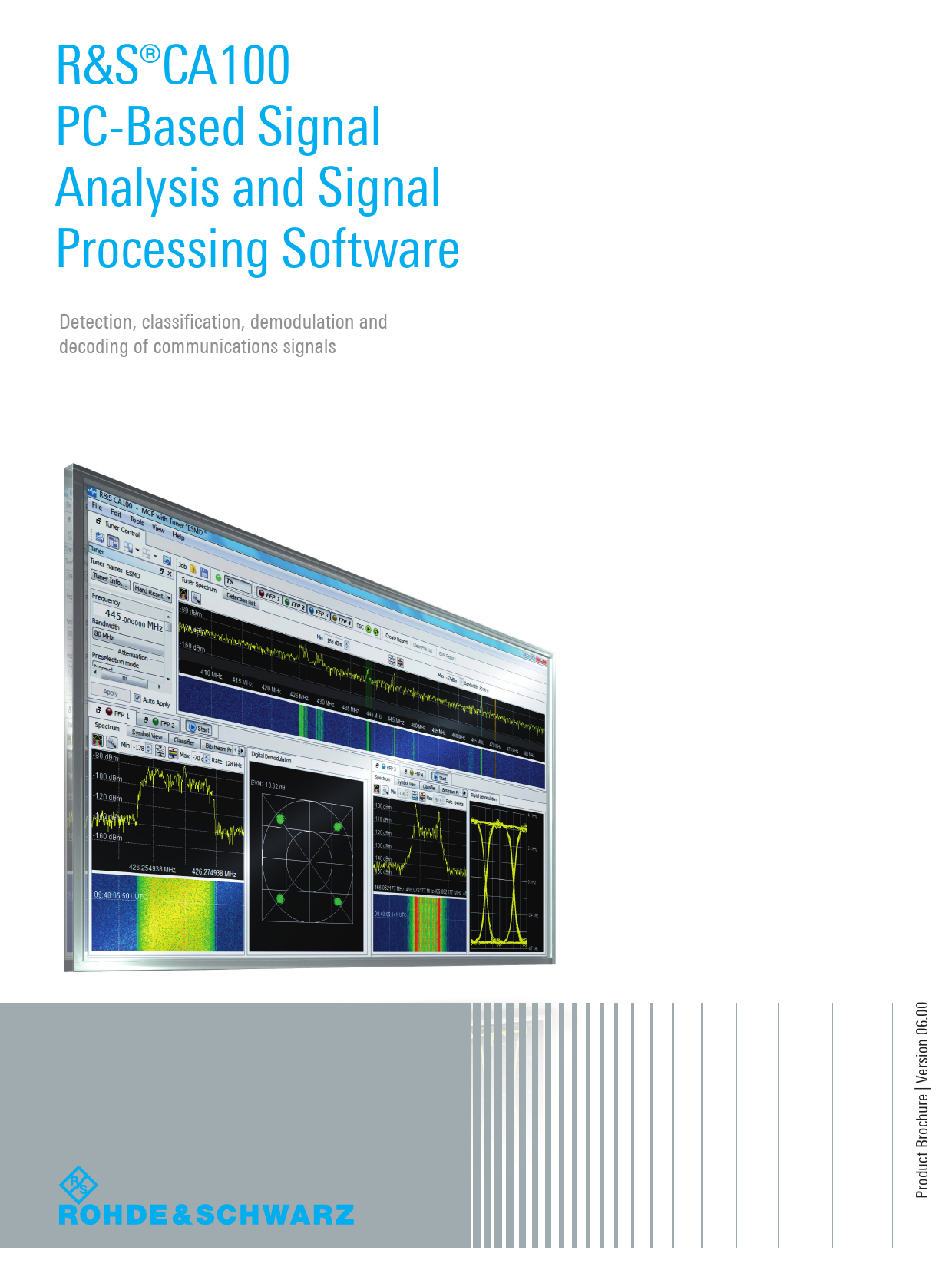
R&S®CA100 PC-Based Signal Analysis and Signal Processing Software
Detection, classification, demodulation and decoding of communications signals
At a glance
R&S®CA100 is a standalone software solution for analysis, classification, demodulation, and decoding of digital and analog IF signals. It provides powerful signal analysis and processing functions and runs on a Windows PC. When connected to modern Rohde & Schwarz monitoring receivers with internal digital downconverters (DDC), such as R&S®ESME or R&S®ESMD, up to four signals can be processed in parallel.
The software offers a signal overview using a high-speed spectrum/waterfall display. It supports monitoring of known signals (demodulation and decoding to content level) and surveillance/search operations by automatically detecting signals of interest and performing classification (recognition of modulation type and transmission system/code).
For complex scenarios (dense, weak, or disturbed signals), users can override automatic processing and manually set the classifier or demodulator/decoder. An additional time domain analysis function allows manual measurement of technical signal parameters.
The detect, search, and classify application provides a fully automatic mode to monitor a frequency range, detect signals of interest, classify, demodulate, decode them, and store the results for later processing.
Signal data (digital IF) can be recorded to the computer hard disk or external AMREC devices (e.g., R&S®GX460) and replayed for processing.
[Image Description: A screenshot of the R&S®CA100 software interface on a Windows PC, displaying a complex signal analysis environment with multiple windows. Key elements include a spectrum analyzer showing signal power across frequencies, a waterfall display visualizing signal activity over time, a symbol view for digital modulation analysis, a classifier window identifying signal types, and a digital demodulation window showing signal parameters. The interface also shows tuner controls, frequency settings, and detection lists.]
Key facts:
- Supports automatic interception and monitoring of complete signal scenarios.
- Powerful classifier and extensive signal processing library with demodulators and decoders.
- Configurable detection of fixed frequency and burst signals with subsequent automatic processing (including content recovery).
- Modular scalability from one-channel to four-channel signal processing (multichannel capability with compatible Rohde & Schwarz receivers/direction finders).
- Open interface for user-specific extension of signal processing capabilities.
- Manual signal measurement in line with ITU-R SM.1600.
- Signal recording and replaying to/from hard disk.
[Image Description: A screenshot showing four signals of an 80 MHz signal scenario provided by an R&S®ESMD wideband monitoring receiver, being classified, demodulated, and decoded in parallel.]
Benefits and Key Features
Large variety of sources for signal acquisition
- Processing of digital IF data
- Spectrum/waterfall representation of signal data
- Signal recording and replaying to/from hard disk
- Processing of multiple signals
Quick results with automatic classification
- Powerful R&S®AMMOS classification unit
- Wideband classification
- Comprehensive library of demodulators and decoders
Demodulators and decoders for a wide range of use cases
- Manual or automatic demodulation and decoding
- User-specific decoders and demodulators
Fast and reliable simultaneous processing of multiple signals
- Manual parallel processing of multiple signals
- Automatic detection of fixed frequency and burst signals for fast and dependable results
- High performance detection of FSK2 signals
- Detection threshold and ignoring of frequency ranges
- Detection using a scanning receiver
High-speed spectral shape search
- Fast recognition of signals using spectral matching
- Enhancement of detect, search and classify workflows using detection list filtering
- Spectral collector and spectral detector trainer
Reduced user workload due to automatic processing of detected signals
- Automatic monitoring of signal scenarios
- Fully automatic signal processing with user-defined rules via script editor
Going into detail with manual measurements
- Manual measurements of emission characteristics
- Emission analysis
Analysis of signal scenarios in line with ITU-R SM.1600
- Technical parameters of unknown signals
- Recognition of known or standardized methods
- Advanced visualization
Diverse opportunities for user-specific expansion
- Open programming interface for integration of user-specific modules
- Integration of a wide variety of user-programmed module types
Large variety of sources for signal acquisition
R&S®CA100 processes digital IF signal data, covering:
- Online digital IF data from Rohde & Schwarz receivers/digital direction finders.
- Online analog IF data digitized via sound card.
- Offline replay of digital IF data (R&S®AMMOS IF format) from local hard disk or external AMREC devices (e.g., R&S®GX460).
- Offline replay of WAV files.
Spectrum/waterfall representation of signal data
The frequency range is presented using a realtime waterfall display with up to 1000 lines/s. Signal attributes can be measured using time and frequency axis cursors.
Signal recording and replaying to/from hard disk
IF recording stores signal samples on the computer hard disk for later replay or export. Connected AMREC devices (e.g., R&S®GX460) can also be used for data storage. Audio demodulator can record analog emissions to WAV files.
Processing of multiple signals
When connected to a Rohde & Schwarz monitoring receiver with internal digital downconverters (DDC) like R&S®ESME or R&S®ESMD, R&S®CA100 can process up to four downconverted signals in parallel. Center frequencies and bandwidths of each DDC can be set independently within the receiver's realtime bandwidth limits.
[Image Description: A spectrum analyzer display showing a wide frequency band (e.g., 420 MHz to 480 MHz) with multiple colored signals overlaid on a background spectrum. This illustrates the processing of multiple signals within a given bandwidth.]
Quick results with automatic classification
Powerful R&S®AMMOS classification unit
R&S®CA100 includes the R&S®AMMOS classification unit for HF and VHF/UHF frequencies, capable of recognizing modulation types and transmission systems of various analog and digital signals. A list of supported modulation types is available in the data sheet and is continually expanded.
The classification algorithm provides segmentation and modulation analysis, determining accurate center frequency, bandwidth, modulation type, and other parameters like symbol rate and frequency shift.
Wideband classification
With the wideband snapshot access option (R&S®CA100WSN) and connected receivers like R&S®ESME, the classifier can analyze wideband signals (e.g., DVB-T, LTE, WLAN_802_11a/g/n) up to 80 MHz bandwidth.
[Image Description: A table titled "CLOVER system classification and visualization example" listing timestamps, confidence levels, center frequencies, bandwidths, modulation types (PSK2A), transmission systems (CLOVER), symbol rates, and signal levels. Below the table is a detailed view of a specific CLOVER signal, showing packet number, block type, frequency, modulation type (PSK2A), and payload data.]
Demodulators and decoders for a wide range of use cases
Comprehensive library of demodulators and decoders
The classifier automatically parameterizes demodulators from the R&S®AMMOS library. The resulting symbol/bitstream can be analyzed for transmission system recognition and decoded using the R&S®AMMOS decoding library. The corresponding decoder output is displayed based on the transmission system.
User-specific decoders, developed with R&S®GX400ID equipment and installed on R&S®CA100, are also used in the classification process. Symbol/bitstream data can be exported for analysis with R&S®CA250.
[Image Description: A screenshot showing several integrated analysis modules within the R&S®CA100 software. These include windows for classifier results, audio analysis, and digital demodulation, displaying parameters like modulation type, center frequency, bandwidth, and symbol rate.]
Manual or automatic demodulation and decoding
Demodulators and decoders can be set manually or automatically by the R&S®CA100 classifier. The symbol viewer aids in visualizing symbol data. A list of included demodulators and decoders is available in the data sheet.
User-specific decoders and demodulators
User-specific decoders and demodulators, developed with R&S®GX400ID equipment, can be installed to expand R&S®CA100's capabilities.
[Image Description: Two distinct screenshots. The top one shows spectrum, symbol view, and digital demodulation windows, illustrating the analysis of a PSK signal. The bottom one displays a spectrum, time analysis, and image data window, showing a Meteosat weather fax transmission.]
Fast and reliable simultaneous processing of multiple signals
R&S®CA100 features an automatic detector for scanning and monitoring frequency ranges for fixed frequency and burst signals.
Manual parallel processing of multiple signals
When connected to a Rohde & Schwarz monitoring receiver/digital direction finder with internal DDCs (e.g., R&S®ESME/ESMD/EB510/EB500/DDF260/DDF255/DDF205), users can downconvert multiple signals and process them in parallel. Individual DDCs can have their center frequencies and bandwidths set independently within the receiver's realtime bandwidth limits. Processing includes audio demodulation, classification, demodulation/decoding, and recording.
[Image Description: A complex screenshot showing multiple signal processing windows. This includes tuner controls, spectrum displays for different frequency bands, classifier results, symbol views, and decoded text output, demonstrating the simultaneous analysis of various signals.]
Automatic detection of fixed frequency and burst signals for fast and dependable results
Beyond its manual mode, R&S®CA100 offers high automation for detecting and monitoring fixed frequency and burst signals. Detection results are generated based on predefined criteria (duration, bandwidth, level, etc.).
Detection results are cyclically compared with previous processing cycles, reporting:
- New signals (crossing threshold).
- Changes in known signals (activity status, level, bandwidth, center frequency).
- Inactive signals (falling below threshold).
- End of signal.
Detected signals are classified automatically.
For content recovery, users can manually select signals from the list and start demodulation/decoding. Rule-based automated workflows can also be configured for independent signal processing (see page 14).
High performance detection of FSK2 signals
The correlative detector enhances the reliable detection of weak and specific FSK2 signals. User-defined parameters and bit sequence knowledge allow targeted signal monitoring within a wideband spectrum. This detector is crucial for users needing to effectively detect predefined FSK2 signals.
[Image Description: A spectrum analyzer display showing signal power over frequency, with an accompanying "Detect and Classify" window listing detected signals. Each entry includes time, center frequency, bandwidth, level, status, confidence, modulation type, transmission system, and symbol rate.]
The automatic detection functionality informs the user about signals and events of potential interest.
Detection threshold and ignoring of frequency ranges
The detection threshold automatically adapts to the variable noise floor of a frequency range. Users can define lists of frequency ranges to ignore, preventing the generation of messages for signals in those specific areas.
Detection using a scanning receiver
For signal detection, the receiver operates in scan mode, covering any frequency range. The automatic detector works within the scan spectrum to detect signals. For automatic processing (classify/demodulate/decode), monitoring receivers' internal DDCs extract signals when the receiver is in fixed frequency mode.
High-speed spectral shape search
R&S®CA100 excels at detecting and identifying spectral shapes of interest in wide, densely populated scenarios.
Fast recognition of signals using spectral matching
The spectral shape detector performs spectral pattern matching to search for known and unknown signals. It is fast and customizable, basing decisions on a comprehensive matrix to assess similarities between input signals and shape descriptions. This allows effective operation across wide frequency ranges, dense scenarios, and harsh radio conditions.
Advantages of fast spectral shape recognition include:
- Quick capture of known shapes of interest (effective search).
- Ignoring of unwanted known shapes (efficient search).
These capabilities speed up surveillance operations and are beneficial for quick search applications.
Key features of the spectral shape detector include:
- Rapid: Analyzes 1000 spectral shapes in less than 1 second.
- Robust: Handles varying and complex signal scenarios, considering noise, fading, and shifting sampling rates.
- Reliable: Effectively detects distinct spectral shapes (e.g., CW, AM-DSB, multichannel, FSK) and feeds recognized shapes to the baseband classifier.
- Reconfigurable: Allows users to define signal categories and configurations.
Enhancement of detect, search and classify workflows using detection list filtering
The spectral shape detector is useful for:
- Filtering spectral shapes of interest before detailed analysis by baseband classifiers/demodulators/decoders.
- Filtering out unwanted known or unknown spectral shape types.
- Extending the list of recognizable signals based on user-defined categories.
The detector uses a database of spectral shapes as its reference library, which can contain user-defined or generic signal types (CW, AM-DSB, multichannel, FSK).
The spectral collector gathers multiple instances of signal categories for processing by the spectral detector trainer, which "learns" to recognize and define these shapes. This training phase enables the detector to work with live spectrum data.
The conventional energy detector is combined with the spectral shape detector for enhanced signal search and recognition. The screenshot below shows the result of matching generic and user-defined signal types.
[Image Description: A spectrum display showing signal energy across a frequency range, overlaid with a "Detection List" window. This list displays classified signals, showing their center frequency, bandwidth, level, status, and classified signal type, indicating the results of filtering spectral shapes.]
Spectral collector and spectral detector trainer
The spectral collector is an automatic application for identifying and collecting representative spectral shapes for training purposes. It gathers spectral shapes that vary due to computation time and manages repeated collection of different emissions within the same signal category.
The spectral detector trainer is a standalone application for extracting spectral information and identifying signal types based on spectral sample data. These extracted features define signal categories used by the detector for recognition during spectral shape searches.
To train the detector, users define signal types of interest, collect sample data, and define categories. The spectral detector trainer can also automatically create training collections. Each category is represented by approximately 30 spectral shapes in the reference library. Training involves analyzing shape-describing features, including examples of degraded signals for robustness against noise and fading.
Based on the reference library, the trainer creates a profile for the detector, which then evaluates how well detected signals match trained categories.
[Image Description: The user interface for the "Spectral detector trainer" application. It shows controls for managing categories, creating detector profiles, and assessing detectors. A graphical display shows collected spectral shapes and training data, illustrating the process of teaching the software to recognize specific signal types.]
Reduced user workload due to automatic processing of detected signals
R&S®CA100 integrates signal detection with configurable, automatic processing (classification, demodulation, decoding, content recovery, recording).
Automatic monitoring of signal scenarios
A key benefit is the combination of automatic detection and classification with fully automated signal processing. This allows R&S®CA100 to independently monitor wide frequency ranges, reducing routine user tasks.
Users define rules for automatic processing, including:
- Event triggering: Notifies the user immediately after recognition based on signal parameters and types of interest.
- Recording: Saves a snapshot of the signal (with predefined length) for subsequent processing. Digital IF is saved on a recording/replaying unit, performing IF recording of fixed or wideband signals.
- Demodulation/Decoding: If demodulators/decoders for the recognized system are available, they are configured and started. Signal content is recovered and saved. Automatic processing includes audio demodulation, digital demodulation, and digital demodulation/decoding.
[Image Description: A flowchart illustrating the "Application example for fully automatic signal processing." It shows decision points based on signal recognition (e.g., PACTOR III, analog signals) leading to different processing actions like digital demodulation/decoding or audio demodulation/recording.]
Fully automatic signal processing with user-defined rules via script editor
R&S®CA100 uses JavaScript scripts for automated processing, triggering actions based on user-defined conditions and criteria. Scripts can decide whether to skip a signal or how long to record it.
R&S®ScriptEditor provides an environment for writing, testing, and debugging these scripts, simplifying script development.
[Image Description: A screenshot of the R&S®ScriptEditor GUI. It displays input fields for triggers, a central scripting area with JavaScript code, and output windows for recordings and event history, demonstrating the tool for creating automated signal processing workflows.]
Going into detail with manual measurements
Manual measurements of emission characteristics
Measurements like bandwidth, duration, S/N ratio, and level can be performed using measurement cursors in the zoomable spectrum. The filter bandwidth adapts automatically to filter out-of-band emissions and noise.
Emission analysis
Time domain analysis functionality is used for emissions analysis. Zoomable level, envelope, frequency, phase, and spectrum plots allow measurement of technical parameters such as level range, frequency shift, and symbol rate.
[Image Description: A screenshot showing spectrum, time analysis, and digital modulation windows. This includes a spectrum plot, a waterfall display, and detailed time-domain plots like frequency deviation and symbol rate, illustrating manual measurement capabilities.]
Analysis of signal scenarios in line with ITU-R SM.1600
Technical parameters of unknown signals
R&S®CA100 supports measurement methods specified in ITU-R SM.1600. For unknown signals, it offers representations and tools for analyzing parameters like bandwidth, symbol rate, number of tones, tone spacing, shift, modulation index, guard interval, number of channels, signal duration, symbol valency, and modulation type.
Recognition of known or standardized methods
For known methods (GSM, DECT, CDMA, etc.), correlation and pattern analysis techniques are available. R&S®CA100 tools quickly recognize preambles, training sequences, and synchronization words of known methods.
[Image Description: The top diagram is a QAM16 constellation diagram, showing points representing digital modulation states. The bottom is a spectrum and autocorrelation diagram, illustrating signal characteristics and their correlation over time.]
Advanced visualization
Time/frequency segmentation, including filtering, simplifies handling of multichannel methods, noncontinuous emissions (bursts), and densely occupied signal scenarios. (Coded) orthogonal frequency division multiplex ((C)OFDM) signals and multiple modulation methods (e.g., AM-FSK, FM-FSK) can be easily measured and analyzed.
I/Q constellation diagrams and eye patterns are available for evaluating measured parameters and equalizer settings.
[Image Description: Two diagrams. The top is an eye diagram, showing signal transitions and timing characteristics. The bottom is a spectrogram, displaying signal power over time and frequency, used for analyzing multichannel signals like PACTOR III.]
Diverse opportunities for user-specific expansion
R&S®CA100 allows users to integrate user-programmed modules for signal processing (receiver driver, classifier, demodulator, decoder), enabling them to deploy their expertise independently.
Open programming interface for integration of user-specific modules
R&S®CA100 supports various Rohde & Schwarz monitoring receivers/digital direction finders and offers a comprehensive library of universal demodulators, decoders, and transmission systems. Users can program diverse signal processing modules for integration.
A C++ interface is provided for integrating user modules. These modules can incorporate components written in other languages like C or MATLAB®.
[Image Description: A screenshot showing C++ code for integrating user modules, alongside a spectrum and digital demodulation display. This illustrates how users can program custom functionalities and visualize their results within the R&S®CA100 environment.]
Integration of a wide variety of user-programmed module types
The following module types can be integrated:
- Receiver control: Acts as a receiver driver for third-party receivers, converting commands and IF data.
- Universal demodulation: Expands the universal demodulator library, performing demodulation and providing symbol streams.
- Decoding: Expands the decoder library, functioning as a decoder to recover information content from demodulated symbol data. Applicable to decoders with fixed modulation parameters but different encoding types.
- Transmission system: Expands the transmission system library, acting as an independent system to demodulate/decode IF data, particularly for adaptive systems (e.g., CLOVER2000, PACTOR III) requiring specific equalization/synchronization.
- Classification: Integrates a signal classification module as an alternative to a universal demodulator, functioning as a modulation type/transmission system recognizer. Output is used for visualization.
Training courses
R&S®CA100 training courses combine classroom theory and practical exercises, covering key topics to help operators effectively use the software for signal analysis. Courses are instructor-led with an interactive approach, including Q&A, assessment, and final exams.
Course overview
| Course title | Target audience | Aim | Duration |
|---|---|---|---|
| R&S®CA100-TI, R&S®CA100 introduction | Decision-makers for signal analysis products | Attain basic product familiarity | 1 day (5 hours) |
| R&S®CA100-TO, R&S®CA100 operator training | COMINT users, operators, supervisors, technical analysts | Attain operational familiarity with R&S®CA100 | 5 days |
| R&S®CA100-TS, R&S®CA100 operator training ITU-R SM.1600 | COMINT operators that want to use ITU-R SM.1600 measurement functions | Attain operational familiarity with R&S®CA100IS option for analysis of signal scenarios, in line with ITU-R SM.1600 | 3 days |
| R&S®CA1X0-TTU, R&S®CA100/R&S®CA120 developer training for third-party tuner integration | COMINT signal analysis module developers and integrators | Assist integrating third-party tuners with R&S®CA100/R&S®CA120 | 5 days |
| R&S®CA1X0-TDM, R&S®CA100/R&S®CA120 developer training for third-party demodulator integration | COMINT signal analysis module developers and integrators | Assist integrating third-party demodulators with R&S®CA100/R&S®CA120 | 4 days |
| R&S®CA1X0-TDC, R&S®CA100/R&S®CA120 developer training for third-party decoder integration | COMINT signal analysis module developers and integrators | Assist integrating third-party decoder with R&S®CA100/R&S®CA120 | 5 days |
| R&S®CA100/R&S®CA120 signal analysis fundamentals training | Decision-makers about COMINT solutions, COMINT operators and COMINT technical analysts | Attain basic knowledge about COMINT signal waveforms, signal processing devices (antennas, receivers, direction finders) and signal analysis concepts. Build-up pre-knowledge for signal analysis product operational trainings | 5 days |
Related solutions
Comparison of R&S®CA100 versus R&S®CA120
The R&S®CA120 multichannel signal analysis solution and R&S®CA100 have similar features but are designed for different applications. R&S®CA120 is a flexible and automatic multichannel solution for detecting, classifying, and processing radio communications signals, supporting a wide spectrum of applications from manual signal processing to fully automatic recognition and processing in wideband scenarios.
[Image Description: An image of the R&S®CA120 sensor subsystem, showing rack-mounted hardware. This is presented in the context of comparing R&S®CA100 software with the R&S®CA120 hardware solution.]
| Criteria | R&S®CA100 | R&S®CA120 |
|---|---|---|
| Detection mode | only receiver scan | in FFM and receiver scan |
| Max. number of monitoring receivers supported in parallel | 1 | multiple |
| Max. number of channels processed per monitoring receiver or DDF | 4 | 128 |
| Max. number of channels processed while replaying a recorded signal scenario | 1 | 32 |
| Max. bandwidth for signal processing | 4 x 1 MHz (with R&S®ESME) | 10 MHz, 80 MHz (with R&S®ESME-SP) |
| Remote controllable via LAN or WAN | no | yes (with R&S®RAMON) |
| Integrated in typical R&S®RAMON workflows | limited integration with interfaces to R&S®RAMON system software | yes, full integration |
| Installed on | user PC, minimal required hardware configuration (see R&S®CA100 data sheet) | R&S®CA120PU-S, R&S®CA120PU |
Ordering information
PC-based signal analysis and signal processing software (requires one of the following licensing options):
- R&S®CA100 (Base version) - Order No. 4102.0004.02
- Licensing with USB dongle: R&S®CA100-U - Order No. 4102.0062.02
- Licensing with SD card dongle: R&S®CA100-S - Order No. 4102.0079.02
- Licensing with mini USB dongle: R&S®CA100-M - Order No. 4102.0085.02
Options for single-channel processing:
- Processing of digital signals: R&S®CA100DM - Order No. 4102.0091.02
- Classification: R&S®CA100CL - Order No. 4102.0104.02
- Decoder package professional: R&S®CA100DEC - Order No. 4102.0110.02
- Decoding of PACTOR II and PACTOR III: R&S®CA100PIII - Order No. 4102.0133.02
- Decoding of CLOVER: R&S®CA100CV - Order No. 4102.0140.02
- Decoding of CODAN 3012: R&S®CA100CO - Order No. 4102.0156.02
- Correlative detector: R&S®CA100CDT - Order No. 4102.0256.02
- Wideband snapshot access: R&S®CA100WSN - Order No. 4102.0240.02
Options for multichannel processing:
- Multichannel processing: R&S®CA100MCP - Order No. 4102.0179.02
- Detection, search and classification of fixed frequency signals: R&S®CA100DSC - Order No. 4102.0185.02
- Spectral shape detector: R&S®CA100SDT - Order No. 4102.0204.02
- Automatic processing of detected signals: R&S®CA100AP - Order No. 4102.0191.02
Options for signal analysis:
- Analysis of signal scenarios, in line with ITU-R SM.1600: R&S®CA100IS - Order No. 4102.0210.02
Note: Rohde & Schwarz licenses are stored on USB dongles or SD cards. Lost or stolen devices will require repurchase. Corrupt or broken devices may be replaced upon return. All options require the R&S®CA100 base version.
Operator training courses
| Designation | Type | Order No. |
|---|---|---|
| R&S®CA100 introduction | R&S®CA100-TI | 3637.2518.02 |
| R&S®CA100 operator training | R&S®CA100-TO | 3637.2682.02 |
| R&S®CA100 operator training ITU-R SM.1600 | R&S®CA100-TS | 3637.3895.02 |
| R&S®CA100/R&S®CA120 developer training for third-party tuner integration | R&S®CA1X0-TTU | 3637.2482.02 |
| R&S®CA100/R&S®CA120 developer training for third-party demodulator integration | R&S®CA1X0-TDM | 3637.2499.02 |
| R&S®CA100/R&S®CA120 developer training for third-party decoder integration | R&S®CA1X0-TDC | 3637.2501.02 |
| Signal analysis fundamentals training | R&S®CA1X0-SAF | 3637.4685.02 |
Service that adds value
- Worldwide
- Local and personalized
- Customized and flexible
- Uncompromising quality
- Long-term dependability
The Rohde & Schwarz electronics group offers innovative solutions in test and measurement, broadcast and media, secure communications, cybersecurity, monitoring, and network testing. Founded over 80 years ago, the company, headquartered in Munich, Germany, has an extensive sales and service network in over 70 countries.
Sustainable product design
- Environmental compatibility and eco-footprint
- Energy efficiency and low emissions
- Longevity and optimized total cost of ownership
Certified Quality Management: ISO 9001
Certified Environmental Management: ISO 14001
Rohde & Schwarz training
www.training.rohde-schwarz.com
Regional contact
- Europe, Africa, Middle East: +49 89 4129 12345, customersupport@rohde-schwarz.com
- North America: 1 888 TEST RSA (1 888 837 87 72), customer.support@rsa.rohde-schwarz.com
- Latin America: +1 410 910 79 88, customersupport.la@rohde-schwarz.com
- Asia Pacific: +65 65 1304 88, customersupport.asia@rohde-schwarz.com
- China: +86 800 810 8228 | +86 400 650 58 96, customersupport.china@rohde-schwarz.com
R&S® is a registered trademark of Rohde & Schwarz GmbH & Co. KG. Trade names are trademarks of their owners. PD 3606.9340.12 | Version 06.00 | May 2019 (jr). Data without tolerance limits is not binding. Subject to change. © 2013-2019 Rohde & Schwarz GmbH & Co. KG | 81671 Munich, Germany.
