

313997ZAU, Manual, HFR, Setup-Operation, English
File info: application/pdf · 130 pages · 8.57MB
313997ZAU, Manual, HFR, Setup-Operation, English
MM 313997, 313997ZAU, 313997EN, Setup and Operation instructions for hydraulic, plural-component, fixed-ratio proportioner.
"MM 313997, 313997ZAU, 313997EN"
Related Manuals. Models. Product Configurator. ... Pump Feed Kits. B (Blue) and A (Red) Feed Tanks. Manual and Semi-Automatic Circulation Kits.
Hydraulic, Plural-Component, Fixed-Ratio Proportioner. For ...
Pack Instructions-Parts 3A0235 Feed Supply Kits Instructions-Parts 3A0395 Stainless Steel Tank Feed Sys-tems Instructions-Parts 3A1299 Carbon Steel Tank Feed Systems Instructions-Parts 3A0237 Heated Hoses and Applicator…
Extracted Text
Setup - Operation

HFRTM

313997ZAU
EN

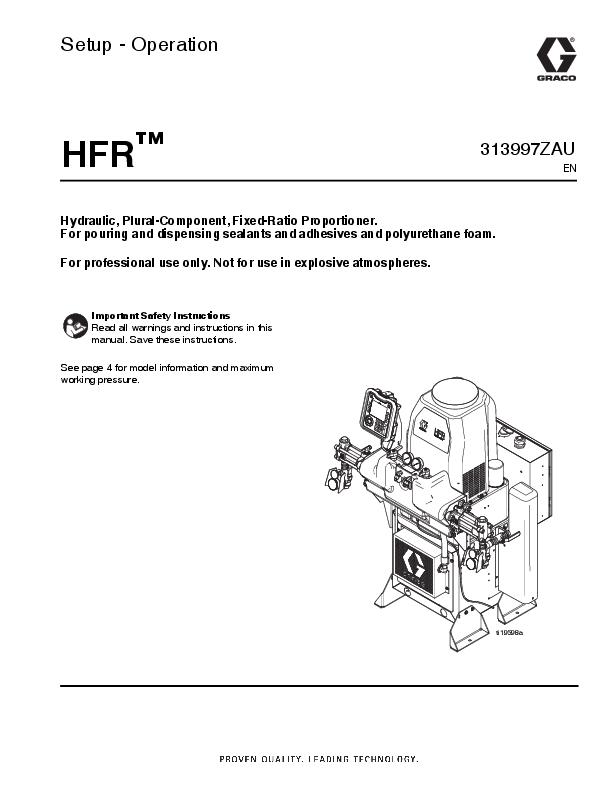
Hydraulic, Plural-Component, Fixed-Ratio Proportioner. For pouring and dispensing sealants and adhesives and polyurethane foam.
For professional use only. Not for use in explosive atmospheres.

Important Safety Instructions Read all warnings and instructions in this manual. Save these instructions.
See page 4 for model information and maximum working pressure.

ti19598a

Contents
Related Manuals . . . . . . . . . . . . . . . . . . . . . . . . . . . . . . 3 Models . . . . . . . . . . . . . . . . . . . . . . . . . . . . . . . . . . . . . . 4 Product Configurator . . . . . . . . . . . . . . . . . . . . . . . . . . 5
Whip Hose Bundles . . . . . . . . . . . . . . . . . . . . . . . . . 7 Individual B (Blue) Heated Whip Hose . . . . . . . . . . . 7 Individual A (Red) Heated Whip Hose . . . . . . . . . . . 7 B (Blue) Individual . . . . . . . . . . . . . . . . . . . . . . . . . . 8 A (Red) Individual . . . . . . . . . . . . . . . . . . . . . . . . . . 9 Hose Bundling Accessories . . . . . . . . . . . . . . . . . . . 9 Applicator . . . . . . . . . . . . . . . . . . . . . . . . . . . . . . . . 10 B (Blue) Applicator Orifice . . . . . . . . . . . . . . . . . . . 11 Iso A (Red) Applicator Orifice . . . . . . . . . . . . . . . . 13 AC Power Pack with S-Head/L-Head Hoses, Optional
Boom . . . . . . . . . . . . . . . . . . . . . . . . . . . . . . . 14 Dispense Valve Interface Kit . . . . . . . . . . . . . . . . . 14 Flow Meters . . . . . . . . . . . . . . . . . . . . . . . . . . . . . . 14 Pump Feed Kits . . . . . . . . . . . . . . . . . . . . . . . . . . . 15 B (Blue) and A (Red) Feed Tanks . . . . . . . . . . . . . 16 Manual and Semi-Automatic Circulation Kits . . . . . 16 Warnings . . . . . . . . . . . . . . . . . . . . . . . . . . . . . . . . . . . 18 Important Two-Component Material Information . . . 20 Isocyanate Conditions . . . . . . . . . . . . . . . . . . . . . . 20 Material Self-ignition . . . . . . . . . . . . . . . . . . . . . . . 20 Keep Components A (Red) and B (Blue) Separate 20 Moisture Sensitivity of Isocyanates . . . . . . . . . . . . 21 Foam Resins with 245 fa Blowing Agents . . . . . . . 21 Changing Materials . . . . . . . . . . . . . . . . . . . . . . . . 21 A (Red) and B (Blue) Components . . . . . . . . . . . . . . 21 Typical Installation . . . . . . . . . . . . . . . . . . . . . . . . . . . 23 Component Identification . . . . . . . . . . . . . . . . . . . . . 24 Hydraulic Power Pack . . . . . . . . . . . . . . . . . . . . . . 27 Motor Control Module (MCM) . . . . . . . . . . . . . . . . 28 Advanced Display Module (ADM) . . . . . . . . . . . . . 30 Fluid Control Module (FCM) . . . . . . . . . . . . . . . . . . 33 Temperature Control Module (Heated HFR Only) . 34 Dispense Requests and Valves Overview . . . . . . . . 37 Dispense Request/Valve Connection . . . . . . . . . . 38 Setup . . . . . . . . . . . . . . . . . . . . . . . . . . . . . . . . . . . . . . 39 Vacuum De-gas . . . . . . . . . . . . . . . . . . . . . . . . . . . 45 Vacuum De-gas and Vacuum Manual Refill . . . . . 46 Advanced Display Module (ADM) Operation . . . . . . 47 Startup . . . . . . . . . . . . . . . . . . . . . . . . . . . . . . . . . . . . . 48 Shutdown . . . . . . . . . . . . . . . . . . . . . . . . . . . . . . . . . . 51 Pressure Relief Procedure . . . . . . . . . . . . . . . . . . . . . 52 Flushing . . . . . . . . . . . . . . . . . . . . . . . . . . . . . . . . . . . . 53 Maintenance . . . . . . . . . . . . . . . . . . . . . . . . . . . . . . . . 54 ADM - Battery Replacement and Screen Cleaning 55 MCM and TCM - Clean Heat Sink Fins . . . . . . . . . 55 Install Upgrade Tokens . . . . . . . . . . . . . . . . . . . . . 56 Programming Tokens/Updating System Software . 56 Fluid Inlet Strainer Screen . . . . . . . . . . . . . . . . . . . 59 IsoGuard Select� System . . . . . . . . . . . . . . . . . . . 60
2

Troubleshooting . . . . . . . . . . . . . . . . . . . . . . . . . . . . . 61 Light Tower (Optional) . . . . . . . . . . . . . . . . . . . . . . 61 Common Problems . . . . . . . . . . . . . . . . . . . . . . . . 61 ADM Troubleshooting . . . . . . . . . . . . . . . . . . . . . . 64 Motor Control Module . . . . . . . . . . . . . . . . . . . . . . 65 Fluid Control Module . . . . . . . . . . . . . . . . . . . . . . . 67 Temperature Control Module . . . . . . . . . . . . . . . . 68
Appendix A - ADM Icons Overview . . . . . . . . . . . . . 69 Setup Screen Icons . . . . . . . . . . . . . . . . . . . . . . . . 69 Run Screen Icons . . . . . . . . . . . . . . . . . . . . . . . . . 70
Appendix B - ADM Setup Screens Overview . . . . . . 71 Appendix C - ADM Run Screens Overview . . . . . . . 88 Appendix D - ADM Error Codes . . . . . . . . . . . . . . . . 94 Appendix E - System Events . . . . . . . . . . . . . . . . . . 107 Appendix F - USB Operation . . . . . . . . . . . . . . . . . . 108
Overview . . . . . . . . . . . . . . . . . . . . . . . . . . . . . . . 108 USB Options . . . . . . . . . . . . . . . . . . . . . . . . . . . . 108 Download Log Files . . . . . . . . . . . . . . . . . . . . . . . 108 Log Files, Folder Structure . . . . . . . . . . . . . . . . . 109 Transfer System Settings . . . . . . . . . . . . . . . . . . 111 Update Custom Language . . . . . . . . . . . . . . . . . 112 Appendix G- Temperature . . . . . . . . . . . . . . . . . . . . 114 Temperature Displayed and Actual Material
Temperature . . . . . . . . . . . . . . . . . . . . . . . . . 114 Appendix H- Circulation . . . . . . . . . . . . . . . . . . . . . 115
Manual, Semi-Automatic and Fully Automatic Circulation Features . . . . . . . . . . . . . . . . . . . 115
Manual Recirculation Feature . . . . . . . . . . . . . . . 115 Semi-Automatic Circulation Feature . . . . . . . . . . 115 Manual and Semi-Automatic Circulation Feature
Operation . . . . . . . . . . . . . . . . . . . . . . . . . . . 120 Fully Automatic Circulation Feature Operation . . 121 Pressurize Before Opening DV Feature . . . . . . . 123 Night Mode Capability . . . . . . . . . . . . . . . . . . . . . 124 Fully Automatic Circulation Shot Repeatability Test
Results . . . . . . . . . . . . . . . . . . . . . . . . . . . . . 124 Dimensions . . . . . . . . . . . . . . . . . . . . . . . . . . . . . . . . 127 Technical Data . . . . . . . . . . . . . . . . . . . . . . . . . . . . . 128 Motor Control Module Technical Data . . . . . . . . . . 129 California Proposition 65 . . . . . . . . . . . . . . . . . . . . . 129 Graco Standard Warranty . . . . . . . . . . . . . . . . . . . . 130 Graco Information . . . . . . . . . . . . . . . . . . . . . . . . . . 130
313997ZAU

Related Manuals

Manuals are available at www.graco.com. Component manuals in English:

System Manuals

313998

HFR Repair-Parts

Power Distribution Box Manual

3A0239

Power Distribution Boxes Instructions-Parts

Pumpline Manuals

3A0019

Z-Series Chemical Pumps Instructions-Parts

3A0020

HFR Hydraulic Actuator Instructions-Parts

Feed System Manuals

3A0238

Dispense Head Hydraulic Power Pack Instructions-Parts

3A0235

Feed Supply Kits Instructions-Parts

3A0395 3A1299

Stainless Steel Tank Feed Systems Instructions-Parts
Carbon Steel Tank Feed Systems Instructions-Parts

3A0237

Heated Hoses and Applicator Kits, Instructions-Parts

Dispense Valve Manuals

313872 313536

EPTM Gun GX-16, Operation

312185 312752 312753

MD2 Valve, Instructions-Parts S-Head Operation-Parts L-Head Operation-Parts

309550

Fusion� AP Gun

309856

Fusion MP Gun

312666

Fusion CS Gun

Related Manuals

Accessory Manuals

3A1149

HFR Discrete Gateway Module Kits Manual

312864

HFR Communications Gateway Module Instructions-Parts

3A1657

HFR Flow Meter Kits Instructions-Parts

3A1244

Graco Control ArchitectureTM Module Programming Manual

3A2890

Mobile Pallet with Casters Kit Manual

U82706

Small Dispense Kit Operation-Maintenance

313997ZAU

3

Models
Models
See Product Configurator on page 5 for detailed product configuration information.

System

Full Load Peak Amps Per Phase*
55 A

HFR, Non-Heated

29 A

55 A

Voltage (phase) 230V (1)
230V (3)
400V (3)

Power Description 200-240VAC, 1 phase, 50/60Hz, 2 wire and PE
200-240VAC, 3 phase , 50/60Hz, 3
wire and PE 380-415VAC, 3 phase Y, 50/60Hz,
2 wire and PE

System Watts  12, 650 11,340 12,650

Maximum Fluid Working Pressure  psi (MPa, bar)
3000 (20.7, 207)

116 A

230V (1) 200-240VAC, 3 phase , 50/60Hz, 3
wire and PE

26,680

HFR, Heated

73 A

230V (3) 200-240VAC, 3 phase , 50/60Hz, 3
wire and PE

28,600

3000 (20.7, 207)

63 A  400V (3)

380-415VAC, 3 phase Y, 50/60Hz, 2 wire and PE

28,600

* Full load amps with all devices operating at maximum capabilities. Fuse requirements at various flow rates and mix chamber sizes may be less.
 210 ft (64 m) maximum heated hose length, including whip hose.


approved.

 The maximum fluid working pressure for the base machine without hoses is 3000 psi (20.7 MPa, 207 bar). If hoses rated at less than 3000 psi are installed, the system maximum fluid working pressure becomes the rating of the hoses. If 2000 psi hoses were purchased and installed by Graco, the working pressure for the machine is already setup for the lower 2000 psi (13.8 MPa, 138 bar) working pressure by Graco. If the machine was purchased without hoses and aftermarket hoses rated at or above 3000 psi are to be installed, see instruction manual 313998 for the procedure to setup the machine for higher rated hoses. The change in working pressure is made by changing a rotary switch setting in the Motor Control Module. The minimum pressure rating for hoses is 2000 psi. Do not install hoses with a pressure rating lower than 2000 psi.

 See 400 V Power Requirements.

400 V Power Requirements
� 400 V systems are intended for International voltage requirements. Not for voltage requirements in North America.

� North America mostly employs a 3 wire or Delta configuration. The two configurations are not interchangeable.

� If a 400 volt configuration is operated in North America, a special transformer rated for 400 V ("Y" configuration (4 wire)) may be required.

4

313997ZAU

Product Configurator

HFR - A - - - - - -

Ref.:

12345

6

Product Configurator

High Volume/Low Volume Hose Bundle Assembly Primary/Hose Heat A (Red) Pump B (Blue) Pump Voltage Base Configurator Revision

An example of the product configurator would be the following configurator code.

HFR - A - 1 - 6 - AM - AM - D - AG

Ref.:

123456

High Volume/Low Volume Primary/Hose Heat A (Red) Pump B (Blue) Pump Voltage Base Configurator Revision

The following part number fields apply for the HFR part numbering configurator fields.

Ref. 1 Part

Base Unit

1

HFR Base Unit, Carbon Steel

2

HFR Base Unit, Stainless Steel

Ref. 2 Part

Voltage

1

230V, 1 phase;

No Heat

2

230V, 1 phase;

Maximum of Two 6 kW Primary Heater and One

Zone of Hose Heat

3

230V, 3 phase;

No Heat

4

230V, 3 phase;

Maximum of Two 6 kW Primary Heaters and Two

Zones of Hose Heat

5

400V, 3 phase;

No heat

6

400V, 3 phase;

Maximum of Two 6 kW Primary Heaters and Two

Zones of Hose Heat

Ref. 3
AA AB AC AD AE AF AG AH AJ AK AL AM AQ AS AR AT AU AV AW AX

Part
L010S1 L015S1 L020S1 L025S1 L030S1 L040S1 L050S1 L060S1 L080S1 L100S1 L120S1 L160S1 L005S1 L086S1 L065S1 L035S1 L045S1 L105S1 24M265 257894

B (Blue) Pump
10 cc Stainless Steel 15 cc Stainless Steel 20 cc Stainless Steel 25 cc Stainless Steel 30 cc Stainless Steel 40 cc Stainless Steel 50 cc Stainless Steel 60 cc Stainless Steel 80 cc Stainless Steel 100 cc Stainless Steel 120 cc Stainless Steel 160 cc Stainless Steel 5 cc Stainless Steel 86 cc Stainless Steel 65 cc Stainless Steel 35 cc Stainless Steel 45 cc Stainless Steel 105 cc Stainless Steel 70 cc Stainless Steel 75 cc Stainless Steel

313997ZAU

5

Product Configurator

AY 24T095 90 cc Stainless Steel AZ 24T096 140 cc Stainless Steel BA 257898 150 cc Stainless Steel

Ref. 4 Part

A (Red) Pump

Code, Part, and Description for Ref. 4 are the same as Ref. 3

Ref. 5 Part

Primary/Hose Heat

A

No Heat

B

A (Red) and B (Blue) Primary Heaters

C

A (Red) and B (Blue) Primary Heaters, One Zone

of Hose Heat

D

A (Red) and B (Blue) Primary Heaters, A (Red)

and B (Blue) Hose Heat

E

A (Red) and B (Blue) Hose Heat, Carbon Steel

F

A (Red) and B (Blue) Hose Heat, Stainless Steel

G

B (Blue) Primary Heaters, B (Blue) Hose Heat

Ref. 6 Part

B (Blue) Applicator Hose or High Volume/ Low Volume Hose Bundle Assembly

NN

-- No Hose

AA 24D108 Dual Hose, 2:1, 1/4 x 3/8, 5 ft, Stainless Steel, 3500 psi

AB 24D109 Dual Hose, 2:1, 1/4 x 3/8, 10 ft, Stainless Steel, 3500 psi

AC 24D110 Dual Hose, 2:1, 1/4 x 3/8, 25 ft, Stainless Steel, 3500 psi

AD 24D111 Dual Hose, 2:1, 1/4 x 3/8, 50 ft, Stainless Steel, 3500 psi

AE 24D112 Dual Hose, 1:1, 3/8 x 3/8, 5 ft, Stainless Steel, 3500 psi

AF 24D113 Dual Hose, 1:1, 3/8 x 3/8, 10 ft, Stainless Steel, 3500 psi

AG 24D114 Dual Hose, 1:1, 3/8 x 3/8, 25 ft, Stainless Steel, 3500 psi

AH 24D115 Dual Hose, 1:1, 3/8 x 3/8, 50 ft, Stainless Steel, 3500 psi

BA 24D116 Dual Hose, 2:1, 1/4 x 3/8, 5 ft, Stainless Steel, 3500 psi

BB 24D117 Dual Hose, 2:1, 1/4 x 3/8, 10 ft, Carbon Steel, 3500 psi

BC 24D118 Dual Hose, 2:1, 1/4 x 3/8, 25 ft, Carbon Steel, 3500 psi

BD 24D119 Dual Hose, 2:1, 1/4 x 3/8, 50 ft, Carbon Steel, 3500 psi

BE 24D120 Dual Hose, 1:1, 3/8 x 3/8, 5 ft, Carbon Steel, 3500 psi

BF 24D121 Dual Hose, 1:1, 3/8 x 3/8, 10 ft, Carbon Steel, 3500 psi

BG 24D122 Dual Hose, 1:1, 3/8 x 3/8, 25 ft, Carbon Steel, 3500 psi

BH 24D123 Dual Hose, 1:1, 3/8 x 3/8, 50 ft, Carbon Steel, 3500 psi

CA 24E968 Single Hose, 1:1, 1/4 x 1/4, 10 ft, Carbon Steel, 2000 psi

CB 24E963 Single Hose, 1:1, 1/4 x 1/4, 25 ft, Carbon Steel, 2000 psi

CC 24E964 Single Hose, 1:1, 1/4 x 1/4, 50 ft, Carbon Steel, 2000 psi
CD 24D124 Single Hose, 2:1, 1/4 x 3/8, 25 ft, Carbon Steel, 2000 psi
CE 24D125 Single Hose, 2:1, 1/4 x 3/8, 50 ft, Carbon Steel, 2000 psi
CF 24E969 Single Hose, 1:1, 3/8 x 3/8, 10 ft, Carbon Steel, 2000 psi
CG 24D126 Single Hose, 1:1, 3/8 x 3/8, 25 ft, Carbon Steel, 2000 psi
CH 24D127 Single Hose, 1:1, 3/8 x 3/8, 50 ft, Carbon Steel, 2000 psi
CJ 24E965 Single Hose, 1:1, 1/2 x 1/2, 50 ft, Carbon Steel, 2000 psi
CK 24E966 Single Hose, 1:1, 1/4 x 1/4, 50 ft, Carbon Steel, 3500 psi
CL 24D129 Single Hose, 2:1, 1/4 x 3/8, 50 ft, Carbon Steel, 3500 psi
CM 24D131 Single Hose, 1:1, 3/8 x 3/8, 50 ft, Carbon Steel, 3500 psi
CN 24E967 Single Hose, 1:1, 1/2 x 1/2, 50 ft, Carbon Steel, 3500 psi
 Pump size listed is the combined volume dispensed in one extending stroke and one retracting stroke.

6

313997ZAU

Product Configurator

Whip Hose Bundles

Part

Description

24H076 10 ft (3 m) long, 1/4 in. (6 mm) ID, Carbon Steel, Single Zone

24H077 10 ft (3 m) long, 3/8 in. (10 mm) ID, Carbon Steel, Single Zone

24H078 10 ft (3 m) long, 1/4 in. (6 mm) ID, Carbon Steel, Dual Zone

24H079 10 ft (3 m) long, 3/8 in. (10 mm) ID, Carbon Steel, Dual Zone

24H080 10 ft (3 m) long, 1/4 in. (6 mm) ID, Stainless Steel, Single Zone

24H081 10 ft (3 m) long, 3/8 in. (10 mm) ID, Stainless Steel, Single Zone

24H082 10 ft (3 m) long, 1/4 in. (6 mm) ID, Stainless Steel, Dual Zone

24H083 10 ft (3 m) long, 3/8 in. (10 mm) ID, Stainless Steel, Dual Zone

Individual B (Blue) Heated Whip Hose

Part

Description

24E950 10 ft (3 m) long, 1/4 in. (6 mm) ID, Carbon Steel, Single Zone, 3500 psi
24E952 10 ft (3 m) long, 3/8 in. (10 mm) ID, Carbon Steel, Single Zone, 3500 psi

24H086 10 ft (3 m) long, 1/4 in. (6 mm) ID, Carbon Steel, Dual Zone, 3500 psi

24H088 10 ft (3 m) long, 3/8 in. (10 mm) ID, Carbon Steel, Dual Zone, 3500 psi
24H090 10 ft (3 m) long, 1/4 in. (6 mm) ID, Stainless Steel, Single Zone, 3500 psi

24H092 10 ft (3 m) long, 3/8 in. (10 mm) ID, Stainless Steel, Single Zone, 3500 psi
24H094 10 ft (3 m) long, 1/4 in. (6 mm) ID, Stainless Steel, Dual Zone, 3500 psi

24H096 10 ft (3 m) long, 3/8 in. (10 mm) ID, Stainless Steel, Dual Zone, 3500 psi

24H225 5 ft (1.5 m) long, 1/4 in. (6 mm) ID, Carbon Steel, Single Zone, 3500 psi
24H227 5 ft (1.5 m) long, 3/8 in. (10 mm) ID, Carbon Steel, Single Zone, 3500 psi
24H229 5 ft (1.5 m) long, 1/4 in. (6 mm) ID, Carbon Steel, Dual Zone, 3500 psi
24H231 5 ft (1.5 m) long, 3/8 in. (10 mm) ID, Carbon Steel, Dual Zone, 3500 psi
24H233 5 ft (1.5 m) long, 1/4 in. (6 mm) ID, Stainless Steel, Single Zone, 3500 psi
24H235 5 ft (1.5 m) long, 3/8 in. (10 mm) ID, Stainless Steel, Single Zone, 3500 psi
24H237 5 ft (1.5 m) long, 1/4 in. (6 mm) ID, Stainless Steel, Dual Zone, 3500 psi
24H239 5 ft (1.5 m) long, 3/8 in. (10 mm) ID, Stainless Steel, Dual Zone, 3500 psi

Individual A (Red) Heated Whip Hose

Part

Description

24E949 24E951

10 ft (3 m) long, 1/4 in. (6 mm) ID, Carbon Steel, Single Zone, 3500 psi
10 ft (3 m) long, 3/8 in. (10 mm) ID, Carbon Steel, Single Zone, 3500 psi

24H085 24H087 24H089

10 ft (3 m) long, 1/4 in. (6 mm) ID, Carbon Steel, Dual Zone, 3500 psi
10 ft (3 m) long, 3/8 in. (10 mm) ID, Carbon Steel, Dual Zone, 3500 psi
10 ft (3 m) long, 1/4 in. (6 mm) ID, Stainless Steel, Single Zone, 3500 psi

24H091 24H093

10 ft (3 m) long, 3/8 in. (10 mm) ID, Stainless Steel, Single Zone, 3500 psi
10 ft (3 m) long, 1/4 in. (6 mm) ID, Stainless Steel, Dual Zone, 3500 psi

24H095 10 ft (3 m) long, 3/8 in. (10 mm) ID, Stainless Steel, Dual Zone, 3500 psi

24H224 24H226

5 ft (1.5 m) long, 1/4 in. (6 mm) ID, Carbon Steel, Single Zone, 3500 psi
5 ft (1.5 m) long, 3/8 in. (10 mm) ID, Carbon Steel, Single Zone, 3500 psi

24H228 24H230 24H232

5 ft (1.5 m) long, 1/4 in. (6 mm) ID, Carbon Steel, Dual Zone, 3500 psi
5 ft (1.5 m) long, 3/8 in. (10 mm) ID, Carbon Steel, Dual Zone, 3500 psi
5 ft (1.5 m) long, 1/4 in. (6 mm) ID, Stainless Steel, Single Zone, 3500 psi

24H234 5 ft (1.5 m) long, 3/8 in. (10 mm) ID, Stainless Steel, Single Zone, 3500 psi
24H236 5 ft (1.5 m) long, 1/4 in. (6 mm) ID, Stainless Steel, Dual Zone, 3500 psi

24H238 5 ft (1.5 m) long, 3/8 in. (10 mm) ID, Stainless Steel, Dual Zone, 3500 psi

313997ZAU

7

Product Configurator

Hoses

Part

Description

24D111 Dual Hose, 2:1, 1/4 x 3/8, 50 ft, Stainless Steel, 3500 psi

24D115 Dual Hose, 1:1, 3/8 x 3/8, 50 ft, Stainless Steel, 3500 psi

24D119 Dual Hose, 2:1, 1/4 x 3/8, 50 ft, Carbon Steel, 3500 psi

24D123 Dual Hose, 1:1, 3/8 x 3/8, 50 ft, Carbon Steel, 3500 psi

24E964 Single Hose, 1:1, 1/4 x 1/4, 50 ft, Carbon Steel, 2000 psi

24D125 Single Hose, 2:1, 1/4 x 3/8, 50 ft, Carbon Steel, 2000 psi

24D127 Single Hose, 1:1, 3/8 x 3/8, 50 ft, Carbon Steel, 2000 psi

24E965 Single Hose, 1:1, 1/2 x 1/2, 50 ft, Carbon Steel, 2000 psi

24E966 Single Hose, 1:1, 1/4 x 1/4, 50 ft, Carbon Steel, 3500 psi

24D129 Single Hose, 2:1, 1/4 x 3/8, 50 ft, Carbon Steel, 3500 psi

24D131 Single Hose, 1:1, 3/8 x 3/8, 50 ft, Carbon Steel, 3500 psi

24E967 Single Hose, 1:1, 1/2 x 1/2, 50 ft, Carbon Steel, 3500 psi

8

B (Blue) Individual

Part

Description

24E902 Heated Hose, 5 ft, 1/4, Carbon Steel, 3500 psi

24E904 Heated Hose, 10 ft, 1/4, Carbon Steel, 3500 psi

24E906 Heated Hose, 25 ft, 1/4, Carbon Steel, 3500 psi

24E908 Heated Hose, 50 ft, 1/4, Carbon Steel, 3500 psi

24E910 Heated Hose, 5 ft, 3/8, Carbon Steel, 3500 psi

24E912 Heated Hose, 10 ft, 3/8, Carbon Steel, 3500 psi

24E914 Heated Hose, 25 ft, 3/8, Carbon Steel, 3500 psi

24E916 Heated Hose, 50 ft, 3/8, Carbon Steel, 3500 psi

24E918 Heated Hose, 5 ft, 1/2, Carbon Steel, 3500 psi

24E920 Heated Hose, 10 ft, 1/2, Carbon Steel, 3500 psi

24E922 Heated Hose, 25 ft, 1/2, Carbon Steel, 3500 psi

24E924 Heated Hose, 50 ft, 1/2, Carbon Steel, 3500 psi

24E926 Heated Hose, 5 ft, 1/4, Stainless Steel, 3500 psi

24E928 Heated Hose, 10 ft, 1/4, Stainless Steel, 3500 psi

24E930 Heated Hose, 25 ft, 1/4, Stainless Steel, 3500 psi

24E932 Heated Hose, 50 ft, 1/4, Stainless Steel, 3500 psi

24E934 Heated Hose, 5 ft, 3/8, Stainless Steel, 3500 psi

24E936 Heated Hose, 10 ft, 3/8, Stainless Steel, 3500 psi

24E938 Heated Hose, 25 ft, 3/8, Stainless Steel, 3500 psi

24E940 Heated Hose, 50 ft, 3/8, Stainless Steel, 3500 psi

24E942 Heated Hose, 5 ft, 1/2, Stainless Steel, 3500 psi

24E944 Heated Hose, 10 ft, 1/2, Stainless Steel, 3500 psi

24E946 Heated Hose, 25 ft, 1/2, Stainless Steel, 3500 psi

24E948 Heated Hose, 50 ft, 1/2, Stainless Steel, 3500 psi

262174 Unheated Hose, 5 ft, 1/4, Carbon Steel, 3500 psi

262176 Unheated Hose, 10 ft, 1/4, Carbon Steel, 3500 psi

262178 Unheated Hose, 25 ft, 1/4, Carbon Steel, 3500 psi

262180 Unheated Hose, 50 ft, 1/4, Carbon Steel, 3500 psi

262182 Unheated Hose, 5 ft, 3/8, Carbon Steel, 3500 psi

262184 Unheated Hose, 10 ft, 3/8, Carbon Steel, 3500 psi

262186 Unheated Hose, 25 ft, 3/8, Carbon Steel, 3500 psi

262188 Unheated Hose, 50 ft, 3/8, Carbon Steel, 3500 psi

262190 Unheated Hose, 5 ft, 1/2, Carbon Steel, 3500 psi

262192 Unheated Hose, 10 ft, 1/2, Carbon Steel, 3500 psi

262194 Unheated Hose, 25 ft, 1/2, Carbon Steel, 3500 psi

262196 Unheated Hose, 50 ft, 1/2, Carbon Steel, 3500 psi

262237 Unheated Hose, 5 ft, 1/4, Stainless Steel, 3500 psi

313997ZAU

262239 262241 262243 262245 262247 262249 262251 262253 262255 262257 262259

Unheated Hose, 10 ft, 1/4, Stainless Steel, 3500 psi
Unheated Hose, 25 ft, 1/4, Stainless Steel, 3500 psi
Unheated Hose, 50 ft, 1/4, Stainless Steel, 3500 psi
Unheated Hose, 5 ft, 3/8, Stainless Steel, 3500 psi
Unheated Hose, 10 ft, 3/8, Stainless Steel, 3500 psi
Unheated Hose, 25 ft, 3/8, Stainless Steel, 3500 psi
Unheated Hose, 50 ft, 3/8, Stainless Steel, 3500 psi
Unheated Hose, 5 ft, 3/8, Stainless Steel, 3500 psi
Unheated Hose, 10 ft, 3/8, Stainless Steel, 3500 psi
Unheated Hose, 25 ft, 3/8, Stainless Steel, 3500 psi
Unheated Hose, 50 ft, 3/8, Stainless Steel, 3500 psi

A (Red) Individual

Part

Description

24E901 Heated Hose, 5 ft, 1/4, Carbon Steel, 3500 psi

24E903 Heated Hose, 10 ft, 1/4, Carbon Steel, 3500 psi

24E905 Heated Hose, 25 ft, 1/4, Carbon Steel, 3500 psi

24E907 Heated Hose, 50 ft, 1/4, Carbon Steel, 3500 psi

24E909 Heated Hose, 5 ft, 3/8, Carbon Steel, 3500 psi

24E911 Heated Hose, 10 ft, 3/8, Carbon Steel, 3500 psi

24E913 Heated Hose, 25 ft, 3/8, Carbon Steel, 3500 psi

24E915 Heated Hose, 50 ft, 3/8, Carbon Steel, 3500 psi

24E917 Heated Hose, 5 ft, 1/2, Carbon Steel, 3500 psi

24E919 Heated Hose, 10 ft, 1/2, Carbon Steel, 3500 psi

24E921 Heated Hose, 25 ft, 1/2, Carbon Steel, 3500 psi

24E923 Heated Hose, 50 ft, 1/2, Carbon Steel, 3500 psi

24E925 Heated Hose, 5 ft, 1/4, Stainless Steel, 3500 psi

24E927 Heated Hose, 10 ft, 1/4, Stainless Steel, 3500 psi

24E929 Heated Hose, 25 ft, 1/4, Stainless Steel, 3500 psi

24E931 Heated Hose, 50 ft, 1/4, Stainless Steel, 3500 psi

24E933 Heated Hose, 5 ft, 3/8, Stainless Steel, 3500 psi

24E935 Heated Hose, 10 ft, 3/8, Stainless Steel, 3500 psi

24E937 Heated Hose, 25 ft, 3/8, Stainless Steel, 3500 psi

24E939 Heated Hose, 50 ft, 3/8, Stainless Steel, 3500 psi

24E941 Heated Hose, 5 ft, 1/2, Stainless Steel, 3500 psi

24E943 Heated Hose, 10 ft, 1/2, Stainless Steel, 3500 psi

24E945 Heated Hose, 25 ft, 1/2, Stainless Steel, 3500 psi

24E947 Heated Hose, 50 ft, 1/2, Stainless Steel, 3500 psi

313997ZAU

Product Configurator

262173 262175 262177 262179 262181 262183 262185 262187 262189 262191 262193 262195 262236 262238 262240 262242 262244 262246 262248 262250 262252 262254 262256 262258

Unheated Hose, 5 ft, 1/4, Carbon Steel, 3500 psi
Unheated Hose, 10 ft, 1/4, Carbon Steel, 3500 psi
Unheated Hose, 25 ft, 1/4, Carbon Steel, 3500 psi
Unheated Hose, 50 ft, 1/4, Carbon Steel, 3500 psi
Unheated Hose, 5 ft, 3/8, Carbon Steel, 3500 psi
Unheated Hose, 10 ft, 3/8, Carbon Steel, 3500 psi
Unheated Hose, 25 ft, 3/8, Carbon Steel, 3500 psi
Unheated Hose, 50 ft, 3/8, Carbon Steel, 3500 psi
Unheated Hose, 5 ft, 1/2, Carbon Steel, 3500 psi
Unheated Hose, 10 ft, 1/2, Carbon Steel, 3500 psi
Unheated Hose, 25 ft, 1/2, Carbon Steel, 3500 psi
Unheated Hose, 50 ft, 1/2, Carbon Steel, 3500 psi
Unheated Hose, 5 ft, 1/4, Stainless Steel, 3500 psi
Unheated Hose, 10 ft, 1/4, Stainless Steel, 3500 psi
Unheated Hose, 25 ft, 1/4, Stainless Steel, 3500 psi
Unheated Hose, 50 ft, 1/4, Stainless Steel, 3500 psi
Unheated Hose, 5 ft, 3/8, Stainless Steel, 3500 psi
Unheated Hose, 10 ft, 3/8, Stainless Steel, 3500 psi
Unheated Hose, 25 ft, 3/8, Stainless Steel, 3500 psi
Unheated Hose, 50 ft, 3/8, Stainless Steel, 3500 psi
Unheated Hose, 5 ft, 1/2, Stainless Steel, 3500 psi
Unheated Hose, 10 ft, 1/2, Stainless Steel, 3500 psi
Unheated Hose, 25 ft, 1/2, Stainless Steel, 3500 psi
Unheated Hose, 50 ft, 1/2, Stainless Steel, 3500 psi

Hose Bundling Accessories

Part 24E953 Air Hose, 5 ft 15B280 Air Hose, 10 ft 15C624 Air Hose, 25 ft 15B295 Air Hose, 50 ft

Description

9

Product Configurator
24E900 Signal Cable, 5 pin, Male/Female, 2.0 meter 24E899 Signal Cable, 5 pin, Male/Female, 4.0 meter 24E898 Signal Cable, 5 pin, Male/Female, 8.5 meter 24E897 Signal Cable, 5 pin, Male/Female, 16.0 meter 24E896 Fluid Temperature Sensor Cable, 4 pin,
Male/Female, 2.0 meter 24E895 Fluid Temperature Sensor Cable, 4 pin,
Male/Female, 3.0 meter 24E894 Fluid Temperature Sensor Cable, 4 pin,
Male/Female, 8.0 meter 24E893 Fluid Temperature Sensor Cable, 4 pin,
Male/Female, 15.7 meter 24E954 Scuff Guard, 1.75 in. (44 mm), 200 ft (61 m) Roll 24E961 Scuff Guard, 1.75 in. (44 mm), 200 ft (61 m) Roll 261821 Wire Connector, 6AWG (4.11 mm) 24E955 Hose Lacing, 1500 ft (457.2 m) Roll 15B679 Hose Safety Label
10

Applicator
NOTE: When selecting an applicator, if an applicator is chosen which does not have a signal communicating to the HFR, then the sizes of the A and B pumps added together must be greater or equal to 120 cc. For example: A (red) pump size = 20 cc, B (blue) pump size = 100 cc, 20 cc + 100 cc = 120 cc. Since the pump sizes combined = 120 cc, an applicator may be selected which does not have a signal communicating to the HFR.

Part 24A084 24A085 24A086 24A090 24A092 24A093 24J187 24K233 24K234 24E876 24E877 24E878 CS00RD CS01RD CS02RD 246100 247007 246101 247019 246102 247025 24D500 24D501 24D502 24D503 24D504
24D505 24D509 24D510
24D511 24D512
24D513 24D514

Description L-Head 6/10 With Calibration Orifice L-Head 10/14 With Calibration Orifice L-Head 13/20 With Calibration Orifice S-Head 6-625 With Calibration Orifice S-Head 6-500 L/S With Calibration Orifice S-Head 6-625 L/S With Calibration Orifice GX-16, 24:1, Straight, Machine Mount GX-16, 24:1, Left, Machine Mount GX-16, No Orifice, Left, Machine Mount GX-16, No Orifice, Straight, Machine Mount GX-16, 24:1, Right, Machine Mount GX-16, No Orifice, Right, Machine Mount Fusion CS, 1:1 Only, 0.029 Fusion CS, 1:1 Only, 0.042 Fusion CS, 1:1 Only, 0.052 Fusion AP, 1:1 Only, 0.029 Fusion MP, 1:1 Only, 0.029 Fusion AP, 1:1 Only, 0.042 Fusion MP, 1:1 Only, 0.047 Fusion AP, 1:1 Only, 0.052 Fusion MP, 1:1 Only, 0.057 Applicator, MD2, 1:1, Soft, Carbon Steel Applicator, MD2, 1:1, Soft, Carbon Steel, Electric Applicator, MD2, 1:1, Soft, Carbon Steel, Lever Applicator, MD2, 1:1, Soft, Stainless Steel Applicator, MD2, 1:1, Soft, Stainless Steel, Electric Applicator, MD2, 1:1, Soft, Stainless Steel, Lever Applicator, MD2, 1:1, Hard, Carbon Steel Applicator, MD2, 1:1, Hard, Carbon Steel, Electric Applicator, MD2, 1:1, Hard, Carbon Steel, Lever Applicator, MD2, 1:1, Hard, Carbon Steel, Pneumatic Applicator, MD2, 1:1, Hard, Stainless Steel Applicator, MD2, 1:1, Hard, Stainless Steel, Electric

313997ZAU

Product Configurator

24D515
24D516
24D521 24D522
24D523 24D524 24D525
24D526
24D530 24D531
24D532 24D533
24D534 24D535
24D536
24D537
24E505 257999 24C932 24C933 24C934 LC0058 LC0059 LC0060 LC0295 LC0296 LC0079 LC0080 LC0081 LC0086 LC0087 LC0088

Applicator, MD2, 1:1, Hard, Stainless Steel, Lever
Applicator, MD2, 1:1, Hard, Stainless Steel, Pneumatic
Applicator, MD2, 10:1, Soft, Carbon Steel
Applicator, MD2, 10:1, Soft, Carbon Steel, Electric
Applicator, MD2, 10:1, Soft, Carbon Steel, Lever Applicator, MD2, 10:1, Soft, Stainless Steel
Applicator, MD2, 10:1, Soft, Stainless Steel, Electric
Applicator, MD2, 10:1, Soft, Stainless Steel, Lever
Applicator, MD2, 10:1, Hard, Carbon Steel
Applicator, MD2, 10:1, Hard, Carbon Steel, Electric
Applicator, MD2, 10:1, Hard, Carbon Steel, Lever Applicator, MD2, 10:1, Hard, Carbon Steel, Pneumatic Applicator, MD2, 10:1, Hard, Stainless Steel
Applicator, MD2, 10:1, Hard, Stainless Steel, Electric
Applicator, MD2, 10:1, Hard, Stainless Steel, Lever
Applicator, MD2, 10:1, Hard, Stainless Steel, Pneumatic
MD2 Orifice Adapter Kit
EP Pour Gun, Pistol Grip, 1/4 in. Purge Rod EP Pour Gun, Machine mount, 1/4 in. Purge Rod
EP Pour Gun, Pistol Grip, 3/8 in. Purge Rod
EP Pour Gun, Machine Mount, 3/8 in. Purge Rod Mixer Kit, (10) 3/8 in. x 24 Element with Shroud
Mixer Kit, (10) 3/8 in. x 36 Element with Shroud
Mixer Kit, (10) 3/8 in. Combo with Shroud Mixer Kit, (10) 1/2 in. x 24 Element with Shroud
Mixer Kit, (10) 1/2 in. x 36 Element with Shroud
Mixer Pack, (50) 3/8 in. x 24 Element Mixer Pack, (50) 3/8 in. x 24 Element
Mixer Pack, (50) 3/8 in. Combo Element
Mixer Pack, (250) 3/8 in. x 24 Element Mixer Pack, (250) 3/8 in. x 36 Element
Mixer Pack, (250) 3/8 in. Combo Element

B (Blue) Applicator Orifice

S-Head and L-Head

Description Calibrate 0.25 0.35 0.50 0.60 0.70 0.80 0.90 1.00 1.10 1.20 1.30 1.40 1.50 1.60 1.70 1.80 1.90 2.00 2.50 3.00 3.50 4.00 4.20 4.50 5.00 5.50 6.00 6.50 7.00 Calibrate 0.25 0.45 0.5 0.75 0.8 0.85 1 1.1 1.2 1.25 1.3 1.4 1.5 1.6 1.65 1.7 1.75 1.8 1.9

Part 24A036 24A037 24A038 24A039 24A040 24A041 24A042 24A043 24A044 24A045 24A046 24A047 24A050 24A051 24A052 24A053 24A054 24A055 24A056 24A057 24A058 24A059 24A060 24A061 24A062 24A063 24A064 24A065 24A066 24A067 M0934A-4 247761 247762 247763 247764 247765 247766 247767 247811 247848 248858 247859 247860 247861 247862 247863 247864 247865 247866 247867

For Use With Applicator: S-Head Only S-Head Only S-Head Only S-Head Only S-Head Only S-Head Only S-Head Only S-Head Only S-Head Only S-Head Only S-Head Only S-Head Only S-Head Only S-Head Only S-Head Only S-Head Only S-Head Only S-Head Only S-Head Only S-Head Only S-Head Only S-Head Only S-Head Only S-Head Only S-Head Only S-Head Only S-Head Only S-Head Only S-Head Only S-Head Only L-Head Only L-Head Only L-Head Only L-Head Only L-Head Only L-Head Only L-Head Only L-Head Only L-Head Only L-Head Only L-Head Only L-Head Only L-Head Only L-Head Only L-Head Only L-Head Only L-Head Only L-Head Only L-Head Only L-Head Only

313997ZAU

11

Product Configurator

2

247868

L-Head Only

2.4

247869

L-Head Only

3.2

247870

L-Head Only

3.6

247871

L-Head Only

4.2

247872

L-Head Only

5

247873

L-Head Only

5.6

247874

L-Head Only

GX-16
Description 257701 257702 257703 257704 257705 257706 257707 257708 257709 257710 257711 257712 257713 257714 257715 257716 257717 257718 257719 257720 257721 257722 257723 257724 24K682

Part 0.011 in. Orifice 0.013 in. Orifice 0.016 in. Orifice 0.018 in. Orifice 0.020 in. Orifice 0.022 in. Orifice 0.023 in. Orifice 0.024 in. Orifice 0.025 in. Orifice 0.026 in. Orifice 0.028 in. Orifice 0.029 in. Orifice 0.032 in. Orifice 0.035 in. Orifice 0.036 in. Orifice 0.038 in. Orifice 0.039 in. Orifice 0.040 in. Orifice 0.042 in. Orifice 0.043 in. Orifice 0.044 in. Orifice 0.049 in. Orifice 0.052 in. Orifice 0.061 in. Orifice 0.085 in. Orifice

EPTM Gun
Description
Orifice Kit
0.51 mm Poly Orifice
0.79 mm Poly Orifice
1.19 mm Poly Orifice
1.52 mm Poly Orifice
1.70mm Poly Orifice
2.18 mm Poly Orifice
0.41 mm Poly Orifice
0.61 mm Poly Orifice

Part 24E250 24C751 24C752 24C753 24C754 24C755 24C756 24C805 24C806

For Use With Applicator: EP 250, 6 Blue, 6 Red EP 250 Poly Side Orifice, Std EP 250 Poly Side Orifice, Std EP 250 Poly Side Orifice, Std EP 250 Poly Side Orifice, Std EP 250 Poly Side Orifice, Std EP 250 Poly Side Orifice, Std EP 250 Poly Side Orifice EP 250 Poly Side Orifice

12

0.71 mm Poly Orifice
0.89 mm Poly Orifice
0.99 mm Poly Orifice
1.07 mm Poly Orifice
1.32 mm Poly Orifice
1.40 mm Poly Orifice
1.60 mm Poly Orifice
1.85 mm Poly Orifice
Orifice Kit
0.51 mm Poly Orifice
0.79 mm Poly Orifice
1.19 mm Poly Orifice
1.52 mm Poly Orifice
1.70 mm Poly Orifice
2.18 mm Poly Orifice
0.41 mm Poly Orifice
0.61 mm Poly Orifice
0.71 mm Poly Orifice
0.89 mm Poly Orifice
0.99 mm Poly Orifice
1.07 mm Poly Orifice
1.32 mm Poly Orifice
1.40 mm Poly Orifice
1.60 mm Poly Orifice
1.85 mm Poly Orifice

24C807 EP 250 Poly Side Orifice

24C808 EP 250 Poly Side Orifice

24C809 EP 250 Poly Side Orifice

24C810 EP 250 Poly Side Orifice

24C811 EP 250 Poly Side Orifice

24C812 EP 250 Poly Side Orifice

24C813 EP 250 Poly Side Orifice

24C815 EP 250 Poly Side Orifice

24E251 24C761

EP 375, 6 Blue, 6 Red EP 375 Poly Side Orifice, Std

24C762 EP 375 Poly Side Orifice, Std

24C763 EP 375 Poly Side Orifice, Std

24C764 EP 375 Poly Side Orifice, Std

24C765 EP 375 Poly Side Orifice, Std

24C766 EP 375 Poly Side Orifice, Std

24C794 EP 375 Poly Side Orifice

24C795 EP 375 Poly Side Orifice

24C796 EP 375 Poly Side Orifice

24C797 EP 375 Poly Side Orifice

24C798 EP 375 Poly Side Orifice

24C799 EP 375 Poly Side Orifice

24C800 EP 375 Poly Side Orifice

24C801 EP 375 Poly Side Orifice

24C802 EP 375 Poly Side Orifice

24C804 EP 375 Poly Side Orifice

313997ZAU

Product Configurator

Iso A (Red) Applicator Orifice

S-Head and L-Head
The A (Red) applicator orifices for the S-Head and L-Head are the same as the B (Blue) applicator orifices. See page 11.
GX-16

Description 257701 257702 257703 257704 257705 257706 257707 257708 257709 257710 257711 257712 257713 257714 257715 257716 257717 257718 257719 257720 257721 257722 257723 257724 24K682

Part 0.011 in. Orifice 0.013 in. Orifice 0.016 in. Orifice 0.018 in. Orifice 0.020 in. Orifice 0.022 in. Orifice 0.023 in. Orifice 0.024 in. Orifice 0.025 in. Orifice 0.026 in. Orifice 0.028 in. Orifice 0.029 in. Orifice 0.032 in. Orifice 0.035 in. Orifice 0.036 in. Orifice 0.038 in. Orifice 0.039 in. Orifice 0.040 in. Orifice 0.042 in. Orifice 0.043 in. Orifice 0.044 in. Orifice 0.049 in. Orifice 0.052 in. Orifice 0.061 in. Orifice 0.085 in. Orifice

EP Gun
Description
0.51 mm Iso Orifice
0.79 mm Iso Orifice
1.19 mm Iso Orifice
1.52 mm Iso Orifice
1.70mm Iso Orifice
2.18 mm Iso Orifice
0.41 mm Iso Orifice
0.61 mm Iso Orifice

Part 24D223

For Use With Applicator: EP 250 Iso Side Orifice, Std

24D224 EP 250 Iso Side Orifice, Std

24D225 EP 250 Iso Side Orifice, Std

24D226 EP 250 Iso Side Orifice, Std

24D227 EP 250 Iso Side Orifice, Std

24D228 EP 250 Iso Side Orifice, Std

24D229 EP 250 Iso Side Orifice

24D230 EP 250 Iso Side Orifice

0.71 mm Iso Orifice
0.89 mm Iso Orifice
0.99 mm Iso Orifice
1.07 mm Iso Orifice
1.32 mm Iso Orifice
1.40 mm Iso Orifice
1.60 mm Iso Orifice
1.85 mm Iso Orifice
0.51 mm Iso Orifice
0.79 mm Iso Orifice
1.19 mm Iso Orifice
1.52 mm Iso Orifice
1.70 mm Iso Orifice
2.18 mm Iso Orifice
0.41 mm Iso Orifice
0.61 mm Iso Orifice
0.71 mm Iso Orifice
0.89 mm Iso Orifice
0.99 mm Iso Orifice
1.07 mm Iso Orifice
1.32 mm Iso Orifice
1.40 mm Iso Orifice
1.60 mm Iso Orifice
1.85 mm Iso Orifice

24D231 EP 250 Iso Side Orifice 24D232 EP 250 Iso Side Orifice 24D233 EP 250 Iso Side Orifice 24D234 EP 250 Iso Side Orifice 24D235 EP 250 Iso Side Orifice 24D236 EP 250 Iso Side Orifice 24D237 EP 250 Iso Side Orifice 24D238 EP 250 Iso Side Orifice 24D239 EP 375 Iso Side Orifice, Std 24D240 EP 375 Iso Side Orifice, Std 24D241 EP 375 Iso Side Orifice, Std 24D242 EP 375 Iso Side Orifice, Std 24D243 EP 375 Iso Side Orifice, Std 24D244 EP 375 Iso Side Orifice, Std 24D245 EP 375 Iso Side Orifice 24D246 EP 375 Iso Side Orifice 24D247 EP 375 Iso Side Orifice 24D248 EP 375 Iso Side Orifice 24D249 EP 375 Iso Side Orifice 24D250 EP 375 Iso Side Orifice 24D251 EP 375 Iso Side Orifice 24D252 EP 375 Iso Side Orifice 24D253 EP 375 Iso Side Orifice 24D254 EP 375 Iso Side Orifice

313997ZAU

13

Product Configurator

AC Power Pack with S-Head/L-Head Hoses, Optional Boom

Part

Description

24D829 230V, Boom, L-Head Hoses

24D830 230V, Boom, S-Head Hoses

24D834 400V, Boom, L-Head Hoses

24D835 400V, Boom, S-Head Hoses

24D831 230V, L-Head Hoses, No Boom

24D832 230V, S-Head Hoses, No Boom

24D836 400V, L-Head Hoses, No Boom

24D837 400V, S-Head Hoses, No Boom

24F297 230V, L-Head Application, No Boom, No Hoses

24J912 230V, S-Head Application, No Boom, No Hoses

24F298 400V, L-Head Application, No Boom, No Hoses

24J913 230V, S-Head Application, No Boom, No Hoses

257798 Power Pack GX-16 Connection Kit

24E347 Hydraulic Power Pack Level Sensor Kit

24C872 Hydraulic Power Pack Pressure Gauge Kit

24E348 Hydraulic Power Pack Temperature Sensor

124217 Power Pack Accumulator Charging kit

Dispense Valve Interface Kit

Part

Description

24C757 MD2 Valve Solenoid, Machine Mount

24D160 MD2 Valve Solenoid, Remote Mount

24D161 Auto-Fusion Solenoid for Fusion Dispense Valve

24C067 Fusion Gun Pressure Adjust Kit

Flow Meters

Flow Meter Electronics (Necessary)

Part

Description

24J318 Flow Meter Electronics Kit

"A" and "B" Side Flow Meter (One for each side)

Part

Description

24J319 S3000 Flow Meter Kit (0.01 to 0.53 gpm, 50 to 2000 cc per min) (1 to 1000 cps)

24J320 G3000 Flow Meter Kit (0.02 to 1.0 gpm, 75 to 3800 cc per min) (20 to 3000 cps)

24J321 G3000HR Flow Meter Kit (0.01 to 0.5 gpm, 38 to 1900 cc per min) (20 to 3000 cps)

24J322 HG6000 Flow Meter Kit (0.013 to 6.0 gpm, 50 to 22,700 cc per min) (30 to 1,000,000 cps)

24J323 HG6000HR Flow Meter Kit (0.007 to 2.0 gpm, 25 to 7571 cc per min) (30 to 1,000,000,cps)

Flow Meter Calibration Kit (per applicator)

Part

Description

24J324 L-Head Flow Meter Calibration Kit

24J325 S-Head Flow Meter Calibration Kit

24J326 P2 Flow Meter Calibration Kit

24J357 GX-16 Flow Meter Calibration Kit

24F227 EP/Fusion Flow Meter Calibration Kit

255247 MD2 1:1 Flow Meter Calibration Kit

255245 MD2 10:1 Flow Meter Calibration Kit

14

313997ZAU

Pump Feed Kits

Part

Description

246081 2:1 (Air/Fluid) Carbon Steel Complete Supply Pump Kit

246369 H515 (Air/Fluid) Carbon Steel Complete Supply Pump Kit

246375 H716 (Air/Fluid) Carbon Steel Complete Supply Pump Kit

24D328 H1050 (Air/Fluid) Carbon Steel Complete Supply Pump Kit

257769 High-Flo� (Air/Fluid) Carbon Steel Complete Supply Pump Kit

24D091 2:1 (Air/Fluid) Stainless Steel Complete Supply Pump Kit

24D092 H515 (Air/Fluid) Stainless Steel Complete Supply Pump Kit

24D093 H716 (Air/Fluid) Stainless Steel Complete Supply Pump Kit

24D094 H1050 (Air/Fluid) Stainless Steel Complete Supply Pump Kit

24D095 5:1 Monarch 55G Stainless Steel Complete Supply Pump Kit

24D096 5:1 Monarch 5G Stainless Steel Complete Supply Pump Kit

257777 High-Flo Stainless Steel Complete Supply Pump Kit

246366 HuskyTM 515 Pump, Drum with Riser Tube

246367 Husky 716 Pump, Drum with Riser Tube

24D329 Husky 1050 Pump, Drum with Riser Tube

233052 Husky 515 Diaphragm Pump, Drum with Riser Tube

233057 Husky 716 Diaphragm Pump, Drum with Riser Tube

24D097 Husky 1050 SS Pump, Drum with Riser Tube

295616 2:1 (Air/Fluid) Stainless Steel Supply Pumps with Riser Tubes

24D098 5:1 Monarch, 5G, Stainless Steel Supply Pumps with Riser Tubes

24D099 5:1 Monarch, 55G, Stainless Steel Supply Pumps with Riser Tubes

246481 Husky 515 Pump with Carbon Steel Fluid Plumbing

246482 Husky 716 Pump with Carbon Steel Fluid Plumbing

24D332 Husky 1050 Pump with Carbon Steel Fluid Plumbing

246898 2:1 Supply Pump with Carbon Steel Fluid Plumbing

24D100 Husky 515 Pump with Stainless Steel Fluid Plumbing

24D101 Husky 716 Pump with Stainless Steel Fluid Plumbing

313997ZAU

Product Configurator
24D102 Husky 1050 Pump with Stainless Steel Fluid Plumbing
24D103 2:1 Supply Pump with Stainless Steel Fluid Plumbing
24D104 5:1 Monarch Pump with Stainless Steel Fluid Plumbing
24D105 5:1 Monarch Pump with Stainless Steel Fluid Plumbing
24E396 One 2:1 T-2 Pump, Carbon Steel 24E397 One 2:1 T-2 Pump, Stainless Steel 24E398 One Monarch 5:1 Pump, 5G 24E399 One Monarch 5:1 Pump, 55G 246419 Carbon Steel Riser Tube Assembly 246477 Carbon Steel Return Tube 246483 Air Supply for Feed Pump and Gun 247616 Desiccant Dryer 15C381 Desiccant Dryer Cartridge 233048 Drum Pump Accessory Kit 24D106 Stainless Steel Return Tube Accessory Kit 24D107 Stainless Steel Circulation Accessory 24E379 Carbon Steel Circulation Accessory Kit 244053 26 sq. in., 60 mesh, Stainless Steel Fluid Filter 116178 26 sq. in., 30 mesh, Stainless Steel Fluid Filter
Element 116179 26 sq. in., 60 mesh, Stainless Steel Fluid Filter
Element 116180 26 sq. in., 100 mesh, Stainless Steel Fluid Filter
Element 116181 26 sq. in., 200 mesh, Stainless Steel Fluid Filter
Element 213058 36 sq. in., 60 mesh, Carbon Steel Fluid Filter 108106 36 sq. in., 30 mesh, Carbon Steel Fluid Filter Ele-
ment 108107 36 sq. in., 60 mesh, Carbon Steel Fluid Filter Ele-
ment 108108 36 sq. in., 100 mesh, Carbon Steel Fluid Filter
Element 108109 36 sq. in., 150 mesh, Carbon Steel Fluid Filter
Element 108110 36 sq. in., 200 mesh, Carbon Steel Fluid Filter
Element
15

Product Configurator

B (Blue) and A (Red) Feed Tanks

Part

Description

24D562 38L Tank, No Agitation, Chiller, Desiccant, 2 Level Sensors

24D564 38L Tank, Agitation, Chiller, Desiccant, 2 Level Sensors

24D565 75L Tank, No Agitation, Chiller, Desiccant, 2 Level Sensors

24C317 75L Tank, Agitation, Chiller, Desiccant, 2 Level Sensors

24D568 38L Tank, No Agitation, No Level Sensors

24D569 38L Tank, No Agitation, 2 Level Sensors

24D570 38L Tank, Agitation, 2 Level Sensors

24D571 38L Tank, Agitation, Slinger Plate, 2 Level Sensors

24D572 38L Tank, Agitation, Slinger Plate, Heat, Insulation, 2 Level Sensors

24D573 38L Tank, Agitation, Heat, Insulation, 2 Level Sensors

24D574 75L Tank, No Agitation, No Level Sensors

24D575 75L Tank, No Agitation, 2 Level Sensors

24D576 75L Tank, Agitation, 2 Level Sensors

24D577 75L Tank, Agitation, Slinger Plate, 2 Level Sensors

24D578 75L Tank, Agitation, Slinger Plate, Heat, Insulation, 2 Level Sensors

24D579 75L Tank, Agitation, Heat, Insulation, 2 Level Sensors

257757 Insulator Blanket for 38L Tank

257758 Insulator Blanket for 75L Tank

257770 Refill Kit For Customer Supplied Feed System

257778 Nitrogen Kit For 1 Tank

257779 Nitrogen Kit For 2 Tanks

257916 Vacuum Pump Kit, 6.9 cfm, 1st, 230V, 1 phase

24D271 3rd Level Sensor Prox Switch Option

LC0097 Desiccant Dryer, 3/8 in. Npt With Adapter And Cartridge

LC0098 Desiccant Dryer Refill Cartridge

24G952 20gal (75L) Carbon Steel Tank, 2 Level Sensors

24G953 20gal (75L) Carbon Steel Tank, 2 Level Sensors, Variable Speed Pneumatic Agitator

24G955 20gal (75L) Carbon Steel Tank, 2 Level Sensors, Variable Speed Electric Agitator

24G956 20gal (75L) Carbon Steel Tank, 2 Level Sensors, Chiller Control Valve, Heat Exchanger

24G957 20gal (75L) Carbon Steel Tank, 2 Level Sensors, Variable Speed Pneumatic Agitator, Chiller Control Valve, Heat Exchanger

24G959 20gal (75L) Carbon Steel Tank, 2 Level Sensors, Variable Speed Electric Agitator, Chiller Control Valve, Heat Exchanger

24J209 24J707 24J243

20gal (75L) Stainless Steel Tank, 3 Level Sensors, Insulated
20gal (75L) Carbon Steel Tank, 3 Level Sensors, Insulated
2gal (7.6L) Stainless Steel Tank

Manual and Semi-Automatic Circulation Kits

Part

Description

24D107 Manual Circulation Kit, Stainless Steel

24E379 Manual Circulation Kit, Carbon Steel

24N486 Semi-Automatic Circulation Kit, Component A

24N487 Semi-Automatic Circulation Kit, Component B

24N990 Solenoid Valve Kit, for Semi-Automatic Circulation.

16

313997ZAU

Product Configurator

Additional Accessories

Miscellaneous

Part

Description

24C871 Hydraulic Power Pack Hydraulic Tank Fluid Level Sensor

24C873 Hydraulic Power Pack Manifold Oil Temperature Sensor

24P090 Mobile Pallet Base with Casters

24F516 IsoGuard Select fluid, 6 quarts

121728 Extension Cable for Advanced Display Module, 4 meter,

255244 Foot Switch with Guard and 4 meter Cable

24F227 EP and Fusion Gun Ratio Check

24F235 25 ft hose extensions for L-Head applicator; material, hydraulic, and signal cables

24F236 50 ft hose extensions for L-Head applicator; material, hydraulic, and signal cables

24F237 25 ft hose extensions for S-Head applicator; material, hydraulic, and signal cable

24F238 50 ft hose extensions for S-Head applicator; material, hydraulic, and signal cable

24K206 Nip Sensor Kit

24H019 Air Inlet Filter for Hydraulic Power Pack

255468 Light Tower Kit

Communications Gateway Module (CGM)
The HFR Communication Gateway Module allows the user to control an HFR through an external control device such as a PLC. The CGM operates in conjunction with the existing Advanced Display Module (ADM) such that both devices can be used to control the machine. See HFR Communication Gateway Module manual for more information.

Part

Description

24J415 CGM Mounting KIt (Required)

CGMDN0 GCA Gateway Module, DeviceNet Fieldbus

CGMEP0 GCA Gateway Module, EtherNet/IP Fieldbus

CGMPB0 GCA Gateway Module, PROFIBUS Fieldbus

CGMPN0 GCA Gateway Module, PROFINET Fieldbus

Discrete Gateway Module (DGM)
The HFR Discrete Gateway Module allows the user to control an HFR through multiple external control devices such as contact blocks or relays. The DGM operates in conjunction with the existing Advanced Display Module (ADM) such that both devices can be used to control the machine. See HFR Communication Gateway Module manual for more information,

Part

Description

24F843 Single DGM Cube with Board

24F844 Two DGM Cubes with Board

24G830 Single DGM Cube

Small Dispense Kit
The Small Dispense Kit accessory allows the user to dispense very small dispense amounts from the HFR while in Shot or Sequence modes. This kit is designed to operate when the HFR is configured in Weight (or possibly Volume) Dispense Mode, and when the Dispense Valve selected is the MD2, or Auto-Fusion options. Dispense sizes as low as 1 gram or less can be consistently dispensed from the HFR when this kit is used. Refer to Graco document U82706 for details.

313997ZAU

17

Warnings
Warnings
The following warnings are for the setup, use, grounding, maintenance, and repair of this equipment. The exclamation point symbol alerts you to a general warning and the hazard symbol refers to procedure-specific risk. Refer back to these warnings. Additional, product-specific warnings may be found throughout the body of this manual where applicable.
WARNING
ELECTRIC SHOCK HAZARD This equipment must be grounded. Improper grounding, setup, or usage of the system can cause electric shock.
� Turn off and disconnect power at main switch before disconnecting any cables and before servicing equipment.
� Connect only to grounded power source. � All electrical wiring must be done by a qualified electrician and comply with all local codes and reg-
ulations.
TOXIC FLUID OR FUMES HAZARD Toxic fluids or fumes can cause serious injury or death if splashed in the eyes or on skin, inhaled, or swallowed.
� Read MSDSs to know the specific hazards of the fluids you are using. � Store hazardous fluid in approved containers, and dispose of it according to applicable guidelines. � Always wear chemically impermeable gloves when spraying, dispensing, or cleaning equipment.
PERSONAL PROTECTIVE EQUIPMENT You must wear appropriate protective equipment when operating, servicing, or when in the operating area of the equipment to help protect you from serious injury, including eye injury, hearing loss, inhalation of toxic fumes, and burns. This equipment includes but is not limited to:
� Protective eyewear, and hearing protection. � Respirators, protective clothing, and gloves as recommended by the fluid and solvent manufac-
turer.
SKIN INJECTION HAZARD High-pressure fluid from dispensing device, hose leaks, or ruptured components will pierce skin. This may look like just a cut, but it is a serious injury that can result in amputation. Get immediate surgical treatment.
� Do not point dispensing device at anyone or at any part of the body. � Do not put your hand over the fluid outlet.
+
� Do not stop or deflect leaks with your hand, body, glove, or rag. � Follow the Pressure Relief Procedure when you stop dispensing and before cleaning, checking,
or servicing equipment. � Tighten all fluid connections before operating the equipment. � Check hoses and couplings daily. Replace worn or damaged parts immediately.

18

313997ZAU

Warnings

WARNING
FIRE AND EXPLOSION HAZARD Flammable fumes, such as solvent and paint fumes, in work area can ignite or explode. To help prevent fire and explosion:
� Use equipment only in well ventilated area. � Eliminate all ignition sources; such as pilot lights, cigarettes, portable electric lamps, and plastic
drop cloths (potential static arc). � Keep work area free of debris, including solvent, rags and gasoline. � Do not plug or unplug power cords, or turn power or light switches on or off when flammable fumes
are present. � Ground all equipment in the work area. See Grounding instructions. � Use only grounded hoses. � Hold gun firmly to side of grounded pail when triggering into pail. � If there is static sparking or you feel a shock, stop operation immediately. Do not use equipment
until you identify and correct the problem. � Keep a working fire extinguisher in the work area.
PRESSURIZED EQUIPMENT HAZARD Fluid from the gun/dispense valve, leaks, or ruptured components can splash in the eyes or on skin and cause serious injury.
� Follow the Pressure Relief Procedure when you stop spraying and before cleaning, checking, or servicing equipment.
� Tighten all fluid connections before operating the equipment. � Check hoses, tubes, and couplings daily. Replace worn or damaged parts immediately.
EQUIPMENT MISUSE HAZARD Misuse can cause death or serious injury.
� Do not operate the unit when fatigued or under the influence of drugs or alcohol. � Do not exceed the maximum working pressure or temperature rating of the lowest rated system
component. See Technical Data in all equipment manuals. � Use fluids and solvents that are compatible with equipment wetted parts. See Technical Data in all
equipment manuals. Read fluid and solvent manufacturer's warnings. For complete information about your material, request MSDS from distributor or retailer. � Do not leave the work area while equipment is energized or under pressure. Turn off all equipment and follow the Pressure Relief Procedure when equipment is not in use. � Check equipment daily. Repair or replace worn or damaged parts immediately with genuine manufacturer's replacement parts only. � Do not alter or modify equipment. � Use equipment only for its intended purpose. Call your distributor for information. � Route hoses and cables away from traffic areas, sharp edges, moving parts, and hot surfaces. � Do not kink or over bend hoses or use hoses to pull equipment. � Keep children and animals away from work area. � Comply with all applicable safety regulations.

313997ZAU

19

Important Two-Component Material Information

WARNING
MOVING PARTS HAZARD Moving parts can pinch, cut or amputate fingers and other body parts. � Keep clear of moving parts. � Do not operate equipment with protective guards or covers removed. � Pressurized equipment can start without warning. Before checking, moving, or servicing equip-
ment, follow the Pressure Relief Procedure and disconnect all power sources.
BURN HAZARD Equipment surfaces and fluid that's heated can become very hot during operation. To avoid severe burns: � Do not touch hot fluid or equipment.

Important Two-Component Material Information

Isocyanate Conditions

Keep Components A (Red) and B (Blue) Separate

Spraying or dispensing materials containing isocyanates creates potentially harmful mists, vapors, and atomized particulates.
Read material manufacturer's warnings and material MSDS to know specific hazards and precautions related to isocyanates.
Prevent inhalation of isocyanate mists, vapors, and atomized particulates by providing sufficient ventilation in the work area. If sufficient ventilation is not available, a supplied-air respirator is required for everyone in the work area.
To prevent contact with isocyanates, appropriate personal protective equipment, including chemically impermeable gloves, boots, aprons, and goggles, is also required for everyone in the work area.
Material Self-ignition

Cross-contamination can result in cured material in fluid lines which could cause serious injury or damage equipment. To prevent cross-contamination of the equipment's wetted parts, never interchange component A (Red) and component B (Blue) parts.

Some materials may become self-igniting if applied too thickly. Read material manufacturer's warnings and material MSDS.
20

313997ZAU

A (Red) and B (Blue) Components

Moisture Sensitivity of Isocyanates
Isocyanates (ISO) are catalysts used in two component foam and polyurea coatings. ISO will react with moisture (such as humidity) to form small, hard, abrasive crystals, which become suspended in the fluid. Eventually a film will form on the surface and the ISO will begin to gel, increasing in viscosity. If used, this partially cured ISO will reduce performance and the life of all wetted parts.
NOTE: The amount of film formation and rate of crystallization varies depending on the blend of ISO, the humidity, and the temperature.
To prevent exposing ISO to moisture:
� Always use a sealed container with a desiccant dryer in the vent, or a nitrogen atmosphere. Never store ISO in an open container.
� Keep the ISO lube pump reservoir (if installed) filled with IsoGuard Select, part 24F516. The lubricant creates a barrier between the ISO and the atmosphere.
� Use moisture-proof hoses specifically designed for ISO, such as those supplied with your system.
� Never use reclaimed solvents, which may contain moisture. Always keep solvent containers closed when not in use.

� Never use solvent on one side if it has been contaminated from the other side.
� Always lubricate threaded parts with ISO pump oil or grease when reassembling.
Foam Resins with 245 fa Blowing Agents
Some foam blowing agents will froth at temperatures above 90�F (33�C) when not under pressure, especially if agitated. To reduce frothing, minimize preheating in a circulation system.
Changing Materials
� When changing materials, flush the equipment multiple times to ensure it is thoroughly clean.
� Always clean the fluid inlet strainers after flushing.
� Check with your material manufacturer for chemical compatibility.
� Most materials use ISO on the A (Red) side, but some use ISO on the B (Blue) side. See the following section.

A (Red) and B (Blue) Components

IMPORTANT!
Material suppliers can vary in how they refer to plural component materials.
Be aware that when standing in front of the manifold on proportioner:
� Component A (Red) is on the left side. � Component B (Blue) is on the right side.

For all machines:
� The A (Red) side is intended for ISO, hardeners, and catalysts.
� If one of the materials being used is moisture-sensitive, that material should always be in the A (Red) side.
� The B (Blue) side is intended for polyols, resins, and bases.
NOTE: For machines with material volume ratios other than 1:1, the higher volume side is typically the B (Blue) side.

313997ZAU

21

A (Red) and B (Blue) Components

22

313997ZAU

Typical Installation

Typical Installation

A (Red) Side Supply Detail

K

M

B (Blue) Side Supply Detail K

G

K

ti7821a2
A P
J

G K

L
ti7821a3

F
NH
H
B
FIG. 1
Key: A HFR Unit (see FIG. 2, page 25) B Hose C Fluid Temperature Sensor (FTS); 2x, 1 for each hose D Whip Hose E Dispense Gun F Gun Air Supply Hose G Feed Pump Air Supply Lines H Waste Container J Fluid Supply Lines
313997ZAU

D

J

E P C*
* Shown exposed for clarity. Wrap with tape during operation.
ti14720a

K Feed Pumps L Agitator M Desiccant Dryer N Bleed Lines P Fluid Manifold

23

Component Identification
Component Identification
Key for FIG. 2. AA Advanced Display Module (see page 30) BA Component A (Red) Pressure Relief Outlet BB Component B (Blue) Pressure Relief Outlet CO Base and Casters (Optional) FA Component A (Red) Fluid Manifold Inlet (on left side of
manifold block) FB Component B (Blue) Fluid Manifold Inlet FM HFR Fluid Manifold FP Feed Inlet Pressure Gauge FS Feed Inlet Strainer (standard filter size is 20 mesh) FT Feed Inlet Temperature Gauge (heated models only) FV Feed Inlet Valve (A (Red) side shown) GA Component A (Red) Outlet Pressure Gauge GB Component B (Blue) Outlet Pressure Gauge HA Component A (Red) Hose Connection (from feed to gun
or mix head) HB Component B (Blue) Hose Connection (from feed to gun
or mix head) HP Hydraulic Power Pack Assembly HT Hydraulic Tank LR IsoGuard Select Fluid Reservoir LS Pumpline Linear Sensor MA Motor Control Module, see page 28 MP Main Power Switch PA Component A (Red) Pump PB Component B (Blue) Pump PD Power Distribution Box PH Primary Heater PI Primary Heater Fluid Inlet PO Primary Heater Fluid Outlet PR Primary Heater RTD PS Primary Heater Overtemperature Switch SA Component A (Red) PRESSURE RELIEF/DISPENSE
Valve SB Component B (Blue) PRESSURE RELIEF/DISPENSE
Valve TA Component A (Red) Pressure Transducer TB Component B (Blue) Pressure Transducer TC High Power Temperature Control Module (not shown, see
page 34)
24

313997ZAU

Component Identification

MP

MA

PD AA HT PA FV FT PH LR FS FP CO

HP FM
PB FT FP FS
24C352_313998_3g

Fluid Manifold (FM) Detail

SA

GA

FA

GB SB

FB

Primary Heater (PH) Detail, B (Blue) side shown PO
PI

Rear View TA
TB
LS

BA HA

BB

HB

ti9880a1

PR PS
24C327_313998_1e

FIG. 2: Component Identification, Heated Model shown with shrouds removed

24C352_313998_4e

313997ZAU

25

Component Identification

Main Power Switch
Located on top of the power distribution box, see page 25. The main power switch turns power

ON

and OFF

. The main power switch

does not turn pumps or heat zones on.

Circuit Breakers

Additional circuit breakers for protection of the secondary side of the heated hose transformer are located inside the frame. See the parts list for the installed primary/hose heat option. See Ref. 5 of the product configurator code for your machine to determine which primary/hose heat option is installed. See Product Configurator on page 5.
B (Blue) Left Side from Rear View

Most circuit breakers are located inside the power distribution box. The main block of circuit breakers in the power distribution box is shown below, with detailed information in the following table. For more information about items in the power distribution box, see power distribution box manual for more information.
CB1 CB3 CB2 CB7 CB6 CB5 CB4 CB9 CB8

CB579

24C332_313998_3f

A (Red) Right Side from Rear View

Ref.
CB1 CB2 CB3 CB4 CB5 CB6 CB7 CB8 CB9

Size

230V/ 1 phase,
400V/ 3 phase
63A 40A 15A 40A 5A 5A 40A 15A 40A

230V/ 3 phase
30A 40A 15A 40A 5A 5A 40A 15A 40A

24C681_313998_1e
Component Motor Control Module Primary Heater A Tank Heat A Hose Heat A Miscellaneous Miscellaneous Hose Heat B Tank Heat B Primary Heater B

24C332_313998_6f

CB718

26

313997ZAU

Hydraulic Power Pack
DK DB
DE

Component Identification
DG DF

DH DA

FIG. 3

DD
24C352_313998_2g

Key: DA 8 Gallon Hydraulic Oil Reservoir (see Technical Data on
page 128 for specifications) DB Electric Motor DC Dipstick (not shown, located at rear left of hydraulic tank) DD Hydraulic Housing DE Directional Valve

DF Motor Control Module (see page 28) DG Fan DH Oil Filter DJ Shroud (not shown, removed for clarity) DK Air Inlet Filter

313997ZAU

27

Component Identification
Motor Control Module (MCM)
NOTICE If the Motor Control Module is replaced, the selector switch must be set prior to initial startup of the Motor Control Module or damage may occur. See HFR Repair manual for details, see Related Manuals on page 3.
B

For MCM location, see reference MA in FIG. 2 on page 25. When installed, the end of the MCM with the power input connection (12) faces down and the end with the access cover (A) faces up.
The Motor Control Module uses an 8-position selector switch to set the system maximum working pressure.

A

3
r_257396_3b9905_01b

C

1A 10

1B

2

6 8

9

11

12 FIG. 4: MCM Component Identification

7 13
r_257396_3b9905_03b
5

28

313997ZAU

Ref A B C 1A, 1B 2
3 5 6 7
8 9 10 11 12 13

Description
Access Cover LEDs Warning Label CAN Connections Three-way Splitter to: Oil Low Level Sensor, Dispense Valve Solenoid, and Footswitch Oil Temperature Sensor Electric Motor Temperature Sensor LVDT Three-way Splitter to: Hydraulic Directional Valve, Oil Overtemperature Switch Pressure Transducer B (Blue) side Pressure Transducer A (Red) side Not used Motor Position Sensor MCM Power Input Connection Motor Power Connection

Component Identification

313997ZAU

29

Component Identification
Advanced Display Module (ADM)
User Interface
CB CC
CA CD
CE CF

CH CG

FIG. 5: ADM Component Identification - Front
Buttons

Ref. Button Function

CA System Enables/disables system. When sysenable/ tem is disabled, temperature control disable and dispense operation are disabled.

CB System Displays system status. See System Status Status Indicator (CB) Conditions on Indicator page 31 for details. Light

CC Stop

Stops all system processes.

TI12362a1

Ref. Button Function

CD Soft Keys

Defined by application using ADM.

CE Cancel Cancel a selection or number entry while in the process of entering a number or making a selection.

CF Enter

Acknowledge changing a value or making a selection.

CG Lock/Set Toggle between run and setup

up

screens. If setup screens are pass-

word protected, button toggles

between run and password entry

screen.

CH Naviga- Navigate within a screen or to a new

tion

screen.

30

313997ZAU

Component Identification

CS

CJ

CK

CR
FIG. 6: ADM Component Identification - Rear
Key: CJ Flat Panel Mount CK Model Number CL USB Module Interface CM CAN Cable Connections
System Status Indicator (CB) Conditions
Green Solid - Run Mode, System On Green Flashing - Setup Mode, System On Yellow Solid - Run Mode, System Off Yellow Flashing - Setup Mode, System Off

CL

CM

CN

CP

r_24E451_3B9900_1a

CN Module Status LEDs CP Accessory Cable Connections CR Token Access Cover CS Battery Access Cover

313997ZAU

31

Component Identification

Main Display Components
The following figure calls out the navigational, status, and general informational components of each screen. For details regarding the user interface display see Advanced Display Module (ADM) Operation, page 47.

Current date and time

Previous screen Current screen

Next screen

Mode Enter/Exit screen
Function display

Faults, Status
Previous screen no.
Current screen no.
Next screen no.

FIG. 7: Main Display Components

32

313997ZAU

Fluid Control Module (FCM)
A

Component Identification C

E

B
FIG. 8:
Key: A Fluid Control Module B Base C Module Connection Screws D Access Cover E Module Status LEDs F CAN Connectors

ti12337a1
F

ti12336a1
D

313997ZAU

33

Component Identification
Temperature Control Module (Heated HFR Only)
2

LED Signals
5

1

7

3

ti12352a1

6

FIG. 9: High Power Temperature Control Module Sensor Connections

ti12353a1
4

Key: 1 Overtemperature Switch Connection (primary heaters
only) 2 RTD Temperature Sensor Connection 3 Output Power Connection

4 DC Output Connection 5 Input Power Connection 6 CAN Connections 7 Rotary Selector Switch, Token Access

1

2

5

3
ti12356a1
FIG. 10: Low Power Module Cable Connections
1 Overtemperature Switch Connection 2 RTD Temperature Sensor Connection 3 Output Power Connection

4
7
4 DC Output Connection 5 Input Power Connection 6 CAN Connections 7 Base

6
ti12357a1

34

313997ZAU

Heat Control Zone Selection (Heated models only)
The HFR unit supports 4 independent temperature control zones. The high power temperature control modules are located inside the frame below the hydraulic power pack.

Hose Heater B (Blue)

Primary Heater B (Blue)

Left Side from Rear View

Component Identification

24C332_313998_3f

Primary Heater A (Red)

Hose Heater A (Red)

Right Side from Rear View

24C332_313998_6f

313997ZAU

35

Component Identification

Adjust Rotary Switch
The rotary switch setting indicates which zone the temperature control module will control in the system. The high power module uses an 8-position rotary switch. The low power module uses a16-position rotary switch.
Set the rotary switch (S) to the specific selection according to the settings listed in the following tables.
High Power Module Rotary Switch Location

High Power Module Rotary Switch Settings

Setting 0 1 2 3 4 5 6 7

Zone Not Used B (Blue) Primary Heat B (Blue) Hose Heat A (Red) Primary Heat A (Red) Hose Heat Not Used Not Used Not Used

S
ti12360a
Low Power Module Rotary Switch Location

Low Power Module Rotary Switch Settings

Setting 0 1 2 3 4 5 6 7 8 9 A B C D E F

Zone Not Used Not Used Not Used Not Used Not Used B (Blue) Tank Heater A (Red) Tank Heater B (Blue) Chiller A (Red) Chiller Not Used Not Used Not Used Not Used Not Used Not Used Not Used

S FIG. 11

ti12361a

36

313997ZAU

Dispense Requests and Valves Overview
Three types of dispense valves can be used with the HFR system:
� Stall-at-pressure � Solenoid controlled � Hydraulically actuated and recirculating
The P2 Gun and Fusion Gun are examples of stall-at-pressure dispense valves. When not dispensing, the fluid in the chemical lines are fully pressurized. When using a stall-to-pressure dispense valve, a footswitch cannot be used. Any signals sent from a footswitch will be ignored. In this configuration, the user is responsible for supplying voltage to any solenoid used to control the opening or closing of the dispense valve. The output from the HFR used to control a valve solenoid must be disconnected.
The EP Gun and MD2 Valve are examples of solenoid controlled dispense valves, which are controlled by the HFR. The user does NOT directly control the dispense valve solenoid. In this configuration, the user requests a dispense either by using the ADM dispense key, or by supplying a contact closure input at the footswitch input to the HFR. When the machine sees the signal, the dispense will start and the HFR will source power to the dispense valve solenoid. When the dispense request trigger is released, the HFR will remove power to the dispense valve solenoid and pressurize the lines to the pressure monitored during the dispense.
The L-Head, S-Head, and GX-16 are examples of hydraulically actuated, full recirculating dispense valves. When not dispensing, material is recirculated to maintain temperature and pressure. Opening and closing the valve is controlled hydraulically, which leads to faster actuation and more accurate dispenses.

Dispense Requests and Valves Overview

313997ZAU

37

Dispense Requests and Valves Overview
Dispense Request/Valve Connection
If the user intends to request dispenses to the HFR using an automated control interface, a contact closure output must be supplied between the indicated wires using a Graco 120995 cable assembly connected to the foot-switch input near the material manifold, as illustrated in FIG. 12 (Dispense valve configurations 2 and 3).
FIG. 12 If a dispense valve solenoid needs installed to control the dispense valve (Dispense valve configuration 2), a Graco 24C757 can be installed onto the side of the HFR. After it is mounted, connect the valve solenoid to the 2B (or 2A) cable connection on the side of the MCM, under the HFR blue cover.

FIG. 13
If configuring the HFR to dispense valve configuration 1 (Stall at pressure), the described foot-switch contact closure connection and the electrical connection between the HFR and a dispense valve solenoid will need to be removed. The user will be responsible for directly controlling the opening and closing of the dispense valve.

38

313997ZAU

Setup

Setup

Perform this setup procedure to secure all necessary machine connections for machine operation.
1. Locate HFR.
a. Locate HFR on a level surface. See Dimensions on page 127 for space requirements.
b. Anchor the HFR to the floor (suggested anchors: McMaster Carr anchor, 92403A400). See Dimensions, page 127, for bolt locations. If machine mobility is required, purchase Mobile Pallet Base with Casters Kit, 24P090.
NOTICE To avoid tipping the machine and personal injury, do not attach wheels directly to the standard HFR mounting brackets.
c. Do not expose HFR to rain.
NOTICE Bolt HFR to original shipping pallet before lifting.
2. Electrical requirements. See Models on page 4
for detailed electrical requirements information.
Installing this equipment requires access to parts which may cause electric shock or other serious injury if work is not performed properly. Have a qualified electrician connect power and ground to main power switch terminals, see step 3 in this setup procedure. All electrical wiring must be done by a qualified electrician and comply with all local codes and regulations.
NOTICE Never connect to 480V, 3 phase power. Severe equipment damage will occur.

3. Connect electrical cord.

NOTE: See Power Line Voltage Surges information on page 40.

NOTE: Power cord is not supplied. See the following table.

Table 1: Power Cord Requirements

Model
Non-Heated HFR, 230V, 1 phase
Non-Heated HFR, 230V, 3 phase
Non-Heated HFR, 400V, 3 phase
Heated HFR, 230V, 1 phase
Heated HFR, 230V, 3 phase
Heated HFR, 400V, 3 phase

Cord Requirements AWG (mm2)
6 (13.3), 2 wire + ground
8 (8.4), 3 wire + ground
6 (13.3), 4 wire + ground
1 (42.4), 2 wire + ground
4 (21.2), 3 wire + ground
4 (21.2), 4 wire + ground

 Residual Current Device (RCD) must be rated at 300 mA if installed.
Electrical Cord Wires by Model 230V, 1 phase: L1, L2, GND 230V, 3 phase: L1, L2, L3, GND 400V, 3 phase: L1, L2, L3, N, GND

Typical Voltage Readings 230V, 1 phase: L1-L2: 230V L1 or L2-G: 115V
230V, 3 phase (delta high leg): L1-L2, L2-L3, L3-L1: 230V L1-G, L3-G: 115V L2-G: 208V
400V, 3 phase (Y / wye): L1-L2, L2-L3, L3-L1: 400V L1-N, L2-N, L3-N: 230V L1-G, L2-G, L3-G: 230V

313997ZAU

39

Setup

Use 5/32 or 4 mm hex allen wrench to connect the two or three power leads to L1, L2, and L3, as applicable. Connect green to ground (GND).
N L3 L2 L1
GND

c. Press "Min Max" successively to show the peak positive and negative DC voltages.
d. Confirm readings do not exceed 400VDC (Motor Control Module alarm issued at 420VDC).
The chart below shows the permissible magnitude and duration of temporary over-voltage events:

FIG. 14: 400V, 3 phase shown

r_24C686_313998_1a

Power Line Voltage Surges
Power conversion equipment can be sensitive to voltage fluctuations on incoming power. The Motor Control Module falls under the category of power conversion equipment because energy is stored on a capacitive bus and then modulated to control a brushless motor. Engineered design takes this into account and withstands a wide range of conditions, but it is possible for supplied power to occasionally fall outside the tolerable range in industrial plants with high-amperage reactive pulsed loads such as welding equipment. If the tolerable range is exceeded, an overvoltage condition is flagged and the system will shut down in an alarm state to protect itself and alert the user of unstable power. Excessive or repeated overvoltage may permanently damage hardware.
The MAX-HOLD feature on a multimeter can be used to determine peak DC voltage on the line. DC is the proper setting, as opposed to AC, because peak voltage is the critical parameter that affects the DC voltage level stored on the capacitive bus in power conversion equipment. Reading should not regularly exceed approximately 400VDC to avoid tripping the 420VDC alarm level in the Motor Control Module. If power quality is suspect, power conditioning or isolation of the device(s) causing poor power quality is recommended. Consult a qualified electrician if there are any concerns about the available power supply.
Power Line Test Steps with Multimeter
a. Set multimeter to "DC voltage".

Voltage (Volts RMS)

1400 1200 1000

Maximum Permissible Transient Voltage Surges
* Constructed from ITIC 1996 curve, referenced by IEC 61000-2-4

1200Vac, 1697Vdc

<--1 MW Max Surge Power

800

600

480Vac, 679Vdc <--150 KW Max Surge Power

400

336Vac, 475Vdc <--50 KW Max Surge Power

<--No Power Limit

200

288Vac, 407Vdc

264Vac, 373Vdc

0

0.000001

0.00001

0.0001

0.001

0.01

0.1

1

10

Time (seconds)

b. Connect multimeter probes to supplied power line.

40

313997ZAU

Setup

4. Connect feed lines
a. Install feed pumps (K) in component A (Red) and B (Blue) supply drums. See FIG. 1 and FIG. 2, pages 23 and 25.
NOTE: A minimum feed pressure of 50 psi (0.35 MPa, 3.5 bar) is required at both feed inlet pressure gauges (FP). Maximum feed pressure is 250 psi (1.75 MPa, 17.5 bar). Maintain A (Red) and B (Blue) feed pressures within 10% of each other.
FP
ti10006a1
b. Seal component A (Red) drum and use desiccant dryer (M) in vent.
c. Install agitator (L) in component B (Blue) drum, if necessary.
d. Ensure A (Red) and B (Blue) inlet valves (FV) are closed.

5. Connect pressure relief lines

Do not install shutoffs downstream of the PRESSURE RELIEF/DISPENSE valve outlets (BA, BB). The valves function as overpressure relief valves when set

to DISPENSE

. Lines must be open so valves

can automatically relieve pressure when machine is

operating.

If circulating fluid back to the supply drums, use high

pressure hose rated to withstand the maximum work-

ing pressure of this equipment.

a. Recommended: Connect high pressure hose (R) to relief fittings (BA, BB) of both PRESSURE RELIEF/DISPENSE valves. Route hose back to component A (Red) and B (Blue) drums. See FIG. 1, page 23.

SB SA

BA R

R
ti9880a1
BB

FV
ti9883a1
NOTE:
Supply hoses from feed pumps should be 3/4 in. (19 mm) ID minimum.
e. Connect and tighten component B (Blue) supply hose to the 3/4 npt(f) swivel on the component B (Blue) inlet valve.
f. Connect and tighten component A (Red) supply hose to the 1/2 npt(f) swivel on the component A (Red) inlet valve.

b. Alternately: Secure supplied bleed tubes (N) in grounded, sealed waste containers (H). See FIG. 1, page 23.
6. For Heated HFR models only, install Fluid Tem-
perature Sensor (FTS)
a. Install FTS between main hose and whip hose. See Heated Hose manual for instructions.

313997ZAU

41

Setup
7. Connect heated hose monitor zones
NOTE: For Heated HFR models only, see Heated Hose manual for detailed instructions on connecting heated hoses.
NOTICE For Heated HFR models only, the FTS (C) and whip hose (D) must be used with heated hose. See step 6 on page 41 for FTS installation. Hose length, including whip hose, must be 10 ft (3 m) minimum.

d. For Heated HFR Models only, connect cables (Y). Connect electrical connectors (V). Be sure cables have slack when hose bends. Wrap cable and electrical connections with electrical tape. See Heated Hose manual for heated hose connection details and illustrations for the various types of heated hoses.

a. Turn main power OFF

.

b. For Heated HFR Models only, assemble heated hose sections, FTS, and whip hose. See Heated Hose manual 3A0237 for heated hose connection details and illustrations for the various types of heated hoses. For Non-Heated HFR Models only, assemble fluid supply hose sections and whip hose.
c. Connect A (Red) and B (Blue) hoses to A (Red) and B (Blue) outlets on HFR fluid manifold (FM). Hoses are color coded: red for component A, blue for component B. Fittings are sized to prevent connection errors.
NOTE: Gun fluid manifold hose adapters allow use of 1/4 in. and 3/8 in. ID fluid hoses. To use 1/2 in. (13 mm) ID fluid hoses, remove adapters from gun fluid manifold and install as needed to connect hose.

Y V
ti9881a1
8. For systems with a gun fluid manifold, close gun
fluid manifold valves A (Red) and B (blue).
ti2411a1

42

313997ZAU

Setup

9. For models with an MD2 valve, connect whip
hose to MD2 valve component A (Red) and component B (Blue) fluid inlets. For models with a dispense gun, connect whip hose to gun fluid manifold. Do not connect manifold to gun. See FIG. 15.

FIG. 15

ti2417a1

10. Pressure check hose
See hose manual. Pressure check for leaks. If no leaks, wrap hose and electrical connections to protect from damage.
11. Ground system

pense gun firmly to the side of a grounded metal pail, then trigger gun.
12. Check hydraulic fluid level
Hydraulic reservoir is filled at the factory. Check fluid level before operating the first time, and weekly thereafter. See Technical Data on page 128 for specifications.
13. IsoGuard Select Fluid system setup
Component A (Red) Pump: Fill IsoGuard Select reservoir (LR) with IsoGuard Select fluid (24F516).
a. Lift the reservoir (LR) out of the bracket (RB) and remove the container from the cap.

RB

LR

This equipment must be grounded.

a. HFR: grounded through power cord. See step 3 on page 39.
b. EP Gun or Dispense Valve: If supplied, connect whip hose ground wire to FTS, see step 6 on page 41. Do not disconnect wire or dispense without whip hose.
c. Fluid supply containers: follow your local code.
d. Object being dispensed: follow your local code.
e. Solvent pails used when flushing: follow your local code. Use only metal pails, which are conductive, placed on a grounded surface. Do not place pail on a nonconductive surface, such as paper or cardboard, which interrupts grounding continuity.
f. To maintain grounding continuity when flushing or relieving pressure, hold a metal part of dis-

24C352_312998_8g
b. Fill with fresh fluid. Thread the reservoir onto the cap assembly and place it in the bracket (RB).
c. Push the supply tube approximately 1/3 of the way into the reservoir. The supply tube is the tube with the check valve with an arrow pointing in the direction of flow towards the IsoGuard Select fluid cylinder.
d. Push the return tube into the reservoir until it reaches the bottom. The return tube is the tube with the check valve with an arrow pointing in the direction of flow away from the IsoGuard Select fluid cylinder.
NOTE: The return tube must reach the bottom of the reservoir to ensure that isocyanate crystals will settle to the bottom and not be siphoned into the supply tube and returned to the pump.

313997ZAU

43

Setup
14. Prime IsoGuard Select fluid cylinder The IsoGuard Select fluid cylinder must be primed when replacing IsoGuard Select fluid. See IsoGuard Select� System on page 60 for instructions. 15. Install dispense valve
a. Navigate to System Screen 2 and select the appropriate dispense valve from the "Dispense Valve" dropdown menu. See System Screen 2 on page 76.
b. Set pressure relief valves (SA, SB) to RELIEF. c. If dispense valve has a trigger safety lock,
engage the trigger safety lock.

LOCKED

ti10442a1

d. Connect gun to machine. Verify gun is ready for operation. See appropriate gun manual listed in Related Manuals on page 3 for detailed instructions.

e. If gun has pneumatics, verify air line is connected then open bleed-type master air line valve.

f. Set PRESSURE RELIEF/DISPENSE valves

(SA, SB) to DISPENSE

.

SA SB

g. Press to enable system. LED should be solid green.
h. Check that heat zones are on and temperatures are on target, see Status Screen on page 91.
i. Check fluid pressure display and adjust as necessary.
j. For MD2 and Auto-Fusion dispense valves, perform Connect Solenoid Kit procedure. See Heated Hoses and Applicator Kits manual for procedure.
k. Check fluid pressure gauges (GA, GB) to ensure proper pressure balance. If imbalanced, reduce pressure of higher component by slightly turning PRESSURE RELIEF/DISPENSE valve for that component toward PRES-

SURE RELIEF/CIRCULATION , until gauges show balanced pressures.

GA

GB

In this example, B (Blue) side pressure is higher, so use the B (Blue) side valve to balance pressures.

ti9877a1

l. For MD2 and Auto-Fusion dispense valves, perform Connect Solenoid Kit procedure. See Heated Hoses and Applicator Kits manual for procedure.
m. If dispense valve has a trigger safety lock, disengage the trigger safety lock.

ti9877a1

UNLOCKED

ti10441a1

44

313997ZAU

Setup

n. For EP Gun and GX-16, perform a test pour into a waste container. Adjust pressure and temperature to get desired results. Equipment is ready to dispense.
o. For all dispense valves other than the EP Gun, perform mix ratio test using two tared cups. Weigh the cups and divide the weights to verify the mix ratio by weight. See Ratio Checking section in the dispense valve manual for more information.
p. For Fusion dispense valves, perform DC Power Pack Hydraulic Pressure Setup. See HFR Repair manual for procedure.
q. Equipment is ready to dispense.

Vacuum De-gas

NOTE: This procedure is for assemblies with vacuum tree manifold and no agitator or auto-refill.

1. Disable machine movement by pressing the

Machine Disable Mode key (

).

2. Close the shut-off ball valves at the base of the tanks.
3. If the tank lid has a fill port, turn off any systems that might refill the tank during the vacuum de-gas procedure.
4. Close the fill port ball valve.
5. If the tank lid requires a desiccant dryer or nitrogen pump installed, install one into the top ball valve of the vacuum tree manifold.
6. Close the top ball valve of the vacuum tree manifold.
7. Attach vacuum pump to the bottom ball valve of the vacuum tree manifold then open the ball valve.
8. Turn on the vacuum pump.
9. Continue to de-gas for sufficient time to de-gas the material.
10. Close bottom ball valve of the vacuum tree manifold.
11. Turn off the vacuum pump.
12. Open the top ball valve of the vacuum tree manifold.

NOTICE
Operating the tank after the vacuum de-gas procedure without the top ball valve open will result in pump cavitation, off-ratio conditions, and possible collapse of the tank.

13. Open the shutoff valves at the base of the tanks.

313997ZAU

45

Setup

Vacuum De-gas and Vacuum Manual Refill
NOTE: This procedure is for assemblies with a vacuum tree manifold, agitator, and auto-refill.

1. Press the Select Operating Mode button ( )
repeatedly to select Shot, Sequence, or Operator (Manual) mode.

2. Close the shut-off ball valves at the base of the tanks.

3. If the tank lid requires a desiccant dryer or nitrogen pump installed, install one into the top ball valve of the vacuum tree manifold).

4. Close the top ball valve of the vacuum tree manifold.

5. Attach vacuum pump to the bottom ball valve of the vacuum tree manifold then open the ball valve.

6. Turn on the vacuum pump.

7. Turn on agitator.

8. Select Manual Refill mode. See operation manual referenced at the beginning of this manual for more information.

9. Press the appropriate Auto-Refill Tank Select button

or buttons ( refill.

and/or

) to select the tanks to

12. Close bottom ball valve of the vacuum tree manifold).
13. Turn off the vacuum pump.
14. Open the top ball valve of the vacuum tree manifold.
NOTICE Operating the tank after the vacuum de-gas procedure without the top ball valve open will result in pump cavitation, off-ratio conditions, and possible collapse of the tank.
15. Open the shutoff valves at the base of the tanks.

10. If necessary, press the Abort/Cancel button ( ) to cancel auto-refill.
If an auto-refill is aborted or times out, the software will not initiate a new auto-refill until a manually initiated auto-refill has completed. To complete a manually initiated auto-refill after an aborted or timed out auto-refill, restart at step 2.
NOTICE If an auto-refill is stopped and not restarted as described in the previous note, the pumps may be run dry and chemical crossover at the valve may occur.
11. Continue to de-gas for sufficient time to de-gas the material.

46

313997ZAU

Advanced Display Module (ADM) Operation

Advanced Display Module (ADM) Operation

When main power is turned on by turning the main power switch (MP) to the ON position, the splash screen will be displayed until communication and initialization is complete.

To begin using the ADM, the machine must be on and enabled. To verify the machine is enabled, verify the System Status Indicator Light (CB) is illuminated green, see FIG. 5 on page 30. If the System Status Indicator Light is not green, press the ADM Power On/Off (CA)

button

. The System Status Indicator Light will illu-

minate yellow if the machine is disabled.

7. If L-Head is installed, define L-Head control details. See Mix Head Operating Details Screen, page 77.
8. Define level sensors and refill settings. See Supply Screen, page 79.
9. Enable/disable temperature conditioning components. See Conditioning Screen 1, page 80.
10. Define temperature conditioning setpoints. See Conditioning Screen 2, page 81.
11. If Night mode will be used, define Night mode settings. See Conditioning Screen 3, page 82.
12. Calibrate machine. See Calibration Screen, Main, page 75.
13. Define shots. See Shots Screen, page 72.
14. Define sequences. See Sequences Screen, page 74.
15. If desired, view/reset counters. See Maintenance Screen, page 79.

If the machine is in the Disabled mode screen press repeatedly to select a different operating mode.

Perform the following tasks to fully setup your system.
1. Set general system settings. See Advanced Screen 1, page 83.
2. Set units of measure. See Advanced Screen 2, page 83.
3. Enable/disable system features. See Advanced Screen 3, page 84.
4. Define control mode, dispense mode, and pump information. See System Screen 1, page 76.
5. Define dispense valve and other system settings. See System Screen 2, page 76.
6. Define labels and other system settings. See System Screen 3, page 78.

313997ZAU

47

Startup
Startup

Do not operate HFR without all covers and shrouds in place.

1. Use feed pumps to load fluid
NOTE:

The HFR is tested with oil at the factory. Flush out the oil with a compatible solvent before dispensing. See Flushing on page 53.

a. Check that all machine connections are setup. See Setup procedure, page 39.

b. Check that inlet screens are clean before daily startup, see page 59.

c. Check level and condition of ISO lube daily, see IsoGuard Select� System on page 60.

d. Turn on component B (Blue) and component A (Red) agitators, if used.

e. Turn both PRESSURE RELIEF/DISPENSE

valves (SA, SB) to DISPENSE

.

FV
ti10002a1
Keep Components A (Red) and B (Blue) Separate Cross-contamination can result in cured material in fluid lines which could cause serious injury or damage equipment. To prevent cross-contamination of the equipment's wetted parts, never interchange component A (Red) and component B (Blue) parts.
h. Use feed pumps to load system.
i. For models with an EP, Fusion, or P2 gun only, hold gun fluid manifold over two grounded waste containers. Open gun fluid valves A (Red) and B (Blue) until clean, air-free fluid comes from valves. Close valves.

SA

SB

f. Start feed pumps.

ti9877a1

g. Open fluid inlet valves (FV). Check for leaks.

48

ti2484a1
j. For models with an MD2 Valve only, hold MD2 valve nose piece, without a mixer installed, over two grounded waste containers. Leave mixer off and trigger gun until both fluids flow freely from the nose piece without any air.
k. To prime the pump, cycle the pump a few times or until air-free fluid dispenses.
313997ZAU

Startup

2. Calibrate HFR
The HFR calibration procedure is a two step process. The first step, Learn Mode, must be performed whenever the pump line is rebuilt, if any other maintenance is performed that may affect the mechanical tolerances in the pump line, or the MCM module is replaced. If the machine does not appear to be utilizing the full extent of the pump stroke, or if the machine appears to be contacting the end of the hydraulic cylinder, follow the Learn Mode procedure. The Learn Mode procedure will teach the system the mechanical limits of travel.
Learn Mode Procedure:
a. Navigate to the Calibration screen.
b. Press the Learn Mode Calibration button and set the mode to run as the dispense applicator that is installed on the system.
c. If not a full circulation system, place a waste container below the dispense valve. The next steps will cause the machine to dispense material for all other settings.

3. Set temperatures (Heated models only)
This equipment is used with heated fluid, which can cause equipment surfaces to become very hot. To avoid severe burns: � Do not touch hot fluid or equipment. � Allow equipment to cool completely before touch-
ing it. � Wear gloves if fluid temperature exceeds 110�F
(43�C).
For detailed temperature adjustments, including alarm levels, or upon initial machine configuration, see Conditioning Screen 2 on page 81 for details. For minor adjustments to the temperature setpoint once the machine has been initially configured, see the Status Screen on page 91.
4. Set system control and dispense modes: See
System Screen 1 on page 76.
5. Set pump sizes: See System Screen 1 on
page 76.
6. Define Shot Recipes
a. Navigate to the Shots screen.

d. Press the go right button and then the dispense button . The pump will travel to the right most extreme position.
e. After the pump stops moving, press the go left button and then press the dispense button . The pump will travel to the left most extreme position.
f. After the pump stops moving, press the continue button to go on to the next step in the calibration process or the page back button to return to the main Calibration screen.
NOTE: During this process, the system learned the mechanical limits of travel. If the pump did not reach both the left and right extreme limits for any reason, repeat the procedure.

b. Press

to enter the screen.

c. Use the directional keypad to navigate to the shot detail column for the desired shot number.

d. Type the desired setting for that item then press .

e. Repeat the previous two steps for all desired shot numbers.

313997ZAU

49

Startup

7. Change pressure imbalance setting (optional)
The pressure imbalance function detects conditions that can cause off-ratio dispense, such as loss of feed pressure/supply, pump seal failure, clogged fluid inlet filter, or a fluid leak.
The pressure imbalance default is factory-set at 500 psi (3.5 MPa, 35 bar). For tighter ratio error detection, select a lower value. For looser detection or to avoid nuisance alarms, input a higher value.
a. Navigate to System Screen 3.

b. Press

to enter the screen.

c. Navigate to the pressure imbalance field.

d. Type the desired pressure imbalance setting then press Enter .

50

313997ZAU

Shutdown

1. Park pumps.
a. From the Home screen, press Standby mode.

and select

b. Press

. Material will dispense for non cir-

culation systems. Pump will park automatically.

Once pump is parked, pump will stop moving.

If a dispense gun with a trigger is installed,

pulling the trigger will begin a park operation.

Material will dispense for non circulation sys-

tems.

c. For models with an EP, Fusion, or P2 gun only, turn diversion valves to tank then press

Park

. Pressure must be below 400 psi

(2.8 MPa, 28 bar).

2. Press the enable/disable key on the ADM

to

disable the ADM.

3. Turn main power switch (MP) to OFF position.

4. Close A (Red) and B (Blue) fluid supply valves (FV)

.

FV
ti9883a1
5. Perform Pressure Relief Procedure on page 52. 6. Shut down feed pumps as required. See feed pump
manual.
313997ZAU

Shutdown 51

Pressure Relief Procedure
Pressure Relief Procedure
1. Shut off feed pumps and agitator, if used. 2. Turn PRESSURE RELIEF/DISPENSE valves (SA,
SB) to PRESSURE RELIEF/CIRCULATION . Route fluid to waste containers or supply tanks. Ensure gauges drop to 0.
SA SB
ti9879a1
3. For models with an dispense valve with a safety lock, engage gun safety lock.
4. Relieve pressure in dispense valve. See dispense valve manual.

52

313997ZAU

Flushing

Flushing

Flush equipment only in a well-ventilated area. Do not dispense flammable fluids. Do not turn on heaters while flushing with flammable solvents.

� To maintain grounding continuity when flushing or relieving pressure, hold a metal part of dispense gun firmly to the side of a grounded metal pail, then trigger gun.

� Flush out old fluid with new fluid, or flush out old fluid with a compatible solvent before introducing new fluid.
� Use the lowest possible pressure when flushing.
� All fluid components are compatible with common solvents. Use only moisture-free solvents. See Technical Data on page 128 for list of wetted components to verify compatibility of solvent with wetted materials. See solvent manufacturers information for material compatibility.
� To flush feed hoses, pumps, and heaters separately from heated hoses, set PRESSURE RELIEF/DISPENSE valves (SA, SB) to PRESSURE

RELIEF/CIRCULATION lines (N).

. Flush through bleed

SA SB
N
N
ti9880a1
� To flush entire system, circulate through gun fluid manifold (with manifold removed from gun).
� To prevent moisture from reacting with isocyanate, always leave the system dry or filled with a moisture-free plasticizer or oil. Do not use water. See Important Two-Component Material Information on page 20.
� Solvent pails used when flushing: follow your local code. Use only metal pails, which are conductive, placed on a grounded surface. Do not place pail on a nonconductive surface, such as paper or cardboard, which interrupts grounding continuity.

313997ZAU

53

Maintenance

Maintenance

Task
Change break-in oil in a new unit
Inspect hydraulic and fluid lines for leaks
Inspect fluid inlet strainer screens, page 59
Inspect IsoGuard Select fluid level and condition, refill or replace as needed, page 60
Check hydraulic fluid level
Grease circulation valves with Fusion grease (117773)
Verify operation of air drying system to prevent isocyanate crystallization
Verify vent holes on bottom of electrical cabinet are clear and unobstructed
Inspect air filter (part 24H018), clean or replace as necessary,
Use compressed air to remove dust buildup on control boards, fan, motor (under shield), and hydraulic oil coolers
Clean up all hydraulic leaks; identify and repair cause of leak
Clean dispense valve mix chamber ports regularly, see dispense valve manual
Clean dispense valve check valve screens, see dispense valve manual

Schedule After first 250 hours of operation or within 3 months, whichever comes first
Daily
Daily
Daily
Weekly Weekly
Weekly
Weekly
Daily
Monthly
As needed
See dispense valve manual
See dispense valve manual

Change Break-in Oil
After initial break-in, see Table 5 for recommended frequency of oil changes.

Table 2: Frequency of Oil Changes

Ambient Temperature

Recommended Frequency

0 to 90�F (-17 to 32�C)

1000 hours or 12 months, whichever comes first

90�F and above (32�C and above)

500 hours or 6 months, whichever comes first

Grease Circulation Valves With Fusion Grease (117773)

ti9879a1
Check Hydraulic Fluid Level
Check hydraulic fluid level on dipstick (DS). Fluid level must be between indent marks (IM) on dipstick. Refill as required with approved hydraulic fluid; see Technical Data on page 128. If fluid is dark in color, change fluid and filter.
DS

S
24C352_313998_1

IM
ti7861a1

54

313997ZAU

Maintenance

ADM - Battery Replacement and MCM and TCM - Clean Heat Sink

Screen Cleaning

Fins

Battery Replacement
A lithium battery maintains the ADM clock when power is not connected.
To replace the battery:
1. Disconnect power to the ADM.
NOTE: This can be done by removing the CAN cable from the bottom of the ADM.
2. Remove rear access panel.

Keep heat sink fins clean at all times. Clean them using compressed air. NOTE: Do not use conductive cleaning solvents on the module.
Heat Sink Fins

r_257396_3b9905_02b

ti12364a1
3. Remove the old battery and replace with a new CR2032 battery.
4. Properly dispose the old lithium battery according to local codes.
5. Replace rear access panel.
6. Connect the power to the ADM and reset the clock through Advanced Screen 1. Refer to Appendix B - ADM Setup Screens Overview for more detail.
Cleaning
Use any alcohol-based household cleaner, such as glass cleaner, to clean the ADM. Spray on the rag then wipe ADM. Do not directly spray the ADM.

Heat Sink Fins
ti12357a1
FIG. 16: Clean Heat Sink Fins

ti12353a1

313997ZAU

55

Maintenance

Install Upgrade Tokens
NOTE: The Motor Control Module, Fluid Control Module, and Temperature Control Module connection to the system is temporarily disabled during the installation of upgrade tokens.
To install software upgrades:
1. Use correct software token stated in the table. See Graco Control ArchitectureTM Module Programming manual for instructions.
NOTE: Upgrade all modules in the system to the software version on the token, even if you are replacing only one or two modules. Different software versions may not be compatible.
All data in the module (System Settings, USB Logs, Recipes, Maintenance Counters) may be reset to factory default settings. Download all settings and user preferences to a USB before the upgrade, for ease of restoring them following the upgrade.
See manuals for locations of specific GCA components.
The software version history for each system can be viewed in the technical support section at www.graco.com.

Token

Application

16H821 HFR: - Advanced Display Module - Motor Control Module - High Power Temperature Control Module - Fluid Control Module (AC Power Pack) - Discrete Gateway Module - Communication Gateway Module

16G407 Ratio Monitoring (Flow Meters): - Fluid Control Module

r_257396_3b9905_04b

ti12334a1

ti12358a1

FIG. 17: Remove Access Cover

ti12354a1

Programming Tokens/Updating System Software
On system software version 1.12.001 (February 2020) and later, a single 16H821 programming token can be inserted into the ADM to re-program most of the software modules, after power is cycled. To update the 16C014 "MCM Component Blue" software, the 16H821 token must be installed into the MCM module, then power cycled. Refer to the Advanced Screen 5 on page 85 in Appendix B - ADM Setup Screens Overview for a list of the HFR module software components.
On system software version 1.12.014 and later (October 2020), the capability to program a token using the HFR ADM module and a USB stick (16 gigabytes or smaller) is provided. The user must to obtain the latest 16H822 HFR software, and move the file onto the USB stick in the following directory location:
\GRACO\SOFTWARE\16H822.gti
To program an HFR token and update the software, perform the following steps:

56

313997ZAU

Maintenance

1. Enter the system into Disable mode by pressing the
mode selection key ( ) from the main home run screen. By pressing the up or down arrow keys, make the "Disable" mode selection as shown on the screen below.

4. Navigate to the Advanced 8 screen, shown below. The system version of the software currently on the machine is provided ("1.12.013" in the screen below).

5. To program a token with a new version, press the

2. Press the Enter key (CF) to make the Disable mode selection.
3. Enter the setup screens by pressing the lock key

(

), then navigate to the Advanced 4 screen. It

is recommended to temporarily turn off the "Enable

Downloading of USB logs" feature for this process,

as indicated by the un-checked option shown in the

screen below.

icon, on the bottom left side of the screen. The screen should appear as shown below.

6. Insert the USB stick with the updated software file into the bottom of the ADM, and insert the black programming token into the right side of the ADM. The token does NOT need to be blanked. The process will blank and write the file from the USB stick to the token.

313997ZAU

57

Maintenance
7. After the USB stick is inserted, the short download process may occur. After the download and insertions, the screen should appear as shown below.

8. If more than one software file is located in the indicated USB directory, press Enter (CF) to make the selection of the desired file to be programmed to the token.
9. To start the programming process, press the soft key.
10. The transfer from the USB stick to the token will take several minutes. After completion, the screen should show a 100% completion and the token will now contain the selected file on the USB stick.

11. To program the HFR with the token software, press

the

key. If the token will be used for another

system, remove the token and exit the screen(s) by

pressing the Cancel key. Remember to enable the

"Enabled Downloading of USB Logs" option if previ-

ously disabled.

58

313997ZAU

Maintenance

Fluid Inlet Strainer Screen

6. Open the fluid inlet valve, ensure that there are no leaks, and wipe the equipment clean. Proceed with operation.

The inlet strainers filter out particles that can plug the pump inlet check valves. Inspect the screens daily as part of the startup routine, and clean as required. The standard strainer is 20 mesh.
Use clean chemicals and follow proper storage, transfer, and operating procedures, to minimize contamination of the A-side screen.
NOTE: Clean the A-side screen only during daily startup. This minimizes moisture contamination by immediately flushing out any isocyanate residue at the start of dispensing operations.
1. Perform Pressure Relief Procedure on page 52.
2. Close the fluid inlet valve at the pump inlet and shut off the appropriate feed pump. This prevents material from being pumped while cleaning the screen.
3. Place a container under the strainer manifold (59d) to catch fluid. Remove the strainer plug (59j).
4. Remove the screen (59g) from the strainer manifold. Thoroughly flush the screen with compatible solvent and shake it dry. Inspect the screen. If more than 25% of the mesh is blocked, replace the screen. Inspect the gasket (59h) and replace as required.
5. Ensure the pipe plug (59k) is screwed into the strainer plug (59j). Install the strainer plug with the screen (59g) and gasket (59h) in place and tighten. Do not overtighten. Let the gasket make the seal.

FIG. 18. Fluid Inlet Strainer

59d
59g* 59h 59j 59k
ti9886a1

313997ZAU

59

Maintenance

IsoGuard Select� System
Check the condition of the A (Red) pump IsoGuard Select fluid daily. Change the fluid if it becomes a gel, its color darkens, or it becomes diluted with isocyanate.
Gel formation is due to moisture absorption by the pump IsoGuard Select fluid (24F516). The interval between changes depends on the environment in which the equipment is operating. The pump lubrication system minimizes exposure to moisture, but some contamination is still possible.
Fluid discoloration is due to continual seepage of small amounts of isocyanate past the pump packings during operation. If the packings are operating properly, IsoGuard Select fluid (24F516) replacement due to discoloration should not be necessary more often than every 3 or 4 weeks.
To change pump IsoGuard Select fluid (24F516):
1. Perform Pressure Relief Procedure on page 52.
2. Remove fittings from IsoGuard Select fluid cylinder inlet and outlet ports. Keep supply tube (ST), return tube (RT), and leak management tube (LT) connected to the fittings.
3. Carefully place ends of tubes with fittings still connected into an empty pail to drain IsoGuard Select fluid.
4. Lift the IsoGuard Select fluid reservoir (LR) out of the bracket (RB) and remove the container from the cap. Holding the cap over a suitable container, remove the inlet check valve and allow the IsoGuard Select fluid to drain. Reattach the check valve to the inlet hose. See FIG. 19.
5. Drain the reservoir and flush it with clean IsoGuard Select fluid (24F516).
6. When the reservoir is flushed clean, fill with fresh IsoGuard Select fluid (24F516).
7. Thread the reservoir onto the cap assembly and place it in the bracket (RB).
8. Push the supply tube (ST) approximately 1/3 of the way into the reservoir.

9. Push the return tube (RT) into the reservoir until it reaches the bottom.
NOTE: The return tube must reach the bottom of the reservoir, to ensure that isocyanate crystals will settle to the bottom and not be siphoned into the supply tube and returned to the pump.
24C352_313998_8e
FIG. 19: IsoGuard Select Fluid System
Prime IsoGuard Select Fluid Cylinder
Ensure that the IsoGuard Select fluid cylinder outlet faces upward for air to exhaust. 1. Install IsoGuard Select fluid cylinder inlet fitting and
inlet tube into bottom of cylinder. The inlet tube is the tube with a check valve installed in it which points in the direction of flow towards the IsoGuard Select fluid cylinder. 2. Install IsoGuard Select fluid cylinder outlet fitting and outlet tube into top of cylinder. The outlet tube is the tube with a check valve installed in it which points in the direction of flow away from the IsoGuard Select fluid cylinder. 3. Remove check valve from end of outlet tube. 4. Use funnel to pour IsoGuard Select fluid (24F516) into tube to fill cylinder. 5. With check valve arrow pointing away from the IsoGuard Select fluid cylinder, install check valve in end of outlet tube. 6. Install tubes into reservoir and install reservoir into holder.

60

313997ZAU

Troubleshooting

Troubleshooting

Before performing any troubleshooting procedure:
1. Perform Pressure Relief Procedure on page 52.
2. Turn main power OFF.
3. Allow equipment to cool.
Try the recommended solutions in the order given for each problem, to avoid unnecessary repairs. Also, determine that all circuit breakers, switches, and controls are properly set and wiring is correct before assuming there is a problem.

Light Tower (Optional)

Signal Green on only
Yellow on Red flashing Red on

Description
System is powered up and there are no error conditions present
An advisory exists
A deviation exists
The system is shut down due to an alarm occurring.

Errors include advisories, deviations, or alarms, so green will only be on when none of these occur. A yellow light can be on at the same time as red (flashing or solid on) when an advisory exists at the same time as a deviation or alarm.

Common Problems

Problem

Cause

Solution

General

Display Module completely No Power

dark

Thrown Breaker

Verify AC Power switch is ON Check Machines Breakers and Reset

Loose Connection

Tighten 5-pin cable on Advanced Display Module

Bad Display Module

Replace Advanced Display Module

No or incorrect amount of material dispensed from either side

Ball Valve closed (if Installed) Tank Empty Tank Clogged

Open tank ball valve. Add fluid Clean tank

Air In Material

Prime the machine

Significant material leaking Pump shaft worn and/or shaft seal

from pump seal

worn

Remove pump shaft assembly and reinstall read pump rebuild kit

Material dispensed not correct weight

Specific gravity of one or more of the Run calibration two materials has changed since calibration

Check valve malfunction

Remove check valve; clean or replace as necessary

Piston worn or broken

Replace Piston

A (Red) and B (Blue) Primary Heaters

Control of primary heat is abnormal; high temperature overshoots

Dirty RTD connection RTD not contacting heater element

Unplug and re-plug RTD wires.
Loosen ferrule nut, push in RTD so tip contact heater element. Holding RTD tip against heater element, tighten ferrule nut 1/4 turn past tight.

Failed heater element

Replace

Signal failure from RTD

Check connections

RTD wired incorrectly

Check connections. Power up zones one at a time and verify that temperature for each zone rises.

313997ZAU

61

Troubleshooting

Problem

Cause

Solution

Hose Heat System

Hose heats but heats slower Ambient temperature is too cold

than usual or it does not reach temperature

FTS failed or not installed correctly Low supply voltage

Use auxiliary hose system.
Check FTS
Verify line voltage. Low line voltage significantly reduces power available to hose heat system, affecting longer hose lengths.

Hose does not maintain tem- A and B setpoints too low perature while spraying

Increase A (Red) and B (Blue) setpoints. Hose is designed to maintain temperature, not to increase it.

Ambient temperature is too cold

Increase A (Red) and B (Blue) setpoints to increase fluid temperature and keep it steady

Flow too high

Use smaller mix chamber. Decrease pressure.

Hose was not fully preheated

Wait for hose to heat to correct temperature before spraying

Low supply voltage

Verify line voltage. Low line voltage significantly reduces power available to hose heat system, affecting longer hose lengths.

Hose temperature exceeds A (Red) and/or B (Blue) primary heat- Check primary heaters for either an RTD problem or a

setpoint

ers are overheating material

failed element attached to thermocouple

Faulty RTD connections

Verify that all FTS connections are snug and that pins of connectors are snug and that pins of connects are clean. Examine connection of thermocouples to long green plug on heater control board. Unplug and re-plug RTD wires, cleaning off any debris. Unplug and re-plug long green connector on heater control board.

Erratic hose temperature

Faulty RTD connection

Verify that all FTS connections are snug and that pins of connectors are clean. Examine connection of RTD to long green plug on heater control board. Unplug and re-plug RTD wires, cleaning off any debris. Unplug and re-plug long green connector.

FTS not installed correctly

FTS should be installed close to end of hose in same environment as gun. Verify FTS installation.

Hose does not heat

FTS failed or is not contacting correctly

Check FTS

FTS not installed correctly

FTS should be installed close to end of hose in same environment as gun. Verify FTS installation.

Temperature control alarm

See Appendix D - ADM Error Codes on page 94

Hoses near system are

Shorted connection or failed hose

warm, but hoses downstream heating element

are cold

With hose heat on and temperature setpoint above displayed hose zone temperature, verify voltage between connectors at each section of hose.

Proportioning System
Proportioning pump does not Pump piston or intake valve leaking hold pressure when stalled

Voltage should drop incrementally for each section of hose further from the system. Use safety precautions when hose heat is turned on.
1. Observe gauges to determine which pump is losing pressure.

2. Determine in which direction the pump has stalled by observing which directional valve indicator light is on.

3. Repair the valve.

62

313997ZAU

Troubleshooting

Problem Material imbalance.
Erratic pump movement Pump output low

Cause

Solution

Inadequate flow from pump; cavitation Increase fluid supply to proportioning pump:

Pressure relief/circulation valve leaking back to supply Pump cavitation
Obstructed fluid hose or gun; fluid hose ID too small Worn piston valve or intake valve in displacement pump Inadequate feed pump pressure

� Use 2:1 supply pump � Use minimum 3/4 in. (19 mm) ID supply hose, as
short as practical Fluid is too thick. Consult your material supplier for the recommended fluid temperature to maintain a viscosity of 250 to 1500 centipoise. Clean inlet strainer screen Worn pump inlet valve ball/seat or gasket Remove return line and determine if flow is present while in SPRAY mode Feed pump pressure is too low. Adjust pressure to maintain 100 psi (0.7 MPa, 7 bar) minimum. Open, clear; use hose with larger ID
See pump manual
Check feed pump pressure and adjust to 100 psi (0.7 MPa, 7 bar) minimum.

313997ZAU

63

Troubleshooting
ADM Troubleshooting
CS

CJ CK

CR

CN

CP

FIG. 20: ADM Component Identification - Rear

ADM Module Status LEDs (CN) Conditions

Module Status LED Signal
Green on Yellow on Red solid Red flashing

Description
System is powered up. Communication in progress. ADM hardware failure. Uploading software.

USB Module Status LEDs (CL) Conditions

Module Status LED Signal
Green flashing Yellow on Green/Yellow Flashing

Description
System is powered up. Downloading information to USB ADM is busy, USB cannot transfer information when in this mode

CL CM
r_24E451_3B9900_1a

64

313997ZAU

Motor Control Module
For MCM location, see reference MA in FIG. 2 on page 25.

Diagnostic Information

7

Table 3: LED Status Signal

Module Status LED Signal
Green on Yellow on Red solid Red flashing fast Red flashing slow

Description
System is powered up. Internal communication in progress. MCM hardware failure. Replace MCM. Uploading software. Token error. Remove token and upload software token again.

Troubleshooting

FIG. 21: LED Signals

LED Signals

313997ZAU

r_257396_3b9905_07b
65

Troubleshooting
Acceptable Size and Duration of Power Line Voltage Fluctuations
The Motor Control Module is designed to withstand voltage fluctuations from the incoming power supply. If the incoming power supply goes outside of the tolerable range, an over-voltage condition is flagged and the system shuts down in an alarm state. Excessive or repeated over-voltage may permanently damage hardware. The chart below shows the permissible magnitude and duration of temporary over-voltage events. Consult a qualified electrician if there are any concerns about the available power supply.

Voltage (Volts RMS)

1400 1200 1000

Maximum Permissible Transient Voltage Surges
* Constructed from ITIC 1996 curve, referenced by IEC 61000-2-4

1200Vac, 1697Vdc

<--1 MW Max Surge Power

800

600

480Vac, 679Vdc <--150 KW Max Surge Power

400

336Vac, 475Vdc <--50 KW Max Surge Power

<--No Power Limit

200

288Vac, 407Vdc

264Vac, 373Vdc

0

0.000001

0.00001

0.0001

0.001

0.01

0.1

1

10

Time (seconds)

66

313997ZAU

Fluid Control Module

Diagnostic Information
Module Status LED Signal Green on Yellow Red solid Red flashing fast Red flashing slow

Diagnosis
System is powered up Internal communication in progress FCM hardware failure. Replace FCM. Uploading software Token error. Remove token and upload software token again.

Troubleshooting

FIG. 22:

Module Status LEDs
ti12337a1

313997ZAU

67

Troubleshooting

Temperature Control Module

Diagnostic Information

Module Status LEDs

Signal Green on
Yellow on
Red solid
Red flashing Blue light off (High Power Module only) Blue flashing (High Power Module only)

Description
Temperature control module is powered up. Internal communication in progress. Temperature control module failure. See Troubleshooting table. Software is updating. Temperature control module is off. See Troubleshooting table.
Length of flashes indicates amount of power running through temperature control module.

LED Signals
FIG. 23: LED Sigtni12a3l5s3a1

LED Signals
ti12357a1

68

313997ZAU

Appendix A - ADM Icons Overview

Appendix A - ADM Icons Overview

Setup Screen Icons

Icon

Description Enter Screen

Icon

Description Erase All Counters on Page

Exit Screen

Access Flowmeter Calibration

On Learn Mode Calibration screen: Move pump All other screens: Begin Dispense
Stop Dispense
Abort Changing the Label
Select left direction
Select right direction

Valve Details Selects all shots to be changed to the same user specific value Pressure
Shot Number
Sequence Position Flow Time (Duration)

Backspace
Back to main calibration screen from learn mode calibration screen or Back to system screen 2 from mix head operating details screen
Access Learn Mode Calibration screen
Run MCM Learn Mode
Proceed to next step in calibration procedure
On Main Calibration screen: Calibrate Weight Dispense or Enter Specific Gravity Information
On Flow Meter Calibration screen: Use Dispensed Material Weight to Calibrate Flow Meters. If pressed, icon will change and units are changed to volume units.
Erase Selected Item or Control Data

Tank Blanket Heater Primary Heater Heated Hose Chiller Move Cursor to the Left Move Cursor to the Right Upper/Lower Case Letters Positive / Negative Read Programmed Blue Token

313997ZAU

69

Appendix A - ADM Icons Overview

Run Screen Icons

Icon OR

Description
Select mode.
Set system in park (icon will be selected when system is parked)
Open, Close Valve
A (Red) and B (Blue) refill button (Press to start/abort refill) With a mix head installed: Turns on the mix head hydraulics and puts the machine in low pressure circulation.
Press a second time to turn off instigated system action. If Green: Allowed to Dispense
If Red: Not Allowed to Dispense
Stop Dispense
Jump in and use the key pad to select a shot number.
Skip the next shot in selected sequence. Only available when the system is not dispensing.
Abort sequence and reset to first valid position
Edit Operator Dispense Setting

Press to enter the Conditioning Control screen

Turn on or off the highlighted zone.

Turn on or off all zones.

Erase a single batch

Erase all batch data points

Icon

Description Set system into Circulation for the Manual, Semi-Automatic, and Automatic Circulation Options.
Press a second time to exit Circulation and return to Dispense mode.
Sets machine to low pressure
Sets machine to high pressure
Current and setpoint temperature for primary heater. Not displayed if heat zone is not enabled.
Current and setpoint temperatures for heated hose. Not displayed if heat zone is not enabled.
Current temperatures for heated hose monitor. Not displayed if heat zone is not enabled.
Current and setpoint temperatures for tank blanket. Not displayed if heat zone is not enabled.
Current temperatures for tank blanket monitor. Not displayed if heat zone is not enabled.
Current and setpoint temperatures for chiller. Not displayed if heat zone is not enabled.
Current temperatures for chiller monitor. Not displayed if heat zone is not enabled.
Amount of material moved through pump (volume tracking)
Cycles

70

313997ZAU

Appendix B - ADM Setup Screens Overview

Appendix B - ADM Setup Screens Overview

The ADM will start in the Run screens at the "Home"

screen. From the Run screens, press

to access

the Setup screens. If the Setup screens password is turned on, use the ADM keypad to enter the password

then press .

From the Setup screens, press

to access the Run

screens. For Run screens information, see Appendix C

- ADM Run Screens Overview on page 88. FIG. 24 shows the flow of the Setup screens.

Shot #1 Sequences #1 Calibration System #1 Maintenance Supply Conditioning #1 Advanced #1

Shot #2 Sequences #2

System #2

Conditioning #2 Advanced #2

Shot #... Sequences #...

System #3

Conditioning #3 Advanced #...

FIG. 24: Setup Screens Navigation Diagram

313997ZAU

71

Appendix B - ADM Setup Screens Overview

Shots Screen
This screen allows the user to edit shot definitions. The contents of this screen change based on the Dispense and Control Mode selections. Shots may be defined by pressure or flow rate depending upon the Control Mode selection and by time (duration), volume, or weight depending upon the Dispense Mode selection. See System Screen #1 for Control and Dispense Mode options. See Home Screen, Shot Mode on page 89 for information on how to use predefined shots.
NOTE: 100 shot definition are available across ten pages.
To edit a shot definition:
1. Press then use the arrow keys to navigate to the desired value.

Due to variation in material properties, the  column
gives the ability to adjust the shot time/volume/weight for each defined shot.
NOTE: If the  column is used, it is recommended that
a minimum of 5 shots are dispensed, measured and averaged for each dispense before entering a value for
the  column.
Time Based Example:
A 75 cc/s shot is defined to dispense for 2 seconds.

2. Type the new value then press new value.

to accept the

3. If desired, press to quickly enter the same value for the rate and time/volume/weight.
4. Repeat step 2 as required.

1. Dispense 5 shots into 5 separate containers.
2. Measure the dispensed amount and record the data.

Shot 1 2 3 4 5

Example 1 Dispensed Volume
(cc)
146.2 146.4
145.6 145.8
146.0

Example 2 Dispensed Volume
(cc)
156.2 156.4
155.6 155.8
156.0

3. Calculate the average of the 5 shots. Example 1 = 146cc Example 2 = 156cc

72

313997ZAU

Appendix B - ADM Setup Screens Overview

4. Use the following formula to calculate the  column
value.
((Flow Rate x Time) - Average Volume) Flow Rate

Example 1:

((75cc/sec x 2sec) - 146cc) 75 cc/sec

= 0.053 sec

Example 2:

((75cc/sec x 2sec) - 156cc) 75 cc/sec

= -0.08 sec

Volume/Weight Based Example: A 75 cc/s shot is defined to dispense for 75 cc.

5. Enter the calculated value in the  column.
Example 1:
Example 2:

1. Dispense 5 shots into 5 separate containers.
2. Measure the dispensed amount and record the data.

Shot 1 2 3 4 5

Example 3 Dispensed Volume
(cc)
72.2 72.4
72.6 72.8
72.5

3. Calculate the average of the 5 shots. Example 3 = 72.5cc
4. Use the following formula to calculate the  column
value.

(Requested Amount - Actual Amount)
Example 3: (75cc - 72.5cc = 2.5cc)

NOTE: Depending on the dispensed volume average,
the  column may be either a positive or negative
value.

313997ZAU

73

Appendix B - ADM Setup Screens Overview
5. Enter the calculated value in the  column.
Example 3:

Sequences Screen
These screens allow the user to select a sequence of shot numbers or recipe numbers previously defined in the Shot screens. After a sequence is defined, the user can dispense the sequence starting from the first position containing a shot number, and ending with the last position containing a non-zero number. The Sequence screens will only allow the user to select a shot number previously defined in the Shot screens. Shot numbers containing blank data will not be available for selection in a sequence. Blank positions (containing a 0) in sequence will be skipped by the HFR sequence logic. For example, sequence "Y" in the screen shown below will dispense shot numbers 11, 12, 13, 14, 15, and end with 16 if executed completely.
Dispense detail is shown as volume, time, or weight depending on which Dispense Mode is selected. See System Screen 1 on page 76 for Dispense Mode options. See Home Screen, Sequence Mode on page 90 for information on how to use predefined sequences.
NOTE: 26 (A-Z) sequences with up to 20 positions each are available across 52 pages.
To edit a sequence:
1. Press the Enter screen button then use the arrow keys to navigate to the desired value.
2. Type the new value then press the Enter button to accept the new value.

74

313997ZAU

Appendix B - ADM Setup Screens Overview

Calibration Screen, Main
This screen shows calibration information for the system and provides access to other calibration screens. See Calibrate HFR on page 49 for how to use the calibration screens to calibrate the machine.
The date next to each key represents the last time that calibration was performed.
The "Cal. Min" and "Cal. Max" values are the system recognized extreme ends of piston travel. See Calibration Screen, Learn Mode.

Calibration Screen, Learn Mode
This screen allows the user to calibrate piston position. The piston can be moved to the left and right to obtain the full range of motion. See Calibrate HFR on page 49 for how to use this screen to calibrate the machine.
Current position

Previously saved left position

Previously saved right position

Press

to go to the Calibration Screen, Learn

Mode screen.

Press to erase the motor control database in the motor control module.

Press

and then

to the left.

to move the pump all the way

Press and then to the right.

to move the pump all the way

Press to return to the Calibration Screen, Main. This saves the new left and right numbers.

313997ZAU

75

Appendix B - ADM Setup Screens Overview

System Screen 1
NOTE: Not all of the following modes may be available depending on the dispense valve selected.
This screen allows the user to set important system settings specific to what dispense applicator has been selected. Control Mode can be set to Pressure or Flow. With Control Mode set to Pressure, the machine will adjust dispense flow rate in order to maintain the requested pressure. With Control Mode set to Flow, the machine will dispense at a continuous flow rate regardless of pressure fluctuations unless pressure alarm conditions occur.
Dispense Mode can be set to Time, Volume, or Weight. Dispense Mode controls how displayed amounts are measured. If Dispense Mode is set to Weight, then the machine dispenses until the desired weight of material is dispensed. See Calibrate HFR on page 49 for more information.
Pump sizes and inlet pressures must be entered on this screen.
If pump sizes and inlet pressures are not entered properly, system performance will be affected. The inlet pressure must be set to the maximum feed pressure that will be seen by that side of the machine.
The maximum working pressure for the machine is displayed on this screen. The maximum working pressure is dependent on the installed hoses and dispense valve. The maximum working pressure is set to the lowest rated system component. If 2000 psi hoses are installed and the maximum working pressure displayed is not 2000 psi, see HFR repair/parts manual for instructions to set the maximum working pressure for hoses. If the installed dispense valve rating is below the maximum working pressure shown here, verify the correct dispense valve is selected on System Screen 2.

System Screen 2
This screen allows the user to set the Gel Timer properties and set which items are installed on the machine.
When enabling the Gel Timer, the user must select one of the 100 available shot definitions to use as the Gel Shot. This shot will be dispensed when the Idle Period expires. The Idle Period will begin after a dispense is completed. Any dispense operation in the middle of the timer countdown will reset the Idle Period counter. The system will generate an audible alarm based upon the user Alarm setting. The alarm will sound the user-entered number of seconds before the Idle Period expires.
The hydraulic level sensor and hydraulic RTD for both the pump line and mix head must be marked as enabled when installed in the system. If the sensors are not marked as enabled, they will be ignored by the machine controls.
Select the dispense valve installed in the system. This selection is critical to ensure proper operation of the
machine. When a mix head is selected, button will
become active when the is pressed. When active, pressing this button will open a screen used to define the mix head operating parameters. See the Mix Head Operating Details Screen on page 77.
Selecting the dispense valve will limit the system maximum working pressure to the maximum working pressure of the dispense valve. See System Screen 1 on page 76.

Post Dispense Shot Disable is a feature where the user can disable shot requests for zero to five seconds after the completion of a dispense. This feature is not applicable for P2/Fusion Dispense Valves. This feature can not be active if the Pre Dispense Delay feature is active.

76

313997ZAU

Appendix B - ADM Setup Screens Overview

Pre Dispense Delay is a feature where the HFR can delay the start of a dispense until the user has pressed and held the foot switch for the duration entered. For example, if the user enters a five second duration, the footswitch must be held on continuously for five seconds before the HFR will start a dispense. This feature is not available for circulation systems or applicable for P2/Fusion Dispense Valve applications. This feature can not be active if the Post Dispense Shot Disable feature is active.

Mix Head Operating Details Screen
This screen allows the user to define the mix head operating parameters.
� Low Pressure Circulation: The percentage of setpoint at which the system will run during low pressure circulation.
� Pre-Dispense Circulation: The time for which the system will circulate at high pressure prior to dispensing when the dispense command is triggered while the system is in low pressure circulation.
� Post-Dispense Circulation: The time duration that the system will remain in high pressure circulation after a dispense before dropping into low pressure circulation.
� Idle Position: Applies to an L-Head only. The position of the clean out rod when the mix head is idle.
� Clean Out Open: Applies to an L-Head only. The amount of time the clean out rod will remain open immediately after the completion of a dispense.
� Clean Out Closed: Applies to an L-Head in a Normally Open configuration only. The amount of time the clean out rod will remain closed when it closes after the completion of a dispense (after the clean out open time delay).
� Anti-Seize Delay: Applies to an L-Head in a Normally Closed configuration only. After a shot occurs and the cleanout piston closes, the first anti-seize delay will count down then the cleanout piston will open and close to break loose from any curing material. The second anti-seize timer will then begin counting down and the cleanout piston will open and close again to break loose from any remaining curing material. If a shot occurs before both anti-seize timers elapse, the anti-seize timers restart.

313997ZAU

Press to go back to the System Screen 2. 77

Appendix B - ADM Setup Screens Overview

System Screen 3
This screen allows the user to edit the labels for the A (Red) and B (Blue) sides of the machine. The labels set for the A (Red) and B (Blue) sides of the machine are displayed throughout the screens. Labels are limited to five characters.
To edit a label:

Keyboard Screen This screen is used to edit the A (Red) and B (Blue) labels on the ADM. Use arrow keys to select the desired
letter and press to accept the letter.

1. Press .

2. To edit the A (Red) label, press . To edit the B (Blue) label, press the down arrow
then press . The keyboard will appear on the screen. See Keyboard Screen on page 78.
3. Use arrow keys to select the desired letter and
press to accept the letter. To erase all text, press the Eraser softkey. To go back one letter, press the Back Arrow softkey.
4. When finished entering the new label, press
the button twice.
The pressure imbalance setting may be set from this screen. Pressure imbalance is the allowable difference in pressure between the two materials before an alarm is triggered. The input range is 250-2000 psi (2-14 MPa, 17-138 bar).
The flowmeter types are defined on this screen. The ratio deviation value is the allowable percentage before the machine displays a pop-up notification. The ratio alarm value is the allowable percentage difference before the machine will stop a dispense.
This screen allows the user to enter material specific gravities.

1. Use arrow keys to select the desired letter and press to accept the letter. To erase all text,
press . To delete one letter, press . To
move the cursor one letter to the left, press . To
move the cursor one letter to the right, press . To toggle the letters from upper/lower case, press
.
2. When finished entering the new label, press . Flow Meter Calibration Refer to the HFR Flow Meter Kits manual for instructions on how to calibrate the flow meters.

Pressure
Imbalance Setting

78

313997ZAU

Appendix B - ADM Setup Screens Overview

Maintenance Screen This screen shows shot number, sequence position, dispense valve, and accumulator cycle counters. Press
and navigate to the drop down box. Press and
scroll to a range of counters to view. Press again to select the range of counters and display them on the screen.
Counters may be erased individually. Navigate to the
counter you want to erase and press . Alternatively, each counter displayed on the page may be erased
simultaneously by pressing .

Supply Screen
This screen allows the user to specify the operating parameters for off-board, integrated tanks and indicate which positions have level sensors installed. See the Tank Feed Systems manual for information about installing level sensors, see Related Manuals on page 3. The user may select from the following refill settings: Disabled, Monitor, Manual, Auto Top-Off, Auto Full-Volume.
NOTE: Use the "Disabled" setting if off-board tanks are not installed.

313997ZAU

The following describes system operation when each tank mode is selected.
� Disabled � Disables tank operation
� Monitor � The top sensor generates a high level deviation and the bottom sensor generates a low level alarm � Refill is not supported, no button is provided on the run screens to initiate refill � Errors will clear when the corresponding condition clears
� Manual � The low level sensor will generate a low level alarm � A button is provided to the user on the run screens to instigate a manual refill operation at any time � Manual refill will run until either the high level sensor sees material, the user aborts the refill via the refill button on the run screens, or the refill time-out expires � The low level alarm will clear when the condition clears
� Auto Top-Off � The low level sensor will generate a low level alarm
79

Appendix B - ADM Setup Screens Overview

� When the high level sensor does not see material, automatic refill will begin and continue until either the high level sensor sees material or until the refill time-out expires
� The low level alarm will clear when the condition clears
� A button is provided to the user on the run screens to instigate an automatic refill operation at any time, this button can also be used to abort a refill operation
� Auto Full-Volume � The low level sensor will initiate an automatic refill when it does not see material � Automatic refill will continue until either the high level sensor sees material or until the refill time-out expires � The low level alarm will clear when the condition clears � A button is provided to the user on the run screens to instigate an automatic refill operation at any time, this button can also be used to abort a refill operation
Refill Setting
If a refill setting other than Disabled is selected, the user must set at least two level sensor locations as installed by checking the check box on the screen. If all three locations are set to installed, the system will default to the Auto-Top Off refill setting and operate as follows:
� The low level sensor will generate a low level alarm. � The high level sensor will generate a high level devi-
ation and abort any automatic refill operation. � When the middle sensor is not satisfied, automatic
refill will begin and will run until either the middle sensor is satisfied, the high level sensor generates a deviation (if the middle sensor fails), or the refill time-out expires. � The low level alarm and the high level deviation will clear when the condition clears. � A button is provided to the user on the Run screens to instigate an automatic refill operation at any time. This button can also be used to abort a refill operation.
Refill Timeout
The refill time-out setting may be set by the user as a means to abort the refill in the case of a high level sensor failure. When an automatic refill begins, the time-out counter will begin to count down. If the timer expires before the high level sensor is satisfied, the refill will abort.

Refill Sensor Type The Low-Temp Sensor setting limits tank temperatures to 150�F (66�C). And the High-Temp Sensor setting limits tank temperatures to 190�F (88�C).
NOTICE
If you are using low temperature sensors and select the High-Temp Sensor setting and set the temperature above 150�F (66�C), damage to the level sensors will occur.
Conditioning Screen 1
This screen allows the user to select which temperature conditioning components are installed in the system.
Check the box next to the component type for the appropriate side of the system to indicate that a component is installed. A maximum of four components may be selected. A maximum of four components and two monitoring zones may be selected.

80

313997ZAU

Appendix B - ADM Setup Screens Overview

Conditioning Screen 2
This screen shows the fluid path for the temperature conditioning components and temperature setpoints for each component.
NOTE: If tank blanket heaters or inline heaters are installed along with hose heat, the hose heat setting will be limited to at or below the inline or tank heat setting.

2. Press to display the setpoint and alarm values associated with that component.

NOTE: All components are shown installed for reference only. Only 4 components can be installed at one time.

3. Edit the setpoint and alarm values and then press
to return to Conditioning Screen 2.
NOTE: The high alarm and low alarm values must be at least +/-9�F (5�C) than the material temperature value.

To edit the temperature setpoint and alarms for a particular component:

1. Press

then use the arrow keys to navigate to

the component you wish to edit.

313997ZAU

81

Appendix B - ADM Setup Screens Overview
Conditioning Screen 3
This screen allows the user to configure Night Mode operation. In Night Mode, the system will cycle on and
off periodically or turn on at a preset time. Press and select periodic or time schemes.
When the system is in Night Mode and in an "On" cycle, the system will circulate in low pressure. The installed conditioning zones will be on and controlling to their respective setpoints. When the system is in Night Mode and in an "Off" cycle, the system will be idle. The system will not be circulating, and the conditioning zones will not be actively controlling temperature. When in Night Mode, supply tanks will not fill.

Time Based Night Mode Conditioning Screen
This screen allows the user to set a specific time each day to turn the machine on or off. The times can be set on or off by either each day separately, Monday through Friday where each day has the same on or off times, or Sunday through Saturday where each day has the same on or off times. The days can be selected by pressing the left or right arrow keys once entered into the screen.

To set the on/off machine times:

Night Mode is available for full recirculating systems (L-Head, S-Head, and S-Head w/ Prox valve options), and systems with semi-automatic recirculating kits installed (refer to Appendix H- Circulation on page 115 for recirculating kit details).

1. Press to enter the screen
2. Press left or right arrow keys to highlight the day selection column. Continue to press the left or right arrow keys to select the desired day, work week (Monday thru Friday), or full week (Sunday thru Saturday) duration.
3. Press the up or down arrow keys to select the desired hour to schedule the on or off machine times.

4. Press to enter the selected hour and select the desired time (15 minute increments) for either machine on or off to occur.

5. Press and select either on or off for the time duration selected.

Bar Color

Description

Green Red

Machine is ON Machine is OFF

6. To erase times, repeat steps 1 thru 3 and press once the desired time duration has been selected.

82

313997ZAU

Appendix B - ADM Setup Screens Overview

NOTE: If times are entered in the weekly schedule, individual days can not be erased.
Cold Start Up Mode Allows the user to select what mode the machine will enter once the cold start-up is complete. Selecting no change will leave the machine in either standby or night modes circulating at the set low pressure percentage (feature only active on full recirculating systems).
Auto High Pressure Changes the machine to high pressure circulation when the mode is changed from either standby or night modes (feature only active on full recirculating systems).
Calender Time Based Night Mode Conditioning Screen
This screen shows a summary of Time Based Night Mode on or off times that were set by the Time Based Night Mode Conditioning Screen.

Advanced Screen 1 This screen allows the user to set the language, date format, current date, time, setup screens password, screen saver delay, and turn on or off silent mode.
� Language: Available languages are English, Spanish, French, German, Chinese, Japanese, Korean, Russian, and Italian.
� Time: formatted in 24 hour time. � Password: Enables the setup screens to be pass-
word protected. Entering "0000" disables the feature. � Screen Saver: Enter the amount of time until the
backlight turns off. Entering "0" leave it constantly on. � Silent Mode: Check this box to turn off the buzzer
for key presses. Advanced Screen 2 This screen allows the user to set the units of measure.

313997ZAU

83

Appendix B - ADM Setup Screens Overview

Advanced Screen 3
This screen allows the user to control the availability of some key system features.
� Disable Dispensing From Display: Check this box to disable dispensing from the ADM. A footswitch, dispense valve trigger, or other external signal will be the only way to initiate a dispense.
� Disable Modifying Temp Setpoint: Check this box to disable modifying temperature setpoints from the Run screens. This is only applicable if temperature control items are installed and enabled.
� Disable Operator Mode Adjustments: When this box is checked, the user will not be able to adjust the dispense rate in Operator Mode.
� Temperature Alarm Disables Dispense: When this box is checked, and temperature zones are enabled, the HFR will not dispense until the material temperature reaches the set temperatures of the zones. The HFR will also generate a warning advisory if the user dispenses with a heat zone off while this feature is on.
� 2x Trigger for Dispense: When this box is checked, the dispense valve trigger handle or footswitch assembly will require the user to tap the switch twice before the HFR will acknowledge the dispense request (Shot and Sequence Modes Only). Likewise, the same double tap sequence will require the user to cancel an active dispense using the switch device. The described double tap does not apply when requesting a dispense from the ADM.
� Dispense from Home Position: Only applicable for full circulation type systems in Shot or Sequence Modes. If the machine is active, wait until the HFR reaches a certain position on the pump going a given direction before starting a dispense after a request is issued. This configuration typically provides the most consistent material amounts, but will provide inconsistent dispense delays after a dispense request is issued.

� Operator Mode Cavitation Alarm: Check this box to enable cavitation alarms in Operator Mode. Clear this box to disable cavitation alarms in Operator Mode.
� Micro Motion Enabled: If checked (default is NOT checked), the HFR will be capable of producing low flows down to 0.16 cycles/minute, from the default low rate of 3 cycles/minute. NOTE: If the HFR is in pressure mode, the selection is not relevant. If the resultant low flow selection produces HFR motor speeds less than 100 RPM or results in motor stator currents less than 1.0 Amps RMS, the selected flow may become unstable (as displayed on the Diagnostic Run Screen to the left of the home run screen, during a dispense). If this situation is present, more material restriction or a higher flow selection may be required. The motor speed can be monitored on the Diagnostic Run screen, which must be enabled or turned ON by checking the "Enable Diagnostic Screen" option on the Advanced #4 setup screen.
� Complete Dispense with Setpoint Error: When this box is checked, the shot will continue dispensing even if the system never reaches the desired setpoint (flow or pressure).
� Disable Setpoint Not Reached Error: Checking or enabling this option will turn off the generation of "Set point Not Reached" deviations, which may occur if the flow rate entered for the machine is a low value.
Advanced Screen 4
� Limit Rate on Stall to Pressure: Check this box to allow the HFR to increase to stalling pressure at a slower, more controlled rate.

84

313997ZAU

Appendix B - ADM Setup Screens Overview

� Enable Diagnostic Screen: Check this box to enable the optional ADM screens, enabling USB log downloading, and erasing USB logs. For more information about USB operation, see Appendix F USB Operation on page 108. For more information about the optional screens, see Diagnostic screen on page 93.
� Low Material Disables Dispense: When this box is checked, the current dispense will terminate and prevent additional dispenses when the supply system indicates a low level.
Advanced Screen 5
Numbers shown are for reference only and may be different on your system.
This screen displays software information. Advanced Screen 6 As indicated in the HFR setup Advanced #6 screen, additional circulation related features are available. Some of these check box options will be disabled if the HFR is a full circulation type system (GX16, GX16 w/ Prox, L-Head). Refer to the Manual and Semi-Automatic Circulation section, page 115, for more details.

� HFR Circulation Valves Installed - Activate this feature if the Semi-Automatic Circulation Kits are installed. If checked, the hydraulic level sensor option provided on Setup System Screen #2 will not be available. Do NOT check this box if air driven circulation valves are not installed (default).
� Auto Pressurize After Circulation - If turned ON, the HFR will automatically stall to the last dispense pressure monitored after commanded out of circula-
tion mode (" " key off). This will enable the next dispense out of the dispense valve to start at the correct dispense pressure. Since P2/Fusion DV type HFR will stall to pressure by pressing the green dispense key, this option is disabled if the dispense valve option is selected.
� Maximum Circulation Pressure - The user can configure the system to generate a warning (deviation) if any of the two pump pressures exceed the entered amount while in circulation. If excessive pressure exists, a "High Circulation Pressure" deviation will be generated and logged for the user. If this feature is NOT desired, enter a large pressure value.
� Tap to High Pressure Recirculation - This feature, if checked (default is NOT checked), will command the HFR to interpret a footswitch tap as a go to high pressure recirculation mode, but will NOT dispense
material (same as pressing the " " key on the main run screen). This feature only applies to full recirculation systems (S-Head, S-Head with Prox, and L-Head dispense valve options), and is disabled if the system is NOT a full recirculation system.

313997ZAU

85

Appendix B - ADM Setup Screens Overview

� Auto Circulate Between Dispenses - This feature is only available if the HFR Recirculation Valves Installed option is checked, the system is NOT a full recirculation system, and the system does NOT have a manually controlled dispense valve (Fusion/P2 option). If this feature is checked, the system will automatically start recirculating the material between active dispenses out of the dispense valve. This function is typically used to condition the material between dispenses and can be used with the HFR footswitch input. If the footswitch is active (pressed), the machine will dispense material. To terminate the recirculation process and pre-
vent the start of a dispense, press the " " key on the main run screen.
� Controlling/Stall Pump - Use this feature to select the controlling pump (constant pressure mode) or stall pump (at the end of constant flow or constant pressure, non-circulation dispense). Four selections are available; "Auto" (default configuration, where the logic will select the larger pump, or the blue pump if both pump sizes are equal), "Red," "Blue" or the "Higher Pressure" pump. If the "Higher Pressure" option is selected, the logic will control to the pump with has higher pressure if the difference between pressures exceeds approximately 2.5 bar. This control is disabled for full circulation systems since it is not relevant.
� Maximum DV Response - This allows the user to determine the maximum response time for opening and closing the dispense valve at the start and end of a stall to pressure type dispense. This control is disabled for full circulation and manually controlled dispense valve applications (S-Head, S-Head with Prox, L-Head & P2/Fusion DV options). Values from 0 to 330 milliseconds are permitted. If the response time for a particular valve is very slow, enter a larger number. If performing short, rapid fire or bead type dispenses, enter a small number and mount the dispense valve solenoid next to the valve and install short pneumatic lines to the valve. A default value of 125 milliseconds will be used if no value is entered.
� Minimum Stall to Pressure % - This allows the user to determine the pressure set point at the end of a stall to pressure dispense. For example, if the system is dispensing at 50 g/s and the logic measures 70 bar at the requested flow, an entry of 50% will command the logic to stall at 35 bar when the dispense is complete (70 bar x 0.5 = 35 bar). A default percentage of 97 is selected if the entry is not modified by the user.

� Pressurize Before Opening DV: This option will be available if the "Auto Circulate Between Dispenses" feature is enabled. This option is designed to adjust the material pressures to the correct values to ensure mixing at the dispense start is optimal. If this option is enabled, the HFR will pressurize the lines before opening the dispense valve (DV) during an Auto Circulate to dispense transition, based on the settings entered in the "Maximum Pressurize Time" and "Minimum Stall to Pressure" entries. For example, if a dispense at 50 cc/second produces a pressure of 100 bar on the selected "Controlling/ Stall Pump", the dispense valve will open when either the pump reaches 86 bar (86 % of 100 bar = 86 bar) or 3000 milliseconds of charging time is reached.
� Maximum Pressurize Time: This option will be available if the "Pressurize Before Opening DV" feature is enabled. This option setting will dictate the maximum amount of pressure charge time the control is allowed prior to opening the dispense valve during the circulation to dispense transition.
Advanced Screen 7 The HFR setup Advanced #7 screen contains the following control options:
� Disable Pressure Imbalance Alarms � Checking this option will disable the generation of pressure imbalance alarms resulting from an excessive pressure difference between the HFR Blue and Red pumps. This control is intended to make the initial installation of the HFR easier, and is typically not intended to be "checked" when the machine is used for production. This is especially true for impingement type dispense valve options (GX-16, GX-16 with Prox, L-Head) where excessive pressure differences can cause problems within the dispense valve.

86

313997ZAU

� Control Dispense Ready Light � Checking this option will reassign the I/O originally used to sense an optional hydraulic tank low level sensor to an output for driving a ready lamp. Typically a ready lamp (LED) is installed in the handle of a dispense valve.
When this function is checked or turned ON, the ready lamp will be in one of the following states:
a. Not Ready (Dark or OFF) - This will occur when not in a dispense mode (disable or night modes), the user is on a setup screen when idle, an alarm is active, the system is in low pressure recirculation mode or not moving (full recirculation type systems only), the system is performing a manual or semi-automatic recirculation operation (Auto Circulate Between Dispenses is OFF), or when the stall to pressure logic is OFF (Fusion/P2 dispense valve type systems only).

b. Ready (LED is flashing at a rate of 4 hertz) This will occur when all conditions outlined in the previous state are NOT true, the system is idle (or in high pressure recirculation mode if using a full recirculation system), and when the system is NOT dispensing.

c. Dispensing (LED is ON) - This will occur when the system is actively dispensing material out of the valve, or when recirculating material through a manual or semi-automatic recirculation kit.

� Light Tower Options - If using the light tower option for the HFR, the user must select the correct light tower option used with their system. The Standard 3 Light and Custom Clear Lens options are currently available using the drop-down selection.
� Blue Token Reader � This feature is represented by the blue token graphic shown next to the bottom

left softkey graphic (

). To enable this

function, first enter the screen by pressing the top

left soft key ( ). Once entered into the screen, the
bottom left soft key will be enabled ( ), which allows the user to trigger a token reading.

Appendix B - ADM Setup Screens Overview
Insert the programmed blue token into the token reader slot on the bottom right hand side of the ADM module, then press the key to trigger a new token read. After a token read is complete, the screen will provide the token data file part number and description.
If the data on the token is not recognizable or the token is blank, the screen will display a message reading "Token Data NOT Recognized." If another token needs read, insert the next token and drigger a read by pressing the key.

313997ZAU

87

Appendix C - ADM Run Screens Overview
Appendix C - ADM Run Screens Overview
Run screens are divided into five major sections: status, errors, events, and maintenance. The following diagram demonstrates the flow of the Run screens beginning with the Home screen.

Home

Status

Errors #1 Errors #2 Errors #...

Events #1 Events #2 Events #...

Maintenance

FIG. 25: Run Screens Navigation Diagram

Home Screen
The Home screen is the first screen that displays in the Run screens. It shows the current fluid pressure on the A (Red) and B (Blue) fluid outlets of the pump and if there are any active errors. If tanks are installed in the system, the fill level is shown on each tank. The ratio is also displayed as either Red:1 or Blue:1 depending on which display has been setup.

To select an operating mode, press the Select Mode

button

repeatedly until the desired mode is shown

then press the Enter button to select the mode. Alternately, press the Select Mode button and use the up and down arrow keys until the desired mode is

shown, then press the Enter button to select the mode. The available operating modes are operator, sequence, shot, standby, night, and disabled.

Home Screen, Disabled Mode When this mode is selected, the machine will not be able to dispense or condition (heat/cool) material. The setup screens cannot be accessed while in Disabled mode. Use the Select mode button to exit Disabled mode.
* Supply tanks shown for reference only. Your system may not include supply tanks.

88

313997ZAU

Appendix C - ADM Run Screens Overview

Home Screen, Standby Mode
In Standby Mode, you can enable heating, park the pumps, refill the tanks, and circulate materials.
NOTE: The following screen is for a full circulation type HFR system (GX16, GX16 w/ Prox, L-Head).

Press

to open or close the dispense valve when

the HFR is idle.

Home Screen, Shot Mode
This mode allows the user to select one of 100 predefined shot numbers. See Shots Screen on page 72 for information about editing shot definitions.

To use a predefined shot: 1. Enter shot mode.

2. Press

and use the numeric keypad to enter

the desired shot number.

3. Press to select the shot number.

Press

to change operating modes.

Press to move the pumps all the way to the left and turns the hydraulic power pack off.

4. Press to initiate a dispense. The system will go to high pressure mode and dispense a shot after the pre-dispense timer, see Mix Head Operating Details Screen on page 77, expires.

Press

or

to initiate a tank refill. If a tank is fill-

ing, pressing either button will abort the filling operation.

Press to stop or start the hydraulic power pack and run the start-up process.
NOTE: The following screen is for all other HFR systems and is not present in full circulation HFR systems.

Target Flow Ratio

Target recipe time

Press

to perform a park operation with the dis-

pense valve closed.

313997ZAU

5. Press to switch between low and high pressure modes without dispensing.
6. During a dispense, press to abort the dispense. 7. See Home Screen, Standby Mode on page 89 for
other button functions.
89

Appendix C - ADM Run Screens Overview

Home Screen, Sequence Mode
This mode allows the user to select one of five sequences (A-E). The progress bar on the bottom of the screen shows the progress of a shot dispensing from the selected sequence. See Sequences Screen on page 74 for information about editing sequence definitions.
To use a predefined sequence: 1. Enter Sequence Mode. 2. Press the sequence letter/position selection button.
3. Use the left and right arrows to toggle between letter and position selection. When selecting a sequence letter (A-E), use the up and down arrow keys to scroll through the available letters. When selecting a sequence position, type in the desired position with the numeric keypad. The system will reject invalid letter/position selections.
4. Press to accept the sequence letter/position.
5. Press the Dispense button to begin dispensing.

Home Screen, Operator Mode This mode allows users to set a pressure or flow rate to dispense material without using predefined shot information. Pressure or flow rate availability is dependent on the Control Mode selection, see System Screen 2 on page 76.
1. To edit the flow rate, press . The value to change will now be highlighted. Type the new value then press to accept it.
Ratio
Operator Setting

A (Red) resetta- B (Blue) reset-

ble material

table material

counter

counter

Total of resettable material counters

Target Flow/Pressure
Ratio

Target dispense amount (time/volume/weight depending
on Dispense Mode)

6. Press to skip to the next sequence position.

7. Press to abort the sequence.
8. See Home Screen, Shot Mode on page 89 for other button functions.

2. Press to initiate a dispense. The system will go to high pressure mode and dispense a shot after the pre-dispense timer, see Mix Head Operating
Details Screen on page 77, expires. Press the to stop the dispense.
NOTE: There is a three second delay after a dispense before another dispense can be initiated.
3. If an external trigger is used, press an hold the trigger to initiate a dispense. Release the trigger to stop the dispense.
4. See Home Screen, Shot Mode on page 89 for other button functions.

90

313997ZAU

Home Screen, Night Mode
In Night Mode, the system will cycle on and off periodically. The circulation on/off cycle begins automatically upon entering Night Mode. See Conditioning Screen 3 on page 82.

Appendix C - ADM Run Screens Overview
Status Screen
The status screen provides all of the operational functionality of the Home screen except for operating mode selection. Refer to the Home screen and operating mode descriptions for information on this functionality.
In addition to the functionality provided by the Home screen, the Status screen also provides material conditioning information and control.

 No setpoint box will be displayed if selected as monitor zone.

313997ZAU

91

Appendix C - ADM Run Screens Overview

Status Screen, Conditioning Control
This screen allows users to turn on and off heat zones individually or all at once. When a zone is on it is actively controlling temperature. Refer to the table below for color code definitions.

Zone Setting
OFF
ON

Color
Black Grey Yellow Green

Definition
Dispense Disabled Dispense Allowed Dispense Disabled Dispense Allowed

Errors Screens
This screen shows users a list of errors that have occurred in the system. Each error entry includes a description and error code along with a date and time stamp. There are 5 pages, each holding 10 errors. The 50 most recent errors are shown.
Refer to the Troubleshooting section on page 61 for a detailed description of all of the system errors.

To turn a single zone on/off:
1. Press to enter the Conditioning Control screen. 2. Use the arrows keys to navigate to the desired
zone.

3. Press

to turn the selected zone on. When a

zone is on, the button will be selected. Press the

button again to turn the zone off.

To turn all zones on/off:

1. Press to enter the Conditioning Control screen.

2. Press the

to turn on all zones. When one or

more zones are on, the button will be selected.

Press the button again to turn all zones off.

Events Screens
This screen shows users a list of events that have occurred in the system. Each event includes a description and event code along with a date and time stamp. There are 20 pages, each holding 10 events. The 200 most recent events are shown.
Refer to the Troubleshooting section on page 61 for a detailed description of all of the system events.

All zones shown for reference. Only four zones may be active at one time.  No setpoint box will be displayed if selected as moni-
tor zone.
92

313997ZAU

Appendix C - ADM Run Screens Overview

Maintenance Screen 1
This screen displays historical information for each pump in the system. The Batch counters are resettable and count both material usage and pump cycles. The Total counters are not resettable by the user. They also count both material usage and pump cycles. For material usage counters, units are displayed next to the volume/weight indicator icons.
To erase a batch counter, press the Enter Screen button and navigate to the field to be erased. Press the Erase Single button to erase that data point. Alternatively, the Erase All button may be pressed to erase all of the batch data points simultaneously.

Optional Screens The optional Diagnostic screen can be enabled in the Advanced Screen 4 screen, see page 84.
Diagnostic

The Diagnostic screen shows status information for various system components.
NOTE: In a circulation system, the pumpline must be stopped to erase counters.

313997ZAU

93

Appendix D - ADM Error Codes

Appendix D - ADM Error Codes

Error

Error

Code Error Name Error Description

Type Cause

Solution

P4H3

High Accumulator Pressure

AC Power Pack pressure too high

Alarm

Accumulator Directional Check control line to Directional Valve. Replace Valve stuck in charge Directional Valve. position.

Low

AC Power Pack pressure too Alarm Accumulator Directional Check control line to Directional Valve. Replace

P1H3 Accumulator low, or failed to reach desired

Valve will not shift to Directional Valve.

Pressure

pressure.

charge position.

High Mix T4H3 Head Oil
Temp.

AC Power Pack temperature too high.

Alarm

RTD Sensor option

If oil is not hot, replace sensor.

turned ON without RTD

installed. Oil temperature

is excessively hot.

Low Mix MBH3 Head Oil
Level

Oil level in AC Power Pack too Alarm low.

Level Sensor bad.

Add oil.

Function turned ON

without sensor installed.

DEH3

Soft Stop Asserted

Soft Stop on AC Power Pack Alarm has been pressed.

User has pressed the Pull out Soft Stop button. Red Soft Stop Button on AC Power Pack.

Mix Head A4H3 Motor
Overload

Excessive Current to AC Power Pack Motor.

Alarm

Short circuit within AC Replace motor. Power Pack Motor.

WDF1

M1 Material Extend Fault

Material Rod in dispense valve Alarm failed to close. Pump halted.

Material Rod failed to Hydraulic lines installed backwards. + DC voltage close. Pump movement shorted to the Valve Control Line. halted.

WDF1

M1 Material Extend Fault

Material rod in dispense valve failed to open during a dispense.

Deviation Material Rod stuck

Take a long shot to determine if it corrects the

closed. Shot duration too problem.

short.

WDD3

M1 Cleanout Extend Fault

Clean-Out Rod in dispense valve ("L-Head") failed to

move.

Alarm

Clean-Out Rod Valve faulty.

Check control line to Clean-Out Valve. Replace Hydraulic Valve.

A4A6

Red Blanket Overcurrent

A4B5

Blue Blanket Overcurrent

A4A3 A4B1 A4A2

Red Inline Overcurrent
Blue Inline Overcurrent
Red Hose Overcurrent

An over current was detected on the output

Alarm

Bad heaters

Measure resistance of heater

A4B4

Blue Hose Overcurrent

A4A7

Red Chiller Overcurrent

High voltage

Measure voltage across the disconnect switch. Voltage should measure between 190 and 264 Vac.

A4B8

Blue Chiller Overcurrent

Shorted Temperature Control Module

If temperature rises for a zone that has been disabled, replace Temperature Control Module

A4H1

Motor Over Current

High current has been detected on a phase and has been shutdown to prevent damage

Alarm

Bad internal wiring of the motor

Replace motor

Short circuit of motor Check wiring to the motor to ensure no bare wires are

wiring

touching and that no wires are shorted to ground

A4M1

Motor Over Current

Too much current is being drawn from the wall

Alarm

Low voltage from the wall Make sure the supply line is properly sized for the

during load

load and is above the minimum voltage requirements

94

313997ZAU

Appendix D - ADM Error Codes

Error Code
A4N1
A7A6 A7B5 A7A3 A7B1 A7A2 A7B4 A7A7 A7B8 A8A6 A8B5 A8A3 A8B1 A8A2 A8B4 A8B7 A8B8 A9C1
B9C0
B9C1

Error

Error Name Error Description

Type Cause

Solution

Short circuit of motor Check wiring to the motor to ensure no bare wires are

wiring

touching and that no wires are shorted to ground

Motor Over Current

A hardware current fault has occurred causing a system shutdown

Alarm

Unplug the directional valve (so pressure will not

build) and try to move the motor again. If this

Motor rotor has become succeeds then the power pack may need to be

locked

replaced. If the motor is still unable to move, the

bearings or hydraulic pump have likely failed in the

motor and will need to be replaced.

Red Blanket

Control Fault

Blue Blanket

Control Fault

Red Inline

Control Fault

Blue Inline

Control Fault Unexpected current to Red Hose heater/chiller

Alarm

Shorted Temperature Control Module

If temperature rises for a zone that has been disabled, replace Temperature Control Module

Control Fault

Blue Hose

Control Fault

Red Chiller

Control Fault

Blue Chiller

Control Fault

No Red

Blanket

Current

No Blue

Blanket

Current No Red Inline

Tripped circuit breaker Visually check circuit breaker for a tripped condition

Current

No Blue Inline

Current
No Red Hose Current

No current to the conditioning zone

Alarm

No Blue Hose Current

Low power

Measure voltage across input terminals on power line filter. Voltage should measure between 190 and 264 Vac

No Red Chiller Current

Cable unplugged/loose power

Check for loose or disconnected wires or plugs

No Blue

Chiller

Bad heater(s)

Measure resistance of heater(s)

Current

Motor Over Current

A software error has occurred commanding too much current

Alarm

Bad Motor Control Module code

Check for MCM software update, load latest MCM software, if problem persists contact Graco

Small Shot Request

The requested dispense amount is below the minimum amount of the system (25% of the combined pump volumes is the minimum)

Deviation

Pumps are defined with the wrong size
Requested shot is below the capabilities of the current pump setup

On the ADM go into the Setup screens to the System screens then make sure that the pump sizes are defined correctly
If the user has to be able to take the shot the system must be fitted with smaller pumps

The requested dispense

amount (time/volume/weight) is below the minimum amount

Short shot size

Increase the time/volume/weight of the shot

of the system

313997ZAU

95

Appendix D - ADM Error Codes

Error

Error

Code Error Name Error Description

Type Cause

Solution

CAA2

Comm. Error Red Hose

Module missing power Check power supply connection

CAA3

Comm. Error Red Inline

Module not programmed Program the module

CAA6

Comm. Error Red Blanket

CAA7

Comm. Error Red Chiller

CAB1

Comm. Error Blue Inline

CAB4

Comm. Error Blue Hose

CAB5

Comm. Error Blue Blanket

CAB8

Comm. Error Blue Chiller

CAC1

Comm. Error Motor

CAC2 CAC3 CAC4

Comm. Error MCM
Comm. Error Red Tank
Comm. Error Blue Tank

Communication error

Alarm

Module bad

Replace module

CAC5

Comm. Error Mix Head

CAC6

Comm. Error Mix Head 2

CAC7

Comm. Error Ratio Monitor

Comm. Error

CAC9 Small

Dispense Kit

CACN

Comm. Error Gateway

CACP

Comm. Error DGM

Comm. Error

CACR Remote

Pendant

Gateway

PLC is not maintaining heartbeat

Ensure PLC is triggering the heartbeat

CUCN Heartbeat Heartbeat Error

Alarm Module missing power Check power supply connection

Error

Module not programmed Program the module

Module Bad

Replace module

D1A1

Setpoint Not Reached

The set point was not reached and the pump was shutdown

Deviation

Material restriction too high for requested flow

Reduce flow request

D4A1

Setpoint Exceeded

The maximum cycles per minute of the pump has been exceeded

Deviation

Restriction for the pump is not sufficient

Increase the restriction or lower the set point

D2A1

Setpoint Not Reached

Pump cannot reach the

The set point was not reached

Deviation

requested pressure Pump cannot reach the

requested flow

Increase restriction in the system Decrease restriction in the system

96

313997ZAU

Appendix D - ADM Error Codes

Error Code
D3A1
D5A1
D6A1
DDA1 DDB2
DFA1 DR6A DR6B DSC0 F1A0 F2A0 F1B0 F2B0 F4A0 F3A0 F4B0 F3B0
F7D1
L111 L122 L311 L322

Error

Error Name Error Description

Type Cause

Solution

System underwent a

change that caused a Erase learned System Data, found in the setup

Setpoint Exceeded

The set point was exceeded

Deviation

large drop in restriction (such as new orifices)

screens under calibration

No material in pumps

Make sure the material lines are open and have proper feed pressure

This calibration lets the MCM

Recalibrate the machine Rerun the learn mode calibration

Invalid Learn Mode Data

know where the ends of the pump are. If the data gathered

Loose/bad connection

during this process is outside Deviation

of normal parameters the

Bad linear position

machine will operate with a

sensor

greatly reduced stroke.

Check to ensure the pressure transducer is properly installed and all wires are properly connected
Verify pump moves to limits, if problem persists replace linear position sensor

Loose/bad connection to Check to ensure the linear position sensor is properly

linear position sensor installed and all wires are properly connected

Position Sensor Fault

The linear position sensor is returning data that should not be possible during normal operation

Alarm

Bad linear position sensor
Linear position sensor may be loose where attached to pump

Replace linear position sensor Re-tighten the sensor and re-calibrate the machine

housing

Red Pump Cavitation

Insufficient material being supplied or

Verify that incoming ball valves are open

Blue Pump

Cavitation was detected on the given pump

Deviation

insufficient material pressure on feed system

Verify that feed pumps are supplying material

Cavitation

Debris or packout in the Inspect filter for debris of filler packout and clean or

incoming fluid filter

replace as necessary

Orifices blocked

Clear blockage

Pump Not Parked

The pump failed to reach the park position

Deviation

Hose blocked Dispense valve failed to

Clear or replace hose as necessary Check to make sure the dispense valve is properly

open

configured and connected to the MCM

Check Flow

Cogs in flow meter are Check that flow meter is matched to nominal pump

Meter Red
Check Flow Meter Blue

Flow Meter has caused a fault

Deviation

not turning Cable unplugged/loose

power

output check of loose or disconnected wires or plugs

Pumps Not Defined

The type or size of the Red or Blue material pumps have not Alarm been defined

Properly setup the system

On the ADM go into the setup screens -> System-> then make sure that the pump type and size are set (not --)

Low Flow

Alarm Cogs in flow meter are Check that flow meter is matched to nominal pump

Red

Flow is below the defined low Deviation not turning

output

Low Flow limit Blue

Alarm Cable unplugged/loose Deviation power

Check for loose or disconnected wires or plugs

High Flow

Alarm

Red

Flow is above the defined low Deviation Cogs in flow meter are Check that flow meter is matched to nominal pump

High Flow limit

Alarm turning rapidly

output

Blue

Deviation

Pump Failed to Stall

When the pump tried to stall to pressure the pump traveled

Failure of the dispense valve

more than it should in normal operation (only applies to

Deviation Material leak

dead-headed system)

Out of material

Ensure the valve has a proper air supply and seals properly. If not, service the valve as necessary.
Visually inspect the machine and hoses for sign of leakage. NOTE: This error will display after 2 full piston strokes so the leak will be substantial.
Fill tanks

Red Low Material Level

Tanks low on material Fill tanks with material

Blue Low

Low material level in tanks

Material Level

Deviation

If the tanks appear to have plenty of material check to Loose/broken connection make sure the level sensor is connected to the proper

port and that the cord is not damaged

Bad level sensor

Replace level sensor

Red High

Material Level Blue High

High

material

level

in

tanks

Material Level

Deviation Defective fill valve

If the tanks appear to have plenty of material check to make sure the level sensor is connected to the proper port and that the cord is not damaged

313997ZAU

97

Appendix D - ADM Error Codes

Error

Error

Code Error Name Error Description

Type Cause

Solution

L6A1

Red Auto Refill Timeout The tank stand has been filing

No material is actually being fed

Make sure the feed pumps are operating properly

L6B2

Blue Auto Refill Timeout

for a time expected

greater

than

Deviation Loose level sensor connection
Bad level sensor

Check for loose or disconnected wires or plugs Replace level sensor

Red Tank

L8A1 Sensor

Failure Blue Tank

A level sensor had ceased working

Deviation Bad level sensor

Replace level sensor

DR6B Sensor

Failure

Low oil level

Check oil level and if low add more hydraulic fluid

Check to ensure the hydraulic oil level sensor is

Loose/bad connection properly connected to the MCM and that the wire has

The volume of oil in the tank is

MBH1

Low

Oil Level

below the minimum level needed for the system to

Alarm

properly operate

Bad level sensor Leak in hydraulic driver

not been damaged
Replace sensor
Inspect hydraulic driver end seals and early leak detection tubing. Replace seals as necessary and replace lost oil.

Leak in the hydraulic Inspect the hydraulic reservoir fittings and filter for

reservoir, heat

leaks. Repair or replace as necessary and replace

exchanger

lost oil.

MBN1

Low Motor Performance

The motor magnetism has decreased to the point where Advisory performance is greatly reduced

Prolonged exposure to heat or high voltage

If error persists and performance can no longer satisfy the user requirements the motor will need to be replaced

MMUX

USB Logs Full

USB log has reached the maximum entries

Advisory

USB logs have not been downloaded

Download USB logs to a memory stick
Uncheck the Enable USB errors on Advanced screen 4

Material

N1D0 Dispense

Alarm

N2D0

Below Alarm
Material Dispense Below

Material dispense is below the

Cogs in flow meter are

defined limit

not turning

Deviation

Check that flow meter is matched to nominal pump output

Deviation

Material

N3D0

Dispense Above Deviation
Material

Deviation

Material dispense is above the

Cable unplugged/loose

defined limit

power

check for loose or disconnected wires or plugs

N4D0 Dispense

Alarm

Above Alarm

98

313997ZAU

Appendix D - ADM Error Codes

Error Code
N4A1
P400 P4A1 P4B2
P4D0
P6A1 P6B2

Error

Error Name Error Description

Type Cause

Solution

Motor failure

Visually check to ensure the pump is moving, if not ensure the motor is wired properly

Hydraulic power pack failure

If motor is moving but pump is not and pressure is not building they hydraulic power pack may need servicing

Loose/bad connection to the linear position sensor

Check to ensure the linear position sensor is properly connected to the MCM and the wiring has not be damaged

Pump Failed to Move

The MCM attempted to move the pump but no movement was detected

Deviation

Failure of the linear position sensor
Motor no longer coupled

Replace the linear position sensor Reset coupler per specifications and retighten set

to hydraulic pump

screws

Supply tube from

hydraulic pump to manifold is loose or

Retighten or replace supply tube

broken

Broken motor shaft

Replace motor

Over-pressure valve dumping to tank

Verify that no outside forces are stopping the pump from moving, then inspect over-pressure valve for damage or debris

Pressure has risen to an

Thermal Pressure Rise

unsafe level due to thermal expansion of materials. All conditioning zones have

Deviation High pressure

Open the dispense valve manually or open the valves to bleed pressure

automatically been turned off.

Red Pressure

Dispense valve failed to Check to make sure the dispense valve is properly

Shutdown

open

configured and connected to the MCM

Bad dispense valve

Replace dispense valve

The material pump pressure

Restriction in the material lines

Check to ensure there is no blockage

Blue Pressure Shutdown

exceeded the maximum operating pressure as defined

Alarm

in the setup screens

Invalid maximum pressure defined
Orifices blocked

Make sure the requested pressure is within the max operating pressure, which can be found on the setup screen System 1
Clear blockage

Hose blocked

Clear blockage or replace hose as necessary

Dispense valve failed to Check to make sure the dispense valve is properly

open

configured and connected to the MCM

Dispense line is clogged

Ensure the material flow is equally restricted on both material lines

On the ADM go into the setup screens -> System->

Pressure imbalance is and ensure the pressure imbalance value is the

defined too low

maximum acceptable to prevent unnecessary alarms

which will abort dispenses

Pressure Imbalance

The pressure difference between the Red and Blue material is greater than the

Alarm

Orifice blocks closed off Verify that one or both of the orifice blocks dispense

too much on one or both when adjusted to the fully open position then adjust

sides

accordingly

defined amount

Debris

in

the

orifice

block

Relieve system pressure then remove the orifice block and inspect for debris

the orifice from in the cavity

Material fillers may have packed out in an orifice

Relieve system pressure and remove the orifice from the orifice block and inspect for pack out. Clean or replace as necessary.

Out of material

Fill tanks with material

Feed system defective Replace defective item

Red Pressure Sensor Fault The pressure sensor is

Alarm

Loose/bad connection

Check to ensure the pressure transducer is properly installed and all wires are properly connected

Blue

providing invalid/no pressure

Pressure

readings

Sensor Fault

Alarm

Bad sensor No material in pump

Replace pressure transducer Fill tanks

313997ZAU

99

Appendix D - ADM Error Codes

Error Code R1D0 R4D0 R2D0 R3D0 T1A6
T1B5
T1A3
T1B1
T1A2
T1B4
T1A7
T1B8
T20X
T30X

Error

Error Name Error Description

Type Cause

Low Ratio

Alarm High Ratio

Alarm

Alarm

Ratio monitor has detected an

Material A to Material B

Low Ratio out of ratio condition

is out of ratio

Deviation High Ratio

Deviation

Deviation

Red Tank

Low Fluid

Temp.

Blue Tank

Low Fluid

Temp.

Red Inline

Low Fluid

Tripped circuit breaker

Temp.

Blue Inline

Low Fluid

Temp. Red Hose

Fluid temperature is below the defined low alarm limit

Alarm

Low Fluid

Temp.

Blue Hose

Low Fluid

Low power

Temp.

Red Chiller Low Fluid Temp.

Cable unplugged/loose power

Blue Chiller

Low Fluid

Bad heater(s)

Temp.

Dispensing

Disabled Low

Temp Dispensing

Dispensing disabled because of temperature

Advisory

Temperature is out of alarm limits

Disabled High

Temp

Solution Check feed system
Visually check circuit breaker for a tripped condition
Measure voltage across input terminals on power line filter. Voltage should measure between 190 and 264 Vac Check for loose or disconnected wires or plugs Measure resistance of heater(s) Check temperature alarm limits

100

313997ZAU

Appendix D - ADM Error Codes

Error Code T2AA T2AE T2AF T2BC T2BD T2BG T3AA T3AE T3AF T3BC T3BD T3BG
T3H1
T3N1

Error

Error Name Error Description

Type Cause

Solution

Red Hose

Low Fluid

Temp.

Red Tank

Low Fluid

Temp. Red Chiller

Temperature is out of alarm limits

Check temperature alarm limits

Low Fluid Fluid temperature for a monitor

Temp.

zone is below the defined low

Blue Hose alarm limit

Low Fluid

Temp.

Blue tank Low

Fluid Temp.

Blue Chiller

Low Fluid

Temp.
Red Hose High Fluid

Deviation

Cable unplugged/loose power

Check for loose or disconnected wires or plugs

Temp.

Red Tank

High Fluid

Temp.

Red Chiller

High Fluid Temp.
Blue Hose High Fluid

Fluid temperature for a monitor zone is above the defined high alarm limit

Temp. Blue Tank

Inline heater is not turned on

Turn

on

inline

heater

High Fluid

Temp.

Blue Chiller

High Fluid

Temp.

The hydraulic oil temperature

No power to fan

Check cord to make sure fan has power

Oil Temp. Cutback

is approaching a level where damage is possible so the Motor Control Module is limiting the output to a safe level

Debris is fan or fan grill Clear debris from fan/fan grill

Deviation

Try to stop fan by lightly pressing on the center with a

Low air volume from fan pencil eraser. If the fan slows down easily it will need

to be replaced

No power to fan

Check cord to make sure fan has power

Debris is fan or fan grill clear debris from fan/fan grill

Motor Temp. Cutback

Motor temperature is approaching a level where damage is possible so the Advisory motor control module is limiting the output to a safe level

Try to stop fan by lightly pressing on the center with a

Low air volume from fan pencil eraser. If the fan slows down easily it will need

to be replaced

Ambient environmental conditions are too hot

Move machine to an area below 120�F

Motor/pump coupler may be rubbing on hydraulic pump

Reset coupler per specifications and retighten set screws

313997ZAU

101

Appendix D - ADM Error Codes

Error Code T4A2 T4A3 T4A6 T4A7 T4B1 T4B4 T4B5 T4B8

Error Name
Red Hose High Fluid Temp.
Red Inline High Fluid Temp.
Red Tank High Fluid Temp.
Red Chiller High Fluid Temp.
Blue Inline High Fluid Temp.
Blue Hose High Fluid Temp.
Blue Tank High Fluid Temp.
Blue Chiller High Fluid Temp.

Error Description

Error Type

Fluid temperature is above the defined high alarm limit

Alarm

T4C1

The temperature the MCM has

Motor Control High Temp.

reached a level where product life will be decreased drastically and has been

Alarm

shutdown for protection

T4H1

Oil Temp. Shutdown

The hydraulic oil is at a temperature where performance is impacted significantly and has resulted in a system shutdown

Alarm

T4N1

Motor Temp. Shutdown

Motor temperature is too high and system has been shutdown to prevent possible damage

Alarm

T6A6 T6B5 T6A3 T6B1 T6A2 T6B4 T6A7 T6B8

Red Tank RTD Fault
Blue Tank RTD Fault
Red Inline RTD Fault
Blue Inline RTD Fault
Red Hose FTS Fault
Blue Hose FTS Fault
Red Chiller RTD Fault
Blue Chiller RTD Fault

RTD 1 is giving no or invalid data

Alarm

Cause

Solution

Defective Temperature Control Module

Replace Power Temperature Control Module

Defective RTD

Replace RTD

Loose connections

Tighten connections

No power to fan

Check cord to make sure fan has power

Debris is fan or heatsink Clear debris from fan or heatsink

Try to stop fan by lightly pressing on the center with a

Low air volume from fan pencil eraser. If the fan slows down easily it will need

to be replaced

Motor may be damaged Replace motor

Debris is packed in the MCM's heat sink fins

Clear debris from MCM heat sink fins

No Power to Fan

Check cord to make sure fan has power

Debris in fan or fan grill Clear debris from fan/fan grill

Try to stop fan by lightly pressing on the center with a

Low air volume from fan pencil eraser. If the fan slows down easily it will need

to be replaced

No power to fan

Check cord to make sure fan has power

Debris is fan or fan grill Clear debris from fan/fan grill

Try to stop fan by lightly pressing on the center with a

Low air volume from fan pencil eraser. If the fan slows down easily it will need

to be replaced

Ambient environmental conditions are too hot

Move machine to an area below 120�F

Motor may be damaged Motor may need to be replaced

Loose or bad connection Check RTD wiring

Bad RTD

Replace RTD

102

313997ZAU

Appendix D - ADM Error Codes

Error Code T6C6 T6C5 T6C7 T6C8 T8A6 T8B5 T8A3 T8B1 T8A2 T8B4 T8A7
T8B8
T8CX
T9A6 T9B5 T9A3 T9B1

Error Name Error Description Red Blanket RTD Fault Blue Blanket RTD Fault RTD 2 is giving no or invalid Red Chiller data RTD Fault Blue Chiller RTD Fault No Heat Red Tank No Heat Blue Tank No Heat Red Inline No Heat Blue No temperature rise Inline
No Heat Red Hose No Heat Blue Hose No Cooling Red Chiller

Error Type Alarm
Alarm

No Cooling No temperature decline Blue Chiller

Alarm

Heater(s) off

User is dispensing with an enabled heat zone off

Advisory

Red Blanket Temp. Cutoff Blue Blanket Temp. Cutoff Red Inline Heater overtemperature cutoff Alarm Temp. Cutoff
Blue Inline Temp. Cutoff

Cause

Solution

Loose or bad connection Check RTD wiring

Bad RTD

Replace RTD

Tripped circuit breaker Visually check circuit breaker for a tripped condition

Low Power
Cable unplugged/loose power

Measure voltage across input terminals on power line filter. Voltage should measure between 190 and 264 Vac
Check for loose or disconnected wires or plugs

Bad heater(s)

Measure resistance of heater(s)

Tripped circuit breaker Visually check circuit breaker for a tripped condition

Disconnect the valve and measure the voltage across

Defective cooling valve

the wires when the chiller is running to ensure 24V is being delivered to the valve. If so, the cooling valve

will likely need replacing.

Chilled water supply off Turn on chilled water supply

Loose or bad connection Check RTD wiring

Heater is off

Turn heater on

Temperature Alarm Disables Dispense feature is on

Turn Temperature Alarm Disables Dispense feature off

Defective RTD

Replace RTD

Defective High Power Temperature Control Module
Loose connections

Replace High Power Temperature Control Module Tighten connections

313997ZAU

103

Appendix D - ADM Error Codes

Error Code T9C6
T9C5
T9C3
T9C1 T9C2 T9C4
T9C7
T9C8
V1H1 V4A6 V4B5 V4A3 V4B1 V4A2 V4B4 V4A7 V4B8
V4H0

Error

Error Name Error Description

Type

Red Blanket

Ctrl

Shutdown

Blue Blanket

Ctrl

Shutdown

Red Inline

Ctrl

Shutdown

Blue Inline

Ctrl

Shutdown PCB over temperature

Alarm

Red Hose Ctrl

Shutdown

Blue Hose

Ctrl

Shutdown

Red Chiller

Ctrl

Shutdown

Blue Chiller

Ctrl

Shutdown

Motor Control Undervoltage

The voltage to the MCM has

dropped to a level where

Alarm

performance is greatly affected

Red Blanket

Overvoltage

Blue Blanket

Overvoltage

Red Inline

Overvoltage

Blue Inline

Overvoltage Red Hose

High line voltage

Alarm

Overvoltage

Blue Hose

Overvoltage

Red Chiller

Overvoltage

Blue Chiller

Overvoltage

The voltage to the MCM has

Motor Control reached an unsafe level and Overvoltage has been shutdown in an

Alarm

attempt to prevent damage

W0U0

USB Update Failed

The ADM tried to upload a system settings file but failed

Alarm

WBH1

Motor Encoder

An error has been detected Fault the motor position sensor

on

Alarm

Cause

Solution

Overheated Temperature Control Module

Turn conditioning zone off. Wait a few minutes. If the condition does not clear or regenerates consistently, replace heater module

Tripped circuit breaker
Supply lines providing low voltage

Visually check circuit breaker for a tripped condition
Check incoming voltage to ensure it is above the minimum operating voltage

Incoming line voltage is Measure voltage across disconnect switch. Voltage

too high

should measure between 190 and 264 Vac.

Supply lines providing Check incoming voltage to ensure it is below the

high voltage

maximum operating voltage

System Settings file is corrupt System Settings file is intended for another system Failing sensors
Loose connection

Replace the system settings file with a backup or new file
Ensure that the first line in the settings.txt file contains the text GMSTM. If not replace the file with the proper system update file.
If error persists the motor will need to be replaced
Ensure the d-sub connector to the motor is connected and the wiring is intact

104

313997ZAU

Appendix D - ADM Error Codes

Error Code Error Name Error Description

Error Type

M1 Material Rod Shift Fail

The material rod failed to move on a straight head

Alarm

Cause Stuck material rod No power to directional valve

Solution Check that material rod is able to freely move
Make sure the directional valve has power

Dispense WDF1 Valve Open
Failure

Dispense valve was slow or

GX-16 or L-Head DV

did not open after commanded Deviation was slow to open, or did

open.

not open.

Clean mix chamber area/ Material rod area of DV.

Dispense Dispense valve failed to close

Valve Failed approximately 1 second after

to Close

commanded to close.

WKH1

High Motor Speed

The motor has reached a speed that should not be reached in normal operation and was shutdown to prevent possible damage

WM06

Red Tank Con. Fault

WM05

Blue Tank Con. Fault

WM03

Red Inline Con. Fault

WM01

Blue Inline Con. Fault

WM02

Red Hose Con. Fault

WM04

Blue Hose Con. Fault

WM07

Red Chiller Con. Fault

WM08

Blue Chiller Con. Fault

WMA6

Red Blanket High Temp.

WMB5

Blue Blanket High Temp.

High current to relay 1
Tank blanket is above the defined high alarm limit

Questionable WMCX Shot Recipe
Detected

The logic has detected an excessively large rate (flow or pressure) or amount to a shot recipe.

Alarm Alarm
Alarm Alarm Advisory

GX-16 or L-Head DV did Make sure directional valve has power. not close or is stuck open.

No power to directional valve

Make sure the directional valve has power

Bad directional valve connection

Make sure the cord to the directional valve is connected to the correct port and the cord is not damaged

Directional valve failure The directional valve will need to be replaced

Hydraulic power pack failure

The hydraulic power pack will need repair

Defective encoder

Replace encoder

Motor no longer coupled Reset coupler per specifications and retighten set

to hydraulic pump

screws

Supply tube from

hydraulic pump to manifold is loose or

Retighten or replace supply tube

broken

Broken motor shaft

Replace motor

Broken contactor

Replace contactor

Defective RTD
Defective High Power Temperature Control Module Loose connections

Replace RTD Replace High Power Temperature Control Module Tighten connections

Erroneous entry by user

Find the shot number with the problem, and redefine the excessive rate or amount recipe element.

313997ZAU

105

Appendix D - ADM Error Codes

Error

Code Error Name

WMC6

Red Tank Con. Fault

WMC5

Blue Tank Con. Fault

WMC3

Red Inline Con. Fault

WMC1

Blue Inline Con. Fault

WMC2

Red Hose Con. Fault

WMC4

Blue Hose Con. Fault

WMC7

Red Chiller Con. Fault

WMC8

Blue Chiller Con. Fault

Motor

WMH1 Controller

Fault

Invalid Setpoint Request

WSC0
Invalid Gel Timer Definition

Error Description

Error Type

Cause

Solution

Unexpected current to relay 1 Alarm Shorted module

If temperature is being affected by a zone that has been disabled, replace heat module

A general fault has occurred within the MCM

Deviation

Internal hardware failure

Cycle power, if the error persists the MCM will need to be replaced

On the ADM go into the setup screens -> System->

The requested controlling

System incorrectly setup and ensure that all pages have properly defined

value (pressure or flow) is

Deviation

values

outside the limits of the system

Shot incorrectly defined

Redefine shot with control parameters within the limits of the system

Gel timer shot is below

the minimum dispense amount or set for a

Select a different shot or modify existing shot data

The shot that was entered for

invalid pressure/flow

the gel timer is not a valid shot. This must be fixed before the

Deviation

The MCM has determined that the gel

If you are certain that the shot is within parameters, try

gel timer will function properly

timer shot will not be able running the Learn Mode routine found in the setup

to be executed based screen Calibration. If the error persists, a gel shot with

parameters entered in reduced control parameters is required.

the ADM

106

313997ZAU

Appendix E - System Events

Appendix E - System Events

Event Code and String

Triggers

ECGX: Dispense Recipe Altered by PLC

The rate (flow or pressure) or amount has been altered by the controlling CGM/PLC interface when the system was in shot mode.

REL00: System Pow- The System was powered on. ered On

REM00: System Pow- The System was powered off. ered Off

REB00: Stop Button The Red stop button was pressed on

Pressed

the Advanced Display Module.

RECH0: Learn Mode A learn mode calibration was suc-

Executed

cessfully completed.

RENN0: Automatic The system was successfully charac-

Cal. Performed

terized with the Automatic calibration.

RECA1: Red Material The Red materials specific gravity

SG Modified

was modified.

RECB2: Blue Material The Blue materials specific gravity

SG Modified

was modified.

RENC1: Cal. Point 1 A value for the first point in the three

Weight Entered

point calibration was entered.

RENC2: Cal. Point 2 A value for the second point in the

Weight Entered

three point calibration was entered.

RENC4: Cal. Point 1 The running average for point one of

Weight Erased

the three point calibration was erased.

RENC5: Cal. Point 2 The running average for point two of

Weight Erased

the three point calibration was erased.

REND0: Ratio Check A ratio check shot was dispensed

Dispense

from the ratio check calibration

screen.

REA00: Disp. Occurred (Shot #)

A dispense has occurred of the given shot number.

REH00: Gel Timer Dispense

The gel timer expired and the system automatically took the gel shot.

RER01: Shot Count A counter from the shot counters

Reset

maintenance page was erased

RER02: Seq. Posi- A counter from the sequence counters

tion Count Reset

maintenance page was erased

RERA1: Red Material The resettable totalizer for the Red

Volume Reset

material volume was reset to zero.

RERB1: Blue Material The resettable totalizer for the Blue

Volume Reset

material volume was reset to zero.

RERA2: Red Material The resettable totalizer for the Red

Weight Reset

material weight was reset to zero.

RERB2: Blue Material The resettable totalizer for the Blue

Weight Reset

material weight was reset to zero.

RERA3: Red Cycle The resettable cycle counter for the

Count Reset

Red pump was reset to zero.

RERB3: Blue Cycle The resettable cycle counter for the

Count Reset

Blue pump was reset to zero.

Event Code and String REQU1: Settings Downloaded
REQU2: Settings Uploaded
REQU3: Language Downloaded
REQU4: Language Uploaded
REQU5: Logs Downloaded
REAR0: Night Mode Recirc On
REBR0: Night Mode Recirc Off

Triggers
The system settings were successfully transferred from the ADM to a USB drive.
The system settings file was successfully transferred from the USB drive to the ADM.
The custom language file was successfully transferred from the ADM to a USB drive.
The custom language file was successfully transferred from the USB drive to the ADM.
The Error/Event and Shot data logs were successfully transferred from the ADM to a USB drive.
While in night mode the system has automatically entered a low circulation mode and attempted to turn on all enabled conditioning zones.
While in night mode the system has automatically stopped the low circulation mode and turned off all conditioning zones.

313997ZAU

107

Appendix F - USB Operation
Appendix F - USB Operation

Overview
There are 3 main uses for the USB on a GMSTM system:
� Ability to download a log of up to the past 50,000 errors, events, or jobs that can contain over 150,000 snapshots of critical dispense information
� Ability to download, modify, and upload custom language files
� Ability to download and upload system configurations � This data includes most user selectable and user configurable settings. � This data does not include pump counters, error and event logs, shot and sequence counters.
USB Options
The only options for USB on the ADM are in Advanced Screen 4, see page 84.

Download Log Files
If the "Enable Downloading of USB Logs" is checked, the user can use a USB stick-drive to download the log files.
NOTICE Low-quality USB stick drives may lead to burning out the USB port on the ADM. Use only high-quality USB stick-drives with the ADM USB port.
To download the log files, insert a high-quality USB stick-drive into the USB port in the bottom of the ADM. The ADM will automatically begin downloading the log files as well as the custom language file (DISPTEXT.TXT) and the system settings (SETTINGS.TXT). The status of the download will be shown in the Status bar.

The first option is a checkbox that enables or disables the downloading of the Error Event and Shot Data log files. The Shot Data log runs during all circulation, shots, and operator modes.
The second option is the Erase icon which will reset the last download date to a time where all logs can be downloaded. This will allow the user to download all the USB log entries, which may take over 2 hours if the log files are full. Currently the ADM does not monitor the USB logs and alert the user when data may be overwritten so in order to minimize download times and the risk of losing data it is recommended that the user download the logs every 2 weeks or more often if the machine is used during more than one full shift a day.
108

313997ZAU

Log Files, Folder Structure

Appendix F - USB Operation

FIG. 26: DOWNLOAD, DATAxxxx Folders
Each time a stick-drive is inserted into the ADM USB port, a new folder named DATAxxxx is created. The number at the end of the folder name is incremented each time a stick-drive is inserted and data is downloaded or uploaded. In each DATAxxxx folder there is three log files. They are formatted as .csv (comma separated value) files and can be opened by most text editors or data processing programs such as Excel.
Example 1-ERROR File
The 1-ERROR file is the Errors and Events log file.

313997ZAU

109

Appendix F - USB Operation
Example 2-JOB File
The 2-JOB file is the Shot Data Log file.
Example 3-SYSTEM File
The 3-SYSTEM file is the Software Version log file.

110

313997ZAU

Transfer System Settings

Appendix F - USB Operation

NOTICE Low-quality USB stick drives may lead to burning out the USB port on the ADM. Use only high-quality USB stick-drives with the ADM USB port.
Use the following process to transfer system settings from one machine to another.
1. Insert a high-quality USB stick-drive into the USB port on the system with the settings to be transferred. Once the download is complete the SETTINGS.TXT file will be located in the "DOWNLOAD" folder.
NOTICE The user should never attempt to modify the SETTINGS.TXT file in any way. Graco is not responsible for damages caused by an improperly modified setup file.
2. Plug the USB stick-drive into a computer.
3. Navigate to the DOWNLOAD folder.
4. Copy the SETTINGS.TXT file from the DOWNLOAD folder into the UPLOAD folder.
5. Remove the USB stick-drive from the computer and install it into the ADM USB port for the second machine. The software will automatically begin updating.

NOTE: Before the update begins the ADM automatically shuts down the system, aborting any in-progress dispensing. When the software is updating the system a pop-up box will appear to inform the user of the update and the system will lock. Once the update is complete the ADM will tell the user to cycle power to apply the updates. Once this box appears it is safe to remove the drive before cycling power.
6. When the software is done updating, remove the USB stick-drive from the ADM USB port and install in a computer.
7. Navigate to the UPLOAD folder and remove the SETTINGS.TXT file.
NOTE: Immediately after uploading the settings, remove the SETTINGS.TXT file from the UPLOAD folder to prevent accidental loss of data the next time the USB stick-drive is inserted into the ADM USB port. If there is a SETTINGS.TXT file in the UPLOAD folder when the USB stick-drive is inserted into the ADM USB port the software will try to update the ADM.

313997ZAU

111

Appendix F - USB Operation

Update Custom Language
NOTICE Low-quality USB stick drives may lead to burning out the USB port on the ADM. Use only high-quality USB stick-drives with the ADM USB port.
Use the following process to customize the text on the ADM. The language file DISPTEXT.TXT can be modified in Excel but must be saved as a Unicode Text file with the extension .TXT in order for it to properly import.
1. Insert a high-quality USB stick-drive into the USB port on the system with the settings to be transferred. Once the download is complete the DISPTEXT.TXT file will be located in the "DOWNLOAD" folder.
2. Plug the USB stick-drive into a computer.
3. Navigate to the DOWNLOAD folder.
4. Copy the DISPTEXT.TXT file from the DOWNLOAD to your computer.
5. Use any data processing software such as Excel to edit the DISPTEXT.TXT file. When done editing save the file as the "Unicode Text" format. See Example DISPTEXT.TXT File on page 113.
a. In the first column, locate the string to change.
b. In the second column of the same row, enter the new string.
c. Save the file as a Unicode Text file. The name must remain "DISPTEXT.TXT".
6. Copy the edited DISPTEXT.TXT file into the UPLOAD folder.
7. Remove the USB stick-drive from the computer and install it into the ADM USB port. The software will automatically begin updating.
NOTE: Before the update begins the ADM automatically shuts down the system, aborting any in-progress dispensing. When the software is updating the system a pop-up box will appear to inform the user of the update and the system will lock. Once the update is complete the ADM will tell the user to cycle power to apply the updates. Once this box appears it is safe to remove the drive before cycling power.

8. When the software is done updating, remove the USB stick-drive from the ADM USB port and install in a computer.
9. Navigate to the UPLOAD folder and remove the DISPTEXT.TXT file.
NOTE: Immediately following uploading the language file, remove the DISPTEXT.TXT file from the UPLOAD folder to prevent accidental loss of data the next time the USB stick-drive is inserted into the ADM USB port. If there is a DISPTEXT.TXT file in the UPLOAD folder when the USB stick-drive is inserted into the ADM USB port the software will try to update the ADM.

112

313997ZAU

Example SETTINGS.TXT File
NOTICE
The user should never attempt to modify the SETTINGS.TXT file in any way. Graco is not responsible for damages caused by an improperly modified setup file.

Appendix F - USB Operation
Example DISPTEXT.TXT File

313997ZAU

113

Appendix G- Temperature
Appendix G- Temperature
Temperature Displayed and Actual Material Temperature
For HFR systems which have heat zones installed (Inline, tank or Hose heaters), to prevent excessive material temperatures when the material flow is 0 (not moving), the zone temperature sensors are installed near or touching the heating elements of the respective zone. Because of this, the temperature reading displayed on the HFR ADM module may be affected by the heating element of the zone, especially if the machine is idle or stalled to pressure. For these situations, the temperature displayed (on the ADM run Status Screen), may be higher than the actual material temperature. If the ADM displayed material temperature accuracy is critical for the respective manufacturing process, it is recommended that a manual or semi-automatic circulation system be added to a stall to pressure type HFR (P2/Fusion, MD2, EP, Auto-Fusion, ... dispense valve options).

114

313997ZAU

Appendix H- Circulation

Appendix H- Circulation

Manual, Semi-Automatic and Fully Automatic Circulation Features
In 2016 a manual and Semi-Automatic circulation feature was added to the HFR product which allowed the user to circulate the materials back to the tank at low pressure, enabling the system to heat or condition the two component materials prior to a dispense. In April 2019, a fully Automatic Circulation feature was added (using the Semi-Automatic Circulation hardware components) which allows the user to transition between dispense and circulation states automatically without stopping the pumps.
The latest feature added also allows the user to operate the circulation feature in Shot mode, and also Sequence mode if using system version 1.11.003 or later. Therefore, pre-calculated shot amounts (weights, volumes or time increments) can be dispensed automatically. The pumps can circulate material before and after the dispense operation without stopping the pumps.
All the described features are intended to be used by HFR systems which use the standard non-recirculating dispense valve options (MD2, P2/ Fusion, Auto-Fusion and EP dispense valve options). The Manual and Semi-Automatic features are available on HFR systems with logic versions 1.10.001 or later. The fully Automatic feature is available on logic versions 1.11.001 or later.
Manual Recirculation Feature
This version uses the Graco circulation kits. Part numbers 24D107, 24E379, or equivalent hardware is recommended. The circulation kits will provide a return fluid path from the HFR output manifold back to the corresponding material tanks.
This method puts the system into recirculation mode by putting circulation valves on the dispense manifold into the circulation position (as shown below), to divert the blue and red materials back to their supplies.

FIG. 27: HFR Manifold Valves in the Manual Circulation Positions
Semi-Automatic Circulation Feature
This version uses the Graco circulation kits, part numbers 24N486, 24N487. These kits contain externally controlled valves, and the valve control solenoid kit part number 24N990. These circulation kits are intended to recirculate the two material paths from the dispense valve back to the material supplies. This method keeps the FIG. 27 Manifold valves in the dispense positions. In Semi-Automatic mode allows users to switch between dispense and circulation modes using the ADM, an external robot, or PLC control.
If this method is used, the "HFR Circulation Valves Installed" check box option on setup Advanced #6 screen must be checked, as shown in FIG. 28.

313997ZAU

FIG. 28: Advanced #6 Screen - Recirculation Valves Installed Option
115

Appendix H- Circulation

Semi-Automatic Circulation Kit - 24N486, 24N487

215 216
201 202

207 206 205

212
211 210

4
209 208 204 203

ti19957a

2 - Apply pipe sealant to all male threads as needed prior to assembly.
4 Torque to 8 ft-lb (11 N�m).
FIG. 29: HFR Semi and Fully Automatic Circulation Kit

116

313997ZAU

Appendix H- Circulation

Ref Part

Description

201 556762 202 16C509 203 6308-28

CONNECTOR, #4 jic 1/4 pm HOSE, assy, ss brd, 1/4 x 24, ss FITTING, elbw, 90�, jic 04 x 1/2 npt, mm, m

204 103475 205 24P005 206 158683 207 100206 208 6310-200

FITTING, tee, pipe VALVE, endure, amb or temp cond, 1 FITTING, elbow, 90 deg BUSHING, pipe ADAPTER, jic(05) x 1/2 npt, m ms

94/0653/99 ADAPTER, jic06 x 1/2 npt, mm, ms, 3k

209 262175

HOSE, A, 10 ft (3 m), 1/4, moisture-lok, ms

262176

HOSE, B, 10 ft (3 m), 1/4, moisture-lok, ms

210 122963

ADAPTER, swivel, jic05 x 1/4 npt, fm, ms, 6

117506

FITTING, swivel, 1/4 npt x #6 jic

211 124281 212 246477 215 124313 216 100016

FITTING, cplg, 1/2 npt x 1/4 npt, ff, ms KIT, accessory, return tube SCREW, shcs, m6-1 x 16 mm, sst WASHER, lock

Quantity

24N486, KIT,

24N487, KIT,

circulation, cs, circulation, cs,

pu, a

pu, b

1

1

1

1

1

1

1

1

1

1

1

1

1

1

1

1

1

1

1

1

1

1

1

1

4

4

4

4

313997ZAU

117

Appendix H- Circulation
Solenoid Valve (Manual) - 24N990

316
1 312 1 302 1 312

315
1 305 306

313

ti19958a

1 Apply pipe sealant to all male threads prior to assembly.

308

309 301

307 1 303

FIG. 30: HFR Semi and Fully Automatic Valve Kit

304 1

118

313997ZAU

Ref Part 301 120900 302 108638 303 114158 304 121022 305 121021 306 123395 307 112698 308 115968 309 GC2107 312 114339 313 124876 315 120953 316 299971

Description VALVE, solenoid, 3 way FITTING, pipe, tee FITTING, adapter, y FITTING, elbow, male, 1/4 npt MUFFLER, 1/4 npt HARNESS, pwr valve, tank ELBOW, male, swivel SCREW, cap, socket head WASHER, lock, spring, #8 FITTING, union, swivel, 1/4 npt, sst SPACER, standoff, 1.5 lg, 8-32 thrd CONNECTOR, splitter HOSE, 1/4 x 2 ft (0.6 m) (msf) air

Appendix H- Circulation
Quantity 1 1 2 2 2 1 4 3 3 2 3 1 1

313997ZAU

119

Appendix H- Circulation

Manual and Semi-Automatic Circulation Feature Operation
To implement the feature, a soft key option on the main

Operator mode run screen has been added (" shown below.

"), as

If recirculating the material is desired, the user will need to stop the dispense, then press the circulation option
(" "). If selected, the user will be given the option to select a flow rate for the recirculation dispense, as shown below. The circulation feature will only operate in flow mode, regardless of whether the user is dispensing out of the valve in constant pressure or flow.

FIG. 31: Main Operator Mode Run Screen, with Recirculation Option.

FIG. 33: Main Operator Mode Run Screen, with Circulation Option Selected.

As illustrated in FIG. 31, the HFR is configured to dispense in constant pressure mode, which while dispens-
ing will appear similar to the screen shown below:

The user can now circulate the material by pressing the
dispense key (" "), pressing the footswitch, and requesting dispense from either the CGM or DGM interface. A manual recirculation dispense will circulate the materials, apply heat (if necessary), and not command the dispense valve to open.
In addition, corresponding error generation logic is turned off (cavitation, pressure imbalance, off ratio, etc.) since material is not being dispensed. Also, material counters are not incremented since material is not being dispensed.

FIG. 32: Main Operator Mode Run Screen, Dispensing in Constant Pressure Mode.

120

313997ZAU

Appendix H- Circulation

While the pumps are moving material in circulation mode, the main run screen will appear as shown below:
FIG. 34: Operator Mode Run Screen while Manually Circulating Material. Just like any Operator mode dispense, the user has the option to change the flow rate of circulation, without stopping the pumps. To do this, the user must change the flow rate set point value, as shown below.

Fully Automatic Circulation Feature Operation
This feature (available in April 2019, on logic versions 1.11.001 and later) transitions between dispense and circulation modes automatically without stopping the pumps. Therefore, the button sequence described in the previous section is executed automatically for the user. This feature will operate best when dispensing from the dispense valve in flow mode. The user can circulate the materials at a flow rate different than the dispense rate. If dispensing in constant pressure mode, the pumps will stop momentarily during the transition periods. This feature is NOT available if dispensing using a manually or externally controlled dispense valve (P2/Fusion valve option).
This feature also allows the user to operate the circulation feature in Shot, and also in Sequence modes if using logic version 1.11.003 and later. Therefore, pre-calculated shot amounts (weights, volumes or time increments) can be dispensed automatically by triggering the footswitch while the material is circulating.
To turn this feature ON, the Auto Circulate Between Dispenses option must be checked, as shown below.

FIG. 35: Changing Flow Rate for an Active Circulation Operation

FIG. 36: Fully Automatic Circulation Feature ON

313997ZAU

121

Appendix H- Circulation

When this feature is turned ON, navigate to the appropriate dispense mode (shot or operator), as shown below. If sequence mode is desired, navigate to either shot or operator mode before starting to make sure the state of the circulation valves is correct. Select the correct recipe (shot mode) or flow rate (operator mode) for
dispensing.

Start the circulation process by pressing the footswitch (tap once or twice if in shot mode and the "2X Trigger for Dispense" feature is ON). Once in circulation, the system is ready to dispense and the screen will appear sim-
ilar to the screen shown below.

FIG. 37: Shot Mode with Automatic Circulation Feature ON

The system can be put into Recirculation mode by either

using a gateway module, or by pressing the " key.

" soft

FIG. 39: Shot Mode with System Circulating Material
To trigger or start a dispense, tap the footswitch (once or twice) to transition and start a dispense automatically without stopping the pumps. The pumps may reverse prior to the dispense depending upon the pump position when the shot request is received.

FIG. 38: Shot Mode with System in Circulation Configuration

FIG. 40: Shot Mode Dispense after Automatic Circulation Transition

If necessary, the user can alter the circulation flow rate
by pressing the " " key, then entering the desired flow rate. If operating in sequence mode, select the mode at this time, then select the correct sequence and position for dispense.

122

313997ZAU

Once dispensing, the screen will appear similar to FIG. 40. When the dispense is completed (or aborted early by re-triggering the footswitch during the dispense), the system will return to the circulation state, the display will appear as shown in FIG. 41, and the material counters
will be incremented accordingly.

Appendix H- Circulation

FIG. 41: System Circulating Automatically after a Shot Mode Dispense

To stop the circulation process, press the " when the pumps are circulating.

" key

FIG. 43: System Circulating Automatically after a Sequence Mode Dispense in PLC Control
Pressurize Before Opening DV Feature
HFR logic versions 1.12.008 and later, a "Pressurize Before Opening DV" feature was added to the "Auto Circulate Between Dispenses" option as indicated in the Advanced Screen 6 shown below. The new feature is intended to pressurize the two materials to the correct values to ensure the mix quality at the dispense start is optimal.

FIG. 42: System Circulating Automatically after a Sequence Mode Dispense

FIG. 44: Pressurize Before Opening DV Feature ON

313997ZAU

123

Appendix H- Circulation

If enabled (checked), the logic will pressurize the material lines prior to opening the dispense valve, based on the settings of the "Controlling/ Stall Pump," "Minimum Stall to Pressure" and "Maximum Pressurize Time" settings on the same screen. For example, using the settings from the screen shown in FIG. 44, if a dispense at 50 cc/second produces 100 bar of pressure on the blue pump, the system is circulating at 20 cc/seconds. When the dispense request occurs, the pumps will accelerate to the 50 cc/second flow rate while circulating, then the pressurize state will start by closing the circulation valves. The pressurization process will continue until either the blue pump pressure reaches 86 bar (86% of 100 bar = 86 bar), or 3000 milliseconds (3 seconds) time has elapsed. Once the pressurization process is complete, the dispense valve will open, starting the dispense process.
To ensure this process works properly, the material hose diameters must be sized correctly to ensure both materials reach the correct pressures at the start of the dispense, as well as the end of the dispense. The thicker the return line hoses, the more time is required to pressurize the lines. It is recommended that "Minimum Stall to Pressure" settings of 75 � 90% are used. Furthermore, the pump recirculation pressures should be less than the dispense pressures, and the "Maximum Pressurize Time" setting should exceed the typical amount of time required for the pressurization process.
Night Mode Capability
HFR systems with the "HFR Recirculation Valves Installed" feature a night mode selection capability. The user can select Night Mode, which allows the pumps and optional heating zones to be turned ON periodically or at a future time or date. Refer to Conditioning #3 Setup Screen descriptions in earlier sections of this manual for how configure night mode operation.

Fully Automatic Circulation Shot Repeatability Test Results
Some informal CPK type tests were performed to compare the dispense amount consistencies of a dispense in the Full Automatic mode, with the same requested amount with the "Auto Circulate Between Dispenses" feature turned OFF (a standard stall to pressure type dispense). The dispense size chosen was relatively small for the HFR pump sizes used. The flow rate selected was also relatively slow for providing good shot repeatability numbers. Different circulation and dispense flow rates were also used, forcing the HFR to speed up, then slow down after the dispense operation.
As shown in FIG. 46 and FIG. 47, the amount consistencies provided when the HFR was dispensing with the Fully Automatic Circulation feature ON was roughly twice as good in comparison to the same sized dispense using a standard stall to pressure type configuration.
Even though both tests had the same requested dispense amounts entered, the Automatic Circulation dispense provided less dispensed material since the dispense pressures were lower. If the requested amounts were larger, the two configurations would provide closer average or mean dispense amounts.
Different test results may occur, depending upon on the dispense amount chosen, pump sizes, and other factors.

FIG. 45: Night Mode Operation 124

313997ZAU

Appendix H- Circulation

HFR Pump Types:

80:25 cc Pumps

HFR Conguraon:

Weight mode, ow SP's: = 30 g/s, recirc. Flow SP = 25 g/s (Mineral Oil Dispensed, w/ ~ 0.9 SG).

Misc. Notes:

System does NOT stop pump between Dispense <---> Recirculon Transions.

Requested Amount:

30 Grams

Amount entered, 30 grams + 20 gram offset!

% o of Req't Amount: -15.97 %

Nominal Size (g)

25.21

Tol. Max. (+) Tol. Min. (-)

2.52 10% 30
2.52 10%

USL

27.73

25

LSL

22.69

Std Dev Mean

0.191

20

25.209

Maximum Minimum

25.500

15

24.800

Cp Cpkl Cpku
Cpk

4.400

10

4.400

4.400

5

4.400

Shot Weight

Max.

Min.

Cpk Target

1.330

0

0

5

10

15

20

25

30

35

FIG. 46: Fully Automatic Circulation Dispense Amount Consistency (CPK) Data

HFR Pump Types: HFR Conguraon: Misc. Notes:
Requested Amount: % o of Req't Amount: Nominal Size (g) Tol. Max. (+) Tol. Min. (-) USL LSL Std Dev Mean Maximum Minimum Cp Cpkl Cpku
Cpk
Cpk Target

80:25 cc Pumps Weight mode, ow SP's: = 30 g/s, recirc. Flow SP = 25 g/s (Mineral Oil Dispensed, w/ ~ 0.9 SG) System Stops before dispense, and stops aer dispense (Recirc. Between dispenses feature turned OFF!)

30 Grams 6.08 % 53.04 5.30 10% 5.30 10% 58.35 47.74 0.806 53.042 54.500

(Amount entered, 30 grams + 20 gram offset, equals 50 Grams) 60

50

Shot Weight 40
Max.

30

Min.

51.700

20

2.194

2.194

10

2.194

2.194
1.330

0 0

5

10

15

20

25

30

FIG. 47: Standard Stall to Pressure Dispense Amount Consistency (CPK) Data

313997ZAU

125

Appendix H- Circulation

126

313997ZAU

Dimensions
47.5 in. (1210 mm)
59.8 in. (1520 mm)

Dimensions
34.1 in. (870 mm)

D

Bolt Mounting Pattern and

Dimensions

Type of Base

E

Right

Ref No Pallet

Pallet

D

24 in.

32.4 in.

(610 mm) (823 mm)

Front
F

E

15 in.

30.3 in.

(381 mm) (770 mm)

4x Diameter 4x Diameter

F

0.63 in.

0.56 in.

(16.0 mm) (14.2 mm)

depth thru depth thru

313997ZAU

127

Technical Data
Technical Data
Maximum Fluid Working Pressure. . . 3000 psi (20.7 MPa, 207 bar) Maximum Fluid Temperature. . . . . . . 180�F (82�C) Fluid Inlet Feed Pressure Range . . . . 50 psi (0.35 MPa, 3.5 bar) to 250 psi (1.75 MPa, 17.5 bar) Fluid Inlets . . . . . . . . . . . . . . . . . . . . . Component A (Red): 1/2 npt(f)
Component B (Blue): 3/4 npt(f) Fluid Outlets. . . . . . . . . . . . . . . . . . . . Component A (Red): #8 (1/2 in.) JIC (3/4-16 unf), with #5 (5/16 in.) JIC adapter
Component B (Blue): #10 (5/8 in.) JIC (7/8-14 unf), with #6 (3/8 in.) JIC adapter Fluid Circulation Ports . . . . . . . . . . . . 1/4 npsm(m), with plastic tubing, 250 psi (1.75 MPa, 17.5 bar) maximum Air Inlet. . . . . . . . . . . . . . . . . . . . . . . . 1/4 nps Air Inlet Pressure . . . . . . . . . . . . . . . . 40 psi (280 KPa, 2.8 bar) to 100 psi (0.7 MPa, 7 bar) Line Voltage Requirement . . . . . . . . . 230V / 1 phase and 230V / 3 phase Models: 195-264V, 50/60 Hz
400V / 3 phase: 360-440V, 50/60 Hz; see 400 V Power Requirements, page 4 Amperage Requirement. . . . . . . . . . . See Models on page 4 Sound Power . . . . . . . . . . . . . . . . . . . 93 dB Heater Power (A (Red) and B (Blue) heaters total, no hose, Heated HFR Models only). . 12 kW Hydraulic reservoir capacity. . . . . . . . 9 gal. (34 liters) Recommended hydraulic fluid . . . . . . Citgo A/W Hydraulic Oil, ISO Grade 46 Weight . . . . . . . . . . . . . . . . . . . . . . . . Units with 12 kW Heaters: 868 lb (394 kg)
Units without heaters: 634 lb (288 kg) Wetted Parts . . . . . . . . . . . . . . . . . . . Aluminum, stainless steel, zinc-plated carbon steel, brass, carbide, chrome,
fluoroelastomer, PTFE, ultra-high molecular weight polyethylene, chemically resistant o-rings
All other brand names or marks are used for identification purposes and are trademarks of their respective owners.

128

313997ZAU

Motor Control Module Technical Data

Motor Control Module Technical Data

Input Specifications Input Line Voltage . . . . . . . . . . . . . . . . . . . . . . . . . . . Input Line Phasing . . . . . . . . . . . . . . . . . . . . . . . . . . . Input Line Frequency . . . . . . . . . . . . . . . . . . . . . . . . . Input Current per Phase. . . . . . . . . . . . . . . . . . . . . . . Maximum Branch Circuit Protection Rating: . . . . . . . Short Circuit Current Rating. . . . . . . . . . . . . . . . . . . .

0-264 Vac, line-to-line Single or Three Phase 50/60 Hz 25A (three-phase), 50A (single-phase) 30A (three-phase), 63A (single-phase) 5 kA

Output Specifications Output Line Voltage . . . . . . . . . . . . . . . . . . . . . . . . . . Output Line Phasing . . . . . . . . . . . . . . . . . . . . . . . . . Output Current . . . . . . . . . . . . . . . . . . . . . . . . . . . . . . Output Overload. . . . . . . . . . . . . . . . . . . . . . . . . . . . .

0-264 Vac Three Phase 0-30A 200% for 0.2 seconds

DC Power Supply . . . . . . . . . . . . . . . . . . . . . . . . . . . . . . . Enclosure . . . . . . . . . . . . . . . . . . . . . . . . . . . . . . . . . . . . . Max Ambient Temperature . . . . . . . . . . . . . . . . . . . . . . . .

24 Vdc, Class 2, Graco-provided power supply Type 1 50�C (122�F)

Overtemperature protection is provided to protect from motor overload. Current limit, set via the software, is provided as a secondary protection from motor overload. All installations and wiring must comply with NEC and local electrical codes.
California Proposition 65

CALIFORNIA RESIDENTS WARNING: Cancer and reproductive harm � www.P65warnings.ca.gov.

313997ZAU

129

Graco Standard Warranty
Graco warrants all equipment referenced in this document which is manufactured by Graco and bearing its name to be free from defects in material and workmanship on the date of sale to the original purchaser for use. With the exception of any special, extended, or limited warranty published by Graco, Graco will, for a period of twelve months from the date of sale, repair or replace any part of the equipment determined by Graco to be defective. This warranty applies only when the equipment is installed, operated and maintained in accordance with Graco's written recommendations.
This warranty does not cover, and Graco shall not be liable for general wear and tear, or any malfunction, damage or wear caused by faulty installation, misapplication, abrasion, corrosion, inadequate or improper maintenance, negligence, accident, tampering, or substitution of non-Graco component parts. Nor shall Graco be liable for malfunction, damage or wear caused by the incompatibility of Graco equipment with structures, accessories, equipment or materials not supplied by Graco, or the improper design, manufacture, installation, operation or maintenance of structures, accessories, equipment or materials not supplied by Graco.
This warranty is conditioned upon the prepaid return of the equipment claimed to be defective to an authorized Graco distributor for verification of the claimed defect. If the claimed defect is verified, Graco will repair or replace free of charge any defective parts. The equipment will be returned to the original purchaser transportation prepaid. If inspection of the equipment does not disclose any defect in material or workmanship, repairs will be made at a reasonable charge, which charges may include the costs of parts, labor, and transportation.
THIS WARRANTY IS EXCLUSIVE, AND IS IN LIEU OF ANY OTHER WARRANTIES, EXPRESS OR IMPLIED, INCLUDING BUT NOT LIMITED TO WARRANTY OF MERCHANTABILITY OR WARRANTY OF FITNESS FOR A PARTICULAR PURPOSE.
Graco's sole obligation and buyer's sole remedy for any breach of warranty shall be as set forth above. The buyer agrees that no other remedy (including, but not limited to, incidental or consequential damages for lost profits, lost sales, injury to person or property, or any other incidental or consequential loss) shall be available. Any action for breach of warranty must be brought within two (2) years of the date of sale.
GRACO MAKES NO WARRANTY, AND DISCLAIMS ALL IMPLIED WARRANTIES OF MERCHANTABILITY AND FITNESS FOR A PARTICULAR PURPOSE, IN CONNECTION WITH ACCESSORIES, EQUIPMENT, MATERIALS OR COMPONENTS SOLD BUT NOT MANUFACTURED BY GRACO. These items sold, but not manufactured by Graco (such as electric motors, switches, hose, etc.), are subject to the warranty, if any, of their manufacturer. Graco will provide purchaser with reasonable assistance in making any claim for breach of these warranties.
In no event will Graco be liable for indirect, incidental, special or consequential damages resulting from Graco supplying equipment hereunder, or the furnishing, performance, or use of any products or other goods sold hereto, whether due to a breach of contract, breach of warranty, the negligence of Graco, or otherwise.
FOR GRACO CANADA CUSTOMERS The Parties acknowledge that they have required that the present document, as well as all documents, notices and legal proceedings entered into, given or instituted pursuant hereto or relating directly or indirectly hereto, be drawn up in English. Les parties reconnaissent avoir convenu que la r�daction du pr�sente document sera en Anglais, ainsi que tous documents, avis et proc�dures judiciaires ex�cut�s, donn�s ou intent�s, � la suite de ou en rapport, directement ou indirectement, avec les proc�dures concern�es.
Graco Information
Sealant and Adhesive Dispensing Equipment
For the latest information about Graco products, visit www.graco.com. For patent information, see www.graco.com/patents.
TO PLACE AN ORDER, contact your Graco distributor, go to www.graco.com, or call to identify the nearest distributor.
If calling from the USA: 1-800-746-1334
If calling from outside the USA: 0-1-330-966-3000
All written and visual data contained in this document reflects the latest product information available at the time of publication. Graco reserves the right to make changes at any time without notice. Original instructions. This manual contains English. MM 313997
Graco Headquarters: Minneapolis International Offices: Belgium, China, Japan, Korea
GRACO INC. AND SUBSIDIARIES � P.O. BOX 1441 � MINNEAPOLIS MN 55440-1441 � USA Copyright 2010, Graco Inc. All Graco manufacturing locations are registered to ISO 9001. www.graco.com Revision ZAU, January 2021