

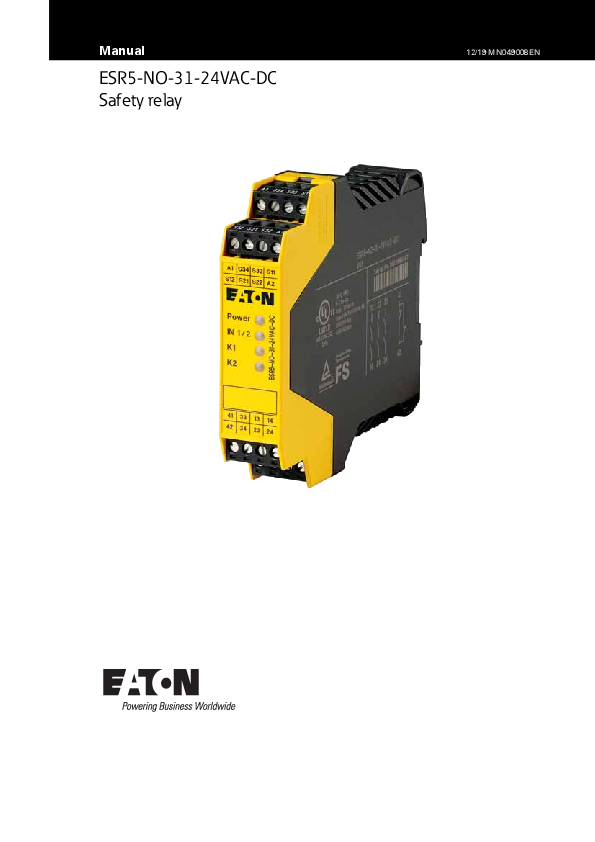
ESR5-NO-31-24VAC-DC Safety relay
File info: application/pdf · 22 pages · 431.86KB
ESR5-NO-31-24VAC-DC Safety relay
Manual 12/19 MN049008EN
ESR5-NO-31-24VAC-DC, safety relay, emergency stop monitoring, safety door monitoring
0 About This Manual ESR5-NO-31-24VAC-DC 12/19 MN049008EN www.eaton.com 3 0 About This Manual This manual applies to the ESR5-NO-31-24VAC-DC safety relay. 0.1 List of revisions The following significant amendments have b…
ESR5-NO-31-24VAC-DC Safety relay - Eaton
Disconnect the power supply of the device. • Ensure that devices cannot be accidentally retriggered. • Verify isolation from the supply.
Full PDF Document

If the inline viewer fails, it will open the original document in compatibility mode automatically. You can also open the file directly.
Extracted Text
Manual
ESR5-NO-31-24VAC-DC Safety relay

12/19 MN049008EN

All brand and product names are trademarks or registered trademarks of their respective owners.
Emergency On Call Service Please call your local representative: http://www.eaton.eu/aftersales or Hotline After Sales Service: +49 (0) 180 5 223822 (de, en) AfterSalesEGBonn@eaton.com
Original operating manual The German-language edition of this document is the original operating manual. Translation of the original operating manual All editions of this document other than those in German language are translations of the original operating manual.
1. Edition 2019, publication date 12/19 See revision protocol in the "About this manual" chapter.
� 2019 by Eaton Industries GmbH, 53105 Bonn, Germany Editor: Ren� Wiegand
All rights, including those of translation, reserved. No part of this manual may be reproduced, stored in a retrieval system, or transmitted in any form or by any means, electronic, mechanical, photocopying, micro-filming, recording, or otherwise, without the prior written permission of Eaton Industries GmbH, Bonn, Germany.
Subject to alteration.

Danger! Dangerous electrical voltage!

Before commencing the installation
� Disconnect the power supply of the device.
� Ensure that devices cannot be accidentally retriggered.
� Verify isolation from the supply.
� Ground and short-circuit.
� Cover or enclose neighbouring units that are live.
� Follow the engineering instructions (IL) of the device concerned.
� Only suitably qualified personnel in accordance with EN 50110-1/-2 (VDE 0105 Part 100) may work on this device/ system.
� Before installation and before touching the device ensure that you are free of electrostatic charge.
� The functional earth (FE) must be connected to the protective earth (PE) or to the potential equalizing. The system installer is responsible for implementing this connection.
� Connecting cables and signal lines should be installed so that inductive or capacitive interference do not impair the automation functions.
� Install automation devices and related operating elements in such a way that they are well protected against unintentional operation.
� Suitable safety hardware and software measures should be implemented for the I/O connection so that a cable or wire breakage on the signal side does not result in undefined states in the automation device.
� Ensure a reliable electrical isolation of the low voltage for the 24 V supply. Only use power supply units complying with IEC 60364-4-41 or HD 384.4.41 S2 (VDE 0100 part 410).
� Deviations of the mains voltage from the nominal value must not exceed the tolerance limits given in the technical data, otherwise this may cause malfunction and dangerous operation.
� Emergency-Stop devices complying with IEC/EN 60204-1 must be effective in all operating modes of the automation devices. Unlatching the emergency switching off devices must not cause restart.
� Built-in devices for enclosures or cabinets must only be run and operated in an installed state, desk-top devices or portable devices only when the housing is closed.
� Measures should be taken to ensure the proper restart of programs interrupted after a voltage dip or failure. This should not cause dangerous operating states even for a short time. If necessary, emergency switching off devices should be implemented.

� Wherever faults in the automation system may cause damage to persons or property, external measures must be implemented to ensure a safe operating state in the event of a fault or malfunction (for example, by means of separate limit switches, mechanical interlocks, etc.).
� During operation, and depending on their degree of protection, variable frequency drives may have live, uninsulated, moving, and/or rotating parts, as well as hot surfaces.
� The impermissible removal of the required cover, improper installation or incorrect operation of the motor or variable frequency drive can cause the failure of the device and serious injury and/or material damage.
� Comply with all applicable national accident prevention regulations (e.g. BGV A3) when working with energized variable frequency drives.
� The electrical installation must be carried out in accordance with the relevant regulations (e.g. with regard to cable cross sections, fuses, PE).
� All transport, installation, commissioning and maintenance work must only be carried out by trained personnel (observe IEC 60364, HD 384 or DIN VDE 0100 and national accident prevention regulations).
� If applicable, systems in which variable frequency drives are installed must be equipped with additional monitoring and protective devices in accordance with the applicable safety regulations, e.g., the German Equipment and Product Safety Act, accident prevention regulations, etc. Making changes to the variable frequency drives by using the operating software is allowed.
� Keep all covers and doors closed during operation.
� When designing the machine, the user must incorporate mechanisms and measures that limit the consequences of a drive controller malfunction or failure (an increase in motor speed or the motor?9s sudden stop) so as to prevent hazards to people and property, e.g.:
� Additional stand-alone devices for monitoring parameters that are relevant to safety (speed, travel, end positions, etc.)
� Electrical and non-electrical safety devices (interlocks or mechanical locks) for mechanisms that protect the entire system
� Due to the possibility of there being capacitors that are still holding a charge, do not touch live device parts or terminals immediately after disconnecting the variable frequency drives from the supply voltage. Heed the corresponding labels on the variable frequency drives

Eaton Industries GmbH Safety instructions

Content

0
0.1
0.2
0.3
0.4 0.4.1 0.4.2 0.4.3
0.5

About This Manual..................................................................... 3
List of revisions ............................................................................ 3
Target group................................................................................. 3
Additional documents .................................................................. 3
Abbreviations and symbols .......................................................... 4 Risk of material damage............................................................... 4 Hazard warnings of personal injury .............................................. 4 Tips............................................................................................... 4
Ordering data ............................................................................... 4

1

Safety notes................................................................................ 5

2

Description.................................................................................. 6

3

Operating and indication elements.......................................... 7

4

Basic circuit diagram ................................................................. 8

5

Derating ...................................................................................... 9

6

Diagnostics ................................................................................. 10

7

Application examples ................................................................ 11

7.1 Single-channel emergency stop monitoring................................. 11

7.2 Two-channel emergency stop monitoring.................................... 12

7.3 Single-channel safety door monitoring......................................... 13

7.4 Two-channel safety door monitoring............................................ 14

8

Technical data ............................................................................ 15

9

Glossary ...................................................................................... 18

ESR5-NO-31-24VAC-DC 12/19 MN049008EN www.eaton.com

1

2

ESR5-NO-31-24VAC-DC 12/19 MN049008EN www.eaton.com

0 About This Manual

0 About This Manual

0.1 List of revisions

This manual applies to the ESR5-NO-31-24VAC-DC safety relay.

The following significant amendments have been introduced since previous issues:

Publication Page Keyword date

new

modified deleted

12/19

First edition

�

�

�

0.2 Target group

This manual is intended for qualified personnel installing, operating, and maintaining the ESR5-NO-31-24VAC-DC safety relay.
CAUTION Installation requires a qualified electrician

0.3 Additional documents
For further information, see the following documentation:
� Instruction leaflet IL05013029Z2018_06
WARNING Make sure you always use the latest documentation. It can be downloaded from the product at: www.eaton.eu/esr5

ESR5-NO-31-24VAC-DC 12/19 MN049008EN www.eaton.com

3

0 About This Manual

0.4 Abbreviations and symbols
The symbols used in this manual have the following meanings:  indicates actions to be taken.

0.4.1 Risk of material damage

CAUTION Warns about the possibility of material damage.

0.4.2 Hazard warnings of personal injury
 CAUTION Warns of the possibility of hazardous situations that may possibly cause slight injury.

 WARNING Warns of the possibility of hazardous situations that could result in serious injury or even death.

 DANGER Warns of hazardous situations that result in serious injury or death.

0.4.3 Tips

 Indicates useful tips.

0.5 Ordering data

ESR5-NO-31-24VAC-DC safety relay: Catalog No.

4

ESR5-NO-31-24VAC-DC 12/19 MN049008EN www.eaton.com

1 Safety notes

1 Safety notes

 WARNING Risk of electric shock During operation, parts of electrical switching devices carry hazardous voltages. Before working on the switching device, disconnect the power. Please observe the safety regulations of electrical engineering and industrial safety and liability associations! Disregarding these safety regulations may result in death, serious personal injury or damage to equipment. Startup, mounting, modifications, and upgrades should only be carried out by a skilled electrical engineer!

 WARNING Risk of automatic machine restart! For emergency stop applications, the machine must be prevented from restarting automatically by a higher-level control system. Protective covers must not be removed when operating electrical switching devices.

 WARNING Danger due to faulty devices! The devices may be damaged following an error and correct operation can no longer be ensured. In the event of an error, replace the device immediately. Repairs to the device, especially if the housing must be opened, may only be carried out by the manufacturer or authorized persons. Otherwise the warranty is invalidated.

CAUTION
Risk of damage to equipment due to incorrect installation For reliable operation, the safety relay must be installed in housing protected from dust and humidity (IP54). Carry out wiring according to the application. Refer to the "Application examples" section for this.

CAUTION
Risk of damage to equipment due to noise emissions When operating relay modules the operator must meet the requirements for noise emission for electrical and electronic equipment (EN 61000-6-4) on the contact side and, if required, take appropriate measures.

ESR5-NO-31-24VAC-DC 12/19 MN049008EN www.eaton.com

5

2 Description

2 Description

The ESR5-NO-31-24VAC-DC safety relay can be used for emergency stop and safety door monitoring as well as in safety circuits according to EN 60204-1.
With this switching device, circuits are interrupted in a safety-oriented manner.
Control is via a single channel or two channels, either with automatic or manual start circuit (PSR-ESM4 only).
Depending on the external wiring, up to category 4, PL e according to EN ISO 13849-1 or SILCL 3 according to EN 62061 can be achieved.
The safety relay is equipped with three enabling current paths and one signaling current path that drop out without delay according to stop category 0.
Features
� Emergency stop and safety door monitoring � Suitable up to category 4, PL e (EN ISO 13849-1), SILCL 3 (EN 62061) � Single-channel or two-channel wiring with cross-circuit detection � Automatic or manual start circuit � Screw terminal blocks for plug-in

6

ESR5-NO-31-24VAC-DC 12/19 MN049008EN www.eaton.com

3 Operating and indication elements

3 Operating and indication elements


K2

42

41 34

33 23

13

14

K1

S12

A1 S21

IN E1S/2RP5o-NwOe-r31-24VAC-DC

S34 S22

S33 A2

S11

24

41 33 13 14

APPRO VALS

LISTED IND. CONT. EQ

32FB

42 34 23 24


ESR5-NO-31-24VAC-DC

30 - 12 AW G

5 - 7 lbs-in s Input: 24V ac/d c
Output: 240V ac/24V dc. B300 Pilotdut y
. R300 Pilotdut y

13 23 33 41

14 24 34 42


Figure 1: ESR5-NO-31-24VAC-DC a Metal lock for mounting on the DIN rail b COMBICON plug-in screw terminal blocks c 13/14, 23/24, 33/34 - undelayed enabling current paths d 41/42 - Signaling current path e LED status indicator, green - K2 f LED status indicator, green - K1 g LED status indicator, green - IN 1/2 h LED status indicator, green - Power i A1, A2 - supply voltage connection j S11, S12, S21, S22 - input circuits k S33, S34 - start circuit (activating circuit)

ESR5-NO-31-24VAC-DC 12/19 MN049008EN www.eaton.com

7

4 Basic circuit diagram

4 Basic circuit diagram

A1

S11 S33 S34 S12

13 23 33 41

24VDC
Power 24V AC/DC

Logic

K1
IN 1/2
K2

A2

S21

S22

14 24 34 42

Figure 2: Block diagram

Designation
A1/A2 S11/S12 S21/S22 S33/S34 13/14 23/24 33/34 41/42

Explanation
Safety relay input voltage Input circuit 1 Input circuit 2 Start circuit Undelayed enabling current path 1 Undelayed enabling current path 2 Undelayed enabling current path 3 Signaling current path

8

ESR5-NO-31-24VAC-DC 12/19 MN049008EN www.eaton.com

5 Derating

[A2]

2 I TH

80 72 70 60 50 40 32 30 20 10 0
0 10 20 30
Figure 3: Derating curve

40 45 50 55 60 TA [�C]

5 Derating

ESR5-NO-31-24VAC-DC 12/19 MN049008EN www.eaton.com

9

6 Diagnostics

6 Diagnostics

 � LED off  � LED on

Power

Table 1: Diagnostic description

IN1/2

K1

K2 Fault

Remedy

Connection/


 Supply voltage not present.

voltage error


Apply supply voltage.

Cross-circuit


Between both enable circuits S11- S12 and S21-S22. E.g., for emergency stop.

Remove cross-circuit.


 Between contact points A1 and A2.

Short circuit


Between S11 and S12. Fault detection on next demand.

Remove short circuit.


Between S21 and S22. Fault detection on next demand.

Fault with internal cause


 Enable contact(s) of K1 faulty.


 Enable contact(s) of K2 faulty.


 Enable contact(s) of K1 and K2 faulty.

Replace safety relays.

10

ESR5-NO-31-24VAC-DC 12/19 MN049008EN www.eaton.com

7 Application examples

7 Application examples
7.1 Single-channel emergency stop monitoring
� Manual start � Suitable up to category 1, PL c (EN ISO 13849-1), SILCL 1 (EN 62061)
L+ (L1)

 S1

A1

S11 S12 S21 S22

(+) ( ) (GND) ( )

ESR5-NO-31-24VAC-DC

(+) ( )

A2

S33 S34

13 23 33 41 14 24 34 42

R eset S2 K3
M (N )
Figure 4: Single-channel emergency stop monitoring a Emergency stop

K3 M

ESR5-NO-31-24VAC-DC 12/19 MN049008EN www.eaton.com

11

7 Application examples

7.2 Two-channel emergency stop monitoring
� Manual start � Cross circuiting detection � Monitoring of external contactors � Suitable up to category 4, PL e (EN ISO 13849-1), SILCL 3 (EN 62061)
L+ (L1)


S1

A1

S11 S12 S21 S22

(+) ( ) (GND) ( )

ESR5-NO-31-24VAC-DC

(+) ( )

A2

S33 S34

K3

Reset S2

K4

13 23 33 41 14 24 34 42
K4 K3

M (N )
Figure 5: Two-channel emergency stop monitoring a Emergency stop

K3 K4
M

12

ESR5-NO-31-24VAC-DC 12/19 MN049008EN www.eaton.com

7 Application examples

7.3 Single-channel safety door monitoring
� Automatic start � Suitable up to category 1, PL c (EN ISO 13849-1), SILCL 1 (EN 62061)
L+ (L1)


S1

A1

S11 S12 S21 S22 13 23 33 41

(+) ( ) (GND) ( )

ESR5-NO-31-24VAC-DC A2

(+) ( ) S33 S34

14 24 34 42

K3

M (N )
Figure 6: Single-channel safety door monitoring a Emergency stop

K3 M

ESR5-NO-31-24VAC-DC 12/19 MN049008EN www.eaton.com

13

7 Application examples

7.4 Two-channel safety door monitoring

� Automatic start � Cross circuiting detection � Monitoring of external contactors � Suitable up to category 4, PL e (EN ISO 13849-1), SILCL 3 (EN 62061)

L+ (L1)

Safety door

open closed

21 B1
22
B2

A1

S11 S12 S21 S22 13 23 33 41

K3

(+) ( ) (GND) ( )

ESR5-NO-31-24VAC-DC

(+) ( )

A2

S33 S34

14 24 34 42

K4

K3

M

K3

K4 K4

M (N )
Figure 7: Two-channel safety door monitoring

14

ESR5-NO-31-24VAC-DC 12/19 MN049008EN www.eaton.com

8 Technical data

8 Technical data
Input data Nominal input voltage UN Input voltage range (factor) Typical input current
Voltage at input/start and feedback circuit Max. permissible overall conductor resistance (Input and reset circuit at UN) Typical response time Typical release time Recovery time Operating voltage display Status display Protective circuit Output data Contact type
Contact material Minimum switching voltage Maximum switching voltage Limiting continuous current Maximum inrush current Inrush current, minimum Sq. Total current (ITH)2 = (I1)2 + (I2)2 + (I3)2 Interrupting rating (ohmic load) max.
Maximum interrupting rating (inductive load)
Switching capacity min. Mechanical service life Switching capacity (360 cycles/h)
Switching capacity (3600 cycles/h)
Output fuse

24 V AC/DC
0.85 - 1,1
140 mA AC 65 mA DC
 24 V DC  50  (Input and start circuits at UN)
100 ms (automatic start)
45 ms (single-channel)
1 s
Green LED
Green LED
Surge protection Suppressor diode
3 enabling current paths 1 signaling current path
AgSnO2 + 0,2 m Au 15 V AC/DC
250 V AC/DC
6 A (N/O contact)
6 A
25 mA 72 A2 (see derating curve  Figure 3, page 9)
144 W (24 V DC,  = 0 ms) 288 W (48 V DC,  = 0 ms) 77 W (110 V DC,  = 0 ms) 88 W (220 V DC,  = 0 ms) 1500 VA (250 V AC,  = 0 ms)
48 W (24 V DC,  = 40 ms) 40 W (48 V DC,  = 40 ms) 35 W (110 V DC,  = 40 ms) 33 W (220 V DC,  = 40 ms)
0.4 W
 107 cycles
6 A (24 V DC) 5 A (230 V AC)
3 A (24 V (DC-13)) 3 A (230 V (AC-15))
10 A gL/gG NEOZED (N/O contact) 6 A gL/gG NEOZED (N/C contact)

ESR5-NO-31-24VAC-DC 12/19 MN049008EN www.eaton.com

15

8 Technical data

General data Relay type Nominal operating mode Degree of protection Min. degree of protection of inst. location Mounting position Mounting type Type of housing Air and creepage distances between the power circuits Rated insulation voltage Rated surge voltage / insulation
Pollution degree Surge voltage category Dimensions W x H x D Connection data Conductor cross section, solid Conductor cross section, stranded Conductor cross section AWG/kcmil Stripping length Ambient conditions Ambient temperature (operation) Ambient temperature (storage/transport) Max. permissible relative humidity (operation) Max. permissible humidity (storage/transport) Certification / Approvals Approvals

Electromechanically forcibly guided, dust-proof relay 100 % operating factor IP20 IP54 any DIN rail mounting Polyamide PA non-reinforced yellow DIN EN 50178/VDE 0160 250 V 4 kV / basic insulation (safe isolation, reinforced insulation, and 6 kV between A1-A2/logic/enabling and signaling current paths) 2 III
22.5 x 99 x 114.5 mm
0.2 mm2 - 2.5 mm2 0.2 mm2 - 2.5 mm2 24 - 12 7 mm
-20 �C - 55 �C -40 �C - 70 �C 75 % 75 %

Safety data Stop category according to IEC 60204 Safety parameters for IEC 61508 - High demand SIL PFHd Demand rate Proof test interval Duration of use

0
3 5.05 x 10⁻¹⁰ per hour < 12 months 240 months 240 months

16

ESR5-NO-31-24VAC-DC 12/19 MN049008EN www.eaton.com

8 Technical data

Data only applies if the safety function is demanded at least once a year and the signal contact is read back. The specifications apply assuming the following calculation basis

B10d

300000 (at 5 A DC 13)

dop

365.25 days

hop

24 h

tCycle

3600 s

Safety parameters for IEC 61508 - Low demand

SIL

3

MTTFd PFDavg

19629 years 1.37 x 10⁻⁴

Proof test interval

66 months

Duration of use

240 months

Safety characteristic data according to EN ISO 13849

Category

4

Performance Level

e

CCF

Passed

Duration of use

240 months

Data only applies if the safety function is demanded at least once a year and the signal contact is read back. The specifications apply assuming the following calculation basis

B10d

300000 (at 5 A DC 13)

dop

365.25 days

hop

24 h

tCycle

3600 s

ESR5-NO-31-24VAC-DC 12/19 MN049008EN www.eaton.com

17

9 Glossary
9 Glossary

Abbreviation AOPD
AOPDDR
Cat. / Category CCF DC ESPE Mission Time TM MTTF / MTTFd PFD PFHd PL SIL SILCL SRCF SRECS SRP SRP/CS

Explanation
Active optoelectronic protective device Device with a sensor function that is generated by optoelectronic transmit and receive elements, which detects the interruption of optical radiation generated in the device by an opaque object located in the specified protective field (or for a photoelectric barrier on the axis of the light beam).
In DIN EN 692 (mechanical presses), DIN EN 693 (hydraulic presses), and EN 12622 (hydraulic trimming presses), the abbreviation AOS is used as a synonym for AOPD.
Active optoelectronic protective device responsive to diffuse reflection Device with a sensor function that is generated by optoelectronic transmit and receive elements, which detects the diffuse reflection of optical radiation generated in the device by an object located in a protective field specified in two dimensions.
Classification of the resistance to faults according to EN ISO 13849-1.
Common cause failure
Diagnostic coverage
Electro-sensitive protective equipment
Duration of use
Mean time to failure / mean time to dangerous failure
Probability of failure on demand (low demand)
Average frequency of a dangerous failure per hour
Performance level Classification of the ability of safety functions to meet a safety demand
Safety integrity level
SIL claim limit
Safety-related control function
Safety-related electrical control system (Safety-related electrical, electronic, and programmable electronic control system)
Safety-related part
Safety-related parts of control system

18

ESR5-NO-31-24VAC-DC 12/19 MN049008EN www.eaton.com