Nikon Coolpix W100 Reference Manual W100RM EN
User Manual: nikon Coolpix W100 - Reference Manual Free User Guide for Nikon COOLPIX Series Camera, Manual - page2
Open the PDF directly: View PDF  .
.
Page Count: 175 [warning: Documents this large are best viewed by clicking the View PDF Link!]
- Quick Topic Search
- For Smart Device Users
- Introduction
- Parts of the Camera
- Getting Started
- Basic Shooting and Playback Operations
- Shooting Features
- Playback Features
- Movies
- Connecting the Camera to a TV, Printer, or Computer
- General Camera Setup
- Technical Notes
DIGITAL CAMERA
Reference Manual
•Read this manual thoroughly before using the camera.
•To ensure proper use of the camera, be sure to read “For
Your Safety” (page viii) and “<Important> Notes About
Shockproof, Waterproof, and Dustproof Performance and
Condensation” (page xi).
•After reading this manual, keep it in a readily accessible
place for future reference.
ii
Quick Topic Search
You can return to this page by tapping or clicking in the lower right of any page.
Main Topics
For Smart Device Users .......................................................................................................iii
Introduction ............................................................................................................................. v
Table of Contents.................................................................................................................xv
Parts of the Camera ...............................................................................................................1
Getting Started........................................................................................................................9
Basic Shooting and Playback Operations....................................................................23
Shooting Features................................................................................................................30
Playback Features.................................................................................................................55
Movies ......................................................................................................................................92
Connecting the Camera to a TV, Printer, or Computer...........................................97
General Camera Setup.....................................................................................................107
Technical Notes.................................................................................................................. 123
Common Topics
For Your Safety Shockproof and
Waterproof
What SnapBridge
Can Do for You
Select Shooting
Conditions and
Effects
Exchange
Messages
Picture Play Troubleshooting Index
iii
For Smart Device Users
Your images. The world. Connected
Welcome to SnapBridge — Nikon’s new family of services to enrich
your image experience. SnapBridge eliminates the barrier between
your camera and compatible smart device, through a combination
of Bluetooth® low energy (BLE) technology and a dedicated app. The
stories you capture with your Nikon camera and lenses are
automatically transferred to the device as they are taken. They can
even be uploaded effortlessly to cloud storage services, inviting
access across all your devices. You can share your excitement, when
and where you want.
Download the SnapBridge app to get started!
Take advantage of the wide-ranging
convenience by downloading the
SnapBridge app onto your smart device
now. Through a few simple steps, this
app connects your Nikon cameras with a
compatible iPhone®, iPad® and/or iPod
touch® or smart devices running on the
AndroidTM operating system. The app is
available free from the website (http://
snapbridge.nikon.com), Apple App
Store® and Google PlayTM.
For the latest information on SnapBridge, visit the Nikon website for
your area (Avi).
For Smart Device Users
iv
For Smart Device Users
The exciting image experience that SnapBridge offers…
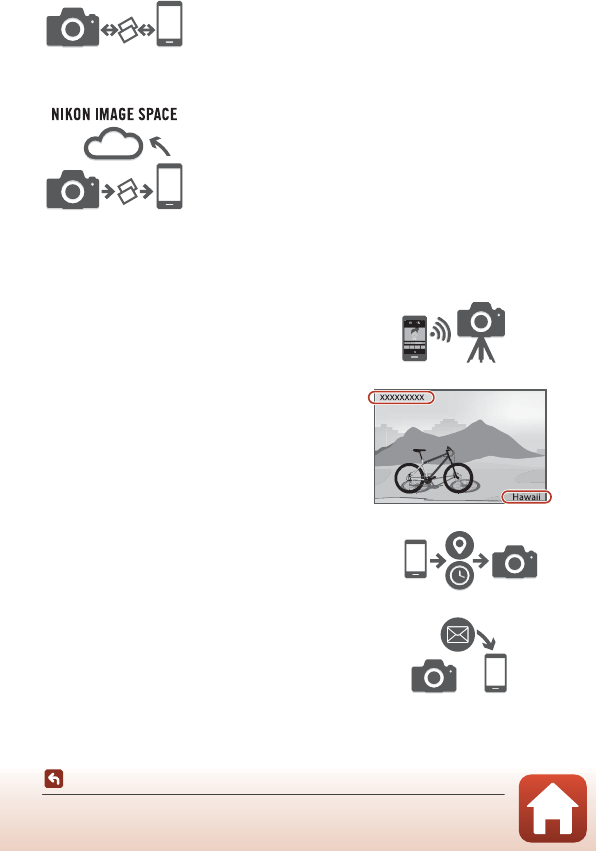
A range of services that enriches your imaging life,
including:
•Camera remote control
•Imprinting up to two pieces of credit
information (e.g. copyright, comments,
text and logos) on pictures
•Automatic update of camera’s date and
time info and location info
•Receive camera’s firmware updates
Automatic picture transfer from camera to smart
device thanks to the constant connection between
the two devices — making online photo sharing
easier than ever
Upload of photos and thumbnail images to the
NIKON IMAGE SPACE cloud service
v
Introduction
Read This First
Introduction
Thank you for purchasing the Nikon COOLPIX W100 digital camera.
Symbols and Conventions Used in This Manual
•Tap or click in the lower right of each page to display “Quick Topic Search”
(Aii).
•Symbols
•SD, SDHC, and SDXC memory cards are referred to as “memory cards” in this
manual.
•The setting at the time of purchase is referred to as the “default setting.”
•The names of menu items displayed on the camera screen, and the names of
buttons or messages displayed on a computer screen appear in bold.
•In this manual, images are sometimes omitted from screen display samples so that
screen indicators can be more clearly shown.
Read This First
Symbol Description
BThis icon marks cautions and information that should be read before using
the camera.
CThis icon marks notes and information that should be read before using the
camera.
AThis icon marks other pages containing relevant information.
vi
Introduction
Read This First
Information and Precautions
Life-Long Learning
As part of Nikon’s “Life-Long Learning” commitment to ongoing product support and
education, continually updated information is available online at the following websites:
•For users in the U.S.A.: http://www.nikonusa.com/
•For users in Europe: http://www.europe-nikon.com/support/
•For users in Asia, Oceania, the Middle East, and Africa: http://www.nikon-asia.com/
Visit these websites to keep up-to-date with the latest product information, tips, answers to
frequently asked questions (FAQs), and general advice on digital imaging and photography.
Additional information may be available from the Nikon representative in your area. Visit the
website below for contact information.
http://imaging.nikon.com/
Use Only Nikon Brand Electronic Accessories
Nikon COOLPIX cameras are designed to the highest standards and include complex
electronic circuitry. Only Nikon brand electronic accessories (including battery chargers,
batteries, Charging AC Adapters, AC adapters, and USB cables) certified by Nikon specifically
for use with this Nikon digital camera are engineered and proven to operate within the
operational and safety requirements of this electronic circuitry.
THE USE OF NON-NIKON ELECTRONIC ACCESSORIES COULD DAMAGE THE CAMERA AND
MAY VOID YOUR NIKON WARRANTY.
The use of third-party rechargeable Li-ion batteries not bearing the Nikon holographic seal
could interfere with normal operation of the camera or result in the batteries overheating,
igniting, rupturing, or leaking.
For more information about Nikon brand accessories, contact a local authorized Nikon
dealer.
Before Taking Important Pictures
Before taking pictures on important occasions (such as at weddings or before taking the
camera on a trip), take a test shot to ensure that the camera is functioning normally. Nikon
will not be held liable for damages or lost profits that may result from product malfunction.
Holographic seal: Identifies this
device as an authentic Nikon product.

vii
Introduction
Read This First
About the Manuals
•No part of the manuals included with this product may be reproduced, transmitted,
transcribed, stored in a retrieval system, or translated into any language in any form, by
any means, without Nikon’s prior written permission.
•Illustrations and screen content shown in this manual may differ from the actual product.
•Nikon reserves the right to change the specifications of the hardware and software
described in these manuals at any time and without prior notice.
•Nikon will not be held liable for any damages resulting from the use of this product.
•While every effort was made to ensure that the information in these manuals is accurate
and complete, we would appreciate it were you to bring any errors or omissions to the
attention of the Nikon representative in your area (address provided separately).
Comply with Copyright Notices
Under copyright law, photographs or recordings of copyrighted works made with the
camera can not be used without the permission of the copyright holder. Exceptions apply
to personal use, but note that even personal use may be restricted in the case of
photographs or recordings of exhibits or live performances.
Disposing of Data Storage Devices
Please note that deleting images or formatting data storage devices such as memory cards
or built-in camera memory does not completely erase the original image data. Deleted files
can sometimes be recovered from discarded storage devices using commercially available
software, potentially resulting in the malicious use of personal image data. Ensuring the
privacy of such data is the user’s responsibility.
Before discarding a data storage device or transferring ownership to another person, make
sure to reset all of the camera’s settings in Reset all in the camera settings menu (A108).
After resetting, erase all data in the device using commercial deletion software, or format the
device in Format memory or Format card in the camera settings menu (A108), then
completely refill it with images containing no private information (for example, images of
empty sky).
Care should be taken to avoid injury or damage to property when physically destroying
memory cards.
Conformity Marking
Follow the procedure below to display some of the conformity markings that the
camera complies with.
Enter shooting mode or playback mode M flexible button 4 (l) M flexible button 4
(lCamera settings) M press HI M k Conformity marking
viii
Introduction
For Your Safety
To prevent damage to property or injury to yourself or to others, read “For Your Safety”
in its entirety before using this product.
Keep these safety instructions where all those who use this product will read them.
For Your Safety
DANGER
Failure to observe the precautions marked
with this icon carries a high risk of death or
severe injury.
WARNING
Failure to observe the precautions marked
with this icon could result in death or
severe injury.
CAUTION
Failure to observe the precautions marked
with this icon could result in injury or
property damage.
WARNING
•Do not use while walking or operating a vehicle. Failure to observe this precaution
could result in accidents or other injury.
•Do not disassemble or modify this product. Do not touch internal parts that
become exposed as the result of a fall or other accident. Failure to observe these
precautions could result in electric shock or other injury.
•Should you notice any abnormalities such as the product producing smoke, heat,
or unusual odors, immediately disconnect the battery or power source. Continued
operation could result in fire, burns or other injury.
•Do not handle the plug with wet hands. Failure to observe this precaution could
result in fire or electric shock.
•Do not let your skin remain in prolonged contact with this product while it is on or
plugged in. Failure to observe this precaution could result in low-temperature
burns.
•Do not use this product in the presence of flammable dust or gas such as propane,
gasoline or aerosols. Failure to observe this precaution could result in explosion or
fire.
•Do not aim the flash at the operator of a motor vehicle. Failure to observe this
precaution could result in accidents.
ix
Introduction
For Your Safety
•Keep this product out of reach of children. Failure to observe this precaution could
result in injury or product malfunction. In addition, note that small parts constitute
a choking hazard. Should a child swallow any part of this product, seek immediate
medical attention.
•Do not entangle, wrap or twist the straps around your neck. Failure to observe this
precaution could result in accidents.
•Do not use batteries, chargers, AC adapters, or USB cables not specifically
designated for use with this product. When using batteries, chargers, AC adapters,
and USB cables designated for use with this product, do not:
- Damage, modify, forcibly tug or bend the cords or cables, place them under
heavy objects, or expose them to heat or flame.
- Use travel converters or adapters designed to convert from one voltage to
another or with DC-to-AC inverters.
Failure to observe these precautions could result in fire or electric shock.
•Do not handle the plug when charging the product or using the AC adapter
during thunderstorms. Failure to observe this precaution could result in electric
shock.
•Do not handle with bare hands in locations exposed to extremely high or low
temperatures. Failure to observe this precaution could result in burns or frostbite.
CAUTION
•Do not leave the lens pointed at the sun or other strong light sources. Light
focused by the lens could cause fire or damage to product’s internal parts.
When shooting backlit subjects, keep the sun well out of the frame.
•Turn this product off when its use is prohibited. Disable wireless features when the
use of wireless equipment is prohibited. The radio-frequency emissions produced
by this product could interfere with equipment onboard aircraft or in hospitals or
other medical facilities.
•Remove the battery and disconnect the AC adapter if this product will not be used
for an extended period. Failure to observe this precaution could result in fire or
product malfunction.
•Do not fire the flash in contact with or in close proximity to the skin or objects.
Failure to observe this precaution could result in burns or fire.
•Do not leave the product where it will be exposed to extremely high temperatures,
for an extended period such as in an enclosed automobile or in direct sunlight.
Failure to observe this precaution could result in fire or product malfunction.
x
Introduction
For Your Safety
DANGER for Batteries
•Do not mishandle batteries. Failure to observe the following precautions could
result in the batteries leaking, overheating, rupturing, or catching fire:
- Use only rechargeable batteries approved for use in this product.
- Do not expose batteries to flame or excessive heat.
- Do not disassemble.
- Do not short-circuit the terminals by touching them to necklaces, hairpins, or
other metal objects.
- Do not expose batteries or the products in which they are inserted to powerful
physical shocks.
•Recharge batteries using the specified method. Failure to observe this precaution
could result in the batteries leaking, overheating, rupturing, or catching fire.
•If battery liquid comes into contact with the eyes, rinse with plenty of clean water
and seek immediate medical attention. Delaying action could result in eye injuries.
WARNING for Batteries
•Keep batteries out of reach of children. Should a child swallow a battery, seek
immediate medical attention.
•Do not immerse this product in water or expose to rain. Failure to observe this
precaution could result in fire or product malfunction. Immediately dry the
product with a towel or similar object should it become wet.
•Discontinue use immediately should you notice any changes in the battery, such
as discoloration or deformation. Cease charging if they do not charge in the
specified period of time. Failure to observe these precautions could result in the
battery leaking, overheating, rupturing, or catching fire.
•Prior to disposal, insulate battery terminals with tape. Overheating, rupture, or fire
may result should metal objects come into contact with the terminals. Recycle or
dispose of batteries in accord with local regulations.
•If battery liquid comes into contact with a person’s skin or clothing, immediately
rinse the affected area with plenty of clean water. Failure to observe this
precaution could result in skin irritation.

xi
Introduction
<Important> Notes About Shockproof, Waterproof, and Dustproof
Performance and Condensation
•The shockproof, waterproof, and dustproof performance described here do not
guarantee that the camera will remain completely waterproof or free from damage
and trouble under all conditions.
•Do not subject the camera to excessive shock, vibration or pressure by dropping it,
hitting it, or placing a heavy object on it. Failure to observe this precaution could
deform the camera, cause water to seep inside, or damage the airtight seals,
resulting in camera malfunction.
•Your Nikon warranty may not cover troubles caused by water seeping inside the
camera due to improper handling of the camera.
Notes About Shockproof Performance
This camera has passed Nikon’s in-house test (drop test from a height of 180 cm (5 ft
10 in.) on a 5 cm (2 in.) thick plywood panel) compliant with the MIL-STD 810F
Method 516.5-Shock* standard.
Changes in appearance, such as paint peeling off and deformation of the camera, are
not measured in Nikon’s in-house test.
* U.S. Department of Defense test method standard.
This drop test drops 5 cameras in 26 directions (8 edges, 12 corners, and 6 faces) from a
height of 122 cm (4 ft) to make sure that one to five cameras pass the test (if any defect is
detected during the test, another five cameras are tested to make sure that the test
criteria are satisfied for one to five cameras).
Notes About Waterproof and Dustproof Performance
The camera is rated equivalent to JIS/IEC waterproof class 8 (IPX8) and JIS/IEC
dustproof class 6 (IP6X) and can shoot images underwater at a depth of 10 m (33 ft)
for up to 60 minutes.*
* This rating indicates that the camera has been designed to withstand the specified water
pressure for the specified period of time when the camera is used according to the
methods defined by Nikon.
- The waterproof performance of this camera was tested in fresh water (swimming
pools, rivers, and lakes) and salt water only.
- The inner portion of this camera is not waterproof. Water seeping inside the camera
could cause the components to rust, resulting in high repair costs or irreparable damage.
BPrecautions When Cleaning
•Do not puncture the microphone or speaker openings with a sharp implement. If the
inside of the camera is damaged, the waterproof performance will deteriorate.
•Do not use soap, neutral detergents, or chemicals such as benzene for cleaning.
<Important> Notes About Shockproof,
Waterproof, and Dustproof Performance and
Condensation
xii
Introduction
<Important> Notes About Shockproof, Waterproof, and Dustproof
Performance and Condensation
Notes About Shockproof, Waterproof, and Dustproof
Performance
•Do not drop the camera, strike it against a hard object such as a rock, or throw it
against a water surface.
•Do not subject the camera to shock when using it underwater.
- Do not subject the camera to water pressure by exposing it to rapids or
waterfalls.
- Do not expose to depths greater than 10 m (33 ft) underwater.
- Make sure not to drop the camera underwater. This camera does not float in
water.
•Do not continuously use the camera underwater for 60 minutes or more.
•Do not insert a wet memory card or battery in the camera.
- Do not open the battery-chamber/memory card slot cover when the camera or
your hands are wet. Doing so may cause water to seep inside the camera or
result in camera malfunction.
•Do not open the battery-chamber/memory card slot cover underwater.
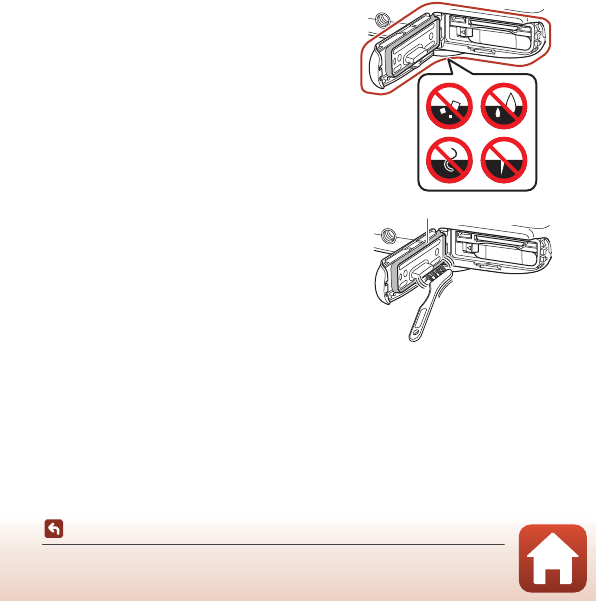
•If moisture such as water droplets adheres to
the outside of the camera or inside of the
battery-chamber/memory card slot cover,
immediately wipe it off with a soft dry cloth.
- If a foreign substance adheres to the
outside of the camera or inside of the
battery-chamber/memory card slot cover,
immediately remove it with a blower or a
soft cloth.
- If a foreign substance adheres to the
waterproof packing inside the battery-
chamber/memory card slot cover, remove it
with the included brush. Do not use the
included brush for anything other than
cleaning the waterproof packing.
•Do not leave the camera in cold conditions or in
hot conditions of 40°C (104°F) or more for a long
period of time.
- Doing so could cause deterioration of the
waterproof performance.
- When using the camera underwater, make sure the water temperature is from
0°C to 40°C (32°F to 104°F).
•Do not use the camera at hot springs.
Waterproof packing

xiii
Introduction
<Important> Notes About Shockproof, Waterproof, and Dustproof
Performance and Condensation
Before Using the Camera Underwater
Check the items below before using the camera underwater.
•Make sure that there are no foreign substances inside the battery-chamber/
memory card slot cover.
•Make sure that the waterproof packing of the battery-chamber/memory card slot
cover is not cracked or deformed.
- Make sure that the waterproof packing is not detached from the camera.
•Make sure that the battery-chamber/memory card slot cover is firmly closed.
- Make sure that the battery-chamber/memory card slot cover security lock is in
the LOCK position.
Notes About Operating Temperature, Humidity, and
Condensation
The operation of this camera has been tested at temperatures from –10°C to +40°C
(14°F to 104°F).
When you use the camera in cold climate regions or at high altitudes, observe the
following precautions.
•Battery performance deteriorates temporarily when cold. Keep the camera and
batteries warm under your clothing before use.
•Camera performance may deteriorate temporarily if it is exposed to extreme cold
for an extended period. For example, the monitor may appear darker than normal
immediately after the camera is turned on, or residual images may be produced.
●Environmental conditions that are likely to cause condensation inside of
the camera
Fogging (condensation) may occur on the inside of the monitor or lens when there
are sharp temperature changes or high humidity, such as in the environmental
conditions described below. This is not a camera malfunction or defect.
•The camera is suddenly immersed in cold water after being in a hot place on land.
•The camera is brought to a warm place such as inside a building after being in the
cold outdoors.
•The battery-chamber/memory card slot cover is opened or closed in a high-
humidity environment.
●Clearing the fogging
•Turn off the camera and open the battery-chamber/memory card slot cover while
in a place where the ambient temperature is stable (avoid places with high
temperature, high humidity, sand, or dust).
To clear the fogging, remove the battery and memory card, and leave the battery-
chamber/memory card slot cover open to allow the camera to adjust to the
ambient temperature.

xiv
Introduction
<Important> Notes About Shockproof, Waterproof, and Dustproof
Performance and Condensation
Inspection and Repair
•If the camera is exposed to shock, it is recommended to consult your retailer or
Nikon-authorized service representative to confirm the waterproof performance
(charged service).
•If the waterproof packing begins to deteriorate, consult your retailer or Nikon-
authorized service representative. The waterproof performance of the waterproof
packing may start to deteriorate after one year.
•If water seeps inside the camera, immediately stop using it and take it to your
Nikon-authorized service representative.
xv
Table of Contents
Table of Contents
Quick Topic Search ............................................................................................................... ii
Main Topics...................................................................................................................................................................... ii
Common Topics ........................................................................................................................................................... ii
For Smart Device Users ...................................................................................................... iii
Introduction ............................................................................................................................ v
Read This First .......................................................................................................................................... v
Symbols and Conventions Used in This Manual ...................................................................................... v
Information and Precautions ............................................................................................................................... vi
For Your Safety ..................................................................................................................................... viii
<Important> Notes About Shockproof, Waterproof, and Dustproof Performance and
Condensation.......................................................................................................................................... xi
Notes About Shockproof Performance......................................................................................................... xi
Notes About Waterproof and Dustproof Performance....................................................................... xi
Notes About Shockproof, Waterproof, and Dustproof Performance ........................................ xii
Before Using the Camera Underwater........................................................................................................ xiii
Notes About Operating Temperature, Humidity, and Condensation..................................... xiii
Inspection and Repair............................................................................................................................................ xiv
Parts of the Camera .............................................................................................................. 1
The Camera Body.................................................................................................................................... 2
The Monitor .............................................................................................................................................. 4
For Shooting.................................................................................................................................................................... 4
For Playback..................................................................................................................................................................... 6
Using the Flexible Buttons .................................................................................................................. 7

xvi
Table of Contents
Getting Started....................................................................................................................... 9
How to Attach the Camera Strap .................................................................................................... 10
Inserting the Battery and Memory Card....................................................................................... 11
Removing the Battery or Memory Card ...................................................................................................... 12
Memory Cards and Internal Memory............................................................................................................ 12
Charging the Battery ........................................................................................................................... 13
Camera Setup......................................................................................................................................... 15
Setup from a Smartphone or Tablet ............................................................................................................. 15
Setup from the Camera Menus........................................................................................................................ 19
What SnapBridge Can Do for You................................................................................................................... 21
Basic Shooting and Playback Operations................................................................... 23
Shooting Images................................................................................................................................... 24
Playing Back Images ............................................................................................................................ 26
Deleting Images .................................................................................................................................... 27
Selecting Which Images You Want to Delete ......................................................................................... 28
Restricting Image Deletion (Image Lock)................................................................................................... 29

xvii
Table of Contents
Shooting Features............................................................................................................... 30
Functions Available in Shooting Mode (Shooting Menu)...................................................... 31
A Point and Shoot.............................................................................................................................. 32
Using Target Finding AF ....................................................................................................................................... 32
Flash Mode.............................................................................................................................................. 33
Self-timer ................................................................................................................................................. 34
Smile Timer ............................................................................................................................................. 35
Choose a Style (Shooting with Selected Shooting Conditions and Effects) ................... 36
Tips and Notes ............................................................................................................................................................ 37
Decorate................................................................................................................................................... 43
Change Colors........................................................................................................................................ 44
Change Sounds ..................................................................................................................................... 45
Choose a Size ......................................................................................................................................... 47
Choose a Photo Size................................................................................................................................................ 47
Choose a Movie Frame Size................................................................................................................................ 48
Using the Zoom..................................................................................................................................... 49
Focusing................................................................................................................................................... 50
The Shutter-release Button................................................................................................................................. 50
Using Face Detection ............................................................................................................................................. 50
Using Skin Softening............................................................................................................................................... 51
Subjects Not Suitable for Autofocus ............................................................................................................. 51
Focus Lock..................................................................................................................................................................... 52
Functions That Cannot Be Used Simultaneously When Shooting...................................... 53

xviii
Table of Contents
Playback Features................................................................................................................ 55
Playback Zoom ...................................................................................................................................... 56
Thumbnail Playback ............................................................................................................................ 57
Functions Available in Playback Mode (Playback Menu)....................................................... 58
E Exchange Messages....................................................................................................................... 59
Leave a Message........................................................................................................................................................ 59
Leave a Reply ............................................................................................................................................................... 60
Play Recordings .......................................................................................................................................................... 61
Erase Recordings........................................................................................................................................................ 61
V Picture Play ....................................................................................................................................... 62
Before Editing Images ............................................................................................................................................ 62
K Add Makeup......................................................................................................................................................... 63
D Make Photo Albums......................................................................................................................................... 64
W Add a Fisheye Effect ......................................................................................................................................... 66
Z Toy Camera ............................................................................................................................................................ 66
Q Soften Pictures..................................................................................................................................................... 67
f Add Starbursts ..................................................................................................................................................... 67
M Add a Diorama Effect....................................................................................................................................... 68
d Change Colors...................................................................................................................................................... 68
P Highlight Colors.................................................................................................................................................. 69
A Decorate .................................................................................................................................................................. 70
F Add Cartoon Effects ......................................................................................................................................... 71
G Stamp......................................................................................................................................................................... 72
A Grading .............................................................................................................................................. 74
Grade Pictures ............................................................................................................................................................. 74
View Graded Pictures.............................................................................................................................................. 76
Remove All Grades ................................................................................................................................................... 77
I Favorites ............................................................................................................................................ 78
Add to Favorites......................................................................................................................................................... 78
View Favorites.............................................................................................................................................................. 80
Remove From Favorites ........................................................................................................................................ 81
G View by Date .................................................................................................................................... 82
m Slide Show ........................................................................................................................................ 83
Choose Pictures.......................................................................................................................................................... 83
Choose a Theme........................................................................................................................................................ 86
E Mark for Upload .............................................................................................................................. 87
y Retouch.............................................................................................................................................. 88
h Copy........................................................................................................................................................................... 88
d Rotate Pictures..................................................................................................................................................... 90
s Small Picture ......................................................................................................................................................... 91

xix
Table of Contents
Movies ..................................................................................................................................... 92
Recording and Playing Back Movies.............................................................................................. 93
Operations During Movie Playback ............................................................................................... 96
Connecting the Camera to a TV, Printer, or Computer.......................................... 97
Utilizing Images..................................................................................................................................... 98
Viewing Images on a TV ..................................................................................................................... 99
Printing Images Without a Computer........................................................................................ 100
Connecting the Camera to a Printer .......................................................................................................... 100
Printing Images One at a Time ...................................................................................................................... 101
Printing Multiple Images ................................................................................................................................... 102
Transferring Images to a Computer (ViewNX-i)...................................................................... 104
Installing ViewNX-i................................................................................................................................................. 104
Transferring Images to a Computer ........................................................................................................... 104
General Camera Setup.................................................................................................... 107
Camera Settings Menu .................................................................................................................... 108
l Camera Settings ............................................................................................................................ 110
Network Menu ......................................................................................................................................................... 110
Welcome Screen..................................................................................................................................................... 111
Date and Time.......................................................................................................................................................... 112
Variety Menu ............................................................................................................................................................. 113
Brightness ................................................................................................................................................................... 114
Date Stamp ................................................................................................................................................................ 114
Electronic VR.............................................................................................................................................................. 115
AF Assist ....................................................................................................................................................................... 116
Format Card/Format Memory........................................................................................................................ 117
Language .................................................................................................................................................................... 118
Image Comment .................................................................................................................................................... 118
Copyright Information ........................................................................................................................................ 119
Location Data ........................................................................................................................................................... 120
Menu Background................................................................................................................................................. 120
Charge by Computer........................................................................................................................................... 121
Reset All........................................................................................................................................................................ 122
Conformity Marking.............................................................................................................................................. 122
Firmware Version.................................................................................................................................................... 122

xx
Table of Contents
Technical Notes................................................................................................................. 123
Notices................................................................................................................................................... 124
Notes About Wireless Communication Functions ................................................................ 126
Caring for the Product ..................................................................................................................... 128
The Camera................................................................................................................................................................ 128
The Battery ................................................................................................................................................................. 129
The Charging AC Adapter................................................................................................................................. 130
Memory Cards.......................................................................................................................................................... 131
Cleaning and Storage....................................................................................................................... 132
Cleaning After Using the Camera Underwater.................................................................................... 132
Cleaning After Using the Camera in Conditions Other than Underwater.......................... 132
Storage.......................................................................................................................................................................... 133
Error Messages.................................................................................................................................... 134
Troubleshooting ................................................................................................................................ 137
File Names............................................................................................................................................ 144
Optional Accessories........................................................................................................................ 145
Specifications ...................................................................................................................................... 146
Memory Cards That Can Be Used................................................................................................................. 150
Index....................................................................................................................................................... 152

1
Parts of the Camera
Parts of the Camera
The Camera Body ...................................................................................................................2
The Monitor..............................................................................................................................4
Using the Flexible Buttons..................................................................................................7
2
Parts of the Camera
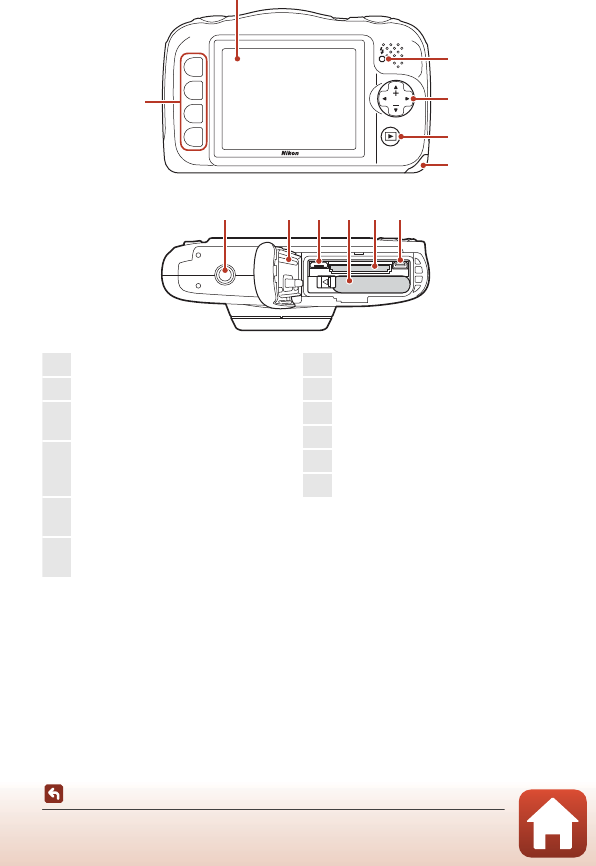
The Camera Body
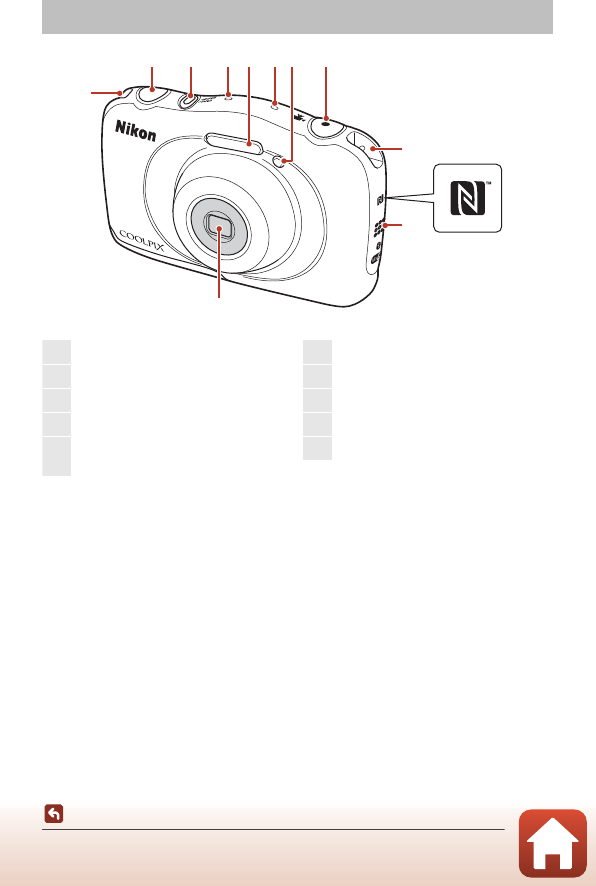
The Camera Body
10
9
8
621
7
7
343 5
1Shutter-release button............................ 25
2Power switch/power-on lamp........... 15
3Microphone (stereo)
4Flash.................................................................... 33
5Self-timer lamp ............................................ 34
AF-assist illuminator
6b (e movie-record) button ............ 93
7Eyelet for camera strap........................... 10
8N-Mark (NFC antenna) ............................ 16
9Speaker
10 Lens (with protective glass)
3
Parts of the Camera
The Camera Body
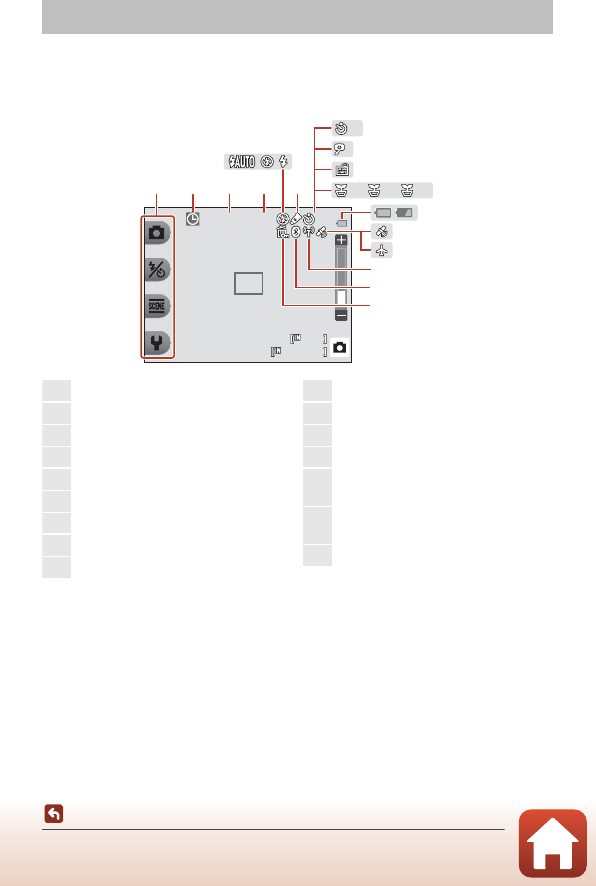
12 10 711
6
5
4
3
2
1
98
1Flexible buttons.............................. 7, 31, 58
2Monitor................................................................ 4
3Charge lamp.................................................. 13
Flash lamp....................................................... 33
4
Multi selector
H: Telephoto................................................ 49
I: Wide-angle............................................. 49
5c
(shooting/playback mode) button
............................................................................... 26
6Battery-chamber/memory card slot
cover................................................................... 11
7HDMI micro connector (Type D) ...... 98
8Memory card slot ....................................... 11
9Battery chamber ......................................... 11
10 Micro-USB connector .............................. 98
11 Waterproof packing............................xi, xiii
12 Tripod socket ..............................................148
4
Parts of the Camera
The Monitor
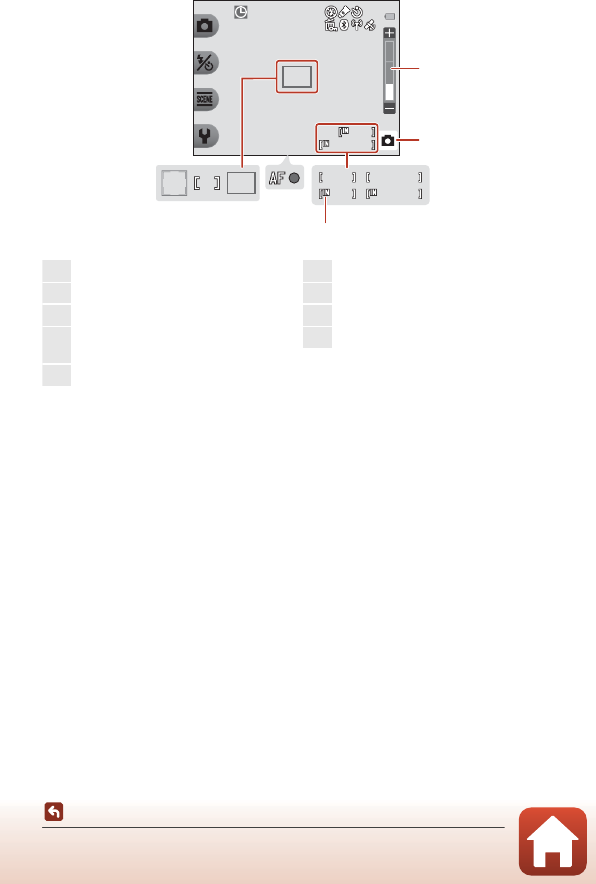
The information that is displayed on the shooting or playback screen changes
depending on the camera’s settings and state of use.
For Shooting
The Monitor
999
999
29m 0s
29m 0s
1/250
1/250
F 3.3
F3.3
1 0
10
30s
30s
1m
1m
5m
5m
1 0
10
5
5
132 4
11
14
9
8
610
5
12
13
15
16
7
1Flexible icons.................................................... 7
2“Date not set” indicator ....................... 138
3Shutter speed ............................................... 50
4F-number......................................................... 50
5Flash mode..................................................... 33
6Change colors icon................................ 44
7Self-timer indicator.................................... 34
8Self-portrait timer....................................... 34
9Smile timer ..................................................... 35
10 Shoot at intervals icon....................... 38
11 Battery level indicator.............................. 24
12 Location data..............................................120
13 Airplane mode ...................................22, 110
14 Wi-Fi communication indicator
.....................................................................22, 110
15 Bluetooth communication indicator
.....................................................................22, 110
16 Image lock icon........................................... 29
5
Parts of the Camera
The Monitor
999999
29m 0s29m 0s
1/2501/250 F 3.3F3.3 1 010
29m 0s29m 0s
999999
99999999 29m 0s29m 0s
18
17
1920
23
21
25 22
24
17 Zoom indicator............................................ 49
18 Shooting mode ................................... 32, 36
19 Remaining movie recording time....93
20 Number of exposures remaining
(still images)........................................... 24, 47
21 Internal memory indicator.................... 24
22 Focus indicator ............................................ 25
23 Focus area (target finding AF)............ 32
24 Focus area (center).................................... 25
25 Focus area (face detection).................. 50
6
Parts of the Camera
The Monitor
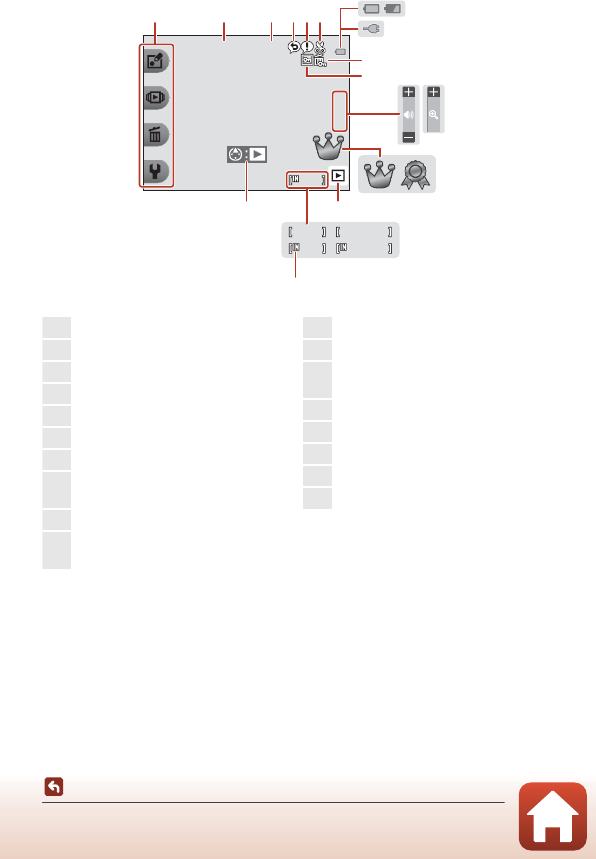
For Playback
CIf Information Is Not Displayed During Shooting Mode and Playback
Mode
Apart from certain information, information is not displayed if no operations are performed
for several seconds. Information is displayed again when either a flexible button or the multi
selector is pressed.
999999
15/11/201615/11/2016 15:3015:30
29m 0s29m 0s
999999
99999999 29m 0s29m 0s
132 4
14
1516
17
65
9
11 12
7
8
10
18
13
1Flexible icons.................................................... 7
2Date of recording
3Time of recording
4Message (reply)............................................ 60
5Message ........................................................... 59
6Crop icon......................................................... 56
7Battery level indicator.............................. 24
8Charging AC Adapter connection
indicator
9Image lock icon ........................................... 29
10 Favorites (when Variety menu is set
to Off)................................................................ 78
11 Volume indicator........................................ 96
12 Switch to full-frame .................................. 57
13 Grade mark (when Variety menu is
set to On)........................................................ 74
14 Playback mode ............................................ 26
15 Movie/message recording time
16 Current image number
17 Internal memory indicator
18 Movie playback guide............................. 93
7
Parts of the Camera
Using the Flexible Buttons
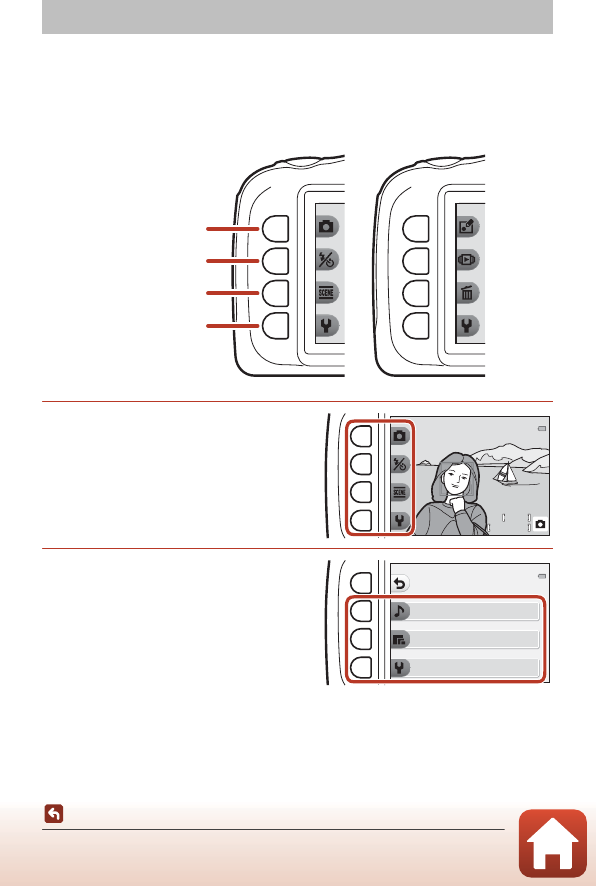
If you press a flexible button while the shooting screen or playback screen is
displayed, the menu for the current mode is displayed. Once the menu is displayed,
you can change various settings.
In this document, the flexible buttons are referred to as “flexible button 1” through
“flexible button 4”, in order from top to bottom.
1Press a flexible button.
•The menu is displayed.
2Press a flexible button to select
an item.
•When Q is displayed, press flexible
button 1 (Q) to return to the previous
screen.
•Certain menu options cannot be
selected or displayed depending on
the camera’s settings.
Using the Flexible Buttons
Shooting mode Playback mode
Flexible button 1
Flexible button 2
Flexible button 3
Flexible button 4
21002100
25m 0s25m 0s
Change sounds
Settings
Choose a size
Camera settings
8
Parts of the Camera
Using the Flexible Buttons
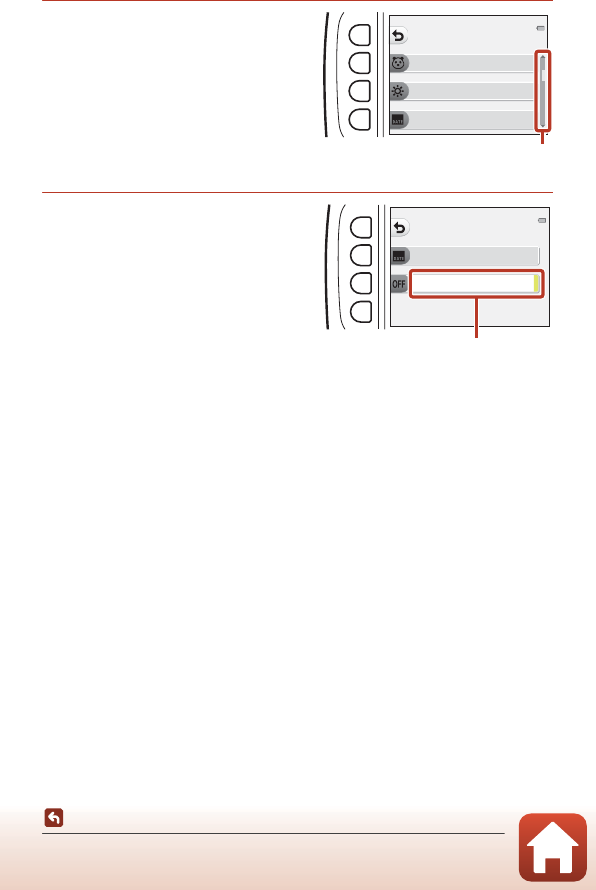
3Press a flexible button to select
an item.
•When the menu content continues on
another page, a guide indicating the
page position is displayed.
4Press a flexible button to select
a setting.
•Press the flexible button to confirm the
selected setting.
•When a menu is displayed, you can
switch to shooting mode by pressing the
shutter-release button or b(e) button.
Variety menu
Camera settings
Brightness
Date stamp
Use the multi selector HI to
display other pages.
Date
Date stamp
O
The current setting is
displayed in white.

9
Getting Started
Getting Started
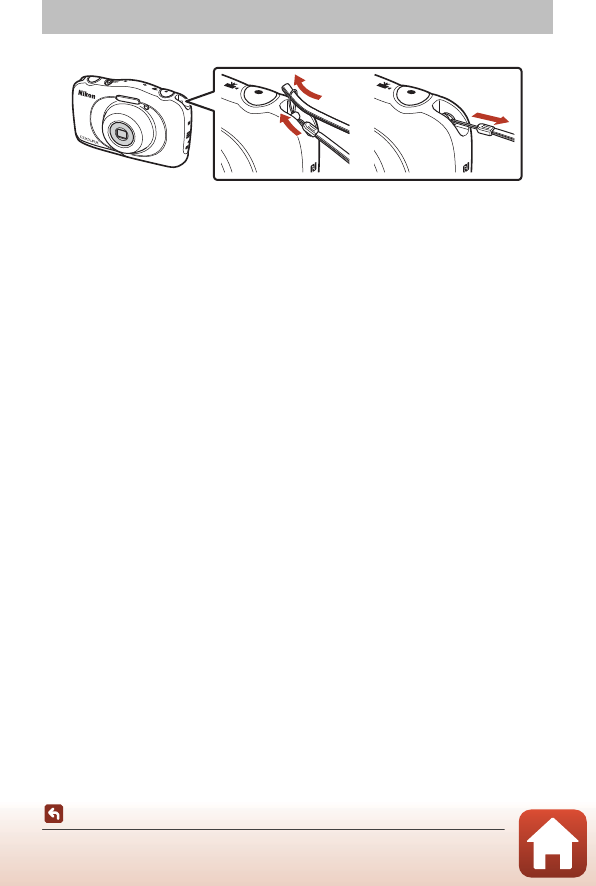
How to Attach the Camera Strap....................................................................................10
Inserting the Battery and Memory Card.......................................................................11
Charging the Battery...........................................................................................................13
Camera Setup ........................................................................................................................15
11
Getting Started
Inserting the Battery and Memory Card
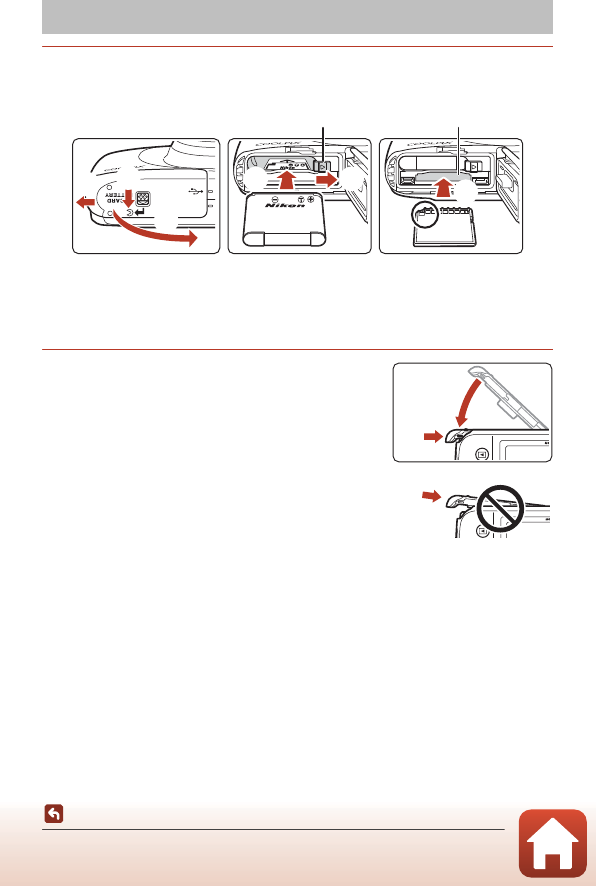
1Open the battery-chamber/memory card slot cover, and then
insert the battery and memory card.
•With the battery’s positive and negative terminals oriented correctly, move the
orange battery latch (4), and fully insert the battery (5).
•Slide the memory card in until it clicks into place (6).
•Be careful not to insert the battery or memory card upside-down or backward, as
this could cause a malfunction.
2Close the battery-chamber/memory
card slot cover.
•Lay the cover completely flat in the direction
indicated by the arrow (1), and fully slide it in (2).
BDamage Caution
Sliding the cover while it is open may damage the
camera.
BOpening and Closing the Battery-chamber/Memory Card Slot Cover
Do not open and close the battery-chamber/memory card slot cover in a sandy or dusty
environment or with wet hands. If the cover is closed without removing foreign particles,
water may seep inside the camera or the camera may become damaged.
•If foreign particles get inside the cover or camera, immediately remove them with a
blower or brush.
•If liquid such as water gets inside the cover or camera, immediately wipe it off with a soft
and dry cloth.
Inserting the Battery and Memory Card
1
2
3
4
56
Battery latch Memory card slot
1
2

12
Getting Started
Inserting the Battery and Memory Card
BFormatting a Memory Card
The first time you insert a memory card that has been used in another device into this
camera, make sure to format it with this camera.
•Note that formatting a memory card permanently deletes all images and other
data on the memory card. Be sure to make copies of any images you wish to keep
before formatting the memory card.
•Insert the memory card into the camera and select Format card in the camera settings
menu (A108).
Removing the Battery or Memory Card
Turn the camera off and make sure that the power-on lamp and screen have turned
off, and then open the battery-chamber/memory card slot cover.
•Move the battery latch to eject the battery.
•Gently push the memory card into the camera to partially eject the memory card.
•Be careful when handling the camera, battery, and memory card immediately after
using the camera, as they may be hot.
Memory Cards and Internal Memory
Camera data, including images and movies, can be saved either on a memory card or
in the camera’s internal memory. To use the camera’s internal memory, remove the
memory card.
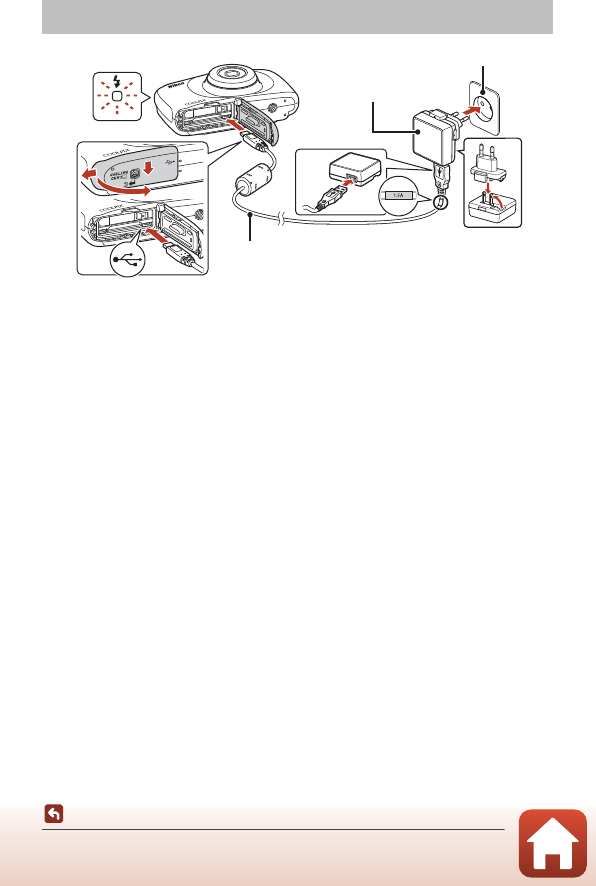
13
Getting Started
Charging the Battery
If a plug adapter* is included with your camera, securely connect it to the Charging AC
Adapter. Once the two are connected, attempting to forcibly remove the plug adapter
could damage the product.
* The shape of the plug adapter varies according to the country or region in which
the camera was purchased.
This step can be omitted if the plug adapter comes permanently bonded to the
Charging AC Adapter.
•Charging starts when the camera is connected to an electrical outlet while the
battery is inserted, as shown in the illustration. The charge lamp slowly flashes while
the battery is charging.
•When charging is complete, the charge lamp turns off. Unplug the Charging AC
Adapter from the electrical outlet, and disconnect the USB cable.
Charging time is about 1 hour and 40 minutes for a fully exhausted battery.
•The battery cannot be charged when the charge lamp quickly flashes, possibly due
to one of the reasons described below.
- The ambient temperature is not suited to charging.
- The USB cable or Charging AC Adapter is not properly connected.
- The battery is damaged.
Charging the Battery
12
3
Charge lamp
USB cable (included)
Electrical outlet
Charging
AC Adapter

14
Getting Started
Charging the Battery
BNotes About the USB Cable
•Do not use a USB cable other than the UC-E21. Using a USB cable other than the UC-E21
could result in overheating, fire or electric shock.
•Check the shape and direction of the plugs and do not insert or remove the plugs at an
angle.
BNotes About Charging the Battery
•The camera can be operated while the battery is charging, but the charging time
increases.
•If the battery level is extremely low, you may not be able to operate the camera while the
battery is charging.
•Do not, under any circumstances, use another make or model of AC adapter other than
EH-73P/EH-73PCH Charging AC Adapter, and do not use a commercially available USB-AC
adapter or a battery charger for a mobile phone. Failure to observe this precaution could
result in overheating or in damage to the camera.
15
Getting Started
Camera Setup
Setup from a Smartphone or Tablet
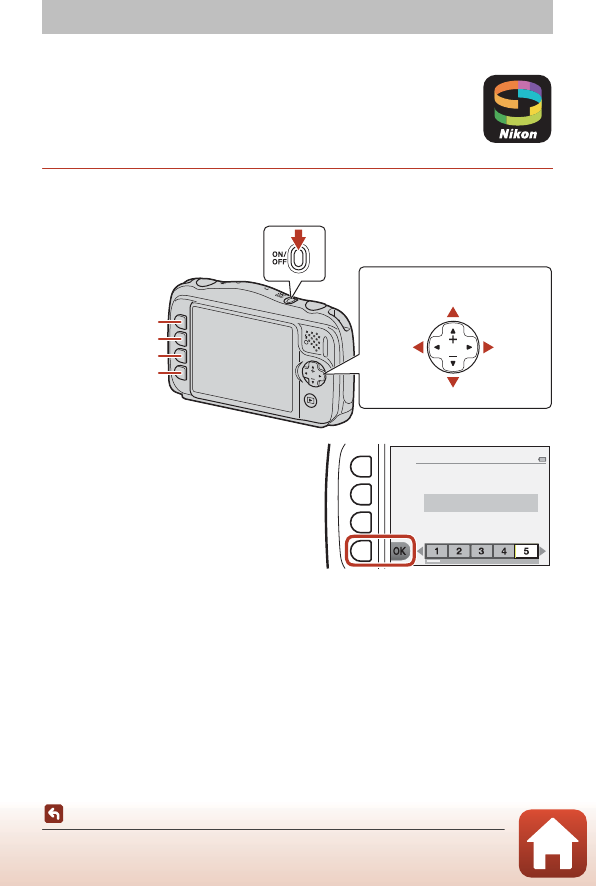
•Before proceeding, install the SnapBridge app (Aiii) and enable
Bluetooth and Wi-Fi on your smartphone or tablet (below, “smart
device”).
•The camera and smart device screens shown in this manual may
differ from those of the actual products.
1Turn the camera on.
•Use the flexible buttons and multi selector to select and adjust settings.
•A language selection dialog will be
displayed. Press J or K on the multi
selector to highlight a language and
press flexible button 4 (O) to select.
•The language can be changed at any
time using the Language option in the
camera settings menu (A108).
Camera Setup
Multi selector
Flexible button 1
Flexible button 2
Flexible button 3
Flexible button 4
RightLeft
Up
Down
Power switch
English
Language
16
Getting Started
Camera Setup
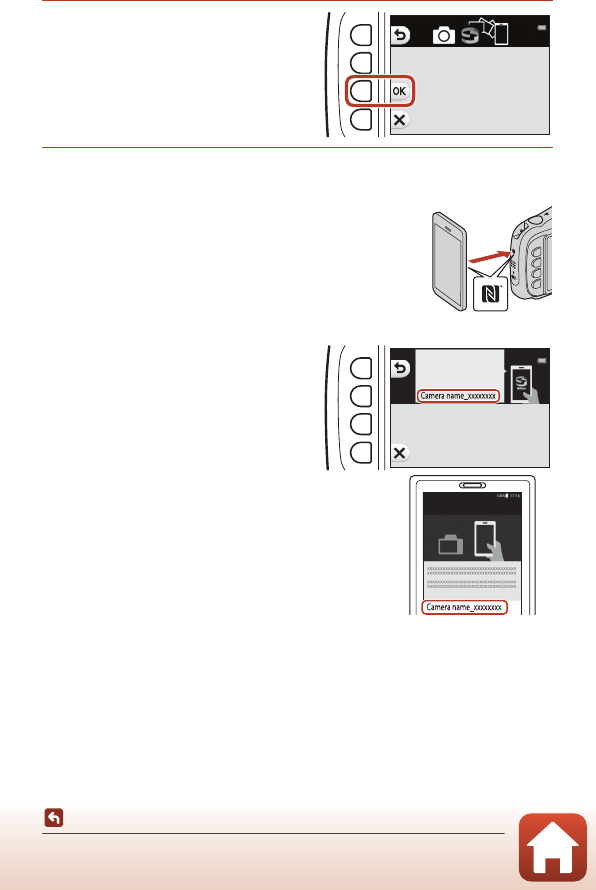
2Press flexible button 3 (O)
when the dialog at right is
displayed.
•If you do not wish to use a smart device
to configure the camera, press flexible
button 4 (S) (A19).
3Pair (i.e., establish a Bluetooth link between) the camera and the
smart device.
•Android Devices with NFC Support
After checking that NFC is enabled on the smart
device, touch the camera Y (N-Mark) to the NFC
antenna on the smart device to launch the
SnapBridge app.
- If the SnapBridge download site is displayed,
download and install the app before repeating
the above steps.
•iOS Devices and Android Devices
Without NFC Support
Press the camera flexible button 3 (O).
The camera will wait for a connection;
launch the SnapBridge app on the
smart device and follow the on-screen
instructions to tap the name of the
camera you want to pair with.
Use SnapBridge to send photos
to your smart device and
share them online.
To skip this screen and
set SnapBridge later from
the Network menu, press X.
App
SnapBridge
Camera
On your smart device, go to the app
store and search for
SnapBridge. After installing,
open the SnapBridge app.
Connect to Camera
Camera name
17
Getting Started
Camera Setup
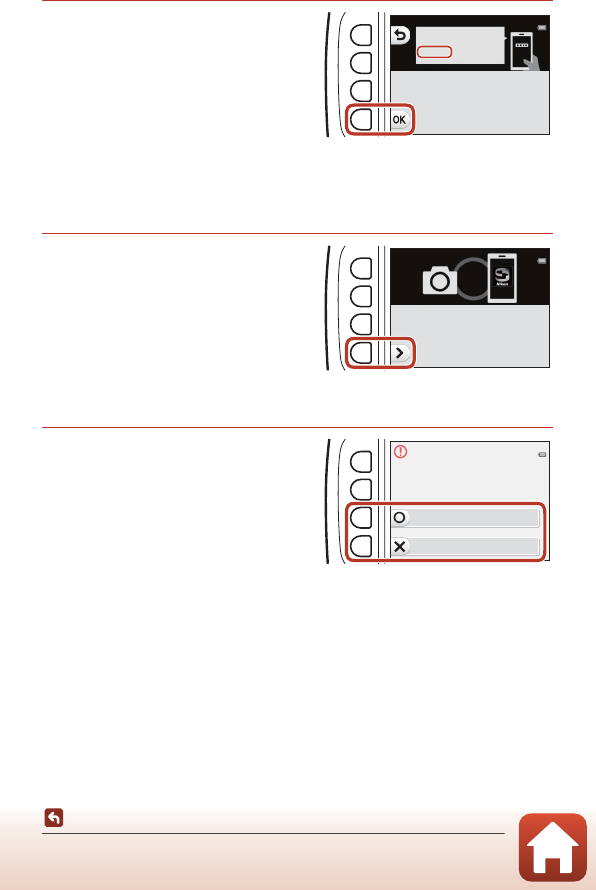
4Check the authentication code.
•After confirming that the camera and
smart device display the same six-digit
authentication code, follow the steps
below to complete pairing (note that
the code may not be displayed in some
versions of iOS, but you should follow
the steps below even if the code is not
displayed).
-On the camera, press flexible
button 4 (O).
-On the smart device, tap Pairing (the name of the button varies with the smart
device).
5Press flexible button 4 (A)
when the dialog at right is
displayed.
•When a constant connection between
the camera and smart device is
established, the dialog at right is
displayed.
•If the camera displays Could not
connect., press flexible button 3 (RReconnect) to return to Step 3. To cancel
pairing settings, press flexible button 4 (S Cancel).
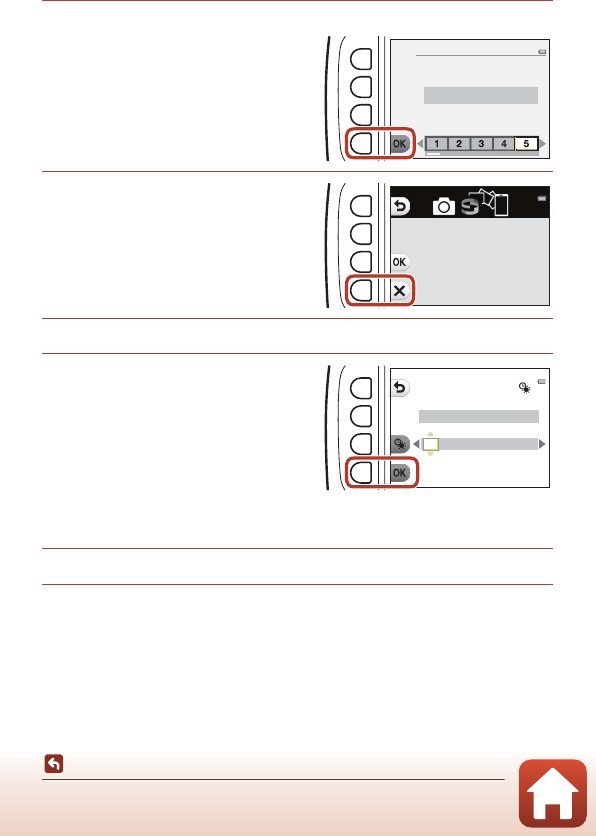
6Select whether to add shooting
location information to the
images that you take.
•To record location data with
photographs, select flexible button 3
(R Yes) when prompted and enable
the location data features both in the
SnapBridge app and on the smart
device itself (for more information, see the documentation provided with the smart
device).
Auth. code
000000
Confirm that the same
authentication code is
displayed on the smart
device and press OK.
Camera
Your camera and smart device are
connected!
SnapBridge will send your photos to
your smart device as they are taken.
Yes
No
Download location
data from smart
device?
18
Getting Started
Camera Setup
7Select whether to
automatically set the camera
clock.
•You can also synchronize the camera
clock to the time reported by the smart
device by selecting flexible button 3
(R Yes) when prompted and enabling
synchronization in the SnapBridge app.
•If you select flexible button 4 (S No), set the camera clock from the menus as
described in Step 2 on page 19.
8Use J or K to select the
background design to be
displayed when a menu or
setting screen is displayed, and
press flexible button 4 (O).
•The background selection screen may
not be displayed depending on your
country or region. In this case, proceed to Step 9.
•To restore the default background design, press flexible button 3 (P).
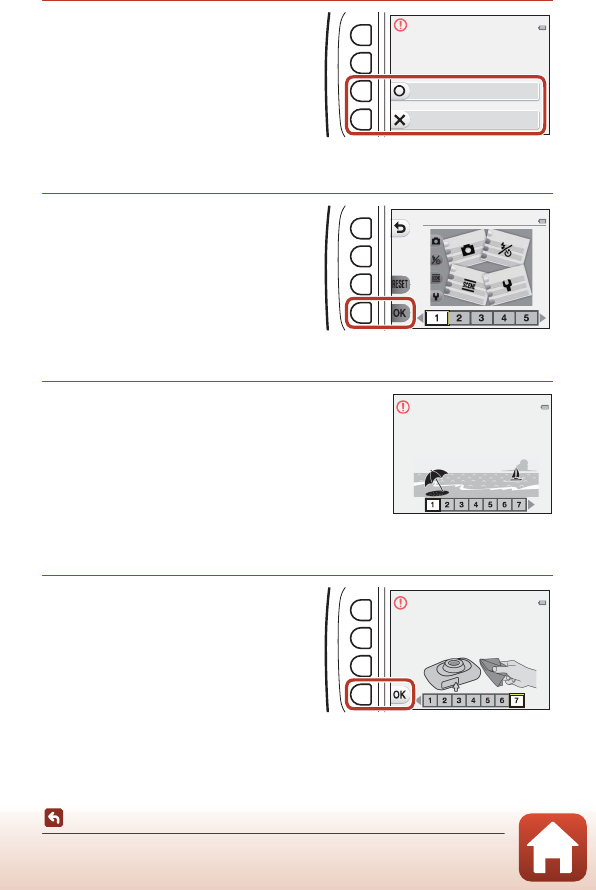
9Confirm the waterproofing-related
message and press K.
•There are seven message screens.
•Waterproofing-related messages are displayed in
the following situations.
- When turning on and setting the camera for the
first time
- When setting the camera to Shoot under
water (A37) or Underwater face framing (A38)
- When turning the camera on after charging
10Confirm the message on the
screen shown at right and
press flexible button 4 (O).
•The camera exits to the shooting
display when setup is complete.
Yes
No
Sync clock with smart
device?
Menu background
Waterproong precautions
After drying thoroughly, use
a cloth to remove any
droplets remaining on the
areas indicated.
19
Getting Started
Camera Setup
Setup from the Camera Menus
The camera clock can be set manually.
1Turn the camera on (A15).
•
A language selection dialog will be
displayed. Press
J
or
K
on the multi
selector (
A
15) to highlight a language
and press flexible button 4 (
O
) to select.
•The language can be changed at any
time using the Language option in the
camera settings menu (A108).
2Press flexible button 4 (S)
when the dialog at right is
displayed.
•Select flexible button 3 (R Yes) when
prompted to set the camera clock.
3Use flexible button 2, 3, or 4 to choose a date format.
4Enter the current date and time
and press flexible button 4
(O).
•Press J or K to highlight items and
press H or I to change.
•Press flexible button 4 (O) to set the
clock.
•To turn daylight saving time on, press
flexible button 3 (m); m will be displayed on the screen. Press flexible button 3 (m)
again to turn daylight saving time off.
5When prompted, press flexible button 3 (R Yes).
6Follow the on-screen instructions to complete the setup
process.
•The procedure hereafter is the same as when using a smart device. See from Step 8
(A18) onward in “Setup from a Smartphone or Tablet.”
English
Language
Use SnapBridge to send photos
to your smart device and
share them online.
To skip this screen and
set SnapBridge later from
the Network menu, press X.
Date and time
DM Y hm
01 /
01
/2016 00 :00

20
Getting Started
Camera Setup
CResetting the Clock and Changing Menu Background
The Date and time option in the camera settings menu can be used to set the camera
clock. The Menu background option in the camera settings menu can be used to change
the background used on the menu screen.
Daylight saving time can be turned on or off in the Date and time option.
21
Getting Started
Camera Setup
What SnapBridge Can Do for You
The SnapBridge app can be used for a variety of tasks once the camera
has been paired with your smart device.
Auto Upload
At default settings, pictures will automatically be uploaded to the smart device as they
are taken.
•Place the smart device close to the camera and launch the SnapBridge app.
BNotes About Auto Upload
Movies cannot be uploaded using the Send while shooting or Mark for upload option.
To upload movies to a smart device, use the SnapBridge app.
Option Description
Disabling auto upload
Auto upload can be disabled using the Network menu
> Send while shooting > Still images option in the
camera settings menu (A108).
Upload options
Use the Network menu > Send while shooting >
Upload (photos) item in the camera settings menu to
choose the types of pictures automatically uploaded.
Selecting pictures for upload
You can use this option to automatically upload selected
pictures that were not uploaded during shooting.
•Use the Mark for upload option in the camera
playback menu (A58) to select pictures.
•The constant connection ensures that upload will
continue even when the camera is off.
Resizing pictures for upload
Use the SnapBridge app to choose the size at which
pictures are copied to the smart device. The default size
is 2 megapixels.
Embedding photo info
Use the SnapBridge app to choose the information
imprinted on photographs copied to the smart device.
Comments and copyright information can be entered in
advance from the camera settings menu. You can also
imprint text entered in the SnapBridge app.
22
Getting Started
Camera Setup
Wireless Networks
BWhere the Use of Wireless Devices Is Prohibited
Where the use of wireless devices is prohibited, disable wireless features in the camera
settings menu by selecting On for Network menu > Airplane mode. This will temporarily
interrupt the constant connection with the smart device, but the connection is
automatically re-established when airplane mode is turned off.
Other Options for the SnapBridge App
•See SnapBridge app online help for more information.
Option Description
Pairing
To pair the camera with a smart device (for example, with
a new device or if you did not opt to pair with a smart
device during setup), select Connect to smart device in
the camera network menu and follow the instructions on
page 16, starting with Step 2.
The camera can be paired with up to five smart devices,
but can connect to only one at a time.
Uploading pictures via Wi-Fi
A Wi-Fi connection is recommended for large-volume
uploads.
Follow the on-screen instructions in the SnapBridge app
to switch to a Wi-Fi connection.
•The Network menu > Wi-Fi > Network settings
item in the camera settings menu contains Auth./
encryp. and Password options. The default option
for Auth./encryp. is WPA2-PSK-AES.
Option Description
Remote photography
Use the smart device to release the camera shutter.
Before performing remote photography, turn the camera
on.
Viewing the pictures on the
camera
Use the smart device to view and download the pictures
on the camera. This option is available even when the
camera is off.

23
Basic Shooting and Playback Operations
Basic Shooting and Playback
Operations
Shooting Images...................................................................................................................24
Playing Back Images............................................................................................................26
Deleting Images....................................................................................................................27
24
Basic Shooting and Playback Operations
Shooting Images
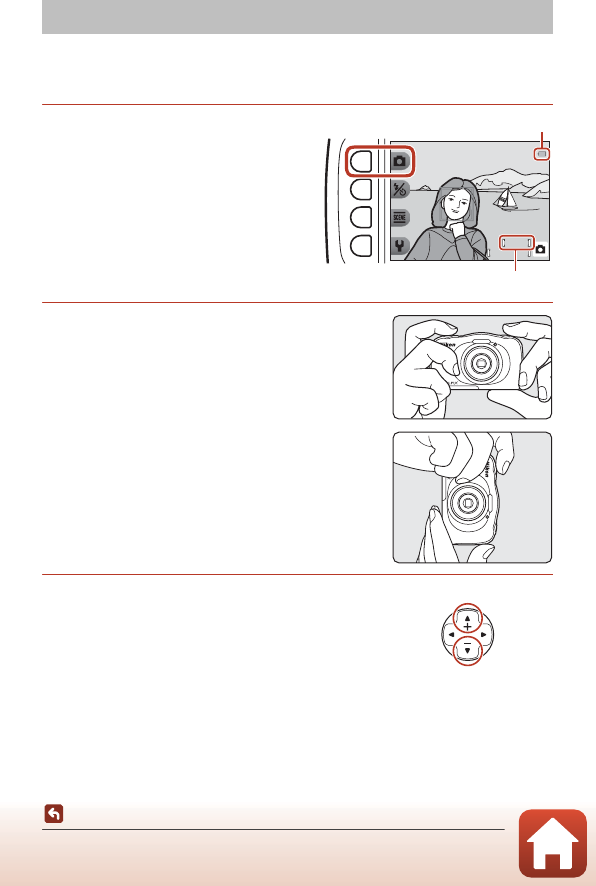
A Point and shoot is used here as an example. In A Point and shoot, the camera
recognizes the shooting conditions when you frame a picture, and you can take
pictures in accordance with the conditions.
1Press flexible button 1.
•Battery level indicator
F: The battery level is high.
G: The battery level is low.
•Number of exposures remaining
C is displayed when no memory card
is inserted in the camera, and images
are saved in the internal memory.
2Hold the camera steady.
•Keep fingers and other objects away from the lens,
flash, AF-assist illuminator, microphone, and
speaker.
3Frame the picture.
•Press the multi selector HI to change the zoom
lens position.
Shooting Images
2100
2100
25m 0s
25m 0s
Battery level indicator
Number of exposures remaining
Zoom in
Zoom out
25
Basic Shooting and Playback Operations
Shooting Images
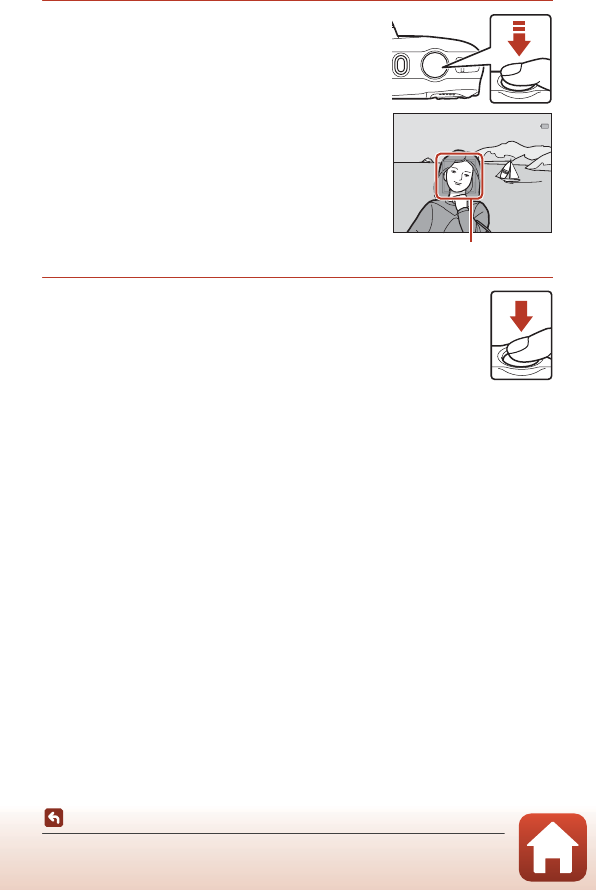
4Press the shutter-release button
halfway.
•To press the shutter-release button “halfway”
means to press and hold the button at the point
where you feel a slight resistance.
•When the subject is in focus, the focus area or
focus indicator is displayed in green.
•When you are using digital zoom, the camera
focuses in the center of the frame and the focus
area is not displayed.
•If the focus area or focus indicator flashes, the
camera is unable to focus. Modify the composition
and try pressing the shutter-release button halfway
again.
5Without lifting your finger, press the
shutter-release button all the way
down.
BNotes About Saving Images or Movies
The indicator showing the number of exposures remaining or the indicator showing the
remaining recording time flashes while images or movies are being saved. Do not open
the battery-chamber/memory card slot cover or remove the battery or memory
card while an indicator is flashing. Doing this could result in loss of data, or in damage to the
camera or the memory card.
CThe Auto Off Function
•When no operations are performed for about three minutes, the screen turns off, the
camera enters standby mode, and then the power-on lamp flashes. The camera turns off
after remaining in standby mode for about three minutes.
•To turn the screen back on while the camera is in standby mode, perform an operation
such as pressing the power switch or shutter-release button.
CWhen Using a Tripod
We recommend using a tripod to stabilize the camera in the following situations:
•When shooting in dim lighting with the flash mode (A33) set to y Flash off
•When the zoom is at a telephoto position
1/250
1/250
F 3.3
F3.3
Focus area
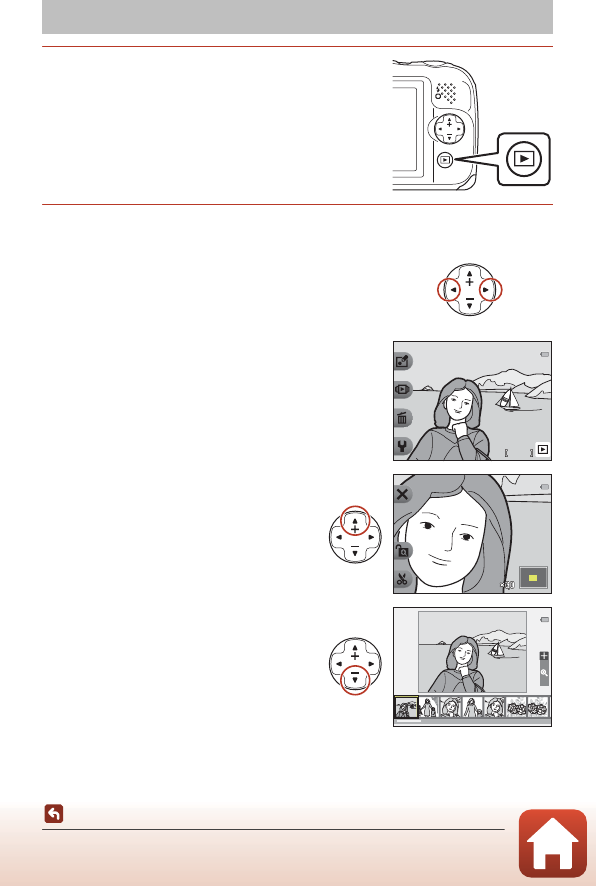
26
Basic Shooting and Playback Operations
Playing Back Images
1Press the c (shooting/playback mode)
button to enter playback mode.
•If you press and hold down the c button while
the camera is turned off, the camera turns on in
playback mode.
2Use the multi selector to select an
image to display.
•Press and hold down JK to scroll through the
images quickly.
•To play back a recorded movie, press H.
•To return to shooting mode, press the cbutton
or shutter-release button.
•Press H in full-frame playback mode to
zoom in on an image.
•In full-frame playback mode, press I to
switch to thumbnail playback mode and
display multiple images on the screen.
Playing Back Images
Display
the
previous
image
Display
the
next
image
44
15/11/201615/11/2016 15:3015:30
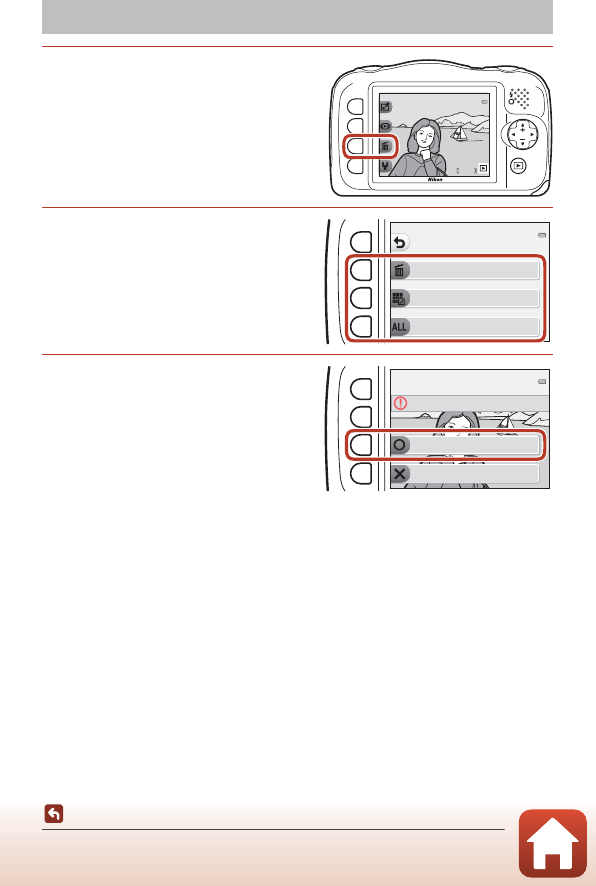
27
Basic Shooting and Playback Operations
Deleting Images
1Press flexible button 3 (n) to
delete the image currently
displayed on the screen.
2Use flexible button 2, 3, or 4 to
select the desired deletion
method.
•To exit without deleting, press flexible
button 1 (Q).
3Press flexible button 3 (R Yes).
•Deleted images cannot be recovered.
Deleting Images
4
4
15/11/2016
15/11/2016
15:30
15:30
Erase this picture only
Erase
Erase selected pictures
Erase all pictures
Yes
No
Erase 1 picture ?
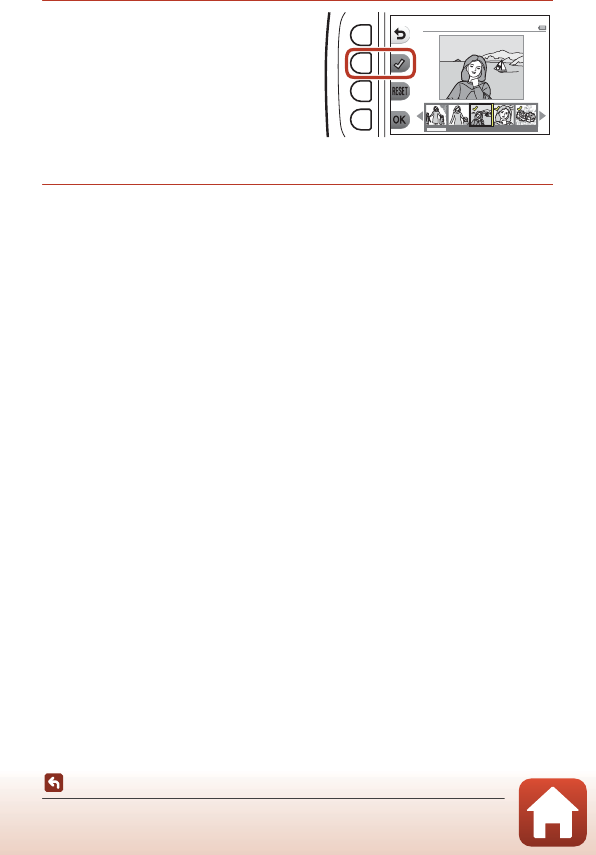
28
Basic Shooting and Playback Operations
Deleting Images
Selecting Which Images You Want to Delete
1Use the multi selector JK to
select an image to be deleted,
and then press flexible button
2 (S).
•The selected image is indicated by a
check mark.
•
A check mark is displayed or removed
every time you press flexible button 2 (
S
).
•Press flexible button 3 (P) to remove all check marks.
2Add check marks to all images that you want to delete and then
press flexible button 4 (O) to confirm the selection.
•A confirmation dialog is displayed. Follow the on-screen instructions to complete
operations.
Erase selected pictures
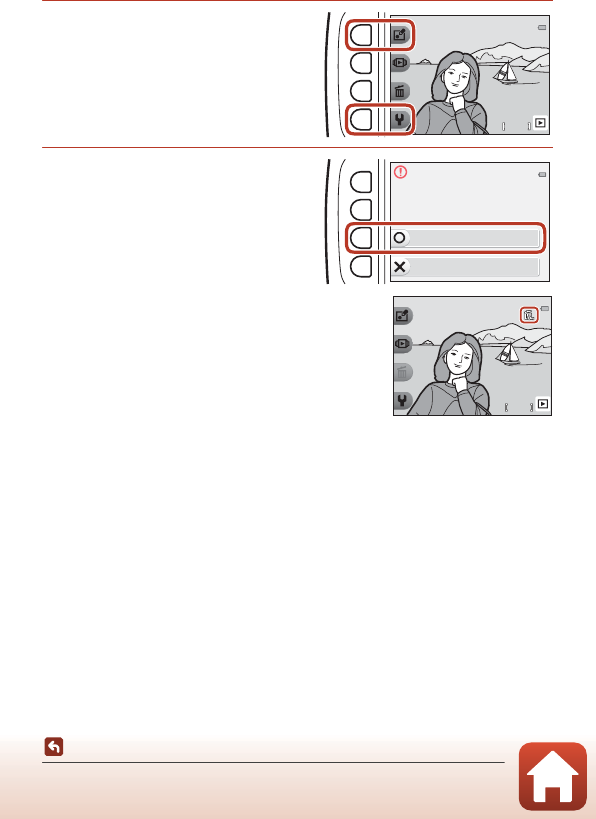
29
Basic Shooting and Playback Operations
Deleting Images
Restricting Image Deletion (Image Lock)
To prevent accidental deletion of images, you can lock image deletion (A27) and
formatting (A117).
1Press and hold down flexible
buttons 1 and 4 at the same
time while in shooting mode or
playback mode.
2Press flexible button 3 (R Yes).
•Image lock is set.
•When image lock is set, C is displayed
on the screen.
Removing Image Lock
The procedure for removing image lock is the same as for setting image lock.
4
4
15/11/2016
15/11/2016
15:30
15:30
Yes
No
Enable image lock?
44
15/11/201615/11/2016 15:3015:30

30
Shooting Features
Shooting Features
Functions Available in Shooting Mode (Shooting Menu) .....................................31
A Point and Shoot..............................................................................................................32
Flash Mode..............................................................................................................................33
Self-timer.................................................................................................................................34
Smile Timer.............................................................................................................................35
Choose a Style (Shooting with Selected Shooting Conditions and Effects) ...36
Decorate ..................................................................................................................................43
Change Colors .......................................................................................................................44
Change Sounds.....................................................................................................................45
Choose a Size .........................................................................................................................47
Using the Zoom ....................................................................................................................49
Focusing ..................................................................................................................................50
Functions That Cannot Be Used Simultaneously When Shooting .....................53
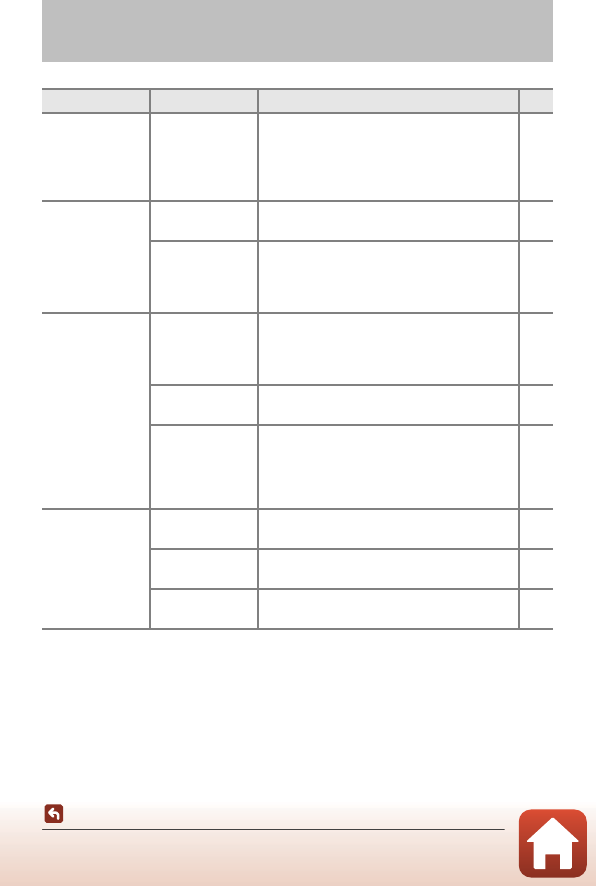
31
Shooting Features
Functions Available in Shooting Mode (Shooting Menu)
Press a flexible button to display a menu. You can change the following settings.
Functions Available in Shooting Mode
(Shooting Menu)
Flexible button Option Description A
A Point and
shoot –
Sets the shooting mode to A Point and
shoot. The camera recognizes the shooting
conditions when you frame a picture, and
you can take pictures in accordance with the
conditions.
32
Z Flash mode/
self-timer
Flash Allows you to select a flash mode to match
the shooting conditions. 33
Self-timer
The camera is equipped with a self-timer
that releases the shutter 10 seconds or
5seconds after you press the shutter-release
button. You can also set the smile timer.
34,
35
g More picture
options
Choose a style
When a style (shooting conditions and
effects) is selected, camera settings are
automatically optimized for the selected
condition.
36
Decorate Allows you to add a frame around your
images when taking pictures. 43
Change colors
Allows you to select b Brighter/darker or
cMore vivid/less vivid from the menu, or
use P Highlight colors to keep one
specified color in the image, and change the
other colors to black and white.
44
l Settings
Change sounds Allows you to configure the shutter and
button sounds. 45
Choose a size Allows you to set the size of still images and
movies. 47
Camera settings Allows you to change a number of general
settings. 108
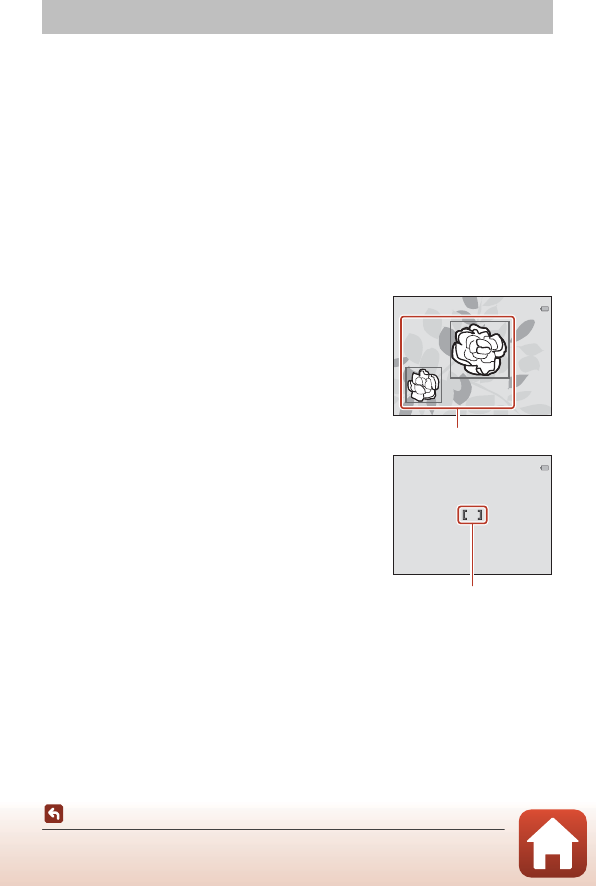
32
Shooting Features
A Point and Shoot
When this camera is used for the first time, the shooting mode is set to A Point and
shoot. The camera recognizes the shooting conditions when you frame a picture, and
you can take pictures in accordance with the conditions.
A Point and shoot is the default shooting mode for this camera.
•When the camera detects the main subject, it focuses on that subject (target
finding AF).
•The flash may fire when shooting in low light.
•When shooting in low light, the use of a tripod is recommended.
•When the digital zoom is in effect, the camera does not recognize the shooting
conditions.
Using Target Finding AF
The camera focuses in the manner described below when you press the shutter-
release button halfway.
•The camera detects the main subject and focuses
on it. When the subject is in focus, the focus area is
displayed in green. If a human face is detected, the
camera automatically sets focus priority on it.
•If no main subject is detected, the camera focuses
on the area in the center of the frame.
BNotes About Target Finding AF
•Depending on shooting conditions, the subject that the camera determines to be the
main subject may vary.
•The camera may not detect the main subject appropriately in the following situations:
- When the subject is very dark or bright
- When the main subject lacks clearly defined colors
- When the shot is framed so that the main subject is at the edge of the screen
- When the main subject is composed of a repeating pattern
A Point and Shoot
1/2501/250 F 3.3F3.3
Focus areas
1/250
1/250
F 3.3
F3.3
Focus area
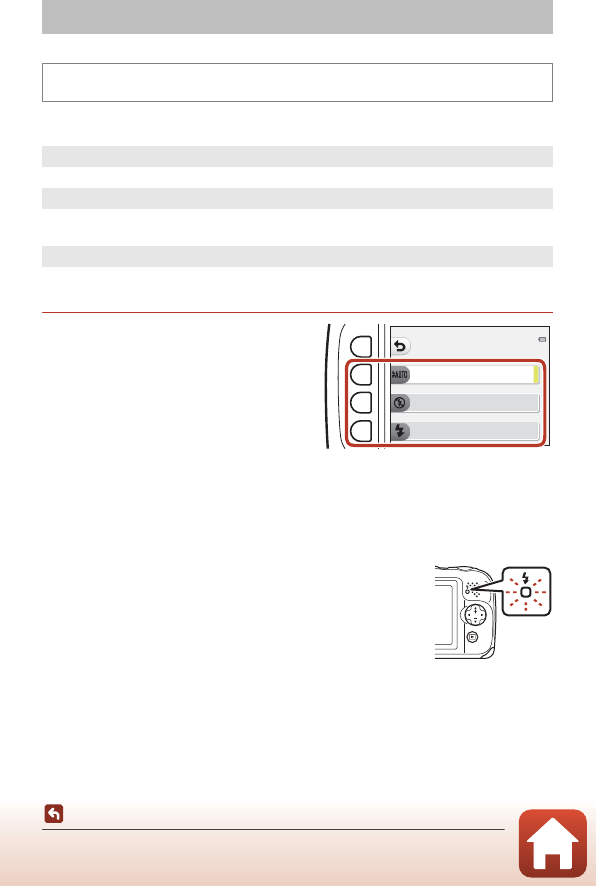
33
Shooting Features
Flash Mode
You can select a flash mode to match the shooting conditions.
Available Flash Modes
Use flexible button 2, 3, or 4 to
select the flash mode.
•To cancel, press flexible button 1 (Q).
BNotes About Shooting with the Flash
When using the flash at the wide-angle zoom position, the area around the image may be
dark depending on the distance to the subject.
This may be improved if you move the zoom control slightly toward the telephoto position.
CThe Flash Lamp
•The status of the flash can be confirmed by pressing the shutter-
release button halfway.
- On: The flash fires when you press the shutter-release button all
the way down.
- Flashing: The flash is charging. The camera cannot shoot images.
- Off: The flash does not fire when a picture is taken.
•
If the battery level is low, the screen turns off while the flash is charging.
CThe Flash Mode Setting
•The setting may not be changed when using some shooting modes or settings.
•The setting applied in A Point and shoot is saved in the camera’s memory even after the
camera is turned off.
Flash Mode
Enter shooting mode M flexible button 2 (Z) M flexible button 2 (x Flash)
wAuto flash
The flash fires when necessary, such as in dim lighting.
yFlash off
The flash does not fire.
•
We recommend using a tripod to stabilize the camera when shooting in dark surroundings.
xAlways fire flash
The flash fires whenever a picture is taken. Use to “fill-in” (illuminate) shadows and
backlit subjects.
Auto ash
Flash
Flash o
Always re ash
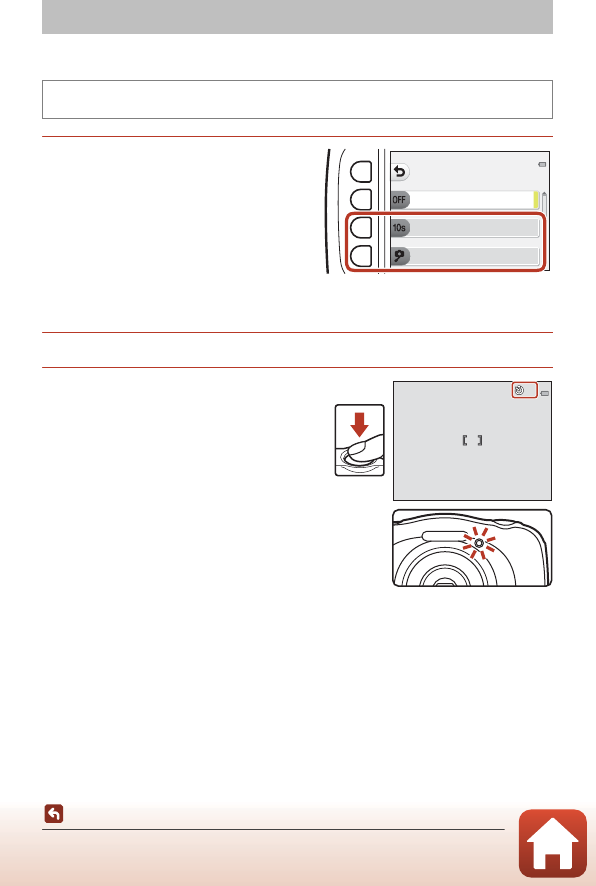
34
Shooting Features
Self-timer
The camera is equipped with a self-timer that releases the shutter 10 seconds or
5 seconds after you press the shutter-release button.
1Press flexible button 3 (j 10 s)
or flexible button 4 (r Self-
portrait timer).
•j 10 s (10 seconds): Use on
important occasions, such as weddings.
•r Self-portrait timer (5 seconds): Use
for shooting with a selfie stick. Proceed
to step 3, press the shutter-release
button all the way, and then frame the picture.
•Y Smile timer (A35)
2Frame the picture and press the shutter-release button halfway.
3Press the shutter-release button
all the way down.
•Countdown starts. The self-timer lamp
flashes and then glows steadily about
one second before the shutter is
released.
•When the shutter is released, the self-
timer is set to b Off.
•To stop the countdown, press the
shutter-release button again.
•To cancel the setting before shooting
begins, press flexible button 2 (Z) >
flexible button 3 (i Self-timer) >
flexible button 2 (b Off).
CFocus and Exposure When Using Self-timer
The timing when focus and exposure are set varies depending on the settings.
•j 10 s: The focus and exposure are set when you press the shutter-release button
halfway in step 2.
•r Self-portrait timer: The focus and exposure are set immediately before the shutter is
released.
Self-timer
Enter shooting mode M flexible button 2 (Z) M flexible button 3 (i Self-timer)
Self-timer
O
Self-portrait timer
10 s
1/250
1/250
F 3.3
F3.3
9
9
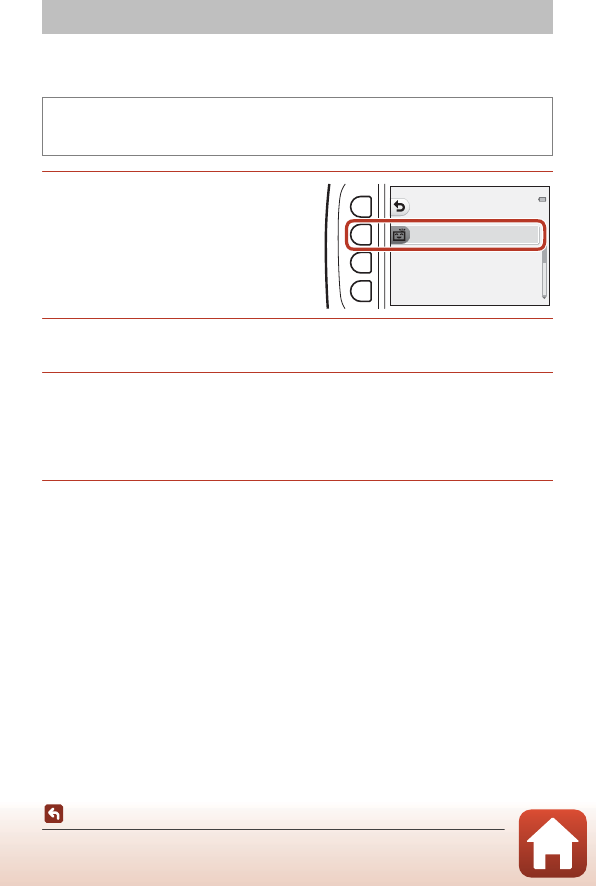
35
Shooting Features
Smile Timer
When the camera detects a smiling face, you can take a picture automatically without
pressing the shutter-release button. The skin softening function makes the skin tones
of human faces smoother.
1Press flexible button 2
(YSmile timer).
2Frame the picture.
•Point the camera at a human face.
3Without pressing the shutter-release button, wait for the subject
to smile.
•If the camera detects that the face framed by the double border is smiling, the
shutter is automatically released.
•Whenever the camera detects a smiling face, it automatically releases the shutter.
4End automatic shooting.
•Press flexible button 2 (Z) > flexible button 3 (i Self-timer) > flexible button 2
(b Off).
BNotes About Smile Timer
Under some shooting conditions, the camera may be unable to detect faces or smiles
(A50). The shutter-release button can also be used for shooting.
CWhen the Self-timer Lamp Flashes
When using Smile timer, the self-timer lamp flashes when the camera detects a face and
flashes quickly immediately after the shutter is released.
Smile Timer
Enter shooting mode M flexible button 2 (Z) M flexible button 3 (i Self-timer)
M press I
Self-timer
Smile timer
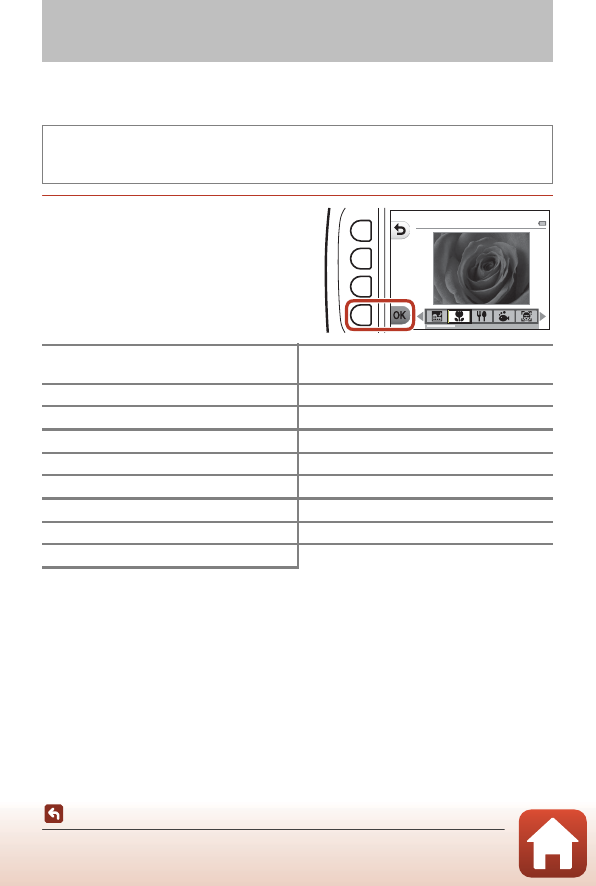
36
Shooting Features
Choose a Style (Shooting with Selected Shooting Conditions and Effects)
When a style (shooting condition and effect) is selected, camera settings are
automatically optimized for the selected condition. The expected effect may not be
achieved depending on the subject.
Use the multi selector JK to select
the desired style (shooting
condition and effect) and press
flexible button 4 (O).
•To cancel, press flexible button 1 (Q).
1The camera focuses at infinity.
2The camera focuses on the area in the center of the frame. When the zoom is set to a
position where the zoom indicator turns green, the camera can focus on subjects as close
as about 20 cm (7.9 in.) from the front of the protective glass, or about 5 cm (2 in.) at the
maximum wide-angle position.
3Use of a tripod is recommended.
4Use of a tripod is recommended, because the shutter speed is slow.
5The camera focuses on the area in the center of the frame.
6When using Night scenes, the camera focuses on the area in the center of the frame.
When using Night sky, the camera focuses at infinity.
Choose a Style (Shooting with Selected
Shooting Conditions and Effects)
Enter shooting mode M flexible button 3 (g) M flexible button 2 (g Choose a
style)
DShoot night scenes1 (A37)
(default setting)
LMirror2 (A40)
HShoot close-ups2 (A37) FAdd a bubble effect2 (A40)
XPhotograph food2 (A37) GAdd a neon effect2 (A40)
JShoot under water2 (A37) HAdd a cartoon effect2 (A40)
JUnderwater face framing (A38) QTake soft pictures2 (A41)
OShoot at intervals3 (A38) MCreate a diorama effect2 (A41)
ITake a series of pictures (A39) jShoot a movie miniature2, 3 (A41)
KPhotograph fireworks1, 4 (A39) UAdd light trails4, 6 (A42)
EShoot backlit scenes5 (A39)
Shoot close-ups
37
Shooting Features
Choose a Style (Shooting with Selected Shooting Conditions and Effects)
Tips and Notes
D Shoot night scenes
•When the shutter-release button is pressed all the way, the camera captures a series of
images which are combined into a single image and saved.
•Once the shutter-release button is pressed all the way, hold the camera still until a still
image is displayed. After taking a picture, do not turn the camera off before the screen
switches to the shooting screen.
•The angle of view (i.e., the area visible in the frame) seen in the saved image is narrower
than that seen on the shooting screen.
•The flash setting is fixed at y Flash off (A33).
•r Self-portrait timer (A34) and Y Smile timer (A35) are not available.
H Shoot close-ups
•The camera automatically zooms to the closest position at which it can focus.
•The flash is set to y Flash off, but the setting can be changed (A33).
•Y Smile timer is not available (A35).
X Photograph food
•The camera automatically zooms to the closest position at which it can focus.
•Use the multi selector JK to adjust the hue setting and press flexible button 4 (O).
The hue setting is saved in the camera’s memory even after the camera is turned off.
•The flash setting is fixed at y Flash off (A33).
•Y Smile timer is not available (A35).
J Shoot under water
•When Shoot under water is set, the waterproofing-related messages are displayed.
Confirm each message and press the multi selector K to display the next message.
Press flexible button 4 (O) to skip the messages and change to the shooting screen.
•See “<Important> Notes About Shockproof, Waterproof, and Dustproof Performance
and Condensation” (Axi-xiv) for more information about using the camera
underwater.
•The flash is set to y Flash off, but the setting can be changed (A33).
•Y Smile timer is not available (A35).

38
Shooting Features
Choose a Style (Shooting with Selected Shooting Conditions and Effects)
J Underwater face framing
•You can take pictures of human faces underwater automatically without submerging
your face.
•When Underwater face framing is set, the waterproofing-related messages are
displayed.
Confirm each message and press the multi selector K to display the next message.
Press flexible button 4 (O) to skip the messages and change to the shooting screen.
•See “<Important> Notes About Shockproof, Waterproof, and Dustproof Performance
and Condensation” (Axi-xiv) for more information about using the camera underwater.
•When the shutter-release button is pressed all the way while the shooting screen is
displayed, automatic shooting begins. Submerge the camera into the water, and point
it at a human face underwater. When the camera detects a human face, the power-on
lamp and self-timer lamp flash, and the shutter is automatically released. When the
shutter is released, the lamps flash quickly.
•Press the shutter-release button all the way again to stop shooting. When four images
are captured or the camera remains in automatic shooting mode for about 30 seconds,
shooting ends automatically.
•When shooting ends, the captured images are displayed on the screen. Press flexible
button 4 (O) to return to the shooting screen.
•The zoom position is fixed at wide-angle position.
•The flash is set to y Flash off, but the setting can be changed (A33).
•The self-timer is not available (A34).
•The camera may not be able to detect faces depending on the clarity of the water or
the shape of the goggles used.
O Shoot at intervals
•The camera can automatically capture still images at pre-determined intervals. Images
captured in one shooting are saved in one folder and can be viewed in a slide show
(A83).
•Press flexible button 2 (d Shoot every 30 seconds), flexible button 3 (e Shoot
once a minute), or flexible button 4 (f Shoot every 5 minutes) to set the shooting
interval.
•The maximum number of images that can be captured depends on the selected interval.
-Shoot every 30 seconds: Approx. 280 images
-Shoot once a minute: Approx. 140 images
-Shoot every 5 minutes: Approx. 30 images
•Use a sufficiently charged battery to prevent the camera from turning off during
shooting.
•Press the shutter-release button all the way down to capture the first image. In
between each shot, the screen turns off and the power-on lamp flashes. The screen
automatically turns on again just before the next image is captured.
•Press the shutter-release button halfway to stop shooting.
•The flash is set to w Auto flash, but the setting can be changed (A33).
•The self-timer is not available (A34).

39
Shooting Features
Choose a Style (Shooting with Selected Shooting Conditions and Effects)
I Take a series of pictures
•While the shutter-release button is held all the way down, the camera shoots images
continuously.
•The camera shoots up to 11 images continuously at a rate of about 4.7 frames per second
(fps) (when Choose a size > Photo size is set to D Large (13 megapixels)).
•The frame rate for continuous shooting may vary depending on the current photo size
setting, the memory card used, or shooting condition.
•Focus, exposure, and hue for the second and subsequent images are fixed at the values
determined with the first image.
•The flash setting is fixed at y Flash off (A33).
•The self-timer is not available (A34).
K Photograph fireworks
•The shutter speed is fixed at four seconds.
•The flash setting is fixed at y Flash off (A33).
•The self-timer is not available (A34).
E Shoot backlit scenes
•When taking pictures with very bright and dark areas in the same frame, such as backlit
scenes, the high dynamic range (HDR) compositing is applied and loss of details in
highlights or shadows is minimized.
•When the shutter-release button is pressed all the way, the camera shoots images
continuously and saves the following two images.
- A non-HDR composite image
- An HDR composite image in which the loss of details in highlights or shadows is
minimized
•If there is only enough memory to save one image, an image processed at the time of
shooting, in which dark areas of the image are corrected, is the only image saved.
•Once the shutter-release button is pressed all the way, hold the camera still until a still
image is displayed. After taking a picture, do not turn the camera off before the screen
switches to the shooting screen.
•The angle of view (i.e., the area visible in the frame) seen in the saved image is narrower
than that seen on the shooting screen.
•Under some shooting conditions, dark shadows may appear around bright subjects or
bright areas may appear around dark subjects.
•The flash setting is fixed at y Flash off (A33).
•Y Smile timer is not available (A35).
40
Shooting Features
Choose a Style (Shooting with Selected Shooting Conditions and Effects)
L Mirror
•You can take pictures that are vertically or horizontally symmetrical over the center of
the frame.
•Press flexible button 2 (c Top ➝ bottom) or flexible button 3 (b Left ➝ right) to set
the flip direction.
When c Top ➝ bottom is selected, the top half of the screen is flipped over the
bottom half, and the image is composited and displayed. When b Left ➝ right is
selected, the left half of the screen is flipped over the right half.
•The flash is set to w Auto flash, but the setting can be changed (A33).
•Y Smile timer is not available (A35).
F Add a bubble effect
•This effect makes the image appear to be projected on a bubble.
•A guide is displayed on the screen. Compose the shot so that the main subject is
contained within the guide.
•The flash is set to w Auto flash, but the setting can be changed (A33).
•Y Smile timer is not available (A35).
G Add a neon effect
•This effect makes the outlines of the image appear to glow with neon tubing.
•Use the multi selector JK to select the outline color and press flexible button 4 (O).
The color setting is saved in the camera’s memory even after the camera is turned off.
•After taking a picture, do not turn the camera off before the screen switches to the
shooting screen.
•The flash is set to w Auto flash, but the setting can be changed (A33).
•Y Smile timer is not available (A35).
H Add a cartoon effect
•Performs tone compensation and makes the image appear like a cartoon.
•After taking a picture, do not turn the camera off before the screen switches to the
shooting screen.
•The flash is set to w Auto flash, but the setting can be changed (A33).
•Y Smile timer is not available (A35).
41
Shooting Features
Choose a Style (Shooting with Selected Shooting Conditions and Effects)
Q Take soft pictures
•Softens the image by adding a slight blur to areas outside of the guide displayed on the
screen.
•A guide is displayed on the screen. Compose the shot so that the main subject is
contained within the guide.
•The flash is set to w Auto flash, but the setting can be changed (A33).
•Y Smile timer is not available (A35).
M Create a diorama effect
•This effect is well-suited for images captured from a high vantage point with the main
subject in the center of the image.
•A guide is displayed on the screen. Compose the shot so that the main subject is
contained within the guide.
•The flash is set to y Flash off, but the setting can be changed (A33).
•Y Smile timer is not available (A35).
j Shoot a movie miniature
•Captures miniature-like still images every two seconds and joins the still images to
create a movie with a maximum length of 10 seconds.
•This effect is well-suited for images captured from a high vantage point with the main
subject in the center of the image.
•You cannot shoot when a memory card is not inserted. Do not replace the memory
card until shooting ends.
•Use a sufficiently charged battery to prevent the camera from turning off during
shooting.
•Compose the shot so that the main subject is contained in the guide displayed on the
screen.
•Press the shutter-release button to capture the first image. Focus, exposure, and hue
are fixed at the values determined with the first image.
•The camera releases the shutter automatically after the first image.
•The screen may turn off in between each shot.
•To end shooting, press flexible button 1 (Q). When 300 images are captured, shooting
ends automatically.
•Sound and still images are not recorded.
•The movie frame size is fixed at G Large (1080p).
•The flash setting is fixed at y Flash off (A33).
•Y Smile timer is not available (A35).
42
Shooting Features
Choose a Style (Shooting with Selected Shooting Conditions and Effects)
U Add light trails
•The camera automatically captures moving subjects at regular intervals, compares each
image and composites only their bright areas, and then saves them as one image. Light
trails such as the flow of car lights or motion of stars are captured.
•Press flexible button 2 (VNight scenes), or flexible button 3 (S Night sky).
•The screen may turn off during the shooting interval. The power-on lamp lights while
the screen is off.
•To end shooting before it automatically ends, press flexible button 1 (Q).
•When you have obtained the desired trails, end shooting. If you continue shooting,
details in the composited areas may be lost.
•The camera cannot capture images when a memory card is not inserted.
•Do not insert a new memory card until shooting ends.
•Use batteries with a sufficient amount of charge remaining to prevent the camera from
turning off during shooting.
•The flash setting is fixed at y Flash off (A33).
•The self-timer is set to two seconds, but the setting can be changed (A34). r Self-
portrait timer (A34) and Y Smile timer (A35) are not available.
•You can check the time remaining until shooting
automatically ends on the screen.
Option Description
V Night scenes
Use to capture the flow of car lights against a night landscape
background.
•Shots are taken at a shutter speed of 4 seconds every 4 seconds.
When 50 shots are taken, the camera automatically stops shooting.
•For every 10 shots taken, one composite image with trails
overlapped from the start of shooting is automatically saved.
•The size of still images is fixed at 1280 × 960 pixels.
S Night sky
Use to capture the motion of stars.
•Shots are taken at a shutter speed of 25 seconds every 30 seconds.
When 300 shots are taken, the camera automatically stops shooting.
•For every 30 shots taken, one composite image with trails
overlapped from the start of shooting is automatically saved.
•The size of still images is fixed at 2048 × 1536 pixels.
3m16s
3m16s
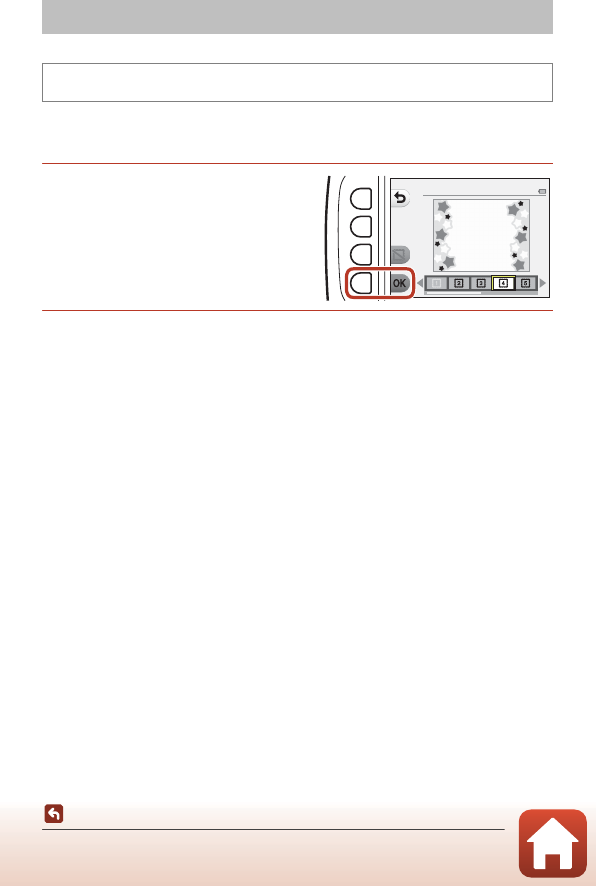
43
Shooting Features
Decorate
You can add a frame around your images when taking pictures.
•The C Choose a size > A Photo size setting is fixed at F Small (2 megapixels)
(A47).
1Use the multi selector JK to
select the desired frame and
press flexible button 4 (O).
•To cancel, press flexible button 1 (Q).
•You can press flexible button 3 (c) to
remove the frame.
2Frame the subject and take a picture.
BNotes About Decorate
•The area that is captured becomes smaller depending on the design of the frame.
•When using borderless printing to print images that you have added frames to, the frames
may not be printed.
Decorate
Enter shooting mode M flexible button 3 (g) M flexible button 3 (A Decorate)
Decorate
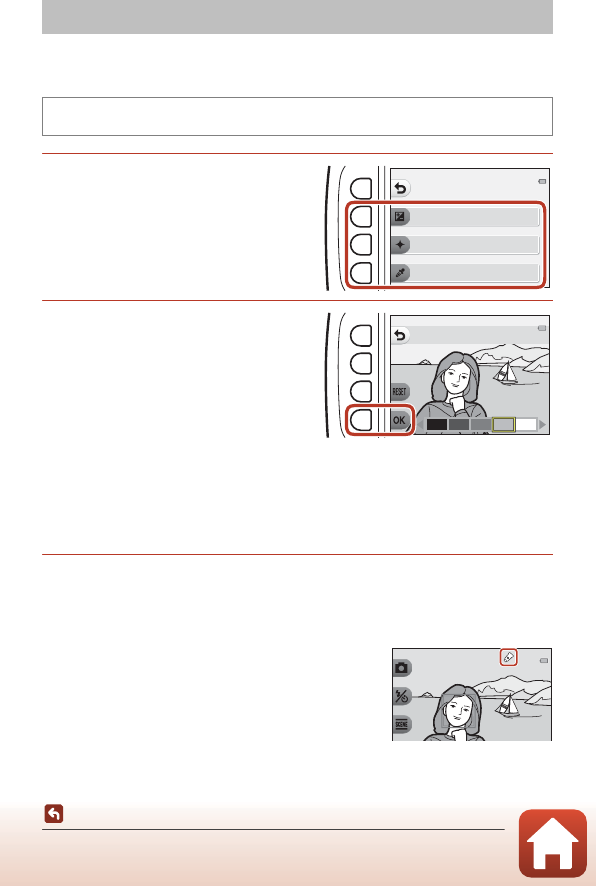
44
Shooting Features
Change Colors
You can adjust brightness (exposure compensation) and vividness when taking
pictures. You can also select one color to keep in your images and turn the rest of the
colors to shades of black and white.
1Use flexible button 2, 3, or 4 to
select the setting.
•Select b Brighter/darker, c More
vivid/less vivid, or P Highlight
colors.
2Use the multi selector JK to
change colors and press flexible
button 4 (O).
•b Brighter/darker (exposure
compensation):
Adjust the overall image brightness.
•c More vivid/less vivid (saturation):
Adjust the overall image vividness.
•P Highlight colors:
Select the color you want to highlight. Colors not selected are changed to black and
white.
•Press flexible button 3 (P) to turn the effect off.
•To cancel, press flexible button 1 (Q).
3Frame the subject and take a picture.
CChange Colors
•The setting is saved in the camera’s memory even after the camera is turned off.
•Images adjusted with Change colors are indicated by R.
Change Colors
Enter shooting mode
M
flexible button 3 (
g
)
M
flexible button 4 (
d
Change colors)
Brighter/darker
Change colors
More vivid/less vivid
Highlight colors
Brighter/darker
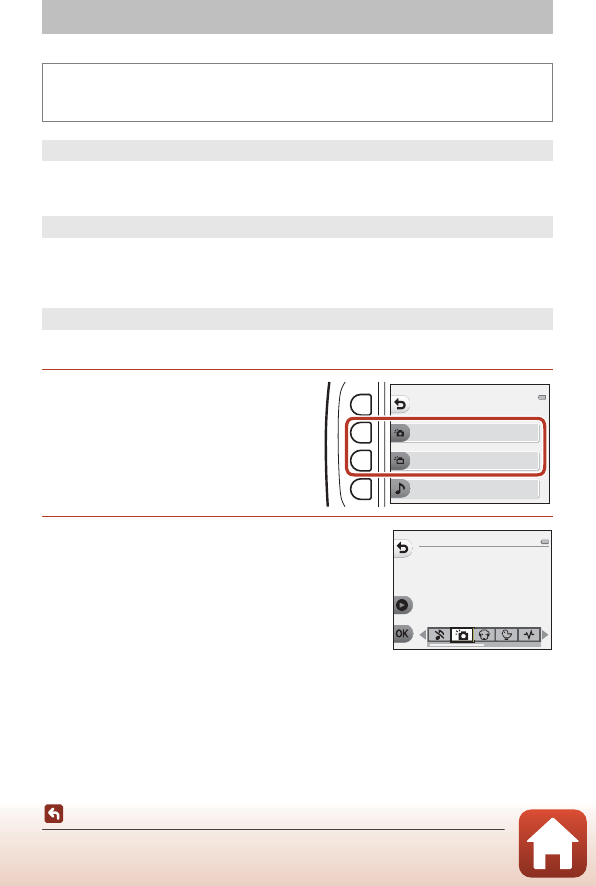
45
Shooting Features
Change Sounds
You can configure the shutter and button sounds.
1Press flexible button 2 or
flexible button 3.
•y Pick a shutter sound: Set the
shutter sound.
•x Pick a button sound: Set the
button sound.
2Use the multi selector JK to select the
type of sound.
•y: Set the standard sounds.
•z: Sounds are not heard.
•Press flexible button 3 (A) to play the selected
sound.
•To cancel, press flexible button 1 (Q).
Change Sounds
Enter shooting mode M flexible button 4 (l) M flexible button 2 (u Change
sounds)
yPick a shutter sound
Allows you to select the sound heard when the shutter is released and when the
focus has been locked.
When recording movies, the shutter sound is not heard.
xPick a button sound
Allows you to select the beep heard when the camera switches between shooting
and playback modes, when using the menus, etc.
•Regardless of this setting, sounds that are heard when an error occurs and when
the camera is turned on do not change.
uTurn sounds on or off
Turn all sounds on or off.
Pick a shutter sound
Change sounds
Pick a button sound
Turn sounds on or o
Pick a shutter sound
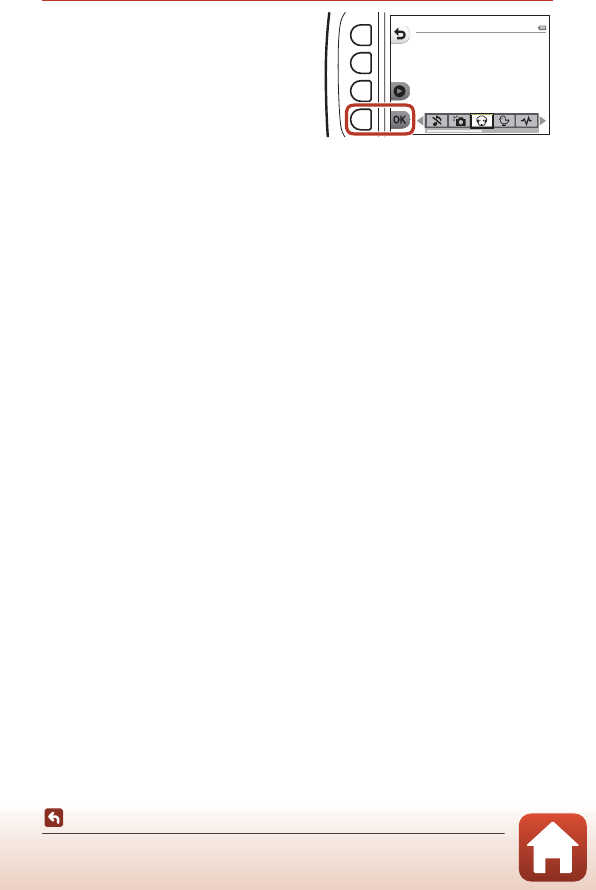
46
Shooting Features
Change Sounds
3Press flexible button 4 (O).
•The sound is set.
CMuting All Sounds
On the screen displayed in step 1, press flexible button 4 (u Turn sounds on or off) M
flexible button 3 (z Turn sounds off), in that order, to mute all sounds.
To cancel the mute, press flexible button 4 (u Turn sounds on or off) M flexible button 2
(u Turn sounds on), in that order.
Pick a shutter sound
47
Shooting Features
Choose a Size
Set the size of still images and movies.
Choose a Photo Size
Select the combination of image size and compression ratio to be used when saving
images. The larger the image size, the larger the size at which it can be printed, and
the lower the compression ratio, the higher the quality of the images, but the number
of images that can be saved is reduced.
* The changed setting is also applied to Choose a style and Change colors.
* The numerical values indicate the number of pixels that are captured.
Example: D Large (13 megapixels) = approx. 13 megapixels, 4160 × 3120 pixels
BNotes About Photo Size
This function may not be available to use in combination with other functions (A53).
CNumber of Images That Can Be Saved
•The approximate number of images that can be saved can be checked on the screen
when shooting (A24).
•Note that due to JPEG compression, the number of images that can be saved may vary
greatly depending on the image content, even when using memory cards with the same
capacity and the same photo size setting. In addition, the number of images that can be
saved may vary depending on the make of the memory card.
•If the number of exposures remaining is 10,000 or more, the number of exposures
remaining display shows “9999”.
Choose a Size
Enter shooting mode* M flexible button 4 (l) M flexible button 3 (C Choose a
size) M flexible button 2 (A Photo size)
Option* Size* (pixels) Compression
ratio
Aspect ratio
(horizontal to
vertical)
DLarge (13 megapixels)
(default setting) 4160 × 3120 Approx. 1:4 4:3
EMedium (4 megapixels) 2272 × 1704 Approx. 1:8 4:3
FSmall (2 megapixels) 1600 × 1200 Approx. 1:8 4:3
48
Shooting Features
Choose a Size
Choose a Movie Frame Size
Select the desired movie option to record.
1When using the camera’s internal memory, you can select H Small (640) or C Small
(old-fashioned).
2Allows you to record movies with an atmosphere and hue similar to movies shot on old
8mm film.
Enter shooting mode M flexible button 4 (l) M flexible button 3 (C Choose a
size) M flexible button 3 (N Movie frame size)
Option Image size
Aspect ratio
(horizontal to
vertical)
Frame rate
GLarge (1080p)
(default setting1)1920 × 1080 16:9 Approx. 30 fps
HSmall (640) 640 × 480 4:3 Approx. 30 fps
CSmall (old-fashioned)2640 × 480 4:3 Approx. 15 fps
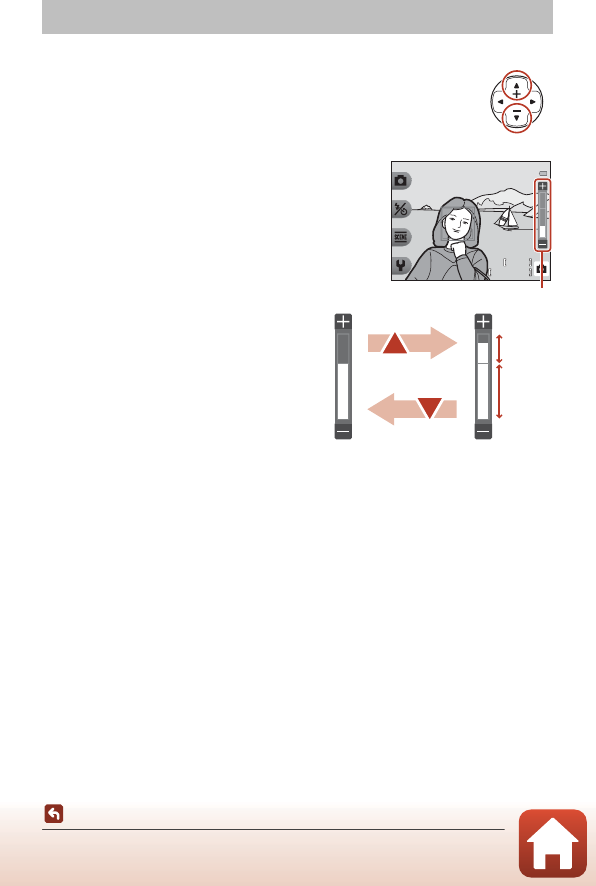
49
Shooting Features
Using the Zoom
When you press the multi selector HI, the zoom lens
position changes.
•To zoom in: Press H.
•To zoom out: Press I.
When you turn the camera on, the zoom moves to
the maximum wide-angle position.
•A zoom indicator is displayed on the shooting
screen when the multi selector HI is pressed.
•Digital zoom, which allows you to
further magnify the subject up to
approximately 4× the maximum
optical zoom ratio, can be activated
by pressing H when the camera is
zoomed in to the maximum optical
zoom position.
CDigital Zoom
The zoom indicator changes to blue when the digital zoom is activated, and it changes to
yellow when the zoom magnification is increased further.
•Zoom indicator is blue: Image quality is not noticeably reduced by using the Dynamic Fine
Zoom.
•Zoom indicator is yellow: There may be cases in which image quality is noticeably
reduced.
•The indicator remains blue across a wider area when the image size is smaller.
Using the Zoom
Zoom out
Zoom in
2100
2100
25m 0s
25m 0s
Zoom indicator
Maximum
optical zoom
Digital zoom
enabled
Optical
zoom
Digital
zoom
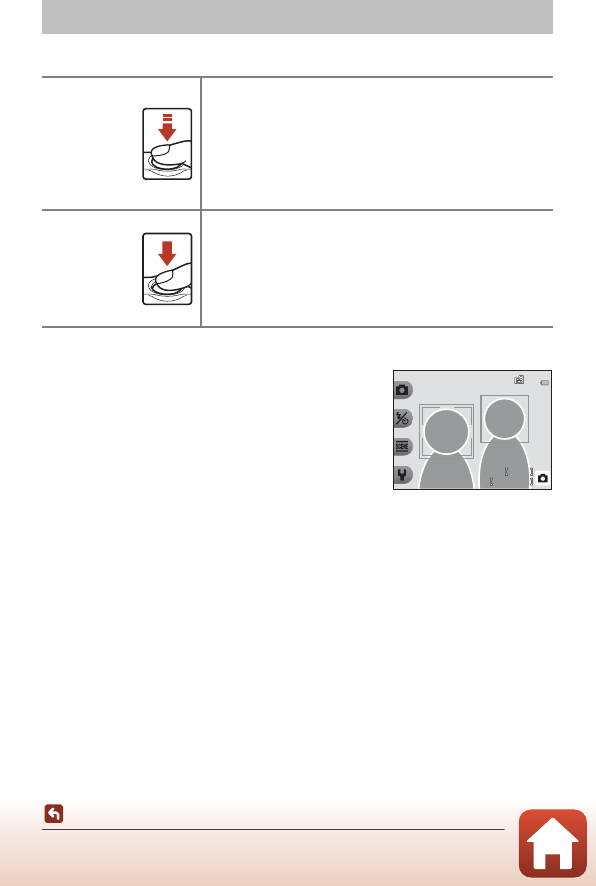
50
Shooting Features
Focusing
The Shutter-release Button
Using Face Detection
In the following settings, the camera uses face
detection to automatically focus on human faces.
•A Point and shoot (A32)
•Underwater face framing (A38), Shoot at
intervals (A38), and Take a series of pictures
(A39) when using Choose a style
•Smile timer (A35)
If the camera detects more than one face, a double
border is displayed around the face that the camera focuses on, and single borders
are displayed around the other faces.
If no faces are detected when the shutter-release button is pressed halfway:
•When A Point and shoot is selected, the focus area changes depending on the
shooting conditions that the camera recognizes.
•In Shoot at intervals, Take a series of pictures, or Smile timer, the camera
focuses in the center of the frame.
BNotes About Face Detection
•The camera’s ability to detect faces depends on a variety of factors, including the direction
in which the faces are looking.
•The camera cannot detect faces in the following situations:
- When faces are partially hidden by sunglasses or otherwise obstructed
- When faces take up too much or too little of the frame
Focusing
Press halfway
To press the shutter-release button “halfway” means to press and
hold the button at the point where you feel a slight resistance.
•Focus and exposure (shutter speed and f-number) are set
when you press the shutter-release button halfway. Focus
and exposure remain locked while the button is pressed
halfway.
•The focus area varies depending on the shooting mode
and settings.
Press all the
way
To press the shutter-release button “all the way” means to
press the button down completely.
•The shutter is released when the shutter-release button is
pressed all the way.
•Do not use force when pressing the shutter-release
button, as this may result in camera shake and blurred
images. Press the button gently.
21002100
25m 0s25m 0s

51
Shooting Features
Focusing
Using Skin Softening
In the following settings, if human faces are detected, the camera processes the
image to soften facial skin tones before saving the image (up to three faces).
•Smile timer (A35)
Make skin prettier can also be applied to saved images by using Add makeup in
playback mode (A63).
BNotes About Skin Softening
•It may take more time than usual to save images after shooting.
•Under some shooting conditions, the desired skin softening results may not be achieved,
and skin softening may be applied to areas of the image where there are no faces.
Subjects Not Suitable for Autofocus
The camera may not focus as expected in the following situations. In rare cases, the
subject may not be in focus despite the fact that the focus area or the focus indicator
is displayed in green:
•Subject is very dark
•Objects of sharply differing brightness are included in the scene (e.g. the sun
behind the subject makes that subject appear very dark)
•No contrast between the subject and surroundings (e.g. a portrait subject wearing
a white shirt is standing in front of a white wall)
•Several objects are at different distances from the camera (e.g. the subject is inside
a cage)
•Subjects with repeating patterns (window blinds, buildings with multiple rows of
similarly shaped windows, etc.)
•Subject is moving rapidly
In the situations noted above, try pressing the shutter-release button halfway to
refocus several times, or focus on another subject positioned at the same distance
from the camera as the actual desired subject, and use focus lock (A52).
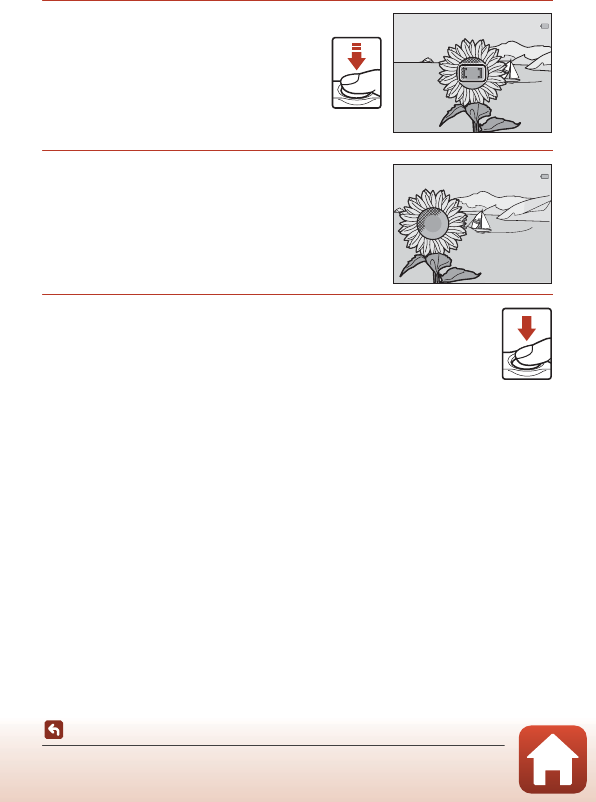
52
Shooting Features
Focusing
Focus Lock
Focus lock shooting is recommended when the camera does not activate the focus
area that contains the desired subject. The following explains how to use focus lock
when the focus area is displayed in the center of the frame.
1Position the subject in the
center of the frame and press
the shutter-release button
halfway.
•The camera focuses on the subject and
the focus area is displayed in green.
•Exposure is also locked.
2Without lifting your finger, recompose
the picture.
•Make sure to maintain the same distance between
the camera and the subject.
3Press the shutter-release button all the
way down to take the picture.
1/250
1/250
F 3.3
F3.3
1/250
1/250
F 3.3
F3.3
53
Shooting Features
Functions That Cannot Be Used Simultaneously When Shooting
Some functions cannot be used with other menu options.
Functions That Cannot Be Used
Simultaneously When Shooting
Restricted
function Option Description
Flash Choose a style
(A36)
When Shoot night scenes, Photograph food,
Take a series of pictures, Photograph
fireworks, Shoot backlit scenes, Shoot a
movie miniature, or Add light trails is selected,
the flash cannot be used.
Self-timer Choose a style
(A36)
•When Underwater face framing, Shoot at
intervals, Take a series of pictures, or
Photograph fireworks is selected, the self-
timer cannot be used.
•When Shoot night scenes or Add light trails
is selected, Self-portrait timer cannot be used.
Smile timer
Choose a style
(A36)
When any option in Choose a style is enabled,
Smile timer cannot be used.
Highlight colors
(A44)
When Highlight colors is enabled, Smile timer
cannot be used.
Decorate
Smile timer
(A35)
When Smile timer is selected, Decorate cannot
be used.
Choose a style
(A36)
When any option in Choose a style is enabled,
Decorate cannot be used.
Change colors
Smile timer
(A35)
When Smile timer is selected, Change colors
cannot be used.
Choose a style
(A36)
When any option in Choose a style is enabled,
Change colors cannot be used.
Choose a size Choose a style
(A36)
When Shoot a movie miniature or Add light
trails is selected, Choose a size cannot be used.
Photo size Decorate
(A43)
When Decorate is selected, the Photo size
setting is fixed at F Small (2 megapixels).
Date stamp Choose a style
(A36)
When Take a series of pictures, Shoot a movie
miniature, or Add light trails is selected, the
date cannot be stamped on images.
54
Shooting Features
Functions That Cannot Be Used Simultaneously When Shooting
Electronic VR Choose a style
(A36)
When Shoot night scenes, Shoot at intervals,
Take a series of pictures, Photograph
fireworks, Shoot backlit scenes, or Add light
trails is selected, electronic VR is disabled.
Digital zoom
Smile timer
(A35)
When Smile timer is selected, digital zoom
cannot be used.
Choose a style
(A36)
When Shoot night scenes, Shoot under water,
Underwater face framing, Shoot backlit
scenes, Take soft pictures, Create a diorama
effect, or Shoot a movie miniature is selected,
digital zoom cannot be used.
Restricted
function Option Description

55
Playback Features
Playback Features
Playback Zoom......................................................................................................................56
Thumbnail Playback............................................................................................................57
Functions Available in Playback Mode (Playback Menu).......................................58
E Exchange Messages ......................................................................................................59
V Picture Play.......................................................................................................................62
A Grading..............................................................................................................................74
I Favorites............................................................................................................................78
G View by Date ....................................................................................................................82
m Slide Show........................................................................................................................83
E Mark for Upload..............................................................................................................87
y Retouch..............................................................................................................................88
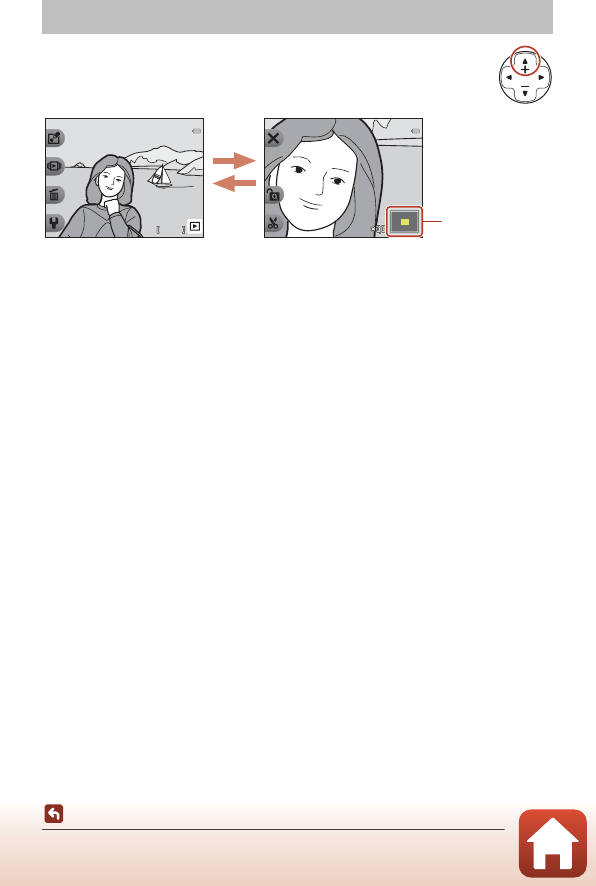
56
Playback Features
Playback Zoom
Pressing the multi selector H in full-frame playback mode (A26)
zooms in on the image.
•You can change the magnification rate by pressing HI.
•To view a different area of the image, press flexible button 3 (G) to lock the
magnification rate and press HIJK.
If you want to change the magnification rate, press flexible button 3 (H) and then
change the magnification rate as desired.
•When a zoomed image is displayed, press flexible button 1 (S) to return to full-
frame playback mode.
h Crop: Creating a Cropped Copy
When using playback zoom, you can crop the image and save the displayed area of
the image as a separate file by pressing flexible button 4 (h).
Playback Zoom
4
4
15/11/2016
15/11/2016
15:30
15:30
H
I
Image is zoomed in.Full-frame Playback
Displayed
area guide
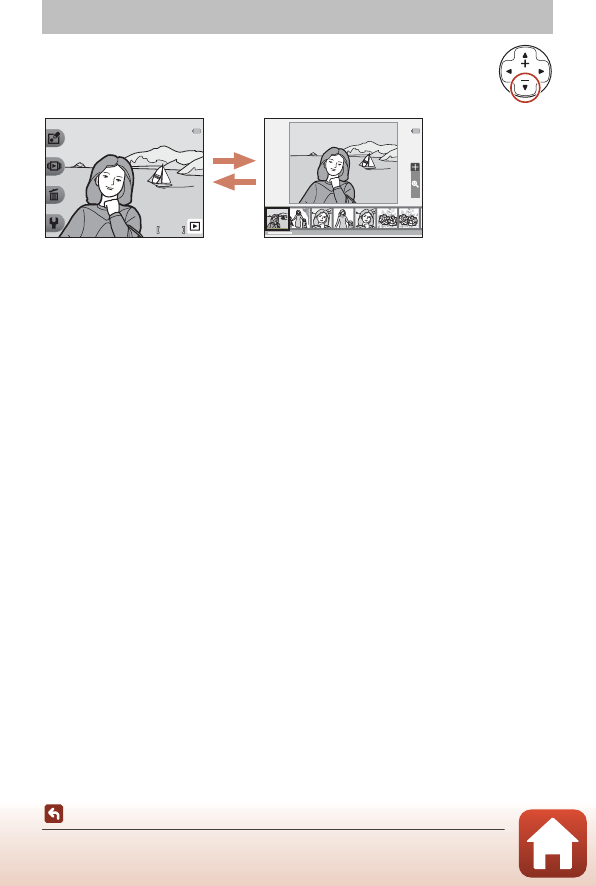
57
Playback Features
Thumbnail Playback
Pressing the multi selector I in full-frame playback mode (A26)
displays images in contact sheets of thumbnail images.
•While using thumbnail playback mode, press JK to select an image, and the
selected image is magnified and displayed at the center of the screen. Select an
image and press H, and the selected image is displayed in the full-frame playback
mode.
Thumbnail Playback
7
7
15/11/2016
15/11/2016
15:30
15:30
Thumbnail PlaybackFull-frame Playback
H
I
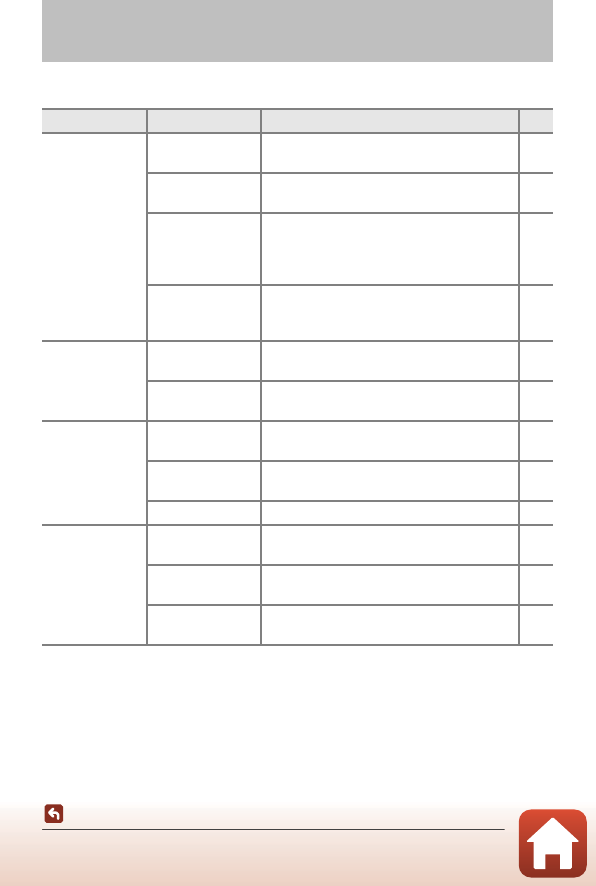
58
Playback Features
Functions Available in Playback Mode (Playback Menu)
When viewing images in full-frame playback mode, you can select one of the flexible
buttons (A7) and display the corresponding menu.
1Available when a still image is displayed.
2This function is displayed when Variety menu (A113) is set to On.
3This function is displayed when Variety menu (A113) is set to Off.
Functions Available in Playback Mode
(Playback Menu)
Flexible button Option Description A
V Have fun
with pictures
Exchange
messages1Allows you to add voice messages to your
images. 59
Picture play1Allows you to edit your images using a
variety of functions. 62
Grading2
Allows you to add grade marks to your
images. You can play back only the images
that have grade marks. Protects selected
images from accidental deletion.
74
Favorites3Allows you to play back only the images
added to favorites. Protects selected images
from accidental deletion.
78
Z View
View by date Allows you to play back images by selecting
the shooting date from the calendar. 82
Slide show Allows you to view images in an automated
slide show. 83
n Erase
Erase this picture
only
Allows you to delete only the image
currently displayed. 27
Erase selected
pictures
Allows you to select multiple images and
delete them. 28
Erase all pictures Allows you to delete all images. 27
l Settings
Mark for upload Allows you to select images in the camera
that you want to transfer to a smart device. 87
Retouch Allows you to copy or rotate images or
create a small copy of the current image. 88
Camera settings Allows you to change a number of general
settings. 108
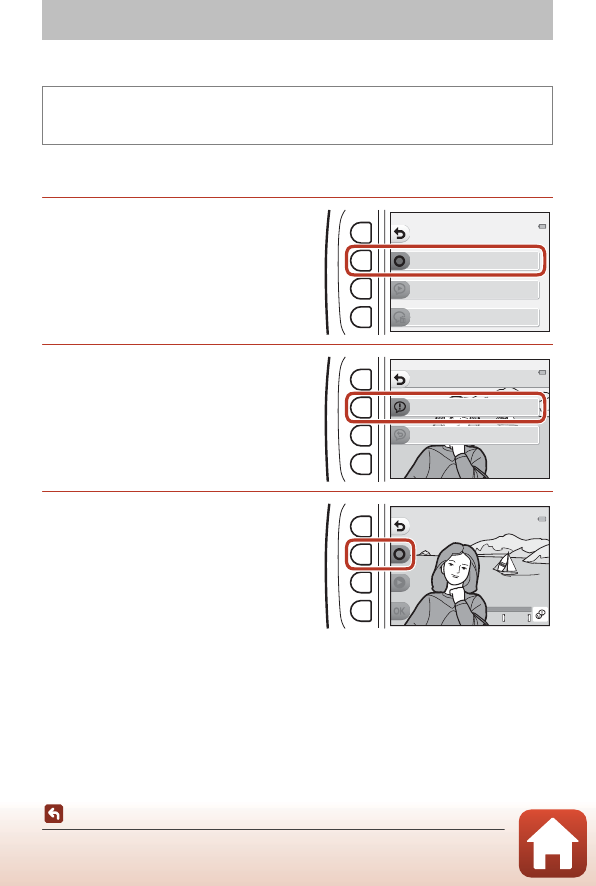
59
Playback Features
E Exchange Messages
Voice messages can be recorded and attached to images.
•You can attach up to two messages to each image.
Leave a Message
1Press flexible button 2
(qRecord).
2Press flexible button 2
(ILeave a message).
•You cannot select this option if the
image already has a message attached
to it. ➝ “Leave a Reply” (A60)
3Press flexible button 2 (q).
•Recording starts. You can record for up
to about 20 seconds.
•Do not touch the microphone.
•Press flexible button 2 (q) again to
stop recording.
•If battery power runs out, recording
stops automatically.
•The message is saved when you press flexible button 4 (O) in step 4. You can re-
record the message as long as you do not press flexible button 4.
•Press flexible button 3 (A) to play back the message.
•Press flexible button 1 (Q) before or after recording a message to return to step 2.
E Exchange Messages
Enter playback mode M select an image M flexible button 1 (V) M flexible
button 2 (E Exchange messages)
Record
Exchange messages
Play recordings
Erase recordings
Leave a message
Record
Leave a reply
20s
20s
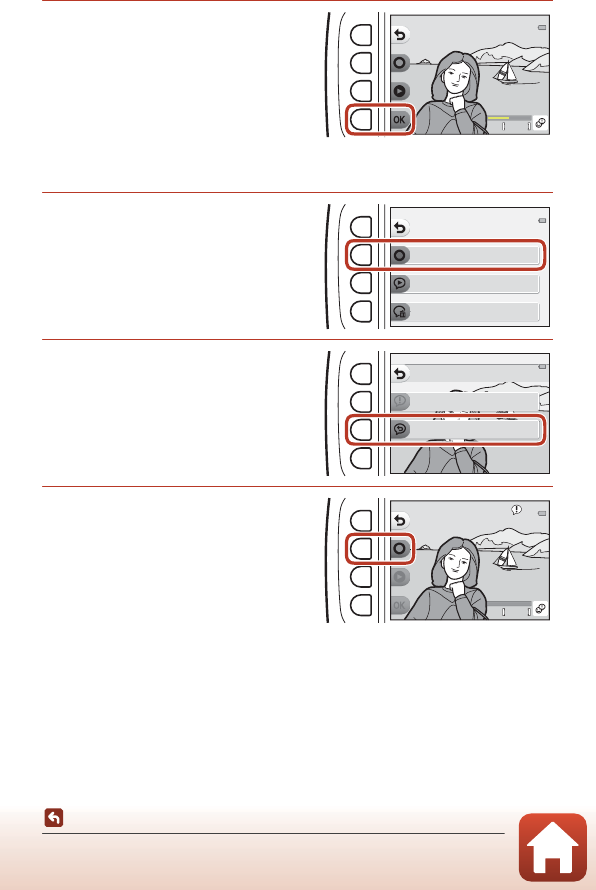
60
Playback Features
E Exchange Messages
4Press flexible button 4 (O).
•Message recorded. is displayed and
the message is attached to the image.
•Delete the current message before
recording a new message (A61).
Leave a Reply
1Press flexible button 2
(qRecord).
2Press flexible button 3
(JLeave a reply).
•You cannot select this option if the
image does not have a message
attached to it. ➝ “Leave a Message”
(A59)
3Press flexible button 2 (q).
•Once recording starts, the operations
are the same as explained in “Leave a
Message” (A59).
10s10s
Record
Exchange messages
Play recordings
Erase recordings
Leave a message
Record
Leave a reply
20s
20s
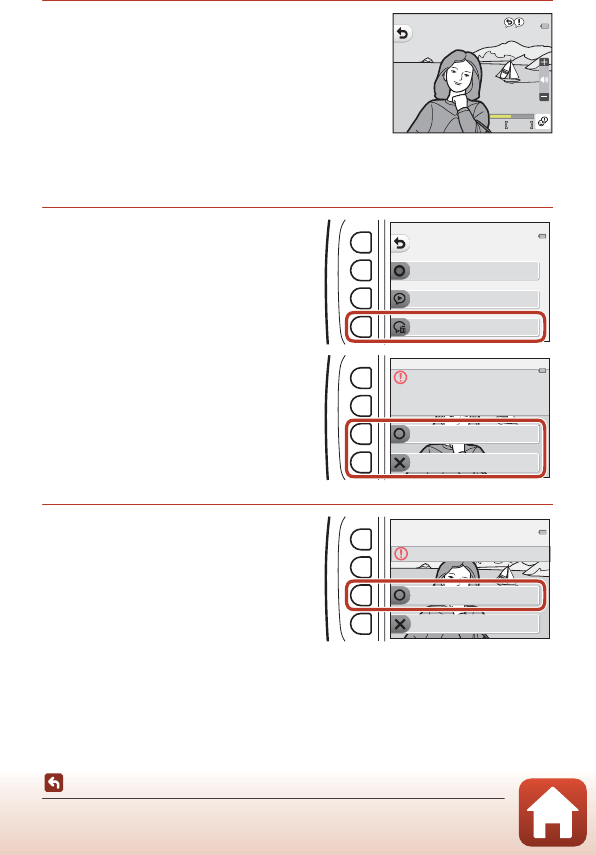
61
Playback Features
E Exchange Messages
Play Recordings
Press flexible button 3 (K Play recordings).
•The camera plays the message. If two messages
have been recorded, they are played back to back.
•Press flexible button 1 (Q) to stop playback.
•Use the multi selector HI during playback to
adjust playback volume.
•If battery power runs out, playback stops
automatically.
Erase Recordings
1Press flexible button 4
(LErase recordings).
•If you select an image that has a grade
mark (A74) or an image that is added
to favorites (A78), a confirmation
message is displayed.
-R Yes: Removes the grade or
removes the image from favorites
and displays the screen displayed in
step 2.
-S No: Returns to step 1.
2When the confirmation
message is displayed, press
flexible button 3 (R Yes).
•Only the recording is deleted. If both a
message and a reply have been
recorded, they are both deleted.
10s10s
Record
Exchange messages
Play recordings
Erase recordings
Yes
No
You'll need to remove the
grade from this picture.
Remove?
Yes
No
Erase voice recordings?

62
Playback Features
V Picture Play
Before Editing Images
You can easily edit images on this camera. Edited copies are saved as separate files
(except for Rotate pictures).
Edited copies are saved with the same shooting date and time as the original.
CRestrictions on Image Editing
•An image can be edited up to 10 times (there is no restriction on the number of times
Rotate pictures can be applied).
•You may not be able to edit images of a certain size or with certain editing functions.
V Picture Play
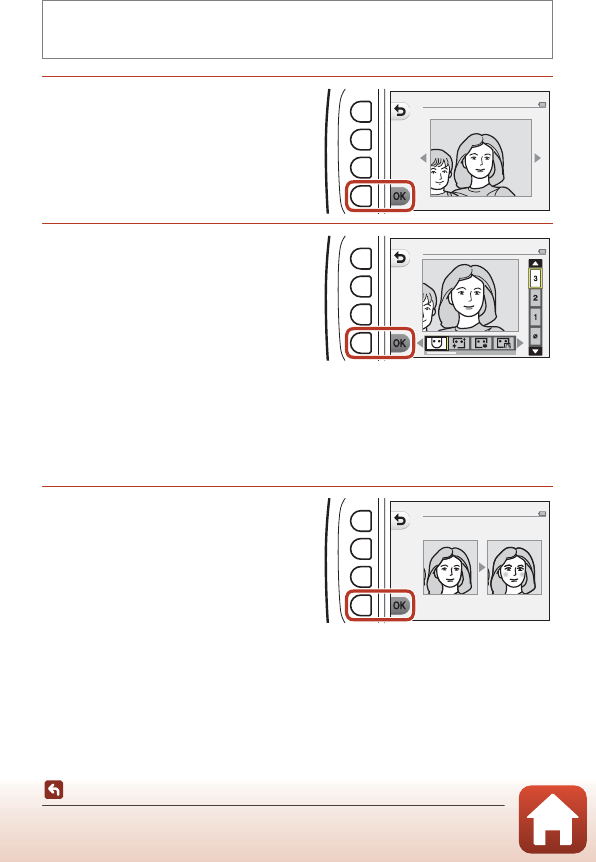
63
Playback Features
V Picture Play
K Add Makeup
1Use the multi selector HIJK
to select the face that you want
to retouch and press flexible
button 4 (O).
•When only one face is detected,
proceed to step 2.
2Use JK to select the effect,
use HI to select the effect
level, and press flexible button
4 (O).
•You can simultaneously apply multiple
effects.
Adjust or check the settings for all
effects before pressing flexible button 4
(O).
F Make faces smaller, B Make skin prettier, l Color faces, m Make skin
less shiny, E Hide eye bags, A Make eyes bigger, G Whiten eyes, n Add
eye shadow, o Add mascara, H Whiten teeth, p Color lips, D Redden
cheeks
•Press flexible button 1 (Q) to return to the screen for selecting a person.
3Preview the result and press
flexible button 4 (O).
•To change the settings, press flexible
button 1 (Q) to return to step 2.
Enter playback mode M select an image M flexible button 1 (V) M flexible
button 3 (V Picture play) M use JK to select K M flexible button 4 (O)
Subject selection
Make faces smaller
Preview
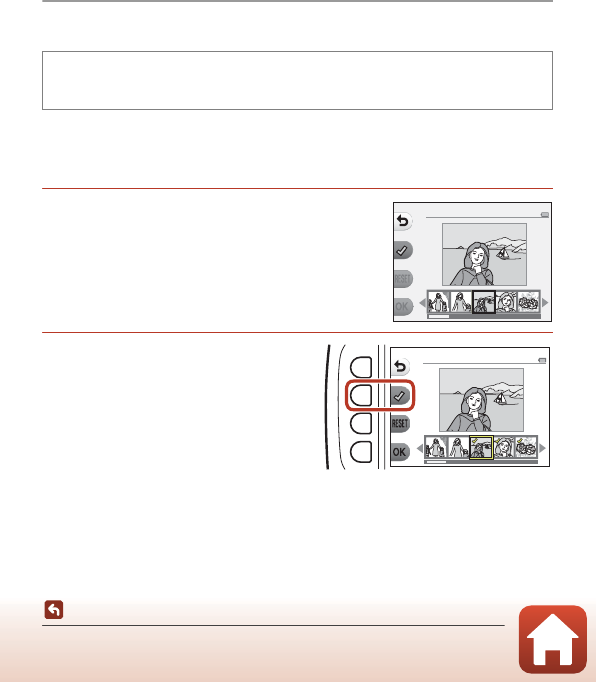
64
Playback Features
V Picture Play
BNotes About Add Makeup
•One face can be edited at a time. To add makeup to another face, edit the edited image
again.
•Depending on the direction in which faces are looking, or the brightness of faces, the
camera may be unable to accurately detect faces, or the function may not perform as
expected.
•If no faces are detected, a warning is displayed and the screen returns to the playback
menu.
•Only images captured at an image size of 640 × 480 or larger can be edited.
D Make Photo Albums
Display images similarly to a photo album. Select one of five different photo album
designs. The created album is saved as a separate image of Small (2 megapixels)
(1600 × 1200) in size.
1Use the multi selector JK to select an
image.
2Press flexible button 2 (S).
•A check mark is displayed.
•A check mark is displayed or removed
every time you press flexible button 2
(S).
•Press flexible button 3 (P) to
remove all check marks.
•Images are arranged in an album in the
order the check marks were added.
•Up to 20 images can be selected.
Enter playback mode M flexible button 1 (V) M flexible button 3 (V Picture
play) M use JK to select D M flexible button 4 (O)
Make photo albums
Make photo albums
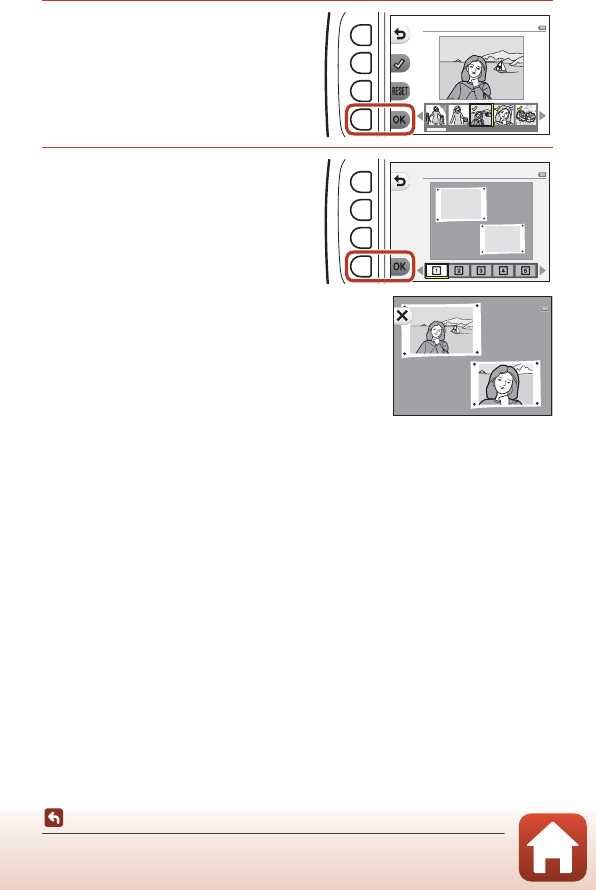
65
Playback Features
V Picture Play
3Press flexible button 4 (O).
4Use JK to select the desired
photo album design and press
flexible button 4 (O).
•Photo albums are displayed one page
at a time. After all pages have been displayed, the
camera returns to Have fun with pictures menu.
•To cancel before the photo album has been
created, press flexible button 1 (S).
BNotes About Make Photo Albums
•Movies cannot be selected.
•This camera is unable to select images captured with other cameras.
Make photo albums
Choose an album design
66
Playback Features
V Picture Play
W Add a Fisheye Effect
Make an image look as if it were captured with a fisheye lens. This effect is well-suited
for images captured using Shoot close-ups in the shooting menu.
Confirm the effect and press
flexible button 4 (O).
•To cancel, press flexible button 1 (Q).
Z Toy Camera
Make an image look as if it were shot with a toy camera. This effect is well-suited for
landscapes.
Confirm the effect and press
flexible button 4 (O).
•To cancel, press flexible button 1 (Q).
Enter playback mode M select an image M flexible button 1 (V) M flexible
button 3 (V Picture play) M use JK to select W M flexible button 4 (O)
Enter playback mode M select an image M flexible button 1 (V) M flexible
button 3 (V Picture play) M use JK to select Z M flexible button 4 (O)
Add a fisheye effect
Toy camera
67
Playback Features
V Picture Play
Q Soften Pictures
Soften the image by adding a slight blur around the center of the image. Four blur
regions are available.
Use the multi selector JK to select
the area to be blurred and press
flexible button 4 (O).
•To add a slight blur to the entire image,
press k.
•To cancel, press flexible button 1 (Q).
f Add Starbursts
Produce star-like rays of light that radiate outward from bright objects such as
sunlight reflections or street lights. This effect is suitable for night scenes.
Confirm the effect and press
flexible button 4 (O).
•To cancel, press flexible button 1 (Q).
Enter playback mode M select an image M flexible button 1 (V) M flexible
button 3 (V Picture play) M use JK to select Q M flexible button 4 (O)
Enter playback mode M select an image M flexible button 1 (V) M flexible
button 3 (V Picture play) M use JK to select f M flexible button 4 (O)
Soften pictures
Add starbursts
68
Playback Features
V Picture Play
M Add a Diorama Effect
Make an image look like a miniature scene captured in macro mode. This effect is
well-suited for images captured from a high vantage point with the main subject at
the center of the image.
Confirm the effect and press
flexible button 4 (O).
•To cancel, press flexible button 1 (Q).
d Change Colors
Adjust image colors.
Use the multi selector JK to select
the desired setting and press
flexible button 4 (O).
•The following image color settings are
available.
1Vivid color (default setting): Use to
achieve a vivid, photoprint effect.
2Black-and-white: Save images in
black-and-white.
3Sepia: Save images in sepia tones.
4Cyanotype: Save images in cyan-blue monochrome.
•To cancel, press flexible button 1 (Q).
Enter playback mode M select an image M flexible button 1 (V) M flexible
button 3 (V Picture play) M use JK to select M M flexible button 4 (O)
Enter playback mode M select an image M flexible button 1 (V) M flexible
button 3 (V Picture play) M use JK to select d M flexible button 4 (O)
Add a diorama effect
Change colors
1342
69
Playback Features
V Picture Play
P Highlight Colors
Create a black and white image in which only the specified color remains.
Use the multi selector JK to select
a color and press flexible button 4
(O).
•To cancel, press flexible button 1 (Q).
Enter playback mode M select an image M flexible button 1 (V) M flexible
button 3 (V Picture play) M use JK to select P M flexible button 4 (O)
Highlight colors
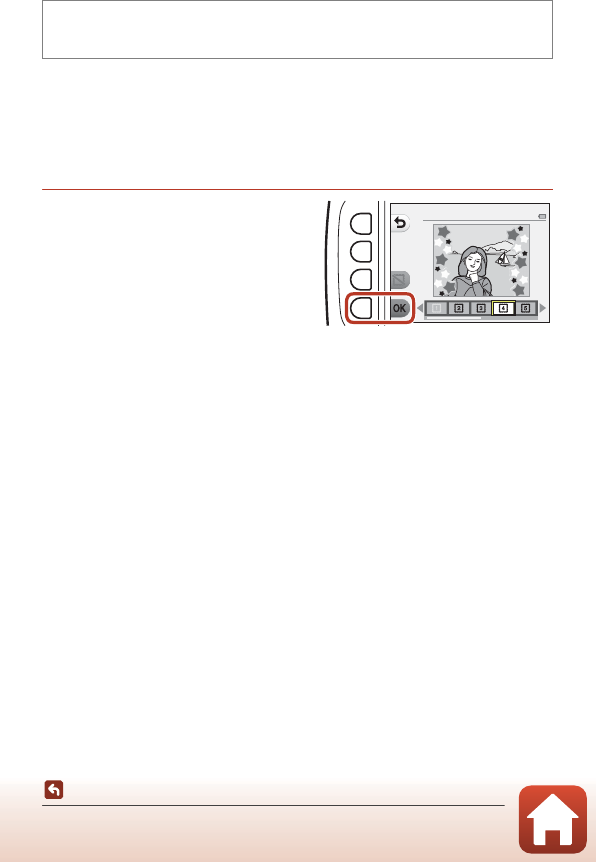
70
Playback Features
V Picture Play
A Decorate
Add a frame around your images. The image size of the edited copy varies depending
on the size of the original image, as described below.
•When the original image is Small (2 megapixels) (1600 × 1200) or larger, the
copy is saved at Small (2 megapixels) (1600 × 1200).
•When the original image is smaller than Small (2 megapixels) (1600 × 1200), the
copy is saved at the same size as the original.
Use the multi selector JK to select
the desired frame and press flexible
button 4 (O).
•The frame is added to the image and
saved as a new copy.
•To cancel, press flexible button 1 (Q).
•Press flexible button 3 (c) to remove the
frame.
BNotes About Decorate
•The frame is placed on top of the image, therefore a large area of the image is covered
depending on the design of the frame.
•When using borderless printing to print images that you have added frames to, the frames
may not be printed.
Enter playback mode M select an image M flexible button 1 (V) M flexible
button 3 (V Picture play) M use JK to select A M flexible button 4 (O)
Decorate
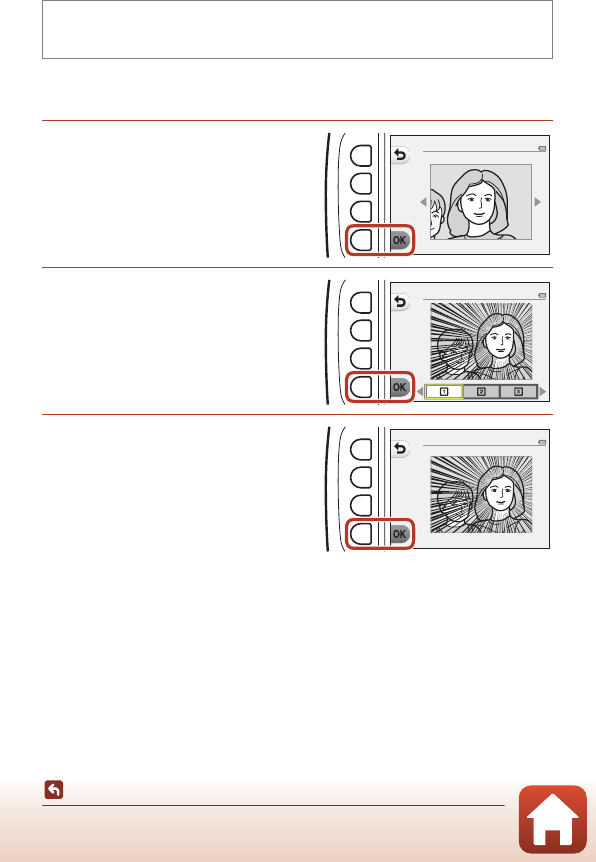
71
Playback Features
V Picture Play
F Add Cartoon Effects
Make a captured image look like a panel from a comic by drawing lines. Three effects
are available.
1Use the multi selector JK to
select the subject to which the
effect will be applied and press
flexible button 4 (O).
•When one subject is detected, proceed
to step 2.
2Use JK to select an effect and
press flexible button 4 (O).
3Confirm the effect and press
flexible button 4 (O).
•To change the settings, press flexible
button 1 (Q) to return to step 2.
BNotes About Add Cartoon Effects
If no faces or main subjects are detected, a warning is displayed and the screen returns to
the playback menu.
Enter playback mode M select an image M flexible button 1 (V) M flexible
button 3 (V Picture play) M use JK to select F M flexible button 4 (O)
Choose a subject
Add cartoon effects
Preview
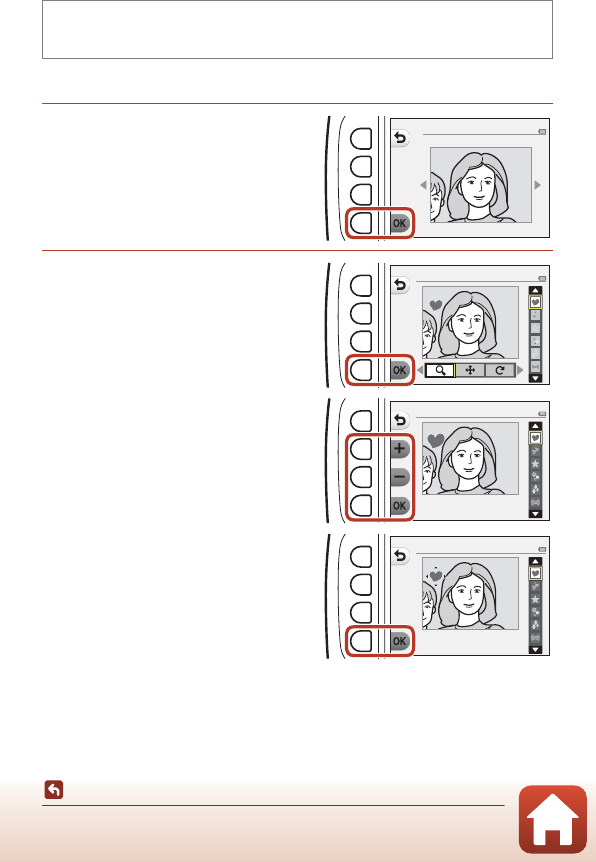
72
Playback Features
V Picture Play
G Stamp
Add stamps to an image. You can enlarge or shrink, move, and rotate the stamps.
1Use the multi selector JK to
select the subject to which the
stamp will be applied and press
flexible button 4 (O).
•When one subject is detected, proceed
to step 2.
2Use HI to select a stamp
type, use JK to adjust the
stamp, and press flexible
button 4 (O).
•H (enlarge or shrink), I (move), and
f (rotate) are available for adjustment.
•In H (enlarge or shrink), press flexible
button 2 (X) or flexible button 3 (Y) to
adjust the size of the stamp, and then
press flexible button 4 (O).
•In I (move), use HIJK to move
the stamp, and press flexible button 4
(O).
Enter playback mode M select an image M flexible button 1 (V) M flexible
button 3 (V Picture play) M use JK to select G M flexible button 4 (O)
Choose a subject
Stamp
Stamp
Stamp
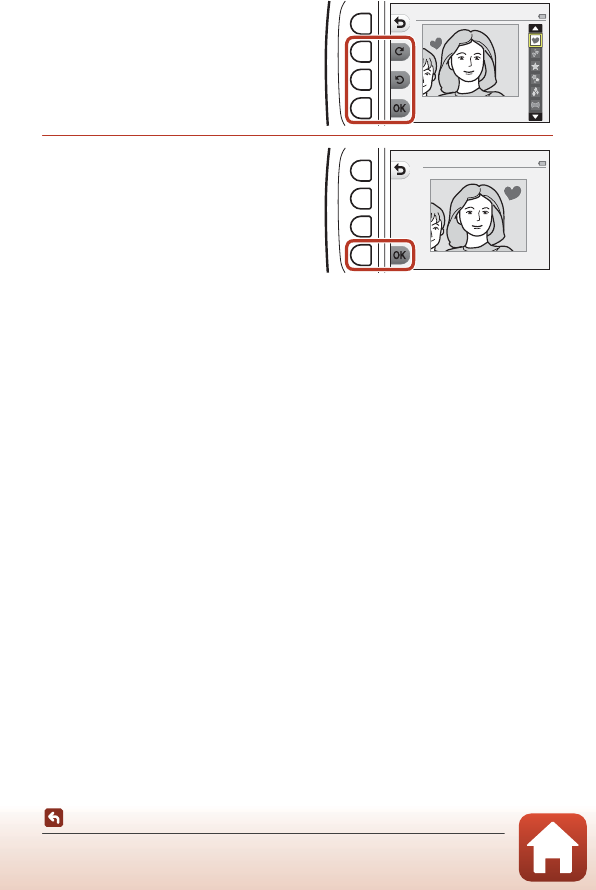
73
Playback Features
V Picture Play
•In f (rotate), press flexible button 2
(f) or flexible button 3 (e) to adjust
the direction of the stamp, and press
flexible button 4 (O).
3Confirm the effect and press
flexible button 4 (O).
•To change the settings, press flexible
button 1 (Q) to return to step 2.
Stamp
Preview
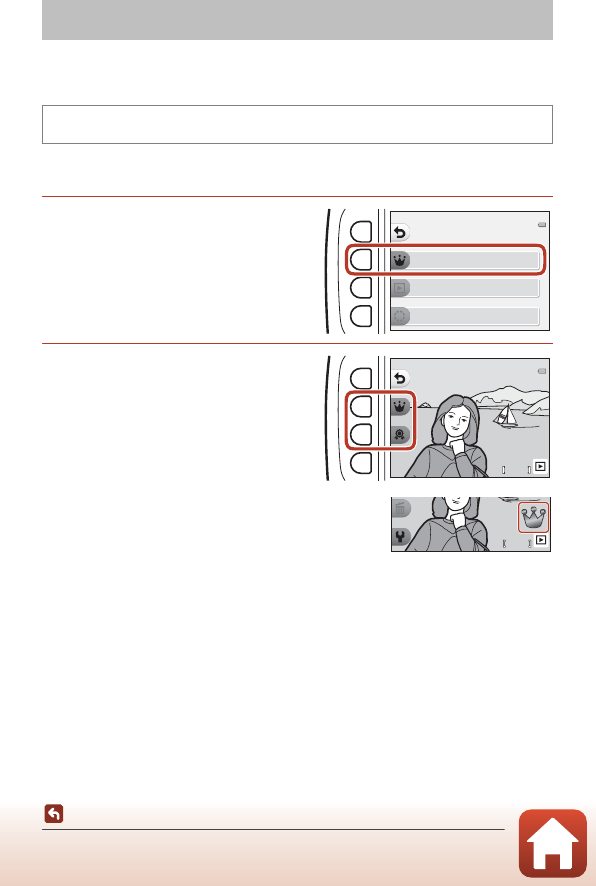
74
Playback Features
A Grading
This function is displayed when Variety menu (A113) is set to On.
Grade images by using A Excellent or B Good. You can use View graded
pictures to play back only the images that have grade marks.
Grade Pictures
1Press flexible button 2
(AGrade pictures).
2Use the multi selector JK to
select an image and press
flexible button 2 (A) or flexible
button 3 (B).
•Graded images are indicated with grade marks (A
or B) on the playback screen, and are protected.
•You cannot add two grade marks to a single
image.
BNotes About Graded Images
Formatting the memory card or the camera's internal memory (A117) permanently
deletes all data, including graded images.
CGrading
•Graded images are also added to Favorites (A78). Removing the grade also removes
the image from favorites.
•Grade mark A can be added to up to a total of 200 images that includes the images added
to favorites. Grade mark B can be added to up to a total of 200 images.
A Grading
Enter playback mode M flexible button 1 (V) M flexible button 4 (A Grading)
Grade pictures
Grading
View graded pictures
Remove all grades
1 5
15
15/11/2016
15/11/2016
15:30
15:30
1 5
15
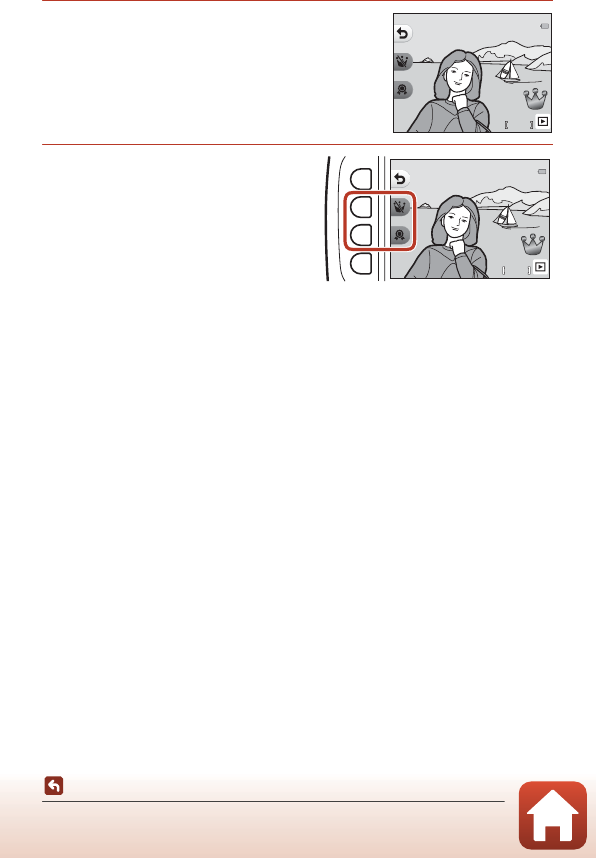
75
Playback Features
A Grading
Changing or Removing Grades from Individual Images
1In step 2 (A74) of “Grade Pictures”,
select the image with the grade you
want to change or remove.
2Change or remove the grade.
•Press flexible button 2 (A) or flexible
button 3 (B) to change the current
grade to the selected grade.
•Press flexible button 2 (a) or flexible
button 3 (b) to remove the grade of
the selected image.
1 515
15/11/201615/11/2016 15:3015:30
1 5
15
15/11/2016
15/11/2016
15:30
15:30
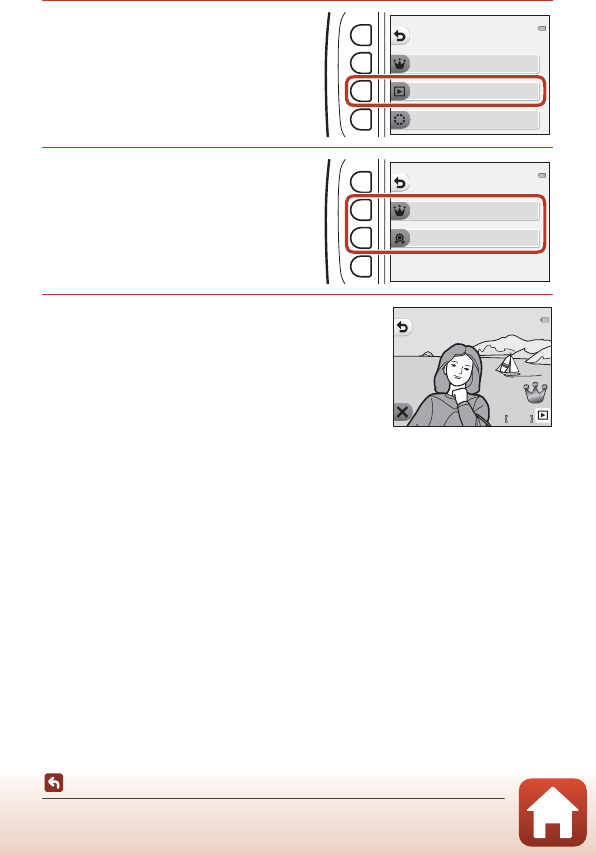
76
Playback Features
A Grading
View Graded Pictures
1Press flexible button 3
(BView graded pictures).
2Press flexible button 2
(AExcellent) or flexible
button 3 (B Good).
•Only images with the grade mark you
selected are displayed.
3Use the multi selector JK to view
images.
•Press H to magnify the image.
•Press I to switch to thumbnail playback mode.
•Press flexible button 1 (Q) to return to the screen
displayed in step 2.
•Press flexible button 4 (S) to return to full-frame
playback mode (A26).
BNotes About View Graded Pictures
Images cannot be edited, including changing or removing grades, when they are played
back using View graded pictures.
Grade pictures
Grading
View graded pictures
Remove all grades
Excellent
View graded pictures
Good
1 5
15
15/11/2016
15/11/2016
15:30
15:30
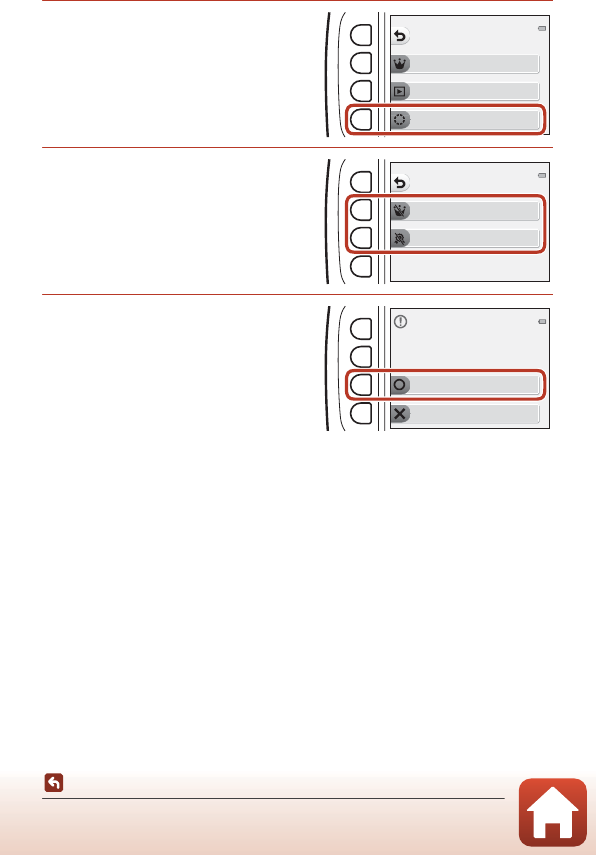
77
Playback Features
A Grading
Remove All Grades
1Press flexible button 4
(SRemove all grades).
2Press flexible button 2
(aExcellent) or flexible
button 3 (b Good).
3Press flexible button 3 (R Yes).
•The selected grade mark is removed
from all images.
Grade pictures
Grading
View graded pictures
Remove all grades
Excellent
Remove all grades
Good
Yes
No
Remove all grades?
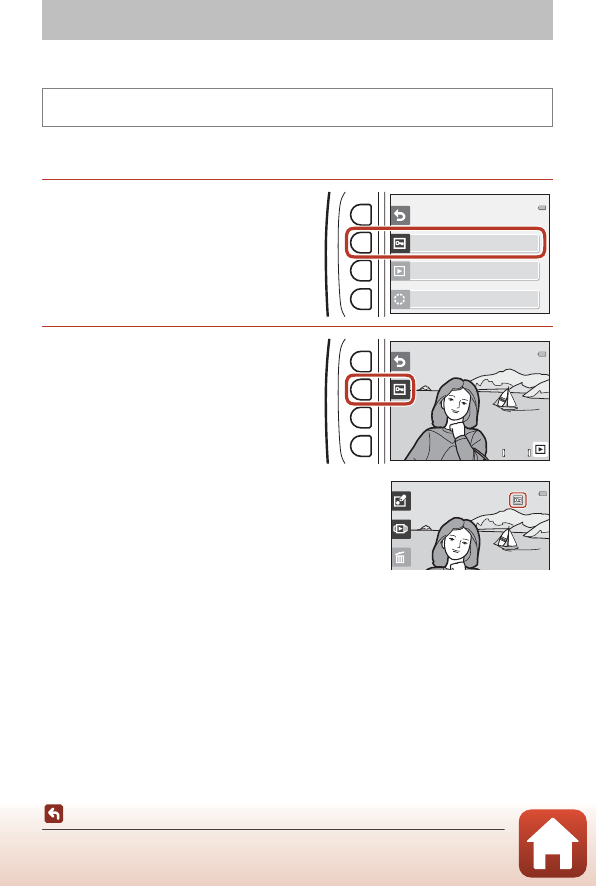
78
Playback Features
I Favorites
This function is displayed when Variety menu (A113) is set to Off.
You can use View favorites to play back only the images added to favorites.
Add to Favorites
1Press flexible button 2 (I Add
to favorites).
2Use the multi selector JK to
select a favorite image and
press flexible button 2 (I).
•Images added to favorites are displayed with s on
the playback screen, and are protected.
BNotes About Images Added to Favorites
Formatting the memory card or the camera's internal memory (A117) permanently
deletes all data, including graded images.
CFavorites
•Grade mark A (A74) is added to images that are added to favorites. Removing the
image from favorites also removes the grade.
•Up to a total of 200 images can be added to favorites, which includes graded images.
I Favorites
Enter playback mode M flexible button 1 (V) M flexible button 4 (I Favorites)
Add to favorites
Favorites
View favorites
Remove from favorites
1 5
15
15/11/2016
15/11/2016
15:30
15:30
15/11/2016
15/11/2016
15:30
15:30
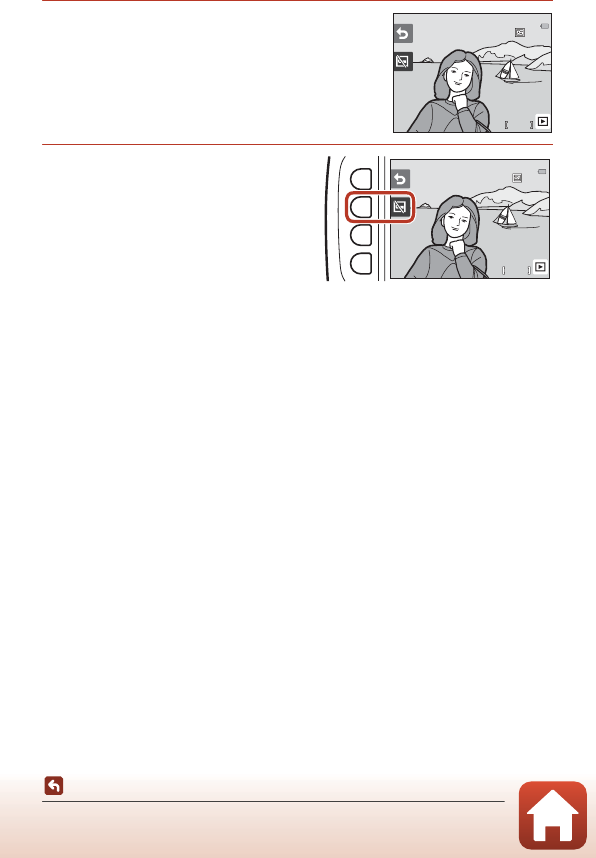
79
Playback Features
I Favorites
Removing Favorites from Individual Images
1In step 2 (A78) of “Add to Favorites”,
select the image that you want to
remove from favorites.
2Press flexible button 2 (i).
•The selected image is removed from
favorites.
1 515
15/11/201615/11/2016 15:3015:30
1 5
15
15/11/2016
15/11/2016
15:30
15:30
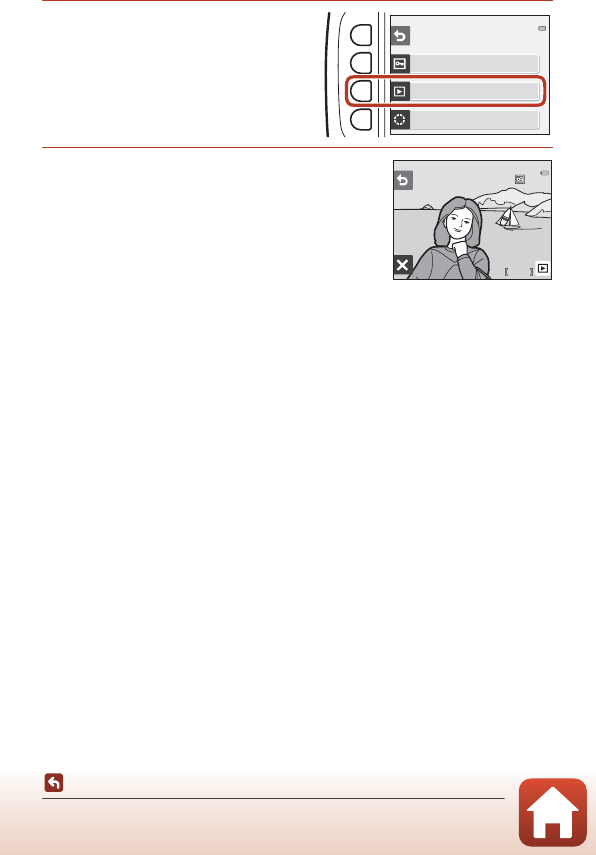
80
Playback Features
I Favorites
View Favorites
1Press flexible button 3
(BView favorites).
2Use the multi selector JK to view
images.
•Press H to magnify the image.
•Press I to switch to thumbnail playback mode.
•Press flexible button 1 (Q) to return to the screen
displayed in step 1.
•Press flexible button 4 (S) to return to full-frame
playback mode (A26).
BNotes About View Favorites
Images cannot be edited, including removing from favorites, when they are played back
using View favorites.
Add to favorites
Favorites
View favorites
Remove from favorites
1 5
15
15/11/2016
15/11/2016
15:30
15:30
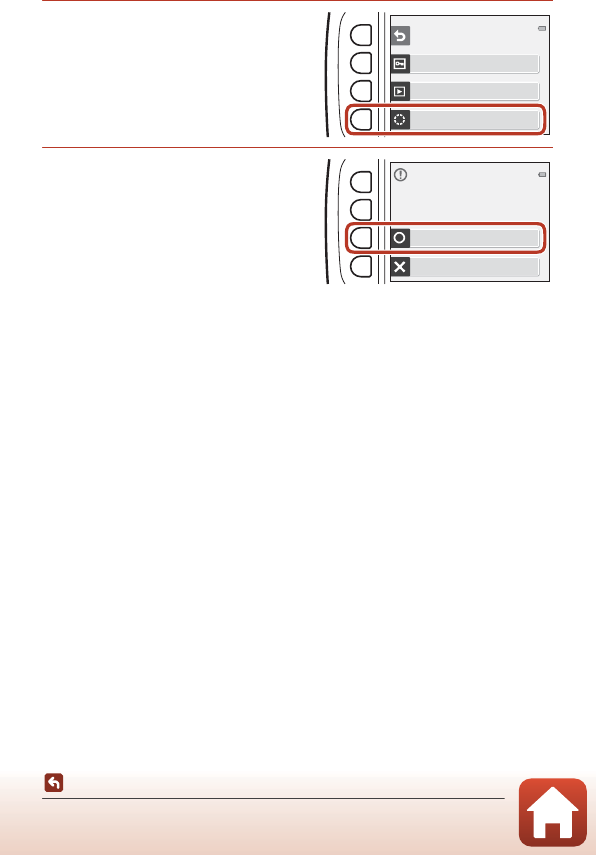
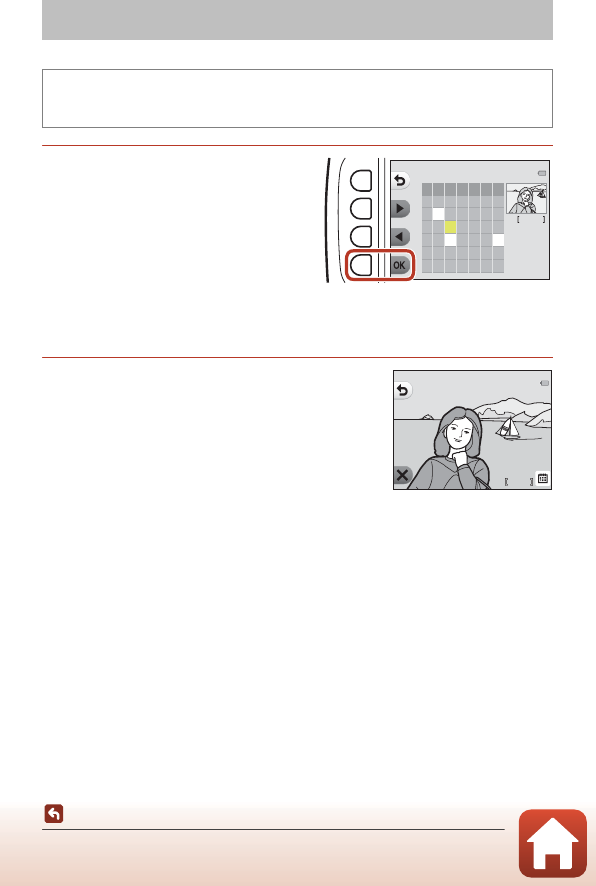
82
Playback Features
G View by Date
Play back images by selecting the shooting date from the calendar.
1Use the multi selector HIJK
to select the desired date and
press flexible button 4 (O).
•Images are selected based on the
selected date. The first image captured
on that date is displayed.
•A white background of a date indicates
that images were recorded on that
date.
•Press flexible button 2 (K) to display the next month. Press flexible button 3 (J) to
display the previous month.
2Use JK to view images.
•Press H to magnify the image.
•Press I to switch to thumbnail playback mode.
•Press flexible button 1 (Q) to return to the screen
displayed in step 1.
•Press flexible button 4 (S) to return to full-frame
playback mode (A26).
BNotes About View by Date
•The 9000 most recent images can be displayed.
•Images captured when the camera’s date is not set are treated as images captured on
January 1, 2016.
•When movie files are played back, only the first frame of each movie is displayed.
•Images cannot be edited when they are played back using View by date.
G View by Date
Enter playback mode M flexible button 2 (Z) M flexible button 2 (G View by
date)
4
2016
Su
11
MTuWTh F
16 17 18 191314 15
232425262021 22
2728
Sa
23451
9101112678
3029
4
4
15/11/2016
15/11/2016
15:30
15:30
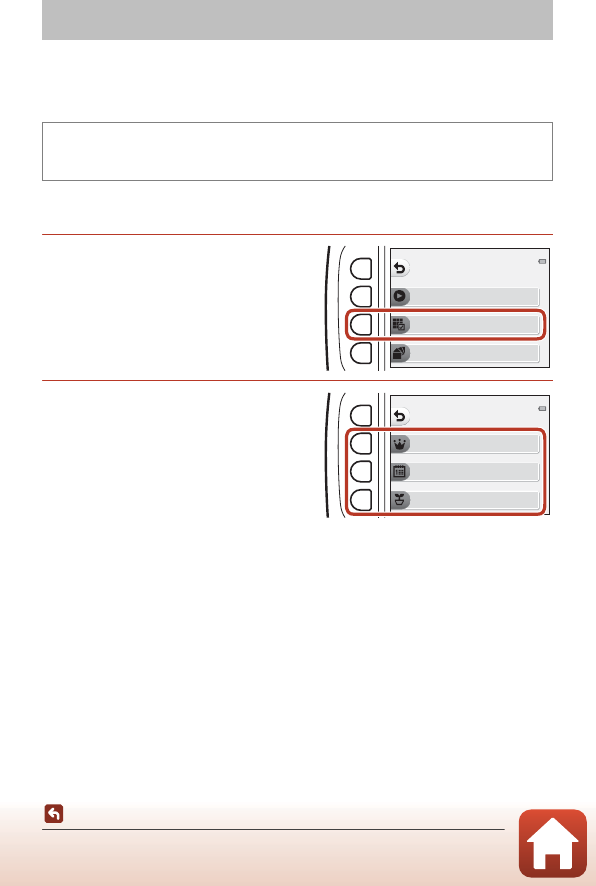
83
Playback Features
m Slide Show
Play back images one by one in an automated “slide show.” When movie files are
played back in the slide show, only the first frame of each movie is displayed.
Background music is played during playback. Background music varies depending on
the theme selected under n Choose a theme (A86).
Choose Pictures
1Press flexible button 3
(oChoose pictures).
•To play back all images ➝ step 3.
2Use flexible button 2, 3, or 4 to
select the images you want to
play back.
•A View graded pictures/ View
favorites: Only graded images or
images added to favorites are played
back. Proceed to step 3.
•G Choose by date: Only images
captured on the same day are played back. Select a date from the calendar, press
flexible button 4 (O), and continue from step 3.
•O Pick a series: Images captured using Shoot at intervals (A38) are played
back consecutively. This option can be selected only when images have been
captured using Shoot at intervals (A85).
m Slide Show
Enter playback mode M flexible button 2 (Z) M flexible button 3 (m Slide
show)
Start
Slide show
Choose pictures
Choose a theme
View graded pictures
Choose pictures
Choose by date
Pick a series
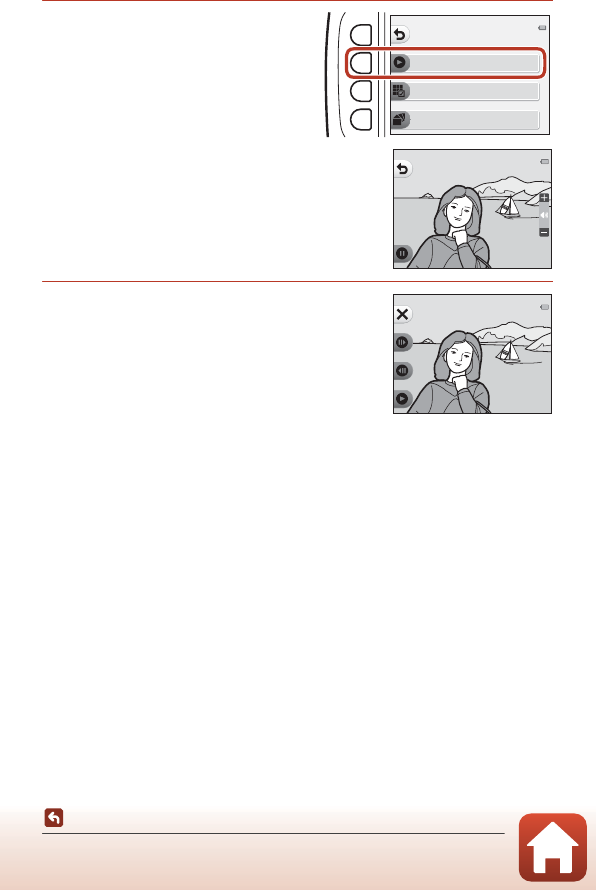
84
Playback Features
m Slide Show
3Press flexible button 2
(AStart).
•The slide show begins.
•To pause playback, press flexible
button 4 (D). To exit, press flexible button 1 (Q).
•While the slide show is in progress, press the multi
selector K to display the next image or J to
display the previous image. Press and hold K or J
to fast forward or rewind.
•Press HI during playback to adjust the volume
of the background music.
4End or restart the slide show.
•The screen shown on the right is displayed when
the slide show is paused.
S: Returns to the screen displayed in step 1.
E: Displays the next image.
F: Displays the previous image.
A: Resumes playback.
Start
Slide show
Choose pictures
Choose a theme
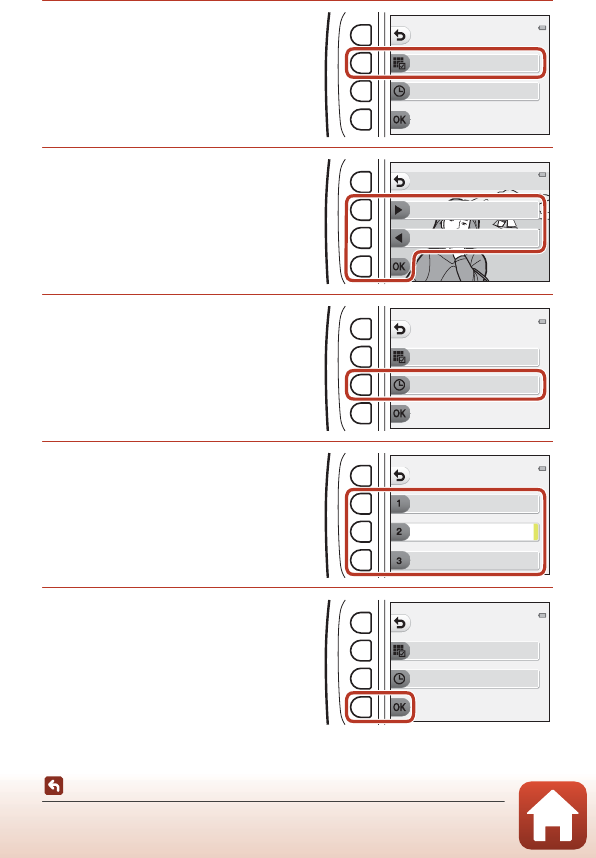
85
Playback Features
m Slide Show
Pick a Series
1Press flexible button 2
(oChoose pictures).
•The first image in the folder where
images captured using Shoot at
intervals are saved is displayed.
2Use flexible button 2 (K Next
series) or flexible button 3
(JPrevious series) to select
the folder and press flexible
button 4 (O).
3Press flexible button 3 (J Pick
a speed).
4Use flexible button 2, 3, or 4 to
select a desired speed.
•Select X Fast, Y Normal (default
setting), or Z Slow.
5Press flexible button 4 (O).
Choose pictures
Pick a series
Pick a speed
Next series
Choose pictures
Previous series
Choose pictures
Pick a series
Pick a speed
Fast
Pick a speed
Normal
Slow
Choose pictures
Pick a series
Pick a speed
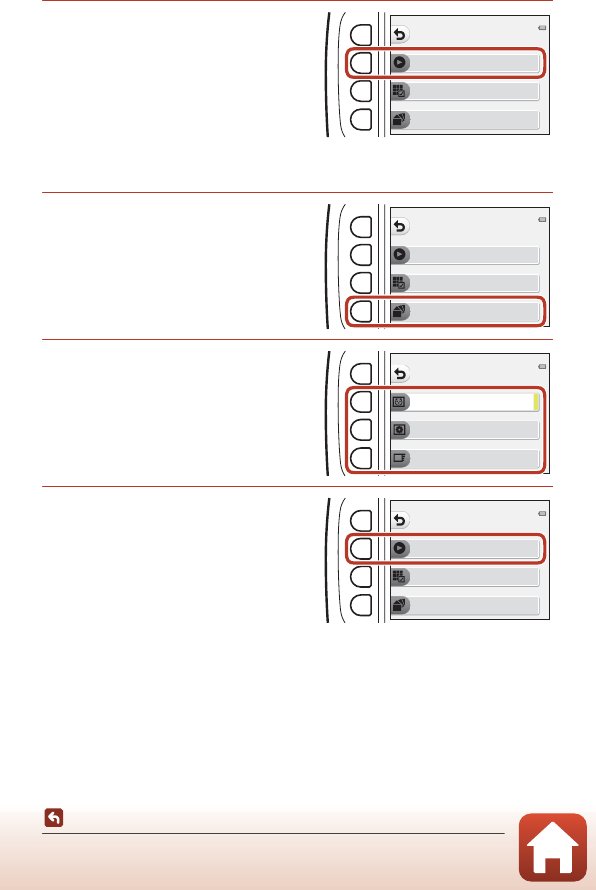
86
Playback Features
m Slide Show
6Press flexible button 2
(AStart).
•The slide show begins.
Choose a Theme
1Press flexible button 4
(nChoose a theme).
2Use flexible button 2, 3, or 4 to
select a playback theme.
•Select o Animated (default setting),
o Pop art, or p Classic.
3Press flexible button 2
(AStart).
•The slide show begins.
BNotes About Slide Show
The maximum playback time is up to about 30 minutes.
Start
Slide show
Choose pictures
Choose a theme
Start
Slide show
Choose pictures
Choose a theme
Animated
Choose a theme
Pop art
Classic
Start
Slide show
Choose pictures
Choose a theme
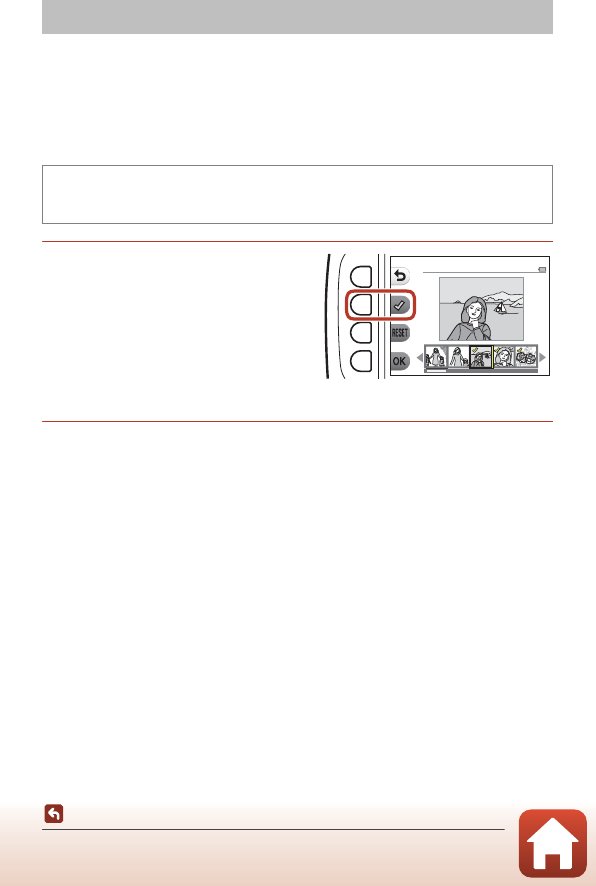
87
Playback Features
E Mark for Upload
Select images in the camera that you want to transfer to a smart device in advance
before transferring them.
•Movies cannot be selected. To upload movies to a smart device, use the
SnapBridge app.
•Note that when you select the Reset all (A122) or Network menu > Restore
default settings (A110) option in the camera settings menu, the Mark for
upload settings that you made are canceled.
1Use the multi selector JK to
select an image to upload and
press flexible button 2 (S).
•The selected image is indicated by a
check mark.
•A check mark is displayed or removed
every time you press flexible button 2
(S).
•Press flexible button 3 (P) to remove all check marks.
2Add check marks to all images that you want to upload and then
press flexible button 4 (O) to confirm the selection.
E Mark for Upload
Enter playback mode M flexible button 4 (l) M flexible button 2 (E Mark for
upload)
Mark for upload
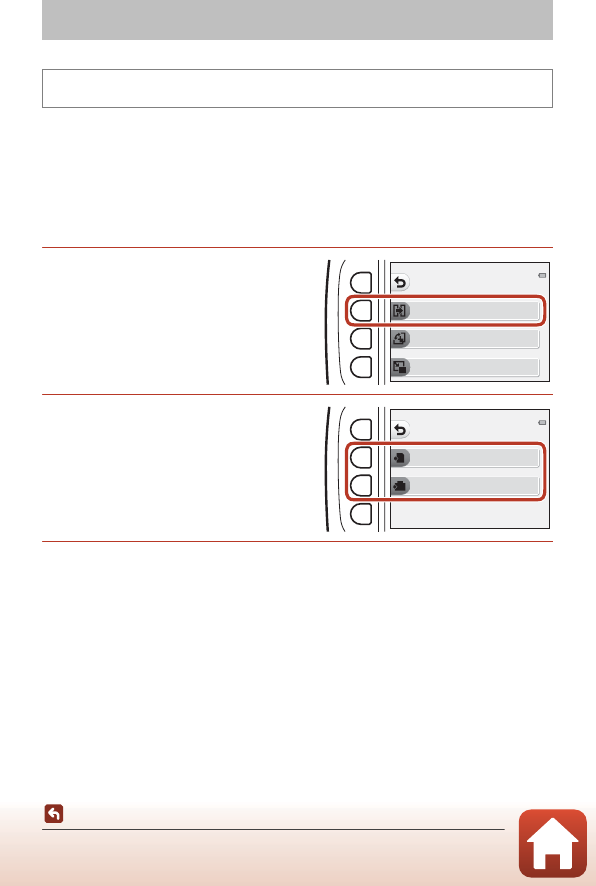
88
Playback Features
y Retouch
Copy or rotate images or create a small copy of the current image.
h Copy
Images can be copied between a memory card and the internal memory.
•When a memory card that contains no images is inserted and the camera is
switched to playback mode, Memory contains no images. is displayed. In that
case, press a flexible button and select flexible button 3 (y Retouch) to select
Copy.
1Press flexible button 2
(hCopy).
2Use flexible button 2
(kCamera to card) or flexible
button 3 (l Card to camera)
to select the copy source and
destination.
3Use flexible button 2 (j Selected images) or flexible button 3
(i All images) to select the copy method.
•When i All images is selected, proceed to step 6.
y Retouch
Enter playback mode M flexible button 4 (l) M flexible button 3 (y Retouch)
Copy
Retouch
Rotate pictures
Small picture
Camera to card
Copy
Card to camera
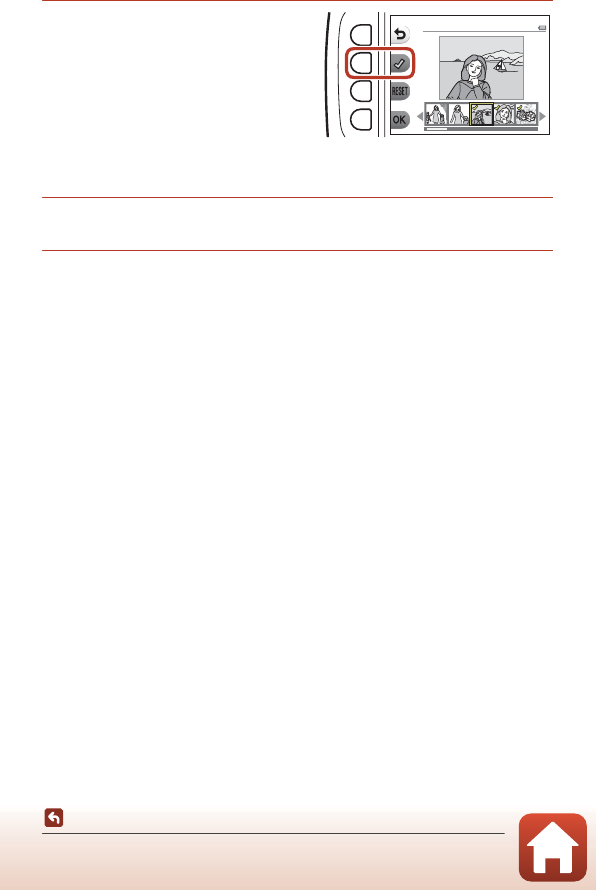
89
Playback Features
y Retouch
4Use the multi selector JK to
select an image and press
flexible button 2 (S).
•The selected image is indicated by a
check mark.
•A check mark is displayed or removed
each time you press flexible button 2
(S).
•Press flexible button 3 (P) to remove all check marks.
•Repeat step 4 to select additional images.
5Press flexible button 4 (O) to apply image selection.
•A confirmation dialog is displayed.
6Press flexible button 3 (R Yes).
•Images are copied.
BNotes About Copy
•Only files in formats that this camera can record can be copied.
•Operation is not guaranteed with images captured with another make of camera or that
have been modified on a computer.
•The Grade pictures (A74) and Add to favorites (A78) settings configured for
images are not copied.
Selected images
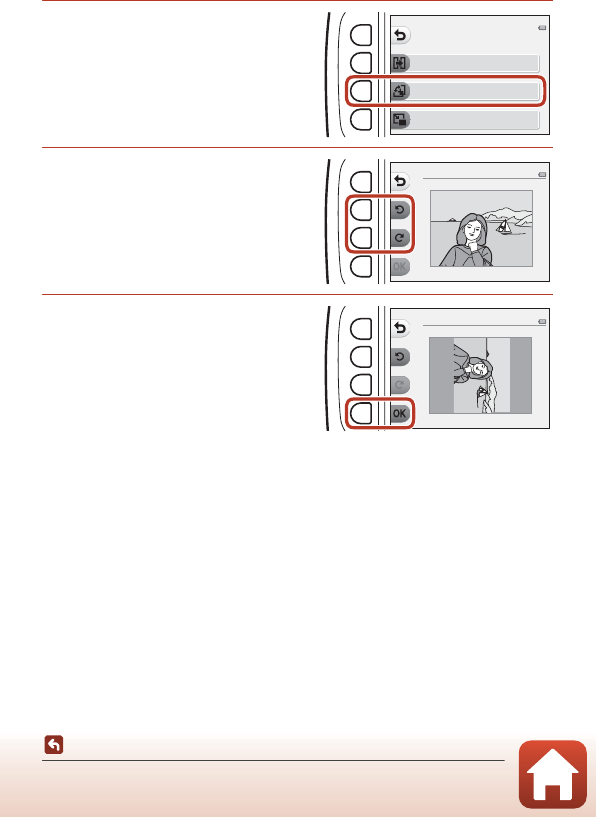
90
Playback Features
y Retouch
d Rotate Pictures
Specify the orientation in which saved images are displayed during playback.
Still images can be rotated 90 degrees clockwise or 90 degrees counterclockwise.
1Press flexible button 3
(dRotate pictures).
2Press flexible button 2 (e) or
flexible button 3 (f).
•The image is rotated 90 degrees.
3Press flexible button 4 (O).
•The displayed orientation is applied,
and the orientation information is
saved with the image.
Copy
Retouch
Rotate pictures
Small picture
Rotate pictures
Rotate pictures
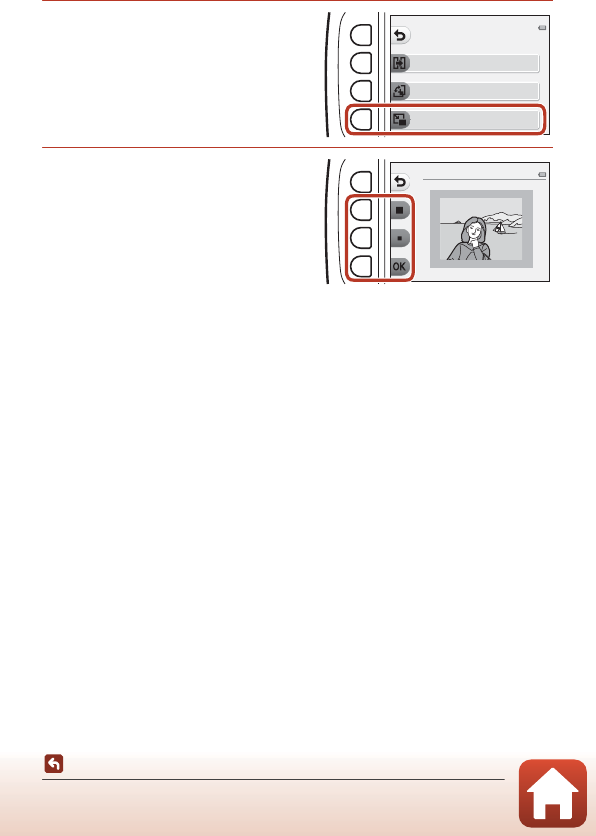
91
Playback Features
y Retouch
s Small Picture
Create a small copy of images.
1Press flexible button 4
(sSmall picture).
2Use flexible button 2 (D) or
flexible button 3 (E) to select
the desired copy size and press
flexible button 4 (O).
•A new, edited copy is saved as a
separate image with a compression
ratio of about 1:8.
•To cancel, press flexible button 1 (Q).
BNotes About Small Picture
Images with an image size of 640 × 480 or smaller cannot be edited using Small picture.
Copy
Retouch
Rotate pictures
Small picture
Small picture
1024×768
1024×768

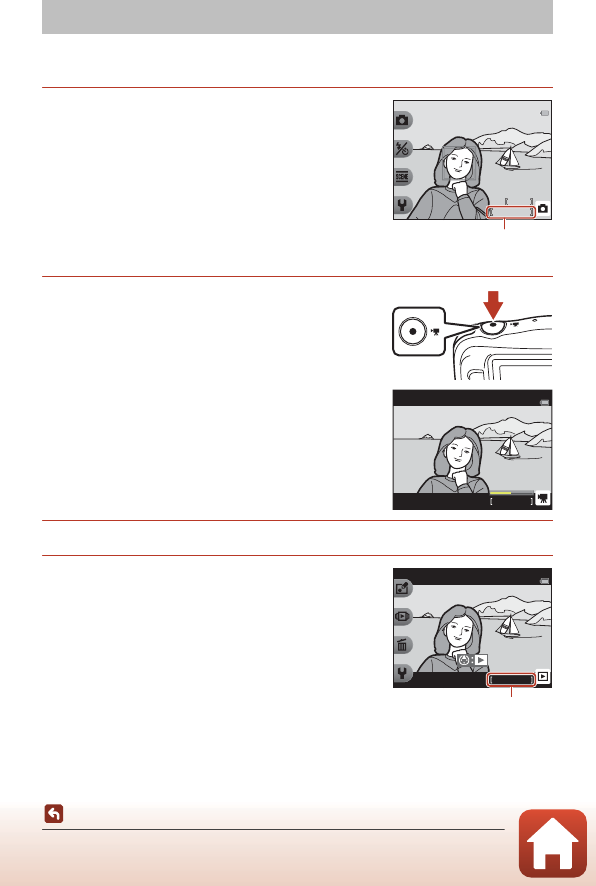
93
Movies
Recording and Playing Back Movies
•When using the camera’s internal memory, the movie frame size (A48) can be set
to H Small (640) or C Small (old-fashioned).
1Display the shooting screen.
•Check the remaining amount of movie recording
time.
2Press the b (e movie-record) button
to start movie recording.
•The camera focuses in the center of the frame.
3Press the b (e) button again to end recording.
4Select a movie in full-frame playback
mode and press the multi selector H.
•An image with a playback time displayed is a
movie.
Recording and Playing Back Movies
2100
2100
25m 0s
25m 0s
Remaining movie
recording time
12m30s
12m30s
15/11/2016
15/11/2016
15:30
15:30
10s
10s
Playback time

94
Movies
Recording and Playing Back Movies
Area Captured in Movies
•The area that is captured in a movie varies depending on Movie frame size
(A48).
•When recording movies while Electronic VR (A115) in the camera settings is set
to Auto, the angle of view (i.e., the area visible in the frame) is narrow compared to
that of still images.
Maximum Movie Recording Time
Individual movie files cannot exceed 4 GB in size or 29 minutes in length, even when
there is sufficient free space on the memory card for longer recording.
•The remaining recording time for a single movie is displayed on the shooting
screen.
•The actual remaining recording time may vary depending on the movie content,
subject movement, or type of memory card.
•Memory cards with an SD Speed Class rating of 6 or faster are recommended when
recording movies (A150). Movie recording may stop unexpectedly when
memory cards with a lower Speed Class rating are used.
BNotes About Camera Temperature
•The camera may become hot when shooting movies for an extended period of time or
when the camera is used in a hot area.
•If the inside of the camera becomes extremely hot when recording movies, the camera
will automatically stop recording.
The amount of time remaining until the camera stops recording (u10s) is displayed.
After the camera stops recording, it turns itself off.
Leave the camera off until the inside of the camera has cooled.

95
Movies
Recording and Playing Back Movies
Notes About Movie Recording
BNotes About Saving Images or Movies
The indicator showing the number of exposures remaining or the indicator showing the
remaining recording time flashes while images or movies are being saved. Do not open
the battery-chamber/memory card slot cover or remove the battery or memory
card while an indicator is flashing. Doing this could result in loss of data, or in damage to the
camera or the memory card.
BNotes About Recorded Movies
•The optical zoom ratio cannot be changed once recording starts.
•There may be some degradation in image quality when digital zoom is used.
•The sounds of multi selector operation, autofocus lens drive movement, and aperture
operation when brightness changes may be recorded.
•The following phenomena may be seen on the screen while recording movies. These
phenomena are saved in the recorded movies.
- Banding may occur in images under fluorescent, mercury-vapor, or sodium-vapor
lighting.
- Subjects that move quickly from one side of the frame to the other, such as a moving
train or car, may appear skewed.
- The entire movie image may be skewed when the camera is panned.
- Lighting or other bright areas may leave residual images when the camera is moved.
•Depending on the distance to the subject or the amount of zoom applied, colored stripes
may appear on subjects with repeating patterns (fabrics, lattice windows, etc.) during
movie recording and playback. This occurs when the pattern in the subject and the layout
of the image sensor interfere with each other; it is not a malfunction.
BNotes About Autofocus for Movie Recording
Autofocus may not perform as expected (A51). Should this occur, try the following:
Frame another subject (positioned at the same distance from the camera as the intended
subject) in the center of the frame, press the b (e movie-record) button to start recording,
and then modify the composition.
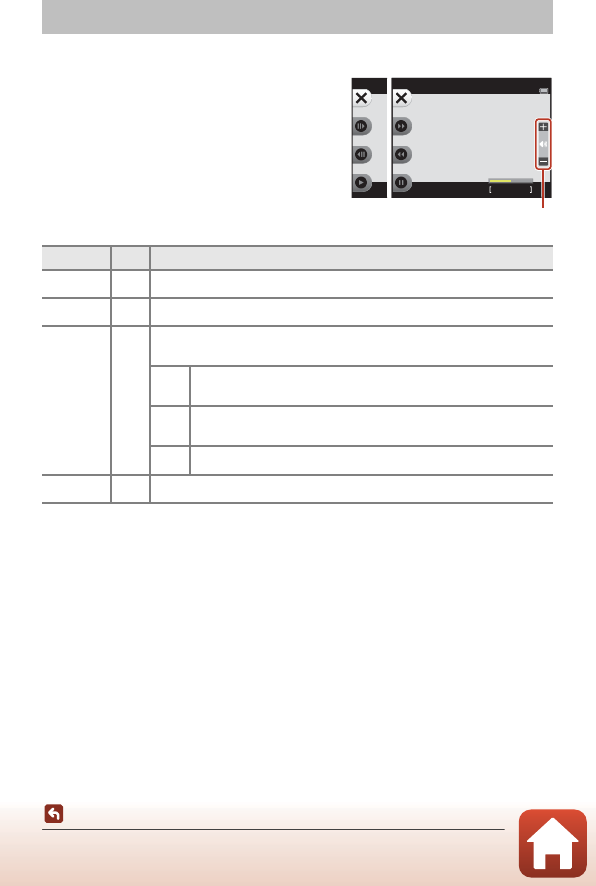
96
Movies
Operations During Movie Playback
To adjust the volume, press the multi selector
HI while a movie is playing.
You can use the flexible buttons to perform
the following operations.
Operations During Movie Playback
Function Icon Description
Advance BHold down the button to advance the movie.
Rewind CHold down the button to rewind the movie.
Pause D
Pause playback. The operations listed below can be performed while
paused.
EAdvance the movie one frame. Hold down the button for
continuous advancing.
FRewind the movie one frame. Hold down the button for
continuous rewinding.
AResume playback.
End SReturn to full-frame playback mode.
5 s
5s
When
paused
During playback
Volume indicator

97
Connecting the Camera to a TV, Printer, or Computer
Connecting the Camera to a TV,
Printer, or Computer
Utilizing Images ....................................................................................................................98
Viewing Images on a TV.....................................................................................................99
Printing Images Without a Computer........................................................................100
Transferring Images to a Computer (ViewNX-i) .....................................................104
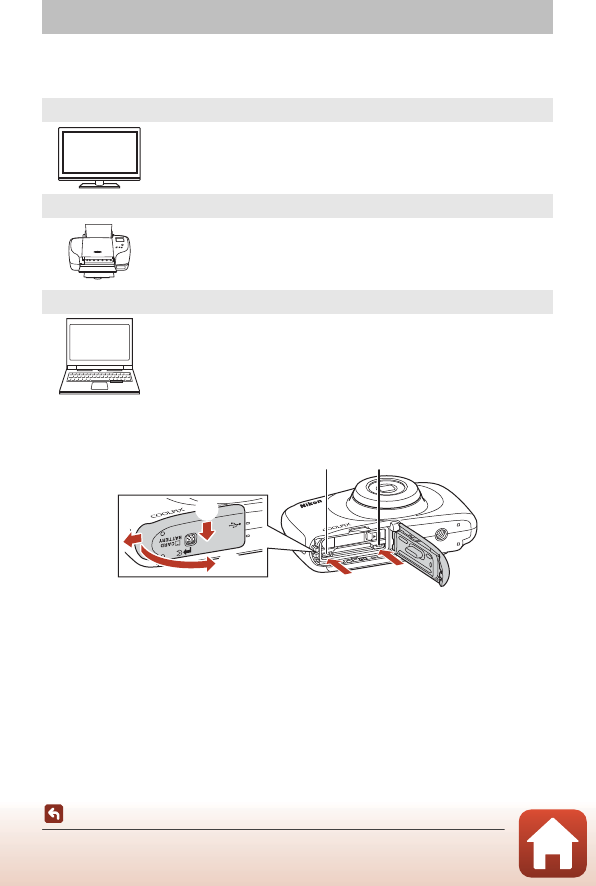
98
Connecting the Camera to a TV, Printer, or Computer
Utilizing Images
In addition to using the SnapBridge app (Aiii) to enjoy the captured images, you can
also utilize the images in various ways by connecting the camera to the devices
described below.
BNotes About Connecting Cables to the Camera
•Make sure to turn the camera off before openning the cover. Check there are no water
droplets. If there are water droplets, wipe the camera with a soft dry cloth.
•Make sure to turn the camera off before connecting or disconnecting cables. Check the
shape and direction of the plugs and do not insert or remove the plugs at an angle.
•Make sure that the camera battery is sufficiently charged. If the EH-62G AC Adapter (available
separately) is used, this camera can be powered from an electrical outlet. Do not use any
other make or model of AC adapter as it may cause the camera to heat up or malfunction.
•For information about the connection methods and subsequent operations, refer to the
documentation included with the device in addition to this document.
Utilizing Images
Viewing Images on a TV
Images and movies captured with the camera can be viewed on a TV.
Connection method: Connect a commercially available HDMI cable
to the TV’s HDMI input jack.
Printing Images Without a Computer
If you connect the camera to a PictBridge-compatible printer, you can
print images without using a computer.
Connection method: Connect the camera directly to the printer’s USB
port with the USB cable.
Transferring Images to a Computer (ViewNX-i)
You can transfer images and movies to a computer for viewing and
editing.
Connection method: Connect the camera to the computer’s USB port
with the USB cable.
•Before connecting to a computer, install ViewNX-i on the computer.
3
1
2
Insert the plug straight.
HDMI micro connector (Type D)
Open the cover.
Micro-USB connector
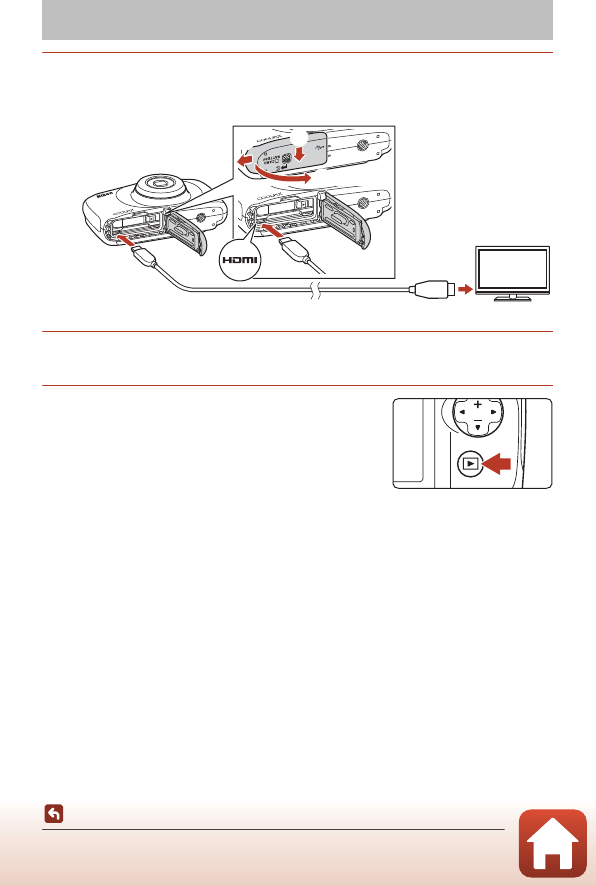
99
Connecting the Camera to a TV, Printer, or Computer
Viewing Images on a TV
1Turn off the camera and connect it to the TV.
•Check the shape and direction of the plugs and do not insert or remove the plugs at
an angle.
2Set the TV’s input to external input.
•See the documentation provided with your TV for details.
3Press and hold down the c (shooting/
playback mode) button to turn on the
camera.
•Images are displayed on the TV.
•The camera screen does not turn on.
Viewing Images on a TV
3
1
2
HDMI micro connector (Type D) to HDMI jack
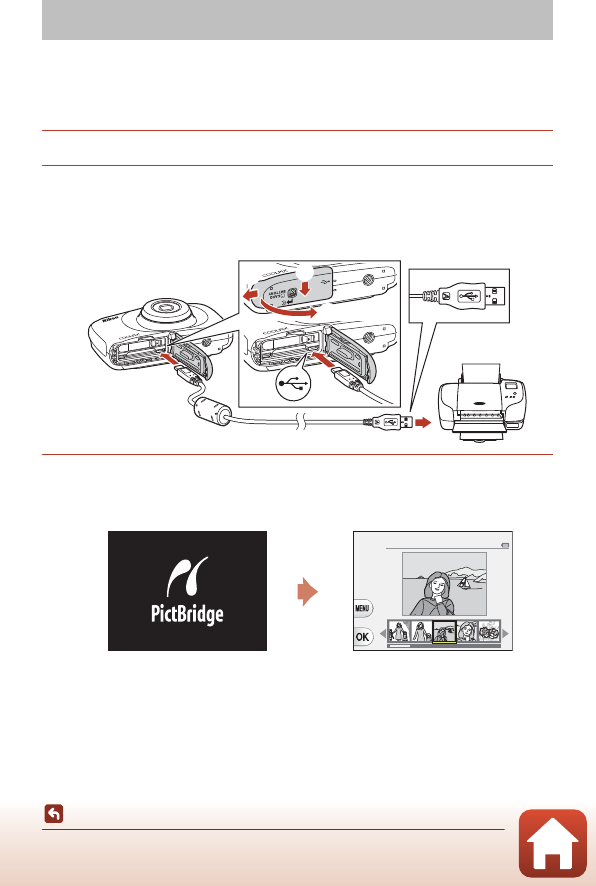
100
Connecting the Camera to a TV, Printer, or Computer
Printing Images Without a Computer
Users of PictBridge-compatible printers can connect the camera directly to the printer
and print images without using a computer.
Connecting the Camera to a Printer
1Turn on the printer.
2Turn off the camera and connect it to the printer using the USB
cable.
•Check the shape and direction of the plugs and do not insert or remove the plugs at
an angle.
3The camera is automatically turned on.
•The PictBridge startup screen (1) is displayed in the camera screen, followed by
the Print selection screen (2).
Printing Images Without a Computer
3
1
2
Print selection
12
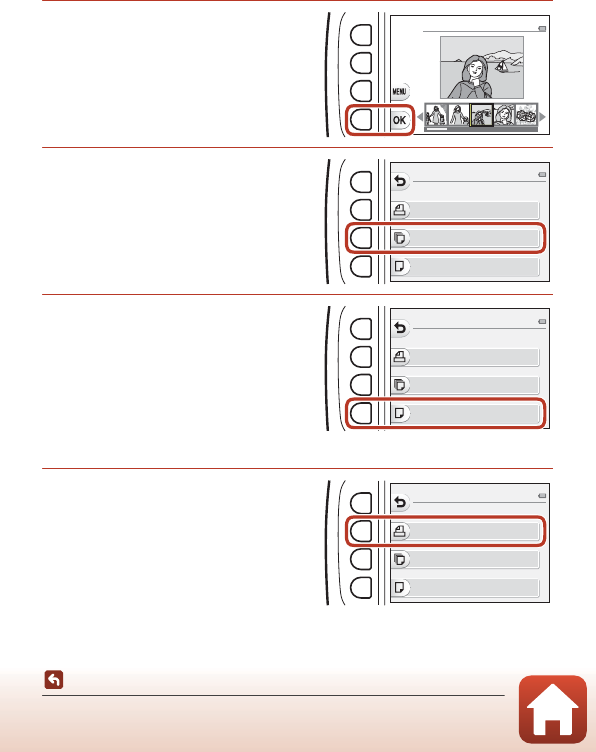
101
Connecting the Camera to a TV, Printer, or Computer
Printing Images Without a Computer
BIf the PictBridge Startup Screen Is Not Displayed
When Auto is selected for Charge by computer (A121), it may be impossible to print
images with direct connection of the camera to some printers. If the PictBridge startup
screen is not displayed after the camera is turned on, turn the camera off and disconnect the
USB cable. Set Charge by computer to Off and reconnect the camera to the printer.
Printing Images One at a Time
1Use the multi selector JK to
select the desired image and
press flexible button 4 (O).
2Press flexible button 3
(bCopies).
•Use HI to set the desired number of
copies (up to 9) and press flexible
button 4 (O).
3Press flexible button 4
(cPaper size).
•Use JK to select the paper size and
press flexible button 4 (O).
•To print with the paper size setting
configured on the printer, select
Default.
•The paper size options available on the
camera vary depending on the printer that you use.
4Press flexible button 2
(aStart print).
•Printing starts.
Print selection
Start print
Copies
Paper size
PictBridge
1 prints
Start print
Copies
Paper size
PictBridge
4 prints
Start print
Copies
Paper size
PictBridge
4 prints
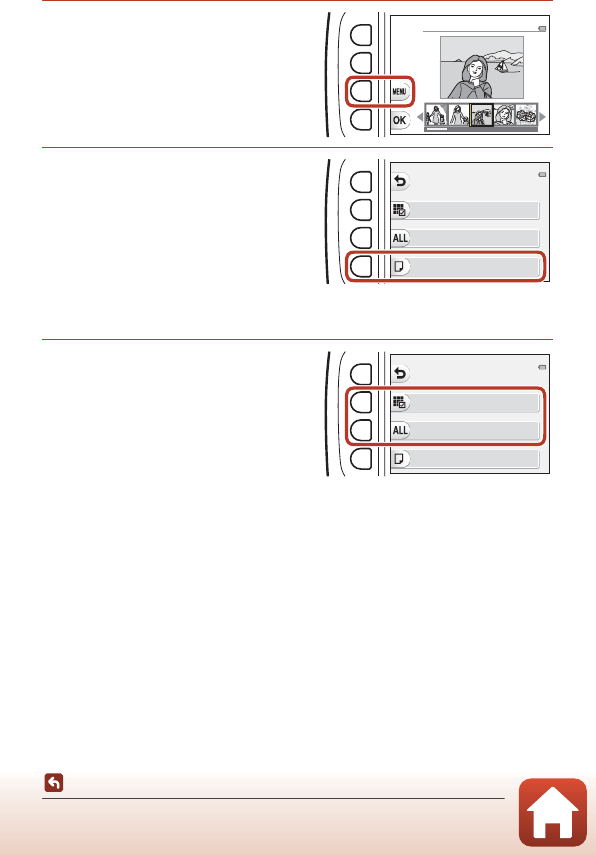
102
Connecting the Camera to a TV, Printer, or Computer
Printing Images Without a Computer
Printing Multiple Images
1When the Print selection
screen is displayed, press
flexible button 3 (p).
2Press flexible button 4
(cPaper size).
•Use JK to select the paper size and
press flexible button 4 (O).
•To print with the paper size setting
configured on the printer, select
Default.
•The paper size options available on the
camera vary depending on the printer that you use.
•To exit the print menu, press flexible button 1 (Q).
3Press flexible button 2 or 3 to
select the print method.
•Select o Print selection or k Print
all images.
Print selection
Print selection
Print all images
Print menu
Paper size
Print selection
Print all images
Print menu
Paper size
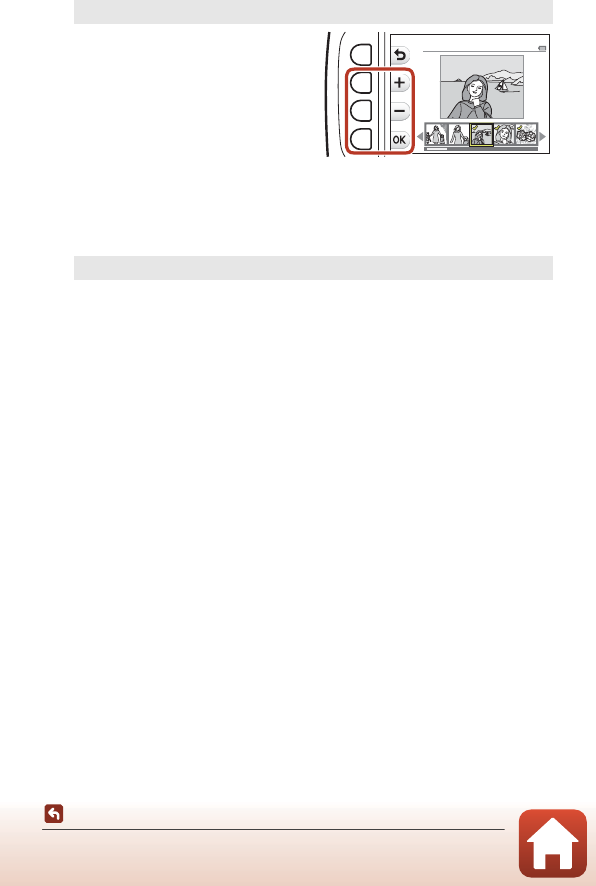
103
Connecting the Camera to a TV, Printer, or Computer
Printing Images Without a Computer
Print selection
Select images (up to 99) and the
number of copies (up to 9) of
each.
•Use the multi selector JK to
select images, and use flexible
button 2 (X) or flexible button
3 (Y) to specify the number of
copies to be printed.
•Images selected for printing
are indicated by a check mark and the number of copies to be printed. To
cancel the print selection, set the number of copies to 0.
•Press flexible button 4 (O) when setting is complete. When the screen for
confirming the number of print copies is displayed, press flexible button 2
(a Start print) to start printing.
Print all images
One copy each of all images saved in the internal memory, or on the memory
card, is printed.
•When the screen for confirming the number of print copies is displayed,
press flexible button 2 (a Start print) to start printing.
Print selection
111122
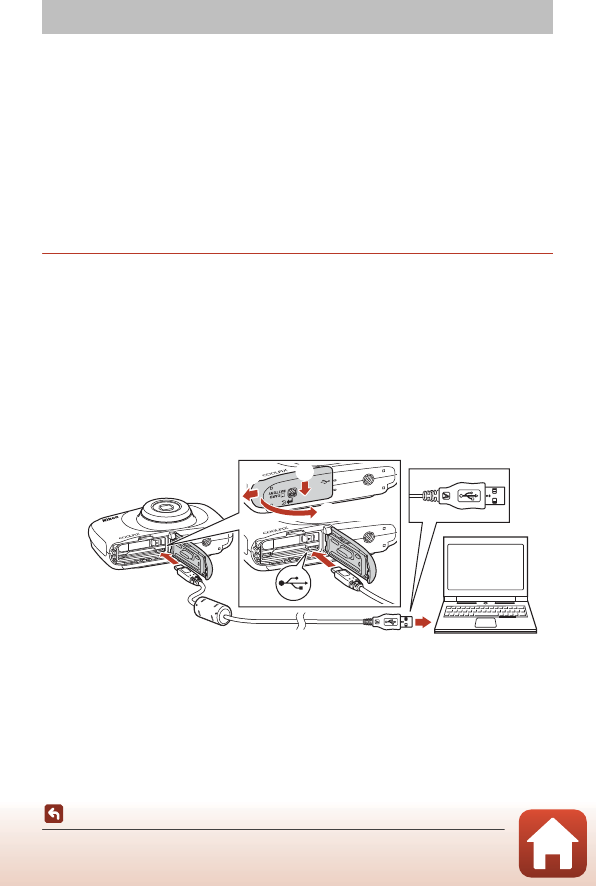
104
Connecting the Camera to a TV, Printer, or Computer
Transferring Images to a Computer (ViewNX-i)
Installing ViewNX-i
ViewNX-i is free software that enables you to transfer images and movies to your
computer for viewing and editing.
To install ViewNX-i, download the latest version of the ViewNX-i installer from the
following website and follow the on-screen instructions to complete installation.
ViewNX-i: http://downloadcenter.nikonimglib.com
For system requirements and other information, see the Nikon website for your
region.
Transferring Images to a Computer
1Prepare a memory card that contains images.
You can use any of the methods below to transfer images from the memory card to a
computer.
•SD memory card slot/card reader: Insert the memory card into the card slot of
your computer or the card reader (commercially available) that is connected to the
computer.
•Direct USB connection: Turn the camera off and ensure that the memory card is
inserted in the camera. Connect the camera to the computer using the USB cable.
The camera automatically turns on.
To transfer images that are saved in the camera’s internal memory, remove the
memory card from the camera before connecting it to the computer.
BNotes About Connecting the Camera to a Computer
Disconnect all other USB-powered devices from the computer. Connecting the camera and
other USB-powered devices to the same computer simultaneously may cause a camera
malfunction or excessive power supply from the computer, which could damage the
camera or memory card.
Transferring Images to a Computer (ViewNX-i)
3
1
2
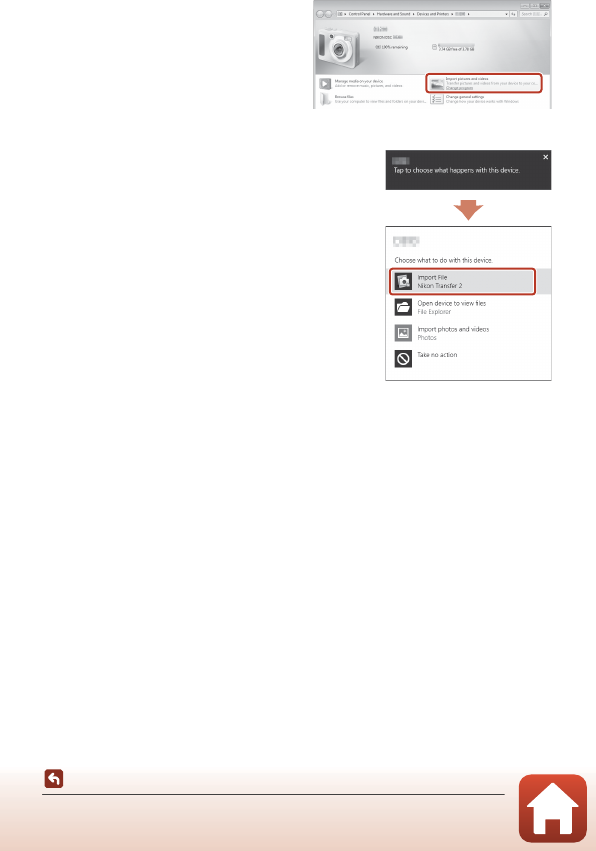
105
Connecting the Camera to a TV, Printer, or Computer
Transferring Images to a Computer (ViewNX-i)
If a message is displayed prompting you to choose a program, select Nikon Transfer 2.
•When using Windows 7
If the dialog shown at right is
displayed, follow the steps below to
select Nikon Transfer 2.
1Under Import pictures and
videos, click Change program. A
program selection dialog will be
displayed; select Nikon Transfer 2
and click OK.
2 Double-click the Nikon Transfer 2 icon.
•When using Windows 10 or Windows 8.1
If the dialog shown on the right is displayed, click
the dialog and then click Import File/Nikon
Transfer 2.
•When using Mac OS X
If Nikon Transfer 2 does not automatically start, launch the Image Capture
application that comes bundled with Mac while the camera and your computer are
connected, and select Nikon Transfer 2 as the default application to open when the
camera is connected to your computer.
If the memory card contains a large number of images, it may take a while for Nikon
Transfer 2 to start. Wait until Nikon Transfer 2 starts.
BNotes About Connecting the USB Cable
Operation is not guaranteed if the camera is connected to the computer via a USB hub.
CUsing ViewNX-i
Consult online help for more information.
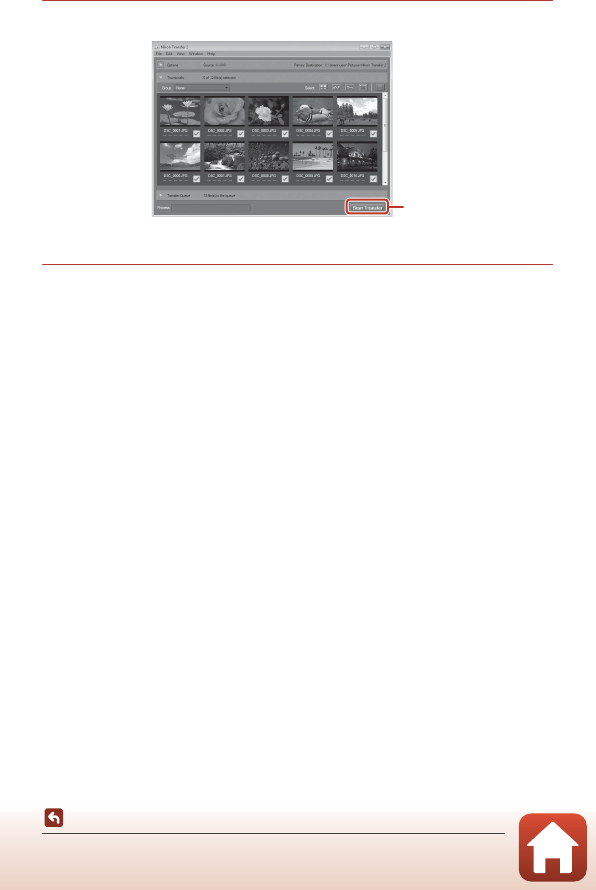
106
Connecting the Camera to a TV, Printer, or Computer
Transferring Images to a Computer (ViewNX-i)
2After Nikon Transfer 2 starts, click Start Transfer.
•Image transfer begins. When image transfer is complete, ViewNX-i starts and the
transferred images are displayed.
3Terminate the connection.
•If you are using a card reader or card slot, choose the appropriate option in the
computer operating system to eject the removable disk corresponding to the
memory card and then remove the memory card from the card reader or card slot.
•If the camera is connected to the computer, turn the camera off and disconnect the
USB cable.
Start Transfer

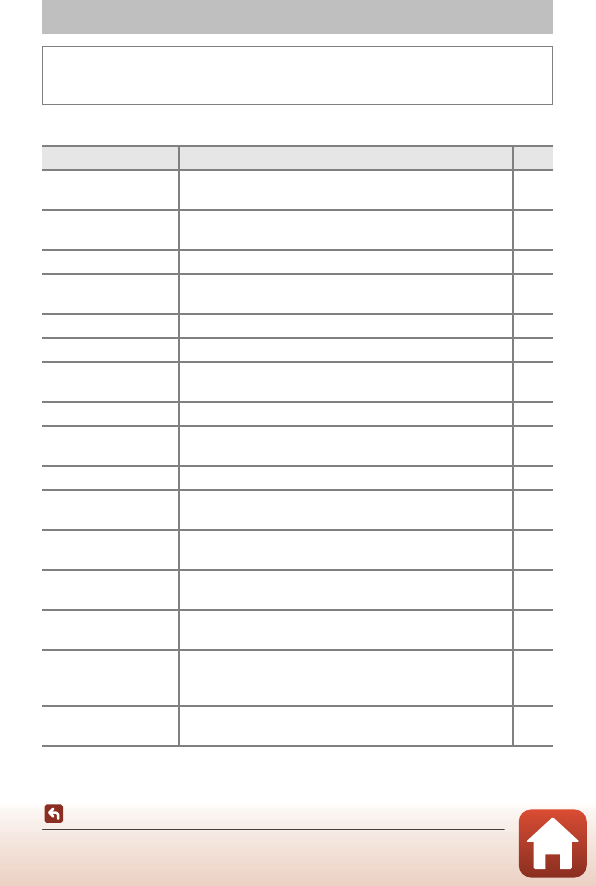
108
General Camera Setup
Camera Settings Menu
The settings of the menu options listed below can be configured.
Camera Settings Menu
Enter shooting mode or playback mode M flexible button 4 (l) M flexible
button 4 (l Camera settings)
Option Description A
Network menu Allows you to configure the wireless network settings to
connect the camera and a smart device. 110
Welcome screen Allows you to select whether or not the welcome screen is
displayed when the camera is turned on. 111
Date and time Allows you to set the camera clock. 112
Variety menu Allows you to set whether to use all of the camera’s
functions. 113
Brightness Allows you to adjust the brightness of the screen. 114
Date stamp Allows you to imprint the shooting date on images. 114
Electronic VR Allows you to choose whether to use electronic VR
(vibration reduction) when shooting. 115
AF assist Allows you to enable or disable the AF-assist illuminator. 116
Format card/
Format memory
Allows you to format the memory card or the internal
memory. 117
Language Allows you to change the camera’s display language. 118
Image comment Allows you to attach a comment that was previously
registered to images that will be captured. 118
Copyright
information
Allows you to attach the copyright information that was
previously registered to images that will be captured. 119
Location data Allows you to set whether or not to add shooting location
information to the images that you take. 120
Menu background Allows you to change the background used on the menu
screen. 120
Charge by computer
Allows you to set whether or not the battery in the
camera is charged when the camera is connected to a
computer.
121
Reset all Allows you to reset the camera’s settings to their default
values. 122
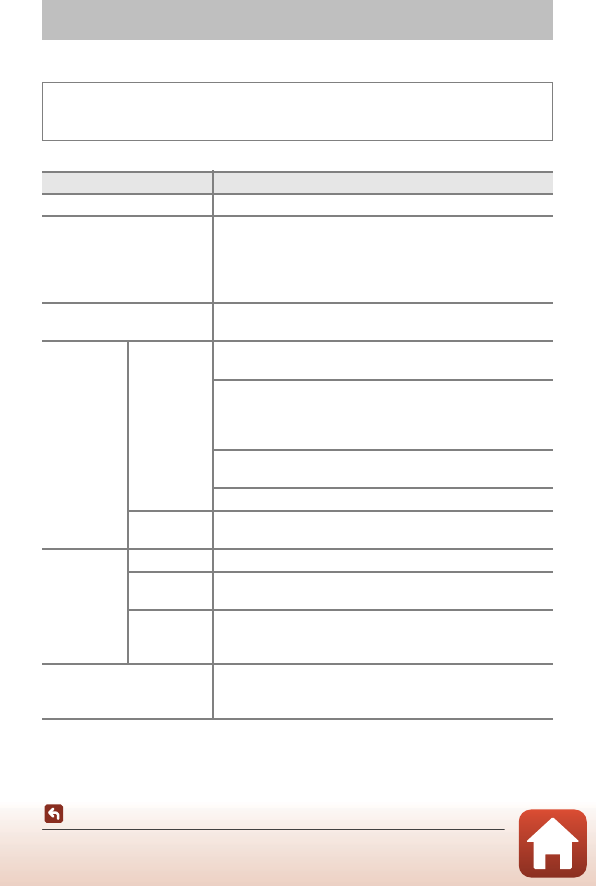
110
General Camera Setup
l Camera Settings
Network Menu
Configure the wireless network settings to connect the camera and a smart device.
* See “Operating the Text Input Keyboard” (A111) for information on how to enter
alphanumeric characters.
l Camera Settings
Enter shooting mode or playback mode M flexible button 4 (l) M flexible
button 4 (l Camera settings) M press HI M C Network menu
Option Description
Q Airplane mode Select On to turn off all wireless connections.
V Connect to smart device
Select when pairing a smart device with the camera. This
setting cannot be selected while a wireless connection is
established.
See step 2 (A16) in “Setup from a Smartphone or Tablet”
for more information.
S Send while shooting Set the conditions for automatically sending images to a
smart device.
C Wi-Fi
l Network
settings
SSID*: Change the SSID. Set a 1- to 32-character
alphanumeric SSID.
Auth./encryp.: Select whether or not to encrypt the
communications between the camera and the connected
smart device.
Communications are not encrypted when Open is selected.
Password*: Set the password. Set an 8- to 36-character
alphanumeric password.
Channel: Select the channel used for wireless connections.
O Current
settings Display the current settings.
B Bluetooth
B
Connection
Select Disable to turn off Bluetooth communication.
W Paired
devices
Change the smart device to connect with, or delete the
pairing with the smart device.
U Send
while off
Set whether or not to allow the camera to communicate
with the smart device when the camera is off or in standby
mode (A25).
S Restore default settings
Restore all network menu settings to their default values.
This setting cannot be selected while a wireless connection
is established.
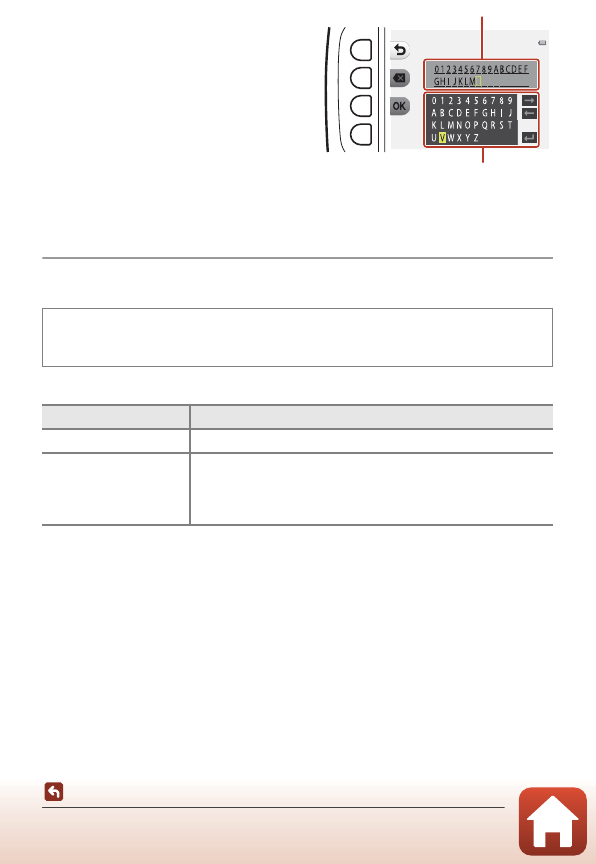
111
General Camera Setup
l Camera Settings
Operating the Text Input Keyboard
•Use the multi selector HIJK to select
alphanumeric characters. Press flexible
button 3 (O) to enter the selected
character in the text field and move the
cursor to the next space.
•To move the cursor in the text field, select
N or O on the keyboard, and press
flexible button 3 (O).
•To delete one character, press flexible
button 2 (D).
•To apply the setting, select P on the
keyboard and press flexible button 3
(O).
Welcome Screen
Select whether or not the welcome screen is displayed when you turn on the camera.
Enter shooting mode or playback mode M flexible button 4 (l) M flexible
button 4 (l Camera settings) M press HI M I Welcome screen
Option Description
hOff Does not display the welcome screen.
iOn (default setting)
Displays an animated welcome screen. The characters and
background that are displayed change according to how often
you use the camera, how many images you have taken with
the camera, etc.
SSID
Text field
Keyboard
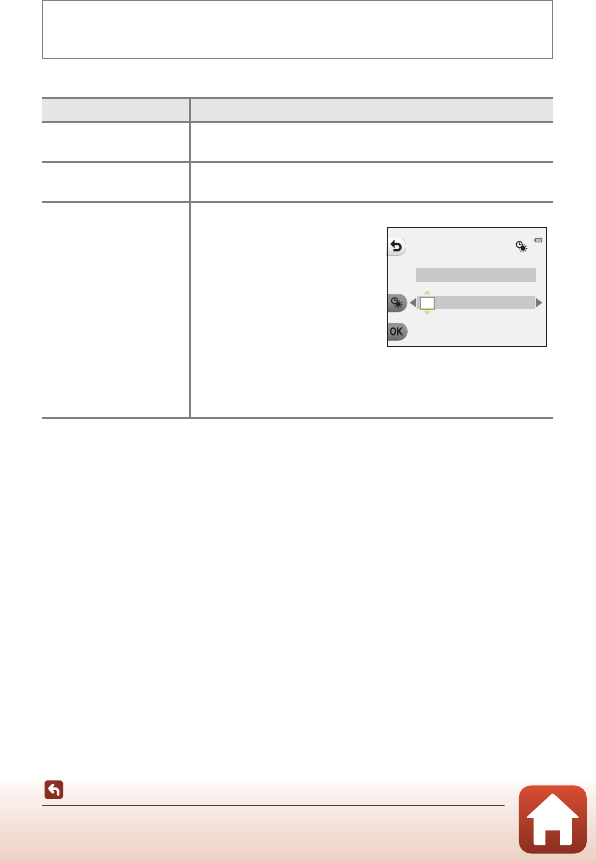
112
General Camera Setup
l Camera Settings
Date and Time
Set the camera clock.
Enter shooting mode or playback mode M flexible button 4 (l) M flexible
button 4 (l Camera settings) M press HI M J Date and time
Option Description
WSync with smart
device
Set whether or not to synchronize the date and time setting
with a smart device.
jDate format Select Year/Month/Day, Month/Day/Year, or Day/Month/
Year.
JDate and time
Set the date and time if Sync with smart device is set to Off.
•Select a field: Press the
multi selector JK.
•Edit the date and time:
Press HI.
•Apply the setting:
Select the
minute setting and press
flexible button 4 (
O
).
•Set daylight saving time:
Press flexible button 3 (m)
to display m on the screen and enable daylight saving time.
To disable daylight saving time, press flexible button 3 (m)
again.
Date and time
DM Y hm
01 /
01
/2016 00 :00
113
General Camera Setup
l Camera Settings
Variety Menu
Set whether or not to use all of the camera’s functions.
The following functions are disabled.
•Shooting functions
-g M Choose a style M Add a bubble effect (A40), Add a neon effect
(A40), Add a cartoon effect (A40)
-l M Change sounds M Turn sounds on or off (A45)
-l M Choose a size M Movie frame size M Small (old-fashioned) (A48)
•Playback functions
-V M Picture play M Make photo albums (A64)
-Z M Slide show M Choose a theme (A86)
•Camera settings
-l M Camera settings M Welcome screen (A111)
-l M Camera settings M Menu background (A120)
The following functions change.
•Fewer types of frames are available in g M Decorate (A43)
•You will not be able to select sounds by using l M Change sounds (A45) M
Pick a shutter sound and Pick a button sound
•Fewer types of frames are available in V M Picture play M Decorate (A70)
•V M Grading (A74) changes to Favorites (A78)
•l M Camera settings M Menu background (A120) design is fixed at 5.
Enter shooting mode or playback mode M flexible button 4 (l) M flexible
button 4 (l Camera settings) M press HI M h Variety menu
Option Description
h On Enables use of all functions.
b Off Some functions are restricted as follows.
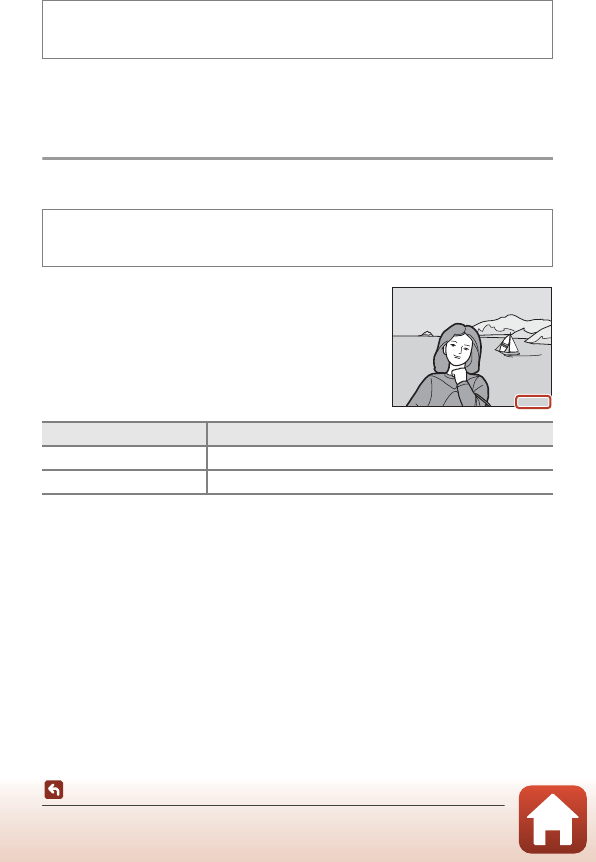
114
General Camera Setup
l Camera Settings
Brightness
Adjust the brightness. The default setting is 3.
•Use the multi selector JK to select the desired brightness and press flexible
button 4 (O).
Date Stamp
The shooting date can be stamped on images when
shooting.
BNotes About Date Stamp
•Stamped dates form a permanent part of image data and cannot be deleted. The date
cannot be stamped on images after they have been captured.
•The date cannot be stamped in the following situations:
- When using Take a series of pictures
-Shoot a movie miniature
-Add light trails
- When shooting movies
Enter shooting mode or playback mode M flexible button 4 (l) M flexible
button 4 (l Camera settings) M press HI M K Brightness
Enter shooting mode or playback mode M flexible button 4 (l) M flexible
button 4 (l Camera settings) M press HI M L Date stamp
Option Description
LDate Date is stamped on images.
bOff (default setting) Date is not stamped on images.
15.11.2016
15.11.2016
115
General Camera Setup
l Camera Settings
Electronic VR
Select the electronic VR (vibration reduction) setting used when shooting.
BNotes About Electronic VR
•Electronic VR is disabled while the flash is used.
•If the exposure period exceeds a certain period of time, electronic VR will not function.
•Electronic VR cannot be used when using the following styles.
-Shoot night scenes (A37)
-Shoot at intervals (A38)
-Take a series of pictures (A39)
-Photograph fireworks (A39)
-Shoot backlit scenes (A39)
-Add light trails (A42)
•Even when electronic VR is set to Auto, depending on the shooting conditions (A32)
automatically selected by the camera when using A Point and shoot mode, the
electronic VR may not function.
•The effectiveness of electronic VR decreases as camera shake increases.
•Images may contain noise.
Enter shooting mode or playback mode M flexible button 4 (l) M flexible
button 4 (l Camera settings) M press HI M M Electronic VR
Option Description
MAuto
In the following conditions, the effects of camera shake are
reduced when shooting.
•When the flash mode is set to y Flash off
•When the shutter speed is slow
•When the subject is dark
Vibration reduction is always applied during movie
recording.
bOff (default setting) Electronic VR is disabled.
116
General Camera Setup
l Camera Settings
AF Assist
Enter shooting mode or playback mode M flexible button 4 (l) M flexible
button 4 (l Camera settings) M press HI M r AF assist
Option Description
u Auto (default setting)
The AF-assist illuminator automatically lights up when you
press the shutter-release button under dim lighting. The
illuminator has a range of about 1.9 m (6 ft 2 in.) at the
maximum wide-angle position and about 1.7 m (5 ft 6 in.) at
the maximum telephoto position.
•Note that for some settings, the AF-assist illuminator may
not light.
b Off The AF-assist illuminator does not light.
117
General Camera Setup
l Camera Settings
Format Card/Format Memory
Use this option to format a memory card or the internal memory.
Formatting the memory cards or internal memory permanently deletes all
data. Data that has been deleted cannot be recovered. Make sure to save
important images to a computer before formatting.
Formatting a Memory Card
•Insert a memory card into the camera.
•Select Format card in the camera settings menu.
Formatting the Internal Memory
•Remove the memory card from the camera.
•Select Format memory in the camera settings menu.
To start formatting, press flexible button 3 (R Format) on the screen that is
displayed.
•Do not turn the camera off or open the battery-chamber/memory card slot cover
during formatting.
•This setting cannot be selected while a wireless connection is established.
BNotes About Format card/Format memory
You cannot format while image lock (A29) is set. Remove image lock.
Enter shooting mode or playback mode M flexible button 4 (l) M flexible
button 4 (l Camera settings) M press HI M N Format card/O Format
memory
118
General Camera Setup
l Camera Settings
Language
Select a language for display of camera menus and messages.
Image Comment
Attach a comment that was previously registered to images that will be captured.
You can imprint the attached comment to images that will be sent to a smart device
using an application (A21).
You can also check with ViewNX-i metadata.
CImage Comments Display
Image comments are not displayed even if images are played back on the camera.
Enter shooting mode or playback mode M flexible button 4 (l) M flexible
button 4 (l Camera settings) M press HI M P Language
Enter shooting mode or playback mode M flexible button 4 (l) M flexible
button 4 (l Camera settings) M press HI M J Image comment
Option Description
J Attach comment
A comment registered with Input comment is attached to
images.
•When you press flexible button 2 (J On), the setting is
enabled, and the comment will be attached to the images
captured afterwards.
K Input comment
You can register a comment of up to 36 alphanumeric characters.
•See “Operating the Text Input Keyboard” (A111) for
information about the input method.
119
General Camera Setup
l Camera Settings
Copyright Information
Attach the copyright information that was previously registered to images that will be
captured.
You can imprint the attached copyright information to images that will be sent to a
smart device using an application (A21).
You can also check with ViewNX-i metadata.
BNotes About Copyright Information
•To prevent illegal use of artist names and copyright owner names when lending or
transferring ownership of the camera, make sure to disable the Attach copyright info
setting. Also, make sure that the artist name and copyright owner name are blank.
•Nikon is not responsible for any kind of trouble or damage resulting from the use of
Copyright information.
CCopyright Information Display
Copyright information is not displayed even if images are played back on the camera.
Enter shooting mode or playback mode M flexible button 4 (l) M flexible
button 4 (l Camera settings) M press HI M L Copyright information
Option Description
L Attach copyright
info
Copyright information registered with Artist and Copyright is
attached to images.
•When you press flexible button 2 (L On), the setting is
enabled, and the copyright information will be attached to the
images captured afterwards.
N Artist
You can register an artist name of up to 36 alphanumeric
characters.
•See “Operating the Text Input Keyboard” (A111) for
information about the input method.
M Copyright
You can register a copyright owner name of up to 54
alphanumeric characters.
•See “Operating the Text Input Keyboard” (A111) for
information about the input method.
120
General Camera Setup
l Camera Settings
Location Data
Set whether or not to add shooting location information to the images that you take.
Menu Background
Select one of five different background designs to be used for a menu screen or
thumbnail playback mode.
•Use the multi selector JK to select the desired design and press flexible button 4
(O).
•To restore the default background designs, press flexible button 3 (P).
Enter shooting mode or playback mode M flexible button 4 (l) M flexible
button 4 (l Camera settings) M press HI M P Location data
Option Description
W Download from device
Select flexible button 2 (W On) to add location
information from a smart device to the images that you
take. Enable the location information function of the
SnapBridge app.
O Position
Display the obtained location information.
•The information is not updated while it is being
displayed. To update it, perform Position again.
Enter shooting mode or playback mode M flexible button 4 (l) M flexible
button 4 (l Camera settings) M press HI M Q Menu background
121
General Camera Setup
l Camera Settings
Charge by Computer
BNotes About Charging with a Computer
•When connected to a computer, the camera turns on and starts charging. If the camera is
turned off, charging stops.
•About 2 hours and 30 minutes are required to charge a fully exhausted battery. Charging
time increases when images are transferred while the battery is charging.
•The camera turns off automatically if there is no communication with the computer for 30
minutes after the battery has finished charging.
BWhen the Charge Lamp Quickly Flashes
Charging cannot be performed, possibly due to one of the reasons described below.
•The ambient temperature is not suited to charging. Charge the battery indoors with an
ambient temperature of 5°C to 35°C (41°F to 95°F).
•The USB cable is not connected correctly, or the battery is faulty. Make sure the USB cable
is connected correctly or replace the battery if necessary.
•The computer is in sleep mode and is not supplying power. Wake up the computer.
•The battery cannot be charged because the computer cannot supply power to the
camera due to the computer’s settings or its specifications.
Enter shooting mode or playback mode M flexible button 4 (l) M flexible
button 4 (l Camera settings) M press HI M g Charge by computer
Option Description
u Auto
(default setting)
When the camera is connected to a computer that is running (A98),
the battery inserted into the camera is automatically charged using
power supplied by the computer.
b Off The battery inserted into the camera is not charged when the camera
is connected to a computer.
122
General Camera Setup
l Camera Settings
Reset All
When flexible button 3 (R Reset) is selected, the camera’s settings are restored to
their default values.
•The network menu settings are also restored to their default values.
•Some settings, such as Date and time or Language, are not reset.
•This setting cannot be selected while a wireless connection is established.
CResetting File Numbering
To reset file numbering to “0001”, delete all images saved on the memory card or in the
internal memory (A27) before selecting Reset all.
Conformity Marking
View some of the conformity markings that the camera complies with.
Firmware Version
View the current camera firmware version.
•This setting cannot be selected while a wireless connection is established.
Enter shooting mode or playback mode M flexible button 4 (l) M flexible
button 4 (l Camera settings) M press HI M S Reset all
Enter shooting mode or playback mode M flexible button 4 (l) M flexible
button 4 (l Camera settings) M press HI M k Conformity marking
Enter shooting mode or playback mode M flexible button 4 (l) M flexible
button 4 (l Camera settings) M press HI M V Firmware version

123
Technical Notes
Technical Notes
Notices...................................................................................................................................124
Notes About Wireless Communication Functions ................................................126
Caring for the Product.....................................................................................................128
The Camera................................................................................................................. 128
The Battery..................................................................................................................129
The Charging AC Adapter......................................................................................130
Memory Cards............................................................................................................131
Cleaning and Storage ......................................................................................................132
Cleaning After Using the Camera Underwater ..............................................132
Cleaning After Using the Camera in Conditions Other than Underwater
...132
Storage .........................................................................................................................133
Error Messages ................................................................................................................... 134
Troubleshooting................................................................................................................137
File Names............................................................................................................................144
Optional Accessories........................................................................................................145
Specifications......................................................................................................................146
Memory Cards That Can Be Used........................................................................150
Index ......................................................................................................................................152
124
Technical Notes
Notices
Notices for Customers in the U.S.A.
IMPORTANT SAFETY INSTRUCTIONS -
SAVE THESE INSTRUCTIONS.
DANGER - TO REDUCE THE RISK OF FIRE OR ELECTRIC SHOCK, CAREFULLY
FOLLOW THESE INSTRUCTIONS
For connection to a supply not in the U.S.A., use an attachment plug adapter of the
proper configuration for the power outlet if needed.
The power supply unit is intended to be correctly orientated in a vertical or floor
mount position.
Federal Communications Commission (FCC) Radio Frequency Interference
Statement
This equipment has been tested and
found to comply with the limits for a
Class B digital device, pursuant to Part
15 of the FCC rules. These limits are
designed to provide reasonable
protection against harmful interference
in a residential installation. This equipment generates, uses, and can radiate radio
frequency energy and, if not installed and used in accordance with the instructions,
may cause harmful interference to radio communications. However, there is no
guarantee that interference will not occur in a particular installation. If this equipment
does cause harmful interference to radio or television reception, which can be
determined by turning the equipment off and on, the user is encouraged to try to
correct the interference by one or more of the following measures:
•Reorient or relocate the receiving antenna.
•Increase the separation between the equipment and receiver.
•Connect the equipment into an outlet on a circuit different from that to which the
receiver is connected.
•Consult the dealer or an experienced radio/television technician for help.
CAUTIONS
Modifications
The FCC requires the user to be notified that any changes or modifications made to
this device that are not expressly approved by Nikon Corporation may void the user’s
authority to operate the equipment.
Interface Cables
Use the interface cables sold or provided by Nikon for your equipment. Using other
interface cables may exceed the limits of Class B Part 15 of the FCC rules.
Notices
125
Technical Notes
Notices
Notice for Customers in the State of California
WARNING
Handling the cord on this product will expose you to lead, a chemical known to the
State of California to cause birth defects or other reproductive harm.
Wash hands after handling.
Nikon Inc.,
1300 Walt Whitman Road, Melville, New York 11747-3064, U.S.A.
Tel: 631-547-4200
Notice for Customers in Canada
CAN ICES-3 B / NMB-3 B
Notices for Customers in Europe
CAUTIONS
RISK OF EXPLOSION IF BATTERY IS REPLACED BY AN INCORRECT TYPE.
DISPOSE OF USED BATTERIES ACCORDING TO THE INSTRUCTIONS.
This symbol indicates that electrical and electronic equipment is to be
collected separately.
The following apply only to users in European countries:
•This product is designated for separate collection at an appropriate
collection point. Do not dispose of as household waste.
•Separate collection and recycling helps conserve natural resources and
prevent negative consequences for human health and the environment that might
result from incorrect disposal.
•For more information, contact the retailer or the local authorities in charge of waste
management.
This symbol on the battery indicates that the battery is to be collected
separately.
The following apply only to users in European countries:
•All batteries, whether marked with this symbol or not, are designated
for separate collection at an appropriate collection point. Do not
dispose of as household waste.
•For more information, contact the retailer or the local authorities in charge of waste
management.
126
Technical Notes
Notes About Wireless Communication Functions
Restrictions on Wireless Devices
The wireless transceiver included in this product conforms to wireless regulations in
the country of sale and is not for use in other countries (products purchased in the EU
or EFTA can be used anywhere within the EU and EFTA). Nikon does not accept
liability for use in other countries. Users who are unsure as to the original country of
sale should consult with their local Nikon service center or Nikon-authorized service
representative. This restriction applies to wireless operation only and not to any other
use of the product.
Security
Although one of the benefits of this product is that it allows others to freely connect
for the wireless exchange of data anywhere within its range, the following may occur
if security is not enabled:
•Data theft: Malicious third-parties may intercept wireless transmissions to steal user
IDs, passwords, and other personal information.
•Unauthorized access: Unauthorized users may gain access to the network and alter
data or perform other malicious actions. Note that due to the design of wireless
networks, specialized attacks may allow unauthorized access even when security is
enabled. Nikon is not responsible for data or information leaks that may occur
during data transfer.
•Do not access networks that you are not permitted to use, even if they are
displayed on your smartphone or tablet. Doing so may be regarded as
unauthorized access. Only access networks that you are permitted to use.
Personal Information Management and Disclaimer
•User information registered and configured on the product, including wireless LAN
connection settings and other personal information, is susceptible to alteration
and loss resulting from operational error, static electricity, accident, malfunction,
repair or other handling. Always keep separate copies of important information.
Nikon is not responsible for any direct or indirect damages or lost profits resulting
from alteration or loss of content that is not attributable to Nikon.
•Before discarding this product or transferring it to another owner, perform Reset
all in the camera settings menu (A108) to delete all user information registered
and configured with the product, including wireless LAN connection settings and
other personal information.
•Nikon is not responsible for any damages resulting from unauthorized use of this
product by third parties in the event that the product is stolen or lost.
Notes About Wireless Communication
Functions

127
Technical Notes
Notes About Wireless Communication Functions
Precautions when Exporting or Carrying This Product Abroad
This product is controlled by the United States Export Administration Regulations
(EAR). The permission of the United States government is not required for export to
countries other than the following, which as of this writing are subject to embargo or
special controls: Cuba, Iran, North Korea, Sudan, and Syria (list subject to change).
Notice for Customers in the U.S.A. and Canada
Federal Communications Commission (FCC) and Industry of Canada (IC)
Declaration of Conformity
This device complies with Part 15 of FCC Rules and Industry Canada licence-exempt
RSS standard(s). Operation is subject to the following two conditions: (1) this device
may not cause interference, and (2) this device must accept any interference,
including interference that may cause undesired operation of this device.
FCC/IC RF Exposure Statement
This transmitter must not be co-located or operated in conjunction with any other
antenna or transmitter.
The available scientific evidence does not show that any health problems are
associated with using low power wireless devices. There is no proof, however, that
these low power wireless devices are absolutely safe. Low power wireless devices
emit low levels of radio frequency energy (RF) in the microwave range while being
used. Whereas high levels of RF can produce health effects (by heating tissue),
exposure of low-level RF that does not produce heating effects causes no known
adverse health effects. Many studies of low-level RF exposures have not found any
biological effects. Some studies have suggested that some biological effects might
occur, but such findings have not been confirmed by additional research.
COOLPIX W100, which is equipped with a LBEE5ZZ1GV-893 (FCC ID:2AAD3JA0M0P0 /
IC ID:4634A-6152EC) Wireless LAN Module, has been tested and found to comply with
FCC/IC radiation exposure limits set forth for an uncontrolled environment and meets
the FCC radio frequency (RF) Exposure Guidelines in Supplement C to OET65 and RSS-
102 of the IC radio frequency (RF) Exposure rules. Please refer to the SAR test report
that was uploaded to FCC website.
Notice for Customers in Europe
Declaration of Conformity (Europe)
Hereby, Nikon Corporation, declares that COOLPIX W100 is in compliance with the
essential requirements and other relevant provisions of Directive 1999/5/EC. The
declaration of conformity may be consulted at
http://imaging.nikon.com/support/pdf/DoC_W100.pdf.

128
Technical Notes
Caring for the Product
Observe the precautions described below in addition to the warnings in “For Your
Safety” (Aviii-x) and “<Important> Notes About Shockproof, Waterproof, and
Dustproof Performance and Condensation” (Axi-xiv) when using or storing the
device.
The Camera
Do Not Apply Strong Impact to the Camera
The product may malfunction if subjected to strong shock or vibration. In addition, do not
touch or apply force to the lens.
Avoid Sudden Changes in Temperature
Sudden changes in temperature, such as when entering or leaving a heated building on a
cold day, can cause condensation to form inside the device. To prevent condensation, place
the device in a carrying case or a plastic bag before exposing it to sudden changes in
temperature.
Keep Away from Strong Magnetic Fields
Do not use or store this device in the vicinity of equipment that generates strong
electromagnetic radiation or magnetic fields. Doing so could result in loss of data or camera
malfunction.
Do Not Point the Lens at Strong Light Sources for Extended Periods
Avoid pointing the lens at the sun or other strong light sources for extended periods when
using or storing the camera. Intense light may cause the image sensor to deteriorate or
produce a white blur effect in photographs.
Turn the Product Off Before Removing or Disconnecting the Power Source or
Memory Card
Do not remove the battery while the product is on, or while images are being saved or
deleted. Forcibly cutting power in these circumstances could result in loss of data or in
damage to the memory card or internal circuitry.
Notes About the Monitor
•Monitors (including electronic viewfinders) are constructed with extremely high precision;
at least 99.99% of pixels are effective, with no more than 0.01% being missing or defective.
Hence while these displays may contain pixels that are always lit (white, red, blue, or
green) or always off (black), this is not a malfunction and has no effect on images recorded
with the device.
•Images in the monitor may be difficult to see under bright lighting.
•Do not apply pressure to the monitor, as this could cause damage or malfunction. Should
the monitor break, care should be taken to avoid injury caused by broken glass and to
prevent the liquid crystal from the display touching the skin or entering the eyes or
mouth.
Caring for the Product

129
Technical Notes
Caring for the Product
The Battery
Precautions for Use
•Note that the battery may become hot after use.
•Do not use the battery at ambient temperatures below 0°C (32°F) or above 40°C (104°F) as
this could cause damage or malfunction.
•If you notice any abnormalities such as excessive heat, smoke, or an unusual smell coming
from the battery, immediately discontinue use and consult your retailer or Nikon-
authorized service representative.
•After removing the battery from the camera or optional battery charger, put the battery in
a plastic bag, etc. in order to insulate it.
Charging the Battery
Check the battery level before using the camera and replace or charge the battery if
necessary.
•Charge the battery indoors with an ambient temperature of 5°C to 35°C (41°F to 95°F)
before use.
•A high battery temperature may prevent the battery from charging properly or
completely, and may reduce battery performance. Note that the battery may become hot
after use; wait for the battery to cool before charging.
When charging the battery inserted into this camera using the Charging AC Adapter or a
computer, the battery is not charged at battery temperatures below 5°C (41°F) or above
55°C (131°F).
•When the battery temperature is between 45°C–55°C (113°F–131°F), the chargeable
capacity may decrease.
•Do not continue charging once the battery is fully charged as this will result in reduced
battery performance.
•The battery temperature may increase during charging. However, this is not a
malfunction.
Carrying Spare Batteries
Whenever possible, carry fully charged spare batteries when taking pictures on important
occasions.
Using the Battery When Cold
On cold days, the capacity of batteries tends to decrease. If an exhausted battery is used at a
low temperature, the camera may not turn on. Keep spare batteries in a warm place and
exchange as necessary. Once warmed, a cold battery may recover some of its charge.
Battery Terminals
Dirt on the battery terminals may prevent the camera from functioning. Should the battery
terminals become dirty, wipe them off with a clean, dry cloth before use.

130
Technical Notes
Caring for the Product
Charging an Exhausted Battery
Turning the camera on or off while an exhausted battery is inserted in the camera may result
in reduced battery life. Charge the exhausted battery before use.
Storing the Battery
•Always remove the battery from the camera or optional battery charger when it is not
being used. Minute amounts of current are drawn from the battery while it is in the
camera, even when not in use. This may result in excessive battery drain and complete
loss of function.
•Recharge the battery at least once every six months and completely exhaust it before
returning it to storage.
•Put the battery in a plastic bag, etc. in order to insulate it and store it in a cool place. The
battery should be stored in a dry location with an ambient temperature of 15°C to 25°C
(59°F to 77°F). Do not store the battery in hot or extremely cold locations.
Battery Life
A marked drop in the time a fully charged battery retains its charge, when used at room
temperature, indicates that the battery needs to be replaced. Purchase a new battery.
Recycling Used Batteries
Replace the battery when it no longer holds a charge. Used batteries are a valuable resource.
Please recycle used batteries in accordance with local regulations.
The Charging AC Adapter
•The EH-73P/EH-73PCH Charging AC Adapter is for use only with compatible
devices. Do not use with another make or model of device.
•Do not use any USB cable other than the UC-E21. Using a USB cable other than the
UC-E21 could result in overheating, fire or electric shock.
•Do not, under any circumstances, use another make or model of AC adapter other
than EH-73P/EH-73PCH Charging AC Adapter, and do not use a commercially
available USB-AC adapter or a battery charger for a mobile phone. Failure to
observe this precaution could result in overheating or in damage to the camera.
•The EH-73P/EH-73PCH is compatible with AC 100–240 V, 50/60 Hz electrical
outlets. When using in other countries, use a plug adapter (commercially available)
as necessary. For more information about plug adapters, consult your travel
agency.

131
Technical Notes
Caring for the Product
Memory Cards
Precautions for Use
•Use only Secure Digital memory cards (A150).
•Be sure to follow the precautions described in the documentation included with the
memory card.
•Do not put labels or stickers on memory cards.
Formatting
•Do not format the memory card using a computer.
•The first time you insert a memory card that has been used in another device into this
camera, be sure to format it with this camera. We recommend formatting new memory
cards with this camera before using them with this camera.
•Note that formatting a memory card permanently deletes all images and other
data on the memory card. Be sure to make copies of any images you wish to keep
before formatting the memory card.
•If the message Card is not formatted. Format card? is displayed when the camera is
turned on, the memory card must be formatted. If there is data that you do not want to
delete, press flexible button 4 (S No). Copy the necessary data to a computer, etc. To
start formatting, press flexible button 3 (R Yes).
•Do not perform the following during formatting, while data is being written to or deleted
from the memory card, or during data transfer to a computer. Failure to observe this
precaution could result in the loss of data or in damage to the camera or memory card:
- Open the battery-chamber/memory card slot cover to remove/insert the battery or
memory card.
-Turn off the camera.
- Disconnect the AC adapter.
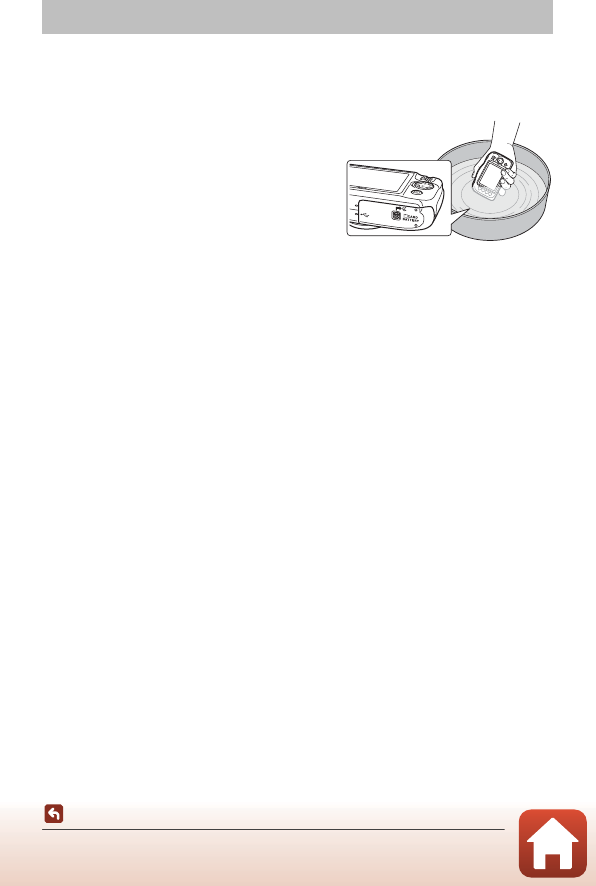
132
Technical Notes
Cleaning and Storage
Cleaning After Using the Camera Underwater
Follow the procedure below to rinse the camera with fresh water within 60 minutes after
using it underwater or at the beach.
1. Keep the battery-chamber/memory
card slot cover closed and wash off the
camera with fresh water.
Immerse the camera in a shallow basin filled
with fresh water for 10 minutes.
•Immerse the camera in fresh water and
shake it sufficiently in the water to
remove any foreign substances from the
camera.
•When the camera is immersed in the water, a few air bubbles may come out
from the water drain holes of the camera such as openings in the microphone
or speakers. This is not a malfunction.
2. Wipe off water droplets with a soft cloth and dry the camera in a well-
ventilated and shady place.
•Place the camera on a dry cloth to dry it.
•Do not dry the camera with hot air from a hair dryer or clothes dryer.
3. After making sure that there are no water droplets on the camera, open
the battery-chamber/memory card slot cover and use a soft dry cloth to
gently wipe off any water or sand remaining on the waterproof packing or
inside the camera.
•If the cover is closed when the inside is wet, this could cause condensation or a
malfunction.
Cleaning After Using the Camera in Conditions Other
than Underwater
Use a blower to remove any dust or lint that adheres to the lens, monitor, or camera body.
To remove fingerprints or other stains that cannot be removed with a blower, gently wipe
the parts with a soft dry cloth. If you wipe with too much pressure or with a rough cloth, it
may damage the camera or cause a malfunction.
Cleaning and Storage

133
Technical Notes
Cleaning and Storage
Storage
If you do not intend to use the camera for an extended period, remove the battery and
avoid storing the camera in any of the following types of locations:
•Places that are poorly ventilated or subject to humidity of over 60%
•Places exposed to temperatures above 50°C (122°F) or below –10°C (14°F)
•Places next to equipment that produces strong electromagnetic fields, such as
televisions or radios
To prevent mold or mildew, take the camera out of storage at least once a month,
and turn it on and release the shutter a few times before putting it away again.
Completely exhaust the battery before storing it, and recharge it at least once every
six months. Also, place the battery in a container such as plastic bag in order to
insulate it, and store it in a cool place.
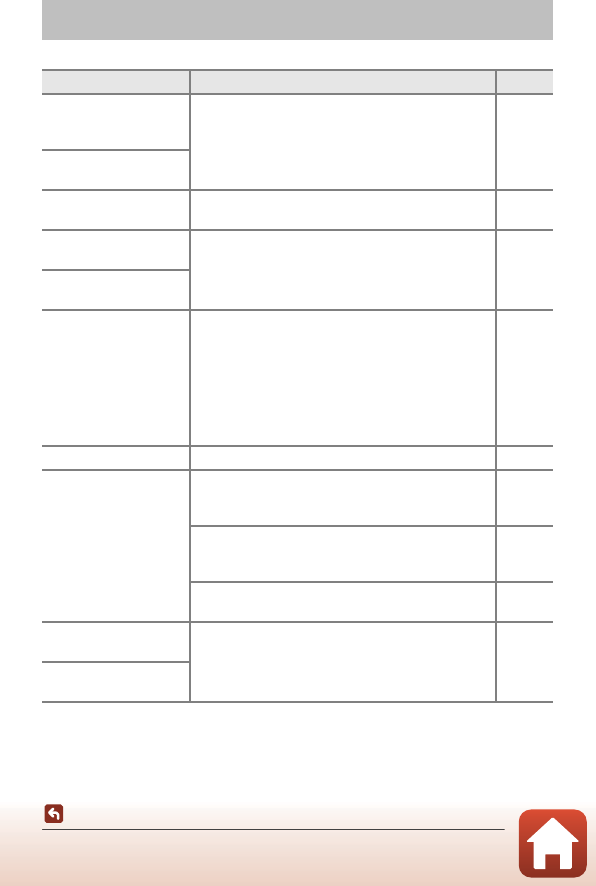
134
Technical Notes
Error Messages
Refer to the table below if an error message is displayed.
Error Messages
Display Cause/Solution A
Battery temperature is
elevated. The camera
will turn off. The camera turns off automatically. Wait until the
camera or battery temperature has cooled before
resuming use.
–
The camera will turn off
to prevent overheating.
Memory card is write
protected.
The write-protect switch is in the “lock” position.
Slide the write-protect switch to the “write” position. –
This card cannot be
used. An error occurred while accessing the memory card.
•Use an approved memory card.
•Check that the terminals are clean.
•Confirm that the memory card is correctly inserted.
11, 150
This card cannot be
read.
Card is not formatted.
Format card?
The memory card has not been formatted for use in
the camera.
Formatting deletes all data saved on the memory
card. If you need to keep copies of any images, make
sure to press flexible button 4 (S No) and save the
copies to a computer or other medium before
formatting the memory card. Press flexible button 3
(R Yes) to format the memory card.
131
Out of memory. Delete images or insert a new memory card. 11, 27
Image cannot be saved.
An error occurred while saving the image.
Insert a new memory card or format the memory
card or internal memory.
117
The camera has run out of file numbers.
Insert a new memory card or format the memory
card or internal memory.
117
There is insufficient space to save the copy.
Delete images from the destination. 27
No further pictures can
be graded. 200 images have already been graded or added to
favorites.
Remove some grades or remove some images from
favorites.
75, 77,
79, 81
Album is full. No further
pictures can be added.
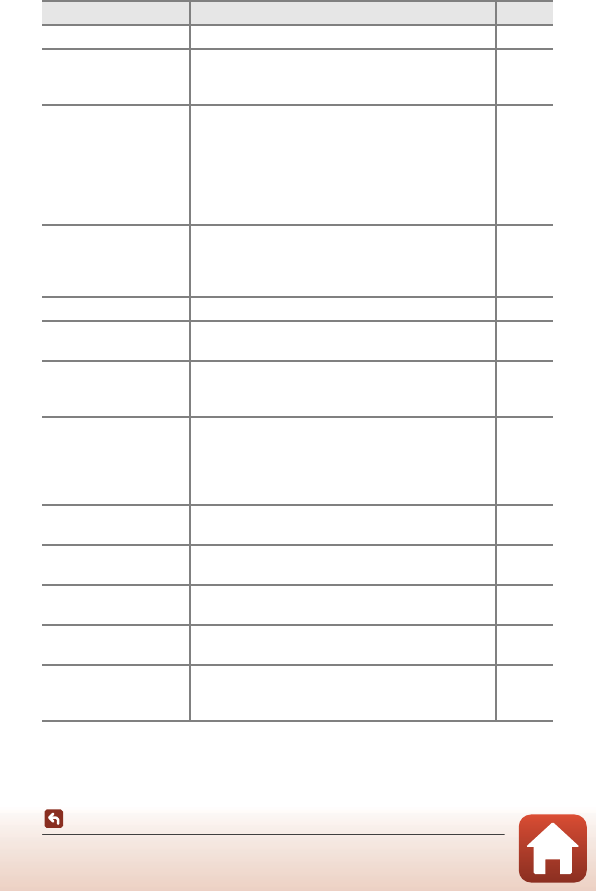
135
Technical Notes
Error Messages
Image cannot be modified.
Check that the images can be edited. 62, 142
Cannot record movie.
A time-out error occurred while saving the movie on
the memory card.
Select a memory card with a faster write speed.
94, 150
Memory contains no
images.
There are no images in the internal memory or on
the memory card.
•Remove the memory card to play back images in
the internal memory.
•To copy the images saved in the camera’s internal
memory to the memory card, select Copy in the
retouch menu.
12
88
File contains no image
data.
The file was not created or edited with this camera.
The file cannot be viewed on this camera.
View the file using a computer or the device used to
create or edit this file.
–
All images are hidden. There are no images available for a slide show, etc. 83
Turn the camera off and
then on again.
If the error persists, contact your retailer or Nikon-
authorized service representative. 137
Communications error
An error occurred while communicating with the
printer.
Turn the camera off and reconnect the USB cable.
100
System error
An error occurred in the camera’s internal circuitry.
Turn the camera off, remove and reinsert the battery,
and turn the camera on. If the error persists, contact
your retailer or Nikon-authorized service
representative.
137
Printer error: check
printer status.
After solving the problem, press flexible button 3
(RResume) to resume printing.* –
Printer error: check
paper.
Load the specified size of paper and press flexible
button 3 (R Resume) to resume printing.* –
Printer error: paper jam. Remove the jammed paper and press flexible button
3 (R Resume) to resume printing.* –
Printer error: out of
paper.
Load the specified size of paper and press flexible
button 3 (R Resume) to resume printing.* –
Printer error: check ink.
There is a problem with the printer’s ink.
Check the ink and press flexible button 3
(RResume) to resume printing.*
–
Display Cause/Solution A
136
Technical Notes
Error Messages
* See the documentation provided with your printer for further guidance and information.
Printer error: out of ink. Replace the ink cartridge and press flexible button 3
(R Resume) to resume printing.* –
Printer error: file corrupt. There is a problem with the image file to be printed.
Press flexible button 4 (S Cancel) to cancel printing. –
Display Cause/Solution A
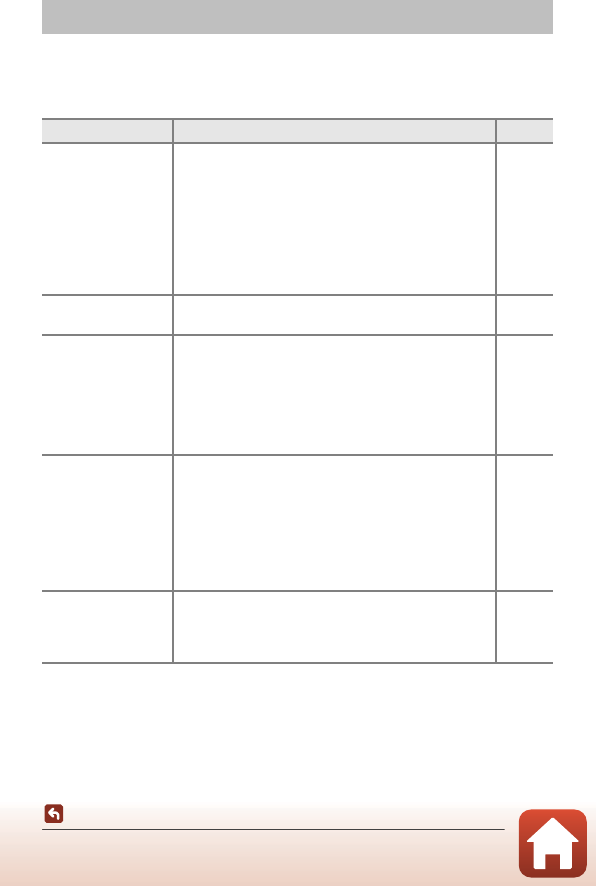
137
Technical Notes
Troubleshooting
If the camera fails to function as expected, check the list of common problems below
before consulting your retailer or Nikon-authorized service representative.
Power, Display, Settings Issues
Troubleshooting
Problem Cause/Solution A
The camera is on but
does not respond.
•Wait for recording to end.
•If the problem persists, turn the camera off.
If the camera does not turn off, remove and reinsert
the battery or batteries or, if you are using an AC
adapter, disconnect and reconnect the AC adapter.
Note that although any data currently being
recorded will be lost, data that have already been
recorded will not be affected by removing or
disconnecting the power source.
–
The camera cannot
be turned on. The battery is exhausted. 11, 13,
129
The camera turns off
without warning.
•The camera automatically turns off to save power
(auto off function).
•The camera and battery may not work properly at low
temperatures.
•The inside of the camera has become hot. Leave the
camera off until the inside of the camera has cooled,
and then try turning it on again.
25
129
–
The monitor is blank.
•The camera is off.
•The camera automatically turns off to save power
(auto off function).
•The flash lamp flashes while the flash is charging.
Wait until charging is complete.
•The camera is connected to a TV or computer.
•The camera is shooting while Choose a style is set to
Add light trails.
15
25
–
–
–
The camera
becomes hot.
The camera may become hot when used for an
extended period of time such as to shoot movies, or
when used in a hot environment; this is not a
malfunction.
–
138
Technical Notes
Troubleshooting
The battery inserted
in the camera cannot
be charged.
•Confirm all connections.
•When connected to a computer, the camera may not
charge for any of the reasons described below.
-Off is selected for Charge by computer in the
camera settings menu.
- Battery charging stops if the camera is turned off.
- Battery charging is not possible if the camera’s
display language and date and time have not been
set, or the date and time were reset after the
camera’s clock battery was exhausted. Use the
Charging AC Adapter to charge the battery.
- Battery charging may stop when the computer
enters sleep mode.
- Depending on the computer specifications,
settings, and status, battery charging may not be
possible.
13
121
–
15
–
–
The monitor is hard
to see.
•The surroundings are too bright.
- Move to a darker place.
•Adjust the monitor brightness.
–
114
E flashes on the
screen.
•If the camera clock has not been set, E flashes on
the shooting screen, and images and movies saved
before the clock is set are dated “00/00/0000 00:00”
and “01/01/2016 00:00” respectively. The shooting
date and time of still images is not displayed during
playback. Set the correct time and date for Date and
time in the camera settings menu.
•The camera clock is not as accurate as ordinary
watches or clocks. Periodically compare the time of
the camera clock with that of a more accurate
timepiece and reset as required.
4, 112
Date and time of
recording are not
correct.
Date stamp not
available.
Date and time has not been set in the camera settings
menu. 112
Date not stamped on
images even when
Date stamp is
enabled.
•The current shooting mode does not support Date
stamp.
•The date cannot be stamped on movies.
114
Problem Cause/Solution A
139
Technical Notes
Troubleshooting
Shooting Issues
Screen for setting
time and date is
displayed when the
camera is turned on.
The clock battery is exhausted; all settings were restored
to their default values. Configure the camera settings
again.
•The internal clock battery is used to power the
camera clock and to retain certain settings. Charging
time of the clock battery takes about 10 hours when
you insert the battery into the camera or connect the
AC adapter (available separately) to the camera, and
the clock battery operates for several days even after
the camera battery is removed.
–
The camera settings
reset.
Cannot select
Format card or
Format memory.
You cannot format while image lock is set.
Remove image lock. 29
Some menu options
are not displayed.
Some options are not displayed depending on the
Variety menu settings. Change the settings. 113
The camera makes
sound.
Depending on the settings, the camera may produce an
audible focusing sound. –
Problem Cause/Solution A
Cannot switch to
shooting mode. Disconnect the HDMI cable or USB cable. 98
Cannot take pictures
or record movies.
•When the camera is in playback mode, press the
c(shooting/playback mode) button, shutter-
release button, or b (e) button.
•When menus are displayed, press the shutter-release
button or b(e) button.
•The flash is charging while the flash lamp is flashing.
•The battery is exhausted.
2, 26
2
33
11, 13,
129
The camera cannot
focus.
•The subject is too close. Try shooting using Shoot
close-ups in Choose a style.
•The subject is hard to focus on.
•Set AF assist in the camera settings menu to Auto.
•Turn the camera off and then on again.
37
51
116
–
Problem Cause/Solution A
140
Technical Notes
Troubleshooting
Images are blurred.
•Use the flash.
•Enable electronic VR.
•Use a tripod to stabilize the camera (using the self-
timer at the same time is more effective).
33
115
34
Bright specks appear
in images captured
with flash.
The flash is reflecting off particles in the air. Set the flash
mode setting to y Flash off.33
Flash does not fire.
•The flash mode is set to y Flash off.
•Choose a style is set to a function that disables the
flash.
33
37
Digital zoom cannot
be used.
Digital zoom cannot be used when using certain
settings in other functions. 54
No sound when the
shutter is released.
•Turn sounds on or off in Change sounds is set to
Turn sounds off, or Pick a shutter sound is set to
z in the shooting menu.
•Do not block the speaker.
45
2
AF-assist illuminator
does not light.
Off is selected for AF assist in the camera settings
menu. AF-assist illuminator may not light depending on
the current settings, even when Auto is selected.
116
Images appear
smeared. The lens is dirty. Clean the lens. 132
Colors are unnatural. Hue is not adjusted properly. 37, 44
Randomly spaced
bright pixels (“noise”)
appear in image.
The subject is dark and the shutter speed is too slow, or
ISO sensitivity is too high. Noise can be reduced by
using the flash.
33
Images are too dark
(underexposed).
•The flash mode is set to y Flash off.
•The flash window is blocked.
•The subject is beyond the range of the flash.
•Adjust exposure compensation.
•The subject is backlit. Use the flash or Shoot backlit
scenes in Choose a style.
33
24
147
44
33, 39
Images are too
bright
(overexposed).
Adjust exposure compensation. 44
Problem Cause/Solution A
141
Technical Notes
Troubleshooting
Playback Issues
Skin tones are not
softened.
•In some shooting conditions, facial skin tones may
not be softened.
•For images containing four or more faces, try using
Make skin prettier in Add makeup in the playback
menu.
51
63
Saving images takes
time.
It may take more time to save images in the following
situations:
•When the noise reduction function is in operation,
such as when shooting in a dark environment
•When Choose a style is set to Shoot night scenes,
Take a series of pictures, Shoot backlit scenes,
Add a neon effect, or Add a cartoon effect
•When the skin softening function is applied while
shooting
–
37, 39,
40
51
A ring-shaped belt or
rainbow-colored
stripe appears on the
screen or images.
When shooting with backlighting or when a very strong
light source (such as sunlight) is in the frame, a ring-
shaped belt or rainbow-colored stripe (ghosting) may
occur. Change the position of the light source, or frame
the picture so that the light source does not enter the
frame, and try again.
–
Problem Cause/Solution A
File cannot be
played back.
•This camera may not be able to play back images
saved with another make or model of digital camera.
•This camera cannot play back movies recorded with
another make or model of digital camera.
•This camera may not be able to play back data edited
on a computer.
–
Cannot zoom in on
image.
•Playback zoom cannot be used with movies, and
images with an image size of 160 × 120 or smaller.
•When viewing small images, the playback zoom ratio
that is displayed may not match the actual image
zoom ratio.
•This camera may not be able to zoom in on images
captured with another make or model of digital
camera.
–
Problem Cause/Solution A
142
Technical Notes
Troubleshooting
Cannot record
messages.
•Messages cannot be attached to movies.
•Delete the message for an image before recording a
new one.
•Messages cannot be attached to images captured
with other cameras.
–
61
–
Cannot edit images.
•Some images cannot be edited. Images that have
already been edited may not be edited again.
•There is not enough free space on the memory card
or in the internal memory.
•This camera is unable to edit images captured with
other cameras.
•Editing functions used for images are not available for
movies.
62, 76,
80, 82,
91
–
–
–
Cannot rotate image. This camera cannot rotate images captured with
another make or model of digital camera. –
Cannot delete
image.
•Images cannot be deleted while image lock is set.
Remove image lock.
•Graded images and images added to favorites are
protected. Remove the grades or remove the images
from favorites.
29
75, 77,
79, 81
Images are not
displayed on TV.
•A computer or printer is connected to the camera.
•The memory card contains no images.
•Remove the memory card to play back images in the
internal memory.
–
–
12
Nikon Transfer 2
does not start when
the camera is
connected.
•The camera is off.
•The battery is exhausted.
•The USB cable is not correctly connected.
•The camera is not recognized by the computer.
•The computer is not set to start Nikon Transfer 2
automatically. For more information about Nikon
Transfer 2, refer to help information contained in
ViewNX-i.
–
98, 121
98, 104
–
–
The PictBridge
startup screen is not
displayed when the
camera is connected
to a printer.
With some PictBridge-compatible printers, the
PictBridge startup screen may not be displayed and it
may be impossible to print images when Auto is
selected for Charge by computer in the camera
settings menu.
Set Charge by computer to Off and reconnect the
camera to the printer.
121
Problem Cause/Solution A
143
Technical Notes
Troubleshooting
Images to be printed
are not displayed.
•The memory card contains no images.
•Remove the memory card to print images in the
internal memory.
–
12
Cannot select paper
size with the camera.
The camera cannot be used to select the paper size in
the following situations, even when printing from a
PictBridge-compatible printer. Use the printer to select
the paper size.
•The printer does not support the paper sizes
specified by the camera.
•The printer automatically selects the paper size.
–
Problem Cause/Solution A
144
Technical Notes
File Names
Images, movies, or messages are assigned file names as follows.
File name: DSCN
0001
.JPG
(1) (2) (3)
File Names
(1) Identifier
Not shown on the screen of the camera.
•DSCN: Original still images, movies
•DSCA: Message
•DSCB: Message (reply)
•SSCN: Small picture copies
•RSCN: Cropped copies
•FSCN: Images created by an image editing function other than
crop and small picture, photo albums
(2) File number
Assigned in ascending order, starting with “0001” and ending with
“9999.”
•A new folder is created each time a series of images are captured
using Shoot at intervals, and the images are saved in that folder
with file numbers starting with “0001.”
(3) Extension
Indicates file format.
•.JPG: Still images
•.MP4: Movies
•.WAV: Messages (File number is the same as the image to which
the message is attached.)
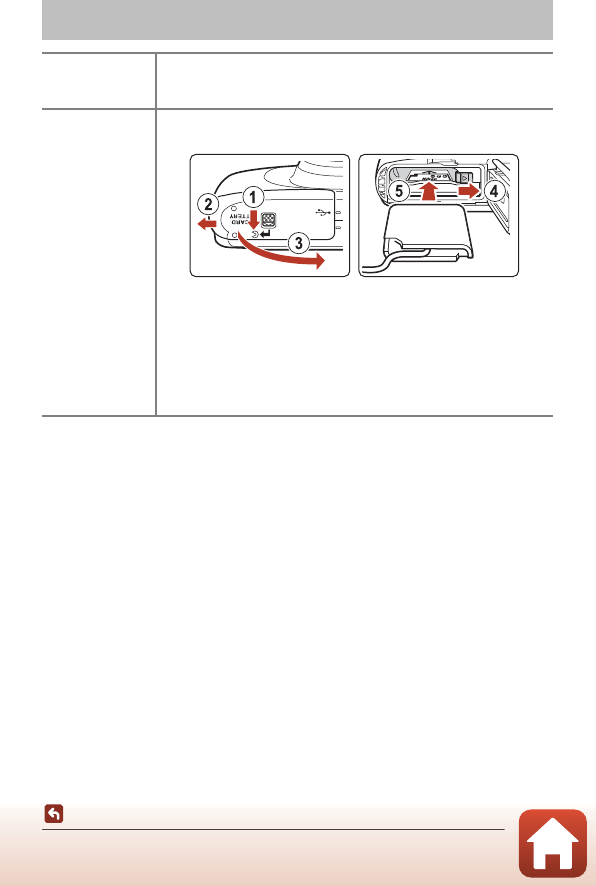
145
Technical Notes
Optional Accessories
Accessories are not waterproof.
Availability may vary with country or region.
See our website or brochures for the latest information.
Optional Accessories
Battery charger
MH-66 Battery Charger
It takes about 1 hour and 50 minutes to charge a fully exhausted
battery.
AC adapter
EH-62G AC Adapter
(connect as shown)
Make sure that the power connector cable is fully inserted in the
power connector slot before inserting the AC adapter into the
battery chamber.
•While using the AC adapter, the battery-chamber/memory card
slot cover cannot be closed. Do not pull the power connector
cable.
If the cable is pulled, the connection between the camera and
power source is interrupted, and the camera turns off.
146
Technical Notes
Specifications
Nikon COOLPIX W100 Digital Camera
Specifications
Type Compact digital camera
Number of effective pixels 13.2 million (Image processing may reduce the number of
effective pixels.)
Image sensor 1/3.1-in. type CMOS; approx. 14.17 million total pixels
Lens NIKKOR lens with 3× optical zoom
Focal length 4.1–12.3 mm (angle of view equivalent to that of 30–90 mm
lens in 35mm [135] format)
f/-number f/3.3–5.9
Construction 6 elements in 5 groups
Digital zoom
magnification
Up to 4× (angle of view equivalent to that of approx.
360 mm lens in 35mm [135] format)
Vibration reduction Electronic VR (movies)
Motion blur reduction Electronic VR (still images)
Autofocus (AF) Contrast-detect AF
Focus range
•[W]: Approx. 5 cm (2 in.)–∞,
[T]: Approx. 50 cm (1 ft 8 in.)–∞
•Shoot close-ups, Photograph food, Shoot under
water, Mirror, Add a bubble effect, Add a neon
effect, Add a cartoon effect, Take soft pictures,
Create a diorama effect, Shoot a movie miniature,
Highlight colors: Approx. 5 cm (2 in.) (wide-angle
position)–∞
(All distances measured from center of front surface of the
protective glass)
Focus-area selection Center, face detection, target finding AF
Monitor 6.7 cm (2.7-in.), approx. 230k-dot, TFT LCD with anti-
reflection coating and 5-level brightness adjustment
Frame coverage
(shooting mode)
Approx. 96% horizontal and vertical (compared to actual
picture)
Frame coverage
(playback mode)
Approx. 100% horizontal and vertical (compared to actual
picture)
147
Technical Notes
Specifications
Storage
Media Internal memory (approx. 22 MB), SD/SDHC/SDXC memory
card
File system DCF and Exif 2.3 compliant
File formats
Still images: JPEG
Voice messages: WAV
Movies: MP4 (Video: H.264/MPEG-4 AVC, Audio: AAC stereo)
Image size
(photo size)
•13 megapixels [4160 × 3120]
•4 megapixels [2272 × 1704]
•2 megapixels [1600 × 1200]
ISO sensitivity
(Standard output
sensitivity)
ISO 125–1600
Exposure
Metering mode Matrix, center-weighted (digital zoom less than 2×), spot
(digital zoom 2× or more)
Exposure control Programmed auto exposure and exposure compensation
(–2.0 – +2.0 EV in steps of 1 EV)
Shutter Mechanical and CMOS electronic shutter
Speed
•1/2000–1 s
•25 s (Add light trails in Choose a style is set to Night
sky)
Aperture Electronically-controlled ND filter (–2 AV) selection
Range 2 steps (f/3.3 and f/6.6 [W])
Self-timer •10 s, smile timer
•5 s (self-portrait timer)
Flash
Range (approx.)
(ISO sensitivity: Auto)
[W]: 0.3–3.1 m (1 ft–10 ft)
[T]: 0.6–1.7 m (2 ft–5 ft 6 in.)
Flash control TTL auto flash with monitor preflashes
Interface
USB connector
Micro-USB connector (do not use any USB cable other than
the UC-E21), Hi-Speed USB
•Supports Direct Print (PictBridge)
HDMI output connector HDMI micro connector (Type D)
Wi-Fi (Wireless LAN)
Standards IEEE 802.11b/g (standard wireless LAN protocol)
Operating frequency 2412–2462 MHz (1–11 channels)
Authentication Open system, WPA2-PSK
148
Technical Notes
Specifications
•All measurements are performed in conformity with Camera and Imaging Products
Association (CIPA) standards or guidelines.
1Battery life does not reflect the use of SnapBridge and may vary with the conditions of
use, including temperature, the interval between shots, and the length of time that
menus and images are displayed.
2Individual movie files cannot exceed 4 GB in size or 29 minutes in length. Recording may
end before this limit is reached if camera temperature becomes elevated.
Bluetooth
Communication
protocols Bluetooth Specification Version 4.1
Supported languages
Arabic, Bengali, Bulgarian, Chinese (Simplified and
Traditional), Czech, Danish, Dutch, English, Finnish, French,
German, Greek, Hindi, Hungarian, Indonesian, Italian,
Japanese, Korean, Marathi, Norwegian, Persian, Polish,
Portuguese (European and Brazilian), Romanian, Russian,
Serbian, Spanish, Swedish, Tamil, Telugu, Thai, Turkish,
Ukrainian, Vietnamese
Power sources •One EN-EL19 Rechargeable Li-ion Battery (included)
•EH-62G AC Adapter (available separately)
Charging time Approx. 1 h 40 min (when using EH-73P/EH-73PCH
Charging AC Adapter and when no charge remains)
Battery life1
Still images Approx. 220 shots when using EN-EL19
Movies (actual battery
life for recording)2Approx. 1 h 30 min when using EN-EL19
Tripod socket 1/4 (ISO 1222)
Dimensions (W × H × D) Approx. 109.5 × 67.0 × 38.0 mm (4.4 × 2.7 × 1.5 in.)
(excluding projections)
Weight Approx. 177 g (6.3 oz) (including battery and memory card)
Operating environment
Temperature –10°C – +40°C (14°F–104°F) (for land use)
0°C–40°C (32°F–104°F) (for underwater use)
Humidity 85% or less (no condensation)
Waterproof
JIS/IEC protection class 8 (IPX8) equivalent (under our
testing conditions)
Capacity to shoot pictures underwater up to a depth of
10 m (33 ft) and for 60 minutes
Dustproof JIS/IEC protection class 6 (IP6X) equivalent (under our
testing conditions)
Shockproof Cleared our testing conditions3 compliant with MIL-STD
810F Method 516.5-Shock
149
Technical Notes
Specifications
3Dropped from a height of 1.8 m (5 ft 10 in.) onto a surface of 5 cm (2 in.) thick plywood
(changes in appearance, such as paint peeling off and deformation of the drop shock
portion and waterproof performance are not subject to the test).
These tests do not guarantee that the camera will be free from damage or trouble under
all conditions.
EN-EL19 Rechargeable Li-ion Battery
EH-73P/EH-73PCH Charging AC Adapter
The symbols on this product represent the following:
D AC, E DC, F Class II equipment (The construction of the product is double-insulated.)
•Nikon will not be held liable for any errors this manual may contain.
•The appearance of this product and its specifications are subject to change without
notice.
Type Rechargeable lithium-ion battery
Rated capacity DC 3.7 V, 700 mAh
Operating temperature 0°C–40°C (32°F–104°F)
Dimensions (W × H × D) Approx. 31.5 × 39.5 × 6 mm (1.3 × 1.6 × 0.3 in.)
Weight Approx. 14.5 g (0.5 oz)
Rated input AC 100–240 V, 50/60 Hz, MAX 0.14 A
Rated output DC 5.0 V, 1.0 A
Operating temperature 0°C–40°C (32°F–104°F)
Dimensions (W × H × D)
Approx. 55 × 22 × 54 mm (2.2 × 0.9 × 2.2 in.)
(excluding plug adapter)
For Argentina: Approx. 55 × 63 × 59 mm
(2.2 × 2.5 × 2.4 in.)
For Brazil: Approx. 55 × 67 × 59 mm
For Korea: Approx. 55 × 67 × 59 mm
For India: Approx. 55 × 63.5 × 59 mm
Weight
Approx. 51 g (1.8 oz) (excluding plug adapter)
For Argentina: Approx. 76 g (2.7 oz)
For Brazil: Approx. 73 g
For Korea: Approx. 73 g
For India: Approx. 76 g
150
Technical Notes
Specifications
Memory Cards That Can Be Used
The camera supports SD, SDHC, and SDXC memory cards.
•Memory cards with an SD Speed Class rating of 6 or faster are recommended for
recording movies. When using a memory card with a lower Speed Class rating,
movie recording may stop unexpectedly.
•If you use a card reader, make sure that it is compatible with your memory card.
•Contact the manufacturer for information on features, operation, and limitations
on use.
Trademark Information
•Windows is either a registered trademark or trademark of Microsoft Corporation in
the United States and/or other countries.
•The Bluetooth® word mark and logos are registered trademarks owned by
Bluetooth SIG, Inc. and any use of such marks by Nikon Corporation is under
license.
•Apple®, App Store®, the Apple logos, Mac, OS X, iPhone®, iPad®, iPod touch® and
iBooks are trademarks or registered trademarks of Apple Inc., in the U.S. and other
countries.
•Android and Google Play are trademarks or registered trademarks of Google Inc.
The Android robot is reproduced or modified from work created and shared by
Google and used according to terms described in the Creative Commons 3.0
Attribution License.
•iOS is a trademark or registered trademark of Cisco Systems, Inc., in the United
States and/or other countries and is used under license.
•Adobe, the Adobe logo, and Reader are either trademarks or registered trademarks
of Adobe Systems Incorporated in the United States and/or other countries.
•SDXC, SDHC, and SD Logos are trademarks of SD-3C, LLC.
•PictBridge is a trademark.
•HDMI, HDMI logo and High-Definition Multimedia Interface are trademarks or
registered trademarks of HDMI Licensing, LLC.
•Wi-Fi and the Wi-Fi logo are trademarks or registered trademarks of the Wi-Fi
Alliance.
•The N-Mark is a trademark or registered trademark of NFC Forum, Inc. in the United
States and in other countries.
•All other trade names mentioned in this manual or the other documentation
provided with your Nikon product are the trademarks or registered trademarks of
their respective holders.
151
Technical Notes
Specifications
AVC Patent Portfolio License
This product is licensed under the AVC Patent Portfolio License for the personal and
non-commercial use of a consumer to (i) encode video in compliance with the AVC
standard (“AVC video”) and/or (ii) decode AVC video that was encoded by a consumer
engaged in a personal and non-commercial activity and/or was obtained from a video
provider licensed to provide AVC video. No license is granted or shall be implied for
any other use. Additional information may be obtained from MPEG LA, L.L.C.
See http://www.mpegla.com.
FreeType License (FreeType2)
Portions of this software are copyright © 2012 The FreeType Project
(http://www.freetype.org). All rights reserved.
MIT License (HarfBuzz)
Portions of this software are copyright © 2016 The HarfBuzz Project
(http://www.freedesktop.org/wiki/Software/HarfBuzz). All rights reserved.
“Made for iPod,” “Made for iPhone,” and “Made for iPad” mean that an electronic
accessory has been designed to connect specifically to iPod, iPhone, or iPad,
respectively, and has been certified by the developer to meet Apple performance
standards. Apple is not responsible for the operation of this device or its
compliance with safety and regulatory standards. Please note that the use of this
accessory with iPod, iPhone, or iPad may affect wireless performance.
152
Technical Notes
Index
Symbols
A Point and shoot.................................... 32
c Playback mode..................................... 26
l Camera settings menu.................... 108
b (e Movie-record) button........ 2, 93
c (Shooting/playback mode) button
.......................................................................... 3, 26
Y N-Mark ................................................... 2, 16
A
AC adapter........................................... 98, 145
Add a bubble effect F................. 36, 40
Add a cartoon effect H................ 36, 40
Add a diorama effect ............................... 68
Add a fisheye effect .................................. 66
Add a neon effect G...................... 36, 40
Add cartoon effects ................................... 71
Add light trails U.............................. 36, 42
Add makeup................................................... 63
Add starbursts ............................................... 67
AF assist........................................................... 116
AF-assist illuminator ..................................... 2
Airplane mode ............................................ 110
Always fire flash............................................ 33
Auto flash ......................................................... 33
Auto off.............................................................. 25
Autofocus......................................................... 51
B
Battery ......................................................... 11, 13
Battery chamber ............................................. 3
Battery charger .......................................... 145
Battery level ................................................... 24
Battery-chamber/memory card slot
cover....................................................... 3, 11, 98
Bluetooth............................................... 16, 110
Brightness ....................................................... 44
Brush................................................................... xii
Button sound ................................................ 45
C
Camera settings ........................................ 110
Camera settings menu.......................... 108
Change colors (playback mode) ....... 68
Change colors (shooting mode)....... 44
Change sounds............................................ 45
Charge by computer.............................. 121
Charge lamp.............................................. 3, 13
Choose a size ................................................ 47
Choose a style .............................................. 36
Compression ratio...................................... 47
Computer............................................ 98, 104
Conformity marking ............................... 122
Connect to smart device ..................... 110
Copy ................................................................... 88
Copyright information .......................... 119
Create a diorama effect M........... 36, 41
Crop .................................................................... 56
D
Date and time..................................... 15, 112
Date format.......................................... 19, 112
Date stamp................................................... 114
Daylight saving time ...................... 19, 112
Decorate (playback mode)................... 70
Decorate (shooting mode)................... 43
Delete ................................................................ 27
Digital zoom .................................................. 49
Direct print........................................... 98, 100
E
Electronic VR................................................. 115
Erase............................................................ 27, 58
Erase recordings........................................... 61
Exchange messages ................................. 59
Index

153
Technical Notes
Index
Exposure compensation........................ 44
Eyelet for camera strap............................... 2
F
Face detection .............................................. 50
Favorites............................................................ 78
File name...................................................... 144
Firmware version...................................... 122
Flash............................................................... 2, 33
Flash lamp.................................................. 3, 33
Flash mode...................................................... 33
Flash off ............................................................. 33
Flexible buttons .............................................. 7
F-number ......................................................... 50
Focus................................................................... 50
Focus area........................................................ 25
Focus indicator ................................................ 5
Focus lock ........................................................ 52
Format internal memory ...................... 117
Format memory cards.................... 12, 117
Formatting............................................. 12, 117
Full-frame playback ................................... 26
G
Grading............................................................. 74
H
Have fun with pictures............................. 58
HDMI cable............................................. 98, 99
HDMI micro connector...................... 3, 98
Highlight colors (playback mode) ... 69
Highlight colors (shooting mode)... 44
I
Image comment........................................ 118
Image lock ....................................................... 29
Internal memory.......................................... 12
L
Language ....................................................... 118
Leave a message (recording a
message) .......................................................... 59
Leave a reply (recording a message)
............................................................................... 60
Lens............................................................. 2, 146
Location data .............................................. 120
M
Make photo albums.................................. 64
Mark for upload ........................................... 87
Memory card............................. 11, 131, 150
Memory card slot.................................... 3, 11
Menu background.......................... 18, 120
Microphone (stereo)..................................... 2
Micro-USB connector
.................................................. 3, 98, 100, 104
Mirror L................................................... 36, 40
Monitor ........................................................... 3, 4
Monitor brightness.................................. 114
Movie frame size......................................... 48
Movie playback............................................ 93
Movie recording.......................................... 93
Multi selector .................................................... 3
N
Network menu........................................... 110
Number of exposures remaining
...................................................................... 24, 47
O
Optical zoom................................................. 49
Optional accessories............................... 145
P
Paper size............................................ 101, 102
Photo size........................................................ 47
Photograph fireworks K............... 36, 39
Photograph food X......................... 36, 37
PictBridge ............................................. 98, 100
Picture play..................................................... 62
Play recordings ............................................. 61
Playback .................................................. 26, 96
Playback menu............................................. 58

154
Technical Notes
Index
Playback mode ............................................. 26
Playback zoom..................................... 26, 56
Power switch/power-on lamp....... 2, 15
Pressing halfway .......................................... 50
Print............................................... 98, 101, 102
Printer ..................................................... 98, 100
R
Rechargeable Li-ion battery .......... 11, 13
Remaining movie recording time
...................................................................... 93, 94
Reset all........................................................... 122
Restore default settings ........................ 110
Restricting image deletion.................... 29
Retouch............................................................ 88
Rotate pictures............................................. 90
S
Saturation........................................................ 44
Self-portrait timer....................................... 34
Self-timer ......................................................... 34
Self-timer lamp ....................................... 2, 34
Send while shooting............................... 110
Shoot a movie miniature j........ 36, 41
Shoot at intervals O.......................... 36, 38
Shoot backlit scenes E................. 36, 39
Shoot close-ups H............................ 36, 37
Shoot night scenes D.................... 36, 37
Shoot under water J..................... 36, 37
Shooting .......................................................... 24
Shooting menu ............................................ 31
Shutter sound............................................... 45
Shutter speed................................................ 50
Shutter-release button ...................... 2, 25
Skin softening................................................ 51
Slide show........................................................ 83
Small picture .................................................. 91
Smile timer ...................................................... 35
Soften pictures.............................................. 67
Speaker................................................................. 2
Stamp................................................................. 72
Strap..................................................................... 10
Sync with smart device......................... 112
T
Take a series of pictures I.......... 36, 39
Take soft pictures Q........................ 36, 41
Telephoto........................................................ 49
Thumbnail playback ......................... 26, 57
Toy camera..................................................... 66
Tripod socket......................................... 3, 148
TV................................................................. 98, 99
U
Underwater face framing J....... 36, 38
USB cable.................................. 98, 100, 104
V
Variety menu ................................................ 113
View .................................................................... 58
View by date.................................................. 82
ViewNX-i........................................................ 104
Vividness .......................................................... 44
Volume...................................................... 61, 96
W
Welcome screen ........................................ 111
Wide-angle ..................................................... 49
Wi-Fi.................................................................. 110
Z
Zoom.................................................................. 49
Zoom in............................................................ 49
Zoom out ........................................................ 49

CT6G01(11)
6MQA0111-01
No reproduction in any form of this manual, in whole or in part
(except for brief quotation in critical articles or reviews), may be
made without written authorization from NIKON CORPORATION.
