AURA TECHNOLOGY MT7 TELPAD User Manual UserManual
AURA TECHNOLOGY LIMTED TELPAD UserManual
UserManual
1
GETTING STARTED........................................................................................................................................................................................................................................................01
1.1 About Your TELPAD.................................................................................................................................................................................................................................................02
2 TELPAD INTRODUCTION ........................................................................................................................................................................................................................................... 03
2.1 Getting to Know Your TELPAD............................................................................................................................................................................................................................04
2.2 Product Specication ............................................................................................................................................................................................................................................07
2.3 Installation .................................................................................................................................................................................................................................................................09
2.3.1 Basic Connection ...............................................................................................................................................................................................................................................09
2.3.2 Installing the Dock Battery.............................................................................................................................................................................................................................10
2.3.3 Docking and Undocking the Tablet ............................................................................................................................................................................................................10
3 TABLET FUNCTIONS .....................................................................................................................................................................................................................................................11
3.1
Turning the Tablet ON or OFF...............................................................................................................................................................................................................................12
3.1.1
Turning the Tablet ON...................................................................................................................................................................................................................................... 13
3.1.2
Turning the Tablet OFF.....................................................................................................................................................................................................................................13
3.2 Charging the Battery..............................................................................................................................................................................................................................................14
3.2.1 Charging the Tablet Battery...........................................................................................................................................................................................................................14
3.2.2 Charging the Dock Battery.............................................................................................................................................................................................................................14
3.3 Working with the Keys........................................................................................................................................................................................................................................... 15
3.3.1 Using the Physical Keys ...................................................................................................................................................................................................................................15
3.3.2 Working the Touchscreen Keys.................................................................................................................................................................................................................... 15
3.4
Using the Touch Screen..........................................................................................................................................................................................................................................16
3.5 Home Screen.............................................................................................................................................................................................................................................................17
3.5.1 Getting to Know the Home Screen .............................................................................................................................................................................................................17
3.5.2 Extended Home Screens.................................................................................................................................................................................................................................18
3.5.3 Customizing the Home Screen..................................................................................................................................................................................................................... 18
3.6 Locking and Unlocking the Screen...................................................................................................................................................................................................................19
3.6.1 Locking the Screen............................................................................................................................................................................................................................................ 19
3.6.2 Unlocking the Screen.......................................................................................................................................................................................................................................19
3.6.3 Setting up a Screen Lock.................................................................................................................................................................................................................................19
3.6.4 Setting a Screen Timeout Period.................................................................................................................................................................................................................. 19
3.7 Inputting Text ........................................................................................................................................................................................................................................................... 20
3.7.1 Entering Text Using the Onscreen Keyboard...........................................................................................................................................................................................20
3.7.2 Cutting or Copying Text ..................................................................................................................................................................................................................................21
3.8 Opening and Switching Applications.............................................................................................................................................................................................................. 22
3.9 Accessing the Settings .......................................................................................................................................................................................................................................... 22
3.10 Languages & Input Method & Account Setting......................................................................................................................................................................................... 23
3.11 Setting the Date and Time ................................................................................................................................................................................................................................ 24
3.11.1 To Automatically Set Date and Time......................................................................................................................................................................................................... 24
3.11.2 To Manually Set Date and Time.................................................................................................................................................................................................................. 24
3.11.3 Scheduled Power ON/OFF........................................................................................................................................................................................................................... 24
3.12 Installing or Removing the MicroSD Card.................................................................................................................................................................................................... 25
3.13 Connecting or Disconnecting from a Computer Using USB................................................................................................................................................................. 26
3.14 3G Phone Communication Function ............................................................................................................................................................................................................. 27
3.15 Wireless Networks ................................................................................................................................................................................................................................................ 34
3.15.1 Turning Wi-Fi ON or OFF............................................................................................................................................................................................................................... 34
3.15.2 Connecting to a Wi-Fi Network .................................................................................................................................................................................................................. 34
3.15.3 Turning Open Network Notication ON or OFF................................................................................................................................................................................... 35
3.15.4 Adding a Wi-Fi Network ............................................................................................................................................................................................................................... 35
3.15.5 Forgetting a Wi-Fi Network..........................................................................................................................................................................................................................35
3.16 Gobal Positioning System.................................................................................................................................................................................................................................. 36
3.17 Frequency Modulation ...................................................................................................................................................................................................................................... 38
3.18 Bluetooth................................................................................................................................................................................................................................................................. 39
3.18.1 Opening Bluetooth Settings ...................................................................................................................................................................................................................... 39
3.18.2 Turning Bluetooth ON or OFF..................................................................................................................................................................................................................... 39
3.18.3 Changing the Bluetooth Name of Your Tablet...................................................................................................................................................................................... 39
3.18.4 Connecting to Bluetooth Devices ............................................................................................................................................................................................................ 40
3.18.5 Disconnecting from or Unpairing a Bluetooth Device...................................................................................................................................................................... 40
3.19 Google Services .................................................................................................................................................................................................................................................... 41
3.19.1 Creating a Google Account ........................................................................................................................................................................................................................ 41
3.19.2 Using Play Store............................................................................................................................................................................................................................................... 42
3.19.3 Searching for Applications .......................................................................................................................................................................................................................... 42
3.19.4 Installing an Application .............................................................................................................................................................................................................................. 42
3.19.5 Uninstalling an Application.........................................................................................................................................................................................................................43
3.19.6 Backing up and Restoring Apps and Settings from a Google Account ...................................................................................................................................... 43
3.20 E-mail ....................................................................................................................................................................................................................................................................... 43
3.20.1 Opening E-mail ................................................................................................................................................................................................................................................ 43
3.20.2 Adding and Deleting E-mail Accounts .................................................................................................................................................................................................... 44
3.20.3 Gmail.................................................................................................................................................................................................................................................................... 45
3.21 Camera Instructions............................................................................................................................................................................................................................................. 46
3.22 Home control ......................................................................................................................................................................................................................................................... 51
3.22.1 Installation of “Home Control” Apk........................................................................................................................................................................................................... 52
3.22.2 IR Universal Remote Initial Conguration .............................................................................................................................................................................................. 53
3.22.3 IR Learning......................................................................................................................................................................................................................................................... 55
3.22.4 Reservation........................................................................................................................................................................................................................................................ 55
3.22.5 Reservation Setup........................................................................................................................................................................................................................................... 56
3.22.6 Outside Home Control .................................................................................................................................................................................................................................. 57
3.22.7 Motion Detection............................................................................................................................................................................................................................................ 60
3.23 Home Care............................................................................................................................................................................................................................................................... 62
3.24 Cast Screen Function Operation Guide ........................................................................................................................................................................................................ 73
3.25 DLNA ......................................................................................................................................................................................................................................................................... 79
3.25.1 DLNA Introduction ......................................................................................................................................................................................................................................... 79
3.25.2 DLNA Functions............................................................................................................................................................................................................................................... 79
3.25.3 Control Device Discovery and Connection............................................................................................................................................................................................ 80
3.25.4 The Brief Introduction of Interactions...................................................................................................................................................................................................... 83
4 THE CONNECTION BETWEEN DOCK PHONE AND TABLET............................................................................................................................................................................ 93
4.1 Voice Call Services................................................................................................................................................................................................................................................... 94
4.1.1 Making a Call ....................................................................................................................................................................................................................................................... 94
4.1.2 Answering a Call ................................................................................................................................................................................................................................................ 95
4.1.3 Ending a Call........................................................................................................................................................................................................................................................ 95
4.1.4 Selecting Area Code ......................................................................................................................................................................................................................................... 95
4.1.5 Favorites................................................................................................................................................................................................................................................................ 96
4.1.6 Memo .................................................................................................................................................................................................................................................................... 96
4.1.7 Importing/Exporting Contacts ..................................................................................................................................................................................................................... 96
4.1.8 Changing Ringtones ........................................................................................................................................................................................................................................ 97
4.1.9 Contacts ................................................................................................................................................................................................................................................................ 97
5 BASIC TROUBLESHOOTING FOR THE TELPAD ..................................................................................................................................................................................................... 99
5.1 Tablet not Powering Up ........................................................................................................................................................................................................................................ 100
5.2 No Dial Tone ............................................................................................................................................................................................................................................................. 100
5.3 Distorted Audio on Speaker................................................................................................................................................................................................................................ 100
5.4 Tablet Dialler cannot Make a Call....................................................................................................................................................................................................................... 100
5.5 No Audio Response in the Handset.................................................................................................................................................................................................................. 100
6 FAQs................................................................................................................................................................................................................................................................................... 101
7 WARNINGS AND PRECAUTIONS............................................................................................................................................................................................................................... 107
8 PERSONAL INFORMATION AND DATA SECURITY.............................................................................................................................................................................................. 112
9 LEGAL NOTICE................................................................................................................................................................................................................................................................ 114
10 DISCLAIMER OF WARRANTIES................................................................................................................................................................................................................................ 116
11 INDEX.............................................................................................................................................................................................................................................................................. 118

1 GETTING STARTED

1.1 About Your TELPAD
The TELPAD is the world’s rst landline, broadband, and tablet in one—a device that not only gives you access to
basic communication services, but also brings to your home a world of productivity and entertainment. The TELPAD
is powered by Android, the world’s leader in smartphone technology. With its stunning 7 inch touchscreen display,
built-in camera,Wi-Fi, 3G,GPS & FM access to hundreds of thousands of free and paid Android Apps, as well as its
infrared remote controller and wi- smart appliance controller, the TELPAD is denitely the ideal control and
communication center of your home!
02

2 TELPAD INTRODUCTION
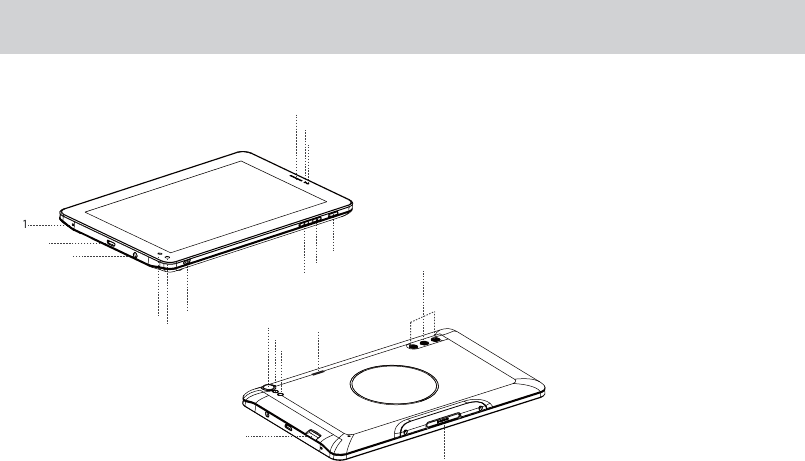
2.1 Getting to Know Your TELPAD
1.
2.
3.
4.
5.
6.
7.
8.
9.
10.
11.
12.
13.
14.
15.
16.
17.
18.
19.
04
2
3
456
10
11
12
14 13
15
16
17
18
19
7
89
Microphone(tablet)
USB Port
Earphone Jack
IR1(transmit)
IR2(transmit and receive)
IR3(transmit)
Rear Camera
Light sensor
Proximity sensor
Rear Camera Flash
Front Camera
Micro SD Card Slot
Dock Connection Interface
Power Button
Volume Down Button
Volume UP Button
Speakers(Tablet)
Tablet Receiver
SIM card slot
20.
21.
22.
23.
24.
25.
26.
27.
28.
29.
30.
31.
32.
05
20
27
28
29 30 3132
21 22 2324
25
26
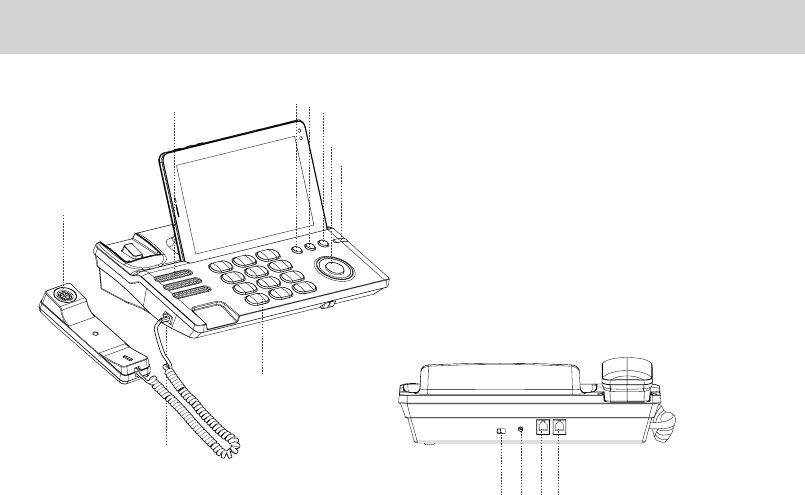
Telephone Receiver/Handset
Speaker(Phone Set)
Flash key
Pause key
Redial key
Hands Free key
Phone Cord Jack
Numeric keypad
Ringtones Volume
Direct Current Input Jack
Extension Cord Jack
Landline Jack
Indicator(Charging/Incoming Calls)
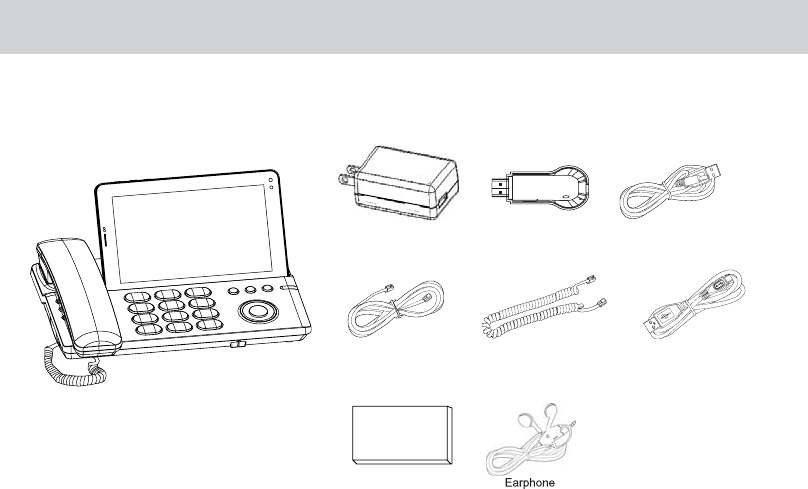
Accessories
06
USB Data Cable
Coiled Phone Cord
Phone Line
Wireless HDMIUSB Charger USB Power Cable DC4.0
Battery
2.2 Product Speciciation
GENERAL SPECIFICATIONS AND DISPLAY
DIMENSION 189mm x 115 mm x 11 mm
7 Inch IPS (1024X600)DISPLAY AND RESOLUTION
Android™ 4.4.2SYSTEM SOFTWARE
Wi-Fi - 802.11b/g/n
24-bit
AIR INTERFACE
Capacitive 5-Points-Touch MULTI-TOUCH PANEL
3 Standard Soft Keys: Home, Back, Recent Applications PRIMARY KEYPAD
DISPLAY COLOR DEPTH
CONNECTIVITY
BLUETOOTH Bluetooth 4.0 + EDR
Micro USB OTG x 1EA/USB Host x 1EA for MEP Dock USB
1Watt x 1EA SPEAKER
GSM
GPS GPS/A-GPS
Built-in-microphone MICROPHONE
3-Axis Accelerometer for UI Auto Rotate Ambient Light sensor SENSOR
Standard 3.5 mm headphone jack
850MHz/900MHz/1800MHz/1900MHz
AUDIO OUT
07
WCDMA 2100MHz/850MHz
Camera Rear 3MP camera/front 0.3MP
76-108MHZ WITH 50KHZ SETPFM
/1900MHz

SMART DIALER
PSTN
Call Hold
Speed Dial
Speaker
Volume Adjustment
COMMUNICATION AND ORGANIZER
EMAIL Protocols: SMTP, POP3 and IMAP4
Supports Exchange Calendar, Contacts synchronous
MEDIA PERFORMANCE
VIDEO DECODING
AUDIO DECODING
3GPP2, 3GPP, 3GP, AVI, MP4, FLV, MKV
AAC, AMR, APE, FLAC, MID, MP3, OGG, WAV
PICTURE FORMATS
STREAMING MEDIA
JPEG, JPG, BMP, PNG
RTSP/HTTP, Support Download play, Progressive play
HANDSET
PSTN Support (POTS) RJ9 (4P4C)
Built-in SPEAKER
Built-inMICROPHONE
BATTERY AND POWER
TABLET BATTERY STD Lithium-Ion Polymer battery, 4100 mAh rechargeable
STD Lithium-Ion Polymer battery, 1000mAh rechargeable DOCK BATTERY
Input - 100 -240 Vac, Output – 5V DC/2.1A 10.5 W POWER ADAPTER
08

09
DLNA Built-in eHomeMediaCenter application
infrared universal remote, Reservation,
Outside Home Control, motion detection
Bluetooth Weight Scale, Body Temperature Monitor,
Family Temperature Manager, Menstrual Cycle, Fertility State
HOME CONNECT AND CONTROL
Home control
Home Care
Cast Screen Enter Settings' display and launch Cast Screen
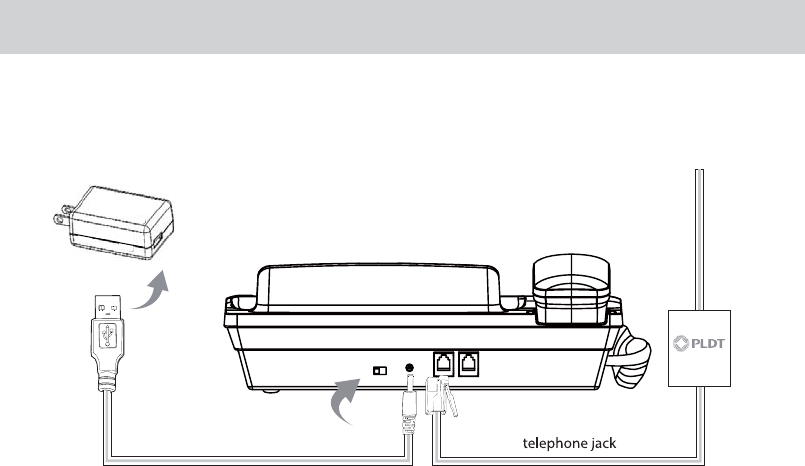
2.3 Installation
2.3.1 Basic Installation
Before installing or removing the adapter, telephone line or the dock battery, ensure the tablet is o the dock.
10
USB charger
USB Power Cable DC4.0
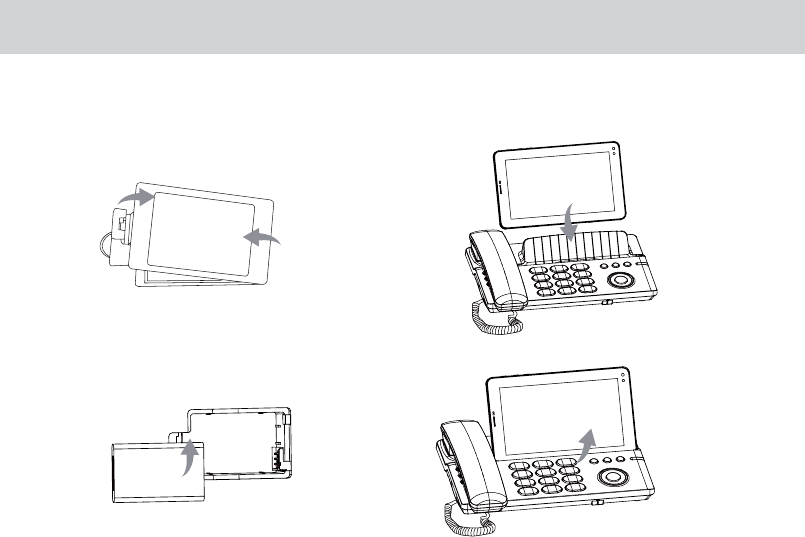
2.3.2 Installing the Dock Battery 2.3.3 Docking and Undocking the Tablet
1. Removing the back cover
To remove the back cover,
refer to the following gure.
2. Installing the battery
To install the battery,
refer to the following gure.
1
2
To install the tablet on to the dock, refer to
the following gure.
To remove the tablet from the dock, do as shown
in this gure.
11

3TABLET FUNCTIONS
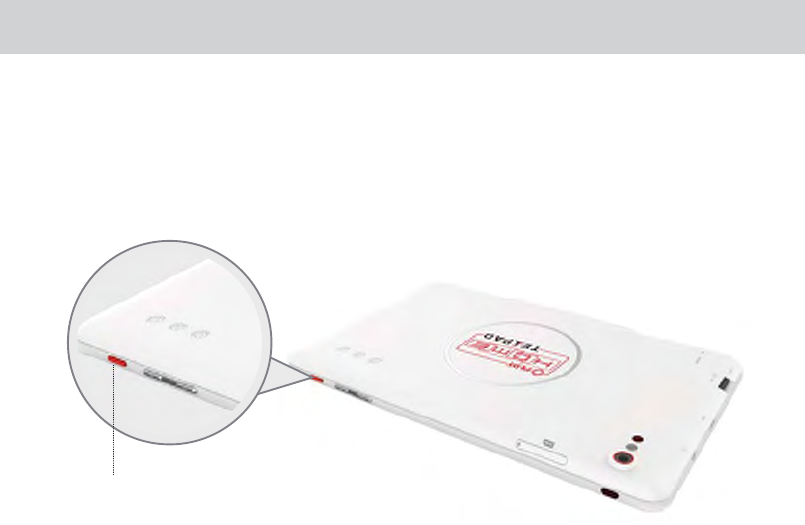
Power key
3.1.1 Turning the Tablet ON
To turn on your tablet, press the Power key.
3.1.2 Turning the Tablet OFF
1. Press and hold Power key to open the Tablet options menu.
2. Choose Shut Down.
3. Touch OK to conrm shutdown.
3.1 Turning the Tablet ON or OFF
13
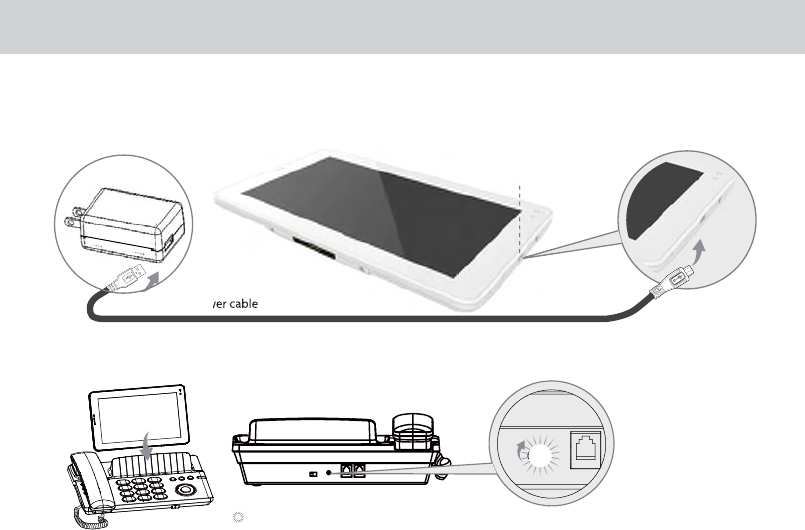
USB power cable
3.2.1 Charging the Tablet Battery
The Tablet is powered by a rechargeable Li-ion battery. There are two ways to charge the Tablet:
1. Place the Tablet on the dock with the power cord supplying power to the dock.
2. Turn the Tablet o, and connect the Tablet to adapter using a USB cable.
3.2.2 Charging the Dock Battery
Before charging the battery, ensure that the battery is properly installed in your dock.
Connect the dock to the power adapter, as shown in the following gure:
The Tablet also starts charging after being correctly installed on the Dock
3.2 Charging the Battery
14
USB Micro port
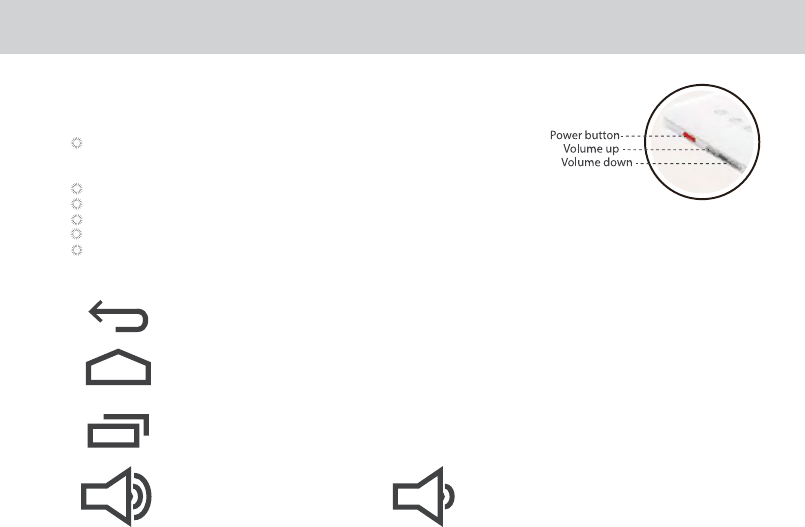
3.3.2 Working the Touchscreen Keys
Back
Touch to return to the previous screen.
Touch to exit from the running application.
If the on-screen keyboard is open, touch to close the keyboard.
Home
Touch to open the Home screen. It will bring you to the rst panel of the Home screen.
Navigation
Touch to open a list of thumbnail images displaying recently operated apps.
Touch the thumbnail image of the app to open it.
Touch and hold and ick o upward or downward to remove the app from the list.
Increase sound Decrease sound
Press to increase sound press to decrease sound
3.3.1 Using the Physical Keys
Power
Press and hold power button to:
1. restart; 2. shutdown; 3.enter airplane mode; 4. enter silent mode; 5. enter vibrate
mode; 6. enter ringtone
Press shortly to lock/unlock the screen.
When the Tablet is ringing, press any of the volume buttons if you want to mute the ringer.
On the Home screen, press to increase or decrease the ringtone volume, or set the Tablet to silent mode.
When using other applications, press to control the volume of music, spoken directions, and other audio sounds.
Press and hold to immediately adjust the ringtone volume to the maximum, or minimum.
3.3 Working with the Keys
15
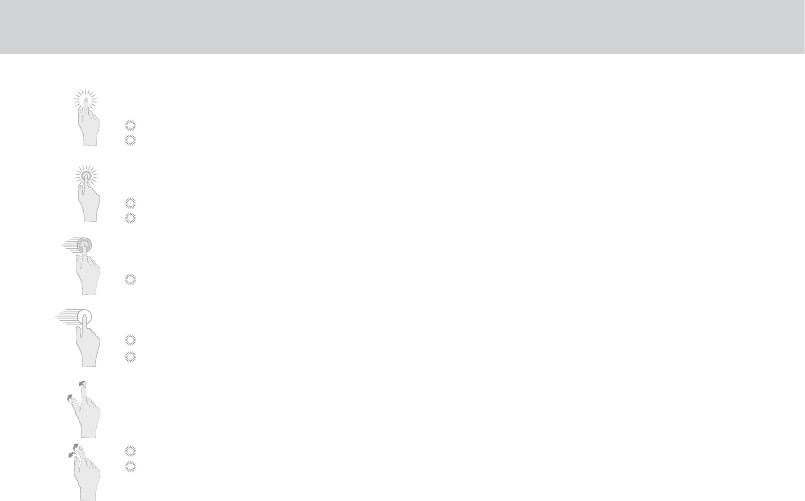
Touch
By touching an item, you can select the item or launch it. For example:
Touch the on-screen keyboard to insert text and/or characters.
Touch an application icon to launch it.
Touch and Hold
Touching and holding items will activate them. For example:
Touch and hold an application/widget to move it.
Touch and hold on a eld and a menu with options will pop up.
Drag
Touch and hold an item, move your nger on the screen to the target position.
Dragging a shortcut icon to the trash will delete it.
Flick, Slide, Swipe
Change screens by icking, sliding, and swiping your nger on the screen. For example:
Slide your nger to unlock the screen.
Flick and/or swipe your nger to scroll the screen or menu, to move from screen to screen, or to view next object in
the gallery.
Pinch
Using two ngers (like your thumb and index nger), pinching inward will cause the screen to zoom out; pinching
outward will cause the screen to zoom in. For example:
Pinch outward to see zoomed in details of a photo in Gallery.
Pinch inward to zoom out and see the whole page of a browser.
3.4 Using the Touch Screen
16
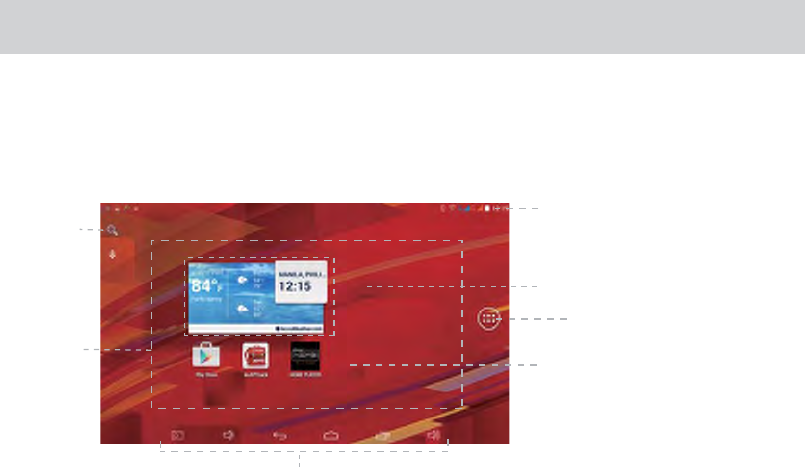
The Home screen is the starting point in using the Tablet
Touch the Home key to display the Home screen. You can customize the Home screen with various wallpapers and create
shortcuts for items you want to easily access.
3.5 Home Screen
3.5.1 Getting to Know the Home Screen
1. Main display area
2. Weather &Clock Widgets
3. Short Cut Buttons
4. Touch Screen Keys
5. Status Bar
6. Application Button
7. Search
6
1
4
2
7
3
5
17
3.5.3 Customizing the Home Screen
Slide your nger horizontally across to the left or the right of your main Home screen to see your additional home
screens. These screens provide more space for shortcuts or widgets. The small indicator shows the current position.
The Home touchscreen button brings the screen back to your main Home screen.
3.5.2 Home Screen Extensions
1Main display area: This area displays application shortcuts, widgets, and other items that can be easily
accessed by touching them.
2
3
Weather Widgets: The weather widget informs you of the time, date, and weather in your location. It can
be customized based on your preference.
4
Short Cut Buttons: These are shortcuts for various applications. You may change and customize these
according to your needs.
5
6
7
Touch Screen Keys: Back, Home, Navigation, Volume Down, Volume Up
Status bar: It shows the status of the device such as Wi-Fi connection status, battery status, and other
information. You can touch to open a more detailed status menu.
Applications button: Touch to open the Applications screen, where you can view the applications installed
on the Tablet. Touch any application icon to run it.
Enter to search shortcut icon, local applications and Google Voice search can be launched directly.
18
There are two ways to change your wallpaper:
1. Press and hold blank space on home screen, the main screen display area interface will zoom out. Three buttons:
WALLAPERS, WIDGETS and SETTINGS appear under the main display area. Click WALLPAPERS and choose one of
picture from your camera gallery, Wallpaper gallery or the video wallpaper.
2. Click Menu key and touch Gallery, choose one of the picture as your Tablet's wallpaper.

When the Tablet is powered on, press the Power key and the screen will turn o and lock.
When the Tablet is left idle for a specied time period that you have set, the screen will automatically turn o and
lock.
Always lock the screen to save the battery or prevent accidental taps when the Tablet is not in use.
3.6.1 Locking the Screen
When the screen is o, press the Power key to turn it back on, and then unlock the screen.
If you have not set a screen lock, the screen will just turn back on when you press the power button.
If you have set up a screen lock, you will be asked to input the relevant unlocking pattern: slide, face, voice, pattern, PIN or
password to unlock it.
3.6.2 Unlocking the Screen
To set up a screen lock, touch the Applications key from the Home screen.
Go to Settings > Personal > Security.
To set a screen lock as slide, face, voice, pattern, PIN or password according to screen instructions.
3.6.3 Setting up a Screen Lock
To set the time between the last screen touch or key touch and automatic screen lock, go to Home screen
touch the Applications key, and touch Settings > Display >Sleep.
3.6.4 Setting up a Screen Timeout Period
3.6 Locking and Unlocking the Screen
19
3.7 Inputting Text
You can enter and edit text in text elds and use menu commands to cut, copy, and paste text within or across applications.
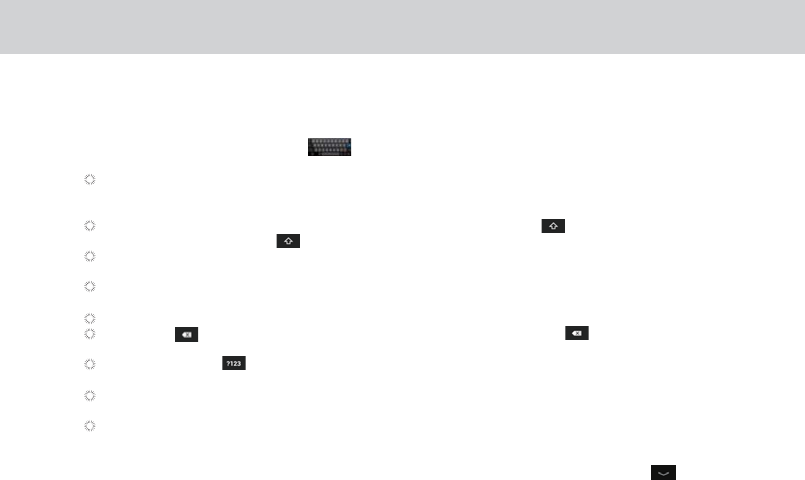
To open the onscreen keyboard, touch a text eld where you want to enter text.
To switch the input method, touch the icon located at the lower right corner of the keyboard.
The following section takes the Android™ keyboard as an example.
When you are typing, the characters you are entering will appear in a line above the keyboard, along with some
suggestions for the word you are typing. Press space or a punctuation mark to enter what you are typing, or touch the
suggestion you want to enter. You can touch and hold the leftmost word to save it to the dictionary.
To capitalize the letter you are about to type, touch the upward arrowhead key once. To capitalize all the letters,
touch the upward arrowhead key twice.
When you touch a key, a larger key will show up briey over the keyboard. Keys with alternate characters display an ellipsis
(...) below the character.
Touch and hold a vowel or the C, S, or Y key to open a small window where you can touch an accented vowel or other
alternate letters.
Touch and hold the Period key (.) to open a small window with a set of common symbol keys.
Touch the DEL key to delete a character to the left of the cursor. Touch and hold the key to delete all characters to
the left of the cursor.
Touch the Symbols key to switch to the numbers and symbols keyboard, and touch the alphabet key (ABC) to switch
back.
On the numbers and symbols keyboard, touch the ALT key to view additional symbols, and touch it again to return to the
rst numbers and symbols keyboard.
Touch and hold almost any of the number and symbol keys to open an array of additional symbols.
To edit the text you have entered, touch to move the cursor to the location where you want to add or delete text. The cursor
is a vertical bar that designates where the text you type or paste is inserted.
To close the keyboard when you are done typing, touch Go/Done button on the keyboard. Or touch the icon on the
lower left corner of the touchscreen.
3.7.1 Entering Text Using the Onscreen Keyboard
20

To quickly cut or copy all the text in a text eld:
3.7.2.1 Touch and open the text eld that contains the text that you want to cut or copy.
3.7.2.2 Touch and hold the text eld to display the Edit text menu.
3.7.2.3 Touch Select all, Cut all, or Copy all.
3.7.2.4 Touch Cut or Copy to cut or copy the text.
To cut or copy selected text in a text eld:
1. Touch and hold the text that you want to cut or copy. Once the text is highlighted, tabs will appear at the ends of the
text, as well as the editing command menu.
2. Drag the respective tabs left and/or right to select the full text you want to cut or copy. The text between the tabs will
appear highlighted.
3. Touch Cut or Copy to cut or copy the selected text.
The cut or copied text will be stored in a temporary area so you can paste it into another text eld.
In order to paste the text, you must have cut or copied the text at least once. Once you have cut or copied the text, you
can paste it multiple times.
To paste the most recent text that you have cut or copied into another text eld:
1. Touch the text eld where you want to paste the text.
2. Touch the location where you want to paste the text. A tab will show up.
3. Touch the tab and the Paste option will show up.
4. Touch Paste.
3.7.2 Cutting or Copying Text
21
3.8 Opening and Switching Applications
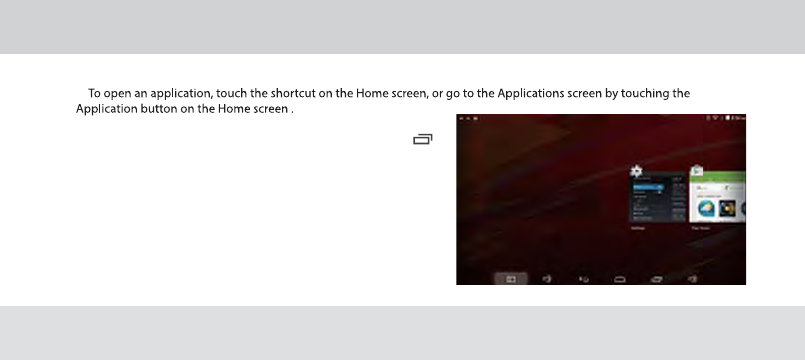
To open and switch to a recently used application, touch the
key at the bottom of the touchscreen.
The list will open on the right hand side. Touch the thumbnail of the
application you want to access.
3.9 Accessing the Tablet’s Settings
To access the Settings to view or change your wireless and cellular networks, sound and display, location and security,
applications, language and keyboard, date and time, and other settings:
3.9.1 From the Home screen, touch the Status Bar, touch menu key on the right corner of screen.
3.9.2 From the Home screen, touch the Application button and touch Settings shortcut.
3.9.3 If you recently have accessed the Settings, you can touch the Navigation key on the lower left corner of the
touchscreen to display the list, and touch Settings in the thumbnails list that opens.
22

3.10.1Languages Setting
1. Open setting list.
2 .Click languages & input.
3. Select language from the following scrolling list.
3.10.2Input Method Setting
1.Open setting list.
2.Click languages & input.
3.Click keyboard & input.
4. The default input method is English(United States)-android keyboard(AOSP). It will be added into the input method
list automatically when you have installed other input method.
5.You can open right side to select or cancel the relative input methods.
3.10.3 Setting to Add Account
1.Open setting list.
2.Click Add Account.
3.Google, Corporate, IMAP will show in the popping up interface.
4.Click GOOGLE to register or log in Google account.
3.10 Languages & Input Method & Account Setting
23

3.11.1 To Automatically Set Date and Time:
1. Open the Settings list.
2. Touch Date & time.
3. Check the box for Automatic date & time.
4. Touch Select time zone, then scroll down and select the correct time zone from the list.
5. Choose whether or not to set the time to display in 24-hour format, check or uncheck the box to enable or disable
this option.
6 .To choose your preferred date format, choose from the options provided.
3.11.2 To Manually Set Date and Time:
1. Open the Settings list.
2. Touch Date & time.
3. Touch Set date, then scroll down the roll to adjust the date, month, and year. Touch Done when nished.
4. Touch Select time zone, scroll down and select the correct time zone from the list.
5. Touch Set time, then scroll down to adjust the hour and minute,Touch done when nished.
6. To choose whether or not to set the time to display in 24-hour format, check to enable or uncheck to disable.
7. To choose your preferred date format, choose from the options provided.
3.11 Setting the Date and Time
When the time provided by the network is automatically used, you cannot set the date, time, and time zone
by yourself.
24
3.11.3 Scheduled Power ON/OFF
1. Power on: The date and time of scheduled power on can be set at anytime from Monday to Sunday.
2. Power o: The date and time of scheduled power o can be set at anytime from Monday to Sunday.
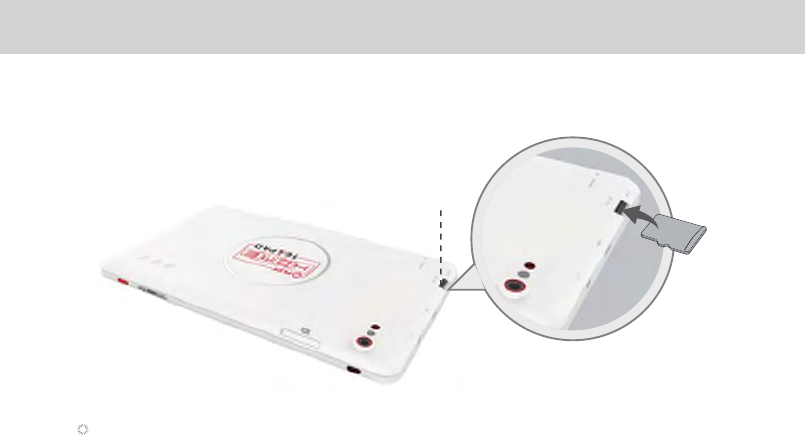
Insert your micro SD card into the micro SD card slot as shown in the following gure.
3.12 Installing or Removing the Micro SD Card
Remove the micro SD card by gently pushing the card further into the slot, and then release it. The card will eject from the
slot, and can be removed.
25
Micro SD card slot
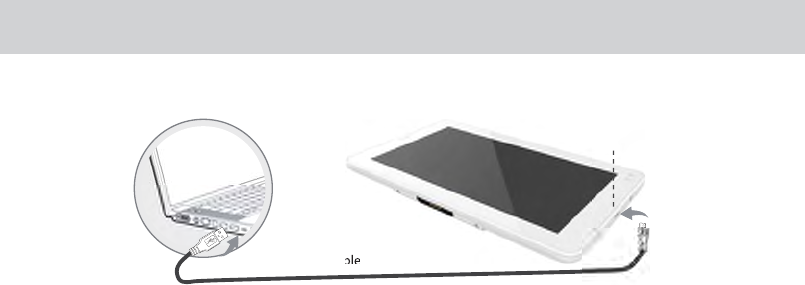
3.13 Connecting to or Disconnecting from Computer Using USB
3.13.1 Connecting the Tablet to a computer using USB cable:
USB power cable
1. Use the appropriate USB cable (micro USB connector) to connect the Tablet to a USB port on your computer. Once
it is properly connected, the Tablet displays a notication indicating that the USB is connected.
2. Touch the lower right corner to open the Status Bar and touch USB connected in the Notications list.
3. Touch Turn on USB storage to conrm transferring of music, pictures, and other les between the Tablet storage or
micro SD card storage and the computer.
3.13.2 To disconnect the Tablet from the computer safely and to avoid any loss of information, follow the computer operating
system’s instructions to disconnect USB devices, and additionally follow the steps below:
1. Open the Status Bar by touching the top right corner.
2. Touch Turn o USB storage in the Notications list.
3. Touch Turn o USB storage in the dialogue that opens.
26
USB Micro port

27
3.14 3G Phone Communication Function
The full name of 3G is 3rd Generation which refers to the
third-generation digital communications. The rst generation of digital
mobile phones came out in 1995, which could only make voice calls;
appeared in 1996-1997, the second-generation digital mobile phone can
receive data, such as receive E-mail or webpage; the main distinction
between the third generation of mobile phones and the rst two
generations is the improvement on speed of voice and data transmission.
It can deal with images, music, video streaming and other forms of media,
including web browsing, conference calls, e-commerce and other
information services.
MT7 tablet is a quad-core tablet which supports dual cards dual standby
and two call communication bands: WCDMA (2100MHz/850MHz) and
GSM (850MHz/900MHz/1800MHz/1900MHz). The two SIM cards can be
online at the same time, which enable end users making calls and surng
the internet as well. Being so convenient and quick, MT7 tablet meets
more and more end users’ needs.
WCDMA(Europe and
Japan),CIMA2000(America)
and TD-SCDMA(China) are
the major technologies of 3G,
its feature is supporting
high-speed broadband data
transmission.
The transmission speed is less
than 2M/s.
Simulative mobile
network has been
eliminated.
The Major technology is GSM.
Its Feature is with core of
digital voice transmission
technology, 2G can achieve
data transmission with low
velocity.
The transmission speed is less
than 9.6k/s
1G
2G
3G
28
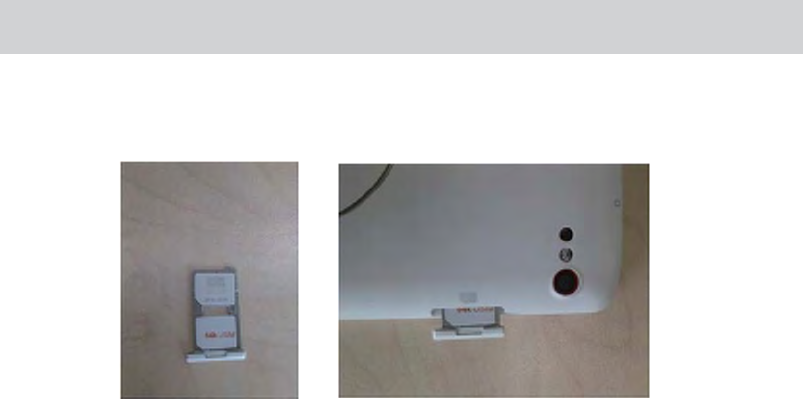
1. First of all, turn o the tablet.
2. Place SIM card properly and push it into card slot in right direction. MT7 supports dual SIM card dual standby, and users
can place one or two SIM cards as they want. As shown in gure 1 and gure 2:
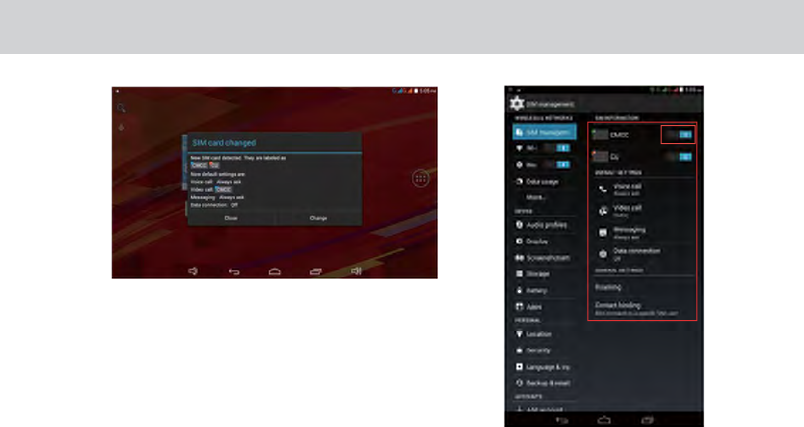
3. Turn on the tablet, SIM card’s icon will appear at top right corner of tablet’s screen. A screen message will pop up.
Choose default setting by clicking Cancel (Figure 3), or touch “Change” and enter SIM Management to set the following
options: voice call, video call, message and data connection(Figure 4). MT7 supports 2G/3G phone communication bands
and the Internet.
Figure 2Figure 1
29
4. SIM card management settings
4.1 SIM card information
① Click to get SIM card in or out of service(gure 4):
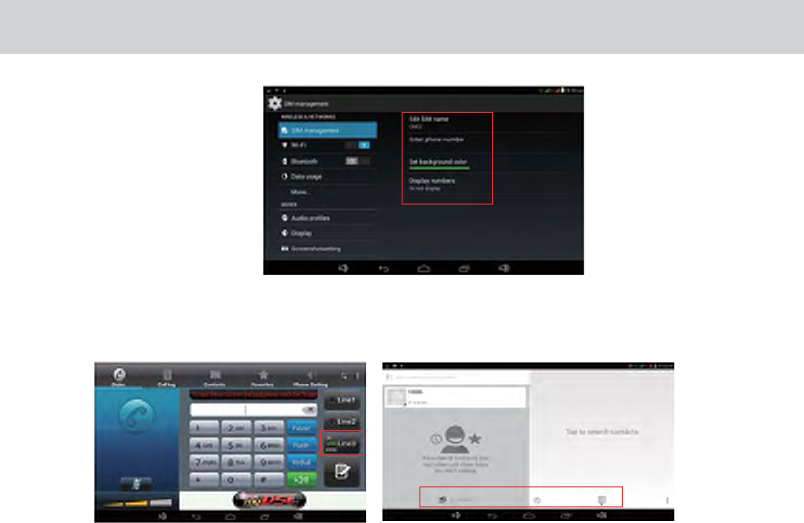
② Select a SIM card, users can “edit SIM name”, “enter phone number”,
“set background color” and “display numbers” (gure 5).
4.2 General settings
① As high roaming expense will arise from data network roaming,
users can set “a SIM card for roaming” and “the reminding frequency of
roaming prompting message”(gure 4);
② Binding contacts to a specic SIM card(gure 4):
Figure 3
Figure 4
30
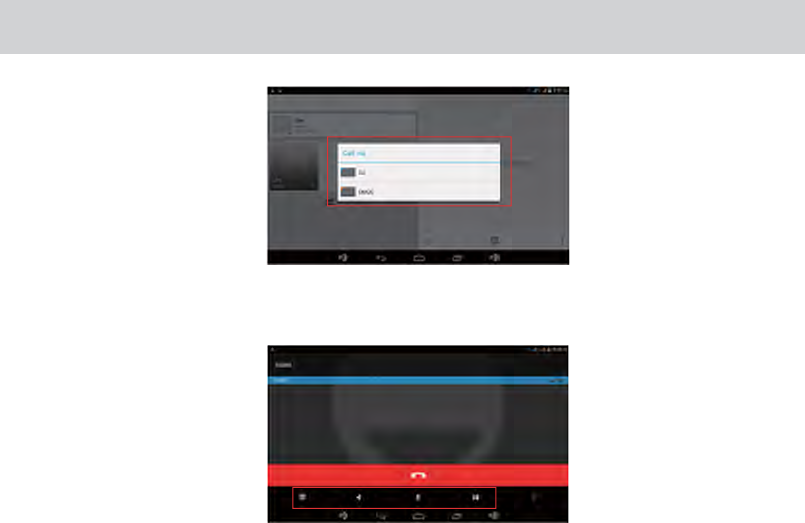
6. Touch Land Line Dialer on screen and choose Line 3 to dial by all contacts, recent contacts or the dialing interface (Figure 6
and 7). If two SIM cards have been placed in MT7 Tablet and “voice call” in SIM Management is set in “always ask”, a screen
message to choose one SIM card will pop up when end user is making calls. (Figure 8)
Figure 6 Figure 7
Figure 5
31
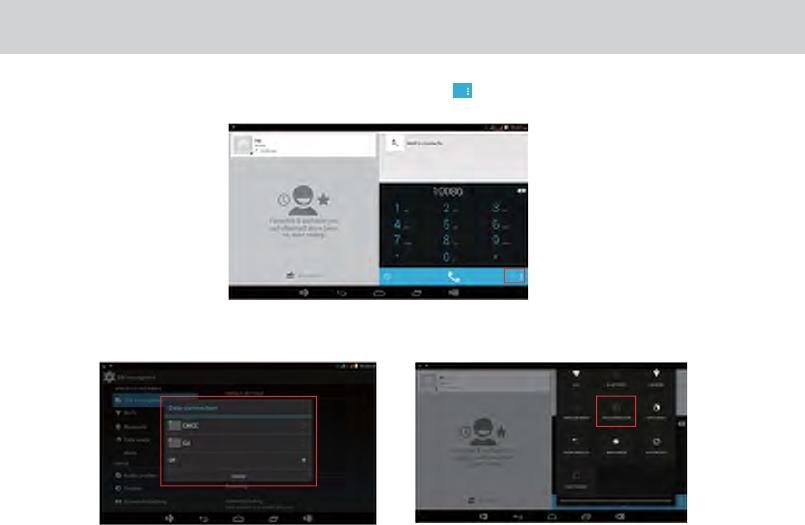
7. When a call is put through, there are options on bottom of the screen: dialing interface, speakerphone, silence mode
and call suspending ( gure 9):
Figure 9
Figure 8
32
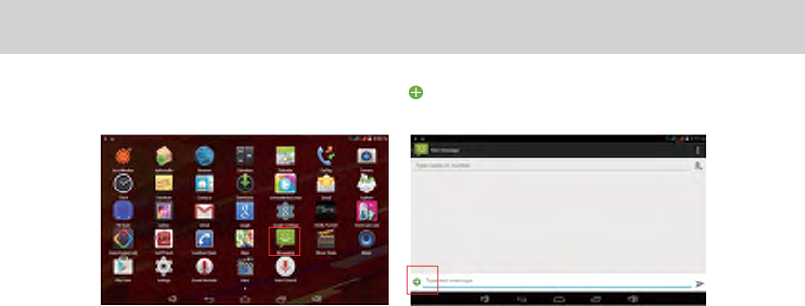
8. On 3G dialing interface, when a phone number is input, touch the icon on lower right corner, user can choose
video call, IP dial, speed dial, sending message, adding numbers to contacts and other settings (gure 10).
9. Data network can be turned on in “ SIM card management settings” or the shortcut on status bar; If data connection is
turned on, there will arise network trac when users browse webpage. Therefore, we suggest end user to watch online
video under Wi-Fi network environment (gure 11 and 12).
Figure 11 Figure 12
Figure 10
33
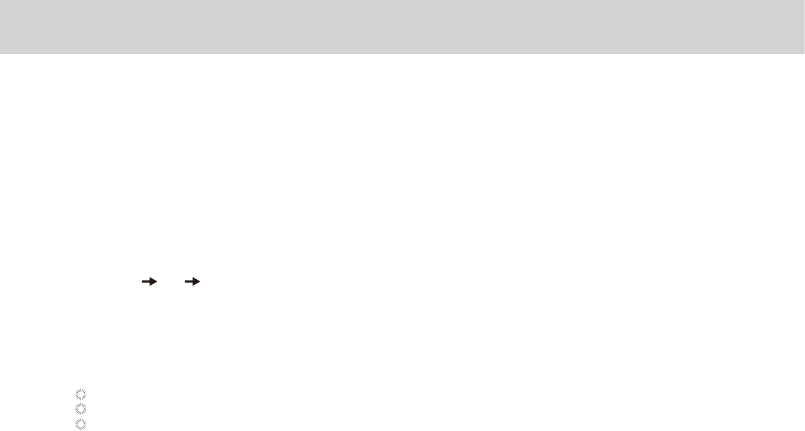
Tap “message” icon to access message writing interface, touch can add instant photos, videos, recording, contacts, local
pictures and local video and other enclosures.(Figure 13 and 14)
Notices:
1. In order to protect your SIM card, please turn o MT7 tablet before placing or taking out SIM cards.
2. Please place SIM card properly and in correct direction to SIM card slot, so as to avoid any damage to SIM card.
Figure 13 Figure 14
Wi-Fi
Wi-Fi is a wireless networking technology. Wi-Fi technology can provide wireless Internet connection over
distances of up to 100 meters, however the connectivity of the Wi-Fi depends on the Wi-Fi router, and the
surrounding environment in which it operates.
By accessing a wireless access point or "hotspot" the tablet can be connected to the internet. Some access points
are open and can be easily connected to, but others are hidden or have security protection such as authentication
or encryption, which will require conguration to gain access.
The tablet is able to connect to various wireless networks and devices. Including Wi-Fi data networks, and
Bluetooth devices such as headsets for voice and data transmission.
3.15.1 Turning Wi-Fi ON or OFF
When the Wi-Fi is turned on, the device searches for available networks accessible within range.
Inside Settings, when the Wi-Fi is turned on, the available networks will be listed on the side.
Select the network you would like to connect to.
If the network is open, it will automatically connect as soon as you select it.
If the network is secured, there will be a lock icon beside the name. Enter the correct password to connect.
To view detailed information about the network the tablet is connected to, touch the name of the network and
the information will show up such as IP address, speed, etc.
3.15.2 Connecting to a Wi-Fi Network
3.15 Wireless Networks
34
1. Setting WiFi touch ON/OFF button to turn ON/OFF WiFi.
2. Slide down the status and touch Wi-Fi icon to turn on it.
Tap Settings > Wi-Fi.
Touch the network name you want to remove from the Wi-Fi networks list.
Touch Forget in the menu that opens.
3.15.5 Forgetting a Wi-Fi Network
When Wi-Fi is already on, touch Network notication to check or uncheck the box to turn the open network
notication on or o in the Wi-Fi settings list. The tablet will display or stop displaying notications in the status bar when
the device detects open networks in range.
3.15.3 Turning Open Network Notication ON or OFF
To add a Wi-Fi network, rstly follow the above steps to turn the Wi-Fi on, and then follow the steps listed below:
Under the Wi-Fi settings list, scroll down and touch Add Wi-Fi network.
Network SSID: Enter the name (SSID) of the network in the text eld.
Security: Select the security scheme in the menu that opens.
Password: Enter any required security credentials.
Touch Save to nish adding the Wi-Fi network.
3.15.4 Adding a Wi-Fi Network
35
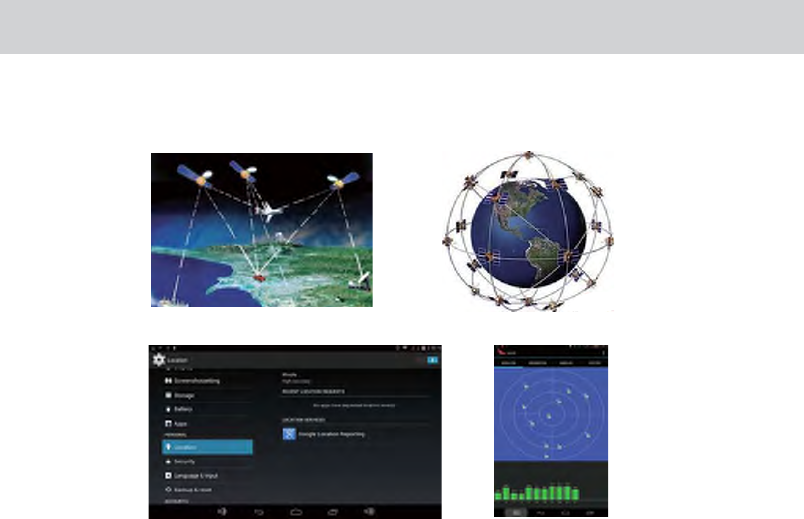
36
3.16.1 Turn on the GPS Location function in Settings, enter factory testing mode, and search the satellite signals.
3.16 Global Positioning System
GPS is an all-round, all-weather, all-time and high-precision satellite navigation system. It can provide
worldwide users with navigation information, such as low cost and high-precision three-dimensional
position and velocity, precise timing and so on.
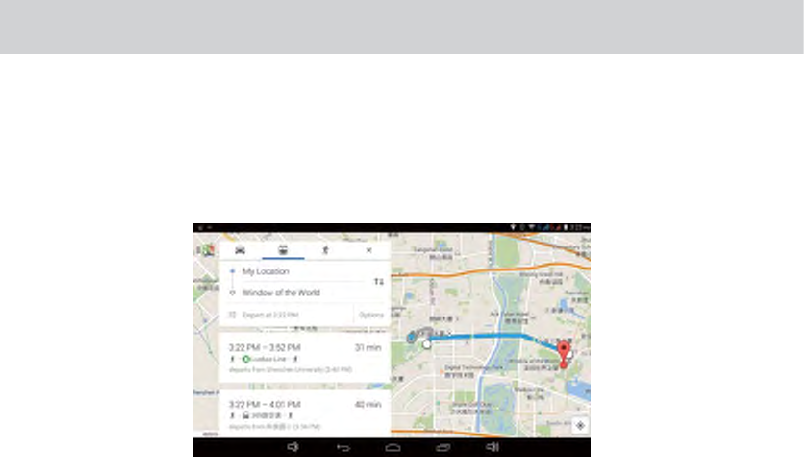
3.16.2. Turn on the Google map and locate user’s current position;
① After location is done, users can search the surrounding’s information, such as tourist attractions, gas station,
hotel, store and hospital and so on.
② After you select a position as your destination, Google map will accurately calculate all the travel roads and the
time you need according to your vehicle.
③ Users can install navigation APK by themselves, the APK will guide and lead users on travel information and help
users to arrive at their destinations.
37
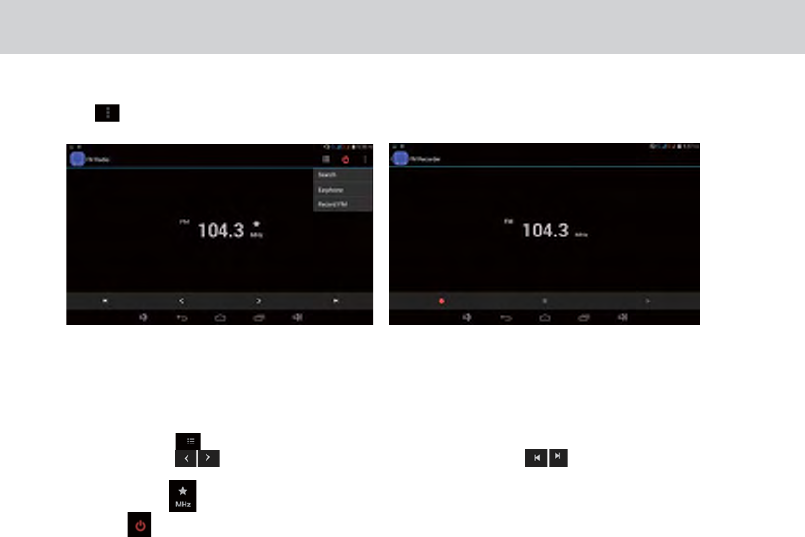
3.17 Frequency Modulation
3.17.1 Earphone is needed to insert into the Tablet as antenna when turn on FM Radio, nd and access FM Radio, click
the icon on the top right coiner, there will be the following options:
M. Search: click it to search frequency channel automatically.
N. Earphone: click it to switch between speaker and earphone mode.
O. Record FM: a red dot will appear on screen when click it, touch the red dot to record; touch the box in the
middle to stop recording, rename and save the record; touch triangular icon to play the recorded FM le.
3.17.2 Touch the icon to check the channel list which has been searched.
3.17.3 Click the icons at the bottom of screen to switch the channel; click to switch eective
channel.
3.17.4 Click the icon to add the current channel into favorites.
3.17.5 Touch to turn o FM.
38
39
3.18 Bluetooth
Bluetooth is a wireless communication technology for exchanging information over short distances. The connectivity
between the Bluetooth devices may be aected by their surroundings and is altered or reduced by obstacles such as
walls or other electronic devices.
To congure the Bluetooth settings of the tablet in the Bluetooth settings list:
Touch and open the Settings from the Home screen or Applications screen.
Touch Wireless & networks, and touch Bluetooth settings.
3.18.1 Opening Bluetooth Settings
Open the Settings.
Under Wireless & Network > Bluetooth.
Touch the On/O button to activate or deactivate Bluetooth.
To extend the battery life of the tablet, turn Bluetooth o when not in use.
3.18.2 Turning Bluetooth ON or OFF
The Bluetooth name of your tablet is the identication of your device to other Bluetooth Devices.
Open the Settings.
Under Wireless & Network touch Bluetooth.
Touch the Menu button at top right corner of screen.
Touch Rename tablet in the options given.
Type the new name in the window prompted.
Touch Rename to conrm change.
3.18.3 Changing the Bluetooth Name of Your Tablet

Paired devices
Once a device is paired, the name of the newly paired device will show up under a separate category as Paired devices.
After a device has been paired, it stays paired unless the paring is disconnected manually.
To automatically disconnect your tablet from a paired device, simply turn o the tablet’s Bluetooth or the target device.
To manually disconnect your tablet from a paired device or to be unpaired from this device by erasing all the pairing
information:
Touch Unpair.
3.18.5 Disconnecting from or to be Unpaired from a Bluetooth Device
Pairing with a Bluetooth device
Search for a Bluetooth device, pair with it, and exchange information between devices.
Open the Settings.
Under Wireless & Network touch Bluetooth.
Touch the name of your device to make it visible to nearby devices.
Touch Search for devices at top to begin or reinitiate search for other devices.
Touch the name of device that you want your device to pair up with.
Window will show up asking for conrmation, touch Pair to conrm.
3.18.4 Connecting to Bluetooth Devices
40
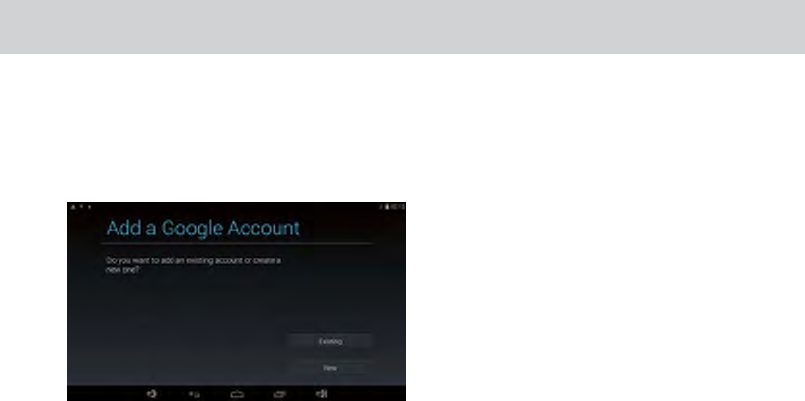
3.19 GOOGLE SERVICES
3.19.1 Creating a Google Account
When accessing a Google service for the rst time with your device, you will be asked to sign in using your Google
account.
Make sure the Tablet is connected to a network to sign in or create a Google account.
If you already have a Google account, simply enter
your information and sign in.
If you do not have an account, to create a Google
account:
1. When asked if you have a Google account or not,
touch New.
2. Insert you last and rst name, touch Next.
3. Type in the e-mail address you would like to use,
and touch Next.
4. Insert the password, making sure that you
correctly type in the password twice when prompted.
5. Type in your Recovery e-mail address and set up
a security question to help you access your account in
case you forget your password.
6. Check the box that to agree to the Google Terms
of Service and additional privacy policies, and touch “I
accept”.
7. Input the authentication keys that appear. Your new Google account has been successfully created!
41
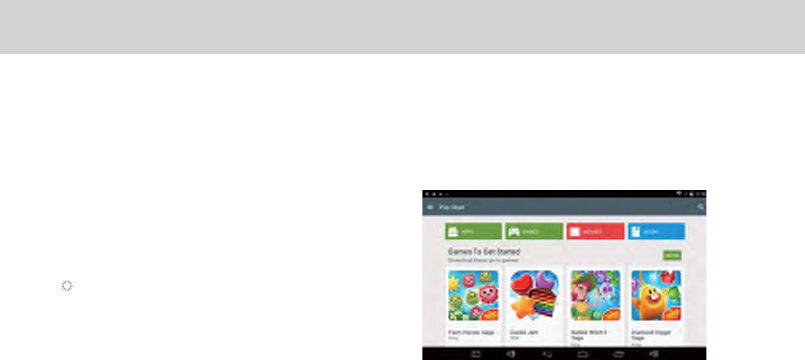
3.19.2 Using the Play Store
Within the each option, you can easily search for
applications by name or keyword.
You can access thousands of easily downloadable applications and games for
your Tablet via the Google Play Store.
3.19.3 Searching for Applications
There are several ways to search for applications in the Play Store, through:
1. Featured applications.
2. Categories.
3. Search function.
4. Your downloads.
3.19.4 Installing an Application
1. Go to Play Store from the Home screen or Applications screen.
2. Touch a category, and then touch the application you want to download.
3. To install, touch FREE (for free apps) or Buy (for paid apps) to begin download and installation.
4. Download progress can be checked from the notication panel. Most applications will be downloaded
within seconds.
5. After the application has been downloaded and installed on your Tablet, the content download icon appears in
the Status bar.
6. To download and install an application from sources other than the Play Store, touch Settings > Security, and check
the box for Unknown sources.
42

3.19.6 Backing up and Restoring Apps and Settings from a Google Account
1. Access the Settings list from the Home screen or Application screen.
2. Scroll down the Personal section, and touch Backup & reset.
3. Check the box for Back up my data and Automatic restore.
3.20.1 Opening E-mail
1. Go to Play Store, touch the My apps button.
2. Touch the application to uninstall, and then touch Uninstall.
3. When asked for conrmation, touch OK to remove the application from your Tablet.
3.19.5 Uninstalling an Application
Touch E-mail icon on the Home screen or on the Applications screen to laurch it.
3.20 E-MAIL
43
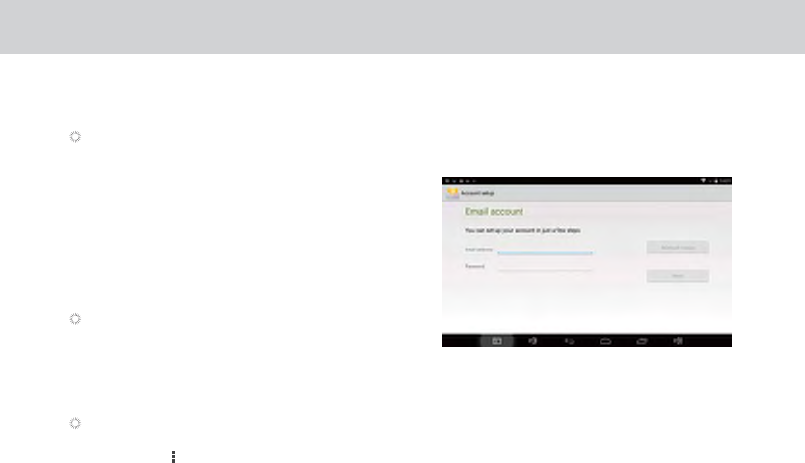
3.20.2 Adding and Deleting E-mail Accounts
Adding an e-mail account
1. Touch New account.
2. Enter your e-mail address and password, and touch Next.
3. Within Account settings, type in the name that will represent
the account that you would like to be displayed when you send
e-mails.
4. Touch Next to nish setting up your new e-mail address on
your device.
Manual setup
1. Touch New account.
2. Type in your e-mail address and password, and touch
Manual set up.
3. Select the type of e-mail account. (Check your e-mail provider for more information if necessary.)
4. Enter the correct account details, and touch Next when done.
The rst time you open E-mail, you are prompted to set up an e-mail account. If you have an existing e-mail account,
you can add this by touching Add account.
Automatic setup:
Deleting an e-mail account
1. Open the E-mail screen.
2. Touch Menu at the upper right corner. Touch Settings.
3. Scroll down and touch Remove Account.
4. Touch OK in the dialog to conrm your delete action.
44
3.20.3 Gmail
Gmail is an e-mail service provided by Google. Gmail can be accessed from the Applications screen by touching the
Gmail icon.
To add a Gmail account:
1. After opening Gmail, touch Add existing.
2. Enter the e-mail address and password of your Gmail account.
3. Touch Sign In to complete the process.
To create a Gmail account
1. Access Gmail, click Got It.
2. click Add an email address and choose Google account's type, click OK.
3. At the Gmail screen, touch New.
4. Insert your last and rst name, and touch Next.
5. Type in the e-mail address you would like to use, and touch Next.
6. Insert the password.
7. Type in your Recovery e-mail address and set up a security question to help you access your account in case you
forget your password.
8. Check the box that says “Agree to the Google Terms of Service and additional privacy policies”,and touch “I accept”.
9. Input the authentication keys that appear. Your new Gmail account has been successfully created!
To remove a Gmail account
1. Open the Settings list from the Applications screen.
2. Under Personal, touch Accounts & sync.
3. Touch the e-mail account that you would like to remove.
4. Touch the Menu button at the top corner.
5. Touch Remove account from the menu and conrm.
45
3.21 Camera Instructions
46
Take picture or make video: nd and tap “camera” icon on tablet, keep lens cap clean and rub it by a clean cloth before shooting, any
stain on it will cause photo bad exposure or blurring.
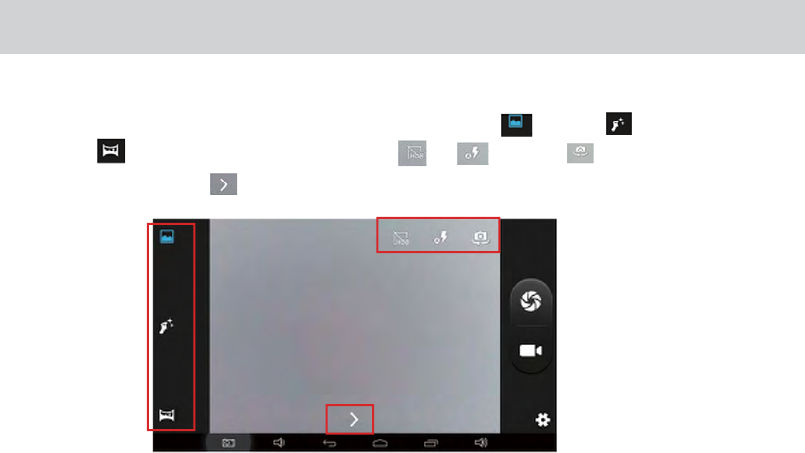
1.Launch camera in application program, icons in left vertical line respectively are: photo mode, facial beautication
mode, panorama mode; icons in top line respectively are: HDR, ashlight and front and rear camera
switching function; the icon button is photo eect settings. They all can be set according to user’s need, as shown in Figure 1:
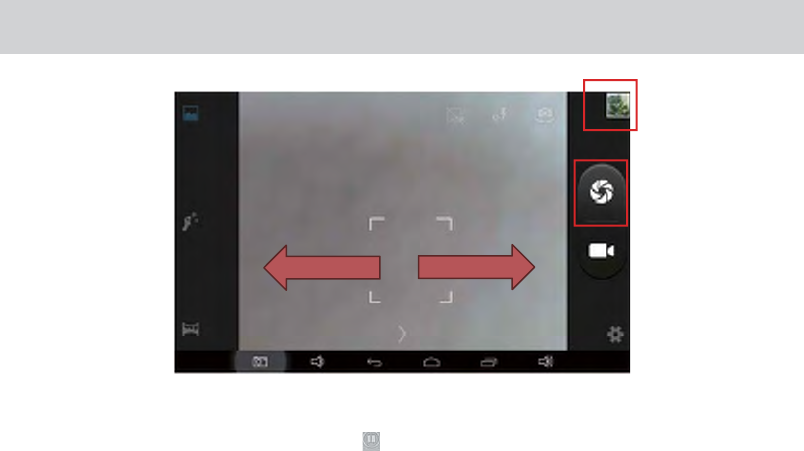
2.Touch the screen to focus when taking photos. Click camera button for taking photos once ready. Touch the photo icon on top
right corner or swipe right for checking the captured photos. Swipe left can return back to camera mode, as shown in Figure 2:
Figure 1
47
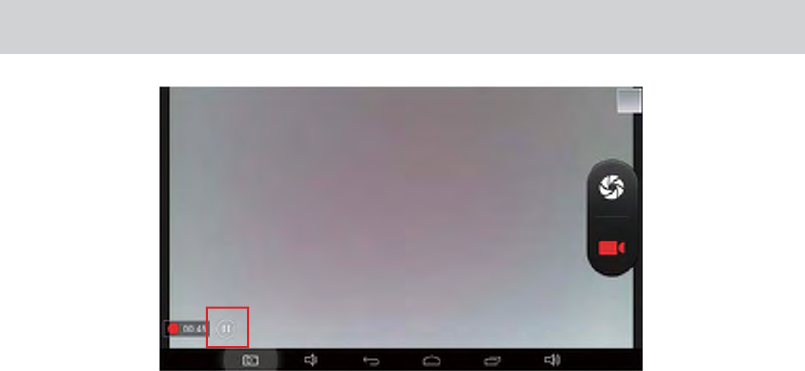
3.Click video recording button under the photo taking button for recording video. When recording video, photos can be instantly
captured by clicking photo taking button. Touch pause icon beside the video timer, recording can be paused. Touch it again to
resume video recording. Video Recording can be stopped by touching the red video camera button, as shown in Figure 3:
Figure 2
48
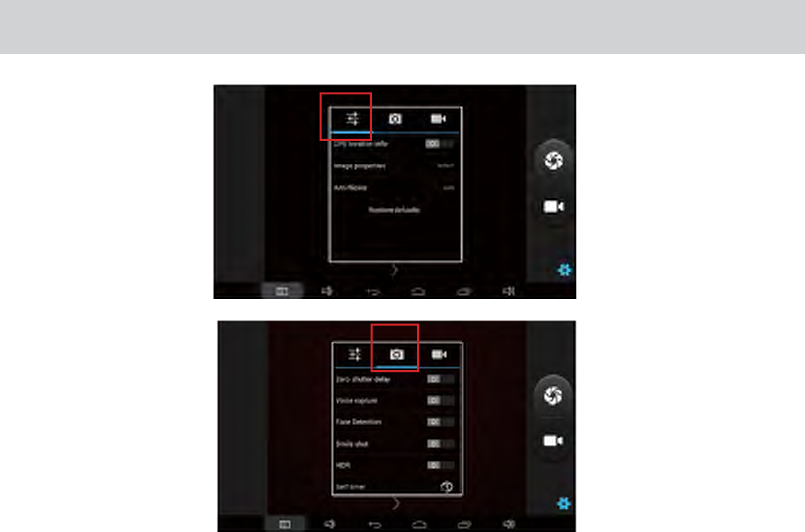
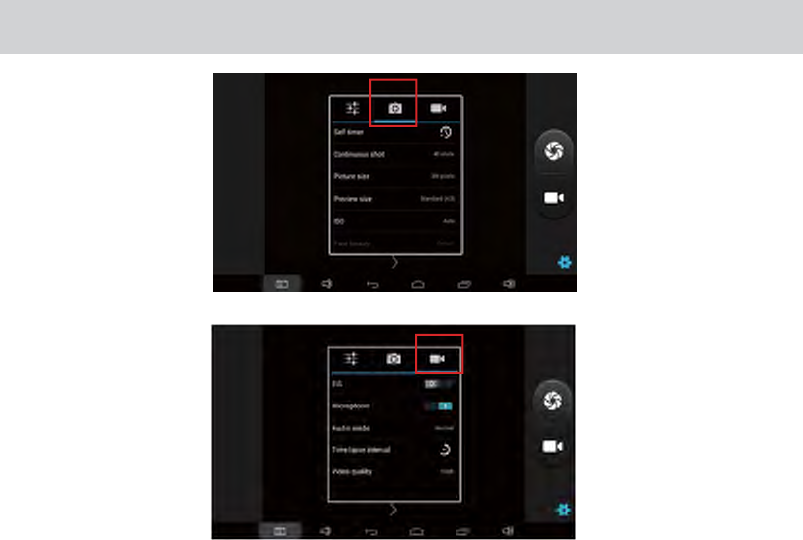
4. Enter Settings at the bottom right corner, a window will pop up, there are three buttons on the top line: click rst button, users
can have following settings: turn on/o GPS location information, image properties, anti-iker, restore defaults; the second button
is for zero shutter delay, voice capture, face detection, smile shot, HDR, self-timer, continuous shot, picture size, preview size, ISO
setting; the third one is for EIS, microphone, audio mode, time lapse interval, video quality setting as shown in the following gures
(Figure 4,5,6 and 7):
Figure 3
49
Figure 4
Figure 5
50
Figure 6
Figure 7

3.22 Home Control
51
Terms of Use
The Home Control app is a Home Automation System which is comprised of the following: IR remote controller, Reservation
(Timer)control, Camera motion detection and Outside-Home Control features which are integrated and provided for user's
convenience. User has to consider the hardware congurations like IR sensor direction, distance from TELPAD to target device,
Camera direction and power supply for the TELPAD. The power stability of TELPAD should be considered if TELPAD is used
continuously for a long time and also the user can set TELPAD in "stay awake mode" to keep the Home control running. User has
to verify the software conguration like IR signals, Internet connection, and personal use case. The Out-Home control function
may not work properly depending on the following factors: client mobile device, unstable network environment, network timing
or Internet Service provider. The Outside-Home Control works only on Android devices which are equipped with Google service.
The push message used for Outside-Home Control is provided by Google , GCM (Google Cloud Messaging) message do not
guarantee high percentage of delivery. User needs to retry if the message/request is not delivered successfully. For the service
implementation, only the latest image captured and remote controller status will be stored in the server with security code
algorithm. User has to carefully manage the connection between “Home Control Host” (preinstalled on the TELPAD) and “Home
Control Client” (available in PLDT KnAPPsack) should be installed on the user's smartphones/android devices to monitor/control
TELPAD (to register client's device connect to TELPAD via Bluetooth).
TM
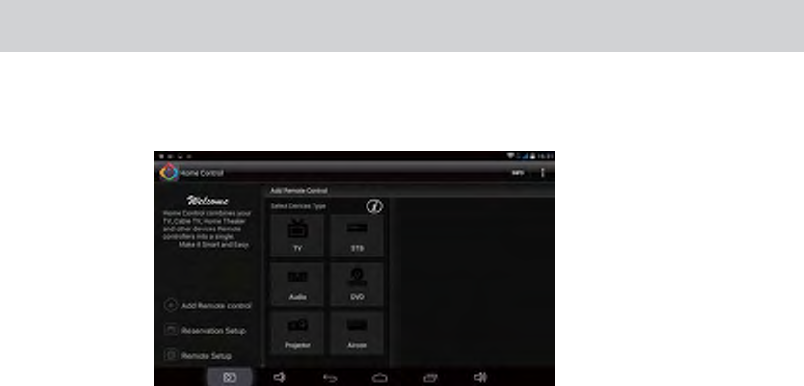
This section contains a description of Home Control application which includes (1) IR (infrared) Universal Remote, (2)
Reservation, (3) Out Home Control and (4) Motion Detection.
TELPAD Home control will work with the devices that are already in your home. It can control your TV, Cable Box,
Radio, DVD, DVR, VCR, Blu-Ray, CD, Audio, Air Con (A/C).
3.22.1 Installation of “Home Control” Apk.
Find and tap the “Home Control Link” icon in MT7 APPs, MT7 screen will jump to “Google Play” and click “install” to
download it.
Remark: This usage may changed without notication upon application update.
NOTE:
The Home Control operates the same way as an ordinary remote control IR signals. Please be careful not to cover the IR
sensor marked with Red of the TELPAD when you use the IR Remote function. This function may not be supported
depending on the model, the manufacturer or service company.
52
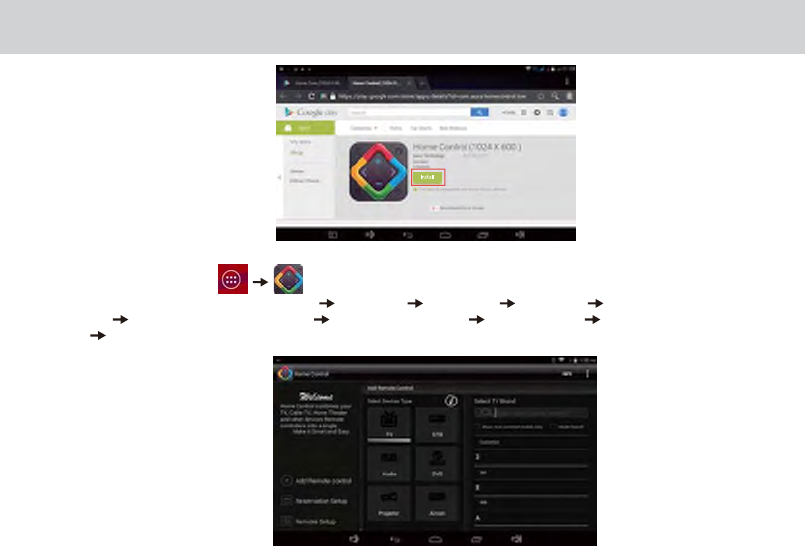
-From the Home screen, tap
53
-From the main menu tap “Add Remote Control” Select Device Select Brand * Select Model Conrm if signal is
working** Save remote with “Remote Name ” Select Zone and tap save Tap selected Zone tap saved “Remote
Name” you can nd installed IR remote UI.
3.22.2 IR Universal Remote Initial Conguration
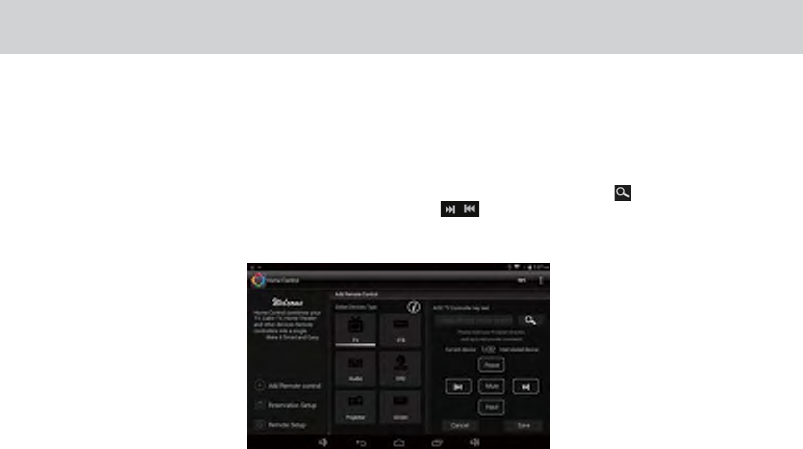
- Standard search ow : Optimized and intelligent algorithm to nd the right code. User just tap the displayed button and
select “Correct” if it is works. If this process fails, it will automatically forward to Model search ow.
- Model search ow : User need to input at least 2 characters for model name of the device, and tap . User gets the
count of available codes (Interrelated device) for this brand . By using and preview command button, it will be able
to traverse all codes for user to identify the right code. If the model name is incorrect or leaved blank, it will show all
available code for the brand.
54
*If your device is made by top ranked brands, then check “Show most common models only” option. This will lter out
minor provider. There are two search methods available, standard and model search ow. Please use default standard
search ow if you are rst time to setup. If you want model search ,check “Model Search” option, you can search the code
with input model name.
**When conrm signals, please point the Red part of TELPAD towards the device you are trying to control just like a standard
remote control.
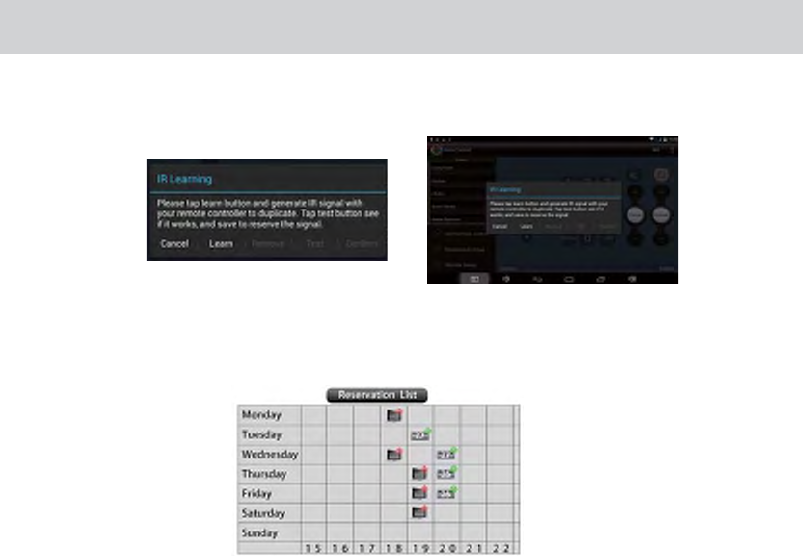
-Please point your original remote controller with the Red part of TELPAD like right picture. And follow on-screen
instructions to congure the device.
-Please check if your device is working just like original remote controller with “Test” button. If not, please tap “Learn”
button and repeat several times until it works. Tap “Conrm” to save the changes.
3.22.3 IR Learning
-If you want customized remote, please select “Customize” when selecting Brand.
-Once installed, it will show learning function interface. Each button have to be assigned a signal with IR Learning
process by touching it until tapping “Finish” button.
3.20.4 Reservation
-You can schedule the time and date you want your device to turn ON/OFF. This allows you to generate an IR signal at a
specic time.
Concept diagram 55
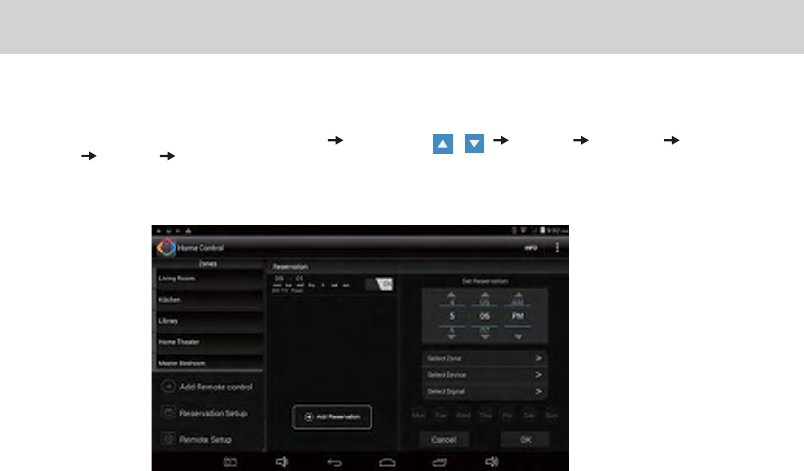
3.22.5 Reservation Setup
- Reservation is just like Alarm App. The dierence is we have to assign a IR signal rather than a melody. Please install required
IR signal with “IR Universal remote Initial Conguration” process before reservation setup.
- From the main menu tap “Reservation Setup” Select Time (tap , ) Select Zone Select Device Select Signal
Select Date Save reservation.
“Power On” signal make the device always on. “Power Toggle” signal is used to toggle power signal On and O.
- Please make sure “Mobile Client Setup “ process is done if you want receive notication on mobile.
56
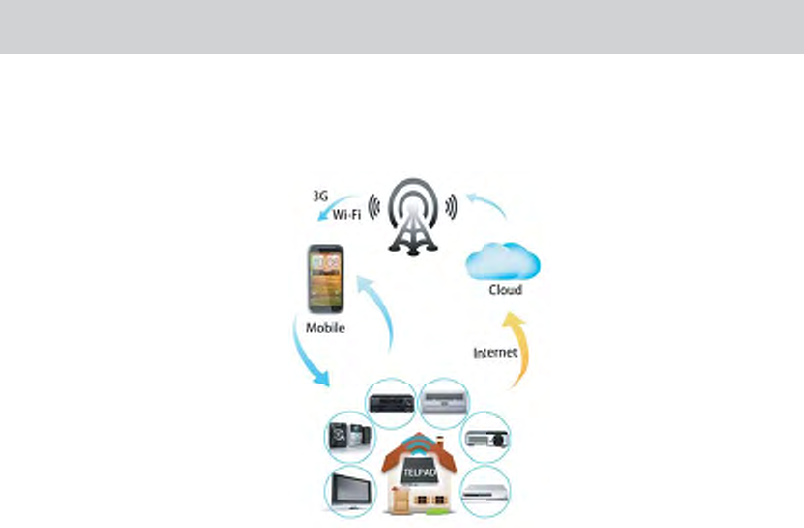
3.22.6 Outside Home Control
TELPAD provides Outside Home Control feature. The user must pair his Smartphone to the TELPAD via Bluetooth.
You can control your home device like air-conditioner or IR controllable light system with your android mobile from
anywhere with your 3G or WIFI connection. If you want check the result, TELPAD can be provided for remote
camera for home monitoring.
57
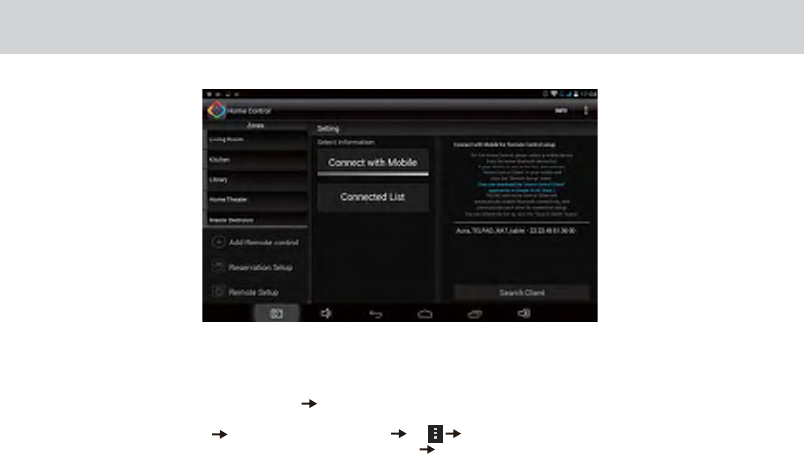
Mobile Client Setup
-“Mobile Client Setup “ is just like Bluetooth pairing process. It allows you to establish connection between TELPAD and
mobile device. TELPAD and “Home Control Client” in mobile device will automatically enable Bluetooth connectivity and
communicate each other for connection setup. Please follow on-screen instructions to connect the device.
-From the main menu tap “Remote Setup” tap “Connect with Mobile”.
-Download & install “Home Control Client” in the mobile if not installed. (URL will be given in TELPAD on-screen instruction,
Input it in mobile Browser) Execute “Home Control Client” tap “Remote Setup” (in the Mobile, not TELPAD).
-Refresh the list by clicking the “Search Client” button in TELPAD Select the Mobile device in the list.
58
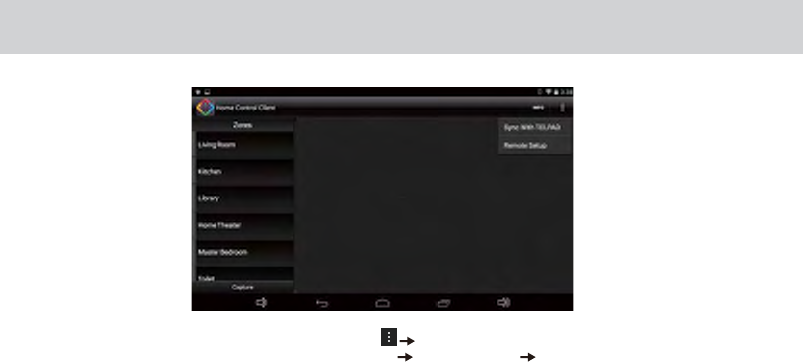
Outside Home Control
-From the main menu in your “Home Control Client” tap “ tap “Sync With TELPAD”. Once downloaded, “Home Control
Client” can control TELPAD with IR Remote menu( Select Zone tap “Remote Name” tap required signal.
-From the main menu in your “Home Control Client” tap “Capture” for request TELPAD Camera still image.
-Please follow on-screen instructions and wait for seconds until a still image pop-up.
- See the image and Tap <Back> key to return to main menu.
-Only the latest captured image (It will automatically replace the previous captured image) will be stored in the server with
security code algorithm.
-Please provide TELPAD with continuous power supply for operation.
59
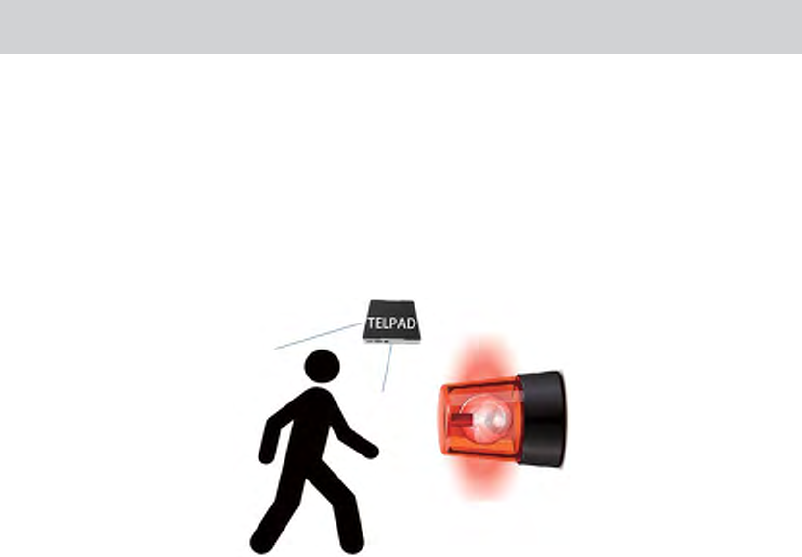
3.22.7 Motion Detection
- The motion detection feature will send NOTIFICATIONS to user’s mobile devices(only registered/paired devices via
Bluetooth will receive notications). Once motion is detected by the TELPAD’s IR sensors, the TELPAD’s camera will take
photos, then send notications such: Motion has been detected! See images. The user must be connected to the internet to
receive these notications.
- You have to activate "stay awake" option, with this option the application will not go to sleep mode and keep running.
Click "Setting"on tablet, nd "Developer options" and select"Stay awake".
NOTE:
The Outside Home Control may not function properly depending on the client mobile device, unstable network
environment, network timing or Internet service company. The Outside Home Control function works only on Android
device which equipped with Google Service. The push message used for Outside Home Control is provided by Google™,
GCM message not guarantee high percentage of delivery. User needs to retry if the message is not delivered due to various
reasons. User has to carefully manage the connection between “Home Control Client App” and TELPAD.
60

Motion Detection
- Please make sure “Mobile Client Setup “ process is done if you want receive notication on mobile.
- From the main menu in TELPAD, please tap “Motion Detection” and follow on-screen instructions. The notication will
be forwarded to connected mobile once started. If TELPAD camera faces continuous change, it will not send all of the pictures.
(Send 1 notication per about 30 seconds).
- Please provide TELPAD with continuous power supply for operation. The camera is always on even though LCD is black.
Summary of Mobile Client Setup
From the main menu tap “Remote Setup” tap “Connect with Mobile”
Execute “Home Control Client” tap “Remote Setup” (in the Mobile, not TELPAD) Refresh the list by clicking the
“Search Client” button in TELPAD Select the Mobile device in the list.
61
Note:
The app will allow the user to share the captured images via Gmail, bluetooth etc.
The images are automatically saved in the Auradata on both devices.
3.23 Home Care
62
Terms of Use
The Home Care apps utilize various health related date you enter. Your data are stored and accessed by TELPAD Home Care
only and are not transferred to or stored on any servers. The calculated forecasts of Home Care may not be accurate and should
not be used to prevent unwanted pregnancy. The forecast accuracy depends on a number of factors including how regular one’s
cycle length is, how many periods have been measured with the app. Anxiety, stress, age and other factors can also aect one’s
cycle from month to month. The measured temperature accuracy depends on the operating method of iFever Manager.
And your measured body index accuracy also depends on your operation method of Bluetooth body scale.
This App and devices is not for clinical or medical use.
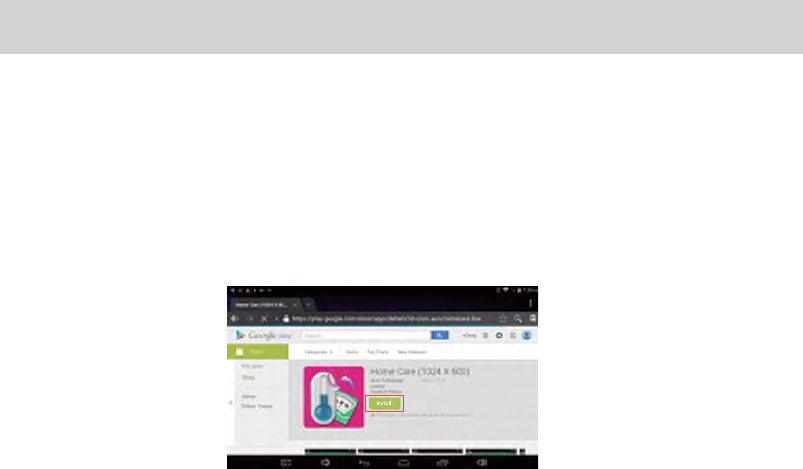
Installation of “Home Care” apk.
Find and tap the “Home Care Link” icon in MT7 APPs , MT7 screen will jump to “Google Play” and click “install” to download it.
Remark: This usage may changed without notication upon application update.
This section contains a description of Home Care application which is working with ‘Bluetooth Weight scale”. This
application allows you to monitor essential health and tness data with TELPAD. The monitored variables are as follows.
3.23 Home care
63
Monitored variables:
Body Weight (180 kg ~ 5 Kg), Body Fat Rate, Body Water, Bone Mass, Muscle Mass, BMI, BMR and Visceral Fat.
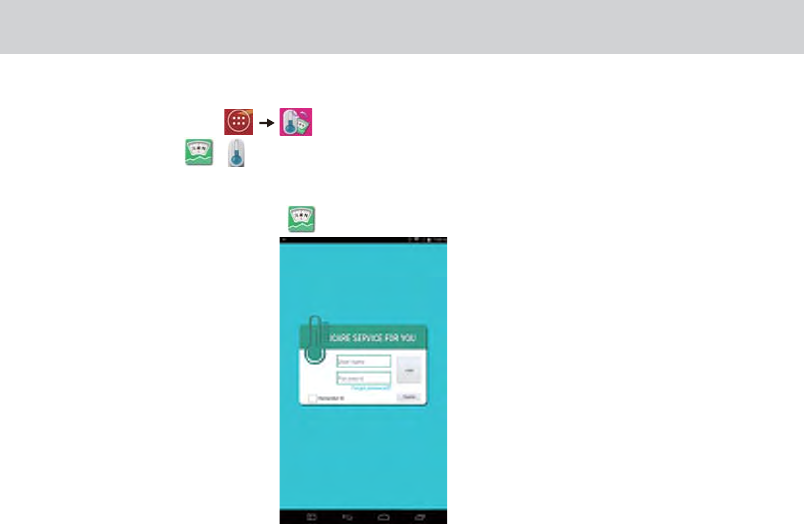
1.From the Home screen, tap
Please press the icon , at the top right corner of the TELPAD to switch the function of thermometer and
weight scale.
2. If you are using this application for the rst time, please tap the register button to add your ID and password. If the
screen is not for weight scale, please tab at the top right corner of the screen.
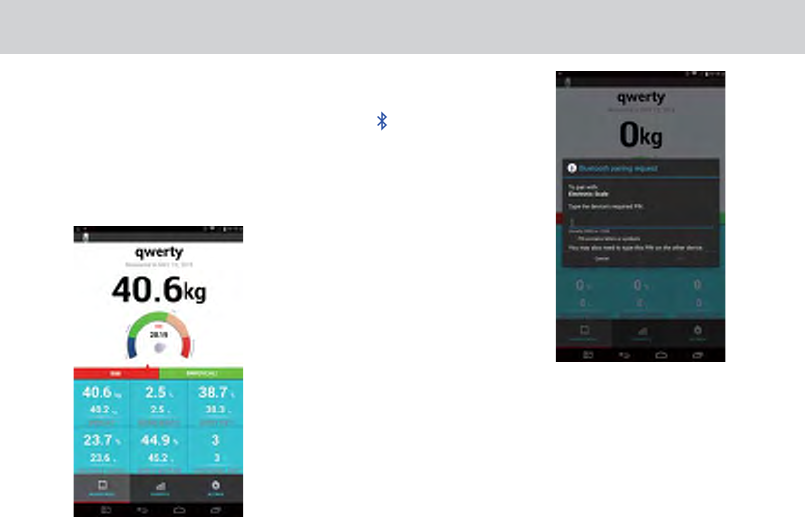
3. If Bluetooth weight scale is rst time to connect with TELPAD, the Bluetooth
pairing request will appear. Please enter “0000” for PIN number.
If the weight scale is not connected to TELPAD, the icon in the scale (not TELPAD)
will blink. When the connection is established the icon will stop blinking.
4. Please bare your feet on the weight scale so that skin can be directly
connected with it. If the measurement nished, the Number in the weight scale
will blink. Please press the button in the TELPAD for acquiring conrmation. The
weight scale will send the data to TELPAD.
64
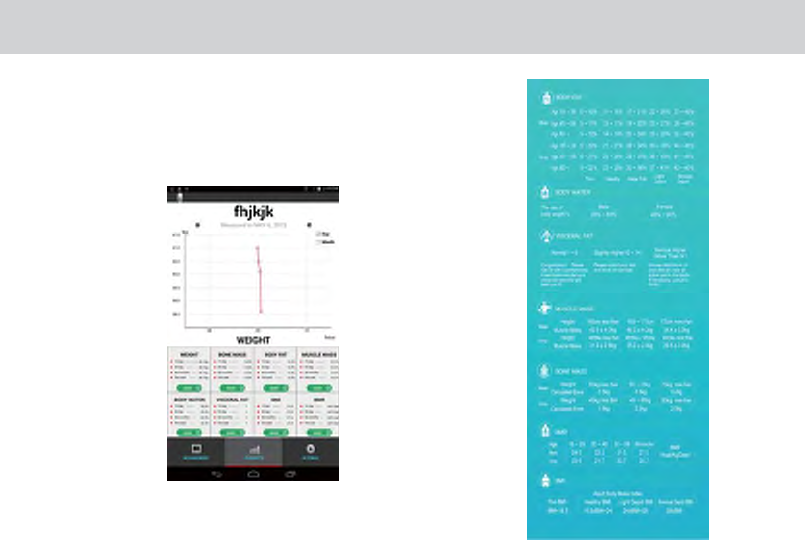
65
5. You can see the measured data with graph by pressing the STATISTICS tab. If
you press the data point, you can delete the data with your choice.
You can change the graph to other variables like bone mass or BMI by pressing
the corresponding green graph icon below.
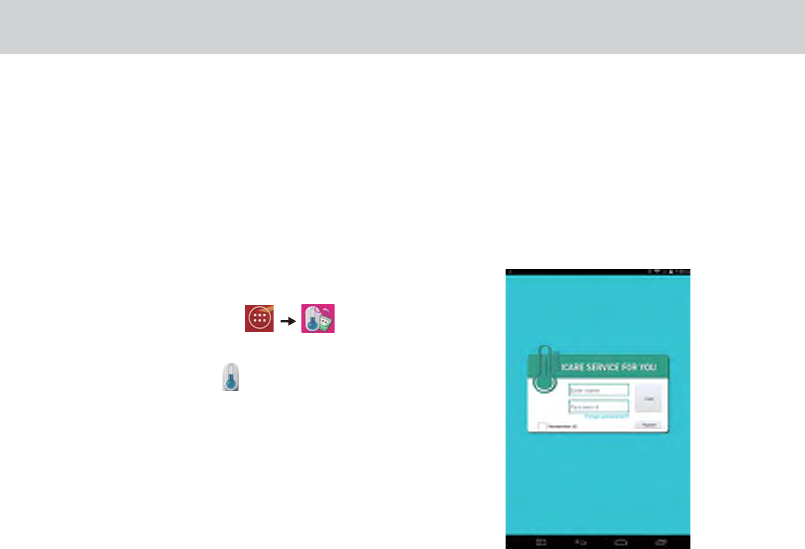
66
6. Press the “Information” menu in “SETTING” tab, you can see the guideline for the each variable depending on the Age
and Sex.
This section contains a description of Home Care application which is working with ‘iFever manager” dongle. iFever
Manager enable your TELPAD for body temperature measurement. You can keep history of your family temperature for a
long time.
If your baby gets a fever, you can show doctor with the daily graph screenshot. (Show body temperature variation based
on time axis)
If you are woman, TELPAD monthly view can help you to keep track of your fertility/menstrual cycles. Just measure
temperature each morning per day, and then TELPAD does the rest.
With Monthly view, you can monitor your average body temperature and keep your body healthy. Average body
temperature of a healthy adult is 36.50-36.80°C. But, average daytime body temperature of a healthy adult is above 37°C.
Cancer patients have low body temperature, usually less than 36°C.
1. From the Home screen, tap
2. If you are using this application for the rst time, please tap the register
button to add your ID and password. If the screen is not for temperature
measurement, please tab at the top right corner of the screen.
3. Insert your home care hardware - iFever Manager dongle in Audio jack.
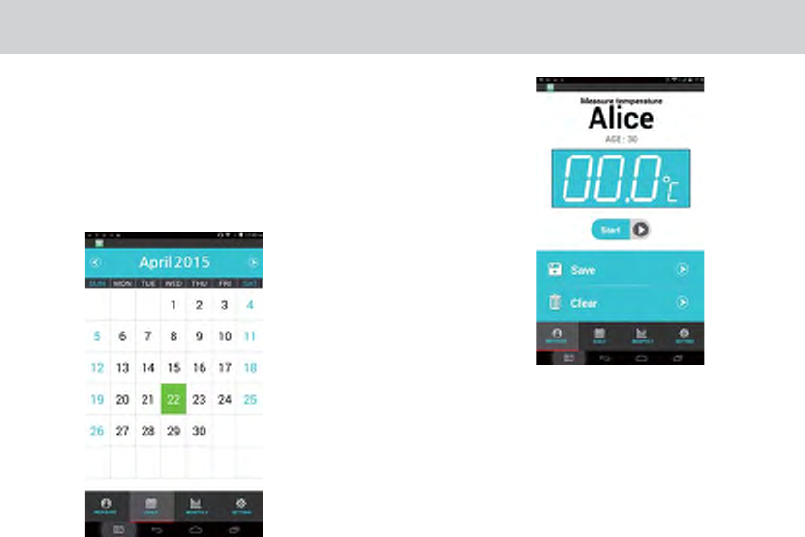
67
4. Tap the Start button or volume up hard key to begin temperature measurement.
5. Please move your iFever Manager sensor part to close your (or others) forehead
position during three seconds. Measured distance is within 1 cm.
6. Please see the measured value, and tap the save button to store the data. Tap Clear
button to clear last measured value if needed.
7. Supported body Temperature range is from 34.3° Cto 43.1° C. It will not save the data
if out of range occur.
8. You can see the measured data, and time in Daily tab by pressing the date.
Monthly tab can show you a graph with your accumulated data.
(See Appendix 1, 2, 3 and 4 for more description)
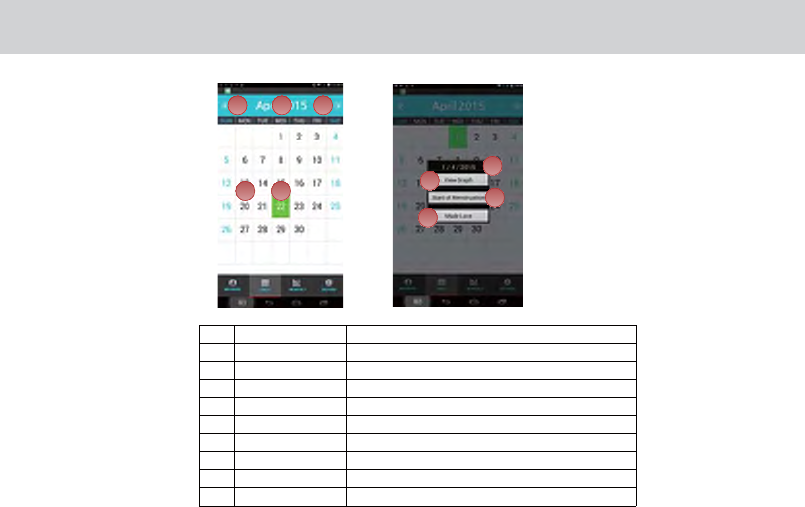
68
Appendix 1.Daily Graph
No Item Description
1Last month button Move to previous month
2Calendar title Display current date
3Next month button Move to next month
4No measured data If no measured data, will be displayed with pale sky blue
5Today Today is Green background
6Selected date This date can be selected when user touched *
7View Graph Displaytemperature data with graph
8Start of menstruation
9Made love On/ Off record for the event (For information only)
* If Basal body temperature option is not ON in the Setting menu, No 7, 8, 9 menus will not be displayed, and if user
selects a date it will show Graph View.
1 2 3
4 5
6
7
9
8
Mark as menstruation start date.On/ Off Start menstruation date
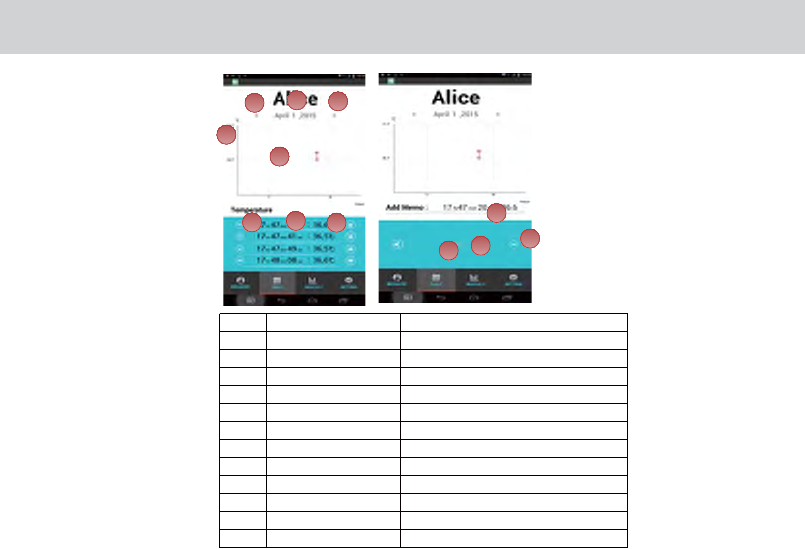
69
No Item Description
1Last month button Move to previous Month
2Calendar title Display current date
3Next month button Move to next Month
4Measured range Measured temperature data range
5Temperature graph Show the measured data with line
6Temperature delete button Delete selected temperature data
7Temperature time Show measured time and data
8Add memo Move to Add memo window
9Temperature value Show temperature and time for adding memo
10 Back button Back to previous screen
11
12
Memo content Show Memo
Delete memo Delete Memo
1
4
5
678
3
2
9
11 12
10
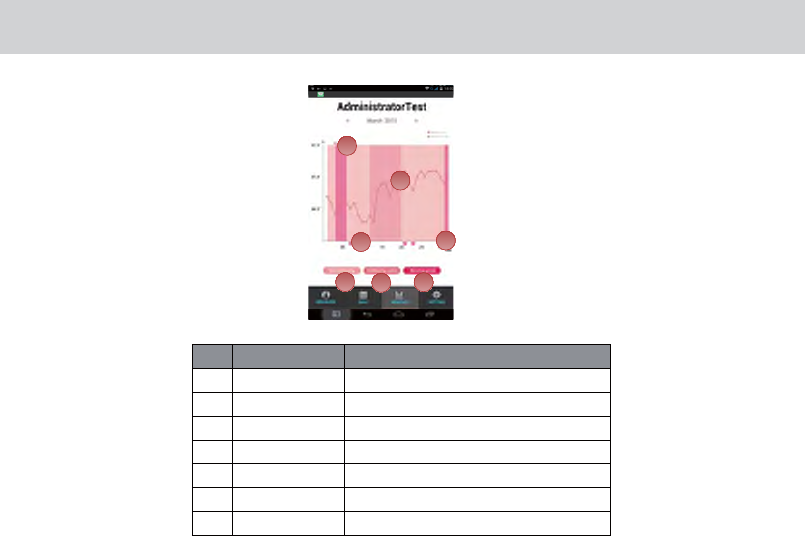
70
Appendix 2. Monthly Graph
No Item Description
1 Start menstruation
2 Graph Show graph with temperature
3 Made love
4Yaxis Date for the month
5
6
7 Menstrual period
First day of menstruation (Marked in Daily graph)
Made love date (Marked in Daily graph)
Indicate non Childbearing period
Indicate Childbearing period
Indicate Menstrual period
Childbearing period
Non-Childbearing
1
2
34
567
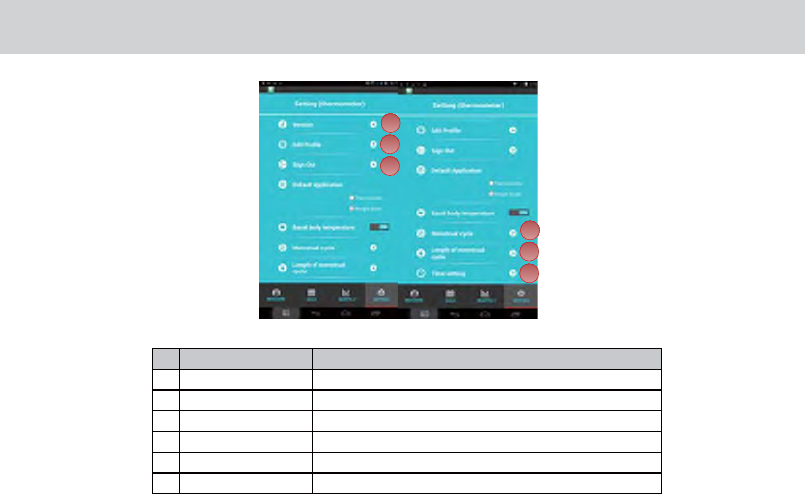
71
Appendix 3. Setting
No ltem Description
2 Edit Prole Edit account information
1 Version Show software version number & release date
3 Sign out Logout for another user login
4 Menstrual cycle
5 Length of menstrual cycle
6 BBT Time Range
1
2
3
4
5
6
Setting time range for BBT temperature measurements (00:00 ~ 23:59)
Menstrual period can be set up to 1-7 days
Menstrual cycle can be set up to 20-40 days
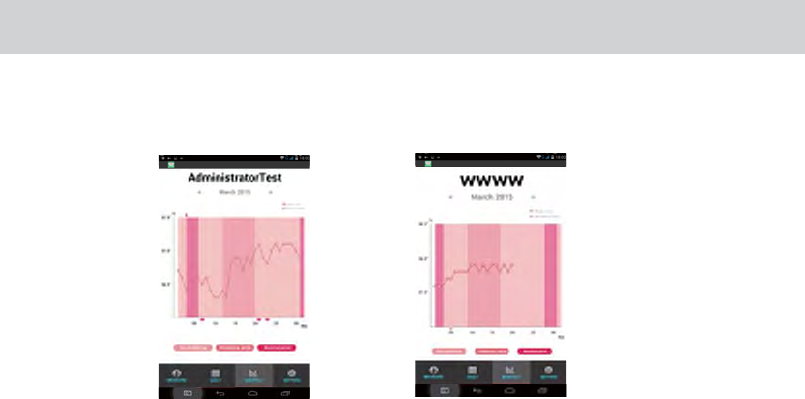
Basal body temperature (BBT) is our lowest temperature during rest, which is usually during the time we're sleeping.
This is the reason why BBT should be taken before getting out of bed for accurate fertility charting. Ovulation causes one
half to one-degree rise in BBT, so monitoring BBT helps provide information on the best time for conception.
Note:
The calculated forecasts of Home Care may not be accurate and should not be used to prevent unwanted pregnancy. The
forecast accuracy depends on a number of factors including how regular one’s cycle length is, how many periods have been
measured with the app. Anxiety, stress, age and other factors can also aect one’s cycle from month to month.
Remark:
If user forget his(her) password, click “forget password” on login interface to retrieve the password via the E-mail written
down when registered account.
Normal temperature pregnancy temperature
Appendix 4. Basal body temperature
72
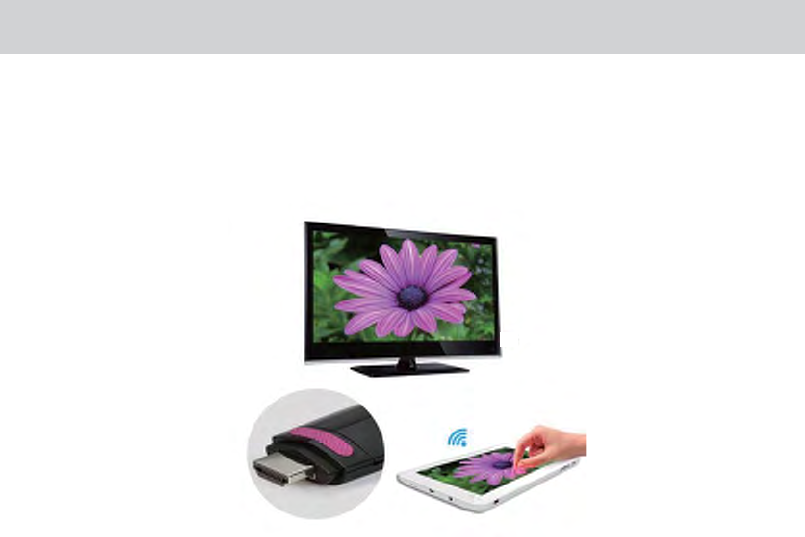
MT7 Tablet supports Cast Screen. It can be connected to larger screen tablet pc, TV, projector and other
multimedia equipments through wireless connection. It has realized that the same les can be displayed on the
multi-platform. End users can push the images, videos or other les to display and share on the larger screen
TV.
The button Cast Screen has been added on MT7 tablet, which has greatly improved the play uency. The
phenomenon of play-out delay and frame reducing won’t happen. Consumers can enjoy 1080P hi-def video
and the best audiovisual eects on TV, and live a freer entertainment life and own the convenient environment
in our internet era.
73
3.24 Cast Screen Function Operation Guide
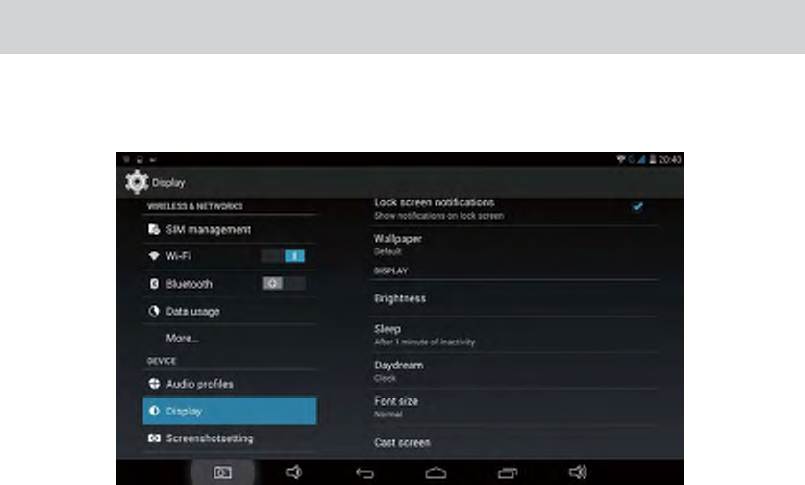
74
1. Connect wireless transmission equipment ”Wireless HDMI” to the HDMI port of displayer or TV, and plug in 5V power supply.
2. Set displayer or TV in “ HDMI” mode and Wireless HDMI in mode of “Miracast” .
3. Make sure you have connected Wi-Fi of tablet PC rstly, access tablet “Setting” and tap “Display”. (Figure 1)
Figure 1
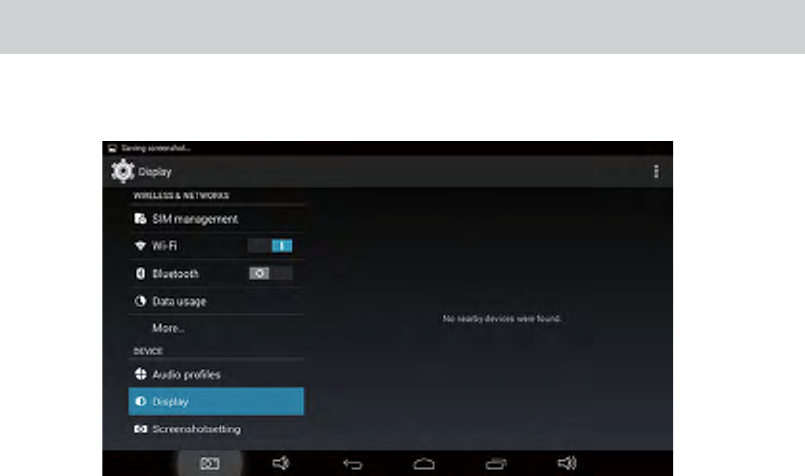
75
4. And then press “Cast screen” same as Figure 2 below.
Figure 2
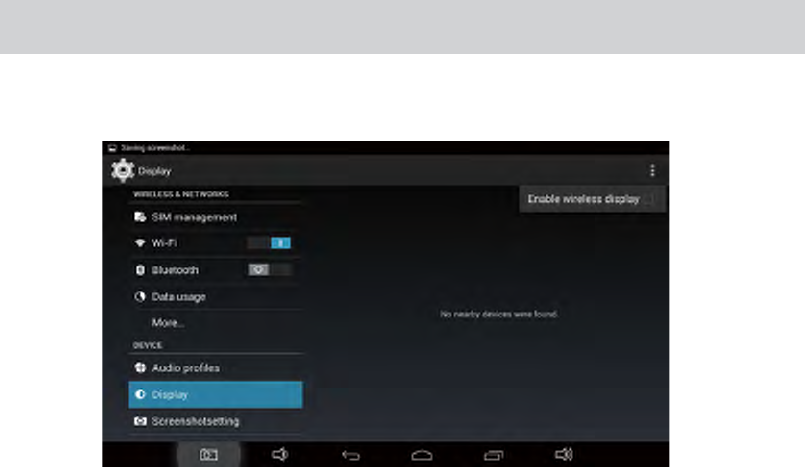
76
5. Select “Enable wireless display” in menu of top right corner. ( Figure 3 )
Figure 3
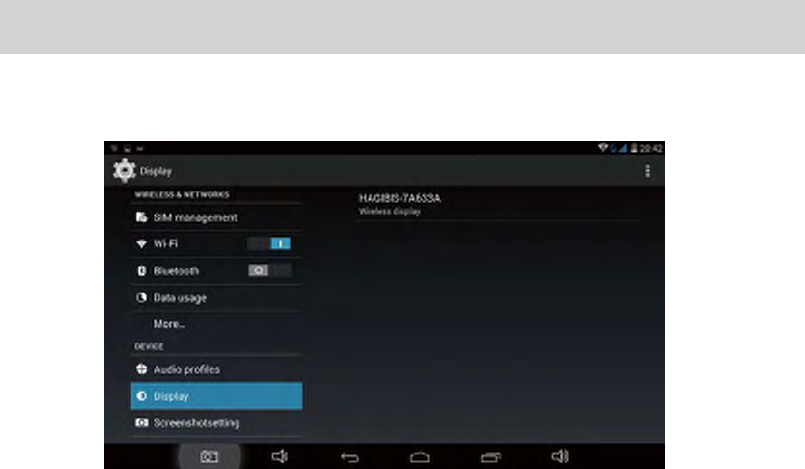
77
Figure 4
6. Tablet will search the accessible signal sources in range automatically. (Figure 4)
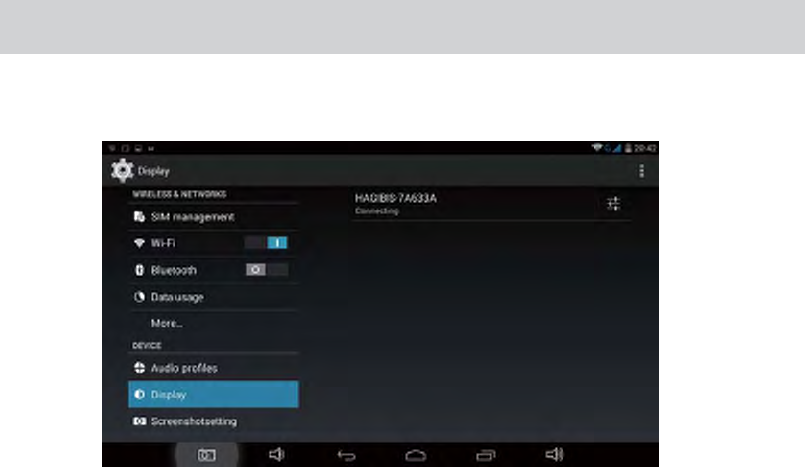
78
Figure 5
7. Select the corresponding signal source and wireless connection shows successfully.(Figure 5)

79
3.25 DLNA
3.25.1 DLNA Introduction
The full name of DLNA is DIGITAL LIVING NETWORK ALLIANCE. The purpose is to enjoy your music, photos and videos
anywhere anytime. DLNA is initiated by SONY, Intel and Microsoft. It aims at resolving interconnection and interworking of
wireless and wired network for personal PC, consumer electronics, mobile devices. It’s possible for the unlimited sharing and
growth of digital media and content services and has reached more than 280 member companies at present.
DLNA doesn’t create technology but forms a kind of solution which we can comply with the norm. Therefore, the various
technologies and protocols chose are all wide range used currently.
3.25.2 DLNA Functions
1. Exploration: to search non-congured devices in network and to calculate its provided family solution performance.
2. Browse: to browse the contents and to classify them through dierent ways.
3. Search: to search the specic contents on the device.
4. Distribution: to send multimedia content by whole network.
5. Services: to inform address book by network.
6. Print: To send contents to network attached printers.
7. Control: To change the device status by using the network.
8. Upload: to send contents to the server.
9. Download: to receive and store contents.
10. Automatic decoding: to change the resolution or contents’ format to ensure the equipments can translate correctly.
11. Service guarantee: to distinguish the priority of network trac, it will prefer to give up the weakest one if the network
overload.
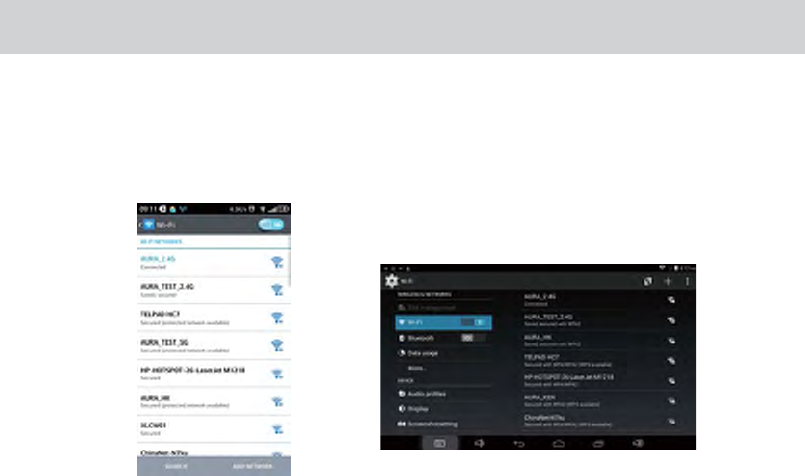
3.25.3 Control Device Discovery and Connection
Our MT7 can support DLNA and you can operate as below:
Please use mobile phone as source port and ensure the version of the android must be 2.3 and above(because only version
2.3 of android can support miracast) such as Google device.
1. Wi-Fi connection
Please make sure two devices are in same Wi-Fi network, such as AURA_2.4g.
Figure1 Google device has been connected to Wi-Fi Figure 2 MT7 tablet has been connected to Wi-Fi
80
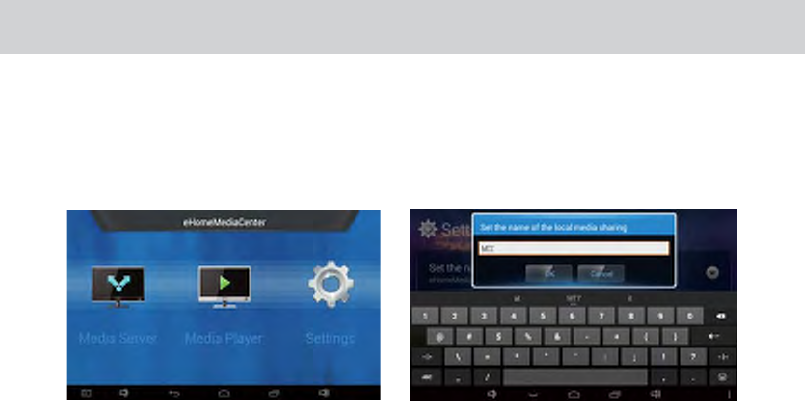
81
2. Start Application
-Please start “eHomeMediaCenter” in MT7 tablet and click “Settings” to change your device name for easy identication, such
as “ MT7”.
Figure 3 click settings Figure 4 Change device name
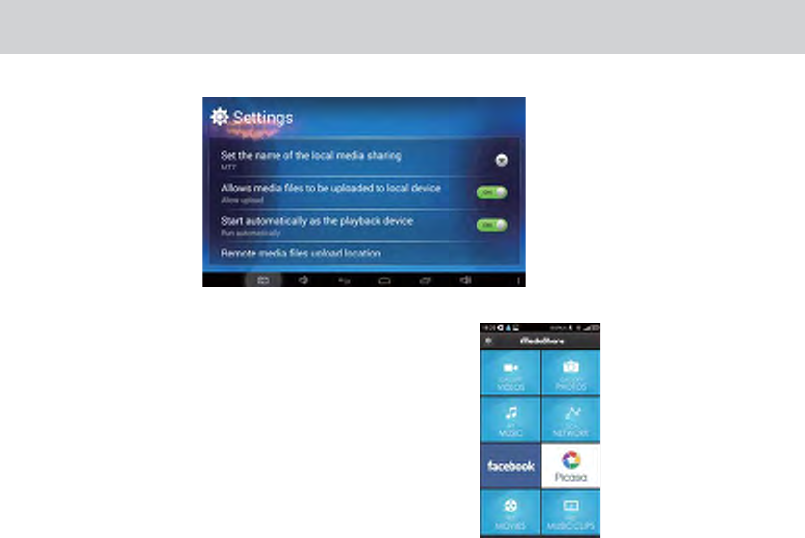
82
Figure 5 nish
Figure 6 apk-iMediaShare interface
- Please start “apk-iMediaShare” and the interface Figure 6
3.25.4 The Brief Introduction of Interactions Between Tablet and Mobile Phone.
To push local video, music or photos on your mobile phone to display on tablet.
Please refer to picture 6 “GALLERY VIDEOS”、“GALLERY PHOTOS” and“MY MUSIC”. For example, click “MY Music” as the
gure 7 below, you will see the local les on your mobile phone(the les in red box).
Click one of the le and you will enter music playing interface as shown in gure 8.
Figure 7 Enter the interface of“MY Music”showing local music les on your mobile phone.
83
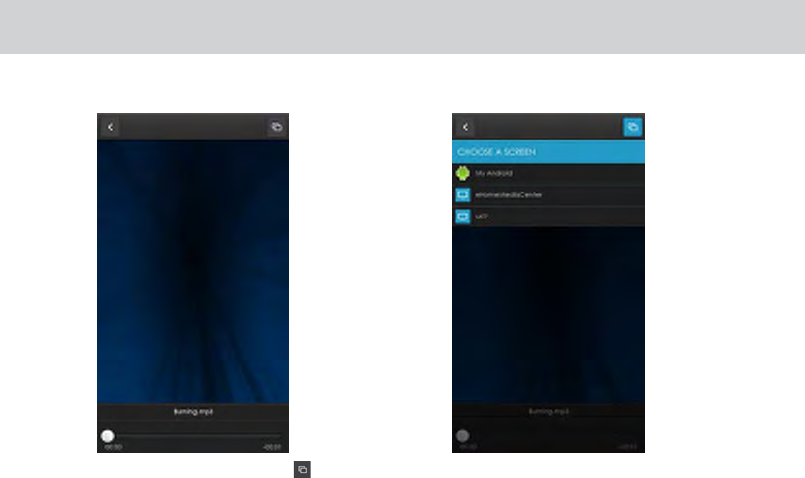
Figure 8 Music Playing Interface and click ,
the following gure 9 will pop-up.
Figure 9 Open “choose a screen”
84
1.8 interface
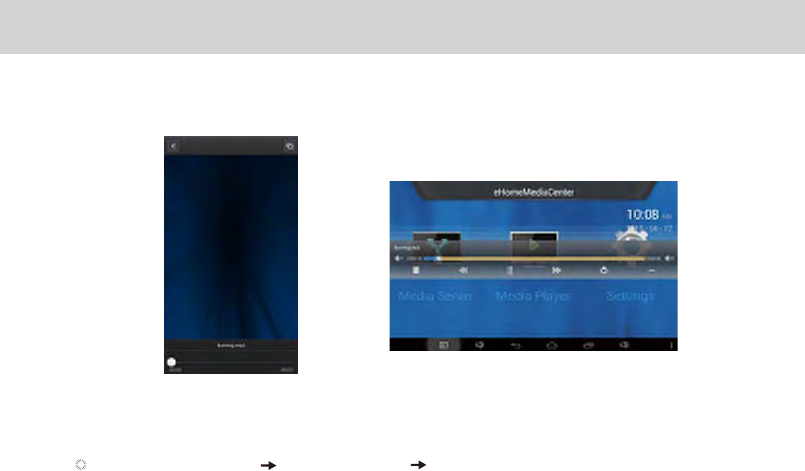
Please choose “ MT7” in above gure ,the music on both mobile phone and tablet will play at the same time. But only MT7
tablet have music voice and your mobile phone can return and operate other function once above operation nished.
Figure12“iMediaShare”interface Click ”FREEMUSICCLIPS” Access”ipps”interface. If it’s srt time for you to operate
and there is no ipps APP in your mobile phone, the “ipps” link will be given in the on-sreen interface and you can follow the
instructions to download and install.
To push the live video or music on your mobile phone to display on tablet.
Please refer to Picture 12 “FREE MOVIES” and “FREE MUSIC CLIPS”. Take “FREE MUSIC CLIPS” in below gure as an example.
85
Figure 10 Music Playing Interface on mobile phone Figure 11 Music Playing Interface on MT7 tablet
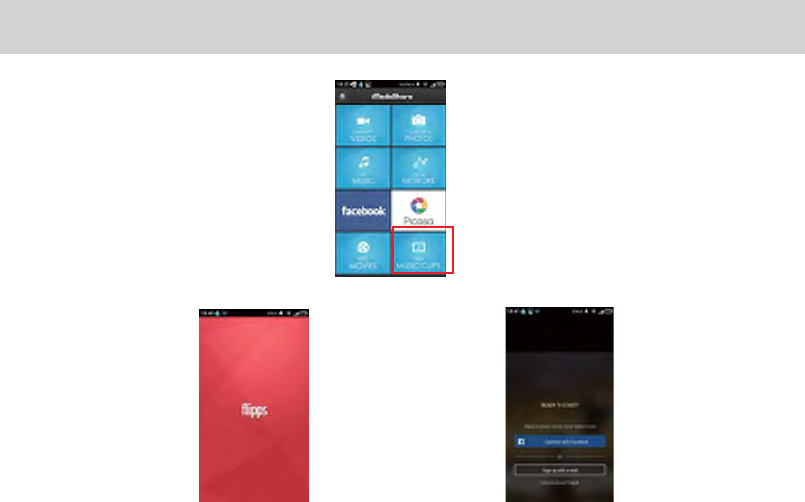
Click “ipps” to access the following gure interface(Figure13 /Figure14), Click“Log in”as the following gure(Figure14)
86
Figure13 ipps APP interface Figure14 To login ipps interface
Figure12 apk-iMediaShare interfa
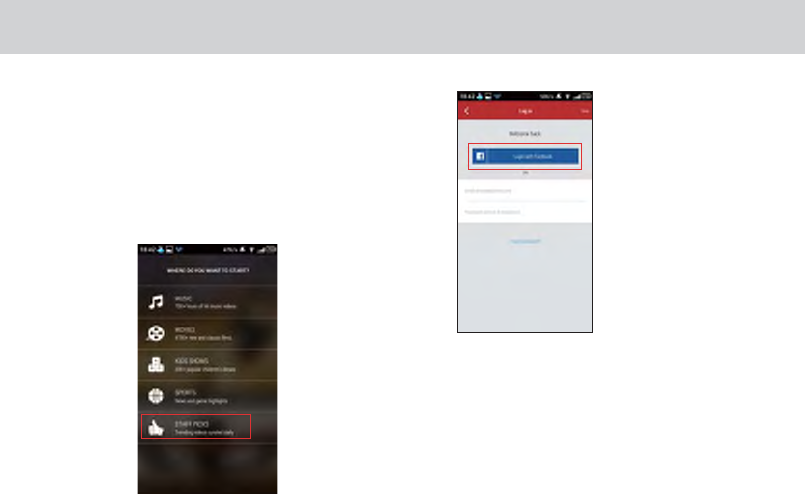
You no need to login facebook account, click “Login with
Facebook” and enter an interface as shown in gure 16.
Choose and open any project in above gure, click “STAFF PICKS” as
an example in gure 16.
87
Figure15 account log in interface
Figure16 ipps APP main menu interface
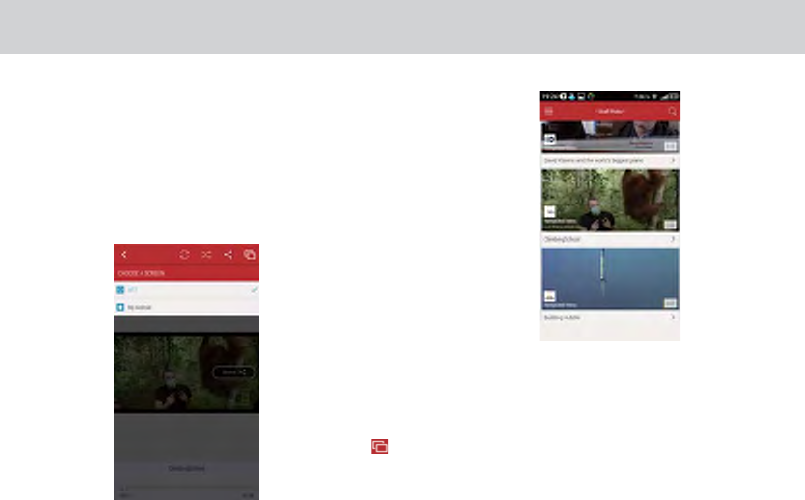
Click at top right corner in gure 18 and choose “ MT7”, the
live video on mobile phone will be pushed to play on MT7 tablet.
(Figure 19)
Choose and play any video in gure 17, take “Climbing School” as an
example. (Figure17)
88
Figure17 start“STAFF PICKS”
Figure18 Playing interface on mobile phone
Figure19 Playing interface on MT7 tablet
89
Remark:
1 . Aboves are all for multimedia les in mobile phone sharing to tablet. Vice versa, multimedia les in tablet can also be
shared to your mobile phone.
2 . In order to guarantee the smooth playback of device, please operate above in good environment of network.

Figure 20 start Media Player
Figure 22
Figure 21 start iMediaShare
Mobile phone can share the music and video on MT7 tablet.
Please start “apk-iMediaShare” on mobile phone, and touch “media player” on MT7 tablet's "eHomeMediaCenter" interface.
(Figure20)
90
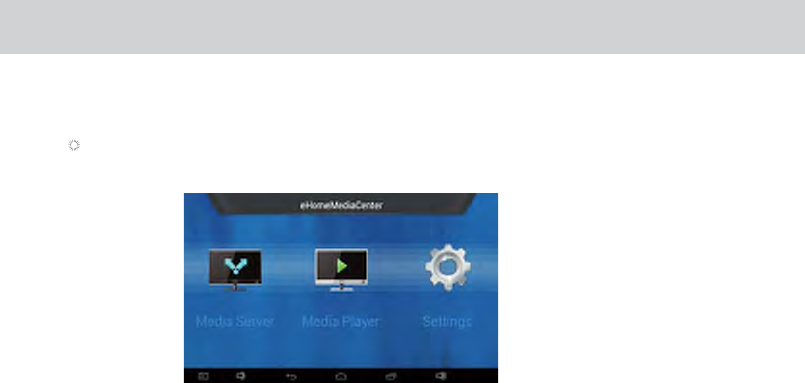
MT7 tablet can share local music, video or pictures to mobile phone.
Please start the “Media server” in “eHomeMediaCenter”interface on MT7 tablet when apk-iMediaShare is started on mobile
phone.(Figure 23)
When you start “Media Player” and the interface will show shared music, video and photos. You can click the les which you
want to play. (Figure 21 and 22)
Figure 23 Start Media server
91
Tap" add share" on top right corner and touch "ok" to conrm the les which you want to share.( Figure 24 and Figure 25)
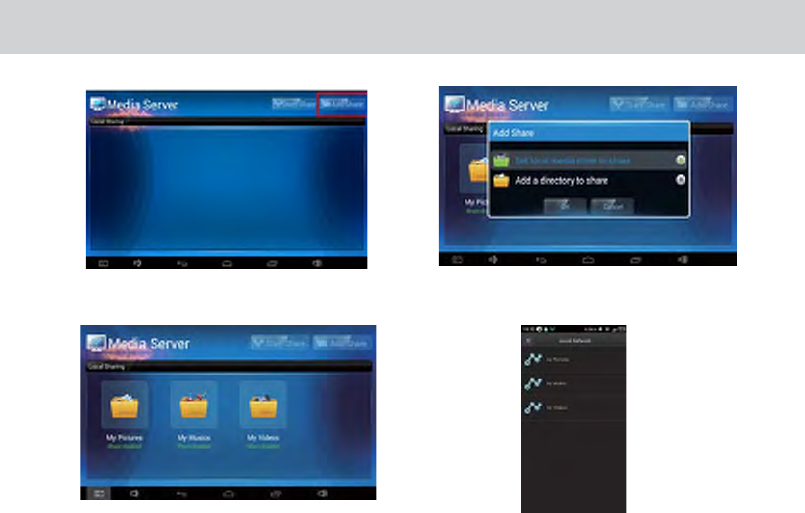
Figure 24 click top corner “Add Share” Figure 25 click“OK”
Figure 26 select top right corner“start Share” Figure 27 the shared les from MT7 tablet
92
Once conrmed, MT7 tablet will show the local folders, and then tap " start share" on top right corner.( Figure 26
and Figure 27)

4THE CONNECTION BETWEEN DOCK PHONE AND TABLET
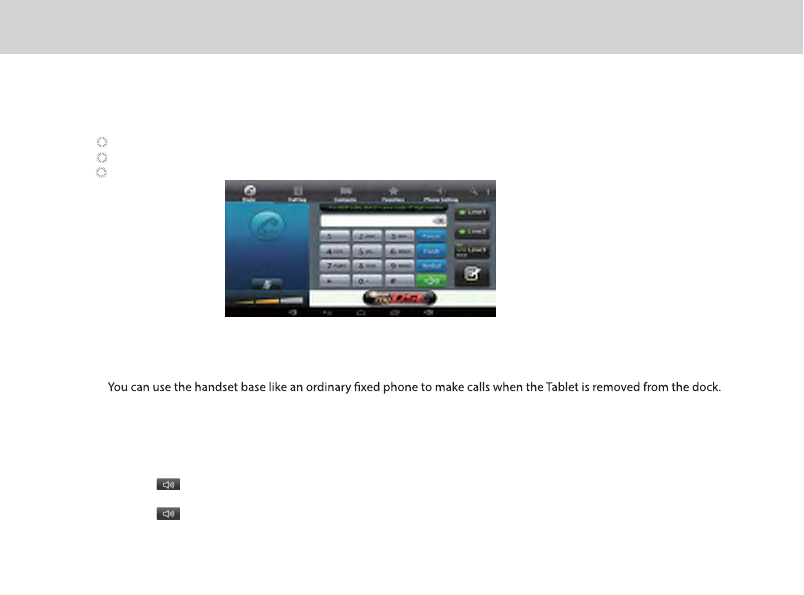
The touchscreen Dialer can be accessed by touching the Dialer shortcut.
The Dialer is automatically launched when the Tablet is placed on the dock.
Please take note of the following when using the Dialer:
Line 1- Landline
Line 2- VoIP (requires network support)
4.1 VOICE SERVICES
The touchscreen Dialer can be accessed by touching the Dialer shortcut.
The Dialer is automatically launched when the Tablet is placed on the dock.
Please take note of the following when using the Dialer:
Line 1- Landline
Line 2- VoIP (requires network support)
Line 3- 3G phone communication
When Tablet is on the dock, MT7 supports dialing by tablet and it's dock.
4.1.1.1 Making a call without the Tablet
4.1.1.2 Making a call using the onscreen Dialer
1. Lift the handset from the dock.
2. Dial the number using the onscreen dialer.
3. To end the call, return the handset to the dock.
4.1.1.3 Making a call on the speakerphone using the onscreen dialer or numerical buttons on dock phone.
1. Touch to enable the speakerphone.
2.Dial the number using the onscreen dialer or numerical buttons on dock phone.
3. Touch to end the call.
4.1.1 Making a Call
4.1 VOICE SERVICES
94
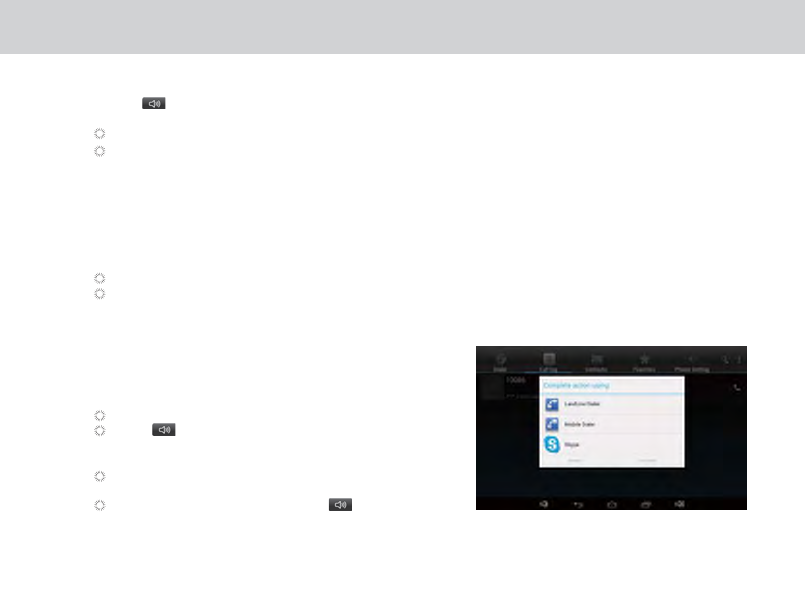
95
When the phone rings and displays the incoming call image:
Lift the handset from the dock to answer the call.
Touch to answer the call.
Only one of the two modes will be active at a time.
To end a call, please make sure either the handset or Tablet is o-hook.
4.1.1.4 Switching from handset to speakerphone and vice versa
1. Touch to switch from handset call to speakerphone.
2. To return to using the handset, lift the handset. The call will be continued via handset.
4.1.1.5 Making a call from the Contacts
1. Touch the Contacts tab above the onscreen dialer.
2. If there are already saved entries, simply touch the icon of the person you wish to call.
To clear the Call log, touch Clear call log.
To remove just one entry from the log, touch an entry.and then touch Remove from call log.
4.1.2 Answering a Call
4.1.3 Ending a Call
When on a call by handset, Place the handset down on the dock to
end the call.
When on a call by speakerphone, Touch to end the call.
4.1.4 Selecting Area Code
4.1.1.6 Making a call through the Call log
1. Touch Call log tab above the onscreen dialer.
2. Scroll to locate the contact you wish to call.
3. Press Dial icon.
When dial from contacts or call log, two dial ways will pop up on the screen: landline dialer and mobile dialer;
(if there is any network communication APP on the tablet, such as SKYPE, then SKYPE will appear under the two
options mentioned above).
96
Within the Dialer, touch the Phone Settings tab.
Touch the Select Area Code on the list.
Touch the Menu button at the top corner.
Touch Settings in the menu displayed.
The default preset area code will be Metro Manila (02).
Select your area from the list and the phone will now be set to the conrmed area code.
When the area you are in has been selected, the phone will automatically recognize the similar area code for all incoming
and outgoing calls, and will display the phone number without the area code. You will also be able to direct dial the phone
number within the same area.
4.1.5 Favorites
Touch Favorites tab above the onscreen dialer.
If there are saved entries already, tap the icon of the person you wish to call. Touching the contact image will upload
the detailed information of the contact.
4.1.6 Memo
When you have an ongoing call, you may write notes through the Memo Pad. To create a memo during your phone
call, touch at the lower right corner.
4.1.7 Importing/Exporting Contacts
Access the Dialer, touch the Contacts tab.
Touch the Menu button at the top corner.
Touch Import/export in the menu displayed.
Select from the list whether you would like to import or export or other actions.
97
4.1.8 Changing Ringtones
Within the Dialer, touch the Phone Setting tab.
Touch the Ringtones & Volume from the list
Touch the Menu button at the top corner.
Touch Settings in the menu displayed.
From the options that shows up touch Phone ringtone.
Select the ringtone you would like from the list provided.
4.1.9 CONTACTS
4.1.9.1 Opening Contacts
4.1.9.2 Creating a Contact
1. Open the contacts screen.
2. Touch new contact.
3. Enter the contact’s information:
Enter the contact name, and touch the picture frame to select a picture to display next to the name in the contacts
list and in other applications.
Touch a contact information category, such as phone numbers and e-mail addresses, to enter information about your
contact. Flick up and down to view all categories.
Touch the plus button to the right of a category to add more than one entry for that category. Touch the minus button
to the right of an entry to remove the entry.
Touch the label button to the left of the contact information items such as Phone and E-mail to open a menu with
preset labels for a phone number. You can touch to select a preset label or touch Custom in the menu to create your
own label.
You can open your contacts by touching Contacts on the Home screen or on the Applications screen. In the contact
tab pages, you can touch a contact image to open the contact details screen.
Contacts enables you to save and manage information such as phone numbers, e-mail addresses and chat addresses of
your contacts, and provides quick and easy access to communicate with the people you want.

98
4.1.9.3 Searching for contacts
1. Open the Contacts screen.
2. Touch Search.
3. Enter the name of the contact you are searching for. As you type, contacts with matching names appear below
the search box.
4. Touch a matching contact in the list to open its Details screen.
4.1.9.4 Editing Contacts
To change or add details for your contacts:
1. Open Contacts.
2. Touch the contact whose details you want to edit, and touch contact image in the menu that opens. You can
also touch Edit contact while viewing details of the contact.
3. Edit the contact information, using the same controls as when you create a contact.
Editing contact details
Deleting a contact
1. Open Contacts.
2. Touch and hold the contact you wish to delete, and touch Delete in the menu that opens. (You can also
touch Delete while viewing details of the contact.)
3. Touch OK to conrm that you want to delete the contact.
4. Once you have nished entering details, ick to the bottom of the page and touch Done to save the contact
details to your Tablet.
While viewing the Call log, touch and hold the call log list to show contact details. You can add numbers to the contacts
via the virtual screen.

5 BASIC TROUBLESHOOTING FOR THE TELPAD

100
5.1.1. Press Tablet power key and check whether the PLDT TELPAD logo appears upon initialization.
5.1.2. If the Android™ Tablet doesn’t launch, connect the Tablet to the power supply through the dock.
5.1.3. If the problem still exists, please contact the PLDT Business oce.
5.2.1. If there is an electronic device emitting radio frequencies near you, switch it o or put it away from the Tablet.
5.2.2. Remove any peripheral equipment such as DSL splitter or fax machine and connect your phone directly to the modular
box.
5.2.3. If the problem still exists, please contact the PLDT Business Oce.
5.2 No Dial Tone
5.3.1. If there is an electronic device emitting radio frequencies near you, switch it o or put it away from the Tablet.
5.3.2. Remove any peripheral equipment such as DSL splitter or fax machine and connect your phone directly to the modular
box.
5.3.3. If the problem still exists, please contact the PLDT Business Oce.
5.3 Distorted Audio on Speaker
5.4.1. Check if there is a dial tone. If there is none check your RJ11 connection and make sure it is properly connected.
5.4.2. Look at your screen and make sure that the Dialer is set to Line 1; otherwise, touch the Line 1 button. Make sure that the
screen shows the message “TELPAD is on the dock”.
5.4.3. If the problem still exists, please contact the PLDT Business Oce.
5.4 Tablet Dialer cannot Make a Call
5.5.1. Check if the RJ9 cable is properly connected.
5.5.2. Unplug and re-plug the coiled cable to eliminate the possibility of a loose RJ9 connector.
5.5.3. Try a dierent telephone unit, if possible, to check if it’s a line problem.
5.5.4. If the problem still exists, please contact the PLDT Business Oce.
5.5 No Audio Response in the Handset
5.1 Tablet not Powering Up

6 FAQs
How will my device receive
notications from the TELPAD?
FAQs for DLNA Feature
Your device must be connected to the TELPAD via Bluetooth pairing.
Once connection is established ,TELPAD will send notications with attached
captured images (internet connection is required for both party).
1. How to congure connection between TELPAD and my device(Smartphones)
for successful DLNA display?
Solution: First ensure good internet connection for both devices(they must connect
to the same network).
Secondly, You must install imediashare(to access video/photos in your gallery) and
ipps TV(to access video streaming) applications available in Play store/App store.
2. The music, pictures or video les in MT7 tablet can’t be shared on Mobile phone
once DLNA connected.
Cause: The DLNA setting may not open le sharing.
Solution:
Please add and open le sharing for “Media server” in the “eHomeMediaCenter"
applications interface.
3. MT7 Tablet can't push the music and video les to mobile phones by
“eHomeMediaCenter”.
Cause: The "eHomeMediaCenter" application on MT7 tablet does not support push
function.
Solution:
Please download "Imedia share" application on your mobile phone.
4. The shared or pushed videos are in slow-moving when they are playing at receiving
end.
Cause: It may caused by the bad current network environment and the network
speed is very slow.
Solution:
It will be improved under good environment and can play more smoothly.
102
103
TELPAD can’t work when tablet
is inserted into dock phone.
There is no sign when tablet is
charged by adaptor.
Cause: It may be caused by the poor contact between Dock Phone and Tablet.
Solution:
First check if there is obvious obstruction/blockage then try cleaning the pins using
an clean cloth or brush to remove dust.
Solution:
-Check cable and adapter connections.
Inserted micro SD card is
unrecognizable
Cause: It may be the poor contact between SD card and tablet or SD card has
been damaged.
Solution:
- Please pull SD card out and re-plug it into tablet;
- Please change another good SD card;
- Please restart tablet and re-plug SD card.
The camera can’t capture photos.
Cause: It may be caused by the wrong conguration of cameras.
Solution:
- First check camera settings,Then close, the camera then restart.
104
The TELPAD’S Bluetooth can’t be
paired with other devices.
Unresponsive TELPAD’s touch panel.
The tablet can’t be turned on
Cause: Bluetooth setting is incorrect or bluetooth is hidden.
Solution:
Check bluetooth settings;
Set the bluetooth of the device to “visible to other devices.”
Cause: TELPAD may be on standby mode or TELPAD is locked.
Solution:
Unlock the TELPAD in case is still unresponsive try to restart the TELPAD.
Cause: It may be caused by the low battery of tablet or the power key has
been damaged.
Solution:
Please check if power key has been damaged or not;
Please recharge tablet with adaptor rstly. And press power key once “in
recharge” remark is showing on tablet.
TELPAD can’t make calls
Cause: loosed phone line cable
Solution:
Check the phone line cable connection to the dock
TELPAD can’t answer incoming calls
Cause: It may be caused by the poor contact of phone line cable.
Solution:
Please check if phone line cable has been connected well or change another
good one.
105
Dock’s battery is not installed
The adaptor charging is unstable
once connected.
Solution:
- check the battery if properly installed in the battery case.;
- Reinstall battery and clean metal terminals of batteryholder.
Cause: Loosed connection between DC cable and dock.
Solution:
-Check the connection and the cables if properly installed.
The dock phone can’t be placed
steady.
Cause: It may be caused by the unsteady silicone foot pad on the back of
dock phone.
Solution:
-Please check if the silicone foot pad on the back of dock phone is properly installed.
The speaker box of dock phone
can’t work.
Cause: Adaptor is not connected properly.
Solution:
- Check the adaptor connection;
- Check the power key function.
SIM card no signal Caused: SIM card was installed improperly.
Solution:Power o tablet rstly and re-install SIM card properly.
106
Home Control Reservation Setup
Question:My Reserved controlled Setup did not took eect,What is wrong with my
device?
Solution:Check the following settings if properly congured
Time Zone Device Signal exact day of week and also check the Line Of
Sight between the Telpad and the device to be controlled(since the technology used is
Infrared transmission there must be Line of Sight between devices approximately 10
meters).
Home Control Feature Does the Home control application support all television brands and models?
answer: Home control supports most "popular" brands and models.

7 WARNINGS AND PRECAUTIONS
Please read the following instructions carefully. Abide by the safety warnings described in order to use the device safely and
properly as it is designed for. These instructions apply to the whole device including all the accessories.
Basic Requirements
Keep the device dry at all times and prevent from any collision with other objects, including during storage, transportations,
and usage of the device.
Please do not disassemble the device in any case. Contact an authorized service center for repair and/or assistance of any kind.
An organization or individual cannot change the mechanical, safety, or performing design of the device without authorization.
Please abide by all related laws and regulations, and respect the legal rights of other people when using the device.
When making a call, please do not touch the pogo pin connector in the dock.
Environmental Requirements for Using the Device
Before connecting and disconnecting cables, stop using the device, and then disconnect it from the power supply. Ensure
that your hands are dry during operation.
Keep the device far from sources of heat and re, such as a heater or a candle.
Keep the device far from electronic appliances that generate strong magnetic or electric elds, such as a microwave
oven or a refrigerator.
Place the device on a stable surface.
Place the device in a cool and well-ventilated indoor area. Do not expose the device to direct sunlight.
Keep the ambient temperature between 0°C and 35°C while the device is being charged.
Keep the ambient temperature between 0°C to 40°C for using the device powered by a battery.
Do not block the openings on the device with any object. Reserve a minimum space of 10 cm around the device for
heat dissipation.
Do not place any object (such as a candle or a water container) on the device. If any foreign object or liquid enters the
device, stop using the device immediately, power it o, remove all the cables connected to it, and then contact an
authorized service center.
During thunderstorms, power o the device, and then remove all the cables connected to it to prevent it from getting
damaged due to lightning strikes.
108
Never install telephone wiring during an electrical storm
Never install telephone line jacks in wet locations unless the jack is specically designed for wet locations.
Never touch exposed (insulation broken) telephone wires or terminals unless the telephone line has been disconnected
at the network interface
Precautions for Using Wireless Devices
When using the device, ensure that the antenna of the device is at least 20 cm away from all persons.
Do not use the device where using wireless devices is prohibited or may cause interference or danger.
The radio waves generated by the device may interfere with the operation of electronic medical devices. If you are
using any electrical medical device, contact its manufacturer for the restrictions on the use of the device.
Do not take the device into operating rooms, intensive care units (ICUs), or coronary care units (CCUs).
Areas with Inammables and Explosives
Do not use the device where inammables or explosives are stored, for example, in a gas station, oil depot, or
chemical plant. Otherwise, explosions or res may occur. In addition, follow the instructions indicated in text or symbols.
Do not store or transport the device in the same box as inammable liquids, gases, or explosives.
Accessory Requirements
Use only the accessories supplied or authorized by the device manufacturer. Otherwise, the performance of the device
may be aect, the warranty for the device or the laws and regulations related to telecommunications terminals
may become null and void, or an injury may occur.
Do not use the power adapter if it’s cable is damaged. Otherwise, electric shock or re may occur.
Ensure that the power adapter meets the specications indicated on the device nameplate.
For electric plugs, the socket-outlet should be installed near the device and should be easily accessible.
Battery and Charger
Unplug the charger from the electrical plug and the device when not in use.
The battery can be charged and discharged hundreds of times before it eventually wears out. When the standby time
and the talk time are shorter than the original time, replace the battery.
109
Use the appropriate power supply dened in the specications of the charger. An improper power voltage may
cause re or of the charger.
Do not connect two poles of the battery with conductors, such as metal materials, keys, or jewelries. Otherwise, the
battery may be short-circuited and may cause injuries and burns on your body.
Do not disassemble the battery or solder the battery poles. Otherwise, it may lead to electrolyte leakage, overheating,
re, or explosion.
If battery electrolyte leaks out, ensure that the electrolyte does not touch your skin and eyes. When the electrolyte
touches your skin or splashes into your eyes, wash your eyes with clean water immediately and consult a doctor.
If there is a case of battery deformation, color change, or abnormal heating while you charge or store the battery, remove
the battery immediately and stop using it. Otherwise, it may lead to battery leakage, overheating, explosion, or a re.
If the power cable is damaged (for example, the cord is exposed or broken), or the plug loosens, stop using the cable at
once. Otherwise, it may lead to an electric shock, a short circuit of the charger, or a re.
Do not dispose of batteries in re as they may explode. Batteries may also explode if damaged.
Danger of explosion if battery is incorrectly replaced. Recycle or dispose of used batteries according to the local
regulations or reference instruction supplied with your device.
Prevention of Hearing Damage
Using a headset at high volume can damage your hearing. To reduce the risk of damage to hearing, lower the headset
volume to a safe and comfortable level.
Safety of Children
Keep the device and its accessories out of the reach of children. Otherwise, they may damage the device and its accessories
by mistake, or they may swallow the small components of the device, causing suocation or other dangerous situations.
Maintenance if the device is not used for a long time, power it o, and then remove all connected cables.
If any exceptional event occurs, such as if the device emits smoke, unusual sounds or smells, stop using the device
immediately, power it o, remove all the cables connected to it, and then contact an authorized service center.
110
If the device screen is damaged, do not touch or try to remove the broken part. In this case, stop using the device
immediately, and then contact an authorized service center in time.
Do not trample, pull, or over bend any cable. Otherwise, the cable may get damaged, causing malfunction of the device.
Before cleaning the device, stop using it, power it o, and then remove all the cables connected to it.
Use a clean, soft, and dry cloth to clean the device shell. Do not use any cleaning agents or sprays.
Emergency Call
You can use your device for emergency calls in the service area. The connection, however, cannot be guaranteed in all
conditions.
You should not rely solely on the device for essential communications.
Disposal and Recycling Information
This symbol on the device (and any included batteries) indicates that the device (and any included batteries) should
not be disposed of as normal household garbage. Do not dispose of your device or batteries as unsorted municipal waste.
The device (and any batteries)should be handed over to a certied collection point for recycling or proper disposal at the
end of its life. For more detailed information about the recycling of the device or batteries, contact your local city oce,
the household waste disposal service, or the retail store where you purchased this device.
111

8 PERSONAL INFORMATION AND DATA SECURITY
The use of some functions or third-party applications on your device could result in your personal information and
data being lost or becoming accessible to others. Several measures are recommended to help you protect personal and
condential information.
Place your device in a safe area to prevent it from unauthorized use.
Set your device screen to lock and create a password or unlock pattern to open it.
Periodically back up personal information kept on your memory card, or stored in your device memory. If you change
to a dierent device, be sure to move or delete any personal information on your old device.
If you are worried about viruses when you receive messages or emails from a stranger, you can delete them without
opening them.
If you use your device to browse the Internet, avoid websites that might pose a security risk to avoid theft of your personal
information.
If you use services such as Wi-Fi tether or Bluetooth, set passwords for these services to prevent unauthorized access.
When these services are not in use, turn them o.
Install or upgrade device security software and regularly scan for viruses.
Be sure to obtain third-party applications from a legitimate source. Downloaded third-party applications should be scanned
for viruses.
To secure your personal information and downloaded applications, it is highly suggested that the user downloads appropriate
security and/or anti-virus applications.
Some applications require and transmit location information. As a result, a third-party may be able to share your location
information.
Your device may provide detection and diagnostic information to third-party application providers. Third party vendors use
this information to improve their products and services.
113

9 LEGAL NOTICE
Copyright © 2014 by AURA Technology Limited.
All rights reserved. No part of this document may be reproduced, distributed, or transmitted in any form or by any means
without prior written approval of AURA Technology Limited.
For the device explained in this manual may contain copyright software of AURA Technology Limited. and other possible licensors.
No person shall not or is permitted in any manner to reproduce, distribute, modify, decompile, disassemble, decrypt,
extract, reverse engineer, lease, assign, or sublicense the software, unless such restrictions are outlawed by related laws
or permitted by individual copyright holders.
Notice
Depending on the capacities and settings of the local network, there may be some limitations to using certain software.
Thus the functions of the device that rely on certain software might be not fully available or not able to activate. The
descriptions enlisted thus may not exactly be reenacted within the device and the accessories purchased.
Changes or modications to the manual may occur without previous notications or without any liability, by the right
reserved to AURA Technology Limited.
Third-Party Software Statement
Any intellectual properties, software, applications of the third-party that are provided with the device are not owned by
AURA Technology Limited. Thus there will be no responsibility or liability held towards AURA Technology Limited. for the
functions of the software and applications along with warranties and/or support for them. Third-party software and
applications services may be changed or concluded at any time. AURA Technology Limited. to the degree allowed by
related laws, states that it will not be responsible, liable, or compensate for the services provided by third-party providers.
Any aspects of any software and application installed and used on the device, AURA Technology Limited.shall not be held
responsible or reliable such as legitimacy or quality of the software/application. The users shall accept the risk of any
results caused by the software/application being possibility incompatible with the device. This device runs on Android
operating system but there has been appropriate changes made by AURA Technology Limited. Thus this device might
not fully support all the functions supported by standard Android operating system. AURA Technology Limited. shall not
be liable for any related situations.
Trademarks and Permissions
All the trademarks, products, services and company names mentioned are the property of their respective owners
115

10 DISCLAIMER OF WARRANTIES
The information within this manual are provided “AS IS”, except required by applicable laws, no warranties of any kind;
either expressed or implied, including without limitation, the implied warranties of merchantability and tness for a particular
purpose, are made in relation to the accuracy, reliability, or information of this manual.
LIMITATIONS OF LIABILITY
In no event shall AURA Technology Limited. be liable for any special, incidental, indirect, or consequential manages
or lost prots, business, revenue, data, goodwill or anticipated savings, that arises from the use or misusage of the device.
(This limitation shall not apply to liability for personal injury to the degree applicable law rules out such limitation.)
117

11 INDEX
119
A
About Your TELPAD, 02
Accessing the Settings , 22
B
Bluetooth, 39
BASIC TROUBLESHOOTING FOR THE TELPAD, 99
C
Charging the Battery, 14
Connecting or Disconnecting from a Computer Using USB , 26
Cast Screen Function Operation Guide, 73
Camera Instructions, 46
D
DLNA, 79
Distorted Audio on Speaker, 100
DISCLAIMER OF WARRANTIES, 116
E
E-mail , 43
F
Frequency Modulation , 38
FAQs, 101
G
GETTING STARTED, 01
Getting to Know Your TELPAD, 04
Gobal Positioning System, 36
Google Services, 41
3G Phone Communication Function
,
27
H
Home Screen, 17
Home Control, 51
Home Care, 62
I
Installation, 09
Inputting Text 20
Installing or Removing the MicroSD Card , 25
INDEX, 118
L
Locking and Unlocking the Screen, 19
Languages & Input Method & Account Setting , 23
LEGAL NOTICE, 114
N
No Dial Tone ,100
No Audio Response in the Handset, 100

120
O
Opening and Switching Applications, 22
P
Product Specication, 07
PERSONAL INFORMATION AND DATA SECURITY, 112
S
Setting the Date and Time, 24
T
TELPAD INTRODUCTION, 03
TABLET FUNCTIONS, 11
Turning the Tablet ON or OFF,
12
THE CONNECTION BETWEEN DOCK PHONE AND TABLET
, 93
Tablet Dialler cannot Make a Call, 100
Tablet not Powering Up, 100
U
Using the Touch Screen,
16
V
Voice Call Services, 94
W
Working with the Keys, 15
Wireless Networks, 34
WARNINGS AND PRECAUTIONS, 107
Warranty card
NAME:
TEL. NO.:
ADDRESS:
DATE OF PURCHASE:
VERSION:
SERIAL NO.:



TELPAD MT7
USER MANUAL
AURA Technology Limited
Address: RM810, Star House, 3 Salisbury Road, Tsimshatsui, Hong Kong
E-mail: Support@auratech.hk
for Android™ Android™ is a trademark of Google Inc. Use of this trademark is subject to Google Permissions.
FCCStatement
ThisequipmenthasbeentestedandfoundtocomplywiththelimitsforaClassBdigitaldevice,p
ursuanttopart15oftheFCCRules.Theselimitsaredesignedtoprovidereasonableprotectiona
gainstharmfulinterferenceinaresidentialinstallation.Thisequipmentgeneratesusesandcanra
diateradiofrequencyenergyand,ifnotinstalledandusedinaccordancewiththeinstructions,m
aycauseharmfulinterferencetoradiocommunications.However,thereisnoguaranteethatinte
rferencewillnotoccurinaparticularinstallation.Ifthisequipmentdoescauseharmfulinterferen
cetoradioortelevisionreception,whichcanbedeterminedbyturningtheequipmentoffandon
,theuserisencouragedtotrytocorrecttheinterferencebyoneormoreofthefollowingmeasur
es:
•Reorientorrelocatethereceivingantenna.
•Increasetheseparationbetweentheequipmentandreceiver.
•Connecttheequipmentintoanoutletonacircuitdifferentfromthattowhichthereceiverisco
nnected.
•Consultthedealeroranexperiencedradio/TVtechnicianforhelp.
Caution:Anychangesormodifcationstothisdevicenotexplicitlyapprovedbymanufacturer
couldvoidyourauthoritytooperatethisequipment.
Thisdevicecomplieswithpart15oftheFCCRules.Operationissubjecttothefollowingtwocond
itions:(1)Thisdevicemaynotcauseharmfulinterference,and(2)thisdevicemustacceptanyint
erferencereceived,includinginterferencethatmaycauseundesiredoperation.
SpecificAbsorptionRate(SAR)Information
Yourwirelessmobiledeviceisaradiotransmitterandreceiver.Itisdesignedandmanufactured
nottoexceedtheexposurelimitsforRadioFrequency(RF)energysetbytheFederal
CommunicationsCommission(FCC)oftheU.S.Government.TheseFCCRFexposurelimitsare
derivedfromtherecommendationsoftwoexpertorganizations:theNationalCouncilon
RadiationProtectionandMeasurement(NCRP)andtheInstituteofElectricalandElectronics
Engineers(IEEE).Inbothcases,therecommendationsweredevelopedbyscientificand
engineeringexpertsdrawnfromindustry,government,andacademiaafterextensivereviewsof
thescientificliteraturerelatedtothebiologicaleffectsofRFenergy.TheRFexposurelimitsetby
theFCCforwirelessmobiledevicesemploysaunitofmeasurementknownastheSpecific
AbsorptionRate(SAR).TheSARisameasureoftherateofabsorptionofRFenergybythehuman
bodyexpressedinunitsofwattsperkilogram(W/kg).TheFCCrequireswirelessdevicesto
complywithasafetylimitof1.6wattsperkilogram(1.6W/kg).
TheFCCSARlimitincorporatesasubstantialmarginofsafetytogiveadditionalprotectiontothe
publicandtoaccountforanyvariationsinmeasurements.SARtestsareconductedusing
standardoperatingpositionsacceptedbytheFCCwiththemobiledevicetransmittingatits
highestcertifiedpowerlevelinalltestedfrequencybands.AlthoughtheSARisdeterminedatthe
highestcertifiedpowerlevel,theactualSARlevelofthemobiledevicewhileoperatingcanbe
wellbelowthemaximumreportedvalue.Thisisbecausethemobiledeviceisdesignedto
operateatmultiplepowerlevelssoastouseonlythepowerrequiredtoreachthenetwork.In
general,thecloseryouaretoawirelessbasestationantenna,thelowerthepoweroutputofthe
mobiledevice.
UseofotheraccessoriesmaynotensurecompliancewithFCCRFexposureguidelines.TheFCC
hasgrantedanEquipmentAuthorizationforthismobiledevicewithallreportedSARlevels
evaluatedasincompliancewiththeFCCRFexposureguidelines.
A
s certifi
e
other rele
v
EU count
r
CAUTIO
N
1.
2.
3.
4.
5.
e
d by the q
u
v
ant provisi
o
r
ies only.
N
:
Use caref
u
headphon
e
A
dapter sh
The EUT o
The devic
e
Risk of ex
p
to the instr
u
EU
R
u
alified labor
o
ns of the Di
r
u
l with the e
a
e
s can caus
e
all be install
e
peration te
m
e
complies w
p
losion if bat
t
u
ction.
R
egul
a
atory, the p
r
r
ective 1999
/
a
rphone ma
y
e
hearing los
s
e
d near the
e
m
perature is
-
ith RF speci
f
t
ery is repla
c
a
tory
r
oduct is in
c
/
5/EC. Plea
s
y
be possibl
e
s
.
e
quipment a
-
20℃ to 25
℃
f
ications wh
e
c
ed by an in
c
Conf
o
c
ompliance
w
s
e note that t
e
excessive
s
nd shall be
e
℃
.
e
n the devic
e
c
orrect type.
o
rman
c
w
ith the es
s
he above in
f
s
ound press
e
asily acces
s
e
used at 15
m
Dispose of
u
c
e
s
ential requi
r
f
ormation is
a
ure from ea
r
s
ible.
m
m from yo
u
u
sed batteri
e
r
ements an
d
a
pplicable t
o
r
phones an
d
u
r bod
y
.
e
s accordin
g
d
o
d
g