Addvalue Communications SABRE1WE WIDEYE SABRE 1 User Manual 773959

Addvalue Communications Pte Ltd WIDEYE SABRE 1 773959

Contents

User Manual Appendix

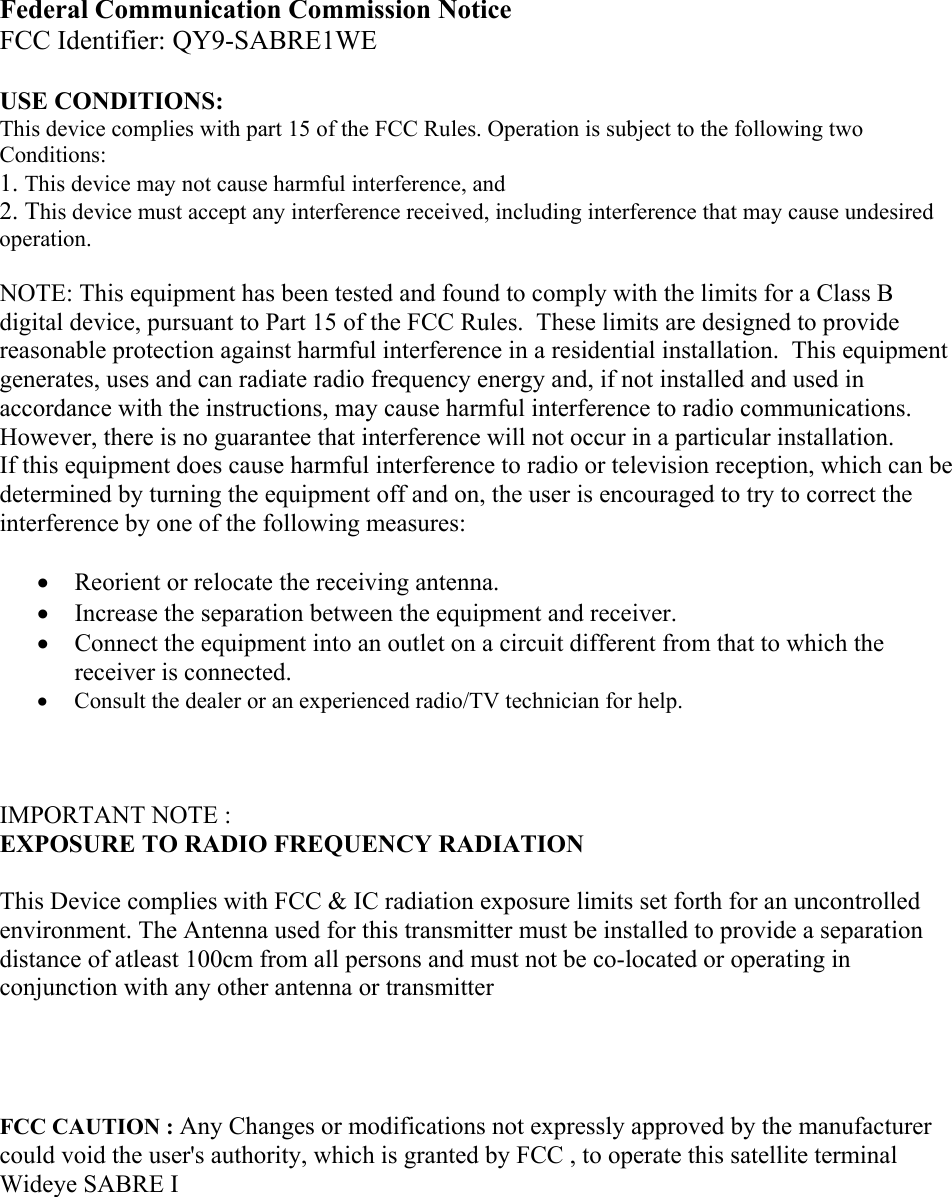
Federal Communication Commission Notice  FCC Identifier: QY9-SABRE1WE  USE CONDITIONS: This device complies with part 15 of the FCC Rules. Operation is subject to the following two Conditions: 1. This device may not cause harmful interference, and 2. This device must accept any interference received, including interference that may cause undesired operation.  NOTE: This equipment has been tested and found to comply with the limits for a Class B digital device, pursuant to Part 15 of the FCC Rules.  These limits are designed to provide reasonable protection against harmful interference in a residential installation.  This equipment generates, uses and can radiate radio frequency energy and, if not installed and used in accordance with the instructions, may cause harmful interference to radio communications.  However, there is no guarantee that interference will not occur in a particular installation.   If this equipment does cause harmful interference to radio or television reception, which can be determined by turning the equipment off and on, the user is encouraged to try to correct the interference by one of the following measures:  • Reorient or relocate the receiving antenna. • Increase the separation between the equipment and receiver. • Connect the equipment into an outlet on a circuit different from that to which the receiver is connected. • Consult the dealer or an experienced radio/TV technician for help.    IMPORTANT NOTE : EXPOSURE TO RADIO FREQUENCY RADIATION  This Device complies with FCC & IC radiation exposure limits set forth for an uncontrolled environment. The Antenna used for this transmitter must be installed to provide a separation distance of atleast 100cm from all persons and must not be co-located or operating in conjunction with any other antenna or transmitter     FCC CAUTION : Any Changes or modifications not expressly approved by the manufacturer  could void the user's authority, which is granted by FCC , to operate this satellite terminal Wideye SABRE I
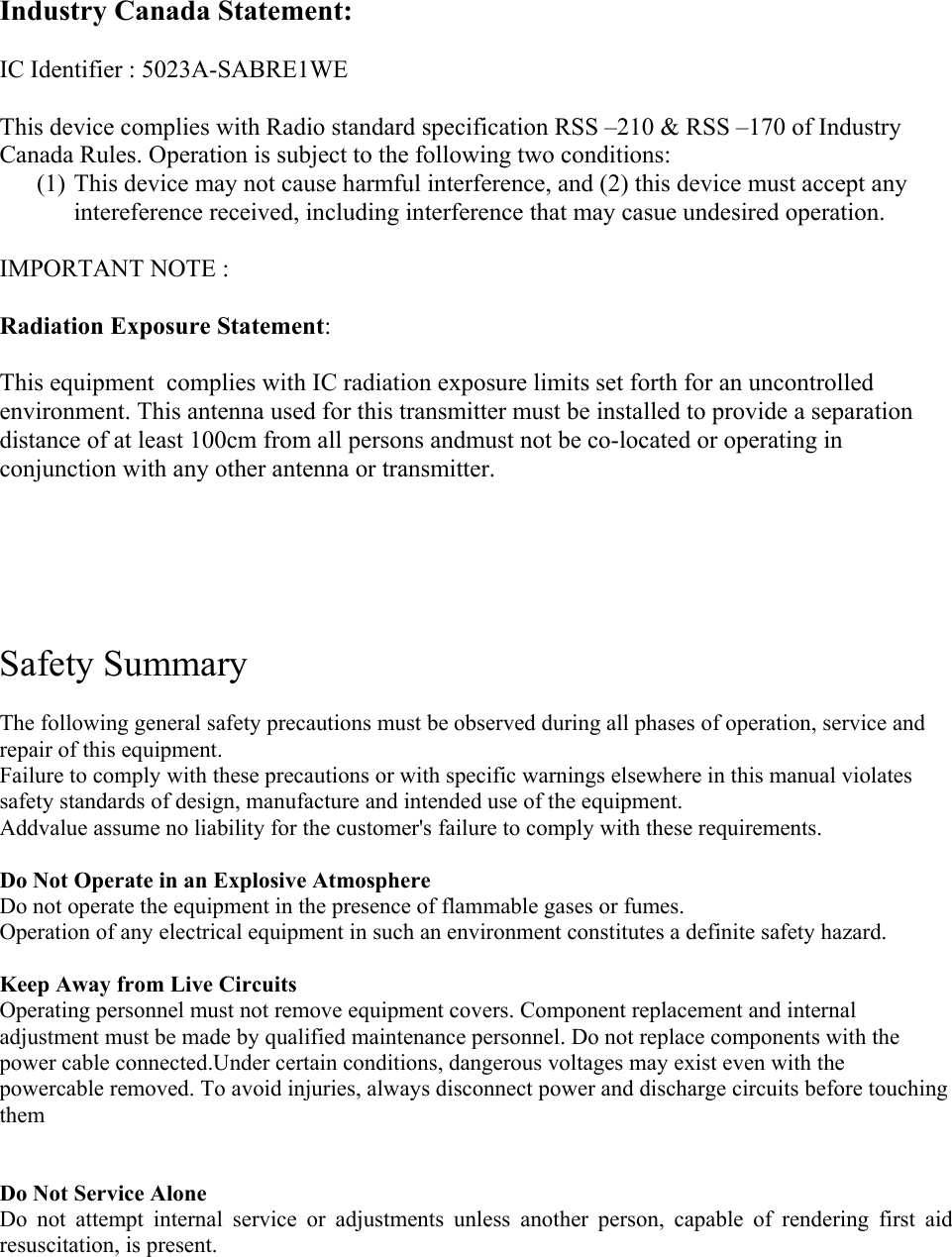
Industry Canada Statement:  IC Identifier : 5023A-SABRE1WE  This device complies with Radio standard specification RSS –210 & RSS –170 of Industry Canada Rules. Operation is subject to the following two conditions: (1) This device may not cause harmful interference, and (2) this device must accept any intereference received, including interference that may casue undesired operation.  IMPORTANT NOTE :  Radiation Exposure Statement:  This equipment  complies with IC radiation exposure limits set forth for an uncontrolled environment. This antenna used for this transmitter must be installed to provide a separation distance of at least 100cm from all persons andmust not be co-located or operating in conjunction with any other antenna or transmitter.        Safety Summary 1  The following general safety precautions must be observed during all phases of operation, service and repair of this equipment. Failure to comply with these precautions or with specific warnings elsewhere in this manual violates safety standards of design, manufacture and intended use of the equipment.  Addvalue assume no liability for the customer's failure to comply with these requirements.  Do Not Operate in an Explosive Atmosphere Do not operate the equipment in the presence of flammable gases or fumes. Operation of any electrical equipment in such an environment constitutes a definite safety hazard.  Keep Away from Live Circuits Operating personnel must not remove equipment covers. Component replacement and internal adjustment must be made by qualified maintenance personnel. Do not replace components with the power cable connected.Under certain conditions, dangerous voltages may exist even with the powercable removed. To avoid injuries, always disconnect power and discharge circuits before touching them   Do Not Service Alone Do not attempt internal service or adjustments unless another person, capable of rendering first aid resuscitation, is present.
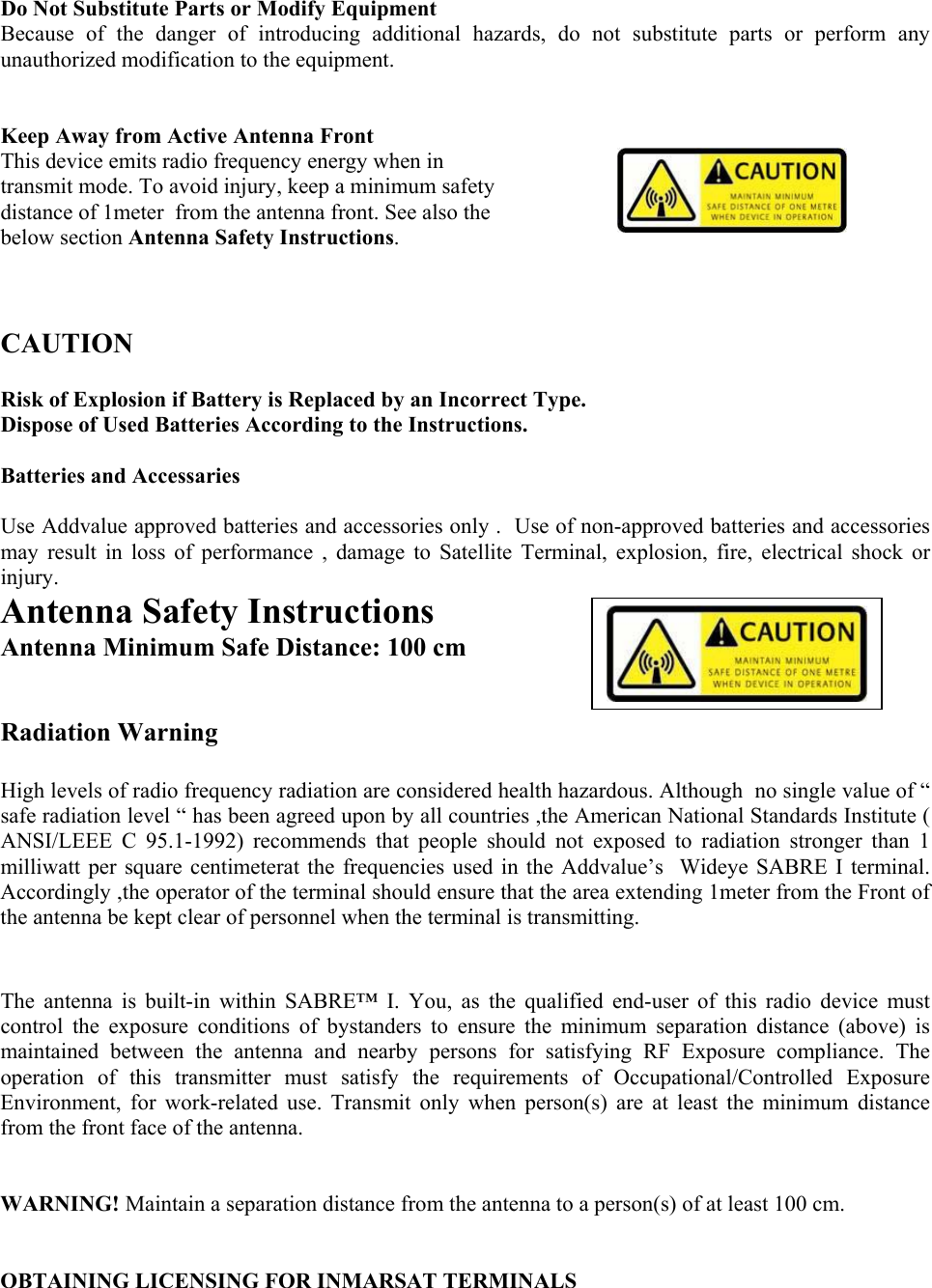
Do Not Substitute Parts or Modify Equipment Because of the danger of introducing additional hazards, do not substitute parts or perform any unauthorized modification to the equipment.   Keep Away from Active Antenna Front This device emits radio frequency energy when in transmit mode. To avoid injury, keep a minimum safety distance of 1meter  from the antenna front. See also the below section Antenna Safety Instructions.        CAUTION  Risk of Explosion if Battery is Replaced by an Incorrect Type. Dispose of Used Batteries According to the Instructions.  Batteries and Accessaries  Use Addvalue approved batteries and accessories only .  Use of non-approved batteries and accessories may result in loss of performance , damage to Satellite Terminal, explosion, fire, electrical shock or injury. Antenna Safety Instructions 2 Antenna Minimum Safe Distance: 100 cm   Radiation Warning  High levels of radio frequency radiation are considered health hazardous. Although  no single value of “ safe radiation level “ has been agreed upon by all countries ,the American National Standards Institute ( ANSI/LEEE C 95.1-1992) recommends that people should not exposed to radiation stronger than 1 milliwatt per square centimeterat the frequencies used in the Addvalue’s  Wideye SABRE I terminal. Accordingly ,the operator of the terminal should ensure that the area extending 1meter from the Front of the antenna be kept clear of personnel when the terminal is transmitting.   The antenna is built-in within SABRE™ I. You, as the qualified end-user of this radio device must control the exposure conditions of bystanders to ensure the minimum separation distance (above) is maintained between the antenna and nearby persons for satisfying RF Exposure compliance. The operation of this transmitter must satisfy the requirements of Occupational/Controlled Exposure Environment, for work-related use. Transmit only when person(s) are at least the minimum distance from the front face of the antenna.   WARNING! Maintain a separation distance from the antenna to a person(s) of at least 100 cm.   OBTAINING LICENSING FOR INMARSAT TERMINALS
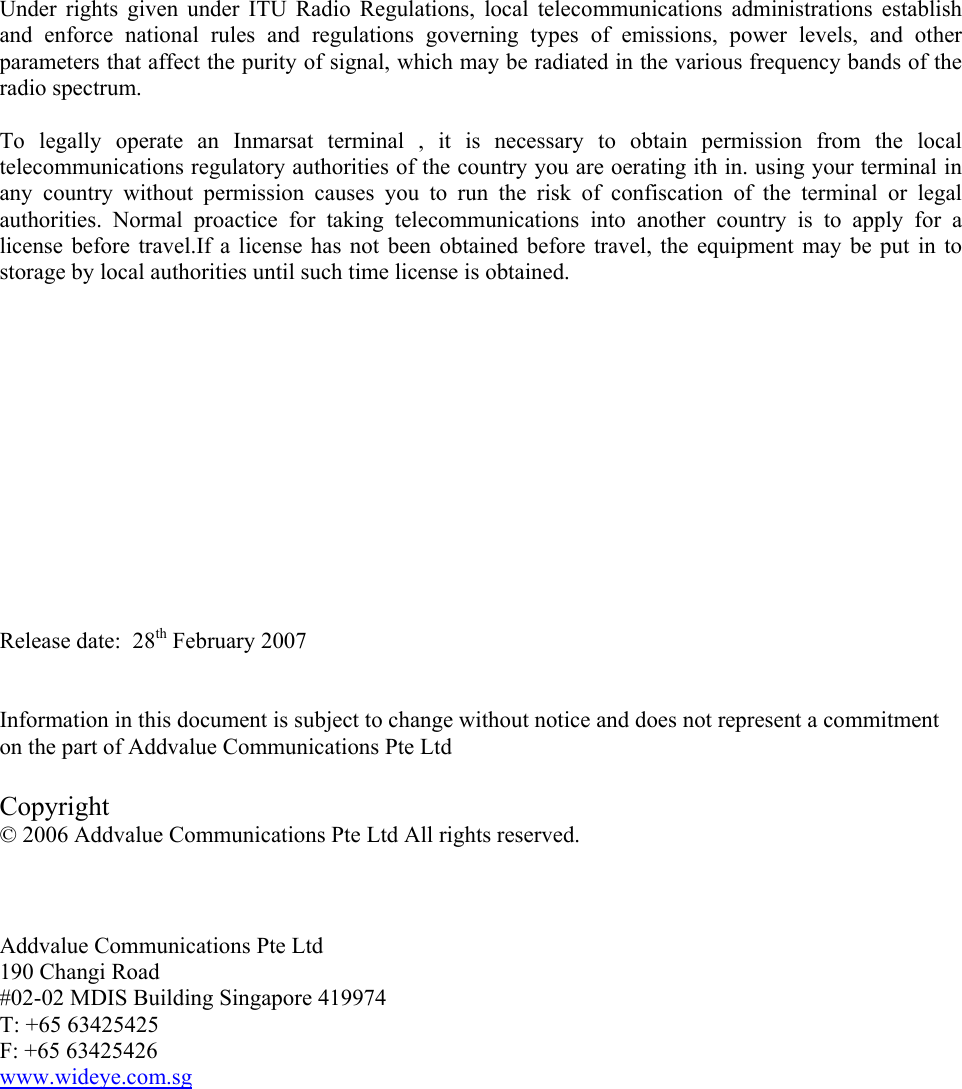
Under rights given under ITU Radio Regulations, local telecommunications administrations establish and enforce national rules and regulations governing types of emissions, power levels, and other parameters that affect the purity of signal, which may be radiated in the various frequency bands of the radio spectrum.  To legally operate an Inmarsat terminal , it is necessary to obtain permission from the local telecommunications regulatory authorities of the country you are oerating ith in. using your terminal in any country without permission causes you to run the risk of confiscation of the terminal or legal authorities. Normal proactice for taking telecommunications into another country is to apply for a license before travel.If a license has not been obtained before travel, the equipment may be put in to storage by local authorities until such time license is obtained.              Release date:  28th February 2007   Information in this document is subject to change without notice and does not represent a commitment on the part of Addvalue Communications Pte Ltd  Copyright © 2006 Addvalue Communications Pte Ltd All rights reserved.    Addvalue Communications Pte Ltd 190 Changi Road #02-02 MDIS Building Singapore 419974 T: +65 63425425 F: +65 63425426 www.wideye.com.sg

Navigation menu