Aldi Sourcing Asia 00054160S RC Weather Station Digital USA User Manual 4
Aldi Sourcing Asia Limited RC Weather Station Digital USA 4
Users Manual
English .....06
Español ....45
En
Es
DIGITAL WEATHER STATION
ESTACIÓN METEOROLÓGICA DIGITAL
ID: #07177
m
y
h
a
n
s
e
c
o
n
t
r
o
l
.
c
o
m
C
E
R
T
I
F
I
E
D
User-friendly
Manual
User Manual
Manual
del usuario

Dok./Rev.-Nr. 195508_20170629
Contents
Overview ........................................................................................................ 3
Use................................................................................................................... 4
Package contents/device parts ................................................................... 6
General information .......................................................................................7
Reading and storing the user manual ........................................................... 7
Explanation of symbols ..................................................................................... 7
Safety ..............................................................................................................8
Proper use ............................................................................................................8
Safety instructions .............................................................................................8
Battery notes ......................................................................................................13
First use .........................................................................................................16
Checking the weather station and package contents ............................. 16
About time signals........................................................................................16
Preparing the radio sensor for use .............................................................17
Inserting or replacing batteries .....................................................................17
Using additional radio sensors .......................................................................17
Installing the radio sensor .............................................................................. 18
Preparing the base unit for use ..................................................................19
Powering the base unit ................................................................................... 19
Searching for signals ........................................................................................21
Manual settings.................................................................................................22
Installing the base unit ...................................................................................24
Time functions ............................................................................................. 24
Display (time functions) ..................................................................................24
Alarms ................................................................................................................25
Summer time ..................................................................................................... 27
Time zone ........................................................................................................... 27
Time format ........................................................................................................ 27
Weather data ................................................................................................ 28
Display (weather data) ....................................................................................28
Switching between radio sensors ................................................................29
Maximum and minimum values ....................................................................30
Temperature and humidity trend .................................................................30
Units of temperature........................................................................................ 31
Air pressure ...................................................................................................31
Display (air pressure) ....................................................................................... 31
Current air pressure and air pressure trend ............................................... 31
Maximum and minimum values ....................................................................32
Weather forecast ..........................................................................................32
Display (weather forecast)..............................................................................32
Weather forecast symbols ...............................................................................33
Moon phases ................................................................................................ 34
Other functions ............................................................................................ 35
Display backlight ..............................................................................................35
USB charging port ............................................................................................35
Operation mode ................................................................................................36
Low battery warning .......................................................................................36
Resetting the weather station .......................................................................36
Cleaning ........................................................................................................37
Storage ......................................................................................................... 38
Troubleshooting .......................................................................................... 39
Technical data ...............................................................................................41
Disposal ........................................................................................................ 43
Disposing of the packaging ............................................................................43
Disposing of old appliances............................................................................43
3
A
45678
1
2
3
9
12
13
1 2 3
45678
9
12
13
11 10
10
11
4
C
14 24
B
14 15 16 17 18
19
20
21
22
23
5
D25 26 27
28
29
30
31
27
26
30
31
28
29
25
A
B
6
Package contents⁄device parts
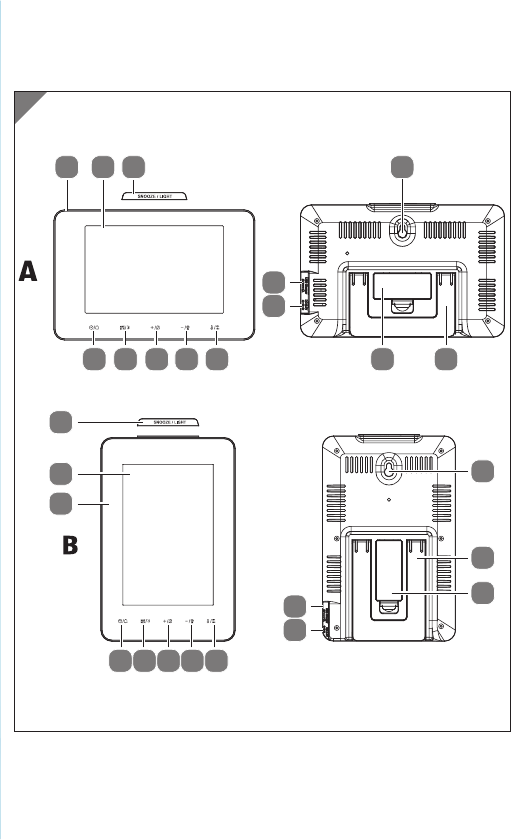
1Base unit
2Display (base unit)
3SNOOZE/LIGHT button
4 button
5 button
6 button
7 button
8 button
9Hanging hole
10 Foldout stand
11 Battery compartment
(base unit)
12 DC input jack
13 USB charging port
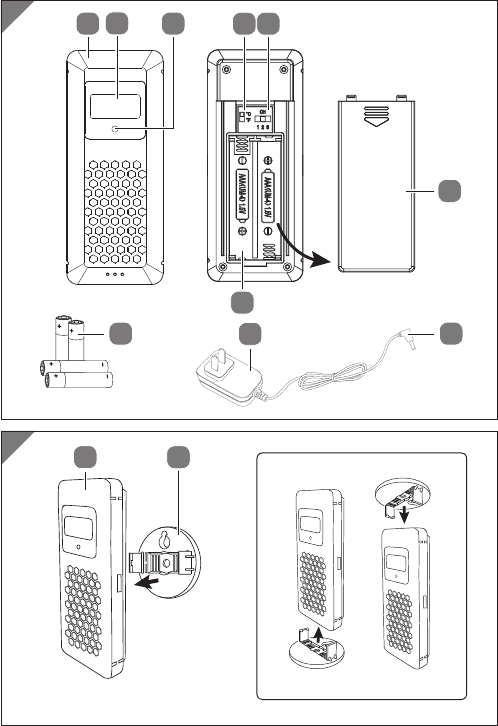
14 Radio sensor
15 Display (radio sensor)
16 Signal indicator light
17 Temperature unit switch
18 Channel switch
19 Battery compartment
door (radio sensor)
20 Battery compartment
(radio sensor)
21 Output plug
22 Power adaptor
23 Battery, 4×
24 Hanging bracket
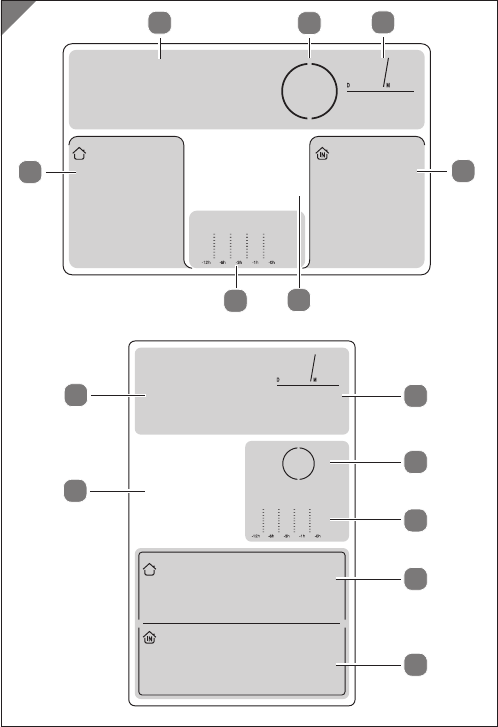
25 Clock and alarm
26 Moon phase
27 Date and weekday
28 Indoor weather
29 Weather forecast
30 Air pressure
31 Outdoor weather
A = Horizontal version
B = Vertical version
General information
7
General information
Reading and storing the user manual
This user manual accompanies the digital weather
station (hereafter referred to as “weather station”),
and contains important information on setup and use.
Before using the weather station, read the user manual
carefully. This particularly applies to the safety instructions.
Failure to do so may result in personal injury or damage to the
weather station.
Store the user manual for future use. Make sure to include
this user manual when passing the weather station on to
third parties.
Explanation of symbols
The following symbols and signal words are used in this user
manual, on the weather station or on the packaging.
WARNING!
This signal symbol/word designates a hazard with moderate
risk, which may result in death or severe injury if not avoided.
CAUTION!
This signal symbol/word designates a hazard with low risk,
which may result in minor or moderate injury if not avoided.
Safety
8
NOTICE!
This signal word warns of possible damage to property.
This symbol provides you with useful additional
information regarding setup and use.
Safety
Proper use
The weather station is exclusively designed for showing
time and weather information. It is only intended for indoor
private use and not suitable for commercial purposes.
Only use the weather station as described in this user
manual. Any other use is considered improper and may result
in damage to property or even personal injury. The weather
station is not a toy for children.
The manufacturer or vendor cannot be held liable for
damages incurred through improper or incorrect use.
Safety instructions
WARNING!
Risk of electric shock!
A faulty electrical installation, excessive line
voltage or incorrect operation may result in
an electric shock.

Safety
9
− Only use the power adaptor provided
with the weather station.
− Only use the power adaptor in dry
and indoor areas. Do not let the power
adaptor come into contact with water or
other liquids.
− Connect the power adaptor only to an
alternating current (AC) power supply.
Make sure that the voltage corresponds
with the voltage details on the device.
The power adaptor must be operated
using (100 ~ 240 V, 50/60 Hz) alternating
current (AC).
− Only connect the power adaptor to a
properly installed and easily accessible
power outlet so that you can quickly pull
the plug in an emergency.
− Fully unwind the power adaptor cord
before connecting it. Make sure that
the cord cannot get damaged by sharp
edges or hot objects.
− Never cover the power adaptor. Ensure
that sufficient ventilation is provided
in order to prevent the power adaptor
from overheating.

Safety
10
− Do not use the power adaptor if the
housing or cord is defective or has
other visible damages. In the event of
damage, only have the power adaptor
serviced by the manufacturer, its
customer service team or a similarly
qualified person to avoid risks.
− The power adaptor cord cannot be
replaced. If the cord or the power
adaptor is damaged, they must be
thrown away and replaced by a power
adaptor of the same model.
− Always remove the power adaptor from
the power outlet if:
• you want to clean the weather station or do not intend on
using the weather station for a prolonged period of time;
• the weather station is not working properly;
• during thunderstorms.
− Always pull the plug, not the cord when
you are removing the power adaptor
from the power outlet.
Safety
11
WARNING!
Danger for children and persons with
impaired physical, sensory or mental
capacities (e.g. partially disabled persons,
older persons with reduced physical and
mental capacities) or lack of experience
and knowledge (e.g. older children).
− If they are supervised or have been
instructed in how to safely use the
weather station and have understood
the risks associated with operating it,
this weather station may be used by
children ages eight and over as well as
persons with impaired physical, sensory
or mental capacities or those lacking
experience and knowledge. Children
may not play with the weather station.
Cleaning and user maintenance must not
be performed by unsupervised children.
− Keep children under the age of eight
away from the weather station and
power cord.
− Make sure that children do not play
with the plastic wrapping. They may get
caught in it when playing and suffocate.

Safety
12
NOTICE!
Risk of damage!
If you do not use the weather station (base
unit and radio sensor) properly, you may
damage it.
− Do not use the weather station in a
damp place (e. g. bathroom) and avoid
dust, splashing or dripping water, heat
sources, extreme temperatures and
direct sunlight.
− Make sure the weather station stays away
from magnetic fields (e. g. speakers).
− Make sure no foreign objects penetrate
the housing of the weather station.
− Do not exert pressure on the display
surface of the weather station, as this
may cause the surface to break.
− Do not allow sharp or pointed objects to
come in contact with the surface of the
weather station.
− Keep the weather station from falling.
Failure to do so may break the weather
station.
− Do not place the weather station near
Safety
13
any heat sources. Never place naked
flames such as burning candles on or
immediately next to the weather station.
− Under no circumstances should you
open the housing of the weather station.
There are no user-serviceable parts
inside. Improper repairs may damage
the weather station. Repairs should
only be carried out by professional
technicians. The only exception is the
removal of the battery compartment
door to replace the batteries.
− The radio sensor must be protected from
direct exposure to moisture such as rain.
Battery notes
WARNING!
Health hazards!
There is a high health hazard if children or
animals swallow the batteries.
− Store the batteries so they are not
accessible to children and animals. If you
suspect a battery has been swallowed,
seek immediate medical advice.
Safety
14
WARNING!
Risk of explosion
Improper handling of batteries increases the
risk of explosion.
− Store the batteries in a cool, dry place.
Never expose the batteries to excessive
heat (e.g. direct sunlight) and never
dispose of them in a fire.
− Only use batteries of the same type.
− Ensure the correct polarity when inserting
the batteries. This is shown in the battery
compartments. Incorrect installation may
damage the weather station.
− Always use batteries of premium quality.
Batteries of poor quality may leak and
cause damage.
− Before inserting the batteries, make
sure the contacts inside the battery
compartment and on the battery itself
are clean and intact. Clean them if
necessary.
− Always replace all batteries in a battery
compartment at the same time.

Safety
15
− Remove the batteries from the weather
station if they are dead. Also remove the
batteries if you do not intend on using
the weather station for a prolonged
period of time. Otherwise, the batteries
may leak and cause damages.
− If the batteries are leaking, remove
them immediately to prevent damaging
the weather station. Do not remove the
batteries with your bare hands or allow
the battery fluid to come into contact
with skin, eyes or mucus membranes.
Wear normal household rubber gloves
to do so. If, however, your skin has come
into contact with the battery fluid, wash
your hands immediately and consult a
physician if necessary.
− Batteries should only be installed or
replaced by an adult.
− Keep the weather station away from
children when the battery cover is
removed.
− Remove the batteries before disposing
of the weather station.

First use
16
First use
Checking the weather station and
package contents
NOTICE!
Risk of damage!
If you are not cautious when opening the
packaging with a sharp knife or other
pointed object, you may quickly damage
the weather station.
− For this reason, be very careful when
opening it.
1. Take the weather station out of the packaging.
2. Check to make sure that all components and accessories
have been received (see Fig. A and B).
3. Check whether the weather station or the individual parts
exhibit damage. If this is the case, do not use the weather
station. Contact the manufacturer via the service address
indicated on the warranty card.
About time signals
The base unit of the weather station is a radio-controlled
clock and can receive the time signals emitted through the
signal transmitter in your country. If the base unit is located
within the transmission range, it can receive the signals and
synchronize with the broadcasted time and date several
times a day. In case of a failure in signal reception, the base
Preparing the radio sensor for use
17
unit can continue to run accurately and attempt to look for
time signals at the next designated time. If no signals can be
found, the time and date can also be set manually.
Preparing the radio sensor for use
Inserting or replacing batteries
− Do not use any rechargeable batteries, as their
voltage is low. This influences the measuring
precision.
− Preferably use alkaline batteries which last lon-
ger, particularly with low outdoor temperature.
1. Remove the battery compartment door 19 on the back of
the radio sensor 14 .
2. Pay attention to the correct battery polarity (+ or –).
For battery replacement, remove the old batteries first.
Insert 2 batteries 23 (size: AAA, provided) into the battery
compartment 20 .
3. Close the battery compartment door.
The radio sensor will detect the temperature and humidity
of the surroundings and send the collected data to the
base unit once a minute. Both the temperature (°C/°F) and
humidity (%) will be shown on the display 15 of the radio
sensor. The signal indicator light 16 will blink once when the
data have been sent.
Using additional radio sensors
The weather station is supplied with one radio sensor.
If necessary, you can operate it with up to three radio sensors.
Additional sensors are available through the after sales
support. Please check the price and details with the support.
Preparing the radio sensor for use
18
The contact details are on the warranty card.
The radio sensors can be located in different rooms or
outdoors. Each sensor must have its own radio sensor
number (1–3) allocated to it.
To use additional radio sensors:
1. Remove the battery compartment door 19 on the back of
the radio sensors.
2. Set a dedicated radio sensor number (1–3) for each radio
sensor using the channel switch 18 .
The selected radio sensor number (e.g. = radio sensor
number 1) will show on the display 15 .
3. Set a dedicated temperature unit (°C/°F) for each radio
sensor using the temperature unit switch 17 .
The selected temperature unit will show on the display.
4. Close the battery compartment door.
The base unit will receive the weather data from all available
radio sensors (see chapter “Preparing the base unit for use”).
In the event of interference from nearby equipment
transmitting radio signals, you may change the radio sensor
number to avoid the interference.
Installing the radio sensor
Take note of the tips below to ensure the best
possible signal receptions.
− Only install the radio sensor outdoors in a dry, shaded area
(e.g. under a roof).
− When installing on a wall, ensure that no electric cables,
gas or water pipes are buried beneath the wall surface
before drilling any holes.
Preparing the base unit for use
19
− The maximum distance between the base unit and radio
sensor should not be greater than 100 m (direct visible
distance). Building materials, such as concrete walls, may
reduce or prevent signal reception between the base unit
and radio sensor.
− Do not place the base unit and radio sensor on the floor.
This limits the transmission range.
− Electronic devices such as televisions and computers can
disrupt the signal reception.
− At low temperature during winter, the performance of the
radio sensor batteries may fall significantly. This reduces
the transmission range.
1. Mount the hanging bracket 24 on a wall using the
hanging or screw hole (nail or screw not provided).
2. Attach the radio sensor 14 to the hanging bracket
(see Fig. C).
Preparing the base unit for use
Powering the base unit
The base unit can be powered by batteries or
an alternating current (AC) power supply using
the power adaptor.
Inserting or replacing batteries
1. Open the battery compartment 11 on the back of the
base unit 1.
2. Pay attention to the correct battery polarity (+ or –).
For battery replacement, remove the old batteries first.
Insert 2 batteries 23 (size: AAA, provided) into the battery
compartment.
Preparing the base unit for use
20
3. Close the battery compartment.
4. The display 2 will turn on and an alarm tone will sound
once the batteries have been inserted. Wait for about
30 minutes. During this time the base unit gathers the
weather data and receives the time signals (see chapter
“Searching for signals”).
Operating with the power adaptor
NOTICE!
Risk of damage!
If the weather station is connected via the
power adaptor to a power outlet, it operates
with a DC voltage. The batteries may leak
and damage the unit.
− Remove any batteries from the base unit
when connecting it to a power outlet.
1. Connect the output plug 21 of the power adapter 22 to
the DC input jack 12 of the base unit 1.
2. Connect the power adaptor to a power outlet. Only
connect the power adaptor to an AC power supply
(100 ~ 240 V, 50/60 Hz).
The display 2 will turn on and an alarm tone will sound
once the power adaptor has been connected to an outlet.
Wait for about 30 minutes. During this time the base unit
gathers the weather data and receives the time signals
(see chapter “Searching for signals”).
Preparing the base unit for use
21
Searching for signals
Once the base unit has been powered, it will start searching
for weather data and time signals:
1. The base unit will first detect the air pressure for about
20 seconds. During this time, the value of air pressure will
blink in the air pressure display area 30 .
− Press the button 8 if you want to stop the detection.
2. The base unit will then search for weather data from all
available radio sensors. During this time, the reception
icon ( ) 51 (see chapter “Weather data”) blinks in the
outdoor weather display area 31 , indicating the base unit
is searching for the weather data.
− When the weather data have been successfully received,
the reception icon will turn off and the current weather
data will show in the outdoor weather display area.
− When no weather data have been received, the reception
icon will turn off and no outdoor weather data will be
available.
− In case of an unsuccessful search for weather data, press
and hold the button 4 to initiate a new search.
However, this can only be carried out after the search for
time signals has been completed.
3. Around 3 minutes after the base unit has been powered,
it will search for time signals emitted through the signal
transmitter in your country.During this time, the time
signal icon ( or ) 38 (see chapter “Time functions”)
blinks in the clock and alarm display area 25 , indicating
the base unit is searching for the time signals.
− When the time signals have been successfully received,
the time signal icon ( or ) will remain visible and the
current date and time will show in the clock and alarm
Preparing the base unit for use
22
display area. The base unit will continue to receive time
signals every night (up to 3 times) and synchronize with
the displayed time.
− During the search for time signals, all other setting
functions (e.g. manual and alarm settings) will be disabled.
− When no time signals have been received after about
7 minutes, the time signal icon will turn off.
− In case of an unsuccessful search for the time signals, press
and hold the button 5 to initiate a new search.
In order to ensure the best possible signal receptions,
avoid placing the base unit in buildings with lots
of concrete and metal structures, or near electronic
equipment such as TVs, computers, power lines, radio
transmitters, etc. If necessary, relocate the base unit.
4. As the synchronized time is only a coordinated universal
time, press the button to select a time zone (indicated
by the time zone icon on the display, see chapter “Time
functions”) that corresponds to your location.
− Time zone: P = Pacific, M = Mountain, C = Central, E = Eastern
Manual settings
This operation allows you to manually set the date and time,
select the time format, adjust the weather forecast and air
pressure, etc.
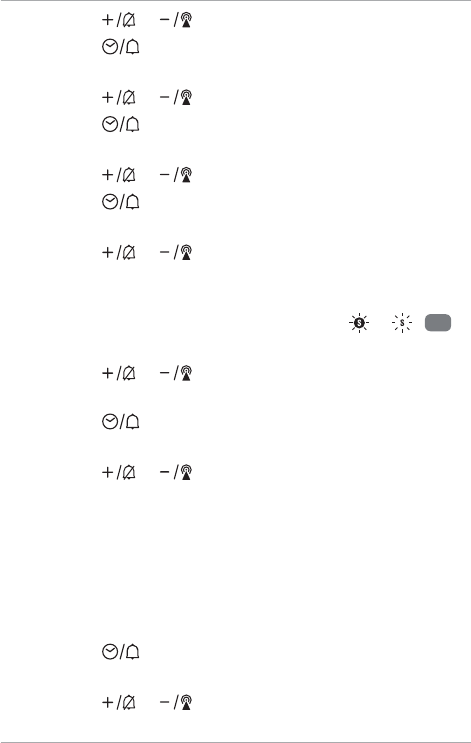
1. Press and hold the button 8 until the “year” blinks
on the display.
2. Press the 6 or 5 button to set the year.
3. Press the button. The “month” will blink on the
display.
4. Press the or button to set the month.
5. Press the button. The “day” will blink on the display.
Preparing the base unit for use
23
6. Press the or button to set the day.
7. Press the button. The “hour time” will blink on the
display.
8. Press the or button to set the hour time.
9. Press the button. The “minute time” will blink on
the display.
10. Press the or button to set the minute time.
11. Press the button. The “time format” will blink on the
display.
12. Press the or button to select a time format
(12-hour or 24-hour).
13. Press the SET button. The “summer time” (default value:
0FF) will blink and the summer time icon ( or ) 37
(see chapter “Time functions”) will show on the display.
14. Press the or button to turn ON or OFF the
summer time.
15. Press the button. The graphical weather forecast will
blink on the display.
16. Press the or button to select a weather forecast
condition according to the forecast on TV or internet.
The weather station computes weather forecasts based
on changes in air pressure. However, when using the
weather station for the first time, it may take up to a few
days of collecting sufficient information for more accurate
forecasts. Manual setting of the weather forecast can
slightly accelerate this process.
17. Press the button. The “air pressure” will blink on the
display.
18. Press the or button to adjust the air pressure.
If desired, enter the altitude-related or more accurate
Time functions
24
air pressure values of your location obtained from the
internet or the local authorities.
19. Press the button. The manual settings are now
complete.
The base unit will automatically exit manual settings when no
buttons have been pressed for about 20 seconds.
Installing the base unit
− For best signal reception, install the base unit
near a window.
− When installing on a wall, ensure that no electric
cables, gas or water pipes are buried beneath
the wall surface before drilling any holes.
Using the foldout stand
1. Pull out the foldout stand 10 on the back of the base unit.
The stand has two locking positions.
2. Place the base unit on a flat surface.
Hanging on a wall
1. Fix a nail or screw (not provided) on the wall.
2. Slip the hanging hole 9 over the head of the nail or screw.
Time functions
Display (time functions)
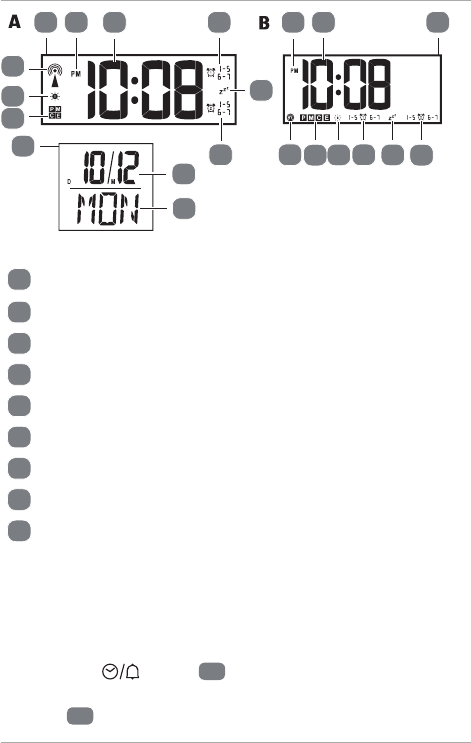
The date and time information is displayed in the date and
weekday area 27 and clock and alarm area 25 of the display.
Time functions
25
38
33
36 37 34 34
25 25
27
39
40
37
38
32 33
36
34
35
32
35
34
A = Horizontal version, B = Vertical version
32 PM time (12-hour format)
33 Time (hours, minutes) / year
34 Alarm 1 and alarm 2
35 Snooze
36 Time zone
37 Summer time
38 Time signal
39 Day and month
40 Day of the week
Alarms
The alarm clock allows 2 alarm times to be set.
To set the alarm times:
1. Press the button 8 to select an alarm setting
(indicated by “AL1” or “AL2” in the clock and alarm display
area 25 ).
Time functions
26
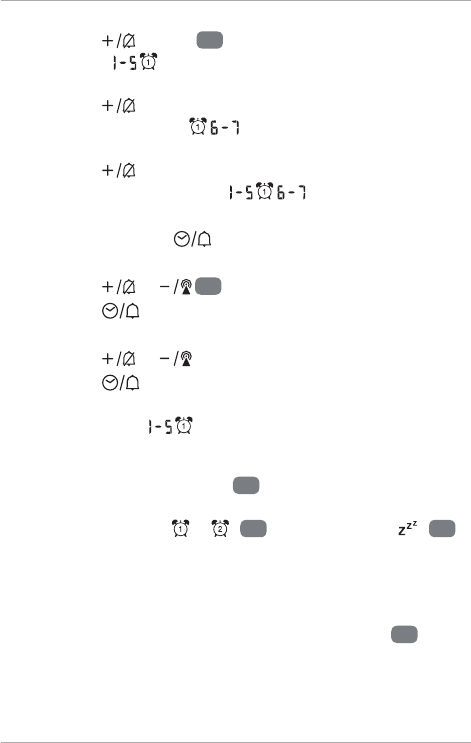
2. Select the weekday or weekend alarm. To do so:
Press the button 6 once to select the weekday
alarm (e.g. ). The alarm will sound from Monday to
Friday.
Press the button a second time to select the
weekend alarm (e.g. ). The alarm will sound during
the weekend.
Press the button a third time to select both weekday
and weekend alarms (e.g. ). The alarm will
sound every day.
3. Press and hold the button until the “hour time” of
the selected alarm setting blinks.
4. Press the or 5 button to set the hour time.
5. Press the button. The “minute time” will blink on
the display.
6. Press the or button to set the minute time.
7. Press the button. The alarm time is now set.
The alarm will be automatically switched on with the
alarm icon (e.g. ) showing on the display.
To briefly silence the alarm (Snooze function):
Press the SNOOZE/LIGHT button 3. The alarm will sound again
after the snooze period (5 minutes) is over. During the snooze
period, the alarm icon ( or ) 34 and snooze icon ( ) 35
will blink. To cancel the snooze function, press any button except
the SNOOZE/LIGHT button.
To turn off the alarm when it sounds:
Press any button (except the SNOOZE/LIGHT button 3)
on the base unit. The alarm will also stop without pressing
any buttons after 2 minutes. The alarm remains switched on
and will sound again at the same time on the following day if
the alarm setting is applicable.
Time functions
27
To switch the alarms on or off:
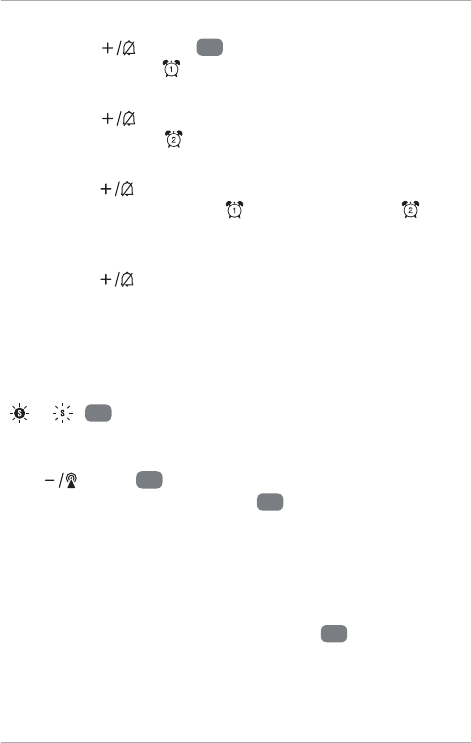
1. Press the button 6 once to switch on Alarm 1.
The alarm 1 icon ( ) with the selected weekday or
weekend alarm setting will show on the display.
2. Press the button a second time to switch on Alarm 2.
The alarm 2 icon ( ) with the selected weekday or
weekend alarm setting will show on the display.
3. Press the button a third time to switch on both Alarm 1
and Alarm 2. The alarm 1 ( ) and alarm 2 icons ( ) with
the selected weekday or weekend alarm setting will show
on the display.
4. Press the button a fourth time to switch all alarms off.
Summer time
Summer time or daylight saving time information is included
in the broadcasted time signals. When summer time or
daylight saving time is in force, the summer time icon
( or ) 37 will show on the display.
Time zone
Press button 5 to change the time zone.
The corresponding time zone icon 36 will show on the display.
Time zone: P = Pacific, M = Mountain, C = Central, E = Eastern.
Time format
To change between 12 and 24-hour time formats, see chapter
“Manual settings”. If 12-hour format is selected, the afternoon
hours are identified with the PM time icon 32 .
Weather data
28
Weather data
Display (weather data)
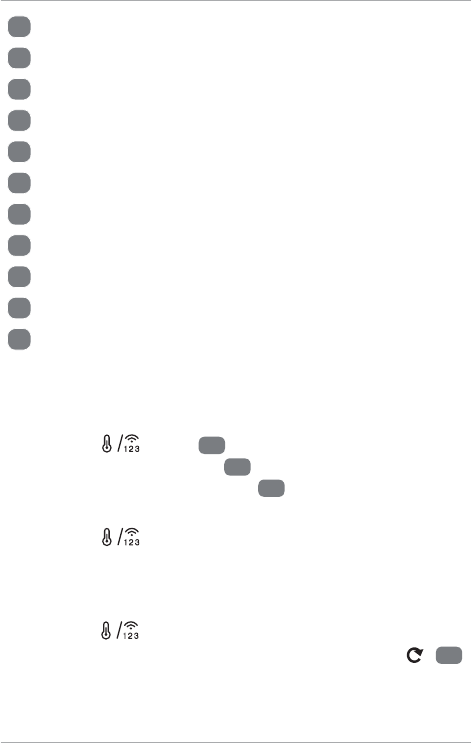
The weather data are displayed in the indoor weather 28 and
outdoor weather 31 areas of the display. The outdoor weather
area shows the data recorded by the base unit and the outdoor
weather area shows the data sent by the radio sensor.
28
47
46
45
44
41
42
43
41
46
43
44
49
42
50
48
51
31
41 43 49
44
46
45
44
434241
46
47
42
50
51
48
31
28
A = Horizontal version, B = Vertical version
Weather data
29
41 Temperature (°C/°F)
42 Rising icon
43 Humidity (%)
44 MAX and MIN icons
45 Low battery (base unit)
46 Dropping icon
47 Indoor icon
48 Radio sensor number
49 Low battery (radio sensor)
50 Sensor change icon
51 Reception icon
Switching between radio sensors
If more than one radio sensor is used:
1. Press the button 4 once to switch to radio sensor 2.
The radio sensor number 48 will change to “2” and the
outdoor weather display area 31 will only show the data
sent by radio sensor 2.
2. Press the button a second time to switch to radio
sensor 3. The radio sensor number will change to “3” and
the outdoor weather display area will only show the data
sent by radio sensor 3.
3. Press the button a third time to activate the automatic
sensor change function. The sensor change icon ( ) 50
will turn on and the outdoor weather display area will
alternate between all radio sensors.
Weather data
30
4. Press the button a fourth time to cancel the automatic
sensor change function and switch to radio sensor 1.
The radio sensor number will change to “1” and the outdoor
weather display area will only show the data sent by radio
sensor 1.
See chapter “Using additional radio sensors” if you want to
assign numbers to radio sensors.
Maximum and minimum values
To display the highest and lowest values for the last 24 hours
in relation to temperature and humidity:
1. Press the button 7 once to display the maximum
values.
2. Press the button a second time to display the
minimum values.
3. Press the button a third time to display the current
weather data.
The maximum or minimum value is indicated by the MAX or
MIN icon 44 , respectively. The stored values will be deleted
daily at 12:00 am.
Temperature and humidity trend
For the temperature and humidity values measured by the
base unit and radio sensor, the trend is shown in the form of
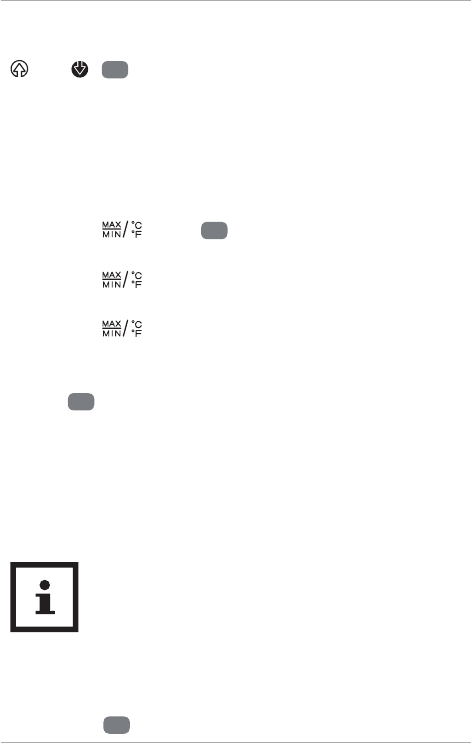
an arrow. A rising trend is indicated by a rising icon ( ) 42 .
A falling trend is indicated by a dropping icon ( ) 46 .
A change in trend is displayed when the temperature
changes by 1 °C or more, or the humidity by 3 % or more
within one hour.
Air pressure
31
Units of temperature
To change the temperature unit (°C/°F) on the base unit,
press and hold the button 7.
Air pressure
Display (air pressure)
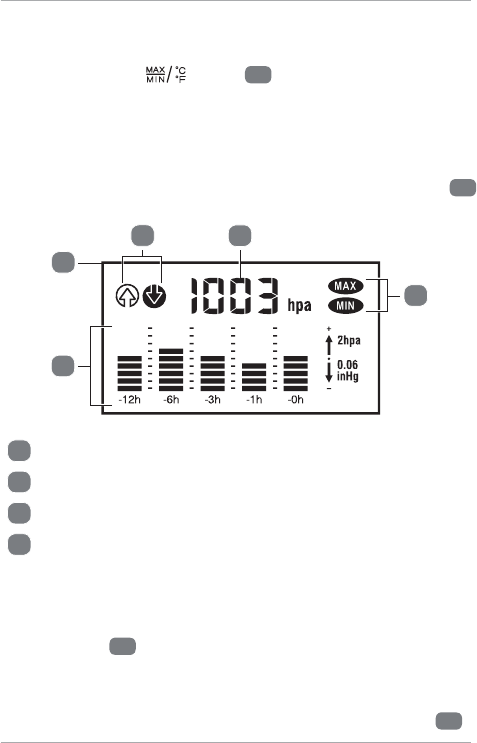
The air pressure data are displayed in the air pressure area 30
of the display.
53
30
52
54
55
52 Trend icons
53 Current air pressure
54 MAX and MIN icons
55 History
Current air pressure and air pressure trend
The current air pressure is displayed in hPa in the current air
pressure area 53 . The value can be manually changed
(see chapter “Manual settings”).
The trend of the air pressure within the last 12 hours is
displayed in the form of a bar diagram in the history area 55 .
Weather forecast
32
The scale goes from –1 (1 hour ago) to –12 (12 hours ago).
The air pressure is also indicated by the trend icons
(
and ) 52 . The upward icon indicates an improving
weather condition. The downward icon indicates a
deteriorating weather condition.
Maximum and minimum values
To display the highest and lowest values for the last 12 hours
in relation to air pressure:
1. Press the button 7 once to display the maximum
value.
2. Press the button a second time to display the
minimum value.
3. Press the button a third time to display the current
air pressure value.
The maximum or minimum value is indicated by the MAX or
MIN icon 54 , respectively.
Weather forecast
The weather station calculates weather forecasts for the
next 12 hours based on the gathered weather data. The
forecasts provide an approximate indicator of future weather
development.
Upon initial operation, the details regarding the
weather forecast cannot yet be used for around
12 hours, as the weather station needs this time
to gather and evaluate the weather data.
Display (weather forecast)
The weather forecast information is displayed in the weather
forecast area 29 of the display.
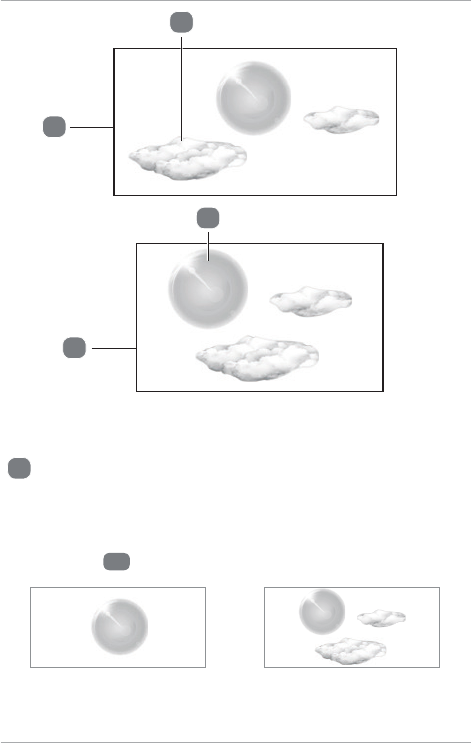
Weather forecast
33
56
56
29
29
A
B
A = Horizontal version, B = Vertical version
56 Weather forecast
Weather forecast symbols
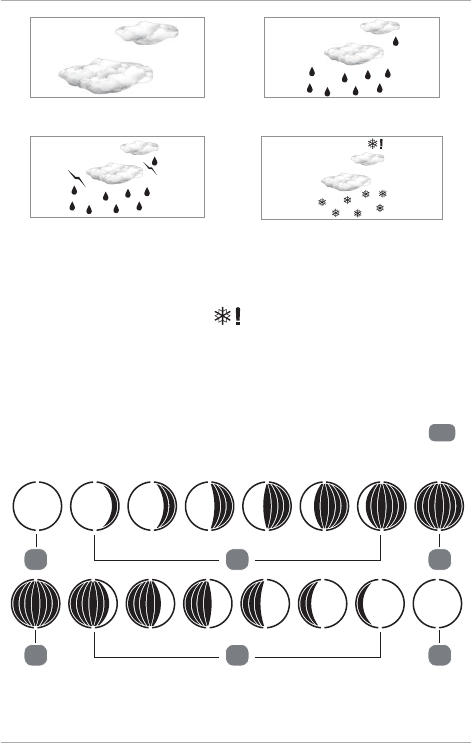
The weather forecast symbols are displayed in the weather
forecast area 29 .
Sunny Slightly cloudy
Moon phases
34
Cloudy Rainy
Thunderstorm Snow*
* Frost warning - When the radio sensor measures a
temperature of between –3 °C and 1 °C, a risk of frost exists
and the snowflake symbol ( ) will blink. If the temperature
falls below –3 °C for a constant period of time, the snowflake
symbol will remain visible on the display.
Moon phases
The moon phases are displayed in the moon phase area 26
of the display and are automatically updated.
57
57
59
59
58
60
Other functions
35
57 New moon
58 Waxing moon
59 Full moon
60 Waning moon
Other functions
Display backlight
Battery operation
Press the SNOOZE/LIGHT button 3 to briefly switch the
backlight on.
AC power supply operation
The backlight is always switched on when the power
adaptor 22 is used. Press the SNOOZE/LIGHT button once
to dim the backlight. Press the button a second time to turn
the backlight off. Press the button a third time to turn the
backlight on again.
When the backlight is on, it will become dimmer during
searching time signals. Once the time signals have been
successfully received, the backlight will return to full
brightness again.
USB charging port
The USB charging port 13 (output: 5.0 V 1000mA) can be
used for charging external devices (such as mobile phones
and mp3 players) through a USB cable (not provided).
The external devices cannot be charged when the base unit is
powered by batteries.
Other functions
36
Operation mode
The main unit will enter sleeping mode when it is left idle for
a set period of time. To resume the normal operation mode,
press and hold any button (except the SNOOZE/LIGHT button)
for 5 seconds to return to normal operation mode.
Low battery warning
The base unit will lose all settings after a battery
change. You may have to manually reset the
base unit before using it again (see chapter
“Manual settings”).
There is a low battery icon for the base unit ( 45 )
and each radio sensor ( 49 , and corresponds to the
displayed radio sensor number). When the low battery icon is
displayed, replace the batteries in the respective device
(see chapters “Inserting or replacing batteries” and
“Powering the base unit”).
The low battery icon ( ) will also show on the display 15 of
the radio sensor when the batteries are weak.
Resetting the weather station
If incorrect values are being displayed, you should reset
the weather station by removing and then re-inserting
the batteries. If the power adaptor is used, pull the power
adaptor out of the power outlet and then reconnect it.

Cleaning
37
Cleaning
NOTICE!
Risk of damage!
If you do not clean the weather station (base
unit and radio sensor) properly, you may
damage it.
− Do not use any aggressive cleaners,
sharp or metallic cleaning utensils such
as knives, hard putty knives and the like.
They may damage the surfaces of the
weather station.
− Make sure that no water penetrates the
housing of the weather station.
1. Remove the power adaptor from the power outlet if you
are using AC power supply for the base unit.
2. Clean the weather station with a damp cloth.
3. Dry the weather station with a soft, dry cloth.
Storage
38
Storage
CAUTION!
Risk associated with leaking battery
fluid and risk of damage!
If you store the weather station for a
prolonged period of time, and the batteries
are still inserted, the batteries may leak and
cause permanent damage. The battery acid
(electrolyte) is corrosive.
− If you do not use the weather station for
a prolonged period of time, store the
batteries separately. Store the batteries so
that they are not accessible to children.
− Do not remove leaking batteries
with your bare hands. Wear normal
household rubber gloves to do so. Do not
allow battery acid to come into contact
with skin, eyes or mucus membranes.
If, however, your skin has come into
contact with battery fluid, wash your
hands immediately and consult a
physician if necessary.

Troubleshooting
39
− Wipe up the leaked battery acid with a
damp cloth and dispose of it with your
household waste.
1. Clean the weather station (see chapter “Cleaning”).
2. Take the inserted batteries out of the battery compart-
ment and store them properly.
3. Store the weather station in a clean, dry location.
Troubleshooting
NOTICE!
Risk of damage!
If you do not handle the weather station
properly, you may damage it.
− Do not open the housing of the weather
station. Liability and warranty claims
are waived in the event of repairs
performed by the user or incorrect
operation.
Some problems may be caused by minor faults that you can
fix yourself. To do so, follow the instructions in the following
table. If it is still not possible to resolve the problem, contact
after sales support. Do not repair the weather station
yourself.
Troubleshooting
40
Problem Possible cause & solution
Time signals
cannot be
received.
− Check if the installation location
is suitable for signal reception.
− Start the signal reception
manually by pressing the
button 5 on the base unit.
− Set the time manually.
The base unit
does not receive
any signals from
the radio sensor.
− Make sure no electrical
appliances are near the radio
sensor or base unit.
− Check if the batteries in the
radio sensor are dead.
− Start the signal reception
manually. To do so, press and
hold the button 4 on the
base unit.
− Move the base unit closer to the
radio sensor or vice versa.
Incorrect values
are being
displayed.
− Reset the weather station
(see chapter “Resetting the
weather station”).
“HI” or “LO”
is displayed
instead of
measured values
for temperature
or humidity.
− The values are above or below
the measurement range.

Technical data
41
Technical data
Product name: Digital Weather Station
Model: WS97210–1 (black, horizontal)/
WS97230–1 (black, vertical)/
WS97210–2 (white, horizontal)/
WS97230–2 (white, vertical)
Base unit
Input: 5.0 V DC
Batteries: 3 V DC
(2× 1.5 V, Type LR3/R3/AAA)
Measurement range of
temperature:
0 °C to 40 °C
Measurement range of
relative humidity:
20 % to 95 %
Measurement range of
air pressure:
800–1100 hPa
USB charging port: 5.0 V 1000 mA
Radio sensor
Batteries: 3 V DC
(2× 1.5 V, Type LR3/R3/AAA)
Measurement range of
temperature:
–15 °C to 60 °C
Measurement range of
relative humidity:
20 % to 95 %
Transmission frequency: 433 MHz
Range: max. 100 metres (open space)
Power adaptor (provided)
Model: 6301–BS–A or 6301–BS–B
Input: 100 ~ 240 V AC, 50 / 60 Hz
Output: 5.0V DC 1000mA

Technical data
42
This device complies with Part 15 of the FCC Rules. Operation is
subject to the following two conditions:
(1) this device may not cause harmful interference, and
(2) this device must accept any interference received,
including interference that may cause undesired operation.
Caution: changes or modifications not expressly approved
by the party responsible for compliance could void the user’s
authority to operate the equipment.
NOTE: This equipment has been tested and found to comply
with the limits for a Class B digital device, pursuant to part
15 of the FCC Rules. These limits are designed to provide
reasonable protection against harmful interference in a
residential installation.
This equipment generates, uses and can radiate radio
frequency energy and, if not installed and used in accordance
with the instructions, may cause harmful interference to
radio communications. However, there is no guarantee
that interference will not occur in a particular installation. If
this equipment does cause harmful interference to radio or
television reception, which can be determined by turning the
equipment off and on, the user is encouraged to try to correct
the interference by one or more of the following measures:
• Reorient or relocate the receiving antenna.
• Increase the separation between the equipment and
receiver.
• Connect the equipment into an outlet on a circuit different
from that to which the receiver is connected.
• Consult the dealer or an experienced radio/ TV technician
for help.

Technical data
43
FCC Radiation Exposure Statement:
This equipment complies with FCC radiation exposure limits
set forth for an uncontrolled environment.
This transmitter must not be co-located or operating in
conjunction with any other antenna or transmitter.
Disposal
Disposing of the packaging
− Sort the packaging before you dispose of it. Dispose of
paperboard and cardboard with the recycled paper service
and wrappings with appropriate collection service.
Disposing of old appliances
− Should the weather station no longer be capable of being
used at some point in time dispose of it in accordance
with the regulations in force in your city or state.
− Please ensure your recycling information applies to the
local regulations and the EPA recommendations
(www.epa.gov).
Batteries and storage batteries may not be disposed of
with household waste!
As the end user you are required by law to bring all batteries
and storage batteries, regardless whether they contain
harmful substances* or not, to a collection point run by the
communal authority or borough or to a retailer, so that they
can be disposed of in an environmentally friendly manner.
Bring the entire weather station (including the rechargeable
battery) to your collection point and make sure that it is in an
uncharged state!
*labelled with: Cd = cadmium, Hg = mercury, Pb = lead

44

Contenido
45
Contenido
Conjunto ........................................................................................................................... 3
Uso .................................................................................................................................... 4
Volumen de suministro/piezas del dispositivo .............................................................46
Generalidades ................................................................................................................. 47
Leer y guardar el manual del usuario ..................................................................................47
Descripción de símbolos .........................................................................................................47
Seguridad .......................................................................................................................48
Uso debido ..............................................................................................................................48
Indicaciones de seguridad .................................................................................................... 49
Avisos sobre las baterías ....................................................................................................... 54
Primer uso ...................................................................................................................... 57
Comprobación de la estación meteorológica y el contenido del paquete .....................57
Acerca de las señales horarias .......................................................................................58
Preparación del sensor de radio para su uso ................................................................58
Inserción y sustitución de las pilas .......................................................................................58
Uso de sensores de radio adicionales ................................................................................. 59
Instalación del sensor de radio ............................................................................................60
Preparación de la unidad base para su uso ...................................................................61
Alimentación de la unidad base ...........................................................................................61
Búsqueda de señales............................................................................................................. 62
Configuración manual ........................................................................................................... 64
Instalación de la unidad base...............................................................................................66
Funciones horarias ......................................................................................................... 67
Display (funciones horarias) ..................................................................................................67
Alarmas ...................................................................................................................................68
Horario de verano .................................................................................................................. 70
Zona horaria ............................................................................................................................ 70
Formato de hora .................................................................................................................... 70
Datos meteorológicos ..................................................................................................... 70
Display (datos meteorológicos) ............................................................................................ 70
Cambio entre sensores de radio ...........................................................................................72
Valores máximo y mínimo ......................................................................................................72
Tendencia de la temperatura y humedad ...........................................................................73
Unidades de temperatura ......................................................................................................73
Presión del aire ................................................................................................................73
Display (presión del aire) ........................................................................................................73
Presión del aire actual y tendencia de la presión del aire .................................................74
Valores máximo y mínimo ......................................................................................................74
Previsión meteorológica ................................................................................................ 75
Display (previsión meteorológica) ........................................................................................75
Símbolos de previsión meteorológica ..................................................................................76
Fases lunares ..................................................................................................................76
Otras funciones ................................................................................................................77
Retroiluminación del display .................................................................................................77
Puerto de carga USB............................................................................................................... 78
Modo operativo ...................................................................................................................... 78
Advertencia de pilas bajas .................................................................................................... 78
Reseteo de la estación meteorológica ................................................................................ 78
Limpieza .......................................................................................................................... 79
Almacenamiento............................................................................................................. 79
Resolución de problemas ................................................................................................81
Datos técnicos ................................................................................................................. 83
Eliminación ..................................................................................................................... 85
Eliminación del embalaje ......................................................................................................85
Eliminación de equipos en desuso ...................................................................................... 85
Volumen de suministro/ piezas del dispositivo
46
Volumen de suministro/
piezas del dispositivo
18 Interruptor de canales
19 Tapa del compartimento
de pilas (sensor de radio)
20 Compartimento de pilas
(sensor de radio)
21 Enchufe de salida
22 Adaptador de potencia
23 Pila, 4×
24 Soporte para colgar
25 Reloj y alarma
26 Fase lunar
27 Fecha y día de la semana
28 Ambiente interior
29 Previsión meteorológica
30 Presión del aire
31 Ambiente exterior
A = Versión horizontal
B = Versión vertical
1Unidad base
2Display (unidad base)
3Botón SNOOZE/LIGHT
4Botón
5Botón
6Botón
7Botón
8Botón
9Orificio para colgar
10 Soporte desplegable
11 Compartimento de pilas
(unidad base)
12 Jack de entrada CC
13 Puerto de carga USB
14 Sensor de radio
15 Display (sensor de radio)
16 Luz indicadora de señal
17 Interruptor de la unidad
de temperatura
Generalidades
47
Generalidades
Leer y guardar el manual del usuario
Este manual del usuario viene con la estación
meteorológica digital (en adelante, “estación
meteorológica”) y contiene información importante
sobre la puesta en marcha y uso.
Antes de usar la estación meteorológica, lea detenidamente el
manual del usuario, en especial el apartado correspondiente
a las instrucciones de seguridad. Si no lo hace, se pueden
provocar lesiones personales o daños en la estación
meteorológica.
Guarde el manual del usuario para consultarlo en el futuro.
Asegúrese de incluir este manual del usuario al transferir la
estación meteorológica a terceros.
Descripción de símbolos
Los siguientes símbolos y términos de advertencia se emplean
en este manual del usuario, en la estación meteorológica o en
el embalaje.
¡ADVERTENCIA!
Este término/símbolo de advertencia hace referencia a un
grado de riesgo medio que, si no se evita, puede provocar la
muerte o lesiones graves.
¡ATENCIÓN!
Este símbolo/término de advertencia designa un peligro
de riesgo leve que puede provocar lesiones menores o
moderadas si no se evita.
Seguridad
48
¡AVISO!
Este término de advertencia avisa de posibles daños
materiales.
Este símbolo le ofrece información práctica adicional
sobre el manejo y el uso.
Seguridad
Uso debido
La estación meteorológica está diseñada exclusivamente para
mostrar la hora y la información meteorológica. Está concebida
únicamente para uso privado interior, y no está prevista para
fines comerciales.
Utilice la estación meteorológica únicamente como se describe
en este manual del usuario. Cualquier otra utilización se
considerará inapropiada y puede provocar daños materiales
o incluso lesiones personales. La estación meteorológica no es
un juguete para niños.
El fabricante o proveedor no asume ninguna responsabilidad
por los daños derivados de un uso inapropiado o incorrecto.
Seguridad
49
Indicaciones de seguridad
¡ADVERTENCIA!
¡Riesgo de descarga eléctrica!
Una instalación eléctrica defectuosa,
un voltaje de línea excesivo o un
funcionamiento incorrecto pueden provocar
una descarga eléctrica.
− Utilice solo el adaptador de potencia
suministrado con la estación
meteorológica.
− Emplee únicamente el adaptador de
potencia en áreas interiores y secas.
No deje que el adaptador de potencia
entre en contacto con el agua ni demás
líquidos.
− Conecte el adaptador de potencia solo
a un suministro eléctrico de corriente
alterna (CA). Asegúrese de que la tensión
corresponde a los datos de tensión del
dispositivo. El adaptador de potencia
debe funcionar con corriente alterna (CA)
a 100 ~ 240 V, 50/60 Hz.
− Conecte el adaptador de potencia solo

Seguridad
50
a una toma de corriente accesible bien
instalada de la que pueda extraer
el enchufe rápidamente en caso de
emergencia.
− Desenrolle del todo el cable del
adaptador de potencia antes de
conectarlo. Asegúrese de que el cable
no pueda resultar dañado por bordes
afilados u objetos calientes.
− Nunca cubra el adaptador de potencia.
Asegure una ventilación suficiente para
evitar que el adaptador de potencia se
sobrecaliente.
− No emplee el adaptador de potencia si
la carcasa o el cable están defectuosos o
presentan otros daños visibles. En caso
de daño, mande reparar el adaptador
de potencia únicamente al fabricante,
su equipo de servicio al cliente o una
persona con una cualificación similar
para evitar riesgos.
− El cable del adaptador de potencia
no se puede sustituir. Si el cable o el
adaptador de potencia están dañados,
se deben desechar y sustituir por un
Seguridad
51
adaptador de potencia del mismo
modelo.
− Retire siempre el adaptador de potencia
de la toma de corriente si:
• quiere limpiar la estación meteorológica o prevé no usar
la estación meteorológica durante mucho tiempo;
• la estación meteorológica no funciona bien;
• durante tormentas eléctricas.
− Tire siempre del enchufe, y no del cable,
cuando retire el adaptador de potencia
de la toma de corriente.
¡ADVERTENCIA!
Peligro para niños y personas con prob-
lemas físicos, sensoriales o mentales (p.
ej. personas parcialmente discapacitadas,
ancianos con aptitudes físicas y mentales
reducidas) o falta de experiencia y cono-
cimientos (p. ej. niños de mayor edad).
− Si están supervisados o han recibido
instrucciones sobre cómo usar la
estación meteorológica de forma
segura, y han comprendido los
riesgos asociados al uso, la estación

Seguridad
52
meteorológica podrá ser usada
por niños de más de ocho años y
por personas con aptitudes físicas,
sensoriales o mentales reducidas o con
falta de experiencia y conocimientos.
Los niños no deben jugar con la estación
meteorológica. Los niños sin supervisión
no deben efectuar la limpieza ni el
mantenimiento de usuario.
− Mantenga a los niños menores de
ocho años alejados de la estación
meteorológica y del cable eléctrico.
− Asegúrese de que los niños no jueguen
con el embalaje de plástico. Pueden
quedar atrapados al jugar y asfixiarse.
¡AVISO!
¡Riesgo de daños!
Si no usa la estación meteorológica (unidad
base y sensor de radio) correctamente,
podría dañarla.
− No utilice la estación meteorológica en
un lugar húmedo (p. ej. cuarto de baño)
y evite el polvo, salpicaduras o goteo de

Seguridad
53
agua, fuentes de calor, temperaturas
extremas y la luz solar directa.
− Asegúrese de que la estación
meteorológica esté alejada de campos
magnéticos (p. ej. altavoces).
− Asegúrese de que no entren objetos
extraños en la carcasa de la estación
meteorológica.
− No ejerza presión sobre la superficie del
display de la estación meteorológica,
pues podría romperse.
− No permita que objetos afilados o
puntiagudos entren en contacto con la
superficie de la estación meteorológica.
− Evite que la estación meteorológica
pueda caer. De lo contrario, podría
romper la estación meteorológica.
− No coloque la estación meteorológica
cerca de fuentes de calor. Nunca
coloque llamas abiertas como velas
prendidas encima o al lado de la
estación meteorológica.
− En ningún caso debería abrir la
carcasa de la estación meteorológica.
Dentro no hay piezas que requieran
Seguridad
54
mantenimiento por el usuario. Una
reparación incorrecta puede dañar
la estación meteorológica. Las
reparaciones solo deberían ser llevadas
a cabo por técnicos profesionales.
La única excepción es la retirada de la
tapa del compartimento de pilas para
sustituir las pilas.
− El sensor de radio debe estar protegido
de la exposición directa a la humedad,
como la lluvia.
Avisos sobre las baterías
¡ADVERTENCIA!
¡Riesgos para la salud!
Existe un riesgo elevado para la salud en
caso de que niños o animales ingieran las
pilas.
− Guarde las pilas de forma que queden
fuera del alcance de niños y animales.
Si sospecha que se ha ingerido una
pila, busque asesoramiento médico de
inmediato.
Seguridad
55
¡ADVERTENCIA!
Riesgo de explosión
Una manipulación inapropiada de las pilas
incrementa el riesgo de explosión.
− Almacene las pilas en un lugar fresco
y seco. Nunca exponga las pilas a calor
excesivo (p. ej. luz solar directa) ni las
lance al fuego.
− Use pilas solo del mismo tipo.
− Cerciórese de que la polaridad sea
correcta al insertar las pilas, tal como se
muestra en el compartimento de pilas.
Una instalación incorrecta puede dañar
la estación meteorológica.
− Utilice siempre pilas de buena calidad.
Las pilas de mala calidad pueden
derramarse y causar daños.
− Antes de insertar las pilas, asegúrese
de que los contactos en el interior del
compartimento de las pilas y de las
propias pilas estén limpios e intactos.
Límpielos si fuera necesario.

Seguridad
56
− Sustituya siempre todas las pilas del
compartimento de pilas a la vez.
− Retire las pilas de la estación
meteorológica si ya están gastadas.
Extraiga las pilas también si no prevé
usar la estación meteorológica durante
mucho tiempo. De lo contrario, las pilas
se pueden derramar y causar daños.
− Si las pilas se derraman, retírelas de
inmediato para evitar daños en la
estación meteorológica. No saque las
pilas con las manos desprotegidas ni
permita que el líquido de las pilas entre
en contacto con piel, ojos o membranas
mucosas. Emplee guantes normales
de goma para uso doméstico. No
obstante, si el líquido de las pilas entra
en contacto con la piel, lávese las manos
de inmediato y consulte a un médico si
fuera necesario.
− Las pilas deberían ser instaladas o
sustituidas por un adulto únicamente.
− Mantenga la estación meteorológica
alejada de los niños cuando quite la
tapa de las pilas.

Primer uso
57
− Retire las pilas antes de eliminar la
estación meteorológica.
Primer uso
Comprobación de la estación meteorológica
y el contenido del paquete
¡AVISO!
¡Riesgo de daños!
Si no tiene cuidado al abrir el embalaje
con un cuchillo afilado u otro objeto
puntiagudo, podría dañar rápidamente la
estación meteorológica.
− Por este motivo, sea muy cuidadoso al
abrirlo.
1. Saque la estación meteorológica del embalaje.
2. Asegúrese de haber recibido todos los componentes y
accesorios (véase la fig. A y B).
3. Compruebe si la estación meteorológica o las piezas
individuales presentan daños. De ser así, no use la estación
meteorológica. Contacte con el fabricante a través de la
dirección de servicio técnico especificada en la tarjeta de
garantía.
Acerca de las señales horarias
58
Acerca de las señales horarias
La unidad base de la estación meteorológica es un reloj
controlado por radio y puede recibir las señales horarias
emitidas por un transmisor de señales de su país. Si la unidad
base queda dentro del alcance de transmisión, puede recibir
las señales y sincronizarse con la hora y la fecha emitidas
varias veces al día. En caso de fallo en la recepción de la señal,
la unidad base puede seguir funcionando bien e intentar
buscar señales horarias en la próxima hora designada. Si no se
localizan señales, la hora y la fecha también se pueden ajustar
manualmente.
Preparación del sensor de radio para
su uso
Inserción y sustitución de las pilas
− No utilice pilas recargables, puesto que su voltaje
es bajo, lo que influye en la precisión de la
medición.
− Emplee mejor pilas alcalinas que duren mucho,
sobre todo cuando la temperatura exterior sea
baja.
1. Retire la tapa del compartimento de pilas 19 en la parte
trasera del sensor de radio 14 .
2. Preste atención a la polaridad correcta de las pilas (+ o –).
Para sustituir las pilas, retire primero las antiguas.
Inserte 2 pilas 23 (tamaño: AAA, suministradas) en el
compartimento de pilas 20 .
3. Cierre la tapa del compartimento de pilas.
Preparación del sensor de radio para su uso
59
El sensor de radio detectará la temperatura y humedad
ambiental y enviará los datos recopilados a la unidad base cada
minuto. Tanto la temperatura (°C/°F) como la humedad (%) se
mostrarán en el display 15 del sensor de radio. La luz indicadora
de señal 16 parpadeará una vez cuando se envíen los datos.
Uso de sensores de radio adicionales
La estación meteorológica viene con un sensor de radio.
En caso necesario, puede usarla con hasta tres sensores de
radio. Los sensores adicionales están disponibles a través del
servicio postventa. Compruebe el precio y los detalles con el
servicio de asistencia. Los datos de contacto se encuentran en
la tarjeta de garantía.
Los sensores de radio se pueden ubicar en diferentes espacios
interiores o exteriores. Cada sensor debe tener su propio
número de sensor de radio (1–3) asignado.
Para emplear sensores de radio adicionales:
1. Retire la tapa del compartimento de pilas 19 en la parte
trasera de los sensores de radio.
2. Fije un número de sensor de radio exclusivo (1–3) para
cada sensor de radio usando el interruptor de canales 18 .
El número de sensor de radio seleccionado (p. ej. =
número de sensor de radio 1) se mostrará en el display 15 .
3. Fije una unidad de temperatura exclusiva (°C/°F) para
cada sensor de radio usando el interruptor de la unidad de
temperatura 17 . La unidad de temperatura seleccionada
se mostrará en el display.
4. Cierre la tapa del compartimento de pilas.
La unidad base recibirá los datos meteorológicos de todos los
sensores de radio disponibles (véase el capítulo “Preparación
de la unidad base para su uso”).

Preparación del sensor de radio para su uso
60
En caso de interferencias de equipos cercanos que emitan
señales de radio, puede cambiar el número de sensor de radio
para evitar las interferencias.
Instalación del sensor de radio
Tome nota de los siguientes consejos para garantizar
la mejor recepción posible de las señales.
− Instale el sensor de radio en exteriores únicamente
en una zona seca y a la sombra (p. ej. bajo un tejado).
− Al instalarlo en una pared, asegúrese de que no
haya cables eléctricos, tuberías de gas o conductos
de agua bajo la superficie de la pared antes de
perforar ningún agujero.
− La distancia máxima entre la unidad base y el
sensor de radio no debería ser superior a 100 m
(distancia de visibilidad directa). Los materiales de
construcción, como las paredes de concreto, pueden
reducir o impedir la recepción de señales entre la
unidad base y el sensor de radio.
− No coloque la unidad base ni el sensor de radio
sobre el piso, pues se limita el alcance de la
transmisión.
− Los dispositivos electrónicos, como televisores y
computadoras, pueden perturbar la recepción de
señales.
− Con temperaturas bajas en invierno, el rendimiento
de las pilas del sensor de radio puede disminuir
mucho, lo que reduce el alcance de la transmisión.
Preparación de la unidad base para su uso
61
1. Monte el soporte para colgar 24 en una pared usando
el orificio para colgar o atornillar (clavo o tornillo no
suministrados).
2. Enganche el sensor de radio 14 al soporte para colgar
(véase la fig. C).
Preparación de la unidad base para
su uso
Alimentación de la unidad base
La unidad base se puede alimentar con pilas o con
un suministro eléctrico de corriente alterna (CA) a
través del adaptador de potencia.
Inserción y extracción de las pilas
1. Abra el compartimento de pilas 11 en la parte trasera de
la unidad base 1.
2. Preste atención a la polaridad correcta de las pilas (+ o –).
Para sustituir las pilas, retire primero las antiguas.
Inserte 2 pilas 23 (tamaño: AAA, suministradas) en el
compartimento de pilas.
3. Cierre el compartimento de pilas.
4. El display 2 se encenderá y sonará un tono de alarma
una vez insertadas las pilas. Espere unos 30 minutos.
En este tiempo, la unidad base recopila los datos
meteorológicos y recibe las señales horarias (véase el
capítulo “Búsqueda de señales”).
Preparación de la unidad base para su uso
62
Funcionamiento mediante el adaptador de potencia
¡AVISO!
¡Riesgo de daños!
Si la estación meteorológica está conectado
a través del adaptador de potencia a
una toma de corriente, funciona con una
tensión de CC. Las pilas podrían derramarse
y dañar el dispositivo.
− Retire las pilas de la unidad base cuando
la conecte a una toma de corriente.
1. Conecte el enchufe de salida 21 del adaptador de
potencia 22 al jack de entrada de CC 12 de la unidad
base 1.
2. Conecte el adaptador de potencia a una toma de corriente.
Conecte solo el adaptador de potencia a un suministro
eléctrico CA (100 ~ 240 V CA, 50/60 Hz).
El display 2 se encenderá y sonará un tono de alarma
cuando el adaptador de potencia se conecte a la toma
de corriente. Espere unos 30 minutos. En este tiempo, la
unidad base recopila los datos meteorológicos y recibe las
señales horarias (véase el capítulo “Búsqueda de señales”).
Búsqueda de señales
Una vez encendida la unidad base, comenzará a buscar datos
meteorológicos y señales horarias:
1. La unidad base detectará primero la presión del aire
durante 20 segundos aprox. En este tiempo, el valor de la
Preparación de la unidad base para su uso
63
presión del aire parpadeará en el área del display para la
presión del aire 30 .
− Presione el botón 8 si quiere detener la detección.
2. La unidad base buscará entonces los datos meteorológicos
de todos los sensores de radio disponibles. En este tiempo,
el icono de recepción ( ) 51 (véase el capítulo “Datos
meteorológicos”) parpadeará en el área del display para
el ambiente exterior 31 , lo que indica que la unidad base
está buscando datos meteorológicos.
− Una vez recibidos los datos meteorológicos, el icono de
recepción se apagará y los datos meteorológicos actuales
se mostrarán en el área del display para el ambiente
exterior.
− Si no se hayan recibido datos meteorológicos, el icono de
recepción se apagará y no habrá disponibles datos del
ambiente exterior.
− Si no se localizan datos meteorológicos, mantenga
presionado el botón 4 para iniciar otra búsqueda.
No obstante, esta acción solo se puede ejecutar tras
completar la búsqueda de señales horarias.
3. Unos 3 minutos después de encender la unidad base,
esta buscará señales horarias emitidas a través del
transmisor de señales en su país. En este tiempo, el icono
de señal horaria ( o ) 38 (véase el capítulo “Funciones
horarias”) parpadeará en el área del display para el reloj
y las alarmas 25 , lo que indica que la unidad base está
buscando señales horarias.
− Una vez recibidas las señales horarias, el icono de señal
horaria ( o ) permanecerá visible, y la fecha y la hora
actuales se mostrarán en el área del display para el reloj
y las alarmas. La unidad base seguirá recibiendo señales
horarias cada noche (hasta 3 veces) y sincronizará con la
Preparación de la unidad base para su uso
64
hora mostrada.
− Durante la búsqueda de señales horarias, todas las demás
funciones de configuración (p. ej. ajuste manual y de
alarmas) se deshabilitarán.
− Si no se reciben señales horarias tras unos 7 minutos,
el icono de señal horaria se apagará.
− Si no se localizan señales horarias, mantenga presionado
el botón 5 para iniciar otra búsqueda. Para
garantizar la mejor recepción posible de señales,
evite colocar la unidad base en edificios con muchas
estructuras de concreto y metal, o cerca de equipos
electrónicos como TV, computadoras, líneas eléctricas,
transmisores de radio, etc. En caso necesario, reubique la
unidad base.
4. Como la hora sincronizada es solo una hora universal
coordinada, presione el botón para seleccionar una
zona horaria (indicada por el icono de zona horaria en
el display, véase el capítulo “Funciones horarias”) que
corresponde a su ubicación.
− Zona horaria: P = Pacífico, M = Montaña, C = Central, E = Este
Configuración manual
Esta función le permite fijar manualmente la fecha y hora,
seleccionar el formato horario, ajustar la previsión
meteorológica y la presión del aire, etc.
1. Mantenga presionado el botón 8 hasta que
parpadee el “año” en el display.
2. Presione el botón 6 o 5 para fijar el año.
3. Presione el botón . El “mes” parpadeará en el display.
4. Presione el botón o para fijar el mes.
5. Presione el botón . El “día” parpadeará en el display.
Preparación de la unidad base para su uso
65
6. Presione el botón o para fijar el día.
7. Presione el botón . La “hora” parpadeará en el display.
8. Presione el botón o para fijar la hora.
9. Presione el botón . Los “minutos” parpadearán en el
display.
10. Presione el botón o para fijar los minutos.
11. Presione el botón . El “formato horario” parpadeará en
el display.
12. Presione el botón o para seleccionar un formato
horario (12 o 24 horas).
13. Presione el botón SET. El “horario de verano” (valor
predeterminado: OFF) parpadeará y el icono de horario
de verano ( o ) 37 (véase el capítulo “Funciones
horarias”) se mostrará en el display.
14. Presione el botón o para activar (ON) o desactivar
(OFF) el horario de verano.
15. Presione el botón . La previsión meteorológica gráfica
parpadeará en el display.
16. Presione el botón o para seleccionar una
situación meteorológica prevista conforme a la predicción
en TV o Internet. La estación meteorológica calcula
previsiones meteorológicas conforme a cambios en la
presión del aire. Sin embargo, cuando use la estación
meteorológica por primera vez, puede tardar algunos
días en recopilar suficiente información y poder ofrecer
predicciones más precisas. El ajuste manual de la previsión
meteorológica puede acelerar un poco este proceso.
17. Presione el botón . La “presión del aire” parpadeará en
el display.
Preparación de la unidad base para su uso
66
18. Presione el botón o para ajustar la presión del
aire. Si lo desea, introduzca los valores de presión del
aire más precisos o relativos a la altitud de su ubicación,
obtenidos en Internet o por parte de autoridades locales.
19. Presione el botón . La configuración manual ya se ha
completado.
La unidad base saldrá automáticamente de la configuración
manual cuando no se presione ningún botón durante
20 segundos aprox.
Instalación de la unidad base
− Para optimizar la recepción de señales, instale la
unidad base cerca de una ventana.
− Al instalarlo en una pared, asegúrese de que
no haya cables eléctricos, tuberías de gas o
conductos de agua bajo la superficie de la pared
antes de perforar ningún agujero.
Uso del soporte desplegable
1. Saque el soporte desplegable 10 en la parte trasera de
la unidad base. El soporte presenta dos posiciones de
bloqueo.
2. Coloque la unidad base sobre una superficie plana.
Fijación en una pared
1. Fije un clavo o tornillo (no suministrados) en la pared.
2. Meta el orificio para colgar 9 sobre la cabeza del clavo o
tornillo.
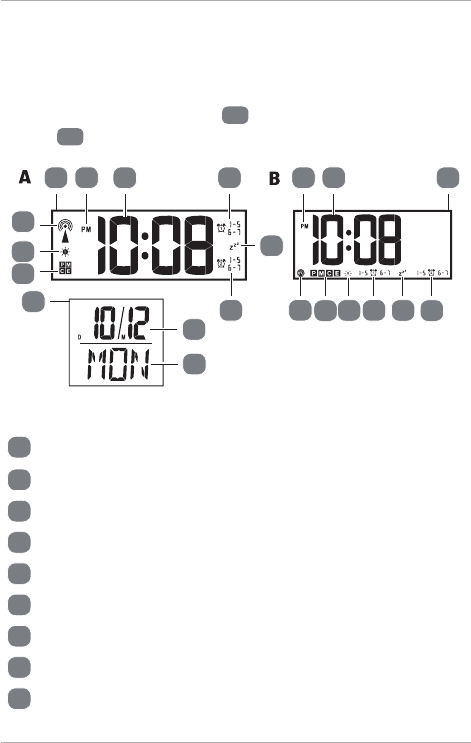
Funciones horarias
67
Funciones horarias
Display (funciones horarias)
La información sobre fecha y hora se muestra en el área para
la fecha y el día de la semana 27 y el área para el reloj y la
alarma 25 del display.
A = versión horizontal, B = versión vertical
32 Hora PM (formato de 12 horas)
33 Hora (horas, minutos) / año
34 Alarma 1 y alarma 2
35 Repetición
36 Zona horaria
37 Horario de verano
38 Señal horaria
39 Día y mes
40 Día de la semana
38
33
36 37 34 34
25 25
27
39
40
37
38
32 33
36
34
35
32
35
34
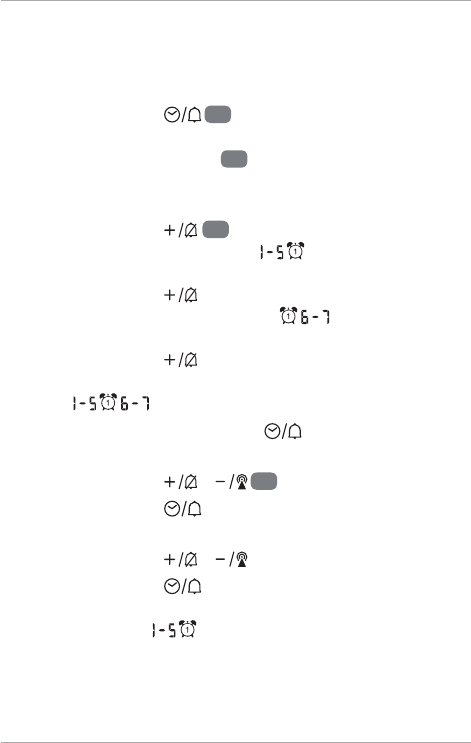
Funciones horarias
68
Alarmas
El reloj despertador permite configurar 2 alarmas.
Para ajustar las horas de alarma:
1. Presione el botón 8 para seleccionar un ajuste de
alarma (indicado por “AL1” o “AL2” en el área del display
para el reloj y las alarmas 25 ).
2. Seleccione una alarma para entre semana o el fin de
semana. Para ello:
Presione el botón 6 una vez para seleccionar la
alarma de entre semana (p. ej. ). La alarma sonará de
lunes a viernes.
Presione el botón una segunda vez para seleccionar
la alarma de fin de semana (p. ej. ). La alarma
sonará durante el fin de semana.
Presione el botón una tercera vez para seleccionar la
alarma tanto de entre semana como de fin de semana
(p. ej. ). La alarma sonará cada día.
3. Mantenga presionado el botón hasta que parpadee
la “hora” del ajuste de la alarma seleccionada.
4. Presione el botón o 5 para fijar la hora.
5. Presione el botón . Los “minutos” parpadearán en el
display.
6. Presione el botón o para fijar los minutos.
7. Presione el botón . La hora de la alarma ya está
ajustada. La alarma se activará automáticamente y el icono
de alarma (p. ej. ) se muestra en el display.
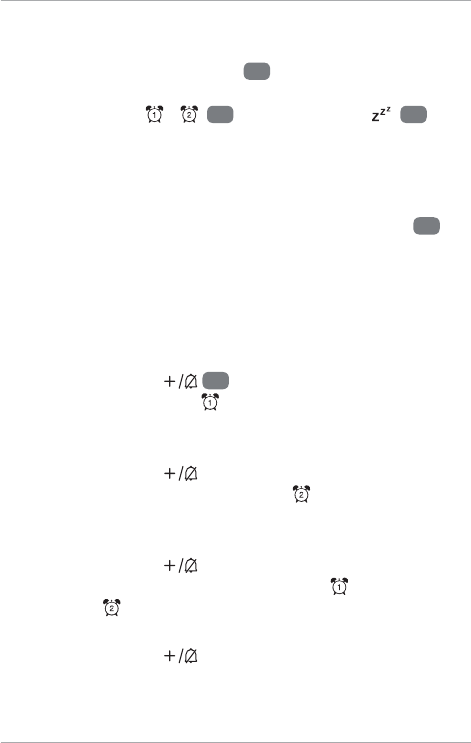
Funciones horarias
69
Para silenciar brevemente la alarma (función de
repetición):
Presione el botón SNOOZE/LIGHT 3. La alarma volverá a sonar
tras una pausa de 5 minutos. Durante el período de repetición,
el icono de alarma ( o ) 34 y el de repetición ( ) 35
parpadearán. Para cancelar la función de repetición, presione
cualquier botón excepto el de SNOOZE/LIGHT.
Para apagar la alarma cuando suena:
Presione cualquier botón (excepto el de SNOOZE/LIGHT 3) en
la unidad base. La alarma se detendrá también sin presionar
ningún botón tras 2 minutos. La alarma sigue activada
y sonará de nuevo a la misma hora al día siguiente si así
corresponde con el ajuste de la alarma.
Para activar o desactivar las alarmas:
1. Presione el botón 6 una vez para activar la alarma 1.
El icono de la alarma 1 ( ) con el ajuste seleccionado para
la alarma de entre semana o fin de semana se mostrará en
el display.
2. Presione el botón una segunda vez para activar
la alarma 2. El icono de la alarma 2 ( ) con el ajuste
seleccionado para la alarma de entre semana o fin de
semana se mostrará en el display.
3. Presione el botón una tercera vez para activar la
alarma 1 y la 2. Los iconos de la alarma 1 ( ) y de la
alarma 2 ( ) con el ajuste seleccionado para la alarma de
entre semana o fin de semana se mostrarán en el display.
4. Presione el botón una cuarta vez para desactivar
todas las alarmas.
70
Datos meteorológicos
Horario de verano
El horario de verano o la información sobre la hora de ahorro
de luz viene con las señales horarias emitidas. Cuando el
horario de verano o la hora de ahorro de luz esté vigente, el
icono de horario de verano ( o ) 37 se verá en el display.
Zona horaria
Presione el botón 5 para cambiar la zona horaria.
El correspondiente icono de zona horaria 36 se mostrará en el
display. Zona horaria: P = Pacífico, M = Montaña, C = Central,
E = Este.
Formato de hora
Para cambiar entre los formatos de 12 y 24 horas, consulte el
capítulo “Configuración manual”. Si se selecciona el formato
de 12 horas, las horas de la tarde se identifican con el icono
horario PM 32 .
Datos meteorológicos
Display (datos meteorológicos)
Los datos meteorológicos se muestran en las áreas del display
para ambiente interior 28 y ambiente exterior 31 . El área
para el ambiente interior presenta los datos registrados por la
unidad base, y el área para el ambiente exterior muestra los
datos enviados por el sensor de radio.
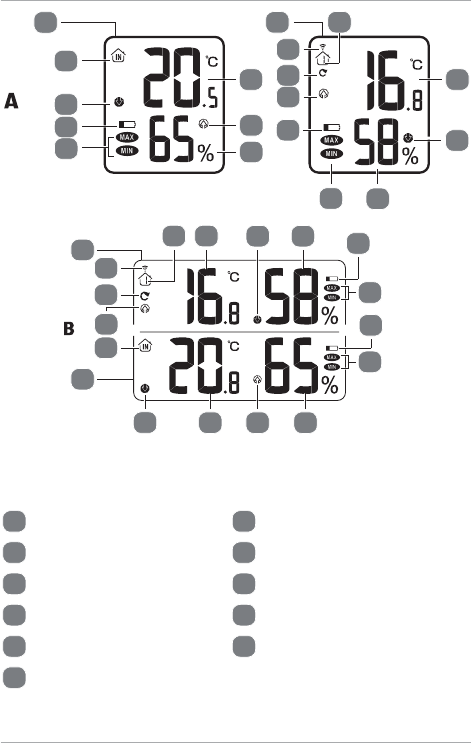
Datos meteorológicos
71
A = versión horizontal, B = versión vertical
28
47
46
45
44
41
42
43
41
46
43
44
49
42
50
48
51
31
41 43 49
44
46
45
44
434241
46
47
42
50
51
48
31
28
41 Temperatura (°C/°F) 47 Icono de interior
42 Icono ascendente 48 Número de sensor de radio
43 Humedad (%) 49 Pila baja (sensor de radio)
44 Iconos MAX y MIN 50 Icono de cambio de sensor
45 Pila baja (unidad base) 51 Icono de recepción
46 Icono descendente
72
Cambio entre sensores de radio
Si se usa más de un sensor de radio:
1. Presione el botón 4 una vez para pasar al sensor
de radio 2. El número del sensor de radio 48 cambiará a
“2” y el área del display para el ambiente exterior 31 solo
mostrará los datos enviados por el sensor de radio 2.
2. Presione el botón una segunda vez para pasar al
sensor de radio 3. El número del sensor de radio cambiará
a “3” y el área del display para el ambiente exterior solo
mostrará los datos enviados por el sensor de radio 3.
3. Presione el botón una tercera vez para activar la
función de cambio automático de sensor. El icono del
cambio de sensor ( ) 50 se encenderá, y el área del
display para el ambiente exterior alternará entre todos los
sensores de radio.
4. Presione el botón una cuarta vez para cancelar la
función de cambio automático de sensor, y pasar al sensor
de radio 1. El número del sensor de radio cambiará a “1” y
el área del display para el ambiente exterior solo mostrará
los datos enviados por el sensor de radio 1.
Consulte el capítulo “Uso de sensores de radio adicionales” si
quiere asignar números a los sensores de radio.
Valores máximo y mínimo
Para mostrar los valores máximo y mínimo de las 24 últimas
horas en relación con la temperatura y humedad:
1. Presione el botón 7 una vez para mostrar los
valores máximos.
2. Presione el botón una segunda vez para mostrar los
valores mínimos.
3. Presione el botón una tercera vez para mostrar los
datos meteorológicos actuales.
Datos meteorológicos
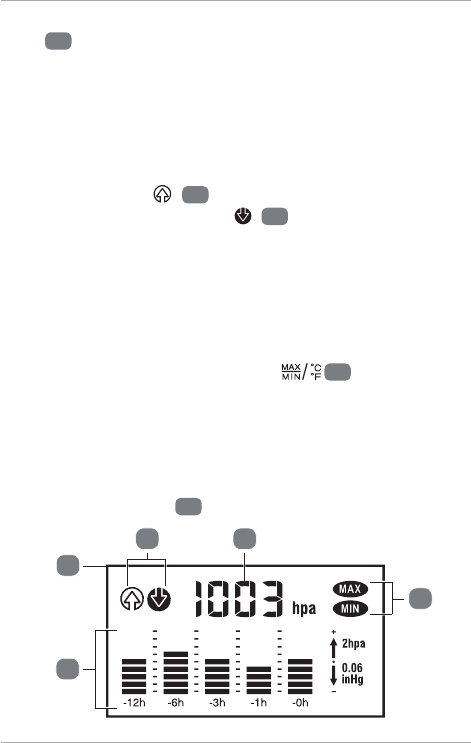
Presión del aire
73
El valor máximo o mínimo viene indicado con el icono MAX
o MIN 44 , respectivamente. Los valores almacenados se
eliminarán cada día a las 12:00 am.
Tendencia de la temperatura y humedad
Para los valores de temperatura y humedad medidos por la
unidad base y el sensor de radio, la tendencia se muestra
en forma de flecha. Una tendencia ascendente se indica con
un icono de subida ( ) 42 . Una tendencia descendente se
indica con un icono de bajada ( ) 46 .
Se muestra un cambio de tendencia cuando la temperatura
cambia 1 °C o más, o cuando la humedad varía un 3 % o más
en una hora.
Unidades de temperatura
Para cambiar la unidad de temperatura (°C/°F) en la unidad
base, mantenga presionado el botón 7.
Presión del aire
Display (presión del aire)
Los datos de presión del aire se muestran en el área del display
para la presión del aire 30 .
53
30
52
54
55
Presión del aire
74
52 Iconos de tendencia
53 Presión del aire actual
54 Iconos MAX y MIN
55 Historial
Presión del aire actual y tendencia de la
presión del aire
La presión del aire actual se muestra en hPa en el área
de presión del aire actual 53 . El valor se puede modificar
manualmente (véase el capítulo “Configuración manual”).
La tendencia de la presión del aire en las 12 últimas horas se
muestra en forma de diagrama de barras en el área del
historial 55 . La escala va de –1 (hace 1 hora) a –12 (hace 12 horas).
La presión del aire también viene indicada por los iconos
de tendencia ( y ) 52 . El icono ascendente indica una
mejora de la situación meteorológica. El icono descendente
señala un empeoramiento de la situación meteorológica.
Valores máximo y mínimo
Para mostrar los valores máximo y mínimo de las 12 últimas
horas en relación con la presión del aire:
1. Presione el botón 7 una vez para mostrar el valor
máximo.
2. Presione el botón una segunda vez para mostrar el
valor mínimo.
3. Presione el botón una tercera vez para mostrar el
valor actual de la presión del aire.
El valor máximo o mínimo viene indicado con el icono MAX o
MIN 54 , respectivamente.
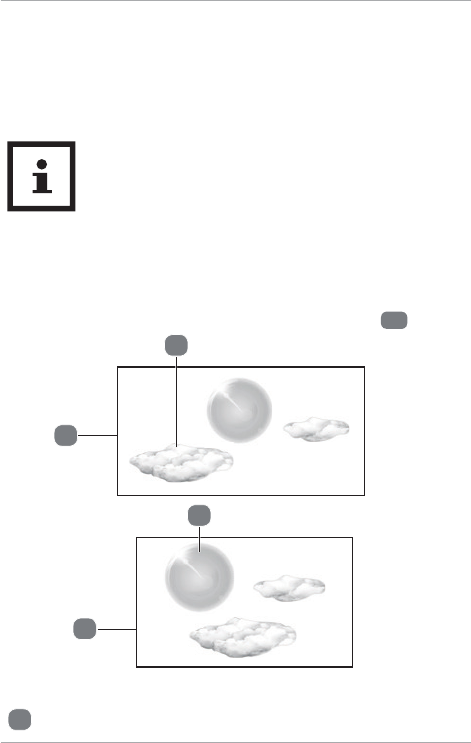
Previsión meteorológica
75
Previsión meteorológica
La estación meteorológica calcula previsiones del tiempo para
las 12 horas siguientes, basadas en los datos meteorológicos
recopilados. Las predicciones conforman un indicador
aproximado del desarrollo meteorológico futuro.
Durante el funcionamiento inicial, los detalles
relativos a la previsión meteorológica no se
pueden usar en unas 12 horas, pues la estación
meteorológica necesita este tiempo para recopilar
y evaluar los datos meteorológicos.
Display (previsión meteorológica)
La información sobre la previsión meteorológica se muestra en
el área del display para la previsión meteorológica 29 .
A
B
A = versión horizontal, B = versión vertical
56 Previsión meteorológica
56
29
29
56
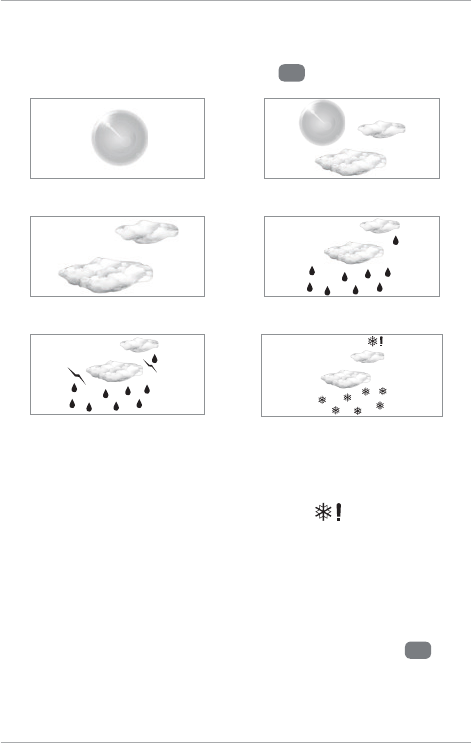
Fases lunares
76
Símbolos de previsión meteorológica
Los símbolos de previsión meteorológica se muestran en el
área para la previsión meteorológica 29 .
Soleado Ligeramente nublado
Nublado Lluvioso
Tormenta eléctrica Nieve*
* Aviso por heladas – Cuando el sensor de radio mide una
temperatura entre –3 °C y 1 °C, existe riesgo de helada y
parpadeará el símbolo del copo de nieve ( ).
Si la temperatura cae por debajo de –3 °C durante un
período constante de tiempo, el símbolo del copo de nieve
permanecerá visible en el display.
Fases lunares
Las fases lunares se muestran en el área de fase lunar 26 del
display, y se actualizan automáticamente.
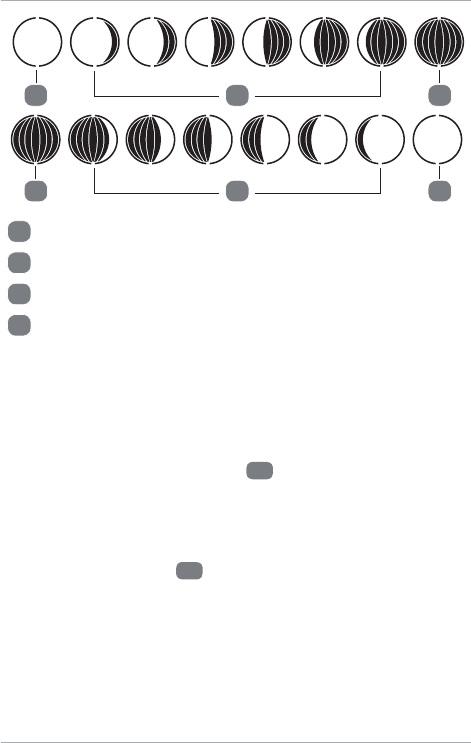
Otras funciones
77
57
57
59
59
58
60
57 Luna nueva
58 Luna creciente
59 Luna llena
60 Luna menguante
Otras funciones
Retroiluminación del display
Funcionamiento mediante pilas
Presione el botón SNOOZE/LIGHT 3 para encender brevemente
la retroiluminación.
Funcionamiento mediante suministro eléctrico CA
La retroiluminación está siempre encendida cuando se usa el
adaptador de potencia 22 . Presione el botón SNOOZE/LIGHT
una vez para atenuar la retroiluminación. Presione el botón una
segunda vez para apagar la retroiluminación. Presione el botón
una tercera vez para encender de nuevo la retroiluminación.
Cuando la retroiluminación esté encendida, se atenuará
durante la búsqueda de señales horarias. Una vez recibidas las
señales horarias, la retroiluminación volverá a mostrar todo su
brillo.
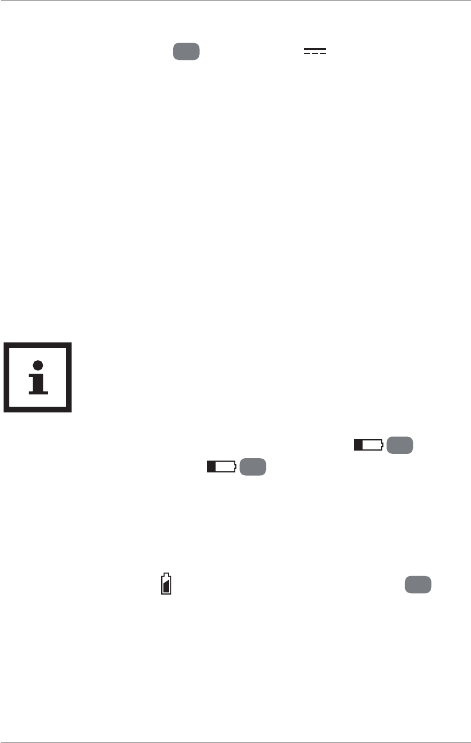
Otras funciones
78
Puerto de carga USB
El puerto de carga USB 13 (salida: 5.0 V, 1000mA) se
puede emplear para cargar dispositivos externos (como
celulares y reproductores mp3) a través de un cable USB (no
suministrado). Los dispositivos externos no se pueden cargar
cuando la unidad base funciona con pilas.
Modo operativo
La unidad principal entrará en modo de hibernación cuando
esté inactiva cierto tiempo. Para volver al modo operativo
normal, mantenga presionado cualquier botón (excepto el
de SNOOZE/LIGHT) durante 5 segundos para regresar al modo
operativo normal.
Advertencia de pilas bajas
La unidad base perderá todos los ajustes tras
un cambio de pilas. Quizá tenga que resetear
manualmente la unidad base antes de usarla de
nuevo (véase el capítulo “Configuración manual”).
Hay un icono de pila baja para la unidad base ( 45 ) y
para cada sensor de radio ( 49 , y corresponde al número
mostrado de sensor de radio). Cuando aparece el icono de pila
baja, sustituya las pilas en el dispositivo pertinente (véanse los
capítulos “Inserción y sustitución de las pilas” y “Alimentación
de la unidad base”).
El icono de pila baja ( ) también se verá en el display 15 del
sensor de radio cuando las pilas estén débiles.
Reseteo de la estación meteorológica
Si aparecen valores incorrectos, debería resetear la estación
meteorológica retirando y reinsertando las pilas. Si usa el
adaptador de potencia, desenchúfelo de la toma de corriente
y vuelva a conectarlo.
Limpieza
79
Limpieza
¡AVISO!
¡Riesgo de daños!
Si no limpia la estación meteorológica (unidad
base y sensor de radio) correctamente, podría
dañarla.
− No utilice limpiadores agresivos, ni
utensilios de limpieza afilados o metálicos
como cuchillos, espátulas duras y objetos
similares. Podrían dañar las superficies de
la estación meteorológica.
− Asegúrese de que no entre agua en la
carcasa de la estación meteorológica.
1. Desenchufe el adaptador de potencia de la toma de
corriente si está usando el suministro eléctrico CA para la
unidad base.
2. Pase un paño húmedo por la estación meteorológica.
3. Seque la estación meteorológica con un paño suave y seco.
Almacenamiento
¡ATENCIÓN!
¡Riesgo asociado al líquido derramado de
las pilas, y riesgo de daños!

Almacenamiento
80
Si guarda la estación meteorológica mucho
tiempo, y las pilas se quedan dentro, estas
se pueden derramar y provocar daños
permanentes. El ácido de las pilas (electrolito)
es corrosivo.
− Si no usa la estación meteorológica
mucho tiempo, almacene las pilas aparte.
Guarde las pilas de forma que queden
fuera del alcance de los niños.
− No extraiga las pilas derramadas con las
manos desprotegidas. Emplee guantes
normales de goma para uso doméstico.
No permita que el ácido de las pilas entre
en contacto con la piel, los ojos y las
mucosas. No obstante, si el líquido de las
pilas entra en contacto con la piel, lávese
las manos de inmediato y consulte a un
médico si fuera necesario.
− Limpie el ácido derramado de las pilas
con un paño húmedo y elimínelo en la
basura doméstica.
1. Limpie la estación meteorológica (véase el capítulo “Limpieza”).
2. Saque las pilas insertadas del compartimento de pilas y
guárdelas bien.
3. Almacene la estación meteorológica en un lugar limpio y seco.
Resolución de problemas
81
Resolución de problemas
¡AVISO!
¡Riesgo de daños!
Si no maneja la estación meteorológica
correctamente, podría dañarla.
− No abra la carcasa de la estación
meteorológica. No se aceptarán
reclamaciones derivadas de la garantía
en caso de reparaciones efectuadas por
el usuario o por un manejo incorrecto.
Algunos problemas pueden estar provocados por fallos
menores que puede solucionar usted mismo. Para ello, siga
las instrucciones de la siguiente tabla. Si el problema persiste,
contacte con el servicio postventa. No repare la estación
meteorológica por sí mismo.
Problema Posible causa y solución
No se pueden
recibir las
señales
horarias.
− Compruebe si la ubicación de la
instalación es adecuada para la
recepción de señales.
− Inicie la recepción de señales
manualmente presionando el
botón 5 de la unidad base.
− Fije la hora manualmente.
Resolución de problemas
82
La unidad
base no recibe
señales del
sensor de
radio.
− Asegúrese de que no haya
equipos eléctricos cerca del
sensor de radio ni la unidad base.
− Compruebe si las pilas del sensor
de radio están agotadas.
− Inicie la recepción de señales
manualmente. Para ello,
mantenga presionado el botón
4 de la unidad base.
− Mueva la unidad base más cerca
del sensor de radio o viceversa.
Se muestran
valores
incorrectos.
− Resetee la estación
meteorológica (véase el
capítulo “Reseteo de la estación
meteorológica”).
Aparece “HI”
o “LO” en vez
de los valores
medidos de
temperatura o
humedad.
− Los valores están por encima o
debajo del rango de medición.

Datos técnicos
83
Datos técnicos
Nombre del producto: Estación meteorológica digital
No del modelo: WS97210–1 (negro, horizontal)/
WS97230–1 (negro, vertical)/
WS97210–2 (blanco, horizontal)/
WS97230–2 (blanco, vertical)
Unidad base
Adaptador de potencia: 5.0 V CC
Pilas: 3 V DC
(2× 1.5 V, Tipo LR3/R3/AAA)
Rango de medición de
temperatura:
0 °C a 40 °C
Rango de medición de
humedad relativa:
20 % a 95 %
Rango de medición de
presión del aire:
800–1100 hPa
Puerto de carga USB: 5.0 V 1000 mA
Sensor de radio
Pilas: 3 V DC
(2× 1.5 V, Tipo LR3/R3/AAA)
Rango de medición de
temperatura:
–15 °C a 60 °C
Rango de medición de
humedad relativa:
20 % a 95 %
Frecuencia de transmisión: 433 MHz
Rango: máx. 100 metros
(espacios abiertos)
Adaptador de potencia (suministrado)
Modelo: 6301–BS–A o 6301–BS–B
Entrada: 100 ~ 240 V CA, 50 / 60 Hz
Salida: 5.0V CC 1000mA

Datos técnicos
84
Este dispositivo cumple con el apartado 15 de las normas de
la FCC. El funcionamiento está sujeto a las dos condiciones
siguientes:
(1) este dispositivo no puede provocar interferencias perjudi-
ciales, y
(2) este dispositivo debe aceptar cualquier interferencia recibi-
da, incluidas las que puedan provocar un funcionamiento no
deseado.
Atención: los cambios o modificaciones no aprobados expre-
samente por la parte responsable del cumplimiento podrían
anular la autoridad del usuario para usar el equipo.
AVISO: Este equipo se ha probado y ha demostrado que cum-
ple con los límites para un dispositivo digital de la clase B,
conforme al apartado 15 de las normas de la FCC. Estos límites
están diseñados para ofrecer una protección razonable frente
a interferencias perjudiciales en una instalación residencial.
Este equipo genera, utiliza y puede irradiar energía de radi-
ofrecuencia y, si no se instala y se utiliza de acuerdo con las
instrucciones, puede ocasionar interferencias perjudiciales
para las comunicaciones por radio. No obstante, no se puede
garantizar que no se vaya a producir interferencias en una
instalación en particular. Si este equipo ocasiona interferen-
cias perjudiciales en la recepción de radio o televisión, lo que
puede comprobarse encendiendo y apagando el equipo, se
recomienda al usuario que intente corregir la interferencia
mediante una o varias de las siguientes medidas:
• Reoriente o reubique la antena receptora.
• Aumente la separación entre el equipo y el receptor.
• Conecte el equipo en una toma de corriente de un circuito
eléctrico diferente del circuito eléctrico del receptor.
• Consulte con su distribuidor o con un técnico especiali-
zadoen radio y televisión.

Eliminación
85
Declaración sobre la exposición a la radiación de la FCC:
Este equipo cumple los límites de exposición a la radiación de la
FCC establecidos para un entorno sin control.
Este transmisor no se debe ubicar ni usar junto con cualquier
otra antena o transmisor.
Eliminación
Eliminación del embalaje
− Elimine el embalaje por tipos de material. Deseche el
papel y cartón a través del servicio de papel reciclado,
y los envoltorios a través del servicio de recogida
apropiado.
Eliminación de equipos en desuso
− Cuando la estación meteorológica no se utiliza
más, elimínelo de acuerdo con las disposiciones
vigentes de su ciudad o estado.
− Asegúrese de que la información sobre
reciclaje corresponda a la normativa local y las
recomendaciones de la EPA (www.epa.gov).
¡Las pilas y los acumuladores no se pueden tirar a la basura
doméstica!
Como usuario final, la ley le exige llevar las pilas y los
acumuladores, con independencia de si contienen sustancias
nocivas* o no, a un punto de recogida gestionado por la
comunidad o el vecindario, o a una tienda, para que se puedan
desechar de un modo respetuoso con el entorno. ¡Traiga toda
la estación meteorológica (incluida la pila recargable) al punto
de recogida y asegúrese de que esté descargada!
*etiquetado con: Cd = cadmio, Hg = mercurio, Pb = plomo

IMPORTED BY • IMPORTADO POR:
ALDI INC., BATAVIA, IL 60510
WWW.ALDI.US
USA
AFTER SALES SUPPORT •
SERVICIO POSVENTA
MODEL/NO DEL MODELO:
WS97210–1/WS97230–1/
WS97210–2/WS97230–2
54160
10/2017
USA 1 855 754 8297
Aldi-US@protel-service.com
YEAR WARRANTY
AÑOS DE GARANTÍA
3