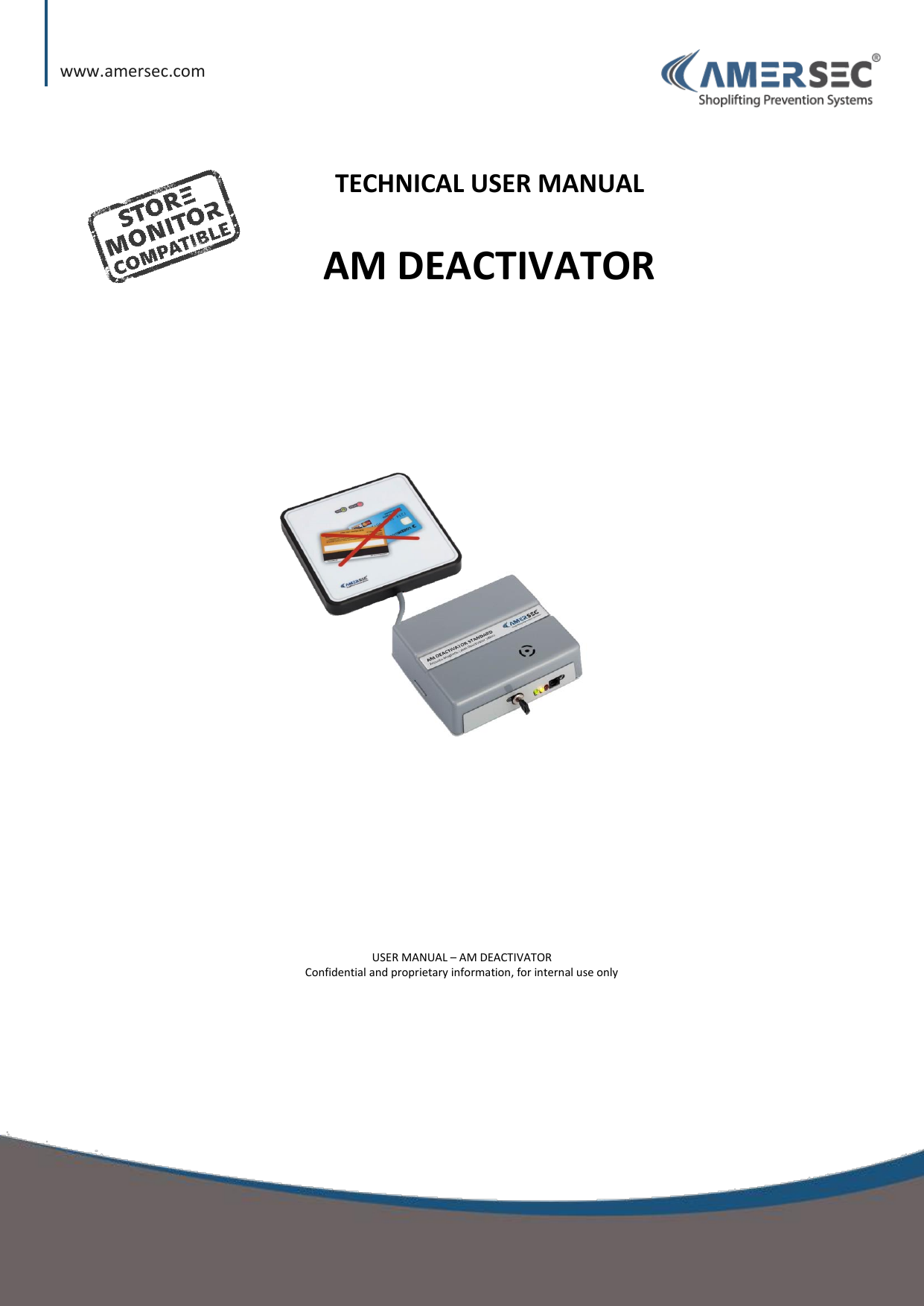
American Security spol s r o P-ADSC 58 kHz Deactivator User Manual

American Security spol. s r.o. 58 kHz Deactivator

User Manual

            www.amersec.com    TECHNICAL USER MANUAL    AM DEACTIVATOR            USER MANUAL – AM DEACTIVATOR Confidential and proprietary information, for internal use only
USER MANUAL – AM DEACTIVATOR                        PAGE 2 of 9 This document was created to provide the intended recipient documentation for technician purposes only. Any other usage of this document is an illegal and unlawful act. This document is a confidential and proprietary document of American Security spol. s r.o. and consists of information that is protected by copyrights or intellectual property protection of other subjects. All other information, which is not generally known, is intellectual property of American Security spol. s r.o. This document including any and all attachments hereto is intended solely to be used by individuals or entities to which it is addressed. If the reader of this document is not the intended recipient, or an employee or agent responsible for delivering this document to its intended recipient, you are herewith notified that any dissemination, distribution, copying or retention of this document or the infor mation contained herein is strictly prohibited. If you have received this document in error, please notify us at info@amersec.com immediately and permanently delete and/or destroy the original and any copy or printout thereof. Contents 1.0 PRODUCT DESCRIPTION ............................................................................................................................................................ 3 1.1  Controller ................................................................................................................................................................................ 3 1.2  Pad ........................................................................................................................................................................................... 4 2.0 INSTALLATION GUIDE ................................................................................................................................................................ 4 2.1  Required Materials .................................................................................................................................................................. 4 2.2  Pre-Installation ........................................................................................................................................................................ 4 2.3  Connect Cables ........................................................................................................................................................................ 4 2.4  Test .......................................................................................................................................................................................... 5 2.5  Connect Controller to PC ......................................................................................................................................................... 5 2.6  Software – Main Settings ........................................................................................................................................................ 6 2.7  Software – Synchronization .................................................................................................................................................... 7 2.7  Software – Other Pages ........................................................................................................................................................... 8 3.0 TECHNICAL SPECIFICATIONS ...................................................................................................................................................... 9 4.0 DECLARATION ............................................................................................................................................................................ 9
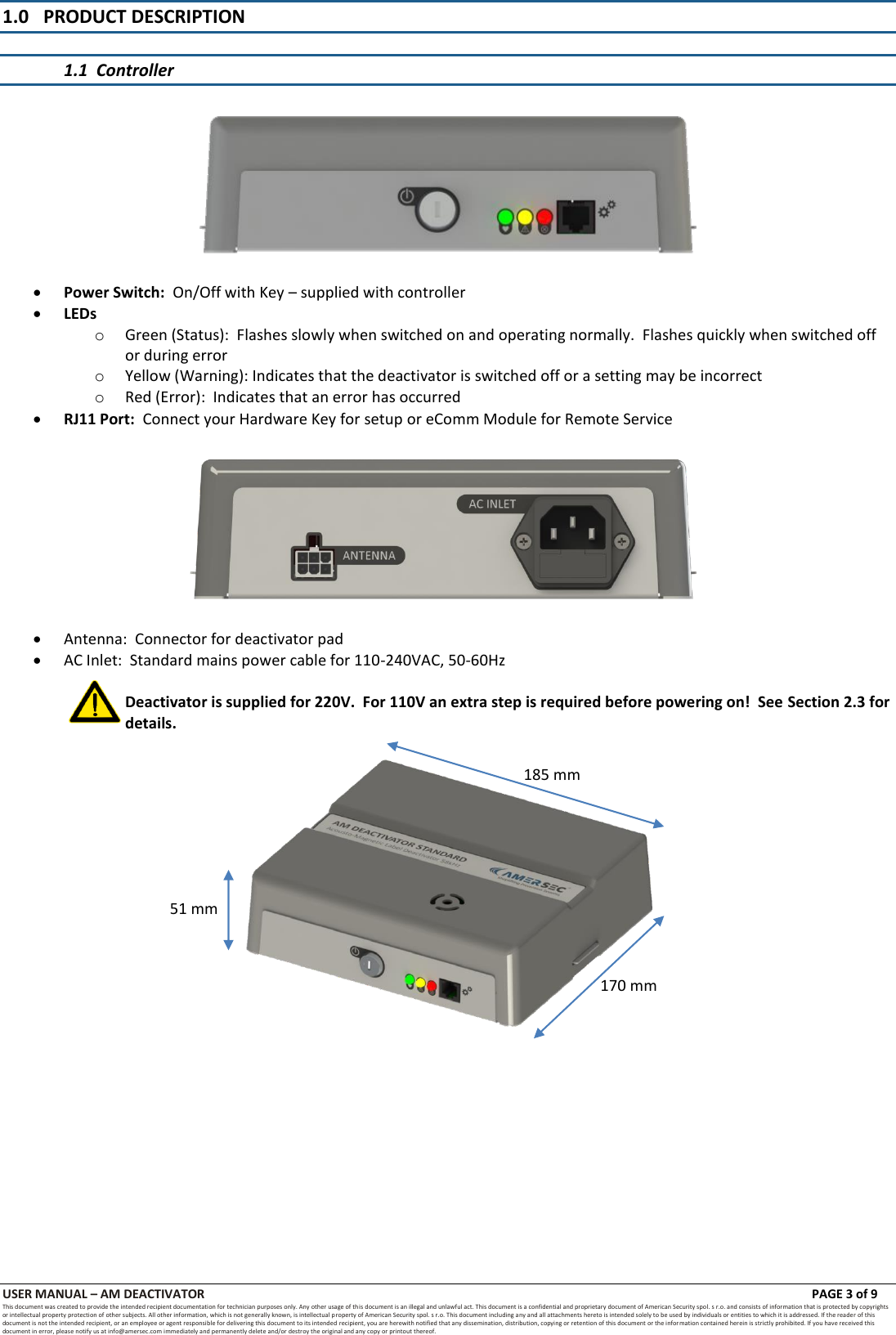
USER MANUAL – AM DEACTIVATOR                        PAGE 3 of 9 This document was created to provide the intended recipient documentation for technician purposes only. Any other usage of this document is an illegal and unlawful act. This document is a confidential and proprietary document of American Security spol. s r.o. and consists of information that is protected by copyrights or intellectual property protection of other subjects. All other information, which is not generally known, is intellectual property of American Security spol. s r.o. This document including any and all attachments hereto is intended solely to be used by individuals or entities to which it is addressed. If the reader of this document is not the intended recipient, or an employee or agent responsible for delivering this document to its intended recipient, you are herewith notified that any dissemination, distribution, copying or retention of this document or the infor mation contained herein is strictly prohibited. If you have received this document in error, please notify us at info@amersec.com immediately and permanently delete and/or destroy the original and any copy or printout thereof. 1.0 PRODUCT DESCRIPTION  1.1  Controller     Power Switch:  On/Off with Key – supplied with controller  LEDs o Green (Status):  Flashes slowly when switched on and operating normally.  Flashes quickly when switched off or during error o Yellow (Warning): Indicates that the deactivator is switched off or a setting may be incorrect o Red (Error):  Indicates that an error has occurred  RJ11 Port:  Connect your Hardware Key for setup or eComm Module for Remote Service     Antenna:  Connector for deactivator pad  AC Inlet:  Standard mains power cable for 110-240VAC, 50-60Hz  Deactivator is supplied for 220V.  For 110V an extra step is required before powering on!  See Section 2.3 for details.              185 mm 170 mm 51 mm
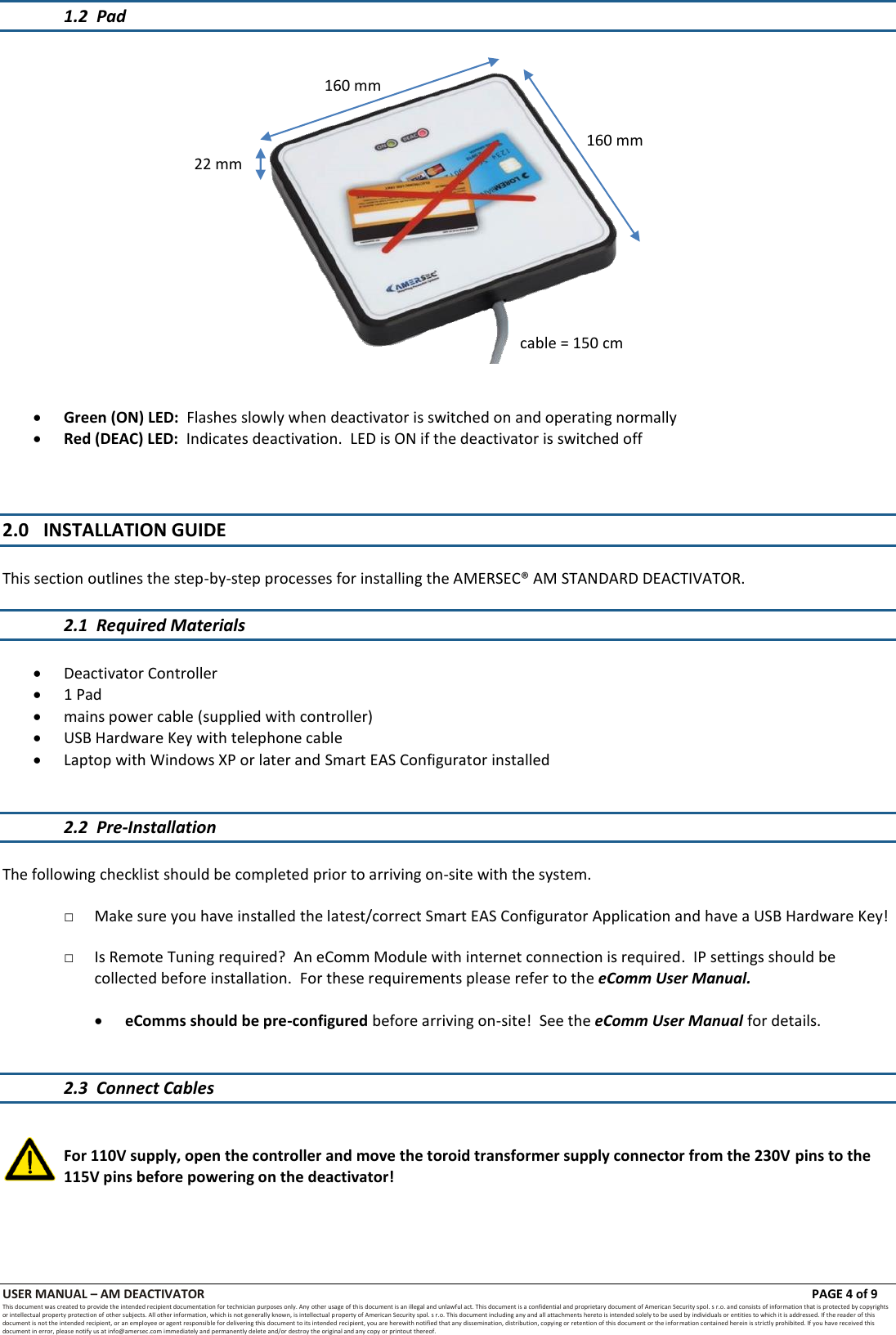
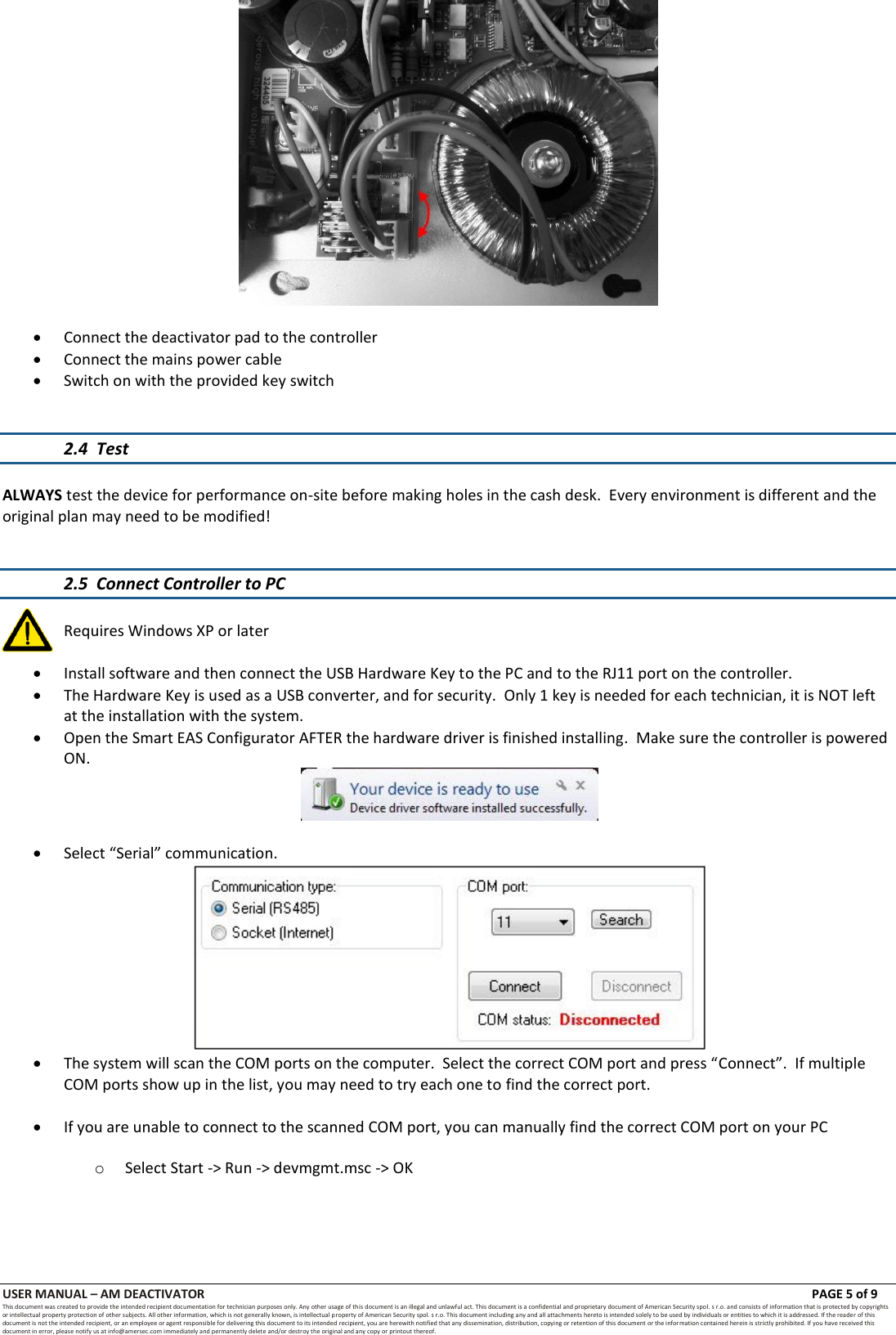
USER MANUAL – AM DEACTIVATOR                        PAGE 4 of 9 This document was created to provide the intended recipient documentation for technician purposes only. Any other usage of this document is an illegal and unlawful act. This document is a confidential and proprietary document of American Security spol. s r.o. and consists of information that is protected by copyrights or intellectual property protection of other subjects. All other information, which is not generally known, is intellectual property of American Security spol. s r.o. This document including any and all attachments hereto is intended solely to be used by individuals or entities to which it is addressed. If the reader of this document is not the intended recipient, or an employee or agent responsible for delivering this document to its intended recipient, you are herewith notified that any dissemination, distribution, copying or retention of this document or the infor mation contained herein is strictly prohibited. If you have received this document in error, please notify us at info@amersec.com immediately and permanently delete and/or destroy the original and any copy or printout thereof. 1.2  Pad      Green (ON) LED:  Flashes slowly when deactivator is switched on and operating normally  Red (DEAC) LED:  Indicates deactivation.  LED is ON if the deactivator is switched off    2.0 INSTALLATION GUIDE  This section outlines the step-by-step processes for installing the AMERSEC® AM STANDARD DEACTIVATOR.  2.1  Required Materials   Deactivator Controller  1 Pad  mains power cable (supplied with controller)  USB Hardware Key with telephone cable  Laptop with Windows XP or later and Smart EAS Configurator installed   2.2  Pre-Installation  The following checklist should be completed prior to arriving on-site with the system.  □ Make sure you have installed the latest/correct Smart EAS Configurator Application and have a USB Hardware Key!  □ Is Remote Tuning required?  An eComm Module with internet connection is required.  IP settings should be collected before installation.  For these requirements please refer to the eComm User Manual.   eComms should be pre-configured before arriving on-site!  See the eComm User Manual for details.   2.3  Connect Cables   For 110V supply, open the controller and move the toroid transformer supply connector from the 230V pins to the 115V pins before powering on the deactivator!  160 mm 160 mm cable = 150 cm 22 mm
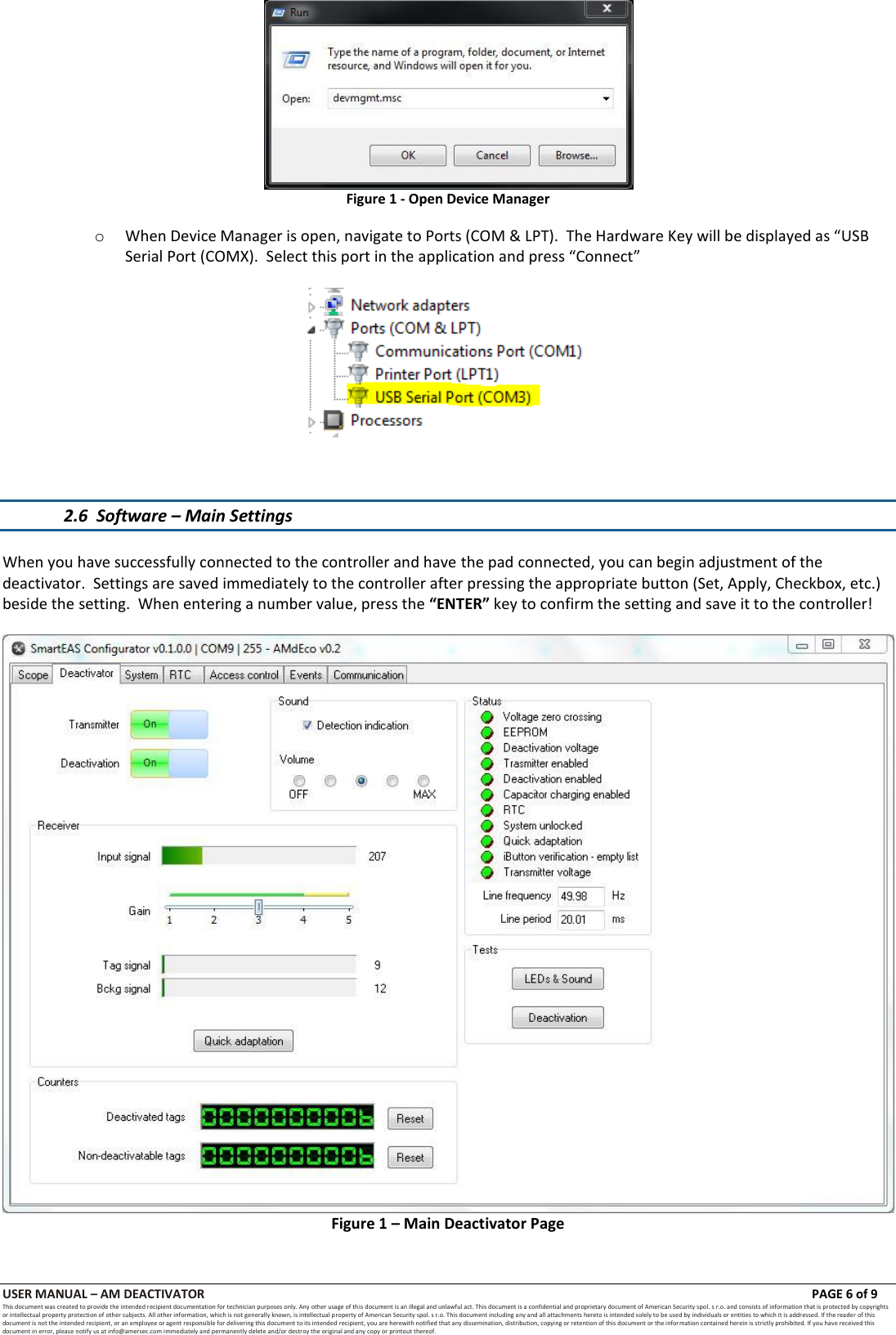
USER MANUAL – AM DEACTIVATOR                        PAGE 5 of 9 This document was created to provide the intended recipient documentation for technician purposes only. Any other usage of this document is an illegal and unlawful act. This document is a confidential and proprietary document of American Security spol. s r.o. and consists of information that is protected by copyrights or intellectual property protection of other subjects. All other information, which is not generally known, is intellectual property of American Security spol. s r.o. This document including any and all attachments hereto is intended solely to be used by individuals or entities to which it is addressed. If the reader of this document is not the intended recipient, or an employee or agent responsible for delivering this document to its intended recipient, you are herewith notified that any dissemination, distribution, copying or retention of this document or the infor mation contained herein is strictly prohibited. If you have received this document in error, please notify us at info@amersec.com immediately and permanently delete and/or destroy the original and any copy or printout thereof.    Connect the deactivator pad to the controller  Connect the mains power cable  Switch on with the provided key switch   2.4  Test  ALWAYS test the device for performance on-site before making holes in the cash desk.  Every environment is different and the original plan may need to be modified!   2.5  Connect Controller to PC    Requires Windows XP or later   Install software and then connect the USB Hardware Key to the PC and to the RJ11 port on the controller.  The Hardware Key is used as a USB converter, and for security.  Only 1 key is needed for each technician, it is NOT left at the installation with the system.  Open the Smart EAS Configurator AFTER the hardware driver is finished installing.  Make sure the controller is powered ON.    Select “Serial” communication.   The system will scan the COM ports on the computer.  Select the correct COM port and press “Connect”.  If multiple COM ports show up in the list, you may need to try each one to find the correct port.   If you are unable to connect to the scanned COM port, you can manually find the correct COM port on your PC  o Select Start -> Run -> devmgmt.msc -> OK
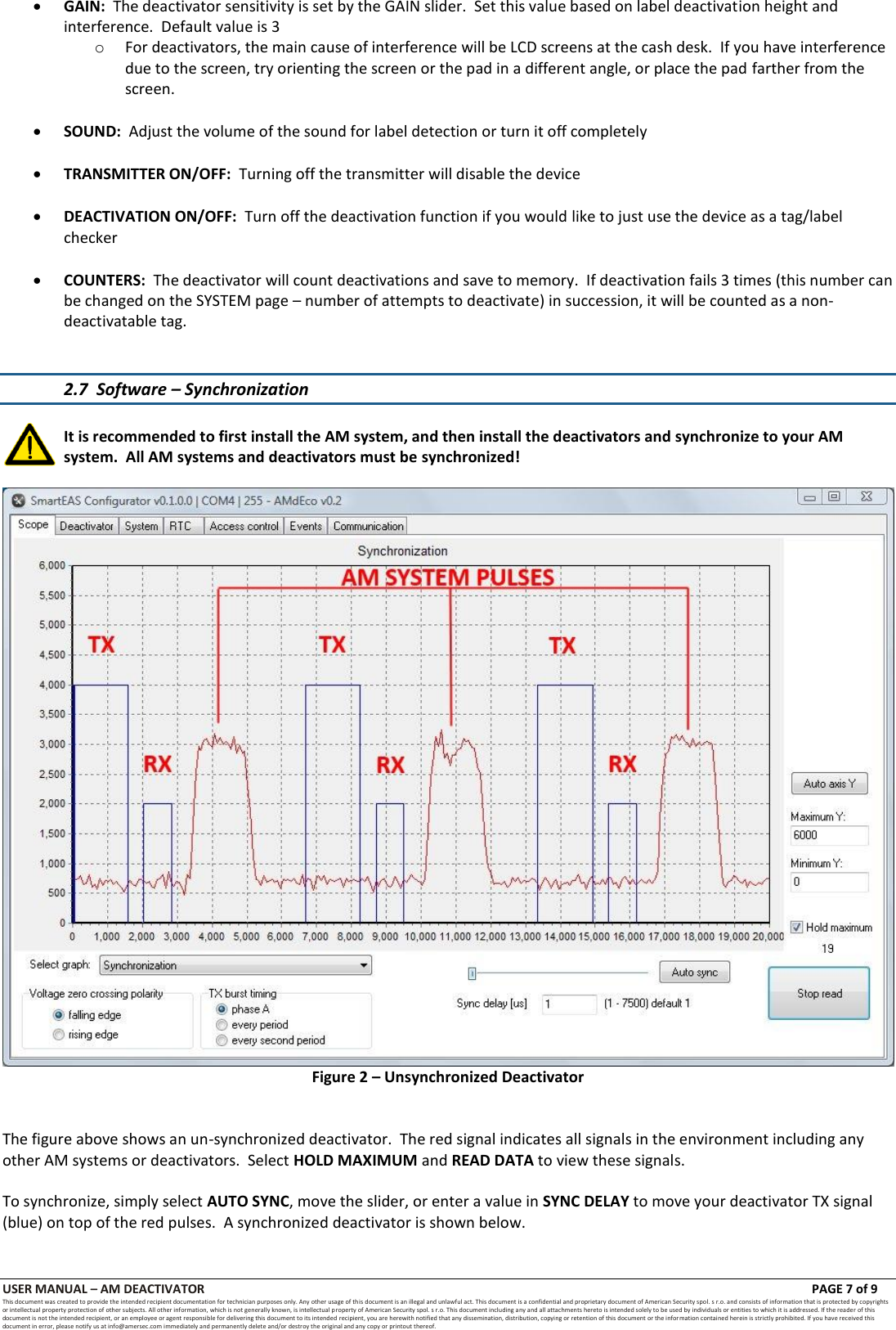
USER MANUAL – AM DEACTIVATOR                        PAGE 6 of 9 This document was created to provide the intended recipient documentation for technician purposes only. Any other usage of this document is an illegal and unlawful act. This document is a confidential and proprietary document of American Security spol. s r.o. and consists of information that is protected by copyrights or intellectual property protection of other subjects. All other information, which is not generally known, is intellectual property of American Security spol. s r.o. This document including any and all attachments hereto is intended solely to be used by individuals or entities to which it is addressed. If the reader of this document is not the intended recipient, or an employee or agent responsible for delivering this document to its intended recipient, you are herewith notified that any dissemination, distribution, copying or retention of this document or the infor mation contained herein is strictly prohibited. If you have received this document in error, please notify us at info@amersec.com immediately and permanently delete and/or destroy the original and any copy or printout thereof.  Figure 1 - Open Device Manager o When Device Manager is open, navigate to Ports (COM & LPT).  The Hardware Key will be displayed as “USB Serial Port (COMX).  Select this port in the application and press “Connect”      2.6  Software – Main Settings  When you have successfully connected to the controller and have the pad connected, you can begin adjustment of the deactivator.  Settings are saved immediately to the controller after pressing the appropriate button (Set, Apply, Checkbox, etc.) beside the setting.  When entering a number value, press the “ENTER” key to confirm the setting and save it to the controller!   Figure 1 – Main Deactivator Page
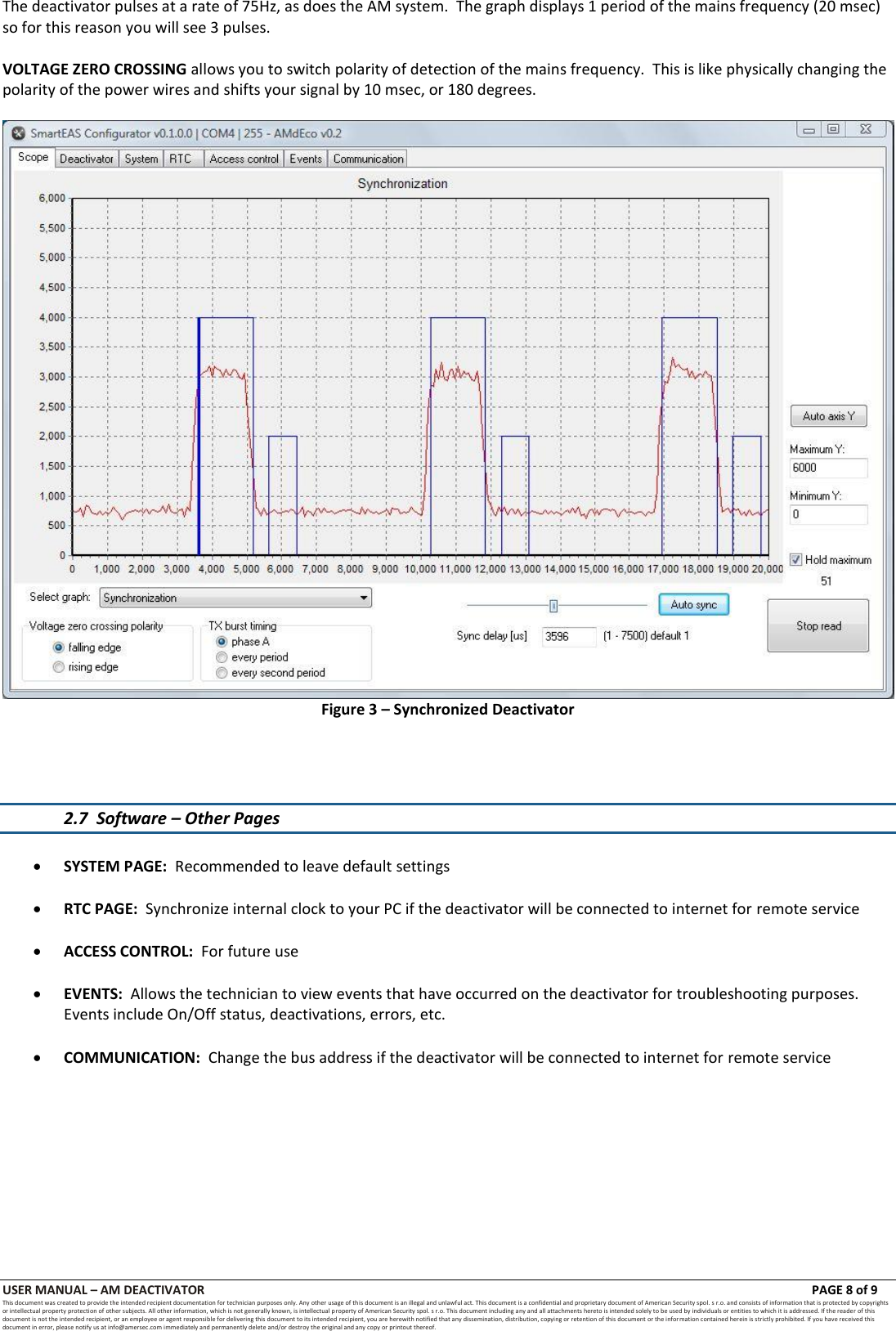
USER MANUAL – AM DEACTIVATOR                        PAGE 7 of 9 This document was created to provide the intended recipient documentation for technician purposes only. Any other usage of this document is an illegal and unlawful act. This document is a confidential and proprietary document of American Security spol. s r.o. and consists of information that is protected by copyrights or intellectual property protection of other subjects. All other information, which is not generally known, is intellectual property of American Security spol. s r.o. This document including any and all attachments hereto is intended solely to be used by individuals or entities to which it is addressed. If the reader of this document is not the intended recipient, or an employee or agent responsible for delivering this document to its intended recipient, you are herewith notified that any dissemination, distribution, copying or retention of this document or the infor mation contained herein is strictly prohibited. If you have received this document in error, please notify us at info@amersec.com immediately and permanently delete and/or destroy the original and any copy or printout thereof.  GAIN:  The deactivator sensitivity is set by the GAIN slider.  Set this value based on label deactivation height and interference.  Default value is 3 o For deactivators, the main cause of interference will be LCD screens at the cash desk.  If you have interference due to the screen, try orienting the screen or the pad in a different angle, or place the pad farther from the screen.   SOUND:  Adjust the volume of the sound for label detection or turn it off completely   TRANSMITTER ON/OFF:  Turning off the transmitter will disable the device   DEACTIVATION ON/OFF:  Turn off the deactivation function if you would like to just use the device as a tag/label checker   COUNTERS:  The deactivator will count deactivations and save to memory.  If deactivation fails 3 times (this number can be changed on the SYSTEM page – number of attempts to deactivate) in succession, it will be counted as a non-deactivatable tag.   2.7  Software – Synchronization  It is recommended to first install the AM system, and then install the deactivators and synchronize to your AM system.  All AM systems and deactivators must be synchronized!   Figure 2 – Unsynchronized Deactivator   The figure above shows an un-synchronized deactivator.  The red signal indicates all signals in the environment including any other AM systems or deactivators.  Select HOLD MAXIMUM and READ DATA to view these signals.  To synchronize, simply select AUTO SYNC, move the slider, or enter a value in SYNC DELAY to move your deactivator TX signal (blue) on top of the red pulses.  A synchronized deactivator is shown below.
USER MANUAL – AM DEACTIVATOR                        PAGE 8 of 9 This document was created to provide the intended recipient documentation for technician purposes only. Any other usage of this document is an illegal and unlawful act. This document is a confidential and proprietary document of American Security spol. s r.o. and consists of information that is protected by copyrights or intellectual property protection of other subjects. All other information, which is not generally known, is intellectual property of American Security spol. s r.o. This document including any and all attachments hereto is intended solely to be used by individuals or entities to which it is addressed. If the reader of this document is not the intended recipient, or an employee or agent responsible for delivering this document to its intended recipient, you are herewith notified that any dissemination, distribution, copying or retention of this document or the infor mation contained herein is strictly prohibited. If you have received this document in error, please notify us at info@amersec.com immediately and permanently delete and/or destroy the original and any copy or printout thereof. The deactivator pulses at a rate of 75Hz, as does the AM system.  The graph displays 1 period of the mains frequency (20 msec) so for this reason you will see 3 pulses.  VOLTAGE ZERO CROSSING allows you to switch polarity of detection of the mains frequency.  This is like physically changing the polarity of the power wires and shifts your signal by 10 msec, or 180 degrees.   Figure 3 – Synchronized Deactivator     2.7  Software – Other Pages   SYSTEM PAGE:  Recommended to leave default settings   RTC PAGE:  Synchronize internal clock to your PC if the deactivator will be connected to internet for remote service   ACCESS CONTROL:  For future use   EVENTS:  Allows the technician to view events that have occurred on the deactivator for troubleshooting purposes.  Events include On/Off status, deactivations, errors, etc.   COMMUNICATION:  Change the bus address if the deactivator will be connected to internet for remote service
USER MANUAL – AM DEACTIVATOR      PAGE 9 of 9 This document was created to provide the intended recipient documentation for technician purposes only. Any other usage of this document is an illegal and unlawful act. This document is a confidential and proprietary document of American Security spol. s r.o. and consists of information that is protected by copyrights or intellectual property protection of other subjects. All other information, which is not generally known, is intellectual property of American Security spol. s r.o. This document including any and all attachments hereto is intended solely to be used by individuals or entities to which it is addressed. If the reader of this document is not the intended recipient, or an employee or agent responsible for delivering this document to its intended recipient, you are herewith notified that any dissemination, distribution, copying or retention of this document or the infor mation contained herein is strictly prohibited. If you have received this document in error, please notify us at info@amersec.com immediately and permanently delete and/or destroy the original and any copy or printout thereof. 3.0 TECHNICAL SPECIFICATIONS Deactivation Height:  up to 12 cmDeactivation Speed:  2/secPad-Controller Cable Length:  1.5 mPower Input:  110-220VAC @ 50-60HzPower Consumption:  10WOperating Frequency:  58kHzTransmitted Pulse Width:  1600 µsecRepetition Rate:  75HzOperating Temperature:  0-50°C4.0 DECLARATION Operate the device only as described in these operating instructions.  Damage to hardware due to improper use will result in loss of warranty. WARNING!  Do not open controller while connected to main power.  RISK OF ELECTRIC SHOCK! CAUTION!  When connecting or disconnecting pad make sure deactivator is switched off. This product conforms with the requirements of the following harmonized standards for electromagnetic compatibility: - EN 55022: 2006 + A1: 2007; - EN 61000-3-2: 2006 + A1: 2009+A2: 2009; - EN 61000-3-3: 2008; - ETSI EN 300 330-1 V1.7.1: 2010 - ETSI EN 300 330-2 V1.3.1: 2006; - ETSI EN 301 489-1 V1.8.1: 2008; - ETSI EN 301 489-3 V1.4.1: 2003. This equipment has been tested and found to comply with the limits for a class A digital device, pursuant to part 15 of the FCC Rules. These limits are designed to provide reasonable protection against harmful interference when the equipment is operated in a commercial environment.  This equipment generates, uses, and can radiate radio frequency energy and, if not installed and used in accordance with the instruction's manual, may cause interference to radio communications.  Operation of this equipment in a residential area is likely to cause interference in which case the user will be required to correct the interference at his own expense.The user is cautioned that changes and modifications made to the equipment without approval of the manufacturer could void the user's authority to operate this equipment.Compliance is based on the use of shielded cables.  Using cables other than shielded cables may result in interference.

Navigation menu