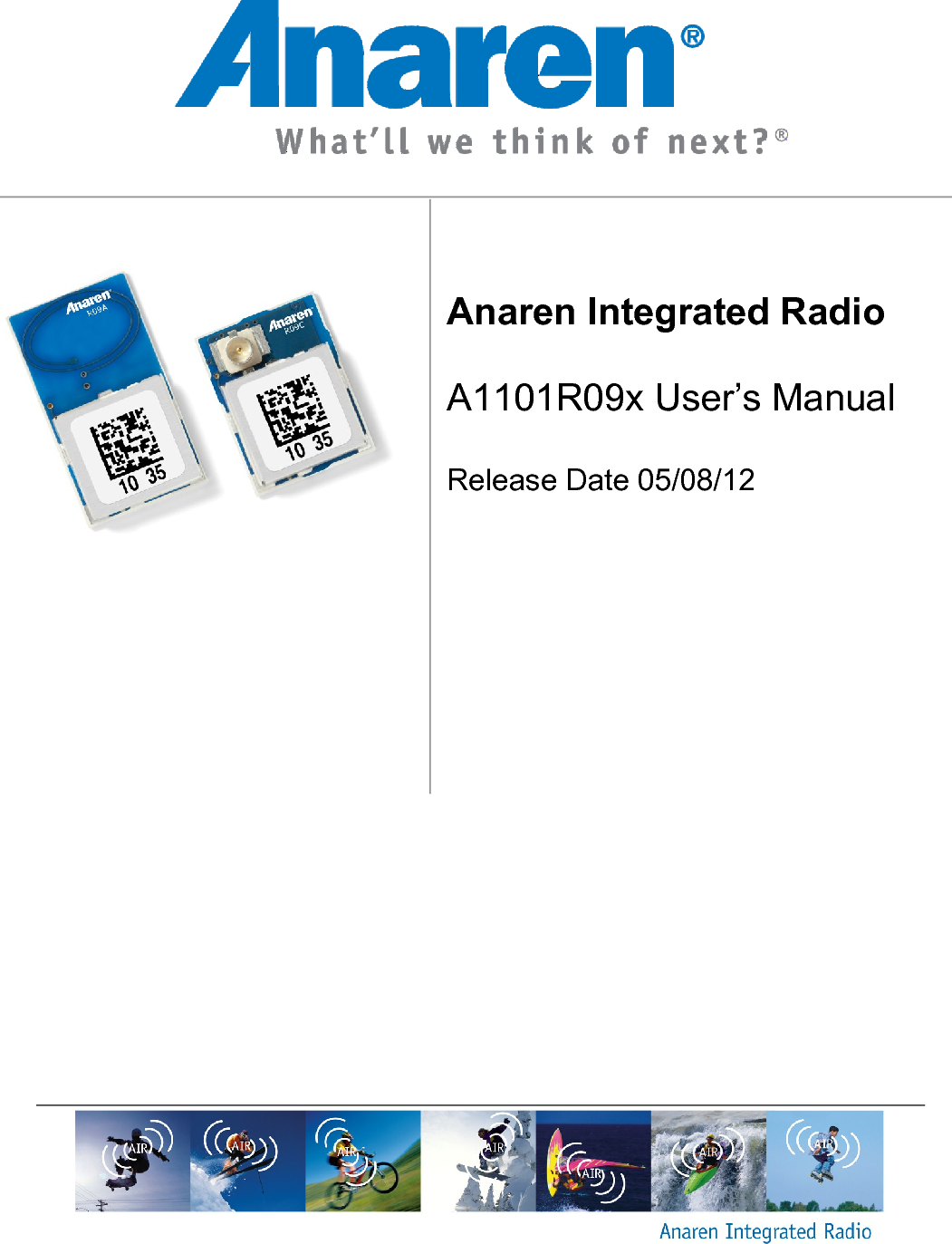
Anaren A10040601 902-928 MHZ TRANSCEIVER User Manual 20170227 v1 11 11524600 A1101R09x Users Manual 2

Anaren, Inc. 902-928 MHZ TRANSCEIVER 20170227 v1 11 11524600 A1101R09x Users Manual 2

Contents

  • 1. Users Manual
  • 2. User Manual_20170227_v1 - 11_11524600 A1101R09x_Users_Manual_2

User Manual_20170227_v1 - 11_11524600 A1101R09x_Users_Manual_2
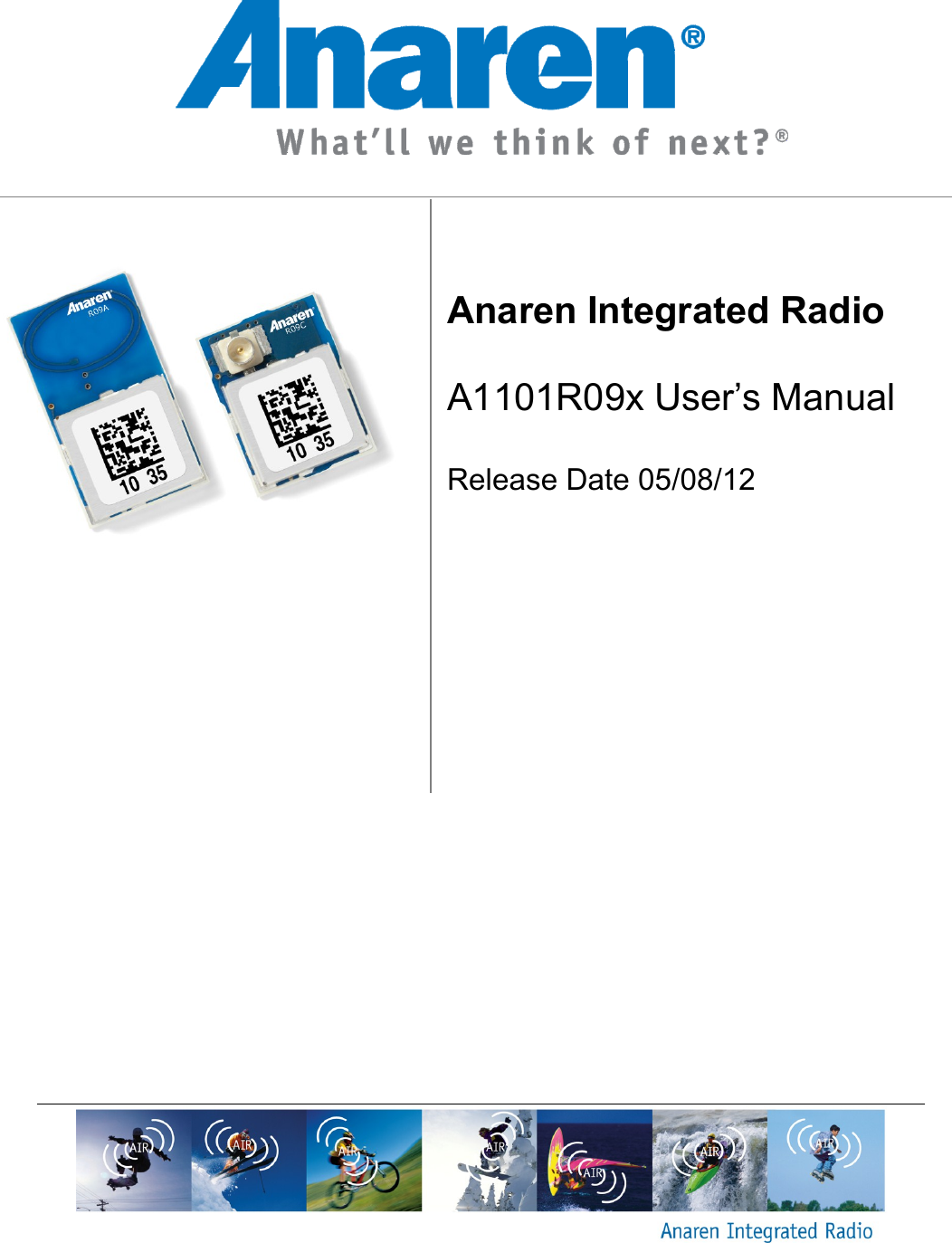
            Anaren Integrated Radio  A1101R09x User’s Manual  Release Date 05/08/12
THIS PAGE INTENTIONALLY LEFT BLANK
iii      USER’S MANUAL Models A1101R09A and A1101R09C   Contents  1. Overview .......................................................................................................................................................... 5 1.1. A1101R09A ................................................................................................................................................. 5 1.2. A1101R09C ................................................................................................................................................. 5 1.3. Features....................................................................................................................................................... 6 1.4. Theory of Operation.................................................................................................................................. 6 1.4.1. Typical Flow ........................................................................................................................................ 9 1.5. Applications ............................................................................................................................................. 11 1.6. Configuration ........................................................................................................................................... 11 2. Approvals and Usage ................................................................................................................................... 13 2.1. Product Approvals .................................................................................................................................. 13 2.1.1. USA (Federal Communications Commission, FCC) ......................................................................... 13 2.1.1.1. FCC Labeling Requirements ................................................................................................ 13 2.1.1.2. End User Manual ................................................................................................................... 14 2.1.1.3. RF Exposure ............................................................................................................................ 14 2.1.2. Canada (Industry Canada, IC) .......................................................................................................... 15 2.1.2.1. IC Labeling Requirements .................................................................................................... 15 2.1.2.2. RF Exposure ............................................................................................................................ 16 2.2. Potential Interference Sources ............................................................................................................... 17 2.2.1. Time critical data ............................................................................................................................... 17 2.3. Approved Usage ..................................................................................................................................... 17 2.3.1. USA & Canada ................................................................................................................................. 18 3. Electrical Characteristics .............................................................................................................................. 19 3.1. Absolute Maximum Ratings .................................................................................................................. 19 3.2. Operating Conditions ............................................................................................................................. 20 3.3. Pin Out ...................................................................................................................................................... 20 3.4. Recommended Layout  (dimensions in mm) ...................................................................................... 22 3.5. Power Supply Considerations ............................................................................................................... 24 4. Mechanical and Process ................................................................................................................................ 25 4.1. Radio Module Details  (dimensions in mm) ........................................................................................ 25 4.1.1. A1101R09A ...................................................................................................................................... 25 4.1.2. A1101R09C ....................................................................................................................................... 25 4.2. Packaging Details  (dimensions in mm) ............................................................................................... 26 4.2.1. Matrix Tray Packaging ..................................................................................................................... 26 4.2.2. Tape-Reel Packaging ......................................................................................................................... 27 4.3. Soldering................................................................................................................................................... 28 4.3.1. Manual Mounting Procedure ........................................................................................................... 28 4.3.2. Automated Mounting Procedure ...................................................................................................... 29
THIS PAGE INTENTIONALLY LEFT BLANK
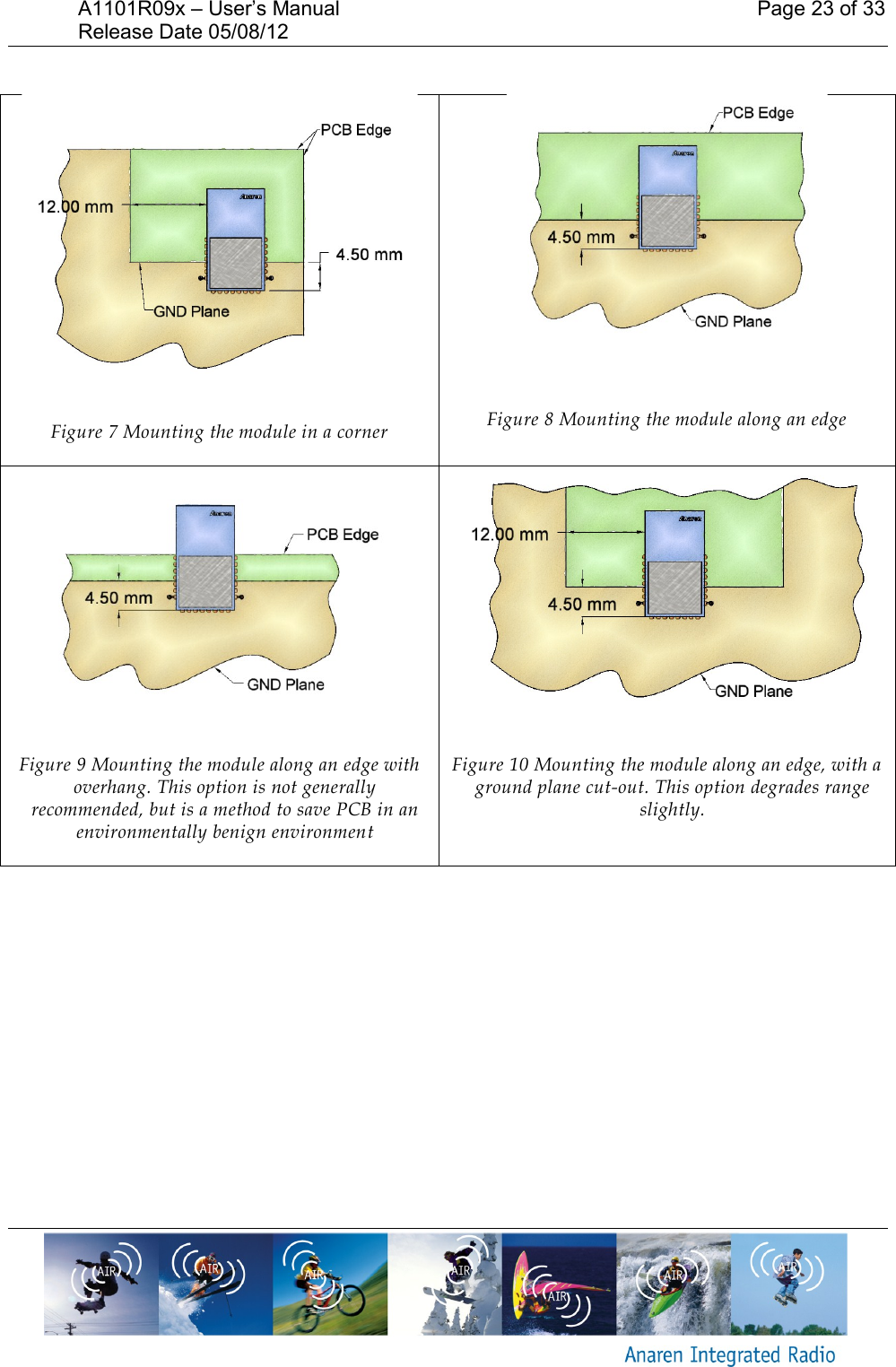
A1101R09x – User’s Manual    Page 5 of 33 Release Date 05/08/12        1. Overview The A1101R09A and A1101R09C are surface mount modules – each with an integrated crystal, internal voltage regulator, matching circuitry and filtering. The A1101R09A has an integral antenna, whereas the A1101R09C utilizes an external antenna through a U.FL connector (see Table 2). The modules operate in the US 902 – 928MHz ISM band and are ideal for achieving low power wireless connectivity without having to deal with extensive RF, antenna design and regulatory compliance, allowing quick time to market. The modules are 100% tested to provide consistent performance.  The A1101R09A and A1101R09C have received regulatory approvals for modular devices in the United States (FCC) and Canada under Industry Canada (IC) Radio Standards Specification (RSS) RSS-210 and RSS-Gen. The modular approval allows the OEM or end user to place either an A1101R09A or an A1101R09C with an approved antenna inside a finished product without having to perform costly regulatory testing for an intentional radiator. Section 2.3 has information on the requirements for the end user/integrator must fulfill to use the modules without intentional radiator regulatory testing.  The A1101R09A and A1101R09C are based on the CC1101 transceiver IC from Texas Instruments. All control lines for the transceiver are provided at module level for full control of its operation. Please see the CC1101 data sheet (www.ti.com) for how to control the modules.   The A1101R09A measure 9x16x2.5mm and A1101R09C measures 9x12x2.5mm.  The modules are footprint compatible with each other.  1.1.  A1101R09A The A1101R09A has an integral antenna, providing high efficiency and near omni-directional radiation pattern. This approach offers the lowest system cost when the application allows collocation of radio and antenna.  1.2.  A1101R09C The A1101R09C has a compact antenna connector that allows for locating the antenna away from the module due to form/function or in order to exit a metal enclosure, see  Figure 7 – Figure 10 for more information on antenna location and enclosure considerations.
Page 6 of 33    A1101R09x – User’s Manual     Release Date 05/08/12     1.3.  Features Features:   Frequency range: 902-928 MHz   Ultra small package size    A1101R09C  : 9mm x 12mm x 2.5mm   A1101R09A  : 9mm x 16mm x 2.5mm   Impedance controlled multi-layer PCB   Shielded Package   1.8 to 3.6 V operation   SPI Interface   RoHS Compliant   LGA Footprint   Low Power Consumption   Regulatory approvals for FCC   Digital RSSI output   Programmable channel filter bandwidth   Programmable output power up to +10 dBm   High sensitivity (–104 dBm at 1.2 kBaud, 1% packet error rate)   Low current consumption (14.4 mA in RX, 1.2kBaud, input well above sensitivity limit)   Fast startup time: 240us from SLEEP to Rx or Tx mode   Separate 64 byte Rx and Tx FIFOs   Data Rate: 1.2 – 500 Kbit/Sec   Programmable data rate from 1.2 to 500 kBaud   Sleep state: 0.2µA   Idle State: 1.7mA Benefits Summary:   Operating temperature -40 to +85C   100% RF Tested in production   Common footprint for all family members   No RF engineering experience necessary   Only requires a 2 layer PCB implementation   Excellent receiver selectivity and blocking Performance   Suited for systems compliant with FCC CFR47 Part 15.247a2 and 15.249 (US) and Canada under Industry Canada (IC) Radio Standards Specification (RSS) RSS-210 and RSS-Gen.  No regulatory “Intentional radiator” testing required to integrate module into end product. Simple certification labeling replaces testing.  1.4.  Theory of Operation The A1101R09A and A1101R09C are for low power wireless applications in the US 902 – 928MHz ISM band.  The devices can be used to implement a variety of networks, including; point to point, point to multipoint, peer to peer and mesh networks.  The A1101R09A and A1101R09C both interface to an application microcontroller via an SPI bus. Physical and MAC layer functionality are accessed via the SPI bus through addressable registers as well as execution commands. Data received, or to be transmitted, are also accessed through the SPI bus and are implemented as a FIFO register (64 bytes each for Tx and Rx).
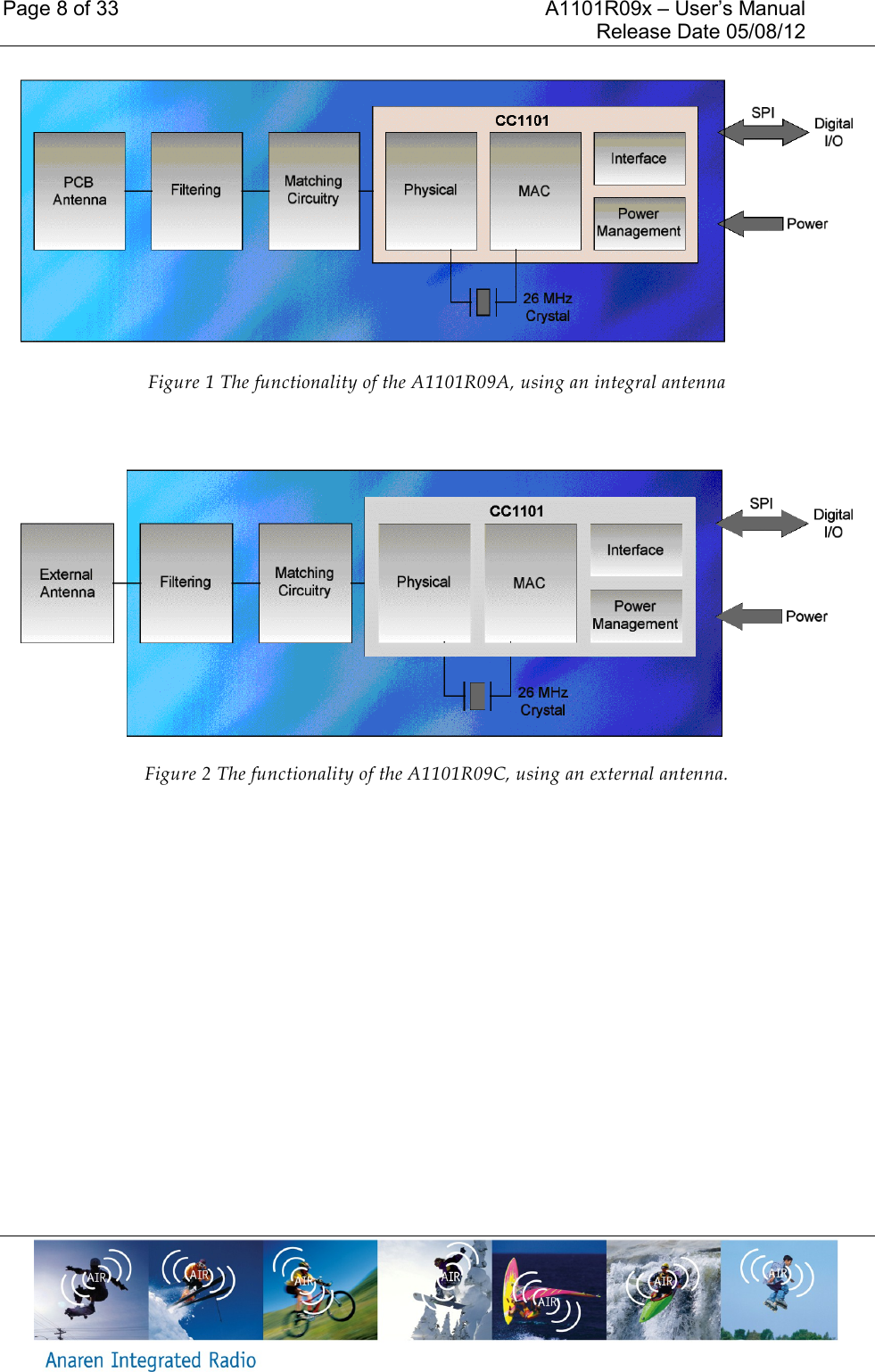
A1101R09x – User’s Manual    Page 7 of 33 Release Date 05/08/12         To transmit, a frame of data is placed in the FIFO; this may include a destination address. A transmit command is given, which will transmit the data according to the initial setup of the registers. To receive data, a receive command is given, which enables the unit to “listen” for a transmission; when such a transmission occurs, it places the received frame in the FIFO. When neither transmit nor receive is required, the device can enter either an Idle mode, from which it can quickly re-enter receive, a transmit mode, or a low power sleep mode from which a crystal startup is required prior to transmit or receive operation.  Below is a block diagram for each of the A1101R09A and A1101R09C modules.   Antenna o  The antenna couples energy between the air and the AIR module. For applications where installations are done by an end user (non-professional), an omni-directional antenna pattern is desired such that the application will work equally well in any direction. Similarly for peer to peer or point to multipoint applications an omni-directional pattern is desired such that all nodes have a fair chance of communicating. The A1101R09A module has an integral antenna that is near omni-directional, whereas the A1101R09C has approved antenna options ranging from near omni-directional to shaped front/back patterns (useful for inline, professional installations). Note that the end radiation pattern depends not only on the antenna, but also on the ground plane, enclosure and installation environment.   Filtering o  Filtering removes spurious signals to comply with regulatory intentional radiator requirements.   Matching o  Matching provides the correct loading of the transmit amplifier to achieve the highest output power, as well as the correct loading for the receive LNA to achieve the best sensitivity.   Physical o  The physical layer provides conversions between data, symbol and RF signal.    MAC o  The MAC layer is part of the Logical Link Layer and provides frame handling, addressing and medium access services.    Microcontroller Interface o  The microcontroller interface exposes registers and commands for the physical and MAC layers to a microcontroller.   Power Management o  Power management ensures a stable supply for the internal functions, as well as providing means for a low power sleep mode (in which case, most of the transceiver is power off).
Page 8 of 33    A1101R09x – User’s Manual     Release Date 05/08/12      Figure 1 The functionality of the A1101R09A, using an integral antenna    Figure 2 The functionality of the A1101R09C, using an external antenna.
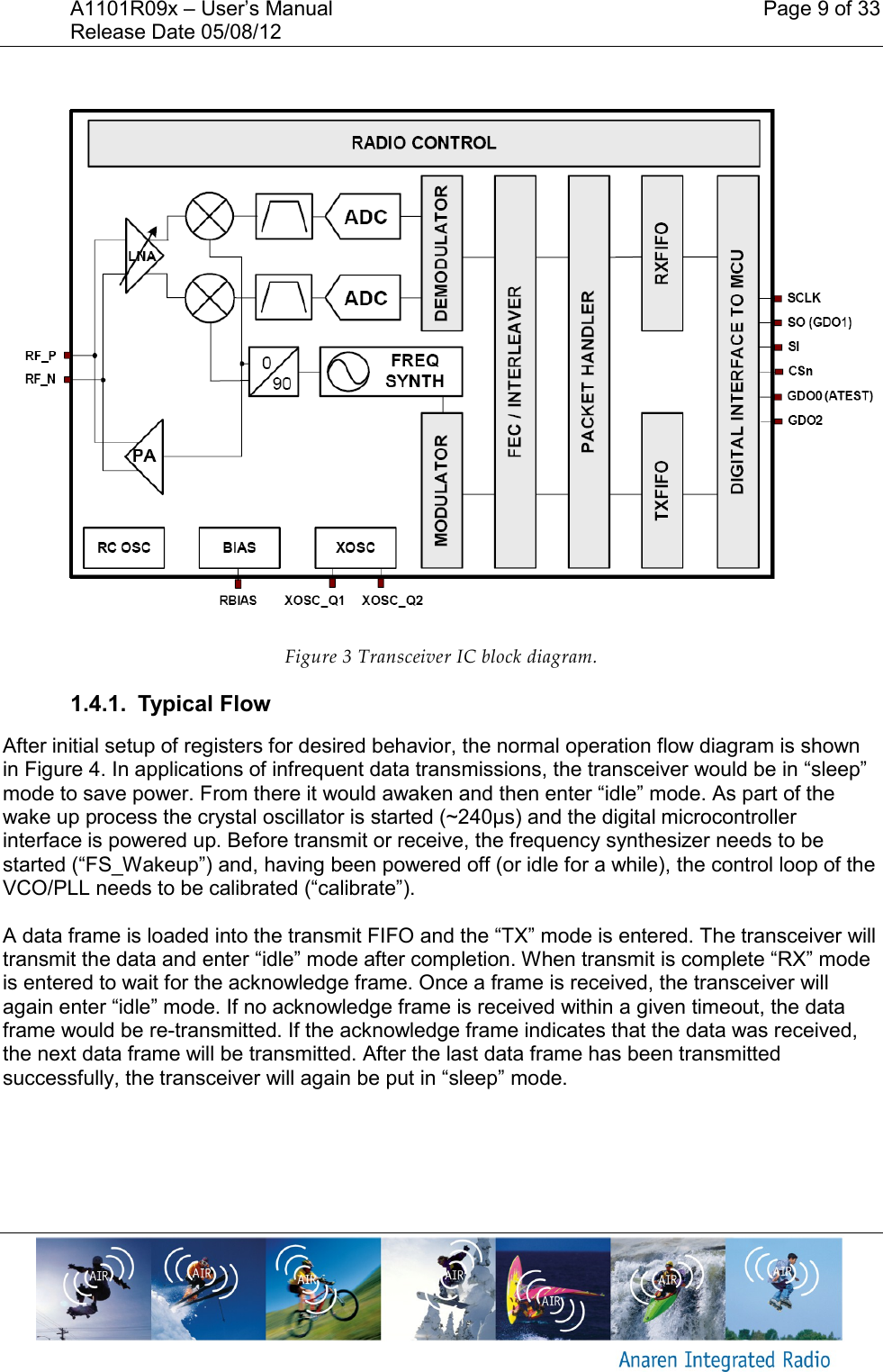
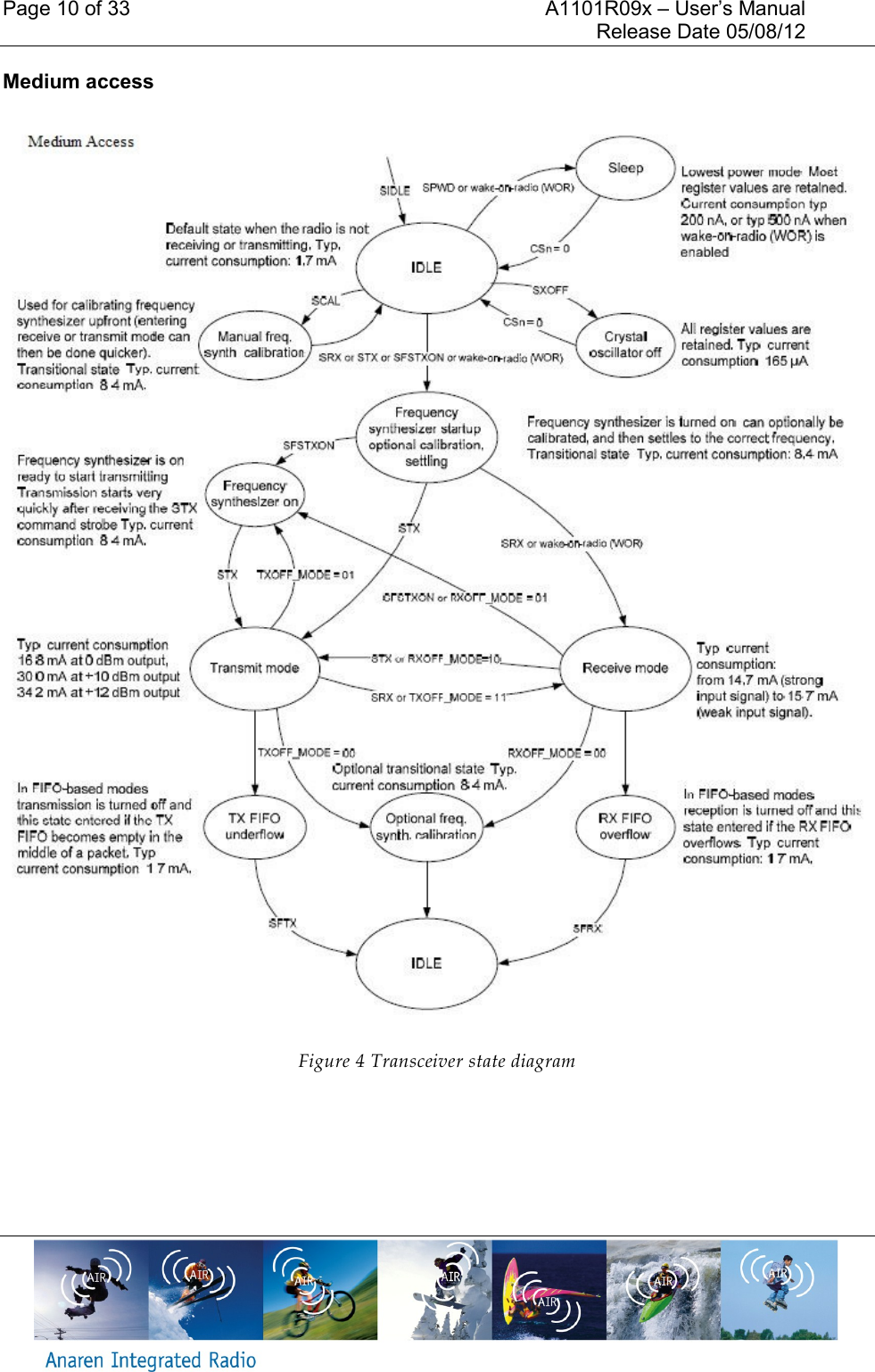
A1101R09x – User’s Manual    Page 9 of 33 Release Date 05/08/12         Figure 3 Transceiver IC block diagram. 1.4.1.  Typical Flow After initial setup of registers for desired behavior, the normal operation flow diagram is shown in Figure 4. In applications of infrequent data transmissions, the transceiver would be in “sleep” mode to save power. From there it would awaken and then enter “idle” mode. As part of the wake up process the crystal oscillator is started (~240μs) and the digital microcontroller interface is powered up. Before transmit or receive, the frequency synthesizer needs to be started (“FS_Wakeup”) and, having been powered off (or idle for a while), the control loop of the VCO/PLL needs to be calibrated (“calibrate”).  A data frame is loaded into the transmit FIFO and the “TX” mode is entered. The transceiver will transmit the data and enter “idle” mode after completion. When transmit is complete “RX” mode is entered to wait for the acknowledge frame. Once a frame is received, the transceiver will again enter “idle” mode. If no acknowledge frame is received within a given timeout, the data frame would be re-transmitted. If the acknowledge frame indicates that the data was received, the next data frame will be transmitted. After the last data frame has been transmitted successfully, the transceiver will again be put in “sleep” mode.
Page 10 of 33    A1101R09x – User’s Manual     Release Date 05/08/12     Medium access   Figure 4 Transceiver state diagram
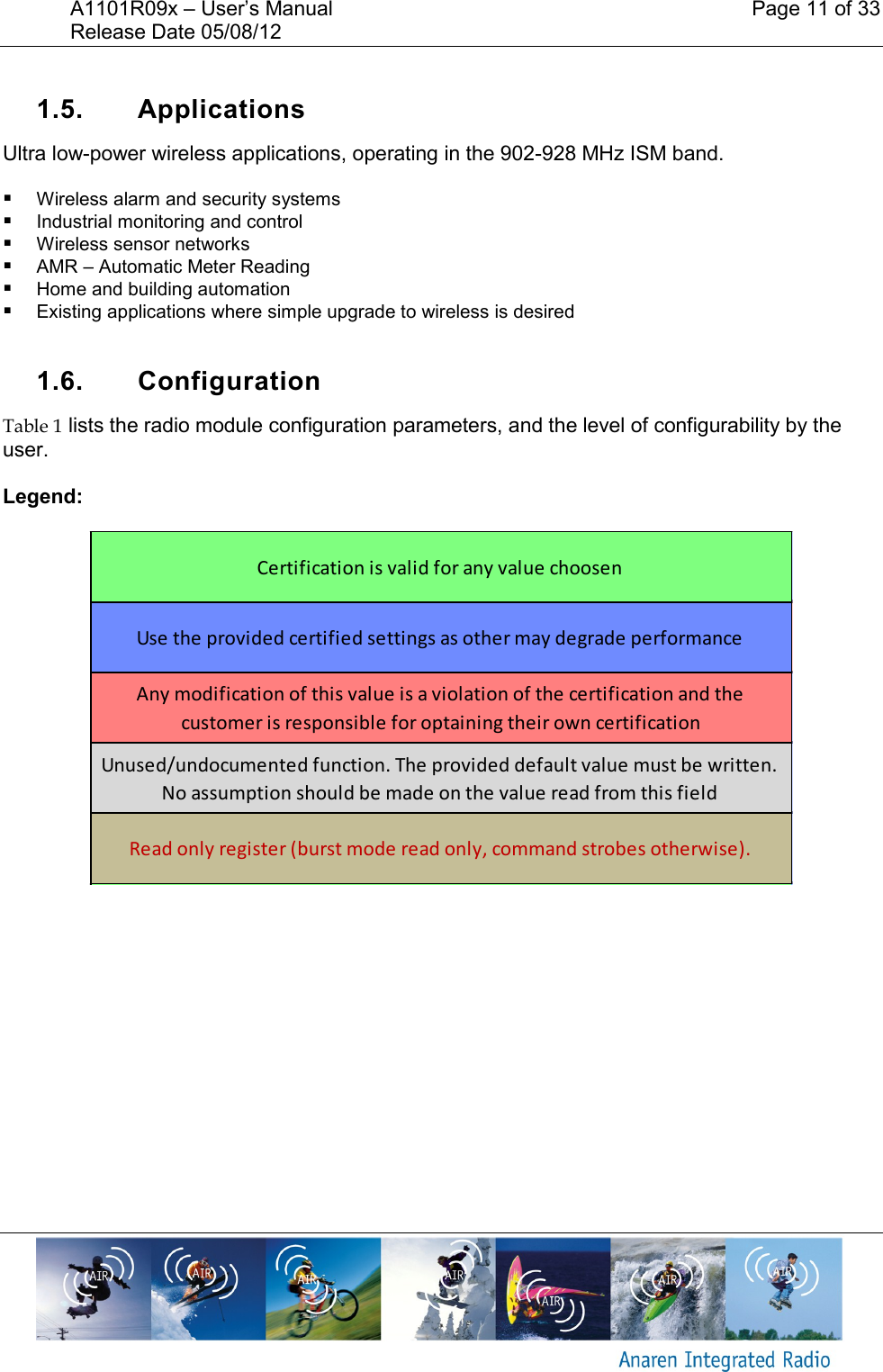
A1101R09x – User’s Manual    Page 11 of 33 Release Date 05/08/12        1.5.  Applications Ultra low-power wireless applications, operating in the 902-928 MHz ISM band.  Wireless alarm and security systems  Industrial monitoring and control  Wireless sensor networks  AMR – Automatic Meter Reading  Home and building automation  Existing applications where simple upgrade to wireless is desired   1.6.  Configuration Table 1 lists the radio module configuration parameters, and the level of configurability by the user.  Legend:  Certification is valid for any value choosenUse the provided certified settings as other may degrade performanceAny modification of this value is a violation of the certification and the customer is responsible for optaining their own certificationUnused/undocumented function. The provided default value must be written. No assumption should be made on the value read from this fieldRead only register (burst mode read only, command strobes otherwise).
Page 12 of 33    A1101R09x – User’s Manual     Release Date 05/08/12     Table 1 Configuration Parameters  Register NameRegister Address (Hex)Retained during sleep7 6 5 4 3 2 1 0IOCFG2 00 1 0 GDO2_INVIOCFG1 01 1 GDO_DS GDO1_INVIOCFG0 02 1GDO0_TEMP_SENSOR_ENABLE GDO0_INVFIFOTHR 03 1 Reserved ADC_RETENTIONSYNC1 04 1SYNC0 05 1PKTLEN 06 1PKTCTRL1 07 1 0 CRC_AUTOFLUSH APPEND_STATUSPKTCTRL0 08 1 0 WHITE_DATA 0 CRC_ENADDR 09 1CHANNR 0A 1FSCTRL1 0B 1 0FSCTRL0 0C 1FREQ2 0D 1FREQ1 0E 1FREQ0 0F 1MDMCFG4 10 1MDMCFG3 11 1MDMCFG2 12 1DEM_DCFILT_OFF MANCHESTER_ENMDMCFG1 13 1 FEC_ENMDMCFG0 14 1DEVIATN 15 1 0 0MCSM2 16 1 RX_TIME_RSSI RX_TIME_QUALMCSM1 17 1MCSM0 18 1 PIN_CTRL_EN XOSC_FORCE_ONFOCCFG 19 1FOC_BS_CS_GATE FOC_POST_KBSCFG 1A 1 BS_POST_K BS_POST_KPAGCCTRL2 1B 1AGCCTRL1 1C 1 0 AGC_LNA_PRIORITYAGCCTRL0 1D 1WOREVT1 1E 1WOREVT0 1F 1WORCTRL 20 1 RC_PD RC_CAL 0FREND1 21 1FREND0 22 1 0FSCAL3 23 1FSCAL2 24 1VCO_CORE_H_ENFSCAL1 25 1FSCAL0 26 1 0RCCTRL1 27 1 0RCCTRL0 28 1 0FSTEST 29 0PTEST 2A 0AGCTEST 2B 0TEST2 2C 0TEST1 2D 0TEST0 2E 0VCO_SEL_CAL_EN TEST0[0]2FPARTNUM 30 1VERSION 31 1FREQOFF_EST 32 0LQI 33 0CRC_OKRSSI 34 0MARC_STATE 35 0WORTIME1 36 0WORTIME0 37 0PKTSTATUS 38 0CRC_OK CS PQT_REACHED CCA SFD GDO2 GDO0VCO_VC_DAC 39 0TXBYTES 3A 0TXFIFO_UNDERFLOWRXBYTES 3B 0RXFI FO_OVERFLOWRCCTRL1_STATUS 3C 0RCCTRL0_STATUS 3D 0PATABLE 3E 1FIFO 3F 0Bit Fields Within RegisterSYNC_LSBPACKET_LENGTHPQTADR_CHKPKT_FORMATLENGTH_CONFIGGDO2_CFGGDO1_CFGGDO0_CFGCLOSE_IN_RXFIFO_THRSYNC_MSBFREQ[15:8]FREQ[7:0]CHANBW_ECHANBW_MDRATE_EDRATE_MDEVICE_ADDRCHAN0FREQ_IFFREQOFFFREQ[23:22]=0FREQ[21:16]DEVIATION_EDEVIATION_M0RX_TIME0CCA_MODERXOFF_MODETXOFF_MODEMOD_FORMATSYNC_MODENUM_PREAMBLE0CHANSPC_ECHANSPC_MBS_PRE_KBS_PRE_KPBS_LIMITMAX_DVGA_GAINMAX_LNA_GAINMAGN_TARGET0FS_AUTOCALPO_TIMEOUT0FOC_PRE_KFOC_LIMITEVENT0[15:8]EVENT0[7:0]EVENT1WOR_RESLNA_CURRENTLNA2MIX_CURRENTLODIV_BUF_CURRENTMIX_CURRENTCARRIER_SENSE_REL_THRCARRIER_SENSE_ABS_THRHYST_LEVELWAIT_TIMEAGC_FREEZEFILTER_LENGTH0FSCAL20FSCAL1FSCAL0RCCTRL10LODIV_BUF_CURRENT_TXPA_POWERFSCAL3[7:6]CHP_CURR_CAL_ENFSCAL3[3:0]TEST0[7:2]PARTNUMVERSIONFREQOFF_ESTLQI_ESTRSSIRCCTRL0FSTESTPTESTAGCTESTTEST2TEST1NUM_RXBYTESRCCTRL1_STATUSRCCTRL0_STATUSPATABLETXFIFO/RXFIFOMARC_STATETIME[15:8]TIME[7:0]VCO_VC_DACNUM_TXBYTES
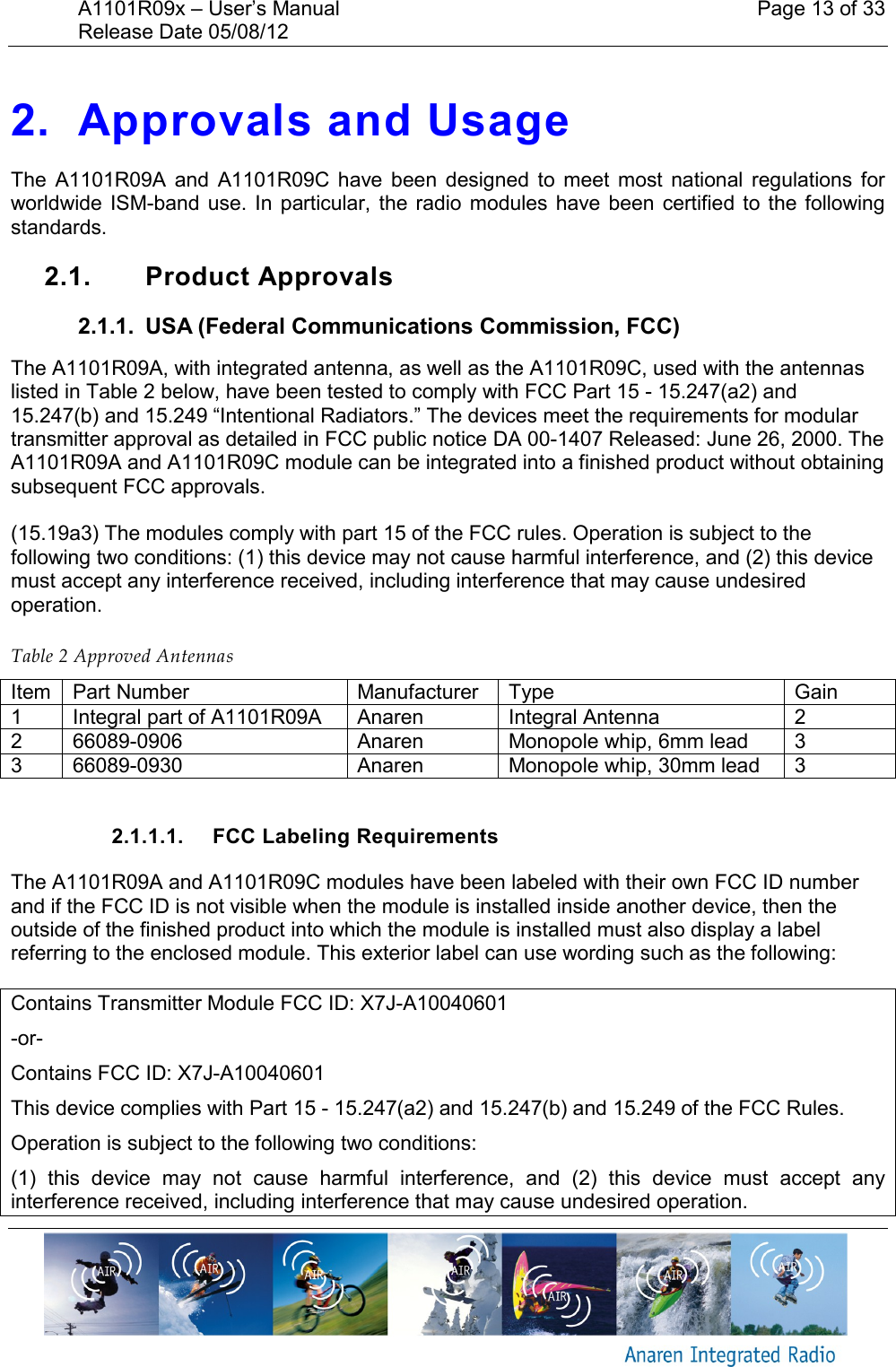
A1101R09x – User’s Manual    Page 13 of 33 Release Date 05/08/12        2. Approvals and Usage The  A1101R09A  and  A1101R09C  have  been  designed  to  meet  most  national  regulations for worldwide ISM-band  use.  In  particular,  the  radio  modules  have been  certified  to  the  following standards. 2.1.  Product Approvals 2.1.1.  USA (Federal Communications Commission, FCC) The A1101R09A, with integrated antenna, as well as the A1101R09C, used with the antennas listed in Table 2 below, have been tested to comply with FCC Part 15 - 15.247(a2) and 15.247(b) and 15.249 “Intentional Radiators.” The devices meet the requirements for modular transmitter approval as detailed in FCC public notice DA 00-1407 Released: June 26, 2000. The A1101R09A and A1101R09C module can be integrated into a finished product without obtaining subsequent FCC approvals.  (15.19a3) The modules comply with part 15 of the FCC rules. Operation is subject to the following two conditions: (1) this device may not cause harmful interference, and (2) this device must accept any interference received, including interference that may cause undesired operation.  Table 2 Approved Antennas Item Part Number Manufacturer Type Gain 1 Integral part of A1101R09A Anaren Integral Antenna 2 2 66089-0906 Anaren Monopole whip, 6mm lead 3 3 66089-0930 Anaren Monopole whip, 30mm lead 3  2.1.1.1.  FCC Labeling Requirements The A1101R09A and A1101R09C modules have been labeled with their own FCC ID number and if the FCC ID is not visible when the module is installed inside another device, then the outside of the finished product into which the module is installed must also display a label referring to the enclosed module. This exterior label can use wording such as the following:  Contains Transmitter Module FCC ID: X7J-A10040601 -or- Contains FCC ID: X7J-A10040601 This device complies with Part 15 - 15.247(a2) and 15.247(b) and 15.249 of the FCC Rules.  Operation is subject to the following two conditions:  (1)  this  device  may  not  cause  harmful  interference,  and  (2)  this  device  must  accept  any interference received, including interference that may cause undesired operation.
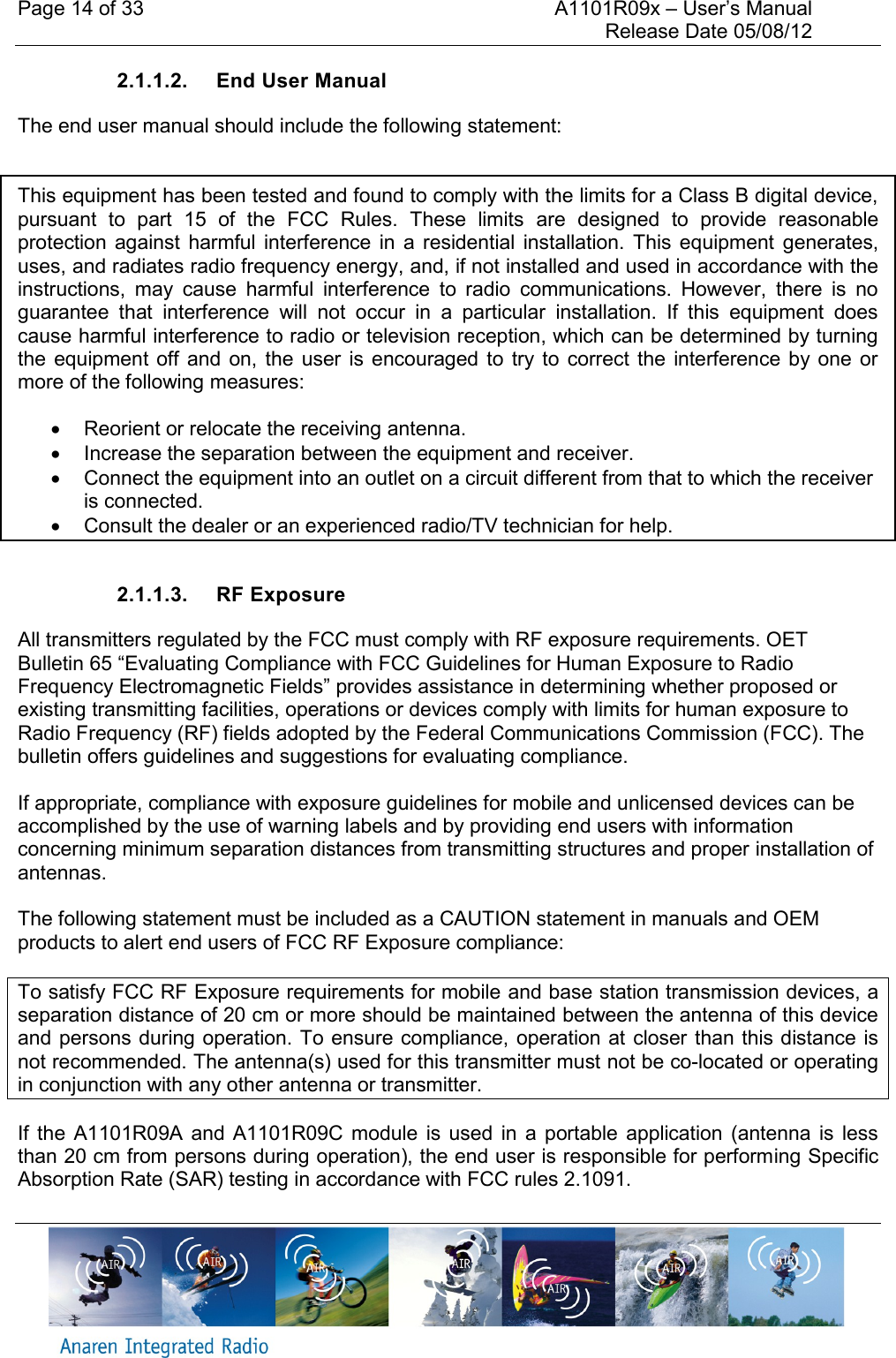
Page 14 of 33    A1101R09x – User’s Manual     Release Date 05/08/12     2.1.1.2.  End User Manual The end user manual should include the following statement:   This equipment has been tested and found to comply with the limits for a Class B digital device, pursuant  to  part  15  of  the  FCC  Rules.  These  limits  are  designed  to  provide  reasonable protection  against  harmful interference  in  a  residential  installation.  This equipment  generates, uses, and radiates radio frequency energy, and, if not installed and used in accordance with the instructions,  may  cause  harmful  interference  to  radio  communications.  However,  there  is  no guarantee  that  interference  will  not  occur  in  a  particular  installation.  If  this  equipment  does cause harmful interference to radio or television reception, which can be determined by turning the  equipment off  and  on,  the  user  is  encouraged to  try  to  correct  the  interference by  one  or more of the following measures:    Reorient or relocate the receiving antenna.   Increase the separation between the equipment and receiver.   Connect the equipment into an outlet on a circuit different from that to which the receiver is connected.   Consult the dealer or an experienced radio/TV technician for help.  2.1.1.3.  RF Exposure All transmitters regulated by the FCC must comply with RF exposure requirements. OET Bulletin 65 “Evaluating Compliance with FCC Guidelines for Human Exposure to Radio Frequency Electromagnetic Fields” provides assistance in determining whether proposed or existing transmitting facilities, operations or devices comply with limits for human exposure to Radio Frequency (RF) fields adopted by the Federal Communications Commission (FCC). The bulletin offers guidelines and suggestions for evaluating compliance.  If appropriate, compliance with exposure guidelines for mobile and unlicensed devices can be accomplished by the use of warning labels and by providing end users with information concerning minimum separation distances from transmitting structures and proper installation of antennas.  The following statement must be included as a CAUTION statement in manuals and OEM products to alert end users of FCC RF Exposure compliance:  To satisfy FCC RF Exposure requirements for mobile and base station transmission devices, a separation distance of 20 cm or more should be maintained between the antenna of this device and persons during operation. To ensure compliance, operation at closer than this distance is not recommended. The antenna(s) used for this transmitter must not be co-located or operating in conjunction with any other antenna or transmitter. If  the  A1101R09A and  A1101R09C  module  is  used  in  a  portable  application  (antenna  is  less than 20 cm from persons during operation), the end user is responsible for performing Specific Absorption Rate (SAR) testing in accordance with FCC rules 2.1091.
A1101R09x – User’s Manual    Page 15 of 33 Release Date 05/08/12        2.1.2.  Canada (Industry Canada, IC) The  A1101R09A  and  A1101R09C  modules  have  been  certified  for  use  in  Canada  under Industry Canada (IC) Radio Standards Specification (RSS) RSS-210 and RSS-Gen. From  section  3.2  RSS-Gen,  Issue  3,  December  2010,  Modular  Approval  for  Category  I Equipment or Category II Equipment: “Modular approval permits the installation of the same module in a host device or multiple host devices  without  the  need  to  recertify  the  device.  Equipment  certification for  a  modular  device may be sought for either Category I equipment or Category II equipment. Transmitters designed as modules for the installation in a host device may obtain equipment certification as a modular device provided that the applicable RSS is met and the following conditions in this section are met.”  In section 7.1.2 Transmitter Antenna, it has been mentioned that the user manuals for transmitters shall display the following notice in a conspicuous location:  Notice:  Under  Industry  Canada  regulations,  this  radio  transmitter  may  only  operate  using  an antenna  of  a  type  and  maximum  (or  lesser)  gain  approved  for  the  transmitter  by  Industry Canada.  To  reduce  potential  radio  interference  to  other  users,  the  antenna  type  and  its  gain should be so chosen that the equivalent isotropically radiated power (e.i.r.p.) is not more than that necessary for successful communication. Avis:  Sous  la  réglementation  d'Industrie  Canada,  ce  transmetteur  radio  ne  peut  fonctionner qu’en utilisant seulement une antenne d'un type et d’un maximum (ou moins) de gain approuvé pour l'émetteur par Industrie Canada.   Pour réduire des potentielles interférences radio pour les autres utilisateurs, le type d'antenne et son gain doivent être choisis de sorte que la puissance isotrope  rayonnée  équivalente  (PIRE)  ne  dépasse  pas  ce  qui  est  nécessaire  pour  une communication réussie. 2.1.2.1.  IC Labeling Requirements From  section  3.2.1 RSS-Gen,  Issue  3,  December  2010,  Labeling  Requirements  for  the  Host Device: The  host  device  shall  be  properly  labeled  to  identify  the  modules  within the  host  device.  The Industry Canada certification label of a module shall be clearly visible at all times when installed in the  host device,  otherwise the  host device  must  be labeled to  display  the Industry Canada certification number of the module, preceded by the words “Contains transmitter module”, or the word “Contains”, or similar wording expressing the same meaning. From  section  5.2,  RSS-Gen,  Issue  3,  December  2010,  Equipment  Certification  Numbers  and Labels: Every unit of Category I  radio apparatus certified for marketing and use in Canada shall bear a permanent label on which is indelibly displayed the model number and Industry Canada certification number of  the equipment model (transmitter, receiver, or  inseparable combination
Page 16 of 33    A1101R09x – User’s Manual     Release Date 05/08/12     thereof).  Each  model  shall  be  identified  by  a  unique  combination  of  a  model  number  and  a certification number, which are assigned as described below in this section.    The label  shall be securely affixed to  a permanently attached part of the device, in  a location where it is visible or easily accessible to the user, and shall not be readily detachable. The label shall  be  sufficiently  durable  to  remain  fully  legible  and  intact  on  the  device  in  all  normal conditions  of  use  throughout  the  device’s  expected  lifetime.  These requirements  may  be  met either by a separate label or nameplate permanently attached to the device or by permanently imprinting or impressing the label directly onto the device.    The label text shall be legible without the aid of magnification, but is not required to be  larger than 8-point font size. If the device is too small to meet this condition, the label information may be included in the user manual upon agreement with Industry Canada. Label: Contains IC: 8975A-A10040601 Notice: This device complies with Industry Canada licence-exempt RSS standard(s). Operation is subject to the following two conditions: (1) this device may not cause interference, and (2) this device must accept any interference, including interference that may cause undesired operation of the device.  Avis: Cet appareil est conforme avec Industrie Canada RSS standard exempts de licence (s). Son  fonctionnement  est  soumis  aux  deux  conditions  suivantes:  (1)  cet  appareil  ne  peut  pas provoquer  d'interférences  et  (2)  cet  appareil  doit  accepter  toute  interférence,  y  compris  les interférences qui peuvent causer un mauvais fonctionnement du dispositif. For more information, see: Industry Canada http://www.ic.gc.ca/. 2.1.2.2.  RF Exposure All transmitters regulated by IC must comply with RF exposure limits as set forth in RSS-102, Issue  4,  section  4,  “Exposure  Limits”.  Furthermore RSS-102,  Issue  4,  Section  2  “Certification Requirements”, provides assistance in determining the specific requirements for compliance. If appropriate,  compliance  with  exposure  guidelines  for  mobile  and  unlicensed  devices  can  be accomplished by the use of warning labels and by providing users with information concerning minimum separation distances from transmitting structures and proper installation of antennas.  The  following  statement  must  be  included  as  a  CAUTION  statement  in  manuals  and  OEM products to alert users of IC RF Exposure compliance: Notice:  To  satisfy  IC  RF  Exposure  requirements  for  mobile  and  base  station  transmission devices, a separation distance of 20 cm or more should be maintained between the antenna of this device and persons during operation. To ensure compliance, operation at  closer than this distance is not recommended. The antenna(s) used for this transmitter must not be co-located or operating in conjunction with any other antenna or transmitter.
A1101R09x – User’s Manual    Page 17 of 33 Release Date 05/08/12        Avis:  Pour  répondre  à  la  IC  d'exposition  pour  les  besoins  de  base  et  mobiles  dispositifs  de transmission de la station, sur une distance de séparation de 20 cm ou plus doit être maintenue entre l'antenne de  cet appareil et les  personnes  en cours de  fonctionnement.  Pour assurer le respect, l'exploitation de plus près à cette distance n'est pas recommandée. L'antenne (s) utilisé pour  cet  émetteur  ne  doit  pas  être  co-localisés  ou  fonctionner  conjointement  avec  une  autre antenne ou transmetteur.  2.2.  Potential Interference Sources   Alarm systems o  These typically use low duty cycles and are therefore easy to avoid using acknowledge/retransmit methods   Car alarms (internal motion sensors)   Video surveillance o  These are typically operated on a fixed channel determined at installation time and can be avoided by using clear channel assessment. It may be useful to change the channel used by the video surveillance equipment also, if possible. 2.2.1.  Time critical data If  the  user  requires  specific  time  critical  data  throughput  that  cannot  tolerate  the  delays  of potentially many re-transmissions, the user is encouraged to implement an environment-aware algorithm  that  periodically  monitors/scans  the  frequency  band  and  maintain  a  list  of  “best available” channels. 2.3.  Approved Usage These radio modules can be used in a variety of physical layer configurations; the following restricts the use to maintain compliance with the above referenced certification bodies.  The user is encouraged to use minimum power required to establish a link, thus minimizing interference.  Changes or modifications to the module and/or operation outside the limits set forth below are prohibited and could void the user’s authority to operate the modules.  Uses of these radio modules are limited to the following frequency ranges and modulation settings. Using the radio modules outside of these limitations are prohibited and could void the user’s authority to operate the modules. The user should use one of the register configurations listed below.  Anaren provides register setting files for optimal performance and compliance for each of the data rates given in the following at www.anaren.com.
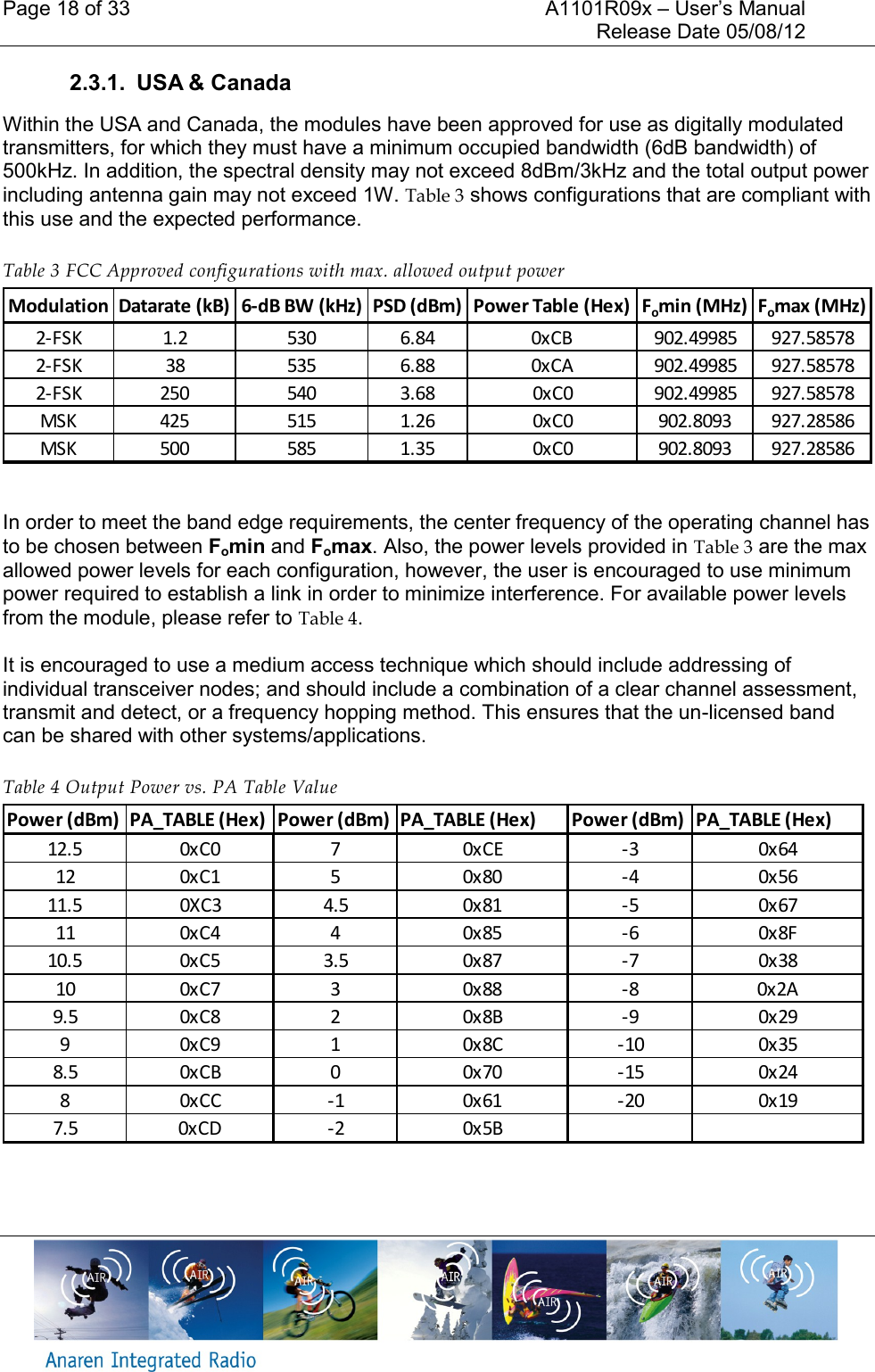
Page 18 of 33    A1101R09x – User’s Manual     Release Date 05/08/12     2.3.1.  USA & Canada Within the USA and Canada, the modules have been approved for use as digitally modulated transmitters, for which they must have a minimum occupied bandwidth (6dB bandwidth) of 500kHz. In addition, the spectral density may not exceed 8dBm/3kHz and the total output power including antenna gain may not exceed 1W. Table 3 shows configurations that are compliant with this use and the expected performance.  Table 3 FCC Approved configurations with max. allowed output power    In order to meet the band edge requirements, the center frequency of the operating channel has to be chosen between Fomin and Fomax. Also, the power levels provided in Table 3 are the max allowed power levels for each configuration, however, the user is encouraged to use minimum power required to establish a link in order to minimize interference. For available power levels from the module, please refer to Table 4.  It is encouraged to use a medium access technique which should include addressing of individual transceiver nodes; and should include a combination of a clear channel assessment, transmit and detect, or a frequency hopping method. This ensures that the un-licensed band can be shared with other systems/applications.  Table 4 Output Power vs. PA Table Value     Modulation Datarate (kB) 6-dB BW (kHz) PSD (dBm) Power Table (Hex)Fomin (MHz) Fomax (MHz)2-FSK 1.2 530 6.84 0xCB 902.49985 927.585782-FSK 38 535 6.88 0xCA 902.49985 927.585782-FSK 250 540 3.68 0xC0 902.49985 927.58578MSK 425 515 1.26 0xC0 902.8093 927.28586MSK 500 585 1.35 0xC0 902.8093 927.28586Power (dBm) PA_TABLE (Hex) Power (dBm) PA_TABLE (Hex) Power (dBm) PA_TABLE (Hex)12.5 0xC0 7 0xCE -3 0x6412 0xC1 5 0x80 -4 0x5611.5 0XC3 4.5 0x81 -5 0x6711 0xC4 4 0x85 -6 0x8F10.5 0xC5 3.5 0x87 -7 0x3810 0xC7 3 0x88 -8 0x2A9.5 0xC8 2 0x8B -9 0x299 0xC9 1 0x8C -10 0x358.5 0xCB 0 0x70 -15 0x248 0xCC -1 0x61 -20 0x197.5 0xCD -2 0x5B
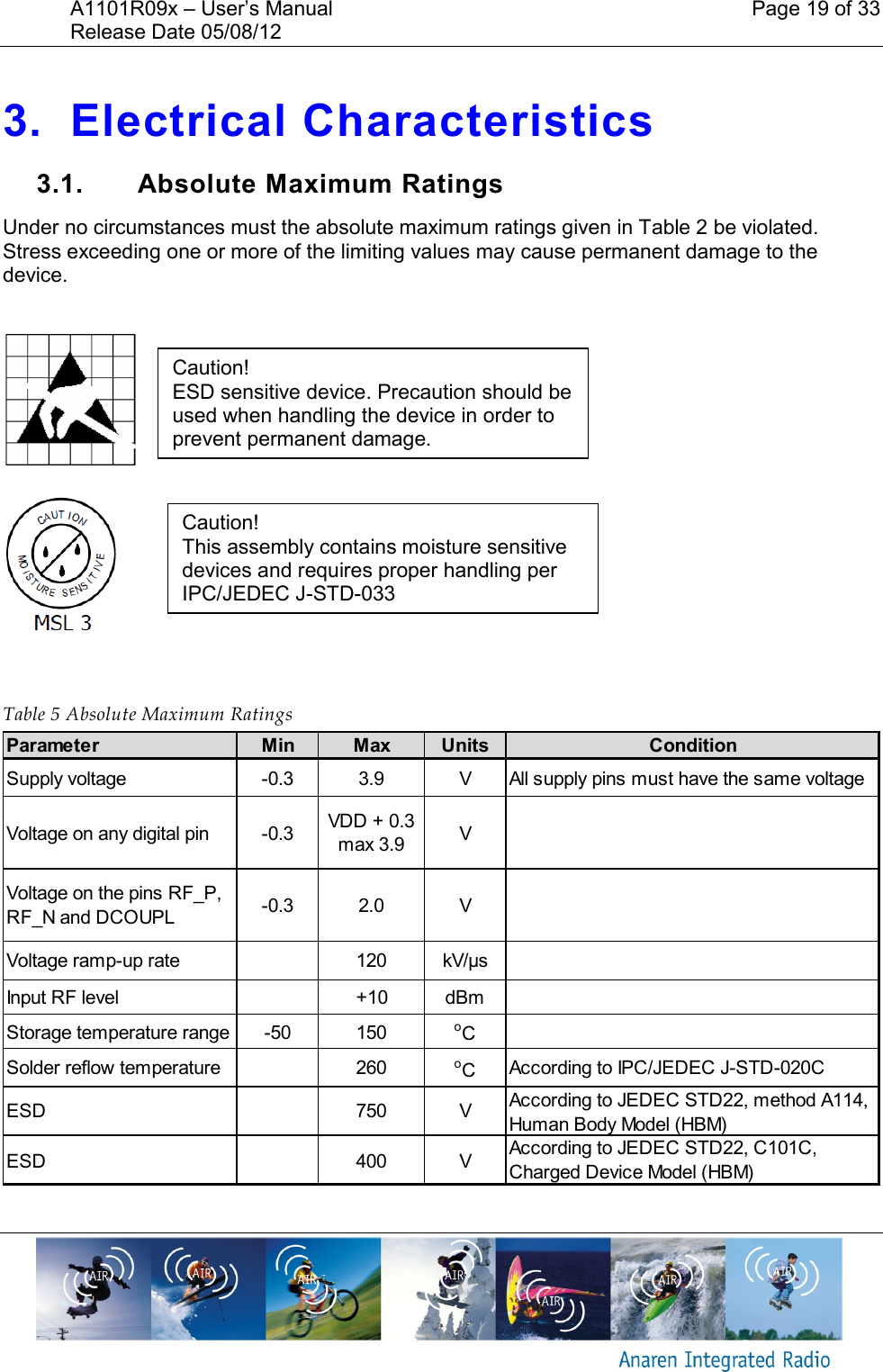
A1101R09x – User’s Manual    Page 19 of 33 Release Date 05/08/12        3. Electrical Characteristics 3.1.  Absolute Maximum Ratings Under no circumstances must the absolute maximum ratings given in Table 2 be violated. Stress exceeding one or more of the limiting values may cause permanent damage to the device.       Table 5 Absolute Maximum Ratings   Parameter Min Max Units ConditionSupply voltage -0.3 3.9 V All supply pins must have the same voltageVoltage on any digital pin -0.3VDD + 0.3max 3.9VVoltage on the pins RF_P, RF_N and DCOUPL-0.3 2.0 VVoltage ramp-up rate 120 kV/µsInput RF level +10 dBmStorage temperature range -50 150oCSolder reflow temperature 260oCAccording to IPC/JEDEC J-STD-020CESD 750 VAccording to JEDEC STD22, method A114, Human Body Model (HBM)ESD 400 VAccording to JEDEC STD22, C101C, Charged Device Model (HBM)Caution! ESD sensitive device. Precaution should be used when handling the device in order to prevent permanent damage. Caution! This assembly contains moisture sensitive devices and requires proper handling per IPC/JEDEC J-STD-033
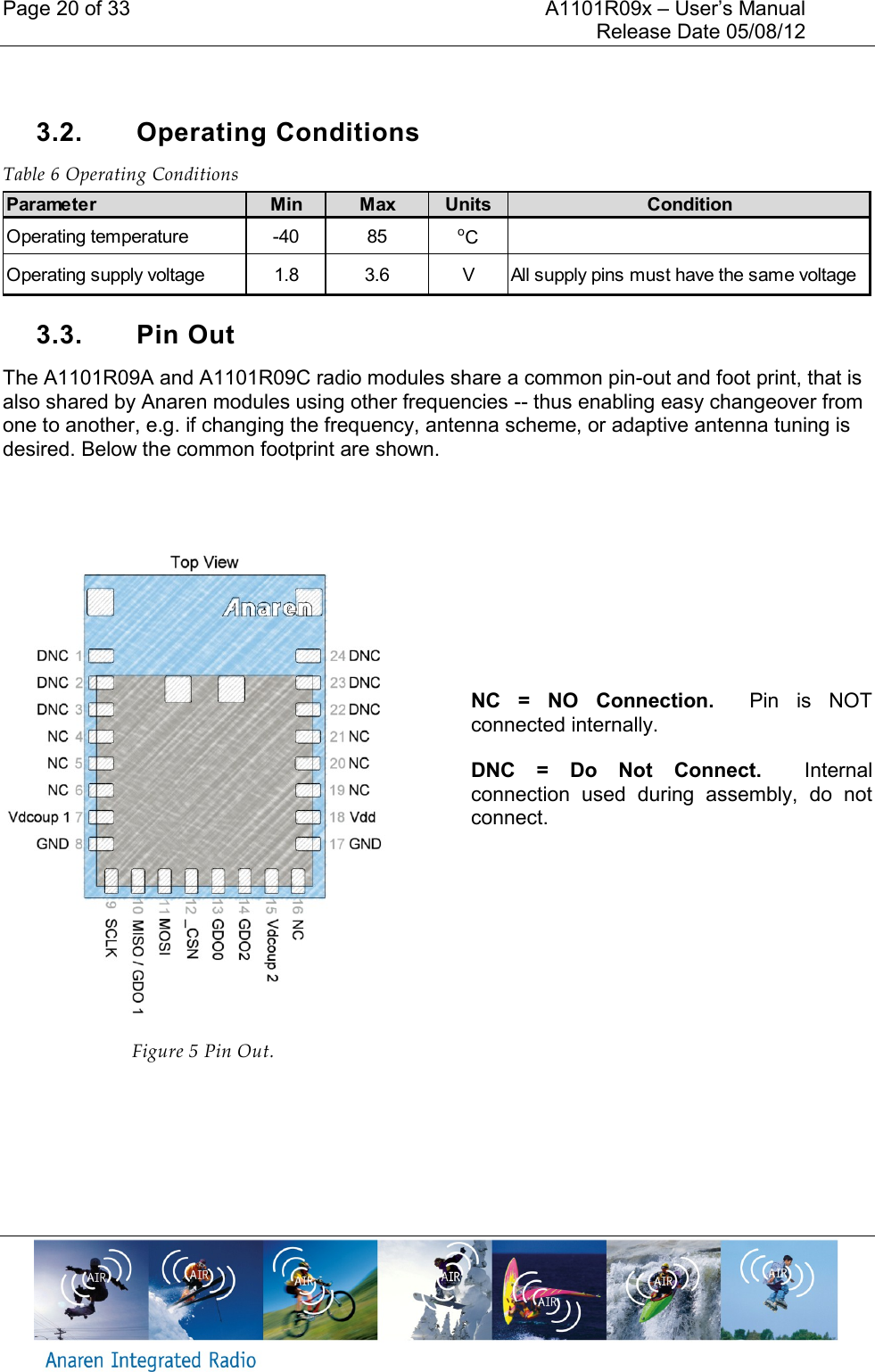
Page 20 of 33    A1101R09x – User’s Manual     Release Date 05/08/12       3.2.  Operating Conditions Table 6 Operating Conditions  3.3.  Pin Out The A1101R09A and A1101R09C radio modules share a common pin-out and foot print, that is also shared by Anaren modules using other frequencies -- thus enabling easy changeover from one to another, e.g. if changing the frequency, antenna scheme, or adaptive antenna tuning is desired. Below the common footprint are shown.    Figure 5 Pin Out.      NC  =  NO  Connection.    Pin  is  NOT connected internally. DNC  =  Do  Not Connect.    Internal connection  used  during  assembly,  do  not connect.    Parameter Min Max Units ConditionOperating temperature -40 85oCOperating supply voltage 1.83.6 V All supply pins must have the same voltage
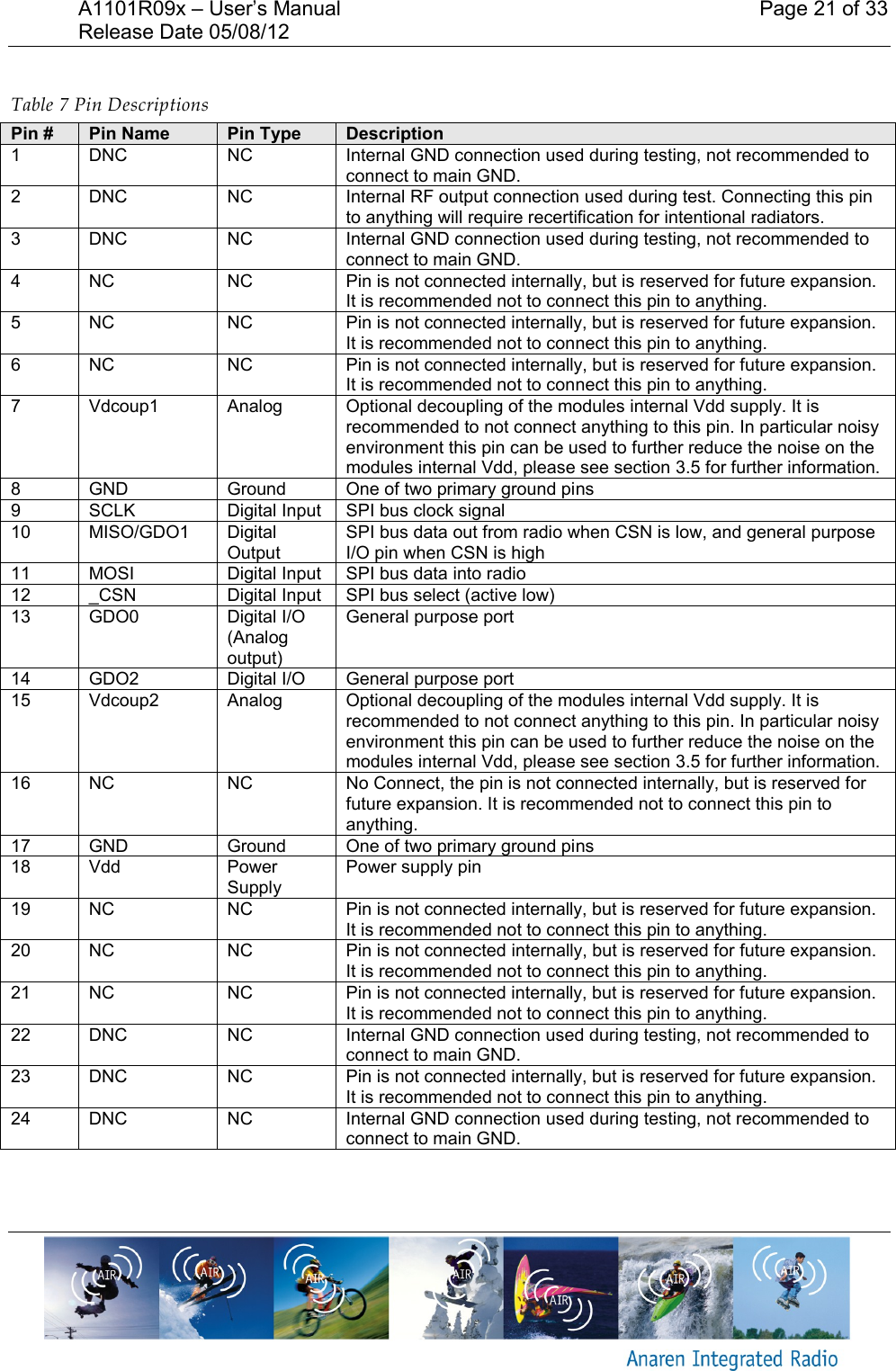
A1101R09x – User’s Manual    Page 21 of 33 Release Date 05/08/12        Table 7 Pin Descriptions Pin # Pin Name Pin Type Description 1 DNC NC Internal GND connection used during testing, not recommended to connect to main GND. 2 DNC NC Internal RF output connection used during test. Connecting this pin to anything will require recertification for intentional radiators. 3 DNC NC Internal GND connection used during testing, not recommended to connect to main GND. 4 NC NC Pin is not connected internally, but is reserved for future expansion. It is recommended not to connect this pin to anything. 5 NC NC Pin is not connected internally, but is reserved for future expansion. It is recommended not to connect this pin to anything. 6 NC NC Pin is not connected internally, but is reserved for future expansion. It is recommended not to connect this pin to anything. 7 Vdcoup1 Analog Optional decoupling of the modules internal Vdd supply. It is recommended to not connect anything to this pin. In particular noisy environment this pin can be used to further reduce the noise on the modules internal Vdd, please see section 3.5 for further information. 8 GND Ground One of two primary ground pins 9 SCLK Digital Input SPI bus clock signal 10 MISO/GDO1 Digital Output SPI bus data out from radio when CSN is low, and general purpose I/O pin when CSN is high 11 MOSI Digital Input SPI bus data into radio 12 _CSN Digital Input SPI bus select (active low) 13 GDO0 Digital I/O (Analog output) General purpose port 14 GDO2 Digital I/O General purpose port 15 Vdcoup2 Analog Optional decoupling of the modules internal Vdd supply. It is recommended to not connect anything to this pin. In particular noisy environment this pin can be used to further reduce the noise on the modules internal Vdd, please see section 3.5 for further information. 16 NC NC No Connect, the pin is not connected internally, but is reserved for future expansion. It is recommended not to connect this pin to anything. 17 GND Ground One of two primary ground pins 18 Vdd Power Supply Power supply pin 19 NC NC Pin is not connected internally, but is reserved for future expansion. It is recommended not to connect this pin to anything. 20 NC NC Pin is not connected internally, but is reserved for future expansion. It is recommended not to connect this pin to anything. 21 NC NC Pin is not connected internally, but is reserved for future expansion. It is recommended not to connect this pin to anything. 22 DNC NC Internal GND connection used during testing, not recommended to connect to main GND. 23 DNC NC Pin is not connected internally, but is reserved for future expansion. It is recommended not to connect this pin to anything. 24 DNC NC Internal GND connection used during testing, not recommended to connect to main GND.
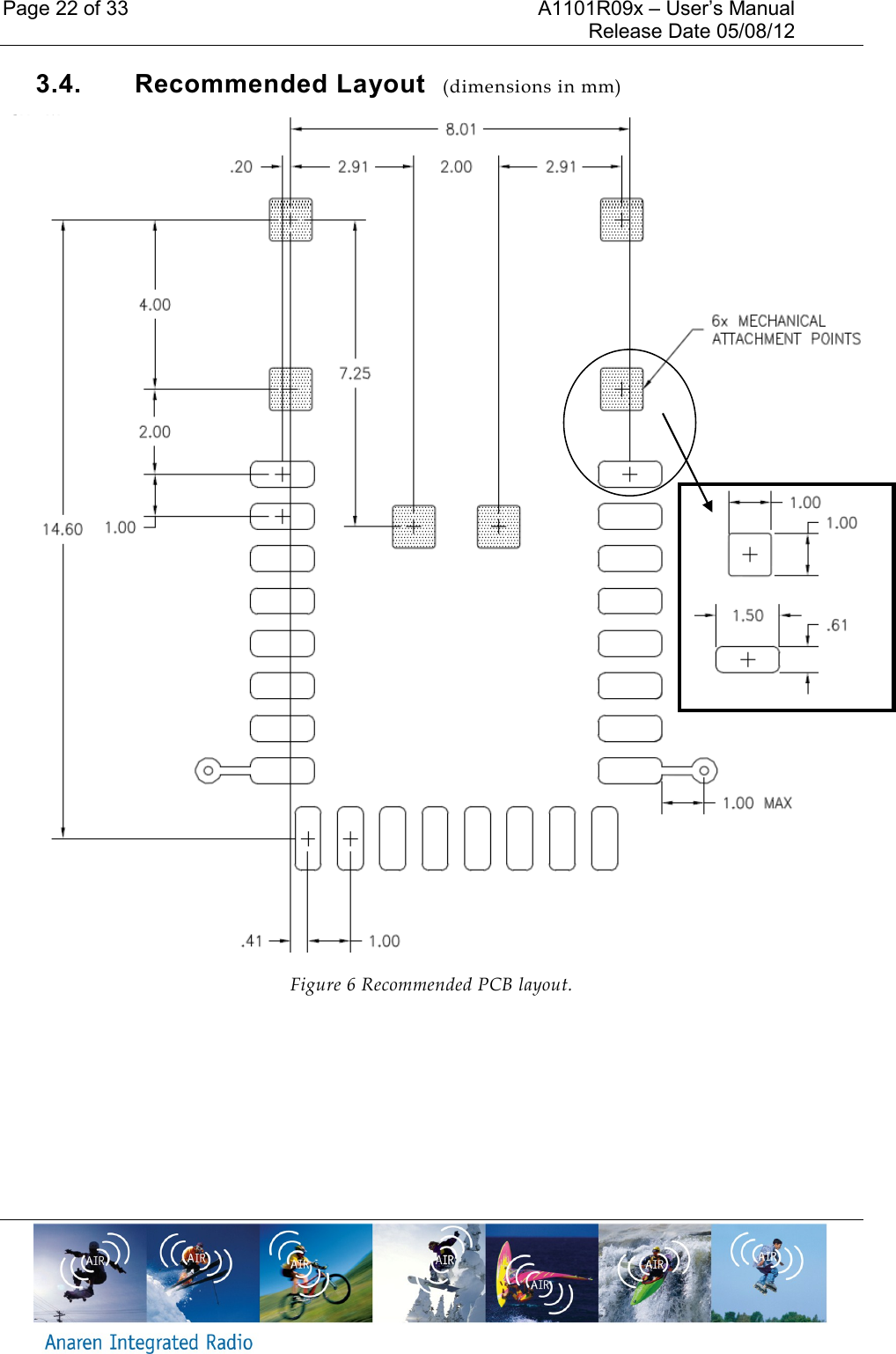
Page 22 of 33    A1101R09x – User’s Manual     Release Date 05/08/12     3.4.  Recommended Layout  (dimensions in mm)  Figure 6 Recommended PCB layout.
A1101R09x – User’s Manual    Page 23 of 33 Release Date 05/08/12         Figure 7 Mounting the module in a corner   Figure 8 Mounting the module along an edge  Figure 9 Mounting the module along an edge with overhang. This option is not generally recommended, but is a method to save PCB in an environmentally benign environment  Figure 10 Mounting the module along an edge, with a ground plane cut-out. This option degrades range slightly.
Page 24 of 33    A1101R09x – User’s Manual     Release Date 05/08/12     3.5.  Power Supply Considerations Noise on the power supply line reduces the sensitivity of a receiver and modulates onto a transmitter’s signal, both of which causes a degradation of link quality and hence a reduction in range.   The A1101R09A and A1101R09C radio modules each have an integral ferrite bead in the supply line from pin 18 (Vdd) and decoupling capacitance to reduce any noise on the incoming power supply line. This arrangement will eliminate most supply voltage noise. In particularly noisy environments (switching regulators, motor controls, etc.), it may be necessary to add additional noise reduction means.  Pin 7 (Vdcoup1) is connected to the modules internal supply line after the ferrite bead and decoupling capacitors and can be used to probe the noise at module level. The noise level measured on pin 7 should not exceed 120mVpp when in transmit or receive mode; it may however exceed this value when setting up or accessing data to/from the FIFOs, while not actively transmitting or receiving.  If the level measured is exceeding the above limit, steps should be taken to ensure maximum range, including:    Adding decoupling capacitance to pin 7 (Vdcoup1).   Adding additional filtering in the supply line. Adding  an  LDO  in  the  supply  line  (the  TPS731xx  low  Dropout  Regulator  from  TI  is recommended).
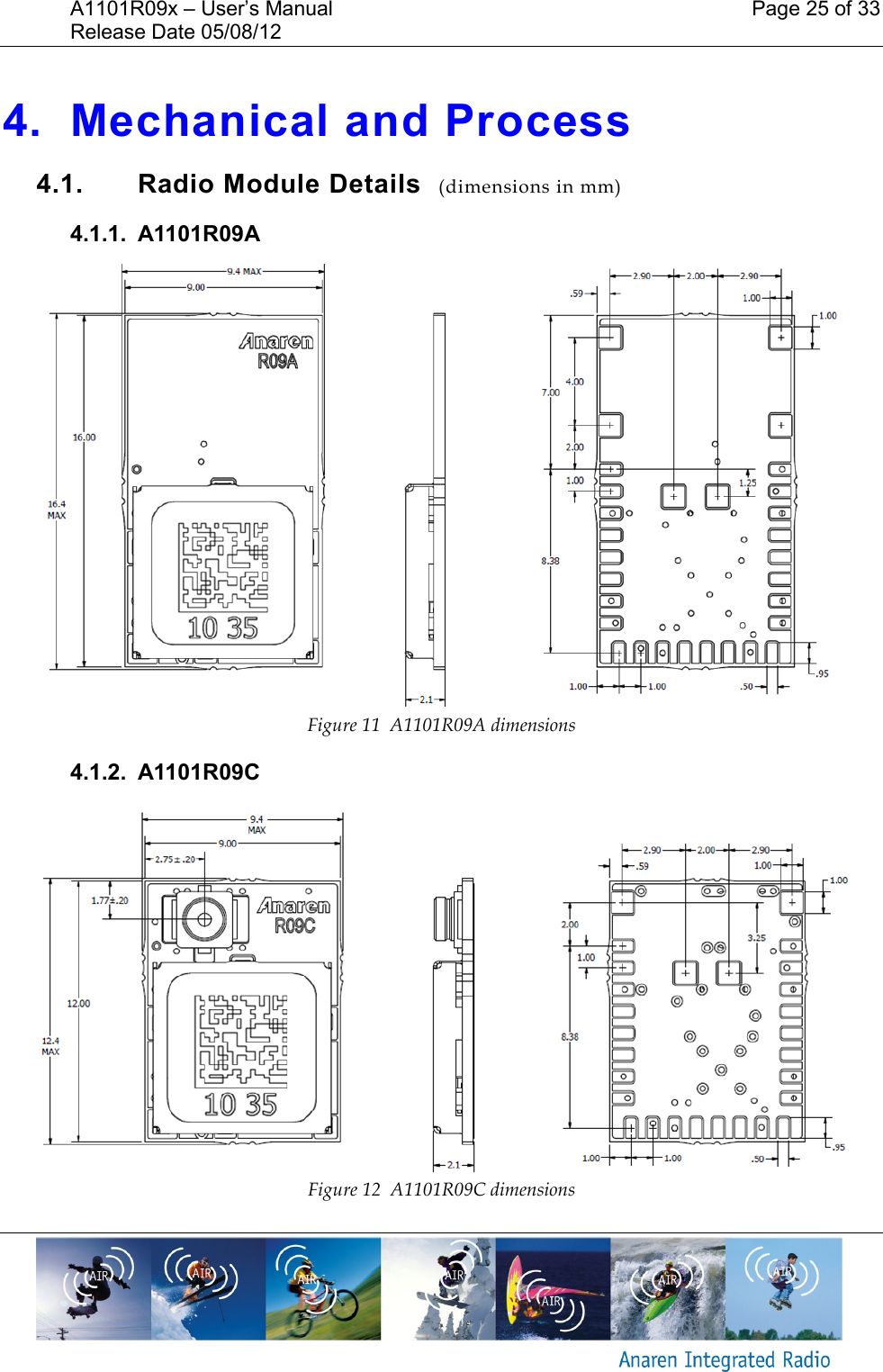
A1101R09x – User’s Manual    Page 25 of 33 Release Date 05/08/12        4. Mechanical and Process 4.1.  Radio Module Details  (dimensions in mm) 4.1.1.  A1101R09A  Figure 11  A1101R09A dimensions 4.1.2.  A1101R09C  Figure 12  A1101R09C dimensions
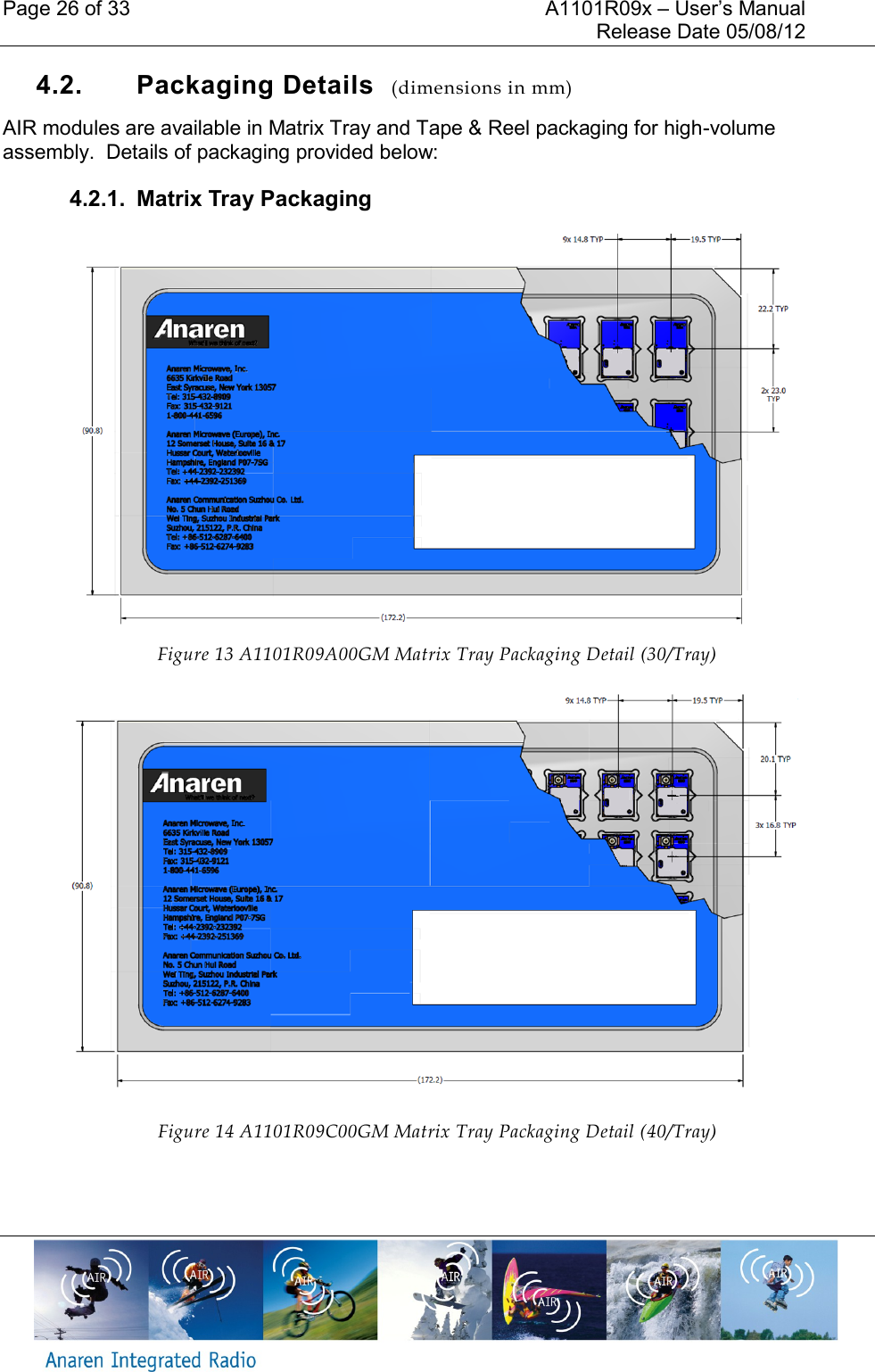
Page 26 of 33    A1101R09x – User’s Manual     Release Date 05/08/12     4.2.  Packaging Details  (dimensions in mm) AIR modules are available in Matrix Tray and Tape & Reel packaging for high-volume assembly.  Details of packaging provided below: 4.2.1.  Matrix Tray Packaging  Figure 13 A1101R09A00GM Matrix Tray Packaging Detail (30/Tray)  Figure 14 A1101R09C00GM Matrix Tray Packaging Detail (40/Tray)
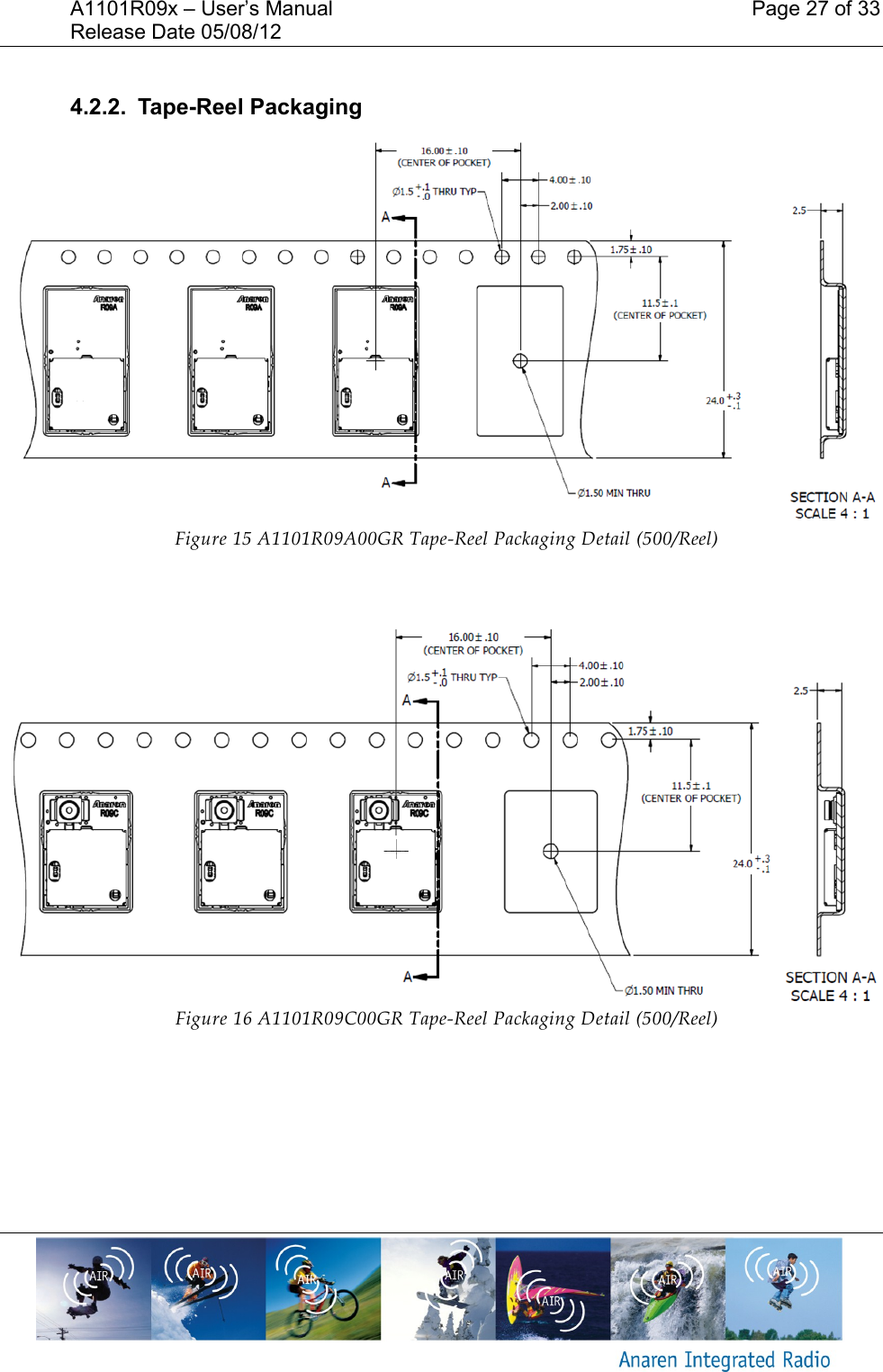
A1101R09x – User’s Manual    Page 27 of 33 Release Date 05/08/12        4.2.2.  Tape-Reel Packaging Figure 15 A1101R09A00GR Tape-Reel Packaging Detail (500/Reel)  Figure 16 A1101R09C00GR Tape-Reel Packaging Detail (500/Reel)
Page 28 of 33    A1101R09x – User’s Manual     Release Date 05/08/12     4.3.  Soldering AIR Modules may be mounted either manually (for prototyping or low volume production), or automatically for high-volume production.  A no-clean tin/silver/copper (SAC) solder is recommended, however lead based no-clean pastes may also be used.  CAUTION:  AIR Modules are designed for no-clean fluxes only.  DO NOT use water-based fluxes that require aqueous cleaning after solder.  Spot cleaning with a flux remover and toothbrush may be performed with care.  4.3.1.  Manual Mounting Procedure The recommended soldering method is reflow of a paste solder on a hot plate.  This method works provided the bottom of the board where the AIR module is to be mounted is accessible, and there are no bottom-side components in the way.    An aluminum or copper block may be placed on the hot plate surface to transfer heat to a localized area on the board where the AIR module is mounted  -  Set the hot plate to the reflow temperature solder manufacturer’s recommended  -  Apply solder paste to the pads on the board receiving the AIR module -  Place the AIR module carefully onto the dispensed solder -  Using tweezers or another holding device, carefully place board with AIR module onto the hot plate surface (or metal block) -  Apply heat until reflow occurs, per solder paste manufacturer’s recommendations -  Carefully remove the board and place on a heat-resistant surface to cool -  Check assembly electrically to confirm there are no opens or shorts.
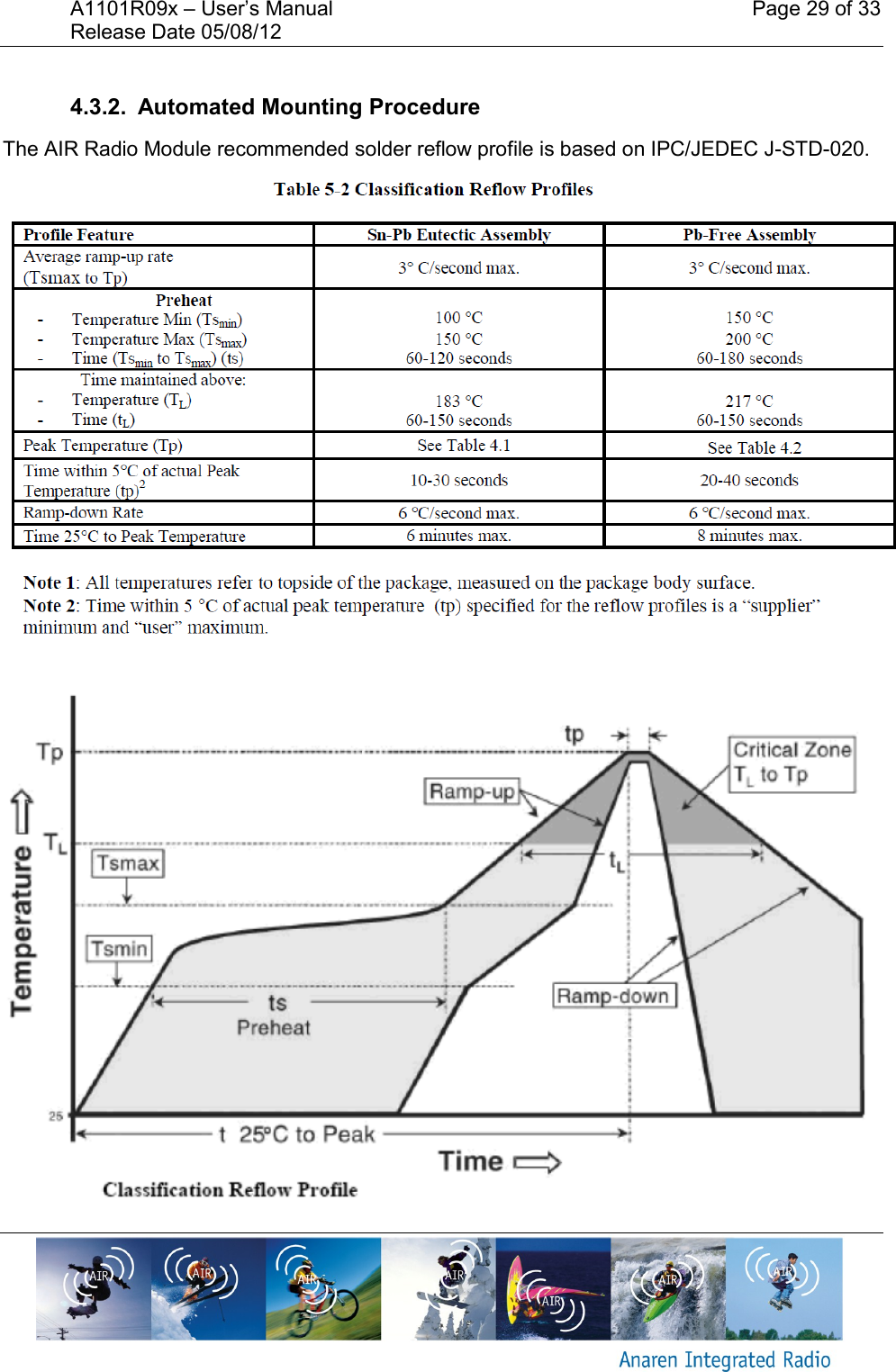
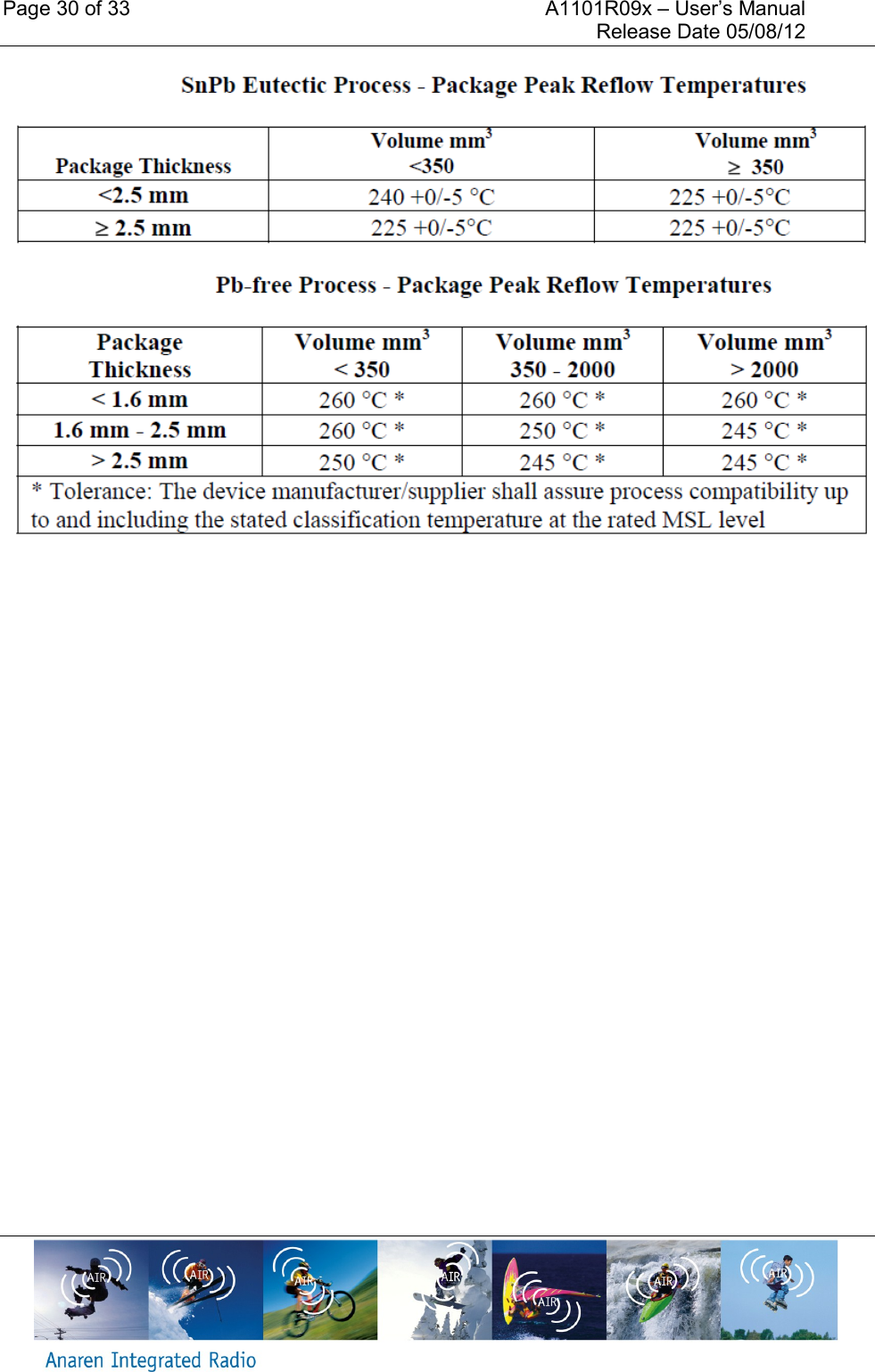
A1101R09x – User’s Manual    Page 29 of 33 Release Date 05/08/12        4.3.2.  Automated Mounting Procedure The AIR Radio Module recommended solder reflow profile is based on IPC/JEDEC J-STD-020.
Page 30 of 33    A1101R09x – User’s Manual     Release Date 05/08/12
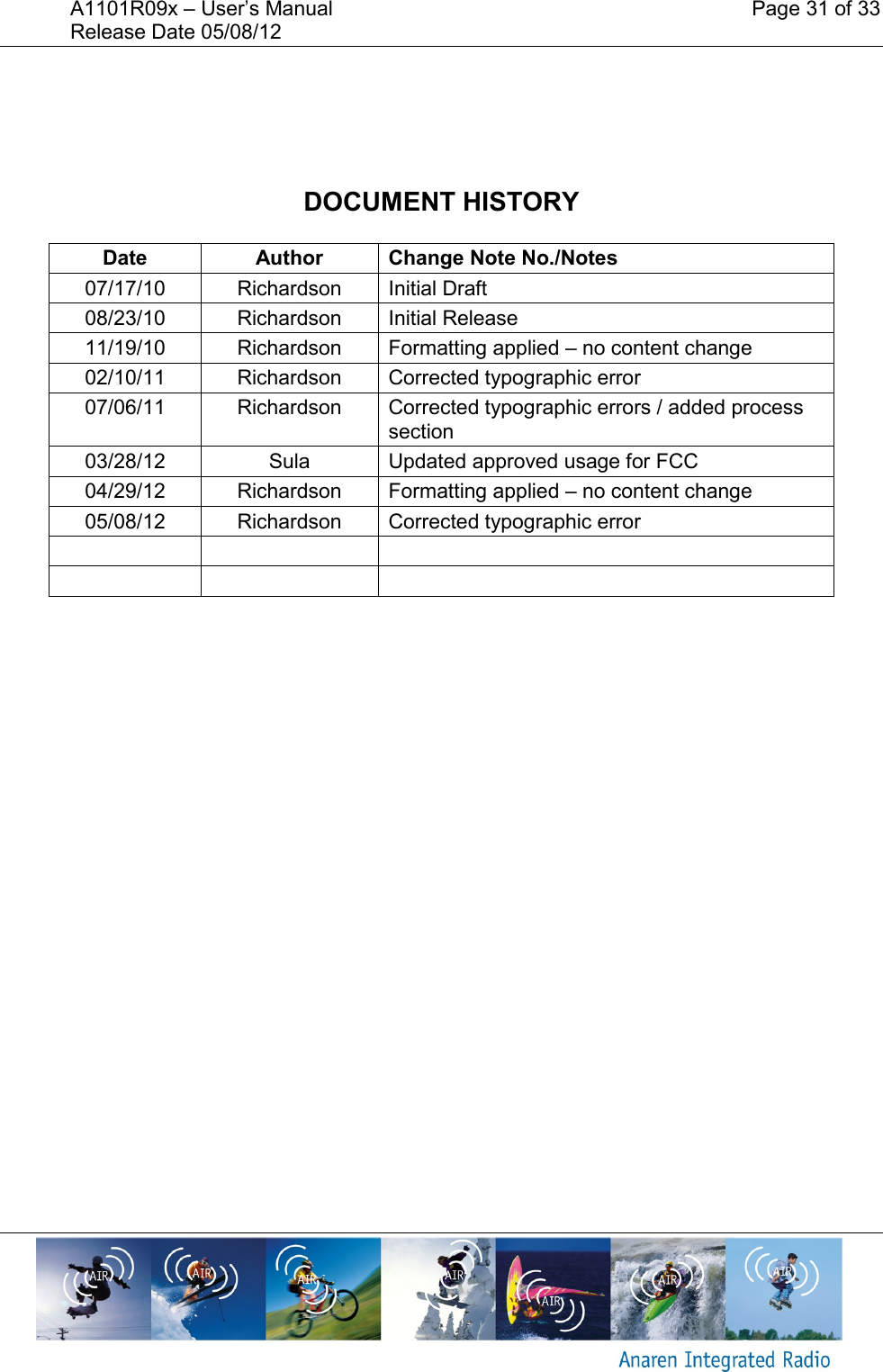
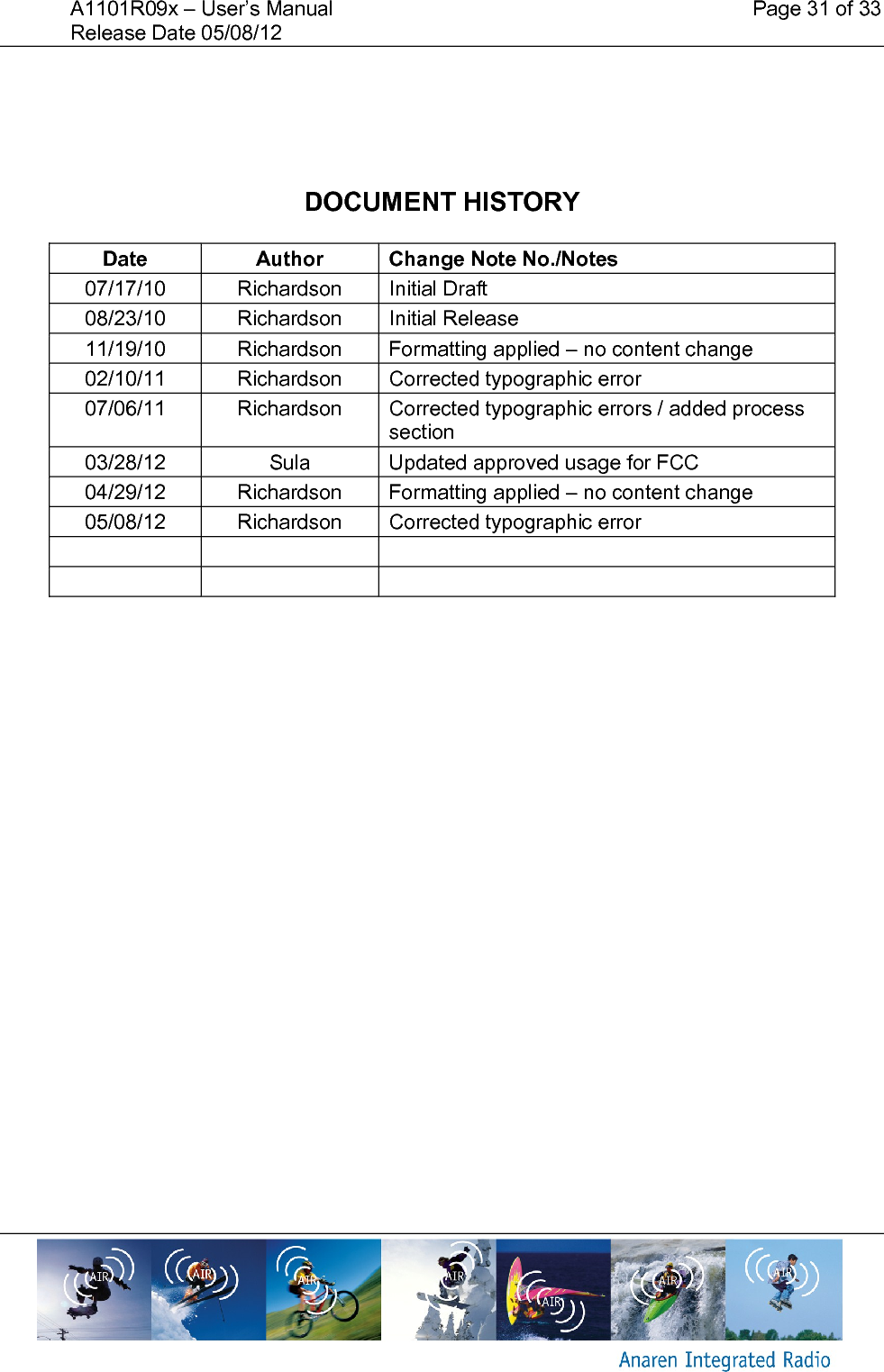
A1101R09x – User’s Manual    Page 31 of 33 Release Date 05/08/12            DOCUMENT HISTORY  Date Author Change Note No./Notes 07/17/10 Richardson Initial Draft 08/23/10 Richardson Initial Release 11/19/10 Richardson Formatting applied – no content change 02/10/11 Richardson Corrected typographic error 07/06/11 Richardson Corrected typographic errors / added process section 03/28/12 Sula Updated approved usage for FCC  04/29/12 Richardson Formatting applied – no content change 05/08/12 Richardson Corrected typographic error
  THIS PAGE INTENTIONALLY LEFT BLANK
           If you have additional questions, need samples, or would like a quote –  please email the AIR team at AIR@anaren.com .    For a full list of our franchised distributors, please visit our website: http://www.anaren.com/air/                      Anaren Microwave, Inc. 6635 Kirkville Road East Syracuse, NY  13057 Tel:   +1  315 432 8909          +1  800 411 6596 Fax:  +1  315 432 8970 Anaren Microwave (Europe), Inc. 12 Somerset House, Suite 16 & 17 Hussar Court, Waterlooville Hampshire, England P07-7SG Tel:     +44  2392 232392 Fax:    +44  2392 251369 Anaren Communication Suzhou Co. Ltd. No. 5 Chun Hui Road Wei Ting, Suzhou Industrial Park Suzhou 215122, PR China Tel:    +86  512 6287 6400 Fax:   +86  512 6274 9283     Attach distributor contact information here

Navigation menu